In 2015, the BMW X5 actually outsold the BMW 3 Series sedan in Australia – though the compact executive car remains the brand’s signature model and its most popular globally.
This is the 330i version – formerly known as the 328i before a recent mid-life update – the BMW 3 series LCI.
Our test car looks sportier than usual as it’s fitted with an optional M Sport Package, which brings items such as fancier, lighter alloy wheels on the outside and sports seats plus enhanced trim on the inside.
The interior’s level of perceived quality is good if not as elevated as in the cabins of the rival Mercedes-Benz C-Class and Audi A4, though BMW’s iDrive infotainment system is the class benchmark in terms of visual presentation and intuitive operation.
Despite the badge change, there’s still a four-cylinder turbocharged petrol engine under the bonnet. And it’s a terrific engine that gives 330i the best of both worlds: it’s not only faster than direct rivals but also more economical.
Click here to read the full review on the BMW 3 series range.
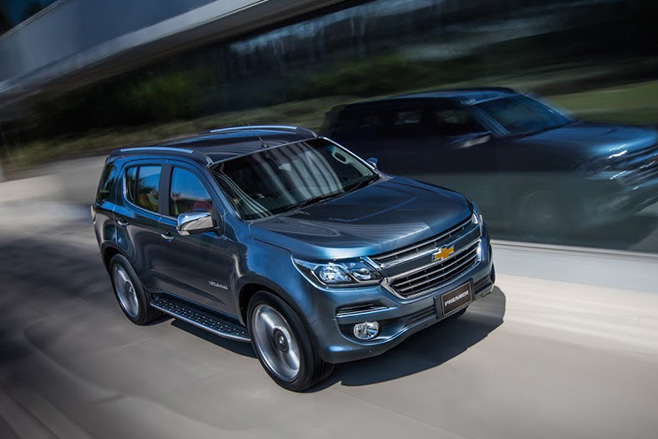
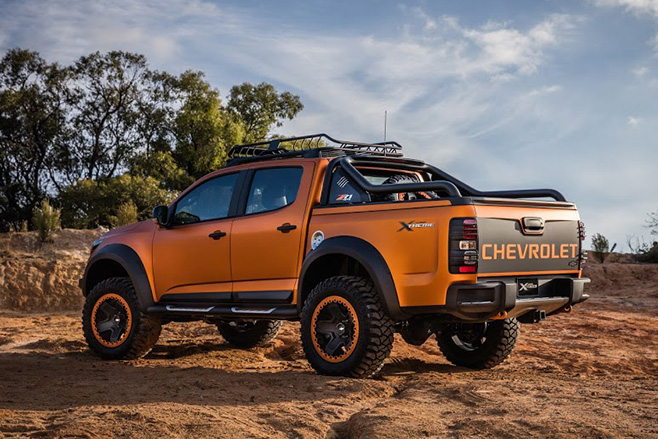
The Chevrolet Xtreme and Trailblazer Premier show models have been unveiled at the 2016 Bangkok motor show, previewing some of the visual changes for the ute and SUV respectively as well as the potential for an expanded accessories line-up.
Holden says the vehicles, built at the company’s Port Melbourne facilities in collaboration with GM Brazil and GM Thailand, provide a strong hint at a future design direction for both Holden and Chevrolet. It’s the near-future in the case of the front of the concepts, which indicate a better execution of the grille, headlight and lower bumper combination for the Colorado models.
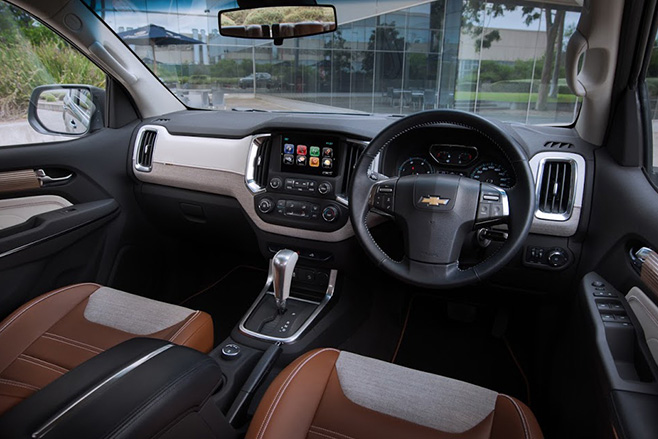
The interiors of the concepts also reveal how Holden and parent company General Motors are addressing criticisms of the current Colorado’s cabin, which focused on both design and quality issues.
A dramatically redesigned dash promises a much-needed improvement in perception of quality, while the sophisticated addition of the 8.0-inch colour touchscreen can be expected in the production models that emerge later this year.
Each concept also showcases different design approaches for two models that are based on the same underpinnings. The Xtreme adopts a tougher look inside and out, while the Trailblazer focuses on a luxury angle.
They suggest future production versions of the Colorado ute and Colorado 7 SUV could have greater visual differentiation than the current twins.
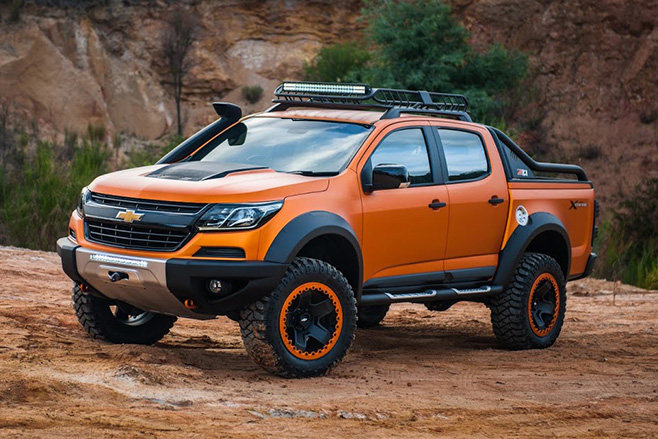
The Chevrolet Xtreme also responds to the trend for ute buyers to personalise their vehicles by presenting a range of accessories that could one day feature on a showroom options list.
They include a front Safari bar complete with integrated LED lights and winch, and a custom tub liner that features an integrated spare wheel mount.
“Our focus here was about pushing these vehicles in two completely different directions, ensuring they are standalone vehicles in their own right,” said General Motors International vice-president of design, Mike Simcoe.
“It is great to have the opportunity to showcase design possibilities today that could be developed and seen in the cars and trucks of tomorrow.”
Click here to read the full review on the current-generation Holden Colorado range.
Mazda’s new variant of the 2016 Wheels Car of the Year MX-5 soft-top roadster is being shown at this week’s New York motor show, revealing a different approach to the previous retractable-hardtop version.
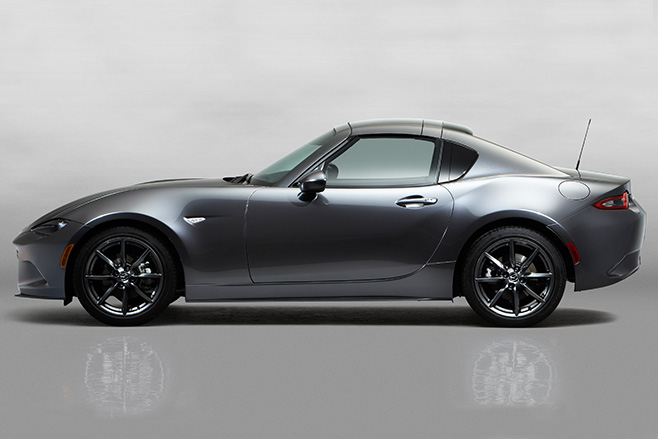
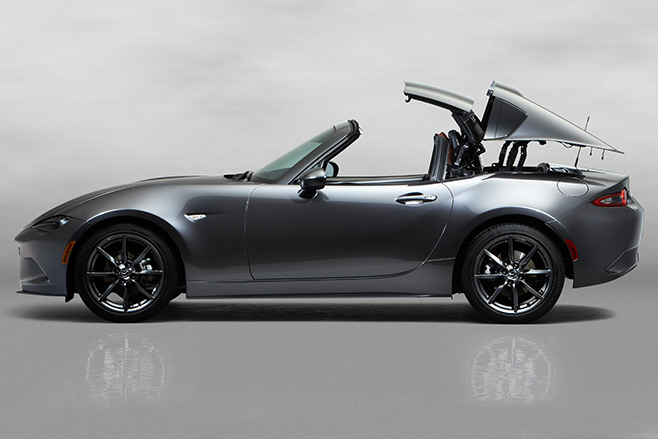
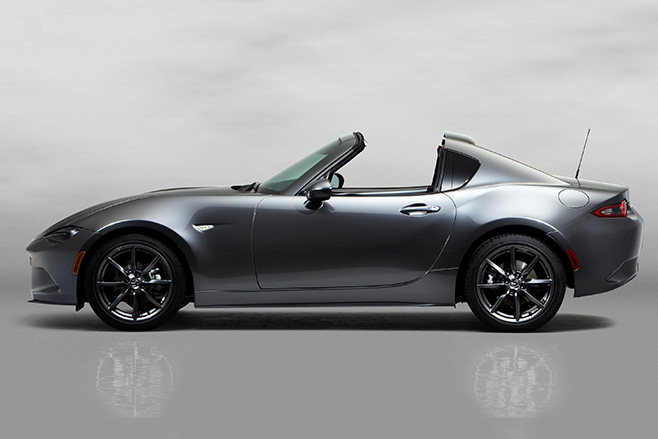
Where the previous, third-generation MX-5 featured a conventional folding metal roof, the RF stows only the middle roof section – with the rear section first lifting as part of the operation before returning to create a look similar to that of sports cars such as the Porsche 911 Targa.
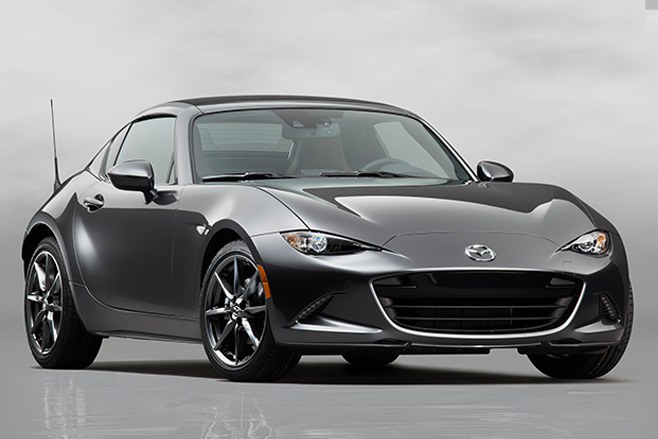
The set-up includes retractable rear glass to enhance the open-air driving experience, while the roof can be opened or closed at the press of a button up to a driving speed of 10km/h.
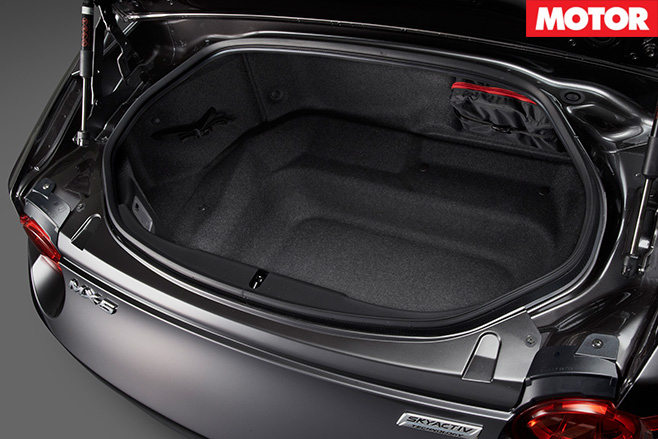
Mazda says the RF has the same 130-litre boot space as the Roadster despite the more sophisticated roof system, which will open or close in about 12 seconds – making it potentially the fastest-operating automated roof systems in the world.
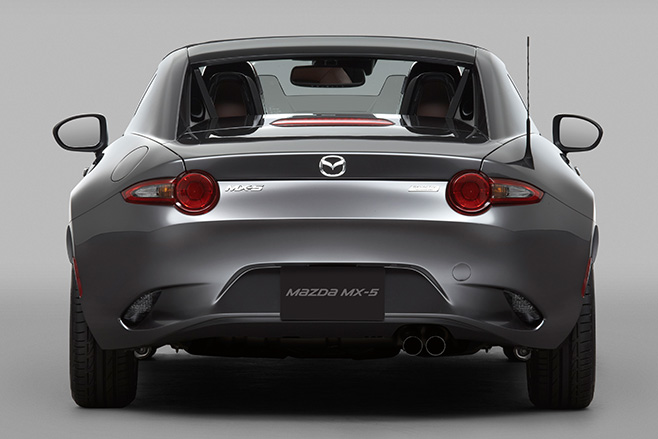
The Japanese brand told WhichCar the three-piece metal roof shouldn’t add too much weight and therefore have minimal effect on performance.
The Mazda MX-5 RF will be offered in Australia with only the bigger, 2.0-litre four-cylinder engine and the choice of six-speed manual or automatic gearboxes, when it arrives in early 2017.
The Roadster includes the choice of a smaller, less powerful 1.5-litre engine.
Expect the RF to carry a premium of a few thousand dollars over the 2.0L Mazda MX-5 Roadster that costs from $34,490 – meaning a starting price not far below $40K.
The only exterior dimension to change for the RF is a 5mm increase in height, which could be welcome news for taller drivers who find the Roadster’s headroom a touch too tight with the fabric roof in place.
The roof liner also features increased sound absorption as part of moves to give the RF greater sound insulation.
Globally, Mazda expects the soft-top and hard-top to split MX-5 sales 50/50.
Click here to read the full review on the Mazda MX-5 range.
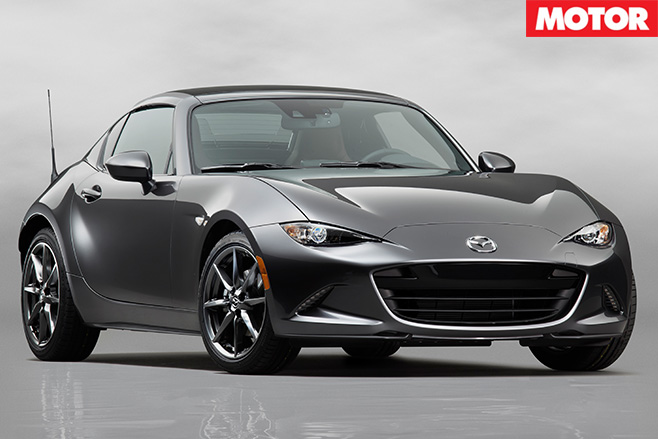
If you’re keen on a new MX-5 but aren’t a fan of the convertible look, Mazda now has you covered, unveiling the MX-5 RF (Retractable Fastback) this morning ahead of its New York Motor Show debut.
Towards the end of the third-generation NC’s life, the hardtop MX-5 accounted for more than 50 per cent of sales, and Mazda has seized upon this demand to offer greater differentiation for this fourth-generation model.
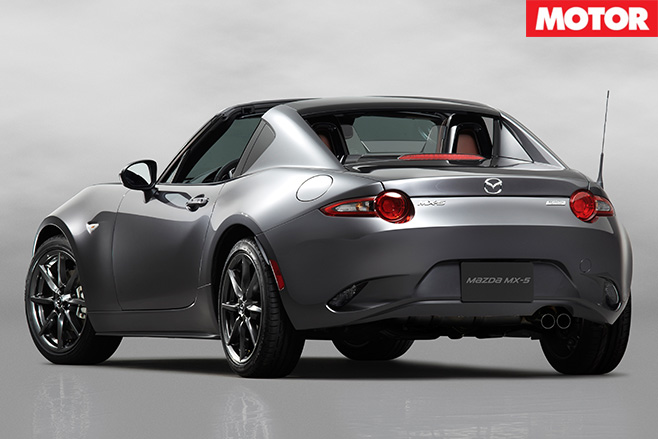
Key to this is the new ‘Fastback’ styling, with Ferrari-style flying buttresses resulting in less of a convertible feel roof-down, but far more cohesive coupe styling with the roof in place.
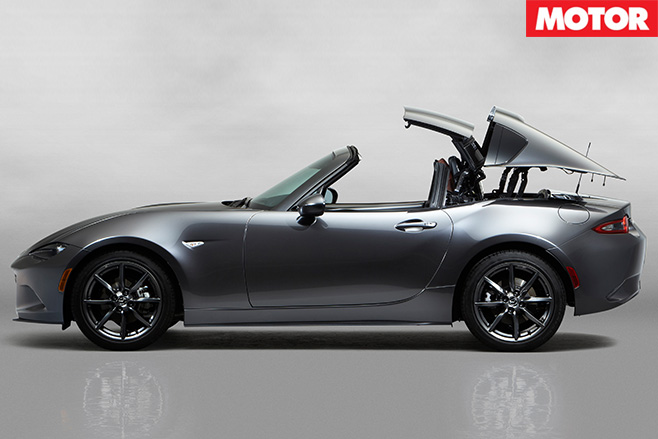
Mazda does not mention any weight penalty associated with the folding metal roof, however we expect it to be in the region of 40-50kg.
The RF will command an as-yet unspecified premium of the regular MX-5 roadster, but we’ll bring you more details as they come to hand.
THE Mazda MX-5 folding hard-top is back and brings with it a new name, or more correctly, a new acronym – RF, for Retractable Fastback.
Revealed ahead of the 2016 New York Motor Show, which kicks off tomorrow, the Mazda MX-5 RF puts the emphasis on the design of the car with a more distinctive teardrop profile to the coupe-like roof.
“If we consider the soft-top model to represent the purist appeal of the lightweight sports car … then the retractable fastback represents a new type of MX-5 that aims to be a compact sports car with a natural charm that anybody and everybody will find beautiful,” said Mazda MX-5 chief designer Masashi Nakayama.
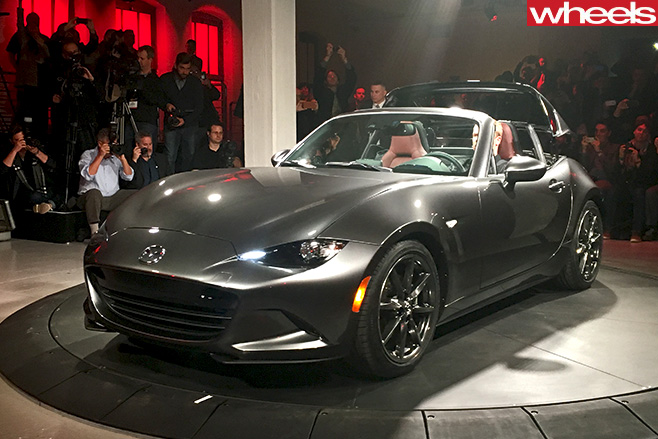
Mazda Australia marketing director Alastair Doak says the RF opens up the MX-5 to a “wider range of sports car buyers” with the added security of a fixed roof making it appealing to people who park the car on streets.
However, he is refusing to name the most obvious contenders – the 2012 Wheels Car of the Year award-winning Toyota 86 and its Subaru BRZ twin – as competitors.
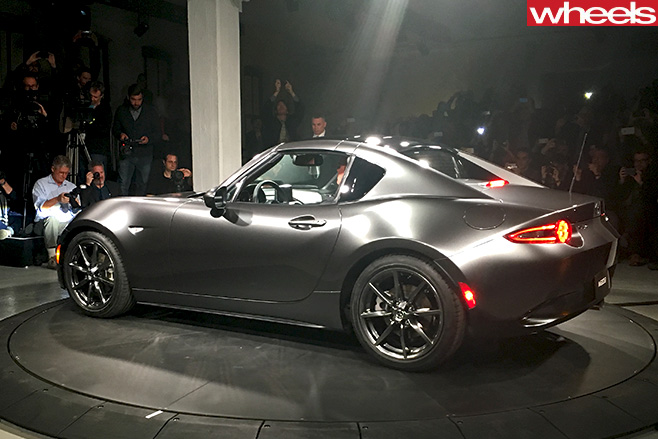
The Mazda MX-5 RF folding roof is fully electric, with a new locking function eliminating the need to manually latch the final piece of the roof in place, as was the case with the previous car.
As with the third-generation NC MX-5 that made its debut with the folding hard-top, the ND Mazda MX-5 RF gets the same 130-litre boot and interior space.
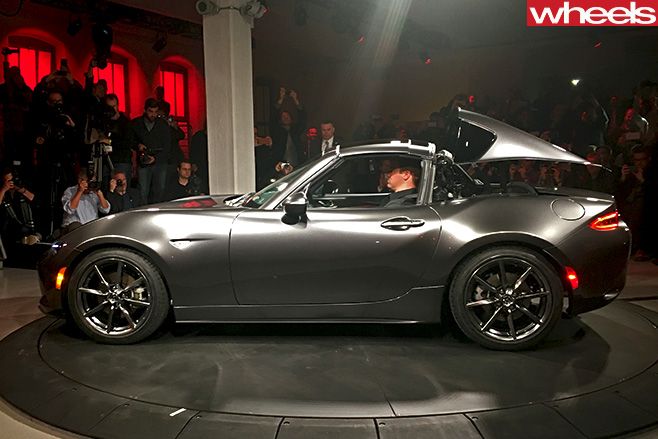
The compact roof breaks into three components on its carefully choreographed journey into a small compartment behind the seats.
With the arrival of the MX-5 RF, Mazda has also added another colour, Machine Gray, designed to look like liquid steel.
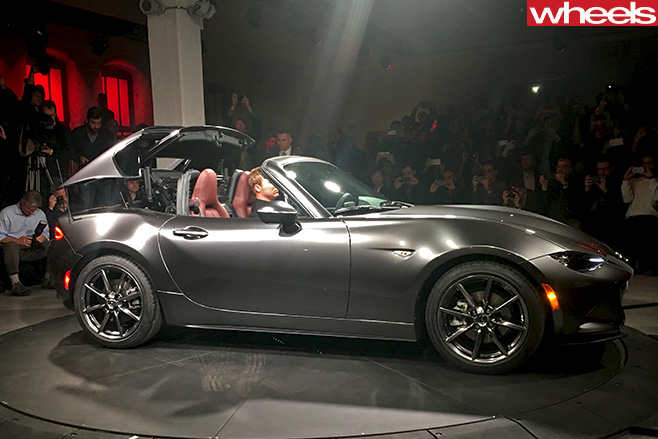
It’s expected to cost at least $4000 more than the soft-top Mazda MX-5 and will only sell with the bigger, more powerful 2.0-litre engine.
Expect pricing to start around $39,000 for the basic RF, and $45,000 for the RF GT that will add features such as leather seats, sat-nav, auto wipers, climate control air-conditioning and a Bose sound system.
THE history books rightly record the birth of the dynamometer in 1719, more than 150 years before the car.
You see, dyno doesn’t necessarily mean rolling road, though the world’s first dyno – invented by ‘Honest’ George Graham of London and adapted by French-born Brit John Desaguliers – did measure horses and pulling power.
The early dyno was a crude device that provided a means of comparing linear force, such as that provided by a horse. These mechanical machines didn’t put a number on the pony’s power, so weren’t much chop for bragging rights at the mead hall, but helped 18th century military generals select their strongest steeds.
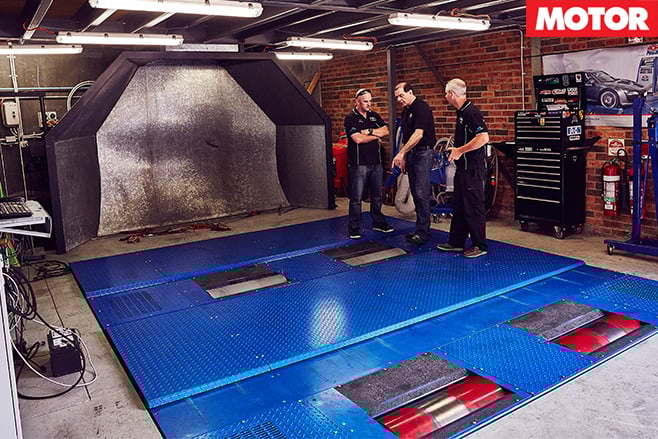
These ‘chassis’ dynos are the most common in the aftermarket – the amount of power and torque at a car’s wheels (or hubs) is useful because it tells tuners how much the engine has to push the car, less any driveline losses – while automotive engineering departments use ‘engine’ dynos in their development programs.
Inertia dynos, water-brake (or hydraulic) dynos, and electric (or eddy-current) dynos are the three main types of chassis dyno. An inertia dyno can only do full-throttle acceleration runs, while hydraulic and electric dynos can simulate road conditions and have the potential to deliver greater accuracy.
‘Roller’ and ‘hub’ dynos are common, the latter usually regarded as more precise because it removes the room for inconsistencies caused by tyre growth and slip by bolting directly to the car’s hubs.
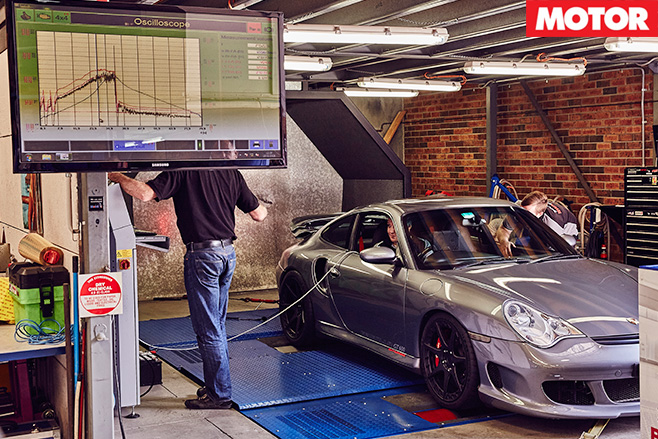
However, German-car tuning outfit BWA Auto in Sydney’s Seven Hills isn’t in the pissing contest, instead claiming that its advanced MAHA all-wheel-drive dyno – the only one in the country – can read flywheel power to within two per cent.
Uniquely, the German-developed roller dyno has the capability to electrically spin the non-driven front or rear wheels, simulating road conditions to trick the ECU, for measuring the likes of hybrids and PDK Porsches.
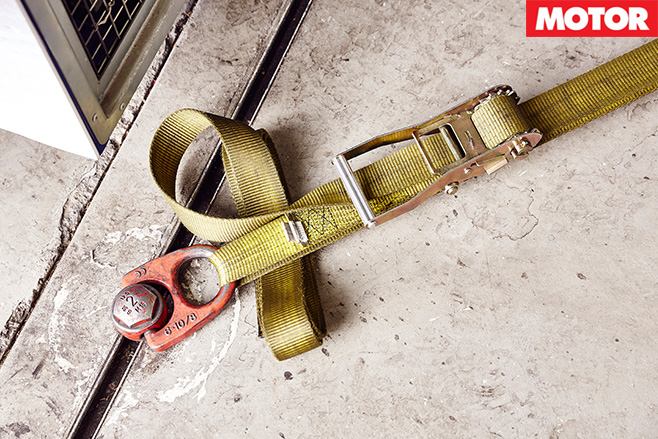
DYNOSTY Airflow, barometric pressure, temperature, and torque calibration apply when testing a dyno’s accuracy. Compared with an engine dyno, there are also drivetrain losses, inertia, brake drag, vehicle tie-down tension, and tyre slip.
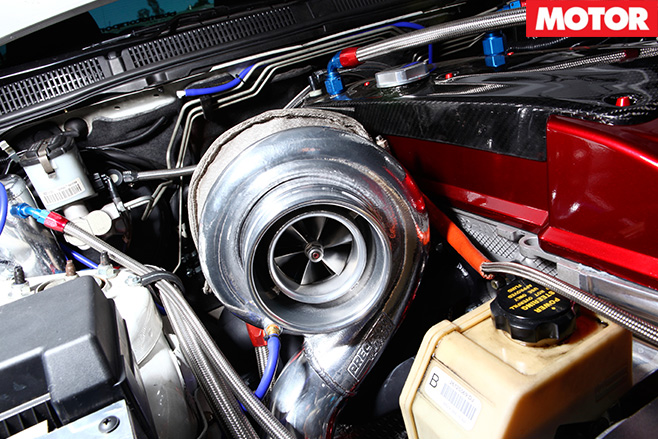
CRACKING THE CODE Is there anything that can’t be tuned? Well, while modern ECUs can be more difficult to crack than their predecessors, there is still no such thing as anti-tuning software.
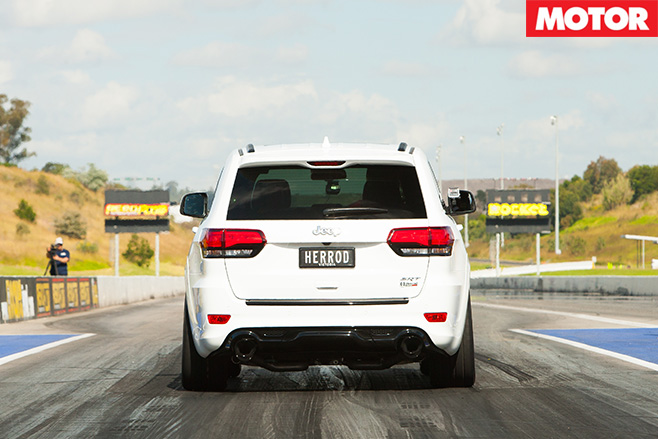
LOST POWER Armed with an at-the-wheels dyno figure, many punters would like to know what percentage of engine power is lost in the drivetrain. The answer? It all depends on the drivetrain.
PRECISE v SIMPLE
However, it doesn’t realistically replicate road conditions, which limits accuracy. Electric current provides the power absorption in an eddy-current dyno, rather than a fluid (hydraulic dyno), which brings the ability to simulate real road loads, making eddy-current dynos ideal for precise ECU calibration.
There’s nothing like a few leaked phone snaps from a presentation to get the internet talking. Images of the new-look Suzuki Swift have been leaked online. The grainy photos were allegedly taken at a dealer presentation in France and show the new design of what we assume will be the 2017 Swift and Suzuki Swift Sport.
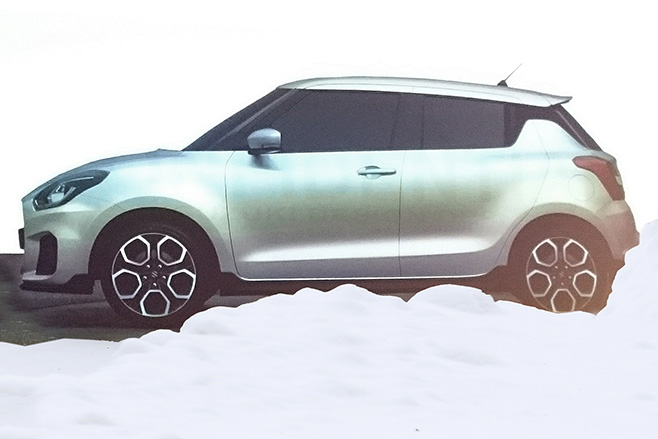
From what we can see, the car will feature smooth lines on the styling of the bonnet, a larger grill, floating roof, LED lights, more stylish interiors, a flat-bottom steering wheel and a large touch screen.
There’s not a lot of information floating around on the new Swift, other than these images which look like they’re straight out of a vintage magazine, but reports suggest it’ll be wider than the current generation (thank goodness) and we’ve no doubts that Suzuki is working to reduce the vehicle’s overall weight.
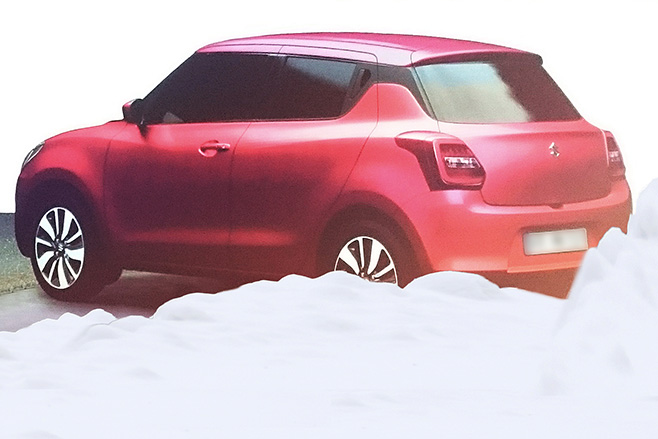
Suzuki has indicated the new generation will feature class-leading fuel economy, which opens the question: will we see the SHVS (Smart Hybrid Vehicle by Suzuki) hybrid-drive system in this car?
Rumours are also flying around that the new Swift (the red car featured here) will run on a 1.0-litre Bootsterjet engine and the Sport (the silver one) a 1.4-litre turbocharged four-cylinder, like that used in the Suzuki Vitara S. At this stage though, it’s still all speculation and Suzuki is yet to confirm.
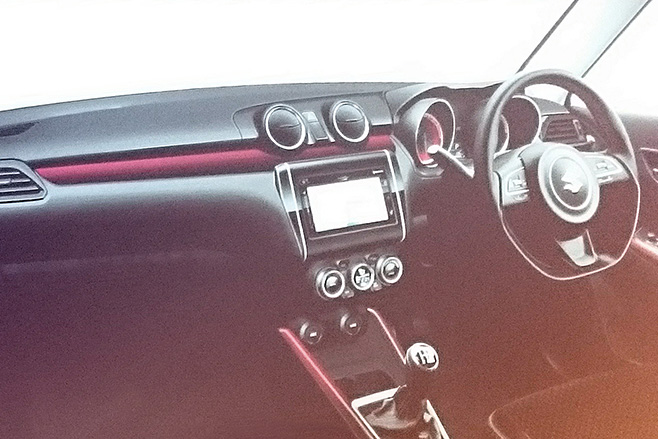
We’ll just have to wait and see when Suzuki Swift arrives at some point in 2017.
Click here to read the review on the current-generation Suzuki Swift range.
Hondas and I go back decades. Even when I was a kid, my favourite toy was a 1:43 scale Z360. In high school the original City and CRX played starring roles in my demented daydreams, while the uni years had me yearning for an NSX (while also quietly coveting the low bonnet line of the exquisite Prelude 4WS that won our 1987 Car of the Year award).But now I’m over all the old Honda nostalgia. I’m tired of the inevitable disappointment when a new model is tested and doesn’t live up to expectations. I want to live in the here with a Honda. I want to move forward and make memories in the now.
After the brilliant Kuga Trend TDCI long-termer loaded with advanced driver assistance tech, swapping into a base-model B-segment hatch is exactly what this inner-urban dweller craves. I cannot resist a clever city car. Like the Z360.
The third-generation Jazz is a gentle evolution of the revolutionary original. The famous rear “Magic Seats” and high roof remain, only now the wheelbase is some 30mm longer, the body’s been stretched 76mm and the torsion-beam rear end is more compact, all for an unprecedented 1492 litres of available space. As both humans in my household are cyclists and Romy the Labrador prefers a low floor to gingerly step into, everybody should be happy with the Jazz’s genius packaging.
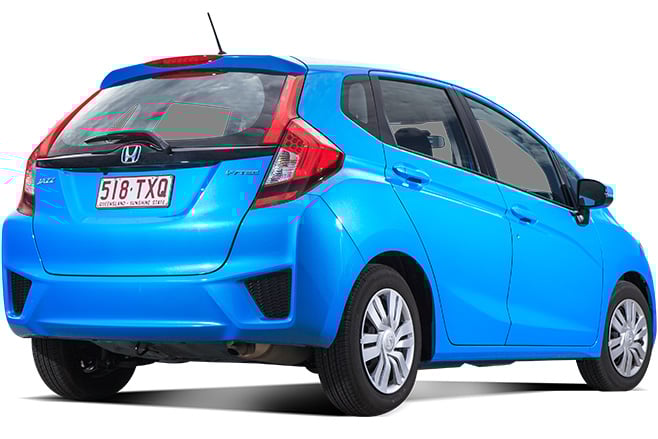
Infuriatingly for my desire to see Honda in a fresh and progressive new light, however, the preceding model’s rear discs give way to drums and the 88kW/145Nm 1.5 single-cam i-VTEC is unchanged. Honda NZ offers a 1.3 as well as an all-new direct-injection 97kW/155Nm 1.5 (with a six-speed ’box), so why can’t the local mob? Perhaps because ours come from Thailand instead of Japan.
At least the CVT transmission – in lieu of the standard five-speed manual ’box – is efficient enough to lop almost an entire litre off the official fuel consumption average (which is now 5.8L/100km).
In line with a complete redesign, much else has changed – a more aerodynamic body, a stronger yet 60kg lighter platform, overhauled electric steering and suspension – and the value equation has been improved. It may only be a base VTi, but our Jazz includes a reversing camera, modish touchscreen multimedia system, LED lighting, and integrated Bluetooth phone/audio streaming (at last) with 12-volt/USB/HDMI/MP4 outlets, six airbags, stability control, cruise control, reach and tilt adjustable steering, air-conditioning, a trip computer, electric windows and remote central locking.
Let’s see if the latest Jazz also comes with all that old-school-Hondas-are-better baggage. I have six months to find out.
UPDATE 1
Seems not everybody digs Jazz
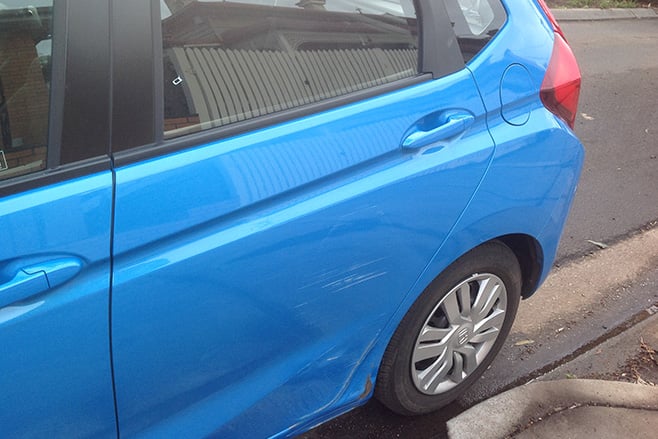
No-one heard or saw anything, but it would have made a pretty loud noise judging by the damage left behind.
After just six weeks in my care, Honda’s new Jazz VTi suffered an underground car park hit-and-run. Since it involved the left-hand rear door and wheelarch, the damage wasn’t even discovered for at least a day. I was away on assignment, leaving my partner to haplessly chance upon the carnage. It’s the second dent-and-dash I’ve copped in as many years. What is the world coming to?
More importantly, this is the first blemish on my experience with 518-TXQ, for in the preceding weeks, Honda’s Thai-built hatch hadn’t put a wheel wrong. It still hasn’t.
The Jazz is already proving to be the most incredibly convenient car for the inner city since my long-departed Nissan Leaf long-termer, thanks to its tall, boxy shape and wide doors that allow for unencumbered entry and exit.
These attributes were comically underlined when my arachnophobic friend Iona, a sassy Scot not prone to suffering fools gladly, was sat comfortably in the middle-rear pew, admiring the general vastness of space the Honda is famous for … until a huntsman casually crawled from the map pocket by her knee. Even before I could completely stop, she had scrambled over boyfriend William and was out of the car like a shot, screaming.
She couldn’t have bolted from a small room any easier. Don’t worry, the spider was removed very gently.
Further urban-friendly virtues include a commanding driving position, light steering, a tight turning circle, great forward vision and that big centre screen for the crystal-clear reversing camera. The 175/65R15 tyres also manage to soak up your typical street blemishes effortlessly.
The combination of Honda’s 88kW/145Nm 1.5-litre single-cam four-pot petrol engine and new CVT transmission makes for lively step-off acceleration – ideal for rapid yet silky point-to-point commuting. This is backed up by robust fuel economy figures, especially considering the heavy suburban-traffic commuting the Honda has been subjected to.
However, even taking into account the Jazz’s youthful city-car runabout positioning, I could certainly live with much more steering weight and feel, a common observation with current Hondas.
Still, the whole household is mightily pleased with just how seamlessly the Jazz has slipped into our everyday lives, including Romy the Labrador Retriever, who happily steps onto the low floor afforded by the folded rear seat.
It may not be as endearing as my ’77 Civic, but the Jazz simply didn’t deserve the car-park pummelling it was subjected to.
UPDATE 2
Jazz hits a sour note again after yet another attack
Living in the city ain’t for the fainthearted, but two assaults in as many months would test anyone’s patience. And paranoia.
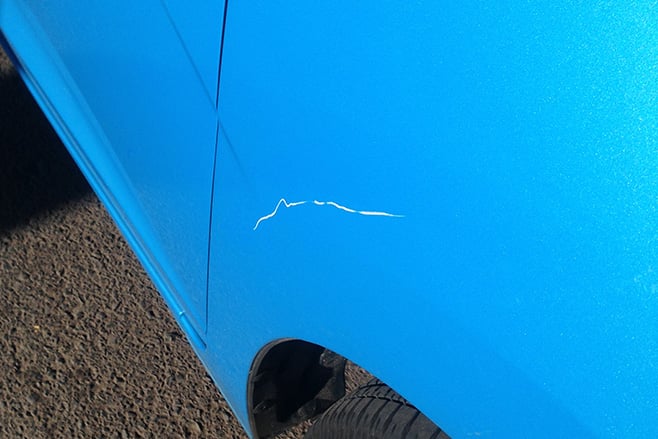
A fortnight after returning spotless from being repaired following a car park hit-and-run assault, 518-TXQ copped a sizeable scratch on the front-right mudguard. This time the perpetuator lost his load of piping as the Jazz ambled by a work site. So back to the panel-beater it goes.
In the three weeks between repair shop visits, the Honda undertook a couple of country runs to help it escape the inner-urban warfare.
Though I initially felt the front seats would be too flat to offer much support over longer journeys, they proved up to the task.
Indeed, as an open-road cruiser, the Jazz was unexpectedly adept, its engine working away quietly at the national limit with the tacho barely ticking over 2000rpm, aided by the standard-fit cruise control and a commanding view forward.
Even the CVT continuously variable transmission – forever derided in every car it’s ever appeared in for droning endlessly at speed – responded quickly and with barely any flaring during overtaking manoeuvres. And there’s enough torque from the Jazz’s ageing 88kW/145Nm 1.5-litre single-cam i-VTEC petrol four to make country cruising relatively effortless.
On the other hand, the cruise control’s inability to maintain its set speed on inclines, some tyre noise over coarser bitumen, and an occasional propensity to sway a little during stronger crosswinds were the only real negatives.
Watching the overall fuel consumption average on the trip computer helps wile away the time, according to my 200cm-tall partner, who fits with space to spare behind the Jazz’s natty little wheel. One 410km round trip to Lake Bullen Merri in Western Victoria saw the amazingly accurate readout tumble 0.5L/100km to 6.3L/100km. Not bad for a boxy city runabout loaded with two geologists, their paraphernalia and subsequent (heavy) rock samples. Ah, yes, the rock lifestyle…
Along with the massive bicycle-friendly cavity that results from folding the rear seats down, one of my favourite features is the easy-to-use Bluetooth audio. Not only does it stream everything from Billie Holiday to Dizzee Rascal with no fuss, the system pairs seamlessly with my iPhone’s Siri voice interface to compose and send text messages completely handsfree. That’s another handy thing to pass those long road-trip hours while still watching the road ahead.
Maybe my particular Jazz would be happier living in the country. It’d certainly be safer from random mindless damage.
UPDATE 3
A voice of dissent in the league of keen drivers
Month four has been a tough one for my Jazz long-termer, though mercifully not because of any unexpected damage or breakdown. For a change.
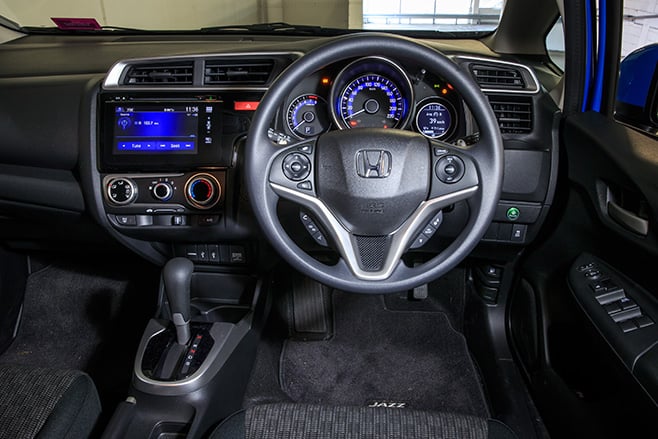
The fact is, to look at, sit inside and drive, the Thai-built Honda supermini is the very opposite of a driving enthusiast’s car, and it is constantly berated for it. Every Wheels Magazine journalist who’s driven the latest Jazz has moaned about how fussy the styling has become, how lifeless the steering feels, how loud the suspension is, and how jittery the ride can be.
I can totally see what they mean. I always find myself ironing out the silly ugly creases in my mind’s eye, longing for more feel and precision behind the wheel, and wishing for a quieter and more supple chassis. And it’s not just after driving the latest Mazda 2 or Volkswagen Polo, either. Even old-timers like the Ford Fiesta and Suzuki Swift highlight the Honda’s dynamic deficiencies.
An extended drive along one of my favourite ride and handling test routes only magnified the deadness of the steering while at the same time exposing other issues, including poor wet-road braking on the eco-centric Bridgestone Turanza 175/65R15 tyres (or do we blame the switch from rear discs to drums?) and doors that actually flap in their frames over rougher surfaces.
Whatever happened to the all-pervasive Honda engineering of the past?
Yet I remain a fan of my Jazz, reminding all the doubters of its world-leading packaging versatility, strong, smooth and efficient drivetrain, seamless around-town operation, decent air-con, excellent storage, superb all-round vision, high resale, low running costs and – by no means least – incredible value for money.
To live with the Jazz is to really learn to appreciate its many plus points. After a long, hot day, you can just sit back and enjoy the sensory deprivation experience that is the effortless Honda’s forte. Like a dose of Panadeine Forte, soon the commute headache just fades into the distance. You don’t even notice the tyres droning or the busy ride after a while.
So, mindful of its disappointing dynamic limitations, I remain a lone voice when it comes to extolling the VTi’s virtues.
PING THE DONKEY
If, like me, you’re prone to speeding without realising it, the Jazz’s initially annoying but now reassuring audible speed warning is a licence saver. I admit I can’t figure out how to switch it off, or change it from the 60km/h setting, and I won’t check the owner’s manual until I figure it out myself so the chime will most likely stay, but I don’t care. This annoying little gadget has saved me hundreds of dollars in fines already. Probably. Thanks, Jazzelle.
UPDATE 4
Modern family heads out in the ever-flexible, ever-practical Honda Jazz for the silly season
Santa could do worse than trade his sleigh for a Jazz. Wide doors, huge hatch opening, tall ceilings, cavernous cargo capacity, hardy plastic trim, easy manoeuvrability, diminutive exterior dimensions for tight city rooftop parking corners.
With the little hatch our main family transport over the Christmas break, the Jazz sure racked up the kays, including a 400km run to Apollo Bay chock-a-block full of a week and a half’s worth of food, bedding, bevvies and pressies – and that was just for the dog.
The so-called Magic Seats are the key to the Honda’s extraordinary flexibility. When recessed deep in the well that is the home for the fuel tank in every other rival (this is known as Utility Mode), the folded rear backrests turn the supermini into a pseudo panel van. Owners ought to be allowed to park these in Loading Zones. Or at least have access to Sandman-style curtains. Honda could make a mint offering a fitted futon bed on the options list.
Anyway, even when weighed down with all our holiday gear, the Jazz hummed along just fine, taking advantage of its ageing but still strong 1.5-litre single-cam i-VTEC’s plumpy torque spread, to provide suitably punchy performance, particularly when passing slower vehicles. And there are plenty of those at Christmas time.
That it also averaged 6.7L/100km over the month of fairly hard driving with the excellent air-con blaring was an added bonus. But the truly unexpected benefit of the heavily burdened Honda was how planted it felt on the back roads around Dean’s Marsh. The extra mass over the wheels helped compress bumps a bit better while making the car less prone to crosswinds (a typical tallboy hatch catch).
But the flat seats, remote steering feel, rattly rear doors (over even mildly bumpy roads – what a disgrace, Honda) and omnipresent road drone didn’t take any holidays this season, undermining what could have been a brilliantly broad-spectrum supermini talent.
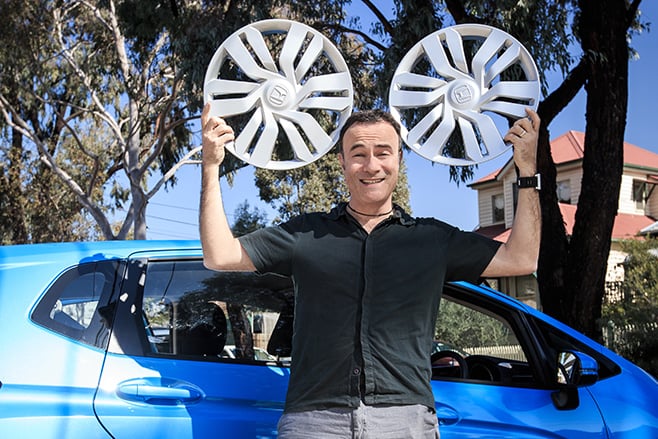
On the flipside, even five months in, we’re still impressed with just how much Jazz you get for your $16,990 – including the functional, fuel-efficient CVT transmission, panoramic reversing camera, cruise control and Bluetooth phone with audio streaming. No competitor offers more for the cash.
Which neatly brings us to what we learned about the Jazz during our Christmas break: it’s got the features, power and versatility to cut it as a little load-lugging panel van. If Santa owned one, he would probably call it Dasher.
MODE ABODE
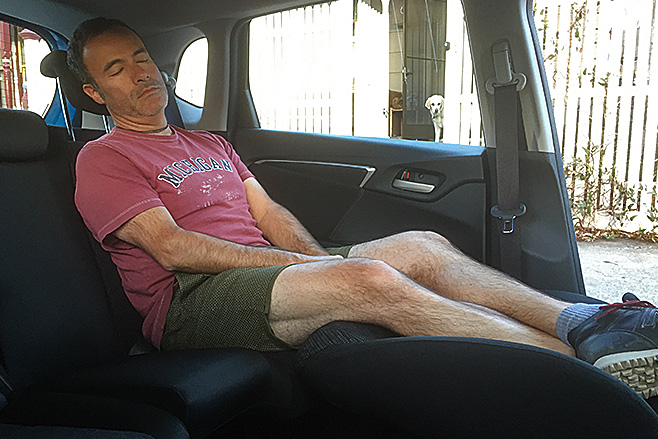
You might already be aware that the Jazz’s rear cushions tilt up to provide a (somewhat useless) walk-through feature dubbed ‘Tall Mode’, but little is known about ‘Refresh Mode’ – where the front passenger seats are slid as far forward as possible with their headrests removed and the rear backrests reclined a few degrees. Wonder no longer. Here’s our narcoleptic stupormodel, Jinx Mathioudakis, demonstrating the Premium Economy-style lounging experience complete with his very own poof!
UPDATE 5
The Honda Jazz, the baby of the Japanese carmaker’s line-up, has crept under Byron’s skin
To paraphrase the legendary Prince (via Sinead), as I write this, it’s been seven days and 15 hours since Honda took 518-TXQ away and, well, nothing compares to living with the latest Jazz.
Like an earworm, the Vivid Sky Blue Pearlescent VTi burrowed deep into my daily routine, and made itself so harmoniously useful there’s now a 4m x 1.7m x 1.52m gap in my existence.
This realisation dawned on me the moment a last-minute supermarket dash, just before dinner during a rainstorm in my inner-city suburb, highlighted how easy it all used to be. Usually, before even thinking about it, I’d be seated in the Jazz, unimpeded by the usual supermini obstacles like small doors and low roof, zipping to the shops and back in no time at all, aided by excellent vision, darty performance and a tiny turning circle. Once I did it inside the 5min 58sec duration of Blur’s Coffee & TV, as it was still playing on my return. Woo-hoo!
Not now, though. Compact and manoeuvrable most rivals might be, but now they all feel cramped and restricted, especially by their urban-unfriendly, modishly slot-like windows.
The point is, the Honda’s unique space-creating packaging has made it pretty much perfect for easy and effortless commuting. The Jazz was always our short-haul transport of choice, even when five of us needed to get somewhere quickly. And, as a makeshift panel van, those tuck-down ‘Magic Seats’ always surprised and delighted.
Likewise, the Honda impressed on the open road for its responsive performance, relatively unobtrusive CVT, leggy cruising ability, consistently low fuel consumption and comfortable front seats.
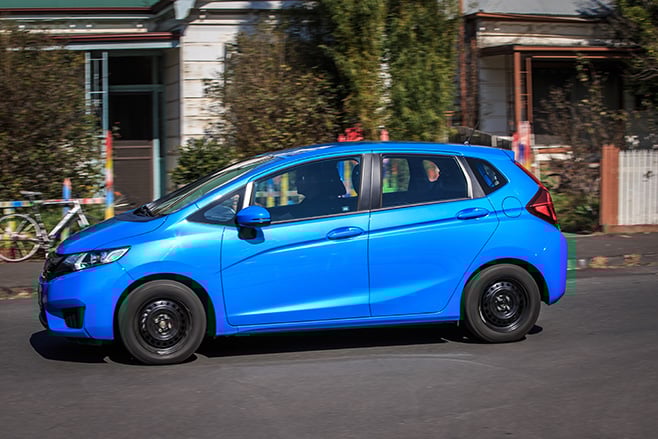
In six months in my care, not a single item broke, rattled, failed or fell off, even after two unsolicited assaults from foreign objects waylaid it for a few weeks.
I can’t believe how much respect I have for 518-TXQ right now.
But love? The Jazz’s steering is too light and remote for that sort of intimate connection. Previously, I’ve also whinged about road noise intrusion on some highway surfaces, though after Wheels‘ supermini Megatest (Wheels, March 2015), the Jazz ain’t so bad, especially compared with the Mazda 2, Toyota Yaris and Holden Barina. Read the full small car comparison review here.
Of more concern is Honda’s decision to drop the previous models’ rear discs for drums. While no braking issues arose, consider that this company used to make taking the technological high road its mantra. Safety cost-cutting is a disgrace.
And that’s a curious thing because it’s not as if the Jazz is grudgingly equipped. Indeed, our $16,990 VTi CVT is staggeringly well specced, coming with a reversing camera, cruise control, Bluetooth telephone and audio streaming, a trip computer, audible speed warning, power windows all round, touchscreen multimedia system (albeit with annoyingly fiddly ‘capacitive touch’ for the volume), HDMI ports and two USB outlets.
Note, though, that the six-month servicing requirement rather than 12 might be an inconvenience for some.
In the final wash-up, the drum brakes sore point, along with the fact that the team at Wheels put a strong emphasis on dynamic capability and driving pleasure, means the latest Jazz would be a top buy for thousands of people, but not for me.
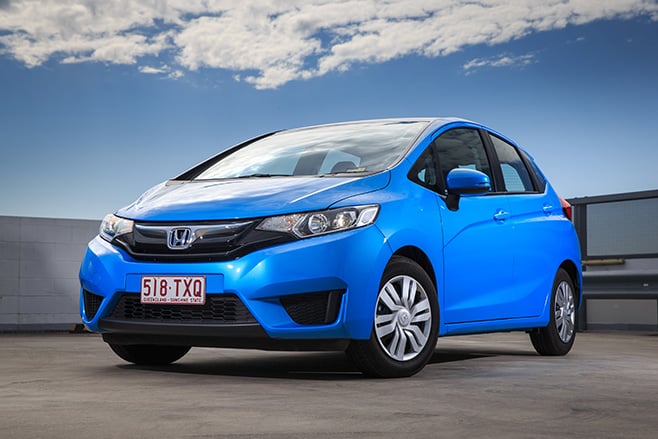
What we have here is an outstanding-value everyday car for the realities of today. But Honda used to make outstanding premium vehicles for the dreamers of tomorrow. The world has changed and the company has adapted. At least there’s still enough differentiation in the Jazz to make it packaged like no other supermini.
And that’s why I miss it. Rushing to finish this piece before darting out yet again to purchase the ingredients for dinner, nothing can chase away the blues I’m feeling now that my Jazz has gone away.
SHAKE THAT BODY
The project leader of the (Jazz-based) Honda HR-V, Naohisa Morishita, told Wheels the rear-door shaking we experienced testing our hatch over rougher surfaces might be an early Thai-build manufacturing defect affecting a small run, rather than an inherent issue. Claiming he’d never heard of such a thing, the worried engineering veteran promised to look into it immediately. If your Jazz’s back doors jingle over rough roads, our advice is to drop Honda a line straight away.
PRELUDE TO A REALITY CHECK
Buying and living with a halcyon-days Honda while testing the Jazz to see if it lives up to the brand’s 80s hype was misguided in hindsight, like trying to compare Beyonce with Like a Prayer era Madonna. However, that my ’89 Prelude auto feels slow, clunky and hard-riding compared to the VTi is shocking, since the former boasts double-wishbone suspension. As for the old four-wheel steering, it feels artificially gloopy and disconnectedly spooky. Still, the Prelude kicks arse for class.
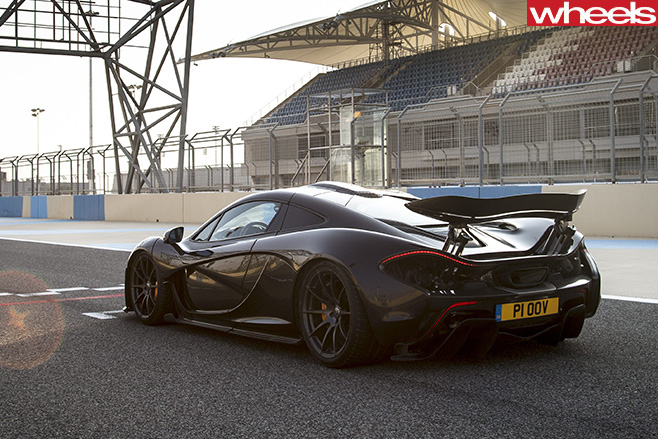
MCLAREN has revealed it is developing an all-electric replacement for its P1 hypercar. Just don’t expect it to arrive any time soon.
Plans for a P1 successor are already underway as part of McLaren’s billion dollar Track22 business plan, with company execs confirming engineers are working on an all-electric powertrain for the brand’s next Ultimate Series model.
But while development has begun, McLaren is waiting on the next leap forward in battery technology to ensure the P1 replacement makes a “huge performance change and is a technology showcase.”
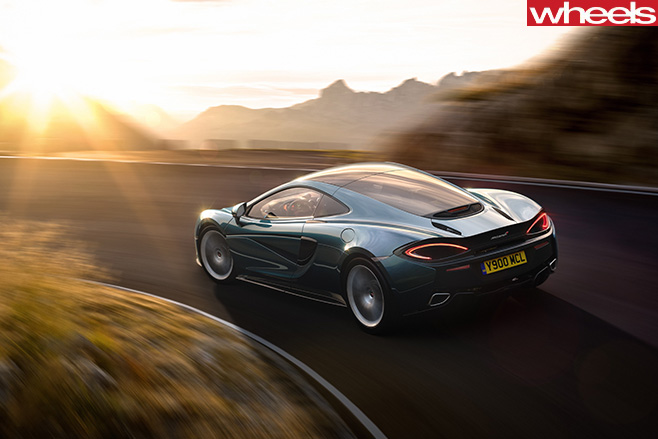
“When we do our next ultimate car it has to be a big technology step, such as full EV, or it has to make enough of a performance leap to make it worthwhile,” Melville said.
“By 2022 half of our range will be hybrid, and during that time we’ll also be running around with fully EV mule cars. We haven’t got a car working yet, but it won’t be long.
“But on that front we’ll wait until we get the energy density in the batteries right, that’s when we’ll do our next ultimate vehicle. For us to make an ultimate car it has to make a clear statement, either about performance or technology, so that could be in 10 years, or possibly five.”
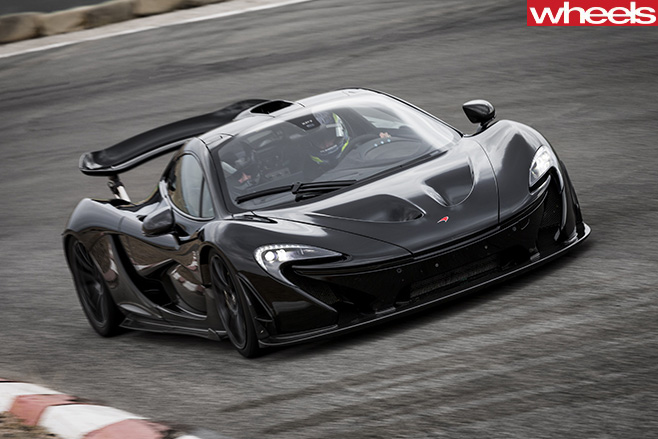
“Sound is so important, so how do we handle that as we go forward?” he asked. “Turbos are catching up and hybrids aren’t much of a problem, but a full EV model? We don’t know yet. I don’t think any of us have the answer.
“People are talking about synthetic, digital engine sounds to give the impression, but that’s no McLaren because it’s fake. So yeah, we’re working really hard on that.”
And as for the looks, “it gives us different requirements, especially because we don’t need as much cooling at the front. So the visual changes I’m really looking forward to. It’ll be very monoform, very fluid shapes for our EV vehicle.”
“Not at the moment, no,” said Melville. “A 2+2 would be a massive step and you can’t modify our carbonfibre monocell in that way, so the implied cost is huge. We’d be doing a whole new chassis basically.
“And we won’t go below our 540C, that’s definitely our cut off. We don’t feel the need to go below that point. In terms of exclusivity, we’ve opened the brand up now and from a price point we have quite a wide base, so we’ve got a big range and in price. So there’s no reason for us to go lower, It’d just muddy the water and muddy our vision too much.”
The Easter Jeep Safari is an annual event help in Moab, Utah USA every year and was this year hosted by Red Rock 4-Wheelers. There are always some great looking concept vehicles to come out of this event and with the New York auto show underway, we’re seeing some cool stuff coming through.
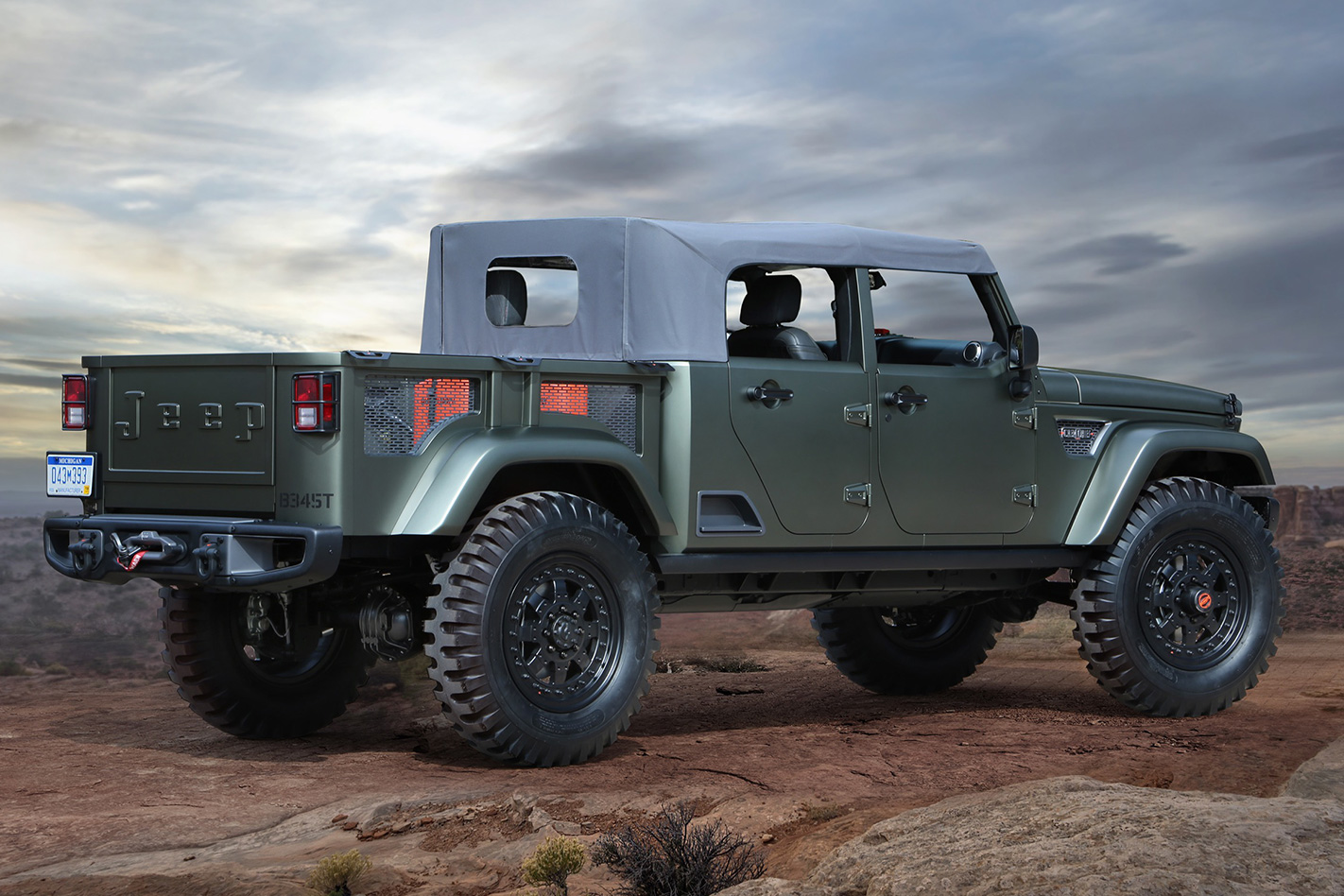
CREW CHIEF 715
Is it a Jeep, is it a convertible or is it a ute? The Crew Chief 715 is both and a nod to the automaker’s military roots. The four-door, dual-cab 4×4 comes with an open top and it’s got our attention!
JEEP SHORTCUT
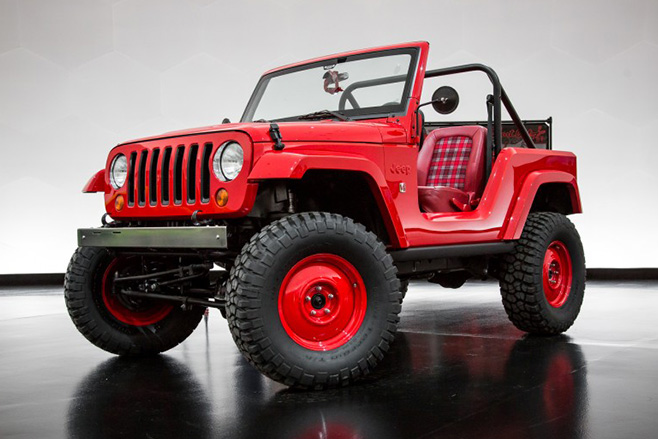
The Jeep Shortcut is based on a Wrangler with a body that’s 66cm shorter, making it easier to manoeuver. We’re loving the tartan seats and rear logo.
JEEP TRAILCAT
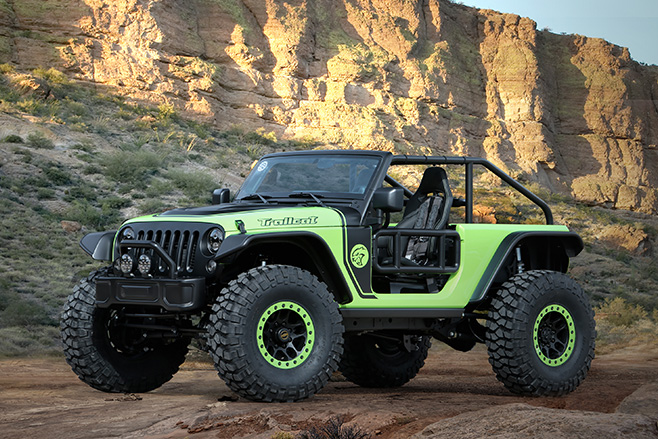
The Trailcat, a merged name from the Jeep Trailhawk and the supercharged HEMI Hellcat V8 under the bonnet, looks like a competitive off-roader. Even the leather carbon fibre seats, taken straight out of a Dodge Viper, look like something we’d see in motorsport.
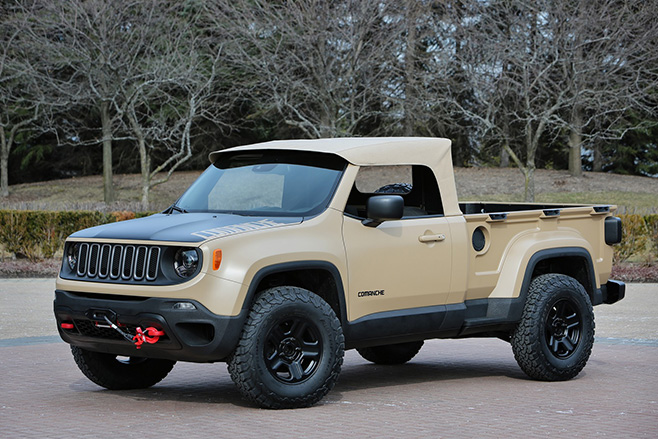
JEEP COMANCHE
The Comanche is kind of, well, beige. Based on a Renegade, the Comanche is probably our least favourite of the bunch. 4X4 Australia said the paint job was the most inspiring aspect of this vehicle, but we’re not all that keen on the colour. Still, the 5-foot tray bed and fabric roof is kind of cool.
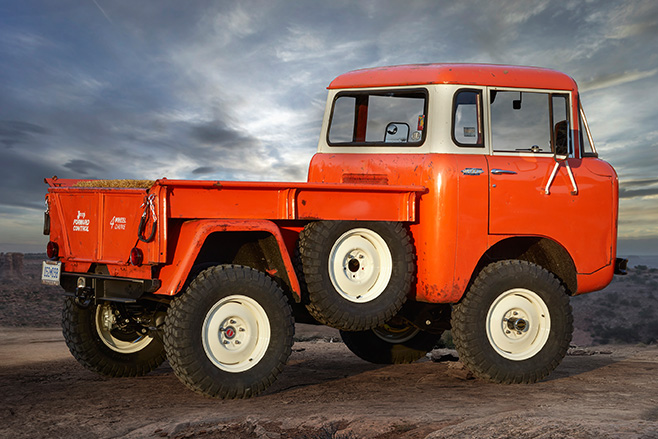
JEEP FC 150
When we looked at the FC 150, we couldn’t help but feel nostalgic. Not because it’s build on a 1956-65 CJ-5 chassis with on a 2005 Jeep Wrangler TJ frame, but because it kind of reminds us of a cartoon car. If we could personify the FC 150, we think it’d be similar to Mater, the tow truck from Pixar’s cartoon, Cars.
2017 JEEP GRAND CHEROKEE TRAILHAWK and SUMMIT
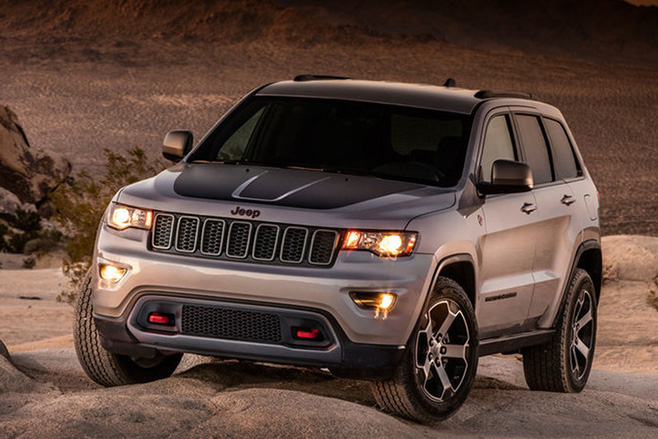
Leaked ahead of the New York Auto Show, these two 4X4s are the newest version of Jeep’s biggest SUV. The Trailhawk (pictured below) is backed with swag for the off-roader. Aside from a bunch of gear like suspension, the Grand Cherokee Trailhawk has a removable bumper to give it more clearance, and a stylish new interior. Meanwhile, the Summit, which is the top of the Jeep Grand Cherokee lineup, doesn’t look different to the current generation, except for a few finishing touches and interior styling. We don’t have much on what the new Summit will have to offer, but we’re pretty sure it’s going to be the most luxurious Jeep available.