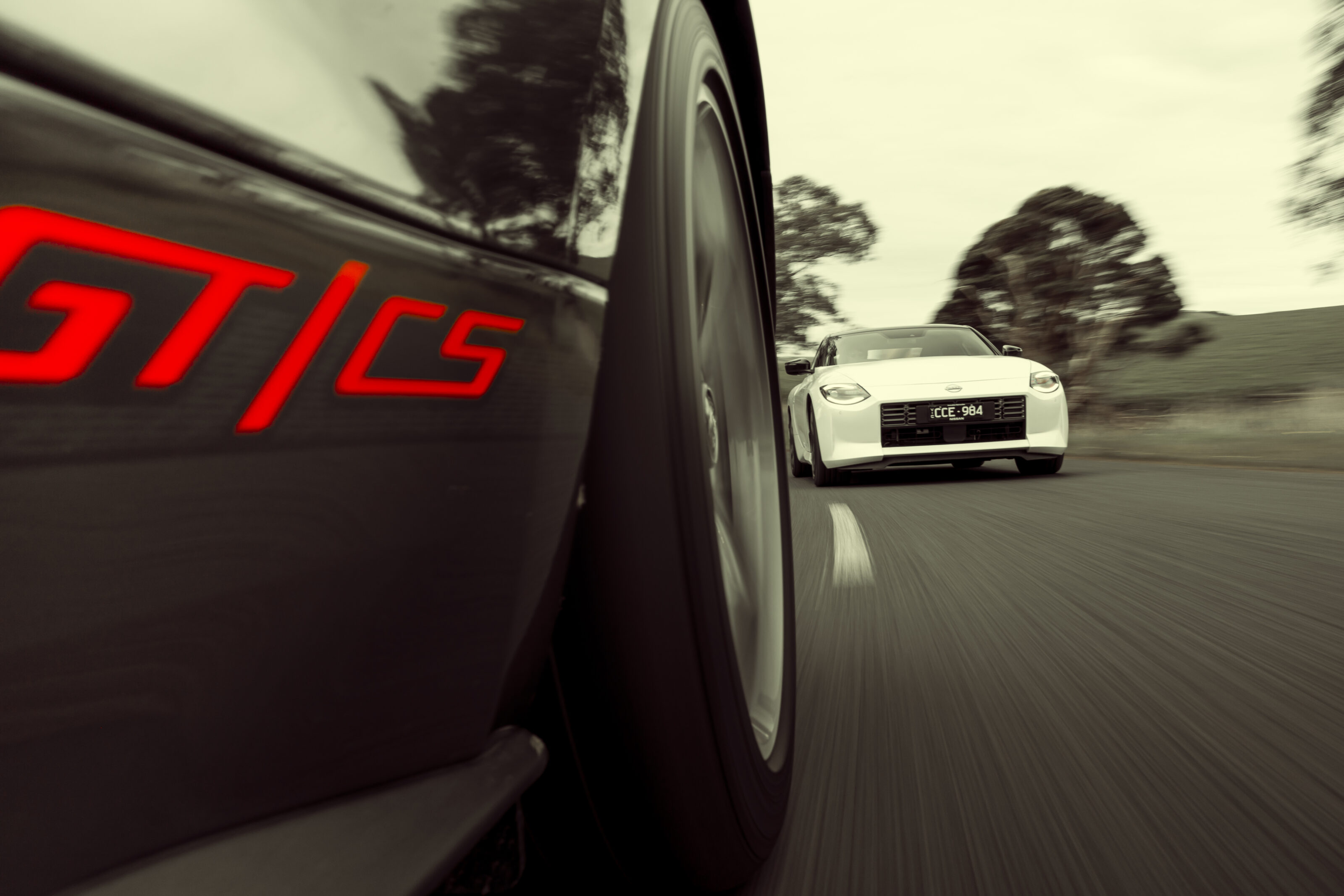
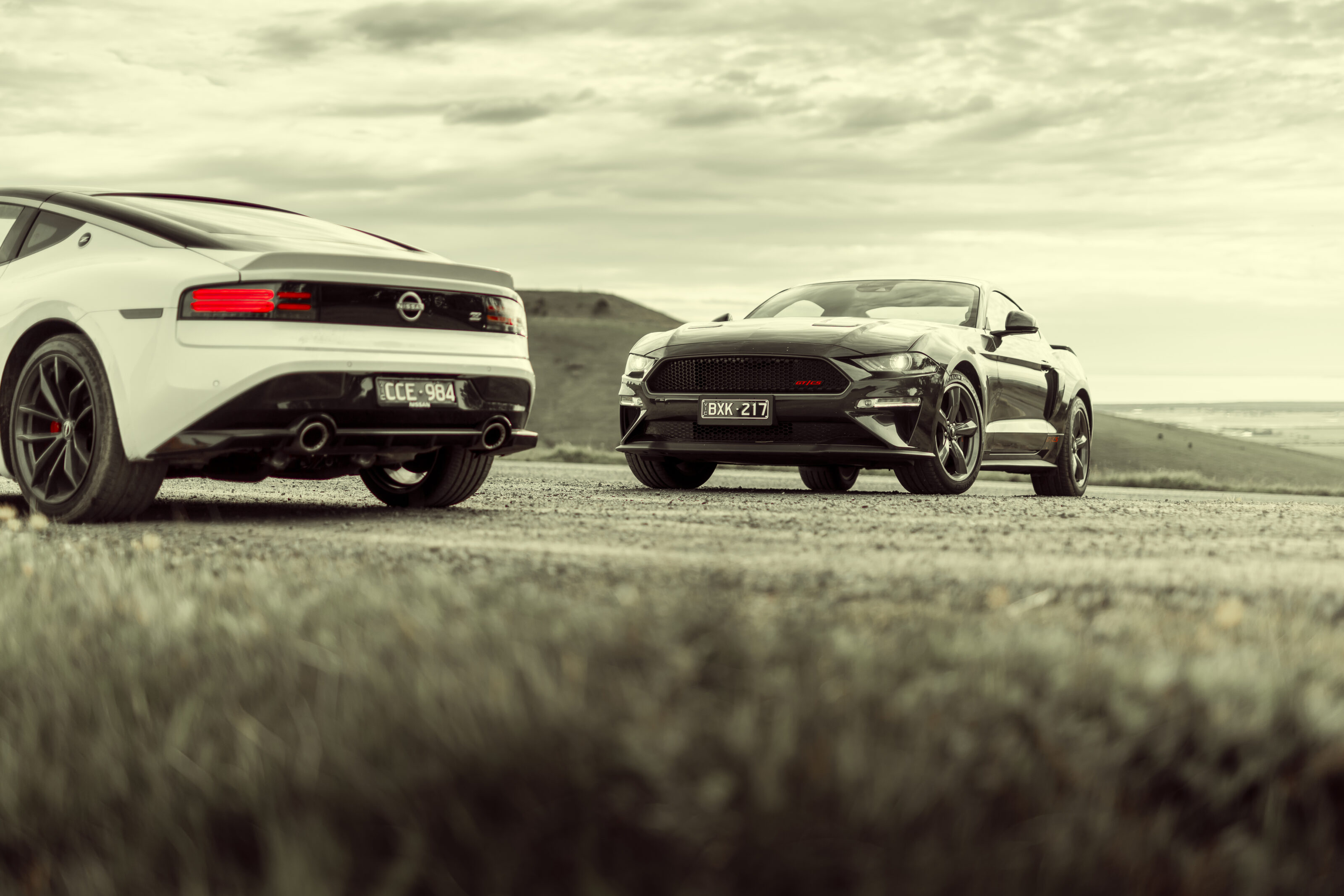
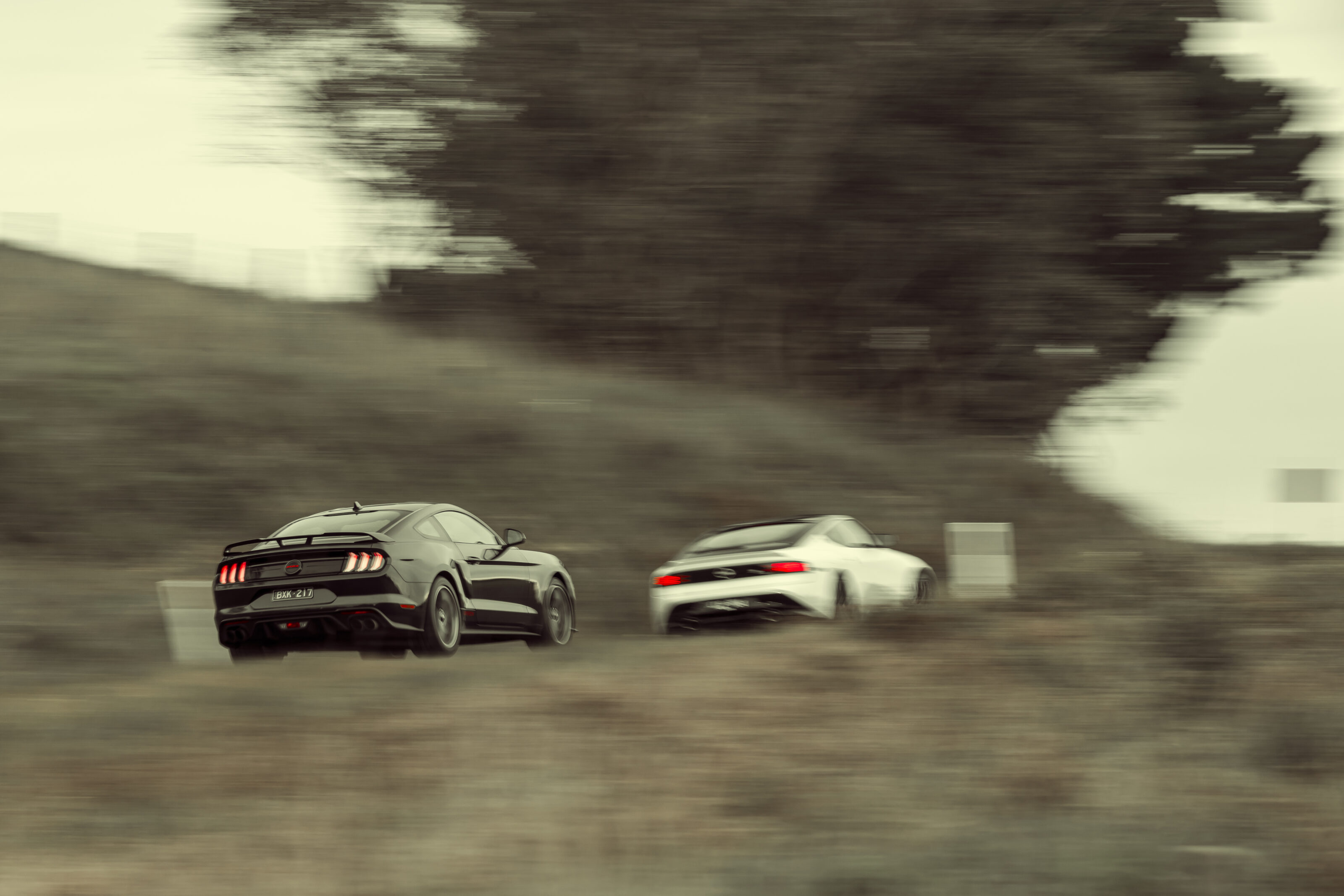
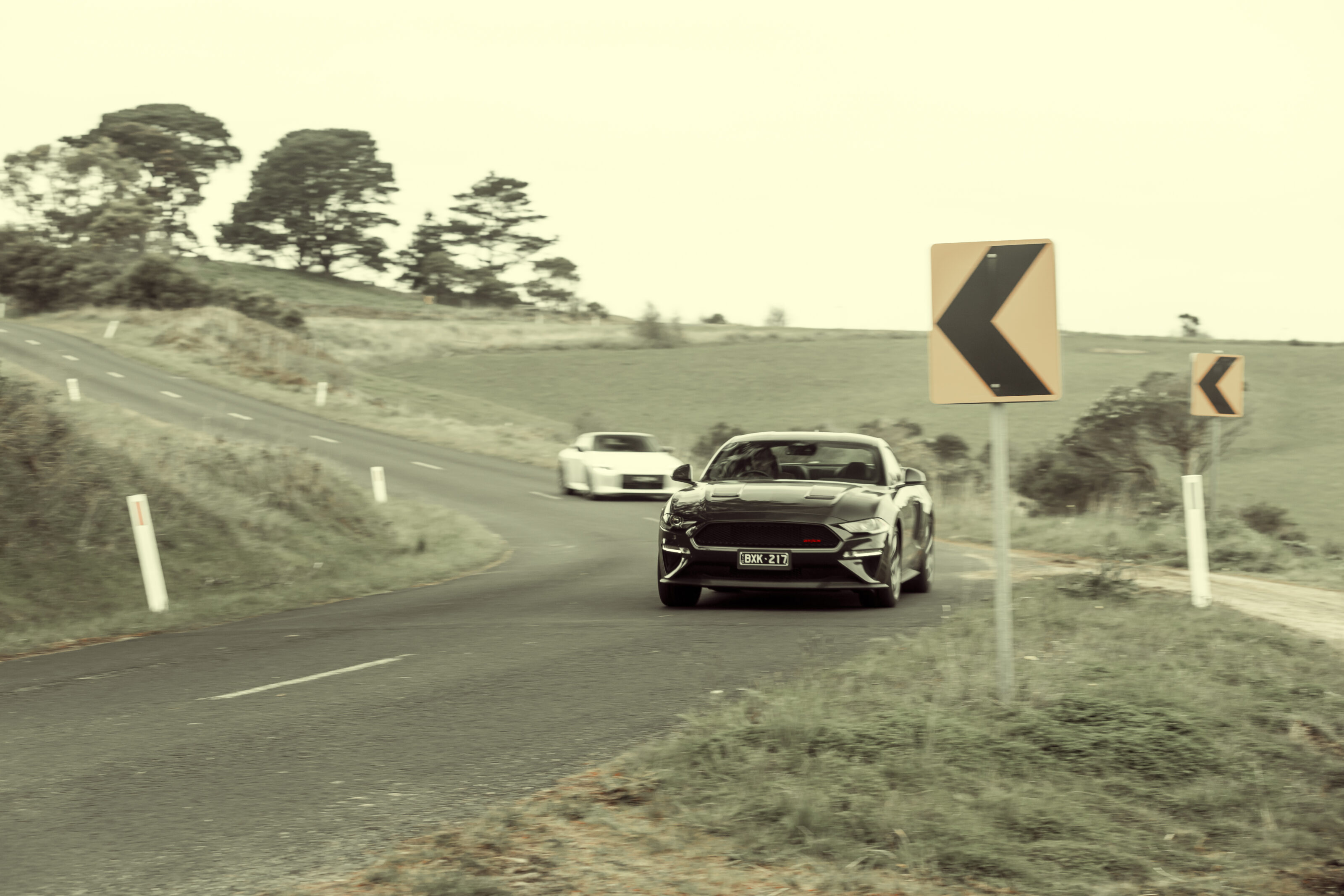
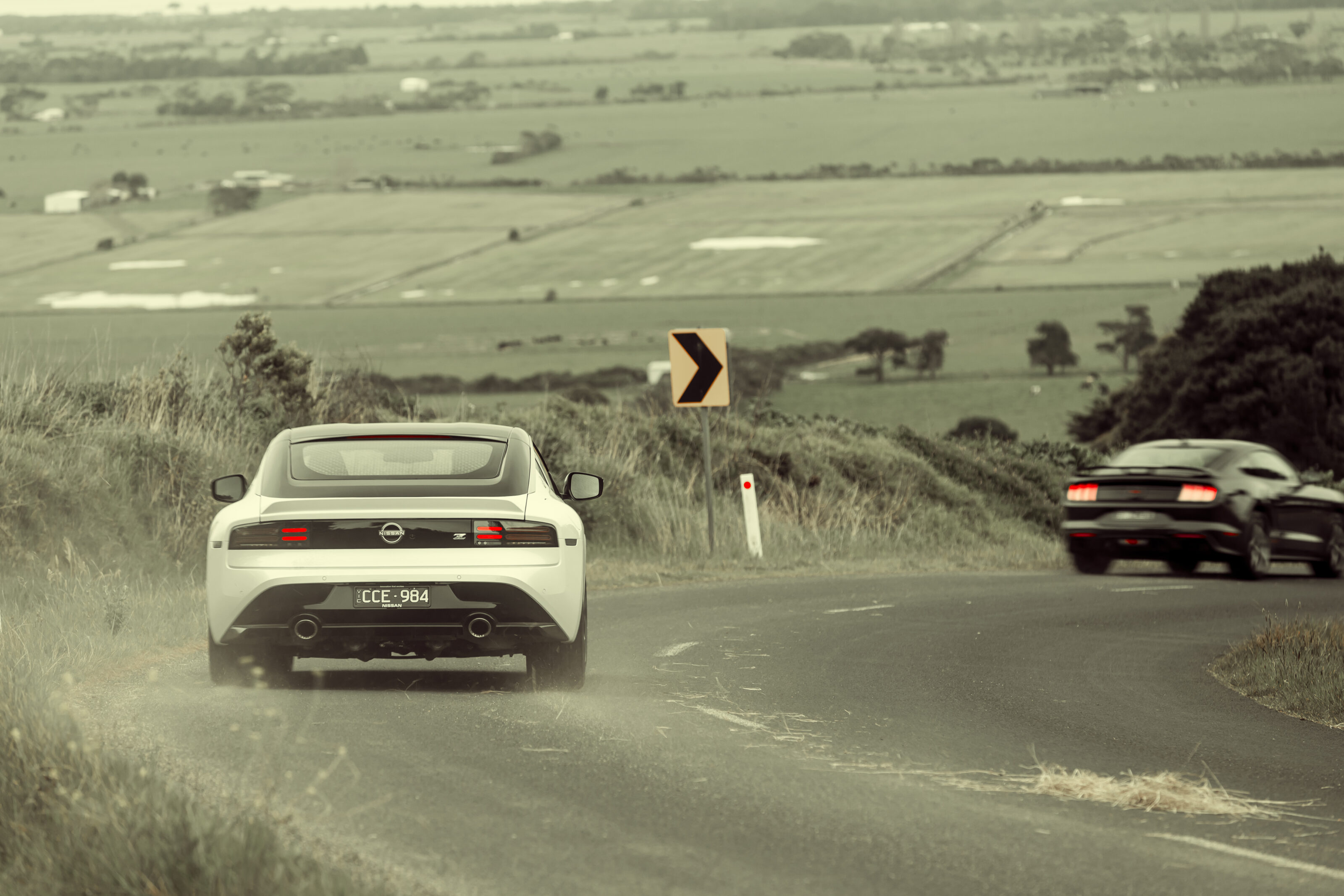
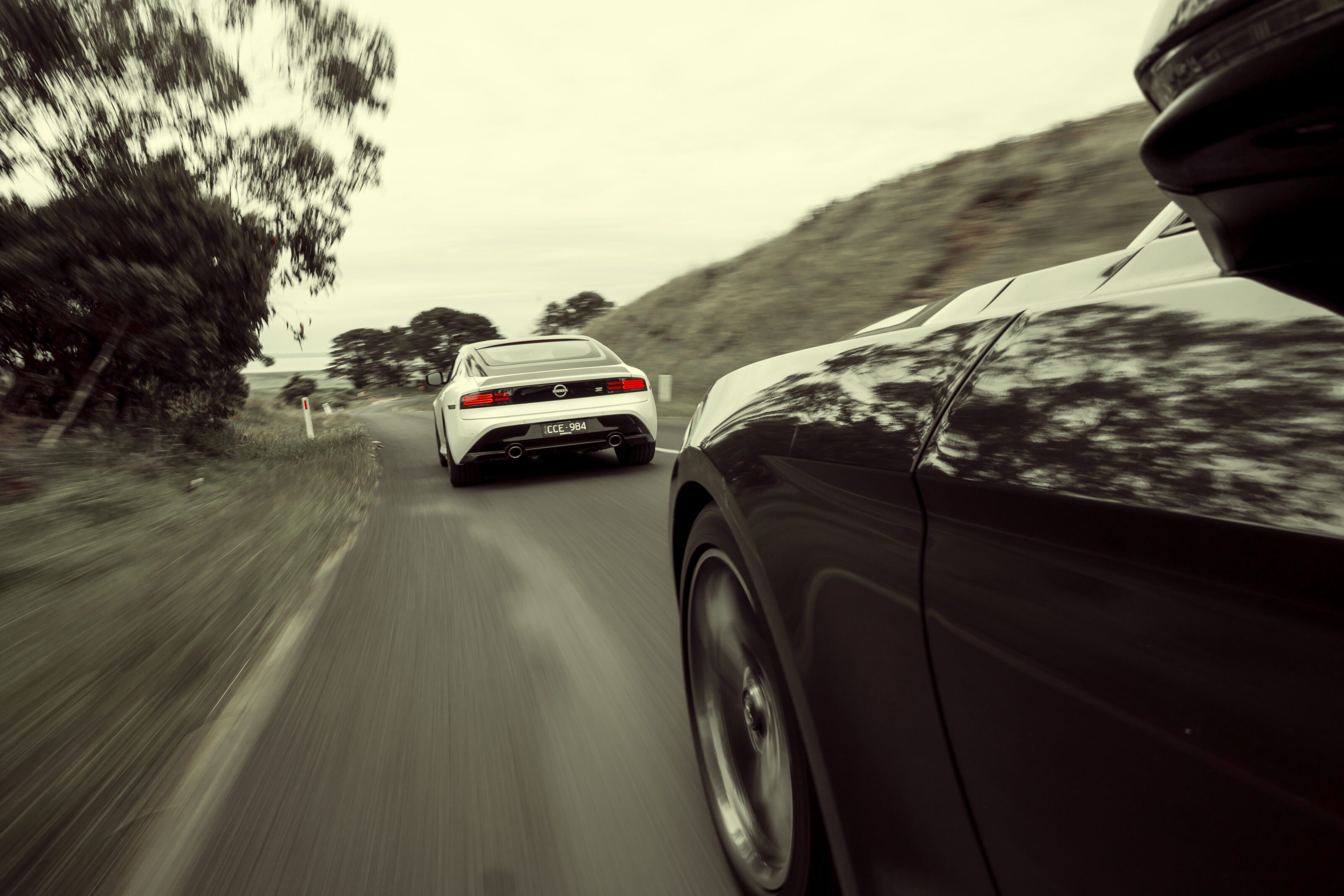
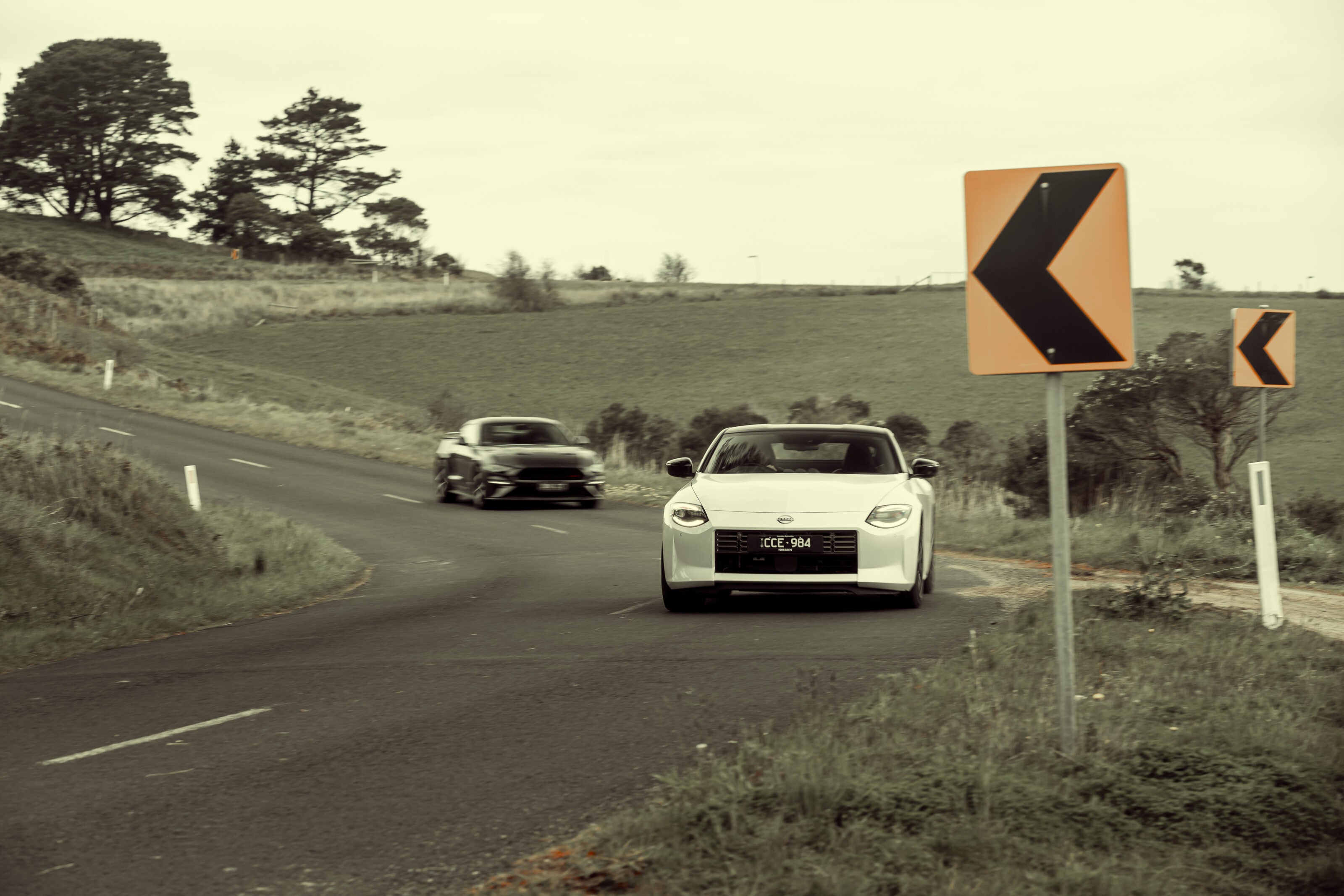
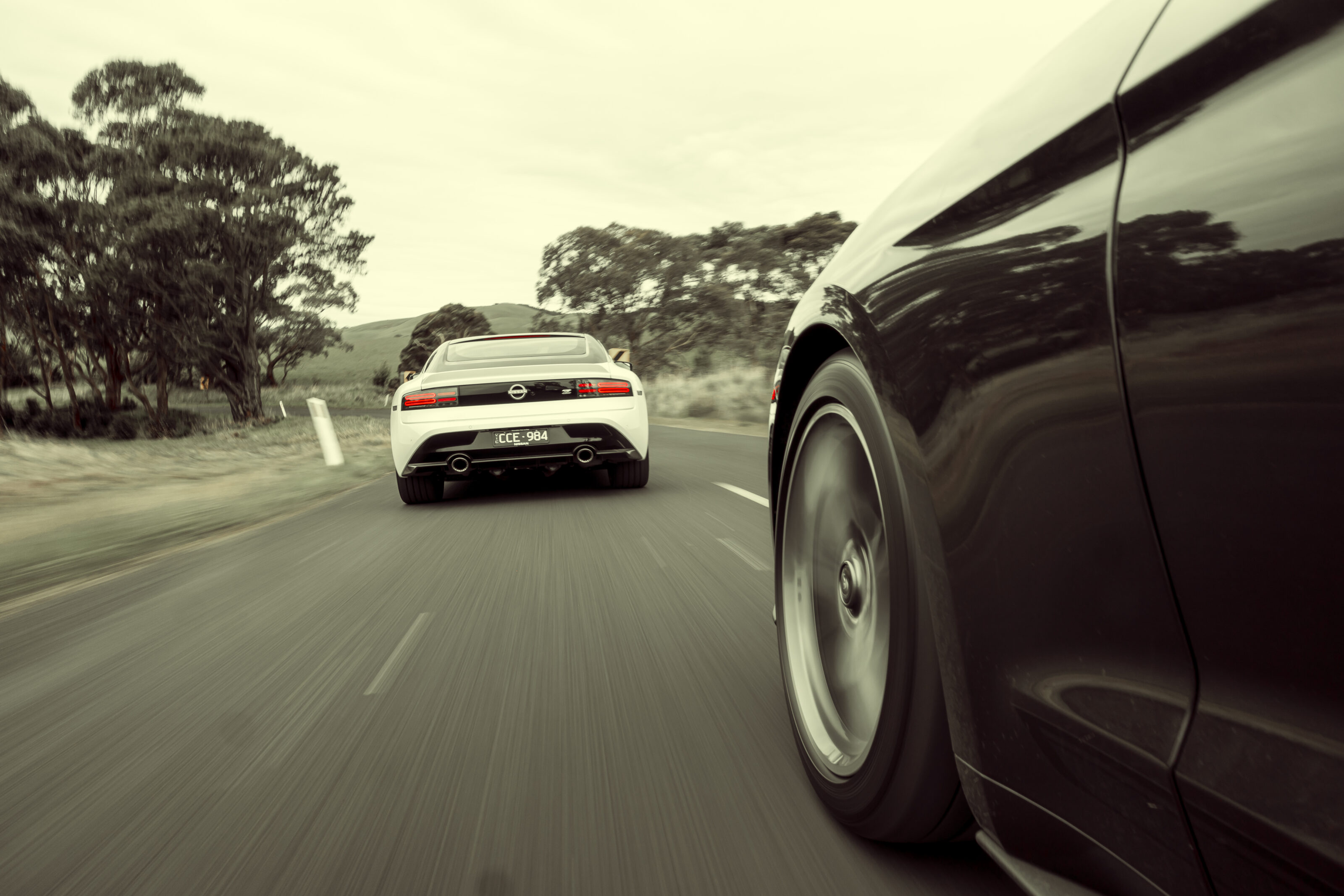
Read on, as Nissan’s newest star athlete takes aim at Australia’s sports car king.
1
An old adage says that if you want to be the best, you have to beat the best; and the Ford Mustang has held the crown as Australia’s best-selling sports car ever since this sixth-generation vehicle lobbed onto the local scene in late 2015.
Since then, Ford Australia has sold more than 33,000 examples of its perennial pony car. So if Nissan’s new Z is targeting sub-$100k two-door sports car buyers, statistically speaking, this is the car it has to beat.
1
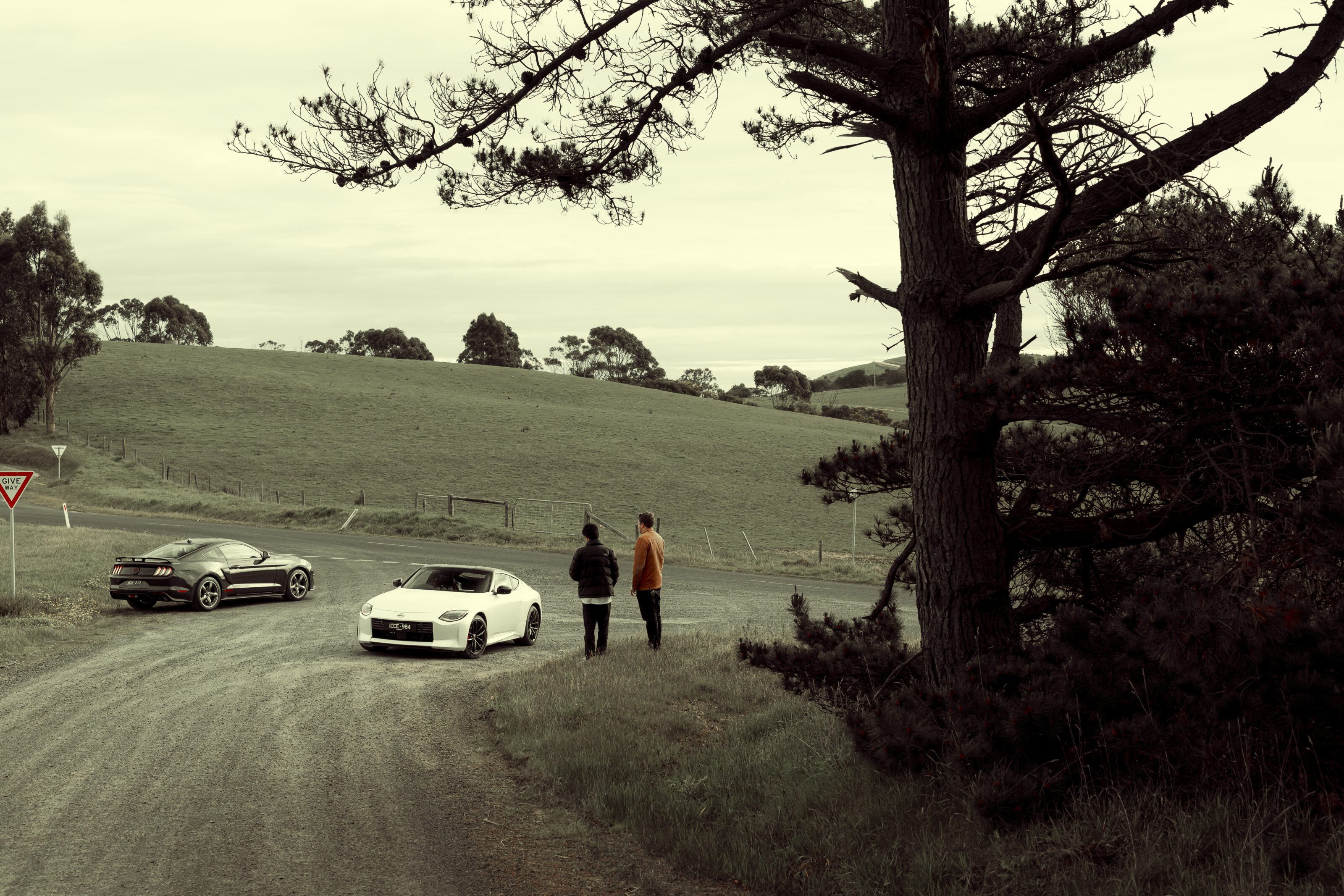
Making this two-door showdown even better? This is a driver’s test, with both cars featuring their own rev-match compatible three-pedal six-speed manuals, backdropped by the Victorian High Country to see which of these similar, but distinct, sporting coupes has more to offer the discerning enthusiast.
Both are retro renditions of 60s icons that made their international debuts in New York – the Mustang at the 1964 World’s Fair, the ‘Fairlady Z’ in the Pierre Hotel’s Grand Ballroom five years later.
In those days, the United States was the prime target of both of these cars. These days, however, in a more globalised auto industry, a sports coupe’s survival requires success in multiple markets.
1
Ford is already a few steps ahead of Nissan in that regard. The sixth-generation Mustang, now seven years old, was an embodiment of the “One Ford” plan, the first Mustang to be factory-produced and sold globally in both left- and right-hand-drive markets.
Nissan’s Z comes from a lower base, and has always been positioned as a more exotic and exclusive machine. Even in its 1971 debut year, the Z’s 45,000 US sales paled in comparison to the near-300,000 Mustangs let loose across America that same year.
The success of the upcoming seventh-generation Mustang is all but assured. But recent decades of financial hardship meant Nissan’s new Z remained in question until relatively recently, and it needs to succeed here and now.
Autonomous emergency braking with pedestrian and cyclist detection
Automatic high-beam
Blind-spot monitoring
B&O Play 12-speaker premium sound system
Eight-speaker Bose sound system
Dual-zone climate control
Electronic rev matching (manual only, activated with ‘S-Mode’ button)
Illuminated sill plates
Front and rear parking sensors
Keyless entry and start
Lane departure warning
Leather upholstery (suede in California Special)
Leather-accented upholstery
Leather-wrapped steering wheel and shifter
Heated front seats
LED headlights, tail lights and front fog lights
LED headlights and tail-lights
Rain-sensing wipers
Launch control (automatic only)
Reversing camera with rear parking sensors
Mechanical limited-slip differential
Satellite navigation
Rear cross-traffic alert
Six-way power heated and cooled front seats
Reversing camera
Tyre pressure monitoring
Standard and Sport modes (auto only)
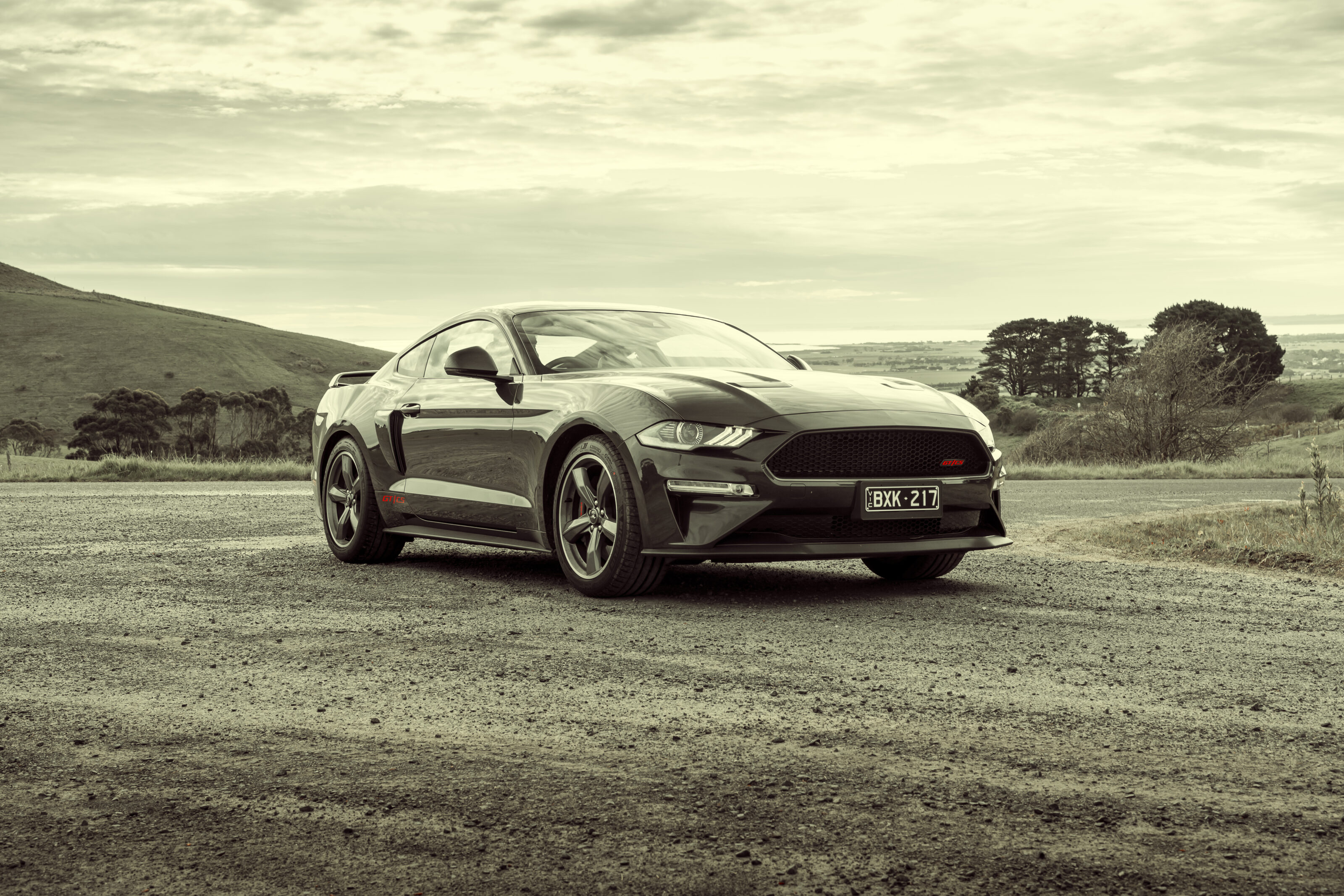
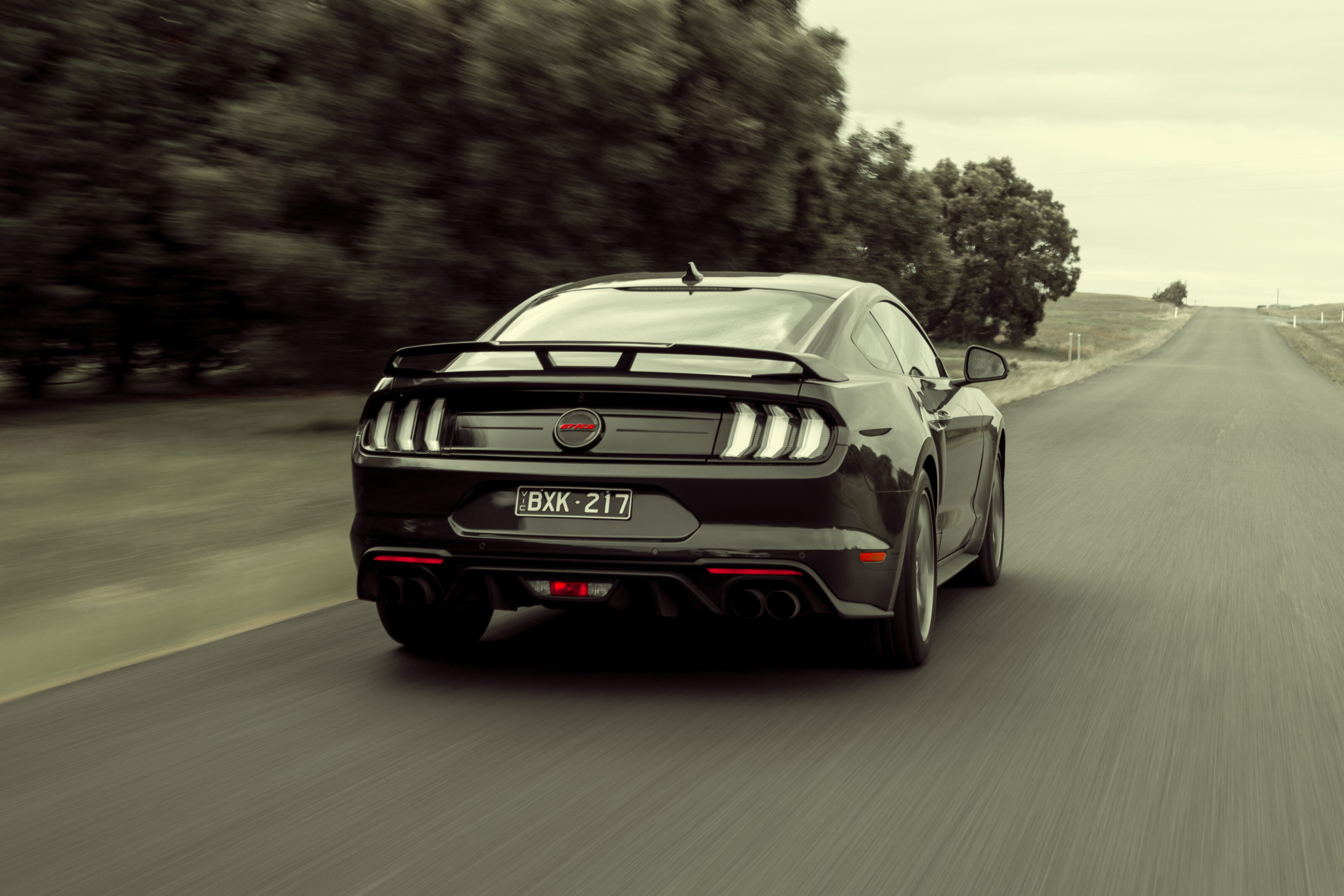
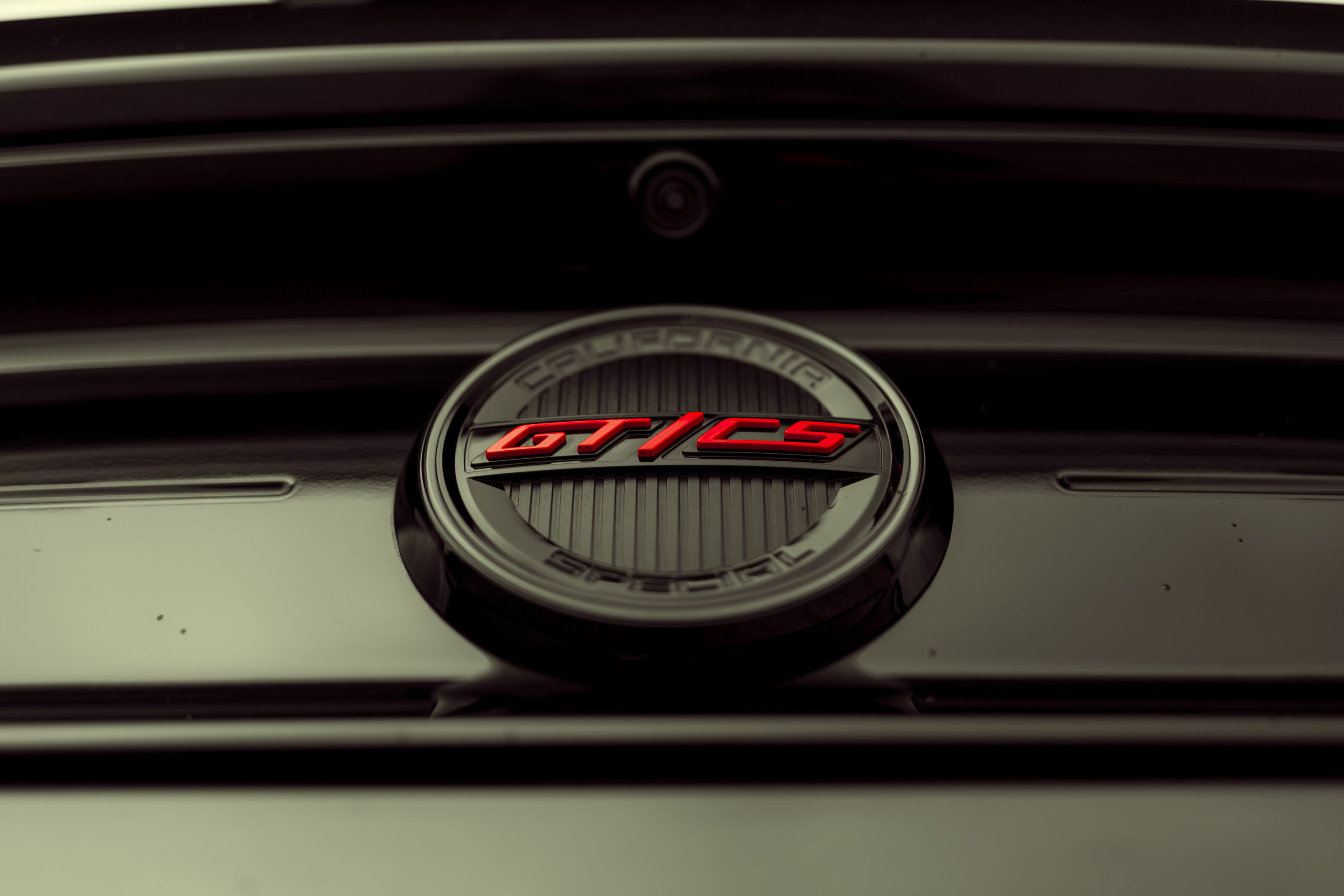
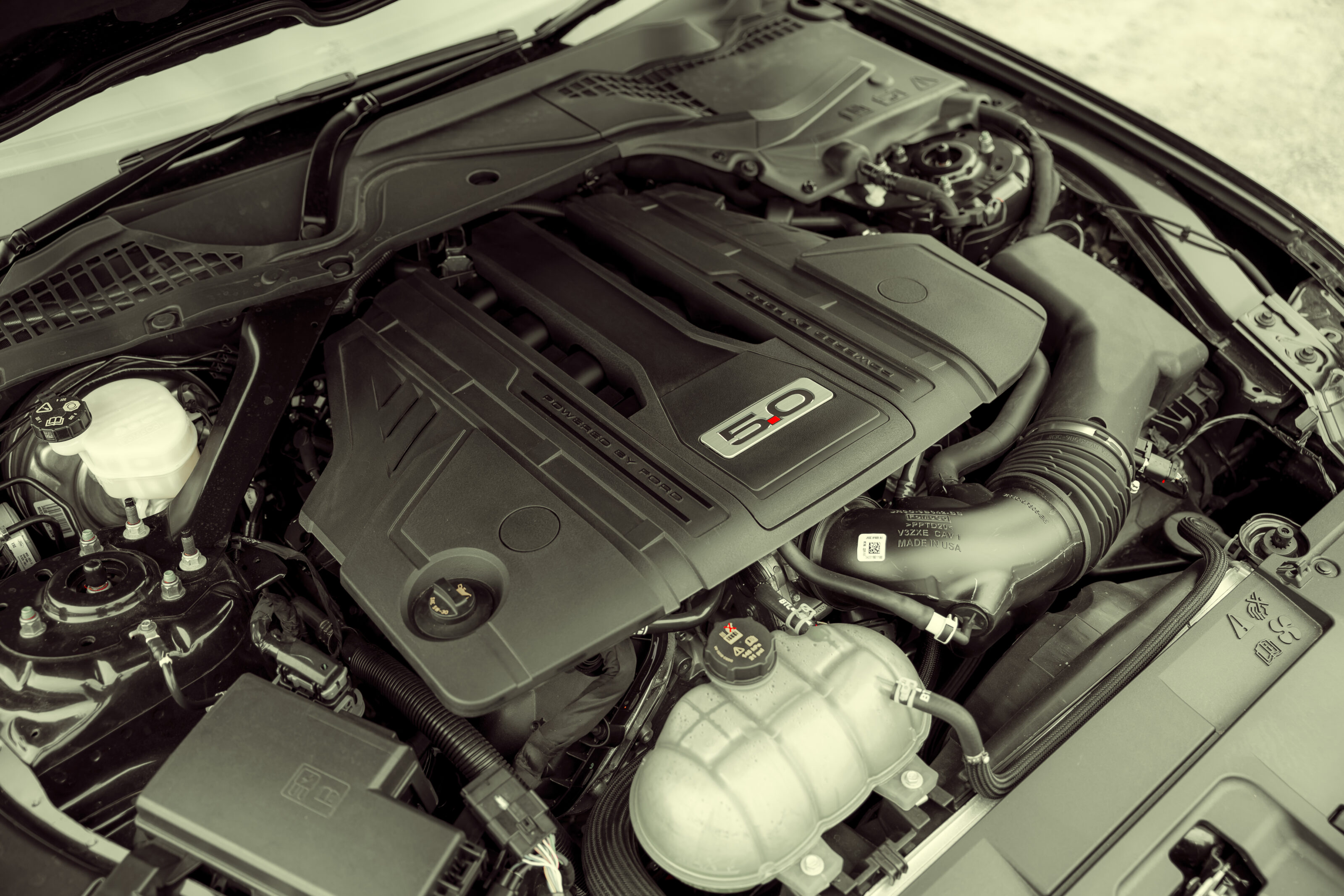
This 2022 Ford Mustang GT California Special taps a 1968 dress-up edition of the same name. Just like the original, the Mustang CS/GT gains no more power than a standard Mustang GT, and mechanically presents just as your normal 5.0-litre V8 GT Fastback would.
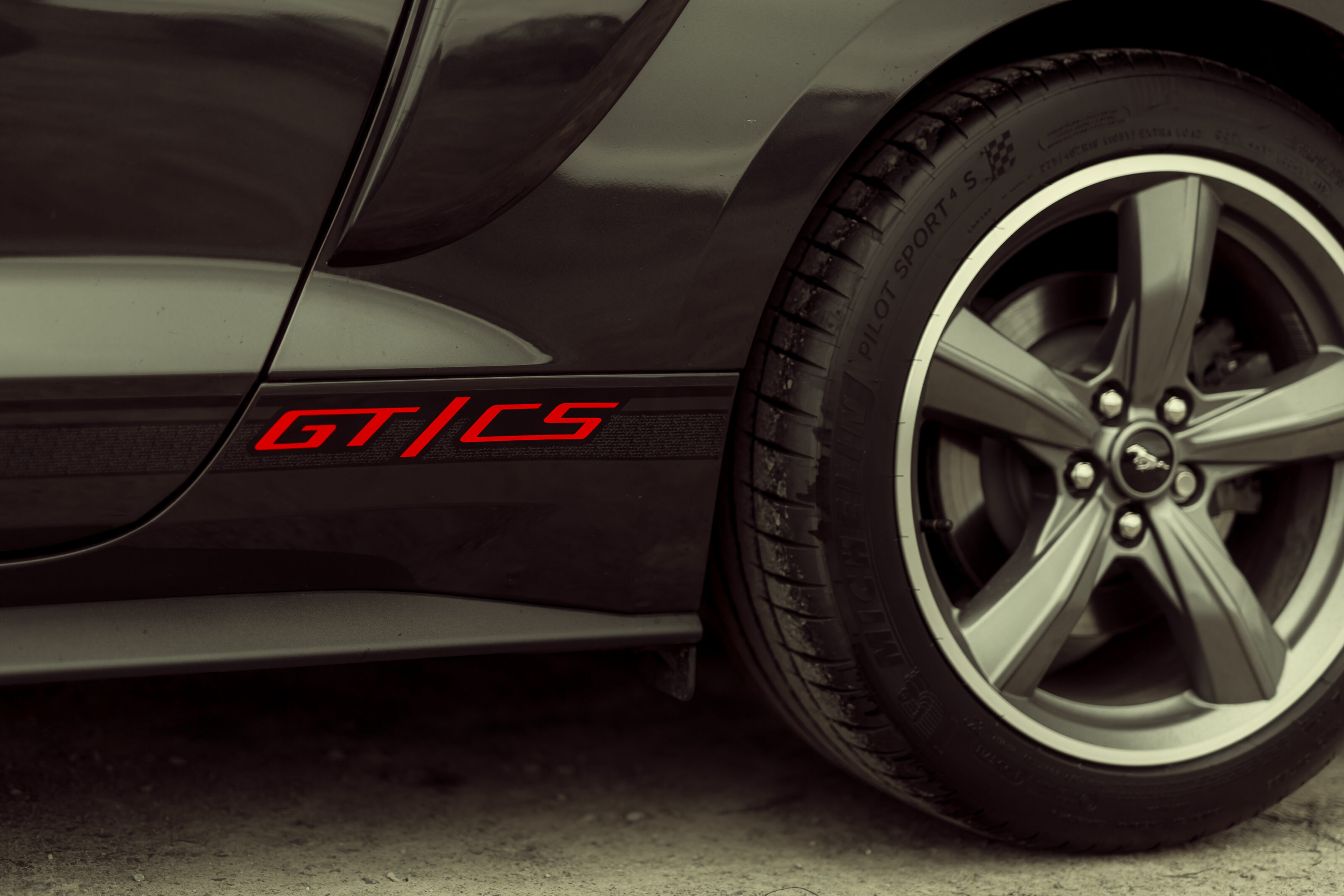
Asking $67,290 before on-road costs – $2000 more than a standard GT manual – the California Special nets you unique five-spoke 19-inch alloy wheels, a heritage-inspired side stripe sticker, enlarged side scoops and unique CS/GT badging at the rear and on the black honeycomb front grille.
California coupes and convertibles gain a GT Performance front splitter as standard, while California Coupes also gain a single-plane rear spoiler as standard.
1
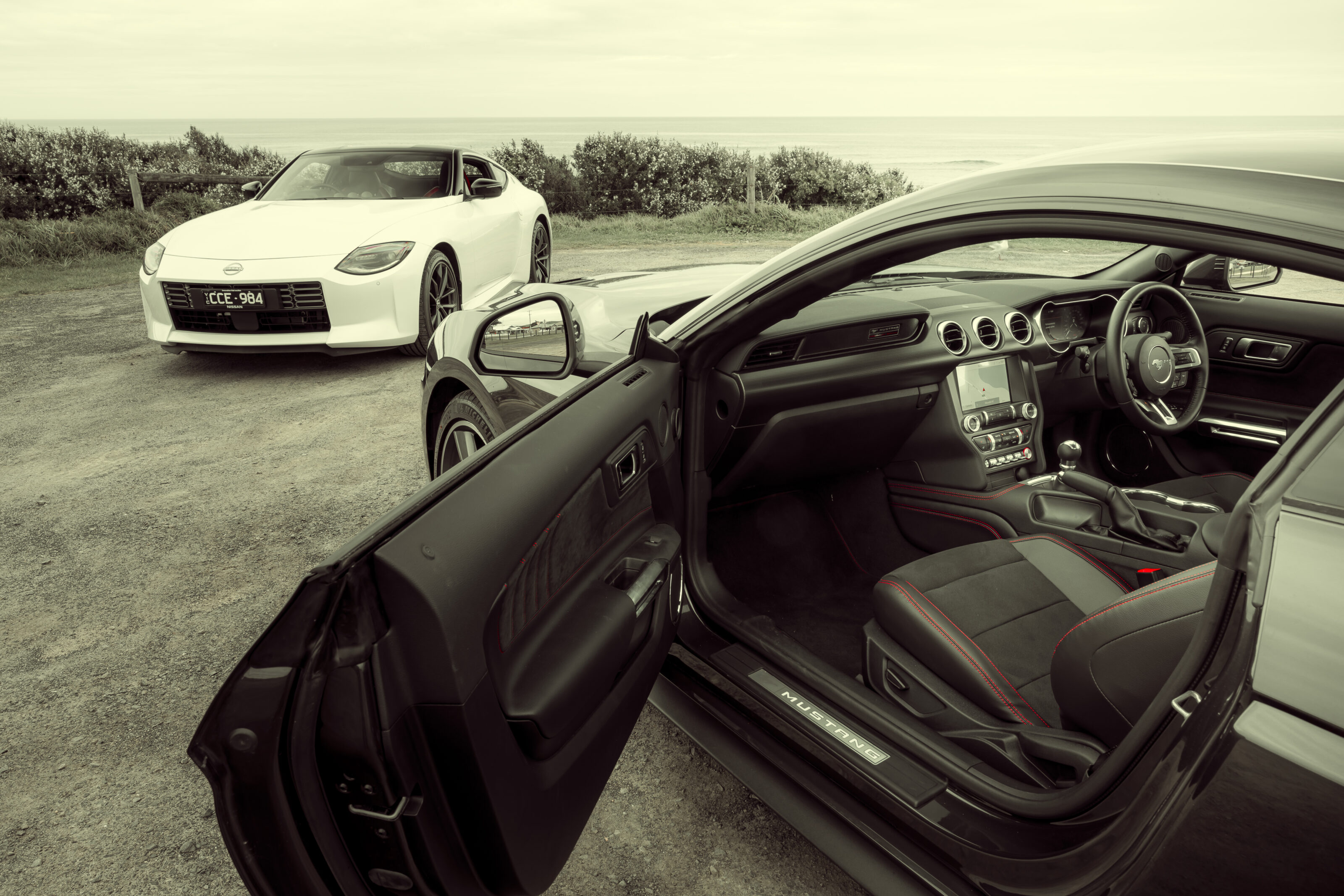
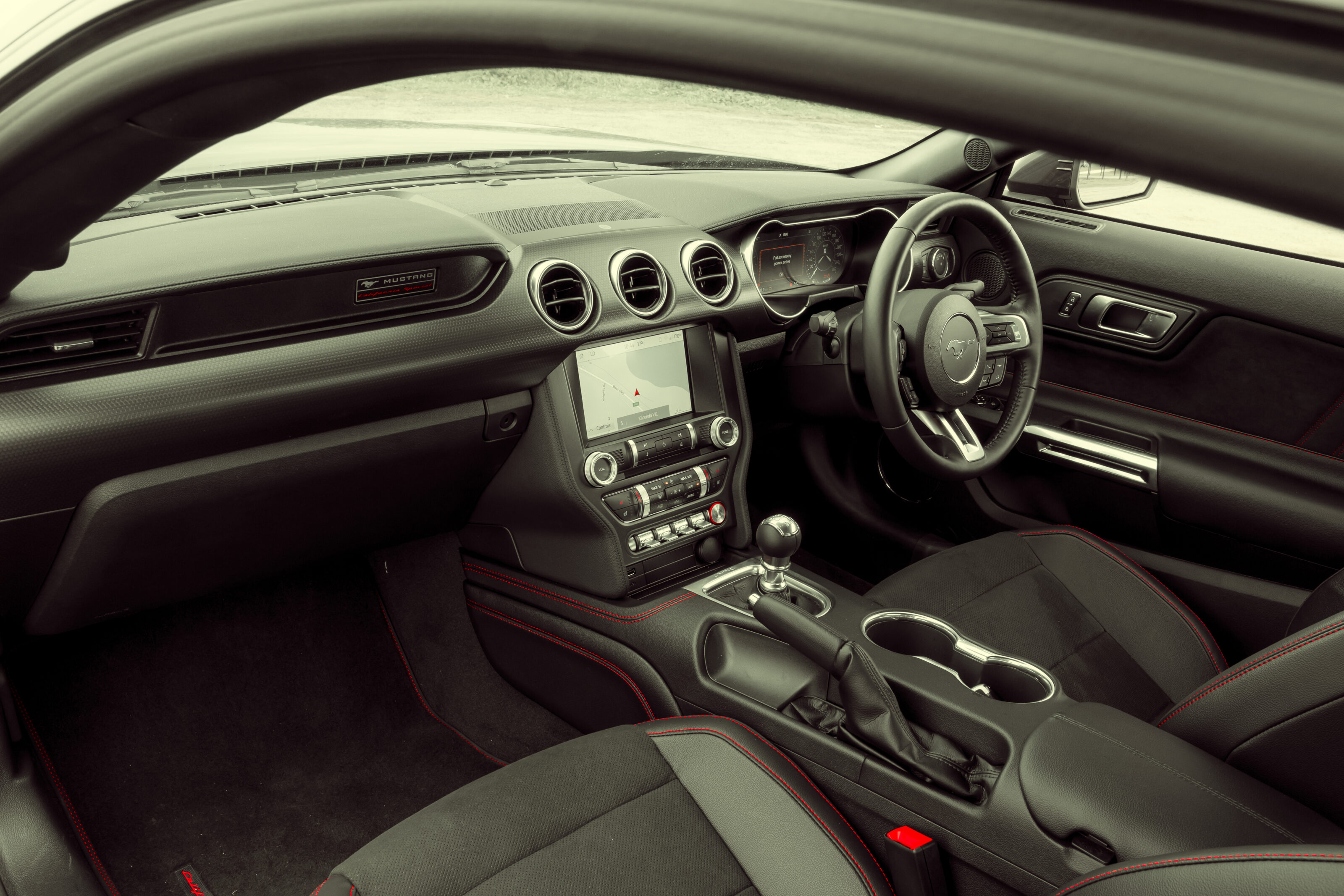
Inside, the instrument panel is finished in carbon hex aluminium while the door trims and seats gain black suede inserts, red stitching and special embossed iconography.
Of course, all Mustang California Specials also gain a serialised interior plaque. Range-wide updates for all Australia-bound MY22 Mustangs included a standard-fit Line-Lock function and new paint options.
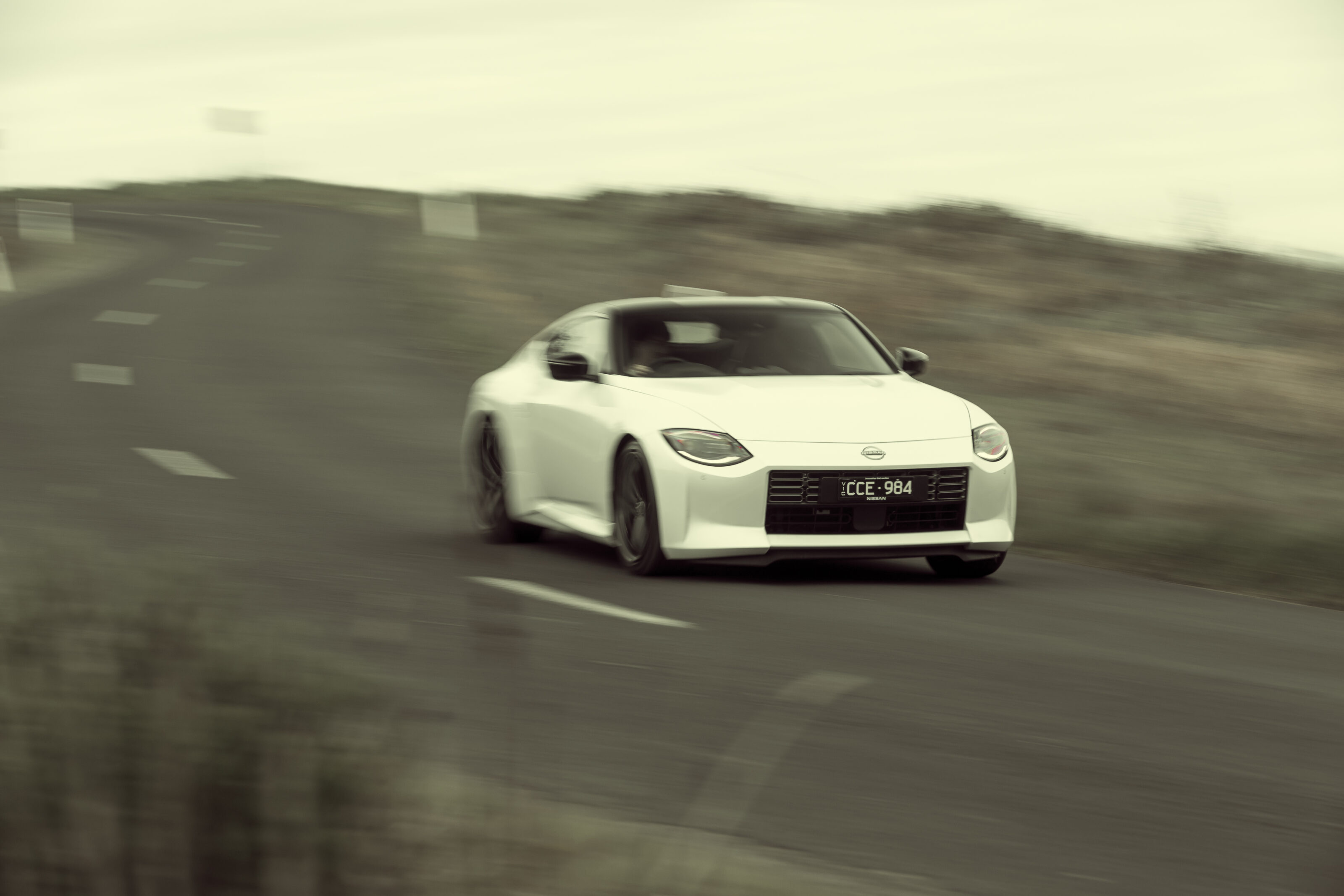
At $73,300 (before on-road costs), with no price disparity between the slick six-speed manual or Mercedes-sourced nine-speed auto, theNissan Z occupies a compelling space within the five-figure sports coupe arena – asking $6010 over Ford’s Mustang CS/GT manual but undercutting the more focused Toyota Supra by about $14,000.
1
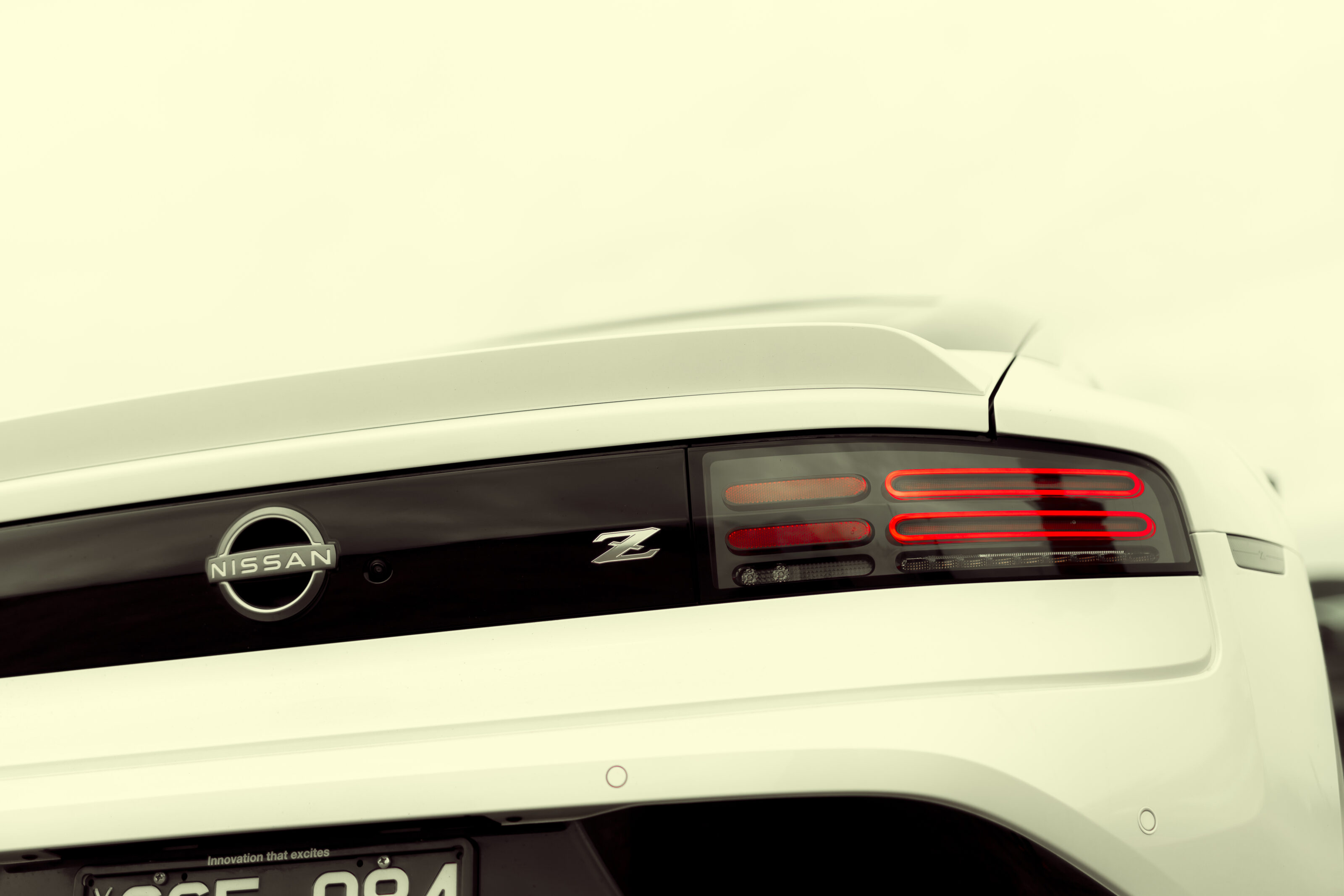
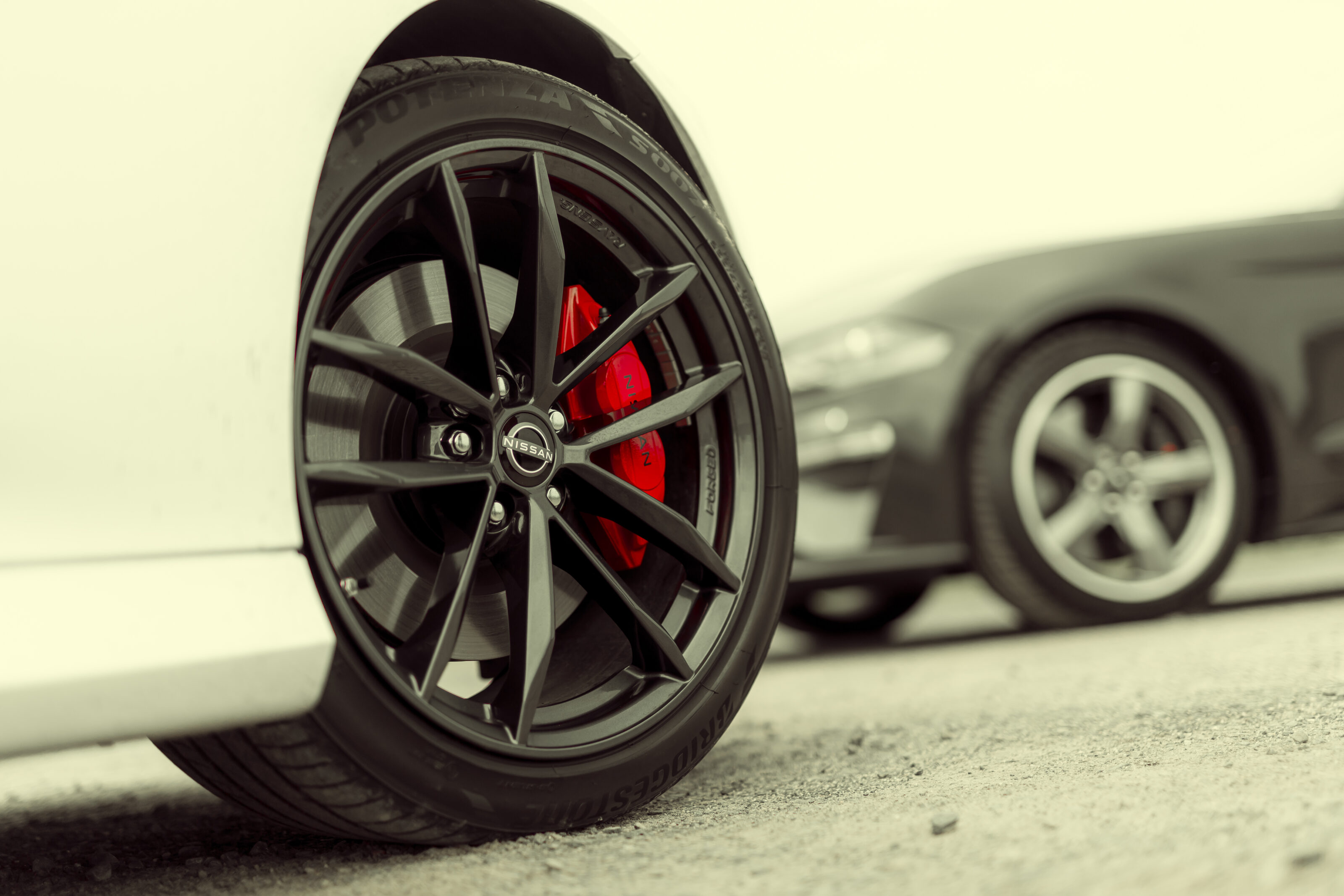
New Z pricing represents an almost 14 per cent increase over the superseded flagship 370Z Nismo, but the Australian-spec car is packed standard with all the bits you want: limited-slip diff, four-pot Akebono brakes, boot lip spoiler, 19-inch wheels and power-adjusted seats.
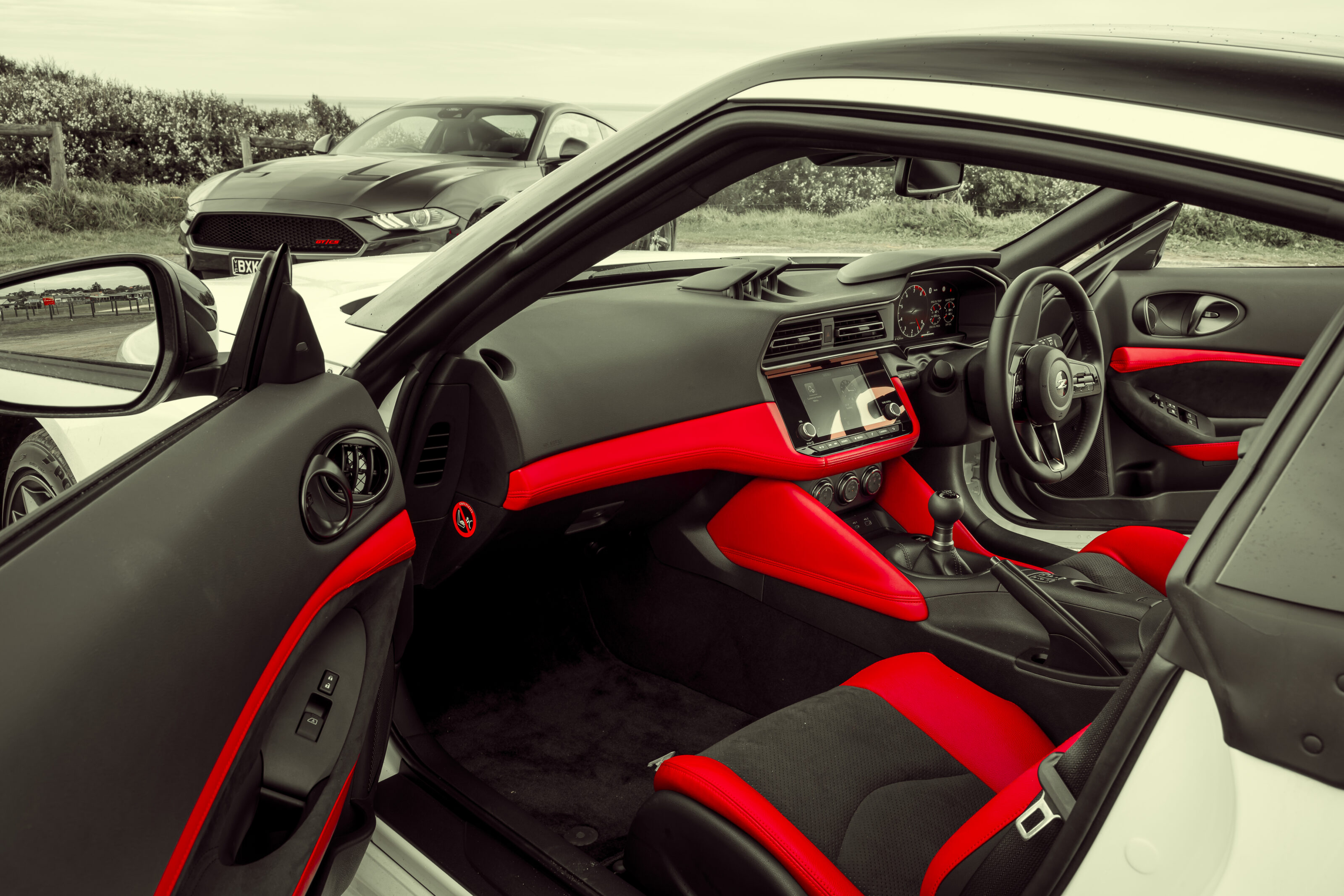
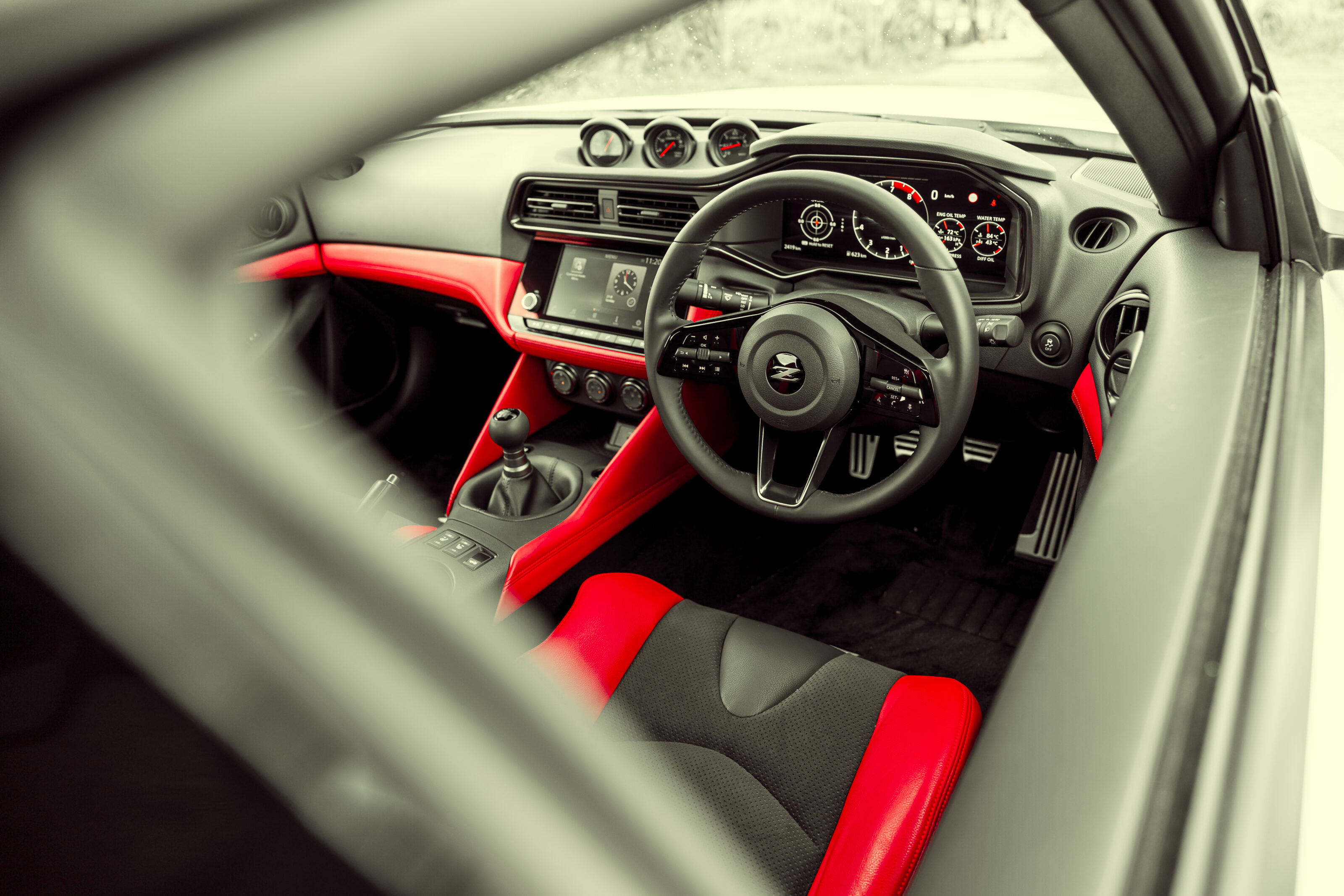
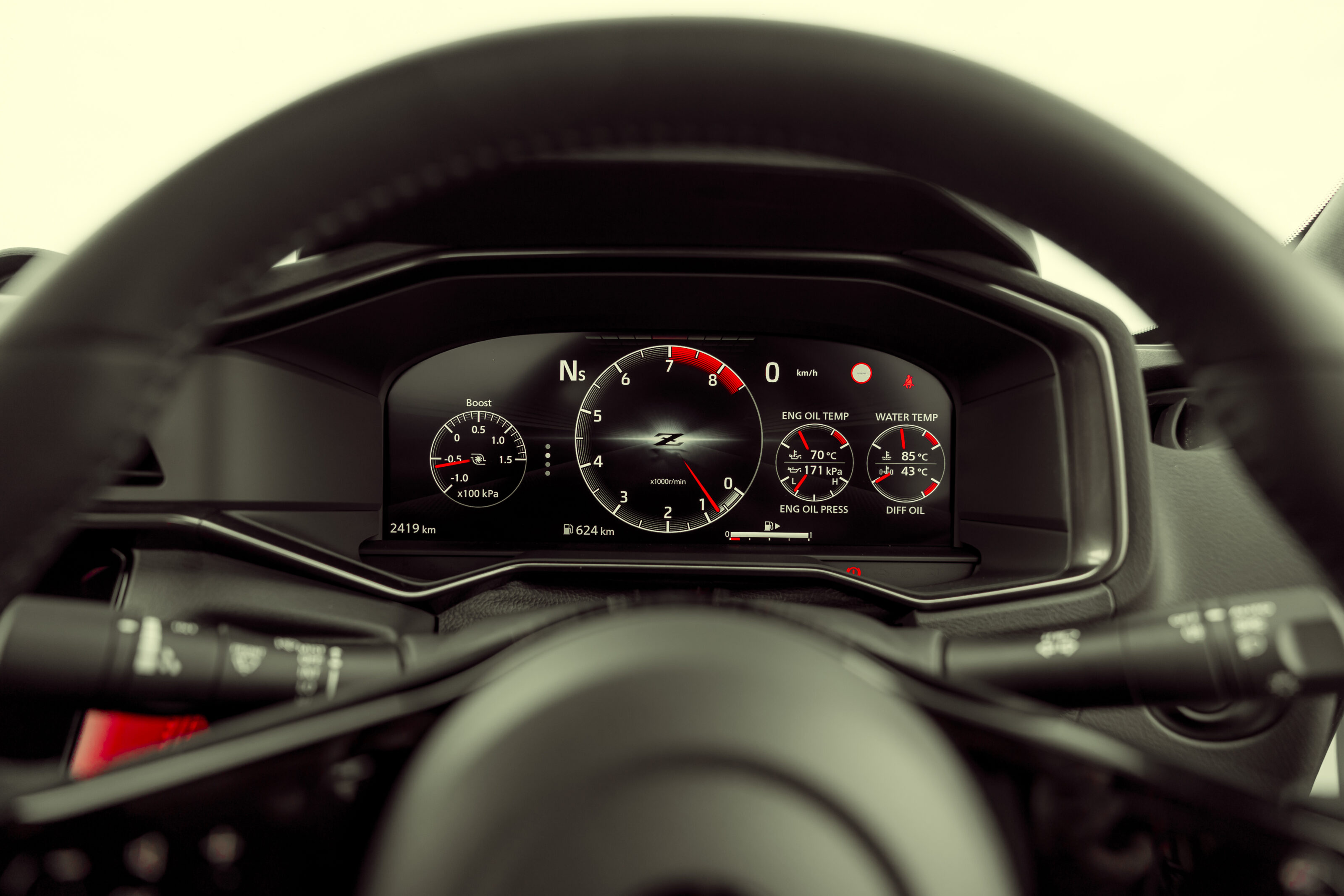
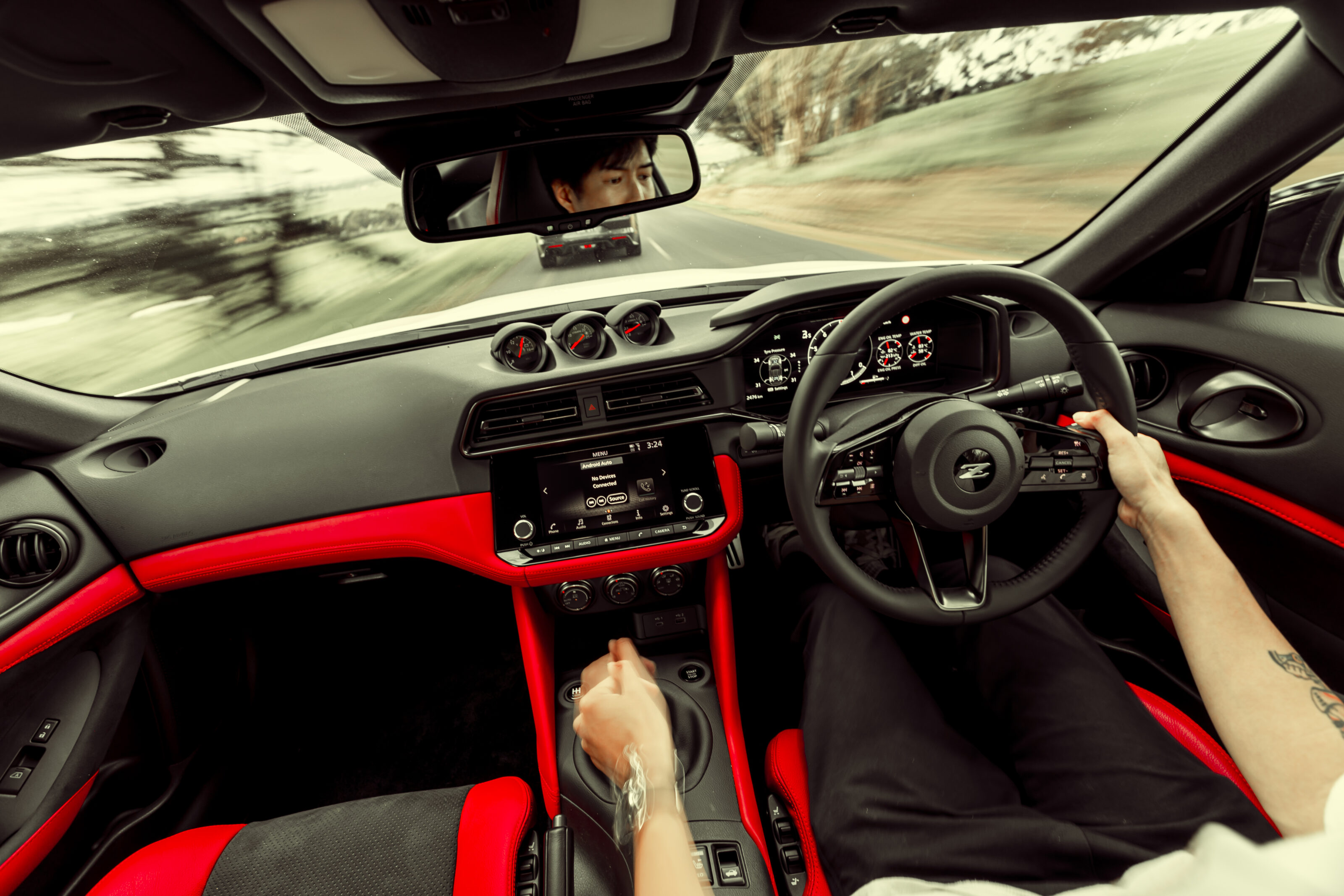
Despite constrained development budgets, the rejuvenated cabin of Nissan’s sports coupe presents impressively, with the 12.3-inch digital multi-function driver display and 8.0-inch central touchscreen doing the heavy lifting of modernising the faithful Z.
We observed carryover bits, yes, but Nissan has executed this redesign deftly. The triple dash-top gauges remain and, frankly, we’d be sad if they didn’t.
1
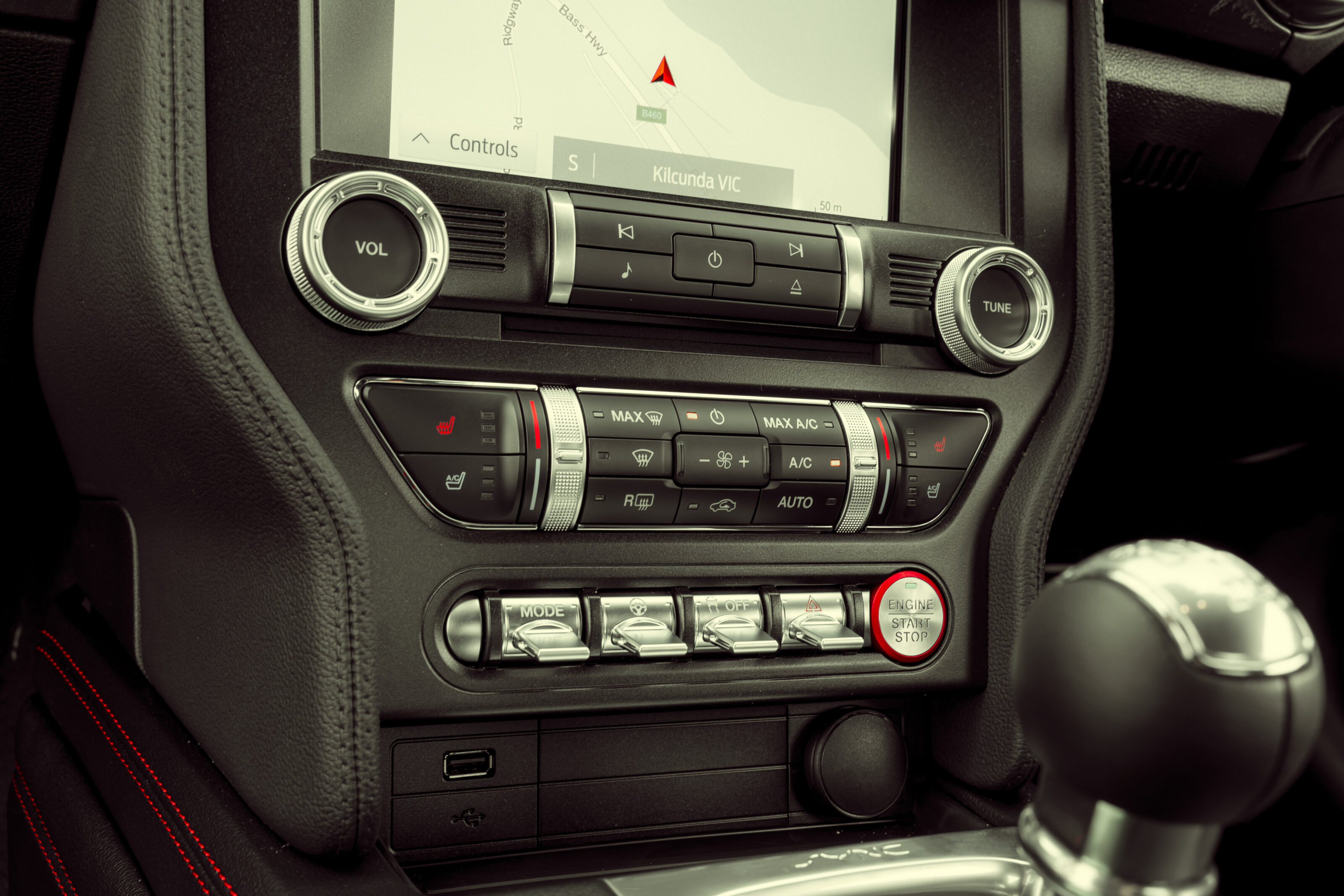
The Mustang’s cabin leans a little heavier into its retro charm, with super-sized dials and large Nokia-like buttons but also boasts an 8.0-inch central screen and a similar 12.0-inch digital driver display. Both vehicles’ digital clusters can be switched between various graphic layouts with many further personalisation options.
It must be noted, though, that Ford’s Sync3 system is noticeably more rich in features, as well as in graphic and haptic response. The Nissan’s navigation-free infotainment is perhaps the biggest giveaway to its reskinned roots, but wired Android and Apple smartphone mirroring makes the best of both vehicles’ screens.
The Ford system does have in-built navigation, though, and both have heated seats (Ford also has cooling functions). Both are left wanting for a wireless phone charger, however.
Mustang vs Nissan Z: Interior comfort, space and storage
While standard feature sets are rather similar between these two coupes, inherent packaging differences may present unavoidable quirks for some.
The Z, for instance, is purely a two-seat affair and there will be buyers for whom this is an irredeemable trait when measured against the pragmatic needs of daily life.
As a driver’s comparison between two manually shifted coupes, this is of less weighting here – but it’s a fact we’d be remiss not to mention.
1
Elsewhere, the Z’s heated seats are nicely bolstered with manual lumbar and thigh support, plus power-adjustable slide and tilt. The seats have nice and grippy suede-like centre inserts and red leather outers. Despite its two-seat status, the Nissan’s cabin has agreeable headroom for taller folk.
The driving position is spot on, with the ability to mount yourself low and close, virtually sitting on top of the car’s hip point. The shifter is close to hand, and the action is among the best on sale today.
Designed to match the steering wheel of an old R32 Skyline in profile and diameter, the Z’s wheel feels positively wonderful in your hands.
1
Functionally, the cabin works to great effect with easy steering-wheel-mounted shortcuts for cruise control and media, three simple climate control dials and some handy physical shortcut buttons below the central 12.3-inch touchscreen.
Nissan provides two cup holders, bottle pockets in the doors and both USB-A and USB-C ports up front for phone connectivity in the Z. A large storage pocket sits behind each front seat as well.
The Mustang’s cabin is a familiar setting, with nice materials and comfy wide-set seats that don’t offer quite the same lateral support as the Nissan. This California Special’s suede upholstery does look and feel very smart, however.
1
You’ll also find a USB-A port and a 12-volt plug beneath the centre stack, however, unlike the Nissan, there is little storage beyond what looks to be a small coin or key tray.
On the other side of the shifter, however, sit two large central cup holders and a storage bin with a second USB port beneath the armrest.
Further back, the Mustang’s rear seats offer limited use cases beyond the transport of children. Legroom isn’t the problem, it’s headroom, though against the Z, it’s better than nothing.
The Ford Mustang’s measures in at a respectable 408 litres while Nissan’s more specialised Z offers just 241L.
On urban transit roads out of town, the Mustang is effortless, with tall gears, boatloads of torque and a rocking soundtrack to match.
This CS/GT misses out on the optional $2750 Magneride adaptive dampers, which are an all-but-essential option for any owner with long-distance intentions for their new Mustang.
Standard fixed-rate dampers are firm but palatable at low urban speeds, with a short stroke and quick damping action quickly wrangling body movements over bumps. Faster highway speeds over potted and poorly surfaced roads, however, can cause crashing and quickly becomes tiring.
1
The Nissan, by comparison, breathes down the road more comfortably and feels to have a longer damping stroke with body movements lingering a touch longer than the tightly-sprung Ford.
More pronounced vertical movements and moments of slight head toss occur at higher speeds when the Z is faced with road imperfections but there’s composure to the Nissan, quickly regaining confidence and never succumbing to any hint of bump steer or tramlining.
Despite carrying over Nissan’s internal chassis designation of ‘Z34’, Nissan has made considered improvements in all the right places. The suspension has been revised to handle the massive increase in torque, with new damper mounts, modified bump stop touch points, increased front caster, and increased front and rear spring rates, though the dampers are softened by 20 per cent.
1
Front crash structures, part of the front firewall, rear subframe and most of the rear hatch have been redesigned and braced, with torsional stiffness increased by 10.9 per cent over the preceding 370Z.
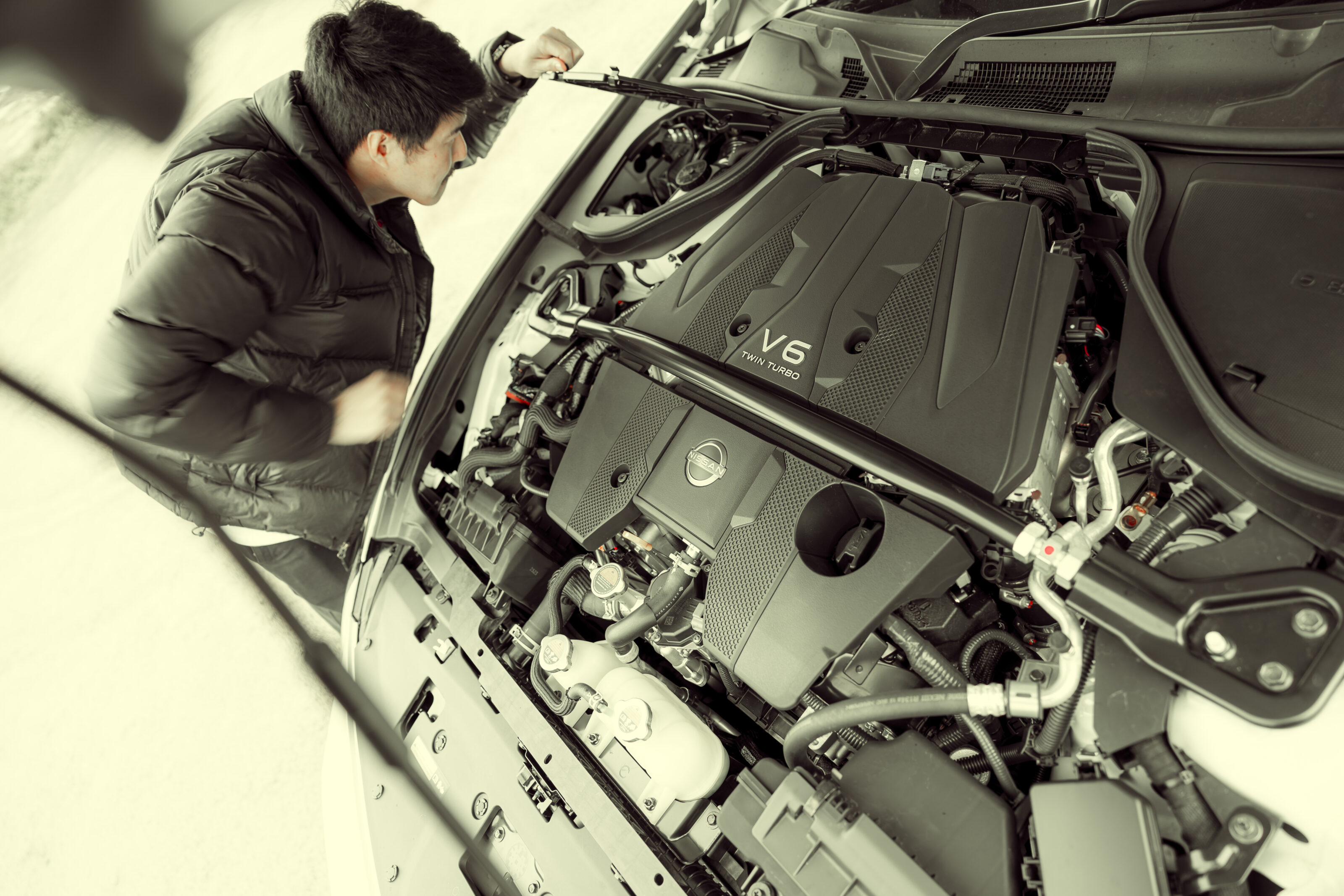
All are necessary revisions to cater for that powerhouse 298kW/475Nm 3.0-litre twin-turbo V6. The Infiniti-sourced VR30DDTT engine leverages an 18 per cent increase in power and 28 per cent increase in torque over the old 370Z and is the biggest transformer of the new Z’s character.
The trusty Mustang, by comparison, is very familiar to Australian motorists, having enjoyed consistent success over the past seven years on sale.
Spec-savvy readers will notice that, despite the Z’s new twin-turbo V6, the Mustang’s 339kW/556Nm outputs comfortably outgun Nissan’s newest star athlete.
1
In both performance and pure strength of character, the Mustang’s V8 overwhelms the Z’s twin-turbo V6, which in isolation is an effective powerplant that doesn’t feel in any way weak or slow.
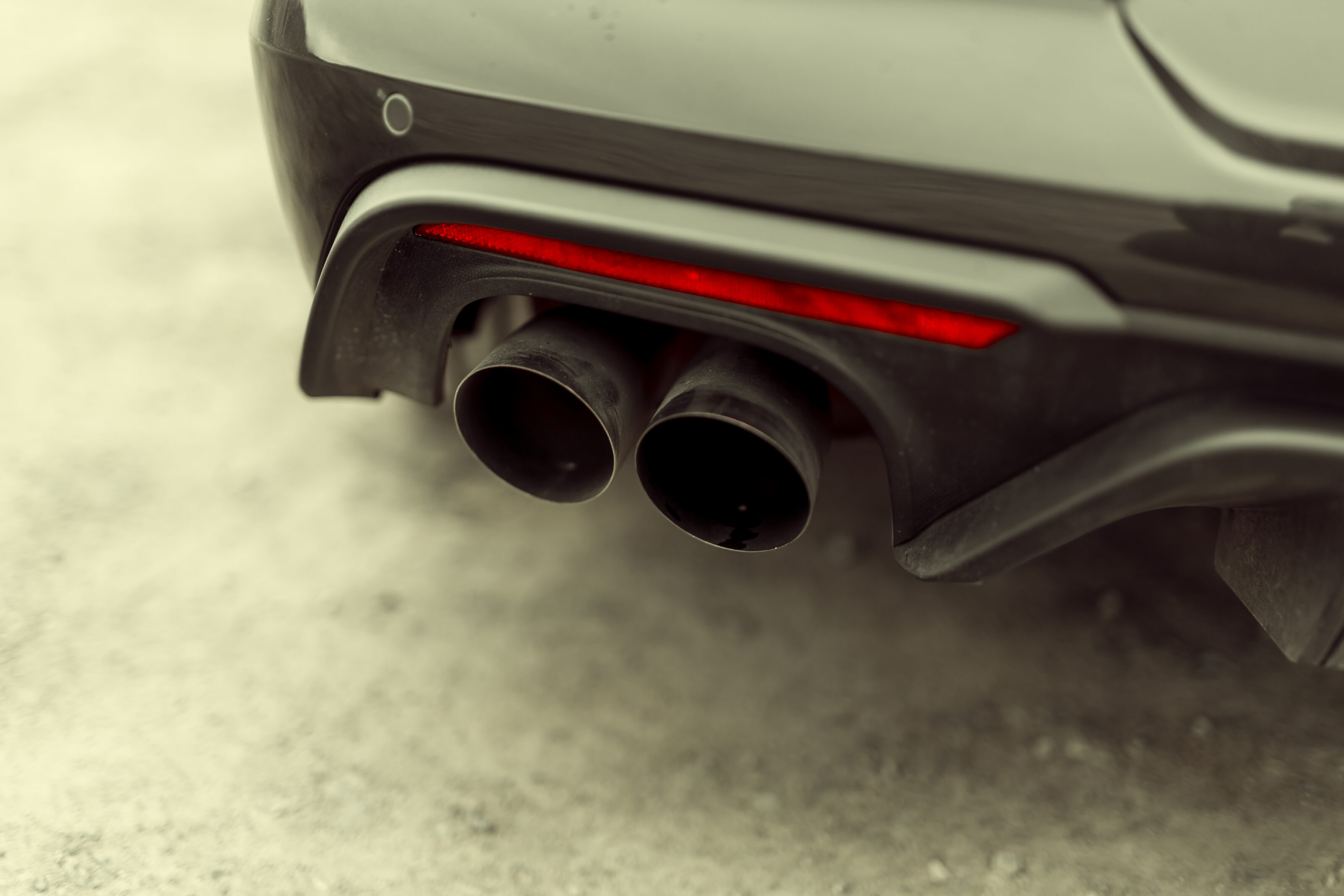
But driving the Z behind the Mustang during the early highway and transit stages of our test, the Nissan’s zippy V6 was simply inaudible behind the backdrop of Ford’s almost antisocial 5.0-litre soundtrack.
In isolation, it must be said, the Z’s V6 is a satisfying unit with a classically-charged charm of its own. A measure of tangible turbo lag doesn’t feel out of place here, with a mid-range wave of torque swelling from 1600rpm and peaking at 5600rpm.
1
It’s initially underwhelming that the Z’s engine never quite crescendos, with increased revs signalled more by induction noise than any meaningful exhaust vocality, but you can bet that, in true Z fashion, there are already more aftermarket options under development than you can poke a stick at.
The Z Coupe might weigh a neat 100kg less than the Mustang but, in the real world, the Mustang has a superior power-to-weight ratio of 199kW/tonne, compared to the Z’s 186kW/tonne, and frequently puts car lengths on the Nissan both from a standstill and often on corner-exit – leaning lazily on those long gears without any affliction of boost-induced lag.
Ford’s Coyote V8 makes a higher peak torque at 4600rpm, a whole 1000rpm lower than the Nissan VR30DDTT. Nevertheless, it did come as a bit of a surprise to see the Mustang shrinking ahead from behind the wheel of the Z.
1
Early points go to the Mustang for its straight-line prowess, and perhaps its initial charisma, but there’s a lot more to unpack here.
Both cars’ rear axles are shod with 275-section tyres, but the Mustang makes more meaningful progress with superior Michelin Pilot Sport 4S tyres, while the Z’s softer Bridgestone Potenza S007 hoops more often devolve into wheelspin under corner exit power down.
It must be said that the ESC calibrations of both of these cars are rather loose, with frequent hints of slip and yaw requiring corrective lock, even when all systems are on.
1
The Mustang delivers bigger moments, delivering a more rapid pendulum effect given its larger kerb weight and longer wheelbase.
Both vehicles will catch you if they think you’ve tipped it over the edge, but get comfortable with the confines of both systems and both of these vehicles will allow you to satisfyingly steer into yaw while feathering the throttle – as long as you don’t get too out of shape.
It sure makes for an entertaining drive, though. And when push comes to shove on a twisting Australian back road, these two coupes diverge.
1
The Mustang feels big on the road and is never entirely comfortable being pushed beyond seven-tenths.
The steering is heavy by default and translates little road texture and shape to the hands, with little variance in feel as the pace increases.
Sportier steering modes add needless heft and no tangible benefit in terms of feel but there is a Light option you can set up under custom, which is preferred at urban speeds but exacerbates the lack of front-end feedback under dynamic circumstances.
Fixed-rate dampers are inherently firm but well-judged when pressing on, with body control maintained and recovering quickly when upset by sharp mid-corner bumps.
1
The Mustang’s ergonomics, however, don’t make hustling this horse a comfortable affair, with wide-set seats that lack lateral support for those slighter of frame and a shifter that feels high and too far back for someone who likes to sit low and close.
An enduring highlight is the six-speed Getrag’s burly shift action and though the spacing of brake and throttle pedals doesn’t make heel-and-toe actions a natural affair, the auto-blip is mightily effective and satisfying to engage with when rowing down gears on a hot corner entry.
By contrast, the Nissan’s pedal box is more heel-toe friendly but you have to be deep in the brakes to make it fluid. Still, the Z feels totally different in this setting; lithe, agile and nails everything that the Mustang GT just misses the mark on when it comes to being a serious drivers car.
1
The lighter steering doesn’t significantly load up in weight through a corner, but is filled with texture and communicates the road surface to your hands in detail.
A tighter spread of ratios requires more gear changes and produces much more engagement with the machine. There’s also a quicker steering ratio (15:1 v 16:1) in the Z, which lends itself to an overall feeling of nimbleness and agility, while the Mustang’s slower steering exacerbates its lack of front-end accuracy.
The Nissan’s soft suspension produces large body motions at speed, but the car’s contact patch never wavers. The Bridgestone-clad rears of the Z may break away earlier than the Mustang’s French hoops, but they do so with progression and a level of adjustability beyond the reach of the blunt-force Blue Oval coupe.
The Nissan Z is yet to be assessed by ANCAP and remains unrated.
Nevertheless, it has taken a big step up in passive and active safety features and includes as standard: adaptive cruise control, auto emergency braking (AEB) with pedestrian detection, forward collision warning, rear cross-traffic alert and lane departure warning.
It features six airbags comprising dual front, side and curtain units.
1
The Ford Mustang GT wears a three-star ANCAP rating based on tests conducted in 2017.
Standard with the Mustang are adaptive cruise control, AEB with pedestrian detection, forward collision warning, lane departure warning and lane-keep assist.
The Mustang also features front, front-side, curtain and driver’s knee airbags.
The Nissan Z is covered by Nissan Australia’s five-year, unlimited-kilometre warranty, with service intervals occurring every 12 months or 10,000km, whichever occurs first.
Ford Australia also offers a five-year, unlimited-kilometre warranty, though the Mustang’s service intervals better suit high-milers as they run every 12 months or 15,000km (whichever occurs first).
Pushing the Mustang on the road can be unnerving; pushing the Z is wonderfully addictive.
Throughout a day of back-to-backs on some of our favourite roads in Victoria, a trend emerges by day’s end. Whoever got in the Nissan would naturally motion the Mustang ahead. The brutish Ford deploys more power and torque through better tyres and is more often able to hold a higher mid-corner speed than the Z.
You’ll be in the Nissan coupe and the Ford might be slowly producing a gap ahead, but you won’t care. Pushing the Mustang on the road can be unnerving; pushing the Z is wonderfully addictive.
If you’re a car buyer and all you care about is engines, or if all you want to know is how to acquire the most kilowatts for the least amount of dollars – read no further and buy a Mustang, you’re going to have a wonderful time.
2
Upon reflection, while these two sports coupes may have lived an adjacent existence, they are two distinct products for two distinct buyers.
The Ford Mustang, especially as this fetching California Special, offers its ownership payoff in the strength of its character, in the way the rev-flare tickles your neck every time you fire up the V8, and the way it makes you feel – whether you’re crawling along in traffic or munching kilometres on the highway.
Nissan’s intriguing new Z, however, is a comparatively multi-dimensional thing and, against the Mustang’s shock and awe, could be misinterpreted as initially soft or underwhelming. There’s more to unpack here though, and as an owner, it’ll beg you to set early Sunday morning alarms, to go driving and to subtly peel back its layers.
It’s a close fight, but here and now, in the High Country, Nissan’s Z emerges as the sharper and more intoxicating tool.
But the war is not lost. Next year Ford will swing back with a new-generation Mustang, and we know there are harder, more focused Z variants in the pipeline.
This feud, almost 60 years in the making, will wage on. Long may it continue.
Front: struts, coil springs, anti-roll bar. Rear: multi-link, coil springs, anti-roll bar
Front: double wishbone, coil springs, anti-roll bar. Rear: multi-link, coil springs, anti-roll bar
Steering
electric, rack and pinion
electric, rack and pinion
Front brakes
ventilated discs (380mm)
ventilated discs (356mm)
Rear brakes
ventilated discs (330mm)
ventilated discs (351mm)
Tyres
Michelin Pilot Sport 4S
Bridgestone Potenza S007
Tyre size
Front: 255/40R19. Rear: 275/40/19
Front: 255/40/19. Rear: 275/35/19
Safety
ANCAP rating
3 stars
unrated
Performance
0-100km/h
4.6sec (tested)
4.7sec (estimated)
Related videos
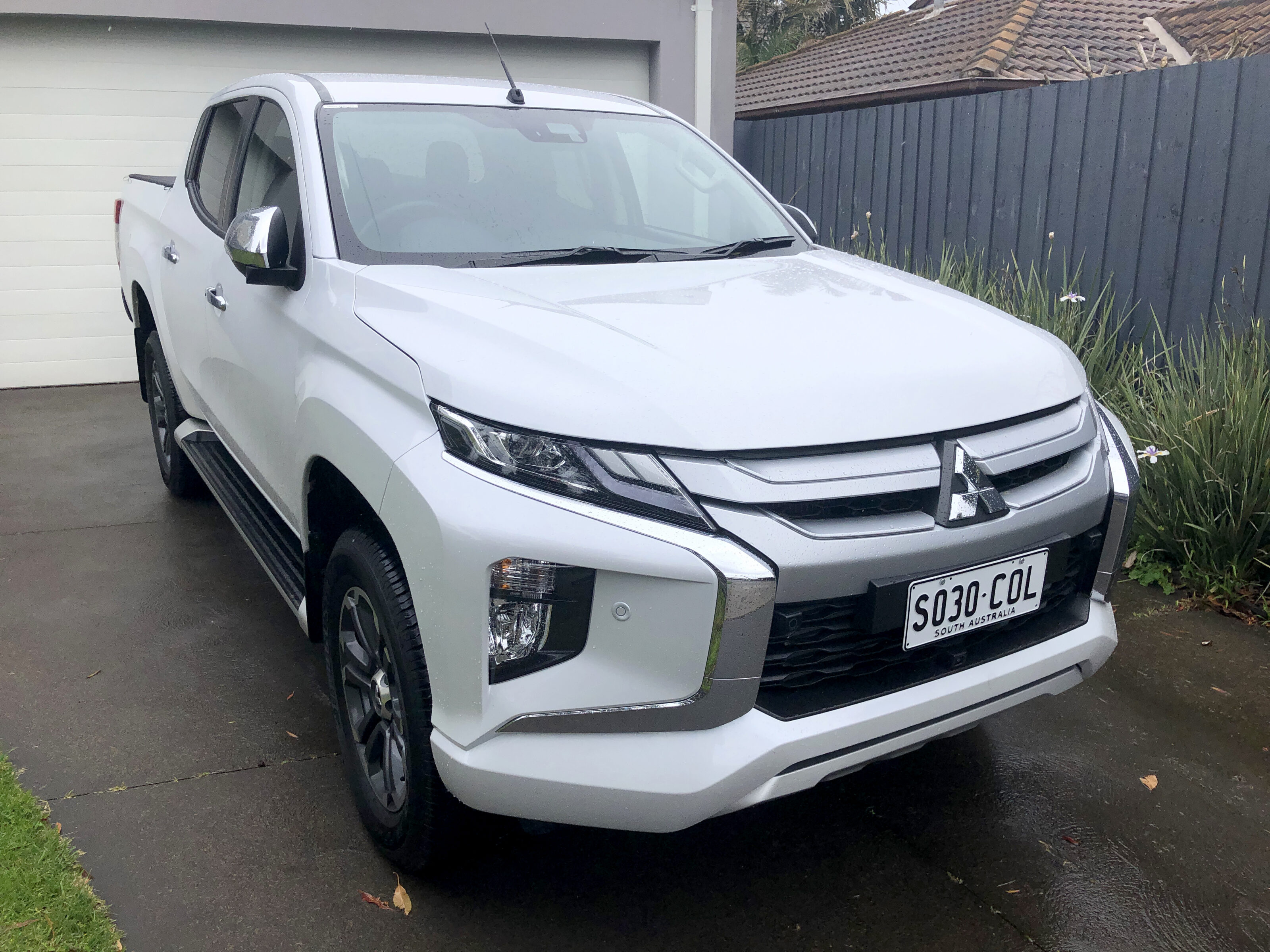
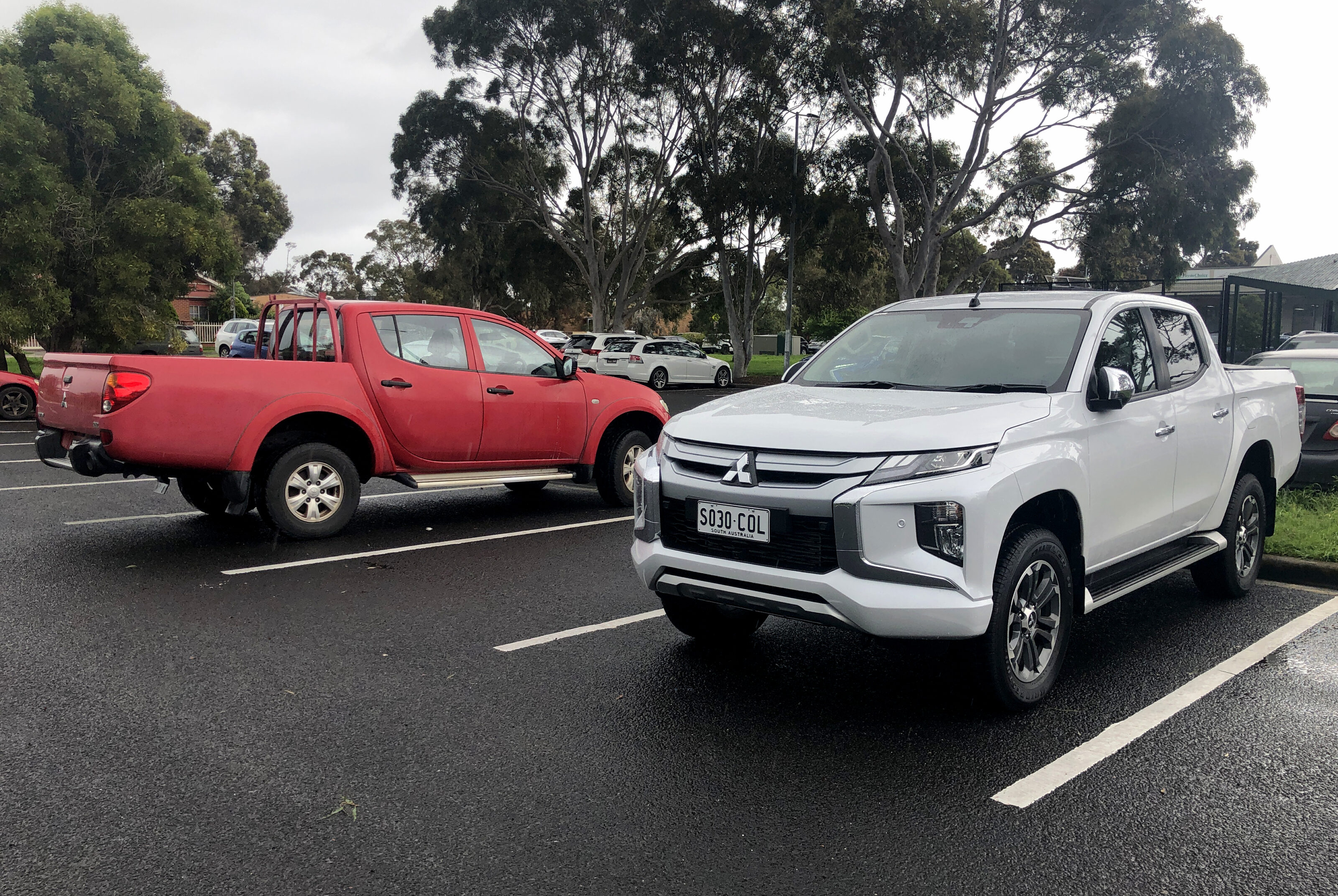
To be honest, I feel much more at home leading Wheels Media’s technology team than I do sharing my impressions of a dual-cab Mitsubishi Triton ute, but I jumped at the opportunity when the keys came my way.
My own daily drive is a 2022 Kia Sportage GT-Line, which more than comfortably navigates the occasional school run and myriad weekend activities that accompany being the father of a twelve-year-old daughter.
However, I’d be lying if I said the thought of purchasing a ute hadn’t crossed my mind before the Sportage rolled into our driveway.
Aside from a fortnightly trip to Bunnings and a penchant for a fishing trip, I can’t say we’ve had a real need for a ute, but when it seems like every second family around you has one, you start to wonder what they’re like as a family car. So with that in mind, I was keen to get behind the wheel and find out.
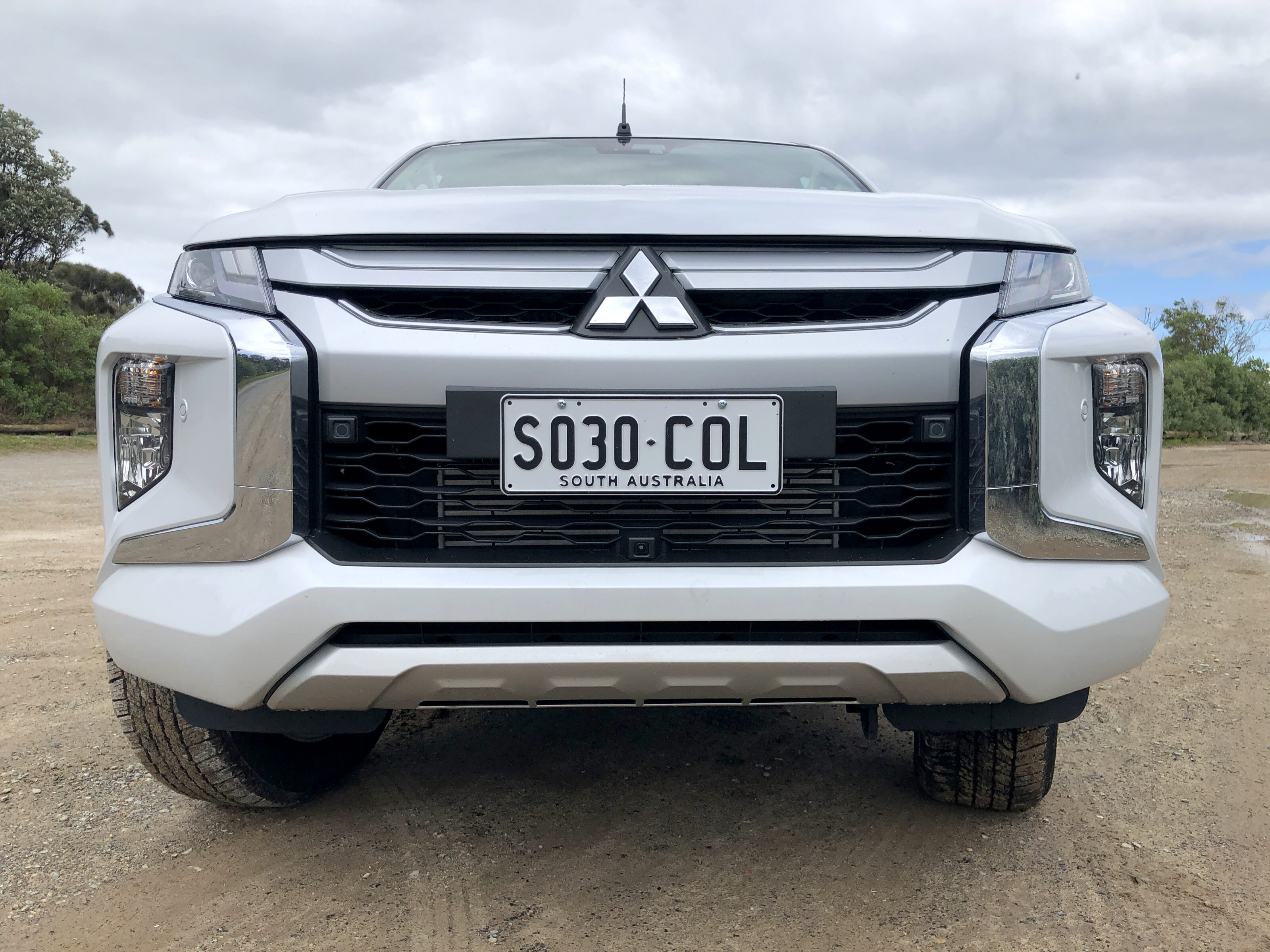
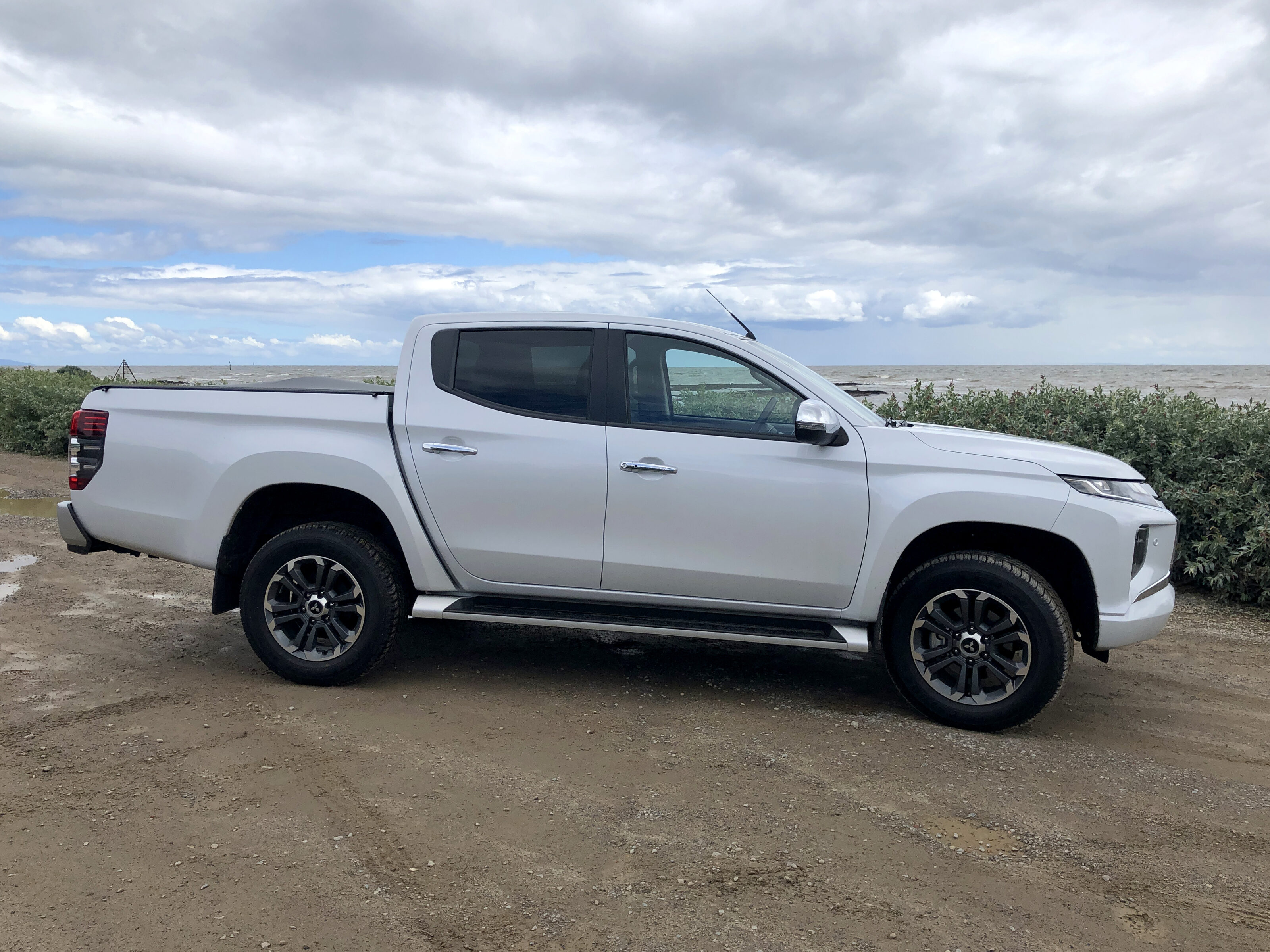
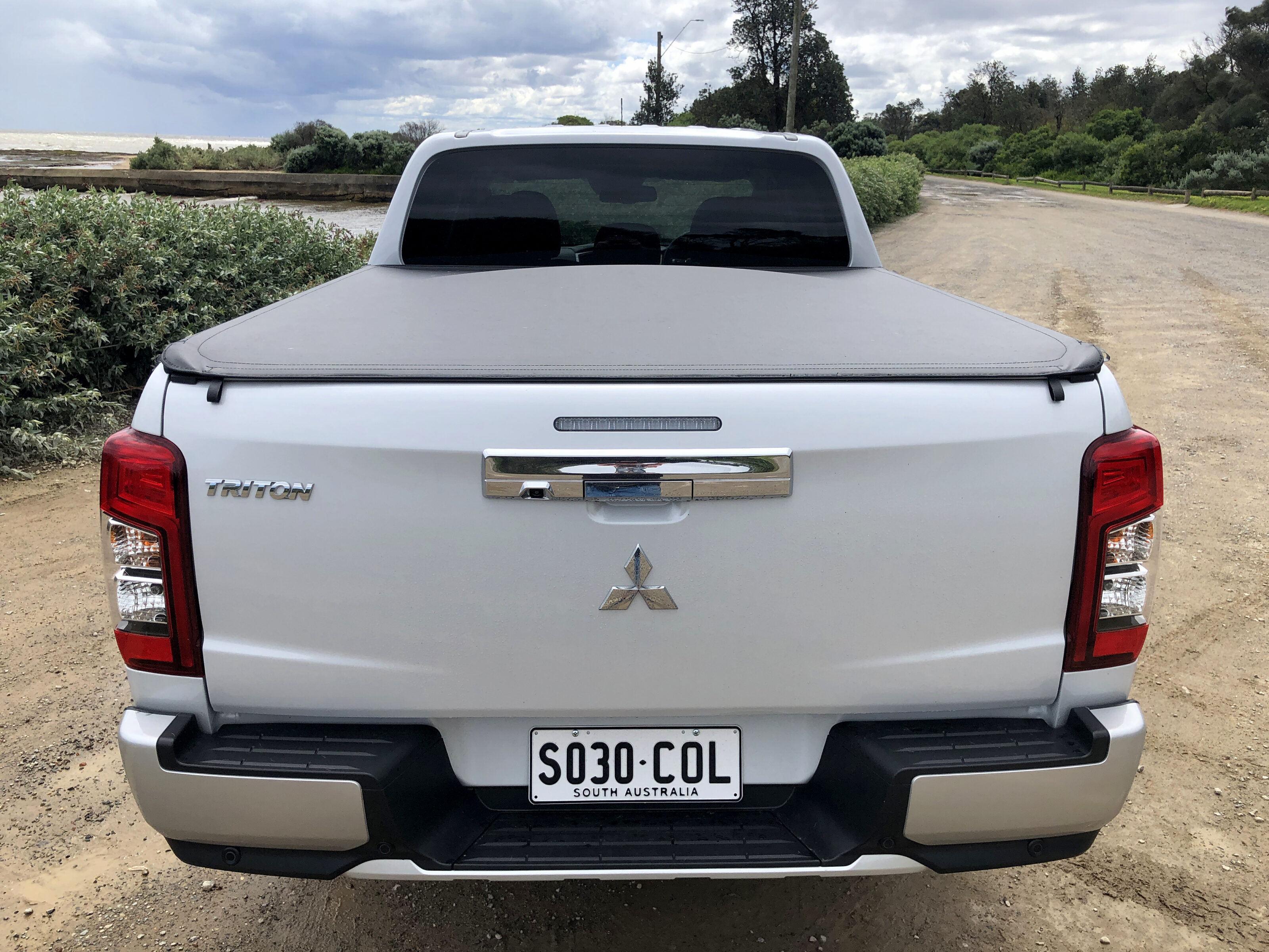
The Mitsubishi Triton GLS struck me as fairly appealing to look at as I peeked at it through the office kitchen window.
Sitting just one notch down in the range from the top-spec GSR, it carries some nice styling that the cheaper variants miss out on.
Getting in, the one-touch start system kicked things off and as the diesel engine rumbled into life, I had a feeling that this was going to be a fun little experience. Call it petty, but there’s a masculine feeling tied to jumping in a dual-cab and hearing that diesel engine chugging away.
1
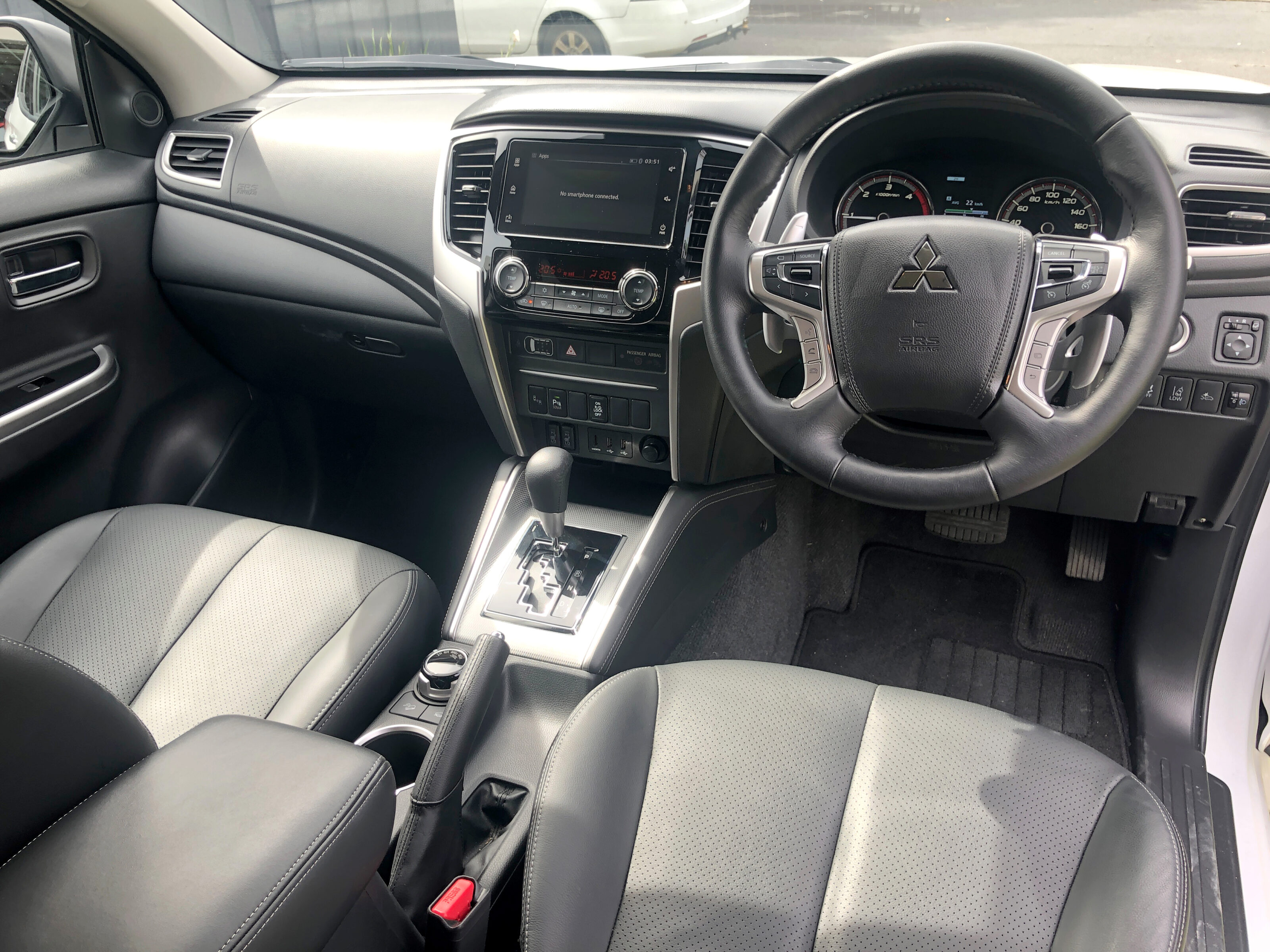
Inside the cabin, despite some slightly older tech, the ute came across as a nice modern package and I was looking forward to becoming acquainted with it.
Once I got myself settled in and adjusted the mirrors, the size of them immediately caught my attention. They weren’t huge, but they were big enough to immediately give the feeling that I had the peripheral vision of Michael Jordan.
After anticipating that the Triton would feel so much bigger to drive than the SUV I’m used to, the ease of seeing my surroundings meant any size concerns immediately dissipated.
The Triton has a decent interior – a solid finish that’s easy on the eye without trying too hard to be fancy.
It’s polished just enough to look good but seems tough enough to hold up for everyday wear and tear and if I were on the tools every day, I’d feel comfortable jumping in and out and not stressing too much about damaging surfaces.
I found the front seats took some getting used to with what felt like quite a snug fit. With each day, I came to really like them and what initially felt like a bit of an uncomfortable hug soon felt really supportive.
1
The seat warmers provided a nice little touch of comfort as well, and with high and low settings, did exactly what you’d want them to do.
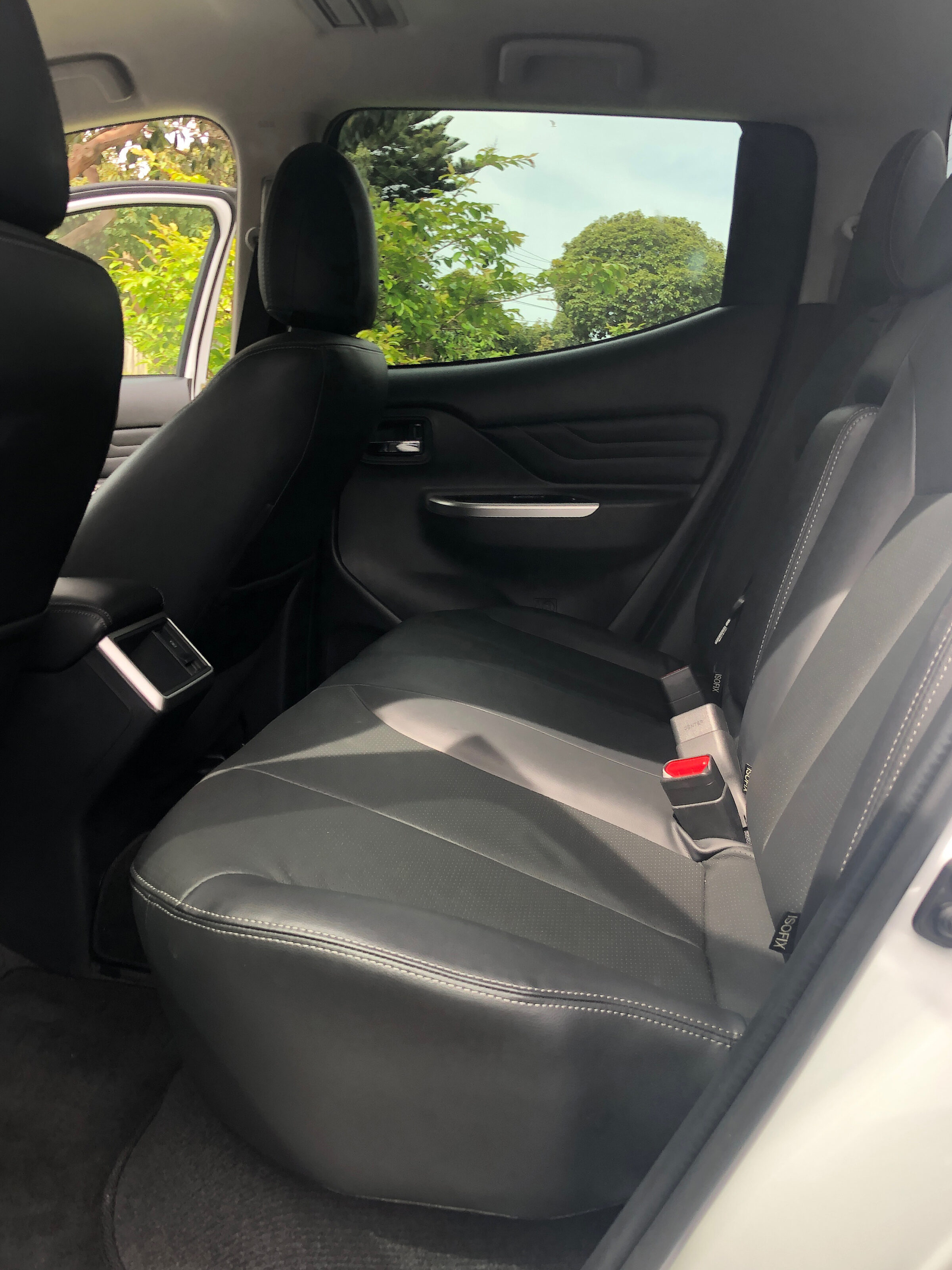
Also, the Triton’s comfortable rear seats provide loads of space if you have kids in the back. Even for me, not exactly small at 188cm, sitting in the rear seats provided a little bit of headroom and enough legroom so long as the front seats weren’t set too far back.
I’d feel fine about loading up the Triton with a few mates on the way to the footy without feeling like we’re packed into a can of sardines.
The large infotainment displays in my Sportage have left me a little spoiled when it comes to in-car tech, so I tried to taper my expectations before evaluating the Triton’s set-up.
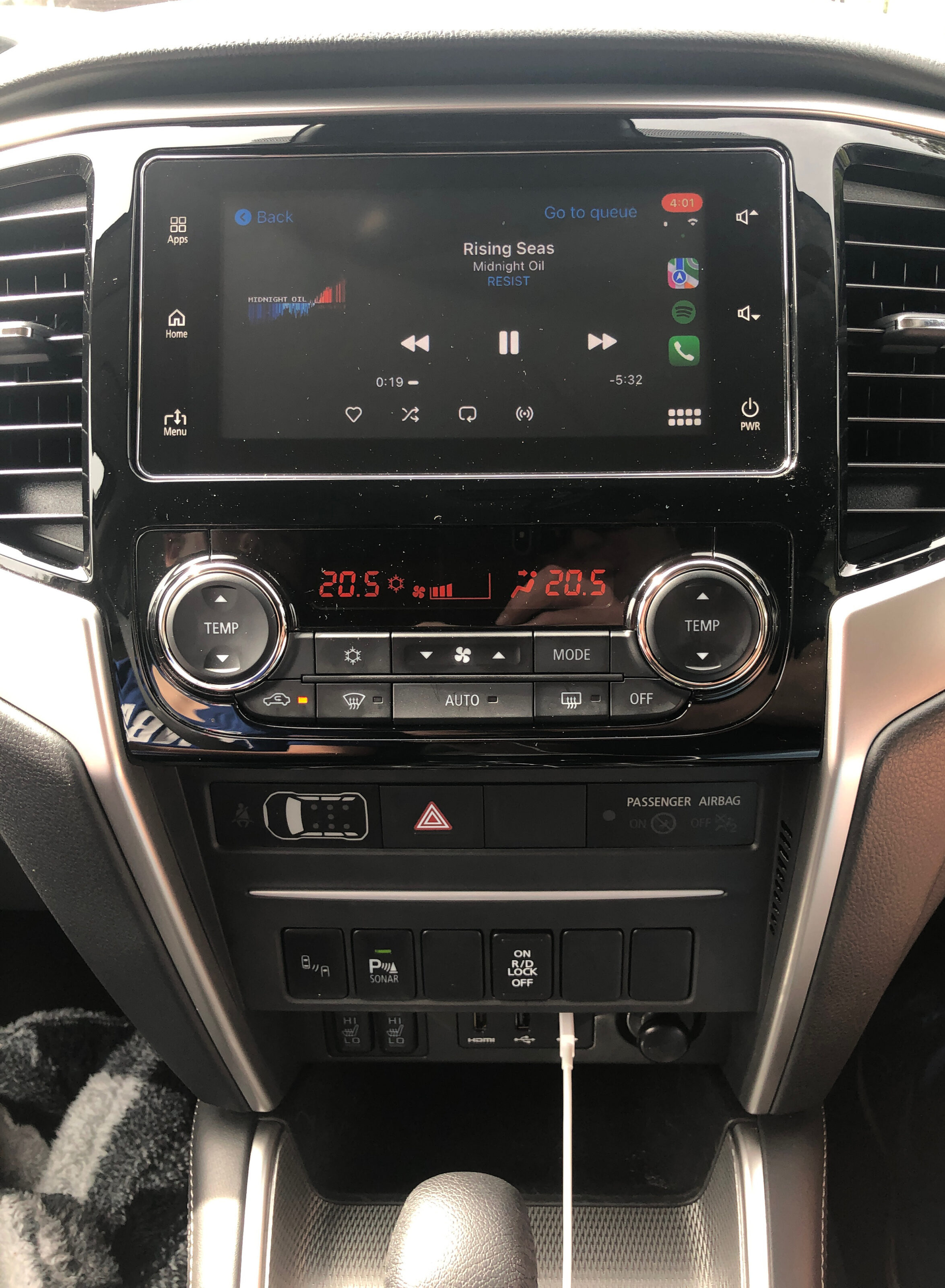
Although the infotainment display in the Triton seemed relatively small at first, it does the job. The native interface is simple to use and easy to connect a smartphone via Bluetooth. Like the Sportage, Apple CarPlay (and Android Auto) requires connection via USB as, unfortunately, there’s no wireless support.
1
That’s perhaps not a huge issue but it does become tiresome if you’re in and out of the car throughout the day and creates a bit of an eyesore with a USB cable curling around on what is otherwise a tidy console.
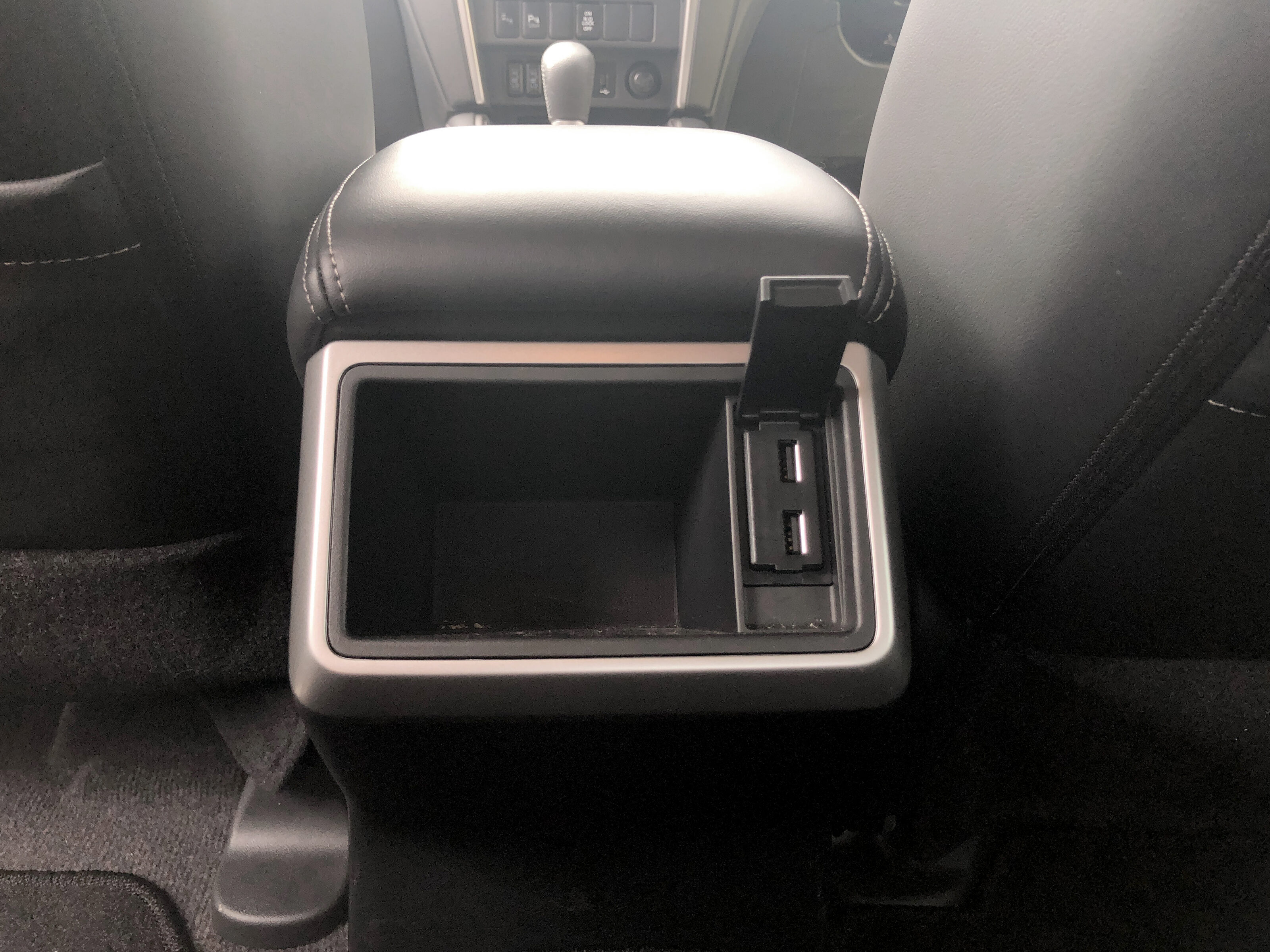
In total, the centre console provided two USB-A ports and one HDMI port, while another two USB-A ports were available at the rear to keep any passengers fully charged and happy.
After being more accustomed to SUVs and sedans, jumping up into the cab of the Triton felt quite different, although that feeling quickly subsided as I navigated home from Wheels Media HQ for the first time.
The Triton took noticeably more effort than an SUV to get around 90-degree turns but that soon felt normal. It was actually quite fun while I was still getting used to the handling and turning circle but before I knew it, it felt like I’d been driving this ute for weeks.
Slotting the Triton into daily life, things were kept relatively normal around the family routine so we didn’t head off-road or give it a thrashing but for the everyday urban driving I was doing, it felt more than sufficient.
1
Whenever quick acceleration was needed in traffic, to slot into that gap in the next lane or power up an incline, the Triton responded confidently and soon enough, I could see myself enjoying it as a daily driver.
It’s certainly no performance car with a 133kW/430Nm 2.4-litre turbo-diesel engine having to shift 1991kg of vehicle, along with whoever and whatever it’s carrying, but it has enough grunt to get through the day and get the job done in comfort.
The braking performance was impressive and the Triton didn’t hesitate to pull up quickly for the occasional red light – far better than I thought it would. I can’t comment on how it would perform with a full load in the back but would expect it to be similarly stable.
Driving along smooth roads was a slick experience but throw in some little bumps or potholes and you could feel the ruggedness of the Triton kicking in. As the driver, I saw these bumps approaching so knew what was coming, but for my wife and daughter as passengers, the slightly bumpy ride on relatively normal roads was sometimes a noticeable discomfort.
1
I imagine you’d soon become accustomed to the ride, but it’s one noticeable trade-off versus the smooth ride of an SUV.
Having said that, the Triton had no issues handling dirt roads and from what I found, was as a capable performer as you might rightly expect.
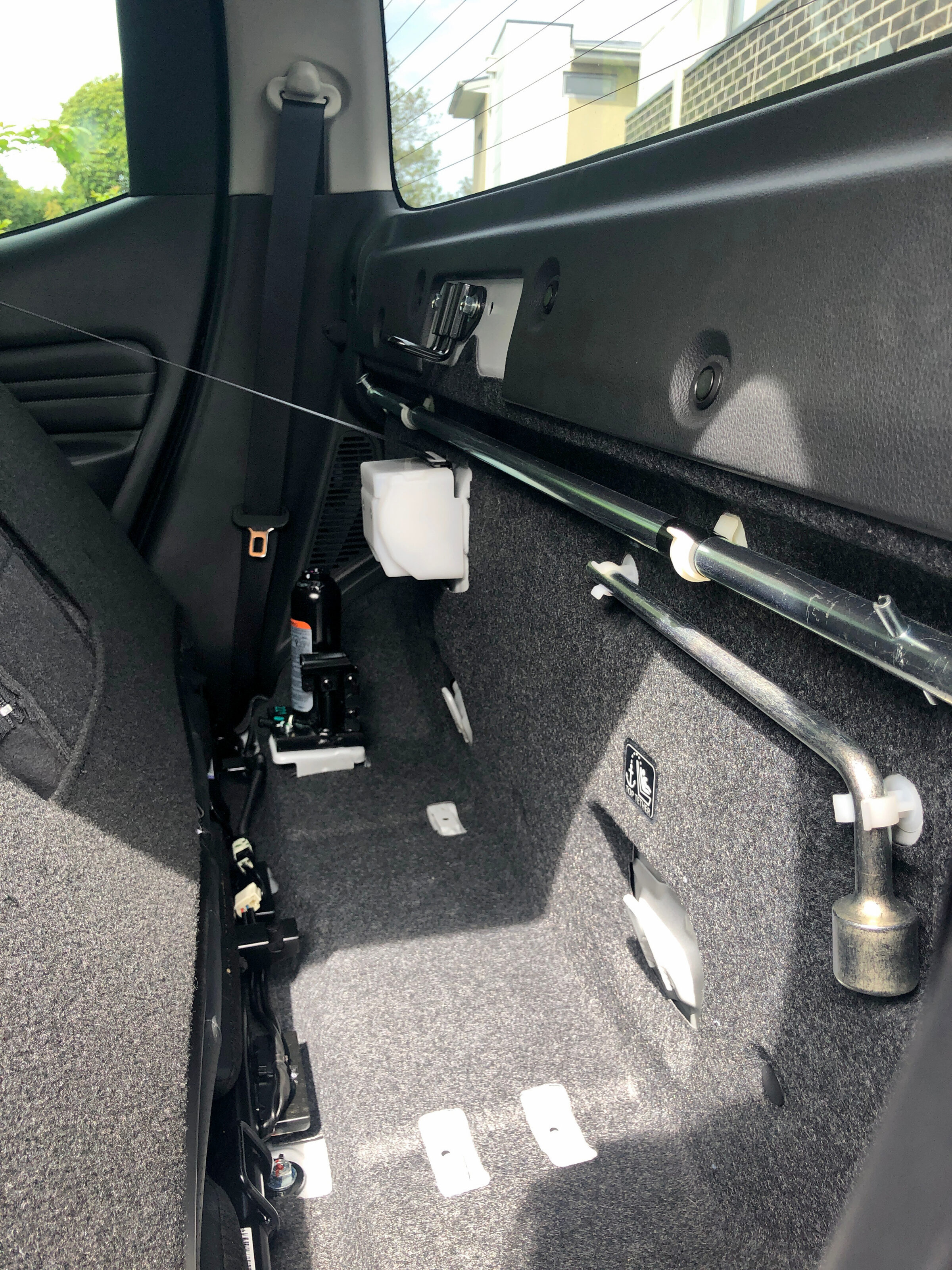
On the topic of rough roads, I’ve often wondered where the jack is kept in a dual-cab ute; in the Triton, I found it tucked away behind the rear seats, which tilt forward easily with the pull of a lever.
Lastly on the drive, one of the most impressive aspects of the Triton was how much visibility you have while driving it. As I mentioned earlier, the large side mirrors ensured I had a comprehensive view of what was going on around me – not something I expected before taking the keys.
Safety-wise, the audible alerts aren’t fancy but certainly get your attention when they need to.
To begin with, if you haven’t put your belt on before starting the engine, you get a symphony of dinging until you do.
The amber blind-spot monitoring lights on the mirrors work well and provide awareness of vehicles you might otherwise not know are there. Combined with the broad view provided by the mirrors, you rarely feel out of touch with what’s around you.
Annoyingly, the forward collision warning is sometimes triggered when navigating tight streets with cars parked on either side of the road. Perhaps that’s being a little picky, given they’re just doing what they are supposed to, but combined with the audible alarm, they just seem a little over-zealous.
The length of the Triton was the first noticeable difference when I first had to park it.
Compared to my SUV, the length of the Triton required a little more care to navigate into tight spaces and, admittedly, took a few goes to begin with.
Having said that, it was surprisingly easier to reverse the Triton into a parking space than it was to go in forwards. The size of the bonnet made life a little more difficult than it needed to be when parking nose first, while in contrast, the high rear end of the ute made reverse parking easier when overhanging a kerb.
Overall, the mirrors provided a great field of view, the sensors were accurate and the reverse camera worked well enough to provide a confident parking experience even when unfamiliar with the vehicle.
Having very lightly toyed in my mind with the thought of purchasing a dual-cab ute in the past, versus an SUV, I can absolutely see the appeal now.
Our little family was a bit sad to see this one go, so we’ll be looking on fondly when we see one passing by on the road.
Besides the lack of wireless Apple CarPlay, there wasn’t much that annoyed me during the week behind the wheel of the Triton and I was truly surprised at how quickly I felt at home behind the wheel.
The Mitsubishi Triton GLS is a nice package at an attractive price point versus the competition. If I regularly needed the carry space of the tray and wanted something I could get dirty inside and out without stressing over it, I’d seriously consider one.
Wait, allow me to apply some context to that sweeping aspersion. If you happen to be the owner of several thousand head of sheep on acres of farmland, the one-tonne ute is as indispensable as shear oil. And if your job involves hauling a ton of tools and materials onto a muddy construction site every day then a dual-cab is as essential as a 500ml can of Mother for breakfast.
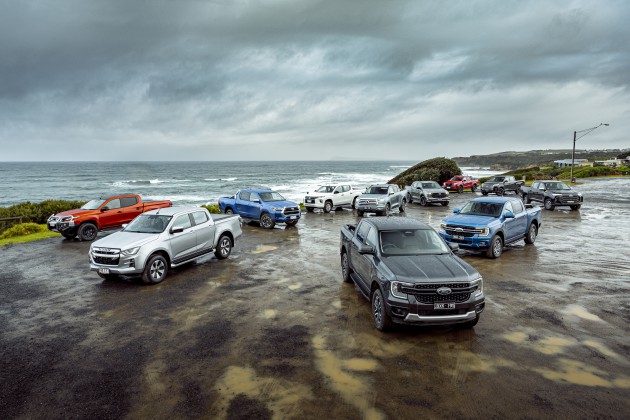
But an increasing number of ute buyers are not putting them to hard yakka. Rather, they are being bought to replace the family car, and after spending a week in 11 different dual-cabs, this makes no sense at all. The Mazda BT-50 has the most car-like interior, but that car happens to be a 2014 Mazda 3.
1
The Ssangyong Musso XLV has easily the largest load space, but drive to the airport in the rain and your carry-on will look like it’s been fished out of a lake. And while the GWM Cannon has a cavernous second row, like all dual-cabs, the rear seats are about as laid back as a Virgo.
In virtually all objective tests, a ute is a worse family ‘car’ than the actual car it’s replacing. Any time someone mentions a particularly impressive dual-cab attribute it is always immediately followed by the caveat “…for a ute”.
For example, the Isuzu D-Max has really nice steering … for a ute, the LDV T60’s central touchscreen is really impressive … for a ute, while the Ford Ranger’s ride is particularly good … for a ute.
When compared with virtually every other class, light-commercial vehicles are harder to live with in suburbia, less comfortable, not as well-equipped and more expensive to run. And yet, each month Australia’s favourite ‘car’ continues to be some kind of one-tonne ute. This simultaneously perplexes and delights me because it’s actually history repeating itself.
In the late ’90s, people all over the world, for no good reason at all, started chopping in their perfectly suitable sedans, hatchbacks and wagons in favour of the ‘Sports Utility Vehicle’. At the time, this emerging class of vehicle was represented exclusively by fat, ungainly, inefficient and ugly models – and the car-buying public couldn’t get enough of them.
But an amazing thing happened.
Soaring demand put the pressure on car makers to improve the safety, driveability and practicality of the SUV and a quarter of a century later the contemporary offerings are unrecognisable from their ancestors.
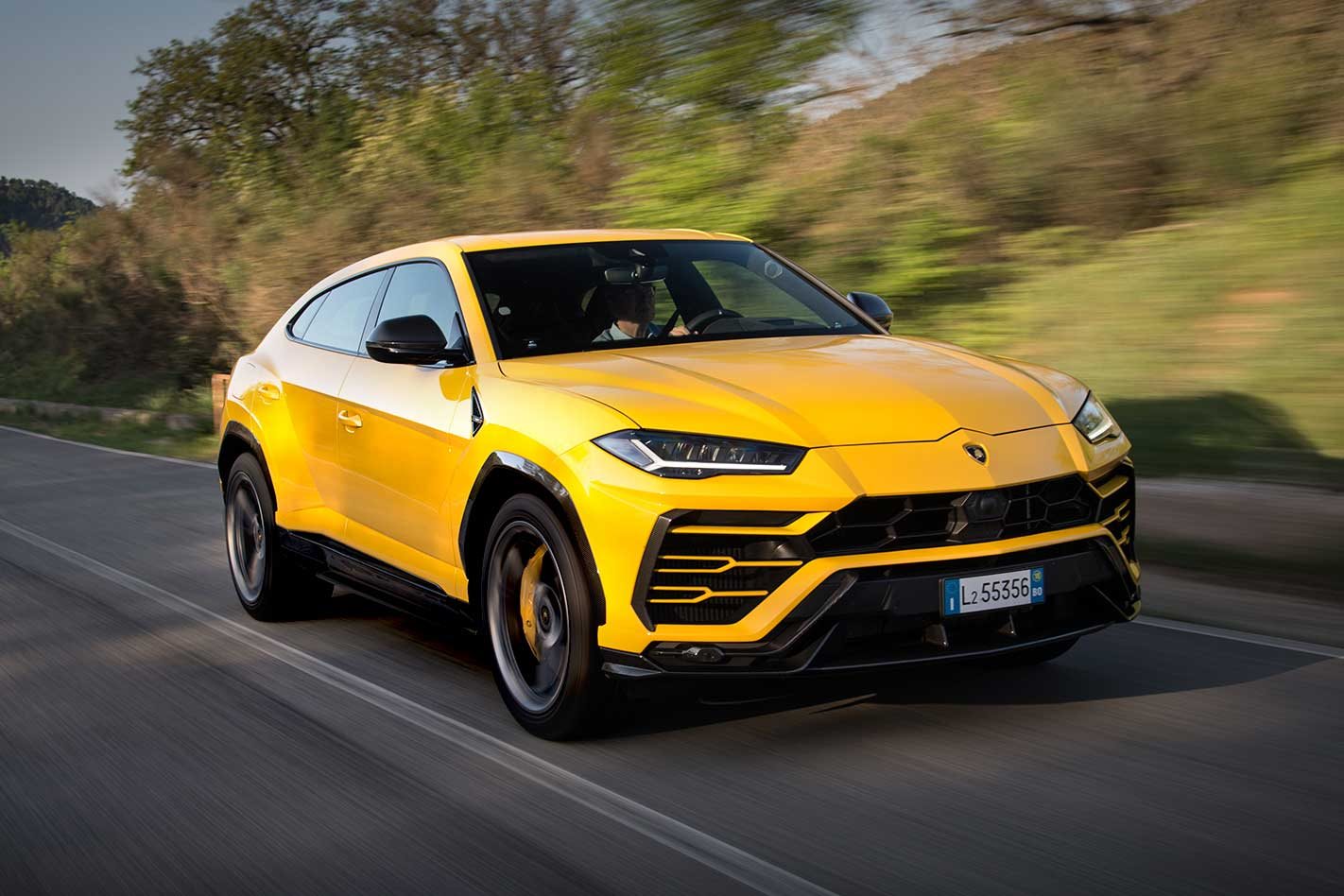
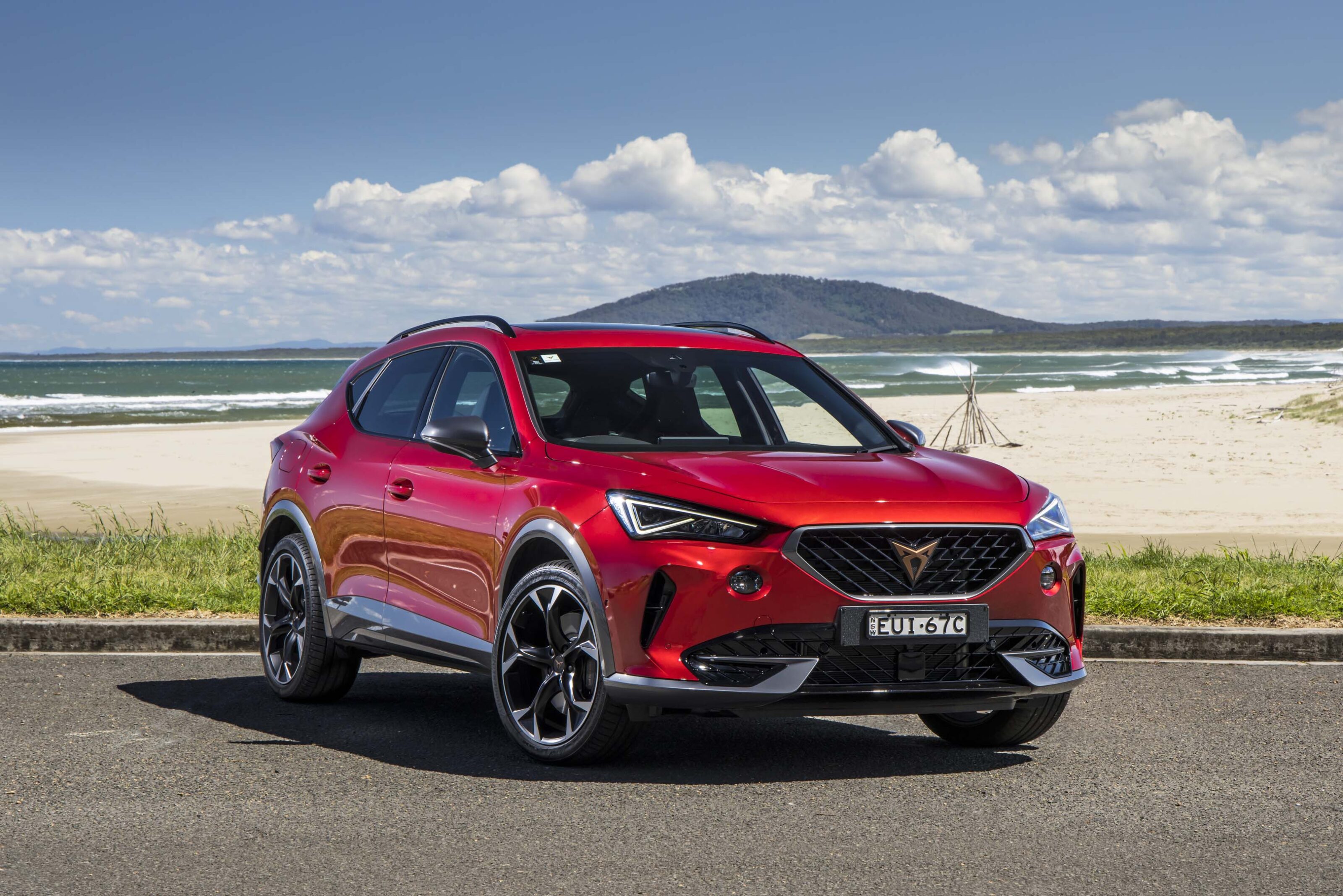
Lamborghini’s Urus SUV just summited Pikes Peak faster than Travis Pastrana in a Porsche Cayman GT4 Clubsport, Ferrari is poised to reveal its Purosangue SUV, while the Cupra Formentor I drove recently would give an Audi S3 a run for its money in the driving enjoyment stakes (it shares a lot of its oily bits).
1
As a family car, a late-’90s SUV made as much sense as a jetski. But thanks to incredible ingenuity and technology, car makers made a round peg fit a square hole, and exactly the same thing will happen to the ute.
In 25 years from now, campers will still be able to buy a ‘serious’ dual-cab ute in the same way you can still buy a Toyota Landcruiser if you want an SUV that’ll climb a mountain, but for a majority, the one-tonner will be a refined, fast and fun to drive machine, and I can’t wait.
In the meantime, you might be tempted by the imminent Ford Ranger Raptor which marks the start of the ute’s transition into a performance vehicle. It’s a very impressive car … for a ute.
My 1990s self can’t believe I’m saying this, but your next family car should probably be an SUV.
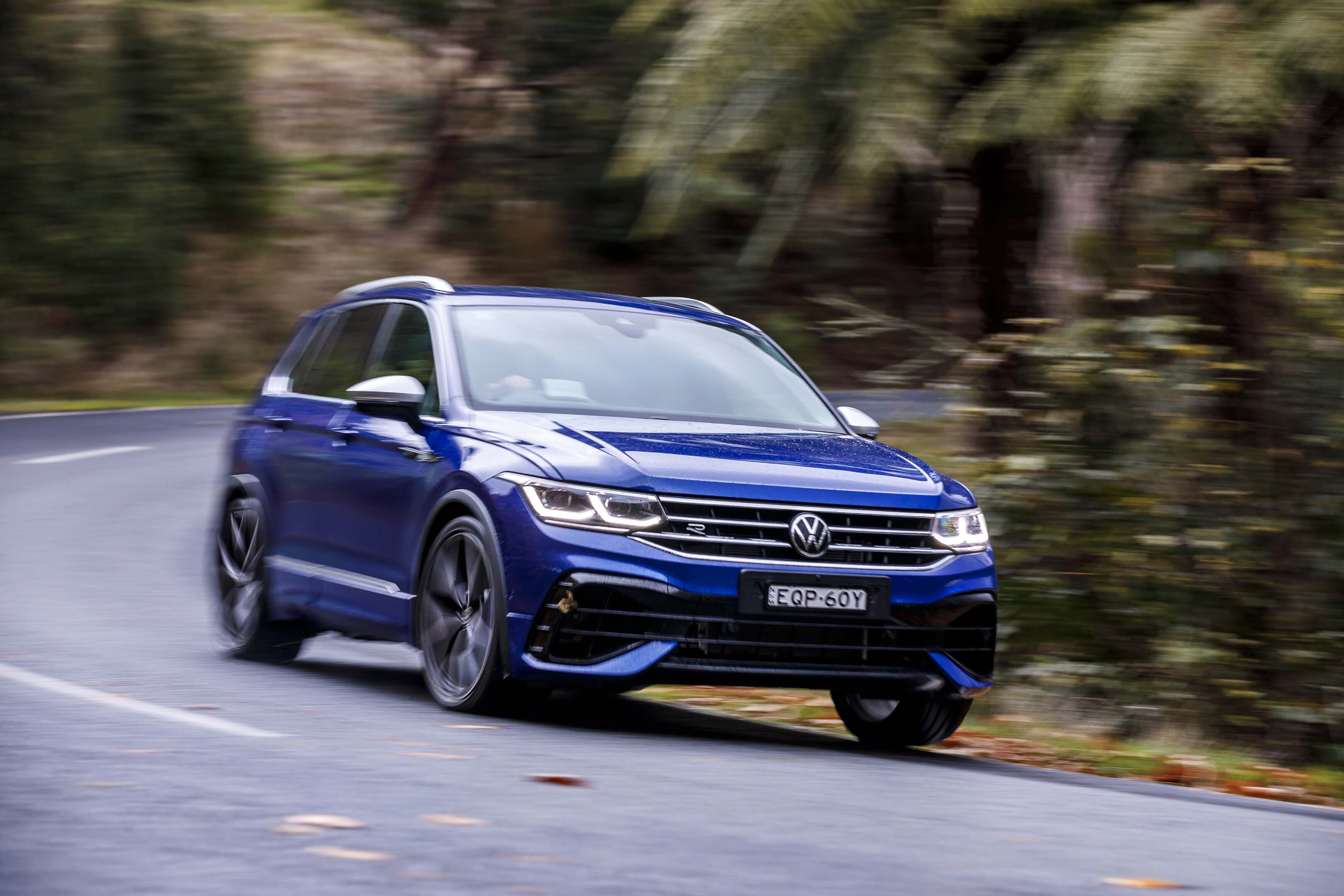
“Huh,” I think as I stand in the drizzling rain and watch wisps of steam dance across the hot front tyres of the Volkswagen Tiguan R. “There aren’t many family SUVs that can do that…”
We’re in the mountains and I’ve just hustled the Volkswagen up one of the most challenging drive loops in the Wheels arsenal.
If we were skiing it’d be a black run; an evil mix of hairpins, fast sweepers and mid-corner bumps that’s a challenge for dedicated sportscars let alone an 1800kg family SUV.
And the Tiguan has demolished it. Not just for speed, stability and composure, either. Thanks to its twin clutch packs and true torque vectoring, on our rain-soaked run there were even a few moments of throttle-provoked oversteer.
Like I said: “Huh…”
1
A cynic might think shoehorning the same powertrain and chassis hardware from the iconic Golf R into a taller and heavier SUV body would deliver lazier dynamics, but as we discovered when we drove the Tiguan R and Golf R together on track earlier this year, any performance loss is actually quite marginal.
This is a potent and talented fast family SUV. And with an asking price of $68,990 before on-road costs, it also doesn’t seem to have many obvious rivals. To get this level of performance, chassis wizardry and hardcore focus from another brand you’ll need to start looking at something like an Audi RS Q3 which costs $30,000 more. Ouch.
Except there is one similarly priced alternative that most people overlook…
The Skoda Kodiaq RS copped a fairly heavy update back in March that didn’t only bring a host of improvements to the design and cabin but also ushered in a switch from diesel power to petrol.
1
The new engine is the very same EA888 2.0-litre turbo petrol that lurks under the Tiguan’s bonnet and while it mightn’t pack the same level of firepower – it’s a GTI tune compared to the full-fat R outputs of the Tiguan – the Skoda has an ace up its sleeve: a third row of seats.
Skoda has priced its hot Kodiaq almost identically to the Tiguan R, too, at a whiff under $70,000, and like the VW it’s all-wheel drive and built on the same MQB A2 platform.
The Skoda has an ace up its sleeve: a third row of seats.
Plus, it offers the promise of a more liveable ride/handling compromise. Taut body control and corner-carving precision might be great for a blast up your favourite road on a quiet Sunday morning but on the school run? Not so much.
So the question is, if you’re a parent who likes a hit of spice and sportiness from your daily driver, which way should you jump: hardcore Tiguan R or more practical Kodiaq RS?
This one is shaping up to be an intriguing tussle…
In the value stakes, it’s a dead heat. At $68,990 for the Tiguan R and $69,290 for the Kodiaq RS (both before on-road costs), just $300 separates this pair.
And it’s a similar story when you start to cross-reference their standard equipment lists. Both of these SUVs represent the pinnacle of their respective ranges and are specced accordingly.
High-tech Matrix LED headlights, sequential indicators and blingy alloy wheels (21s for the Tiguan, 20s for the Skoda) are all present and accounted for, as are electric tailgates, full leather interiors and customisable digital instrument clusters. Even their central infotainment screens as the same size at 9.2 inches.
There’s little to separate them on the safety front, as well. Both have autonomous emergency braking with pedestrian and cyclist detection, adaptive cruise control, lane keep and departure systems, blind-spot monitoring, 360-degree surround view cameras and parking sensors front and rear.
1
Airbag coverage is also similar, although the Skoda has a total of nine compared to the VW’s seven due to an extra pair required to cover the third row.
One key difference? Rear cross-traffic alert is standard on the Tiguan but is $1250 extra on the Skoda. As you’d hope, both carry five-star ANCAP ratings but the Volkswagen has higher scores for occupant and pedestrian protection.
So it’s neck and neck when it comes to the big-ticket items, but dig a little deeper and you’ll unearth some differences that might start to irk you. The Skoda’s front seats, for example, offer heating and cooling whereas the VW’s are heated only.
The Skoda also has a wireless charging pad for your phone, which is a perplexing omission in the VW. And if you’re a sunroof kind of person, you score a panoramic glass roof as standard fare in the Skoda but it’ll cost you an extra $2000 in the VW.
1
Where the Tiguan hits back is with a standard head-up display and the inclusion of a single USB-C charging port for rear passengers. There are no USB ports for second or third-row passengers in the Skoda, which seems a glaring oversight given its family focus. A road trip with no ability to charge the kids’ iPads? No thanks. (There’s at least a 12V port.)
A little extra for a little more
As for optional extras, both cars are so rammed with standard gear that there’s precious little to think about. The Tiguan only offers two: the aforementioned $2000 sunroof and a premium Harman Kardon sound system for $1000. The Skoda also only has two optional extras: rear cross-traffic alert ($1250) and side steps ($1400).
Where the value equation starts to separate is when it comes to your priorities. If you have more than two kids then the Skoda’s extra seats are a hugely valuable addition. As is its extra space.
2
Kodiaq RS v Tiguan R: Boot space compared
The Kodiaq’s wheelbase is 110mm longer than the VW and it also has a bigger boot: 765L behind the second row plays 610L in the Tiguan. And with the second row folded, the Kodiaq has 2005L of luggage capacity against the VW’s 1655L.
If you don’t need the extra seats, though, the Tiguan feels the smarter buy. It has a marginally better safety package as standard and in the performance and engineering stakes, it’s a cut above.
Power and acceleration
With 235kW/400Nm on tap, it can rocket from 0-100km/h in 5.1 seconds whereas the 180kW/370Nm Skoda takes 6.6s. And the VW’s torque vectoring chassis is far more complex and desirable than the Kodiaq’s more traditional all-wheel-drive setup.
2
A final point worth mentioning on price?
While a cigarette paper might separate this particular pair, Volkswagen has just introduced a new, de-specced Grid variant to the Tiguan R range.
It misses out on a host of worthwhile equipment like the Matrix lights, LED tail lights, electric leather seats, head-up display and rear-cross traffic alert but it brings a $5000 saving thanks to a sticker price of $63,990 before on-road costs.
VW has introduced this option to sidestep semiconductor-related supply issues, so wait times on Grid editions will also be shorter compared with a regular Tiguan R. Something worth considering.
You might think this section will be a cakewalk for the Skoda given its extra space and seats, but it’s not quite that simple.
While the Tiguan has a marginally smaller footprint, it’s still one of the roomiest family SUVs in its class.
And all of the packaging goodness that makes a regular Tiguan so convincing – namely the sliding back seat, excellent vision, ample cabin storage and the large 610L boot – continues in the flagship R.
Slip inside and you’re greeted with an ambience that feels like a regular Tiguan R-Line with a dusting of R-branded tinsel. There’s blue stitching, woven carbon fibre inserts on the dash and door cards and a racier flat-bottomed steering wheel with an ‘R’ drive mode selector button on the left spoke. Feels nicely screwed together, too, and it nails the basics.
1
Storage is ample thanks to a large centre console with retractable cup holders, two large cubbies in the roof and enormous door bins that are also flocked to stop loose items from sliding around and rattling.
The driver’s seat is 12-way adjustable so the seating position is decent (I’d personally prefer the wheel to come a smidge closer, though) and the connectivity and tech package is hard to fault – lack of wireless phone charger notwithstanding.
A pair of USB-C ports are provided ahead of the gear selector, Apple CarPlay and Android Auto worked seamlessly during our time with the car and the high-res central screen includes an R-specific display that shows G-force, oil temp and boost pressure.
1
With the sliding second row all the way back, the amount of rear room on offer is virtually identical to the Kodiaq. Tall passengers will appreciate generous knee- and toe-room, while headroom is actually superior to the Skoda, which is impeded by its chunky sunroof.
There are thoughtful touches back here, too. The rear seats are more heavily bolstered than a regular Tiguan, there’s an extra little storage tray on either side of the seat bench which you don’t get in the Skoda and there are useful storage pockets in the backs of the front seats for phones and other small items.
But the Tiguan’s cabin is not perfect. The front seats are comfy and are trimmed in soft Nappa leather but they lack the support of the more heavily bolstered buckets you get in a Golf R. Not really an issue on straight roads but throw the Tiguan R up a twisty section and slighter drivers may struggle for lateral support.
1
For functionality, there are some foibles.
The steering wheel features VW’s dreaded haptic touch pads and they’re so unintuitive to use that even company CEO Thomas Schafer has publicly conceded they’re rubbish and has promised to terminate them for future models.
The touch-sensitive tech is also used on the Tiguan’s HVAC slider controls and trying to alter the fan speed or temperature on the move is tricky. Touch them once and you’ll bump up the temp by half a degree; try to hold the slider down and you’ll rocket from 18 to 30 degrees in the blink of an eye. Chalk this solution up as a technological dead end.
A final gripe? Hard plastics around the centre console and on the rear door cards erode the general sense of quality which, weirdly, actually feels a touch higher in the Skoda…
1
The Kodiaq’s cabin is more conventional than the Tiguan’s and it’s all the better for it.
There are traditional dials and buttons for the major controls, it equals the Tiguan for tech and connectivity and there’s a sprinkling of ‘simply clever’ touches like a second glovebox in the top section of the dash, a moveable cup holder insert that includes a slot for the key and a rubbish bin that slips into the flocked door pocket.
Skoda also supplies superior front seats. Unlike the flat ‘comfort’ spec pews you get in the Tiguan, the Skoda’s huggy front buckets deliver the kind of bolstering you expect from an SUV with proper performance credentials.
It has a better driving position, too, thanks to loads of tilt and reach adjustment from the flat-bottomed wheel.
The general ambience also feels properly sporty. As part of the MY22 update, Skoda upgraded to a full leather interior and the black seats are struck through with red diamond stitching that makes the whole cabin feel like a man’s wash bag. In a good way.
1
One thing that might jar? The swathes of fake carbon fibre used on sections of the dash won’t be to everyone’s taste. Personally, though, we like them.
The Skoda also offers more for second-row passengers. There’s acres of room for adults, the seat slides fore-aft and the second row is also heated, which you don’t get in the Tiguan. Window blinds are another inclusion missing from the VW, which is especially useful to keep kids out of the sun. There are some compromises, mind.
As mentioned earlier, there are no USB ports, leaving a 12V socket to cope with rear-seat recharging demands. And while the big bucket seats are great for front passengers, they impede outward vision for those in the back.
1
As for the third row, it’s… okay. Simply having the additional seats is a boon in itself but don’t expect to be shoehorning adults back there on a regular basis. Unless you don’t like them much, that is.
Getting into the third row is relatively easy thanks to decent ingress/egress but once there adults will find it a tight fit for knee and toe room.
Headroom is a little snug, too, and annoyingly the back row has no top tether mounts for child seats so it’s strictly a no-go zone for little kiddies. Best used for adults on short journeys or kids that no longer need to be harnessed in.
In the battle of the boots, we already know the Skoda gazumps the Volkswagen for total load-lugging ability but the Czech SUV also has some amenity advantages like cargo nets, additional storage beneath the boot floor for the luggage blind and a space-saver spare.
The Tiguan has no spare tyre, meaning you have to make do with a puncture repair kit. So which SUV wins for cabin quality, comfort and space? That’d be the Skoda.
Right, time for the Tiguan R to play its trump card: how it performs on the move when you turn everything up to 11. Thing is, it’s raining. Sideways.
And our ‘black run’ of a road loop isn’t only twisty and slippery but there are piles of leaves and patches of moss lurking in the shadows. Best build up to it, then…
The Tiguan R misses out on the Golf R’s Drift and Nurburgring drive modes (instead you gain hill descent control and the ability to lock the rear diff should you fancy some light off-roading) but you still have four modes to explore: Comfort, Sport, Race and Individual. Leave the drive mode selector in Comfort and, despite its ferocious-looking spec on paper, the Tiguan feels like any other family SUV.
Its throttle is docile, the adaptive dampers help to deliver a ride that’s controlled and comfortable despite the large 21-inch wheels and low-profile rubber and the dual-clutch gearbox verges on lazy as it slurs through the ratios. Refinement is also decent, although the Skoda is marginally quieter on coarse-chip roads.
1
Start to ratchet things around to Race mode, however, and the Tiguan R steadily reveals an angrier side. The steering gets heavier, gearshifts become crisp and decisive and the 2.0-litre engine takes on a frenzied edge.
You also gain a vocal soundtrack that’s enhanced by some obviously synthesised induction noise. We don’t mind the artificial enhancement but you can turn it off by engaging a ‘Pure’ mode for the powertrain.
Race firms up the damping noticeably, too, but it doesn’t deliver the bone-jarring track-only ride I was expecting. The Tiguan is certainly firmer and more physical to hustle on our bumpy test loop than the more softly sprung Kodiaq, but it doesn’t skip off-line or crash through unpleasantly.
1
Instead, the tauter body control and reduced roll combine to boost confidence.
Another surprise? How much grip there is in these soaked conditions. Our Tiguan was running 255/35 R21 Hankook Ventus S1 EVO3 rubber and after some tentative exploration, you quickly discover there’s ample adhesion to lean on. And once you start to trust that the front axle will stick, it becomes a touch alarming how much speed the Tiguan R can carry into corners.
The chassis gives you options, too. Experience on a dry track tells us overarching grip and benign stability tend to be the R’s default handling characteristics but on a wet road it’s easier to unlock some playfulness.
1
Our Tiguan was running 255/35 R21 Hankook Ventus S1 EVO3 rubber and after some tentative exploration, you quickly discover there’s ample adhesion to lean on.
A single press on the traction control button engages ESC Sport and with the electronic nanny wound back a smidge you can really feel the torque vectoring at work. The twin clutch packs on the rear axle can apportion up to 100 per cent of drive to a single wheel and if you commit to the loud pedal early enough, it’s possible to revel in some rear-end throttle adjustability.
Nothing lairy enough to warrant a degree or two of opposite lock, but it’s sufficient to give the feeling that you’re powering out of turns with the rear tyres loaded.
As for the level of propulsion on offer? VW’s EA888 is as dependable and clean-revving as ever and there’s ample thrust on tap to power out of corners. This is a properly quick SUV.
1
Strong brakes with excellent modulation complete an impressively well-rounded dynamic arsenal that, on these roads at least, doesn’t have an obvious weak spot. If we were being super critical we’d point to the steering which, while meatily weighted and accurate, is more of a dependable supporting act than an engaging communication device but that’s about it.
Is it as agile and as engaging as a Golf R? Of course not.
The lower-slung and circa 300kg-lighter hatch would be the pick for keen drivers but in the realm of sporty mainstream SUVs, the chuckable, fast and involving Tiguan R is impressive.
Perhaps the question we should be asking, however, is do you really need this level of potency and focus in a family SUV? Or would most buyers be just as happy with a less intense interpretation of sportiness?
Enter the Kodiaq RS…
1
It’s noticeably more sedate than the VW. A weak latte next to the Tiguan’s vodka-laced double espresso, yet there’s still plenty of talent for a keen driver to exploit. It’s certainly a more eager companion than the old diesel version thanks to a 56kg weight improvement in the nose.
And we’ll take the smooth sound of a 2.0-litre petrol over a diesel any day. Like the VW, there’s some heavy-handed sound augmentation going on to enhance the Kodiaq’s EA888 but again it’s possible to turn it off via the Individual mode.
The steering is also crisp and quick (at 2.1 turns lock-to-lock it matches the Tiguan for rack speed), the ride on adaptive dampers and 20-inch wheels with chunkier 45 profile rubber is nicely judged and on a spirited drive, the handling is fluent, predictable and fun.
1
It can’t keep up with the Tiguan R, though. On our drive loop, it only takes a few corners for the VW’s taillights to start edging away. And it’s not just that the Kodiaq is down on grunt, although there is noticeably less punch coming out of corners.
Where the Tiguan blazes out of turns, the Kodiaq is missing the same degree of urgency and feralness. It’s more to do with the fact that the Kodiaq feels less connected and eager. Where the Tiguan is foursquare and agile, the Kodiaq seems narrower, taller and heavier.
And when you do lean on the chassis, you’ll discover there’s not as much grip on offer, either. The 235/45 R20 Continentals are more prone to understeer and it’s even possible to break the rear end loose under heavy braking for tighter corners.
Is the Kodiaq RS a capable and well-sorted SUV? Absolutely. Is it a match for the Tiguan R dynamically? Afraid not.
This one’s a slam dunk for the Skoda. The Czech brand has recently moved to a seven-year, unlimited-kilometre warranty for all its vehicles, meaning it has a longer-than-average coverage period.
The Volkswagen, meanwhile, carries a now industry-standard five-year, unlimited-kilometre warranty.
Both Skoda and VW offer attractive pre-paid servicing plans but again, the Skoda has a superior scheme. Five years of servicing for the Kodiaq RS can be bundled together for $2000, while seven years will set you back $2900. By comparison, VW offers three- or five-year servicing plans for the Tiguan R priced at $1650 and $3100 respectively.
Another thing to consider is that the Volkswagen requires 98 RON while the Skoda only needs 95. Both have a 58L fuel tank and at today’s fuel prices ($2.12/L for 95 and $2.20/L for 98) the VW will cost you $4.64 more each time you fill up with a full tank. If you fill up weekly, that blows out to an extra $241.30 a year.
Which of this pair is the better sporty SUV? That’s easy: the Tiguan R.
It’s quicker, more engaging, grips harder and is simply on a different plane for dynamics thanks to its angrier engine and more sophisticated, performance-orientated all-wheel drive system.
But really, there are no losers here. And that’s not a cop out; it’s more of an understanding that no matter how they drive, the biggest deciding factor between this pair is how many seats you need. If you stopped at two kids (or two dogs) then buy the Tiguan.
Whether it’s the best fast VW currently on sale is up for debate – we’d tip our hats in favour of the Golf R wagon which is identically priced, is arguably cooler to look at and just as practical – but if it’s an SUV you’re chasing, there’s no denying this flagship Tiguan lives up to the reputation of the ‘R’ badge.
If you do need seven seats, however, the Skoda won’t disappoint.
Its performance focus might be dialled back a notch but it still looks tough, has a longer warranty, better servicing conditions, and it’s quick and capable enough to feel genuinely sporty.
Just pray you don’t run into a Tiguan R on your morning backroad blast…
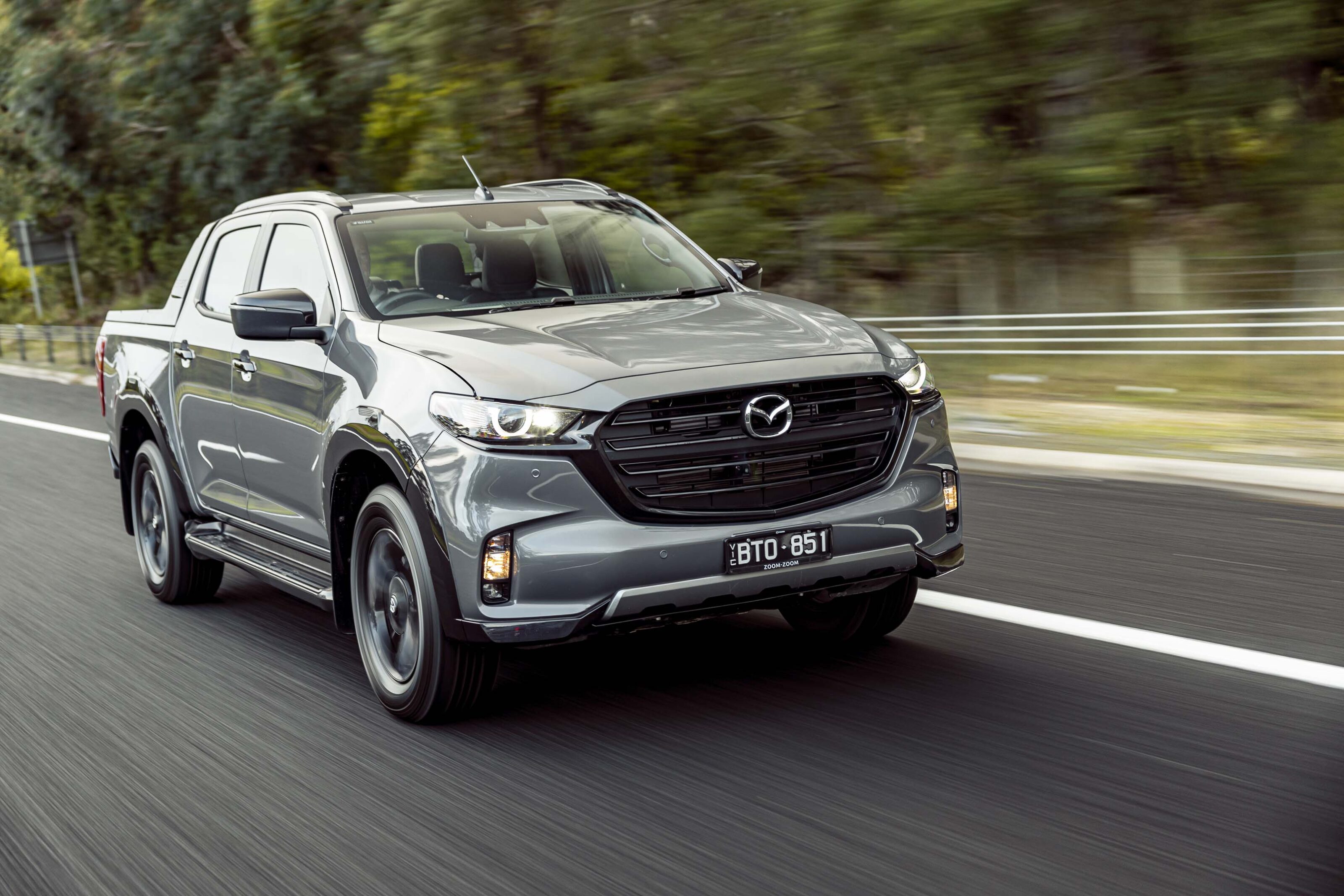
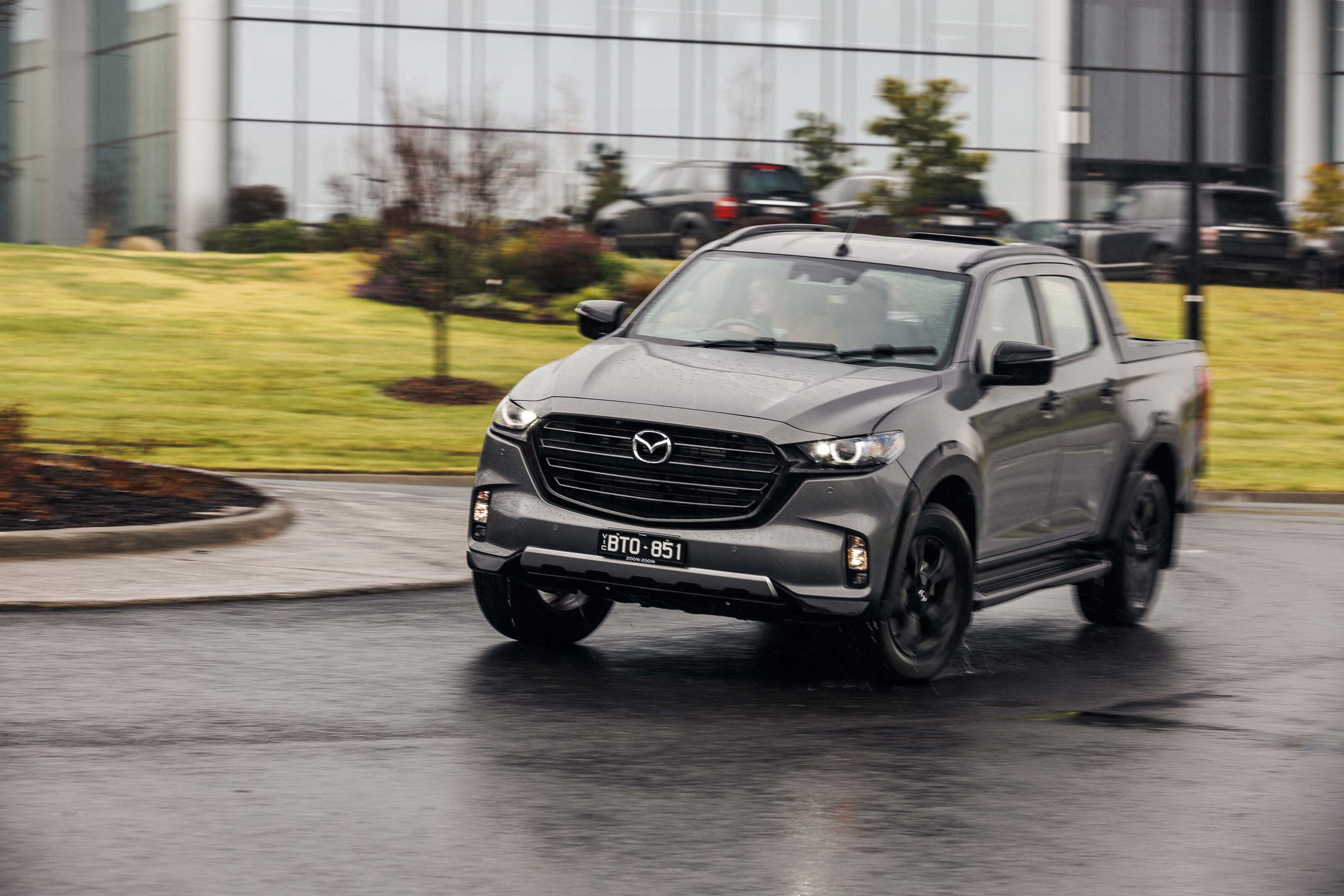
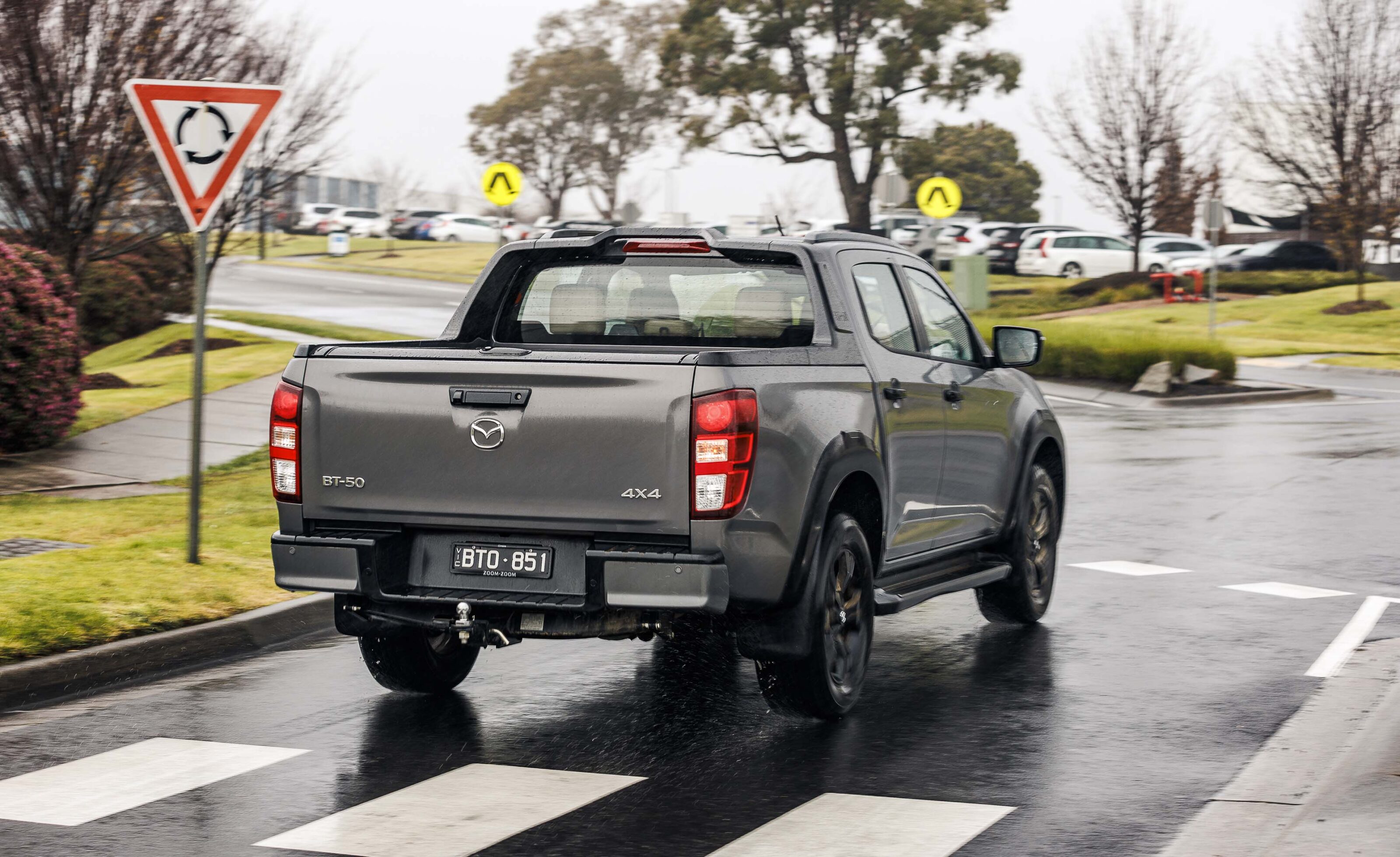
One of the secrets to Mazda’s dual-cab model success in recent years comes down to selecting the right partner – twice.
In the previous generation, the BT-50 shared a majority of its mechanicals with the relentlessly popular and high-achieving Ford Ranger, which lent the strong five-cylinder diesel drivetrain and excellent manners both on and off the road.
Perhaps it was nepotism, but as the fraternal twins aged, the Mazda was not treated to all the evolutionary goodies of the Ford including infotainment, an upgraded fuel system and a more eager turbo. And so the partnership came to a close and Mazda went in search of a new donor.
That partner took the form of fellow Japanese manufacturer Isuzu with the D-Max and third-gen BT-50 sharing almost everything mechanical hidden beneath different skins.
1
Prior to the RG01 generation Isuzu, the D-Max had earned a reputation for being rugged and dependable if lacking a little refinement in favour of more agricultural practicality. However, the new relationship with Mazda introduced some of the company’s car DNA, while Isuzu continued to inject the toughness that no one-tonner can afford to be without.
The partnership is working and has spawned a prolific line-up for the BT-50 including a halo Thunder version as well as some interesting entry-level options. But here we’re focusing on one down from the top of the pack and the SP.
? Hello from the future! You can continue reading this story, or for something fresher, see our latest BT-50 Range Review linked below.
The BT-50 dual-cab 4×4 range kicks off with a bargain-basement entry version with an enticing price in the region of $50,000, but its stripped-out spec and small 1.9-litre diesel will most likely relegate it to fleet and trade life.
Chuck another 10 grand at the budget however, and the middle of the Mazda range opens up with the $59,990 GT and the region that accounts to a majority of the volume.
Positioned just above that however is the SP and it costs $65,990 when fitted with an automatic transmission.
So what’s in the SP?
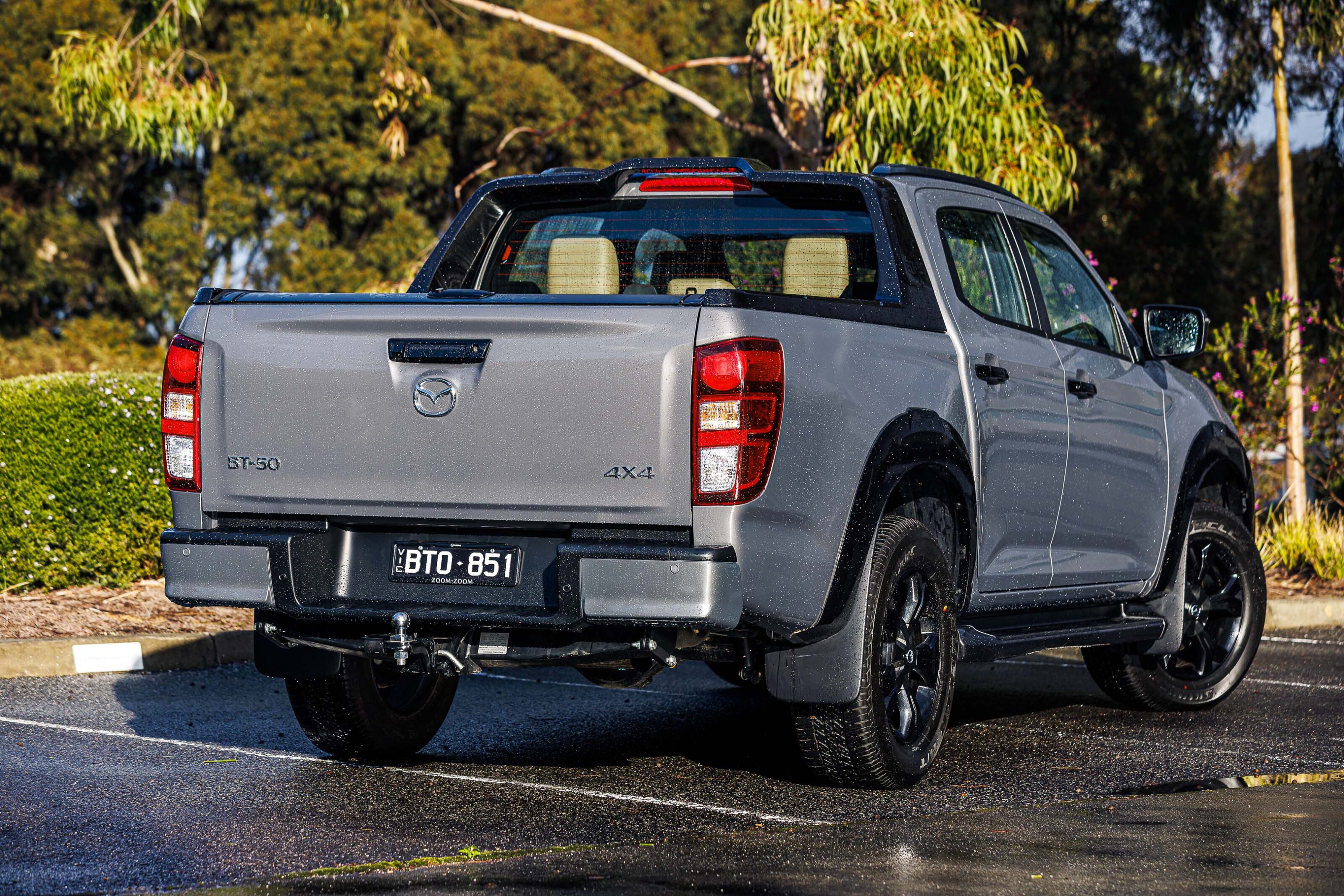
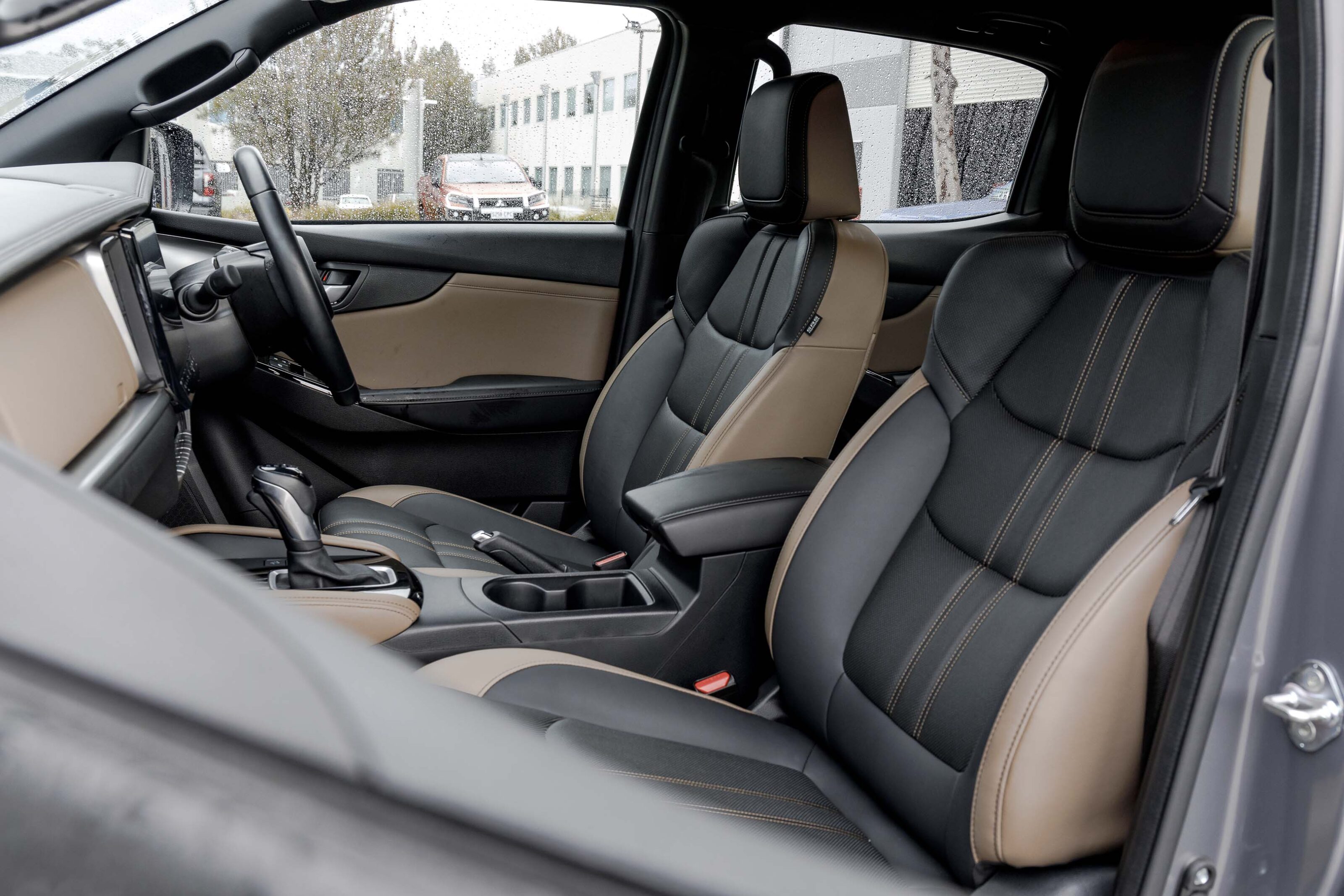
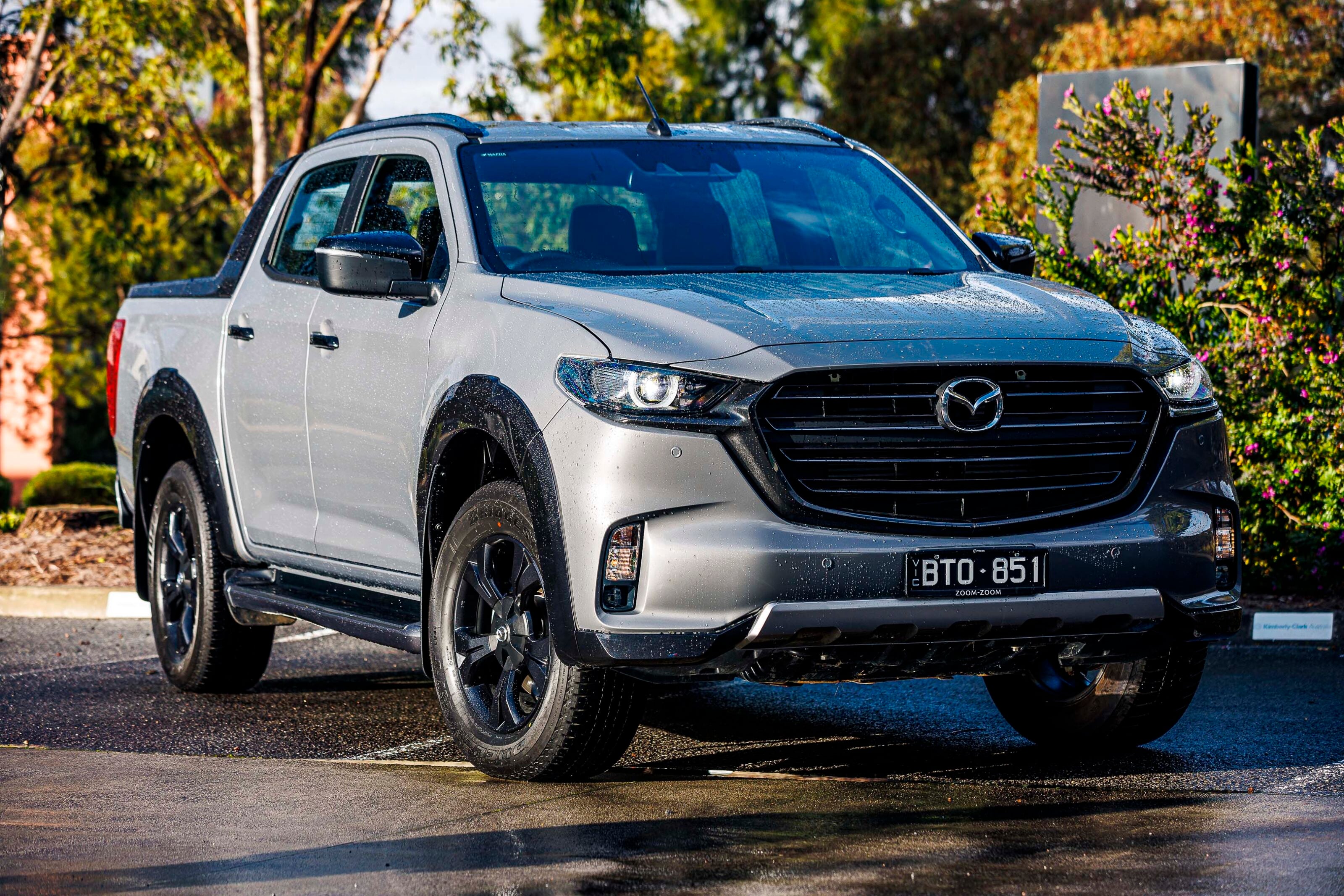
As it’s the top model, it also gets extra kit over the previous range-topping GT including smoked and darkened exterior trims complementing black 18-inch wheels, higher-grade leather upholstery with suede trim and flared arches in gloss black. There’s also a slightly enhanced practical offering with roof rails, a tub liner and roller cover included as standard.
1
The biggest change with all variants compared with the entry XS is the step up to a 3.0-litre four-cylinder diesel engine producing 140kW and 450Nm, which is about smack in the middle of average for the current crop of one-tonne utes.
A manual six-speed gearbox saves $3000 from the bottom line but the pairing of the six-speed auto and stoic turbo-diesel would be hard to pass up as it strikes a good balance of hardworking performance as well as better-than-average fuel consumption. More about that later.
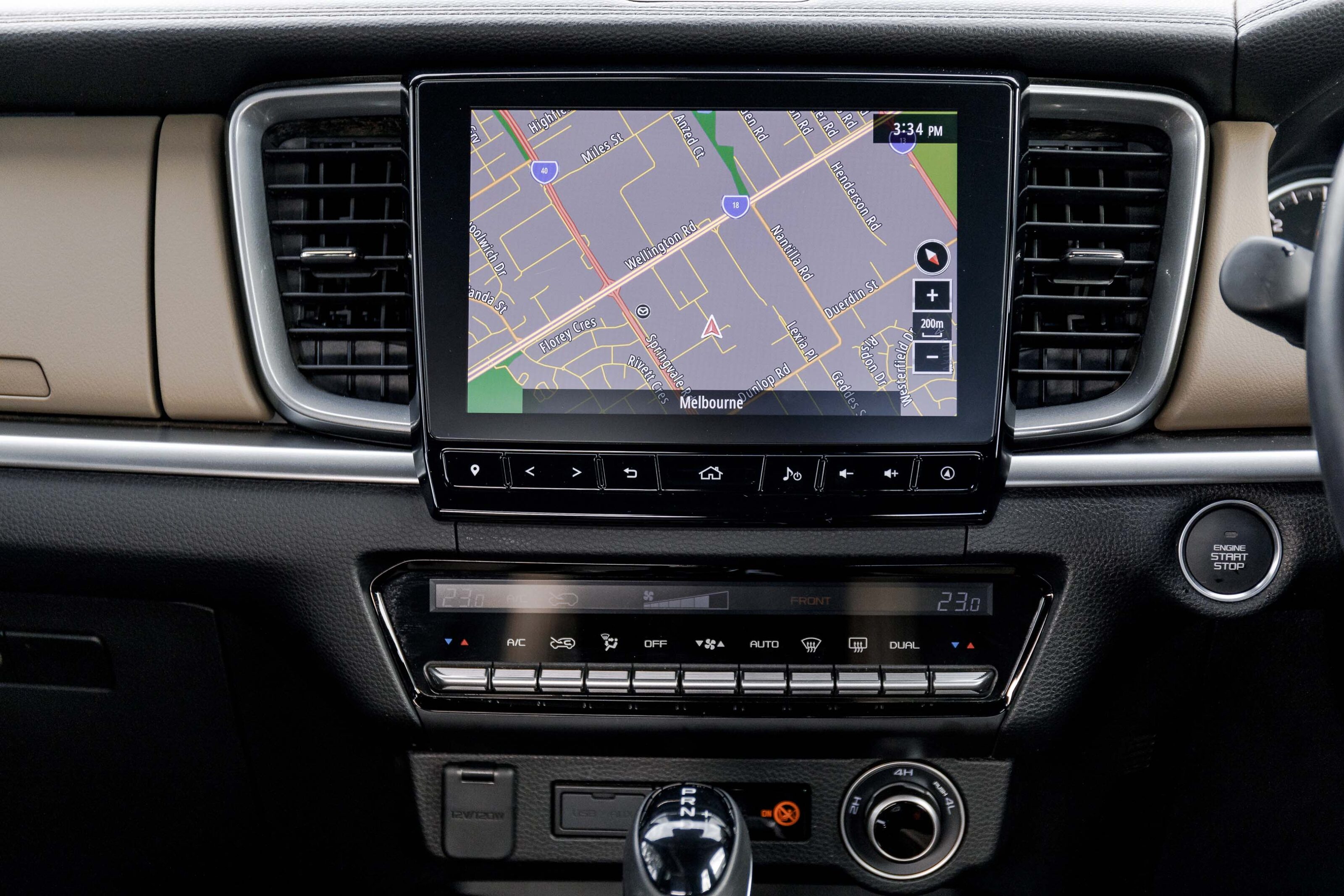
Included in the price is an attractive amount of standard equipment such as Android Auto and Apple CarPlay (although only the latter is available wirelessly), part-leather upholstery, an eight-speaker audio system with 9.0-inch central touchscreen, native navigation, keyless entry and start, front seat heaters and electric seat adjustment for the driver.
If you love the BT-50’s drivetrain but don’t insist on the Mazda DNA, its fraternal twin is on offer from Isuzu at $50,990 before on-road costs – although opting for the entry SX will forfeit much of the luxury kit that allows the BT-50 SP to stand out.
In high-spec Pro-4X trim, the Nissan Navara offers a good-looking ute on the outside with a decent level of equipment as well as price and performance to match the SP.
The resoundingly good Ford Ranger might also be on your radar given its recent arrival and the high acclaim it has been receiving, but with a budget similar to the SP only the entry-point options will fit the bill.
Toyota’s HiLux may also be in the consideration set for obvious reasons and a circa $60,000 budget would allow the most popular SR5 version. This cash cow of the HiLux family brings more power and torque than the BT-50 as well as Toyota’s rock-solid reputation but its standard equipment, interior fit-out and practicality are significantly off-par.
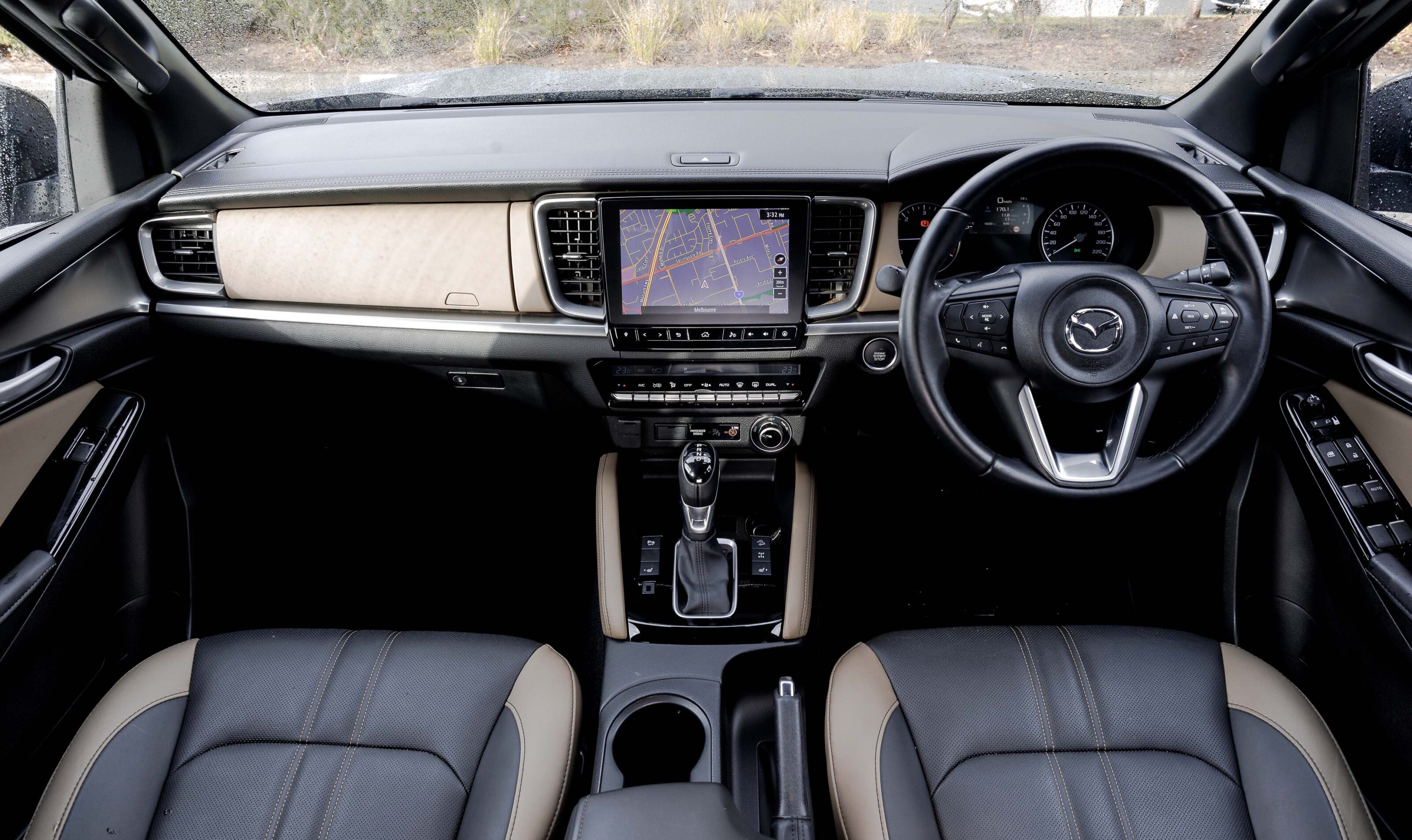
Mazda’s BT-50 has easily one of the most car-like cabins among dual-cab utes, with tasteful two-tone upholstery and a logical dashboard layout.
The Mazda shares much of its underpinnings with the Isuzu D-Max but manages to introduce some differentiation including its more luxurious cabin finish, electric driver’s seat adjustment, a classier black roof lining and heated front seats.
Its front seats are as comfortable as they look and offer a generous 90mm of headroom for the driver. The impressive 9.0-inch central touchscreen is one interior item that the BT-50 does have in common with the Isuzu and while it has sharp graphics and decent features, the system takes more than 20 seconds to boot up after the engine is started – the longest of any tested in our recent ute megatest.
Unlike some others, the information and entertainment system does not incorporate the climate control functions, instead relegating them to a specific panel below with a clean digital display and hard switches.
2
Also common to both Isuzu and Mazda are a small, sporty and ergonomic steering wheel covered in top-quality leather with two-way adjustment, an upholstered dashboard with real stitching, big phone storage tray and USB-A and 12-volt power for the front row.
There’s also a neat double glove box than boosts interior stowage capacity and options. Second-row passengers are also well looked after with a whopping 100mm of knee room, another USB socket, ample toe room, ceiling-mounted speakers and great visibility even for smaller occupants.
Headroom is limited in the second row with just 40mm of space and the rear doors don’t open as wide as some other utes, which could make loading people and things a little trickier.
With a payload of up to 1065kg, the BT-50 SP is a true one-tonner and has an (almost industry standard) 3500kg braked towing capacity.
With its D-Max shared underpinnings, the BT-50 offers the same sweet steering that’s direct and mechanical but not rough, as well as handling that makes the Mazda very easy to position on the road.
Driving dynamics are generally similar but the BT-50 chassis tune has been softened off slightly for a more comfortable ride while maintaining enough entertainment and involvement for the driver. The result is a level of dynamics and comfort that manages to keep all occupants happy.
It’s also one of the best to live with in tighter spots thanks to overall proportions that feel smaller (in the right way) and good outward visibility. This nicely pairs with the parking radar and reverse camera.
We’re not recommending that any dual-cab is a good match for mostly suburban driving but the Mazda is one that makes relatively light work of metro duties.
2
Power and torque delivery does not stand out from the ute pack with a similar functional nature that’s found in virtually all vehicles of this class. There’s a little more noise and clatter from the 3.0-litre turbocharged diesel four-cylinder but nothing unacceptable, while the automatic transmission is largely benign and smooth.
With only six speeds, the auto is feeling its age, however, among some rivals that are now bragging about seven, eight and even 10-speed offerings.
Along with the GWM Cannon, the BT-50’s interior is easily the plushest of any one-tonne utes on the current market. That is very much relatively speaking, though, and if you were to liken the ambience to an actual Mazda passenger car, it would be a 2014 Mazda 3.
Nonetheless, its focus on more home comforts and less on the agricultural grind makes the SP one of the most luxurious and relaxing ute cabins to spend time in.
Compared with 10 rivals in our recent ute megatest, the Mazda was the most frugal using just 9.3 litres per 100km, which is not far off Mazda’s claimed 8.0L/100km.
While that efficiency is a big selling point and commendable in the ute world, one downside is that the BT-50’s engine takes a very long time to warm up.
On a typical morning commute, the 3.0-litre donk took a glacial 15 minutes to reach normal operating temperature. Not a massive issue but one you’d notice on cold winter mornings when the heater is lukewarm for a noticeable length of time.
The Australasian New Car Assessment Program (ANCAP) awarded the BT-50 with its full five-star rating in 2020.
The model scored well in child occupant protection as well as safety assistance systems thanks in part to the inclusion of standard AEB and lane-keep technology.
It lost marks for the absence of AEB in reverse and, like many high-riding utes, was marked down for vulnerable road user protection including head impact rating.
Other standard safety features include eight airbags, ISOFIX and top tether anchors for two child seats in the second row, blind-spot monitoring, speed sign recognition, driver fatigue monitoring, adaptive cruise control, rear cross-traffic alert and reversing camera.
Since April 2019, all new Mazdas have been covered by a five-year, unlimited-kilometre warranty along with roadside assistance for the same period.
The BT-50 requires scheduled servicing every 15,000km or 12 months, whichever comes first, and the cost of each service ranges between about $330 to $700 depending on the scheduled requirements.
In an evolving market where one-tonne utes and dual-cabs are trying to behave more like SUVs than tough trucks, the Mazda is one of the most successful at trying to be something it isn’t.
With the accomplished Isuzu D-Max as its basis, the BT-50 was already off to a good start but the addition of some Mazda passenger car know-how has really lifted the SP into a different class.
Excellent fuel efficiency comes at a cost of engine noise and a lazy heater in the winter months, while a slow-to-start infotainment system is another example of niggles rather than significant deal-breakers.
Overall, a few small foibles cannot detract from an impressive package of refinement and comfort that compromises few of the attributes that increasing numbers of Australians find attractive in utes as the main car of the family.
Do all EVs drive the same? It’s question we get asked regularly and as I’ve just spent the last week testing 16 electric cars back-to-back for our EV buyer’s guide, it’s also one I feel well-placed to given an opinion on.
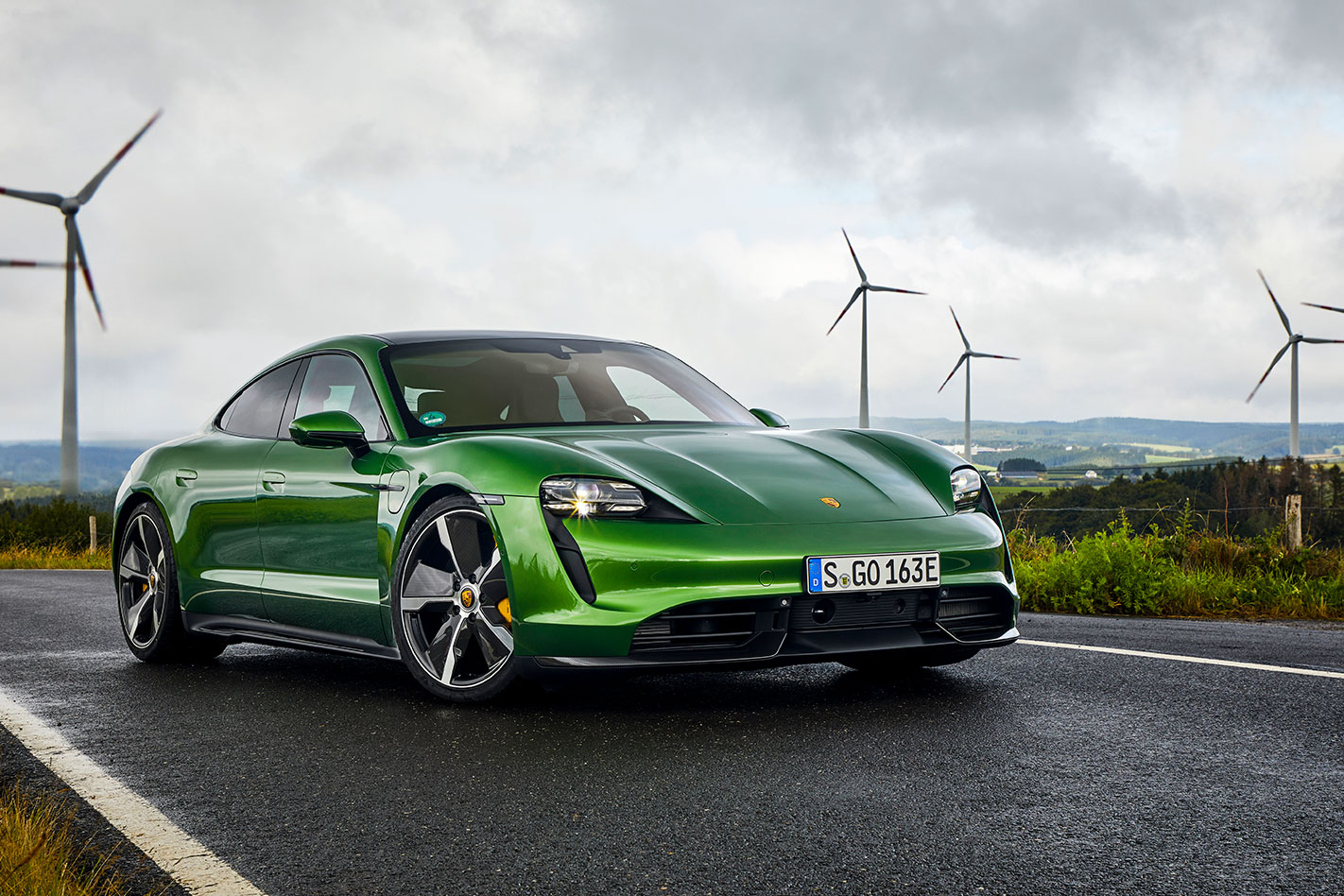
The short answer is no, they do not. As you’d expect there is a gulf of difference between Australia’s first electric dual-cab ute, the LDV eT60, and the lower slung, more powerful and driver-focused Porsche Taycan.
1
In saying that, though, there are undoubted similarities. Take our fleet of 16 electric cars that made up our megatest, as an example. They span a range of price points, body styles and levels of performance and yet if you plonked me blindfolded into the passenger seat I think I’d have been hard pressed to tell you which car were were in.
I’d have got there eventually once I’d had time to drink in how it rides, how the seats felt and the level of refinement on offer but over the first few hundred metres, I’d have had giant question mark dangling over my head.
All of the usual cues are gone. There’s no exhaust note, no vibrations and none of the telltale hints we typically rely on to know “okay, that’s the smooth purr of a straight six petrol so this must be a BMW”.
1
In a combustion-powered car, the engine is the heart and soul.
There are almost endless ways a combustion engine can alter the character: cylinder count, displacement, layout, forced induction, rev limit, fuel type…the list goes on.
Even the type of gearbox – torque converter auto, manual, dual clutch – adds to the flavour. But again, this is another area that’s mostly been homogenised in electric cars.
Power away in an electric car and the experience is eerily similar across all of them. You get instant response, effortless acceleration and uninterrupted progress. All good things, but there’s not much about them that feels unique.
It means the usual foundations that brands have relied upon for decades to distinguish themselves – BMW with its silky straight sixes, Porsche with its off-beat boxer growl – will soon no longer apply. In the future, the key battleground for brands to win the hearts and minds of prospective buyers won’t be the power plant. As for what will take its place? That’s exactly what the world’s carmakers are currently trying to figure out…
The usual foundations that brands have relied upon for decades to distinguish themselves – BMW with its silky straight sixes, Porsche with its off-beat boxer growl – will soon no longer apply
Perhaps the most interesting frontier is sound. Piping a fake exhaust track through a car’s speakers is nothing new – anyone else remember when Renault gave you the option of making the Clio sound like a Nissan GT-R? – but it is an area where brands are beginning to veer off in new and interesting directions.
AMG fits something called “AMG performance sound” to its sportier EVs that mostly makes them sound like angry spaceships, while BMW has engaged legendary composed Hans Zimmer to create the audio signature of its electric models. It does mean switching on an i7 unleashes a crescendo of noise that makes you feel like you’re in a pivotal scene from the movie Dune, but there’s no denying it’s distinctive.
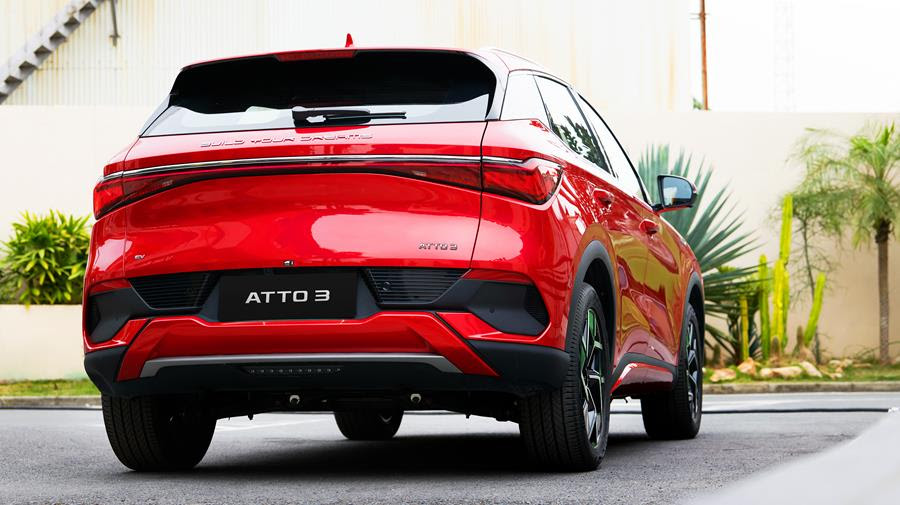
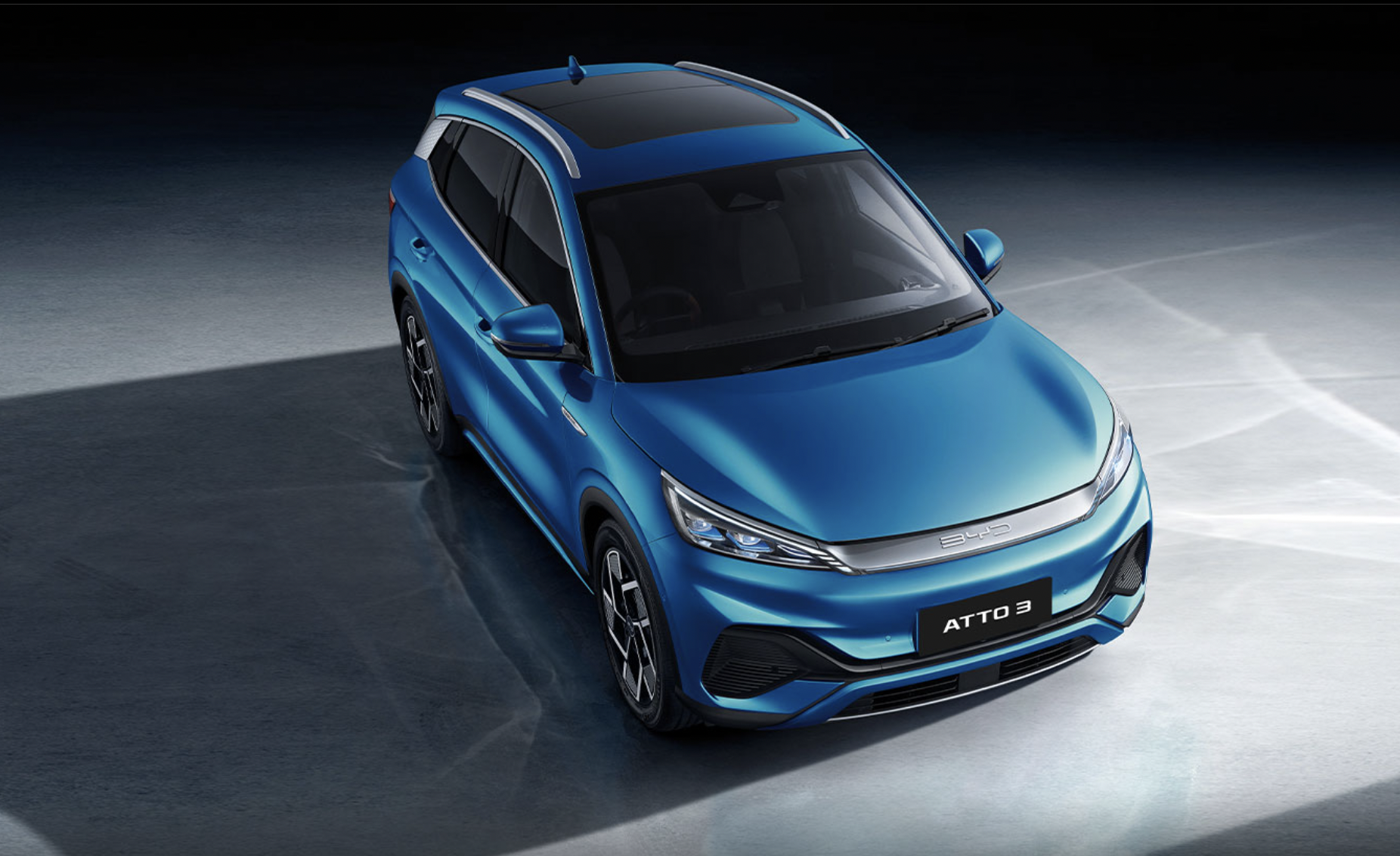
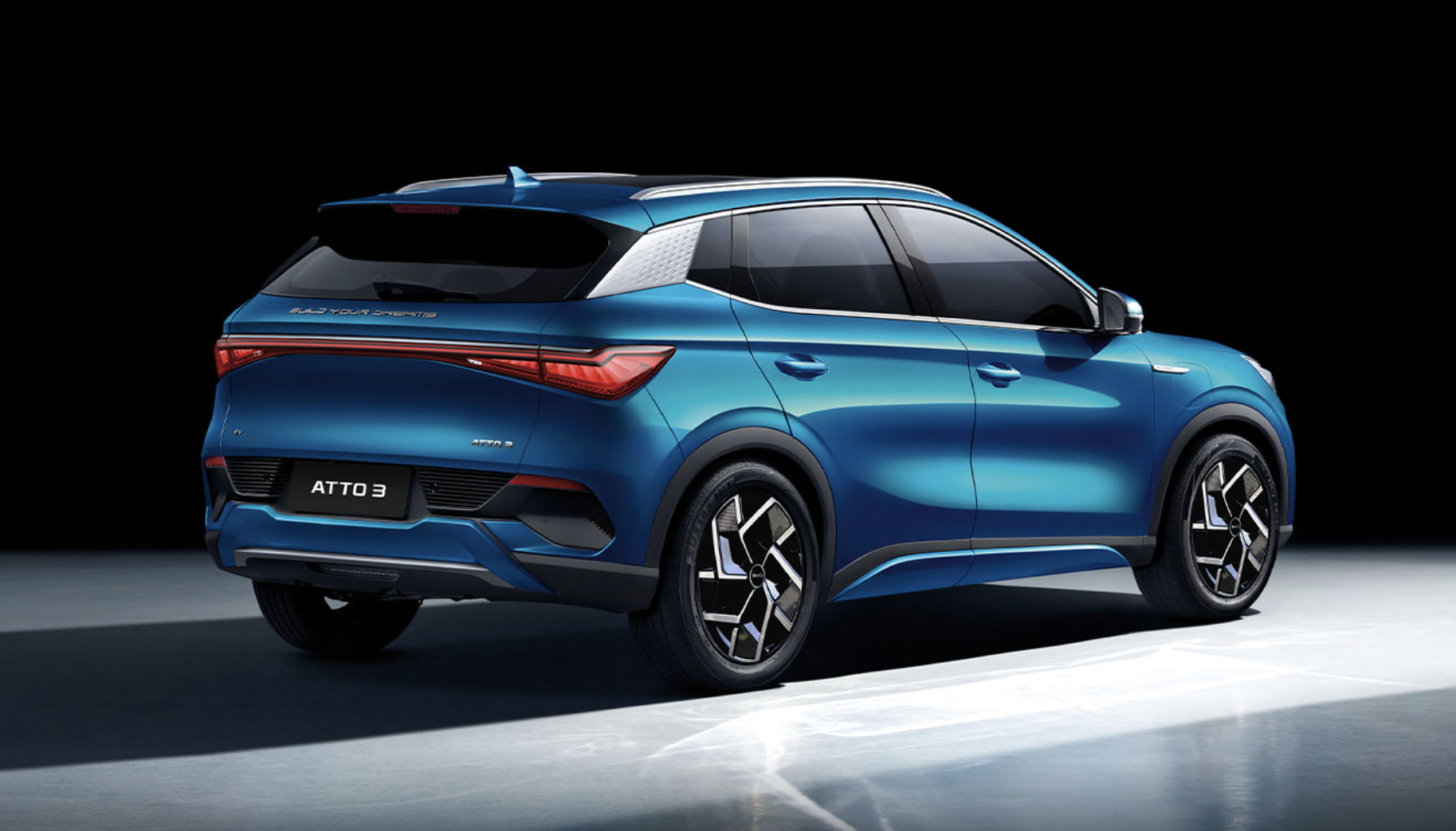
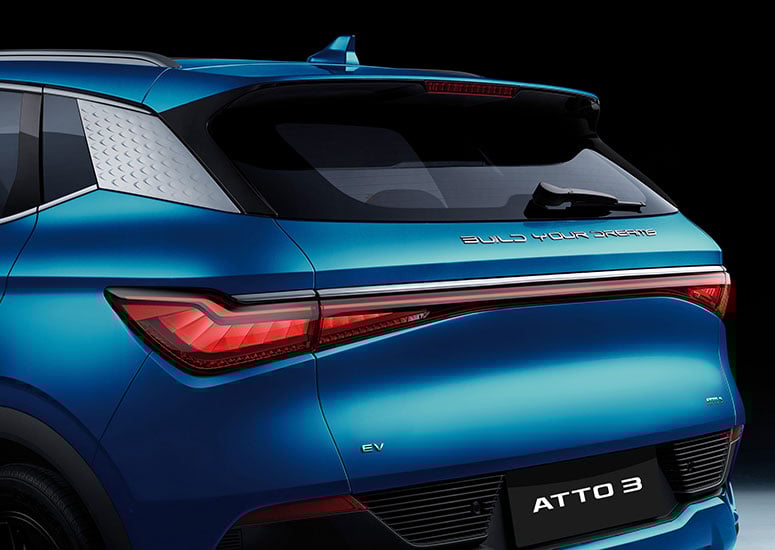
And it’s not just high-end car makers who are using sound to create personality and connection. The BYD Atto 3 also makes some weird and wonderful noises and one of the strangest experiences I encountered on the EV megatest was driving up a deserted multi-level carpark in the dead of the night as the BYD played a spooky, pulse-like soundtrack to ensure I didn’t squash an unsuspecting pedestrian.
Dynamically speaking, regen braking is another domain that’s sparking divergent approaches.
Some brands, like Porsche, mostly eschew it all together while others are opting for one-pedal driving with varying levels of success. Merc’s strongest D- setting, for example, is incredibly forceful and noteworthy.
Design is where the most obvious opportunity lies for reinventing brand identity, of course. Electric vehicles open up an entirely new realm of possibilities to create unique proportions and shapes – though until now, most brands are playing it safe. Expect for Hyundai, that is. Clock an Ioniq 5or Ioniq 6 in the metal and there’s no mistaking which brand they come from.
So, do all EVs feel the same?
Judge them by their powertrains alone and there’s no denying things are starting to converge.
But don’t fret that we’re approaching a sea of sameness. There are a host of other parameters just waiting to be explored…
With so many different grades of petrol to choose from and not much in the way of explanation on why 98 RON petrol costs so much more than 91 RON, why would you opt to top up with premium petrol?
The RON or Research Octane Number indicates the octane rating of the petrol and the fuel’s ability to withstand a combustion anomaly known as detonation.
The higher the RON rating, the greater its stability in more highly-strung, high-performance engines – but are you risking damage to your engine by filling up with the cheapest option?
The good news is that if your engine has electronic fuel injection, it is likely to be fitted with a system that can detect the dreaded detonation (sometimes referred to as knocking, pinging or pinking) and instantly pulls an ignition trick called retardation.
Retarding the ignition point puts your engine back in the safe zone but, as a general rule, engines are more efficient and powerful with the ignition point as advanced as possible. Modern engines are constantly trying to find the fine line between the earliest ignition point without causing detonation.
By filling up with higher octane fuel, you might be giving your engine a helping hand to work more efficiently – but it is not a magic upgrade, and for some motors it’ll do very little at all.
Depending on the car you own, fuelling up with 98 octane can result in increased performance that will see you produce a little extra power when compared to lower octane petrol. But if you’re driving something older that hasn’t been tuned to run on high-octane, you’ll likely see no tangible benefit.
Each vehicle model has a recommended minimum octane requirement – often printed somewhere near the fuel filler cap – and owners should not fill up with a fuel grade lower than this, but a higher grade may offer advantages.
Test it for yourself
The most reliable way to find out if you could be going further on a tank of 98 or higher is to conduct your own test
Make a note of how far a fill of the cheapest option takes you using your normal driving style and habits, then compare the results to a tank of higher-grade fuel during the same typical conditions. You might be surprised at the results.
1
Is it really worth it?
Ultimately, it’s a trade-off between performance and dollars spent, as while you may be getting extra distance or performance out of your fuel, you’ll have to pay more to reap the benefits.
The value equation depends on the car you drive and whether it will make use of the higher octane’s better qualities.
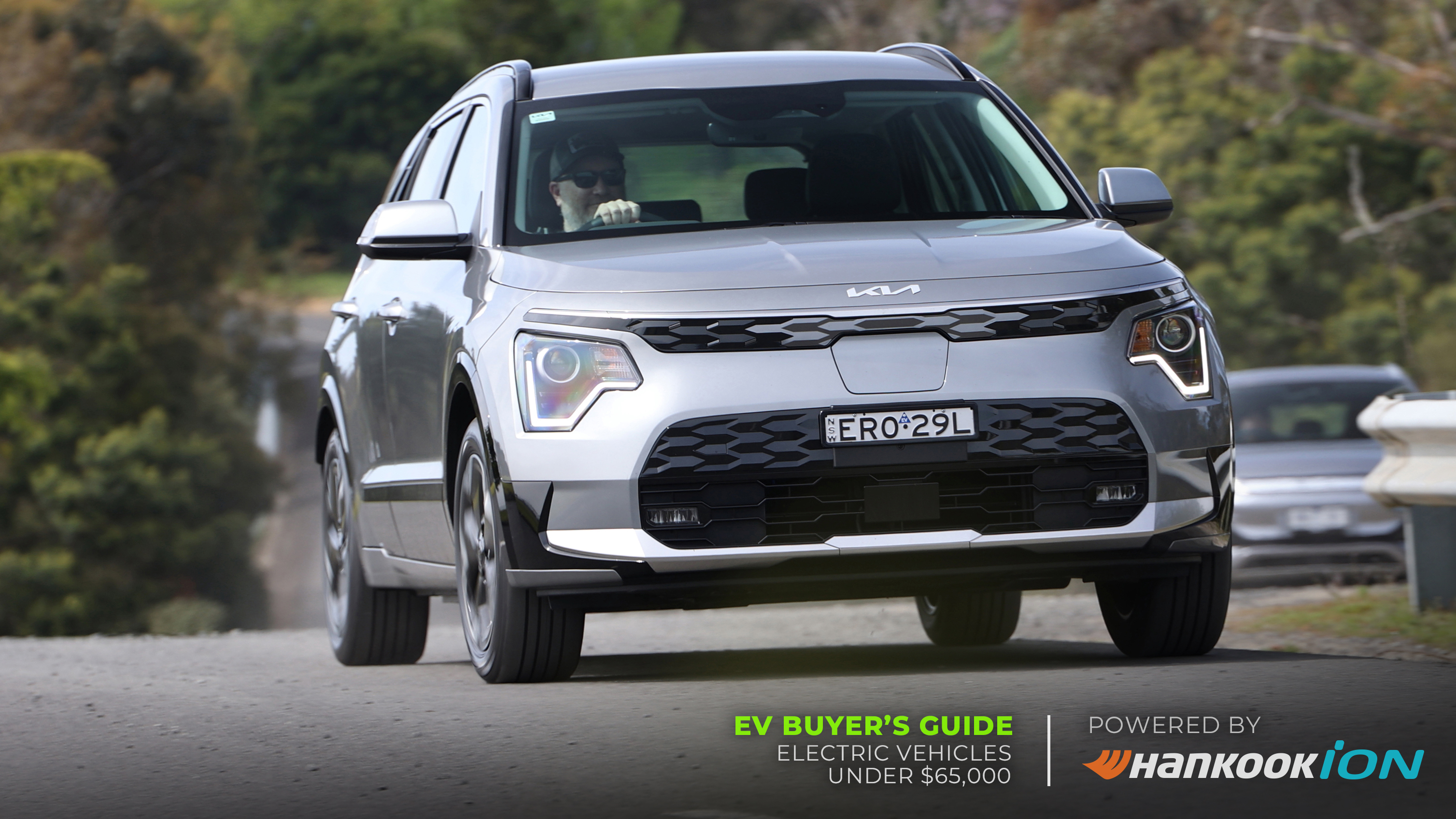
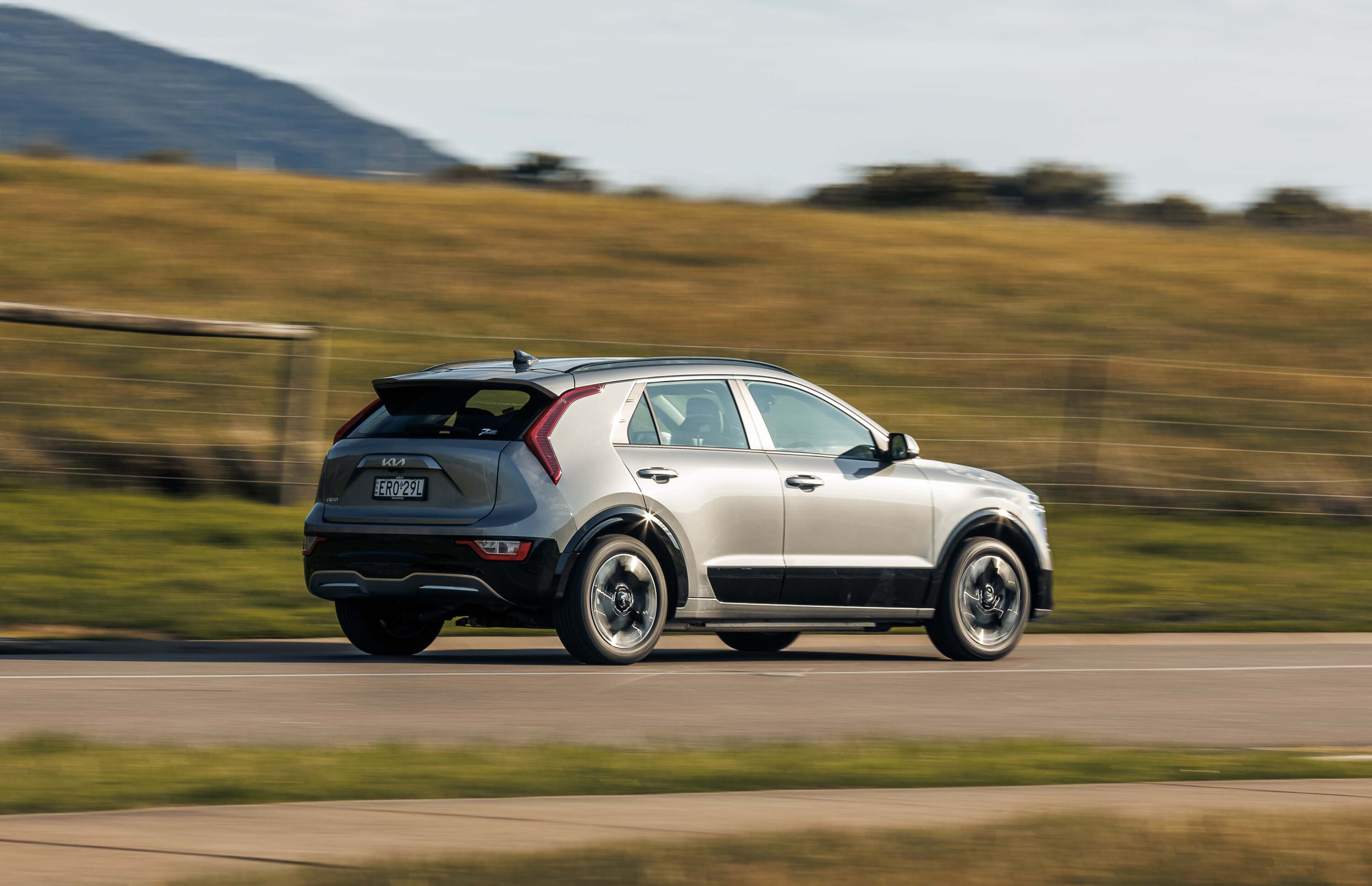
If you’re ready to make the leap into an electric vehicle but you’ve got a close eye on the budget, these are the most affordable EVs on sale in Australia right now – and what we think of them.
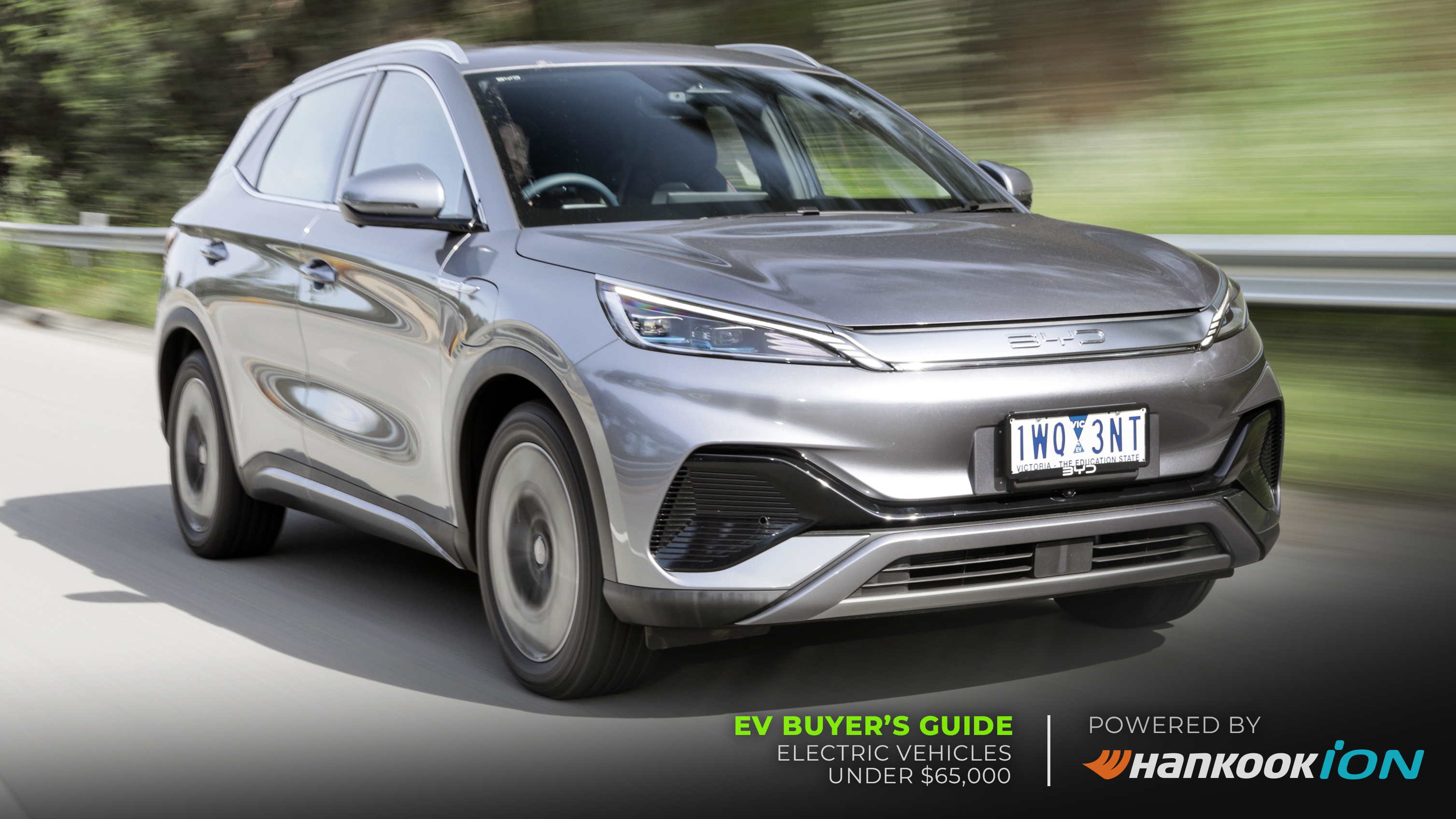
This guide is intended to serve as an outline of each model available in that critical $65,000 category, to help you decide which models you’d like to know more about. With each model listed below, you’ll find links to our more comprehensive deep-dive reviews of each car.
Welcome to our EV Buyer’s Guide: Electric Vehicles Under $65K Ranked – The Best and The Rest
The hope is that we’re only a year away from having more affordable electric cars to create a worthwhile Under $50,000 category.
To create a meaningful Under $65K category, we’ve allowed for the odd model being a few-hundred bucks over the ceiling. Yet it’s also fair to say that, in many states, those cars would fall below $65,000 after rebates and/or state duty exemptions or discounts are applied.
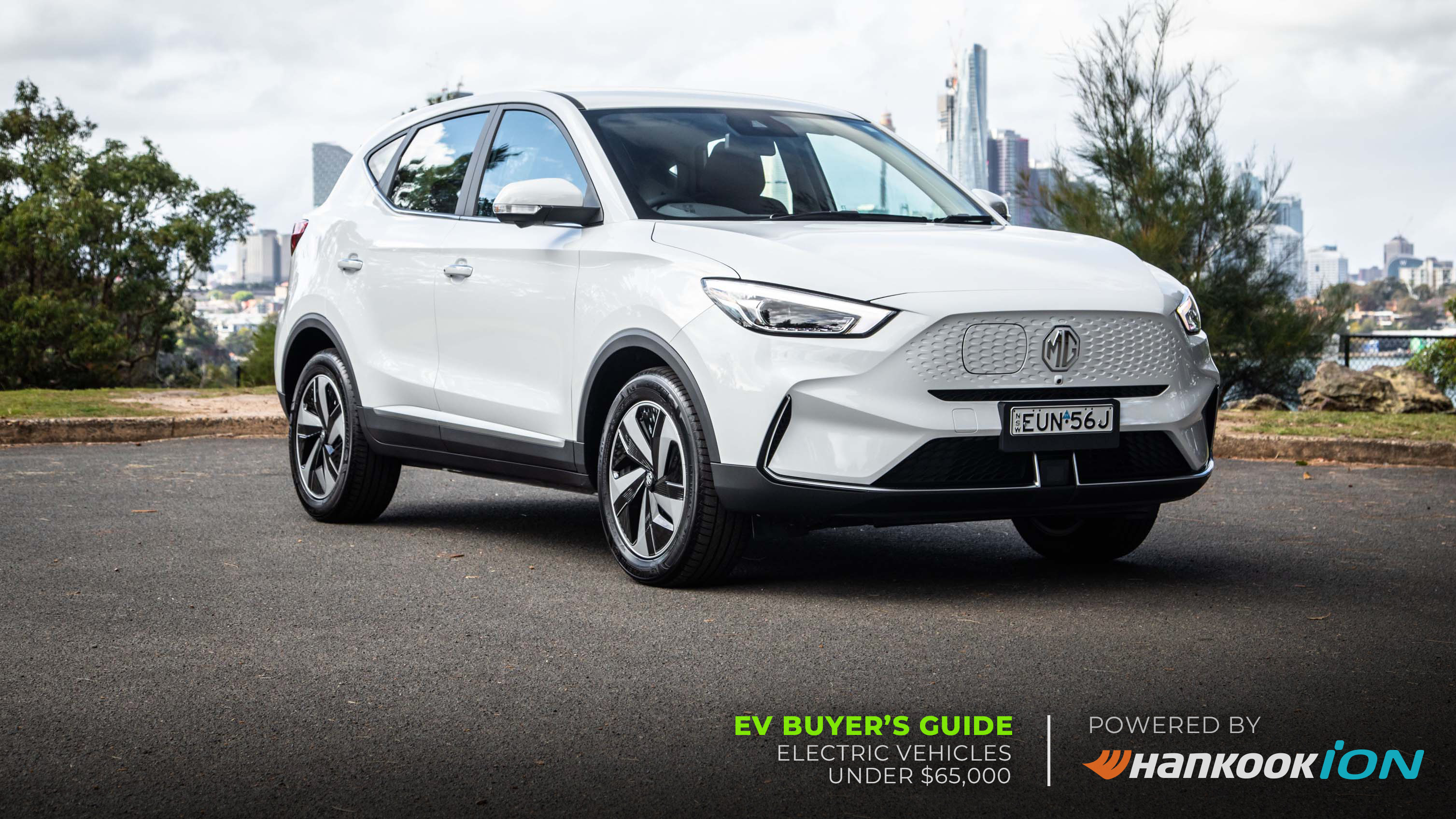
Chinese brands are leading the way for Australia’s most affordable EVs. Depending on your state, either the BYD Atto 3 or MG ZS EV are the most affordable electric cars available in Australia – each starting from about $45,000 drive-away. The Atto 3 heralds the arrival of the Build Your Dream brand, imported by local distributor EV Direct.
MG couldn’t find a ZS EV for our Megatest, though we’ve previously, and recently, reviewed and compared it (with the Atto 3) – for which you’ll find links below. BMW also couldn’t provide an electric Mini, the only other EV under $100K that missed out on our Megatest.
NOTE: This story, along with our other price-based EV buying guides (see links below) will be updated over time. You may see the scores and ranking of these models change as they age and as more compelling rivals enter the market.
Let’s get into it: These are all the electric vehicles available in Australia for under $65,000 (with two exceptions), rated from best to worst, as tested and assessed by the Wheels Media team.
2
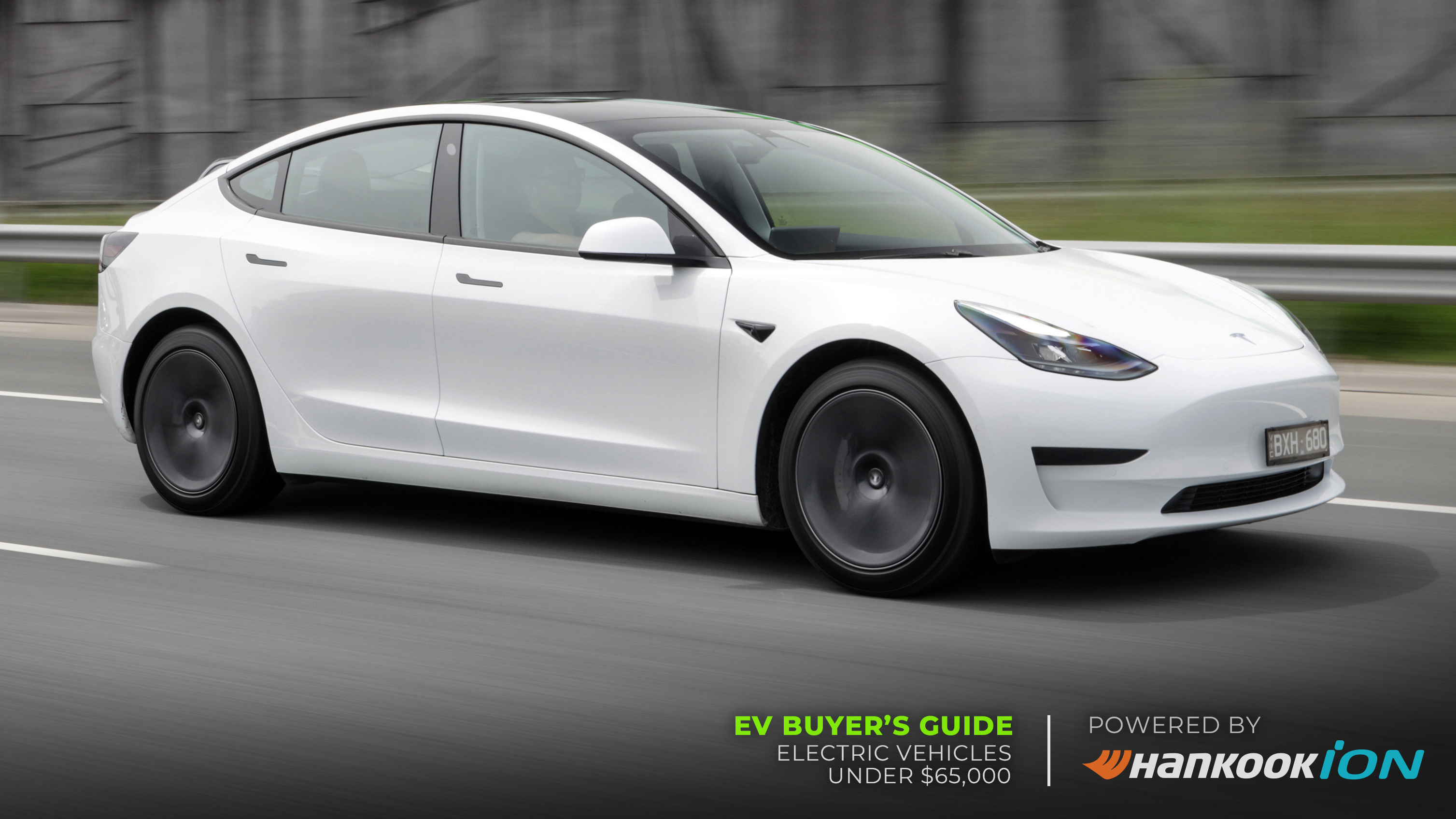
BEST BUY: Tesla Model 3
Cameron Kirby
No other manufacturer is as integral to the proliferation, popularity, and technological advancement of electric cars as Tesla, and for the American manufacturer the Model 3 is its core product.
Things we like
In-house charging network
Rapid recharge
Airy cabin
Not so much…
Infotainment learning curve
Firm ride
Needs a head-up display
The hype surrounding this model is significant, and well-earned, but there are certain factors that potential buyers should be aware of.
Standard features on the 2022 Model 3 include but are not limited to LED headlights, LED daytime running lights, 18-inch alloy wheels, a panoramic glass roof (with ultraviolet/infrared protection), and a collection of cameras for Tesla’s much-hyped driver aids. (Note: This paragraph originally mentioned ultrasonic sensors as well, but Tesla has removed that tech from its latest builds.)
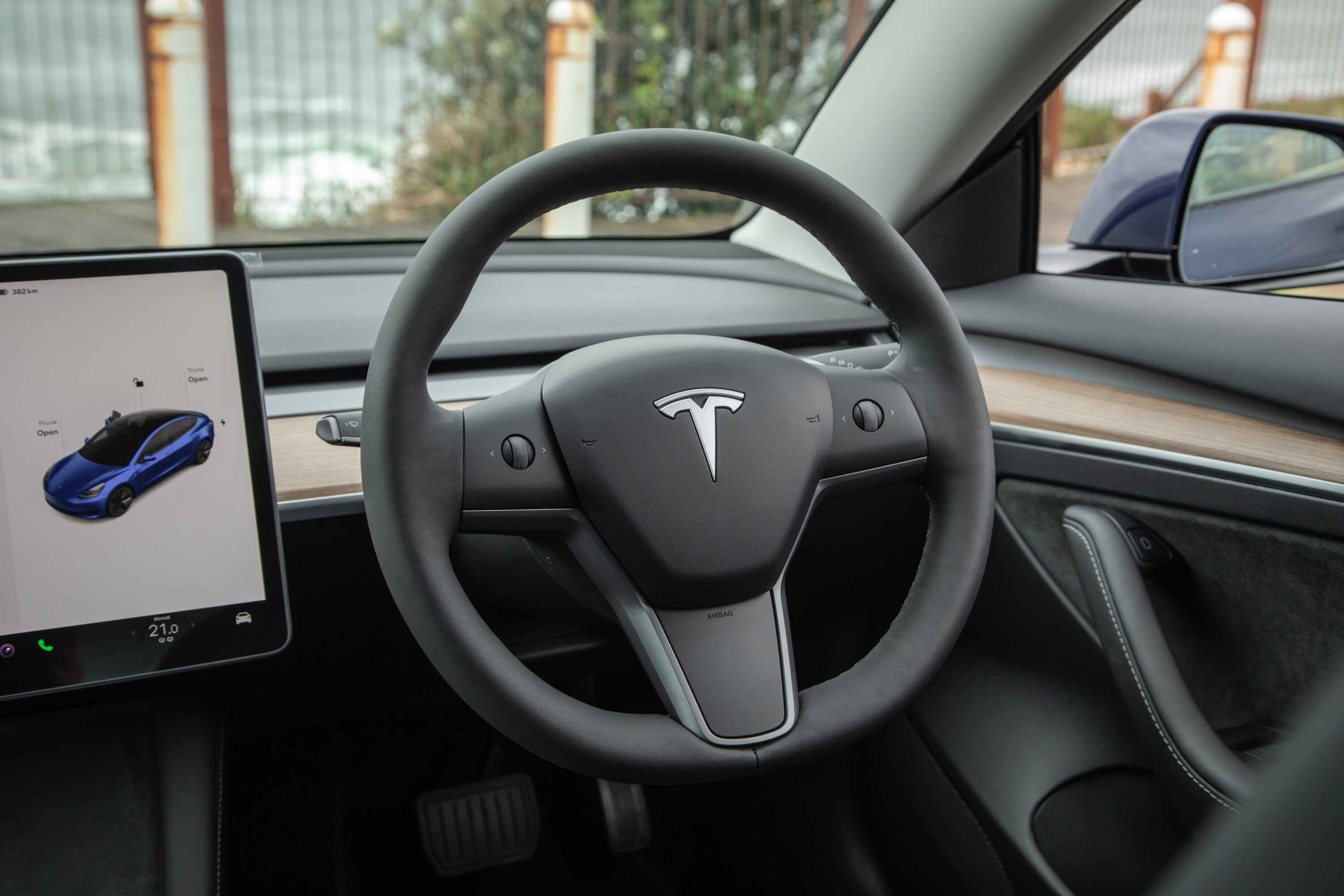
The cabin has dual-zone climate control, 15-inch central multi-function touchscreen, electric front seat adjustment, heated steering wheel, heated front/rear seats, and dual wireless phone charging.
1
One of the smartest additions is the dual inductive charging tray placed under the central infotainment screen.
It is worth noting that if you are reading this months or years after the story is initially published that you should check what changes may have been made to the features list – more than any other manufacturer Tesla loves to update and change its standard offering.
Minimalist is an understated descriptor of the Model 3’s interior with it sole feature being the 15-inch touchscreen that contains almost literally every one of the cars functions. A pair of wheel-mounted dials take care of a handful of controls, while everything else will have you prodding the screen.
1
While crisp and quick to respond to inputs, the Tesla’s infotainment operating system requires plenty of time to learn.
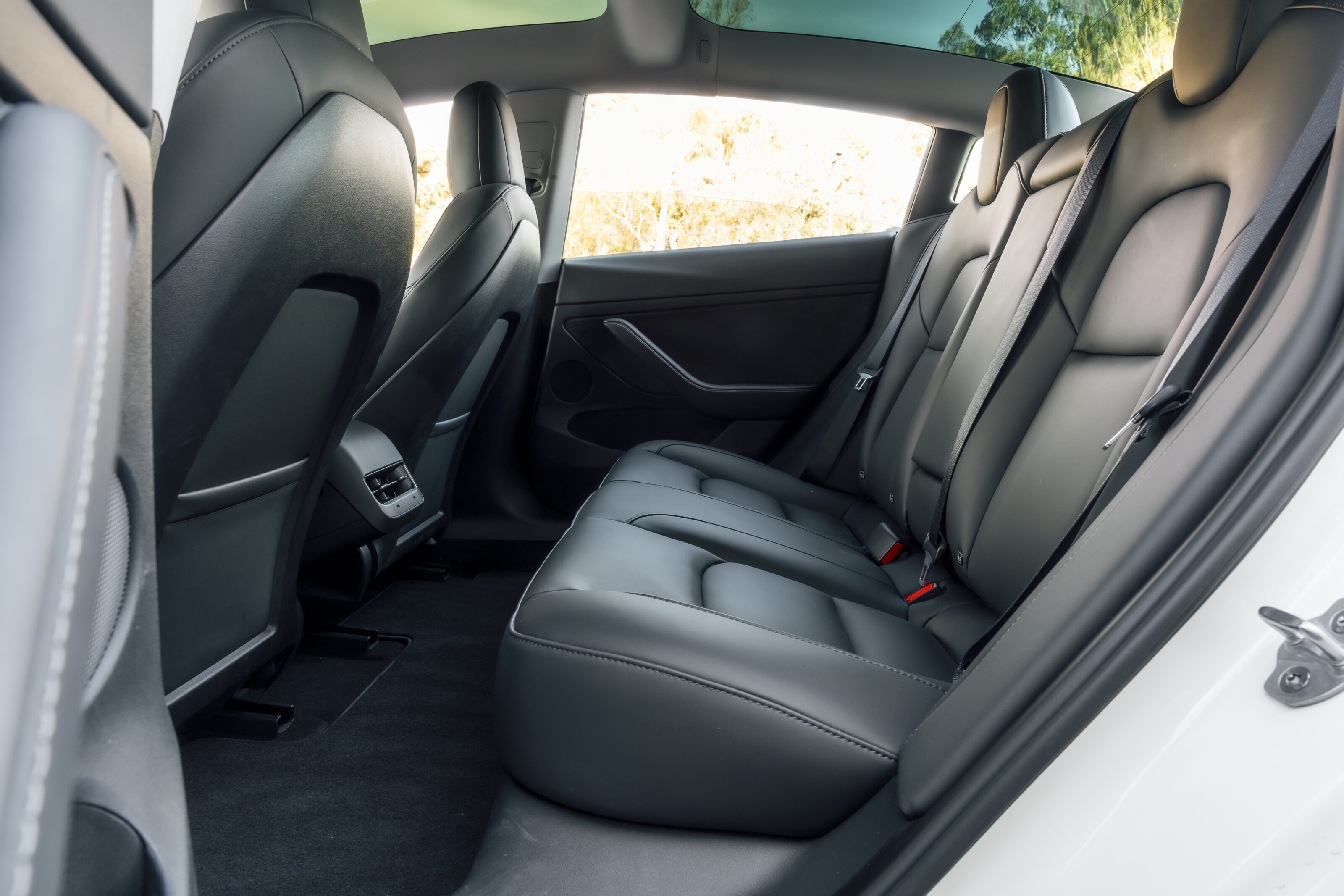
Spartan design aside, there is plenty of headroom in the cabin, and the front glass stretches above front occupants to give the Model 3 and incredibly airy feeling inside. Both front and rear boots offer plenty of storage as well.
With a 62.3kWh battery pack, the Model 3 offers a healthy real-world driving range thanks to its impressive efficiency on our test loop. This is complemented by the fastest charging of any contender – something owners will benefit from using both ultra-rapid 350kW chargers from the likes of Chargefox and Evie, as well as Tesla’s own supercharger network.
1
The driving experience in the Model 3 is initially dominated by mentally adapting to the fact there are no instruments directly in front of you.
Once you clear this hurdle (which happens surprisingly quickly) you key into the Model 3’s true nature. While the ride is a touch on the firm side, it doesn’t crash and has an impressive level of body control that makes the car perform above expectations on a challenging driver’s road.
Aiding this is a quick steering calibration with the Tesla’s wheel bereft of any dead zone, the front-end darting eagerly in response to inputs.
Everything about the Tesla Model 3 diverges from tradition, from the purchasing and after sales, to how you unlock the car. Which for many is exactly what they want from an EV. However it does create a cultural barrier of entry for some prospective buyers.
1
The Model 3 is a love/hate car. You either get it, or you don’t.
Its battery technology is some of the best you can find in the market, the in-house supercharger network is unmatched by any other OEM, and its infotainment (while having a learning curve) has a suite of features that cannot be found elsewhere.
If you are pulled in by its many unique facets the Tesla Model 3 remains as cutting-edge as ever. While its competitor set has never been more compelling, no EV buying process will be complete until you’ve conducted a test drive to see if this pioneer is right for you.
Hit the link below for our comprehensive news and reviews on the Model 3.
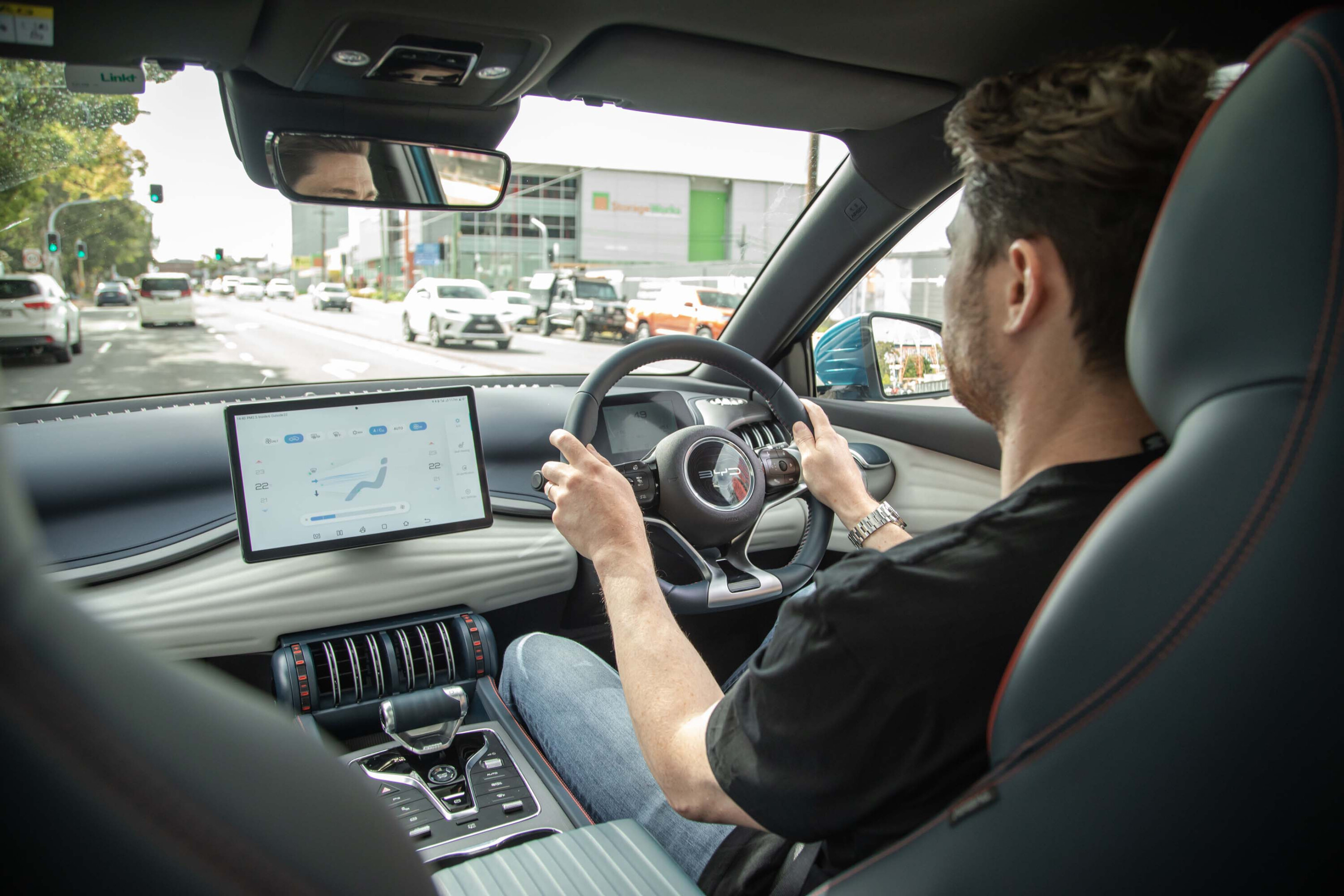
Hugely hyped and just a touch controversial, the BYD Atto 3 hits the mark for an affordable EV that’s well-built, well-equipped and decent to drive
Things we like
Sharply priced & well equipped
Cabin is spacious and feels well made
More room, range and performance than key rivals
Not so much…
Quirky cabin wonu2019t be to everyoneu2019s taste
Handling gets ragged on demanding roads
Unproven record for reliability and customer support
Long wait times
UPDATE, December 9: Up from a starting point of $44,381 to a new $48,011 before on-road costs. It maintains a highly-recommended ranking in this guide.
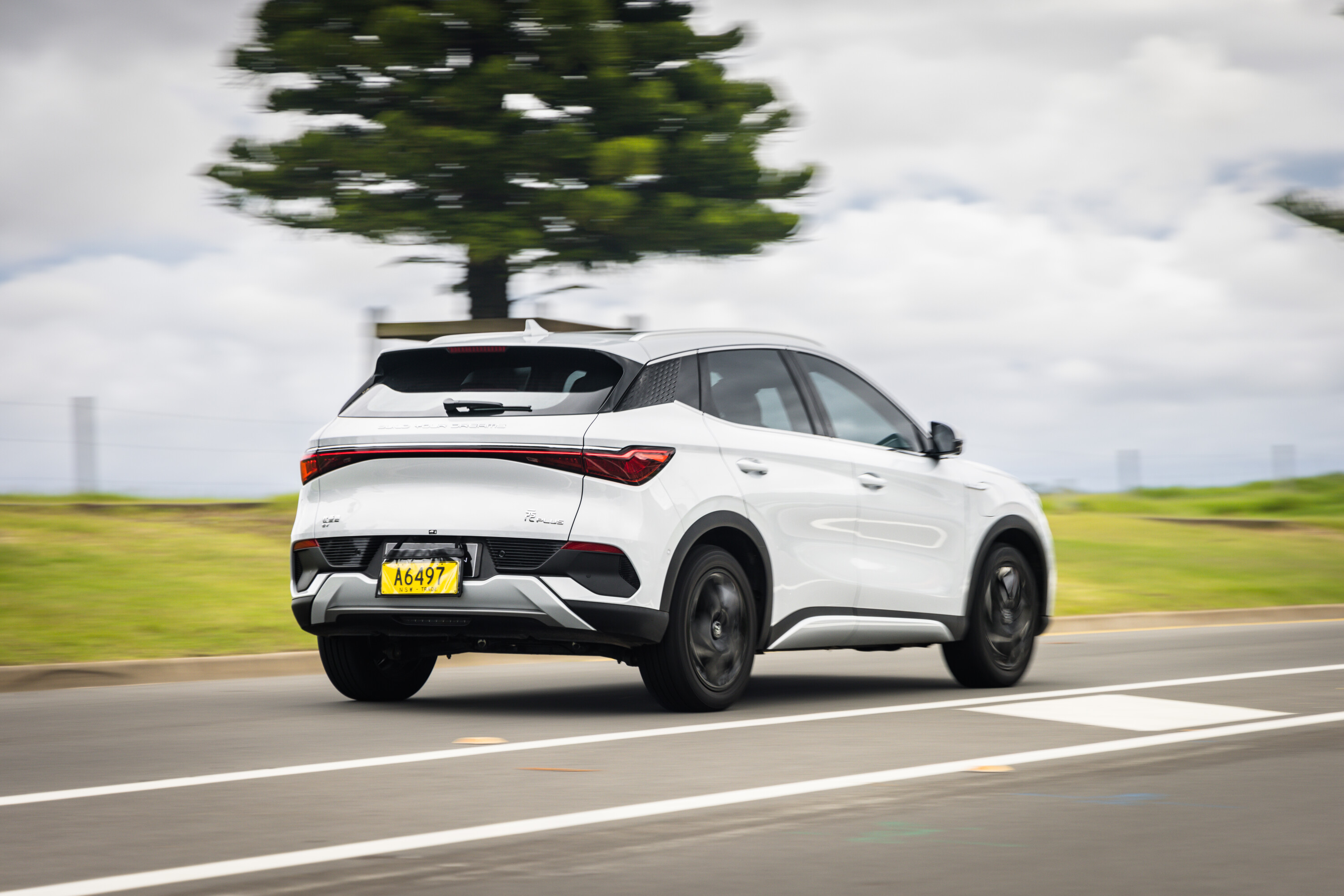
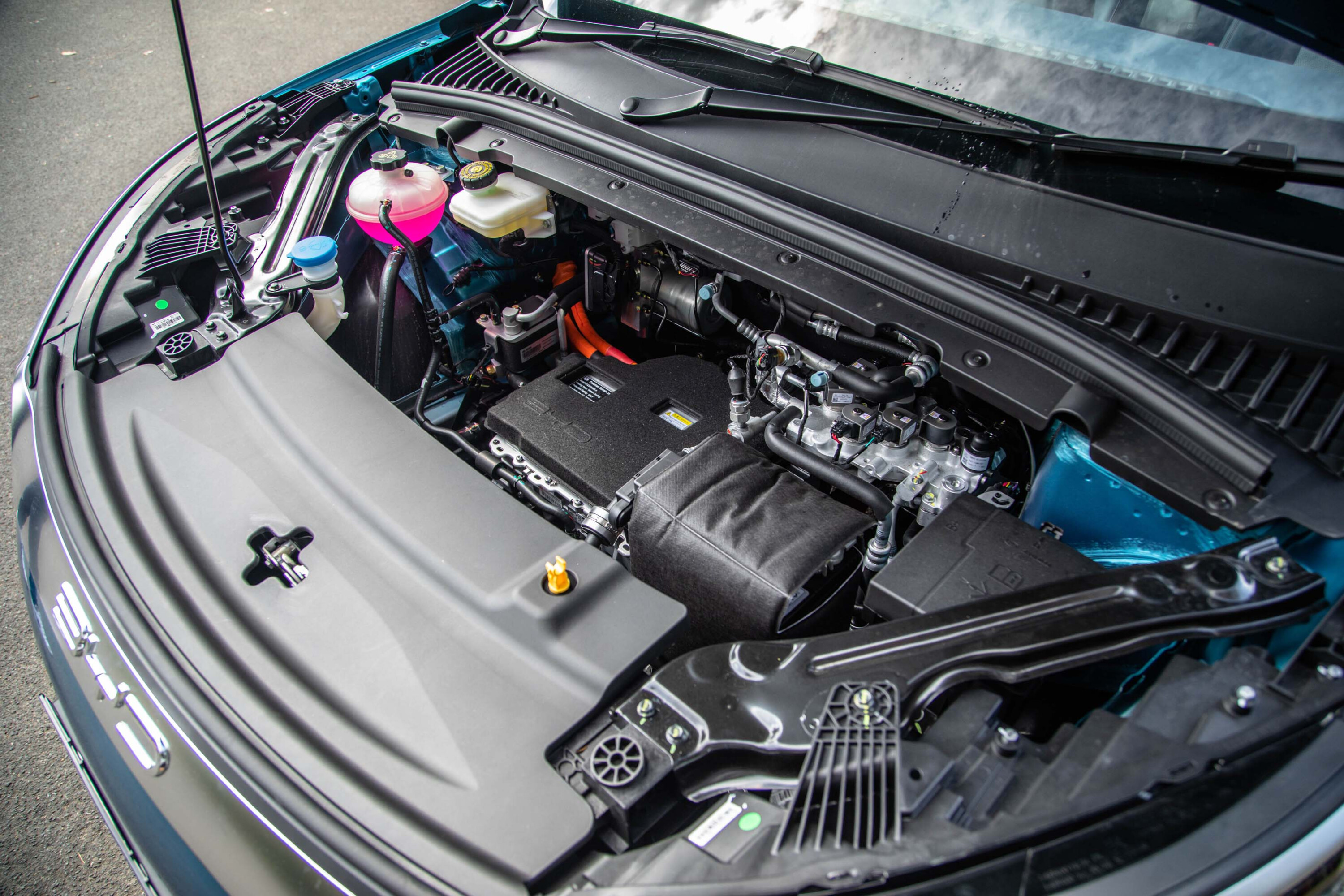
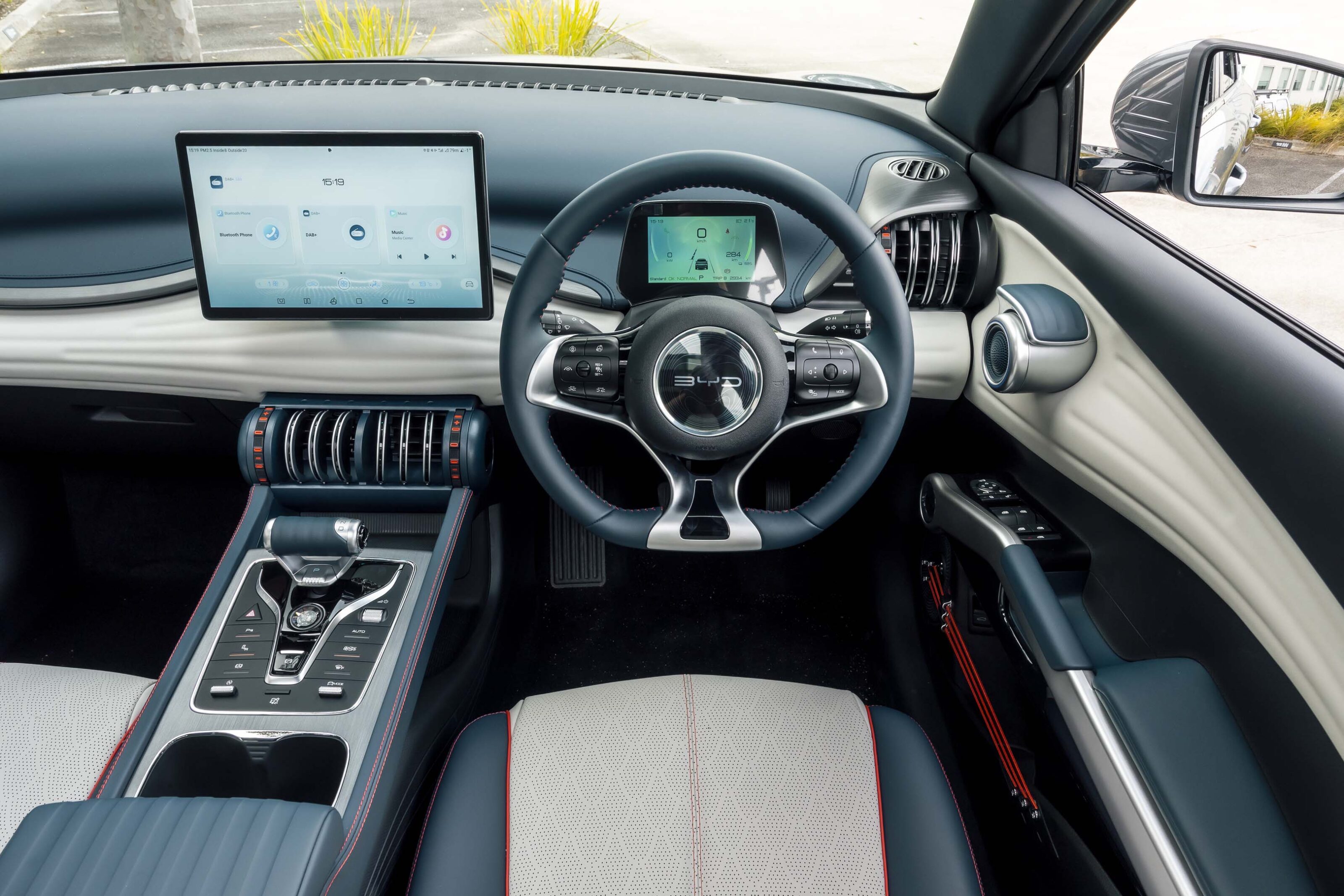
Tesla is often hailed as the great EV disruptor but right now the BYD Atto 3 might be more deserving of the title. Since it burst onto Aussie roads three months ago, the fresh Chinese brand has been making waves with its attractive pricing, quirky cabin design and new ‘blade battery’ tech.
The brand also found itself in hot water recently over compliance issues regarding child-seat tether points, but it worked quickly to resolve the fault and secured a 5-Star ANCAP rating soon after.
Demand, though, seems almost unquenchable. BYD isn’t yet counted in the official monthly sales figures but anecdotal reports suggest it was Australia’s second most popular EV brand in October, trailing only Tesla.
The biggest drawcard is price. Aussies have been crying out for more affordable ground-up electric cars and in 2022 we finally have some. There are two versions of the Atto 3 to choose from: the ‘Standard’ variant starts at $48,011, but the model we’re testing here is the ‘Extended’ which retails for $51,011 before incentives and on-roads.
1
The main difference between the two is battery size. The Standard car has a 50kWh battery pack that offers 345km of range while the Extended has a 60kWh battery and a claimed range of 420km.
Our real-world testing found that claim to be pretty accurate, too, with the Extended covering 390km on a full charge. Both versions of the Atto 3 are front-wheel drive and produce 150kW/310Nm, regardless of which battery you buy.
But the appeal runs deeper than a sharp price tag. Slip inside an Atto 3 and you’ll discover it’s considerably roomier than its rivals. In fact, next to an MG ZS EV and a Hyundai Kona EV it almost feels a class above for space.
1
The front seats are broad and comfortable and in the rear you’ll find a flat floor, dedicated air vents and enough room for 6-foot adults.
The 440L boot is also the largest in this class and there’s a healthy list of standard safety gear, paired with a five-star ANCAP safety rating issued in late November 2022.
Even better is the cabin doesn’t feel cheap. The mix of materials does verge on odd in some places – the centre section of the dash, which is designed to look like a bulging bicep, is trimmed in what feels like recycled wetsuit – but all of the controls have a high-quality feel to their action.
There’s a decent helping of fun, too, like the rocker-style door handles and rotating central screen that allows buyers to choose between portrait and landscape orientations.
1
What’s missing? Well there’s no native sat-nav or Apple CarPlay/Android Auto. You do score an inbuilt dash cam, though.
Decent dynamics are built around consistently weighted steering and a ride/handling compromise that’s pleasingly supple at urban speeds but a word of warning – there isn’t sporty bone in the Atto 3’s body.
The initial step off, which is usually zippy in an EV, is surprisingly languid and on our challenging road course the BYD displayed poor body control and struggled to recover from big mid-corner bumps. The regen braking is also underwhelming and only offers mild recuperation in both of its two settings.
1
Still, while it’s easy to unearth some scrappy dynamics on a twisty road, the Atto 3’s saving grace is how it performs up to seven or eight tenths.
It’s quiet, comfortable and as a package, it’s a rung above its rivals for space, equipment and quality.
But there’s a catch: BYD still has an unproven record in Australia for reliability and customer support. If you’re comfortable with that unknown, however, there’s lots to like and recommend about the Atto 3.
Hit the link below for our comprehensive news and reviews on the Atto 3.
The Niro was Kia’s first EV, and only arrived in Australia in its first generation in 2021 before being treated to a second-generation model offering fresh looks and tech in 2022.
NOTE: At the time of publishing, the Niro EV is priced from $65,300. We’ve included it here as an editorial choice – largely because most states and territories provide rebates that would see it come under our category cap – but if the price continues to rise, you’ll find it in our EVs Priced From $65-85k story.
Things we like
Spacious interior with improved presentation
Good performance plus one-pedal driving
7-year warranty
Not so much…
Priced too close to EV6
Standard equipment level a bit lacklustre
Inconsistent steering
Fidgety ride unless roads are smooth
This is the second-generation Kia Niro, replacing the original that had a short shelf life in Australia having been introduced in mid 2021, late in its lifecycle.
A plug-in hybrid variant isn’t offered this time, leaving a regular hybrid and the EV.
The Niro S electric small SUV costs $71,517 drive-away, which includes $520 steel grey premium paint. There are also seven other optional colour choices, with just clear white offered free.
1
The Niro’s unit however performs just fine, with media and climate controls accessible via the dual-function haptic-touch bar running along the bottom of the dash
For the money, in the Niro EV S you get as standard: an electric seat for the driver, a six-speaker sound system, one USB-A and one USB-C port in the front as well as two USB-Cs for the rear, and wireless Apple CarPlay and Android Auto.
Being the base grade, the S misses out on quite a lot of the nice kit found in the GT-Line, such as; satellite navigation, a sunroof, privacy glass, and a powered tailgate. It also makes do with a small-by-modern-standards, eight-inch infotainment screen – which is paired up with a 10.25-inch digital cluster.
The Niro’s unit however performs just fine, with media and climate controls accessible via the dual-function haptic-touch bar running along the bottom of the dash, which is easy enough to use, but can be a bit fiddly and distracting stretching across from the driver’s seat to reach certain elements at times.
1
The interior of the S grade looks and feels of a high quality, and the seats are suitably comfortable and well padded. The driver’s side can be adjusted electronically, but unfortunately the passenger’s side just gets manual controls.
Despite being the entry-level version, the S still gains access to almost all of the marque’s full safety suite, including key features such as: advanced smart cruise control with stop and go and blind-spot collision assist with rear cross-traffic warning and avoidance.
Legroom is good in the rear – more than you’ll find in the slightly smaller Kona. A transmission tunnel, however, betrays the fact the Niro uses a combustion-electric platform rather than dedicated-EV architecture.
Storage throughout the cabin could also be more generous.
Despite offering less power than its bigger EV6 sibling, the Niro EV offers good performance.
The steering disappoints with its inconsistent weighting, and the level of ride comfort is determined by the quality of the road you’re travelling along. Anything less than smooth and the Kia’s suspension becomes annoyingly fidgety.
1
The Niro EV S has a WLTP-quoted driving range of 460km, with energy consumption rated at 16.2kWh/100km.
Impressively, from our testing the Kia returned a theoretical range just two kilometres shy of that claim – and it was the second most efficient EV in the entire group.
With an 80kW DC fast charger Kia says the Niro will charge in 43 minutes, or an hour and five minutes with a 50kW.
Like all Kia products, the 2022 Kia Niro EV S has a seven-year/unlimited kilometre warranty, again with seven years or 150,000km of battery cover and capped-price servicing.
Servicing is every 12 months or 15,000km which begins at $87 for the first year, or Kia offers a pre-paid service plan instead where the first three years is $621.
The 2023 Kia Niro EV S is a solid electric vehicle. Its crossover styling is easy on the eye, and offers good levels of rear passenger room and boot space to make a tempting proposition for families looking for their first EV.
However, looking specifically at the entry-level S variant, there’s a lot of kit missing for a vehicle that will cost more than $70K once you’ve thrown in on-roads.
Hit the link below for our comprehensive news and reviews on the Niro.
The E in Mazda’s MX-30 E35 boot badge stands for electric, esoteric and expensive
NOTE: At the time of publishing, the MX-30 E35 Astina is priced from $65,460. We’ve included it here as an editorial choice – largely because most states and territories provide rebates that would see it come under our category cap – but if the price continues to rise, you’ll find it in our EVs Priced From $65-85k story.
Things we like
Fun dynamics
Likeable styling
Cabin design and kit
Not so much…
High price for limited range
Small boot
Poor rearward view/blindspot
Among a growing number of high-achieving EVs available in Australia, Mazda’s electric foray appears to have a tough job convincing electric proponents that it deserves a look. Not only does the MX-30 E35 have a relatively short range of 224km and modest performance it also comes at an eye-watering price of $65,500.
Compared with almost all other EVs on the market, the unorthodox Mazda’s value equation appears impossible to solve. And yet, the quirky crossover has the ability to quickly melt a frosty reception with some irresistibly charming features.
As only the third model in Mazda’s history to wear the MX badge, its first pure-electric coupe-profiled crossover certainly deserves to be labeled ‘Mazda Experimental’ but has it been too much of a risk?
Perhaps the biggest departure from the company’s Kodo design language to date is certainly one of its selling points – especially when applied to the mild hybrid and combustion variants which get the same looks.
1
‘Freestyle’ doors are one of the most notable design features but, in practice, the overlapping front and rear doors quickly become a hindrance in tight parking spots.
The mechanism also prevents the inclusion of an openable window for the rear passenger, while its bulky construction requires thick pillars that create a van-like rearward view. On the inside, the polarising design continues.
Cork touch-points are a cool nod to Mazda’s origin and have a pleasant warm feel but the interesting material appears more like reconstituted plastic compared with the more natural and beautiful material showcased by the MX-30 concept.
That aside, the cabin ambience, finish and quality is in keeping with the Japanese car maker’s bid to push its brand into more premium territory and perhaps comes part way to justifying the hefty price.
With a diminutive 107kW and 271Nm from its single 355-volt motor and 35.5kWh battery, performance expectations were decidedly low, but the MX-30’s electric drivetrain adds just 160kg to the kerb weight of the petrol versions and its road manners are surprisingly spritely.
1
Compared with the petrol and very-mild hybrid versions of the MX-30, the electric E35’s less conventional powertrain is a better pairing
Front end grip is impressive, as was body control paired with an eagerness to change direction and recover without complaint. Combined with creamy steering, the driving experience delivers more than simple figures on paper suggest and earns the MX-30 more respect than most may be prepared for.
With a relatively small battery, the E35 can give the illusion that it is relatively fast to charge but it’s actually below average. With a max charge rate of 50kW and the smallest battery in the current EV market, we recorded an average rate of half the claim and 24.8kW/h.
A strange Jetsons-style generated sound under acceleration will definitely be a love-or-hate feature for the handful of owners that take the plunge, while the boomy cabin noise is too much for an otherwise quiet and comfortable EV.
Compared with the petrol and very-mild hybrid versions of the MX-30, the electric E35’s less conventional powertrain is a better pairing with its mould-breaking design and one might argue the forthcoming rotary range-extender is the version that’ll better honour the MX moniker.
1
With only 311 litres of boot space, the list of practical shortcomings is added to, and there’s no winning back any luggage area at the front end with the electric drivetrain occupying all the under-bonnet space.
Standard kit highlights include 18-inch alloy wheels, glass sunroof, Bose sound system, heated front seats and steering wheel, adaptive LED headlights and an 8.8-inch central digital display, complemented by a fully digital touchscreen for the climate and comfort settings as well as a 7.0-inch digital display for the driver’s information.
Ultimately, it is the questionable packaging, meagre range and mighty price disparity that relegates this intriguing Mazda to the ‘not quite’ pile. Perhaps Mazda went a little too experimental for its latest MX model resulting in a charming car that’s unfortunately a practically compromised exercise of style over substance.
A non-starter for this megatest, but past experience provides a solid guide to its likely form … solid.
Things we like
Keen price
Long warranty
Quiet, responsive electric motoring
Not so much…
Average dynamics
Lack of reach adjustment for steering wheel
No spare wheel
MG couldn’t make its updated ZS EV available to us for this test, but we’ve included it here with assessment based on its comparison performance against the BYD Atto 3.
First, the basics. Following an update in 2022, the new ZS EV is now offered in two trim levels. The entry-level Excite is $44,990 drive-away, while the Essence, which adds blind-spot monitoring and rear cross-traffic alert, along with leather trim, heated front seats with electric adjustment for the driver’s seat, wireless phone charging, and a vast panoramic glass roof, is $48,990 drive-away.
From the front, at least, you won’t have any trouble telling old from new. The new model loses the very Mercedes-inspired starry grille, instead running a much more aero-looking, mostly enclosed snout, giving it a more distinctive front end compared to petrol variants of the ZST.
New, brighter LEDs also feature front and rear. It’s a cohesive if conservative exterior design; not what you’d call distinctive, but not likely to cause offence either. Build quality, too, feels excellent. The doors shut with a thunk and panel gaps are snugly uniform.
1
Power for the updated model is 130kW (up from 105kW) while torque has been pared back from 353Nm to 280Nm; sounds significant, but the ZS EV still feels eager and responsive in urban driving. The 0-100km/h claim is 8.6 seconds, so it’s not a quick car in outright terms, but is way more spritely than a typical small SUV powered by an ICE.
Regenerative braking, as with the original car, can be set in three stages, each providing a usefully distinct level of off-throttle behaviour. The strongest isn’t enough for one-pedal driving but it still does slow the car appreciably and can harvest useful amounts of otherwise lost energy.
As for the dynamics, changes to the spring rates and dampers have gone some way to fixing the old car’s propensity to wallow over undulations and generally feel like the front and rear ends were often out of sync with each other.
However the MG ZS EV is not a particularly sporty drive, and the use of a torsion-beam rear suspension, as opposed to a more sophisticated multi-link layout, can make the car more reactive to mid-corner bumps.
The cabin is a far more conventional design than that of the flamboyant BYD, and not quite as roomy. The lack of reach adjustment for the steering wheel may make finding the optimum driving position elusive for some people, but otherwise there’s minimal weirdness going on in the cabin, a good level of intuitive user-friendliness and excellent equipment.
The new 10.0-inch screen is bright and responds quickly, but the camera view is a bit low-res. The graphics showing charging status and all the relevant battery info are clear and logical.
1
80kW DC charging will take the battery from 20-80 percent in 50 minutes
Both Excite and Essence models feature the active safety and driver assistance tech bundle called MG Pilot, which comprises adaptive cruise control, forward collision warning, automatic emergency braking, lane-keep assist with departure warning, traffic jam assist and intelligent cruise assist. But as mentioned, you need to step up to the top-spec Essence for blind-spot monitoring and rear cross-traffic alert.
Battery capacity is now 50kWh, while claimed WLTP range is 320km; expect around 280km in the real world. We’re yet to test the fast charging capability, so can only quote MG’s guidance, which is that 80kW DC charging will take the battery from 20-80 percent in 50 minutes.
This is an EV for the buyer who wants car from a brand with which they are familiar, backed by a generous warranty – MG’s seven years is among the best – and with an interior that feels well-made, well-equipped, and somehow familiar. Blazing pace and on-limit dynamics don’t really figure in the purchasing decision. Solid but unremarkable is ample.
MG knows its customers, hence the brand’s meteoric climb up the Aussie sales charts.
Hit the link below for our comprehensive news and reviews on the ZS.
BMW couldn’t make a Cooper SE available for this group test, but as one of the coolest ‘urban’ EVs around, we’ve included it here on the strength of previous testing
Things we like
Fun, sharp handling
Stylish statement
Exciting power delivery
Not so much…
Pessimistic range estimation
High purchase price
Non-dedicated platform
If the Nissan Leaf is sustainable tailoring from Kelly Country, then the Mini Cooper SE is the latest plant-based suiting from Paul Smith. And I’m not just saying that because the two brands collaborated on a concept.
You see, the Leaf is an electric vehicle that has more range than its often given credit for and is relatively affordable. The Cooper SE isn’t. Affordable is not the right word to describe it, and that might be why BMW couldn’t make one available to be assessed against this group.
1
Still, in one of Sydney’s more affluent suburbs I was stopped by a well-dressed professional in ‘my’ three-door Black and Chartreuse SE Yours who declared the Mini’s $62,825 list price was “pretty reasonable”. To each their own.
With only 234km WLTP driving range from its 28.9kWh lithium-ion battery snuggled into BMW/Mini’s UKL2 combustion car platform, the Cooper SE is as short on range as Mazda’s MX-30.
Like bigger BMW products, the SE’s range estimation is pessimistic, and at 100 per cent the Mini’s 5.5-inch digital cluster only estimated 157km range.
It can also only take on electrons at a maximum 50kW (DC) for an 80 per cent fast-charge in 36 minutes or 11kW (AC) to recoup 100 per cent in 3 hours and 15 minutes.
1
Its 135kW power and 270Nm torque outputs do make it a nippy little hatchback, it has a sci-fi Jetsons-esque soundtrack. The ride on its 17-inch ‘Power Stroke’ alloys is firm yet its poppy, fun handling justifies the urban jostle. The Mini’s regenerative braking system is OK, but not as powerful as the system in the Leaf.
Inside there’s an 8.8-inch touchscreen with wireless Apple CarPlay, DAB radio and in-built navigation. The Mini is style over substance, but as an inner-city BEV there’s nothing as cool as a well-specced Cooper SE.
Hit the link below for our comprehensive news and reviews on the Cooper.
The Leaf might now seem like an EV out of time, but it still has plenty going for it – if you can overlook a few points
Things we like
Genuinely fun to drive
Extended range is welcome
Good comfort, practical space
Not so much…
Value equation is a tough one
Interior style and materials
No tilt adjustment on seats
The Nissan Leaf, starting from a relatively low $50,990, should still have a place in Australia. After all, not everybody can spend over $60,000 on an EV, ruling out the vast majority of models in this buyer’s guide.
That’s where this gets tricky: the EV we’ve got here is the Leaf e+, a more powerful, longer-range (385km vs 270km), faster-charging version of the new second-gen model. On a system level, this is the variant that competes best with most of today’s EVs.
The price? Over $60,000. $61,490, actually, which is $1000 more than when it launched last year. Everything is more expensive now, but it suggests Nissan can’t budget for repositioning the Leaf – which, while upgraded, features a whack of carryover first-gen tech and parts – in recognition of more stylish and further-driving $60k-ish alternatives.
2
Can Nissan really insist that the Leaf is a genuine rival to the $65,500 Model 3 and the $63,900 Polestar 2? It shares this problem with the $64,000 Hyundai Kona Electric, a compelling EV with a greater 449km driving range, but still a hard sell against the tech, style and range of the Tesla and the Polestar.
It isn’t without selling points, however. As a small car, the Leaf is fairly roomy, with good visibility in most directions, and overall comfort is good – although there’s no tilt adjustment for the seats, which will frustrate some. Practicality is otherwise strong, though, with its 400-litre boot comfortably outdoing the Corolla and Mazda3 – and, for that matter, comparing well against the Polestar 2’s 405 litres and the Model 3’s combined 425-litre front and rear cargo space.
To drive, the Leaf e+ can be quite satisfying. It’s no hot hatch, but, warm? Sure. Its upgraded power delivers swift acceleration as needed, and it’s almost irresistible to just stab the pedal for a quick little thrill. It claims a 0-100km/h time of 6.9 seconds, but the instant torque means it feels quicker, especially in rolling acceleration.
The 16.94kWh efficiency figure returned on our varied-conditions 200km test loop was fairly par, although 10 of the 15 other vehicles on test managed between 13 and 16.5kWh.
1
Comfort on the road is pleasant, providing a smooth and overall relaxed ride. Spirited driving sees the chassis inspire confidence, and the ‘e-pedal’ mode, applying significant energy-recuperating brake force when you lift off the accelerator – can be surprisingly useful and fun on approach to corners.
Safety is also a fairly modern proposition, with a 5-star ANCAP rating and Nissan’s Propilot system adding autonomous emergency braking, active cruise control, lane-keep assist, blind-spot monitoring, rear cross-traffic alert and a 360-degree camera.
Styling is subjective, but the cabin will leave something to be desired for most drivers, dominated as it is by a liberal use of hard plastics and a fairly out-of-date feel to the infotainment in both size and features. Its little gear shifter is fun, though.
The Leaf is also behind the pace in charging, because while it’s now quicker at a 100kW+ fast charger – getting its 62kWh battery from 20 to 80 per cent charge in 45 minutes – its method of fast DC charging is with the ChaDeMo plug style, the only EV in Australia to use that standard. The market has otherwise coalesced around CCS2.
While ChaDeMo is accommodated at most charging stations, it remains to be seen if future upgrades and new stations will continue to support the standard if government funding ever stops requiring it.
At home, it’s 11.5 hours off a 7kW wall charger to get from zero to 100 per cent – but again, you should rarely need a full charge, and you’ll rarely get home with a near-depleted battery.
1
Despite all this, there’s a good reason to consider the Leaf, and that is its legacy.
Nissan has been doing this a long time now, and it was already respected for its engineering well before the Leaf’s debut. With this car, you get the benefit of a proven electrical system and a far-reaching service network, and that’s nothing to be sneezed at. Especially when one newer brand elected to not participate in our testing.
If you don’t need the range of the e+, the base 40kWh 110kW/320Nm $50,990 Leaf and its 270km range may be worth consideration.
Hit the link below for our comprehensive news and reviews on the Leaf.
Nominating a best buy in our most affordable category is easy. With a score of 9 out of 10, Tesla’s Model 3 offers excellent performance, well-sorted dynamics, and a level of in-car technology that our other contenders can’t match. Throw in the convenience of Tesla’s extensive supercharger network, some of the best battery and recharging tech on sale, and an entry price that qualifies for the best state-government incentives available around Australia, and you have a complete and compelling package.
While Tesla’s cheapest model technically slips a whisker over our self-imposed price threshold, the BYD Atto 3 is well under it. The fresh Chinese contender is the cheapest car in this test, yet it feels well built, it’s well equipped, and it’s also surprisingly roomy. Dynamics aren’t a strength – they’re passable more than commendable – and BYD is yet to prove itself from a reliability and customer service point of view. There’s much to like on first impressions, however.
The last place on the <$65K podium goes to the Hyundai Kona. It’s on the pricey side for a small SUV, but it’s better to drive than the BYD, is noticeably quicker, and delivered the second-longest tested driving range. Only its cramped back seat and higher price saw it miss out on second place.
If you have a bigger budget for an electric vehicle, watch for our other stories in this series to land soon:
It’s a brave company that approaches the crowded Australian automotive market with anything less than extreme caution. Australians buy a lot of cars but we’re not keen on weirdos.
Every brand has a hardcore fanbase, but brands that can sell cars by the millions in Europe can’t catch a break here.
Peugeot, Renault and Citroen all spring immediately to mind, but so does SEAT, the Volkswagen group’s Spanish builder of value-packed machinery. They were here for a while in the nineties with the much lamented (okay, a bit lamented) Leon and Toledo.
Sank without a trace, sadly. Even sadder was when my friend Mal’s Toledo was T-boned – he was heartbroken and having had a few rides in it, I can understand why.
So when Cupra announced its foray into the Australian market, it seemed to be with a clear, dead-eyed focus. Whereas the SEAT brand would be cutting Skoda’s lunch, Cupra is only going to nibble here and there at niche products from its Group stablemates.
The Leon is obviously a Golf GTI in sci-fi drag, but the Formentor, a sporty SUV-type thing? This could have legs.
Cupra is the performance arm of Spanish company SEAT, which in turn is the southern European leg of the mighty Volkswagen Group. Complicated? A little.
Cupra’s main reason for being is to take SEAT models – such as the Leon – and make them go faster. The Cupra Leon is here alongside the the Ateca.
The Formentor is different, though. It’s only sold as a Cupra and not obviously based on a SEAT. There are, of course, plenty of shared parts with other SEATs and, indeed, many other VW Group cars, but it’s its own thing. Its exclusivity as the brand’s one-make model will fall next year when the Cupra Born EV arrives.
While it claims to be an SUV, it’s not a high-rider like the Ateca. I like to think of it as an Audi A5 Allroad, where the suspension is only slightly higher and a bit of tough cladding is added. Except it’s on the MQB platform rather than MLB and it’s not all-wheel drive, at least not in this spec, but those are all nerd details.
The Cupra VZ is the second Formentor variant in a four-strong range, priced at $53,790 before on-road costs or $58,490 drive-away. It’s packed full of stuff, too.
19-inch alloy wheels
Heated and folding rear vision mirrors
10.25-inch digital dashboard
Auto wipers
12.0-inch central touchscreen
Heated leather steering wheel
Tri-zone climate control
LED interior lighting
Keyless entry and start
Reversing camera
Auto LED headlights with high-beam assist
Front and rear parking sensors
Satellite navigation
Adaptive cruise control
Wireless phone charging
Space-saver spare
Wireless Apple CarPlay
Wireless Android Auto
The 12.0-inch touchscreen is quite nice, with a big clear set of obvious and easy-to-identify buttons, along with a little Spanish to remind you of its origins.
The much (and slightly unfairly) maligned VW media system has been successfully re-skinned by Cupra. The only problem is, the volume and temperature control shortcut buttons are right in the way when you’re selecting things on the screen.
1
Metallic paint costs a further $475, which for a Euro is pretty good going. The sunroof is $2100, which wouldn’t bother me personally because no thank you, but that’s a lot of money for a hole in the roof.
The $2750 Leather and Power option pack – not sure I would call it that – brings with it leather seats, heated front seats, a power-adjustable driver’s seat with position memory for it and the side mirrors, and a hands-free power tailgate. All of that is very nice but pitches the car over sixty grand.
It would be nice if powered front seats were standard, which is pretty much de rigeur at this level.
While this is called an SUV, it’s not immediately obvious what you’d compare it with.
I guess sticking with my Audi theme you could say it was roughly comparable to the A4 Allroad – except for the Cupra’s obvious lack of all-wheel drive – which retails at $78,100 before on-road costs.
A turbo-powered Ford Escape ST-Line might be somewhere near the Cupra for performance and it handles okay but comes in at a much lower $42,490 before on-road costs.
Despite the Ford being quick and having all-wheel drive, it doesn’t have the obvious sportiness of the lower, sleeker Cupra.
Let’s start with the outstanding front seats. They look fantastic and play the part of sporty buckets, right down to the stitching and embossed Cupra logo.
They’re obscenely comfortable and, in the test car, had leather and heating. I’m no enemy of cloth, but the optional leather in the Formentor is quite nice.
The stitching effect on the dash and seating really looks great in a coppery hue. The dash is one of the more exuberant efforts from the VW Group, which isn’t saying much given how reserved most of them are. Whoever chose the materials and colours is a dead-set genius; it really looks and feels great in here.
There are some obvious carry-over parts like the toddler tongue shifter, but worse things happen at sea.
1
Front-seat passengers get those great seats, two cup holders, two USB-C ports, a wireless charging pad, storage in the console under the armrest and good door pockets with bottle holders.
Moving to the rear you get a good deal on legroom but the most surprising thing is the available headroom. I’m just under 180cm but had plenty of space. From the outside, it looks like it should be tight with its swooping roofline, but designers are devilishly clever people.
You get your own climate zone along with air vents, two more USB-C ports, door pockets and a large fold-down armrest with cup holders. The middle seat is compromised by the centre console pushing into the space where your shins go, so shorter kids will be the go here.
Cupra Formentor boot space
Boot space in the VZ tested here is 450 litres, which is the highest figure of the Formentor range. The VZx and VZe sacrifice space to stick subwoofers or batteries.
Eagle-eyed VW fans will see this is a familiar set of figures.
I can go so far as to say that this is basically the Golf GTI’s engine, which is good because it’s a great unit. Eager to rev and happy to pull from low revs, it’s also very quiet and easy to get on with.
In fact, you’d say it’s too quiet but the emissions rules have robbed us of popping and banging via the necessary evil of petrol particulate filters. I just made the noises myself, so in the end, it’s a reasonable trade-off.
Similarly familiar is the seven-speed dual-clutch transmission, which for the most part is very smooth. You still know it’s a dual-clutch, but most of the irritants associated with this particular type of transmission have largely been banished.
1
Once you’re all set up, this really is a great car. The engine is strong and does a great job of pulling you along
Throttle response is a little mushy in Comfort mode, however, so I was rarely in anything other than Sport mode. The ride doesn’t suffer too much with the stiffer adaptive damping set-up in Sport – actually, it’s still not bad in the sharpest Cupra mode – so that’s a good compromise.
Getting it into Sport mode is a bit silly, though, with a three-click process that will get a bit tiring. The VZx has a steering wheel selector that really should be here on the VZ.
Once you’re all set up, this really is a great car. The engine is strong and does a great job of pulling you along, aided and abetted by a non-confrontational traction and stability control calibration that keeps you moving rather than stranding you like some still do.
1
The steering has a lovely weight to it and sending the Formentor down a bendy road is a confidence-generation exercise, with good brakes ensuring you stay out of trouble and a gearbox keen to have you in the right gear on the way out.
But it’s also just nice to just ride around in. As an everyday car with a sporty SUV vibe, the ride quality is really impressive, especially in Comfort mode. Some sporty SUVs are not much fun on the school run or commute but the Formentor nails the brief as an all-rounder few can match. This one is straying dangerously close to a shut-up-and-take-my-money proposition, which I don’t say very often.
Every once in a while the ride can deteriorate and feel a little busy, but that’s usually in Sport or Cupra mode and is hardly a massive drama.
The Cupra’s 8.8L/100km on test held up reasonably well against the claimed 6.9L/100km of the ADR combined cycle.
That’s not bad going given the Cupra was driven, shall we say, with vigour by a number of testers in company with the VZe and Leon. I’ve little doubt a mid-sevens figure is quite possible when driven normally by normal people.
However, the fuel tank feels a little small for a car of this size at 50 litres, but you’ll still get a decent open road range with that.
Each Cupra is covered by a five-year, unlimited-kilometre warranty with roadside assist.
Part of the package is three years of free servicing included with the purchase price, covering up to 45,000 kilometres. Service intervals, as you’ve probably already guessed, run at 12 months or 15,000km.
The Cupra Formentor is an excellent car. Refined, quick and dramatic to look at, it does a lot of things very well and for a price tag that isn’t as stiff as I was expecting.
Cupra might be a new brand to Australia but it brings with it the might of the massive VW Group with SEAT’s sense of fun and excitement.
Cupra has created the kind of car everyone in a family can appreciate – it’s easy but fun to drive, has plenty of space for four (five at a pinch) and a decent-sized boot. It doesn’t cost a bomb to buy or own and it’s got a little bit of “ooh, what’s that?” about it.
With a lot of very same-same SUVs on the market, it’s always great to see something a bit different that also delivers on its visual promise.
The 2023 BYD Atto 3 electric SUV has received a hefty price rise for new orders, just three months after it launched in Australia.
Snapshot
2023 BYD Atto 3 pricing and features
Electric SUV now priced from $48,011 plus on-roads
Standard range and extended range variants available
It is now priced from $48,011 before on-road costs for the Standard Range and $51,011 plus on-roads for the Extended Range, representing an increase of $3630 for both variants.
It means the BYD Atto 3 is officially no longer the cheapest electric vehicle in Australia, a title it held at $44,980.92 drive-away in Tasmania, versus $44,990 drive-away nationwide for the MG ZS EV. It was more expensive in all other states and territories.
Existing order holders will be protected from the price hike, however, new ones from yesterday, December 8, will be required to pay the increase.
EVDirect, the third-party distributor for BYD vehicles in Australia, has not provided a reason for the increase, however, it is likely a result of increasing manufacturing and shipping costs.
A message sent to existing order holders by EVDirect said: “Today we will be releasing a new price for the Atto 3, which will apply for any new orders of the Atto 3.
“For clarification as an existing order holder your vehicle price will remain the same and the price increase will not apply to your order.”
2023 BYD Atto 3 pricing
Model
Pricing
Change
Atto 3 Standard Range
$48,011
up $3630
Atto 3 Extended Range
$51,011
up $3630
Our original story, below, continues unchanged.
1
November 21: BYD Atto 3 receives five-star safety score
The 2023 BYD Atto 3 electric car now carries a five-star ANCAP rating in both Australia and New Zealand following the resolution of child restraint issues.
Read our full coverage of the ANCAP testing problems the car has faced in recent weeks using the link below.
May 10: Extended Range now available in new colour
The 2022 BYD Atto 3 Extended Range is to be offered in metallic red, the company has announced.
Buyers can place an order for the new colour from tomorrow, May 11, with deliveries set to commence in October this year.
There will be a limited number of cars available in red for delivery in 2022, BYD has confirmed, so customers are being advised to get in early if they want to purchase one or change their existing order.
2
February 19: 2022 BYD Atto 3 pricing and features revealed
1
BYD’s local distributor, EVDirect, has launched its long-awaited first mass market EV, the Atto 3 with a headline drive-away price of $44,990 – as long as you live in Tasmania.
From launch there are two versions available: the 50kWh battery-equipped Atto 3, which has a base price of $44,381, and the 60kWh, which starts at $47,381. All prices appear to be before any state-based incentives.
The NSW drive-away price for the 50kWh battery comes out at $47,110, the ACT $45,607, Queensland $45,984, Victoria $47,131, SA $46,784 and WA $47,931.
2
At a red carpet event tonight in Sydney, EVDirect CEO Luke Todd announced a $500 million finance deal with Taurus Motor Finance, and is offering in-house finance at 4.99 per cent – equating to around $200 per week over five years.
While the company has no dealerships and all transactions are online, deliveries and servicing are via MyCar services centres (formerly Kmart Tyre and Auto).
Additionally, EVDirect signed an agreement to raise $200 million via a green bond.
The Atto 3 is a front-wheel-drive compact SUV and will go into battle with its Chinese compatriot, the MG ZS EV, currently in the process of getting a facelift, range boost and significant specification improvement.
With a single 150kW/310Nm electric motor up front, the Atto 3 will accelerate to 100km/h in a claimed 7.3 seconds
BYD’s Blade battery powers both versions. The 50kWh has a WLTP range of 320 kilometres and the 60kWh 420km, with NEDC figures coming out 20 per cent higher. Both have a longer claimed range than the MG and, if accurate, are competitive with more expensive offerings from Polestar, Volvo and Nissan.
BYD is offering a seven-year warranty for both the battery and the car and servicing is, again, through MyCar.
1
August 24, 2022: BYD warranty detailed
BYD’s Australian distributor has finally offered a full breakdown on what its warranty and servicing plan will entail.
It’s not as long as originally described, and a number of items on the vehicle have an even shorter warranty.
Get the details at the link below, and watch our video below.
Although the car is based on BYD’s third-generation EV platform, DC charging maxes out at 80kW, some way below most of the competition, MG excepted.
When charging at maximum velocity through its CCS2 port, the Atto 3 will charge in around 90 minutes.
1
Overall equipment levels appear generous, with electric front seats, a huge 12.8-inch media screen, which can rotate between portrait and landscape views, a solid safety package, sunroof, eight-speaker Dirac stereo and up to 1330 litres of cargo space.
The only available option on the Atto 3 is either grey or blue paint for $700, while white is free.
The Atto 3 is available to order now with a $1000 refundable deposit at evdirect.com.au