
There is a lot of new metal yet to be released Down Under that deserves your attention. And with the end of 2021 fast approaching, we thought it was worth detailing what you can look forward to before year’s end. Of course, it’s worth noting that the Covid-19 pandemic could impact some launch times.
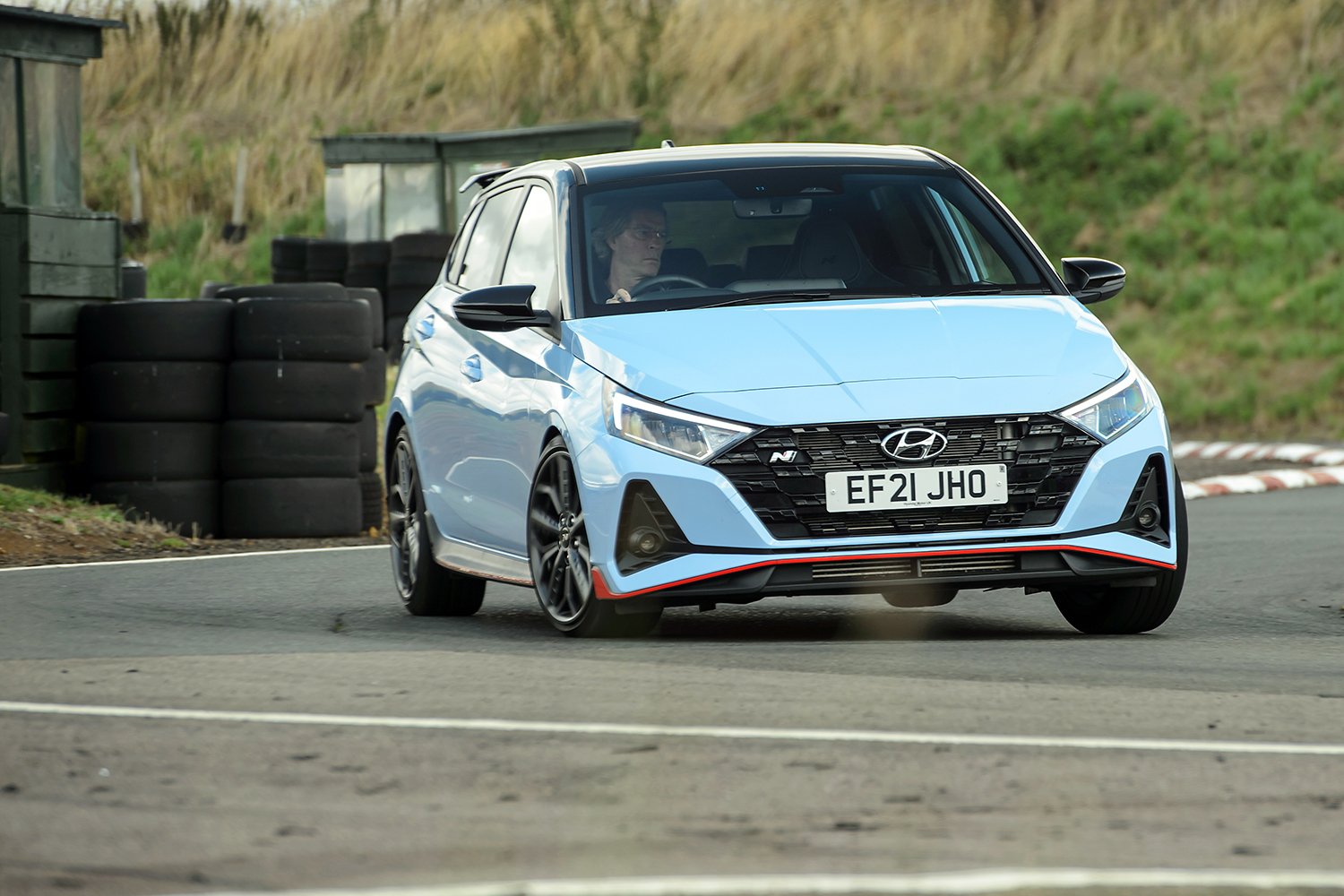
HYUNDAI i20 N
There is no beating around the bush. Hyundai is gunning for the Ford Fiesta ST. While it isn’t a full-blown rally homologation special, the i20 N has been endowed with enough mechanical firepower to take on the hot hatch ranks. That includes a 150kW/275Nm 1.6-litre turbo four-cylinder which is tasked with a relatively lithe 1190kg.
Grunt is sent to the front wheels via a mechanical limited-slip differential and a six-speed manual gearbox. An overboost function grants short spikes in torque to 304Nm while the quoted 0-100km/h time is 6.4 seconds. And if you need further proof of Hyundai’s intentions, it’s priced just $200 more than the $32,290 Fiesta ST. Game on.
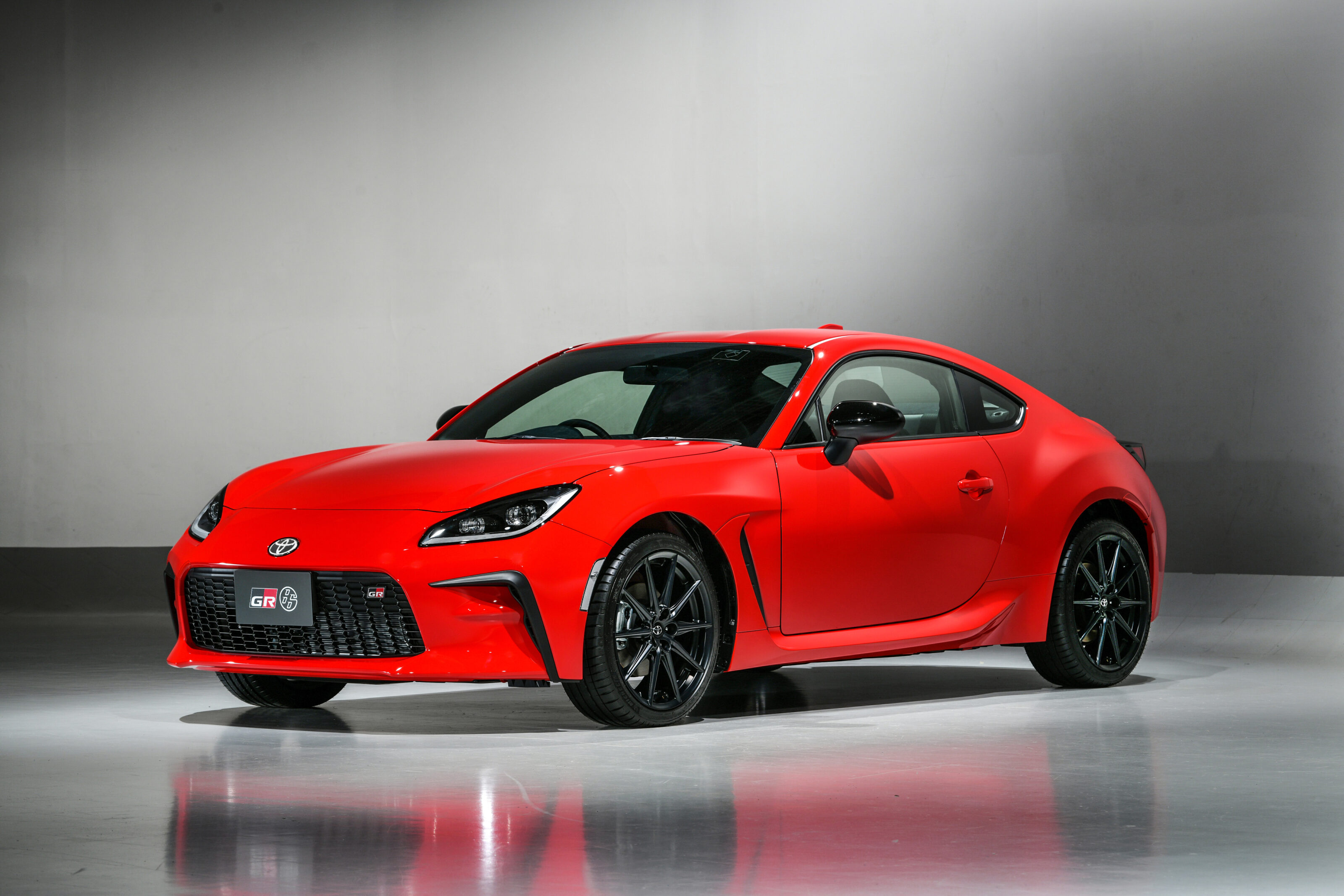
Toyota GR 86
Let’s acknowledge the elephant in the room. There is no turbo option. However, that might not be such a bad thing with the latest Toyota 86 (and Subaru BRZ) gaining a beefed-up 2.4-litre boxer four-cylinder engine. More importantly, the FA24D’s extra displacement (now 2387cc) has not only added 21kW, but a significant 45Nm – the latter is also spread of a much more even torque curve than the old 2.0-litre unit.
Overall figures come in at 173kW and 250Nm, hauling the 1270kg GR 86 to 100km/h in a claimed 6.3 seconds. Both a three-pedal and automatic version continue with power being sent to the rear wheels. The cabin has also received a much-needed overhaul. With the BRZ expected by year’s end, we’re hoping the GR 86 makes it to Oz in 2021, too.
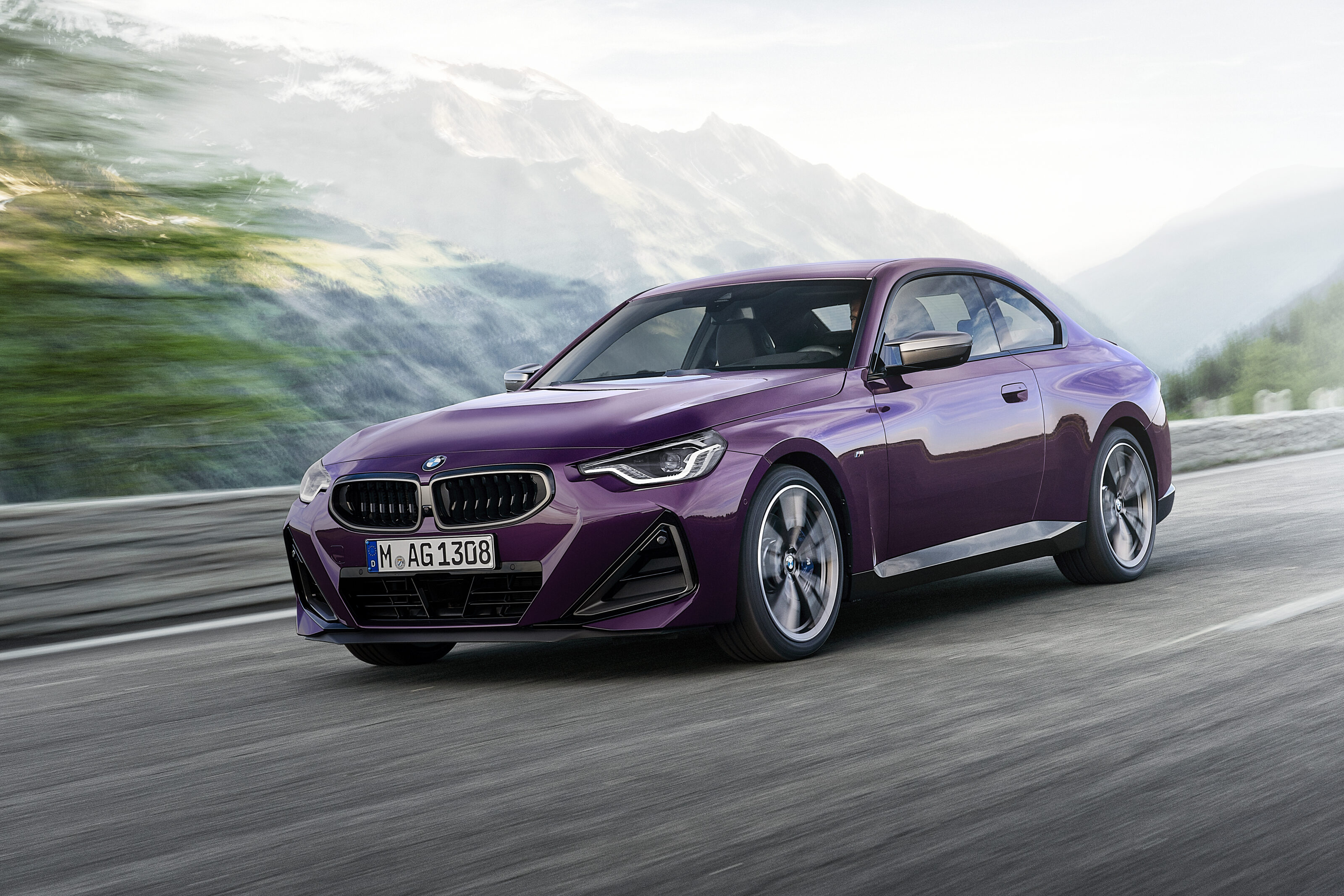
BMW M240i
And breathe… a sigh of relief is required given that the halo BMW 2 Series continues with a 3.0-litre straight-six turbo up front. However, it’s now equipped with xDrive all-wheel drive to help translate the B58’s 285kW/500Nm to the ground. There’s also an eight-speed ZF torque-converter automatic and electronically controlled rear differential. It’s worth noting that the weight, based on the CLAR architecture, has risen to 1690kg.
While it isn’t a full-fat M car, the all-paw M240i will sprint to 100km/h in 4.3 seconds. It’s also not priced like a Motorsport division product at $89,900 and it will resume war with the likes of the Audi RS3 (due in 2022) and Mercedes-AMG A45 S. Spy shots have been snapped of what looks to be an M2 replacement, so don’t lose hope for that. And if big four-door sedans are your thing, the M5 CS is due here imminently, while the xDrive versions of the M3/M4 are on their way.
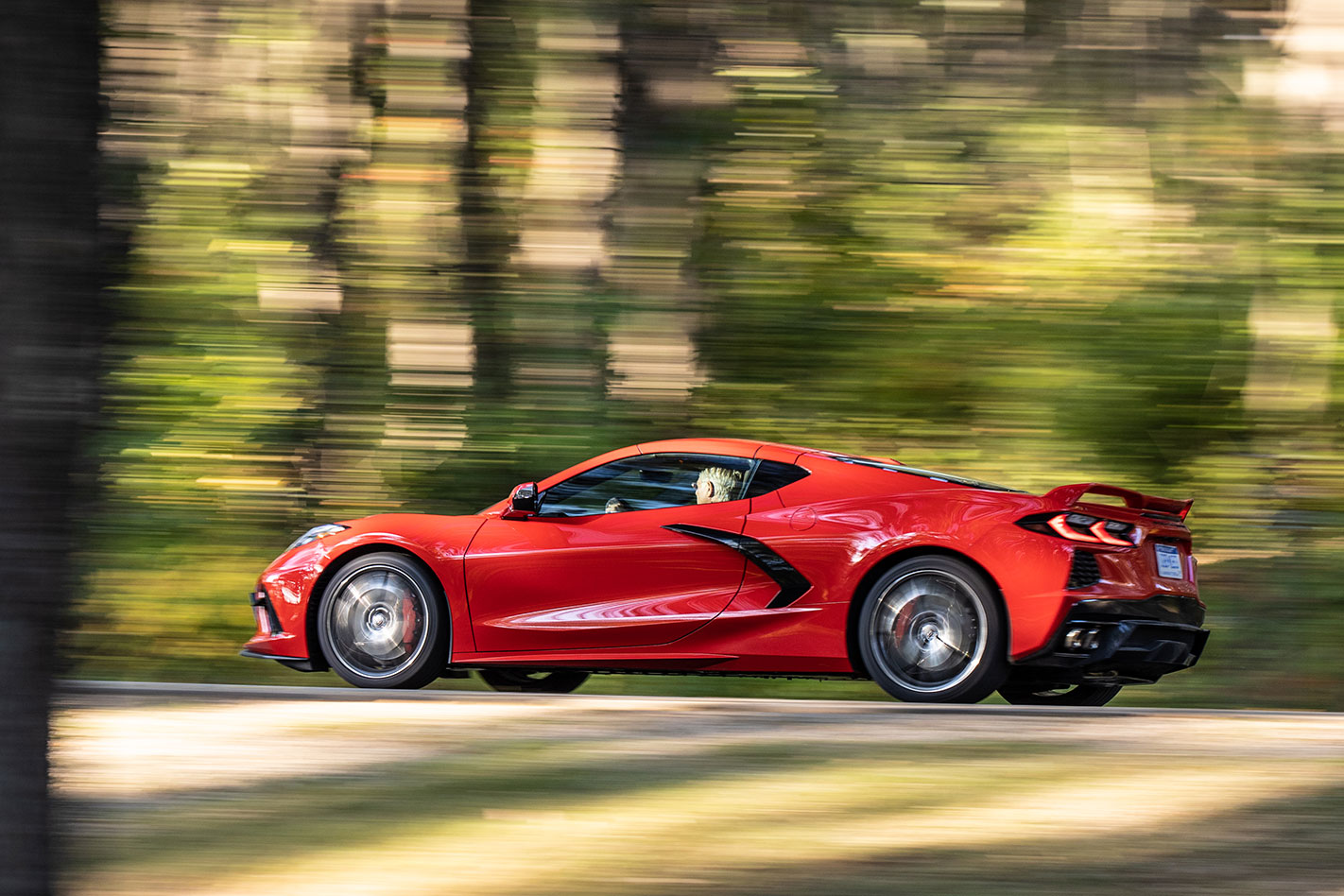
C8 Chevrolet Corvette
The hype is going to be hard to match with this one – not to mention the protracted launch due to the demise of Holden in Australia. Our cars will now be sourced through the newly formed GMSV. However, the first mid-engine Chevrolet Corvette has the gubbins to make sure it lives up to the preamble. With a 369kW/637Nm 6.2-litre LT2 V8 and claimed sub-3.0 second 0-100km/ times, it’s not hanging about.
Prices start at $144,900 for the entry level 2LT, while the 3LT commands a $160,500 price tag. Add $15,000 to both specs for the convertible versions. According to GMSV, all Corvettes destined for Australia will have a front lift kit and the Z51 performance package as standard. We’re hoping good things come to those who wait.
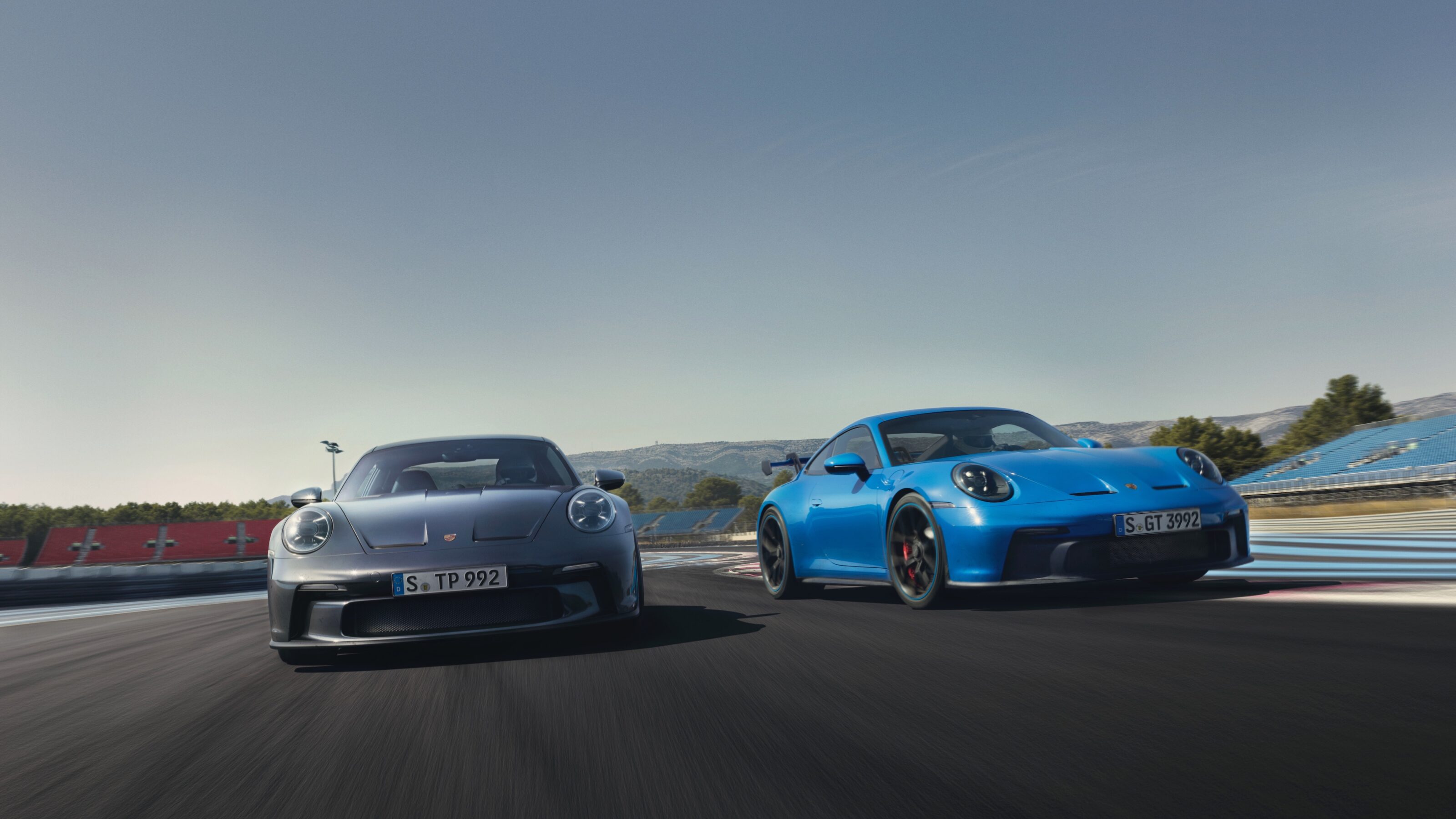
992 Porsche 911 GT3
It’s hard to improve on perfection, but somehow the gurus at Weissach manage to pull it out of the bag every time. The 992 generation isn’t merely a visual nip and tuck with a new interior, either. It gains significant upgrades to the front axle via double wishbone suspension – which is modelled off the RSR Le Mans racer. Speaking of track-inspired, the swan neck rear wing is also hard to miss as the new GT3, with a host of aero upgrades, generates 50 per cent more downforce than before.
If the outlandish rear wing isn’t to your liking, then the Touring (now also available with a seven-speed PDK) could be yours for $369,600. Or, if going the whole hog is more your style, the first-ever GT3 Touring 70 Years Australia Edition is available from $494,400. As with all Porsche GT products, if you wait, you’ll probably miss out. All are powered by the glorious 4.0-litre flat six.
The Taycan Cross Turismo and Cayenne Coupe Turbo GT are also slated for Q4 2021.
McLaren Artura
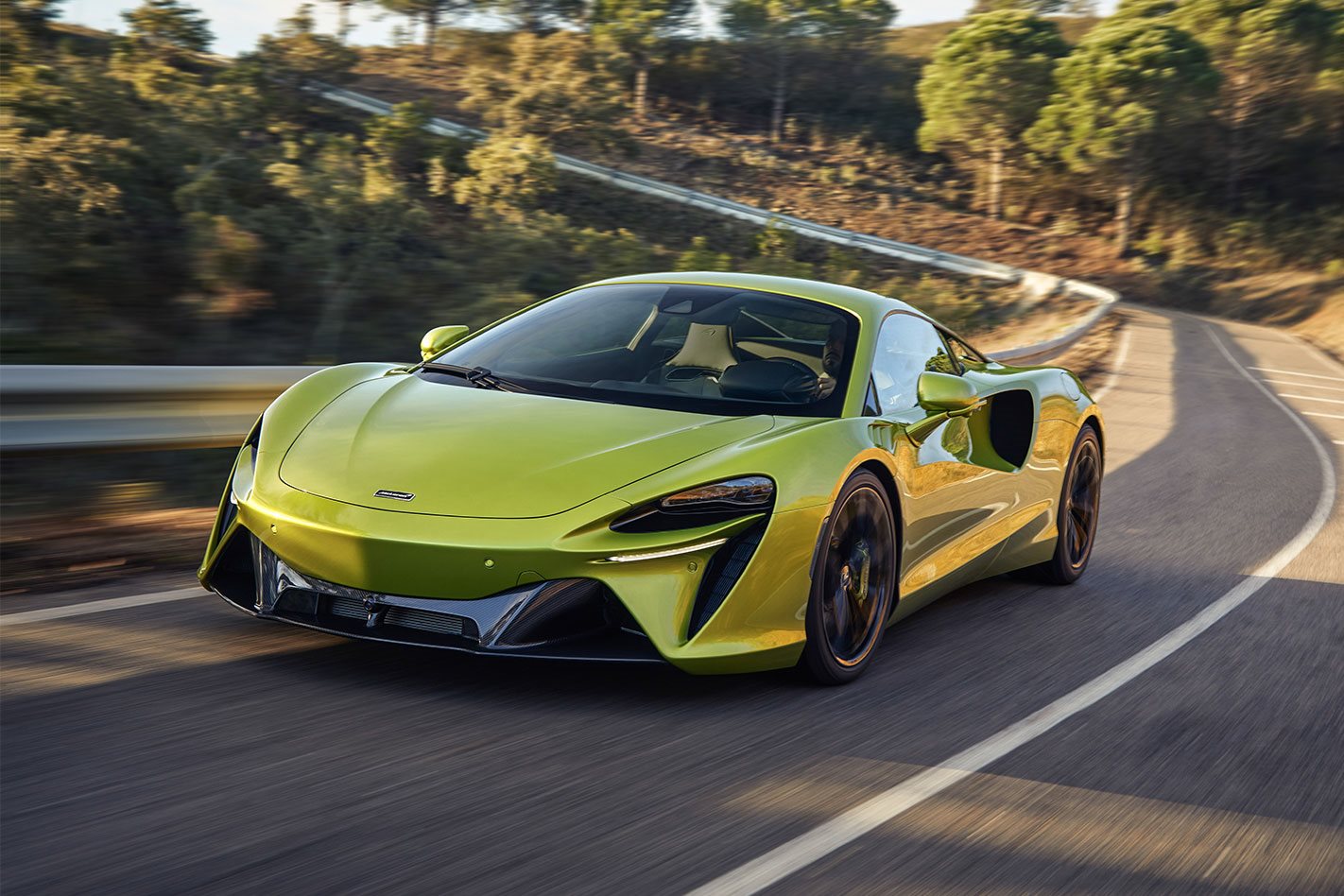
This is a very big step for Woking. The hybrid part isn’t a big departure, but a 3.0-litre twin-turbo V6 certainly is different to the mix of 3.8- to 4.0-litre V8s the marque has been offering. Yet don’t think the cut in cylinder count will impact on performance too much with combined system outputs of the M630 unit coming in at 500kW/720Nm. And with all-wheel drive traction, it’ll blast to 100km/h in just 3.0 seconds and 200km/h in 8.4sec. It’s safe to say the Ferrari 296 GTB better deliver.
The Artura is based on McLaren latest carbon-tub architecture (1498kg) and with a 7.4kWh battery underneath the fuel tank powering an electric motor, it can drive up to 30km without engaging the internal-combustion engine. Pricing for the Artura has been released with the bent-six hybrid coupe commanding a $449,500 sticker from October this year.
Notable mentions
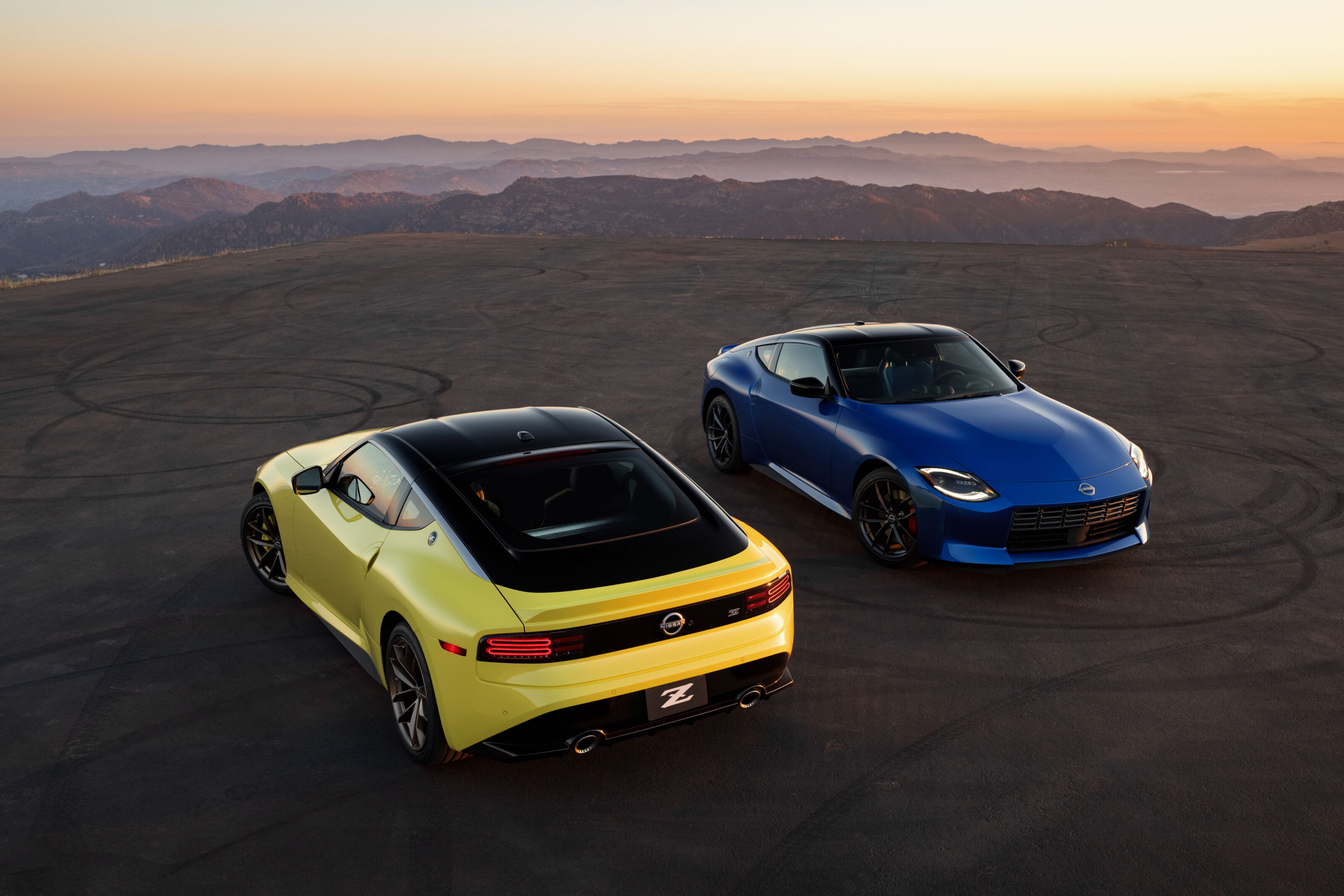
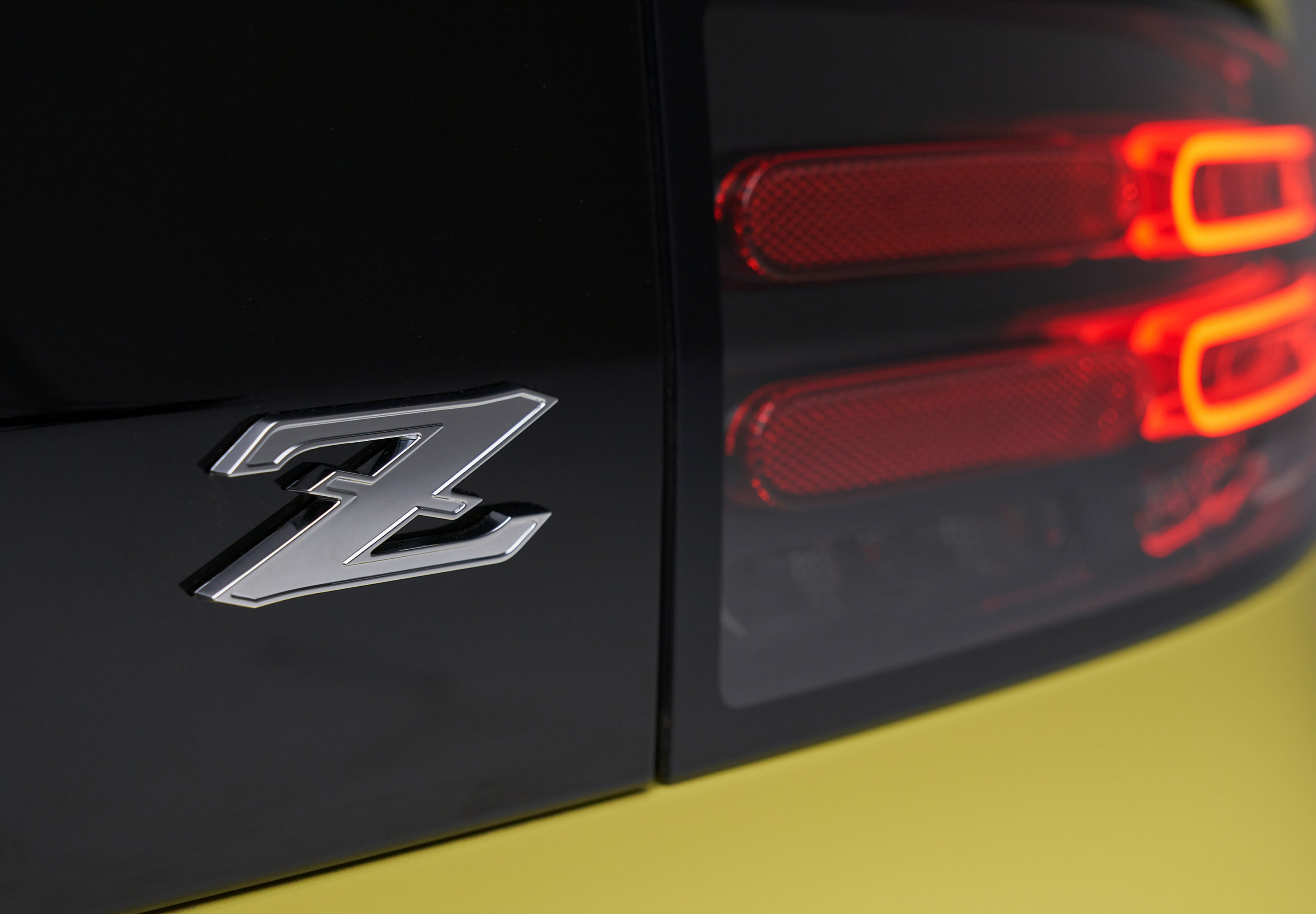
It might, and we mean might, get here before the turn of the calendar, but the Nissan Z is on its way. Recently revealed in production guise, the Z pairs retro-chic styling with a manual gearbox, rear-drive dynamics, and twin-turbo V6 grunt. Also expect a new Nismo GT-R to land at some point, too.
Elsewhere the Alpina B8 Gran Coupe, Aston Martin Vantage F1 Edition, Audi S3, Audi RS e-tron GT, Hyundai Kona N, Lamborghini Sian, Maserati MC20, Mercedes-AMG GT Black Series and the Polestar 2 will also grab the spotlight before 2022.
It’s tempting to pour scorn on McMansions, the relatively new phenomenon of enormous, cookie-cutter, brand new homes proliferating profligately in outer suburbs across the nation. They’re easy targets after all.
Architectural fast food, stamped out by the hundreds at our suburban frontiers, they trade subtlety and sophistication for other objectives. Media rooms, double walk-in wardrobes, and butler’s pantries are priority one, and everything else – including elegant design and sympathetic landscaping – is secondary.
But contain thy smugness, for as maligned as they are, these dwellings are also a reflection of what the average Australian wants.
We want as much room and as many features as possible, but we also want value for money. That’s not to say we’re cheapskates – even a modest McMansion is an expensive proposition these days – but we do want to see our dollars go far. There’s nothing wrong with chasing good value.
And the same is absolutely applicable of the cars we buy.
Editor’s note: Just days before this story was published online, Hyundai announced MY22 updates to the Palisade. The Palisade Highlander tested here is barely changed, however, with only minor cosmetic differences and no price change.
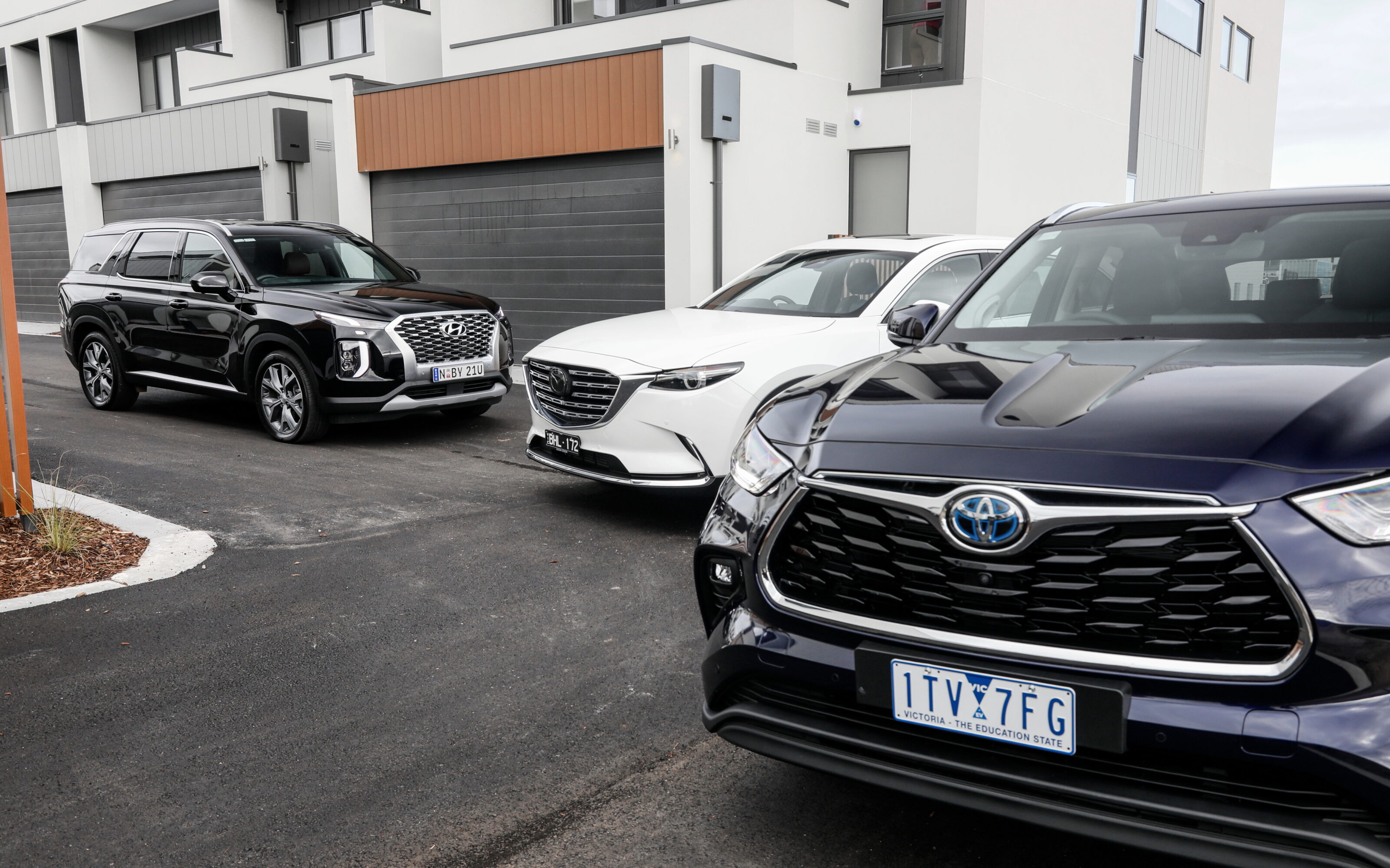
SUVs might not win beauty contests, but they’re winning sales races. These days the family vehicle of choice tends to have three rows of seats, a big wagon bodystyle and all-wheel drive. There’s also a strong preference for range-toppers – we love a long feature list, and are prepared to pay for it.
With the arrival of a newly-minted Toyota Kluger, long the darling of the family-sized three-row SUV set, it’s a good excuse to examine what life is like in the upper echelons of the mainstream large SUV segment. Joining the fourth-gen Kluger in this test is another fresh-faced arrival, Hyundai’s Palisade, while the COTY-winning Mazda CX-9 is a grizzled veteran that still enjoys strong sales despite its advanced years, and is our benchmark in this segment.
The Kluger nameplate may be vehicular Wonder White, but there’s reason to look in the fourth-generation model’s direction. It’s almost completely new, built atop the largest version of Toyota’s scalable TNGA architecture to date and coming with one sizable ace up its sleeve: a hybrid option.
Aussie appetite for hybrid powertrains has been on a steady rise. At the time of writing, demand in the SUV segment for electrically-assisted crossovers and softroaders was almost double what it was in 2020 – with continued growth expected. That demand is especially pronounced in Toyota-land, with almost three out of every four RAV4 sales in Australia this year being for a hybrid variant and the smaller Yaris Cross notching up a whopping 81 percent hybrid uptake. With an ultra-efficient petrol-electric powerplant available alongside the venerable and familiar 3.5-litre petrol V6, the fourth-gen Kluger appears to have its finger on the pulse of Australian wants and needs.

And so it’s the hybrid that we have here, in top-shelf Grande trim no less. It’s the most expensive Kluger on offer, wearing a $75,400 sticker before on-roads, or $76,075 for the car we’ve got here thanks to a $675 metallic paint charge. Versus a comparatively equipped AWD V6 Kluger, the Hybrid option carries a $2500 premium. We’ll find out shortly if it’s worth it.
At $75,000, the Palisade Highlander seven-seater marginally undercuts the Kluger. It does not have an electrically-assisted engine under its bonnet, rather a 2.2-litre turbo-diesel variant that aligns more closely with the Kluger hybrid on power and price than the available 3.8-litre petrol V6.
For the CX-9, there are no options in the engine bay – it’s either a 170kW 2.5-litre turbo petrol, or nothing. The top-shelf Azami lobs in with a retail price that’s just north of $70K, and while a limited edition Azami sub-variant exists above it (and would be a closer price rival to the Palisade Highlander and Kluger Grande), that one is a six-seater. For this test, we want only seven seaters.
The CX-9 is approaching retirement age – not that you’d know from looking at it. Even after half a decade of production, the design has held up well. The Palisade is also a handsome thing, with a profile that proves ‘big and boxy’ isn’t necessarily shorthand for ‘ugly’. The grille is perhaps the only stylistic miss-step, its chunky matte silver frame integrating poorly with the rest of the front end.
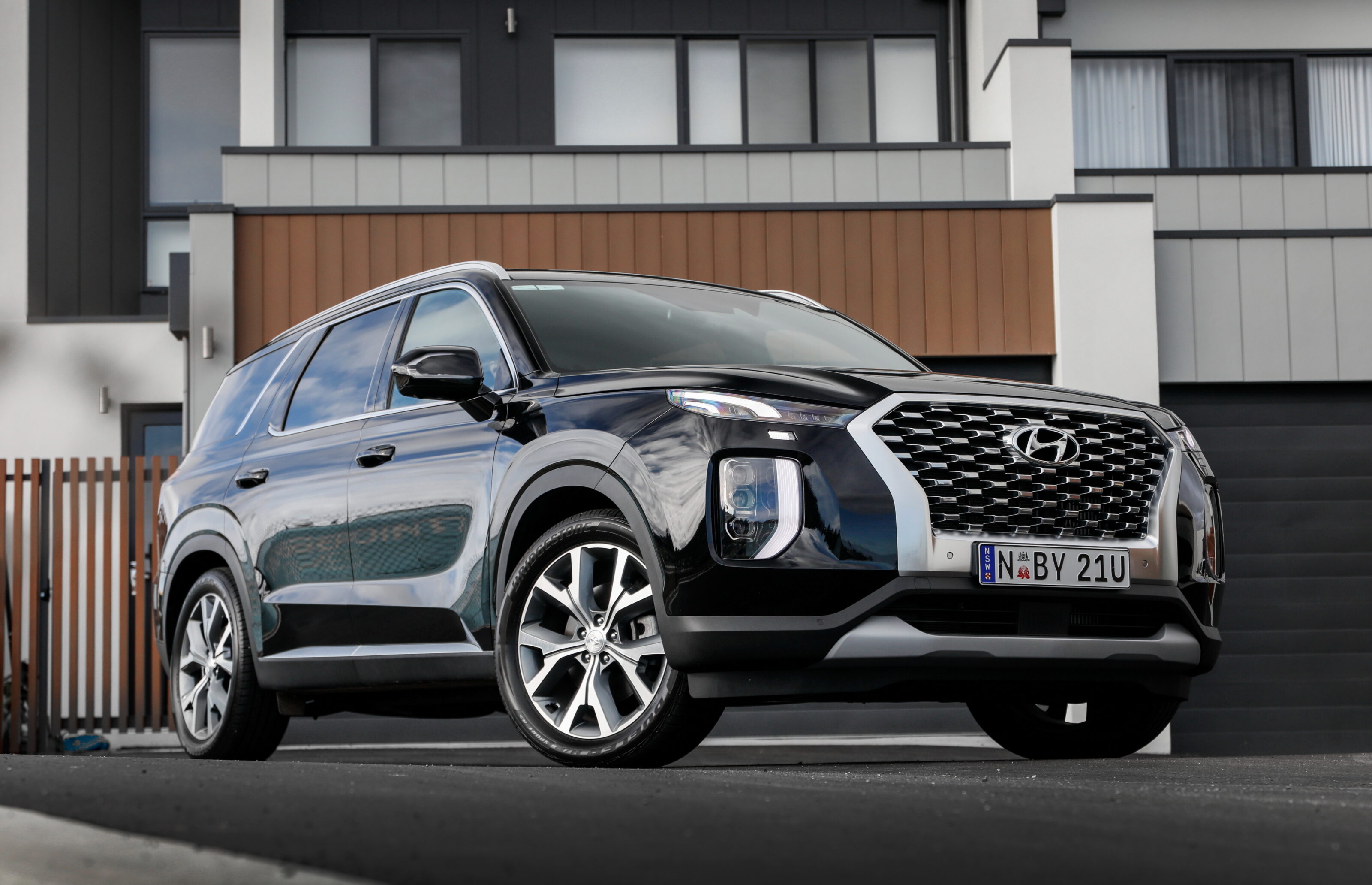
Meanwhile the Kluger is perhaps the least convincing of Toyota’s modern design language. Its ‘grumpy Stormtrooper’ nose lacks the assertiveness of the Palisade and the confident elegance of the CX-9. There’s some nice surfacing on the side that echoes the Supra and Yaris GR (we kid you not), but otherwise the Kluger is a fairly anonymous thing to look at.
It’s also the ‘smallest’ SUV here. The Palisade is larger than its Toyota rival, though only just. Sizing the two up with just your eyeballs would have you believe the Palisade has a markedly larger footprint, but it’s just a handful of centimetres that separate them in length, width and wheelbase. Astonishingly it’s the Mazda that’s the longest in this group, both in wheelbase and overall length, but venturing indoors reveals that running a tape measure across the exterior of these things means nothing when it comes to cabin utility.
Let’s start with the new kid. The Kluger’s first-row ergonomics are pretty good, with everything clearly labelled and falling within easy reach of the driver’s heated and cooled eight-way power adjustable seat. Forward vision is also great, with A-pillars that are remarkably slim for a modern SUV and a big head-up display to help keep your attention on the road ahead.

The 8.0-inch high-mounted screen and ventilation controls are easy to use with plenty of prominent buttons that are easily navigable by feel, but the infotainment software – and clumsy screen integration with the dash – leave much to be desired. Why should a car for the 2020s have in-car tech from the 2010s? At least Android Auto and Apple CarPlay are there to take out some of the sting, but Americans get a 12.3-inch touchscreen in their range-topper and we don’t. Unfair.
The intermediate shelf that runs across the dash is a handy bit of functional design, though, with grippy rubber to help contain whatever keys, wallets or phones you toss on there and a cable pass-through so you can keep your phone connected without leaving it on the cramped and slippery centre console tray. Given how mediocre the stock infotainment system is (and the fact that wireless smartphone mirroring isn’t available in the Kluger), you’ll want to keep your phone hooked up at all times.
The second row experience is solid, with a roomy three-seat bench, reclinable backrest and a good range of fore-aft adjustment on its slider. The Grande comes standard with a gigantic glass sunroof and it’s used to good effect, flooding the cabin with light and lifting the ambience considerably, while backseaters also have their own controls for the rear climate zone and roof vents pointing at each seat.

Things aren’t so rosy when it comes to the third row, however. For an adult, squeezing between the door frame and the middle seat isn’t an elegant operation, with the shape of the Kluger’s rear door aperture not big enough for easy third-row access – likely a side-effect of the Kluger having the shortest wheelbase in this group.
Once seated, you’ll find the Kluger’s third-row packaging is flawed for anyone larger than a small child. A knees-up posture, rock-hard cushions, tight headroom and a lack of USB outlets give the Kluger the worst third row in this gang – a surprising result given Toyota boosted third row seat width by 20mm and supposedly improved seat cushioning for this all-new Kluger.
Material quality is generally quite good, with plenty of soft-touch surfaces and decent leather upholstery, but the less said about the Kluger Grande’s overtly fake ‘woodgrain’ trim, the better.
Let’s hop into the Palisade. Hyundai’s largest SUV gets off to a strong start with some Benz vibes around its canted-back centre stack and monolithic instrument panel/infotainment screen integration, while the push-button transmission selector takes up less real estate and helps keep the centre console sleek and tidy.

A retractable lid for the cupholder/phone charge pad recess allows clutter and valuables to be hidden away, as does the cavernous cubby beneath the centre armrest, while a capacious under-console shelf can easily accommodate a tissue box or handbag. Hyundai proves that merging functionality with good looks ain’t impossible.
The second row is where the Palisade really stands apart. Rather than the 2-3-2 seat layout of the other two, the Palisade gives the option of two separate captain’s chairs in the middle and a three-across bench in the back. Less practical than having a bigger bench in the centre row? Maybe if you need to fit more than three baby seats at a time, but here’s the thing: you can walk between those captain’s chairs, negating the need to fold them forward to gain access to the third row.
Not that folding them is particularly hard. While the Kluger and CX-9 use a traditional mechanical lever, the Palisade has an electronic button that releases both the backrest and the slider, and with the seat slid forward there’s plenty of room to step up into the rearmost seats. Its seventh seat is definitely the least useful given the narrower width of the third row, but the other six seats are hugely spacious – especially those in the second row, which are not only heated, but ventilated too.
There are also other thoughtful features throughout. USB charge ports on the front seat backrests keep cables from dragging on the floor, and there are a pair of USB ports and roof vents for the third row too.
What of the CX-9? Its cabin design is clean and timeless with elegant touches like backlit door pulls at night, but next to the button-heavy Palisade and Kluger it might look too minimalist for some. To our eyes it still looks great, and the Azami’s soft leather upholstery adds significant tactile appeal as well. Its tombstone style infotainment screen sits nice and high, and the CX-9’s remote controller makes it the only one in this group that doesn’t require you to put finger smudges on its screen.

It could learn a lesson or two from the Palisade and Kluger about cabin storage though, with only a shallow tray ahead of the gear selector (which also houses a wireless phone charger) and a fairly modest centre console box in addition to the usual glovebox and door bins. The hard plastics around the cupholders also detract from what is otherwise a very sophisticated and classy cabin ambience.
Second and third row accommodation is middle-of-the-pack. The third row suffers a little in headroom thanks to the CX-9’s hatchback-like roofline and the absence of air vents back there, but seat comfort and entry/egress is nevertheless better than the Kluger.
When I drove the previous-gen Kluger at its national media launch, my one lasting memory of the event was my co-driver becoming quite seasick during a twistier section of the drive loop. I don’t blame him. That car had all of the pitch and roll of a tugboat in a tsunami. Credit to the engineers of the new Kluger, then, because its significantly improved body control and more improved damper calibration dramatically reduce the amount of head toss.
That said, it’s still a soft marshmallow compared to the firmer jellybeans that are the CX-9 and Palisade. All of them roll on 20-inch alloys with similar sidewall heights, but the Kluger skews more strongly toward comfort than the other two. In a way, that’s a good thing – these are family vehicles after all, and your partner, kids and Labrador care nought for how many lateral G you can sustain in a corner.
But that’s not to say that the CX-9 and Palisade are roller skates by comparison. The CX-9’s well-judged balance between ride and handling is as good as it’s ever been, with only a slightly sharp bump response from the 20-inchers and a fair bit of road noise taking the shine off its superb steering and big-hatchback dynamics.

The Palisade sits somewhere in between. It’s firmer than you’d expect and quite sensitive to small-amplitude bumps, but glides easily over bigger stuff. Its mass is more obvious than the CX-9 when you ask it to change direction, but it feels more composed and willing to turn than the relatively mushy Kluger.
Shame about that noisy diesel – even at idle, it’s louder than we’d want for a family hack – but at least it’s got bags of torque and that slick-shifting eight-speed auto.
The Kluger’s mushiness extends to its powertrain. It excels in the light-throttle regime, being pedaled around sedately in stop-’n’-go traffic or in a steady highway cruise, where the switchover from petrol to electric is nearly imperceptible and the overall experience is best described as “serene”.
However, stomp the pedal flat and a coarse engine note and lethargic 8.4-second 0-100km/h sprint are the result. These are all big ol’ buses, but the Kluger, weighing in at 2090kg when empty, feels like a double-decker.

Its 6.5Ah high-voltage battery won’t sustain much electric-only driving too, and Toyota’s hybrid system will quickly flick on the combustion engine if you don’t use a feathertouch on the pedal – even if you thumb the ‘EV mode’ button beforehand.
It’s a chore to try and keep it within the electric-only parameters, but here’s the thing: without even trying to hypermile, we saw a 5.9L/100km average over our 100km test loop.
That’s easily better than the 7.4L figure we got from the diesel Palisade, and a full 4.0 litres less than the CX-9’s 9.9L/100km result over the same loop.
The CX-9’s 2.5-litre turbo might be a torque-laden delight with great power, response and a surprisingly sporty induction note, but you pay for those things at the petrol pump.

VERDICT
So, to the final crunch. For its family-friendly cabin, lengthy equipment list and balance between comfort, performance and fuel economy, the Palisade is the winner of this one.
Remember how I said value for money was important? Well, the Palisade gives you an eight-course banquet for a three-course price tag.
It’s full of intelligent features and practical packaging, and it seems like Hyundai involved more families in its focus groups than Toyota or Mazda. As far as fitness for purpose is concerned, the Palisade hits the bullseye.
Coming up behind it is the Kluger. Let down by a poorly executed third row and antique infotainment software, the rest of the Kluger package is actually quite good. Its hybrid option and softer nature will no doubt entice many, and with a potential fuel saving of 510-561 litres per year relative to a V6 Kluger Grande AWD (assuming you commute the national yearly average of 17,000km), it could be well worth the $2500 premium.
In fact, that fuel thriftiness is a big reason why the Kluger comes in second rather than third: fuel economy is a vital consideration for average Aussie families, even those with $75K to spend on their next car.
One might think that the Mazda slots into third, but the bronze medal remains in its case for today. Rather, the CX-9 Azami surprised us with its ability to remain fresh and relevant with a well-equipped and spacious cabin, strong performance and supremely car-like dynamics.
The CX-9 is the connoisseur’s choice, in our opinion, and a car that just feels right every time you slide behind its wheel. It doesn’t hurt that it’s also the most affordable one in this test, so it deserves to share second place.
SCORES
1. Hyundai Palisade: 8.5/10
2. Toyota Kluger: 8.0/10
2. Mazda CX-9: 8.0/10

| Model | Hyundai Palisadeu00a0 Highlander | Kluger Grande hybrid | Mazda CX-9 Azami |
|---|---|---|---|
| Price | $75,000 as-testedu00a0 | $76,075 as-tested | $71,036 as-tested |
| Drivetrain | u00a0 | u00a0 | u00a0 |
| Engine | 4cyl, dohc, 16v, turbo | 4cyl, dohc, 16v, + triple electric motor | 4cyl, dohc, 16v, turbo |
| Layout | front engine (east-west) AWD | front engine (east-west) AWD | front engine (east-west) AWD |
| Capacity | 2199cc | 2487cc | 2488cc |
| u00a0Power | 147kW @ 3800rpm | 184kW (combined petrol/electric) | 170kW @ 5000rpm |
| Torque | 440Nm @ 1750-2750rpm | 242Nm @ 4400rpm (comb petrol/electric) | 420Nm @ 2000rpm |
| Gearbox | 8-speed automatic | CVT | 6-speed automatic |
| Chassis | u00a0 | u00a0 | u00a0 |
| Bodyu00a0 | steel, 5 doors, 7 seats | steel, 5 doors, 7 seats | steel, 5 doors, 7 seats |
| L/W/H/Wu2013B | 4980/1975/1750/2900mm | 4966/1930/1755/2850mm | 5075/1969/1747/2930mm |
| Track (F/R) | 1708/1716mm | 1665/1660mm | 1663/1633mm |
| Weight | 2059kg | 2090kg | 2010kg |
| Boot | 7-seat: 311L, 4-seat: 704L | 7-seat: 241L, 5-seat:552L, 2-seat: 1150L | 7-seat: 230L, 5-seat: 810L (to roof) |
| Fuel | diesel/71 litres | petrol 95RON/65 litres | petrol 91RON/72 litres |
| Economy | 7.4L/100km (tested) | 5.9L/100km (tested) | 9.9L/100km (tested) |
| Suspensionu00a0u00a0u00a0 | Front: struts, A-Arms, coil springs, anti-roll bar. Rear: multi-link , coil springs, anti-roll bar | Front: struts, A-Arms, coil springs, anti-roll bar. Rear: multi-link, coil springs, anti-roll bar | Front: struts, A-Arms, coil springs, anti-roll bar. Rear: multi-link, coil springs, anti-roll bar |
| Steeringu00a0 | electric power steering | electric power steering | electric power steering |
| Front brakesu00a0 | ventilated discs (340mm) | ventilated discs (330mm) | ventilated discs (320mm) |
| Rear brakes | ventilated discs (314mm) | solid discs (315mm) | solid discs (325mm) |
| Tyre size | 245/50R20 Bridgestone Dueler HP Sport A/S | 235/55R20 Toyo Proxes C100 | 255/50R20 Falken Ziex CT50 A/S |
| Safety | u00a0 | u00a0 | u00a0 |
| ANCAP rating | Five stars | Five stars | Five stars |
| Performance | u00a0 | u00a0 | u00a0 |
| 0-100km/h | 9.5sec (estimated) | 8.4sec (claimed) | 7.7sec (tested) |
Hyundai’s i30 hatchback is a perennial seller, bucking the SUV trend that the brand itself has helped to build.
This current generation is a terrific car in the same way as the current Toyota Corolla. Sensible, straightforward, no-nonsense motoring but with a little bit of flair while you’re at it.
Earlier this year, the i30 range was updated to reflect changes in the market since its very well-received launch, with new tech and minor re-jigging of the still-extensive range, all with an eye on the segment’s constant evolution and the inevitable comparison with the shiny new Golf 8.
Pricing and Features
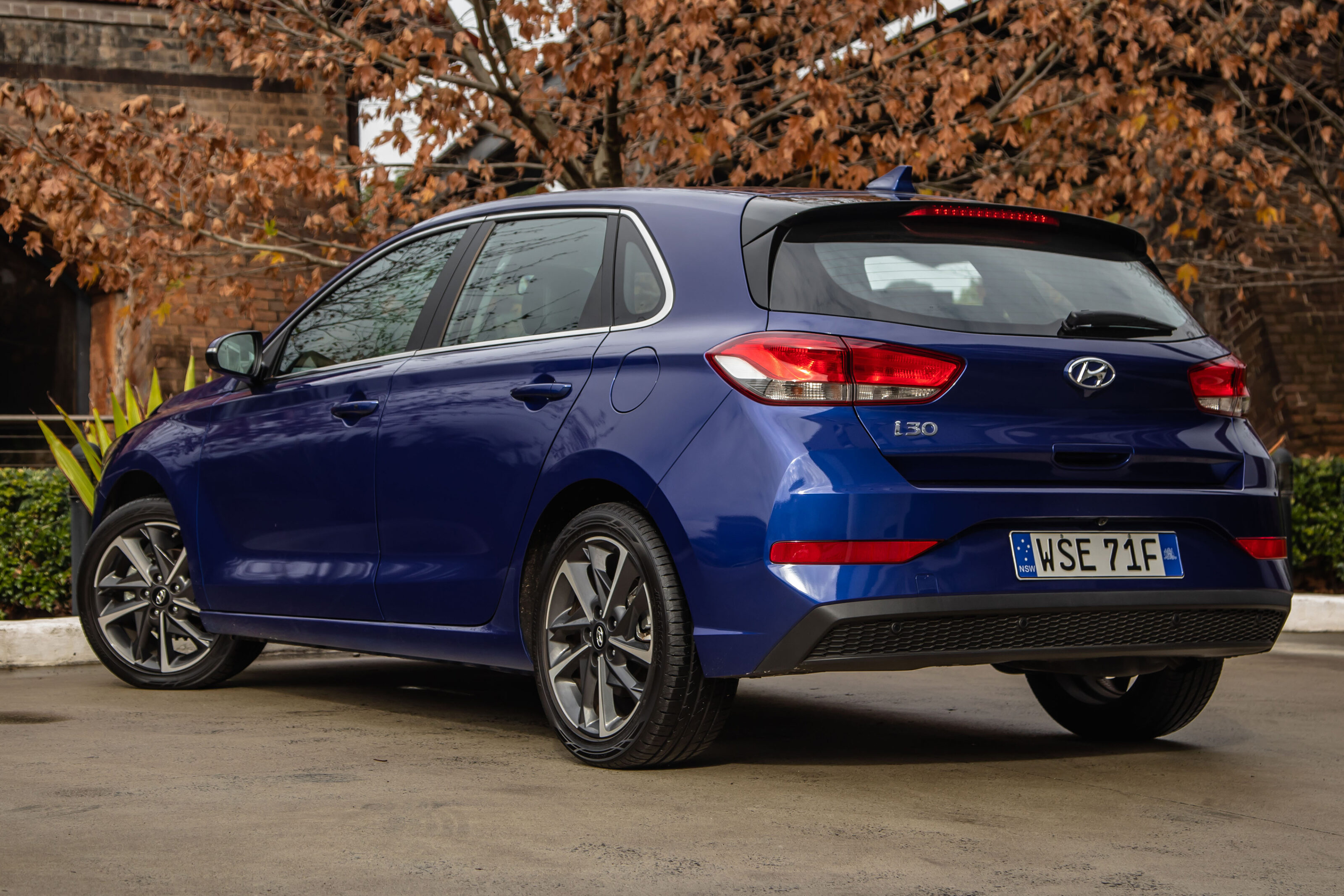
The i30 Hatch range is five deep, with an entry-level, Active, Elite then N-Line and N-Line Premium. The first three all make do with Hyundai’s 2.0-litre naturally-aspirated four-cylinder and the cheaper torsion beam rear end, so the differences are all in the specification details.
Of course, there is another i30 hatch, the N, but that’s not really a part of the standard range.
Weighing in at $30,220 before on-roads, the Elite has 17-inch alloys, a seven-speaker stereo, dual-zone climate control, keyless entry and start, active cruise control, in-built sat-nav, perfectly reasonable fake leather trim, power windows and mirrors, auto wipers, wireless charging pad and a proper full-size spare wheel (huzzah!).
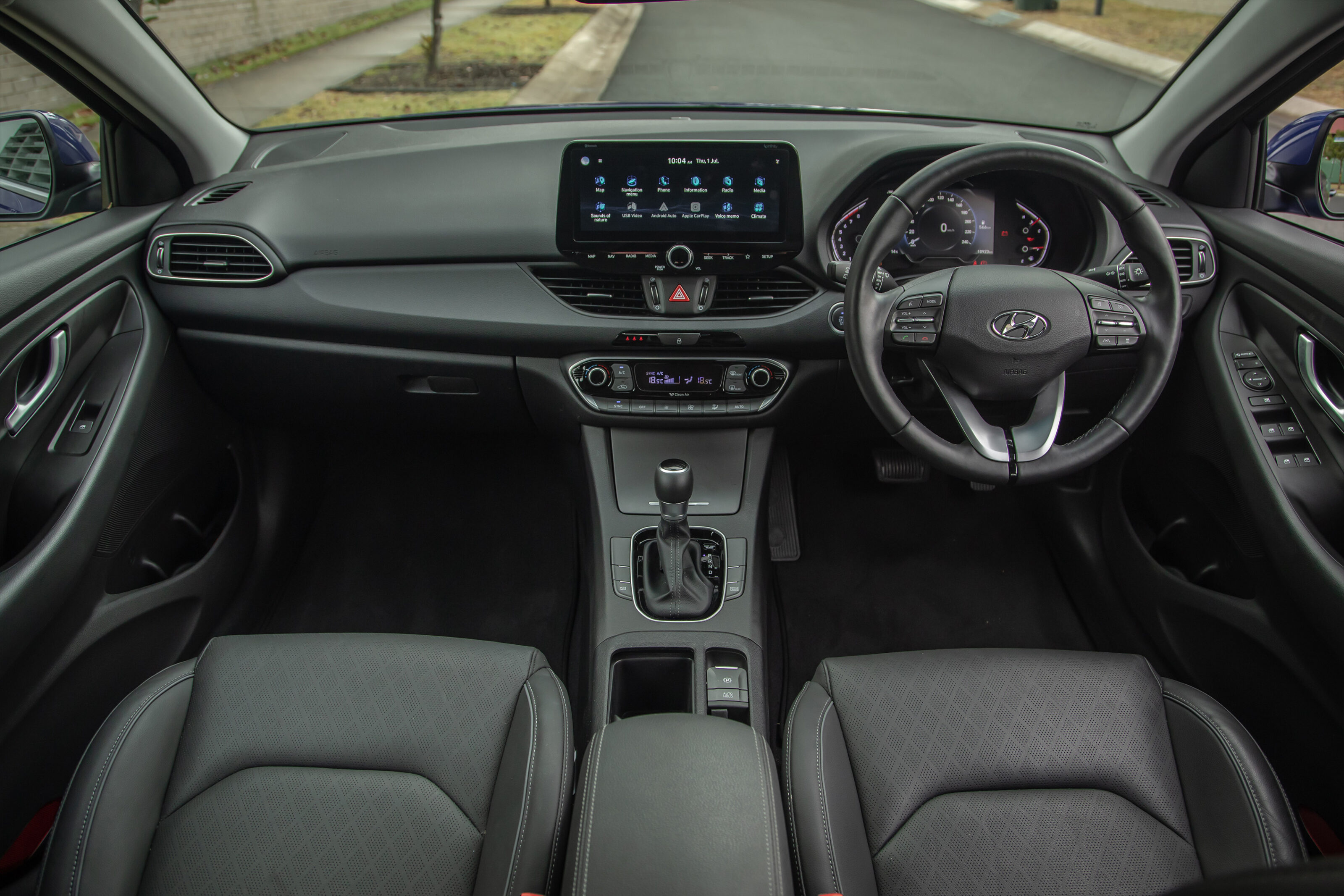
The Elite scores the bigger 10.25-inch screen, which also deletes the wireless smartphone integration. I’m mad about it and I can tell you that Hyundai isn’t super-keen on it either, so it’s not some kind of advanced troll.
The seven Infinity-branded speakers are pretty good, though, and the wireless charging pad is useful for a second phone in the car that isn’t being used with the screen.
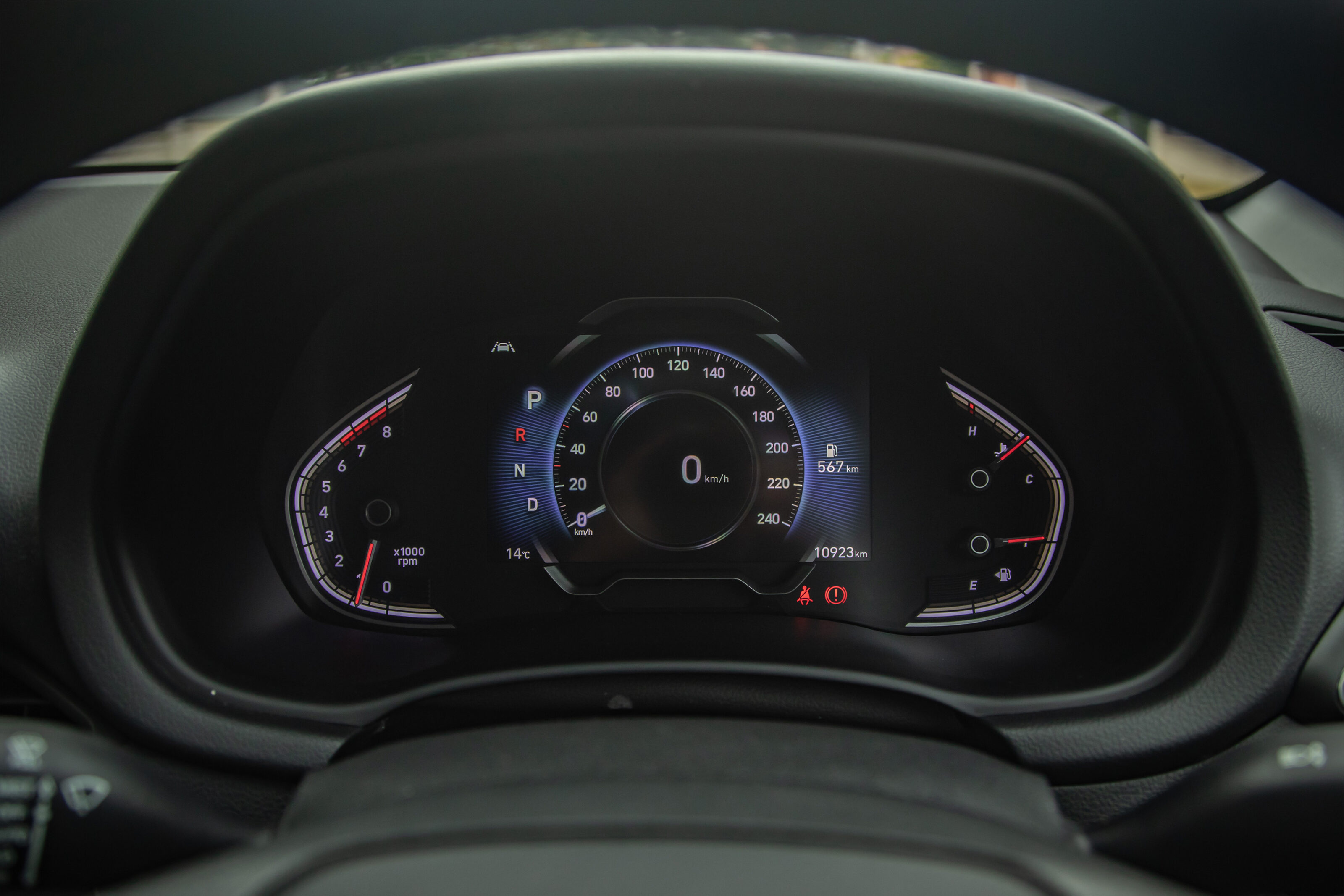
Standard across the range is a rather useful part-digital dash. Like the Honda Civic’s, the central section is a big digital speedo, gear indicator and various bits of useful information while temperature, fuel and tacho remain analogue.
The Elite’s safety swag is pretty good for the price and does well to keep up with the segment’s safety-keen rivals like the Mazda3.
You get seven airbags (including a knee bag), the usual traction and stability controls, blind-spot warning, driver attention detection, forward collision warning, forward AEB, lane following and lane-keep assist, reverse cross-traffic alert, reversing camera, rear parking sensors and safe exit warning. That last one is a nice touch.
Its forward AEB has pedestrian and cyclist detection and works at both low and high speeds, with both a camera and radar to do the work. It does miss out on rear AEB, which would be nice as it’s in the Mazda3.
There are three top-tether anchors and two ISOFIX points for the child and baby seats.
The i30 scored its five-star ANCAP rating in 2017.
Comfort and Space
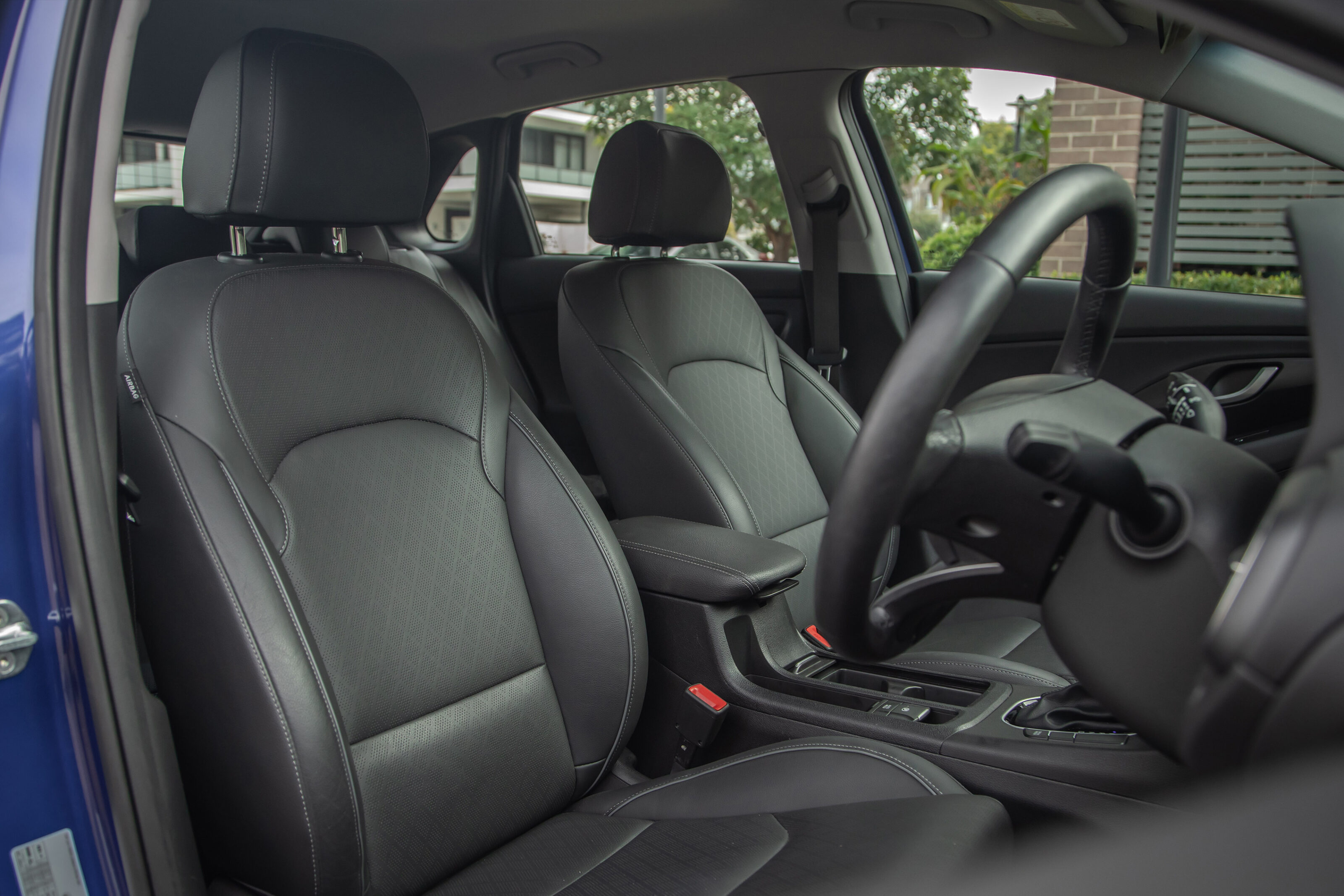
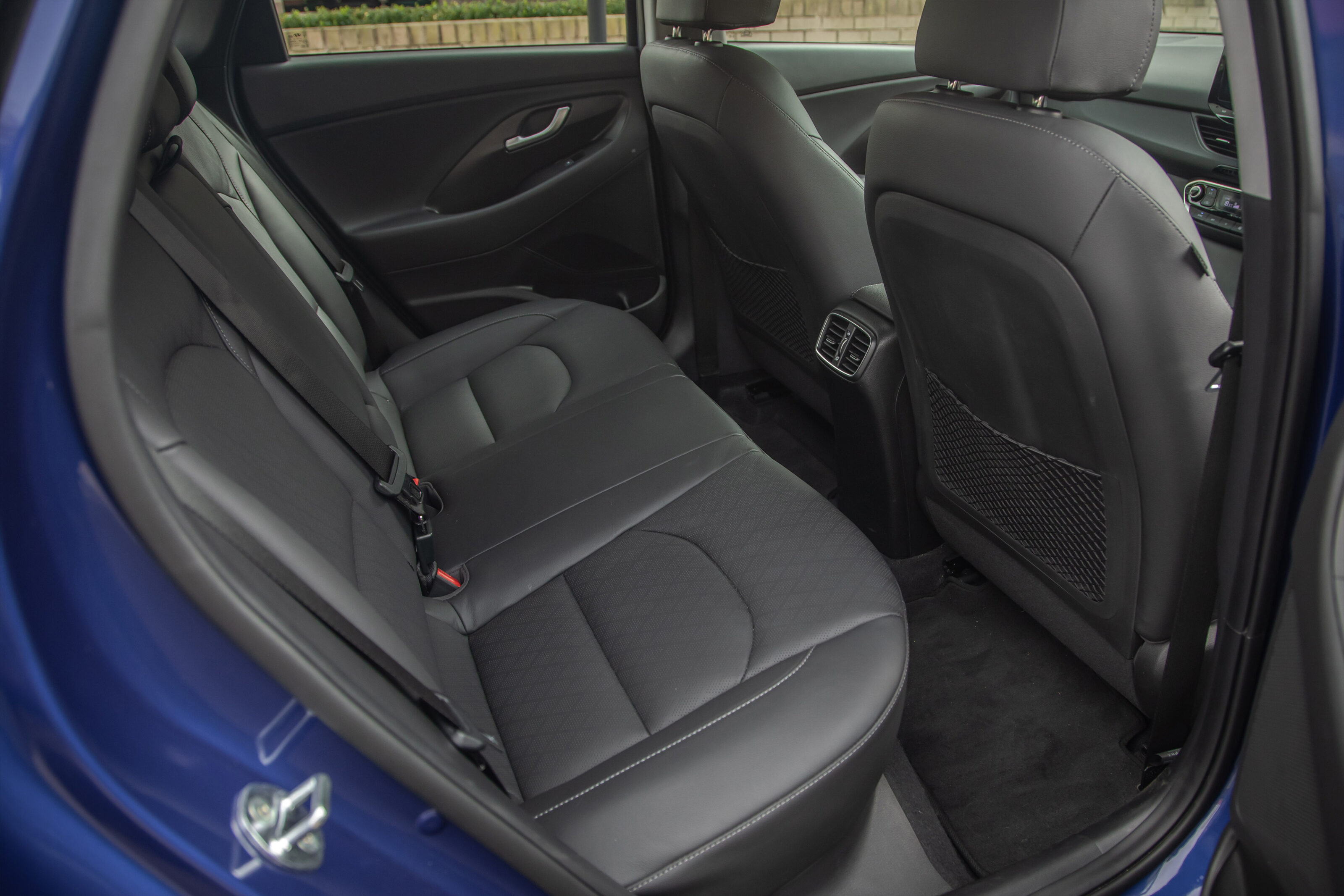
The rear seat of the Hyundai i30 is functional rather than expansive. Behind my driving position, I can fit okay but it’s not especially comfortable for longer trips as my knees touch the seatback, which has a plastic shield.
It’s cosy enough and the seat is well-shaped without destroying the middle seat, which, as ever, is for smaller folks only.
There are, however, air vents in the back which is still a big win in 2021 and the armrest has two cupholders. The doors have slim pockets with a bottle holder but they’re for smaller bottles only.
Up front, the seats are very comfortable, there are slim bottle holders in the door and two cupholders in the console. As there isn’t a handbrake, the console itself is very uncluttered and everything is very easy to use.
The boot is a very useful 395 litres with the seats in place and if you fold the rear seats it rises to an impressive 1301 litres.
If you want more space again, the grand-or-so more expensive i30 Sedan Elite (the four-door formerly known as Elantra) has a massive boot, way more legroom and a very different interior design as it rides on a different platform. If you want less space in both the boot and back seat, get a Kona.
Having said all of these things about the available space, it stacks up well against the Mazda3 and gives the Corolla a bit of a shellacking with much easier rear access and a bigger boot.
If you want more space again, the grand-or-so more expensive i30 Sedan Elite has a massive boot, way more legroom and a very different interior design.
On the Road
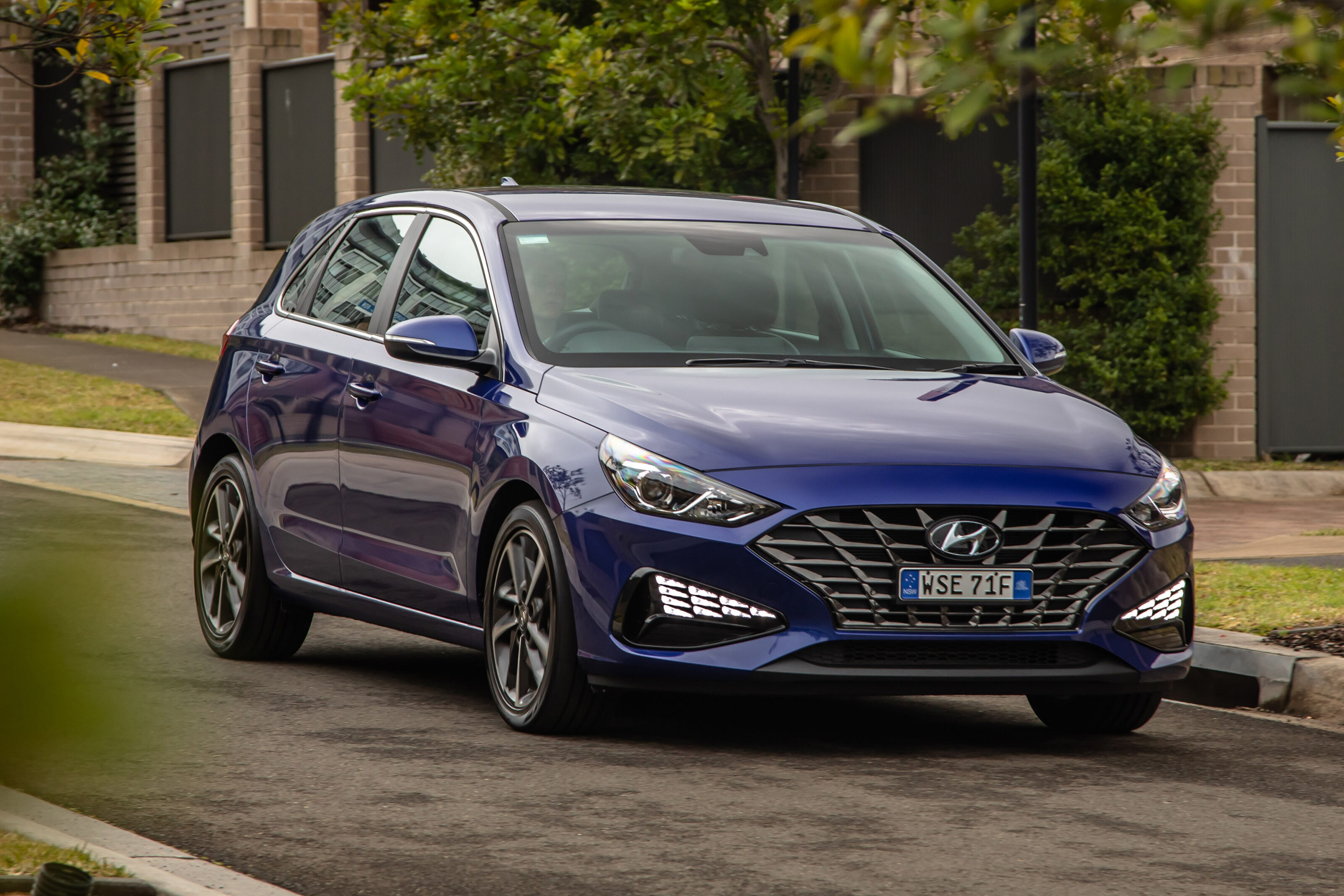
One of the reasons this third-generation i30 has been so impressive from launch is that it drives really nicely.
While the 2.0-litre is hardly what you’d call characterful or exciting in any way, it does the job quietly and smoothly, hooked up to a well-sorted six-speed automatic transmission (there is a manual in the entry-level car).
Tuned, as ever, by Hyundai Australia’s feted suspension team, the ride and handling balance is exceptionally good, especially considering the torsion beam rear-end and the fact that the class is full of good stuff.
The ride is where the effort has gone in the 2.0-litre cars and it’s very smooth and easygoing without any loss in body control.
Of course, an over-enthusiastic corner entry will result in squealy tyres and understeer, but it’s all very straightforward to gather up and continue on. You’re not going to be moving particularly quickly, granted, but it’s quite a pleasant thing to drive.
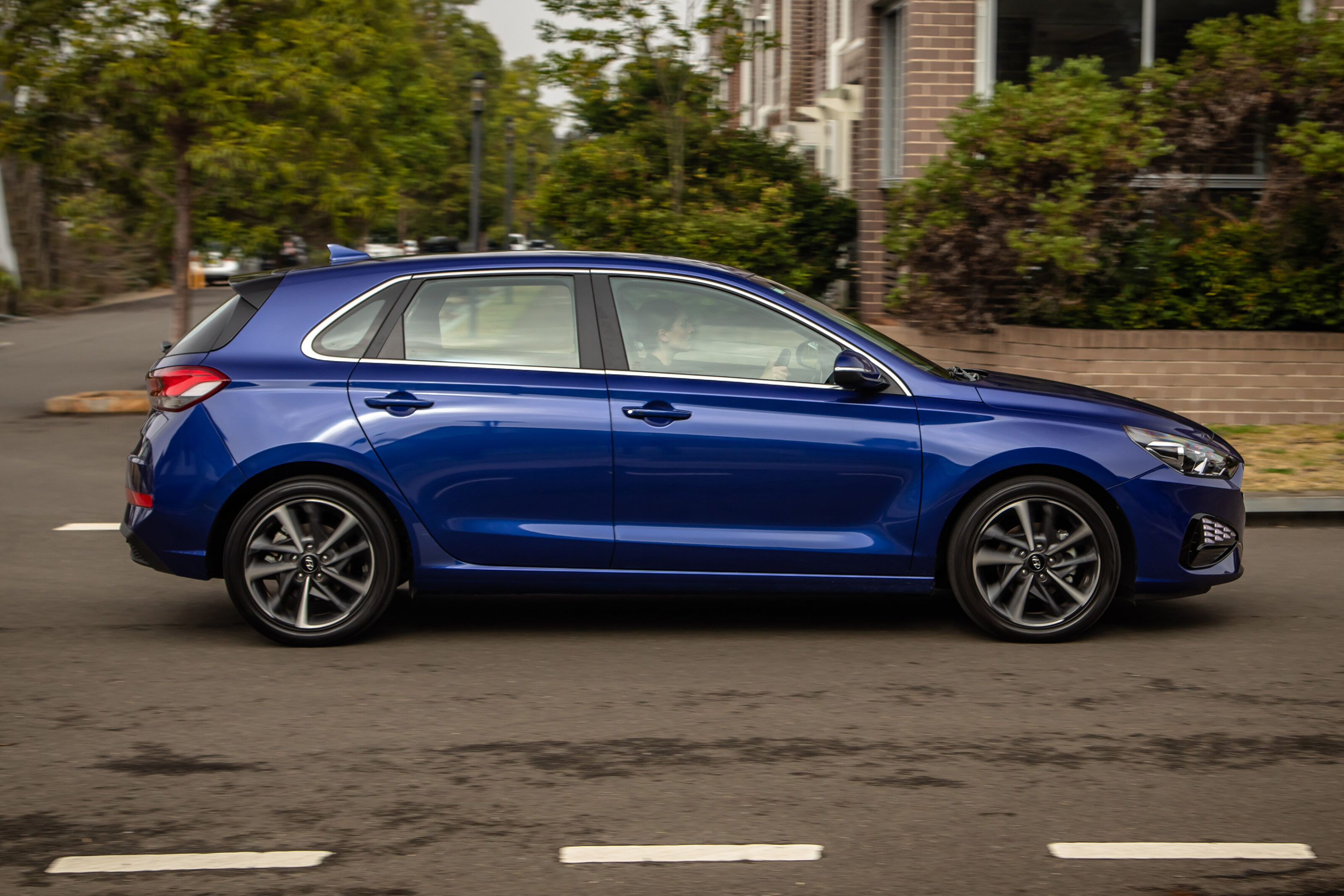
On 80km/h-plus roads, it’s quiet and comfortable and you can pound through the miles without getting tired from wind or road noise. It’s very impressive and acquits itself well against newer and more expensive cars.
A Twitter follower who had spent a few days in a rental DMed me and asked how it was so good and then went out and bought one. “I can’t see how anything else could be much better than this,” they said.
Quite.
The brakes are well-modulated and the racy steering – 2.57 turns lock-to-lock – is also well weighted and just chatty enough without scaring the horses.
Tuned, as ever, by Hyundai’s feted Australian suspension team, the ride and handling balance is exceptionally good, especially considering the torsion beam rear-end.
Ownership
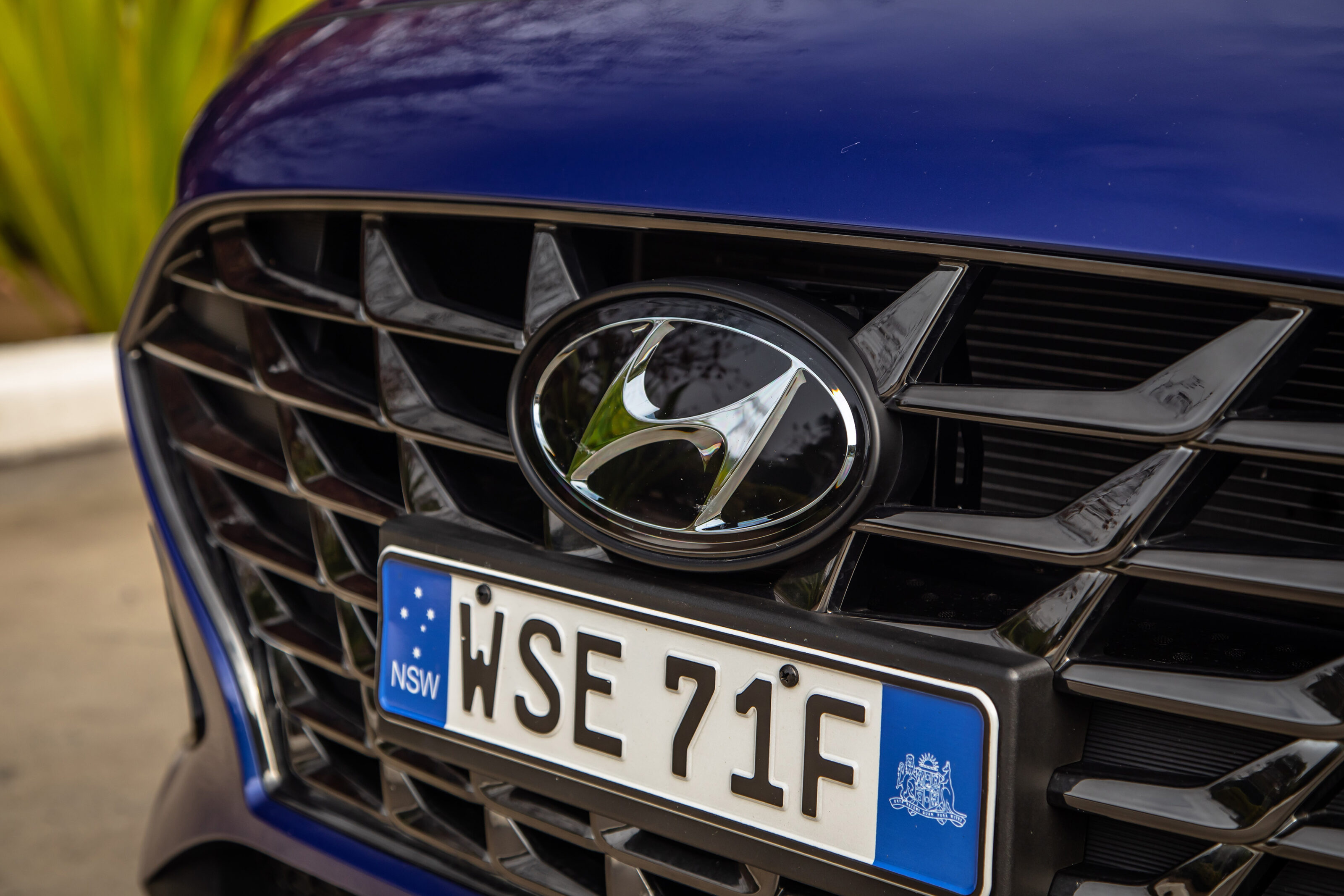
Hyundai’s five-year/unlimited-kilometre warranty applies, along with an initial 12 months roadside assist that extends by a year every time you service at a dealer.
The naturally-aspirated i30s only need to visit the workshop every year or 15,000km and you can rely on the lifetime capped-price servicing plan or pre-pay for three years ($777), four years ($1116) and five years ($1385) in advance.
Around $280 per year servicing isn’t bad, but the Corolla is much cheaper on that front while Mazda is more expensive.
The service pricing for the turbo-engined N-Line variants is a little more expensive.
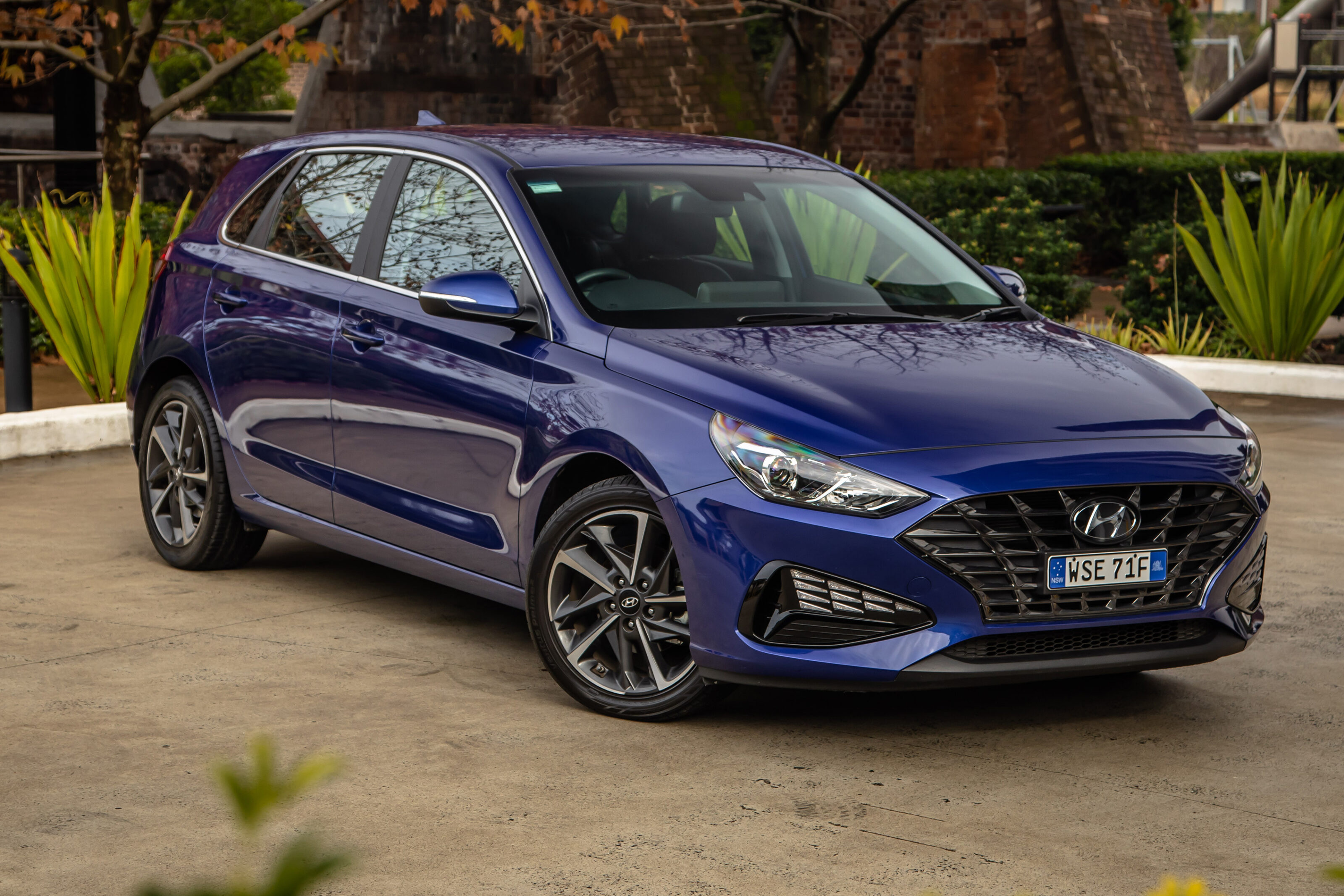
VERDICT
Sometimes you look at the top-spec car and think, “Nah, stick with the spec below.” Often it’s just silly stuff or a sneaky extra safety item (which to be fair, is the case here) but the Elite really is quite a nice specification.
Yes, the Active is pretty good, but with the smaller screen – albeit with wireless CarPlay/Auto – and less plush interior, the extra bits and pieces in the Elite are definitely worth considering.
2022 Hyundai i30 Elite specifications
| Body: | five-door hatchback |
|---|---|
| Drive: | front-wheel drive |
| Engine: | 2.0-litre four-cylinder petrol |
| Transmission: | six-speed automatic |
| Power: | 120kW @ 6200rpm |
| Torque: | 203Nm @ 4700rpm |
| Bore stroke (mm): | 81.0 x 97.0 |
| Compression ratio: | 11.5 : 1.0 |
| 0-100km/h: | 10 sec (estimate) |
| Fuel consumption: | 7.4L/100km (combined) |
| Weight: | 1382kg |
| Suspension: | MacPherson struts (front); torsion beam (rear) |
| L/W/H: | 4340/1795/1455mm |
| Wheelbase: | 2650mm |
| Brakes: | 280mm ventilated disc (front); 284mm solid disc (rear) |
| Tyres: | 225/45 R17 |
| Wheels: | 17-inch alloy wheels (full-size alloy spare) |
| Price: | $30,220+ ORC |
Get ready to wind back the clock. The prototype glory days are about to be reignited at La Sarthe.
In recent years it’s been a Toyota procession with the Japanese giant going up against privateer entries. However, that will all change with the FIA amalgamating the already established Le Mans Daytona Hybrid (LMDh) category with the burgeoning Le Mans Hypercar (LMH) class.
Once again endurance racing is back in favour with Peugeot, Ferrari, Toyota, Scuderia Cameron Glickenhaus and ByKolles committing to the new Hypercar class. Set to join them on the same grid is Porsche, Audi and BMW under the new LMDh regulations with Acura, Mazda, McLaren and Lexus all in various stages of deliberations.

Peugeot is the latest manufacturer to rip the covers off its racer, the 9X8, with its twin-turbo V6 hybrid set to tear up racetracks in time for the 2022 endurance season. And as you can see, it’s pretty wild, with trick aerodynamic technology paving the way for a wingless LMH offering.
But hang on, we bet you’re wondering how this mash-up will work. Making sure parity is under control will be FIA-designated ‘performance windows’ to which both categories must comply, along with general Balance of Performance (BoP) metrics. Think GT3 and how it deals with parity and you’re on the money.
Once again endurance racing is back in favour with Peugeot, Ferrari, Toyota, Scuderia Cameron Glickenhaus and ByKolles committing to the new Hypercar class.
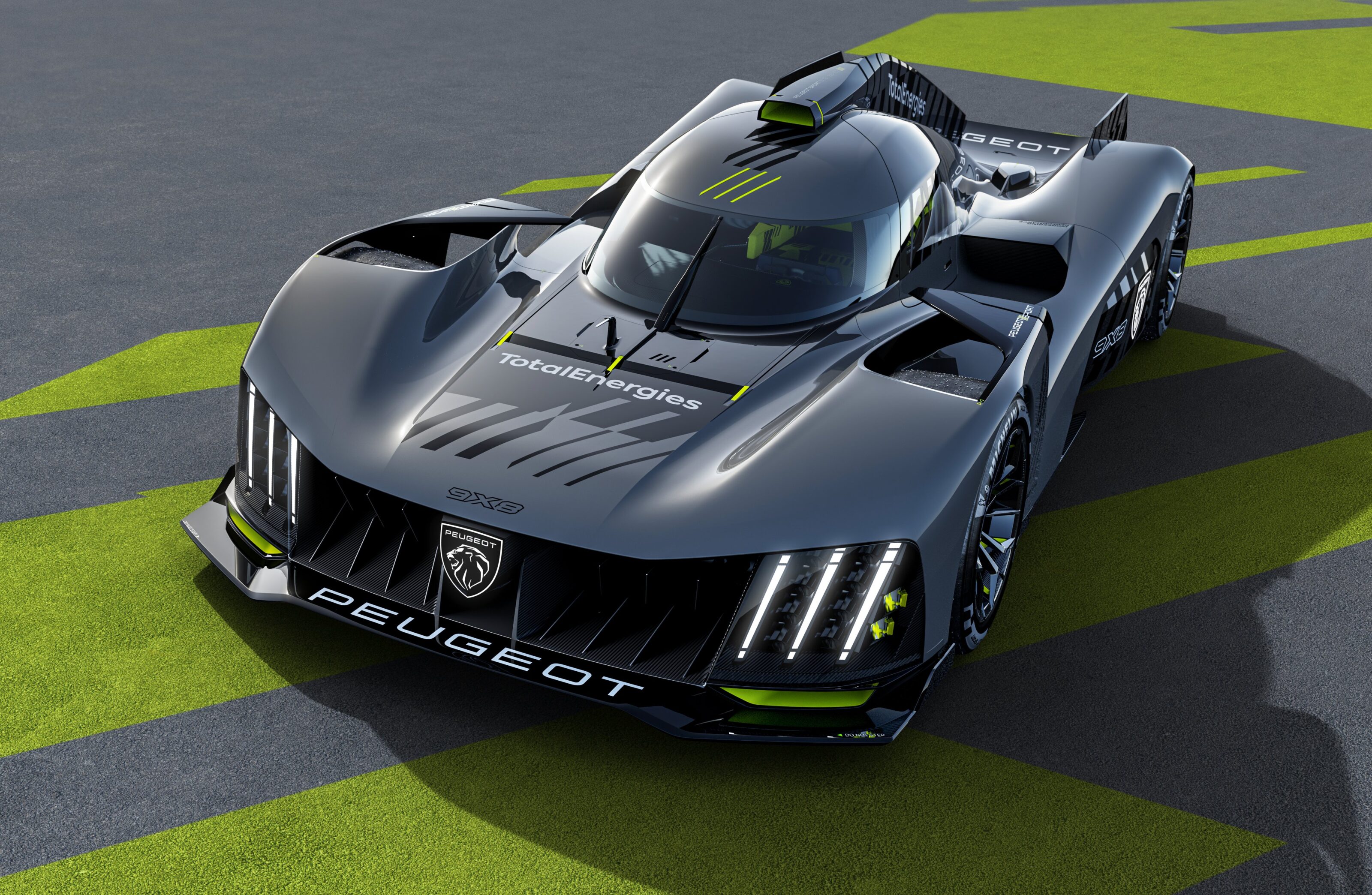
We won’t blame you if that all seems as clear as mud. Essentially, combined system power is now limited to 500kW to lower costs, while cars must weigh no less than 1030kg. How manufacturers racing in LMH achieve the power figure is largely fair game, as the Hypercar class does not require electric motors.
If it is chosen, total electric assistance must not exceed 200kW. That extra zap also isn’t allowed to kick in below 120km/h and must only power the front axle – and only with dry-weather tyres fitted.
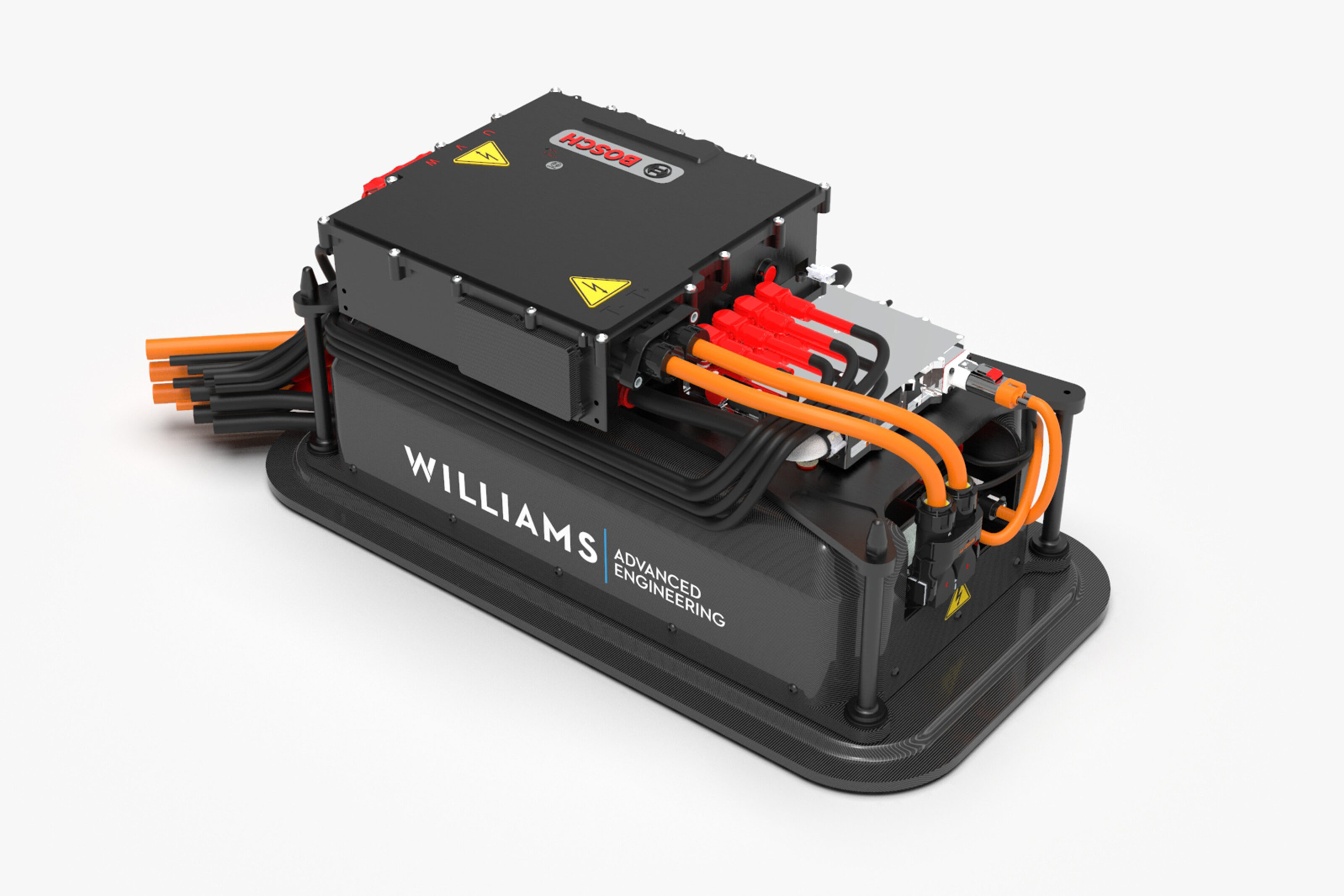
A ‘spec’ electric motor supplied by Bosch is available for LMDh teams, while Williams Advanced Engineering is also offering a plug-and-play hybrid powertrain for teams not wishing to develop their own.
Those opting for the LMDh route will choose from four accredited chassis suppliers: ORECA, Ligier, Multimatic and Dallara (whereas LMH chassis will be developed in-house). From there, basic bespoke bodywork from each manufacturer will wrap around the control chassis. However, there will be one general LMDh aerodynamic package available, and the sole tyre supplier is Michelin.
For both, complicated suspension set-ups make way for a more conventional double-wishbone design sans mass dampers and active systems. The gearbox is kilo-controlled at 75kg and a magnesium or aluminium casing is compulsory.
Essentially, combined system power is now limited to 500kW to lower costs, while cars must weigh no less than 1030kg.

Getting the cars right is now more important than ever, because once BoP has been met, the respective designs will be locked in for five years as a cost-containment measure. The prospect of a longer shelf life and projected savings in development is a key part of the attraction for car companies to once again go prototype racing.
So does this all mean we’ll see a return of the road-legal homologation special? Sadly not. It seems the governing bodies have gone cold on the requirement to produce 20 road-going versions of the winged prototypes, meaning a modern-day Porsche 911 GT1 straßenversion is unlikely. Toyota is going ahead with its GR Super Sport, however Aston Martin’s Valkyrie is now slated for the road only; not the track.
While LMH cars are in the works for this year and next, 2023 is shaping up as the year both categories will fully align with big fields full of manufacturer support at La Sarthe. It’s shaping up to be an epic 100th birthday for the 24 hours of Le Mans and it will be essential viewing. At long last, prototype racing has well and truly regained its mojo.
Peugeot 9X8 – Three Key Points

Hybrid Grunt
Providing the internal-combustion grunt is a 90-degree 2.6-litre twin-turbo petrol V6 – dubbed HYBRID4 500KW. The front-mounted, high-density battery is being developed by Peugeot Sport and Saft

Drive us Crazy
The ‘X’ in the 9X8 name stands for all-wheel drive. The boosted V6 turns all fours via a seven-speed dual-clutch, while the high-voltage (900 volts) battery powers the electric motor on the front axle at more than 120km/h

Gone with the Wind
Fellas, where’s the rear wing? The 9X8 uses sophisticated aerodynamic tech that channels air underneath the car (think Nismo GT-R LM), negating the need for a drag-inducing wing. It should be an absolute weapon down the Mulsanne straight
Drifting its way to the top of the mind when people think of iconic Toyota sports cars is the fourth-generation Corolla Levin.
Commonly referred to by its AE86 codename, it has earned itself legendary status in the eyes of car enthusiasts – all thanks to its spirited rear-wheel drive drift-happy goodness.
The aptly named modern Toyota 86 may be considered a younger sibling to the AE86, with its Wheels Car of the Year-winning “affordable [and] involving driving enjoyment”, yet it is not truly faithful to the original design.
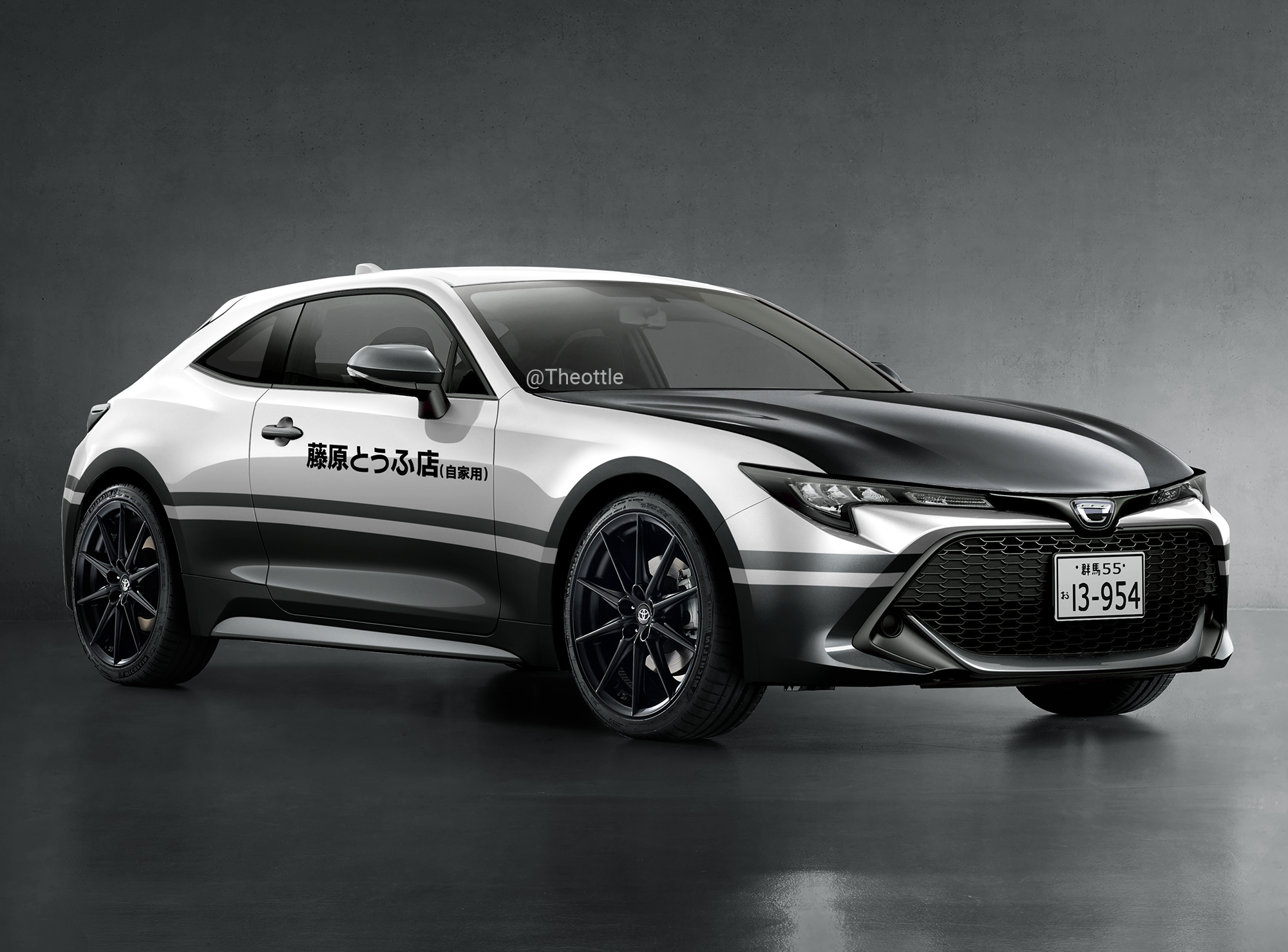
With this in mind, designer Theottle has imagined a modern Toyota Corolla Levin three-door coupé.
The renderings put forward a new take on the AE86 and the famous tofu delivery car from Japanese street racing series, Initial D.
Despite sharing a large extent of its exterior styling with the front-wheel driven Corolla hatchback, the rendering is based on the new-generation GR 86 body.
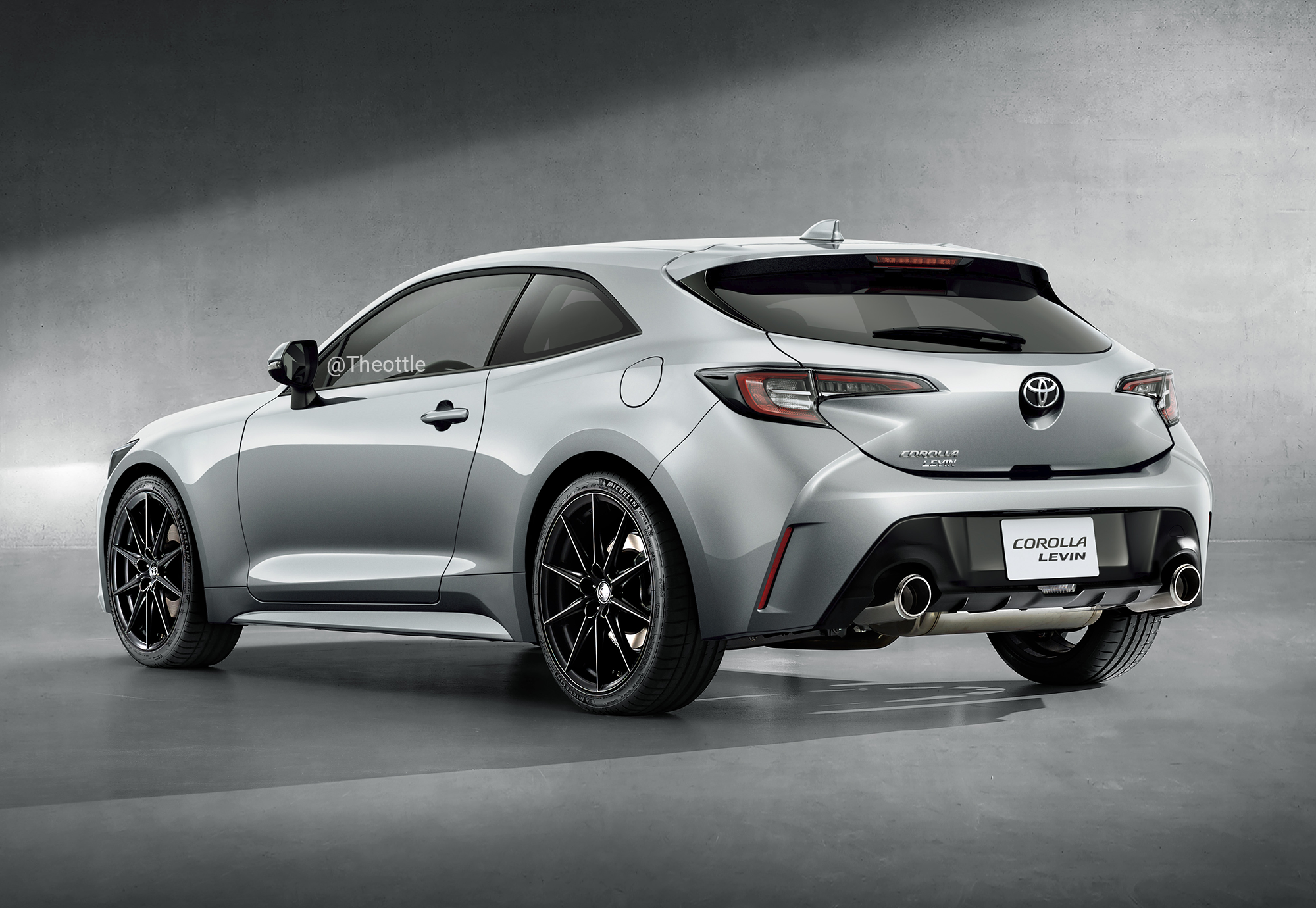
Bringing present-day styling to the table, the images represent a sleeker design over the original Corolla Levin, with body-coloured panels and an upright, hatch-like C-pillar.
Up front, the styling looks identical to the Japanese-market Corolla, with design changes centred around side and rear profiles.
In a similar fashion to the new GR 86, the Corolla Levin sports large side skirts and front doors, with the rear doors of the regular Corolla hatchback removed. Out back, the sloping roof and tailgate are matched by a sportier rear bumper and larger dual exhaust pipes.
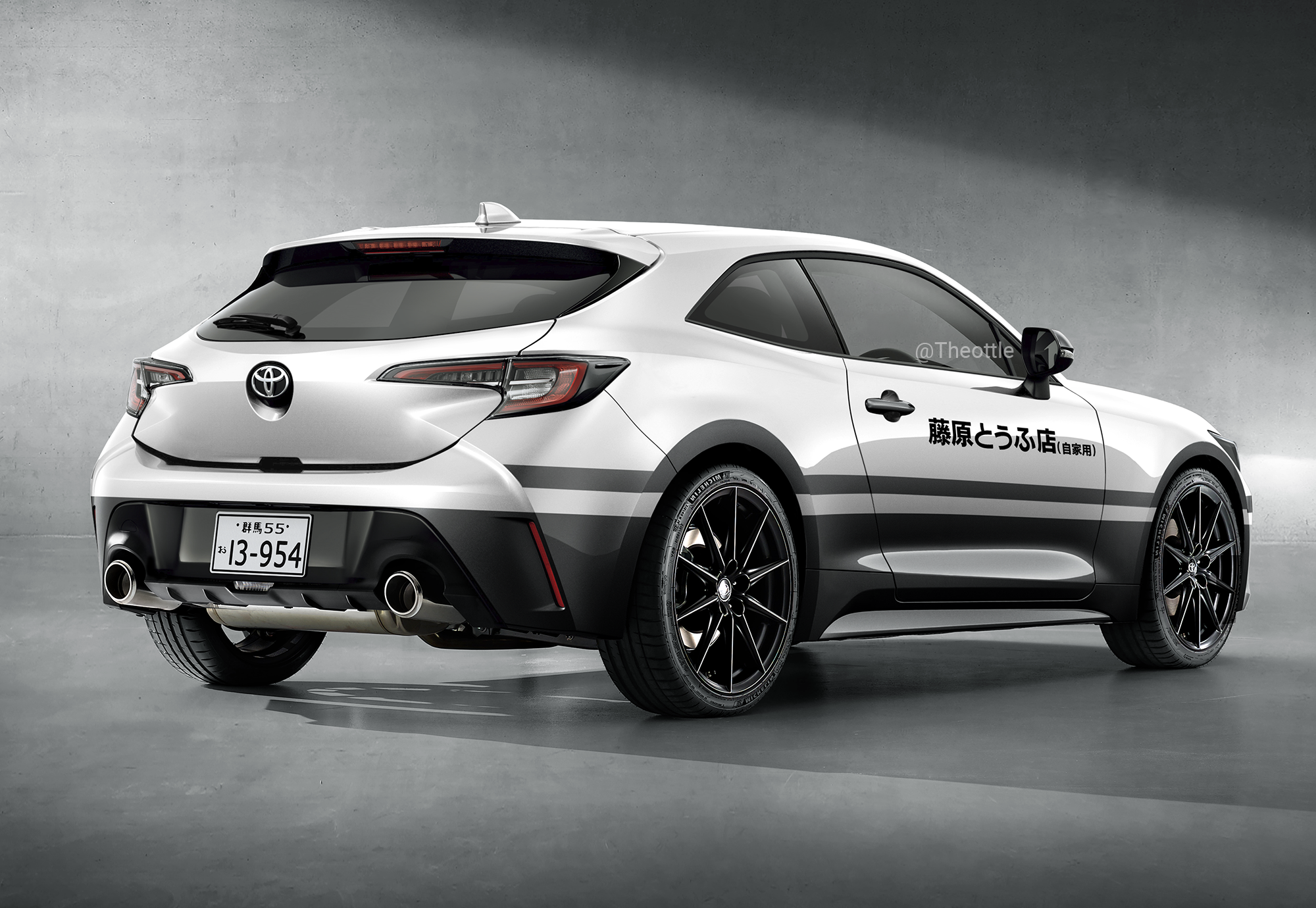
Wearing a black bonnet and stripes, as well as ‘Fujiwara Tofu Shop’ side decals, the second image takes clear inspiration from the car driven by Takumi Fujiwara in the Initial D series of magazines and anime television.
The bad news? A decline in three-door hatch and coupé sales in recent years has sparked the death of the likes of Honda’s Civic Coupe and Volkswagen’s three-door Golf GTI, effectively bringing the idea of a modern-take on the Corolla Levin far from even the back-burner at Toyota HQ.
There is still a glimmer of hope for Toyota sports car fans, with a recent addition to the company’s US website seeing “GR hot hatch” added to the ‘upcoming vehicles’ section.
Although Toyota has remained tight-lipped on exactly which model the Gazoo Racing hot hatch will be based on, it is widely speculated to be similar to the current-generation Corolla – a debut that is expected to occur in 2022, if true.
Snapshot
- The trial will give old E-Tron batteries a second life
- Using batteries to charge EVs avoids using peak electricity
- Audi aims to be a zero-net carbon by 2050
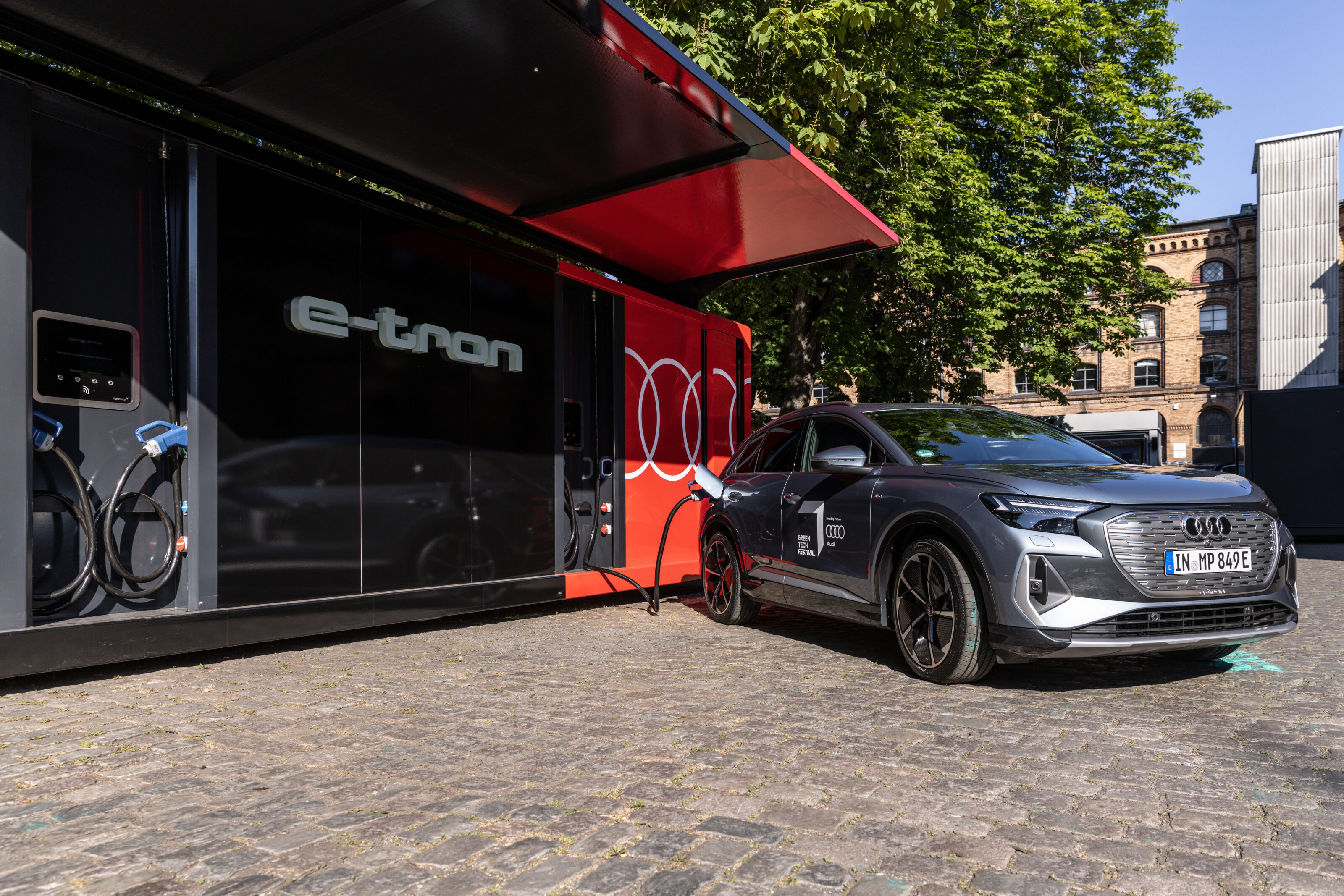
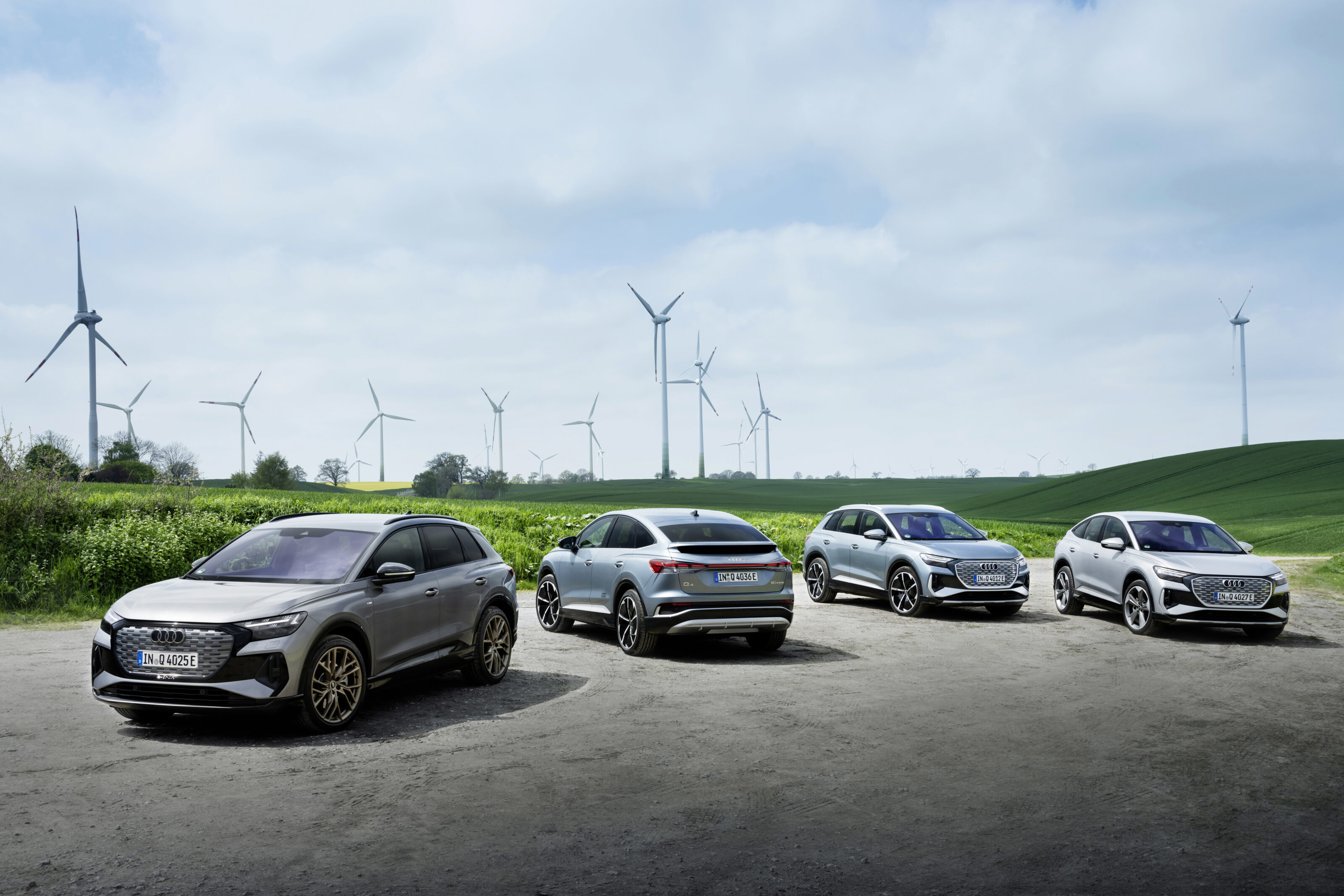
Audi is trialling an electric vehicle charging hub that will use repurposed lithium-ion batteries from old E-Tron vehicles connected to renewable energy sources.
The trial is part of the German carmaker’s ambitious goal to be a zero-net carbon vehicle manufacturer by 2050.
The German carmaker, which has already committed to carbon-neutral production at all its plants by 2025, has committed to using 100 per cent renewable energy and recycled materials throughout its production process and supply chain.
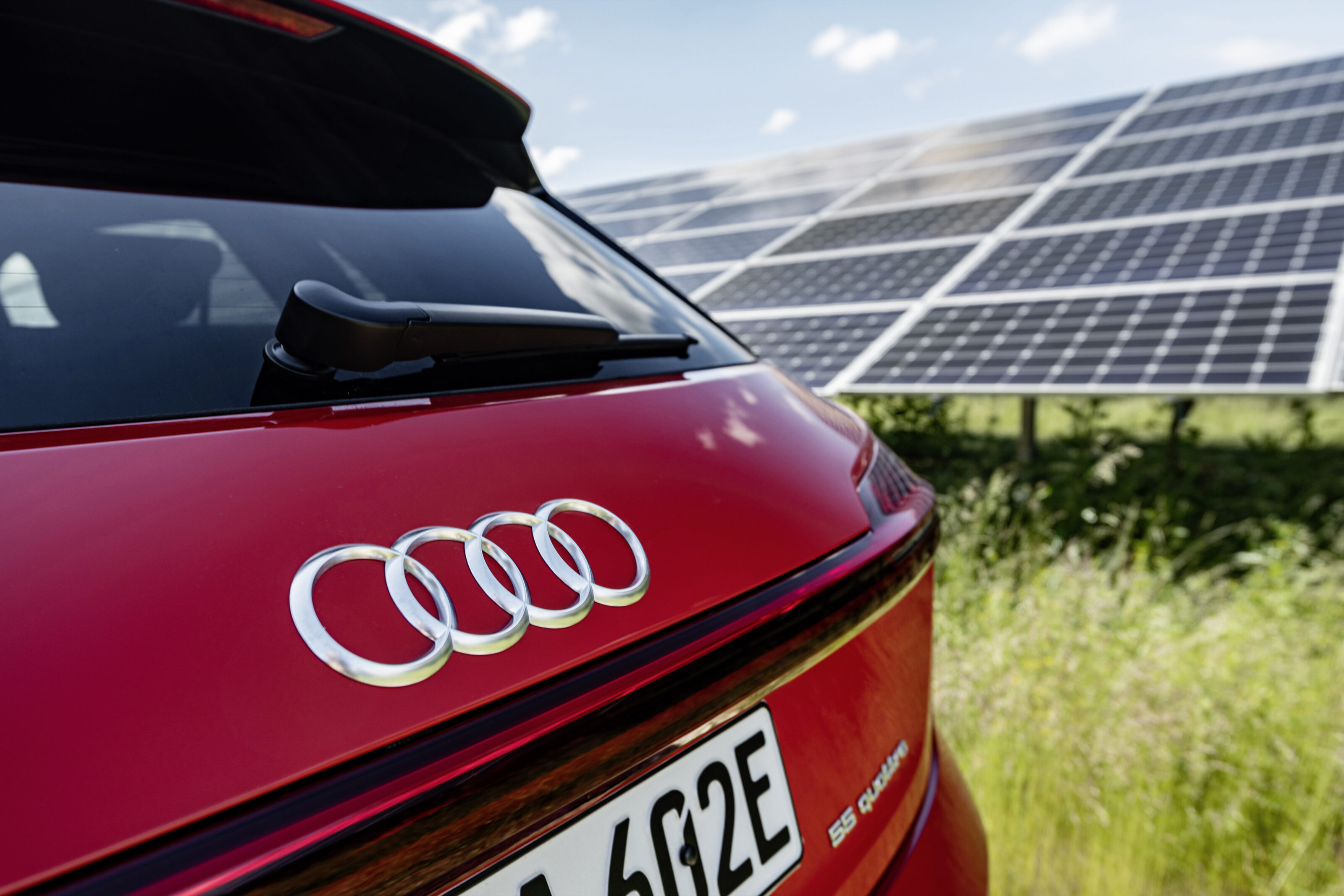
However, the energy-intensive production of lithium-ion batteries, which is responsible for almost a quarter of all carbon emissions of producing each of its electric vehicles, creates significant challenges to its sustainability goals.
So it plans to reduce the batteries’ carbon footprint by giving them a second life powering the charging hubs in portable 11kW power ‘cubes’ that can hook up to an existing 400-volt three-phase connection, which makes it easier to find a suitable location without the planning time and resources required to build all-new infrastructure.
The pilot charging hub in Nuremberg will use three storage cubes with batteries sourced from disassembled E-Tron development vehicles. It will have a total capacity of 2.45-megawatt hours, enough for 70 quick charges of up to 300kW per day through six charging ports.
They will be charged overnight using just 200kW of off-peak green energy and topped up during the day by solar panels on the roof, meaning there will be no strain on the power grid during peak times.
The charging hub’s project manager, Ralph Hollmig, said a portable lounge area, built from sustainable materials, will also be erected on-site to provide a place for drivers to spend the charging time.
“Charging an electric Audi model only takes a little longer than a coffee break.
“With our lounge, it will be particularly entertaining or it can be used, for instance, for business appointments,” Hollmig said.
According to Audi, the Cube will be available to all EV users and will cost the same as other chargers around Germany.
If successful, the Audi Charging Hubs will be rolled out to other parts of Germany and possibly to other markets.
Once, and only when, batteries can no longer fulfil their second-life applications, they are broken down into their individual raw materials in order to be used again in new batteries.
Audi is not the first company to give batteries a second life once they are no longer suitable for vehicle use.
Old Nissan Leaf batteries have been repurposed for home battery storage and other applications such as portable energy for tradies and even boats.
And in Melbourne, power solutions firm Relectrify is rolling out second-life lithium-ion batteries for high-capacity power storage for commercial and industrial applications throughout Australia.
Other ways Audi is working to achieve its net-zero emissions target is to use 100 per cent renewable energy, treated wastewater, and recycled materials throughout its vehicle production cycle and supply chains.
The Mazda 3’s smarter, slicker and more upmarket fourth generation certainly caused a stir once it arrived 2019, if perhaps not entirely in line with its importer’s hopes. Settling into showrooms, its favour with Aussie buyers slipped from what formerly was long-standing and solid footing. Australia’s particularly warm embrace of Mazda over two decades was, by the Japanese maker’s admission in the past, a bit of a head-scratcher.
And one imagines the small-stature spearhead of the brand’s more stylised, increasingly premium push not resonating as hoped with devotees Down Under caused just as many furrowed brows.
What’s not to love? Mazda 3’s sharper styling inside and out, dipped in ‘semi premium’ gloss, shouldn’t really deter. Indeed, with no luxury brand to protect, mainstream Mazda’s no-holds-barred design ethos has, for some time, afforded nothing but favour and it runs more liberally in its small cars than anywhere else in the stable.
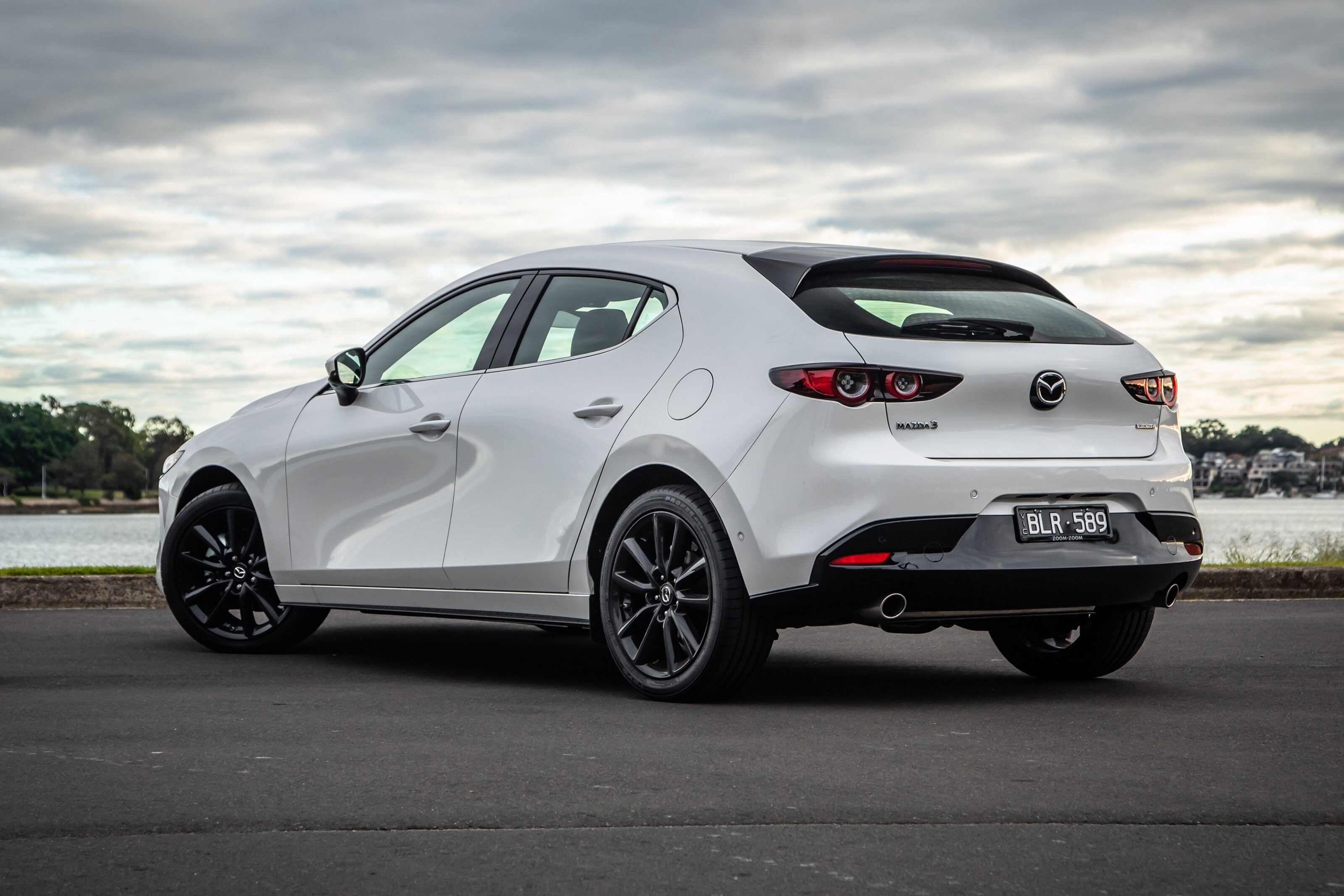
There’s no lack of variety for buyers: five grades (plus 100th Anniversary specials), two petrol engines and one hybrid, manual or automatic choices abound, and four- or five-door forms.
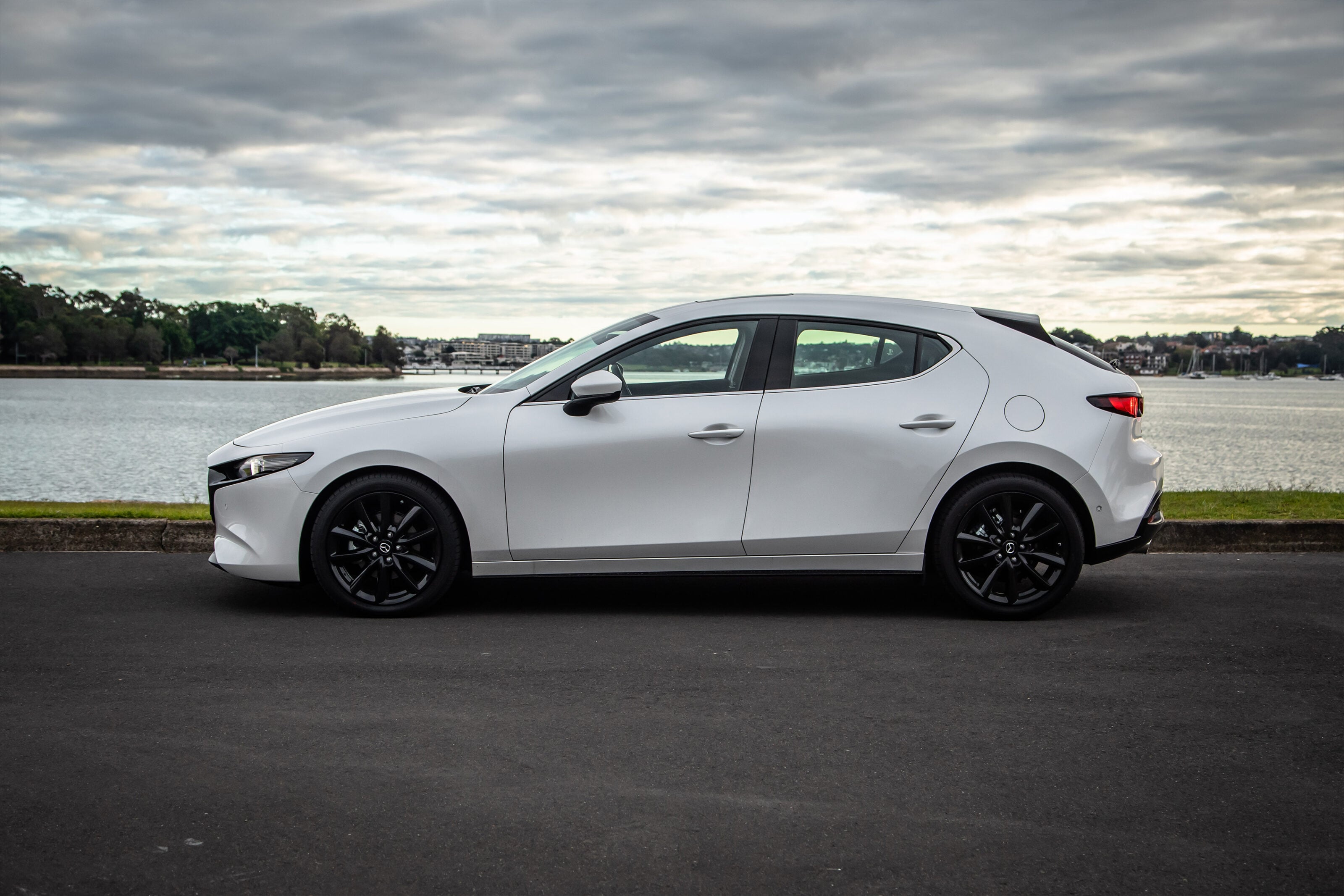
Surely the main culprit was pricing. Suddenly, Mazda 3’s tip-in was five grand higher in base form. And the high-grade G25 Astina hatch auto here on test, now at $38,790 before on-road costs, sits at the upper fringes of the categorically small mainstream. There’s fair argument presentation and equipment levels justify richer repositioning in metal, glass and rubber, if perhaps not quite so much in buyer perception.
The G25 Astina is nice. Very nice. But when ‘nice’ is your main selling point for a small hatch nudging 40 large, you’re facing an identity problem. It’s not turbocharged, fits a torsion beam rear end, and offers little fast- or even warm-hatch schtick or branding. It’s not nailing its intent to any solid mast. Instead, it’s Kodo-infused Zoom Zoom chockfull of SkyActiv, and one wonders if that’s enough to hang your hat off when shifting from a largely value-laden position to one asking increasingly serious dough.
Today, it plays against the new eighth-generation Volkswagen Golf R-Line auto ($37,450 list) and a fresh-faced Kia Cerato GT Turbo Hatch auto ($35,290 list), both more affordable and with more distinctive pitches, as well as the ever-popular and more seductively priced Toyota Corolla ZR petrol ($32,695 list) and ZR Hybrid ($34,695 list) twins, and where a top-spec Subaru Impreza 2.0i-S wants for just $31,490 list.
There’s no SP or MazdaSpeed upgrades, no method to quicken or sharpen. But you can dress your Astina up, $1682 for alternative silver or satin chrome wheel designs, the latter rim set also offered in a Kuroi Sport styling pack that, at $4884, adds lower extension spoilers front, rear and side plus a roof spoiler and black mirror caps. Nicer, then.
Unsurprisingly, standard equipment leaves little for the options list, its striking if not quite pretty form incorporating niceties such as adaptive LED headlights, a sliding and tilting sunroof plus a 360-degree camera system with multi-angle viewing including dedicated forward and reverse perspectives.
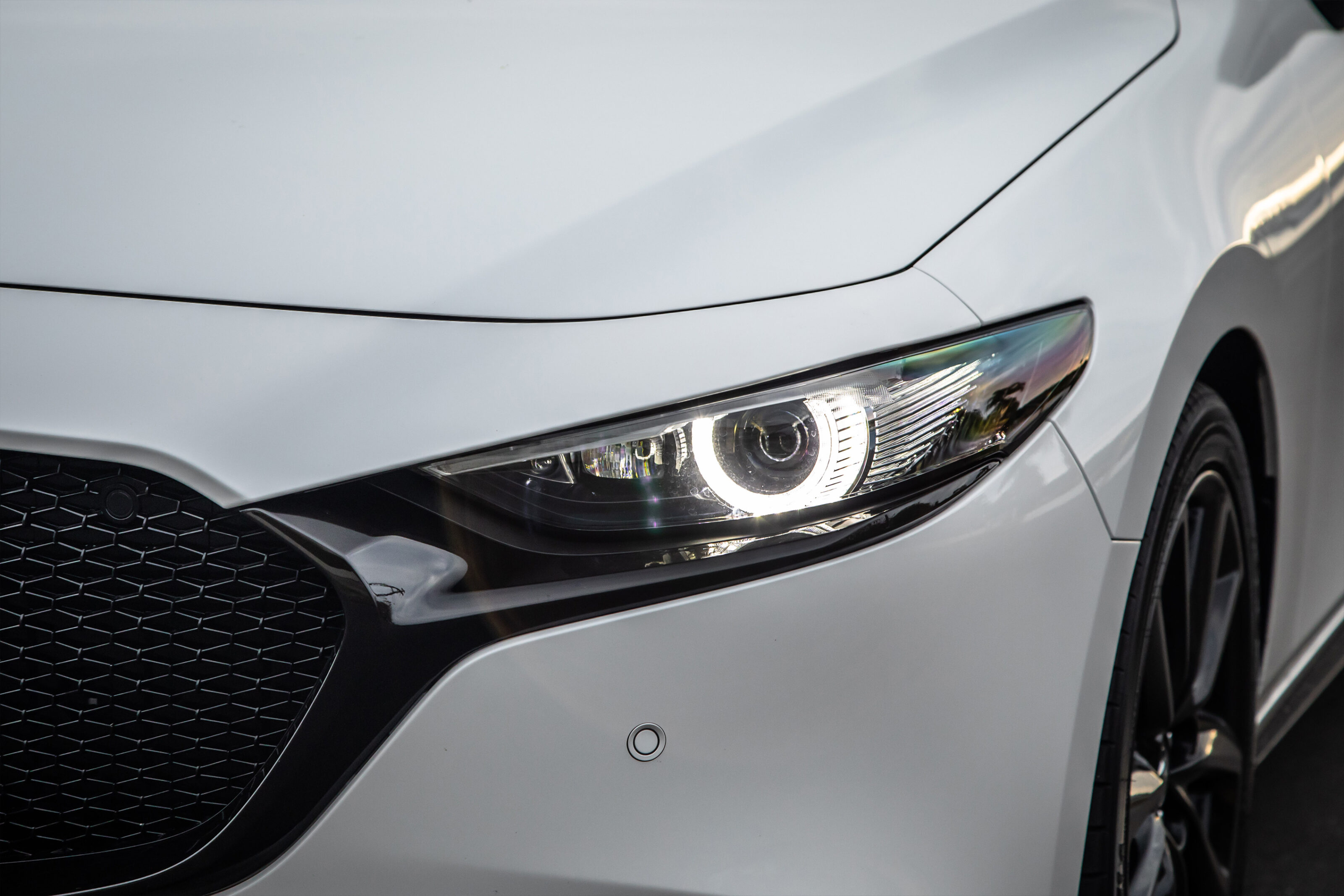
Primarily, though, the Mazda 3 is out for maximum exterior impact, ours with an inescapable Imperial Stormtrooper spin, its Snowflake White Pearl Mica paintwork, one of five metallic and mica finishes, at no extra cost. Three effects paints, including the well-flogged Soul Red, want for $495.
But it’s really cabin ambience that elevates the Mazda 3 above most competitors. Minimalist and contemporary without gauche fussiness, ours minted in no-cost optional burgundy trim that lifts the design better than the conservative black alternative. It’s a functional space, ergonomically resolved and intuitive, the controls uncluttered and falling neatly to hand in its fetching sport-luxury theme.
Primarily, though, the Mazda 3 is out for maximum exterior impact, ours with an inescapable Imperial Stormtrooper spin.
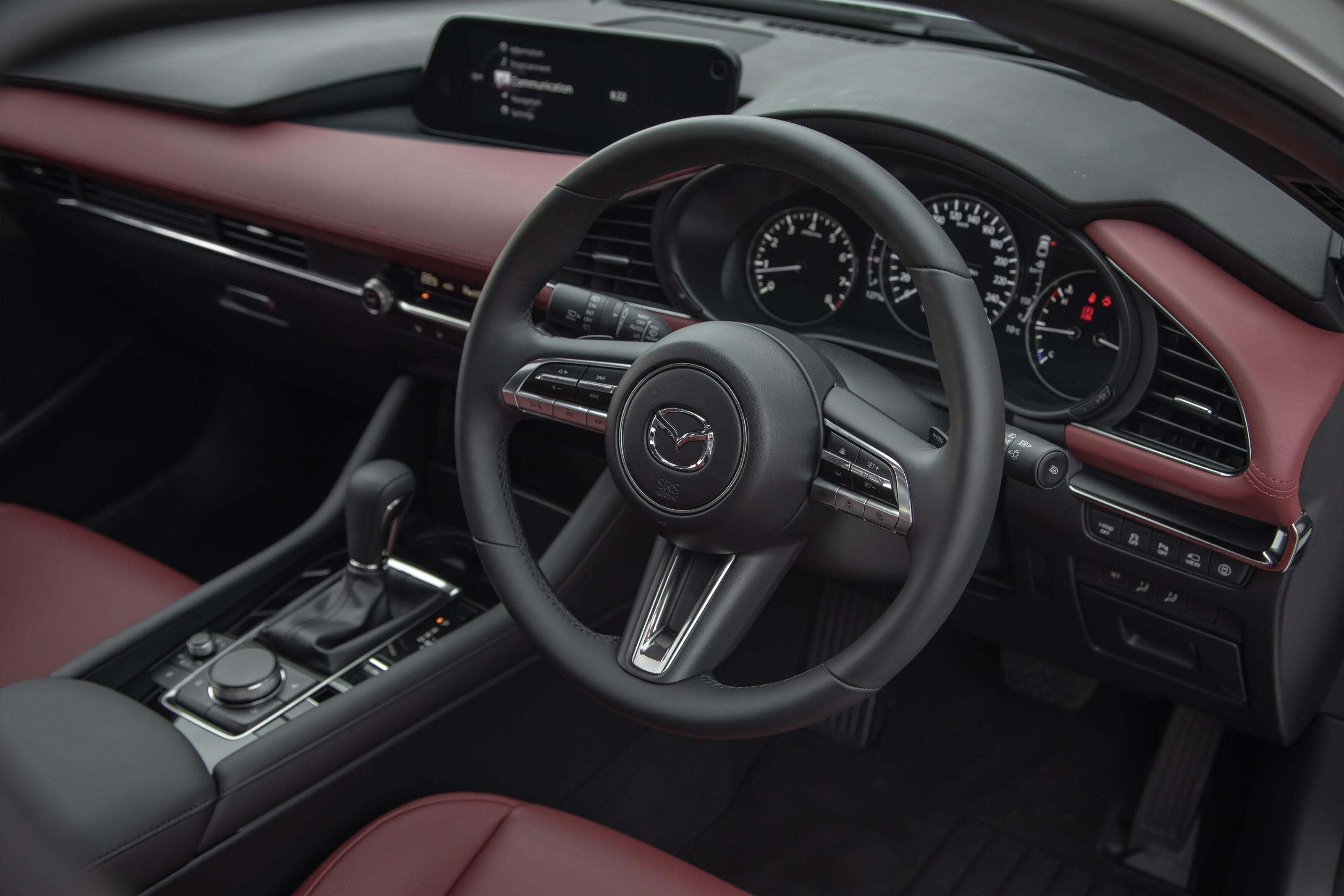
Anchoring the interior is the effect of the leather and leatherette, the seat surfacing more sumptuous than hardier stuff used by rivals, the neat two-tone dash fascia fetching with its neat double stitching.
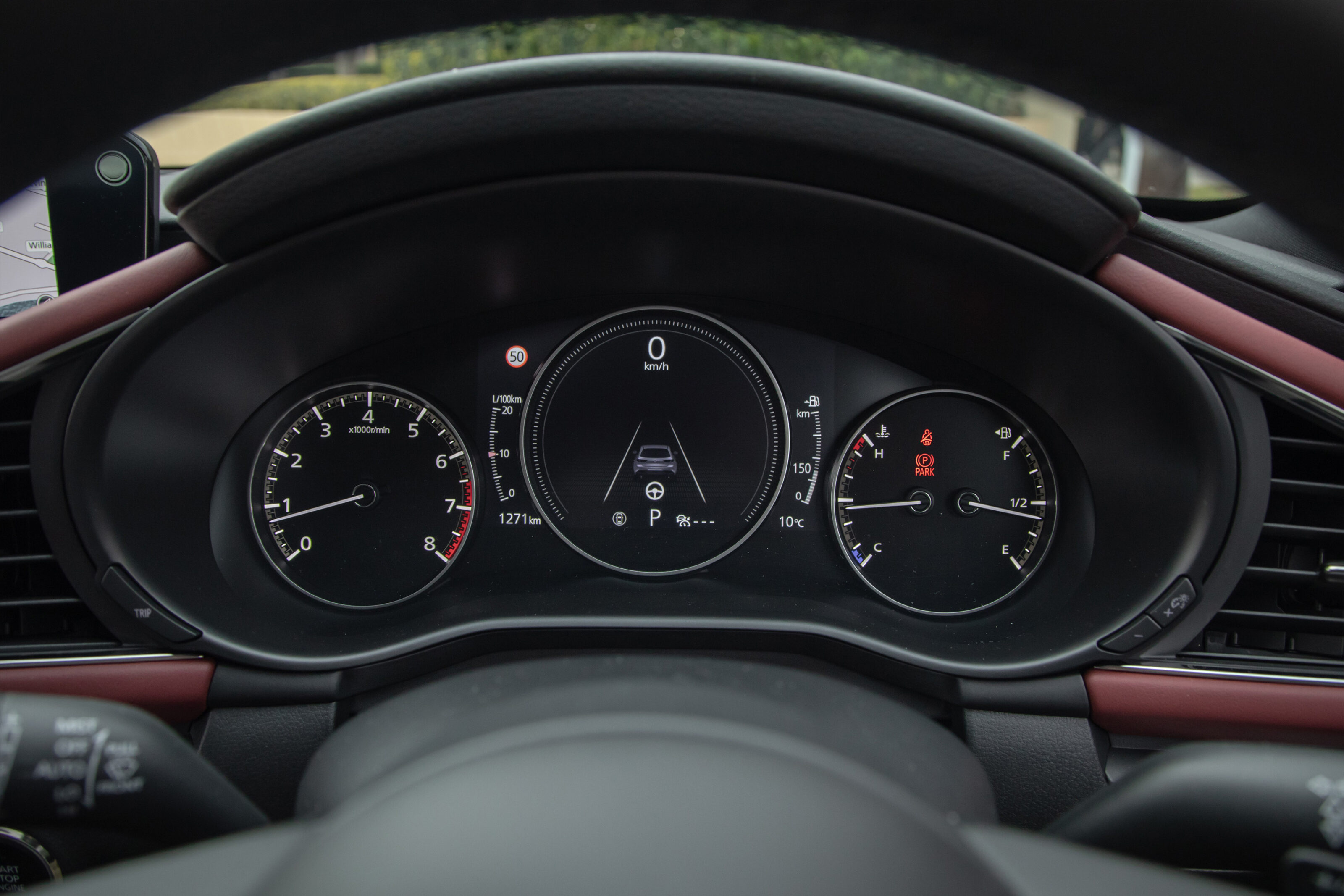
From the slick slightly oversized wheel to the ornate door trim there’s not so much as a whiff of cost-consciousness, even if the analogue cluster – with its digital central roundel – might seem a bit humdrum in the current shift towards bedazzling fully digital jewellery.
This new direction is still such a lunge forward for Mazda that it still makes other stablemates’ design seem cheap and dowdy.
The front seats are cosseting and supportive, the driving position suitably driver-focused, and it feels as rich as it is welcoming. All is well up front. The smart presentation extends through to the second row, which does suffer a little from claustrophobia caused by merely modest legroom and a sweeping window line that saps outward visibility and is only really beneficial to exterior appearance.
Infotainment is the main bugbear, specifically smartphone mirroring. There’s no touchscreen control – it’s simply an 8.8-inch display – and navigating Apple CarPlay apps exclusively via the console’s rotary dial and button array is utterly tedious and distracting. Simply adding a touchscreen interface, as found on other Mazda ranges, is no quick fix as the Japanese maker presents a lock-out mode when mobile, an apparent safety initiative that in effect is contrary to its intent.
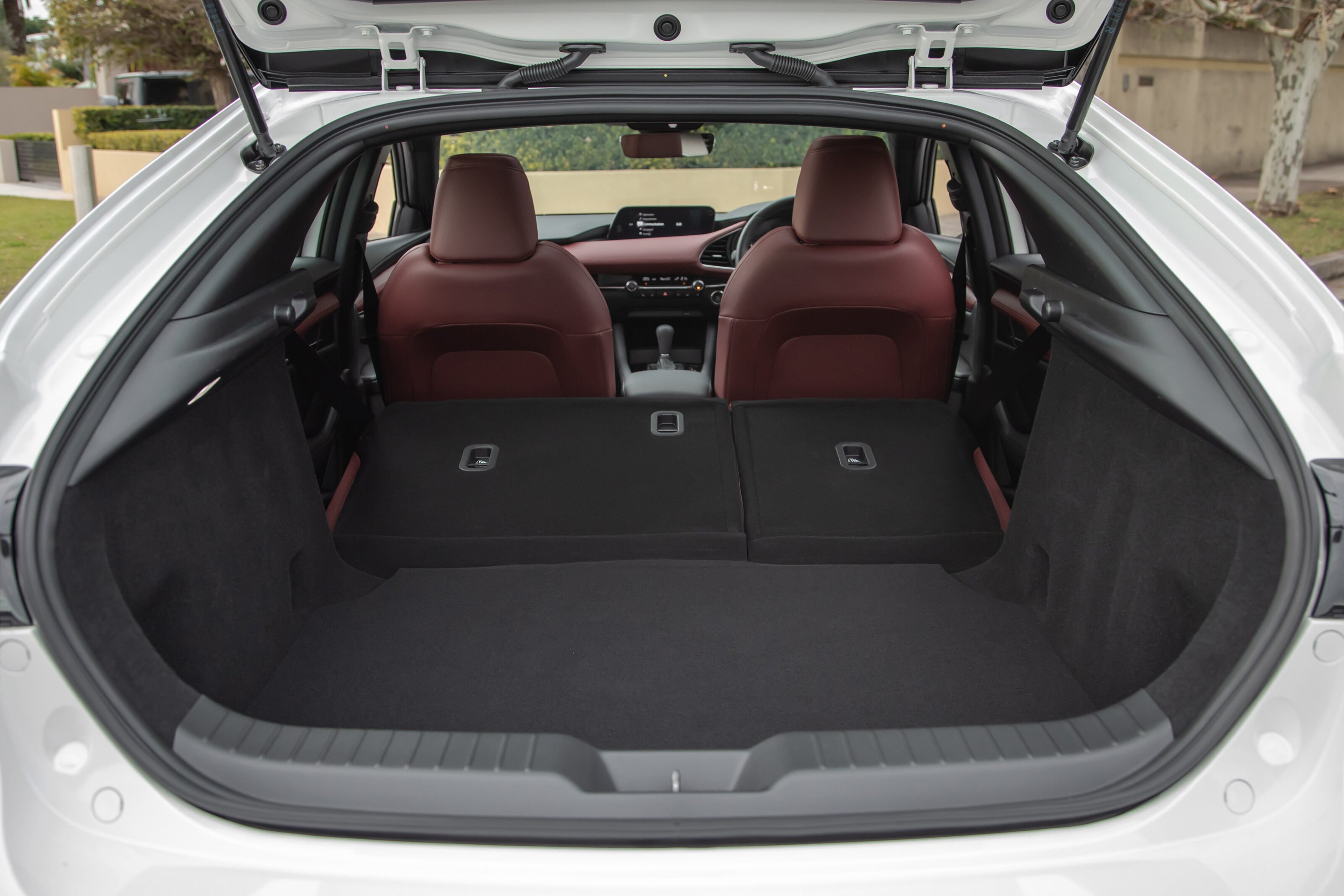
Like the cabin, the fully carpeted boot space presents well, though its 295-litre volume is modest to say the least. Dropping the 60:40 rear split-folding seatbacks liberates just enough room for a pushbike.
The lack of a turbocharged option will remain Mazda 3’s cross to bear whether it warrants it or not – again, perception counts for a lot – and the high-compression (13:1) 2.5-litre four plies a reasonably healthy 139kW at 6000rpm and 252Nm if, in typical naturally aspirated fashion, up at 4000rpm where you need to go searching for it.
A conventional six-speed automatic, rather than a CVT, or a six-cog manual is your choice in Astina, our self-shifter returning eight-litre consumption on test against its combined-cycle 6.6L/100km claim, and happily so on regular 91RON.
There’s energy enough to overcome the Astina’s 1380kg mass with ample haste, but the alert response isn’t followed through with quite enough mid-range shove, at least not without a lot of right foot encouragement, and then it yields a strained bark in response. Character isn’t this powertrain’s strong suit: it’s neither torquey enough for refined luxo-dignity nor charismatic enough to seem sporty, instead languishing about an uncommitted, if somewhat effective, middle ground.
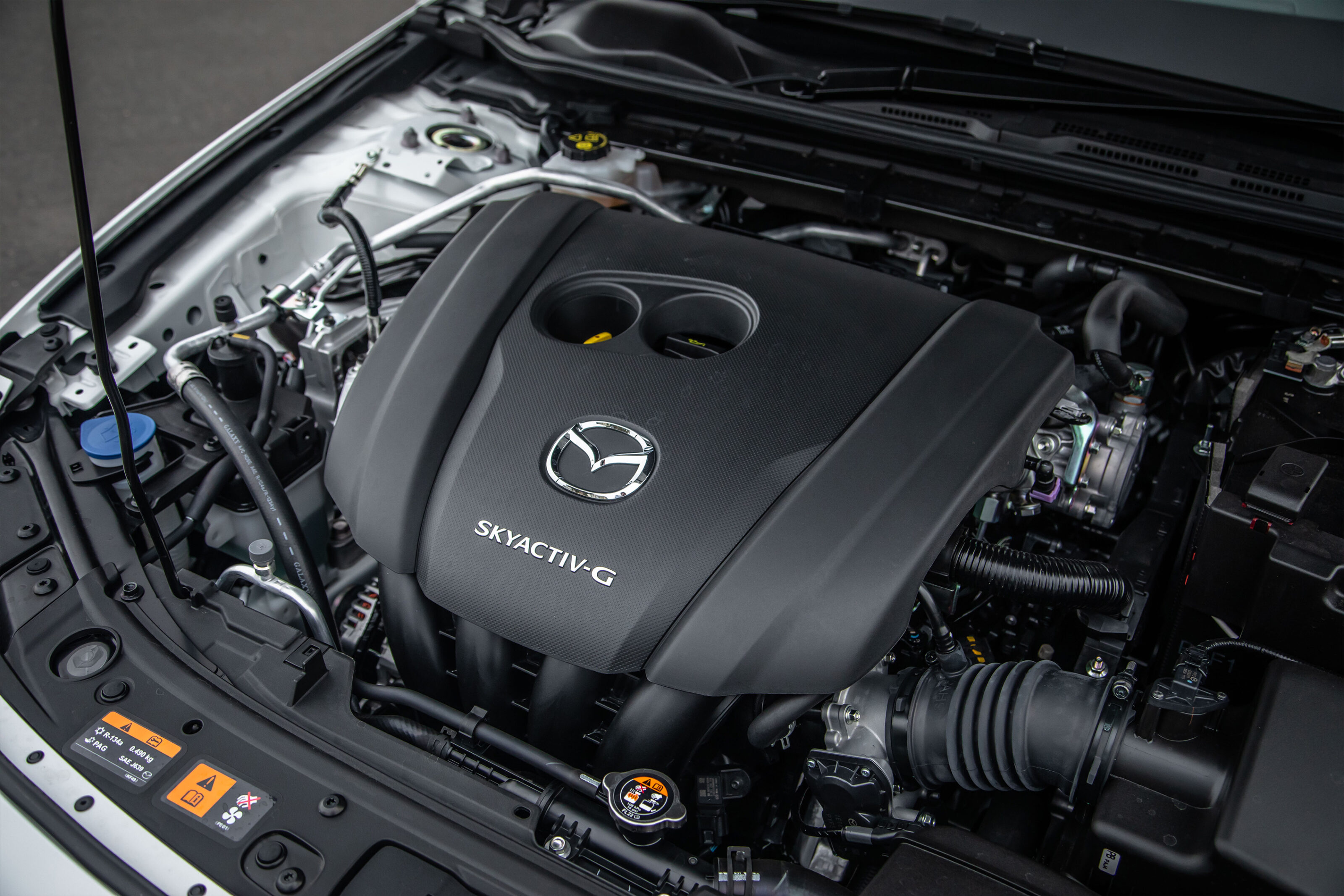
Eschewing the dreaded CVT in favour of a proper six-speed does, though, avoid constantly pegging the engine’s raspy mid-range and it’s a harmonious enough powertrain marriage, save from a faint if annoying vibration when at standstill left in D-for-drive.
Sport mode ups enthusiasm in noise and rpm if without the corresponding kick up the tailpipes. But it does march on, somewhat strained, to the point where its 215mm Toyo Proxes are sent scrabbling, without torque steer and with just a quick flicker-flash of traction control light in the instrumentation.
There are shades of resolved sportiness about its manner, its oversized wheel providing clarity and directional accuracy if stilted a touch in Sport mode by under-assistance, leaving it a little too hefty.
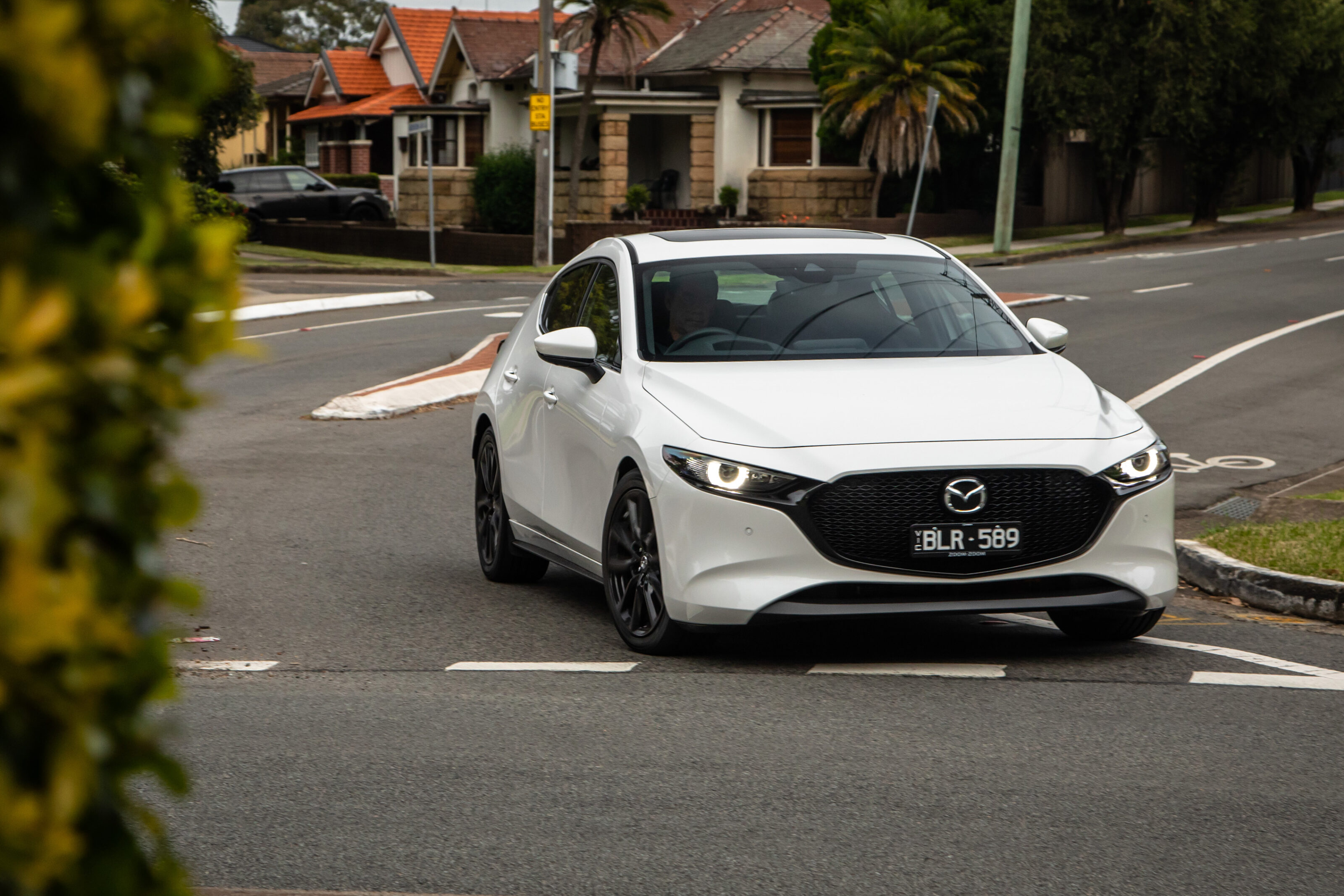
The passively damped suspension, with its torsion beam rear design, drags down on-paper credentials, questioning whether a hatch asking Astina money deserves more sophistication. But the tune delivers well in chassis confidence and dynamic eagerness even if it’s not the most reactive and lithe character once you push on. A high degree of competency, if somewhat short of the sort of fun factor that encourages you to push on and explore the limitations of its modest rubber.
Where it falls short noticeably is ride comfort. It’s fidgety across high-frequency bumps, overly sharp with deeper low-frequency road imperfections, and there is too much suspension noise accompanying its generally unsettled feel. Surely its taut nature intends to inject a bit of sporty fizz into progress but without the hot hatch pretension or promise a ride this hard is really unnecessary. Further still, it negatively impacts the ‘nice luxury’ hatchback vibe the Astina seems to position itself as.
That aside, this generation is a clear improvement in dealing with noise, vibration and harshness minimisation and, ride aside, there’s ample upmarket depth and quality about the driving experience. It’s certainly more well-rounded than some of its competition if, in sheer comfort terms, not close enough to threaten class leadership.
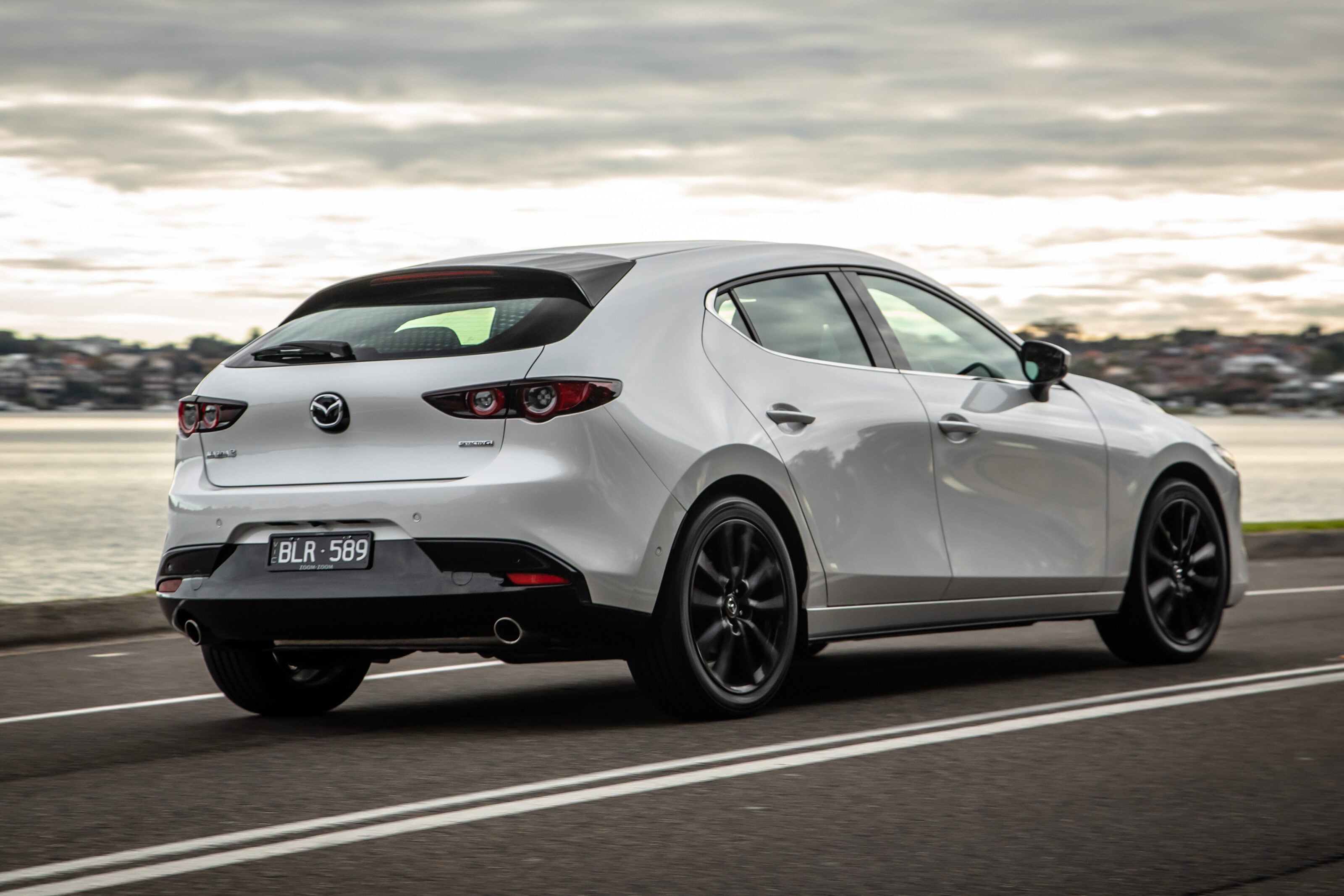
Where it does steal the march, though, is in safety fit-out. The Astina fits both forward and reversing AEB as well as front and rear cross-traffic alert systems along with neat features such as forward obstruction warning to compliment other functions like as lane-keeping assistance that are increasingly common in its competitive set.
Its five-star ANCAP-rated credentials also include a seven airbag complement and traffic sign recognition that, like most current commercialised designs, is inconsistent in its real-world accuracy and best treated as cursory advice.
It comes with a solid five years of unlimited-kilometre warranty and service intervals are 12 months but capped at a slim 10,000km, while servicing averages out to $340 per visit across the first five years, which is neither thrifty nor excessive.
This generation is a clear improvement in dealing with NVH minimisation and, ride aside, there’s ample upmarket depth and quality about the driving experience.
VERDICT
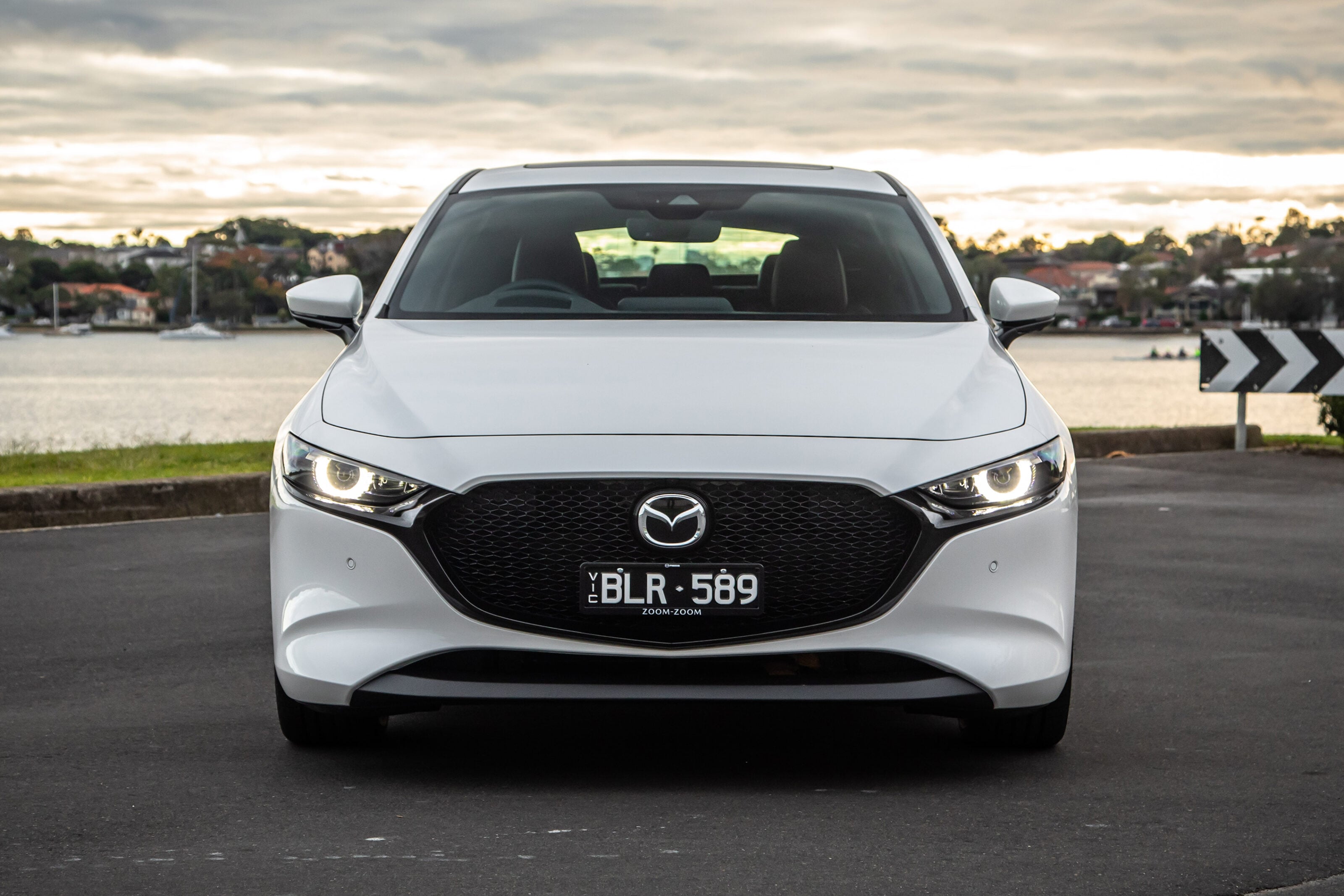
Style and presentation have long been Mazda strong suits and the Astina hatch is certainly a prized example. But it also backs this up with levels of execution and features – especially safety – that go a fair way to justifying its rich ask.
Working against it, however, is that lack of certifiable identity – its not overly luxury nor confidently sporting in intent – that mightn’t seem such an anchor had it bolstered its trick bag with turbocharging and higher levels of chassis sophistication. There’s not really that much in the experience to surprise and delight, to light a genuine fire under enthusiasm for it.
The Mazda 3 Astina is most certainly nice. It’s just not all that remarkable beyond merely ‘nice’, which surely must weigh in with its level of popularity, at least here in the high and pricey end of its range.
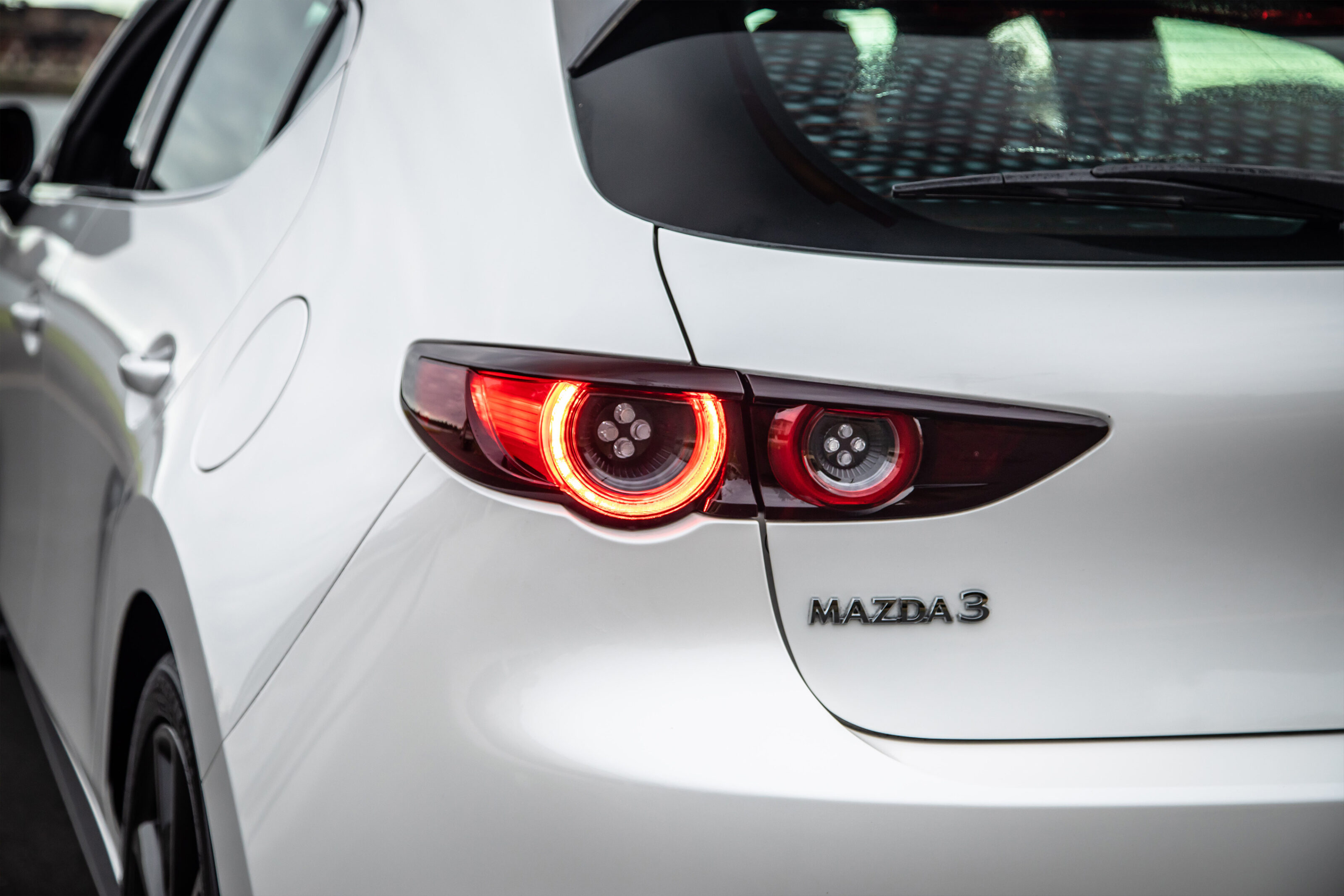
2021 Mazda 3 Astina Hatch specifications
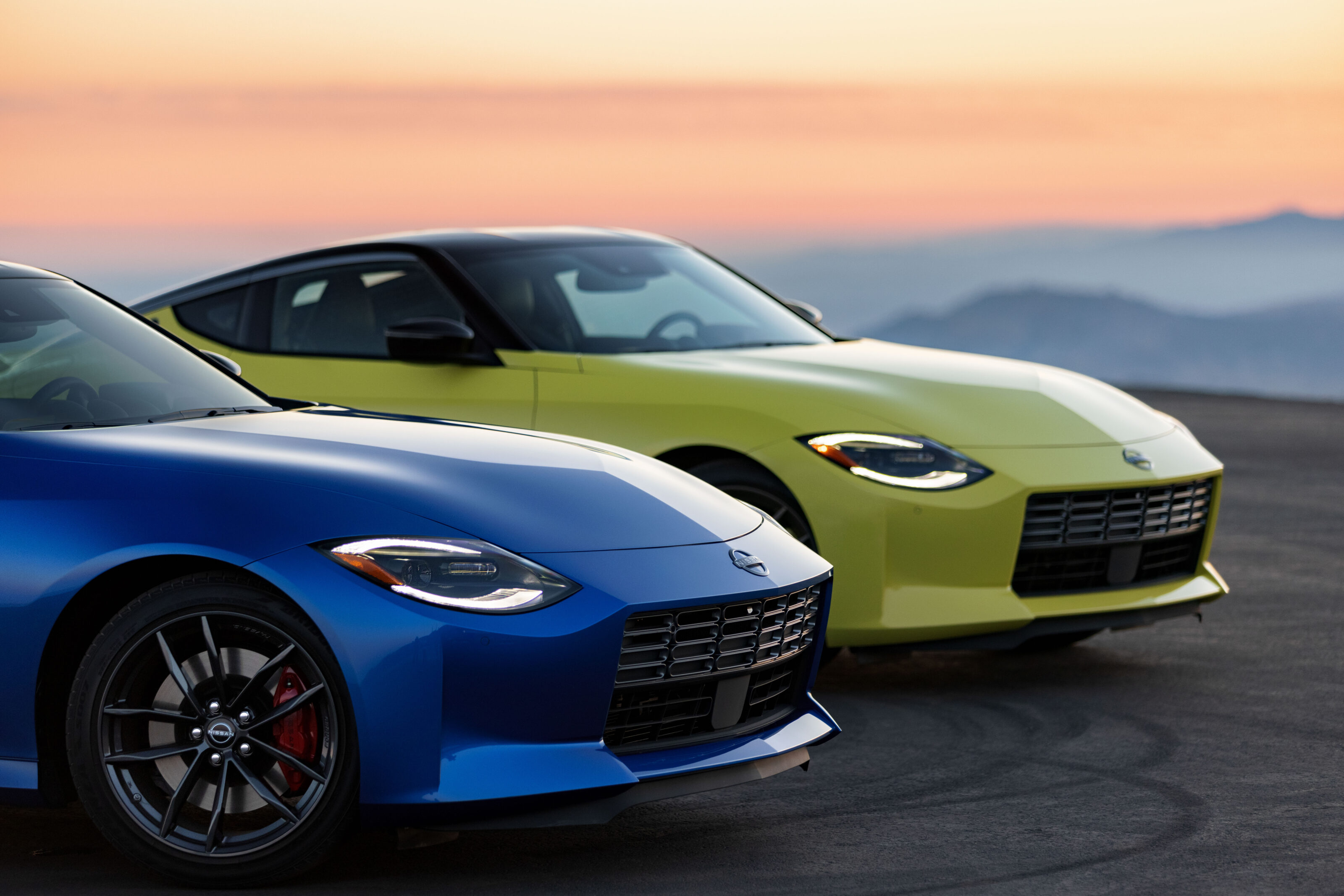
“I’ll take one. In Seiran Blue with a manual box.” That was the message that pinged straight into my inbox from a colleague on the MOTOR team as soon as the new Nissan Z details were released last week. I can see why.
If you were to ask MOTOR’s readers to come up with their wish list for the ideal sub-$100k sports coupe, it’d probably have around 300kW, send drive to the rear wheels, offer the choice of a manual gearbox, have stability control that goes all the way to zero and isn’t so overweight that it’ll chew through all of its consumables.
The Nissan Z delivers on all of those counts bar the last. Nissan hasn’t released a kerb weight figure for the car yet and the FM chassis on which the new Z rides delivers great weight distribution but earned a reputation as a bit of a bloater, tracing its roots all the way back to the 2001 V35 Skyline.
Look at the numbers, however, and that’s not really the case at all. When the 350Z, which also used the FM underpinnings, appeared in 2002, it weighed 1454kg which was considerably less than an E46 M3. Fast forward to 2008 and the 350Z’s replacement, the slightly smaller 370Z, had only put on a handful of kegs at 1466kg. That’s less than today’s Toyota Supra or, come to that, a Focus ST.
Toyota’s 86 has put on 40kg despite riding on a carryover chassis that has been torsionally strengthened by 50 per cent. If the Nissan tips the scales at anything less than 1525kg, that’ll be a job well done. It won’t be easy though. There’s the weighty matter that the outgoing atmo VQ37 V6 in the 370Z weighs around 50kg less than the Z’s fully-dressed twin-turbo VR30DDTT six-pot. Factor in a bunch of extra safety equipment and the fact that body length has grown by 139mm and, well, you draw your own conclusions.
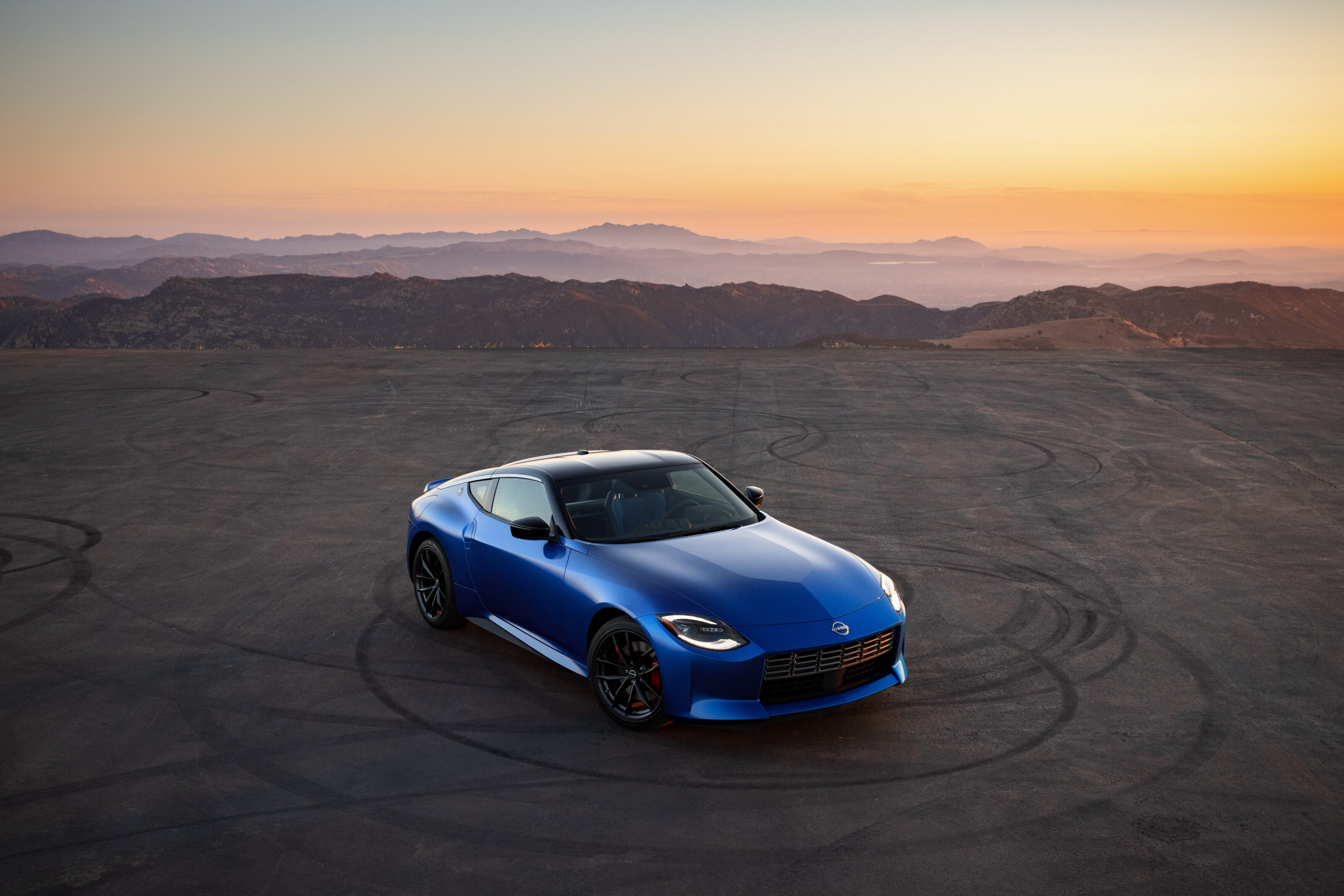
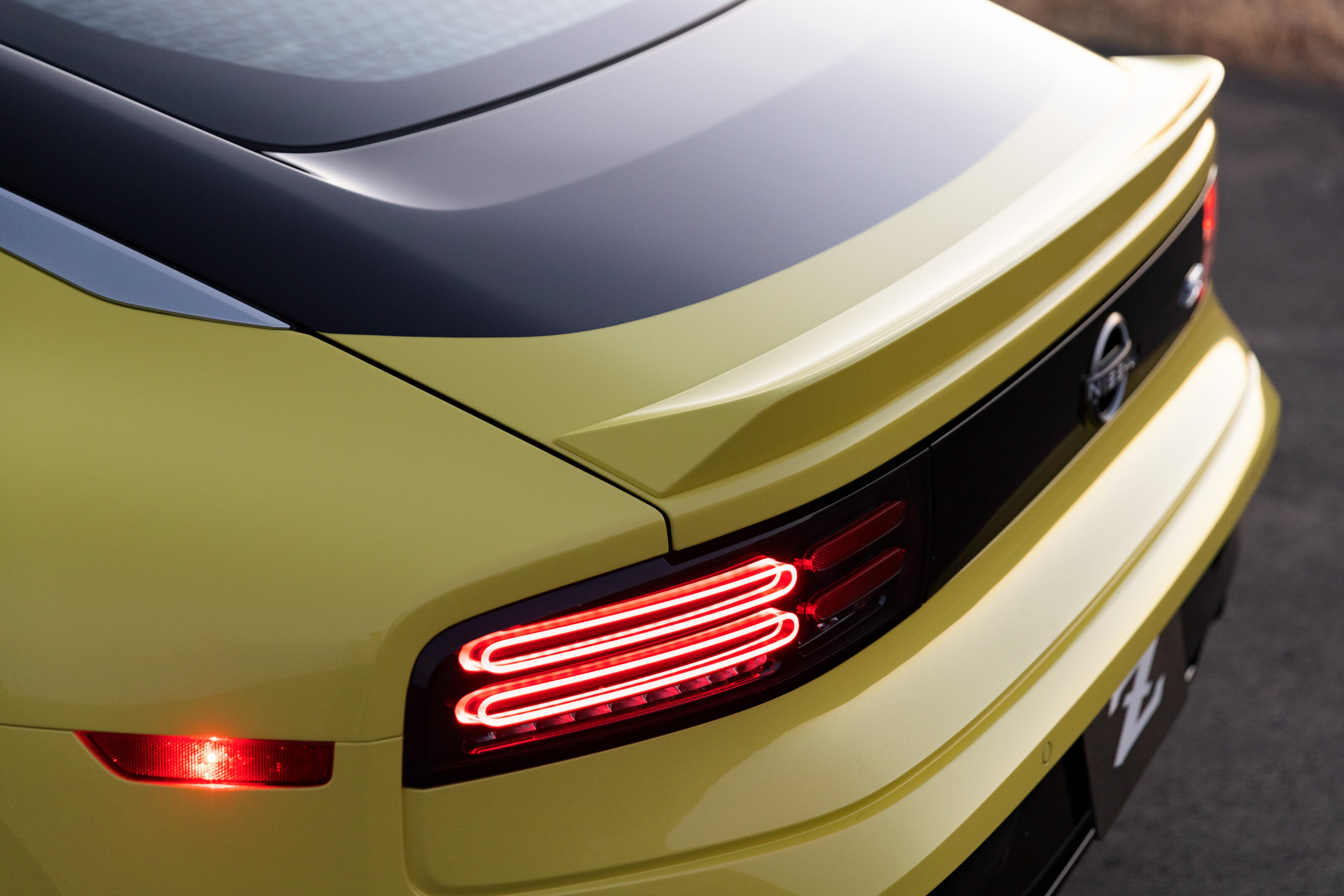
Personally, I love the way the car looks. A few had some complaints about the big rectangular aperture that forms the front grille, but I didn’t mind it when the Z Proto was unveiled last year and, given that we’ve seen the launch of BMW’s big grilles in the interim, it certainly doesn’t offend me now. I would like to see one wearing a number plate before I pass final judgement on how successful the front end styling has been, but it’s certainly a better-resolved piece of penmanship than that foisted on the Supra.
Nissan USA has settled on a two car model line up, Sport and the ritzier Performance trim, but it looks likely that when the car comes to Australia next year, we’ll just get one variant and, knowing Aussie buyers, it’ll be the full-fruit version. I find this a bit depressing. Were I in charge of bringing the car in, I’d polarise the two models still further, with a basic tuner-spec model that’s light and cheap at one end and the car that’s likely to arrive here at the other.
A budget tuner-spec version would create one heck of a buzz around the car in the enthusiast community, without cannibalising the sales of an entirely different demographic who want leather, metallic paint, high-end audio and a full suite of driver and safety assists.
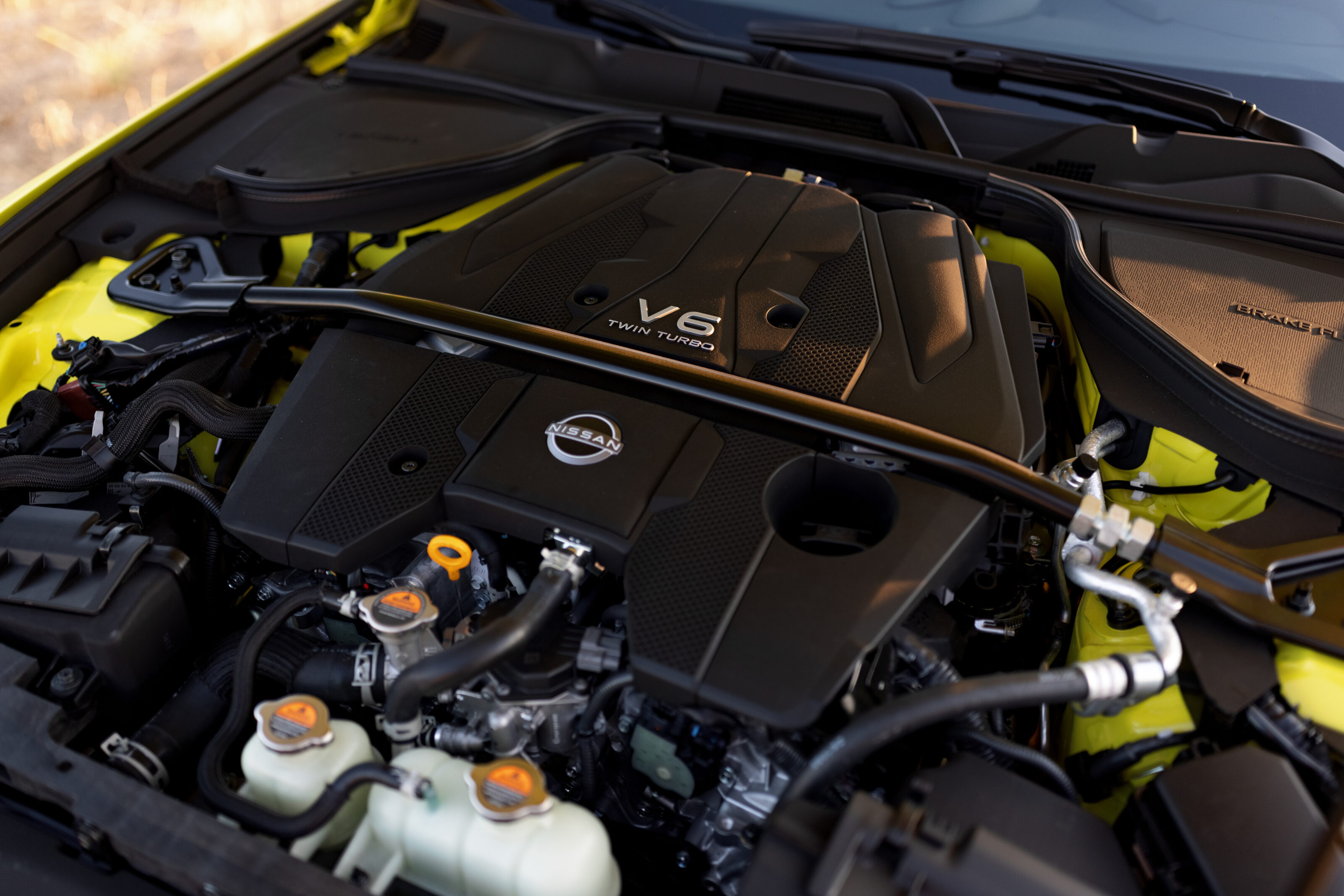
In trying to refine the Z, Nissan faces its biggest danger. Electrically assisted power steering debuts in the car, a departure from the 370Z’s hydraulic rack. The GT-R’s too. The electrically assisted steering on the Infiniti Q60 Red Sport (from which the new Z gets its engine) was utterly hopeless, sabotaging that car’s pretensions as a driver’s coupe.
The Infiniti system’s rack-and-pinion operation is controlled by a pair of small electric motors, one at each end of the rack mounted at 90 degrees. Four preset steering modes were offered, which affect the way the Steering Force Sensor and control modules interacts with the driver. In the middle of a conventional steering shaft is a nominally disengaged clutch, that can re-engage to create a reassuringly solid mechanical link should the electronics go on the fritz.
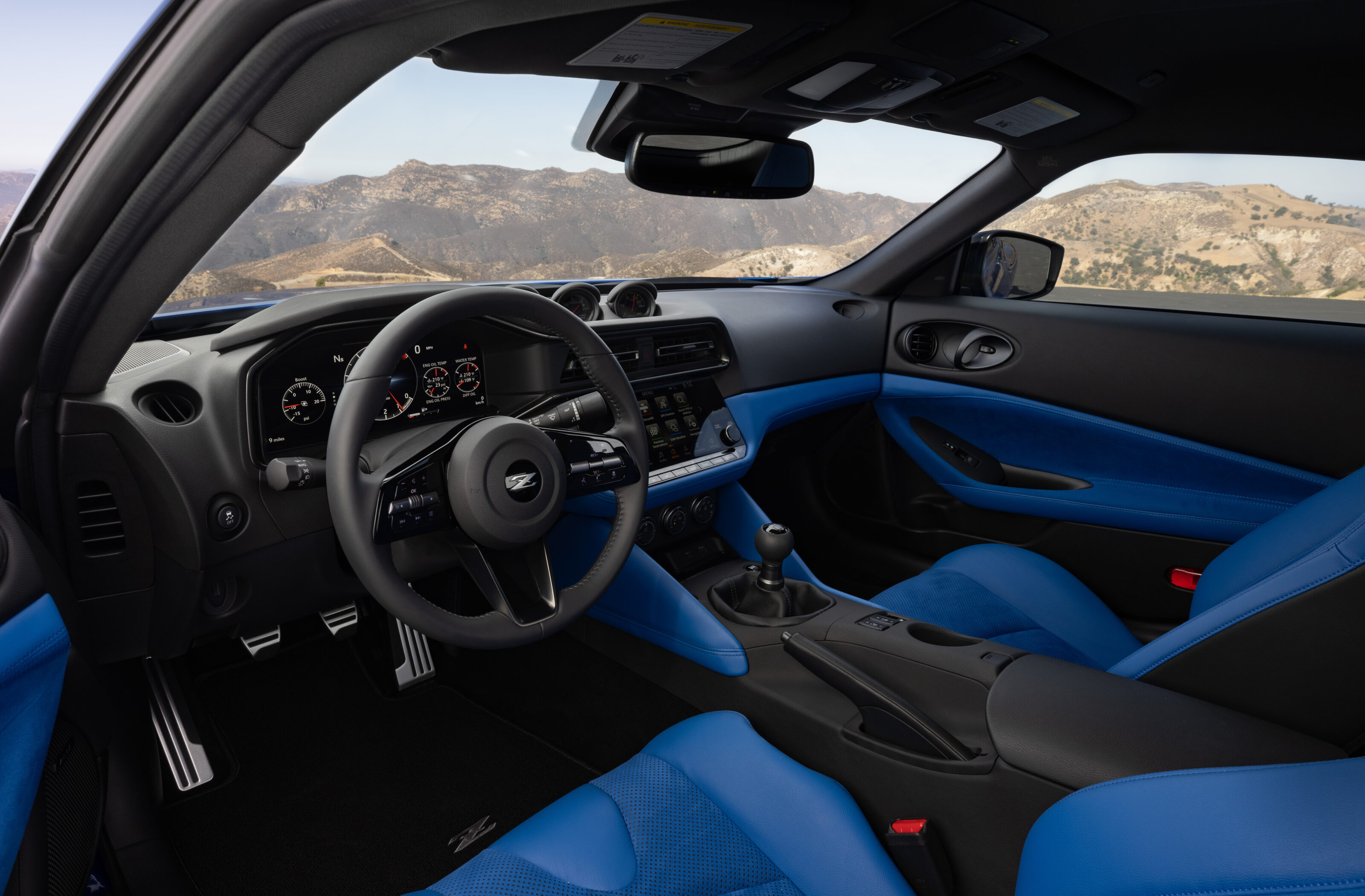
It’s unlikely that Nissan will re-engineer a better solution along the lines of Porsche’s parallel-axis EPS, which includes a step-down gearbox, and this pretty much defines whether the new Z will succeed or fail as a driver’s car. I just hope that it’ll drive like a Z-car and not an Infiniti Q60, a car with a great engine but generally mediocre dynamics.
In the meantime, we live in hope. Nissan could have built the car we’re all praying for. Or it could have created the biggest disappointment of 2022. Where are you putting your money?
Details are emerging about the EV models Hyundai is planning to launch as follow-ups to the excellent Ioniq 5.
A leaked presentation, which was shown to investors in the US, has revealed rough timings and specification details of the upcoming Ioniq 6 sedan and Ioniq 7 large SUV. And they look promising.
Hyundai has confirmed both models are on the radar for Australia, with the Ioniq 6 to launch first with a mooted arrival sometime next year.
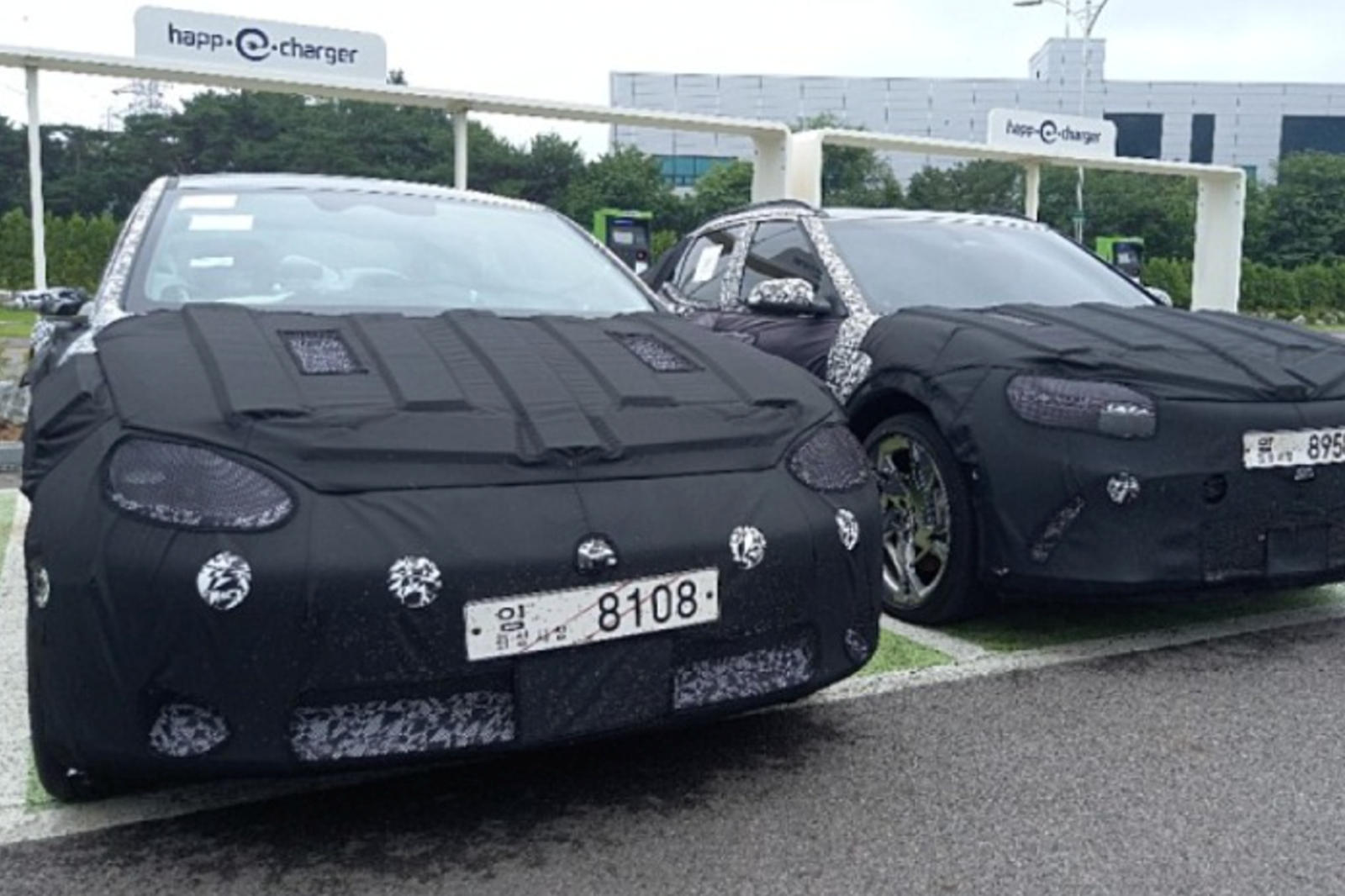
Built on the same e-GMP platform as the Ioniq 5, the 6 will be strongly influenced by last year’s swoopy Prophecy concept. And given how closely the Ioniq 5 resembles the retro-cool 45 concept, we wouldn’t expect the Prophecy’s bold look to be overly watered down.
A 73kWh battery pack is tipped to bring a driving range of more than 480km, while there will be single or dual-motor versions with 160kW and 230kW respectively. It’s expected the Sonata-sized Ioniq 6 could also spawn a high-performance N variant.
Hyundai has confirmed both the Ioniq 6 sedan and Ioniq 7 large SUV are on the radar for Australia.
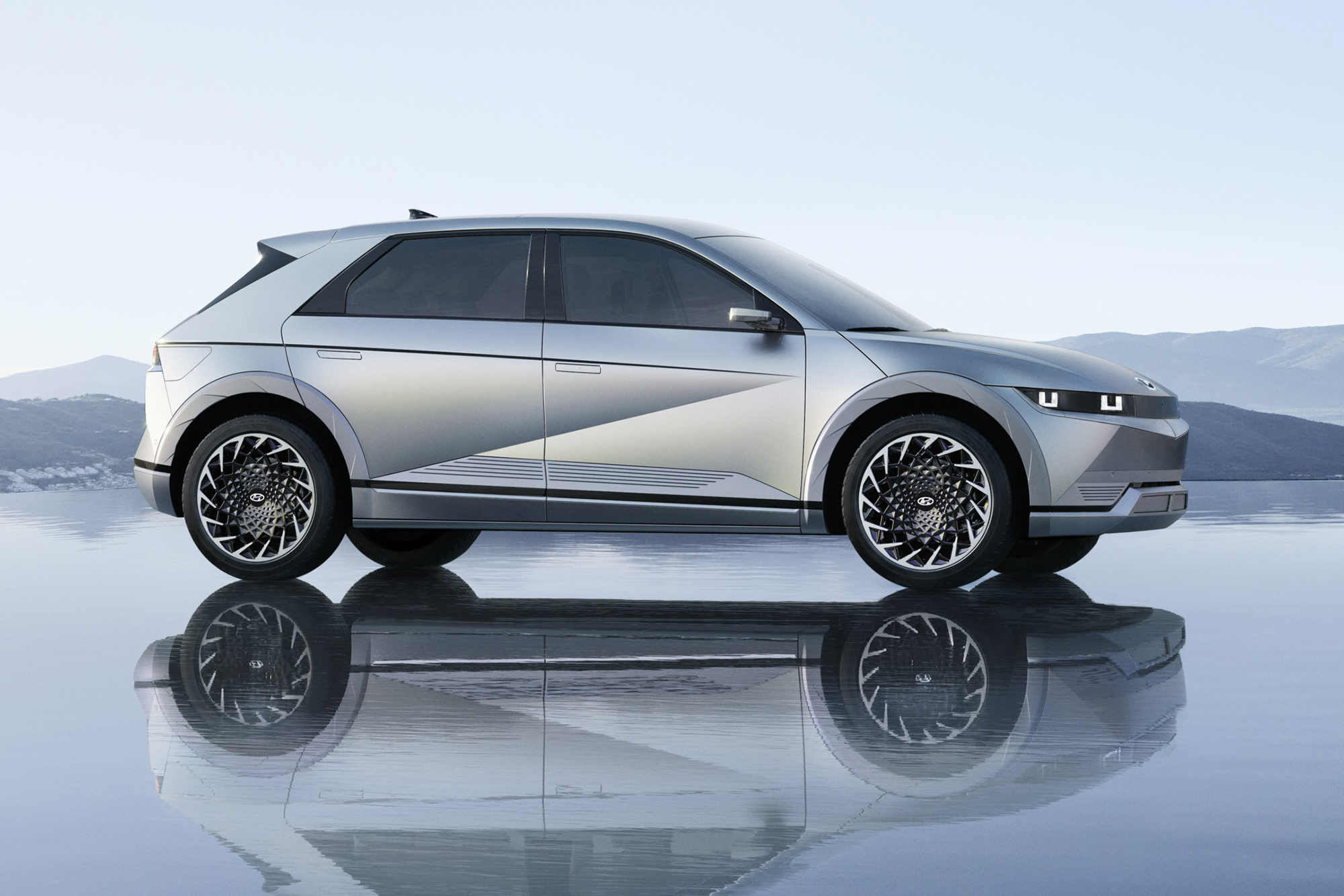
The Ioniq 7 is further away by a couple of years and is expected in 2024.
A large SUV – think Santa Fe for sizing – the 7 will also utilise the e-GMP platform, though drivetrain configurations will likely be different due both to the size of the Ioniq 7, as well as developments over the next couple of years. Early reports also suggest the 7 will be available in six- or seven-seat configurations.
While the Ioniq range will act as flagship EV variants, Hyundai is also planning an aggressive expansion of other electrified models in Australia. By 2025 the Korean brand hopes to sell all 44 electrified models Down Under, 23 of which will be all-electric.
Hybrid versions of the popular Tucson mid-size SUV, Santa Fe and i30 are available in overseas markets, making them obvious additions to the Aussie line-up, once their business cases stacks up.
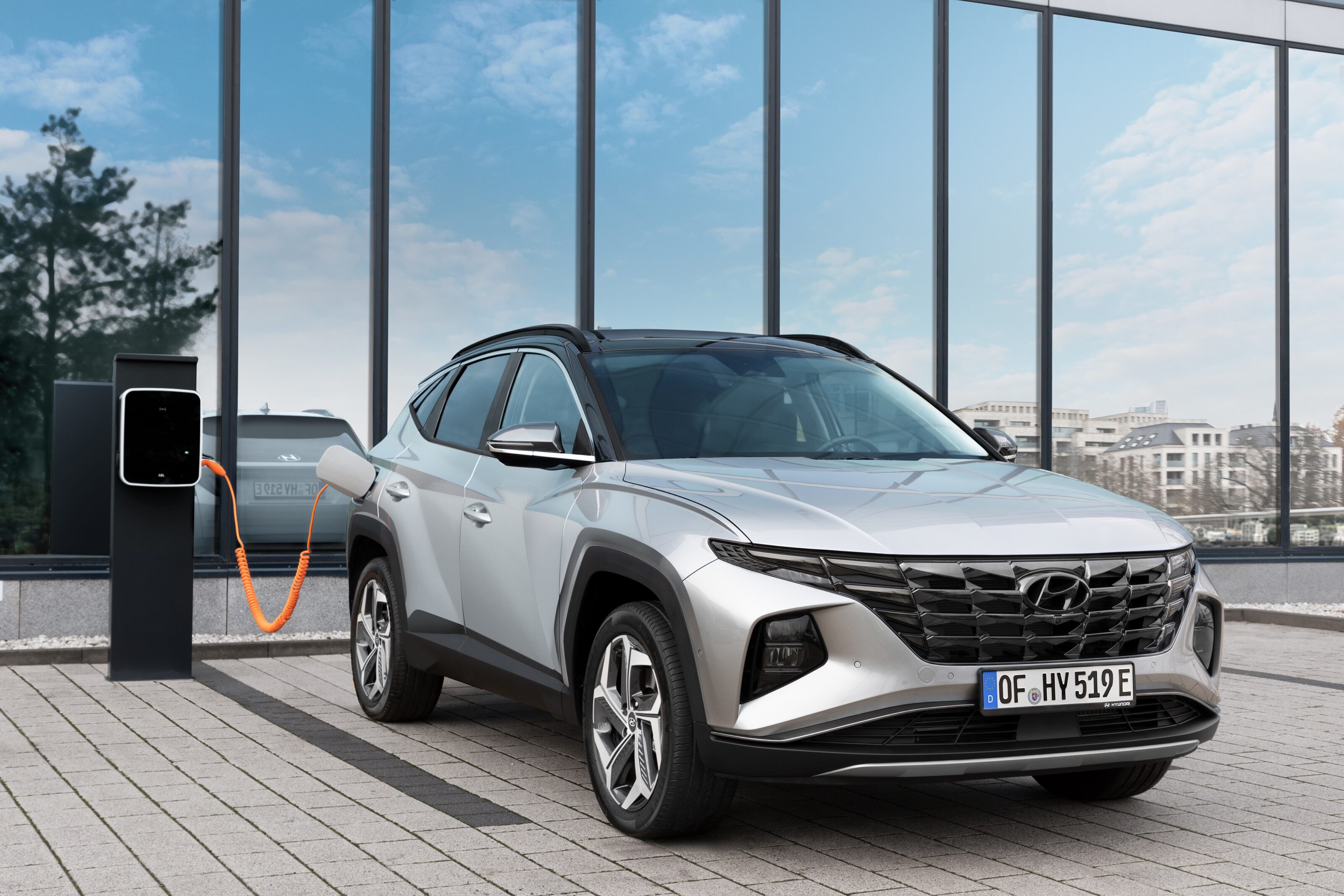
“We will offer every one of them in Australia if we can; that’s the aim,” said Hyundai spokesperson Bill Thomas.
“Our ability to secure them all will depend to an extent on market demand. Hyundai will prioritise supply to larger markets where demand is stimulated to a greater extent by government incentives… but we’re committed regardless of the barriers placed before us.”
Labelling an athlete the Greatest of All Time in their chosen sport has always been a contentious topic and it only seems to become exacerbated when someone passes or retires.
Formula 1 has had many different drivers who could be GOAT contenders – Fangio, Clark, Prost, Senna and Hamilton to name a few.
However, ask any casual fan to name the most successful driver of all and they’re likely to come up with one answer: Michael Schumacher.
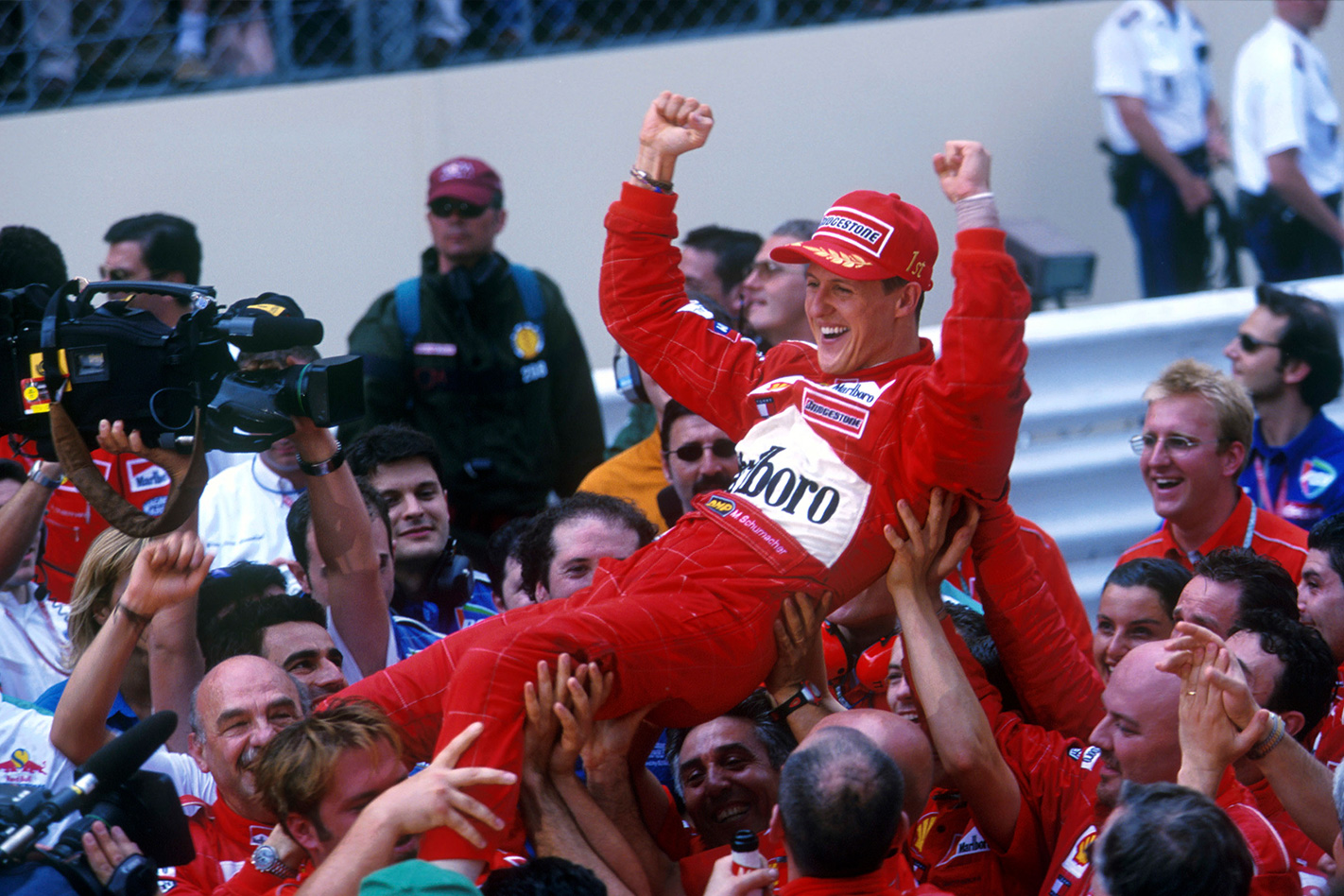
A seven-time World Champion, the German’s record of 91 race wins was only eclipsed by Lewis Hamilton last year but the debate rages on about whether Formula 1’s current poster boy can be compared to the original record setter.
To celebrate the life and career of Schumacher, streaming service Netflix has commissioned a 110-minute long documentary which features unseen home movies, official footage and candid interviews with those close to Schumi.
Eponymously titled ‘Schumacher’, the film will look at his rise through karting, driving sportscars for Sauber, his initial Formula 1 success with Benetton – which helped him win titles in 1994 and 1995 – before his controversial move to Ferrari, which saw the Scuderia rebuilt to deliver five championships in a row between 2000 to 2004.
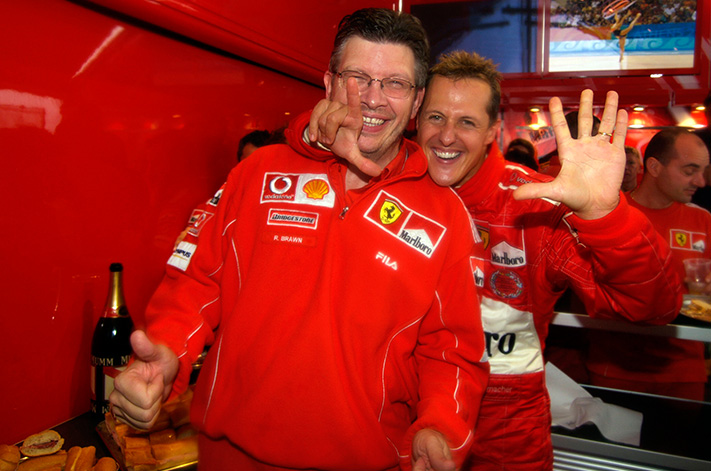
From the short trailer posted to Twitter, we hear snippets of insights from Schumacher’s wife Corinna, his daughter Gina and son Mick – who is currently racing in his debut season of Formula 1 for Haas after winning last year’s Formula 2 championship.
Unfortunately, Michael has been unable to celebrate his son’s achievements after suffering a near-fatal brain injury while skiing in late 2013, having been guarded from public life since with his family giving few updates on the legend’s condition.
Current Formula 1 driver Sebastian Vettel will also feature, talking about how his hero inspired him to win four titles of his own, while other pundits from the paddock provide their points of view – including brother Ralf Schumacher and commentator James Allen.
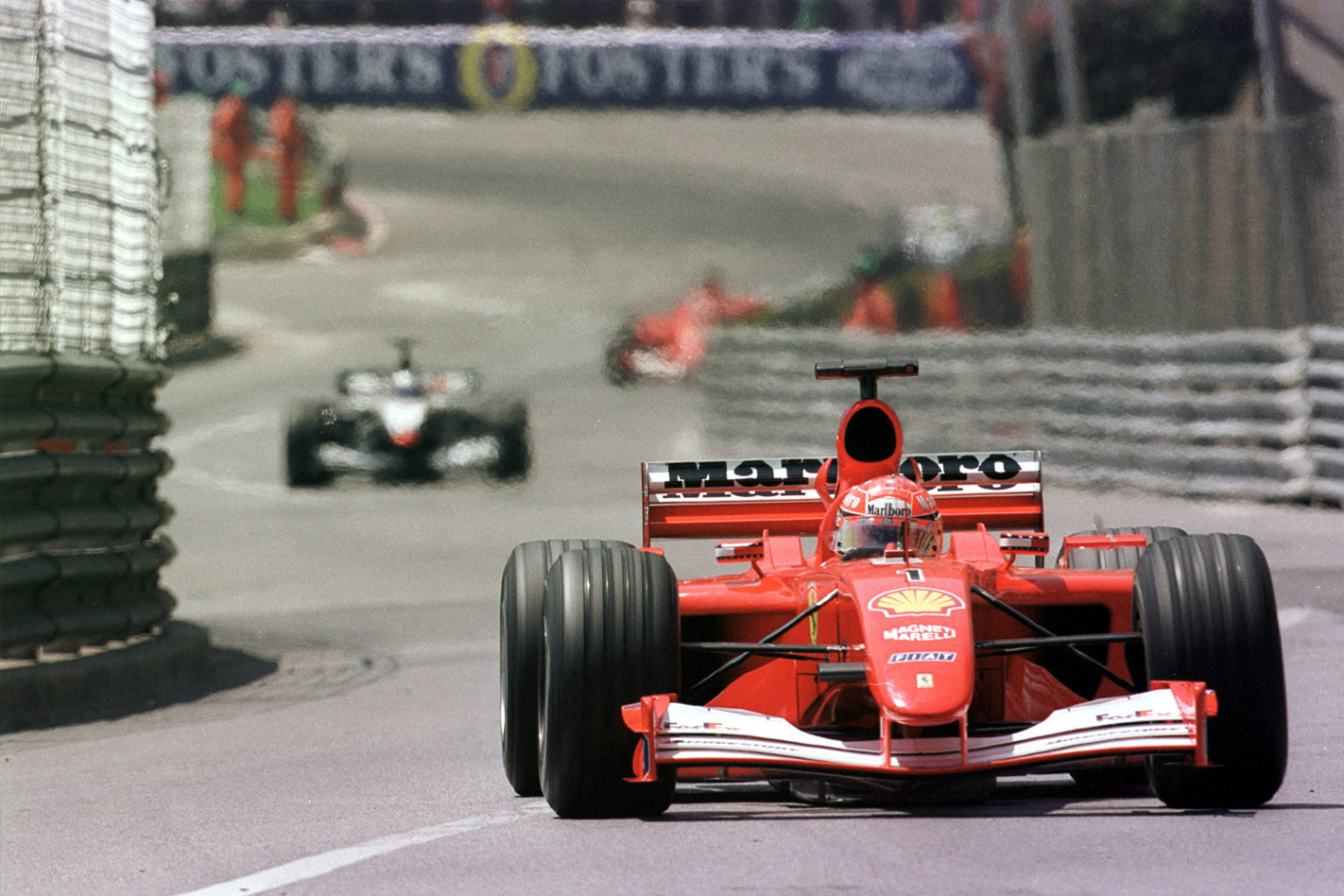
Schumacher’s long-time manager Sabine Kehm said the film will be the family’s legacy to the Formula 1 great.
“Michael Schumacher has redefined the professional image of a racing driver and has set new standards,” said Kehm.
“In his quest for perfection, he spared neither himself nor his team, driving them to the greatest successes. He is admired all over the world for his leadership qualities.
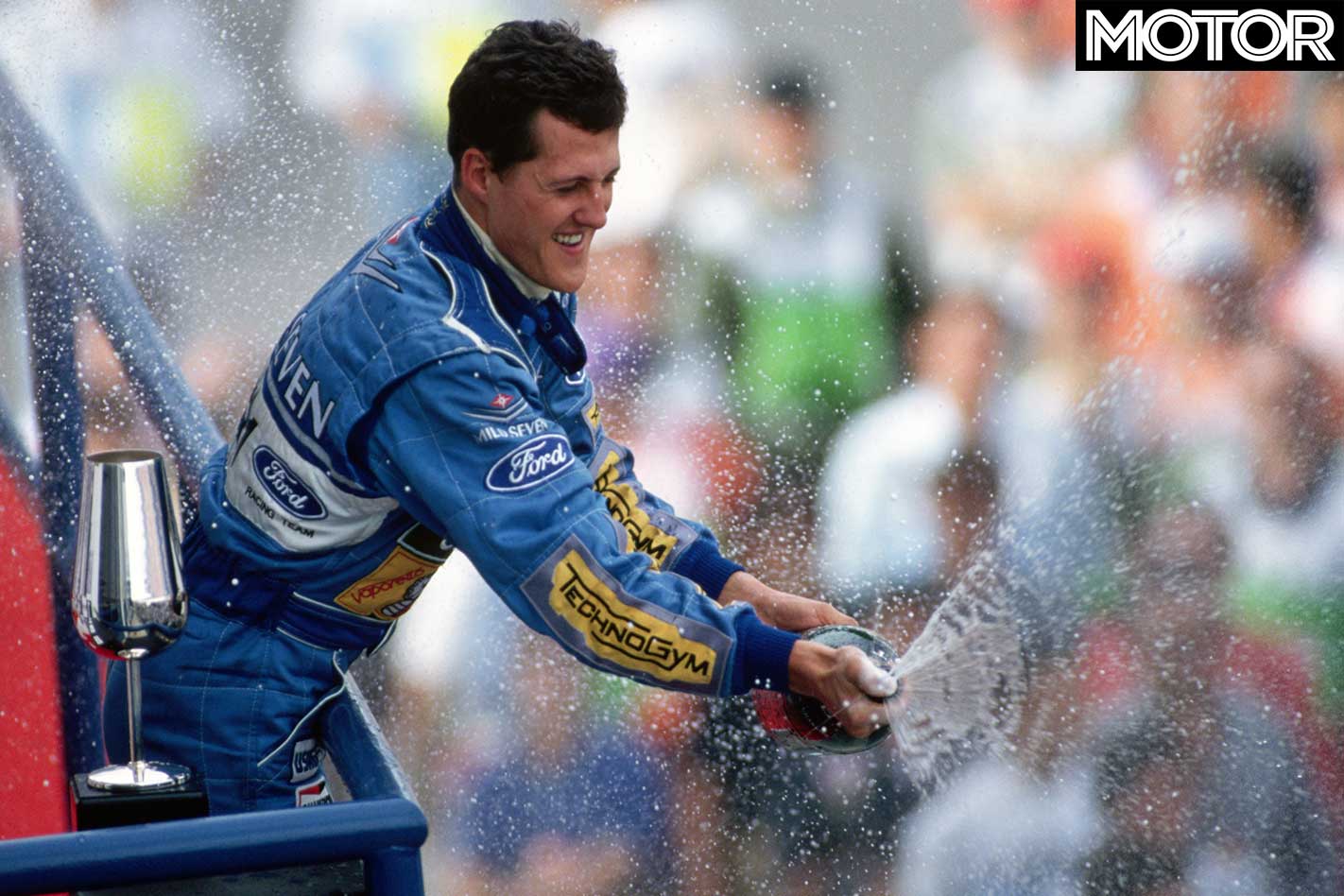
“He found the strength for this task and the balance to recharge at home, with his family, whom he loves idolatrously.
“In order to preserve his private sphere as a source of strength, he has always rigorously and consistently separated his private from his public life. This film tells of both worlds. It is his family’s gift to their beloved husband and father.”
While the Formula 1 community continues to rally around the Schumacher family, fans can relive the highs and lows of Michael Schumacher’s career when the documentary launches on September 15, just over 30 years from his debut in 1991.
