
UPDATE – Just 4000 fans a day will be allowed to attend the Bathurst 1000 this year, a move that has left organisers “disappointed”.
There will also be no camping at the 2020 Bathurst 1000, while spectator areas at the top of Mt Panorama will also be off-limits to race fans.
Pre-purchased seating only will be available at the bottom of the mountain, including at Murray’s Corner, Hell Corner, Pit Straight East and Pit Straight West.
“Whilst we are disappointed that we can’t have a full crowd at Bathurst, we’re delighted to offer even limited attendance,” said Supercars CEO Sean Seamer in a statement.
The news comes as NSW prepares to loosen restrictions on stadiums, with the current 25 percent capacity restriction expected to be lifted to 50 percent at the start of October.
https://www.instagram.com/p/CFQg5qfBmZC/?utm_source=ig_embed&utm_campaign=loading
“A racetrack like Mount Panorama is not as easy as a stadium to prepare in a COVID-19 compliant way due to the lack of dedicated seating,” said Seamer.“We thank the NSW Government and Bathurst Regional Council for their ongoing support of the event and for working with us on a plan that will allow fans the opportunity to see a new king of the mountain and championship winner crowned on October 18.”
Seamer acknowledged the decision will be unpopular; crowd numbers in excess of 200,000 have been seen at Mt Panorama over previous years.“We understand a number of fans will be disappointed that camping and normal ticketing opportunities are not available this year,” said Seamer. “However, the safety of everyone attending the event is our main concern at all times.”
The series is racing this weekend at The Bend Motorsport Park, where MOTOR test driver and Supercars racer Warren Luff set the venue’s first-ever production car record.
UPDATE – Supercars has formally announced that it will push back the Bathurst 1000 by one week.
The 2020 season finale will now run on October 18, moved to its latest-ever start as Supercars juggles fluid border restrictions in the face of the COVID-19 pandemic.
And in a stunning turnaround, it’s been revealed that the series will in fact race four times over two weekends at The Bend in South Australia, despite the series snubbing Australia’s largest motorsport complex earlier in the year as it juggled a decimated calendar.
The omission of the circuit brought a sharp rebuke from the owner Sam Shahin, who suggested that Supercars “owes South Australia a big apology“.
Fences, however, have been mended, and the series will race over September 19-20 and 26-27, before decamping to New South Wales for the final ever Bathurst 1000 that will feature a factory-backed Holden effort.
The announcement of The Bend means that Queensland Raceway misses out on a Supercars round for the first season since 1999.
The extra week between the final race at Tailum Bend and Mt Panorama will give officials and teams vital time to deal with any issues that may arise out of quarantine requirements.
Currently, anyone who travels from South Australia to NSW is required to self-isolate for 14 days, though this may change on the run-up to the event.
Announcing the final rounds also puts certainty around the 2020 championship, which will award 900 points over three more weekends of racing. Currently, 123 points separate DJR Team Penske’s defending champion Scott McLaughlin and Holden Red Bull Racing ace Jamie Whincup.
A marathon road trip through the top end of the country will see drivers, crews and officials on the road and away from home for up to 100 days, and now a new change in COVID-19 restrictions in NSW has thrown plans into disarray.
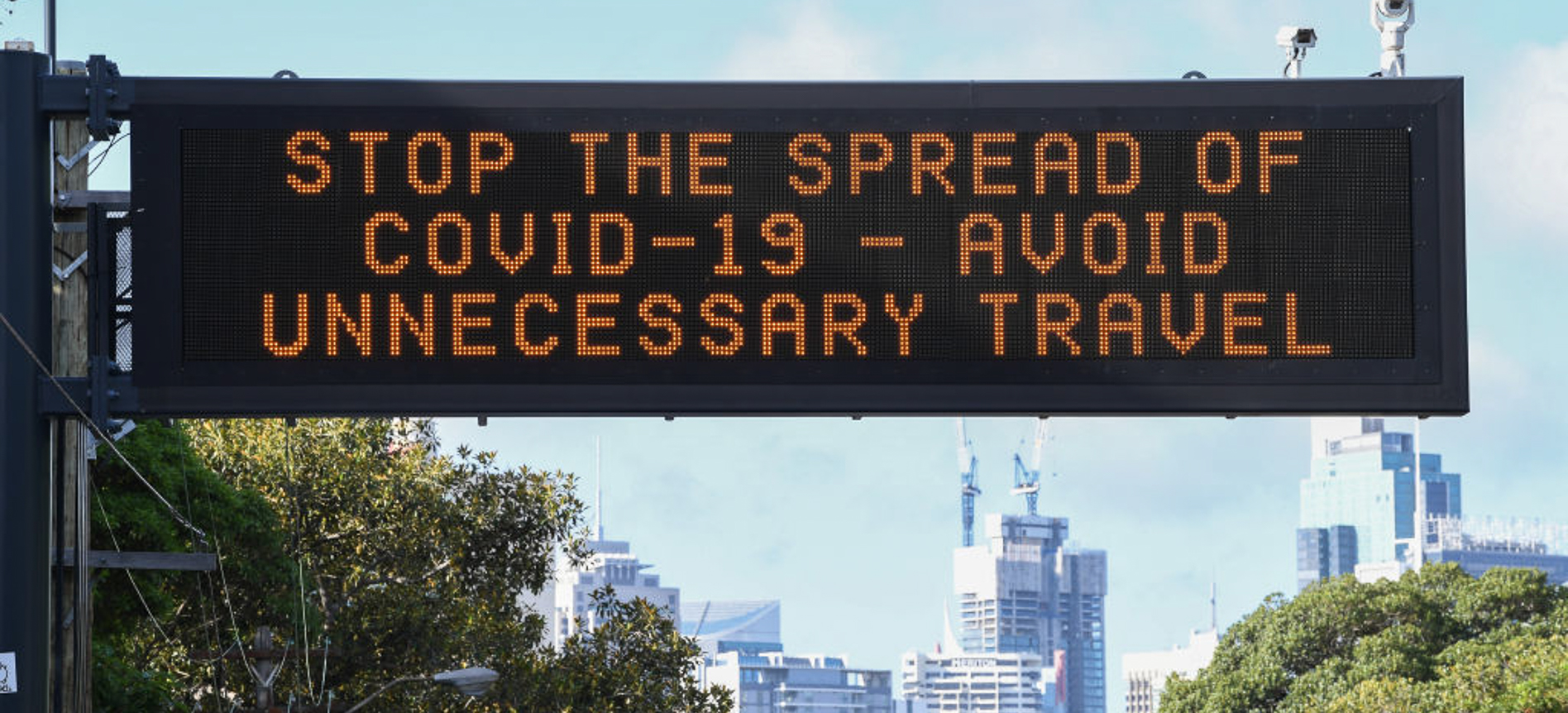
As part of tightening restrictions in the state, Motorsport Australia (formerly known as CAMS) has declared that all state and national motor racing events are outlawed until early October, while travel restrictions across Australia that wax and wane are also causing headaches for Supercars.
The six-week ban means some chewing of fingernails for a Supercars team that already has multiple logistics to worry about.
Those logistics include travel for teams, marshalls, officials and other workers needed to host a four-day motorsport event.
It’s not so much the hosting event itself that is under threat, though. According to Motorsport Australia, the restrictions don’t apply to professional sports.
“These restrictions are specific to community sport for the next six weeks, not professional sports, such as Supercars,” said CEO Eugene Arocca.
“The entire Supercars fraternity has done a fantastic job in working with various State Governments to ensure they have a strong COVID Plan in place for any events they have hosted, or will host in the future.
“Motorsport Australia doesn’t expect these most recent restrictions to impact the ability for us to issue a permit for any planned Supercars events in New South Wales.”
2020 – Annus Horribulus for Motorsport
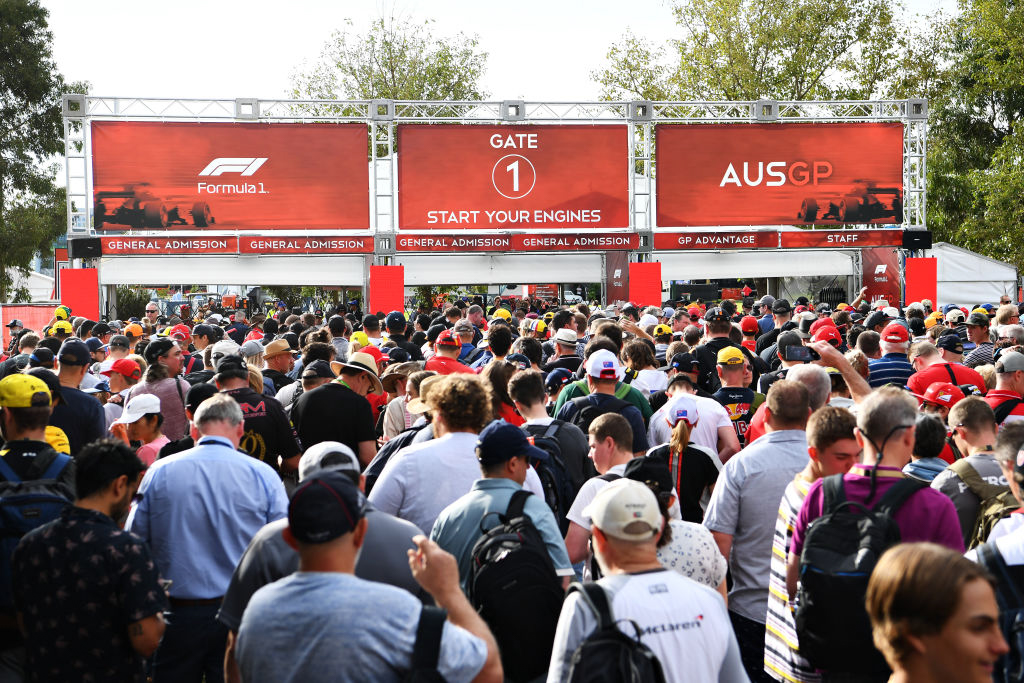
The 1000 will serve as the finale to a truncated 2020 season that started as planned in Adelaide in February, before the motor racing world ground to a halt at the Australian Grand Prix in early March.
A two-month dry spell was broken by a race at Sydney Motorsport Park… but then it all went pear-shaped in Melbourne, with a coronavirus outbreak resulting in a border lockdown from the NSW side.
Victorian-based teams including Tickford and Walkinshaw Andretti United were forced with less than a day’s notice to throw their cars, gear and crews into trucks and essentially emigrate to NSW, with no return date in sight.
They were spread across NSW, all congregating back at Eastern Creek for a set of three races, including a night race under SMSP’s new lights, before trekking north to Queensland to set up camp in places as disparate as SeaWorld.
The idea was to keep one step ahead of the travel bans, congregating in a coronavirus-free bubble to enable to show to go on.
COVID-19 strikes again
Then COVID-19 flared up in a few key Brisbane suburbs, throwing plans for certain teams like Triple Eight to head to the Northern Territory for the first of four race days over two consecutive weekends.
While drivers and crews flew from Queensland to NT, team trucks were literally parked up on the side of the road on the border, waiting for permission to cross.
The delays pushed the Hidden Valley double-header back by a week, meaning that six races would be held over four days across two weekends – with one Saturday briefly threatened by state elections in the Territory.
Townsville’s double-header
Teams are now packing trucks and heading south to Townsville, which will play host to another two weekends of Supercars racing around the hybrid street/road course in the city’s inner suburbs.
Fans will be permitted to attend both weekends, although all tickets must be pre-purchased.
Tickets will be pretty affordable, too; kids under 12 will get in free, with single-day tickets $35 and a special price of $110 for a four-day ticket across both weekends.
When that double-header winds up on Sunday September 6, teams will then battle border regulations to move lock, stock and barrel to South Australia.
QR no go
While that seems like a logical solution, that has been knocked on the head.
The track was snubbed for a 2020 round before the onset of the coronavirus, so it changed the configuration of its safety barriers that were put in place for its 2019 round.
Will there be a 2020 Supercars champion?
As it turns out, a return to Ipswich isn’t essential; Supercars must conduct at least six rounds across a minimum of four states or territories in order for the 2020 season to be considered a proper championship.
So far, the series has raced in once in South Australia and Victoria (sort of, but because the cars qualified at the abandoned AGP meeting, it’s counted), and twice in NSW, Queensland and the Northern Territory.
The Bathurst 1000 – or at least a second round at the Mt Panorama circuit – was originally set down for February 2021, but a change in TV rights between 2020 and 2021 put paid to that plan.
The 2020 Finale – The Bathurst 1000
The famed 1000km race brings its own issues, though, in the form of out-of-state co-drivers.
Several from Victoria, including defending champion McLaughlin’s new co-driver Tim Slade, Garth Tander and Tony D’Alberto, amongst others, will be required to quarantine for two weeks prior to the event.
Two co-drivers from Western Australia will, if conditions remain unchanged, be unable to return home at all after the event.
The potential for the Bathurst 1000 to become the season decider has also reared its head. Would McLaughlin sacrifice a second Bathurst win after the uncertainty of his first in a quest for a third championship?
Would Whincup give up on the chance of winning an eighth crown over the lure of a fifth win at a place that’s given him his fair share of heartache?
As well, underlining the massive logistic effort to move the teams to The Mountain is the fact that many team members will have been on the road for more than 100 days straight by the time the season wraps up.
While back-to-back races and tight turnaround times are a normal part of the championship, this is entirely new.
Away from home
“We’ve got a message on the inside panel which is to our friends and family around the country who we miss so much,” said Team 18 driver Scott Pye, who scored the team’s maiden podium as a standalone squad in the first round of the NT double header.
“For all of our crew it’s a difficult time at the moment, none of us wants to be away from our family, but we are doing what we can to keep this sport alive and I hope we can put on a great show this weekend for everyone watching at home.”
Teammate Mark Winterbottom, a father-of-three, echoed those sentiments.
“We’ve got our families riding with us this weekend which is a nice touch for the team to have on the side pillars of the car,” Winterbottom said.
“It’s pretty special to do that for them watching from home, and hopefully they can bring some extra fight and good luck to the team this weekend.”
Racing is the winner
The truncated and transient nature of the 2020 season has mixed up the racing – well, to a point.
Team Penske’s Scott McLaughlin has been largely untouchable, but there has been a mixed bag of results from squads up and down the lane.
Albury-based Brad Jones Racing, the tiny Team 18 and even fledgling outfit Team Sydney have all rotated up the order, while traditionally strong outfits like Triple Eight Racing and Erebus Motorsport have struggled for consistency – though the latter gave 2020 first debutante winner in the form of Anton de Pasquale.
Supercars has also taken the opportunity – whether by design or circumstance – to mix up the racing. Fuel stops have been benched, which helps with transport and safety logistics, while forcing teams to use soft and hard compound tyres at different races has also spiced up the action.
The show must go on
Logistics issues have also raised their heads, with the transport and distribution of the BP racing fuel used by the series under pressure, given the sheer amount of time that the teams are on the road.
Tyre supply is not an issue, though, with Dunlop able to supply control rubber to the field thanks in part to round cancellations in places like New Zealand, Perth and Tasmania.
“Obviously we don’t know what is going to happen, but we are prepared to be on the road until Bathurst or even longer,” Dunlop Motorsport operations manager Kevin Fitzsimons told racing site Speedcafe.com.
“It is not the ideal position, but everyone is in the same boat and doing what they have to do.”
Easing coronavirus restrictions as part of Victoria’s four-step path out of lockdown stage 4 are now permitting car owners to have routine servicing performed on their vehicles.
When introduced at the start of August, the strictest lockdown rules imposed for the Melbourne metropolitan area prevented anyone leaving their home for any purpose other than the ‘four reasons’ – including car care – but as of September 16, vehicle maintenance is now allowed.
Previous restrictions had been a cause of confusion for some car owners with the rules stating that ‘essential and critical repair work’ was authorised, leading to uncertainty over what constituted the most important maintenance.

It was also causing headaches for owners of vehicles requiring servicing work to maintain a new vehicle warranty. In those cases, adhering to coronavirus lockdown restrictions might have meant defaulting on a scheduled service and voiding their warranty.
However, lobbying by the VACC and other automotive bodies has clarified and eased the situation with the more relaxed car maintenance policy coming into effect from September 16.
Owners will still need to comply with the longer curfew which now extends from 5am to 9pm as well as the 5km radius limit of travel, unless the relevant authorised service centre does not fall within the catchment.
In which case, the owner will need to book the service at the next nearest dealership or authorised service centre. They are not permitted to travel to a dealership of their choice.
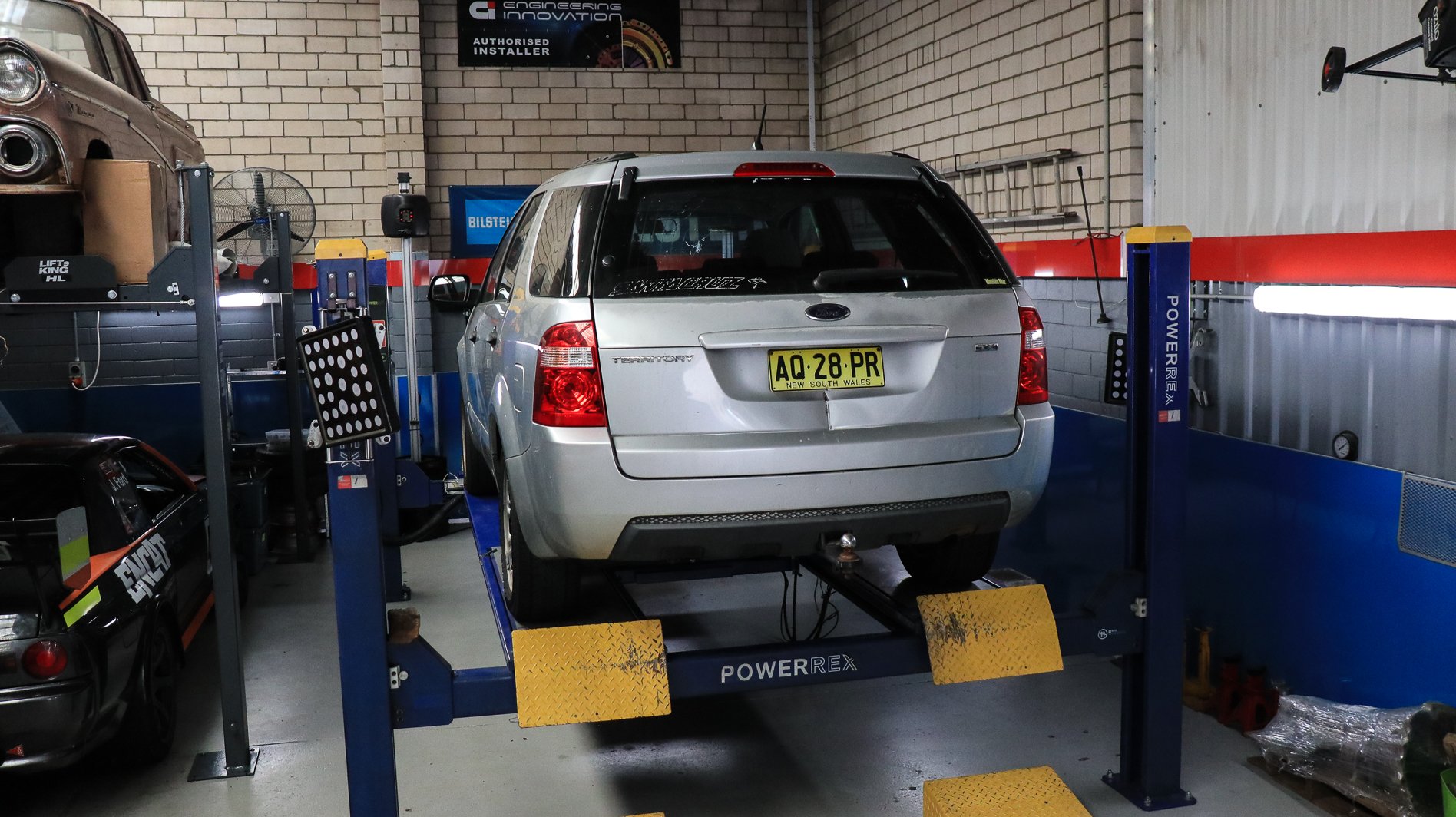
Dealerships and service centres will not appear to be functioning as normal with strict physical distancing, the use of PPE including masks, and contactless booking and handover implemented wherever possible. This may include key drop boxes to reduce contact.
The rules regarding general use of cars and driving remain in place, however.
Until Step 3 is introduced (tentatively planned for October 23) travelling in your car is generally only allowed to fulfil one of the four reasons. If in doubt, check with the relevant government website.
What stands out?
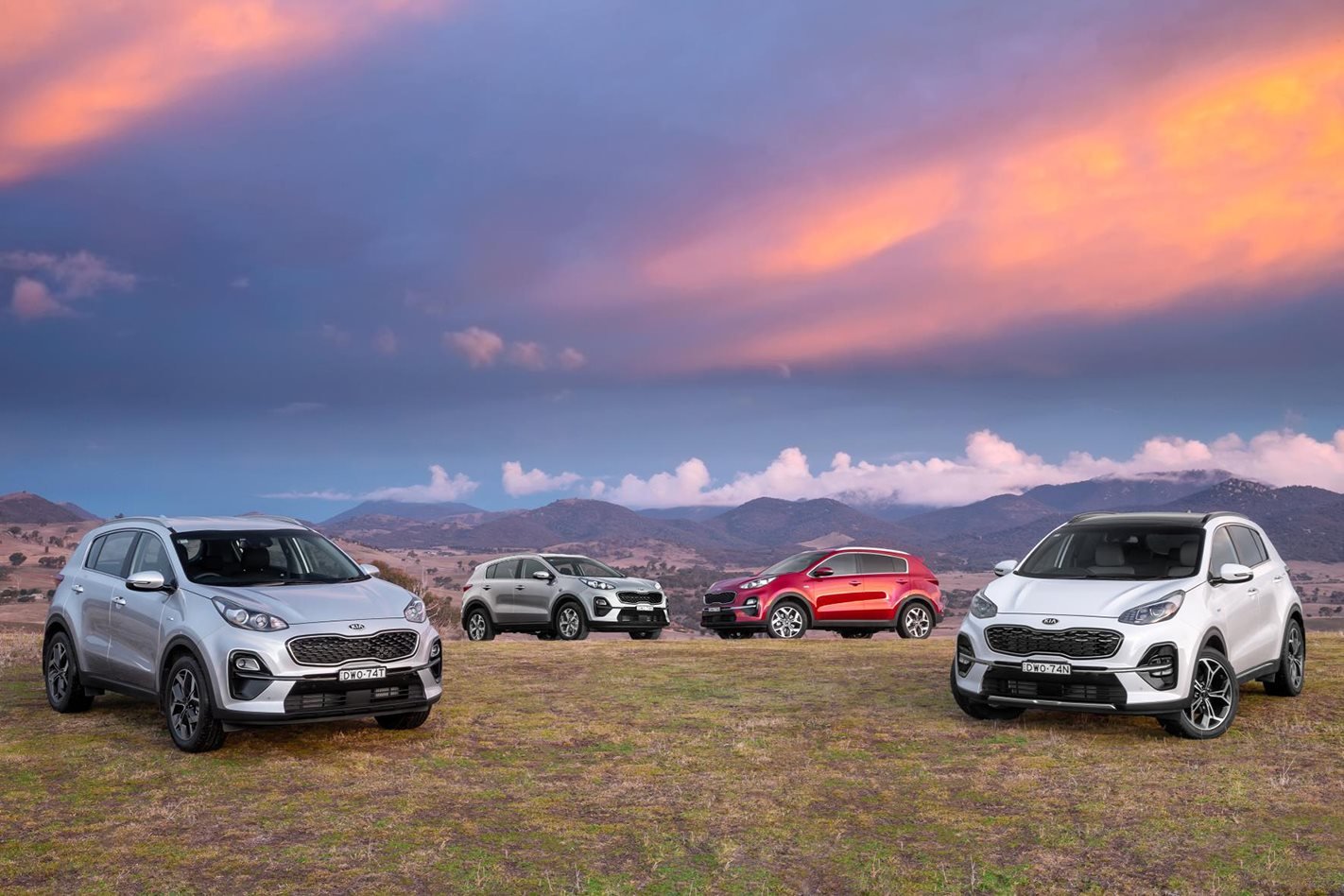
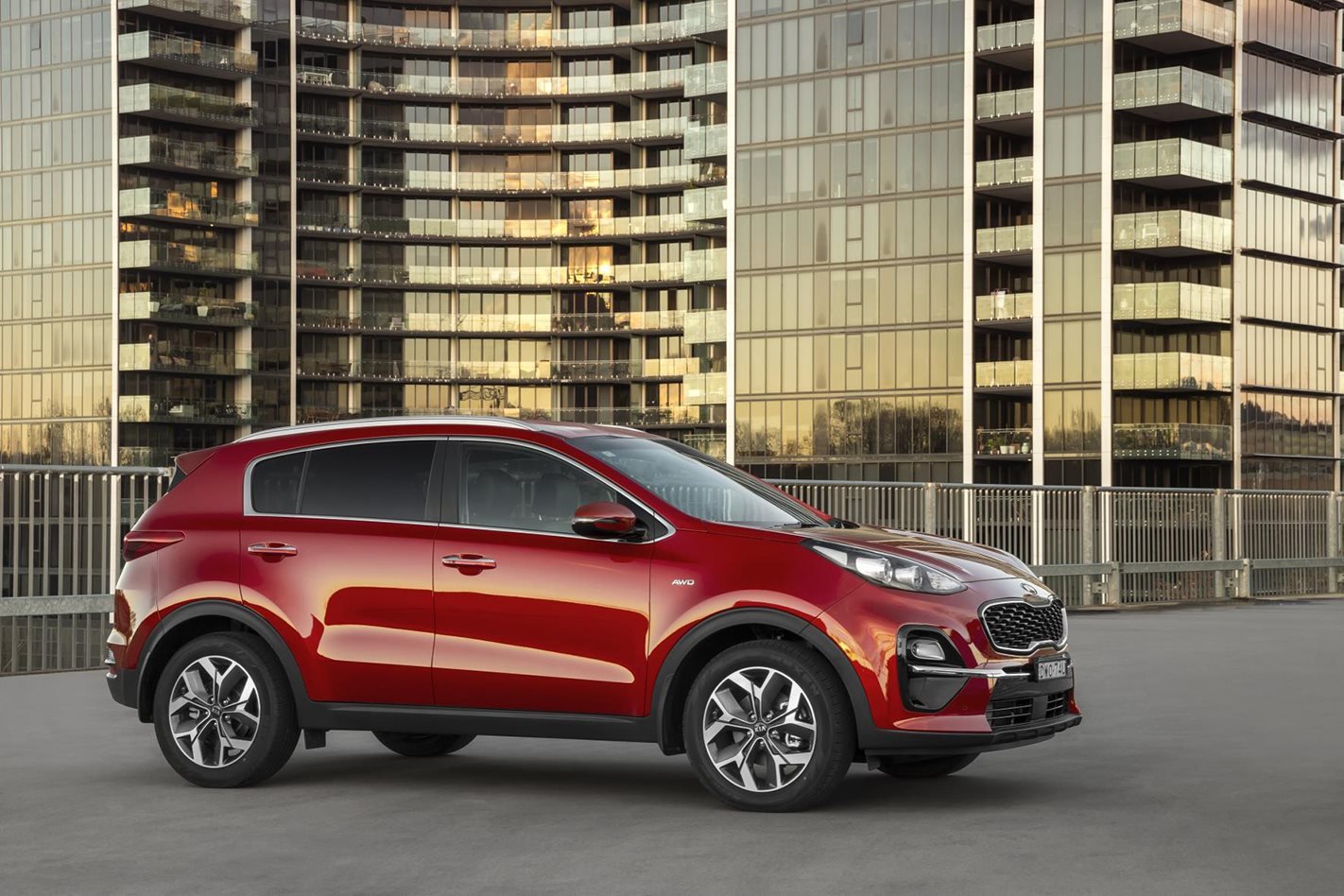
The Kia Sportage is a great looking medium SUV that is comfortable and very quiet to ride in, and fun to drive. Updated in mid-2018, it has a refreshed cabin, improved suspension, and autonomous emergency braking as standard across the range.
Diesel-engined, all-wheel-drive versions of the Sportage have more than enough power with terrific fuel economy, and all versions have Apple CarPlay and Android Auto connectivity. Kia’s seven-year warranty is one of the best available.
What might bug me?
You might wish for more grunt in the 2.0-litre petrol versions – especially if you have driven the diesel.
How the interior seems a little dated after you’ve seen the Kia Seltos and new Sorento. That said it’s very well equipped.
What body styles are there?
Five-door wagon only.The Sportage drives either its front wheels or all four wheels, depending on the version. It is classed as a medium SUV, lower priced.
What features does every Kia Sportage have?
- Colour touchscreen, and auxiliary and USB input sockets.
- Bluetooth connectivity for phone calls and audio streaming, and Android Auto/Apple CarPlay, which lets you display smartphone apps on the touchscreen and control them from there (or by voice).
- Reversing camera and rear-parking sensors.
- Sound system with at least six speakers.
- Dual-zone climate control.
- Cruise control.
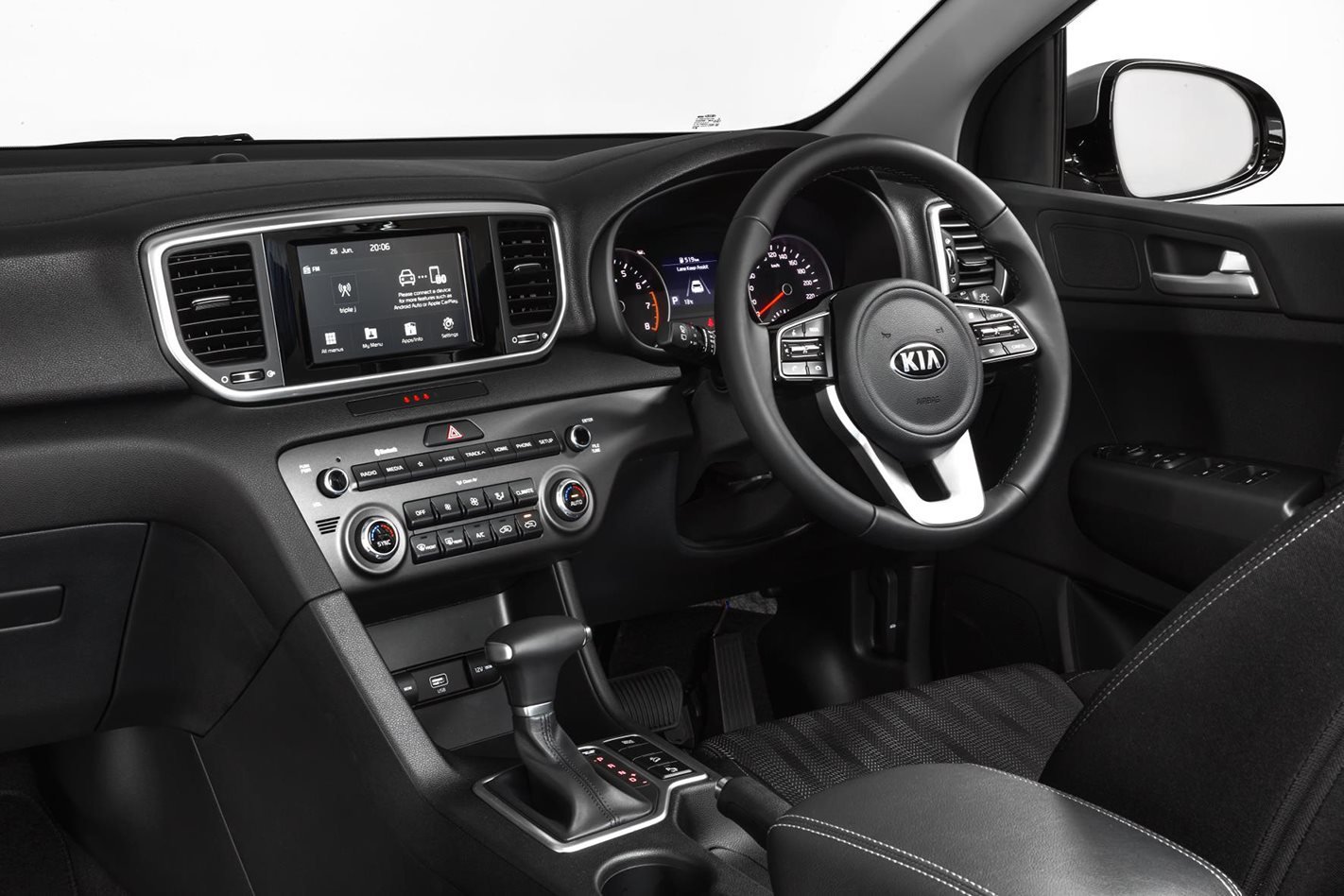
- LED daytime running lights.
- Headlights that switch on automatically when it’s getting dark and dim the high beam lamps when another car is approaching.
- Front fog-lamps.
- Rain-sensing windscreen wipers.
- Heated, power-adjusted side mirrors.
- Auto-dimming rear-view mirror,
- Roof rails, which make it easier to attach luggage systems.
- Shark fin antenna.
- Active safety features including autonomous emergency braking, forward collision warning, and lane-keeping assist.
- Controls on the steering wheel for operating the cruise control, the sound system and Bluetooth.
- An automatic transmission.
- A trip computer that presents fuel use and distance information.
- Wheels made from an alloy of aluminium, which are usually lighter and better looking than steel wheels with plastic covers, and a full-size alloy spare wheel.
- Hill-assist control, which operates the brakes automatically to make take-offs on hills easier.
- Downhill brake control, which can regulate speed automatically on steep downslopes when driving off-road.
- Six airbags: two directly in front of the driver and front passenger; one alongside each front occupant to protect the upper body; and a curtain airbag on each side protecting the heads of front and rear occupants.
- Electronic stability control, which can help the driver to control a skidding car. All new cars must have this feature.
Which engine uses least fuel, and why wouldn’t I choose it?
The 2.0-litre turbo-diesel engine uses the least fuel, at 6.4 litres/100km on the official test (city and country combined).Paired with an eight-speed automatic gearbox and all-wheel-drive traction, it feels as though it has much more performance than the petrol-engined versions.The main reason you might not choose the diesel is that you want to pay less for a Sportage, by choosing front-wheel drive and the 2.0-litre petrol engine also offered in the cheaper S, SX, and SX+ versions that uses about 7.9 litres/100km.You may also want a more affordable six-speed manual transmission, available with the petrol Sportage S and SX.The AWD diesels cost about $7000 more than their FWD 2.0-litre petrol six-speed automatic counterparts.The more powerful alternative to the diesel in the more expensive Sportage GT-Line is a bigger, 2.4-litre petrol engine. It uses about 8.5 litres/100km but gives you about 20 per cent more power than the smaller petrol – and, like the diesel, it is all-wheel-drive only.
What key features do I get if I spend more?
The least costly version, the Sportage S, has cloth seats, 7.0-inch touchscreen, 17-inch wheels, and the features of every Sportage. It comes standard with the 2.0-litre petrol engine with a six-speed manual gearbox and front-wheel drive as standard. A six-speed automatic gearbox, or a more expensive diesel engine and all-wheel drive (which aids security on loose or slippery surfaces) are available at extra cost.For extra features, you could spend more for a Sportage SX, which like the S is available with the manual and auto the 2.0-litre petrol with front-wheel drive, and the more costly 2.0-litre diesel all-wheel drive.
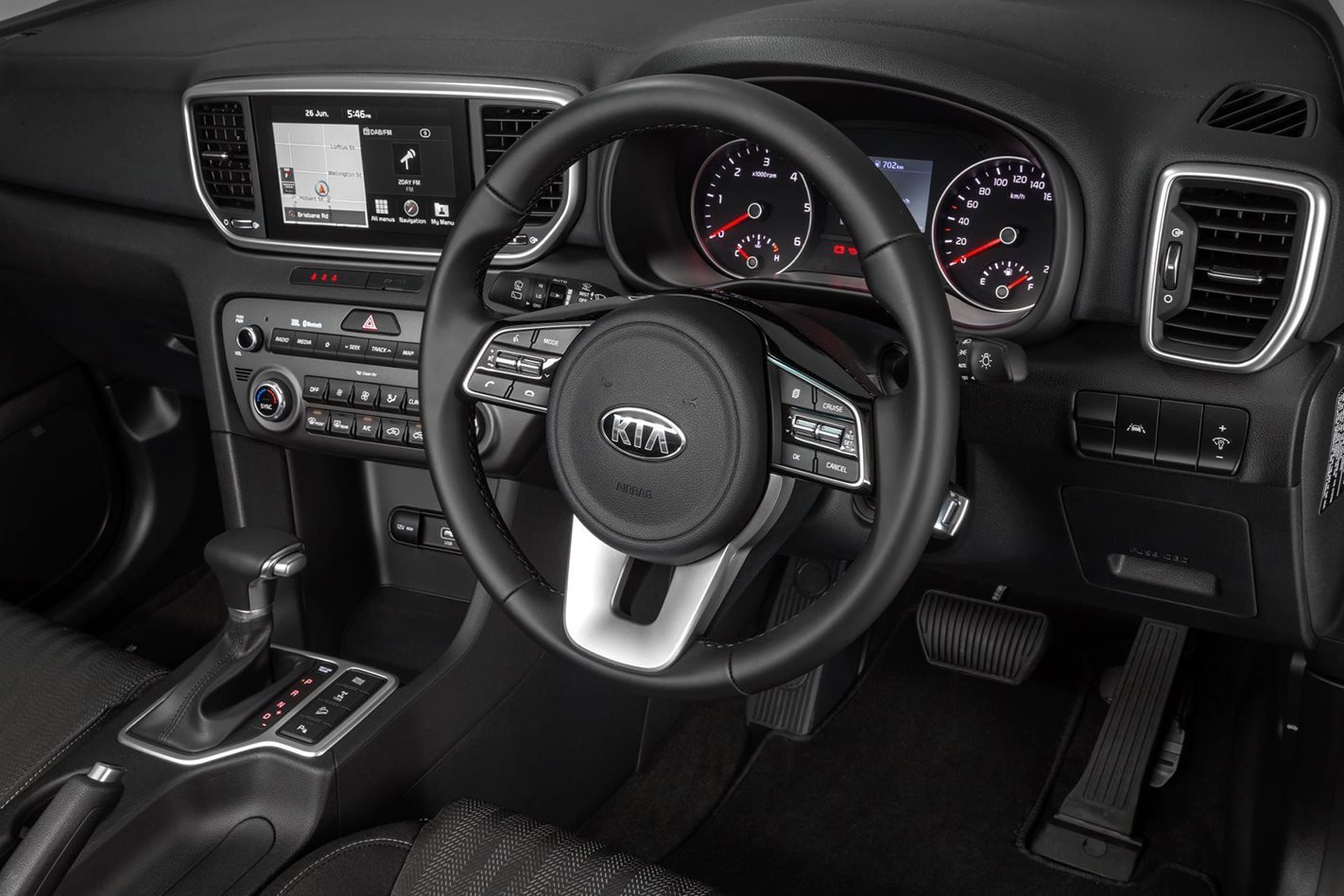
The SX also brings:
- A bigger 8.0-inch touchscreen with satellite navigation so you don’t have to rely on a phone app.
- Digital radio (DAB+), and a premium JBL eight-speaker premium sound system.
- LED daytime running lights make you more visible to other traffic.
- Front parking sensors augment those at the rear.
- Bigger, sportier-looking 18-inch alloy wheels.
- Leather/fake leather accents on all seats.
- 10-way power-adjustable driver’s seat.
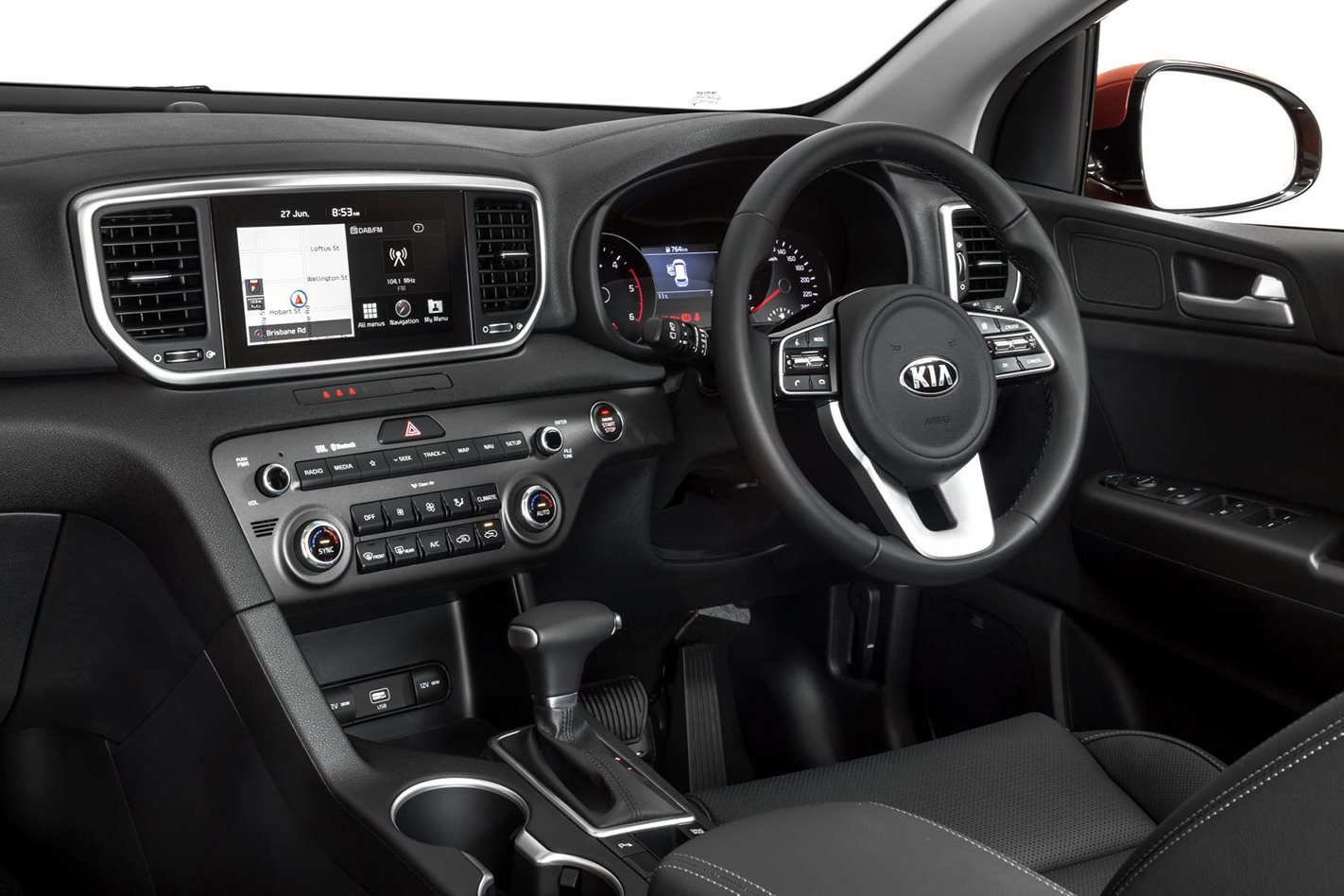
- An electric park brake switch frees up space on the centre console.
- Smart Keyless entry and start that doesn’t require you remove your keyfob from your pocket or bag.
- Sharper and longer-lasting LED tail-lights.
- Tyre pressure monitors that warn you if a tyre is going flat.
- Powered tailgate that automatically opens if you wait behind it for a few seconds while carrying the smart key.
- Bigger 19 inches with tyres that are a little wider for more grip.
- Firmer suspension for more precise handling.
- Additional active safety features including blind-spot detection and rear-cross traffic alert.
- Active cruise control that keeps Sportage a set distance behind the car in front and will stop and start at low speeds.
- Parking assist system can steer the GT-Line into a parking spot.
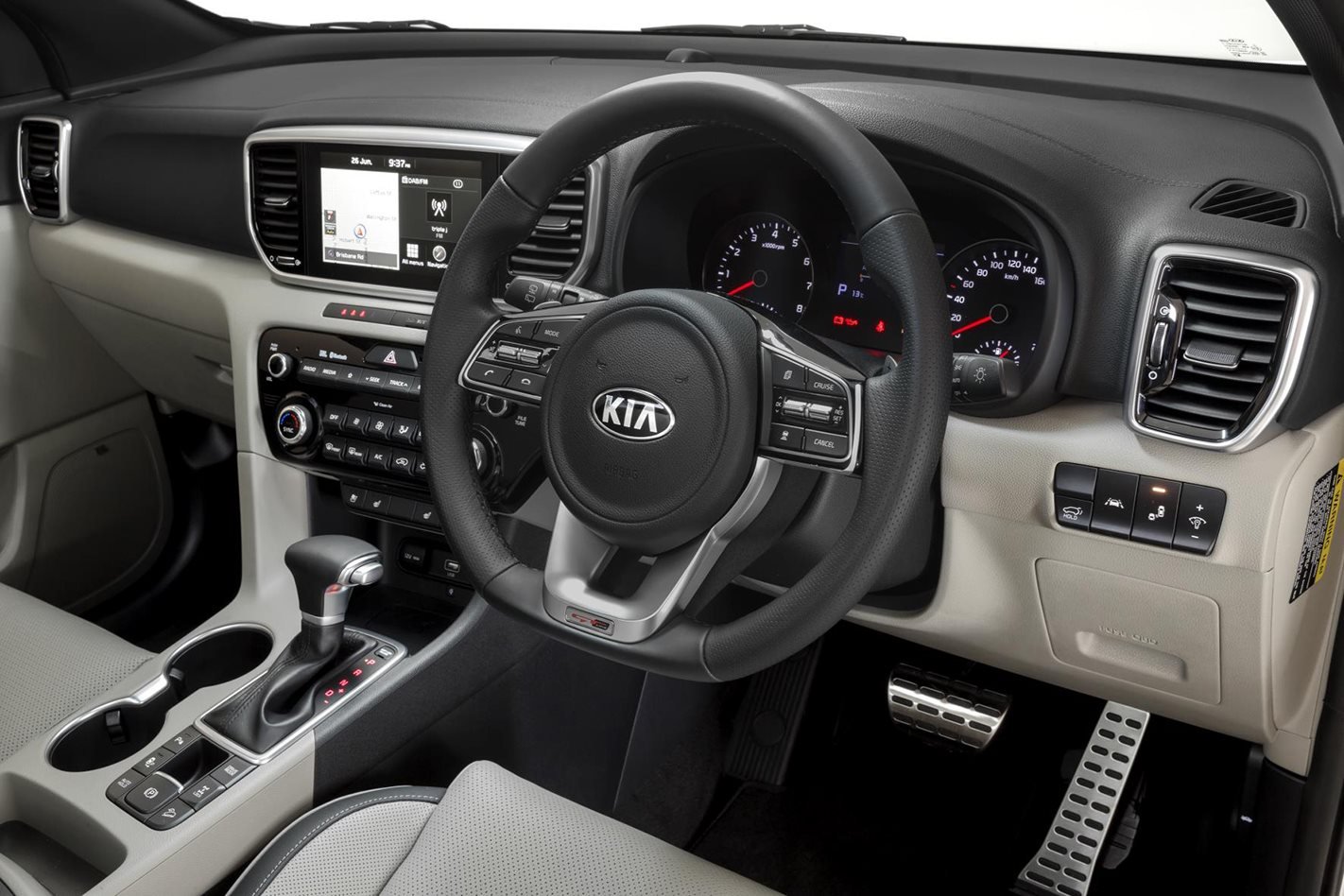
- A “Sports Package” exterior with enhanced front and rear bumper design and satin silver side sills.
- Brighter, auto-levelling bi-xenon headlights with washers.
- LED fog-lamps.
- Heated and ventilated front seats.
- Power adjustable front passenger seat.
- Panoramic sunroof.
- Gear-shift paddles mounted on the flat-bottom steering wheel.
- Wireless phone-charging pad.
Does any upgrade have a down side?
Ride at low speeds gets slightly rougher as the wheel size rises from 17 inches, on the Sportage S, to 18 inches, on the SX and SX+, and then to 19 inches on the GT Line – which also has firmer sports suspension. The bigger wheels use lower-profile tyres, which have less sidewall flex to cushion you from bumps on the road.Clear White is a standard colour on the Sportage. The other six shades carry a premium paint charge of about $500.
How comfortable is the Kia Sportage?
It is easy to get comfortable in the driver’s seat of a Sportage: you can adjust it manually in six dimensions in S and SX. The driver’s seat in the Sportage SX+ or GT-Line has 10-way powered adjustment, and the front passenger seat in the GT Line has eight.You can also move the steering wheel further from you or bring it closer, and adjust it for tilt.The Sportage cabin is roomy, with a great view of the road. Instruments and controls are laid out neatly. The interior is very well-built, and is finished using good-quality plastics, fabric and carpet.The Sportage rides more firmly than some alternative vehicles, but the ride is not so firm that it becomes tiring. The Sportage cabin remains a very quiet place, with little suspension, tyre or wind noise intruding: it is among the most peaceful cabins in its class.
What about safety in a Kia Sportage?
Safety high points in a Sportage include autonomous emergency braking (AEB), and lane-keeping assist that helps steer the Sportage within the road markings.The AEB can initiate a full emergency stop automatically from speeds up to 80km/h if the system senses you are in danger of driving into something. First it sounds a warning; if you ignore that, it applies the brakes partially; and if you do not intervene it applies maximum braking. (At speeds between 80 and 180km/h it warns and brakes partially, but it will not brake as hard as possible on its own.)There’s also a standard reversing camera and a seatbelt warning for every seat – a simple but valuable feature for those with children old enough to unfasten their belts. Dusk-sensing headlights, six airbags and the mandatory stability control complete an excellent standard package.The Sportage GT-Line adds radar- and camera-based adaptive cruise control, blind-spot monitoring, and rear cross-traffic alert that detects if a vehicle, cyclist or pedestrian is approaching from the side while the SUV is reversing.The Australasian New Car Assessment Program (ANCAP) rated the current-generation Kia Sportage at five stars for safety, its maximum, in April 2016.
I like driving – will I enjoy this car?
Yes. The Kia Sportage is among the most enjoyable medium SUVs available.The electrically-assisted power steering feels just right. The Sportage is easy to steer but brings you a good sense of connection with the road, which is satisfying and inspires confidence.A three-step Drive Mode Select system lets you adjust the weight of the steering. It also adjusts how immediately the car reacts to your pressure on the accelerator pedal, through the engine and auto gearbox. There are relaxed Normal and Eco modes, and an aptly named Sport mode.The Sportage has a quite firm suspension, which helps it respond quickly to steering inputs and to corner with relatively little body roll. The firmness also prevents the body from bobbing on the springs after the car hits a big bump on the road.
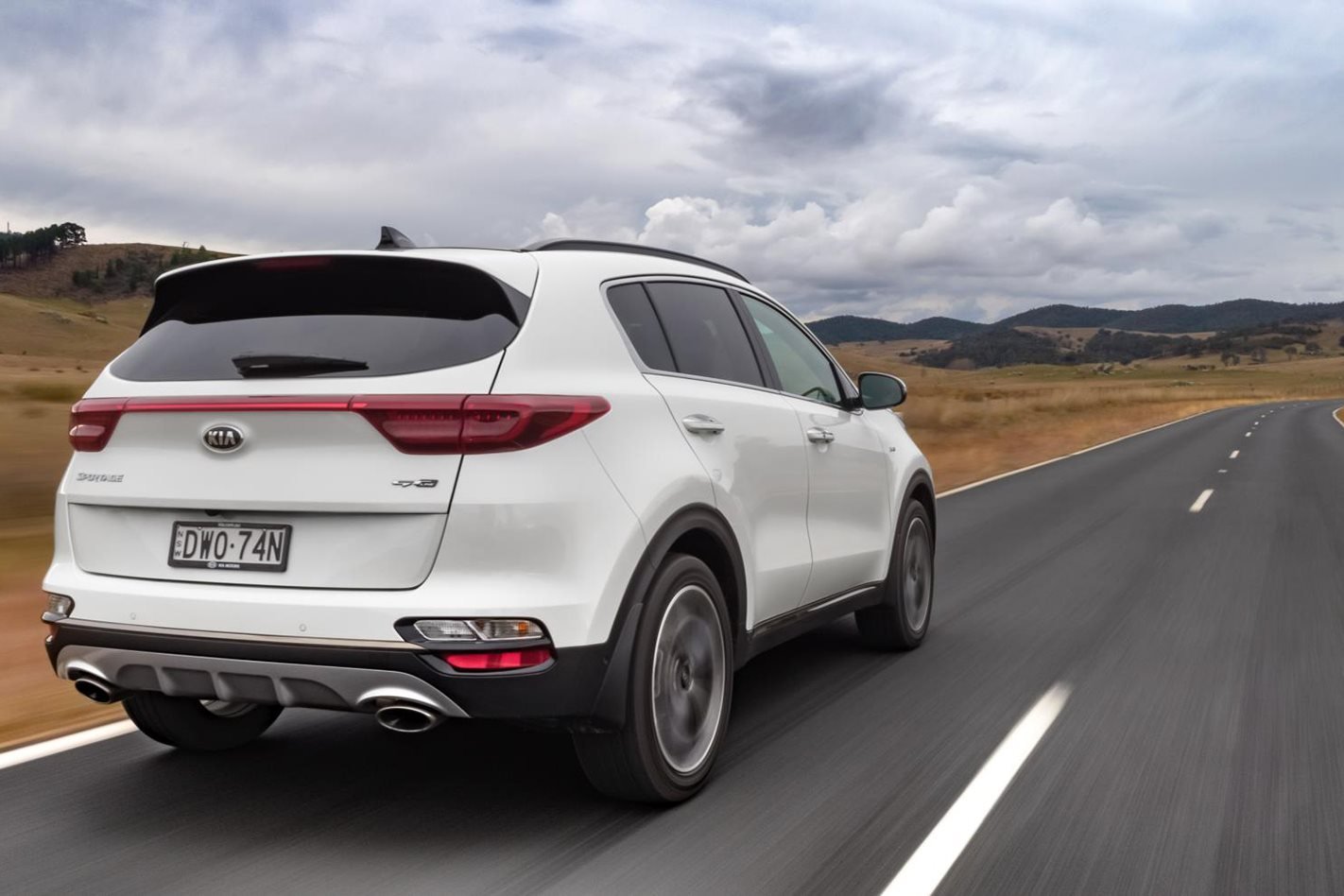
But the Sportage remains one of the best of this breed, thanks to good ground clearance, its full-size spare wheel, and its downhill brake control system, which can regulate your speed automatically on steep downhill runs off-road (leaving you free to concentrate on steering).
The turbo-diesel engine available with any AWD Sportage has a lot more grunt than the 2.0-litre petrol, and in many driving conditions feels much more responsive than even the 2.4-litre petrol (the 2.4 petrol winds up to equal it if you hold your foot to the floor). The diesel is easily the most desirable engine of the three.
The 2.0 petrol comes with front-wheel-drive versions of the Sportage S, SX, and SX Plus. Ordinarily, it offers enough pull, but when it’s asked to accelerate hard, carry a heavy load or climb a steep hill, it makes much harder work of it than diesel versions.
The 2.4 petrol, available with the AWD Sportage GT-Line, works very well in most driving but still can’t match the diesel.
How is life in the rear seats?
Rear seating in the Sportage is among the roomiest in a compact SUV. The wide rear-door opening makes getting in and out easier and is also helpful when having to lean in to secure children in booster seats or capsules.
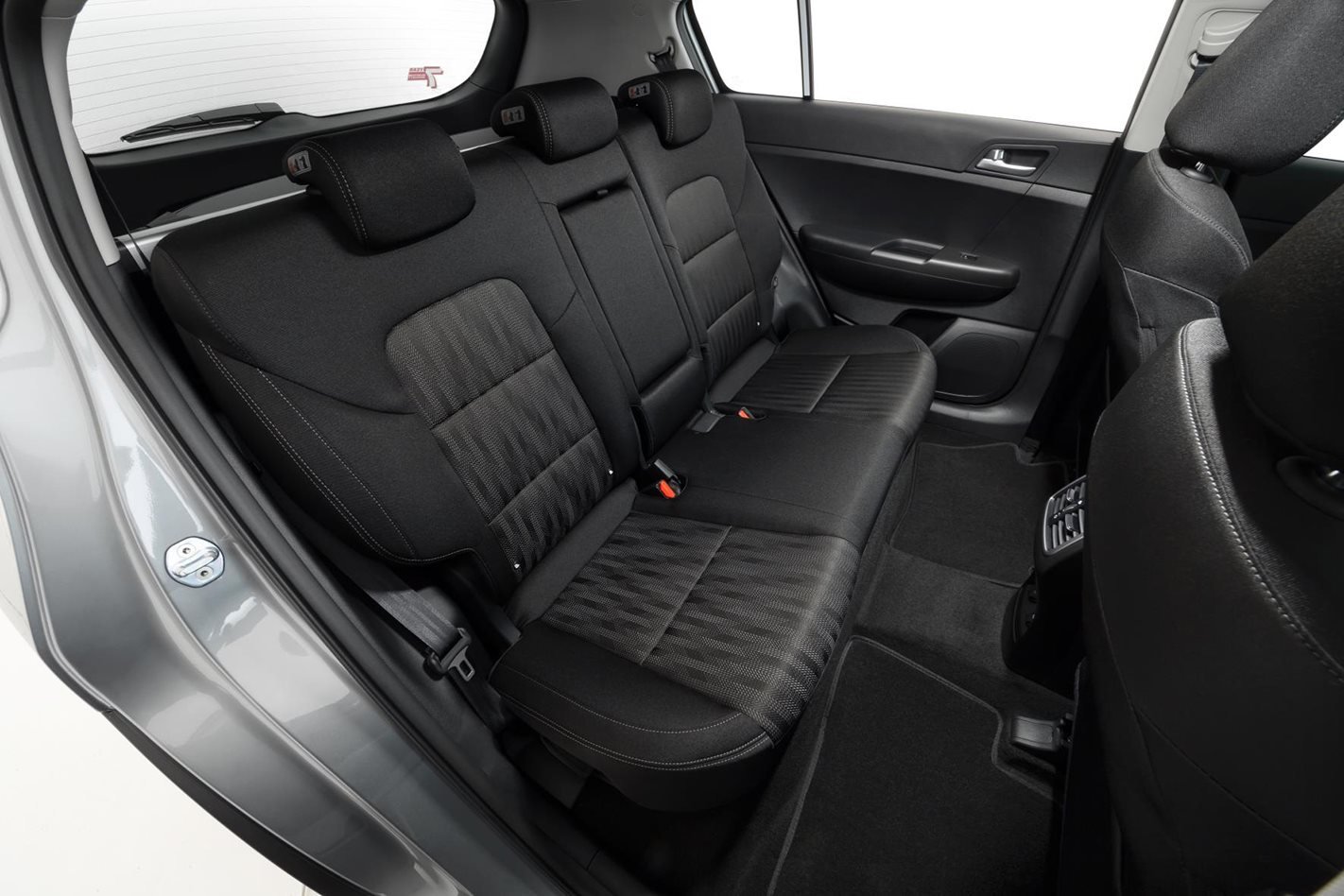
The Sportage has two ISOFIX child seat anchor points and three top tethers.
How is it for carrying stuff?
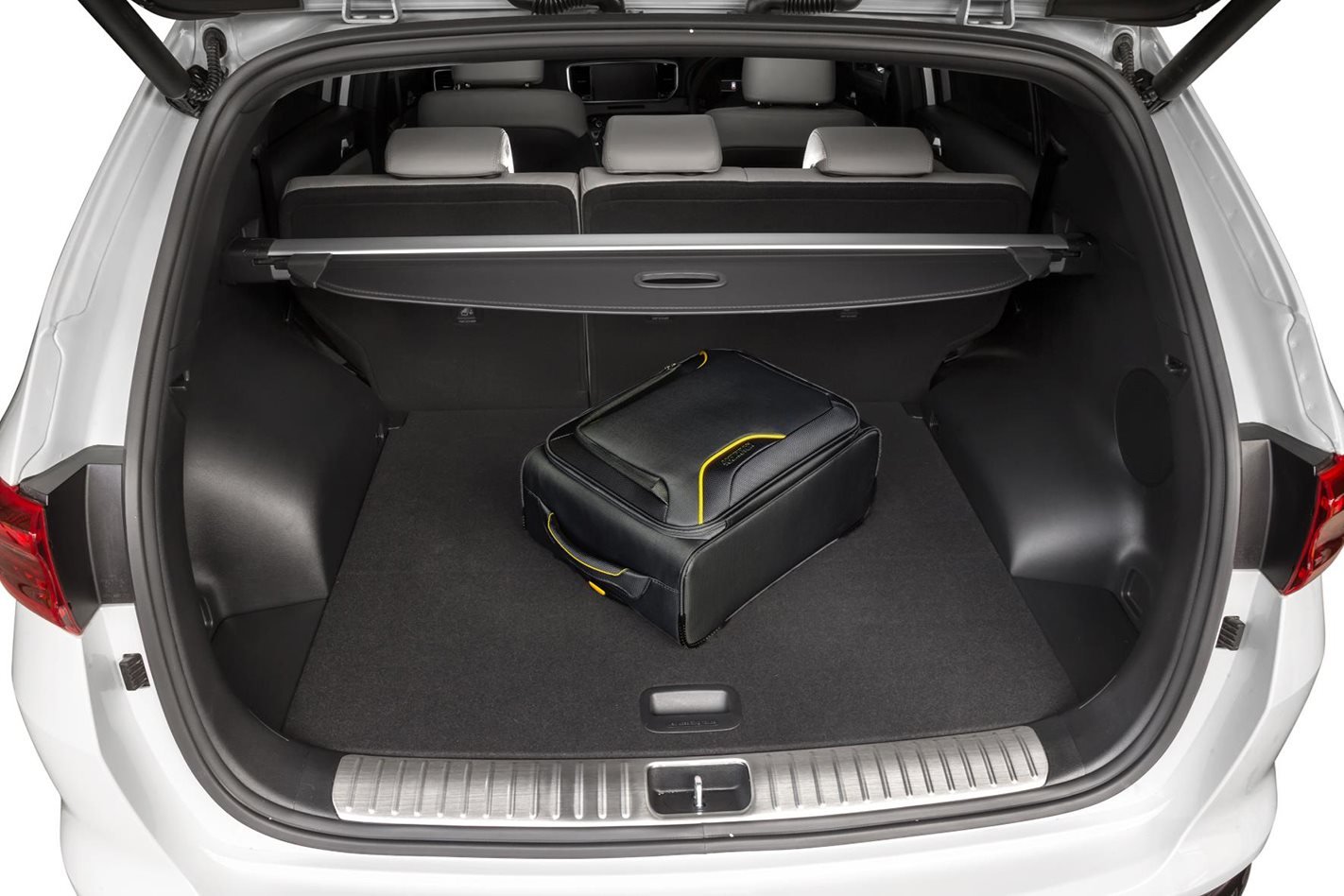
The Sportage is good at carrying lots of luggage, thanks to a 466-litre cargo bay. This expands to 1455 litres with the 60/40 rear seatbacks folded down.
Where does Kia make the Sportage?
The Kia Sportage is manufactured in South Korea.
What might I miss that similar cars have?
A more powerful, turbocharged petrol engine, which alternatives such as the Ford Escape, Volkswagen Tiguan, Peugeot 3008 and Hyundai Tucson offer. This is also available in the slightly Kia Seltos.Other mid-sized SUVs worth considering include the Mazda CX-5, Jeep Compass, Renault Koleos, Subaru Forester, Toyota RAV4.The Nissan X-Trail and Mitsubishi Outlander both can seat seven people.
I like this car, but I can’t choose which version. Can you help?
Our reviewers like the Kia Sportage SX diesel. The diesel is desirable for its effortless acceleration and low fuel use, and the added versatility of all-wheel drive. The SX brings you a lot of desirable extra equipment over the (still well-equipped) Sportage S diesel.
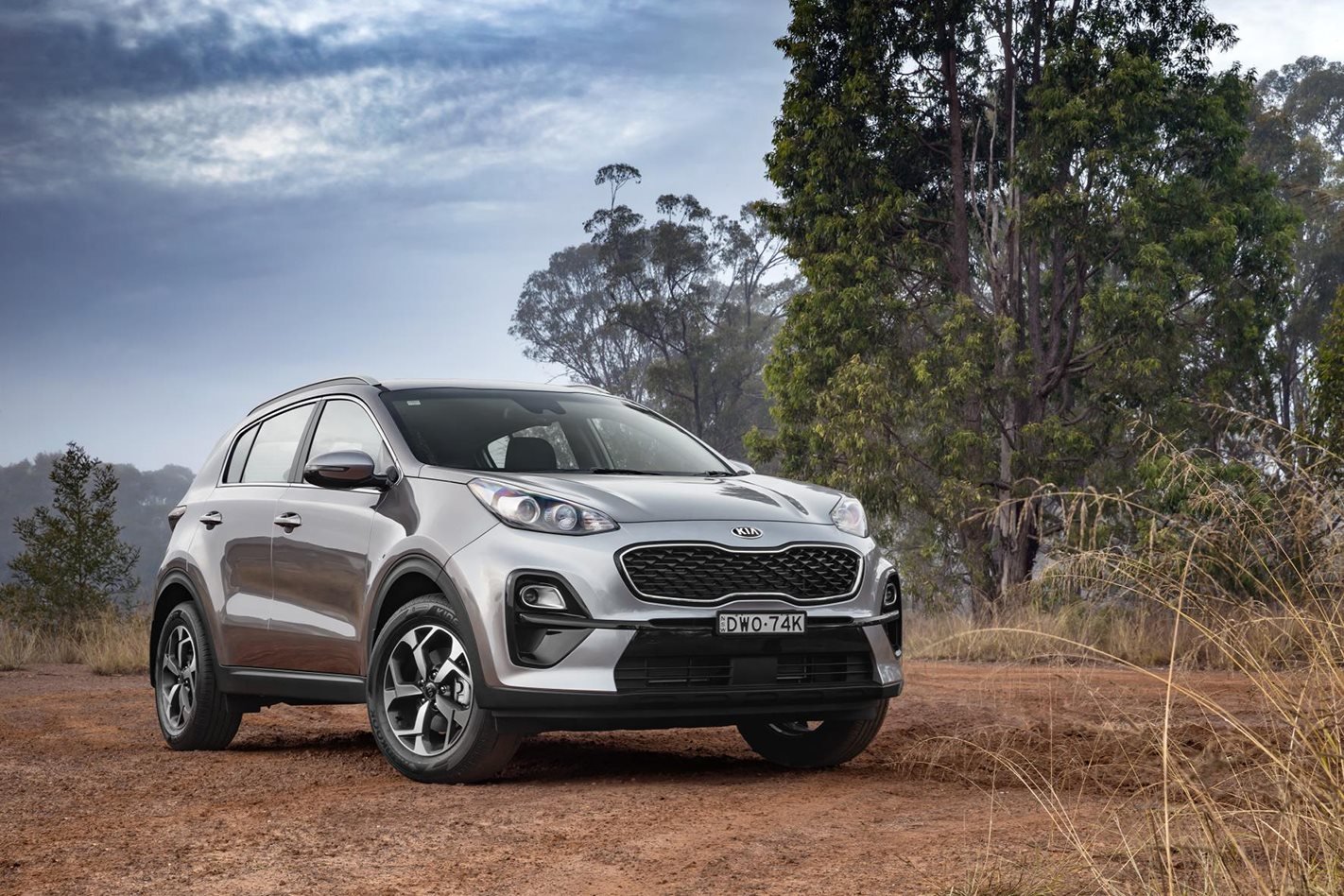
Are there plans to update the Sportage soon?
This fourth-generation Kia Sportage arrived about February 2016, sourced from Kia’s Korean homeland – rather than Slovakia, where the previous model Sportage was built.
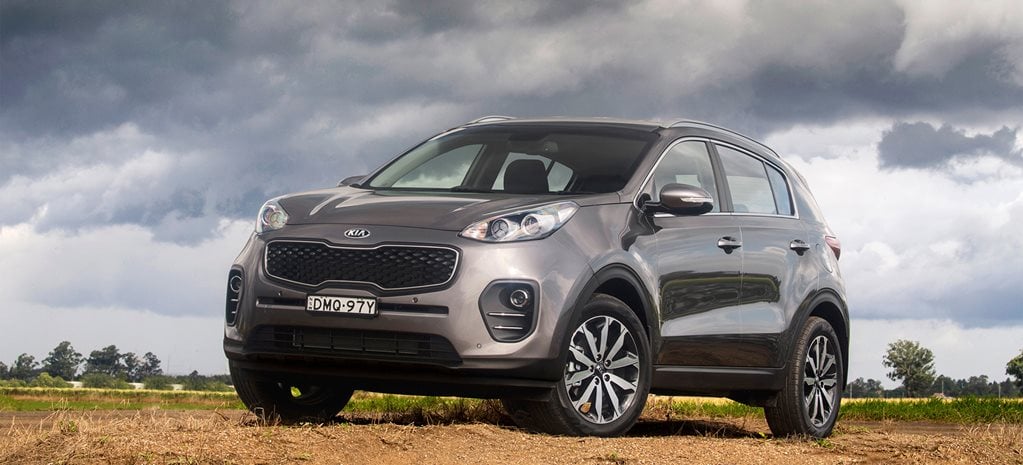
For the 2017 model year, Kia added support for Android Auto and Apple CarPlay (earlier cars could be retro-fitted), and renamed the Platinum trim level the GT Line. About April 2017 the Si Premium arrived to enhance choice in front-drive Sportages.
A mid-cycle facelift for the Sportage arrived in mid-2018 and rolled out autonomous emergency braking across the range beyond just the GT Line, and added a diesel AWD option to the Si Premium spec. The cabin was revamped and the chassis and suspension were further enhanced to suit Australian conditions.
Kia changed some badge names in early 2019, with the Si, Si Premium and SLi respectively re-designated the S, SX and SX+.In September 2019 Kia added a six-speed manual gearbox option to the S and SX, which helped bring the entry-level retail price of the Sportage under $30,000.
An all-new Sportage is expected in 2022.
The Kia Stinger was pitched as the ideal replacement for those Aussie enthusiasts lamenting the demise of our local homegrown performance sedans.
The twin-turbo V6 Korean five-door hasn’t sold in massive numbers, but hasn’t really fired the imagination of traditional Aussie muscle car buyers in the way Kia might have hoped.
To truly do that it needs a V8 slung into its engine bay. That’s because while the boosted 3.3-litre bent-six provides the quarter-mile goods (we’ve achieved sub-five seconds to 100km/h and thirteen-dead to 400m), it sorely lacks aural appeal.
If the last few SEMA shows in the US is anything to go by, Kia knows there’s a bit of mongrel to extract. And while beefed-up body kits, loud hues, intake/exhaust changes as well as bigger wheels, stiffer springs and thicker anti-roll bars are nice, it’s not adding cylinders.
Here’s how we’d do it
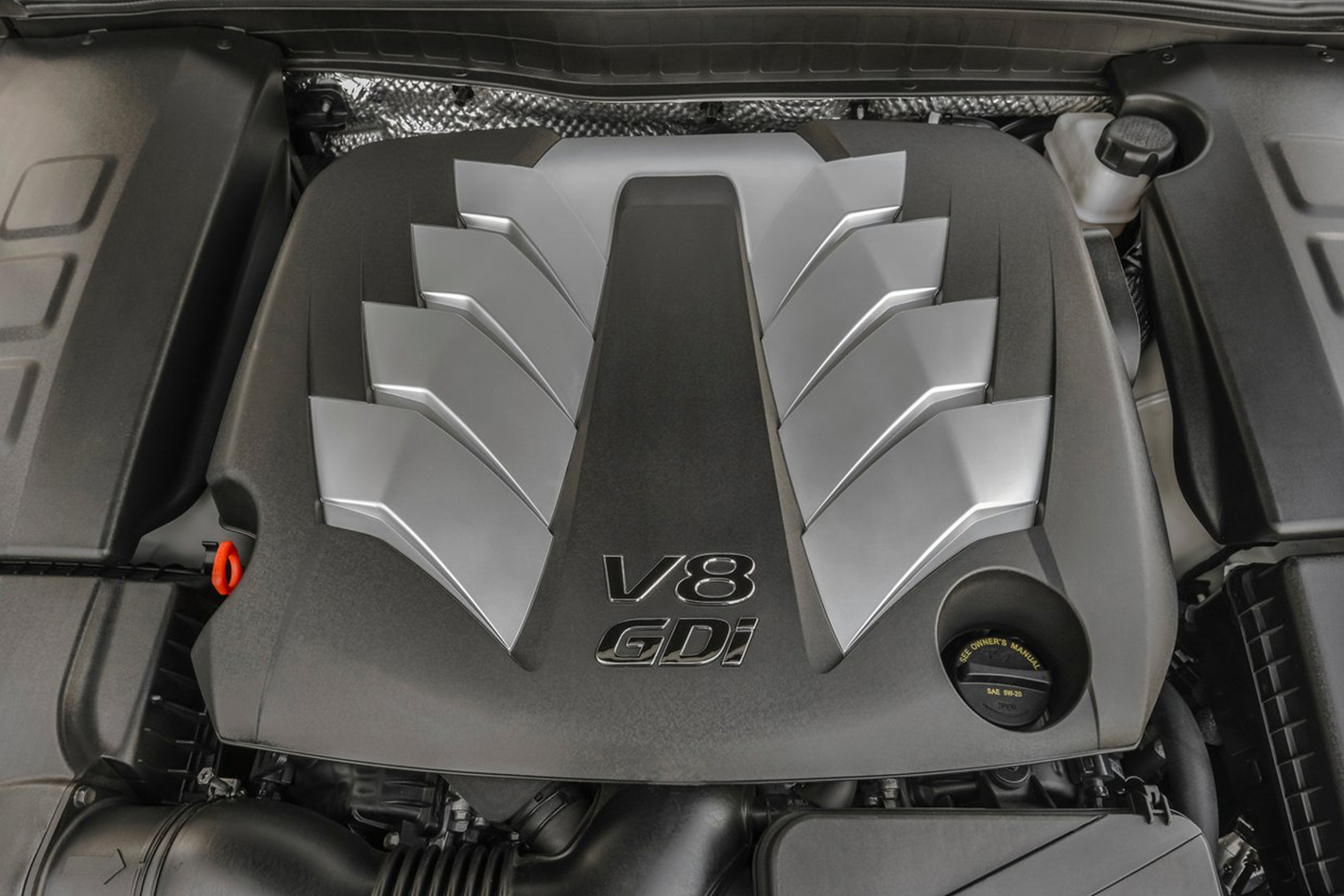
Off the shelf This isn’t just a pipe dream, for Kia has a suitable engine in the form of the 313kW/520Nm 5.0-litre naturally-aspirated ‘Tau’ V8 found in the K900. Even better, Stinger boss Albert Biermann has confirmed the engine fits, though there is currently no plan to offer it.
Take control One of our main bugbears with the Stinger is its eight-speed auto. Not so much the gearbox itself, more the lack of a true manual mode, which seems a strange oversight for an enthusiast-focused model. Add full control and throttle blipping on downshifts and we’ll be happy.
Stiffen up The Stinger’s current chassis tune is acceptable for its intended role, but a V8S would require much more suspension control – a Track mode for the adaptive dampers would be a good start – stickier rubber and far, far better brakes.
Great success The Stinger GT was originally pitched as a VF Commodore SS replacement, which would put the V8 into the tier above. Call it $75,000 – roughly similar to the base four-cylinder versions of the European premium brands – and watch them fly out of dealers.
Apple has finally released its iOS 14 update for iPhone users this morning, highlighting several changes and key features for the smartphone. But more importantly, there are a few changes regarding how your phone interacts with your car.
First of all, Apple is honouring its promise to develop the iPhone as a digital car key. The first manufacturer to sign onto the new tech is BMW which will roll out the feature ahead of wider adoption by other car makers in 2021.
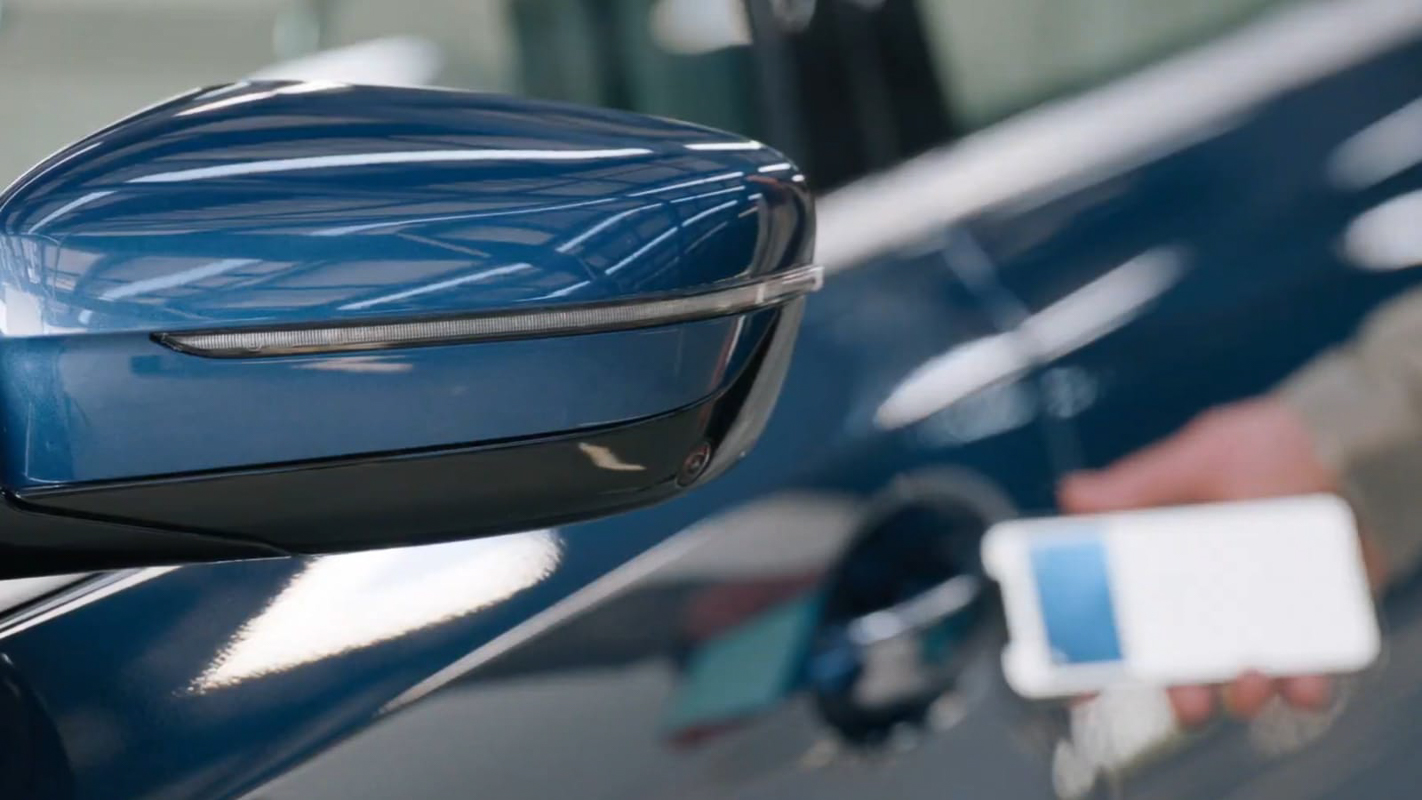
Apple CarKey can unlock, lock and start a car in just a few taps. The ‘key-free’ feature uses Near Field Communication (NFC) tech and is activated in the same way that you use Apple Pay – by double-tapping the lock button.
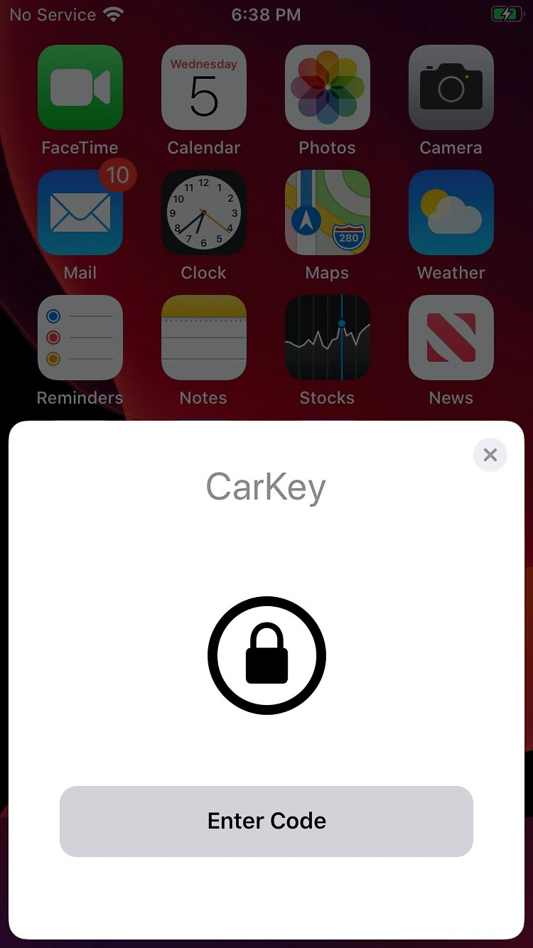
Users can set various restrictions such as the amount of access granted or enable restricted driving in the settings, and digital key access can even be shared over iMessage with to up to five trusted family members or friends.
The next change on a laundry list full of enhancements is the addition of wallpapers to the Apple CarPlay home screen. Users are now able to upload a number of backgrounds to either the home screen or dashboard for a fresh kick of colour and personality – a welcome change to build upon the CarPlay experience.
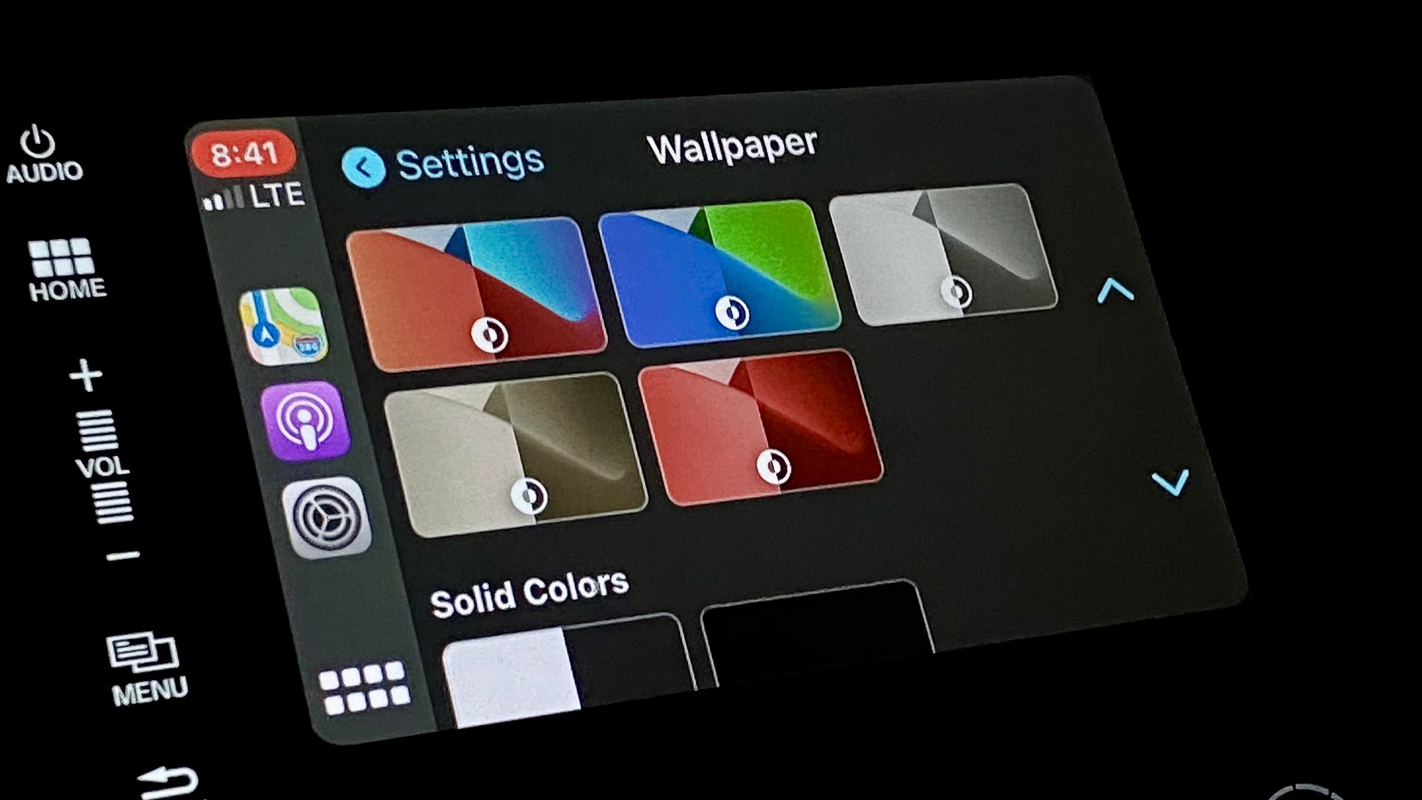
Custom backgrounds of your own photographs aren’t available just yet, though we imagine it’s only a matter of time before that upgrade is pushed across. Head over to settings to update your dashboard.
More support for third-party apps is also singled out in this iOS 14 update, meaning CarPlay is now able to run EV charging, food-ordering or parking apps, for example.
Also new to CarPlay is the option to send and receive audio messages via iMessage if you want to be slightly more expressive than monotone Siri.
A few other updates come to CarPlay with the update, including the inclusion of Japanese and Chinese keyboards, while portrait-mounted CarPlay screens are now more easily viewed with subtle layout changes.
UPDATE September 17, 2020: Sony had long been tight-lipped regarding launch details for its highly-anticipated next-gen Playstation 5 console, but we finally have a confirmed launch date as well as Australian pricing. And if you were struggling to pick between the Playstation and Microsoft’s Xbox Series X and S – the choice hasn’t gotten any easier as launch details are virtually a dead heat.
PRICING
Perhaps spurred by Microsoft’s announcement last week, Sony has returned serve today releasing local pricing for both variants of its Playstation 5 console.
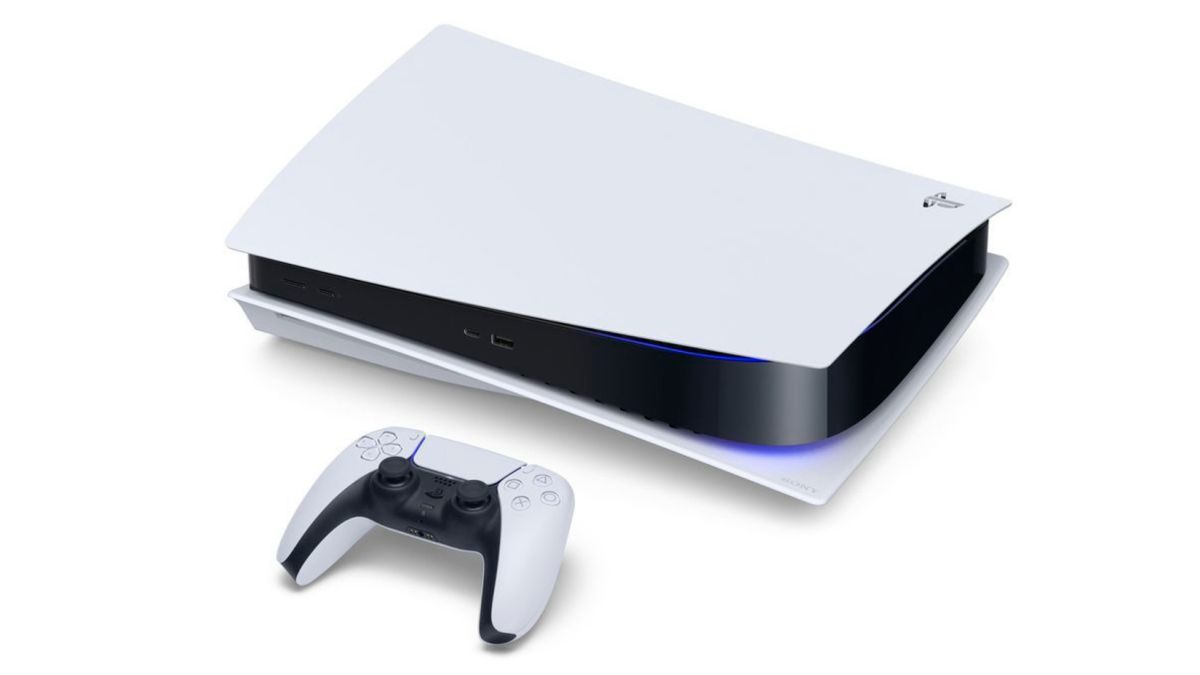
The more affordable Playstation 5 ‘Digital Edition’, which misses out on the physical Blu-Ray disc drive, wears a local RRP of $599.95, $100 more than Microsoft’s mainstream Xbox Series S.
The Playstation 5 comes in almost lineball with Microsoft’s flagship Xbox Series X, with an RRP of $749.95.
GRAN TURISMO 7 ANNOUNCED FOR PLAYSTATION 5!
LAUNCH DATE
The Playstation 5 is due to launch locally on November 12, two days after those day-one Xbox buyers will be firing up their machine for the first time.
Pre-orders have also been opened by various local outlets, with many of them selling out early allocations, or withdrawing pre-orders due to overwhelming demand. Check your favourite local outlets.
SPECS
Unlike Microsoft, which has chosen to forge a clear two-pronged difference in specs between its flagship Series X console, and the more affordable Series S; the two Playstation consoles largely differ only in price, and the presence of a physical 4K Blu-Ray disc tray.
The Playstation 5 similarly utilises a custom AMD Zen 2 eight-core 3.5GHz CPU, which splits the Xbox’s 3.6GHz and 3.4GHz capabilities in their Series X and S consoles.
Both Playstation variants boast a sizeable 10 teraflops of GPU power, again splitting Xbox’s 12 teraflop Series X and 4 teraflop Series S.
The Playstations both come equipped with 16GB of RAM, matching Microsoft’s Series X and outgunning the cheaper Series S’ 10GB. Internal storage also divides the two Xbox models with a native 825GB solid state drive, compared to the Series X’s 1TB SSD and the Series S’ 512GB SSD.
PLAYSTATION 2 TURNS 20 – HERE ARE THE BEST PS2 DRIVING GAMES
In terms of benchmarking: while Xbox users wanting 4K output will have to fork out for the costly Series X, both Playstation 5 variants come 4K capable out of the box.
Overall, if you are cross shopping between the mainstream Xbox Series S – the Playstation 5 Digital Edition may be worth the extra $100.
But if it’s an out-and-out spec monster you’re after, the Xbox Series X takes top trumps on paper.
Which will you be putting on Christmas list this year?
UPDATE June 12, 2020: “The biggest generational transition, our industry has yet seen” said Sony Interactive Entertainment CEO Jim Ryan, as he opened this morning’s ‘PS5 – The Future of Gaming’ event.
The hour-long livestream event was primarily focused on showcasing next-gen gaming titles, however the Playstation 5 console was revealed in full along with its range of accessories.
We also got a closer look at some features included in the new DualSense controllers. Highlighted features included haptic feedback, adaptive triggers, in-built microphone and speaker, USB port and headphone jack. Full console technical specs have previously been released, you can read more further below.

There appears to be two different console variants, a ‘digital version’ as well as a standard – with the most obvious difference being a disc-drive.
As far as a release date goes: Sony are sticking with “Holiday 2020” for now. And we still don’t know how much it’s going to cost – though there are rumours that it will exceed the rival Xbox Series X.
The gaming showcase kicked off with a bit of deja vu, announcing that Grand Theft Auto V would be returning “enhanced and expanded” to the next-gen console, with GTA: Online available for free upon launch. Not exactly the GTA 6 announcement many were hoping for.
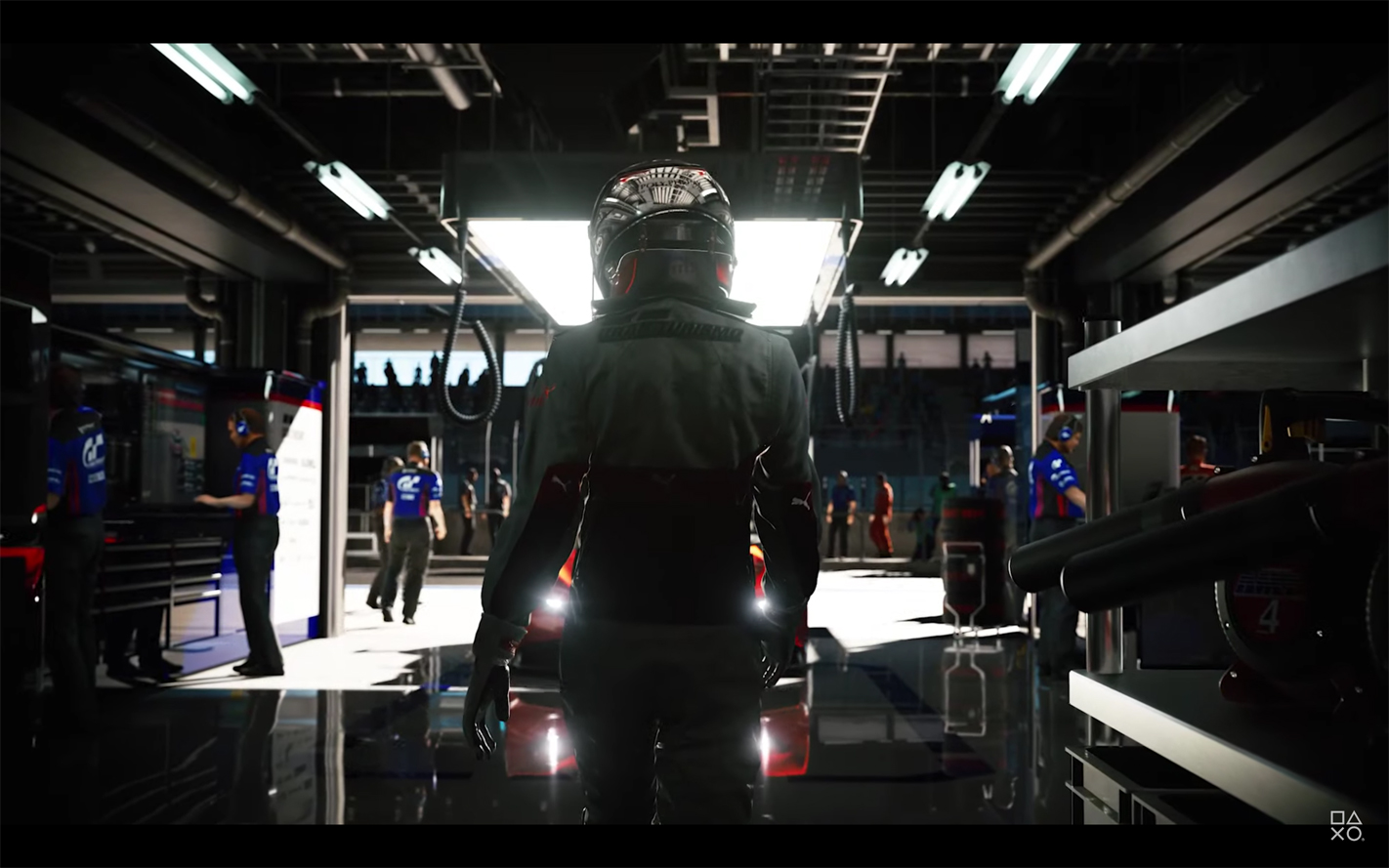
Perhaps more pertinently to us: Gran Turismo 7 was officially announced by Kazunori Yamauchi, Game Designer & CEO at Polyphony Digital.
Yamauchi stated that the new campaign mode was especially something for players to look forward, with a small gameplay reel showing the ‘GT Town’ campaign map as well as a fairly lengthy in-car sequence. Long-time fans will be wrapt with nostalgia, and gladly know that fan favourite features like the used car dealership are making a return.
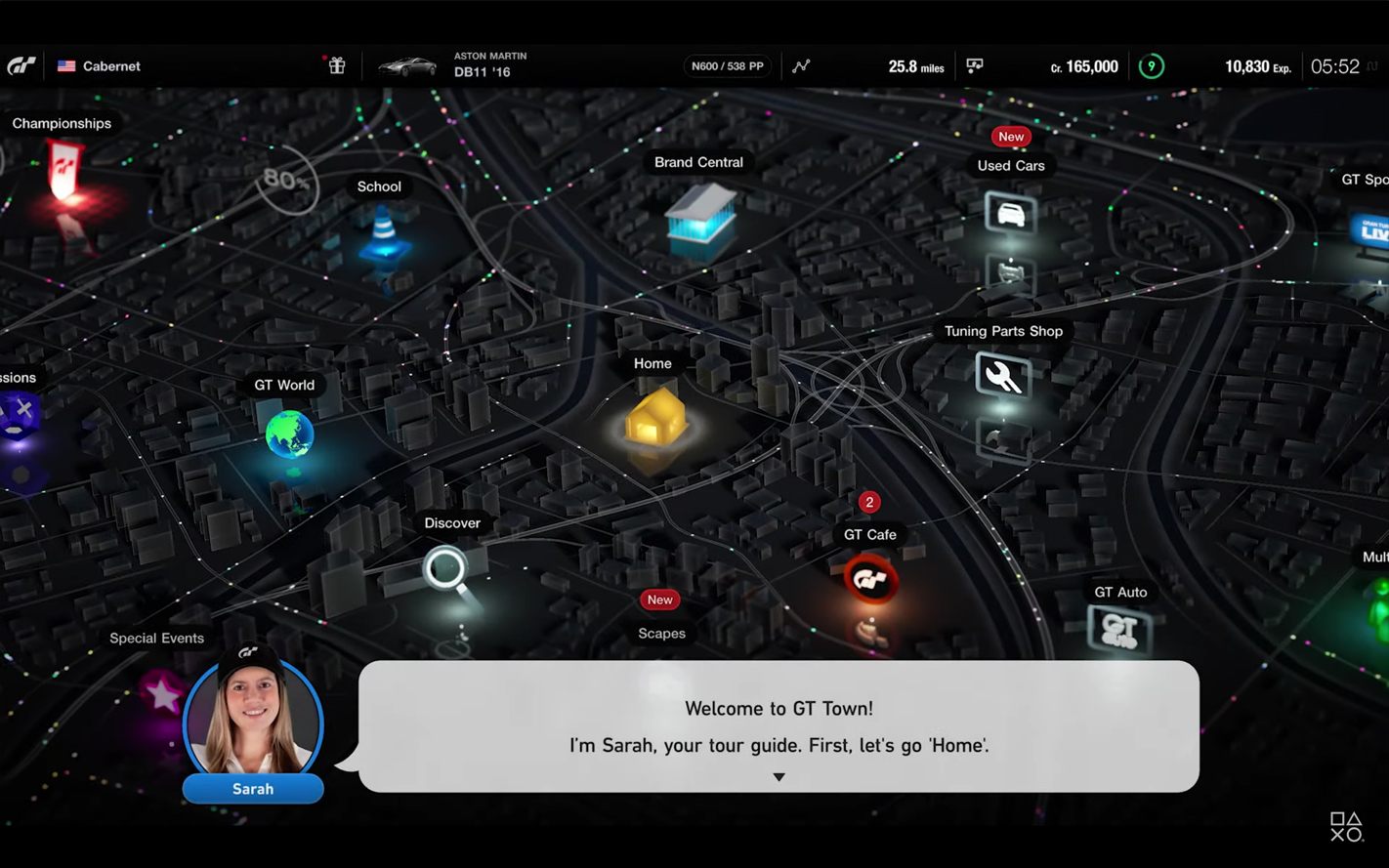
No release date was shared, however given that the Gran Turismo franchise is one of Playstation’s great legacy titles, and the fact that this the first sequenced instalment since Gran Turismo 6 of 2013 – we’re fully expecting GT7 to be a cornerstone PlayStation launch title.
This is all we have for now, stay tuned for more information as it comes!
—
Due at the end of this year in time for Christmas (though the current Coronavirus pandemic may see that date push out), the Playstation 5 will offer massive increases in performance over its predecessor, with double the processing power and six times the graphical rendering potential as the Playstation 4. Speaking in a livestreamed presentation earlier today, Playstation 5 lead systems architect Mark Cerny gave a deep dive into what will make the PS5 tick.
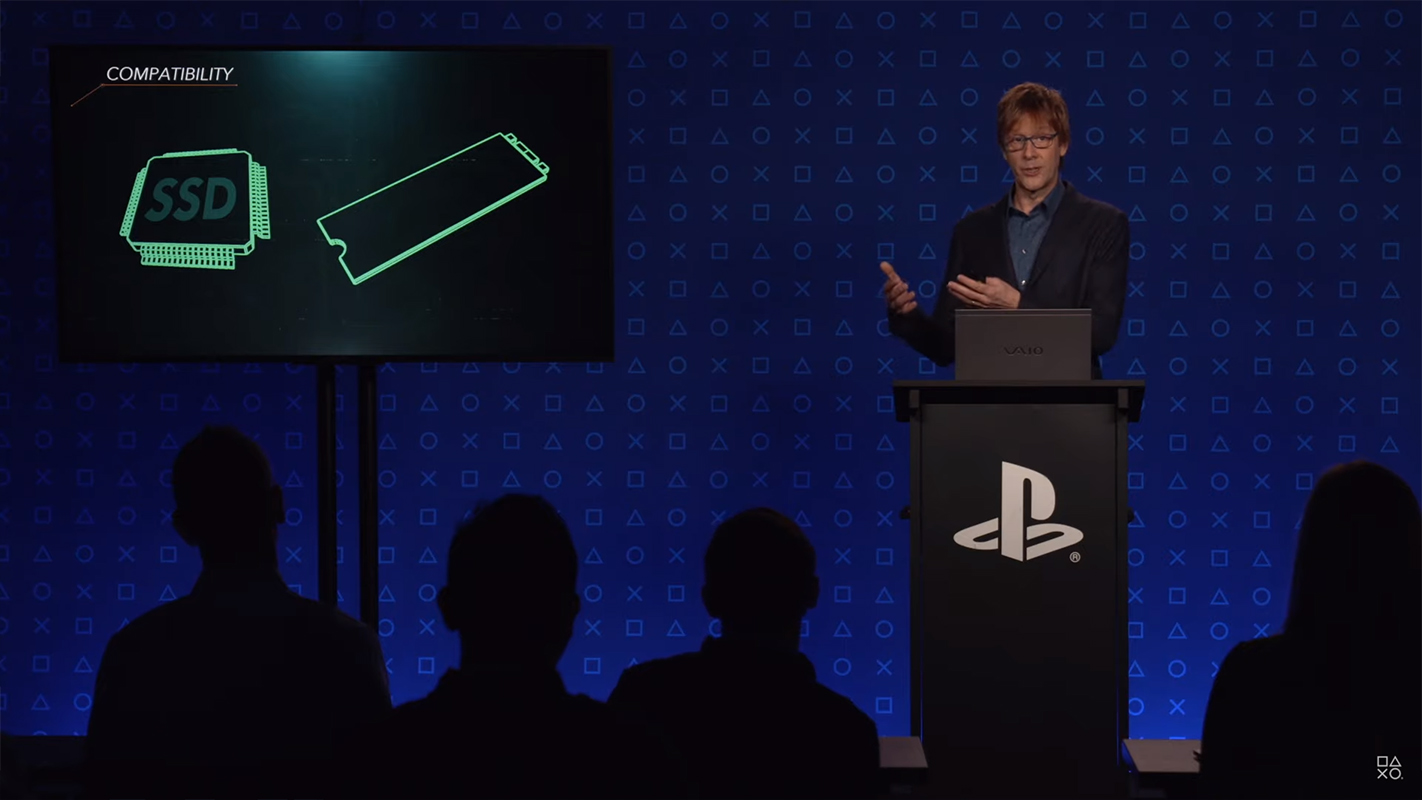
According to Cerny, planning for the PS5 began with discussions with game developers about what they wanted to see in a next-gen console. For the overwhelming majority of them, the answer was “a faster hard drive”, specifically an SSD or solid-state drive. While the PS4’s internal hard drive was a step forward, its mechanical nature was holding developers back
“It was clear that having a hard drive in every Playstation 4 was having a positive impact. A lot of things that would have been impossible at BluRay disc speeds were now possible. At the same time though, in 2015 and 2016 when we were having these conversations [about Playstation 5], developers were banging up against the limits of the hard drives and a lot of developer time was been spent designing around slow load speeds.”

To combat that, Sony targeted 5 gigabyte per second transfer speeds for the PS5 for nearly-instant level loading and game boot times – up from the 50-100 megabyte per second transfer speeds that the Playstation 4’s mechanical hard drive could deliver.
Thanks to some optimization, 5.5GB/S speeds were unlocked by Sony’s engineers, which is around twice as fast as what Microsoft’s next-generation console, the Xbox Series X, will be able to deliver.
And the result is an ultra-fast SSD with 825GB of storage space, expandable by a built-in PCIe slot for a second SSD. With Sony following the rest of the industry and moving towards digital distribution, hard drive space will be critical, and in the event two internal SSDs aren’t enough, an additional hard drive can be plugged in via a USB cable.
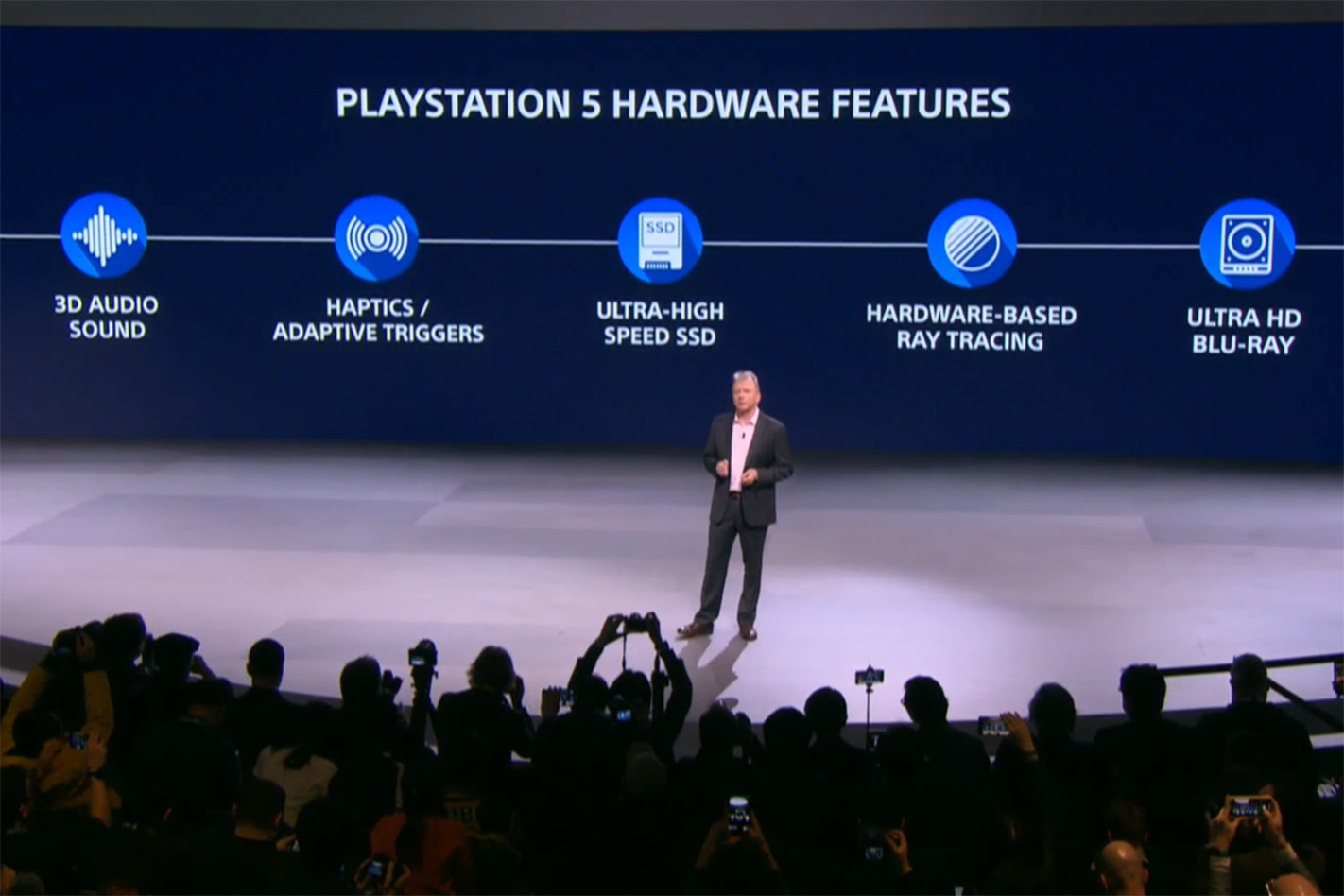
A 4K UHD Blu-ray disc drive will be built in, giving an equal capacity to read optical media as the upcoming Xbox Series X. On top of that, the Playstation 5 will boast 16GB of GDDR memory.
Running the show will be an 8-core Zen 2 CPU with 3.5 gigahertz clock speed per core, representing more than double the PS4’s processing power. With its AMD-sourced custom graphics processor generating an additional 2.23GHz for each of its 36 compute units, the PS5’s raw graphics potential measures nearly six times higher than the console it will replace.
While the console is still yet to be revealed, we now know what the PS5’s new gamepad will look like. Dubbed the DualSense, the all-new wireless gamepad loses the recognisable form factor of the DualShock 4 that preceded it in favour of a more ergonomic shape. Housed within are haptic force motors to deliver greater ‘textural’ sensations into your fingers and palms, while adaptive triggers alter their tension depending on the game. That could mean a satisfyingly stiff left trigger for braking, and a much smoother right trigger for the accelerator.
The DualSense controller also integrates a player-facing microphone, meaning you won’t need to invest in a headset in order to be heard.
There’s loads more nitty-gritty tech detail in Sony’s announcement, so if you’re curious about learning not just how but why Sony pursued these specs for the Playstation 5, give the video below a watch.
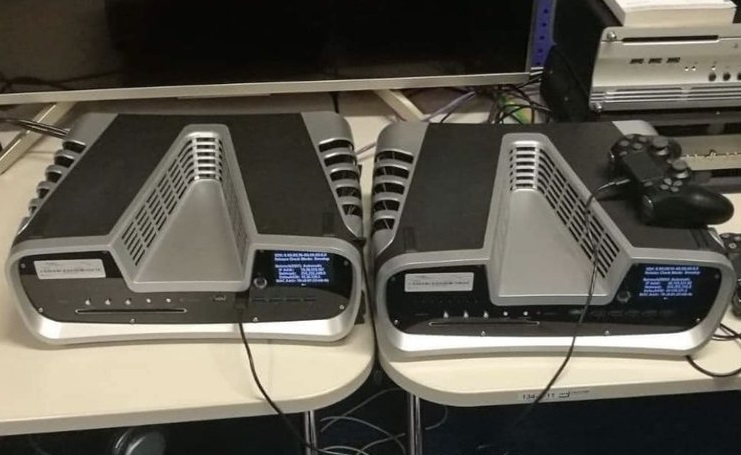
Meanwhile, Sony is still keeping the actual appearance of its next-generation gaming console under wraps, though leaked images of industry development kits have let at least some of cats out of the bag.
At CES back in January, Sony Interactive Entertainment chief Jim Ryan also confirmed several other technology highlights of the upcoming PS5, such as hardware-based ray-tracing for realistic lighting and shadows, enhanced gamepad haptics and trigger buttons capable of feedback and 3D audio.
While Ryan also announced that over five million Playstation VR headsets have been shipped since its launch, there has been no mention of new products using Sony’s Playstation VR technology – or indeed of a second-generation PSVR headset
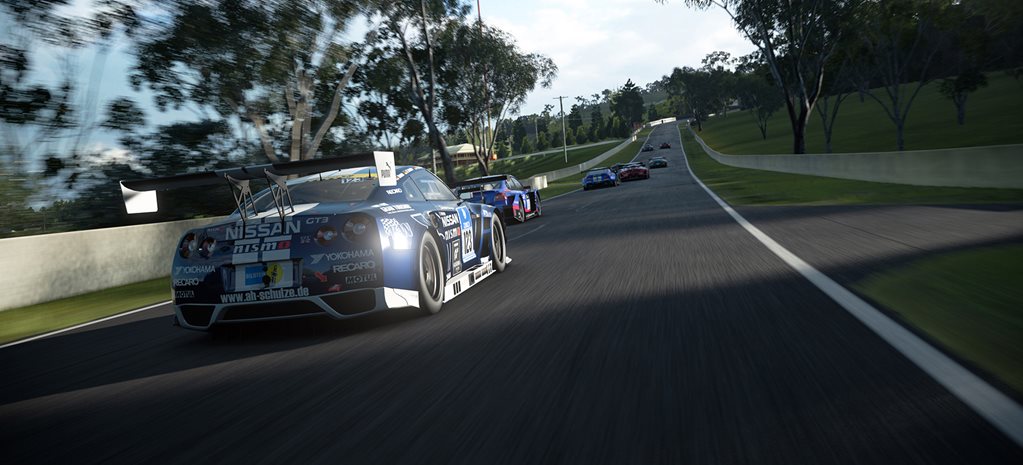
It has been confirmed in the past that the PS5 will at least be compatible with current Playstation VR hardware, though. That’s good news for current owners of Playstation’s virtual-reality hardware, however we’re keen to see if a second-generation headset is also shaping up for a Q4 2020 arrival, and what it’ll be capable of. From a sim-racing point of view the immersion boost granted by VR is a genuine game-changer, and with Sony’s flagship racing title Gran Turismo Sport being very much VR-friendly, we’d expect Sony will be eager to exploit that further with the PS5’s gruntier hardware.
And that’s it for now. We’ll have more as Sony trickles out information in the lead up to the PS5’s launch. Oh, there’s one last thing: if you were concerned about the appearance of the PS5 developer kits above and their weirdly-generic styling and V-shaped cooling vents, don’t be: they’re likely nothing like the retail Playstation 5 and are designed to be easily stackable, not good-looking.
Now, more than ever, the price of life-saving technology in new cars has never been more affordable… but what do all those acronyms actually mean?
Potentially life-saving active safety features are increasingly becoming standard equipment on even the most affordable cars. Autonomous emergency braking (AEB) is the most significant, but there are a host of other features that combine to create a virtual shield around your car.
Here’s a list of key active safety and driver-assist features currently available in mainstream vehicles that are well worth considering when buying a new car. The list includes their generic names.
Adaptive Cruise Control
Also known as active cruise control, this system uses camera- or radar-based sensors to slow and maintain your vehicle’s speed based on the speed of the vehicle preceding it.
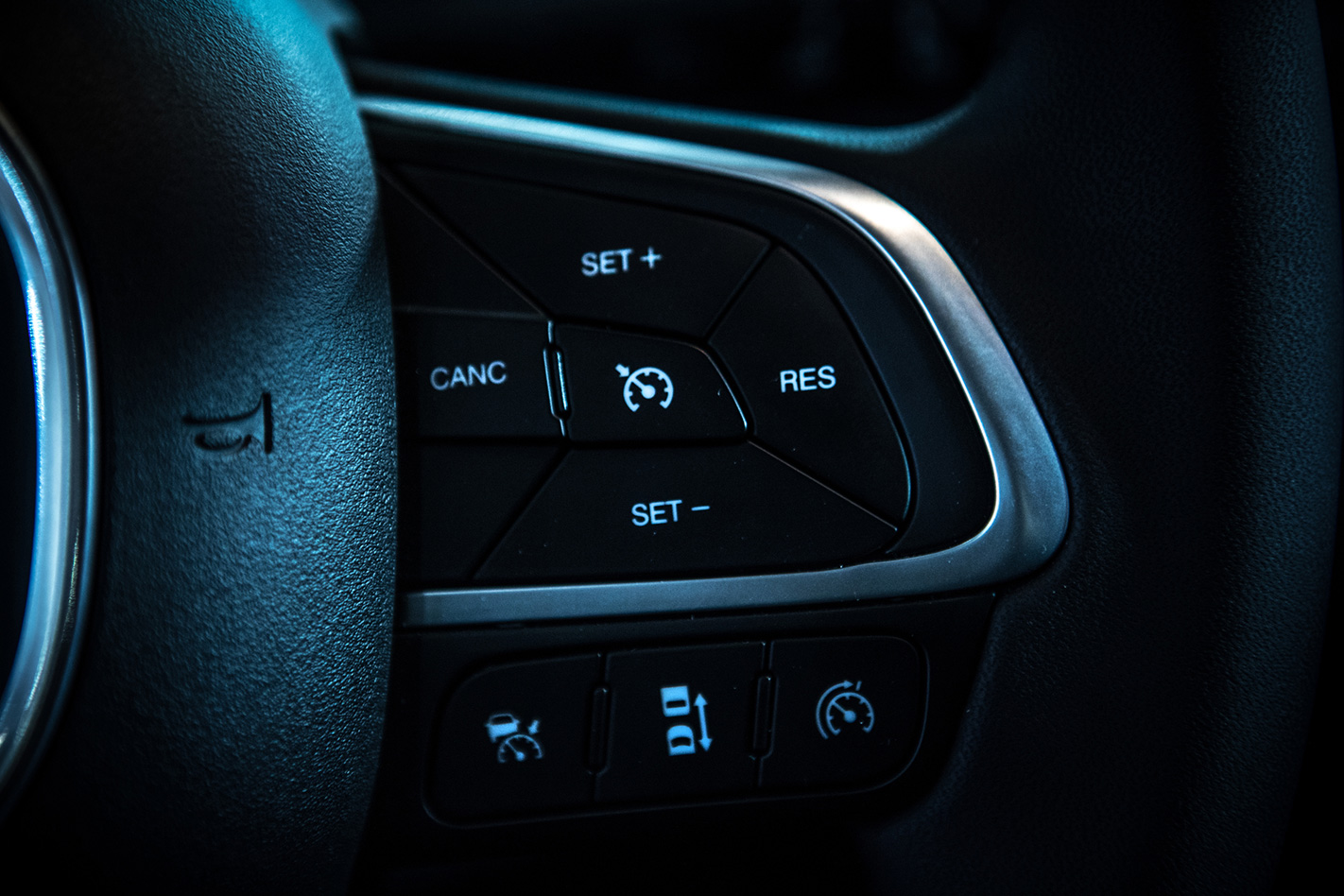
Most systems operate from minimum speeds of about 30km/h, but more advanced systems offer ‘traffic stop & go’ that automatically stops and start your car in traffic-heavy traffic behind the vehicle in front.
Adaptive cruise control systems are usually based on radar or LIDAR (laser-based radar) systems mounted in the grille, though Subaru’s EyeSight system uses a pair of forward-facing stereo cameras in the windscreen. Many adaptive systems don’t work well in heavy rain or fog, as they are unable to ‘see’ the vehicle in front.
More advanced adaptive cruise control systems have a Stop & Go function that works in heavy traffic and brings the vehicle to stop and then moves forward with the vehicle in front. Often called Smart Cruise Control, it helps reduce fatigue and frustration during a traffic jam.
Autonomous Emergency Braking (AEB)
AEB is the key active safety feature that any car you’re looking to buy should have. It uses camera- or radar-based sensors to judge closing speeds between vehicles, and will autonomously apply the brakes if there’s no driver response within a prescribed time.
AEB comes in five categories:
- Low or city speed, which detects other vehicles in front of your car to prevent relatively minor crashes;
- High or freeway speed, which scans up to 200 metres ahead using long-range radar to prevent or mitigate a high-speed collision.
- Pedestrian braking, which detects pedestrians – and in some cases cyclists – to prevent a collision;
- Reverse AEB works at low speeds when parking and will stop to prevent your vehicle hitting an obstacle or person.
- Junction AEB, which detects a vehicle entering the road from the side and applies the brakes prevent a side collision.
Blind Spot Monitor
This radar-based system can detect a vehicle approaching from behind in your blind spot over your shoulder, and displays an amber or red light in the door mirror on the corresponding side. More advanced systems can audibly warn the driver should they try and change lanes, while highly advanced versions are able to prevent the lane change from even happening.
As radar systems improve, blind spot monitors can detect obstacles approaching from behind at high speeds and from longer distances, giving you more chance to avoid a potential lane-change crash.
Cross Traffic Alert
This system detects vehicles, cyclists or pedestrians coming from the left or right side of the vehicle. This is mostly fitted to vehicles to help detect a threat while reversing and is called rear-cross traffic alert, while forward-cross traffic alert is becoming more common.
Fatigue Detector
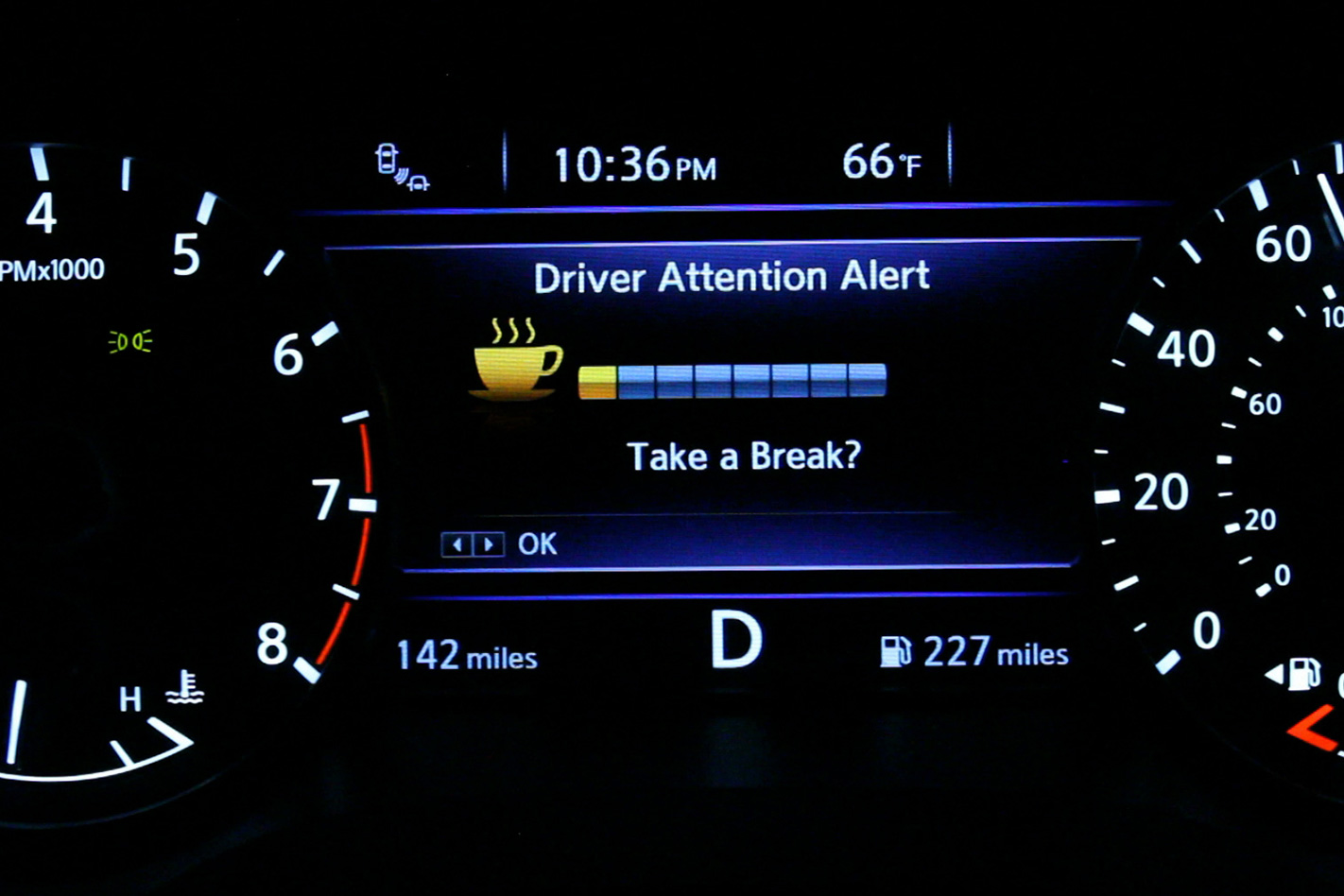
The most common fatigue detectors can monitor the driver’s inputs on the accelerator and steering wheel, as well as measuring the amount of time spent behind the wheel, looking for abnormal behaviour that may indicate drowsiness. If the car thinks you’re driving erratically, it will sound an alarm and flash a message to you, suggesting you take five.
The latest version of Subaru’s EyeSight system even uses facial recognition to detect if your eyes are open, and will warn you to pay attention or take a break from driving. As a nice addition, the system can recognise up to five drivers, and will change your seating and mirror position to suit.
Forward Collision Warning
Like AEB, this uses radar- or camera-based sensors to monitor the closing speed between your car and vehicles, objects or pedestrians ahead to alert you of an impending collision. If it detects a potential collision, it warns the driver via an audible alert and flashing light on the dashboard, or projected on to the windscreen. This shouldn’t be confused with AEB, though – forward collision detection merely warns you, but it won’t brake for you.
Intelligent Speed Assist
ISA is a safety technology that uses GPS mapping data to identify a posted speed limit to alert you if you exceed the speed limit. It can also combine with the car’s adaptive cruise control system to match the car’s speed to the relevant speed limit.
Lane Departure Alert
Uses a downwards-facing camera on the door mirrors to recognise lane markings, and sounds a warning or vibrates the steering wheel – or, in the case of cars like the Holden Acadia, a physical shaking of the driver’s seat – should the car stray over the line marking. It works on both centre and side lines.
Lane Keeping Assist
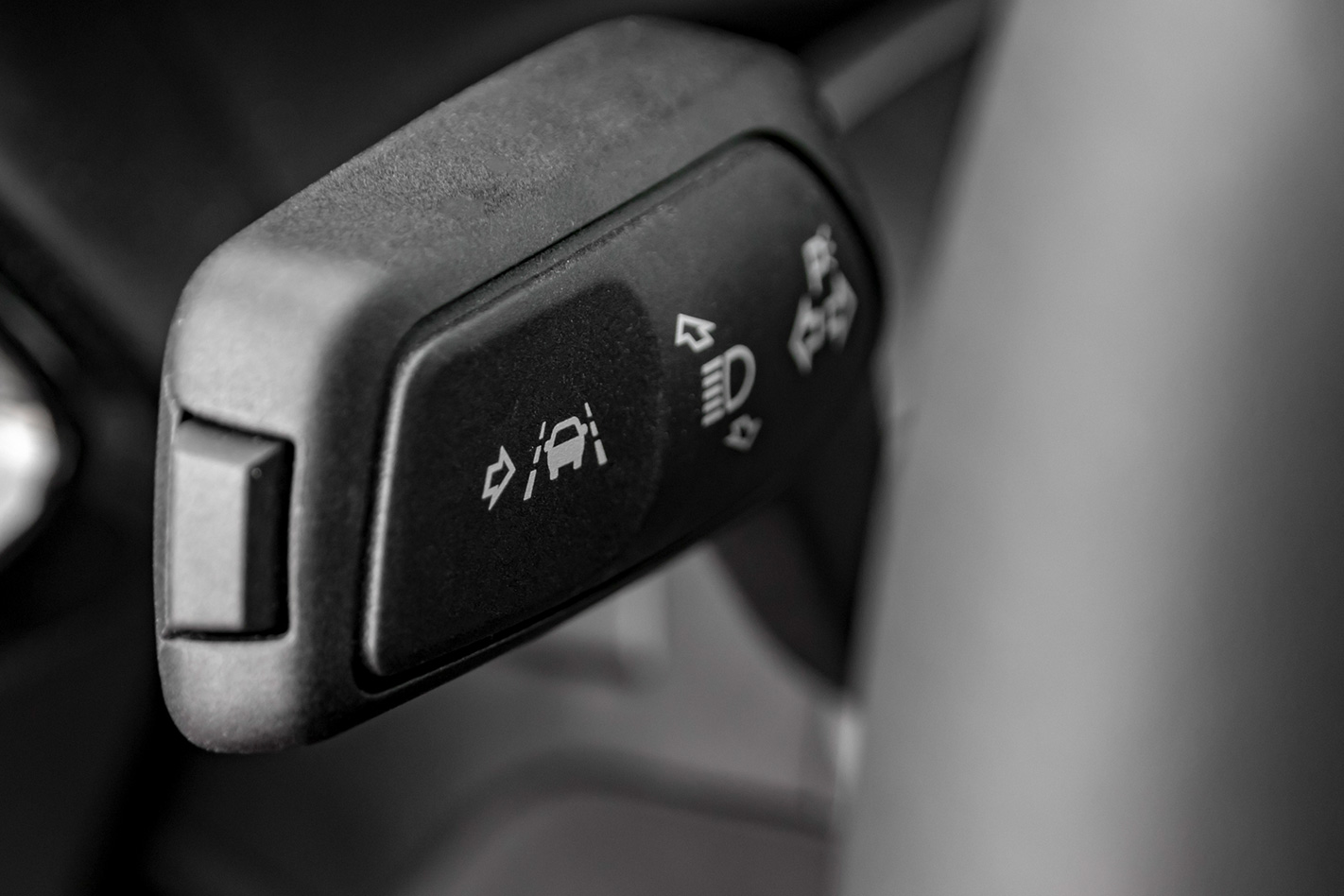
Lane-keeping assist builds on the lane departure alert system by gently steering the vehicle back within its lane and guiding back between the lines if you have begun to drift along the highway. It doesn’t override your steering input, though, and will disable itself if you keep your hands off the wheel for a pre-determined time to prevent it being used as an autopilot.
Mercedes-Benz as a more advanced system called Active Steering Assist that follows the car ahead or referencing road edges or structures such as bollards should there be no lines on the road.
Lateral Side Assist
This detects vehicles approaching diagonally from another lane from the front and rear and alerts the driver as with cross-traffic alert. Some systems will also steer the car away from another vehicle entering your lane when safe to do so.
Pre-crash Safety System
Detects an imminent crash and deploys safety devices to help minimise the result of the impact such as seat belt pre-tensioners. Some vehicles will even close the windows to prevent occupants from being ejected and adjust the seats to ensure maximum airbag protection. The system works by using sensors, as with AEB, or simply when the driver takes sudden evasive action such as hard braking or swerving.
Traffic-Sign Assist
Uses a camera to read speed signs to let you know speed-limit information and warn you when you’re going too fast. In some vehicles, like the Holden Acadia, this can be used in conjunction with the speed limiter so your car won’t travel faster than the speed limit.
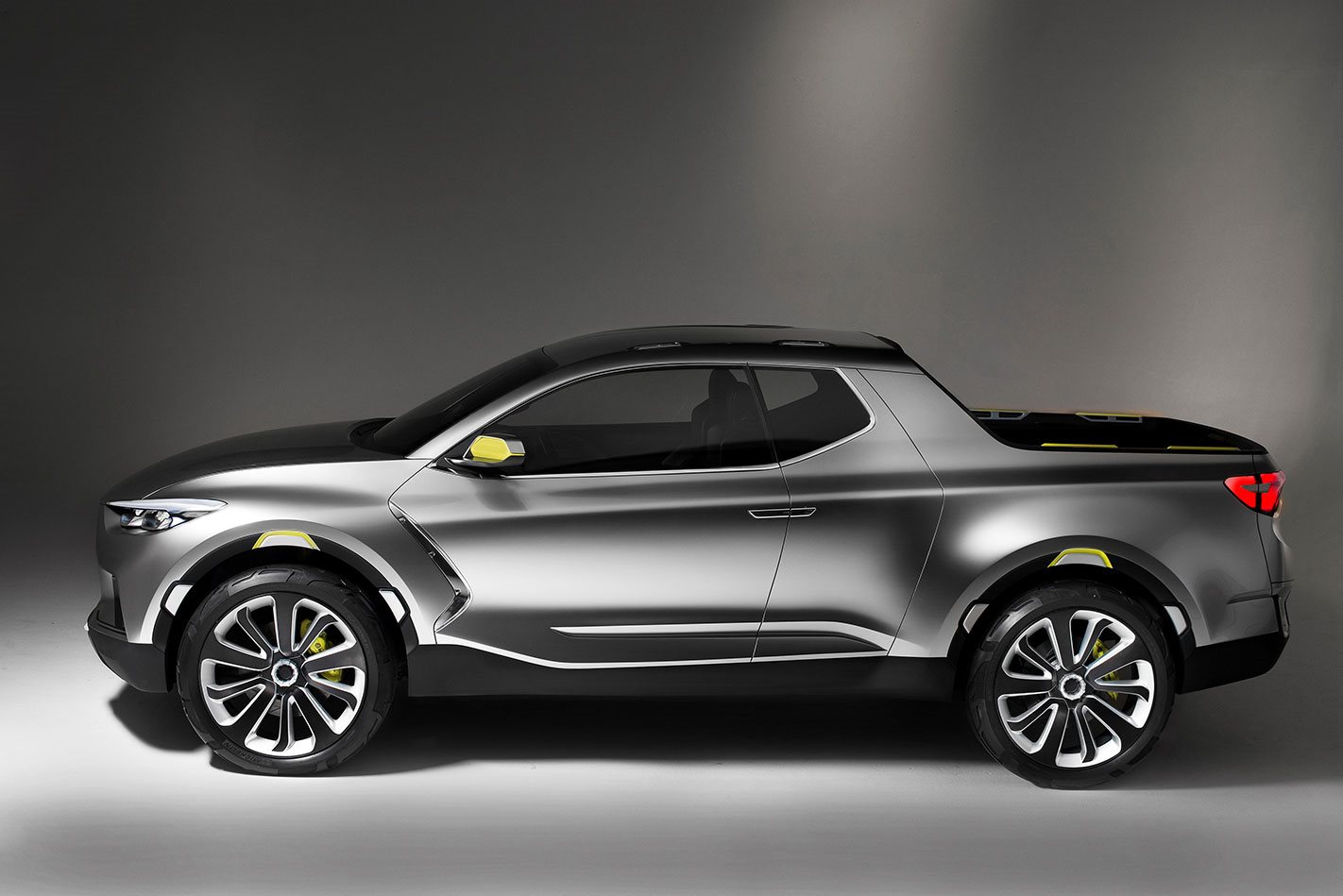
Hyundai’s entry into the ultra-popular Australian ute market is still on the cards as the company’s eagerly awaited pick-up foray nears production, and the mysterious model could arrive guns blazing with a mighty straight-six diesel under its bonnet.
While the final forecourt version is yet to be revealed and detailed, the South Korean car maker has confirmed a pick up model dubbed the Santa Cruz will be offered in selected global markets including the US, but Australia is still waiting to be added to that list.
However, Hyundai head of global design SangYup Lee has offered a tantalising glimpse that a ute of some description could join the existing line-up in local showrooms.
Speaking to WhichCar, SangYup Lee said the car giant will be assessing the reaction to the model’s roll-out in America and considering other market regions as part of the global model strategy.
“When the car (Santa Cruz) comes out and you guys write an article saying we want this in the Australian market big-time, nothing’s actually concrete and everything’s open, so we’ll see what happens,” he said.
It’s not clear if the vehicle in question is a right-hand drive version of the model that will be launching in North America or an entirely separate entity rolling on a different platform that has been previously hinted at by Hyundai Australia – or perhaps something in between.
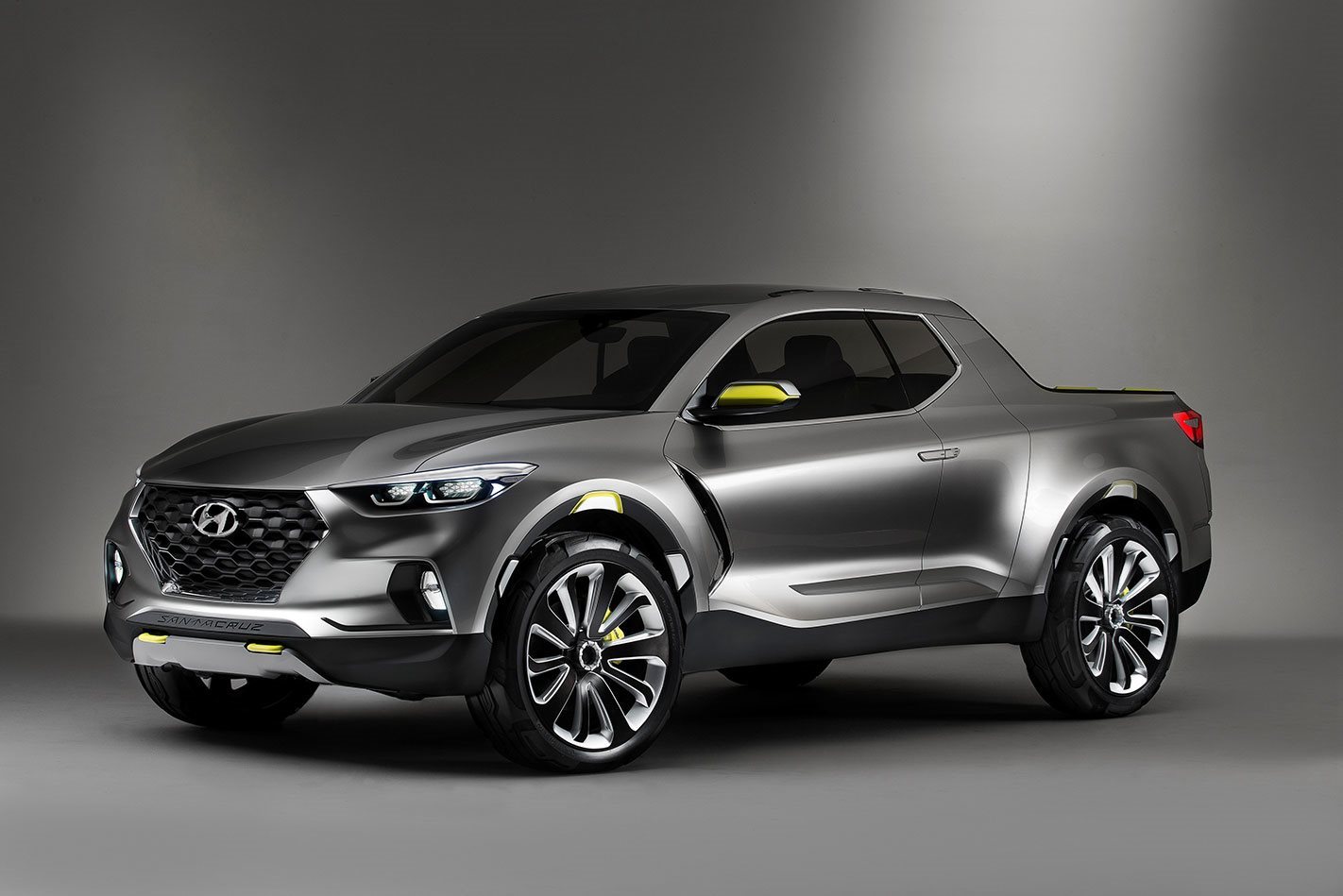
While the American Santa Cruz will be built on a more car-like monocoque, a larger ladder-frame model is understood to be under development, but Lee threw another option into the mix that was pointing directly at an Australian audience.
“I visualise the ute as having the front part as a monocoque versus a frame part at the back,” he said. “I love Australian car culture – it’s very diverse, it’s very unique, there’s V8s, and I keep it in my mind that the design also will work in Australia.”
Lee doubtlessly has an intimate understanding of Australian cars, tastes and demand having spent two years living in Melbourne while developing the previous-generation Camaro at Holden’s design centre.
“Santa Cruz is coming,” he said. “We are finalising the design but I always keep in my mind the ute culture that Australia has and nowhere else has. I know the car design tastes of Australian people.”
A model beyond the smaller Santa Cruz is yet to be made official, but Lee did reveal that his design team was exploring other pick up concepts and “many different possible options for the future.”
But the larger ute plot thickens. Remarks made by Hyundai global head of research and development Albert Biermann in January add fuel to the theory a one-tonne model or bigger Santa Cruz variant is in the works.
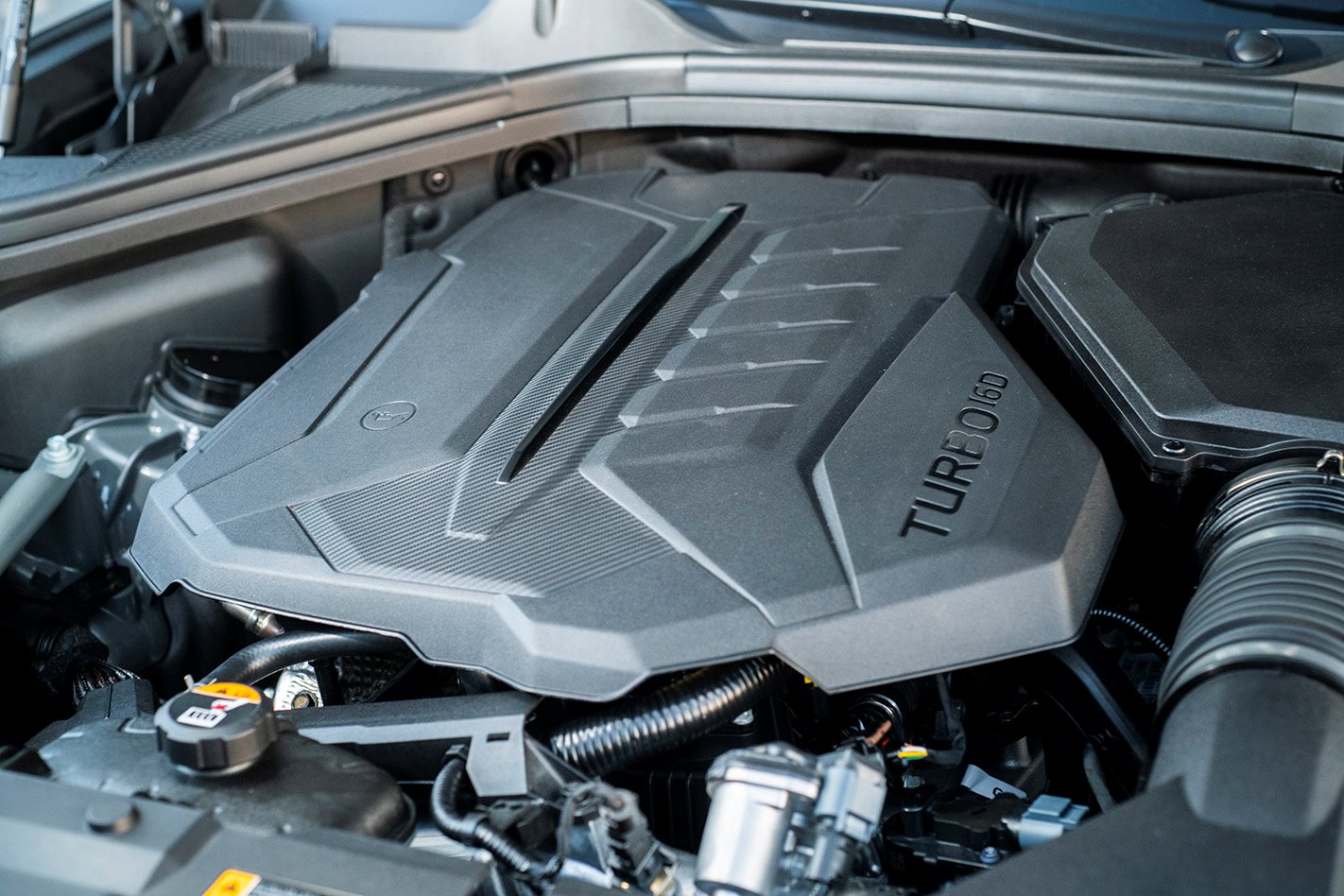
Speaking at the launch of the new Genesis GV80 in Seoul, Biermann told WhichCar the new luxury model’s straight-six diesel engine will certainly be finding its way into other models across the company’s lines.
“This engine, we can have so many applications,” he said. “As you know, we make also commercial vehicles so this engine will be out there for quite some time”.
If the company is designing a model to use the smooth and powerful 3.0-litre in-line six, it will have a unique ute proposition to offer to power-hungry Australians.
With the end of Mercedes’ X-Class in sight, Volkswagen’s Amarok V6 will soon be the only six-cylinder diesel one-tonner in the local market, but Hyundai’s hardware would level the playing field once again.
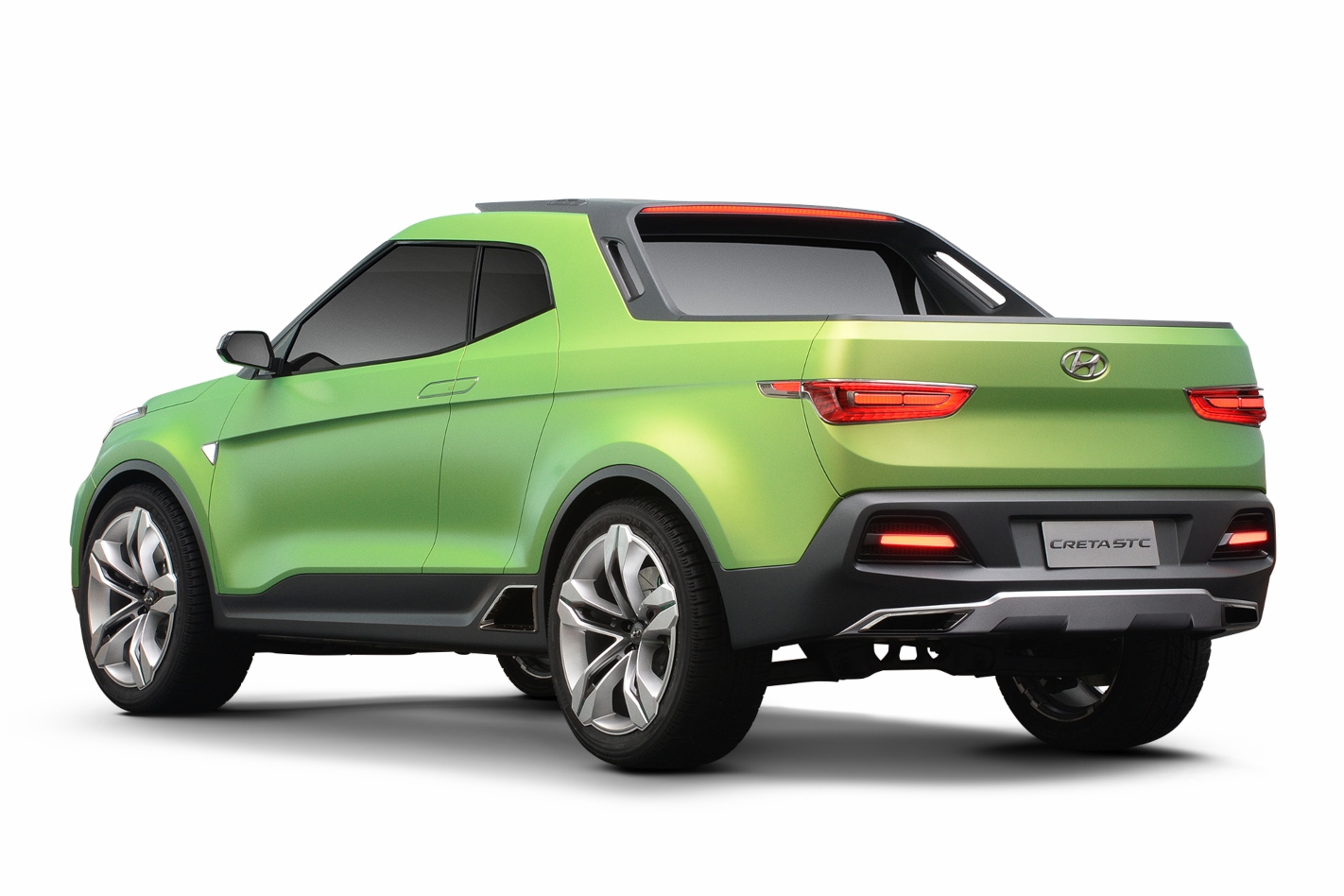
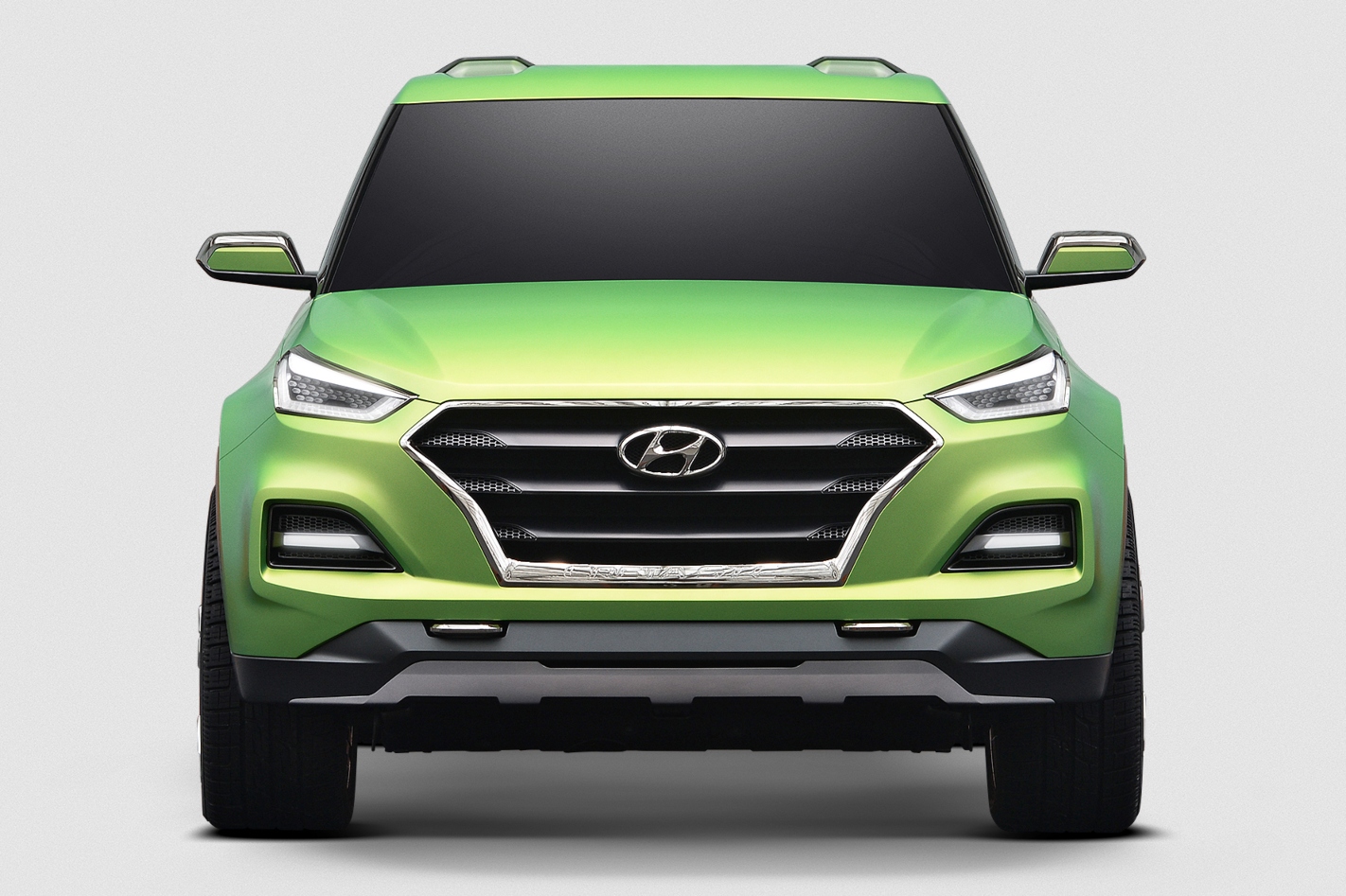
While the Santa Cruz concept has received a significant and sustained attention since its reveal in 2015, the Creta STC which emerged a year later has avoided the same spotlight and could be the obvious hint hidden in plain sight.
It’s understood that the most recent Hyundai pick-up concept heralds a model likely destined for Indian or South American markets only, but it might also offer a closer likeness to a model Lee’s team is busy scribbling away on sketch boards in Seoul.
What’s on WhichCar TV this week?
Electric revolution!
This Sunday it’s all about electric cars. Join us on Sunday afternoon as we explore the world of alternative energy and show you what electric car ownership entails.
Electric cars needn’t be boring
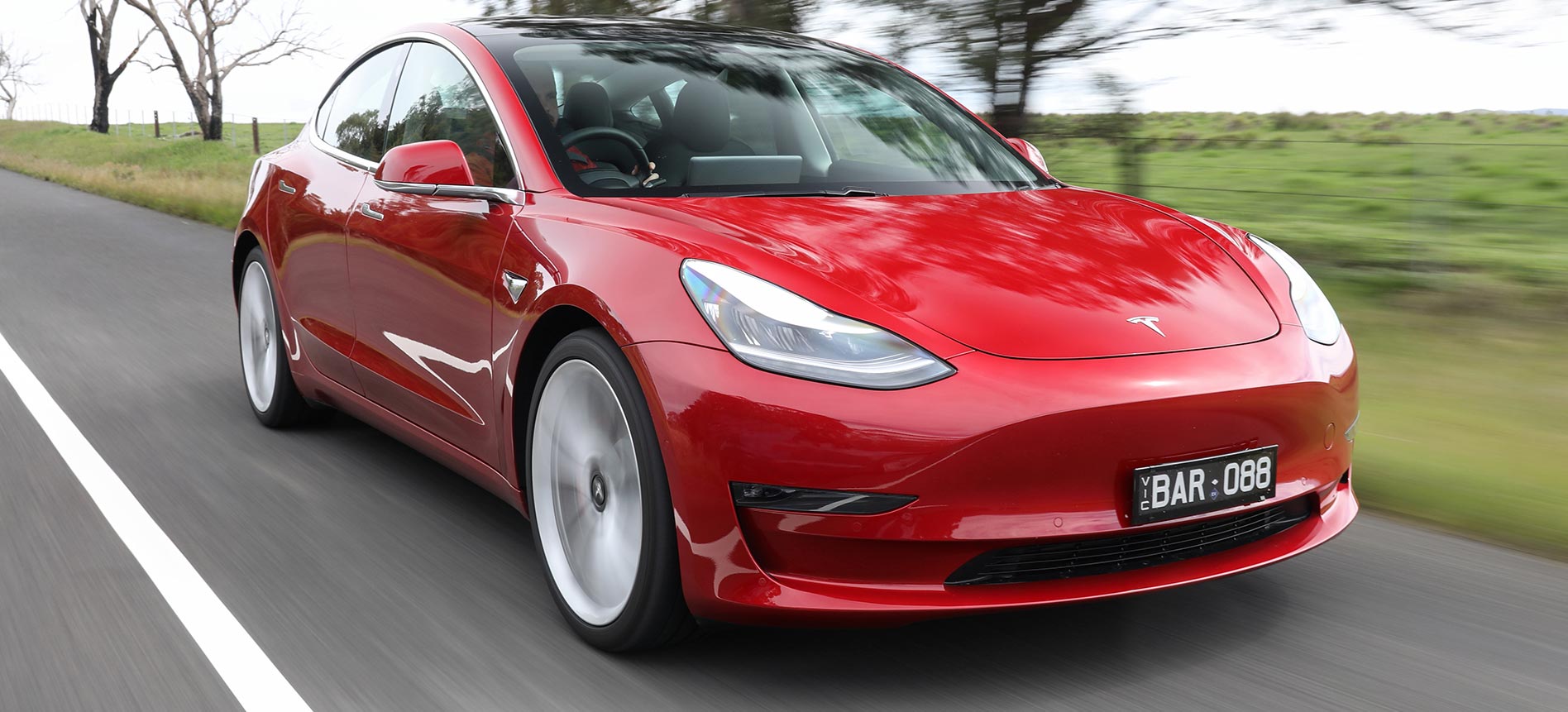
It’s often said that while there are numerous benefits to electric powertrains, the ability to have fun is lacking. During the development of the Tesla Model 3, Elon Musk got all shouty about its performance characteristics and said it would be quicker than anything in its class. Time to put that claim to the test!
An EV wins Wheels Car of the Year
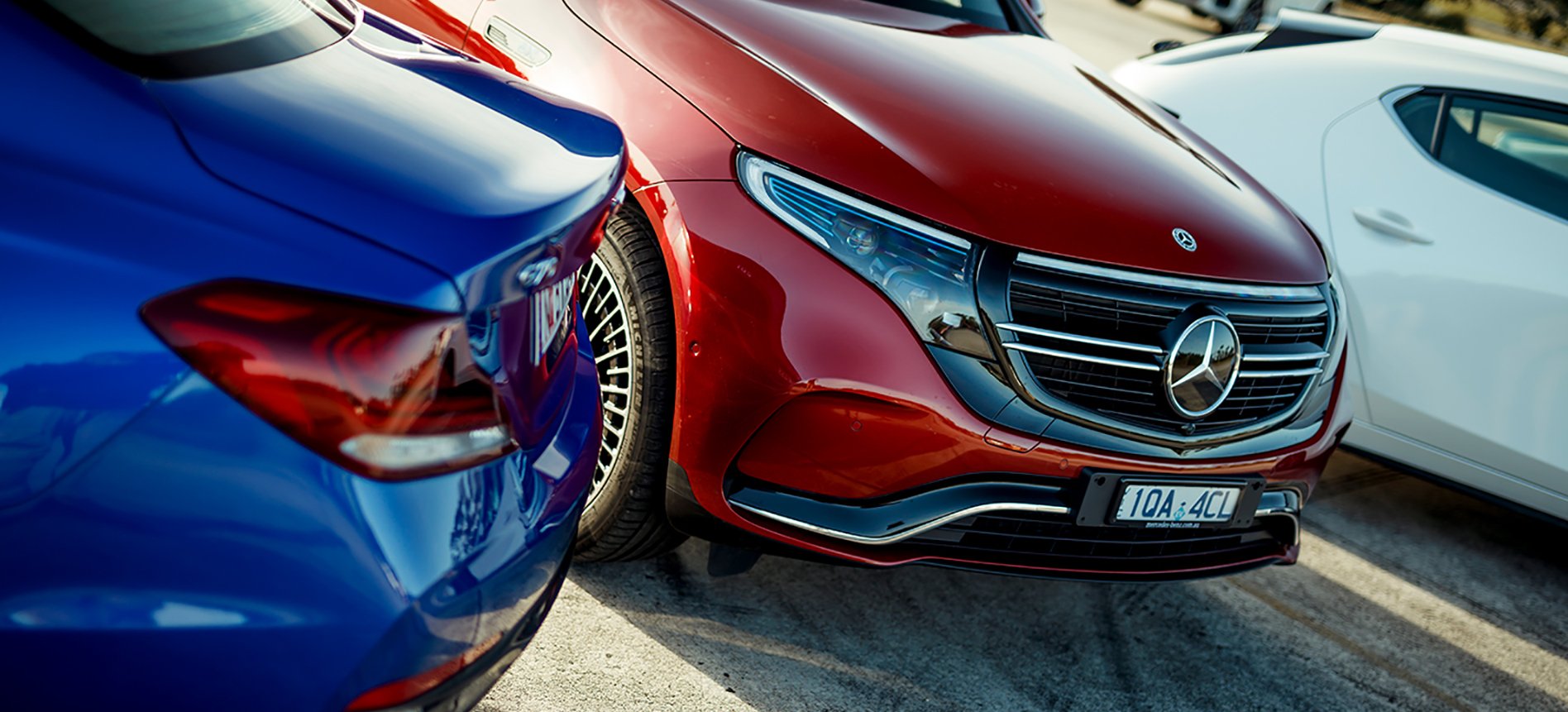
Mercedes-Benz’s first proper go at an EV is one for the ages, which is why it took the crown at Wheels Car of the Year. Learn about why this is such a game-changer as we go behind the scenes of the COTY event.
EV SUV invasion
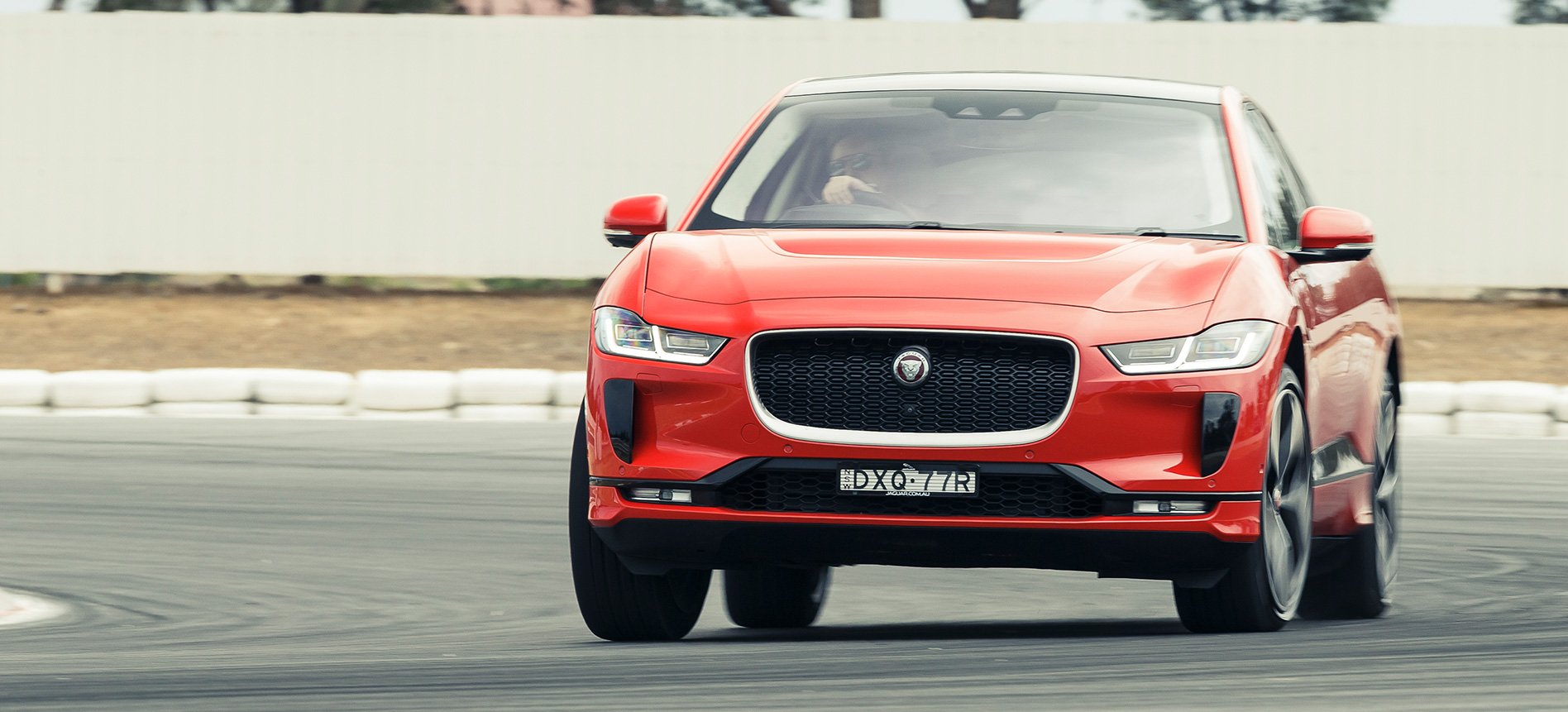
Mercedes doesn’t have the all the fun in the electric SUV space. Dan takes the Jaguar I-Pace for a track-blast at Portimao circuit to find out whether it moves the game on.
Hydro-hype
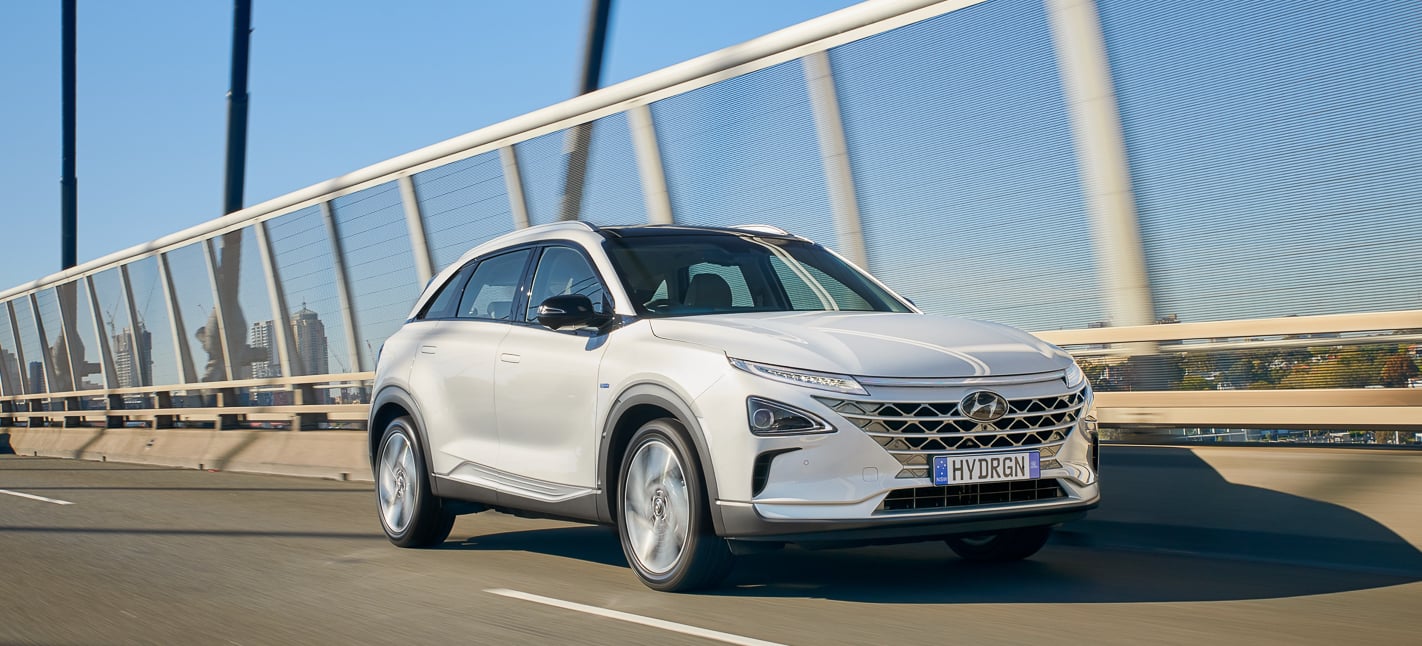
Hydrogen is a promising way to refuel an EV, cutting out the wait times while retaining all of the performance and clean-energy attributes of an EV. Hyundai is just one manufacturer testing out the new technology, so we have a drive of the Nexo to see what all the fuss is about.
The future of electric
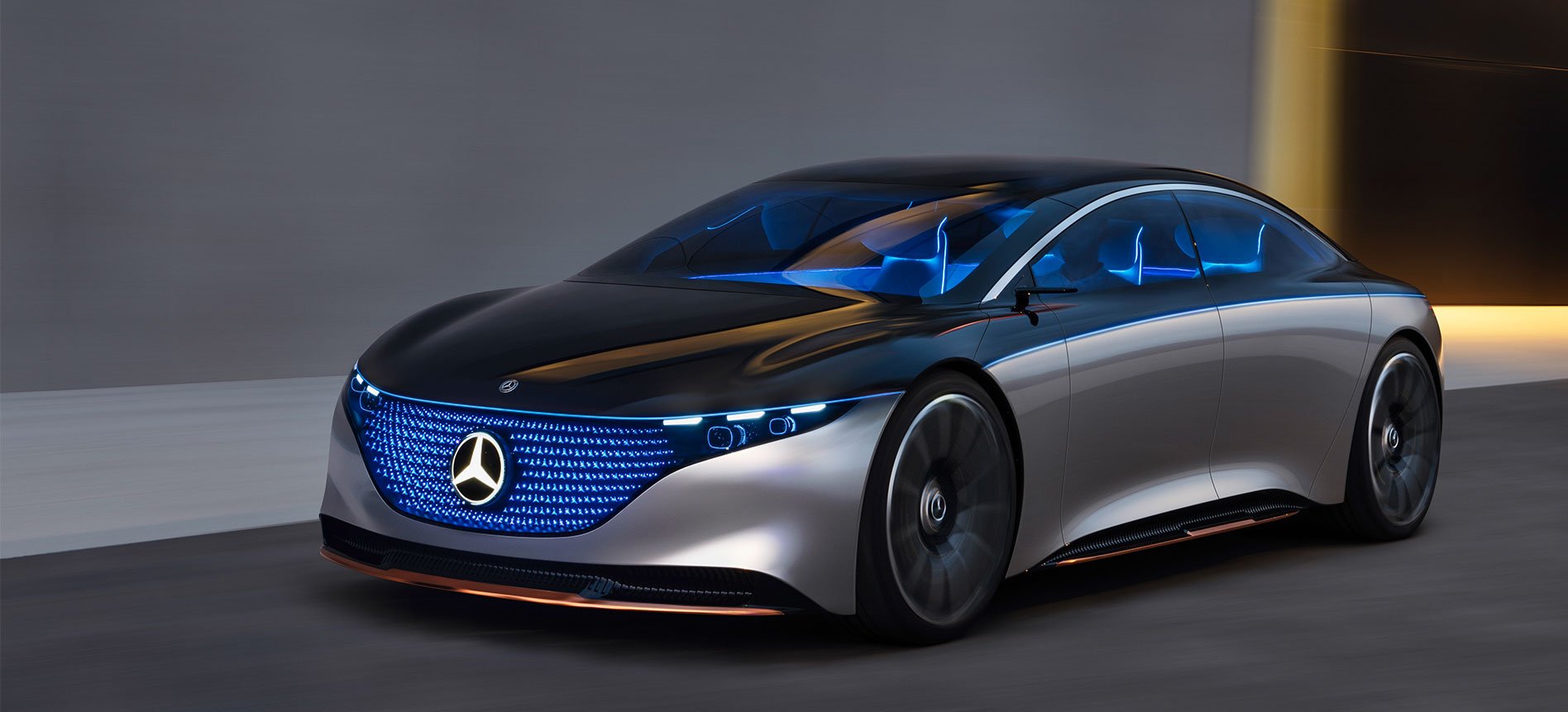
WhichCar was one of the first outlets in the world to get its hands on a new Mercedes-Benz concept, the EQS. As a preview of the future of electric, we’ve got a lot of hope for EVs going forward on the back of this EQS drive.
WhichCar TV Season Two Episode 29
4:00pm Sunday September 20, Channel 10
WIN A TRIP TO THE MALDIVES WITH WHICHCAR
For season two, we’re also offering an amazing prize for our viewers. How does a trip to the Maldives sound? Pretty awesome, right?
The competition is open NOW so make sure you tune into WhichCar TV on Channel Ten at 4pm Sunday AEDT.
And, if for some reason you can’t (and it had better be a good reason!) then there’s a host of ways to catch up on the show, check out behind-the-scenes stuff and find out more about the cars Aussies want to buy.
For example, our weekly podcast, our Facebook page and our YouTube channel are standing by 24/7.
