
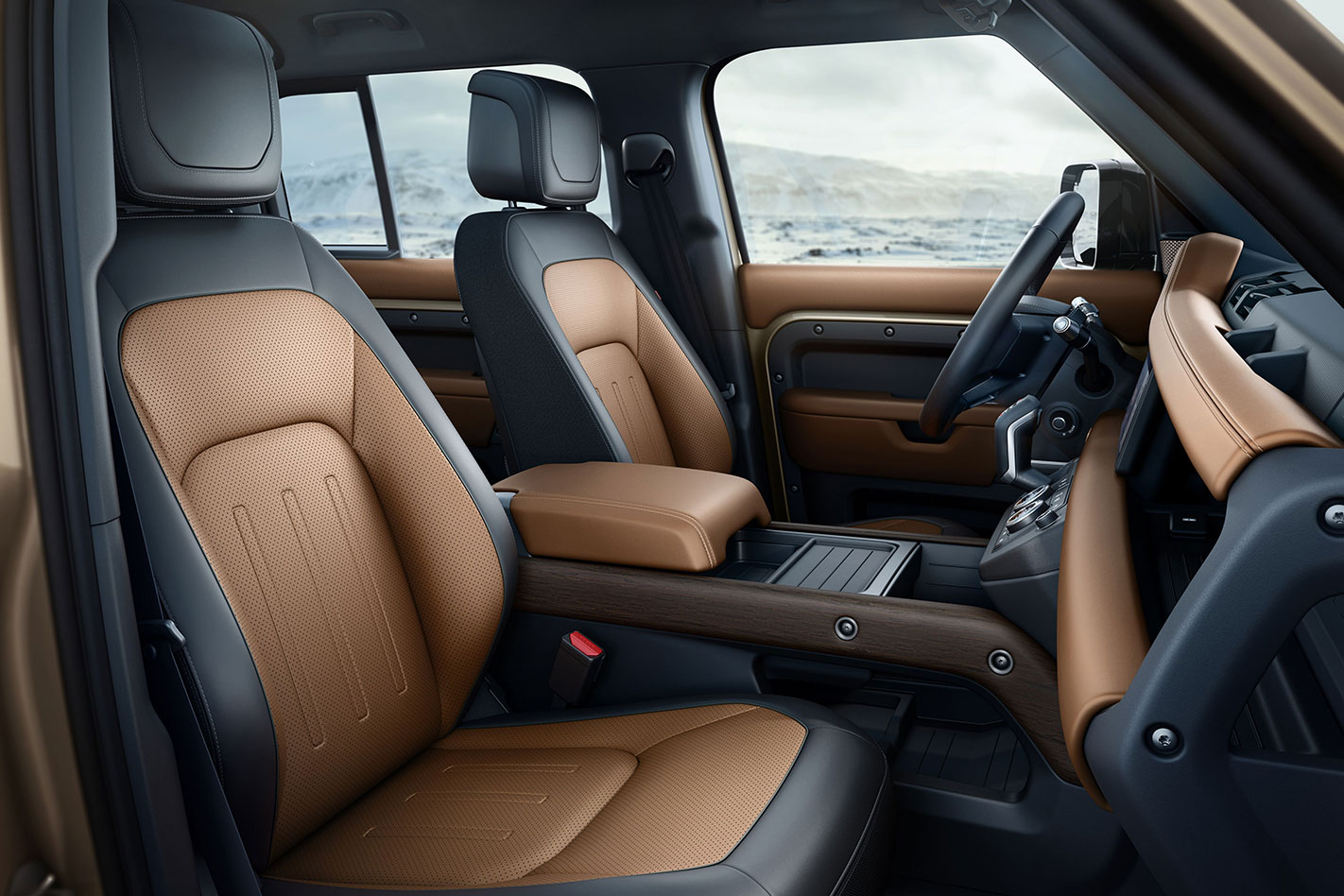
Land Rover’s new Defender has brought a return to three-person seating in the front row of non-commercial vehicles.
The reborn icon can be optioned with a jumper seat in between the driver and front passenger, meaning it can have five-, six-, or seven-seat configurations.
However, Land Rover’s engineering boss Nick Rogers confirmed to Australian media the middle occupant in the front row does not have an airbag.
The lack of an individual airbag for the middle seat in the front row is unlikely to be an issue when it comes to Euro NCAP testing, as the independent body doesn’t crash test the vehicle with a dummy in that seat.
However, Land Rover did crash test the Defender with a dummy in the middle of the front row, and remains confident that the Defender is as safe as possible.
Rogers refrained from making a prediction about what the Defender’s NCAP safety star rating would be, but said: “We are following every protocol that NCAP develops, and far more than that, and we have engineered everything to be in line with the latest consumer testing, which is way beyond any legal requirement.”
There were challenges in ensuring the Defender with its optional seating configuration remained safe for occupants.
“Making sure the key structure can take the extra load of that person was definitely a key challenge – making sure we could get all the loads through, making sure we have good seatbelt anchorage, making sure we have got good crash protection,” Rogers explained.
“It is a complete standalone seat with its own seatbelt, and it is an independent structure.”
For Rogers, ensuring the vehicles he works on are as safe as possible is a deeply personal issue.
“I got crushed in a car crash when I was 15 when my mate first passed his test and borrowed his mum’s car,” he said.
“We hit a bridge on my side of the car, and my legs were crushed. So, I’ve always had a personal feeling that safety is quite important.
“As engineers, it is our ultimate responsibility, and every one of those consumer tests with Euro NCAP, it is never even a conversation not to do it. We have to be responsible. It is your duty as an engineer who thinks not only about the occupants in the car, but also about other people you could unfortunately run into.”
Welcome to the latest instalment of the WhichCar Weekly podcast, a chat about the latest happenings in the automotive world.
This week host Scott Newman (MOTOR Associate Editor) is joined by Wheels Editor Alex Inwood and Deputy Editor Andy Enright give their impressions of the latest Toyota GR Supra, one of the hottest launches of 2019, which all three have been driving extensively.
This moves on to a discussion about the importance of car design, with Wheels dedicating its next magazine issue to the topic, including a guest editorship by former Aston Martin and Jaguar-Land Rover design boss Ian Callum.
Last but certainly not least, it’s the week of the Frankfurt Motor Show, where some incredibly important new cars have been revealed, including the VW ID3, Mercedes-Benz EQS, BMW Concept 4, Land Rover Defender, Lamborghini Sian and many more. Which are hits and which are misses?
Don’t forget you can catch the podcast on your favourite listening app if you’re on the move, don’t forget to rate and subscribe if you’re listening on iTunes. Until next week!
Listened to the show? Help us out:
- Leave a note in the comment section below.
- Leave a review on Apple Podcasts/iTunes
- Subscribe to our podcast
It seems like a pipe-dream but the reality of a self-inflating tyre is becoming ever-closer thanks to a new brace of concepts from Continental.
The German automotive giant displayed its new Conti C.A.R.E. (Connected. Autonomous. Reliable. Electrified) technology systems at the 2019 Frankfurt Motor Show, that is set to become the bridge between tyres and the autonomous and electric cars of the future.
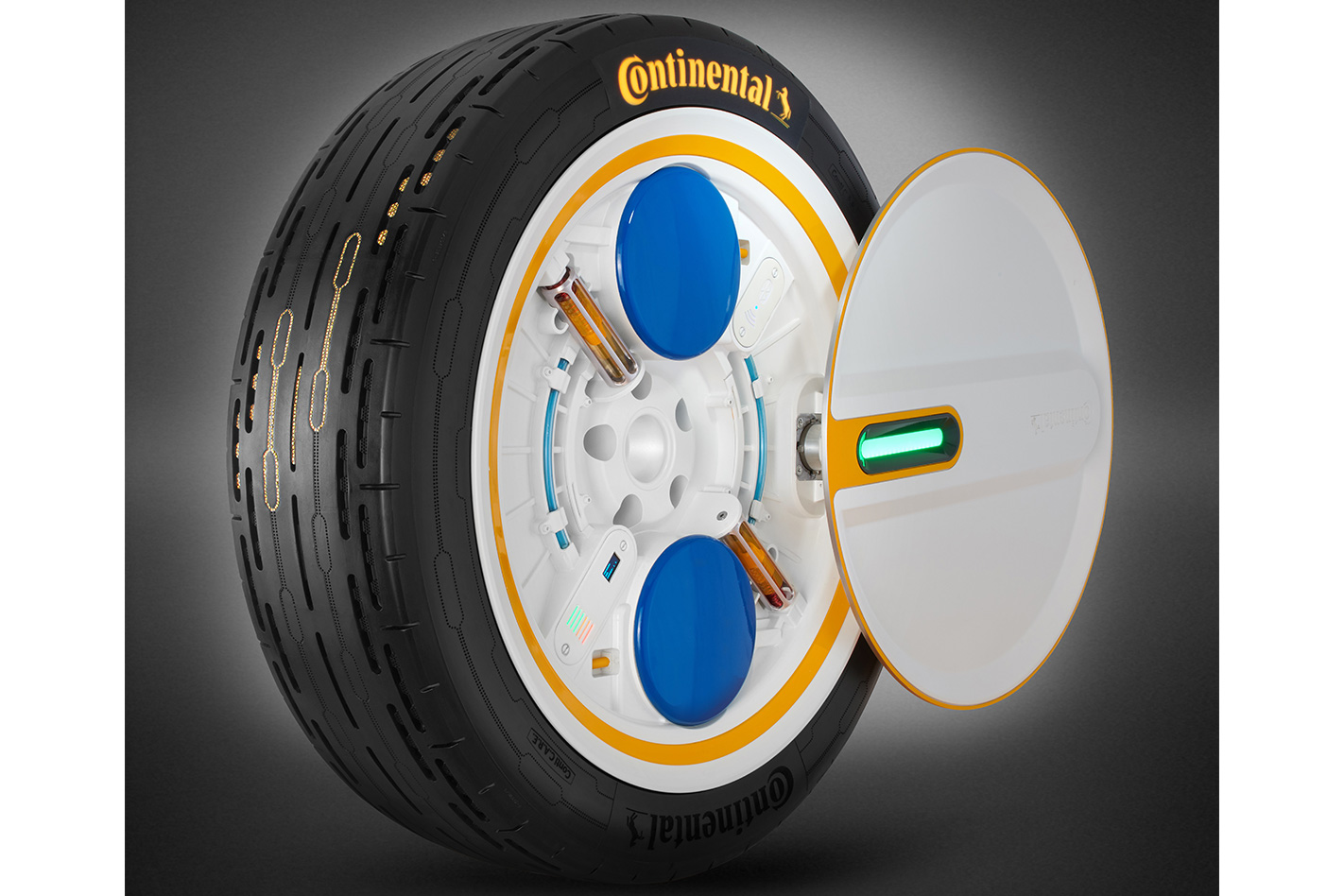
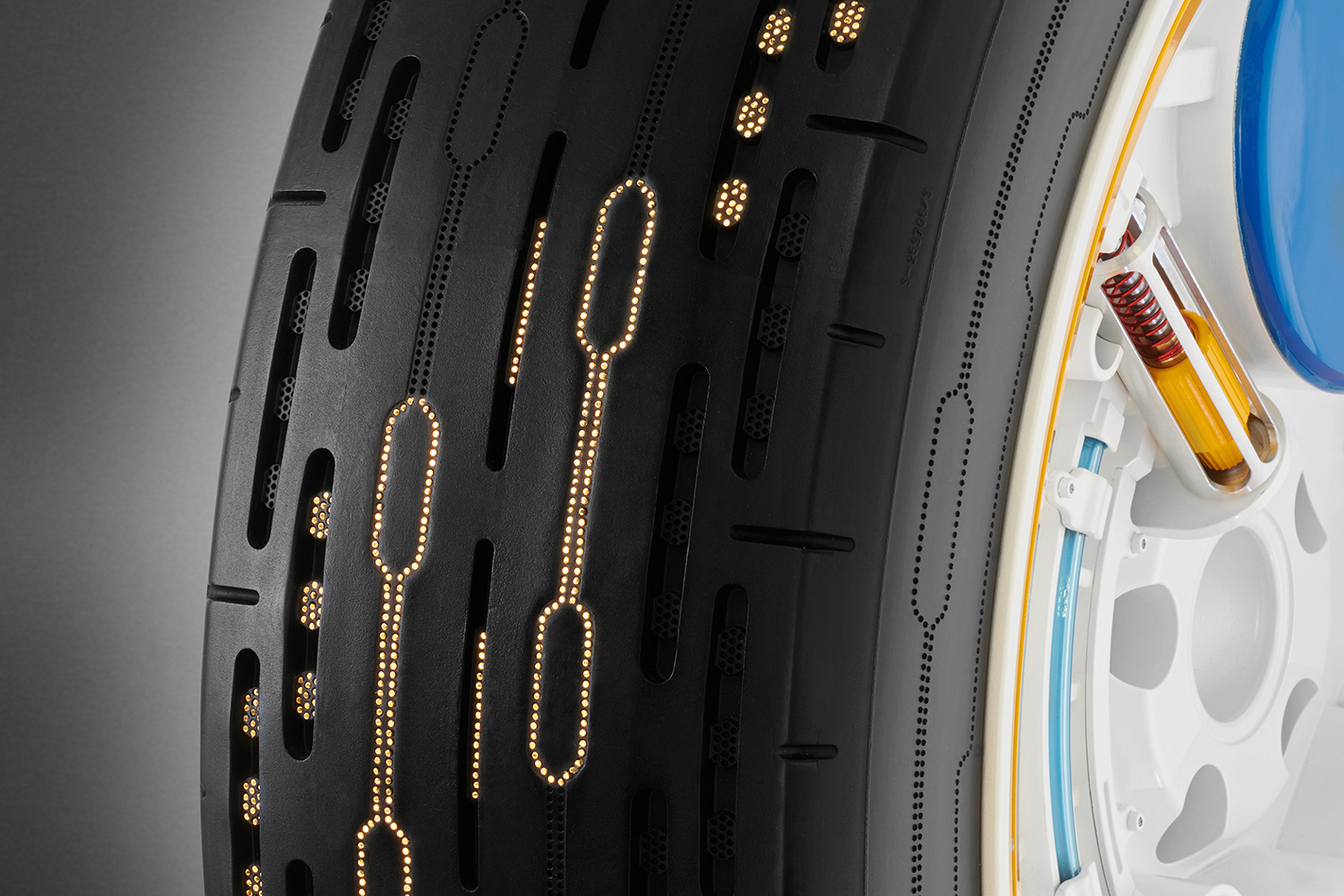
Conti C.A.R.E. tyres will be fitted with sensors that are ingrained into the tyre’s tread construction (below), which can then generate and report on data relating to tread depth, possible damage, tyre temperatures and pressures.
This monitoring system – named ContiSense – will transmit this data to a web-based ContiConnect Live application, which can be used to monitor tyre life across a company vehicle fleet in real time, for example, or can be enabled to send an alert to a car owner’s phone that a tyre is damaged.
Most interesting to us, though, is the idea that this new technology can be used to help a car to self-inflate its own tyres, via an ingenious wheel-tyre system that uses self-generated air to look after its own pressure.
When a vehicle accelerates, the centrifugal forces within the wheel act on pumps which then generate compressed air which is stored in a canister (shown below).
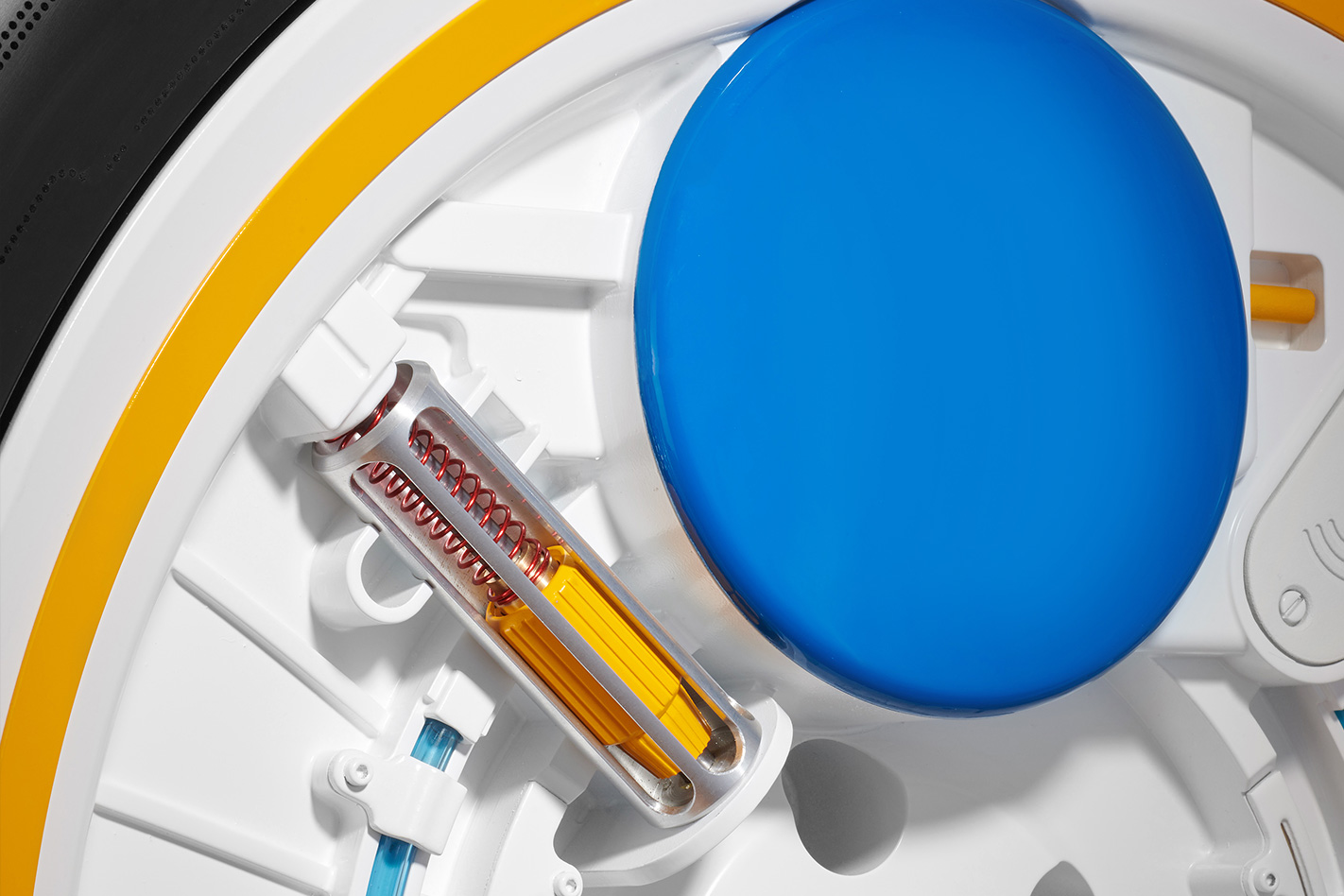
Tyre pressures are continuously monitored and adjusted within the ideal pressure range based on prevailing conditions, and any excess air is stored for later.
The technology can also use the stored air to adapt the tyre pressures to different driving scenarios – for example, reducing pressures in loose or sandy conditions, or compensating for excess pressure caused by high-speed or hot-weather running.
This new technology is designed to integrate with the autonomous cars of the future. Think of a fleet of so-called autonomous robo-taxis, for example, which will be able to monitor its own tyre pressures and adjust them accordingly. In fact, Continental provided a robo-taxi shuttle service around the Frankfurt show precinct.
Continental’s tyre division is just one-quarter of its total business; it is heavily involved in the production and development of electronic driver aid systems, for example, as well as building the technology for autonomous cars.
Keep abreast of the 2019 Frankfurt Show right here

FEELS like a turning point this, doesn’t it? A line in the sand. The moment in time when EVs go from being sniggered at by car enthusiasts to being genuinely desirable. Tesla supporters – and they are many and vocal – will likely disagree, though there’s no escaping that there’s something about a Porsche performance car that sets it apart. Something intangible, something that appeals to keen drivers in its own, unique way.
Whether Porsche has managed to capture that spirit with an electric car is the burning question. Want the answer? You’ll have to pick up our latest issue, which goes on sale today.
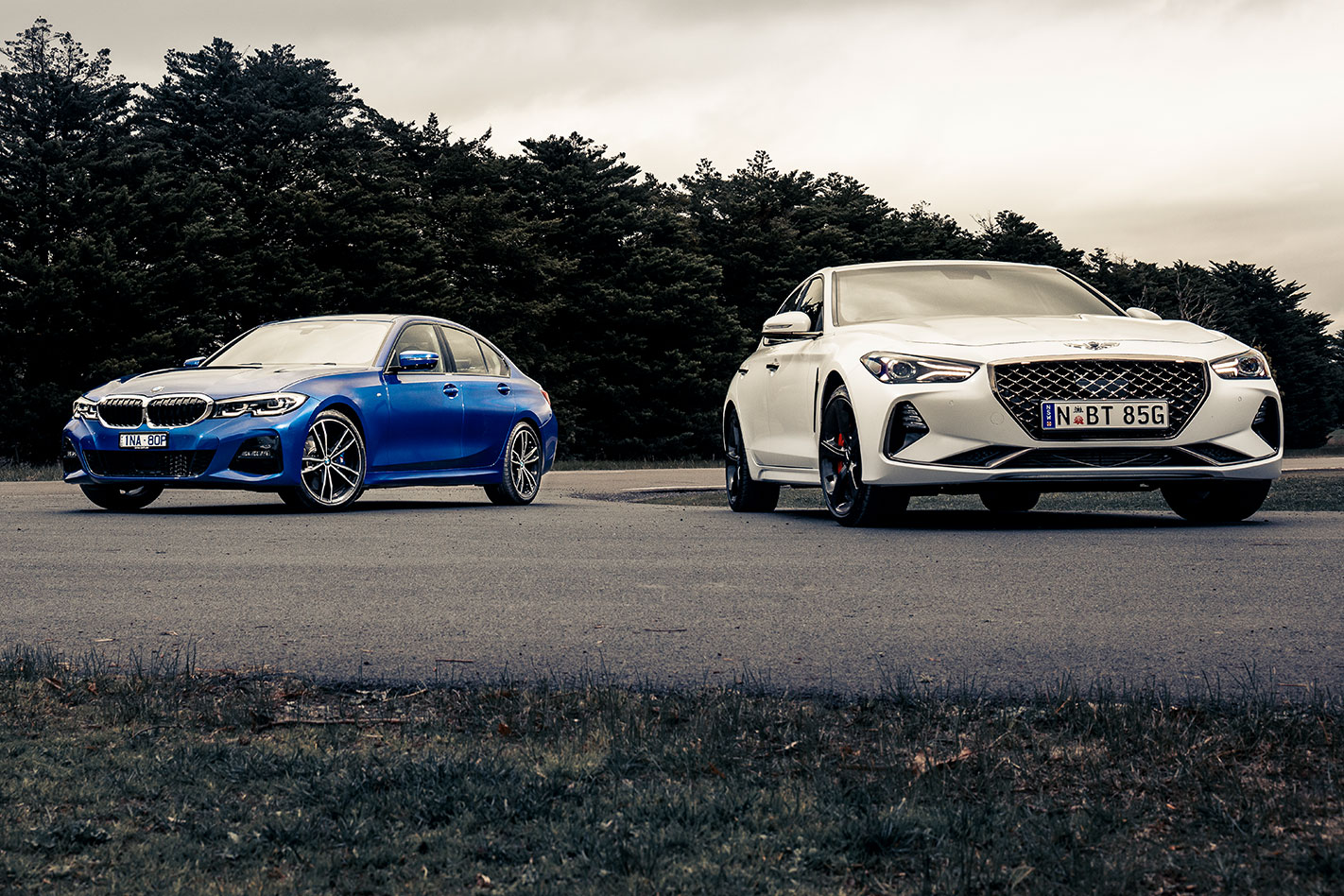
EVs not really your thing? Don’t fret, there’s plenty of fuel-gurgling metal inside, including comparisons between the Genesis G70 (think the Kia Stinger’s slightly shorter, punchier cousin) and the mid-size sedan icon that is the BMW 330i, plus a battle of the bulging grilles between BMW’s X7 and the Audi Q8.
Range Rover’s new Evoque gets a proper Wheels welcome by going straight up against our reigning COTY, the Volvo XC40, we drive Mazda’s imminent CX-30 and Jaguar’s rambunctious F-Pace SVR, plus we take a peek into the murky world of police quotes for speeding fines.

There’s plenty for lovers of older metal too. This month’s Modern Classic is the GT3 that started it all, the 996, we head to Pebble Beach for a look at the finest at Monterey Car Week, and we also sit down with Nicola Materazzi, the legendary Italian engineer behind the Ferrari 288 GTO and F40.

Oh, and lovers of car posters will be chuffed with our feature on ‘the art of speed’ which celebrates some of motorsport’s greatest posters.
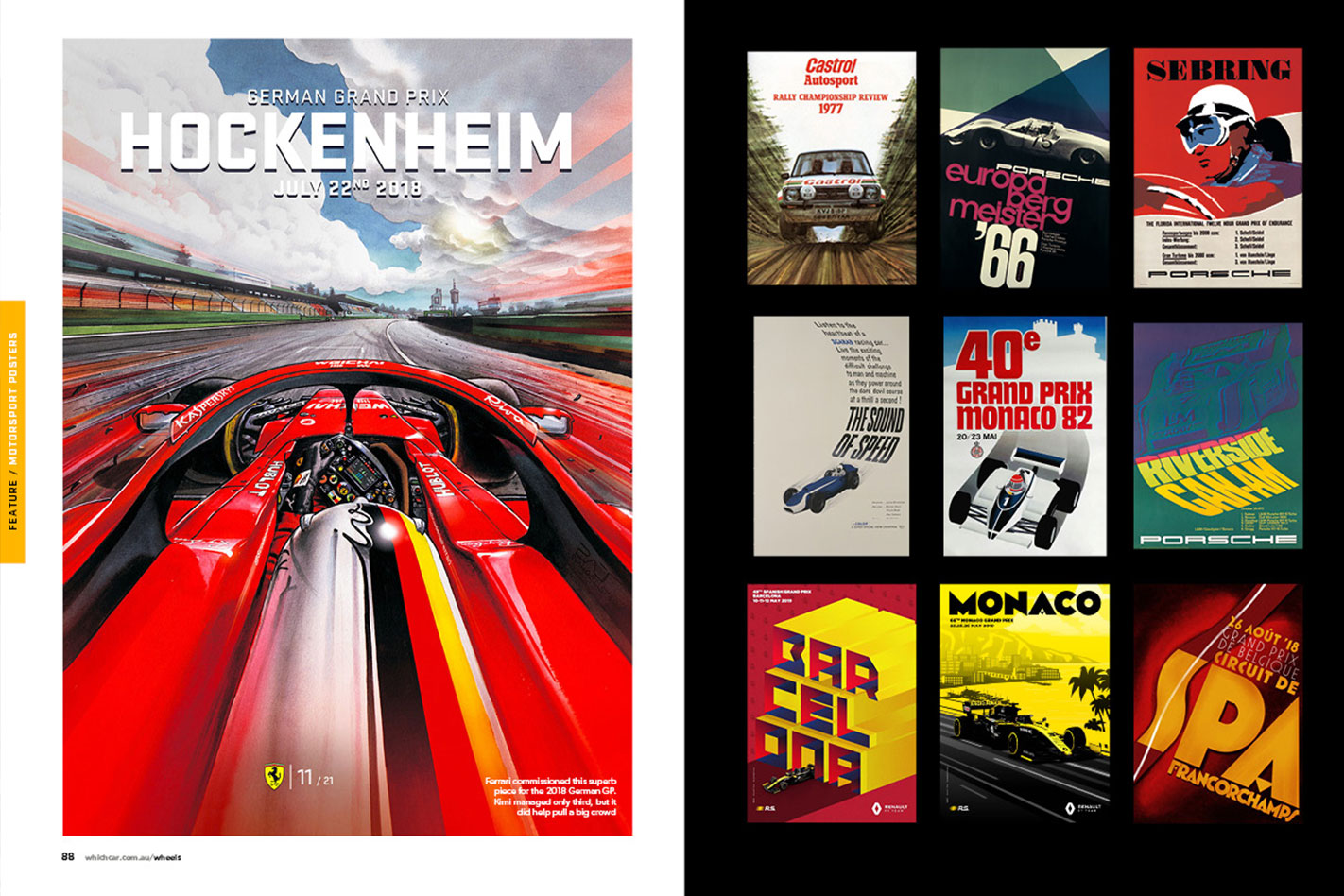
Our Garage fleet also sees the addition of a Mercedes-Benz A250 4Matic to our regular motley crew of our Ford Ranger Raptor, Megane RS, Subaru Forester and Suzuki Jimny.
AMG boss Tobias Moers has dropped details of what the company’s line-up will look like as it pivots towards an electric future – with a hybrid GT 4-Door the first of the marque’s new breed of high-performance cars planned.
“Like everybody else in the automotive industry, we have to transform ourselves. The next generation of cars are going to be performance hybrids – the GT 4-Door is the first one,” Moers told media at the Frankfurt Motor Show.
He told media at the Frankfurt Motor Show the brand needed to embrace electrification but there was room for internal-combustion power and electric to coexist under the freshly minted AMG EQ Performance banner.
A full AMG-specific EV is also in the pipeline, one that would no doubt challenge existing 0-100km/h records for AMG if not overall top speed. Moers was quick to point out the fact there’s currently a clear leader in this domain. “[Porsche] Taycan sets the bar – that’s for sure.” He paused before adding: “That car sets the bar – for now.”
One thing is certain: future AMG EVs will employ more than one forward ratio. “Single ratio is wrong,” Moers declared.” You need a minimum of two gears, otherwise we don’t meet our power requirements. Even the hybrid that we’re going to have next year [GT 4-Door] is a two speed. “
Rumoured to be branded GT73, the hybridised twin-turbo V8 would make an ideal rival to the Porsche Panamera Turbo S E-Hybrid. It’s expected to be released next year, or by early 2021, with the technology to filter through to more AMG models in the future.
Moers said that acceleration was not the biggest differentiator between high-performing EVs. “For all electric cars it’s easy to have all-wheel drive, and the electric motor’s torque is instant – so that’s not the biggest differentiator. The biggest differentiator as of now is the driving dynamics and the interaction between driver and car that makes the difference in my perspective and our perspective.”
Retaining the emotive nature of an AMG has been high on the list of priorities for Moers, but he believes that customers will buy its EVs if the old criterion is met. “They’re going to buy the car if the performance is there. That’s my attitude.”
He thinks AMG can cater for all tastes in the future, both fans of bent-eights and EVs. “There’s no either/or. We can combine a proper V8 with an electric motor. Maybe not necessarily every segment, but we can do so – and we’re going to do so.”
Moers acknowledged that sound is a key factor to a ‘proper’ AMG. “Sound is very important to us. You have to establish an easy-to-identify AMG sound for electric driving. It could sound like a V8, but this feels very strange and stupid. It’s something we discuss and talk about. Let me take the A45 as an example. For sure it’s not all natural what you’re going to hear … we use the speakers.”
Ever since Bugatti first announced its Chiron hypercar in 2016, it was understood that the tyres were the limiting factor in the car becoming the first production car to break 300mph barrier.
That was, until August 2, when Andy Bell drove a modified Bugatti Chiron to a top speed of 490.48 km/h (304.77 mph), at the Ehra-Lessien test facility in Germany.
Stefan Ellrott, Bugatti’s head of development, told Wheels that the hypercar manufacturer worked closely with its tyre supplier to ensure the rubber could survive the forces that are generated at those speeds.
“Due to that reason we had to modify slightly the series tyre of the Chiron. It is still the series tyre, but with an additional layer of carbonfibre in it,” he explained.
The compound and overall spec of the tyre has remained the same as the ‘regular’ Chiron, with the reinforcement being added to the carcass of the tyre.
“It is a very close relationship between Michelin and Bugatti, because Michelin is the only supplier of tyres for the Chiron, so we are together,” he said.
“What we did, together with Michelin, to make sure that there would be no risk with the tyres, was a lot of bench testing
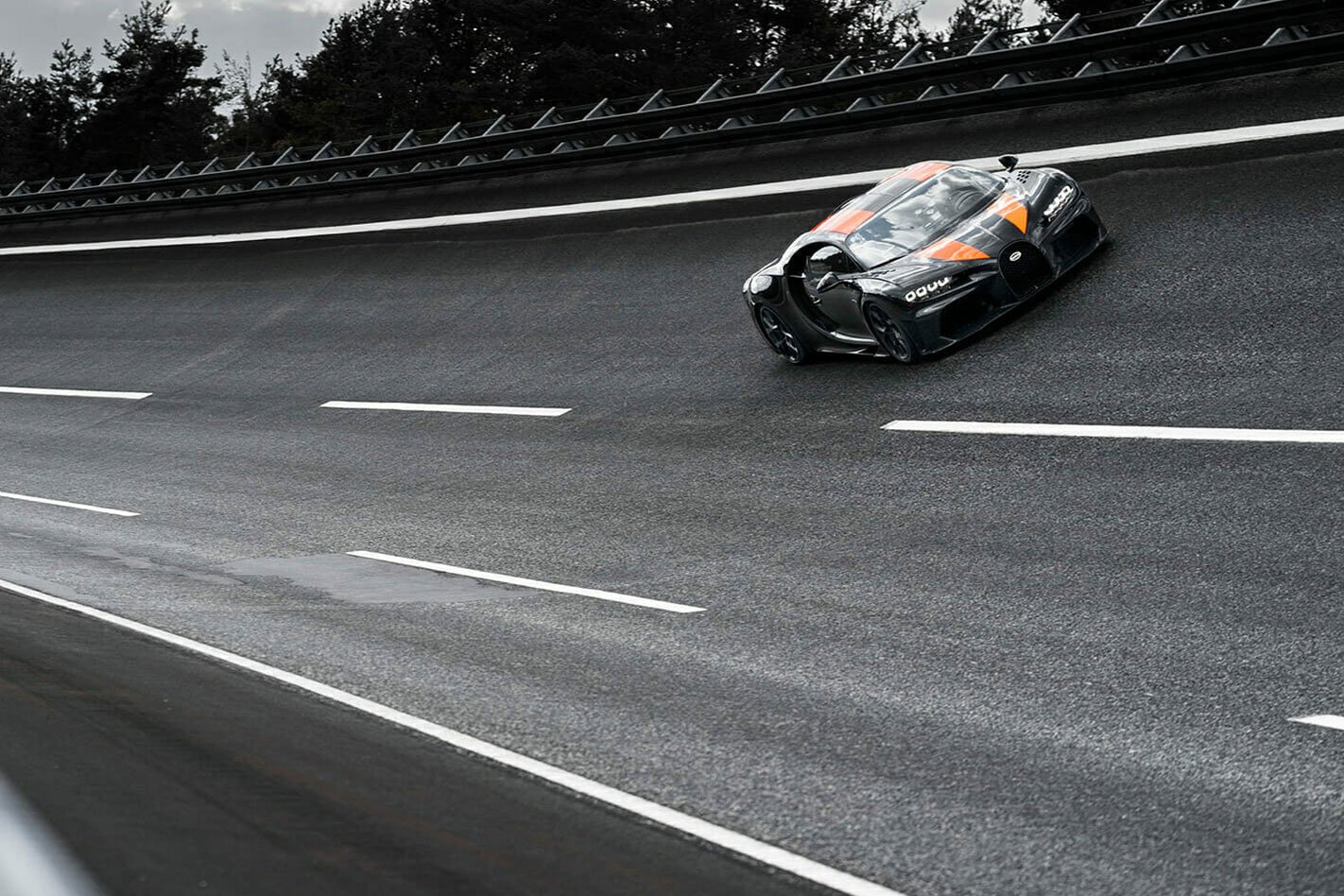
Because speeds nearing 500km/h an hour are beyond the realms of any street-legal tyre in history, Bugatti and Michelin had to move beyond the purely automotive world for development methods.
“We used a plane test bench in Charlotte, USA, to make sure that the tyre will be okay with more than 500km/h,” Ellrott said.
“After that you might see that 500km/h is okay, so you go faster and faster [with the tyre], so we could see what the fade would be.”
A worse-case-scenario at those speeds is a tyre delamination. Eager to ensure Bell was as safe as possible during his record run, the tyre was pushed beyond its limits, in order for Bugatti to identify the early warning signs of a tyre failure.
“You will not have an exploded tyre like this,” Ellrott says with a snap of his fingers. “You will first have signs that the tyre is going to be destroyed. There will be noise and vibrations before the tyre completely explodes.”
Thirty Chiron Super Sport models that are mechanically similar to the record car will be sold by Bugatti, and are likely to be fitted with the new carbonfibre-reinforced rubber.
The Wheels Verdict: The S60 looks a winner. It’s fast, safe, stylish, technically intriguing and delivers a middle-stump yorker on pricing and features. Unfortunately, the cars we got to drive, which were exclusively T5 and T8 R-Design models, are saddled with a ride quality that doesn’t approach the class standard. Perhaps we can expect better from the more affordable models when they appear but the R-Design versions fail to convince as well-rounded sports sedans.
WHAT IS IT?
On paper, the S60 sounds a surefire hit. We loved the XC60 SUV so much that we awarded it our 2017 Car of the Year crown, and the S60 runs on much the same Scalable Platform Architecture chassis, albeit one that’s on a lower flight path. Volvo has also made it a good deal more affordable than the SUV, styled it sharply and imported it with a choice of two firecracker powertrains. Sound good to you?
Read next: Volvo introduces fixed-price servicing package
WHY WE’RE TESTING IT
After two COTY wins in a row, we were intrigued to see whether the Swedes had the goods to carry off an unprecedented three-peat. The S60 competes in a sector that’s gently swelling with quality rivals but Volvo has priced it aggressively and has resisted the temptation to saddle dealers with unrealistic sales targets. Does it have the ability to do a number on mainstream and near-premium challenger brands? That’s what we were keen to discover.
THE WHEELS REVIEW
You’re not likely to buy a Volvo S60. No, really. The company aims to sell 400 cars in its first calendar year so, statistically at least, Australians are considerably more likely to die of influenza, be hospitalised for falling off a scooter in Bali or find that their partner has left them for someone of the same sex in the next 12 months. A certain measure of exclusivity is therefore guaranteed for those willing to sign on the dotted line.
The market for cars like this stands at around 40,000 per year, so the S60 needs to make a piffling 1 percent dent in it to achieve a warm and cosy glow in Gothenburg. Given that the XC40 and XC90 have achieved 9 percent share and the XC60 a hefty 16 percent slice of the pie, the S60’s targets look decidedly modest.
The sedan arrives here with two powerplants. Around 96 percent of all the cars sold will be propelled by the turbocharged 2.0-litre T5 engine, with the remainder opting for the flagship turbocharged and supercharged T8 plug-in hybrid. Volvo has purposefully pitched the S60’s pricing a long way below that of the XC60, the SUV with which it shares much of its oily bits. The range kicks off at $54,990 for the T5 Momentum version, an all-wheel-drive 187kW sedan which is at least $15K cheaper than an Audi A4 or BMW 3 Series with similar power and equipment. It’s even cheaper and more powerful than a 2.0-litre Kia Stinger GT-Line and also offers the adverse weather benefit of all-wheel drive.
Unfortunately, none of the Momentum and Inscription models were available to test, the launch vehicles comprising either the 192kW/500Nm T5 R-Design or the 311kW/680Nm T8 R-Design. Therein lies a problem. Put simply, the R-Design suspension is just too firm for Australian roads. The ride quality on both vehicles was notably terse, with a poorly controlled pitchiness particularly in the weightier T8. With no option of air suspension (something we always recommend to XC60 purchasers), and a low-profile tyre fitted, the S60 R-Design is at an immediate disadvantage.
The T5 claws back some credit with its wieldiness through corners. A good Continental PremiumContact tyre, clean, if somewhat mute, steering and a feeling that there’s not a lot of weight in the nose offer rewards to the keen driver. It’s certainly a better driver’s tool than the quicker T8, with its inconsistent brake pedal and power delivery. We’re used to this powerplant in the XC40 and XC60 among others, but putting it into a sporty sedan opens it to a different level of scrutiny. We don’t expect a characterful, acoustically rewarding petrol engine in a midrange family SUV. But we do when choosing a quick sedan.
The S60 T5 R-Design certainly lives up to that billing. It’ll trip the stopwatch at just 6.3sec on the sprint to 100km/h, the eight-speed Geartronic transmission rarely doing enough wrong for you to feel inclined to intervene with paddle shifting duties. For $65K in this range-topping trim, there are certainly more rewarding – and more supple – driver’s cars available.
The S60 T8 plug-in hybrid features a 10.4kWh lithium-ion battery that sits lengthwise between the front and rear axles. That answers the question of why the T5 has centre-mounted air vents for the rear passengers and the T8 doesn’t. If you’re feather-footed, you might be able to eke out 50km of pure electric range, but this is a vehicle that weighs more than two tonnes. On our test drive, we saw around 7.5L/100km rather than Volvo’s claimed 2.0L figure. While it disguises its weight well, it never feels quite as light on its toes as the claimed 0-100km/h figure of 4.3sec suggests.
It’s hard to pick fault with the S60’s interior finish though. Materials quality is excellent and the cabin feels an almost direct port from XC60, with the same soft-touch materials, portrait infotainment screen, digital dials and knurled starter knob. CarPlay, Android Auto and high-quality leather – it’s all there from the most affordable model. The cabin’s also a good deal more spacious in the rear than the old S60, which was notably tight on both head and legroom. The 390-litre boot is a disappointment compared to the 480-litre class average, especially from a company with such a tradition of utility as Volvo. A split/fold rear bench and a ski hatch go some way to making amends.
There is a very good car in the S60. Unfortunately we didn’t get to drive that car. The R-Design models don’t bring enough to market to merit a solid recommendation. While they’re well appointed, handsome, safe and competitively priced, the tedious ride quality and dull engine acoustics of both the T5 and T8 will be enough to see them scratched from the shortlists of enthusiast drivers. That leaves those who aren’t so interested in driving like their trousers are on fire to account for the lion’s share of those 400 registrations. We’ll reserve final judgment until we get behind the wheel, but an S60 T5 Momentum or an Inscription on softer springs and with a more generous tyre sidewall could well be a very smart pick. Smarter than swinging your leg over a scooter in Bali, at any rate.
MAIN RIVALS
Alfa Romeo Giulia; Genesis G70; Holden Commodore; Lexus IS; Peugeot 508; Subaru Liberty; Volkswagen Passat
PRICE AND SPECS
- Model: Volvo S60 T5 R-Design
- Engine: 1969cc four-cyl, 16v, dohc, twin-turbo
- Max power: 192kW @ 5700rpm
- Max torque: 400Nm @ 2500-3500rpm
- Transmission: 8-speed auto
- Weight: 1767kg
- 0-100km/h: 6.3 sec
- Economy: 7.3L/100km (claimed)
- Price: $64,990
- On sale: Now
The idea of electric vehicles gliding silently around our roads was once a flight of fancy, limited to the big screen and the efforts of occasional backyard EV enthusiasts with a lot of time on their hands. But the automotive landscape is changing rapidly and the dawn of zero-emissions cars is closer than you might think – even for a nation that trails the rest of the world as much as Australia.
In the coming weeks, you’ll be seeing some exciting changes at WhichCar as we prepare for the slowly rising numbers of electrified cars on our roads, more EV choice for you in showrooms, and a future that’s very much electric.
NEED MORE? VISIT OUR EV LANDING PAGE
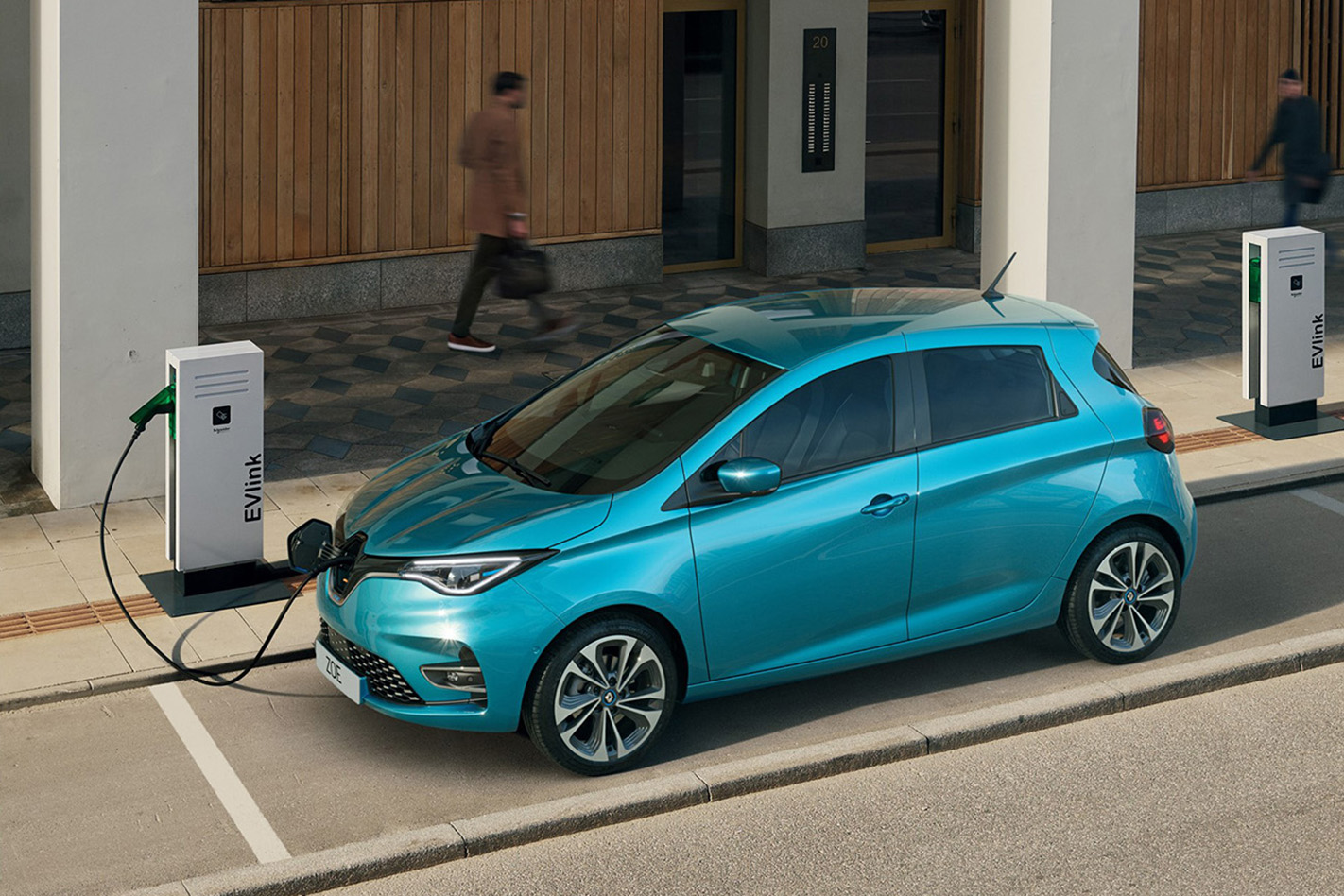
In the not-so-distant future, electric cars will no longer be an occasional novelty within our pages, they will likely become the norm.
To prime you for that future, here is the WhichCar guide to electric cars with all our best and most relevant EV-focused coverage condensed into one place to bring you up to speed. Keep an eye out for much more coming to your screens soon.
EV facts and myths
The subject of electrified cars and their feasibility was recently brought into the limelight during the federal election. If like many Australians you weren’t confused before the various campaign pledges and counter offers, then you probably were after. We set the record straight from an unbiased view and without political agenda.
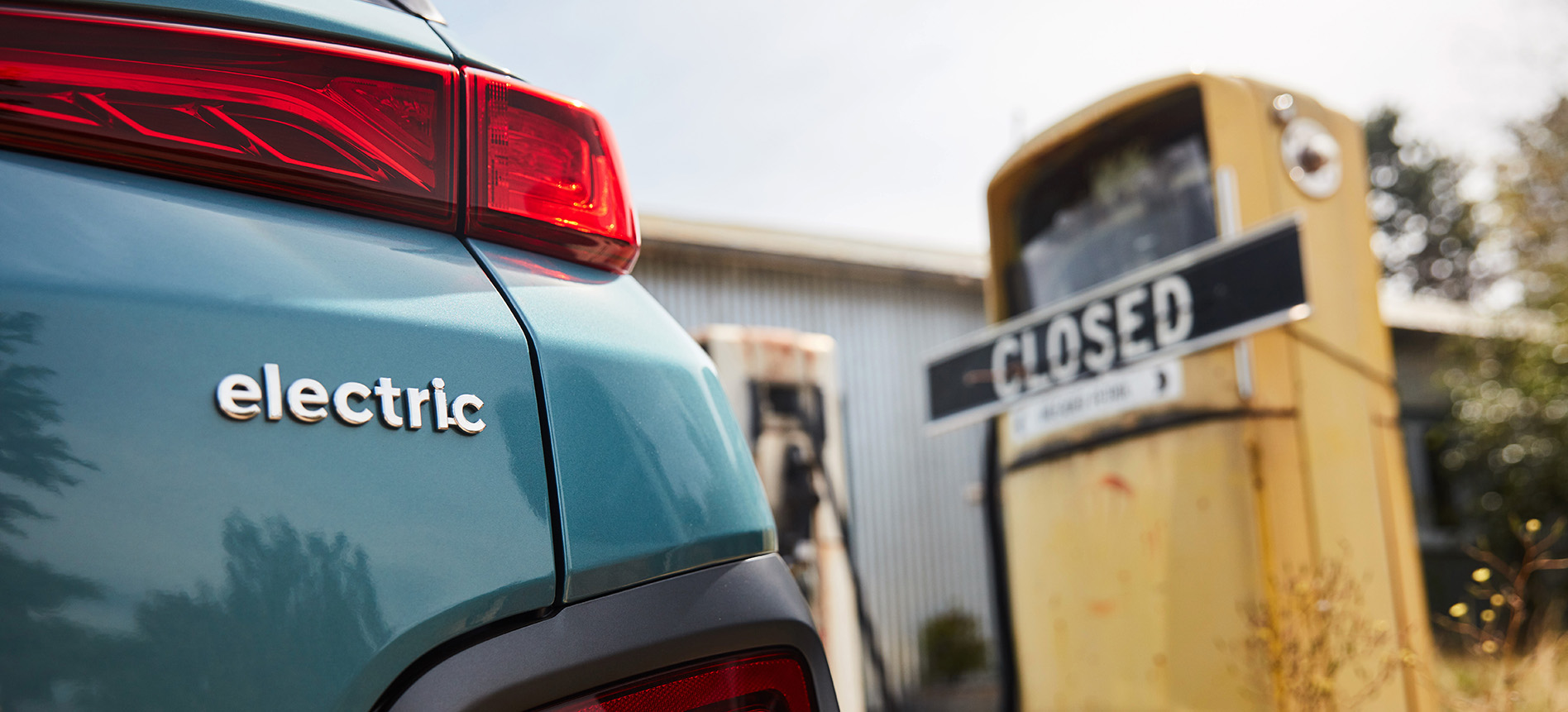
The frustrating truth is that the rise of EVs is not being slowed by inferior technology or the cars themselves, because time and again EVs have conclusively proven their own cause. It is the supporting infrastructure and legislation that is jamming the brakes on. As long as the people that steer our country’s direction continue to block electrification, we will continue to languish.
As a result, the electric vehicle prospects for Australia are not great for now and, as a nation, we are one of the most ill-prepared and dismissive, but it won’t be that way forever. Love or hate the idea, as tightening emissions regulations squeeze car markets around the world, Australia will be forced to get in line.
For a start, electric cars will be getting cheaper. In fact, they already are. From a time when the only options were for the well-heeled, there are now a number of more affordable options starting from less than $45,000. And that trend will continue.
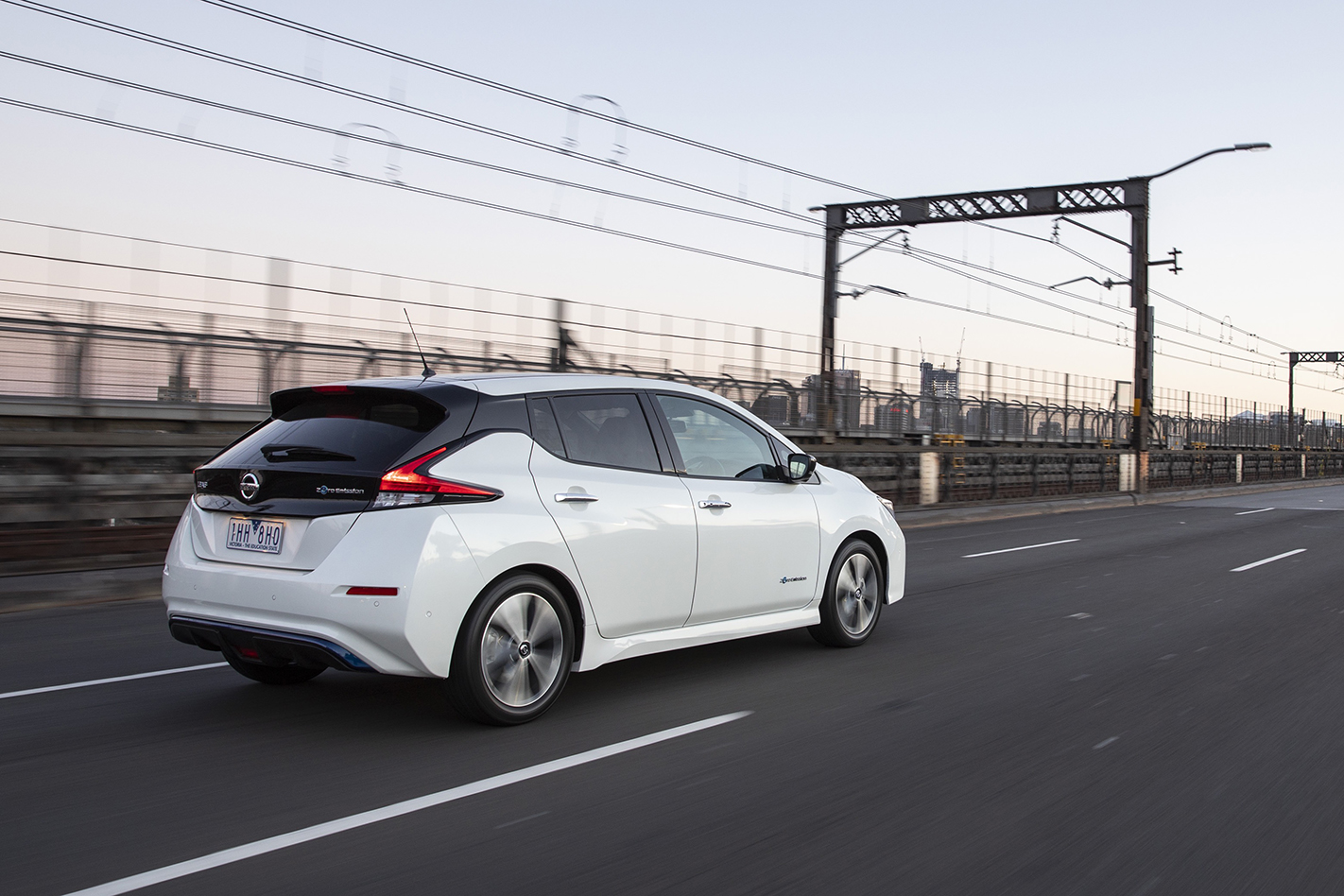
If you need no convincing about EVs and their suitability to your transport requirements, then perhaps you simply need a guide to what’s out there in showrooms. Well we’ve handled that for you too.
EV reviews
Obviously, that list will change and, more excitingly, grow. Keep an eye on our pages as we continuously update the EV options list, along with comprehensive reviews and the best deals.
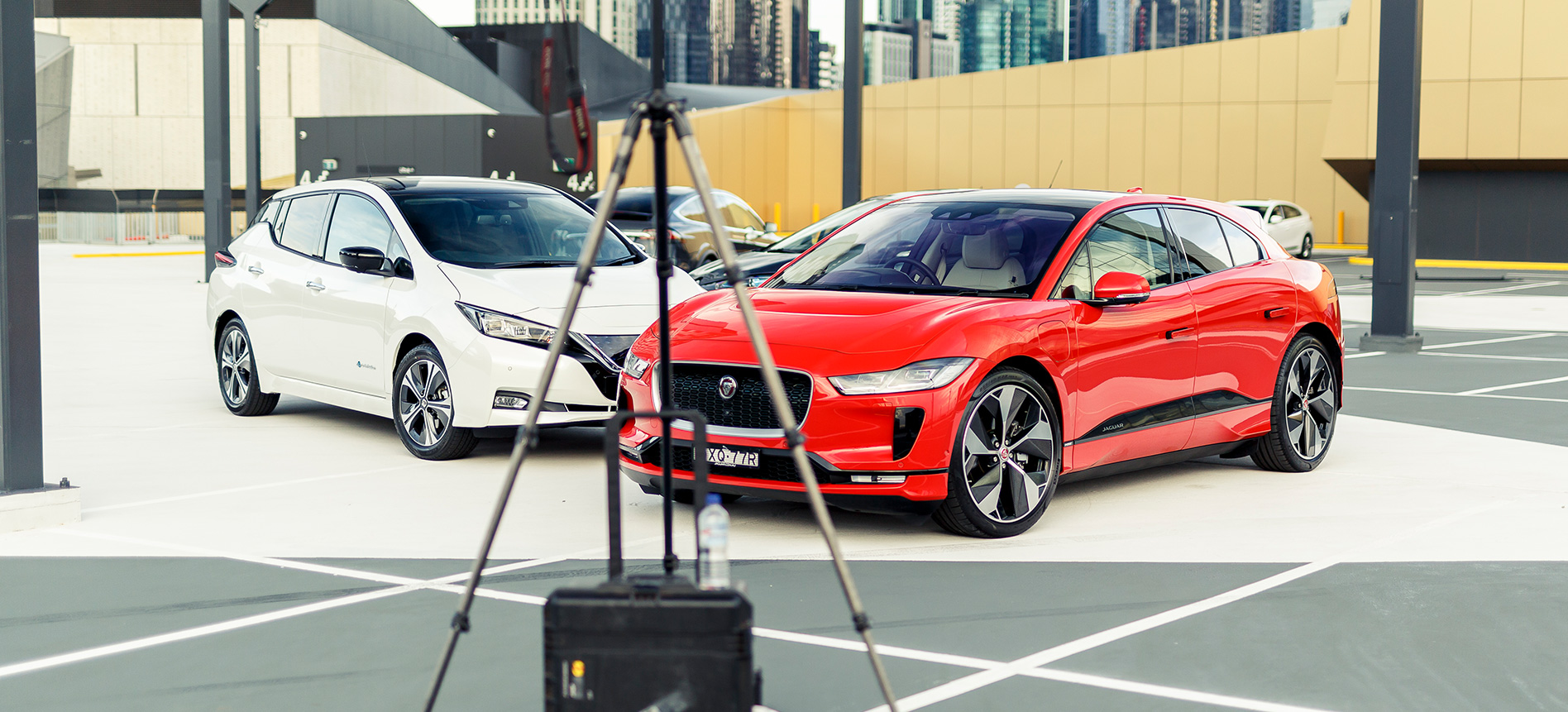
Let’s take it a step further and give you an idea of what each of those vehicles is like to drive. We arranged an EV comparison with six of the current offerings pitched against each other to find out which makes most sense.
You can find the full review for each model here:
And if you want to know what it’s like living with an EV for even longer, check out our first electric long-term review. We took delivery of a Hyundai Ioniq for a six-month tenure in the WhichCar garage for a more realistic sample of zero-emissions life. If the most affordable electric car in Australia isn’t quite your cup of tea, don’t worry, we will be taking on more electrified long-term reviews soon and can’t wait to tell you how they are to live with.
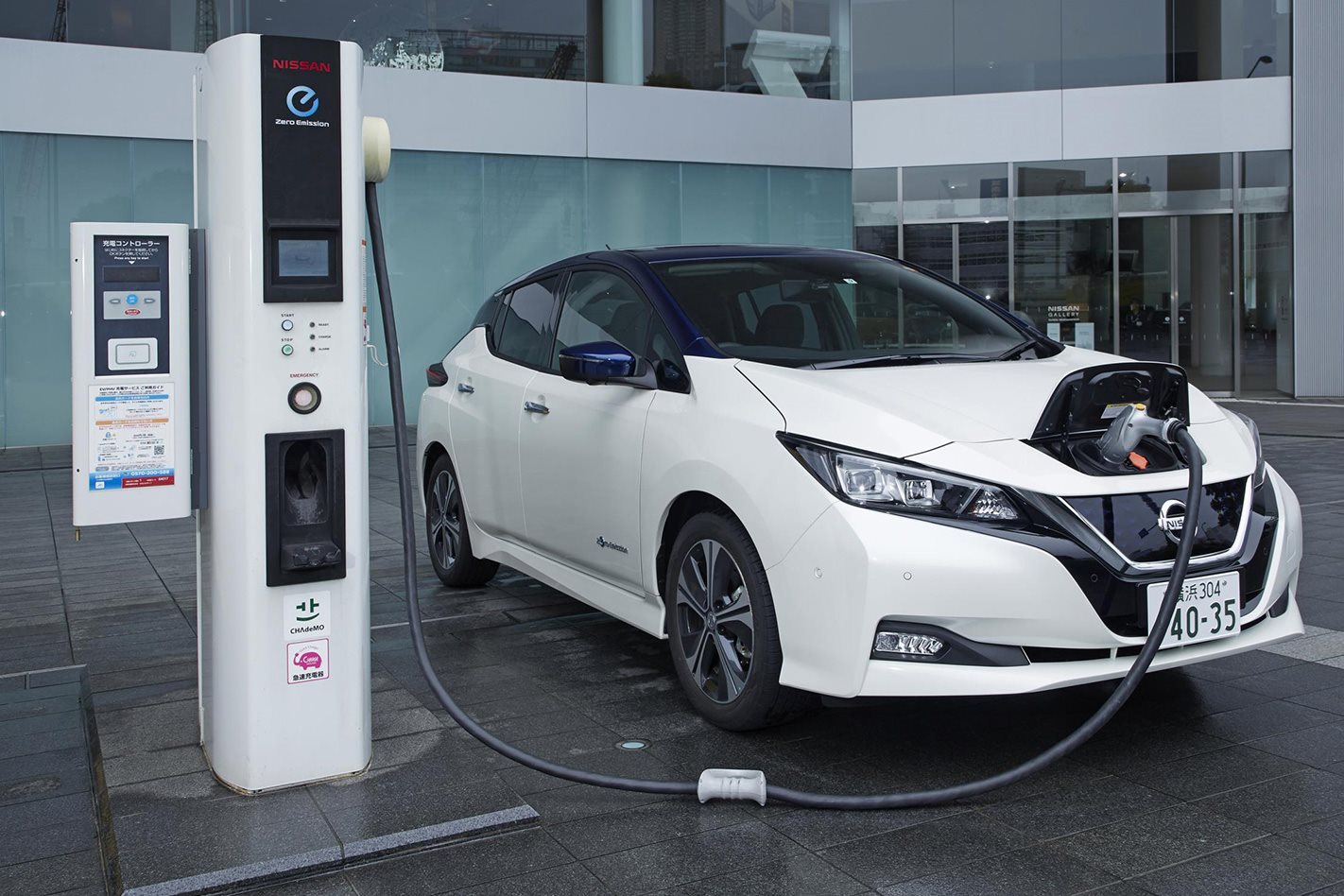
EV Achievements
Just like the 100-year-plus evolution of the combustion-powered car, electric car performance will dramatically accelerate over the coming decades too. But the status quo is already pretty impressive. BMW recently revealed an electric 5 Series prototype that out-accelerates the mighty M5, and an electric Mini pulled a Boeing 777.
Volkswagen is also pushing the fringes of electric performance hard and its I.D. R racer has not only smashed the Pikes Peak hillclimb record (a race traditionally dominated by combustion power), it then went on and did it again at the Nurburgring and at the Goodwood Festival of Speed.
What’s next?
The first production car to be born out of all these Volkswagen publicity stunts will be the I.D. 3 R and it’s a very exciting little package.
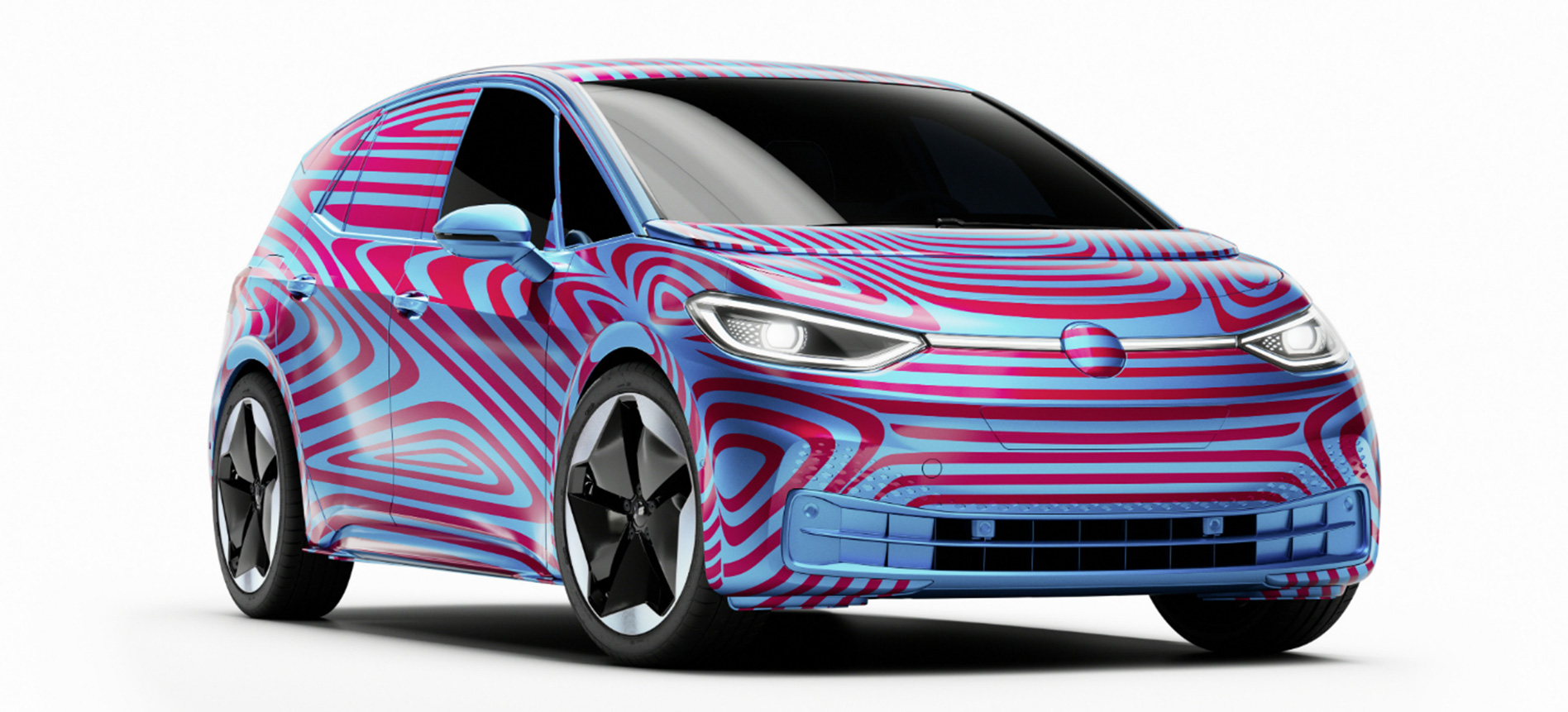
Using the same platform, Volkswagen unveiled its ID3 hatchback that’ll utilise the new MEB platform – set to underpin a number of future electrified VW products.
Also unveiled at the 2019 Frankfurt Motor Show was the Porsche Taycan, which Tesla are slightly worried about, the Mercedes-Benz EQS concept which previews the future of the company’s electrics, the Mini Cooper SE which is destined Down Under in 2020 and the Honda e electric city car which is not.
For more information from the Frankfurt electric vehicle reveals, head to the gallery and hub page.
If you’re still concerned by the words of minister for employment Michaelia Cash when she said “We are going to stand by our tradies and we are going to save their utes,” then allow this story to put your mind at ease.
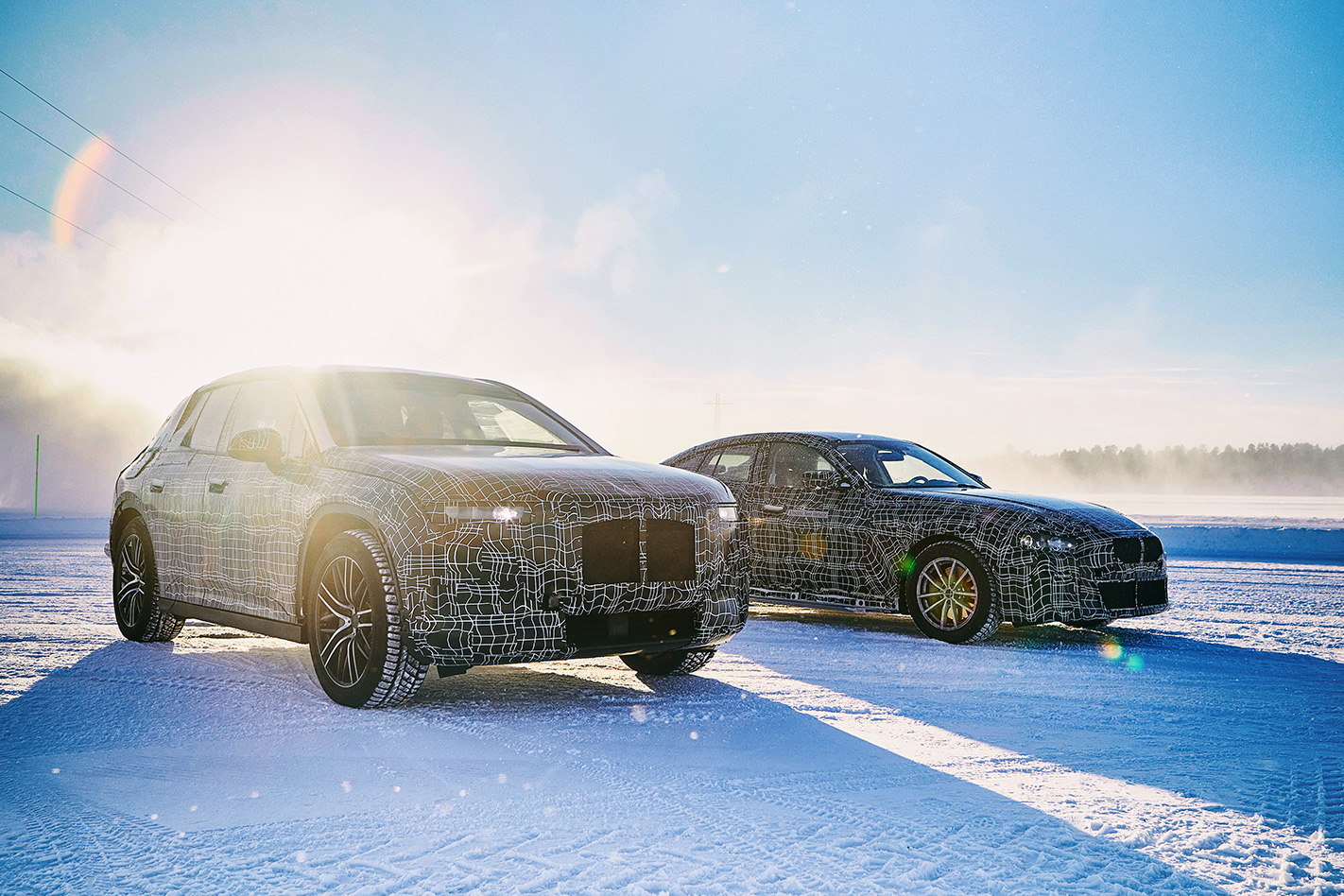
As you can see, it’s not just dainty little hatches that electrification works for, with all segments eventually in line for EV options. BMW recently laid out its plans for an electric future including an interesting prediction for the longest range vehicles.
Toyota is also readying its electric fleet, Honda also has significant electric offerings in the pipeline, and even fossil fuel giants are recognising the switch to electric and diversifying early.
We have also been watching the cost of ownership of electric vehicles and this comprehensive study from last year looks into not just how much it costs to put something electrified on your driveway, but the ongoing costs from one month to the next. You might be surprised at the findings.
We’ve also recently looked at an often overlooked cost of car ownership, depreciation. You might think that depreciation rates are similar among all cars, yet this story paints a different picture and it’s definitely a cost worth considering before taking the plunge.
Looking even further into the future, there won’t just be lots of electric options, they will be the only option. Countries around the world are already starting to plan strategies to stop the sale of combustion-powered vehicles, lead by the first – Norway. When will Australia follow suit? Continental thinks we won’t have a choice within 40 years.
The future of cars is bright, clean and exciting and when you are ready to make the switch to electric, WhichCar will be ready for you.
NEED MORE? VISIT OUR EV LANDING PAGE
Volvo has been one of the leading lights in popularising plug-in hybrids but next year the company will go a step further and bring its first fully electric car to Australia.
Set to arrive in quarter four, an all-electric version of its XC40 compact SUV will see the Swedish company slot into the market somewhere between the current electric SUV retail bookends that are the Hyundai Kona Electric and the Jaguar i-Pace.
While details are sketchy, Volvo Car Australia’s managing director Nick Connor was understandably enthusiastic about the electric XC40’s prospects.
“It’s due to launch next year, we’re still working on exact timing for Australia. Hopefully it will be here in 2020,” he said.
“The focus is on the engineering rather than the name at this point in time,” he explained. “The price is also still to be determined. Clearly there will be a level of price sensitivity in the market, but having said that, we’re selling $75,000 XC40 models today.”
Speaking at the launch of the S60 sedan in Australia, Connor also unveiled fixed-price servicing plans for Volvo, addressing a public perception of overly expensive maintenance.
What stands out?
Discontinued at the end of 2018, the Mitsubishi Lancer appealed for its exterior styling, equipment level, and five-year warranty. The sedan and hatchback are also fairly roomy inside for small cars.This review also carries comments on the high-performance Lancer Evolution, which was discontinued about the beginning of 2016 but remains justly renowned for speed, grip and responsiveness. Listed equipment applies to the Evolution Final Edition.
What might bug me?
Driving under 80km/h on the space-saver spare tyre, until you can fix your full-sized flat.The fact you won’t be able to get a brand new Lancer. Mitsubishi dropped its popular small car at the end of 2018, though it remained on sale into 2019.(Wishing you had a spare tyre, if you bought a high-performance Lancer Evolution. These had only a tyre repair kit.)
What body styles are there?
Four-door sedan and five-door hatchback.The Mitsubishi Lancer drives its front wheels, and is classed as a small car, lower priced.(The discontinued Lancer Evolution drove all four wheels.)
What features did all later versions have?
Cruise control, and climate control air-conditioning (which maintains a set temperature).A reversing camera, with the image displayed on a 6.1-inch colour touchscreen.A sound system with CD player and digital radio, and USB input. Bluetooth phone and audio connectivity, with a voice command function. Controls on the steering wheel for the cruise control, the audio system and your phone.Daytime running lamps (which help other drivers see you), with very efficient and long-lasting LED bulbs.Aluminium alloy wheels, with either a space-saver steel spare wheel or (in the Lancer Evolution) a tyre-repair kit.Seven airbags, and electronic stability control – which can help you control a skidding car. (For the placement of airbags, please open the Safety section below.)Every Mitsubishi Lancer carries a five-year, 100,000 kilometre warranty.
Which engine uses least fuel, and why wouldn’t I choose it?
The 2.0-litre petrol four-cylinder engine in the ES Sport and LS sedans uses the least fuel, at 6.9 litres/100km with manual transmission (official test, city and country). With an automatic gearbox it uses 7.3 litres/100km on the test.The other engine available is a 2.4-litre four-cylinder, which comes with the Lancer GSR Sportback and GSR Sedan. It provides about 15 per cent more vigour but uses 25 per cent more fuel.In any Lancer you can have a five-speed manual transmission or a continuously variable (CVT) automatic.(The Lancer Evolution Final Edition had a turbocharged 2.0-litre engine that produced more than twice as much power as the non-turbo 2.0 litre in the ES. It was offered only with a five-speed manual gearbox; the previous Evo MR had a six-speed dual-clutch auto.)
What key features do I get if I spend more?
The least costly Lancer, the ES Sport Sedan, comes with cloth-covered seats, 16-inch wheels, and the features common to all Lancers.Spend more for an LS sedan and you get smart key access . You don’t have to press a key-fob button to unlock the car – just open the door with the key in your pocket or bag.Inside an LS, you get leather on the seats, steering wheel and gear shifter. The front seats are heated, and the driver’s seat is power-adjustable. Headlamps switch on automatically when it’s getting dark, and windscreen wipers operate automatically when it rains. There are rear parking sensors. Wheel diameter increases to 18 inches, and tyres are correspondingly lower in profile but also slightly wider, adding marginally to grip.Spending about the same for a GSR Sportback (hatch) or Sedan gets you the more powerful 2.4-litre engine and firmer suspension. You keep the 18-inch wheels, and the automatic headlamps and wipers, but the seats lose their leather panels.(At more than twice the price of a GSR, the Lancer Evolution Final Edition had the much more powerful, turbocharged, engine, all-wheel drive, and wider tyres with a still lower profile. Equipment followed the LS but with a high-performance slant and some omissions. There were Recaro sports front seats with partial leather trim, but no powered seat adjustment or rear parking sensors. Suspension dampers were from specialist Bilstein, brakes from Brembo, and wheels from BBS.)
Did any upgrade have a down side?
The sports suspension and 18-inch wheels of the GSR models degrade ride comfort.Seven colours are available for the less costly Lancers. Many of these colours are metallic and add about $500 to the price of a car.(Stiffer-still suspension in the Lancer Evolution made it borderline harsh to ride in. It came in four colour schemes, each with a black roof panel.)
How comfortable is it?
The Mitsubishi Lancer ES Sport sits in the middle among small cars for its ability to isolate occupants from bumpy roads. The LS, with its lower profile tyres, and the GSR Lancers, with their firmer sports suspension, are less polished in their absorption of bumps.The Lancer cabin is made from widely used plastics and textiles, and the design is unadventurous.The driving position is easily adjusted in any version.(The Lancer Evolution was among the most firmly suspended, noisy and hard-riding of small cars available. Large occupants might feel squeezed by its Recaro front seats.)
What about safety?
All Lancers have anti-lock brakes, stability control, seven airbags, a reversing camera, and daytime running lights – which make it easier for other drivers to see you.There are two airbags directly in front of the driver and front passenger; one alongside each front occupant at chest level to protect from side impacts; a curtain airbag extending down each side of the car at head level, protecting occupants front and rear from side impacts; and a knee protection airbag for the driver.Autonomous emergency braking is not offered on any Lancer.The Australasian New Car Assessment Program (ANCAP) awarded the Mitsubishi Lancer its maximum five-star rating, most recently in November 2015.
I like driving – will I enjoy this car?
Lancers are among the less engaging of new small cars. In most Lancers the steering does not feel lively enough to bring the driver an inspiring sense of communication with the road.Lancer LS and GSR variants have more tyre grip, and GSRs are more responsive, but steering remains a weakness.(In contrast, the Lancer Evolution was less comfortable than the other Lancers but hugely entertaining, with a lot of speed, heroic handling, and tenacious all-wheel-drive grip.)
How is life in the rear seats?
The Lancer’s rear seat is comfortable, offering a good backrest angle and adequate under-thigh support. Shoulder, head and leg room is about average for a small car. The seat can carry three passengers, with lap and sash belts for all.Rear compartment ambience is let down – just as it is in the front – by hard plastics and plain-looking door trims.
How is it for carrying stuff?
The Lancer Sportback, like any hatchback, is better for carrying stuff than the sedan. It offers 330 litres of cargo capacity, which is good but not great against the benchmarks in small cars. That’s more than a Mazda3, for example, but less than a Subaru Impreza.Backrests that split-fold 60/40 can be flipped using levers in the boot, which is a very handy feature.The Lancer sedan’s boot can hold 400 litres – on the small side, but about the same as a Mazda3.
Where was the Lancer made?
The Mitsubishi Lancer is manufactured in Japan.
What might I miss that similar cars have?
A sixth gear in manual versions, which is handy for lowering engine revs and noise – and fuel consumption – at highway cruising speeds.A turbocharged engine, such as Volkswagen has in the Golf, and Ford in the Focus. These respond more eagerly to the accelerator pedal, particularly from low speeds.Automatic emergency braking – standard on all Mazda3s, for example, and available on several other small cars. A sensor detects obstacles in front of the car (typically another car that has slowed suddenly), and a computer applies the brakes if it concludes that a collision is imminent.The ability to display apps from your smartphone on the car’s central screen in the dashboard, and control them from there, via Apple CarPlay or Android Auto. The Golf, Focus, Hyundai i30, Subaru Impreza, and Holden Astra are among small cars offering this.In general, many small cars developed more recently are worth investigating for their interior feel and level of driving enjoyment. Examples in addition to those mentioned above are the Honda Civic, Toyota Corolla, and Kia Cerato.
I like this car, but I can’t choose which version. Can you help?
The best value proposition in the Lancer range is the well-equipped LS sedan. Getting keyless entry, front-seat heaters and partial leather trim in a small car at this price point is unusual.
Are there plans to update this model soon?
No, sadly Mitsubishi discontinued one if its most popular nameplates at the end of 2018, with its MY19 stock still selling throughout 2019. The company announced it had no plans to replace the Lancer, with passenger range made up of SUVs.The Lancer now represents a good used buy, with the final generation going back as far as 2007 in Australia.The sporty Lancer Ralliart and Lancer Evolution MR were dropped from the range in 2015, and the Evolution was replaced with the more powerful and better equipped Evolution Final Edition (which sold out rapidly).In January 2016, the Lancer range received a facelift. The luxury Lancer XLS was dropped, and a sedan version of the more powerful GSR Sportback was added. A colour touchscreen and reversing camera were extended to all models, and the Lancer LS gained some luxury features.The Lancer continued unchanged until its demise, except for minor engine revisions to meet new emissions standards (Euro 5).
