
Audi Sport, formerly quattro GmbH, has been instrumental in blessing the world with Audi’s RS performance models over the past 25 years, but there was always one niche left unfilled, and that is an RS-badged Audi A8 limousine.
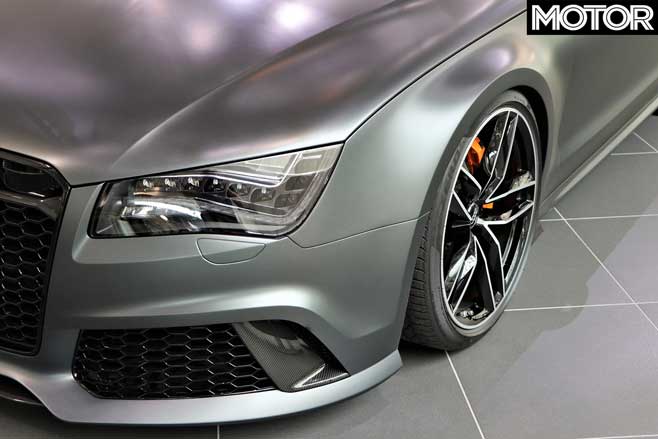
That void has been now filled, albeit as a stillborn 2013 Audi RS8 prototype, which Audi Sport has only now revealed to the world as part of a special “25 Jahre RS” exhibit at Audi’s Neckarsulm facility.

Based on the previous-generation Audi A8 limousine, the RS8 prototype looks the part with its matt grey paintjob and subtle hints of aggression in the form of a front fender and bumper arrangement and 20-inch wheels lifted from the RS6.
It is a different story on the inside where the A8’s plush fittings has been replaced with a generous helping of Alcantara upholstery, decked out with contrasting orange stitching, and a helping of carbon fibre panels.
The A8’s standard round steering wheel is swapped out for a flat-bottomed item and the centre console panel that once housed the MMI infotainment dials and switches is replaced with what appears to be the start-stop button from Lamborghini.

Aside from what the eye can see, Audi Sport remains mum on what the prototype is packing beneath, only hinting that it is a “520hp sports sedan” and is “equipped with various security features”.
Considering that the S8 of its generation already boasted 520hp by way of a 4-litre twin-turbo V8, and that the RS6 of its era made do with 560hp (412kW), both of which were cranked up to 605hp in its ‘plus’ and ‘performance’ guises, it stands to reason that those are rather conservative numbers.
Audi Sport isn’t alone in steering clear of giving the full performance treatment for the mother company’s flagship limousine.
Fellow Bavarians over at the M Division also toyed with the idea of an all-out performance limousine in the past, creating such curiosities as the “Goldfish” V16 7-Series prototype from 1987, but has since been responsible in developing the 448kW M Performance branded M760Li xDrive.
Such apprehension comes as no surprise as performance limousines are a dying market, with Mercedes-AMG and Jaguar confirming that its S65 and XJR575 performance flagships will not be succeeded after their respective model lifespans come to an end. So don’t mourn that the RS8 never came to be, but be glad that the prototype exists.
Have you ever dreamed of one day owning your very own race track? What about a true blue grand prix circuit?
Well, now you can, and all for a bargain price!
S2134 Olson Rd, Port Wakefield, is home to the Port Wakefield Grand Prix circuit, which hosted the 1955 Australian Grand Prix, and it’s currently for sale.
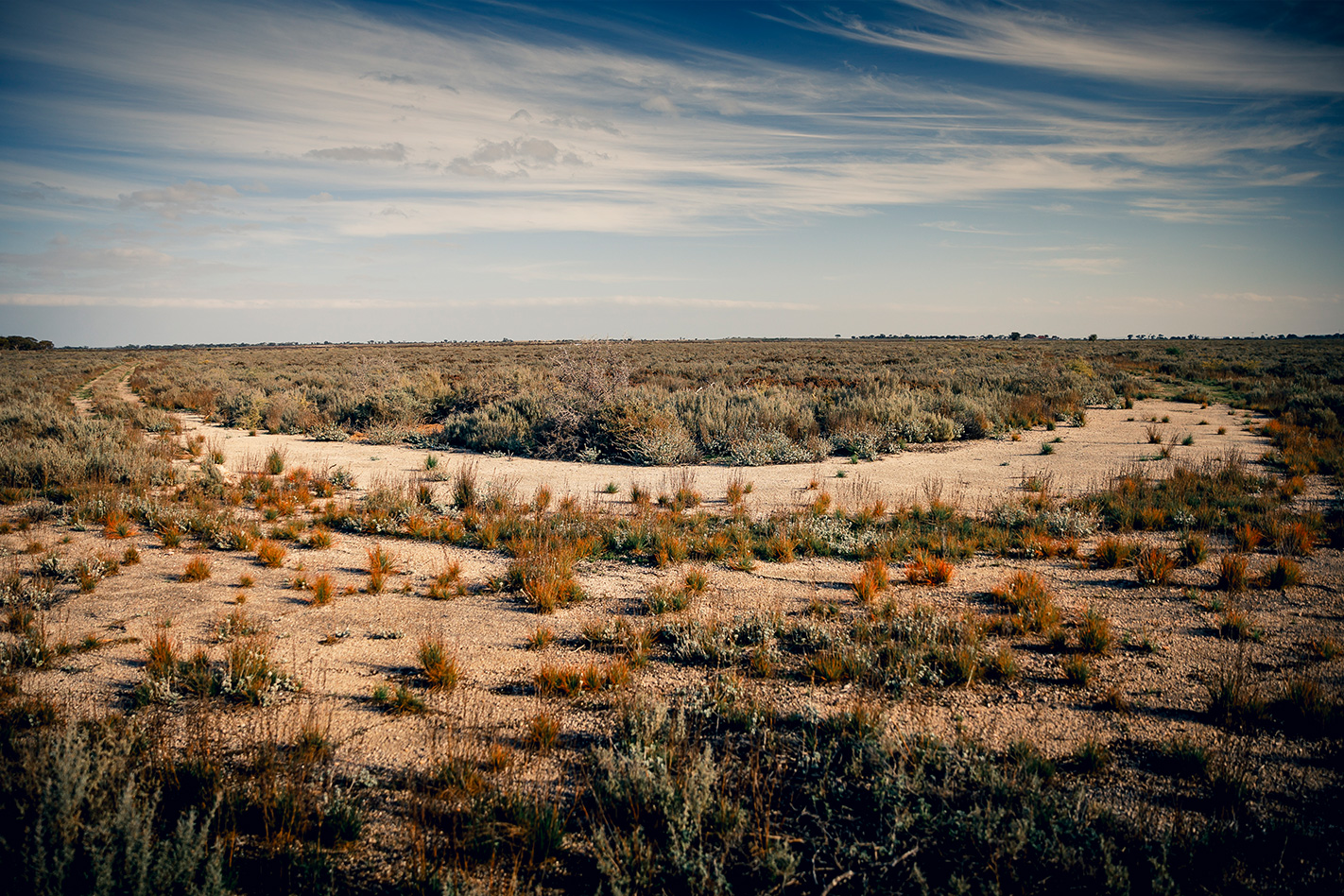
Located in rural South Australia, the property is being sold by its elderly owner to help pay for her aged-care requirements. The property currently has a bid of $15,000, and is being sold by Openn Negotiation, a flexible terms online auction site. It’s expected the historic site will reach a final price of between $80,000 and $100,000.
The Port Wakefield circuit holds significant historical importance for Australian motorsport, being the site of Jack Brabham’s first grand prix victory.
This was long before the Aussie Grand Prix was part of the Formula 1 World Championship, with the ’55 AGP being open to Formula Libre cars, with an unlimited engine capacity. In total 22 cars started the race, which ran to 80 laps.
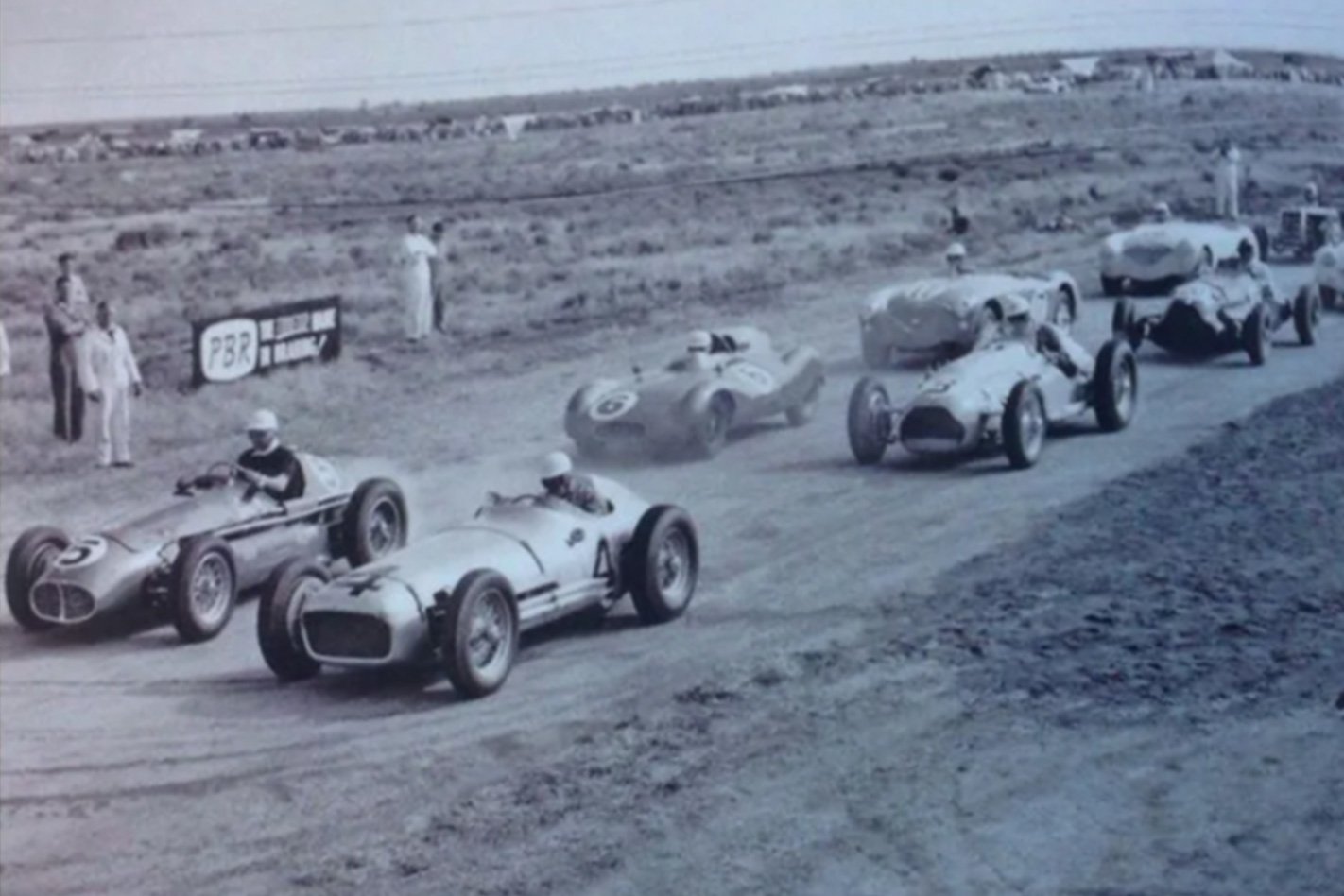
Brabham’s victory at the helm of a Cooper T40 Bristol was also the first Australian Grand Prix victory for a rear-engine car, something that wouldn’t be repeated until 1960.
The T40 was a streamlined version of Cooper’s racer, and was built by Brabham in England after he joined the squad, before sending the car to Australia.
The Australian racing legend shared the fastest lap for the grand prix with polesitter Reg Hunt who was driving a Maserati A6GCM. The duo lapped the circuit in a time of 1:03.0.
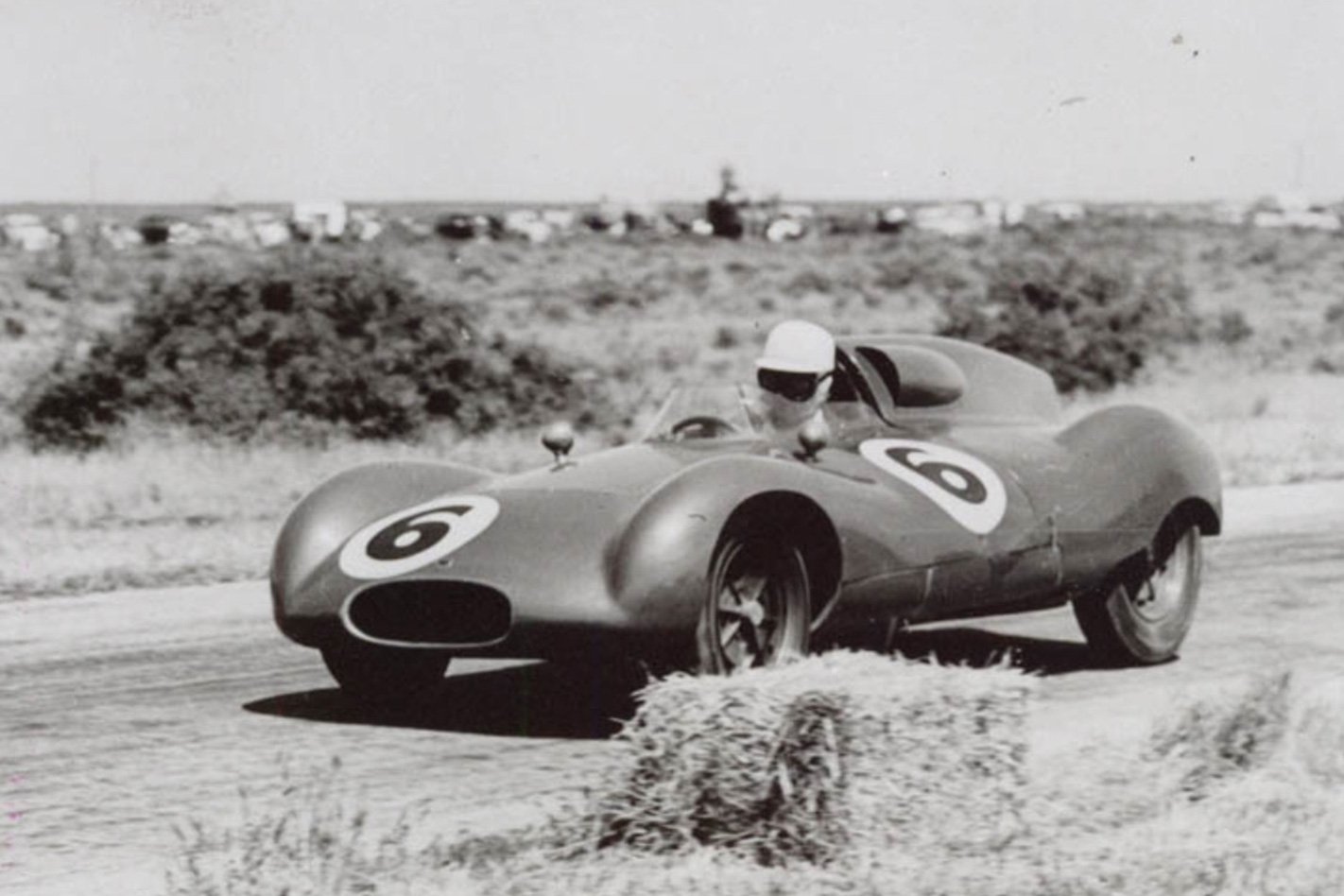
It was the twentieth time the AGP was run, and the first time it would be held on a purpose built circuit.
What you missed at the 2018 Adelaide Motorsport Festival
Brabham would go on to win another two Australian Grands Prix, going back-to-back in ’63 and ’64.
Port Wakefield was the first purpose built race track in Australia after World War II when it opened in 1953, and it’s the second standalone circuit to be built in our nation’s history.
Construction of the circuit began after the South Australian government banned motorsport on public roads, where many events were held in that era, following the death of a spectator. The ban would only be lifted in 1985 so the Adelaide Street Circuit could host a round of the F1 championship.
Unfortunately 1955 would be the first and only time that Port Wakefield would host the Australian Grand Prix, with South Australia creating the Mallala circuit when it was the state’s turn to host the GP again in 1961. Part of Port Wakefield’s facilities were used in the construction of Mallala, crippling the 2.092-kilometre circuit, and it would host its last race meeting, organised by the Austin 7 Club of South Australia, on May 14, 1961.
The outline of the dirt track can still be found on Google Maps, however, it is hidden behind ever encroaching scrub.
The future owners will have the perfect back-yard circuit should they have some oil in their veins.
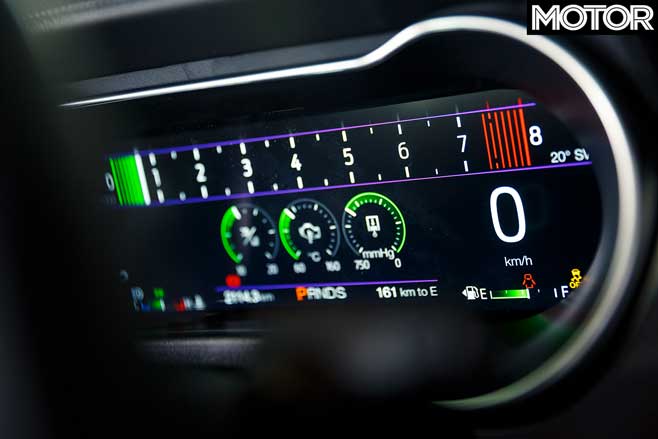
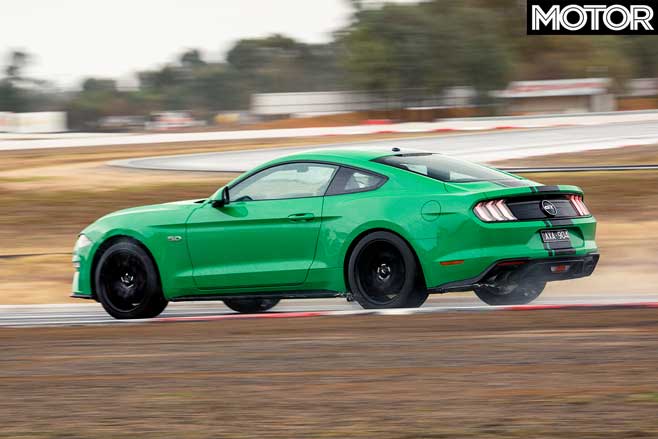
Newman had just unleashed the 2019 Ford Mustang GT on his second lap when it happened. After giving it some wide-open throttle exiting turn four, the GT’s 5.0-litre V8 and 10-speed automatic transmission reached their limits, capping revs at just above 6000rpm.
This track review was carried out in conjunction with MOTOR’s Bang For Your Bucks 2019
We’d anticipated this disappointing result. Luffy had aborted his hot laps complaining about its neutered power delivery only just before Newman jumped in. So it was clear the very issue that plagued our automatic V8 Mustang at PCOTY – hot cylinder head temperatures – had surfaced again. And it was now clear it was not going away.
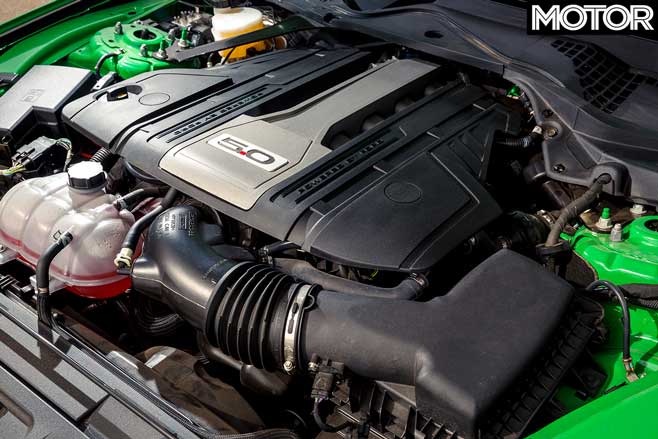
Thankfully, because it was a manageable problem, and we had decided to scrap any collected data for the final result, we were still able to salvage an impression. Even if it was skewed.
It was always going to be hard to gel with a 339kW/556Nm coupe in such conditions, with more power flowing in this GT and a front-heavy grip balance carried over from the last model, it struggled to ground power, even with the lightest throttle application, on the new Michelin Pilot Sport 4 S tyres. Mind you, they never had long enough to reach temperature.
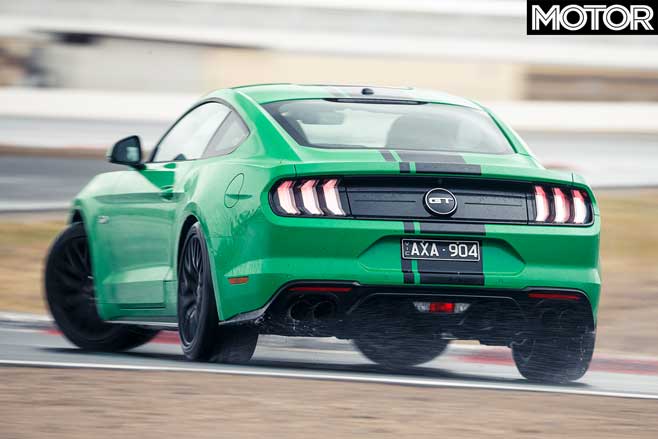
There’s still plenty to like about this big boofhead, though. When the powertrain’s playing ball, the new Coyote spins to 7400rpm, blasting a delicious racket through that active exhaust. Meanwhile, the 10-speed auto’s short ratios and delightfully rapid shifts keep the sound concentrated on that lovely top-end. The steering was also a lot more tactile than expected on a wet Winton.
Despite its temperamental nature, the GT fared okay with the judges, falling down the order on only two sheets. Still, to understand why it ultimately scored a wooden spoon, you have to look at the price. At $63,990 in base manual form, it’s already five grand more expensive than the old 306kW GT.
Add the 10-speed automatic and its $3000 penalty, then suddenly it’s $14,400 more expensive than this field’s average price and easily the second-most expensive car here.
Only a winning judges’ score would have been enough to save it from its price disadvantage. Considering this strong field, and its rampant temper, the GT sadly never stood a chance. Here’s to hoping that changes in the future.
Ford Mustang GT BFYB 2019 Results – 11th place
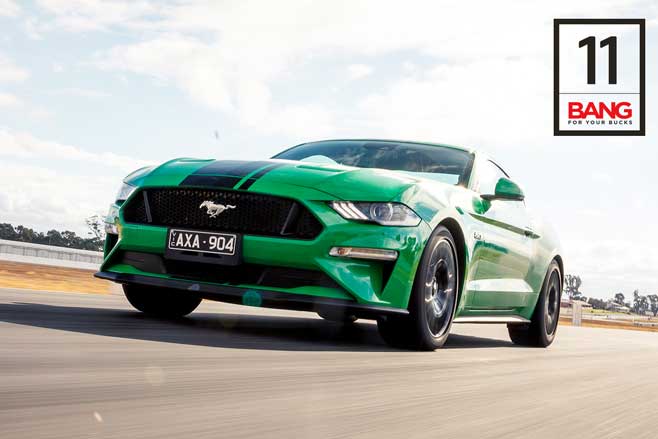
0-100km/h: 4.53sec 0-400m: 12.49sec @ 188.16km/h Price: $66,290 Bang Index: 78.9 Bucks Index: 78.6 BFYB Index: 78.7
Bang For Your Bucks 2019 Judges’ Comments
Campbell – 5th “Lots of good vibes. Lives life on the edge in the wet.”
Cordony – =7th “Cool sound. Eventful drive. Terrible temper.”
Morley – =5th “Too much choice confuses some. Choice of 10 gears does the same here.”
Newman – 9th “Poor temperature control makes this pony a gelding on track.”
Luffy – 9th “The GT’s lap time was 1:59.64 and it was pretty wet then. The tyres felt like the limiting factor. It just gets a lot of understeer on initial entry; it feels like it’s too stiff in the front. The gearbox was really good, but the biggest disappointment was it went into limp home mode 1.5 laps in and I couldn’t really push too hard before it was saying ‘Engine Temp’ and ‘Reduced Power’. Given the cool conditions that was really disappointing.”
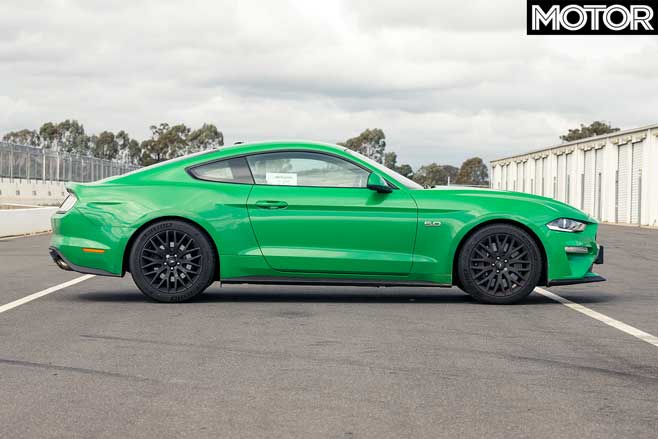
FAST FACTS 2019 FORD MUSTANG GT SPECS BODY: 2-door, 4-seat coupe DRIVE: rear-wheel ENGINE: 4998cc V8, DOHC, 32v BORE/STROKE: 93.0 x 92.7mm COMPRESSION RATIO: 12.0:1 POWER: 339kW @ 7000rpm TORQUE: 559Nm @ 4600rpm WEIGHT: 1784kg POWER-TO-WEIGHT: 202kW/tonne TRANSMISSION: 10-speed automatic SUSPENSION: struts, coil springs, dampers, anti-roll bar (f); links, coil springs, dampers, anti-roll bar (r) BRAKES: 380mm ventilated discs, 6-piston calipers (f); 330mm ventilated discs, single-piston calipers (r) WHEELS: 19.0 x 9.0-inch (f); 19.0 x 9.5-inch (r) TYRES: Michelin Pilot Sport 4 S, 255/40 ZR19 (f); 275/40 ZR19 (r) PRICE: $66,290
Bang For Your Bucks 2019
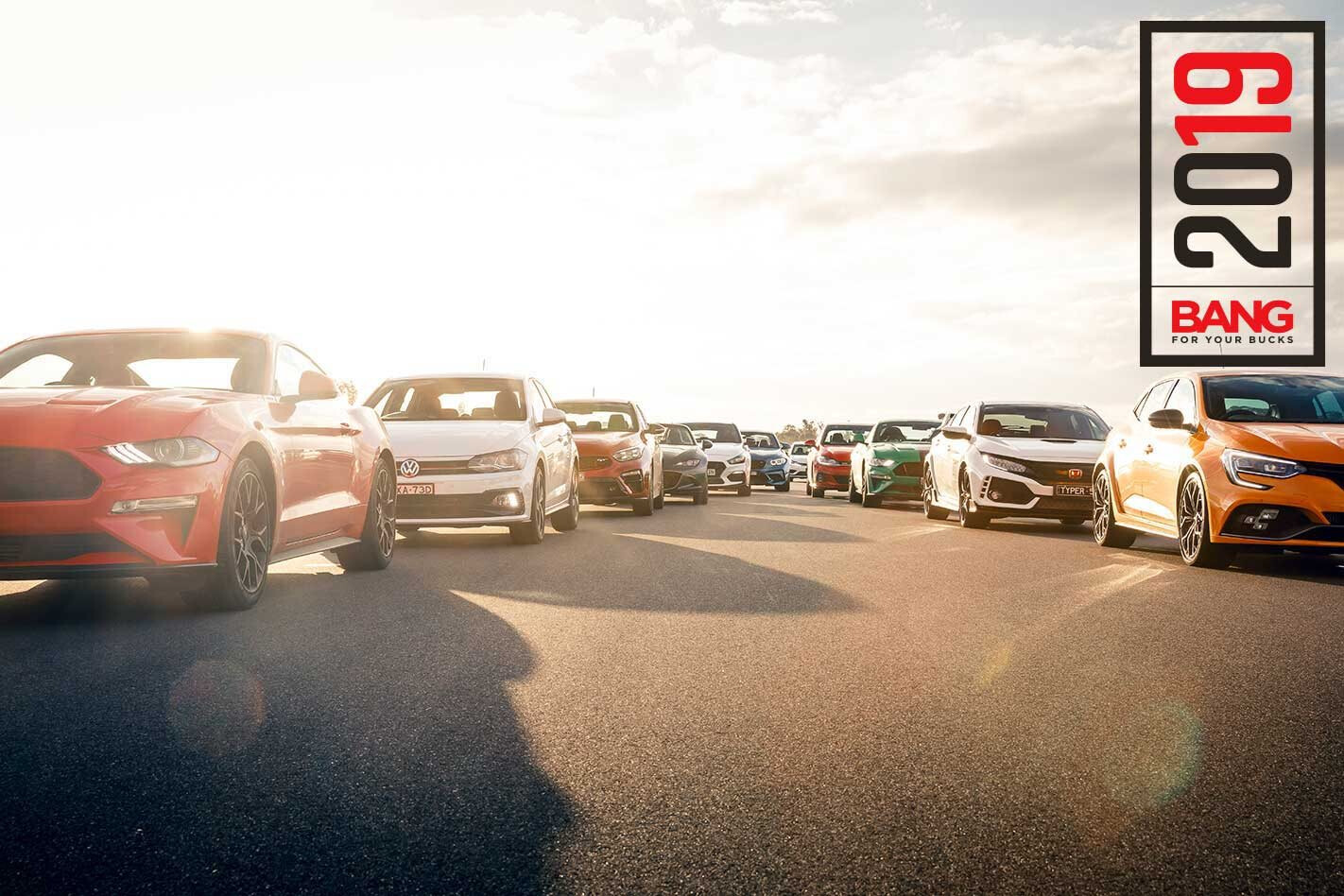 The Contenders, Judges & Criteria
11 of the hottest new fast cars under $100K roll up to take on our famous value-for-money formula. Which will be number 1?
The Porsche 718 Cayman is the cheapest sports car Stuttgart offers, but there is nothing entry-level about its performance.
When equipped with a seven-speed PDK gearbox, Porsche claims it will sprint from 0-100km/h in 4.9sec, or 4.7sec when fitted with the optional ($5330) Sport Chrono Package. Keep your foot pinned and Porsche claims you’ll pass 160km/h in 11.1sec, or 10.8sec if you’ve ticked the magic Sport Chrono box.
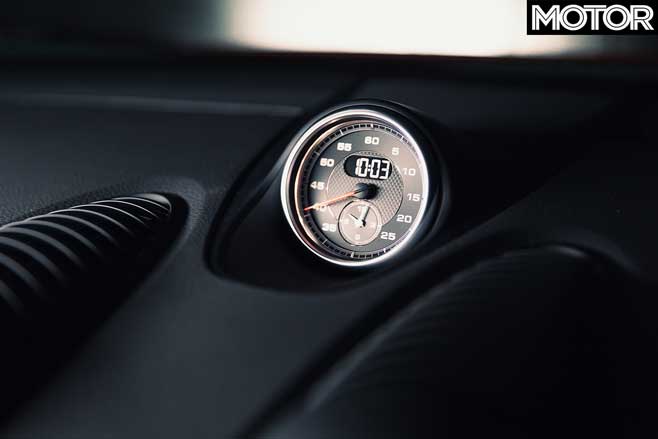
Porsche is lying. In actual fact the 718 Cayman is much quicker than its maker claims. Porsches are renowned for besting their performance claims, but we’ve never had a car smash its official figures by this margin before.
Launch control primed, the 718 bolted to 100km/h in just 4.38sec, undercutting the claim by an impressive 0.32sec. However, it was just getting started, storming to 160km/h in just 10.18sec, an incredible 0.62 quicker than Porsche’s official figures. From there it crossed the quarter mile in 12.65sec at 177.86km/h.
Remember, this is Porsche’s slowest and least powerful sports car, offering 220kW/380Nm from its 2.0-litre turbocharged flat four. Perhaps we shouldn’t have been surprised by the numbers – though we were! – as its bigger brother, the 718 Cayman S, clocked an outrageous 3.95sec to 100km/h and a 12.02sec 0-400m at 189.12km/h during PCOTY 2018 testing.
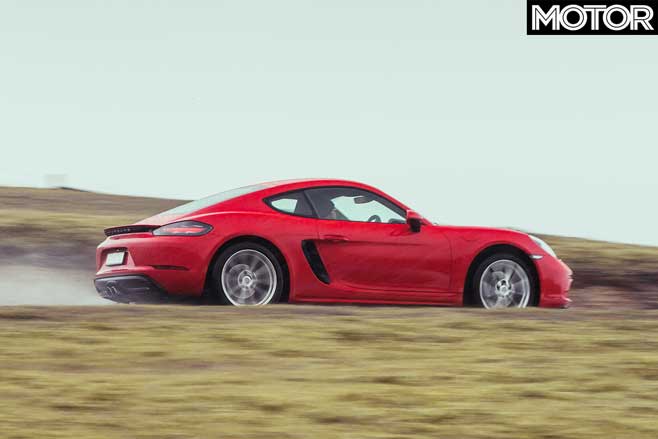
To illustrate what a quantum leap the 718 is over its predecessor, consider that when we performance tested the 981 Cayman back in 2015 – again as a PDK – it took 5.80sec to hit 100km/h and required 13.93sec to complete the quarter mile at a terminal speed of 163.38km/h.
That’s the value of torque. While the two models’ power-to-weight ratios are quite similar, the 718’s 161kW/tonne playing the 981’s 152kW/tonne, the new turbo engine murders its 2.7-litre naturally aspirated predecessor when it comes to twist, offering 278Nm/tonne to the 981’s 218Nm/tonne.
Is the extra speed worth losing that old flat-six scream? Debatable. But the debate is only going to rage on as the next Cayman is rumoured to be adopting electric drive, meaning it’ll be even quicker against the clock but make no noise at all!
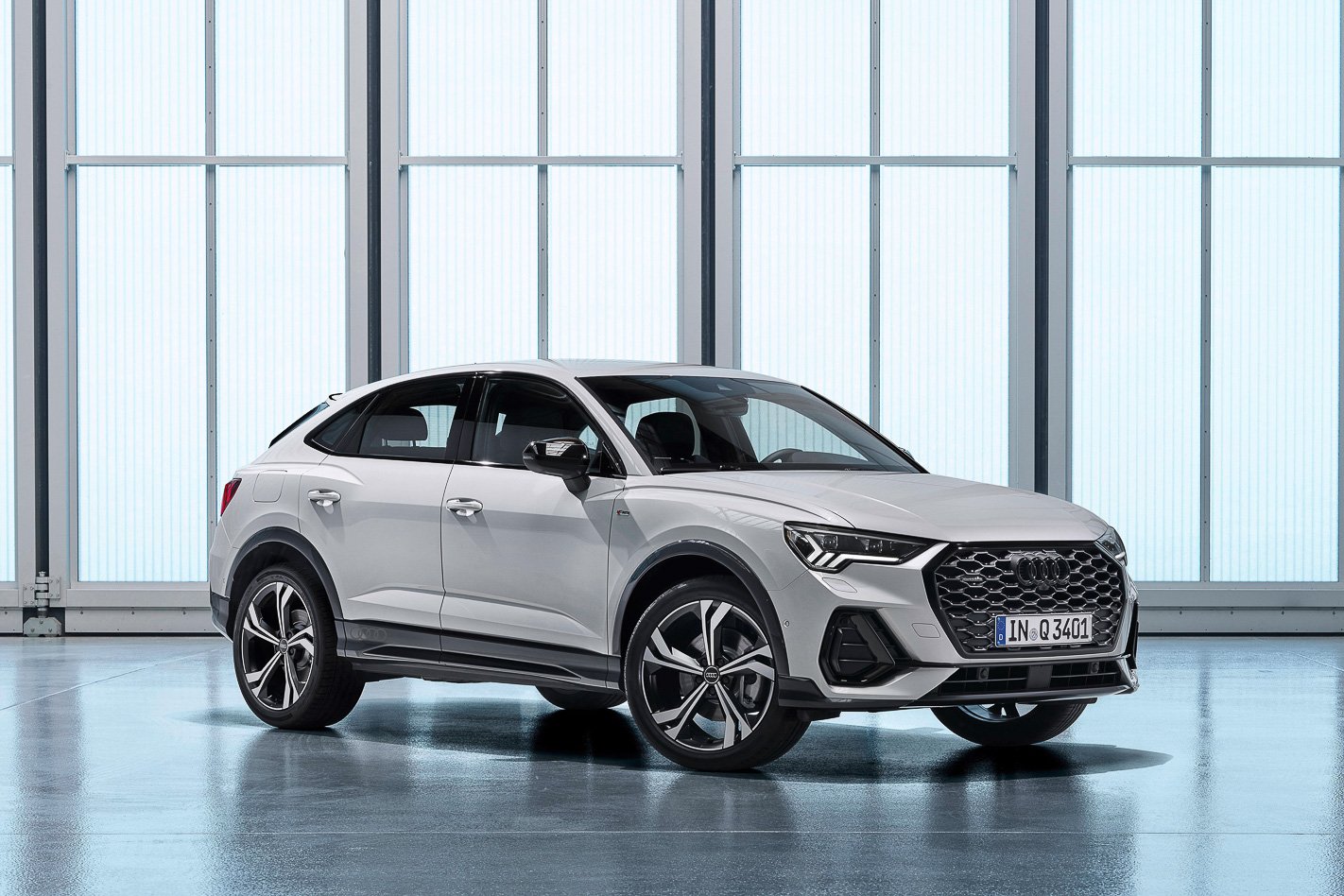
Even if you don’t believe in the notion of a coupe crossover, you’d have to agree that Audi’s new Q3 Sportback manages to bring the best of both worlds together.
The swoop-roofed five-seat, five-door small SUV will join its all-new Q3 wagon twin – which launches in Australia at the end of 2019 – before the middle of next year, and we reckon it’ll do the business.
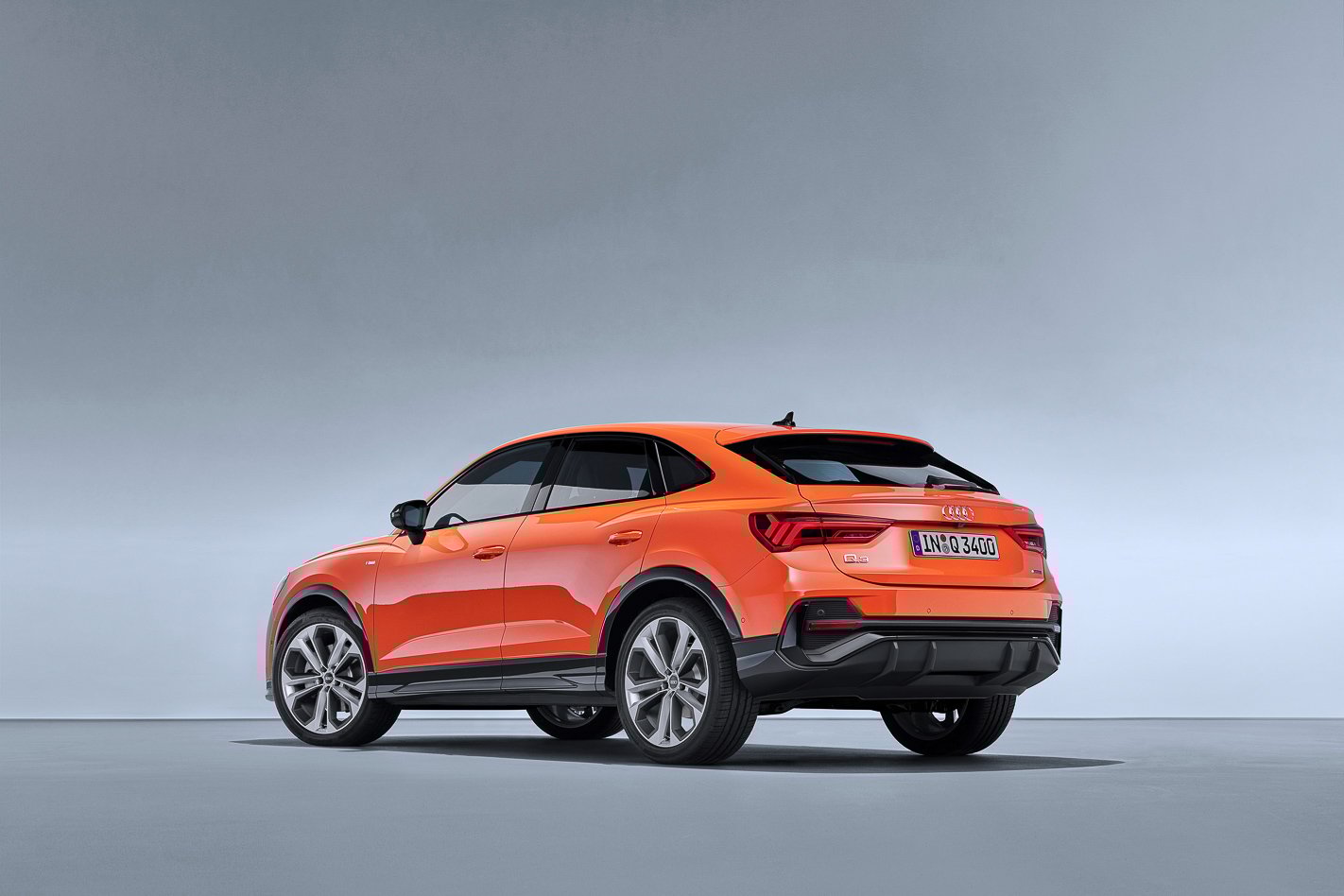
It will, of course, share its under-bits with the Audi Q3 wagon, including its MQB platform, selection of three- and four-cylinder petrol and diesel engines and both front- and all-wheel drivetrains.
It’ll launch into the small SUV space against premium competitors like the BMW X2, Jaguar’s E-Pace, the Lexus UX and Mercedes-Benz’s GLA.
Designed, we’re told, with the help of two former Ford Australia designers who now work for Audi in Germany, the Q3 Sportback mirrors the Q3 from the A-pillar forward, before morphing into the swept-down roofline with flattened d-pillars, a long roof spoiler and bespoke tailgate arrangement.
Interior space in the second row is surprisingly generous when compared with the regular Q3, though the rear headroom measurement is 25mm lower than in the Q3 wagon. Expect to see items like ISOFIX baby seat mounts, rear vents and USB charging points across the line for second-row passengers, too.
The cargo space of 530 litres with the seats up matches the dimensions of the wagon. Overall, though, it will lose about 125 litres in maximum carrying capacity, with the Sportback rated at 1400 litres with the rear seats lowered.
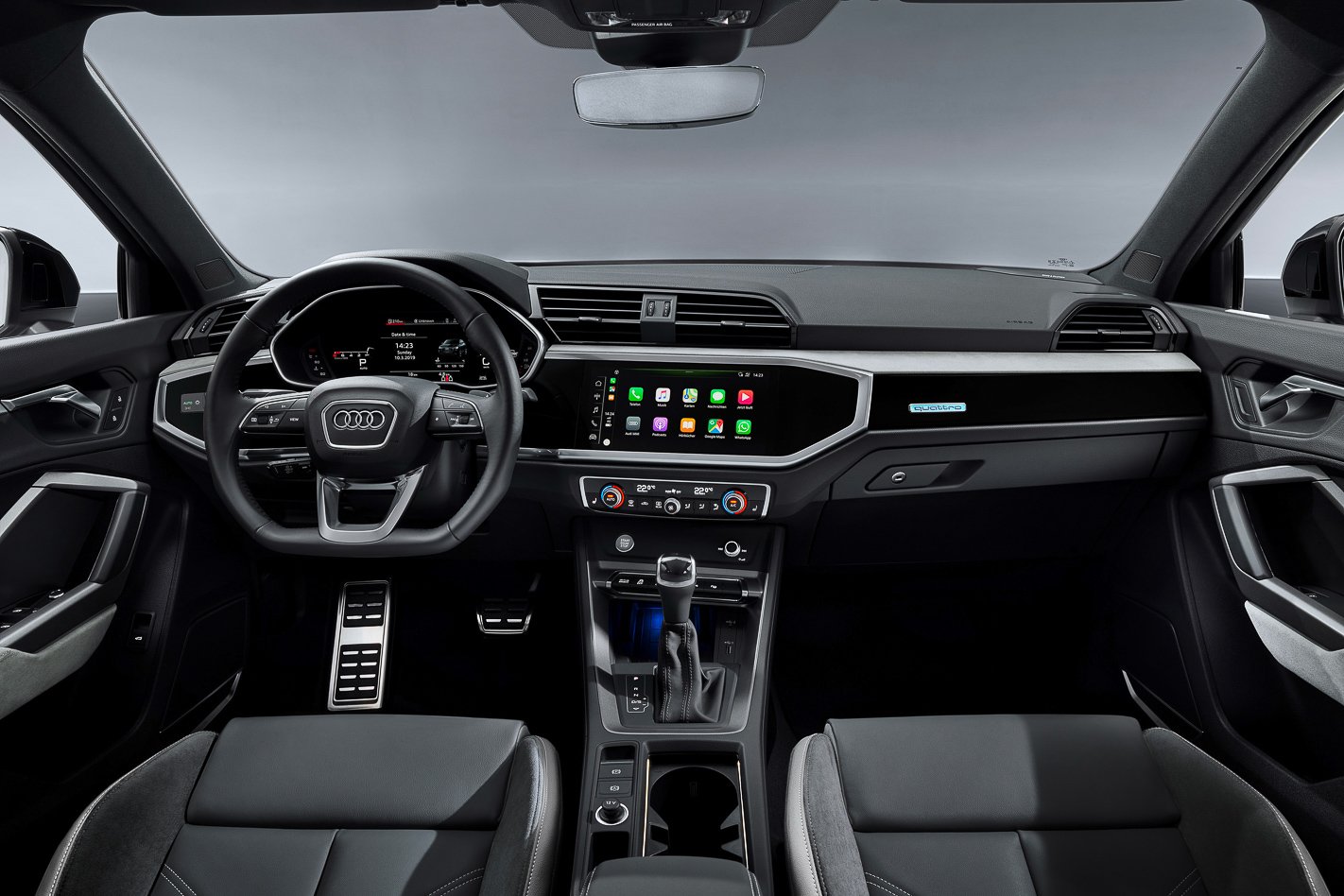
Expect to see content like a digital dash, an all-new multimedia touchscreen with no centre console buttons, dual-zone climate control, automatic lights and wipers, advanced driver aids like low- and high-speed AEB with traffic jam control, front and rear cross-traffic assist and lane departure assist offered as either standard or as part of option packs for the Q3 Sportback.
LED headlights in three grades will also feature on the spec lists, along with LED taillights and rims up to 20 inches in diameter.
The initial offering in Europe sees the Q3 Sportback launch with the 169kW EA888 2.0-litre turbocharged four-cylinder engine and quattro all-wheel drivetrain, in combination with an eight-speed dual-clutch gearbox. Expect to see this version debut in Australia as the Q3 Sportback 45 TFSI.
A 2.0-litre diesel version will also go on sale in Europe; Audi Australia currently offers the standard Q3 in a similar specification. A more entry-level version, possibly using Audi’s 1.4-litre three-cylinder turbocharged engine and front-wheel-drive, will follow later, according to the company.
And with Audi Sport recently announcing that it would release two completely new models in 2019, chances are high that a hotted-up RS Q3 – possibly even fitted with the Audi RS3’s 2.5-litre five-cylinder turbocharged engine – could be one of the two.
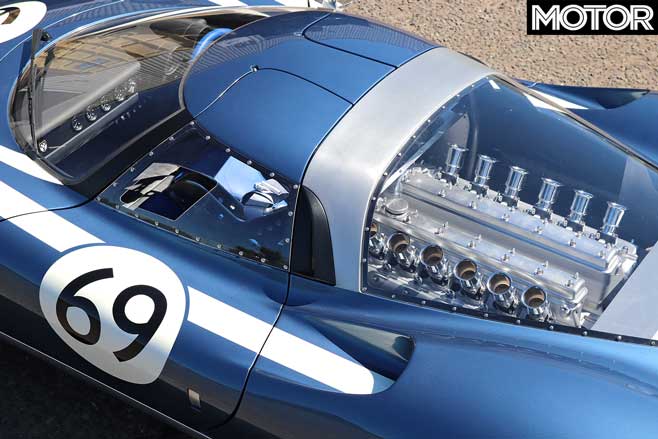
In September, Ecurie Cars will reveal a road-going tribute to a car the Ecurie Ecosse racing team saw plenty of potential in back in the 1960s. The Ecurie Ecosse LM69 sports car will honour Jaguar’s stillborn XJ13 Le Mans prototype.
The original Jaguar XJ13 prototype, of which only one exists as a rebuilt car after it was crashed in the 1970s, was designed in the mid-‘60s to be competitive as a Le Mans endurance racer, powered by a 5.0-litre DOHC V12 engine and with a kerb weight just below one tonne.
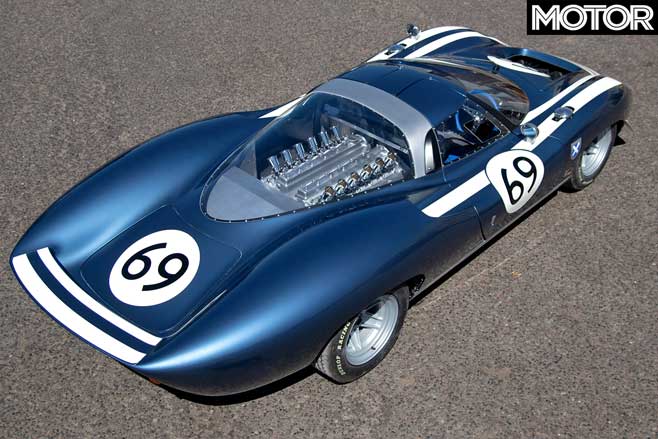
Now, a company born of former Scottish race team Ecurie Ecosse will build a car based on a ‘what if’ scenario involving the team deciding to invest the money and effort necessary to make the car competitive for the 1969 Le Mans 24 Hour.
The team had already won the 1956 and ’57 races, but to win again more than a decade later would mean besting Ford’s legendary GT40.
The LM69 built by Ecurie to ‘fulfil’ this scenario will be powered by a quad-cam V12, as the original XJ13 was, but instead of being purely designed as a racer, it will be road legal.
“Picture the scene: one day in late 1967, members of Ecurie Ecosse travel to the Browns Lane factory to discuss repeating that success,” a press statement from Ecurie Cars begins.
“During their visit, they spot the XJ13, covered up and tucked away. But as soon as the covers come off, they know that they’ve got a potential winner on their hands.
“A deal is done, and work begins on a two-year project to develop and build a car in order for Ecurie Ecosse to take on the might of Ford, Ferrari and Porsche at the 1969 Le Mans 24 Hours.
“This alternate reality could have been one of motor racing’s greatest stories – just imagine if the money, not to say courage and ambition, had been invested into it.”
Only 25 LM69s will be built, which will meet 1969 FIA homologation requirements as closely as possible while also remaining road-legal.
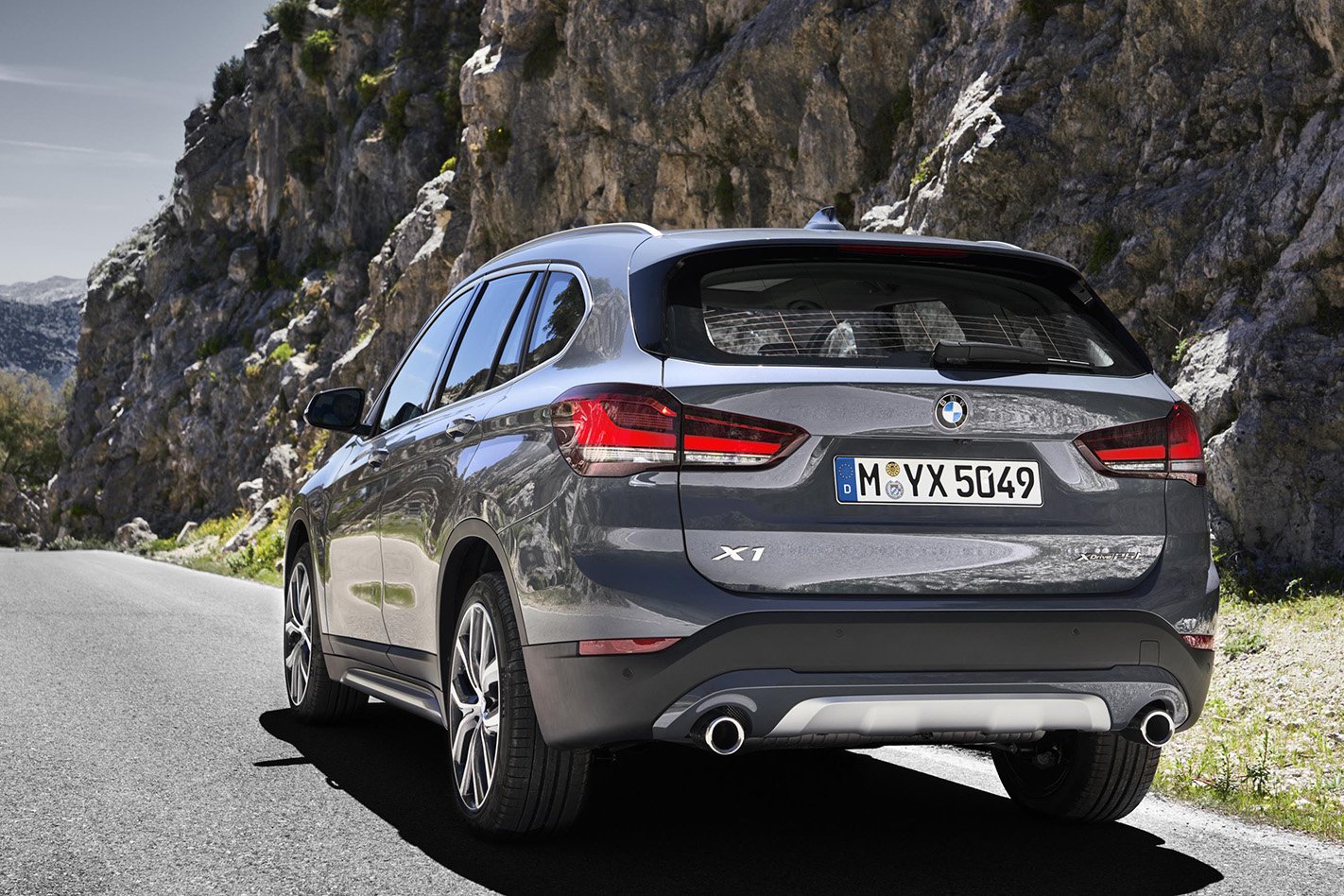
BMW has announced prices and features for its upcoming X1 revamp, which arrives in local showrooms from October with improved cabin trim options, infotainment upgrades and a revised exterior plastics, trim and wheels designs.
Prices for the four-model range have largely been ratcheted down, with the entry-level BMW X1 sDrive18i now wearing a $44,500 retail sticker that represents a $1400 discount over the 2019 model year equivalent.
The X1 sDrive 20i falls even further, trimming $2400 off its retail to sit at $48,500, while the sole diesel option, the X1 sDrive 18d, stays at $49,900.
The sole exception to that pattern of value improvement is the range-topping X1 xDrive25i, the only all-wheel drive member of the X1 family and its most powerful with 170kW and 350Nm from its turbocharged 2.0-litre petrol inline four. That variant’s price leaps by $2000, putting it at $62,900.
The most noticeable physical changes concern the X1’s new face, now dominated by a larger one-piece kidney grille that stretches further down the bumper, which is itself reshaped for 2020, losing the circular foglamp cutouts in favour of slimline LED units housed further down.
The headlamp housings retain their shape, but contain new internal ‘jewellery’ for a more modern appearance. Tick the box for the Driver Assistant Package and they also bring adaptive LED technology with matrix high-beam, allowing drivers to use the full power of the X1’s lighting package without dazzling other drivers.
It’s the same situation around the back, with new tail lamp graphics giving the X1 a fresher look, though the rear bumper plastics stay the same.
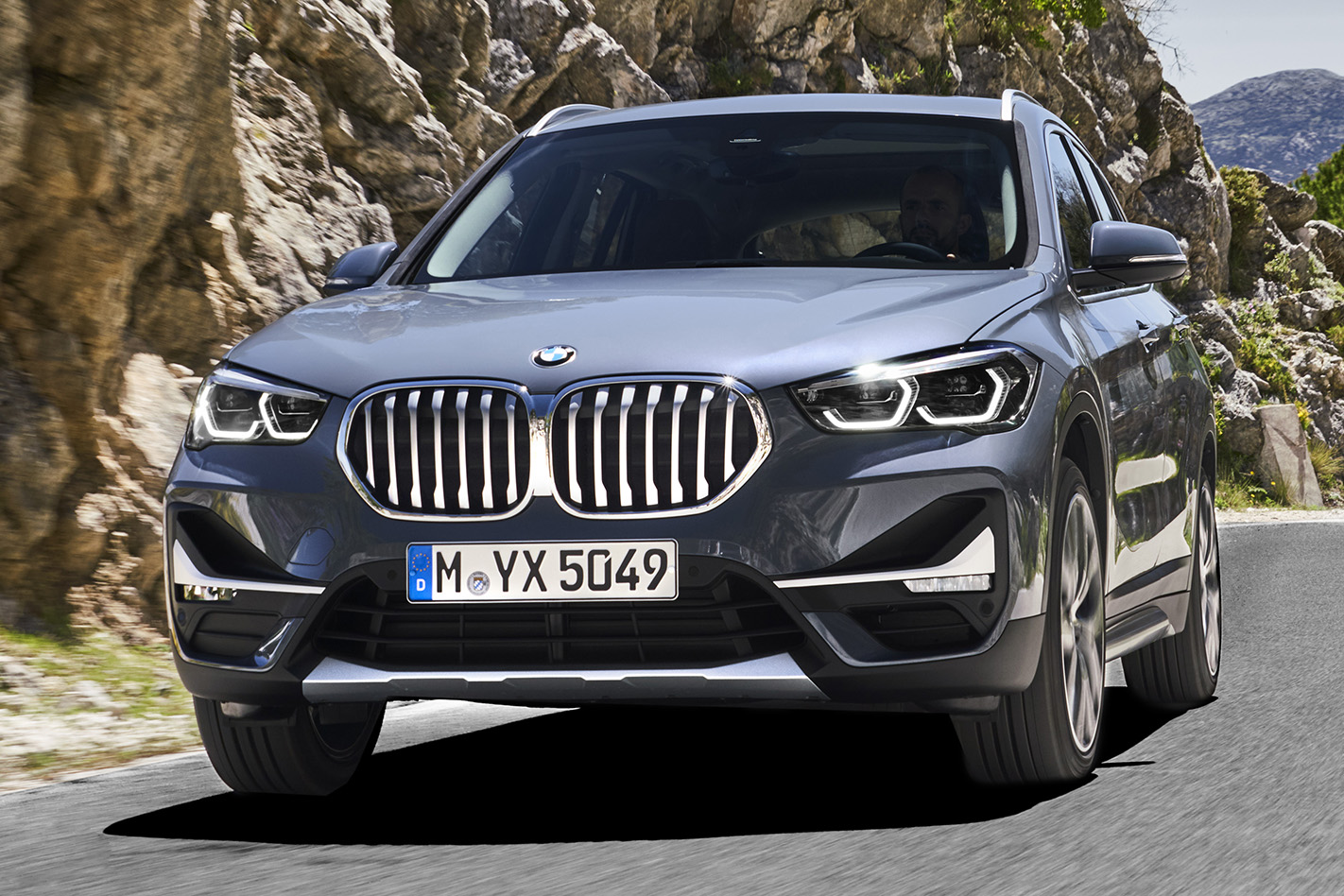
On the inside, you’ll find larger infotainment screens and a wireless phone charging pad as a range-wide standard.
For the sDrive18i and sDrive18d, an 8.8-inch touchscreen is standard-issue, while the sDrive20i and xDrive25i gain a sizable panoramic-format 10.25-inch screen in its place, alongside a head-up display and the extra convenience of a power-operated tailgate as standard.
Besides a new gear selector and some colour changes for trim and upholstery, there are few other changes to the X1’s cabin.
PRICING
The 2020 BMW X1 range is available for order now, with deliveries slated to begin in October
- BMW X1 sDrive18i – $44,500
- BMW X1 sDrive18d – $49,900
- BMW X1 sDrive20i – $48,500
- BMW X1 xDrive25i – $62,900
If you were hoping to discover Ingolstadt has given the 2020 Audi SQ7 TDI a mechanical makeover, you’re headed for disappointment.
However, if the 4.0-litre twin-turbo diesel V8’s 320kW and 900Nm was already enough for you, with its ability to propel the 2.3-tonne beast to 100km/h in just 4.8 seconds, then inside the facelifted model is where you’ll want to focus.
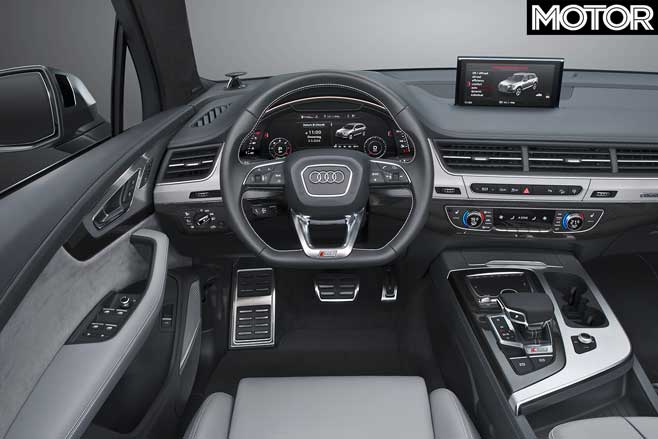
As standard, the new SQ7 comes with Audi’s virtual cockpit with ‘performance view’ (it pretty much just moves the “particularly sporty” tacho to the centre), and MMI nav with touch screen.
The connectivity in the updated SUV also allows navigation using Google Earth, and access to Amazon’s Alexa assistant.
Options now include four-zone air-conditioning, gentle-shut doors, a Bang & Olufsen sound system, and a fragranced and ionized ‘air quality’ package.
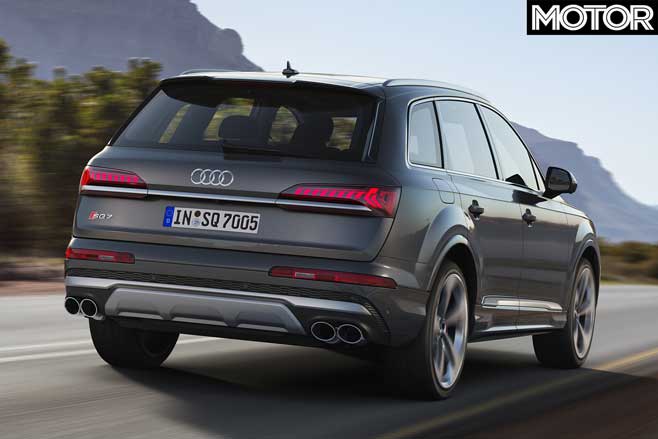
Outside, dynamic laser lights are available to replace the LED matrix lighting which comes as standard.
Further performance-focused elements of the previous SQ7 which carry over to the new model are the electric compressor which essentially acts as a third turbocharger, plus the performance air suspension which allows a raised ride height for driving on rough terrain, or a lowered (by 25mm compared to the standard height) stance for high-speed driving.
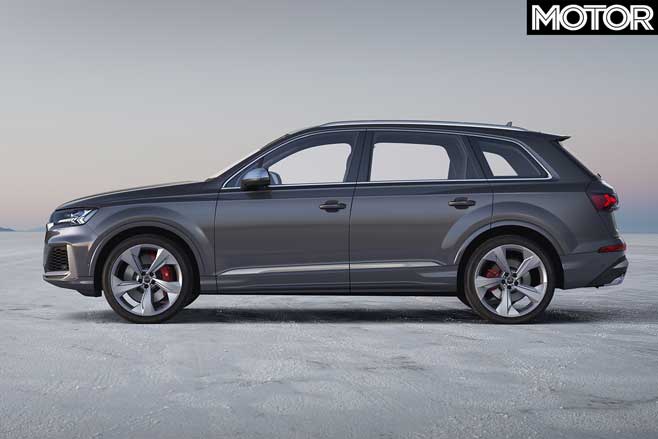
The 2020 SQ7 also keeps the roll-stabilisation from the previous model, which compensates for bodyroll during cornering, and all-wheel steering to make the large SUV more agile in tight corners and more stable on the freeway.
The new SQ7 will go on sale this month in Germany, with an Australian pricing announcement expected from Audi’s local branch before the SUV is available in the first half of 2020.
2020 AUDI SQ7 TDI SPECS Engine: 3956cc V8, DOHC, 32v, twin-turbo, electric compressor Power: 320kW @ 3750-4750rpm Torque: 900Nm @ 1250-3250rpm Weight: 2320kg (2385 w/ 7 seats) 0-100km/h: 4.8sec (claimed) Price: $TBA
Chevrolet’s mid-engined road car is already confirmed to be coming to a Holden showroom near you soon, but a race-hardened GT3 car could also be en route to Australia’s most famous race track.
The C8 Corvette was finally revealed in the metal last week, with the official unveil video confirming rumours that a race car is also in development. Stills taken from GM’s video show a camouflaged C8 with aggressive aerodynamic bodywork and slick tyres attacking a track.
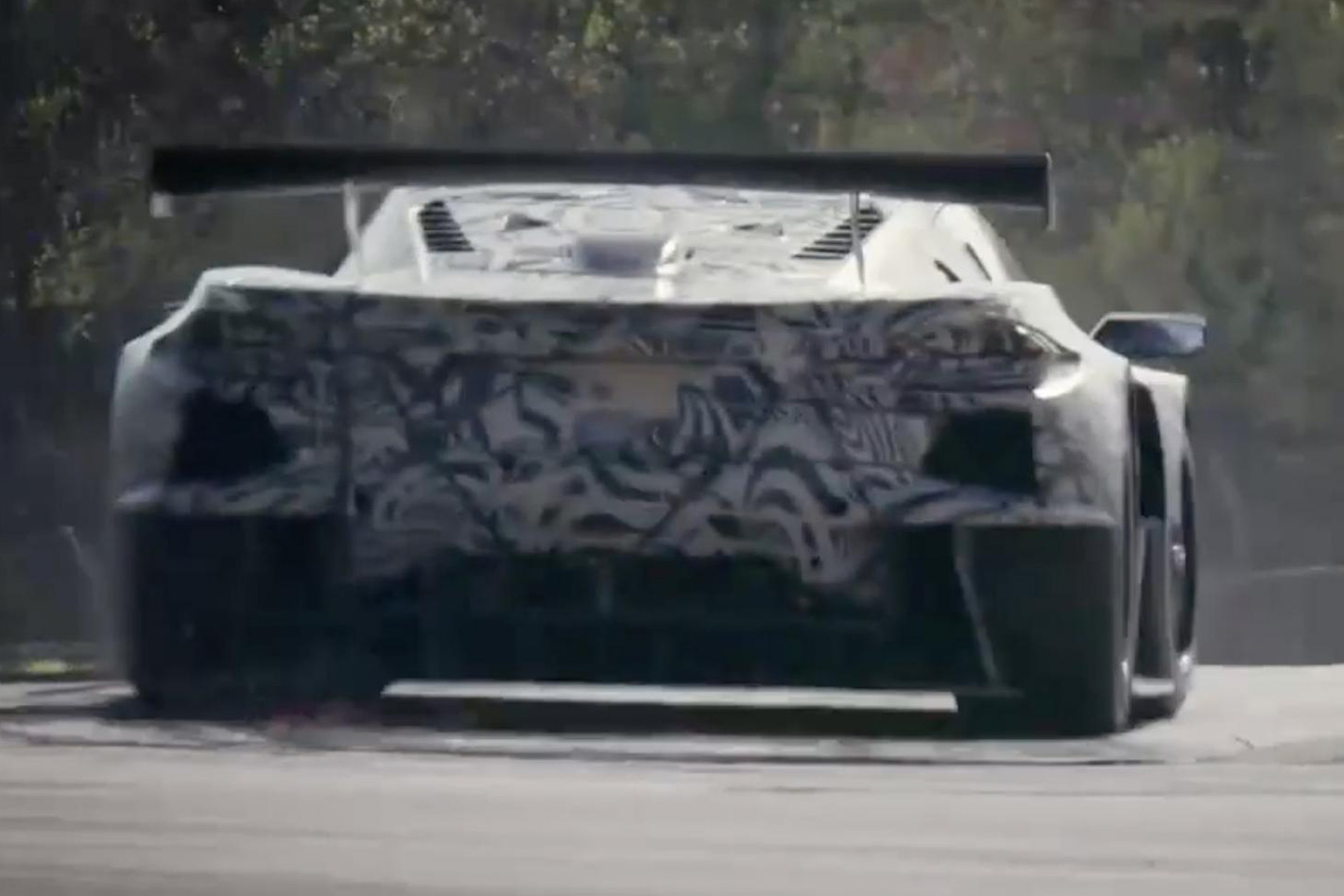
It’s likely this is the C8.R – following the nomenclature of preceding racing ‘Vettes – which will replace the outgoing C7.R.
Built for GTE regulations, the C8.R will then be eligible to compete in the World Endurance Championship, and North American IMSA series, allowing it to take on prestigious endurance events like the 24 Hours of Le Mans, 24 Hours of Daytona, and 12 Hours of Sebring.
It’s believed the C8.R is being developed as part of a joint effort between GM Racing and factory team Pratt & Miller, and will use the same naturally aspirated 5.5-litre LT5 V8 as the C7.R, which is rated to 366kW depending on BoP restrictions.
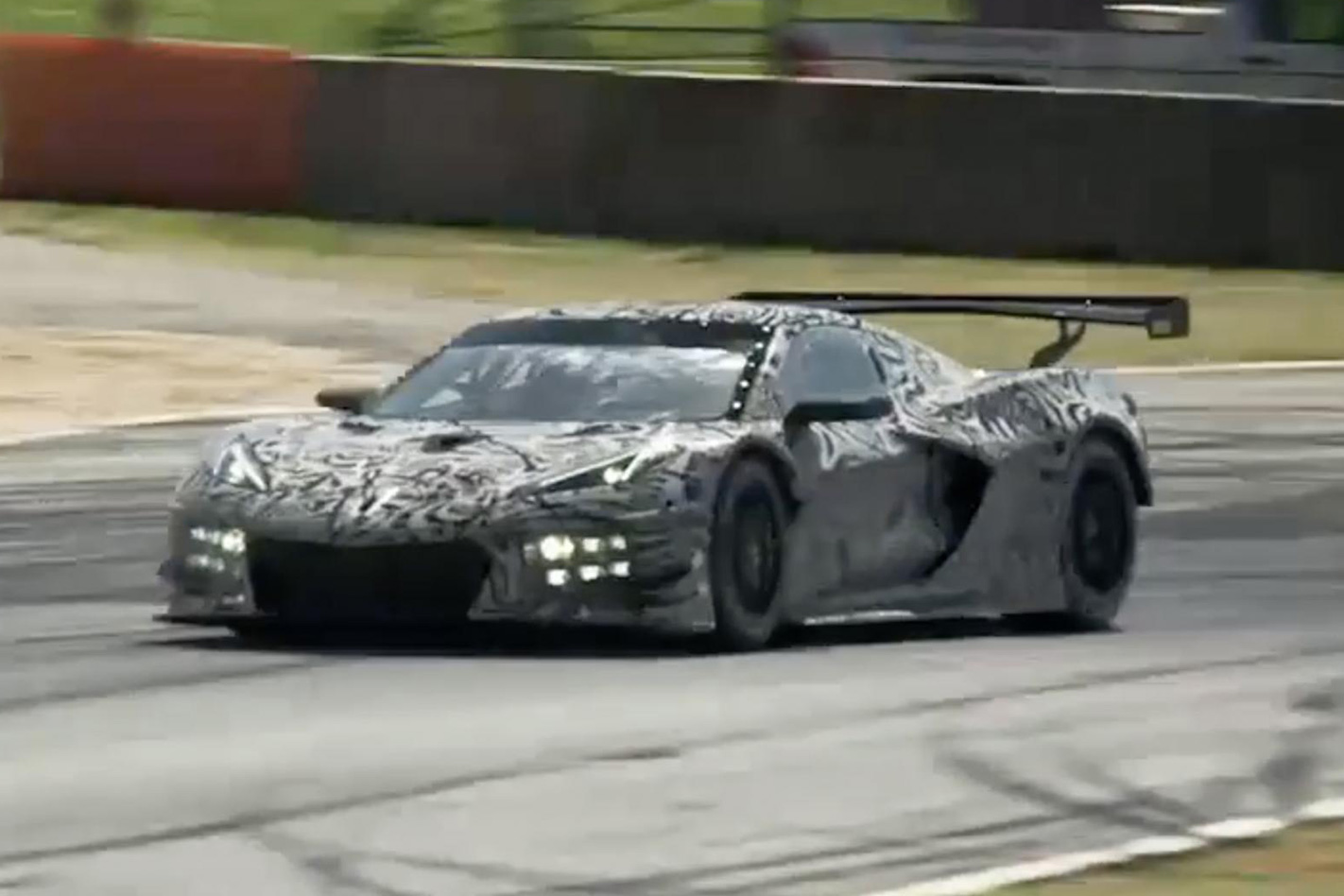
Once the GTE car takes to the track, rumoured to be in time for the 2020 Daytona 24 Hour race, development is expected to begin on a GT3 version of the C8. GT3 regulations differ slightly from GTE in how the car’s aerodynamics and engine performance are balanced, but both rule sets follow the same ethos.
A C8 GT3 would then be eligible to compete in the Bathurst 12 Hour race.
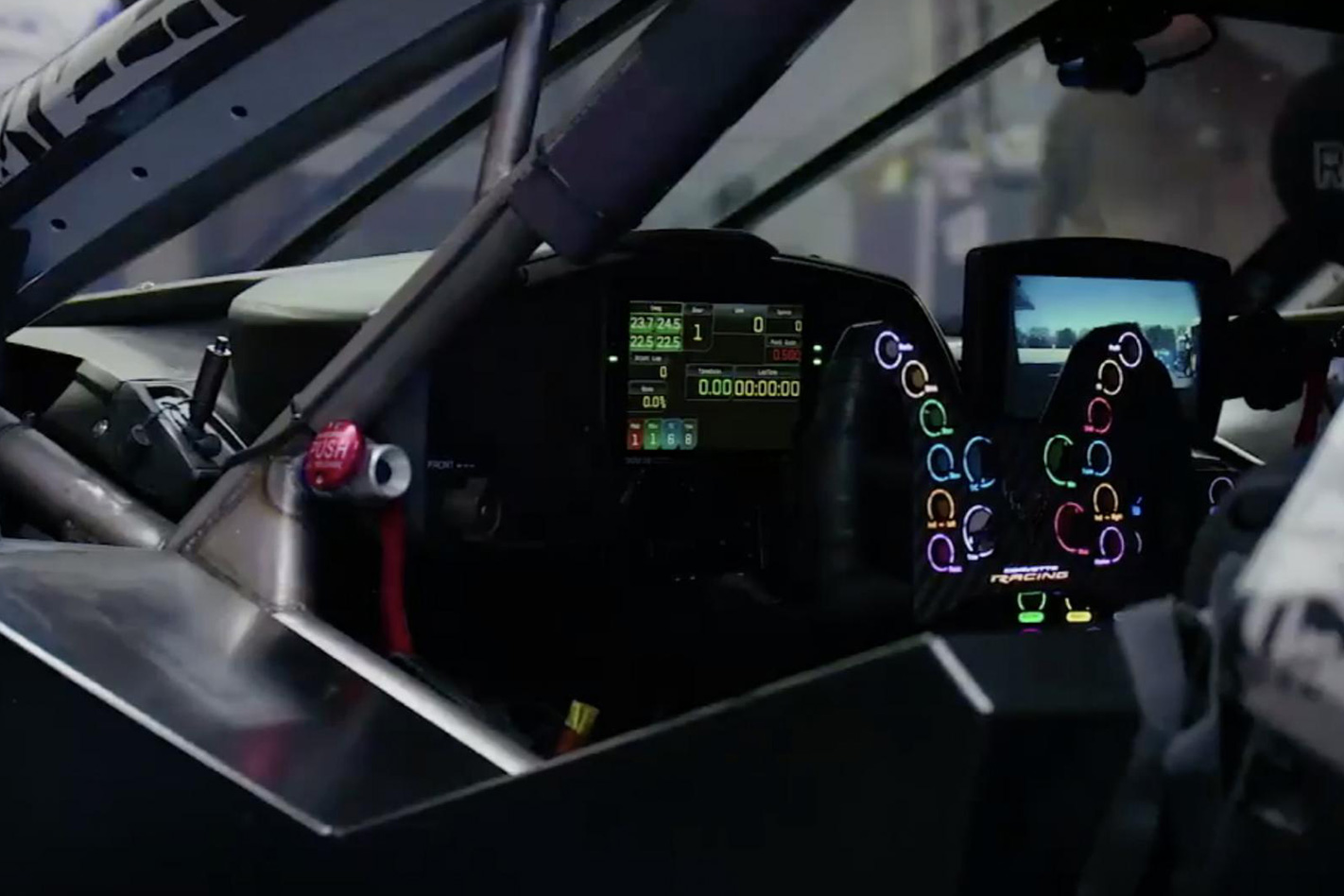
However, a quirk in the Bathurst 12 Hour’s eligibility requirements could mean a C8 GT3 might not be allowed to take on the mountain until 2022 at the earliest. Taking place in February of each year, the Bathurst 12 Hour only allows GT3 cars homologated for the previous year to compete. With a GT3 version of the C8 not expected until 2021 at the earliest, this means GM fans could be waiting a while to see the mid-engine ‘Vette take on Australia’s longest circuit race.
2020 Chevrolet Corvette: this is it!
An Australian assault for the C8 GT3 would make sense for Holden, which uses Triple Eight Engineering to run its factory Supercars team. Triple Eight has begun to dabble in GT3 racing, running a Mercedes-AMG GT GT3 at this year’s Bathurst 12 Hour, with Craig Lowndes, Jamie Whincup, and Shane van Gisbergen behind the wheel. A Corvette racer would be a natural fit for the Gold Coast-based team.
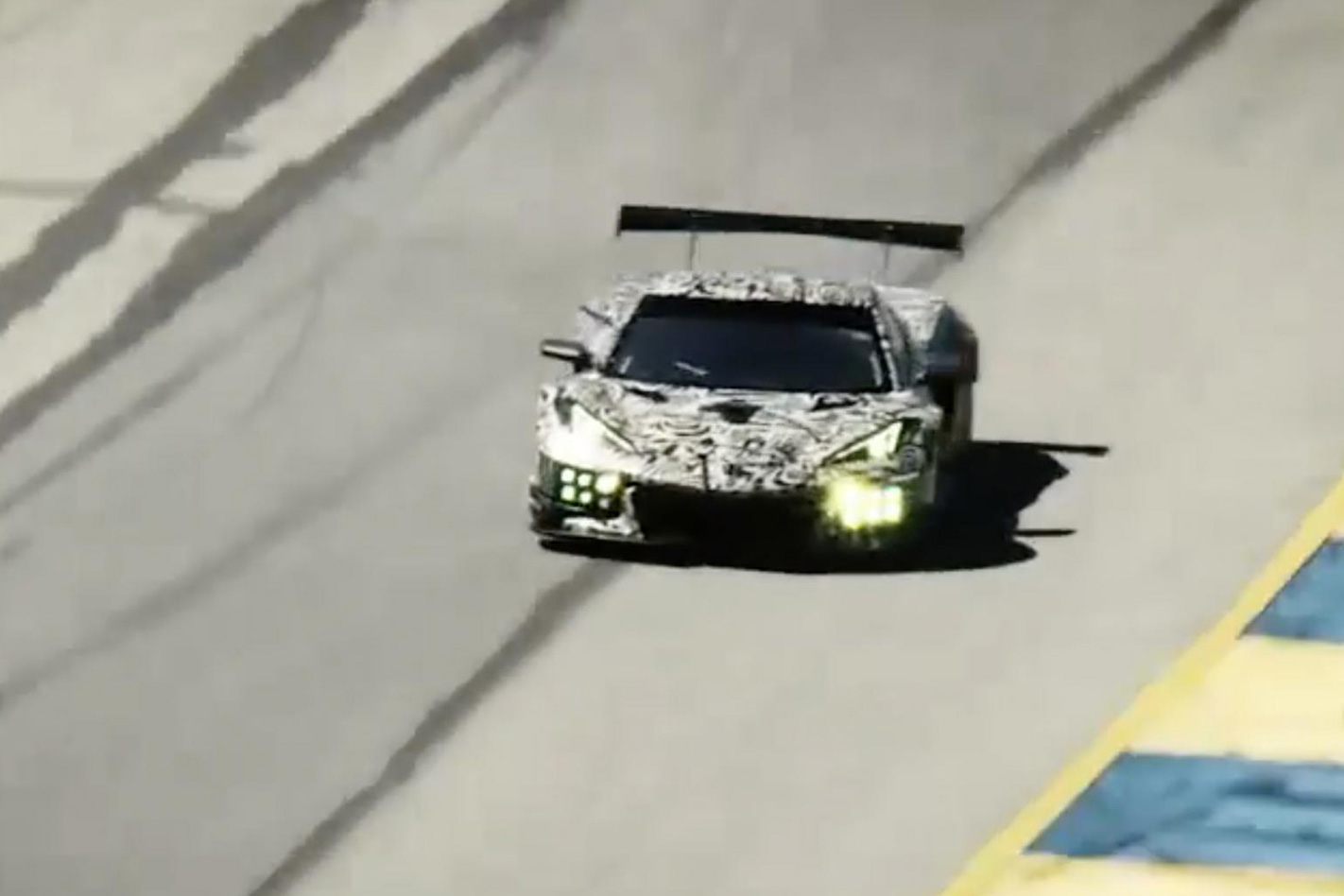
While a move to a mid-engine layout has been on the cards for the Corvette road car since the 1970s, it’s a decision which will have numerous benefits for the racing program.
Under GTE regulations, mid-engined cars like the Ferrari 488 and Ford GT have developed an aerodynamic advantage. It’s the same reason that Porsche’s 911 RSR moved from a rear- to mid-engine layout.
Kia’s latest SUV model is only months away from landing in Australia and local tuning for our bumpy roads and particular driving tastes is almost complete.
Announcing specifications for its compact Seltos SUV today, Kia also confirmed it completed bespoke local tuning that’s destined for Australian versions – a key point of difference for previous models in the South Korean car maker’s lineup.
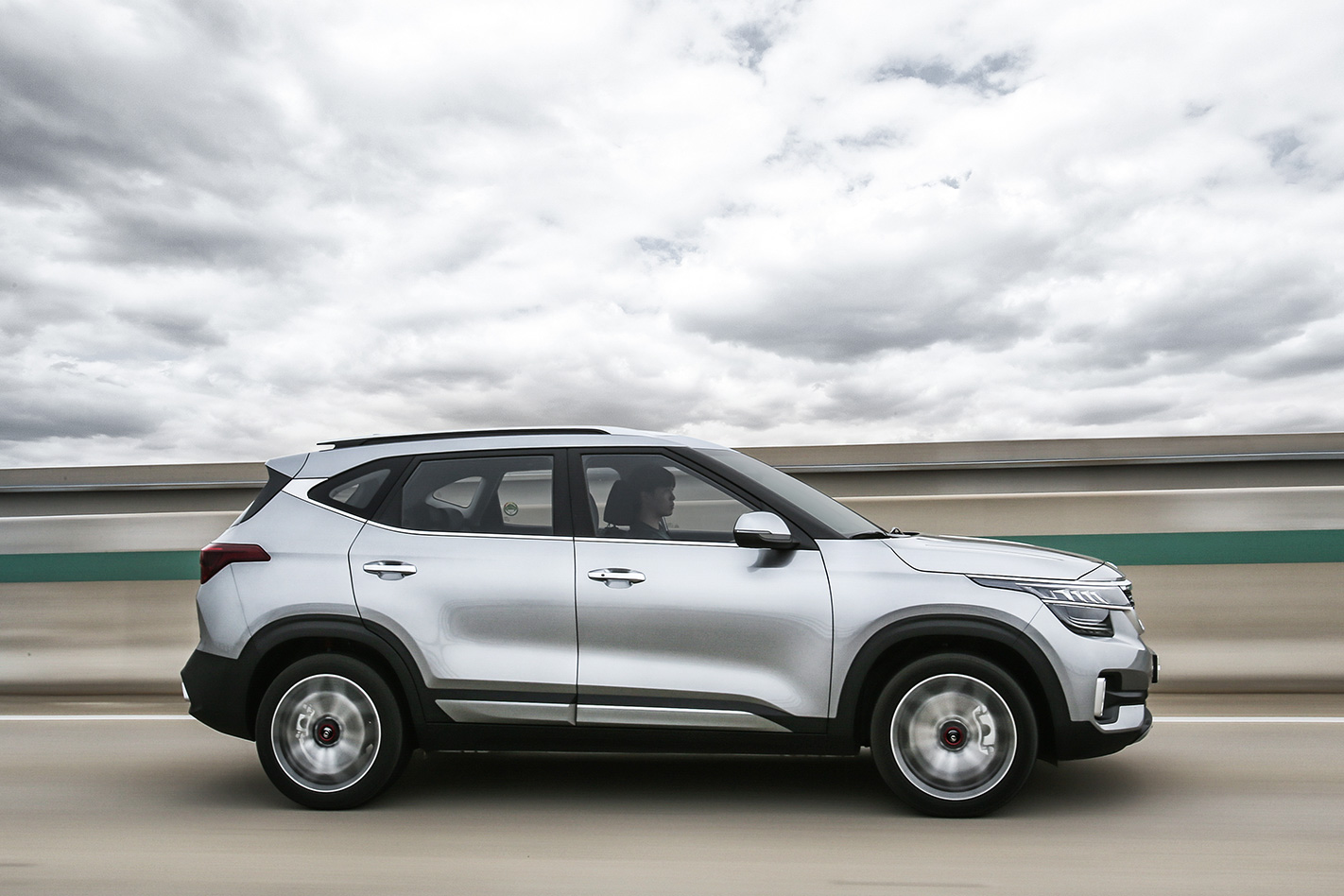
The ride and handling package for the Seltos, which sits on a 179mm ground clearance, was developed by the Kia Australia team both locally and overseas.
“All models for Australia will have the bespoke local tune which has become one of the key characteristics of all Kia cars sold in Australia,” it said in its announcement.
“The ride and handling package for Australia was developed by the Kia Australia team over thousands of kilometres both in Korean test facilities and on Australian roads.”
Compact SUVs get set to take over Australia
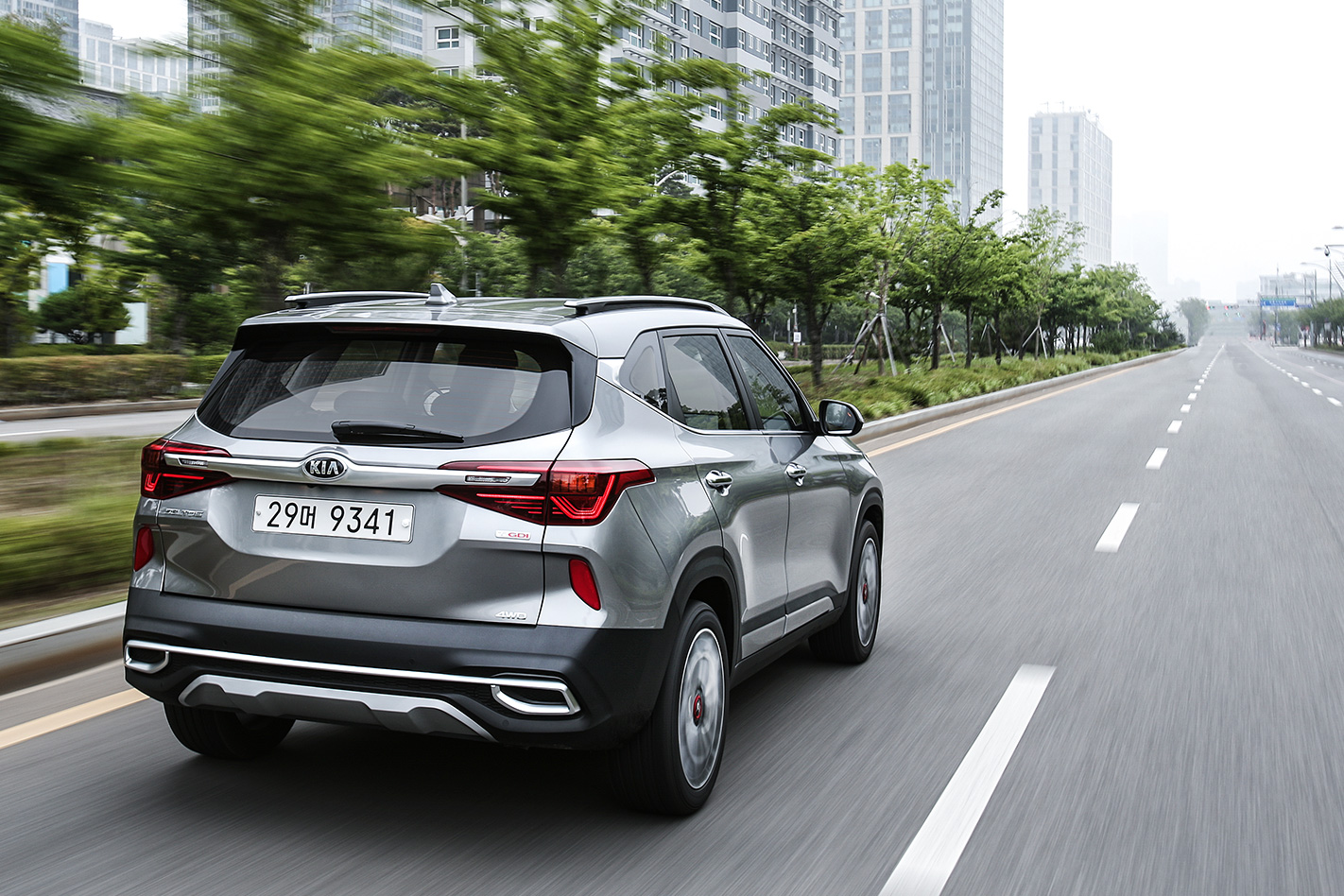
The Seltos is scheduled to go on sale in Australia fourth quarter this year, though pricing and specifications for models is yet to be confirmed. It will however come with either front or all-wheel-drivelines that can play a pivotal difference in handling – FWD variants are limited to a torsion beam rear suspension setup only while AWD models get a more sophisticated multi-link arrangement.
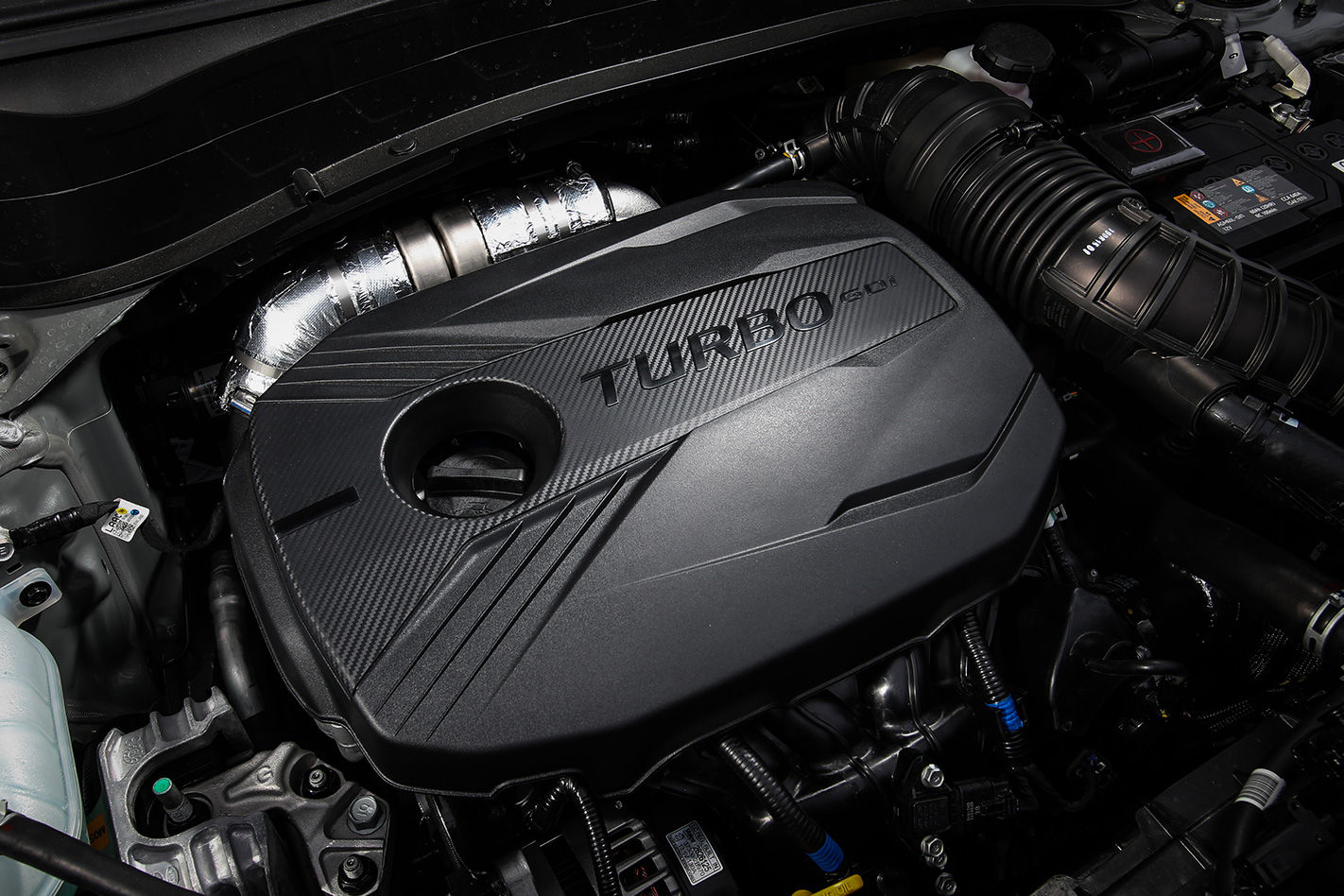
Built in Kia’s Gwangju, Korea facility models will come powered by either a 1.6-litre turbo or 2.0-litre naturally-aspirated four pot petrol or 1.6-litre diesel turbo – the same drivetrains available in its Hyundai sibling the Kona. The turbo petrol Seltos is the perkiest of the bunch, producing 130kW and 265Nm and recording a claimed 0-100km/h sprint in 8.0sec. Both 1.6-litre engines get a seven-speed dual-clutch transmission while the 2.0-litre is limited to a CVT.
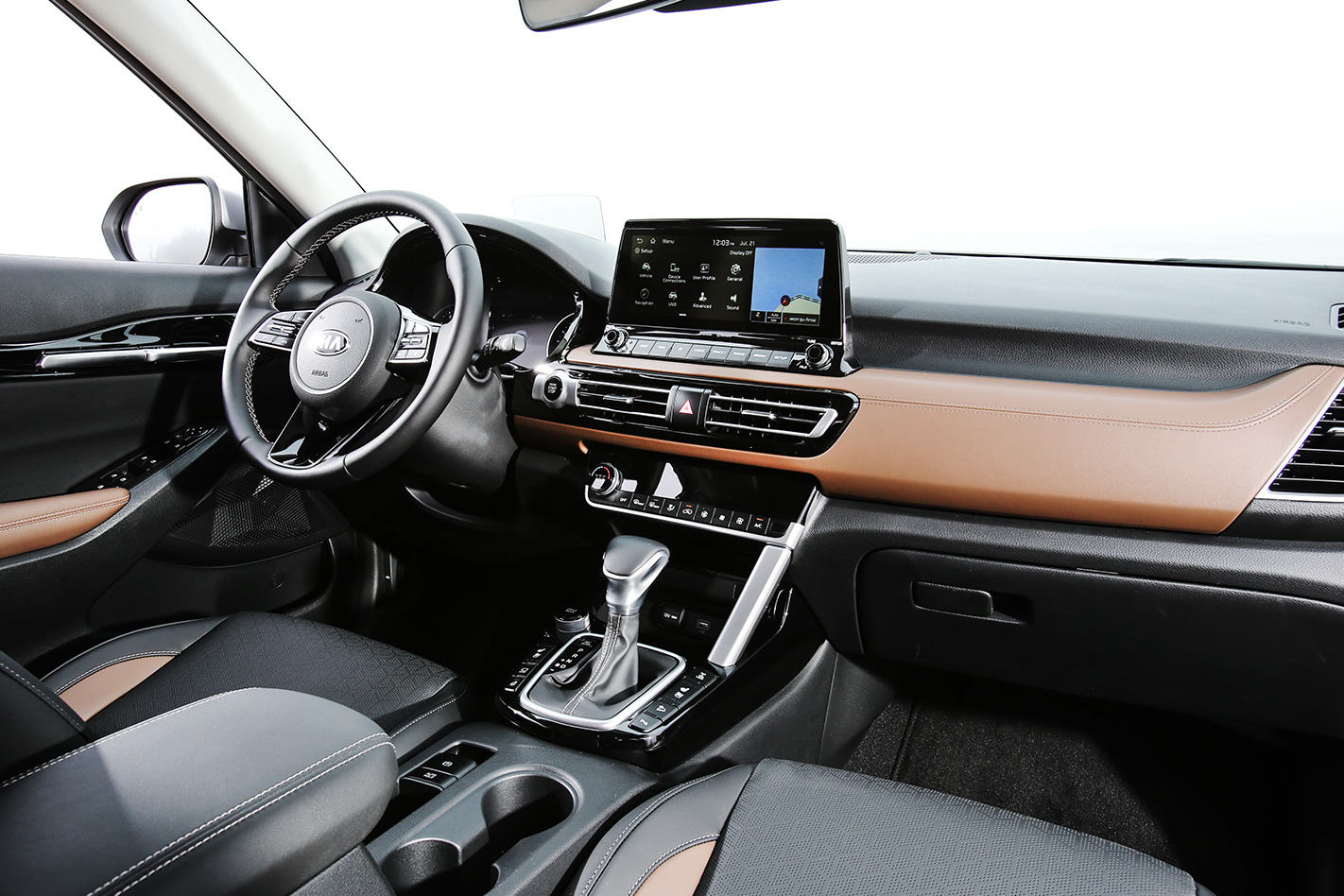
Other gear likely to arrive in Australia to meet ANCAP safety ratings include a bevvy of safety systems such as ‘Level Two’ autonomous lane following assist, rear-view monitor for slow-speed maneuvers and safe exit function that will warn occupants not to open the door into on-coming traffic.
“The Seltos is an important car for Kia as it will play a central role in our international growth,” said Kia president and CEO, Han-Woo Park,
“The Seltos brings Kia strengths in design, quality and technology to this popular segment.
“In the Seltos, we have created a car that can fulfil the diverse needs of customers in markets all around the world.”
