
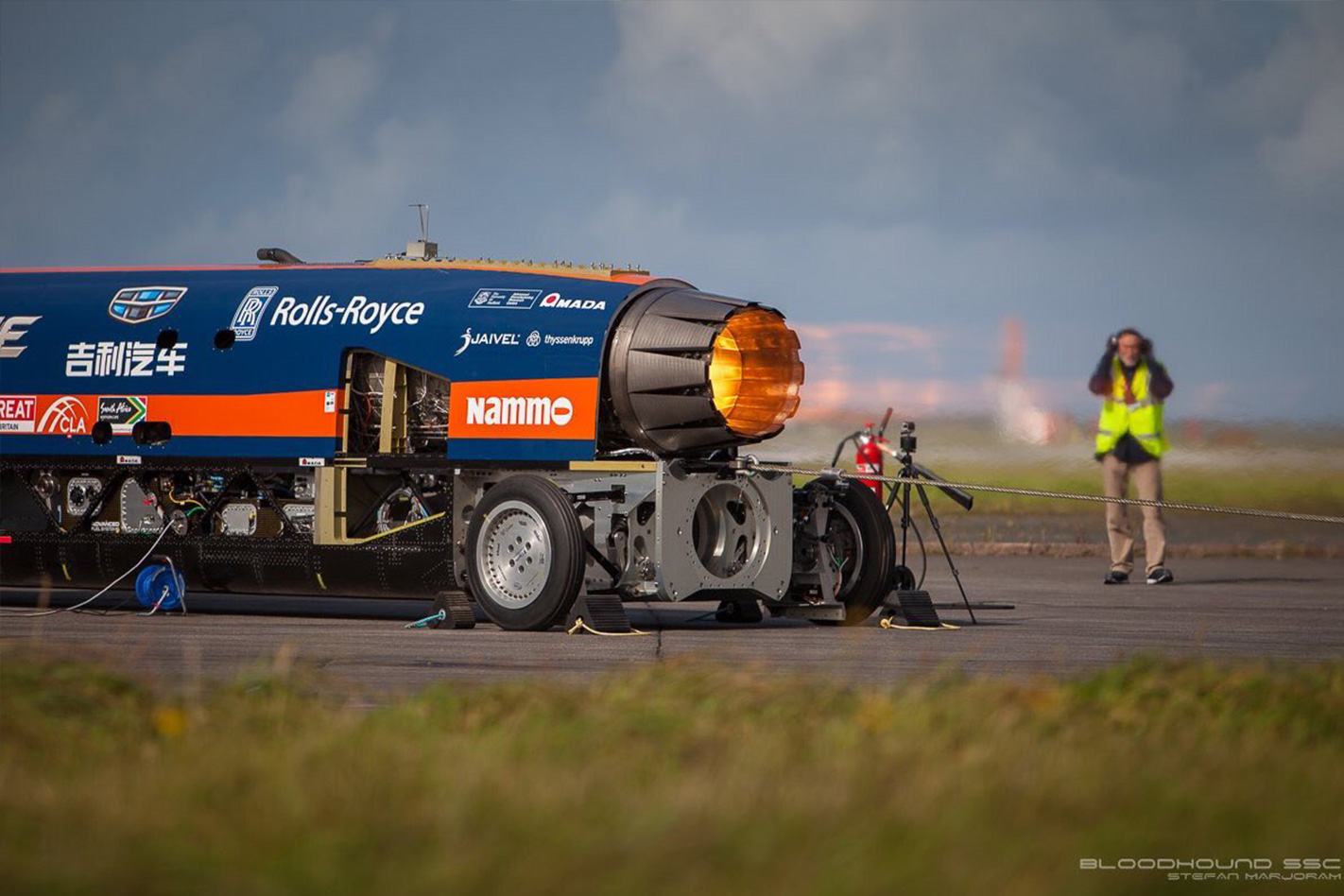
BLOODHOUND SSC‘s Rolls-Royce jet engine was successfully fired up for the first time this week.
It’s a significant step forward in the life of the land speed record contender, which will make its debut shakedown run in England later this month, followed by 800mph (1287km/h) and eventually 1000mph (1609km/h) record attempts in South Africa.
It’s a good time then to revisit the carbonfibre capsule, pictured below, that will be home to Andy Green as he bids to smash his own 763mph (1228km/h) land speed record and become the first man to top 1000mph.
On a nondescript industrial estate in Bristol, England, Green invited Wheels to step inside the world’s fastest office.
Green is tall – 193cm – and there’s no disguising just how claustrophobic it will be. The team doesn’t have a back-up driver, so everything has been built around the RAF Wing Commander.
Simple toggle switches flank his legs and ahead are three digital screens. The central screen shows the speed in both miles per hour and the Mach number (Mach 1 is the speed of sound), plus the jet engine and rocket outputs. The screen to the left monitors the braking systems while the one on the right shows the condition of the propulsion system.
There are also analogue instruments for speed and time, provided by Rolex, which have a separate GPS and battery system – if the electrics fail they’ll keep ticking. “It’s critical I know what speed I’m travelling at,” says Green. “If you deploy the parachutes when you’re travelling too quickly, they’ll just be ripped away.”
Bloodhound has the equivalent of 100,670kW and employs a 560kW, 4.2-litre V12 race engine just to drive the rocket’s oxidiser pump.
Everything about this car is supersized. It will accelerate from 0-1000mph in just 55 seconds, by which time it will be covering a mile every 3.6 seconds and outrunning its own sound waves. At these speeds, nothing can be left to chance. The windscreen has even been designed to withstand the impact of a 1kg bird at 900mph.
The team admits its biggest challenge was balancing aerodynamic forces across the speed range. Too much downforce and the nose digs in, too much lift and Green will be employing his pilot skills. The team is confident this tricky conundrum is resolved, but the driver will still have to steer the car in a straight line.
“We can model the car’s stability,” says Green, “and we know there’s a low point around 600km/h. I’m going to be quite busy then.”
Anyone who has seen the extraordinary footage of Green applying opposite lock at Mach 1 in the Thrust SSC record car will understand what ‘busy’ means, but the man himself is unconcerned.
“I am a fighter pilot; this is what I do.”
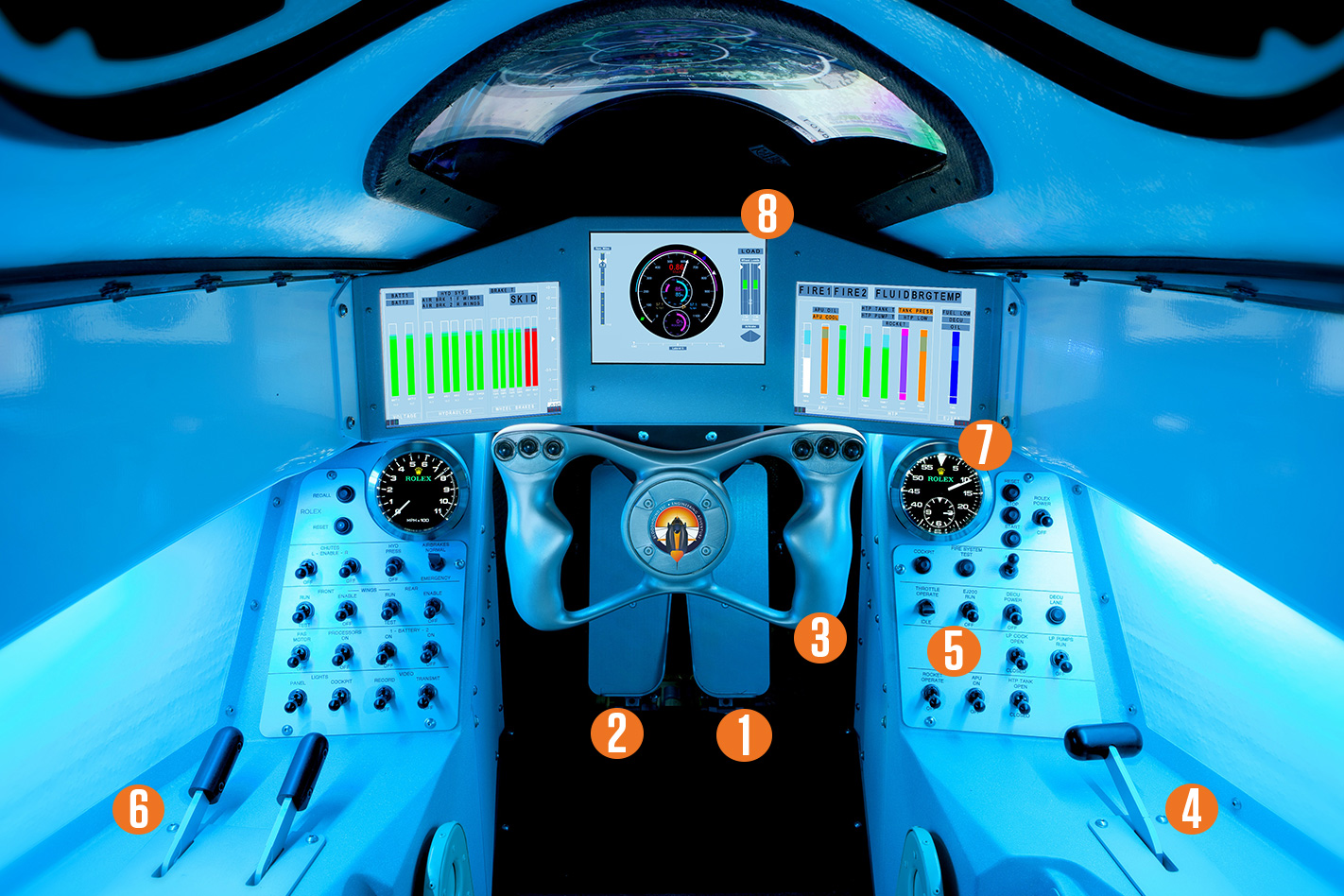
1. The go pedal. This is the throttle for the Rolls-Royce EJ200 jet turbine, which produces as much thrust (90,000Nm) as a Eurofighter Typhoon.
2. The whoa pedal. Green will have to freewheel down to 1300km/h before the air brakes can deploy, slowing Bloodhound using 20 tonnes of air resistance. At about 1000km/h the parachute comes out. The speed then has to fall below 320km/h before the friction brakes can be applied.
3. Steering wheel, made from lightweight powdered titanium on a 3D printer. Includes buttons for rocket ignition, parachute deployment, radio, and an ‘abort’ switch that throttles back the engine and rocket.
4. Manual cut-off that shuts down fuel flow to the 1000kg jet engine. Bloodhound will suck down as much as 390 litres of fuel on a run, and 64,000 litres of air each second at full noise.
5. This switch activates the rocket motor to help Bloodhound reach V-max, using almost a tonne of hydrogen peroxide oxidant and a tonne of highly combustible rubber.
6. Manual override in case the buttons on the steering wheel that control the two-stage parachute release fail. The parachute – there’s also a back-up ’chute, just in case – provides up to 3G of deceleration.
7. If things go wrong, Green has access to a fire suppression system that can instantly flood the cockpit. Green has enough oxygen supply for three five-minute runs, with an extra half-hour in reserve.
8. All the vital info Green needs to monitor, including speed, target speed, flying mile speed, warnings for the rocket and jet engine, and green lights for things such as the safe speed to pop the ’chute.
On the face of it, the GT-P is a distant third place when it comes to big, local talent. And against the stopwatch that view is hard to dispute.
This Performance Car Of The Year article was first published in MOTOR Magazine November 2008.
With 0-100km/h coming up in six-dead (eight-tenths slower than the HSV) and the standing 400m in 14.0 at 169.2, the GT-P also trails the other pair by a fair chunk at the end of the kilometre with 25.0 (at 217.6) almost a full second behind both the F6 and the GTS.
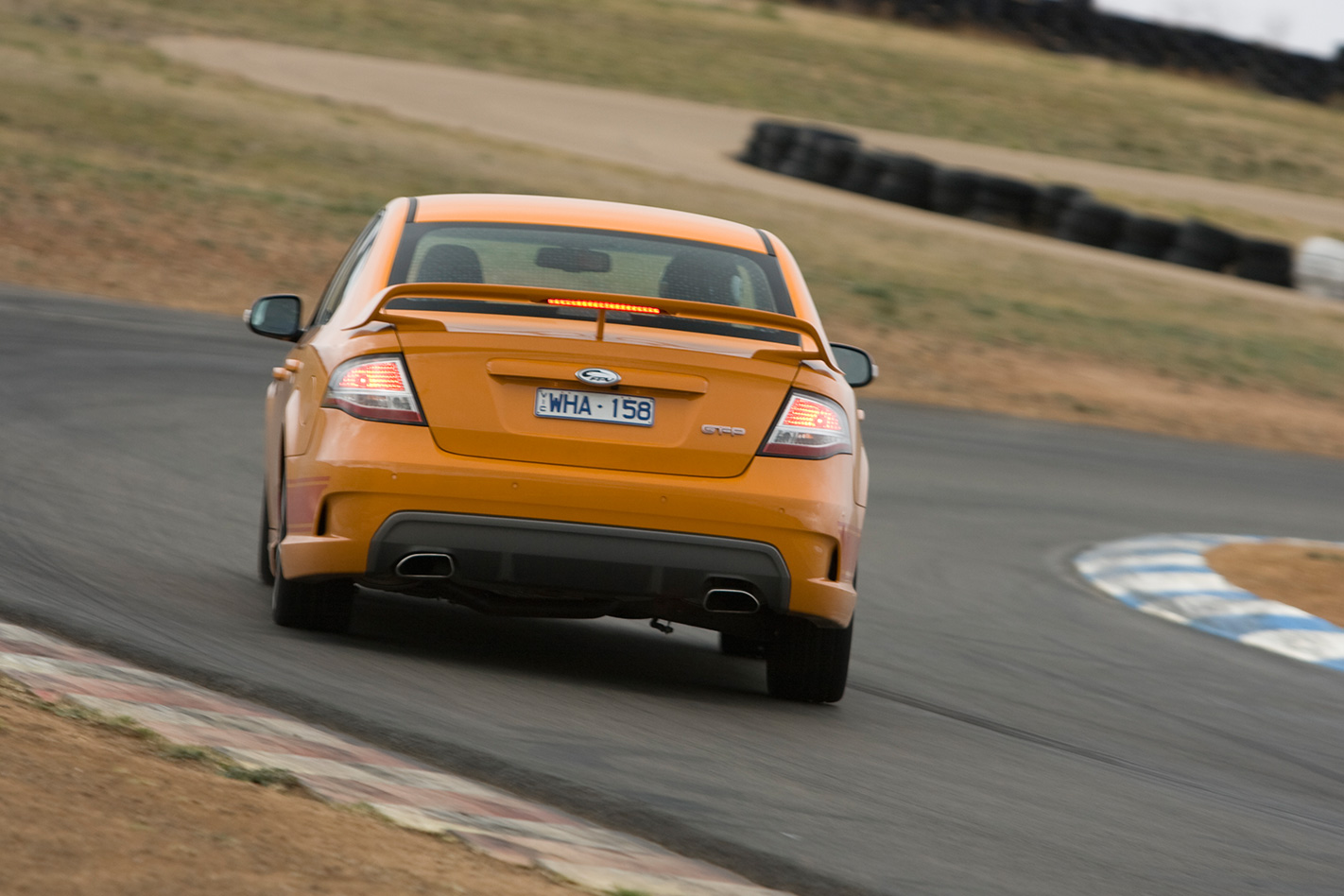
The V8 FPV simply requires more forward planning on the track if you’re going to nail the apex every time. The extra weight over the front wheels makes it a bit pushy and there’s less suspension control in evidence. Neither is the GT-P as adjustable via the throttle when it does all start to slew around although, that said, it’s still a pretty good drift weapon if you’re that way inclined.
Let’s see: more mass, same rubber and brakes as the F6. No surprises there, then. Of course, the GT-P was the only local car to be running an automatic gearbox, and that’s a bigger part of it than you might imagine.
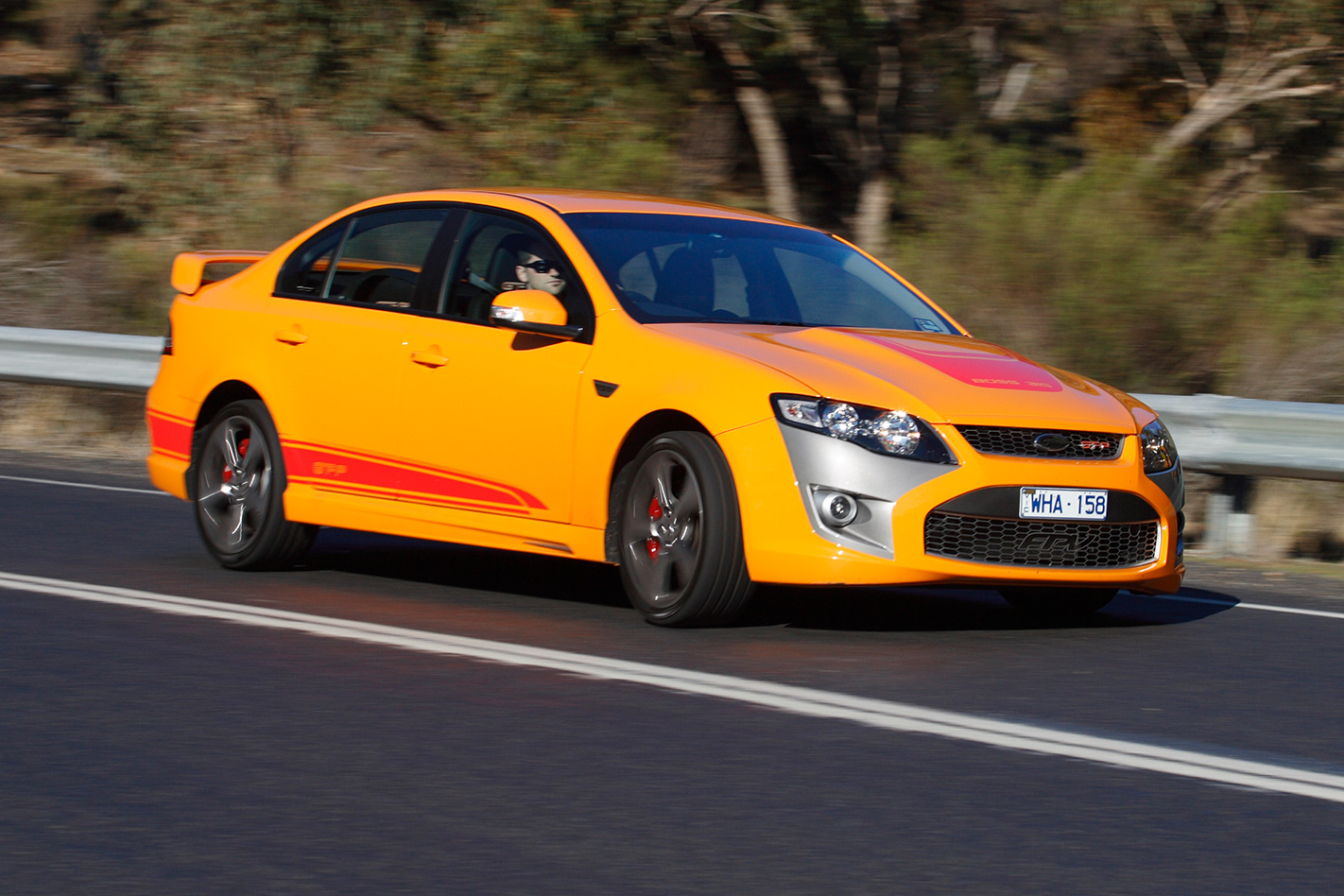
The auto tranny suits the GT-P perfectly and is a metaphor for the whole way the GT-P plays out in the real world. It is clearly more about eating interstate runs than blitzing a 70-second lap. See, if getting somewhere relatively nearby in a real hurry is your go, then there are better cars than the GT-P.
But if covering big distances with minimum fuss and maximum comfort is on the agenda, then you could do a lot worse. Let’s start with the seats. The front chairs would have to be among the best in the game. You need to climb over the side bolster and free-fall into the cushion a little, but once you’re there, it’s bliss.
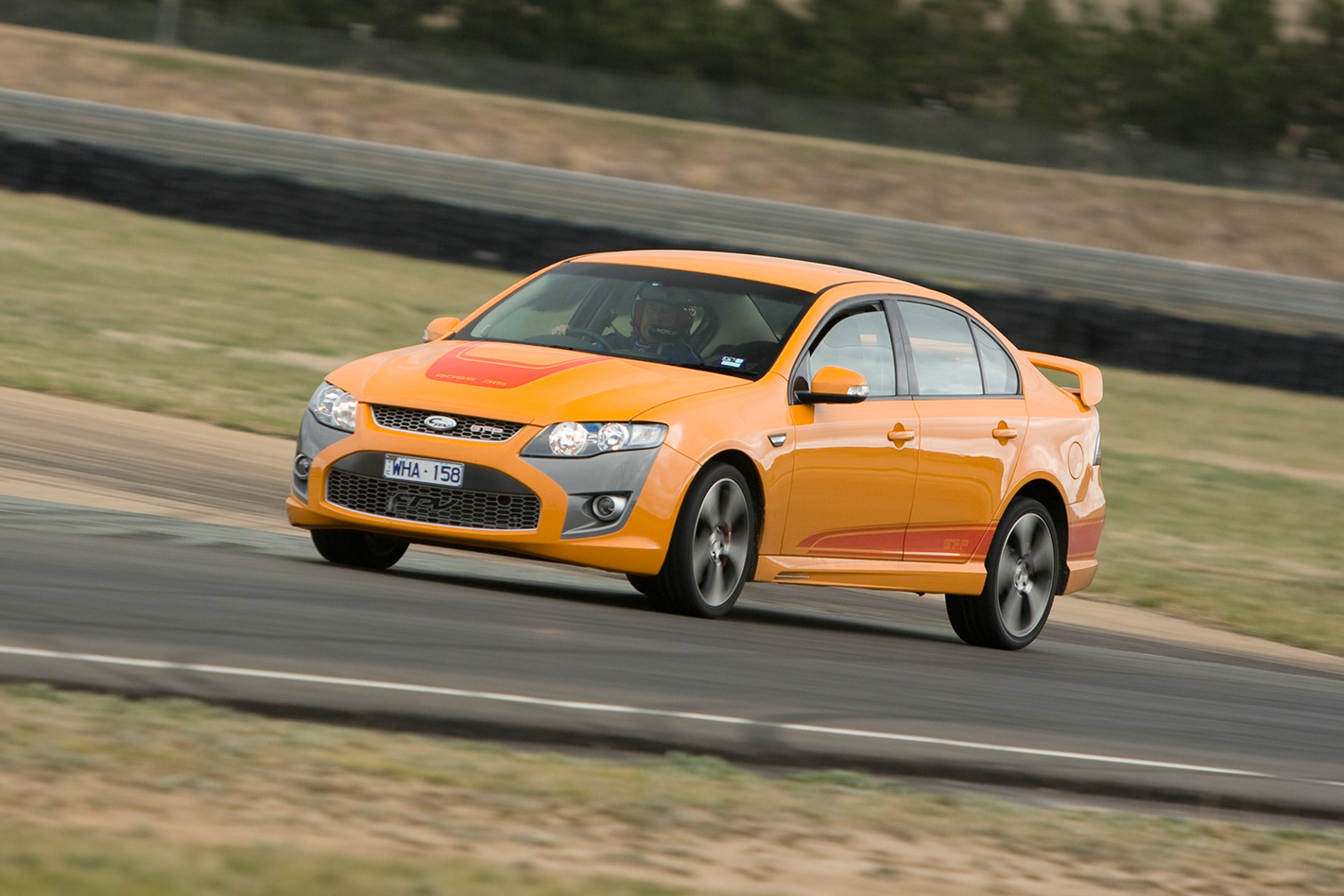
And once you’re up and rolling, the V8 does a good job of both keeping you moving and soothing you into thinking this might just be one of the all-time great Aussie Grand Tourers. Which it undoubtedly is. Sure, you’ll pour a few extra litres into it over the F6 on the same cruise, but pointing that big, orange bonnet-bulge at another state or territory and letting her rip is what the GT-P is all about.
A shame, then, that it will rush you around for $77,190 or just under a grand less than the HSV, because when you consider the merits of the pair, the GT-P just isn’t the all-rounder it probably should be.
I HAD a couple of near misses on the motorway while driving between Switzerland and Spain last week. Both were a direct consequence of the adaptive cruise control of the car I was driving.
That got me thinking whether some of the safety features built into modern cars aren’t all they’re cracked up to be and, worse still, often go through a phase of regressing safety before they develop into genuine benefits.
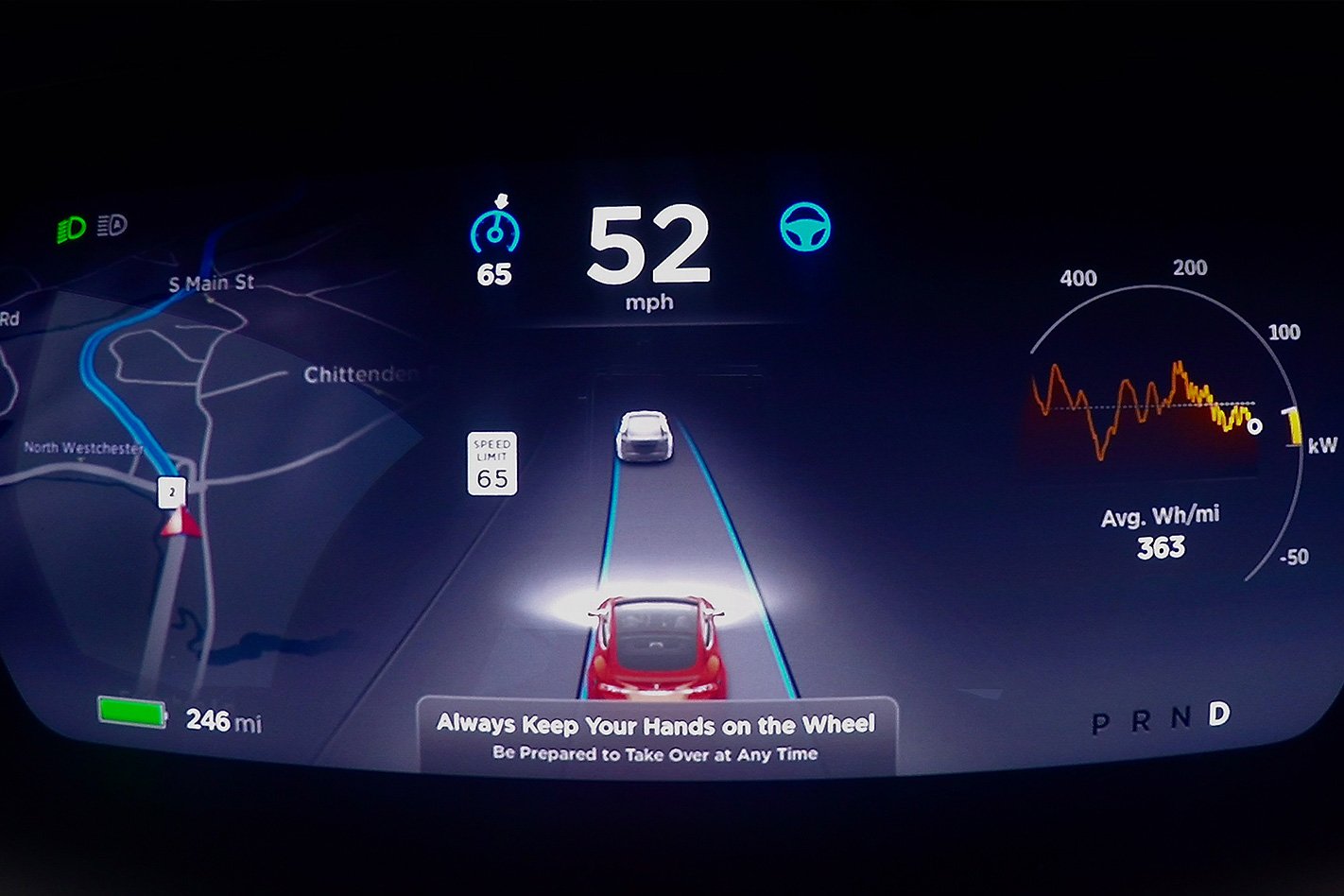
Naturally, car makers will quite reasonably insist these systems are merely an aid to driving convenience, and that an alert driver should retain control of the car at all times. But it takes a near miss or two before you realise when you have to intervene. The result of this software boneheadery is obvious, and results in the overtaking car not expecting you to be where you are and giving you a heinous chop as it pulls in, the second instance requiring me to throw on the anchors as a Range Rover came within millimetres of demolishing my front three-quarter.
The new Volvo XC60 I drove on launch earlier this year had a combination of lane-keep assist and adaptive cruise. Pair the two and the car would drive semi-autonomously, for a while at least. Yes, you were supposed to keep your hands on the wheel, but almost everyone who buys this car will be intrigued to find how long the car will drive itself. It’s human nature to try to game the system. The answer is for about 20 seconds, whereupon the system just switches off. If you’re on the inside of a freeway sweeper, this means that the car would then straightline across the other lanes. And, because it has a suite of lane-keeping camera tech, it will know exactly what it’s doing.
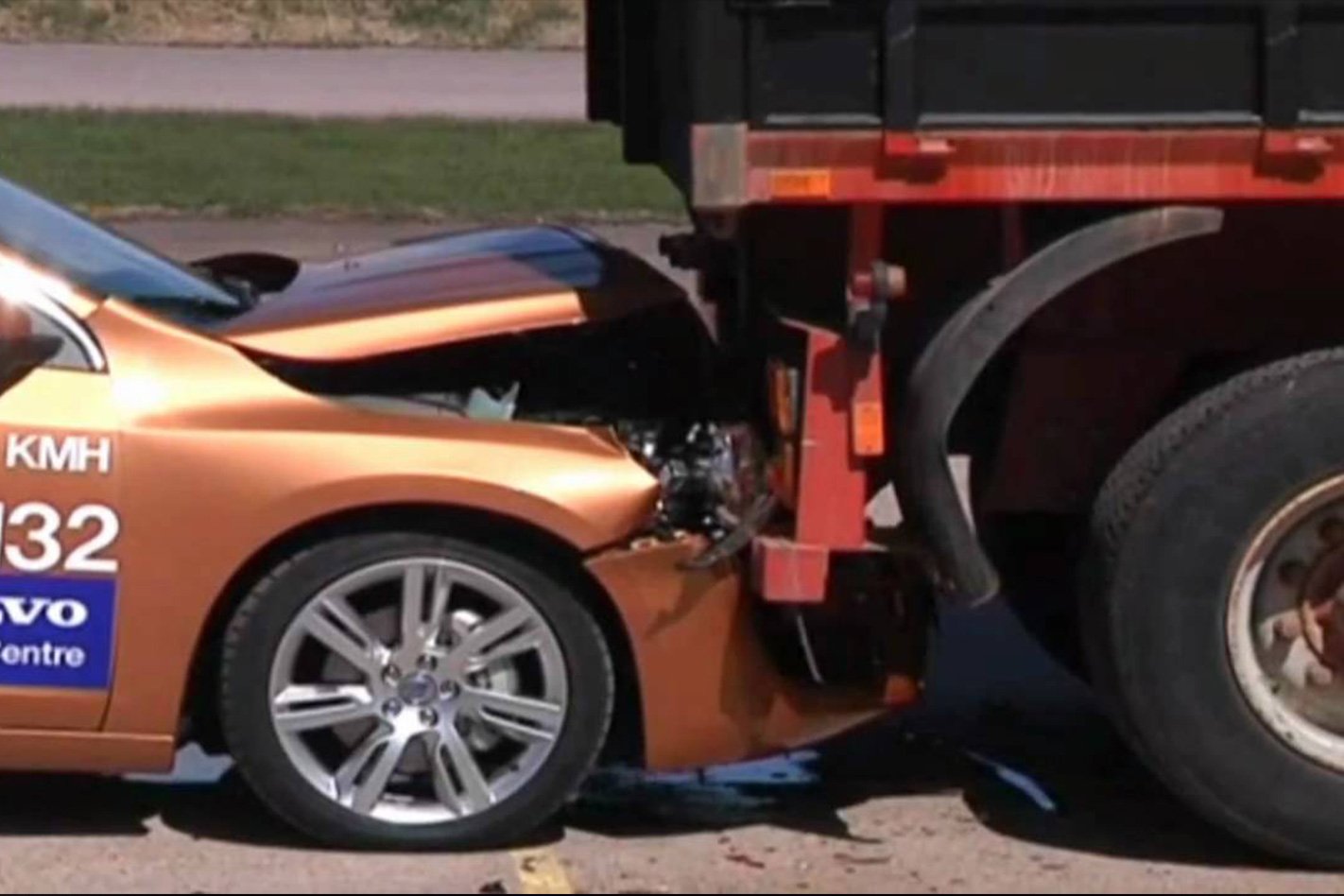
So the message is clear. While the intention of many of these systems is laudable enough, almost all of them must pass through a phase where programming glitches or hardware shortcomings contrive to make them less safe than their billing. So before you engage that button, just remember that this tech is a work in progress. And like it or not, you’re a beta tester.
WHAT’S going on here? Has the world stopped spinning and suddenly up is down and left is right?
This feature was first published in MOTOR magazine November 2008
Something’s gotta be askew. Lamborghini has just revealed a four-door sedan that it reckons will become its best-selling model by the time it (possibly) hits public streets in 2012.
Ever since it ploughed its way out of the tractor business, the Italian company has – apart from a blip on the radar with the LM four-wheel drive of the 1980s – remained one of the most pure sports-car brands of all time.

That was until this month at the 2008 Paris Motor Show, when it pulled the covers off the front-engined Estoque concept car and predicted that a sedan – even a ‘super sports sedan’ at that – will not only become its sales leader, but overtake a raft of similar hi-po four-doors from its prime rivals.
By the time (or if) the Estoque hits the autostradas, its niche segment will be relatively crowded as Porsche’s Panamera and Aston Martin’s Rapide will have already joined the pioneering Maserati Quattroporte.
But arriving fashionably late to the four-door festival doesn’t phase the folks at Sant’ Agata as Lamborghini suggests that the Estoque will be, of course, in a different league (as any PR department would). “It is not a high-performance version of an existing vehicle, and it is not a Lamborghini body on somebody else’s platform, either.

How this will be executed is yet to be determined, but the Parisian debut was the first step in the approval process, where reaction was gauged to the concept itself and whether the Estoque should be manufactured at all. In its favour is a volatile world market and a need to strengthen Lamborghini’s line-up.
“In the first six months of 2008, revenue is up 9.6 percent, and profits have soared by 32.5 percent,” explains the extrovert Lambo MD, Stephan Winkelmann.
“But let’s not kid ourselves. These are now truly tough times, and the business is quite volatile, so three legs are invariably better to stand on than two.” Lamborghini looked at a number of options for its ‘third leg’, including a Miura successor (remember the 2006 design exercise?), an LM reincarnation and a front-engined GT. The four-door ‘Supersportwagen’ eventually got the nod.

To satisfy these clients, who are used to the space, comfort and convenience of a full-size luxury sedan, we generated a truly generous package free of head and legroom compromises.” The provisional numbers support these claims.
At 3010mm, the Estoque rides on a wheelbase that matches the new BMW 7-Series, it’s nearly as long as an S-class, has the width of a Rolls-Royce Phantom (1990mm) and the height of a Ferrari 612 Scaglietti (1350mm).
Overtones of the million-dollar Reventon are evident in its design, despite the Estoque’s unique front and rear ends, while the 23-inch rear and 22-inch front wheels sit inside muscular wheelarches for an aggressive, yet elegant overall aesthetic. And Lambo is quick to claim such dimensions prove the Estoque is a cohesive ground-up package and not an ad-hoc, rushed-to-the-market four-door.

The Estoque’s generous dimensions are likely to be derived from Audi’s ASF (Aluminium Space Frame) technology – the most pragmatic choice in terms of investment, weight saving and modularity.
Although the Italians are determined to keep the weight of their new baby as close to the 1600kg mark as possible, complying with all the latest safety standards (pedestrian protection, five-star NCAP, 2015 side impact) is bound to add some weight. Active aerodynamics may also add a few extra calories.
Since the bad-boy front end is not exactly of the low-drag kind, the wind tunnel specialists are experimenting with a ground effect-bumper and flow-through wheel housings. In the rear, motorised venturi-effect aprons are expected to reduce high-speed lift and contributing to that suction-cup effect is the virtually flat bellypan.

“Performance against the stopwatch, in general, is not a prime parameter.” And as Bentley already installs the industry’s largest-diameter (400mm) rotors in the Continental GT, the notably lighter Estoque will almost certainly get the same braking set-up, of course with optional carbon-ceramic discs.
While the front-midship engine position is a given, Lamborghini is reportedly considering options such as hybrid and diesel power. In reality, however, the choice will likely be Audi’s upcoming twin-turbo V8. To be on the safe side, though, the engine bay is just about big enough to swallow the Gallardo’s V10, though the ten is a thirsty and not particularly green engine, and an expensive one to boot.
Whether the V8 will actually be derived from the V10, as has been the case for the concept car, is not yet clear. More likely and a lot more affordable is a bespoke variation of EA824 which denotes the new 4.0-litre direct-injection twin-turbo V8 Audi has earmarked for the next A8.

What it should feature, instead, is a standard hybrid module that would be incorporated in the DL750 seven-speed dual-clutch transmission to provide a 26kW power boost and to feed the auxiliary equipment. Reggiani says a 55/45 weight balance is perfectly achievable.
“Instead of the fixed torque split preferred by Audi, I would vote for an active, electronically controlled on-demand system that is even more responsive and progressive. The set-up could, for instance, include an open zero-friction centre differential.”
The show-car’s flamboyant yet functional cockpit with its switchable multi-graphic digital display mimics the Reventon, while the stylish leather trimming shouts Italiania, and the ambience is a compelling mix between lounge-spacious and separée-intimate. There is no wood and no chrome but, instead, handcrafted grey and white hide.
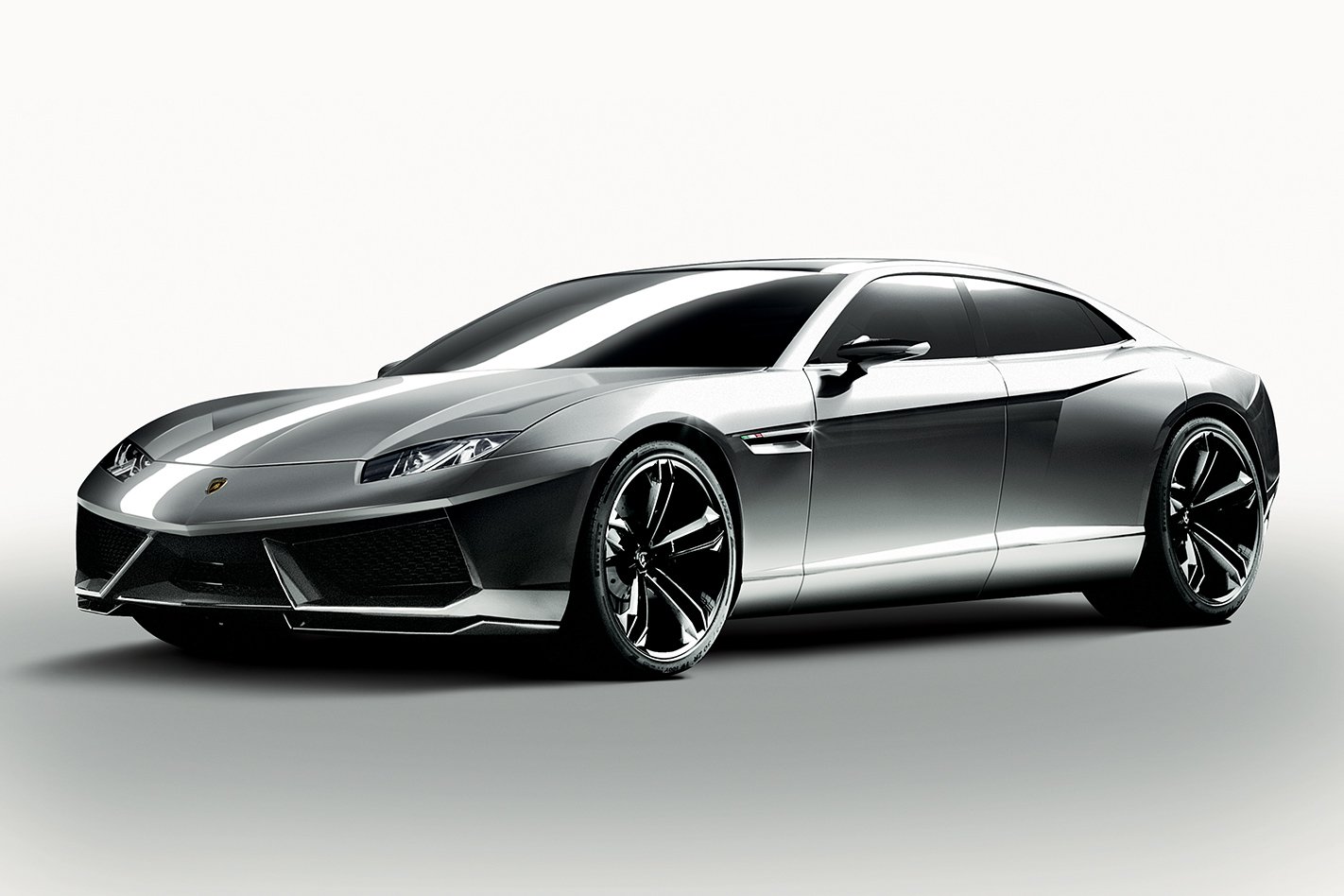
As it happens, Estoque is loosely based on the ASF platform it would share with the next Audi A8 and the follow-up to the Bentley Continental GT/GTC/Flying Spur. Thanks to the Audi/Bentley connection, the small sports-car maker could offload a significant portion of the development and purchasing costs, sources say, which may be crucial in determining the Estoque’s price – and future.
Only time will tell if Lamborghini can leap over these internal hurdles, and if the sheiks and celebs of the world are prepared to stump-up for a four-door supercar. But, until then, can we get the world turning in the right direction again? We can’t handle this head-spin!
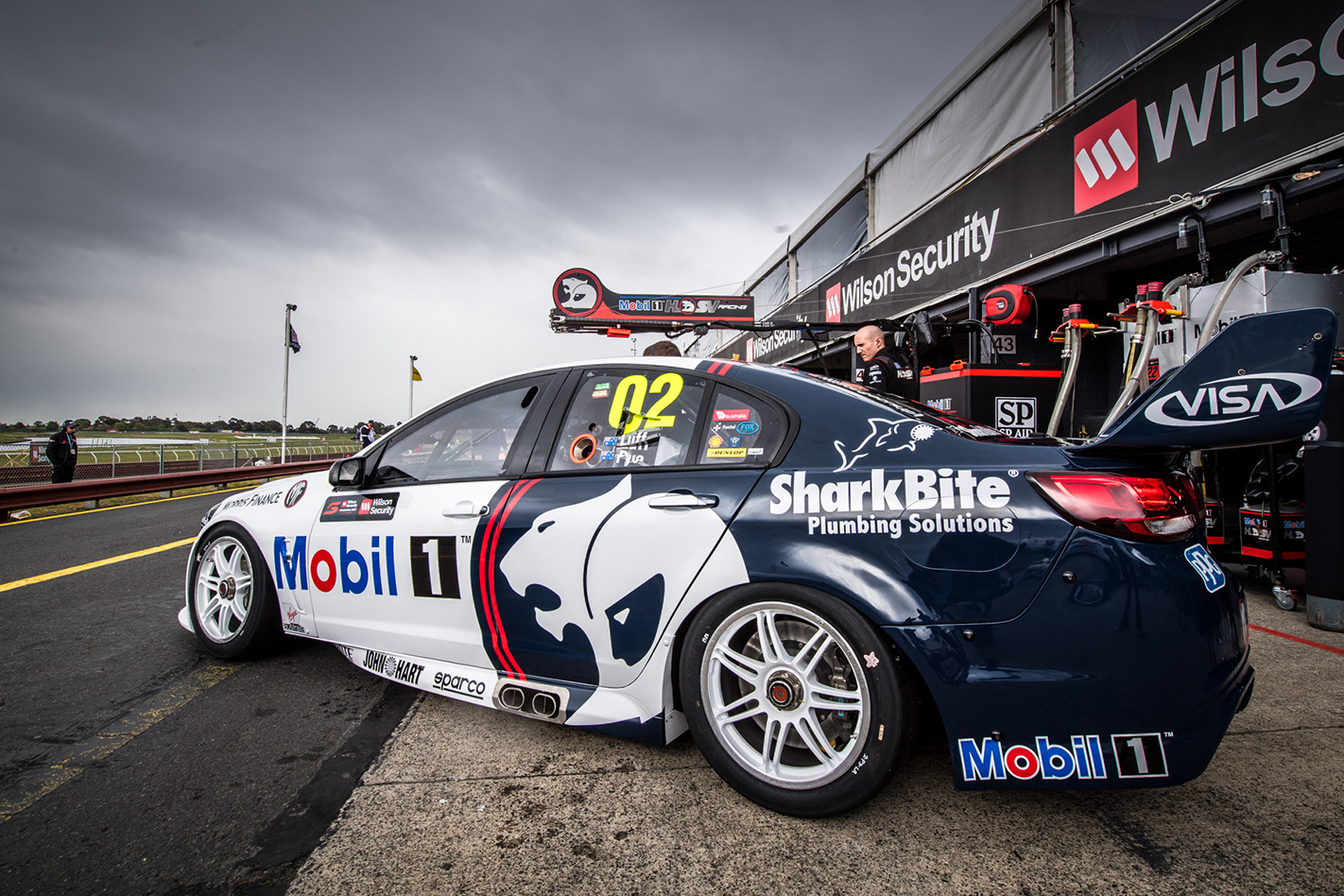
THE NEWLY formed Walkinshaw Andretti United race team will embark on a global search for a new manufacturer partner that could end the former Walkinshaw Racing team’s 26 years of racing Holden Commodores in V8 Supercars.
In the quest to return the former Holden Racing Team outfit to Supercars championship-winning status, the company will leverage some of the sharpest technical brains from NASCAR, Formula E and IndyCar – as well as the home grown talent that has made it one of the most successful teams in the V8 Supercar era.
But one of the directors in the bold new partnership, Ryan Walkinshaw, said the team would consider ditching the Holden Commodores that have been a fixture of the squad since the inception of the team formed by his father, the late Tom Walkinshaw, in 1990.

“Just like every other team up and down pitlane … we’ll be looking and having discussions with other manufacturers to see if there’s other opportunities that exist in the future that we currently don’t have on the plate,” he told Wheels.
For 2018, though, the team is planning to campaign the new ZB Commodore running the existing 5.0-litre naturally-aspirated V8 engine.
Walkinshaw said Holden was an obvious partner for 2019 and beyond but that other brands would be approached in the quest to position the team to beat key rivals such as the Triple Eight team (which now runs the Holden Racing Team) and US/Australian giant DJR Team Penske.
“Michael has got, on the racing side, probably got an even bigger list of relationships with manufacturers. Between the two of us we hope that we’ll be able to have some good discussions and we’ll see where that takes us.”
Walkinshaw said any deal with a new manufacturer would not affect the close relationship Walkinshaw has with Holden through its contract to produce HSVs.
“In the same way that Holden pulling our factory funding from the Holden Racing Team at the end of last year hasn’t had an impact on our road car side of the business us going to another manufacturer wouldn’t have an impact either.”
KOENIGSEGG has smashed the dizzying 0-400-0km/h acceleration and braking combo benchmark less than a month after Bugatti set the hypercar record in its Chiron.
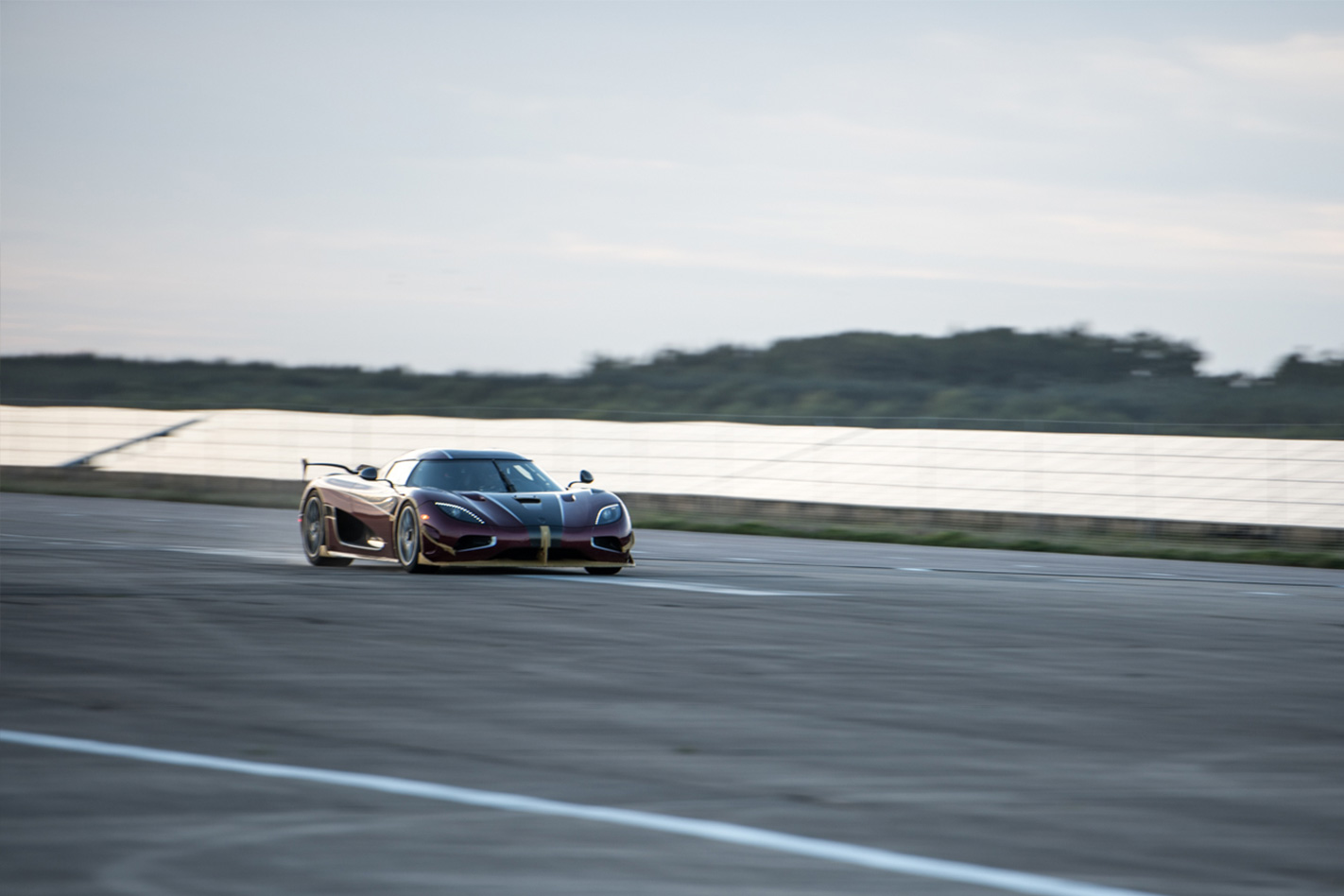
On October 1, the Swedish carmaker took a customer’s Agera RS to the Vandel airfield in Denmark where it used its 1014kW (a bit more than one megawatt) 5.0-litre turbo V8 to get to 403km/h in 26.9s and then back to a standstill in 9.6s.
All up, the mental megacar went to beyond 400km/h and back in 37.28 seconds, covering a distance of 2535 metres and shaving 5.5s from the Bugatti’s time.
“The owner of the Agera RS used for this 0-400-0km/h run is very keen for us to verify the car’s performance in comparison to other manufacturers,” it said. “This run was a great opportunity to do so.”
The run was originally planned to go ahead in late September at Germany’s Papenburg facility, but bad weather pushed the attempt to a later date and different country.
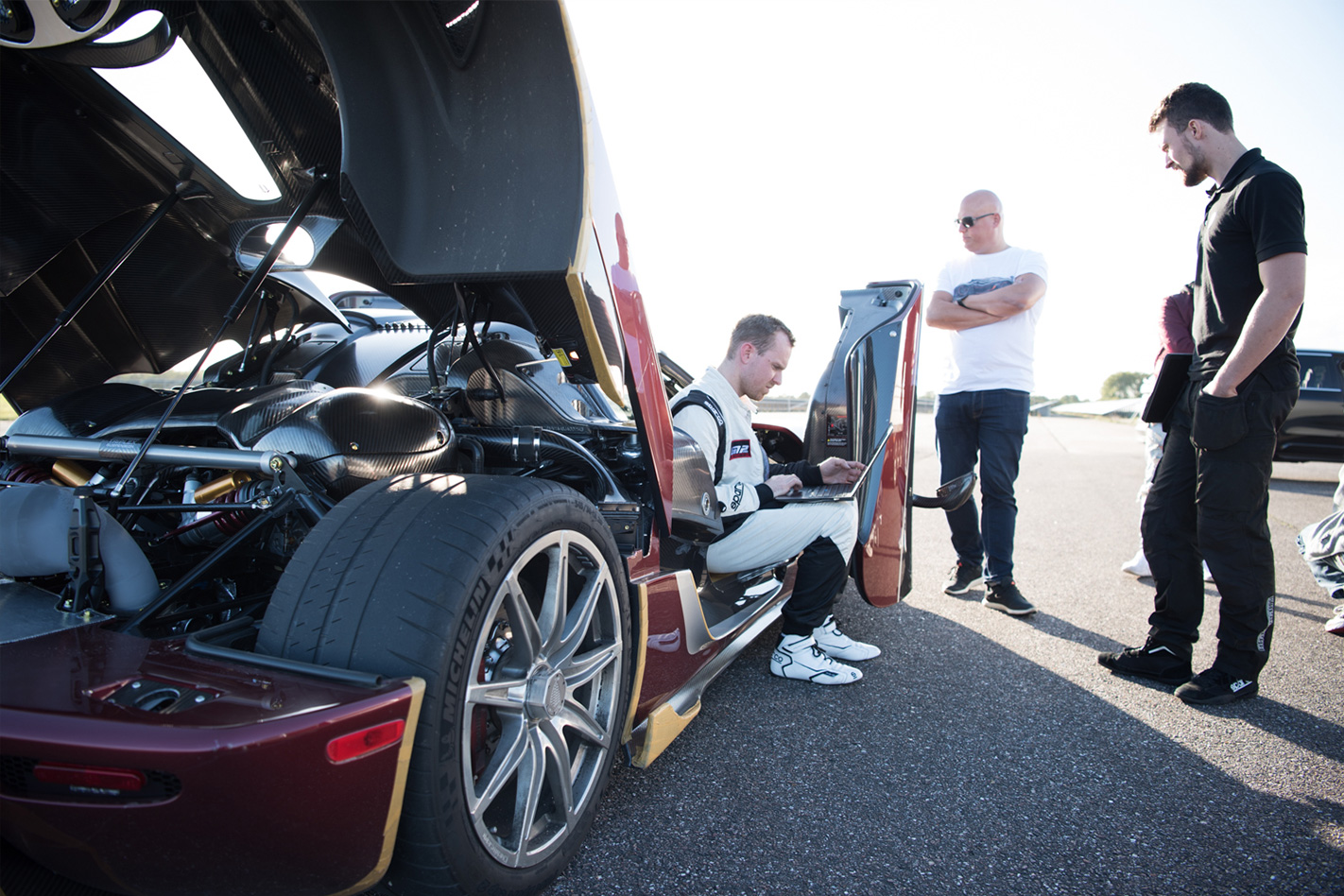
Fresh from the factory, the team reportedly didn’t even have time to remove the protective tape from numerous surfaces about the car, but it’s more likely the strips were left in place to avoid damaging the body’s finish at stratospheric velocity.
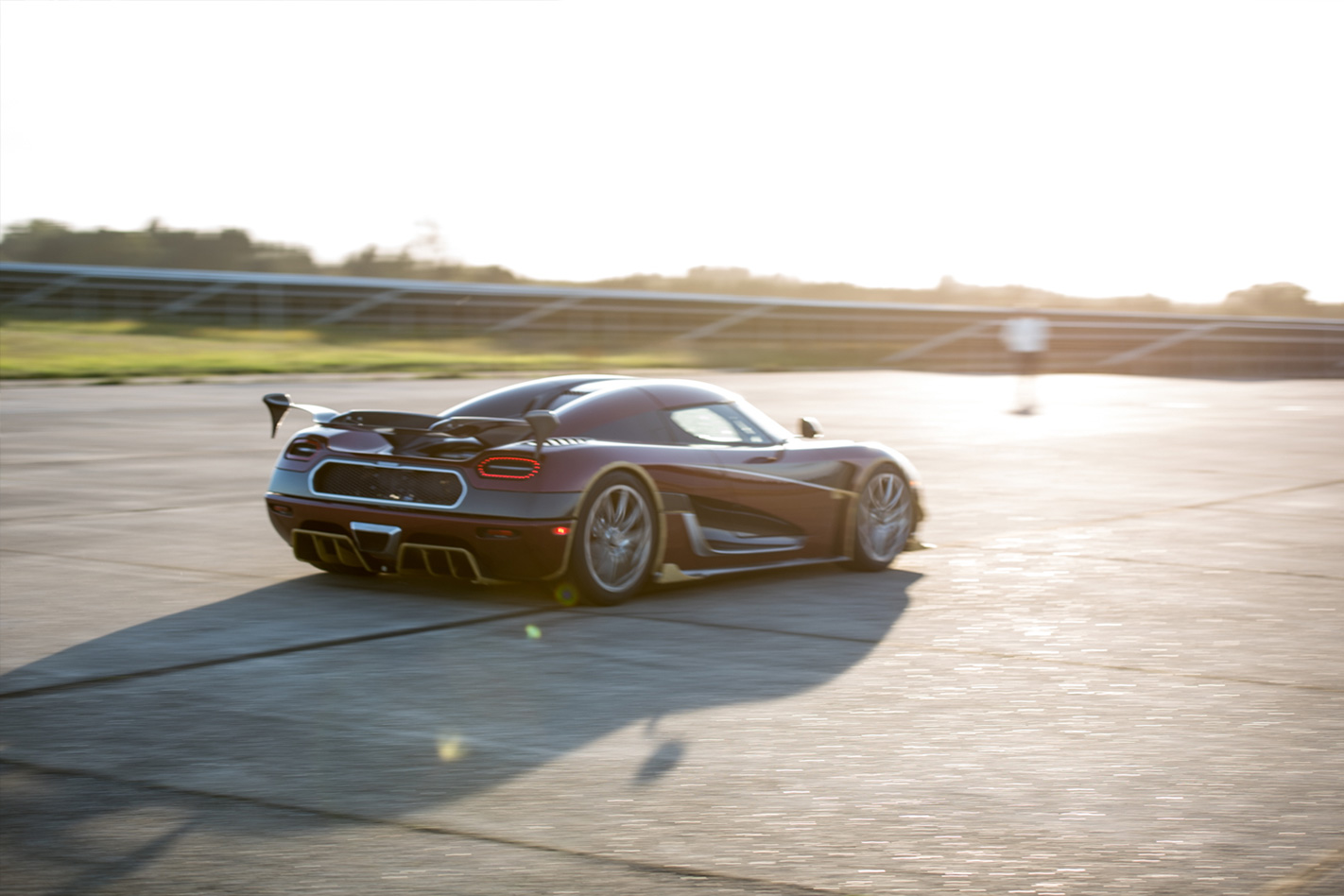
No modifications were made to the vehicle other than some small adjustments to the massive rear spoiler to reduce drag and make the V-max easier to hit – but the reduced downforce meant the car was breaking traction at 183km/h.
The Koenigsegg may have snatched the title from Bugatti for now, but it is likely the French manufacturer is planning to embarrass Koenigsegg with an attack on an even more significant title – the overall production car maximum speed record.
At the end of Bugatti’s 0-400-0km/h video released at September’s Frankfurt Motor Show, a final flashback shows the speedometer pushing on to 440km/h, indicating the production car record is about to be toppled.
Bugatti has a distinct advantage when it comes to high-speed production car record attempts with its Ehra-Lessien high-speed oval providing an unrivalled facility for all Volkswagen Group brand vehicles. Boutique manufacturers such as Koenigsegg, meanwhile, are forced to improvise with their locations.
IT COULD have been a 10-car Mustang Shootout if Tunehouse from Sydney had sent its glossy black beast of a car to chilly Winton.
Alas, we must admire it from afar. And with Sydney tuners direly unrepresented at our Victorian dust-up, Tunehouse’s was too good an example not to include on the back of our world-first Mustang shootout.
If there was the equivalent for the People for the Ethical Treatment of Animals (PETA) they would certainly be called in to rescue this Tunehouse-tuned Ford Mustang GT.

Of course, regular MOTOR readers will know that 15-year-old Tunehouse is about harnessing power as much as exploiting it. Efforts with the Mazda MX-5 and Toyota 86 at our Hot Tuner events have impressed, and the boys in the last remaining industrial part of gentrified Marrickville, in Sydney’s inner-west, promise this is more than a one-trick pony.
The Tunehouse headquarters is surrounded by red-bricked roller-door tuning-fodder, but it soon becomes clear that just as hipsters thrive on finding their creative flow in repurposed industrial warehouses, there’s engineering talent lurking in the shadows here to be especially cherished in this final year of Australian vehicle manufacturing.
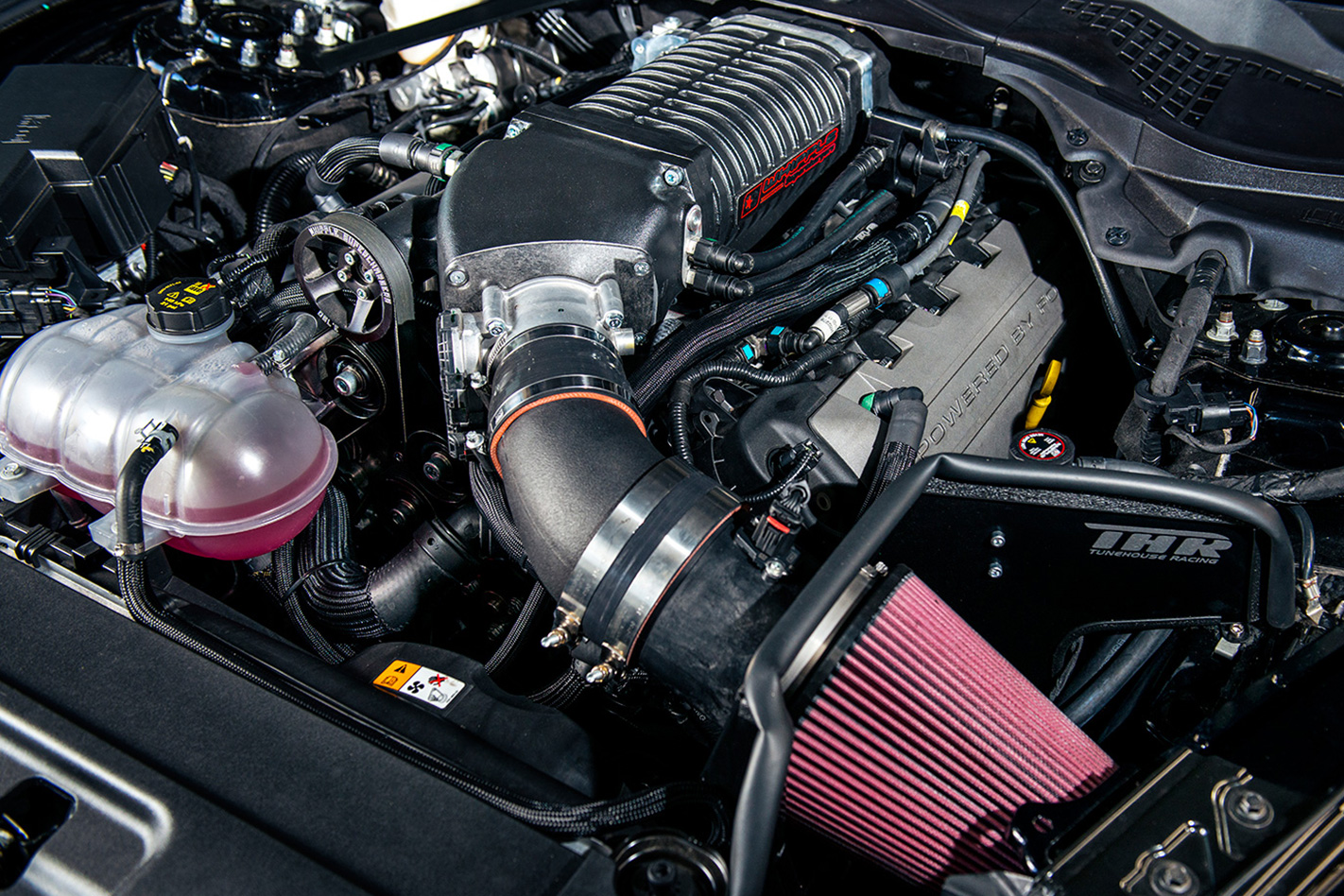
“From the supercharger, to the brakes and custom-spec suspension, it’s all about balancing power, handling and driveability to us.” So what do we have here? Simply, a $57,490 (plus on-road costs) Mustang GT manual with a 306kW/530Nm 5.0-litre V8, plus a $30,000 performance package added.
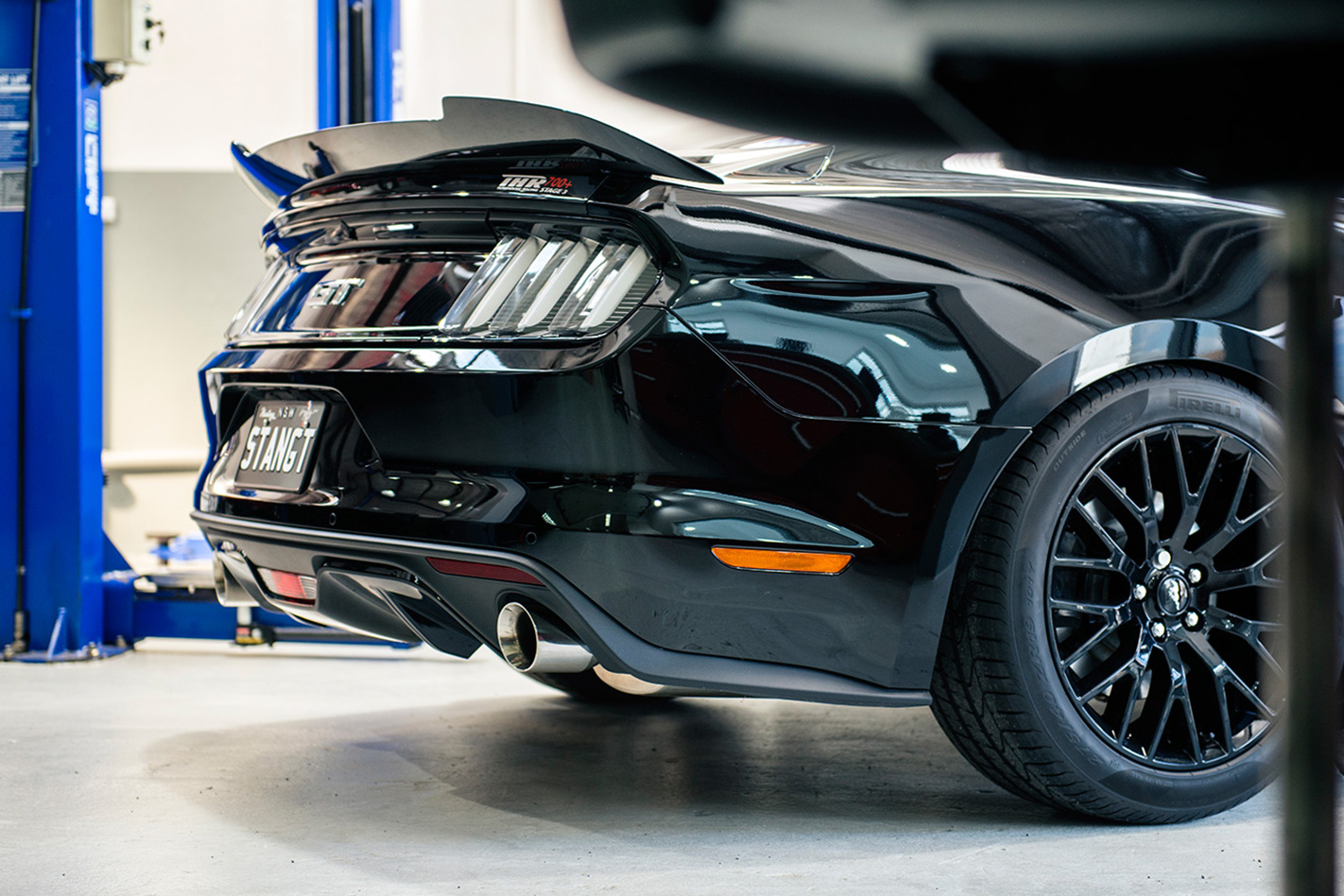
To our mind, this needs to be a Trans-Pacific BMW M240i-to-M2 challenger. For that price Tunehouse includes installation of a styling kit, including lip and rear spoilers, side skirts and rear quarter-window gills that rear passengers probably won’t love. But those passing by certainly did.

More than 600Nm is available from 2000rpm. But Ghelis calls this a “mild tune only”. Holding the reins on all that horsepower are two-piece slotted brake rotors in the same 380mm size as stock and braided lines with uprated pads.
Made in Germany, the custom H&R coilover suspension includes Tunehouse-developed swaybar (with adjustable end links, swaybars and swaybar locks) and camber adjustment kits, transmission shift bushings, while a Streetfighter adjustable sports exhaust rounds out the additional 50 per cent spent over a Mustang GT’s retail price.
So, then, will this be a ropey stallion: yay or neigh? Snaking out of Sydney’s inner-west on a soaked Sunday morning, it’s all early upshifts and avoiding trouble from the boys in blue – or the boys in scarves not wanting their smashed avocado covered in PULP. But for something not exactly pure-bred, this ’Stang feels tamed.
The clutch doesn’t feel as weighty as a gym leg press, and the same terrific short manual throw and burbly V8 growl under 3000rpm remains. Expansion joints and potholes are dispatched with firm thuds rather than the sort of crashing and jarring often found with aftermarket chassis tunes.

Even with care there’s wheelspin and slight sideways action in first, second, third, and – just as the GT endows the driver with confidence that maximum throttle can be used – fourth gears. With so much grunt, the 275mm-wide 19-inch Pirelli rears have lost almost all concept of traction, in the wet at least.
Trying to discern the shift between 300kW to near-500kW in a rear-driven car – with finite grip – is actually more like trying to pick the changes between negative-20 degrees Celsius, and negative-10 degrees, in a Detroit winter. By this stage we’re talking extra shades of fricking fast and freaking cold respectively.

It feels like there’s a bit of ‘torque staging’ going on in the lower gears to manage wheelspin, a technique used by Ferrari with the 760Nm rear-driven 488 GTB and definitely not used by BMW with its edgy 550Nm M3/M4. Later Ghelis confirms that trick electronics are indeed at play as part of what he calls major engine management advances in recent years.
So much for the tuning stereotype of dialling up the boost and letting ’er rip. Third-gear acceleration from 100km/h is stupendous. The way the speedo needle snaps towards 150km/h is the stuff of hypercars, not mere supercars. The mid-range response is gorgeous, but the blown eight is also willing to sweep to the top-end as well.

Far from feeling like a wayward lass on country roads like the stock Ford can, this is a tauter, trimmer, fitter Pony that more confidently gels with its steering and stability control (ESC). No longer does the front-end wallow and slap on country roads above seven-tenths pace, which causes the ESC on the standard car to respond more to vertical pitching than sideways movement.
You read that right, on a rear-driven V8. C’mon ’Murica. With the Tunehouse tune there is simply firm discipline everywhere. The lenient ESC still works with the power upgrade, but keeping the ’Stang in a controlled powerslide is all down to that throttle response, which drills the driver’s right foot into the back axle to adopt the role of a minutely measured disperser of latitude.

Although its initial sharpness is nice, which makes the Ford feel faux-agile, as lock is wound on it becomes completely mute and the front-end feels aloof. Tunehouse isn’t a big fan of the Mustang’s standard electric tiller-tune and nor are we. In fact, the remaining problems of this car are Ford – not Tunehouse – specific.
Whether teamed with 306kW, or 630kW, the short-ish wheelbase of this two-door can induce some terse and snappy oversteer behaviour unlike what Aussies might be used to in a blown HSV with its rear axle swinging into a different postcode to the front. And the cramped, scrappy cabin feels $30K beneath $55K – not the same amount over it.

If import-tweaking is our post-manufacturing future, then we’ll raise a burly muggacino to the gentrification of the tuning brigade that has seen sophistication replace slap-dash. For now, our home-grown heroes – or disappearing dinosaurs if you work in a refurbished industrial creative space – remain the better sports cars, if not the superior show ponies.
0-100km/h? 0-400m?
Tunehouse reckons its Mustang will run somewhere between 3.6 and 3.9sec to 100km/h and an 11.2 to 11.5sec quarter mile, in both cases “if traction permits”. Through the seat of the pants it feels ‘low 3s’ quick in the mid-range, but ‘high 4s’ brisk from a standing start.
So much patience is required off the line in order to allow the 275mm rear Pirellis to hook up, with valuable time lost. As MOTOR has found in the past, throwing more grunt at a duo of back wheels isn’t the key to achieving faster performance times – surprise, surprise.
We would look to a larger set of rears, maybe 315mm Michelin Pilot Super Sport rubber, just to complete the package. Then again, how long is a piece of string? For many, that’s the modification life.
Tunehouse Ford Mustang GT Specs: Body: 2-door, 4-seat coupe Drive: rear-wheel Engine: 4951cc V8, DOHC, 32v, supercharger Power: 630kW Torque: 980Nm Transmission: 6-speed manual Weight: 1739kg (standard car) Suspension (f): struts; coil springs; anti roll-bar; Suspension (R): multi-links; anti roll-bar; Wheels: 19 x 9.0-inch (f); 19 x 9.5-inch (r) Tyre sizes: 255/40 R19 (f); 275/40 R19 (r) Tyres: Pirelli P Zero L/W/H: 4783/1915/1382mm Wheelbase: 2720mm 0-100km/h: 3.9sec (claimed) Price: $87,490 (standard car)
FIRST it was going to go to a Belgian businessman with a proven track record of turning businesses around. Then it was going to grow medicinal marijuana, then make solar panels, and later even electric cars. But now Holden says it is finalising the sale of part of its Elizabeth manufacturing site in South Australia to an unnamed interstate buyer.
Confirmation of the sale comes only weeks before the last locally built Commodore rolls off the production line to close off almost 70 years of car making, and as the global liquidation sale of the site’s equipment used to build the cars enters its final stage.
Holden told the ABC it would name the buyer once the deal was completed. However, it appears the new owner has the same ambitions for the site as the former Mitsubishi factory at nearby Tonsley Park, which has become an “innovation district” with the support of the South Australian government since its closure in 2008.
“A preferred investor/developer from interstate has been identified for the property based on their long-term investment strategy,” Holden manufacturing executive director Richard Phillips said. “They have a good performance record and ability to deliver a high-quality outcome, with a willingness to work with local authorities and the community.”
However, Holden won’t be moving out in a hurry. The future full-line importer is expected to remain at the northern Adelaide site well into 2019 as it decommissions the site it has owned since the late 1950s – production on the site started in 1962. The Queen even visited it in 1963.
Part of the decommissioning process includes decontaminating the site of potential pollutants, which according to the EPA include trichloroethene, a solvent, and tetrachloroethene, the chemical used in drycleaning. So far, 12 notifications of contamination related to “motor vehicle manufacture” have been lodged with the EPA, while Holden has lodged plans for a two-year clean-up process.
“Site contamination at the Holden site comes from the chemicals used during the manufacturing and assembly of motor vehicles,” the EPA said.
Meanwhile, the garage sale of the Elizabeth-based equipment used to build the Commodore, and the Cruze small car, rolls on, with online auction house Maynards announcing bidding will close on October 20 – the same day as the factory officially winds down. Bidding opened on August 18.
Equipment offered for sale include a press and die shop, plastic body component facility, paint shop, tyre to rim assembly, body shop, final assembly line, and general plant equipment.
WHAT you’re looking at is two-thirds of a Statesman, a good portion of One Tonner, a small helping of Ute, and a dash of concept car.
With a single-digit gesture in the direction of political correctness, it’s been named Crewman. This new lord of the Loading Zone is both the longest-ever Holden and Australia’s first homemade, car-based, double-cab utility.
Only a few other manufacturers have ever attempted to build car-based double-cabs – Subaru’s Outback-based Baja, on sale now in North America, is one of the handful – and no-one we can think of has ever done one anything like this with a V6 or V8 up front.
While both these will be V8 – only until the all-wheel-drive-friendly High Feature V6 from Holden’s new engine factory comes on stream, the rear-drive Crewman doesn’t have this problem. It arrives with the familiar, old, iron 3.8-litre V6 in the base and S models, with the SS, naturally, packing a 5.7-litre Gen III V8.
Because Australia has never seen anything like the Crewman, Holden’s feel for its appeal must mostly be gut instinct. Around 8000 a year, or almost twice the number Monaro sold in its first full year on sale, they reckon. It’s a substantial number and part of the reason Holden believes it will sell almost 30,000 Australian-made utes next year. As well as Crewman, this prediction includes One Tonner and Commodore Ute.
There’s nothing remarkable about the Crewman’s technical specification, especially the nostalgic live axle and semi-elliptic leaf-spring rear suspension. What is truly ingenious is the way the Crewman has been engineered. This ingenuity was born of the need to be thrifty. Holden spent a total of $130 million on the combined Crewman and One Tonner program. Crewman accounted for $60 million, and less than one-third of this amount was spent on engineering.
Pragmatic Holden prefers cleverness to costliness every time, as you will see…
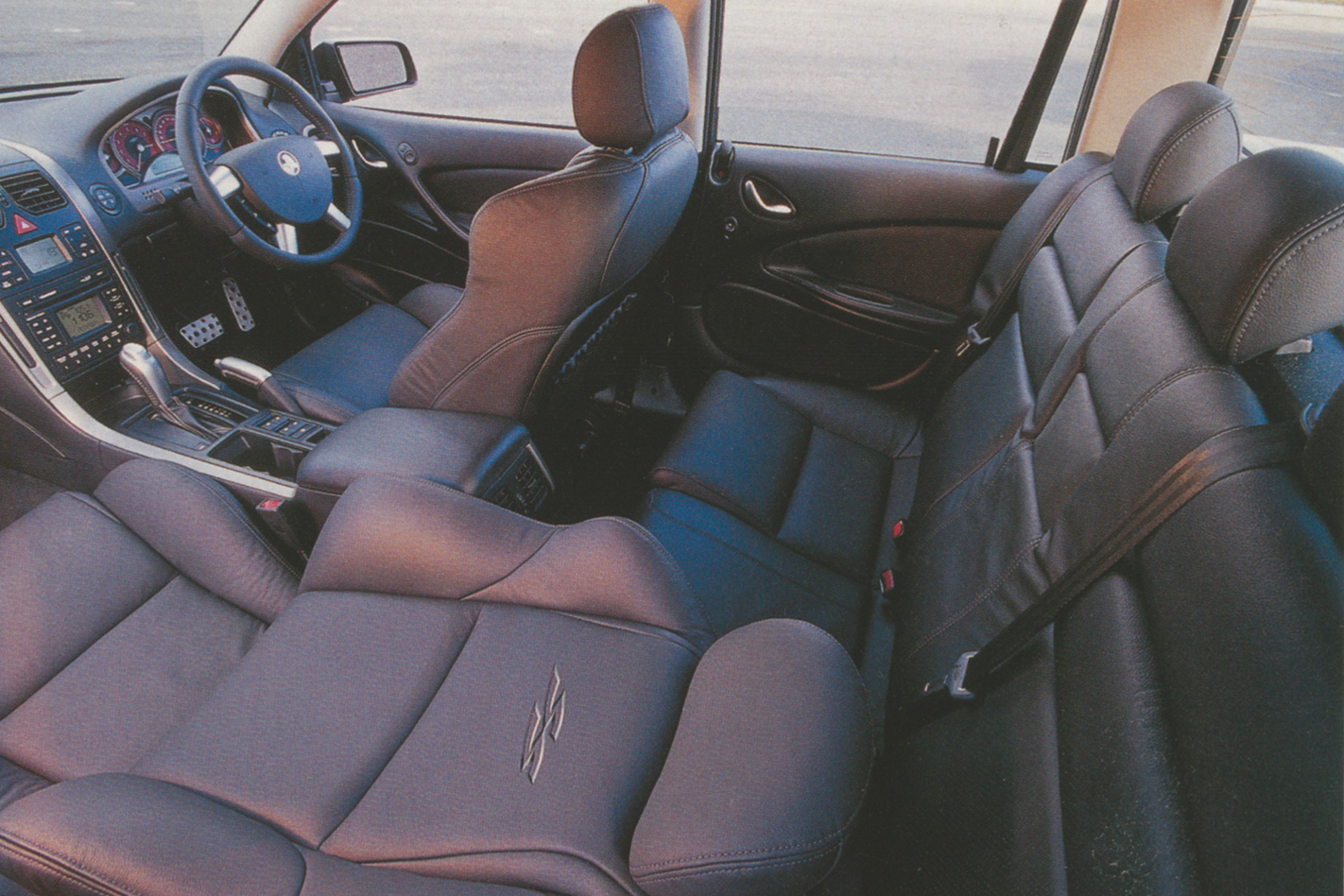
Holden’s engineers describe the Crewman body as a half monocoque, half chassis structure. Although it shares all important components, including fuel tank and axle, with the similar chassis of the One Tonner, the Crewman’s is shorter. The dual applications were envisaged from the start, so the chassis was designed to have both long and short frame modules.
Naturally, the connection between cab and chassis has to be super strong. At the forward end of the chassis assembly are vertical, box-section posts. These help spread the load broadly across the rear section of the cab, to which the chassis is secured by 12 bolts. Holden calls it ‘torque arm’, a reference to the upright strengthening pillars concealed behind the rear seatback.
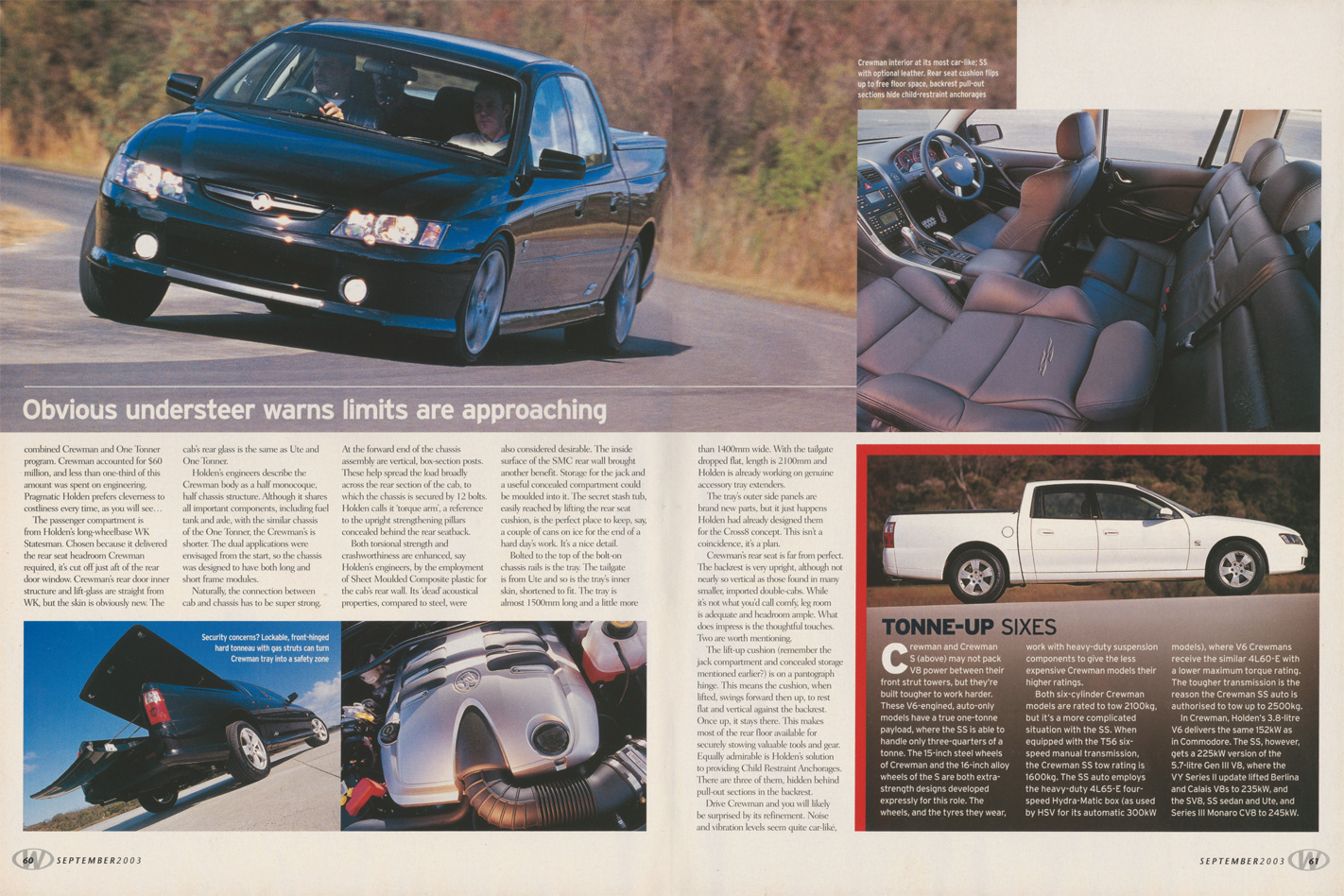
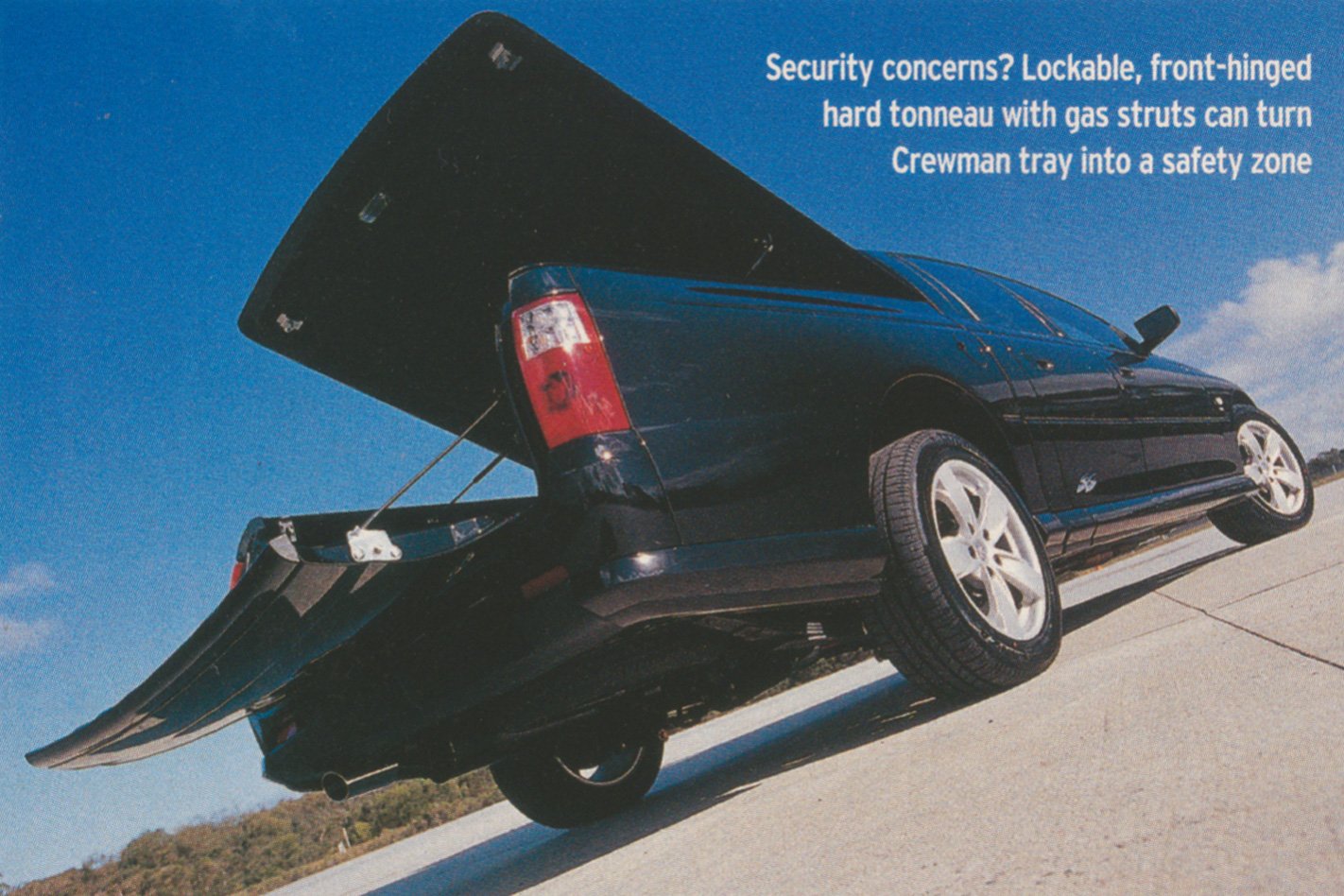
Bolted to the top of the bolt-on chassis rails is the tray. The tailgate is from Ute and so is the tray’s inner skin, shortened to fit. The tray is almost 1500mm long and a little more than 1400mm wide. With the tailgate dropped flat, length is 2100mm and Holden is already working on genuine accessory tray extenders.
The tray’s outer side panels are brand new parts, but it just happens Holden had already designed them for the Cross8 concept. This isn’t a coincidence, it’s a plan.
Two are worth mentioning. The lift-up cushion (remember the jack compartment and concealed storage mentioned earlier?) is on a pantograph hinge. This means the cushion, when lifted, swings forward then up, to rest flat and vertical against the backrest.
Once up, it stays there. This makes most of the rear floor available for securely stowing valuable tools and gear. Equally admirable is Holden’s solution to providing Child Restraint Anchorages.
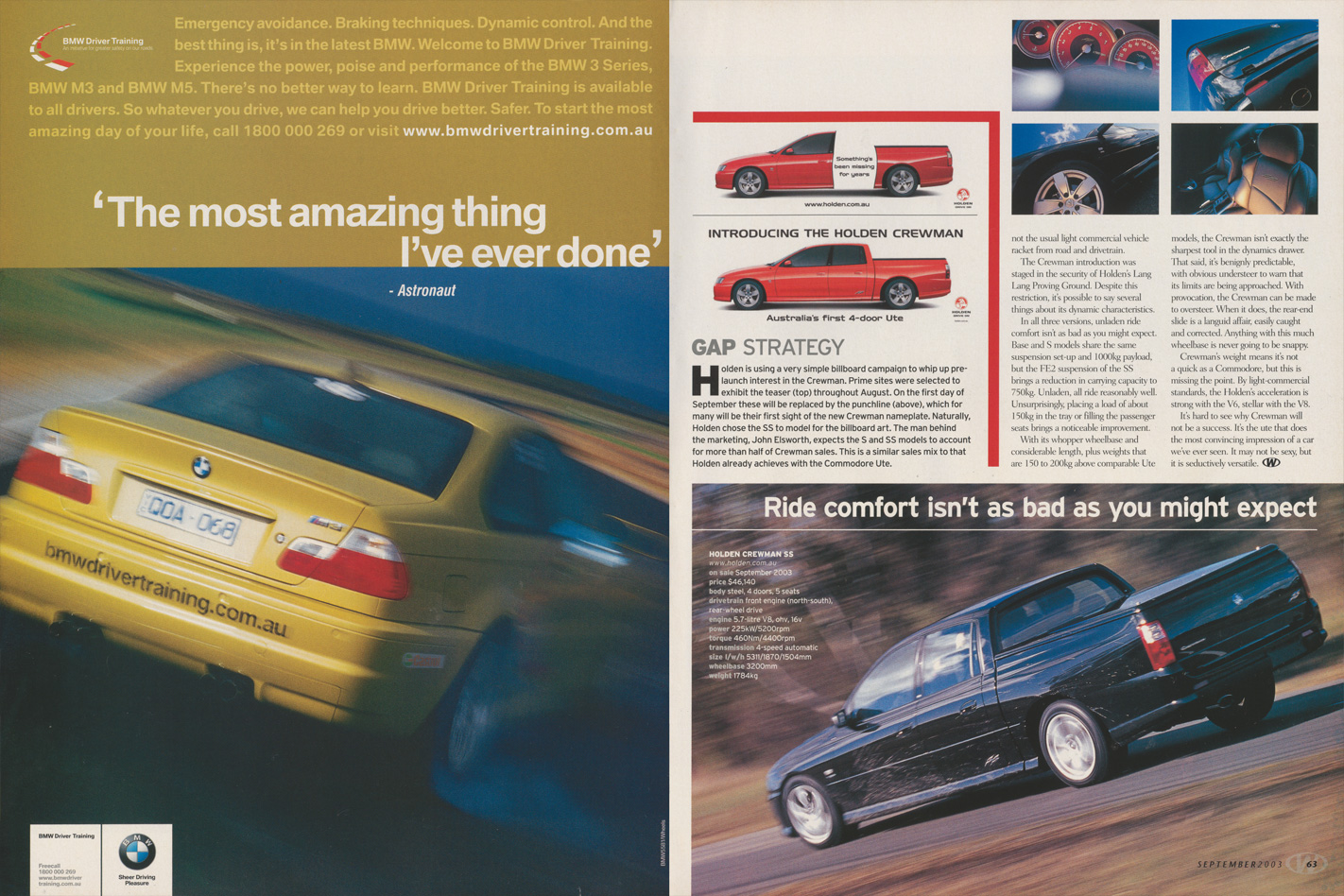
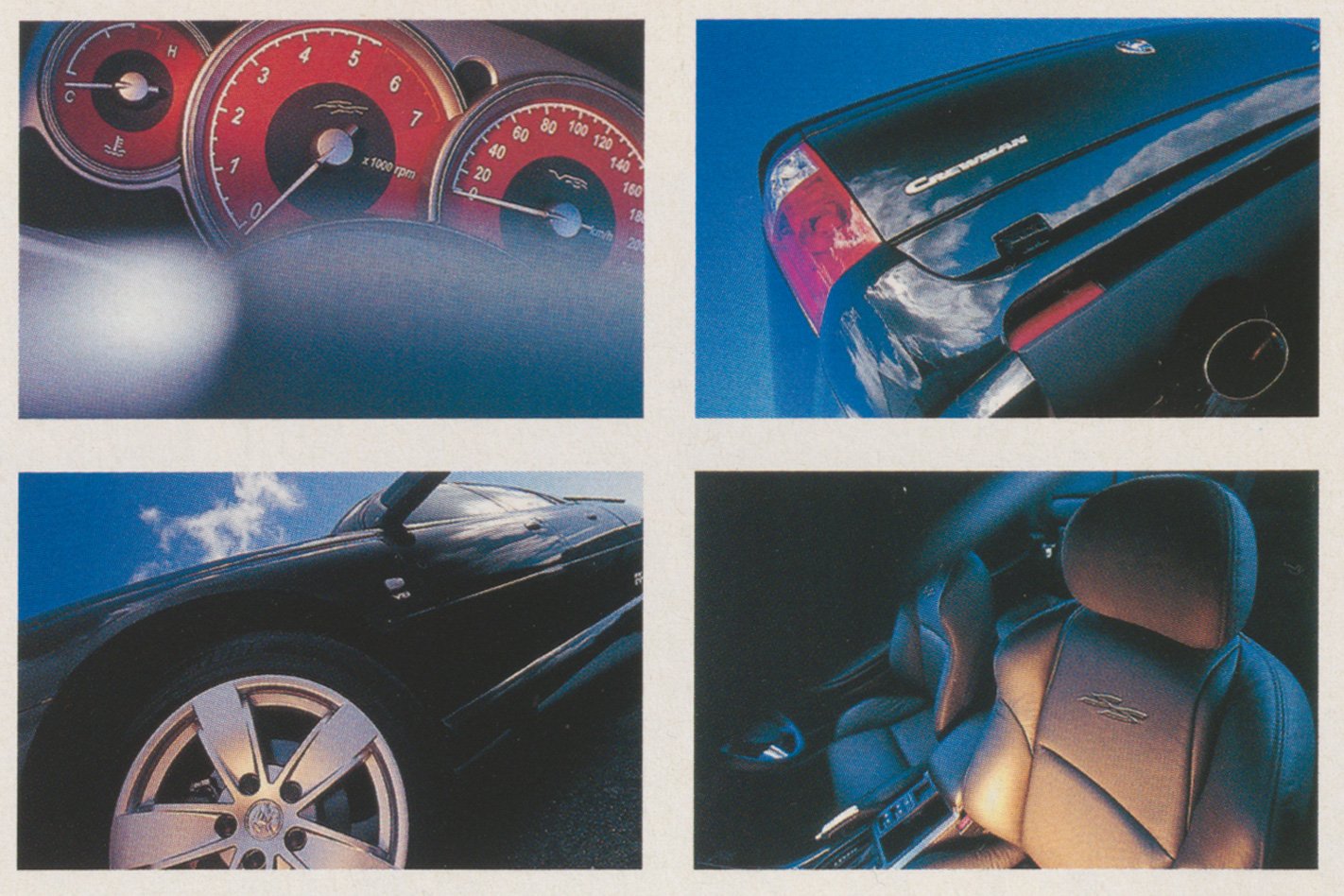
Drive Crewman and you will likely be surprised by its refinement. Noise and vibration levels seem quite car-like, not the usual light commercial vehicle racket from road and drivetrain.
The Crewman introduction was staged in the security of Holden’s Lang Lang Proving Ground. Despite this restriction, it’s possible to say several things about its dynamic characteristics.
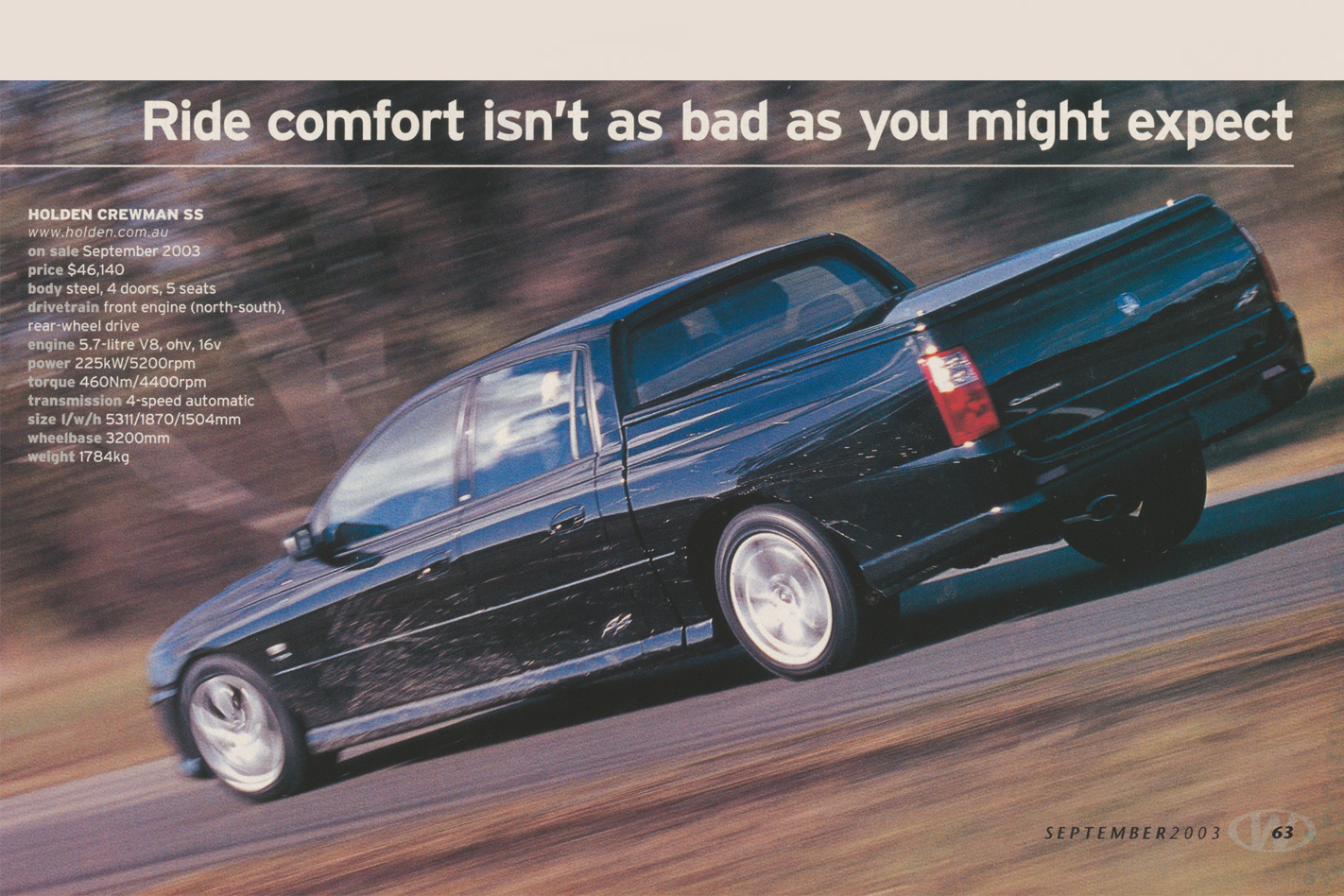
Unsurprisingly, placing a load of about 150kg in the tray or filling the passenger seats brings a noticeable improvement. With its whopper wheelbase and considerable length, plus weights that are 150 to 200kg above comparable Ute models, the Crewman isn’t exactly the sharpest tool in the dynamics drawer.
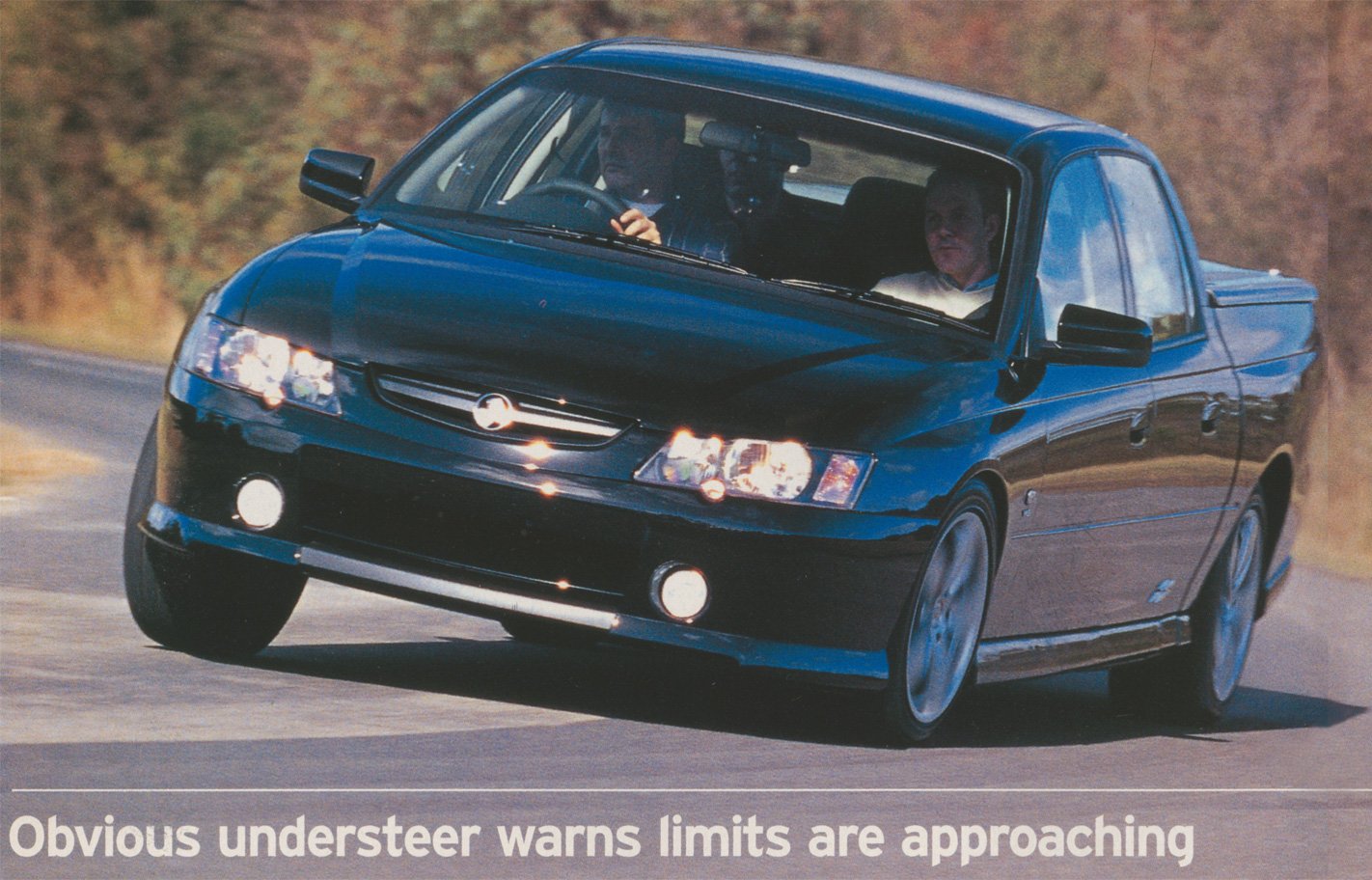
That said, it’s benignly predictable, with obvious understeer to warn that its limits are being approached. With provocation, the Crewman can be made to oversteer. When it does, the rear-end slide is a languid affair, easily caught and corrected. Anything with this much wheelbase is never going to be snappy.
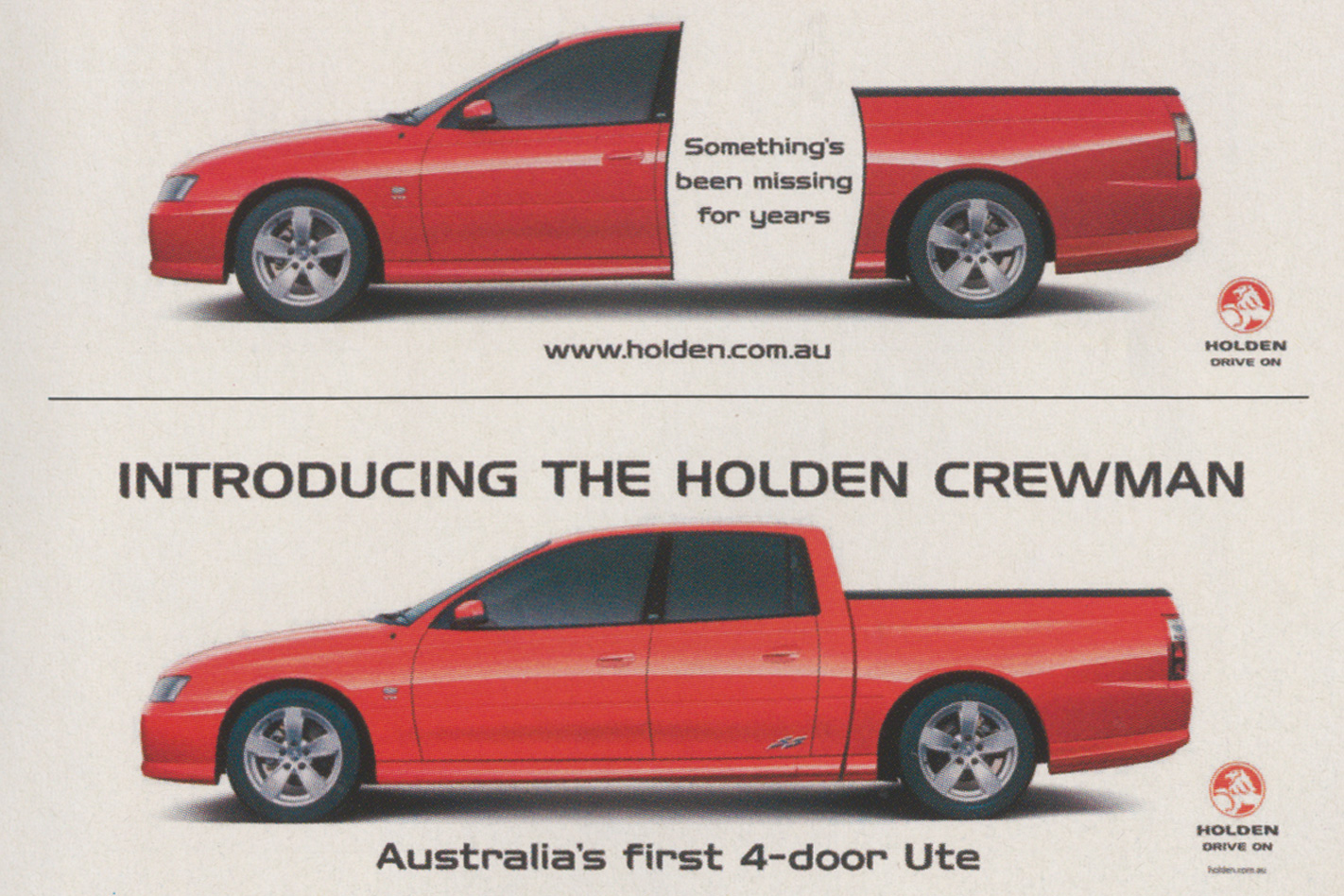
It’s hard to see why Crewman will not be a success. It’s the ute that does the most convincing impression of a car we’ve ever seen. It may not be sexy, but it is seductively versatile.
This isn’t a punch line, fake news, or April fools. Hyundai has built a hot hatch.
It promises to exorcise memories of the Excel. And to do that, four years ago Hyundai lured BMW’s Albert Biermann from retirement and into its N division. The target was Wolfsburg’s ever-green Golf. And the i30 was the weapon.
We recently fanged the final result across Europe, learning the i30 N will swoop into Australia next year with a standard and shamelessly named ‘Performance Pack’ version. Save your yawns, though, because the i30 N is a belter.
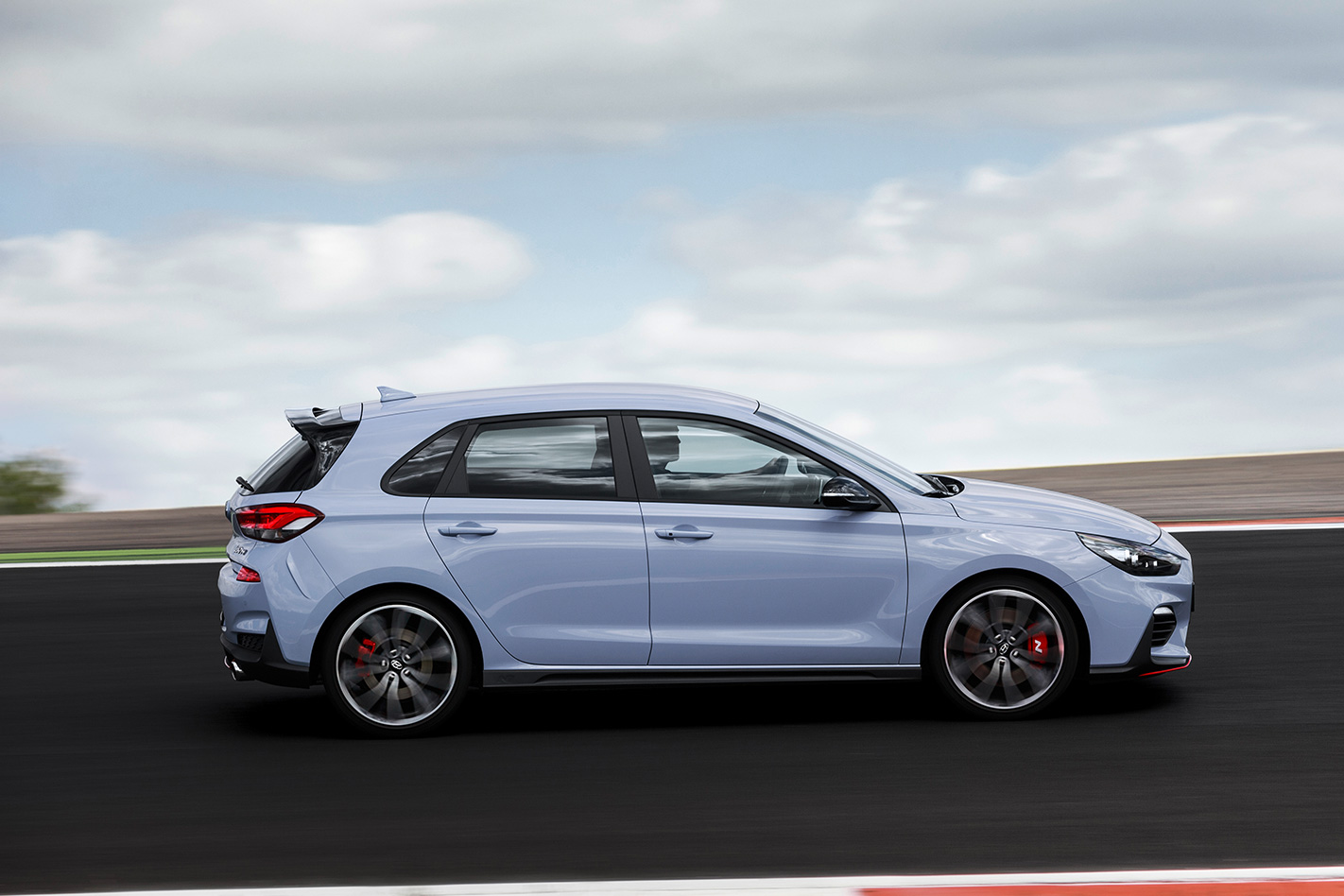
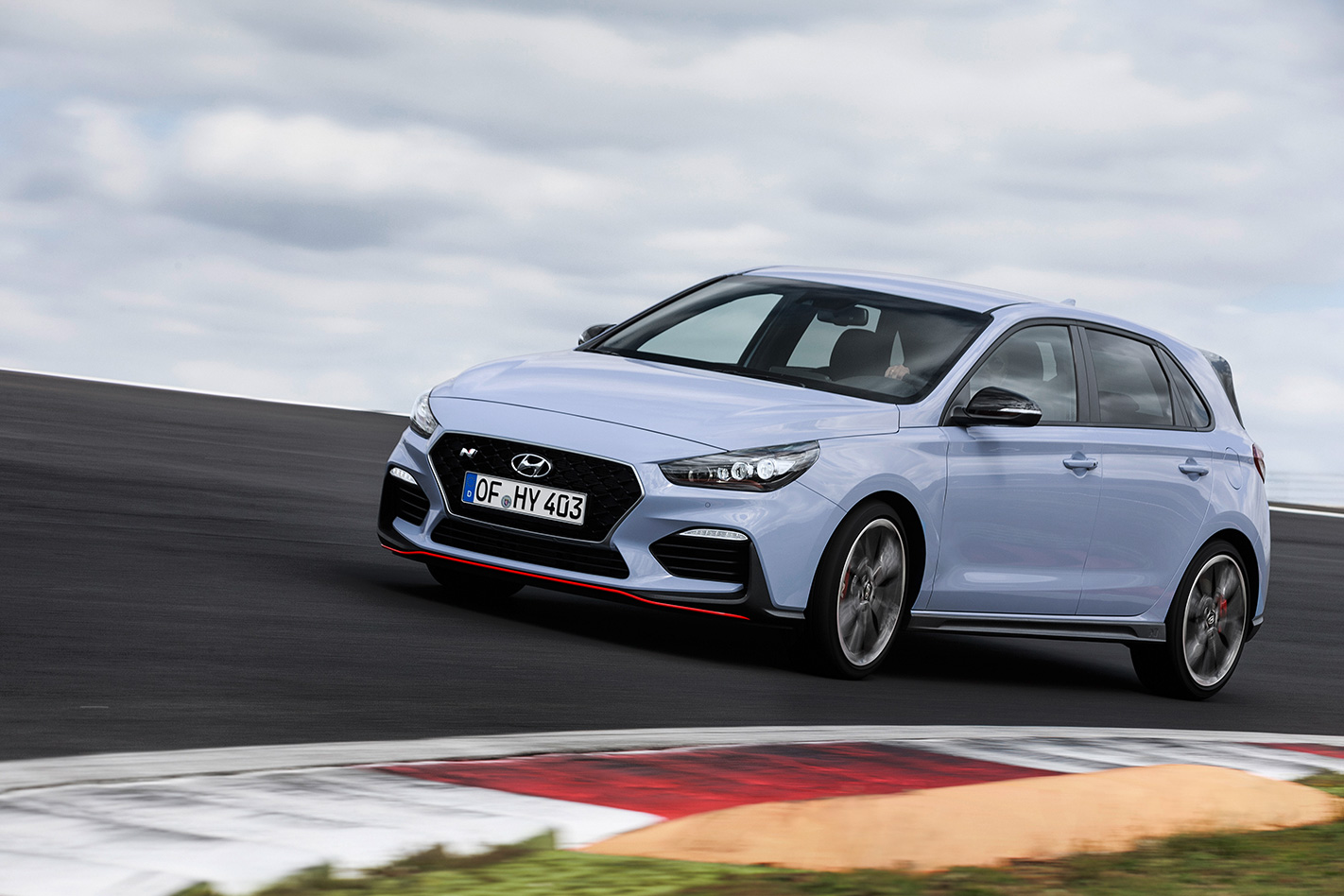
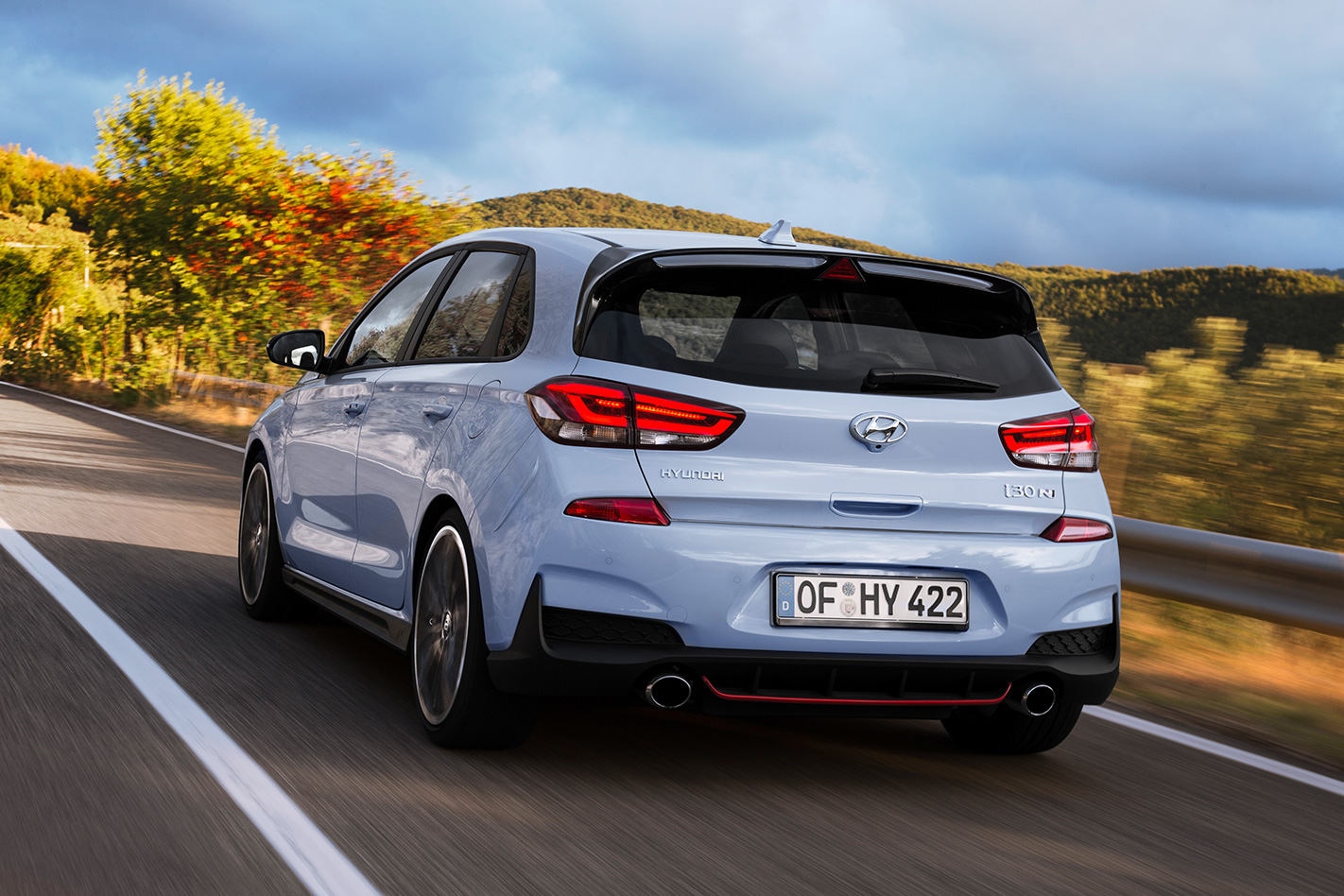
Outside, they wear N-specific bumpers, side sills, and a shared rear spoiler. Meanwhile curtains, splitters, and a smooth underside apparently produce overall downforce.
We’ll let you decide on the looks. But the real theatrics are underneath the sheetmetal, where engineers save the 2.0-litre engine from a life of school runs and Uber duties in a Sonata.
It’s then given a new twin-scroll turbo, redesigned manifolds and an upgraded cooling system. The result isn’t dramatic on paper. It’s only 3kW and 3Nm healthier in the standard car with 183kW/353Nm.
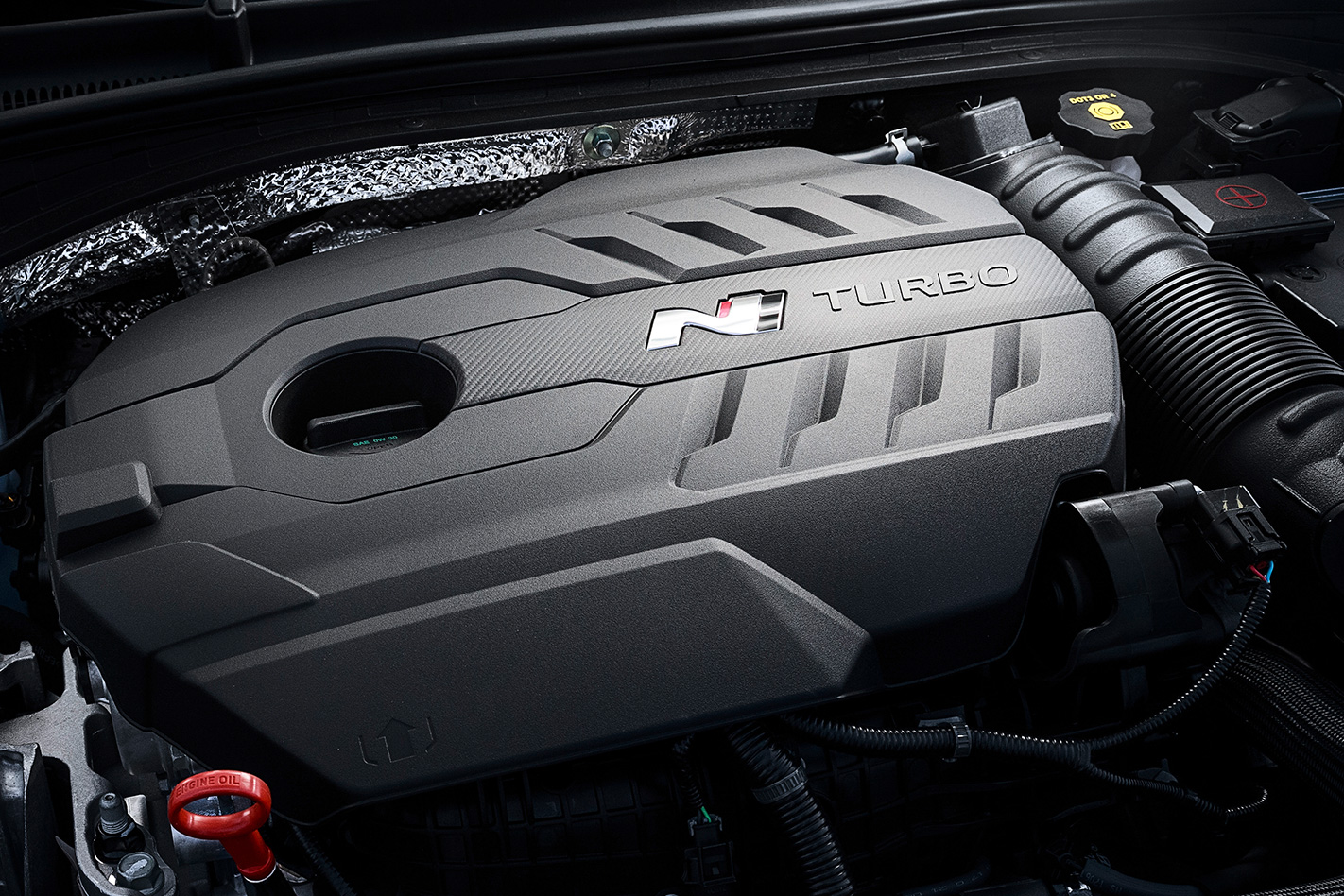
The engine is incredibly tractable in Sport for a 2.0-litre. Peak twist arrives as soon as 1400rpm, and then hairy-chested overboost appears at 1700. As a result it’s happy to stay in higher gears, pulling hard from down low until it runs out of breath near its 6000rpm power peak.
Performance Pack cars score a 202kW engine tune, produced at the same rpm, slashing the car’s 0-100km/h sprint in 6.4sec to a launch control assisted 6.1. For reference, VW’s Golf GTI Performance turns 180kW/380Nm into a 6.2 second sprint.
Handling the grunt is a six-speed manual, with a wet dual-clutcher in the works for 2019. Beefed up synchros and a stronger clutch help it cope. While a fuel-cut function means it will happily bounce off its 6700rpm redline.
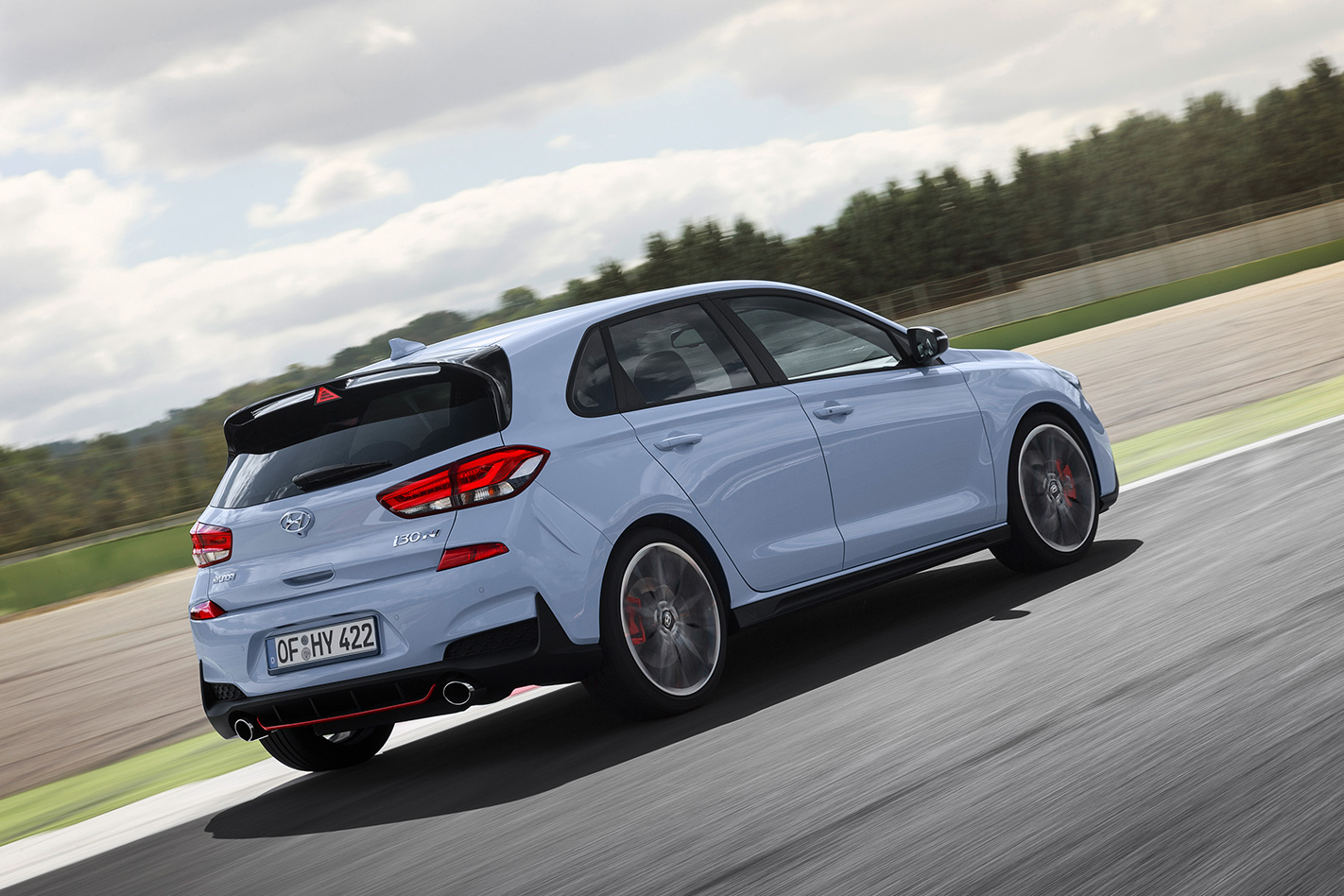
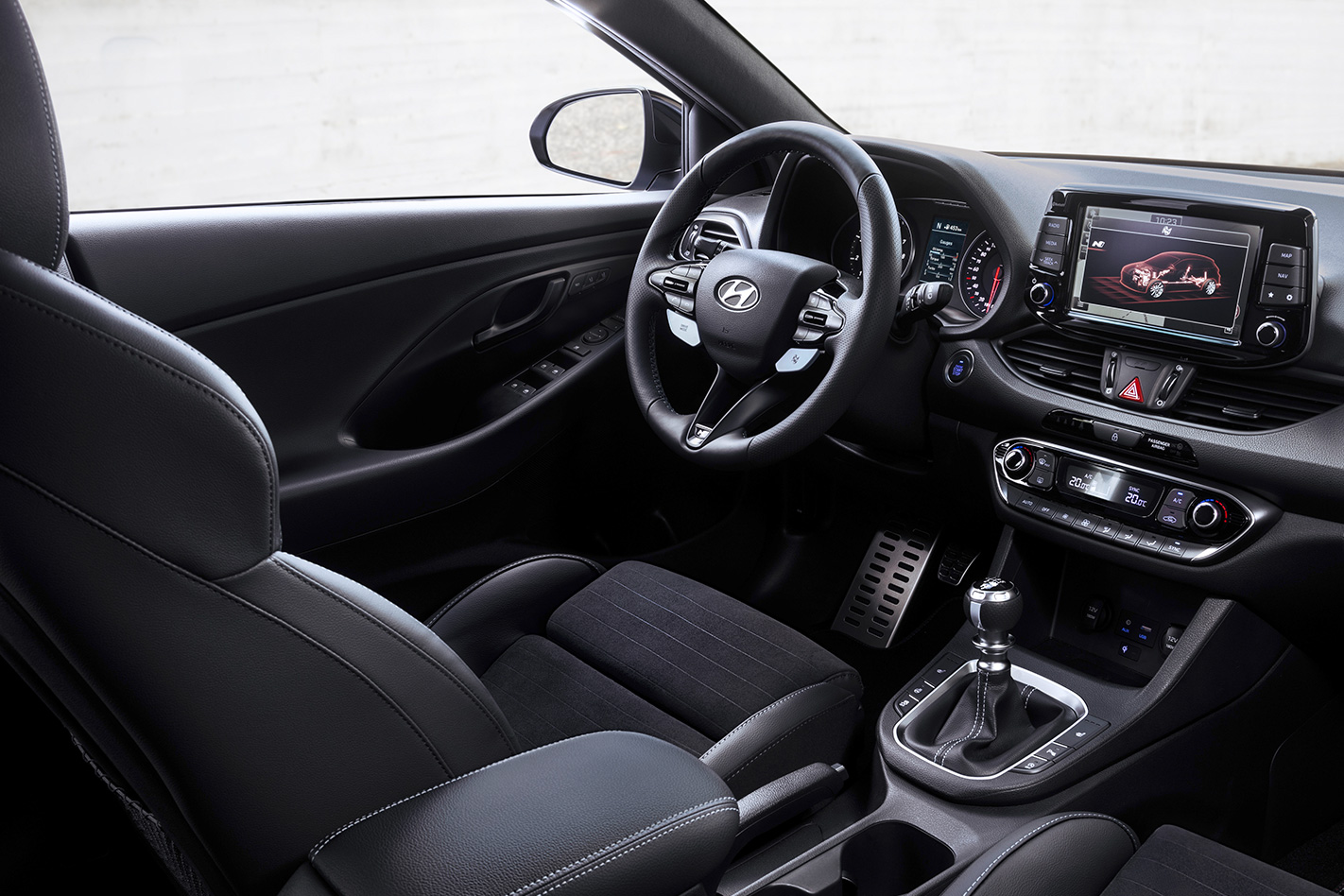
You can switch it off. And mess with other things like the torque map, dampers, exhaust, ESP, rev-match system, steering, and sound enhancement through the drive mode menu.
Or, if you’re lazy, an ‘N’ button on the steering wheel will switch everything to kill. Or press it twice and you can customise all features to your liking, just like an M3. We preferred the dampers in their softest setting, and all else in their sharpest.
Another button toggles through the regular Eco, Sport, and Normal drive modes. There’s no one-touch for the exhaust like there is for the rev-matching system. But we must say the noise is spot-on when set to ‘disturb the peace’. And not just for a Hyundai.
Performance Packs also score a brand new front-differential that uses an electronically controlled clutch-pack to vary lock. Matched to Pirelli rubber (10mm wider than standard at 235/35) it’s claimed to corner five per cent faster than the standard car.
Yes, the Performance Pack launches out of corners cleaner and feels a touch sharper on its 19s. And besides a little steering numbness under full power, torque steer is almost banished. The strut-front suspension still tramlines, however, and it won’t shake its tail like a Megane RS without a big dab of brake and dampers their softest.
Still, adaptive dampers, soft springs, and a stiff body structure have allowed engineers to strike a fantastic ride/handling balance which will make the i30 N a demon on our back roads. Over hundreds of road kilometres, including Rome’s worst, the i30 N relays enough about surface and grip levels for you to push hard, but not too much that it becomes tiring or uncomfortable.
However, it still lacks the feedback and on-limit sharpness found in Volkswagen or Ford stables. Oh, and the turning circle’s rather big. Inside, the interior feels solidly built. Both the touch screen and LCD dash display are clear and concise. Meanwhile the touch points are spot-on for placement, access, and tactility.
Search hard enough, however, and you’ll find a rough edge or two on hidden plastics. Hyundai aims to offer both cars in a boggo and luxury spec. Adding things like a sunroof, heated steering wheel, and other trinkets at a higher price.
We’d appreciate more seat bolster for track stuff, but as we’ve reported, you might be able to fix that yourself with some hardcore optional extras in future. When it lands in February next year, Australia is expected to become the second biggest market for the i30 N outside of Europe.
Of course, the zestier outputs, bigger brakes, and tricky diff in the Performance Pack make it the real pick. The latter two features adding an extra layer of control and finesse when really hooking in. There’s no automatic until 2019. But the flip-side is, Volkswagen doesn’t currently offer a manual Golf GTI Performance in Oz.
If Hyundai can price the i30 N south enough of the GTI, especially in Performance guise, we might have a genuine winner on our hands. Until then, it’s a wait for the punchline.
4.0 stars out of 5 Likes: Grunt, character, practicality Dislikes: No auto… yet; steering refinement
Hyundai i30 N Performance Package specifications Drive: front Engine: 1998cc 4-cyl, DOHC, 16v, turbocharged Bore/stroke: 86.0 x 86.0mm Compression: 9.5:1 Power: 202kW @ 6000rpm Torque: 353Nm @ 1450-4700rpm (378Nm with overboost) Power/weight: 144kW/tonne Transmission: six-speed manual Weight: 1429kg Suspension (f): Struts, adaptive dampers, anti-roll bar Suspension(r): Multi-link, adaptive dampers, anti-roll bar Dimensions: 4335mm(L)/ 1795mm (W)/ 1451mm (H) Wheelbase: 2650mm Tracks: N/A Steering: electrically-assisted rack-and-pinion Brakes (F): 345mm ventilated discs, single-piston calipers Brakes (R): ventilated discs, single-piston calipers Wheels: 19 x 8.0-inch (f/r) Tyre sizes: 235/35 R19 (f/r) Tyre: Pirelli P-Zero Price as tested: N/A
