
This is the war cry coming to a Kia stinger GT near you.
A Stinger GT fitted with the optional bi-modal exhaust was caught being put through final testing during the model’s local launch this week.
Press were allowed to punt the 3.3-litre twin-turbo V6 powered prototype on track.
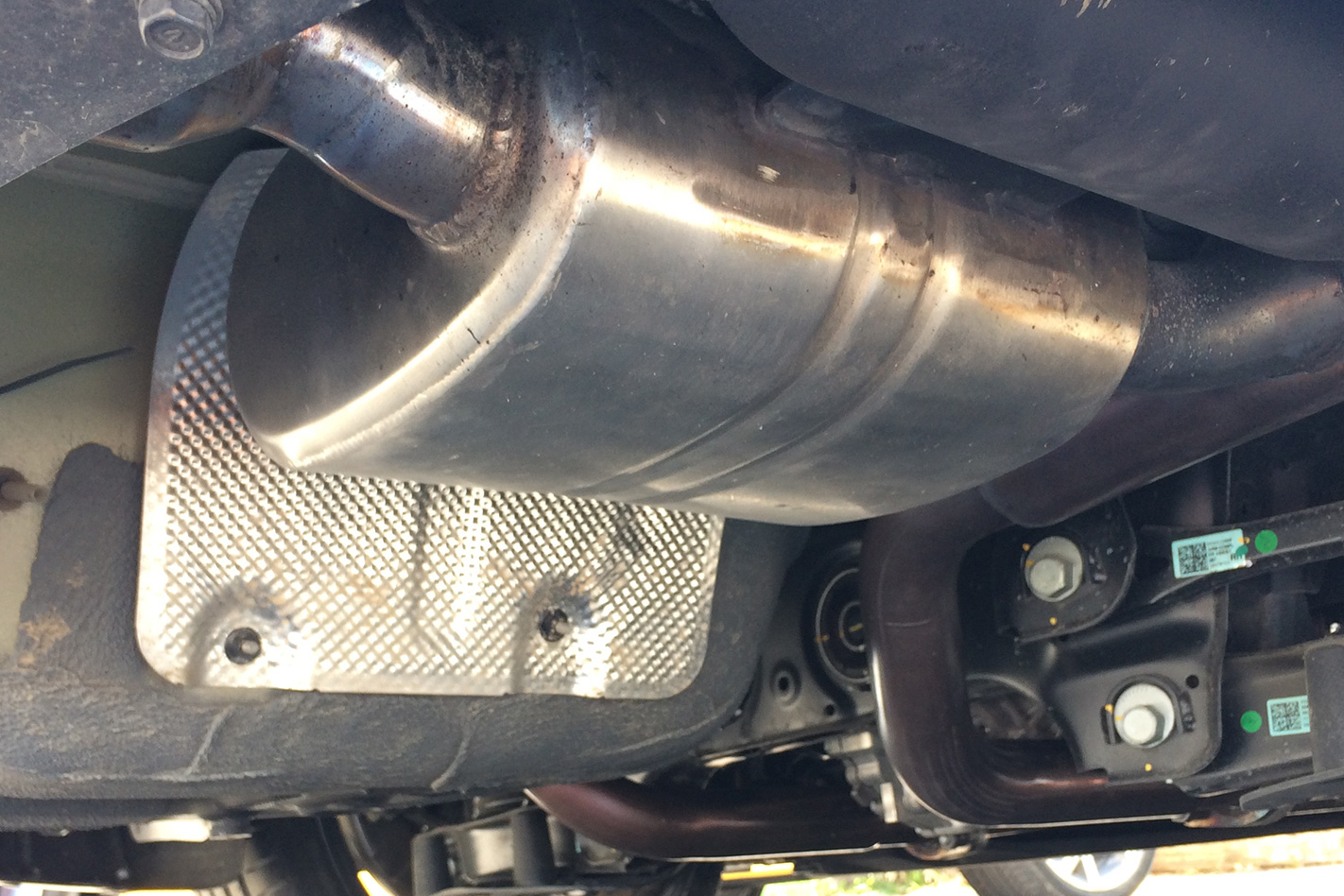
The system’s durability was put under the microscope roads surrounding Canberra, where watchful eyes monitored its mounting points over bumpy surfaces and in hard cornering.
The same testers were said to be refining the system’s switchover point. The louder setting doesn’t currently engage until 85 per cent throttle. Kia wants something closer to 60 per cent.
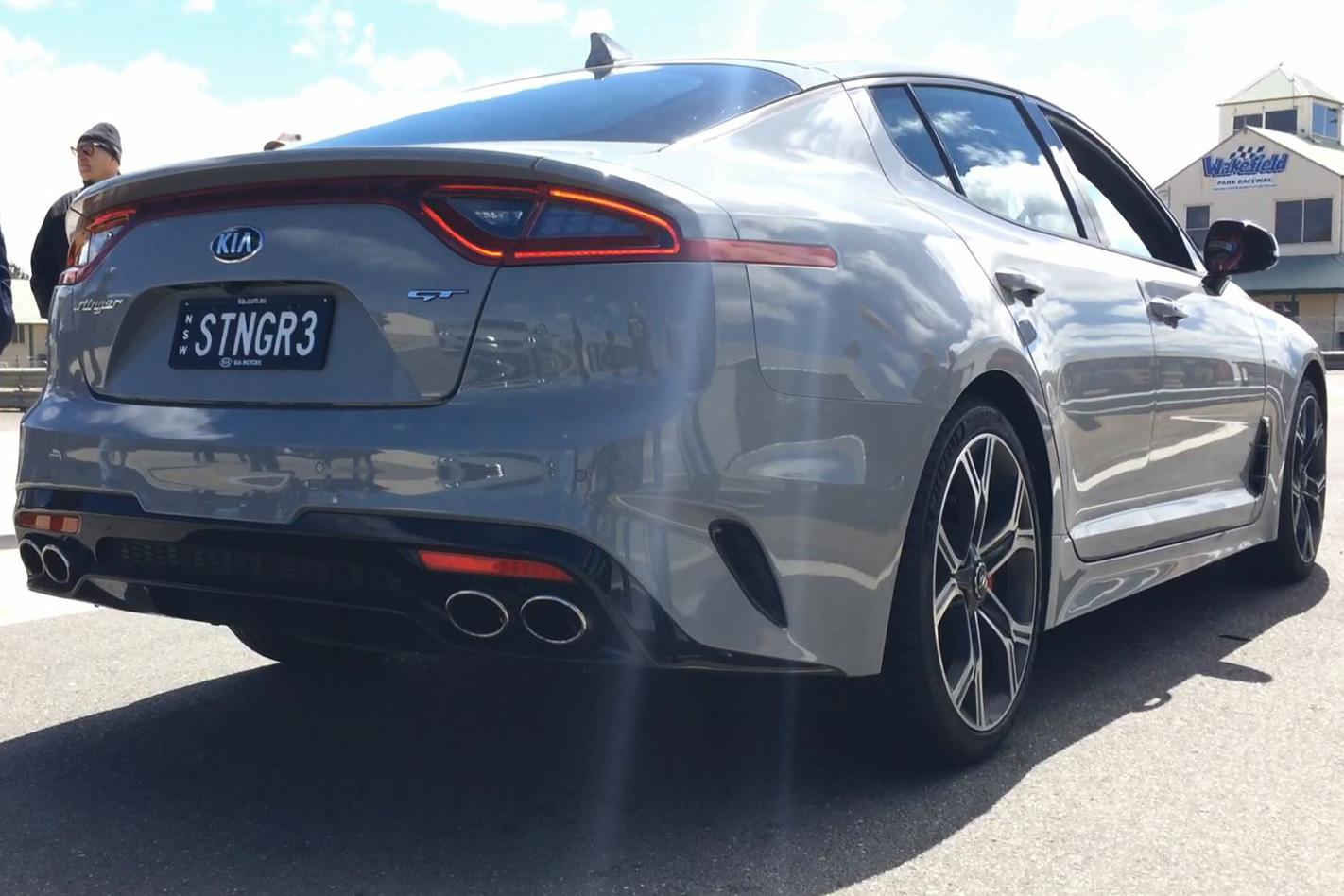
Designed by Lumens, a Melbourne based company with HSV on its resume, the system features from the rear axle pipe-join to the quad tips.
It works by routing gases away from the stock muffler canister into a more free-flowing resonated pipe.
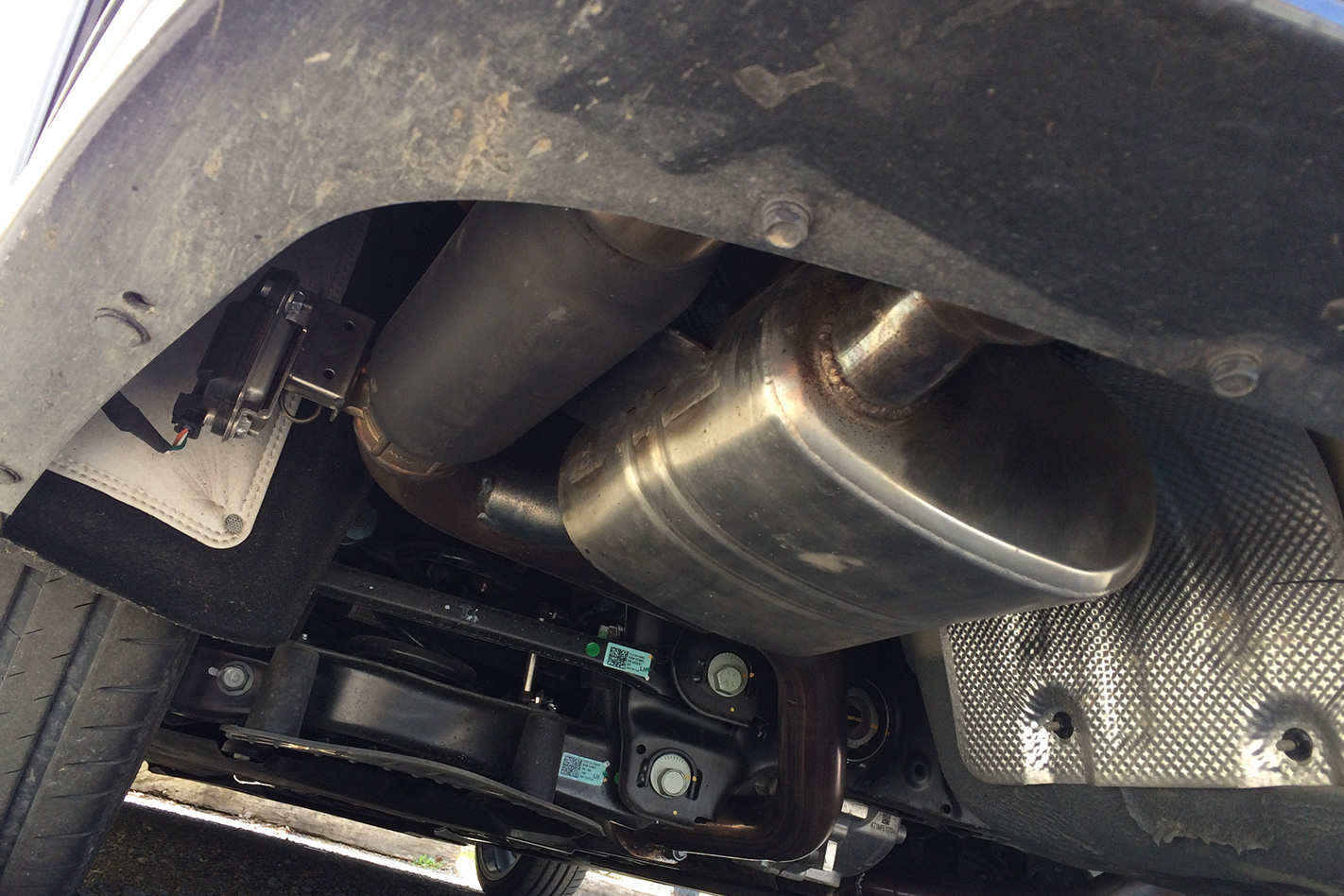
Kia’s hoping to introduce the same product on its 2.0-litre Stingers in future.
In the November 2017 issue of MOTOR, you’ll be able to read an interview with Holden’s lead vehicle dynamics engineer Rob Trubiani.
In that interview he explains the steps he’s taken to make the all-new imported ZB Commodore feel familiar to the cars that Australia has known and loved for almost 40 years.
Happily, we didn’t just have to take his word for it as he brought with him a prototype for us to try. Despite being an early hand-built development mule, it was loaded with the latest powertrain and chassis calibrations so while this is by no means a definitive verdict, it did provide a taste of how the new Commodore will drive.
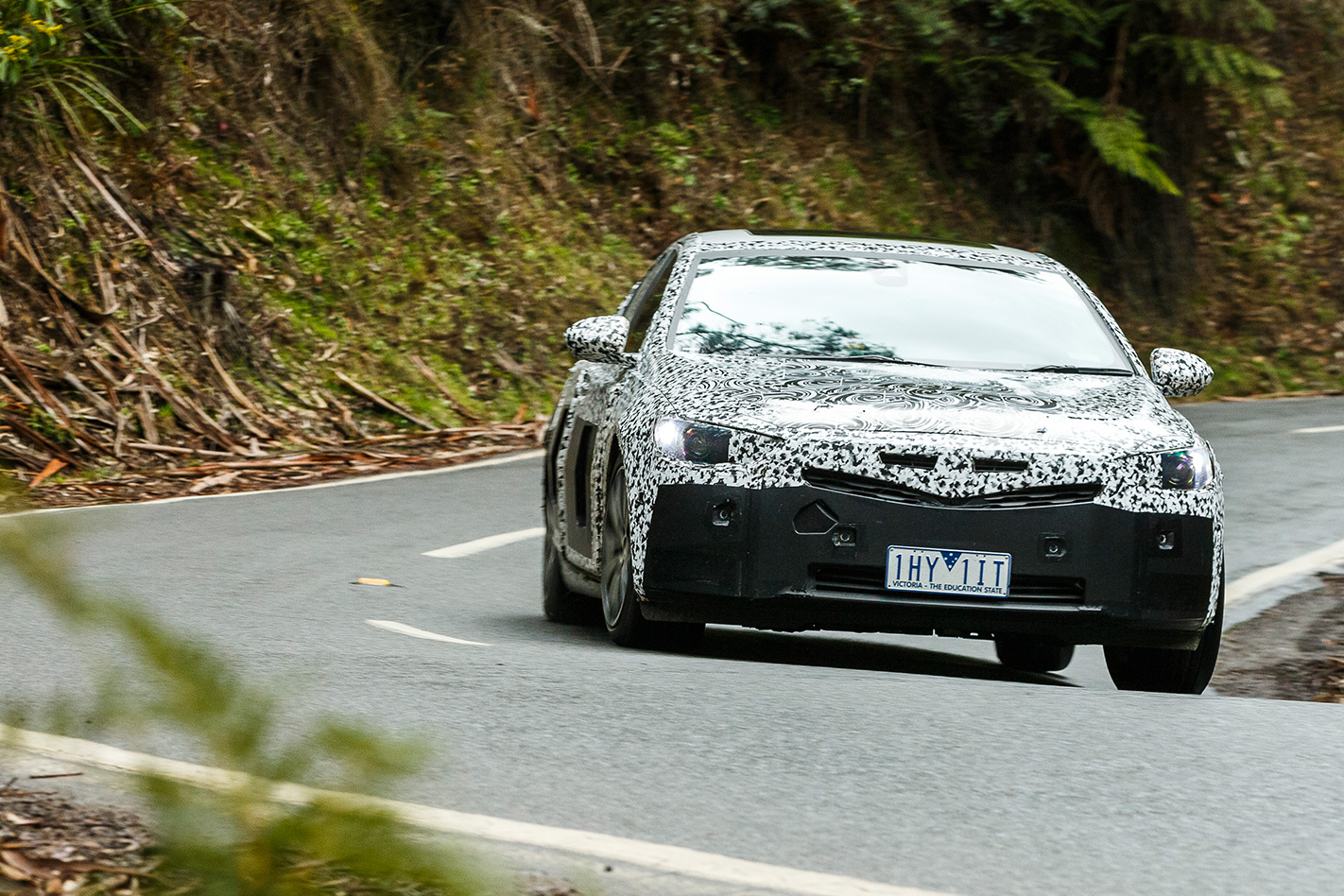
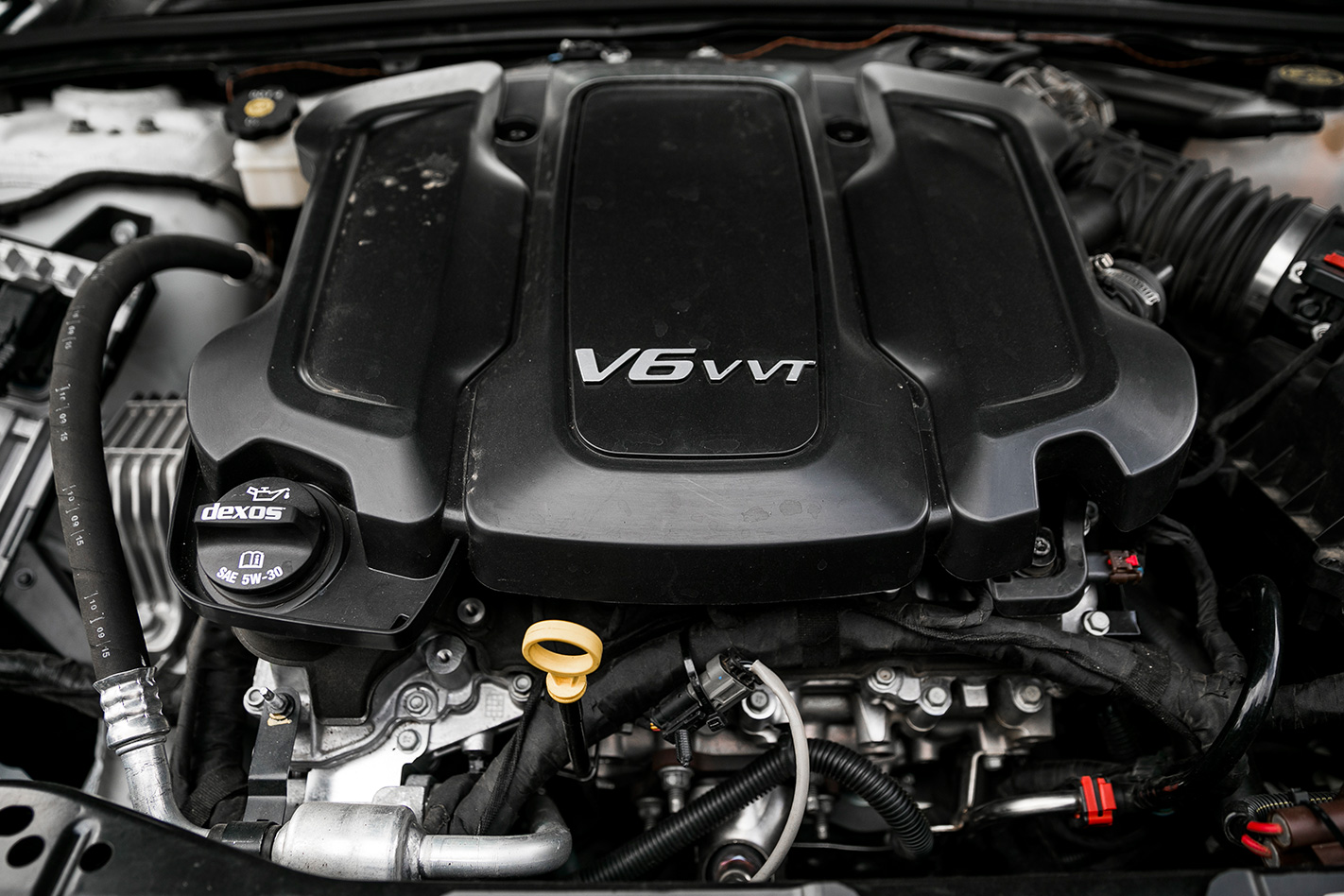
Providing propulsion is a 3.6-litre naturally-aspirated V6 producing 230kW/370Nm, feeding all four wheels through a nine-speed torque-converter automatic and ‘Twinster’ all-wheel drive system. We’ll come back to that later.
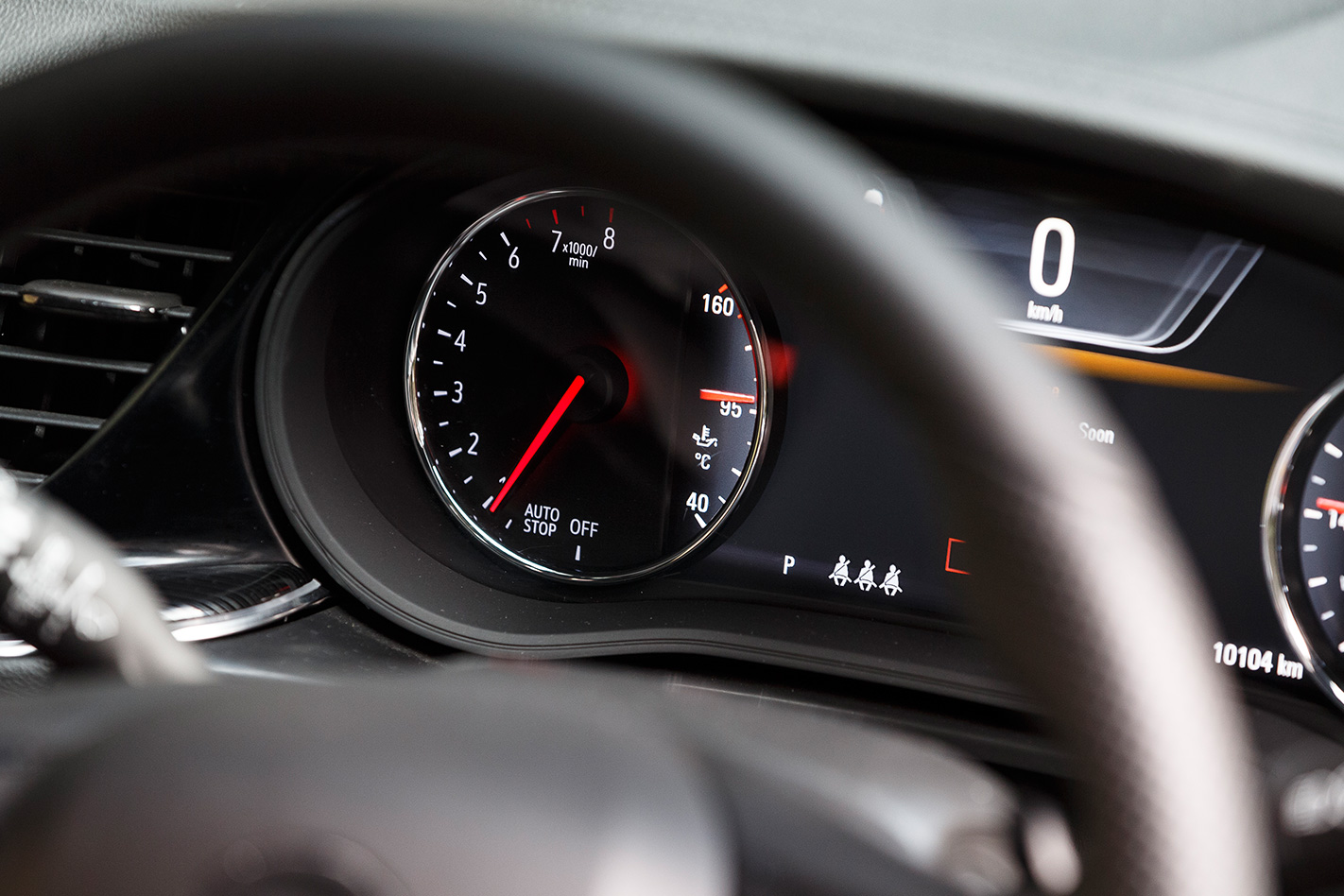
It’s a keen enough engine, revving with reasonable enthusiasm to its 6500rpm redline and making a surprisingly raucous noise in the process, though this car is far from the finished article in terms of NVH protection.
It can be a challenge to make a V6 sound evocative, however Trubiani promises the VXR will have a bespoke exhaust.
As you’d expect, the nine ratios are extremely closely stacked, which keeps the engine in its sweet spot nicely. The shifts are smooth enough and there’s a reasonable level of manual control; upshifts aren’t automatically triggered at the limiter and downshifts are generally answered, though the rpm allowed is on the conservative side.
Also on the conservative side is the basic ESP tune, nibbling away on corner exit despite seemingly unimpeachable all-wheel drive traction. Its intervention is very subtle, though, and this prototype lacks the Sport mode which will be present in the final models. If you prefer, ESP can also be switched completely off.
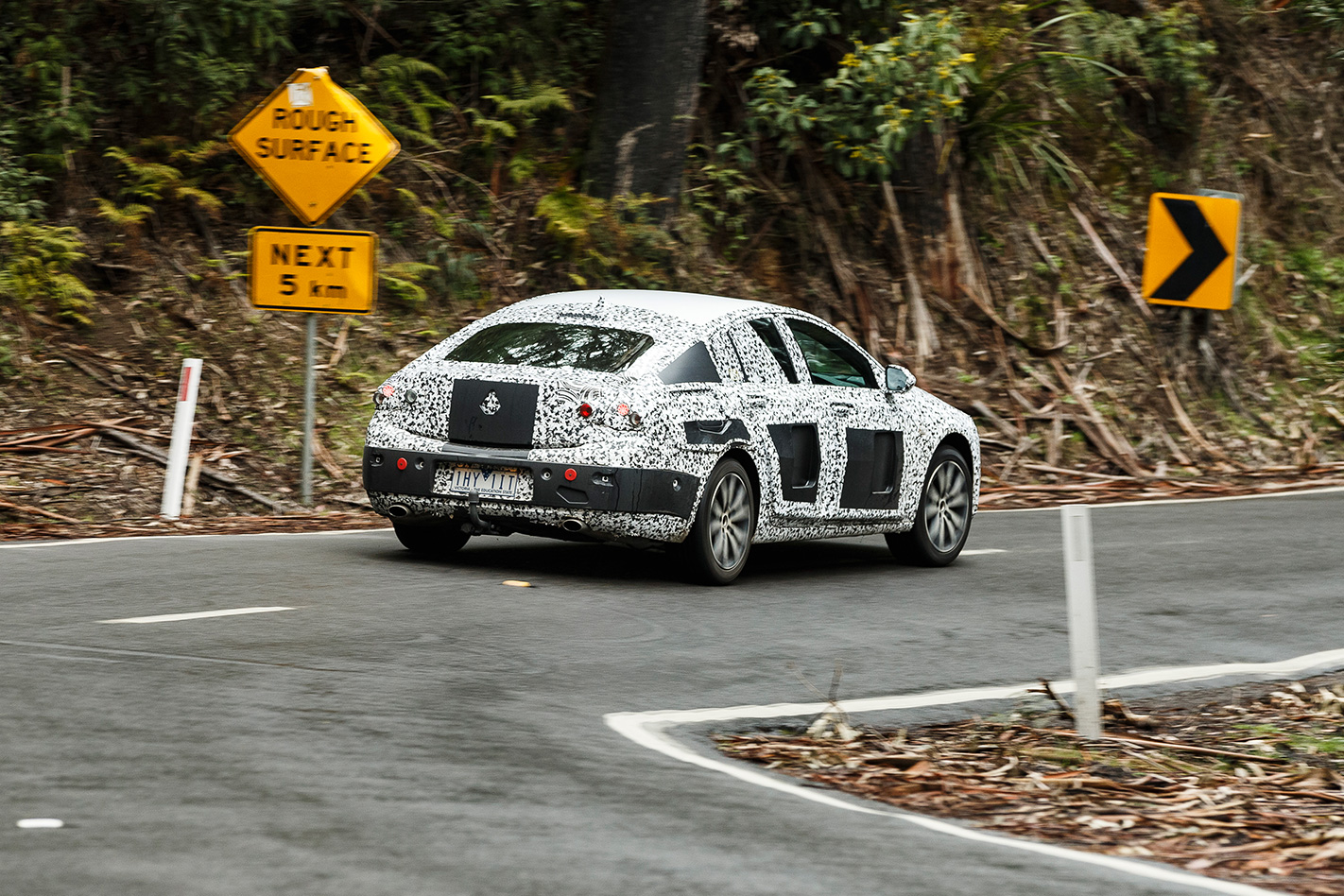
The effects are relatively subtle – it won’t power oversteer on tarmac like the Focus RS that shares the Twinster system – but it definitely gives the driver confidence to use the throttle early and decisively. Apparently it’s a riot on dirt and the all-wheel drive traction will certainly be a boon to those who visit the snow or regularly venture to rural areas.
Is it fun? It’s certainly polished, with excellent steering (something Trubiani worked particularly hard on, and it shows), excellent body control and a general acceptance of being driven spiritedly. But fun? While I can imagine having a punt in the ZB Commodore when I came across a good road, I can’t imagine searching one out for the hell of it.
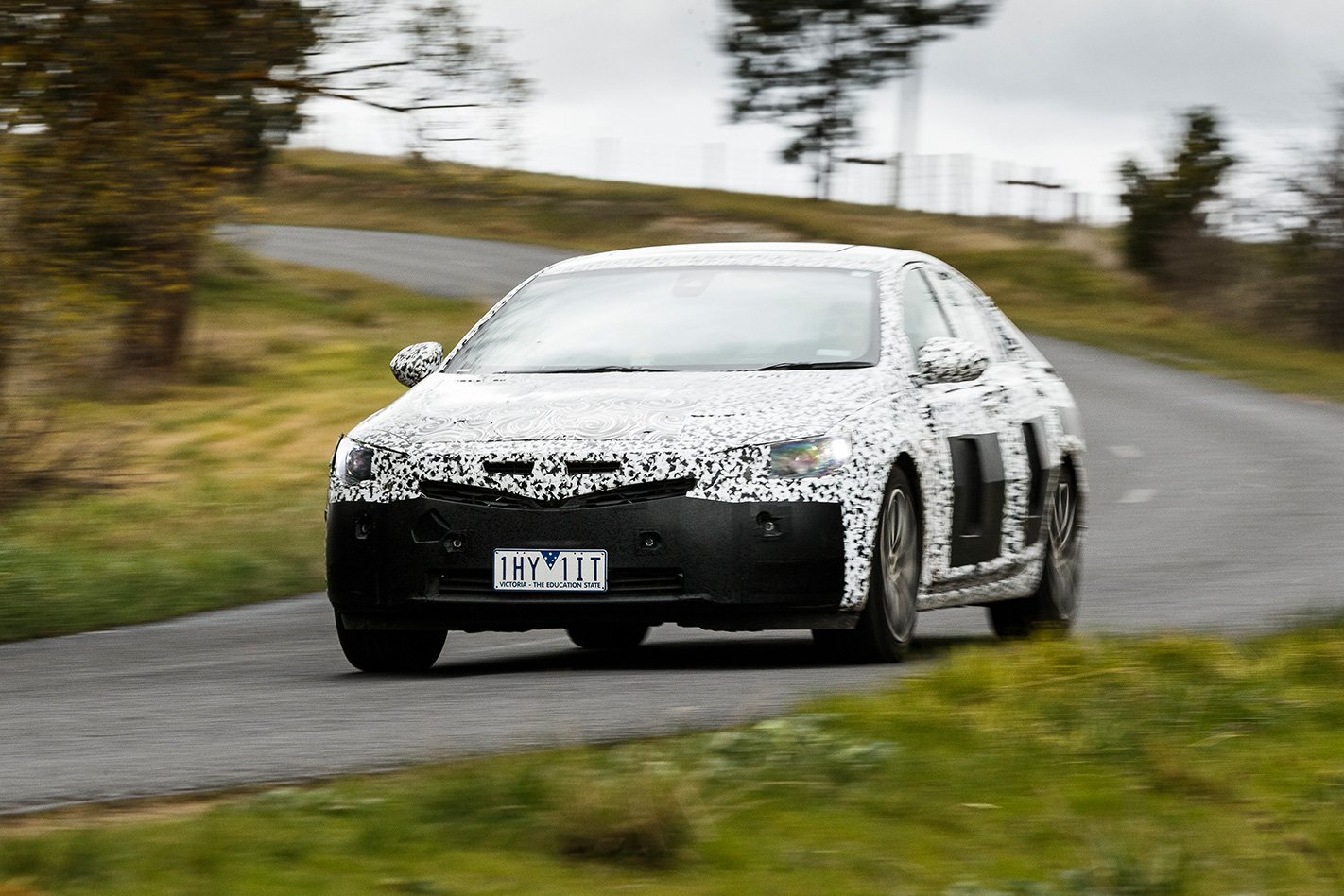
Based on the evidence of this V6 prototype, it should be an entertaining steer, albeit a very different experience to previous sports Commodores, and not just because of the lack of V8 power. Holden claims current Redline owners have been behind the wheel of the ZB and come away impressed, but it’s difficult to see the two cars appealing to the same buyer.
We’ll bring you a comprehensive review of the new Commodore range when we drive the finished product in early 2018.
Specs Engine: V6, DOHC, 24v Power: 230kW @ TBCrpm Torque: 370Nm @ TBCrpm Weight: 1650kg (est.) 0-100km/h: 6.0sec (est.) Price: TBC
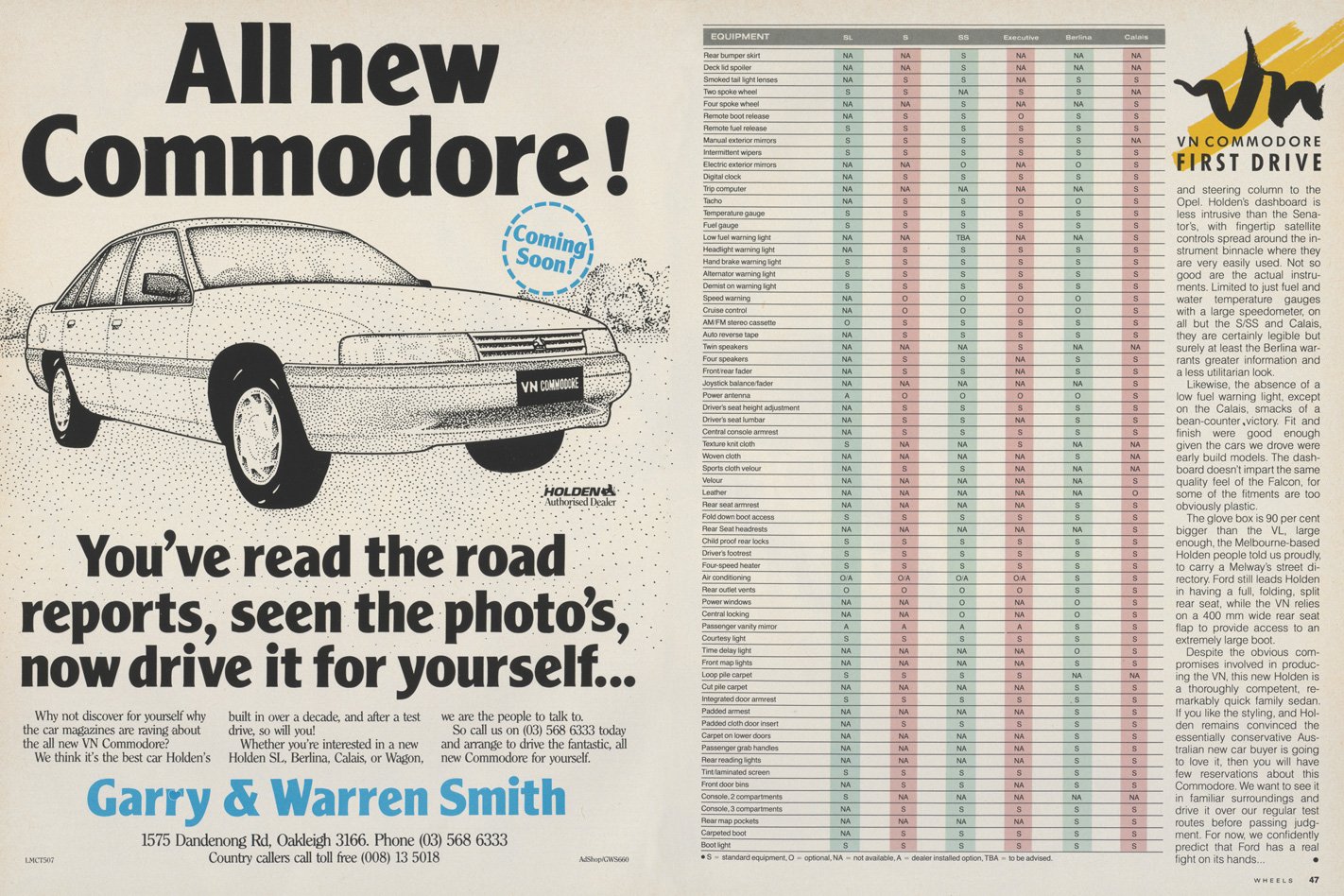
HANDS CAN at last be laid on the new VN Commodore. And it is, as expected, an intriguing, yet very effective amalgam from GM’s vast world parts bin, with enough Australian content to ensure it is unique.
So don’t let appearances deceive you , under that rounded , aerodynamically efficient, yet somehow bland, styling lies a floor pan and suspension that will be routine to every mechanic who has ever toiled over Holden’s mainstream model. Yet, so abundant and obvious are the changes, that we expect the average punter will believe this Commodore is all-new.
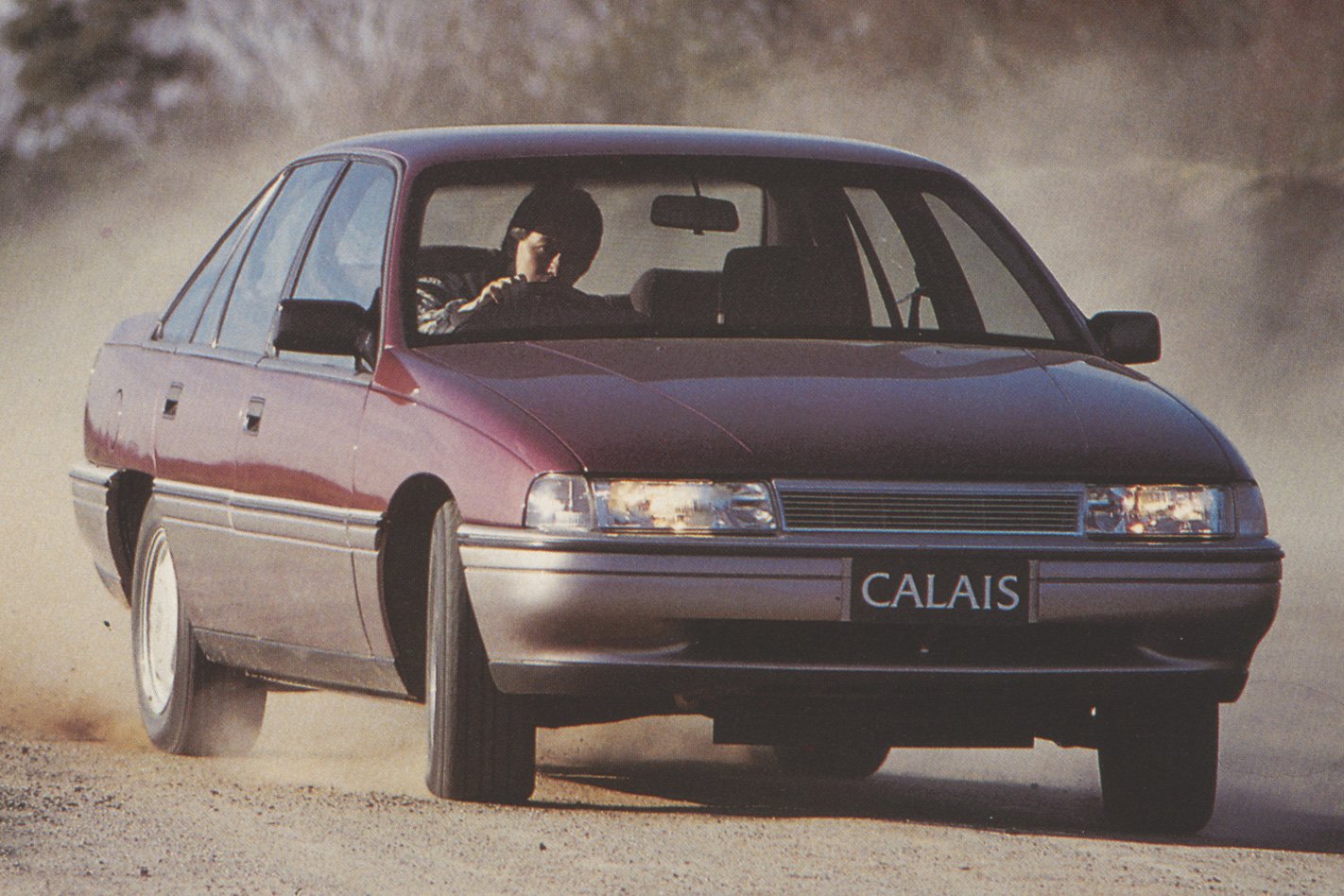
Dynamics are demonstrably improved, but still thoroughly familiar in feel. The VN is unmistakably a direct descendant of the Commodore family. Faced with knowledge that Ford’s ’88 Falcon would be at least as big as the previous model, Holden knew it had to make a more spacious car if the Commodore was to have any chance of regaining the much sought after number one spot at the top of the sales charts. How Holden’s product planners convinced the bean counters to spend $200 million in matching the new German Omega/Senator styling to the VL’s underbody is a story in itself.
What we’re interested in here is the result. After two days driving a variety of VNs at Holden’s Lang Lang proving ground, and on the demanding roads of South Gippsland, we say Holden’s parts-bin solution works. More important perhaps, VN is the stepping stone to a wide variety of models that will give Holden the ability to tackle Ford model for model, just as it did in the days of the HO-HZ.
First, the good news. Buick’s port fuel-injected, 125 kW, V6 engine, with no overhead camshaft nor four valves per cylinder in sight, not only delivers exceptional performance, but is far smoother than we expected based on experience with the pre-’88 American V6. It lacked the counter rotating balance shaft now fitted.
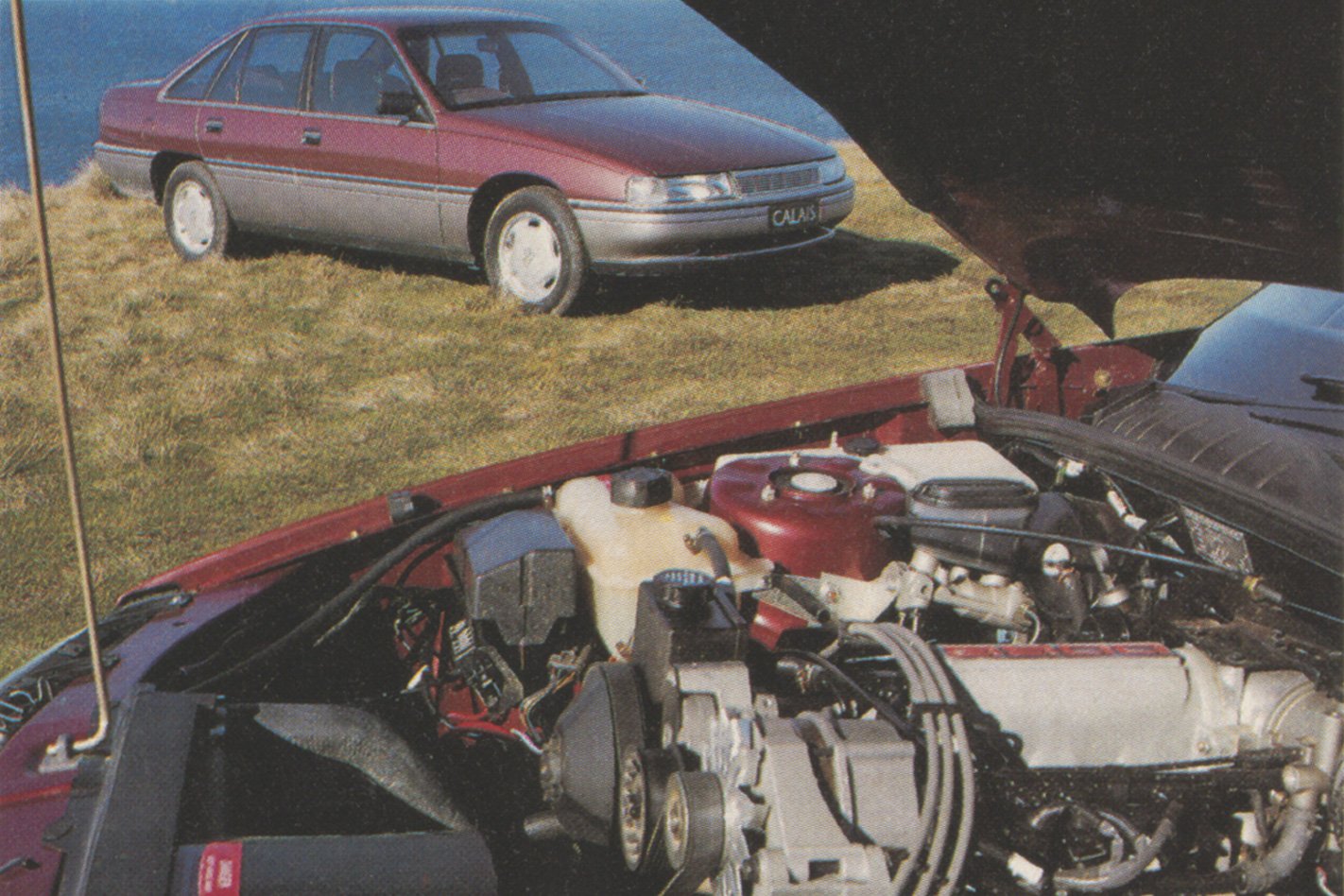
So, instead of the high-revving character that enthusiast drivers enjoyed with the VL, the new Holden Commodore has more of the low and mid-range torque traditional Holden buyers will welcome. Maximum power of 125 kW is developed at 4800 rpm, 400 rpm below the Nissan engine, while the redline is 5600 rpm, though there is a sudden cut-out at 5400 rpm, which is 800 rpm lower than the redline on the overhead cam Nissan.
If the engine rocks noticeably on its hydraulic mounts as the grinding starter motor fires up, it soon settles down to a quiet idle, with little exhaust note to indicate a “V” layout. Throttle response is excellent. There’s enough sheer bottom-end grunt to spin the wheels under maximum acceleration.
Independent rear suspension is being developed for the long wheelbase luxury car, due to be released in about a year as the Statesman. So potent is the V6 that the IRS must filter through to ordinary Commodores as soon as possible, to give the traction necessary to tame the engine’s bottom-end muscle.
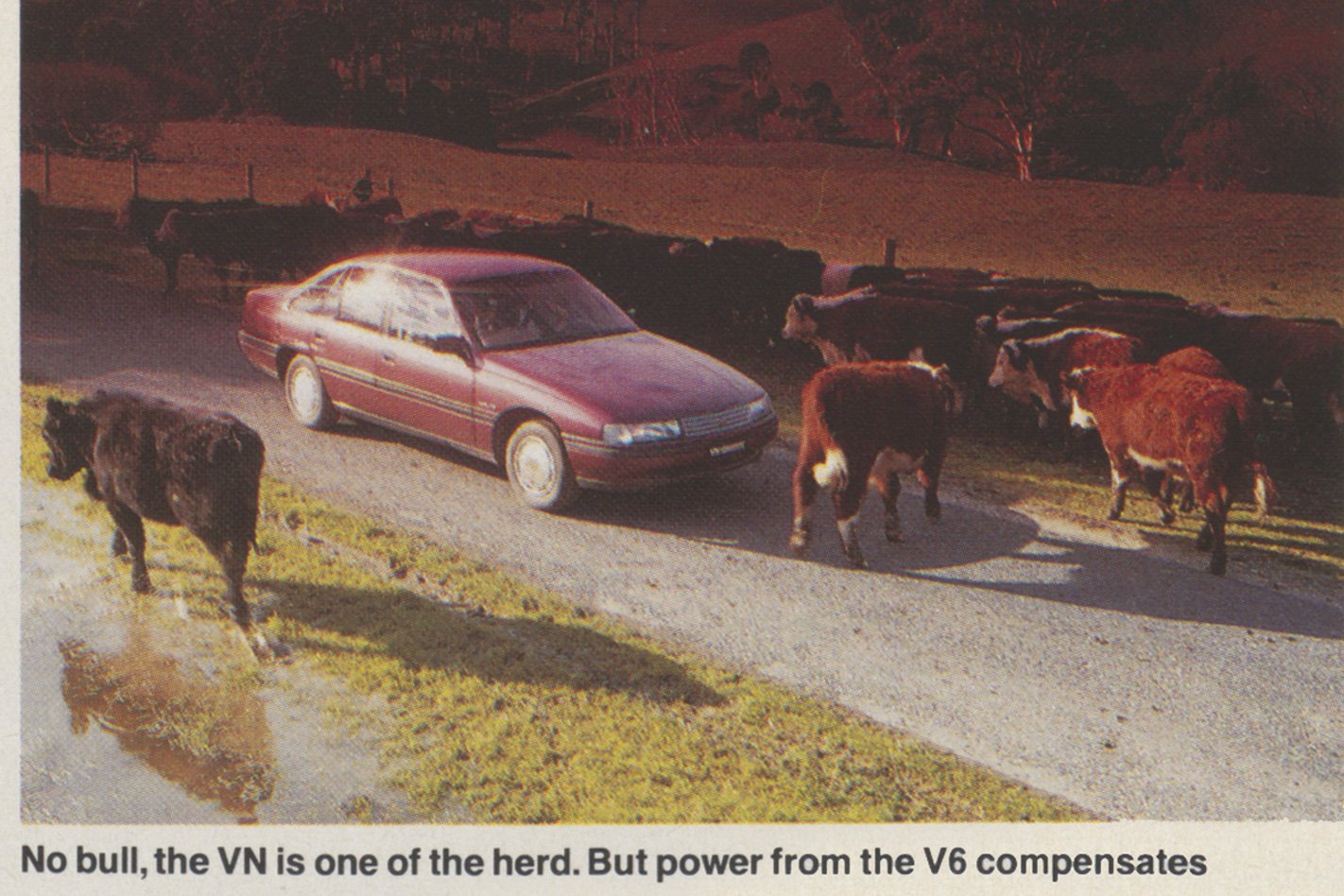
It’s obviously a punchy motor with enormous potential. Already it’s been turbocharged in the USA to produce the fastest accelerating American car, Buick’s old Grand National. There are plans, too, for a supercharged US version early in the ’90s.
For Australians, there will be a more powerful fuel-injected V8 in the VN, expected to be released along with the sporting S and SS models next February. The V8 will be optional across the range, though in reality, only those who race at Bathurst on the first Sunday in October are going to have a real need for the V8’s level of performance.
Let the figures do the talking. Standing 400m: 15.6 seconds, rest to 100 km/h 7.6 seconds, 100-130 km/h in third gear: five seconds dead, top speed: 205 km/h. Remember, this is for the basic 3.8 litre engine offered in every Commodore.
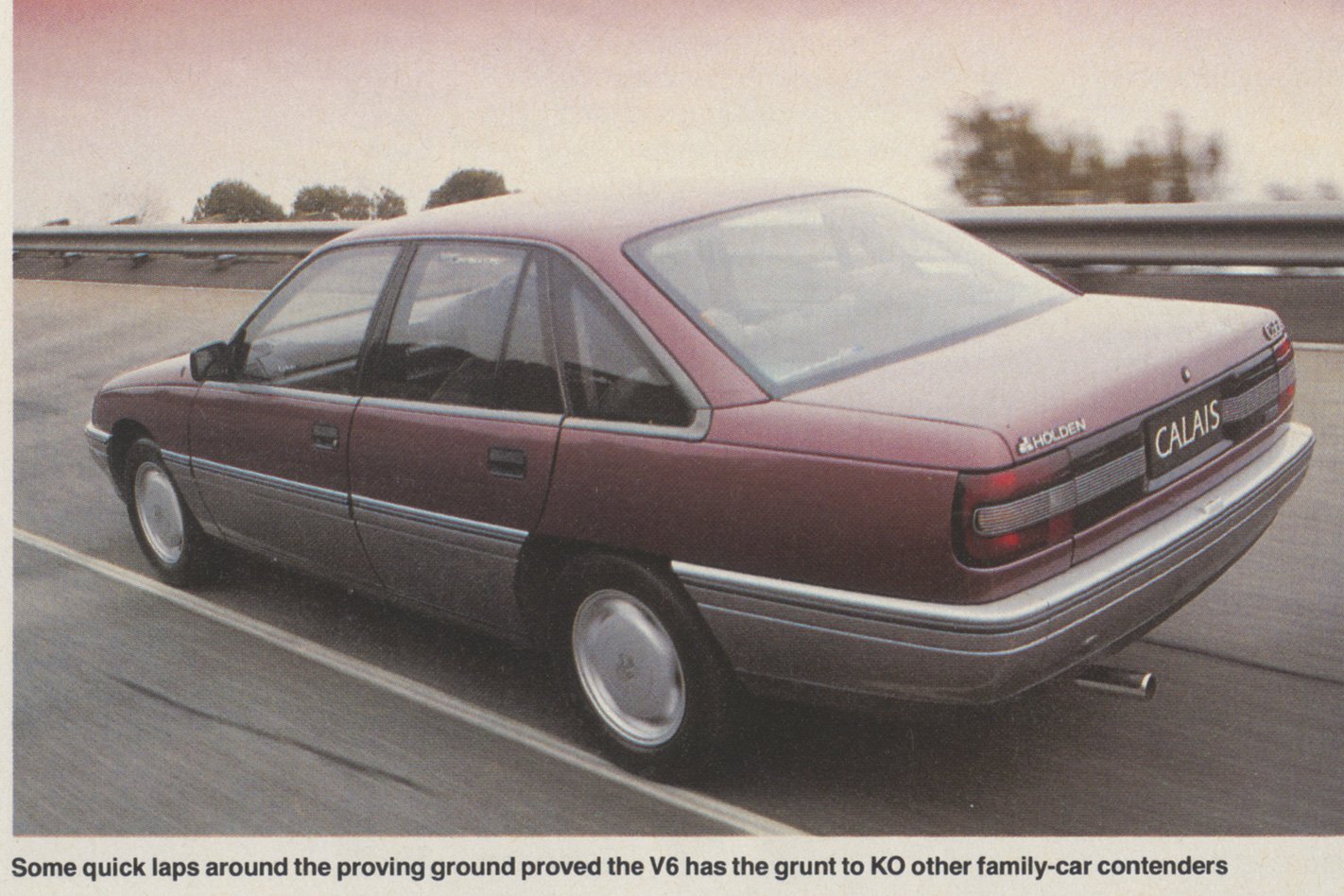
Compared with the VL, which was always considered to have excellent acceleration, the new car is superior in almost every way. The VN is 1.2 seconds quicker between 100 and 130 km/h in third, and a staggering 8.3 seconds faster in fifth gear over the same 100-130 km/h segment.
Borg Warner’s excellent T5 five speed gearbox, previously used on the Group A Commodore, in various Brockmobiles and now on the EA Falcon, doesn’t mate to the V6 quite as successfully. The V6 has only previously been used with automatic transmission, so the adaptation to a manual gearbox has been carried out in Australia. Five speed VNs were in short supply at the long lead release and one of these was involved in a minor accident (no, not with Wheels at the helm) which may have pushed the drive train out of alignment.
Despite this reservation, it seems there’s still some development work required to eliminate drive line snatch and a touch of harshness. The gear change itself is light with a pleasant firmness and a positive, rather than heavy, clutch action.
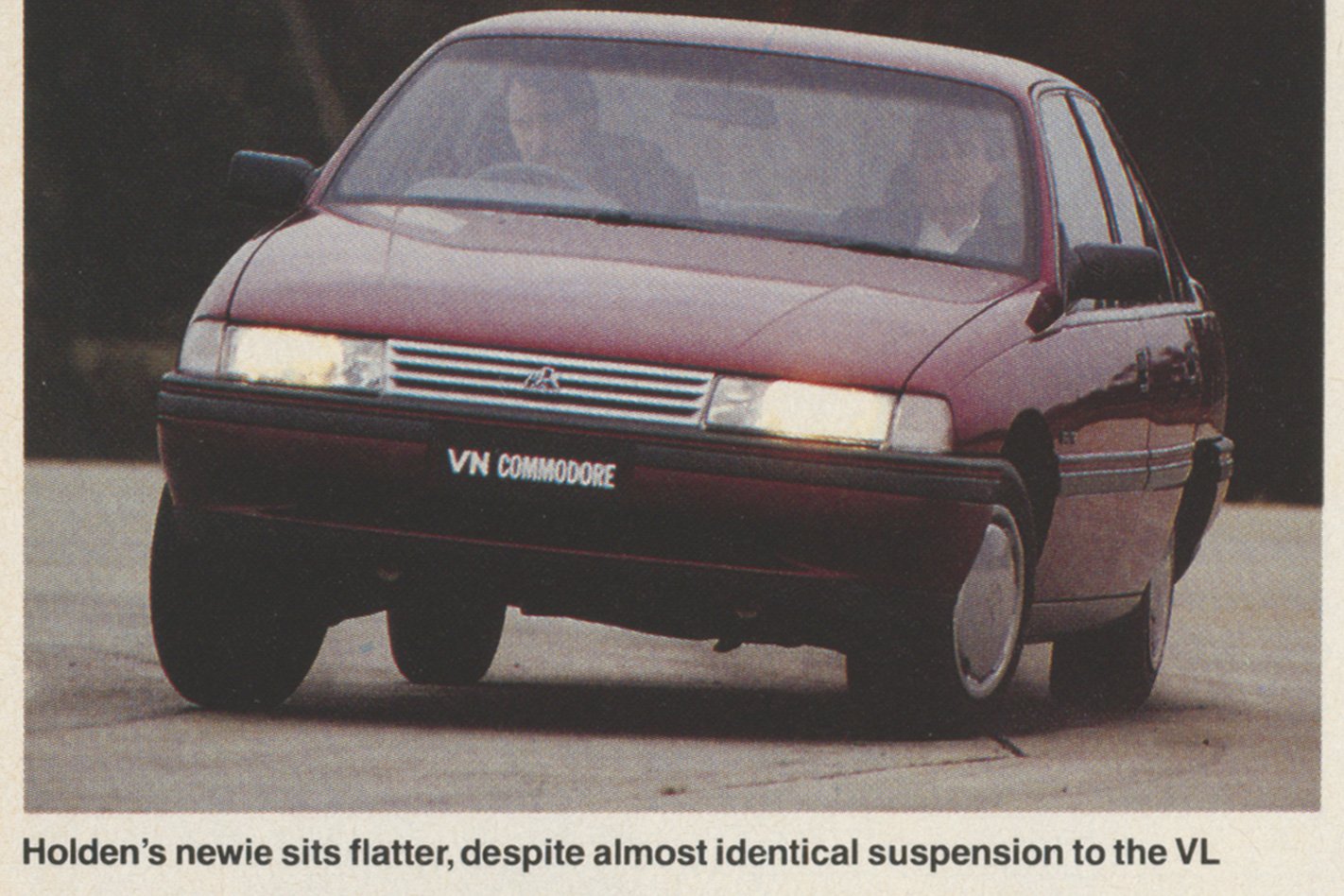
Holden’s decision to retain the same basic suspension means we don’t get the Opel’s negative scrub radius, all independent system, but this doesn’t mean the blokes from Fishermens Bend have been idle. Drive the VN back to back with the VL and you will be impressed by the extent of the improvement. The new car is more relaxing at any speed , faster in ultimate terms and more predictable, while the body stays flatter. The nervous behaviour that some drivers found intimidating on pre-VL Commodores has gone. The VN can be driven extremely quickly and flatters the indiscreet with mild, consistent understeer and high levels of adhesion.
Holden’s decision to import the excellent four-speed, Turbo-Hydromatic 700 automatic- used in the USA on the Corvette, Firebird and Camara – instead of waiting for BorgWarner’s local four-speeder is vindicated by the acceleration times and its silky smooth operation. The extra ratio gave Holden’s engineers the chance to use a lower first gear, for more rapid acceleration from rest, while retaining a long overdrive fourth for relaxed cruising . Ford’s compromise gearing is shown up in all its inadequacies for while first gear on the VN produces 12 km/h per 1000 rpm, the Falcon has to cope with an extremely high 17.6 km/h. The result is that the Holden rockets away from rest and reaches 50 km/h in just 3.0 seconds while the Falcon in its Fairmont Ghia form takes 4.2 seconds with the multi-point engine, and 3.9 seconds with the basic throttle body engine fitted to the vast majority of EAs. VN automatics cover the standing 400m in only 16 seconds, while the EA Falcon with throttle body engine takes 17.5! Clearly, the Commodore has a performance edge that Ford can’t hope to answer until the four speed auto arrives, early in ’89.
Commodore wind noise is low too, much lower than the Falcon, and engine noise has diminished sufficiently to produce a wonderful high speed touring car. The Turbo 700 slips gently from one gear to another even under maximum power, while kickdown is instantaneous and just as smooth. Sensitive drivers will also detect the torque converter locking up at around a low 70 km/h in fourth and on small throttle openings.
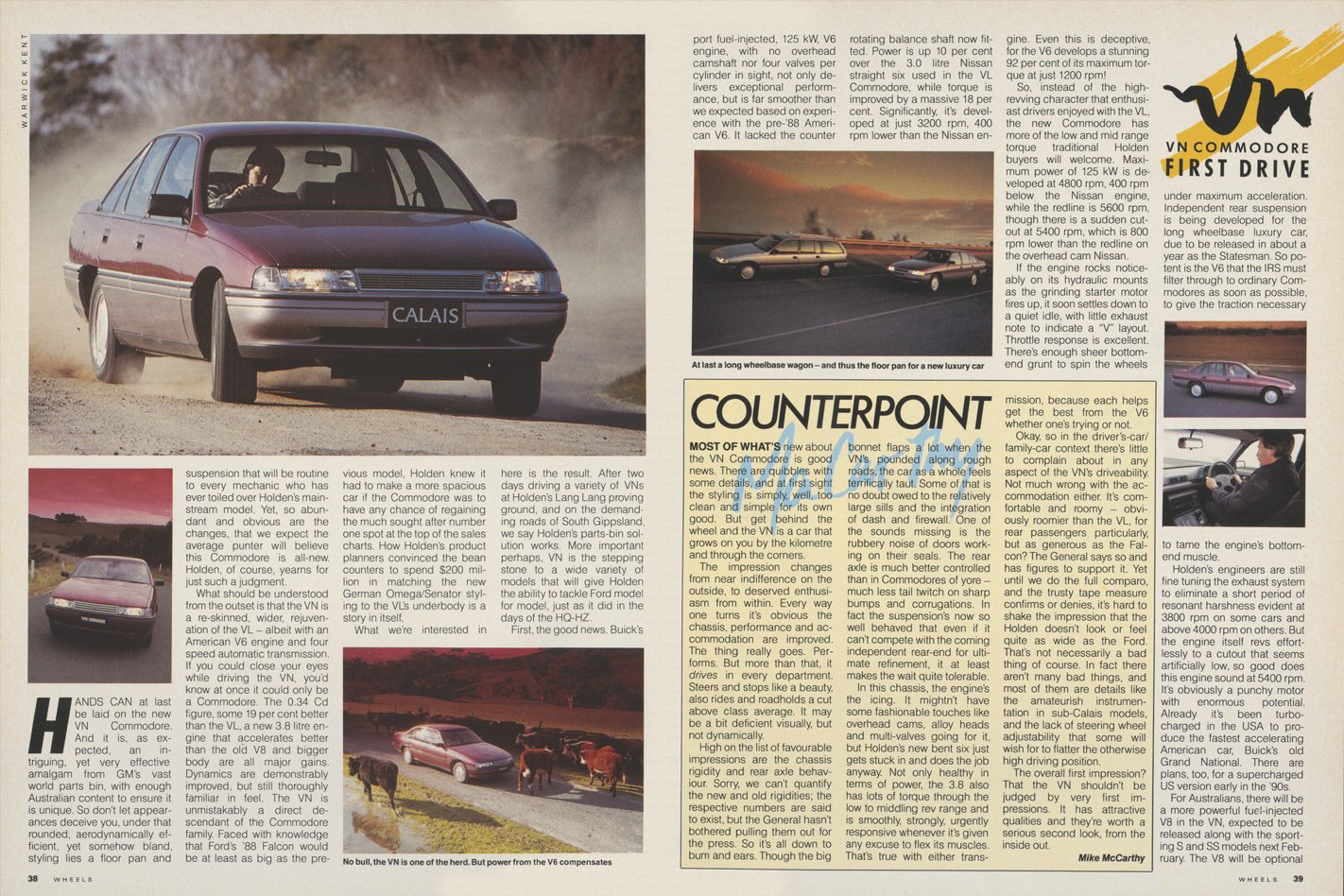
Locating the front anti –roll bar to the MacPherson strut has given more than 50 per cent greater roll stiffness and improved turn-in response, while the diameter of the rear anti -roll has been increased to provide more rear roll stiffness. Springs are softer, dampers stiffer at low velocities and the ride is more comfortable, quieter and better isolated.
Power steering is now standard equipment on all but the fleet SL model, which is intended not for private buyers, but government departments. Essentially the VL’s variable ratio rack and pinion system, with engine speed-related assistance, has had only minor changes to improve feel at speed. Few will find anything to criticise regarding the steering, for it is light, with linear response, accurate enough for the enthusiast, without being too fast for the more sedate motorist. Despite the increase in wheelbase, there has been a slight reduction in turning circle to 10.4 m.
What annoyed most Wheels drivers was the size of the steering wheel. Holden claims, quite rightly, that the inner diameter of the new two-spoke wheel is the same as the VL wheel, but with a thicker rim, the actual diameter is greater. In shape the wheel reminds us of the bulky affair fitted to the Rover SD1. Calais buyers get an attractive four-spoke wheel modelled after the Opel Senator.
Four wheel disc brakes are standard across the range for the first time on the Commodore. Pedal pressures are light without any sponginess and the action progressive. Commodores equipped with the five-litre V8, Police Pack or the S option use bigger diameter front discs and Corvette-type finned calipers. Anti-lock brakes are still in the future, although they’re fitted as standard to some Opel models.
Beyond even the engine and its performance the symbol of this new Holden is plainly the body. Holden has gone to great lengths to match the Falcon in interior dimensions while utilising some, if not all, of the benefits of the new Opels. Compared with the VL, the wheelbase has been extended by 63 mm to 2731 mm. Overall length has been increased 84 mm to 4850 mm. Exterior width has gone up by 72 mm, but the curved body means there is even more shoulder room than the figures suggest.
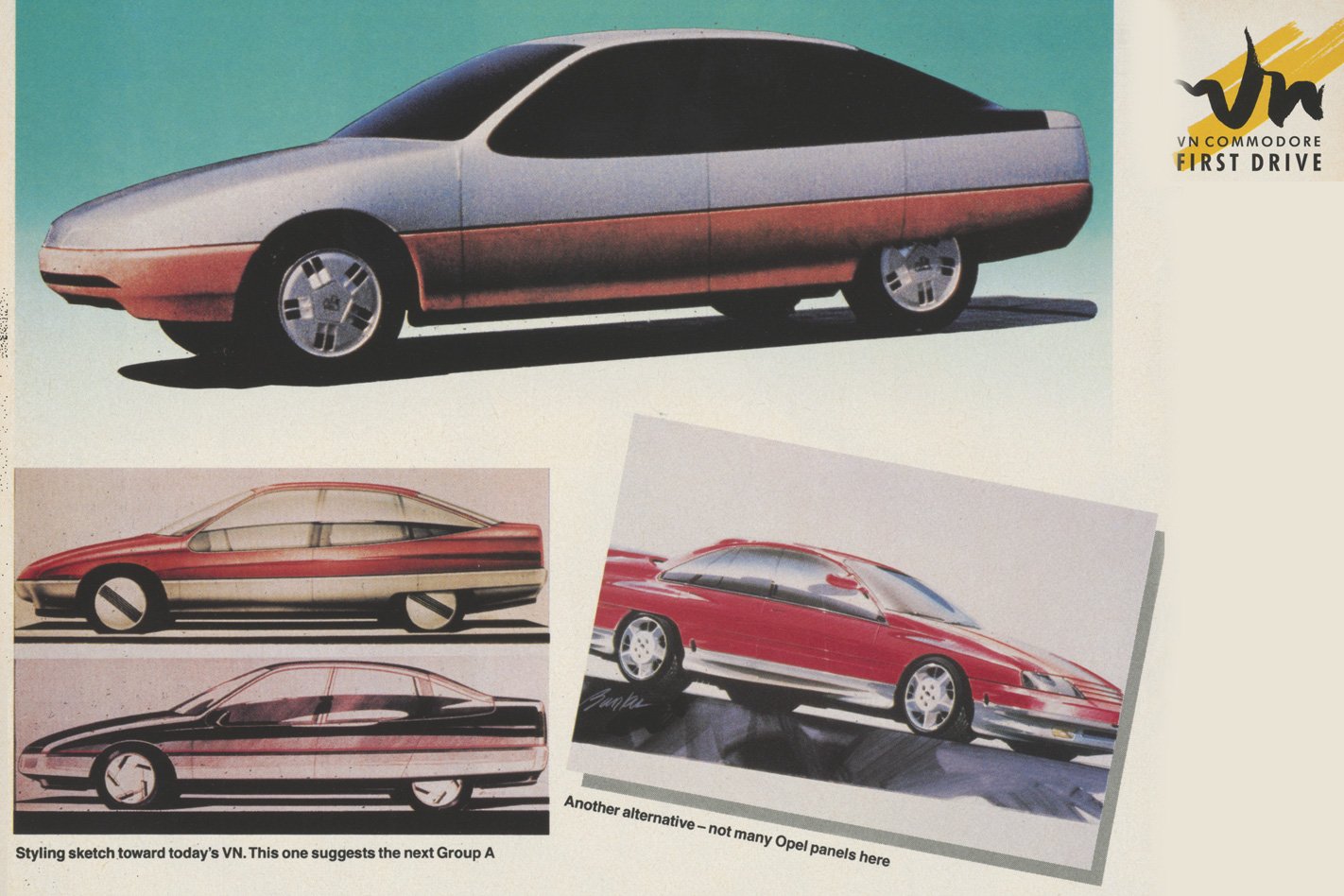
In profile, this car is almost pure Opel, combining the six-window glass house of the Senator with the squared-off rear wheel arch of the Omega. The tear drop shape, with its modern flush side glass, is clearly evident in profile and the cockpit appears substantial in much the same way as a Fairlane. But instead of the cross-hatch oval grille that gives the Senator a distinctive character, Holden has opted for a bland nose that has little presence and looks impotent in the rear vision mirror of another car. There is nothing distinctive about the grille, nothing we haven’t seen many times before. By retaining the same front track as the VL, even after adding 38 mm to the floor pan, the front wheels look skinny and too far inboard of the body, suggesting the VN is standing on tip-toes. At the rear, too, and despite the best endeavours of the Holden design team to reduce the Opel’s taper and square off the corners, the VN doesn’t create a feeling of width.
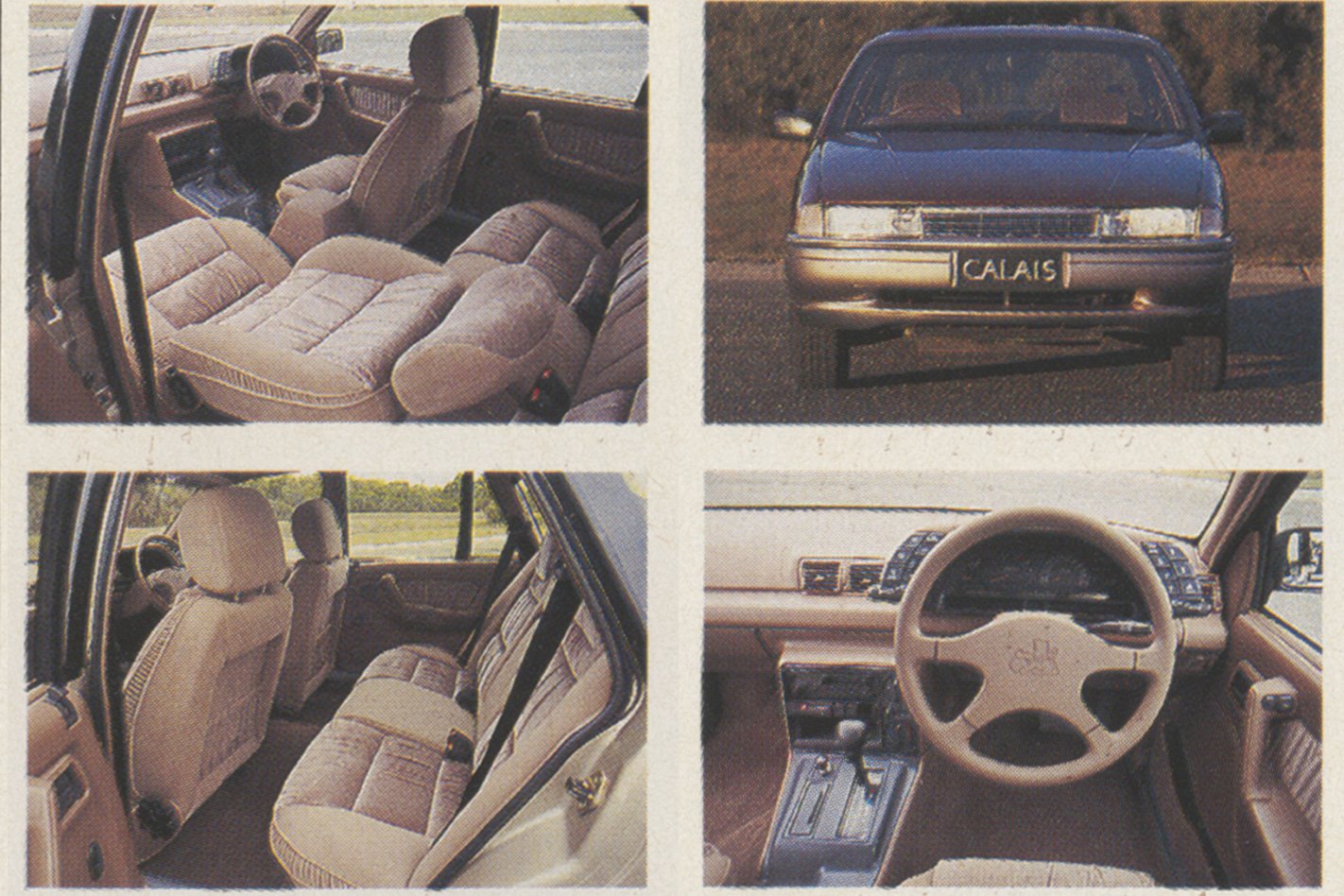
Limited to just fuel and water temperature gauges with a large speedometer, on all but the S/SS and Calais, they are certainly legible but surely at least the Berlina warrants greater information and a less utilitarian look. Likewise, the absence of a low fuel warning light, except on the Calais, smacks of a bean-counter. victory. Fit and finish were good enough given the cars we drove were early build models. The dashboard doesn’t impart the same quality feel of the Falcon, for some of the fitments are too obviously plastic.
The glove box is 90 per cent bigger than the VL, large enough, the Melbourne-based Holden people told us proudly, to carry a Melway’s street directory. Ford still leads Holden in having a full , folding, split rear seat, while the VN relies on a 400 mm wide rear seat flap to provide access to an extremely large boot.
Despite the obvious compromises involved in producing the VN, this new Holden is a thoroughly competent, remarkably quick family sedan. If you like the styling, and Holden remains convinced the essentially conservative Australian new car buyer is going to love it, then you will have few reservations about this Commodore. We want to see it in familiar surroundings and drive it over our regular test routes before passing judgment. For now, we confidently predict that Ford has a real fight on its hands…
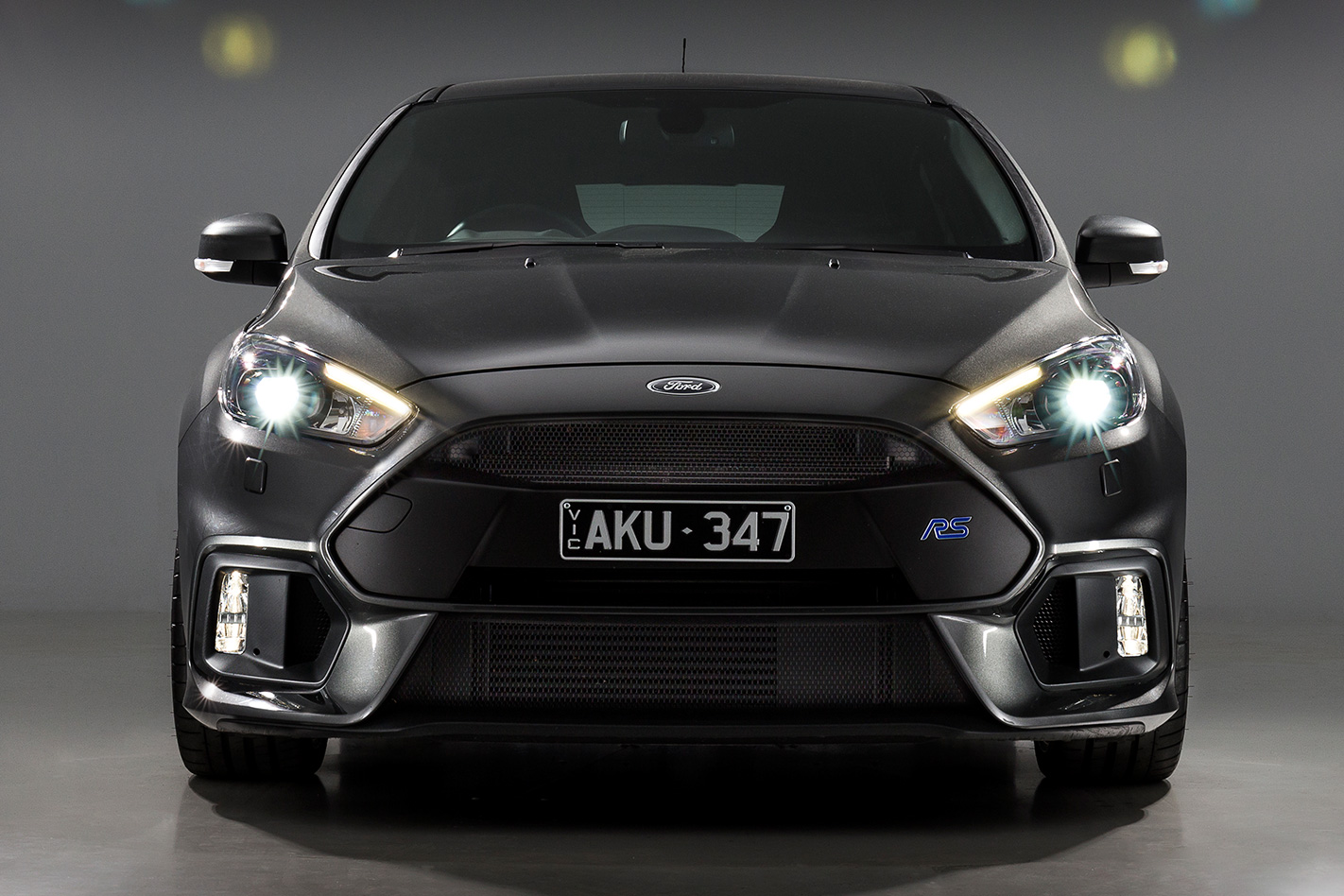
THE JAPANESE have been seriously left behind by the game they invented. By cars like the Ford Focus RS.
Not to take away from Ford Performance’s track day masterpiece, but cars like the Focus RS – and Mercedes-AMG A45 – are at the level the Subaru WRX STI and Mitsubishi Lancer Evolution would be, if only Subaru and Mitsubishi hadn’t turned the development taps to a trickle or, in the sad case of the Evo, off altogether.
In its press kit for the Focus RS, Ford talks at length about its innovative all-wheel drive system. A computer, via multiple sensors, detects available grip and adjusts the torque split front-to-rear and left-to-right, 100 times per second, for an eerie agility behind the wheel.
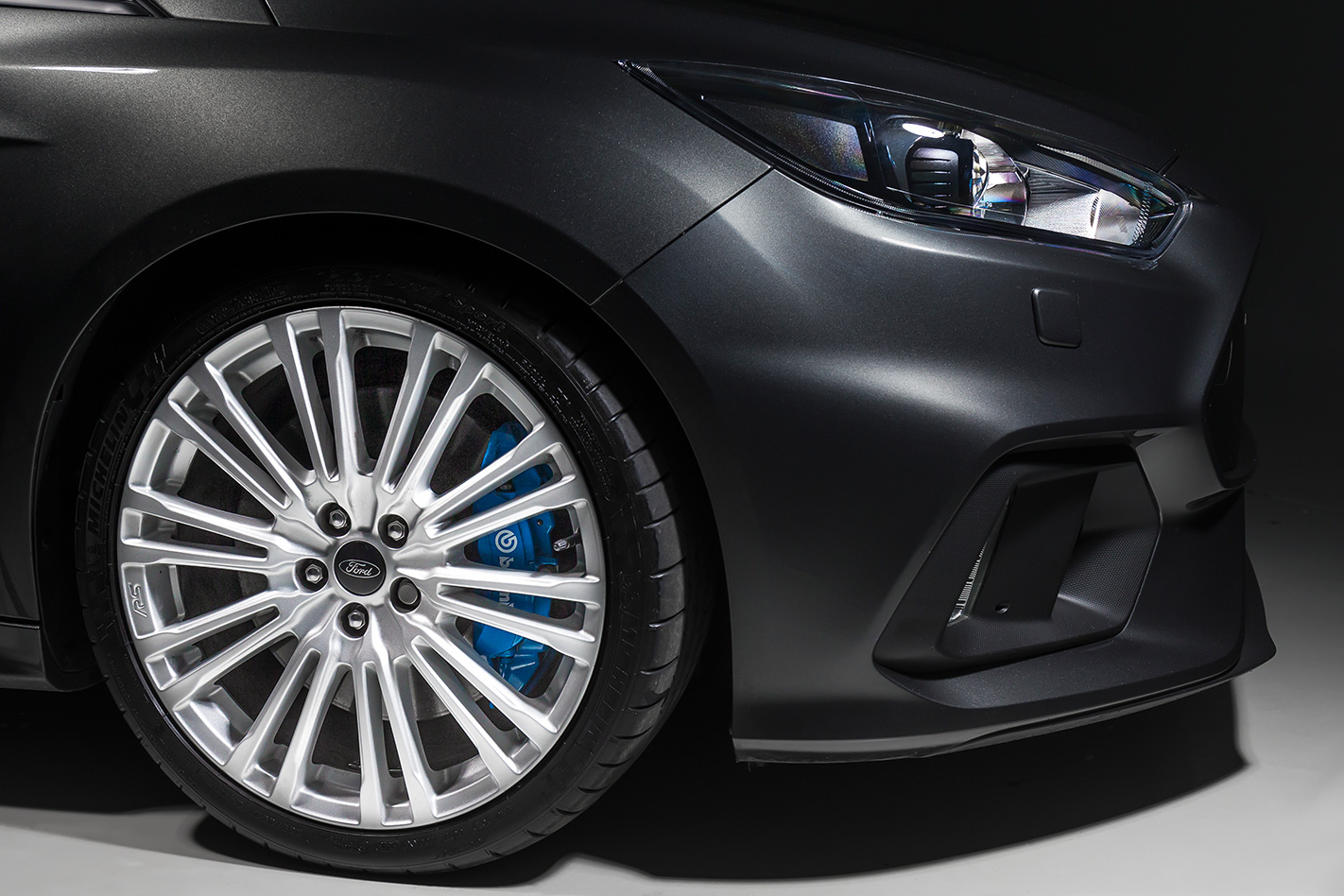
Of course, in 2017, the Focus RS takes things a step further with modern brake torque vectoring working in parallel with the mechanical systems; and an all-wheel drive system that overspeeds the rear axle by 2 per cent for even more eagerness to turn.
It was this crushingly effective all-wheel drive system, an incredible price of $50,990, and scoring first-place rankings amongst most judges of all 16 cars, that cemented first place outright for the Ford Focus RS at Bang For Your Bucks 2017.
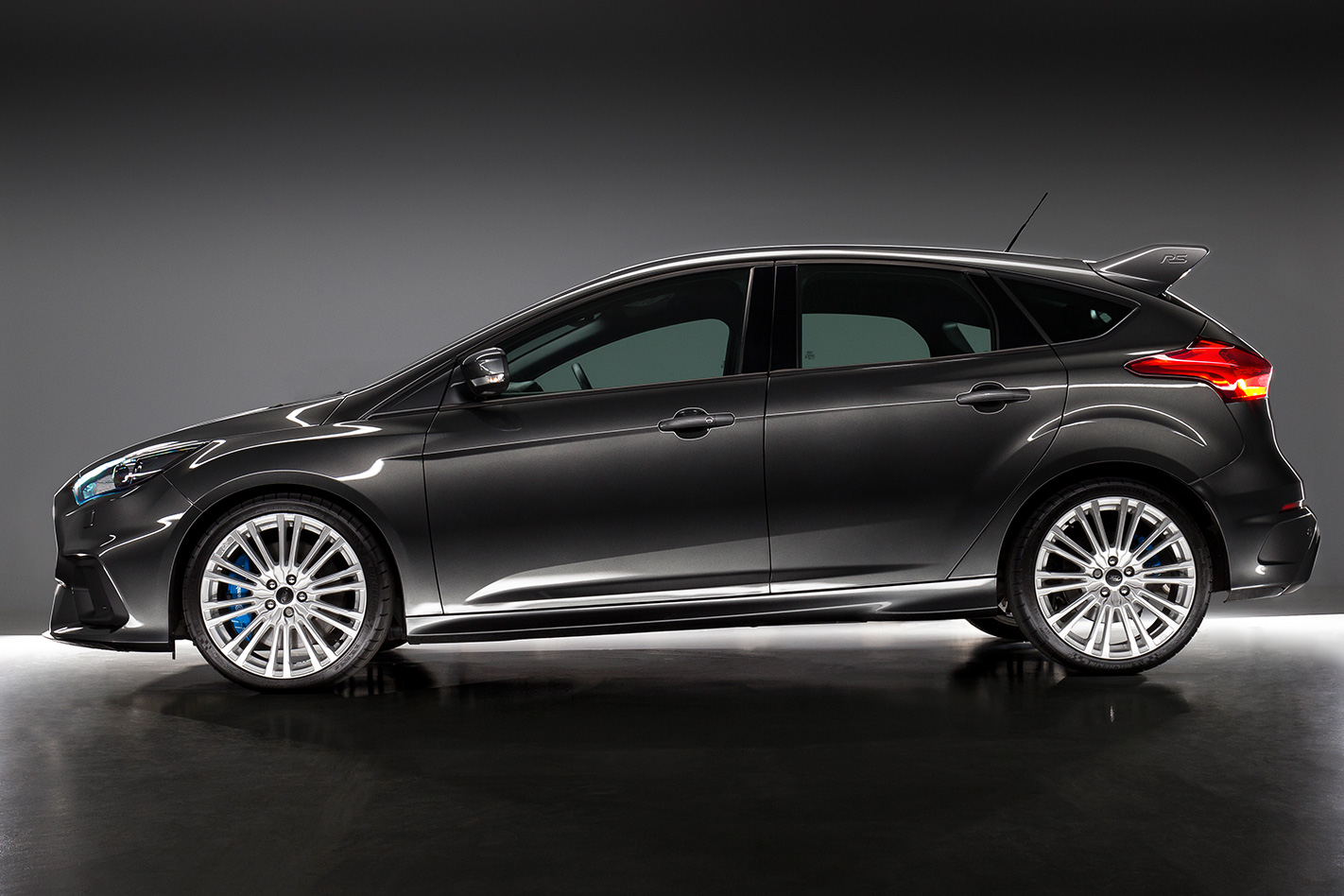
Not only has the Focus RS now won the event at MOTOR – the one that’s 80 per cent based on hard performance and pricing data – but it comes after it finished an incredible third at the strongest-ever Performance Car of the Year last year, wedged between a Ferrari 488 GTB and BMW M2, and beating cars like the beguiling Lamborghini Huracan LP580-2 and Audi R8 V10 Plus.
From an outright perspective, the Focus RS wasn’t especially fast in a straight line at Bang For Your Bucks 2017. That’s to speak in relative terms, of course, the Focus RS coming in fifth overall for the 0-100km/h sprint, behind the AMG A45, the M140i, S4 and SS-V Redline Ute.
Instead, the numbers testified to the brilliance of that drivetrain with the fastest apex speeds of all 16 cars. Well, if you disregard the somewhat anomalous Abarth 124 Spider, which tore through Turn 4 at an inexplicably fast 97.9km/h – the fastest car, through this corner, of the entire event.
Now, you might be reading all this and thinking, fair dinkum, the Focus RS sounds like a proper thing. But buckle up for a reality check, because this is one car you take the good with the bad. First, it’s a track superstar that borders on being too much of a toy for the weekday grind.
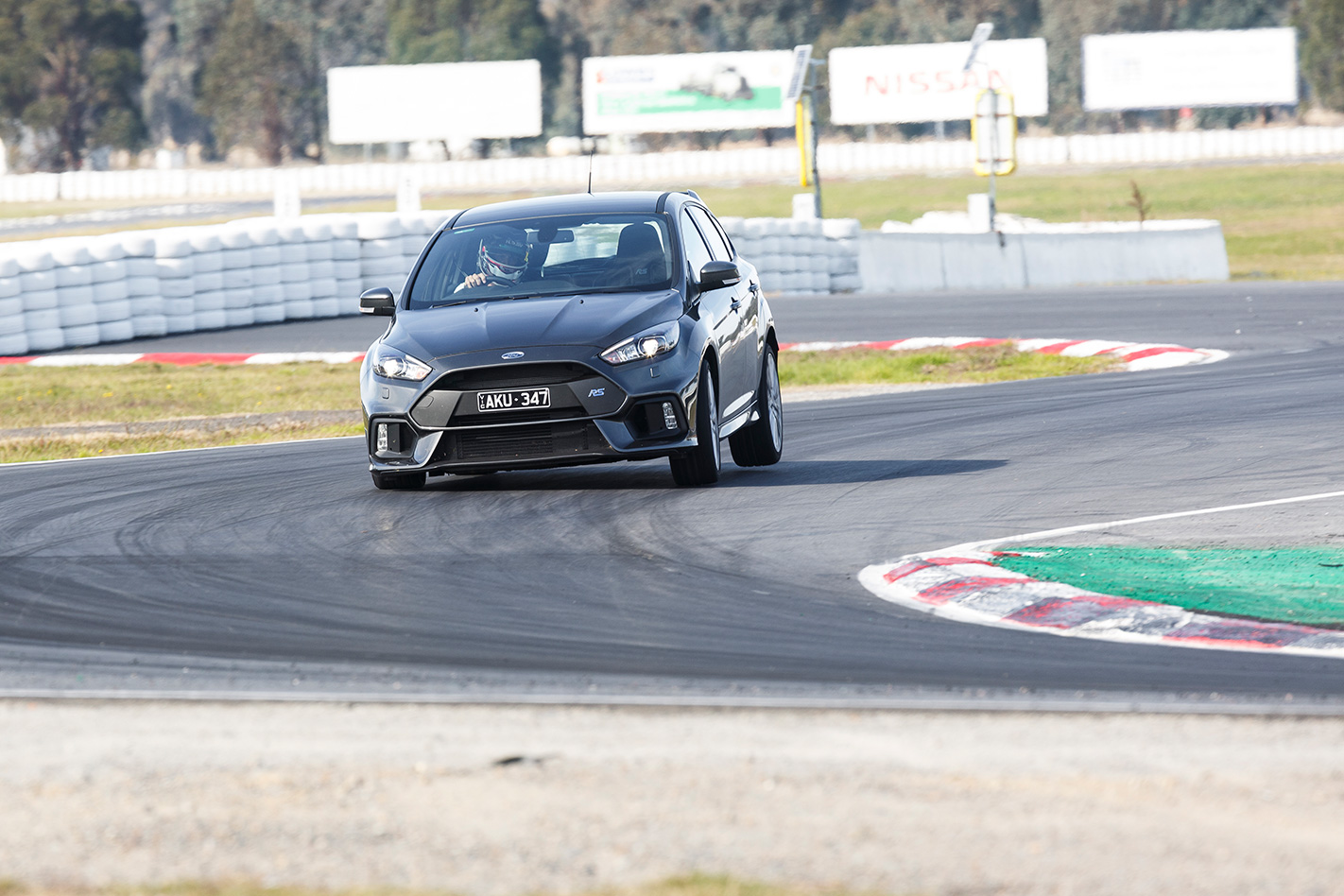
Meanwhile, many will find the seating position too high and the gear-throw too long. The engine noise can be a little too PlayStation, although it redeems itself with the WRC-esque pops and bangs on upshifts.
The handling, too, at times can feel a little artificial, but only really when you’re trying to do your best Keiichi Tsuchiya impersonation. But these are all things that are very easy to live with to get a slice of one of the best performance cars Ford has ever made.
And if that’s the case, the competition, at least in the value space, better lift its game – and fast.
5 things that add up to No.1
Tricks of the Focus RS
1. The sculpted Recaro seats are standard in Australia, but actually offered as an option overseas, in place of more plush sports seats. Some Focus RS owners have reported their cars being “transformed” by custom-lowering the seat.
2. The RS feels just as built for the track as it does the street – and think about how comfortable a track car generally is. Ford doesn’t shy away from this, though. One of the recognised satnav voice commands is “find a racetrack”. And it will – the nearest.
3. If you’re going to do track days, bolt on some sticky Michelin Pilot Sport Cup 2s for which the car was partly made. Many cars fall to bits at the masses of extra grip, but not the RS – it feels utterly magic. Enough to distract you from the tyre bill.
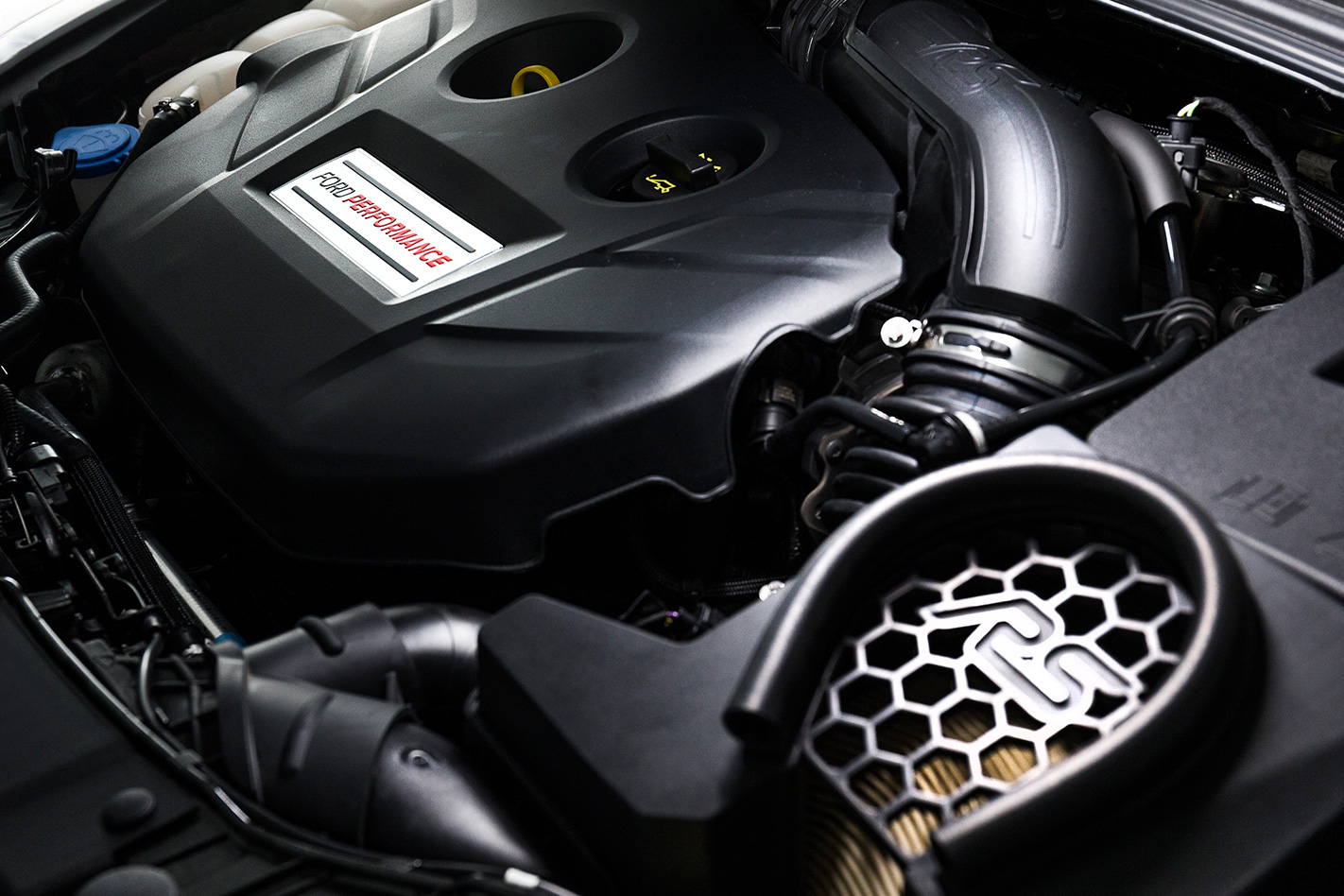
4. The 2.3-litre EcoBoost four-cylinder is appreciably torquey from low-down, with solid mid-range and doesn’t run out of puff towards its 6800rpm redline. Normally 440Nm, 470Nm available for 15 seconds on overboost, but resets back to zero with just a lift.
5. Despite the full whack 257kW being available at 6000rpm, 440/470Nm from 2000-4500rpm, and a 6800rpm redline, Ford actually says the optimum shifting-up point in the Focus RS is 5900rpm. A ‘Performance Shift Light’ illuminates just before.
In 2013, Holden put a VF SS Ute on the Nürburgring to take on the record for a commercial or utility vehicle. There was one problem – the record didn’t exist.
Yet.
Holden dynamics engineer and test driver Rob Trubiani says the pressure of beating a time was gone, but that didn’t make the team any less determined.
“We came up with a plan to tackle the Nürburgring and break the world record for a commercial or utility vehicle but when we did our research it seemed one didn’t exist, so we decided to set a record instead!” Trubiani said.
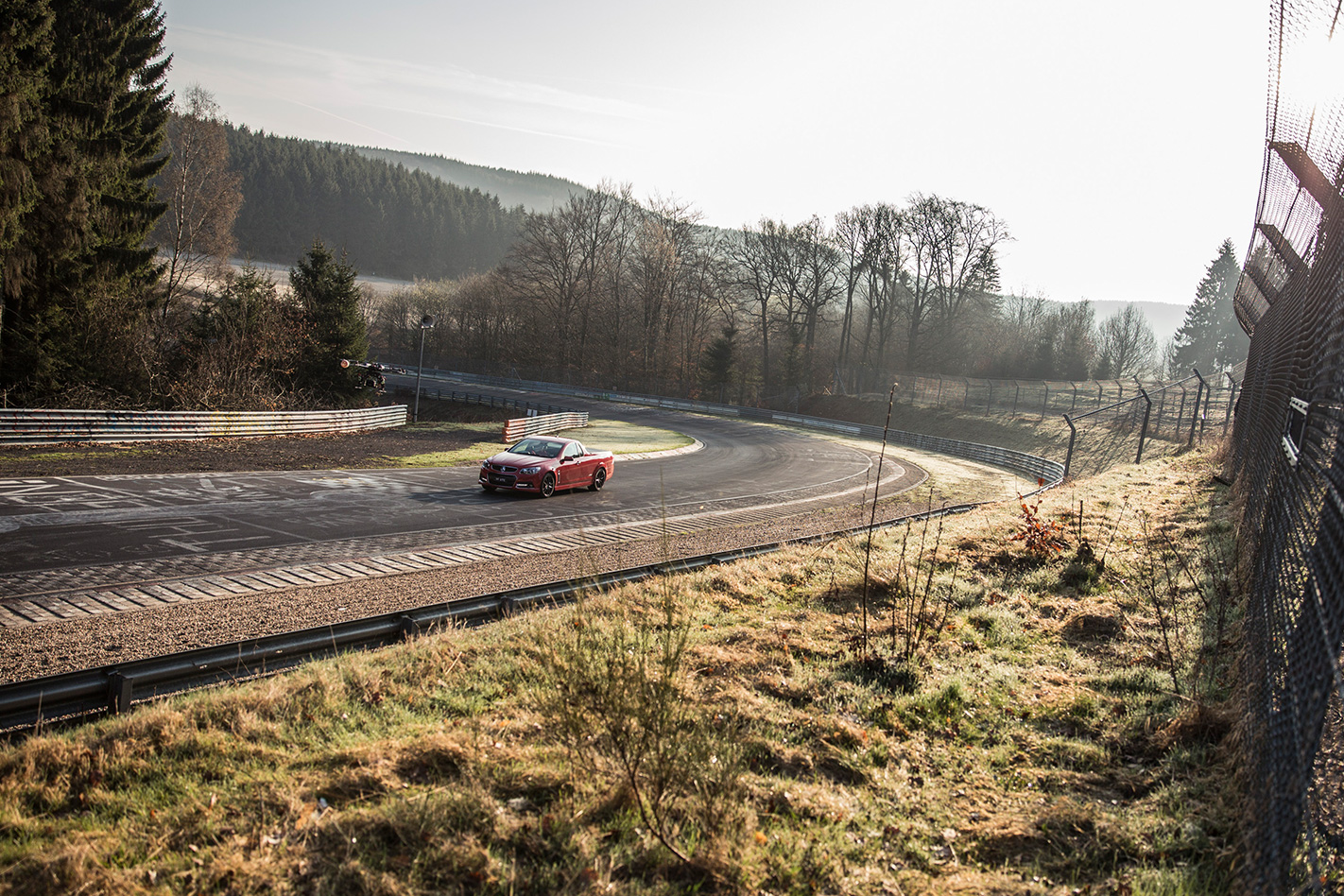
“The Nordschleife section of the ‘Ring is the ultimate test of man and machine.
“If a vehicle can handle The Green Hell it can handle anything and proves yet again that Holden’s testing and development processes produce world-class cars with world-class handling.”
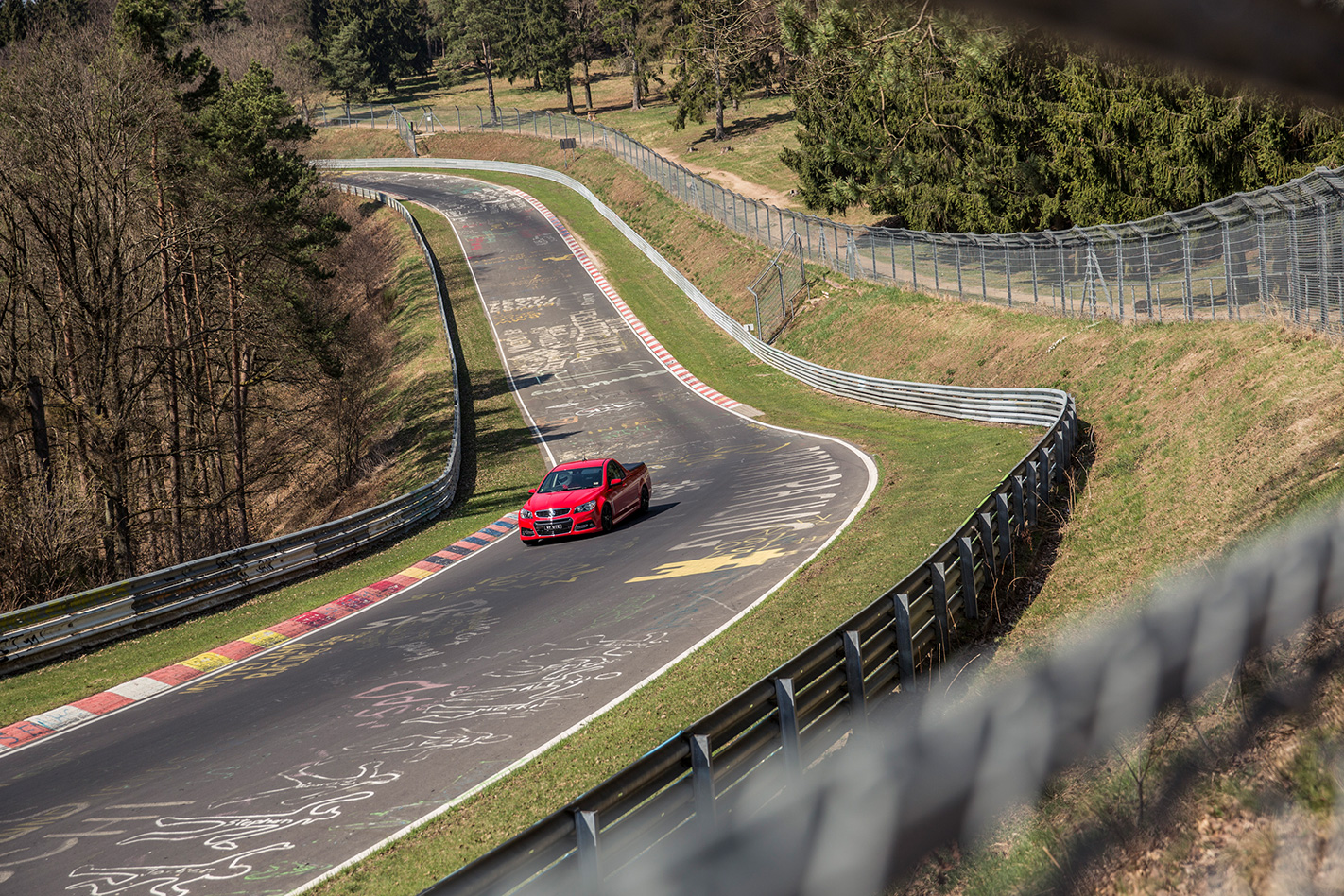
The only things that needed to be changed during the laps were tyres and brakes.
“Without a lap record to break, we sat down and calculated what we thought the Ute could do and targeted around 8min 30sec.
“Initial practice sessions at the track confirmed that was a stretch target so that’s what we aimed for.
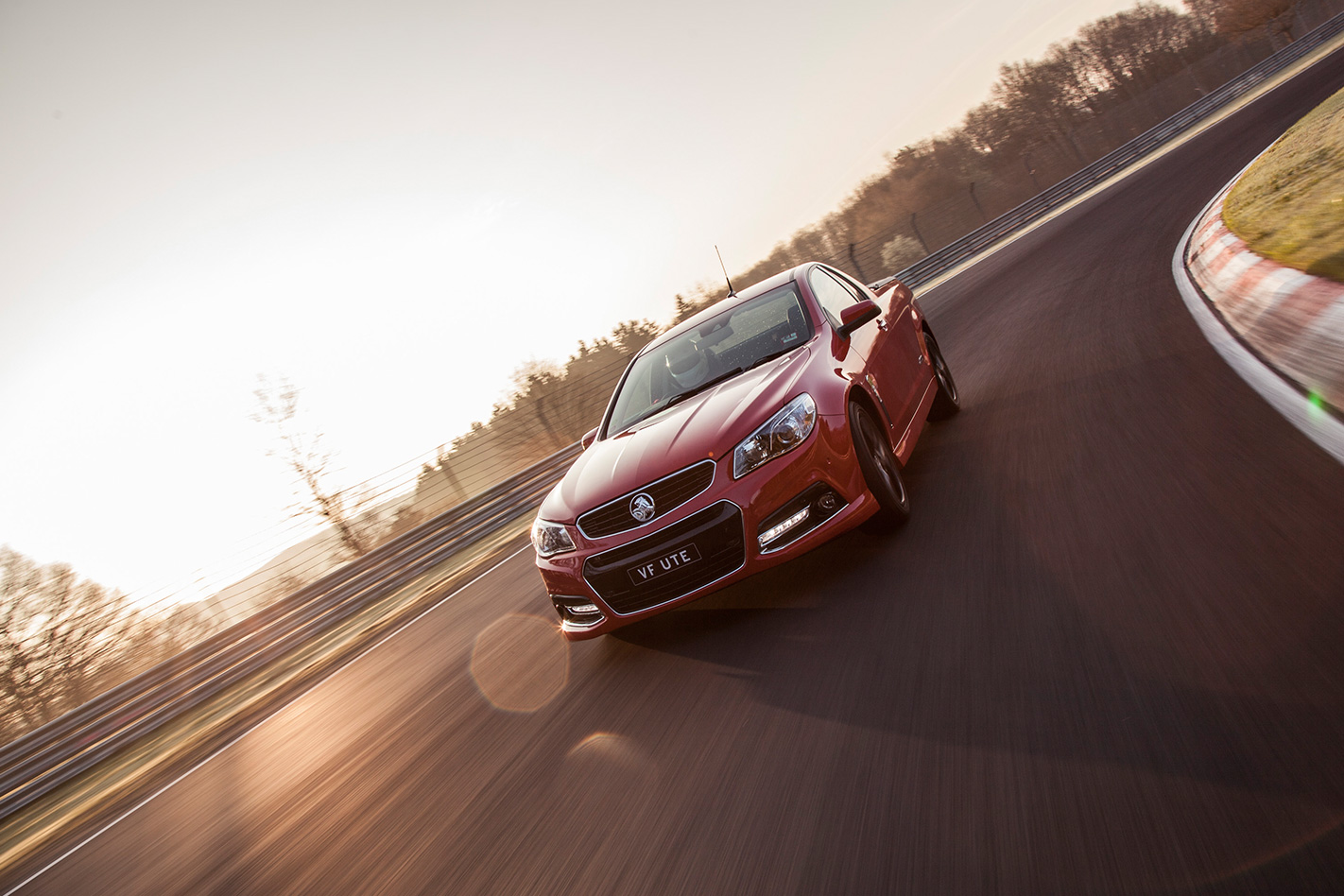
“To slash 11 seconds from that time with an 8m 19.47sec lap was incredible. There may not have been a utility-vehicle record before but I’m proud to say the VF SS V Redline Ute is now the Nürburgring benchmark!”
We hope to see Holden back at The ‘Ring soon for one last hurrah.
MERCEDES-AMG’s GT C brings more power to the growing two-seater range wrapped up in a tractable coupe package
WHAT IS IT?
The latest addition to the growing Mercedes-AMG GT family bringing more power than the GT S but a more comfort-oriented chassis tune. The new variant is positioned between the GT S and flagship GT R and is on offer as a convertible or this – the coupe.
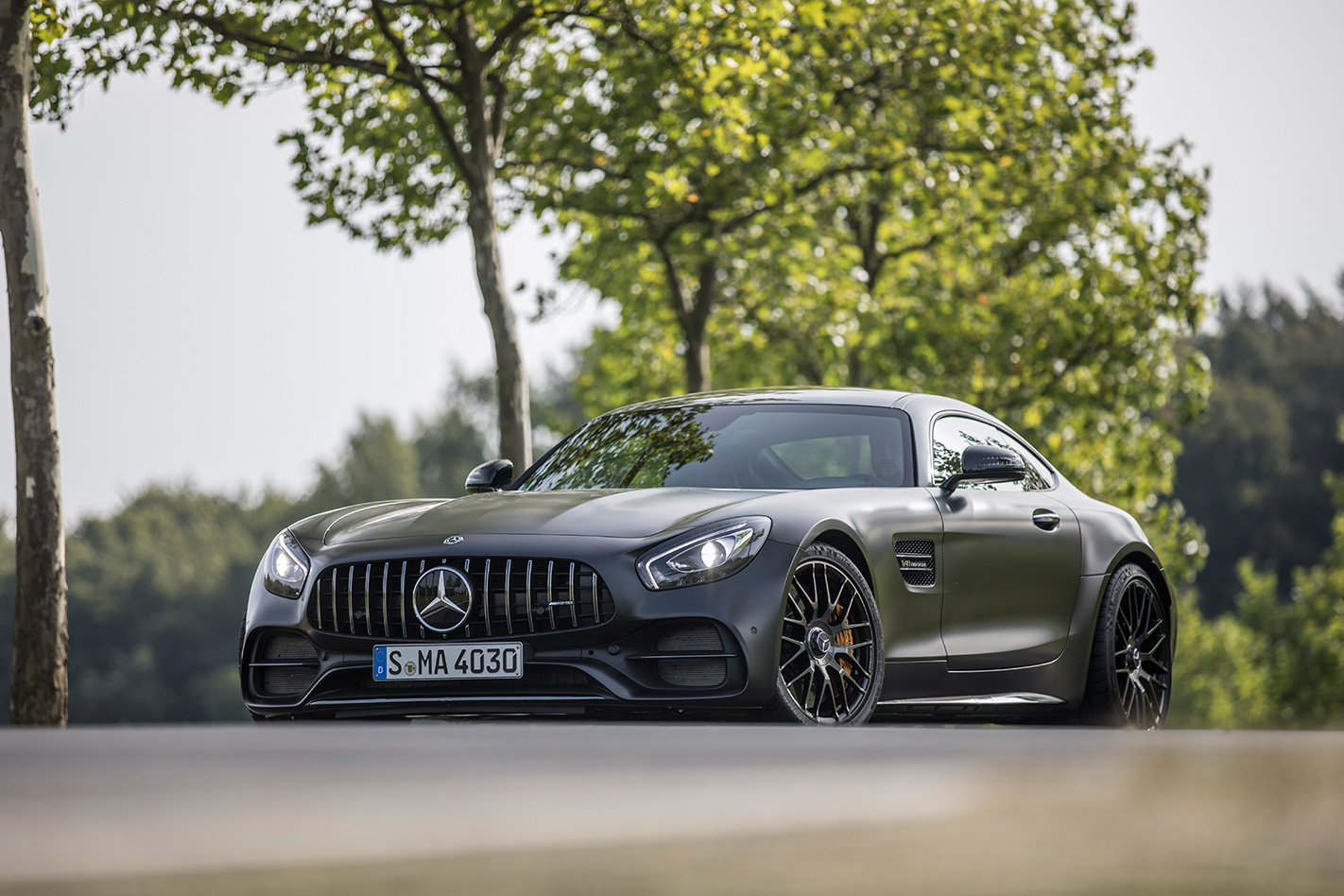
Even with an imminent GT S power upgrade, there is still a gap of nearly 50kW between it and the GT R flagship which the new AMG GT C fills with 410kW. Instead of offering an incrementally sharpened chassis over the GT S however, the GT C actually promises to be more comfort oriented.
More power with a more liveable ride; what’s not to like?
MAIN RIVALS
Porsche 911 Turbo/GTS coupe, Jaguar F-Type SVR coupe
THE WHEELS VERDICT
Offering a version of the GT that is more powerful than the GT S but focuses on providing a more liveable package is a bold move that has paid off. If the new GT C was simply an incremental step up in all areas, the purpose of each variant would be increasingly hard to define.
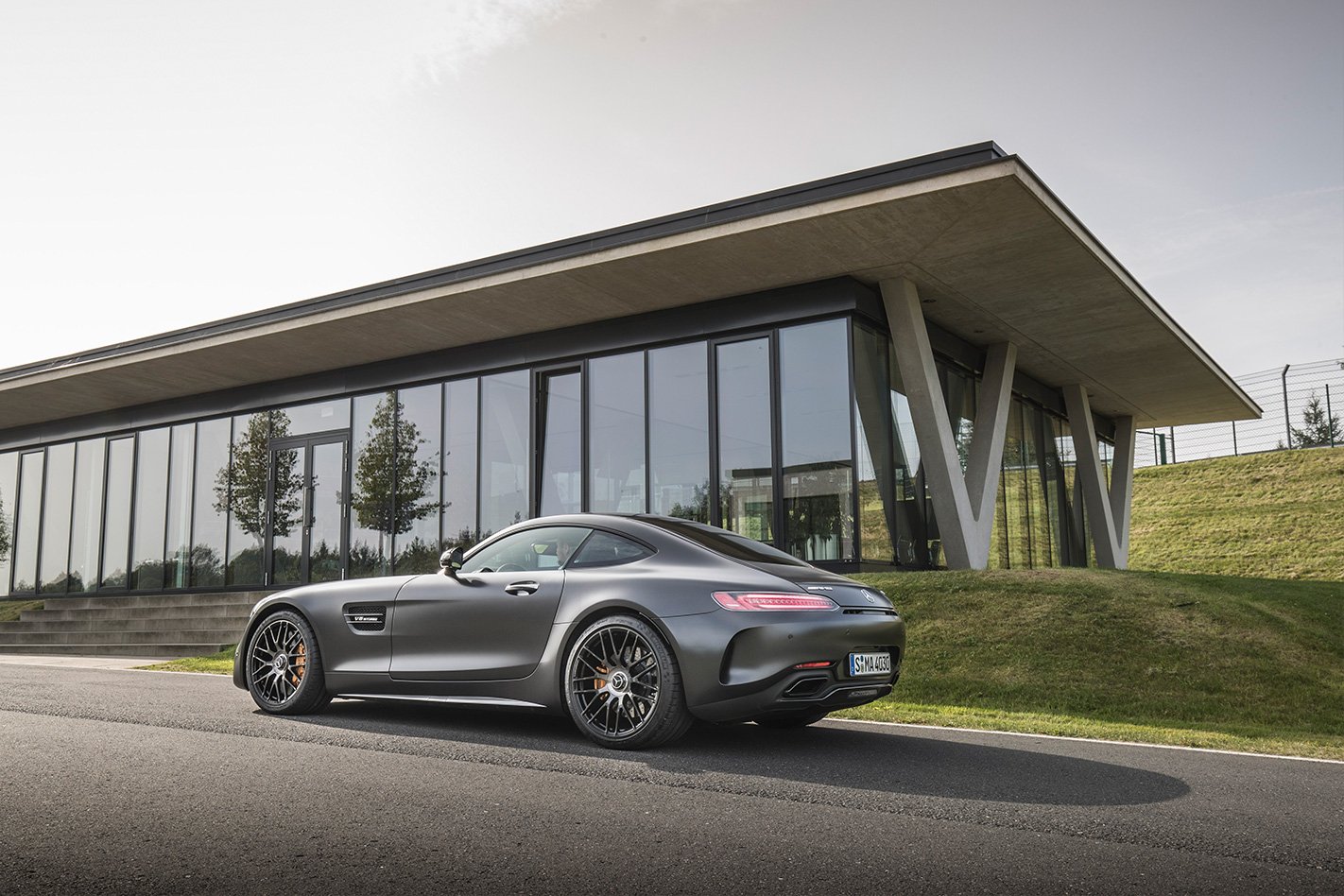
But the GT C is not choice for the sake of choice. Like each of the 911 variants, the six GT options all have a job to do, and with a massive punch of power, rewarding dynamics and head-swivelling looks, the newest addition in coupe form is the all-rounder of the range.
THE WHEELS REVIEW
THE first time I slotted behind the wheel of the Mercedes-AMG GT S and got in a few laps at a very cold and wet Mount Panorama, one of my first impressions was not that the 375kW rear-drive coupe could do with a bit more grunt.
Since then I’ve had the opportunity to test the flagship GT R on AMG’s own Bilster Berg track in Germany and even though the conditions were perfect and the most potent variant has a host of features to help get 430kW to the asphalt, I’m still convinced the garden variety 350kW GT would keep most petrol heads happy.
So what is the purpose of the new GT C Coupe?
The current range is fairly straightforward. As power increases from GT through GT S to GT R, each respective chassis gets an incremental tune up to match the extra output, but the GT C is different.
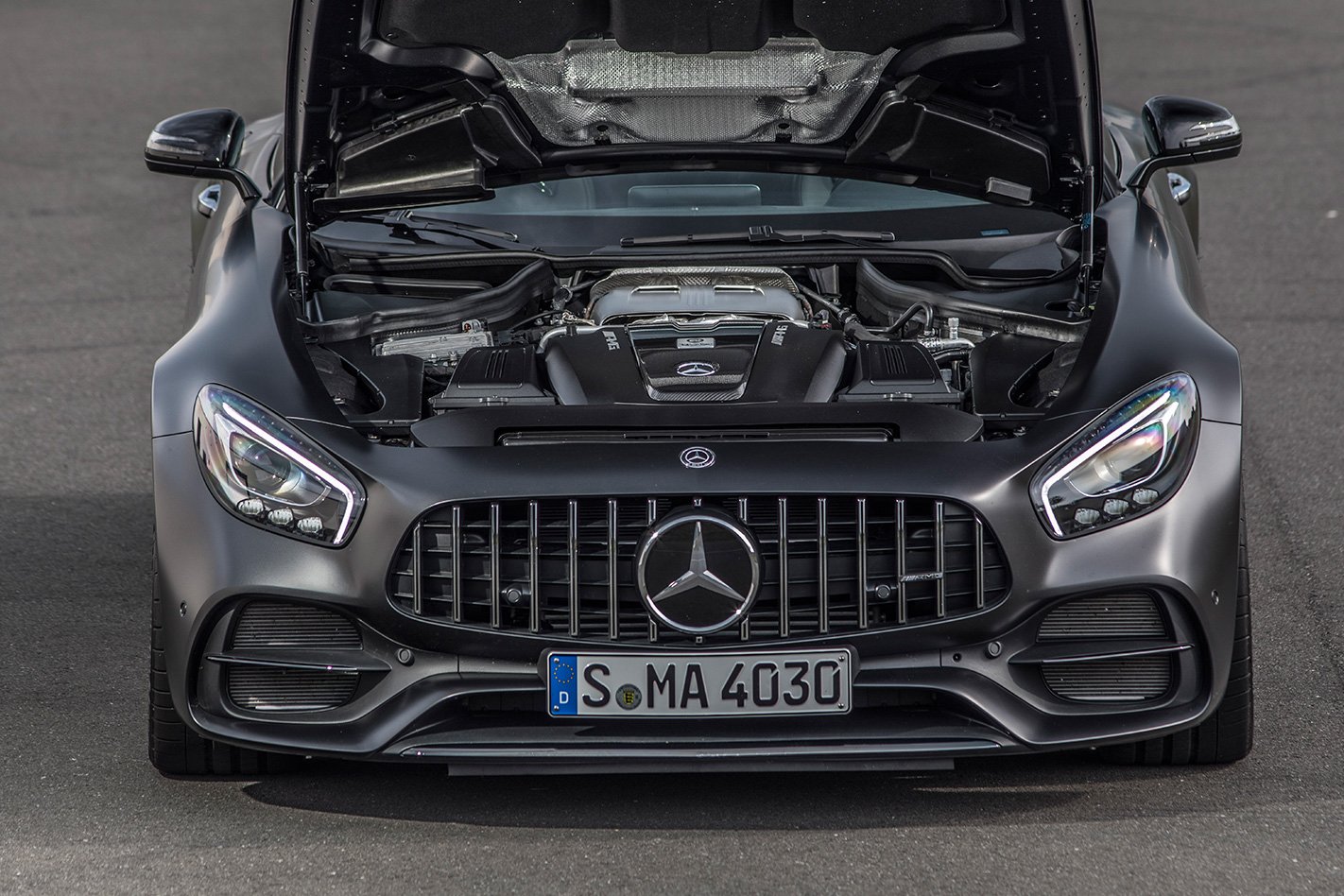
While the GT C coupe is less highly-strung than the GT R, it does share the range-topping variant’s rear-wheel steering and wider rear track for increased stability at speed and, while it wears wider rear rubber than the GT S, its 305/30 R20 tyres are still a little skinnier than the GT R’s 325/30 R20s.
The latest addition to the range is therefore aimed directly at a customer looking for the ultimate in AMG GT pace without having to live with the GT R’s more track-focused defining features.
For now, the GT C coupe is only available in a special Edition 50 specification which celebrates AMG’s half-century with a number of features including a choice of Cashmere White Magno paint or the Graphite Grey Magno satin finish applied to my test car.
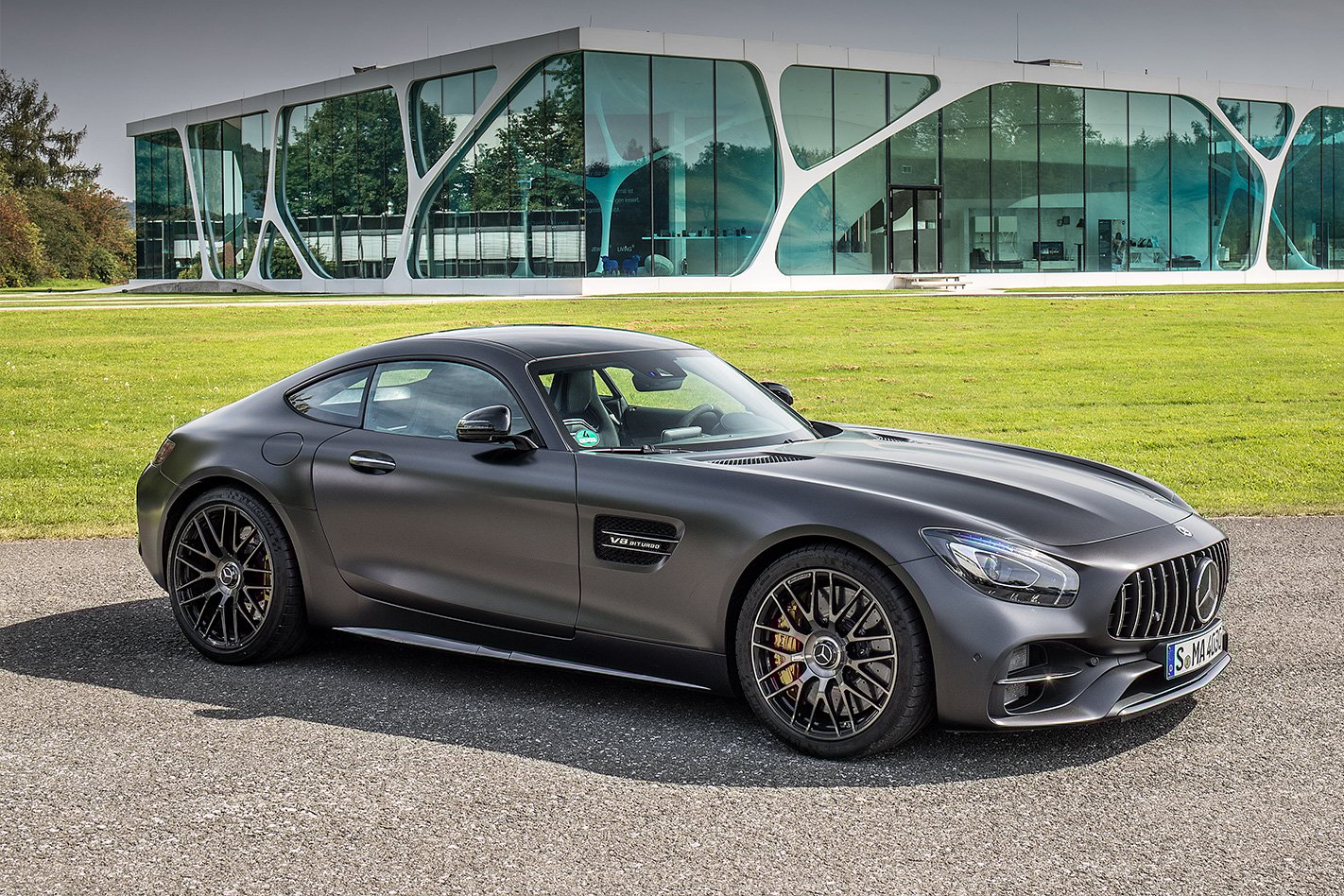
Even though our test drive route had been well trodden by a fleet of GTs over the previous days, locals still craned their necks to track the passing GT C with an affection its rivals probably couldn’t brag.
On the inside, the cosy but comfortable cabin is common to all GT coupes but more Edition 50 touches had decked this car out with silver pearl and black Nappa leather upholstery with diamond stitching and a synthetic suede-wrapped steering wheel for a racing feel.
General cabin comfort is consistent with all variants with the exception of the GT R’s divine racing bucket seats which some occupants may not appreciate. From the driver’s seat, the massive bonnet points the way like a bloodhound’s nose and sniffs out a line through corners.
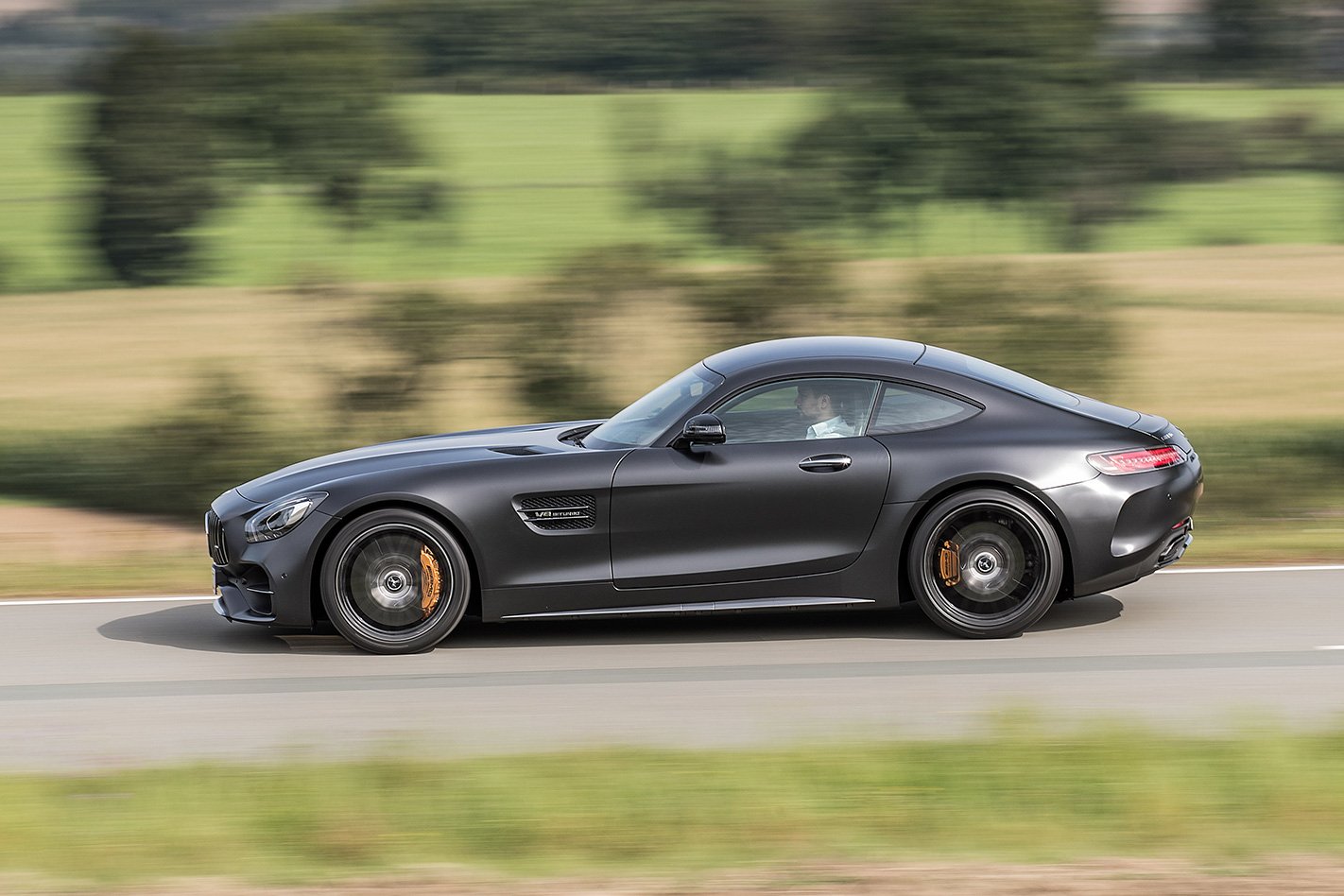
Piloting the new version along German country roads highlights two things. Firstly – how spoiled German drivers are by the incredibly well maintained roads and, secondly, despite the more comfortable approach, the GT C still has a stiffly sprung ride, and this is likely to be accentuated on Australian roads.
For a majority of cruising, the new coupe would probably provide all the comfort and luxury for anyone prepared to tolerate a firm ride. Tyre noise is surprisingly low given the rubber’s width but that could be another indirect compliment of German road quality.
Find a twisty section however, and the GT C coupe’s proximity to the GT R in the range becomes clearer. I didn’t muster the bravery (or perhaps foolhardiness) to reach speeds at which the GT R’s effective aerodynamics come into play for comparison, but at a more clubman pace its closely related sibling is hugely capable.
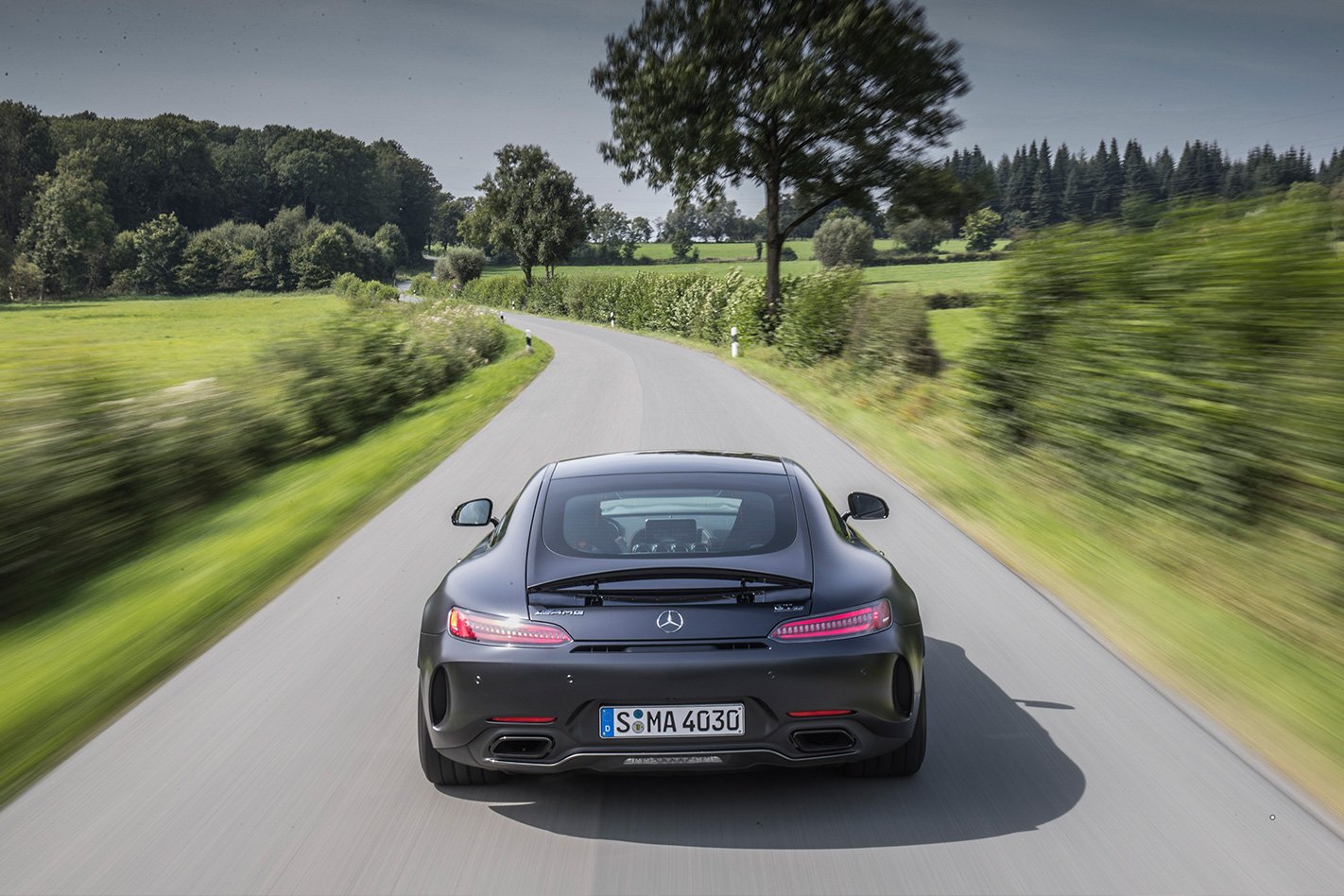
There is a little vagueness to the steering that is kicked into touch by the Porsche 911’s ultra-tight front end and poise, but the minimal steering numbness is balanced by the excellent rear-axle feel.
With the new steering back end, the GT C follows a line with the obedience of a Labrador and is confidence-inspiring particularly in corners that had not completely dried from the morning’s early rain.
Perhaps it is the wider rubber, rear-steering or less severe suspension settings, but the GT C feels as though it has more grip in damp conditions than the GT S I was acquainted with on home turf, which is commendable given the power and torque boost.
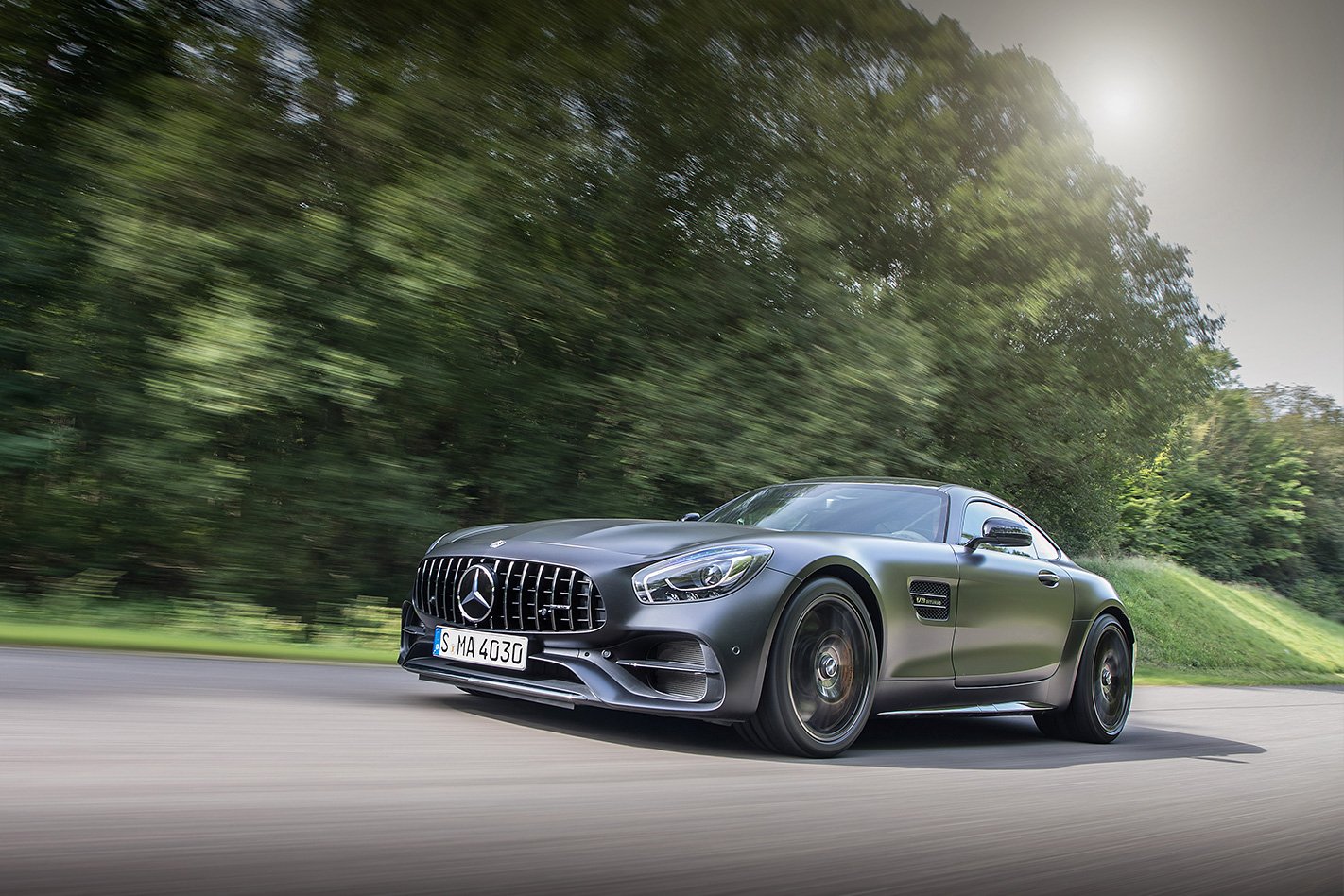
Off the line urgency is lively and feels every bit of the official 0-100km/h time of 3.7 seconds but it is the GT C’s acceleration in higher gears that really impresses. Wring the turbo V8 out to its governor and the pace has a limitless nature with peak power occurring 500 rpm higher in the rev range than the GT S and even GT R. The GT C might not quite keep up with the GT R on paper but it sure feels every bit as rapid.
AMG’s accomplished V8 has found its way into the C-Class, E-Class, and S-Class in various states of tune, but it is in the GT that its bark is most authentic. With its unusual quad exhaust, the GT R wins in the volume stakes but the GT C’s report has all the character at a volume that will not become tiresome.
In offering the new GT C in both coupe and convertible choices the GT range has grown to six offerings and, if the line-up continues to expand, it might start to look something like Porsche’s extensive 911 spread.
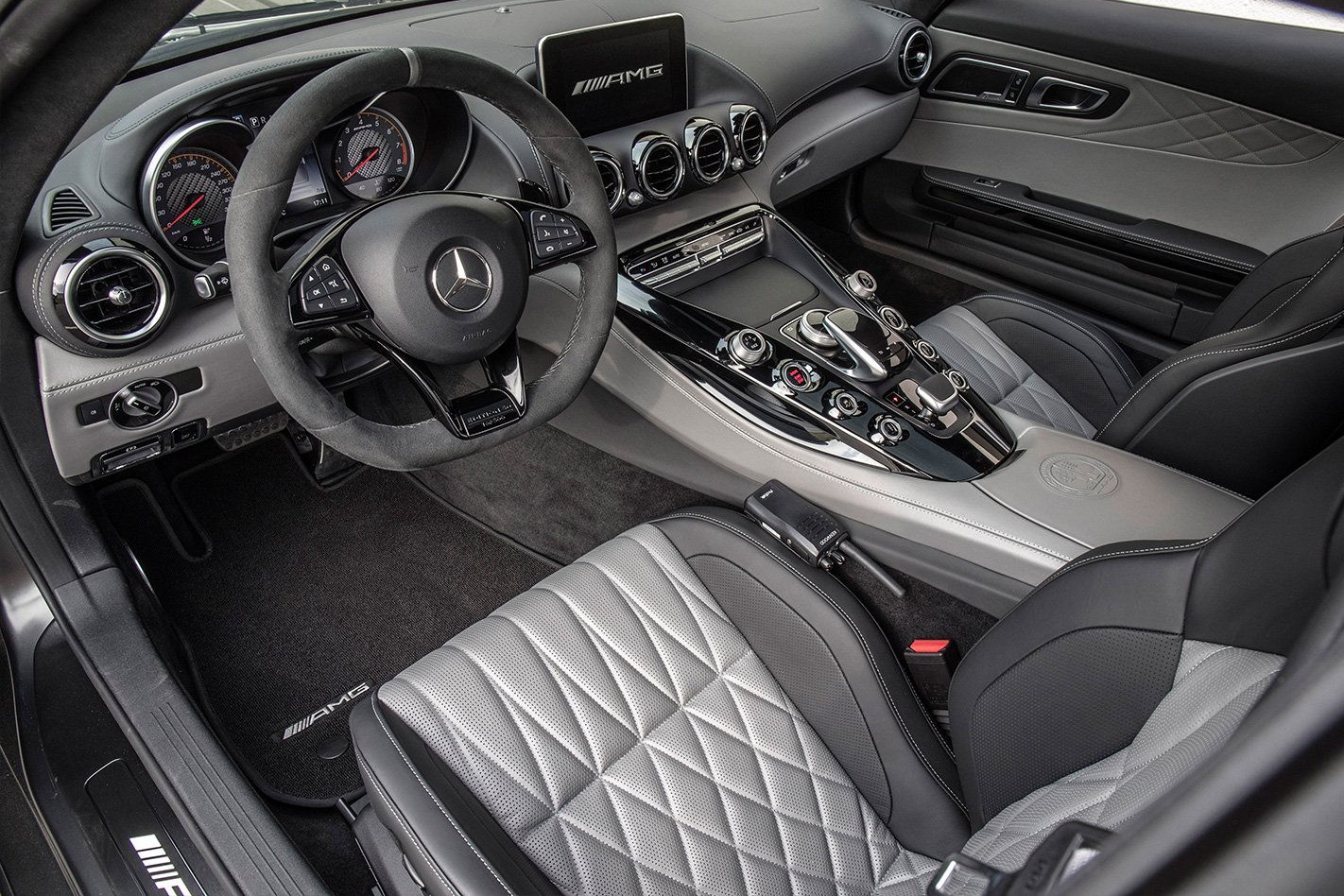
For pure driving dynamics, the 911 wins on traction and edges out the Merc for outright dynamics but other hi-po coupe enthusiasts will be drawn to the GT C for its unapologetic V8 sound and power delivery.
And GT C drivers will get looked at more than 911 drivers whether that be a quality to be praised or criticised.
Either way, I feel the ancient argument of Porsche 911 versus (insert challenger here) is less relevant here given the fearsome brand loyalty that exists in the high-end sportscar market and particularly Mercedes owners.
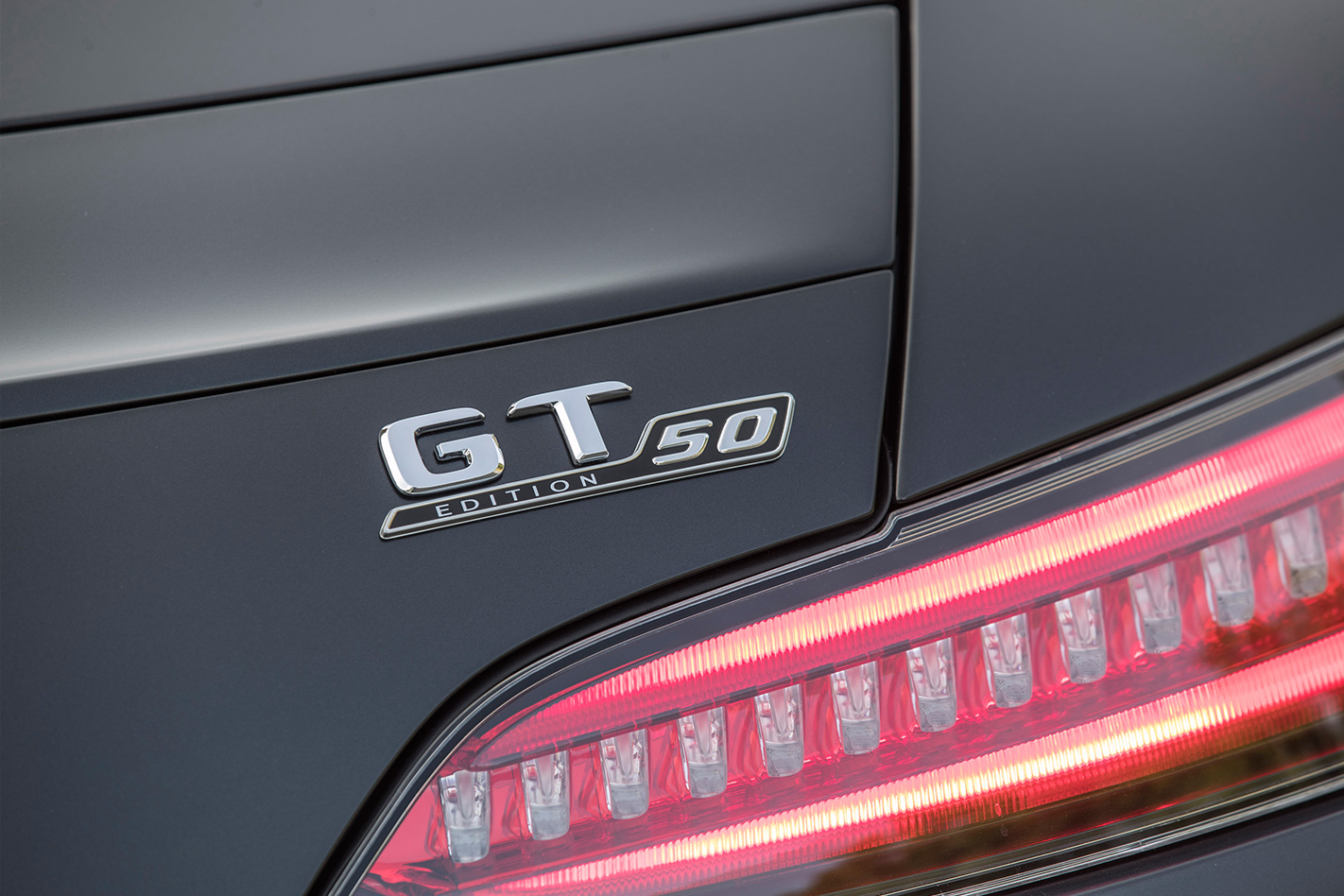
Until we get a chance to test the GT C on home turf, the coupe’s exact value proposition will have to wait but what is already clear is that its clever balance of power and comfort is likely to resonate well with and Australian audience.
While all other variants exist in the satin green shadow of the GT R, the GT C Coupe represents not a compromise but a choice. When the sun is shining and the circuit beckons, the AMG GT flagship will leave everything for dust, but for the rest of the time the new GT C is the dominant player.
SPECS Model: Mercedes-AMG GT C Edition 50 Coupe Engine: 3982cc V8 dohc, 32v twin turbo Max power: 410kW @ 5750-6750rpm Max torque: 680Nm @ 1900-5500rpm Transmission: 7-speed dual-clutch transaxle Weight: 1625kg 0-100km/h: 3.7sec (claimed) Economy: 11.4L/100km (claimed) Price: $335,211 On sale: Q1, 2018
Hyundai has given its slimmed-down Accent sedan and hatch range a nip and tuck while retaining current pricing for the 2018 model year.
The little sedan and hatch siblings have been given a minimal revamp in the form of a slightly revised grille, headlight surrounds and dashboard for the 2018 model year.
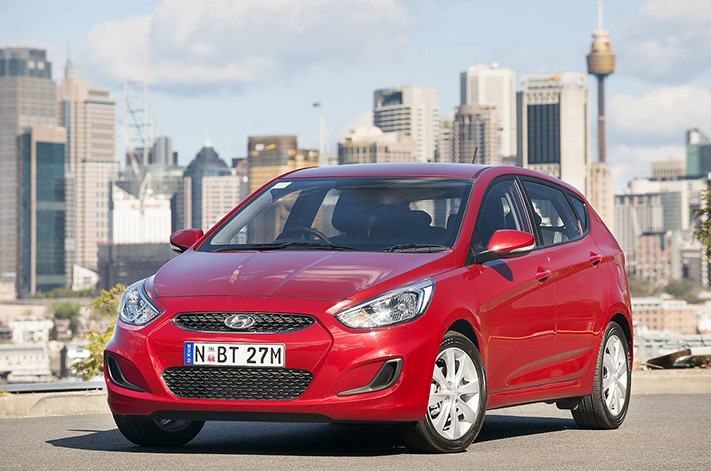
Four new paint finishes have been added – Chalk White, Lake Silver, Pulse Red and Blue Lagoon – joining Phantom Black and Sunflower on Accent’s colour palette.
Interior revisions are equally subtle with new fonts in the speedometer and tachometer graphics and new-look rev-counter redline.
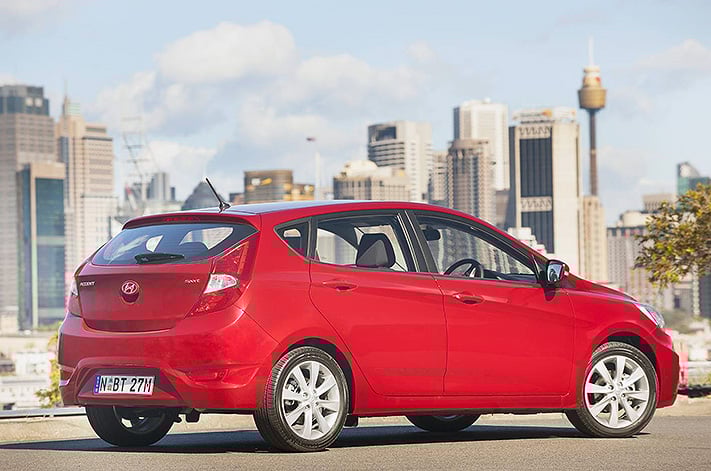
The MY18 Accent now features a four-speaker audio system with 5.0-inch touchscreen display, AUX and USB inputs, Bluetooth phone connectivity and music streaming, and Apple CarPlay compatibility.
The Hyundai Accent Sport hatch and sedan models are each powered by a 103kW/167Nm, 1.6-litre GDi ‘Gamma’ petrol engine, coupled with a choice of six-speed manual or automatic transmissions, and roll on 16-inch alloy wheels.
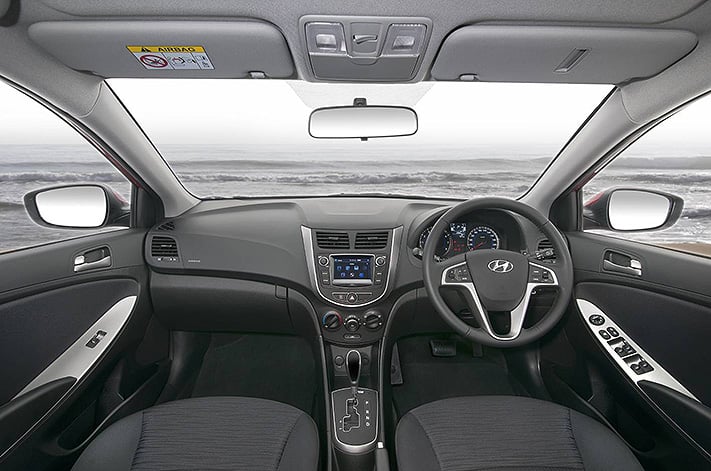
Hatch and sedan prices are the same with the manual costing $15,490 and the autos attracting a premium of $2000, which takes the kick-off price to $17,490 before on-road costs.
The Hyundai Accent is on offer with a five-year unlimited warranty and 12-month/15,000km service intervals.
The Volkswagen Polo is fresh from a facelift that will see it out until a new model arrives early next year. While the current generation goes back to 2010, with a significant mid-life upgrade in 2014, it’s still a fresh-looking, well equipped and able car that continues to set the standard in the light hatch class.
VARIANTS
The 2017 Polo comes in three variants, Urban, Urban+ and GTI hot hatch.
Starting at $16,990 the Polo Urban is well equipped for a car this size, with standard features including 6.5-inch touchscreen with reversing camera, Apple CarPlay/Android Auto connectivity, leather trim steering wheel and gearshift, daytime running lights, hill-start assist and 15-inch alloy wheels.
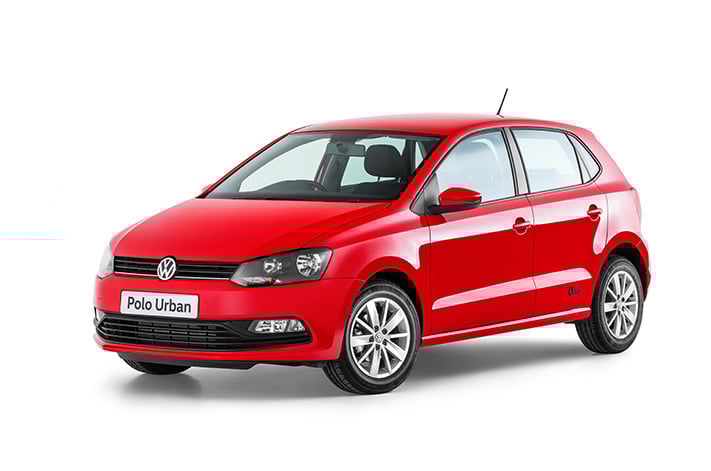
The Polo urban is powered by a tiny 1.2-litre four-cylinder turbo engine that produces 66kW and 160Nm and coupled with a choice of six-speed manual, or seven-speed dual clutch automatic which costs an extra $2500.
The Polo Urban+ has the same sized engine but tweaked to produce 81kW/175Nm. Additional features over the Urban include heated front seats with Alcantara (fake suede) trim, colour multi-function display on the instrument panel, fatigue alert, tyre pressure monitor, steering wheel audio/phone buttons, dusk sensing headlights, auto windscreen wipers, climate control air-conditioning, chrome interior bling and 16-inch alloys with low-profile tyres.

The Urban+ also has an optional driver assistance package that adds satellite navigation, front and rear parking sensors, adaptive cruise control and autonomous emergency braking.
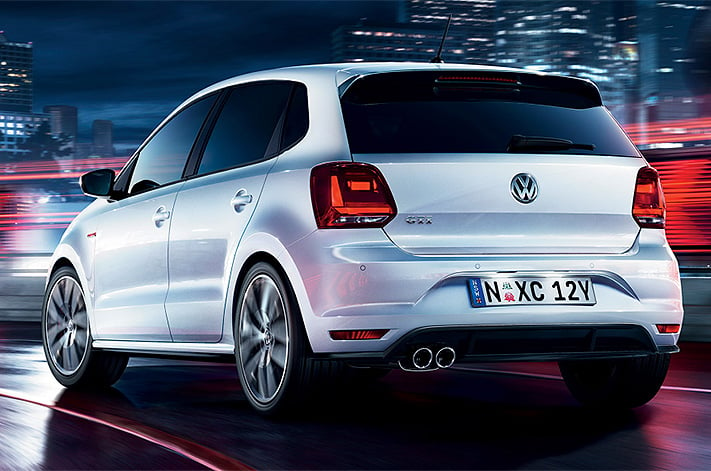
Spend more again for the Polo GTI and you get most of the features in the Urban+ with a significant performance boost with a 141kW 1.8-litre engine which produced 320Nm of torque, with the six-speed manual transmission, that’s toned down to 250Nm to suit the seven-speed auto.
The Polo GTI also gets cloth sports seats with the iconic GTI chequered pattern, electronic differential lock for tighter cornering, metal pedals, paddle shifters, adaptive dampers, 17-inch alloys, distinctive red grille stripe and more sporty bodykit including bolder bumper with honeycomb grille and air intakes.
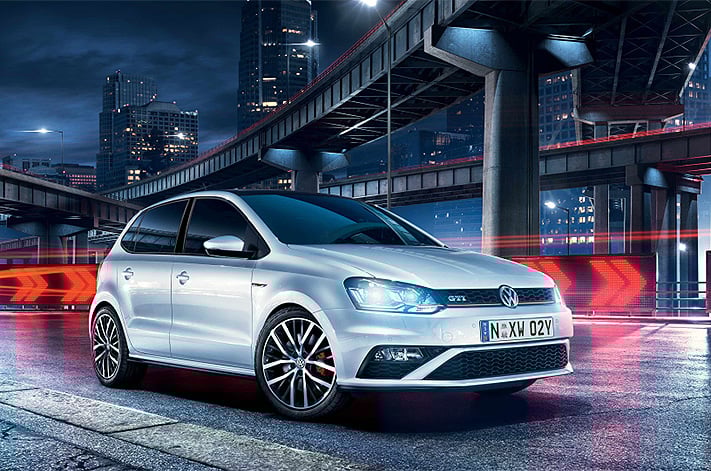
The GTI can also receive the optional driver assistance pack plus an additional Luxury package that adds a powered glass sunroof, more supple seats with Alcantara trim and all-LED headlamps.
- Polo Urban manual – $16,990
- Polo Urban auto – $19.490
- Polo Urban+ manual – $19,990
- Polo Urban+ auto – $22,490
- Polo GTI manual – $27,490
- Polo GTI auto – $29,990
OUR PICK
The three variants offer a clear choice between cheap and cheerful runabout, get out of town creature comforts and budget hot hatch.
The Urban+ is brimming with features for the price and is an all-round nice car, however the Polo GTI remains the pick of the bunch for what it offers enthusiasts, especially with the manual gearbox.
Available features
- Driver Assistance Package (Urban+ and Polo) – $1400
- Luxury Package (GTI) – $3300
- Premium paint – $516
While venerable workhorses such as the Land Rover Defender and Nissan’s Y71 Patrol have been put out to pasture in the wake of increasing safety standards, Toyota’s equally revered LandCruiser 70 Series is powering on in Australia thanks to the demands of the local mining industry.
In the class of if-it-ain’t-broke… four-wheel drives, the functional design of some models has remained largely unchanged for generations, but encroaching safety and emissions regulations have spelled the end for a number of examples that were still selling well on their go-anywhere virtues.
Not so for the LandCruiser 70 Series however, with Toyota LandCruiser chief engineer Sadayoshi Koyari confirming the iconic and highly capable vehicle is safe in the Australian market.
“The basic idea of the 70 Series is to let it be as it is and not add too many changes, however, sometimes we are more or less forced to change,” he said.
“One example is the mining companies in Australia needed a certain change and the decision was either to get out of the Australian market or change the 70 Series.”
In addition to a significant agricultural, commercial and recreational audience, the tough 70 Series has gained a strong following from the major mining conglomerates in Australia, and the sales volume represented by mining was enough to justify the changes, said Koyari.
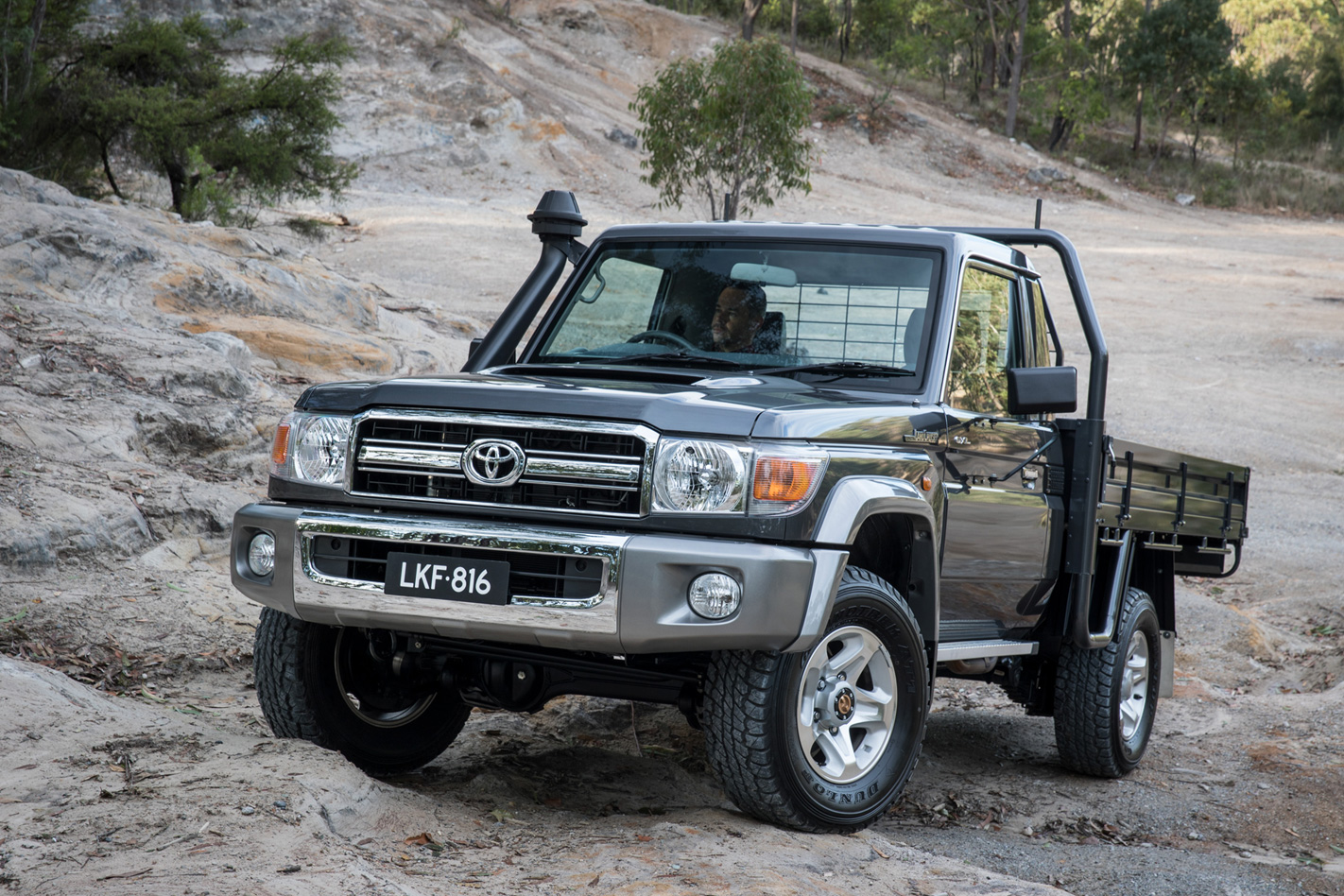
“We decided to change because the people wanted to have the 70s and we wanted to stay in Australia so we implemented some changes so that it fitted the new regulations. We still have one unique model for Australia.”
The modifications included structural changes to the frame as well as the addition of airbags, seatbelt pre-tensioners and a new bonnet and seat design.
As well as securing contracts with the mining companies, the upgrade also earned the single cab chassis variant a five-star ANCAP rating.
Koyari confirmed that the recent changes are enough to safeguard the model in Australia for the foreseeable future with no other significant upgrades pending.
“This is only one example but we are not considering major changes to the 70 Series,” he said.
Despite clinging to a design that has not significantly evolved since its 1984 introduction, the LandCruiser 70 Series continues to attract a strong following in Australia, with 5607 registered this year to the end of August.
Irony (n.): an outcome of events contrary to what was, or might have been, expected.
This was first published in MOTOR’s November 2008 issue.
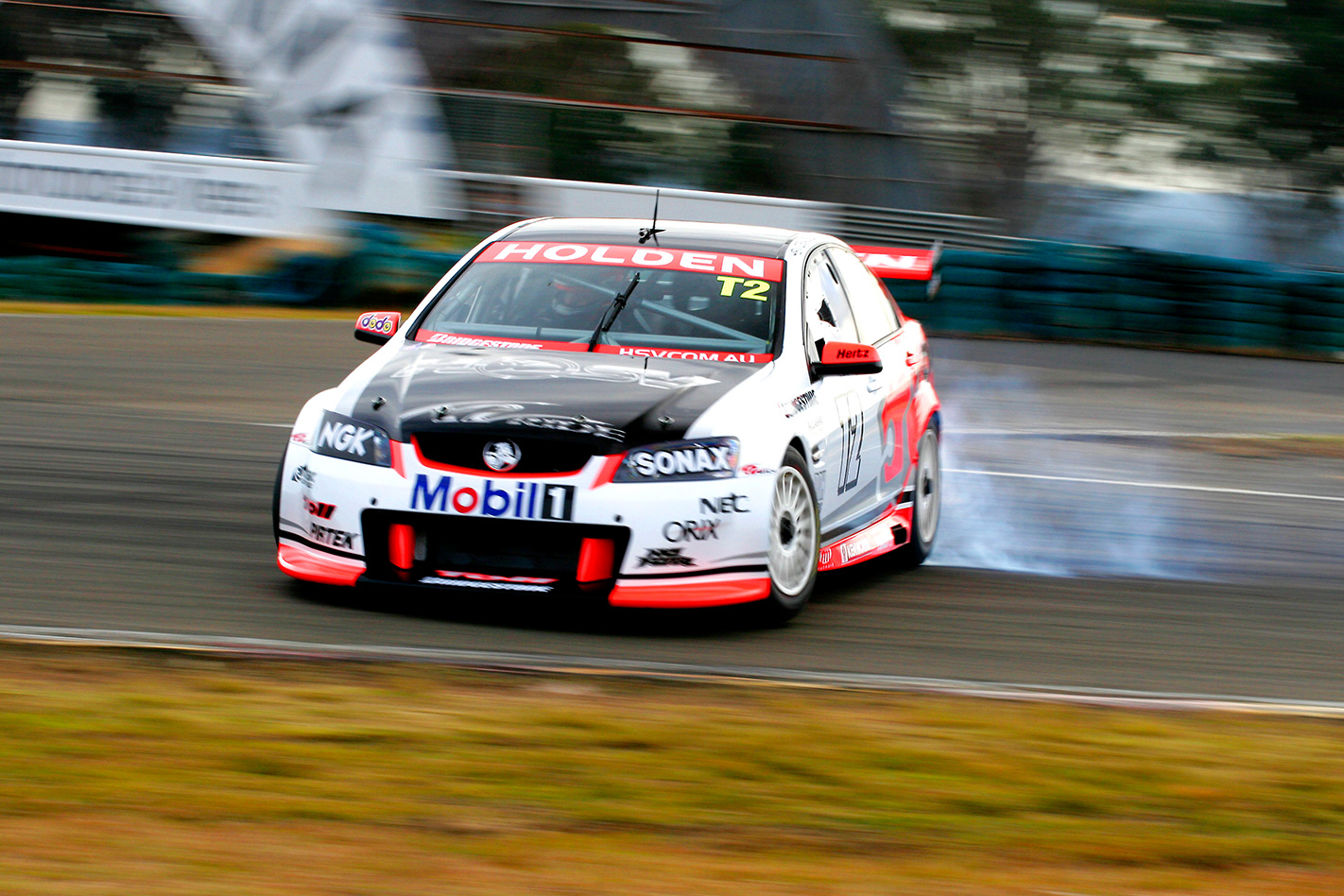
Like our well-intentioned comparison between HSV’s V8 Supercar T2 Ride car and its new stablemate, the white-hot LS7 W427. It should have been a straight-forward exercise.
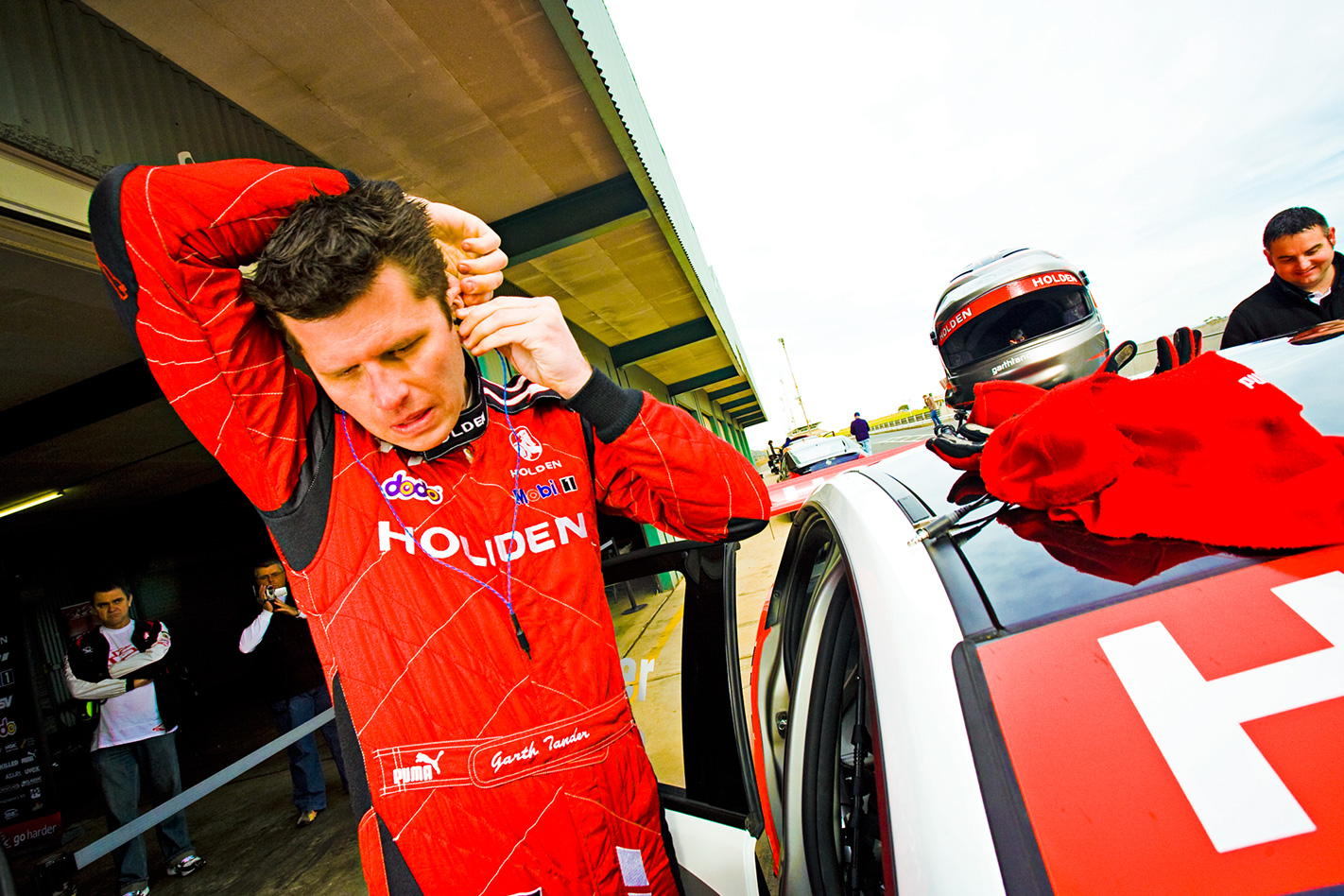
We’d managed to secure the driving services of one Garth Tander – reigning V8 Supercar champion, who just a week earlier was voted by his peers as the most respected V8 Supercar driver in sister mag Auto Action’s annual poll – and former champion Glenn Seton.
His best result is fourth overall in 2003 when he was with Garry Rogers Motorsport, and since then, he’s struggled to crack into the top 10. Unaware that this crisp, fine morning at Oran Park is about to continue Tander’s bogey, I hurriedly volunteer to jump into the passenger seat on his first run in the W427.
I’ve been lucky enough to sample a few laps around Sydney circuit under the command of a few race drivers, but none with a pedigree matching Tander’s, so I’m keen to see if there’s a perceptible difference from the best driver in the country. He fires the engine and smiles. “It sounds alright,” he says.
He gently tickles the throttle and coasts through the kink and down towards Turn Two. He washes barely any speed off as he turns in and accelerates greedily toward the bridge’s underpass. At around the 100m mark, Tander brakes firmly and gently rolls off the brake as he caresses the nose to the apex of Speedbowl.
We’re gradually building speed with every corner that we encounter, and Tander’s confidence in the car beneath him rises at a similar rate. Just before we crest the bridge, he momentarily settles the car with the brakes. But as we pop over the crest at the peak of the bridge, already committed to the fast right-hander leading off the bridge and onto the Grand Prix circuit, we see the tyres.
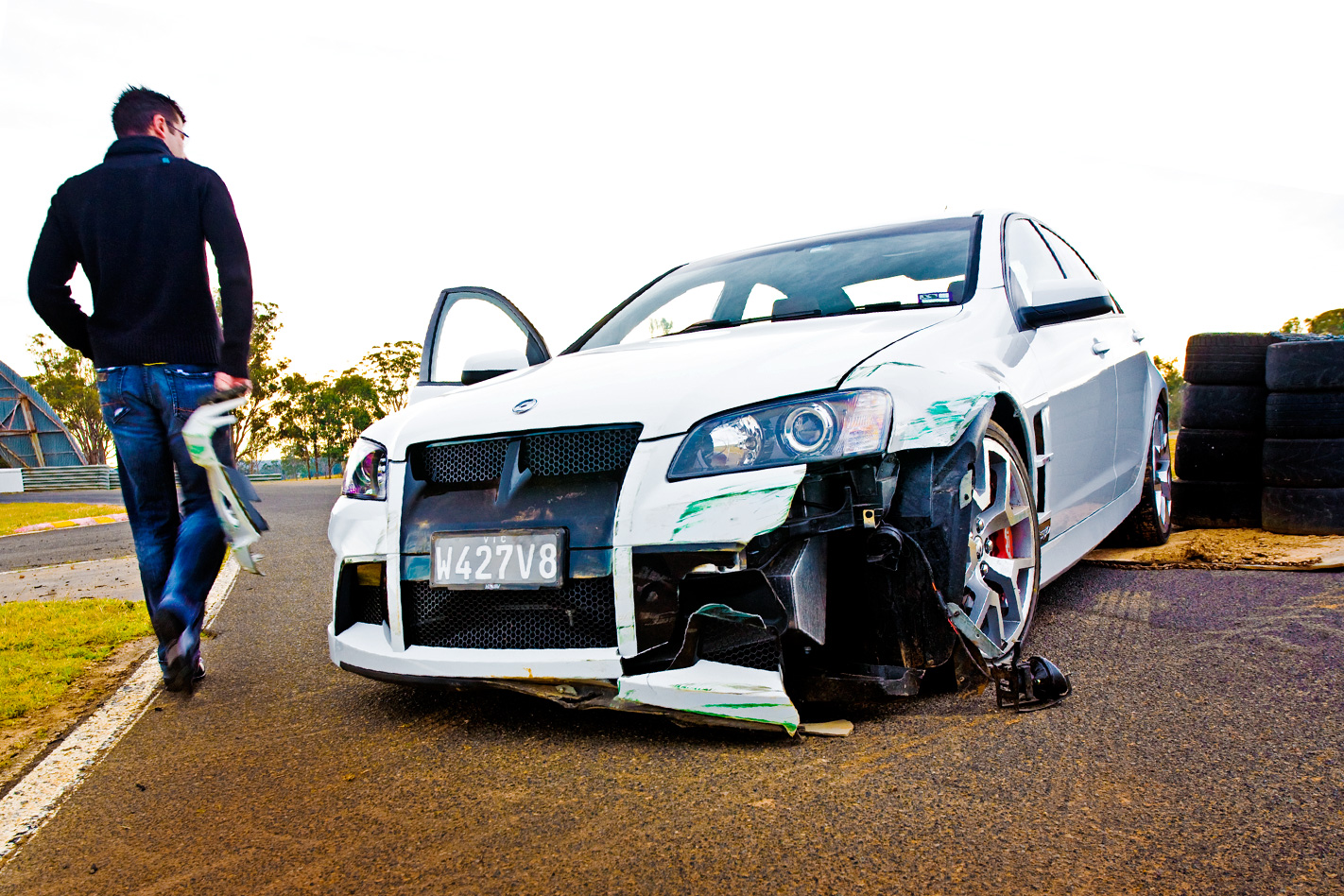
No-one’s mentioned it to him – or anyone else for that matter – and we’re heading straight towards the rubber wall at over highway speeds. And they’re less than 30 metres away. The silence is piercing in the cabin. I know there’s no way we’re going to stop in time and I brace myself against the door handle.
Tander hardly reacts – I mean he jumps on the middle pedal withe the speed of a sprinter and strength of a weightlifter, but he barely even draws in breath as we rush headlong at the tyres. No panic, no unsettling the car by swerving, except for a small steer to the right only a few metres before the tyre wall, when he realises impact is unavoidable.
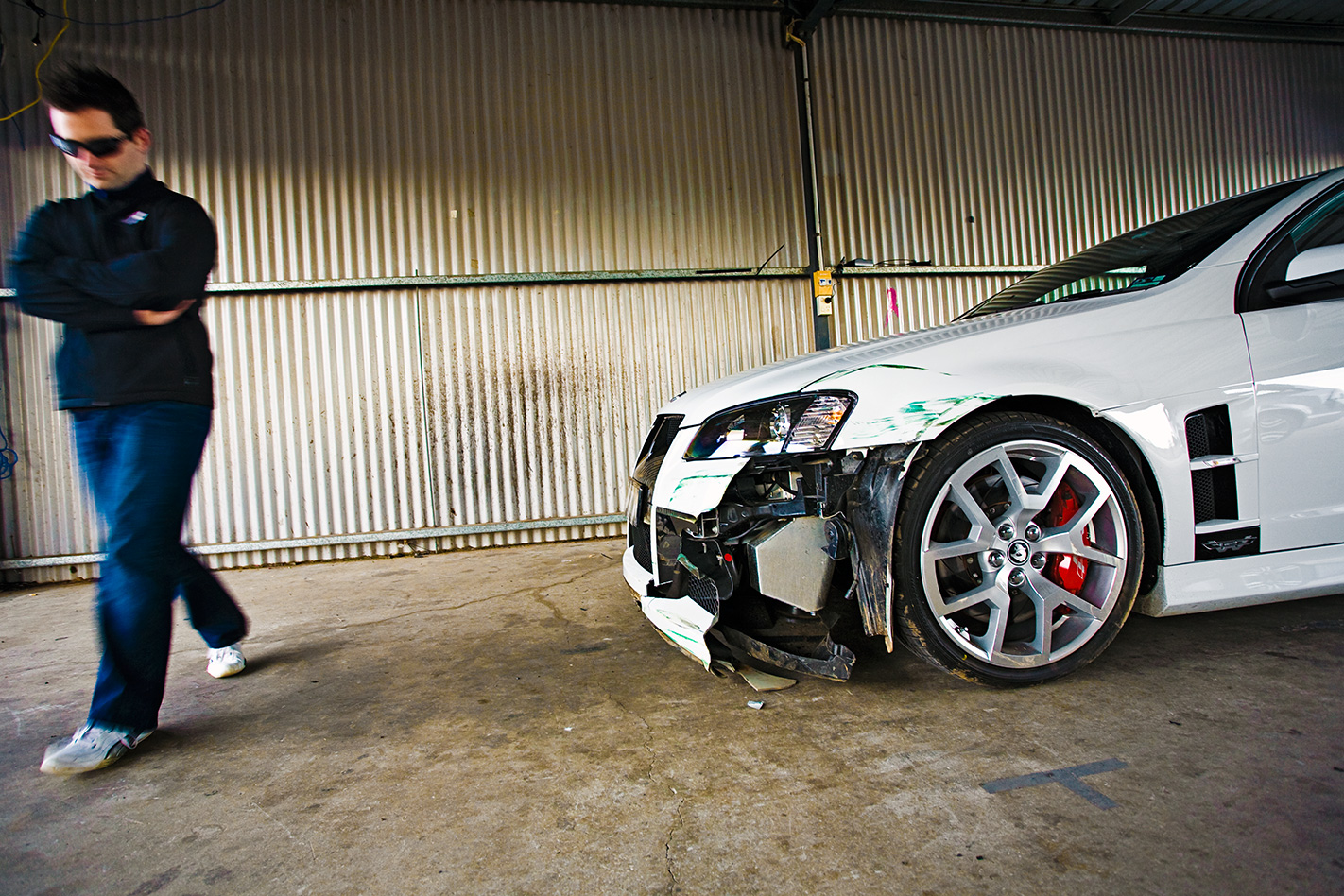
There’s no spoilt brat performance, no attempt to remove himself from blame, just a sheepish look as he hands part of the broken front spoiler to HSV’s PR man, who was only about ten car-lengths behind us, watching the whole event unfold.
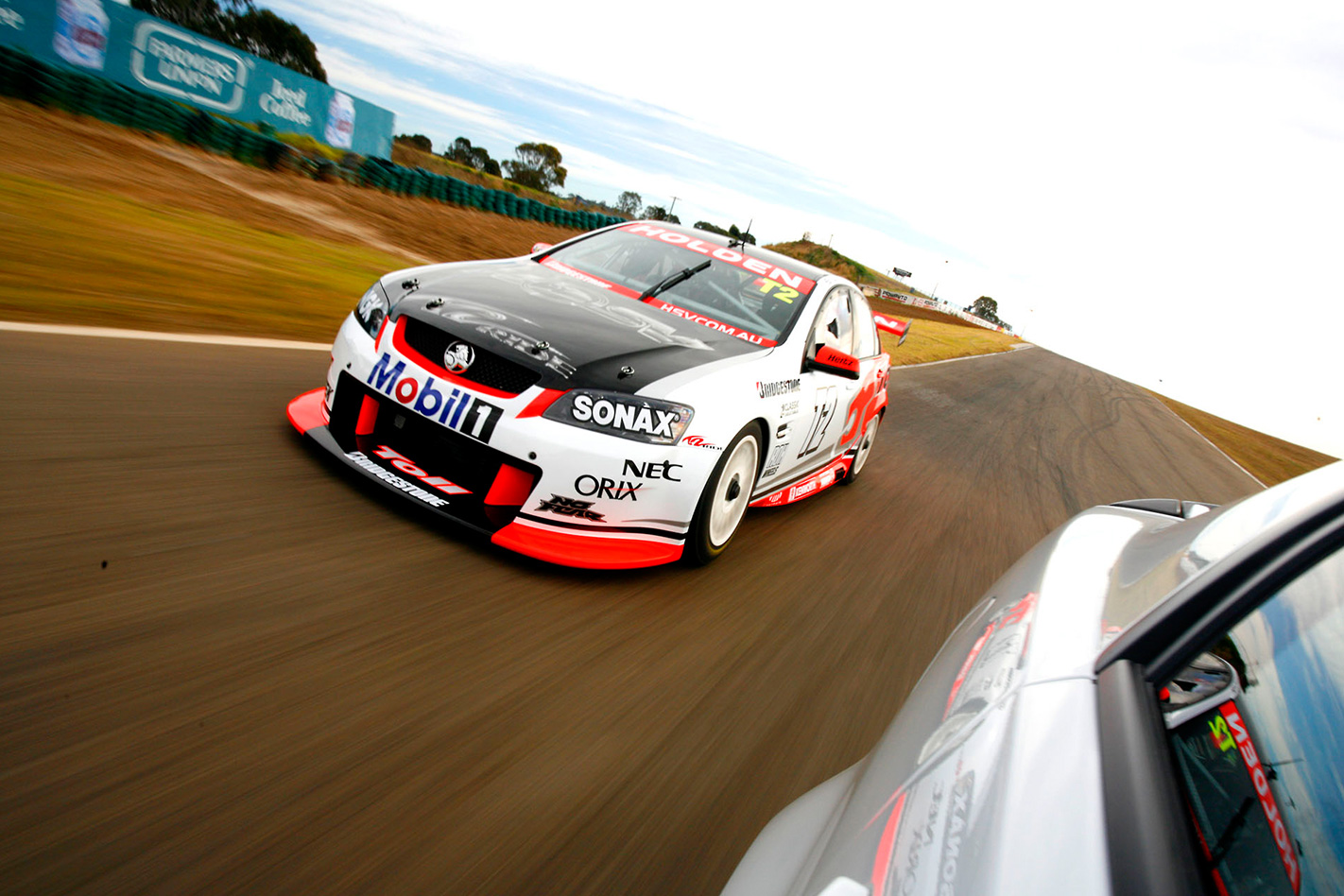
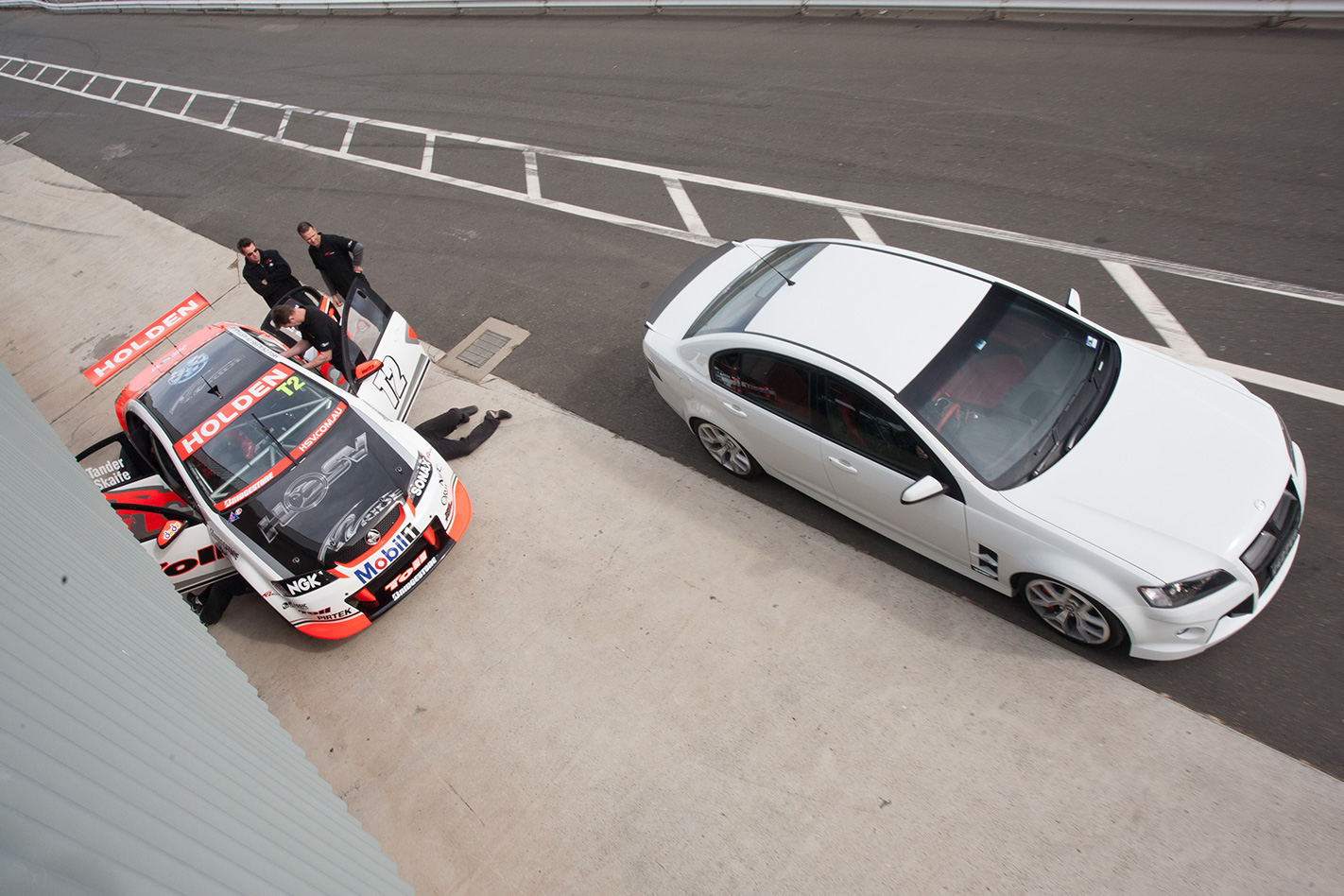
Now there’s irony for you. But that’s not why we’re here. So after a few running repairs (!), we’re pitching the W427 up against the V8Supercar. Okay, a race car and a road car sounds unfair at first, but when they’re both driven side-by-side, the difference isn’t as great as you might expect.
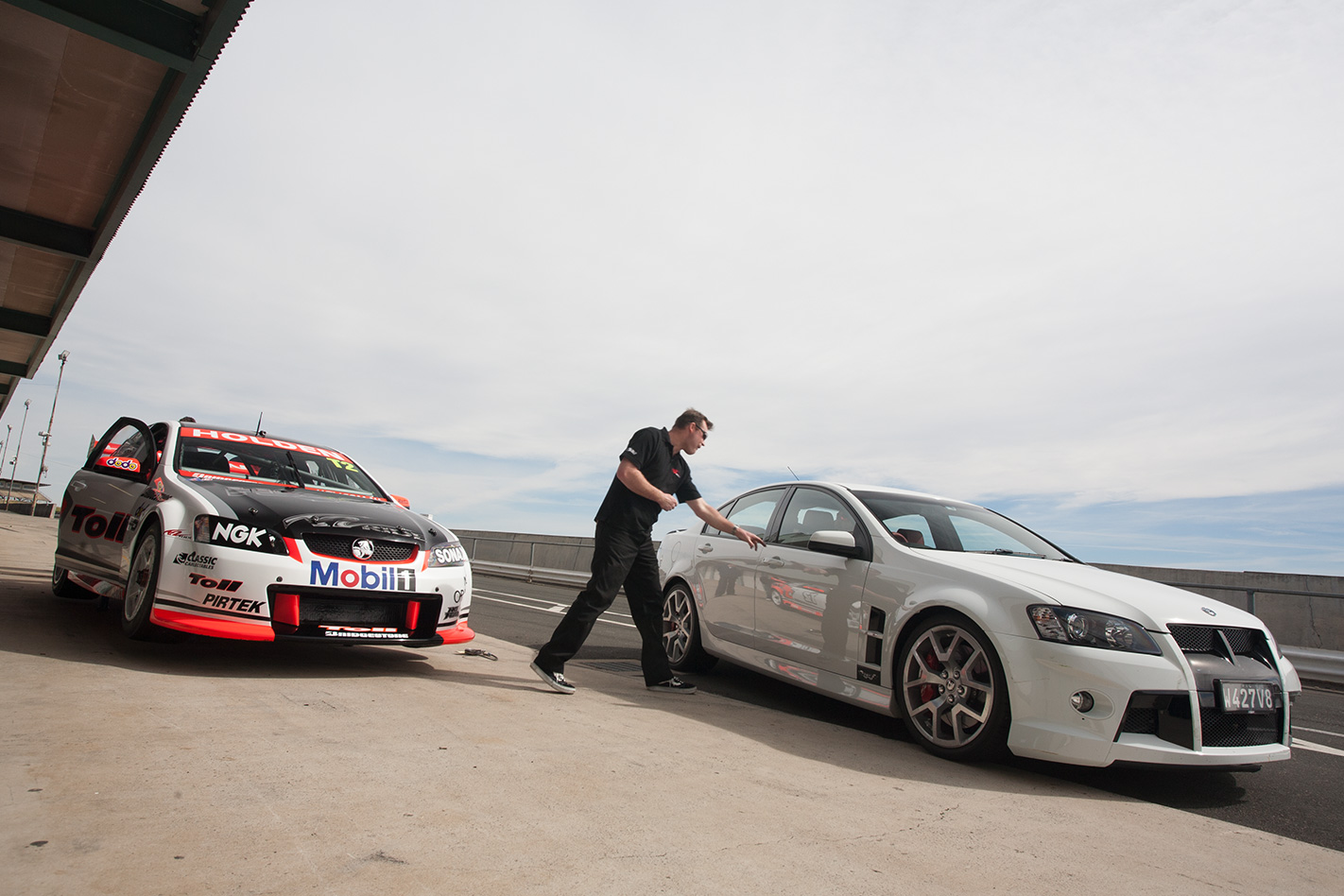
“The power’s very comparable.” His view is reiterated by the numbers. The V8 Supercar’s race-tuned 5.0-litre V8 pumps out 462kW @ 6950rpm and 630Nm @ 5250rpm, while the 7.0-litre LS7 W427 engine delivers 375kW @ 6500rpm and a stump-pulling 640Nm @ 5000rpm.
It might be 87kW down in peak power, but the LS7 has a broad spread of torque right across its rev range and isn’t as peaky in its delivery as the V8 Supercar’s engine. At first, the experience of both from inside the cars is quite different.
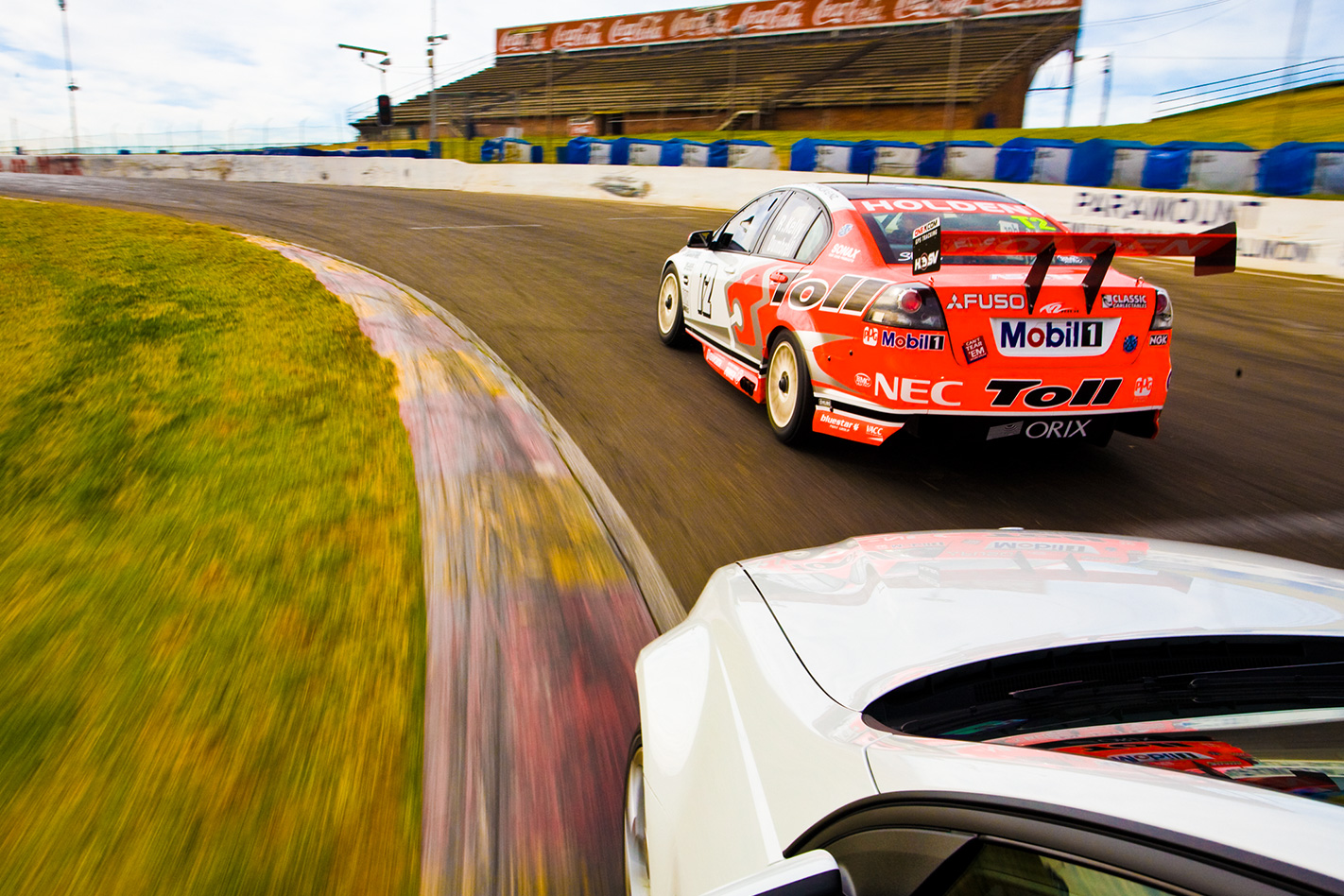
The car lurches angrily, like a pitbull pulling at its lead. But when we’re free of the pits, the V8 Supercar leaps forward and fires at the racetrack. Seton is busy at the steering wheel as we head down into Suttons, almost uncomfortably as he tries to keep control of his raging beast.
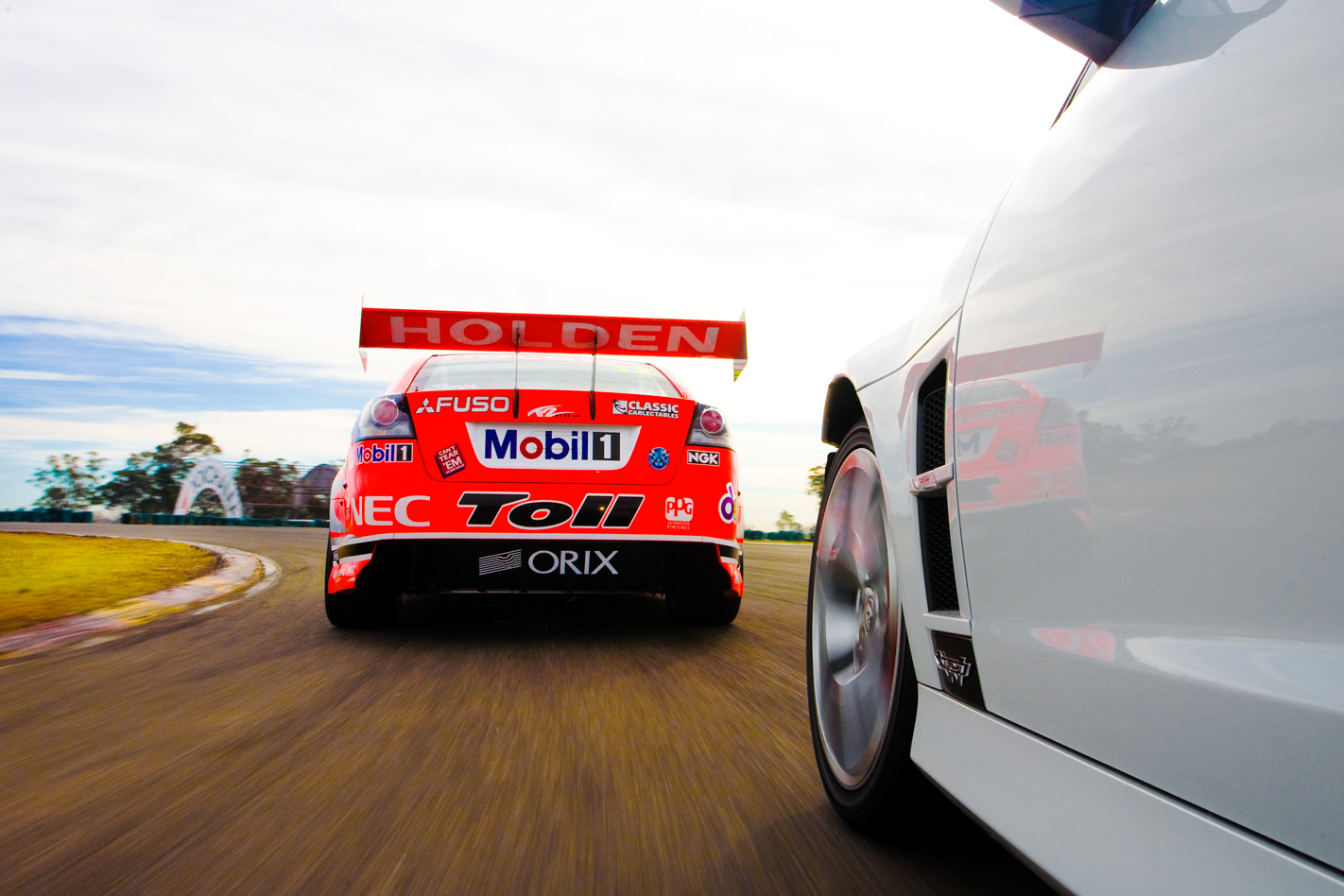
The W427 is also strong in that area. “It’s got really good traction grip,” says Tander. “You can’t actually hoon it up and get it sideways because of the amount of generic grip the car’s got – even with ESP off.” Power is another area where the W427 impresses, and alarmingly, it’s under acceleration down the main straight that it feels closest to the V8 Supercar.
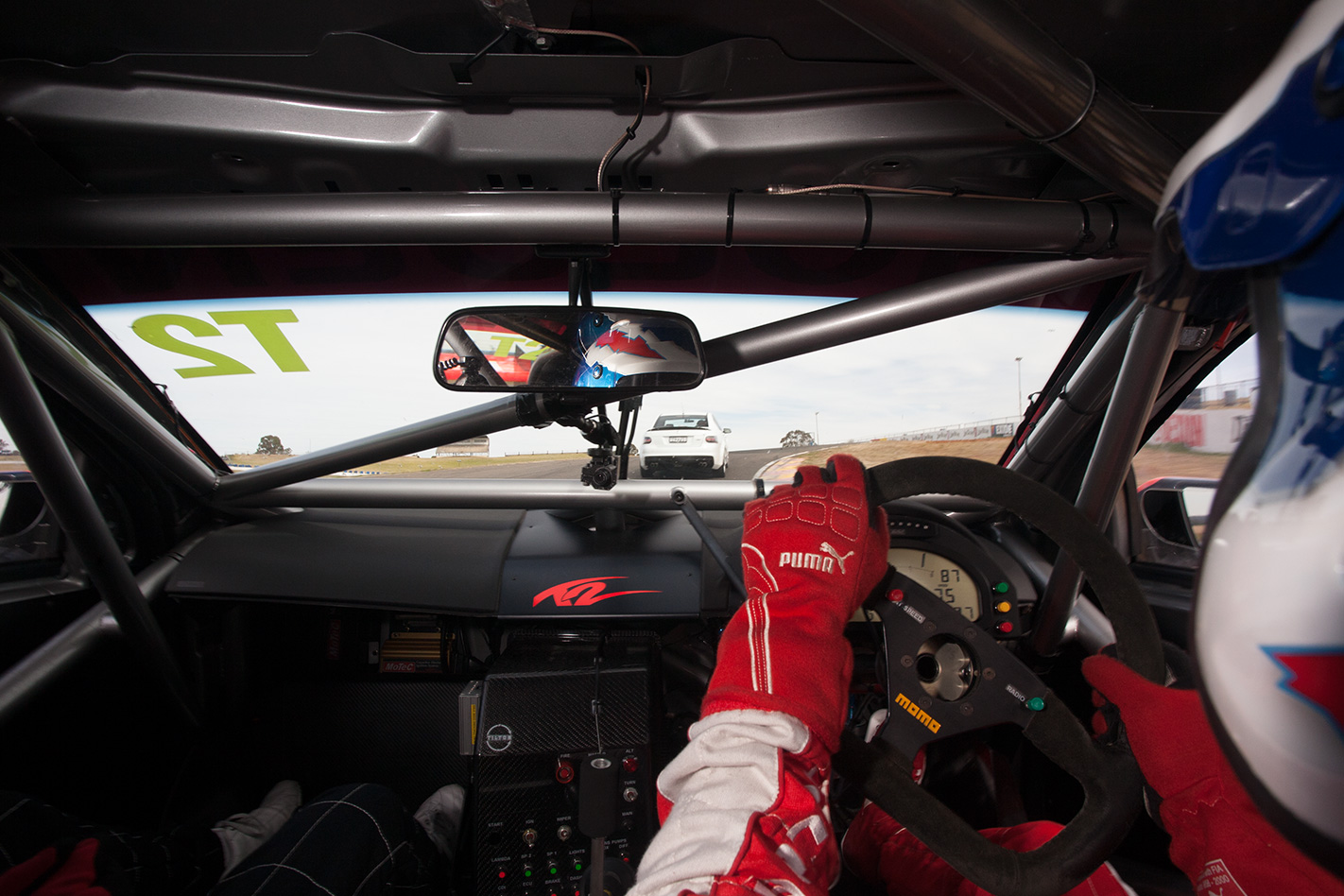
In comparison with LS3 HSVs, though, there’s a marked increase in exhaust volume. Brakes are also strong in the W427, Tander surprised with both the amount of stopping power and ease of modulation. “The braking’s really good and you can play with the pedal pressure to put the nose exactly where you want to.
Even into Suttons, you’re hard on the throttle and then deep on the brakes and you can get the whole car to come down onto the suspension with the brake pedal and not worry about the rear stepping out.” But we’re not convinced the W427 is totally rid of the rear axle tramp under braking that afflicts other VEs, after taking it for a brief spin ourselves.
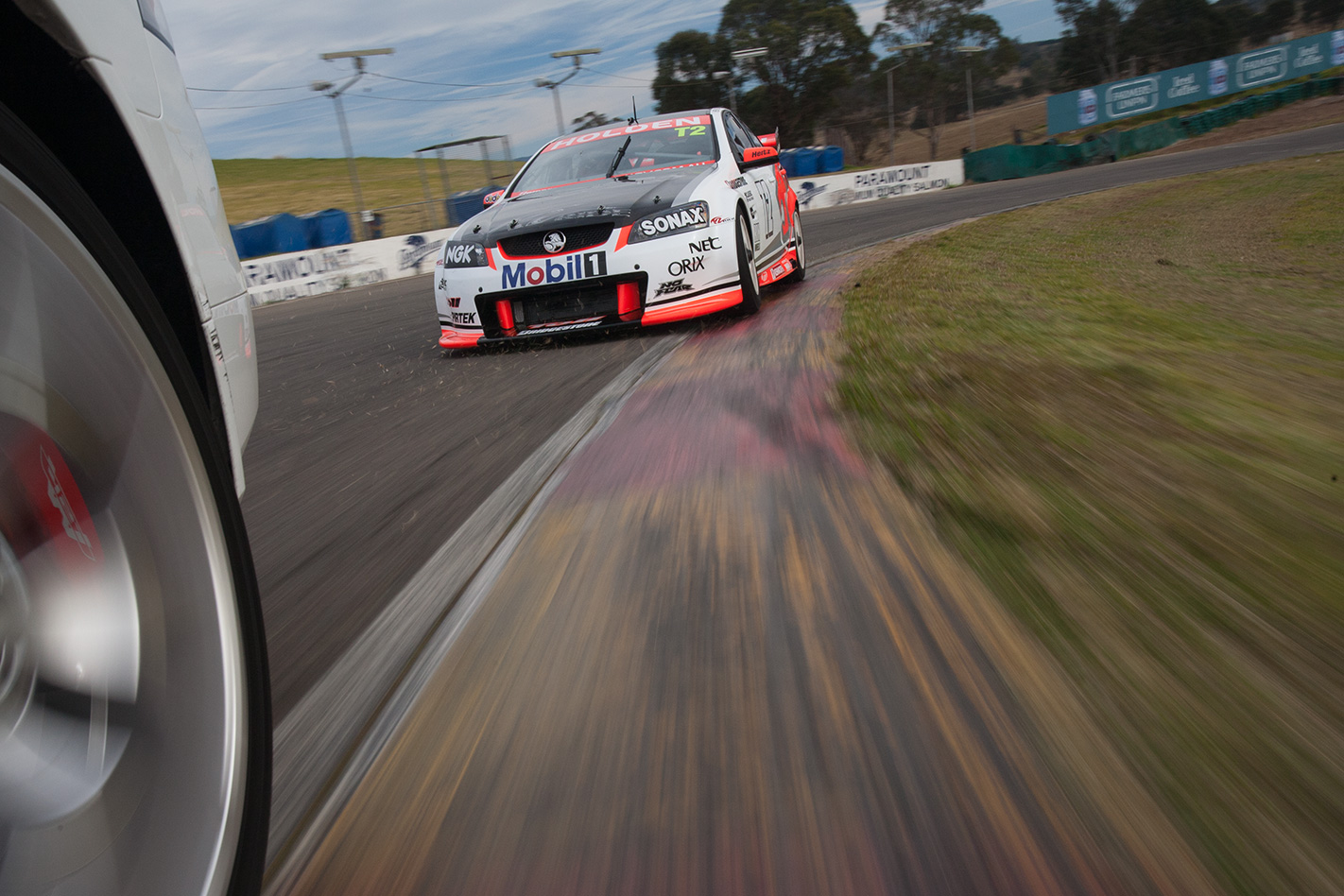
“I reckon you could put it in a production car race with just a set of slicks on and it’d probably blow most of them away, I’d imagine.”
The W427 is comparable in almost every way with the V8 Supercar. Noise, sheer grunt, chassis balance, strong drive and traction, braking performance and it’s probably not that far off the Supercar in laptime.
But that’s a cold view to take of a car that represents the pinnacle of Australian performance car engineering. And after driving both around Oran Park side-by-side, we’d prefer to take the view that the W427 is a road-going version of V8 Supercar. For $300,000 less.
SPECS
| u00a0 | HSV V8 Supercar | HSV W427 |
| Engine | 90-degree V8, OHV, 16vu00a0 | 90-degree V8, OHV, 16vu00a0 |
| Power | 462kW @ 6950rpm (approx)u00a0 | 375kW @ 6500rpm |
| Torque | 630Nm @ 5250rpm (approx) | 640Nm @ 5000rpm |
| Kerb Weight | 1355kg | 1874kg |
| 0-100km/h | 3.6sec (claimed) | 4.8sec |
| Transmissionu00a0 | 6-speed sequential Holinger dog-box | 6-speed manual |
| Tyres | Dunlop Control Slicks | Bridgestone Potenza RE050A |
| Price | $450,000 | $155,500 |
