
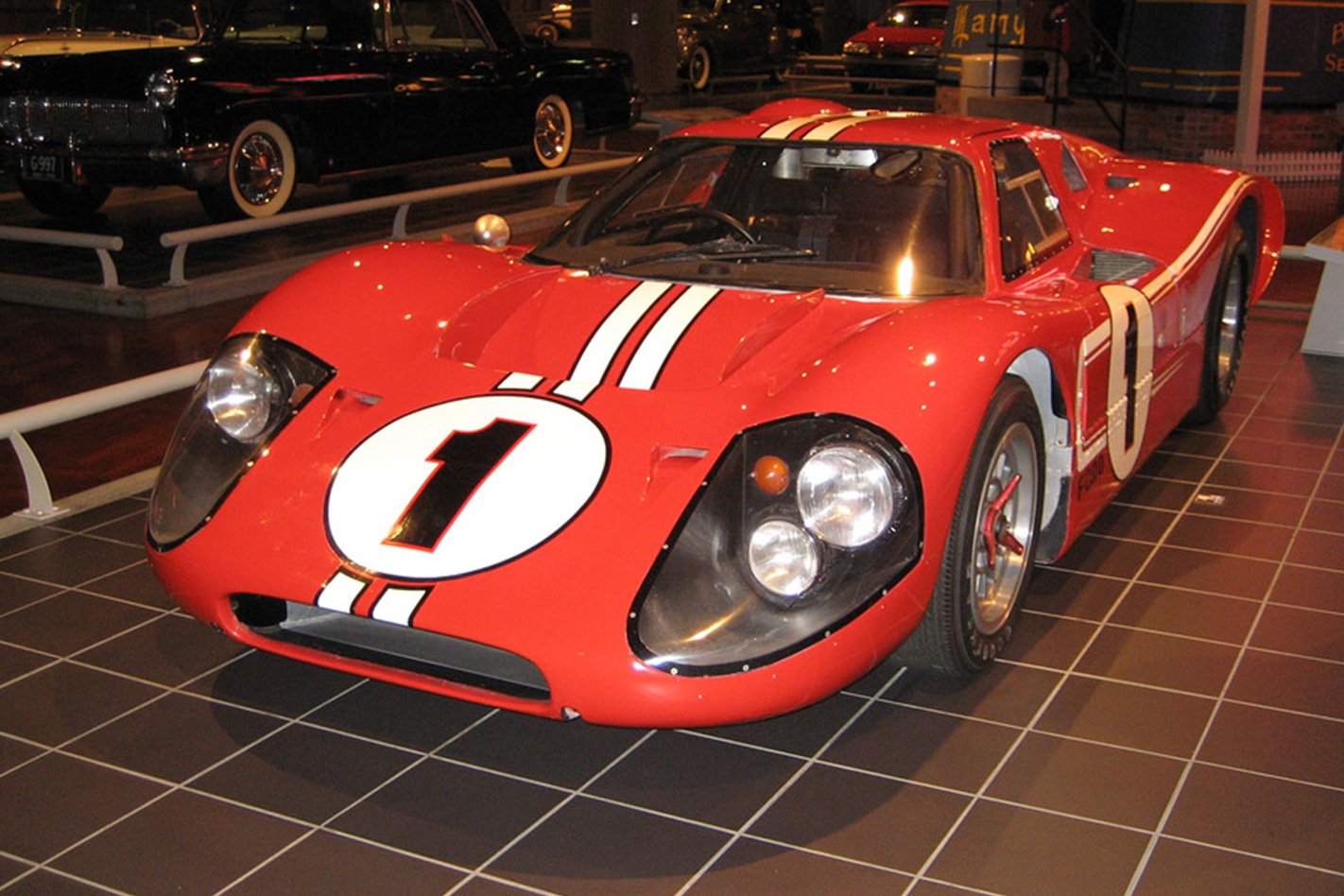
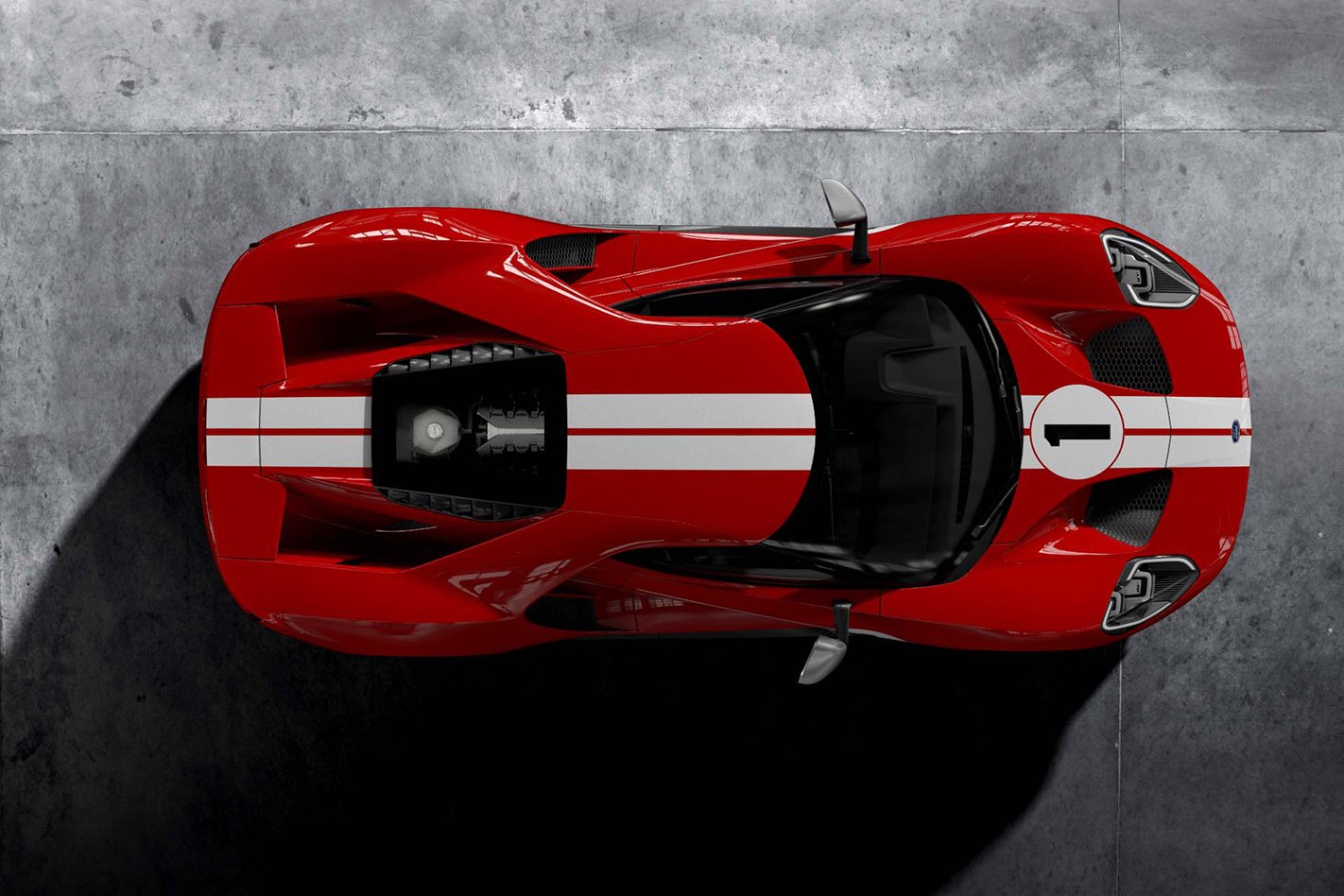
To celebrate its predecessor’s 1967 Le Mans win, a new Limited edition Ford GT will bear the red-and-white livery of original GT40 Mark IV.
The Ford GT ’67 Heritage Edition joins the ’66 Heritage Edition as tributes to the three-year streak of GT40 wins at Le Mans.
We can only assume there will be a Ford GT ’68 Heritage Edition available next year, hopefully with the iconic blue and orange Gulf livery.
The ’67 Heritage Edition will feature unique stying inside, too, with custom materials and a limited edition wheel finish.
Leather with red accents appears on the carbon fibre seats and the wheel, with matte carbon fibre door sills and centre console.
Global director of Ford Performance Dave Pericak says the ’67 should be as successful as the previous special edition GT.
“In creating a worthy successor to the 2017 Heritage edition, we logically looked at our next historic Le Mans victory with the all-American team of Dan Gurney and A.J. Foyt.
“The 2018 Ford GT ’67 Heritage edition pays homage to that win, with a modern take on one of the most important vehicles in Ford’s storied history of racing.”
“The first Heritage edition car was a huge success, honoring our history with a modern interpretation of the Le Mans winner.
“Continuing with a 2018 Ford GT based on the winning GT40 Mark IV race car was simply something we needed to do.”
You can see more of the ’67 Heritage Edition with Ford’s online configurator.
VOLKSWAGEN is expected to announce the first details of its production-ready all-electric people mover, dubbed the ID Buzz, at the US-based Pebble Beach Concours d’Elegance this weekend.
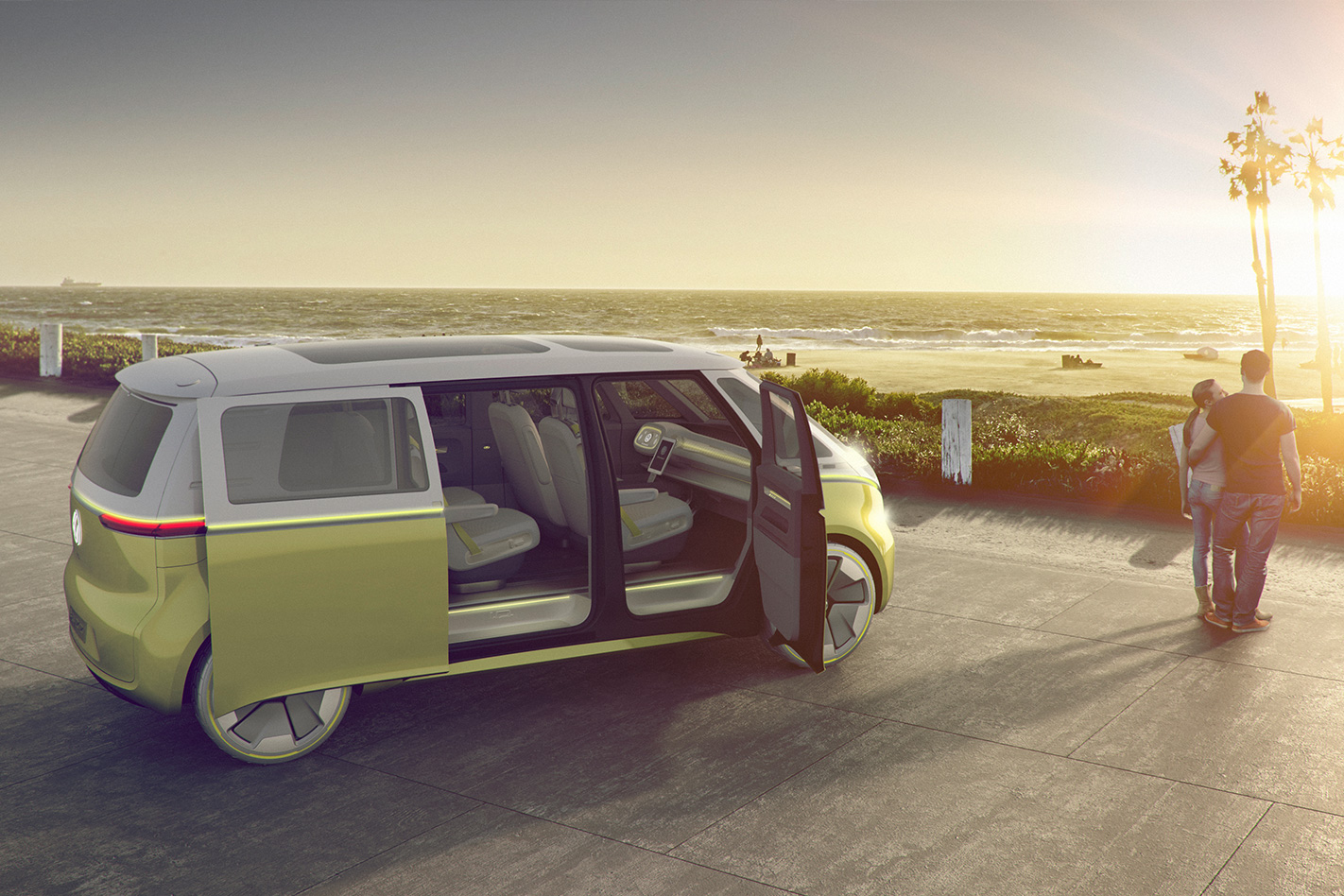
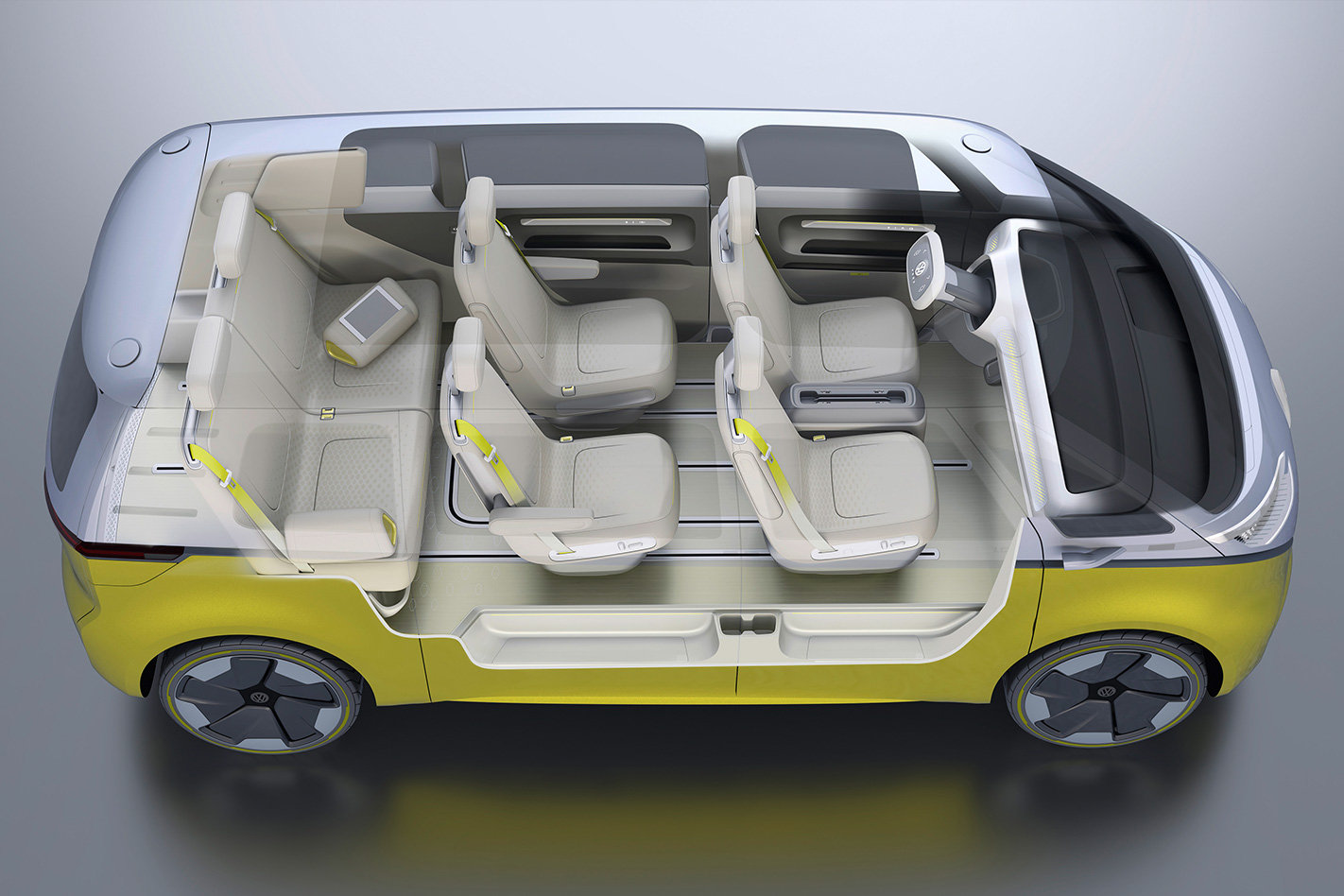
Revealed at January’s Detroit Motor Show in concept form, the ID Buzz resurrects styling cues last seen on Volkswagen’s iconic Kombi microbus and merges them with a futuristic all-electric architecture and autonomous driving capability.
It may wear retro clothes, but the ID Buzz is one of Volkswagen’s most forward-looking vehicles. Set for a 2022 launch, it will be the sixth purely electric Volkswagen to come to market – the first being the Golf-sized ID that will arrive in 2019, followed by the ID Cross SUV.
But that opens up the possibility for the ID Buzz – or whatever its production name ends up being – to morph from an electric people mover into a commercial van.
Automotive News Europe says Volkswagen’s head of light commercial vehicles, Eckhard Scholz, will likely confirm the production ID Buzz alongside Volkswagen CEO Herbert Diess at Pebble Beach. If true, Scholz’s presence indicates the ID Buzz will be a collaborative effort between Volkswagen’s passenger car and commercial vehicle divisions – the latter arguably keen to share in the potential offered by the MEB platform.
It’s that historical connection with the Kombi that VW will likely exploit at Pebble Beach, a location more known for megadollar historic race cars and one-of-a-kind vintage vehicles – all perfectly preserved.
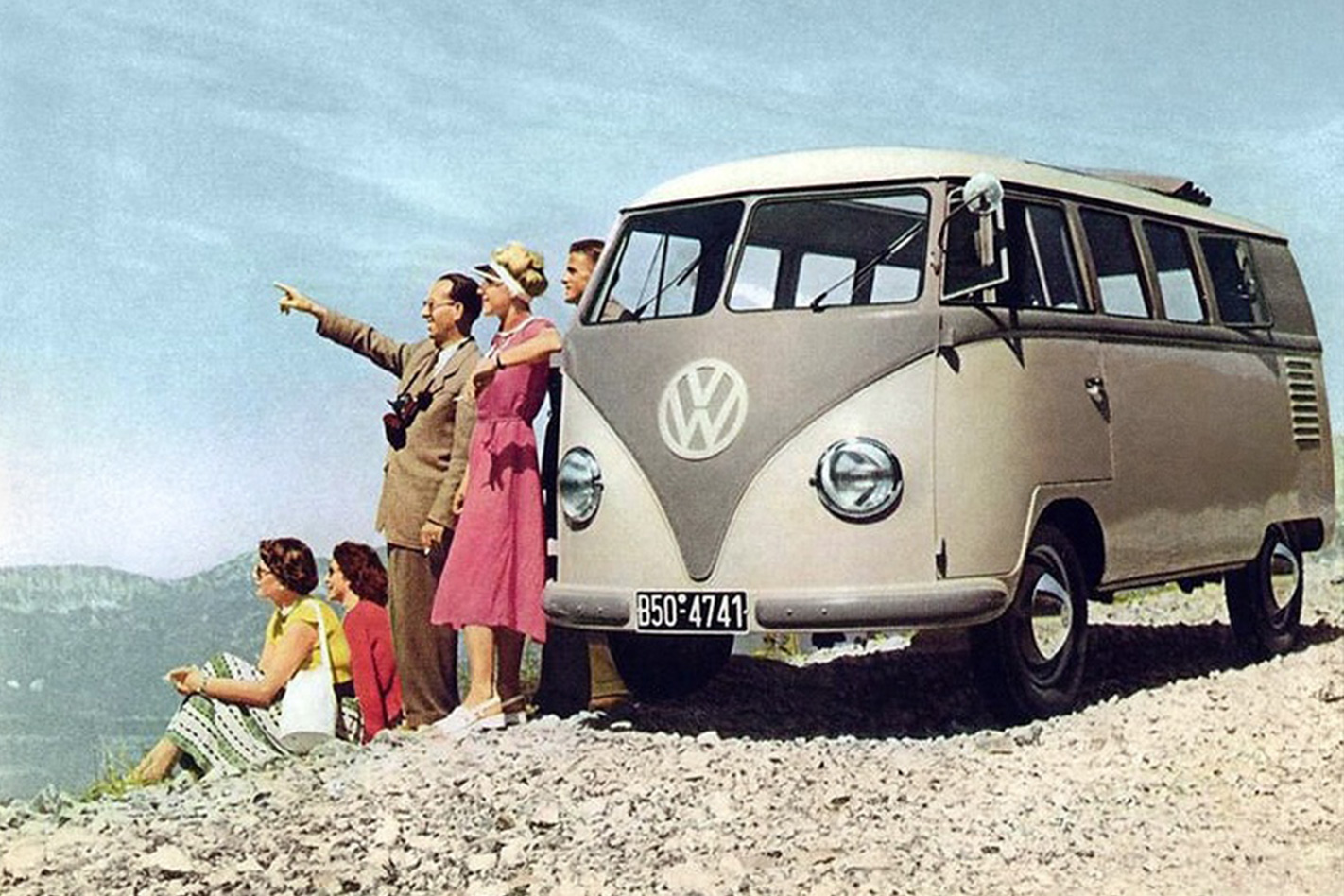
The Pebble Beach Concours d’Elegance is staged this weekend, meaning we should learn more about Volkswagen’s plans for an electric microbus next week.
PERFORMANCE SUVs, eh?
They’re the bread-and-butter of the go-fast divisions at premium brands such as Audi, BMW, and Mercedes-Benz, featuring jacked-up wagons built to defy gravity and bend the laws of physics, all while banging apexes with abandon.
But does Ford want a slice of the action? After all, it’s likely we’re going to have a tricked-out version of the significantly facelifted, load-lugging 2018 Ranger wearing a Raptor badge, so why not the same treatment for Ford’s family-friendly version, the Everest?
Wheels has had a bit of a crack at how we reckon the Ford Everest Raptor – potentially Aussie-developed seeing as we’ve run the T6 development program since day one, and are more than likely involved in the US market Bronco build – will stack up. Ford Australia first gave us wind that a special version of the Ranger ute was in the works after launching an application to trademark the name “Ford Ranger Raptor” in 2015.
If it does come here, the Raptor-badged king of the (world’s tallest) mountain is likely to go down the same path as its ute-based cousin, potentially dumping the growly 2.5-litre four-cylinder turbo-diesel for a 240kW/500Nm turbocharged 2.7-litre EcoBoost V6, similar to the one that powers the US-market F-150.
Similar to the F-150 Raptor, the Everest-badged version should gain a 10-speed automatic transmission sending drive to all four wheels. The Everest already has a Watts link/coil rear suspension – incidentally, spy images hint that the ute-based version will also adapt this set-up – so expect a beefier set-up to better hug the road.
Any moves to Raptor-enhance the Everest will be a welcome change to the current crop of large SUVs and trade utes that woo over buyers with little more than plodding pace wrapped in plastic garnish. We’re talking the likes of the Holden Trailblazer Z71, TRD versions of the strong-selling HiLux, and one from Ford’s own stable, the Ranger Wildtrack.
Large SUVs are big money in Australia – they outsell the medium and large car segments combined. The Toyota Prado large has it all over the Everest when it comes to Australian sales, with the Toyota-badged wagon moving almost 10,000 units over the first seven months of this year compared with the Ford’s 2600. The Holden Trailblazer is sitting on just more than 1800 sales, while the Isuzu MU-X has attracted almost 4400 buyers. The decidedly unsporty Mitsubishi Pajero Sport has attracted more than 4200 buyers.
The Volkswagen Tiguan has a new ‘off-roader’ model that’s more dirt capable but equipped with a host of new interior creature comforts.
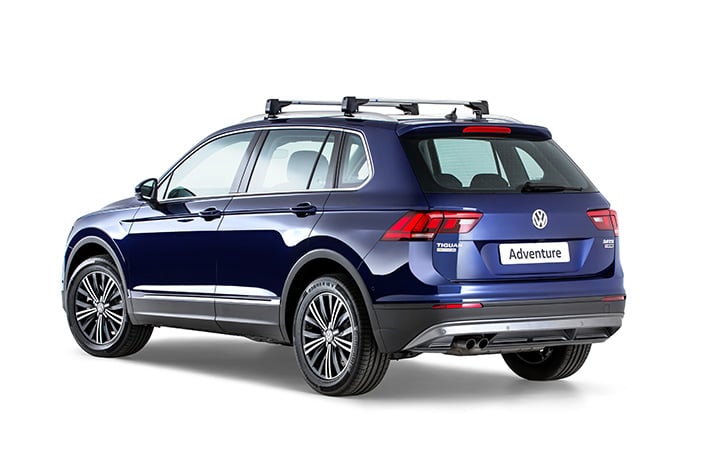
The Tiguan Adventure is based on the mid-spec 132TSI and 110TDI Comfortline grades with the addition of off-road inspired styling and design elements including a front bumper that raises the approach angle to 24-degrees, increased underbody protection, and the addition of aluminium front door-sill inlays.
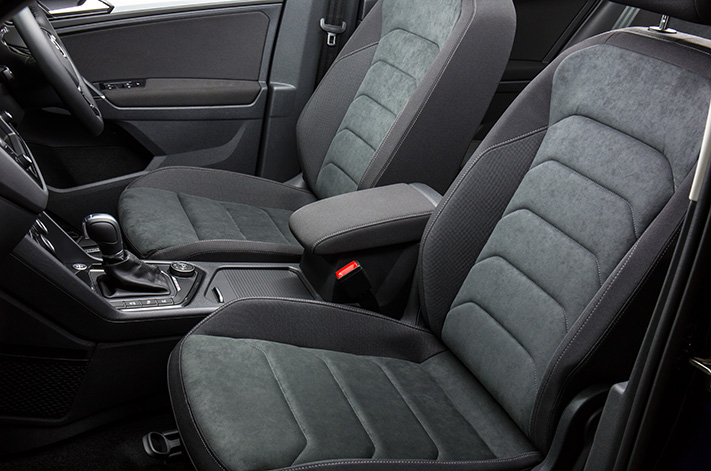
The interior has been spruced up for touring work with a 14-way adjustable driver’s seat with electric lumbar adjustment and massage function for those extra-long drives, plus Art Velours microfleece upholstery and heated front seats.
Other additions over the Comfortline spec include LED headlights and daytime running lights, larger 18-inch alloy wheels, keyless entry, electric tailgate, and power folding door mirrors.
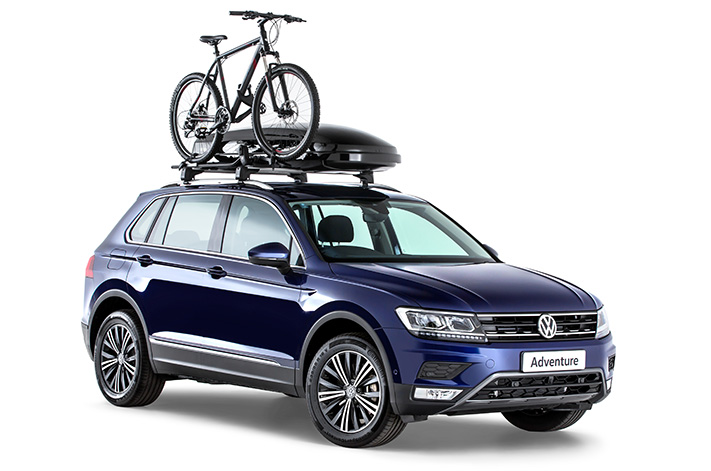
It also comes with factory accessory roof bars as standard.
Priced at $43,990 and $45,490 for the 132TSI Adventure and 110TDI models respectively, the Adventure models cost $2500 more than the comparative Comfortline models.
Options include premium paint including a unique Atlantic Blue Metallic hue ($700), driver assistance package that includes active cruise control and lane keeping assist ($2000), and a panoramic sunroof ($2000).
Performance is the generally the same as the models it’s based on. The turbo-petrol 132TSI produces 132kW/320Nm, while the turbo-diesel 110TDI pushes out 110kW/340kW. Both are coupled to a seven-speed dual clutch automatic transmission and all-wheel drive.
The Tiguan Adventure is now available at Volkswagen dealers.
Volkswagen Tiguan Adventure Pricing
- 132TSI Adventure – $43,990
- 110TDI Adventure – $45,490
Toyota’s Prius c compact hybrid hatch has undergone a facelift for the 2018 model year, bringing design tweaks and new equipment to Australia’s most affordable hybrid.
Entry-level pricing for the Yaris-based eco-car goes up $590 to $24,040 which Toyota claims is a bargain considering all of the new standard additions including satellite navigation, a larger 4.2-inch multi-function screen, interior trim enhancements, restyled headlights and new front end plastics.
The range-topping Prius c i-Tech (below) gains an upgraded sat-nav system along with interior and exterior changes, with its retail price rising by just $30 to $26,540.
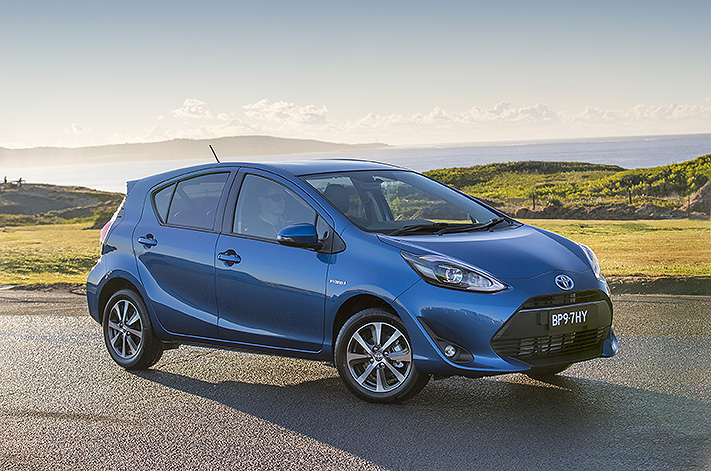
The car’s bodywork has been slightly lengthened by 55mm, thanks to a 40mm nose stretch and a more pronounced rear spoiler.
The front also has a larger and bolder grille framed by a new front bumper, restyled headlights and modified bonnet and fenders.
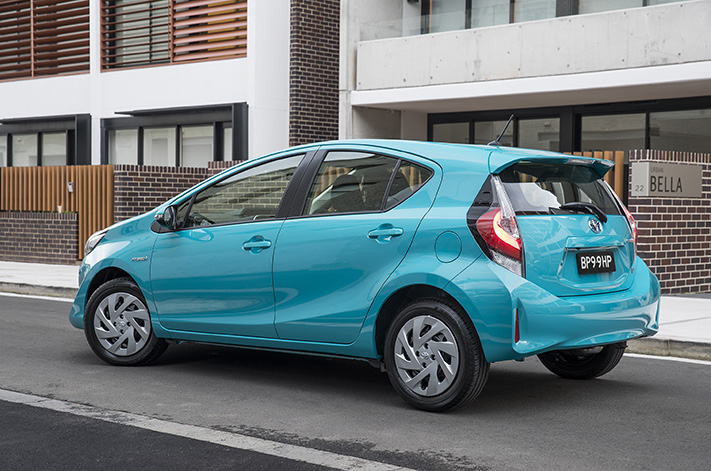
The LED taillights have also been restyled for the 2018 model year.
The i-Tech model also gains newly designed two-tone 15-inch alloy wheels and there two new exterior colours available for both models: Hornet Yellow and Aquamarine (the latter of which carries a premium paint charge).
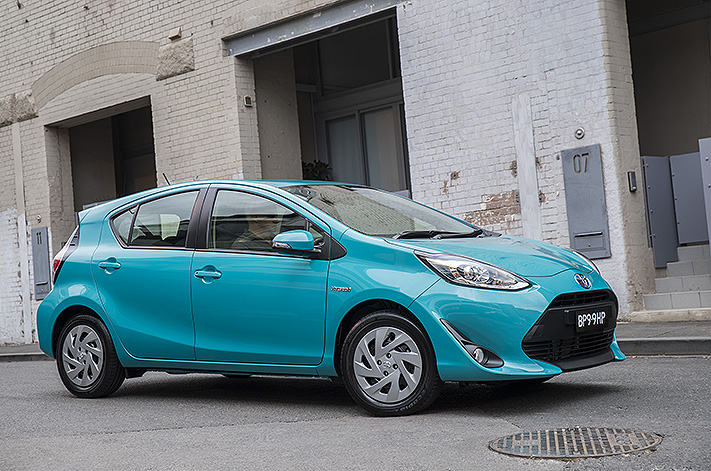
Several unseen measures have also been applied to improve handling and stability, including larger and stiffer lower-rear panels and additional spot welds for the rear-wheel housings.
The full-size spare wheel has also been ditched from under the cargo area floor in favour of a space-saver to save weight.Interior changes include a new black steering wheel with piano black and silver highlights, complementing the redesigned centre cluster.
The air-conditioning/heater control panel has been modified with LCD display functions grouped in a “floating” structure with piano black ornamentation and a chrome-plated surround.
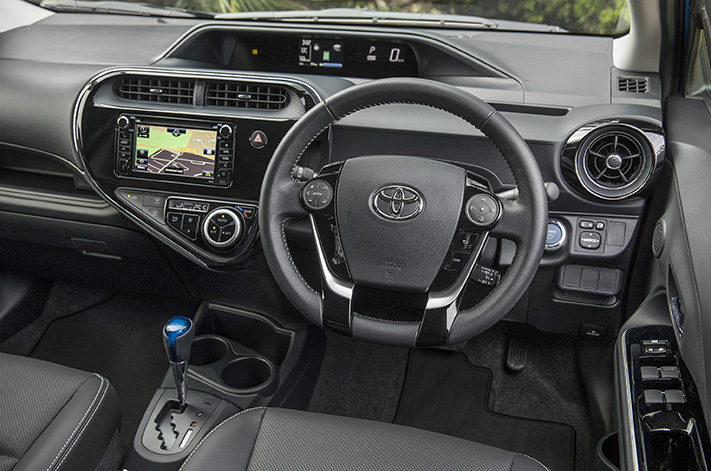
Both models now feature satellite navigation with SUNA live-traffic information viewed through the 6.1-inch display screen.
As well as the larger 4.2-inch MID within the instrument cluster (previously 3.5-inch), the Prius c now has the same steering wheel as the i-Tech, incorporating switches to operate trip-computer info displayed on the MID.
Toyota points out the Yaris-based Prius c, which is smaller than the Corolla-based Prius, is the most affordable hybrid available in Australia. Its 74kW petrol-electric hybrid powertrain drinks a claimed 3.9L/100km on the combined cycle and produces just 90 grams of CO2 emissions per kilometre.
Toyota Prius c pricing
- Prius c – $24,040
- Prius c i-Tech – $26,540
Once a year, Pebble Beach in California becomes something of a Goodwood for the States.
That is, a celebration of fine cars, not so much driveway-racing.
This year the auctions will impress as they always do, with two of the ultimate expressions of the McLaren brand going up for auction.
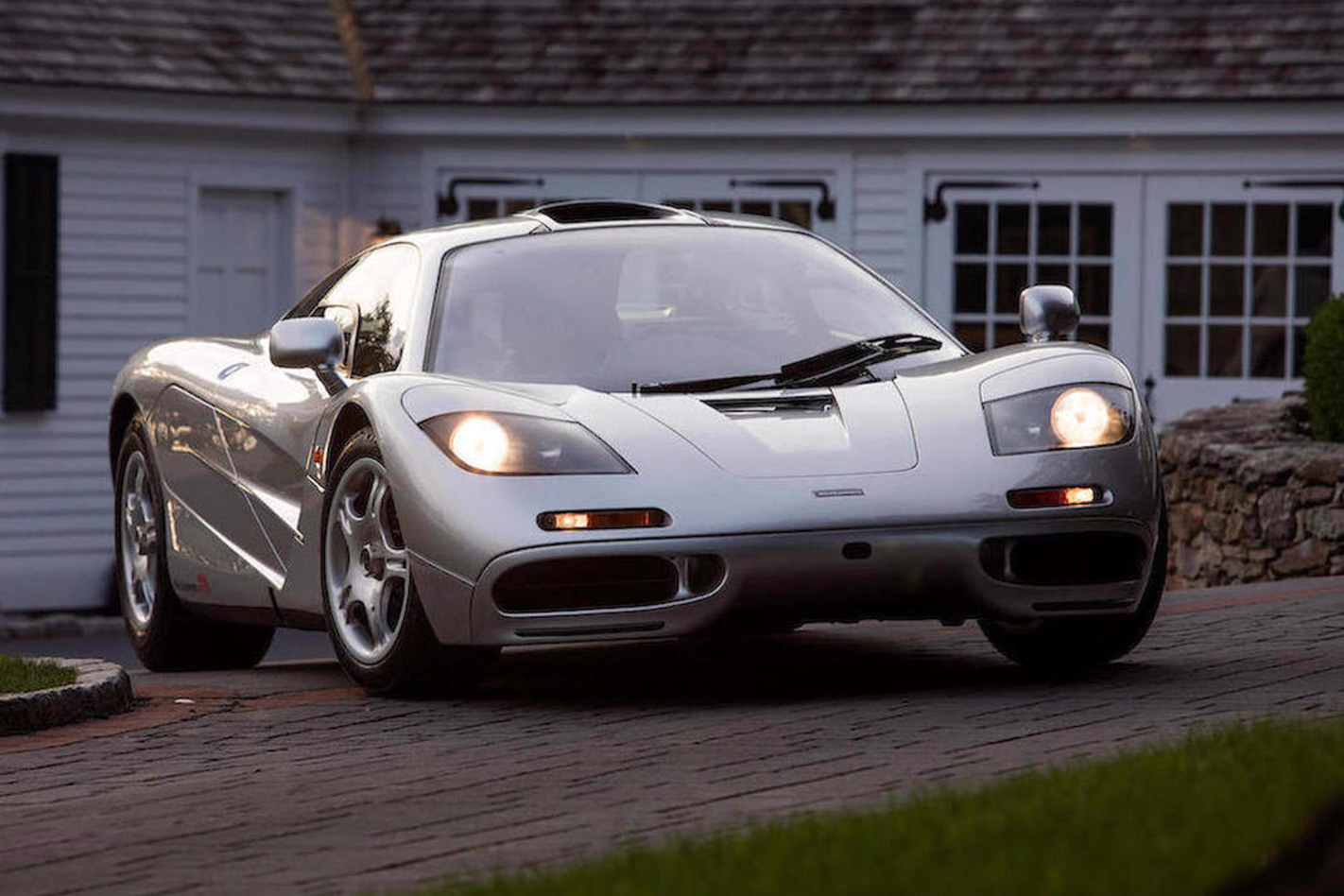
As a piece of supercar history and an engineering marvel, the McLaren F1 deserves attention whether it’s in pristine condition or not.
The fact it was the first production car to feature a carbon fibre monocoque body and could hit over 390km/h is hall-of-fame-worthy, however, this one is particularly impressive.
Chassis number 44 is a one-owner car, is almost completely original, and the 468kW V12 has only travelled 15440km.
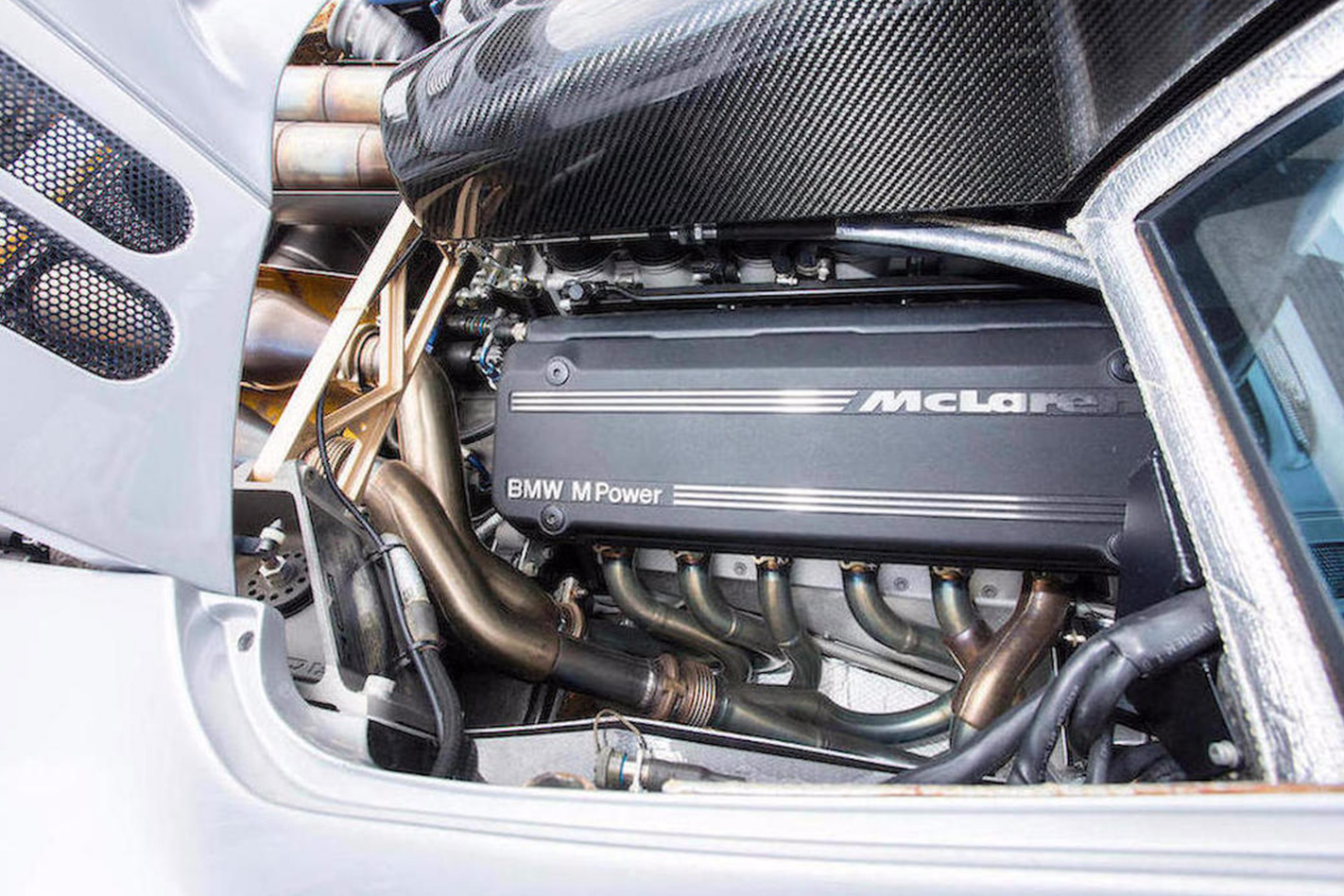
However, in 2014, a three-owner F1 was offered at Gooding & Co’s Pebble Beach auction. Its listed estimate was $12m-$14 million USD, though bidding only reached $10,750,000 and the car remained unsold.
That means this one could go for around $18 million AUD. Or more.
Next up, and at a much more achievable $2.5 million USD ($3,170,000 AUD) is a McLaren P1, built in 2015 and part of a run of cars a bit more populated than that of the F1.
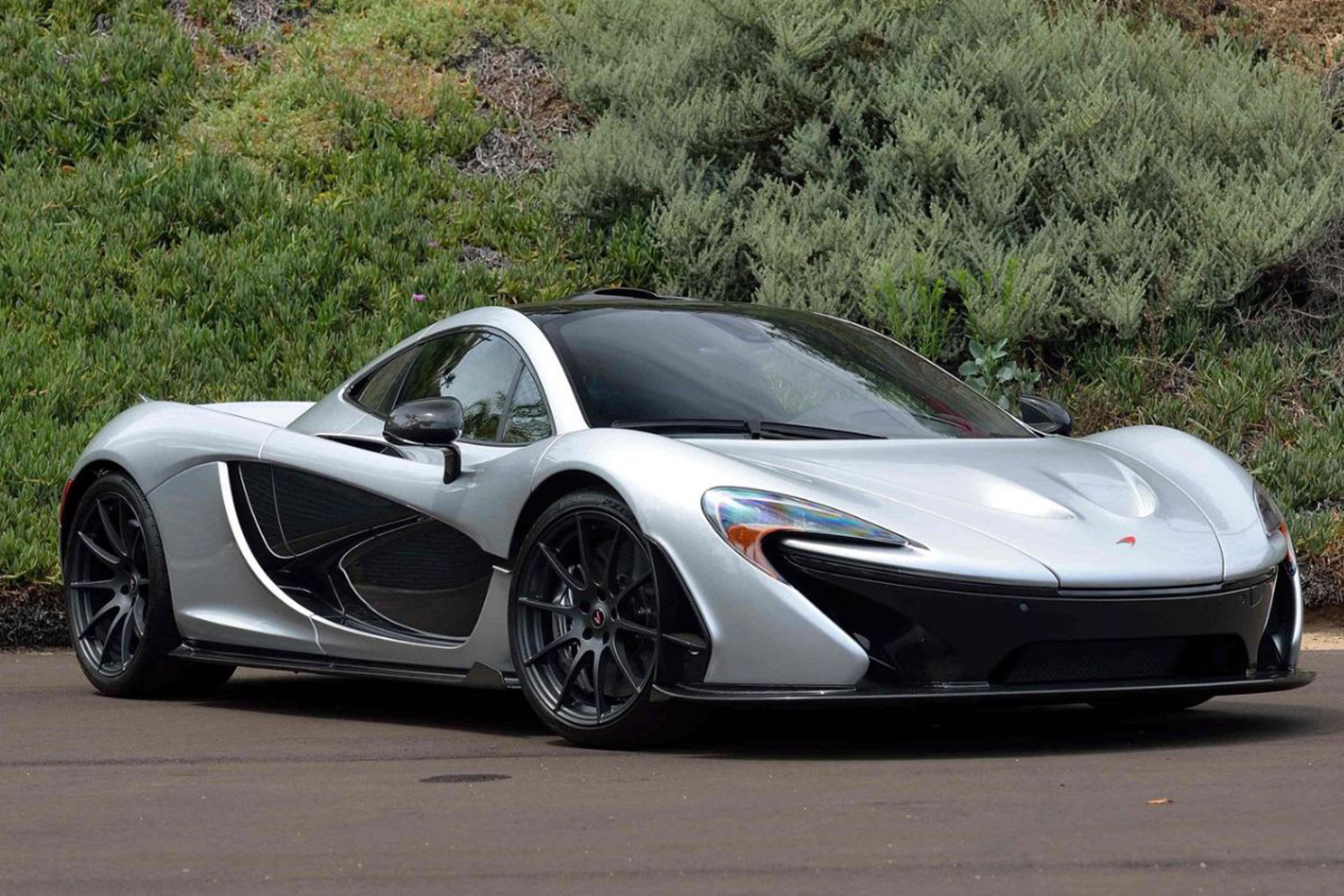
Even though it’s got a lower electronically-limited top speed of 350km/h, it’ll hit 100km/h in 2.8 seconds, about 0.4s before the F1.
Mecum Auctions heralds it as one of the main attraction of the Monterey 2017 auction, but it’d be far more attractive if it was parked next to the F1…
CONTINENTAL has revealed a unique wheel and brake combination concept that not only promises to boost electric vehicle efficiency and durability, but adds some of the most serious high-tech aesthetics yet seen in the EV realm, or any for that matter.
While conventional cars need heavy iron brake rotors to frequently absorb large amounts of energy, the majority of braking done in EVs and hybrids is through its regenerative braking system – using the electric drivetrain to reproduce power while slowing the vehicle.
Instead of hauling around heavy iron discs that corrode when not regularly used, Continental’s solution swaps the ferrous metal rotors for lighter aluminium versions that do not rust when unused and dramatically reduce unsprung and overall weight.
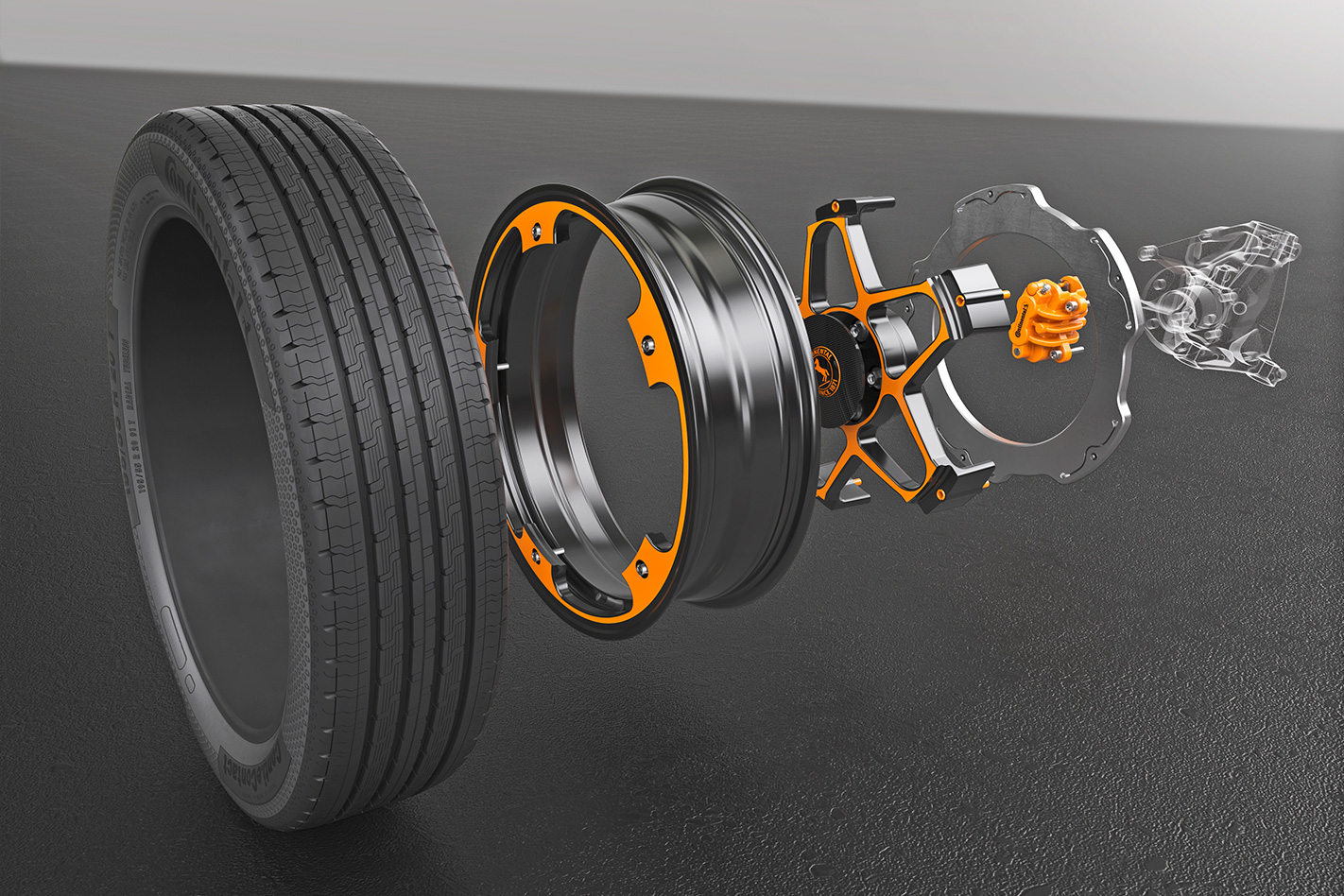
Mounting the caliper on the outside of the rotor, as is common with conventional brakes, was not possible with minimal clearance between the disc and wheel rim, but Continental relocated the small caliper on the inside of the rotor, adding to the unorthodox looks.
With a compact four-piston caliper, the system also reduces particle emissions associated with heavy braking and large friction surface areas.
Dressed up in the company’s trademark orange, the split-rim wheel itself is machined from more lightweight aluminium, its skeletal five-spoke design is completed with a carbonfibre centre cap.
The tyre and vehicle tech giant does not detail if their cool new wheel assembly is destined to appear on any production metal soon, but the concept has been fitted to a BMW i3 for winter testing in Sweden, and could roll out bolted to a new concept vehicle in the near future.
Straight-six versus V8 was once the most common battle at Mt Panorama: XU1s, Charges, BMWs and even Nissans have pushed forward many challengers, but it’s been the V8s in Monaros, Commodores, and Falcons that have set the pace.
First published in MOTOR Magazine August 2006.
And it’s a battle not limited to Bathurst, as the Europeans have their own speed demons – like a last hurrah for the current M3 engine, one of the finest six-cylinders in existence and one of few to surpass the 74kW (or 100hp) per litre barrier.
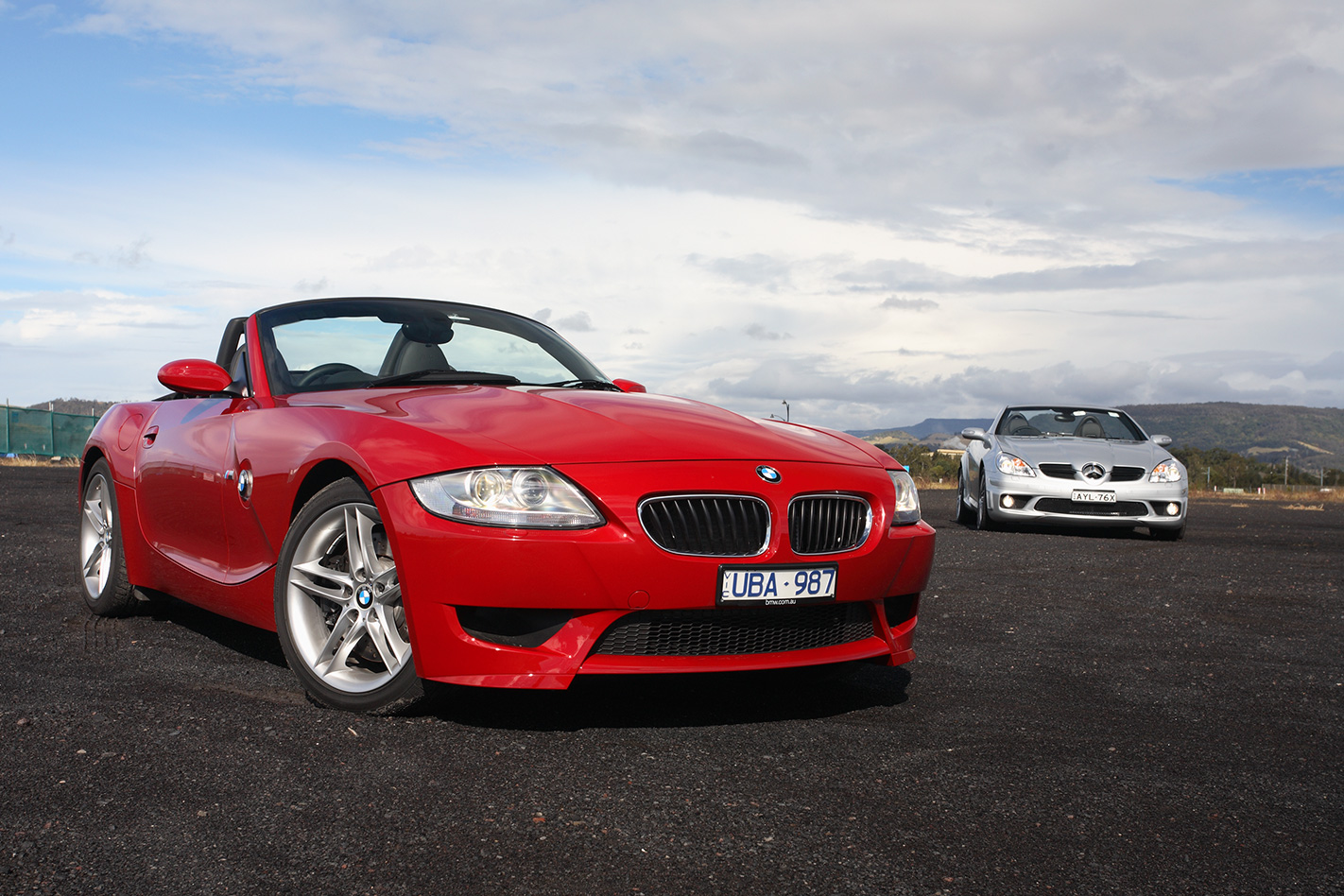
It was quite the natural act of a few months back, when BMW dropped its glorious M3 engine into the bay of the Z4 Roadster. The 3.2-litre straight-six worth 252kW is well proven, well hard and well worth the relatively simple effort of displacing the 190kW 3.0-litre straight-six. More engine plus more power equals faster car. Slap on some M badges and upgrade the running gear. Easy.
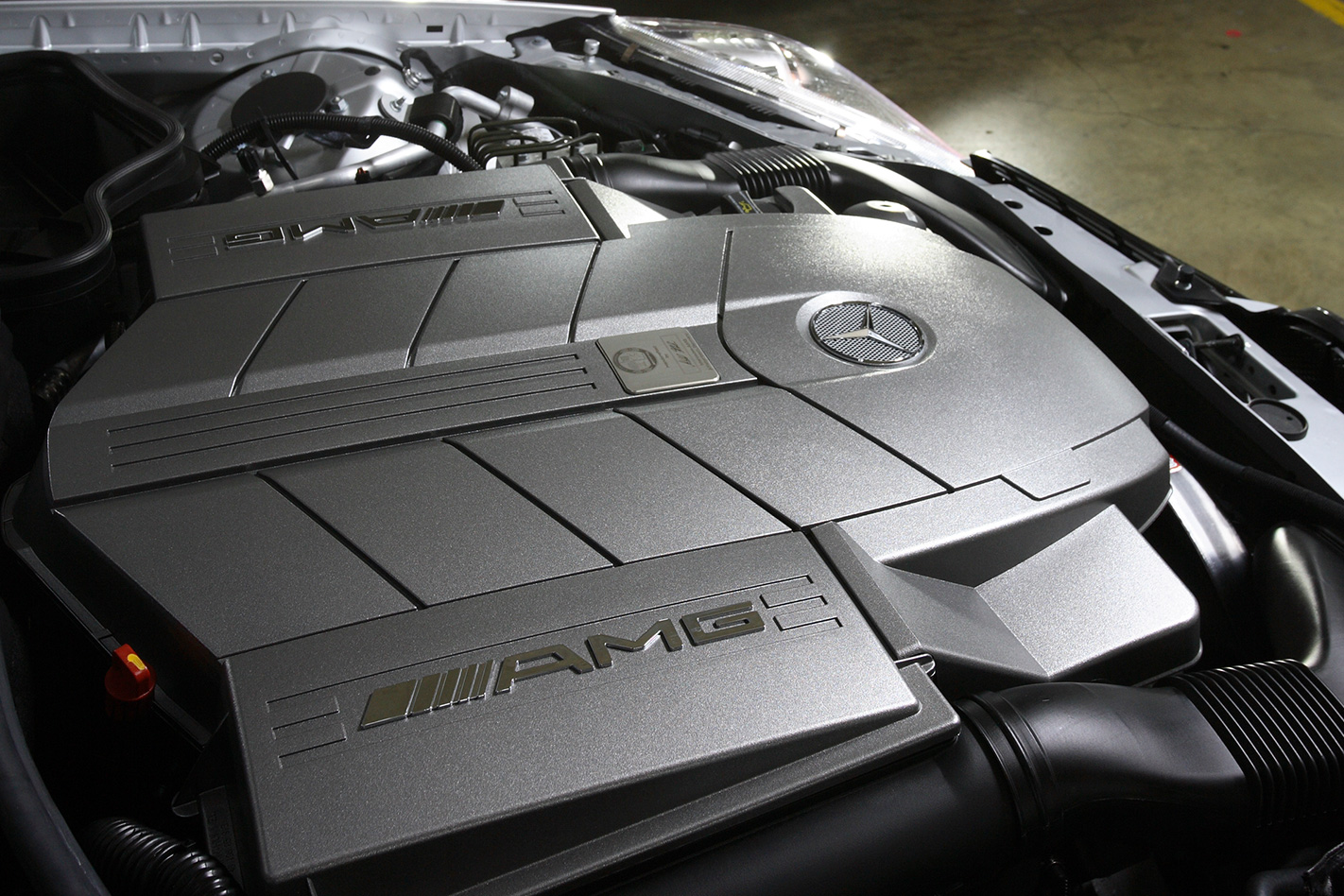
It all sounds vaguely familiar to the theory behind the SLK55: AMG’s grunty coupe/convertible lost its 3.5-litre V6 in favour of a big 5.4-litre V8, and gained 30 percent more power. Big engine, small car, works every time.
Back in March, Merc’s 55 beat up Porsche’s Boxster S Tiptronic and Audi’s S4 Cabriolet to claim the $150k drop-top bragging rights, but we suspected with a self-shifter, the Boxster would have been the one taking the win and counting its $20k savings. A rematch was in order.
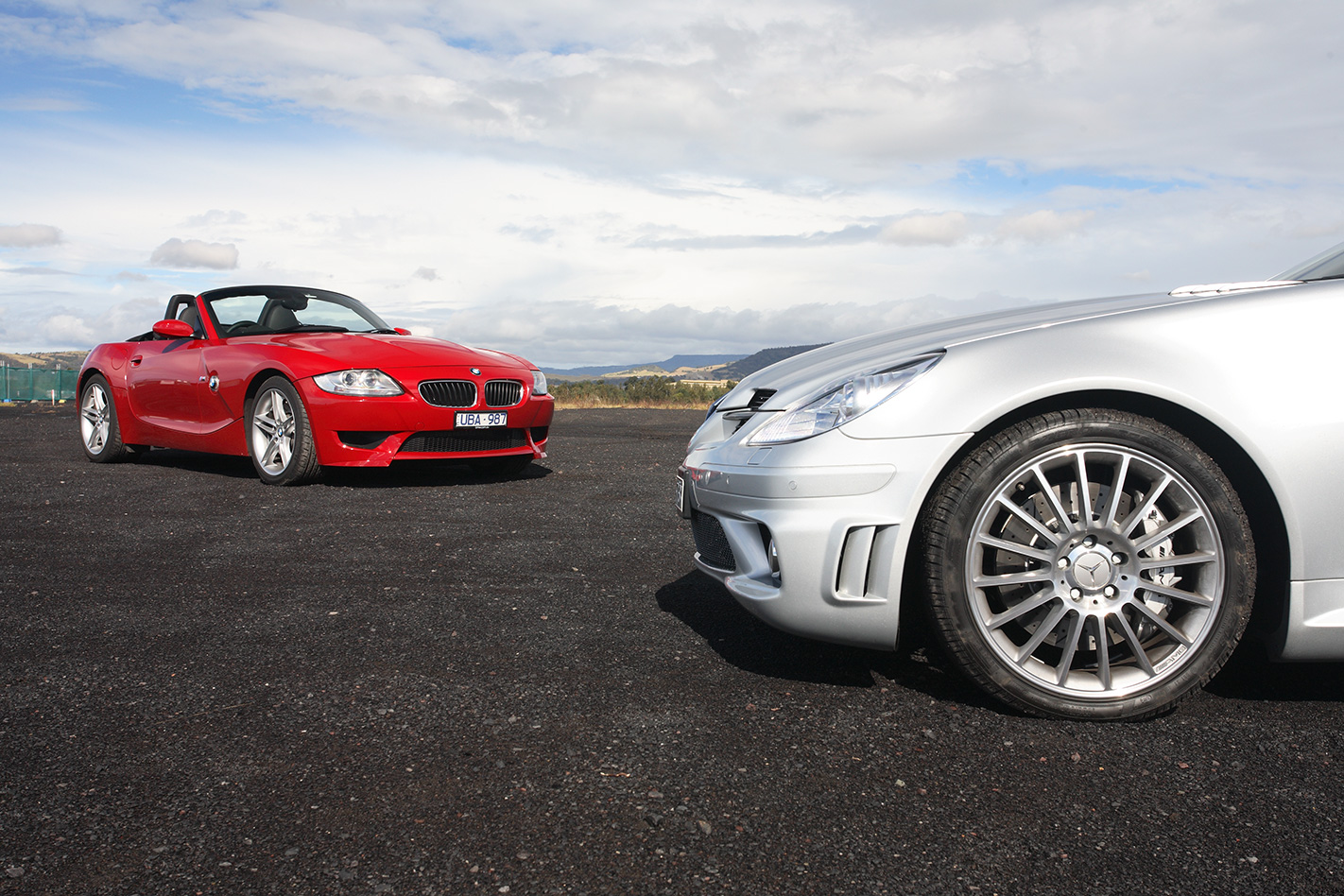
On paper BMW’s Z4 M Roadster is more than up to the task of taking it to the Merc, with four per cent less power but also four per cent less weight. Should be a close fight.
Both are two-seat sports convertibles at the top of their trees, the soft-top BMW-uses a delicious six-cylinder and only a six-speed manual. The folding hardtop Merc may have only an auto backing its V8, but it’s a seven-speed.
Both run similar hardware when it comes to wheels, tyres, brakes and suspension but the BM is marginally longer and larger, the Merc a bit wider. Even the power to-weight ratios are virtually identical.

In fact the only cost option on this lmola Red car is $450 electric folding mirrors. Too bad it’s not possible to option practical interior space for a phone and wallet.
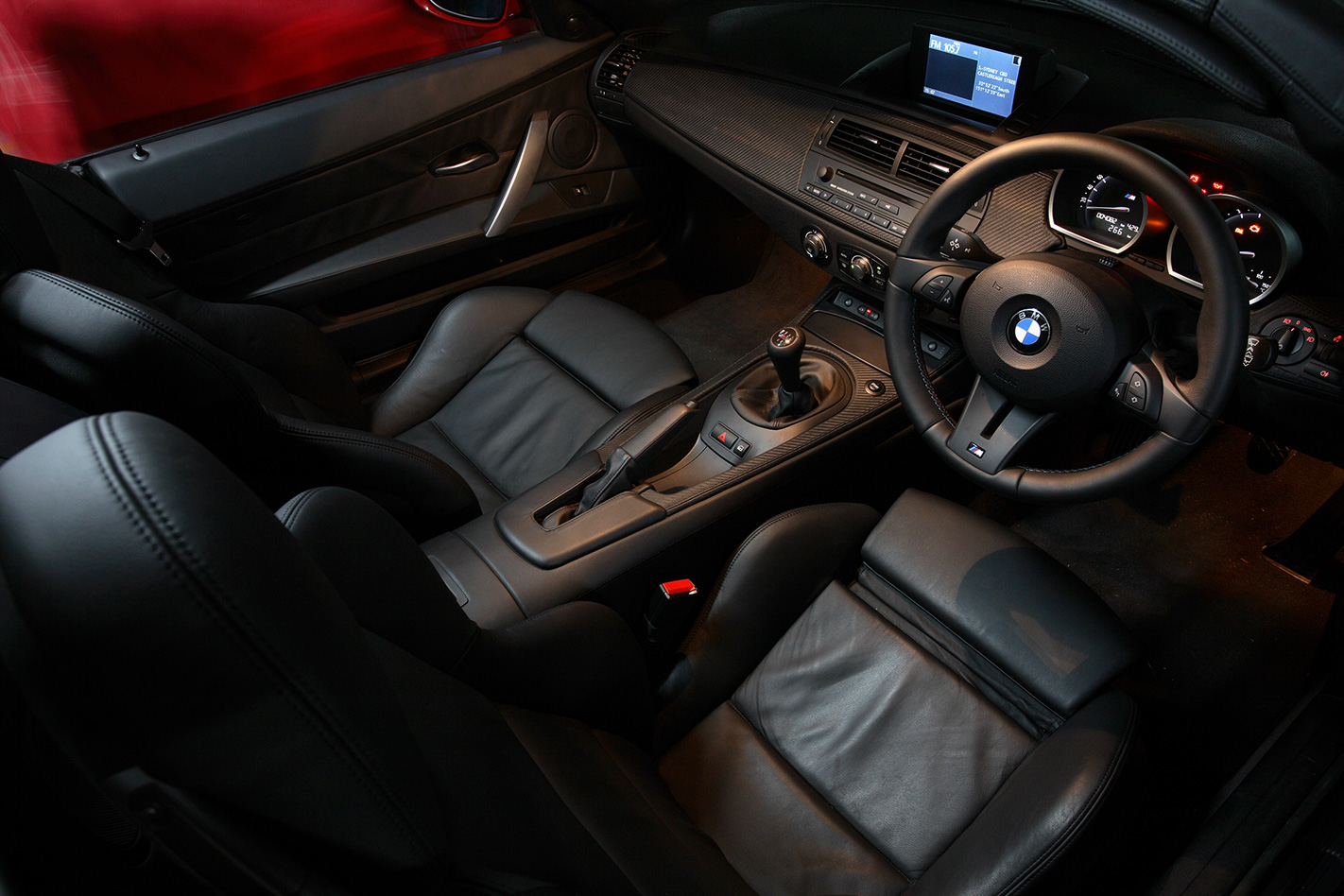
The no-cost ‘unlaquered’ carbon fibre dash option is initially odd, but is more tactile and different enough to be a high point, otherwise the cabin is clean and logical.
The AMG is wider outside and in. There isn’t the super-low sporting seating position of the Z4 but there is more elbow room and an uncramped feel with all the controls neatly laid out and useable storage space. But enough already, it’s time to hit the flowing, scenic roads around Sydney’s Southern Highlands. From Sydney’s CBD.
No one has ever said the M3 engine is short on response, but combined with a firm clutch pedal and clicky shifter, it’s sometimes bunny-hopping down the road, your right foot lifting in an unfortunate unison with the sharp power surge.
Learn to lean on the trick hill-hold function and it moves away much smoother. There is the Sport button that heightens throttle response and steering, but personally speaking, it’s sharp enough as it is.
The BMW also gets hydraulic steering, a first for Z4, and while it’s heavier than the remote Merc’s, it doesn’t translate to more feel. The Z4’s steering is accurate, but it’s far from Boxster brilliant. The brakes too feel good around town, the single-piston front calipers nice and responsive when the going gets café latte.
The AMG is very much the boulevard cruiser in comparison ignoring a lot of the minor road bumps the BMW highlights. Responsive brakes, light steering, plenty of grunt, the AMG loves the lazy light-throttle.
But we love a heavy one and as the throttle cracks open with an eight-track of dulcet tones of a hollow V8 bellowing out theatrics that induce surprised looks of ‘was that a V8? from passing pedestrians. AMG’s V8 is brutal, powerful and totally addictive but far from refined; like an iron fist in an iron glove.
Despite feeling floatier, the SLK55 feels better stuck down than the BM. Tip it in and the front end bites, the shorter wheelbase feels a fraction more twitchy, but it’s as neutral as twins on a see-saw. Boot it on exit and the rear end will give a predictable little wag as both tyres find their grip limits, but it’s as easy as it is fun.
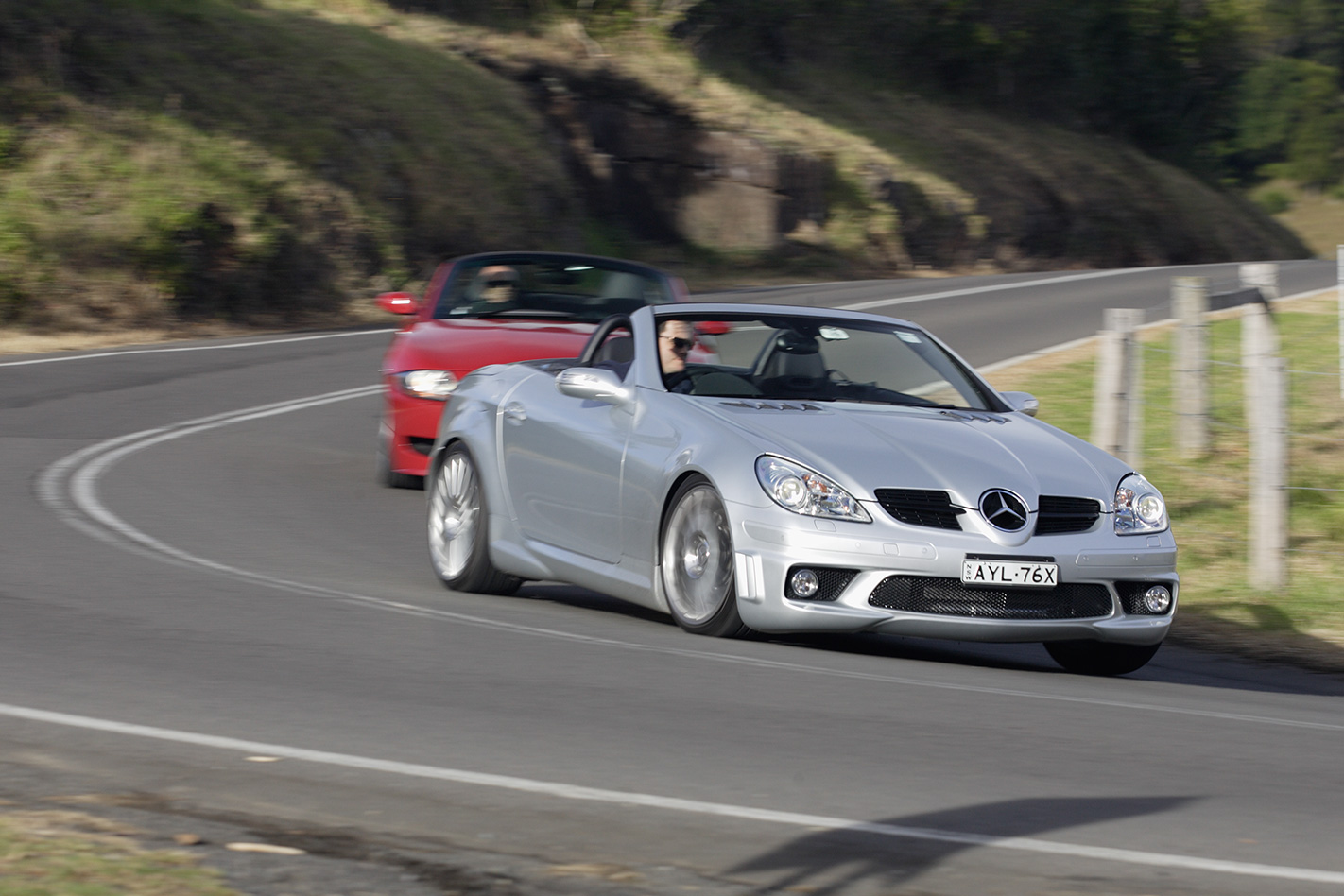
The BMW tested on another day did do faster times with a 5.2 to the 100, but it was less consistent, and tested at Oran Park with a downhill finish that helps time and speed past half-track.
Use the figures only as a guide because from 20km/h we lined up both cars and the BMW proved its worth by matching the Merc in rolling starts from 20, 40 and 60km/h, but never beating it. The BMW jumps ahead half a car while the Mercs auto kicks down a gear, but it hammers out just enough speed to get ahead. It’s teasing the BM, which is left to think so close yet so far.
In our entire test, the BMW never beat the AMG, but it was never more than a car-length behind either. And for a six, that’s the Z4 M’s most impressive medal.
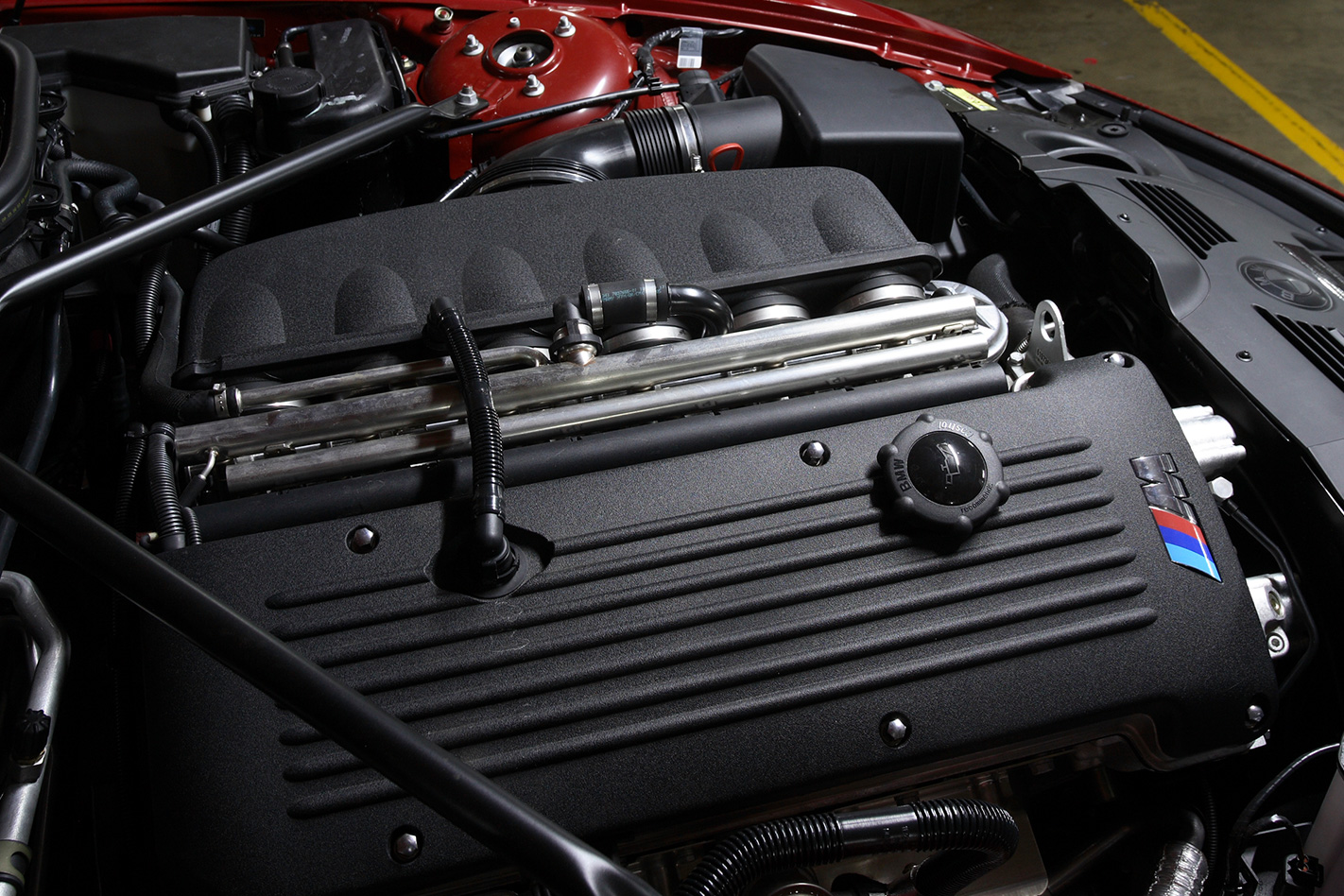
Through the same set of comers that the Merc shone, the BMW suffered from mild understeer and a twitchy chassis that rolls, yaws, and is just plain unnerving. Little wonder a few were stuck into the wall on the launch.
Thanks to the masses of rear-end grip, it’s never in danger of spinning off, but not is it fun waiting for the nose to grip. Even stamping the throttle to provoke a slide proves futile.
Having said all that, the BMW was the complete opposite on the track, where a heavy boot induces the most wonderful powerslides the M3 was famous for.
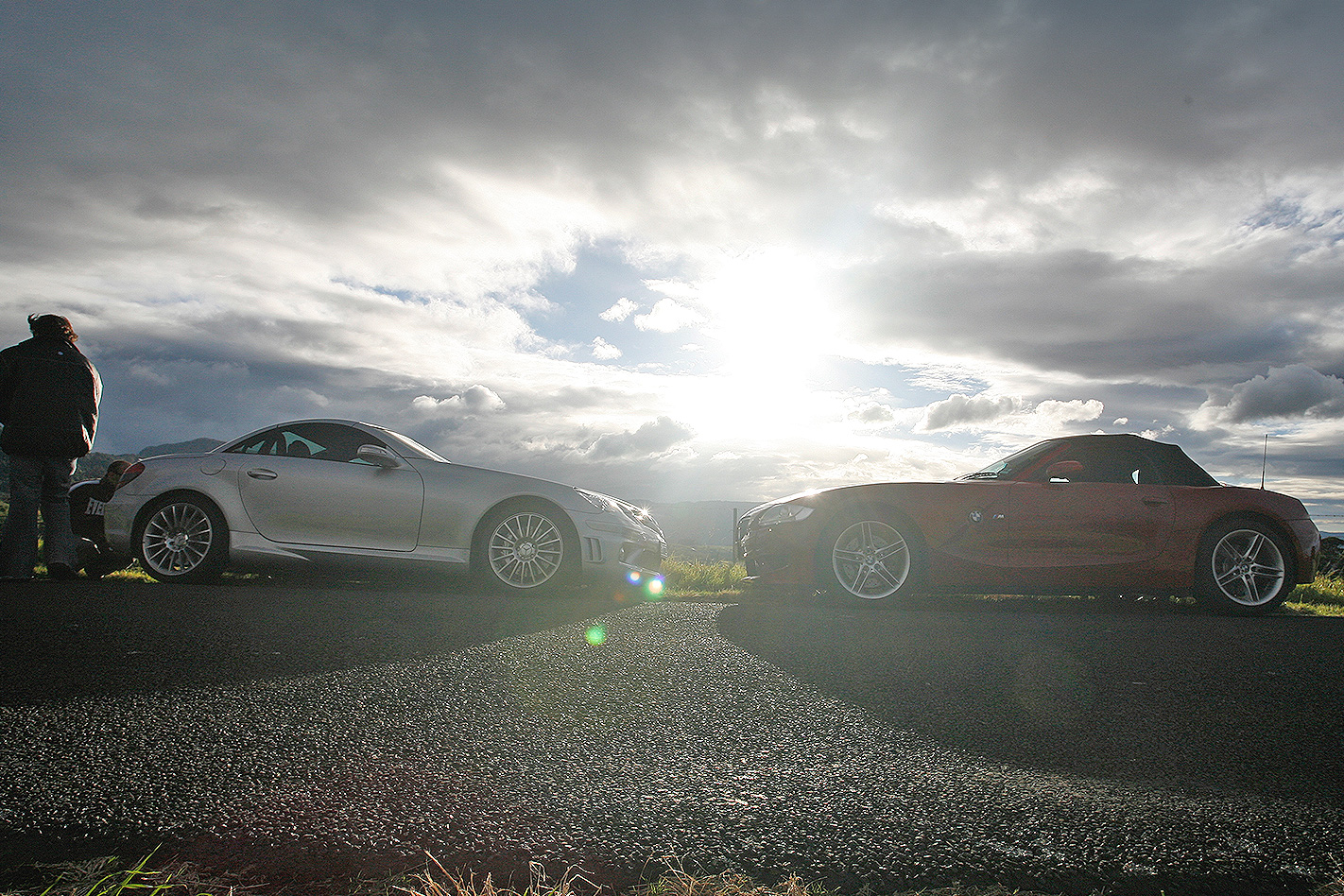
And those BMW brakes, so impressive around town, turn to mush with a long pedal and reduced stopping power. Sure, BMW may not want the visual sex of a multi-piston caliper, but the performance of a single-piston sliding front brake system is not befitting the rest of the Z4 M.
The AMG’s brakes are in another class, and stop the 55 in another suburb. Look at the specs; all we need to tell you is that they score A-plus.
To be fair, the Z4’s engine scores the same: revvy, soulful and sporting a power curve as linear as a leaning ladder; sure, its metallic rasp can sound like washers in a paint shaker, but its induction roar from the cabin is electric as it winds out to 8000rpm.
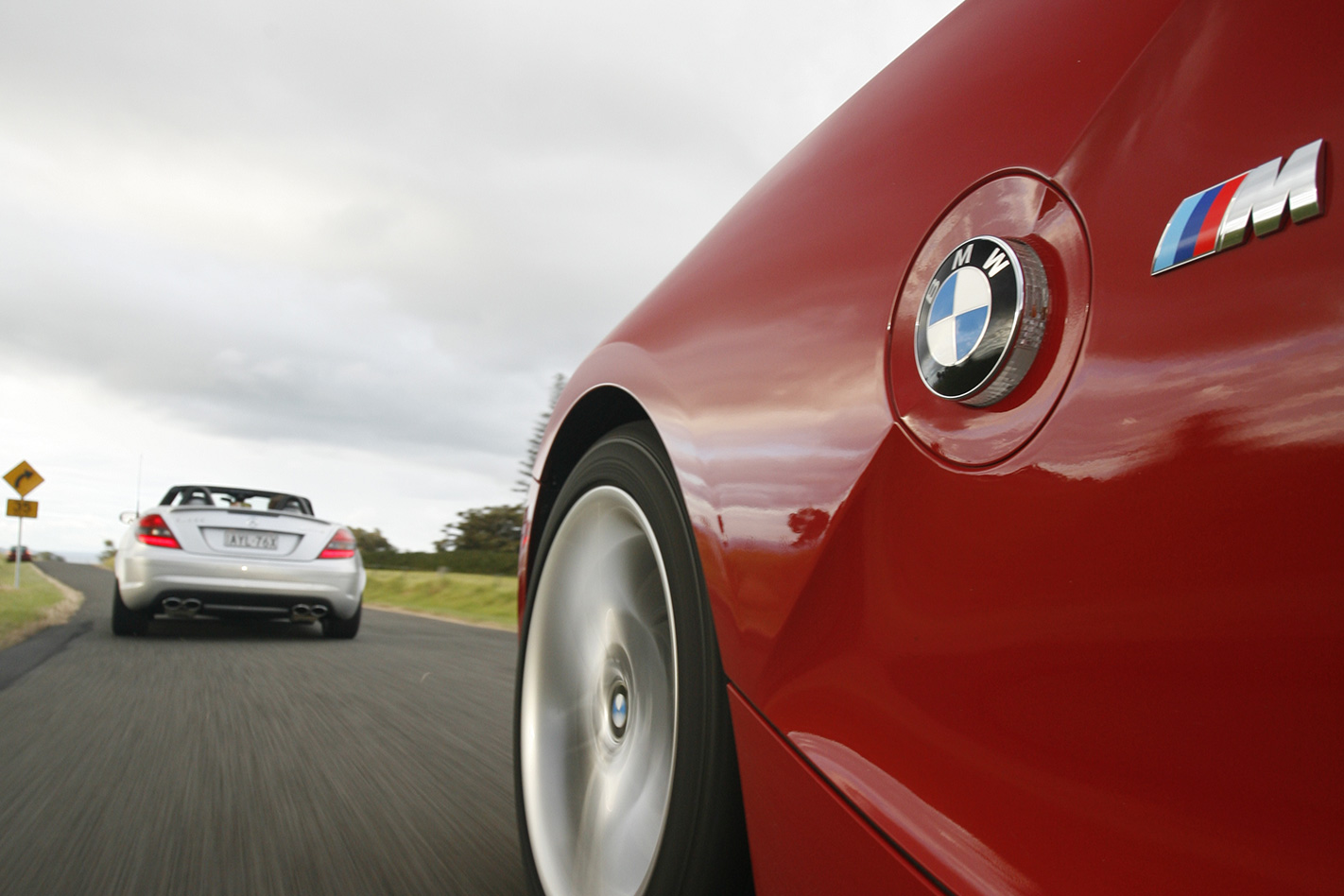
So which wins? A hard one to pick: the BMW Z4 offers 90 percent of the thrills of the AMG at 80 percent of the price. On maths alone that’s a solid win. But like lap times, it’s that last 10 percent that separates the very good from the great.
The noise, the ride, the interior, the hard roof, and the gilled and fattened stance that form a front-three-quarter angle, pushed over its sweet 18-inch multi-spoke alloys, is tougher than a life-sentenced inmate.
So we’d be better to define each buyer: the BMW Z4 M Roadster will be snapped up by the advertising exec who stays up every second Sunday in his BMW F1 team shirt, eager to see his driving heroes.
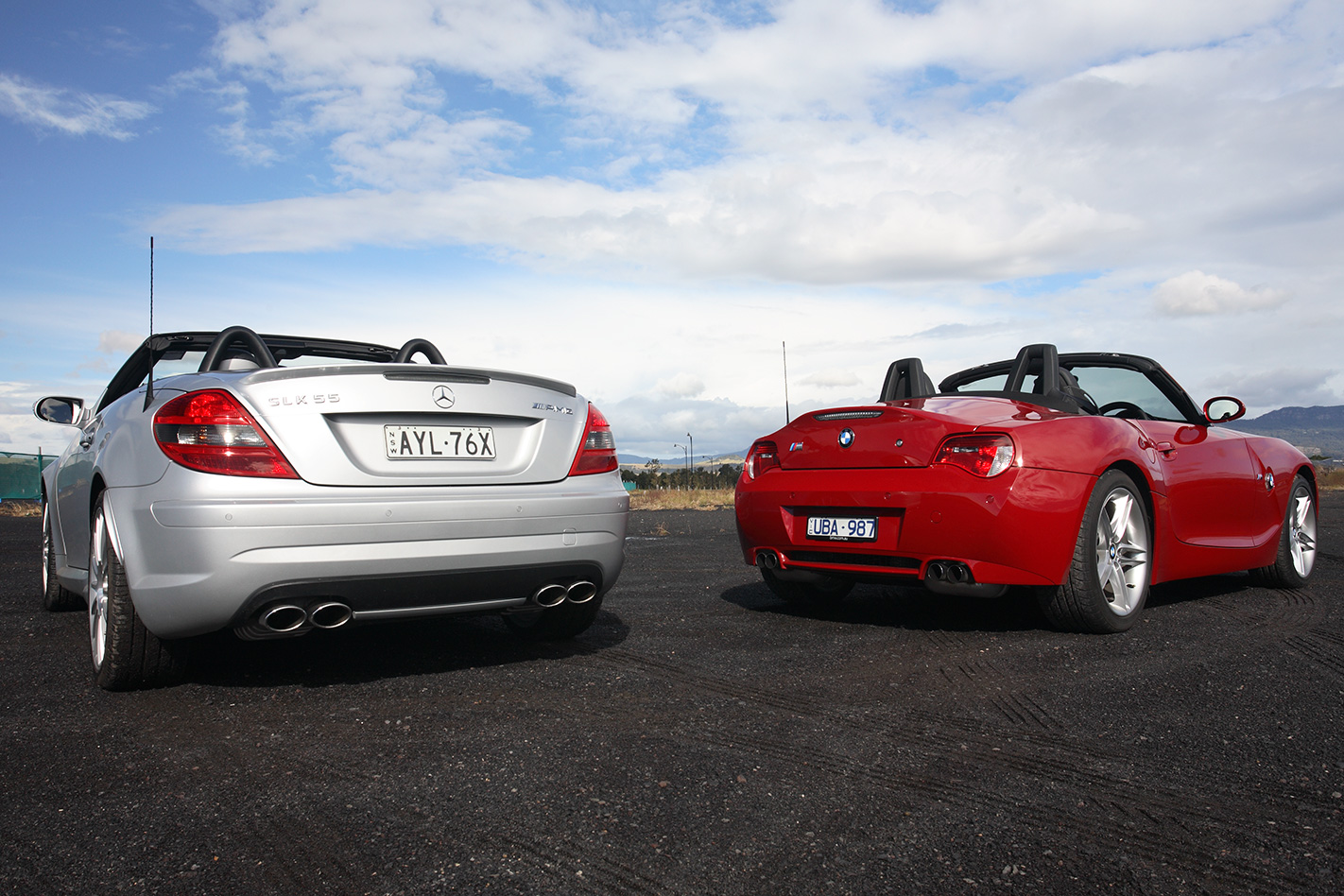
The SLK55 AMG buyer watches F1, but from his digital hard drive recorder on Monday night.
He bought the AMG not for the badge, but for the brutality of knowing that in a straight line, through the corners, under brakes, when there’s cold, comfort or convenience in the equation, the price becomes irrelevant knowing that compared to an M Roadster, despite the price, the SLK55 is just that little better. It is a V8, after all.
Currently, in a relatively non-descript Queensland industrial area, construction on the first car for Holden’s new factory race team is about to begin.
Instead of the Holden Commodores that we know and love, this new factory race car will be a Colorado dual-cab ute.
Yes, you read that right.
Holden today announced that it will enter a factory-supported Colorado in the new SuperUtes category.
The championship, which will replace the current V8 Utes series, will be made up of dual- or single-cab utes, with turbo diesel engines, and rear-wheel drive. Holden’s announcement means six different models are now expected to be on the grid at the first round next year.
Engines for the series are strictly controlled, with power from the turbo diesel units restricted to 253kW and 677Nm.
The weight of the SuperUtes is restricted to 1800kg, while costs will be minimised by implementing controlled components such as a CAMS-approved roll-cage, pedal box, ECU, gearbox and ratios, rear axle assembly with control diff and ratio, brakes, tyres, wheels, springs, and dampers.
Mercedes-Benz X-Class SuperUte – What if?
Ross Stone Racing is taking care of construction for the Colorado SuperUte on behalf of Holden, and recently completed a shakedown test of the Mitsubishi Triton the team will field independent in the series.
“Holden has been such an integral part of Supercars’ rich history, so it goes without saying that we are delighted to welcome it to the SuperUtes ECB Series,” Supercars Chief Executive Officer, James Warburton said.
“The Holden Colorado is now officially homologated and will take on five different manufacturers in what is shaping up to be an outstanding series.
“With official testing having commenced last week, and six models approved for racing, the SuperUtes Series will commence in 2018 with a very strong field and what will be great racing.”
Holden’s current factory race team is Triple Eight Race Engineering, which fields a pair of ‘Red Bull Holden Racing Team’ Commodores in the Supercars championship.
SuperUtes will race as a part of the Supercars support bill at select rounds.
Holden’s rendering gives a glimpse at what a Colorado SuperUte may look like, but the final product is likely to have a significantly higher ride height.
Tightening emissions regulations have forced BMW to change the propshaft material for its M3 and M4 models.
The M3/M4 propshaft is currently made from carbonfibre, one of a number of carbon components that help keep kerb weight to just 1497kg for a manual M4. In comparison a Mercedes-AMG C63 S Coupe weighs 1725kg, though a fairer comparison is a DCT-equipped M4 which is 1537kg.
Future emissions regulations have required BMW fit a new petrol particulate filter which leaves insufficient space for the current-diameter propshaft.
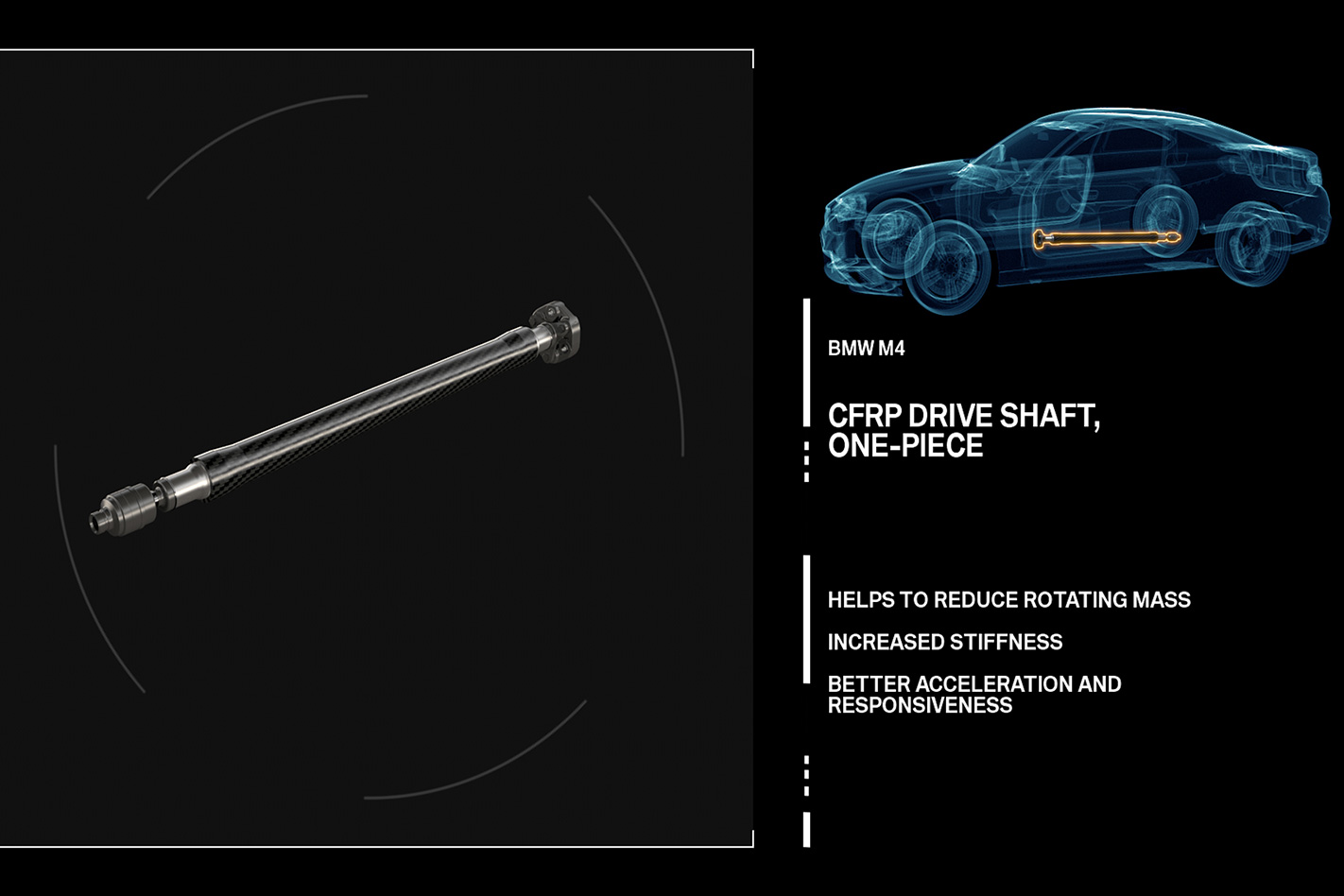
The forthcoming M4 CS will retain a carbon propshaft as its higher 600Nm torque figure requires the thicker-diameter propshaft and its production run is expected to be completed prior to the new regulations coming into effect.
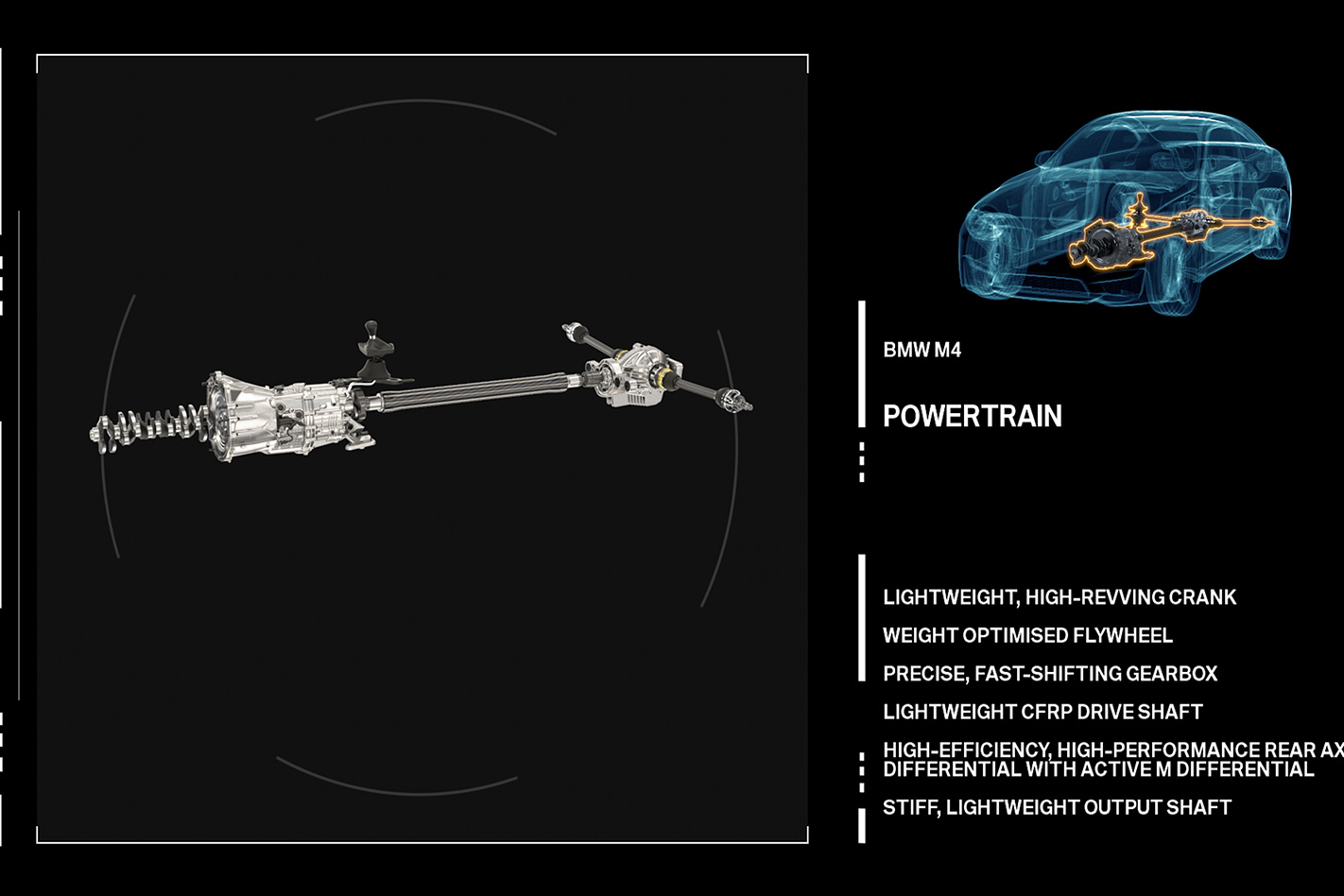
Total deliveries of the current-generation M3 and M4 have now topped 68,000 and Australian sales are likely to score a boost towards the end of 2017 with the arrival of the exclusive CS and cut-price M3 and M4 Pure models.
