
How far have super sports sedans come in a decade? Well, a 2006-era E60-generation BMW M5 made 373kW and 520Nm from a 5.0-litre naturally aspirated V10 engine claiming 0-100km/h in 4.7 seconds.
Last month Mercedes-AMG revealed its new E63 S with a 450kW/850Nm 4.0-litre twin-turbo V8 and 3.4sec sprint time. And the next M5 is still to come.
An E60 M5 would have set you back $230,500 brand new. However, these days the resale bells have tolled and even mint one-owner examples with around 80,000km are being advertised for sub-$45K. That’s less than a size-smaller V8-engined E92 M3 from around the same era, such is the heavy depreciation thud of even the sportiest large cars.
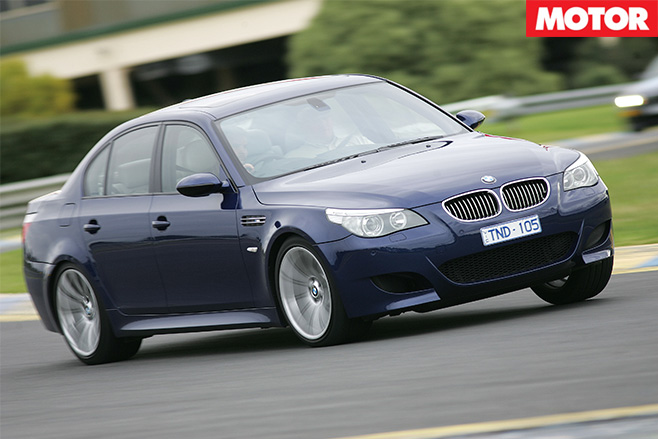
The 1755kg Bavarian bruiser was clearly all business and luxury inside, while doing the business outside and on the road.
But would you take a decade-old BMW M Division weapon – accepting that annual servicing could stretch well into four figure territory – over a brand new $44,990 Holden Commodore SS that we’re about to lose forever?
Look at another difference a decade makes: the 6.2-litre V8 makes 304kW but 570Nm to deliver a 4.9sec 0-100km/h claim.
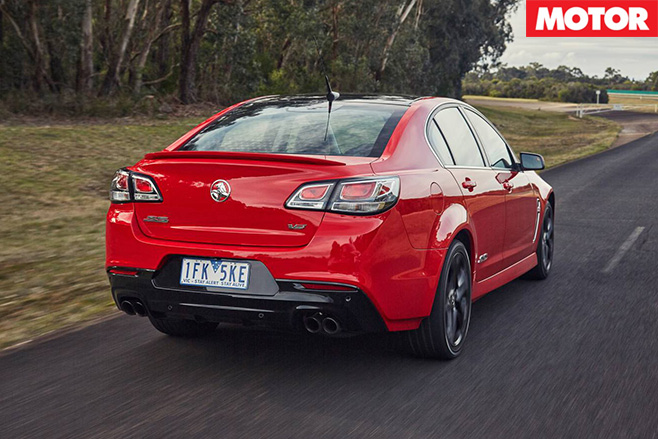
So, take a punt on a decade-old European car? Or capped-price-service it up with a brand new version of the last Australian rear-drive performance sedan?
THE WINNERS
Winner: Mercedes-Benz
While German rivals Audi and BMW both experience 10 percent sales declines for October, Mercedes lifted results by 33 percent. A total of 3477 sales missed out on the top 10 brands list by just 66 units. Mercedes-Benz A-Class (+25%), new E-Class (+94%), GLA (+178%), the new GLC mid-size SUV, and the new C-Class Coupe/Convertible range all contributed to the result.
Winner: Toyota
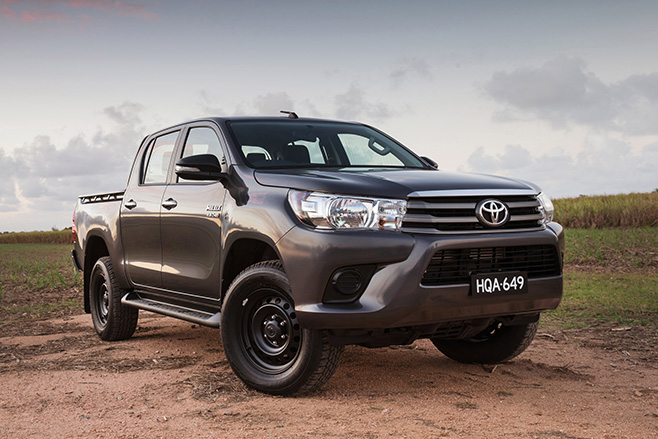
Toyota sales dipped by four percent compared with October 2015, yet 16,348 sales were still 7644 ahead of second-placed Hyundai (8704). The HiLux also topped the October sales charts, with the Corolla in third. It will also take unlikely sales results in November and December for one of these Toyotas to be denied the status of Australia’s favourite vehicle maker for 2016.
Winners: Ford Falcon, Ford Territory and Holden Cruze
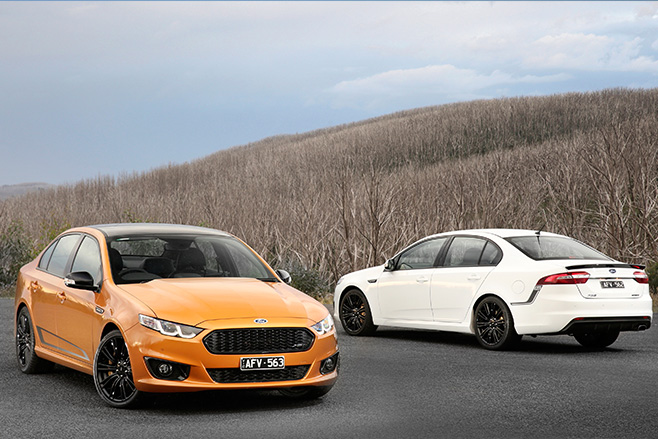
These models are winners as production of all three models finished in October – particularly notable for heralding the end of the long-running Falcon and landmark Territory. The Fords actually finished within one to two percent of their October 2015 sales results, while the Holden Cruze managed a 17 percent year-on-year increase. The Cruze makes way for the five-door Astra that goes on sale from December.
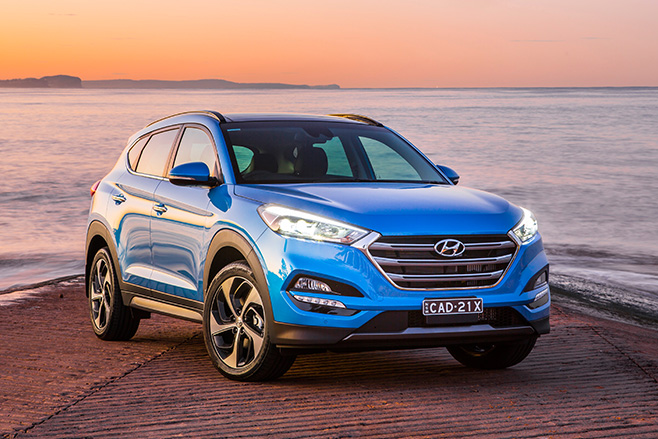
Winner: Hyundai Tucson
Sales of the Korean brand’s mid-size SUV grew by 119 percent compared with the same period last year, and its 1845 sales made it Australia’s most popular sports utility vehicle for October. It was a rare victory over the Mazda CX-5, even if it trails its Japanese rival by more than 4000 units in the overall battle for 2016: 16,814 v 20,702.
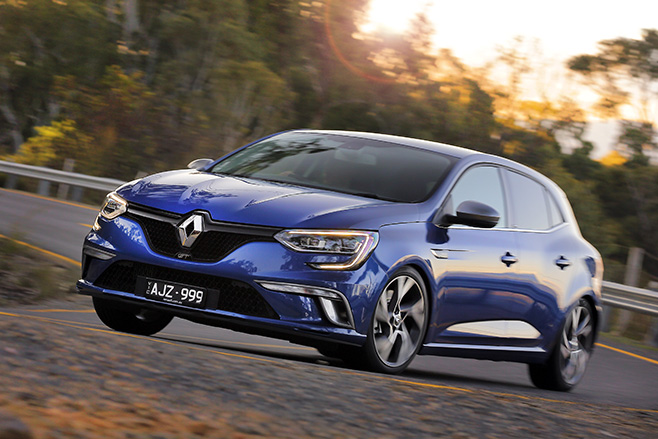
Winner: Renault
New product almost always does wonders for sales, and French brand Renault benefited from two in October. The recently released second-generation Koleos SUV and Megane hatch jumped 413 and 32 percent, respectively, while there were also successful results for the Captur baby SUV (+37%) and Trafic van (+53%). Renault’s 43 percent year-on-year growth for the month has allowed its year to date sales to close to within two percent of its sales at this stage last year.
THE LOSERS
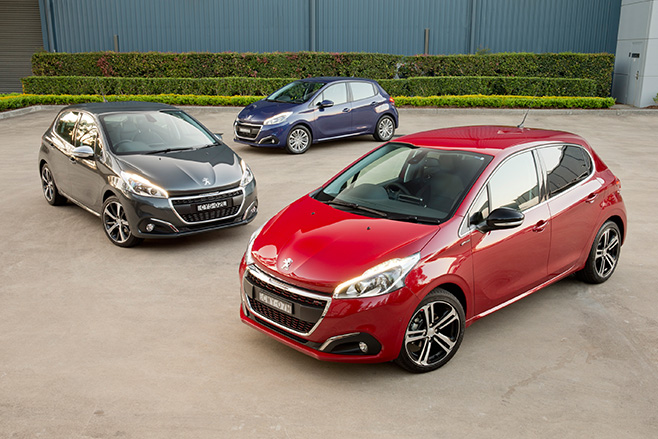
Loser: Peugeot
October wasn’t so kind for another French brand. Peugeot sales fell 50 percent in October as key models such as the Peugeot 208 city car (-35%) and 308 small car (-52%) struggled. Not a single model posted year-on-year growth for a company that has seen sales slide by a fifth in 2016. Peugeot, though, will be looking forward to offering new-generation 3008 and 5008 SUVs in 2017.
Losers: Small and Medium Luxury cars
The premium small-car and premium mid-size markets took hits in October – down 19 and 26 percent respectively. In the former, the Mercedes A-Class (+25%) was a rare exception. Its B-Class twin (-23%) was joined by the likes of the Audi A3 (-26%), BMW 1 Series (-16%), BMW 2 Series (-61%), and Volvo V40 (-45%) in posting declines. Benz didn’t escape in the medium segment, though, with its C-Class (-24%) and CLA (-16%) falling alongside other notable nameplates including the Audi A4 (-38%), BMW 3 Series (-41%), Jaguar XE (-22%), and Lexus IS (-30%). The luxury small-car class remains up by 5 percent year to date, with the medium luxury class down 11 percent overall.
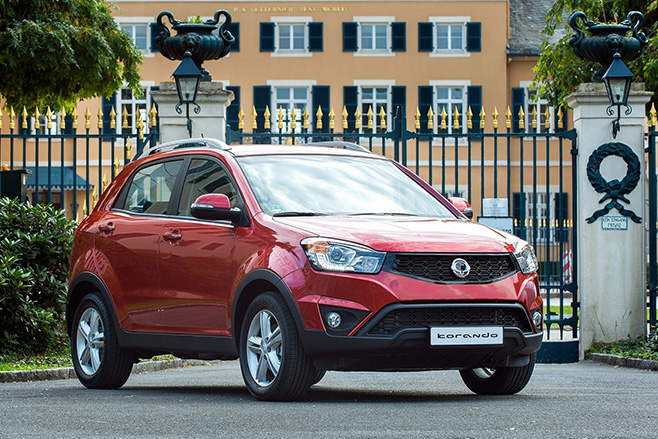
Loser: Ssangyong
Kia is currently the fastest-growing Korean brand, and Hyundai was the second most popular brand in October, but Ssangyong continues to face a difficult 2016. Year-on-year sales plummeted 84 percent last month, selling just 12 units compared with 77 this time last year. Year-to-date sales have more than halved, from 894 to 344 units.
Losers: Ford passenger cars and utes
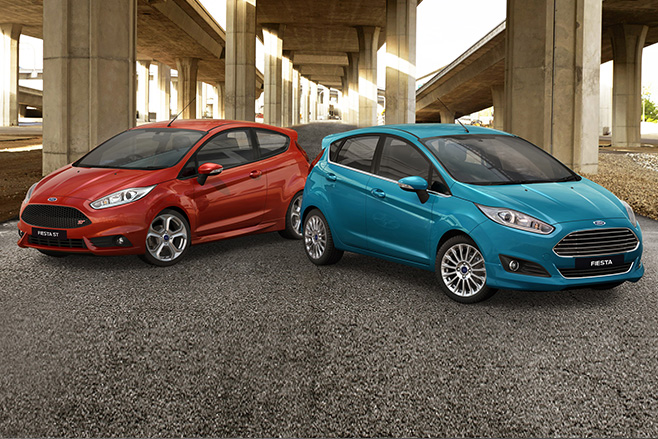
In the month Ford Australia farewelled the Ford Falcon and Territory, the Ranger 4×4 ute was its only shining light as passenger cars and SUVs all slipped. The Fiesta (-53%) and Focus (-36%) small cars fell by big margins, as did the Ecosport (-60%), Kuga (-25%) and Everest (-37%) SUVs. However, even if you take Ranger out of the sales equation, Ford passenger car and SUV sales have still increased year to date – up from 34,570 in October 2015 to 37,757.
Loser: Dodge
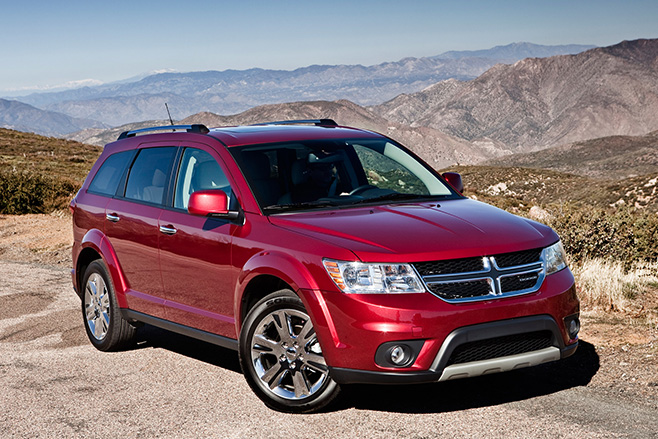
The Journey people-mover-cum-SUV is the only Dodge offered in Australia and only five units were sold in October – 58 fewer than this time last year. Year-to-date sales are down 68 percent. Ram Trucks Australia, which sells right-hand-drive conversions of the famous Dodge Ram utes, had a better month, selling 35 Laramies in October.
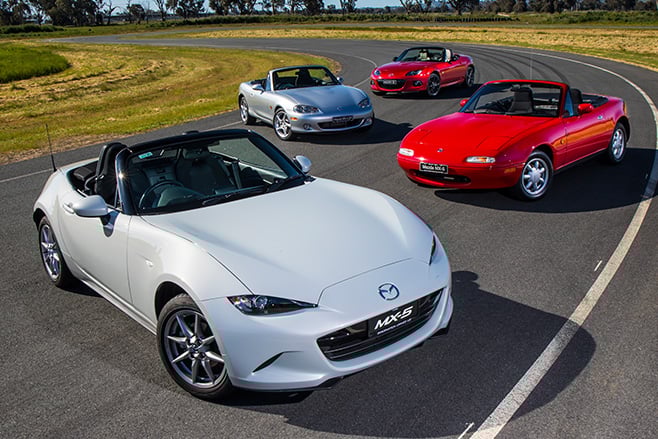
Family reunions are special affairs, especially when they involve four generations. So I was delighted to attend Mazda’s get-together in celebration of its iconic Mazda MX-5.
Models spanning more than a quarter of a century were lined up on the driving track at Wodonga TAFE, from the original NA car of 1989 through to the latest ND.
The MX-5 sticks to a simple formula: It’s an inexpensive, low slung, two-seat sports car with a convertible roof and front-mounted engine driving the rear wheels. While it’s neither breathtakingly fast nor powerful there’s something about it that’s always captivated motorists. The MX-5 is simply a joy to drive.
Mazda’s roadster doesn’t pretend to be something it isn’t. A family car it ain’t. The MX-5 would be a nightmare on long hauls with your bum so close to the ground and the wind whipping your hair and punishing your ears. But damn it’s a sexy little ride.
A few laps around the track on a perfect spring day present the perfect opportunity to see and feel how the world’s top selling roadster has evolved.
MAZDA MX-5 NA
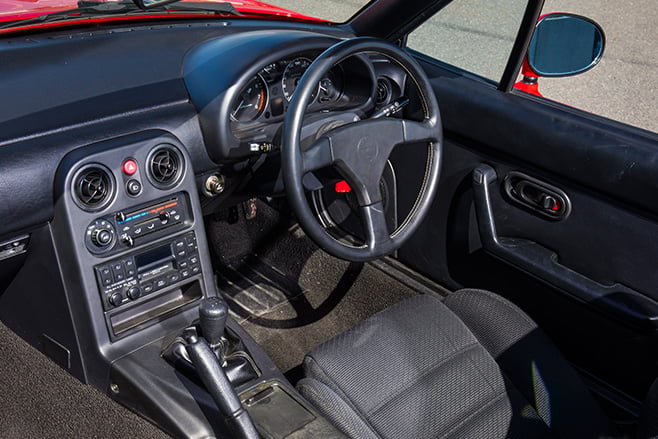
The first generation NA was released in 1989. In contrast to the 1960s Lotus Elan on which it was based, the MX-5 was mechanically reliable and it didn’t leak. It was dependable, meaning you could get up in the morning and know the thing would start first time. Mazda’s roadster wasn’t so much about power but drivability. It was initially released with a 1.6-litre engine, which grew to 1.8-litres when the model was refreshed in 1994.
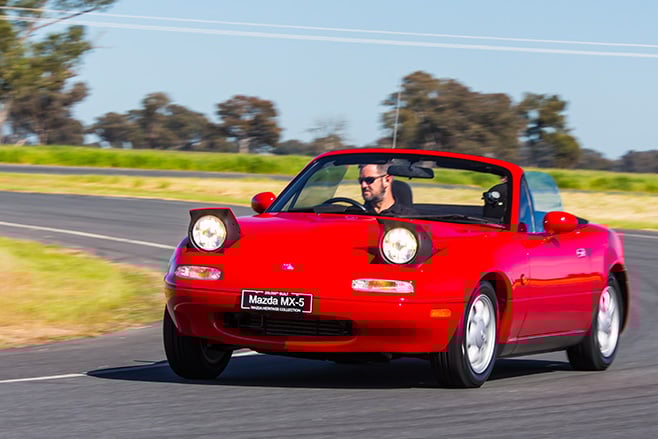
I feel nostalgic hopping in the NA. It isn’t so much the presence of the centre ashtray or cassette player but the fact a colleague at my first job had one that made me jealous.
You can see how the original Lotus Elan was an inspiration. The NA is light and terrifically fun to drive. Even the exhaust note is pleasing. No wonder it won Wheels Car of the Year in 1989.
MAZDA MX-5 NB
After a decade the NA was due for a rejig so Mazda introduced the NB in 1998 with additional creature comforts such as optional automatic transmission. Sadly, the spunky pop up headlights had to go because they no longer met pedestrian safety standards. The 1.8-litre NB was quieter, safer and more powerful than its predecessor, but also heavier (weighing 1065kg compared to 940kg for the NA).
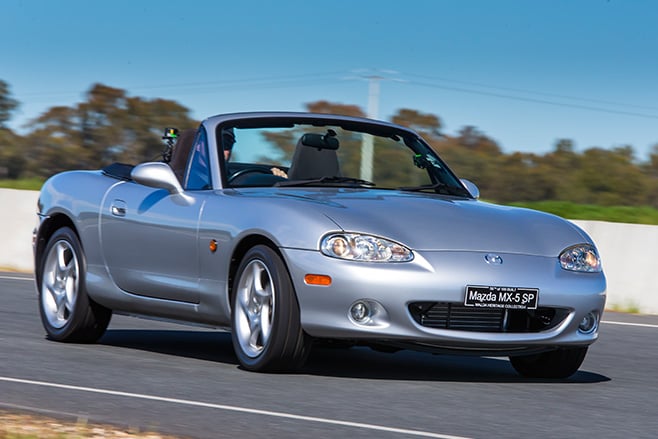
Offsetting this lard was an optional turbocharged version of the power plant. I drove this model and was impressed. The turbo has heaps of grunt transforming the tiny two-door into something approaching a muscle car.
MAZDA MX-5 NC
In 2005 Mazda introduced a larger 2-litre engine. Unfortunately its additional power was blunted by extra safety features. The NC also came with a retractable roof which added further weight.
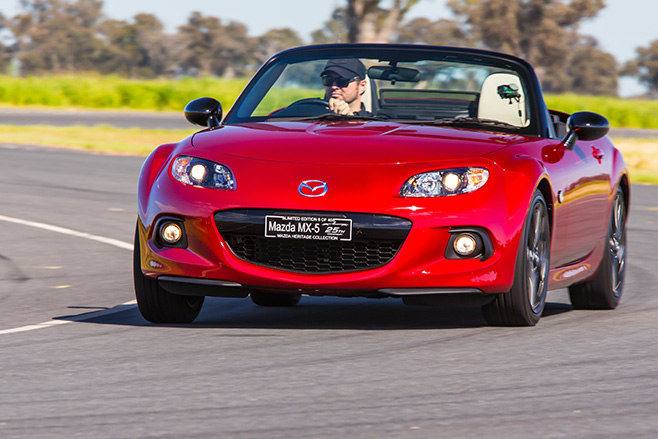
The third generation MX-5 is certainly more luxurious than its predecessors. But in comparison to the NB turbo this model feels a little sluggish.Despite this the NC also won Wheels Car of the Year, in 2005.
MAZDA MX-5 ND
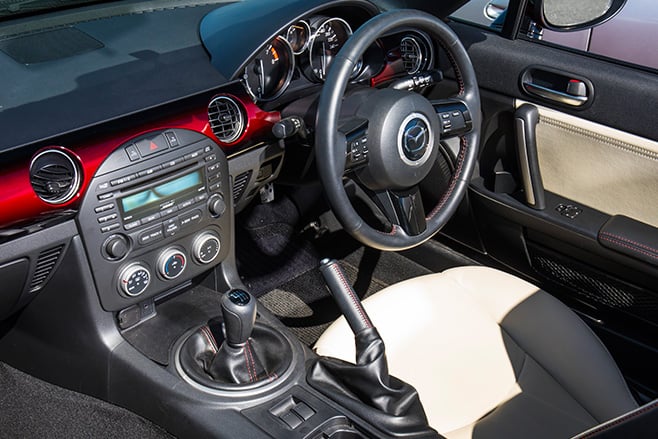
Aaah, that’s more like it –the MX-5 finally returned to its lightweight roadster roots in 2015 with the introduction of the all-new ND series. This fourth generation model has been stripped of excess weight to the point where even a glovebox was deemed surplus to requirements.
As a result the ND is compact and light, just like the original model, but it still feels planted and balanced in tight and twisting turns. You can feel its agility on the track, which was impressive enough to earn the MX-5 its third Wheels Car of the Year Award (2016).
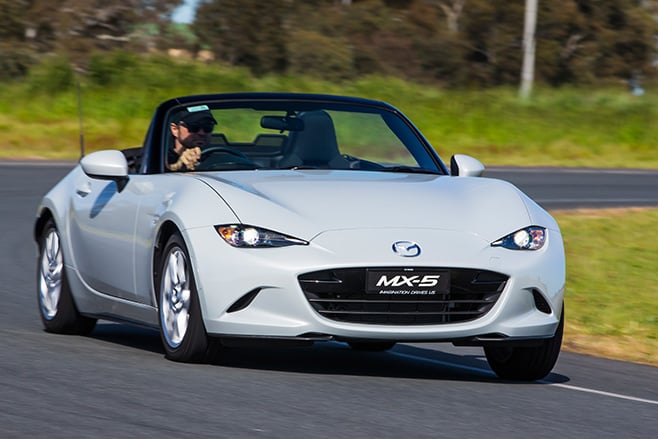
And did I mention its affordability? The entry level 1.5-litre starts at just $31,990.
ND Program manager, Nobuhiro Yamamoto, made a special visit to Wodonga from his native Japan. He says the NA is fun to drive, the NB is best for handling, the NC is best for performance and the ND? Well it aims to be a combination of all three – hence last year’s Mazda MX-5 advertisement where the three older variants go into a tunnel and emerge as the ND.
When I push Yamamoto about the possibility of further refining the MX-5 and bringing out a lighter, more dynamic NE he answers: “Yes, definitely!”
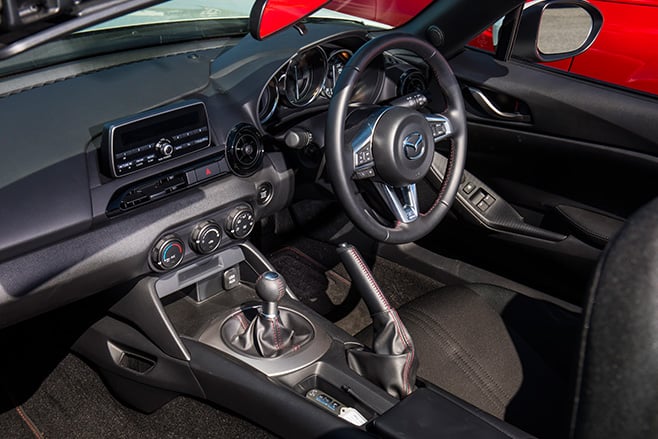
More than 1 million MX-5s have been sold since 1989 and it continues to be the best selling roadster in the world – and it remains a Wheels favourite.
Curiously The Elder NA was my favourite roadster of the day. Sure it’s a little primitive, lacking the safety features and luxury of later models. But something about it is pure. Perhaps I do get a little drunk on nostalgia at family reunions …
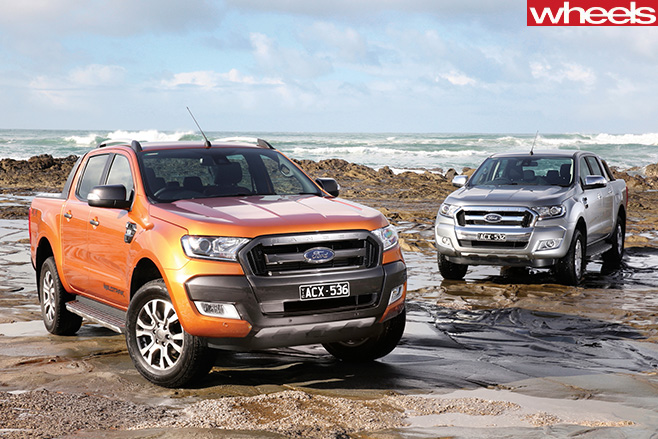
TRADE utes have dominated the sales chart in October, with both the Toyota Hilux and the Ford Ranger outselling all other vehicles for the month.
The VFACTS sales data for October, released today, shows Toyota’s trade ute snared 3352 sales for the month, while Ford’s version won 3217 buyers. That was enough to put both vehicles ahead of the best-selling passenger car for the month, the Toyota Corolla, with 3210 sales.
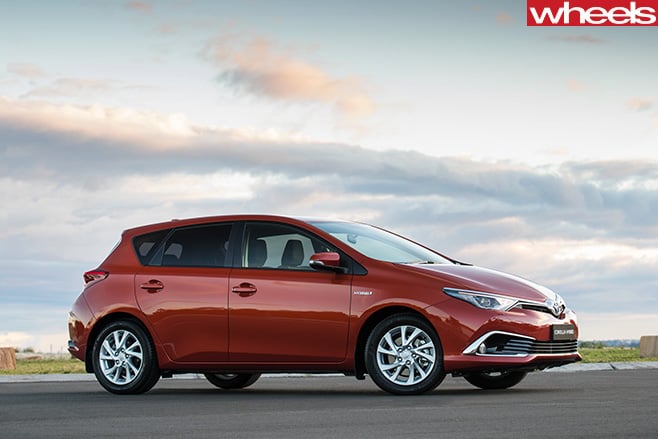
The Corolla finished ahead of both the Hyundai i30 (2718) and fifth-placed Mazda 3 (2191) in the passenger car sales race, all cars competing in the small car class that shrunk by 8.8 percent for the month.
It comfortably outsold the Nissan X-Trail (1655) and the Mitsubishi ASX (1650), and the Mazda CX-5 (1612).
Overall, the Australian new-car market tread water in October, falling one percent compared with the same month last year to 93,357 sales. Of interest, the sales gap between passenger cars (37,817, down 7.4 percent) and SUVs (36,442, up 4.9 percent) narrowed even further to fall within a 1.5 percent split of each other.
Significantly, in its last month as an Australian manufacturer, the Falcon large car sold 428 units while the Territory moved 588 units, down only slightly on sales for the same month last year. From this point on, the sales of both models will reflect cars built and stockpiled since the October 7 shutdown. The Falcon ute, which wrapped up production in late July, sold just 88 units.
Despite Ford quitting Aussie manufacturing early in the month, and the plug pulling on local Holden Cruze production, the number of cars made and sold here held reasonably steady at 7179. Ford (1099) was down, but both Holden (3609) and Toyota (2471) grew compared with October last year.
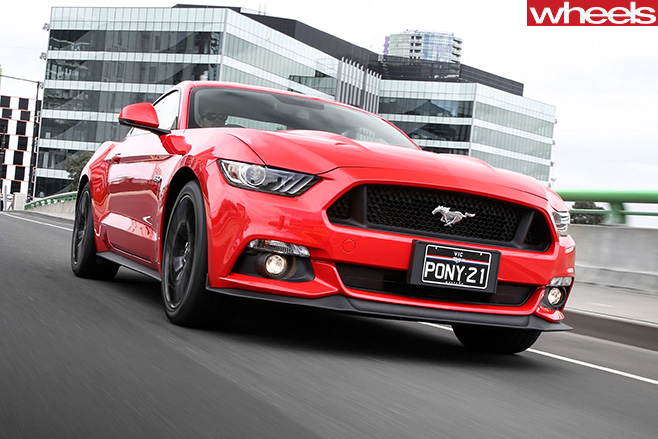
The market overall, up 2.4 percent year-to-date, is still setting a record-breaking pace. Combined sales are at 980,443, placing it more than 23,000 ahead of the same time last year. With two months to go, expect the full-year figure to easily pass the record 1.155 million sales posted in 2015.
Top 10 sellers in October 2016
| Rank | Brand | Sales |
| 1. | Toyota Hilux | 3352 |
| 2. | Ford Ranger | 3217 |
| 3. | Toyota Corolla | 3210 |
| 4. | Hyundai i30 | 2718 |
| 5. | Mazda 3 | 2191 |
| 6. | Toyota Camry | 2135 |
| 7. | Holden Commodore | 2101 |
| 8. | Hyundai Accent | 2009 |
| 9. | Hyundai Tucson | 1845 |
| 10. | Nissan X-Trail | 1655 |
Top 10 selling brands in October 2016
| Rank | Brand | Sales |
| 1. | Toyota | 16,348 |
| 2. | Hyundai | 8704 |
| 3. | Mazda | 7921 |
| 4. | Holden | 7521 |
| 5. | Ford | 6508 |
| 6. | Nissan | 5543 |
| 7. | Mitsubishi | 5227 |
| 8. | Volkswagen | 4869 |
| 9. | Subaru | 4140 |
| 10. | Kia | 3543 |
MERCEDES-AMG is rumoured to be prepping a four-door saloon version of its twin-turbo V8 GT for a 2017 reveal as part of its 50th anniversary celebrations.
Reports claim the four-door GT will make its debut as a Vision concept at one of a number of celebrations hosted by AMG next year.
Expected to be called the GT 4, AMG’s fast four-door will be powered by the same twin-turbo V8 that powers the current line-up of GTs, with roughly 447kW expected.
Expected to reach showrooms by 2019, the GT 4 would become the third vehicle to be produced entirely in-house by the German tuning company – following the Mercedes-AMG SLS and GT.
The super-saloon will accompany the already announced R50 hyper-car, which will be powered by the V6 from the current generation of Mercedes Formula One cars.
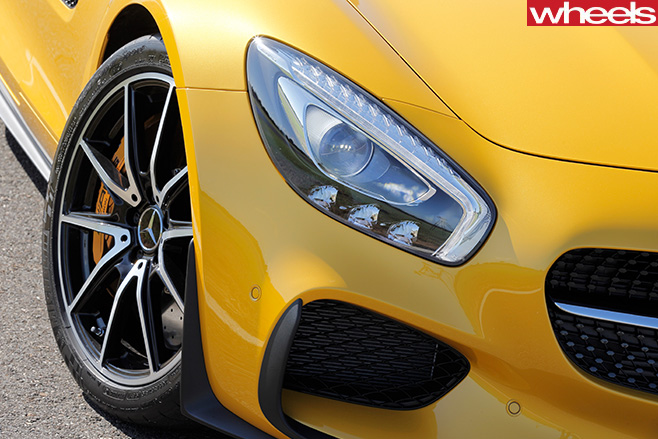
Codenamed the X290, it is reported the GT-based four-door is the pet project of AMG boss Tobias Moers, and expected to be pitched as a Bentley Continental GT and Porsche Panamera rival.
Although expected to carry styling cues of the two-door GT coupe, the four-door GT 4 won’t be built on the same chassis, with Autocar in the UK reporting it will get a different platform to the aluminium-intensive structure that underpins the 911-rival.
Instead, the GT 4 will use the modular rear architecture from parent company Mercedes-Benz, as seen in the C63, E63, and S63.
There are expected to be two different engine tunes for the twin-turbo V8, with the more powerful of the pair to top that of the confirmed 449kW Mercedes-Benz E 63.
Once it hits production, the car is sure to fire up the four-door super-saloon battle.
It’s a concept car to celebrate Renault Sport’s 40th anniversary, but management are unsure whether there’ll be a limited production run.
They’re thinking it over, but this RS16, more than just a Clio RS with a Megane RS 275 engine, has had enough major engineering work done so it could debut at the Monaco Grand Prix, driven by Renault F1 pilot Kevin Magnussen. A few weeks later, it was driven at speed up Goodwood’s Festival of Speed hillclimb.
At Circuit des Ecuyers, a little northern French track Renault Sport uses a lot, we were allowed to drive the concept as fast as we liked and without a chaperone. If Renault Sport doesn’t build this car, they’re mad.
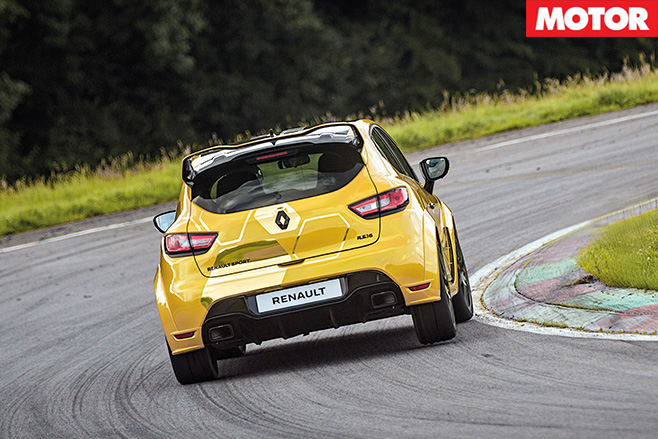
And, complexity – getting an old 2.0-litre engine to talk to the modern Clio RS was hard. The front suspension gets double-axis struts, to reduce torque-steer – except the Megane’s don’t fit. The engine locates in four places, not three, the tracks are wider by 60mm and the bodywork grows to accommodate 19in wheels and 350mm brake discs.
The fit and finish feels production-ready. The 2.0-litre engine is heavier than the 1.6, but the manual gearbox is lighter than the Clio’s dual-clutch auto. A lithium-ion battery means that overall, weight is similar.
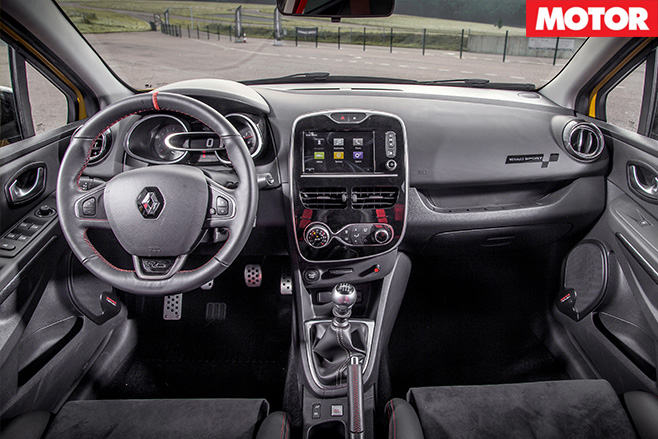
Des Ecuyers is small, a handling circuit rather than a race track, and most corners are second or third gear. The RS16 is terrific there. It has ample power to a modest 6500rpm redline, linear torque and a turbine-like whoosh. Turbocharged supercars have low-end torque limited to avoid this ‘always on’ feeling, but it works terrifically in the RS16, lugging out of slow corners in third with the acceleration you’d expect in second.
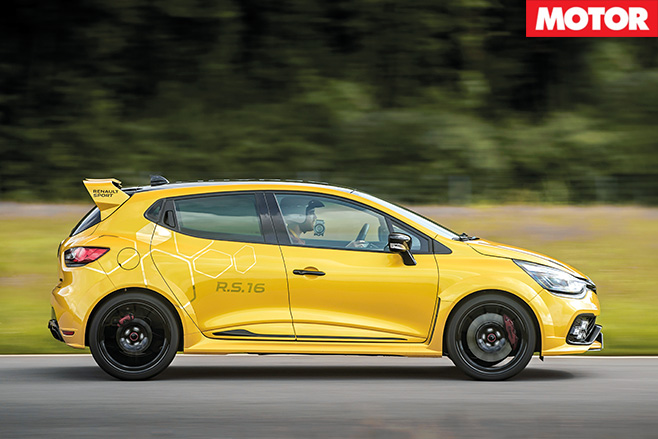
But it’s not a production car yet. And it may never be – although another two RS16s are being built, for durability testing…
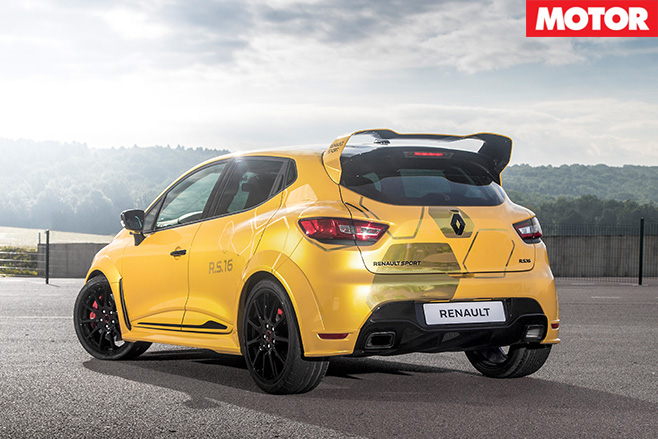
LIKE: Brilliant to drive; manual gearbox; playful handling DISLIKE: If it is built it will be in very small numbers
SPECS Engine: 1998cc 4cyl, DOHC, 16v, turbo Power: 203kW @ 5500rpm Torque: 366Nm @ 3000-5000pm Weight: 1205kg (est) 0-100km/h: 6.0sec (est) Price: TBC
A total of 3352 Toyota HiLux models were shifted from showrooms last month, according to the latest official industry figures. The Toyota Corolla was third with 3210 sales, dropping it 21 units behind its stablemate in an incredibly tight race for the annual popularity honours.
The Toyotas were split in October by another impressive showing for the Ford Ranger (3217).
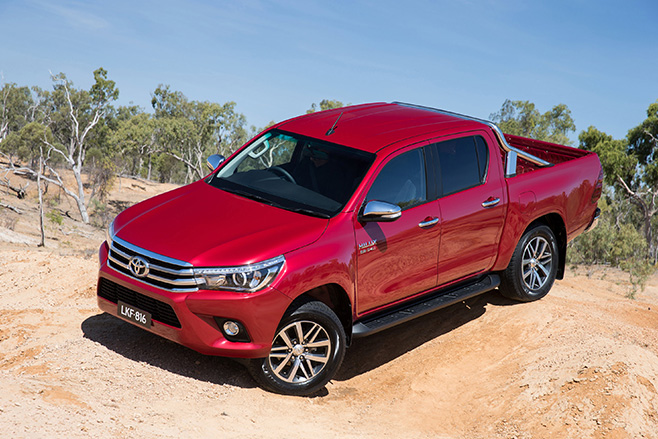
Hyundai featured three models in the top, with the i30 hatch leading the way with 2718 sales for fourth. Its Accent city car also broke 2000 sales to take eighth positioning, while the Tucson established itself as the best-selling SUV for the month with 1845 sales.
A relatively disappointing month for Mazda saw the CX-5 fall out of the top 10 (12th, 1612 sales), while the Mazda 3 slipped from first place in September to fifth in October (2192 sales).
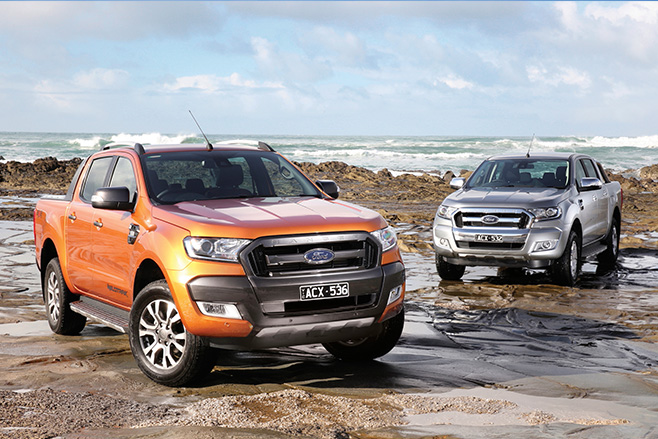
Familiar top-tenners the Toyota Camry and Holden Commodore were sixth and seventh, respectively.
Nissan completed the table with the X-Trail’s 1655 units just edging out the Mitsubishi ASX (1650) and aforementioned CX-5.
With just two months to go, a Toyota looks all but guaranteed to secure status as Australia’s favourite car of 2016 – with the third-placed i30 trailing by nearly 1800 units. The Ranger and Mazda 3 are further behind still, though both models have now passed 30,000 sales for 2016.
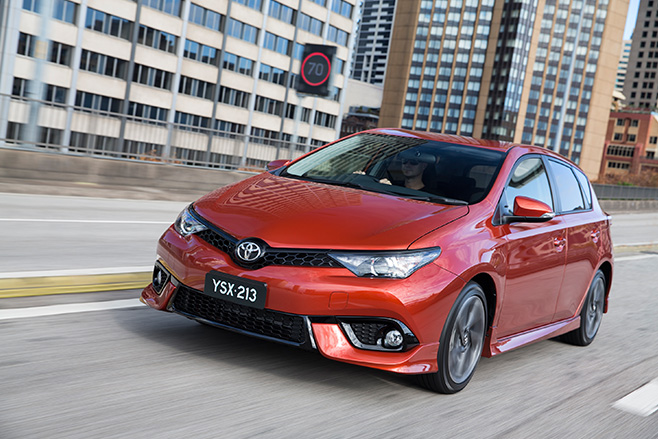
It’s just a question of whether the victorious Toyota will be the Corolla, making it four consecutive years as No.1, or the HiLux becoming the first ute to ever claim the title.
October 2016: Top 10 Vehicle Sales
| Rank | Model | Sales |
| 1. | Toyota Hilux | 3352 |
| 2. | Ford Ranger | 3217 |
| 3. | Toyota Corolla | 3210 |
| 4. | Hyundai i30 | 2718 |
| 5. | Mazda 3u00a0 | 2192 |
| 6. | Toyota Camry | 2135 |
| 7. | Holden Commodore | 2101 |
| 8. | Hyundai Accent | 2009 |
| 9. | Hyundai Tucson | 1845 |
| 10. | Nissan X-Trail | 1655 |
Race for 2016’s No.1 Sales Spot (at end of October 2016)
| Rank | Model | Sales |
| 1. | Toyota Hilux | 34,179 |
| 2. | Toyota Corolla | 34,158 |
| 3. | Hyundai i30 | 32,396 |
| 4. | Ford Ranger | 30,157 |
| 5. | Mazda 3u00a0 | 30,089 |
A right-hand-drive sedan version of the new Opel Astra has been spotted in Germany. Is it destined for Australia?
Two months after Opel launched the all-new Astra hatch now on sale here with a Holden badge, a sedan version has been spotted testing under the usual dazzle camo at GM’s Rüsselsheim development centre in Germany.
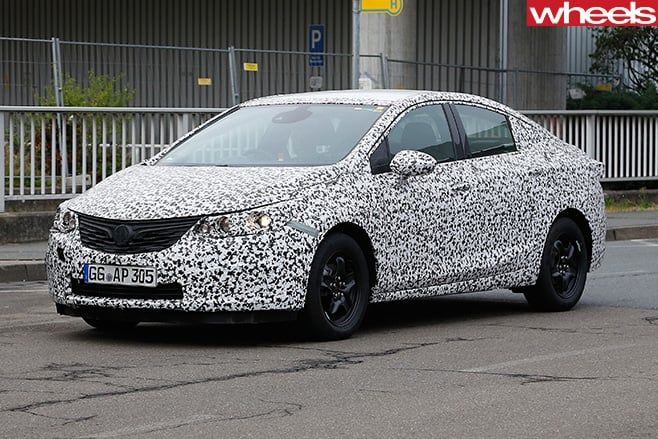
Going by these spy shots the new Astra Sedan will be a re-badged and slightly re-designed Chevrolet Cruze, which itself is based on Astra’s new-generation D2XX platform.
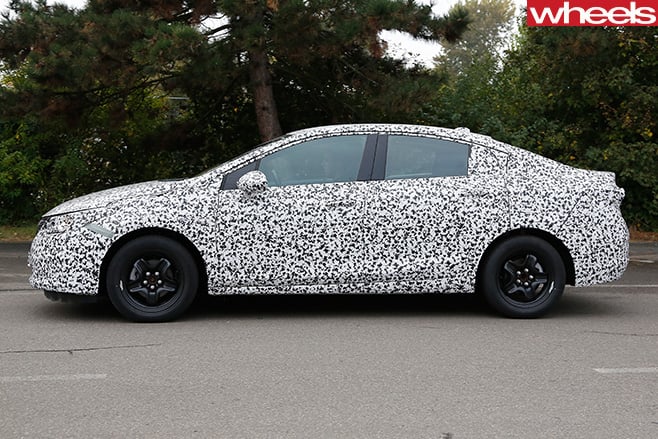
The front bumper, grille and headlamps are unique to the Astra, however.
There’s presently no word if the European version of GM’s global small sedan will come to Australia, with Holden telling Wheels it’s “yet to finalise its small car strategy”.
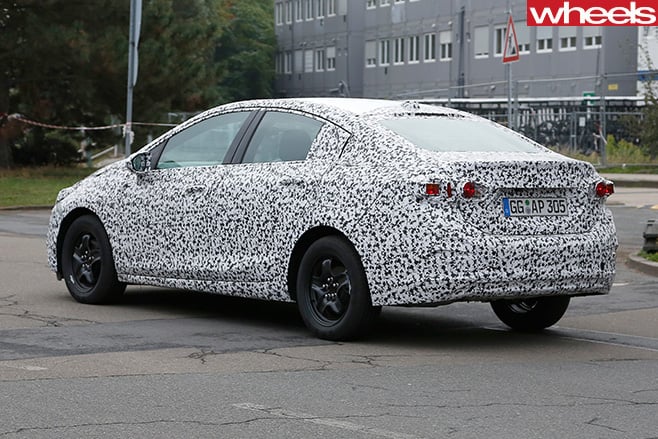
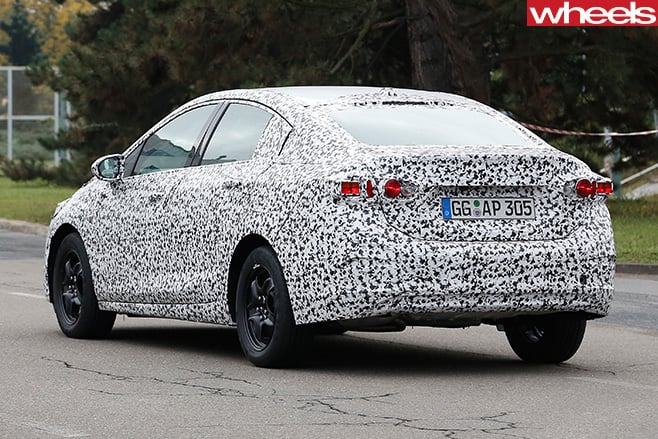
Engines will most likely mimic those of the hatchback and wagon variants, including the new-generation 1.4- and 1.6-litre petrol turbo fours that will be under the bonnets of Holden’s new hatch.
POWER is nothing without control. When the updated VW Polo GTI rocked up at last year’s Bang For Your Bucks having gained 9kW/70Nm and lost $500 courtesy of its new six-speed manual gearbox, it was a short-odds favourite to recapture the title it so dominantly won in 2011 and 2012.
It didn’t quite work out that way, as while the new 141kW/320Nm 1.8-litre turbo engine made it a rocket in a straight line, it struggled around Winton, trailing the less powerful hot hatch opposition it had soundly thumped on the drag strip. In the end, its combination of pace and price still landed it the second step on the outright podium, but it was soundly beaten by its main rival, Ford’s Fiesta ST.
So why is it back this year? Well, its 2016 appearance is thanks to a little backflip on Volkswagen Australia’s part. Despite the facelifted Polo being offered with ACC adaptive dampers overseas, the system was absent from the local spec list, with supposedly no plans to introduce it either.
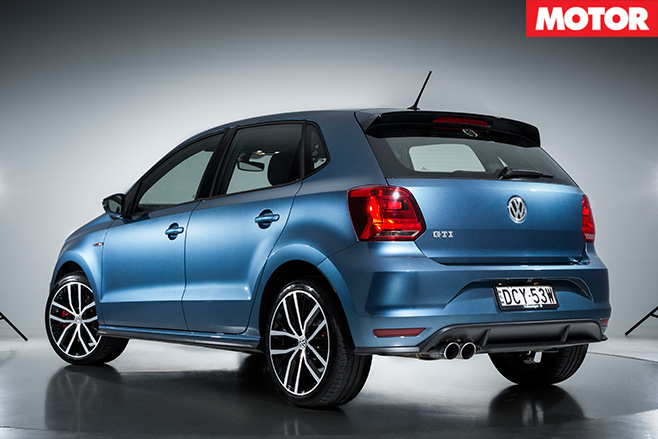
Dampers and ESP locked in Sport, the Polo scorched around Winton in 1:43.3, a massive 2.2sec faster than its 2015 effort. While the revamped Winton is a little quicker, when you consider the other repeat contenders, the BMW M135i and Ford Fiesta, improved by 0.6sec and 0.1sec respectively it’s clear this revised GTI is a much sharper tool.
As you’d expect, most of that time was made up in the corners and the Polo showing significant improvement in our two measured corners compared to last year. Its speed increased from 105.69km/h to 109.85km/h through the fast turn five sweeper and from 53.00km/h to 57.17km/h through the tight turn nine.
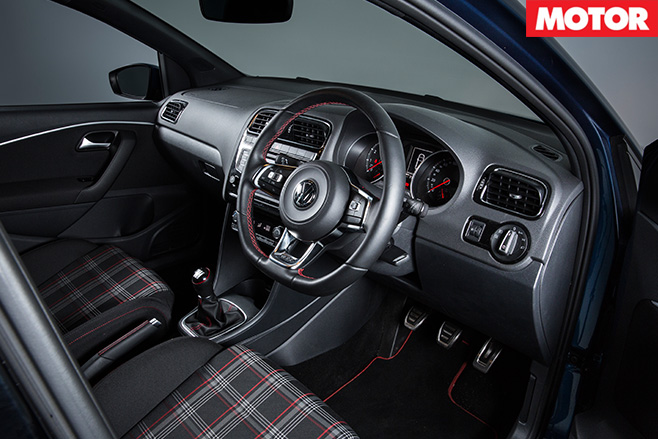
Perhaps unsurprisingly, this stability is a big plus to our tame racer, Luffy ranking the Polo seventh outright and praising its sure-footedness on the limit. The other judges were less enamoured, placing it between 11th (Morley) and 17th (Cordony) in the overall order.
VW’s refusal to allow ESP to be completely deactivated in its GTI models (which are supposedly drivers’ cars?) certainly doesn’t help, though for some reason it’s much less intrusive in the Polo than in the Golf.
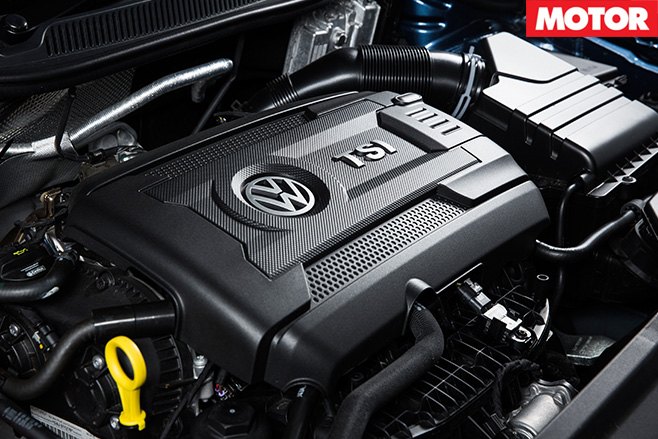
Okay, ‘enormous’ is a relative term, but there’s no doubt the Polo GTI brings an unprecedented level of straight-line performance to the baby hot hatch class. VW claims 0-100km/h in 6.7sec but we smashed that, recording 0-100km/h in 6.26sec and a 14.50sec quarter mile at 159.80km/h, times that would be more than competitive in the class above.
It’s a breeze to performance test: release the clutch at just over 2000rpm, manage the wheelspin slightly in first and then simply ram each successive gear home as quickly as possible, which thanks to the light, easy shift is very quickly indeed. There’s masses of low and mid-range muscle, yet it’s still happy to rev well beyond the 6000rpm redline. A more inspiring soundtrack wouldn’t go astray, but you can’t have everything. Not for $27,490, anyway.
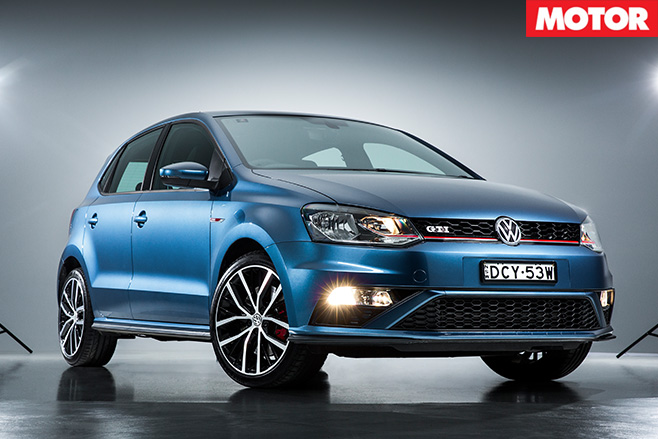
For now, though, let’s celebrate the fact that you can buy a small, practical hatch with the performance of a 1990s V8 sedan with plenty of change from $30K. Congratulations to the VW Polo GTI, the best value performance car on sale in Australia in 2016.
BFYB 2016 Results
This year’s outright order
| 1 | VW Polo GTI | 201.9 |
| 2 | Holden SS-V Redline | 195.2 |
| 3 | Mercedes-AMG A45 | 189.1 |
| 4 | Holden SS Ute | 187.8 |
| 5 | BMW M2 Pure | 187.0 |
| 6 | Ford Fiesta ST | 185.0 |
| 7 | Audi RS3 | 176.8 |
| 8 | Ford Falcon XR6 Sprint | 171.1u00a0 |
| 9 | VW Golf GTI | 169.2u00a0 |
| 10 | Ford Mustang GT | 167.5u00a0 |
| 11 | Ford Falcon XR8 Sprint | 167.1u00a0 |
| =12 | Audi TT S | 166.7u00a0 |
| =12 | Peugeot 308 GTI 250 | u00a0 |
| 14 | Chrysler 300 Core | 164.8u00a0 |
| 15 | BMW M135i | 162.9 |
| 16 | Mazda MX-5 2.0 | 160.3u00a0 |
| 17 | Renault Sport Clio Trophy | 157.4u00a0 |
| 18 | Ford Mustang Ecoboost | 151.1u00a0 |
| 19 | Mini Cooper JCW | 135.2u00a0 |
Want more? Check out the rest of 2016 Bang For Your Bucks.
Volkswagen is believed to be considering restructuring its German operations with Audi and Porsche under pressure to reduce costs.
THE Volkswagen Group is reportedly poised to undergo a wide-ranging restructure across its brands with an extraordinary board meeting at Wolfsburg said to be planned for tomorrow (November 4).
Reuters news agency reports that sources close to the board said management and labour leaders are seeking to agree on cost cutting and investments that will form part of the German carmaker’s efforts to revive its fortunes more since the ‘Dieselgate’ scandal broke.
It’s believed the meeting, to be two weeks before the scheduled board meeting on November 18 to ratify a five-year spending plan, is necessary because of the sheer number of issues facing the 20-member panel.
The news comes despite forecasts that Volkswagen will end the year as the world’s largest automaker, taking the crown that’s been long held by Toyota.
According to AutomotiveNewsEurope, entire Volkswagen Group’s sales sit at 7.61 million cars globally, from January to September, a 2.4 percent increase the same period last year. Toyota has managed 7.53 million vehicles worldwide, up 0.4 percent.
Like Toyota, Volkswagen relies on its overseas markets. While Toyota has the edge in the United States, Volkswagen is outselling the Japanese brand in China by 3 to 1.
However, the company is under pressure to cut costs at its factories in particular its Audi and Porsche operations, to help fund it’s well publicised shift to electric cars and autonomous driving, while setting aside the equivalent of about $A16 billion to fund the continuing Dieselgate fallout.
Some of these cost reductions have already been announced, including the decision to withdraw from international motorsport competitions including the World Rally Championship and World Endurance Championship (with Audi).
According to Reuters VW’s powerful works council, whose members occupy almost half the seats on the supervisory board, have stated they will not back retrenchments without a commitment from management to fixed targets and quotas for products, output and investment.
