
March 2024: Solterra driven in Australia
It’s Subaru’s first EV and its most expensive model, but can the Solterra trouble big-name rivals that include the Tesla Model Y?
February: Subaru Solterra price slashed
Subaru Australia has reduced pricing for the Solterra between $6700 and $8000.
2024 Subaru Solterra pricing and features
The Subaru Solterra, the Japanese brand’s first electric car, has been priced from $69,990 as it bids to take on a group of significant rivals.
Subaru Australia has now confirmed finalised specifications after announcing pricing and “indicative specs” last November.
There are minimal changes to the trim levels for the Solterra AWD and Solterra AWD Touring models, which will both feature a dual-motor, all-wheel-drive set-up.
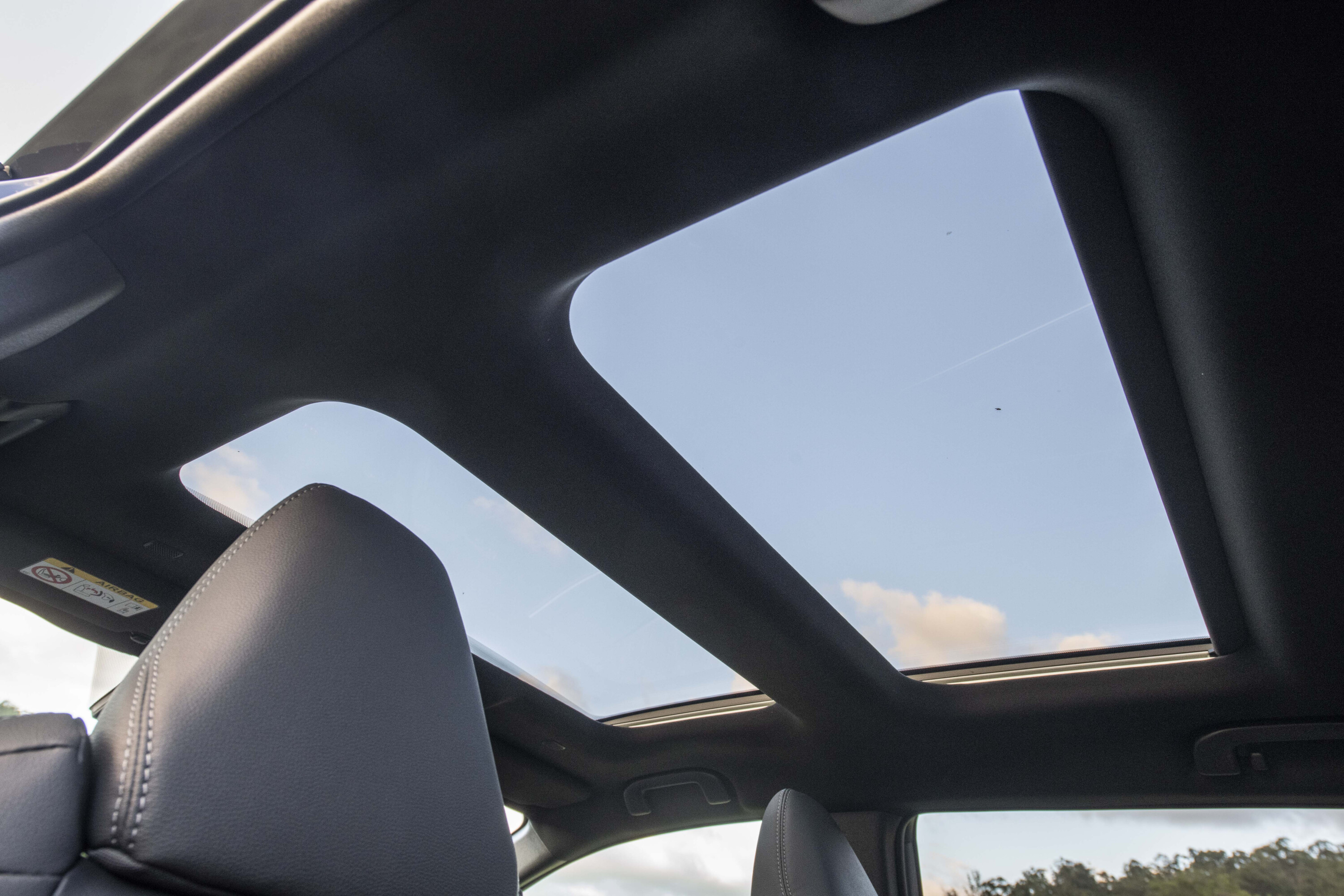
A panoramic sunroof is now standard on the Touring where previously it was listed as a potential option. A $1200 two-tone paint option is also available only for the Touring.
The Touring features artificial-leather upholstery to the entry model’s cloth seats.
Drive-away pricing is from $75,821 based on Sydney location, with the Touring’s $76,990 RRP increasing to $83,065 (again Sydney) once on-road costs are added.
The Subaru Solterra launches in late Feb – on the exact dates as its near-identical Toyota twin, the BZ4x.
Toyota has yet to announce pricing, though the BZ4x will be offered in both single-motor front-drive and dual-motor forms.
| Model | Pricing (Feb 2024) | Pricing (Nov 2023) | Changeu00a0 |
|---|---|---|---|
| Solterra AWD | $69,990 | $77,990 | down $8000 |
| Solterra Touring AWD | $76,990 | $83,690 | down $6700 |
| Prices exclude on-road costs.u00a0 | |||
Subaru’s decision to focus on an all-wheel-drive Solterra means it pricing positions the 4.7-metre-long SUV above entry, rear-drive versions of key competitors including the Tesla Model Y and Hyundai Ioniq 5 (from about $65K), as well as the Ford Mustang Mach-E and Kia EV6 (from about $73K).
The Solterra’s pricing looks more competitive when compared with equivalent AWD electric midsized SUVS. A dual-motor Model Y costs from $78,400, the AWD Ioniq 5 starts at $80,500, and an AWD EV6 kicks off at $87,590.
To obtain an AWD Mach-E requires a much bigger spend of $104,990 before on-roads are added.
Volkswagen has yet to confirm pricing for the ID.4 electric medium SUV due in late 2024.
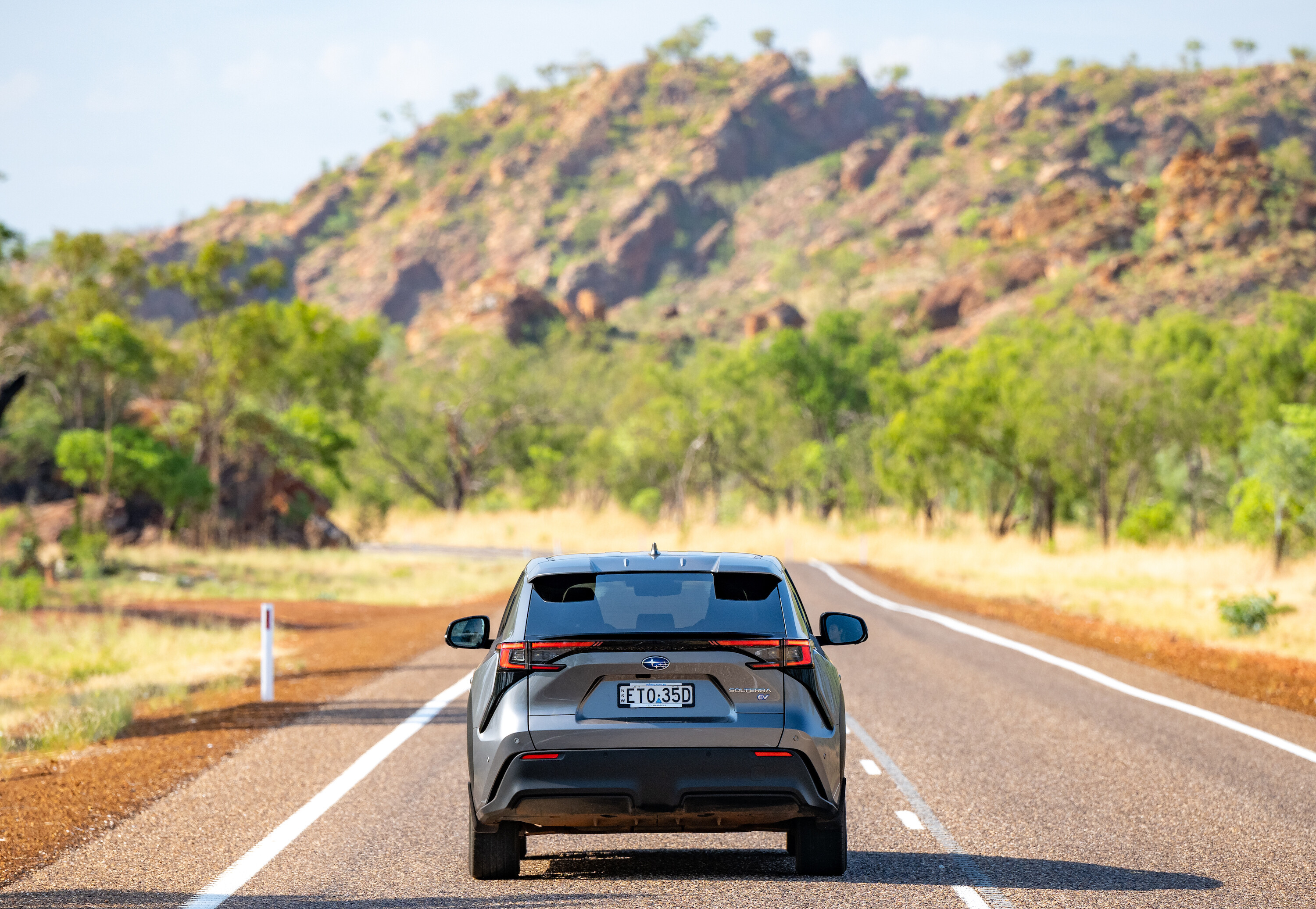
The dual-motor Solterra features a 71.4kWh battery and produces a combined 160kW and 337Nm from its front and rear electric motors.
Those numbers are relatively low for a dual-motor EV, while most key rivals offer more affordable single-motor models.
Subaru Australia’s official specifications have included only the typically optimistic NEDC range figure – 485km.
The more comparable figure available from Europe is the WLTP (Low) figure of 466km.
This compares well with the Ioniq 5 AWD’s 454km but trails the Model Y Long Range (533km), Kia EV6 (484kW), and upcoming Volkswagen ID.4 (515km).
| 2024 Subaru Solterra battery and electric motor | |
|---|---|
| Battery | Lithium-ion battery |
| Capacity | 71.4kWh |
| Max power | 160kW |
| Max torque | 337Nm |
| Electric WLTP test range | 466km |
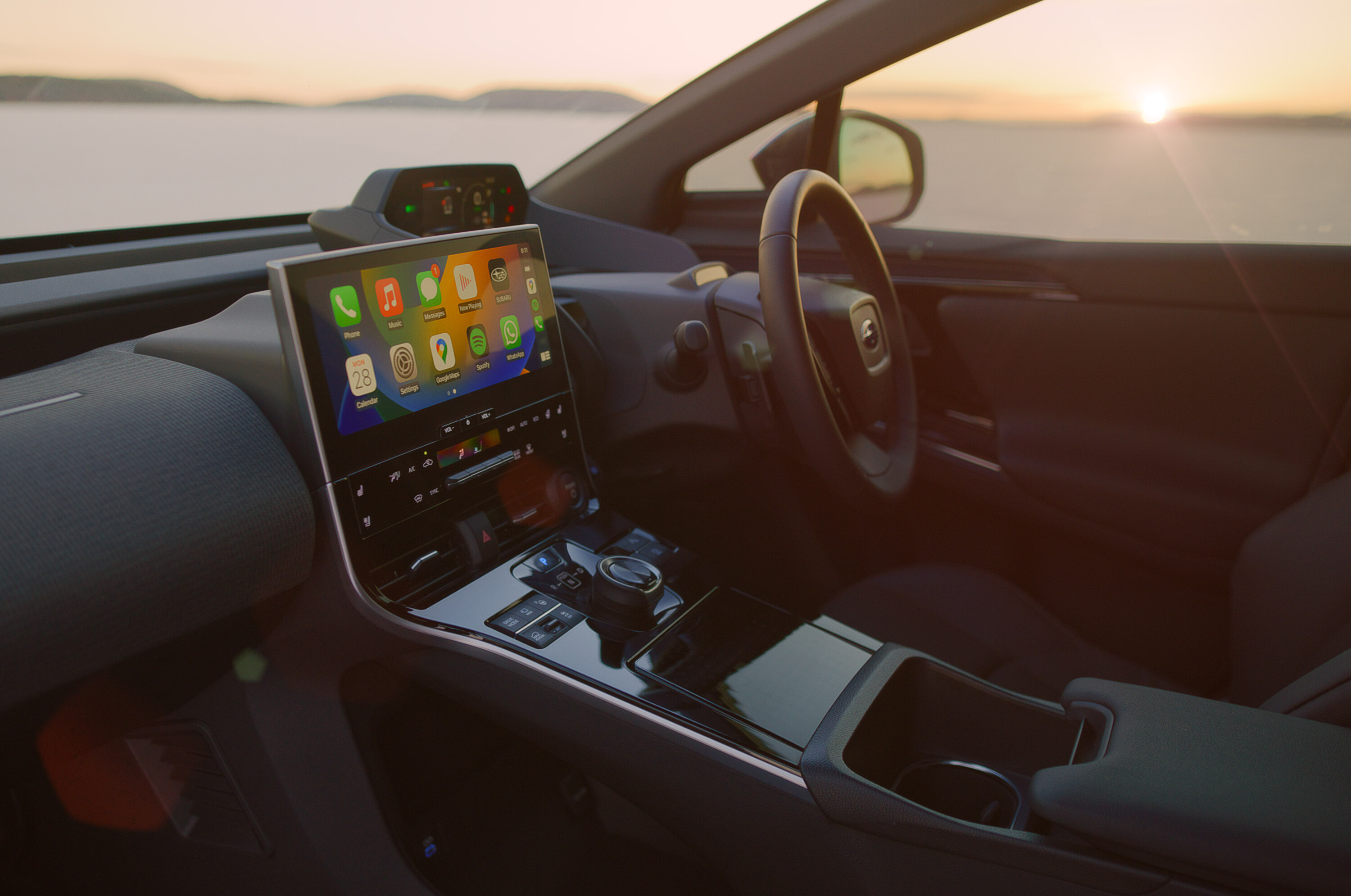
150kW rapid charging will replenish the battery from 20 to 80 per cent in half an hour, according to Subaru. Using the 7kW onboard AC charger completes the same top-up in seven to eight hours.
At this stage, standard equipment highlights for the entry Solterra include an automatic tailgate, electric driver’s seat, heated seats front/rear, digital rear-view mirror, surround-view camera, and 12.3-inch infotainment screen.
Subaru Australia is also including five-year servicing and roadside assistance in the pricing, as well as a 2kW AC charging cable with an eight-amp wall plug.
| 2024 Subaru Solterra charging | |
|---|---|
| Onboard Charger | 7kW single phase |
| Rapid charge from 20-80% capacity via a 150kW DC charger | approx 30 minutes |
| 20-80% capacity via single phase 7kW AC charger | approx 7-8 hours |
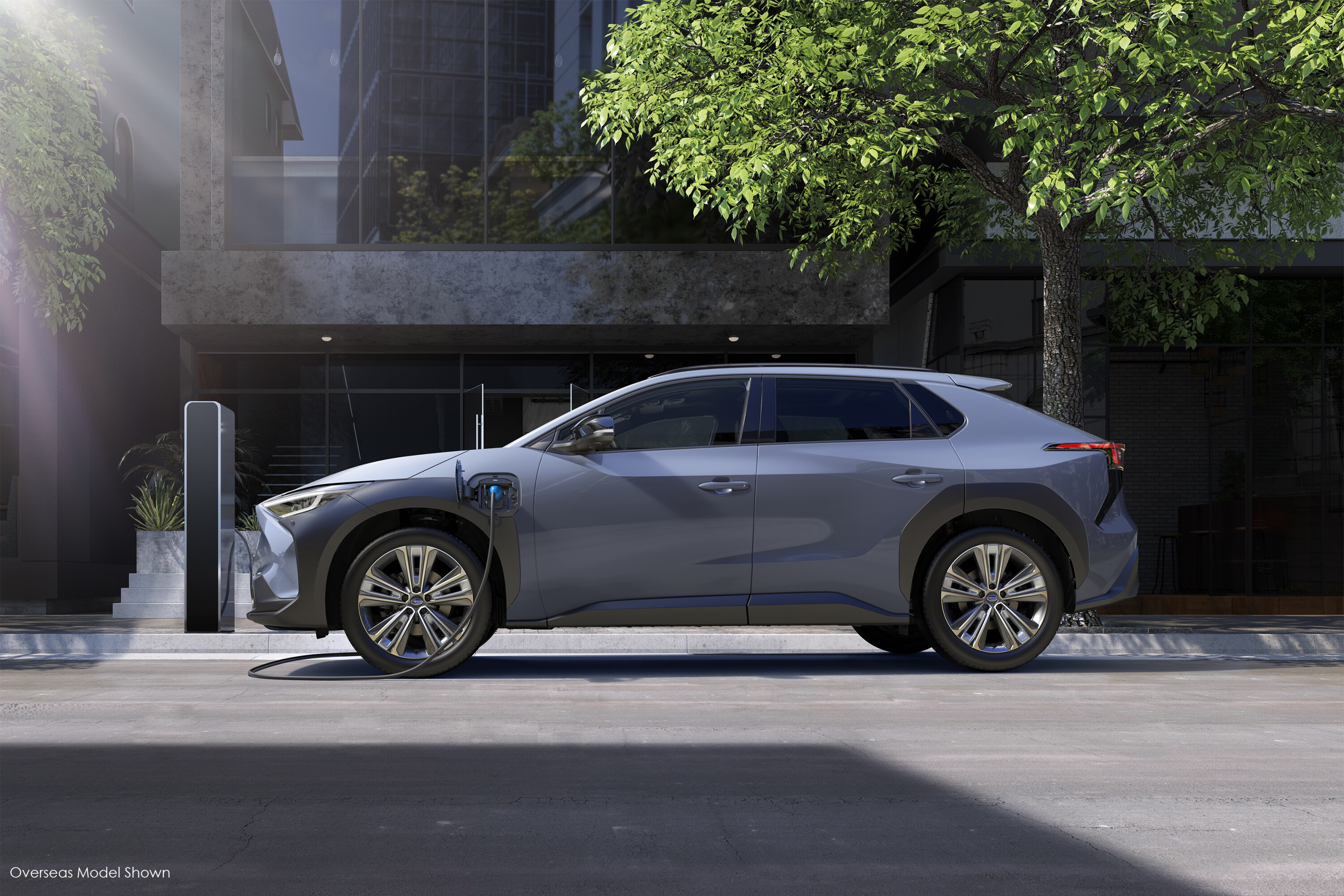
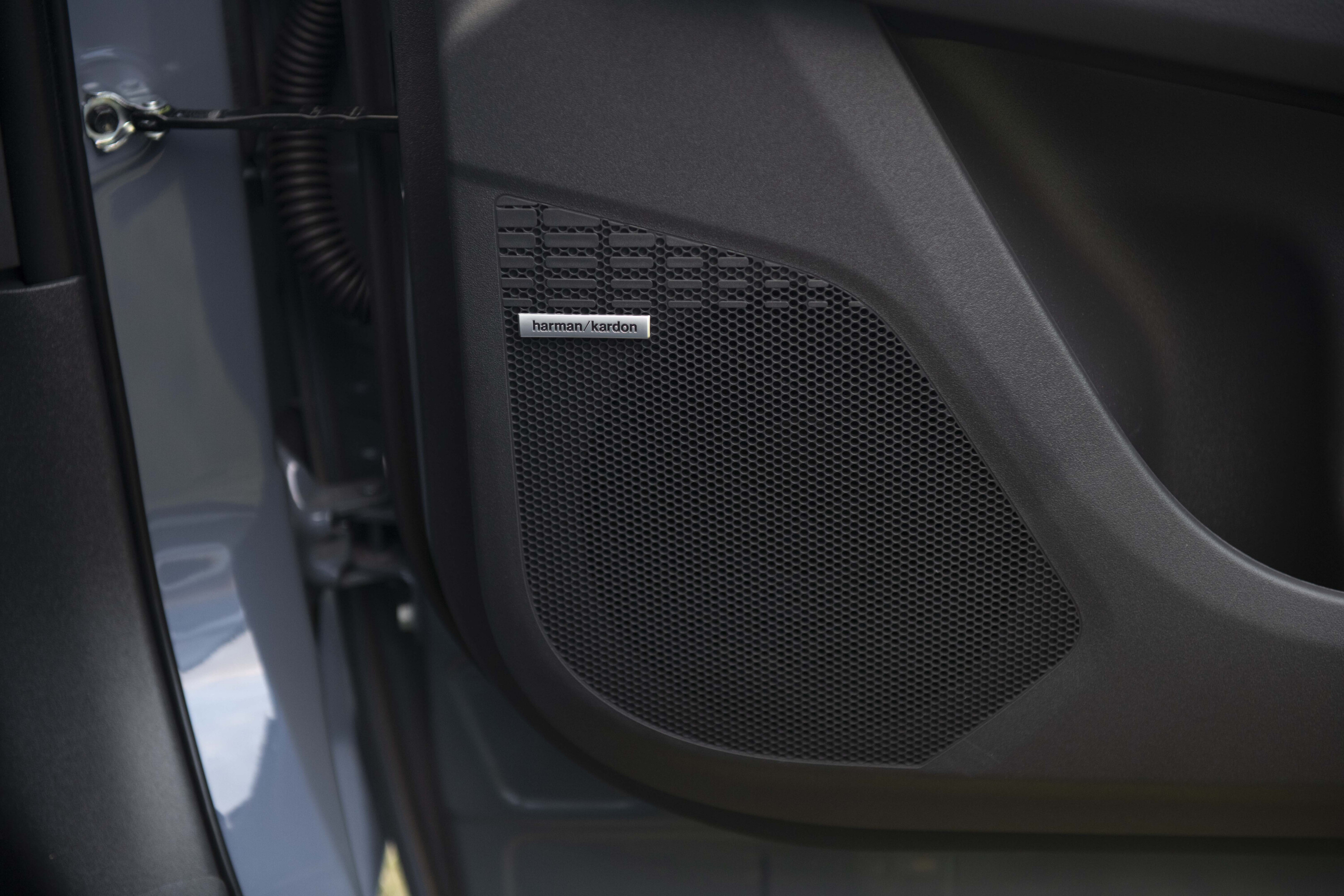
The Touring adds $5700 to the price tag and is necessary to have wireless phone charging. Other extras include a 10-speaker Harman Kardon sound system, electric adjustment for the front passenger seat and memory settings for the driver seat, and 20-inch alloy wheels that replace the base model’s 18-inch alloys.
Options are limited to a panoramic sunroof and two-tone paint.
Subaru Australia is also offering charging-installation bundles for homes, with a Bundle 1 Single-Phase (7kW) costing $2250 or a Bundle 2 Three-Phase (22kW) set-up costing $2645.
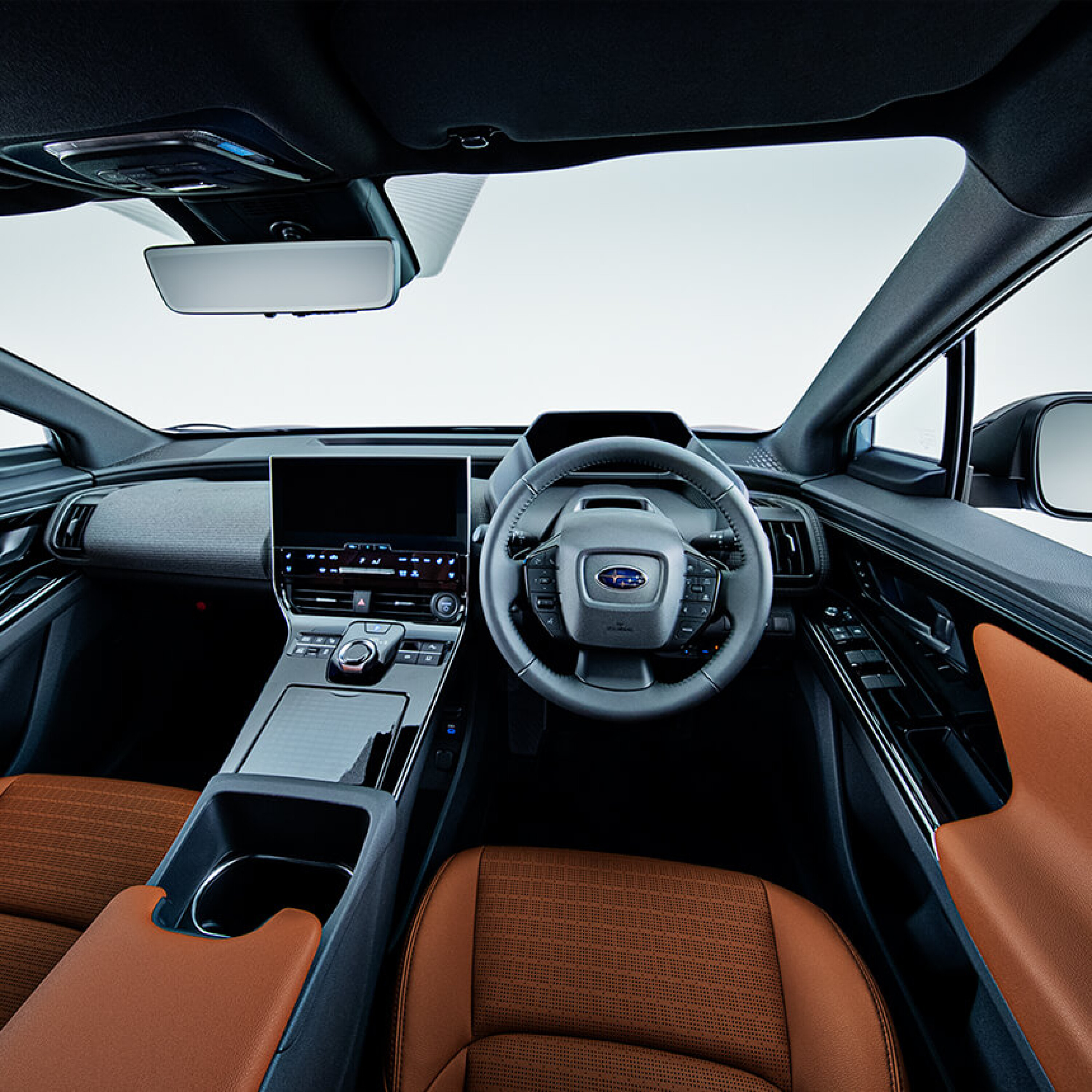
Subaru Solterra specifications
| 2024 Subaru Solterra AWD – standard equipment highlights | |
|---|---|
| 18-inch alloy wheels | 7.0-inch digital driver display |
| Auto tailgate | Adaptive high beam |
| LED headlights and foglights | Radar cruise |
| Electric driveru2019s seat | Speed-limit notification |
| Heated front and rear seats | Low-speed acceleration suppression |
| Heated steering wheel | 360-degree camera |
| Digital rear-view mirror | Blind spot and rear cross traffic monitoring |
| 12.3-inch infotainment touchscreen | |
| 2024 Subaru Solterra AWD Touring additions | |
|---|---|
| 20-inch alloy wheels | Electric front passenger seat |
| Harman Kardon audio system | Memory setting driver seat |
| Wireless Qi phone charging | Intelligent Park Assist |
| Artificial leather upholstery | Panoramic sunroof |
| Options (Touring only) |
|---|
| Two-tone paint ($1200) |
The last-minute pre-launch change to the cost of the Solterra electric SUV was not influenced by pricing for its Toyota bZ4X twin, says Subaru.
Subaru Australia initially priced its first fully electric vehicle from $77,990 in late 2023, having first confirmed the Solterra for this market in mid 2022.
The brand made a surprise dramatic cut to the Solterra’s pricing just a week ahead of its local media launch and first customer deliveries, reducing the starting price to $69,990 and paring the more expensive Touring grade by $6700.
It follows a similar move by Ford, which dropped the price of its rival Mustang Mach-E by up to $7000 – though in this case weeks after the Australian launch.
March 2024: Solterra driven in Australia
It’s Subaru’s first EV and its most expensive model, but can the Solterra trouble big-name rivals that include the Tesla Model Y?
STORY CONTINUES
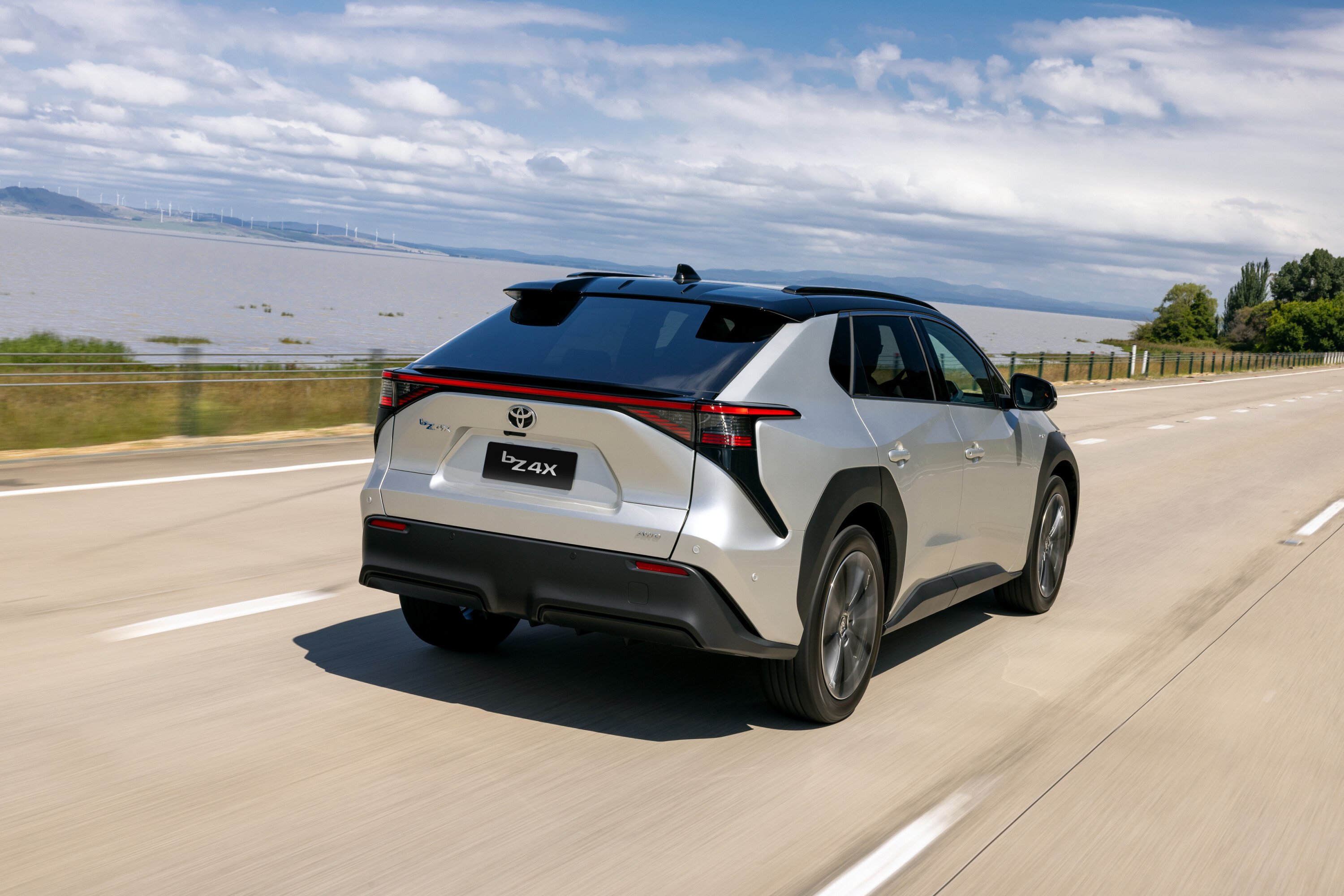
Toyota didn’t confirm pricing for the bZ4x until the same day both brands were launching the near-identical vehicles. The bZ4X is more affordable from $66,000, though is offered as a front-wheel-drive model in base form where the Solterra is all-wheel drive only.
The more comparable AWD bZ4X costs $74,990 before on-road costs, undercutting the Solterra AWD Touring by $2000.
Subaru Australia’s managing director, Blair Read, said the company hadn’t seen the bZ4X’s pricing prior to its change and said it was even possible Toyota had instead reacted to the Solterra’s earlier announcement.
“That’s always the risk,” said Read, when asked about the challenge of price positioning when two brands launch a co-developed model. “Then making the [pricing] change last week it was like, ‘Did [Toyota] react to what we’ve done?’ You don’t know; you’ve just got to roll a dice and put your best foot forward.

“For us, we’d had some dealer and customer feedback [on the Solterra pricing], and thought, ‘Look, can we do something here?’ We worked with the factory and [figured] if we’re going to do it, let’s do it before first customer deliveries, so those people get the benefit.
“[We wanted to ensure] those long-term Subaru owners or people who had expressed interest and wanted to put money down 18 months ago when we first [confirmed Solterra] were supported through that process and that we didn’t forget about them. So a late [pricing] change, but it was driven by doing the right thing for the customer.”
The Solterra enters one of the most competitive segments of the growing EV space. Besides the bZ4X and Mustang Mach-E, the Subaru also competes against the Hyundai Ioniq 5, Kia EV6, as well as the best-selling EV globally and locally, the Tesla Model Y.
Many rivals, not just its Toyota twin, offer front-wheel or rear-wheel drive models with single motors that are cheaper. The Solterra is the most affordable AWD in its class.
Read admitted there was a different challenge to face with launching its first electric vehicle and wouldn’t be drawn on potential sales for the Solterra, with Toyota indicating
“I think we’ve always said that [EVs is] a really dynamic market space. New competitors, including us, and technology is changing quite rapidly, so you have to be quite adaptable.
“I think it’s too early to speculate on volumes and positioning, or to try and lock yourself into a position. We will respond to how customers respond. We’ve got good support from the factory that if we need to get some more production to manage lead times we can.”
Subaru globally plans to have another four battery electric vehicles (BEVs) in play by 2026, with another four by 2028.
The company believes BEVs will account for 50 per cent of Subaru production by 2030.
Japanese brands have been slow to join the electric car race, but now two have arrived at the same time.
The Subaru Solterra is one half of another joint venture with Toyota, following the successful BRZ/GR86 sports cars.
Toyota’s twin, the bZ4X, was launched in Australia on the exact same days as the Solterra, though our review of that car is embargoed until this Friday.
JUMP AHEAD
Pricing and specifications
What we can tell you is that the bZ4X is more affordable by way of a front-wheel-drive option, which starts at $66,000 before on-road costs.
Subaru is sticking to its all-wheel-drive guns, and while the entry Solterra is priced from $69,990 before on-road costs, its extra-gear $76,990 Touring spec is two grand more than the AWD bZ4X but offers some additional items.
Those Solterra prices are notably lower than initially, following a late change by Subaru Australia just a week before launch – cutting the entry model by $8000 and the Touring by $6700. It’s still the most expensive Subaru by more than $10K.
The change was made before Toyota’s pricing became known but either way, it’s a wise move in a segment that’s not only one of the busiest for EVs but one containing the world’s – and Australia’s – best-selling electric vehicle, the Tesla Model Y.
It can at least claim, for now, to be the only AWD electric medium SUV offered for an RRP below $70K, even if there are caveats (which we’ll come to later).
There’s a simplistic way of describing how the Solterra and bZ4X were co-developed – essentially playing to the strengths of each manufacturer. The battery platform and propulsion side were the responsibility of Toyota; the chassis side was Subaru’s remit.
On paper, the battery and electric motor specs look a bit undernourished.
Despite being a dual-motor EV, power and torque are rated at 160kW and 337Nm – split exactly between the front and rear motors.
Most rivals with a single (RWD) motor offer more power, while competitors’ more comparable AWD variants offer between 239kW (Hyundai Ioniq 5 and Kia EV6) and 384kW (Model Y Long Range).
The platform-integrated battery pack is also relatively small at 64kWh (usable). Rivals are again higher, with 70-something kilowatt hours.
Strangely, Subaru refuses to quote a commonly used WLTP figure for the Solterra’s battery range, offering only a 485km maximum distance based on the optimistic NEDC cycle.
Toyota provides a more realistic guide, claiming a 411km WLTP range for its AWD bZ4X.
Cabin comfort and practicality
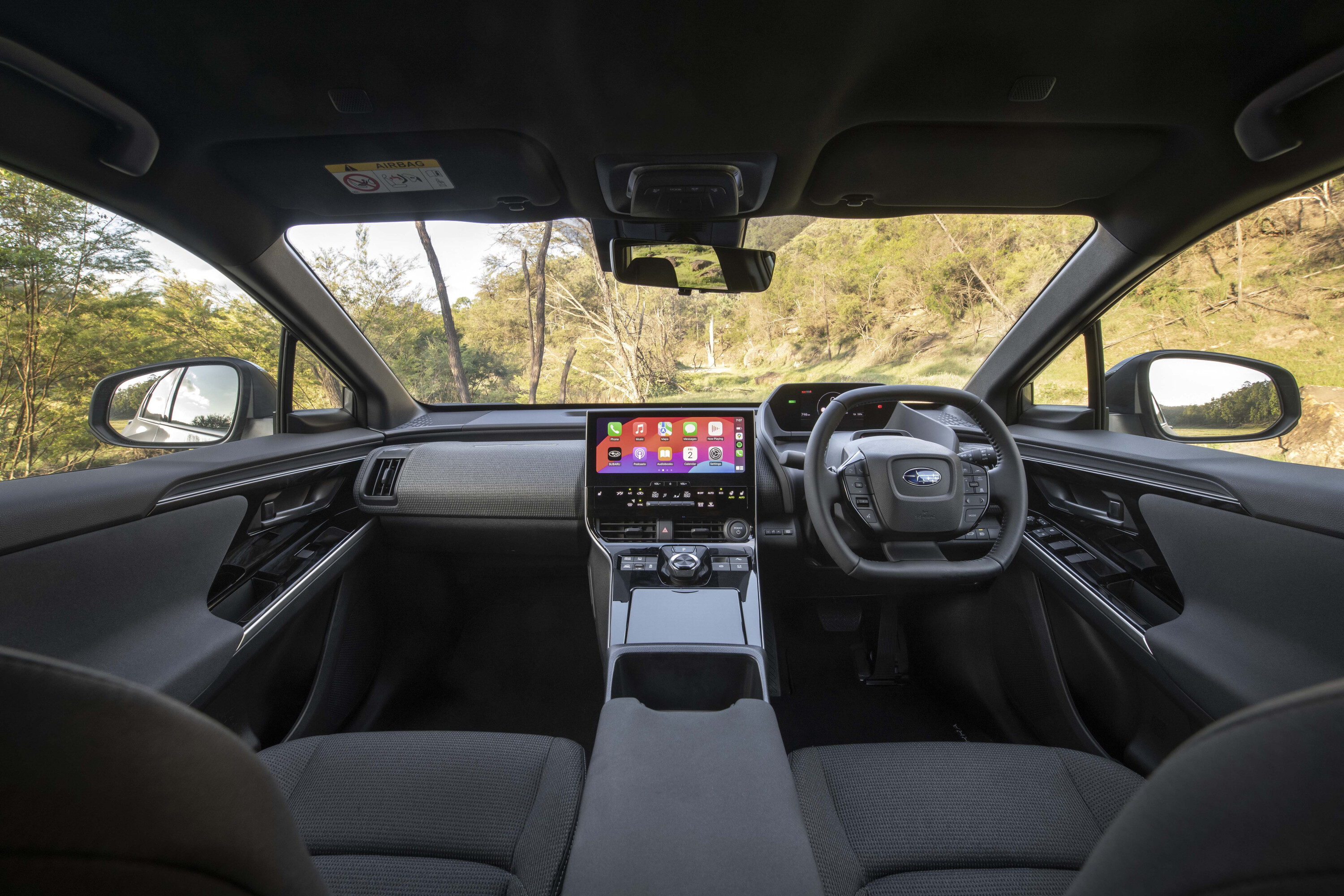
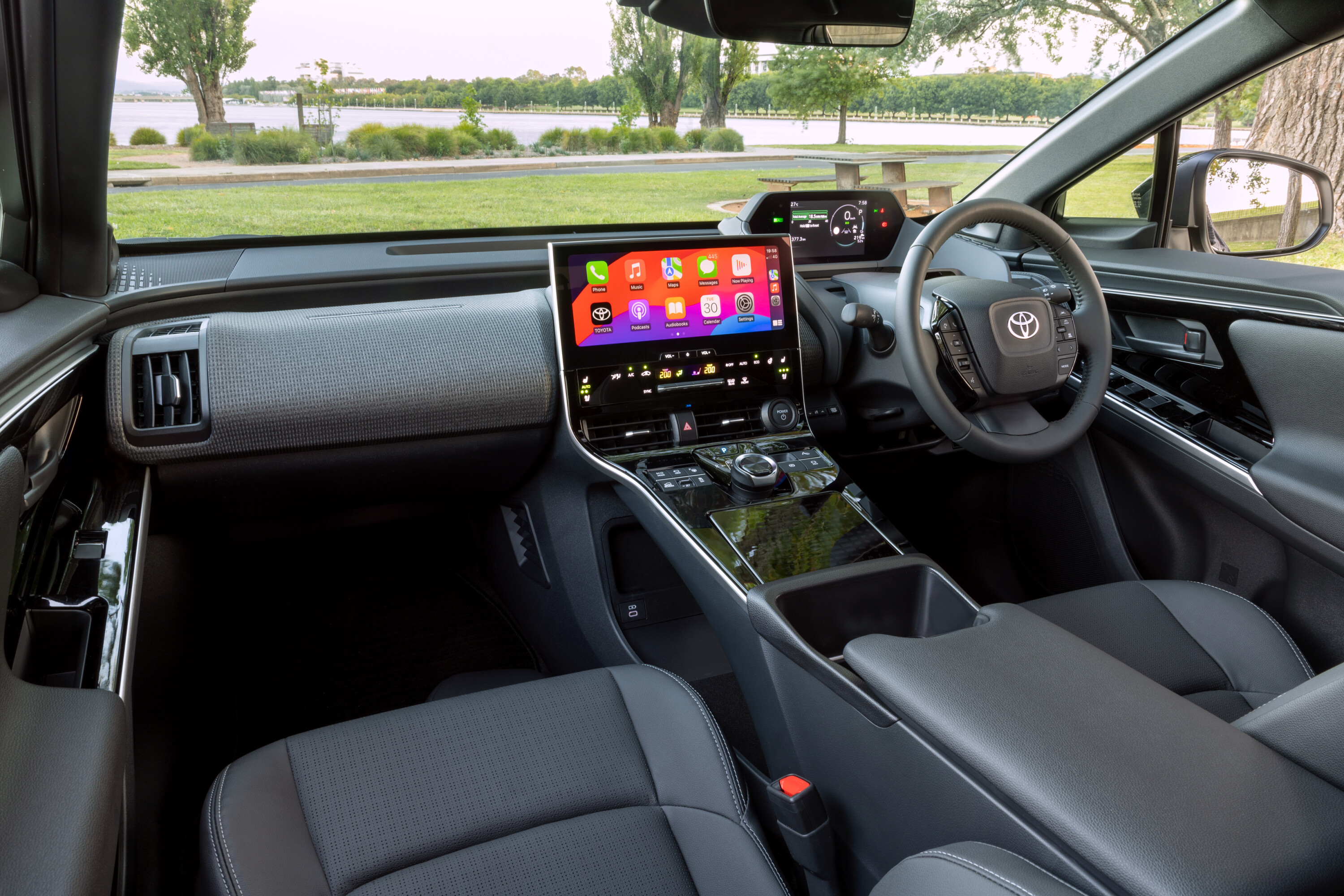
Where Subaru and Toyota tried to make some differentiation between the BRZ and GR86 cabins, far less effort was put into this EV JV. The Solterra and bZ4X interiors are virtually identical.
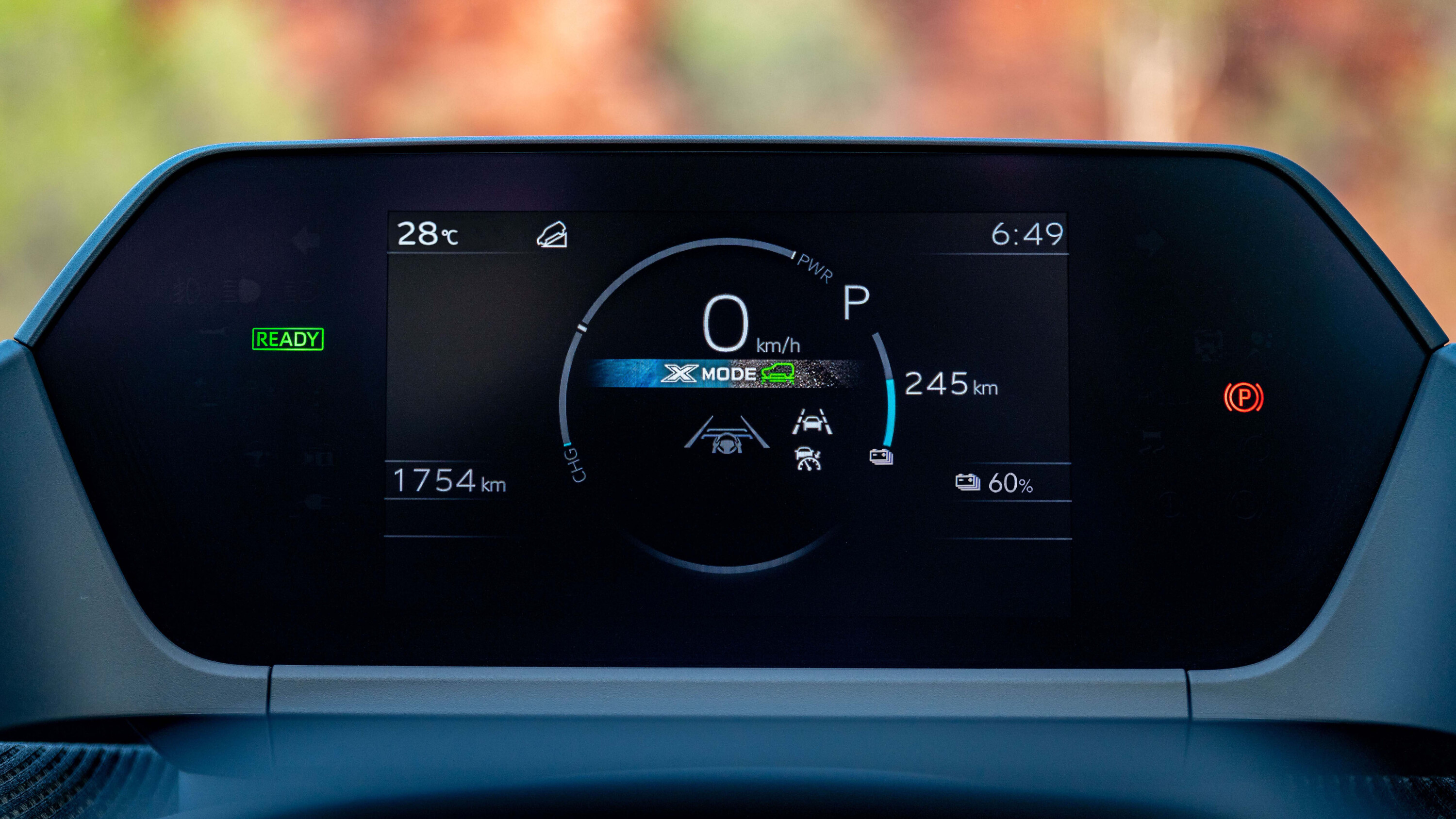
Although we can’t yet report on the Toyota, the Subaru’s driving position is certainly slightly flawed – picking up an issue common to the latest Peugeots. Not all drivers will be able to have the steering wheel at their optimum height without obscuring the digital driver display.
The distinctively shaped steering wheel – curved sides with flattish top and bottom – doesn’t help. A traditional round wheel would likely have been better.
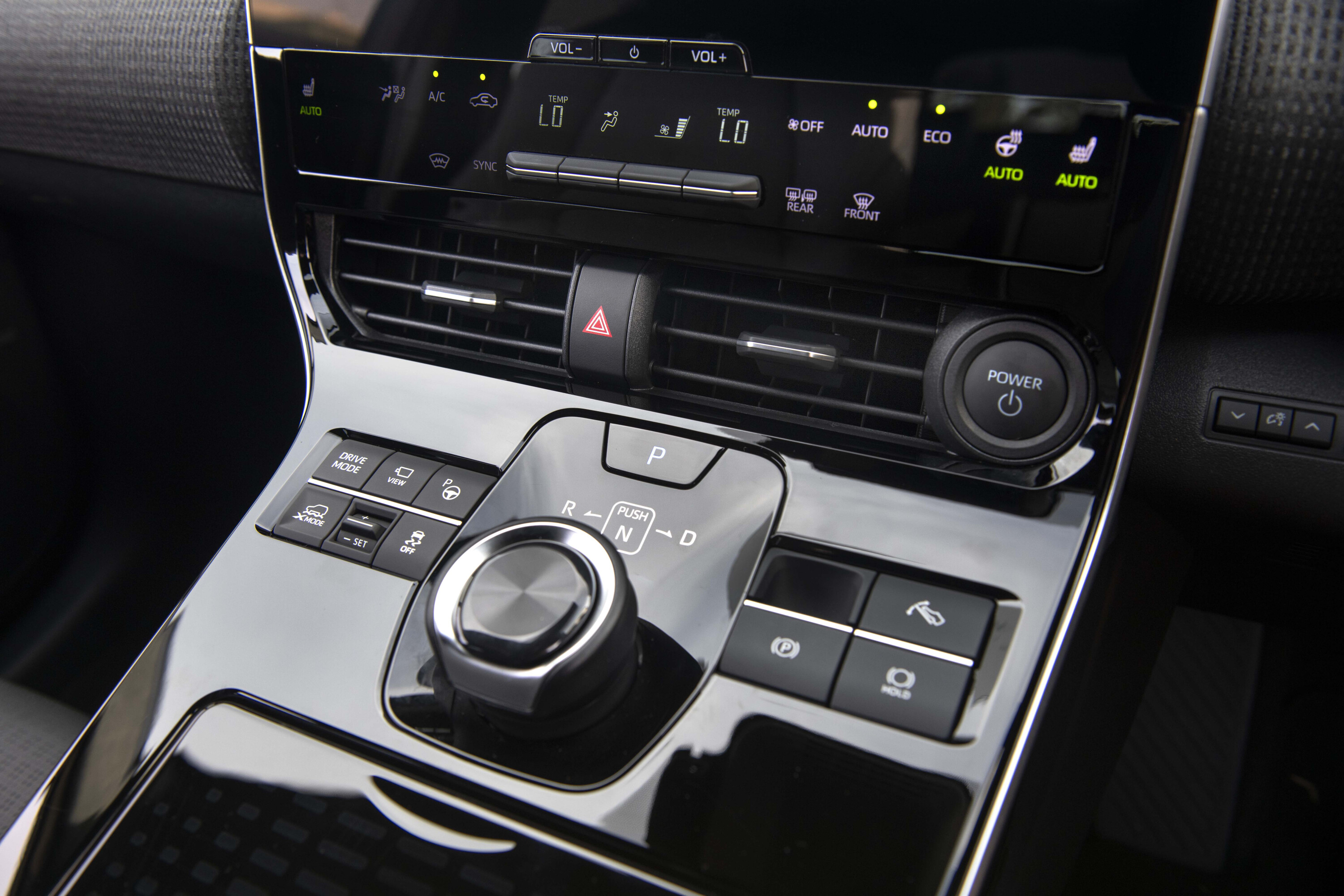
It’s snug up front, too, the front seats divided by a high and wide double-decker centre console, with open storage (and ports) beneath and two lidded compartments, plus cup holders, up top.
The middle compartment reveals a wireless charging tray in the more expensive Touring but the feature is oddly omitted from the base model. The shiny plastic tray in the Touring isn’t ideal, either, as a smartphone slides around easily.
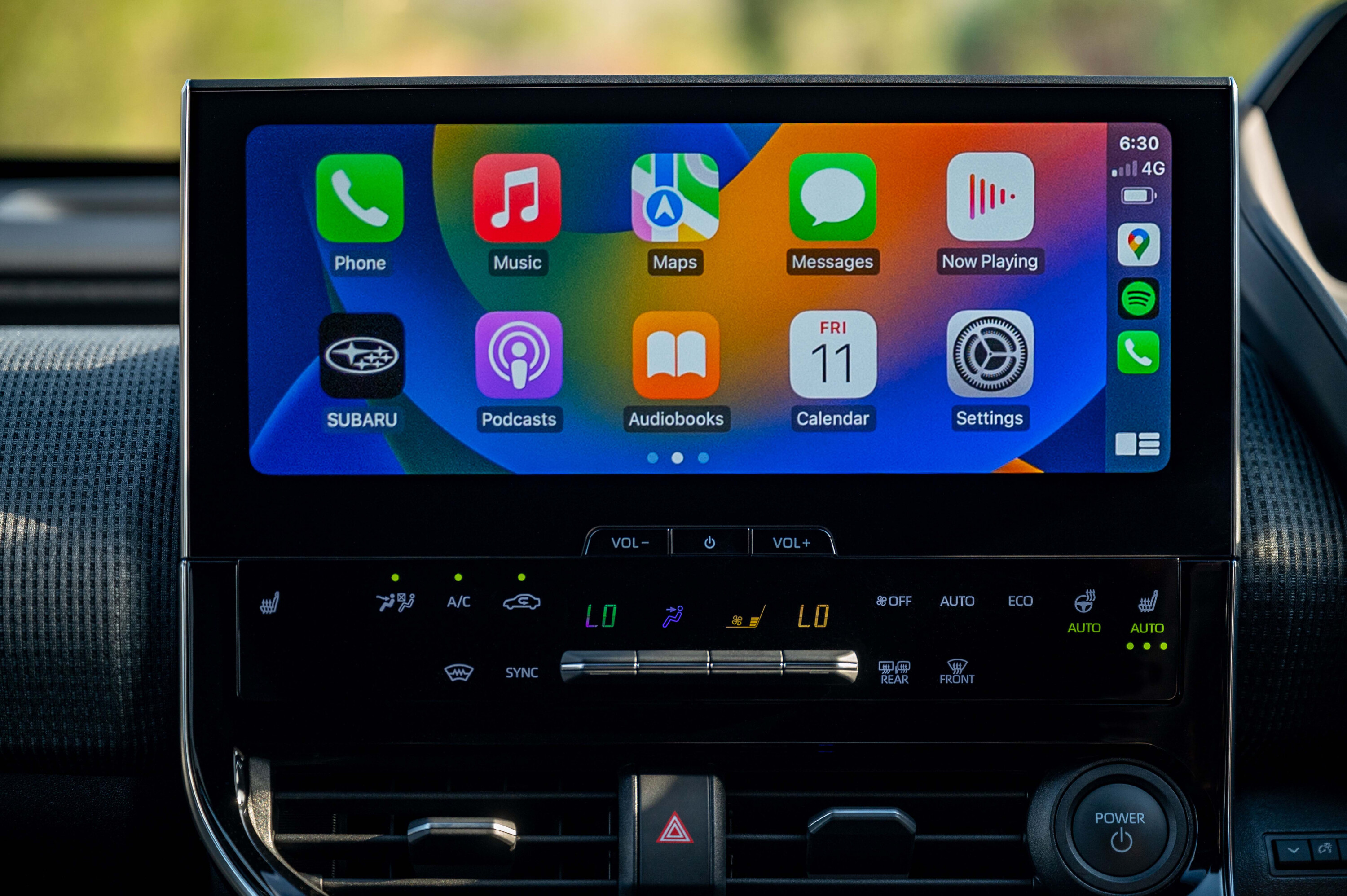
A 12.3-inch horizontal infotainment screen looks right-sized for the cabin, though it’s a shame it houses Toyota’s software as the menus – which don’t even include a proper home screen – are visually underwhelming.
In the bigger picture, the Solterra’s interior wouldn’t feature in a book titled How to Create a Premium Car Cabin.
Some rival models offer a choice of light and dark interior trim, but the Subaru’s interior is mostly black and grey. There’s also greater usage of hard plastics than expected for the price, even at eye level on the A-pillars, while the door handles feel cheap and plasticky, and shiny piano-black trim for the console, dash and doors is no shortcut to lifting perceived quality.
At least some welcome Subaru traits are evident. The front seats are the type you’d be happy spending hours in, storage options are plentiful, and there’s good all-round vision (further aided by a digital rear-view mirror).
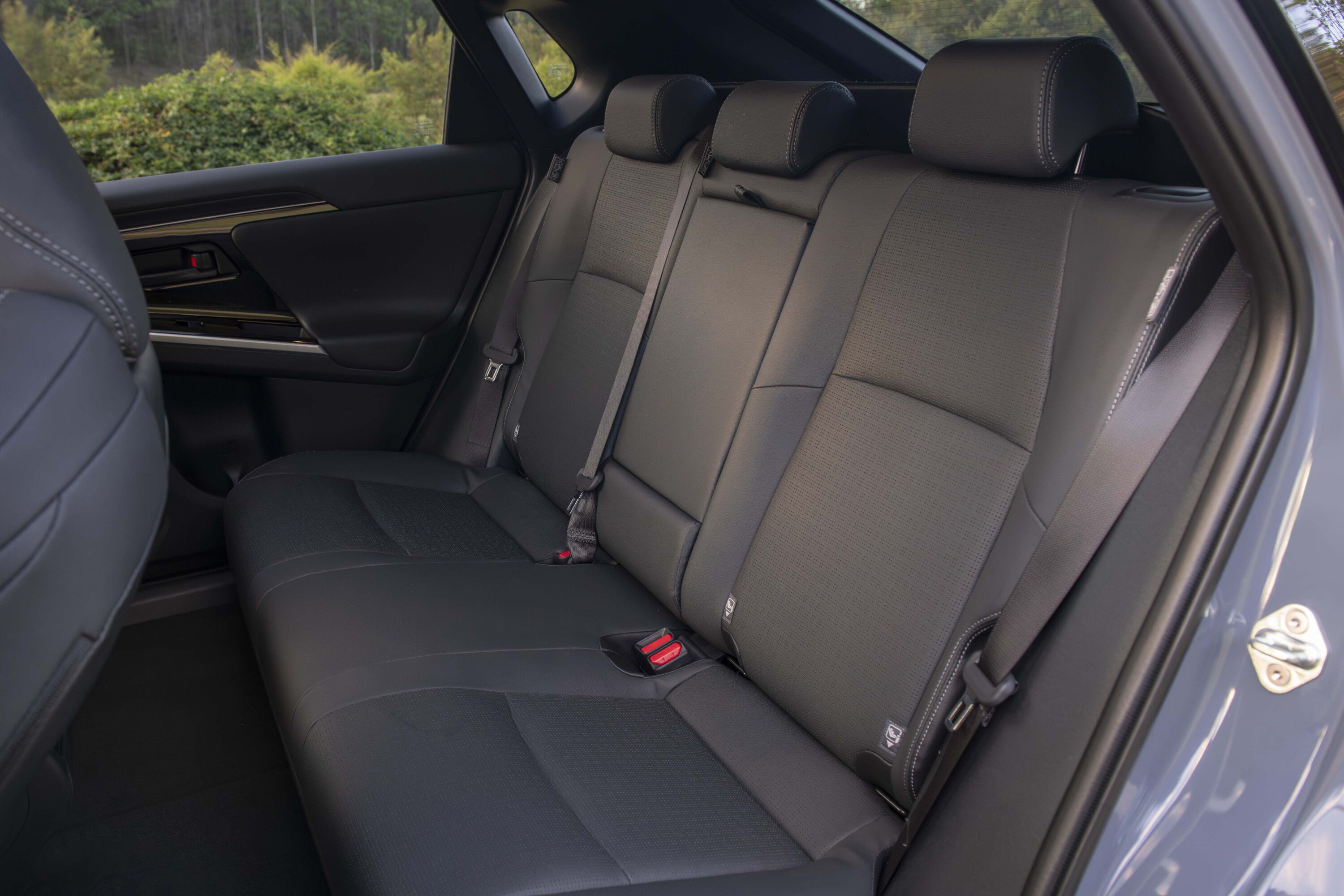
Rear passengers are treated to air vents, heated outboard seats, two USB-C charging ports, and a folding armrest with two cup holders and a smartphone/iPad slot.
Legroom is good, aided by a wheelbase that’s longer than that of the Forester, and headroom clearance is at its most generous in the sans-sunroof base model. The rear seatbacks also recline.
Toe space is limited without asking front occupants to kindly raise their seats, and the high floor creates a knees-up riding position even for average-height adults.
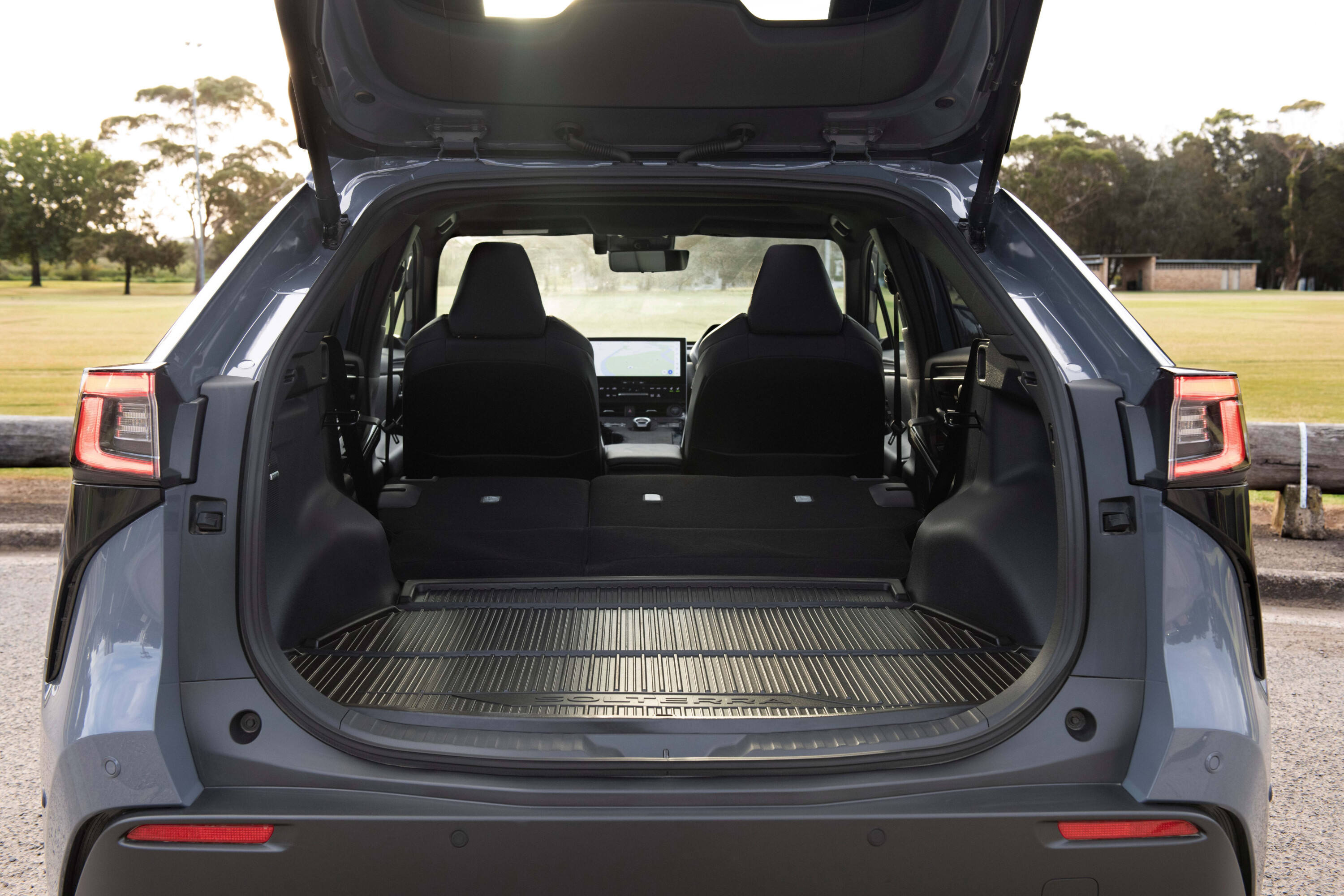
Raising the electric tailgate reveals a boot that offers a conveniently low loading lip and useful width but luggage space is shallow, not helped by a relatively low-set retractable cargo blind and the Solterra’s raked roof.
A rubber boot mat is standard, under which there’s access to a small underfloor section for a charging cable. Flip-out bag hooks seem to be placed precariously close to where the tailgate closes, and the Solterra doesn’t share the Forester’s electric buttons for folding the 60:40 split rear seats.
There’s also no full-size spare as offered by a petrol Forester; the Solterra has a puncture repair kit like the hybrid Forester.
How it drives
The lack of spare tyre is an important note as Subaru was eager to promote the Solterra’s off-road credentials.
And it does have some genuine capability.
With 212mm of ground clearance (just 8mm lower than the Forester’s) and similarly utilising an X-mode system with calibrations for Snow/Dirt and Deep Snow/Mud, the Solterra navigated a short uphill/downhill 4WD track featuring some slightly awkward creek crossings and soggy mud ruts without fuss or scraping any bodywork.
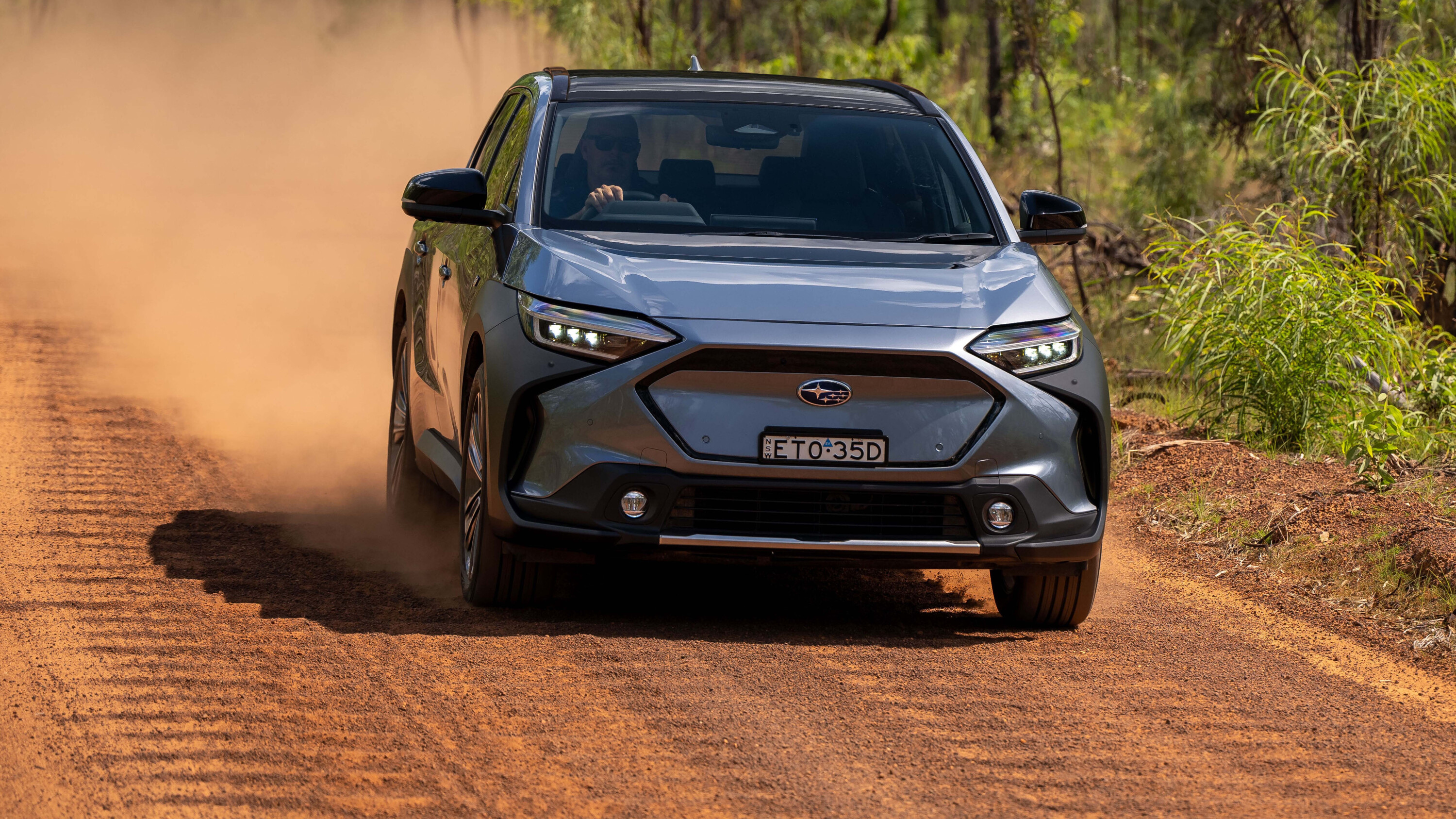
The Grip Control function is clever. It’s a low-speed off-road cruise control function that allows the driver to dictate the crawling speed of ascent/descent via a small toggle.
We deliberately stopped in the middle of one soaked mud rut to give the electronics an extra challenge. After a couple of seconds of fruitlessly spinning the right-rear wheel that was in the puddle, the system detected our subtle increase in throttle pressure and switched more torque to the wheels with better traction to get us underway again.
How adventurous owners might get with their Solterra may be guided more by the vehicle’s battery range.
Forget the 485km NEDC quoted by Subaru as this industry mark is so hopelessly optimistic that most EV-makers these days quote the more realistic WLTP (as does Toyota with the twin bZ4X).
Even then, Toyota’s 411km WLTP figure for its AWD version would be difficult to achieve based on our drive.
Using the trip computer to take an average of the Solterra’s best and worst efficiency figures from our test car on the launch day – 18.5kWh/100km – the Subaru would cover 346km before running out of battery.
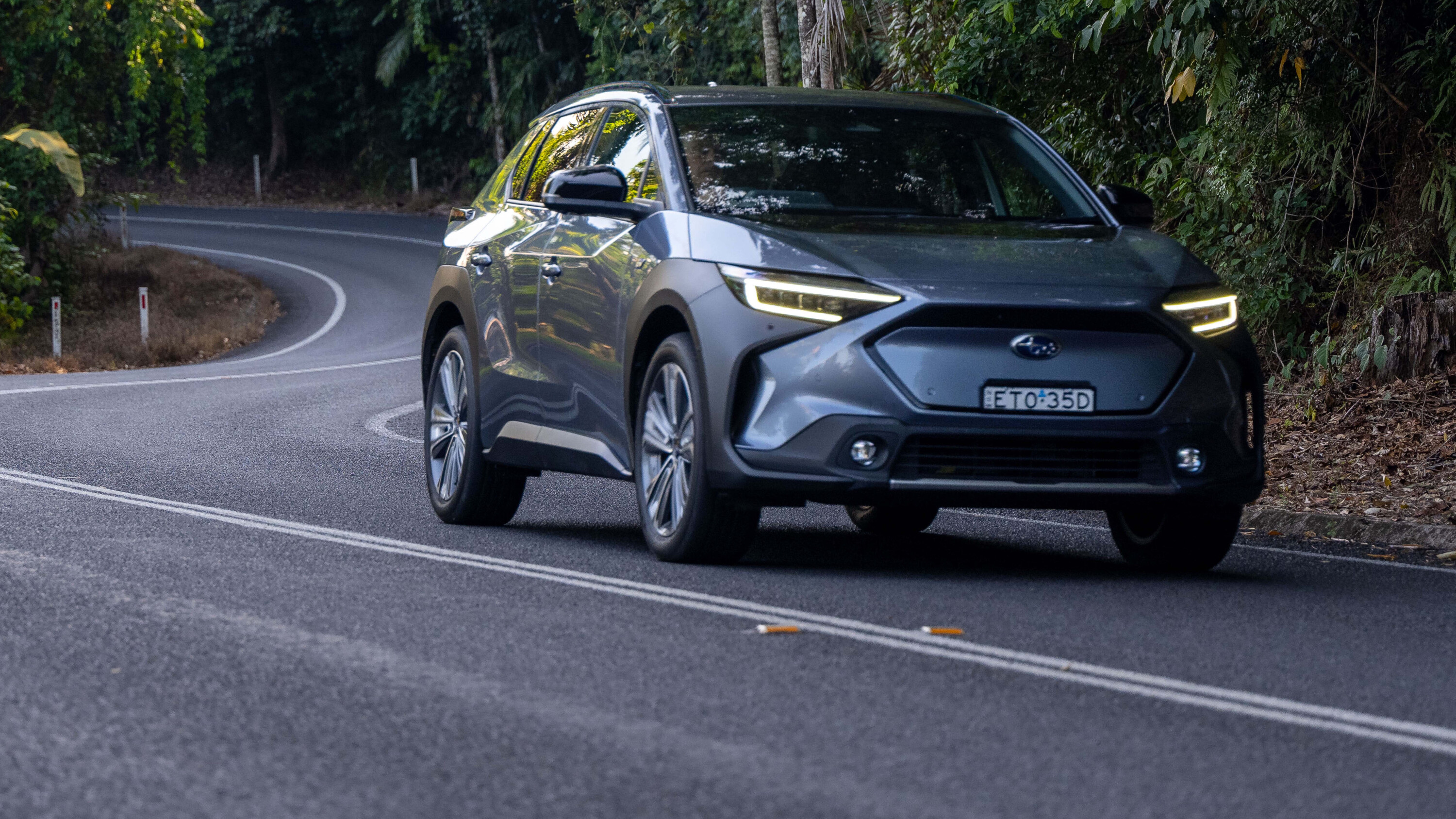
The steering is slicker than you’ll experience in Subaru’s other SUVs, the Crosstrek and Forester, with a nicely judged heft.
Ride quality is on the firm side and doesn’t quite have the cosseting cross-country suppleness of its SUV siblings, but the suspension is well controlled and combines with the low centre of gravity to limit body roll through corners.
We found particularly strong grip from the Touring’s bigger 20-inch wheels, though the 18-inch-wheeled base model felt a little lighter on its feet from a quick sample drive. Road noise on the 20s was intrusive at times during our drive.
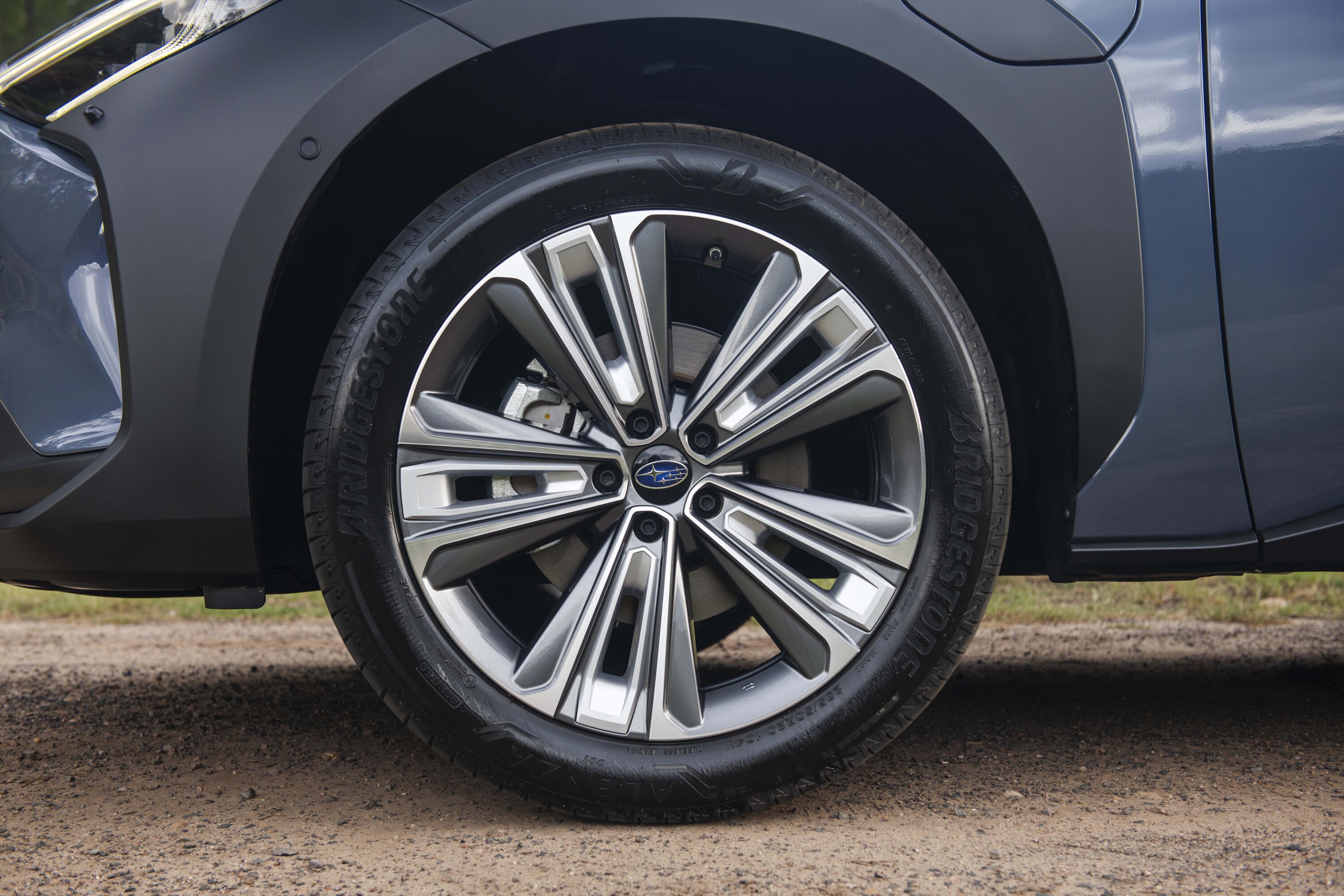
Any former WRX owners moving into the more mature world of family SUVs just shouldn’t anticipate much driver involvement.
Owners of non-turbo petrol Subarus would appreciate the Solterra’s performance, even if it’s slow by class standards – a 6.9sec 0-100km/h claim paling against the circa-five-seconds of AWD Ioniq 5s, EV6s and Model Y LRs, for example.
For additional context, the last turbo Forester (the 2018 XT) took 7.5 seconds in the benchmark sprint.
Still, the drivetrain’s lively response to throttle applications would likely come as a shock to someone jumping out of a Subaru powered by a lacklustre naturally aspirated boxer engine.
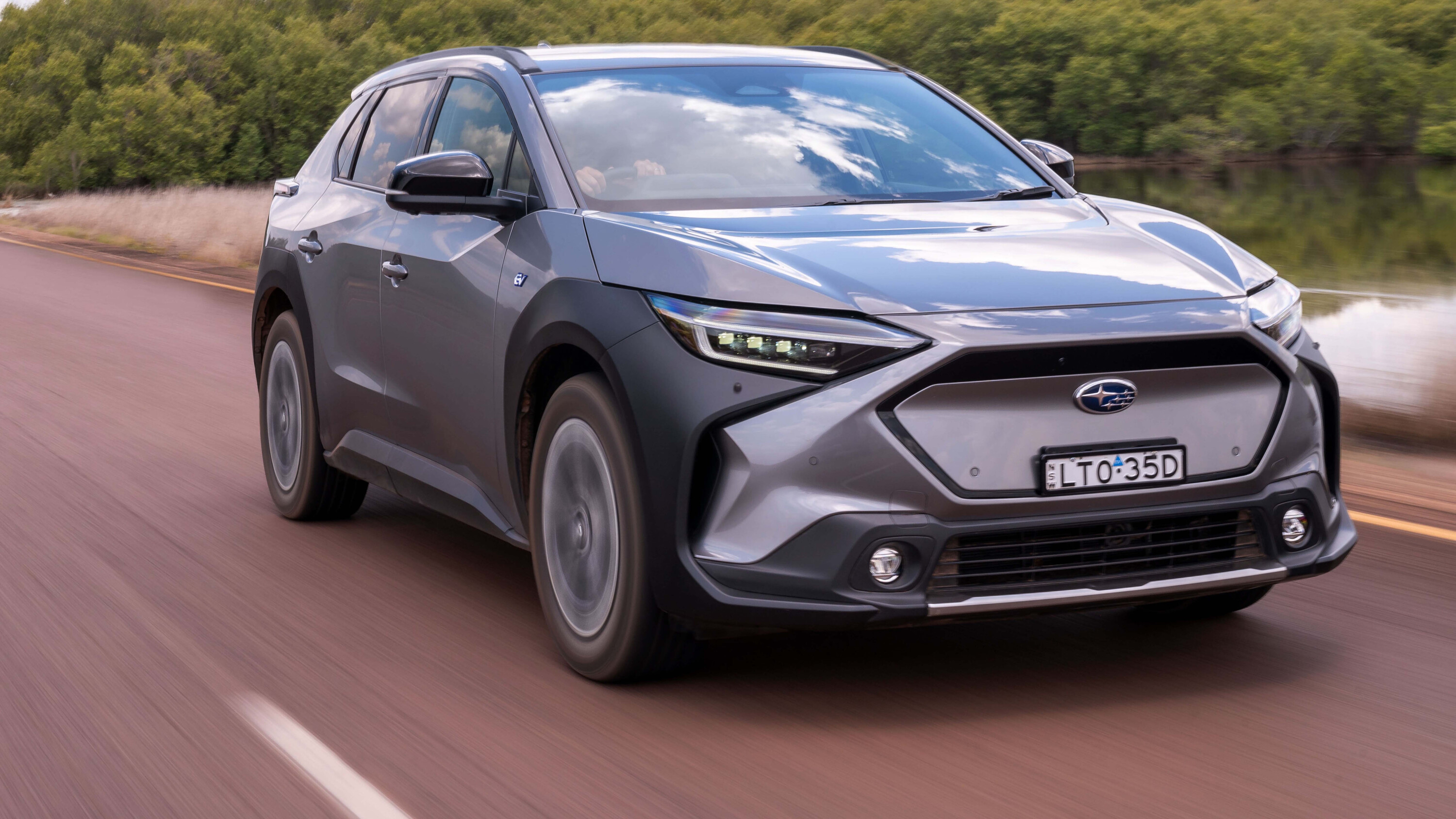
While the rate of acceleration tails off as speeds rise, the initial surge is enjoyable and maintaining a set speed on undulating country roads is a cinch even without using cruise control.
As also typical of EV driving experiences, the brake pedal can be regularly ignored for slowing the Solterra by using regenerative braking.
The level of regen can be adjusted via paddle levers behind the steering wheel, with the most noticeable effect coming in the higher levels. The highest is called S Pedal and claimed to offer one-pedal driving, though we found the Solterra never came to a complete stop when lifting off the accelerator, always requiring a foot on the brake pedal to prevent the car from rolling into the vehicle ahead.
VERDICT
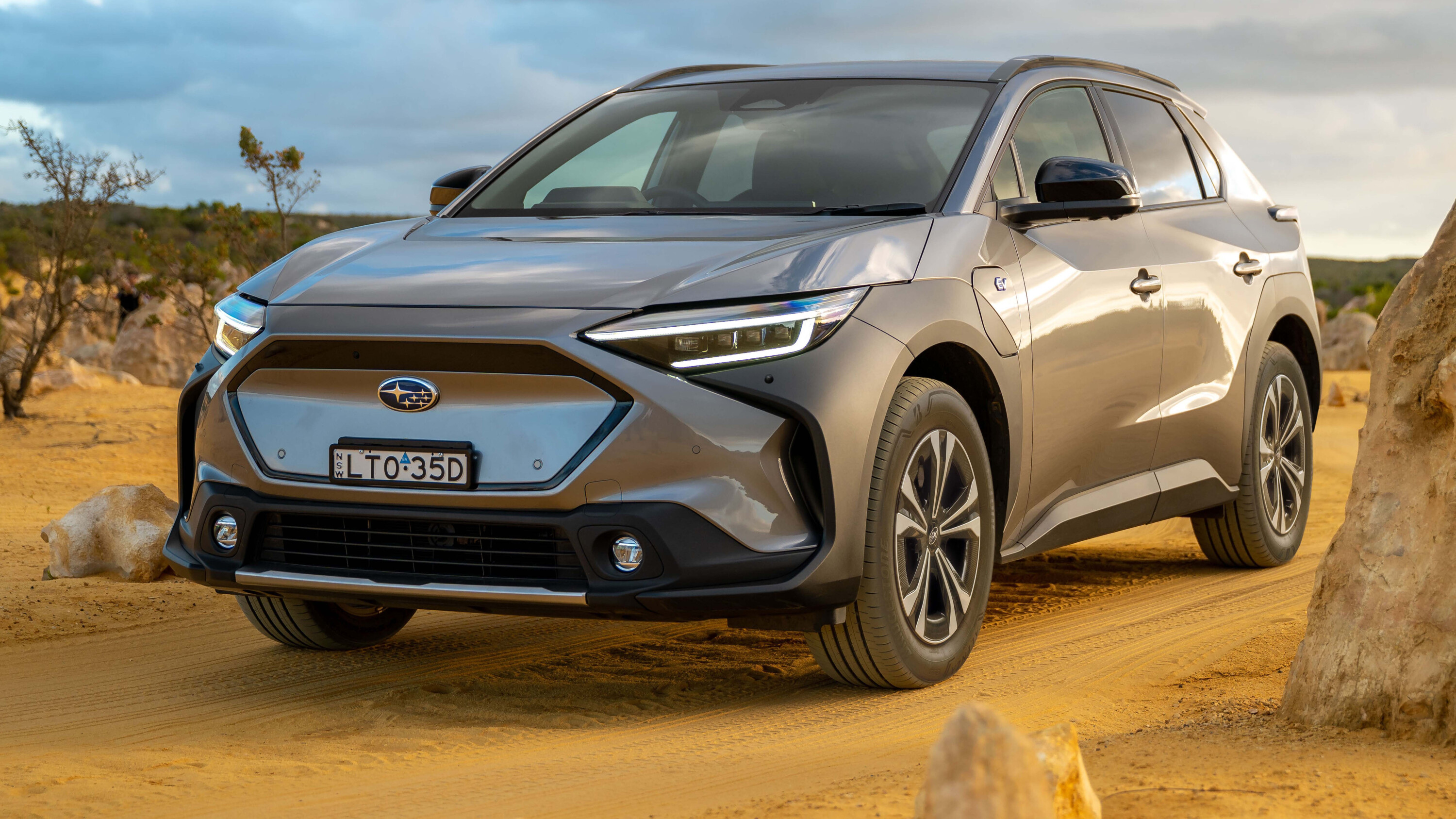
Importantly, despite the Toyota JV, there’s some Subaru character to be found in the Solterra beyond its AWD chassis.
That will mean more to the brand’s famously loyal customer base, though both first- and long-time buyers are sure to appreciate the electric drivetrain that ensures effortless – if not rapid – motoring.
For now, it’s also the closest buyers can get to an electric Forester, complete with some light-duty off-roading ability.
An upcoming Wheels comparison test will provide a more definitive picture of where the Solterra stands in a fast-growing segment. First impressions are that it’s a good first electric effort from the Japanese brand that sets a new benchmark for AWD pricing if little else.
A limited-edition Club Spec variant will return to the Subaru WRX line-up from April, again bringing a range of sporty upgrades.
Subaru Australia has for now revealed only a single indicative image of the 2024 WRX Club Spec SE sedan that will reintroduce a badge last used in 2020 with the then outgoing fourth-generation ‘Rex’.
The Club Spec will again be limited to 150 units, though the image is otherwise the only clue to what to expect until more details are released.
Red Brembo brake calipers are clearly visible, repeating one of the extra features of the previous Club Spec.
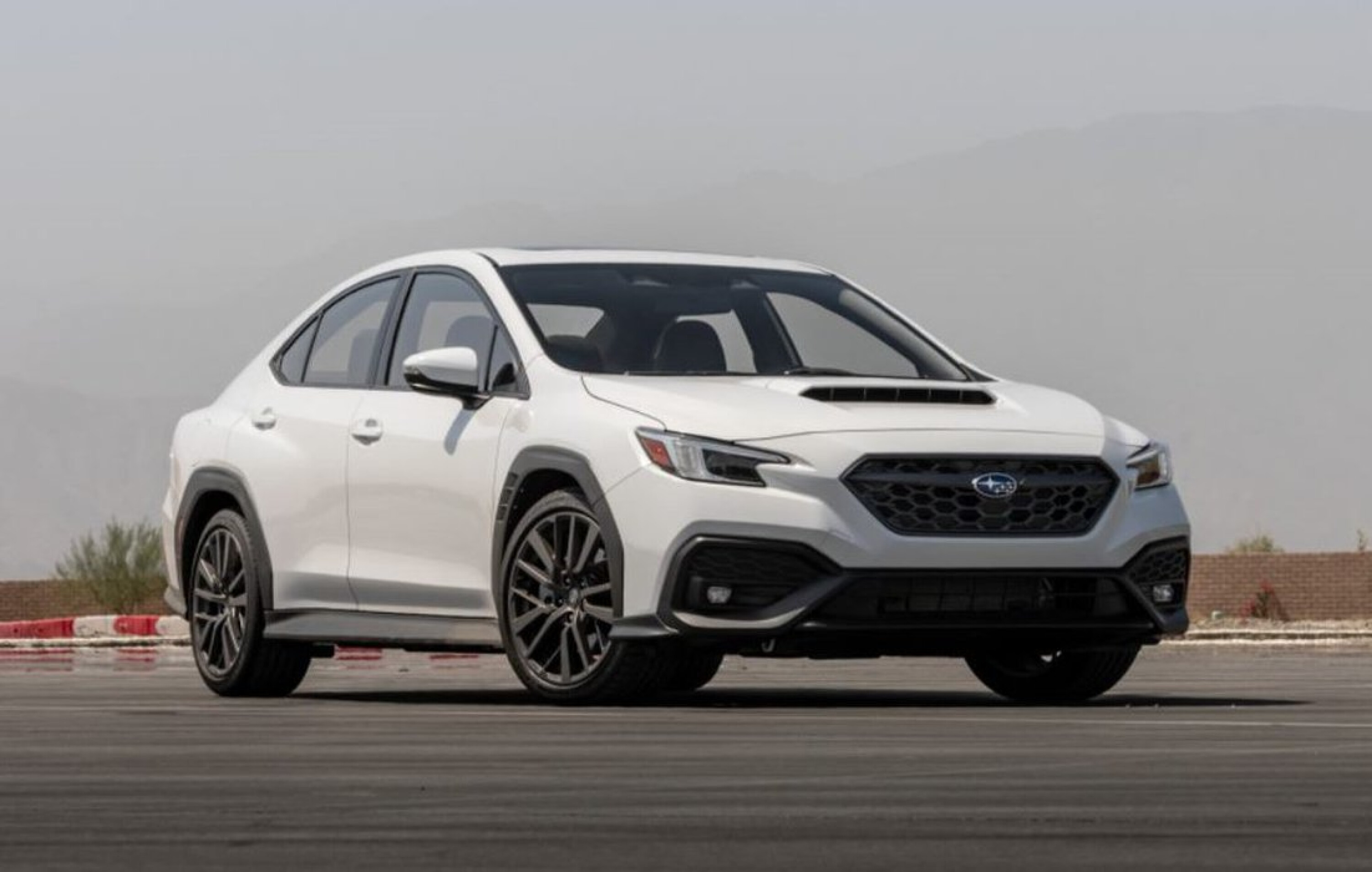
Above: Regular Subaru WRX
The dark alloys with an intricate double-Y-spoke design are also new to the WRX range, while there’s no missing the STI-style rear wing for the latest iteration of the famous performance sedan.
Cabin upgrades can also be expected considering the last Club Spec ramped up the sportiness with Recaro sports seats, STI steering wheel in ultrasuede, and a carbonfibre-look instrument panel.
As with the previous Club Spec, no changes are expected to the 202kW/350Nm 2.4-litre turbocharged four-cylinder ‘boxer’ engine.
The 2020 WRX Club Spec was priced from $47,990, $7500 above the entry point to the WRX range. The current WRX, launched in 2022, starts from $45,990 in sedan form, or $50,990 in wagon form, though the Club Spec is anticipated for the former only.
Unlike 2020, a more powerful WRX STI variant is not currently offered.
The 2024 Lexus LBX hybrid light SUV – the luxury relative to the Toyota Yaris Cross – has been priced for Australia.
Lexus Australia has confirmed the new LBX will start from $47,500 before on-road costs – undercutting the most affordable Mercedes-Benz and BMW hatchbacks sold locally but not the cheapest Audi A1.
It will be available in Luxury and Sports Luxury variants, with the latter variant priced between $52,990 and $56,990 before on-road costs.
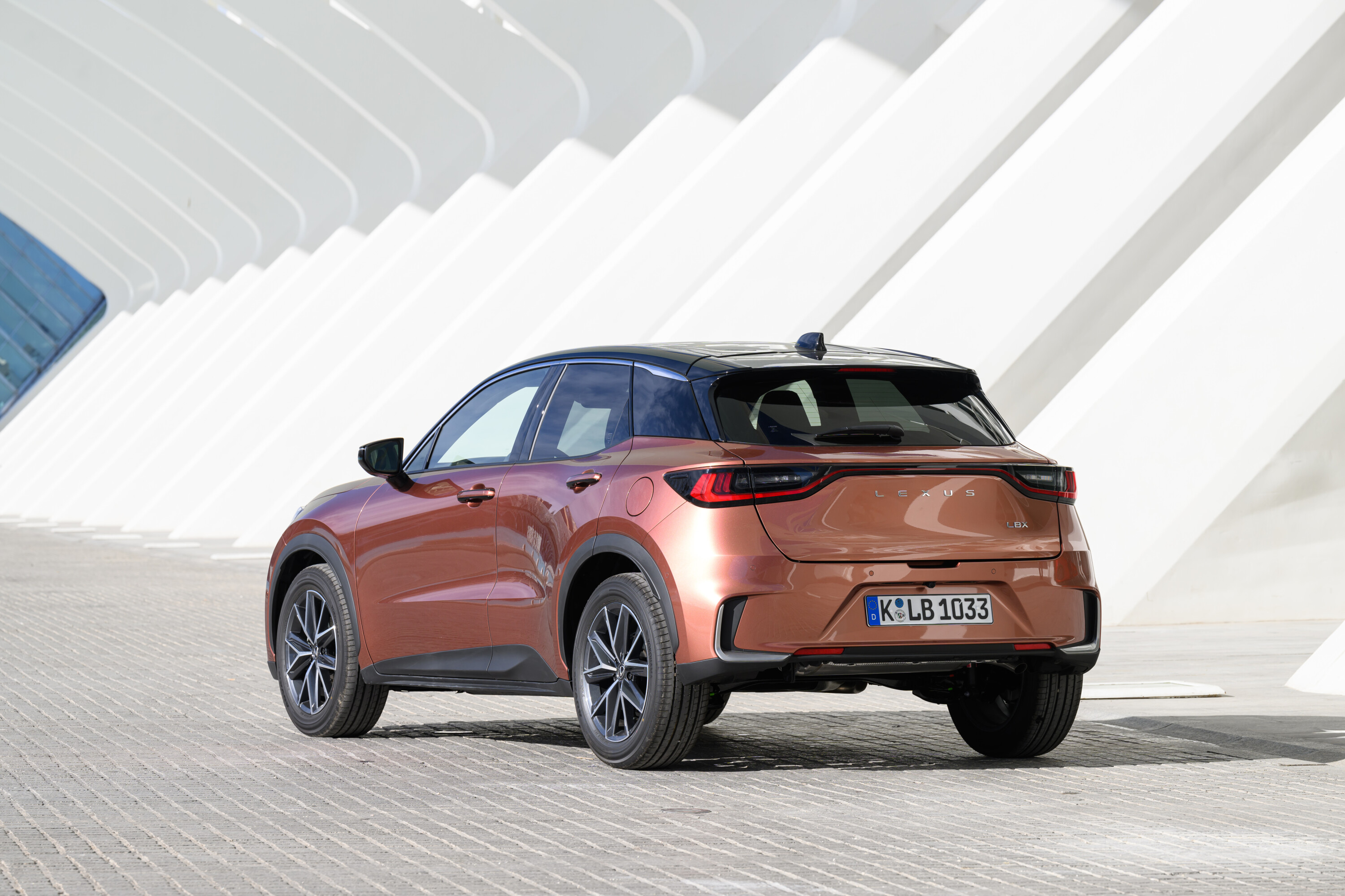
Meaning ‘Lexus Breakthrough Crossover’, the LBX serve as Lexus’s new entry-level model, slotting below the Toyota Corolla-based UX small SUV and acting as a spiritual successor to the CT200h hatch axed in 2021.
While the Luxury is front-wheel drive only, the Sports Luxury offers AWD with a second motor on the rear axle. All-wheel drive models are fitted with a more sophisticated multi-link rear suspension instead of a torsion beam.
Based on a modified version of the GA-B platform used by the Toyota Yaris and Yaris Cross, the Lexus LBX uses the same 1.5-litre three-cylinder naturally-aspirated hybrid engine but with a more potent electric motor and a larger battery for more performance and additional electric driving range.
It has a 100kW and 185Nm total system output, with a claimed 0-100km/h sprint time of 9.2 seconds.
The LBX does not share any no external panels or interior components with the Yaris or Yaris Cross. Lexus claims it has a lower centre of gravity, wider tracks, shorter overhangs, and more body rigidity.
Measuring 4190mm long, 1825mm wide and 1545mm tall, the LBX is 305mm shorter and 15mm narrower, but 25mm taller, than the one-size-up UX. It rides on a 2580mm wheelbase, with 60mm less between the front and rear axle than the UX.
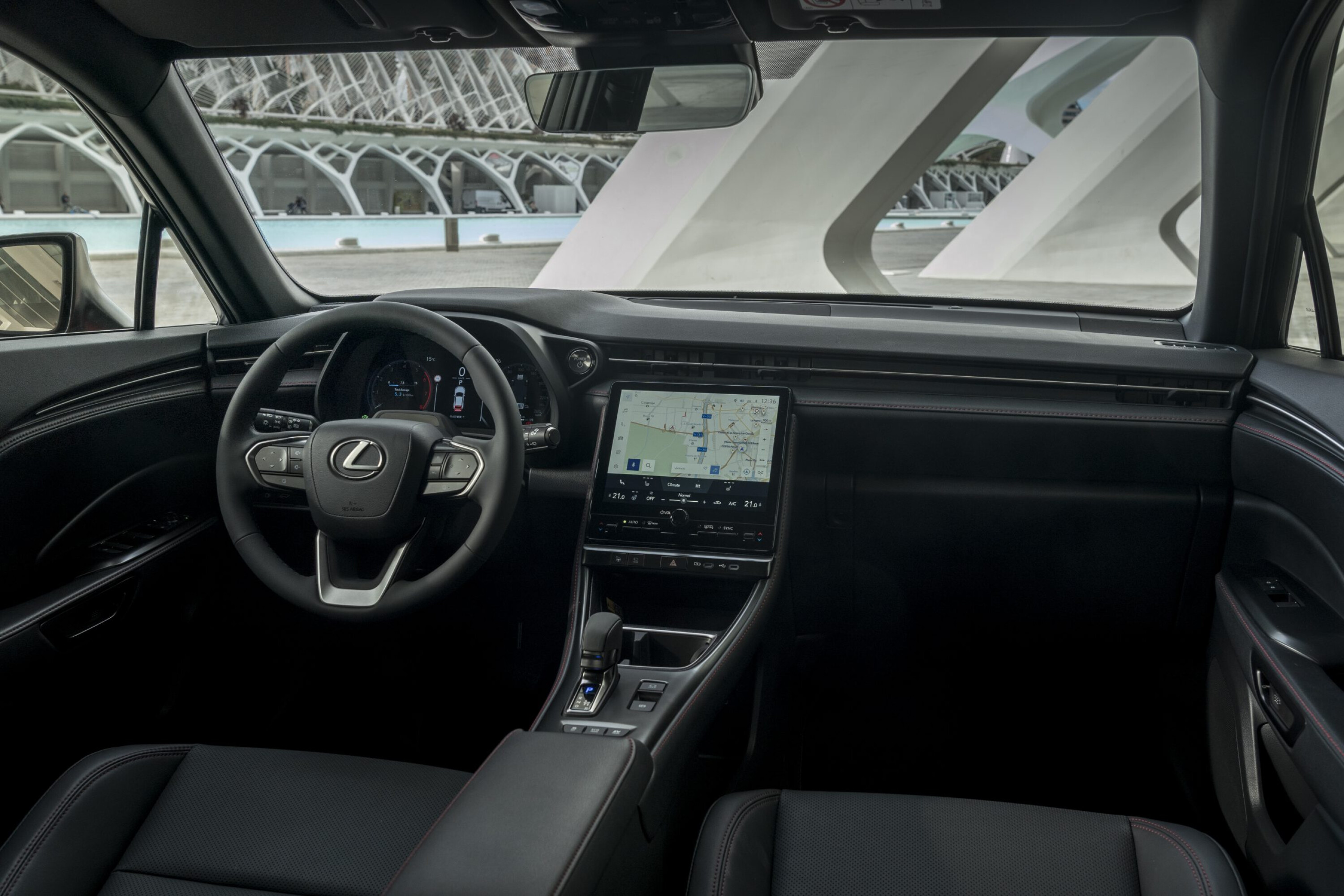
Luggage capacity is rated at up to 332 litres for front-drive variants with the second-row in place.
The 2024 Lexus LBX will launch in Australia on March 18.
2024 Lexus LBX pricing
| Model | Pricing |
|---|---|
| Luxury FWD | $47,550 |
| Sports Luxury FWD | $52,990 |
| Sports Luxury AWD | $56,990 |
| Prices exclude on-road costs.u00a0 |
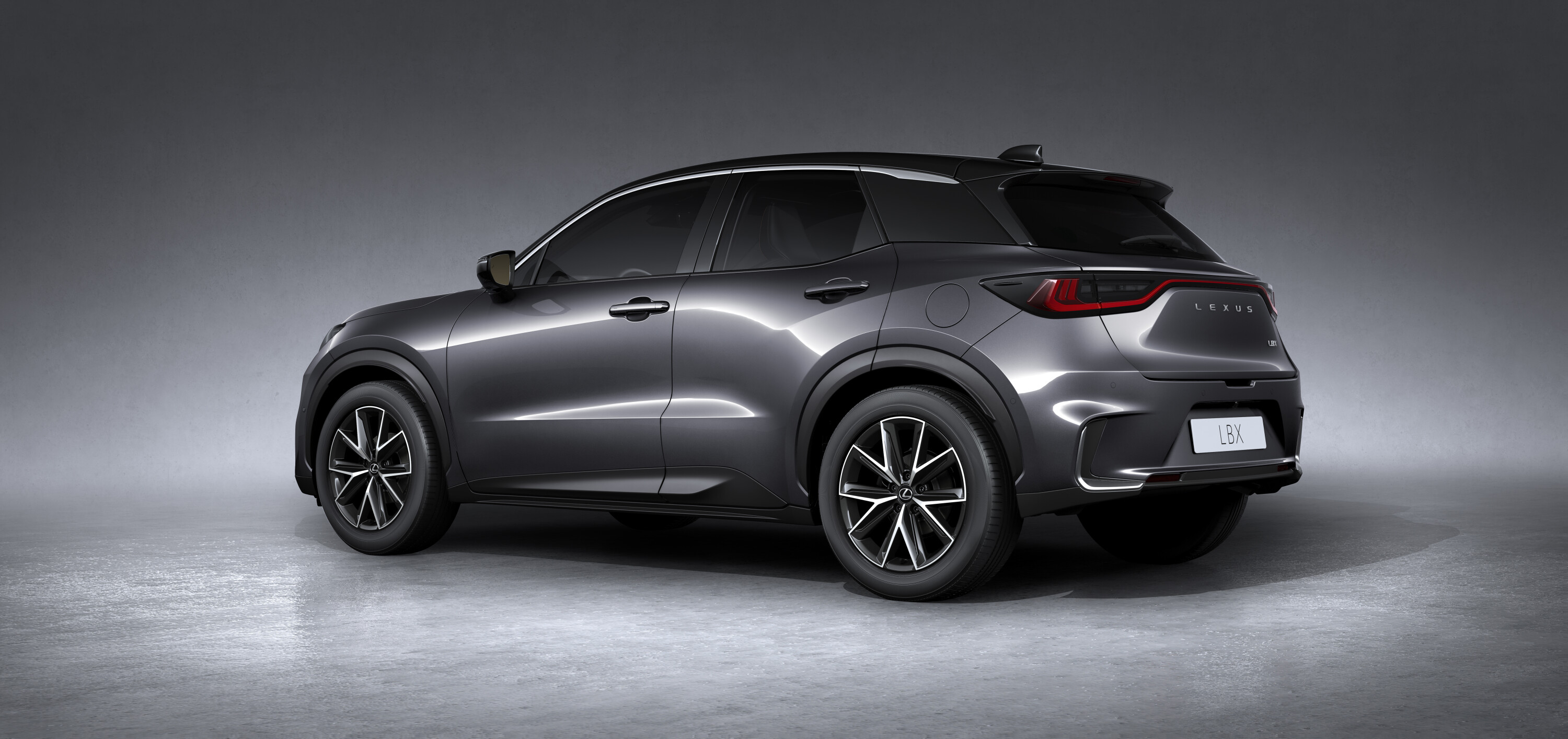
2024 Lexus LBX confirmed features
| 2024 Lexus LBX Luxury features | |
|---|---|
| 18-inch alloy wheels | Heated front seats |
| 9-inch infotainment system | Driver’s seat memory |
| Wireless Apple CarPlay and wired Android Auto | Electric tailgate |
| 12.3-inch digital instrument cluster | Rain-sensing wipers |
| Artificial leather upholstery | 360-degree camera system |
| Power-adjustable front seatsu00a0 | Two-tone paint |
2024 Lexus LBX Sports Luxury features
| In addition to Luxury | |
|---|---|
| 13-speaker Mark Levinson sound system | Automatic parking system |
| ‘Ultrasuede’ and leather-accented seats | Active noise cancellation |
Introduced into Australia in early 2022, the Mitsubishi Outlander PHEV has seen an array of praise and appreciation from buyers in our Facebook comments. After spending the weekend in the base ES model, it’s easy to understand why.
Plug-in hybrid electric vehicle (PHEV) versions of the Outlander combine an internal combustion engine with an electric motor, allowing it to be powered by both electricity from an external power source and petrol.
Let’s take a look into what the ES has to offer and more importantly, what helps it to stand out.
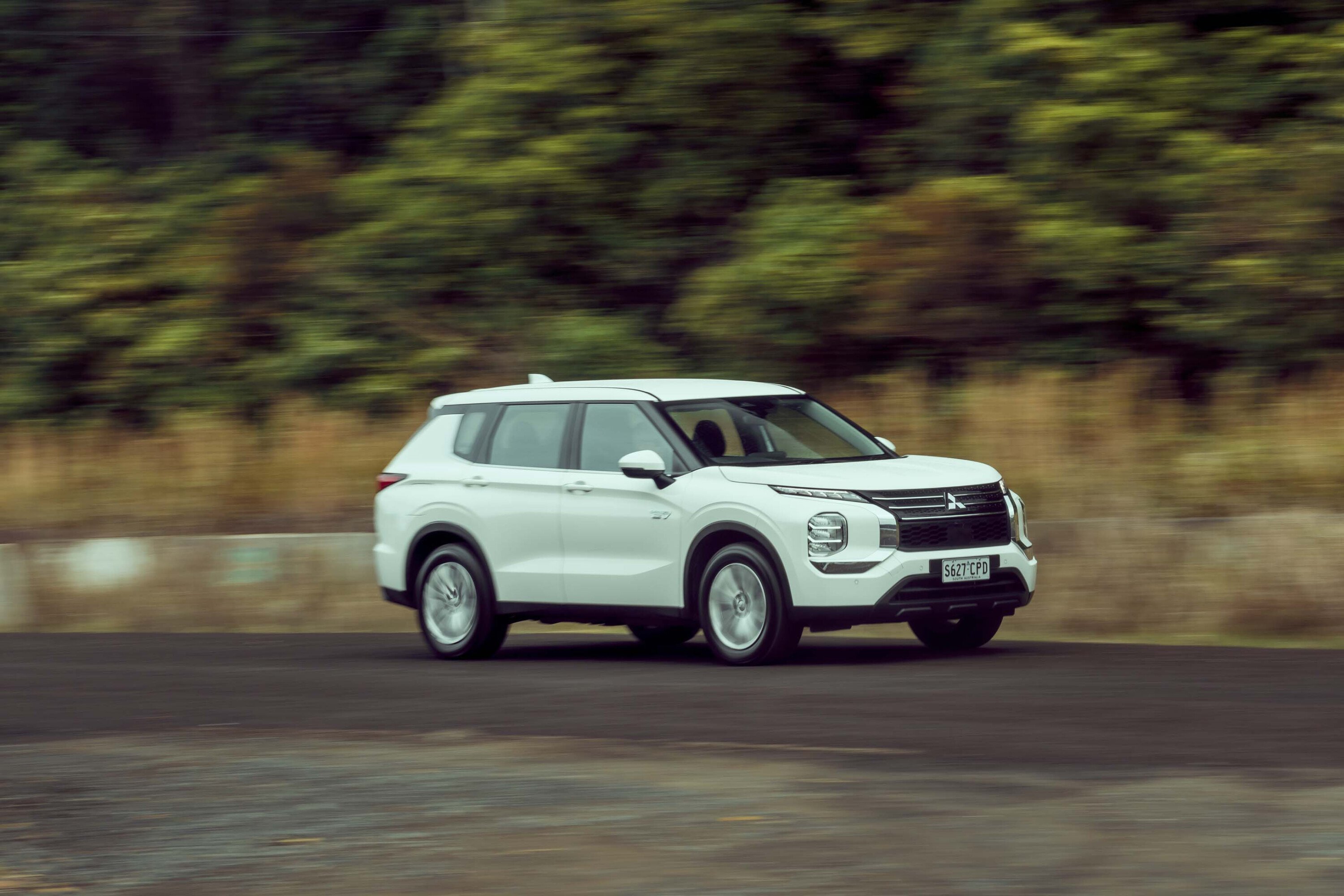
Pricing and features
First impression of the ES was that it didn’t feel like your typical base grade model. There were quite a few additions that made the interior feel a bit more premium. This might be partially attributed to the $57,290 before on-road costs price-tag.
The additional $17k above the petrol AWD model can be naturally attributed to the PHEV technology, but the sprinkle of a few extra features have been added to help ease the jump as well. This includes things like a larger driver information display (7 vs. 12.3-inch), automatic high beam, increased touchscreen size (8 vs. 9-inch), wireless Apple CarPlay and built-in satellite navigation.
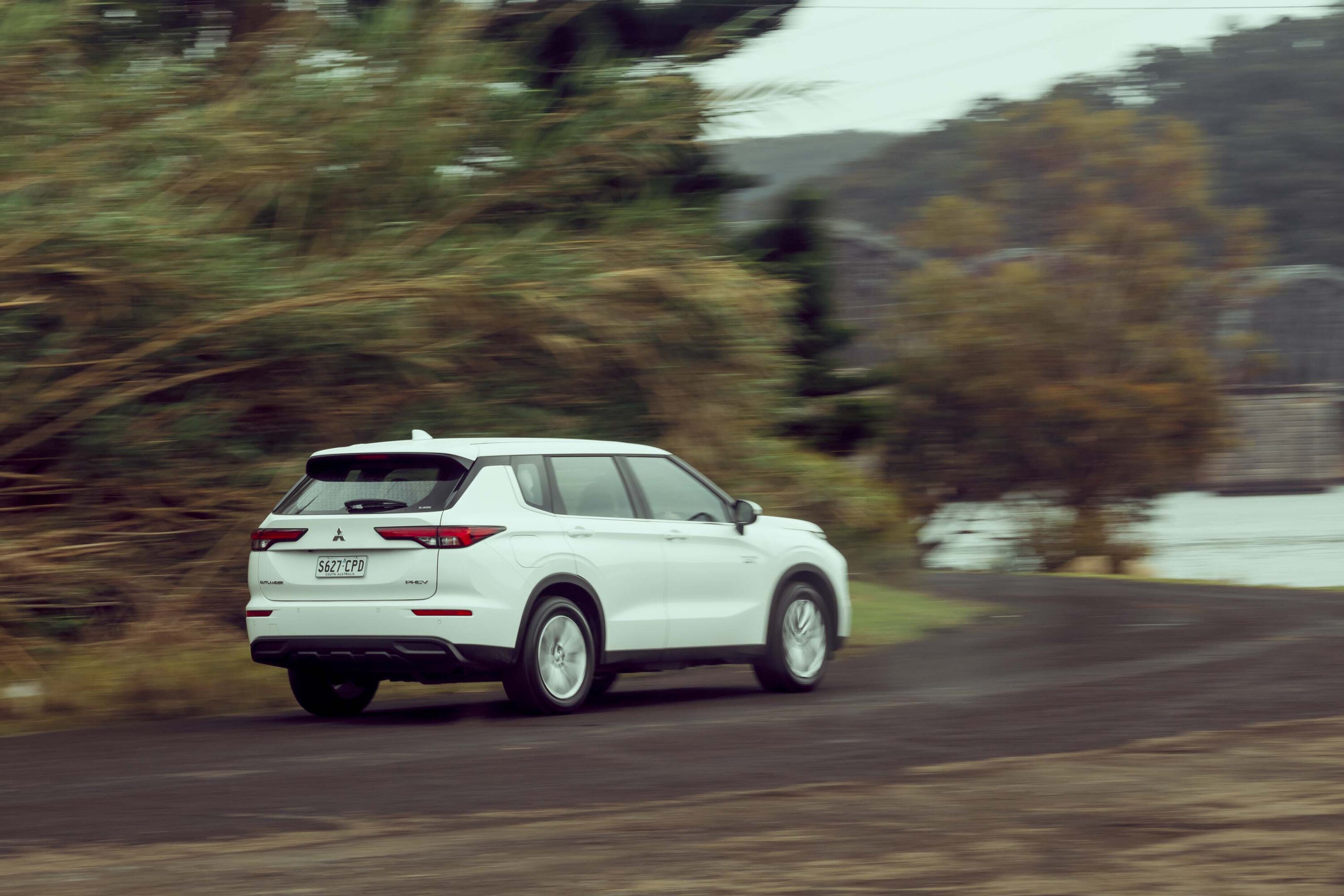
Total combined outputs for both the 2.4-litre engine and the electric motors are 185kW and 450Nm, way more performance than the petrol version, which produces 135kW and 245Nm.
According to Mitsubishi you can get an electric-only range of about 84km which means a nightly charge at home could be enough for most for daily commutes. Our digital editor Alex Inwood was able to assess real world consumption figures during his long-term loan.
It also removes the paranoia and range anxiety that comes with running low on range and not being close enough to a charger. When running low on battery range the vehicle also had the option to have the engine focus on charging the battery– an additional peace of mind if you’re prioritising a hybrid drive.
| 2024 Mitsubishi Outlander Plug-in Hybrid ES features | |
|---|---|
| 18-inch alloy wheels | Dual-zone climate control with rear air vents |
| LED headlights and daytime running lights | Cloth upholstery |
| 9.0-inch touchscreen infotainment system | Urethane steering wheel |
| Wireless Apple CarPlay | 40:20:40 split fold and reclining second-row seat |
| Wired Android Auto | Hill descent control |
| DAB+ digital radio | Terrain control |
| Six-speaker sound system | Trailer stability assist |
| 12.3-inch digital instrument cluster | Mode 2 and Mode 3 charging cables |
| Keyless start | |
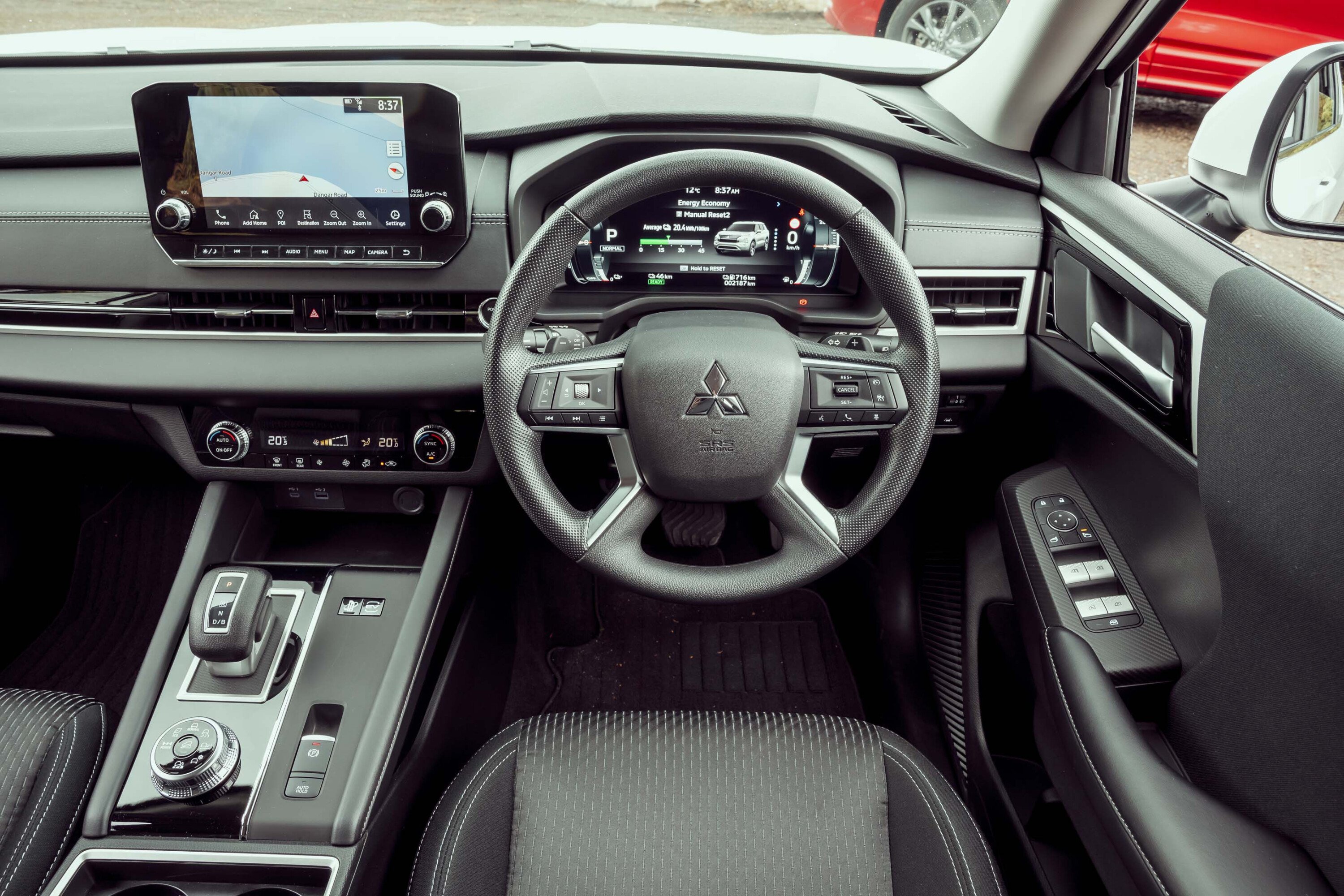
Inside, the cabin exudes a modern vibe with an intuitively organized layout. The inclusion of Wireless CarPlay in an “entry-level” car is warmly welcomed, but the absence of keyless entry at this price point is disappointing.
Moving to the back seats, rear passengers enjoy generous leg and headroom, complemented by expansive square windows that offer panoramic views, although the narrowness of the rear window from the driver’s perspective may be a drawback.
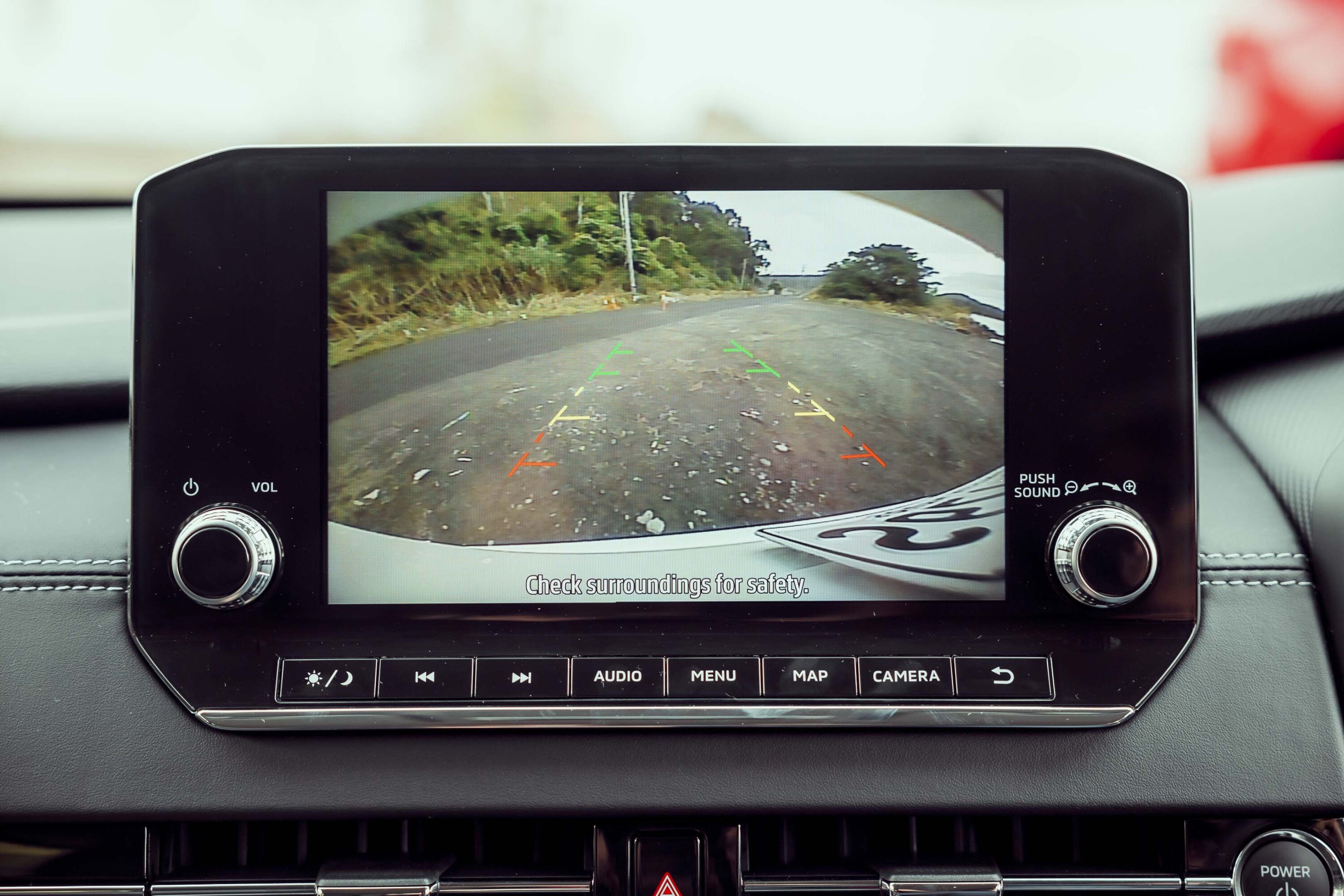
Notably, the reverse sound chime catches attention with its uniqueness upon initial hearing– which is actually beneficial as it ensures people take notice– and you get used to people watching you reverse.
Safety
Following the Mitsubishi Outlander lineup, the PHEV ES model boasts a five-star ANCAP safety rating.
It received scores including 83 percent for adult occupant protection, 92 percent for child occupant protection, 81 percent for vulnerable road user protection, and 83 percent for safety assist.
The ES comes equipped with a comprehensive list of safety features such as:
- Eight airbags
- AEB with pedestrian, cyclist and reversing detection
- Emergency lane assist
- Lane-departure warning
- Blind-spot warning
- Rear cross-traffic alert
- Automatic high beam
- Traffic-sign recognition
- Driver-fatigue monitor
- Adaptive cruise control
- Front and rear parking sensors
Key rivals
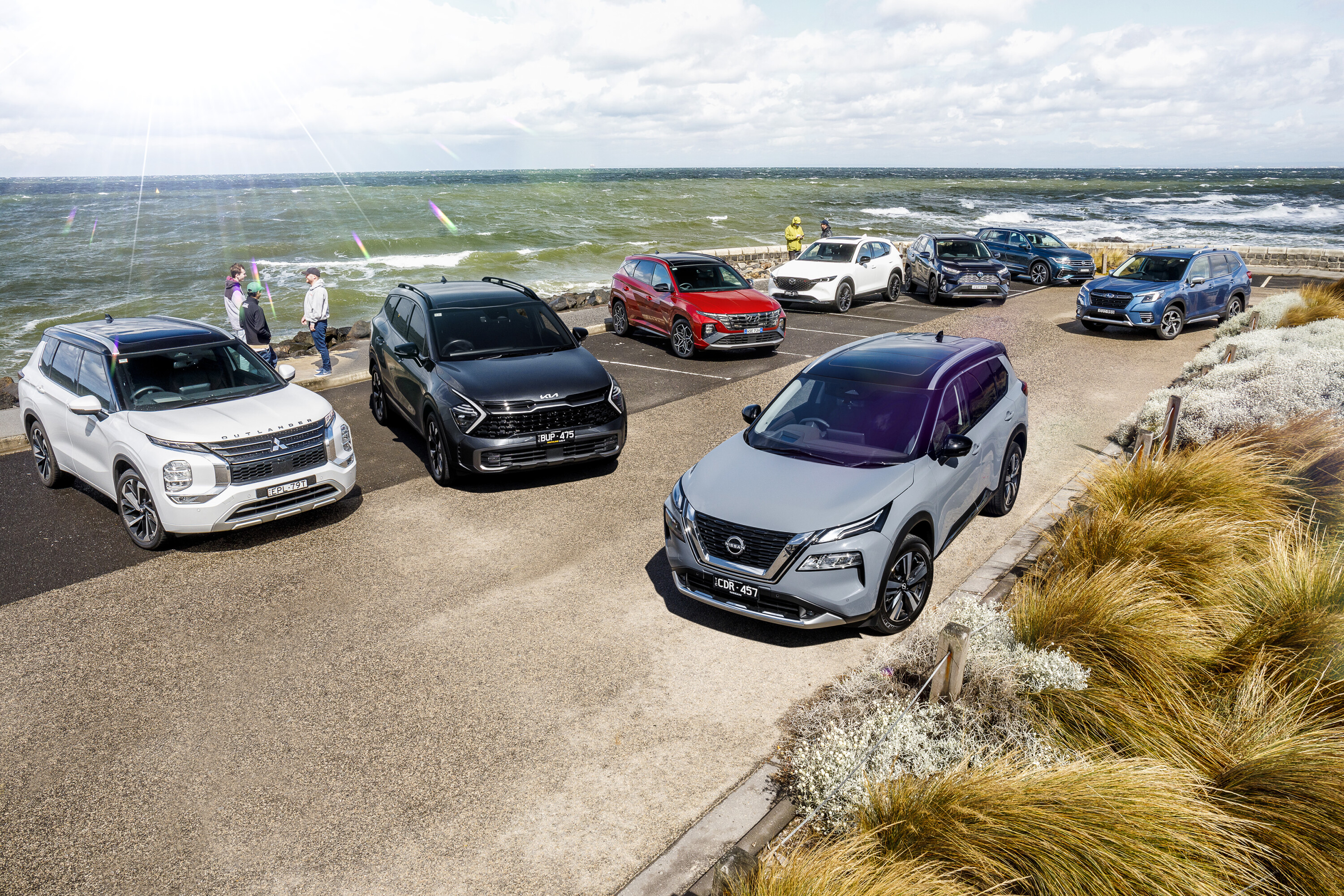
There aren’t a heap of plug-in hybrid options in the SUV realm, but in terms of economical vehicles to cross shop, one might consider:
- Toyota RAV4 (hybrid)
- Nissan X-Trail (e-POWER)
- MG ZS (PHEV)
Should I put it on my shortlist?
When considering the cost, plug-in hybrids struggle to justify their higher price compared to conventional internal-combustion alternatives, including the Mitsubishi Outlander PHEV ES.
While the savings at the pump may not immediately offset the initial investment, those prioritising driving experience and emission reduction may find value in the Outlander PHEV’s responsiveness and quiet operation, especially in urban driving.
However, the base ES model lacks some expected features and safety assistance equipment, making the upgrade to the Aspire variant, despite its added cost, a worthwhile consideration for those seeking additional amenities.
Overall, for drivers desiring an EV experience without the hassle of frequent recharging and long-distance travel, the Outlander PHEV ES stands as a practical recommendation.
Snapshot
- Ioniq 5 N Line adds sporting looks
- Battery upgraded to 84kWh
- Interior styling tweaks, new infotainment
- Body improvements for better ride and cabin ambience
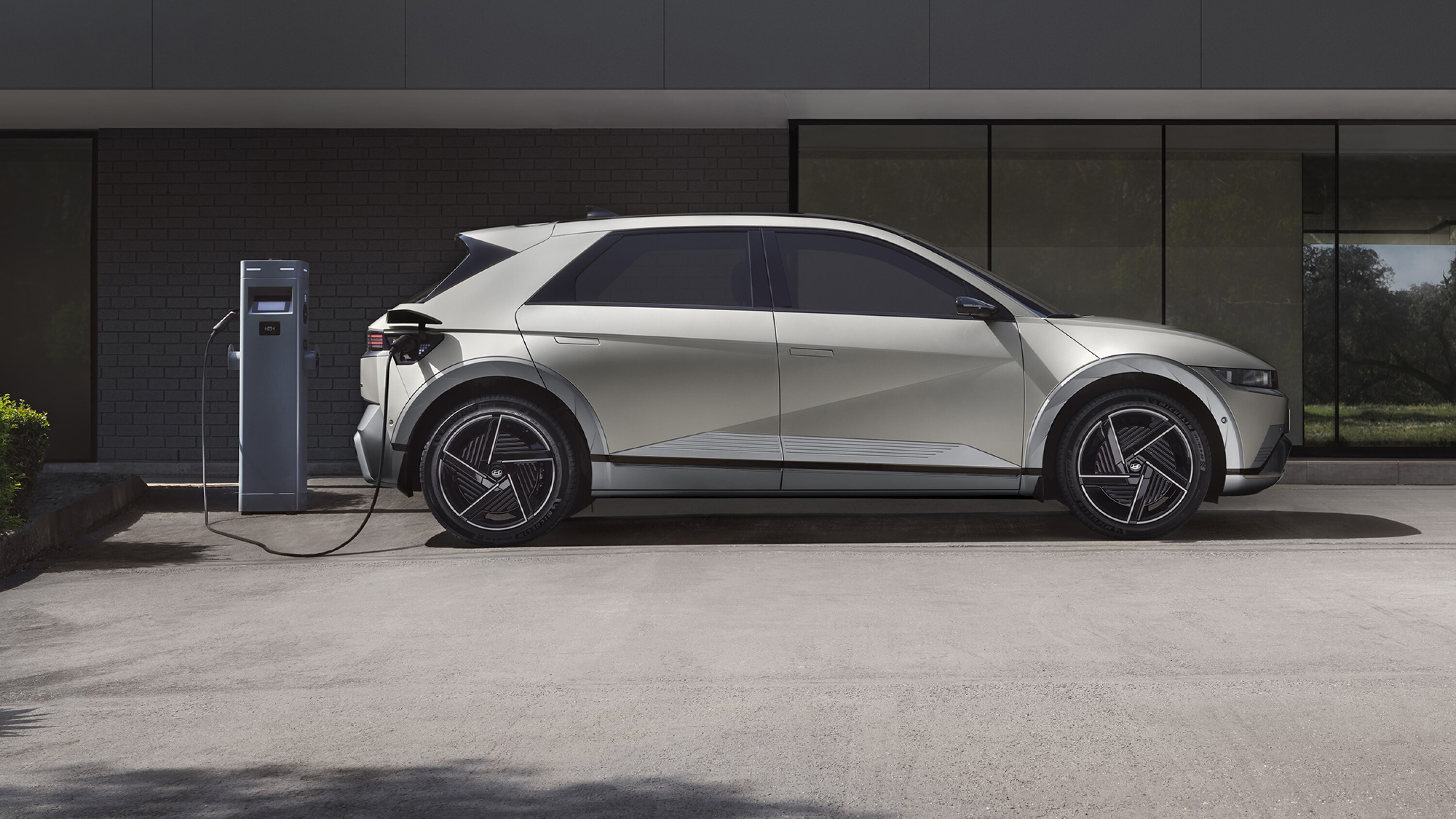
Hyundai’s big Ioniq 5 electric SUV will welcome a sports-styled N Line grade this year, arriving in Australia from around the middle of 2024.
A bigger-capacity battery also joins the range, growing from 77.4kWh to the same 84kWh number that features with the hero Ioniq 5 N ‘hot hatch’ EV.
Driving range is subsequently increased, although Hyundai has yet to release new WLTP-confirmed numbers. In its current form, the Ioniq 5 claims 384km of range in its 54kWh base form, while 77.4kWh models list between 454km (AWD Epic) and 507km (RWD Dynamic).
Hyundai hasn’t said how that bigger new battery will be applied to the range, although we could see entry models upgraded to the 77.4kWh unit, while the 84kWh battery goes to the higher-spec variants.
Styling updates
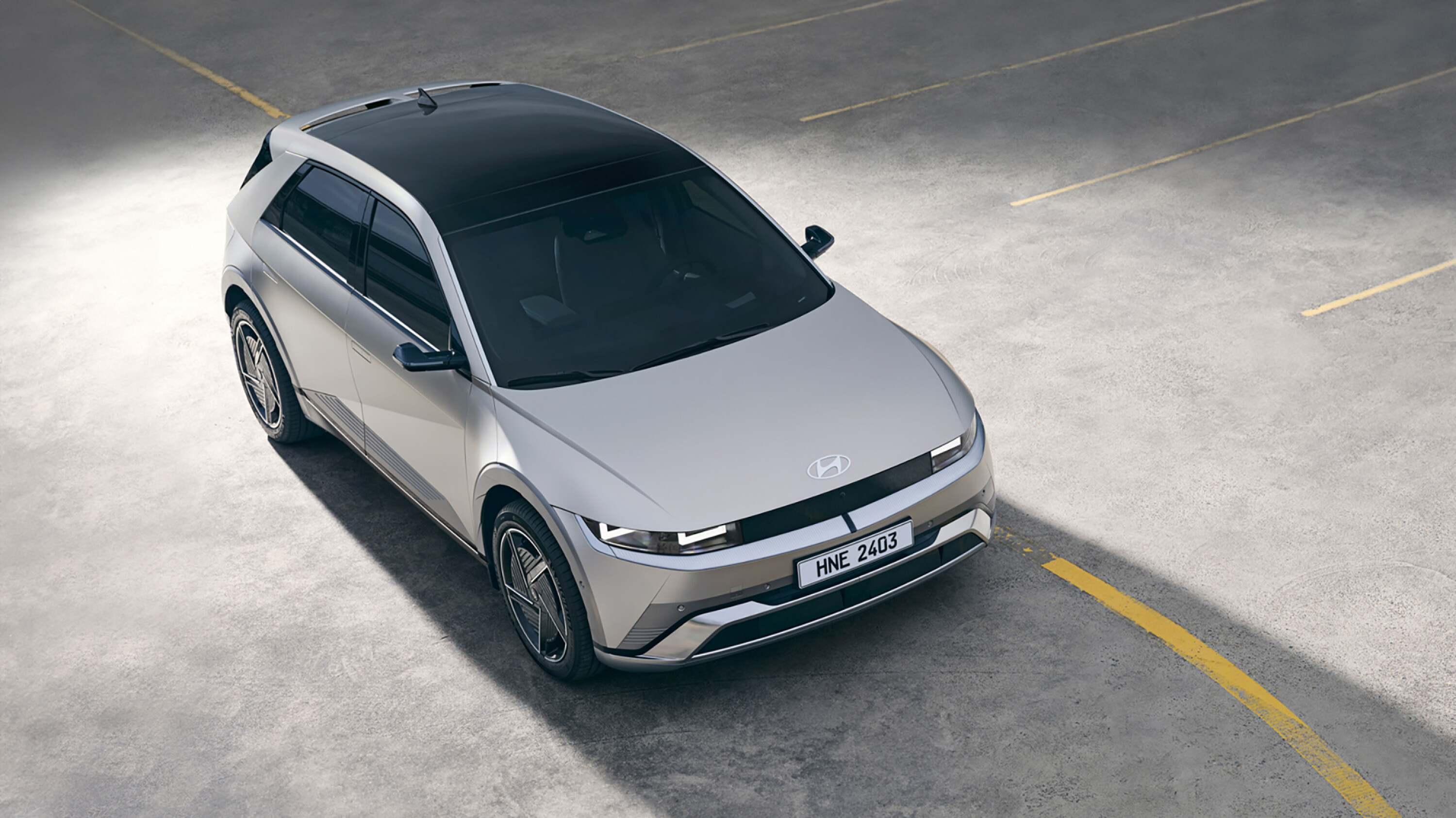
Tweaks inside and out for model year 2025.
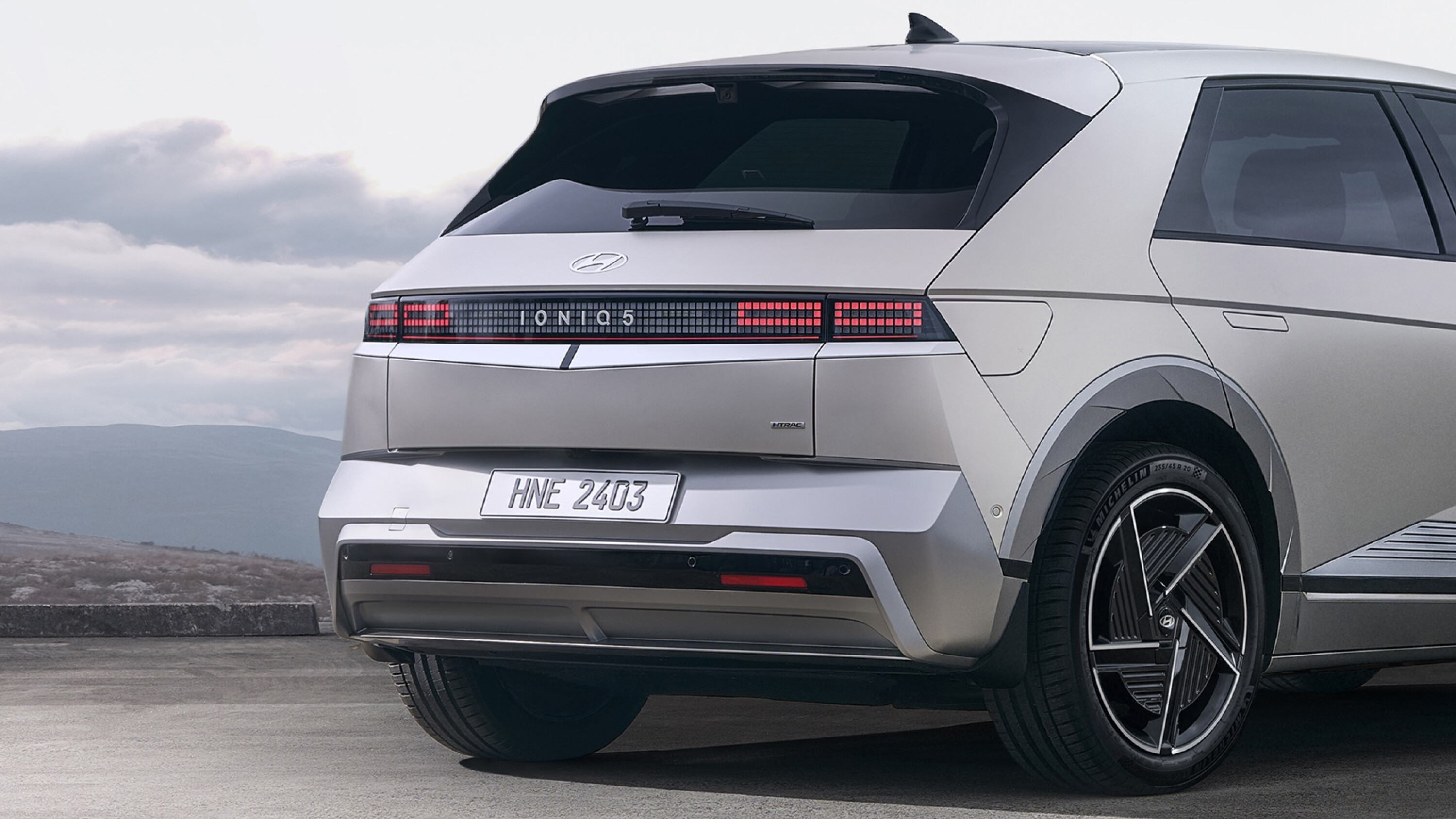
On the outside, the refreshed Ioniq 5 gets a new ‘V-shape’ trim and new-look bumpers at both ends, which also extends the overall length of the car to 4655mm – up 20mm on the previous look. Other dimensions are unchanged, with a 3000mm wheelbase set beneath an overall width of 1890mm and a 1605mm height.
The rear spoiler is also 50mm longer, “to further enhance the IONIQ 5’s dynamic appearance and improve its aerodynamic performance”, the latter also boosted by a restyled wheel design.
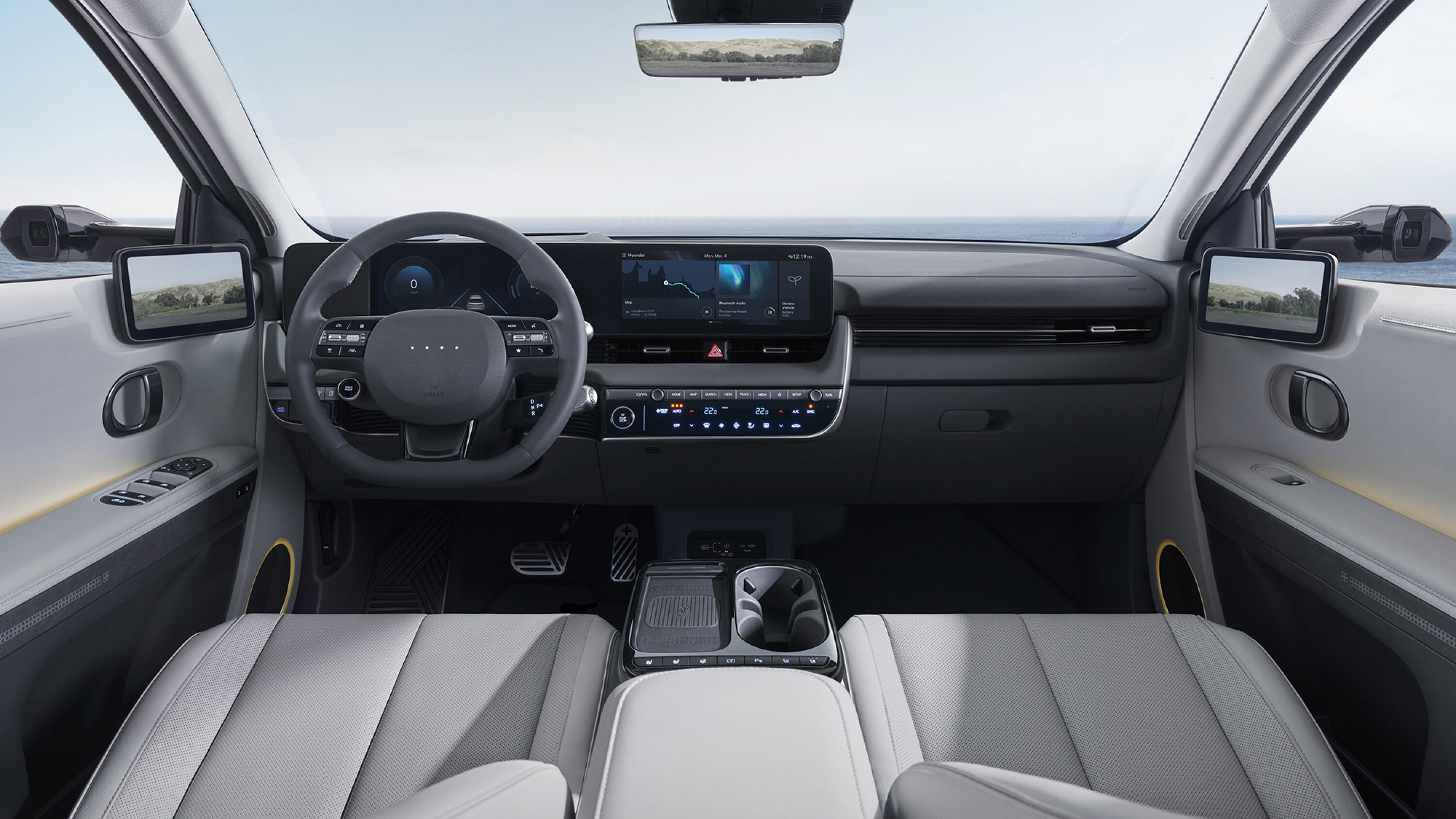
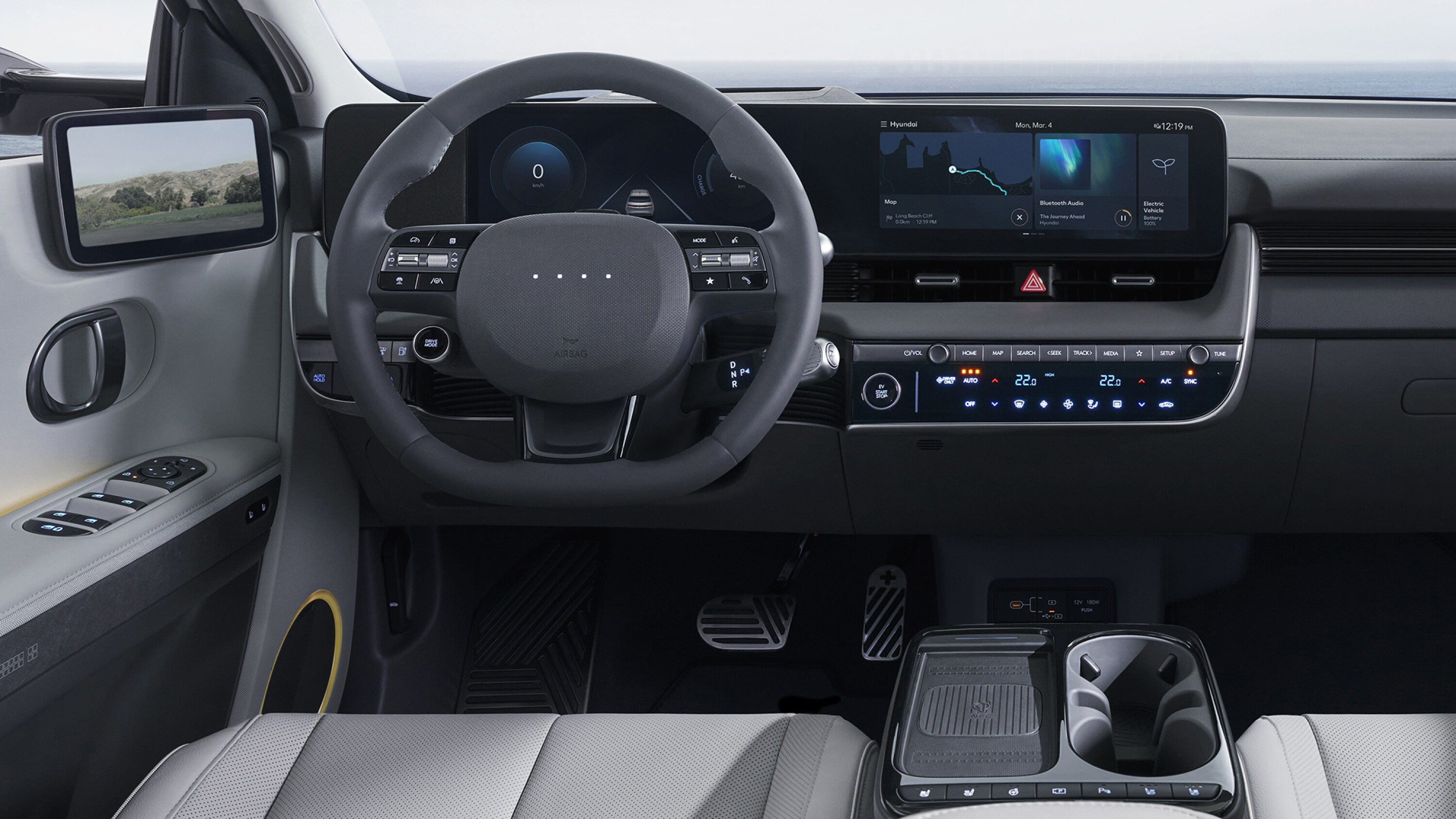
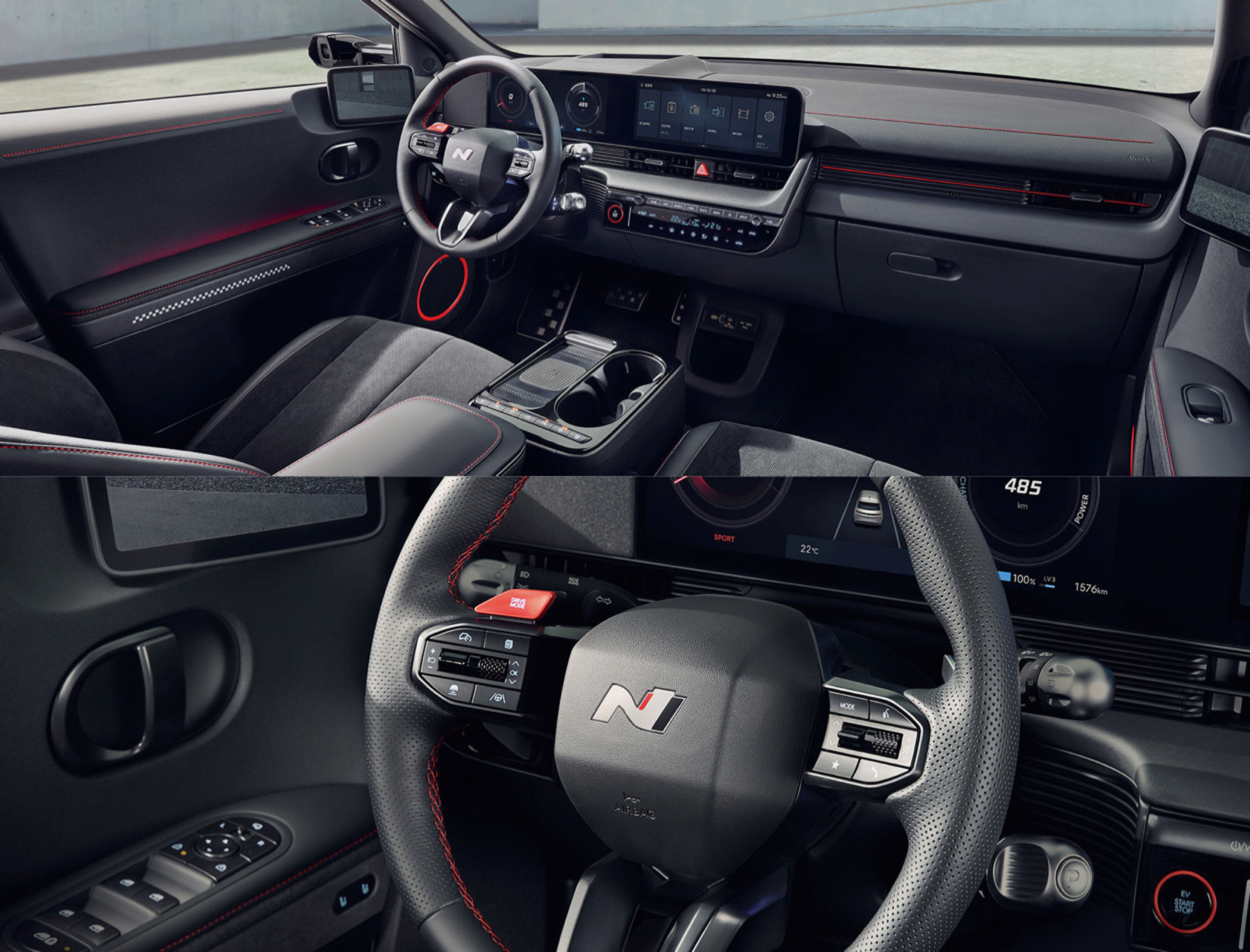
The cabin is largely unchanged, with the most distinct change being a new steering wheel design, new black bezel to the infotainment displays, and a repositioned phone charging pad – now set in the upper level of the centre console for easier access on entry and exit.
This update also brings a new button to the centre console’s “Universal Island” to access frequently used functions like the heated and ventilated front seats, the heated steering wheel, and the parking assist control.
Hyundai’s latest infotainment system arrives with the 2024/25 update, in the form of the Connected Car Navigation Cockpit (styled ‘ccNC’), featuring a new look and over-the-air (OTA) updates for all of the vehicle’s major electronic controls.
Safety
For the new model year, the Ioniq 5 gets structural upgrades, and a number of new assistance functions.
The big EV has received reinforcement works to the body, front and rear doors, and sections of the B-pillar for improved side collision protection. Eight airbags are also featured – up from seven – meaning there’s now second-row side airbags.
Active safety is upgraded with Hands-On Detection, Lane Keeping Assist 2, Remote Smart Parking Assist 2, and Forward/Side/Reverse Parking Collision-Avoidance Assist.
The Korean carmaker says it has also boosted “marketability” of the refreshed Ioniq 5 with the inclusion of Intelligent Front-Lighting System (IFS), Digital Key 2, Built-In Cam 2 and second-row seat remote folding – all described as “customer-preferred features”.
Ride & comfort
A smoother ride and greater overall quietness.
Buyers of the MY25 Ioniq 5 will be treated to a new shock absorber and a more rigid cowl crossbar, both intended to reduce vibrations entering the cabin.
Stability and agility is also claimed to be improved through reinforcements made at the rear wheels and the body’s lower section, while overall strengthening upgrades promise to reduce low-frequency booming noises.
Interior ambience will also benefit from optimised motor noise control and more insulation at the rear motor.
Ioniq 5 N Line!
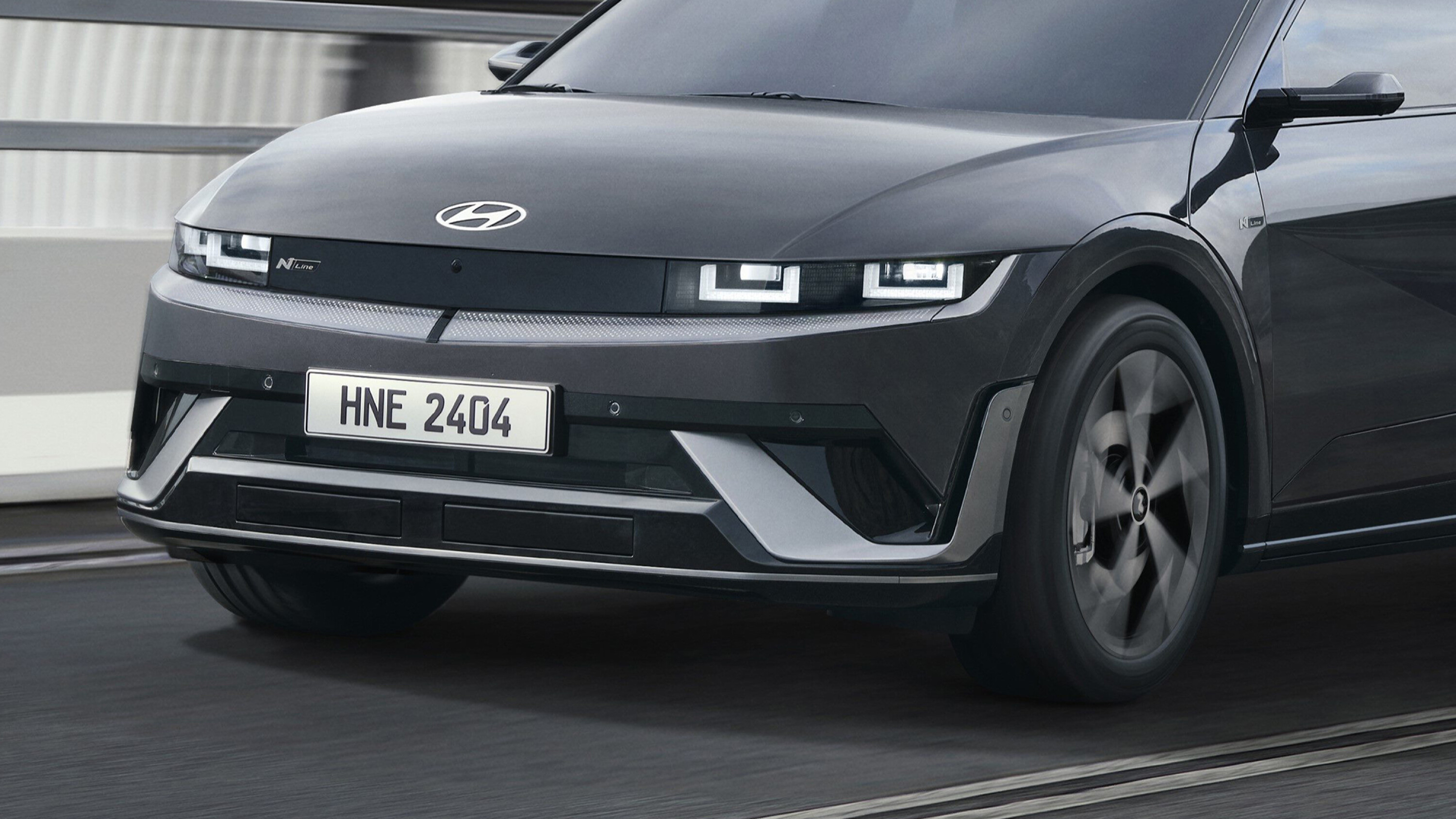
A model grade that should have been available from launch is now finally joining the range, with the Ioniq 5 N Line confirmed at last.
Of course, as with most Hyundai models outside of the i30 range, the Ioniq 5 N Line is largely a styling exercise, gaining a meaner-looking body kit and specific 20-inch aluminium wheels.
Inside, the N Line gets a dedicated steering wheel and dashboard design, along with N Line exclusive metal pedals, black headliner, dedicated sport seats with N logo, red contrast stitching and two seat covering options.
When will the updated Hyundai Ioniq 5 reach Australia?
The enhanced Ioniq 5 and new Ioniq 5 N Line will launch in Australia from around the middle of 2024, with local specs and pricing to be announced closer to launch.
A pickle inspired this story. More accurately, a slice of pickle. It arced through the air from the passenger window of a HiLux just as the filter light turned green, hitting the windscreen of the yellow Ferrari with a fat splat.
I watched it start to slide down the glass before the coefficient of friction arrested it, waiting for me to figure out which of the steering wheel controls operated the wiper.
For a moment I was captivated by that pickle. Not for what it was, or for the fact that whoever threw it would have to negotiate his burger without it, but more for what it represented. It was as much a slice of resentment as a slice of dill.
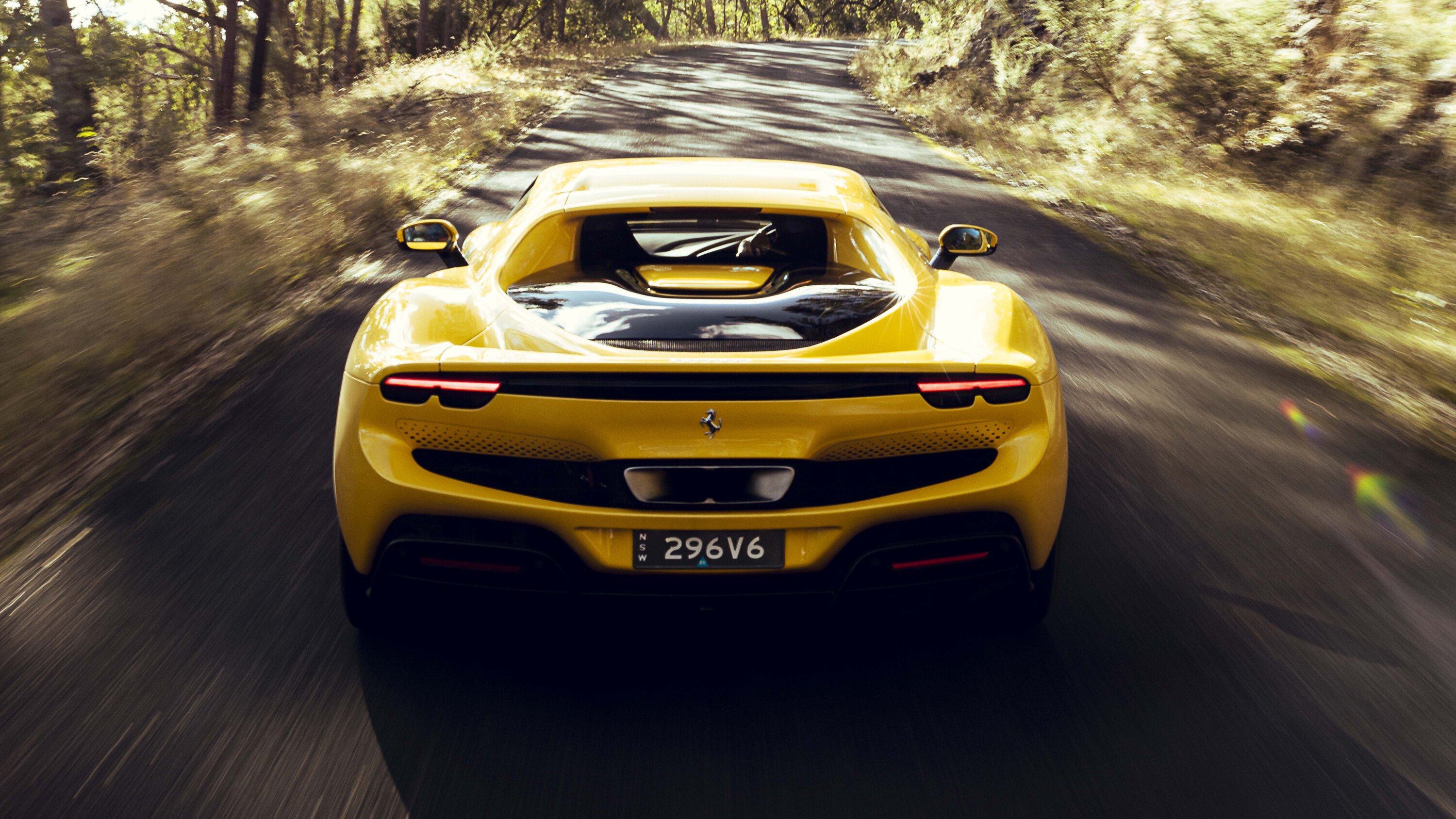
The 296’s acceleration to 200km/h is to a McLaren F1 what a McLaren F1 is to a Porsche 718 Cayman GT4 RS
The car I was driving had provoked such a visceral reaction that, in that moment, I couldn’t quite decide whether that was a good or bad thing. You certainly don’t buy a supercar to be ignored.
The Ferrari 296 GTB isn’t readily overlooked. At the moment it’s the supercar du jour. With 610kW of electrically-boosted power at its elbow, its acceleration to 200km/h is to a McLaren F1 what a McLaren F1 is to a Porsche 718 Cayman GT4 RS: of a wholly different dimension.
It’s worth reminding ourselves that this is the baby, an entry-level mid-engined Ferrari, powered in this instance by a dinky 3.0-litre V6.
It wields that power judiciously. Mat the throttle hard and there’s none of that tarmac-tearing rambunctiousness of a McLaren 720S, at least not away from a standing start.
It’s quick but not Plaid-style concussive. Ferrari has been limiting torque in the lower gears since the introduction of the 3.9-litre F154 turbo V8 in the California T. Whereas that had been quite a subtle way of introducing the Cali’s 755Nm to the rear treads, it’s now far more pronounced, with a surprisingly civil launch process before, battery condition and drive modes allowing, the 296 looses off the full avalanche of Newton metres in third gear.
When I was a kid, the Ferrari Testarossa was for a while, my personal pin-up. I devoured any magazine road test on it, goggling at the outlandish performance figures, trying to process what 18.1 seconds to 200km/h might feel like.
The 296 GTB? Try 7.1 seconds. It’ll accelerate to 200km/h and be back to a standstill before the old stager had lumbered up to 160. By the time the Testarossa was at 200km/h the 296 would be well north of 300.
But here’s the supercar’s current dilemma. While it was once an ultimate, a genre that represented the very extreme of what car manufacturers could envision, that’s no longer the case. The performance of a modern hypercar like a Rimac Nevera would demolish a 296 GTB and by a frankly astonishing margin.
The Croatian EV will get to 200km/h in 4.4 seconds. It’ll accelerate to the imperial double-ton of 200mph in 10.86 seconds; fully 17 seconds quicker than a McLaren F1. Anyway, enough of the numbers. What matters is that the supercar is, by today’s standards, a creature of compromise.
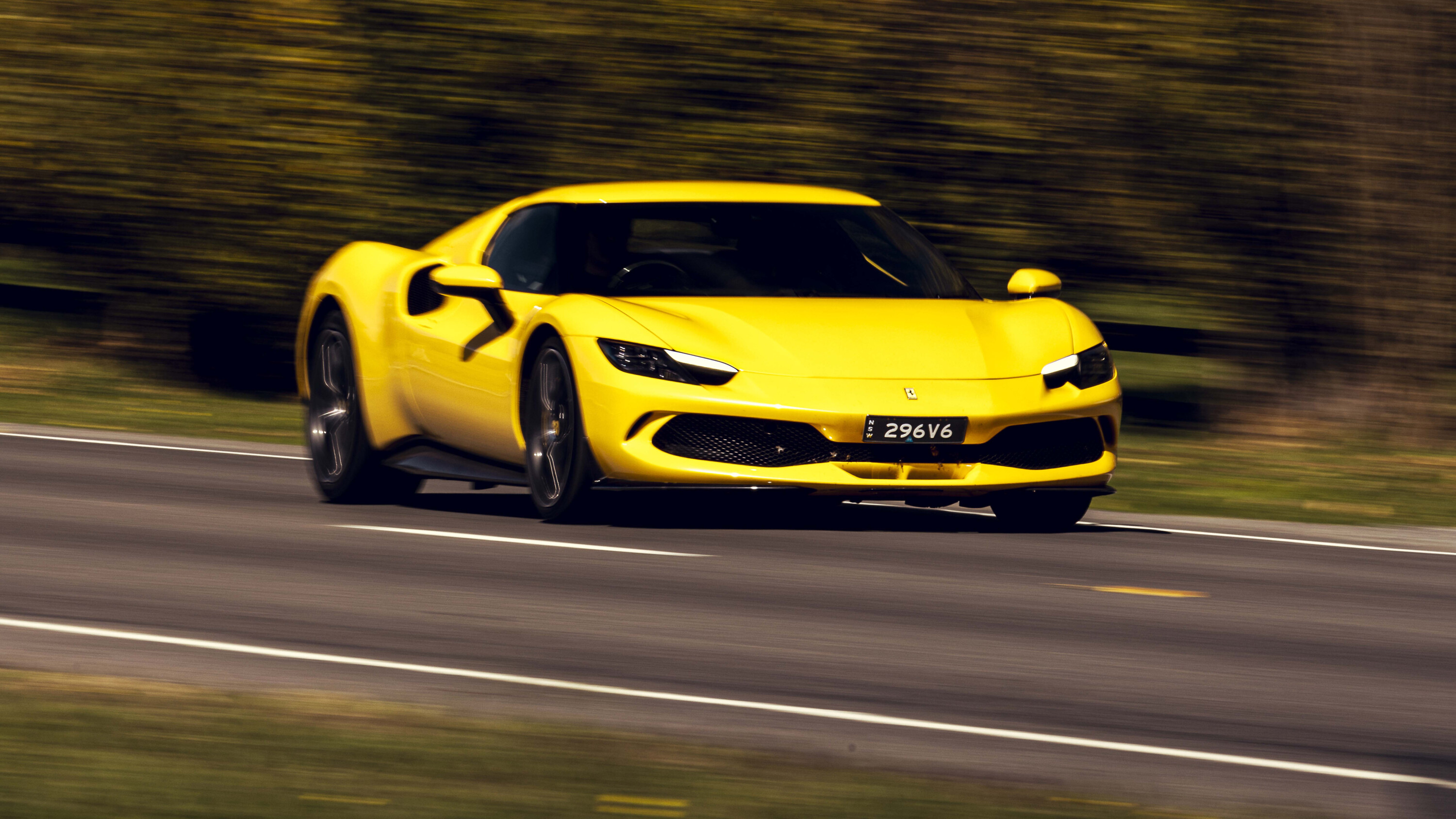
How it became so perhaps merits a little consideration and I lay the blame for that squarely at the feet of the Porsche 959.
Prior to the point that the 959 appeared at the 1985 Frankfurt show, there had been a certain predictable linearity in the development of the supercar. Plot a line through the 1954 Mercedes-Benz 300 SL Gullwing, the 1962 Ferrari 250 GTO, the 1966 Lamborghini Miura and the extended Countach lifespan and you arrive at that mid-Eighties inflection point.
Porsche showed its hand with the 959, Enzo’s knee jerked and the F40 appeared. While the Ferrari, despite the company’s promises of limited numbers, was very much a development of the supercar species. It was like everything that had come before, only more so.
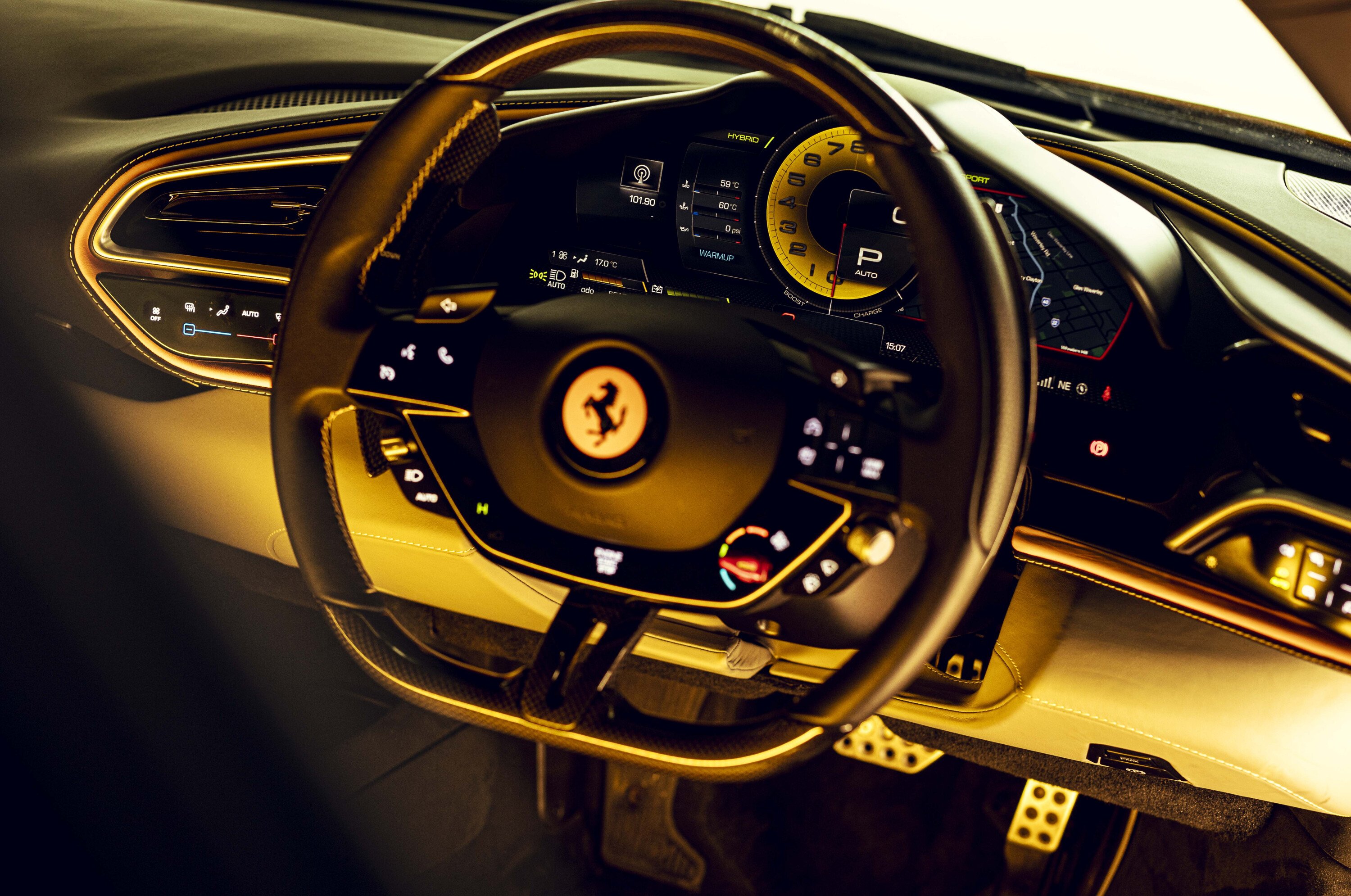
The Porsche was different. It was a performance car the like of which we’d never seen.
With all-wheel drive that featured dynamic torque splitting, composite body and chassis, active aerodynamics and computerised active suspension, it diverged from the path of the supercar, yet at the time few appreciated that significance.
While the supercar line then ascended in steps from the F40 to Lamborghinis Murcielago and Aventador, via McLaren 720S to arrive with this Ferrari 296 GTB, the nascent hypercars adopted the technological focus of the 959. Five years after the 959 was unveiled, the astonishing Bugatti EB110 followed, with its 60-valve V12 fed by four turbochargers and driving four wheels.
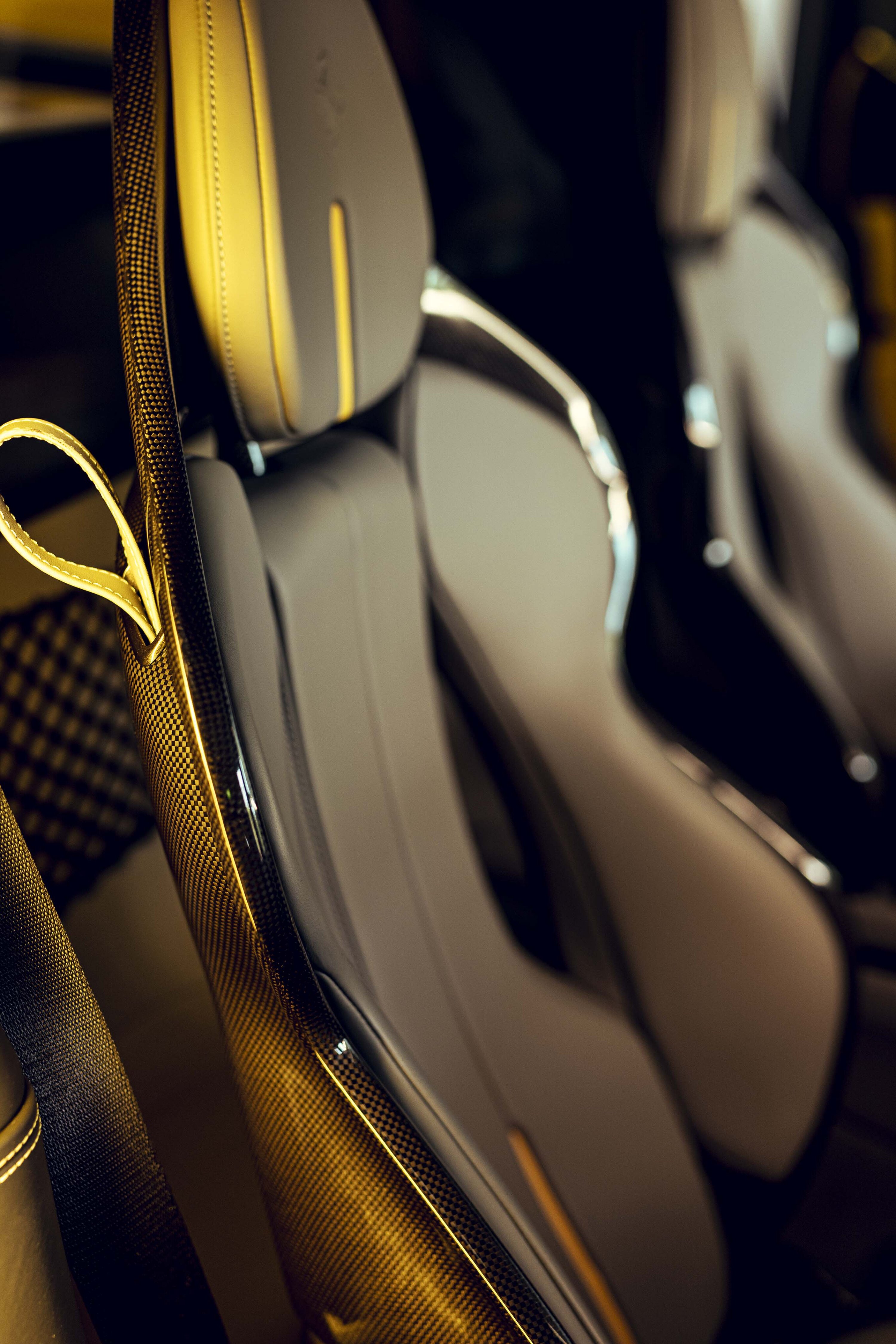
The McLaren F1 was an analogue outlier before the Bugatti Veyron’s engineering brutality eclipsed it.
Beyond that, electrification elevated performance onto an ever higher plane with the hybrid hypercar holy trinity of LaFerrari/Porsche 918 Spyder and McLaren P1, the Koenigsegg Regera and the Rimac Nevera nudging our notion of performance superlatives ever higher.
Flinging the 296 GTB at a corner somewhere high above Lake Eildon, it’s hard to think of why you’d ever need more power. But then it’s equally possible to find yourself in something like a current Civic Type R on a challenging road and wonder if you ever needed a quicker car.
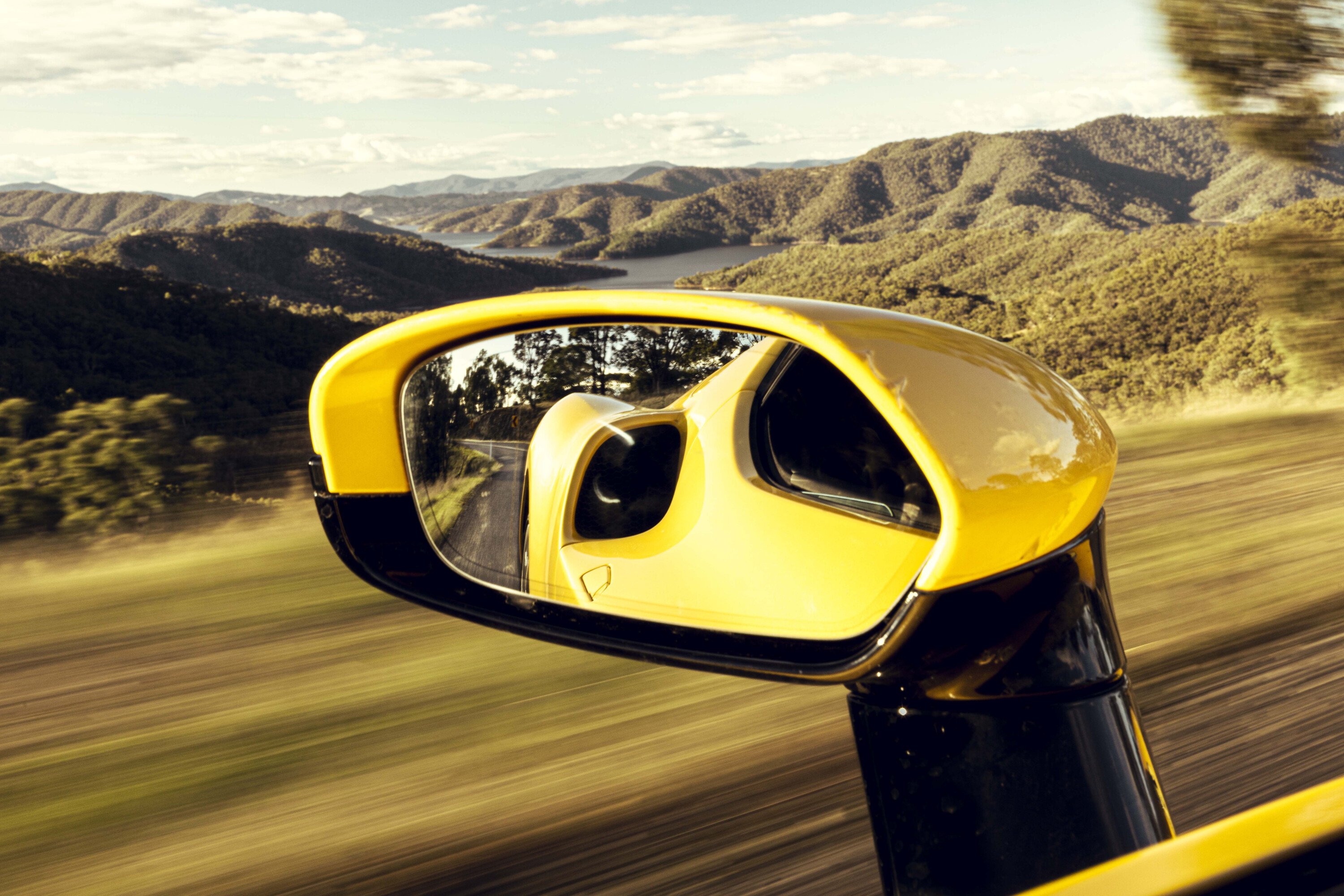
In the 296, you challenge yourself to keep the throttle pinned for as long as you need to.
It has the brakes and the composure to scrub off huge speeds and dive towards an apex and is hugely exciting but at the same time it retains an edge. Forget the false modesty of road testers who claim that it slides with the ease of a big MX-5. Drive it hard and the 296 gives you small reminders of big consequence.
The steering lacks the reassuring heft and granular feedback of some of the most rewarding sporting cars. It’s not neurotically geared at 1.8 turns lock to lock and offers a pleasant neutrality, but isn’t the most communicative.
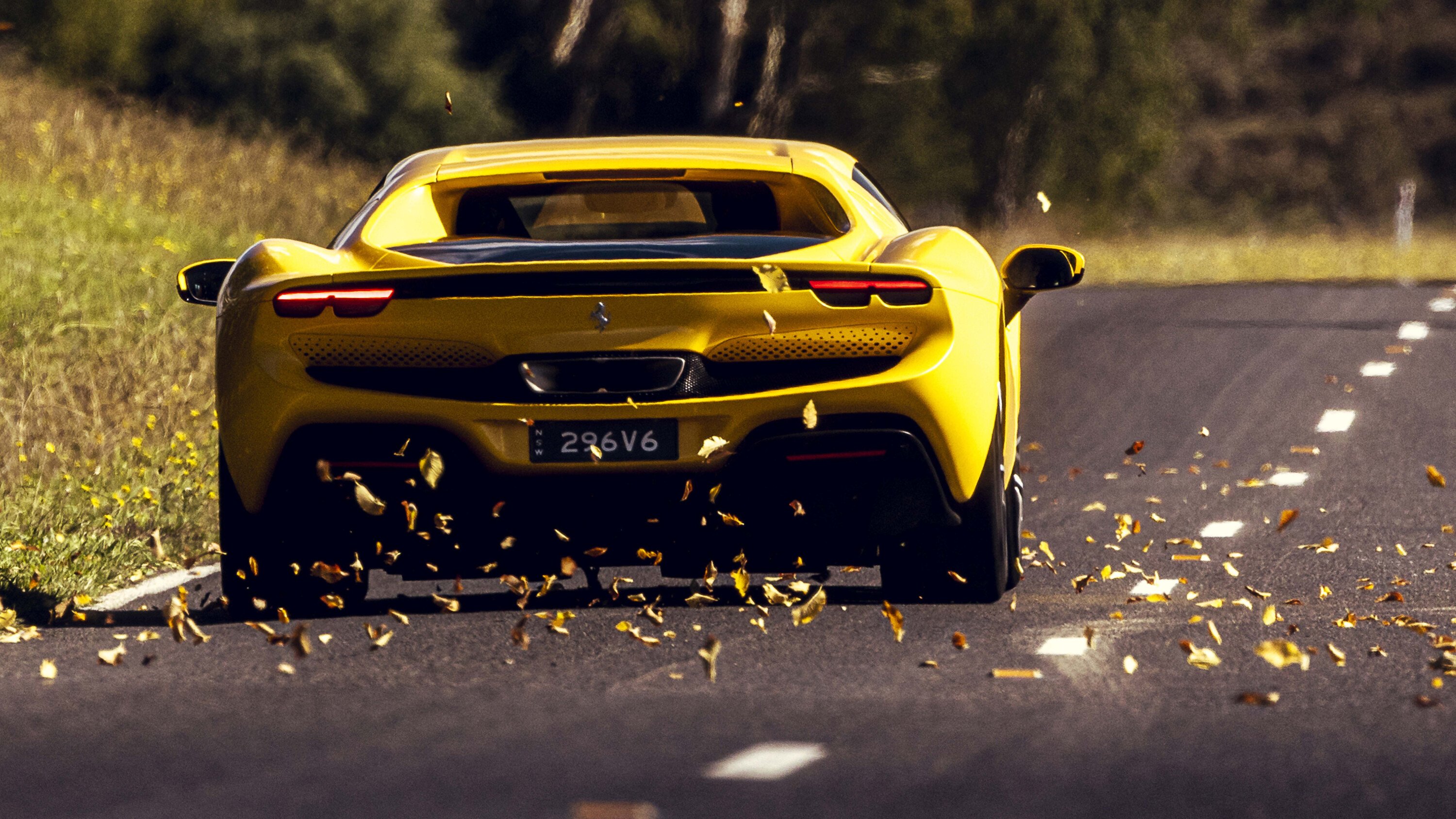
The brake-by-wire system is brilliantly calibrated between re-gen and friction braking although the latter can feel heart-stoppingly approximate on the first application on a cold morning. The brakes rapidly come to life thereafter.
While the 296 feels all of a piece at typical fast road speeds, and it’d doubtless feel incredible when wrung out at ten-tenths on track, there’s a point between these two levels of commitment where the 296 can feel nervy; unexpectedly up on its toes.
A colleague described it as a “glassy moment” and it’s not always predictable when you’ll step into it due to one notable characteristic of the 296. A given throttle input doesn’t necessarily result in a consistent output.
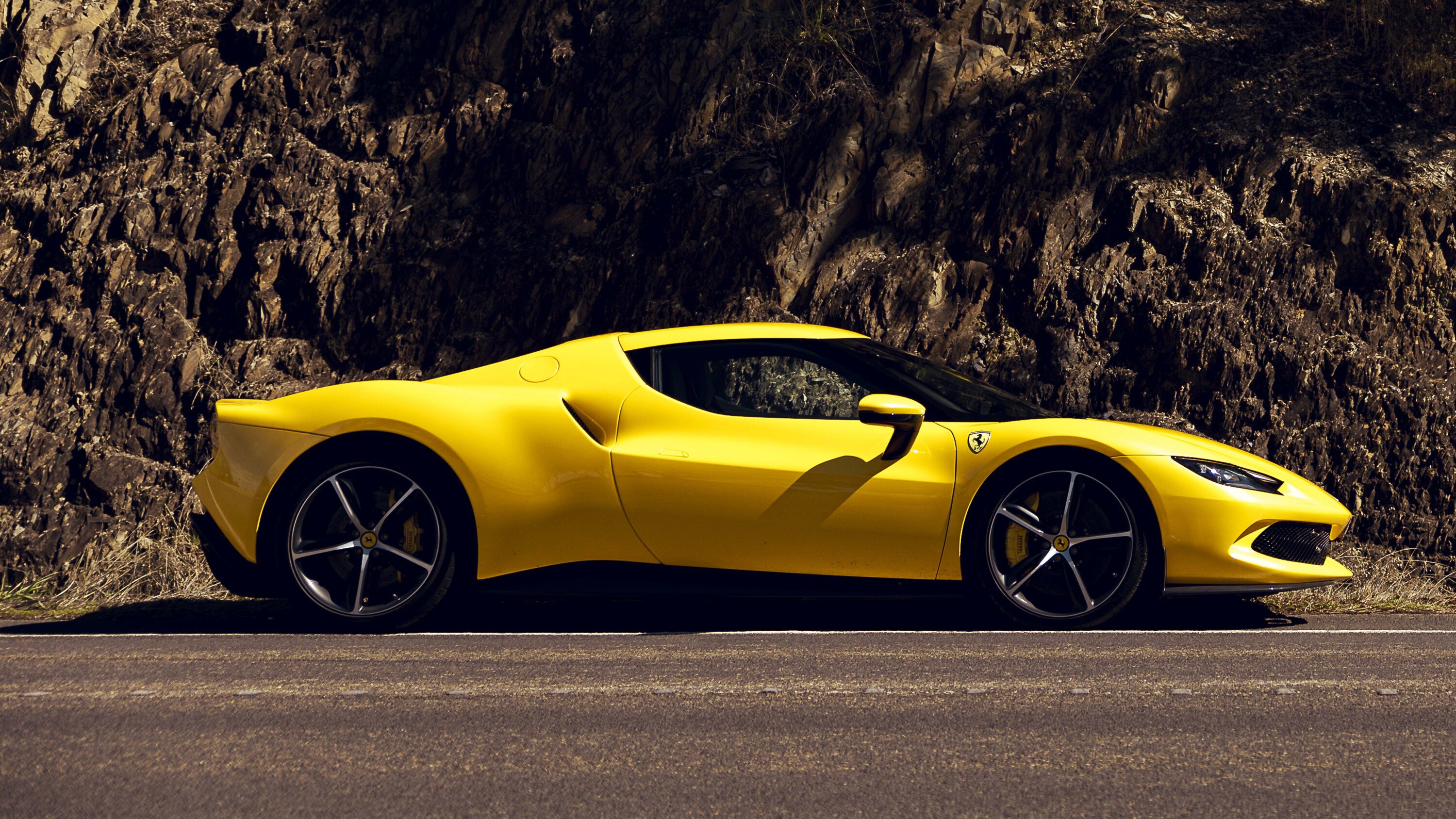
Dip down and those 250LM-style rear haunches gently interrupt the profile
The amount of meaningful torque delivered to the rear wheels depends on a number of variables including battery condition and not always knowing exactly what you’re going to get can set your mouth a little dry.
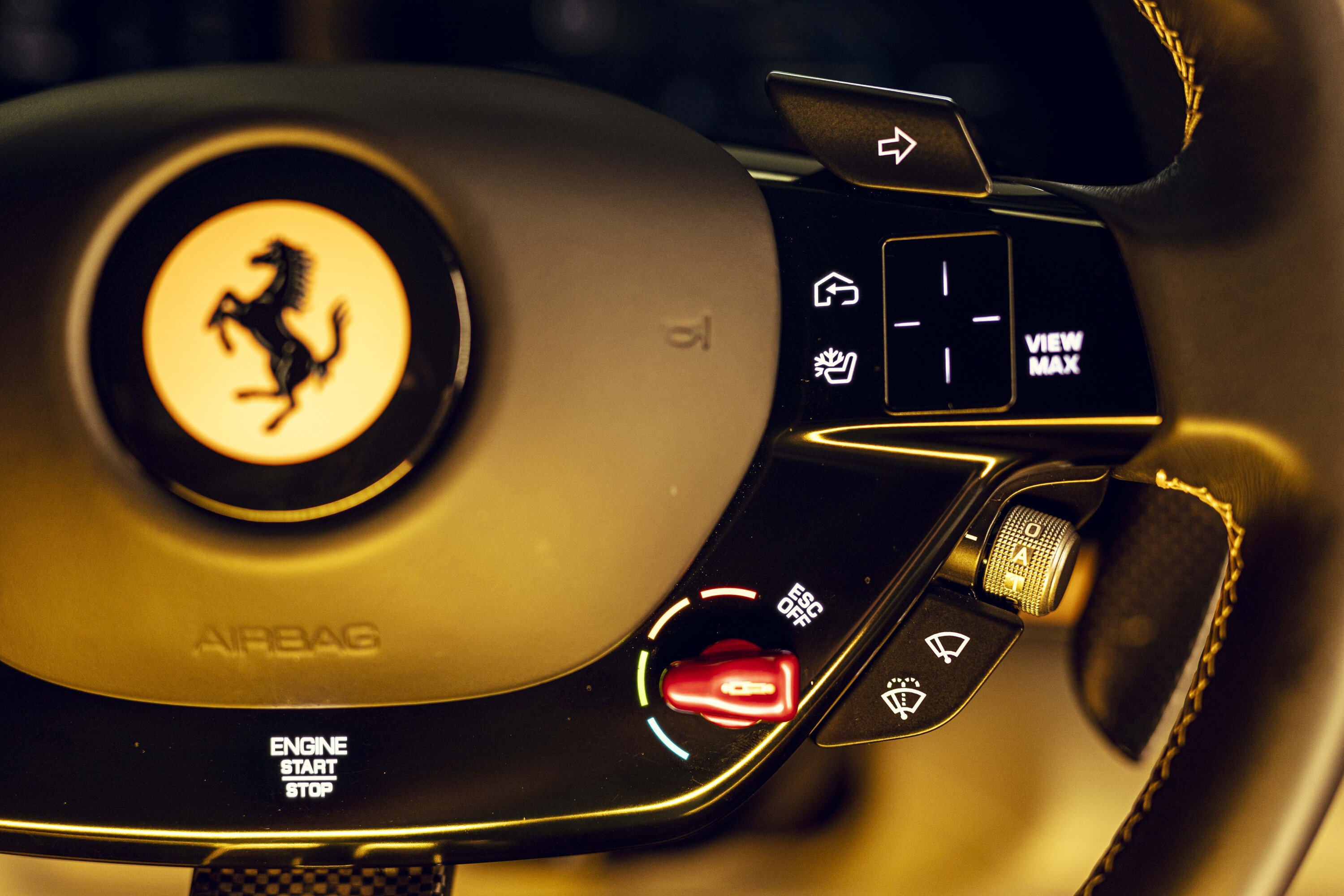
It could be something that you’d grow accustomed to. The 296 is so laden with idiosyncrasy that it’s an immersive thing just to interact with on an everyday basis. Whether it’s the details of the drive modes, the complexity of its Side Slip Control system, the quirkiness of its ergonomics or the whims of the algorithm controlling the active aero, there’s always something going on.
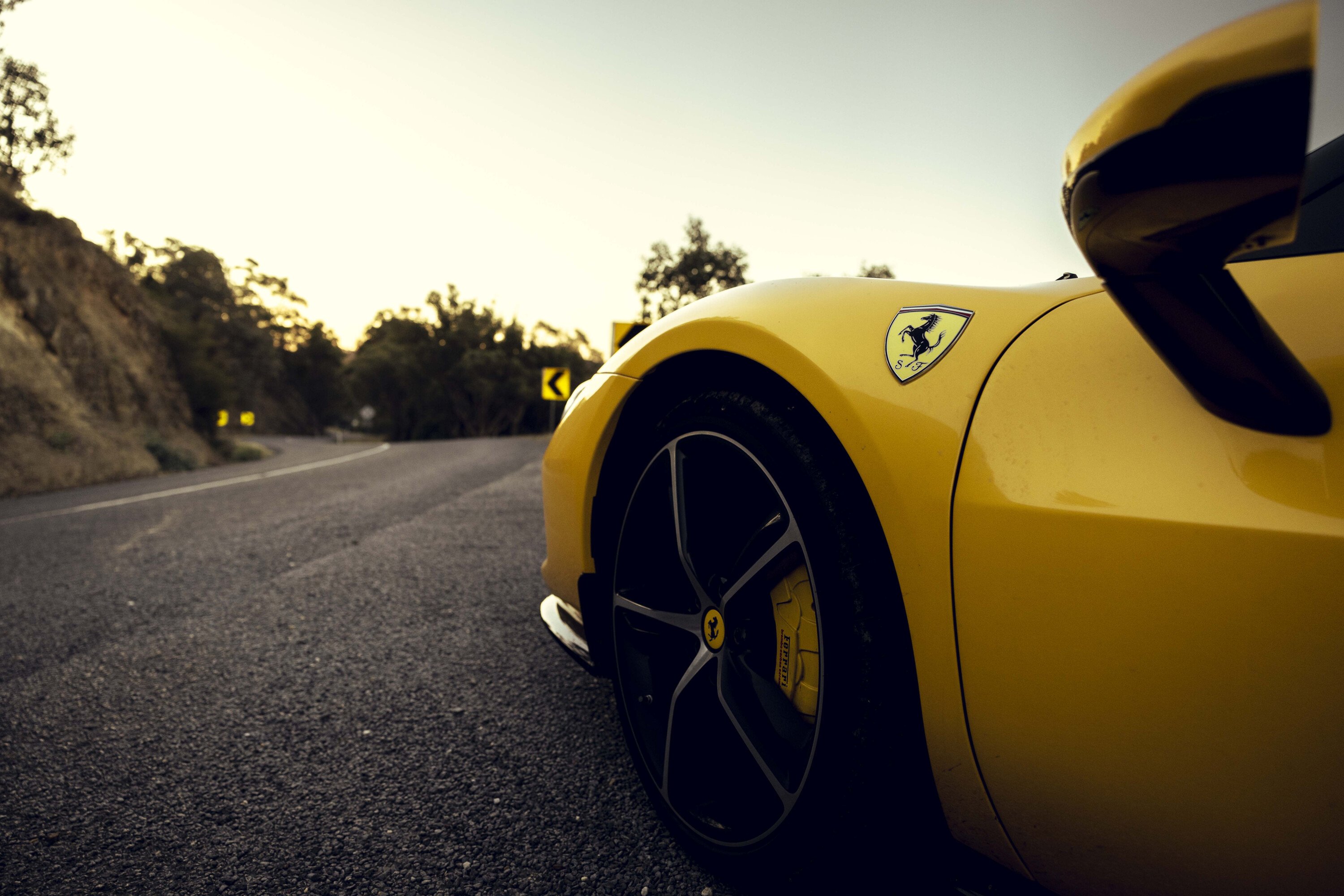
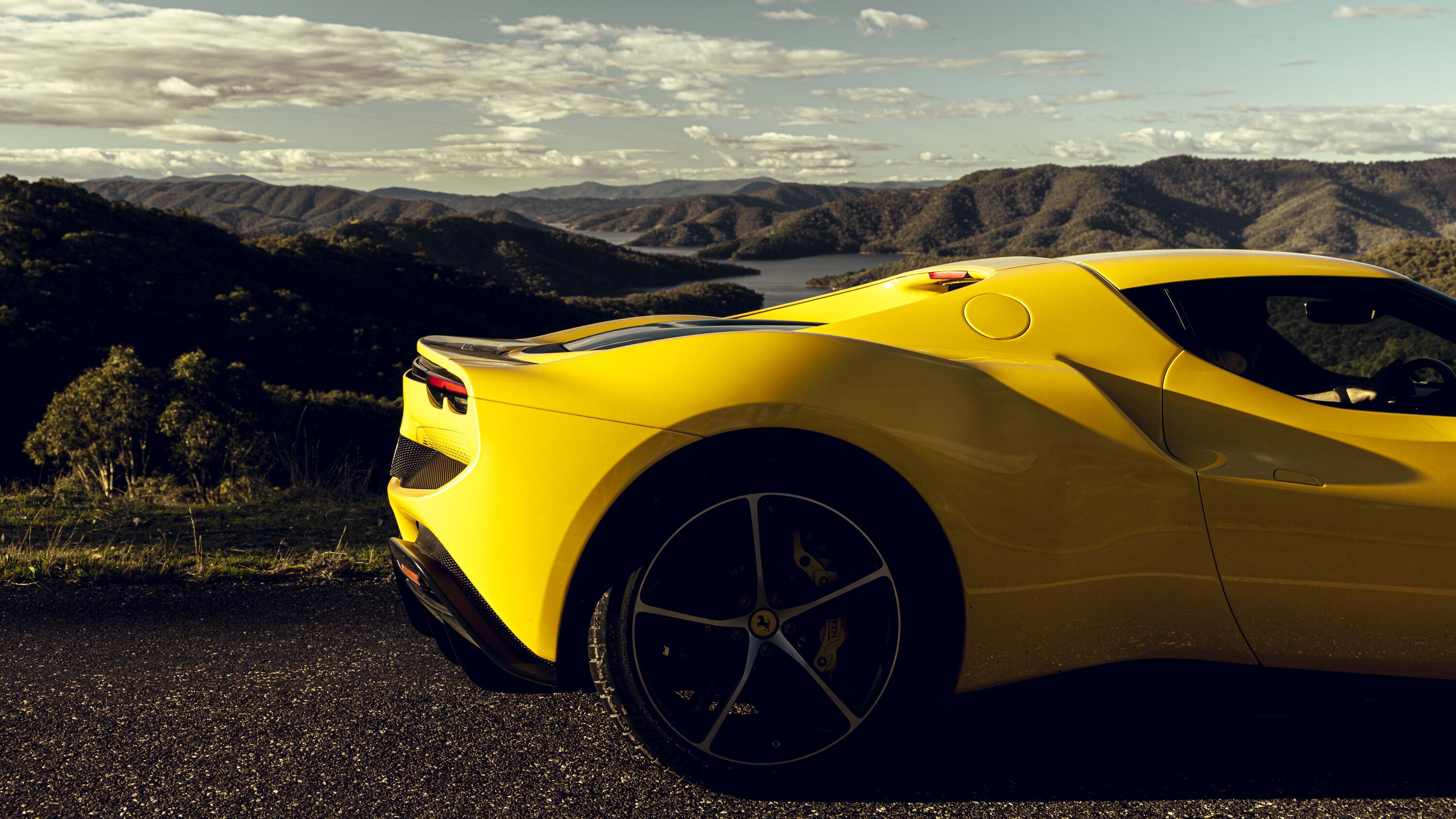
Even the shape is incredible intricate. From some angles that extended rear deck and coda tronca give it an almost three-box shape. Dip down and those 250LM-style rear haunches gently interrupt its profile.
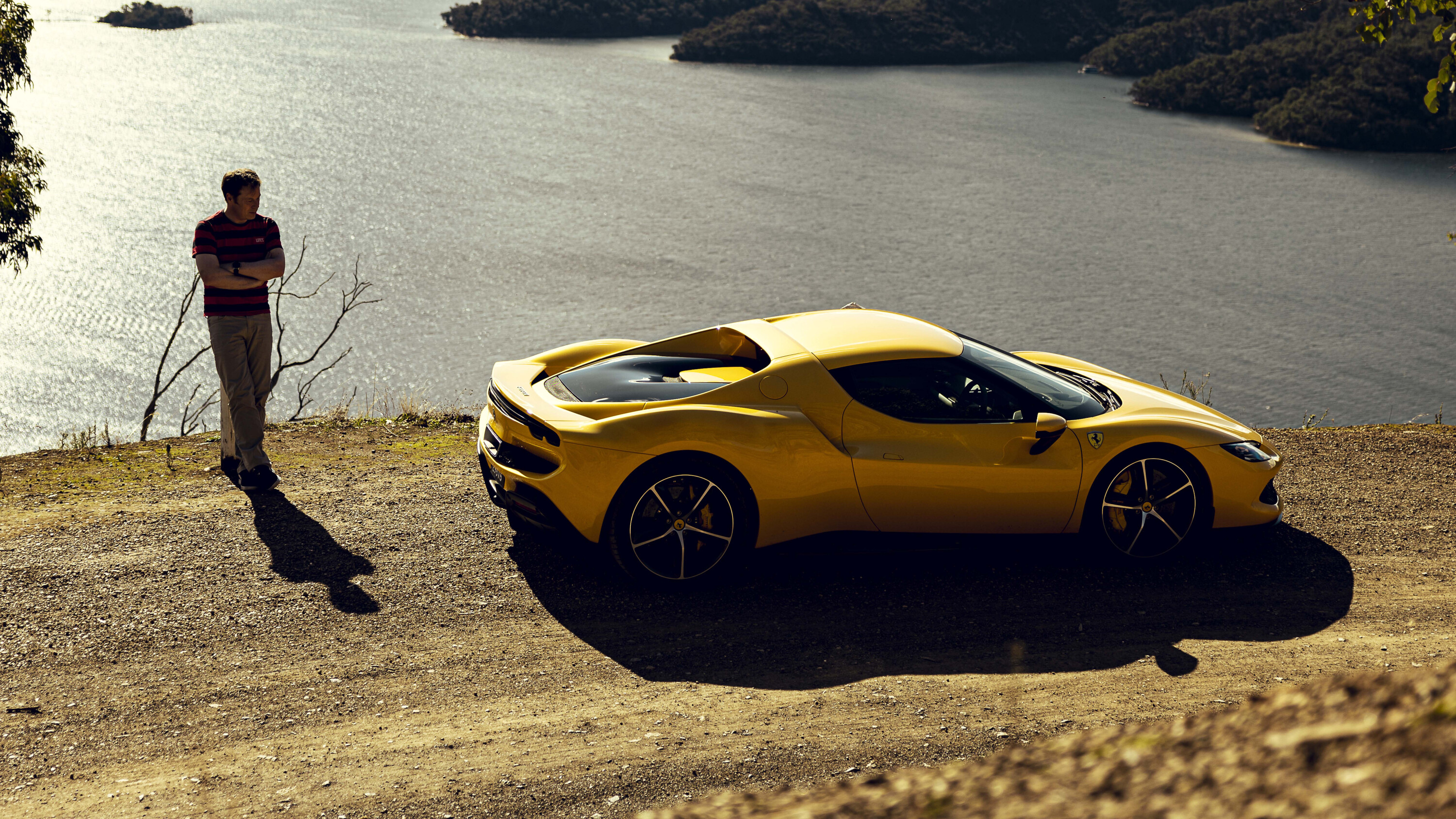
Every time you approach the car your eye settles on another line, detail or play of light and shade. Even in Giallo Modena, which some may described as lacking a certain subtlety, the 296’s design delivers.
Ferrari should also be commended for building in a genuine sense of fun. Challenge, too. How long have we complained about sanitised supercars? Here’s one that’s anything but, which will test you while cryptically peeling back the layers of its ability.
How absorbing would it be to really get to know this car, to feel as if you’d mastered it? I’m nowhere close. Instead, I feel I’m merely prodding at its envelope. One thing’s for sure. It’s lively. That’s due to the combination of feral torque infill, sharp steering and a short wheelbase.
At 2600mm, the 296’s wheelbase is fully 50mm shorter than the outgoing F8 and is shorter than both a Huracán or an Artura.
It sounds great too. The equally spaced firing order and pure third-order harmonics mean that the sound signature of the engine is more like a V12 than a V8, with a clean build from low to high frequencies, erasing the high-frequency die-off between 4000 and 6500rpm that afflicted Maranello’s turbocharged V8s.
Ferrari refers to the engine as the ‘piccolo V12’ and with good reason. A hot tube with a timbre-adjusted membrane pipes engine sound directly into the cabin. No speakers or amps here. It pays to stay above 4000rpm and at 5000 the engine note harden noticeably, introducing an operatic melismatic flutter at 6000.
You’ll believe the midrange acceleration stats that show that the 296 is as quick as a Bugatti Veyron
From there it careens to the redline, so quickly that you’re grabbing for the shifter. Alternatively, you can leave it in drive and let the software do the work for you.
Running the 296 GTB to the redline can be a tiring experience. It juices your adrenal glands and it’s instructive to note how rarely you execute full, foot-to-the-boards throttle commitment.
Stay planted up through second and grab third just as you get the full rainbow of shift lights across the top of the carbon wheel and the thump into full torque deployment is absolutely eye-widening. You’ll believe the midrange acceleration stats that claim that it’s as quick as a Veyron.
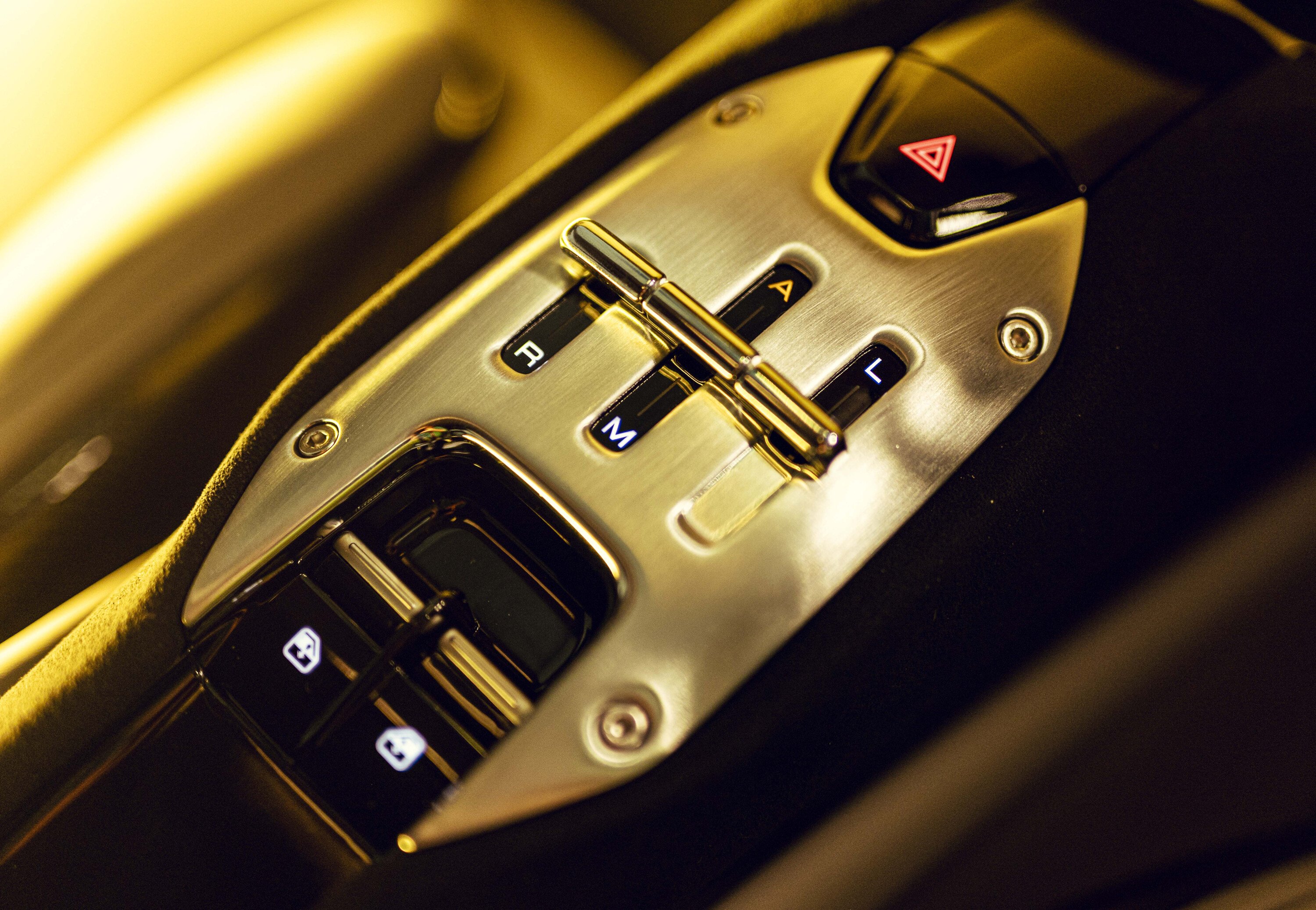
Possibly the biggest compliment that you can pay the new 120-degree V6 is that at no point do you muse how much better the 296 would be with a V8. It’s just never crosses your mind.
Despite the hybrid assistance and turbocharging, it does its best work with plenty of revs on board, peak power arriving just 500rpm shy of the 8500rpm redline, while the full measure of 740Nm is attained at 6250rpm.
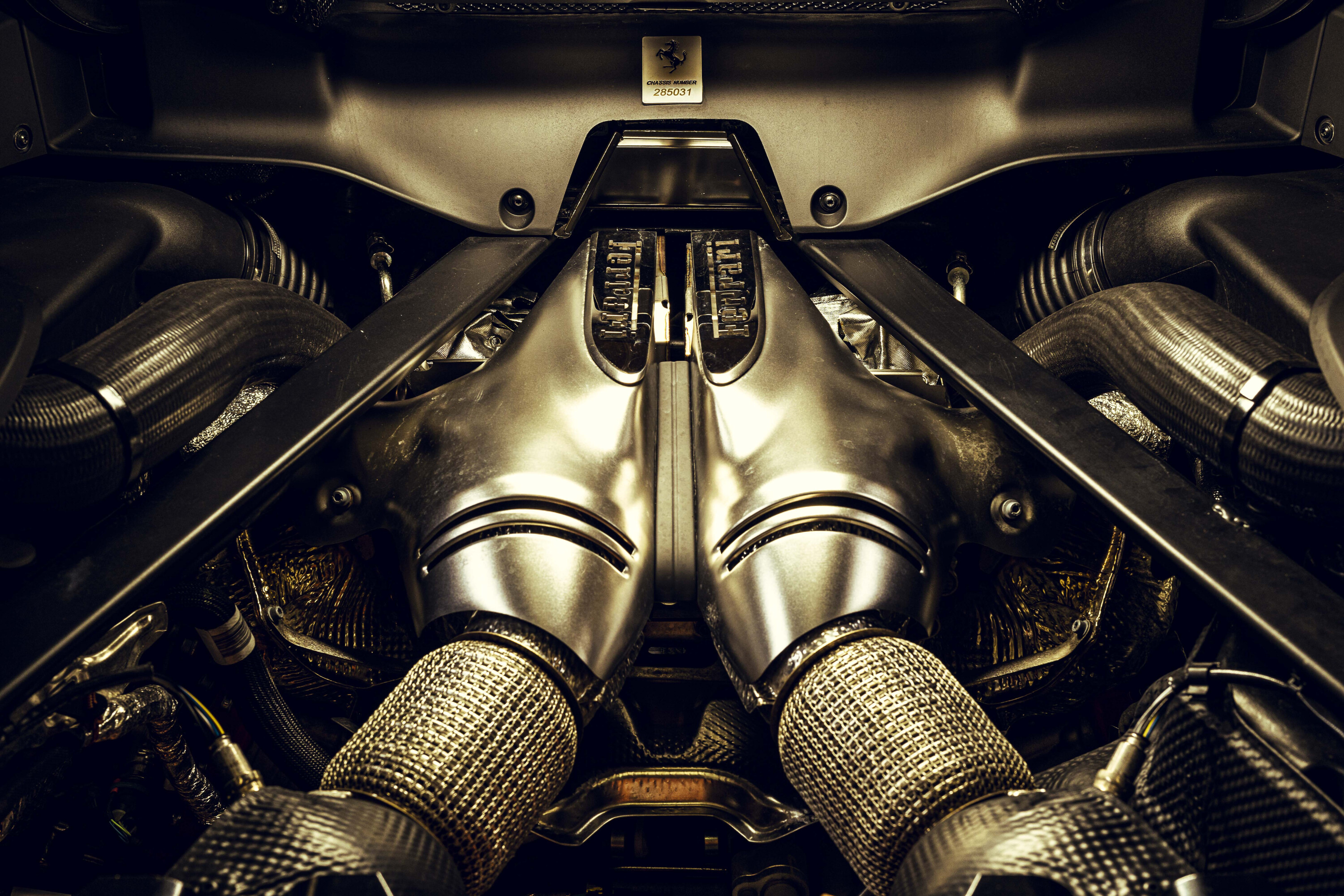
Due to the hot-vee configuration of the contra-rotating turbochargers, it’s a significantly narrower engine than the F8’s and is also 30kg lighter. It’s dropped right down into the guts of the car, so when you pop the engine compartment and peer past all the Inconel exhaust plumbing, it looks as if its sump will be skimming the bitumen.
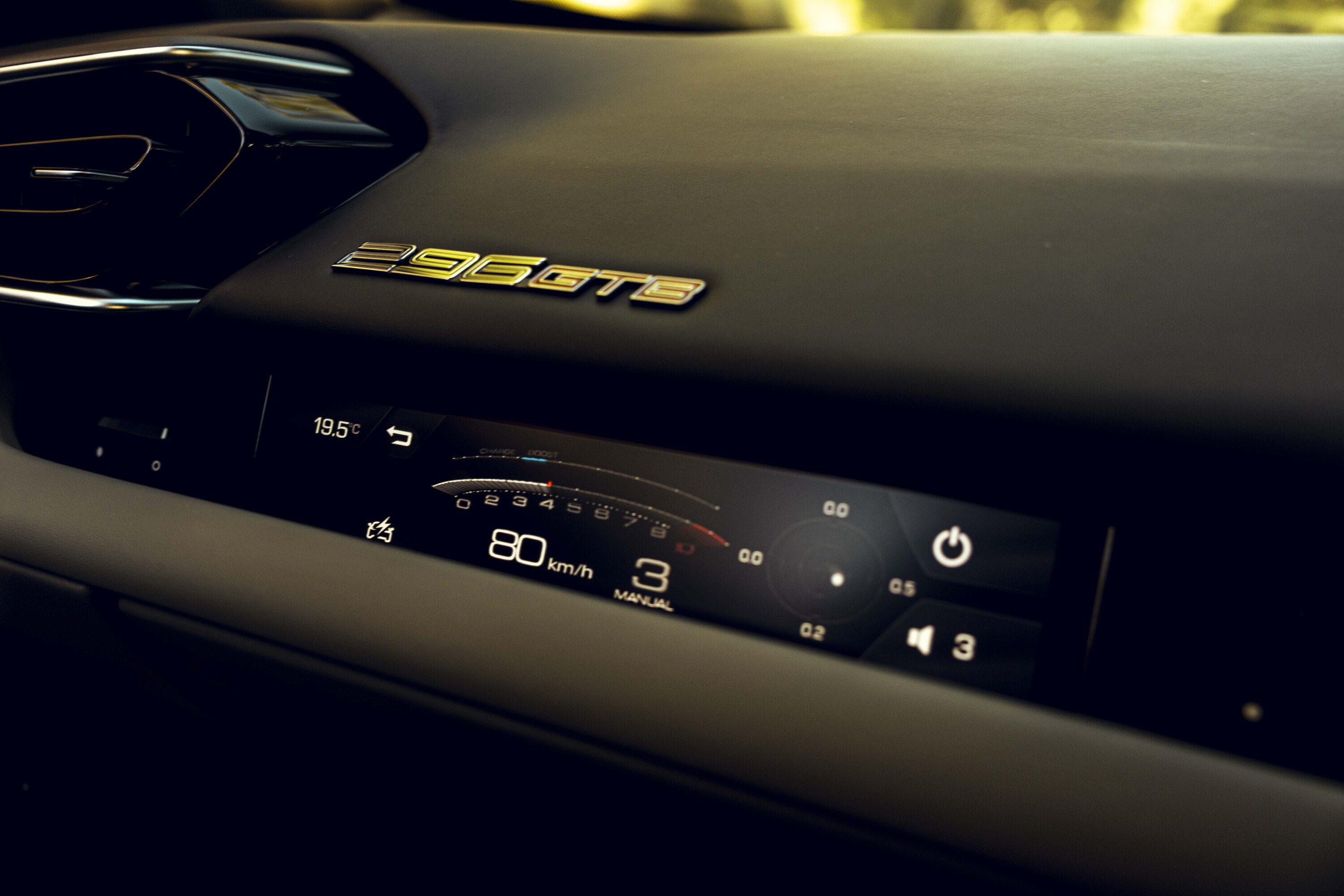
The 296 poses a number of challenging questions. Do you ever need a large-capacity engine when a 2992cc V6 can perform and sound like this?
After some introspection, the answer has to be probably not. It hangs another question in the air. Is this the first Ferrari that is helped rather than hindered by hybrid tech?
Almost certainly. I got a kick out of sliding the 296 silently from my garage on an early start, but the stealth effect was somewhat ruined when the car sounded the horn three times because I’d got out of it with the key to retrieve the rubber ramps I needed to allow the front splitter to clear my drive. There is a nose lift system but no front camera, so you’ll need to be a little bit careful that the nose doesn’t drop onto kerbs.
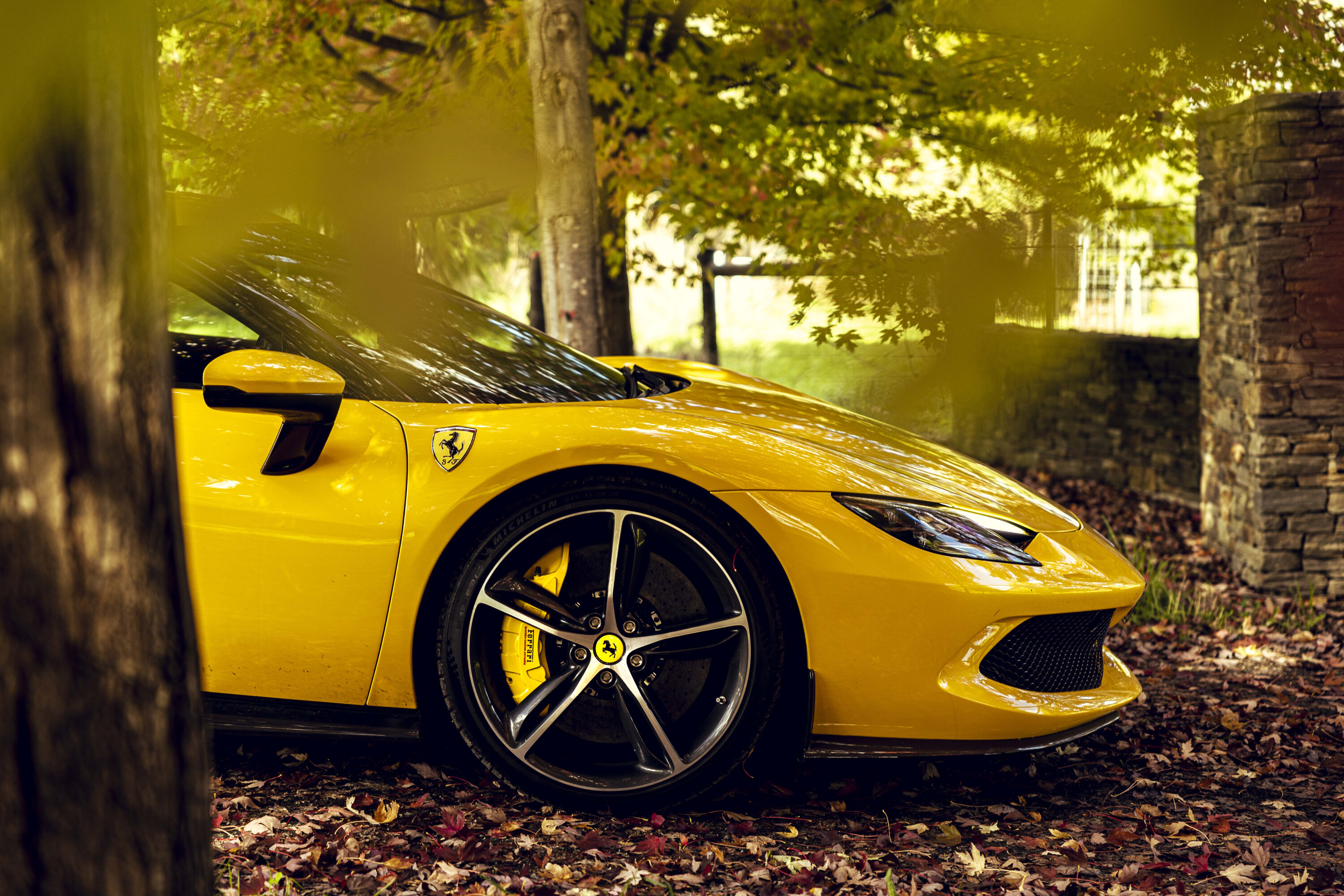
The 7.45kWh battery will propel the Ferrari for around 25km on electrons alone, which is better than mere novelty.
We managed 33km on a largely downhill route out of Eildon, enveloped in a Hans Zimmer-style futuristic soundscape. Switch the manettino into Qualifying mode and it will harvest power to replenish the battery surprisingly quickly. alternatively, if you don’t want the sharpness that this mode brings, there’s a sdie option to charge in Hybrid mode accessible via the wheel-mounted trackpad.
The 296 defaults to starting silently in Hybrid mode. It can also be forced to run in eDrive electric mode or will rinse everything its got in Qualifying mode. In order to get the full power/torque, the car needs to be in Quali mode with a full battery.
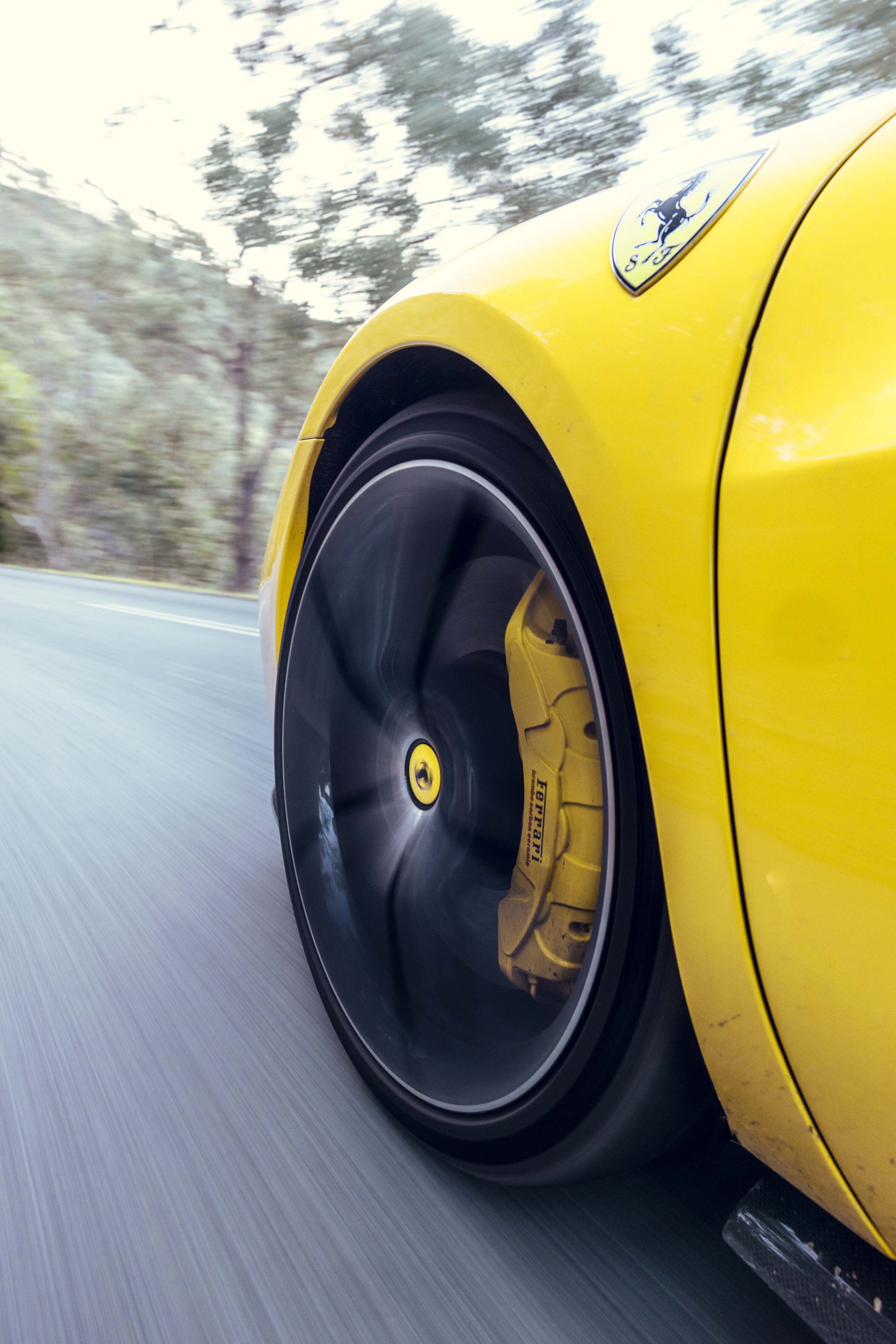
As good as a Michelin Pilot Sport 4S tyre is on a Porsche 718 or a BMW M3, it at first seems a little underspecified for a 610kW supercar.
Look a little closer and there’s a K1 signifier on the sidewall that denotes that this is a tyre specially homologated for the 296.The 20-inch rubber measures 245/35 up front and 305/35 at the back, with a modified tread compound that delivers better performance in all five of Ferrari’s test criteria (grip, weight, rolling resistance, aquaplane resistance and wet traction) than the Pilot Super Sport fitted to the F8 Tributo.
Of course, there will be some who see no other choice than the Michelin Pilot Sport Cup 2 R option tyre, reasoning that they probably won’t take their 296 out if it looks like rain.
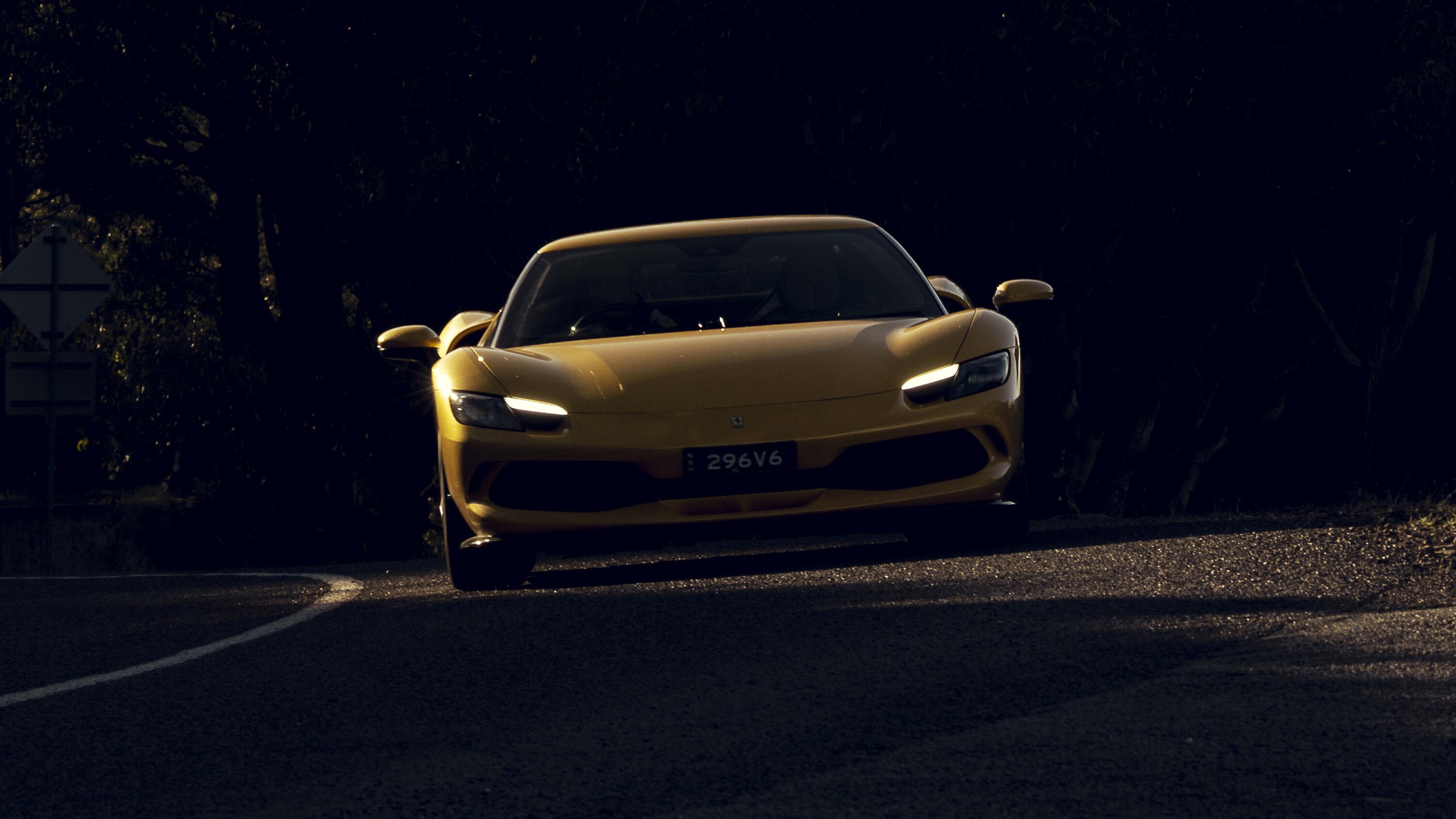
I’d take it out every day of the week. The powertrain is civilised enough, the ride, whether in bumpy road mode or not, is sufficiently supple and the hybrid drivetrain means that it needn’t be obnoxiously loud at all times.
There’s even a reasonable amount of storage space, both in the frunk and behind the seats. Aside from rear three-quarter visibility (which is hideous), the 296 isn’t too difficult to see out of either. One word to the wise – if you’re speccing one, avoid any pale-coloured trim or contrast stitching on the dash top as it’ll reflect crazily in the windscreen.
Likewise, the glass rear deck can also beam retina-searing low sun into the rear-view mirror. Another ergonomic glitch is that a larger smartphone won’t fit into the wireless charger but will fit with such millimetric perfection into the centre cubby that you’ll need something to prise it out with.
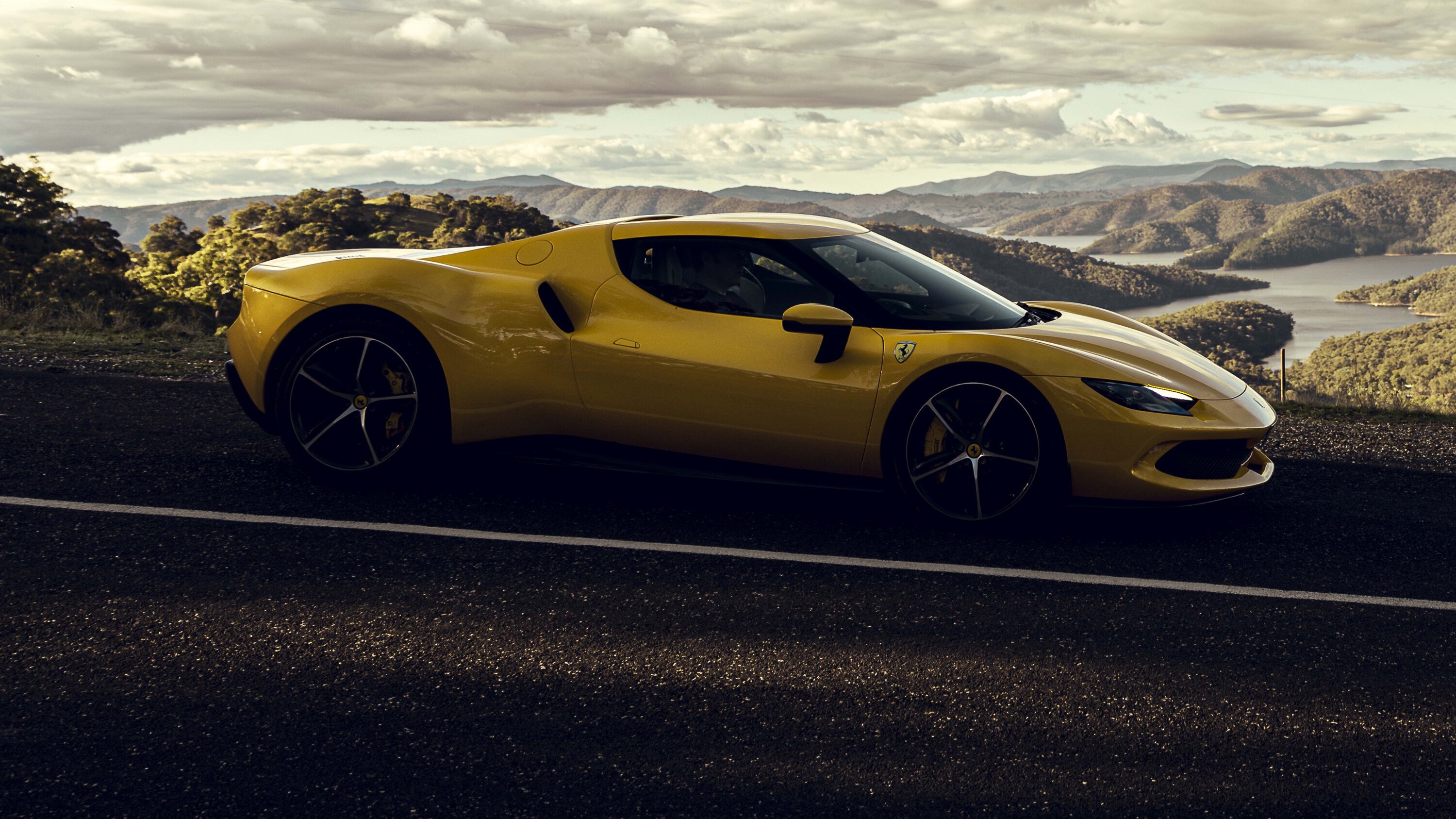
These issues do little to detract from Ferrari’s achievement. It has built a fun and fiercely capable car that rides well, looks fantastic and is beautifully engineered.
At a stroke, the 296 GTB’s class rivals trail like specks in the rear-view. Best of all, it has curtailed that trend where the 488 and F8 each seemed a more powerful but less pure incarnation of the 458 Italia. The 296 is very much its own thing and is all the better for it.
Conceptually, the supercar has never been in a tougher spot. It’s become a compromise. Blanket online coverage has made it less of an occasion. It can appear out of step with social mores. But the cars themselves are better than ever. More popular too. Ferrari sold more 296s in 2022 alone than in the entire 11 year lifespan of its first-mid-engined supercar, the BB.
The company acknowledges in its annual report that there is a demand for its vehicles to be used more often and in urban settings and Maranello is keenly aware of changing tastes.
Aware too of shareholder pressure to raise prices and build more cars. In artfully fusing what we traditionally expect of a supercar with a blend of qualities that are new to the genre, the 296 GTB is a triumphant transition to a new era.
The supercar will never be the sort of social chameleon that fits into every occasion. Pickle boy will attest to that. Such a choice may appear gauche in an economic climate that seems to be transforming a greater share of society than ever before into have-nots, the supercar emblematic of that wealth division.
You need a thick hide to carry one off. But developing one has never carried a bigger payback. If you just want to luxuriate in how magnificent, capable and, yes, joyful the sensory experience of the car can be in this first quarter of the 21st century, conjur up a way to drive a Ferrari 296 GTB. It’s the perfect jaded palate cleanser.
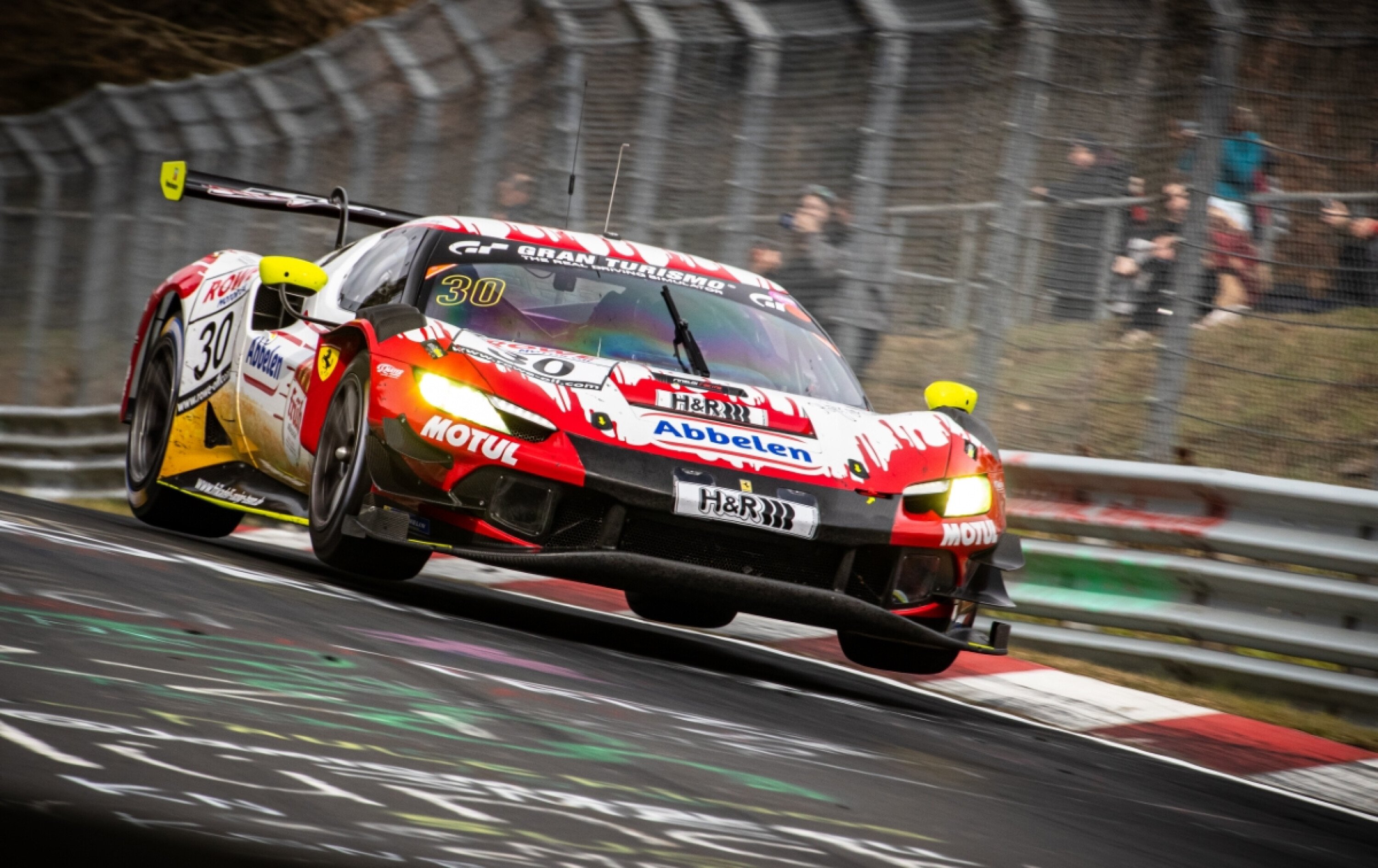
Forza Frikadelli
We’d goggled over the pics of the stunning Ferrari 296 GT3 and its first major victory was this year’s 24 Hours of Nürburgring, which it won for the first time in the marque’s history.
This broke a trot of 21 years of German-built winners (Zakspeed Viper GTS-R was the prior, trivia freaks).
To make matters even more special, the car was run by Frikadelli Racing, co-founded in 2005 by the late and much-missed Sabine Schmitz. Between them, Earl Bamber, Nicky Catsburg, David Pittard and the magnificently-monikered Felipe Fernandez Laser completed 162 laps; an event record.
| 2023 Ferrari 296 GTB specifications | |
|---|---|
| Engine | 2992cc, V6cyl, dohc, twin turbo, PHEV |
| Max power | 610kW @ 8000rpm |
| Max torque | 740Nm @ 6250rpm |
| Transmission | 8-speed dual-clutch auto |
| Weight | 1470kg |
| Economy | 6.4L/100km (WLTP) |
| 0-100km/h | 2.9sec (claimed) |
| Price | $568,300 |
| On sale | Now |
Australia’s major car brands were generally supportive, in principle, of Australia’s proposed fuel-efficiency standards when WhichCar asked recently.
The Federal Chamber of Automotive Industries (FCAI), however, has not been as supportive of the New Vehicle Efficiency Standard (NVES), outwardly at least.
FCAI chief Tony Weber questioned whether the Government’s proposed standards were achievable. He suggested Australia should “consider adopting the type of targets that are currently in place in the United States”, supported with financial incentives for buyers.
Weber also claimed the NVES would raise the price of a Ranger Raptor by $6000, and some other vehicles by up to $25,000.
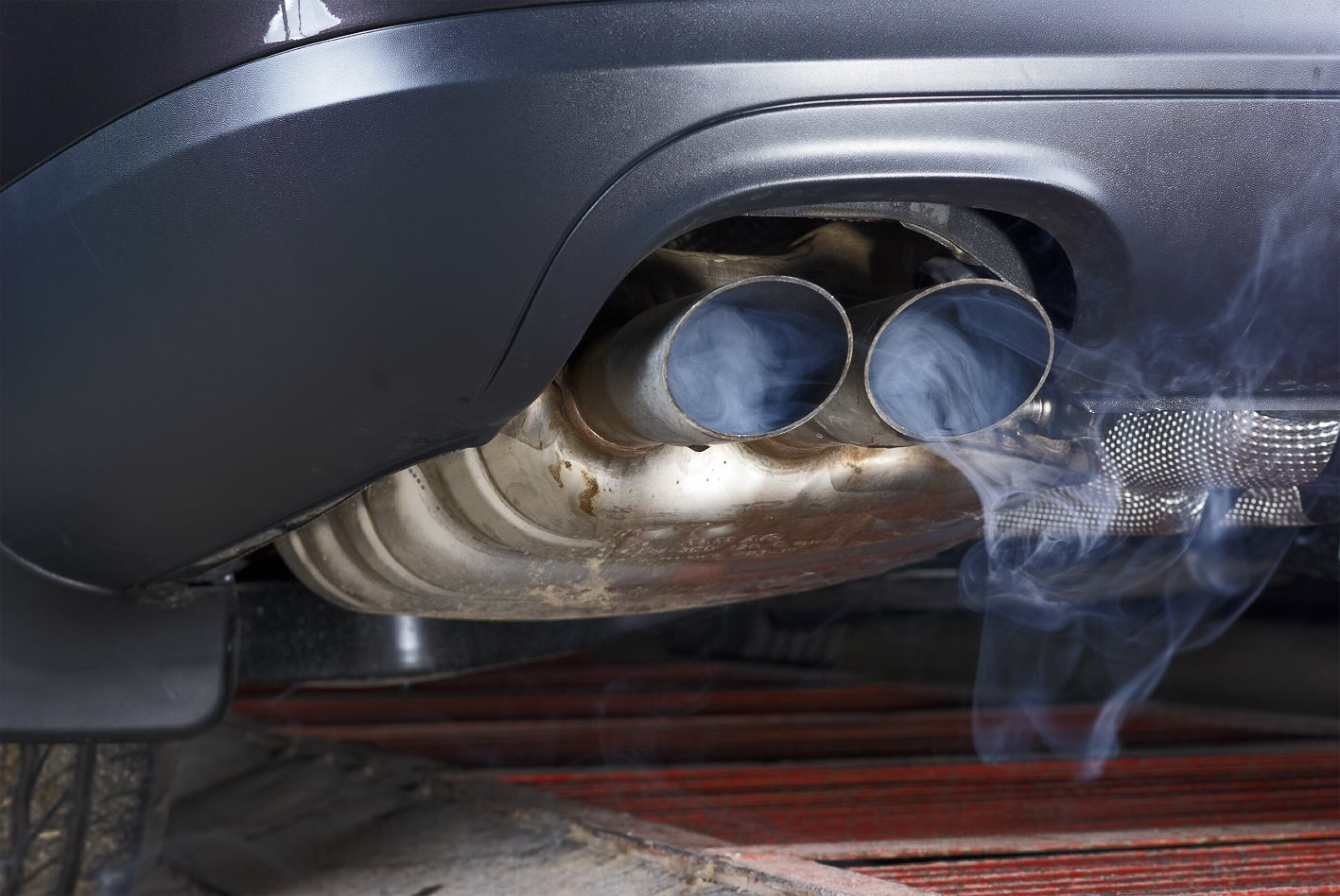
The FCAI warned the NVES will cost consumers $29 billion, based on the current range of models sold – but a 2022 report suggests this number could be overblown.
In 2022 the FCAI engaged S&P Global Research to model the future Australian car market. S&P advised FCAI that electric cars and utes will dominate the light vehicle market in Australia by 2030, even without an efficiency standard.
It’s possible, then, that the FCAI’s claimed cost of the NVES is higher than the real cost in a market transitioning towards more efficient vehicles – and higher than would be projected based on their own study.
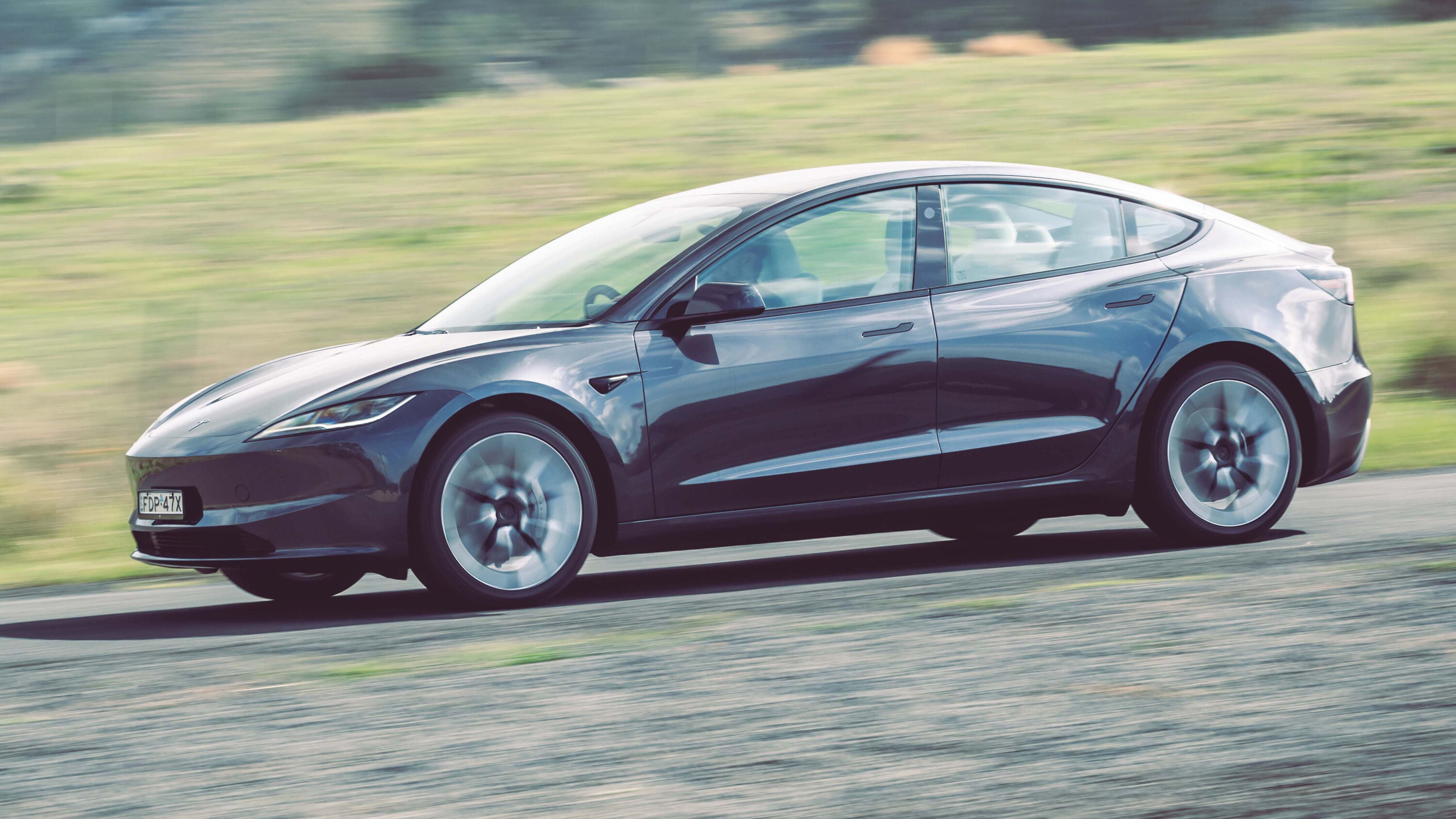
The Electric Vehicle Council has accused the FCAI of misleading the community and politicians.
“The FCAI has constructed a scenario where the car market doesn’t change at all from 2023 until the end of this decade, and layered exaggerated penalties over the top of that,” said EV Council chief executive Behyad Jafari.
Jafari said the FCAI’s own report “shows that the market, even without an emissions standard, will change dramatically by the end of this decade. And under that scenario, there will be minimal if any penalties received by the average car.”
Climate Change and Energy Minister Chris Bowen claims the NVES would save drivers on average $1000 per year on fuel, but has not released modelling on the impact on prices.
Federal opposition transport spokeswoman Bridget McKenzie called on the government to release its modelling, however, and said there’s no need for Labor’s “extreme carbon tax” on cars if most new cars sold in 2030 will be EVs or hybrids regardless of an emissions standard.
February 2024: Consumers don’t want all the in-cabin tech, either
Study aims to identify the automotive technology and features that buyers want.
Automotive manufacturers are increasingly represented at the annual Consumer Electronics Show (CES), reflecting the perceived rising importance to customers of in-vehicle technologies.
AutoPacific, a “future-oriented automotive marketing research and product-consulting firm”, annually undertakes the Future Attribute Demand Study (FADS), a survey of over 10,000 new vehicle “intenders” to measure demand for new vehicle technologies.
AutoPacific attended CES this year, partly “to see if consumer demand matches automakers’ and suppliers’ feature and technology rollout plans”, said AutoPacific Director of Marketing and Consumer Insights Deborah Grieb. They surveyed potential consumers about their interest for three new technologies featured at CES 2024.
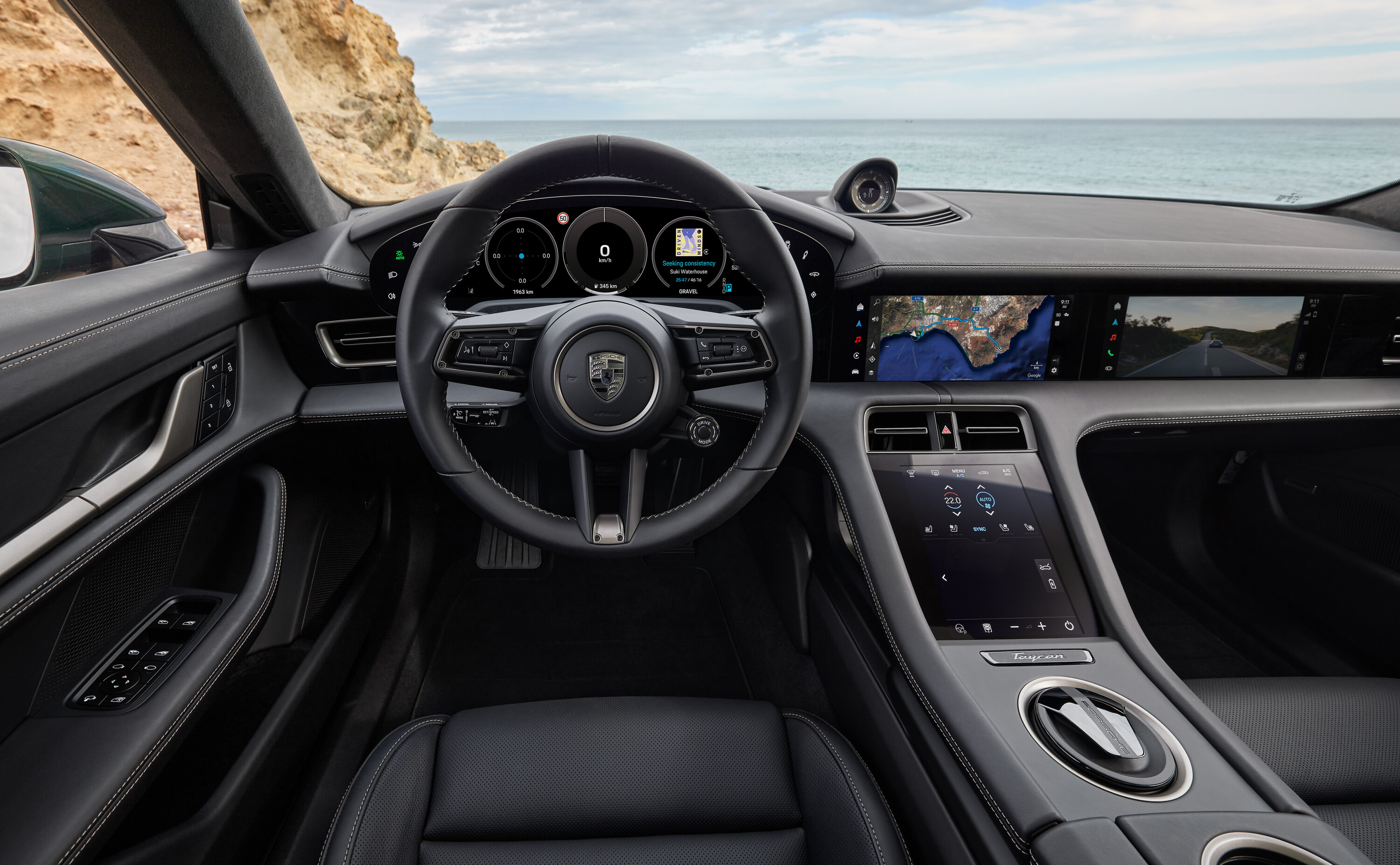
Most consumers aren’t willing to pay for the hi-tech features manufacturers want to sell.
The latest FADS found that, of 11,700 people surveyed, most “new vehicle intenders” aren’t prepared to pay for:
- pedestrian messaging
- in-vehicle purchasing (of products, services and upgrades)
- passenger-side infotainment screens.
What are these things and why are they in cars?
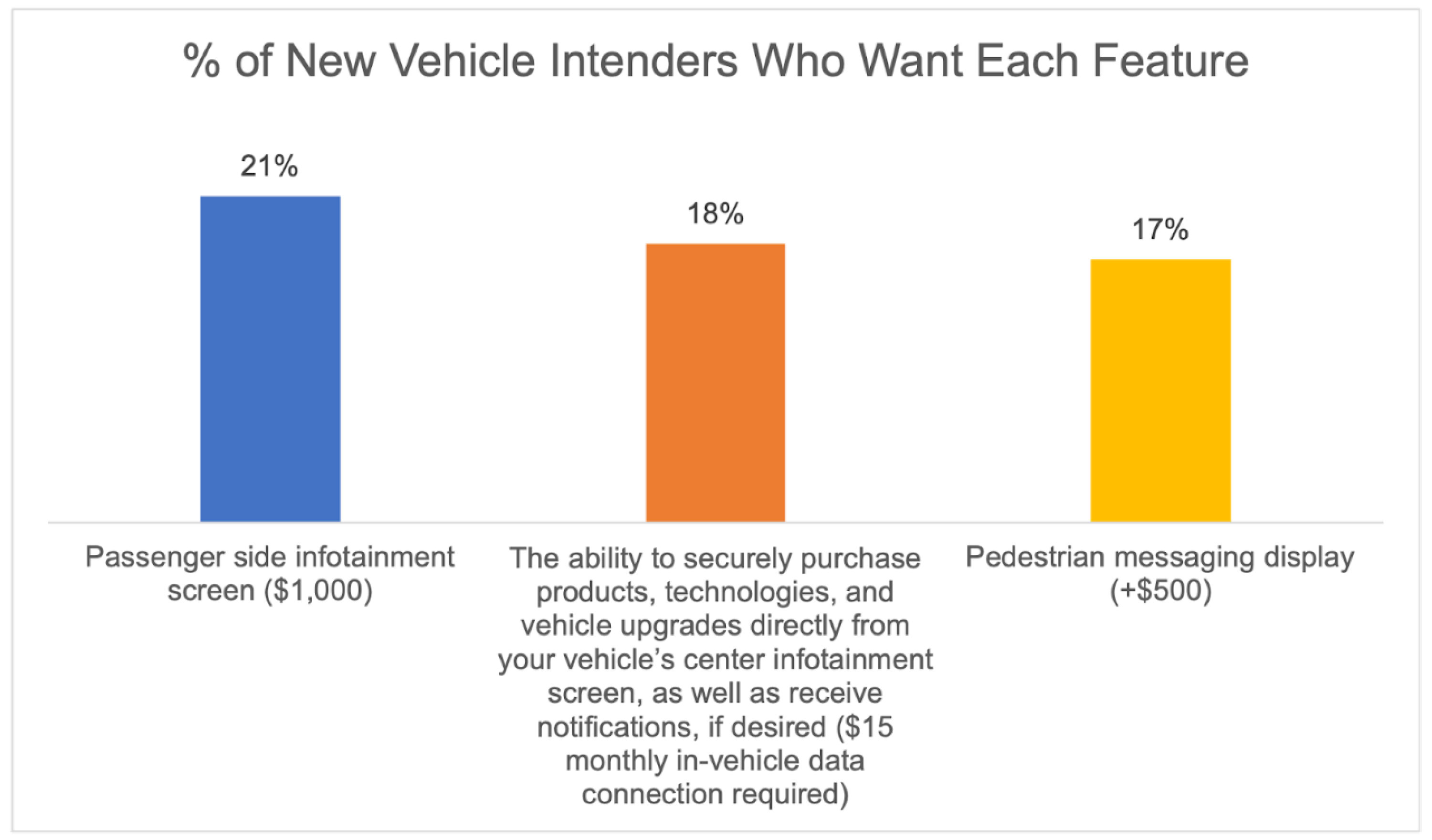
The most popular of those features was the passenger-side infotainment screen, which 21 per cent of respondents considered worth buying.
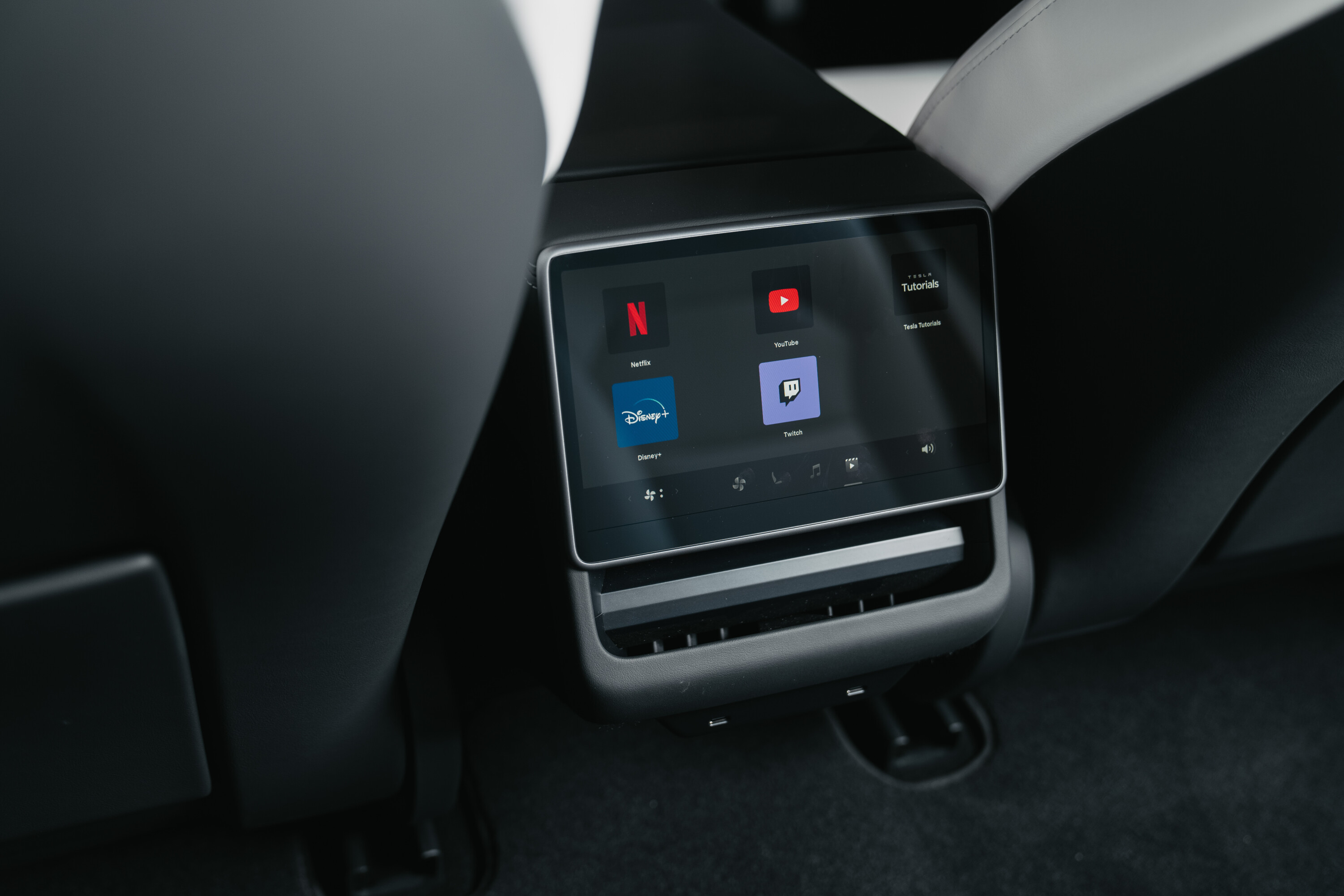
It is already featuring on luxury cars, allowing a passenger to watch media, look for destinations, or keep tabs on the vehicle functions.
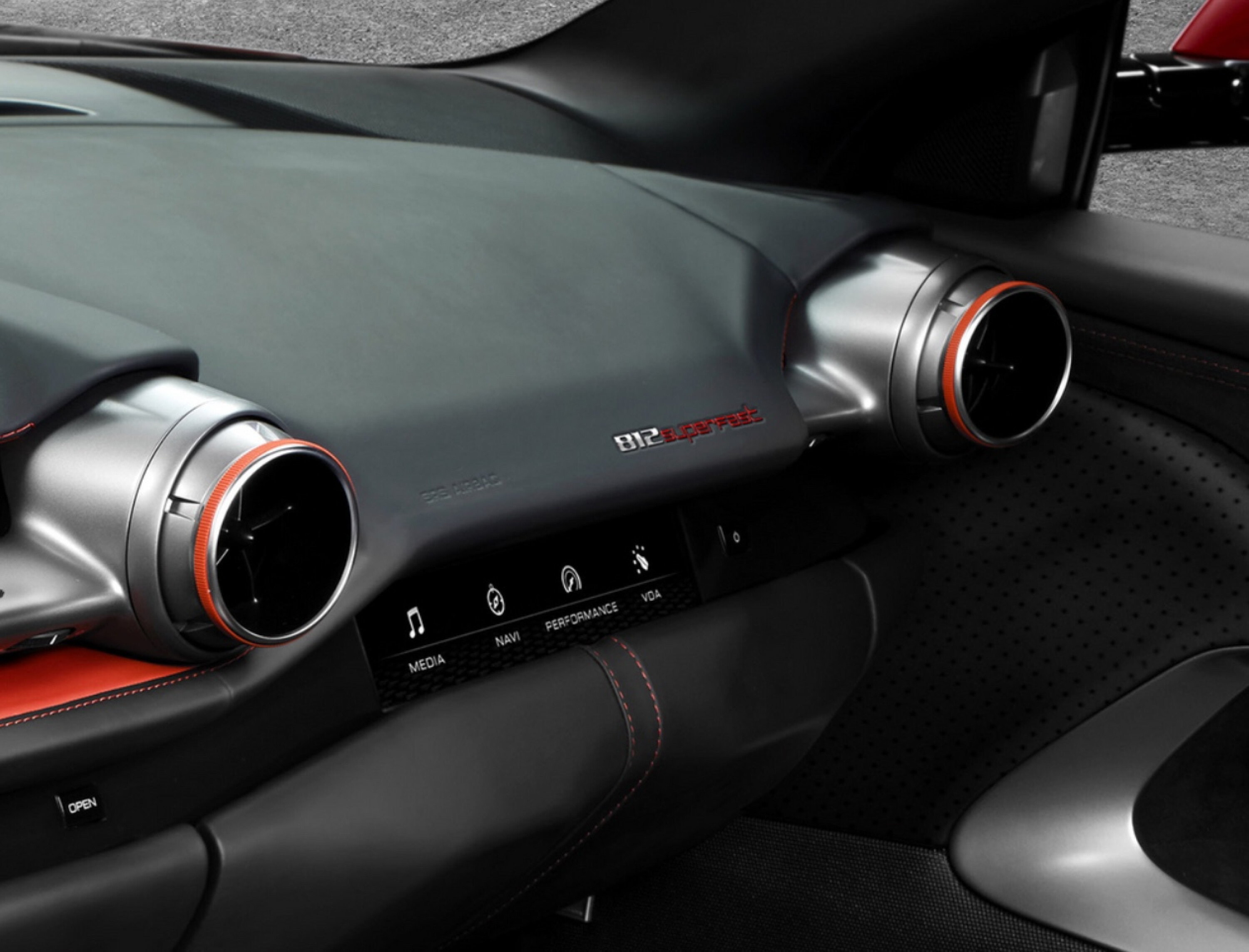
Just 18% of buyers would pay $15/month for the ability to purchase products, technologies and vehicle upgrades from the infotainment screen.
Demand was highest among EV intenders (29%) and those with children at home (28%). Those interested in this feature want to purchase features for their vehicle, stream video content and order food.
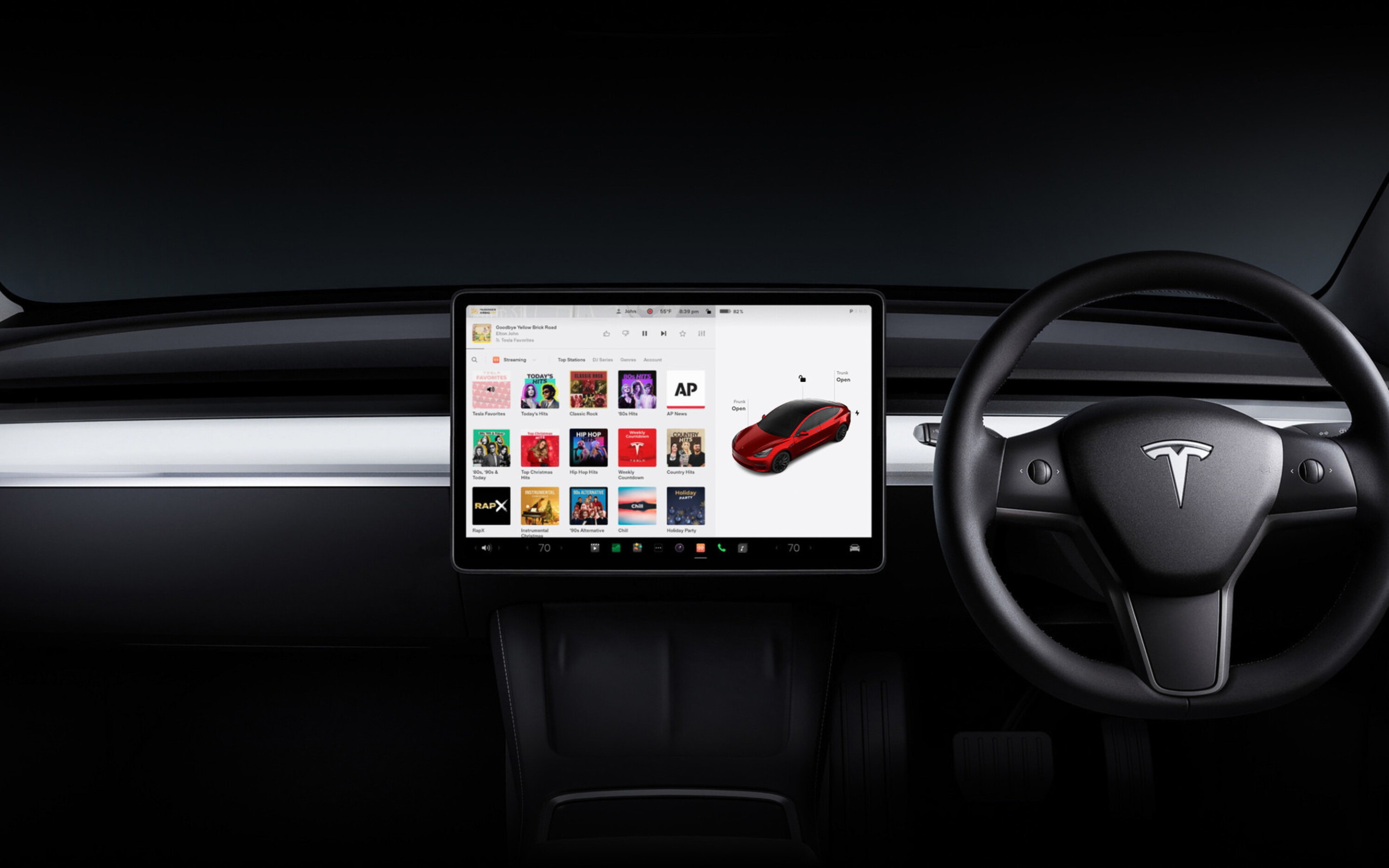
Only 17% of car buyers want to message pedestrians.
Interest in pedestrian messaging was, again, highest amongst EV intenders (25%). “EVs are a logical home for pedestrian messaging due to… EV intender interest in outward appearance,” says Grieb.
AutoPacific’s feature definition focused on displays used for safety messages to pedestrians, such as telling them you are approaching or that they have the right of way, but there are probably plenty of other uses for this emerging technology.
August 2022: Swedish study finds buttons safer than screens
A Swedish study has confirmed what we’ve all been thinking – deleting all buttons and switchgear in favour of large haptic touchscreens is an empirically bad move, as confirmed now by a Swedish study conducted by local auto publication, Vi Bilägare.
So how exactly are screens worse? Vi Bilägare gathered eleven modern vehicles at an airfield and measured the time it took for a driver to perform four different tasks, such as changing the radio station and setting the climate control. Each test was performed while driving at 110km/h.
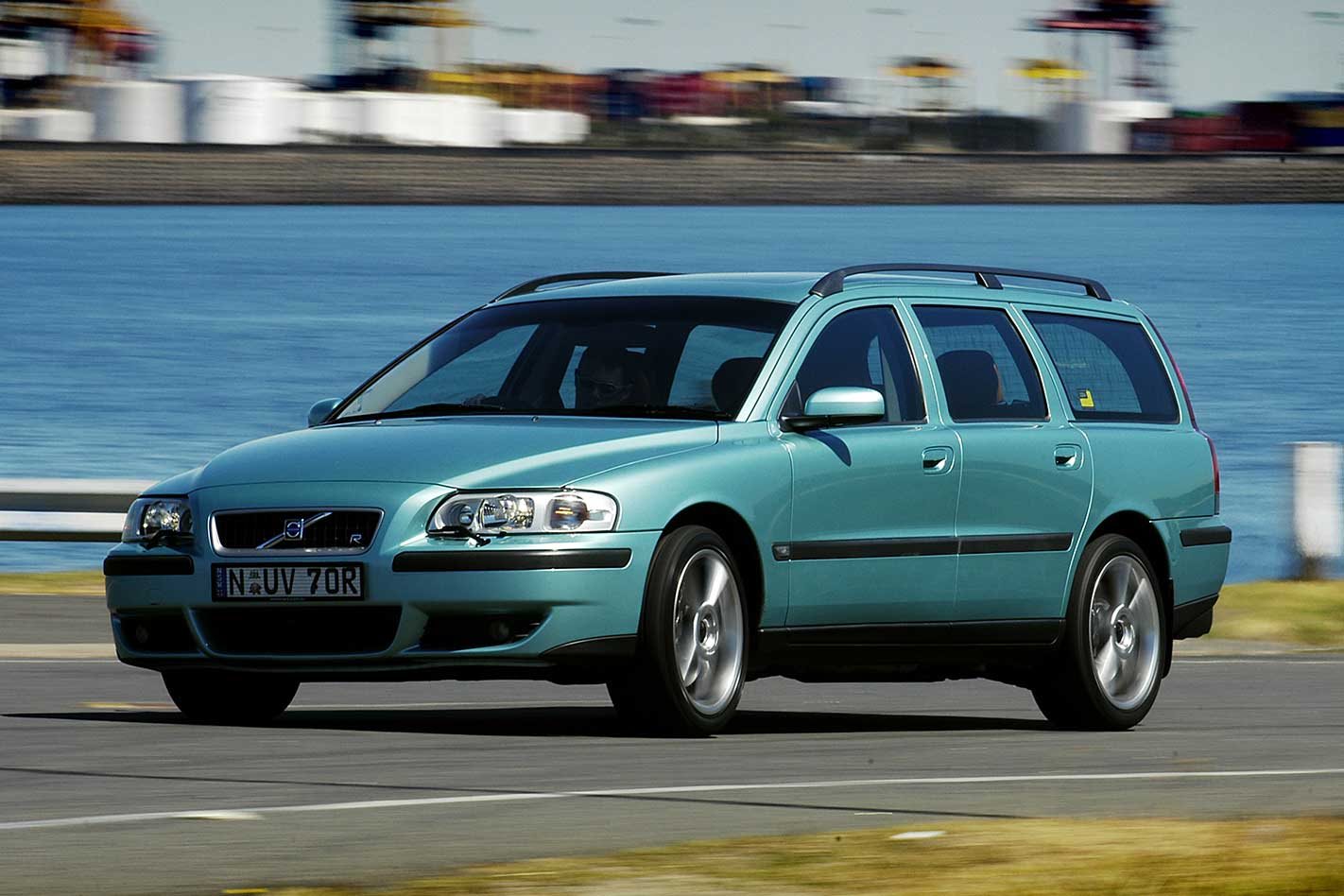
For an ‘old-school’ benchmark, they also included an early second-generation 2005 Volvo V70 for comparison.
For each of the 12 cars, the driver had time to familiarise themselves with each car’s systems.
Tesla gets a special mention for the egregious migration of even the windshield wipers to the central touchscreen.
BMW is credited for its blend of buttons, but is criticised for a complex user interface.
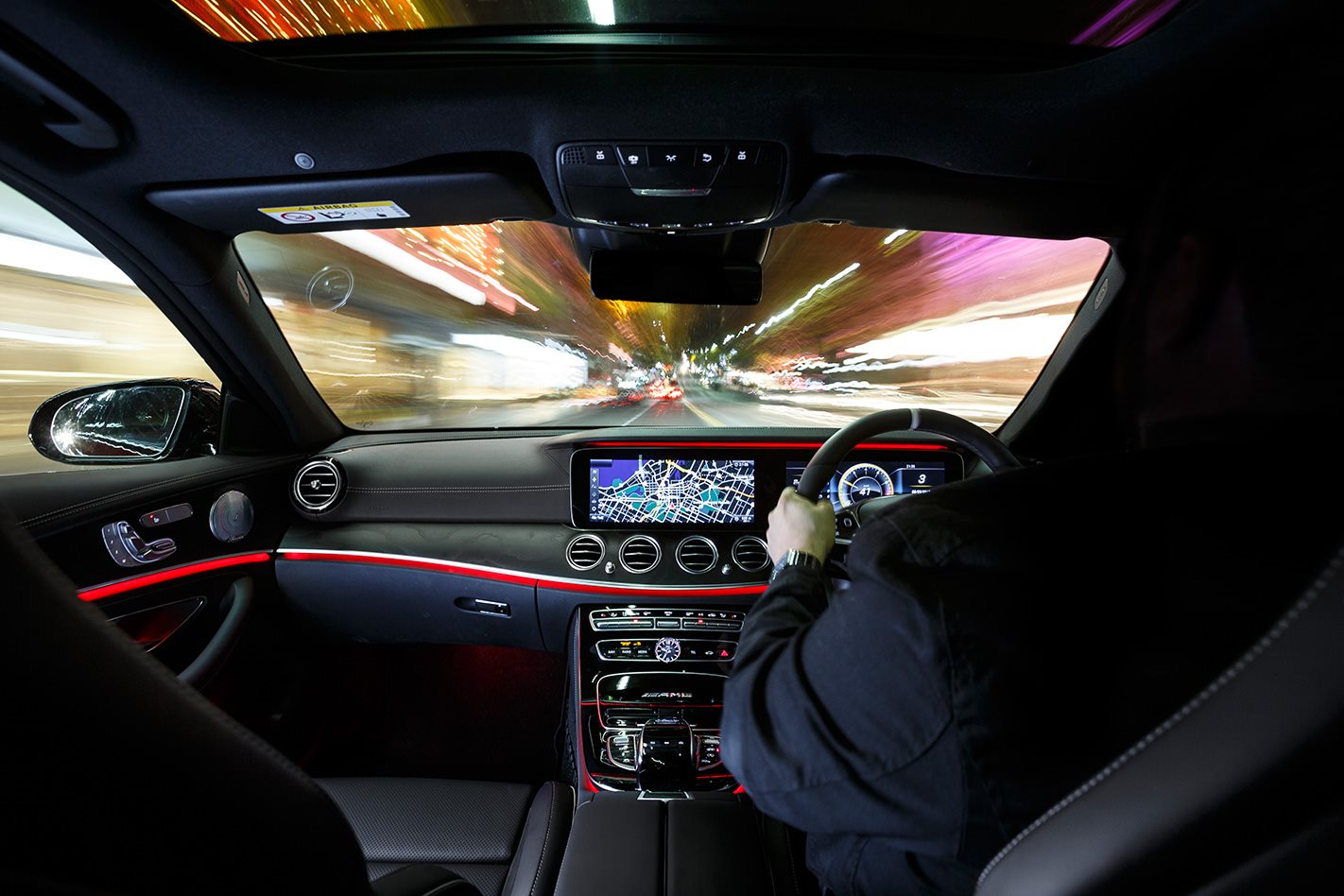
Voice control functionality was also tested, with the worst performing vehicle taking 1400 metres to perform a task that the best-performing vehicle only needs 300 metres to execute.
During the vintage 2005 Volvo V70 drive, all four tasks were completed within ten seconds flat, while covering 306 metres at 110km/h.
The MG Marvel R, an EV SUV we believe not to be coming to Australia but based on the MG5 sedan, required 44.6 seconds to perform all four tasks, and covered 1372 metres – more than four times the Volvo V70.
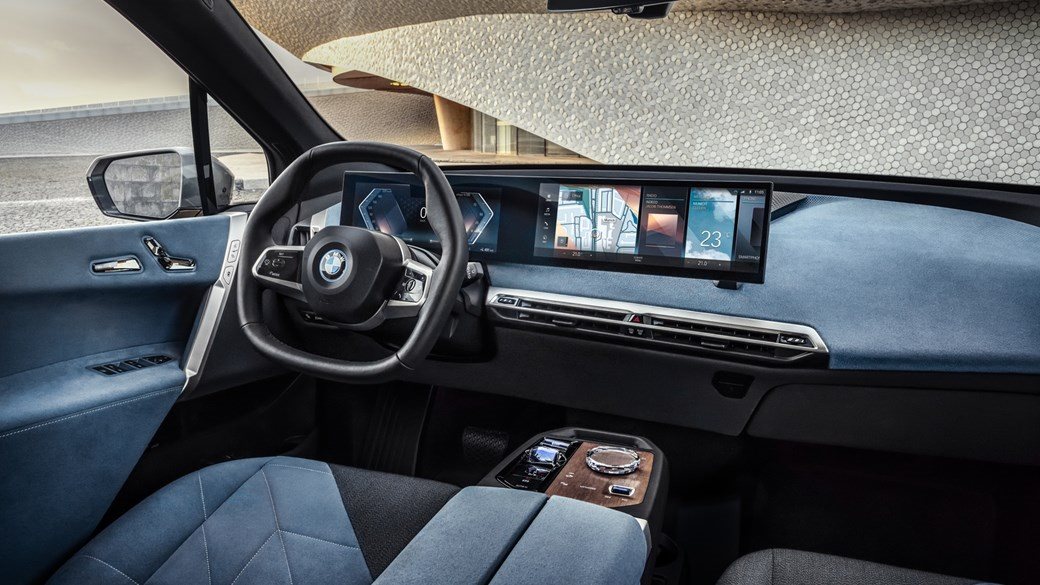
The driver in the BMW iX took almost a kilometre to perform all tasks.
In regards to other cars on the Australian market, the test driver in the Subaru Outback took 19.4 seconds, the Mercedes-Benz GLB took 20.2 seconds, the Tesla Model 3 took 23.5 seconds, the Nissan Qashqai took 25 seconds, the Hyundai Ioniq5 required 26.7 seconds and the incoming Cupra Leon required 29.3 seconds.
Physical buttons and switch gear are quickly disappearing from new cars, with OEMs ditching olds tech for a bevy of screens. In this tech-filled age, screens give off the impression of modernity and ‘clean’ cabin design.
There’s also the fact that programming a haptic screen is far cheaper than designing, developing, tooling, producing, testing and installing physical components, too.
With increasing vehicle connectivity, in the future OEMs will also be able to keep things new with over-the-air (OTA) updates, instead of perpetually redesigning buttons with each vehicle generation.
Still, physical heating and cooling controls are hardly something that needs a redesign or an OTA update…
