
Holden used be to pilloried during the 1980s for the seasonal predictability of its Commodore Vacationer specials.
Well, turn your derision to Mercedes this time because that’s exactly what the SLR 722S is – a sticker special to help shift ’em. The SLR was designed to sell 3500 in its life, but fewer than half that have been constructed. In fact, so disdainful were tech-savvy Japanese buyers about the SLR’s lumpy V8 and old-school five-speed auto that only 11 have been sold there.
So the S version is a last resort to shift what’s remaining
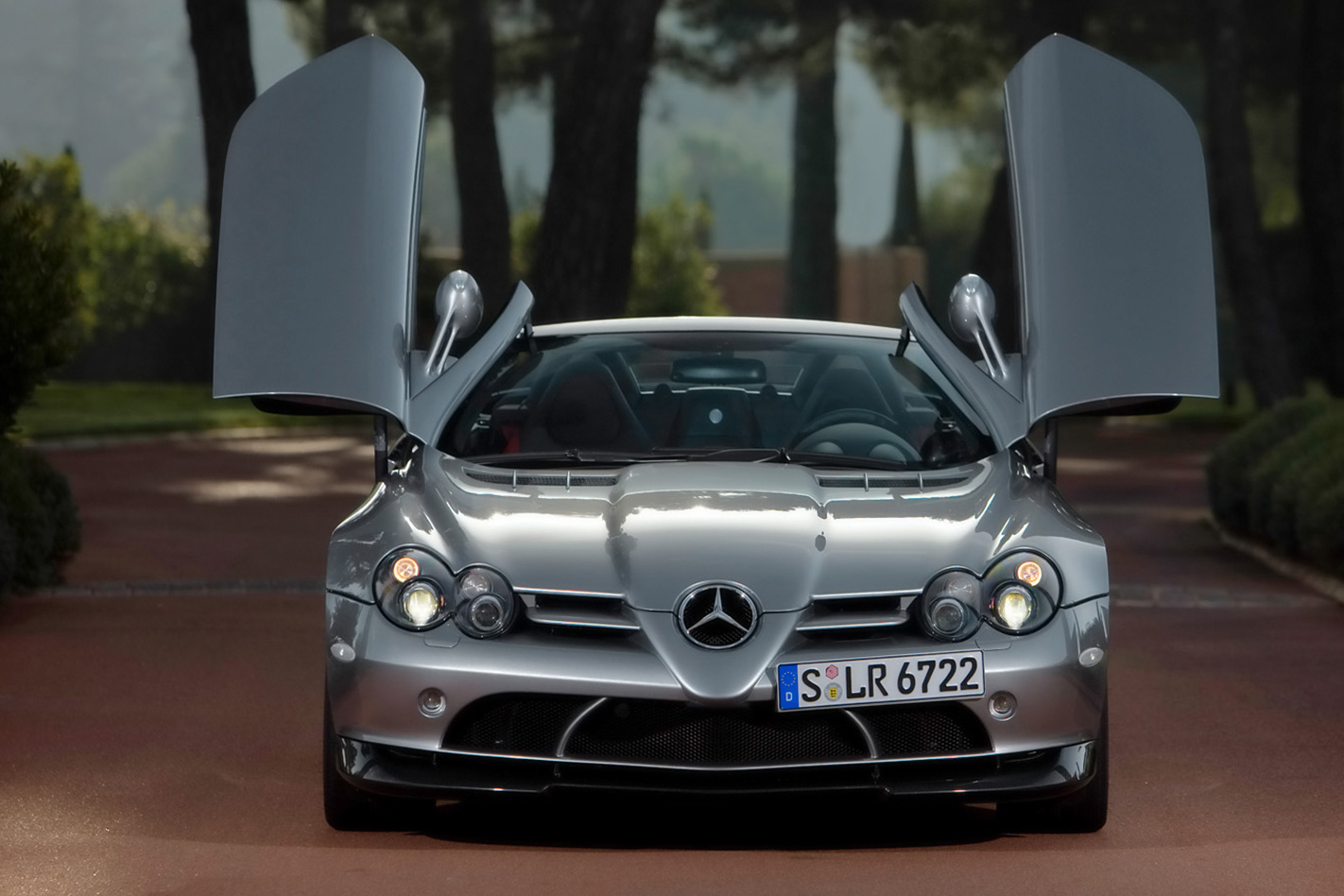
Even when you kick off from the carpark, you know you’re going to have to work. The diff chunks its way around tight corners so hard you worry about tyres even before you’ve blazed the boots into smoke. To make that happen, you push the throttle a little harder, only to find the supercharged V8 getting no smoother as the revs rise. Instead, it snarls its way up the rev range and burbles its way back down again.
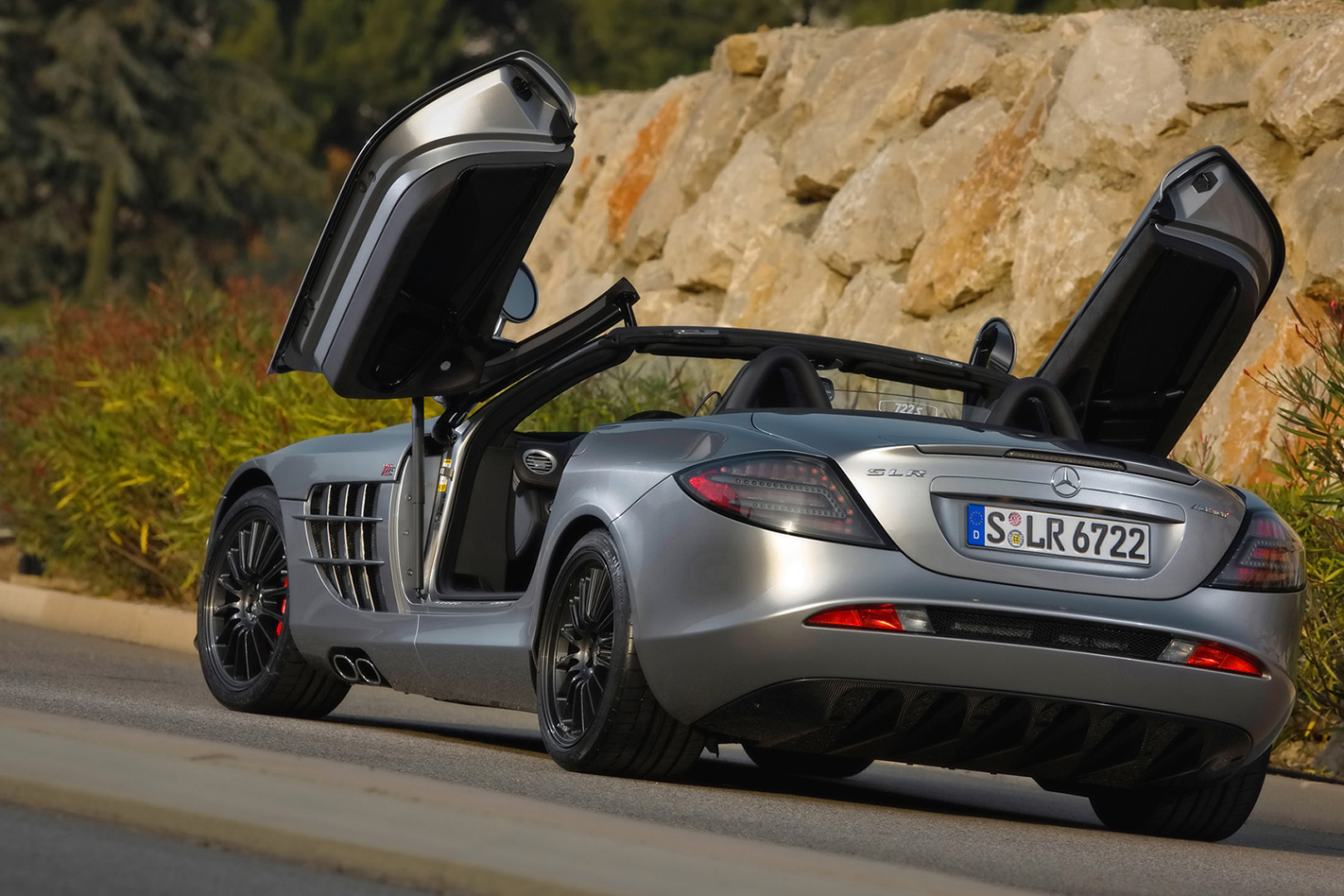
The acceleration is simply ferocious. It’s loud and hard and it leaps into tomorrow like a rasping, angry, rumbling, maddening bullet.
It’d get blown away by a diesel SUV (it actually did). There’s not a lot more until 3000rpm, when the world explodes into a blur, but it’s not good enough.
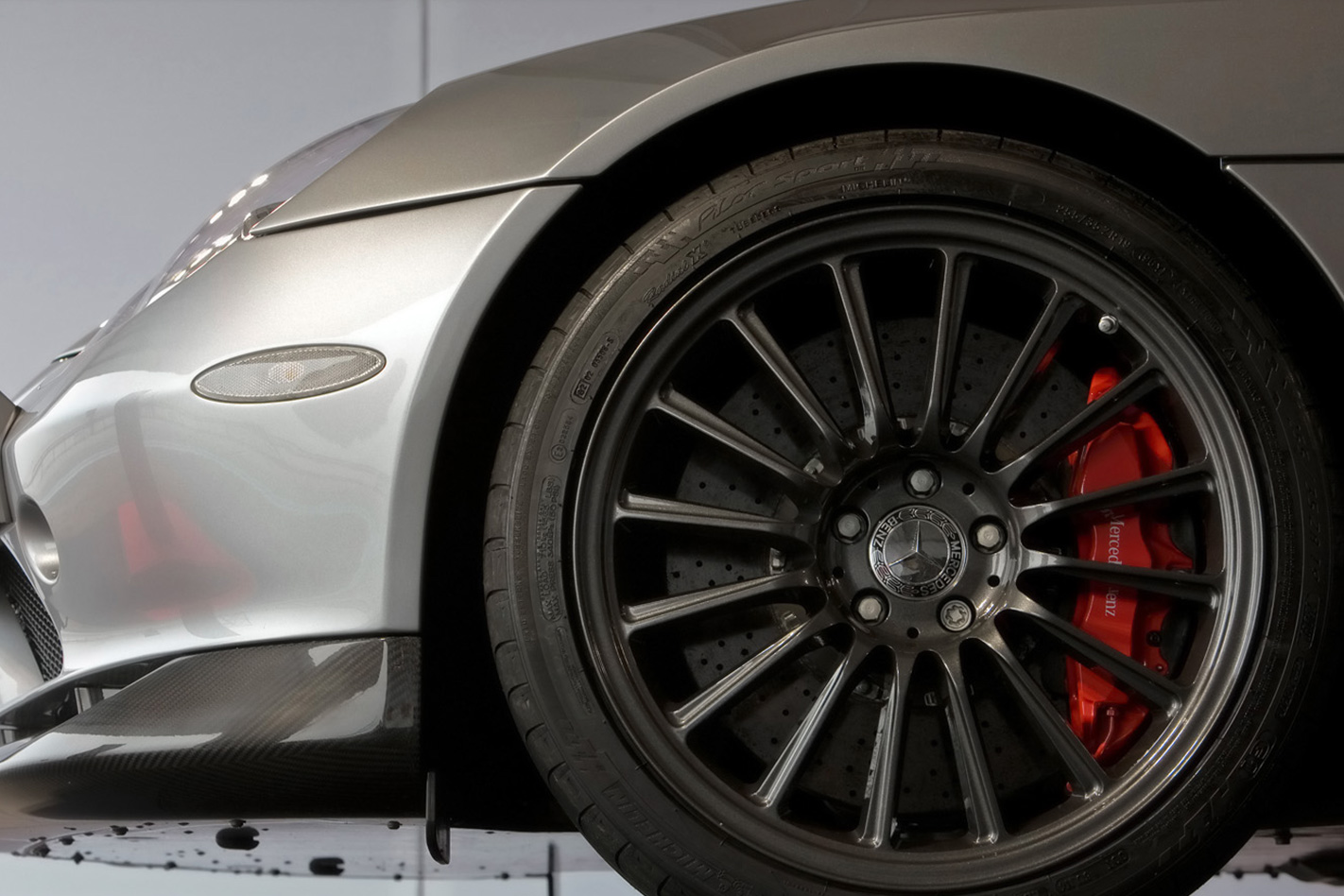
It’s damn near frightening. The rear suspension is underdone and, somehow, manages to feel a lot lower-tech than it actually is. The lacklustre ESP means you’ll be relying on the slow steering and the digital brakes to pull things back. The floor-hinged brake pedal commands huge carbon-ceramic anchors, but there’s little modulation in them.
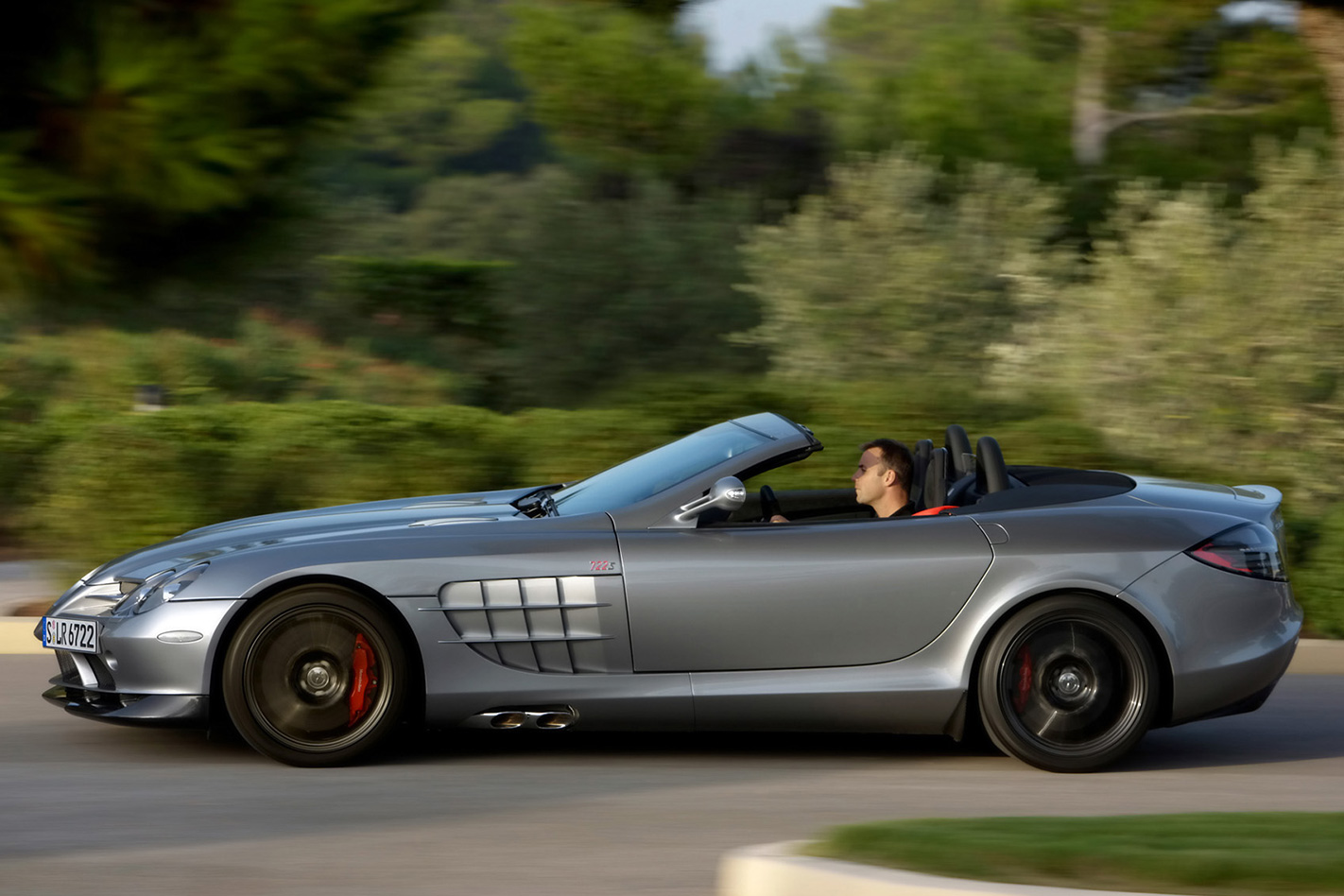
The wonder isn’t that it missed its sales numbers, but that it got as close as half. Honestly, if it’s a big Benz roadster you want, buy an SL63 and, with the enormous difference in price, buy me something nice for saving you.
Volkswagen’s Mk4 Golf GTI arrived in Australia just in time to witness the Subaru WRX phenomenon go large.
And talk about a difference of opinion. Where the Japanese fed their rally-bred sedan a rip-snorting 2.0-litre turbo, all-wheel-drive, massive fogs and a great big wing, the Germans followed the stealth route with a set of alloys, dark-tinted taillights, colour-coded rub strips and a low-blow 1.8-litre turbo.
There wasn’t a single spoiler or foglight in evidence and you couldn’t even see the exhaust – Volkswagen deliberately concealed the tip behind the rear bumper. And that, believe it or not, was how the Golf GTI began the decade.
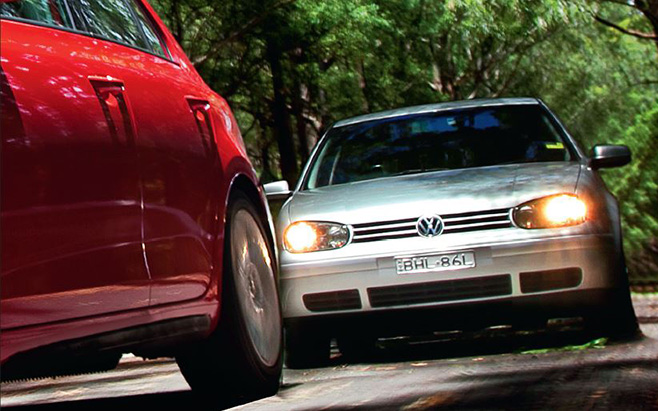
The former is something little girls would appreciate and the latter spells a whole new level of club chic.
The Golf’s basic style remains the same – prominent Volksy grille badge, elemental headlights, curved windscreen, fat C-pillars, shortish wheelbase and upright tailgate – but the garnishing is chalk and cheese.
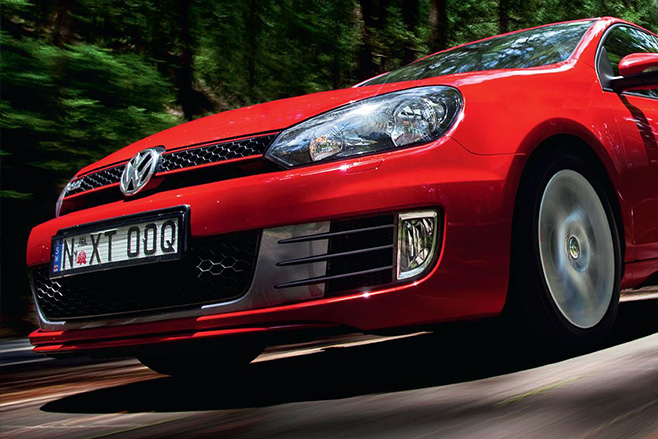
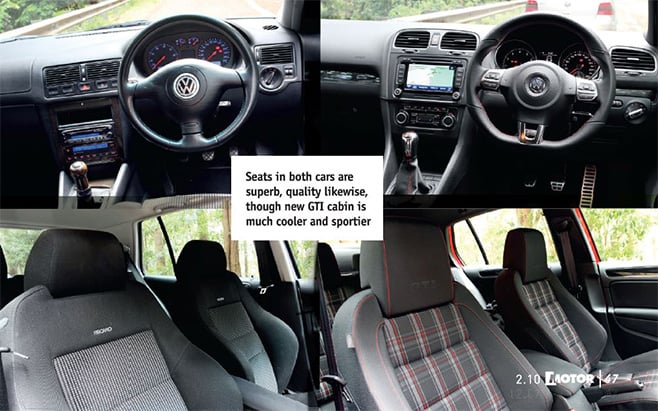
2016 Volkswagen Golf GTI 40 Years review Jump into the marginally heavier Mk6 and it’s amazing just how lithe it is, how keen its turn-in is and how much more animated it feels. In every dynamic discipline you’d care to name, the new car is an absolute revelation. Even wearing the 17s of our test car, the Mk6 GTI has miles of mid-corner and corner-exit grip, goes exactly where you point it, and will move its tail around a bit if you ask it to.There’s actually feel and connection fed through its beautifully chubby leather three-spoker, and it even rides brilliantly, with far greater finesse than the Mk4 ever had.
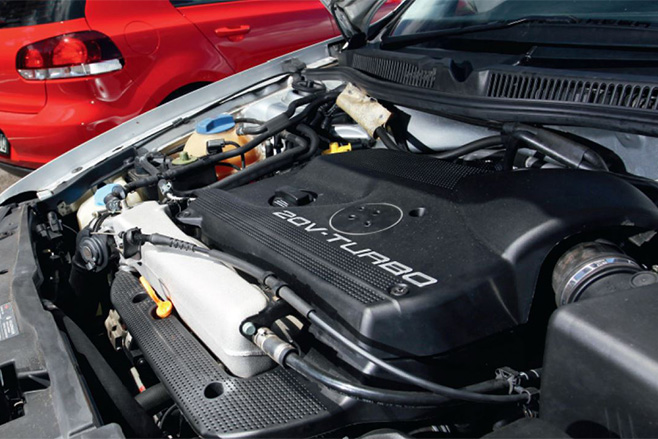
2017 Volkswagen Golf GTI adds 180kW manual It’s this effortlessness that really sets the Mk6 GTI apart – not just from the Mk4 GTI but also most of its competitors. The brilliance of the modern-day Golf GTI is that you can have your cake and eat it too.
Practicality, economy, and relative affordability aren’t mutually exclusive to this highly covetable hot-hatch. And just because you’ve spent less than 50 grand, doesn’t mean you can’t enjoy a fantastic, high-class interior.
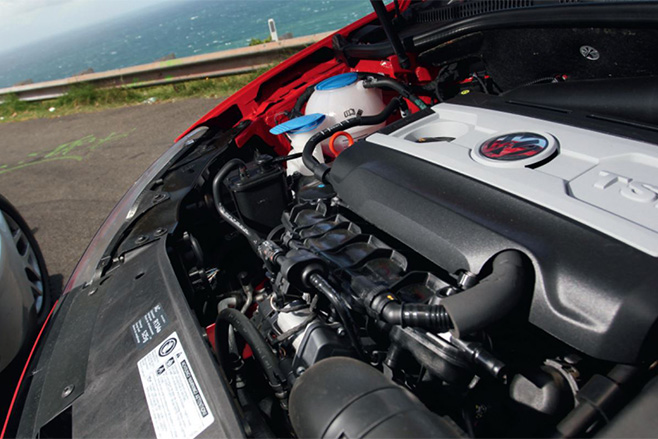
But it’s the new GTI’s continuation of the Mk5’s all-round dynamic excellence that really stands out here. These days, VW makes driver’s cars.
You can easily underestimate the impact the original Porsche Boxster had on the world, the sweet roadster that first hit Aussie blacktop back in February 1997.
See, until then, Porsche was a one-model brand; a commercial situation that even the people closest to it could see just wouldn’t be viable in the long-term.
The bottom line was that Porsche needed an entry-level car and the concept of a two-seater, mid-engined drop-top that evoked the spirit of the original Porsche Spyder of the 1950s was seen, even before it was launched, as a pretty smart way to go.
Check out more of MOTOR’s Porsche news
What we didn’t know, of course, was just how gorgeous the original 986-generation Boxster was going to be, in pretty much all departments.
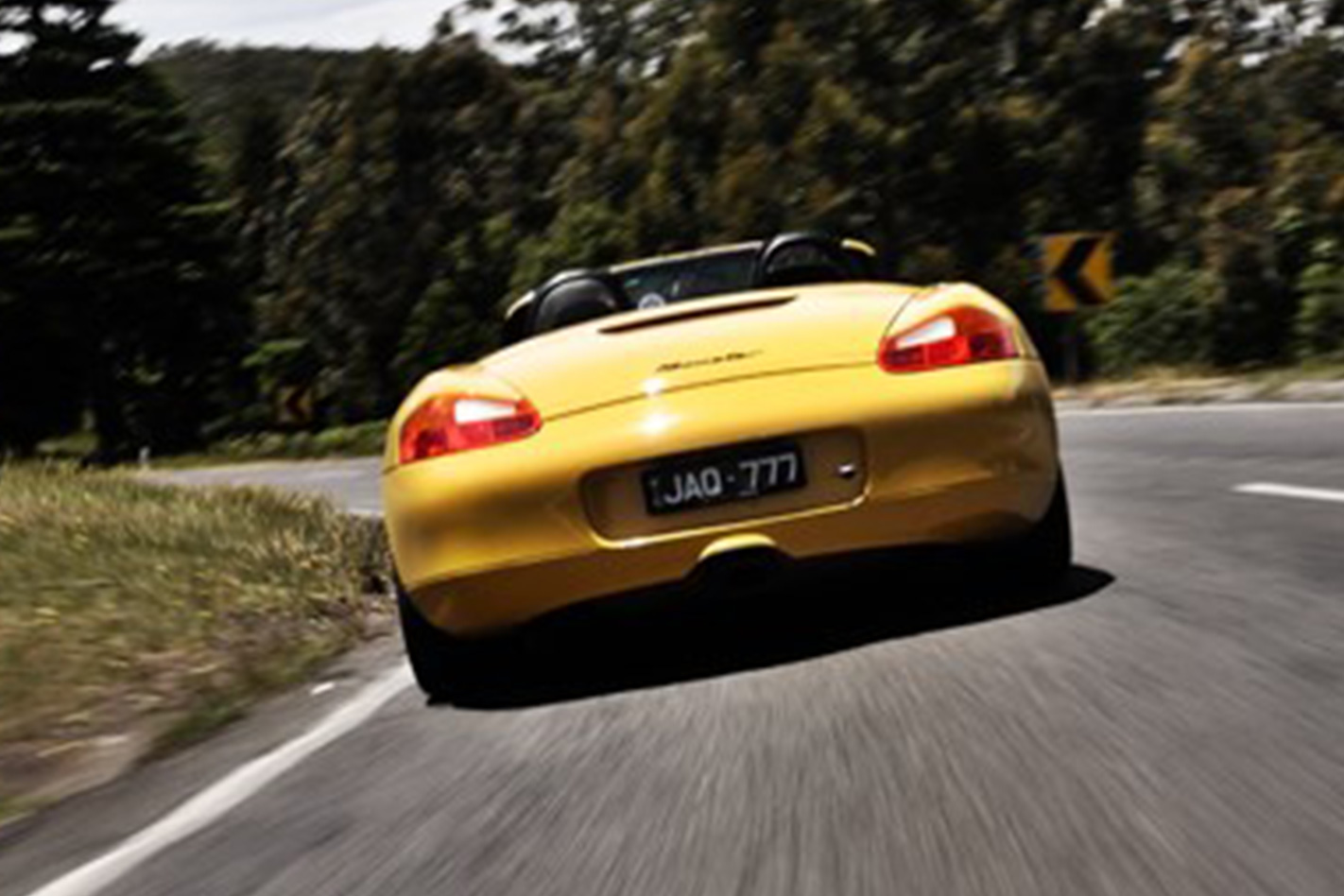
The car’s big worry back then was the thrust – or lack of it – from the 2.5-litre engine stuck up the Boxster’s bum through 1996 to 1999. Oh, sure, it was as sweet as your first kiss, but it wasn’t until the 2.7-litre engine came along in 2000 that the urge deficit (and a few mechanical dramas) in the base Boxster were ironed out.Which brings us to the yellow car on these pages – a 2001 986 2.7-litre five-speed manual. Given that Porsche has a rich tradition of refining and evolving a model’s mechanicals without messing with the styling, it’s tempting to think that a brand-new 987-gen Boxster might just run rings around the older car.
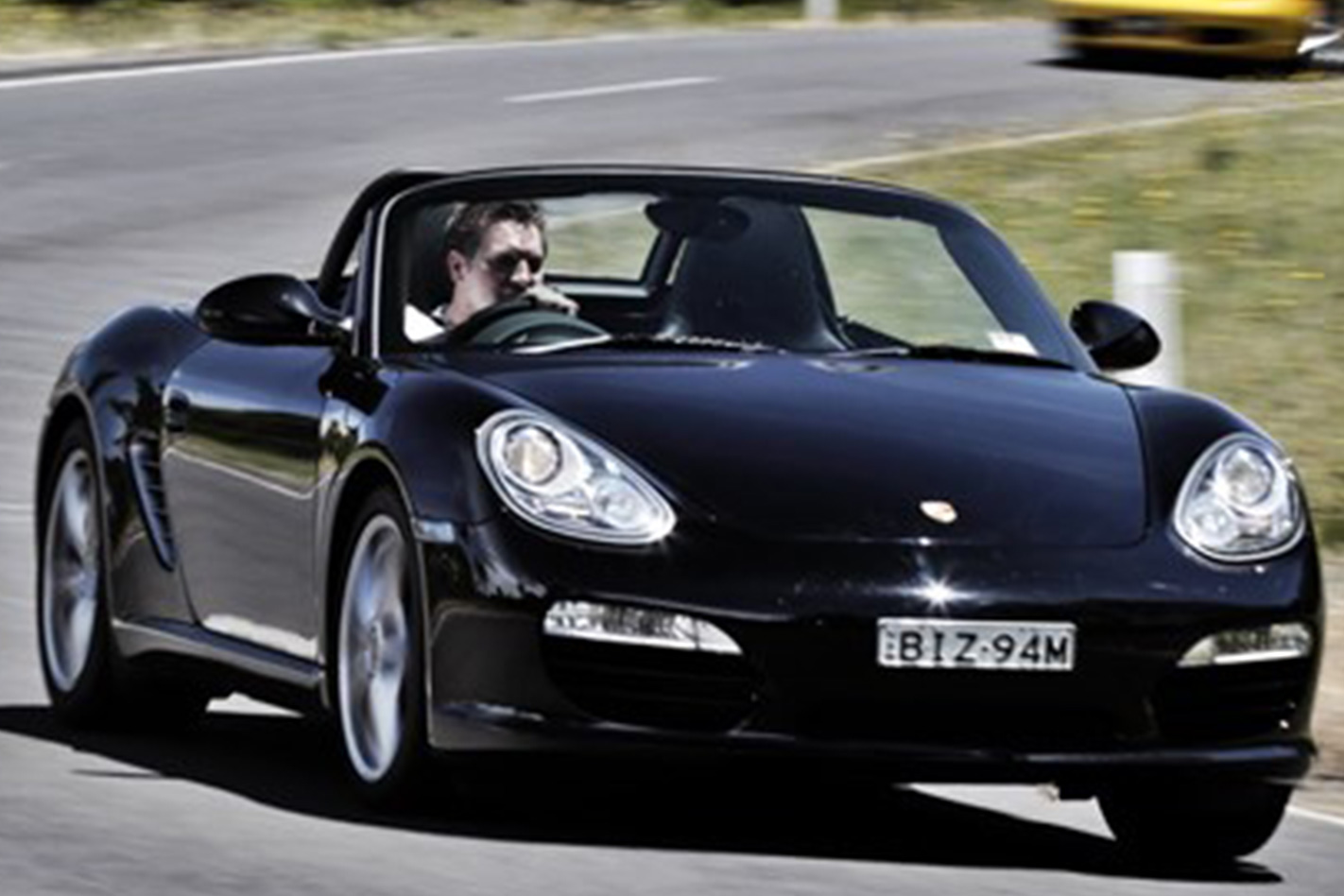
But does it translate to the Boxster?Erm, no, not really. And while there’s definitely been progress, the original Boxster was so far ahead of its time, and its chassis so good first time out, that it still feels great to drive today.The cabin is showing its age, with those oval switches that were too cool for school back at the turn of the century. There’s no cup-holder or glove box (the owner’s manual lives in a pocket under the steering column marked ‘Afterthought’).The script on the LCD readouts feels old-hat, too, and the power window switches are in the console, not on the door as they are in the new model, where they should be.But the tiller is lovely, less fussy than the big-horned PDK wheel, with a thinnish rim for a great tactile experience. The old cabin itself does feel a bit narrower than the newie, but clearly sound ergonomics and nice, low seating was on the Boxster drawing board from the get-go.And despite its age and 96,000 fairly hard kilometres, the leather and plastic still looks good.One of the biggest steps forward has been the move to a glass rear window rather than the early car’s plastic job. To avoid crimping the plastic window, the trick is to drop the roof about a quarter of the way, jump out and manually start folding the roof somewhere other than the window, jump back in and finish lowering the lid.
The 2009 car makes 188kW – three more than the original Boxster S 3.2-litre donk – from its 2.9 litres. Meanwhile, the early girl makes do with 162.
The gap feels bigger than that, to be honest, and 290Nm versus 260 tells the rest of the story. Once you’re up and rolling, the 2.7 does a fine job, but it’s that bit harder to get out of the hole, even with its manual gearbox.That said, when we first tested the then-new 2.7 (MOTOR, August 2000), it clocked 6.3sec to 100 and 14.5 for 0-400m. Our times for an ’09 manual back in August were 6.3 and 14.4 respectively, though that car wouldn’t rev beyond 6000rpm in first gear (and its redline is seven-two).The oldie is also 65kg lighter than the newie. While the new car’s PDK clutchless masterpiece runs with seven forward speeds and more brains than the Space Shuttle, there’s no getting around one single, but salient, point: in a car like the Boxster, swapping your own gears really is its own reward.
And when the shift is as sweet as the 2.7’s five-cogger, let alone the current slick six-cogger, there’s no excuse for not having the manual.
Okay, so some of you will have guessed that much already, but one big surprise is that the older engine is actually the smoother of the two. It lacks the stick-flick soundtrack of the new car, but it’s definitely sweeter and less wholegrain.In handling terms, there’s less in it than we’d have thought. True, the Porsche’s R-spec tyres give it loads of grip (and loads of road noise), but both are delightfully balanced and fluid, feed back with clarity and respond with supreme accuracy. Back-to-back, they’re clearly from the same stable.All of which makes a second-hand Boxster an incredible bargain. Take the time to find a 2.7 in manual and you’ll be cruising on Quality Street.And when you see them parked side-by-side, you might even agree with me that the slightly more feminine early car, with its classic Porsche wheel styling, is the (slightly) better looking, too.
Utes sure as hell ain’t what they used to be.
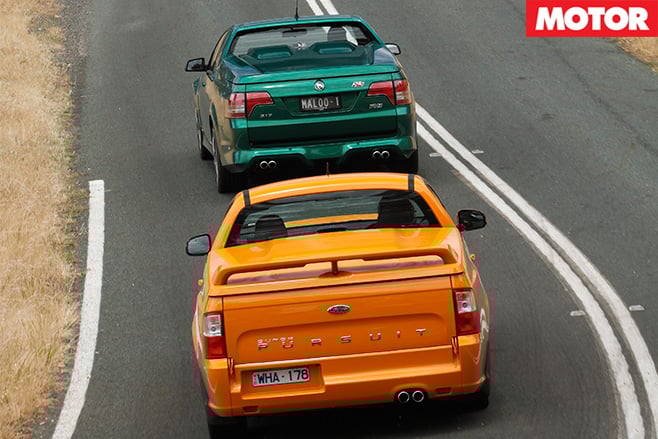
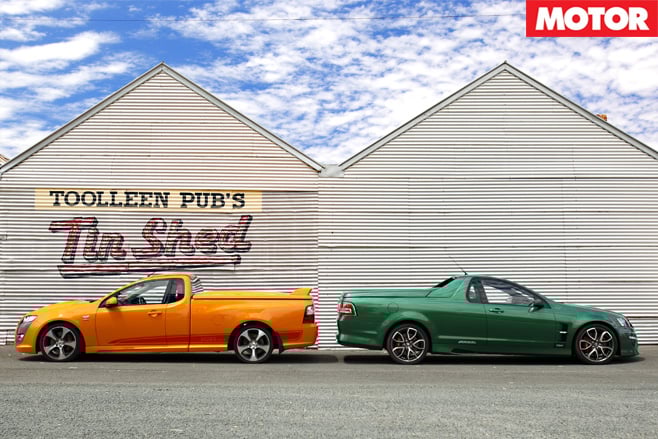
Part of the local landscape since the 1930s, the humble Australian tray-back has evolved way beyond any vision its originators might have had for it. The modern ute is, of course, a product of its times. And with fringe benefits tax legislation favouring commercial vehicles and pastimes such as dirt-biking flourishing, it’s no wonder that both HSV and FPV have offered up high-performance toy-haulers for tradies with a bit more gold to splash around.
While it’s true that all vehicles have expanded their performance envelopes over time and that niche marketing has led to a whole raft of new market segments, I’d still love to see the look on Lew Bandt’s face (the Ford engineer who designed the first ute back in the 30s) if he was to gaze down and spot either of this pair.
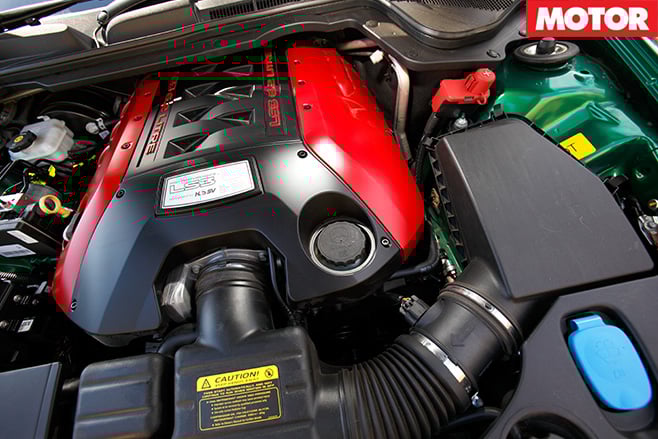
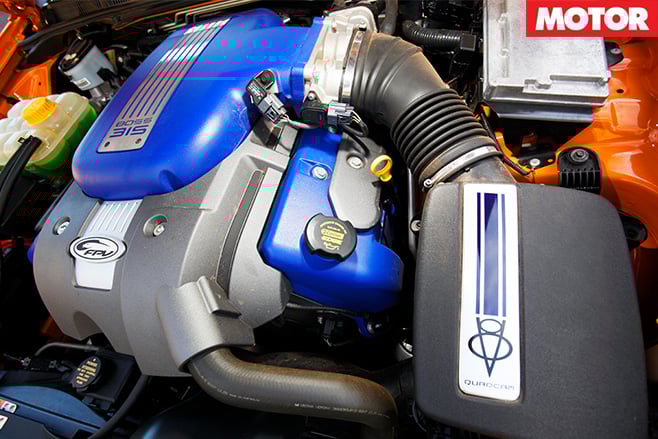
Of course, it’s not quite that straightforward, with the Henry running quad overhead camshafts and the LS3 sticking with a relatively simple single cam and pushrod valve operation.
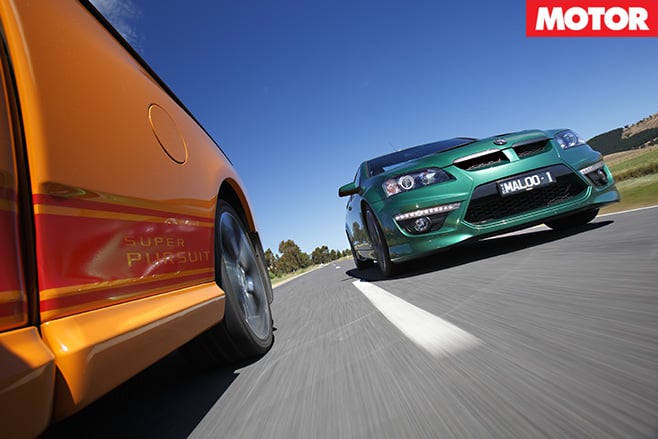
Thing is, that’s not as quick as we’d hoped. And the 0-100km/h time of six seconds dead was also something of a let-down. But what we really didn’t see coming was how small the gap back to the FPV was. Okay, the Super Pursuit test car is an auto and everything, but 0-100km/h in 6.4 and a standing 400m of 14.5 at 166.2km/h is as close to its HSV opposite number as it’s ever been.
What the drag strip masks is the real difference in these engines. See, while the power and torque peaks might be in the same ballpark, the way and the where of those output deliveries is the critical difference. The defining difference, in fact.
You can really see the difference in the 80-120km/h times in the various gears. While the HSV’s ultra-long sixth gear nobbles it from 80km/h up, in both fourth and fifth cogs the Maloo beats the Super Pursuit to 120km/h by almost two and three seconds respectively. Even held in third gear, where the FPV is spinning closer to its engine’s high-rpm sweet spot, the HSV is still nearly a second-and-a-half swifter to 120.
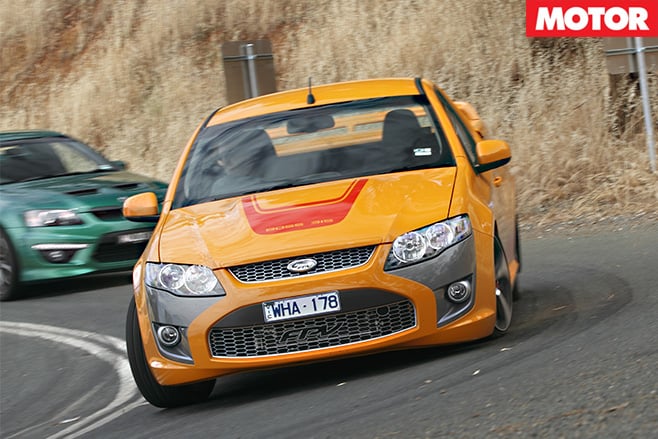
On the road there’s a marked difference, with the HSV literally pulling yards on the FPV when cranking out of corners. By the time the FPV has swung its tacho beyond 4500rpm, it’s starting to honk, but it’s too little too late, and the Maloo is already much closer to the far horizon.
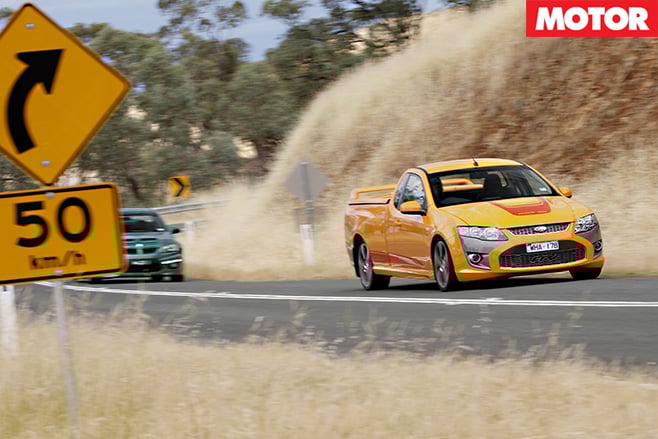
Neither car feels especially light or agile on the road, although the HSV does have an extra dollop of steering feel thrown in to make you a bit more certain that those big front tyres have bitten and are likely to hang on. It’s also quieter on the road, and while both are pretty good in suspension-noise terms, the FPV gets a fair din going that enters the cabin from behind the seats.
The theory is that there are little vents built into the FPV’s cabin that are designed to vent pressure in the case of the airbags deploying (otherwise you’d have ruptured ear drums, apparently). And these leak noise into the cab when you’re on the move.
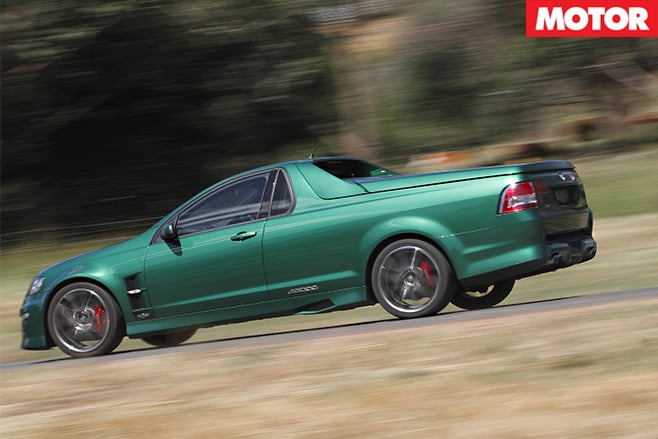
Even then, the HSV is a more natural oversteerer, but that’s only late in the piece using plenty of throttle on a corner’s exit. Up until then, especially in the mid-corner, the HSV is really quite a neutral beast.
In ride terms, the Maloo continues to surprise by being more supple on the sort of crumbly back roads either ute is likely to find owners wanting to travel along. There’s good damping and, even though the Maloo doesn’t get the GTS’ MRC dampers, the basic set-up is sound.
Braking? Both utes are extremely well endowed; the FPV copping six-pot front Brembos and the HSV large front four-potters. And while the Maloo stopped just over a metre-and-a-half shorter, that’s possibly down to tyres rather than hardware. Both make good use of their wheelbases, too, to remain surefooted under heavy braking, and mashing either’s brake pedal into the carpet is a simple, stress-free exercise.
Neither ute is likely to be used for actually carrying too much – a dirt bike, an Esky and a swag are the most likely tray-loaded items. So you’d reckon the FPV’s cart-sprung live-axle rear end would give it some degree of payload advantage.
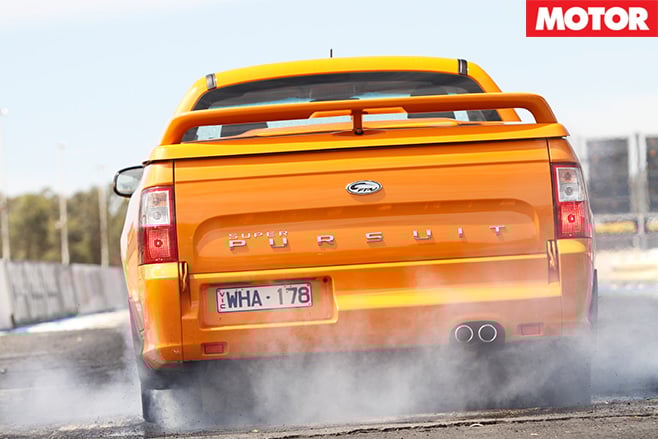
At least both vehicles now feature tough, plastic tray liners, which will neither rust nor dent. But those of us who still use utes as utes shake our heads at the hard tonneaus that seriously limit what you can actually carry without actually removing the cover and leaving it at home (an exercise that isn’t some quick one-bloke job, either).
The HSV’s gearshift is still a bit heavy and slow for some tastes, though at least the clutch is relatively light and has plenty of feel. I’m not convinced that the FPV’s otherwise very good six-speed auto is such a magically intuitive match with the V8, either – particularly compared with the sweeter turbo-six/auto combination – but it is preferable to the manual in terms of day-to-day running around and towing, roles of which this pair would both be marvellous at playing.
That, however, is not the FPV’s major user interface blow-out. Nope, the big clanger would have to be the seating position. Look, the seats themselves are wonderful things, with nice high bolsters and plenty of padding in the right places. But the damn steering column is adjustable to an infinite number of positions, all of them way too low.
The upshot is that it becomes a knee-banging chore trying to swing your legs under the steering wheel getting in and out, and it absolutely ruins the experience of sportiness because it makes you feel like you’re sitting on top of the car, rather than in it. Oh, and if the driver’s airbag ever goes off, the wheel is so low that should anybody ever produce ‘Bee Gees – The Musical’, you’ll be able to sing all of Barry’s high parts without trying.
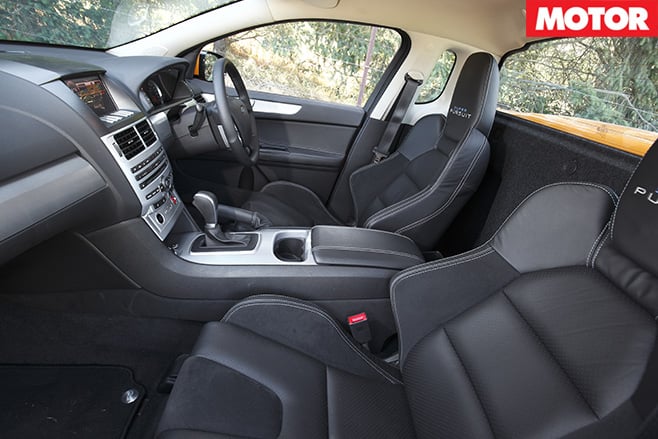
That said, the FPV interior is better screwed together than the HSV’s (the VE and its offspring have always been a bit ordinary in this department). And at least you can actually see out of the Super Pursuit…
Ah yes, vision. I’m going to go out on a limb here and suggest that I can’t think of another current production car – and that’s including the Lamborghini Gallardo – that is so impossible to see out of as the current Maloo R8. And I’m not some small sunk-in-the-pew bloke, either.
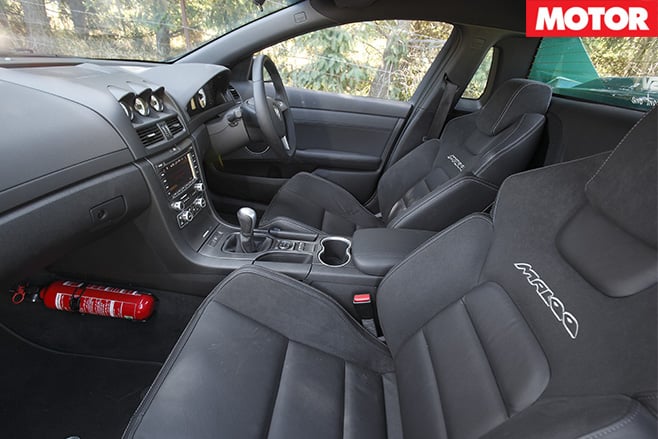
A small car could drive right past your tail-gate while you’re reversing and you wouldn’t know until you’d heard it go ‘crunch’. In fact, you’ll have trouble even seeing the point of brushing your teeth and being good to your mother from the cabin of this thing.
In traffic, you’re never really sure what’s around you and, consequently, lane-changes are never as confident as they should be. In fact, the lack of vision in the Maloo would be an absolute deal-breaker for me, regardless of how good it is at everything else.
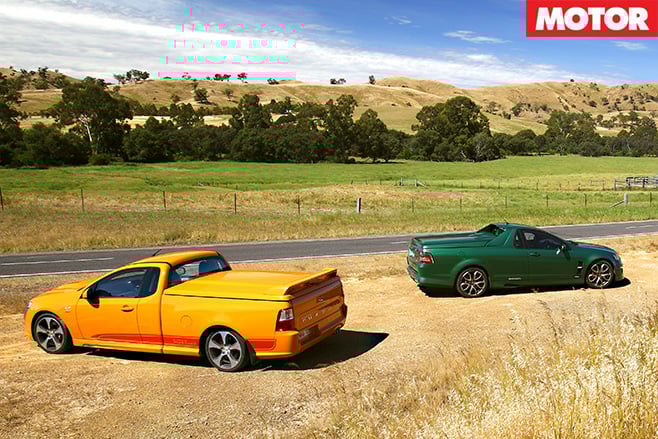
While I’m at it, who told FPV that pumping the ute’s rear wheel arches but leaving the same width rear axle in place was okay? It looks seriously wrong with the anaemic 245mm tyres tucked way up underneath. Maybe it’d be better if the FPV had the HSV’s fatter rear hoops, but it doesn’t, and that sort of sums up the whole thing.
I can see that the Maloo is a sometimes-misguided attempt at a sporting ute for the chippie or sparky who’s done good. But even at $63,990 compared with the Maloo’s $62,500 (manual) and $64,500 (auto) asks, the Super Pursuit feels much more like a parts-bin special.
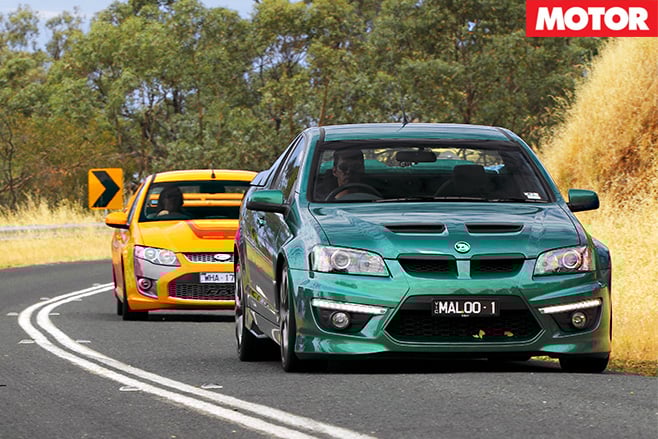
All of which kind of hands victory to the Maloo, because even though it’s a black hole to sit in, it does have the best engine, the best ride-handling package, and it does offer the superior driving experience.
And even the dimmest apprentice can see how that adds up. He just won’t be able to see it – or much else, for that matter – from the HSV’s driver’s seat.
Way back
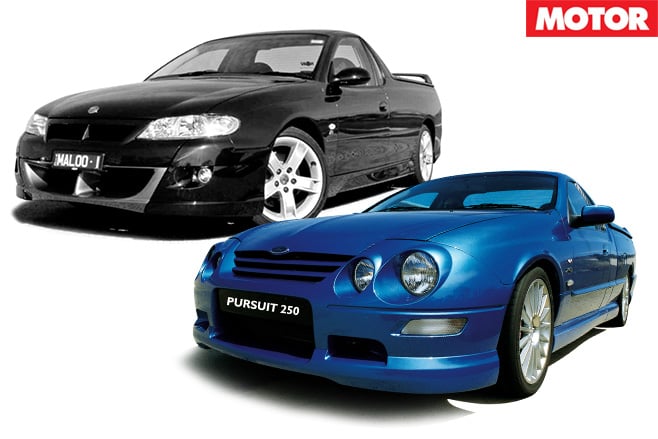
That final 5.6-litre V8 might have sounded a bit gruff at the top end, but in its 3000-5000rpm pleasure zone, with all that torque and all that old-school rumble, the Pursuit 250 was rock and roll, baby.
HSV’s first new Maloo of the decade, the VU and VUII (both 2001) was the first based on Holden’s all-new Ute. An IRS rear end (albeit of the old semi-trailing-arm variety) gave the Maloo a sizeable leg-up over the Pursuit, but its LS1 Chev’ V8 couldn’t match the Windsor’s torque, and its cabin couldn’t match the Ford’s room. Looked bloody tough, though…
Specs
| u00a0 | FPV Super Pursuit | HSV Maloo R8 |
| Body | 2-door, 2-seat utility | 2-door, 2-seat utility |
| Drive | rear-wheel | rear-wheel |
| Engine | 90-degree V8, DOHC, 32v | 90-degree V8, OHV, 16v |
| Material | alloy head/iron block | alloy head/alloy block |
| Bore/stroke | 90.2 x 105.8mm | 103.25 x 92.0mm |
| Capacity | 5408cc | 6162cc |
| Compression | 10.8:1 | 10.7:1 |
| Power | 315kW @ 6500rpm | 317kW @ 6000rpm |
| Torque | 551Nm @ 4750rpm | 550Nm @ 4600rpm |
| Redline/Cut | none/6500rpm | none/6600rpm |
| Fuel/tank | 98 octane/81 litres | 98 octane/73 litres |
| ADR Consumption | 14.4L/100km | 15.1L/100km |
| Kerb weight | 1893kg | 1823kg |
| Power/Weight | 166kW/tonne | 174kW/tonne |
| Transmission | 6-speed automatic | 6-speed manual |
| Ratios | 4.17/2.34/1.52/1.14/0.87/0.69 | 3.01/2.07/1.43/1.00/0.84/0.57 |
| Final drive | 2.73 (LSD) | 3.70 (LSD) |
| Suspension | double A-arms, coil springs, anti-roll bar (f); live axle, leaf springs, anti-roll bar (r) | struts, A-arms, anti-roll bar (f); multi-links, coil springs, anti-roll bar (r) |
| L/W/H | 5096/1934/1453mm | 5121/1899/1465mm |
| Wheelbase | 3104mm | 3009mm |
| Tracks (f/r) | 1583/1583mm | 1592/1590mm |
| Steering | power rack and pinion | power rack and pinion |
| Turning circle | 11.8m | 11.4m |
| Lock-to-lock | 2.6 turns | 2.8 turns |
| Brakes | 355mm ventilated/drilled discs, six-piston calipers (f); 328mm ventilated/drilled discs, single-piston calipers (r); ABS, EBD, ESP | 365mm ventilated discs, four-piston calipers (f); 350mm ventilated discs, four-piston calipers (r); ABS, EBD, ESP |
| Wheels | 19 x 8.0-inch, alloy | 20 x 8.0-inch (f), 20 x 9.5-inch; alloy |
| Tyres | Dunlop SP Sport Maxx | Bridgestone Potenza RE050A |
| Tyre size | 245/35ZR19 | 245/35R20 98Y (f), 275/30R20 96Y (r) |
| Price | $63,990 (as tested) | $70,130 (as tested) |
| Pros | Strong top-end grunt, superb GT-P seats, decent value | Monster engine, manly looks, impressive dynamic package |
| Cons | Lacks HSVu2019s mid-range, Ford suspension tune needs work | Youu2019ll either love or loathe the looks, terrible outward vision |
| Star Rating | 6/10 | 7/10 |
| u00a0 | FPV Super Pursuit | HSV Maloo R8 |
| 0-10km/h | 0.6sec | 0.4sec |
| 0-20km/h | 1.1sec | 0.9sec |
| 0-30km/h | 1.8sec | 1.5sec |
| 0-40km/h | 2.4sec | 2.1sec |
| 0-50km/h | 2.9sec | 2.6sec |
| 0-60km/h | 3.4sec | 3.0sec |
| 0-70km/h | 4.1sec | 3.6sec |
| 0-80km/h | 4.9sec | 4.6sec |
| 0-90km/h | 5.6sec | 5.3sec |
| 0-100km/h | 6.4sec | 6.0sec |
| 0-110km/h | 7.3sec | 7.4sec |
| 0-120km/h | 8.3sec | 8.3sec |
| 0-130km/h | 9.5sec | 9.2sec |
| 0-140km/h | 10.8sec | 10.2sec |
| 0-150km/h | 12.1sec | 11.3sec |
| 0-160km/h | 13.5sec | 12.1sec |
| 0-170km/h | 15.1sec | 14.6sec |
400m | 14.5 @ 166.2km/h | 14.2 @ 167.3km/h |
80-120km/h (3rd) | 4.9sec | 3.5sec |
80-120km/h (4th) | 7.1sec | 5.3sec |
80-120km/h (5th) | 9.9sec | 7.0sec |
80-120km/h (6th) | 10.9sec | 12.6sec |
100-0km/h | 37.9m | 36.2m |
*Driver David Morley @ Heathcote Dragway
HSV smacked the ball right into the back of the net when it launched the Clubsport in 1990.
Dreamed up by former Brock insider (and Bathurst winner) John Harvey, the idea of an HSV you could drive to work through the week and then hammer around a racetrack on weekends was nothing short of inspired.
Based on the then-current VN Commodore, that first 180kW 5.0-litre Clubby was a bit raw boned and stripped out, though surely that was the point. But as the years moved on the Clubsport has gained equipment and luxury as HSV tuned the concept to match up with customer demand.This brings us to the VX Clubsport R8 you see here which, by the time the Series II had rolled into showrooms in 2001, had become HSV’s biggest-selling model, and quite a resolved piece of equipment.
So how does it stack up against the latest and greatest? Can an eight-year-old Clubby still bring on the jollies in the face of HSV’s current VE-based E2 model, what with the latter’s 317kW and 20-inch wheels and tyres?There’s only one way to find out, really. On the way to meet the owner of the ‘old’ car, there’s time to sample exactly what the latest Clubsport has to offer. Plenty, in a nutshell, with 6.2 litres, a six-speed manual ’box and tons of grip at either end.Parking it next to the VX, it is instantly obvious that the new car is physically much bigger, with a higher bonnet line and deeper sides.
There’s also a lot more standard equipment, and the safety angle is covered off more completely in 2009 with head airbags and stability control joining the front and side-front bags of the older car.
In accommodation terms, there are plenty of differences but, surprisingly, it’s the VX that has the superior front pews.
There’s nothing actually wrong with the VE’s chairs, but the VX’s are a snugger fit and seem to grab you more securely. We’d choose the older car’s tiller, too, with its slightly thinner rim giving a bit more purchase.There’s no getting around the fact, however, that the VX’s interior is a bit dated, most noticeably in terms of its gauges and dashboard layout. Then again, its quality is no worse than the E2’s.Practicality comes in two forms in Clubsports, and it’s a bit of a split decision for us. On the one hand you have the VX, which misses out on even one single cup-holder, but on the other, the VE’s too-fat A-pillar makes forward vision in traffic less than ideal. Trust us, that super-sized pillar can hide even a big motorcycle.
You’d be worried if there wasn’t a huge difference in the way these cars drive, but the differences that exist are pretty easy to identify. Progress has been made in some areas but, strangely, not in some others. We’d put the gearshift into that latter category because the VE’s shift is really of no greater quality than the VX’s.Both six-speeders are heavy and slow and only the high take-up point on the VX’s clutch (probably due to a bit of general wear) makes the early car any harder to launch. That said, there is a lot more noise from the gearshift in the VX and loads more driveline shunt at low speeds in low gears. Again, though, give the VE a few years and the same number of kays on board and it might be a more even match.
HSV VY Clubsport thrashed by Mark Skaife What the VE won’t lose over the years, though, is a much more communicative front end. There’s a fundamental difference in the way each car corners, too. While the VX tends to use its outside front tyre pretty heavily, there seems to be better weight transfer in the VE to the point where it can squat a bit in the rear and take some load off the front axle when exiting a corner.The other defining difference is under the bonnet where the extra half a litre of displacement really shows up. It has taken until now to achieve it, but the E2 Clubsport has a sixth gear that is actually useable in the real world of headwinds and hills.And where the later car is cracking on in top gear, the VX needs a shift back to fifth to produce anything like the same degree of flexibility.
Surprisingly, though, when the VX is wound up beyond about 4000rpm, there’s not as much difference in thrust as you might imagine. Some of that is down to the VX’s lower kerb mass (1706kg v 1809kg) but, equally, there’s no denying every one of the VX’s 255kW are ready for the call.
So where does that leave us? Sure, the new car has a better front end, better accommodation and more real-world performance, but the old ’un is hardly slow and will still float your boat if you like this formula of car.In most regards you can see development, although whether it’s a full decade’s worth is debatable. And in other regards (particularly seeing out of), the older car actually lands a few punches. Plus, in that dark green, I reckon the cleaner, less-fussy early car is actually the looker of the two.
The roar from the V8 at full noise has me screaming with excitement, but my best mate is speechless and rapidly losing the colour from his face.
The thrills are coming thick and fast as we belt around the back blocks, getting thrown from side-to-side around several roundabouts before the force of the acceleration drives me back into the seat like nothing I’ve ever felt before.
My senses are already on full alert, but nothing could prepare me for what happens next. The car suddenly swings its tail out to one side, and just as quickly snaps back the other way with a cacophony of tyre-frying fury. Squashed shoulder-to-shoulder against my mate with our knees tucked into our chest, we slide like a Japanese drifter perfectly into our driveway.
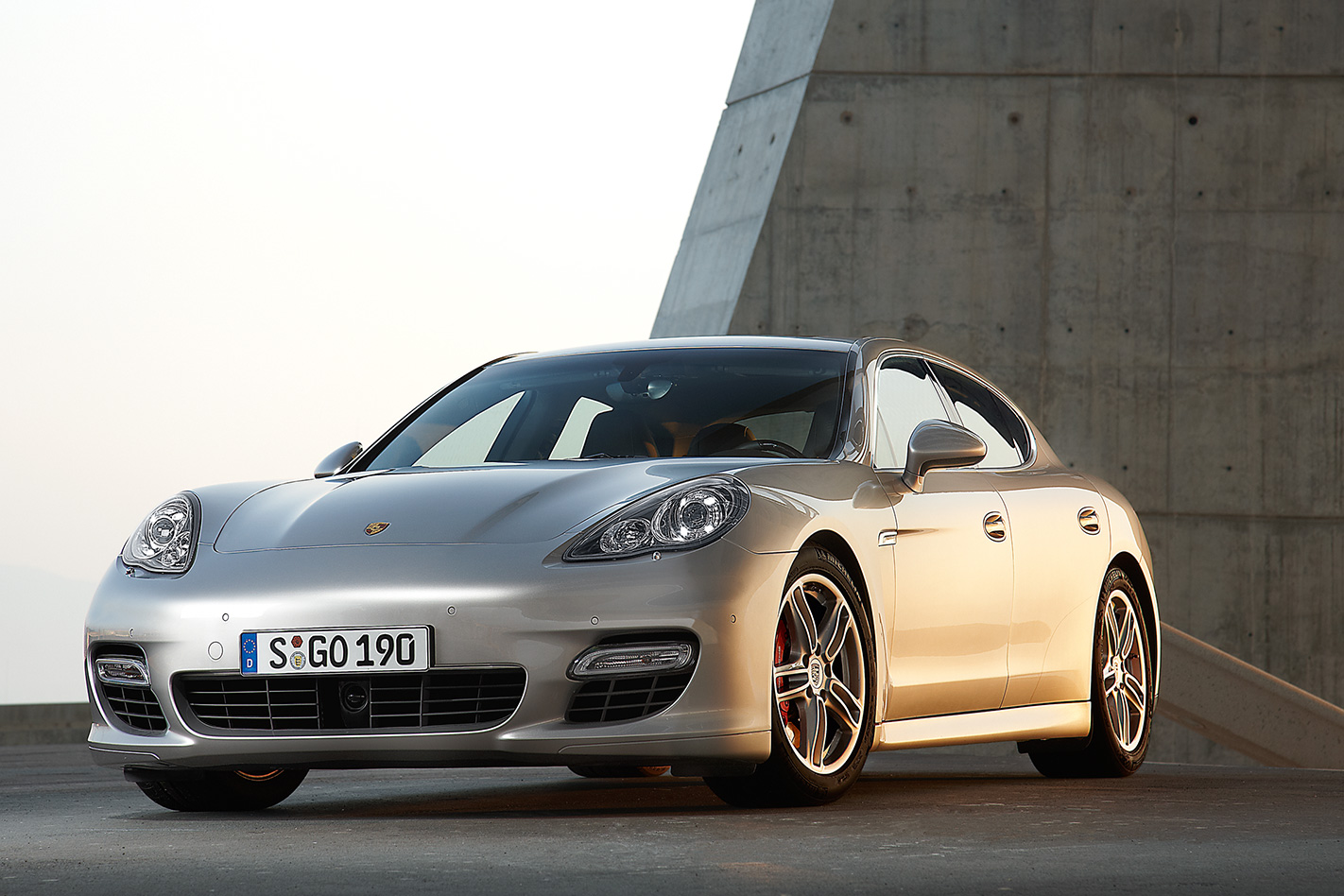
I can’t remember what I actually got for my 10th birthday, but this memory is clearly more significant and indelibly imprinted than anything I unwrapped. See, it was the first time I had been in the back seat of a Porsche. My old man had borrowed a 928S and took me and my mate for a roller-coaster ride of a lifetime.
It was also probably the last time I’ve been in the back seat of a Porsche because, honestly, even a 10-year-old would find it difficult to sit in the rear of a 911. That is until now, as I stretch out in the rear of a Panamera Turbo while belting down the autobahn from Munich to the Austrian Alps, where Porsche is unleashing its four-door, four-seat executive sedan/hatchbacky thingy on the world’s motoring press for the first time.While the 911 will remain Porsche’s most important model line, with the Cayenne SUV providing profit, and the Boxster and Cayman line-ups adding critical mass, the Panamera is no less significant. It’s the first time the company has stretched (pardon the pun) into the sports-sedan segment, promising a car that delivers all the hallmark performance attributes of a 911 with the practicality and comfort of a Cayenne.
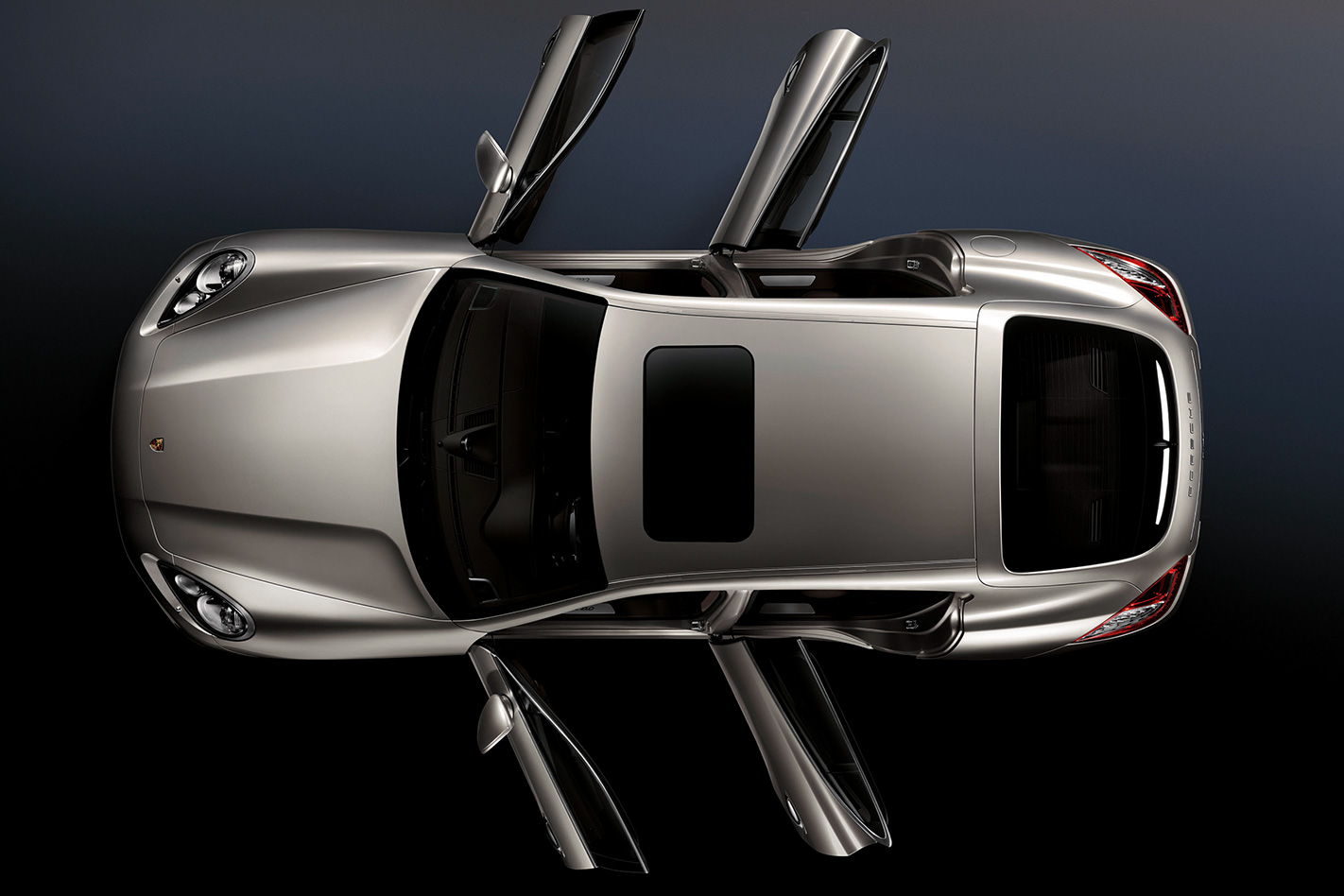
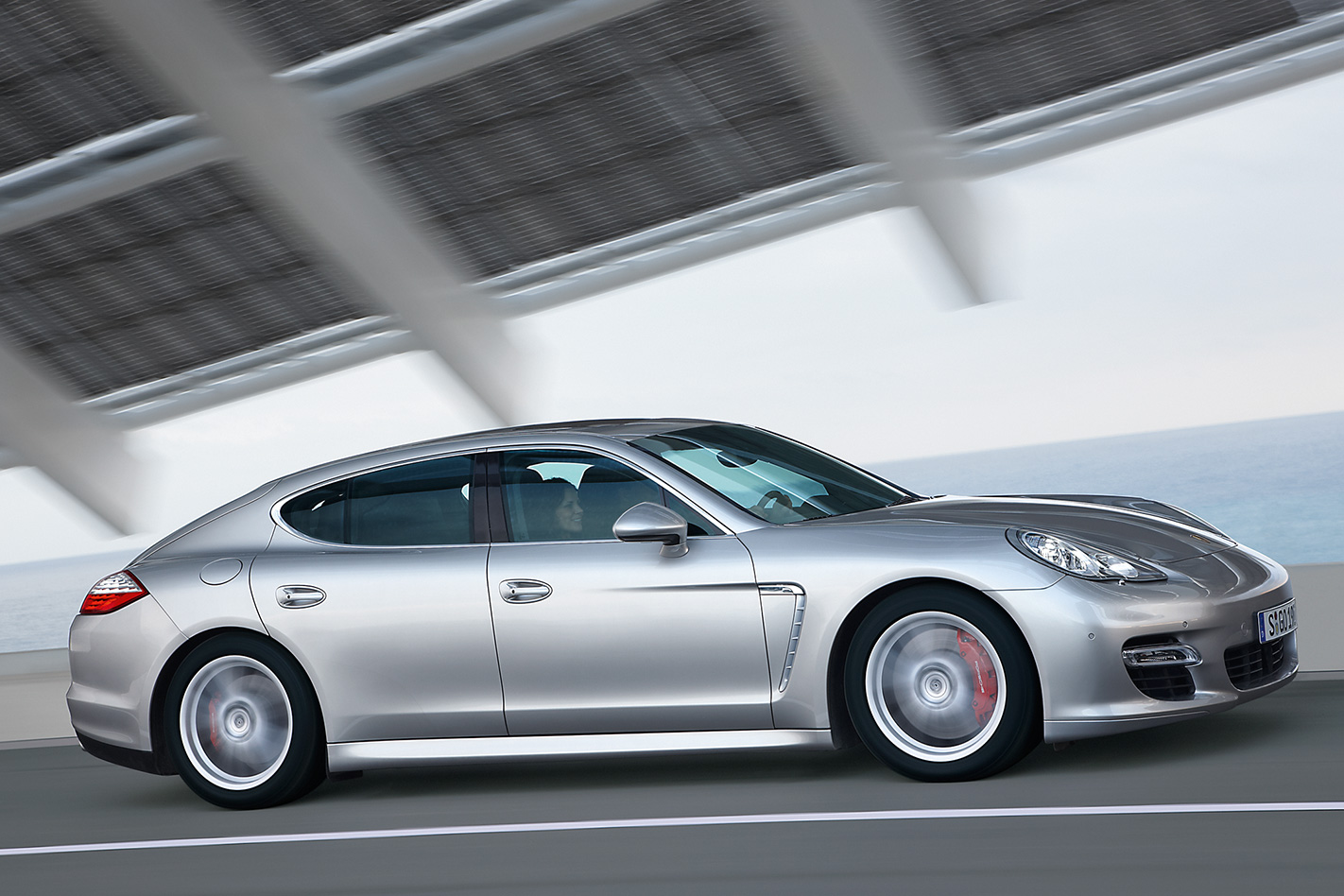
Strangely, Porsche considers the Panamera more as an alternative to the likes of the BMW M5, Audi RS6 and Mercedes-Benz CLS63 AMG, rather than the genuine upper-class limousines (7-Series, A8, S-class), with the exception of the Maserati Quattroporte. Strange because, there’s no doubt about it, the Panamera is a big car.It’s hard to call it a beautiful car, but it’s easily identifiable as something from Stuttgart and it definitely has presence. Measuring 4970mm and riding on a wheelbase of 2920mm, the Panamera looks awkward from the full side view, and not even the optional 20-inch alloys fill its wheelarches.
But being just over two metres wide and standing just 1418mm tall, as I move around the car it starts to look better, and from the front three-quarter view, there’s a hint of Ferrari in its long, scalloped bonnet. The hunchbacked, hatchback rear is hardly a work of art, but Porsche wanted to do something outside of a traditional three-box sedan and ensure the Panamera retains some key Porsche styling DNA.
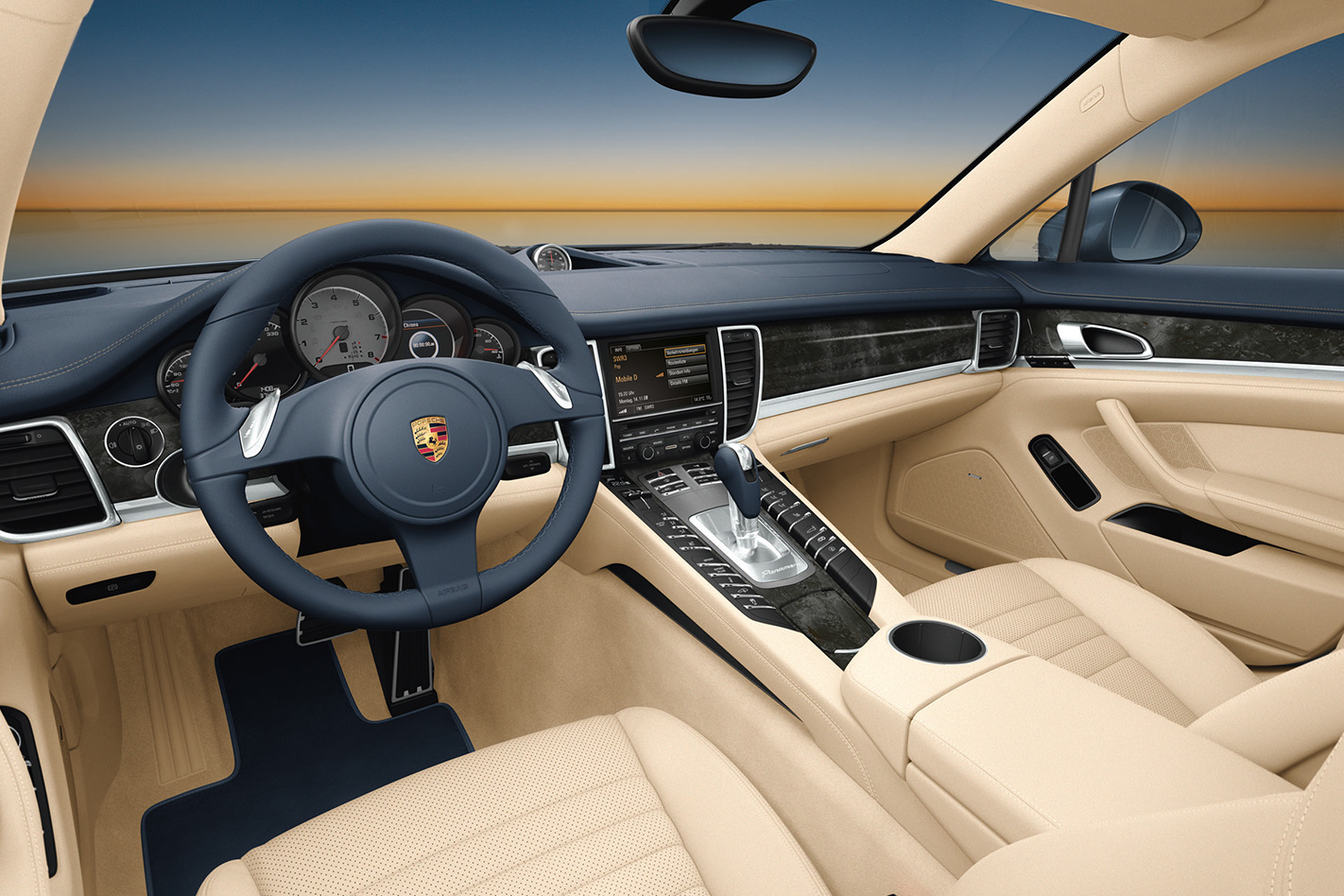
But there’s plenty of leg, head and shoulder room, individual controls for the air-con, and you won’t miss anything outside thanks to good vision through the shallow side windows and a reasonable view out the front courtesy of the theatre-style positioning of the back pews.
Build your own Porsche 911 GT2 RS
While the cabin is more generous than you’d expect, from any seat the Panamera does feel like a big car on the road, particularly in congested European cities and, from the driver’s point of view, it suffers issues with rear visibility through the small window aperture and over its protruding shoulders in the side mirrors.
But really, who’s going to be looking backwards when you’re driving a car capable of rocketing to 100km/h in 4.0sec? It has a top speed of 303km/h and has lapped the Nurburgring in 7:56 – just 11sec slower than a 911 Turbo. The Panamera is all about going fast in style and comfort, no matter if it’s on a twisty alpine pass or barrelling along an autobahn.
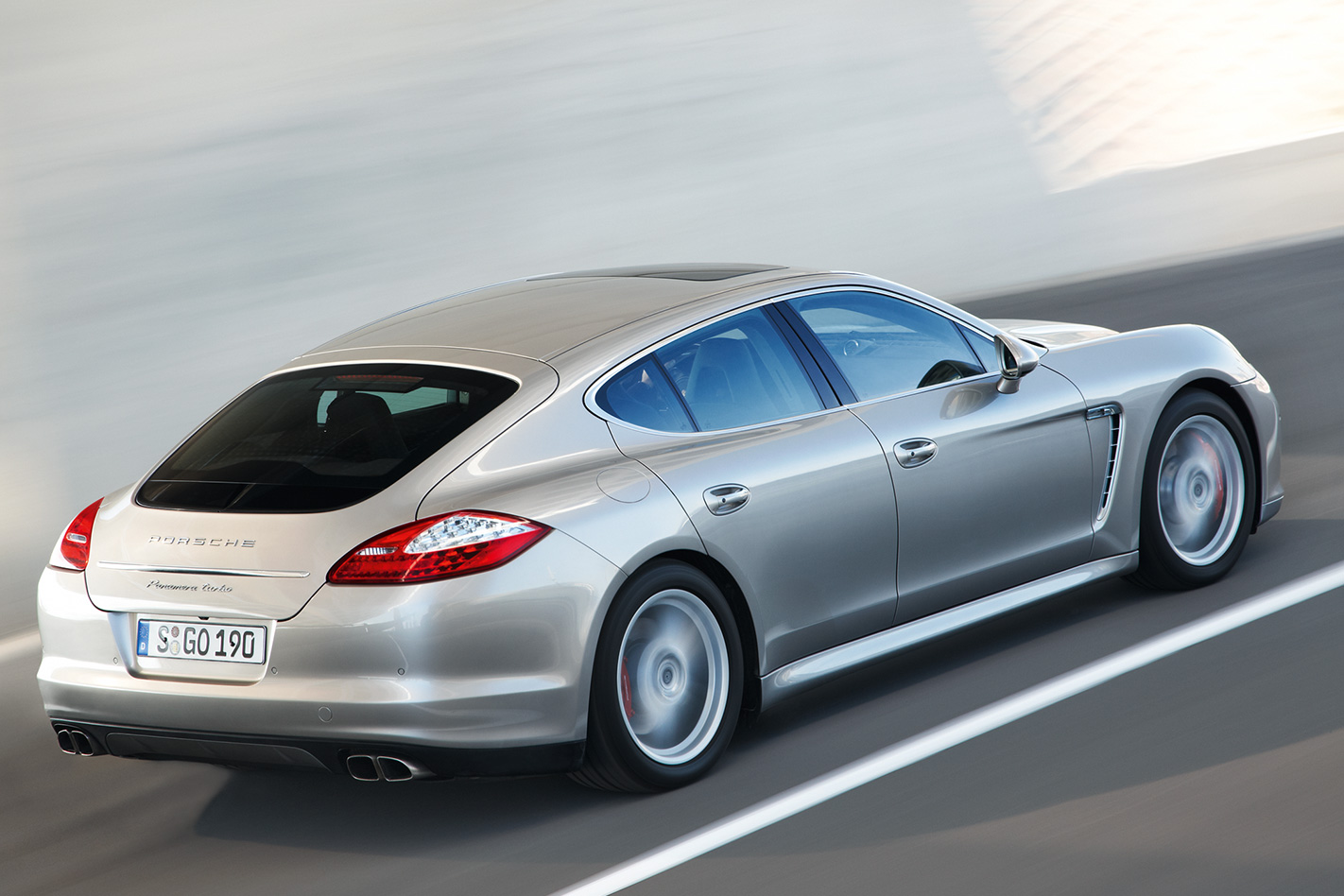
The speed-sensitive power steering is also noticeably lighter than any other Porsche at slow speeds, which helps as we manoeuvre through a series of small ski villages before crossing the border to Austria.But, as the road turns into a slithering section of Alpine bends and the invitation arrives to open the taps on the 4.8-litre twin-turbo V8 and unleash the full force of 368kW and 700Nm, the Panamera quickly proves its point. At the same time, though, it highlights the Panamera’s one weakness – weight. With the suspension in standard settings, the Panamera pitches and bobs around as it tries to control 1900kg.
Sport mode noticeably tightens things up, but it remains comfortable at any speed and certainly offers the best balance between ride and handling. With the optional Sport Plus Chrono package – which lowers the car by 25mm, stiffens the dampers, tightens the steering, quickens the gearchanges and increases peak torque to 770Nm via an overboost function – the Panamera stretches itself beyond being a rapid executive express. It suddenly feels like a Porsche.
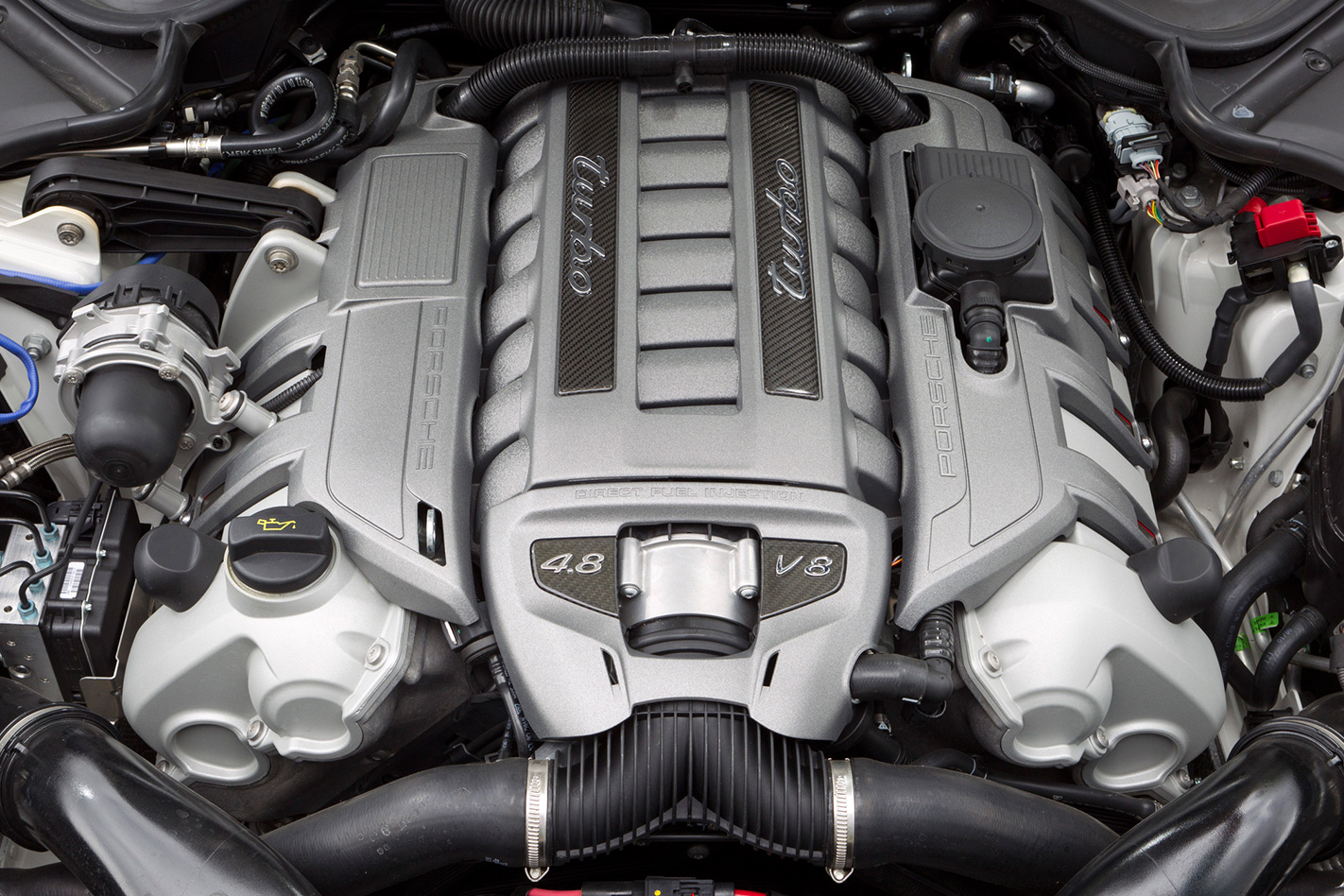
In tight corners, it does tend to understeer and, as we barrel into a bend way too fast and wash off speed with a hefty amount of trail-braking, the rear steps out slightly. Both aspects, I suspect, are factors of its weight more than anything else. But the high-tech all-wheel drive system and optional carbon-ceramic brakes fitted to our Panamera Turbo keep it all in check with a stealth-like cloak of security.Even with the PSM system on, the Panamera Turbo lights up all four wheels as I power it out of an opening radius, uphill hairpin, which proves that Porsche has drilled its sportscar DNA deep into the Panamera’s soul, and also the brutal strength of its engine. With specially-developed Michelin Pilot Sports at each corner measuring 255/45 across the front and 285/40 at the rear, it takes a shedload of urge to turn them into blue smoke. But it can, and it did.Like the multi-faceted nature of Panamera’s chassis, the V8 has more than one card in its deck. At sensible Australian highway speeds, the direct-injection 4.8 burbles along, utilising its extra-tall seventh gear at just over 1200rpm, which Porsche says helps it return less than 9.0L/100km on the open road. Bury the accelerator into the firewall, however, and the Panamera transforms from a gentleman into a rugby league player.
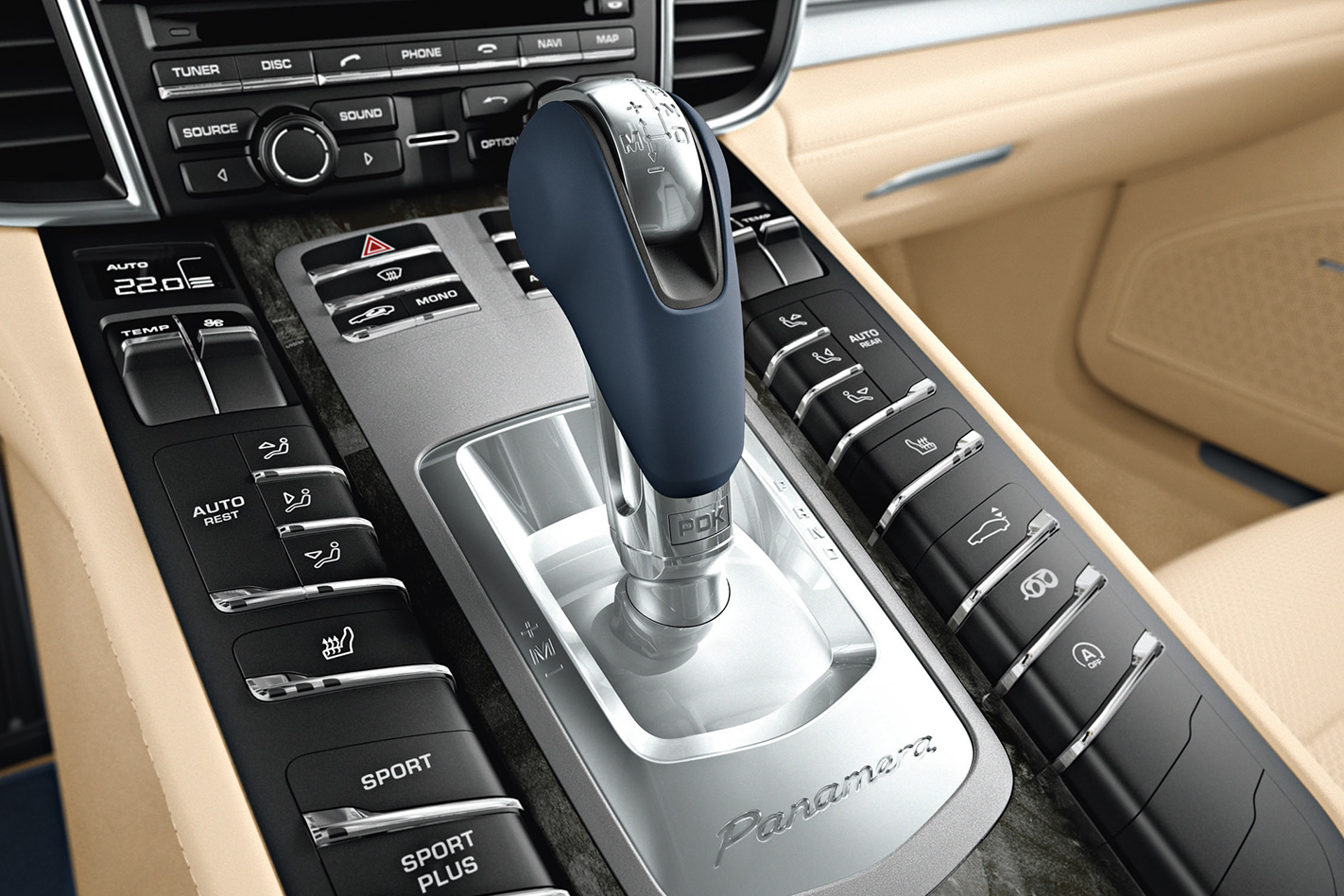
But I can’t see the Panamera being considered as gorgeous as a Maserati Quattroporte or as glamorous as an S-class. It’s out there on its own, but only a company as confident as Porsche could execute it so successfully.Perhaps it’s now time to give my 10-year-old son an experience he’ll never forget. At least he won’t have his knees pressed into his chin.
Respect. Caution. Fear. Tension. Panic. Relief.
That’s a typical mindset sequence you’ll likely go through approaching no-holds-barred supercars like the wild Porsche 911 GT3 RS and the equally mad Lamborghini Gallardo 570-4 Superleggera. Even Walter Rohrl, the lanky superstar who can beat God on the Nordschleife, admits that the sharpest street-legal scalpels still stir his tummy whenever he approaches them, ignition key in hand.Although the advent of ESP has dropped our collective blood pressure, cold sweat remains a constant companion on a day like today – leaden skies recurrently rearranged by gale-force storms as we drive through flurries on shaved Michelin Pilot Sport cup tyres (Porsche) and track-pattern Pirelli P Zero Corsa rubber (Lamborghini), both requiring about 10 degrees above freezing for a semblance of grip and traction.Duck, limbo in, lower yourself into the Sparco tub, stretch out, breathe out, relax if you can. No, the Gallardo cockpit isn’t made for tall fatsos whose Golden Gym membership expired in 1972. Almost the entire passenger cell is lined with black suede-like Alcantara. The door panels, the transmission-tunnel cover and the seat buckets are lightweight carbonfibre. Nice touches include bespoke instrument faces, body-coloured stitching and piping, aluminium pedals and a meaty steering wheel with an ever-so-slightly squared bottom.The Superleggera treatment sheds 70 kilos, raising power-to-weight to 313kW/tonne. Engineers fitted polycarbonate rear side-windows and backlight, and an engine compartment cover, rear diffuser, front splitter, full-length undertray and extra-wide rocker panels from carbonfibre. Add the stacked, non-adjustable Countach-style tail spoiler and, all in all, the radical material mix helps to push down the kerb weight to 1340kg, which is not bad at all for a fully loaded V10-engined AWD super-coupe.The GT3 RS has no rear seats, no air-con, no radio, no apparent noise insulation, no central locking, not even proper inner door latches (they’re red fabric ribbons). It’s race-car minimalism, with narrow, thinly padded seats that take less than a day to transform your behind to baboon red-and-blue. The five-point harness – standard with the Clubsport pack – is for eunuchs only, while the delete-option roll cage looks like red scaffolding. Inside and out are a patchwork of RS 3.8 badges and decals.From the outside, the ultimate two-wheel-driven 911 looks gaudier than its brother in arms from Sant’Agata. Subtle it’s not. The adjustable double-decker carbonfibre tail rudder is an attention-getter par excellence; wingwork that hates automatic car washes but does, in combination with the aggressively shaped front apron, provide enough downforce even for those courage-testing high-speed autobahn esses.Other changes over the GT3 include wider tracks (26mm front, 44mm rear), a synthetic rear window and engine compartment lid, a ram-air induction scoop, and a pair of big-bore exhaust tailpipes. Also contributing to the 25kg weight saving over the 1395kg GT3 are a silencer made of titanium, a single-mass flywheel, a low-calorie single-function steering-wheel and composite transmission tunnel cover.Still, in character and configuration, the two could hardly be further apart. Superleggera versus GT3 RS, that’s RWD versus AWD, aluminium spaceframe versus predominantly steel, mid-engined versus rear, V10 versus flat-six, 5.2 litres versus 3.8, direct versus indirect injection, automated versus manual transmission, double-wishbone versus multi-link suspension, and fixed versus variable aerodynamics.The tight-fitting Superleggera redefines the demarcation line between pain and pleasure, frustration and lust, punishment and reward. It’s an extremely intense driving experience. The instant throttle response launches you forward like an ejector, the ultra-quick steering feels like a high-voltage handshake, and the merciless brakes threaten to inflict whiplash. The suspension holds the road like an unsprung magnetic field. Its exhaust system temporarily impairs your hearing, its chassis blurs vision, and gearchanges yank your hair backwards at 8500rpm sharp. Its phenomenal grip and traction make the orange wedge stick to its flight path as if inertia, mass and G-force were totally negligible dynamic commodities.Although the Lambo is the quicker car everywhere, the 911 feels quicker. It’s noisier, looks rawer and boasts the most extreme normally aspirated street-legal boxer engine ever conceived in Weissach, developing 335kW at 7900rpm. Redlined at 8400rpm, the 3.8-litre unit requires a steroidal 6750rpm to whip up its 430Nm torque peak. Pushing the Sport button frees an extra 35Nm in the handy 3000-6000rpm range (why is this some ‘bonus’ feature?). It’s 11kW up on the GT3 and peak twist action remains unchanged, though it requires an extra 500rpm. The higher rev level, reduced exhaust back pressure and lower-ratio gearbox cogs provide 15-percent-greater urge in the bottom five gears, improving the 0-100km/h by 0.1sec (4.0sec), but dropping top speed a smidge to 312km/h.A bit of chip tuning has squeezed 419kW at 8000rpm (up 7kW) out of the Lambo, with an unchanged 540Nm at 6500rpm. By reprogramming the thrust mode of the E-gear transmission for 5000 take-off revs and a minimum of wheelspin, the Superleggera shaves 0.3sec off the 0-100km/h acceleration time for 3.4sec. Top speed remains the same at 325km/h.Lamborghini still offers the classic manual, but says the take-up rate has now dropped to under two percent. How come? Because there are no tangible performance or efficiency benefits – apparently the manual’s seven percent thirstier – and because the paddleshift makes it a lot easier to cut that torque pie expertly into six even slices. The pulse rate of the gearing is also more relaxed than the GT3 RS’s out-of-breath gearing.The Superleggera may be loud and loose and hard and harsh, but unless you pull out all the stops and switch off all the driver aids, it won’t take you for a pupil-widening cannonball ride. This is, in fact, a quiet car. Unlike the Porsche, which, in city traffic, is handicapped by its raw modus operandi, the Lambo doesn’t baulk at extensive stop-and-go frustrations.With a clear road and a push of a button, it’ll perform one head-turning race start after another. Its Corsa mode, which lowers the ESP threshold and raises the rev limit, is arms-forward, head-down, hips-back stuff: every full-throttle upshift sends a judder through the aluminium monocoque, kicks butt with a vengeance, and makes the 19-inch Pirellis leave their initials etched on the tarmac in first, second and, occasionally, third gear.The Lambo feels Remington-sharp and yet Band-Aid-invulnerable. The GT3 RS, despite a comparatively ancient design, is still sensationally young at heart, making for a fascinating blend of archaic and intoxicating. It’s archaic because of the indecently heavy potato bag-clutch, the bag-full-of-antlers six-speed transmission and the hard-to-modulate optional ceramic brakes. Intoxicating thanks to the wailing six-pot chainsaw kraftwerk, the dreams-come-true steering, which is intuitive from the shoulder blades down to the fingertips, and the masterfully balanced chassis that can still dance along the limit of adhesion as gloriously as the very first Carrera RS 2.7.True, the seven-speed PDK box available for other 911s would be quicker, more convenient, more efficient and much higher tech. But the old-fashioned manual ’box is a more spontaneous, immediate and transparent tool, and the considerable effort it demands matches the other controls perfectly – not just steering, brakes, and tyres, but also eyes, ears, brain and bravery. Especially brain and bravery.The 570-4’s genes are more visceral than those that make the 560-4 and the 550-2 tick. This applies in particular to the decidedly tauter damper calibration, the fatter anti-roll bars and lower-tolerance knuckles, suspension bushings and steering-arm mounts. It’s a set-up inspired by the Blancpain Super Trofeo race series, so you don’t only get superior body control but also enhanced precision and more grip than the g-force meter inside your head is prepared for.Also new are the spidery 10-spoke 19-inch wheels (with titanium bolts and bearings) shod with special-compound Pirellis. On aggregate, the track-oriented footwear saves 13 kilos in weight. The fastest Gallardo relies on an unchanged 30:70-percent torque split, with 45-percent rear diff lock.
The Porsche, too, is equipped with a slip-limiter that varies its assistance between 28 (full power) and 40 (under trailing throttle) percent, to minimise lift-off oversteer. To soften the dramatic effect of the de-throttled weight transfer and to enhance fast-corner stability, the RS is fitted with dynamic engine mounts which vary, within milliseconds, from rigid to compliant. Other worthwhile changes are bigger brakes featuring aluminium chambers, a specifically tuned semi-active PASM suspension and a rather unusual 245/35 front and 325/30 rear tyre size combination.The 911 plays a catchy jam session of new and familiar tunes. Idle speed has an erratic pulse of a remarkably uneven firing order, the lightweight flywheel hums along out of tune like a tipsy supporting act, and the multi-vocal intake and exhaust systems deliver a particularly noisy rendition of their trademark shouting match. It’s this aural background which makes the Porsche feel fast even before you have dared to engage first gear.The RS is kind of an unplugged GT3, and since it depends on even higher revs to deliver, the impression of time-warp speed becomes almost physical as you work that resinous gear lever through the gate. Although 4500rpm already sounds illegally fast, this engine needs whipping past 6500rpm before it explodes. If you haven’t seen 8000rpm in fourth (or, better still, in fifth) you will never understand the moral conflict hardcore turbo fans go through after a taste of GT3 RS blood. It takes a while to get used to that full-throttle machine-gun staccato, the blat-blat overrun, the shriek-then-yell sequence triggered by ambitious downshifts, but the non-musical talents of the most special 911 are indeed easier to befriend.Guess what? It’s the Lamborghini which makes you work harder, sweat earlier, fear more sustainably. And thus, for a truly uncompromising driving machine, look no further than its German tarmac-peeling rival.This Superleggera is stiff, edgy, impatient, snappy, aggressive, a corner-greedy pothole-hater, ever-ready to pick a fight and always on the prowl. Like the 911, the Italian needs to be pushed to shed idiosyncrasies like the lumpy low-speed ride, the grotesque tramlining and the initially passive handling. But as soon as the wide track, the long wheelbase and the low centre of gravity push open that critical velocity window in a concerted action, Dr Jekyll becomes Mr Hyde.Fitted with a homogenous blend of 235/35 and 295/30 tyres, the Gallardo indulges in a rare creaminess of motion where minor inputs yield major effects. It’s beautifully modular, gifted with sensuous steering, a sensational speed-induced stability, an almost feline feeling for the complexities of the road surface, and magic manoeuvrability. True, the Superleggera has an embarrassingly clumsy turning circle, and its brittle front axle lacks the compliance Porsche has thankfully rediscovered for the GT3 RS. But the Lambo’s brakes are more progressive, torque feed is more seamless, and a hot clip doesn’t automatically demand superhuman driving ability.Respect? Yes, and plenty of it, especially since we have not had any track time with either car. Yet. Despite tenacious grip, supreme sure-footedness and the most complete active safety net money can buy, it never hurts to recall your own inadequacies.Caution? Depends. We found some useful environments: a deserted supermarket car park, an empty access road to an under-construction industrial estate, a 90-degree bend in the back of nowhere. But even with ESP off, the Lambo needs acres of space and, ideally, a low-friction surface before it can be coaxed into serious attitudes. The black box in the Porsche first switches off stability control and then traction control, which is a pro-safety, anti-entertainment approach.Fear? Oh yes. On cold tyres, breakaway strikes like an electric shock, and we’re not just talking rear ends here.Tension? Only when you think about the weather forecast. Or the values of these playthings. The Porsche costs 145,871 Euro without goodies, the Lamborghini a more serious 208,726 Euro. The mere notion of these numbers can affect collar size, armpit moisture, pulse rate, and more.Panic? Nah. Except the last 25 kays driving on packed snow…Relief? You bet. The first glass of red has never tasted better than an hour after we left the two test cars grazing safely in their shelter.The winner? Take the Porsche if you are brave enough. Or good enough. Take the Lamborghini if it fits your size and style. In terms of overall competence, both contenders score a solid 10. In terms of value for money, however, you may be better off with a base GT3 and a lower-frills 560-4. Quite a bit better, in fact.
“What’s a Patterson Cheney Race Sport?” I hear you ask.
The Patterson Cheney dealership has been selling Holdens in Victoria for more than 50 years. In a former life, current New Car Manager at PC’s Vermont dealership, Nick Batzialas, was the leading HSV salesperson in the state. And together they created the new Race Sport brand.
Displayed in showrooms alongside the regular Holden line-up, Patterson Cheney sold 150 Race Sport packages in the brand’s inaugural 2008 year, without marketing or advertising, and hasn’t looked back since.
Holden Commodore V8 send-offs confirmed “The world of Race Sport is where [the customer] can come in and the sky’s the limit,” says Batzialas.
“We’ve created whole packages, but there are still plenty of options. [Customers] can build their car up, while we mirror the factory warranty.”Inside or out, the RS454 we’ve been given might not look a lot different from a standard Commodore SS V, apart from some pretty generic Race Sport signage and some fat 19-inch BBS alloys that protrude out from under the VE’s muscular guards. But like many things that have come out of Melbourne recently, there’s a bit more going on behind the scenes than meets the eye (just ask any Storm player).Underneath the decidedly inconspicuous bonnet lies the standard SS V 6.0-litre V8 that’s been huffered by an HTV1900 Harrop Black Series Roots-type supercharger to produce a monumental 480kW at 6200rpm and 920Nm at 4500rpm.
Key to its gains is the specially developed Over the Radiator (OTR) intake manifold that contributes about 30kW to the overall figure. The RS454 name (originally designating 454kW) was devised before the OTR was developed, hence the disparity.
In six-speed manual form, this RS454 Sportwagon is easy to crawl along with city traffic in, and because the engine’s internals are standard, the lack of anything like a lumpy cam means it’s not cranky at all, and it idles along as easily as any regular SS V.
In fact, as you squeeze the throttle to hit the odd gap in traffic, or pull out onto a main road, that supercharged grunt that swells so easily that it quickly becomes addictive to the point that you wonder how you could ever do without it.This user-friendliness seems slightly bizarre at first, because after starting the engine and listening to it idle through the three-inch dual exhaust, you’d swear that it actually has been fitted with a lumpy cam.The deep, burbly idle is purposeful and surprisingly loud – there’s no chance that anyone could mistake it for a standard L98 V8. Rolling along at low revs in any gear, there’s an ever-present exhaust crackle that ignites each time you gently tickle the throttle to maintain your speed.
There’s some boom at 100km/h, but it was (cleverly) muffled by the dealer with five or six layers of polishing cloth laid between the spare tyre and the wagon’s boot floor.
Sneaky perhaps, but this simple solution actually silences most of the boom without spoiling the noise when you want it. Like when the super-sharp throttle mapping delivers a loud burst of revs as you rap the accelerator, making heel-toeing and double-declutching an aural delight.When the opportunity to safely floor the throttle presents itself (when you’ve mustered the courage, that is), the RS454’s lazy burble transcends into a hearty, chesty roar that isn’t easily forgotten.
There’s little audible supercharger whine, simply because the beast it’s attached to drowns it out with volumes of exhaust noise.Even on an empty dragstrip, this car is intimidating. Until now, as we’ve driven it around town and up the freeway to Heathcote Raceway’s dragstrip, the RS454’s deranged wont of turning tyres into molten rubber has proven largely manageable, even enjoyable.
But it’s like staring down a bull as I sit on the startline, ready to engage all 644 horses.I’ve performance tested plenty of high-powered cars, but this one is a little crazy. It demands to be treated with respect and the process of extracting every little sliver of time from a car on a dragstrip is, well, disrespectful. And the RS454 knows it.
So despite our best efforts, the fastest time we could post was a 5.04sec run to 100km/h, and a 13.16sec 400m. That’s waaay slower than it’s capable of, and the owner insists that he was able to clock a 12.1sec quarter at the same venue only days earlier. Clearly, the apparent change in track conditions hasn’t helped the RS454’s cause.The heavy race clutch’s savage engagement, combined with the interruption of the ECU’s ignition-cut on brutal, quick changes at high revs means the RS454 just can’t apply enough of its power to the strip effectively, despite its 275/35 R19 rear footprint.
But I’m not sure the Kumho Ecsta SPTs are the last word in tractive ability, either.The RS454’s main gripe, however, is the axle tramp that seems to plague it. From rest, it’s almost impossible to get the rear wheels to spin up on the spot because of the rear suspension’s preference for tramping.
It could be the tweaks that have been made to the suspension, as even after we’ve left the dragstrip, you can feel the inside rear pattering over the road when you’re braking deep into a tight corner. Then again, it’s certainly not the only VE we’ve driven that suffers from this affliction.
Comparison: Ford Mustang GT vs Holden Commodore SS V Redline
Generally, the brake and handling upgrades are good, with the Harrop ‘Ultimate’ braking package providing anchors that can keep up the phenomenal power output.
And while the lowered suspension – complete with Bilstein shocks – doesn’t really feel a great deal stiffer than any other SS V when you’re cornering hard, the plus side is that it inherits the standard’s car comfortable ride, even on 19s.And that’s precisely what this car is all about: it’s a serious muscle car that’s seriously easy to live with. The RS454’s strength isn’t in being driven flat out, even though it probably would be entertaining at track days.
But even at seven-tenths, it’s still bloody fast. And despite the wolf-in-sheep’s-clothing appearance, that engine makes it an experience to drive at any speed.The fact that our test car costs $86,990 driveaway, or around the same money as a HSV GTS, means it’s a serious alternative for buyers who want something that appears a little more subtle.
There’s a reason why rugby league fanatics love the annual New South Wales versus Queensland State of Origin clash.
It’s not really about footy, but more about the teams being so evenly matched that it’s impossible to pick anything other than a close game. V8 Supercars follows the same successful formula, with the two protagonists almost identical on every detail. That’s why the contest is so enthralling.Some conflicts, however, aren’t quite so clear-cut. Take the Mazda MX-5 and Mini Cooper S Cabrio, for example. In concept, this pair couldn’t be more different – a purist, rear-drive, naturally-aspirated two-seat roadster and a high-fashion, front-drive, turbocharged hatchback with its roof lopped off. But whether they like it or not, their fabric tops, their sporting flavour, and their similar price points position them pretty much eyeball-to-eyeball.Whether buyers also see it that way is ultimately irrelevant because both the MX-5 and Mk2 Cooper S Cabrio are more-than-capable entertainers. In many ways, they’re closer than you’d think.For $43,850, the entry-level Mazda MX-5 comes jam-packed with driver appeal – as MX-5s have always done – but not a whole lot more. On the outside, our base model lacks the Roadster Coupe Sport’s chrome accents on the aggressive front air intake and fog lamp surrounds. Thankfully, it also misses out on that car’s unattractive 17-inch BBS forged alloys in favour of Mazda’s simpler, sexier wheels of the same size.The driving environment inside is basic, yet effective, with nothing extraneous to weigh the MX-5 down. The seats are wrapped in cloth, but leather is available, together with a 200-watt Bose stereo, in a Touring model for another $1870. Modern essentials like air-con, power windows, cruise control and an in-dash, six-disc stereo are included, but other items usually on offer for this money like reach-adjustable steering, climate control, Bluetooth phone connectivity and even intermittent wiper adjustment are rudely absent. And that applies to the top-spec $51,455 Roadster Coupe Sports, not just the base stripper.Compare this to our $51,600 Mini Cooper S Chilli Cabrio, which squeezes a lot into its $7750 premium over the MX-5, and so it should. Firstly, the Mini has never looked better than in this car’s Cabrio-only Interchange Yellow, contrasted with the Chilli’s 17-inch Black Star Bullet alloys. We’d love to see this combo in a hardtop. Unlike the MX-5, the Mini’s soft-top folds automatically, and in only 15 seconds thanks to an electro-hydraulic system that can be operated at speeds up to 30km/h, though a hard-lid MX-5 Roadster Coupe with part-electric opening (the windscreen latch is still manual) can strip itself bare in 12 seconds. Throw in bi-xenon headlights with washers, rear parking sensors, climate control, telescopic steering and a tantalising array of options and colour choices (10 paint and three roof) and all of a sudden, the Cooper S Chilli Cabrio doesn’t seem so rich after all. We might just have a battle on our hands.The Mini wins Round One with a convincing victory at Oran Park. We recorded 7.24sec to 100km/h, almost two-tenths faster than Mini’s claim, with front-wheel traction the only thing preventing the Cooper S from going even quicker. A good launch is the sole tricky part in extracting a good time from it, as rowing swiftly and accurately through the lovely six-speed ’box is easy as pie. A 15.10sec 400m sprint is solid, but it only tells half the story when compared to the MX-5’s gutsy 15.22sec run. It’s the Mini’s 400m terminal speed – 154.3km/h against the MX-5’s 147.87 – that proves just how fast she is once she’s rolling.The rear-drive Mazda squirrels away from rest quicker than the boosted front-drive Mini, and maintains a slight advantage up until about 90 clicks. But from there until its slightly higher 222km/h top speed, the Mini stretches its legs and strides ahead. Still, the MX-5’s 7.37sec to 100km/h is nothing to be ashamed of. While it’s more forgiving to launch than the Mini, the Mazda’s second-to-third gearchange is slightly harder to execute quickly without getting dangerously close to picking up first.Thankfully, that didn’t happen and in every other instance, the Mazda’s short-throw six-speed is a pleasure to use, thanks to the improved synchros on all forward gears that have acccompanied its 2009 facelift.That’s handy because you need to keep rowing through the MX-5’s gearbox to stay in touch with the Mini. The 80-120km/h rolling acceleration times expose the Mazda’s relative lack of torque – it clocks 5.1sec in third gear, but struggles to 10.0sec in sixth, while in the same ratios, the Mini accelerates in 4.3 and 7.4 seconds. The Mini’s 1.6-litre twin-scroll-turbo four only makes 10kW more than the MX-5’s naturally aspirated 2.0-litre – 128kW at 5500rpm versus 118kW at 7000rpm – but the Mini’s torque obliterates its rival, with 240Nm between 1600 and 5000rpm, and an additional 20Nm waiting in the wings as overboost. The Mazda’s rev-happy MZR 2.0-litre can only muster 188Nm at 5000rpm in comparison.On country roads, that equates to easy overtaking in fourth or fifth in the Mini, with a pleasant crackle from the exhaust when you back off. The Mazda’s torque deficit below 4000rpm makes third gear a necessity for safe rounding-up at the national speed limit and requires a planted foot all the way to the 7600rpm cut-out, but the big revs have another benefit besides stronger acceleration. The new MX-5’s Induction Sound Enhancer (ISE) improves the engine’s acoustics dramatically over previous models. An angry snarl accompanies full-throttle exploits above 4000rpm, and the higher the revs, the greater the induction snort. But if ever a car needed some sporting noise to match its addictive driving experience, it’s an intimate two-seat purist roadster like the MX-5.Starting with the snug front seats, the Mazda feels like it wraps tightly around you, even with the lightweight roof (manually) lowered. It’s all related to the MX-5’s Jinba Ittai design philosophy, which means ‘one with the car’. The driver sits low in the cabin and is quite reclined, true to a traditional roadster driving position. However, the fact that the MX-5’s chunky little steering wheel still lacks reach adjustment is both surprising and disappointing, as is the absence of adequate seat adjustment. The notches in both the sliding seat-base and levered backrest simply aren’t close enough. A driver’s car that won’t allow you to position the steering-wheel and controls exactly where you want them? Doesn’t sound like Jinba Ittai to us.The MX-5’s attractive dash is clean and fuss-free, surrounded by a windscreen that is quite low and only just rises above the driver’s head. But despite this, vision all-round is excellent. The gearstick is positioned quite close, and your feet plunge deep under the dash, dancing on well-spaced plastic pedals (only the Roadster Coupe Sports gets metal ones). It should feel claustrophobic, but it doesn’t. Instead, it’s more like a cocoon perfectly shaped and proportioned for the driver’s task.In comparison, the Mini instantly feels more expansive, and expensive. You feel like you’re sitting much higher and straighter than in the MX-5, which is deceiving because the Mini’s driving position is actually quite low for a small hatch, and is perfect for spirited punting. The upright windscreen rises miles ahead of you, and combined with the deep dashboard, gives a real impression of space for front occupants, despite being a physically narrower car than the Mazda. Open the Mini’s electric roof and there’s an even greater feeling of head space – either with the front part slid back Citroen 2CV-style, or the whole thing folded and stuffed together above the boot.However, while the roof’s automatic operation might be convenient, the execution is less so as it obscures rear vision. Even when folded back tightly, the roof still sits quite high and renders the centre rear-vision mirror next to useless. Like the first-generation, the Mk2 cabrio also maintains two desperately cramped rear seats, but it’s no longer burdened by the hideous roll-hoops that undermined the look of the old car. Of course, there’s still a roll-hoop for safety’s sake, but it’s a pop-up system that takes just 0.15sec.The Mini’s interior finishes and switches generally exude a higher quality than the MX-5’s, though the difference is mainly down to bespoke toggles and textures, as opposed to the parts-bin approach of the Mazda’s minor switchgear and door plastics. The splashes of Interchange Yellow inside our test Mini’s cabin (a $225 option) greatly enhanced its flavour, as did the subtle yellow stitching on its supportive and highly adjustable front chairs, but it’s all guaranteed to look awful when the missus is wearing purple.Disappointingly, the Mazda’s invisible options list offers no opportunity for owners to personalise their car, but it’s this difference in philosophy that starkly reminds you of each car’s different approach. The MX-5 is legendary for its back-road pace, and to hell with the colour of its seats, while the Mini is a textbook example of fashion and individualisation that also happens to still be great fun to drive.Even though the Mini feels much bigger than the MX-5, it’s easy to forget that it only weighs 1230kg (100kg more than the hardtop), and when combined with its wheels-pushed-out-to-the-corners stance, it can generate enough grip to carry miles of corner speed. The steering is responsive, linear and has a meaty feel, providing your push the (out of sight) ‘Sport’ button forward of the gearstick on start-up that also sharpens throttle response. And despite the cabrio’s additional weight, the Mini’s turn-in remains super-keen and its attitude wonderfully adjustable, if slightly more composed that a hardtop Cooper S’s. In tight corners, DSC off, the Mini’s electronic LSD ($350) eliminates almost all wheelspin, but it doesn’t stop the drive wheels tugging at the steering wheel. At least it ensures the Cabrio can make the best of the engine’s superb torque.On our hot lap around Wakefield Park, that allowed the Mini to power out of the final hairpin and carry a lot more speed down the main straight than the MX-5. At Wakefield, the Mazda simply didn’t have the torque to keep the Mini honest, but keep the MZR 2.0-litre in its sweet spot between 5000-7500rpm and the MX-5 displays plenty of point-to-point speed.As corners tighten, the MX-5 shrinks around you, and its light, quick steering comes alive, too. Feeling a little soft at straight ahead, the Mazda’s steering is slightly disconcerting at first as you continually feed in more lock than is needed. But beyond initial turn-in, the MX-5’s steering transmits much more of what the front wheels are doing. As you sweep into a bend, the MX-5 leans onto its outside rear and carves along your chosen line with perfect balance. It more than matches the driver’s enthusiasm for curves, while rising and falling easily on choppy roads. You will lose yourself in this sublime chassis.The MX-5’s ride compliance translates into open-road cruising and around-town commuting, too. The body is rock-solid, with barely any windscreen flex while driving. The same can’t quite be said for the Mini, which does wobble a little – especially with the roof down – but it’s a noticeable improvement over the previous turd-burger. The Mini’s around-town ride jiggles more than the MX-5’s, and that’s exacerbated when you’re driving on back roads at speed. The Mini seems a little soft in the suspension’s compression, and quite firm on rebound, which can make it feel unsettled, much like the Hardtop. This also contributes to the strong reaction in the Mini’s steering if you nail a bump mid-corner.In practical terms, neither of these cars offers much boot space, although the Mini does have two rear seats as an extra luggage-stowing option. With the roof folded, the MX-5 swallows 150 litres, while the Mini awkwardly accommodates just 125. The Mini’s bottom-hinged boot makes stowing large objects (helmets, for instance) tricky work, too, whereas the Mazda’s traditional boot is surprisingly effective if your luggage is soft.So, fashion or function? As always, it depends on your priorities, but for two cars that come from such opposite ends of the soft-top spectrum, the Mini Cooper S Cabrio and Mazda MX-5 are surprisingly close. For starters, they’re both good fun to drive. Spend time in the Mini, roof down or up, and you really warm to its chunky stance, its cheeky turn-in and its tirelessly exuberant engine. Yes, it’s wobblier, slightly lazier and seemingly far less focused than a hardtop Cooper S, but the difference isn’t that great. And yes, the stiff ride can be jarring at times, but somehow the Mini’s lovable personality overcomes its deficiencies. Like we said, spend some time in the Cooper S cabrio and you can’t help warming to its charms.Like the Mini, the MX-5 prides itself on its uniqueness and its engineering excellence. But stripped bare, the Mini is still just a hatchback with its roof cut off, whereas the MX-5 is a purpose-built roadster, with everything that goes along with that. The sweetness and purity of the Mazda’s handling, balance, ride, gearchange and roof architecture cement its status as a modern icon, and it remains the benchmark which others have been afraid to follow. But then the new Mini is that, too. So far, no other manufacturer has been able to successfully imitate either car.Ultimately, however, it’s the MX-5’s pure focus on driver enjoyment that sways us its direction. It’s both brilliant to drive and great value. The Mini makes a very convincing argument for itself as a unique all-rounder, but if only you could take all its spicy bits and build them into a modern, rear-drive British roadster. Then the MX-5 would have some competition.
Peering across the vast expanse of aluminium bonnet that dominates the view from inside the Mercedes-Benz SLS AMG, I’m focused intently on the flashing LED brake lights of another Gullwing driven by German touring-car legend Bernd Schneider just in front.
There is a puff of black smoke as he releases pressure on the carbon brakes before darting the matte-black stealth missile to the left and then right … and suddenly, like magic, he disappears from view. Vanished!Laguna Seca’s famous Corkscrew corner does that. Not in a Bermuda Triangle kind of way, but because the right-left-right sequence of corners drops away like a roller coaster ride. If you’ve ever driven around Bathurst – even at the leisurely 60km/h speed limit – and were amazed by how steep the drop is coming down the Dipper, it has nothing on the Corkscrew. It’s like driving off the roof of your garage.Just as I flick the SLS I’m in to the right hander with the blind faith that there’s still a road underneath me, Schneider’s car returns to view with the slightest degree of opposite lock as he barrels out of the Corkscrew. Right now, I understand precisely why Mercedes-Benz has chosen this place to unleash the SLS on the world.
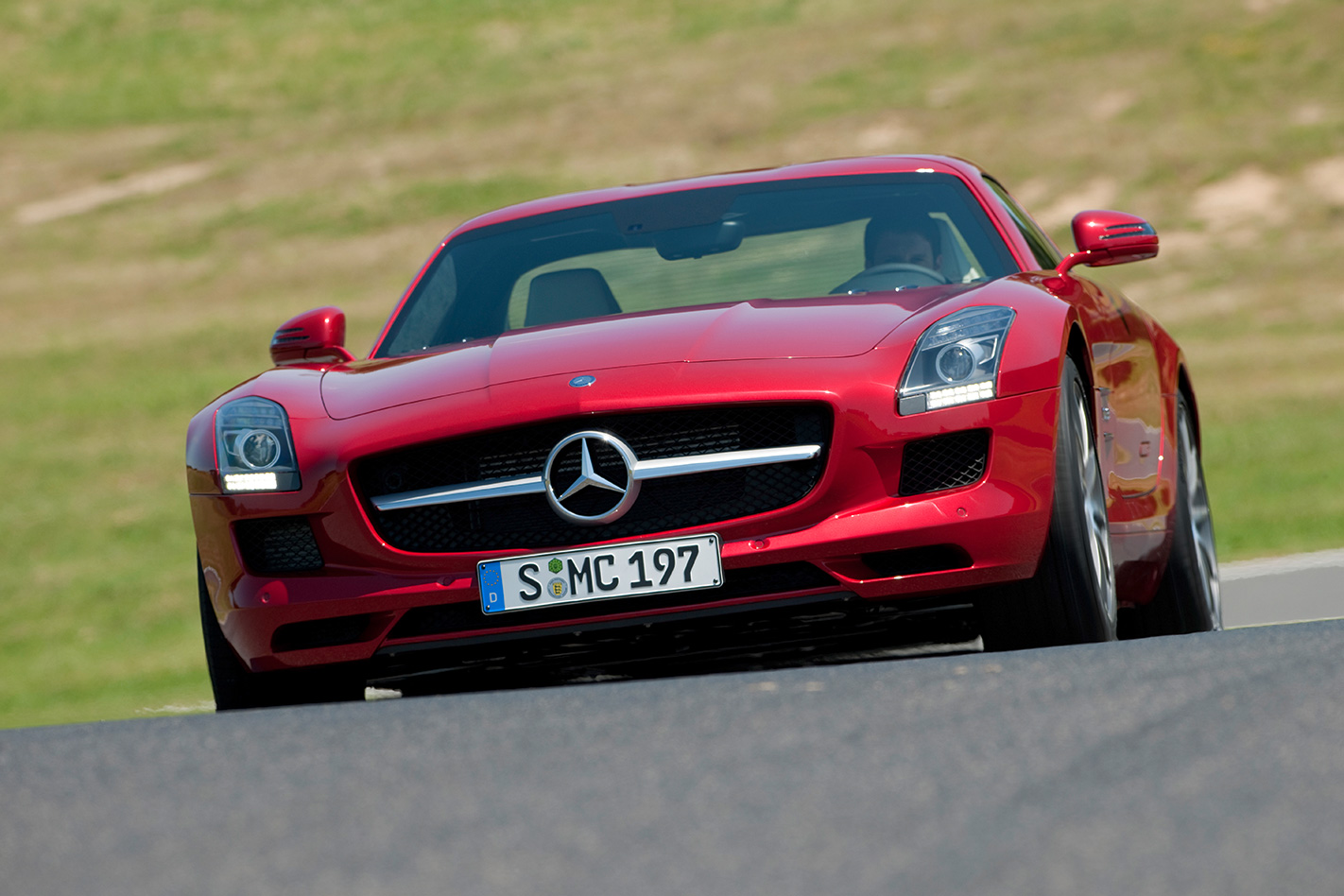
Besides that, it’s located on California’s Monterey Peninsula – a squillionaire’s playground with hilltops and beaches that are saturated by mansions with 10-car garages and roads that are littered with Bentleys, Maseratis, Porsches and big Benzes. Even the nannies drive around here in BMW X5s. Perfect head-turning territory.And that’s the crux of the Mercedes-Benz SLS AMG; a brilliantly capable sports car that can be thrashed on the most-demanding roads during the day and then driven to the country club in the evening. And it’s super impressive doing both. I know it’s another cliche, but the SLS really does take the ‘liveable supercar’ tag into a new dimension.
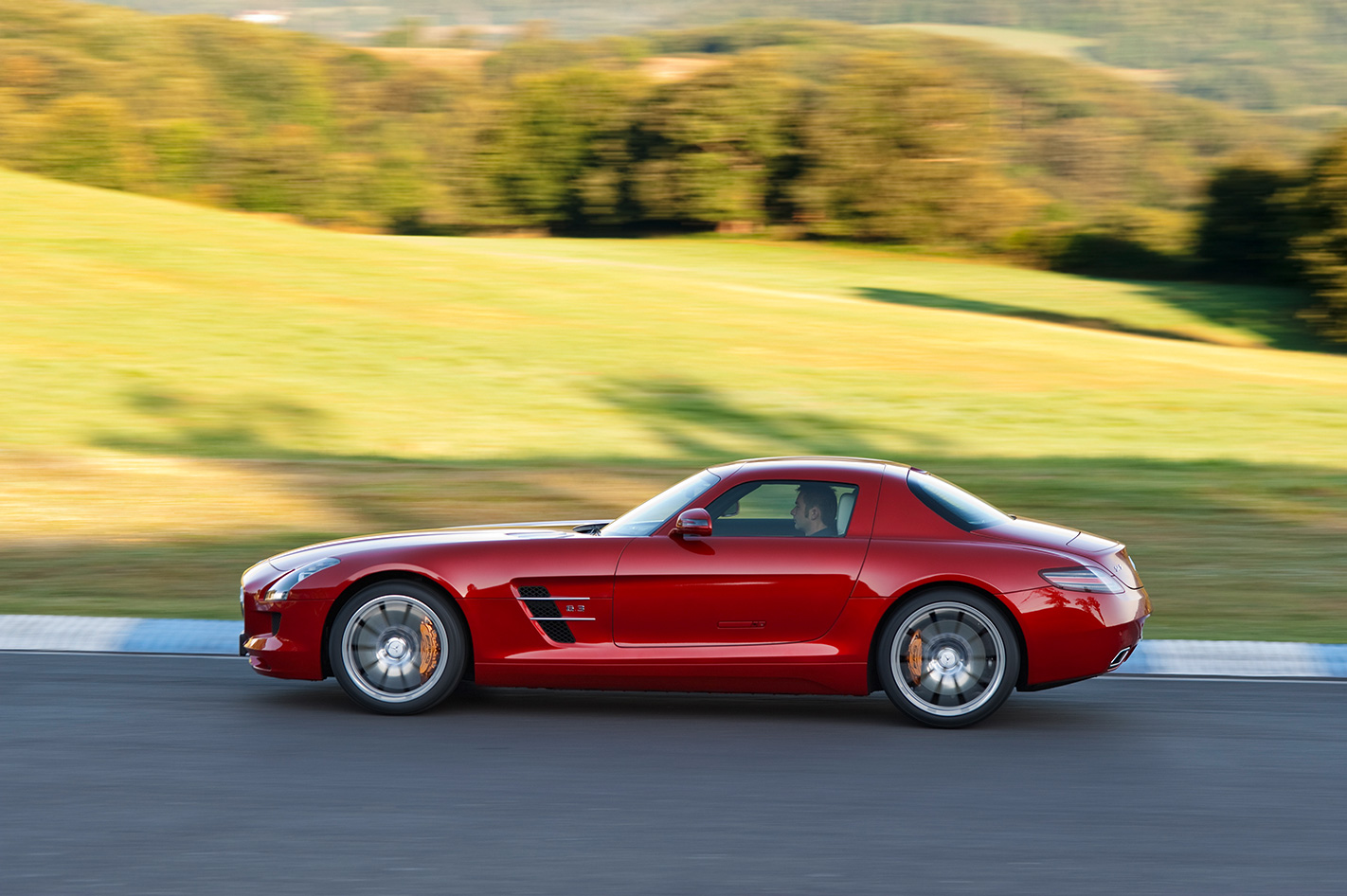
But, more than that, it introduces another everyday supercar into the melting pot, going head-to-head with the likes of the Porsche 911 Turbo, Audi R8 V10 and Aston Martin DBS as well as the no-compromise Italians such as the Lamborghini Gallardo LP560-4 and Ferrari’s 458 Italia and 599 GTB Fiorano.It’s the first car to be completely designed by Merc’s official performance car partner, AMG – and from a clean sheet of paper. Although it is powered by a unique dry-sumped version of the 6208cc V8 and borrows some hidden electronics and familar switchgear (window switches, columns stalks and air-con controls) from mainstream Mercs, the rest is all new.
There’s no C-class brakes, E-class suspension or S-class seats – the SLS has been designed from the ground up for one purpose.After its flawed experiment with McLaren and the overweight SLR, Mercedes wanted its new flagship super-sports coupe to be a more pure engineering exercise rather than a technological tour de force. AMG’s primary objectives were to reduce weight, optimise weight distribution and deliver an uncompromised balance between ride, handling and outright performance.Surprisingly, the SLS is rather simple; there’s no world-first technology and no benchmark bragging rights. It’s not the fastest supercar ever built, it’s not the quickest, it’s not the most powerful and it’s not the lightest. There’s not even tricky electronic dampers, but it is undoubtedly the best car ever to wear the Mercedes-Benz three-pointed star.
Riding on a 2680mm wheelbase helps push the wheels out as far as possible and frees up plenty of space to mount the 6.2-litre V8 as low and as far back in the engine bay as possible. And it’s a big bloody engine bay. In fact, it totally dominates the car. Considering the SLS is only 1262mm tall (which is around the same as the Audi R8), and the bonnet is almost two metres long, you can’t mistake the SLS for any other supercar.
Maybe a Dodge Viper comes close, but the Benz has a more stylish, sophisticated presence. While I love the car’s proportions, I’m not as convinced by the overall styling of the SLS. The front and rear look as though they were designed by two different teams. There’s more holes in the front-end than a B-grade porno, and they’re clearly there to feed masses of air to the engine bay and brakes.
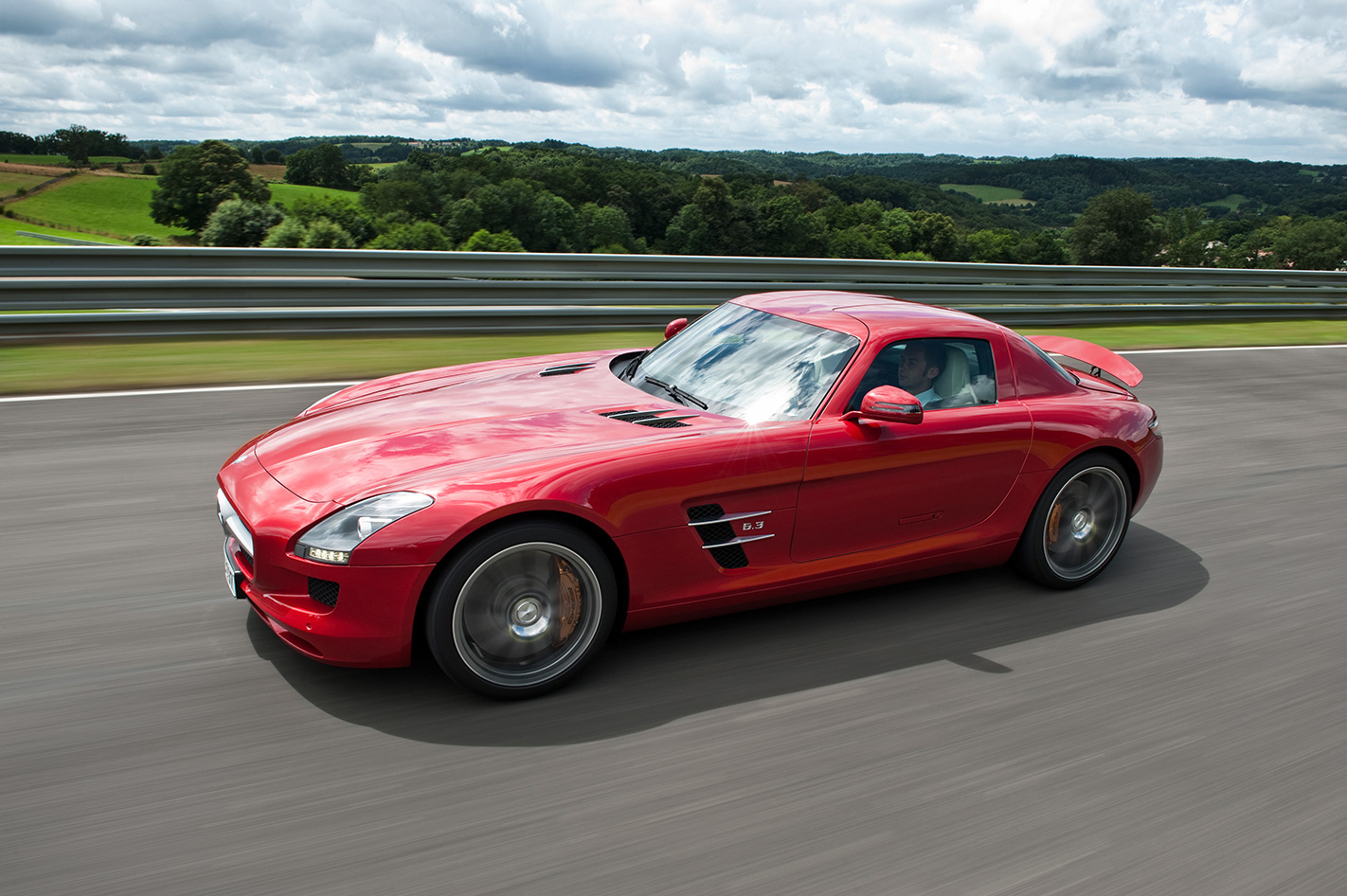
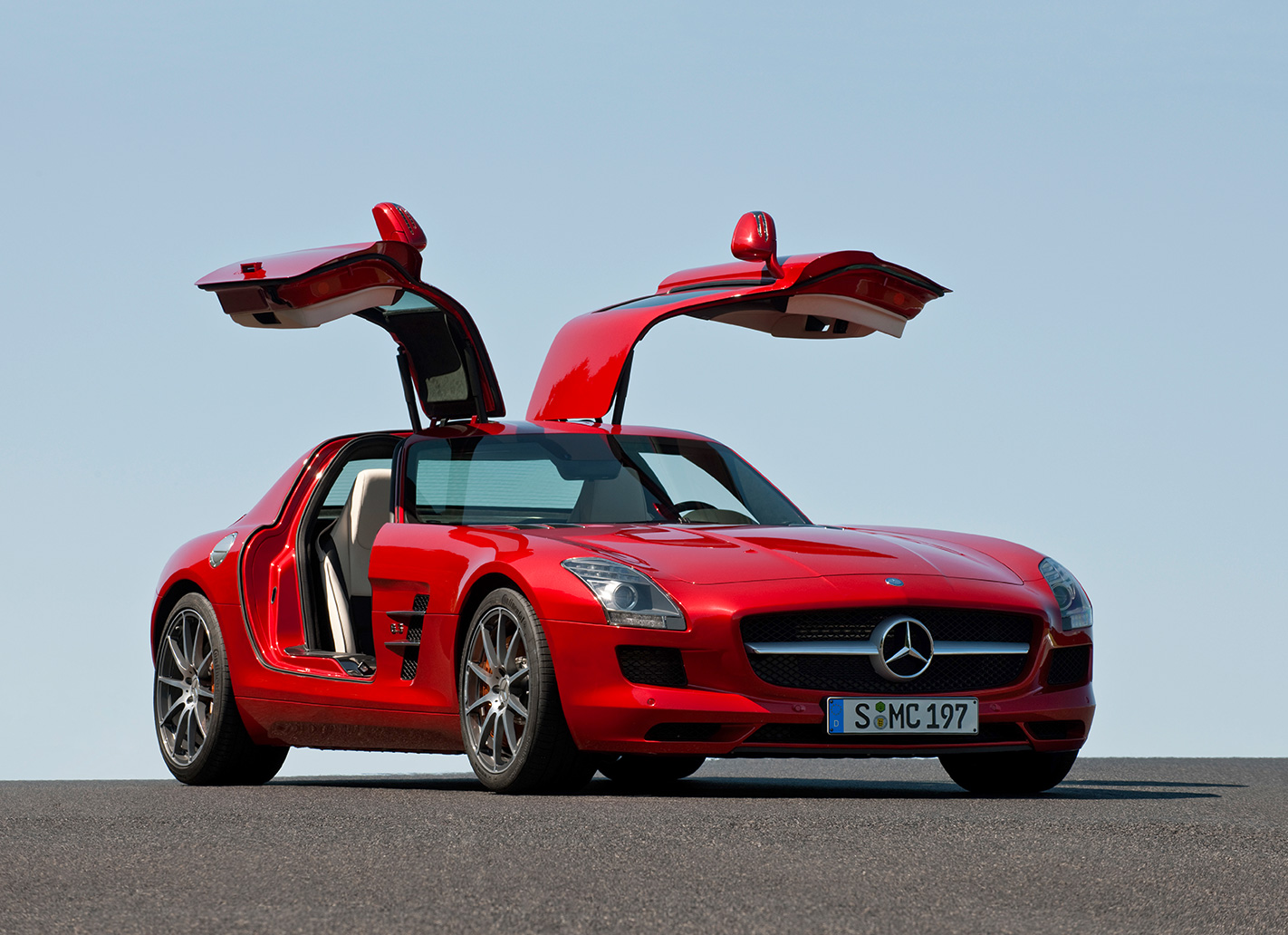
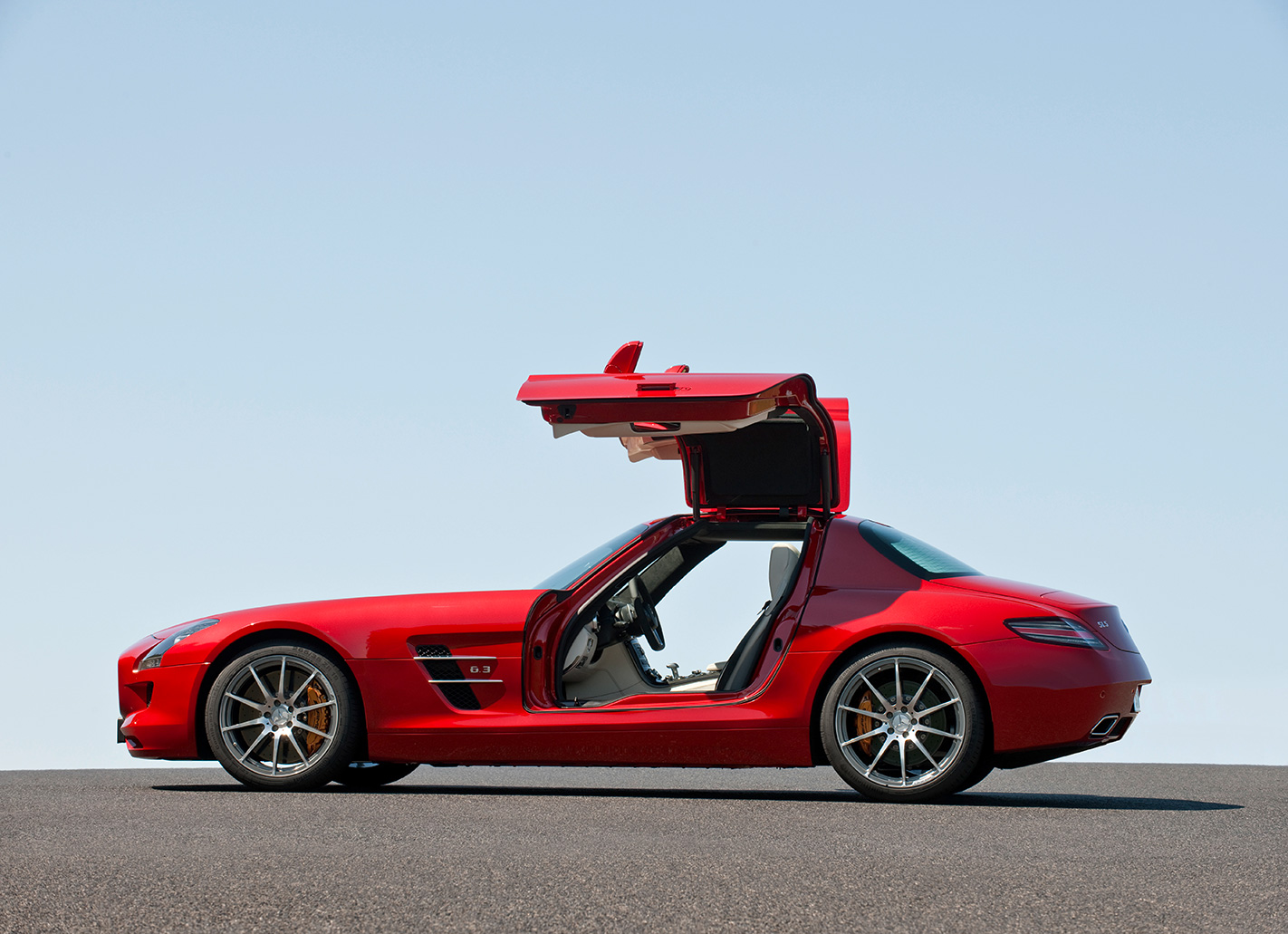
But the real theatrics come when you open the unique gullwing doors. Hit the unlock button on the key fob and the handles automatically expose themselve at the lower edge of the door. And although they’re set lower than a conventional handle, only anyone over six foot would have to bend down to grab them.
Lift the handle and the gas struts assist the single-hinged doors up into the air, gracefully and dramatically transforming the SLS into something truly special. However, getting in or out of the two-seater cockpit isn’t nearly as graceful or dramatic.
The paparazzi will be having a field day if any young starlets in short skirts rock up to a red-carpet event in an SLS, as they’ll need to be conscious of protecting their dignity. What seems like the easiest way to drop into the deep-set, heavily-bolstered seat may actually be, let’s say, quite revealing for some.
As you duck your head under the door and drop your bum into the seat, you’ll have to slide your legs over the sill and into the footwell, choreography that has the potential to show the world what you’ve had for breakfast.
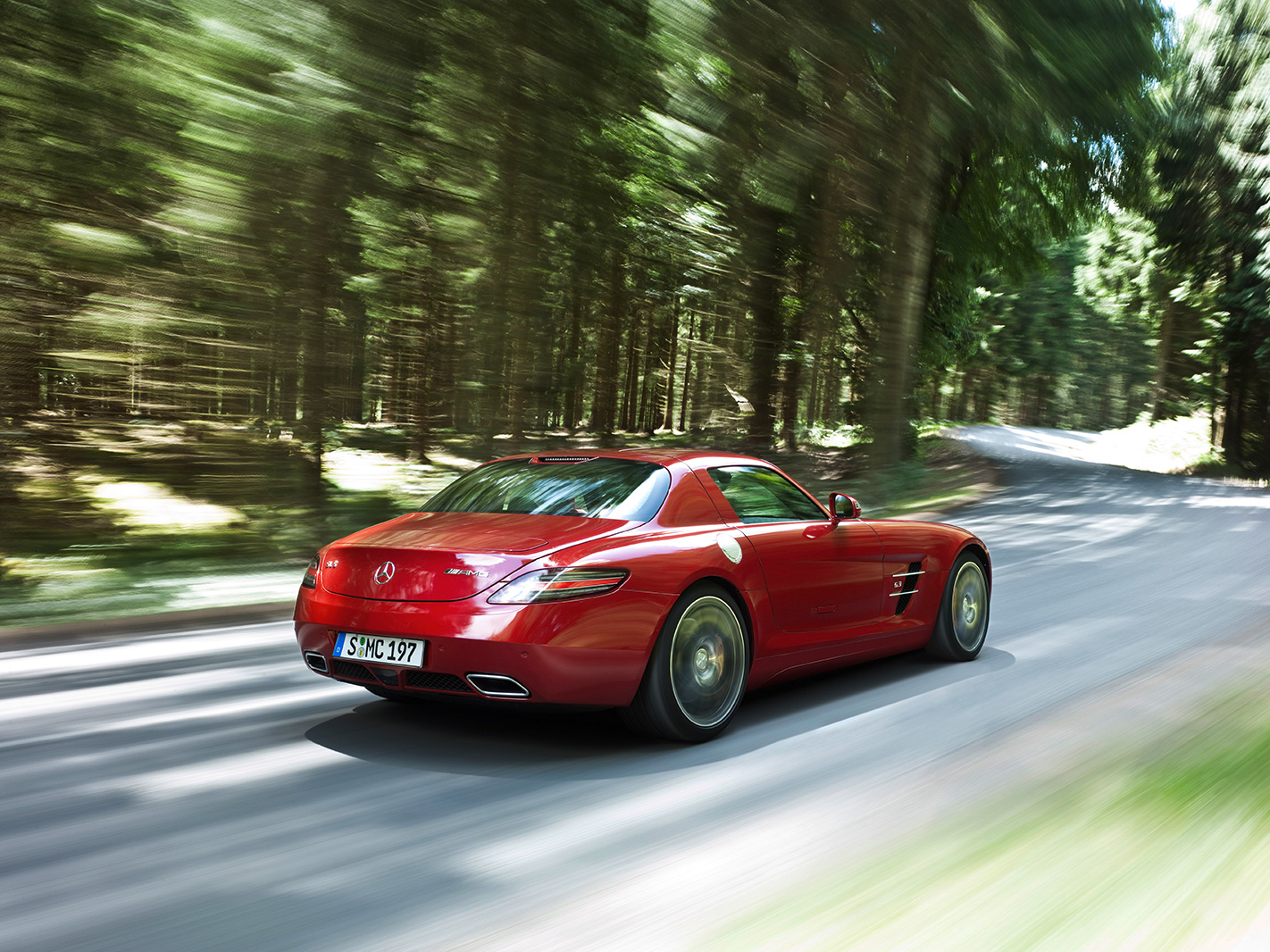
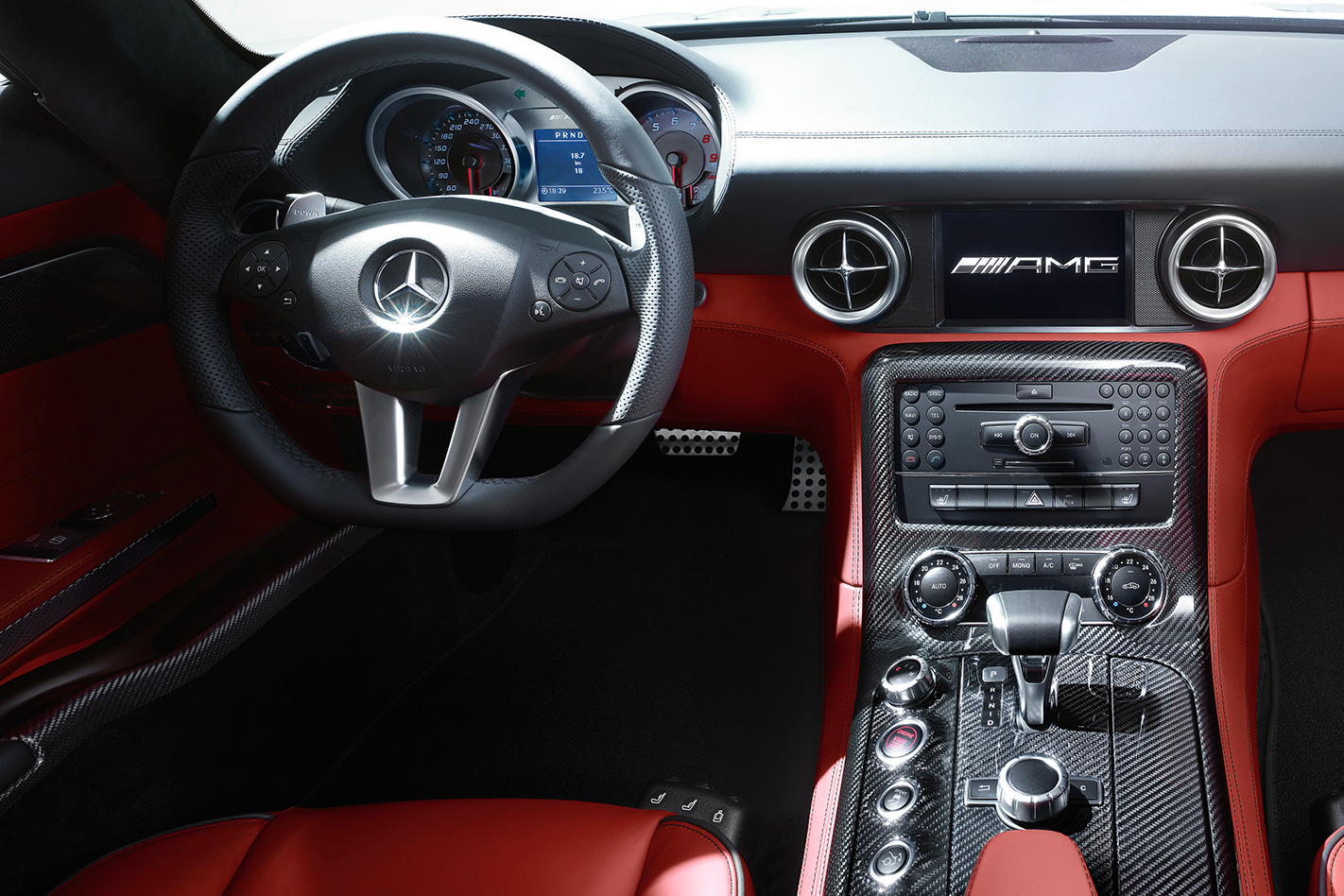
AMG claims that more than 120 individual components have been redesigned for the SLS, including a magnesium intake manifold with eight precisely tuned runners, forged lightweight pistons, a reinforced crankshaft bearing and a stronger crankcase. And, of course, the switch from a conventional sump to a dry-sump lubrication system to improve the engine’s location required numerous mods to the oil delivery and valvetrain tuning.The exhaust has also been specifically tuned for the SLS, which is instantly apparent when it fires up. While it’s relatively quiet at low engine speeds and emits a subtle and classic big-bore V8 burble, if you kick the accelerator into the floor at cruising pace, the surge of torque is matched only by a rising crescendo of noise.
It wails through the mid-range into a bellowing cacophony at the top-end that is devilishly addictive and should be recorded for future generations. Step out of it and the crackle on the overrun is just as delicious – at any engine speed – and somehow even louder and sweeter than it is in the SL63 and E63. It’s acceleration is phenomonal too.
The weight distribution and low centre of gravity also play into the SLS’s handling. With a race-derived double-wishbone set-up on all four corners and conventional hydraulic power steering assistance, the SLS is beatifully balanced at any speed.
The steering is pin sharp with instant feedback and crisp off-centre feel, and it takes a while to get used to the intimidating pendulum effect that even the smallest input makes, simply because you sit so far back from the front wheels and the relatively stiff spring rates eliminate almost all body roll. But once you’re used to it, the SLS shrinks around you and can be pitched into any corner, fast or slow, with loads of confidence.
There’s no drastic weight transfers – either pitching it into understeer during hard braking like a traditional front-engined GT, or the lift-off oversteer of a mid-engined supercar. It just sits flat, grips and bolts to the next bend.
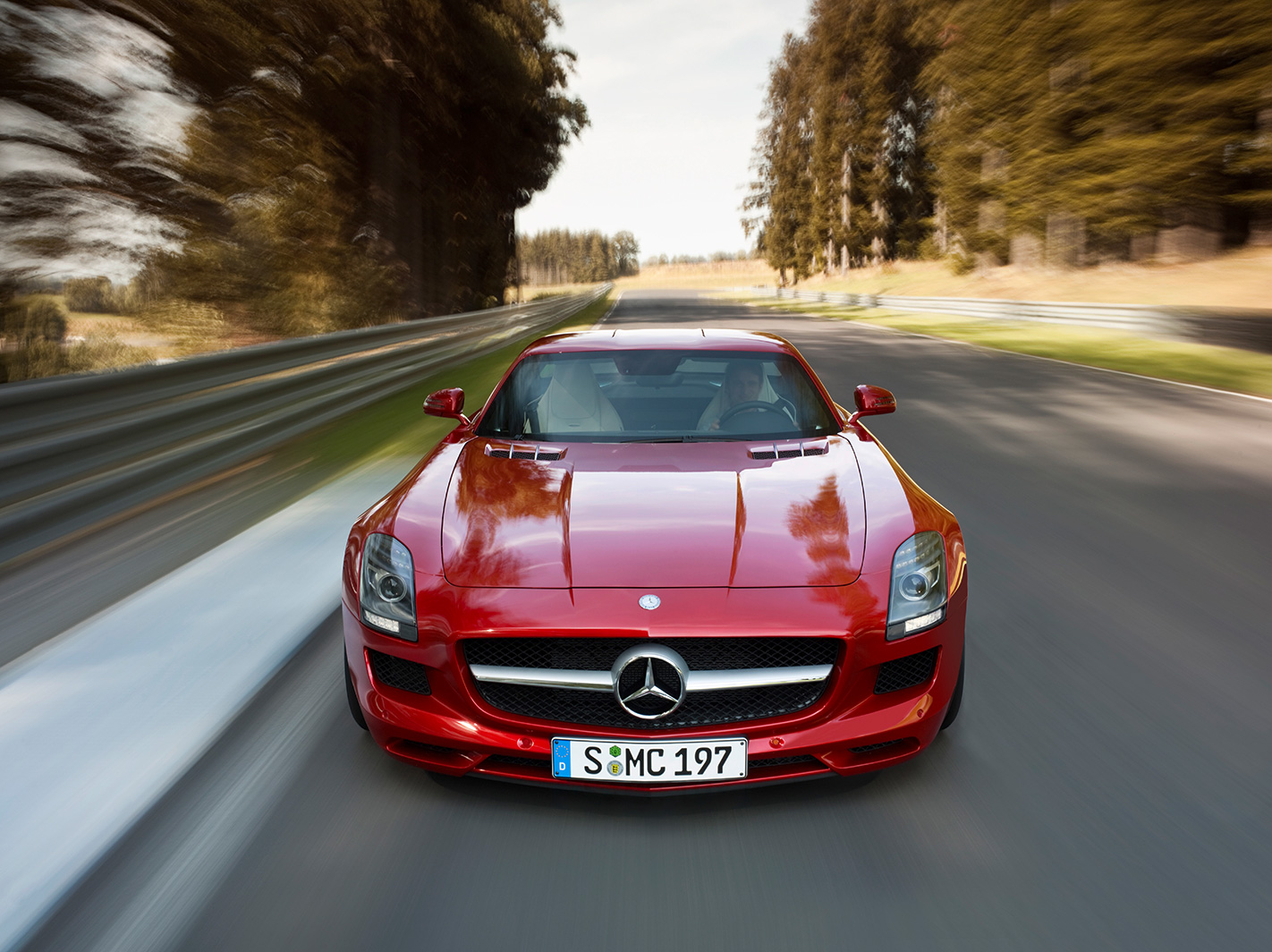
On back-country roads between San Francisco and Monterey, it’s just as sweet and well balanced, maintaining a degree of poise that makes it the easiest front-engined supercar to punt quickly. And when you’re not, its delicate damping makes it surprisingly comfortable to cruise around town at a leisurely pace.Although it has yet to be officially tested around the Nurburgring, AMG test engineers have already lapped the circuit in under 7:40sec – which puts it in the same league as the Porsche 911 Turbo, but more importantly shoots it to the top of Benz’s timesheets as it’s almost 10 seconds quicker the McLaren SLR it replaces.
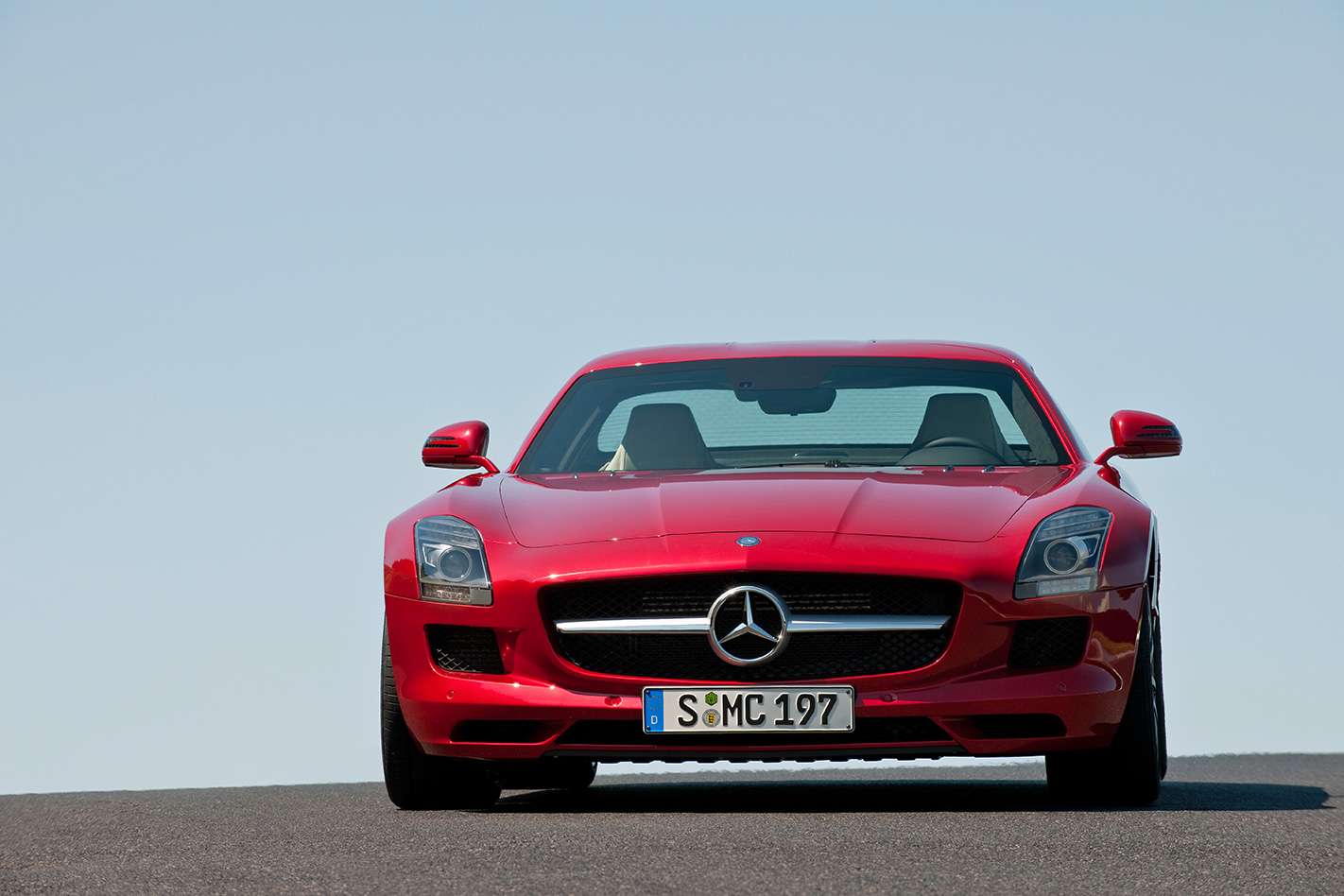
Although Merc engineers claim the DCT shifts quicker than the MCT in manual mode, it does so without the dramatic crack and pop from the ignition cut that makes the auto so inviting to drive hard.But, if that’s all there is to complain about then that’s saying something. Unlike the SLR, which was overpriced, overweight and overstyled, the SLS is damn near perfect. It’s so much more than a retro recreation of a past legend. It’s a modern classic of its own accord.
