
2024 Mercedes-Benz GLC300 long term review
“You have a 4000 kilometre limit on it,” said the Mercedes-Benz PR.
Quick bit of mental calculation. I live 40km from the office, so how many kilometres would the commute alone eat up over three months? 4800. Oh dear. That might present a bit of an issue.
JUMP AHEAD
1
Welcome
- Model: Mercedes-Benz GLC300
- Price as tested: $103,370 + on-road costs
- This month: 355km @ 8.2L/100km
At this point, I will openly admit to being rather struck with new car fever.
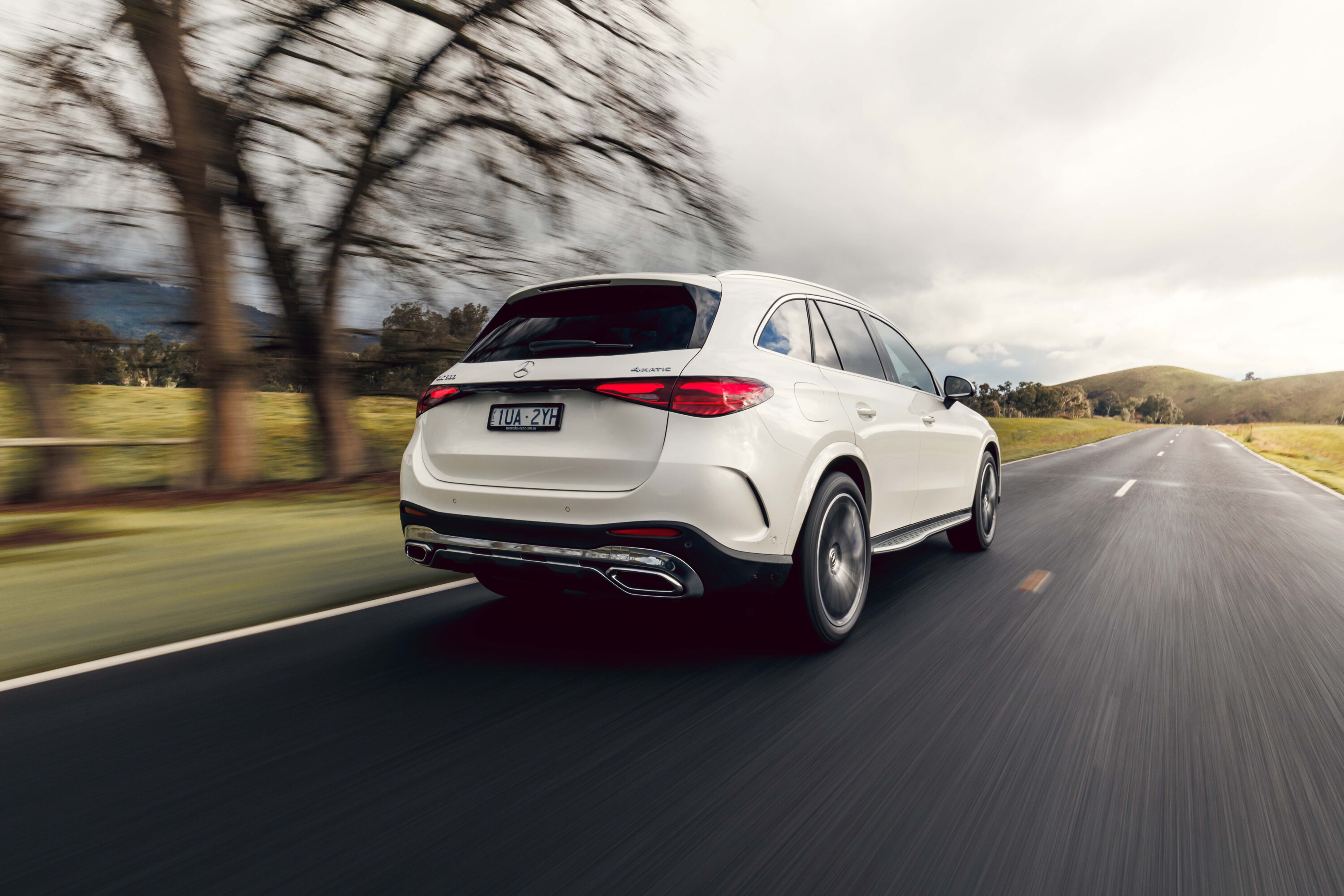
Sales people the world over must recognise the particular symptoms. The prospect claps eyes on the car and suddenly they lose all basic rationality. They just have to have it and will concoct all manner of warped justifications in order to do so. The white GLC300, hunkered low over its multi-spoked 20-inch alloys, had me looking for a dotted line to sign on. Limits, schlimits.

1
The GLC300 is the vanguard for the rest of the all-new range, with 43 and 63 S AMG models incoming.
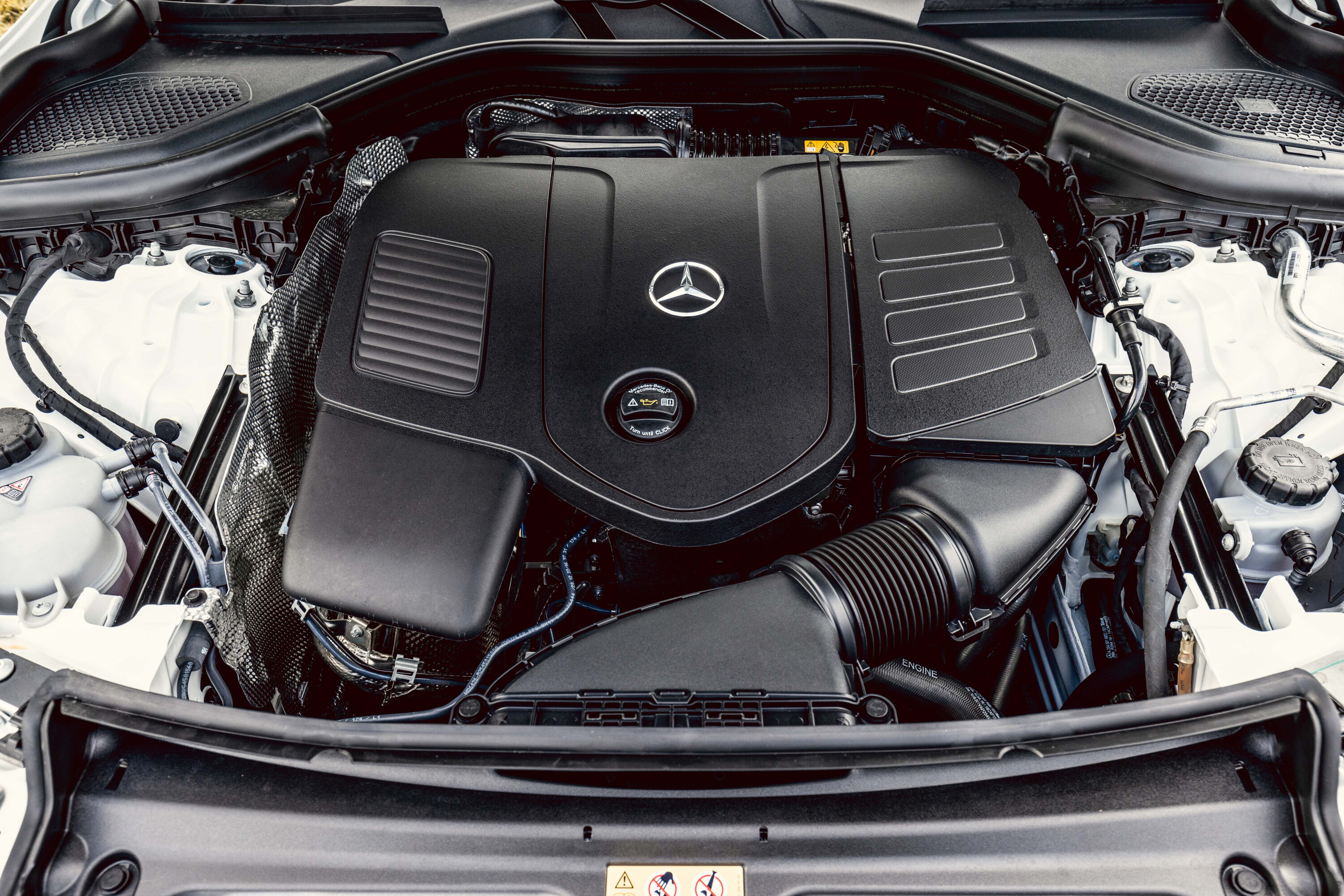
Despite the badge, there’s no longer a large capacity six beneath the bonnet of this one. Instead it’s a humble 2.0-litre four pot, albeit one that can hawk up a very respectable 190kW and 400Nm.
It wasn’t so long ago that 190kW was what you got with the big 3.0-litre V6 in the GLC350d, which was the flagship diesel variant and, it has to be noted, wasn’t markedly more efficient.
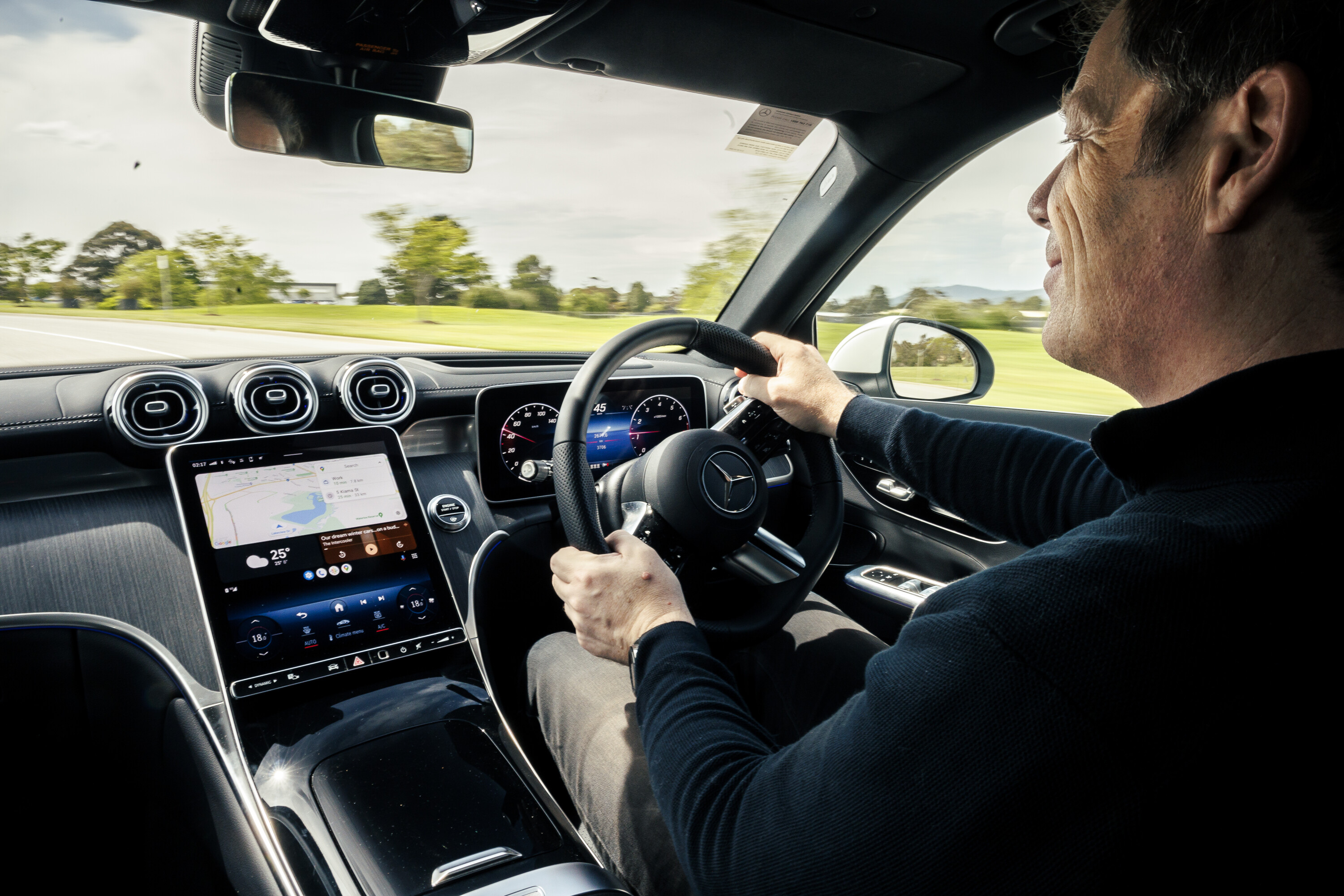
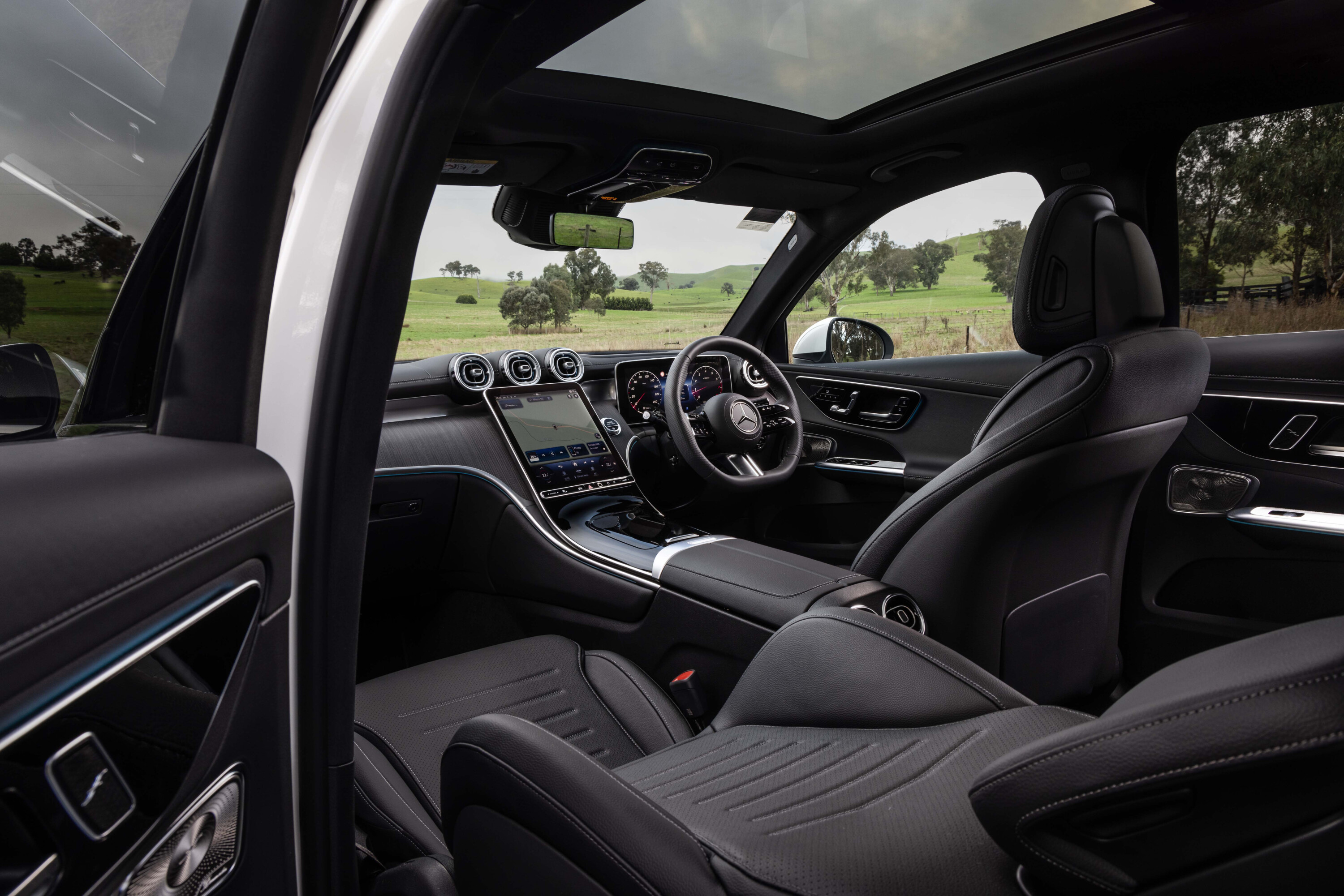
You’d hardly know it was the ‘cheap’ one when you drop inside.
1
Okay, so lets’s keep things in perspective – $103,370 isn’t the sort of change for which you go fishing down the back of the sofa, but with far more proletarian SUV badges nudging six figures these days, it’s not an exorbitant ask.
The impression of initial quality is good. The biggest concern I had was that the new GLC might have regressed somewhat in terms of fit and finish; that it might feel like the MFA2 chassis cars like the GLA and GLB.
Instead, both materials quality and body integrity feel a good deal more senior, as it should for a vehicle that rides on the C-Class’s MRA2 underpinnings, making it a bigger car than the old GLC.
1
It rides reasonably well for a car on 45-series tyres, even if it is a little stiffer than the Subaru Outback that I had been running.
Perhaps that comparison is odious. Virtually everything would feel stiffer in ride than the Subie, and the Merc counters with cornering agility that’s closer to a BRZ than an Outback.
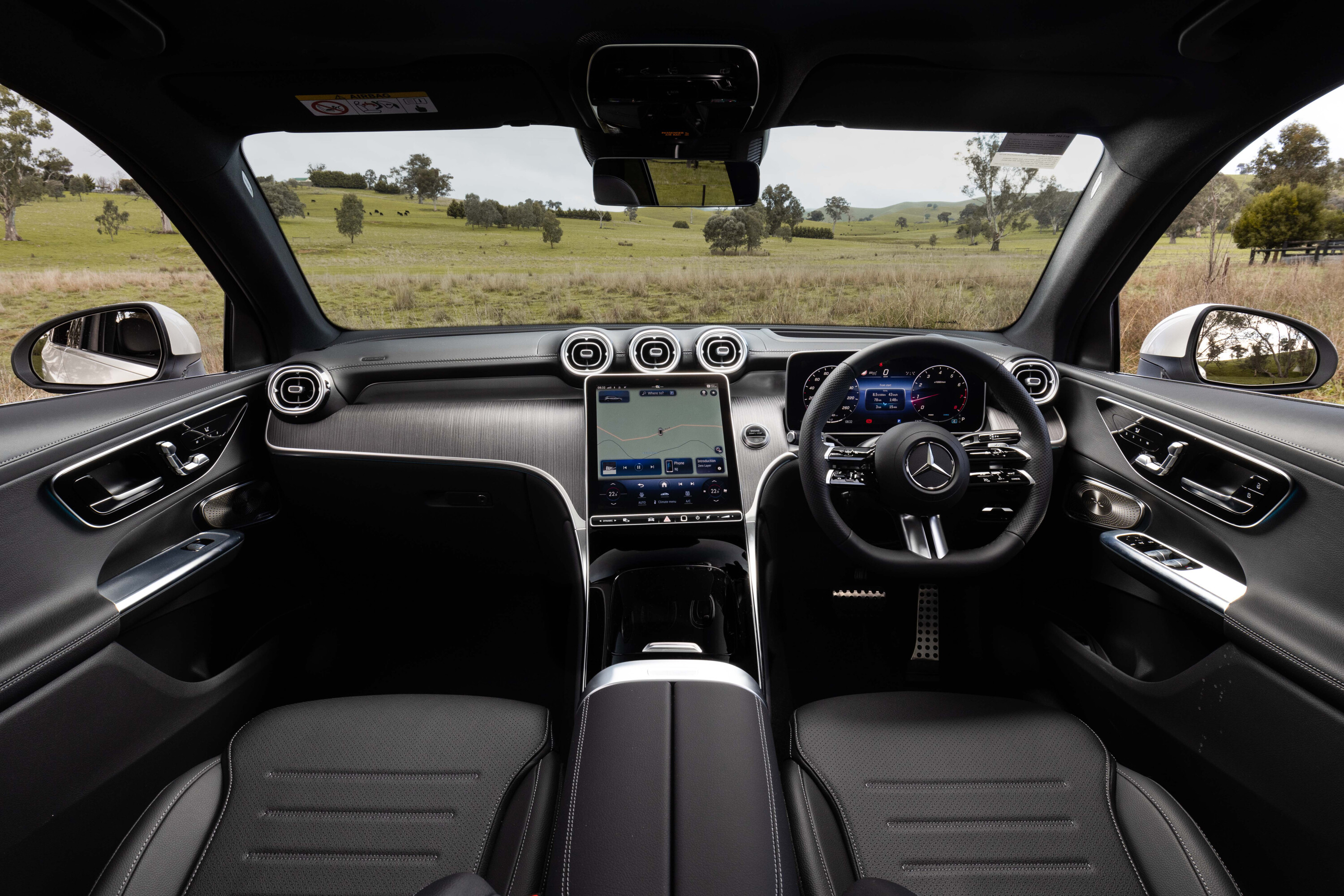
I can’t claim to have mastered the GLC’s infotainment system having only covered a few hundred kilometres in it thus far, but the 11.9-inch portrait touchscreen features both wireless Android Auto and Apple CarPlay connections coupled with the obligatory wireless charging pad.
1
What’s more, the native navigation and media player functions are also very good.
In fact, it’s about the only car I’ve driven lately where I don’t have too much of a preference whether the phone mirroring is switched on or not.
Drawbacks? Few so far. The black vinyl seats feature heating elements up front, but can become wickedly hot if the car’s parked towards the sun.
A set of seat coolers wouldn’t have gone amiss. Somewhat surprisingly, despite offering a stack of drive modes, the GLC 300 rides on a passive damper, so there’s no option of switching into a more pliant suspension setting. Yet it’s fair to say that it’s created a favourable first impression. Next month we’ll stretch its legs a bit.
Never mind the width
- Price as tested: $103,370
- This month: 985km @ 7.8L/100km
- Overall: 1340km @ 7.9L/100km
Feel the quality. Has the new GLC reverted to traditional Merc values?
I’m starting to get used to the GLC speaking to me as I exit the car. I mean, it’s all very polite, but after a while “Just a moment – you’ve forgotten your phone” begins to get a bit wearing.
The problem, as I see it, is that the phone resides in one of two places, both of which are hidden from the driver. It’s either in the centre box where the USB-C slots are or it’s buried in the bowels of the dash where the wireless charger resides. Maybe that’s deliberate.
1
My Google Pixel juuust about fits into the wireless charger, but as soon as rubberised phone case meets rubberised charging pad, the pair grip like velcro and all you’re left with is the charger’s liner bunching up like an old sneaker insole.
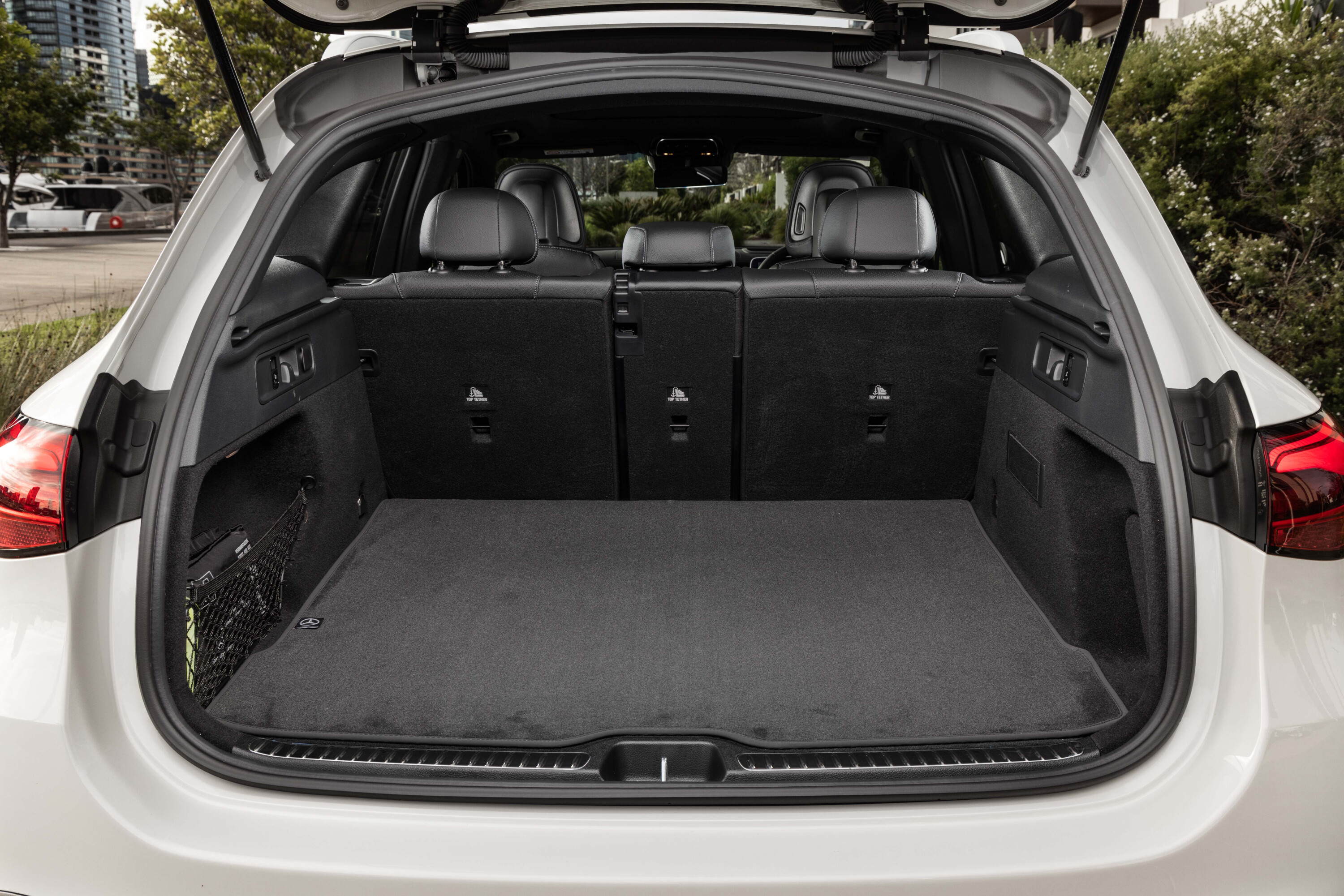
Other issues? Surprisingly few. The GLC has a very odd characteristic whereby in heavy rain, the driver’s side wiper can’t clear the water off the screen and pulls a sheet of water back on the return stroke, making a semi-opaque addition to the already chunky A-pillar.
1
The virtual assistant also seems keen to join the conversation at odd intervals, even if you don’t mention the M-word.
Other than that, the GLC 300 is endearing itself to everyone who’s travelled in it. The ride is extremely well judged. It’s sporty enough to have a bit of fun with on a challenging road without becoming tiresome on an everyday basis. If it was pasta, you’d call it al dente.
The ride height is similarly clever, having enough clearance to never worry about grounding the nose on sharp driveways or gutters, but retaining a sleekish profile. In fact, the overall height of 1640mm is 40mm lower than the Subaru Outback wagon I had run previously.
1
Refinement is extremely good for a four-cylinder engine driving such a chunky vehicle. The huge B-pillars are a pain at oblique junctions but other than that, visibility is good, helped by a decent suite of cameras.
These can stay on for a little too long when you’re pulling away and I’ve taken to turning off autoplay in my podcast app because of this, as my passenger’s not really keen on hearing 20 seconds of Chris Harris blathering on about the glasshouse to bodywork proportioning of a BMW E39 wagon before I can hit pause. I latterly figured out that pressing the middle of the volume button on the steering wheel pauses audio too.
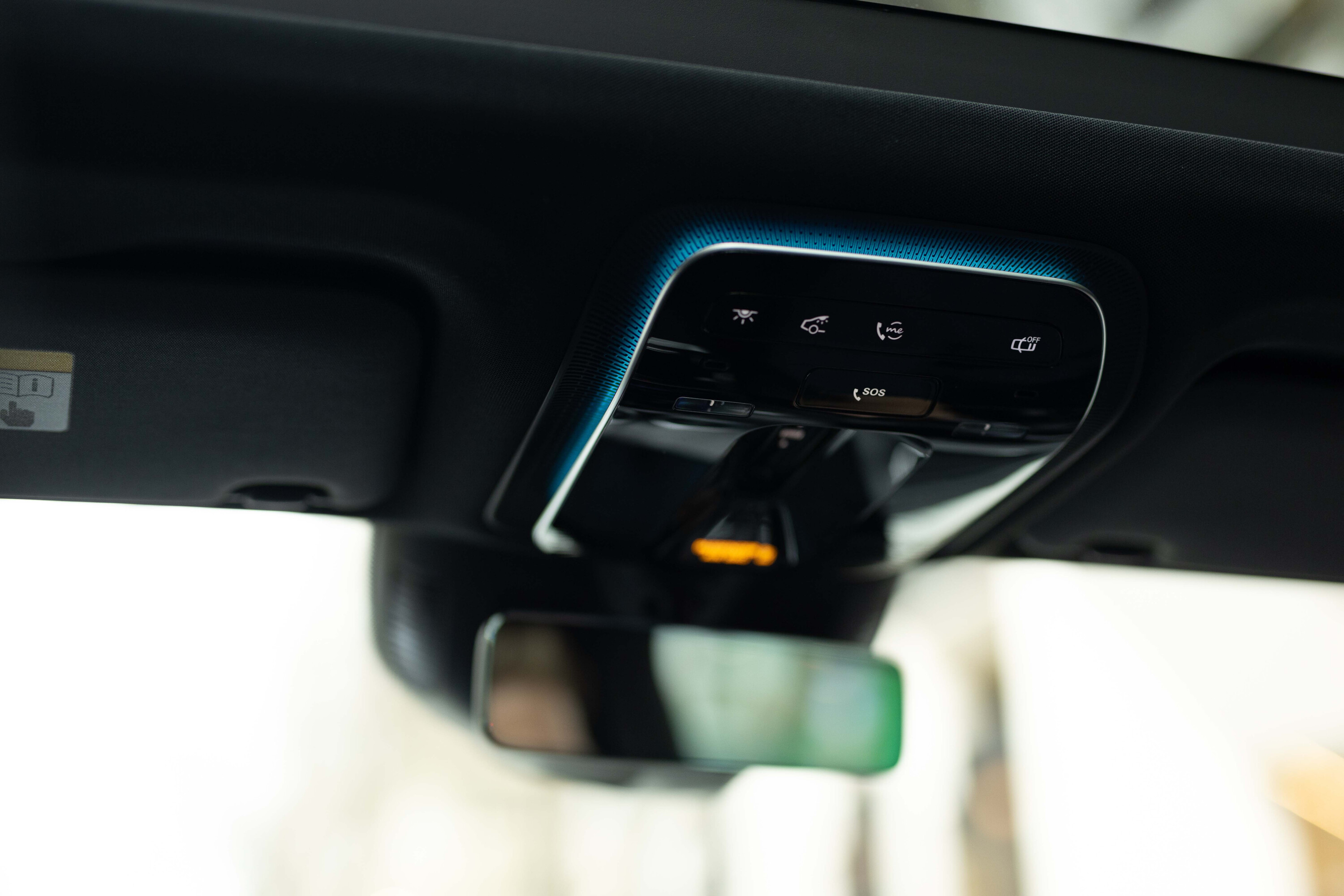
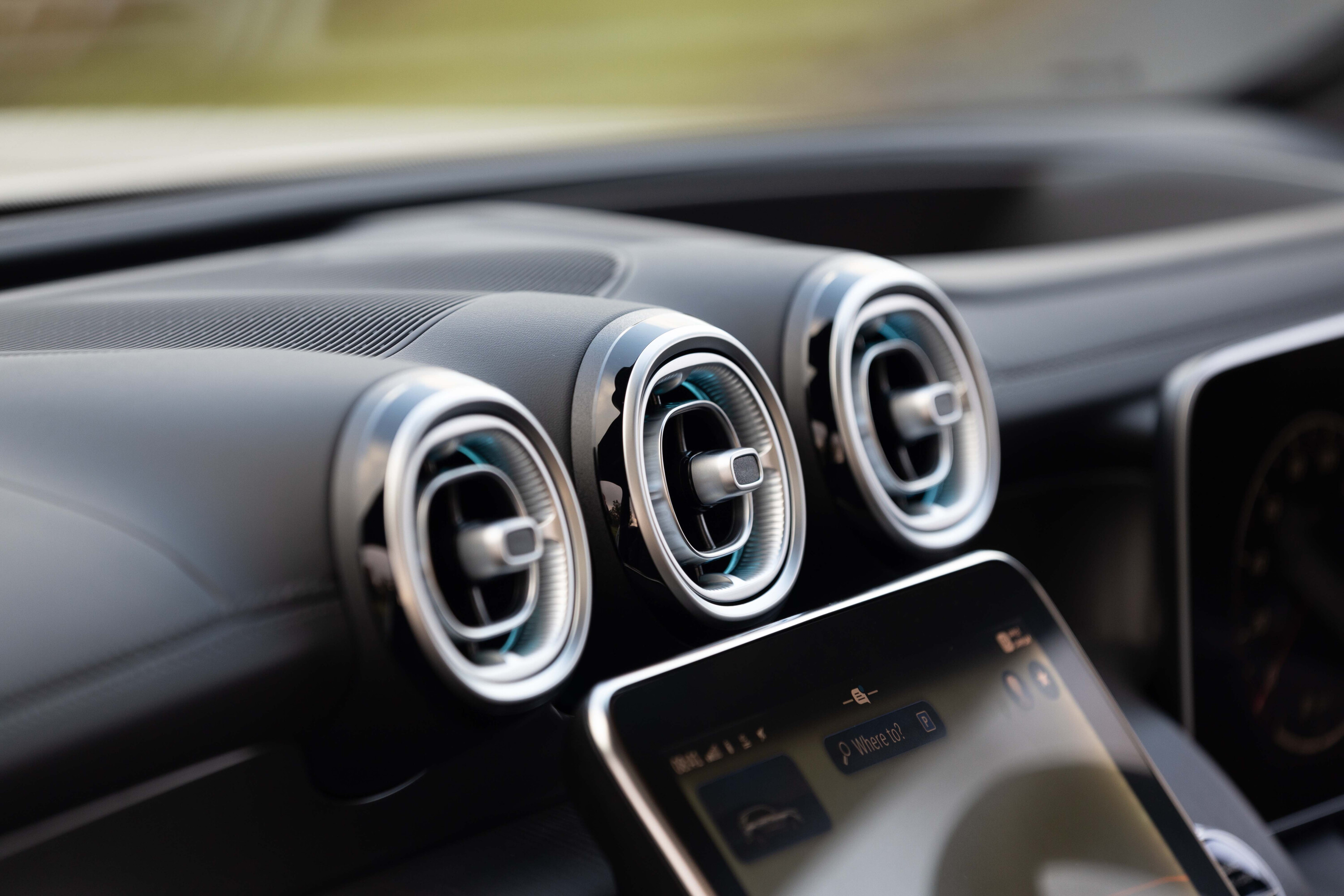
I must confess to not being any great fan of the Mercedes column-mounted gear shifter. Not only does it represent a safety issue (unfamiliar users can easily knock the car into Neutral when trying to indicate back in from the outside lane if they flick up on the wrong stalk) but it also means that lights, front wipers, rear wipers, wash functions and indicators are all shoehorned onto the left-hand wand, which compromises utility.
1
But familiarity erases many of these issues, and I can now navigate the GLC’s functions a little more fluently than at this point last month.
The big-ticket items that Mercedes needed to get right, such as styling, ride quality, engine response, and safety are well addressed. And I still get a kick out of opening the door on a wet night and seeing a massive three-pointed star projected onto the road surface, the bitumen glinting like jewels.
It’s exactly this level of otherness that Mercedes-Benz traditionally did so well; that feeling that here was a car built differently to others. That feeling had been lost at some points in the company’s recent history, but it feels as if Stuttgart now realises the corrosive effect that cost-cutting had on its brand equity and has resolved to rediscover it. Hopefully we’ll be able to probe a little further and discover whether that’s more than superficial sleight of hand.
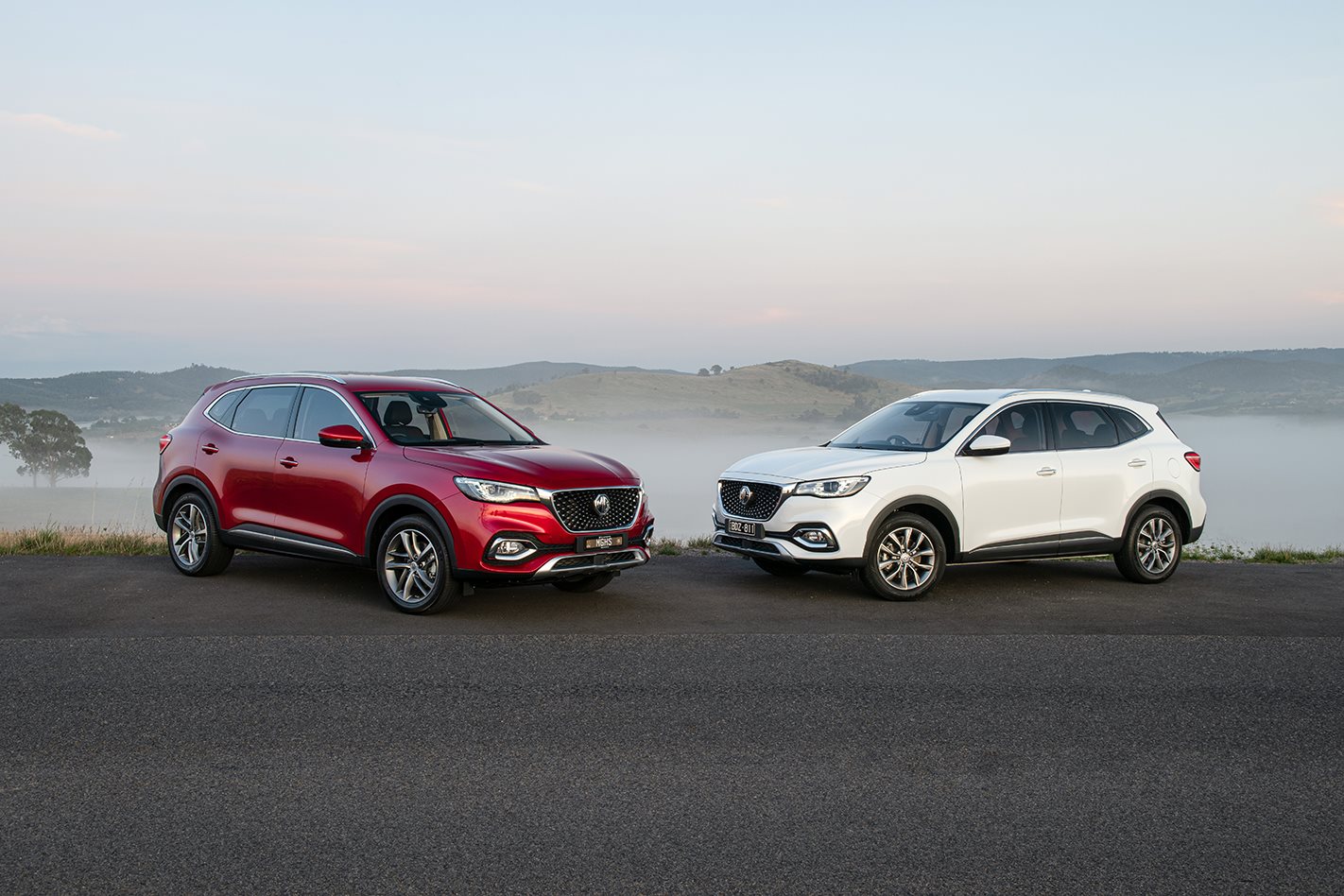
The MG HS provides good value in terms of pricing and features, including premium look-and-feel interiors and a range of driver assistance features.
Its sharp drive-away pricing aligns the affordability of this medium SUV with many small SUV ranges and while some things need improving, build quality doesn’t seem to be one of them.
Neither is performance; the HS comes with a punchy 1.5-litre and 2.0-litre turbocharged powertrains, including Australia’s cheapest plug-in hybrid.
JUMP AHEAD
- Pricing
- What body styles are available for the MG HS?
- What features are standard in every MG HS?
- What key features do I get if I spend more?
- How comfortable and practical is the MG HS?
- How much boot space does the MG HS offer?
- I like driving – will I enjoy this car?
- Which MG HS engine uses the least fuel?
- How does the hybrid system work in the MG HS?
- What is the MG HS’s towing capacity?
- How long is the warranty and what are the MG HS’s servicing costs?
- Which version of the MG HS does Wheels recommend?
- What are the MG HS’s key rivals?
1
MG HS pricing
| Model | Drive-away pricing |
|---|---|
| HS Vibe FWD | $32,990 |
| HS Excite FWD | $35,990 |
| HS Essence FWD | $39,990 |
| HS Essence X AWD | $43,990 |
| HS Plus EV Excite FWD | $49,690 |
| HS Plus EV Essence FWD | $53,690 |
What body styles are there?
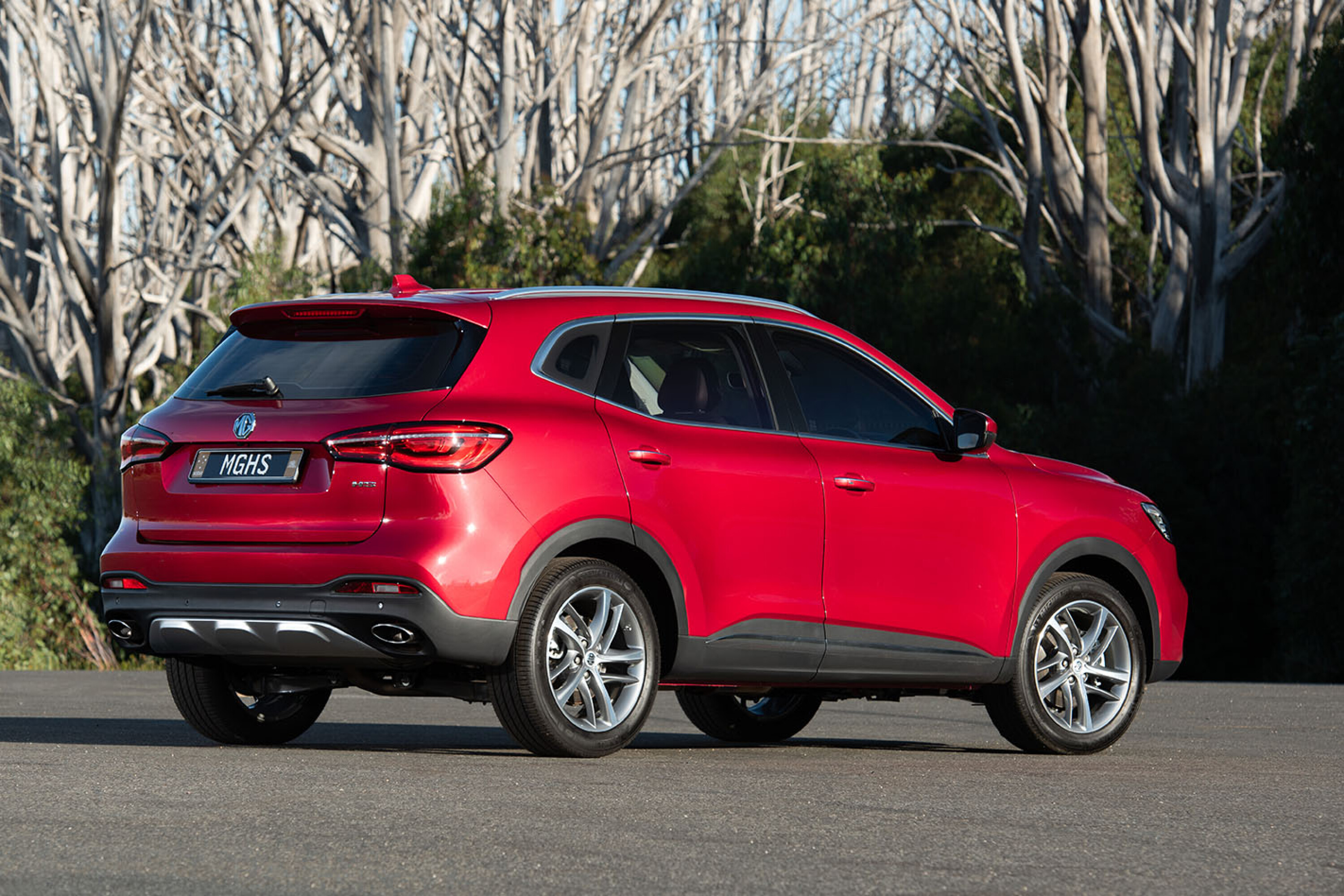
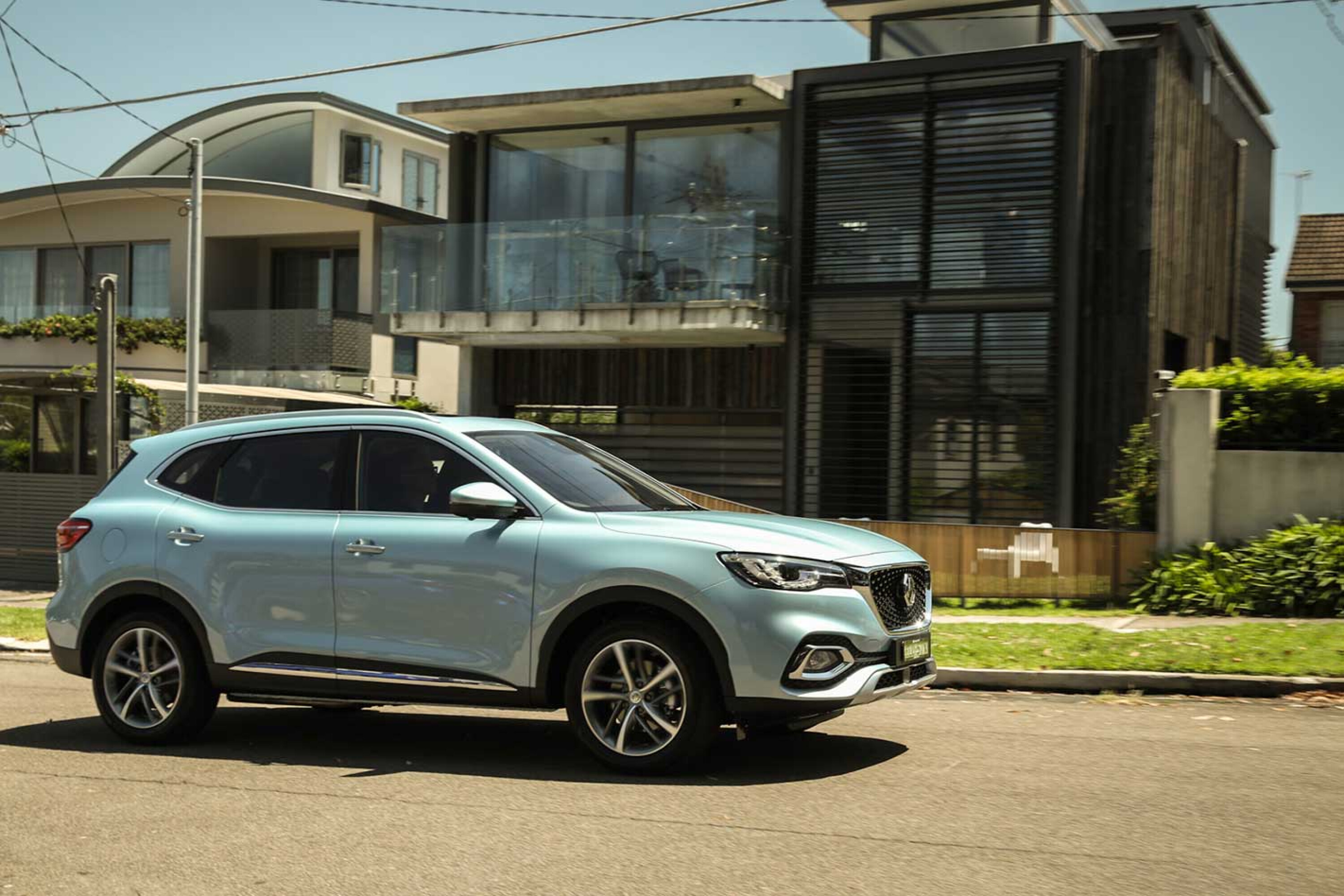
The MG HS is sold as a five-door SUV-style wagon only, with seating for five.The MG HS is available with front- and all-wheel-drive and is classed as a medium SUV, in the mainstream sub-$60K segment.
3
What features are in every MG HS?
The features listed below are standard in the entry-level model and will appear in higher-grade models, unless replaced by more premium equivalent features.
| 2024 MG HS standard features | |
|---|---|
| 10.1-inch infotainment system | Apple CarPlay and Android Auto (wired only) |
| Semi-digital instrument cluster | Six-speaker audio system |
| Reverse camera | Rear parking sensors |
| Four USB-A ports (2x front and rear) | Air conditioning |
| Synthetic leather upholstery | Leather-wrapped steering wheel and gear shifter |
| Front centre console with cooling | Rear air vents |
| Halogen headlights | Front fog lights |
| LED daytime running lamps | LED tail lights |
| Keyless entry with push-button start | Heated, electrically-operated door mirrors. |
| Alloy wheels | Sharkfin antenna |
| MG Pilot Driver Safety Suite | Adaptive cruise control |
1
What key features do I get if I spend more?
The least costly MG HS is the Vibe, which comes with 17-inch wheels, manually operated air-conditioning, halogen headlights and front-wheel drive.
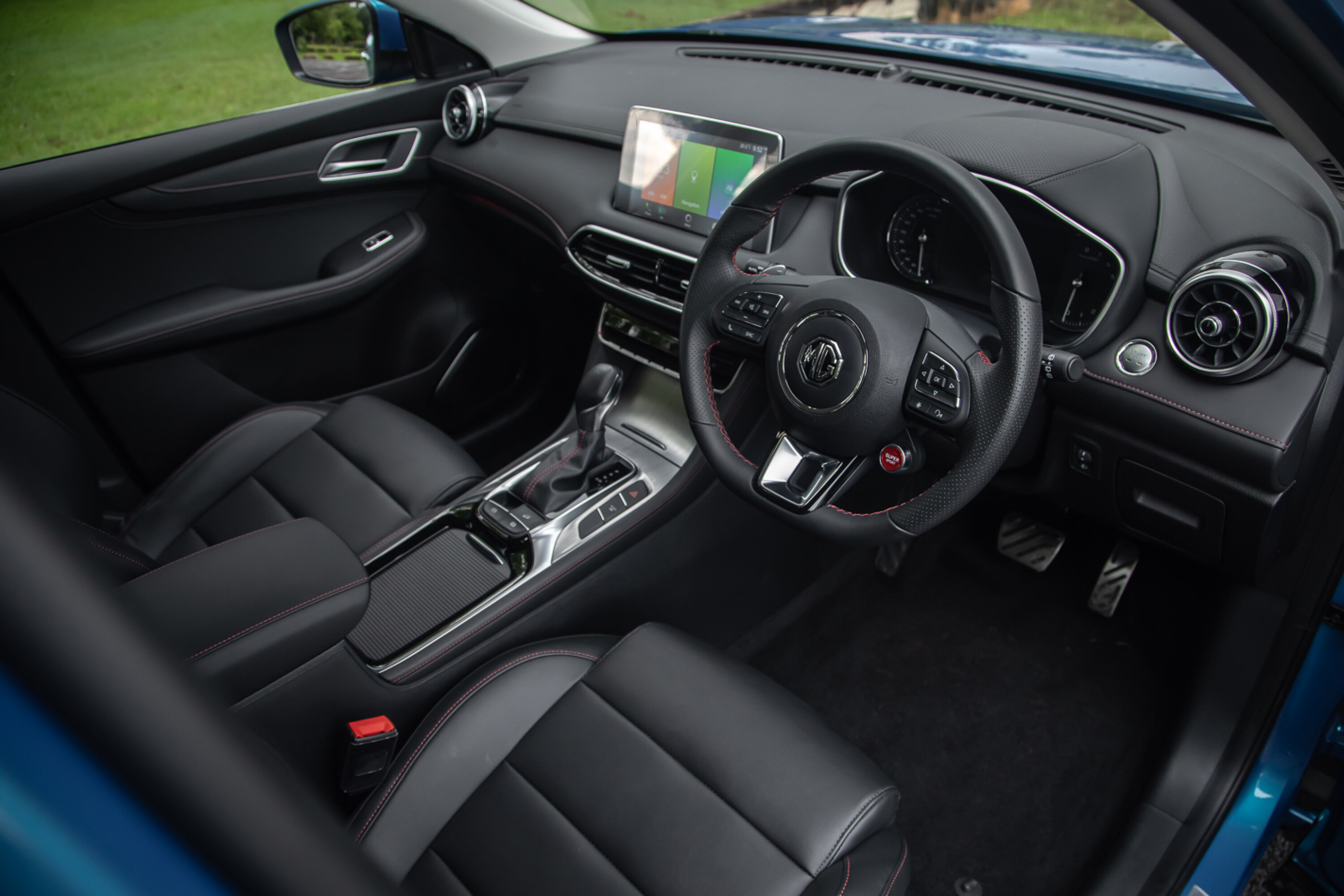
Stepping up to the HS Excite brings a bunch of desirable extras:
| 2024 MG HS Excite additional features | |
|---|---|
| LED headlights | Dual-zone climate control |
| Satellite navigation | Alloy pedals |
| Rain-sensing wipers | u2018Super Sportu2019 drive mode |
| Electric tailgate | Paddle shifters |
| Sequential rear indicators | Ambient interior lighting. |
| 18-inch alloy wheels | |
1
The top-spec HS Essence is available with the standard front-wheel drive, and an all-wheel-drive variant called the Essence X comes with a more powerful 2.0-litre turbocharged engine.
| 2024 MG HS Essense additional features | |
|---|---|
| 360-degree camera | Panoramic sunroof |
| Two-tone leather sports seats | Six-way power-adjustable driveru2019s seat |
| Heated front seats | Four-way power-adjustable passenger seat |
1
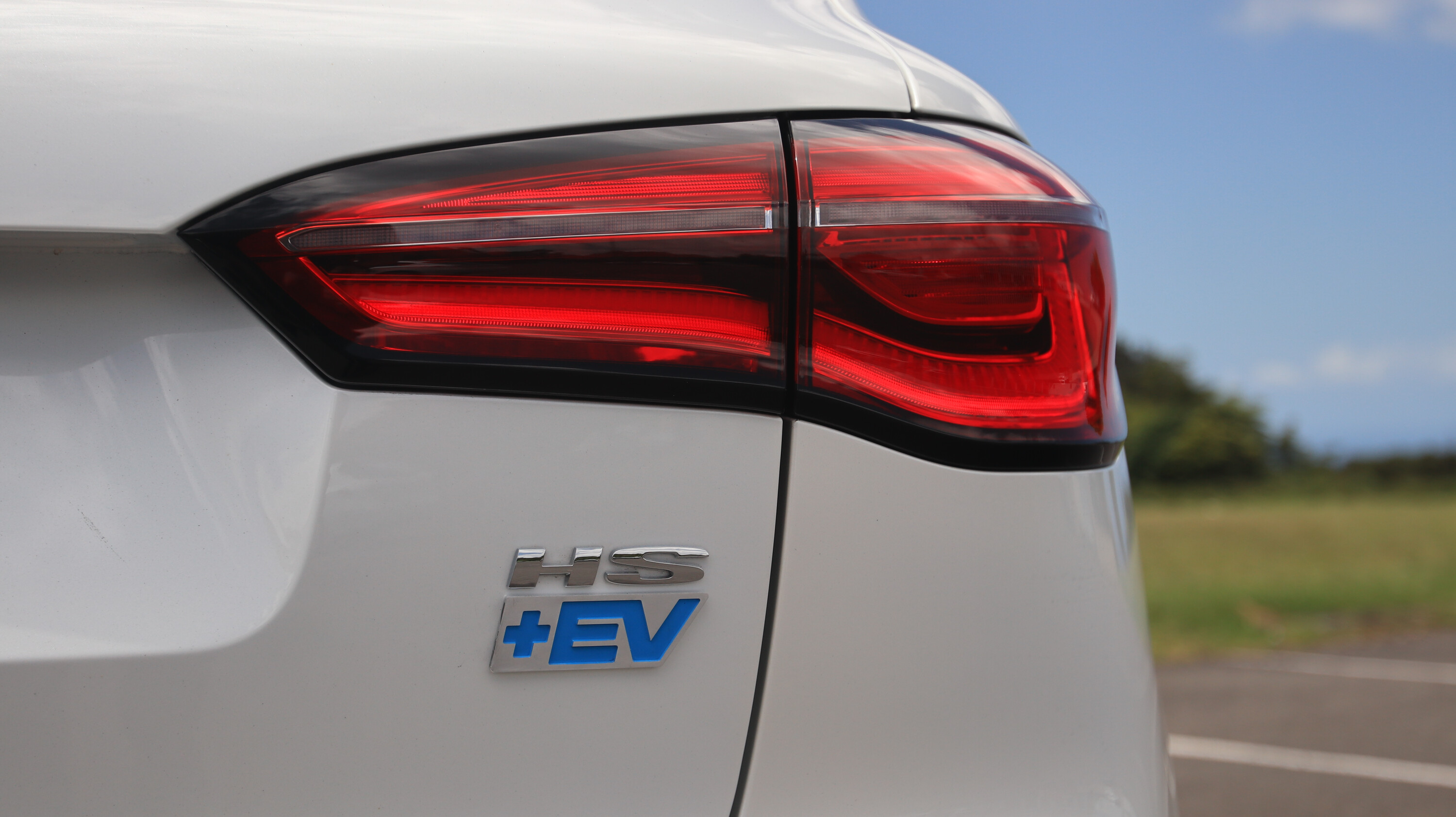
The HS Plus EV Excite is the most-affordable plug-in hybrid version.
It has most of Excite’s features but has smaller 17-inch wheels and a manually-operated tailgate and, for some reason, old-school halogen headlights which seems an odd choice in a high-tech electrified vehicle. But it gains the 12.3-inch digital instrument cluster found in the Essence.
The HS Plus EV Essence shares much with its petrol Essence and Essence X counterparts – including the 18-inch wheels and LED headlights – while gaining the digital dials and leather trim.
1
How safe is the MG HS?
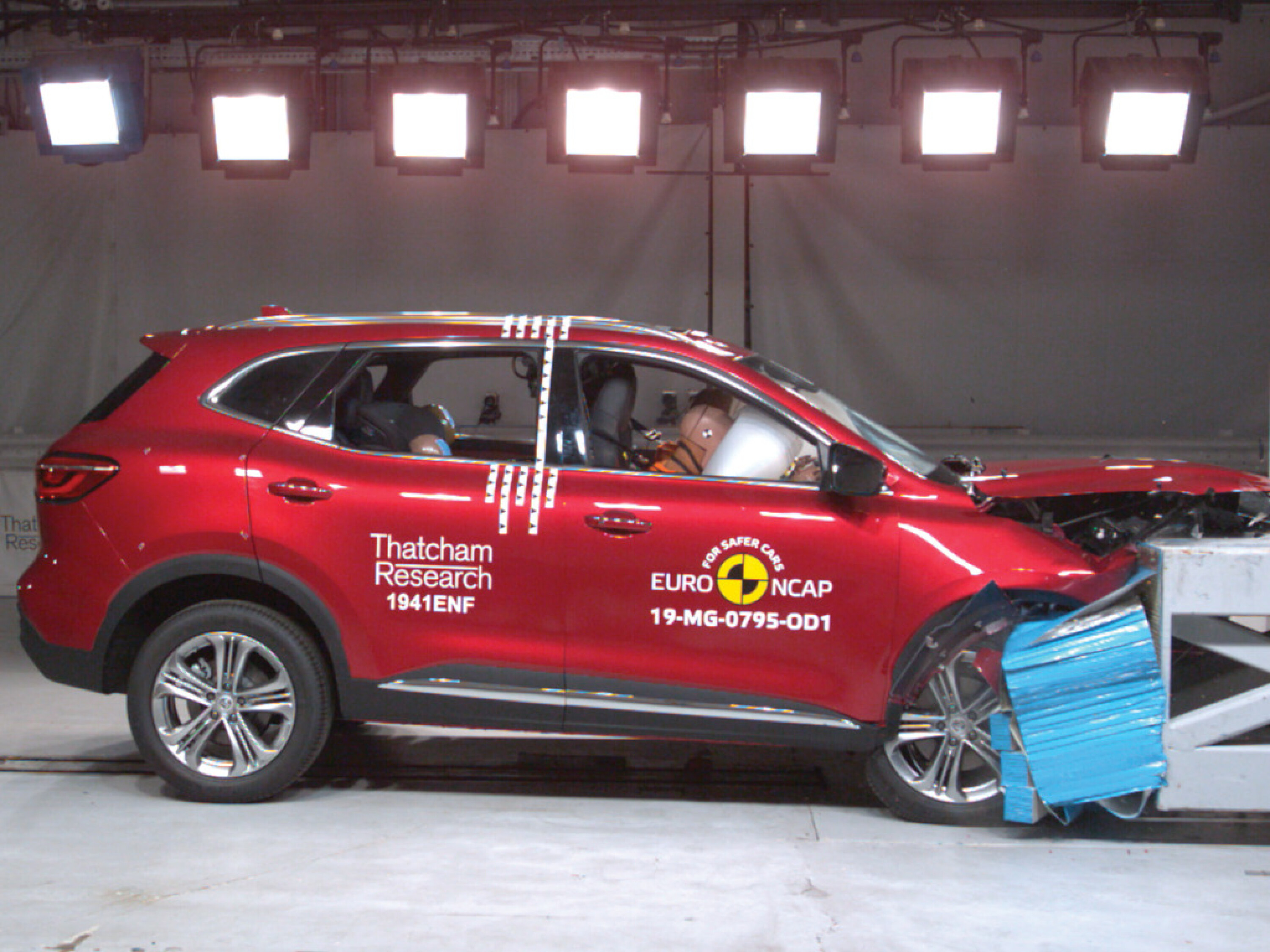
The non-hybrid MG HS is covered by a five-star ANCAP safety rating, based on Euro-NCAP testing conducted in 2019.
Plug-in hybrid variants remain untested and unrated.
Six airbags (dual front, dual side and dual curtain) feature across the range.
Each variant comes with the MG Pilot driver safety suite, which brings the following active safety equipment as standard:
| 2024 MG HS safety features | |
|---|---|
| Autonomous emergency braking | Lane-keep assist |
| Forward collision warning | Adaptive cruise control |
| Traffic jam assist | Blind-spot alert |
| Rear-cross traffic alert | Traffic sign recognition |
| Auto high-beam | Door opening warning |
1
How comfortable and practical is the MG HS?
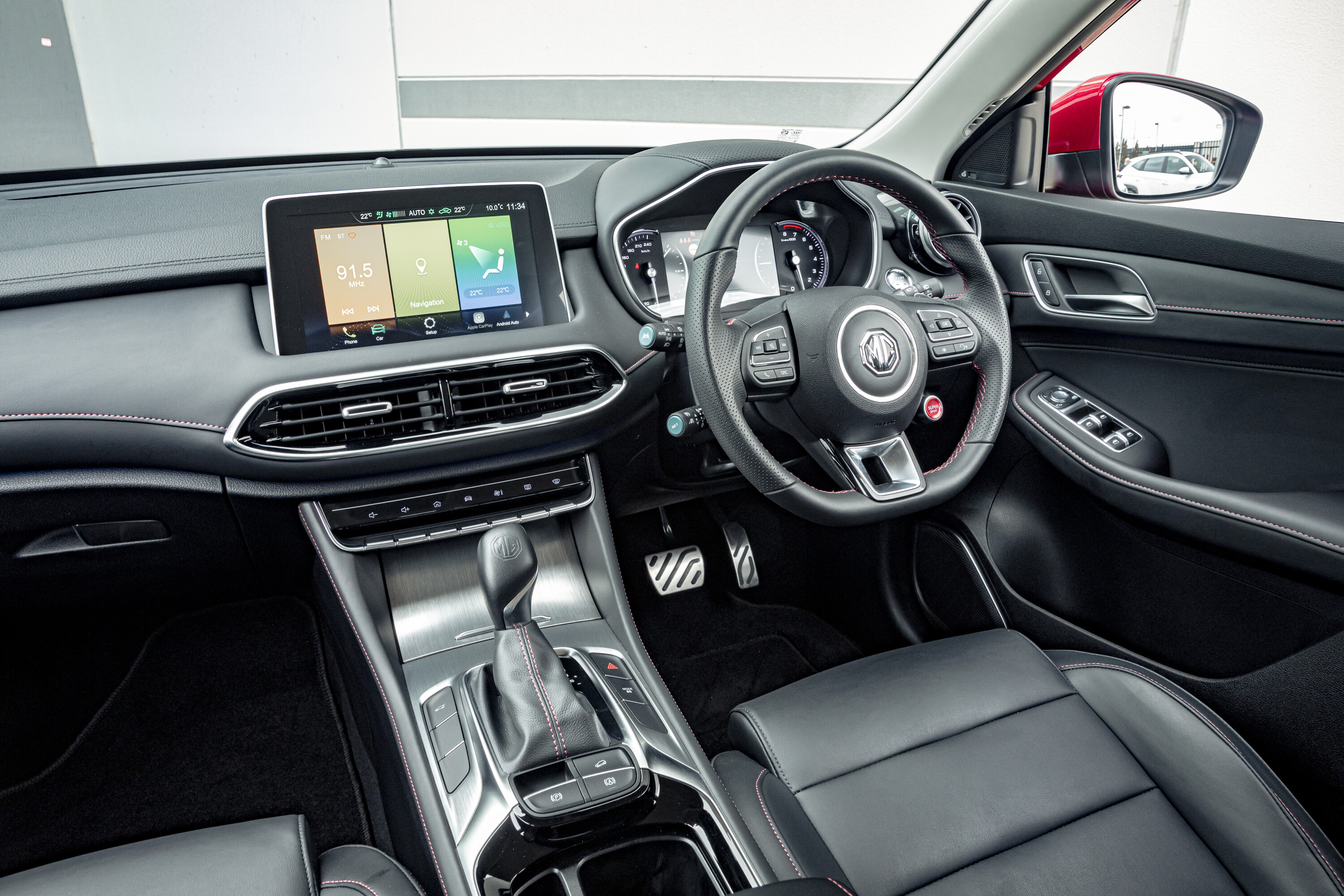
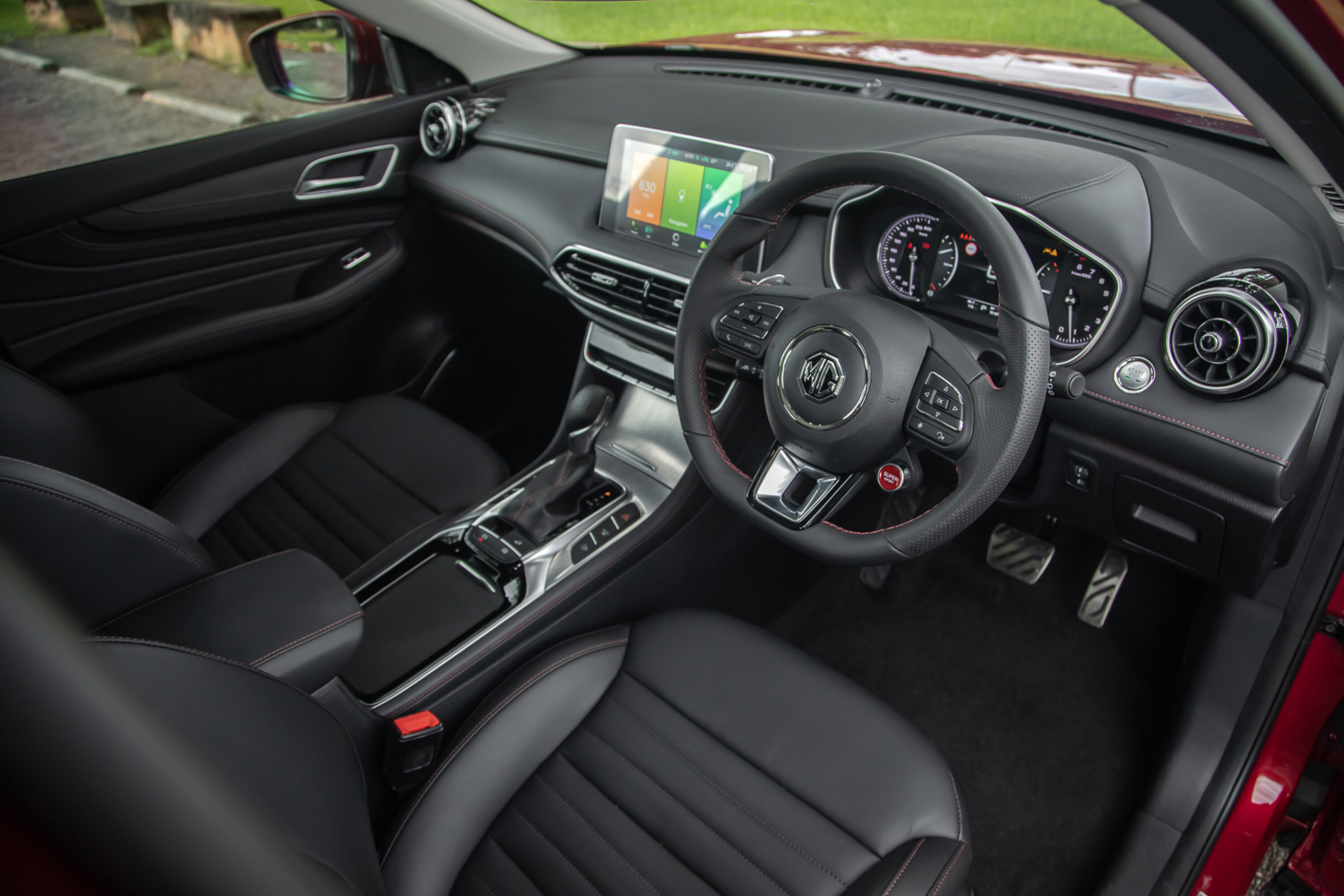
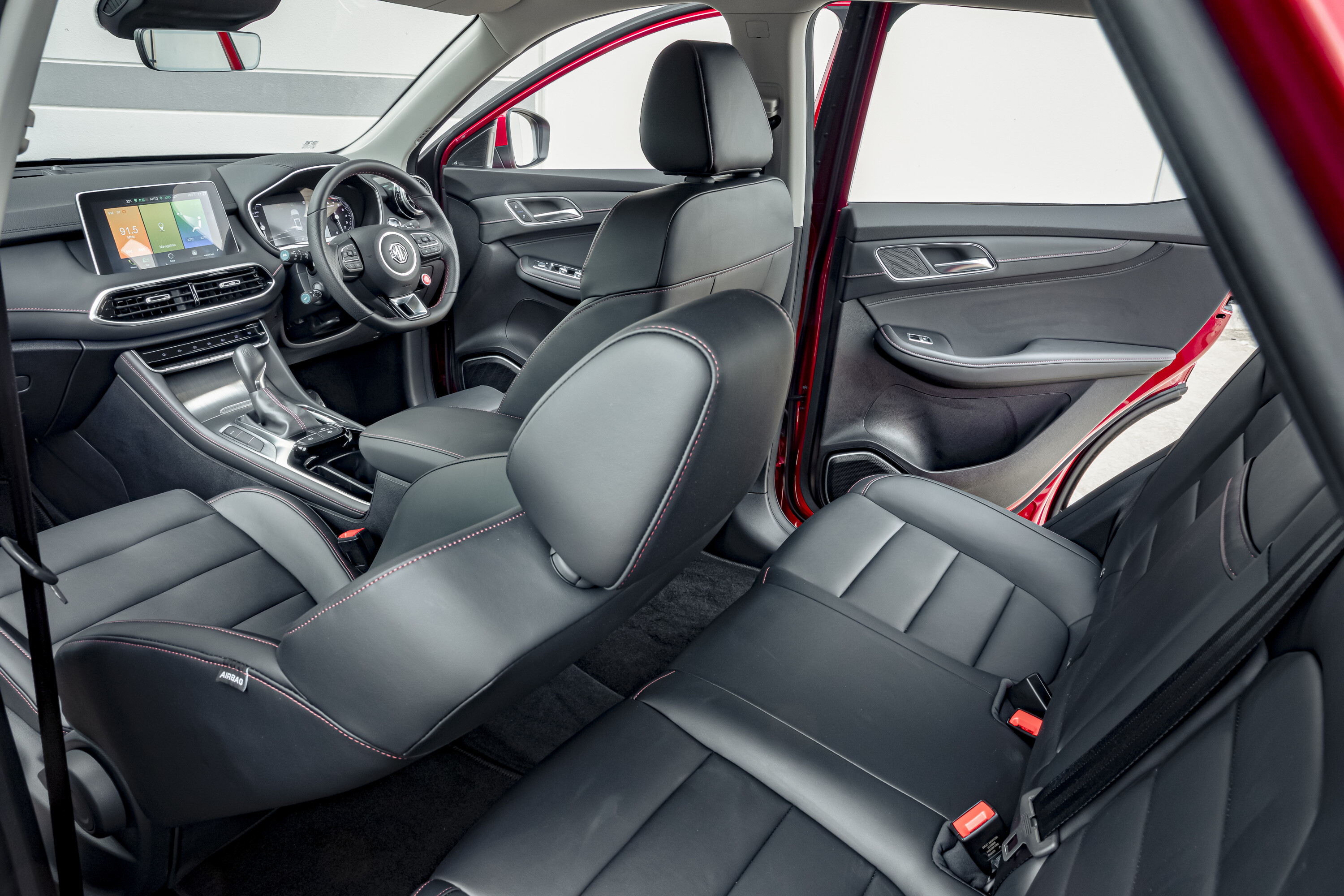
Even in the entry-level Vibe, with its faux leather seats, the HS interior feels surprisingly premium.
All variants feature plenty of soft-touch materials, supportive front seats, a 10.1-inch touchscreen and a leather-wrapped steering wheel that wouldn’t be out of place in a European rival.
The fit and finish of trims, carpets and switchgear is also pleasing and the cabin is well insulated from road and wind noise, contributing to a quality feel inside.
3
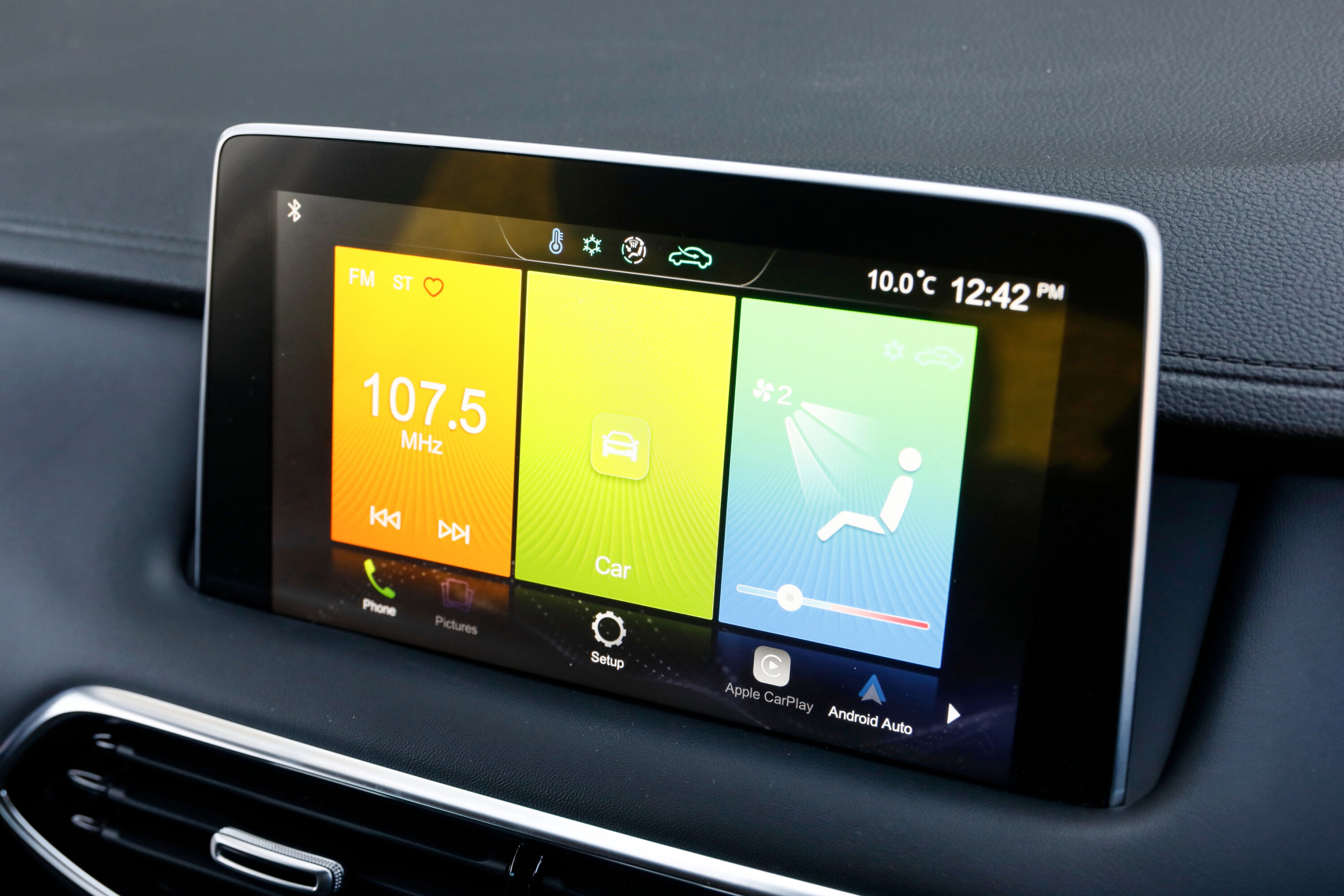
The Apple CarPlay and Android Auto interface connects and works well, but there are a few niggly issues with the infotainment system such as the interplay between the touchscreen and the buttons below that isn’t always intuitive or speedy.
A bunch of functions that would have physical buttons in other vehicles are also hosted within the touchscreen, including climate control, which can be difficult to adjust while on the move.
To make things a little easier, there is a shortcut button on the main menu to go straight to the climate control display.
2
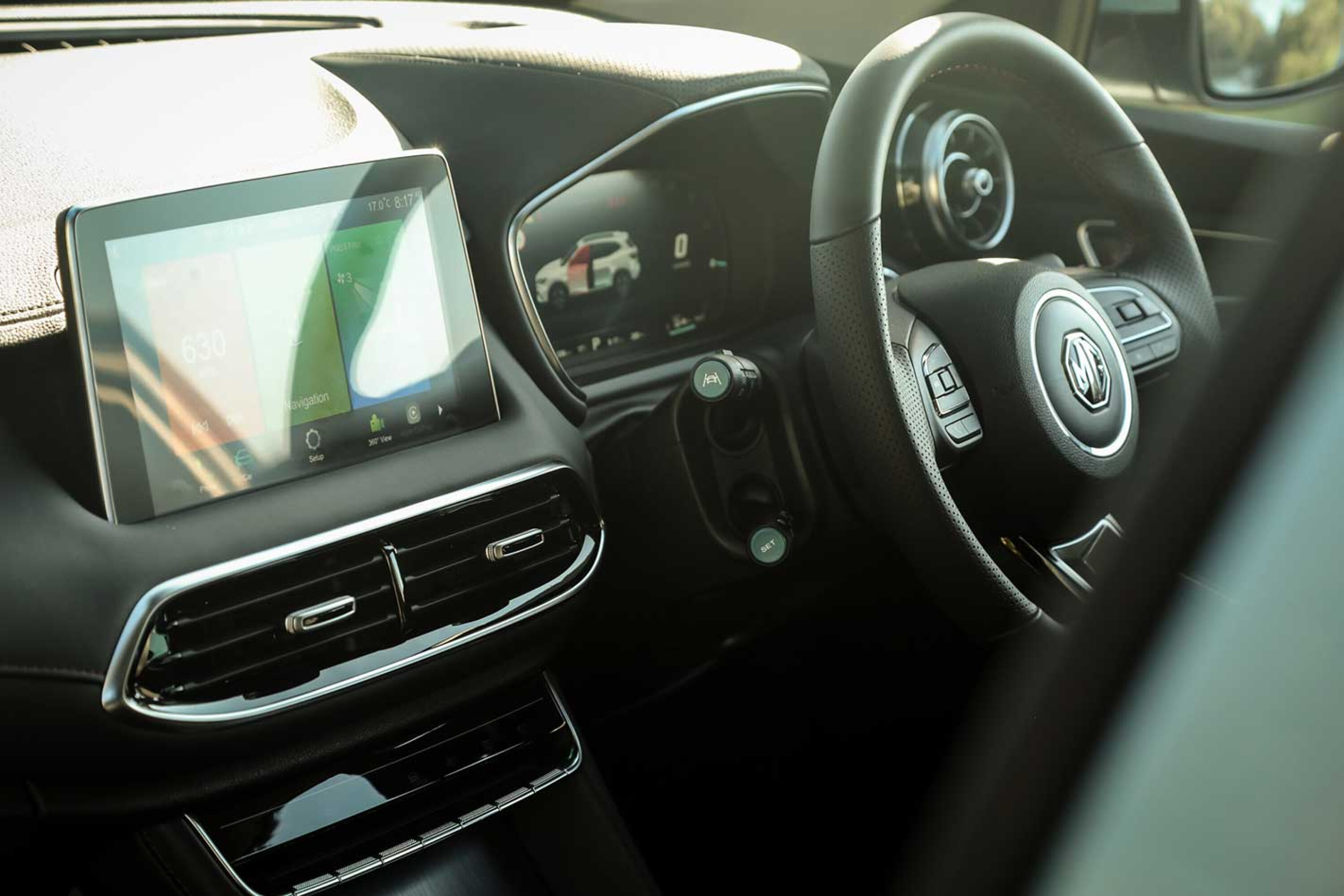
In front of the driver are clear dials, complemented by a central digital screen that displays the fuel and temperature gauges along with all manner of vehicle information that is easily navigated using the steering wheel buttons.
The leather-trimmed steering wheel feels comfortable to hold and looks like it was lifted from a Mark 6 Volkswagen Golf.
In the hybrids, the driver’s 12.3-inch digital instrument display can be configured to provide various info pages showing fuel and energy consumption, motor and engine speeds, or energy flow.
1
Second-row comfort
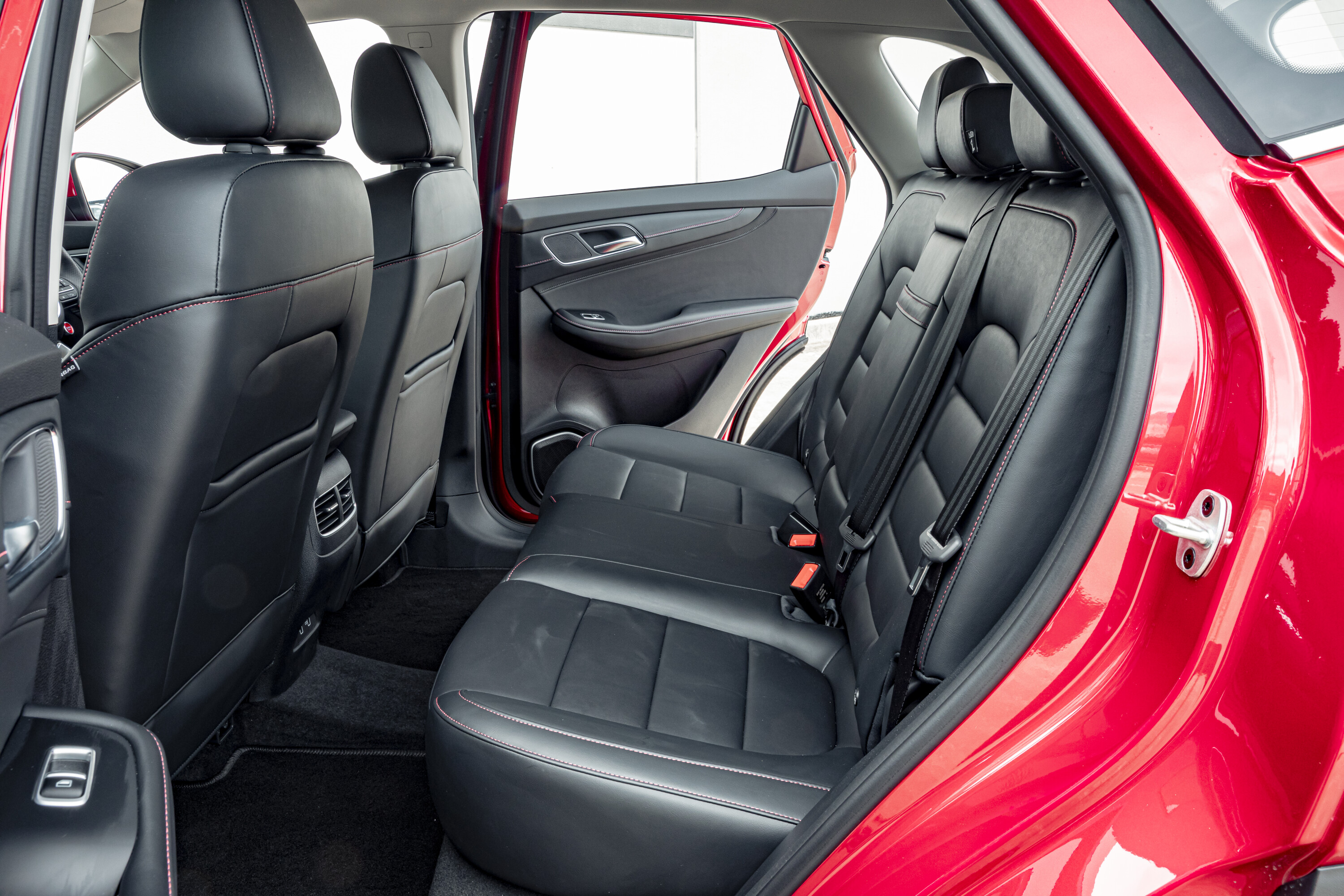
Rear passengers are well catered for, with a two-position (slightly) reclining 60:40 split seat, fold-down centre armrest with cup holders, air vents and twin USB ports.
There is ample legroom but a lack of under-thigh support – not just for long-legged occupants.
2
How much boot space does the MG HS offer?
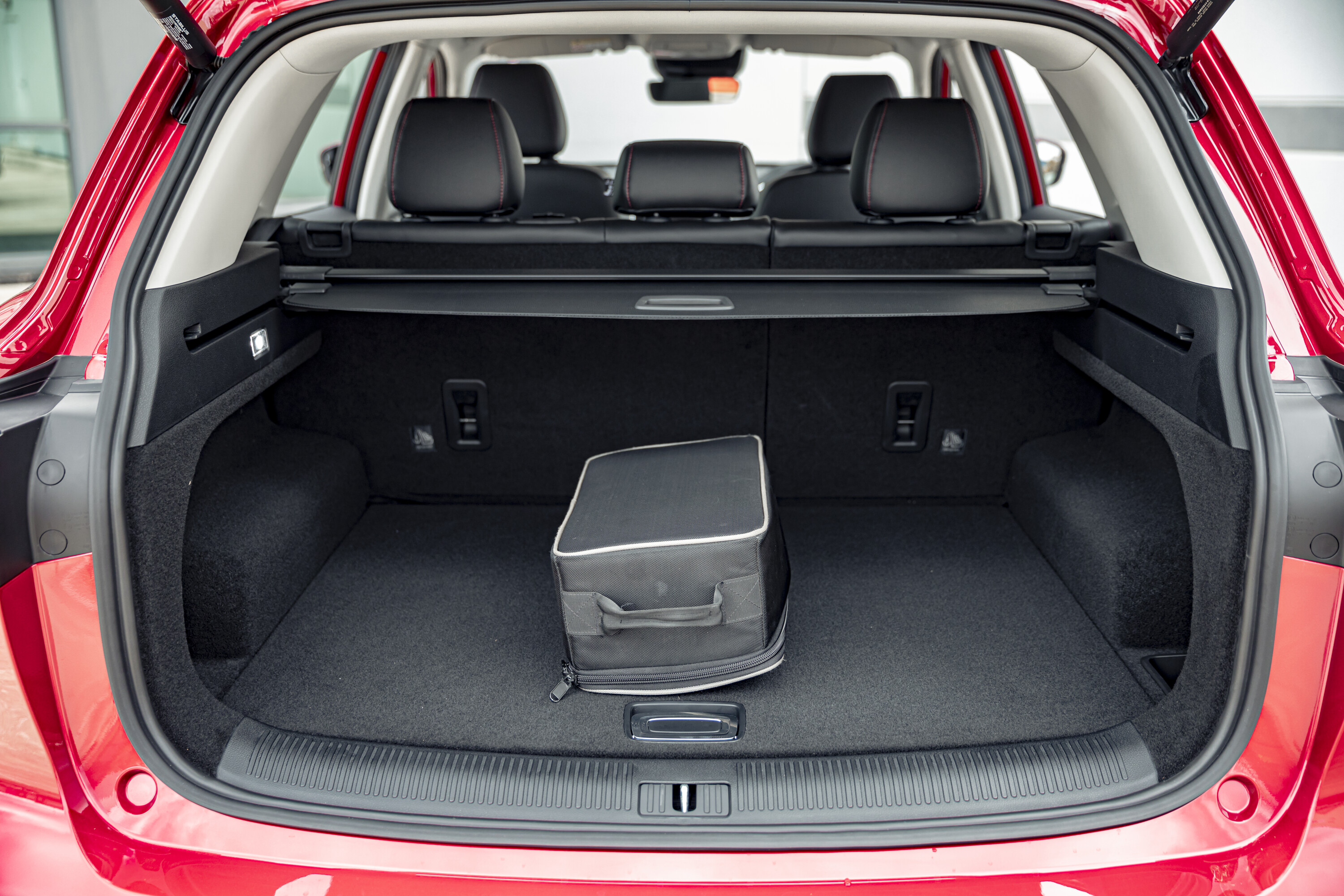
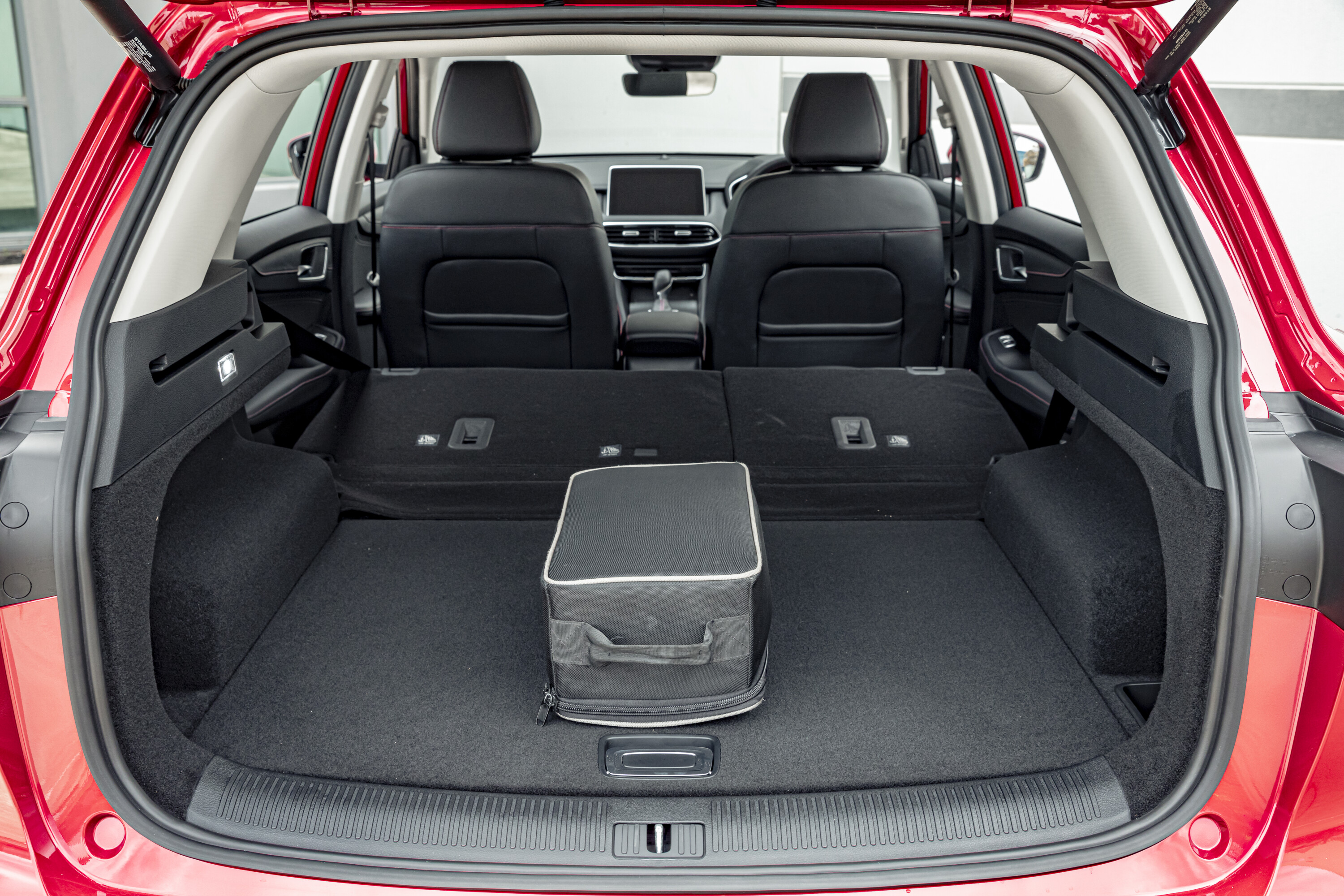
The MG HS can hold 463 litres of stuff in its boot, which is about average for a medium SUV.
Folding the rear seats down can net you up to 1287 litres of space.
Each variant comes with a storage compartment and luggage cover.
1
1
I like driving, will I enjoy the HS?
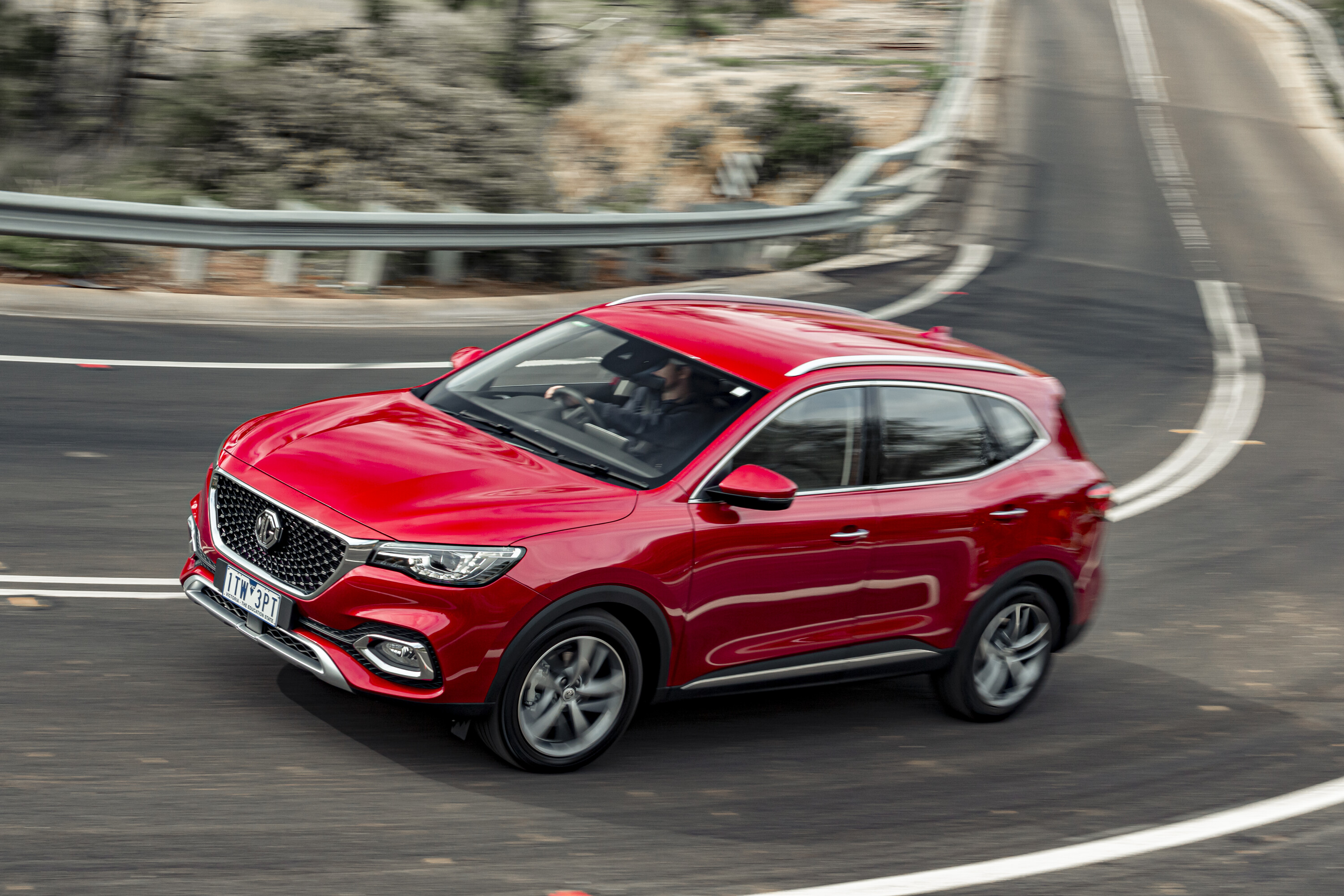
MG has delivered the goods when it comes to the features and packaging with the HS but, while it’s one of the better Chinese-built cars to arrive in Australia so far, its drive is still not quite as refined as its more established Japanese and Korean rivals.
That said, it was a big step up from the GS model it replaced, with the steering, braking and handling all as solid as they need to be in a family SUV.
Ride comfort is improved too, although some harshness on less-than-perfect surfaces betrays the need for further development work if the HS is to match the class leaders.
2
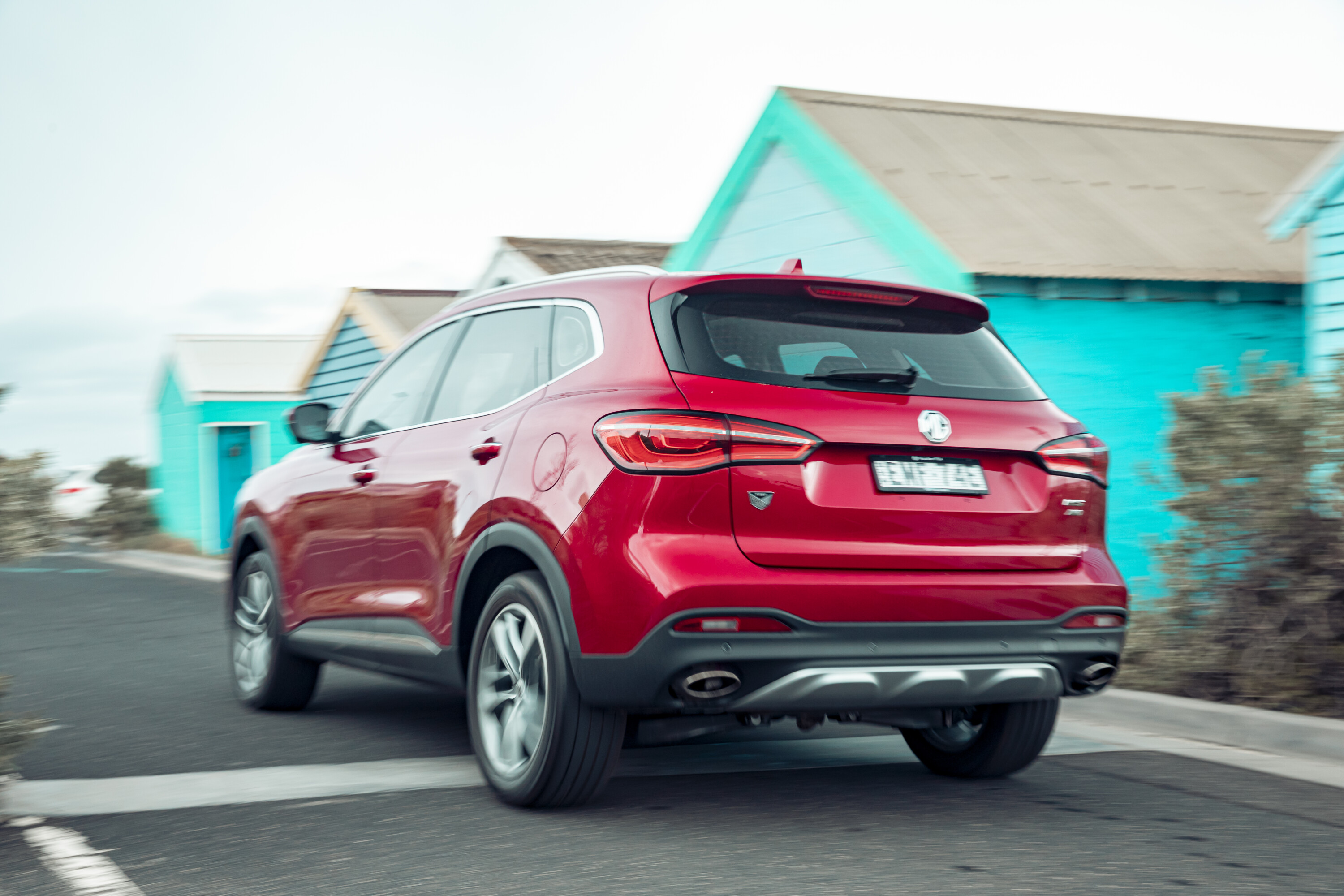
The 119kW 1.5-litre turbo-petrol engine in front-wheel-drive HS variants suffers some turbo lag off the line but provides sufficient power for a vehicle this size. It’s not too noisy and revs willingly.
Although the seven-speed dual-clutch automatic transmission can be indecisive and typically lacks polish, particularly at lower speeds, it’s preferable to the less-sophisticated continuously variable transmissions (CVT) found in rival SUVs.
The 168kW 2.0-litre turbo-petrol in the all-wheel-drive Essence X has a six-speed dual-clutch auto, which brings the same issues as the smaller engine’s seven-speed DCT.
2
Low-speed manoeuvring is frustrating, with an extended delay between switching between forward and reverse that can allow the vehicle to roll while it’s taking time to think.
The Excite, Essence and Essence X variants allow for more engaging driving with paddle-shifters to give you more control over gear ratios, and a Super Sport drive mode that tightens the steering and boosts acceleration by allowing for higher revs between gear changes.
Plug-in hybrid Excite and Essence HS Plus EV variants feature the same 1.5L engine as front-wheel-drive variants, connected to a 90kW/230Nm electric motor and 16.6kWh lithium-ion battery pack for combined outputs of 189kW/370Nm, sent to the front wheels.
1
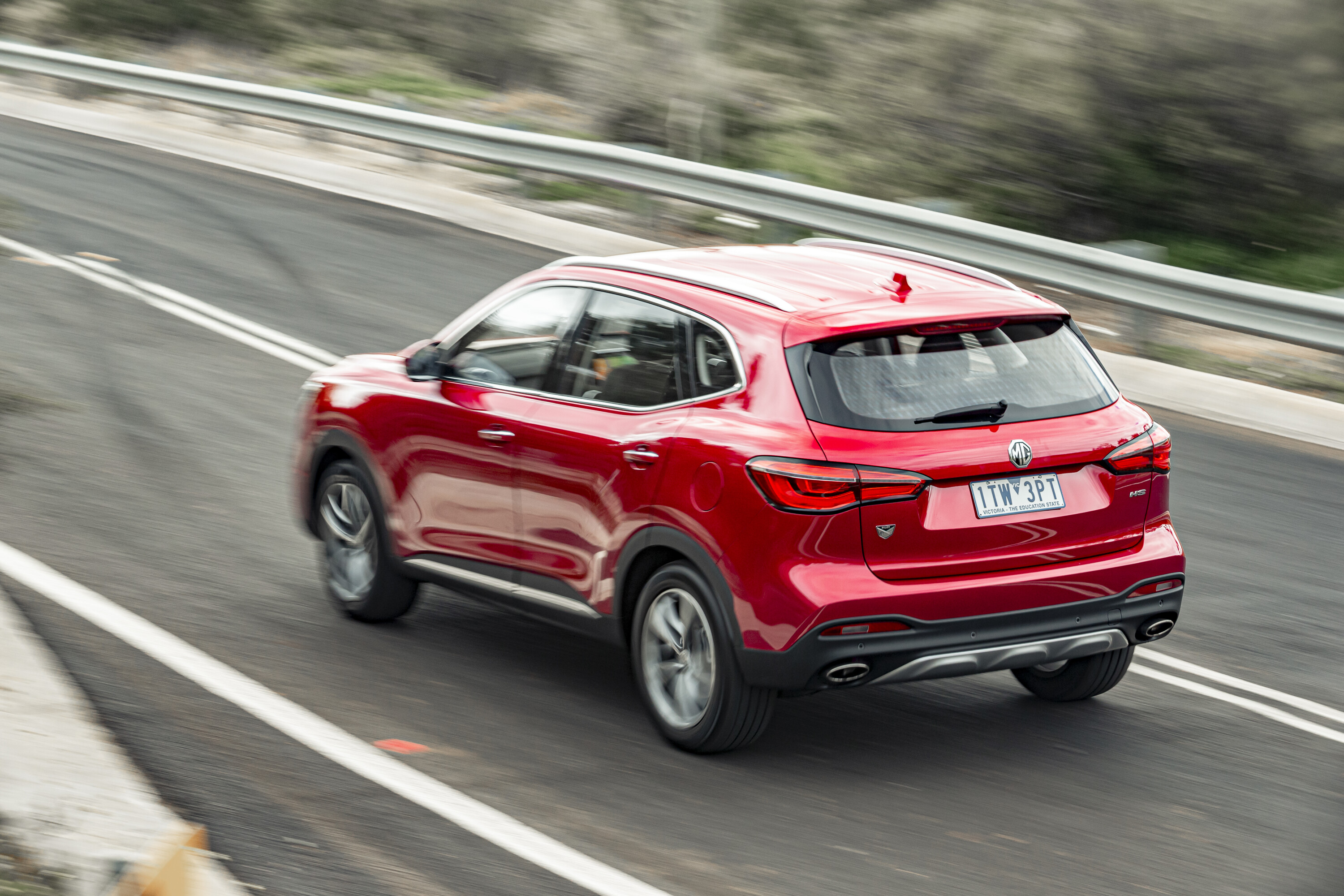
Hybrid powertrain performance is pretty good, the engine merging seamlessly with the motor and only getting loud at high revs under a wide-open throttle.
Its 10-speed automatic transmission – split between a traditional six-speed unit for the petrol engine and a four-speed electronic drive unit for the electric motor – offers smoother gear changes at low speeds than the DCT boxes.
Low-speed acceleration is sufficiently strong in Hybrid mode but on the open road, there’s often a weird hesitation when cracking open the throttle to accelerate from say, 70-110km/h, as if the transmission is caught napping and the electric motor can’t quite deploy its instant hit of torque.
Acceleration is swift in EV mode, with only a subdued whine and tyre noise disturbing the otherwise tranquil cabin, with a fair bit of wind noise around the mirrors at motorway speed.
1
- What is a Powertrain or Drivetrain?
- Power vs torque
- Car suspension explained
- Automatic transmissions (‘gearboxes’) explained
- Chassis control systems explained
- Car vs Ute vs SUV: How the vehicle you buy should guide the way you drive
Which MG HS engine uses the least fuel?
The plug-in hybrid powertrain in the cheekily-named MG HS Plus EV has an official combined fuel consumption (urban and highway) rating of 1.7L/100km assuming you’re starting your journey with a full battery and taking advantage of EV mode.
Drive the HS hybrid on petrol only and that figure will shoot up, with the hybrid components including the motor and battery adding 225kg over the standard petrol front-wheel-drive variants.
1
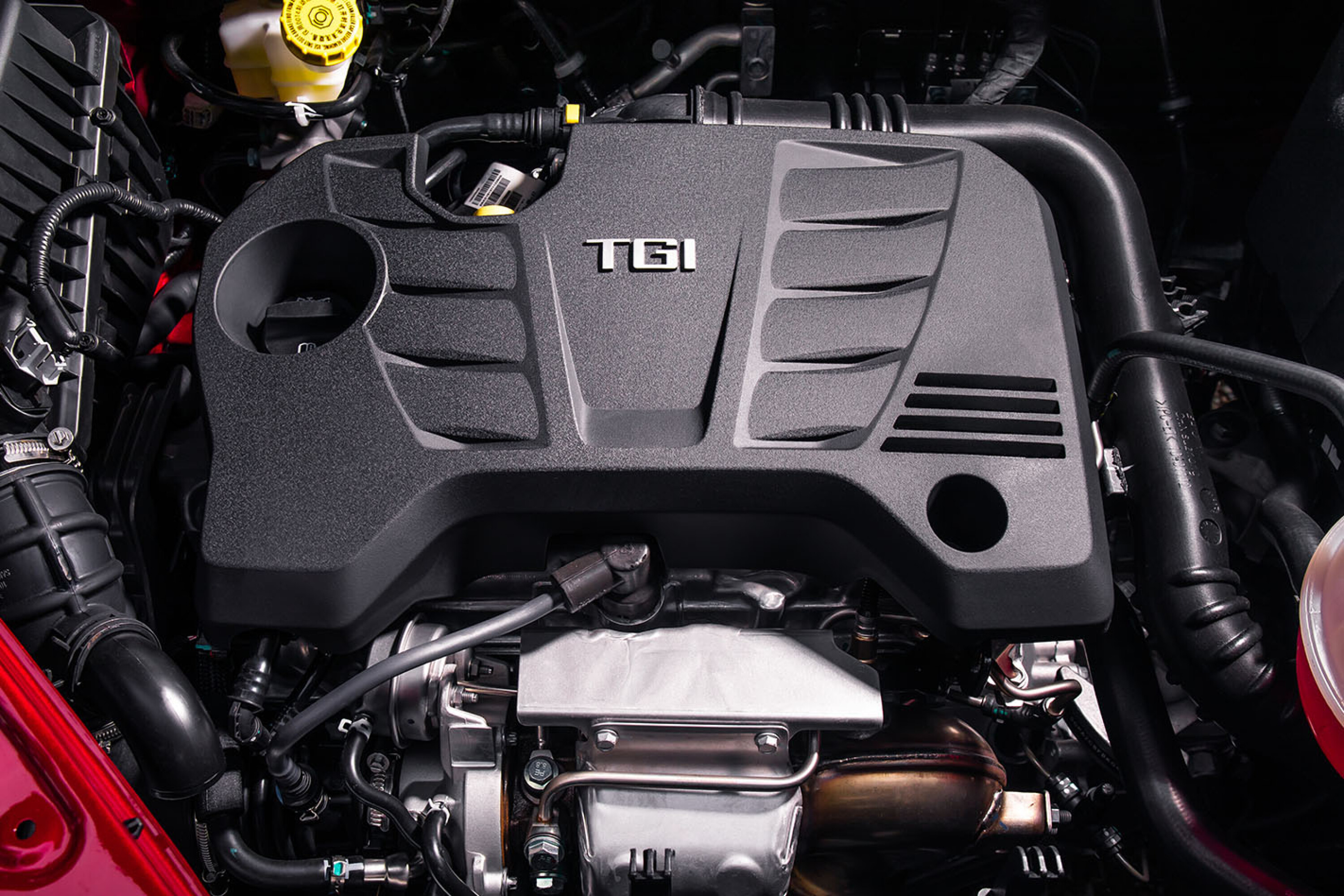
The 1.5-litre petrol engine with seven-speed dual-clutch auto consumes 7.3L/100km according to official testing.
All-wheel drive and a punchy 168kW/360Nm 2.0-litre turbocharged petrol engine with six-speed transmission conspire to make the Essence X thirstiest of all at 9.5L/100km.
Each engine is specified to run on pricier 95 or 98 RON premium petrol.
1
How does the hybrid system work in the MG HS?
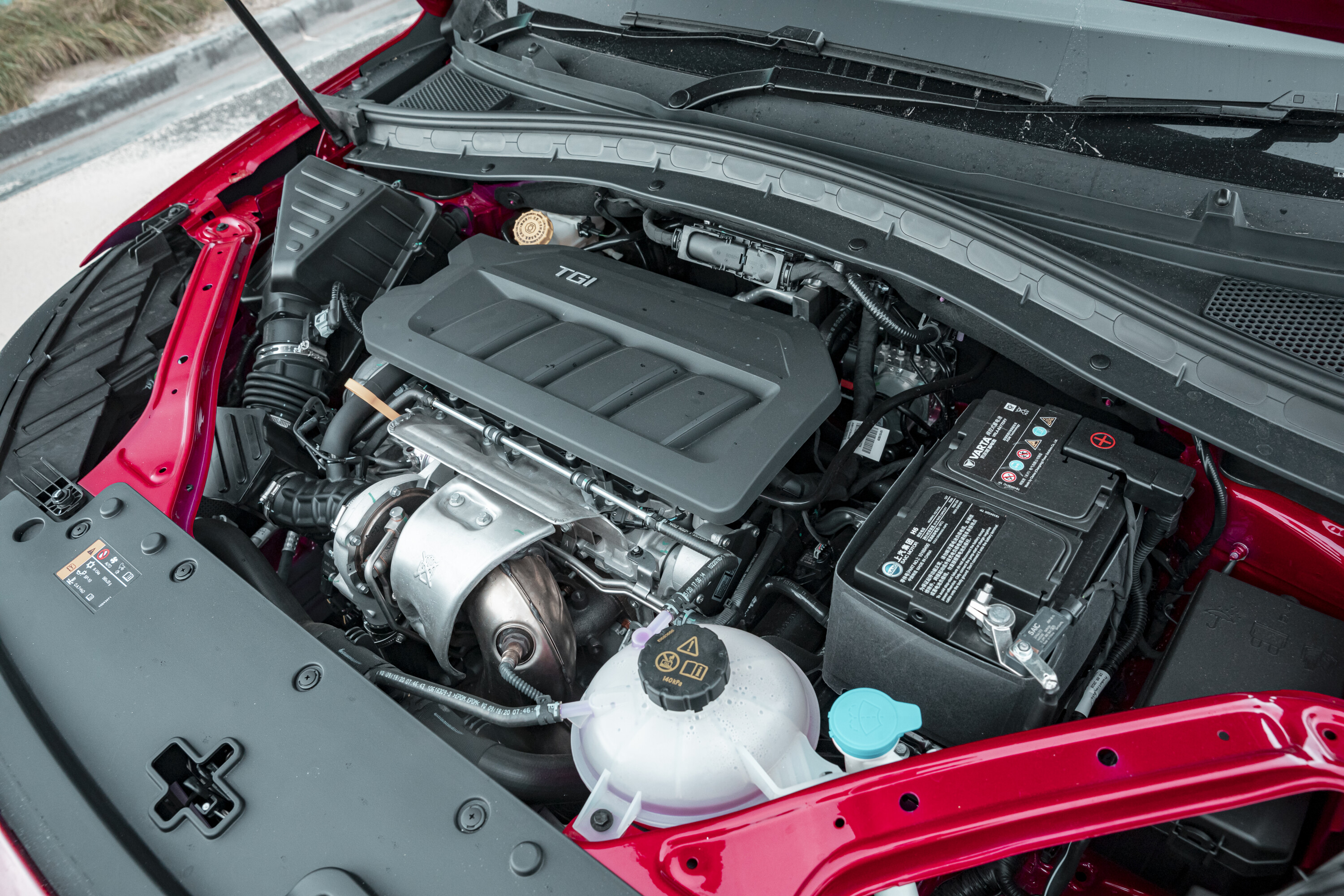
The 119kW/250Nm 1.5-litre four-cylinder turbocharged engine is teamed with an electric motor and a 10-speed auto, split between a traditional six-speed unit for the petrol engine and a four-speed electronic drive unit for the electric motor.
Combining the engine and motor creates a maximum of 189kW and 370Nm.
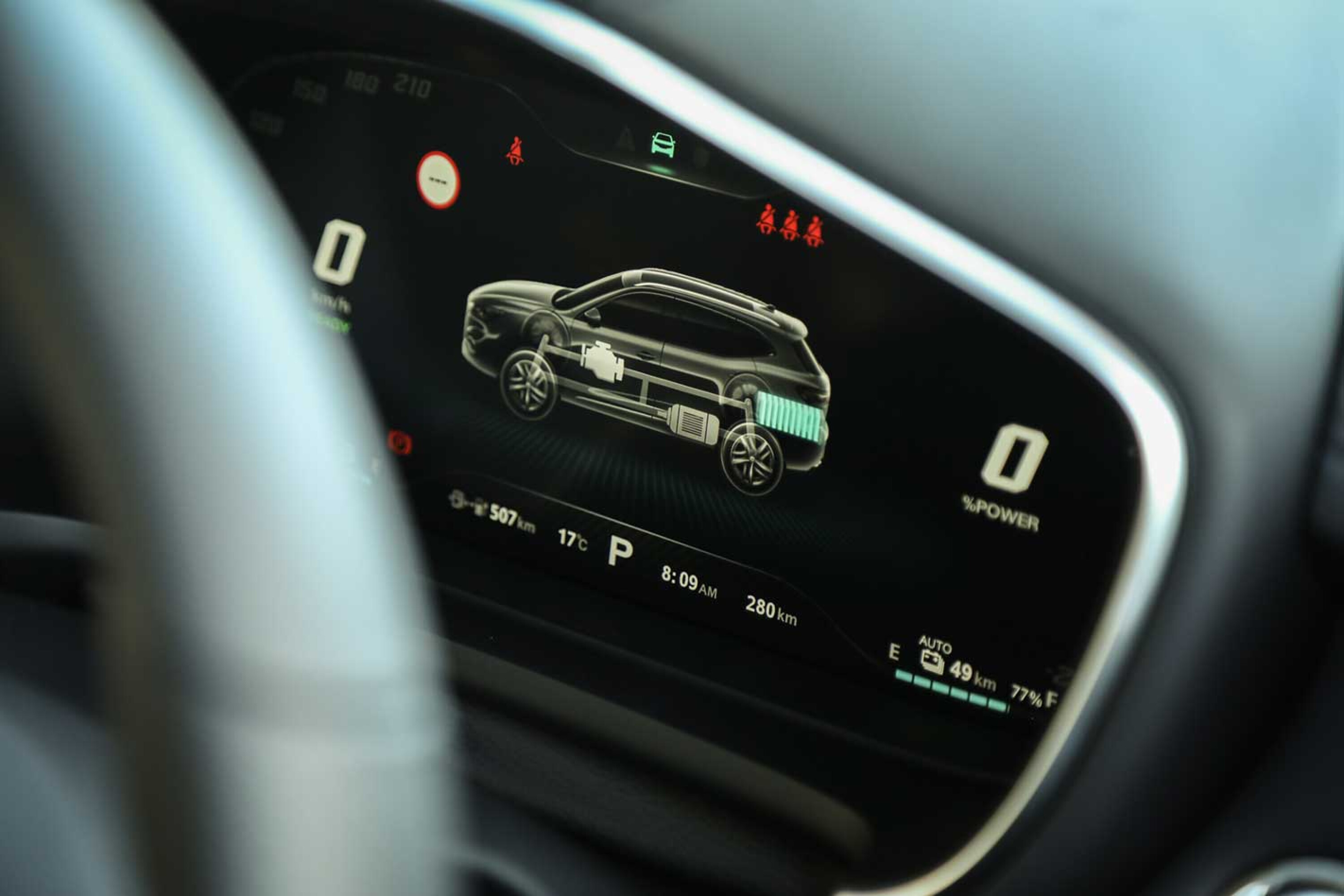
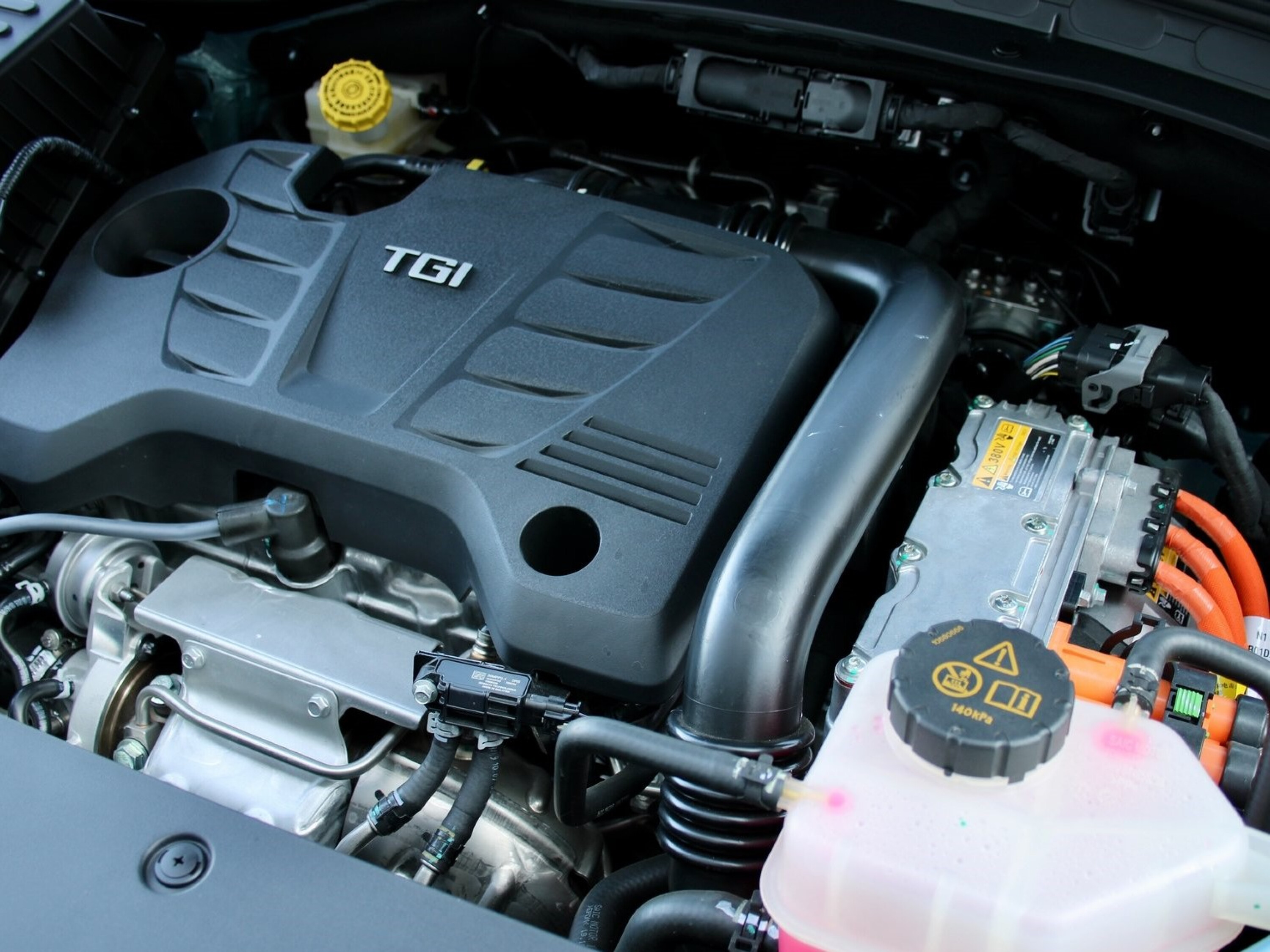
The motor is fed by a 16.6kWh battery to provide a claimed electric-only range of 52km, which would allow many people to get to work and back on electrons alone.
1
It is a relatively basic hybrid system with just two modes: EV, which locks out the petrol engine, or the default Hybrid mode, which uses a mix of petrol and battery power depending on a bunch of parameters including throttle position, road speed, and gradient.
Unlike the Mitsubishi Outlander PHEV, it lacks a ‘recharge’ mode that boosts the battery on the move for later electric-only running, instead relying on regenerative braking to replenish the battery after its plug-in charge is depleted.
Unless you’re travelling long distances downhill, this won’t be enough to charge the battery for electric-only travel beyond speeds of 30km/h.
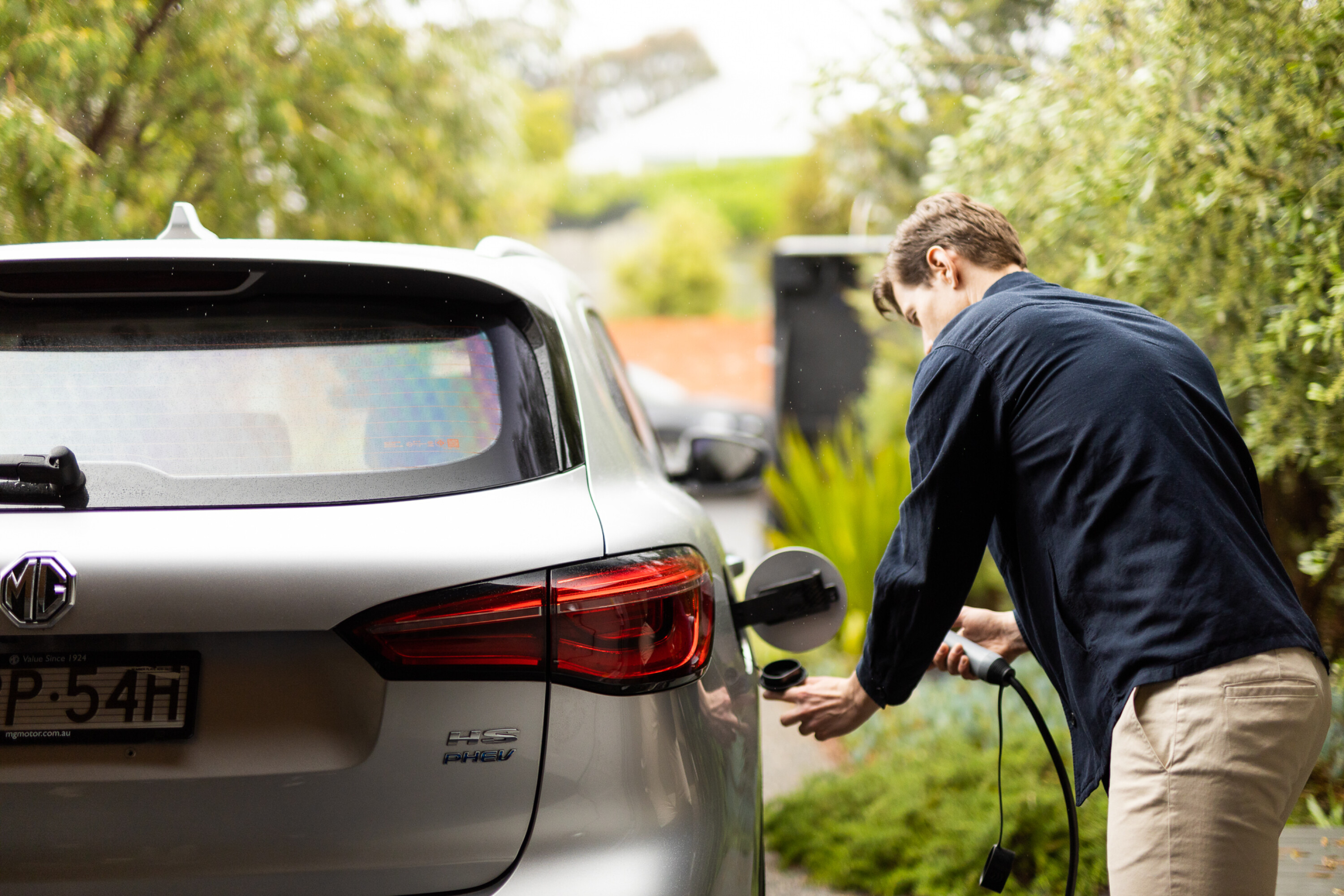
That said, this is an honest, uncomplicated plug-in hybrid that gets enough of the basics right; easy overnight recharging from a domestic outlet, enough range for typical daily duties, and economical longer-haul running with zero range anxiety.
3
Charging is through a Type 2 plug, meaning you should have no trouble finding a suitable AC charger should you want to top up on the road. A 22kW public AC charger can top up the battery from empty in three hours.
Replenishing the battery from flat to 100 per cent charge from a standard 240-volt socket will take about seven hours, meaning you’ll have few issues with overnight charging.
MG sells single-pase 7kW and three-phase 11kW charging hubs priced at $1990 and $2090 respectively (excluding installation); using the 7kW unit gets the full charging time down to five hours.
| 2024 MG HS efficiency | |
|---|---|
| Electric-only driving range | 52 km |
| Combined fuel consumption | 1.7L/100km |
| CO2 emissions (combined) | 39g/km |
| Charging time 2.4kW (240v) | 7 hours |
| Charging time 7kW | 5 hours |
| Charging time 22kW | 3 hours |
How much can an MG HS tow?
All MG HS variants, including the hybrids, have a 1500kg maximum braked towing capacity, which is enough to safely tow small to medium caravans, trailers and boats.
They can tow unbraked loads of up to 750kg.
1
How long is the warranty and what are the MG HS’s servicing costs?
The MG HS is covered by the brand’s seven-year/unlimited-kilometre warranty – which also covers the hybrid’s battery – along with complimentary roadside assistance during the warranty period.
Service intervals are a short 10,000km or 12 months, with MG offering capped-price servicing or seven years across the HS range.
| Service interval | Price Petrol/PHEV |
|---|---|
| 10,000km/12 months | $279/$279 |
| 20,000km.24 months | $345/$399 |
| 30,000km/36 months | $332/$279 |
| 40,00km/48 months | $403/$456 |
| 50,000km/60 months | $279/$279 |
| 60,000km/72 months | $845/$1012 |
| 70,000km/84 months | $279/$279 |
MG rewards customers who service their vehicle at an authorised service centre with an extra year of free roadside assistance.
Which version of the MG HS does Wheels recommend?
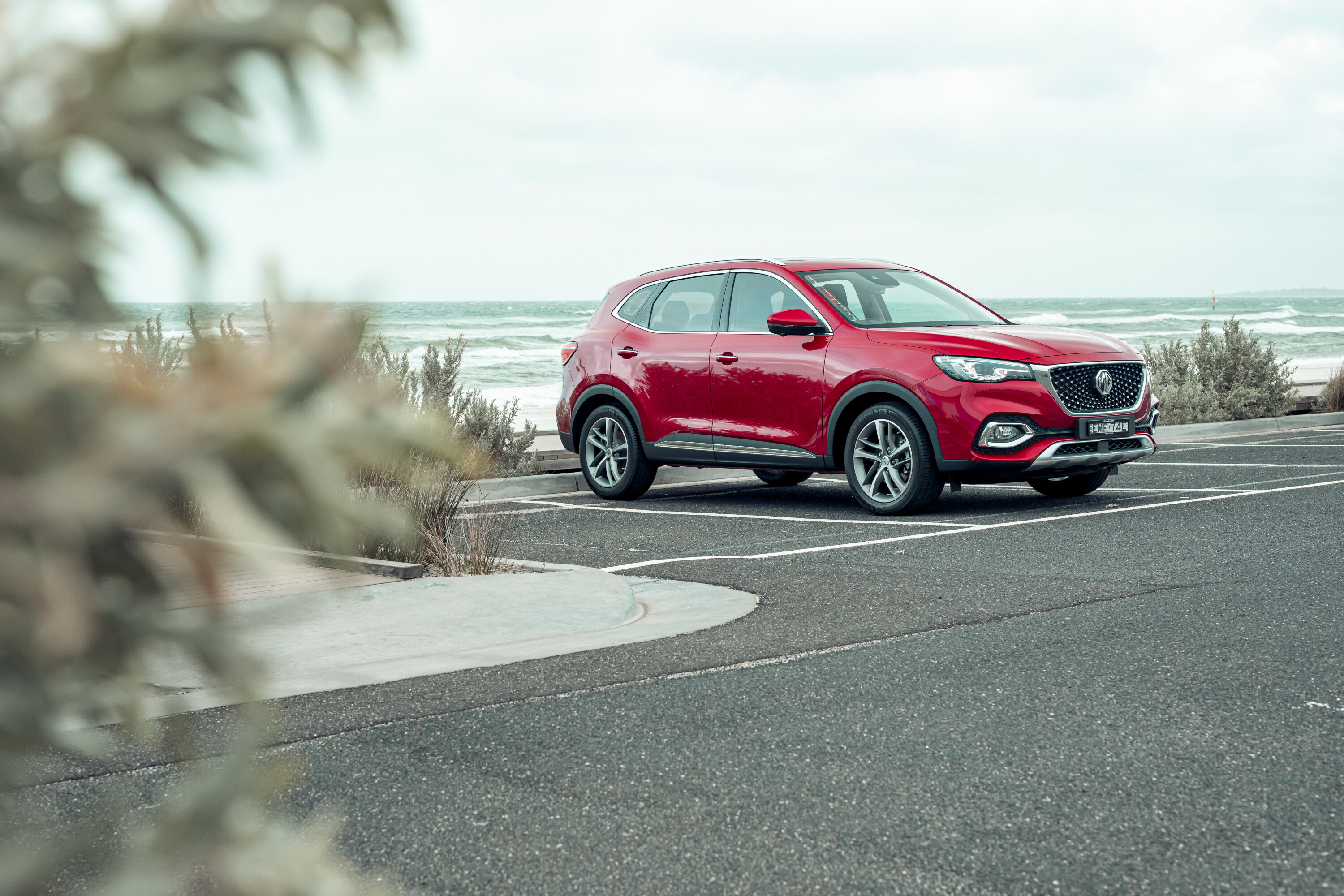
The Vibe and Excite are excellent value for around the $30,000 mark, but we reckon the FWD petrol Excite has more than enough extras to justify the additional cost – its sub-$40,000 drive-away price tag represents pretty good value.
Plug-in hybrid variants are also good value if you generally travel short distances and can keep the battery charged.
3
What are the MG HS’s main rivals?
The Haval H6 and SsangYong Korando are other options if seeking a plushly equipped medium SUV priced below $40,000.
You might also cross-shop the HS against lower-spec variants of popular Japanese and Korean alternatives such as:
Electrified medium SUV rivals to the HS Plus EV include the RAV4 hybrid and Mitsubishi Outlander PHEV, though the slightly smaller Mitsubishi Eclipse Cross comes closer in terms of pricing.
More guides to help you choose the best car & tyres for your needs
- All tyre news & reviews
- Longest warranties & capped-price servicing period
- Buy new or used?
- Best cars for your teenager
- Must-have features for new drivers
- Active safety tech explained
- Australian road rules explained
- Does driving slower save fuel?
- Does my car need the pricier fuel?
- Help, I’ve used the wrong fuel!
- What is a hybrid car?
- How long do tyres last?
- What shoes should I wear to drive?
- What to do after buying a new car
- How much does LCT add to a car’s price?
- The ‘check engine’ light just came on…
- Is it illegal to drive too slowly in Oz?
- FWD v RWD v AWD – which is safer?
- How much can my large SUV tow?
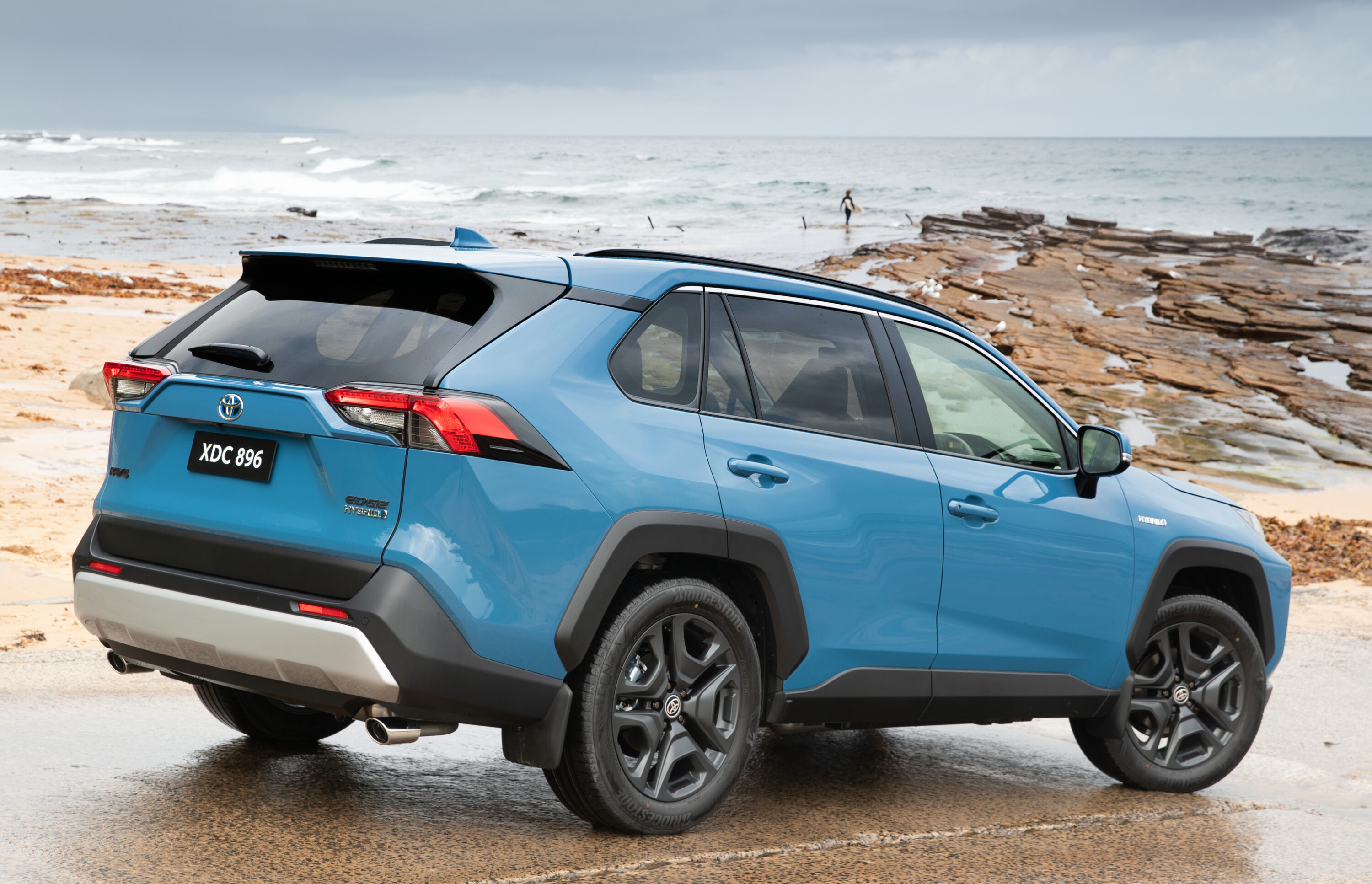
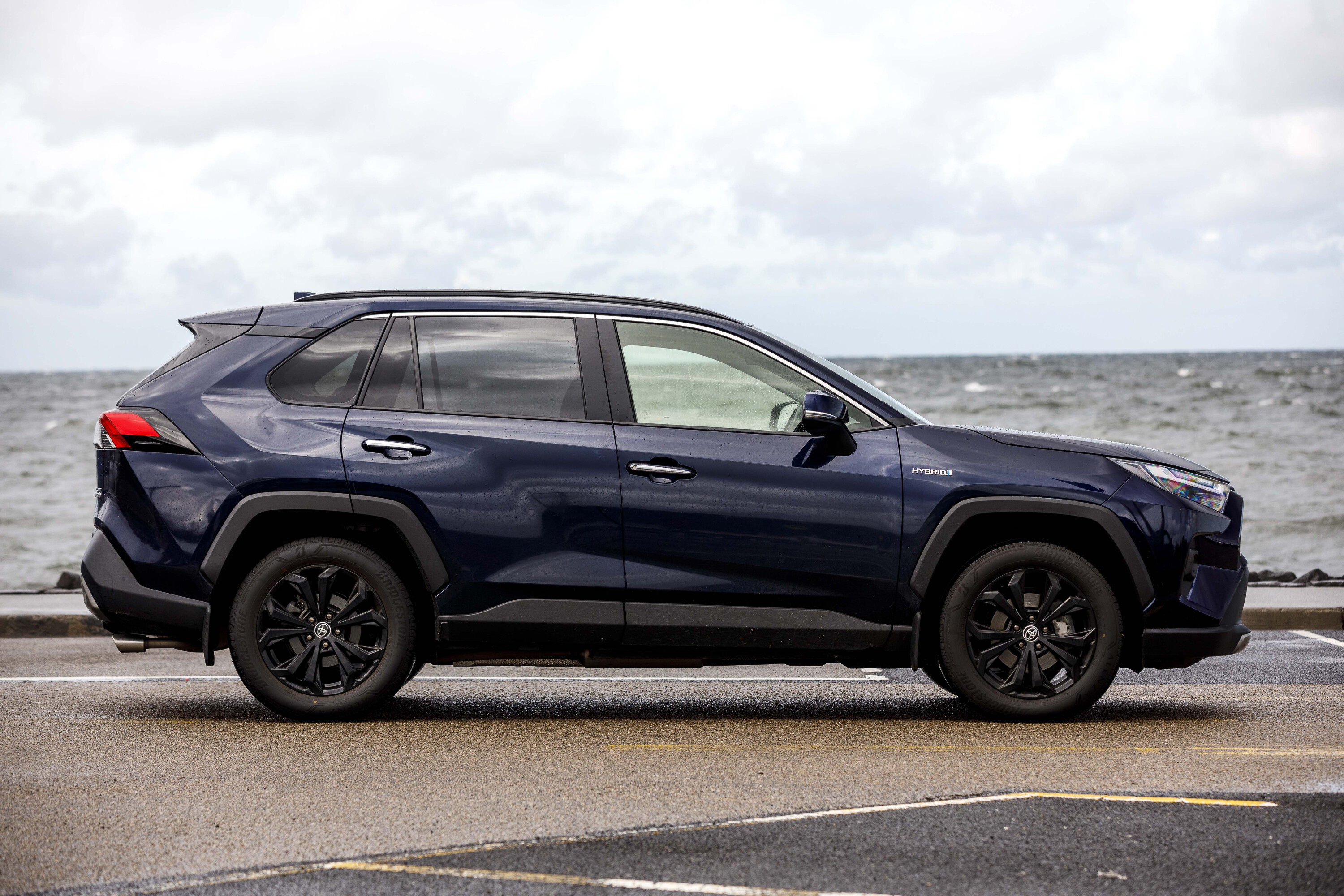
The Toyota RAV4 is Australia’s favourite passenger vehicle – and it wears that crown without threat, even in the face of turbulent production.
Factory shutdowns, shipping delays and parts shortages have all stemmed the flow of this medium SUV, yet it still outsells rivals.
As far as family cars go, the fifth-generation RAV4 is one of the easiest options to recommend. Its comfortable ride, fluid dynamics, solid safety suite and fuel-sipping engines make it one of the all-time great family hacks. The RAV4’s hybrid powertrains are pretty much runaway leaders in this class and are rated as low as 4.7L/100km in fuel efficiency cycles.
That said, not every RAV4 is perfect – at some price points rivals are far better. This is particularly true at the lower end, where the GX and GXL don’t offer the features that new-start Chinese rivals do.
1
JUMP AHEAD
- Pricing
- What body styles are available for the Toyota RAV4?
- What features are standard in every Toyota RAV4?
- What key features do I get if I spend more?
- How safe is the Toyota RAV4?
- How comfortable and practical is the Toyota RAV4?
- How much boot space does the Toyota RAV4 offer?
- I like driving – will I enjoy this car?
- Which Toyota RAV4 engine uses the least fuel?
- What is the Toyota RAV4 towing capacity?
- How long is the warranty and what are the Toyota RAV4 servicing costs?
- Which version of the Toyota RAV4 does Wheels recommend?
- What are the Toyota RAV4’s key rivals?
- What might annoy me?
- Does any upgrade have a downside?
- What might I miss that similar cars have?
- What’s the infotainment system like?
- Where does Toyota make the RAV4?
- Are there plans to update the RAV4 soon?
Pricing
| 2024 Toyota RAV4 pricing | |
|---|---|
| GX 2.0 petrol FWD | $36,550 |
| GX 2.5 hybrid FWD | $39,050 |
| GX 2.5 hybrid AWD | $42,050 |
| GXL 2.0 petrol FWD | $40,100 |
| GXL 2.5 hybrid FWD | $42,600 |
| GXL 2.5 hybrid AWD | $45,600 |
| XSE 2.5 hybrid FWD | $45,700 |
| XSE 2.5 hybrid AWD | $48,700 |
| Cruiser 2.0 petrol FWD | $45,700 |
| Cruiser 2.5 hybrid FWD | $48,200 |
| Cruiser 2.5 hybrid AWD | $51,200 |
| Edge 2.5 petrol AWD | $53,020 |
| Edge 2.5 hybrid AWD | $55,150 |
Prices exclude on-road costs
1
What body styles are available for the Toyota RAV4?
The Toyota RAV4 is a five-door, five-seat medium SUV with two rows of seating. There is no seven-seat variant or coupe derivative.
What features are standard in every Toyota RAV4?
The features listed below are standard in the entry-level model and will appear in higher-grade models unless replaced by more premium equivalent features.
| 2024 Toyota RAV4 standard features | |
|---|---|
| 7.0-inch semi-digital instrument cluster | 17-inch alloy wheels |
| Rain-sensing wipers | Front and rear carpet floor mats |
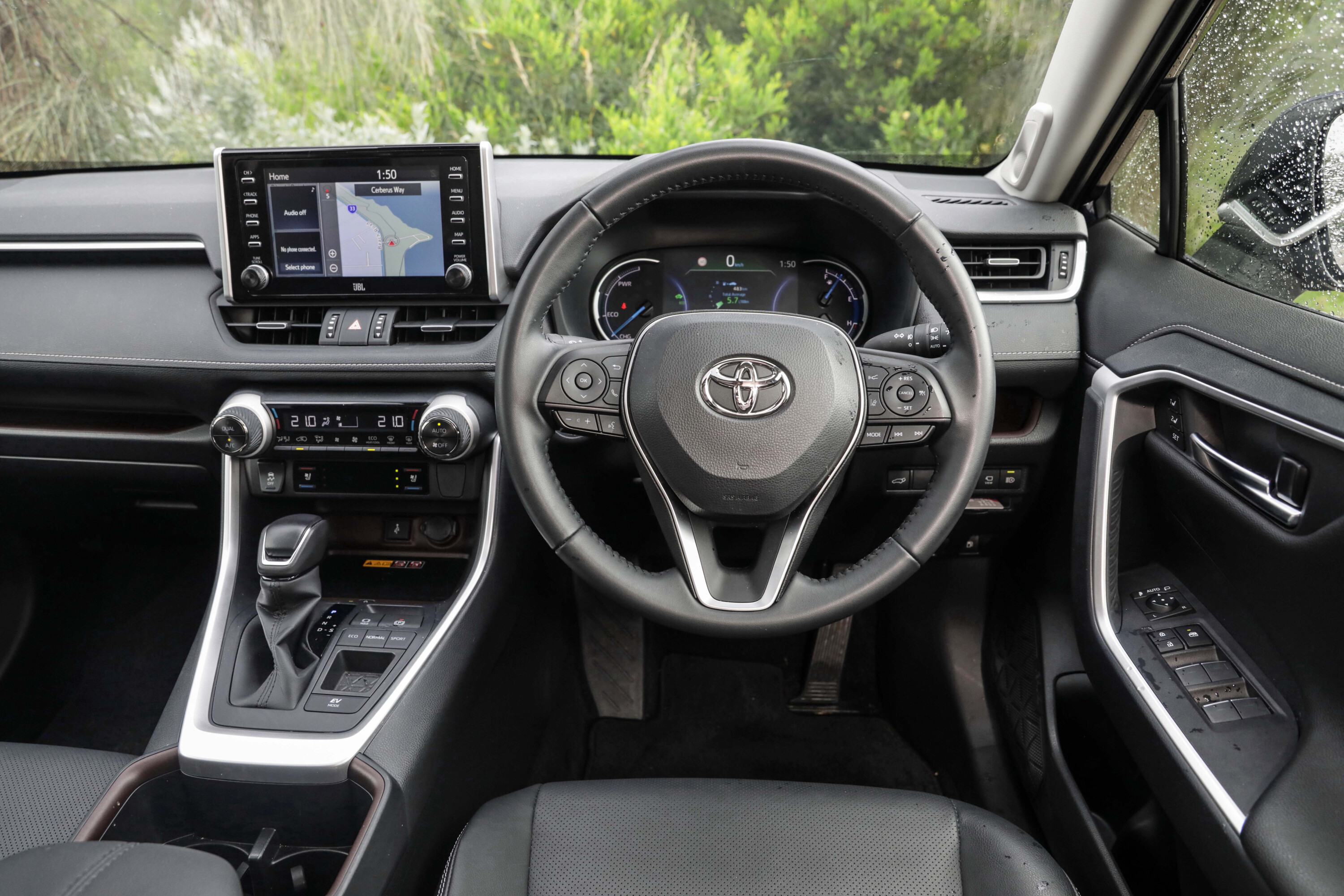
| Satellite navigation | 8-inch infotainment system |
| Five USB ports (4x USB-C, 1x USB-A) | AM/FM/DAB+ radio |
| Wireless Apple CarPlay and wired Android Auto | LED headlights (parabolic in petrol; projector in hybrid) and daytime running lamps |
| Push-button start (hybrid only) | Heated, power-folding side mirrors |
| Over-the-air software updates | Dual-zone climate control (hybrid only) |
| Cloth upholstery | 60/40 split-fold rear seats and centre armrest |
| Toyota Connected Services | LED interior lighting |
| Leather-wrapped steering wheel | LED fog lights |
1
What key features do I get if I spend more?
There are five RAV4 variants, starting with the GX which gets the features listed above paired with a 2.0-litre petrol four-cylinder and front-wheel drive.
Hybrid power is available with front- and all-wheel drive for $2500 and $5500 extra respectively.
Moving up to the GXL nets a more attractive exterior with bigger 18-inch alloy wheels. You also get comfort and convenience features such as keyless entry, wireless phone charging and a leather-wrapped gear shifter.
The popular RAV4 GXL also brings
| 2024 Toyota RAV4 GXL features | |
|---|---|
| 18-inch alloy wheels (silver) | Front mud flaps |
| Keyless entry and push-button start | Auto-dimming rear-view mirror |
| Privacy glass | Roof rails |
| Wireless phone charger | Dual-zone climate control |
| Leather-wrapped gear shifter | Illuminated door switches |
The hybrid-only RAV4 XSE gets a unique look, with all the features above plus:
| 2024 Toyota RAV4 XSE features | |
|---|---|
| 10.5-inch infotainment system (new) | 10-way power-adjustable driveru2019s seat with lumbar support |
| Leather-accented u2018premiumu2019 upholstery | Gloss black exterior trims |
| 12.3-inch digital instrument cluster (new) | Interior ambient lighting |
| Leather-accented door trims | Power tailgate |
| Connected satellite navigation (new) | Black headliner |
| Heated front seats | Black roof |
| 18-inch alloy wheels (black) | |
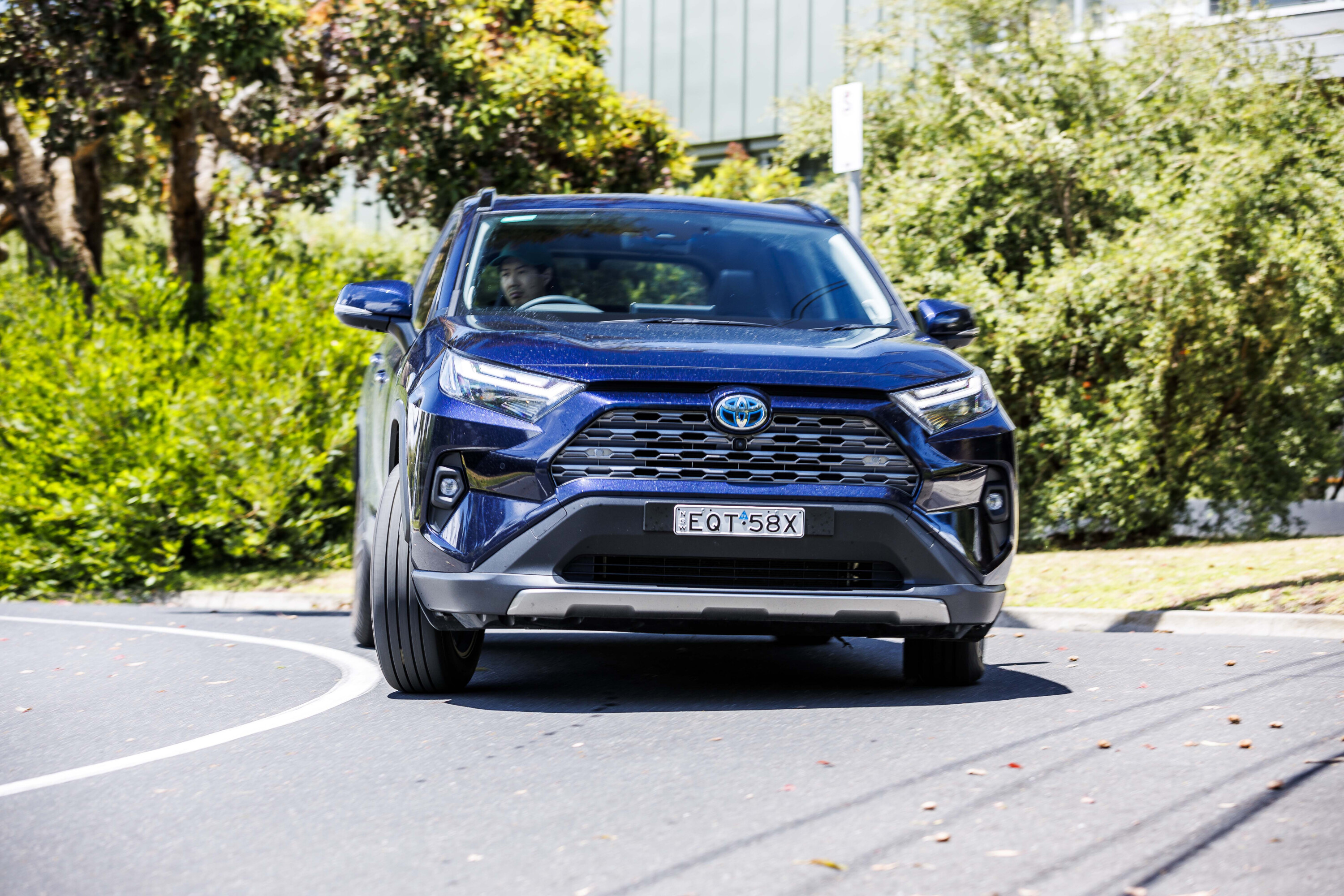
Previously the range-topper, the RAV4 Cruiser is a most complete specification with an on-road focus
| 2024 Toyota RAV4 Cruiser features | |
|---|---|
| Automatic heated, power-folding side mirrors | Eight-way power-adjustable front passenger seat |
| Digital rear-view mirror | Nine-speaker JBL audio system |
| Heated and ventilated front seats | Leather upholstery |
| 360-degree camera system, with underfloor view | Electric glass sunroof |
1
The most expensive RAV4 grade, the Edge, has a distinct off-road flavour with outdoorsy orange interior highlights. It also gets:
| 2024 Toyota RAV4 Edge features | |
|---|---|
| 19-inch alloy wheels (matte grey) | Hill-descent control |
| Projector-type LED headlights (petrol) | Rear cross-traffic assist |
| Off-road selector dial | Parking support brake |
How safe is the Toyota RAV4?
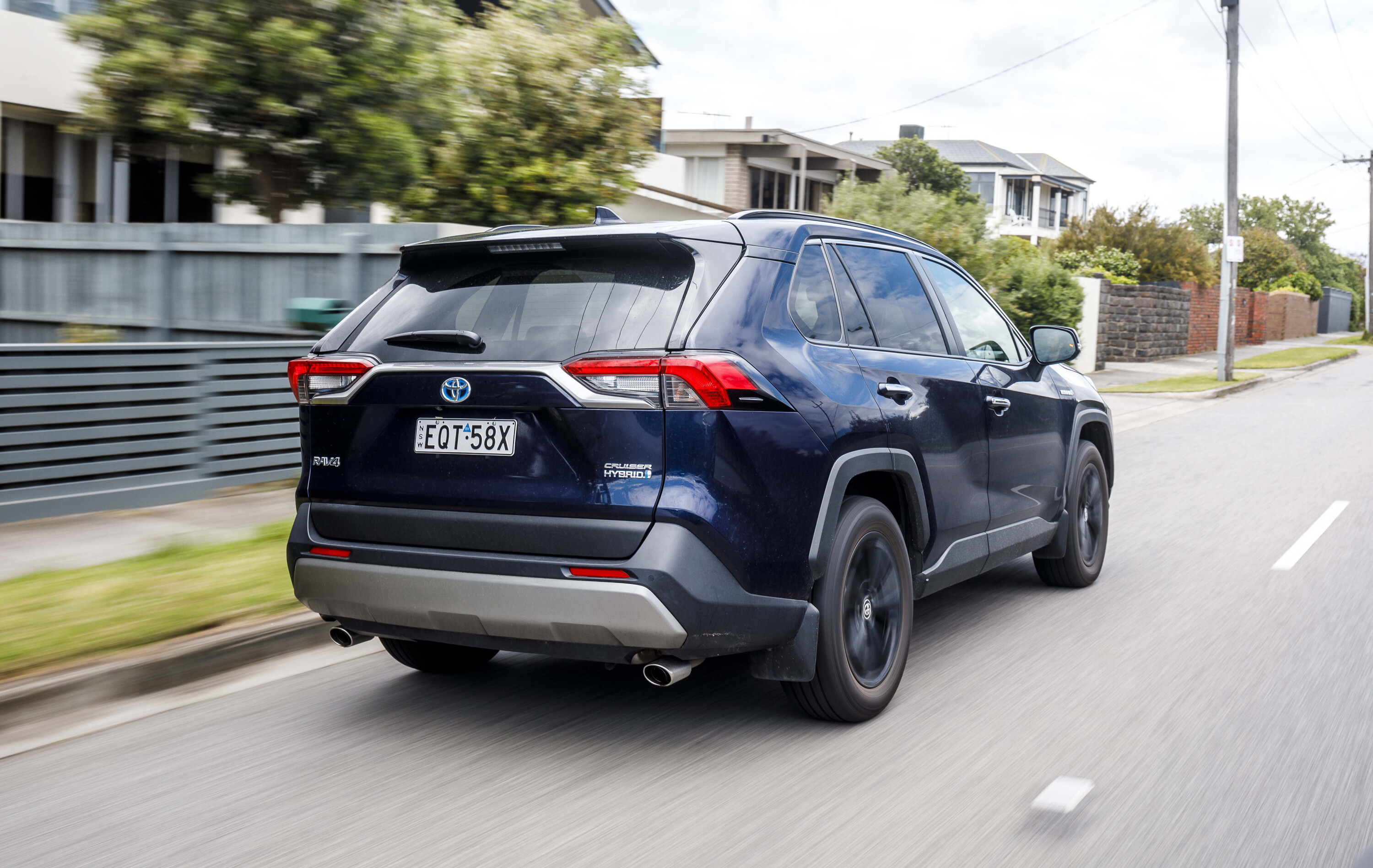
The Toyota RAV4 scored a five-star ANCAP safety rating based on testing conducted in 2019. This score applies to all variants and every powertrain.
It scored 93 per cent in adult occupant protection and 89 per cent in child occupant protection criteria, with an 85 per cent result in the vulnerable road user protection test and 83 per cent for its safety assistance systems.
1
The RAV4 range is fitted with seven airbags: dual front, side, curtain and driver’s knee, across the range.
Toyota equips every RAV4 variant with an impressive array of safety features, as seen in the table below, including convenient parking sensors front and rear.
| 2024 Toyota RAV4 standard safety features | |
|---|---|
| Autonomous emergency braking (vehicle, pedestrian, cyclist, junction) | Seven airbags |
| Lane-keep assist | Adaptive cruise control |
| Lane departure warning | Traffic sign recognition |
| Blind-spot monitoring | Front and rear parking sensors |
| Rear cross-traffic alert | Rear seat belt reminder |
Additionally, the Cruiser grade gets a 360-degree camera with underfloor view, while the range-topping edge adds low-speed reverse auto emergency braking and rear cross-traffic alert.
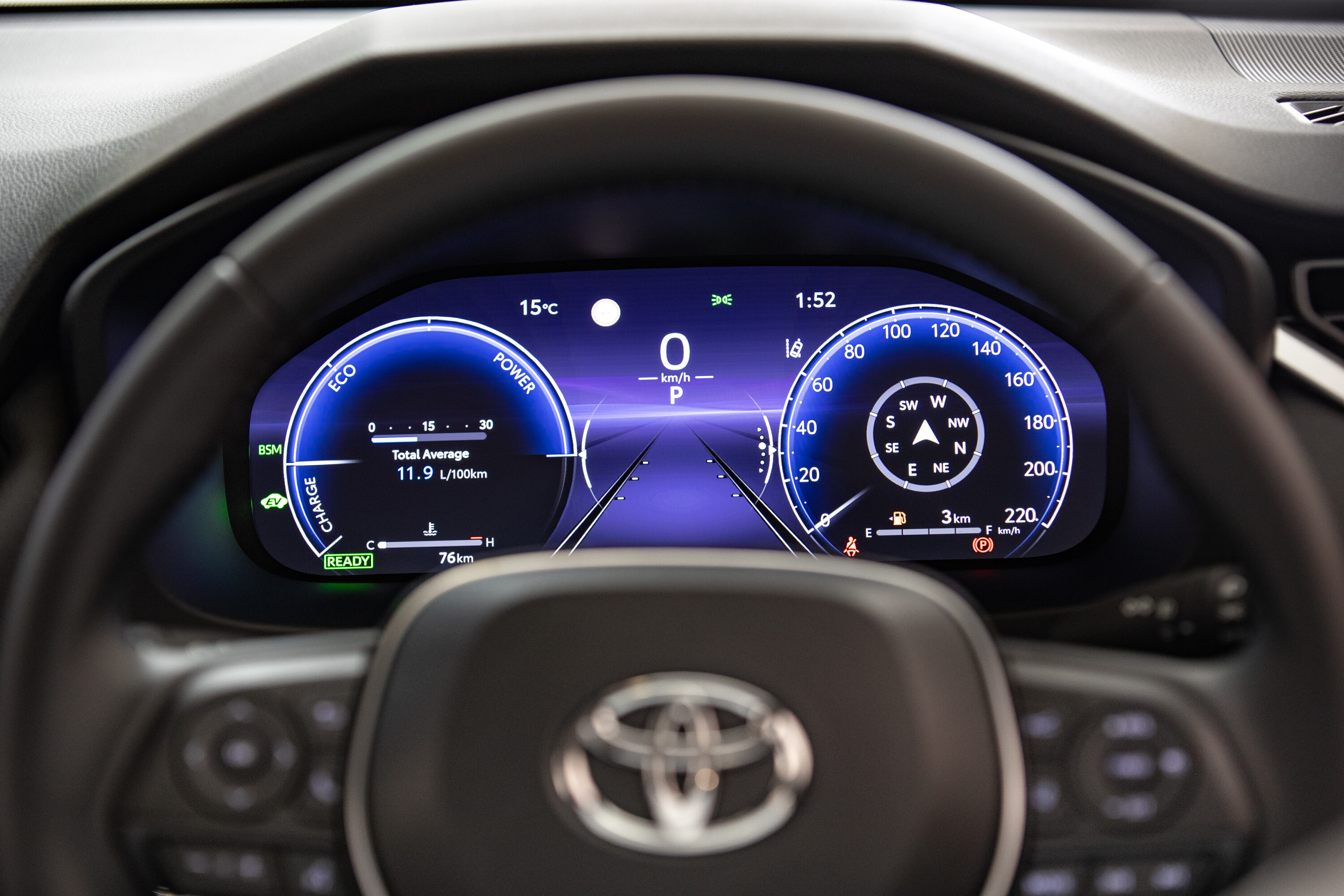
1
How comfortable and practical is the Toyota RAV4?
The GX and GXL have hard-wearing fabric trim so, although not as easy-clean as vinyl or leather, it will stand up to abuse from young children.
Most of the plastics are of good quality, and there is an overwhelming feeling of durability.
Aside from simple sturdiness, the RAV4 has some interesting design cues such as the chunky rubberised climate controls and angular dash design.
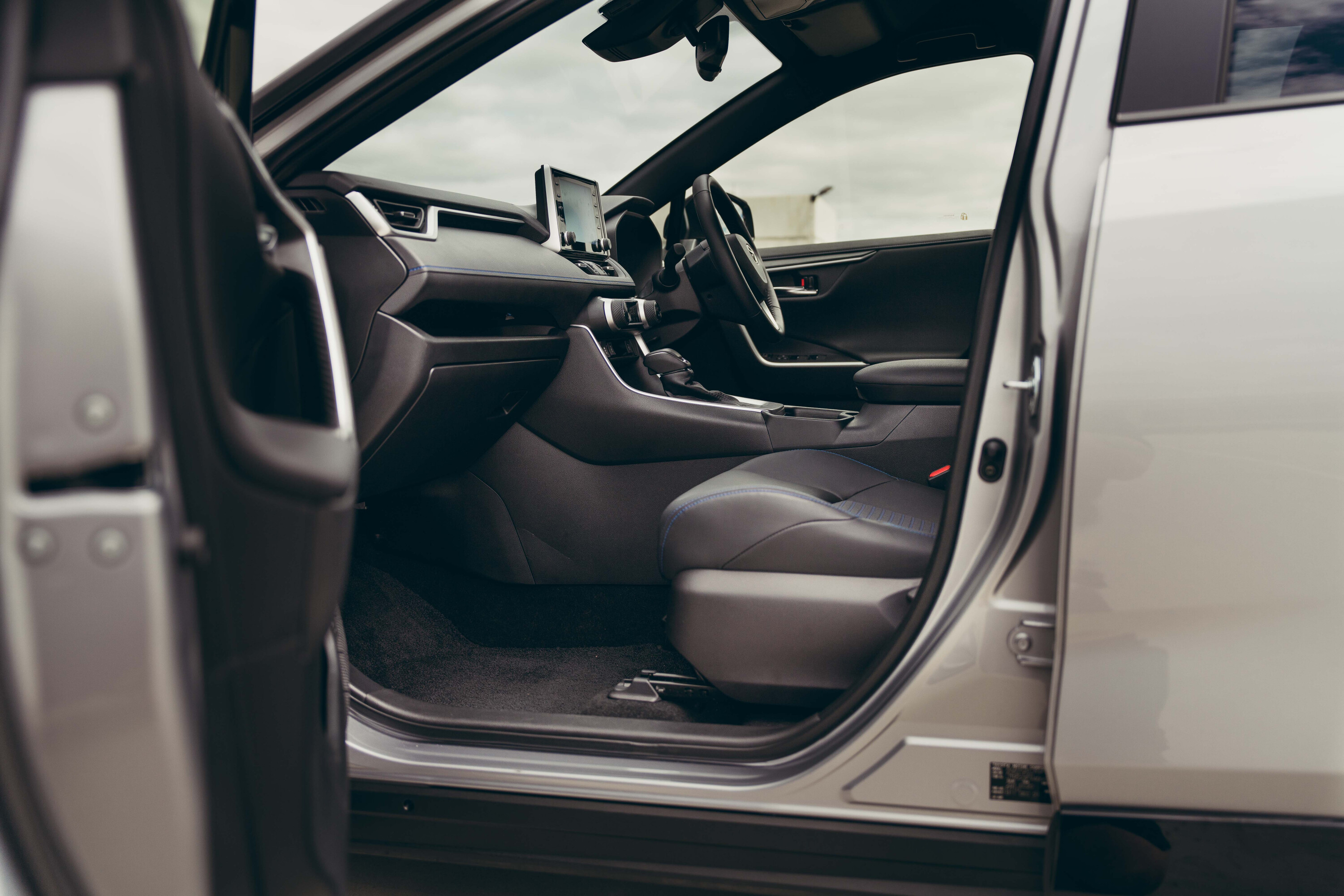
Moving up through the range is worth it. The XSE gets more exciting interior materials, and the Cruiser’s leather upholstery is matched with three-stage heating and ventilation – great for a country like Australia.
Seat adjustment is good for the driver in RAV4s with 10-way power adjust for the driver, including lumbar, from XSE up, however only the Cruiser is equipped with a powered passenger seat that features height adjust.
1
There are clever practical touches in all RAV4s, including a rubberised tray ahead of the passenger that is perfect for smartphones, sunglasses, or notepads.
However, it has small door bins and its child seat anchors are difficult to access.
A technology improvement will arrive this year with the addition of subscription-based connected services for the Toyota RAV4 and new infotainment software. There will also be digitised instruments in place of analogue dials and small TFT information displays.
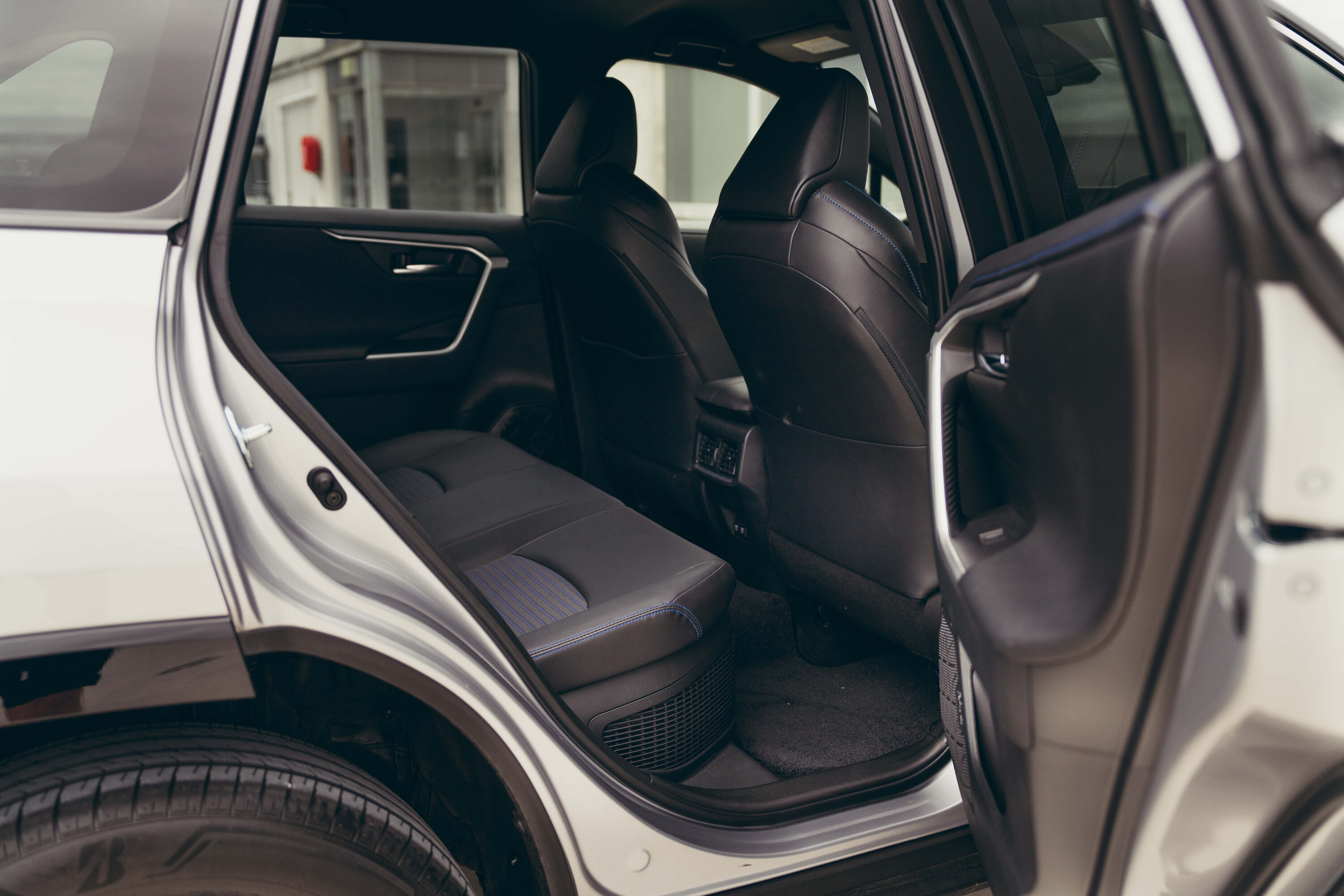
The rear seat has an adjustable backrest, but no sliding bench. It offers excellent legroom for adults, but the ends of the bench are set in slightly from the doors and the RAV4 doesn’t use its external width effectively. This means it is most comfortable for two adult passengers in the back.
A pair of USB-C outlets feature in MY23 RAV4s, though prior year models are equipped with USB-A chargers. There are two adjustable air vents for second-row passengers from GXL trim up.
1
How much boot space does the Toyota RAV4 offer?
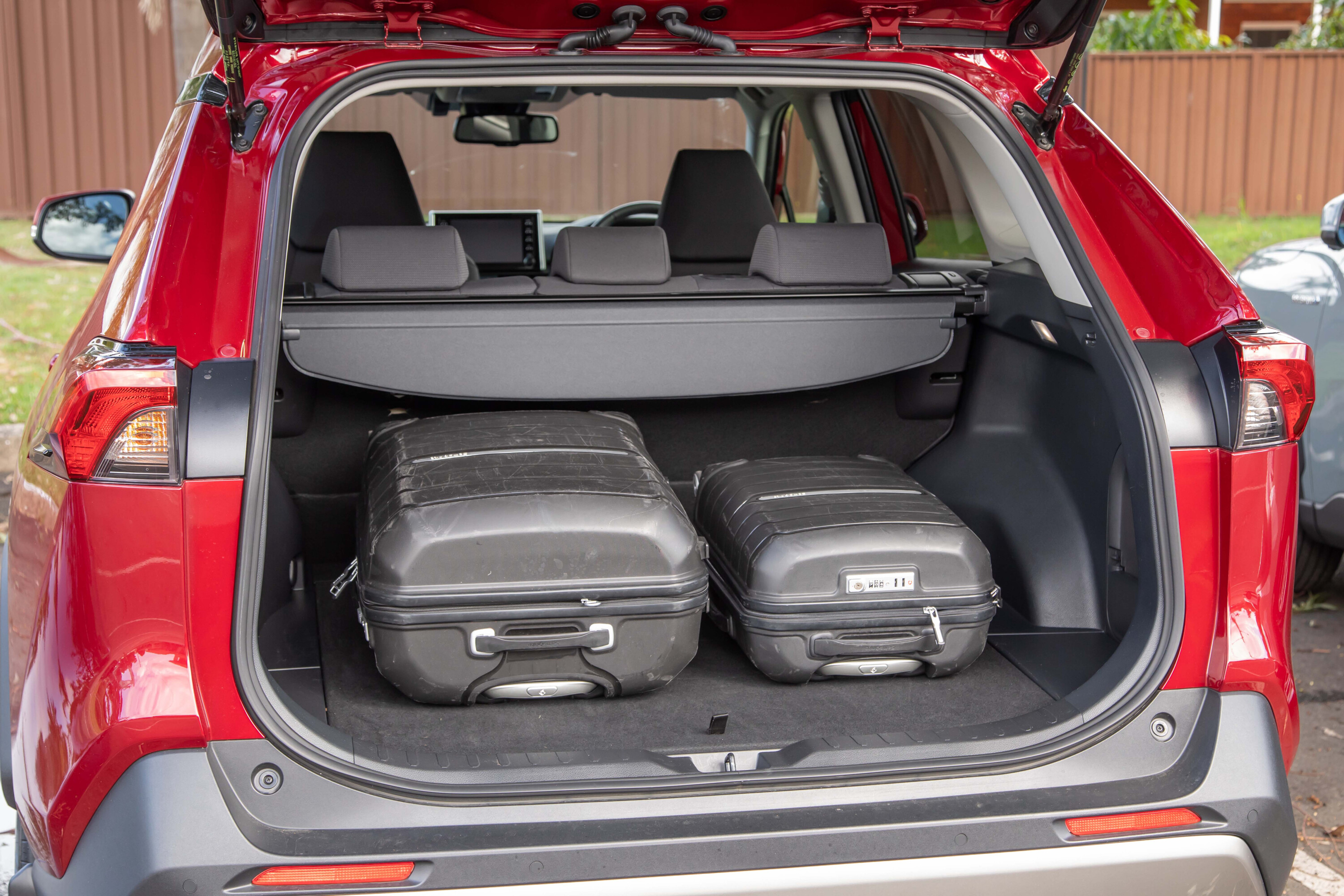
With the rear seats up, the Toyota RAV4 has a 580-litre boot capacity with a space-saver spare. A full-size spare is optional on GX models.
Folding the second row increases luggage capacity to 1690 litres.
The RAV4’s boot is large for the class, though it doesn’t have many smart touches. There are no shopping bag hooks, nets, or clever cargo dividers. The RAV4’s boot is wide and square enough to easily fit a pram.
A removable floor panel can be mounted at two different height settings or flipped over to protect its carpeted side from dirty or wet cargo. A manual tailgate is standard, with a power item fitted to XSE trims and above.
1
I like driving, will I enjoy this car?
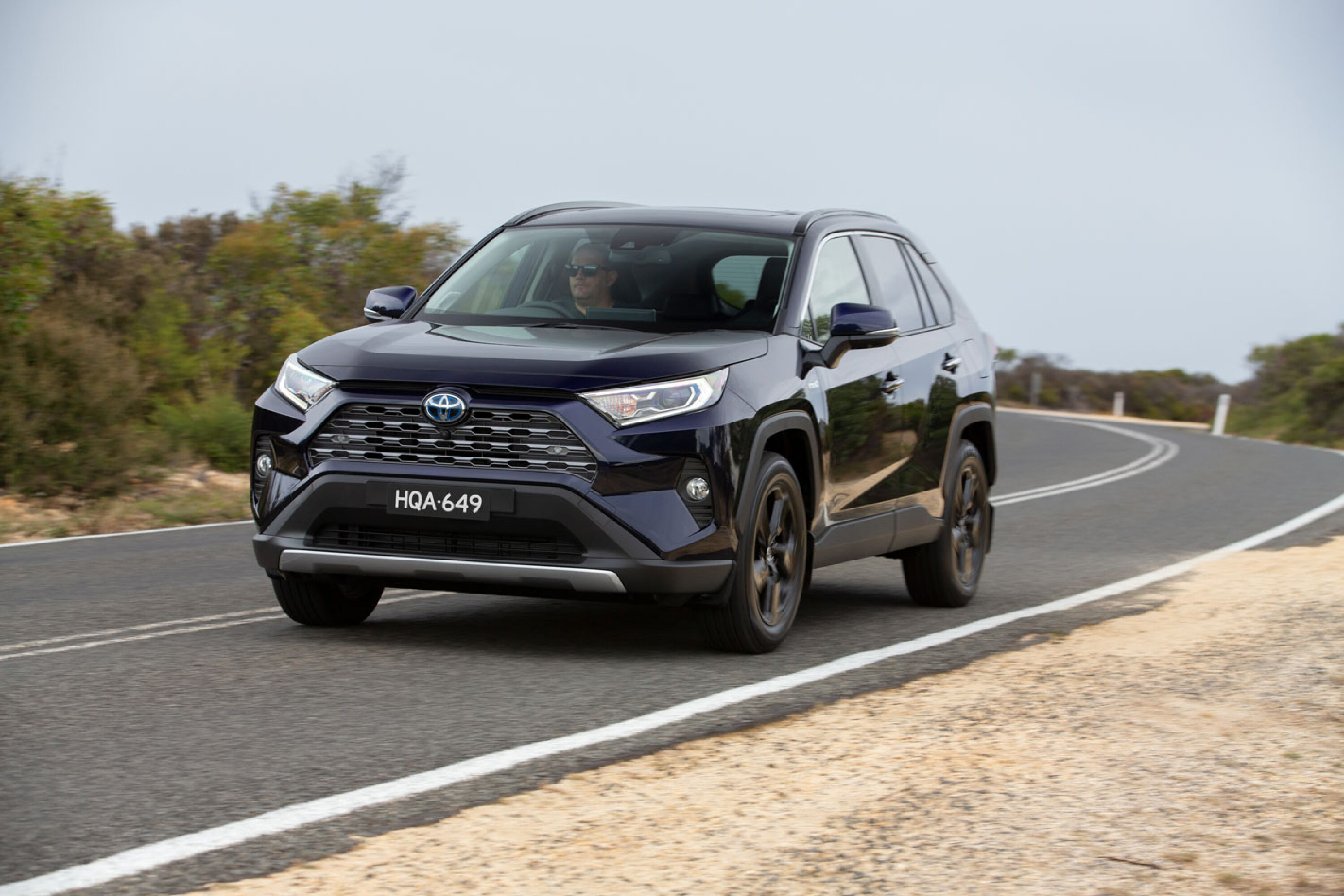
The Toyota RAV4 is a likeable and mostly quiet SUV that rides superbly. It’s also talented enough not to leave you wanting on a twisty road.
Whereas the first four generations of RAV4 did little more than the job at hand, and rather blandly, with the launch of the fifth-gen car Toyota struck an excellent balance between handling fluency and superb ride comfort.
Smaller alloys and chubbier tyres on the base GX and GXL make for a composed and comfy vehicle over local B-roads. Dips, bumps and ruts are dispensed easily and the dampers don’t need a second rebound stab at regaining composure. The RAV4 also has some of the lightest and most accurate steering in its class.
1
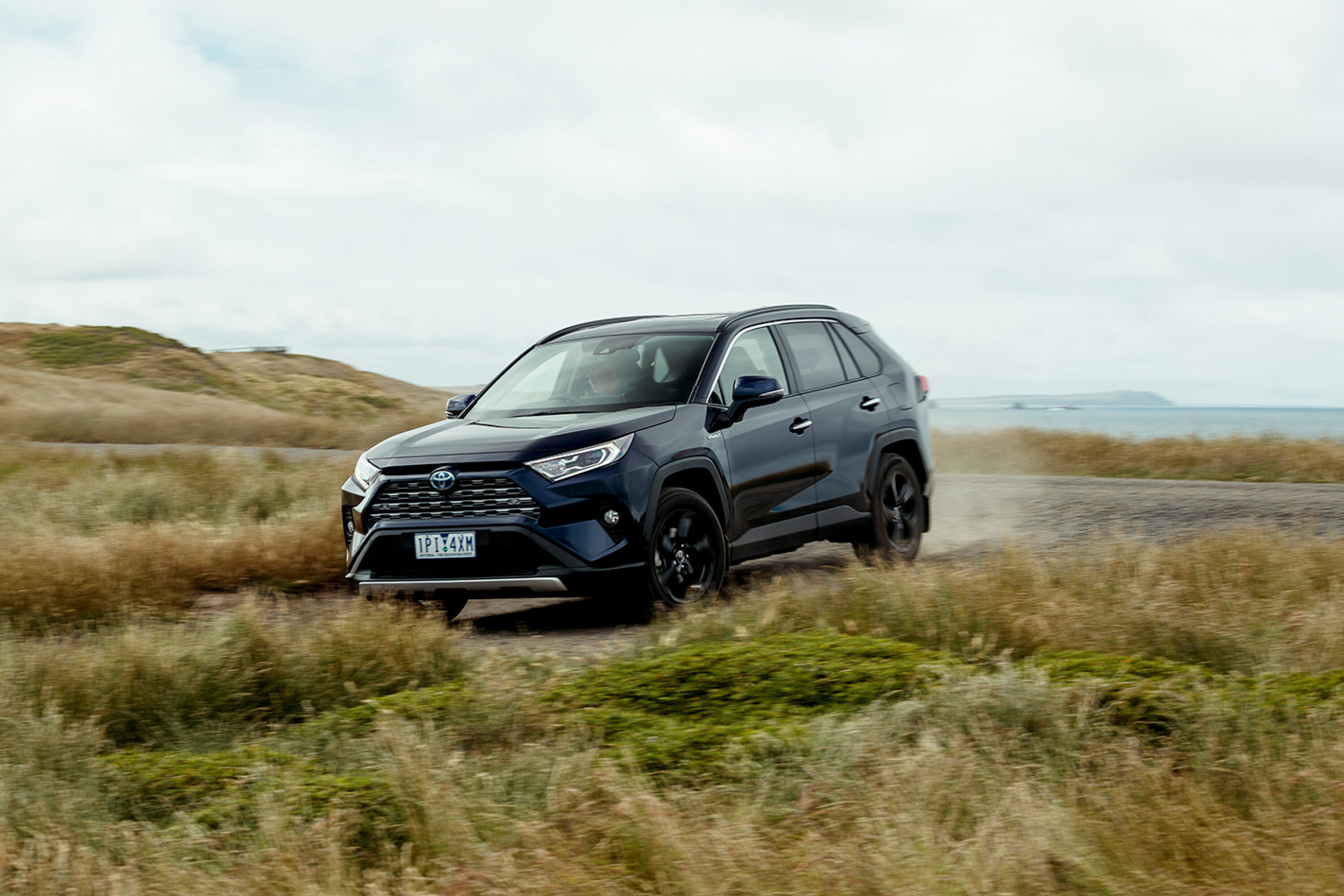
Even the flagship Edge and Cruiser with their larger 18- and 19-inch alloy wheels remain comfortable and compliant both around town and out in the country.
Vehicles like the Volkswagen Tiguan may be faster on twisty roads, but the RAV4 does everything you need and more.
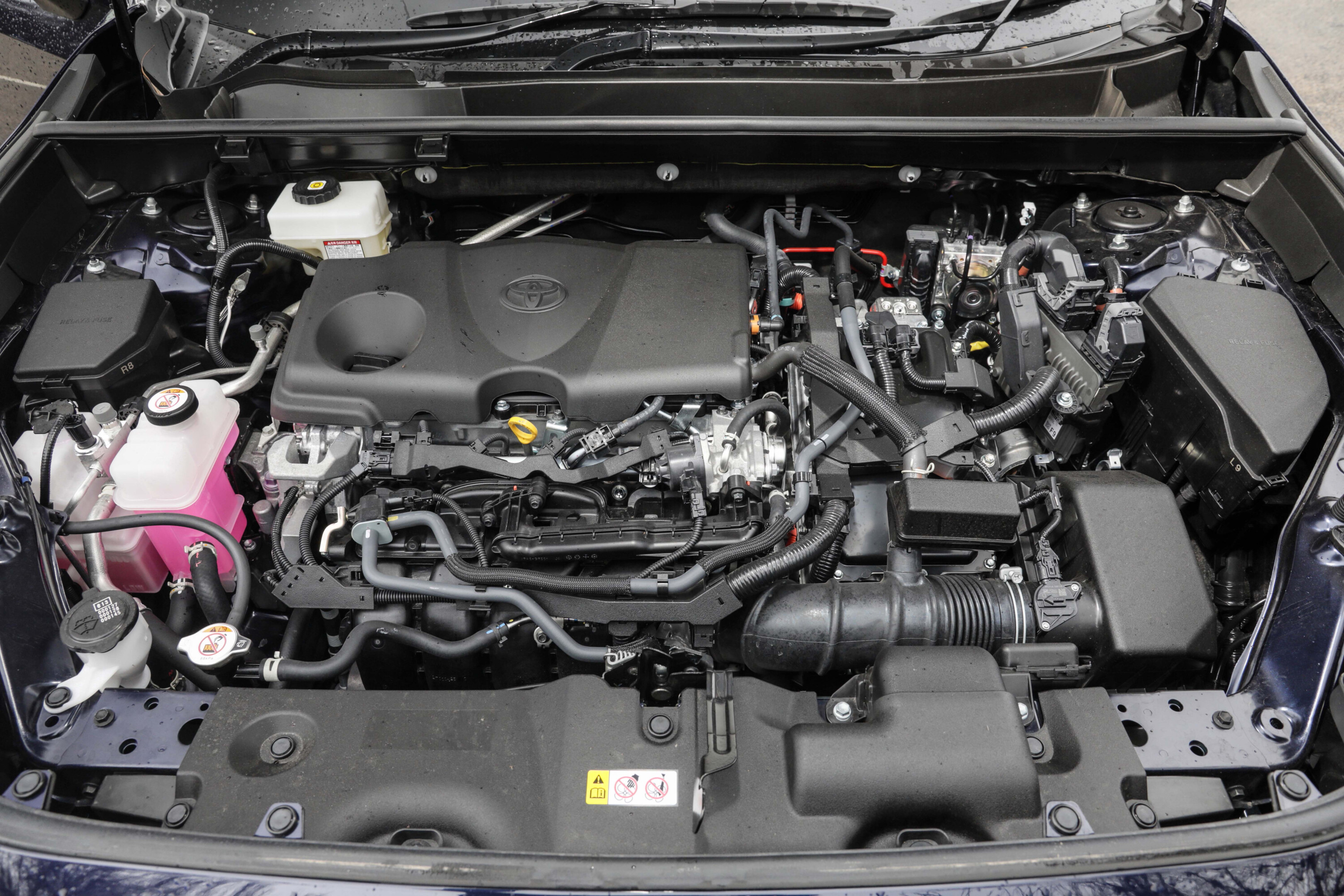
Though the RAV4’s hybrid powertrains handily motivate the medium SUV, they can be vocal when doing so. In front-drive form, the RAV4 hybrid produces 160kW and the AWD versions with an extra motor at the back increase that to 163kW. Toyota does not quote combined torque figures for the hybrid.
It’s best to skip the 127kW/203Nm 2.0-litre petrol engine, if you can, as it lacks the mid-range torque of the hybrids. The other option, exclusive to the Edge, is a flexible 2.5-litre petrol producing 152kW/252Nm. It has the advantage of a mechanical on-demand AWD system to improve the RAV4’s traction on loose surfaces.
1
One thing worth noting is that, in the wet, the front-drive models tend to scrabble for traction and activate traction control at lower velocities than AWD variants.
The hybrid powertrains are what we recommend. They offer near-silent low-speed operation with the front electric motor (and with optional AWD, the additional rear power unit) able to move the RAV4 from rest to 30km/h in quietude – providing the circa-1kWh battery has enough juice.
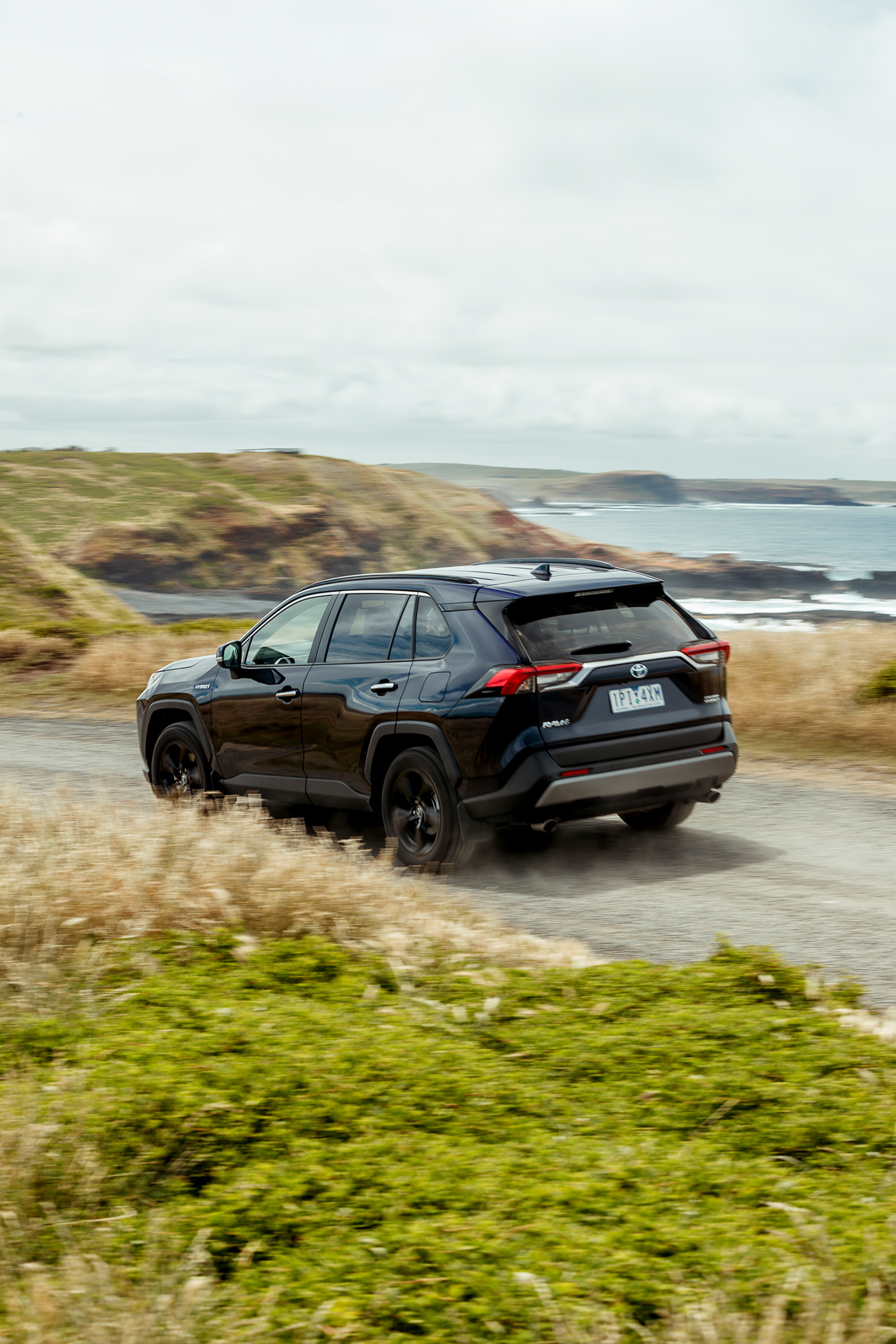
Broadly capable but fairly unexciting is perhaps the easiest way to summarise the RAV4’s dynamics. It clearly favours ride comfort and urban road manners over driver involvement but that’s not to say it feels out of place on a twisty country road.
1
Which Toyota RAV4 engine uses the least fuel?
The RAV4 FWD hybrid consumes 4.7L/100km on the combined ADR cycle, making it not only the most efficient RAV4, but the most efficient non-plug-in medium SUV on sale.
The added weight of the AWD system brings the RAV4’s consumption up to 4.8L/100km.
Compared to plug-in hybrid SUVs, the RAV4 hybrid also makes it easy to hit its fuel efficiency claims in the real world – a rare feat.
1
What is the Toyota RAV4’s towing capacity?
The RAV4’s towing credentials are not the strongest in this class. Diesel and turbo-petrol SUVs offer higher braked towing capacities and will pull a load better on the freeway.
With a hybrid AWD drivetrain or the 2.5 petrol AWD of the Edge variant, the Toyota RAV4 is rated to tow a 1500kg braked load.
Meanwhile, the front-drive petrol maxes out at 800kg with trailer brakes, and the FWD hybrid just 480kg with or without trailer brakes.
1
How long is the warranty and what are the Toyota RAV4’s servicing costs?
The Toyota RAV4 is backed by a five-year, unlimited-kilometre warranty. If you keep up-to-date on servicing, this extends to eight years for the powertrain of hybrid models.
Service costs are kept extremely simple, with a single $260 price per interval across all variants locked in for five years, making it just about the cheapest in its class to maintain at $1300 for five years or 75,000km.
RAV4 service intervals are 12 months or 15,000km for all variants.
1
Which version of the Toyota RAV4 does Wheels recommend?
In GX you’re left wanting for creature comforts (if not safety, convenience features or efficiency). The GXL is where a private buyer will want to draw the lowest line.
Regardless of trim, we recommend the hybrid powertrain – FWD for most, AWD if you want a little extra traction and confidence. The XSE trim makes for a fully-featured family hauler and the Cruiser only adds icing on top.
While you pay more for the Edge and don’t get a whole lot of substance in return, its bold colour palette may indeed suit your tastes. It’s also a better off-road package – but if you really want to go bush in your medium SUV we’d recommend a Subaru Forester.
That (and waiting times) aside, the Toyota RAV4 dominates the market with good reason. It majors on value, space, equipment, safety and efficiency – all crucial measures of a good family vehicle.
1
What are the Toyota RAV4’s key rivals?
- Nissan X-Trail
- Subaru Forester
- Mazda CX-5
- Kia Sportage
- Mitsubishi Outlander
- Hyundai Tucson
- Honda CR-V
- Volkswagen Tiguan
- Haval H6
- MG HS
What might annoy me?
Compared to rivals, the Toyota RAV4 does lack for sound insulation, especially when it comes to heavy acceleration as the shouty four-cylinder petrol engine has to work hard.
Take care in looking for a new RAV4; the MY23 upgrade is highly recommended as it brings a much-needed boost to the RAV4’s technology suite with bigger, higher-resolution screens that will stay fresher for longer.
As it is such a popular model, the Toyota RAV4 has been struck by extended wait times in Australia, with some dealers quoting a turnaround longer than 12 months for a new example.
1
What might I miss that similar cars have?
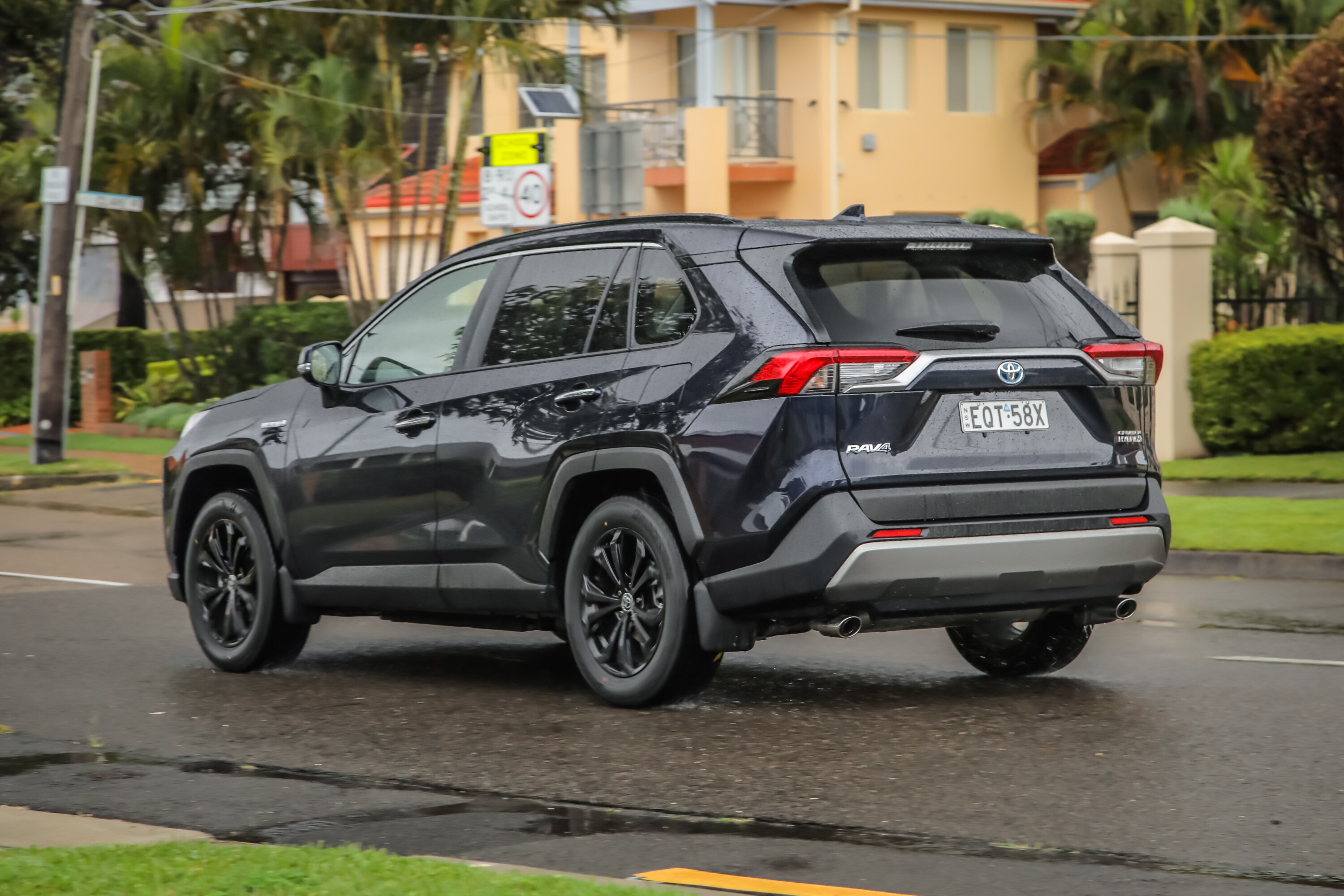
The Nissan X-Trail and Mitsubishi Outlander offer an extra pair of seats in the third row (trim dependent). While these aren’t big enough for everyday use, it is a reason to consider these rivals over the five-seat-only RAV4.
Also, no turbo-petrol engine is offered and some will prefer more conventional multi-ratio automatic transmissions over the bulk of the RAV4’s continuously variable units. Only the Edge petrol offers an eight-speed torque converter.
1
What’s the infotainment system like?
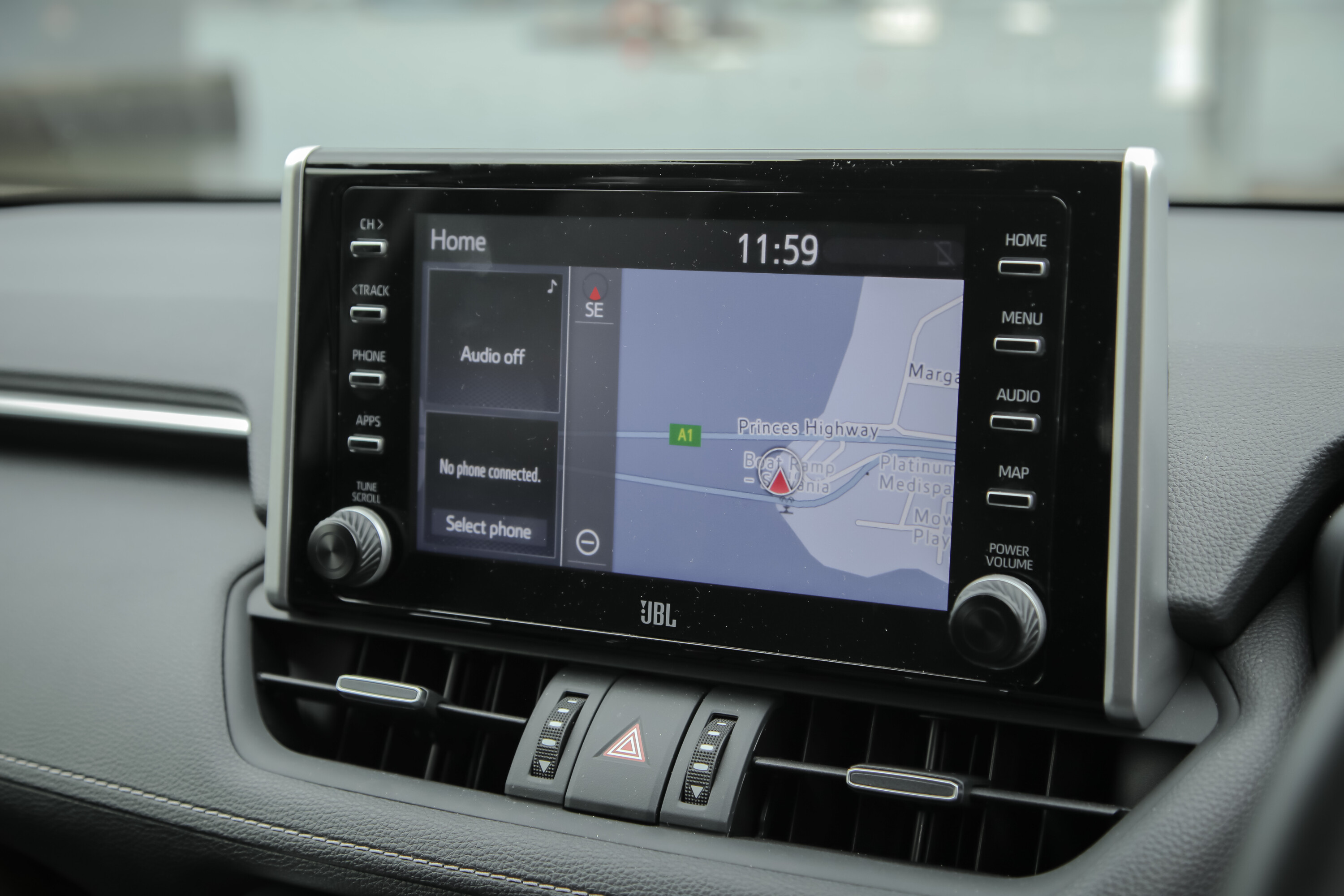
Toyota has recently upgraded the RAV4’s infotainment system.
It now boasts live app updates and connected services, though these are included free for only the first 12 months. After that, it’s an ongoing charge of roughly $23 per month for all features.
Navigation is standard, and the graphics look slick, though it’s not the most responsive system. Wireless Apple CarPlay features on all grades, though Android Auto is wired only.
1
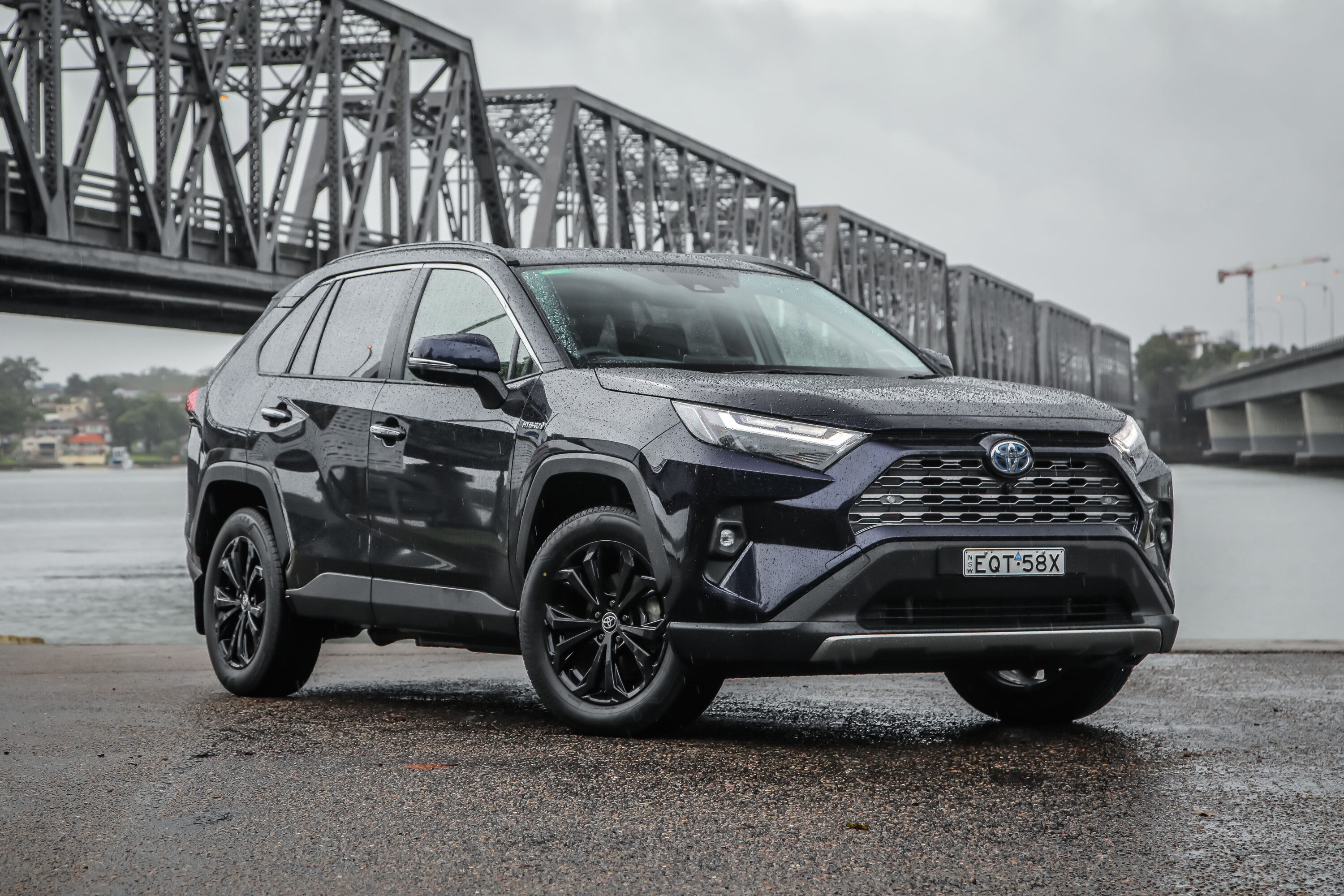
Where does Toyota make the RAV4?
The Toyota RAV4 is built in Japan.
Three separate facilities produce various RAV4 trims, variants and powertrains for Australia.
1
Are there plans to update the RAV4 soon?
The fifth-generation Toyota RAV4 has been around since 2019 and has had several small tweaks since its release – the latest of which was introduced this year.
Although the RAV4 is no longer a spring chicken, it still feels current and up-to-date, with a major refresh not due for at least another two years.
MORE
Everything Toyota
MORE
Midsize SUVs
The new year is well underway, and the used car market still maintains its steady pace – so here’s a few auctions at Grays that have caught our eye this week.
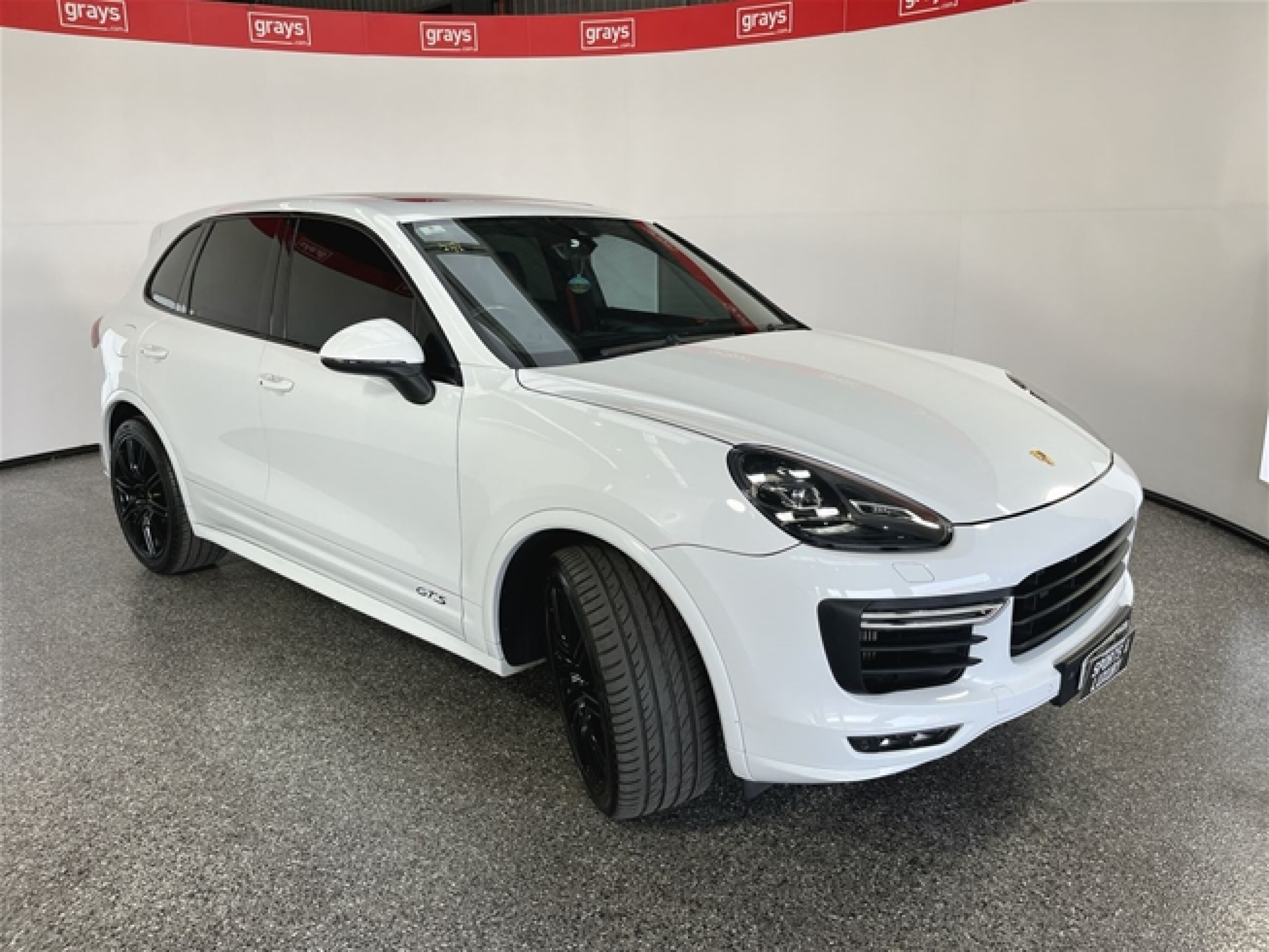
2016 Porsche Cayenne GTS
Porsche’s SUV saviour is the first lot to check out, with this GTS variant from 2016 still looking as imposing as its modern incarnation.
3
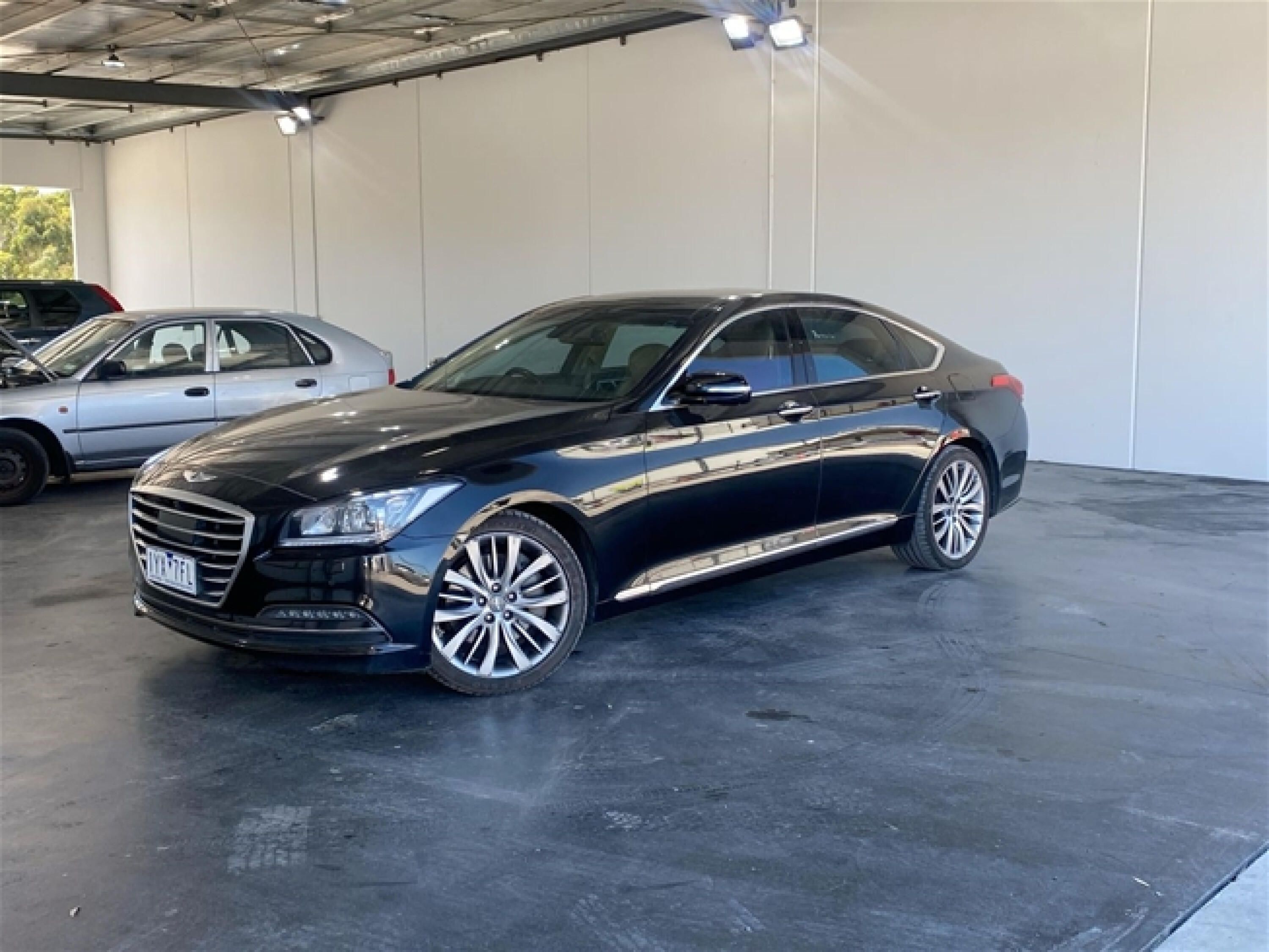
2015 Genesis Ultimate Pack
The premium theme continues with this sedan offering from 2015 from the challenger luxury brand Genesis.
MORE
Genesis at Grays
3
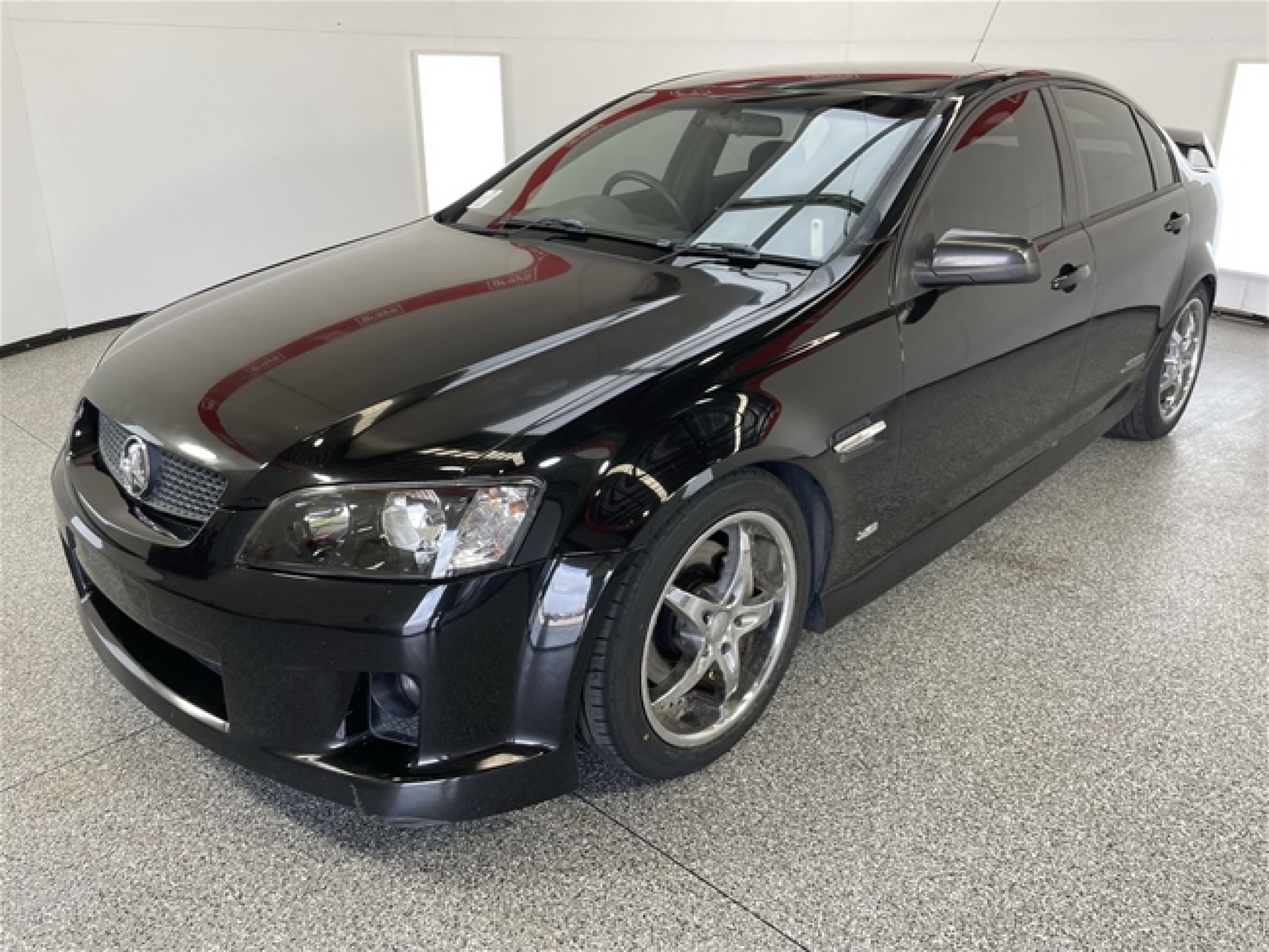
2007 Holden Commodore SS sedan
If the sedan you’re after needs to have more local flavour, there are still examples of Holden’s billion-dollar baby cruising around, such as this VE V8.
3
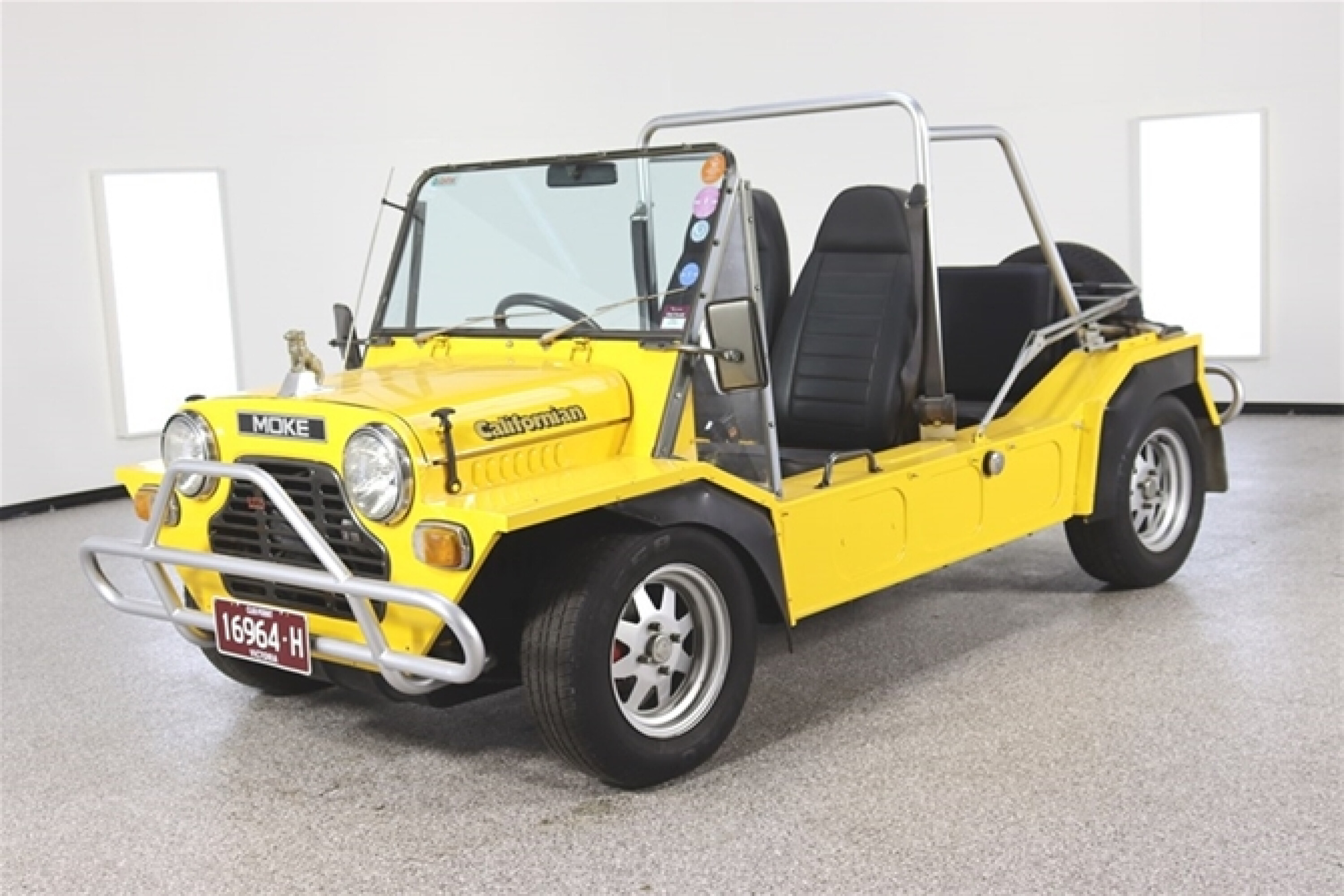
1980 Leyland Mini Moke Californian Manual
The quintessential little funbox, there are few cars that turn as many heads as the Mini Moke. At least, according to my kids.
3
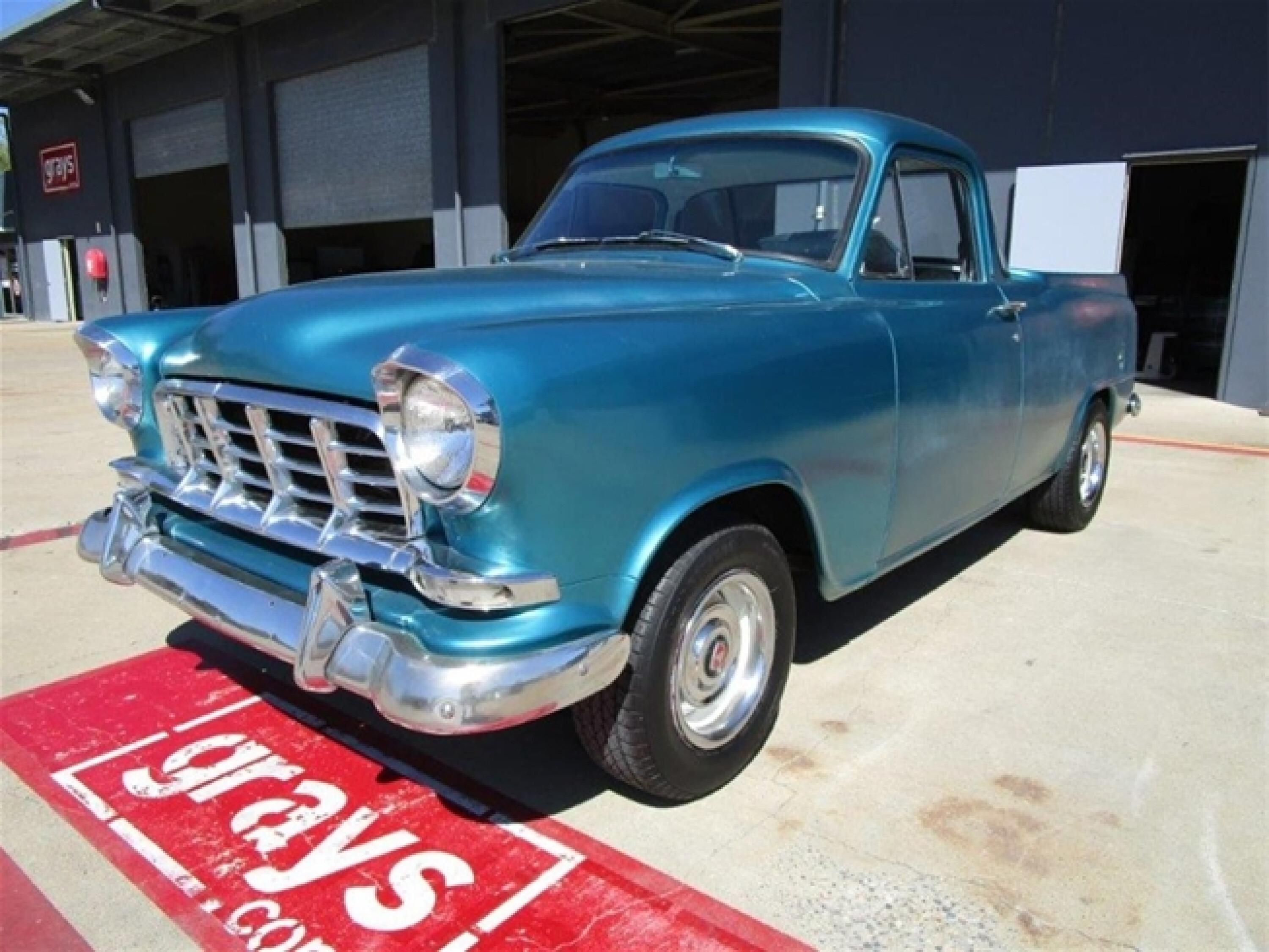
1959 Holden FC Coupe manual ute
Reportedly rolling off the line in an Adobe Beige colour, this ute has been scrubbed up to a custom teal blue/green, ready for someone looking for something unique.
3
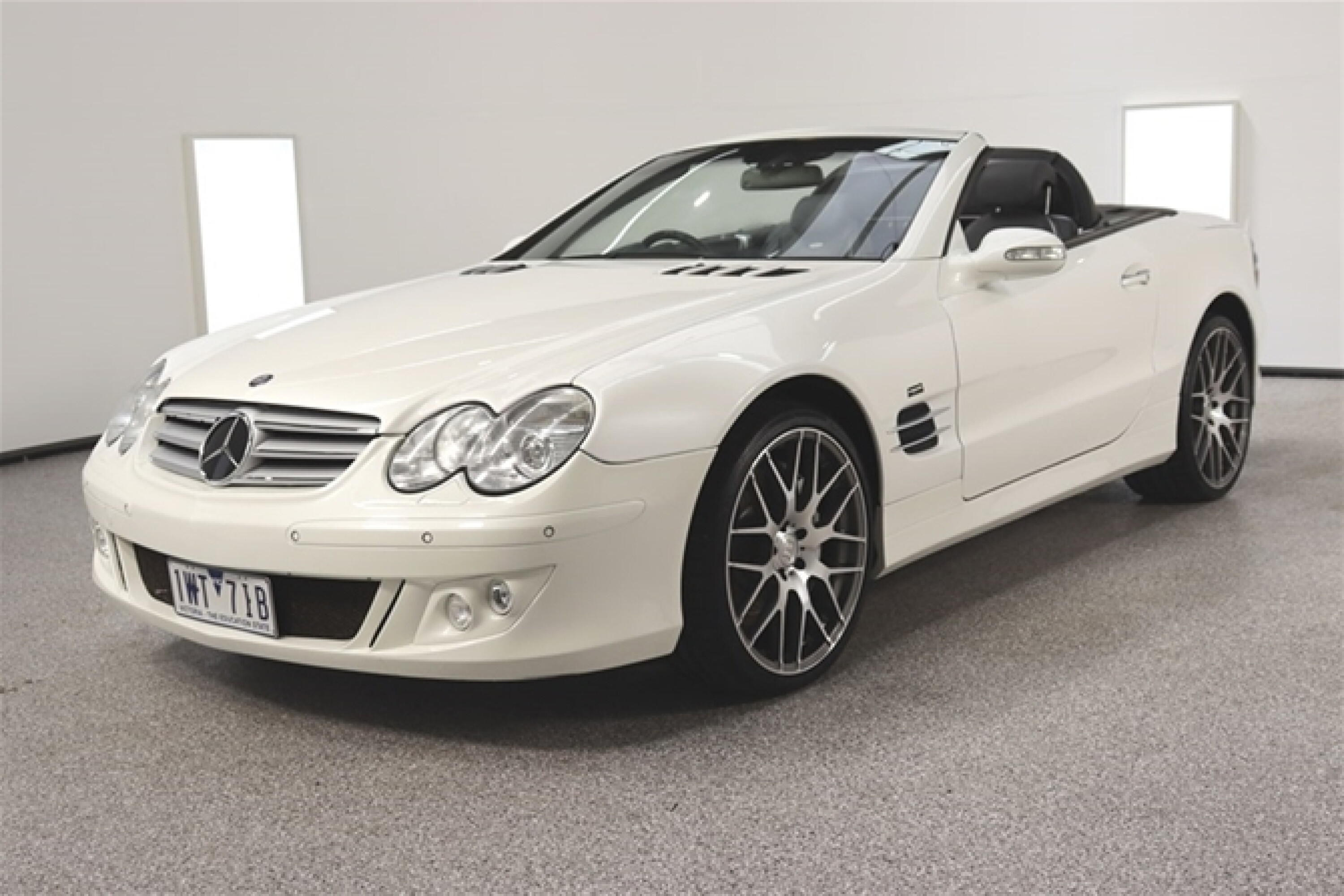
2003 Mercedes-Benz SL55 AMG R230 K8 Brabus
This Brabus example of the Mercs should also pique the interest of those looking for something a little more notable.
3
Take a look at Grays’ entire listings here [↗]
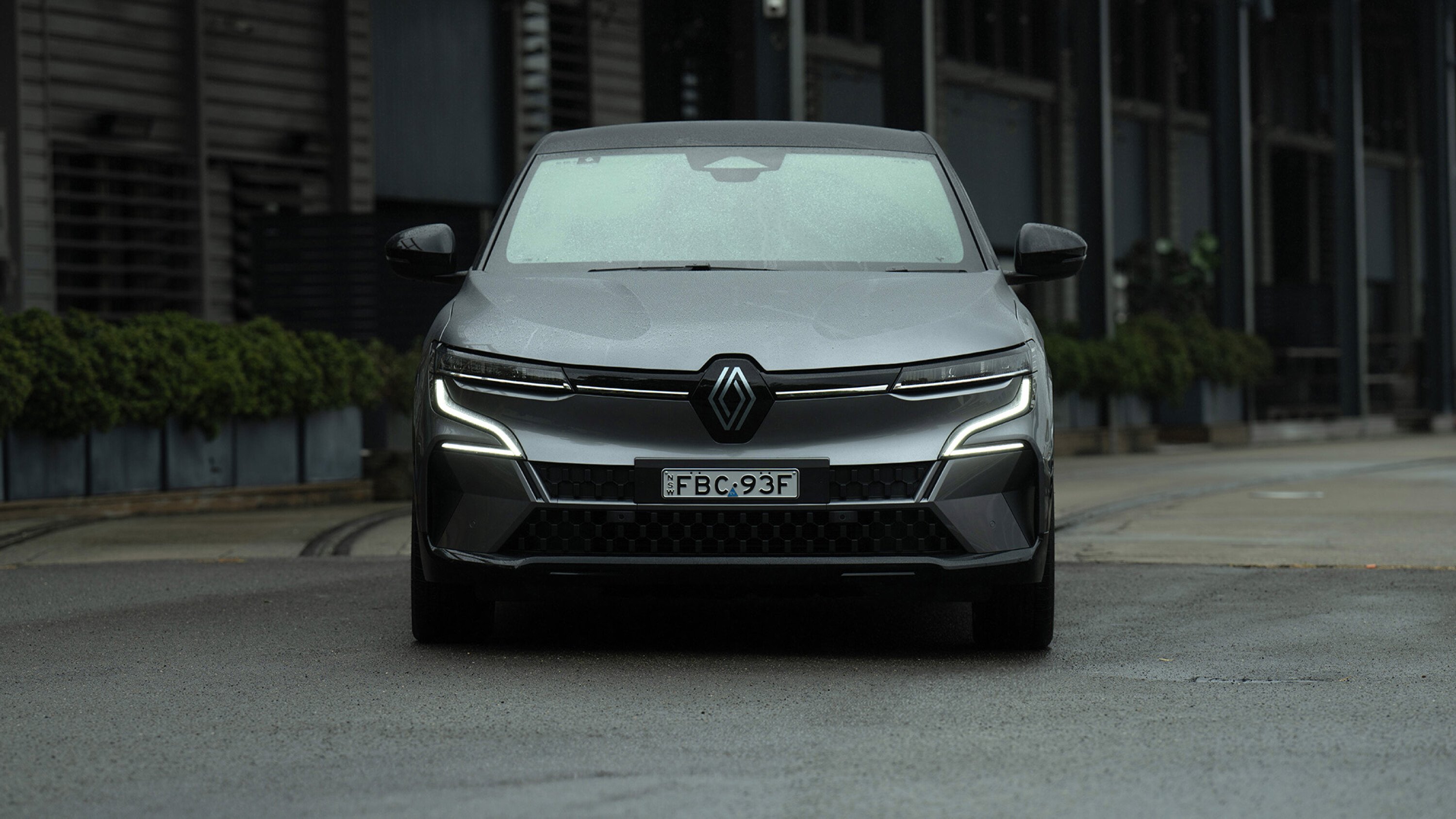
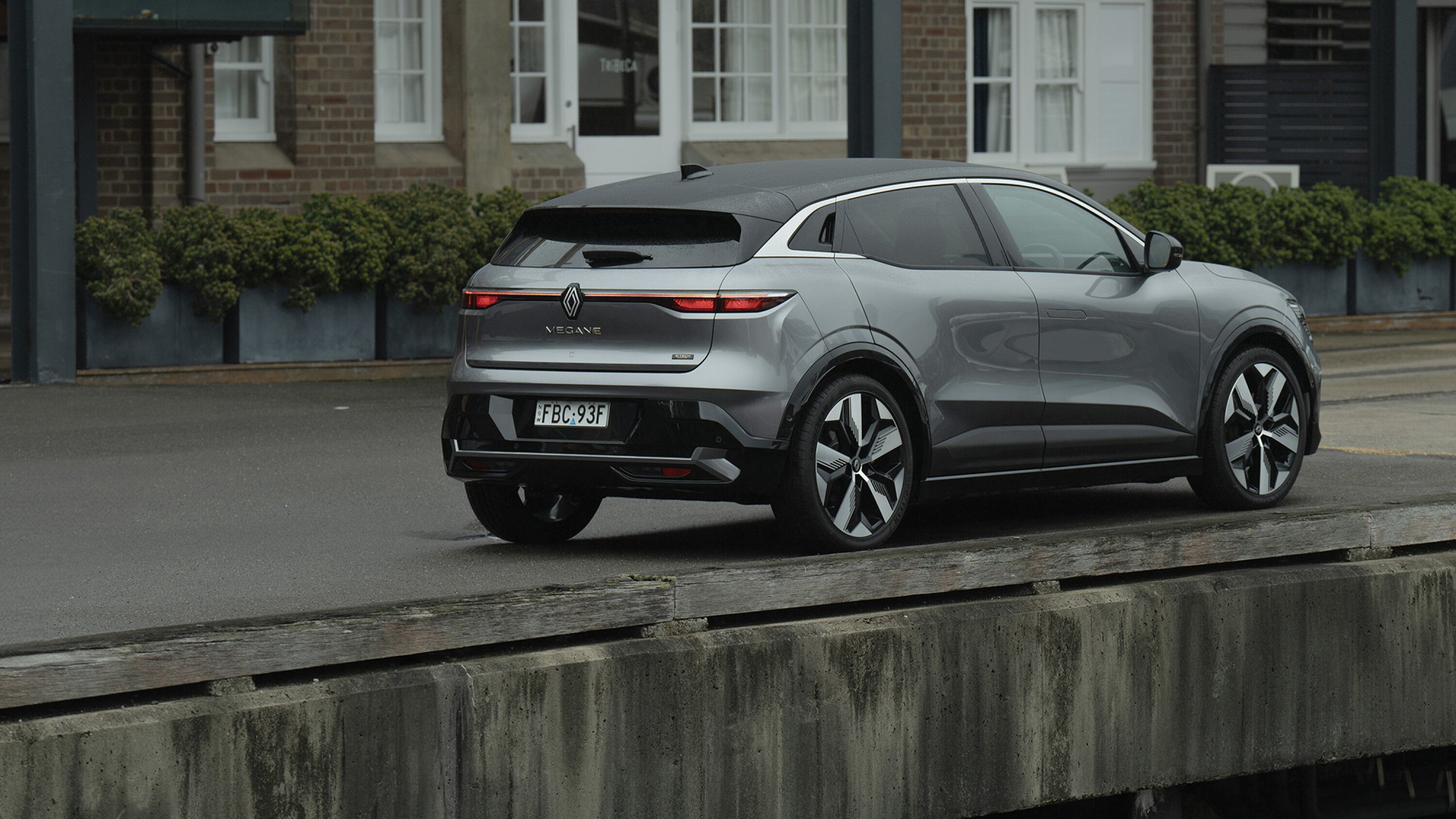
Glen Sealey, head of the Renault brand for Australian importer Ateco, is quite the salesman. If he doesn’t believe in the Megane E-Tech’s potential, you’d never know it – but that’s the job, of course.
Speaking at this week’s short-but-sweet Australian launch of the new electric Megane, I asked Sealey to sell me on his new Renault instead of the obvious contenders in its $65,000 space: the Tesla Model 3, Model Y, Polestar 2 and Kia Niro.
“First of all, it’s the way it looks, the way it stands out,” Sealey says. “It feels like a GTI to drive, it’s light for an electric car. It’s very light compared to those others you spoke about.” The Megane E-Tech 60kWh claims a kerb weight of 1642kg, compared to 1940kg for the Polestar 2 and 1765kg for the Model 3.
Sealey dives into the drive: “Steering is direct and the suspension setup is fantastic,” and then continues at length about the dynamics, clearly aware such things matter to the revheads assembled before him.
1
Finally, he touches on sustainability and the car’s point of origin – that is, not China.
“The car is made in France (the batteries are LG). That means you know the energy going into the car, the carbon footprint, you know where it all comes from, and it’s all (the components of the car) 90 percent recyclable,” Sealey says. In fact, according to Renault, it’s over 90 percent. The Polestar 2 claims 85 percent, and… Tesla’s in trouble for dumping hazardous waste in California.
“Lastly, there’s the ADAS (Advanced Driver Assistance Systems). There’s maturity around the ADAS in this car. Renault is 125 years old this year – they’ve been doing it for a long time, and over a decade in EVs.”
If Renault’s dealers are this well trained, the Megane E-Tech has a chance here. Let’s see if we agree.
JUMP AHEAD
- How much is it, and what do you get?
- Power, charging and driving range
- Where is this model in its lifecycle?
- How do rivals compare on value?
- Interior quality, comfort, space and storage
- Boot space
- Technology in the cabin
- What is it like to drive?
- How is it on fuel?
- How safe is it?
- Warranty and running costs
- VERDICT
- Specifications
1
How much is it, and what do you get?
Priced from $64,990 before on-road costs, the Renault Megane E-Tech is offered in one well-equipped trim grade: Techno EV60.
The only optional extras are metallic paint and a two-tone paint style, but the standard features list we’re treated to in Australia would position our Techo somewhere between the AU$70k Techno+ and AU$75k Iconic trims in the UK.
1
What do we miss out on, compared to Europe?
Australia and the UK get only the base-level 9.0-inch dash display rather than the taller 12.0-inch unit offered in mainland Europe, but otherwise… not much.
However, no matter where in the world you slip into a Megane E-Tech, you’ll get only a recycled plastic cloth and faux-leather trim for the seats – which are also manually adjusted, with the only powered aspects of the front seats being lumbar support and heating.
If these aren’t dealbreakers for you, the rest of the equipment list is comprehensive and well competitive with the Megane E-Tech’s price rivals.
1
| EXTERIOR | INTERIOR |
|---|---|
| 20-inch soren two-tone alloy wheel rims | Recycled fabric dashboard cover |
| Shark fin antenna | Black headlining |
| Two-tone paintwork | Yellow contrast stitching on the upholstery & front door armrests |
| Automatic electric flush-fitting front door handles | Alcantara-style front door trims |
| Front/rear body-coloured F1-style blades | Chrome strips on dashboard, front & rear doors |
| Striped exterior door protection |
| COMFORT | |
|---|---|
| Recycled fabric and leatherette upholstery with yellow contrast stitching | Welcome sequence |
| Heated front seats with 3 heat levels | Multi-sense: customisation of driving modes (custom/comfort/sport/eco) |
| Height-adjustable driver and passenger seat with electric lumbar adjusent for driver | Interior ambient lighting with 48 available colours |
| Heated steering wheel | u2018Living lightsu2019 – automatic ambient lighting colour change every 30 minutes |
| Automatic dual zone climate control system with air purifier | Rear privacy glass |
1
| INFOTAINMENT | |
|---|---|
| 12.3-inch high-definition digital driver instrument cluster | Wireless Android Auto and Apple CarPlay |
| 9-inch OpenR: multimedia system | Wireless smartphone charger |
| Digital radio | Arkamys Auditorium sound system with six speakers |
| Bluetooth phone pairing with audio streaming | 2x front and 2x rear USB-C ports, 1x 12V socket |
| CONVENIENCE | |
|---|---|
| Renault smart key with hands-free unlocking and walk-away locking | Sliding central front armrest with closed storage and rear air vents |
| Auto door-lock when driving | LED Cabin lighting |
| Automatic windscreen wipers with rain sensor | Driver & front passenger sun visor with illuminated mirror |
| Automatic dusk-sensing headlights | Customisable storage in centre console |
| Automatic high/low beam | Boot lighting |
| Four electric one-touch windows with anti-pinch | Charging cable storage in the boot |
| Electric parking brake with auto-hold function | Heated power-adjustable and auto-fold door mirrors |
| Split folding rear bench seat 60:40 | Tyre repair kit |
1
| LIGHTING | |
|---|---|
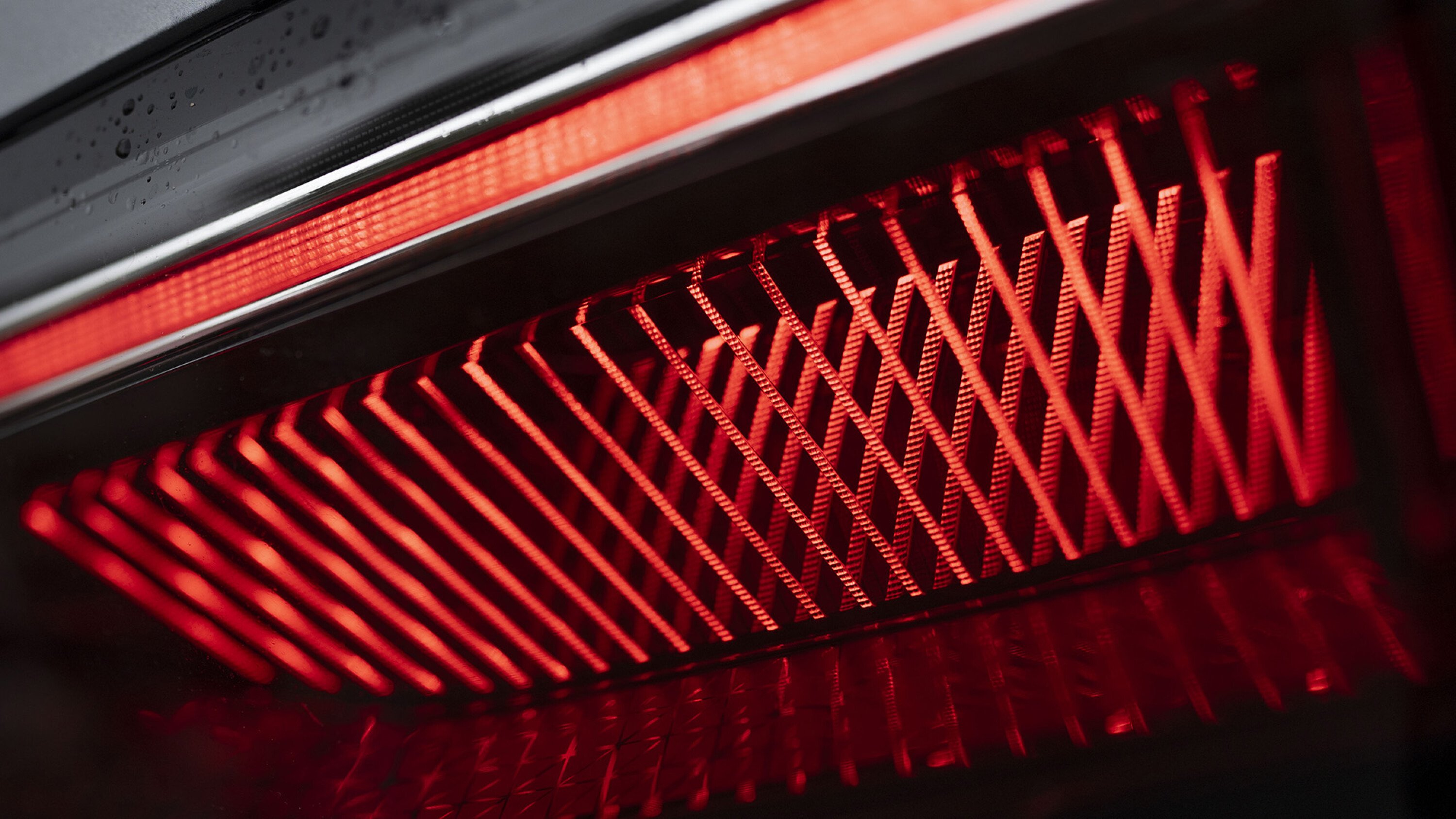
| 100% LED adaptive front headlights: Renault LED Pure Vision with fog light function | 3D rear lighting signature with moiru00e9 effect |
| LED daytime running lights with lighting signature | Puddle lights with Renault logo projection |
| ELECTRIC | |
|---|---|
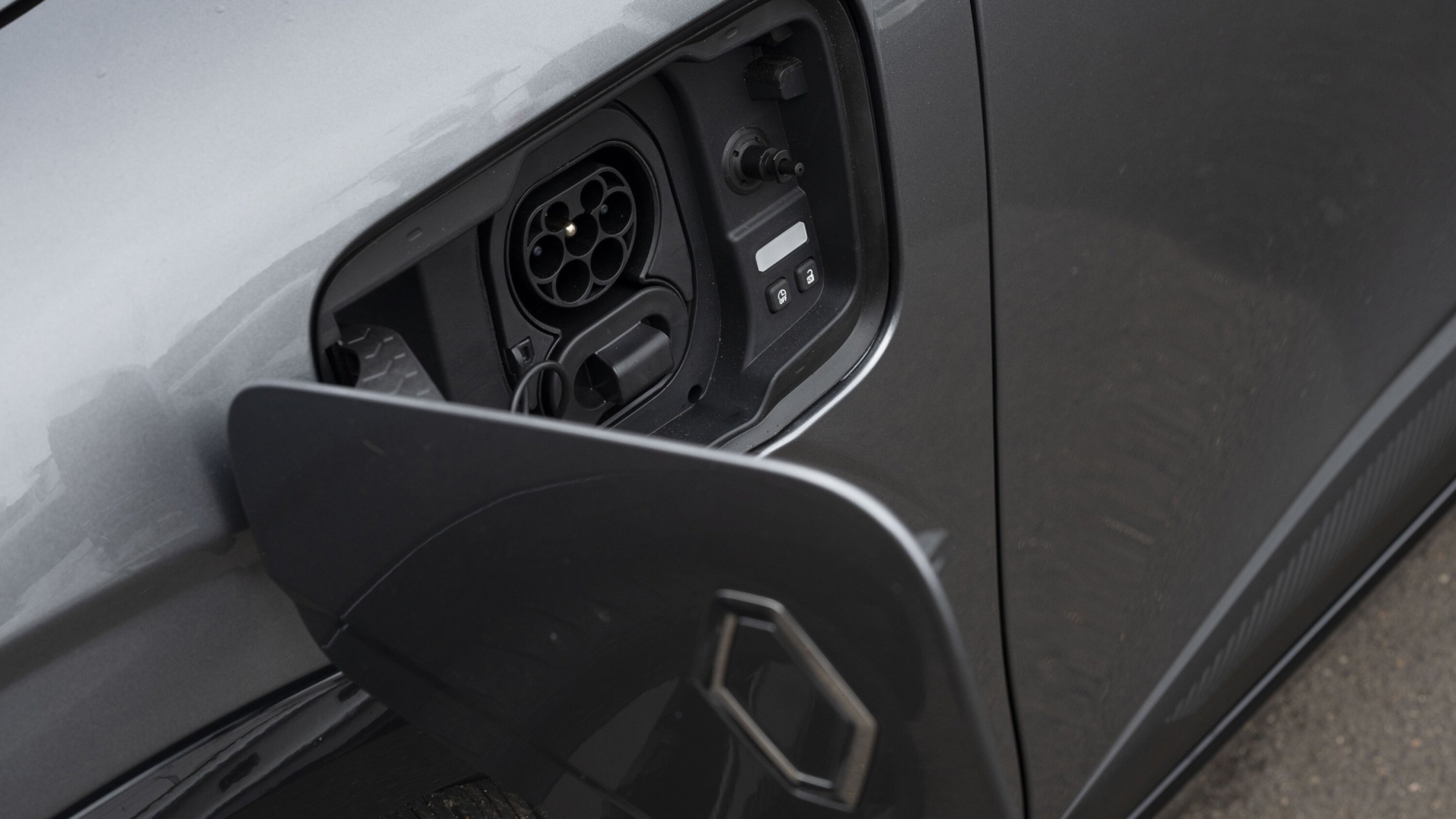
| Mode 3 charging cable (5m) | Charging scheduling via the openR multimedia system |
| Regenerative braking (four levels) adjustable by paddle shifter on the steering wheel | Eco coaching – (driving tips to maximise your range and save energy) |
Power, charging and driving range
The single-spec Megane E-Tech EV60 is powered by one electric motor at the front, driving the front wheels only.
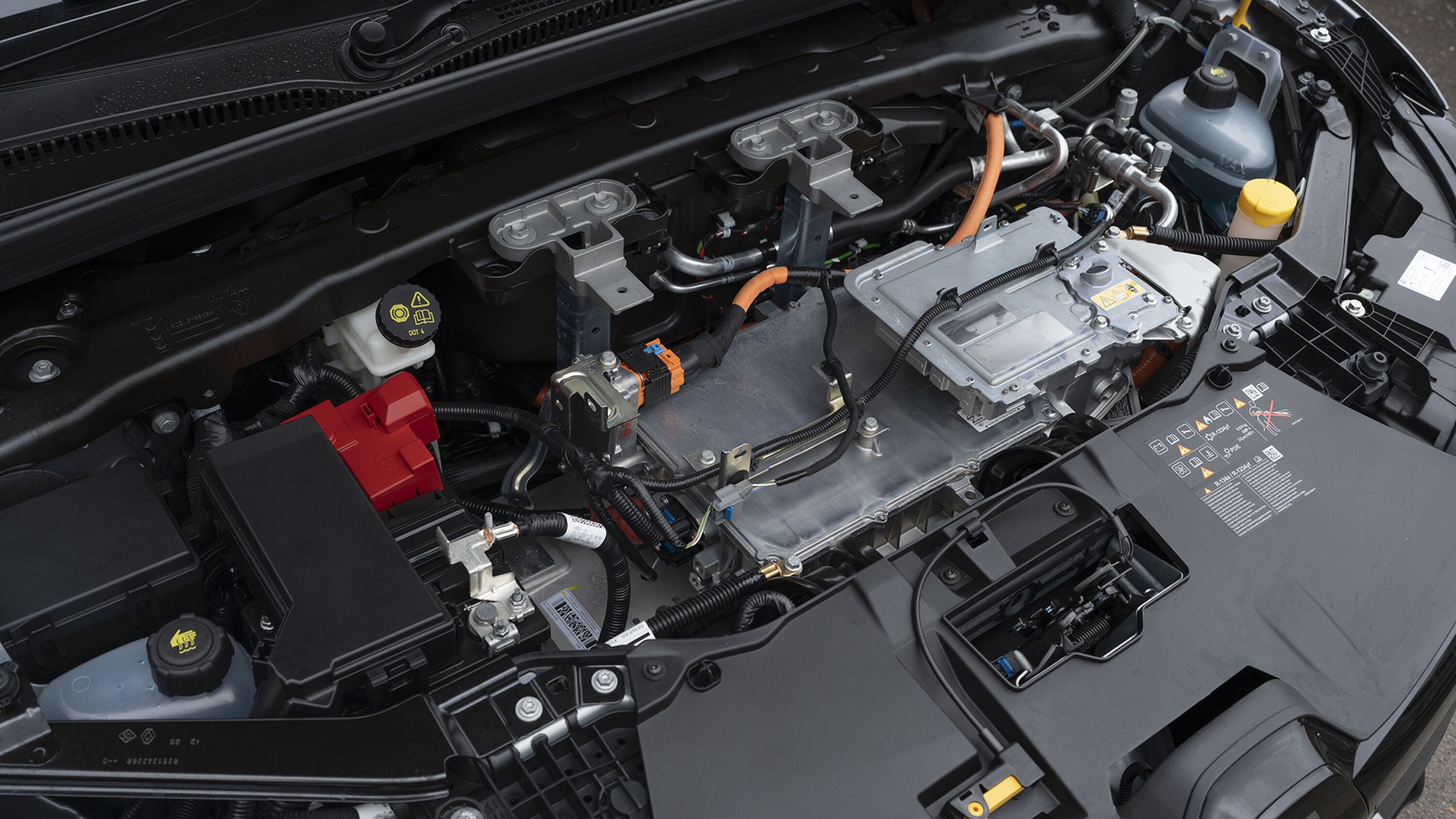
The motor produces 160kW and 299Nm, drawing energy from a 60kWh lithium-ion battery pack supplied by LG Chem. Renault and LG claim this is the slimmest battery pack on the market, at just 110mm tall.
1
With an official efficiency rating (WLTP) of 15.6kWh/100km, Renault claims a driving range of up to 454 kilometres for the Megane E-Tech, and a 0-100km/h time of 7.4 seconds.
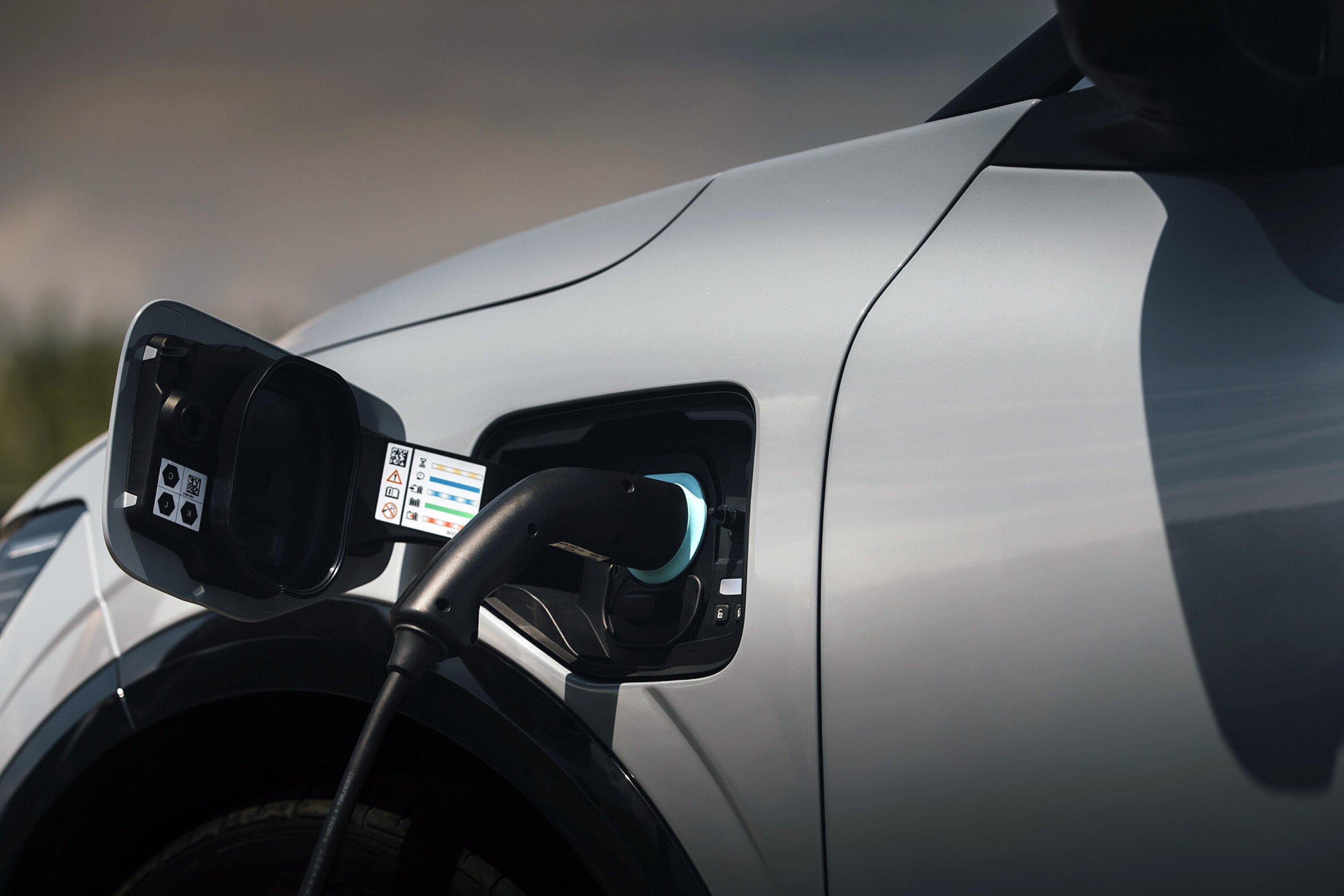
Built on a 400V architecture, the Megane E-Tech will charge at up to 130kW DC, but AC charging is limited to 7kW. No three-phase 22kW advantages here, meaning the fastest full AC charge you’ll get at home or any small ‘destination charger’ will be 9 hours 15 minutes. With DC charging, you’ll get from 15 to 80 percent in 30 minutes.
1
Where is this model in its lifecycle?
This is the Megane E-Tech’s Australian debut, but it was unveiled to the world in September 2021. That should see a mid-life facelift and tech upgrade come in either late 2024 or sometime in 2024.
Here, the Megane E-Tech replaces the conventional Megane hatch and wagon range, along with the smaller Zoe EV that launched for private buyers in 2018 from $51,990 before being retired in 2020. (A facelifted and upgraded Zoe launched in Europe in 2022.)
Above: The new Scenic could offer a few hints as to how a facelifted Megane E-Tech might look…
How do rivals compare on value?
Not well, but also quite well. Decisions, decisions, decisions…
The beautiful thing about having around 60 brands to choose from in Australia is that you’ll generally find a car that mostly suits your needs and desires – but it also means you’ll be making compromises and some tough decisions.
In the case of the Megane E-Tech, your $65k spend (plus on-road costs) gets you a richly equipped European car with loads of flair and a powertrain developed by one of the continent’s better-regarded practitioners of electrification.
4
If it’s space or speed you prioritise, you could be better served elsewhere for similar money.
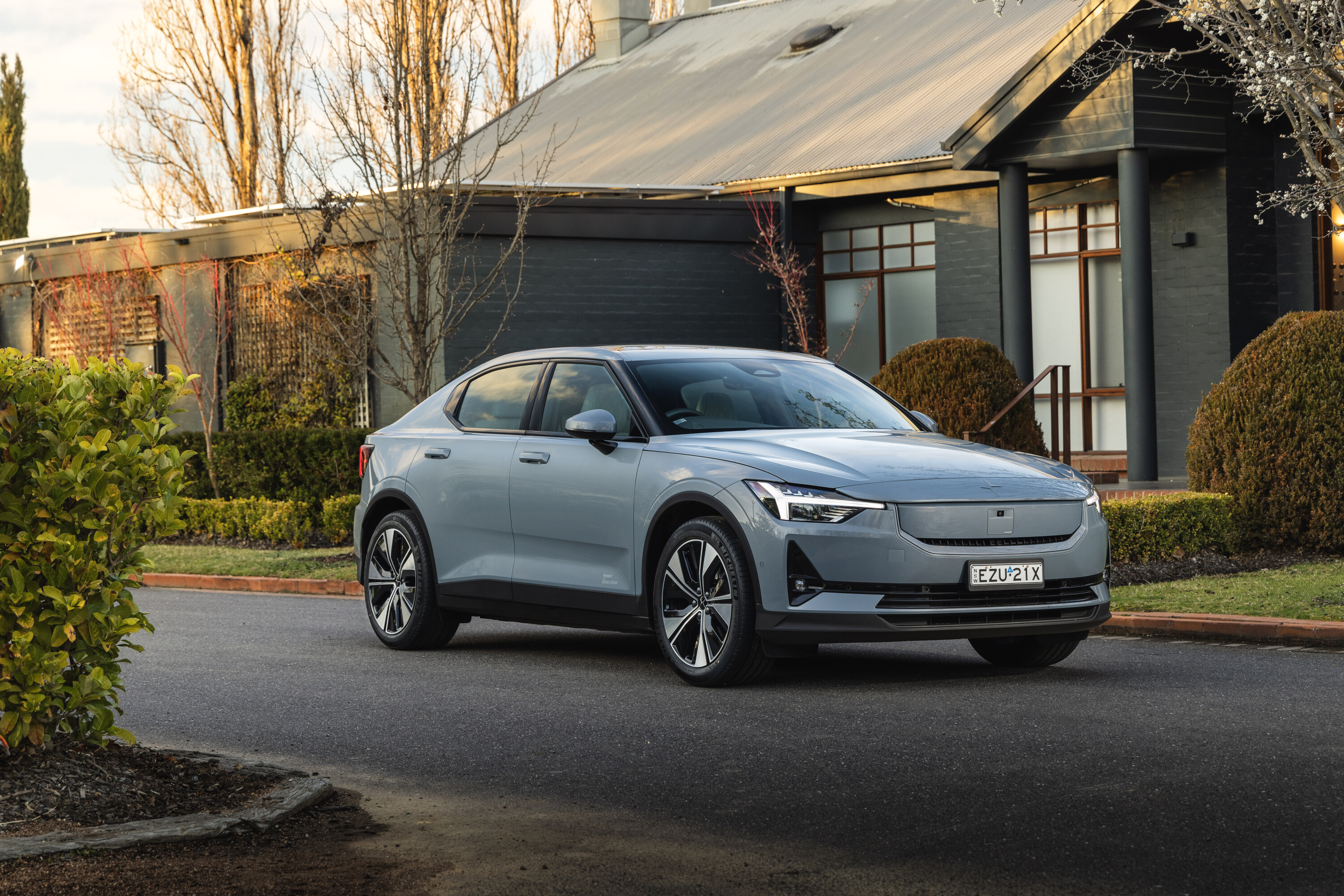
The Polestar 2 RWD can be had from $67,400 with arguably as much style and 0-100km/h time a full second quicker (6.4 seconds to the Megane’s 7.4). Its standard features make for a nice start and it’ll take you further (532km to 454km), but getting to the Megane’s level of included equipment and safety means adding the $3500 Pilot pack and the $6000 Plus pack.
You won’t gain any meaningful interior space, but there are other reasons you might be better off with the Chinese-made Swede, so take a look at our Polestar 2 details here.
5
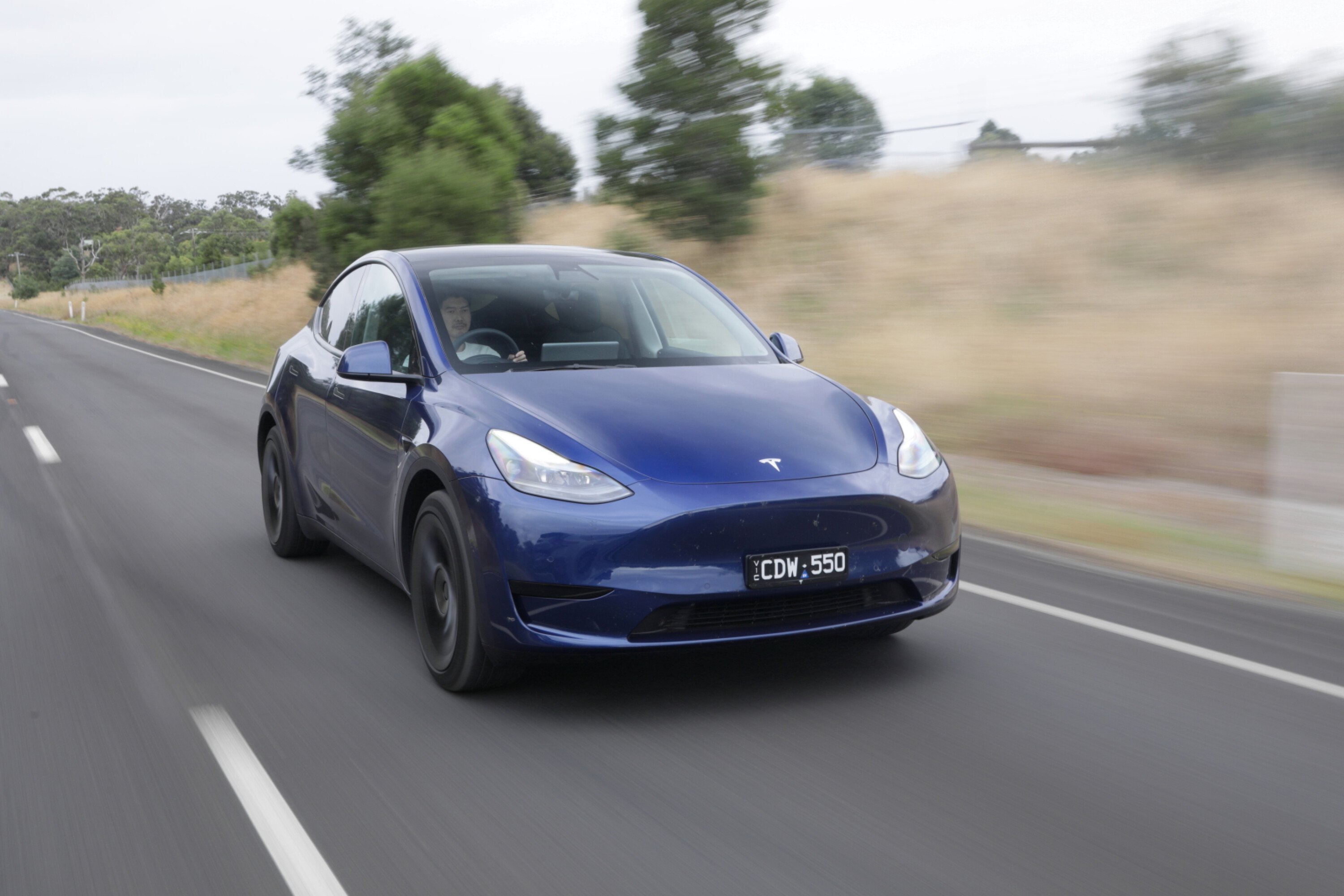
Pricing for Tesla’s Model 3 and Y changes with the weather, but right now the Model Y RWD is priced from $65,400 and it’s a well-equipped thing.
You’ll get most of what the Megane lists, plus electric seats with faux leather trim, if those omissions in the Megane were indeed dealbreakers for you. As a midsized SUV, it’s also more spacious than the Renault – although the Megane does have good rear legroom for its overall size.
6
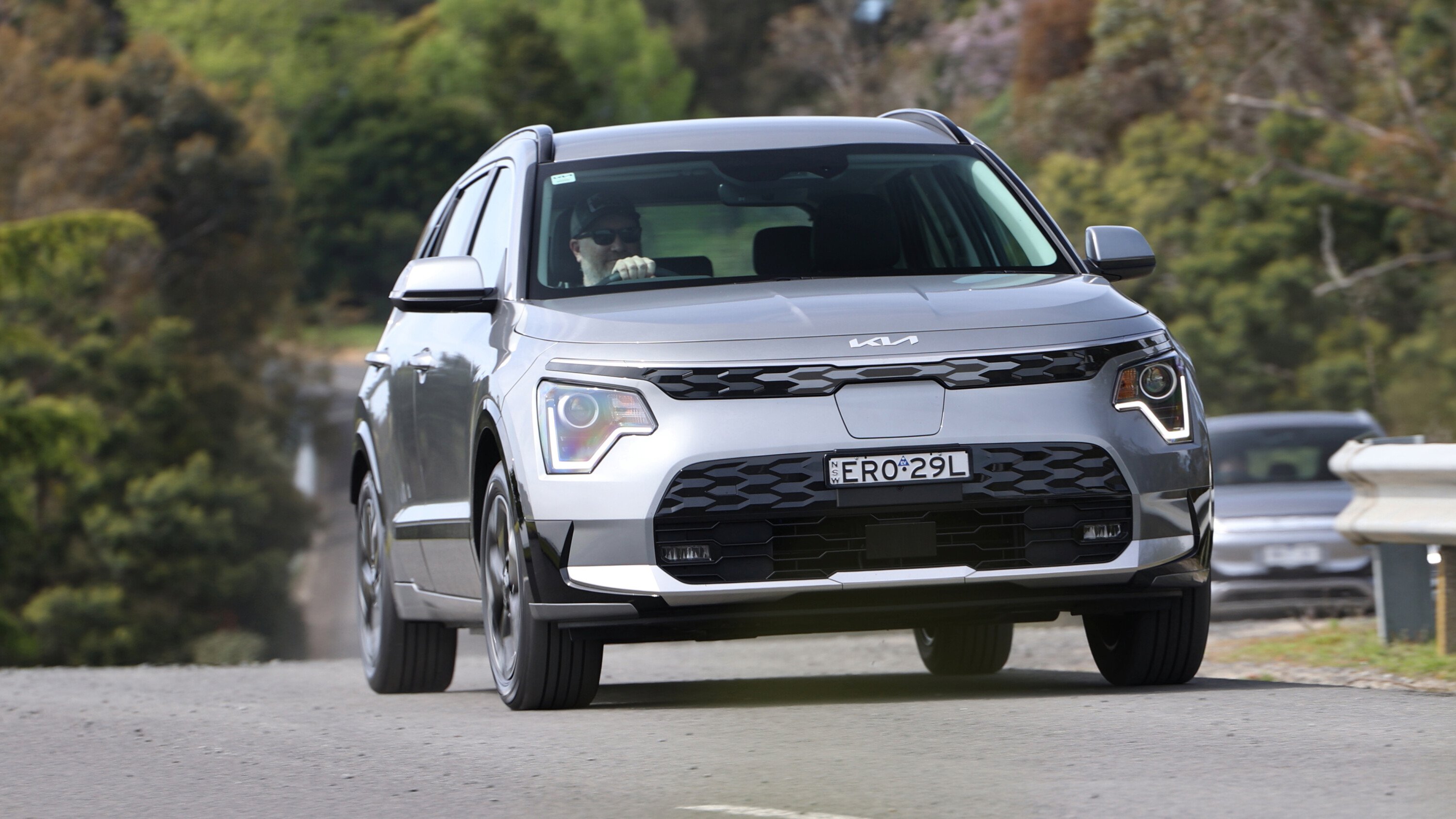
The Kia Niro EV was slugged with a $1290 price rise for 2020, making it $66,590 in base trim.
It gained more tech, however, picking up a proper full digital display, integrated satnav and remote connectivity through Kia Connect. Interior space and storage is excellent, feeling more like a medium SUV than its official small classification. The standard equipment list is also strong, along with a comprehensive included safety suite, but it’s otherwise the least exciting model in this set.
8
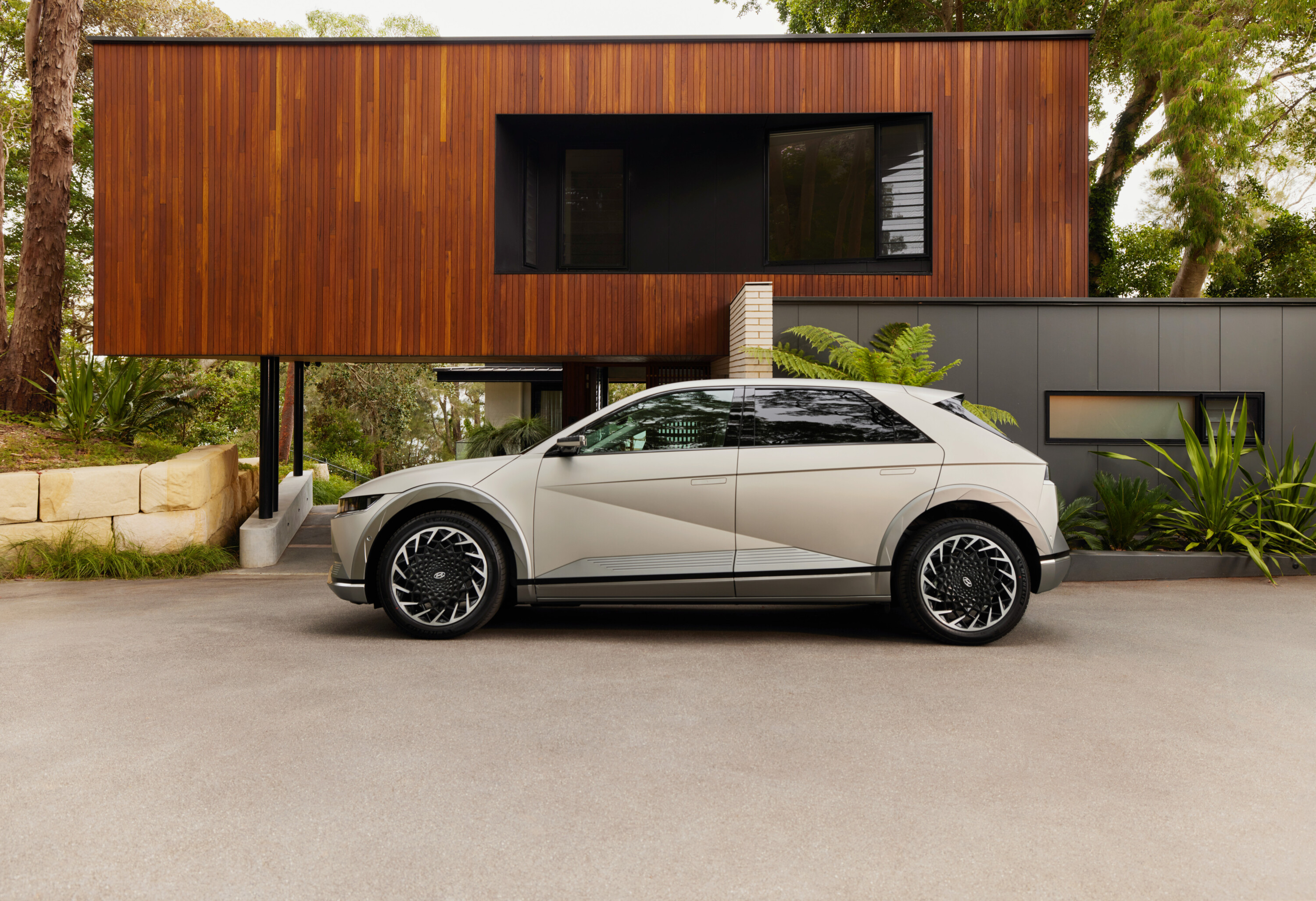
The last model I’ll touch on here is the utterly massive Hyundai Ioniq 5, which dropped to $65k in October 2023, while gaining much improved supply into our market.
The entry RWD model ‘only’ claims 384km of range, but you’ll get 800V ultra fast charging, large-SUV interior space with a huge boot, and a strong standard equipment list. Bump your spend to $70k and you can have 507km of range.
Now, back to the Renault.
1
Interior quality, comfort, space and storage
Stylish, comfortable, and surprisingly roomy.
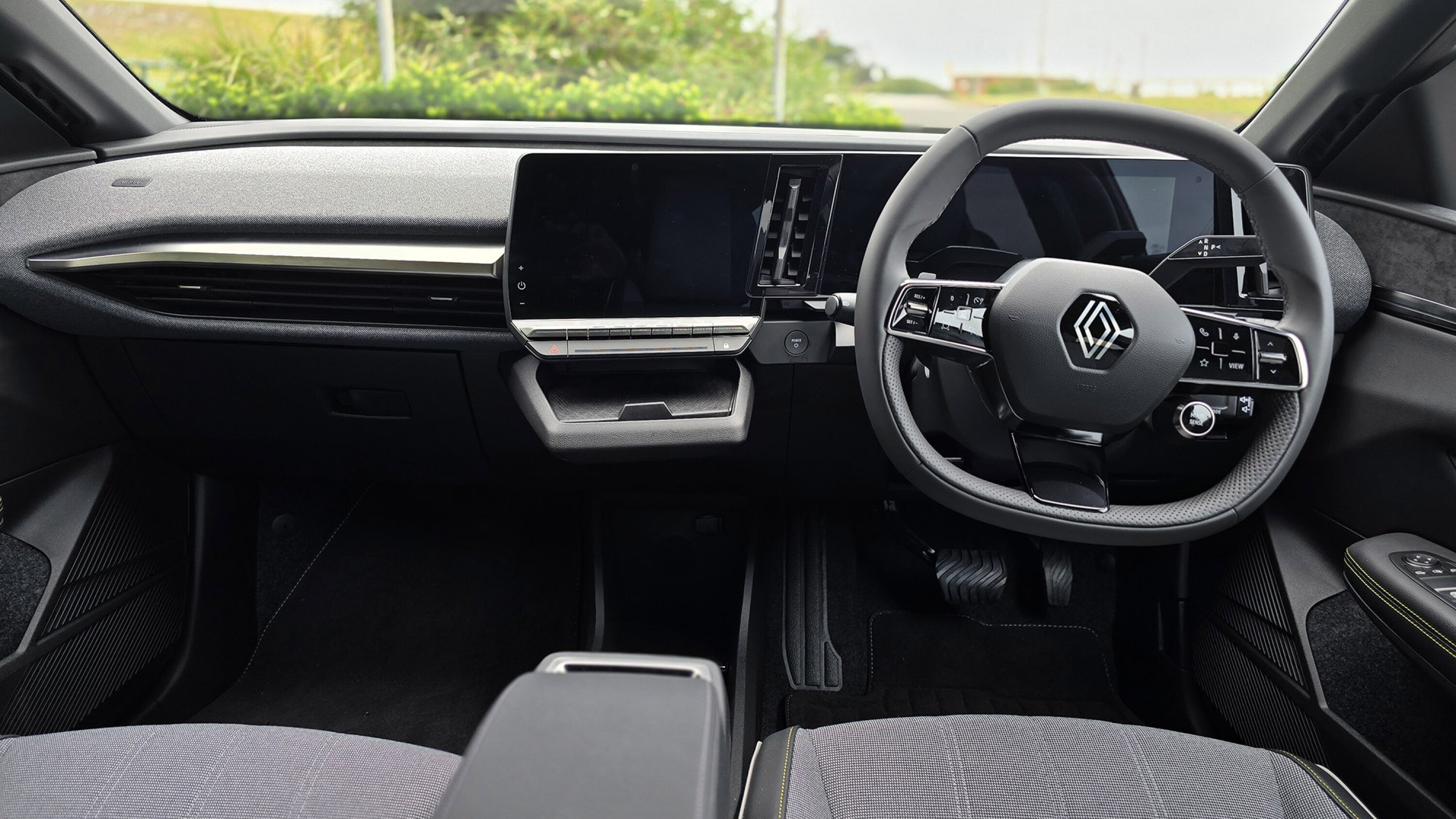
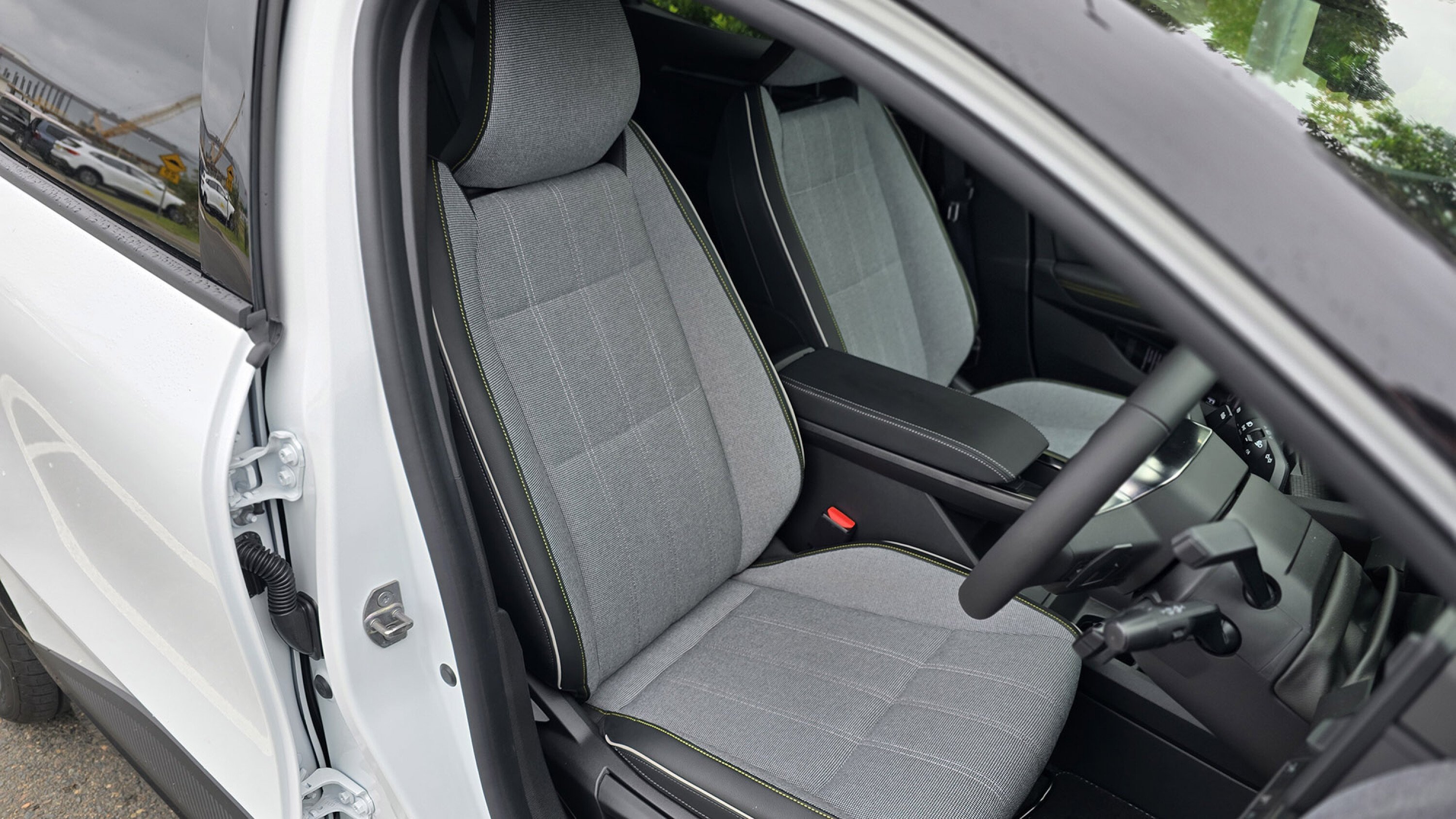
The Megane E-Tech presents with a modern and stylish interior, but it’s not the premium space the brand would like you to imagine.
Fit and finish are no more premium than its price rivals – let alone the markedly cheaper Kona Electric and BYD Atto 3 – but the reality is that most modern cars deliver in this area.
1
The large, plain, unadorned plastic panel surrounding the tiny overhead lights seems particularly uninspired and budget-focused, as does the plain, seemingly unfinished power button in the equally plain dash panel.
Renault would perhaps describe these as intentionally minimalist touches, focused on sustainability – but the finger smudges around the button in our test car didn’t scream thoughtful design.
1
Recycled materials
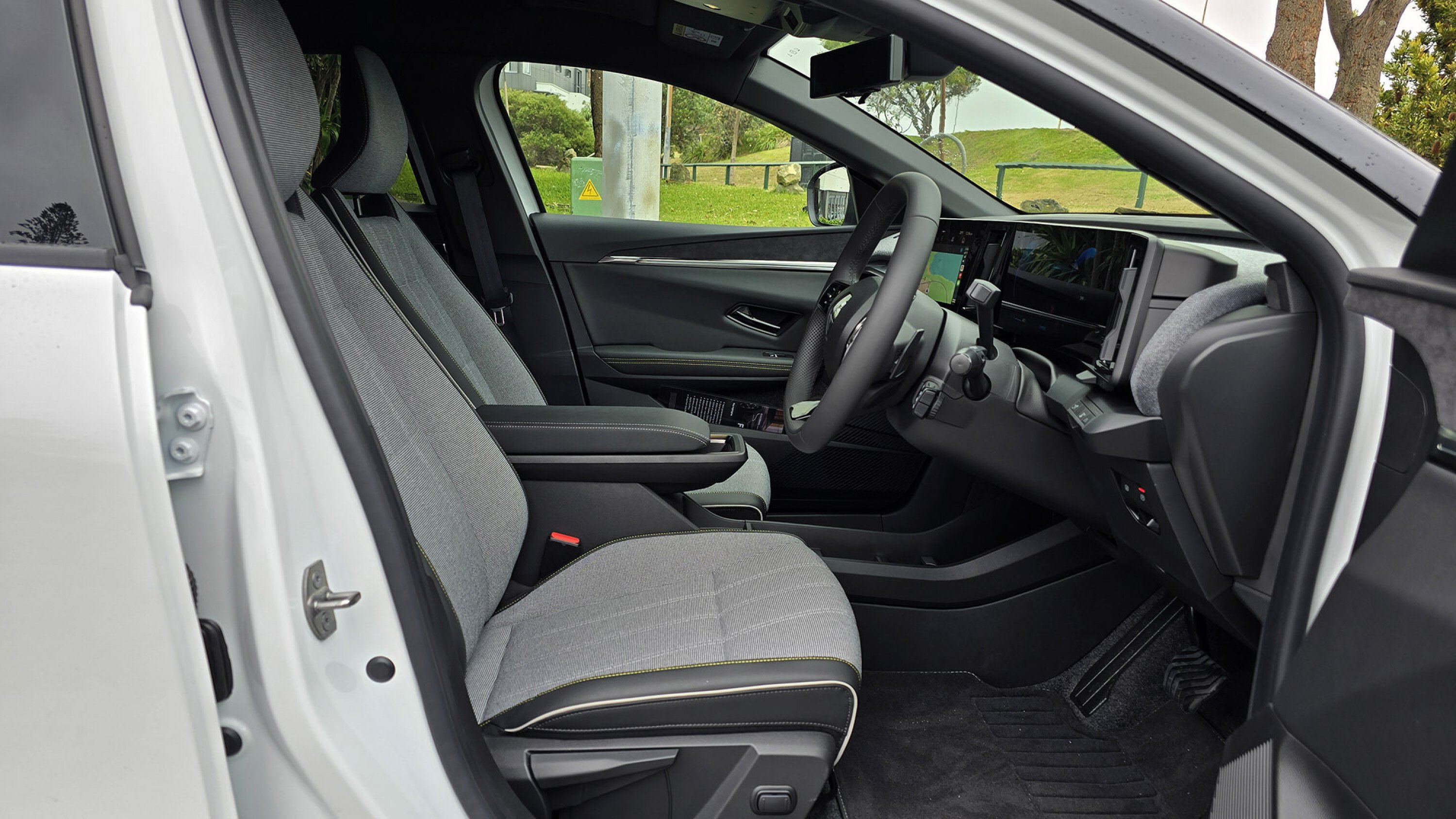
The Megane E-Tech follows a few of its rivals with a liberal use of thoughtfully recycled materials in the cabin, from the nice textile cloth on the dash and seats to the faux leather and suede panels in the doors and bolsters, to the flocked door pockets – and the hard plastics that feature throughout the cabin.
$60k would once get you a few more soft surfaces at common touch points, but not so much in the EV era. In fact, the only real leather in this car is the Nappa trim of the steering wheel and arm rest. Frequent contact surfaces.
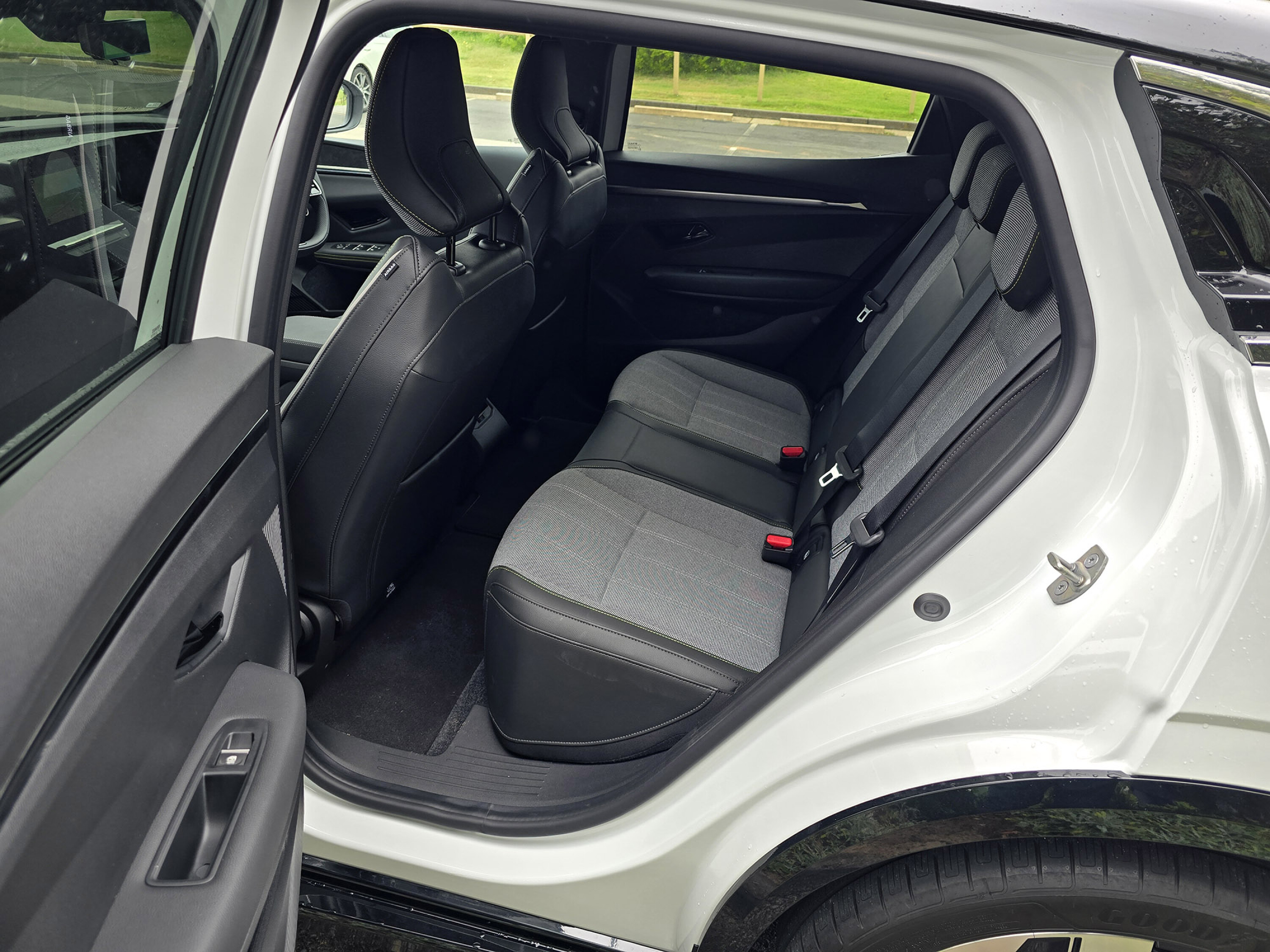
1
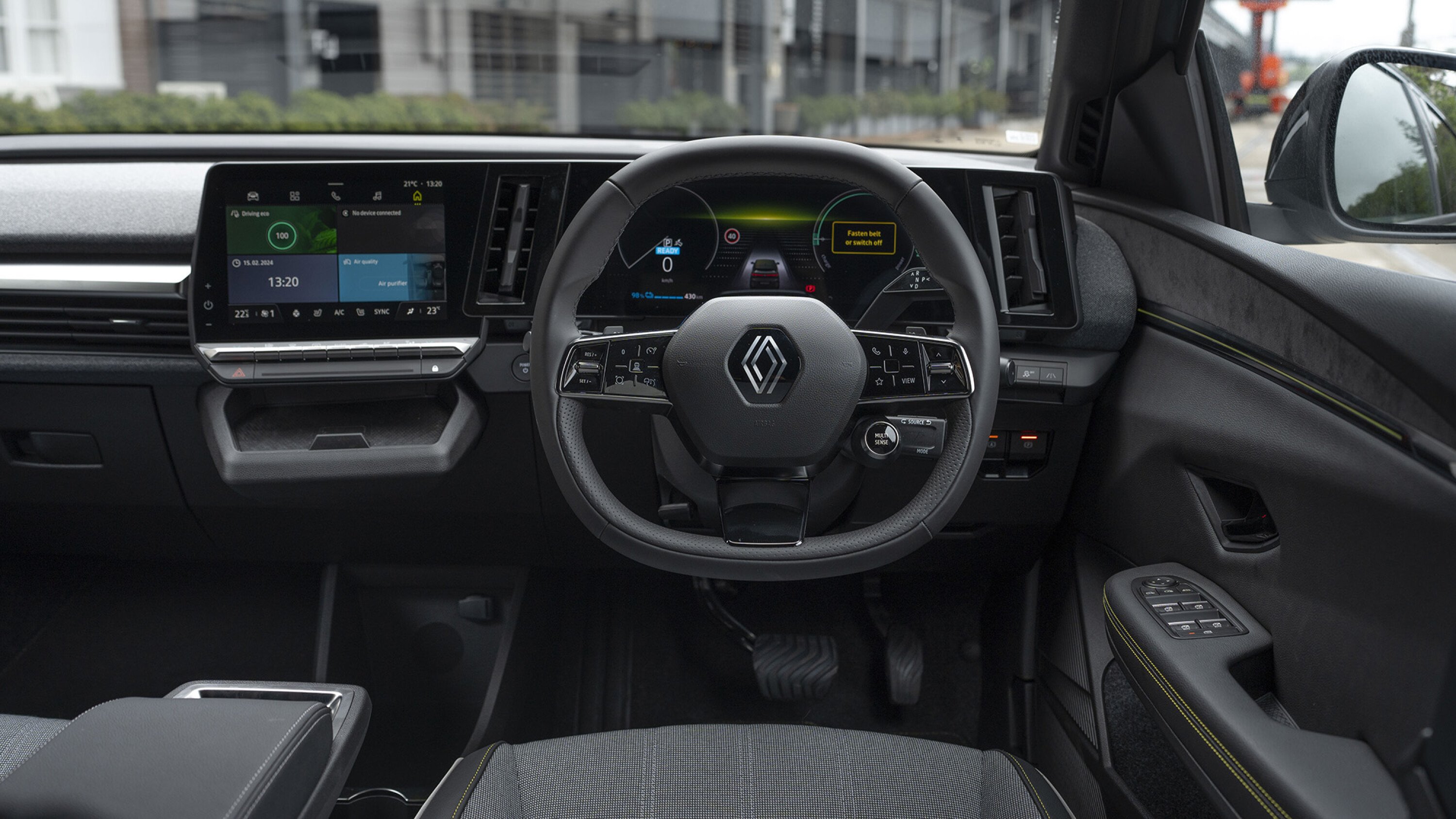
Interior space
Space in the front row is about standard for a small car, with decent legroom and enough shoulder room to comfortably share the centre armrest without feeling a little too intimate. There’s no sunroof to eat up space, so headroom is likewise good.
Like most new EVs, the Megane E-Tech uses its electric platform to good effect for maximising passenger space.
1
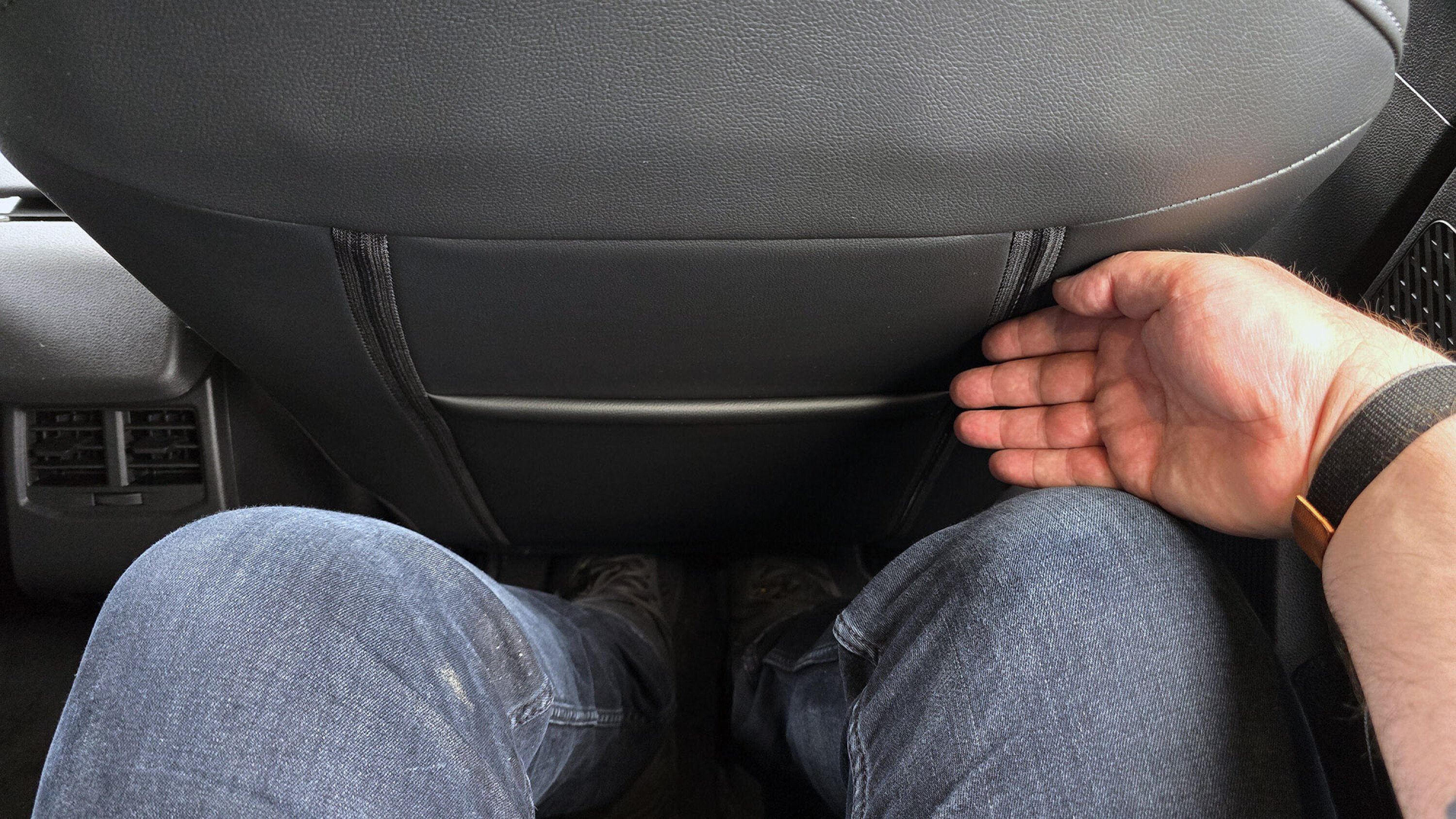
With a 2665mm wheelbase – 20mm longer than the Megane hatch it replaces – this new generation offers more rear legroom than its predecessor, despite being 150mm shorter overall on the outside.
At 5’9” (175cm), I have a hand’s width between my knees and the driver’s seat in my own position, along with a little – not generous – wiggle room for my toes beneath the seat.
Storage in the cabin is generous, with reasonably wide door pockets, a deep cubby beneath the arm rest, two cup holders – one of them adjustable, positioned in the large open tray where a transmission tunnel would otherwise live. (Gears are shifted with a stalk on the steering column.)
1
Boot space
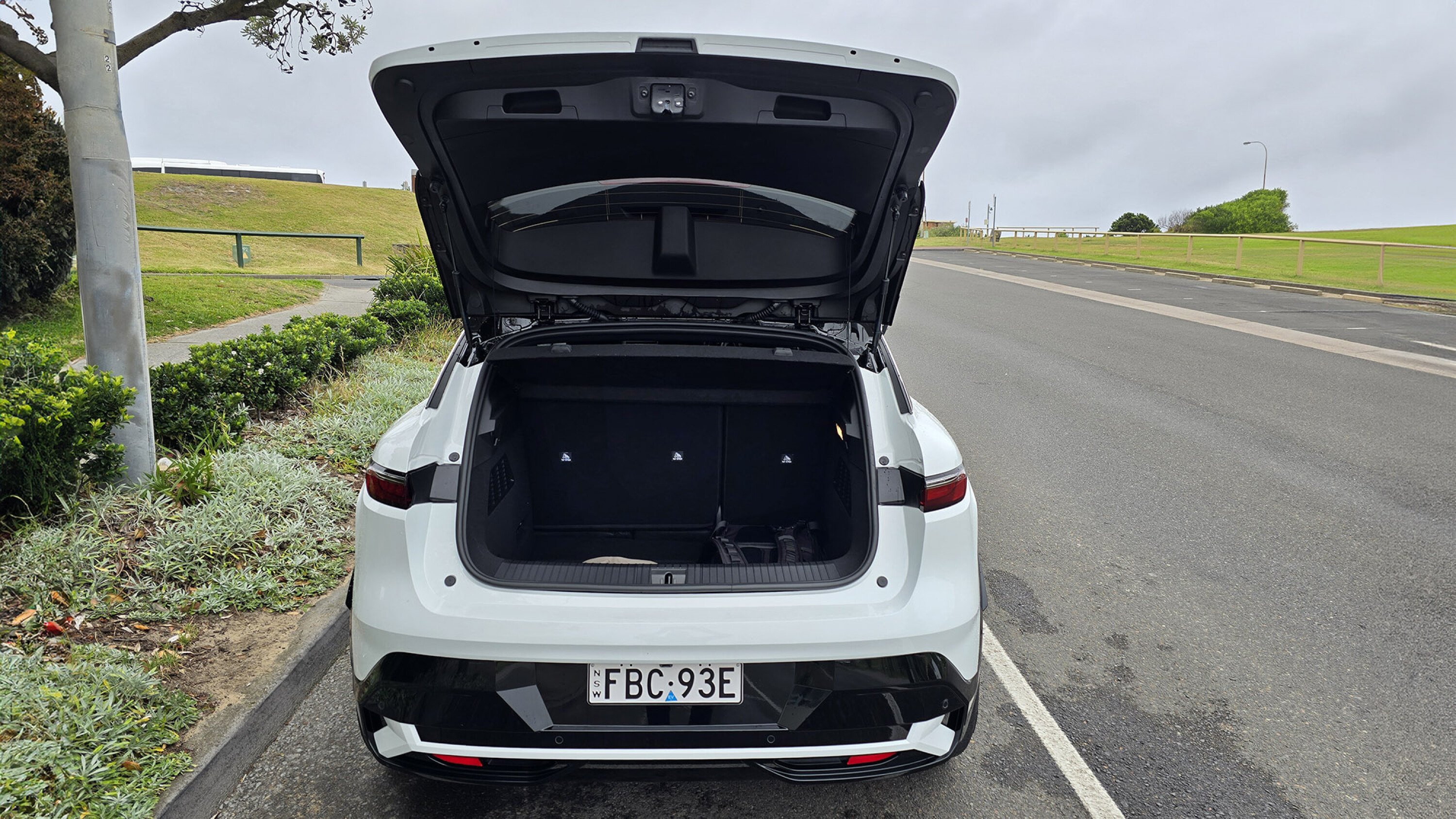
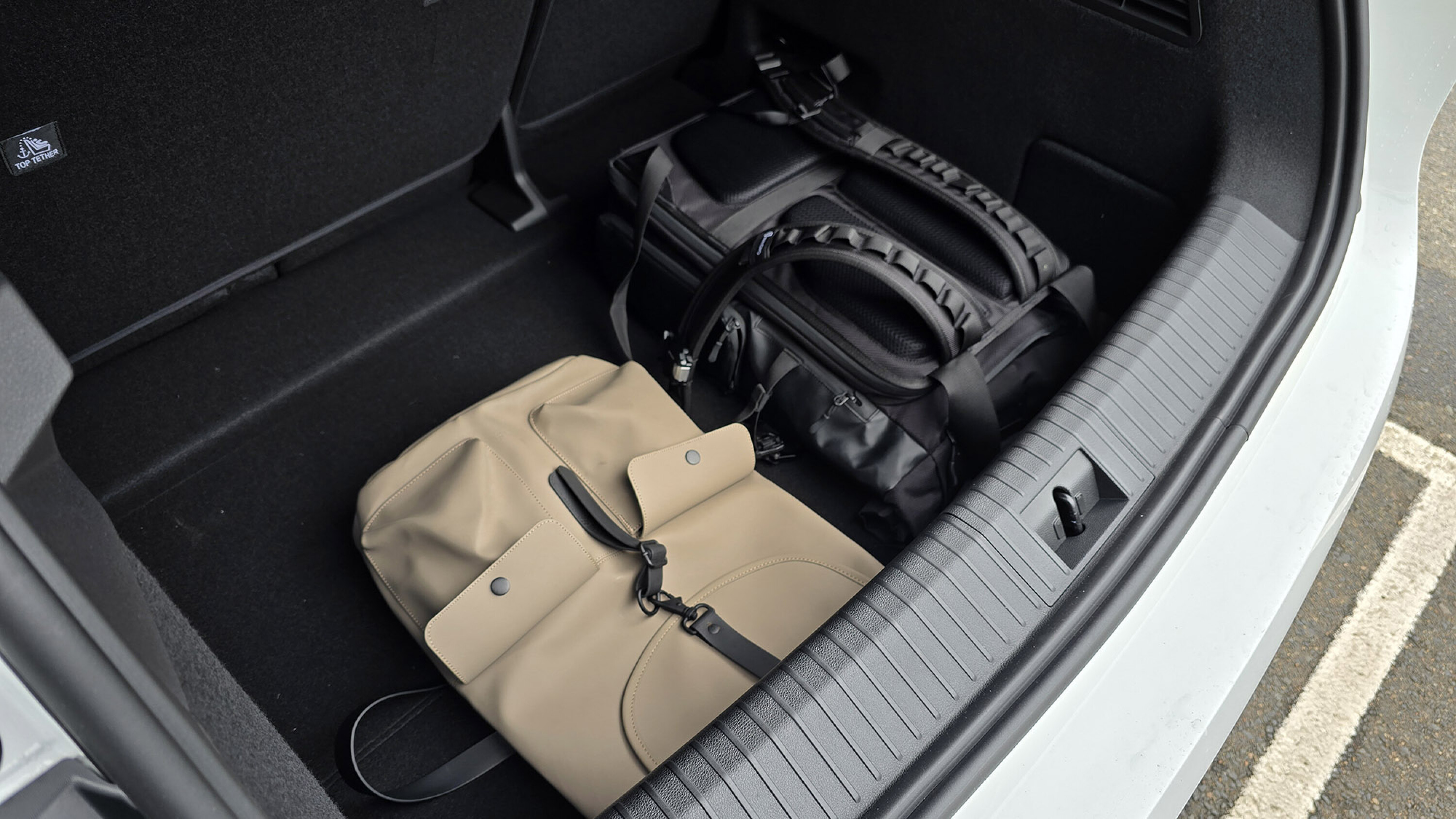
As with that space in the second row, the Megane E-Tech’s boot is actually 10 litres more capacious than in the previous Megane, with 440 litres available in a deep space behind the rear seats.
The rear seats fold in a 60:40 configuration (60 on passenger side) to reveal more boot space, expanding to a useful 1332 litres.
1
There’s a high loading lip, however, so lifting heavy items out will require some thought for your back.
There’s no spare wheel, and as with those front seats, the tailgate isn’t powered.
You’ll also miss out on a ‘frunk’ (storage under the bonnet), because that’s where the motor is. It saves around 100kg in cables and cooling, at least.
Mini matchup: Boot space
| MODEL | WHEELBASE | BOOT | u2018FRUNKu2019 |
|---|---|---|---|
| Megane E-Tech | 2665mm | 440-1332L | No frunk |
| Polestar 2 | 2735mm | 405-1095L | 35L |
| Tesla Model Y | 2890mm | 854-2158L | 117L |
| Kia Niro | 2720mm | 475-1392L | 20L |
1
Technology in the cabin
Wireless connectivity, stylish graphics and physical switches galore
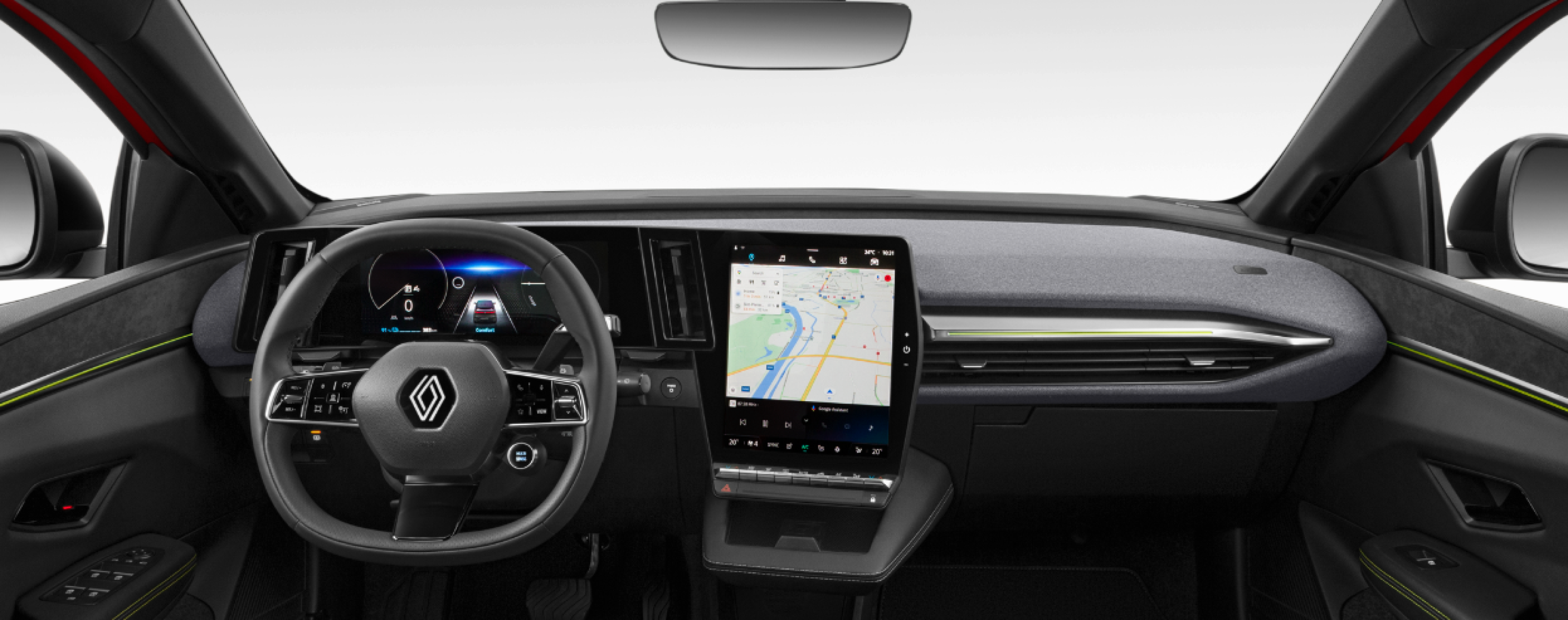
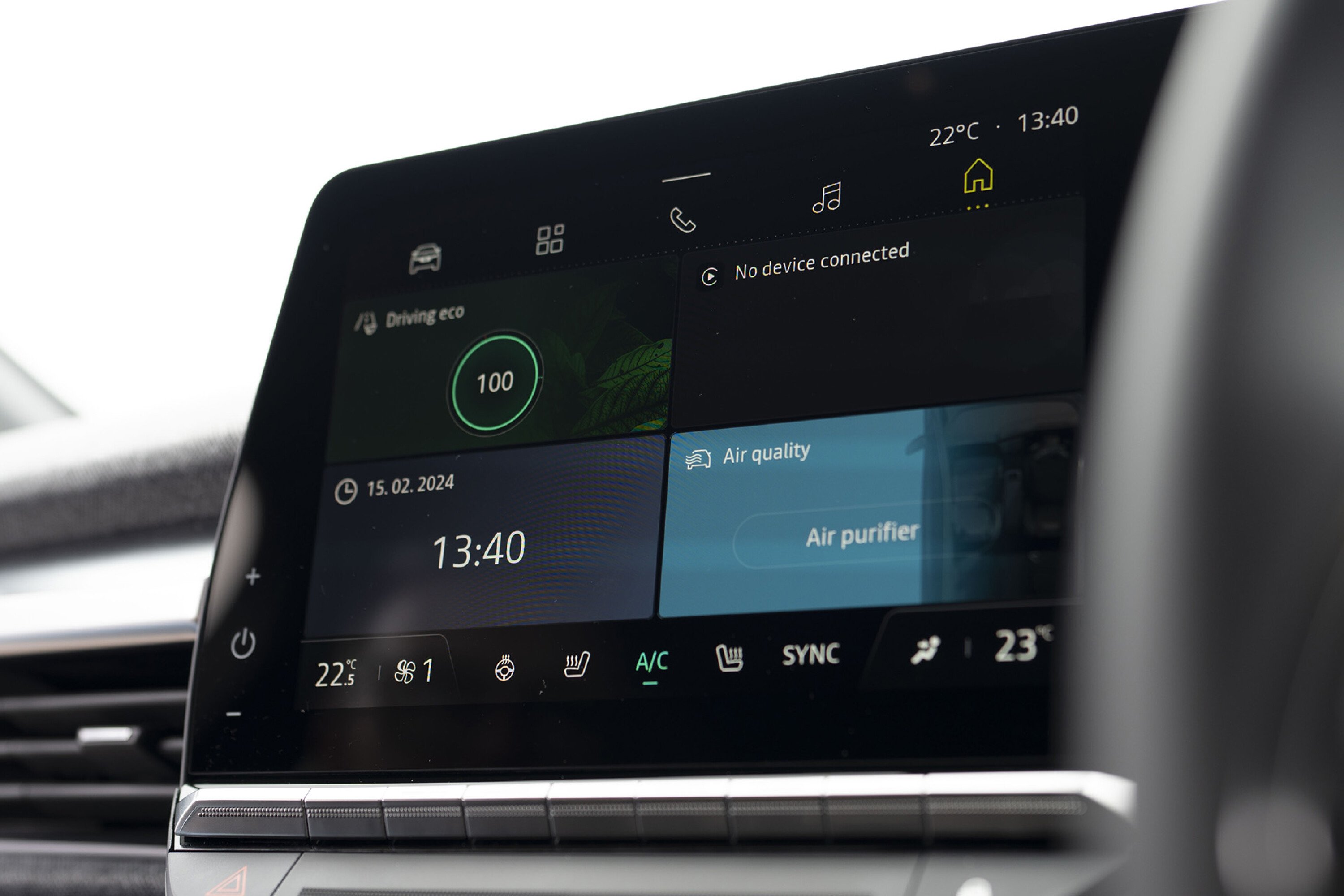
The Megane E-Tech’s two digital displays measure 12 inches for the driver’s instrument cluster and nine inches for the main screen. The larger 12-inch centre display offered in Europe isn’t available with right-hand-drive models; likely as a cost-saving measure. This means any buyers who might’ve stopped in at a Tesla or Polestar showroom before looking at the Megane will notice it’s a much smaller screen – for those who care about such things.
1
Size aside, the Megane’s Android Automotive-based RLink infotainment system is fast, responsive and very high resolution.
There’s wireless connectivity for Apple CarPlay and Android Auto matched to a wireless charging pad beneath the screen – although I noticed my Samsung Galaxy S24 Ultra phone lost more charge than it gained while using this pad and running Android Auto.
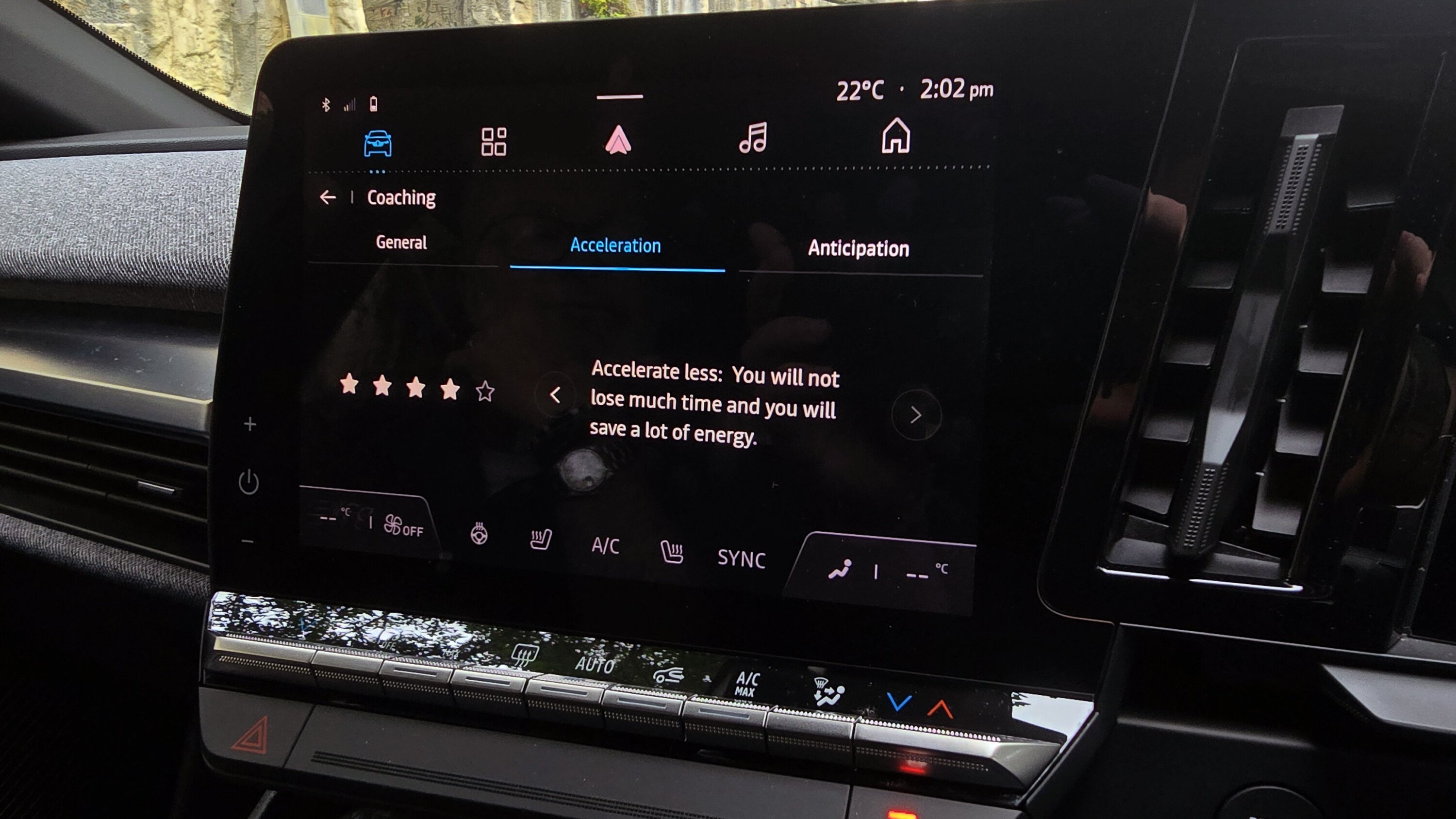
Neat features of the infotainment system include a driving score with tips for efficient energy use (I was given a four out of five, with advice to accelerate less…) and a window in the driver display that shows how many seconds’ space you’re maintaining between you and the vehicle in front.
1
Heating and cooling is managed by toggles beneath the display ( you should note Europe’s larger screen does away with these switches), and rear passengers get vents in the back of the centre console – but no USB charging ports of their own.
A set of the usual controls are featured on the squircle-shaped steering wheel, but you’ll still need to adjust volume with the small controller that juts out from the lower side of the steering column.
2
What is it like to drive?
Our launch-day test consisted of a ‘choose your own adventure’ opportunity to fill about three hours however we could, starting out from The Revy in the centre of Sydney.
I put my driving partner, a Sydney native, in charge of our destination. “Have you been to La Perouse?” he asked. I hadn’t, so off we went. Nearly an hour later, we’d travelled the 18km to the site named for French naval captain Jean-François de Galaup, comte de Lapérouse. From there we trekked to North Sydney over the Harbour Bridge, before making our way back to Pyrmont while avoiding the M1 tunnel that had been closed by a car fire. [↗]
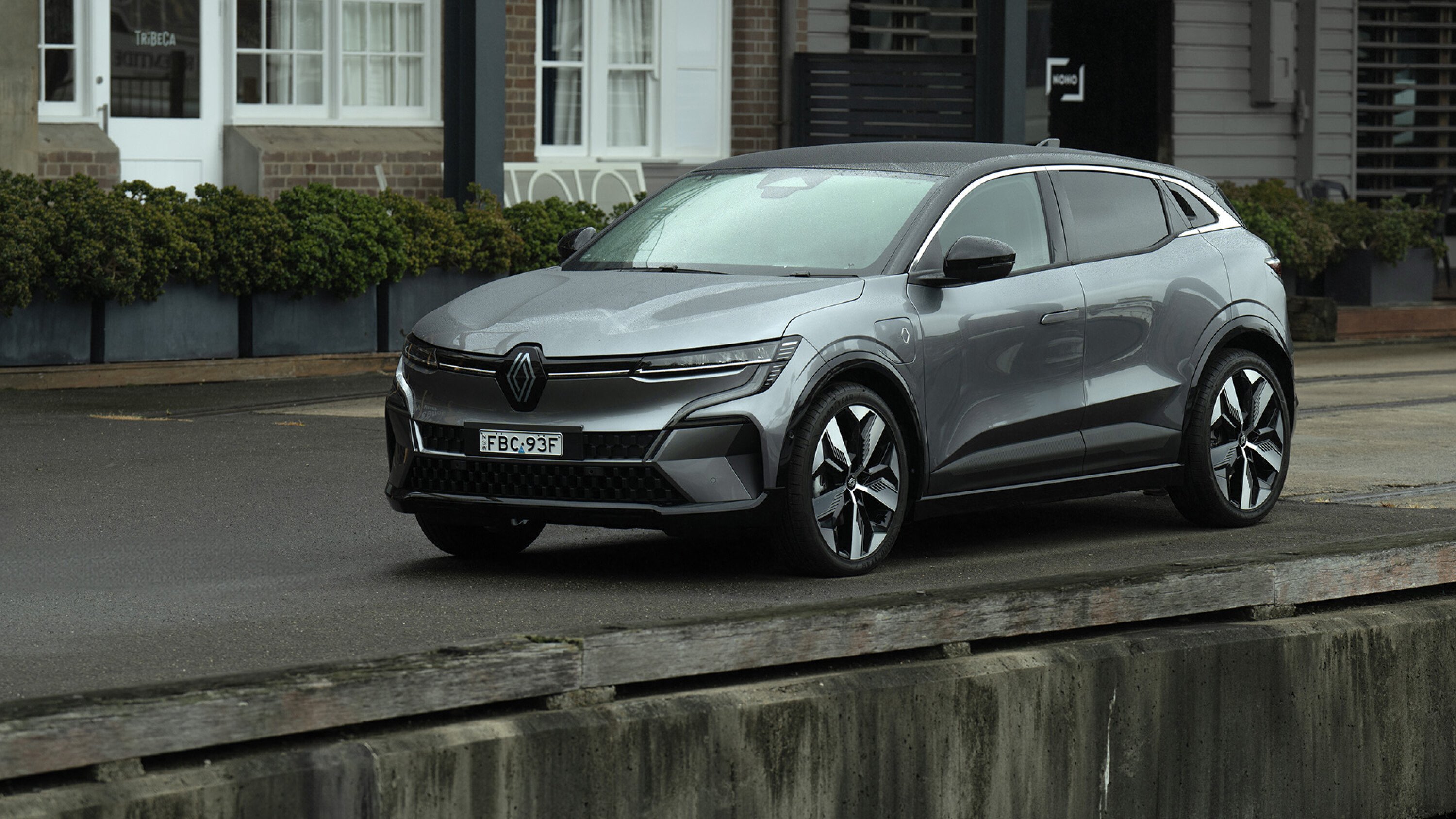
1
Some things to know about the Megane E-Tech, the car that “feels like a GTI” – its centre of gravity is 90mm lower than the petrol Megane’s, thanks to an overall focus on lightweighting that lets its 400kg battery pack play a useful role in dynamics.
It doesn’t accelerate like a GTI to 100km/h, but it’ll get to 60 in just under four seconds, so it’s got plenty of poke for a fun little squirt around town. Stuck as we were in Sydney’s busy and often crawling city streets, there were few opportunities for that, let alone a proper assessment of the new Megane’s dynamic potential.
One thing we had plenty of time to assess when not poking at the dashboard while waiting for traffic, was ride quality. Where we couldn’t find long and empty winding roads, we did find plenty of potholes, expansion joints and broken surfaces – and the word is good.
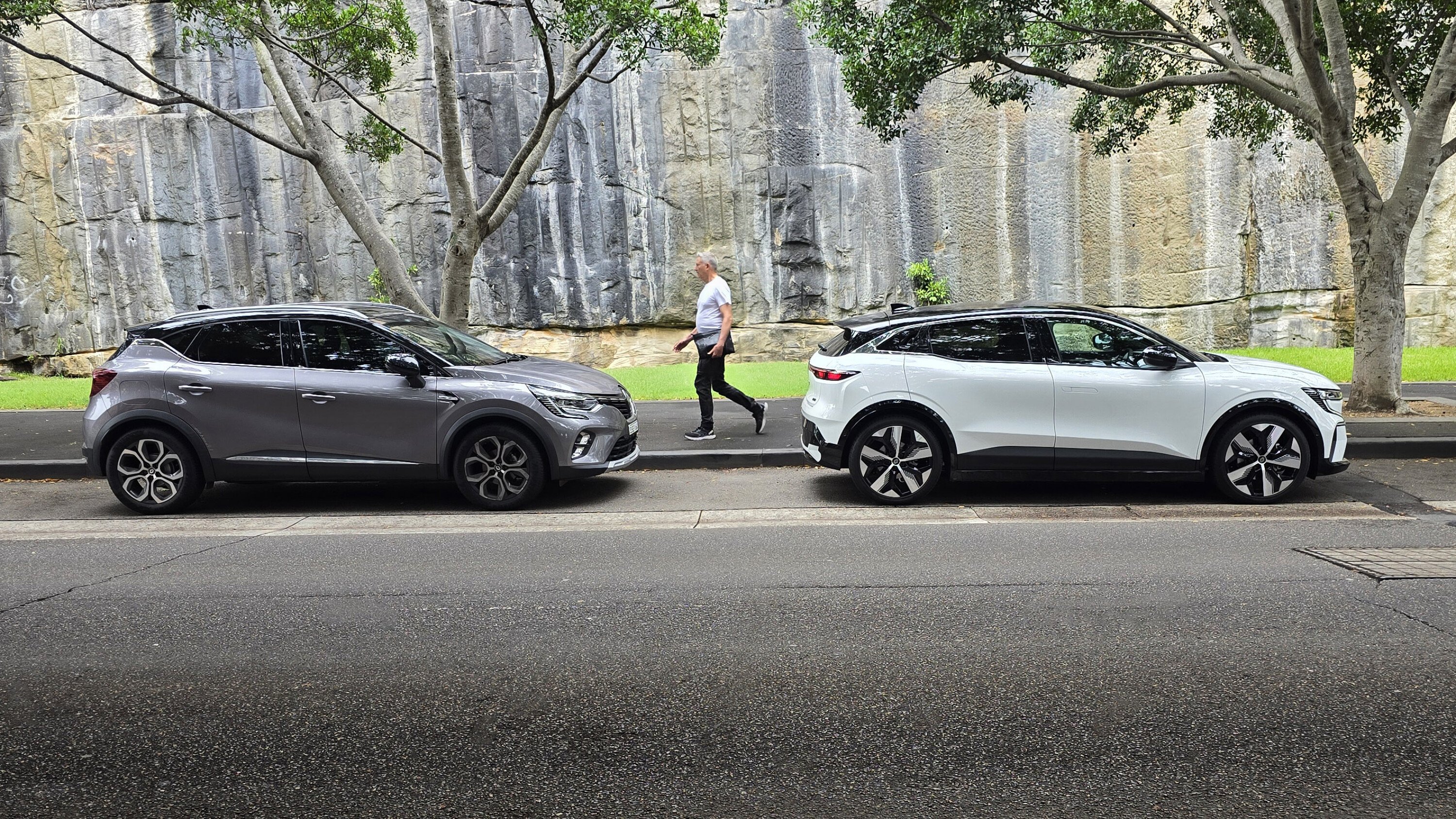
1
The ride is firm on those 20-inch wheels and sports-focused suspension tune, but in the right ways. You’ll feel every bump beneath you, but it won’t jar.
The ride settles quickly and assuredly, highlighting the difference between Renault Sport and retched suspension. The firm but comfortable front seats also help in this regard, with decent bolstering below and behind.
Steering is likewise confidence inspiring, with a surprisingly direct connection – just as Sealey promised – and good on-centre feel in highway driving. There seems little doubt the Megane E-Tech would be a properly fun drive in the right conditions, but we’ll have to test that another day.
The steering-mounted ‘Multi Sense’ button unlocks other driving modes, from a conventional eco mode to a suitable Sport mode that opens the door to that 7.4-second 0-100km/h claim. Feels quicker than that in the seat of the pants, as EVs often do.
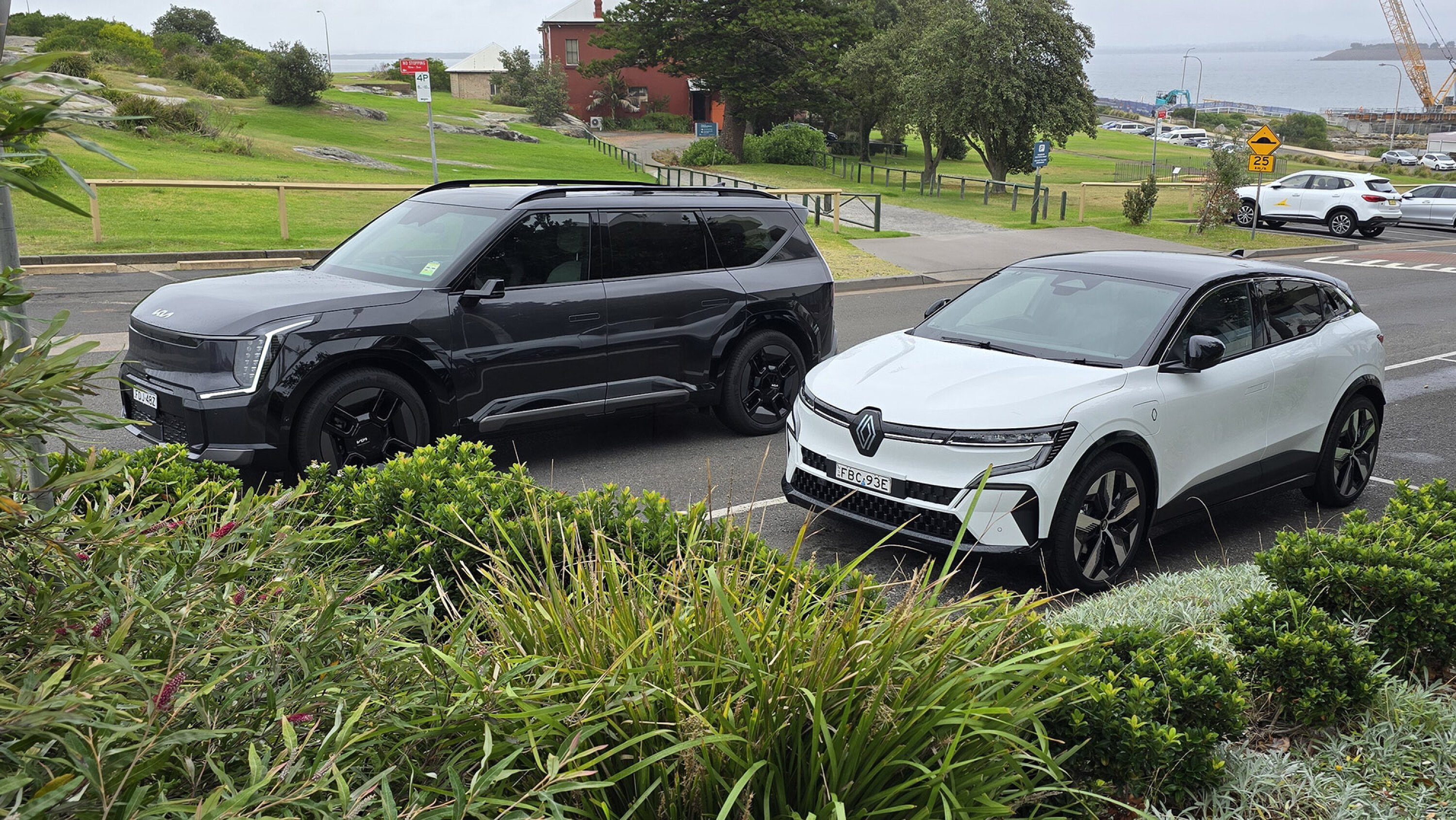
1
Brake-regeneration modes are adjustable via the paddles behind the steering wheel, useful in regular driving for conserving efficiency and in Sport mode for a sense of trail braking in corners.
Alas, there’s no true one-pedal mode, with the heaviest regen level merely slowing you to a crawl. A proper press on the brake will still be required.
Insulation is fine if not impressive. The sounds of road noise, wind noise and passing cars are all kept from the cabin reasonably well, but perhaps not to the “real cocoon” levels Renault claims in its media for the Megane E-Tech.
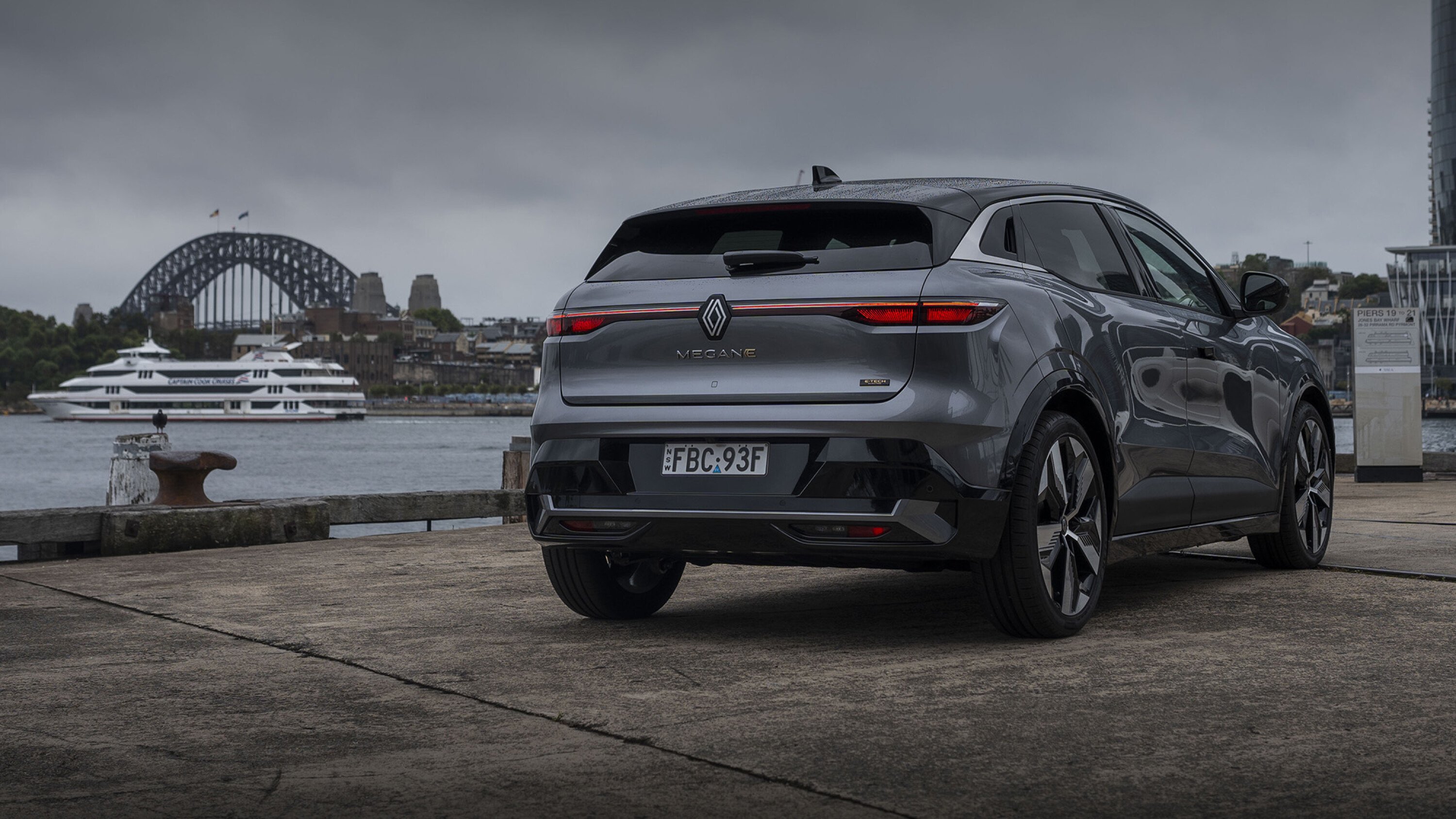
1
How is it on fuel?
The Megane E-Tech lists a claimed efficiency rating (WLTP) of 15.6kWh/100km.
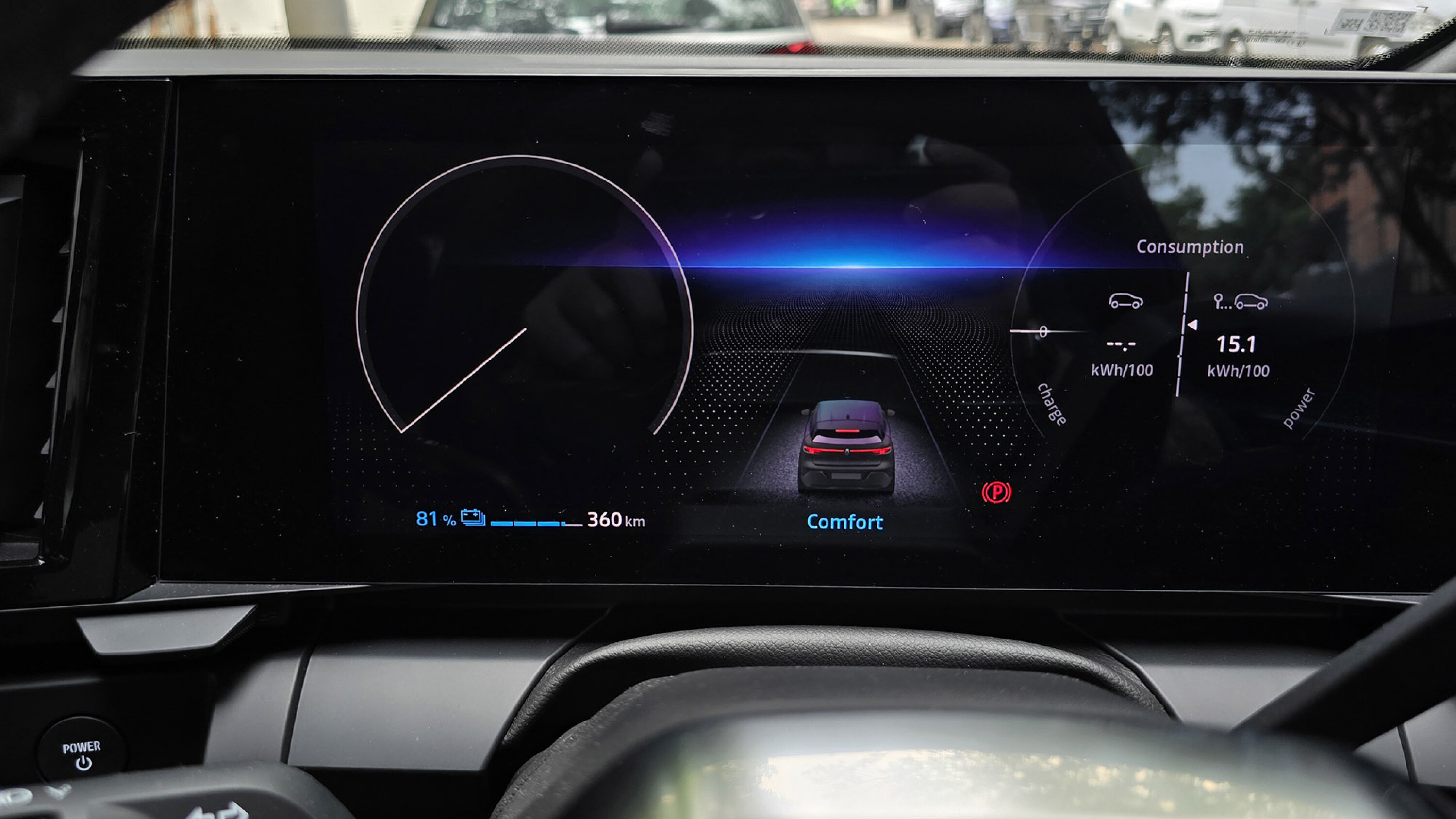
Over 55 kilometres of largely city driving with plenty of crawling stop-start traffic and a few lengths of 100km/h tollway runs, our Megane returned an indicated figure of 15.1kWh/100km – suggesting the claimed number should be comfortably doable.
Renault claims a driving range of up to 454 kilometres for the Megane E-Tech.
As our indicated efficiency suggests, we departed with 435km indicated range in our tester, and returned with 360km indicated.
How safe is it?
The Megane E-Tech’s standard safety list leaves little to be desired, including a five-star ANCAP crash safety rating.
Highlights include smart traffic sign recognition, automatic emergency braking with junction assist and pedestrian/cyclist detection, driver drowsiness alert, emergency lane keeping assist with oncoming traffic and road-edge detection, adaptive cruise control with speed limiter, blind spot recognition and intervention, and rear cross traffic alert with rear automatic braking.
| PASSIVE SAFETY | ACTIVE SAFETY |
|---|---|
| Driver & front passenger airbags | Electronic Stability Control (ESC) |
| Driver & front passenger chest side airbags | Anti-lock Braking System (ABS) |
| Front centre airbag | Emergency Brake Assist (EBA) |
| Front & rear curtain airbags | Active emergency braking with pedestrian and cyclist detection and junction assist |
| Seat belt warning light & tone for driver & all passengers | Safe following distance warning |
| Height-adjustable front and rear headrests | Lane departure warning |
| ISOFIX child seat anchorage points on the rear outermost seats | Lane keep assist |
| 3 Child seat anchorage points for rear seats | Blind spot detection with emergency intervention |
| Child safety lock on rear doors | Cruise control and speed limiter |
| Window lock function | Adaptive cruise control with stop & go |
| Rear fog light | Traffic sign recognition with automatic adjustment of cruise control speed based on recognised speed |
| Pedestrian warning sound (3 available sounds) | Driver attention alert |
| Front/rear/side parking sensors | |
| Rear-view camera | |
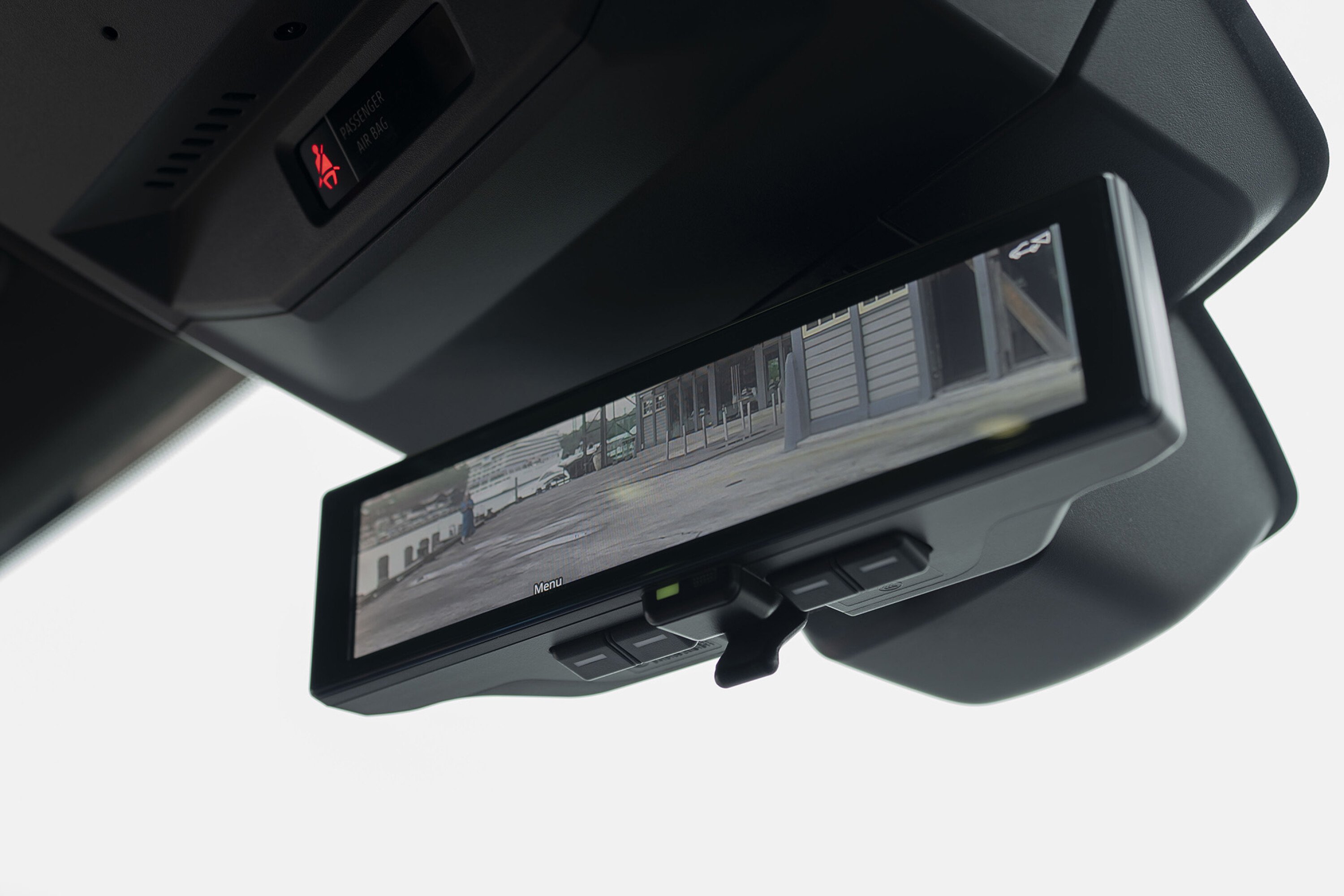
| Smart rear-view mirror with camera | |
| Rear cross traffic alert | |
| Active rear emergency braking | |
| Hill start assist | |
| Tyre pressure monitor |
1
Warranty and running costs
The Megane E-Tech is sold with a standard 5-year / 100,000km warranty, and an 8-year / 160,000km battery warranty.
Servicing costs are outlined below.
| 2024 Renault Megane E-Tech servicing schedule & pricing | |
|---|---|
| 12 months/30,000km: $230.04 | 48 months/120,000km: $519.62 |
| 24 months/60,000km: $292.91 | 60 months/150,000km: $230.04 |
| 36 months/90,000km: $316 | |
By comparison, the Ioniq 5 lists a $220 servicing cost every 12 months / 15,000km, although the 48-month / 60,000km visit will cost $804.
The Polestar 2 requires a service only once every 24 months / 30,000km, and even better: the first five years / 100,000km are free.
1
VERDICT
Loads of appeal for any driven by style, compact proportions, a sporting drive and a very rich equipment list.
It’s so often a ‘horses for courses’ conversation, and the Megane E-Tech is no exception. Those requiring more space will be better off with an Ioniq 5 or Model Y. Those looking for a more outspoken look in their compact EV will love the Polestar 2, but you’ll pay a lot more to match the Renault’s equipment list.
If a well-equipped safety and features list is one of your top priorities, you’ll get that in the Megane E-Tech – along with sleek European style, fast and intuitive infotainment, well-proven electric drive technology, and a well-tuned sporting drive.
Dive into the comments below to let us know which way you’d go!
MORE
Everything Renault
| 2023 Renault Megane E-Tech specifications | ||
|---|---|---|
| Engine | Electric front-wheel drive | |
| Battery | 60kWh | |
| Efficiency kW/100km | 15.6 claimed | 15.1 on test |
| Power | 160kW | |
| Torque | 300Nm | |
| Charging: AC adaptive single phase up to 7.4kW and DC up to 130kW | ||
| 2.3kW domestic socket (10A single-phase) (0-100%) | Approximately 30 hrs 30 | |
| 7.4kW domestic charging point (32A single-phase) (0-100%) | Approximately 9 hrs 15 | |
| 130kW DC rapid charging point (15-80%) | Approximately 30 min | |
| Body & seats | Small SUV, five doors, five seats | |
| L/W/H | 4200 x 1505 x 1768mm | |
| Wheelbase | 4200mm | |
| Boot space | 440 litres | |
| Under-bonnet storage | N/A | |
| Weight | 1332 litres | |
| Suspension | Front: struts, coil springs, anti-roll bar / Rear: multi-link independent | |
| Steering | electric rack and pinion | |
| Brakes | Front: 320mm ventilated discs / Rear: 292mm ventilated discs | |
| Wheels | 20-inch alloy | |
| Tyres | Goodyear EfficientGrip Performance | |
| Tyre size & spare | 215/45R20, no spare | |
Age has not wearied the Mazda CX-3
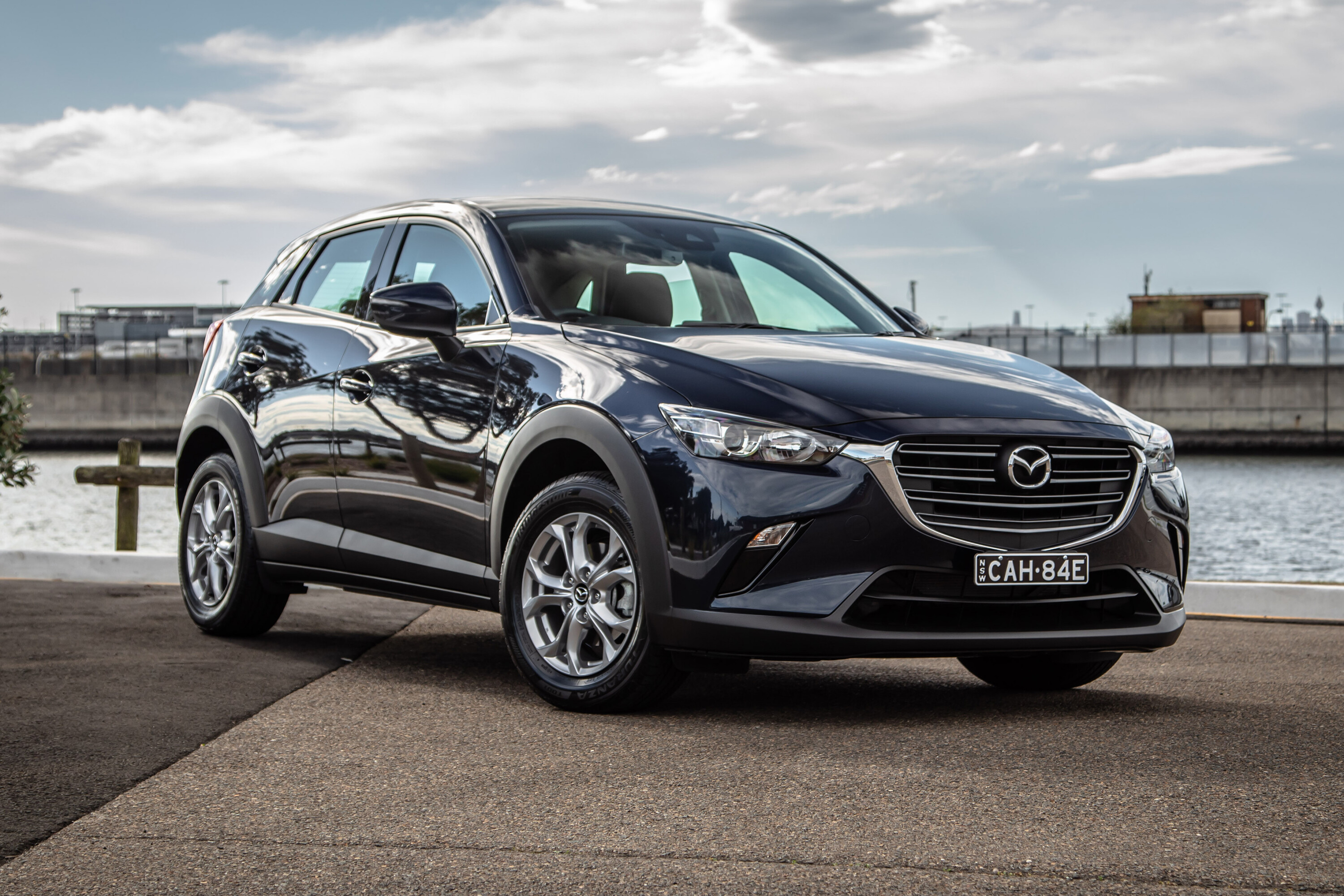
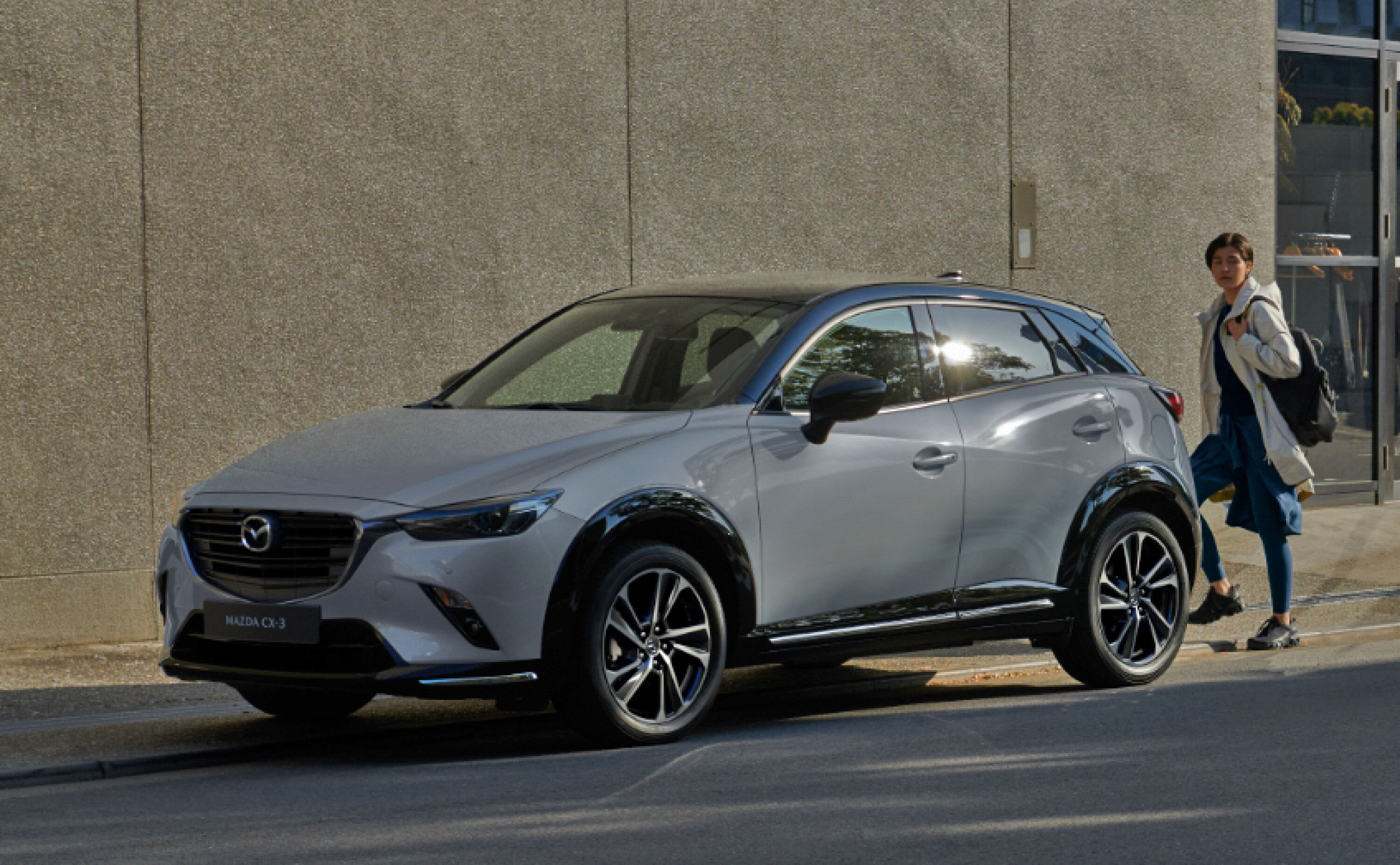
Classed as a small SUV until the light segment was introduced in 2020, the CX-3 has consistently been one of the most popular and highly-rated crossovers in terms of presentation and driver enjoyment.
Launched in 2015, it was one of the first models to feature Mazda’s current design language, which has helped it retain its youthful look – in a showroom you wouldn’t think it has several years on its fresher CX-30 small-SUV sibling.
And, thanks to years of tiny refinements, it is still among the most engaging of smaller SUVs, coping happily with workaday duties and doing highway miles with ease.
2
The only issue with the CX-3 is how long it will hang around. It was withdrawn from the US and European markets in 2021, but its short-term presence in Australia was assured due to its continuing popularity.
However, the success of the new and more practical CX-30, and Mazda’s decision to pare down the CX-3 range in June 2023, suggests it’s now in its twilight phase here despite its heir apparent, likely to be called the CX-20, yet to be formally revealed.
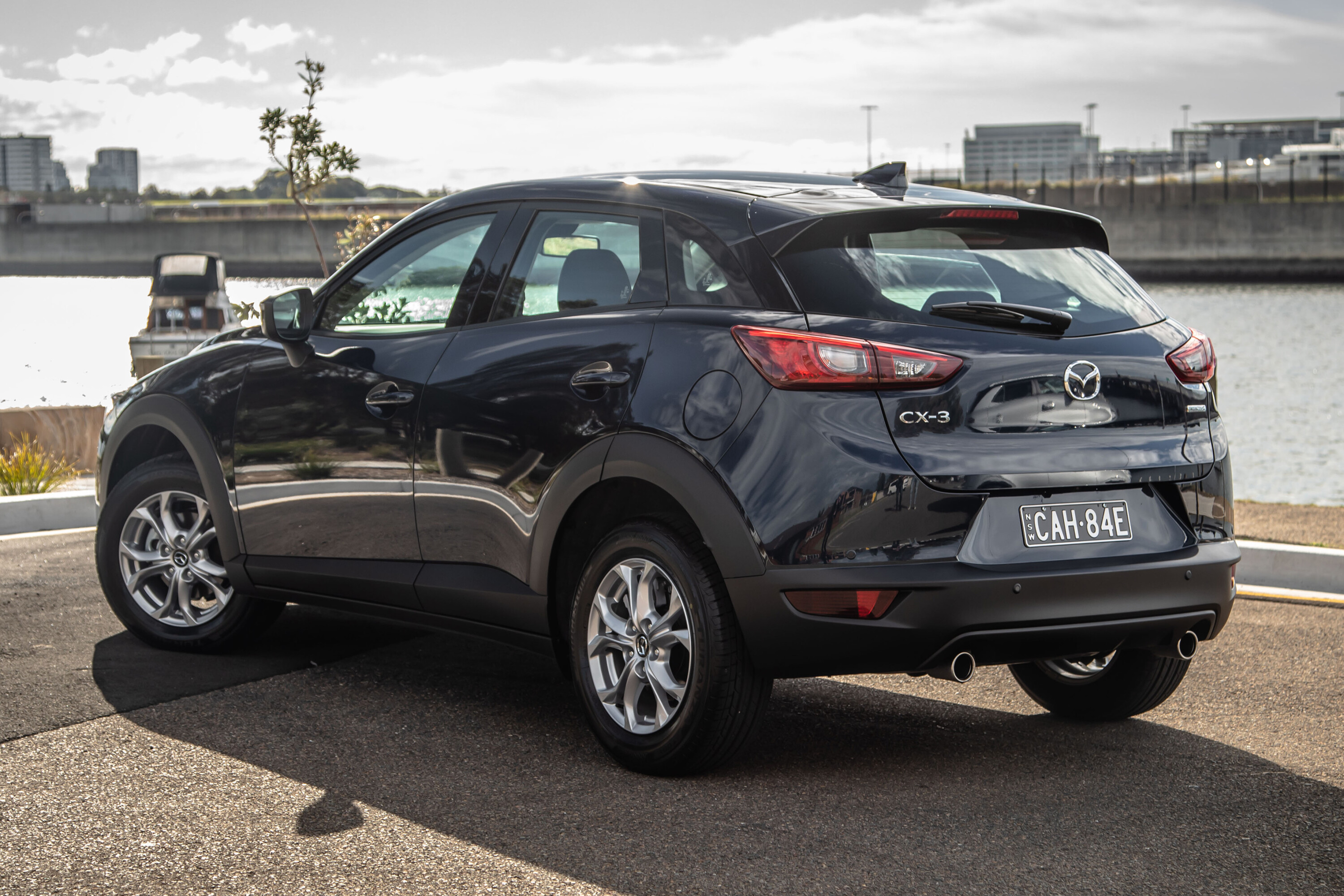
That said, the CX-3 still has a lot to offer toward the end of its lifecycle, which says a lot about its original design.
1
JUMP AHEAD
- What body styles are there?
- 2024 Mazda CX-3 pricing
- What features are in every Mazda CX-3?
- What key features do I get if I spend more?
- How safe is the Mazda CX-3?
- How comfortable and practical is the Mazda CX-3?
- Rear seat space and comfort
- How much boot space does the Mazda CX-3 offer?
- I like driving, will I enjoy the CX-3?
- Which Mazda CX-3 engine uses the least fuel?
- How much can a Mazda CX-3 tow?
- How long is the warranty and what are the Mazda CX-3 servicing costs?
- Which version of the Mazda CX-3 does Wheels recommend?
- What are the Mazda CX-3’s key rivals?
What body styles are there?
Five-door wagon only.
The CX-3 is now only available in front-wheel drive and is classed as a light SUV.
2024 Mazda CX-3 pricing
The CX-3 range was consolidated in June 2023, when Mazda deleted manual and all-wheel drive variants.
Nomenclature was also changed to reflect the rest of the Mazda stable, with Neo Sport, Maxx Sport, Maxx Sport LE and sTouring making way for G20 Sport, G20 Pure, G20 Evolve and G20 Touring SP respectively, with the G20 part referring to their 2.0-litre engine.
| 2024 Mazda CX-3 pricing (before on-road costs) | |
|---|---|
| G20 Sport | $26,800 |
| G20 Pure | $29,300 |
| G20 Evolve | $31,050 |
| G20 Touring SP | $34,300 |
| G20 Akari | $38,620 |
What features are in every Mazda CX-3?
| 2024 Mazda CX3 standard features | |
|---|---|
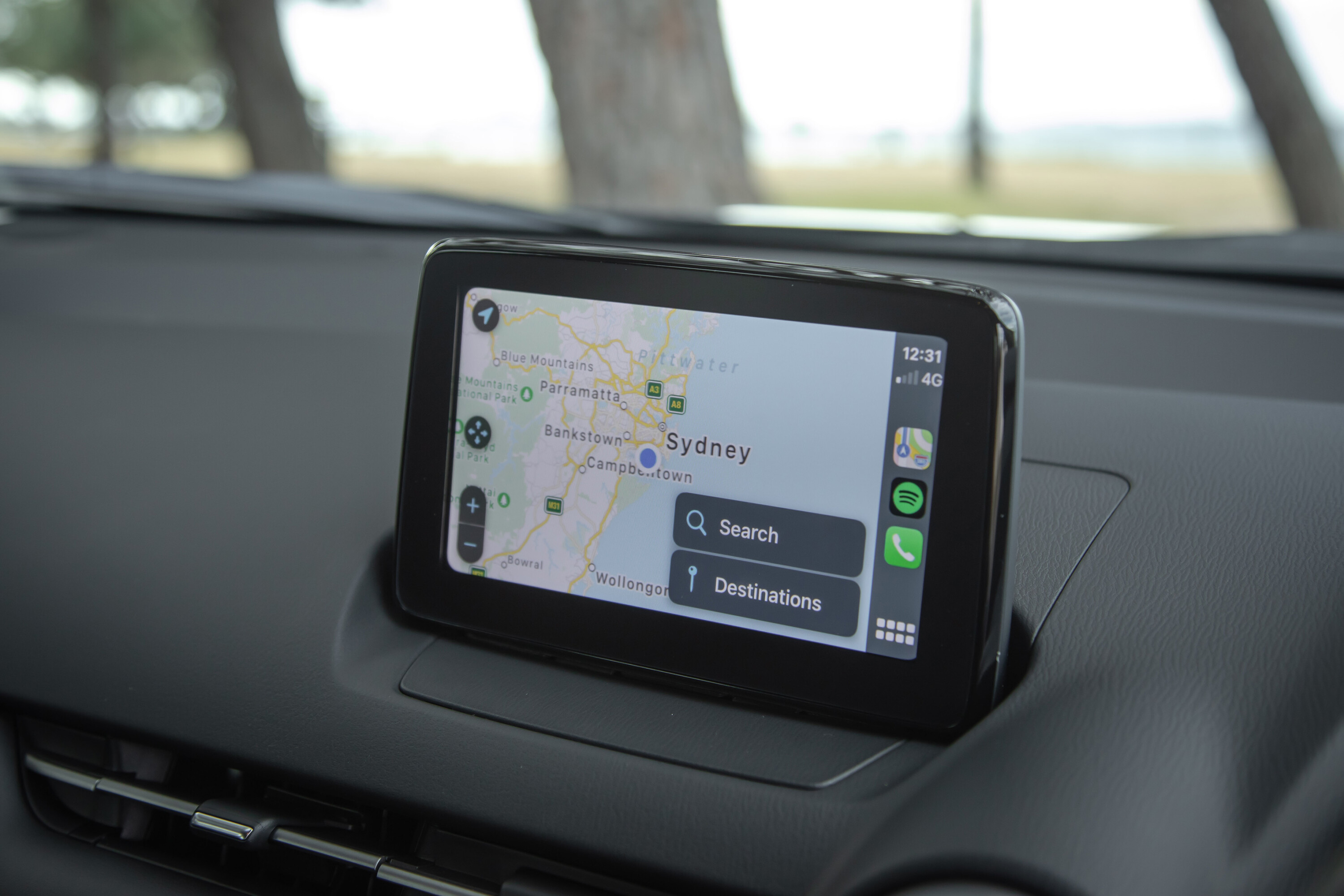
| 8.0-inch infotainment system | Halogen headlights and taillights |
| Air-conditioning | Keyless window open |
| Alloy wheels | Push-button start |
| Auto-folding side mirrors | Rear cross-traffic alert |
| Autonomous emergency braking (vehicle, pedestrian, cyclist, reverse) | Rear parking sensors |
| Blind-spot monitoring | Reverse camera |
| Cloth upholstery | Seatbelt reminders |
| DAB+ digital radio | Wired Android Auto |
| Electric park brake | Wireless Apple CarPlay |
1
What key features do I get if I spend more?
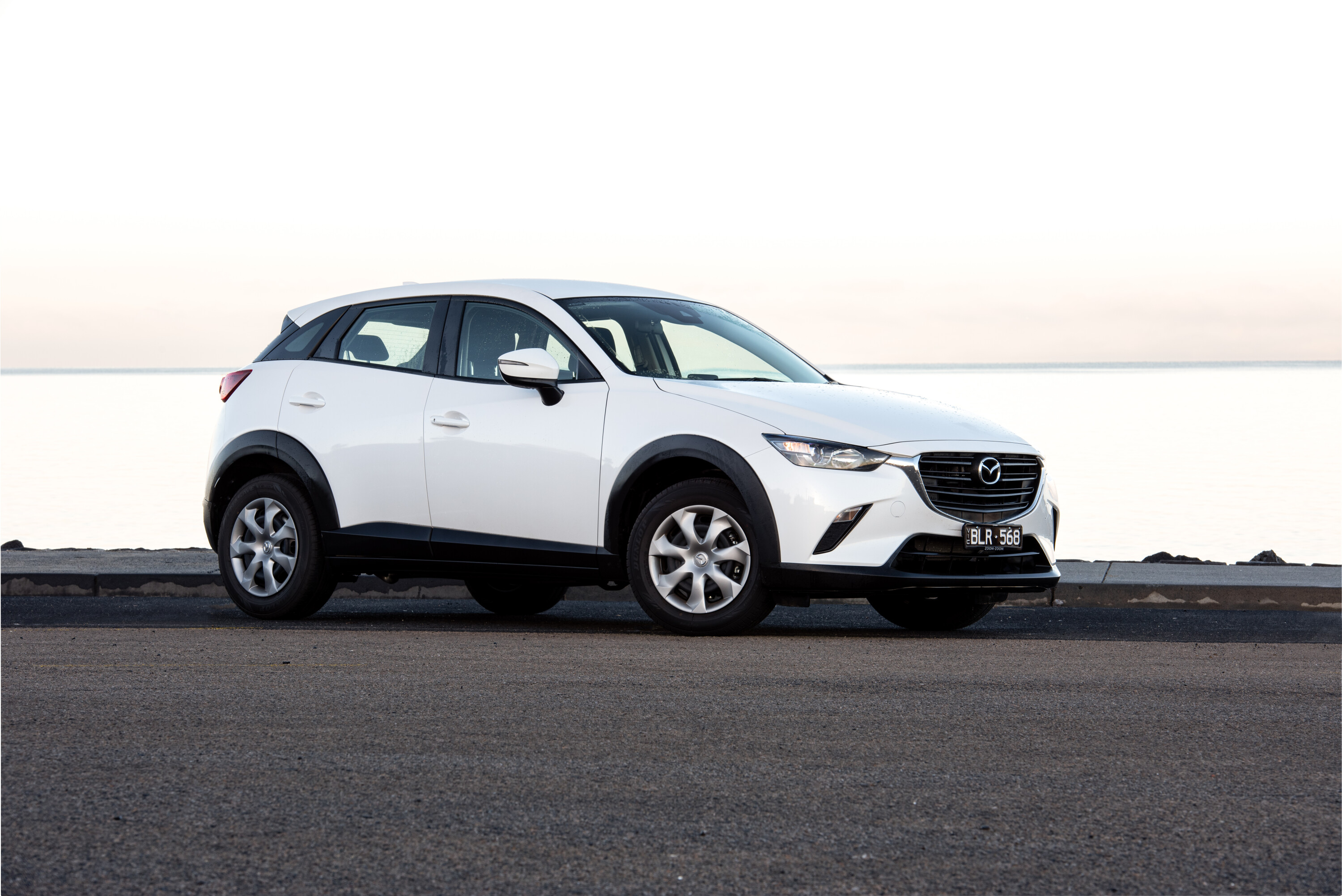
The entry-level CX-3 G20 Sport comes with cloth upholstery, 16-inch alloy wheels, manual air-conditioning, halogen headlamps and taillights, and a six-speaker audio system.
3
5
Spending more on the G20 Pure brings the following features in addition to the G20 Sport.
| 2024 Mazda CX-3 Pure features | |
|---|---|
| LED headlights, tail-lights, and daytime running lamps | Automatic headlights |
| Lane departure warning | Rain-sensing wipers |
| Auto high beam | Satellite navigation |
| Driver attention alert | Auto-dimming rear-view mirror |
| Head-up display | Overhead storage box |
| Leather-wrapped steering wheel and gear shifter | Rear-centre armrest |
| Single-zone climate control | |
Stepping up to the G20 Evolve adds…
| In addition to G20 Pure | |
|---|---|
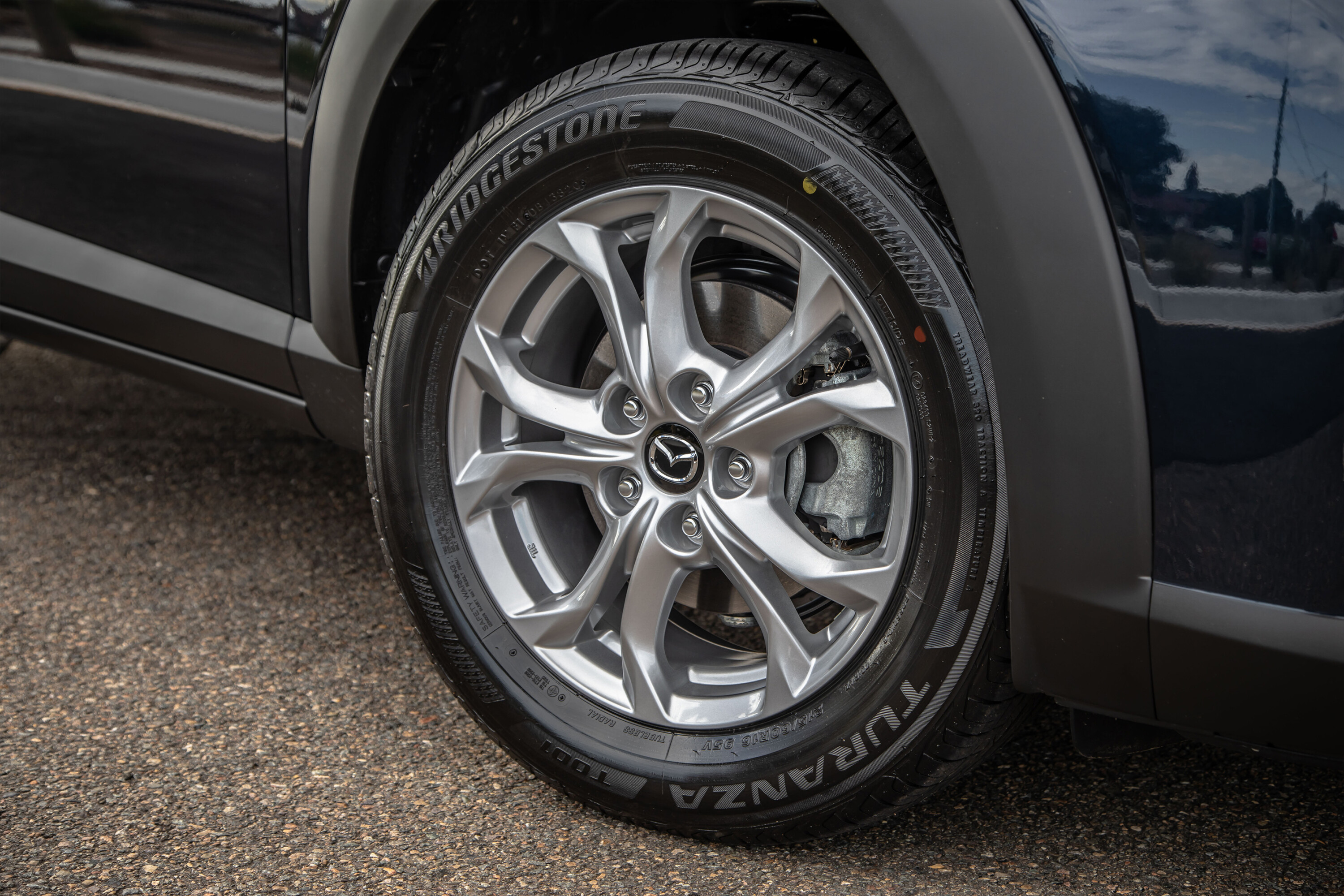
| 18-inch alloy wheels | Tan suede-look trim |
| Front parking sensors | Black grille inserts |
| White leather-accented and suede-look upholstery | Black exterior mirrors |
1
CX-3 G20 Touring SP
| In addition to G20 Evolve | |
|---|---|
| 18-inch black alloy wheels (new) | Body-coloured, heated side mirrors |
| Black painted roof | LED fog lamps |
| Black leather-accented and suede-look upholstery with blue highlights | Heated front seats |
| Adaptive cruise control | Keyless entry |
| 10-way power-adjustable driveru2019s seat with two-position memory | Traffic sign recognition |
CX-3 G20 Akari
| In addition to G20 Touring SP | |
|---|---|
| 18-inch black machined alloy wheels | Black leather upholstery |
| Seven-speaker Bose audio system | Adaptive LED headlights |
| Glass sunroof | 360-degree camera system |
3
Paint
| 2024 Mazda CX-3 colour options | |
|---|---|
| Aero grey (new) | Polymetal grey* |
| Machine grey* | Soul red crystal* |
| Jet black | Platinum quartz |
| Snowflake white | |
| *Premium paint, $595 | G20 Touring SP only available in aero grey, platinum quartz, polymetal grey or soul red crystal. |
How safe is the Mazda CX-3?
The Mazda CX-3 range is no longer covered by an ANCAP safety rating since the previous five-star result, awarded in 2015, expired in December 2022.
Every CX-3 comes with mandatory stability control and six airbags (dual front, side and curtain).
It also has more active safety and driver assist features than when it was first tested by ANCAP.
1
| 2024 Mazda CX-3 active safety/driver features | |
|---|---|
| Blind-spot alert | Rear cross-traffic alert. |
| Driver attention alert | Lane departure warning |
| Rear parking sensors | Reversing camera |
| Adaptive cruise control (Touring SP, Akari) | Front parking sensors (Pure, Touring SP, Akari) |
| 360-degree parking camera (Akari) | Traffic sign assist (Touring SP, Akari) |
| Autonomous emergency braking (vehicle, pedestrian, cyclist, reverse) | |
1
How comfortable and practical is the Mazda CX-3?
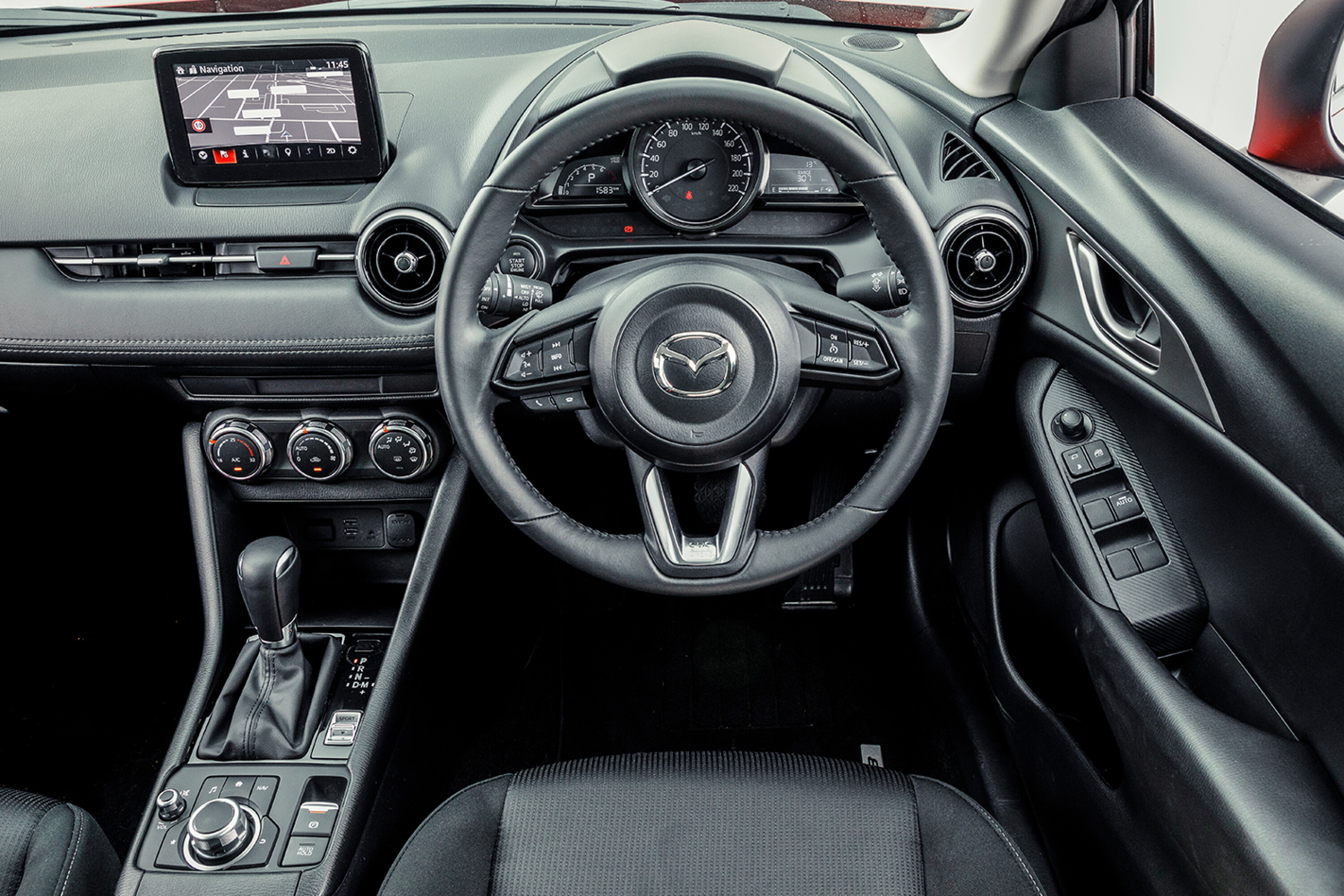
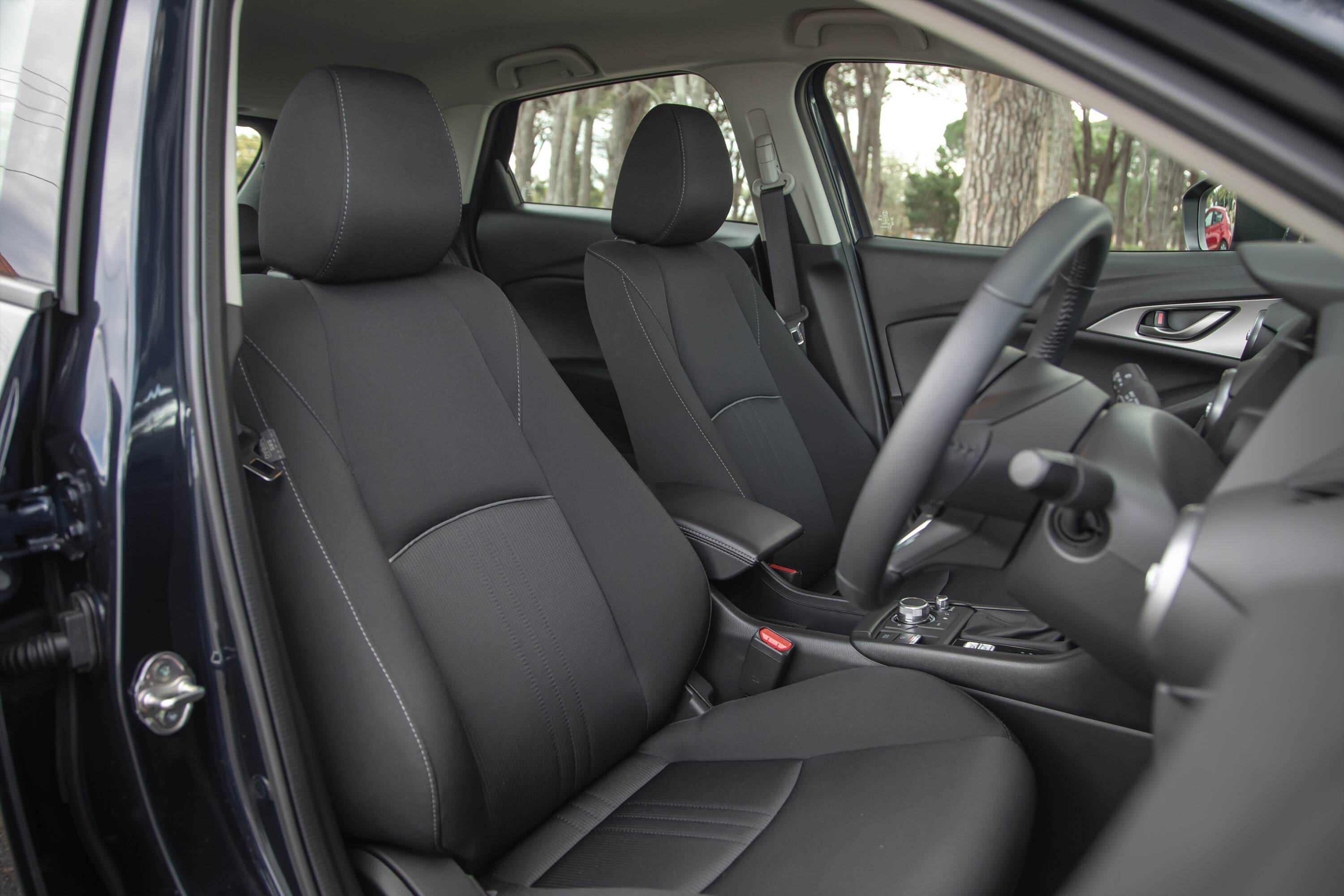
The CX-3’s front-seat comfort is comparable with any small SUV in this price range, but few will match it for build quality and finish.
Forward vision is impressive thanks to the fairly upright A-pillars at either end of the windscreen.
The placement of the driver’s seat feels spot-on – high enough to command the road, yet low enough to still feel sporty and car-like.
5
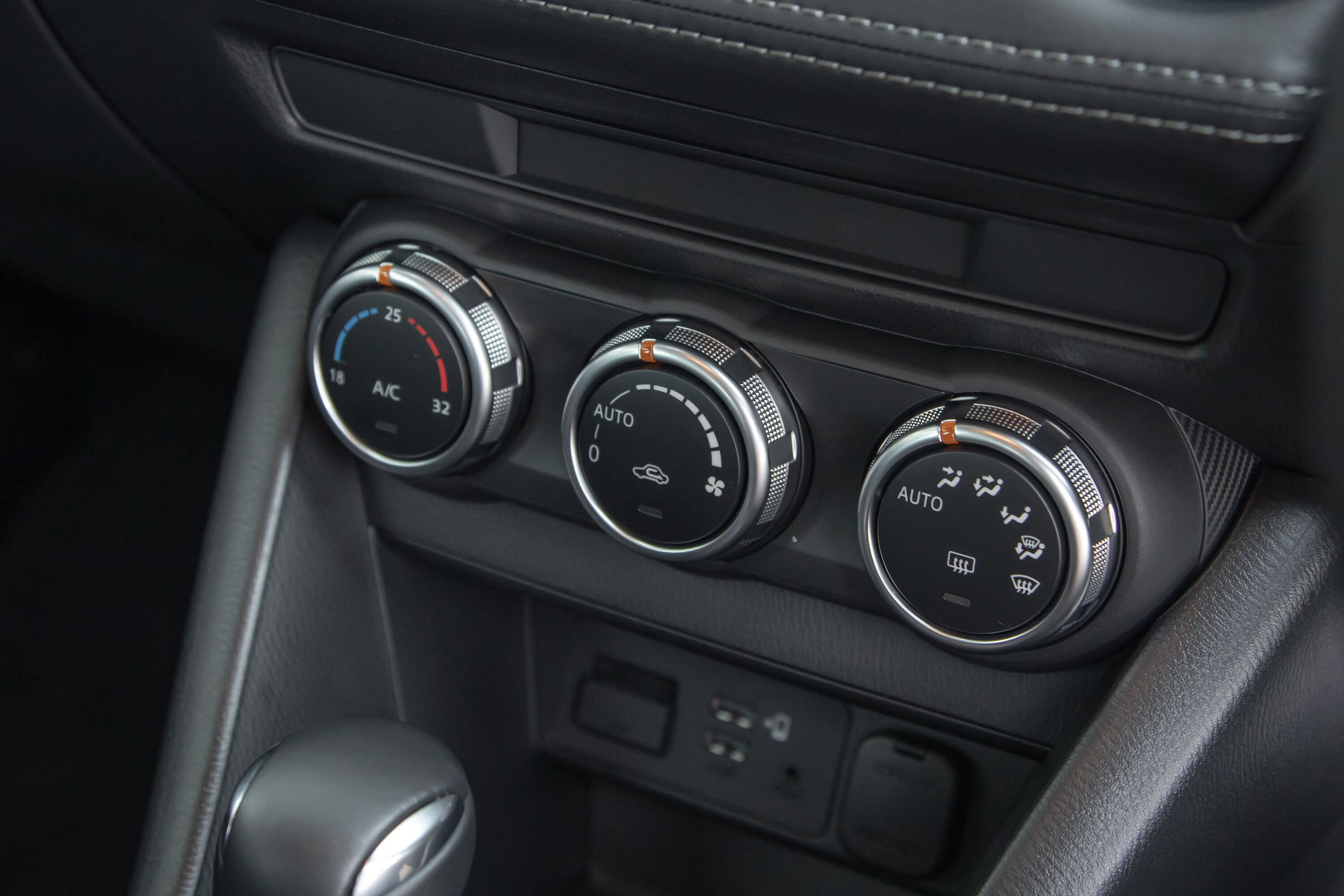
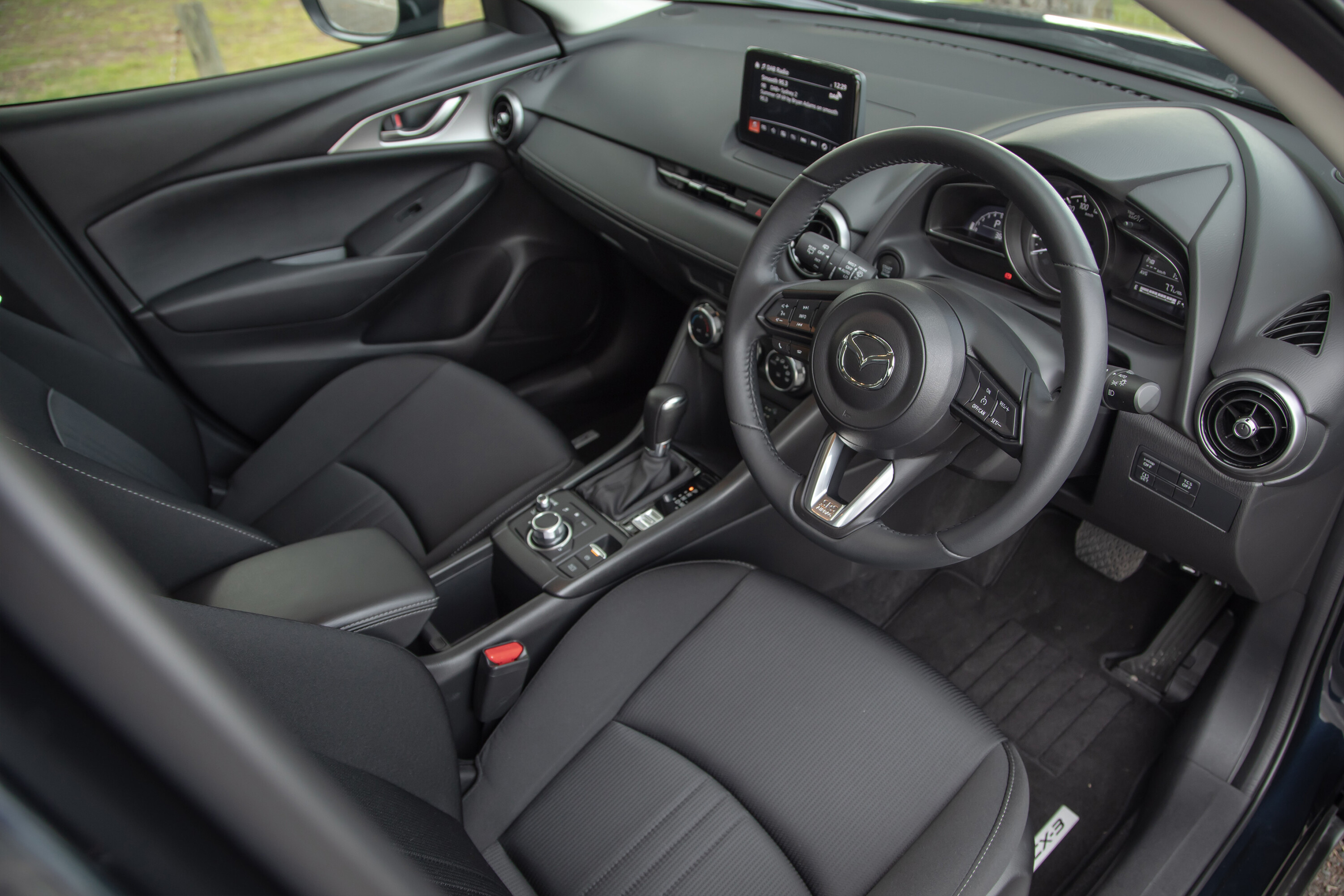
The dashboard is similar to the Mazda 2’s, which is no bad thing. The head-up display and colour touchscreen, which is standard across the range, is good too.
Also matching the Mazda 2 light passenger car is the distance between the front and rear axles, making the CX-3 feel nippy to steer in the city. However, the body is longer, meaning it’s not quite as easy to squeeze into a tight parking spot.
In top-spec Akari guise, the CX-3 is quite the luxe little tinker, complete with a sunroof, proper leather, selectively dimming LED headlamps, premium audio and a 360-degree parking camera.
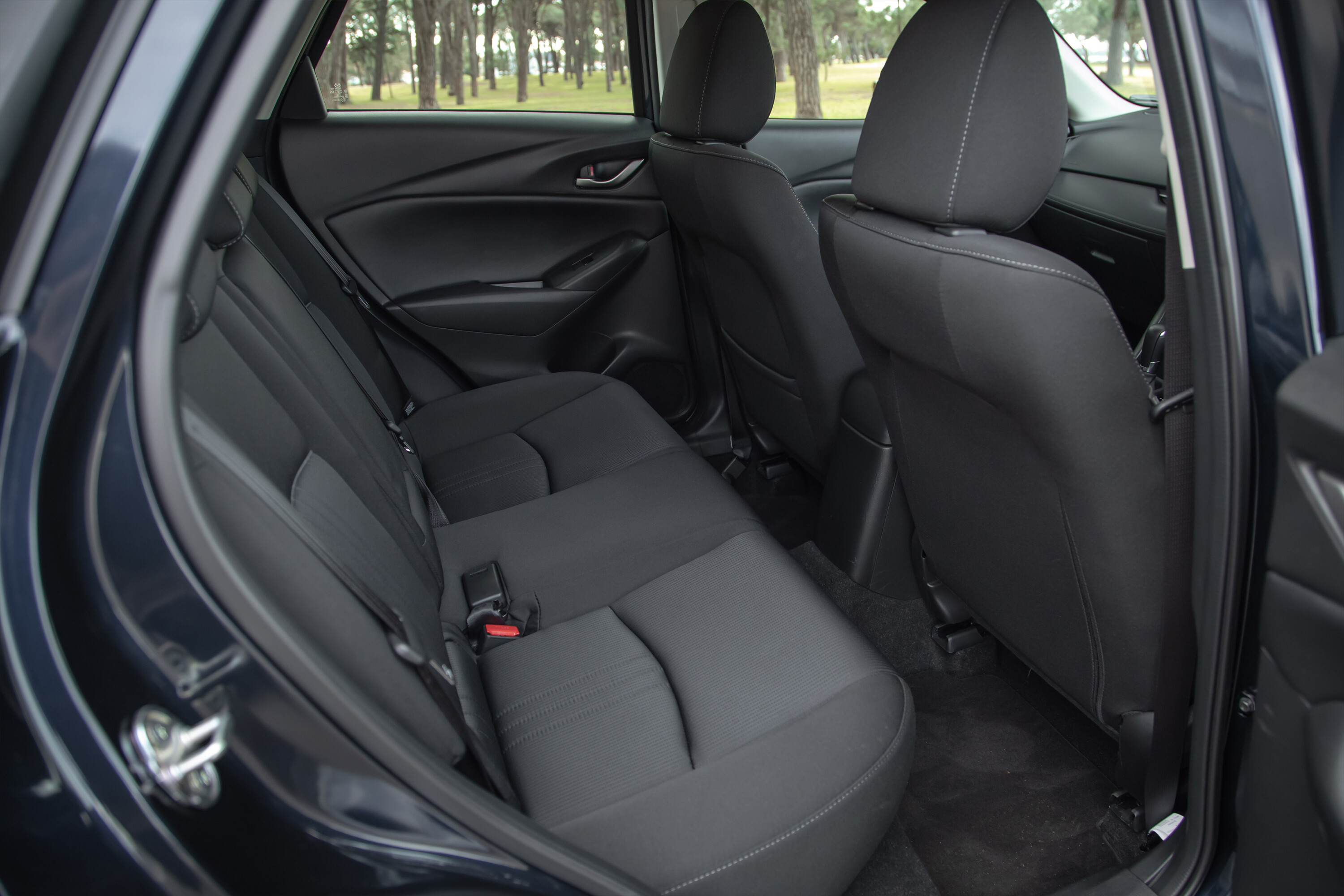
2
Rear seat space and comfort
Despite the 3 in its name, the CX-3 is based on the Mazda 2, a car that is very likeable if you never have to ride in the rear seat.
There is a little more leg room and knee clearance than the 2, but it’s still quite tight.
Comfort of the seat itself is excellent. It’s mounted quite high – theatre-style – giving passengers a decent view forward, but the side view isn’t great, particularly for children, due to the rising window line.The outer rear seats are fitted with ISOFIX anchors, for easy securing of compatible child seats.
All CX-3 versions, apart from the G20 Sport, have two cup holders for rear passengers in a fold-down centre armrest.
4
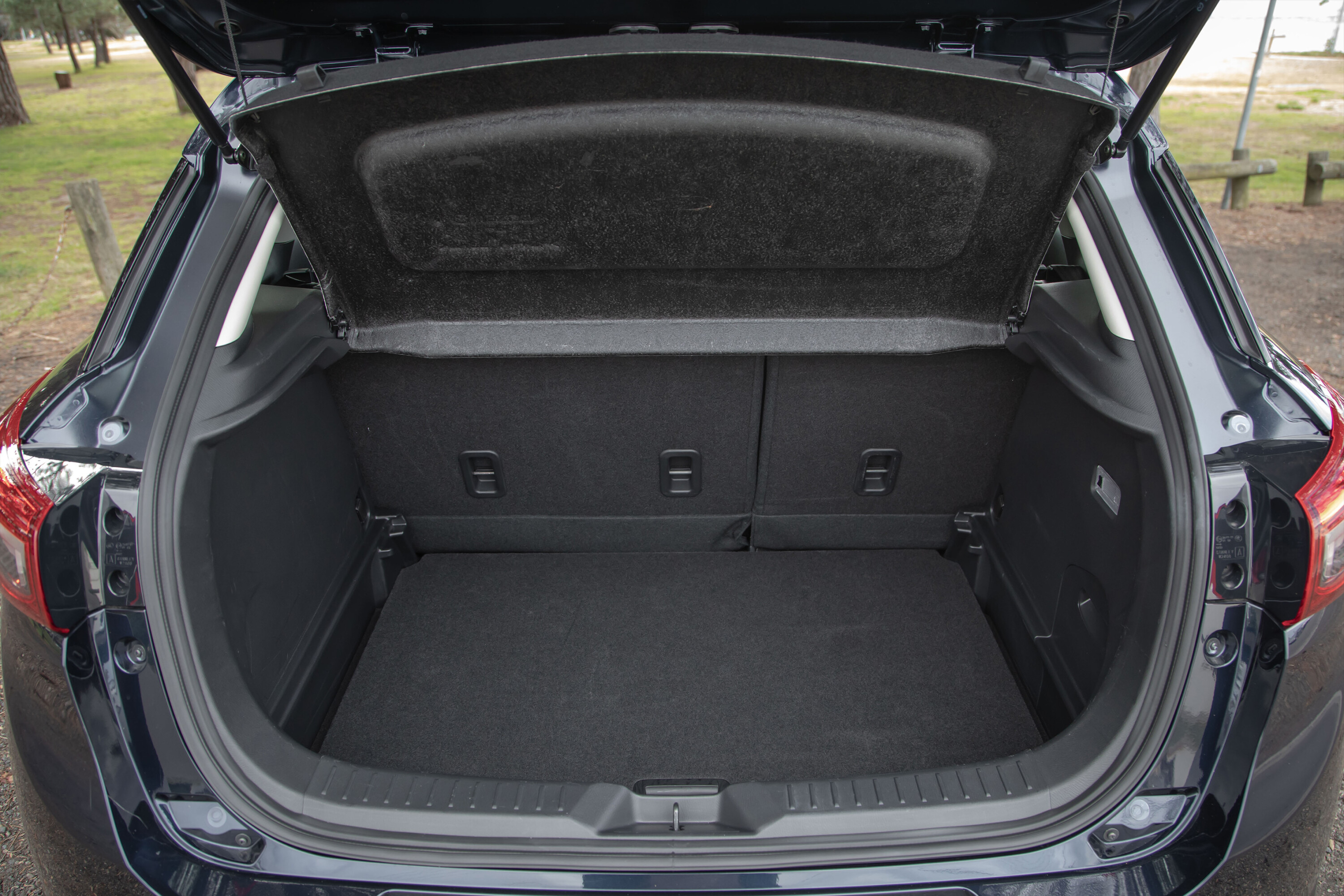
How much boot space does the Mazda CX-3 offer?
Cargo space is again only slightly greater than in the Mazda 2 light hatchback, but its 264-litre capacity is one of the smallest of any SUV.
It can hold a stroller, a pair of suitcases, or lightweight camping gear for a couple. But for a week-long tour with a couple of kids, you would need to pack light or invest in a roof pod.
The rear seats split-fold 60:40 to let you carry up to 1174 litres of stuff.
1
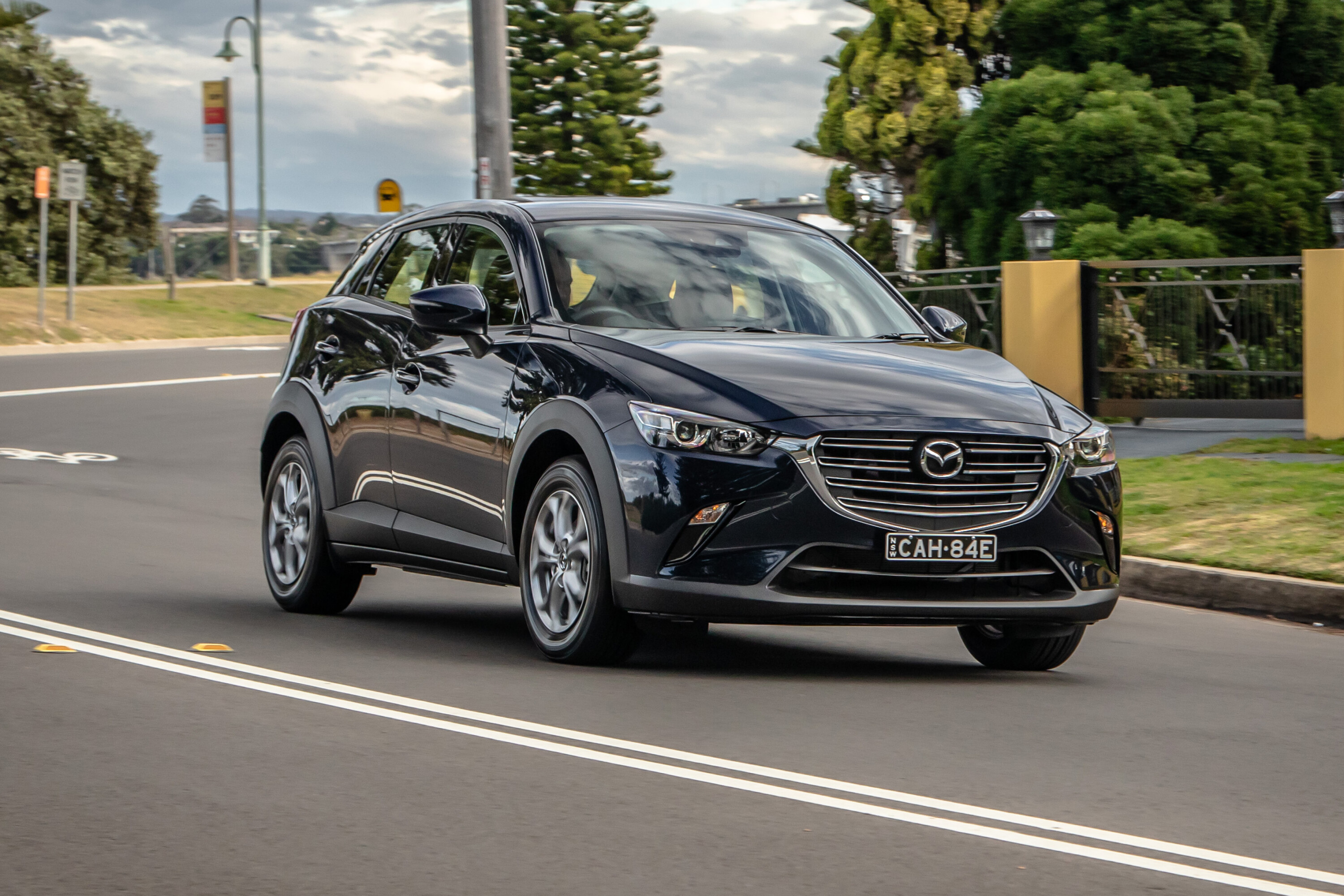
I like driving, will I enjoy the CX-3?
Yes, even with the not-very-racy 2.0-litre four-cylinder engine and six-speed automatic transmission, the CX-3 is still one of the more enjoyable little SUVs to drive.
Unfortunately, all-wheel drive versions with more sophisticated rear suspension and excellent steering feel are no longer available. But the front-wheel drive, while feeling a little less crisp through bends, still brings hatchback-like ride and handling.All CX-3s feature Mazda’s G-Vectoring Control, which is designed to enhance front-end bite by adjusting engine output momentarily on turn-in.
4
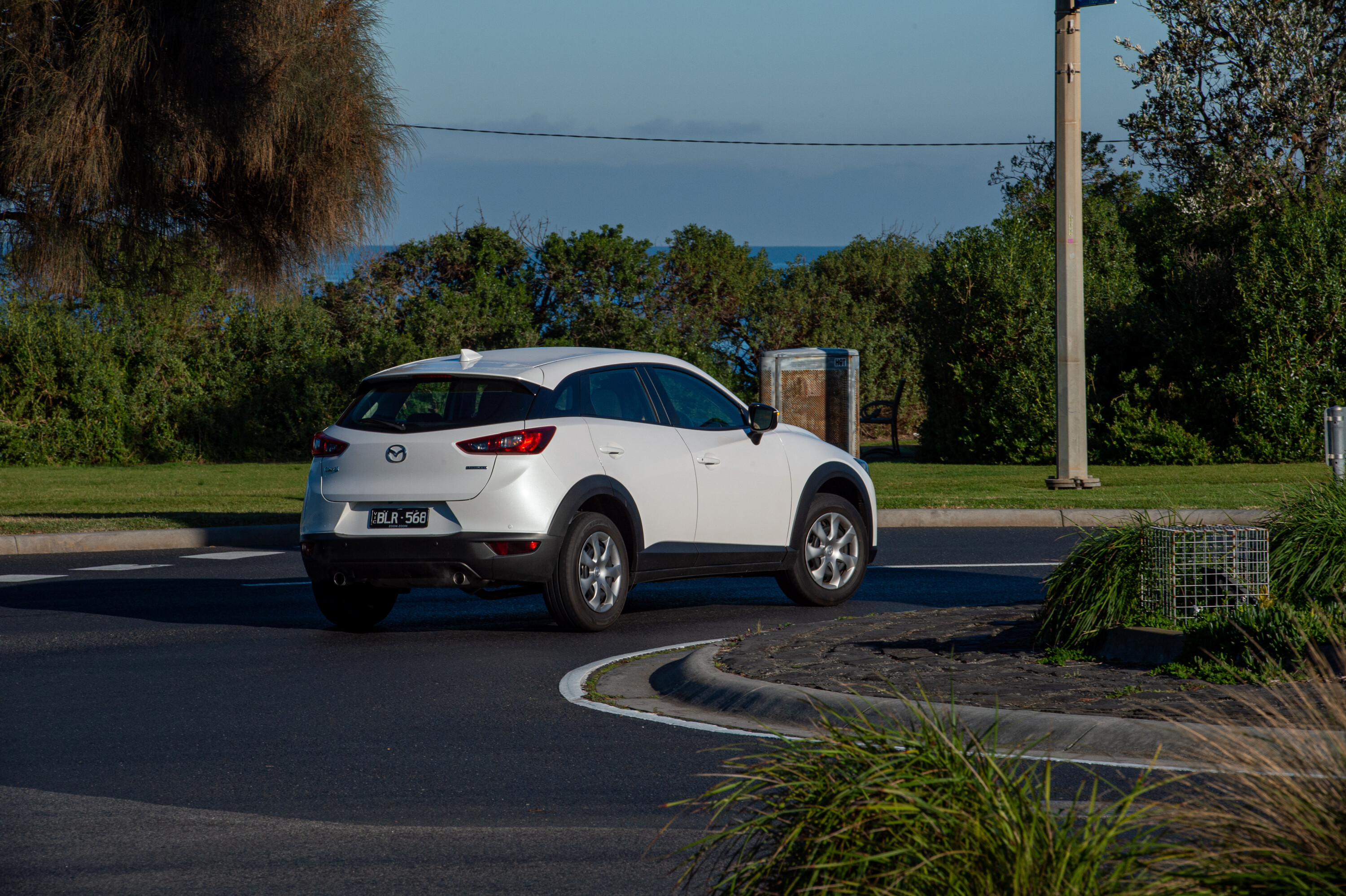
The 2.0-litre engine isn’t as sophisticated or sprightly as the little turbo units in some of the CX-3’s rivals, but it feels lively and works well with the six-speed auto to quickly find the right gear under load quicker than it does in the heavier CX-30 and Mazda 3, even if it does get a little shouty.
Sadly, Mazda also ditched the six-speed manual gearbox shared with the Mazda 2, which is a ripper, shifting with fabulous precision and a beautifully oiled weightiness that makes it feel like it has come from a sports car; if you’re buying a used CX-3 it’s well worth considering.
The CX-3 is a terrific city car and highway tourer. But with a hatchback-like ride height, you won’t want to take this SUV on anything much rougher than gravel.
If any of the terms in this section have left you scratching your head, these articles will help bring you up to speed!
1
Which Mazda CX-3 engine uses the least fuel?
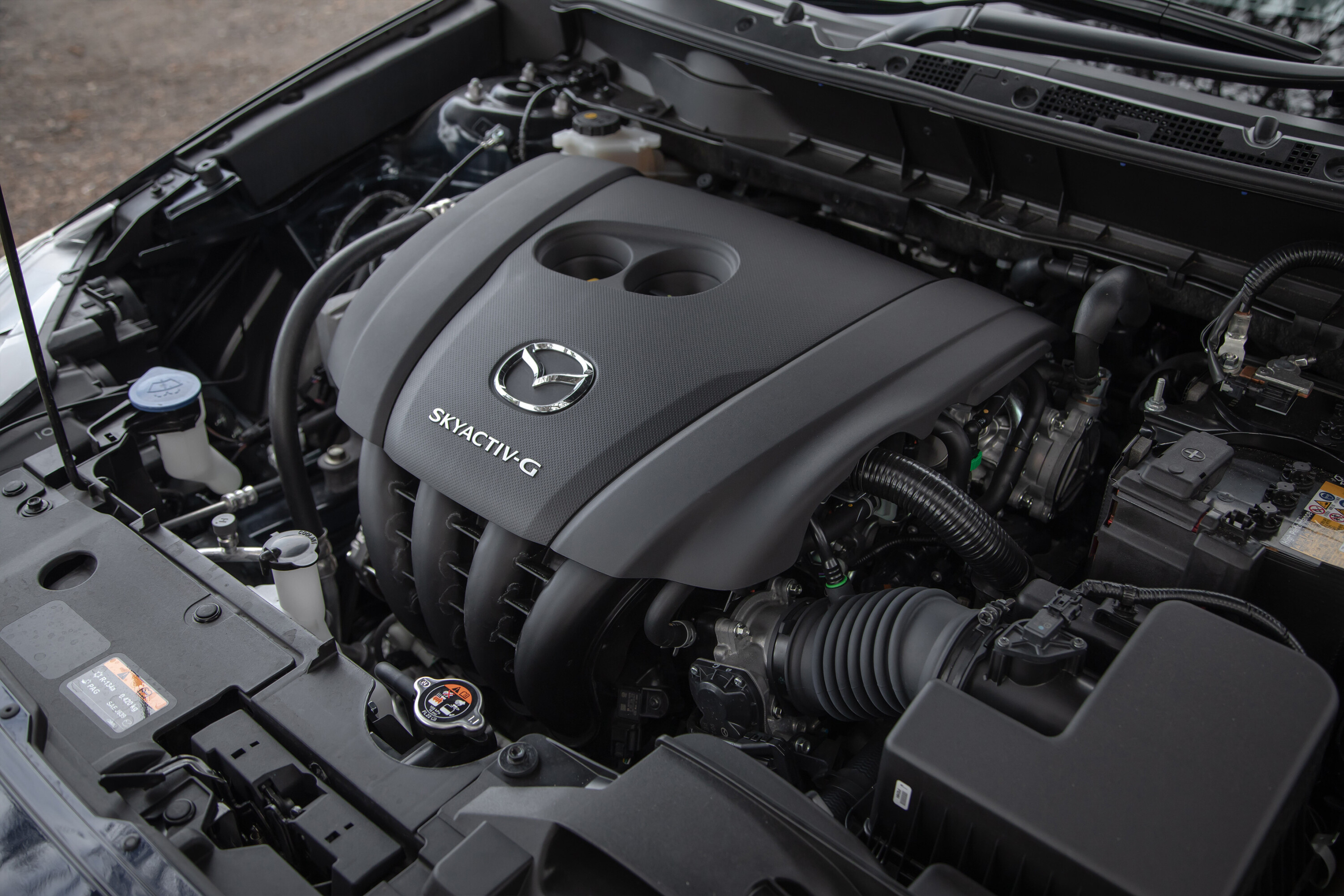
There is just one engine option in the CX-3 range, the 110kW/195Nm 2.0-litre four-cylinder petrol engine that’s very similar to the 2.0 petrol supplied with the newer and slightly bigger CX-30 small SUV.
It is a smooth and strong engine, propelling the CX-3 in a lively – if noisy – manner when worked very hard.The 2.0L petrol consumes about 6.3 litres/100km on the official test.
How much can a Mazda CX-3 tow?
The CX-3 can tow a braked load of up to 1200kg.
Unbraked towing capacity is 640kg and its maximum downward tow ball weight is 50kg.
How long is the warranty and what are the Mazda CX-3’s servicing costs?
As per the wider Mazda range, the CX-3 is covered by the brand’s five-year/unlimited-kilometre warranty, and a five-year roadside assistance program.
The service schedule for all Mazda CX-3 variants is now 12 months or 15,000km, up from 10,000km previously.
Mazda offers five years of capped-price servicing.
It has yet to detail pricing for the new service regime.
1
Which version of the Mazda CX-3 does Wheels recommend?
With a single front-drive automatic powertrain to choose from, picking a CX-3 comes down to cost and features.
The G20 Pure offers good value for under $30,000, but the G20 Touring SP is our pick of the bunch.
As well as being well-equipped for its sub-$35,000 retail price, the Touring SP is bringing additional tech and comfort options that allows the CX-3 to keep up with newer rivals – something you’ll appreciate in a few years and at resale time.
What are the Mazda CX-3’s key rivals?
MORE
Everything Mazda
MORE
Small SUVs
The Yaris Cross is the smallest SUV Toyota sells in Australia. You might not guess that the Cross is based on the Yaris small car as its exterior shares few styling cues with the hatchback. Instead, the Yaris Cross goes its own way with a tough mini-RAV4 aesthetic.
Introduced locally in November 2020, the Yaris Cross sits below the Corolla Cross small SUV and RAV4 medium SUV, utilising three-cylinder engines and TNGA-B underpinnings. Australian buyers are lapping up hybrids, with the petrol-electric powertrain accounting for more than three-quarters of Yaris Cross sales here – and with good reason.
Available in three trim levels spanning $26,990-$37,990 before on-road costs, the Yaris Cross isn’t as cheap as its size might have you believe but generous standard safety features, frugal powertrains and a fun drive make up for some of its packaging shortcomings.
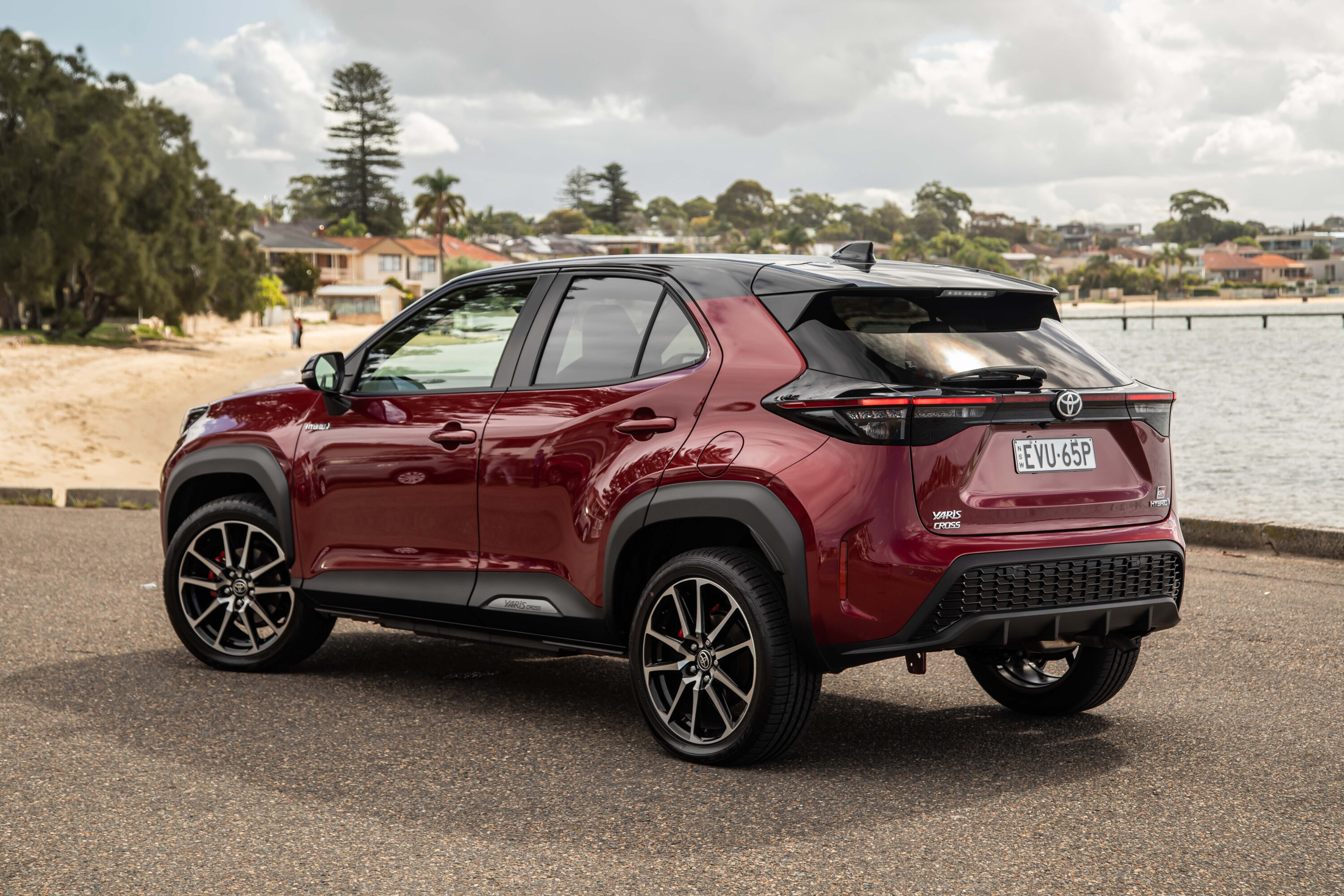
1
JUMP AHEAD
- Pricing
- What body styles are available for the Yaris Cross?
- What features are standard in every Yaris Cross?
- What key features do I get if I spend more?
- How safe is the Yaris Cross?
- How comfortable and practical is the Yaris Cross?
- How much boot space does the Yaris Cross offer?
- I like driving, will I enjoy this car?
- Which Yaris Cross engine uses the least fuel?
- What is the Yaris Cross’s towing capacity?
- How long is the warranty and what are the Yaris Cross’s servicing costs?
- Which version of the Yaris Cross does Wheels recommend?
- What are the Toyota Yaris Cross’s key rivals?
- What might annoy me?
- What might I miss that similar cars have?
- What’s the infotainment system like?
- Where does Toyota make the Yaris Cross?
- Are there plans to update the Yaris Cross soon?
Pricing
| Model | Pricing |
|---|---|
| GX petrol FWD | $26,990 |
| GX hybrid FWD | $28,990 |
| GXL petrol FWD | $29,990 |
| GX hybrid AWD | $31,990 |
| GXL hybrid FWD | $31,990 |
| Urban petrol FWD | $32,990 |
| GXL hybrid AWD | $34,990 |
| Urban hybrid FWD | $34,990 |
| GR Sport hybrid FWD | $35,840 |
| Urban hybrid AWD | $37,990 |
| Prices listed are before on-road costs |
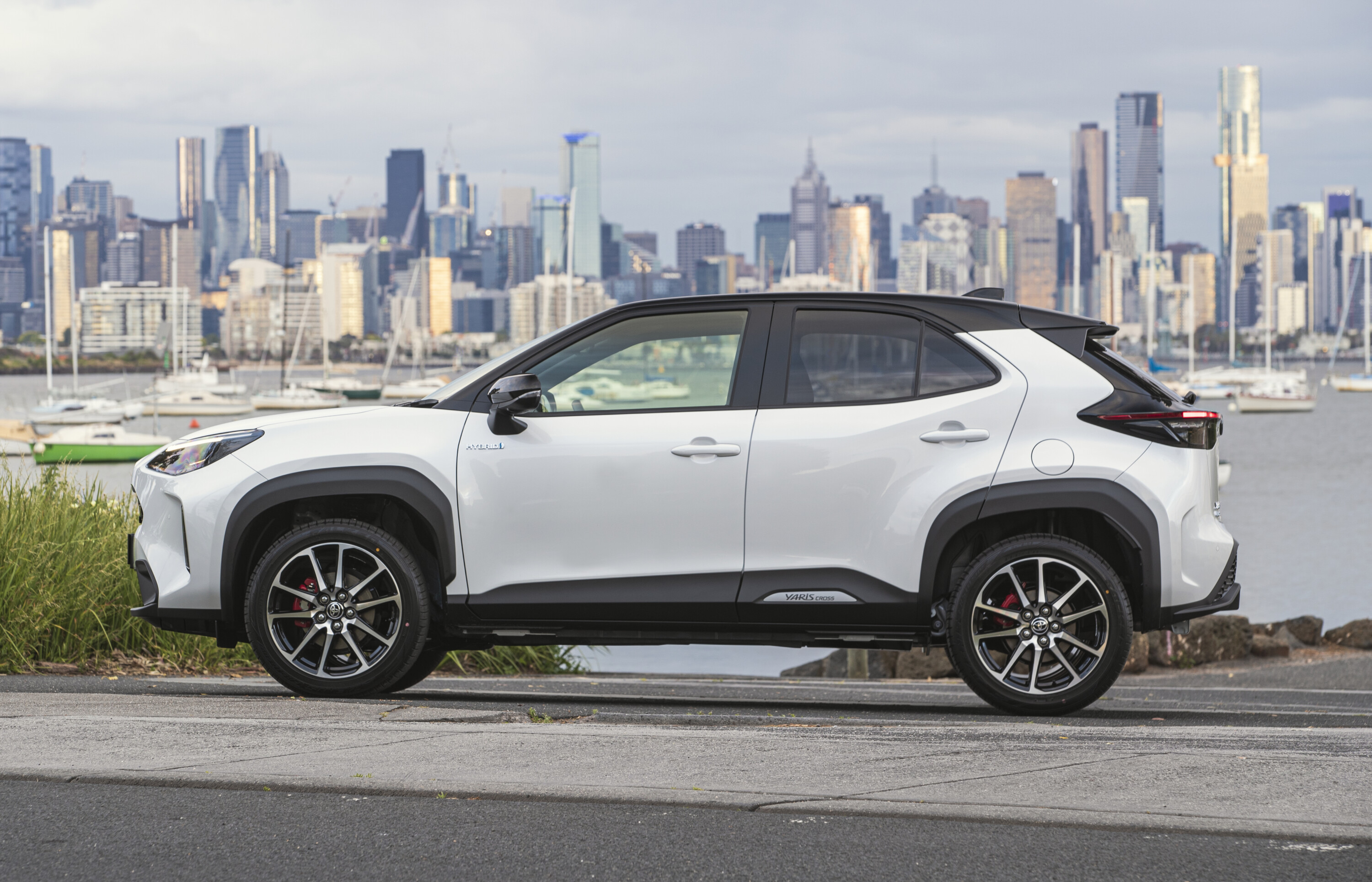
1
What body styles are available for the Toyota Yaris Cross?
The Toyota Yaris Cross is a five-door, five-seat light SUV.
What features are standard in every Toyota Yaris Cross?
The features listed below are standard in the entry-level model and will appear in higher-grade models unless replaced by more premium equivalent features.
| 2024 Toyota Yaris Cross GX features | |
|---|---|
| 16-inch alloy wheels | 7.0-inch touchschreen |
| 4.2-inch multi-information display | Wired Apple CarPlay/Android Auto |
| Leather-appointed steering wheel | Cloth upholstery |
| Manual seat adjust | Keyless entry and push-button start |
| Halogen headlights | 40:20:40 split-folding seats |
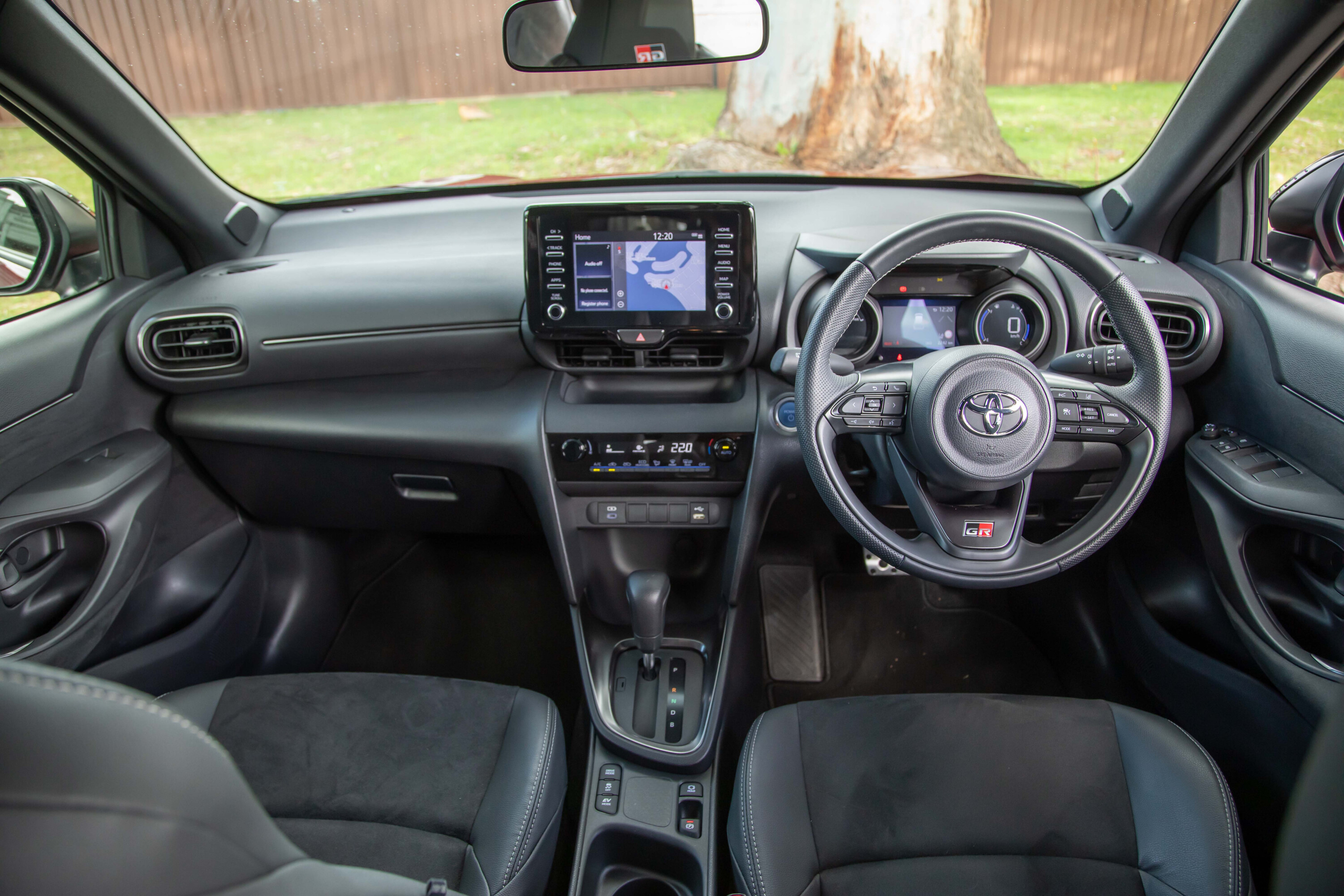
1
What key features do I get if I spend more?
The entry-level Yaris Cross is well equipped, but stepping up adds a number of key features.
Moving to higher grades adds welcome goodies like surround-view monitors and blind-spot monitoring, as well as additional LED lighting. More premium trims feature in upper grades, too, along with extra customisation.
The mid-spec Yaris Cross GXL adds:
| 2024 Toyota Yaris Cross GXL features | |
|---|---|
| LED headlights | Blind-spot monitoring |
| 360-degree camera | LED indicators |
| Navigation with live-traffic | Front and rear parking sensors |
| Parking-speed AEB | Rear privacy glass |
As the range-topper, the Urban scores:
| 2024 Toyota Yaris Cross Urban adds | |
|---|---|
| 18-inch alloy wheels | 6-way power-adjustable driveru2019s seat |
| u2018Premiumu2019 trim upholstery and front seat heating | Optional two-tone paint |
| Nano-e air-conditioning filter | Head-up display |
| Kick-to-open power tailgate | 6-speaker sound system |
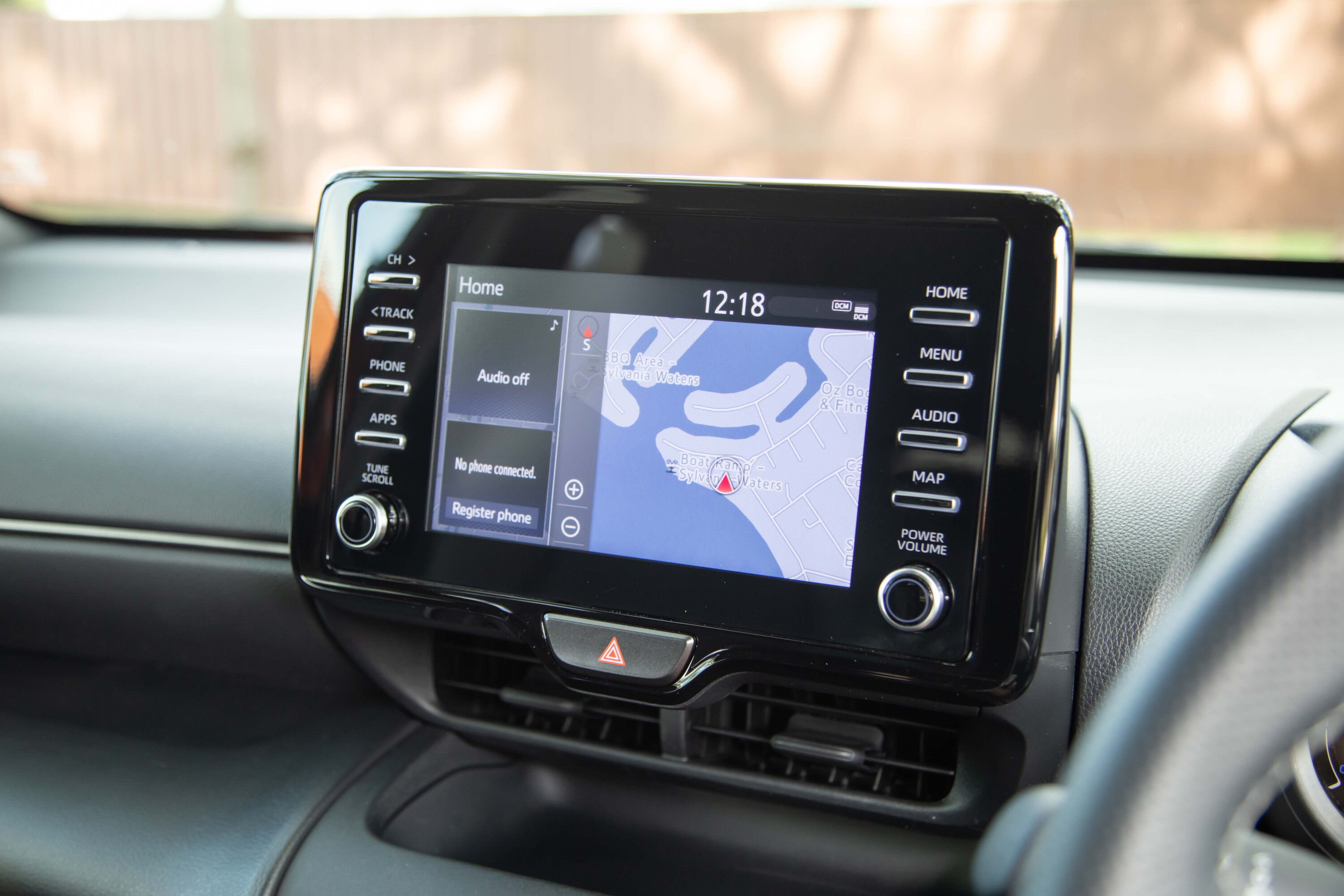
1
Meanwhile, the ‘sporty’ GR Sport trim gets in addition to the Urban, or swaps in:
| 2024 Toyota Yaris Cross GR Sport adds | |
|---|---|
| 18-inch u2018GR Sportu2019 alloy wheels | GR Sport body kit |
| Red brake calipers with GR logo | GR Sport suspension package |
| Aluminium pedals | Steering wheel with GR Sport logo |
| Black u2018ultrasuedeu2019 upholstery with leather accents | Black wing mirrors |
How safe is the Toyota Yaris Cross?
Entry-level GX trim is equipped with a decent safety suite with plenty of airbags and driver assistance technology, enough to grant it a five-star rating from ANCAP when it was tested in September 2021.
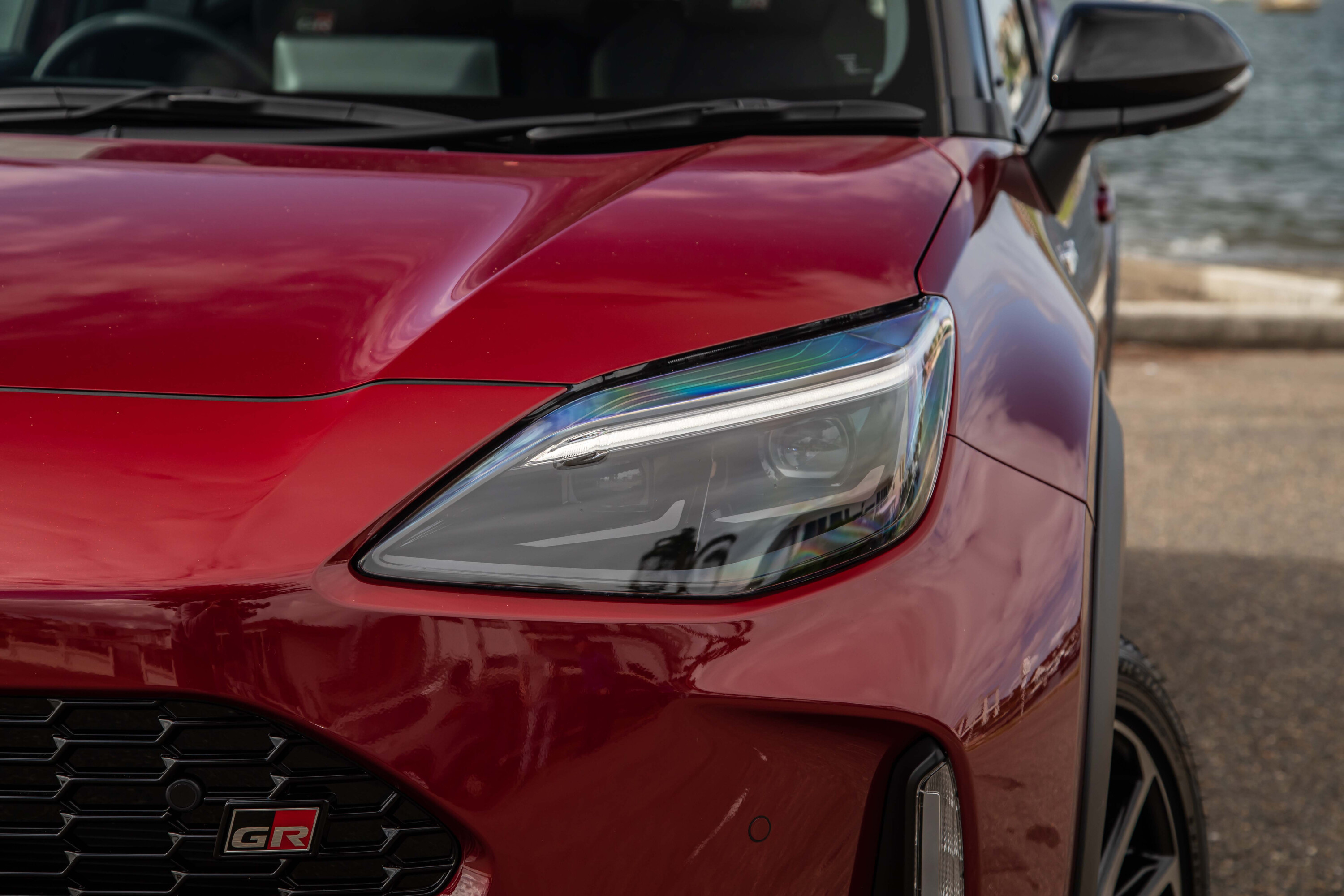
1
| 2024 Toyota Yaris Cross standard safety features | |
|---|---|
| Eight airbags | Steering assist |
| Auto emergency braking with day/night pedestrian, and daytime cyclist detection, junction AEB | Lane-trace assist |
| Traffic sign recognition | Auto high beam |
| Lane departure warning | Adaptive cruise control |
Additionally, The mid-range GXL and range-topping Urban grades gain front and rear parking sensors, blind-spot monitoring, rear cross-traffic alert, a panoramic view monitor and low-speed reverse AEB.
How comfortable and practical is the Toyota Yaris Cross?
The Yaris Cross is around 200mm shorter than a Corolla hatch, yet there’s just enough room in the back seat for two six-footers even with the gently sloping roofline. There’s ample space for kids too, which is what really matters.
Getting little ones and baby capsules in and out of the back may prove tricky, as the doors don’t open very wide. Once in, the Yaris Cross has ISOFIX child seat anchors for the two outboard seats and top tether points for all three rear positions.
Aside from relatively good space and kiddie provisions, there are very few amenities for second-row occupants; no grade has USB charge points, air vents, or even grab handles in the back seat, for example. That’s not so egregious in a GX, but in a near-$40K on-the-road Urban or GR Sport, we don’t think that’s good enough.

1
Even in the front seat, no Yaris Cross features a vanity mirror or central armrest, and the cargo cover is a flimsy mesh item that provides no noise insulation.
Then there’s the automatic gear selector that looks like a hangover from the eighth-gen Corolla, and the switch blanks.
At least there are some saving graces; the quirky digital dash, for example. There are two eye-like pods with a digital screen between them that give you all the information you need.
The seats are comfortable – if only manually adjustable in GX and GXL – and the fabric upholstery doesn’t look too bad. Some (including us) will find that the Urban’s brown leatherette-accented upholstery clashes with the Yaris Cross’s jazzy, young, and fresh-looking exterior, though.
Urban spec also adds a few extra niceties, such as a six-way power-adjustable driver’s seat, front seat heating and a fast-charging USB-C port.
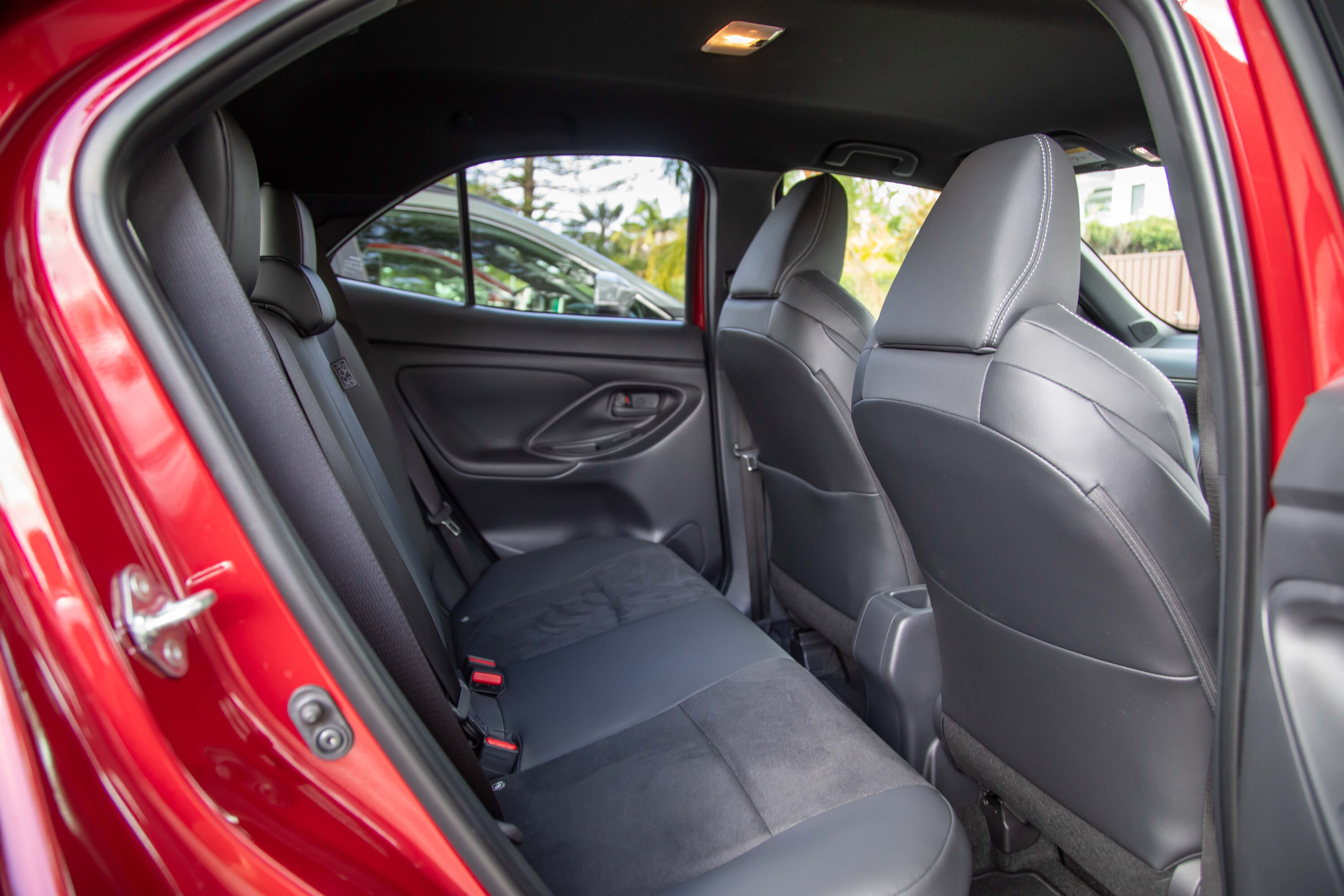
3
How much boot space does the Toyota Yaris Cross offer?
Front-drive models have a little more boot space at 390L when the floor is in its lower position. This is actually quite generous compared to rivals, and enough to challenge cars a size larger than the Yaris Cross.
In AWD trims, space falls to 314L as Toyota has to package not only a battery and electric motor but also double wishbone independent rear suspension.
The Urban scores a kick-to-open power tailgate, but the boot is otherwise short on smarts with few places to hide valuables. And, while it can easily manage a trip to the shops or a day out with a pram, a weekend getaway with the usual family garb like soft bags, a pram, travel cot and any other kiddie-associated kit would see the Yaris Cross struggle.

1
I like driving – will I enjoy this car?
The Yaris Cross is not a driver’s car, but this is a comfortable, maneuverable and – in hybrid guise – a quiet city runabout.
Unlike larger Toyota models, core trim levels (the GR Sport is hybrid-only) are available with all three powertrains. Each is based around a three-cylinder petrol engine, with the 88kW/145Nm 1.5-litre petrol being most affordable.
It’s a decent unit for pottering about and runs commendably smoothly, but is barely powerful enough to get out of its own way at high speeds and can be quite vocal under heavy acceleration owing to a CVT with 10 simulated stepped ratios.
Add $2000 to the price and you get that engine running in Atkinson cycle (67kW/120Nm) teamed with an electric motor for a combined 85kW (and no combined torque specified) at the front axle.
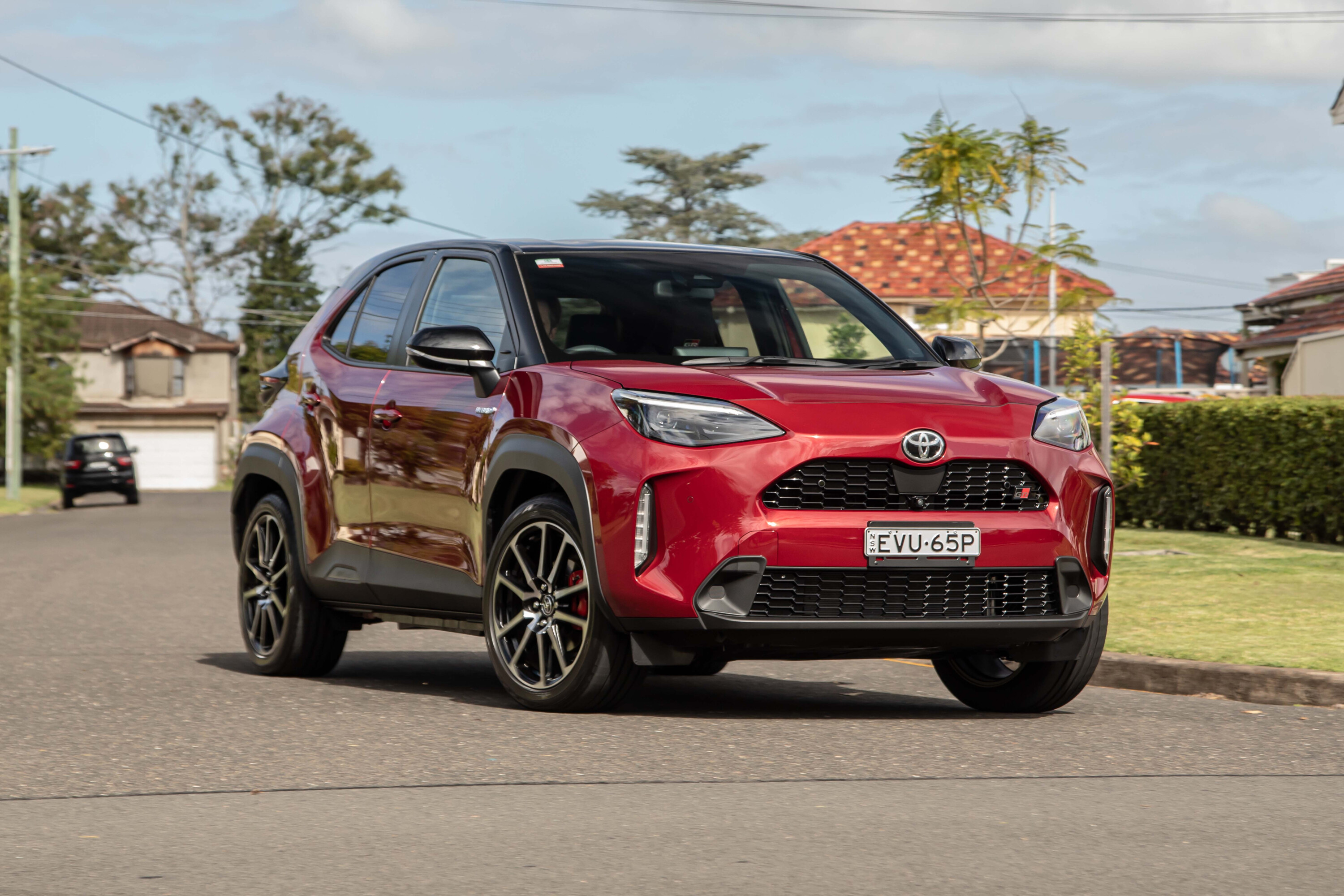
1
The added instant grunt of the electric motor is more than worth the $2K extra. It means the petrol engine is less stressed, and the whole show is quieter, more responsive, and miles more pleasant.
Hybrids have three driving modes: EV, Auto and Power. Over many miles, we haven’t found much difference between the latter two, with no obvious boost in performance in Power. It is surprising, though, just how far a Yaris Cross can travel on electric-only power, regardless of whether you’ve flicked the EV Mode switch.
Equally impressive is the speed at which the transmission responds to the shifter. Making tight manoeuvres or parking in a hurry is simply a pleasure, such is the eagerness of the Yaris Cross to oblige instructions.
Driving all four wheels is dear, with a $3000 premium on top for the Yaris Cross hybrid AWD. You don’t get any more total power, but the rear traction motor does improve grip in slippery conditions. AWD cars also score double wishbone independent rear suspension.
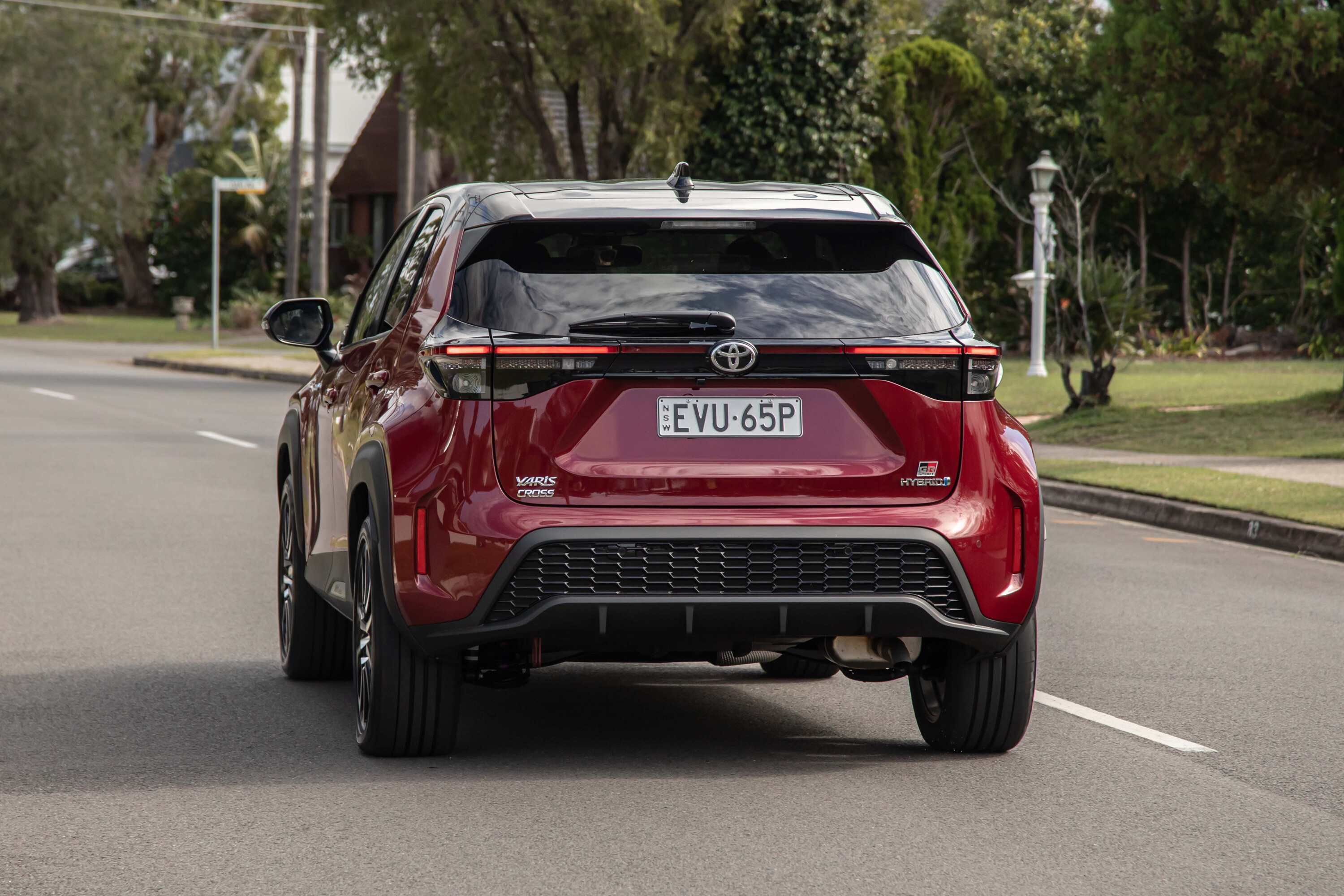
1
While the double wishbone rear end adds meaningful compliance and dynamism over the torsion beam set-up of the front drivers, arguing its necessity and expense is a chore. If a true GR Yaris Cross existed – sure. As it stands, though, most will be fine to go without.
Even the front-drive models have solid body control and a sense of planted predictability at low to medium speeds. Up the pace and the Yaris Cross’s soft suspension tune can feel a little floaty, but the trade-off is comfort around town.
The firmer GR Sport does complicate things with its lower, firmer suspension, so we’d recommend sticking to the mid-spec GXL that amps the light SUV’s excellence in its natural habitat of metropolitan labyrinths.

1
If any of the terms in this section have left you scratching your head, these articles will help bring you up to speed!
- What is a Powertrain or Drivetrain?
- Power vs torque
- Car suspension explained
- Automatic transmissions (‘gearboxes’) explained
- Chassis control systems explained
- Car vs Ute vs SUV: How the vehicle you buy should guide the way you drive
Hybrid models use the least fuel, with the Yaris Cross rated as low as 3.8L/100km on the combined ADR81/02 cycle in front-drive hybrid guise, while the AWD is rated at 4.0L/100km.
| Powertrain | Claimed fuel economy | CO2 emissions |
|---|---|---|
| 1.5-litre three-cylinder petrol FWD | 5.4L/100km | 124g/km |
| 1.5-litre three-cylinder hybrid AWD | 4.0L/100km | 90g/km |
| 1.5-litre three-cylinder hybrid FWD | 3.8L/100km | 86g/km |
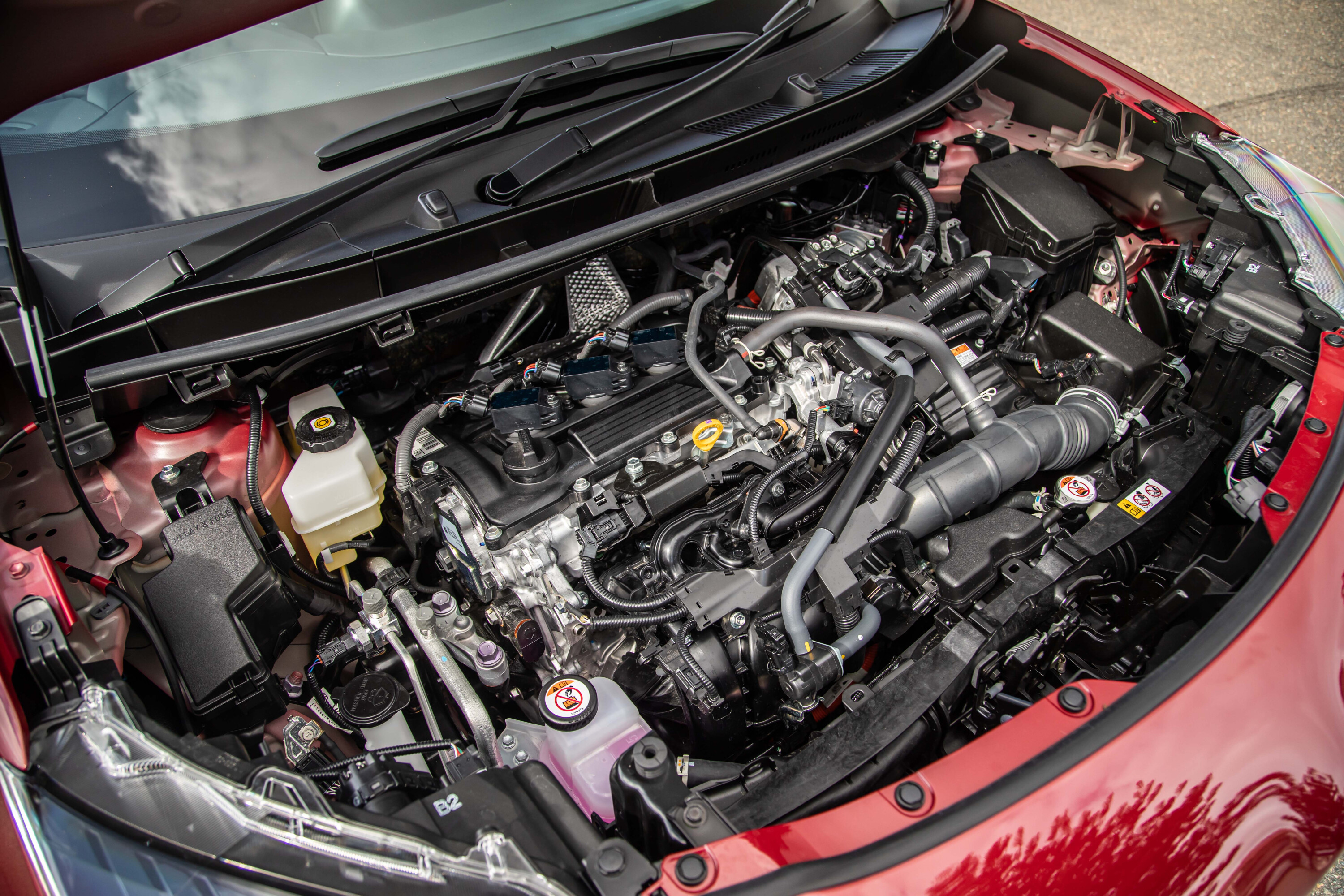
1
What is the Toyota Yaris Cross’s towing capacity?
The Yaris Cross petrol is certified to tow a 1250kg braked load and 550kg unbraked, while the hybrids are limited to 400kg maximum.
How long is the warranty and what are the Toyota Yaris Cross’s servicing costs?
The Toyota Yaris Cross is covered by a five-year/unlimited-kilometre warranty.
Toyota will extend the warranty up to seven years for hybrid powertrain components providing servicing is kept up to date at an authorised dealership, and 10 years for the battery.
1
Servicing is due every 12 months/15,000km – whichever comes first – and each of the first five trips to the Toyota dealer is capped at just $215 – much cheaper than most rivals.
Which version of the Toyota Yaris Cross does Wheels recommend?
The Toyota Yaris Cross is far from the cheapest way into new-car ownership and isn’t even the most affordable way into the smallest SUV segment.
Instead, Toyota has come to the light SUV market with a bulging safety suite and pleasant appointments.

1
On balance, the Yaris Cross GX is probably all the Yaris Cross you ever need, though stepping up to the GXL hybrid FWD is what we recommend if you need a fuel-sipping and relatively chic urban kickaround.
What are the Toyota Yaris Cross’s key rivals?
ud83dudd3c Back to top
MORE
Small SUVs
What might annoy me?
Many of the Yaris Cross’s shortcomings are shared by similar-sized rivals, such as a lack of space in the rear seat compared to price-parity larger models.
However, there’s an expectation that those shopping for a Yaris Cross are looking for a compact vehicle anyway.
A lack of clear indication of what certain controls do (for example, the window switches that are all blank without icons) is more annoying, as is the lack of amenities in the back seat.
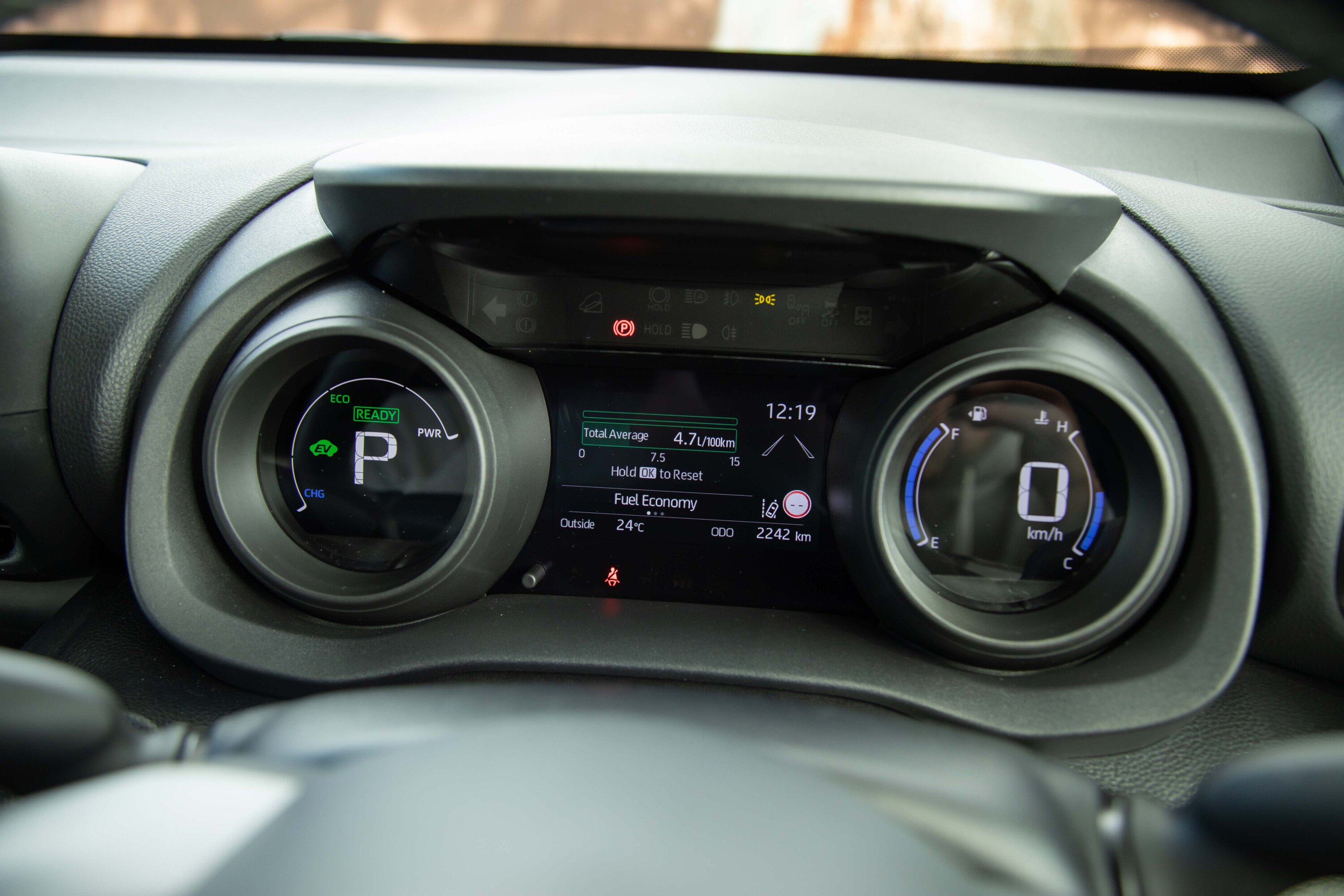
1
What’s the infotainment system like?
Unlike the Corolla Cross and MY23 RAV4, the Yaris Cross is fitted with Toyota’s older 7.0-inch touchscreen that runs washed-out, low-contrast graphics.
Thankfully, Wired Apple CarPlay and Android Auto feature so you can use the mapping software of your choice, which we recommend. No Yaris Cross variant has a particularly powerful stereo, either.
Onboard the Yaris Cross are some of Toyota’s connected services – free of charge for three years. MyToyota integration uses a smartphone app so users can check diagnostic details, odometer readings, and their owner’s manual. There’s also stolen vehicle tracking, automatic collision notification, and an SOS call function.
1
Where does Toyota make the Yaris Cross?
Toyota manufactures the Yaris cross in two locations – Valenciennes in France for Europe, and at its East Japan plant for Australia and Asia.

1
Are there plans to update the Yaris Cross soon?
The Yaris Cross debuted globally in 2019, before an Australian arrival in late 2020.
Lately, the light SUV has fallen into the shadow of its bigger Corolla Cross brother. Expect to see a facelift in the coming 12-24 months, likely bringing refreshed cabin technology and new looks.
Based on the Polo hatchback, the T-Cross light SUV arrived in 2020 along with T-Roc and has since become one of VW’s most popular models.
Despite its small dimensions, the T-Cross offers a relatively roomy cabin and has one of the largest boots in its segment.
It is powered by an economical three-cylinder turbocharged petrol engine and has a standard safety tech suite including autonomous emergency braking and parking sensors.
There have been barely any changes to the T-Cross during the last three years, apart from price, though a facelift is due in late 2024 that will bring the styling into line with its bigger SUV siblings.
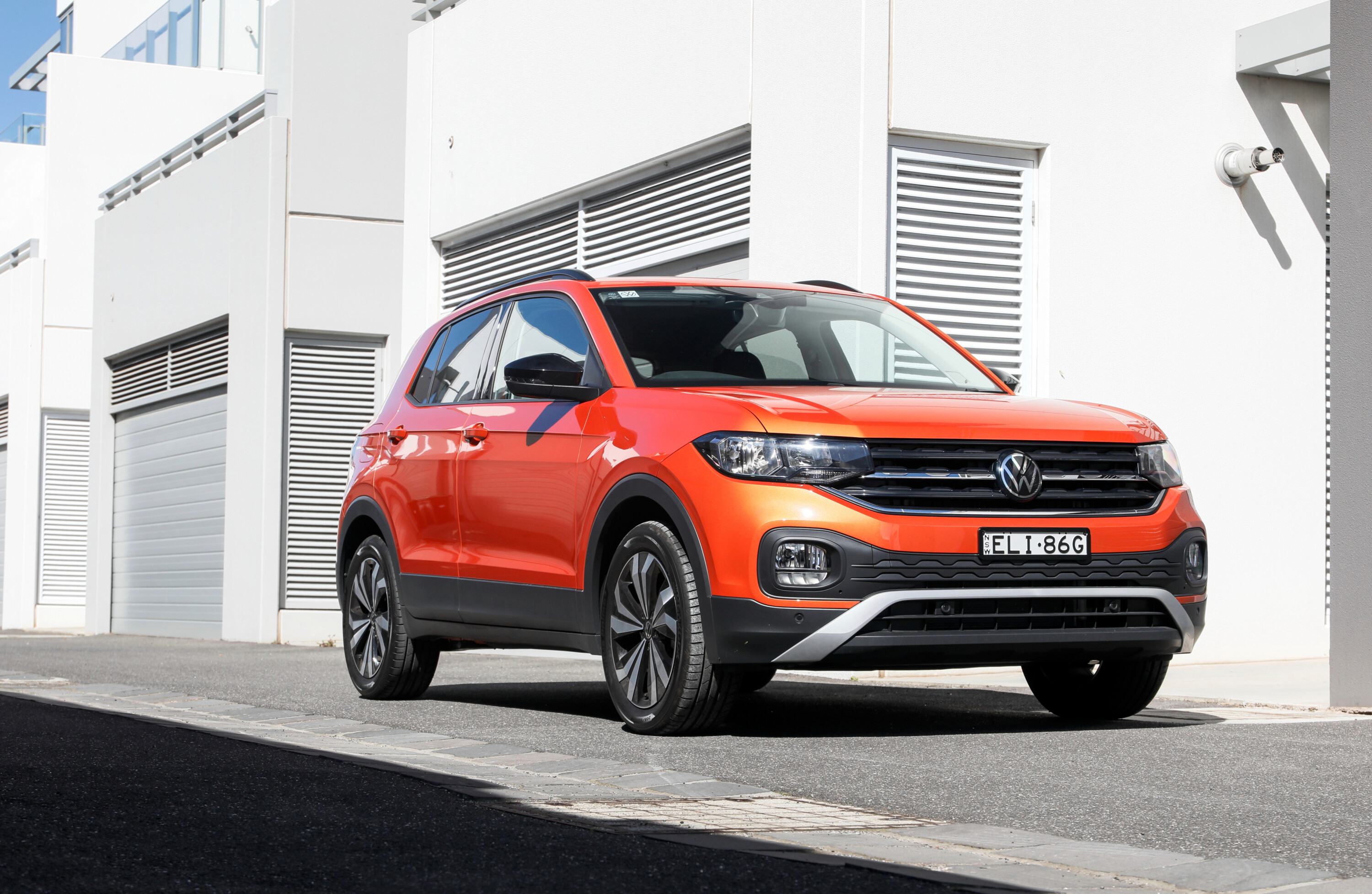
6
JUMP AHEAD
- Pricing
- Body styles
- Standard features
- Options
- Safety
- Comfort & practicality
- Boot space
- Driving experience
- Fuel economy
- Towing capacity
- Warranty & servicing
- Which version of the T-Cross does Wheels recommend?
- Similar vehicles to consider
Volkswagen T-Cross pricing
The T-Cross range is as simple as you can get while having a choice, with two variants offered from just shy of $31,000.
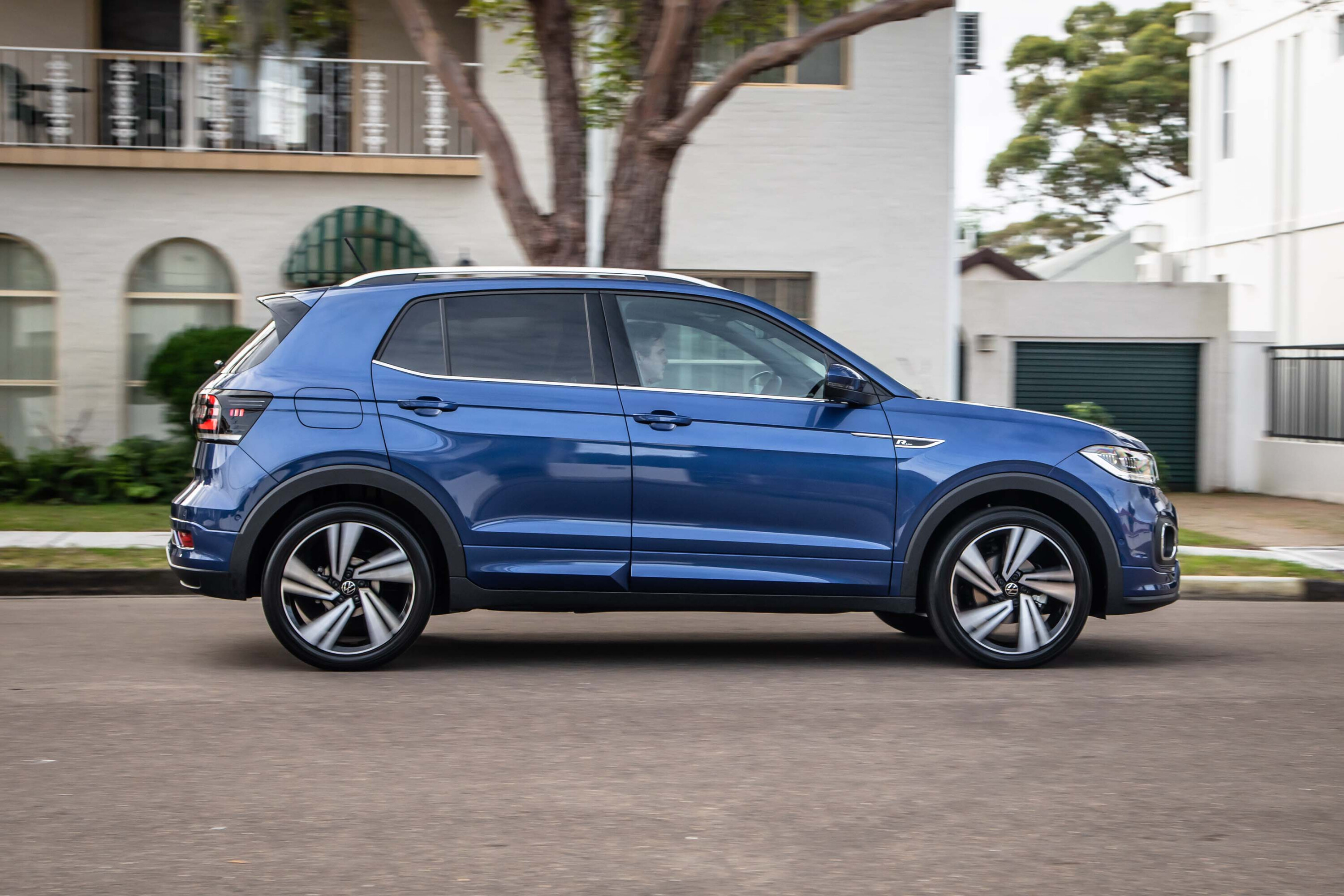
1
What body styles are there?
The T-Cross is only available as a five-door wagon.
It is front-wheel-drive only and is classed as a light SUV, lower priced.
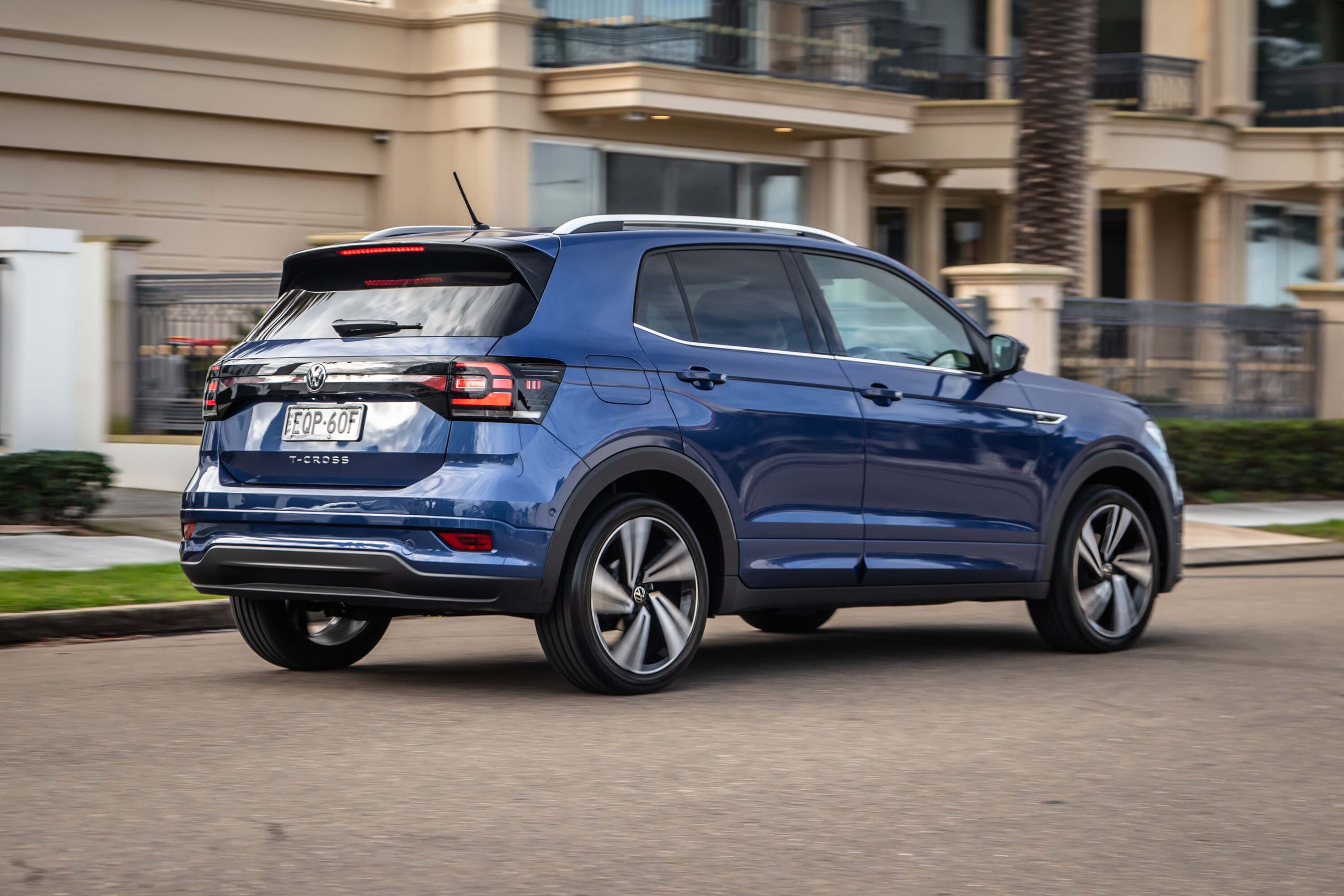
1
What features are in every T-Cross?
| 2024 Volkswagen T-Cross standard features | |
|---|---|
| 8.0-inch touchscreen | Apple CarPlay/Android Auto |
| Six-speaker sound system | CD player |
| Bluetooth | Reversing camera |
| Front and rear parking sensors | Autonomous emergency braking |
| Lane-keep assist | Lane departure warning |
| Driver fatigue detection | Vehicle distance warning |
| Cruise control with speed limiter | Tyre pressure monitoring |
| Rain-sensing windscreen wipers | Dusk-sensing headlights |
| Auto-dimming rear-view mirror | Air conditioning |
| Leather wrapped steering wheel | Alloy wheels |
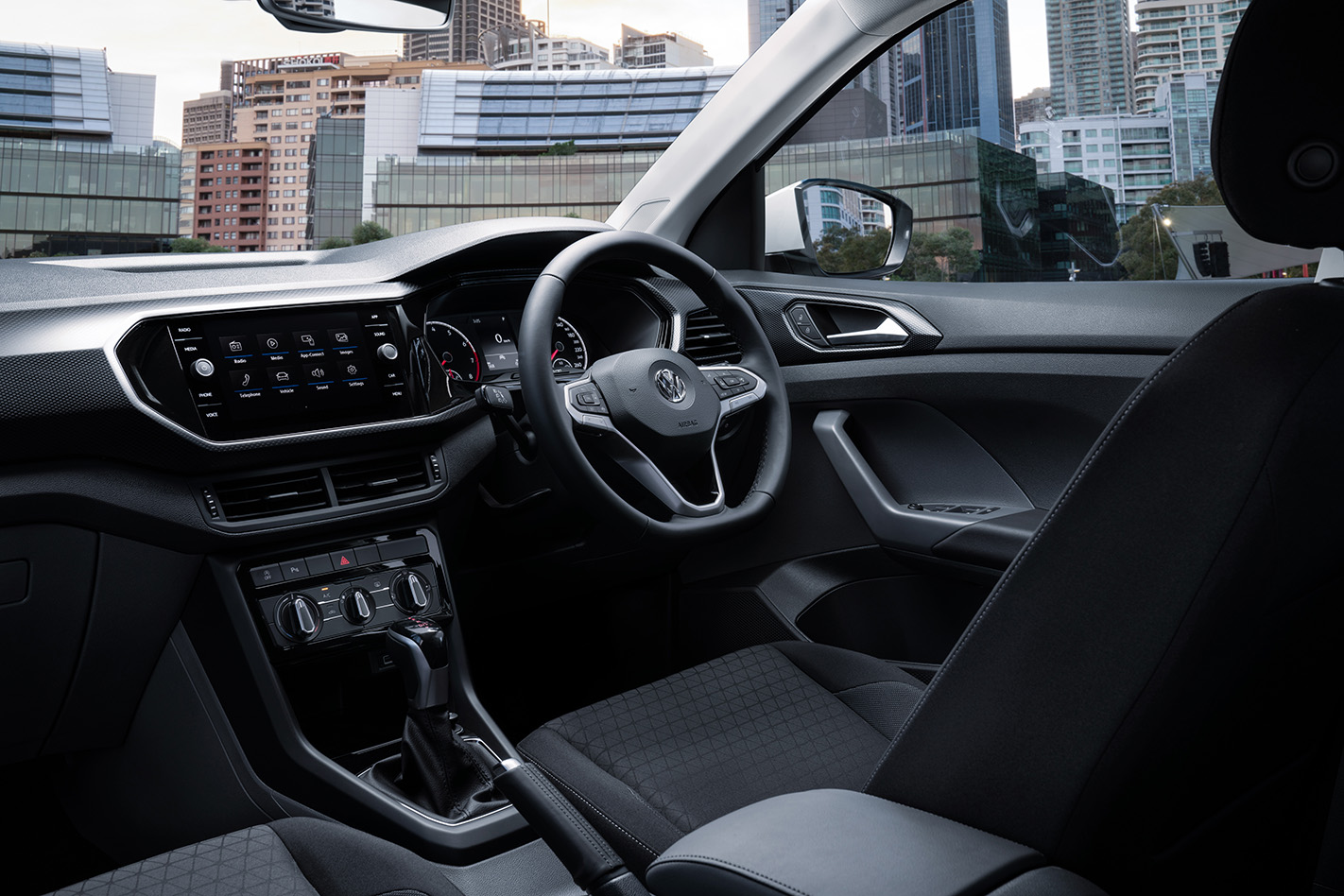
1
The entry-level T-Cross 85 TSI Life has cloth-covered seats, 16-inch wheels and manual air-conditioning.
Spend more on the T-Cross Style and you gain:
| 2024 Volkswagen T-Cross Style features (in addition to Life) | |
|---|---|
| Dual-zone climate control | 17-inch alloys |
| Keyless entry and start | LED headlights |
| Auto high beam | Extra driver assist tech |
| Premium cloth upholstery | Front and rear carpet mats |
| LED ambient dashboard lighting | Paddle shifters |
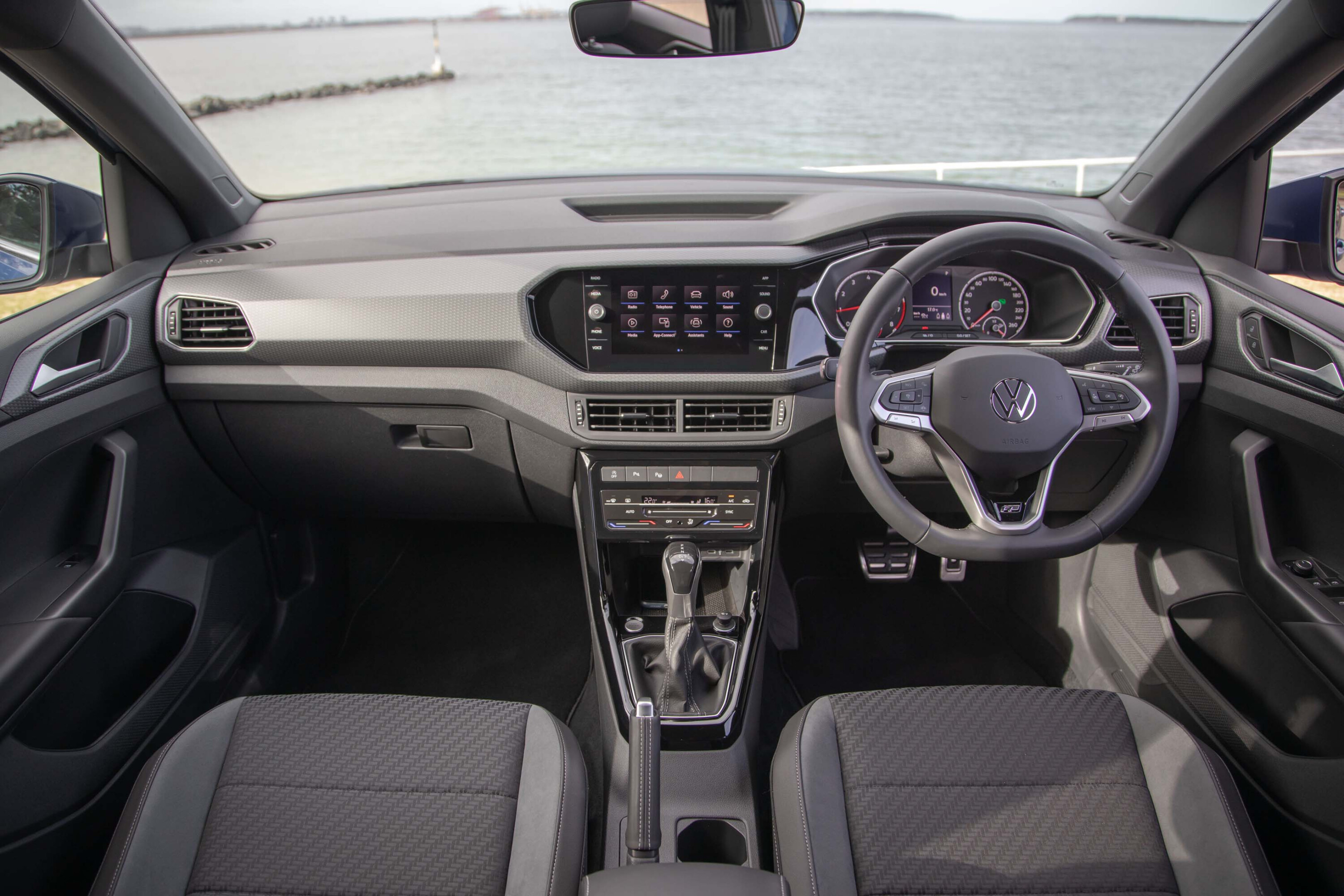
1
Options
For an additional $2200, you can add the Sound and Vision Package, which adds:
| 2024 Volkswagen T-Cross optional features | |
|---|---|
| Beats 300W premium sound system | Upgraded infotainment system |
| Digital instrument cluster | Satellite navigation |
| Voice control | Wireless phone charging |
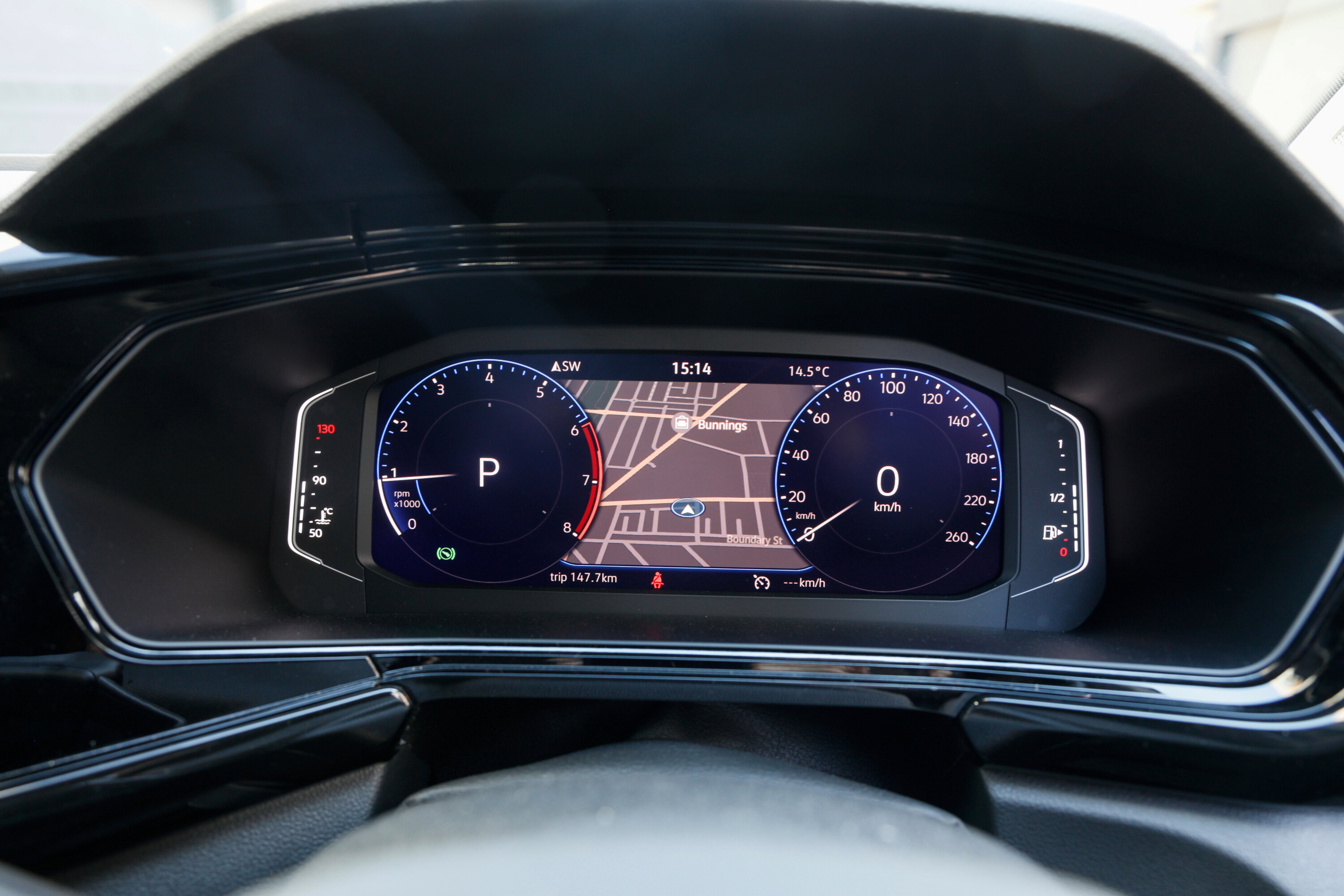
2
Paint
How safe is the Volkswagen T-Cross?
The T-Cross has a five-star ANCAP rating and comes standard with many driver assistance features.
Among these are front and rear parking sensors and manoeuvre braking designed to prevent you from hitting hidden objects or people.
It also comes with standard cruise control, driver fatigue detection, autonomous emergency braking with pedestrian and cyclist detection, and lane-keep assist.
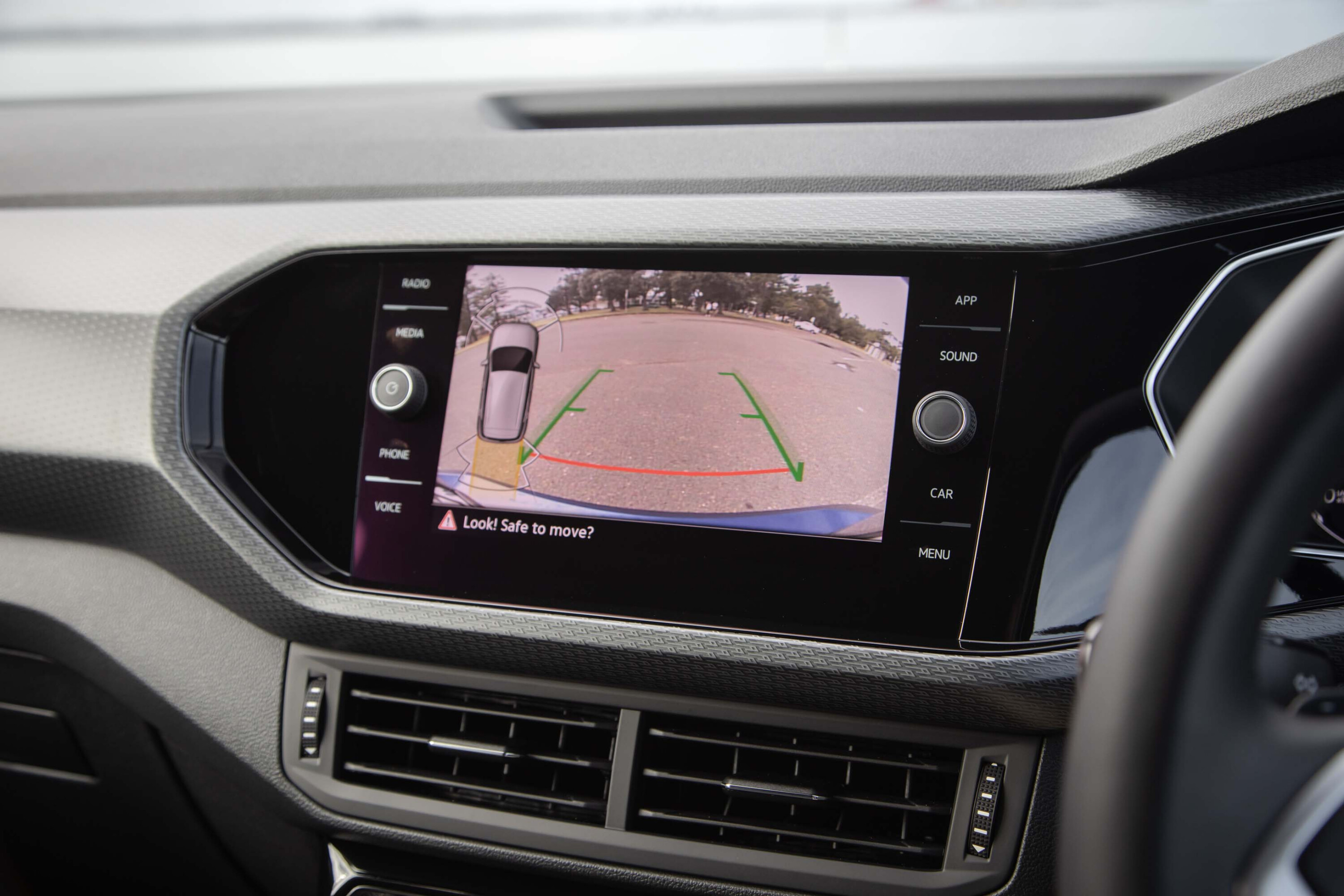
1
Missing from the Life spec are adaptive cruise control, rear-cross traffic alert and blind-spot monitoring.
These were available in a Driver Assistance pack, which was reasonably priced at $1200 but is now only available as a standard inclusion in the T-Cross Style.
Passive safety includes eight airbags, ISOFIX child seat anchors in the outboard rear seats and three top tether points.
How comfortable and practical is the Volkswagen T-Cross?
Despite its pint-sized dimensions, the T-Cross is a nice place to spend time, with supportive seats and generous equipment levels for the price.
There are a few trade-offs when you step inside, such as hard plastic surfaces on the dashboard and door skins. But there are soft-touch surfaces where it matters, such as the armrests on the doors.
In the entry-level T-Cross Life are firm but comfortable cloth seats with a nice blend of patterns, but the monochrome decor of the interior could do with a little more colour to bring additional visual interest.
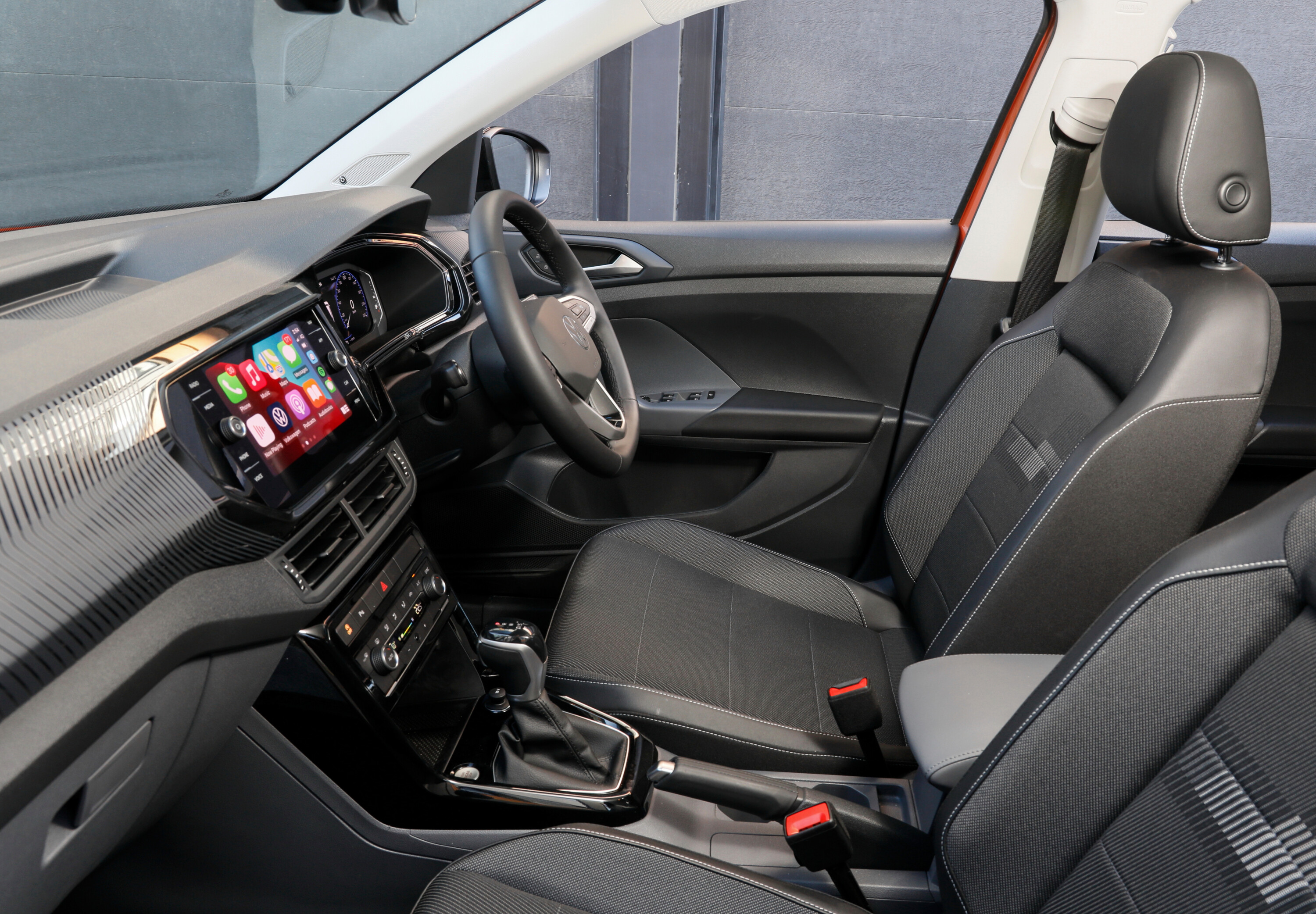
1
The upper-spec Style livens the vibe with bolstered seats, more features and nicer materials.
Similarities between the T-Cross and Polo are noticeable as soon as you jump inside. However, there’s noticeably more headroom, and the high-riding seating position is more SUV-like than other light crossovers, such as the Mazda CX-3 and Hyundai Venue.
The additional height also makes getting in and out a breeze and provides convenient access to boot.

2
The compact centre console features a small tub beneath the armrest, with the midsection taken up by two cup holders and a traditional handbrake, which is an increasingly rare feature these days.
You get a bit more storage in front of the gear shifter, where you’ll find a couple of USB sockets, and the wireless phone charger if you opt for the Sound and Vision Package.
If you need more storage space, there are decent-sized door bins, a nifty little drawer below the passenger seat and a handy nook under the driver’s seat to store the manual and free up room in the glove box.
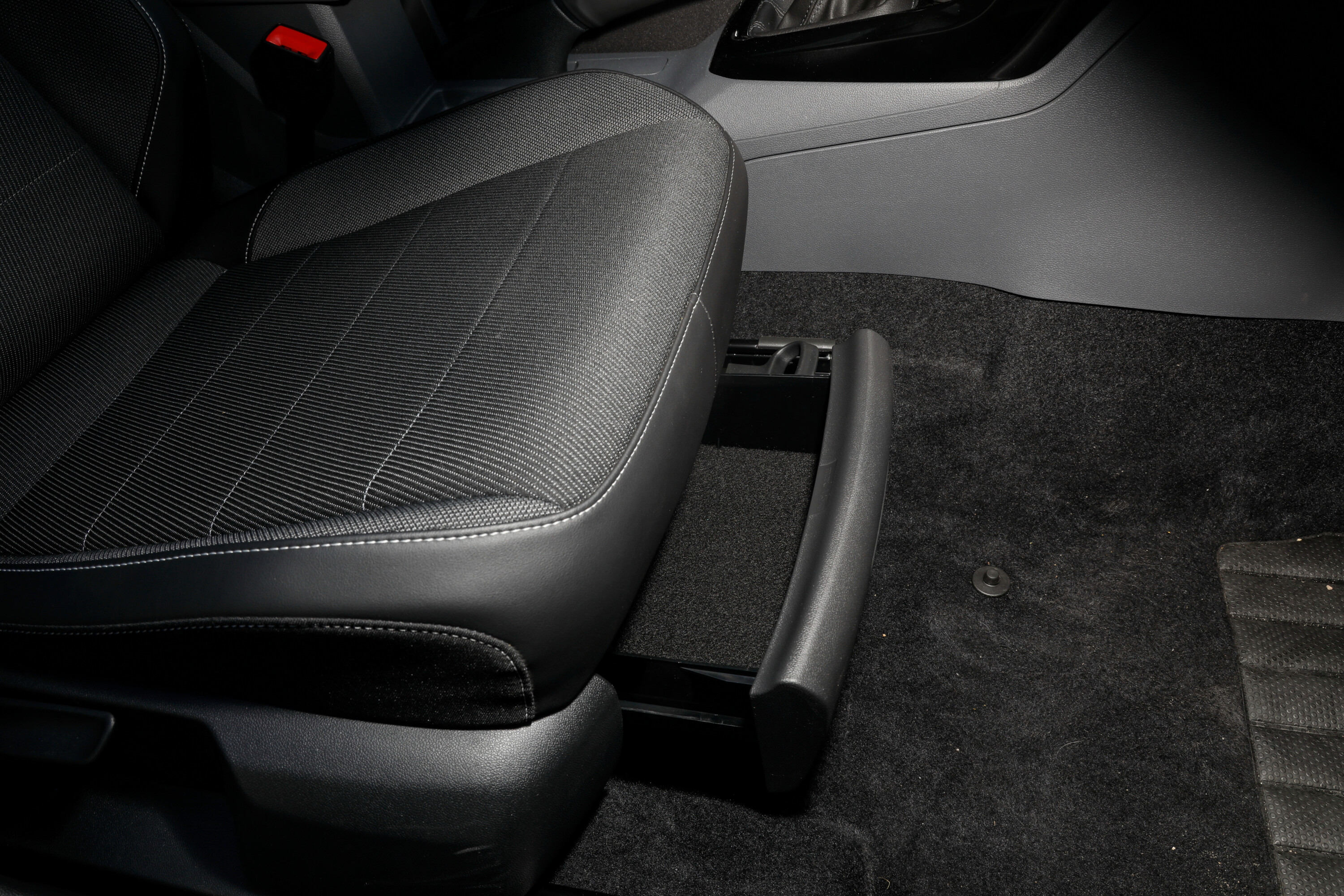
1
Second-row comfort
The fabric rear pew is a little firm but shaped well to provide comfort.
High-set seats offer good front and side vision, which children will appreciate and you can comfortably seat two adults, though there is no centre armrest to lean on.
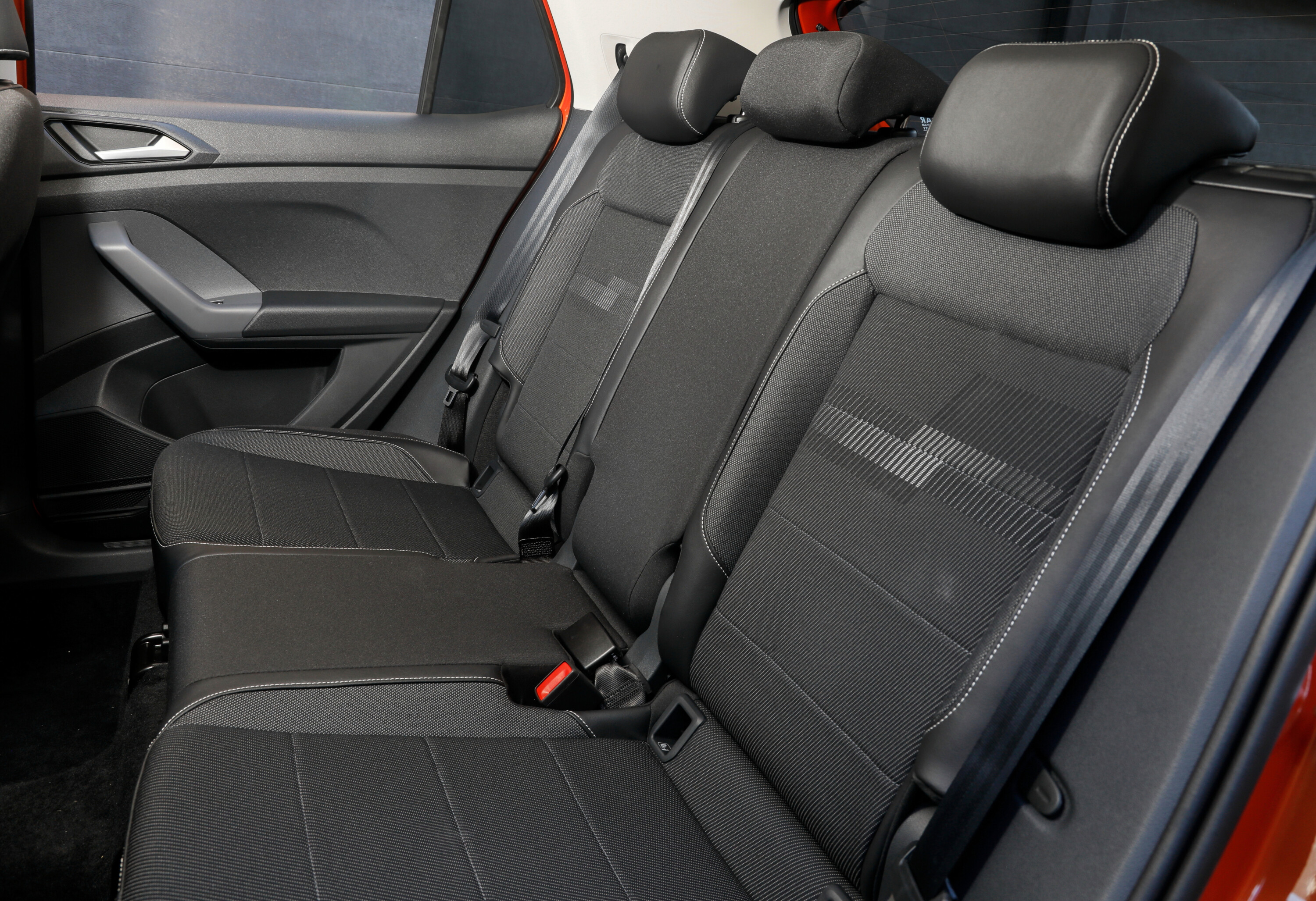
2
On the plus side, surprisingly ample legroom in the T-Cross puts some bigger SUVs to shame, and there is excellent headroom throughout.
Rear-seat passengers benefit from two USB-C sockets, map pockets on the back of the front seats and door bins.
Curiously, none of the current variants come with rear air vents, but Volkswagen left the housing in place, which lets you know what you’re missing while doubling as a handy storage nook.
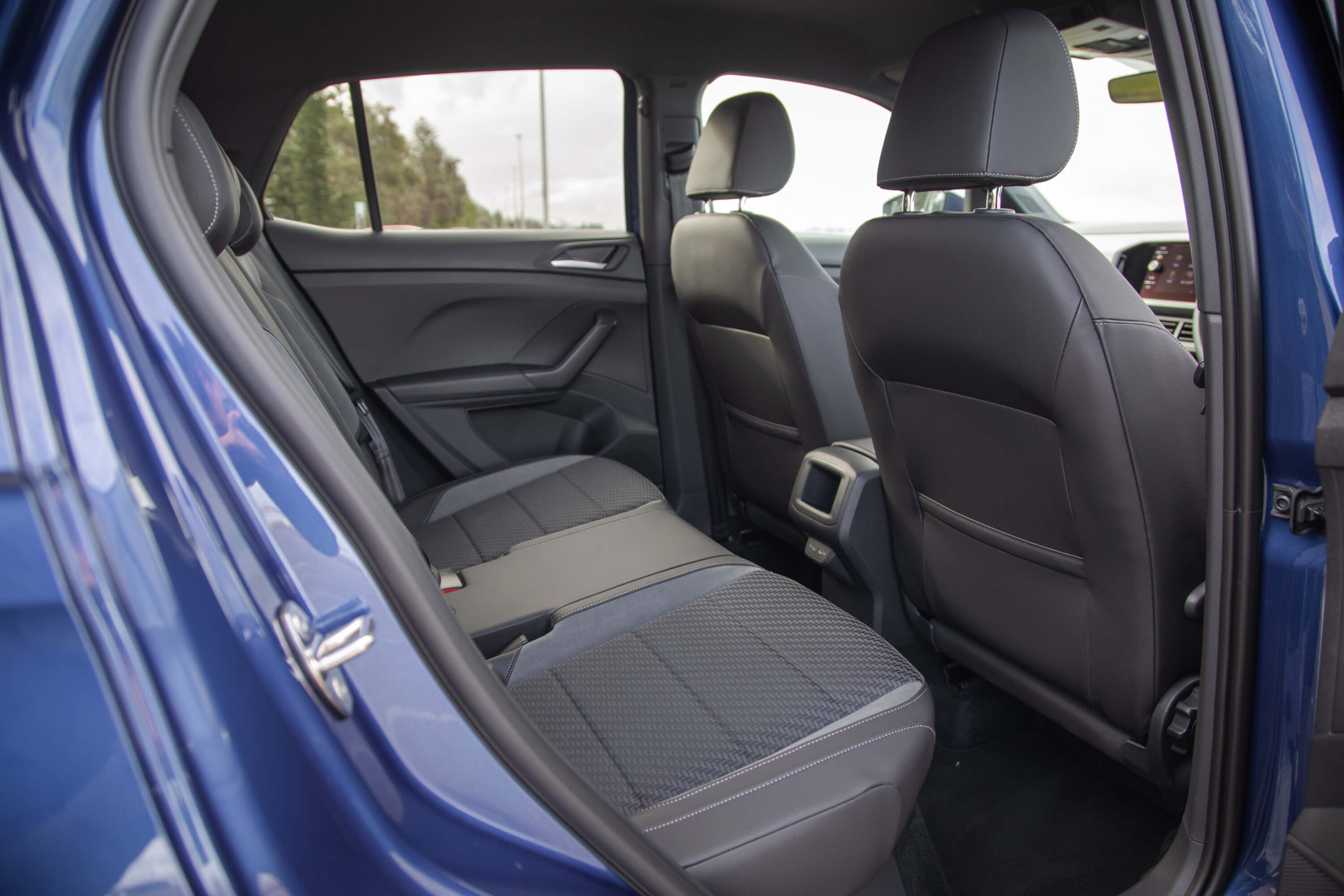
1
How much boot space does the Volkswagen T-Cross offer?
The second-row seat can slide 140mm fore and aft to vary the boot space between 385-455 litres.
Folding the rear seats flat expands cargo-carrying capacity to 1281 litres. They also fold in a 60:40 split, which adds flexibility for combining rear passengers with long loads.
Lift the boot floor, and you’ll find a space-saver spare wheel and tools.
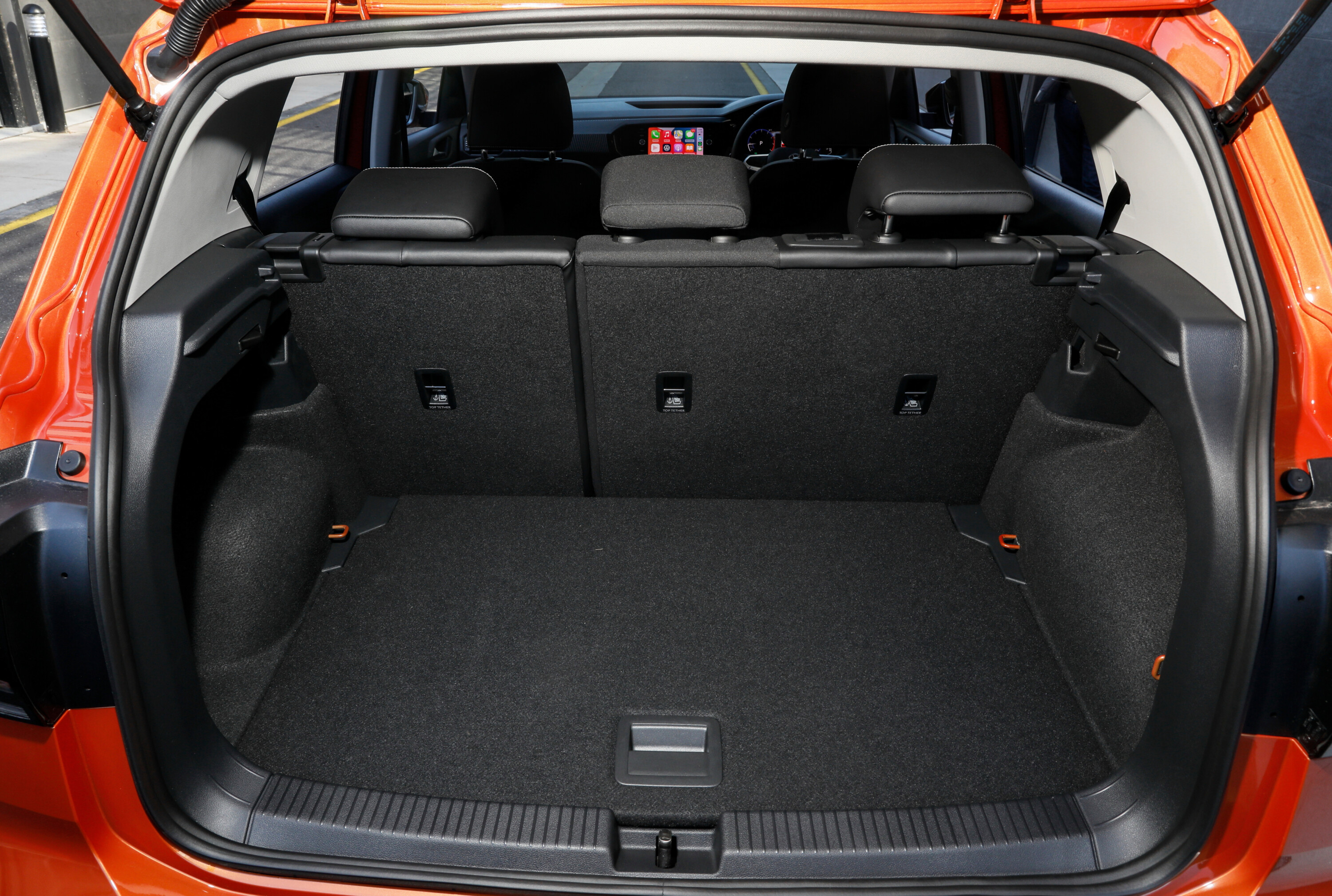
6
I like driving, will I enjoy the T-Cross?
As well as sharing underpinnings with the Polo, the T-Cross has adopted the hatchback’s 1.0-litre, three-cylinder turbocharged petrol engine.
It’s a good little unit but loses some of its spark in the slightly heavier T-Cross, though you’re rarely left wanting for oomph, even at highway speeds.
There is a Sport driving mode that changes the engine mapping so it reaches peak power quicker, but it doesn’t make too much of a tangible difference.
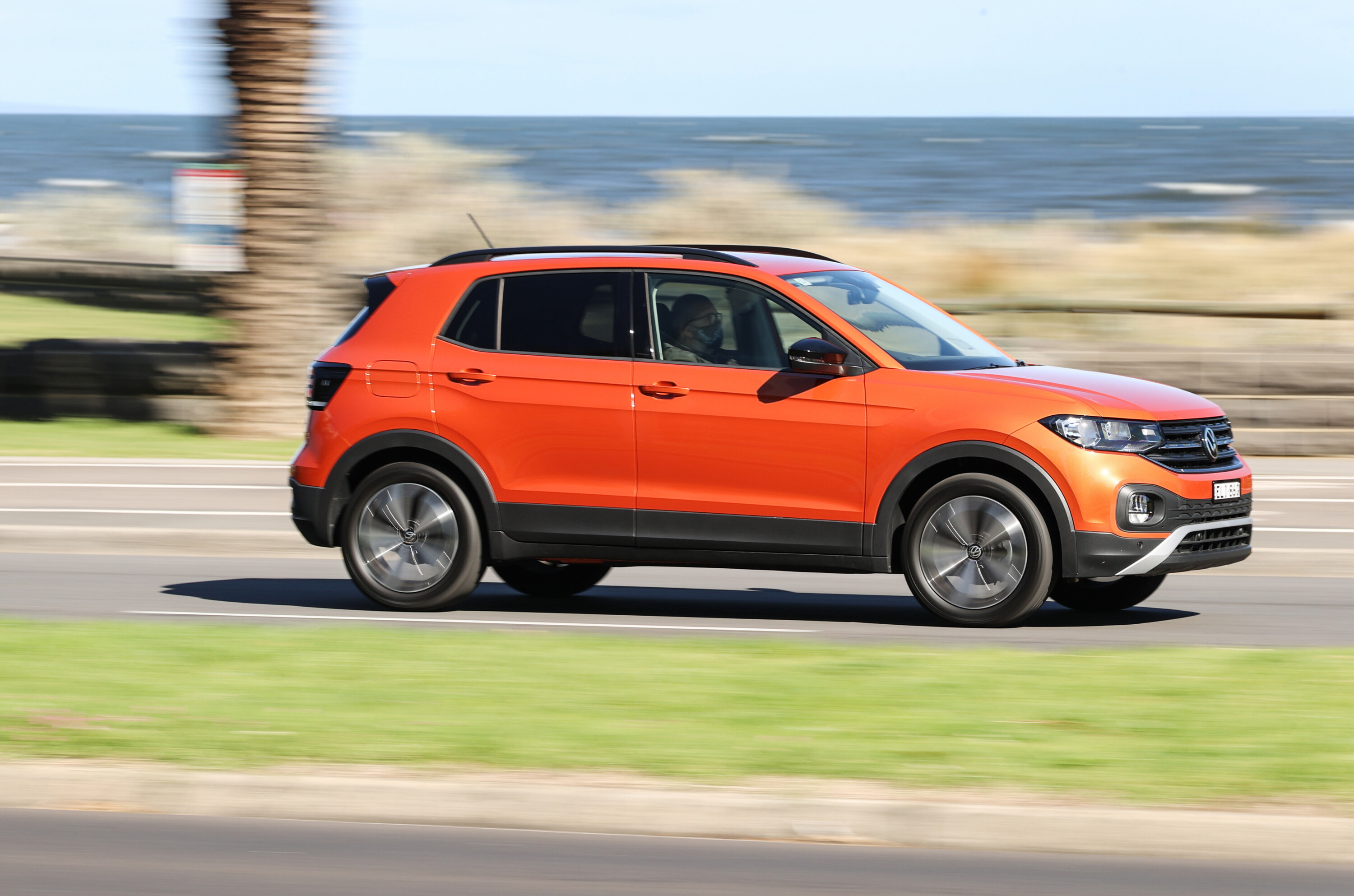
1
Paddle shifters provide some hands-on driving, but it’s not exactly sporty. Push the T-Cross on a twisty road, and you’ll encounter some body roll.
To be fair, with 10.2-second 0-100km/h acceleration, the T-Cross isn’t trying to be a performance car; if chasing apexes is high on your mission list, you’re best sticking with the Polo or opting for the sportier T-Roc.
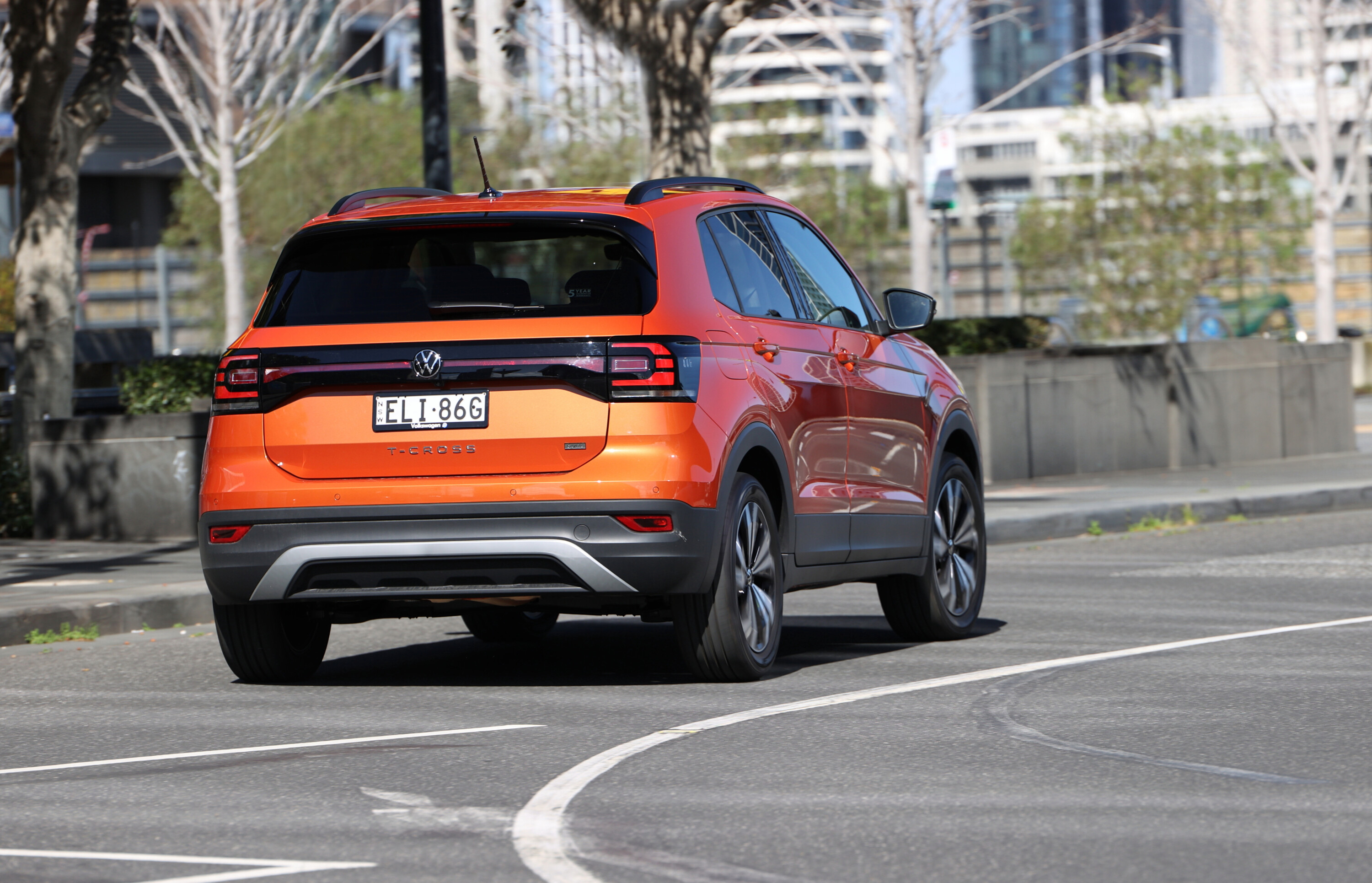
3
The T-Cross doesn’t stray too far from the Polo’s dimensions, making it easy to manoeuvre around town while offering a raised driving position with good visibility.
Light but responsive steering makes negotiating tight streets and parking spaces a doddle.
Ride comfort feels composed on most surfaces, and road and engine noise is very low, which lessens fatigue in heavy traffic.
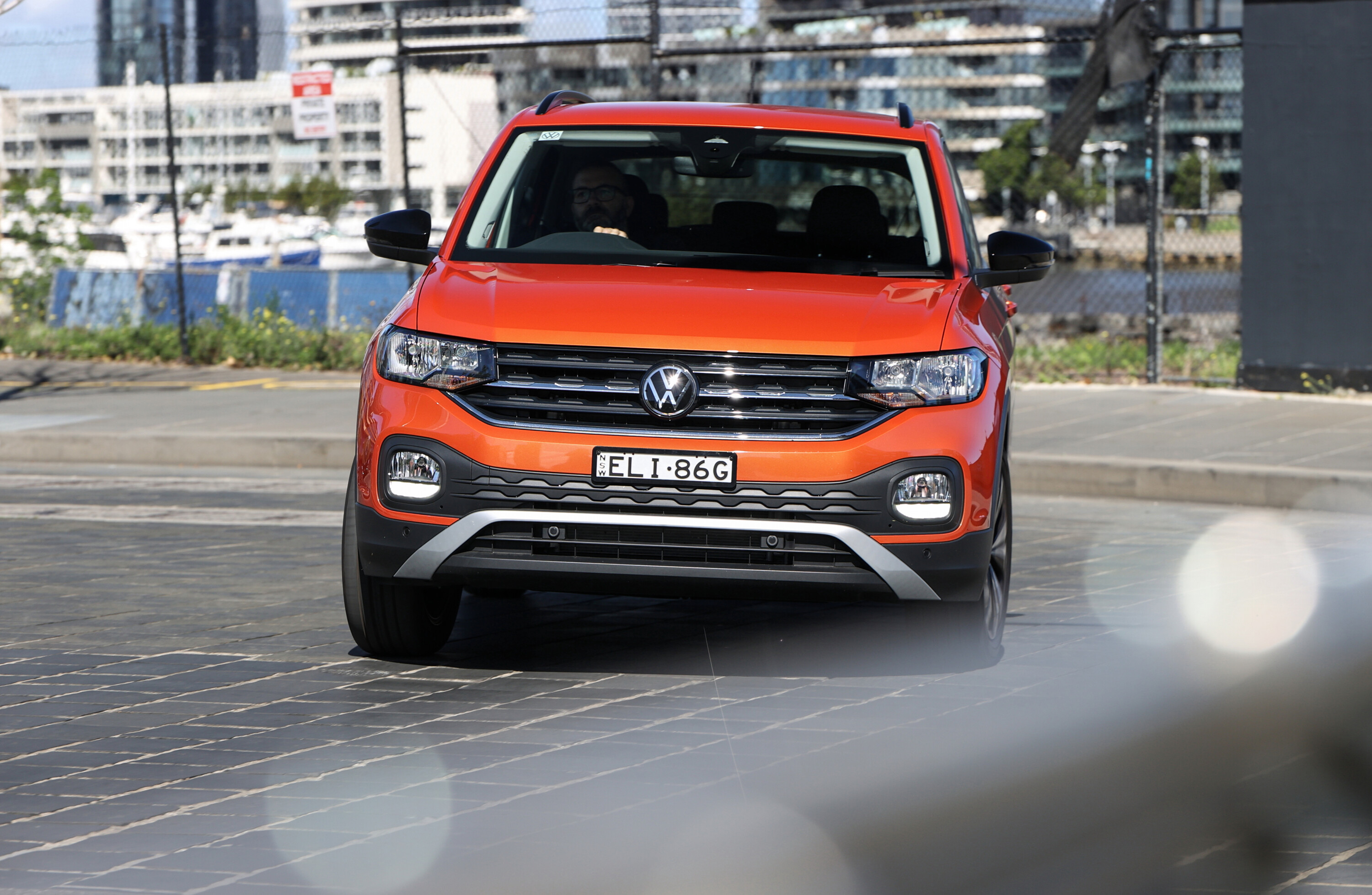
1
Which Volkswagen T-Cross engine uses the least fuel?
So far, only one engine is available in the T-Cross range – the three-cylinder 85kW/200Nm turbocharged 85 TSI petrol engine shared with the Polo hatchback.
Under the bonnet of the T-Cross, it consumes 5.4 litres per 100km on the official test (city and country cycles combined).
It’s an excellent little engine around town but in the T-Cross, which is 88kg heavier than a Polo, it feels a touch weak when you put the foot down.
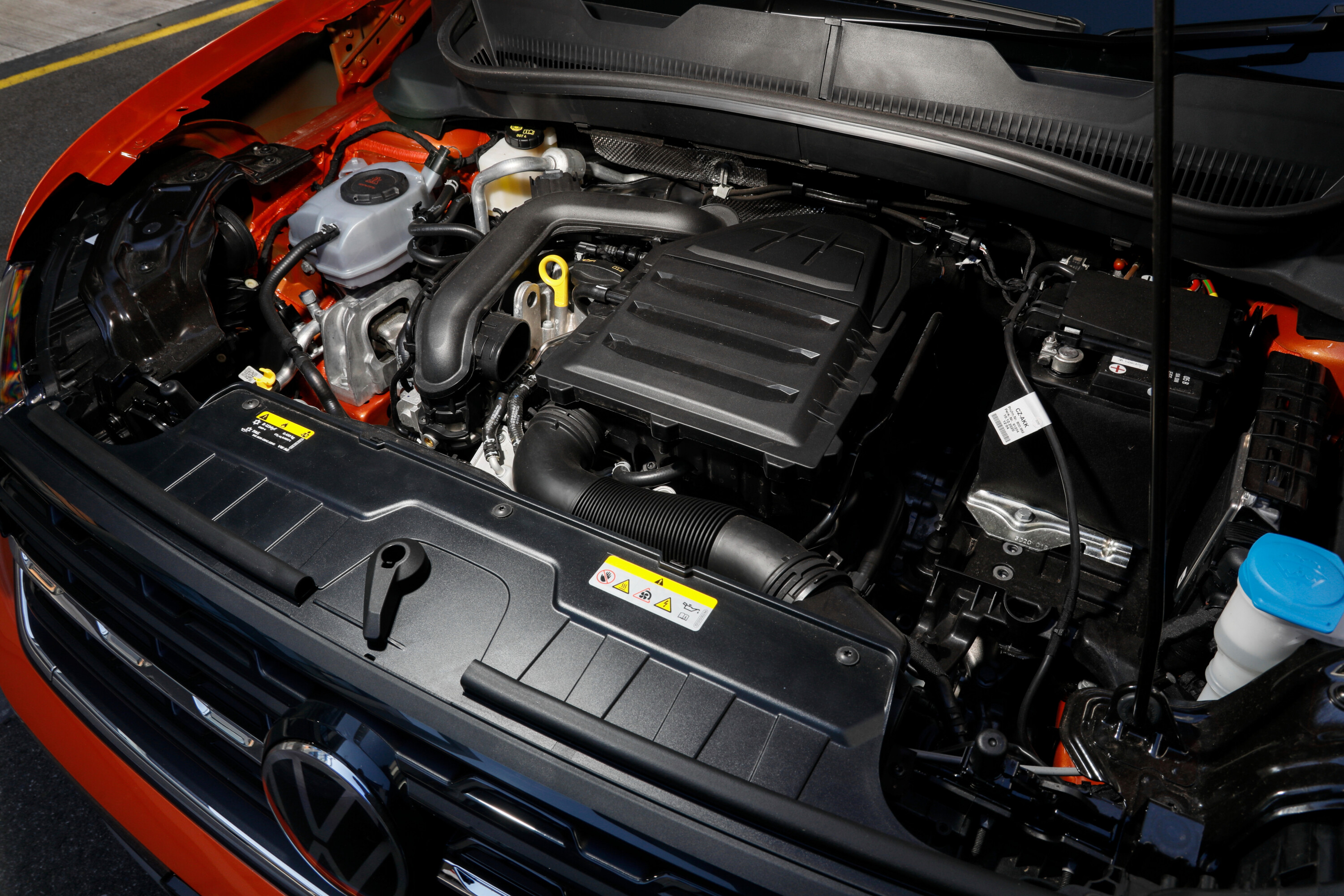
3
The 85 TSI is coupled with a seven-speed dual-clutch automatic transmission, which sends power to the front wheels.
It selects ratios well but can be quite laggy on take-off, not helped by the fuel-saving start/stop engine function that can thankfully be turned off.
This powertrain is expected to carry over into the facelifted 2024 T-Cross.
How much can a Volkswagen T-Cross tow?
The T-Cross can tow a braked load of up to 1100kg.
It has an unbraked towing capacity of 630kg and a 55kg tow ball weight.
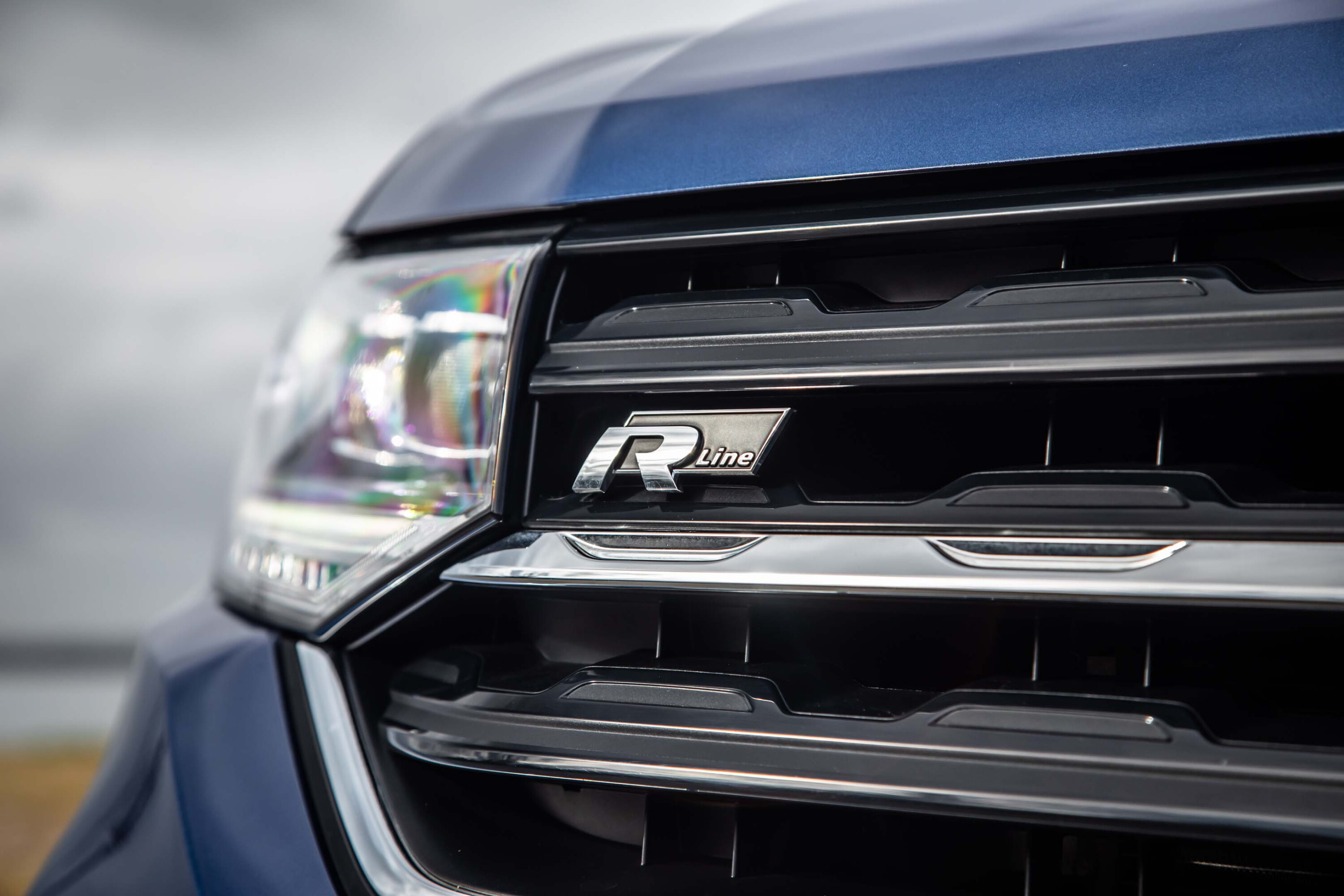
1
How long is the warranty of a Volkswagen T-Cross and what are the servicing costs?
The T-Cross comes with a five-year/unlimited-kilometre warranty and 12 months of roadside assistance cover.
Service intervals are 12 months or 15,000km.
1
| Volkswagen T-Cross capped-price servicing costs | |
|---|---|
| Interval | Pricing |
| 15,000km | $421 |
| 30,000km | $621 |
| 45000km | $526 |
| 60,000km | $986 |
| 75,000km | $526 |
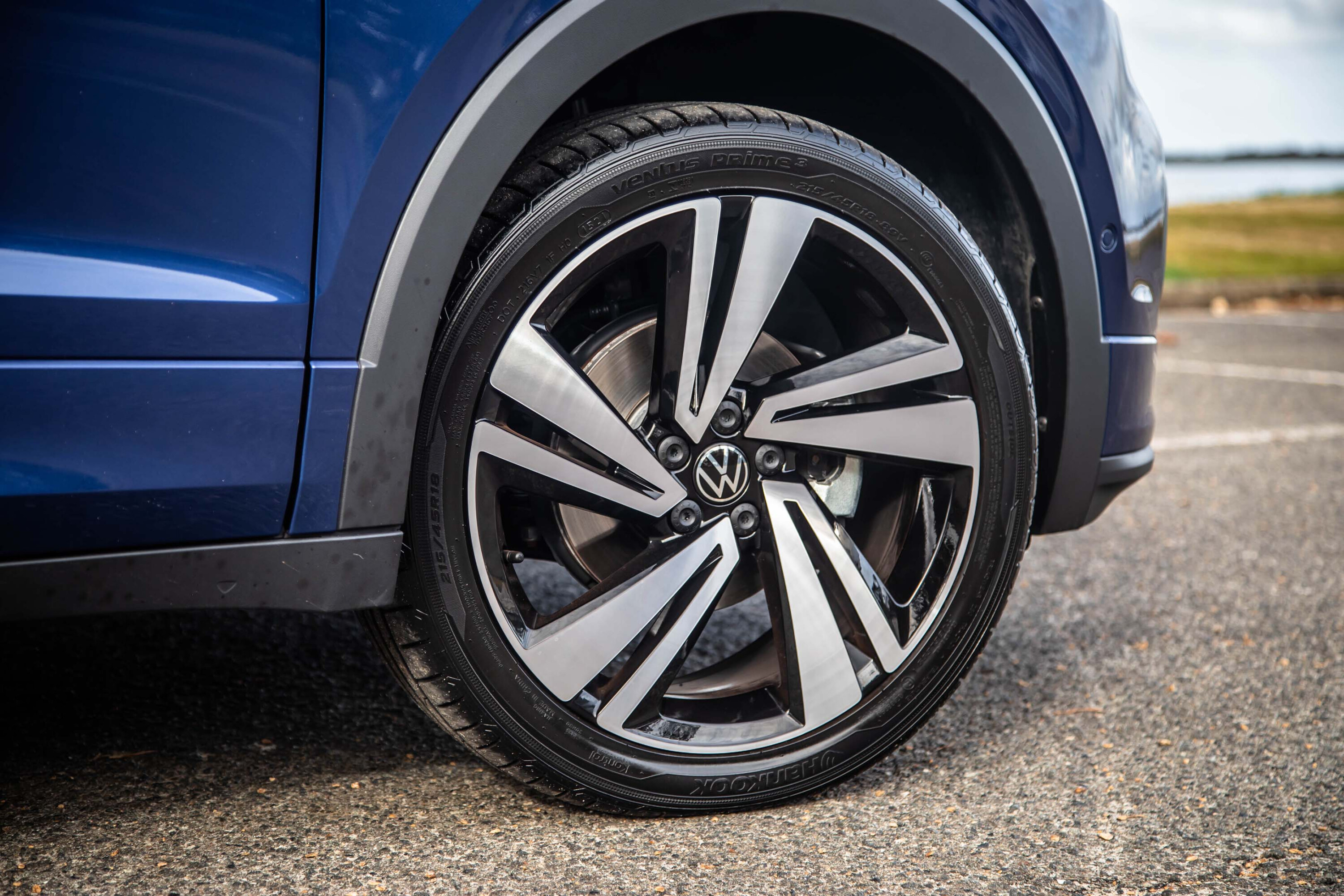
1
Which version of the T-Cross does Wheels recommend?
Both T-Cross versions are very similar, but the 85 TSI Style has some decent extras included in the price to justify the additional $3500 over the Life.
These include adaptive cruise control and additional active safety tech included in the standard Driver Assist package, which represented about a third of the additional cost when it was offered as an option on the Life.
Scraping up an extra $2200 for the Sound and Vision Package brings a very well-equipped light SUV that could get away with wearing an Audi badge.

2
What are the main rivals to the Volkswagen T-Cross?
The light SUV segment provides some good little choices against which the T-Cross stacks up well.
u2b06ufe0f Back to top
MORE
Small SUVs
The Kia Seltos is a five-door, five-seat small SUV that drives well around town with good fundamental dynamics, bundled with generous cabin space, stylish looks and useful tech.
A facelift for the 2023 model year brought even fresher looks, the fitment of an improved conventional automatic transmission and new technology headlined by a fresh infotainment suite.
A carryover 2.0-litre naturally aspirated four-cylinder petrol engine matched to a continuously variable transmission (CVT) and front-wheel drive is standard on all variants, with the top two grades offered with the option of an updated 1.6-litre turbo-petrol engine driving all four wheels through a conventional automatic gearbox.
Sadly there are no hybrid or electrified variants, but real-world fuel economy is decent and all versions have Apple CarPlay and Android Auto connectivity. Kia’s seven-year warranty is one of the best available.
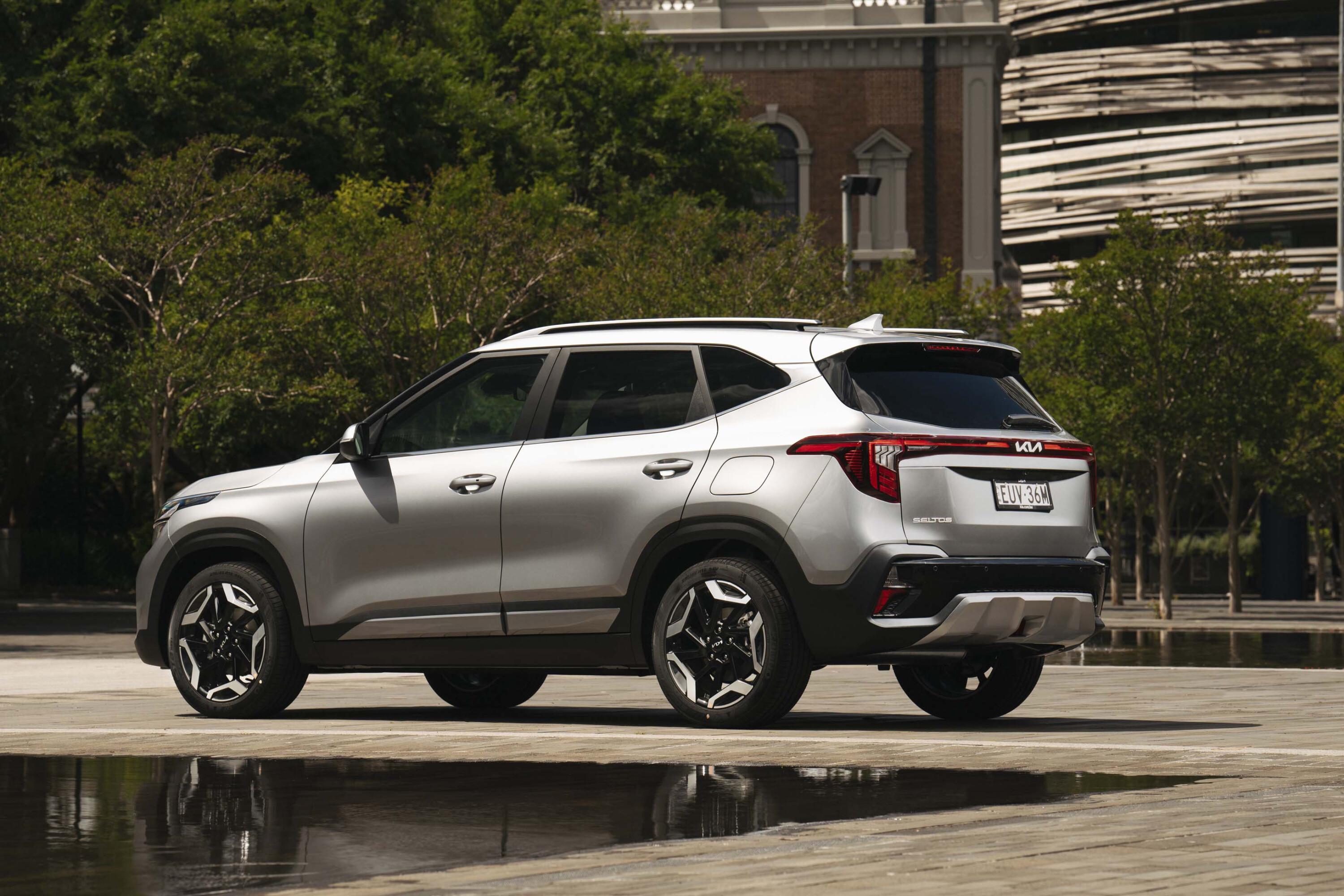
1
JUMP AHEAD
- Pricing
- What body styles are available for the Seltos?
- What features are standard in every Seltos?
- What key features do I get if I spend more?
- How safe is the Seltos?
- How comfortable and practical is the Seltos?
- How much boot space does the Seltos offer?
- I like driving, will I enjoy this car?
- Which Seltos engine uses the least fuel?
- What is the Seltos’s towing capacity?
- How long is the warranty & what are the Seltos’s servicing costs?
- Which version of the Seltos does Wheels recommend?
- What are the Seltos’s key rivals?
Pricing
| 2024 Kia Seltos pricing | |
|---|---|
| S 2.0 CVT FWD | $29,500 |
| Sport 2.0 CVT FWD | $32,700 |
| Sport+ 2.0 CVT FWD | $35,800 |
| GT-Line 2.0 CVT FWD | $41,500 |
| Sport+ 1.6T 8A AWD | $39,300 |
| GT-Line 1.6T 8A AWD | $44,900 |
| Prices exclude on-road costs | |
What body styles are available for the Kia Seltos?
The Kia Seltos is sold as a five-door SUV only, and depending on the drivetrain option is either front-wheel drive or all-wheel drive.
It is classed as a small SUV in the mainstream segment and trades heavily on its keen value and usable technology suite.
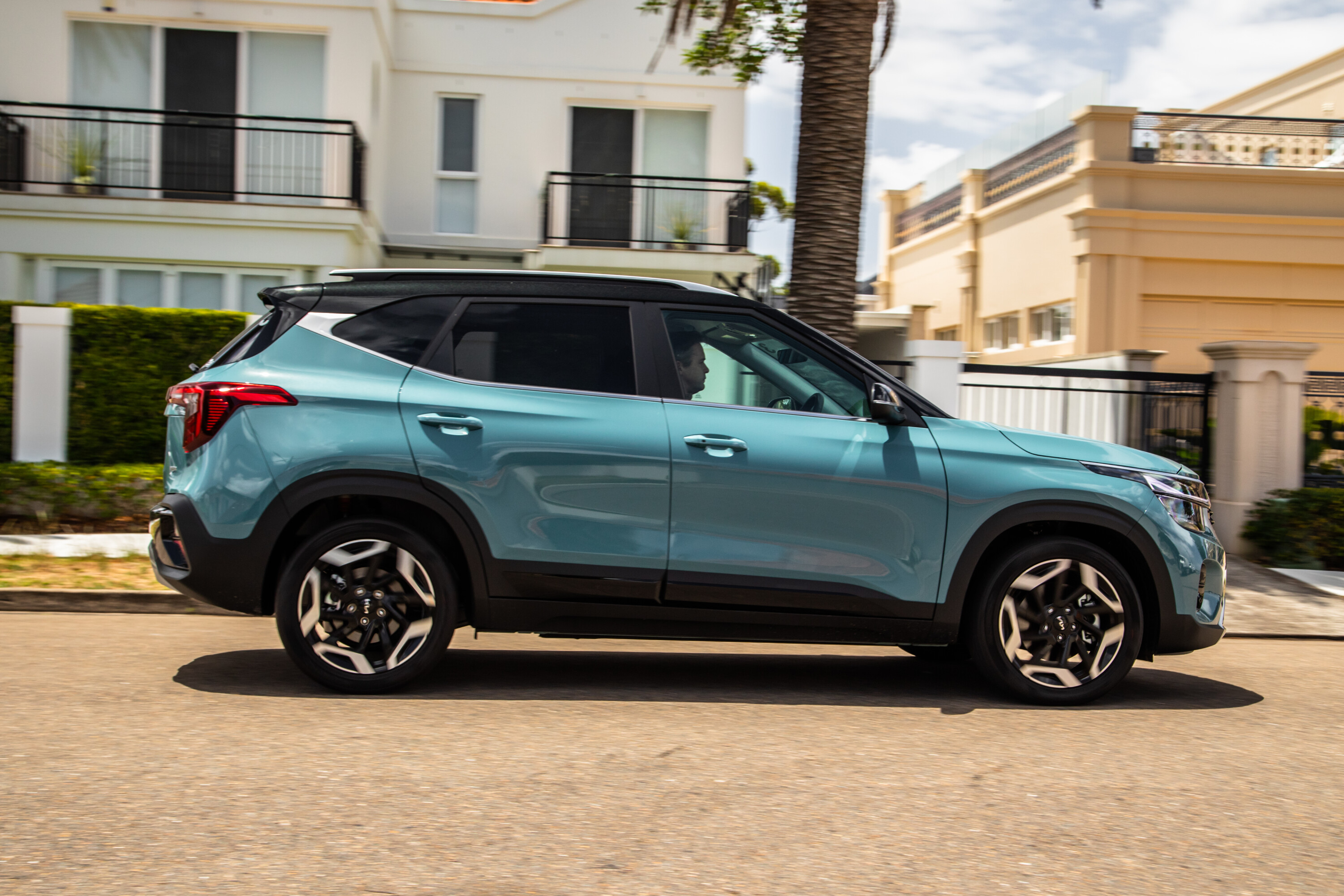
1
What features are standard in every Kia Seltos?
The features listed below are standard in the entry-level model (Kia Seltos S) and will appear in higher-grade models, unless replaced by more premium equivalent features.
| 2024 Kia Seltos standard features | |
|---|---|
| 8.0-inch colour touchscreen infotainment system | Roof rails |
| 4.2-inch digital instrument cluster display | Rear spoiler |
| Wireless Apple CarPlay and Android Auto | Shark fin antenna |
| 16-inch alloy wheels | 12v power socket in front console |
| Six-speaker stereo | USB-A and USB-C ports in front console |
| Space-saver spare wheel | Two USB-C ports in second-row |
| Automatic halogen headlights w/ automatic high beam | Manual air conditioning |
| Halogen daytime running lights | Second-row air vents |
| Rear fog light | Manual handbrake |
| Matte black grille mesh | Cloth upholstery |
| Body-coloured door handles | Six-way manually-adjusted driver seat |
| Body-coloured, power-folding side mirrors | |
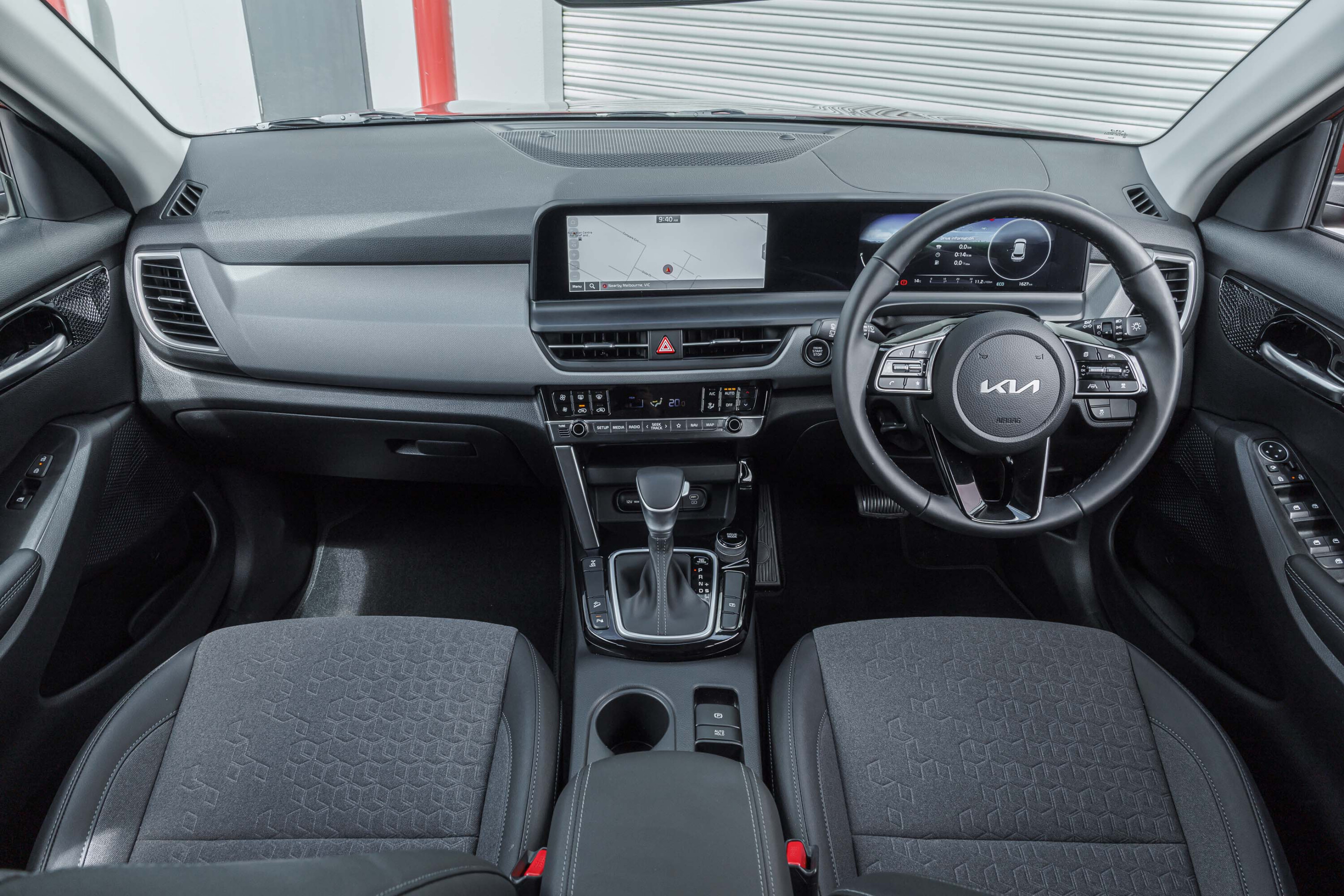
1
What key features do I get if I spend more?
The least costly version, the Seltos S, has cloth seats, an 8.0-inch touchscreen and 16-inch wheels, and comes with at least the standard features listed above.
The range predominantly utilises the carryover non-turbo 2.0-litre four-cylinder engine and CVT combination.
You can opt for the more powerful, more sophisticated, 1.6-litre turbocharged petrol unit with a superior conventional automatic transmission for a $3500 premium compared to the equivalent mid-range Sport+ and flagship GT-Line trims.
The turbocharged powertrain also benefits from all-wheel drive, providing more confident roadholding, and a noticeable step up in capability for unsealed ‘soft-road’ scenarios.
Upgrading to the Seltos Sport inches up the wheels to 17-inch alloys, adds niceties such as a full-size spare wheel, fancier projector-style headlights, climate control, and a larger dual 10.25-inch infotainment and instrument displays.
1
The Sport also brings
| 2024 Kia Seltos Sport features | |
|---|---|
| Dual 10.25-inch central infotainment and digital instrument displays | Halogen (projector-style) headlights |
| DAB+ digital radio, wired Apple CarPlay/Android Auto | Solar Glass windscreen and front doors |
| Satellite navigation | Sounds of Nature ambient audio |
| Premium steering wheel and gear shifter | Climate control |
| 17-inch alloy wheels | One-touch driver window control |
Paying more again for a Sport+ gets you those features plus:
| 2024 Kia Seltos Sport+ features | |
|---|---|
| Heated side mirrors | Auto-dimming rear-view mirror |
| Privacy glass | LED interior lights |
| AEB cyclist avoidance and junction turning assist | Illuminated vanity mirrors |
| Adaptive cruise control | Front centre console armrest sliding function |
| Keyless entry and push button start | Rear centre armrest |
| Electric park brake w/ auto hold | Cloth and artificial leather upholstery |
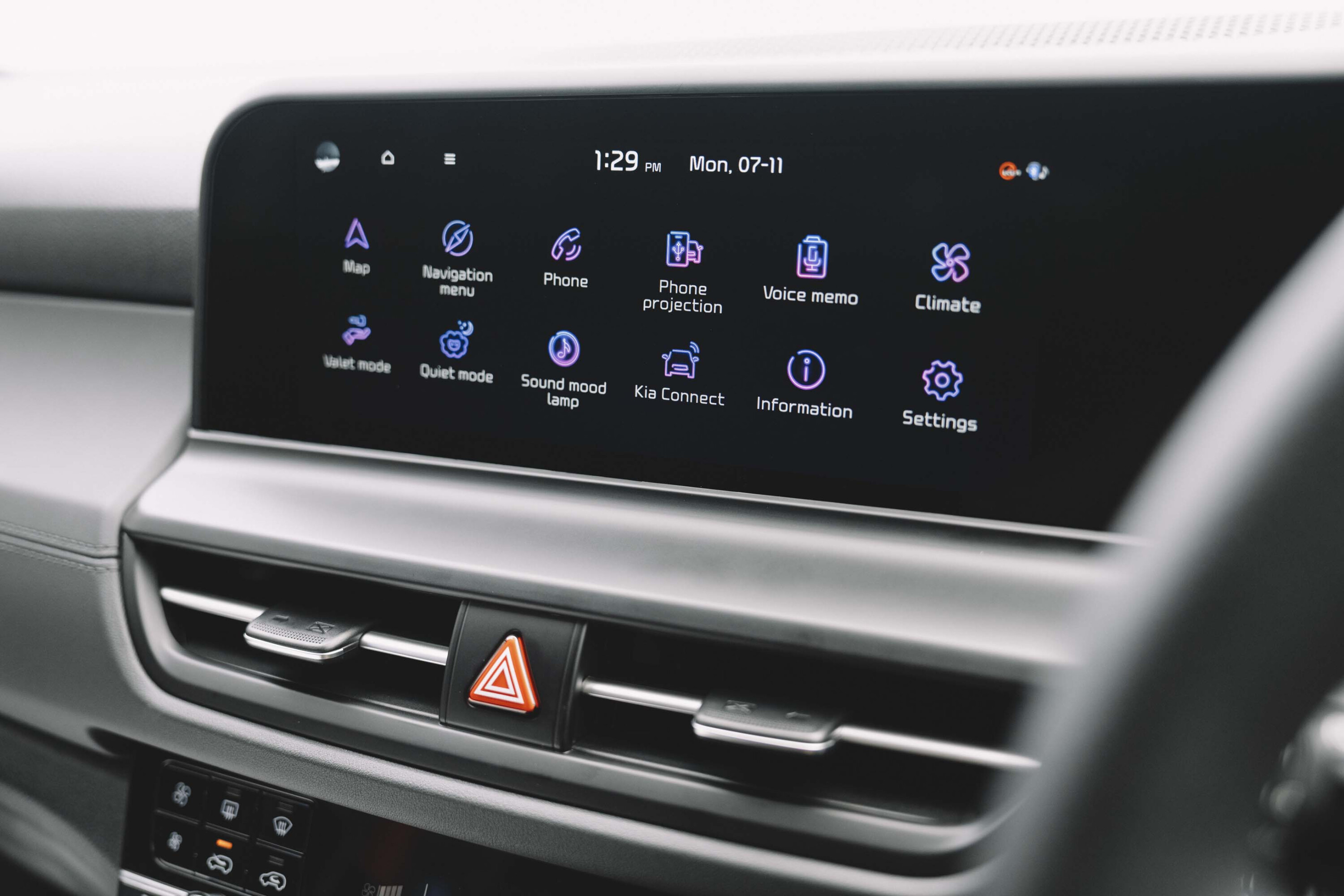
1
The Seltos GT-Line is the most expensive trim grade and includes:
| 2024 Kia Seltos GT-Line features | |
|---|---|
| 18-inch alloy wheels | Wireless phone charger |
| LED headlights, DRLs, fog lights, positioning lights | Eight-speaker Bose premium sound stereo |
| LED rear tail lights | Heated, flat-bottom steering wheel |
| Premium gloss black grille mesh | Interior ambient lighting |
| Satin silver belt line | Parcel shelf |
| Tilt and slide sunroof (not available with two-tone paint) | Premium artificial leather upholstery |
| Power tailgate | Heated and ventilated front seats |
| Rain-sensing wipers | 10-way power adjustable driveru2019s seat w/ two-way lumbar support and two-position memory |
| Head-up display | |
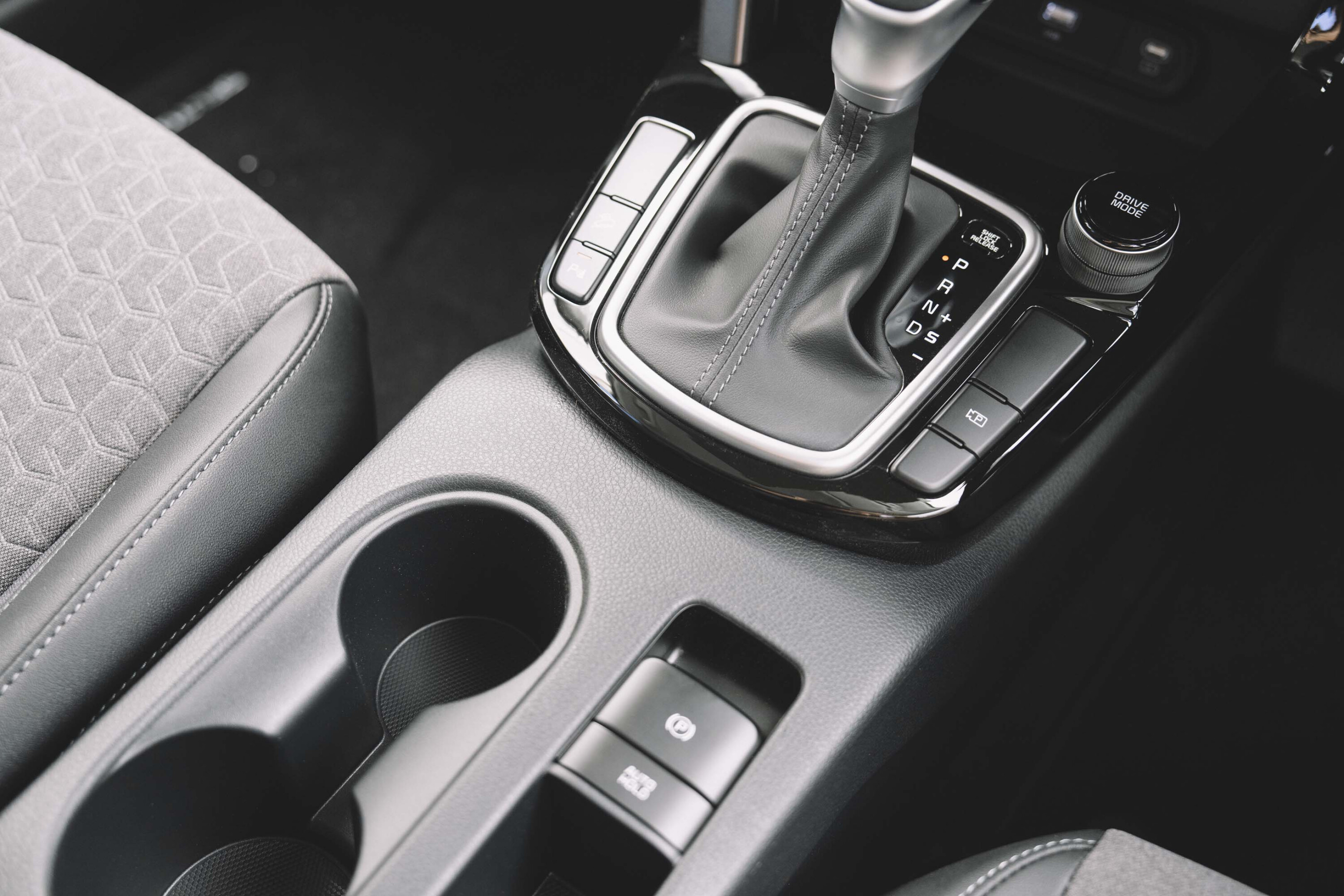
1
How safe is the Kia Seltos?
Safety high points in a standard entry-level Seltos include autonomous emergency braking (AEB) with pedestrian detection and lane-keeping assist that helps steer the Seltos within the road markings.
The AEB can initiate a full emergency stop automatically from speeds up to 80km/h if the system senses you are in danger of driving into something. First, it sounds a warning; if you ignore that, it applies the brakes partially; and if you do not intervene it applies maximum braking. At speeds between 80 and 180km/h, it warns and brakes partially, but it will not brake as hard as possible on its own.
Also standard are a reversing camera and seatbelt warning for every seat – a simple but valuable feature for those with children old enough to unfasten their belts. High-beam assist, six airbags, rear cross-traffic alert, lane following assist, safe exit warning, front and rear parking sensors and the mandatory stability control complete an excellent standard package.
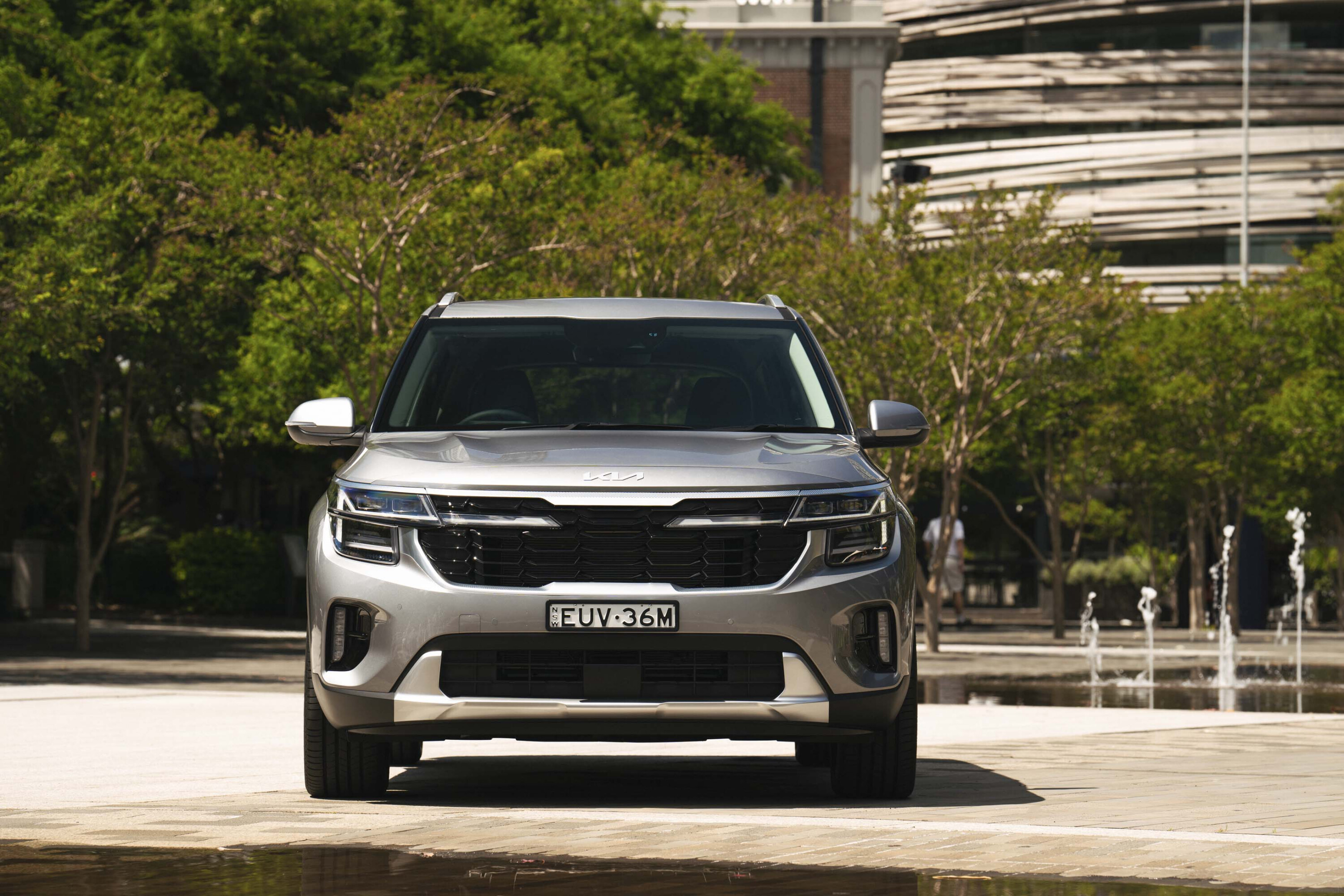
1
Stepping up to the Seltos Sport adds an in-car emergency eCall function to Kia’s connected services.
The Sport+ adds cyclist and junction (front cross-traffic) detection to the existing AEB system, plus adaptive cruise control with stop-and-go functionality, topped off by lead vehicle departure alert.
ANCAP rated the current-generation Kia Seltos at the maximum of five stars, though this is a carryover result from assessment of the pre-facelift Seltos conducted in 2019.
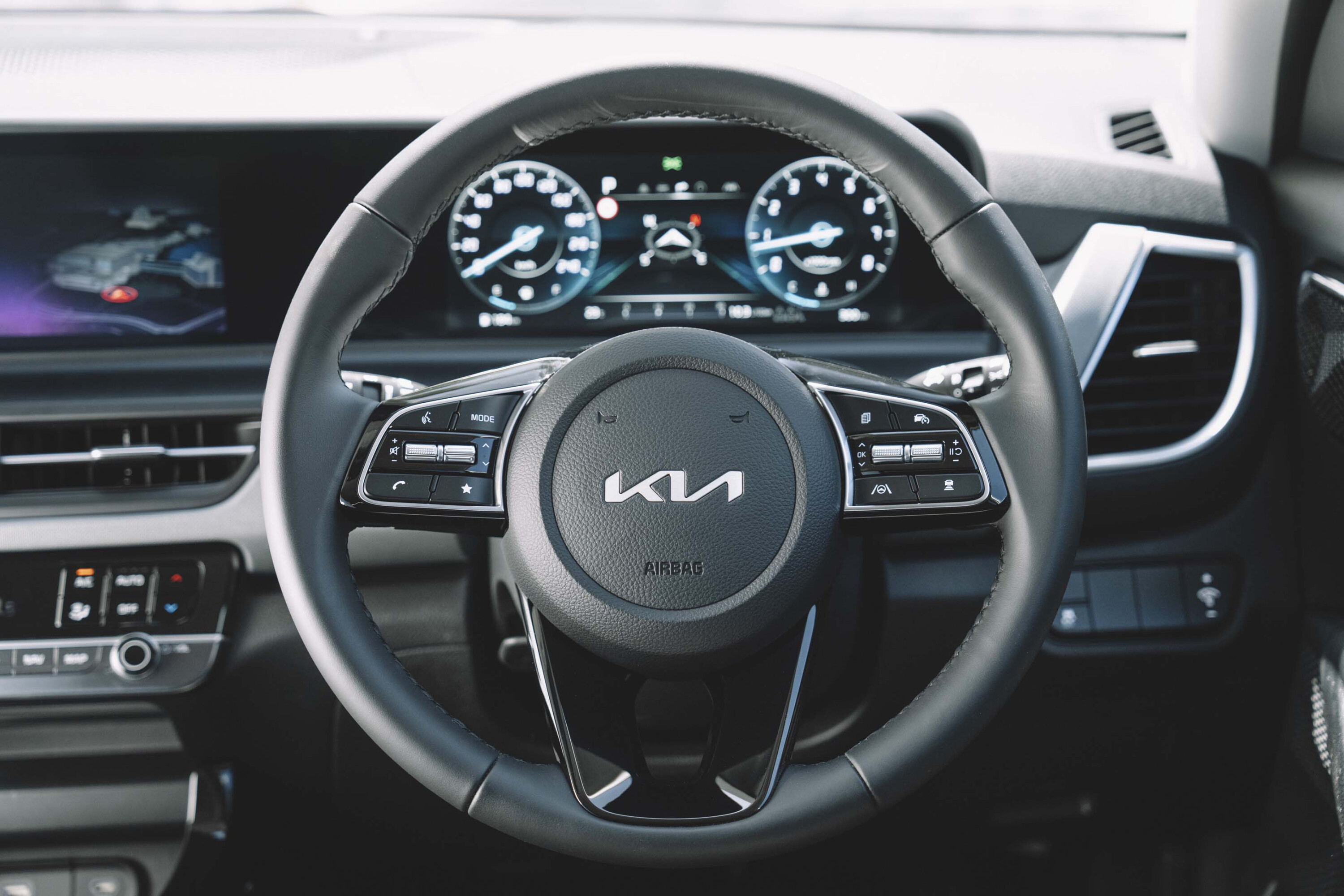
1
How comfortable and practical is the Kia Seltos?
It is easy to get comfortable in the driver’s seat of a Seltos; you can adjust it manually in six dimensions in lower-grade variants.
The driver and front passenger seats in the flagship GT-Line respectively have 10-way and eight-way power adjustment.
You can also move the steering wheel further from you or bring it closer, and adjust it for tilt.
The Seltos cabin is deceptively roomy for its small footprint, with a great view of the road afforded by a largely upright glasshouse. Instruments and controls are laid out neatly and legibly in entry models but impressively morph into a dual 10.25-inch driver display and infotainment array in Sport trims and higher.
Visual and haptic responses of the operating system are good, and the monitors themselves display crisply and cleanly.
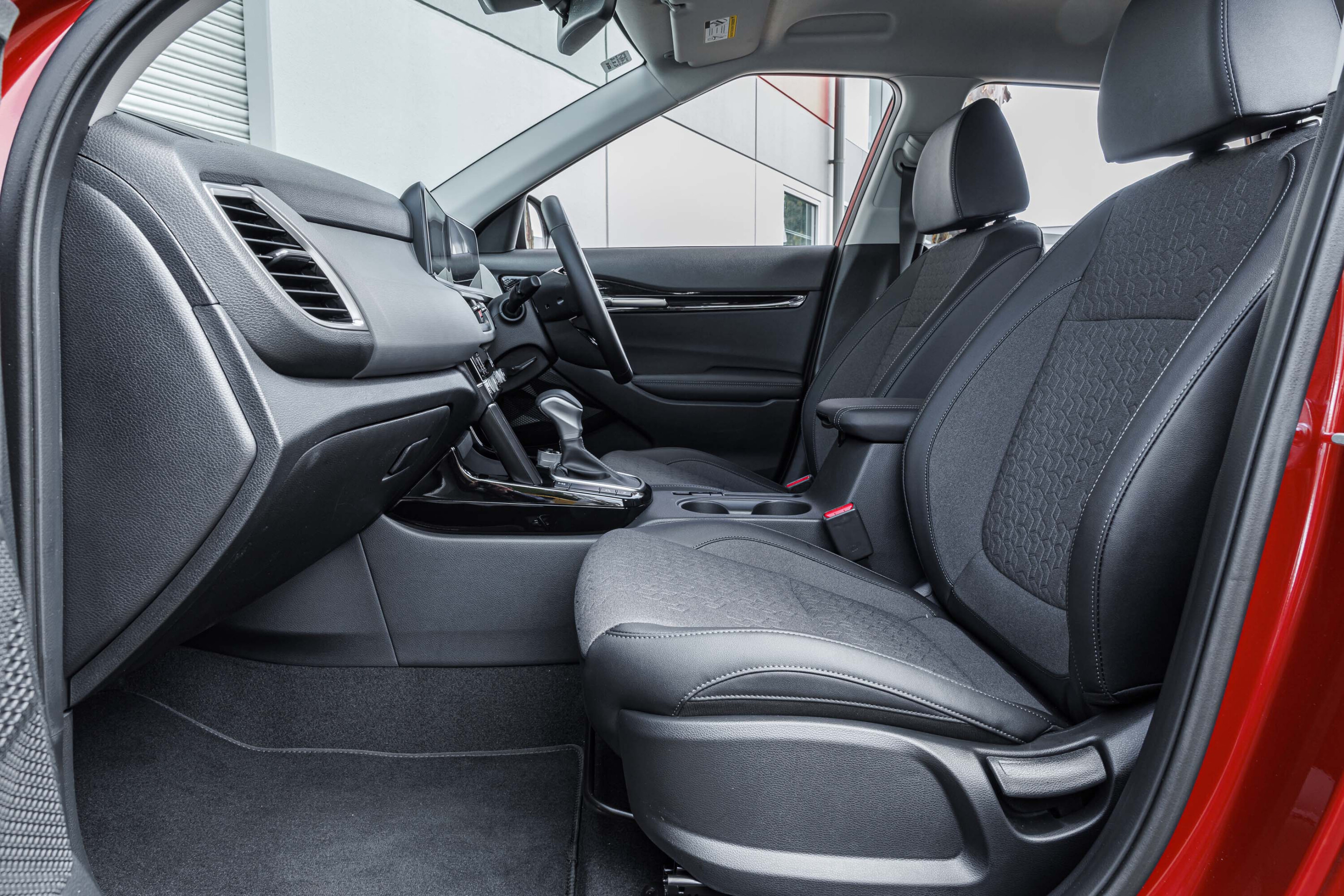
1
The interior is well-built and is finished using good-quality plastics, fabric and carpet — though it may not feel as ‘premium’ as some others in the segment.
A particular oddity to the Seltos is that the entry model’s simpler 8.0-inch infotainment screen can facilitate wireless Apple CarPlay and Android Auto, while stepping up to the dazzling twin 10.25-inch system requires a wired connection. A minor quirk, but something to be aware of.
Rear seating in the Seltos is among the roomiest in its class and often feels more akin to that of larger vehicles.
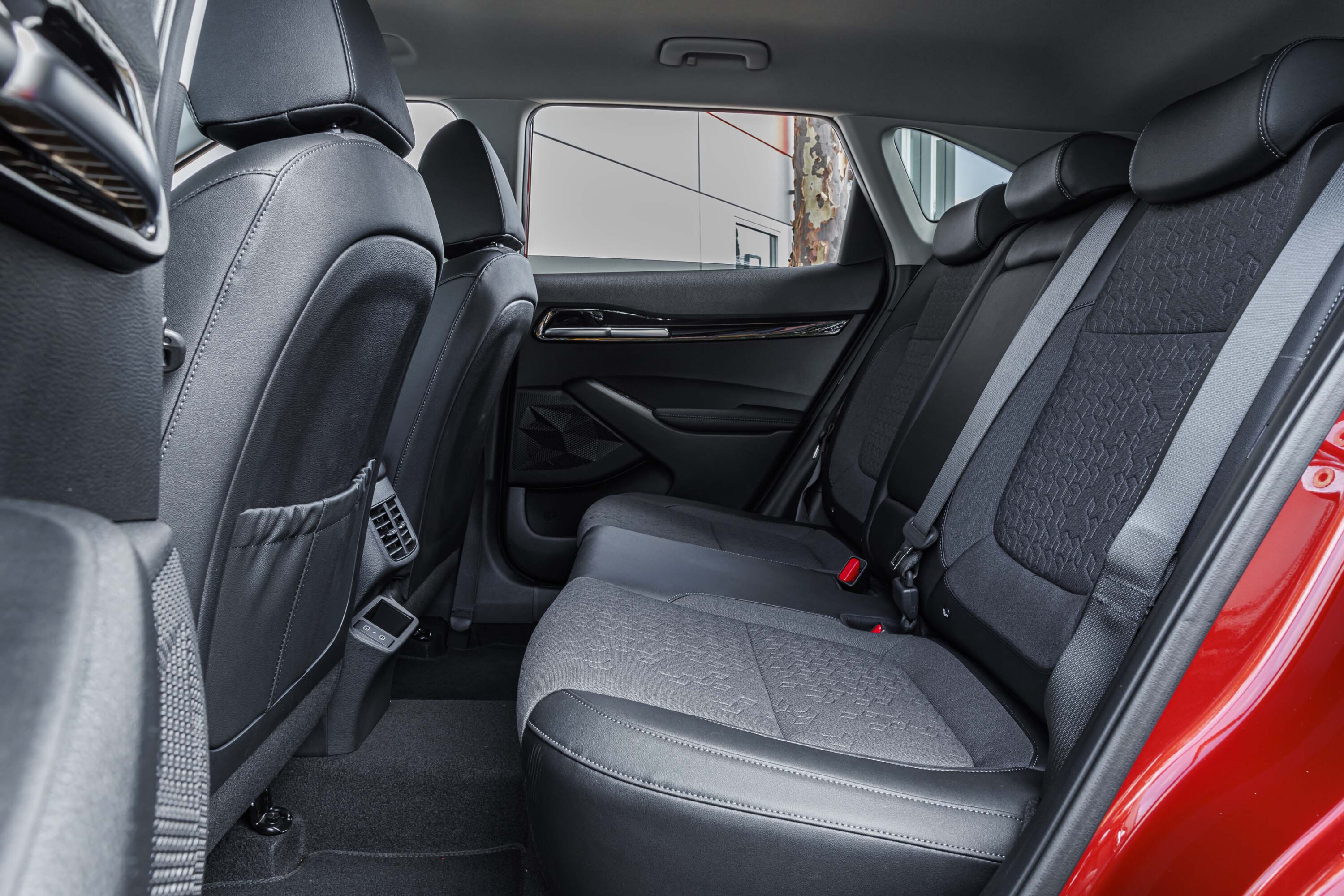
1
The 60:40 split seat’s backrest adjusts for angle in seven steps.
The seats offer good back, under-thigh and lateral support, with enough headroom even for six-foot adults. The cushions are comfortable, and the leather and cloth trim options feel like they will wear well. The 60:40 split seat’s backrest adjusts for angle in seven steps.
Features added in 2023 include rear air vents across the range (previously exclusive to top-shelf GT-Line), plus a USB-C port for the second row.
ISOFIX and top tether anchor points both feature in the second row for securing child seats, with added map pockets behind the front seats. Sport+ and GT-Line grades add a fold-down centre armrest with cup holders.
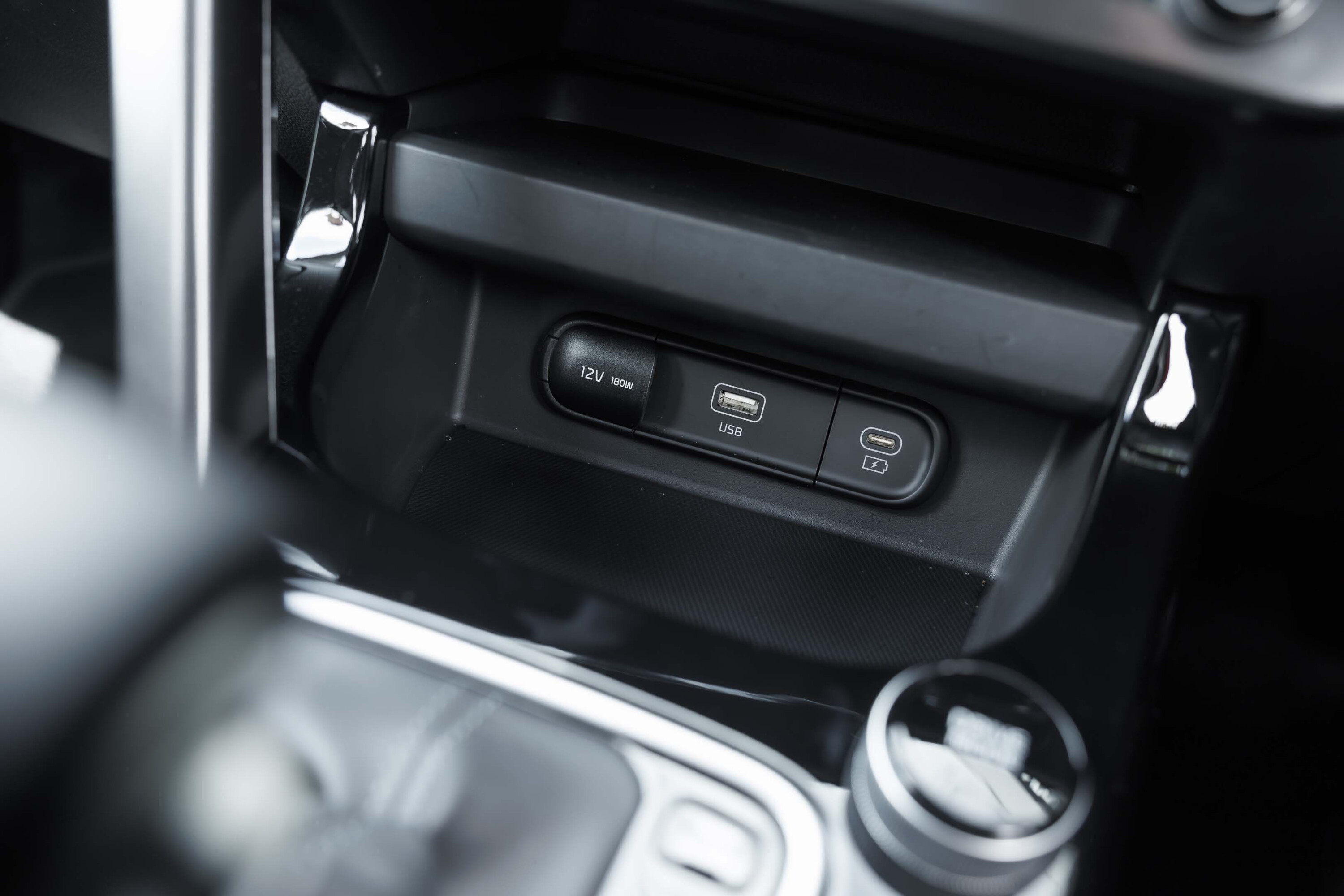
1
How much boot space does the Kia Seltos offer?
In the same way that Kia’s Seltos delivers segment-leading second-row space, the boot is similarly capacious, and one of the biggest in its class.
All variants except the Seltos S get a full-size spare wheel which eats into boot capacity only marginally, swinging in at 433L with the rear seats in place. The space-saver-equipped base variant ups this to 468L.
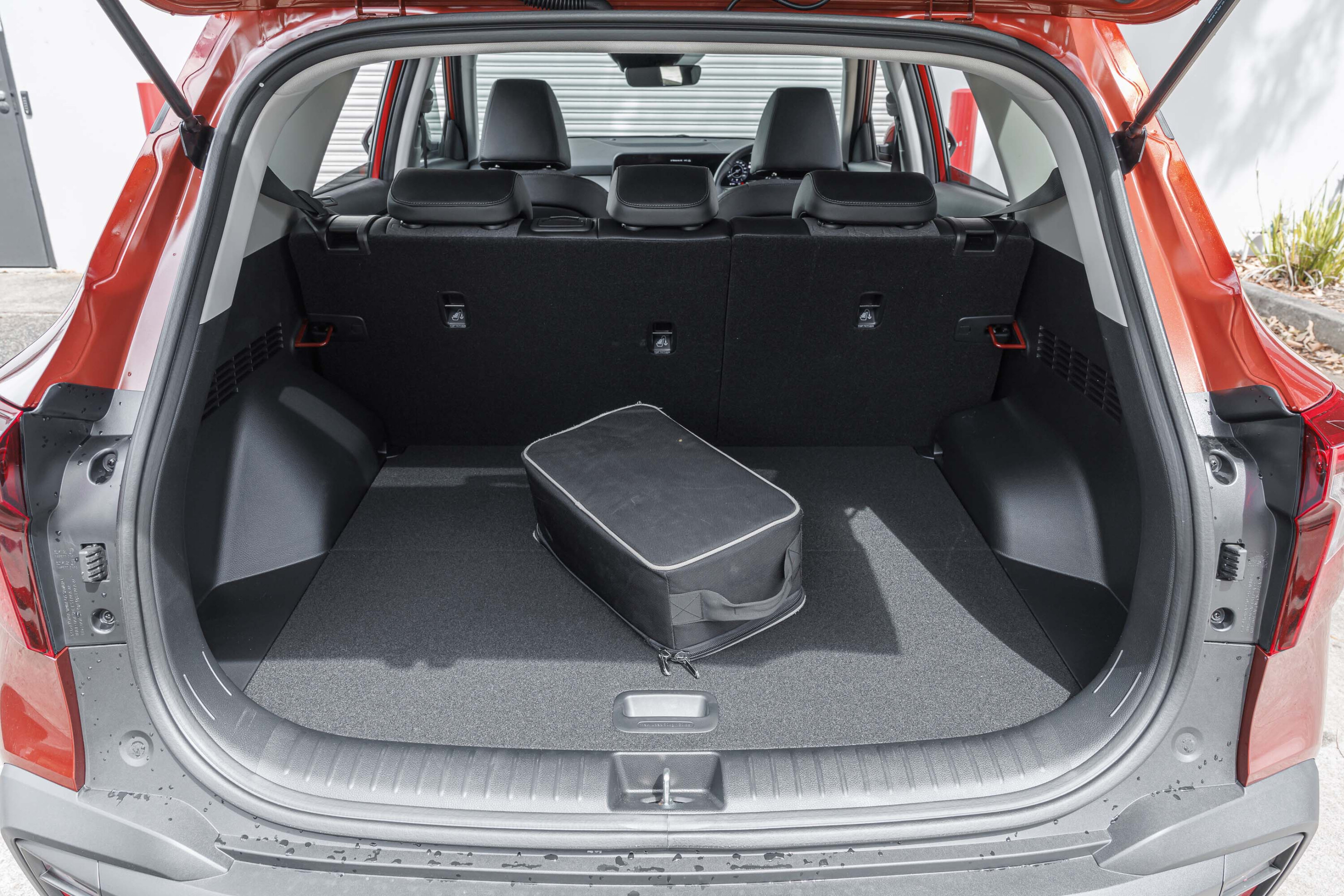
1
With the rear seats stowed, boot capacity swells to 1428L in the Seltos S and 1393L for all other variants.
Nissan’s new Qashqai has the Seltos bested in ultimate capacity with the rear seats folded (up to 1524L) but offers less boot space with all five seats in place.
A one-piece tailgate lifts upwards to reveal a large opening, which makes it easy to load bulky items.
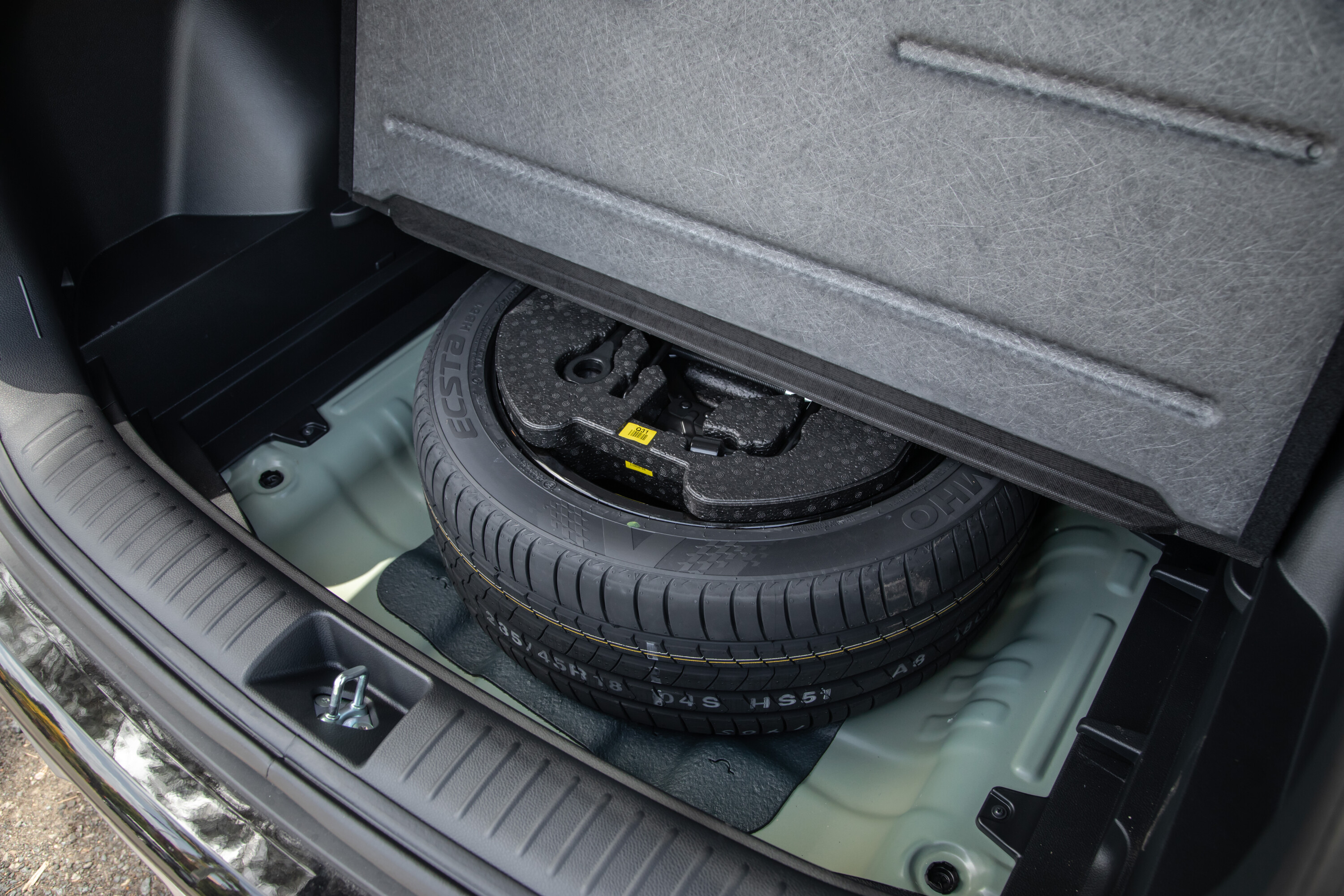
2
I like driving – will I enjoy this car?
Yes. The Kia Seltos is a solid steerer within the small SUV segment, with fundamentally sound urban roadholding and dynamics.
Locally tuned suspension imbues the Seltos with confident ride and handling over a variety of Australian roads, with intuitive, linear steering.
The Seltos has a quite firm suspension set-up, which helps it respond quickly to steering inputs and corner with relatively little body roll. The firmness also prevents the body from bobbing on the springs after the car hits a big bump on the road.
1
All-wheel drive versions offer more stability in slippery conditions, such as on gravel or wet roads.
Even with AWD, most unibody SUVs are suited to only light off-road duty, such as snowy conditions or reasonably smooth dirt tracks.
New developments in the recent facelift include extra sound-absorbing material in the pillars, doors, under the carpet and in the wheel arches, helping further suppress any unwanted noise, vibrations and harshness.
Headline powertrain changes for the most recent facelift centre on AWD Seltos variants, which now feature the 1.6-litre turbocharged four-cylinder lifted from the Hyundai i20 N and i30 N Line sedan, yielding 146kW (up 16kW) and 265Nm; matched to a conventional eight-speed automatic.
1
Not only is the new engine more sophisticated and powerful, but it’s also more efficient and has crisper in-gear response which aids overtaking ability.
The new Aisin-sourced automatic is also a much smoother sailer than the old dual-clutch transmission which, at low speeds, could be clunky.
A naturally aspirated 2.0-litre four-cylinder returns for service in front-wheel drive Seltos variants, but is still a meritable unit despite its modest 110kW/180Nm outputs. It’s a smooth unit that will lazily and linearly surf its small wave of torque to the speed limit, making it deceptively well-matched to the small front-driven Seltos.
1
If any of the terms in this section have left you scratching your head, these articles will help bring you up to speed!
- What is a Powertrain or Drivetrain?
- Power vs torque
- Car suspension explained
- Automatic transmissions (‘gearboxes’) explained
- Chassis control systems explained
- Car vs Ute vs SUV: How the vehicle you buy should guide the way you drive
The 2.0-litre naturally aspirated engine uses the least fuel, at a claimed 6.9 litres/100km on the official test (city and country combined).
During the launch of the Kia Seltos in 2023, we registered an impressive 6.7L/100km.
All-wheel drive variants with the new turbocharged 1.6-litre petrol are less efficient at 7.4L/100km, with our real-world testing returning a figure of 8.7L/100km. Much of this is explained by the all-wheel drive vehicle’s extra 120kg of mass and double the number of driven wheels.
Paired with an eight-speed automatic gearbox and all-wheel-drive traction, the turbocharged Seltos possesses a noticeable advantage in pace and power, while the new conventional automatic transmission is a welcome step change in refinement.
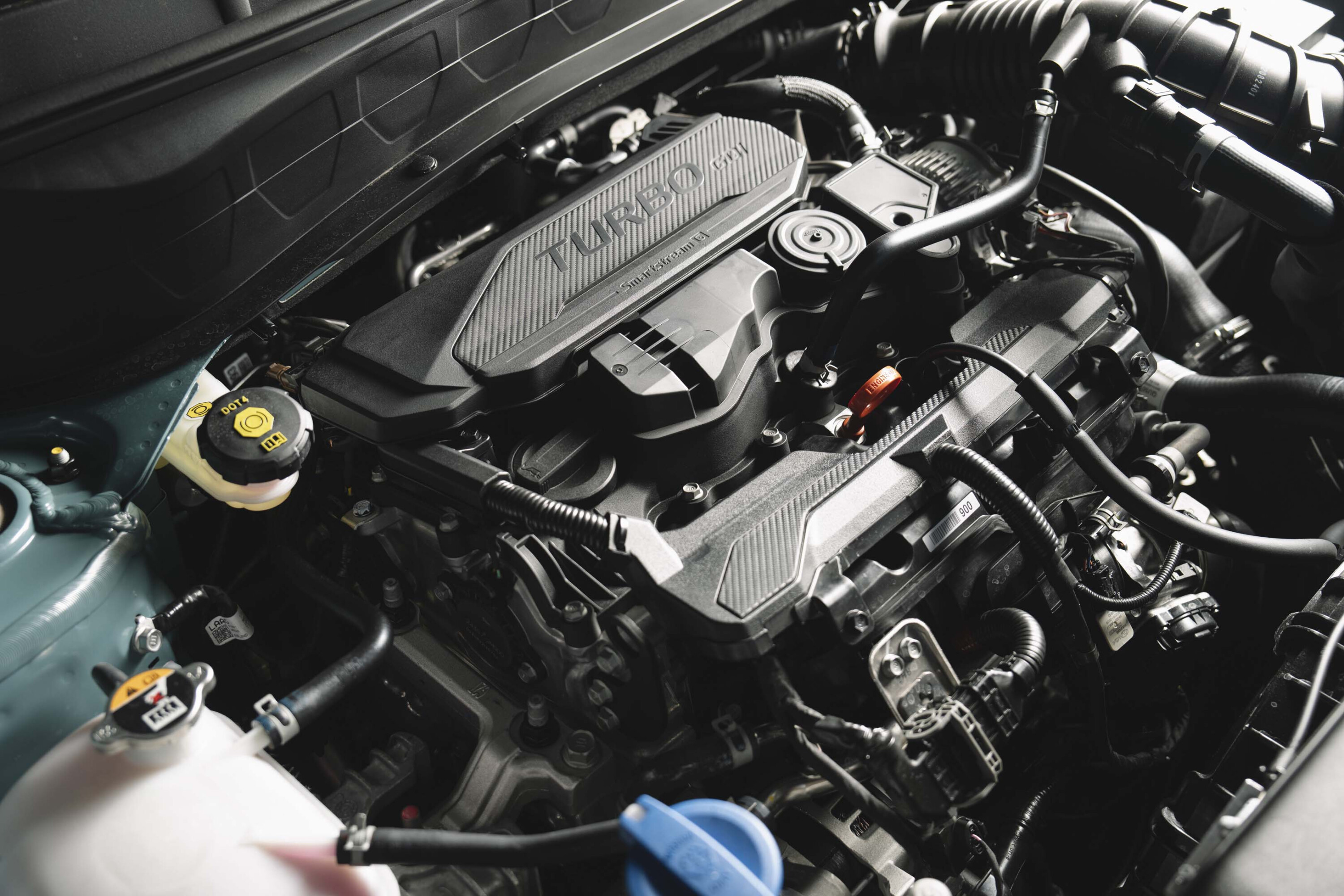
1
AWD Sport+ and GT-Line variants respectively cost $3500 and $3400 more than their FWD counterparts.
Apart from front-wheel drive and the 2.0-litre petrol engine being the exclusive configuration offered in an entry-level Seltos S, the main reason you might not choose the all-wheel drive turbocharged Seltos is that you want to pay less both up front and in ongoing fuel costs.
Front-drive variants sip less fuel than the equivalent AWD Sport+ and GT-Line, which respectively cost $3500 and $3400 more than their FWD counterparts.
1
What is the Kia Seltos’s towing capacity?
The Kia Seltos has a braked towing capacity of 1100kg for front-drive variants, swelling to a max braked capacity of 1250kg for all-wheel drive turbo variants, all with a max tow ball download of 130kg.
How long is the warranty and what are the Kia Seltos’s servicing costs?
The Kia Seltos comes with one of the industry’s longest factory warranties at seven years/unlimited kilometres.
Kia offers capped-price servicing for seven years, and roadside assistance for up to eight.
Kia Connect is complimentary for the first seven years, while the dealership will also make sure your satellite navigation system maps (if applicable) are kept updated for up to ten years.
1
Scheduled servicing runs annually, or every 15,000km for the 2.0-litre front-drive variants, with shorter 10,000km intervals for the all-wheel drive 1.6-litre turbo variants.
Both variants cost just over $2000 for five years of scheduled maintenance.
Which version of the Kia Seltos does Wheels recommend?
There are no real wrong answers in the Kia Seltos range as the comprehensive feature lists of lower models look very attractive for their asking prices.
A Seltos Sport looks particularly attractive at $32,700 before on-road costs, with 17-inch alloy wheels, that dazzling twin 10.25-inch digital screen array, DAB+ digital radio, satellite navigation and one-touch driver’s window control. It’s an affordable, competent city runabout with some of the most desired features as standard.
The Sport+, for just $3100 more, is also worth the extra spend, adding significant safety features like adaptive cruise control with stop-and-go capabilities, as well as cyclist and junction (forward cross-traffic) assistance to the existing AEB safety system. There’s also part-leatherette upholstery, driver attention alert, lead vehicle departure warning and push-button start.
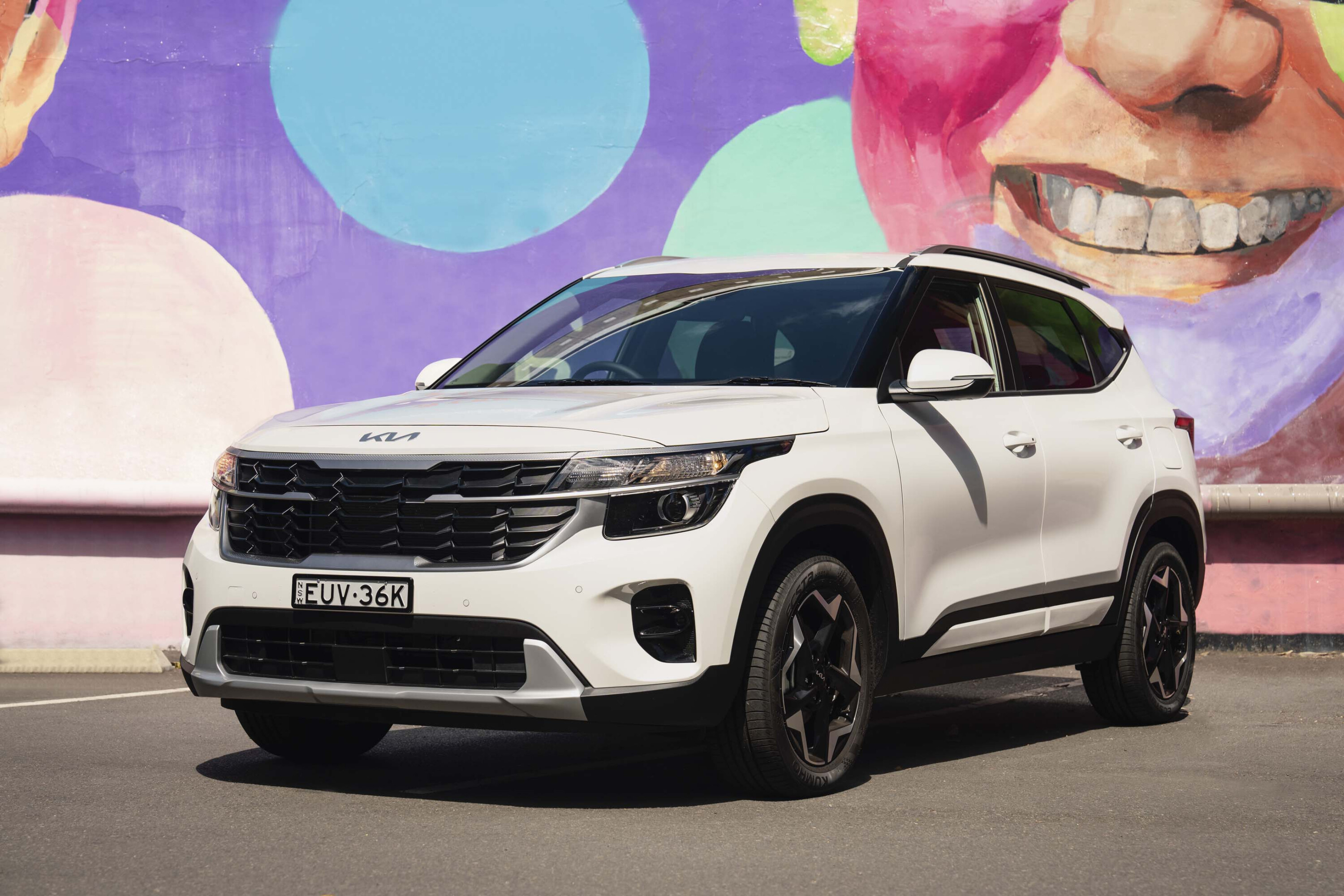
1
Powertrain-wise, even the carryover 2.0-litre naturally aspirated front-driven package is still a worthy urban companion.
The all-wheel drive, turbocharged Seltos adds breadth to its inner-city talents with greater ‘soft-road’ ability over unsealed surfaces, confident roadholding in inclement weather, and a noticeable advantage in pace and overtaking ability.
What are the Kia Seltos’s key rivals?
ud83dudd3c Back to top
MORE
Everything Kia
More guides to help you choose the best car & tyres for your needs
- All tyre news & reviews
- Longest warranties & capped-price servicing period
- Buy new or used?
- Best cars for your teenager
- Must-have features for new drivers
- Active safety tech explained
- Australian road rules explained
- Does driving slower save fuel?
- Does my car need the pricier fuel?
- Help, I’ve used the wrong fuel!
- What is a hybrid car?
- How long do tyres last?
- What shoes should I wear to drive?
- What to do after buying a new car
- How much does LCT add to a car’s price?
- The ‘check engine’ light just came on…
- Is it illegal to drive too slowly in Oz?
- FWD v RWD v AWD – which is safer?
- How much can my large SUV tow?
The Toyota Corolla has long been among Australia’s most popular vehicles, but recent production delays and the rising popularity of SUVs saw it outside the top 10 sellers by the end of 2023, and the sixth most popular car in January 2024.
It’s a historical start to the year – one that hasn’t occurred in the last two-and-half decades of the Corolla’s existence, and one Toyota hopes won’t happen again.
Despite the recent sales slump, the Toyota Corolla remains a reliable, safe, and efficient small car with space for four passengers and driver-pleasing dynamics.
Although the Corolla has climbed in price with its latest facelift, so have its myriad rivals. As such, it remains a worthy option with SX and ZR hybrid trims representing a good balance of affordability and specification, while the rally-bred GR gives real enthusiasts a Corolla to chew on.
1
JUMP AHEAD
- Pricing
- What body styles are available for the Corolla?
- What features are standard in every Corolla?
- What key features do I get if I spend more?
- How safe is the Toyota Corolla?
- How comfortable & practical is the Corolla?
- How much boot space does the Corolla offer?
- I like driving, will I enjoy this car?
- Which Corolla engine uses the least fuel?
- What is the Corolla’s towing capacity?
- How long is the warranty & what are the Corolla’s servicing costs?
- Which version of the Corolla does Wheels recommend?
- What are the Corolla’s key rivals?
- What might annoy me?
- What might I miss that similar cars have?
- What’s the infotainment system like?
- Where does Toyota make the Corolla?
- Are there plans to update the Corolla soon?
Pricing
| 2024 Toyota Corolla range pricing (before on-road costs) | |
|---|---|
| Ascent Sport petrol hatch | $28,130 |
| Ascent Sport hybrid hatch | $30,630 |
| Ascent Sport hybrid sedan | $31,180 |
| SX petrol hatch | $31,280 |
| SX petrol sedan | $31,280 |
| SX hybrid hatch | $33,780 |
| SX hybrid sedan | $33,780 |
| ZR petrol hatch | $35,120 |
| ZR petrol sedan | $36,620 |
| ZR hybrid hatch | $37,620 |
| ZR hybrid sedan | $39,120 |
| GR hatch | $62,300 |
| GR Morizo hatch | $77,800 |
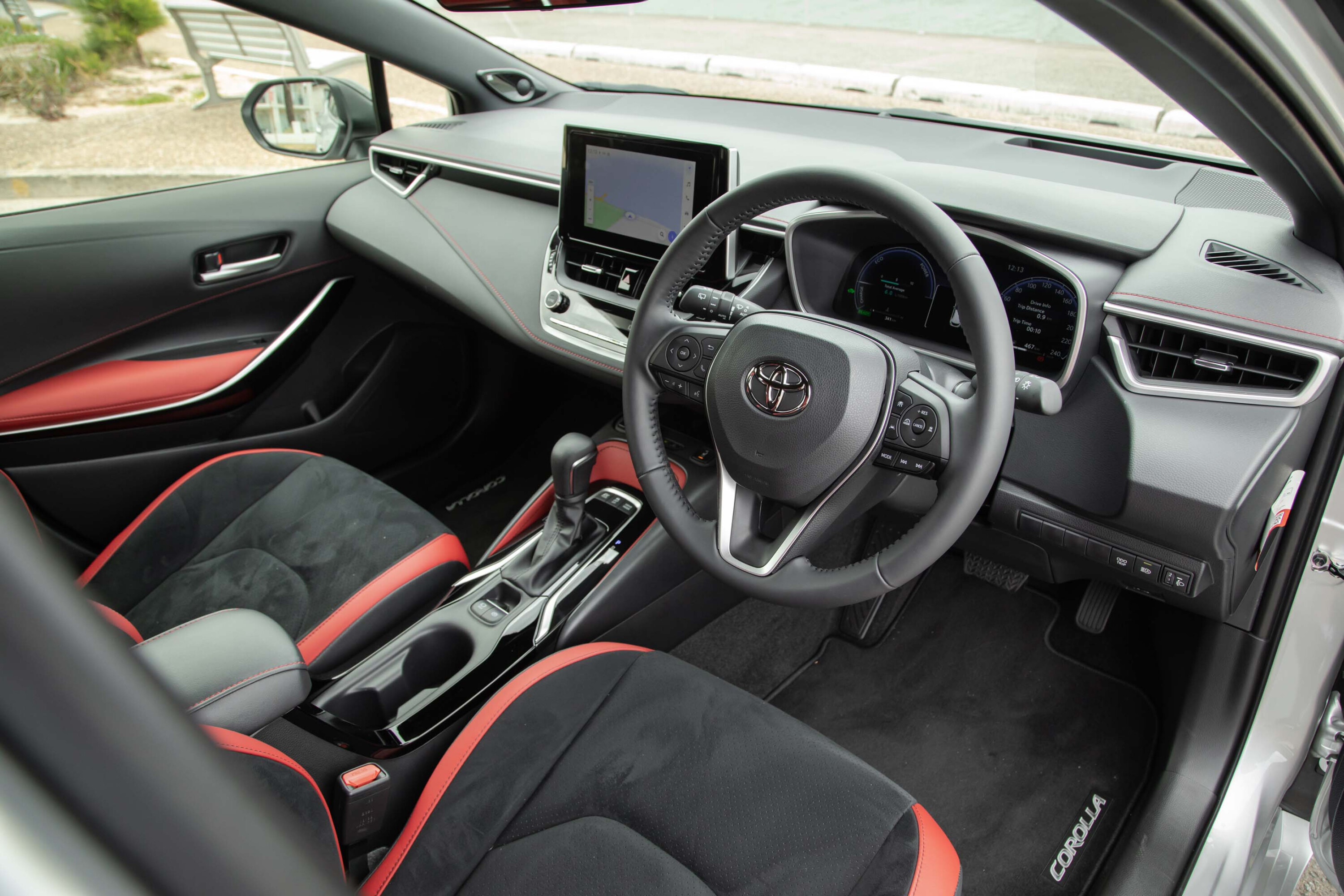
1
What body styles are available for the Toyota Corolla?
The Toyota Corolla is available in a more affordable five-door hatch, or the dearer four-door sedan body style.
Above the regular range sits the hardcore GR with a stiffer reinforced body shell.
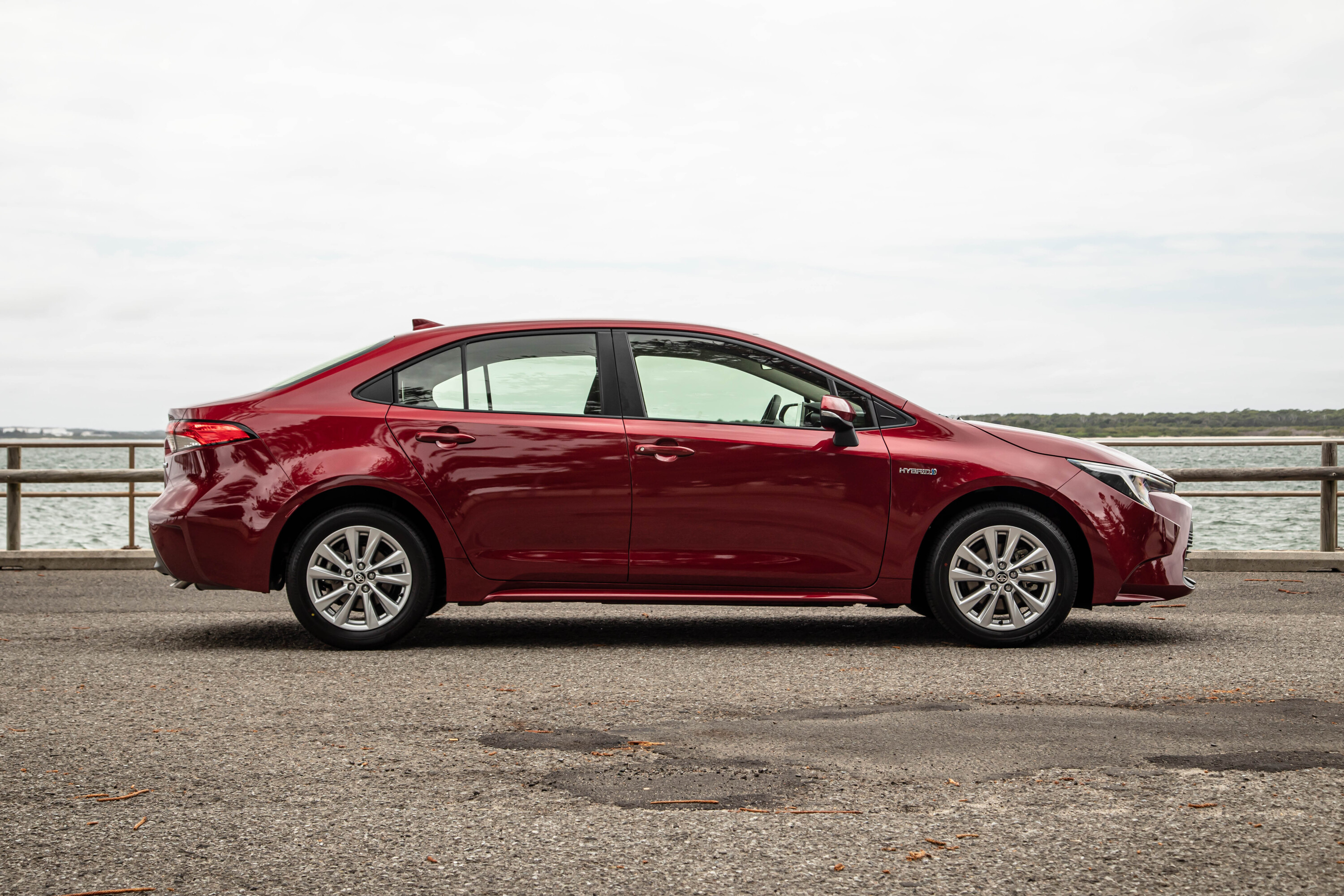
1
What features are standard in every Toyota Corolla?
The features listed below are standard in the entry-level model and will appear in higher-grade models unless replaced by more premium equivalent features.
| 2024 Toyota Corolla Ascent Sport features | |
|---|---|
| 7.0-inch multi-information display | Satellite navigation (sedan only) |
| 1x USB port | AM/FM/DAB+ radio |
| Wireless Apple CarPlay and wired Android Auto | Six-speaker sound system |
| Push-button start (hybrid only) | Bi-beam LED headlights |
| Over-the-air software updates | Heated, power-folding side mirrors |
| Cloth upholstery | Manual air-conditioning (petrol) |
| 12 months of Toyota Connected Services | Dual-zone climate control (hybrid) |
| Polyurethane steering wheel | 60:40 split-fold rear seats and centre armrest |
| 16-inch alloy wheels | LED interior lighting |
| 8.0-inch infotainment system | 4x cup holders 4x bottle holders |
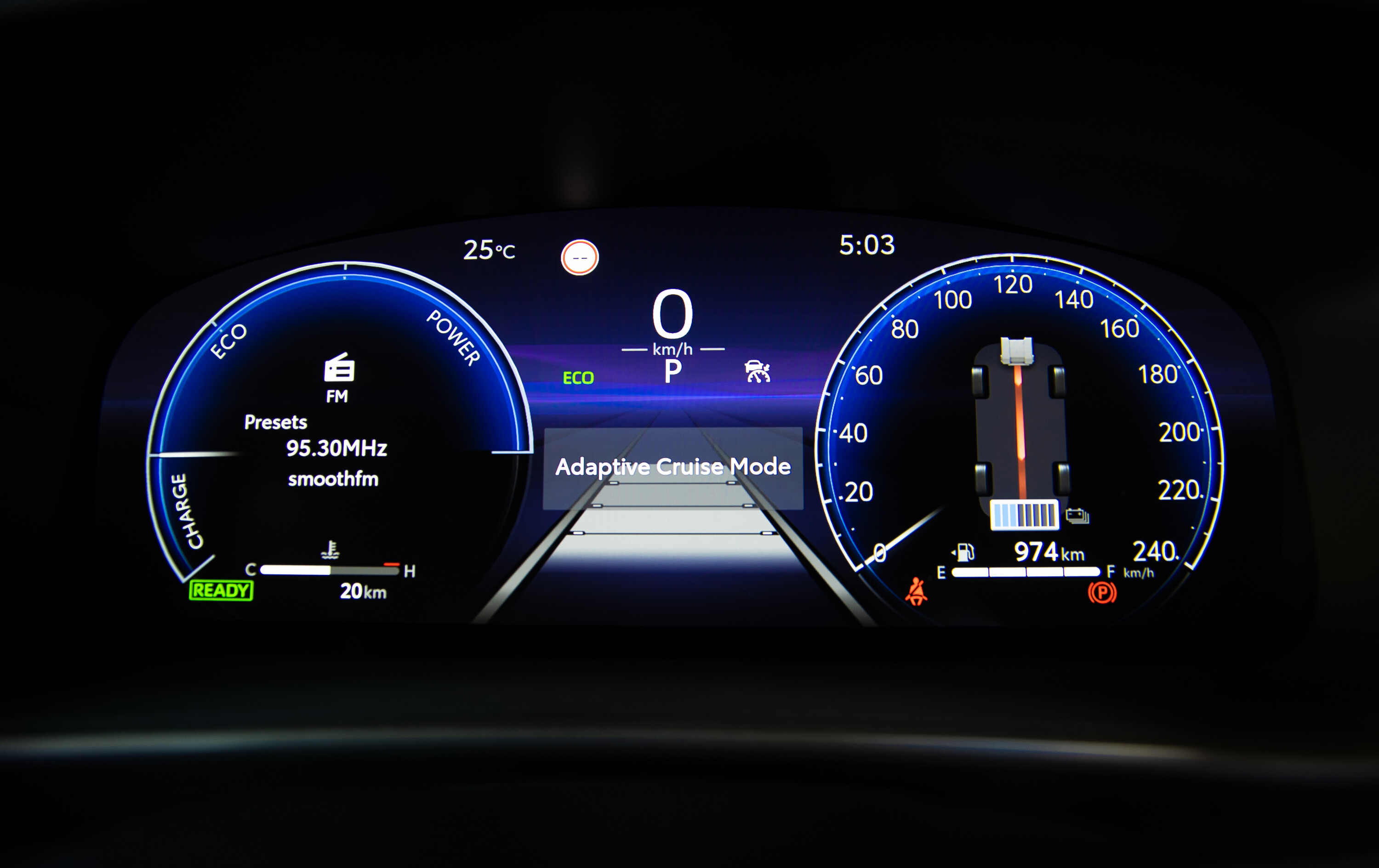
1
What key features do I get if I spend more?
There are three core Corolla variants, and moving up to the $3150 more expensive SX trim is worth the money.
It brings more safety and convenience features that’ll add up to a better ownership experience.
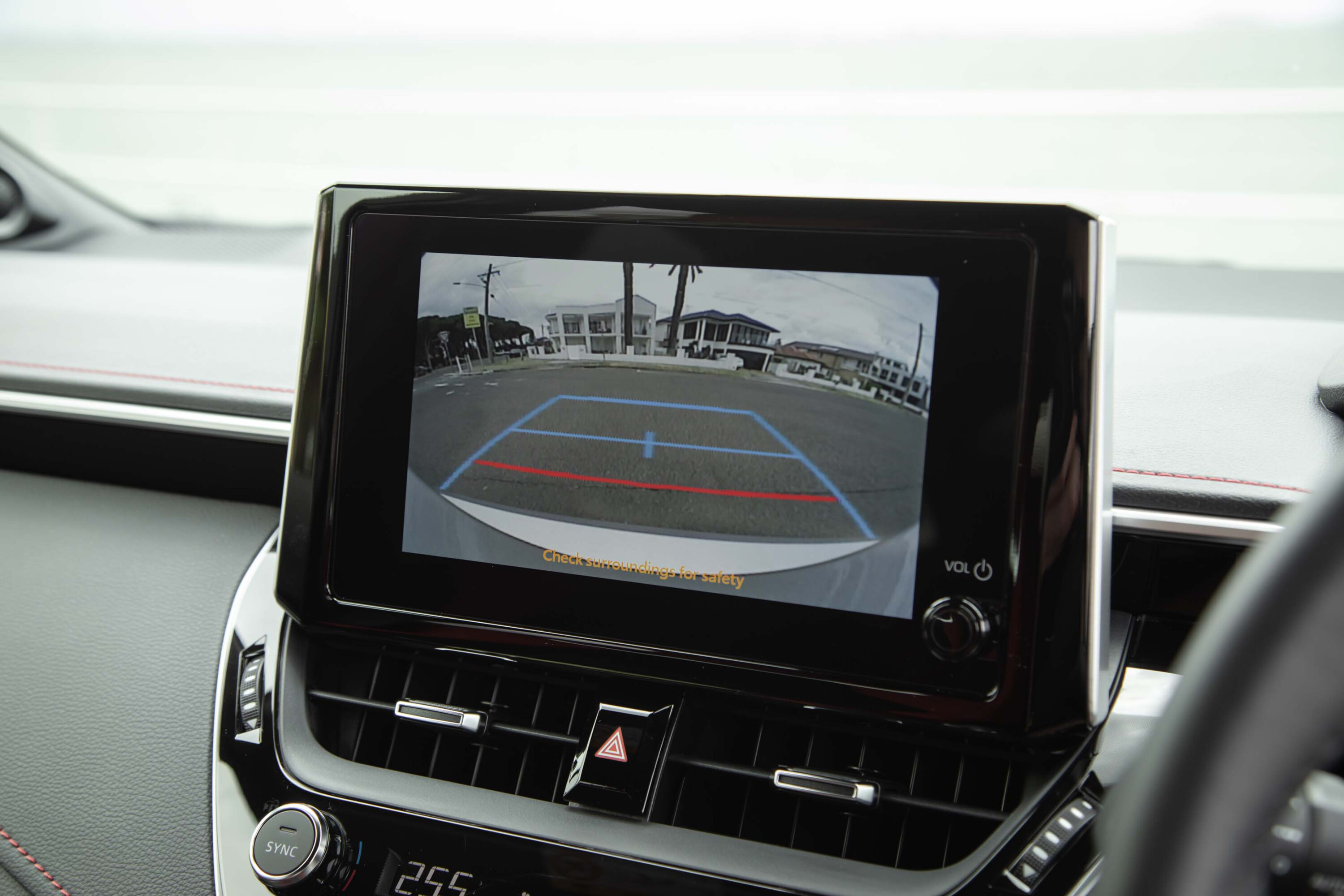
1
Compared to the base petrol engine – which, for a naturally-aspirated four-banger is actually quite a peach – the new 103kW hybrid powertrain is $2500 well spent.
Over time you’ll recoup the extra outlay in lower fuel costs, too. The equation will change over time, but we estimate it’ll take 60,000km of ownership to offset the cost.
An optional convenience pack brings the following safety features to the Ascent Sport for $1000:
| 2024 Toyota Corolla Convenience pack |
|---|
| Rear cross-traffic alert |
| Front and rear parking sensors (hatch) |
| Blind-spot monitoring (sedan) |
The mid-spec Corolla SX adds:
| 2024 Toyota Corolla SX features | |
|---|---|
| Paddle shifters (petrol) | 16-inch alloy wheels (different design) |
| 1x USB-C fast-charge point | Rear privacy glass |
| Wireless phone charger | Satellite navigation |
| Leather-appointed steering wheel and shifter | Rear cross-traffic alert |
| Auto-dimming rear-view mirror | Front and rear parking sensors |
| 12 months of Toyota Connected Services with remote connect | |
1
With a sporty look inside & out, the ZR is the top of the regular Corolla line.
| 2024 Toyota Corolla ZR adds | |
|---|---|
| 18-inch alloy wheels | ZR body kit |
| Dunlop Sport Maxx tyres | Premium LED headlights |
| Sports bucket seats with 8-way power adjust and lumbar for driver | Leather/ultrasuede upholstery |
| Heated front seats | 12.3-inch digital instrument cluster |
| Head-up display | 8-speaker JBL sound system |
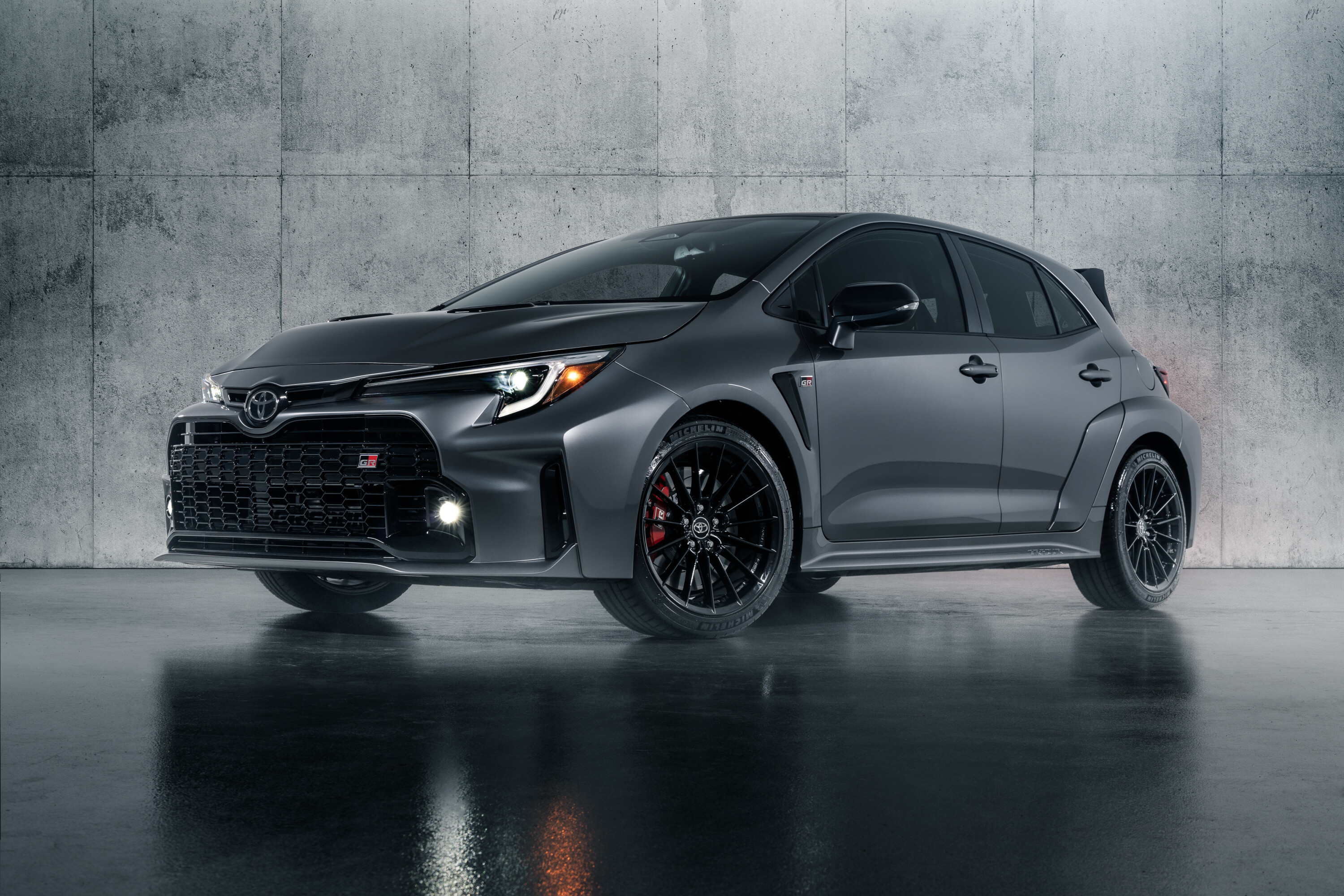
1
Not for the faint of heart, the 1.6-litre turbo-petrol three-cylinder GR Corolla is manual only, adding:
| 2024 Toyota GR Corolla specifications | |
|---|---|
| 18-inch cast Enkei alloy wheels | Heated steering wheel |
| Yokohama Advan tyres | u2018Brin Naubu2019 suedecloth upholstery |
| Front and rear torsen LSDs | Electronically controlled centre differential |
| Performance dampers | 349 more spot welds and 2.8-metres more structural adhesive |
| 221kW/370Nm 1.6-litre engine | 6-speed manual transmission with rev-matching |
How safe is the Toyota Corolla?
When tested by ANCAP in 2018, the Toyota Corolla was awarded five stars.
This rating applies to all models except the heavily re-engineered GR models, which are unrated.
| 2024 Toyota Corolla standard safety features | |
|---|---|
| Forward autonomous emergency braking (vehicle, pedestrian, cyclist, junction) | Seven airbags |
| Lane-keep assist | Adaptive cruise control |
| Lane departure warning | Traffic sign recognition |
| Rear seat belt reminder | Toyota connected services SOS functionality |
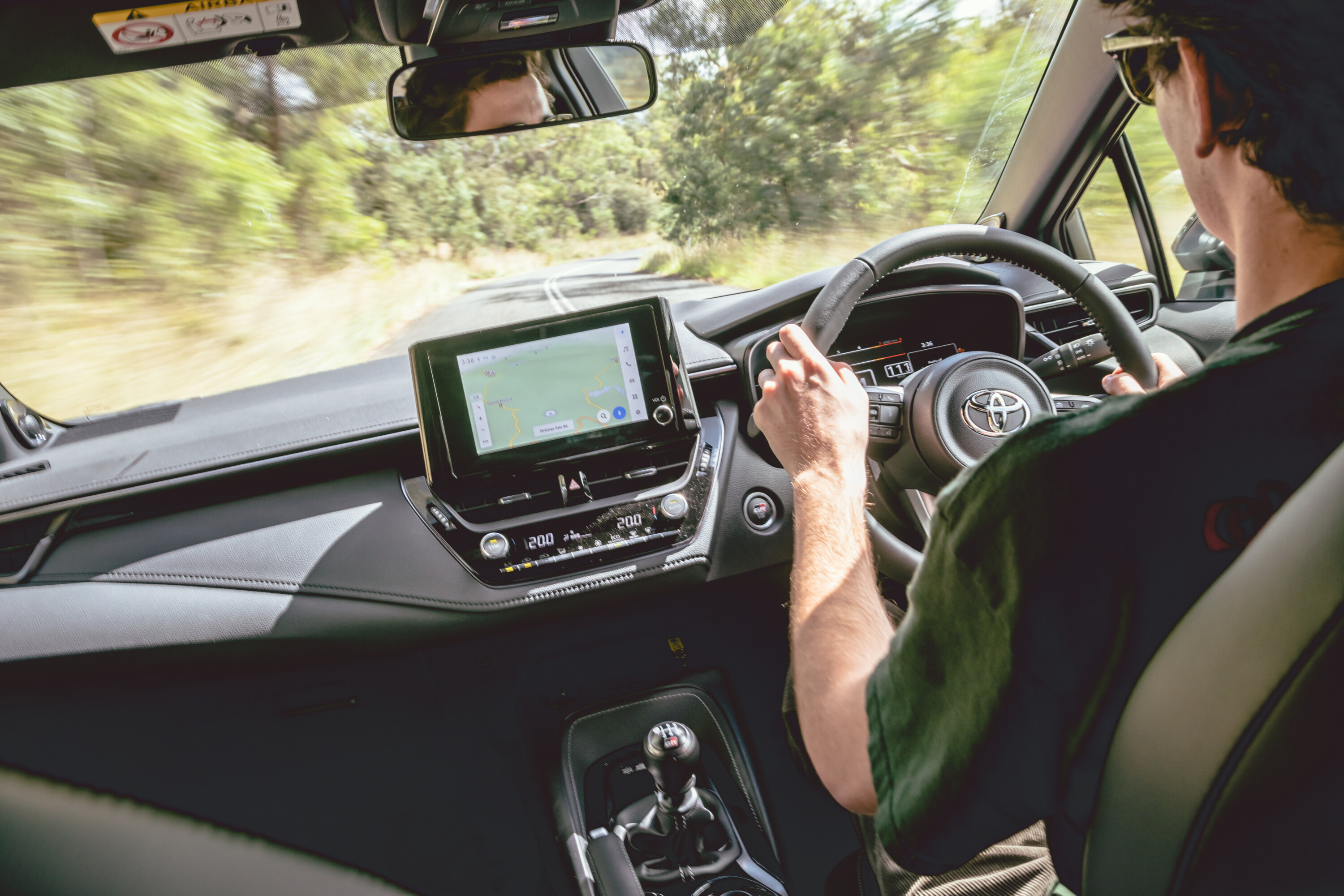
1
To get extra safety features including rear cross-traffic alert, blind-spot monitoring, and parking sensors, you’ll need to fit the convenience pack to the base Ascent Sport or splash out on a higher grade such as the SX.
How comfortable and practical is the Toyota Corolla?
The Toyota Corolla’s interior is comfortable and well-packaged – at least for front occupants – with some visual interest found further up the variant tree.
The Corolla’s isn’t the most spacious or cutting-edge cabin, but the materials will certainly stand the test of time.
Skipping the fleet-focussed Ascent Sport is wise as the interior’s drowned in firm grey plastics. The core design is pleasing enough, though, with a shapely, contemporary dash that has pleasingly simple and intuitive controls.
In Ascent Sport guise, the manually adjusted seats are trimmed in hardy cloth, while the coarse polyurethane steering wheel and shifter are far from joyful. Walking up to the SX maintains a conservative colour palate, but the leather-wrapped control surfaces make for a big jump in perceived quality.
The top-spec ZR’s leatherette/Ultrasuede power-adjustable front seats are supremely comfortable, and the whole cabin gets a number of sporty styling.
With two-stage heating, the seats have almost everything you could want, though the passenger’s pew has no height adjustment.
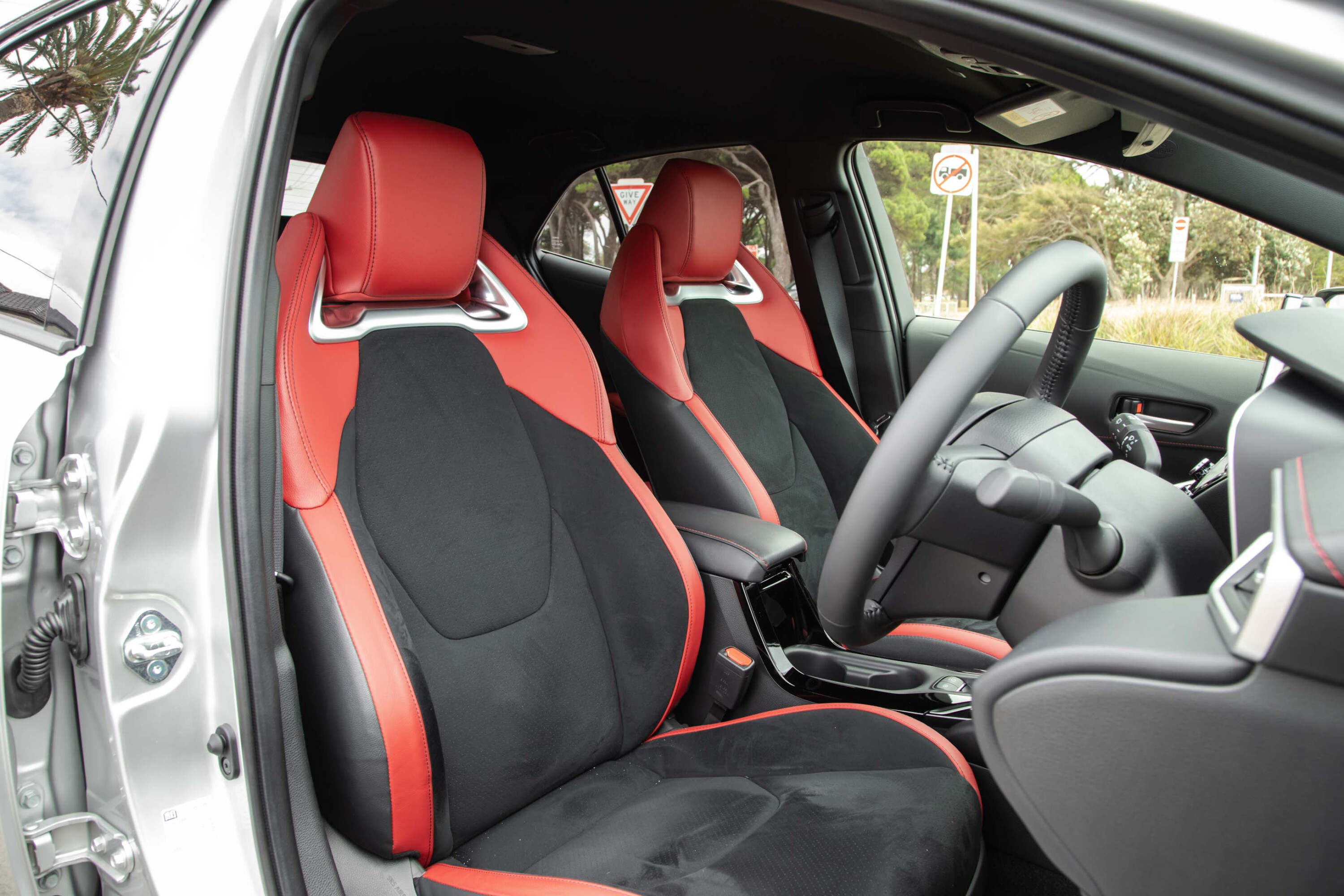
2
In the pursuit of light weight, GR has removed some sound deadening from the most hardcore Corolla, so it’s much louder than, for example, a Golf R.
That said, the GR Corolla maintains much of the core car’s comfort and usability, even adding a heated steering wheel.
Toyota’s latest 8.0-inch touchscreen amps technology and is much nicer to use than the old unit. Apple CarPlay is wireless, though Android Auto is wired. It can be laggy at times, but the display and integration of connected services are generally good.
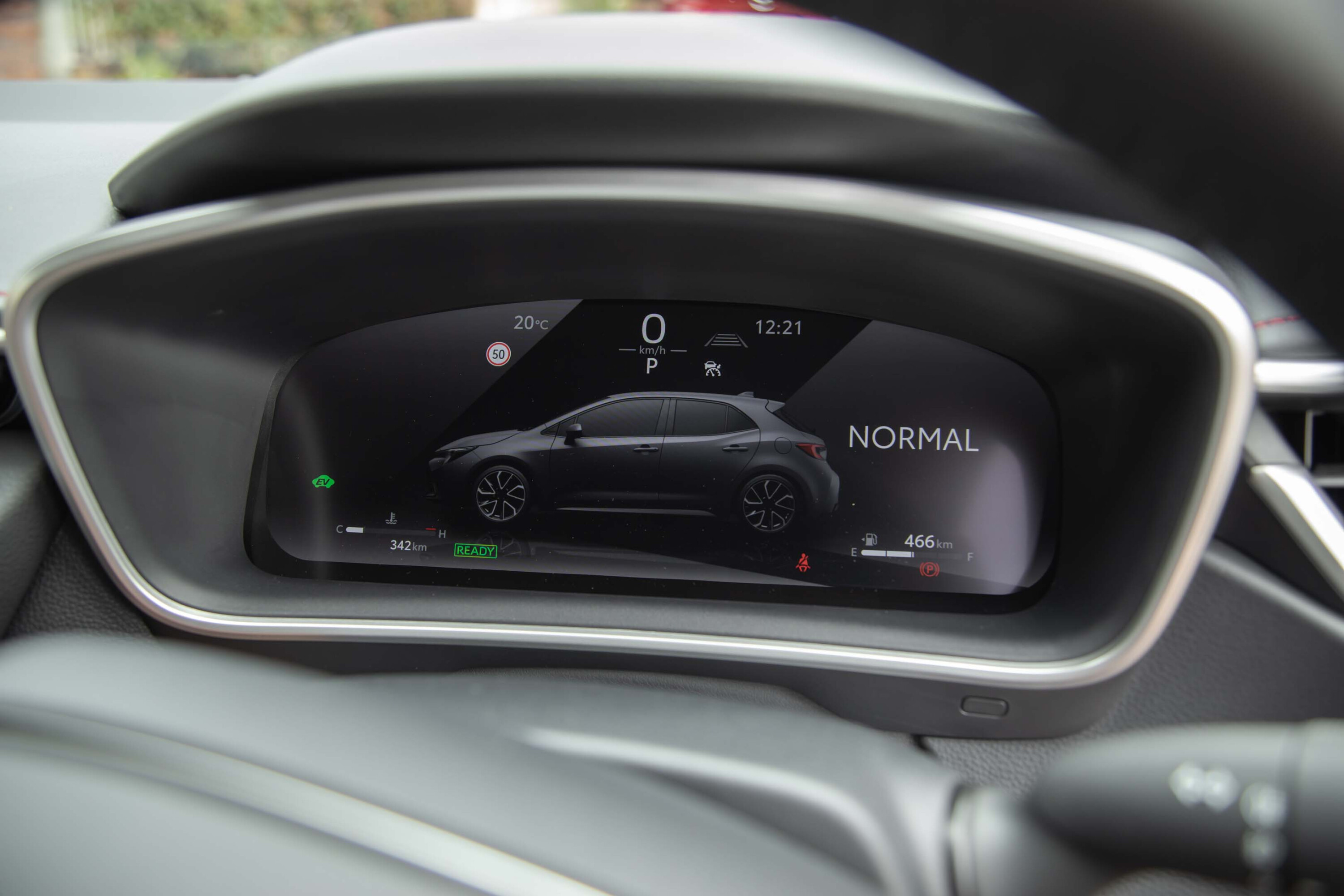
1
While the 7.0-inch digitised cluster in the Ascent Sport and SX is a step up from the old analogue dials, Toyota’s graphic design team could do with a crash course from some Apple engineers. The colours are dull and less sophisticated than rivals. Even the ZR’s 12.3-inch screen is lacking visual punch.
The hatch’s rear quarters are a little grim, especially for middle passengers. Of its competitor set, the Corolla hatch isn’t the most family-friendly small car.
There are niceties like a fold-down armrest and two door-mounted bottle holders across the range, though, and the sedan improves things with more legroom courtesy of a longer 2700mm wheelbase.
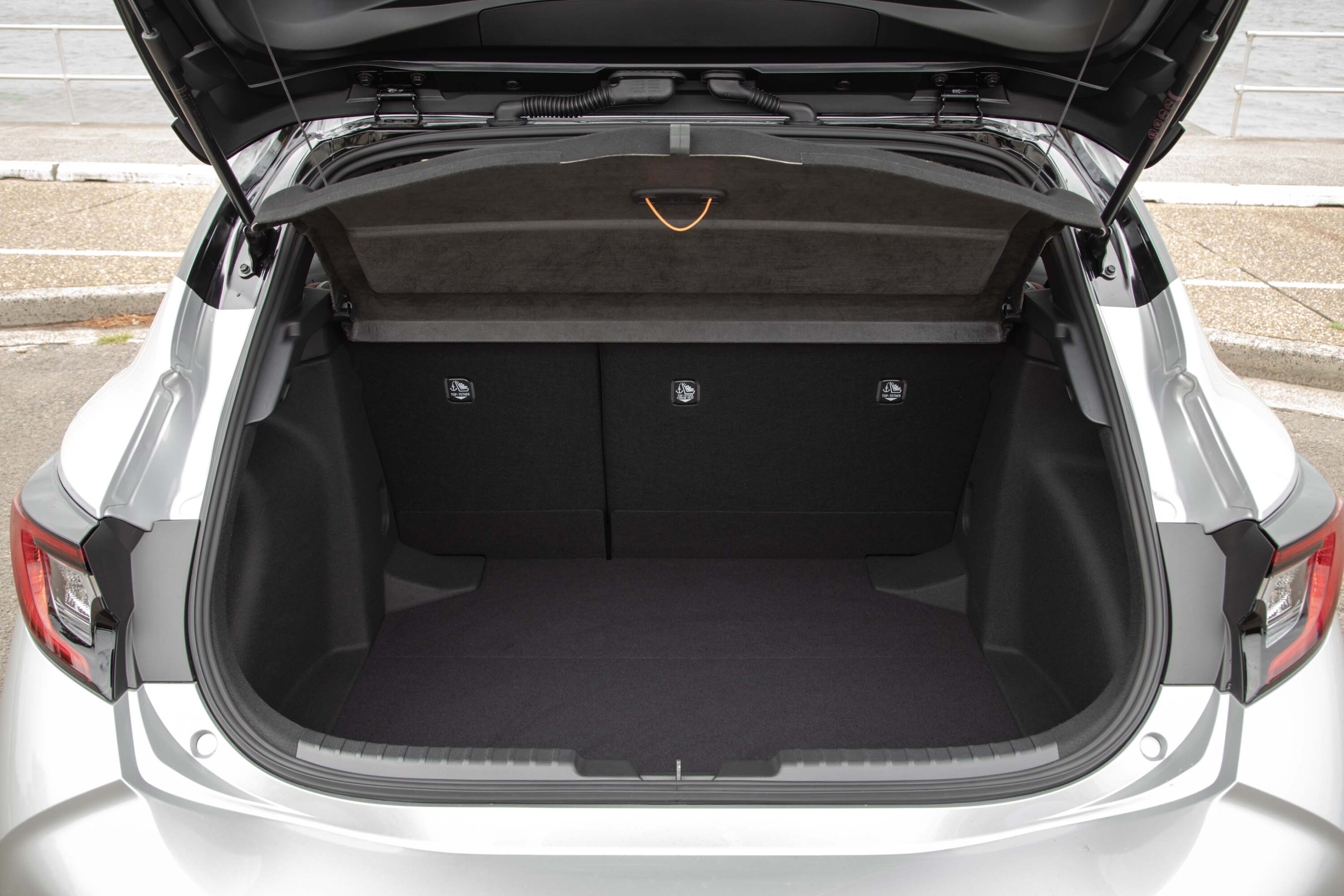
1
How much boot space does the Toyota Corolla offer?
A range of boot sizes feature across the Corolla range depending on trim level and body style, but none are particularly spacious – a common complaint for this generation of Corolla.
The best is the 440L sedan, with a measly 217 litres in the five-door hatches.
The ZR hybrid’s cargo area climbs to a more acceptable 333L, achieved by removing the space-saver spare tyre from under the boot floor and replacing it with a puncture repair kit.
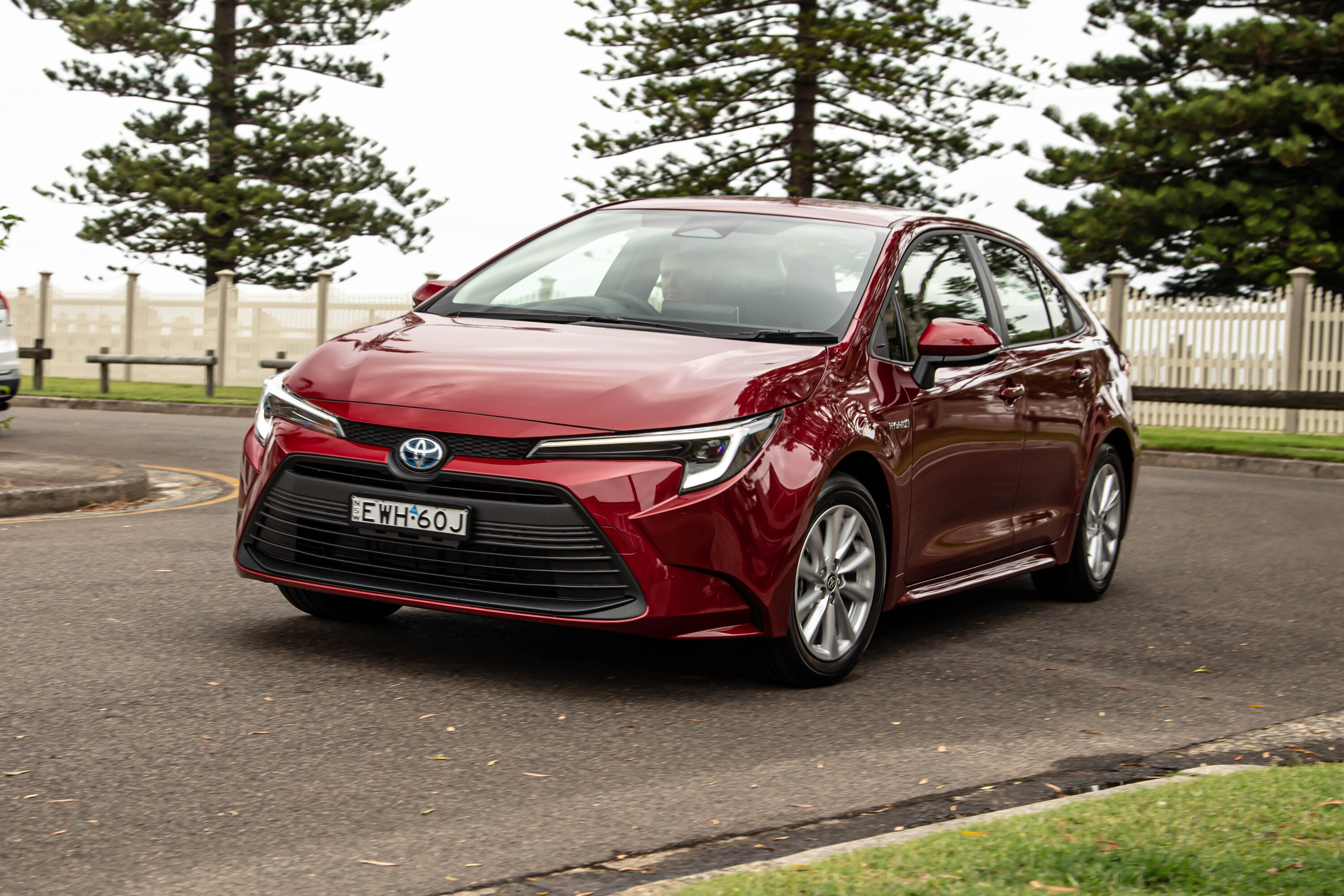
1
I like driving, will I enjoy this car?
As far as small cars go, the Toyota Corolla is one of the more dynamic with good steering and an exploitable chassis across the range – the AWD GR is a true driver’s car.
There are two main ingredients in the Corolla’s polished chassis: its TNGA underpinnings which have revolutionised driving experience across much of the Toyota model range, and independent trailing-arm rear suspension that separates it from mainly torsion bar-equipped rivals.
It results in a car that rides smoothly in base trim on small 16-inch alloys and pillowy eco tyres but also provides adjustability and driving enjoyment in the sporty ZR with its bigger rims and stickier Dunlop rubber.
This also provides an excellent platform for the AWD GR Corolla, with its extra bracing and stiffer suspension bringing true driving joy and engagement to the Corolla range.
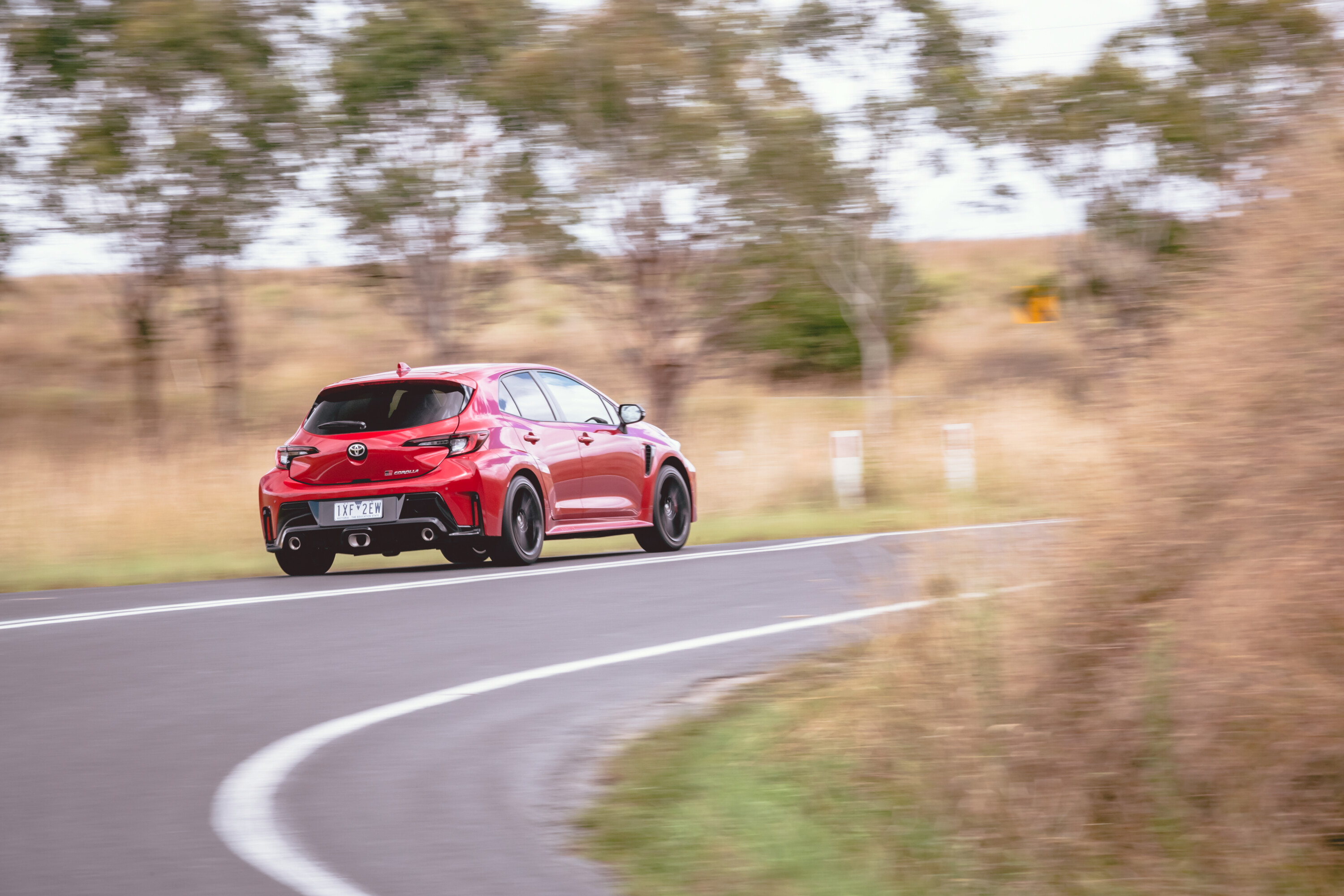
1
Powertrains offered on the Corolla are also good. Although a little old-school on paper, the 126kW/202Nm 2.0-litre ‘dynamic force’ petrol is revvy and responsive.
Things get a little loud under acceleration as the continuously variable transmission (CVT) flares engine revs (mid and top-spec cars get paddle shifters and simulated gear ratios), but the majority of the time it’s very liveable.
Replacing the previous 90kW 1.8-litre hybrid is a new 103kW system. Power is up thanks to more powerful motors and a switch from nickel-metal hydride to lithium-ion battery tech. It makes the petrol-electric Corolla even better; it remains our pick of the regular range.
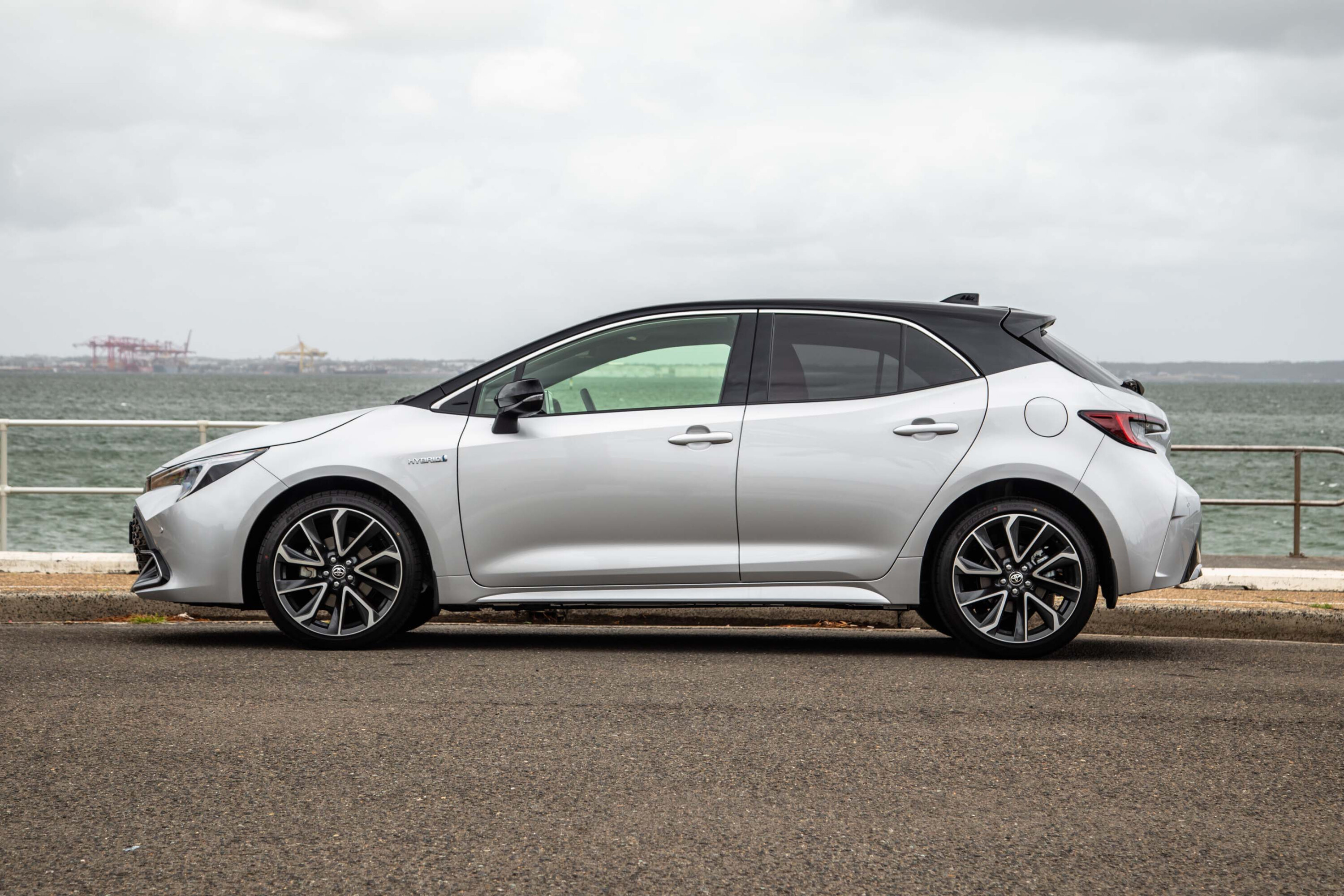
1
The hybrid also gets a clever transmission, known as e-CVT, which features a dual-input planetary gear design – quite different to the widely adopted belt-drive/conical-pulley CVT found in your average city run-around.
Above the cooking Corollas sits the scalded GR packing a 1.6-litre turbo-petrol three-cylinder developing a whopping 221kW. It’s an angry firecracker of a unit hooked up to a meaty and positive six-speed manual gearbox.
The GR Corolla’s suspension is firmer and its body stiffer, with genuine steering feedback and a sense of connection for the driver. Its all-wheel-drive system has adjustable torque splits and can send enough power to the rear wheels to make the GR Corolla slide around in slippery conditions.
If any of the terms in this section have left you scratching your head, these articles will help bring you up to speed!
- What is a Powertrain or Drivetrain?
- Power vs torque
- Car suspension explained
- Automatic transmissions (‘gearboxes’) explained
- Chassis control systems explained
- Car vs Ute vs SUV: How the vehicle you buy should guide the way you drive
If efficiency is what you desire from your small car, then look no further than the Corolla hybrid.
Despite becoming more powerful in 2023, the Corolla hatch’s ADR consumption dropped by 0.2L/100km – this comes down to a greater capacity lithium-ion battery and more powerful electric motors.
Compared to current competitors such as the Honda Civic E:HEV, the Corolla hybrid hatch’s 4.0L/100km ADR fuel consumption result is head and shoulders above rivals – the sedan goes even lower at 3.9L/100km.
Even the four-cylinder petrol engine, rated at 6.0L/100km, is relatively efficient for the class. At the bowser, the hybrid and petrol engines accept 91 RON and E10 blends.
What is the Toyota Corolla’s towing capacity?
If you’re looking for a tow car, there are better options.
But the Corolla petrol is certified to tow 450kg unbraked or 1300kg braked loads. The hybrid is not rated for towing.
How long is the warranty and what are the Toyota Corolla’s servicing costs?
The Toyota Corolla is covered by a five-year/unlimited-kilometre warranty. Keeping your servicing up to date at a Toyota dealer will see this extended to eight years for the hybrid powertrains.
Service pricing is capped for the first five years to just $205 per visit, for a 75,000km total of $1025. Maintenance is due every 12 months or 15,000km on regular Corollas.
The GR Corolla is a little more involved, needing to see a spanner every six months or 10,000km. It’ll cost you $1800 to maintain over three years or 60,000km.
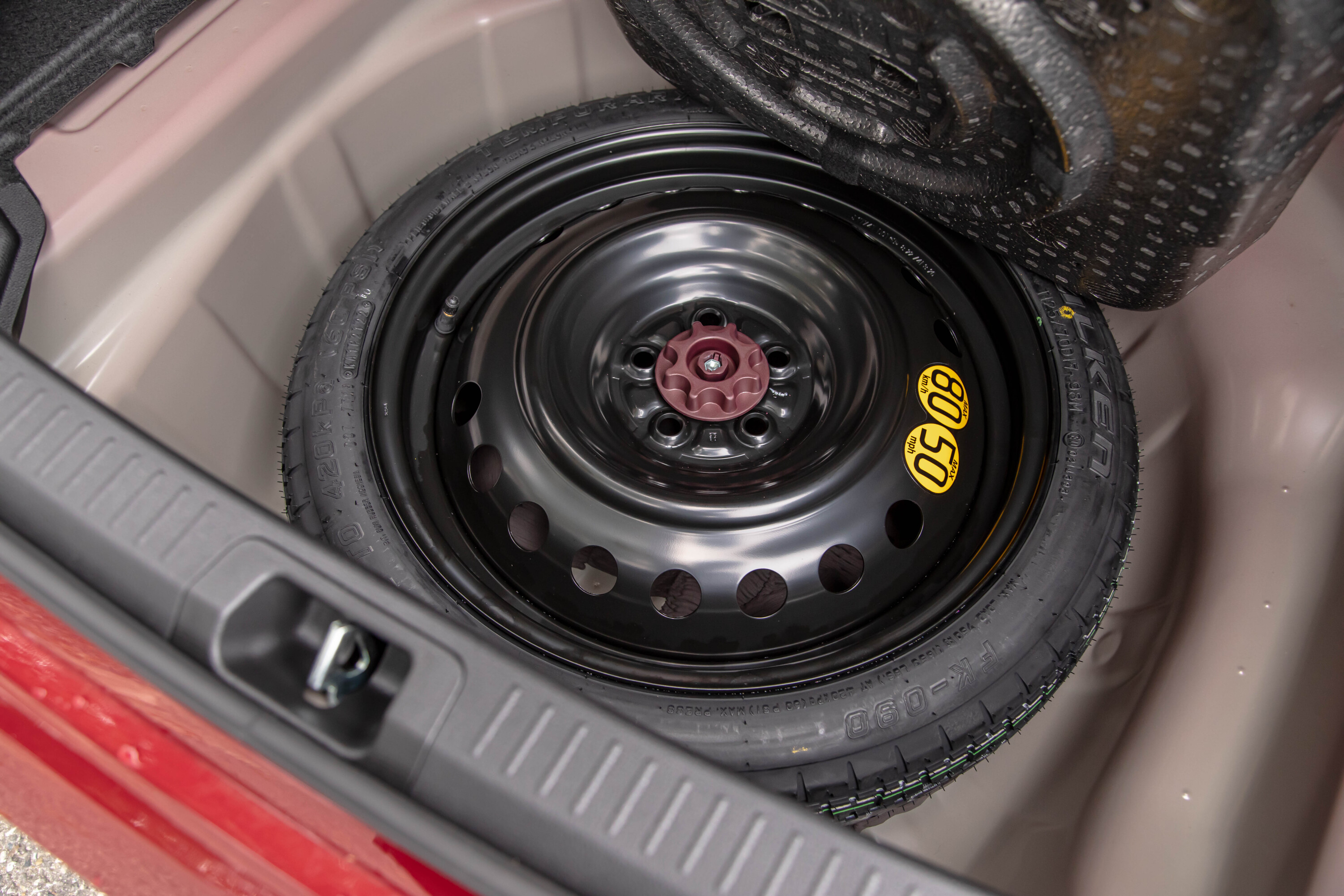
1
Which version of the Toyota Corolla does Wheels recommend?
If you’re a budding Sebastien Loeb (or Ogier, for that matter), then you’ll fall in love with the focused GR Corolla – we certainly have at the Wheels office.
However, the best Corolla for most is the hybrid in a trim you can afford. The mid-spec SX is decently equipped for the price. With cheap servicing and limited fuel use, it’ll be a joy to own over an extended period. The flashier ZR is also a nice option with a bit more jazz – regardless, we recommend jumping above the Ascent Sport if you have the means.
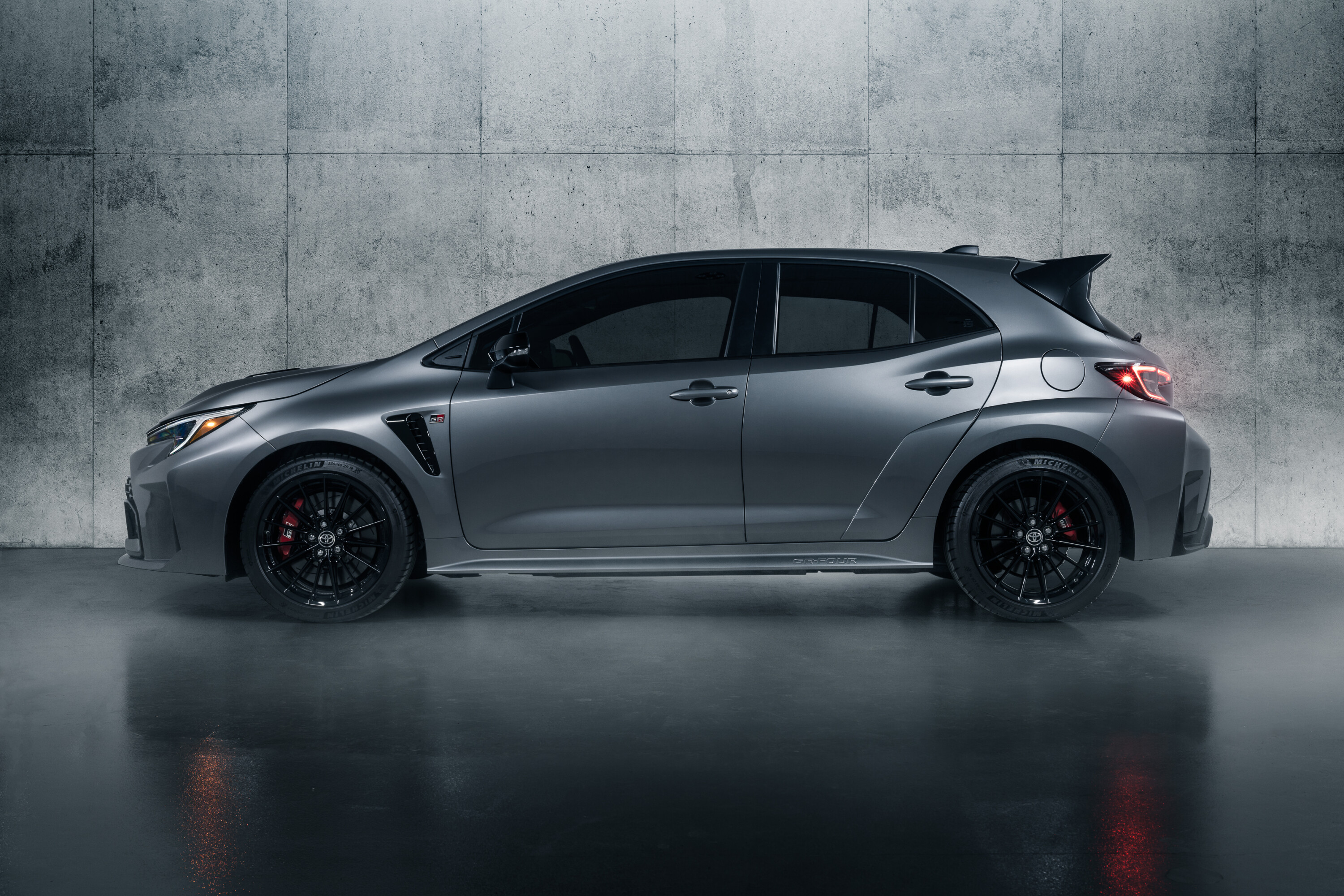
1
What are the Toyota Corolla’s key rivals?
ud83dudd3c Back to topWhat might annoy me?
While the Corolla ticks many boxes and is unlikely to frustrate any owner, there are a few consistent gripes you’ve probably heard before.
Boot: small; rear seat: not exactly spacious; as good as Toyota’s CVT is, it’s also still a CVT; and the likelihood is, you’ll be waiting a while for a Corolla.
Less obvious annoyances include the hybrid’s slightly unnatural and granular brake feel as it balances regenerative with friction braking. Safety is also worth mentioning, as the five-year-old Corolla doesn’t have the same technology as some rivals, especially in base Ascent Sport trim without rear cross-traffic alert and rear parking sensors.
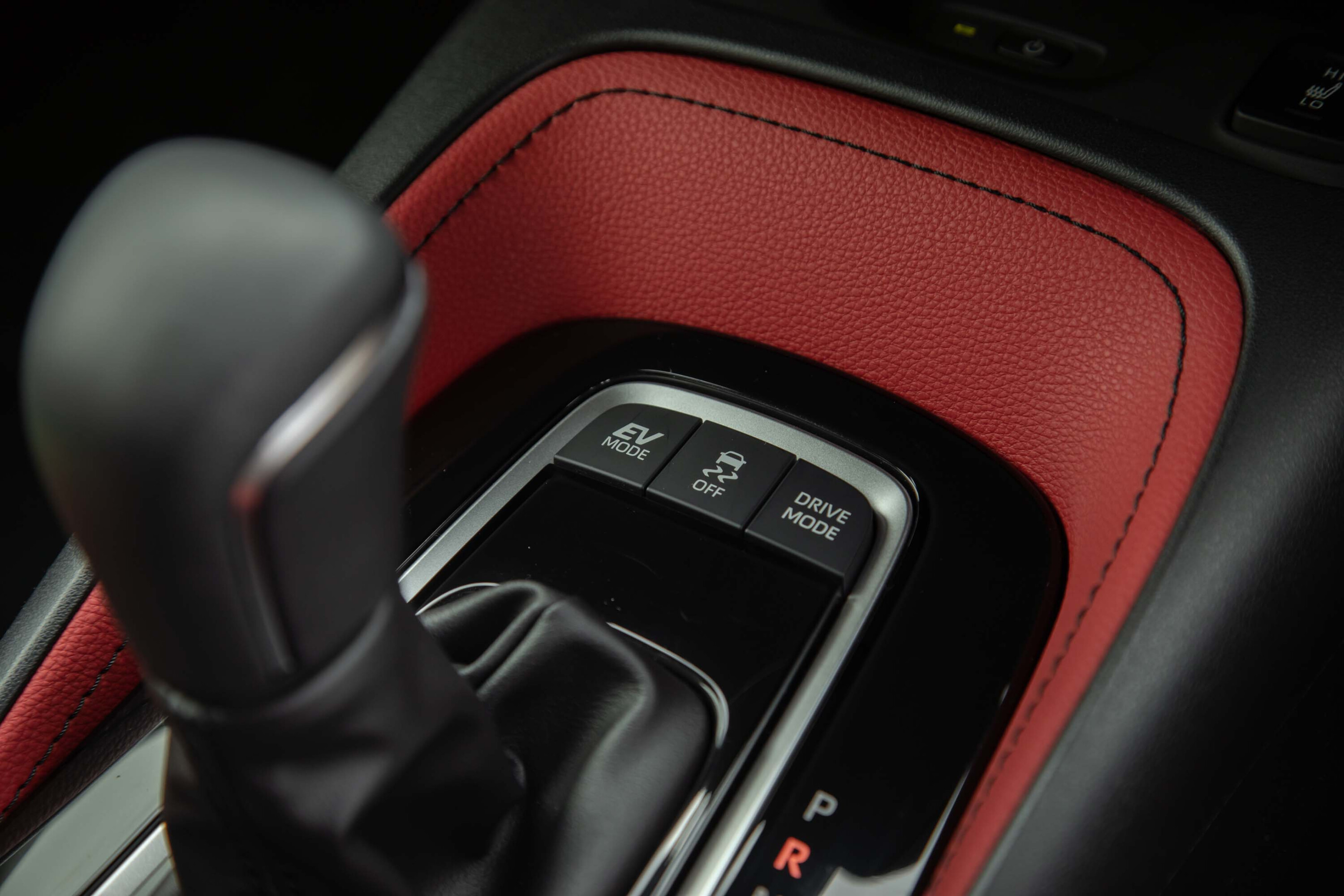
1
What might I miss that similar cars have?
The Corolla range is endowed with good engines and a sporty option but at nearly $62K plus on-road costs, the hardcore GR flagship doesn’t come cheap and there is no other performance-oriented variant to bridge the gap.
Other brands, including Hyundai with N Line and Kia with its GT range, have enthusiasts on a budget better covered.
Toyota Australia doesn’t sell a Corolla wagon (Finland’s best-selling car in 2022) either, so the local range could be broader and more practical. The wagon role is instead filled by the Corolla Cross SUV.
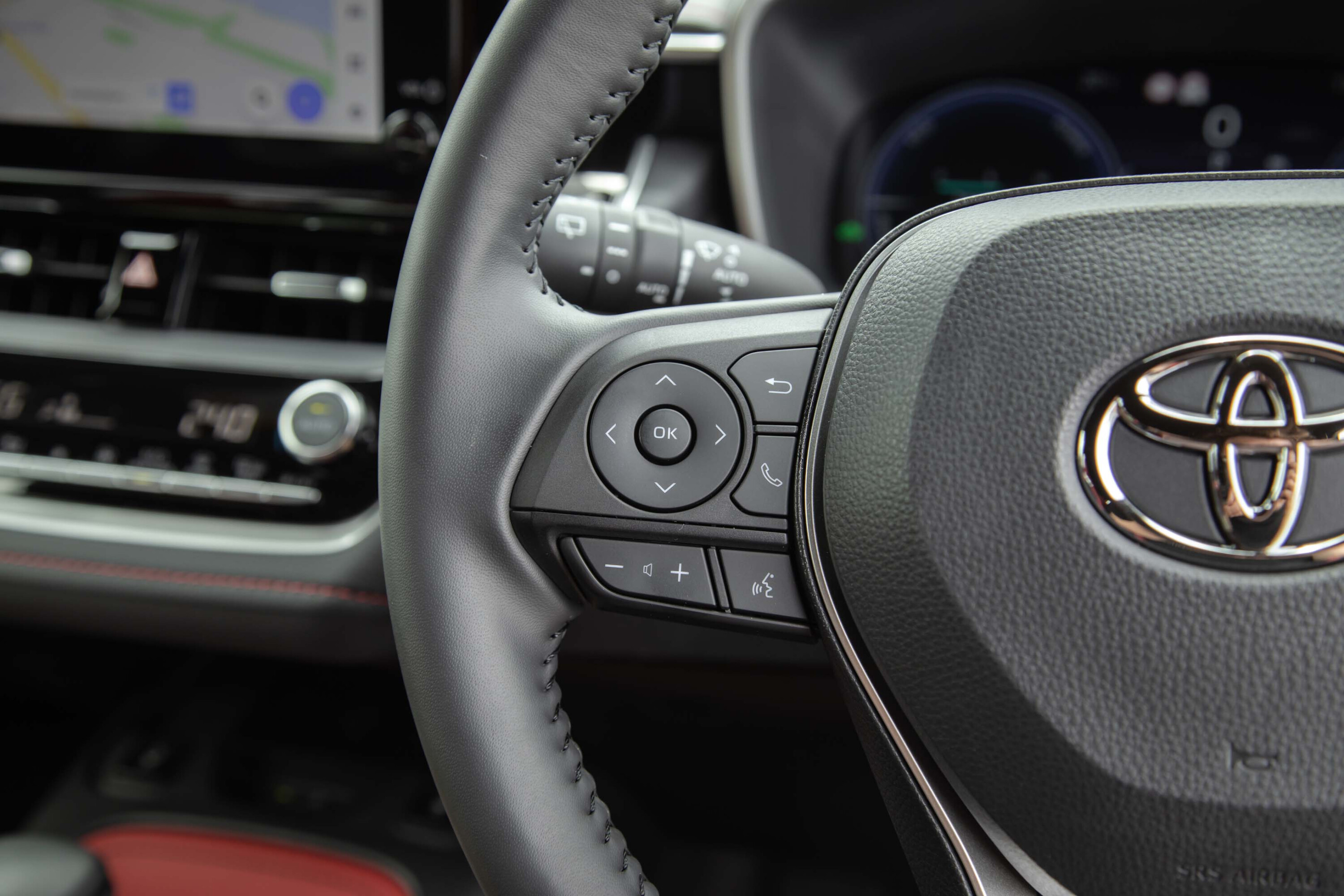
1
What’s the infotainment system like?
For the current model every Corolla gets an 8.0-inch touchscreen including the base model.
Japan gets a bigger 10.5-inch item that we see only in the Corolla Cross SUV, but the smaller interface is powered by similar hardware.
Though the handy shortcut buttons have been lost, the new navigation screen is brighter and more reminiscent of Google Maps, and there’s reliable wireless Apple CarPlay connectivity (though Android Auto remains wired).
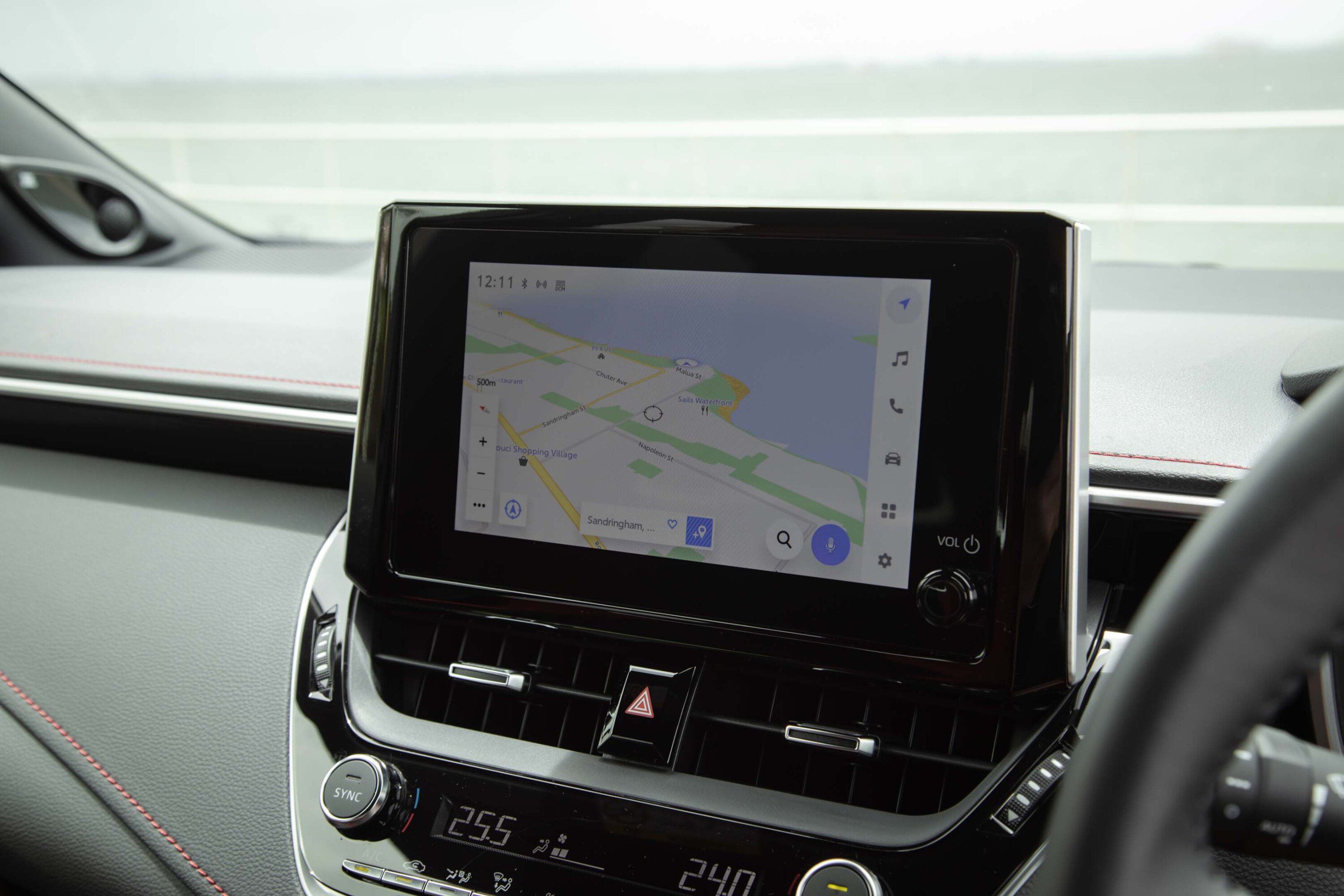
1
Along with the new screen, a year’s subscription to Toyota Connect – a phone app that offers remote control features as well as telematics when things go awry that can call emergency services if needed – is included free.
From the SX and up, you get a more powerful connected services package that allows send-to-car navigation directions and additional user profile settings. The basic package is an ongoing cost of $9.95/month after the first year, and the more involved telematics are $12.50/month on top of that.
Where does Toyota make the Corolla?
Australian-delivered Corollas are assembled in Toyota’s Japanese production facilities.
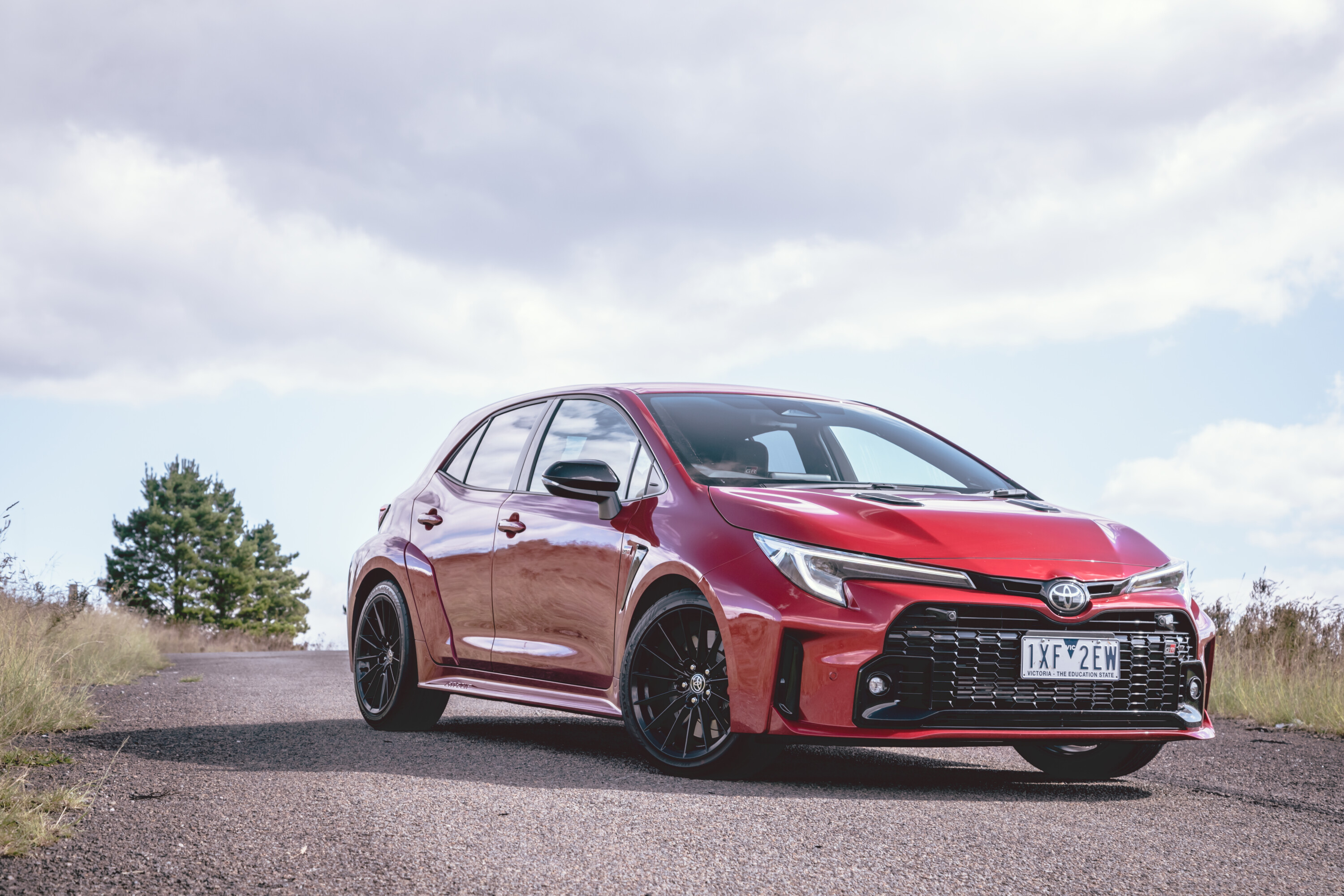
1
Are there plans to update the Corolla soon?
The Toyota Corolla range was given a mild update in 2022 for 2023, which has now carried over to the 2024 model year.
It has not received a major facelift in its life and is likely to continue in its current state for another three or four years, at which point it will be replaced by a new model.
More guides to help you choose the best car & tyres for your needs
- All tyre news & reviews
- Longest warranties & capped-price servicing period
- Buy new or used?
- Best cars for your teenager
- Must-have features for new drivers
- Active safety tech explained
- Australian road rules explained
- Does driving slower save fuel?
- Does my car need the pricier fuel?
- Help, I’ve used the wrong fuel!
- What is a hybrid car?
- How long do tyres last?
- What shoes should I wear to drive?
- What to do after buying a new car
- How much does LCT add to a car’s price?
- The ‘check engine’ light just came on…
- Is it illegal to drive too slowly in Oz?
- FWD v RWD v AWD – which is safer?
- How much can my large SUV tow?
