
TELL ME ABOUT THIS CAR
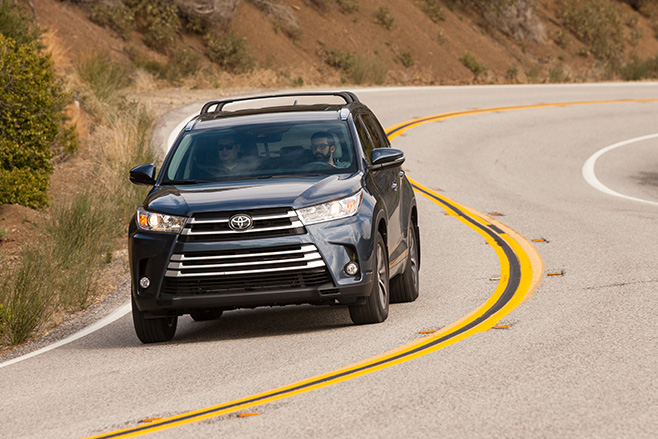
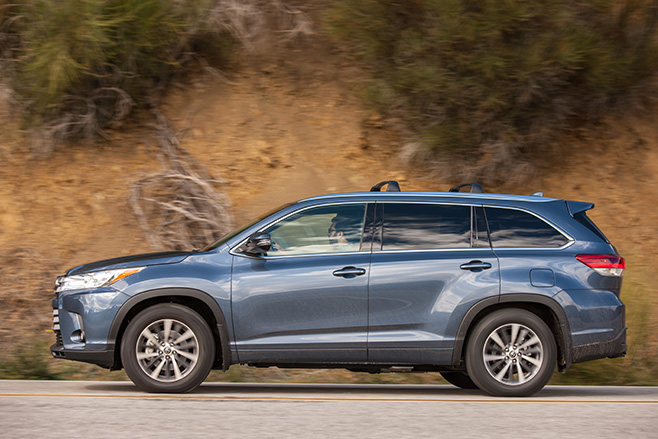
Since its launch in Australia three years ago, the third-generation Toyota Kluger has been a big seller in Australia because of its size, packaging, pricing, ease of operation, and brand reputation for reliability and resale. With the MY17 facelift, the company builds on that with small but important updates to the V6 powertrain to improve both performance and economy, including an all-new eight-speed automatic transmission, slightly improved interior trim, and a few equipment upgrades to the mid-range GXL and flagship Grande. So we’re talking about more of the same, only slightly better than before.
STRENGTHS
- Reliability assured: Though the 3.5-litre V6 has been comprehensively modified with the addition of direct injection and improved combustion processes, it’s still essentially from the same family of engines as before, so hassle-free durability is virtually guaranteed – and this is one of the key reasons why people stick with Toyota.
- A smooth operator. Like before, the Kluger’s V6 impresses with a lush and silky refinement, making it one of the sweetest powertrains available for the money. Now, though, the addition of 8.5 percent more power means there’s more oomph too, backed up by a fresh, slick-shifting eight-speed automatic transmission, replacing the old six-speed unit.
- Premium economy. The MY17 Kluger relies on 95 RON (or higher) premium unleaded petrol to operate at peak efficiency, but the upshot is 10 percent lower fuel consumption (and a corresponding drop in carbon dioxide emissions); and if the expensive stuff isn’t available, Toyota says the new powertrain will still happily run on standard 91 RON unleaded.
- Upgraded materials. While not a lot has changed inside, Toyota has at least improved the quality of trim and materials used on the dashboard, doors, and console, lifting the ambience and perceived quality. Happily, the rest of the cabin’s practicality and ease of operation remain as before – and that should please Kluger converts.
- Improved driver-assist systems. The flagship MY17 Kluger Grande’s standard lane departure alert system adds ‘steering assistance’, which firstly sounds a buzzer and flashes a warning light if the driver fails to notice the vehicle straying from its chosen lane, and then applies light steering force to help nudge it back in line.
WEAKNESSES
- More safety please. Only the circa $65K-plus Grande scores AEB Autonomous Emergency Braking, as well as Lane Keep Assist and Reverse Cross Traffic Alert; the rest of the range must do without these, while rivals like the Mazda CX-9 provides AEB as standard equipment across the Toyota Kluger range.
- Where’s the diesel and hybrid? Because the Kluger is built in America primarily for North American consumption, there is no diesel option (petrol is cheap up there). And while economy-minded buyers in the USA and Canada are offered a neat V6 petrol/electric hybrid model, it is only built in left-hand drive. So even with the MY17 Kluger’s 10 percent better fuel economy, it cannot match the parsimony of rivals like the Kia Sorento CRDi turbo-diesel.
- No stop/start. All but the base Kluger in the USA and Canada have stop/start technology to help save fuel (and reduce noise and pollution while standing still in traffic), but it was deemed too annoying for Australian Kluger buyers, thus another opportunity to make the big heavy Toyota more economical has been squandered.
- Same old ride. Toyota says it has not made any changes to the MY17 Kluger’s chassis – which is good news in one way because the previous edition was quite an adept handler, but it also means that the older version’s busy and unsettled ride remains.
The MY17 Toyota Kluger is shaping up to be a very good seven-seater SUV, with all the space, practicality, power, reliability, and durability people expect from the brand.
However, the Mazda CX-9 also offers such attributes, and then steps ahead with excellent handling and ride qualities, a more supple ride, and significantly better fuel consumption figures.
The Kia Sorento is also a worthy adversary, and remains unbeatable in the aftersales stakes with an industry-leading seven-year warranty against the others’ three-years.
Michael Pickering, the editor of Men’s Style magazine, knows a thing or two about stylish cars. Look as far as the motoring page on www.mensstyle.com.au and you’ll see an assembly of motoring treasures from Lamborghini Aventador to the ultra-sleek and rare Koenigsegg Regera.
In fact, so polished is Picko’s style, we’re not sure we’ve ever seen him in anything other than a pant-shirt combo.
With a 16-year career behind him editing and contributing to several titles including Harper’s Bazaar, Rolling Stone, Inside Cricket, Rugby League Week and Ralph, Michael brings a wealth of knowledge and experience to his brand.
And, in his second year at the WhichCar Style Awards, he brings this same level of enthusiasm to the judge’s round table.
According to Michael, this year’s finalists created some heated discussions amongst the judges and the most challenging part of the process was to assess a car on its style and exclude the technological aspects. The key, he said, was to focus on its design and how much emotional pull the car had.
For that reason, the Ford Mustang was among his favourites.
“I was most impressed by the Mustang. It’s something to behold. It’s got some things you would call stylish or contemporary inside, but as something you emotionally respond to and assess on its classic style it was certainly a standout,” he said.
“The [Honda] Civic also impressed me. It was a bold advance on what had come before, but what they’ve done to it was quite impressive.
“The Holden Astra is beautifully finished and a very cohesively-designed car. A lot more sporty than I thought it looked when you first saw it. And inside the interior design holds up and reflects that as well.
“The Audi was the most stylistically coherent and you felt stylish as soon as you sat in it. The exterior and the interior all came together nicely.”
Meet the 2017 Whichcar Style Award finalists.
In a day many thought would never come, Bernie Ecclestone has been replaced as head of Formula 1.
The 86-year-old has ruled F1 – often with an iron fist – for 35 years, transforming it from a glorified club racing series into the global sporting phenomenon it is today, however with Liberty Media’s purchase of F1 last week clearing its final hurdle, the approval of the FIA, the US media company has effectively given Ecclestone the sack.
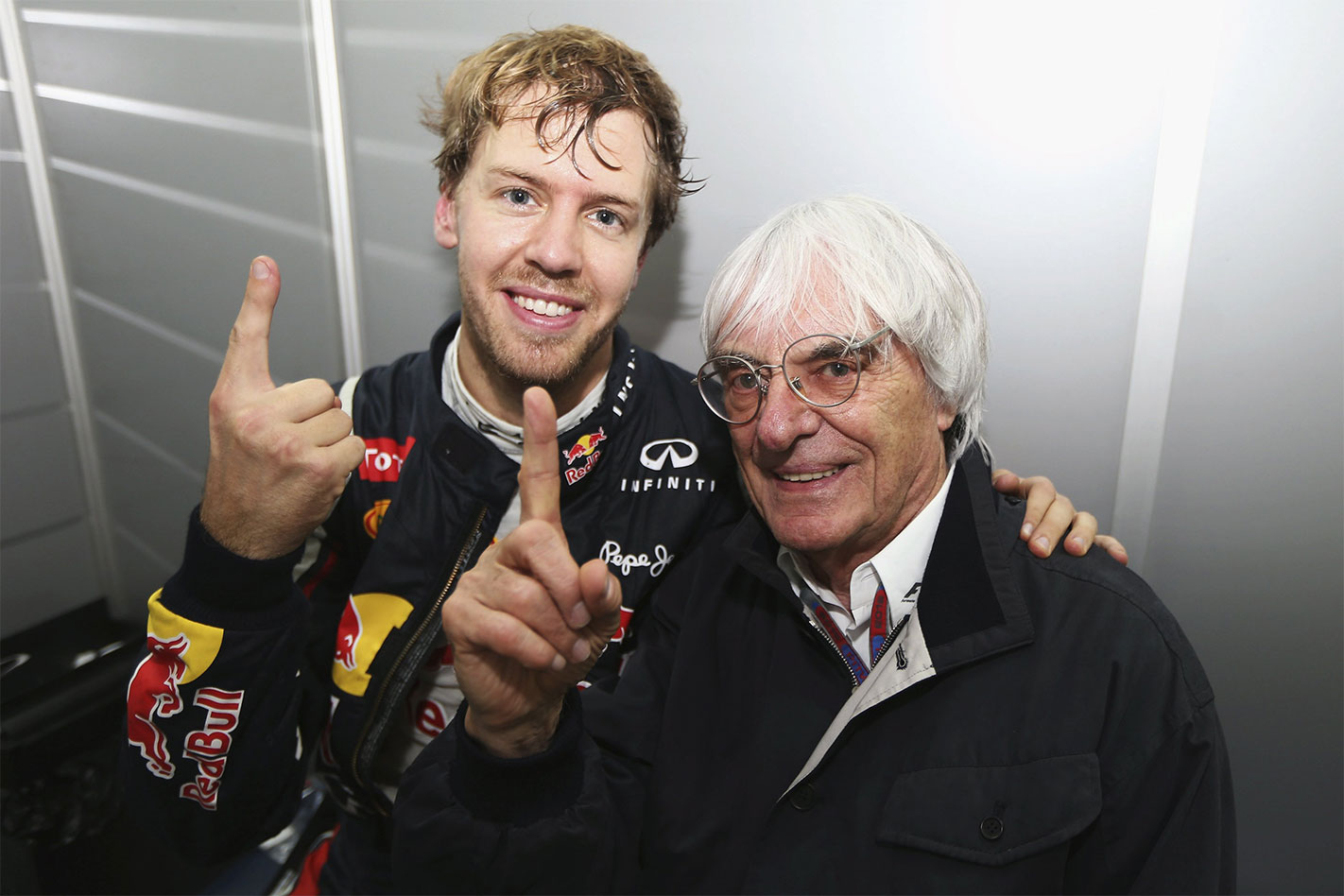
For his part, Ecclestone told German outlet Auto Motor und Sport, “Chase took over my position. I’m now like an honorary president. I don’t even know what that means.” The Chase Ecclestone refers to is Chase Carey, who assumes the role of CEO of F1.
Carey will be joined in running F1 by Commercial Operations Managing Director Sean Bratches, formerly executive vice-president of ESPN, and Motor Sports Managing Director Ross Brawn, former technical director of the Mercedes, Brawn, Ferrari and Benetton F1 teams.
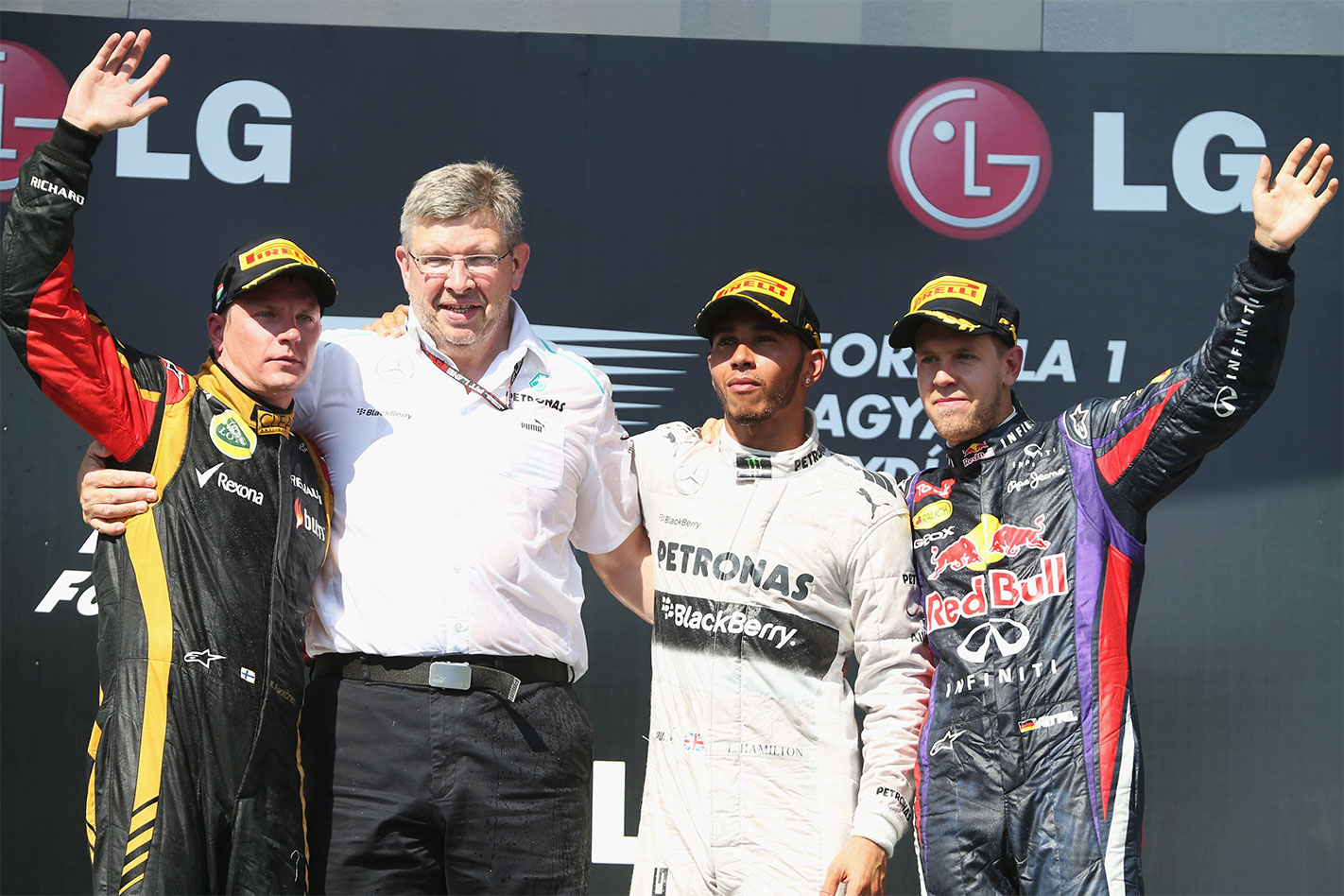
As the mastermind behind eight drivers’ and constructors’ titles with three different manufacturers, Brawn has intimate knowledge of F1’s sporting and political processes and spoke recently about the need for a five-year plan for the sport to ensure its sustainability and relevance.
BMW’s new Z5 roadster has been spotted testing again, looking more complete than when the BMW sports car was snapped in July last year.
The successor to the Z4 is being built in collaboration with Toyota, which will use the development for the next generation J29 Toyota Supra, though only in a hardtop coupe version.
The Z5 prototype spotted near the Arctic Circle is more developed since last year, with a more pronounced front bumper with diffuser, rear spoiler lip and properly installed tail lights.
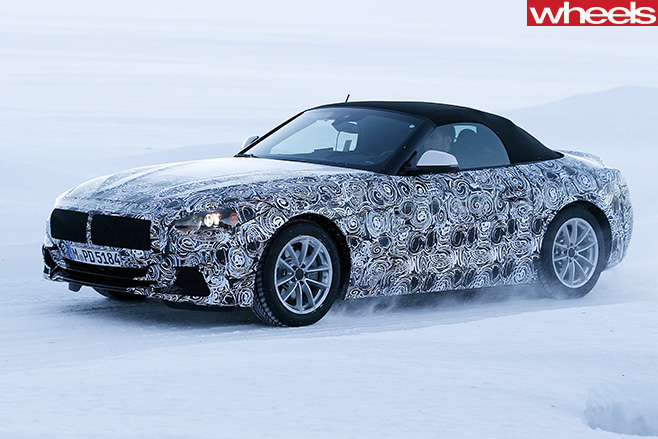
The joint BMW and Toyota sportscar architecture revolves around the front firewall, which will allow for two very different looking cars.
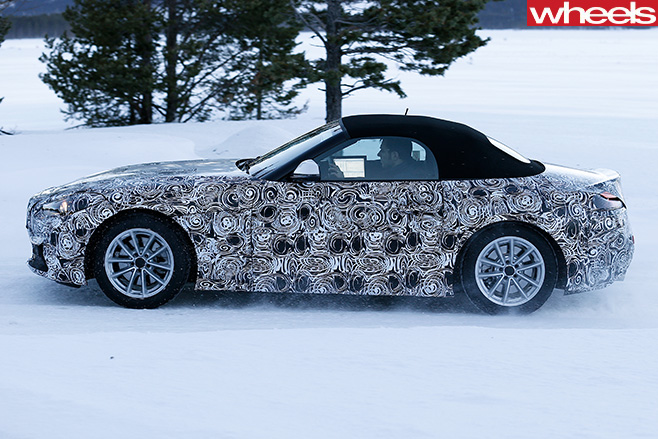
The combustion engines are expected to range from 140kW to a 320kW turbo donk under the long nose of the Z5 M, while the hybrid will produce around 150kW in power mode.
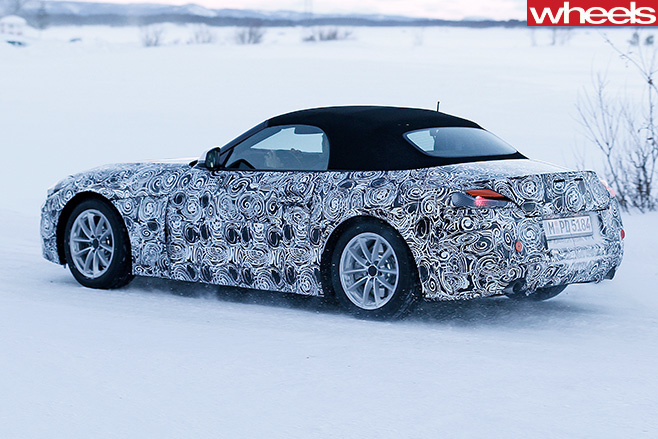
The Supra will be at the top of the Toyota brand’s line-up and could feature cutting-edge technology in addition to the bold styling.
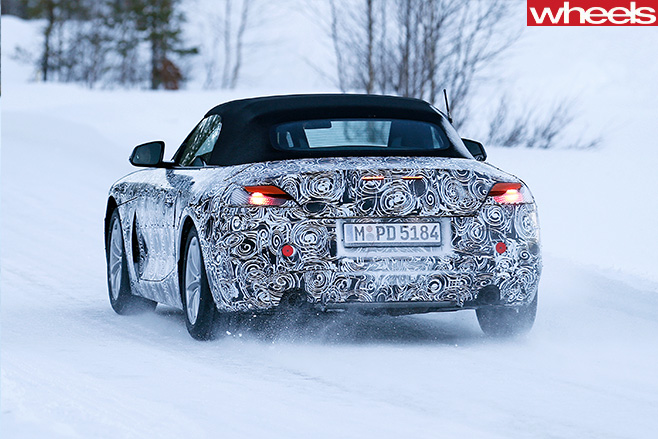
Unlike the Z4 it’s expected to be serious competition to the likes of the Audi TT, Porsche 718 Boxster and Mercedes-Benz SLC and Jaguar F-Type.
With its commercial origins, you might think a ute, even one packing Brembo brakes and a 304kW/570Nm 6.2-litre V8, would make a crummy track car. In reality, though, it makes an excellent circuit companion.
There’s plenty of room in the tray for tyres and tools, and even if you have a dedicated track car, Holden’s SS-V Redline is not only able to tow that to the track (as long as it’s light; the manual only has a 1600kg tow rating, the auto an extra 500kg) but should your regular toy cark it, you’ve got an able back-up waiting in the pits.
The invention of the Redline series has been a god-send for circuit-going Holden fans. Finally, a Commodore that could handle a full day on track without melting or needing a full brake transplant. If anything, it gave the Commodore more chassis than the engine could truly exploit, particularly in VF guise, but the installation of the gruntier LS3 has balanced the equation.

In throwing the Redline around for photographer Jacob’s camera, there was a surprising amount of understeer to contend with; the front tyres just didn’t seem to want to bite into the tarmac. It was in stark contrast to the regular SS ute we’d been testing earlier in the day that would happily oversteer into and out of a corner. Is this a result of the Redline’s stiffer chassis set-up? Or perhaps the much lower profile tyres on our long-termer, which is fitted with the optional 20-inch rims?
Sandown would provide the answers. It’s a track that works well with V8 muscle cars, described by more than one driving instructor as being “two drag strips with a couple of corners connecting them”. That sells it slightly short, as it’s quite a challenging track to get right, particularly in a road car, which can’t be monstered over the kerbs with the same vigour as a competition car.
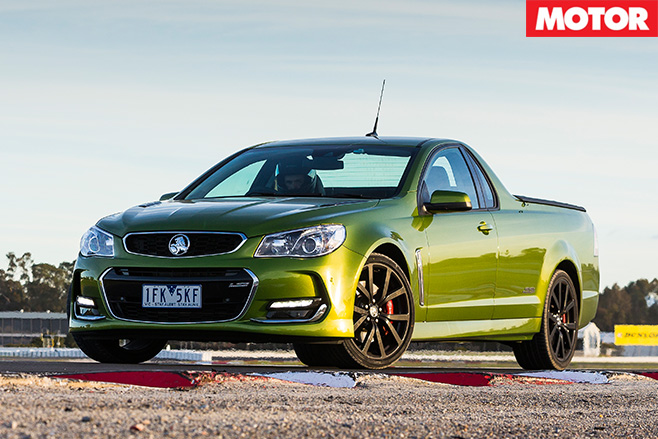
There are a number of bumps to deal with in the turns two/three chicane and the Redline feels its weight through the change of direction, with care needed to keep the tail in check as it bounces over the lumps in the road. It’s then a quick stab on the brakes to wash speed off for the tight turn four in order to get a clean exit down the long back straight, where the speedo once again climbs beyond 210km/h.
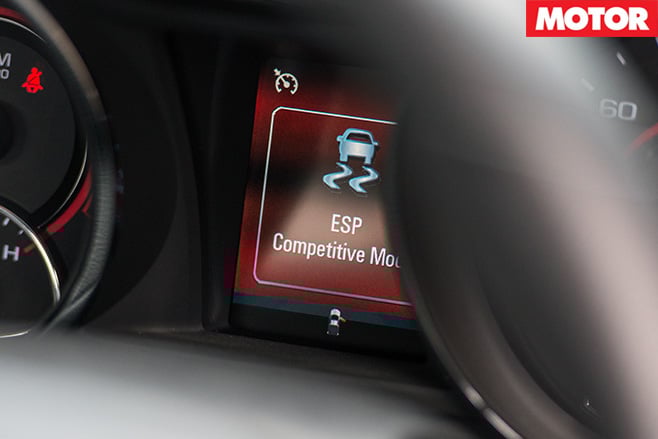
The car is ultimately faster with the electronics off, but this extra setting is a fantastic tool when you’re learning a new circuit, receiving instruction or if conditions are treacherous, like they are through Sandown’s final chicane. Overnight rain has resulted in a strip of water running across the track, right at the point where you need the car to change direction.
Despite a couple of damp patches, the Redline manages a best lap of 1:24.99sec. Impressively, by alternating hot laps with a cool-down lap, it runs strongly all day, or at least until it empties the fuel tank, which happens scarily quickly on track. The brakes remain absolutely fine, the tyres hold up well and, most importantly, it’s heaps of fun. As a do-everything performance car, the SS-V Redline ute is proving very adept.
Liked: Brakes and tyres held up well Disliked: Crazy fuel consumption Favourite Moment: Any track time is great
Fuel This Month: 15.8L/100km Average: 15.2L/100km Distance This Month: 1249km Total: 12,985km
Check out the Redline take on a HSV Maloo R8.
Front-wheel drive hot hatches have fast become the favoured vehicle for those seeking maximum driving thrills for a minimal spend, but there are still some options on the table for those who want a purer, rear-drive experience.
The Mazda MX-5 convertible has been the go-to RWD performance car option for the budget-conscious since it arrived on the scene in 1989, while Subaru’s BRZ (and its Toyota 86 twin) is a more recent arrival that also blends rear-drive dynamics with a low pricetag. The latest iteration of the MX-5, the MX-5 RF, finally brings a hard-top option to the fourth-gen MX-5 range, putting it into closer competition with the coupe-only BRZ.
Which one is worthy of your hard-earned? Our virtual comparison (from experience driving the RF in Japan, and BRZ in Australia) should point you in the right direction.
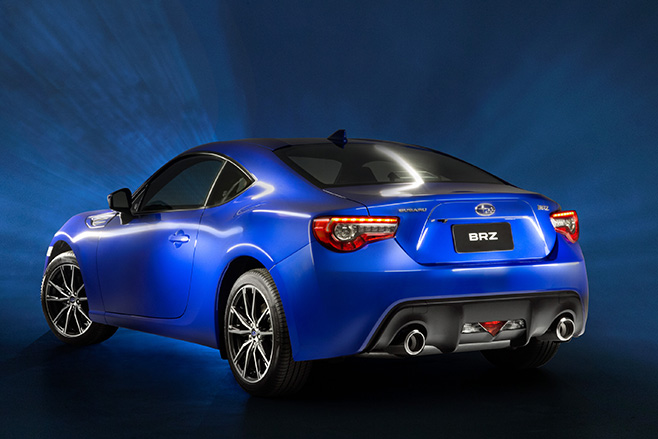
PRICE AND EQUIPMENT | WINNER: MAZDA MX-5
With a retail price starting at $38,550, the Mazda MX-5 RF manual costs a fair premium over the $32,990 BRZ manual. Opting for the upper-spec MX-5 RF GT takes the price of entry to a heady $43,890 as well ($44,890 if you gun for the Nappa leather-equipped GT grade), but it’s the base MX-5 RF that’s most closely aligned with the Subaru in terms of equipment and specification.
Both BRZ and MX-5 RF come with cloth upholstery, LED headlamps, leather-wrapped steering wheels, cruise control and Bluetooth phone/audio integration.
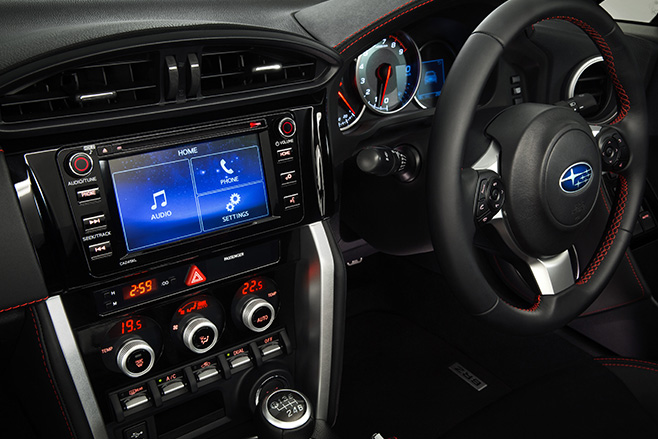
However, the MX-5 RF justifies its price by giving its driver the option of a wind-in-the-hair experience courtesy of its retractable roof. It also comes with satellite navigation as standard, something which isn’t offered by the BRZ’s more basic infotainment unit.
INTERIOR AND VERSATILITY | WINNER: SUBARU BRZ
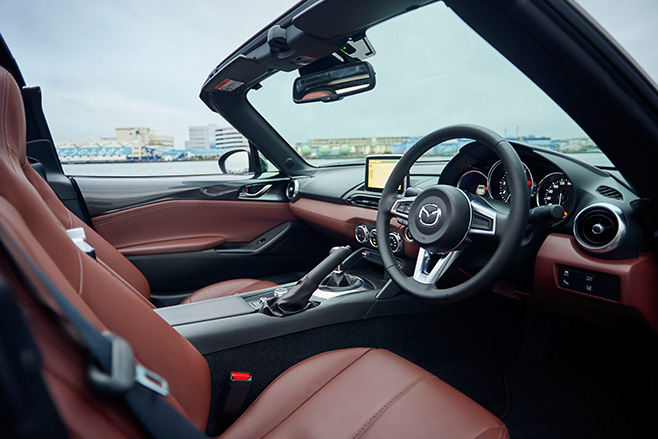
Both the MX-5 and the BRZ put the emphasis on the driver. Driving positions are low-slung in both, with the driver’s legs being almost horizontal from seat cushion to pedals. Steering wheels are perfectly sized both in diameter and rim thickness, and are pointed straight at the driver’s chest for optimal wheel-twirling.
Due to their compact size, all controls fall easily to hand in both cars. The Mazda wins on the design front, however, with a cleaner and more cohesive style to its cabin. The BRZ, by contrast, has an imposingly-upright dashboard. The Mazda’s interior also has a higher quality feel to its various plastics, even though hard surfaces abound.
The MX-5’s cupholders are an exception though – the plug-in drink receptacles feel flimsy and insubstantial.
But while the BRZ may feel a little cheap in areas, it absolutely trounces the MX-5 RF in terms of space. It has room for four passengers, for starters, while the Mazda is strictly a two-seater. In-cabin storage space is also more plentiful in the Subaru BRZ, though there’s a lack of covered storage in the centre console.
And it’s no contest when it comes to toting luggage. Though the BRZ’s boot area is marred by a full-size spare wheel erupting through the floor, it’s still far more spacious and useful than the MX-5 RF’s teensy 130-litre boot.
PERFORMANCE AND ECONOMY | WINNER: MAZDA MX-5
Both cars feature a 2.0-litre naturally-aspirated four-cylinder engine under the bonnet, but it’s Subaru that manages to squeeze more power and torque from its displacement. With 152kW of power and 212Nm of torque on board, the BRZ’s horizontally-opposed boxer motor has the upper hand over the MX-5’s 118kW/200Nm 2.0 straight-four mill.
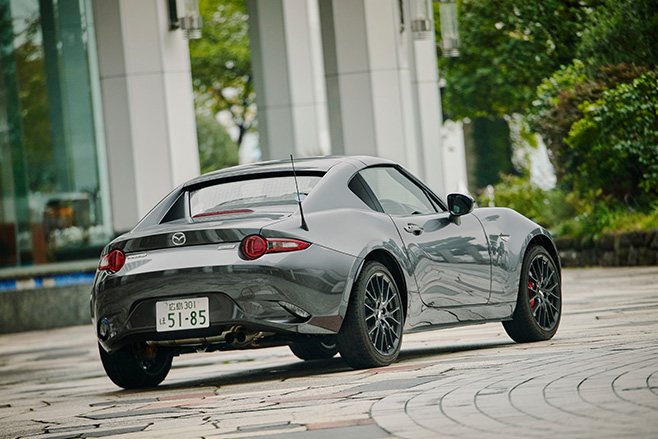
But the MX-5 RF has weight on its side – or rather, the lack of it. Though The RF’s power retracting hard top adds 45kg to its kerb mass over the standard MX-5, the hardtop still only weighs just under 1080kg when empty. The BRZ isn’t exactly lardy though and with a kerb weight of 1282kg it’s still slightly ahead in terms of power-to-weight ratio – but the difference between the two cars is minute.
Australian fuel economy figures haven’t been released yet, but if overseas models are any indication then we can expect the MX-5 RF manual to consume 7.2L/100km on the combined cycle. That would easily best the 8.4L/100km average claimed the Subaru BRZ manual.
RIDE AND REFINEMENT | WINNER: MAZDA MX-5
The BRZ has a firmer setup that preferences performance over comfort, but as we discovered during Wheels’ preview drive in Japan the much lighter MX-5 RF enjoys a taut-yet-compliant suspension tune that delivers a settled ride on the road similar to the MX-5 Roadster soft top.
However, judging a sports car on comfort is akin to judging a cake by its calorie content – it’s largely irrelevant.
STEERING AND HANDLING | TIE
The Mazda MX-5 won over the judges of sister publication Wheels’ Car Of The Year competition with its delectably precise handling and supremely adjustable handling, and the MX-5 RF follows the fine form of its soft-topped sibling.
It is an agile, sweetly-balance joy to drive, but the problem is that the BRZ boasts the same attributes. Both cars were engineered specifically to handle like a dream, and both will reward keen drivers in equal measure.
VERDICT | WINNER: MX-5 RF
This comparison is an interesting one, because though the MX-5 RF and BRZ differ so greatly in some respects – power, bodystyle, space and quality – they possess significant similarities too. The on-road driving experience is very similar as is their almost singular focus on chassis balance and handling. Driving enthusiasts will love both.
But there can only be one winner, and while the BRZ remains an exceptional performance car in its own right it’s the MX-5 RF that wows us with its cool retractable roof, quality cabin and lightweight, zippy nature.
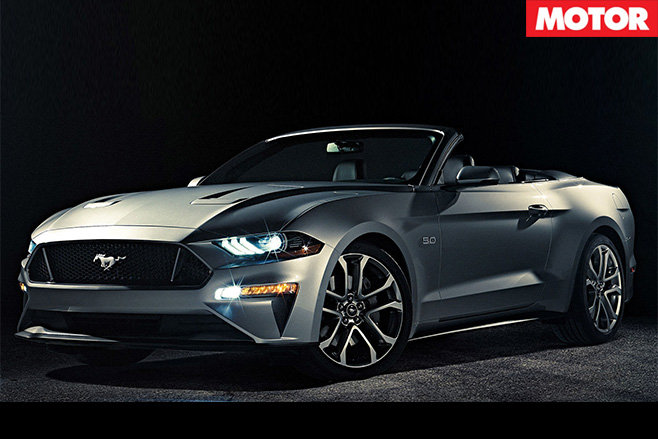
Sun-chasers won’t be the only people wanting a Ford Mustang convertible when the 2018 model arrives next year.
Mustang’s new active exhaust system, announced as an option on US variants, will make the drop-top appealing to sound addicts as well.
Exclusively matched to the GT variant, drivers will be able to adjust the volume belt out by the ‘Coyote’ 5.0-litre V8.
This has resulted in more power and revs, but Ford’s yet to reveal what effect this has had on the car’s current 306kW and 530Nm.
The brand’s Mustang GT350R features a switchable system, but this new active exhaust is pegged to offer more than just a volume dial.
Ford’s press release promised “an audible experience like never before, with a fully variable sountrack to match the entire acceleration range.”
New Active Valve Performance Exhaust sounds sweet! #Mustang pic.twitter.com/yR4Wp0uuF6— Dan Jones (@D4N_J0NE5) January 17, 2017
However it works, footage posted on Twitter of a 2018 Mustang GT clearing its throat shows it works well.
Announced as part of the Mustang’s extensive 2018 model year upgrade, the active exhaust will be offered to US buyers as an option.
It isn’t part of the Performance Pack which gifts Mustangs a performance spoiler and magnetic adaptive dampers, most likely to keep the pack available to EcoBoost customers.
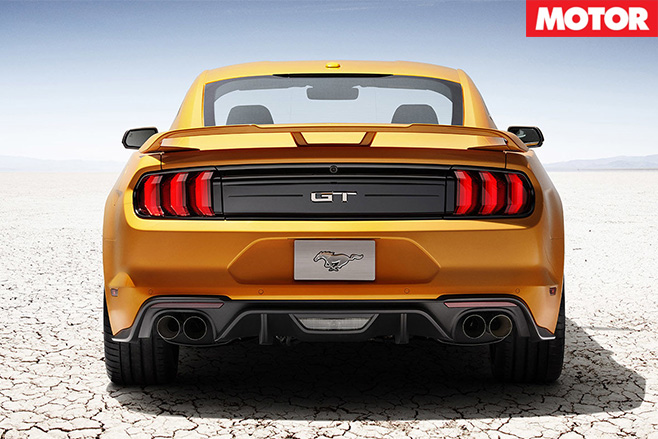
Further details on the local availability of exhaust, however, will be announced closer to the Aussie launch of the new model in late 2018.
‘I was dismissed today,’ the former head of the pinnacle of motorsport says as new owners take control.
IT’S BEEN dubbed the Eccsit. British former used car salesman turned motorsport supremo Bernie Ecclestone appears to have finally ceded control of his beloved Formula One to its new owners, Liberty Media.
German motorsport website Auto Motor und Sport reported today that Ecclestone had been “forced out” of his position at the head of the sport after he was asked to step down by the sport’s new owner, newly installed F1 chairman and former Sky News director Chase Carey.
“I was dismissed today. This is official,” the 85-year-old multi-billionaire who has had an almost 40-year stranglehold on the sport told Auto und Motor Sport. “I no longer run the company. My position has been taken by Chase Carey.”
Instead, he said he would stay on as a “kind of honorary president” for the sport, a title that was bestowed on him “without knowing what it means”.
Liberty flagged last week that Ecclestone would be offered a position as an “honorary chairman” of the sport once the takeover was complete. The exact wording of Ecclestone’s change of role is expected to be revealed later this week via an official statement from the media group.
Liberty also announced late last week it wanted to sell a stake of its ownership in F1 back to the teams that compete in it, reserving a $US400 million ($A528 million) slice of the sport for them. Expressions of interest closed yesterday.
The US media giant launched a takeover bid for F1 in September last year, gaining the FIA’s final approval for the deal in January. Under the terms of the $US8 billion deal, Ecclestone was to remain as the sport’s chief executive until the money changed hands.
Key to the sweeping changes Liberty media will bring to the sport are the appointment of a new commercial director, former ESPN executive Sean Bratches, and former Ferrari and Mercedes team boss Ross Braun as a director overseeing the motorsport side of the business.
Liberty Media is expected to bring more US-style glamour to the sport as part of an overhaul designed to introduce it to a new generation of fans. Key to the push is expected to be a switch from focusing on traditional media channels to social media, bringing in a new generation of younger fans to the sport.
The calendar, currently set at 20 races a year, is also expected to grow.
The Geneva Motor Show is a couple of months away, but Japanese automaker Subaru has released a teaser pic of its all-new 2017 Subaru XV to whet appetites ahead of its March debut at the Swiss show.
The teaser image depicts the XV in shadowy profile, and all but confirms speculation that the next-gen crossover hatch will echo the design of last year’s Crosstrek concept.
From the teaser pic, it’s apparent that the new XV will continue to be based heavily on the Subaru Impreza hatch. Besides some plastic body armour and a jacked-up suspension, those are clearly Impreza bones underneath.
The XV will be the second vehicle to feature the Japanese carmaker’s scalable SGP platform, following the Impreza, which Subaru claims will improve suspension and safety as well as support the next generation of its powertrains and drivelines.
Its profile design also appears to feature sharper design lines and a more aggressive nose, sharing some similarities to its older sibling, the Outback.
The XV is one of Subaru’s most popular vehicles, with 2016 sales figures putting it as Subaru’s third highest-selling model behind the Subaru Forester and Outback.
Powertrain and equipment details will likely surface after the doors open at Geneva, but WhichCar doesn’t expect the next-gen XV to deviate too far from the current-generation XV’s template.
The current XV features the same 2.0-litre petrol four-cylinder engine found in the Subaru Impreza, which is paired with a continuously variable automatic transmission. With the new-gen Impreza offering new versions of both the 2.0-litre four and CVT with 115kW of power and 196Nm of torque, we can expect the same hardware under the bonnet of the 2017 Subaru XV.
A hybrid powerplant is also presently offered in some overseas markets such as Europe and Japan, but with that option not making it to Australia, odds are low that we’ll see it here in the next-gen XV.
The new Subaru XV is slated to go on sale in Australian car dealerships in the middle of 2017.
An underwhelming year for Holden on the sales front, down eight percent, largely due to old models (Holden Cruze, Captiva and Barina) that lack showroom sizzle, and substance.
At least Holden Commodore continued with much-needed strength in what is still a sizeable large-car segment. But it was a year of consolidation for Holden as it began to introduce the new breed of imports that will define the company over coming years. The impressive little Spark arrived early, but new micro cars never translate into big numbers.
Similarly, a heavily revised Colorado boosted profits and reputation but only tickled sales. The recently arrived Astra heralds a return to Holden’s small-car glory days with great dynamics and drivetrains, albeit with pricing that pits it against classy segment leaders. The result will leave Holden in fourth – its worst on record.
RANK 4TH 2016 SALES: 96K 2016 YTD RESULTS: 86,583 sales, down 7.7%, 8.0% market share 2017 FORECAST: 100K RANKING: 4th; 100,000 sales (up 3%), 8.3% market share GRADE: B-
Opportunities
Holden Astra and Equinox (arriving late in the year) are the big hopes for Holden in 2017. Both are new and arrive in two of the biggest segments, offering opportunity for growth. However, Holden’s focus is also on sustainable profits, which means we’re unlikely to see prices matching the bargain cars in those respective segments. Throw in an updated Trax (same underneath but with a redesigned snout and nicer interior) and for much of 2017 the brand will have fresh metal in segments that count. Holden also needs momentum from the updated Colorado, which can now fight with the big boys. Expect Commodore sales to dip (production numbers have already been set) but still be healthy. Interest in the last Aussie muscle cars will deliver healthy V8 demand.
Challenges
2017 will arguably be the toughest in Holden’s 69 years. The Elizabeth production line shuts down late in the year, consuming some brainspace of top brass, and there are still holes in the line-up, such as the large seven-seat SUV category dominated by the likes of Hyundai, Toyota and Mazda. Holden also has plenty of work to do with young buyers, who don’t care about the brand’s history – and, subsequently, don’t buy many of its cars. Holden has to accept it’s now a challenger brand rather than the powerhouse it once was.
Summary
Holden is trying to mimic the successful ‘premium’ model of Mazda and VW, but the brand image is tarnished and will require TLC – and new-model muscle – to enjoy genuine success. That will take a lot longer than 12 months.
