Notably, battery electric vehicle (EV) sales have seen a huge increase with 80,446 delivered so far this year, marking a significant boost over the same period in 2023, at just 28,326 – proving the growing interest in low-emission vehicles among Australian consumers.
It’s easy to see the opportunity here in Australia for brands offering electrified models, and a few are jumping onto our humble island to offer more choice than ever before. (And steal a piece of that sales pie.)
In recent years, brands like MG, Chery and BYD have jumped into the mix with a range of electrified options, and while these value-focused cars are proving popular with Aussies, they’re only a drop in the ocean of opportunity.
Let’s take a look at some Chinese brands that may come along for the ride sometime soon.
1
Xiaomi
Xiaomi Automotive, a division of the well-known Chinese electronics company Xiaomi, is making a strategic entry into the EV market.
Announced in 2021, Xiaomi Automotive signifies an expansion beyond consumer electronics, reflecting the company’s ambition to become a key player in the rapidly growing EV sector.
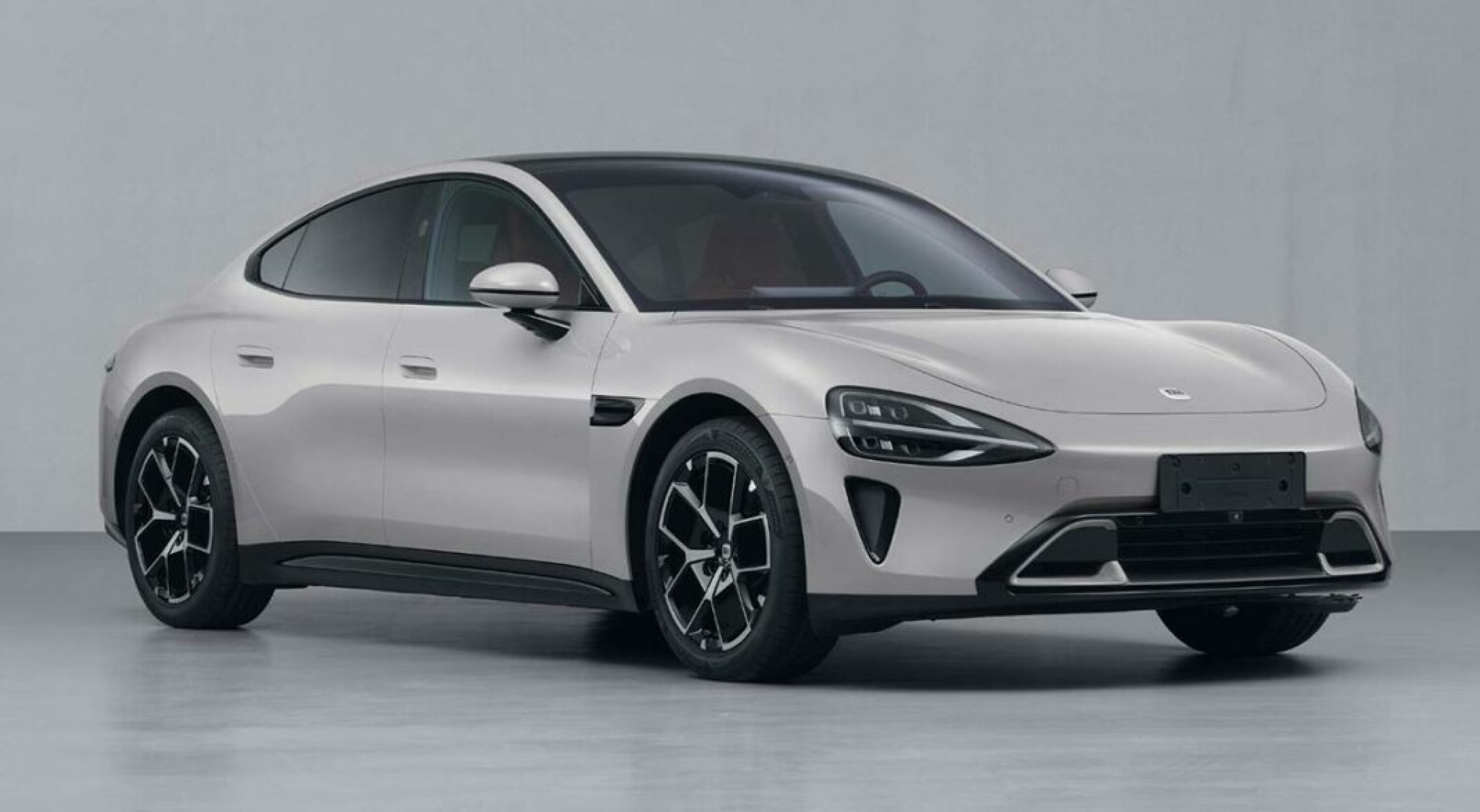
The Xiaomi SU7 has been spotted in China recently wearing camouflage. Although the naming convention is a little confusing, the EV is an aerodynamic and sporty looking four-door coupe, which some have called a “Taycan for young people”.
1
Leapmotor
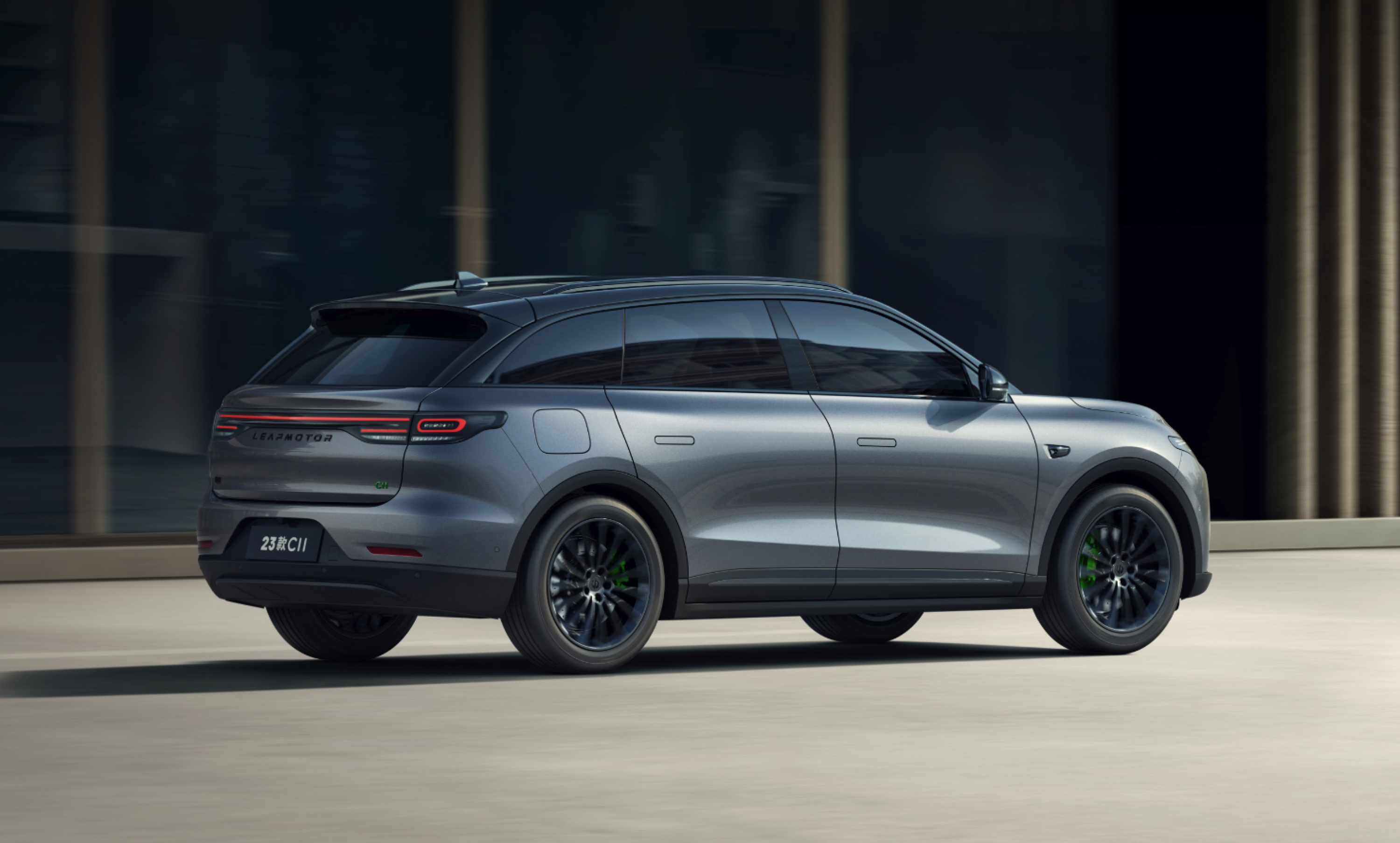
Leapmotor, an EV manufacturer established in 2015, is making waves in China’s automotive industry with its focus on sustainable and intelligent EVs.
Based in Hangzhou, China, Leapmotor says it aims to offer affordable, high-quality electric vehicles equipped with advanced technology, including autonomous driving and efficient energy systems.
The company’s proprietary battery technology and software enhance vehicle performance and safety. Leapmotor’s product range caters to various consumer needs, from compact city cars to spacious family vehicles.
Stellantis (think Jeep, Fiat and Peugeot) recently acquired approximately 20% of Leapmotor for 1.5 billion euros. The deal also highlighted the venture of Leapmotor International that gives the brand exclusive rights to sell Leapmotor products outside of China.
1
Deepal
Deepal operates as an EV brand under Changan, which is recognized as the oldest automaker in China and the smallest among the ‘big four’ state-owned automobile companies.
According to CarNewsChina, Deepal’s CEO says the brand will aim to sell 450,000 EVs in 2024. This target was set to coincide with their expansion into European and ASEAN markets.
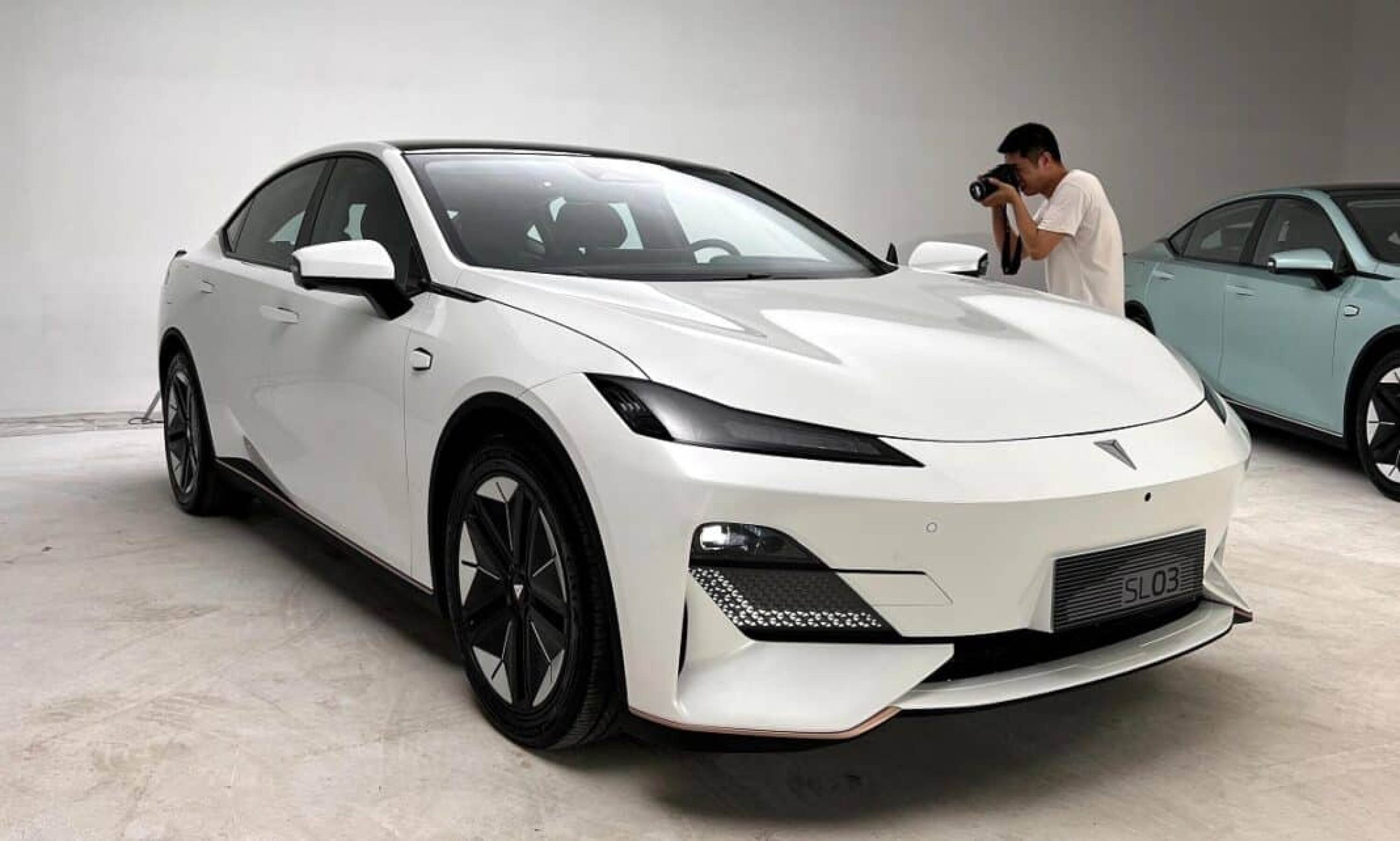
Two of its new models, the SL03i sedan and S7i SUV, launched only a few months ago. These models feature a valet autonomous parking system, allowing the vehicle to recall a previously taken parking route. Once a driver returns to a familiar parking area, this system can autonomously park the vehicle in the memorised spot, even in multi-level garages.
The system also includes enhanced features like in-car and remote parking assist, and can autonomously move the vehicle to another spot when the parking time limit is reached.
Zeekr
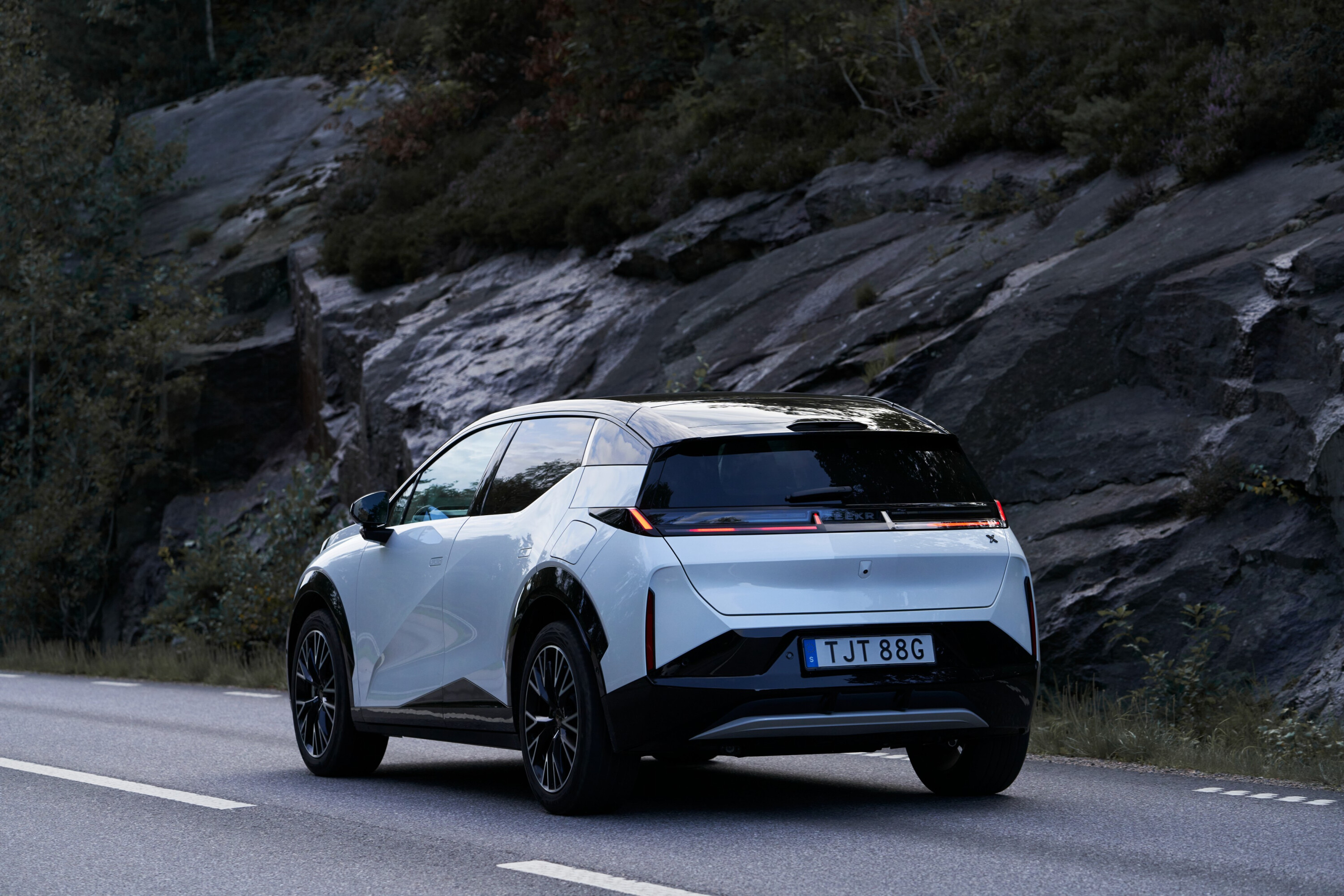
Since publishing this piece, Zeekr has confirmed plans to launch in Australia in 2025 with a luxury people mover and small SUV.
Launched in 2021, Zeekr is a premium electric vehicle brand operating globally under the Geely Group umbrella. If that sounds familiar to you it’s likely because Geely also owns Volvo and its electric counterpart, Polestar.
The brand has three models for sale globally, two of which will land down under soon.
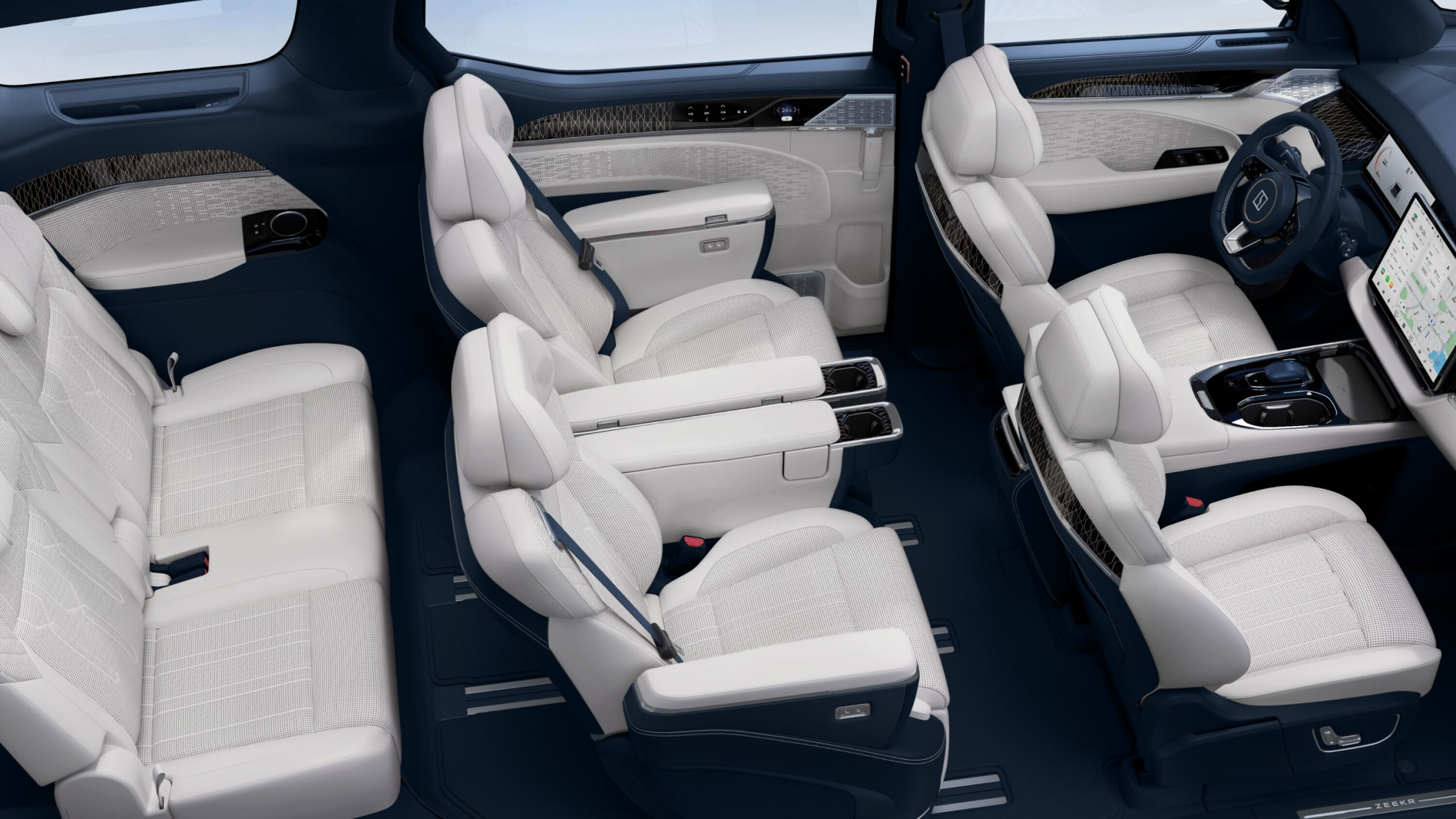
First will be the Zeekr 009, a spacious family vehicle available in six- or seven-seat configurations, boasting impressive performance and a driving range of up to 800 kilometres.
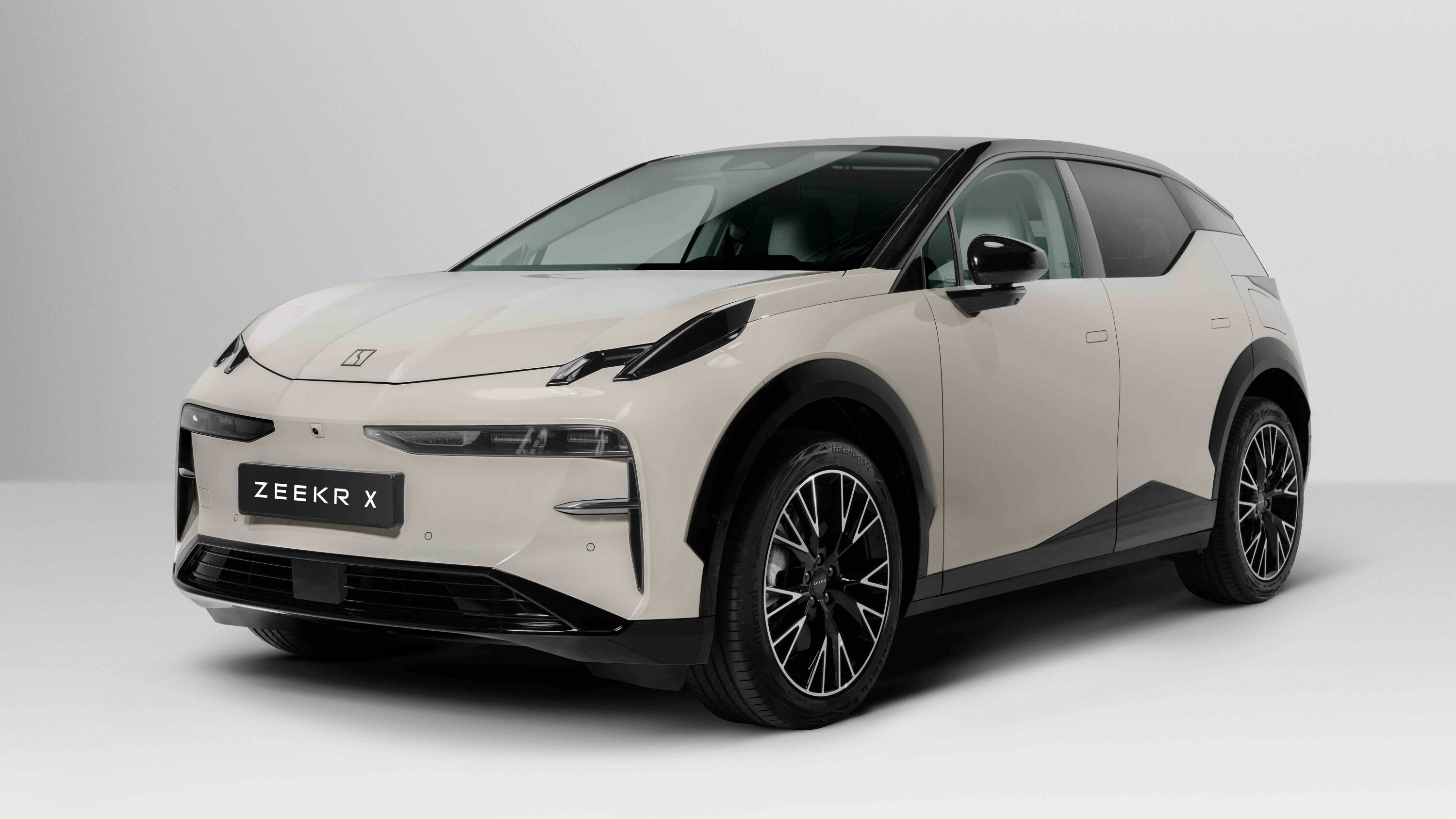
Additionally, Zeekr plans to introduce a compact SUV, the Zeekr X, positioned as a competitor to the BMW iX1.
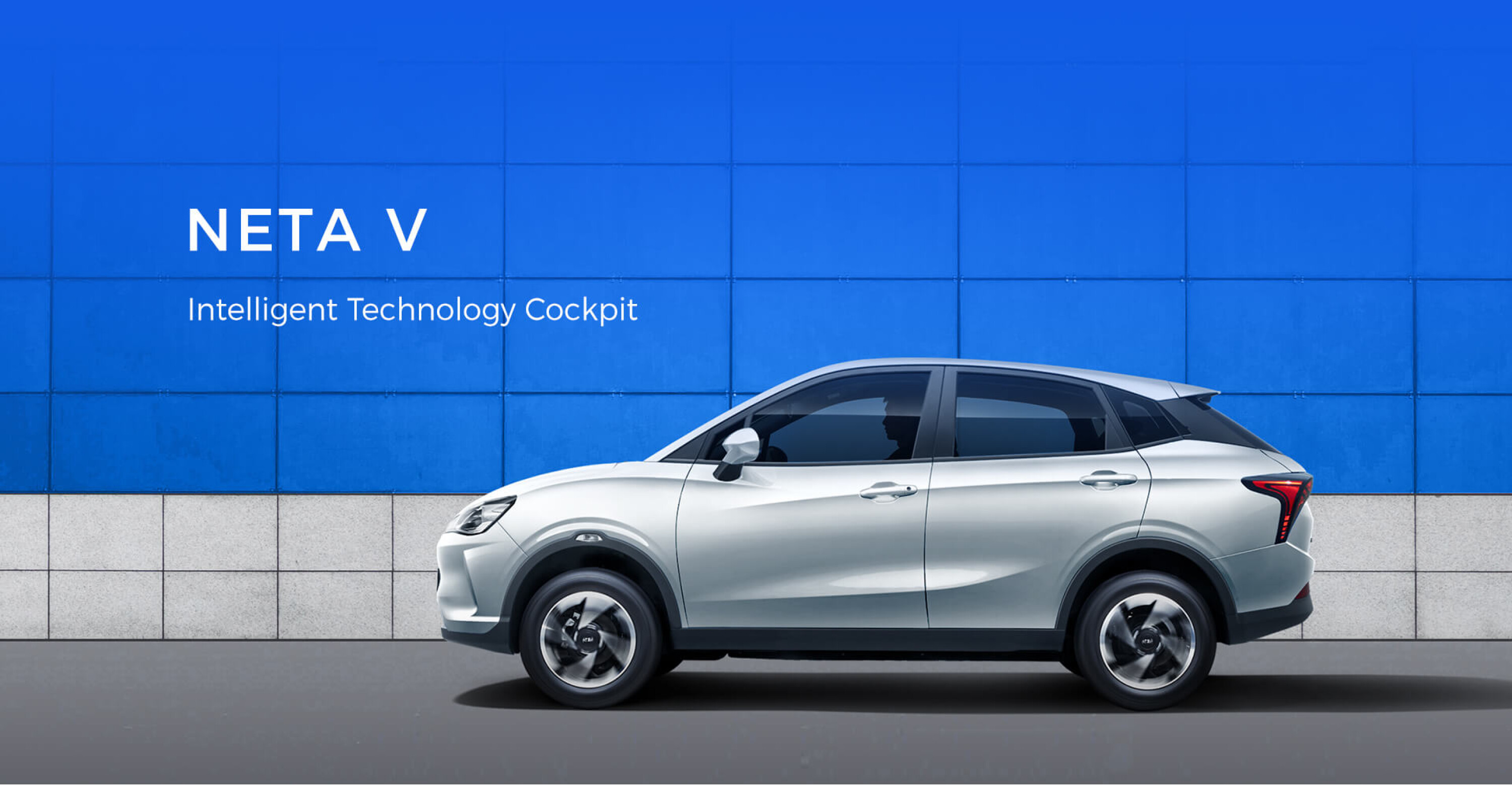
Neta, a brand of Hozon Auto, is another emerging EV maker, gaining recognition in the competitive EV market.
Launched in 2018 and headquartered in Zhejiang, China, Neta focuses on producing affordable and accessible EVs, aiming to make sustainable transportation widely available.
But it’s the international expansion where Neta wants to shine, as it’s building a plant in Thailand to make right-hand-drive vehicles.
In October, Neta announced its entry to the Middle East, and this month the company disclosed it will sell vehicles in the Latin American market, starting with Costa Rica, with the intention to launch in Europe soon after.
Ivan Pavlov conducted experiments with dogs to explore how they learn. He discovered that by ringing a bell every time he fed them, the dogs would start to salivate just from hearing the bell, even without food present.
This demonstrated how animals (and humans) can learn to associate two unrelated things—like a bell sound with food expectation—a process known as classical conditioning.
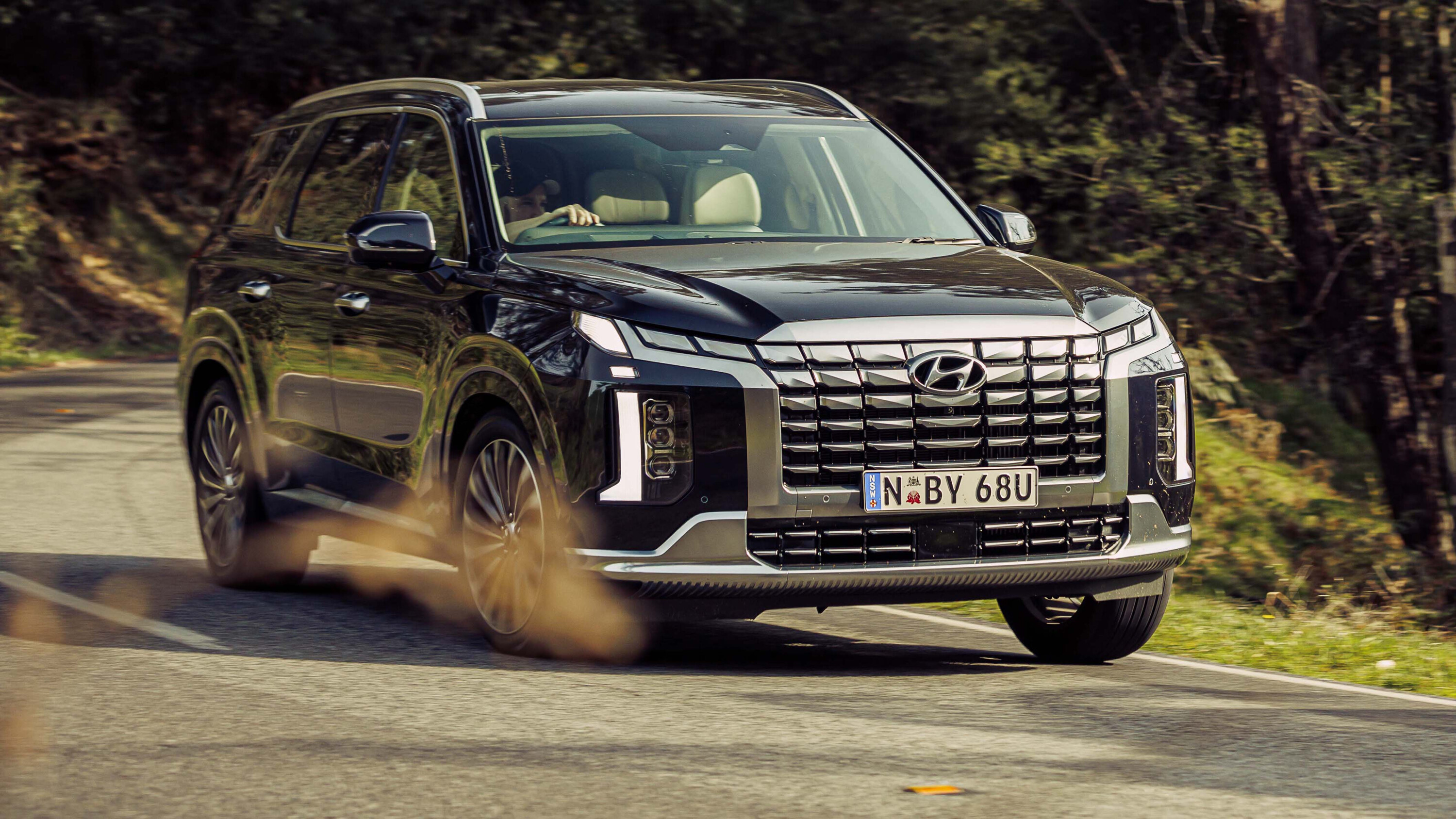
A similar, albeit more frustrating kind of conditioning seems to happen between Hyundai Group’s latest vehicles and myself, where their attempts to alert me with chimes that I’m over the speed limit result in me yelling “I’m not bloody speeding!”, whilst alone in the car.
The first encounter with this chime, in the Hyundai Palisade, made me so irate that I started to avoid driving when I could. Those were a particularly fit couple of days when I walked to the supermarket. The tone coming from the car was pretty loud and incessantly repetitive. And it’s not just Hyundai; these auditory alerts have become almost an industry standard.
1
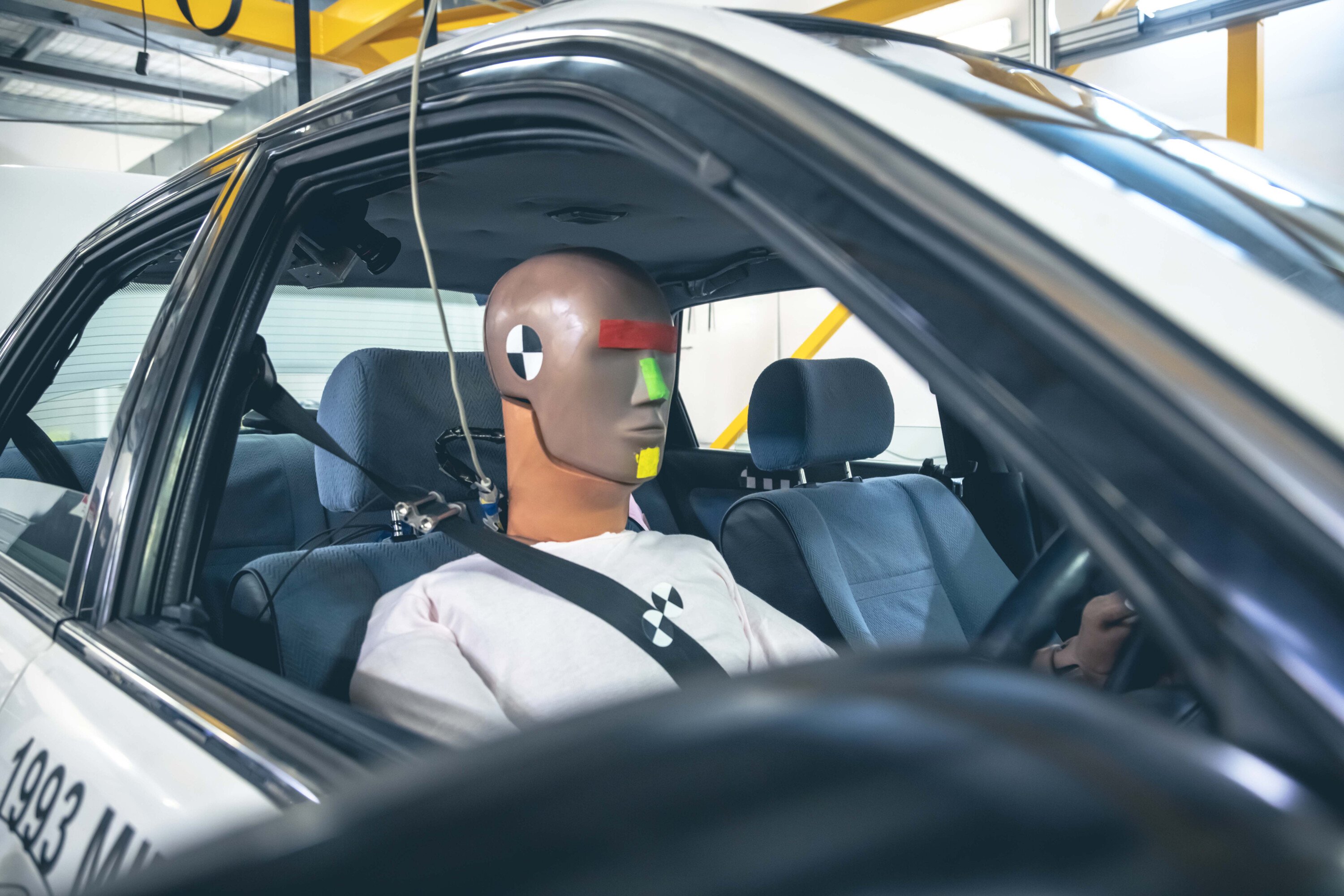
With ANCAP’s increasing safety standards each year, car manufacturers are pushed to enhance active safety features
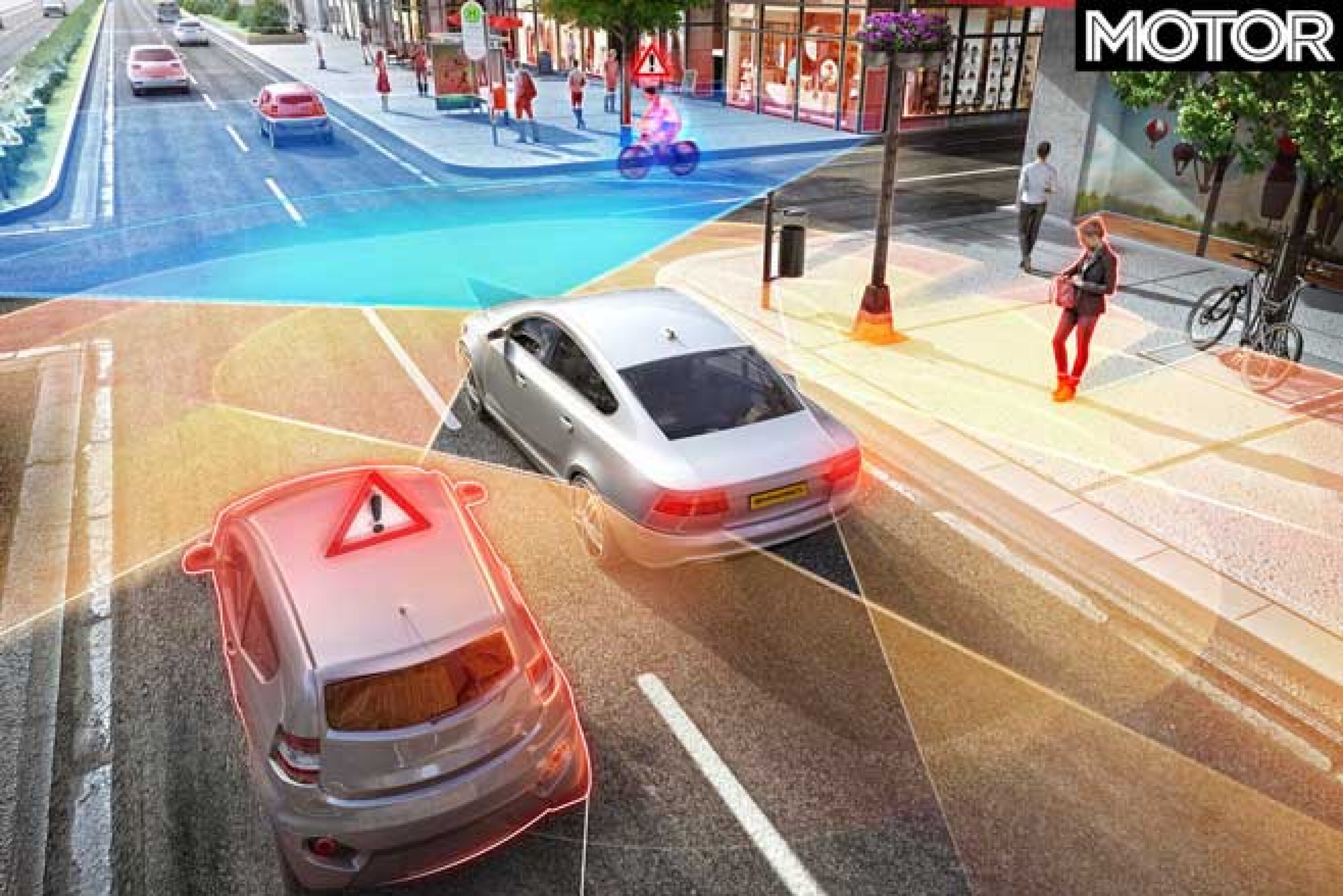
The problem is that these alerts sound for so many different reasons reasons: speeding, entering a new speed zone, detecting a car in your blind spot, a cyclist nearby, parking assistance, unfastened seatbelts, keys left in the car, an open door, left-on headlights or engine, and sometimes, seemingly for no reason at all. Perhaps these are just preemptive alerts for future, actual alerts?
With ANCAP’s increasing safety standards each year, car manufacturers are pushed to enhance active safety features to maintain top ratings. However, one could argue there must be a better method than bombarding drivers with 75 different audio alerts.
Recently, popular models like the Hyundai Kona and Genesis GV70 have introduced a speed alert feature that dings and flashes the speed limit on your heads up display.
While meant to help drivers adhere to speed limits and avoid fines, I find this feature often ends up being more annoying than helpful.
One issue is that the road sign recognition technology can only identify speed limit signs without understanding the contextual conditions, like time-specific school zones. This can lead to incessant and misleading chimes as the car inaccurately thinks you’re speeding.
This situation mirrors Pavlov’s experiment: if the conditioned stimulus (the bell, or in this case, the beep) continues without the expected outcome (food, or the actual need for an alert), the subject begins to ignore the stimulus. Similarly, drivers start to disregard these beeps and dings after repeated false alarms.
1
Although this technology can be deactivated, it resets with every engine start, presenting no permanent solution to the frustration.
In the past, innovations like the Holden Equinox’s haptic feedback seats attempted to replace audio alerts with vibrations when parking the car. So the closer you got to a wall, the stronger the buzz. I think the theory was rock solid but in practice I won’t lie, it was pretty strange.
Safety in cars is crucial, and drivers value the assurance that they, their loved ones and surrounding people are protected. However, the constant barrage of beeping from safety reminders can undermine this peace of mind.
1
Many drivers, especially those transitioning from older to newer vehicles, find the plethora of alarms overwhelming– myself included.
While these tones aim to keep drivers alert, they often serve more as a distraction than a helpful alert system.
The question then becomes: are we being conditioned to stay focused, or are these sounds simply turning into a symphony of distractions?
Set to launch here in June, the Kia EV5medium SUV will be the brand’s most affordable EV yet, with prices likely starting “in the 50s” according to Kia Australia boss Damien Meredith.
“We’re pretty confident we can get a really, really, really, really good price,” said Mr Meredith regarding the EV5’s price positioning. “So we think we can probably get in the 50s [for the EV5 Air] – that’s our target.”
To be offered in three variants (Air, Earth and GT-Line) in both standard- and long-range forms, the entry-level EV5 Air will feature a single electric motor, front-wheel drive and a 64.2kWh lithium-ion phosphate (LFP) battery sourced from China’s BYD for better fast-charge capability and ease in charging to 100 percent, without degrading the battery over time.
Producing an expected 160kW/310Nm, the front-drive EV5 Air should be good for 0-100km/h in 8.5sec, a claimed NEDC range of 490km (more accurate WLTP figures are yet to be released) and 102kW maximum DC charging speed.
1
The official charging data quoted for this powertrain in Thailand (which also sources its EV5s from Kia’s Chinese production facility) states 10-80 percent in 36 minutes.
The long-range EV5 will also be front-wheel drive, featuring the same 160kW/310Nm front-mounted electric motor but a larger 88.1kWh LFP battery for 36 percent more range (665km NEDC), though a marginally slower 8.9sec 0-100km/h time.
It features a 141kW maximum DC charging speed and can go from 10-80 percent in 38 minutes.
2
The dual-motor EV5 AWD – expected to be offered only in flagship GT-Line form, and not arriving here until the fourth quarter of 2024 – adds a 70kW/170Nm electric motor to the rear axle for combined outputs of 230kW and 480Nm.
This lowers the EV5’s claimed 0-100km/h time to a brisk 6.1sec without impacting too much on its NEDC range (620km), or its charging speed compared to the 88.1kWh long-range.
Benchmarked against the Tesla Model Y and Volkswagen ID.4 (due in Australia around July/August this year), the EV5 medium SUV is intended to be a more comfort-biased, pragmatic alternative to the sportier, coupe-shaped EV6 liftback – giving Kia the advantage of two distinct mid-sized EV models, rather than simply two bodystyles.
Based on a development of Hyundai-Kia’s existing E-GMP bespoke electric-vehicle platform (dubbed N3 eK), the Chinese-manufactured EV5 features modularised front and rear chassis components that are different to E-GMP models, as well as more cost-effective 400-volt electrical architecture to make the EV5 less expensive to produce.
4
Measuring 4615mm long, 1875mm wide and 1715mm tall, riding on a 2750mm wheelbase, the EV5 sits smack-bang in the heart of medium SUV territory.
In comparison, the forthcoming Volkswagen ID.4 electric SUV (which is rear-wheel drive in its base form) stands 4584mm long, 1852mm wide and 1636mm tall, riding on a 2765mm wheelbase.
Kia’s existing EV6 – launched in Australia in February ’22 but with a mid-life facelift due later this year – is similar in length (4680-4695mm) and width (1880-1890mm) to an EV5 but is much lower (1550mm) and rides on a significantly longer wheelbase (2900mm) for a dramatic difference in its visual proportion.
Kia Australia says the five-seat EV5 is very much an SUV whereas the EV6 is more of a regular passenger car – “the EV6 remains very much a driver’s car and feels more like a Stinger successor than it does an SUV, despite FCAI’s categorisation,” said Roland Rivero, Kia’s general manager product planning.
This puts Kia in an enviable marketing position with its mid-sized offerings – the new Sportage GT-Line Hybrid flagship ($55,420) being similarly priced to an entry-level EV5 Air, and the top-spec EV5 GT-Line AWD likely to be priced in the vicinity of the entry-level EV6 Air ($73K), meaning a progressive line-up of complementary products.
Indeed, according to Dean Norbiato, Kia Australia’s General Manager Marketing: “Karim Habib, who is head of global design, very much sees the EV9 as setting the family look and feel that’ll extend through EV5 and then EV3 [a compact electric SUV].
He doesn’t want them to be brother and sister – he wants them to be cousins, [so] they have their own identity, but it is very much an SUV-first look.”
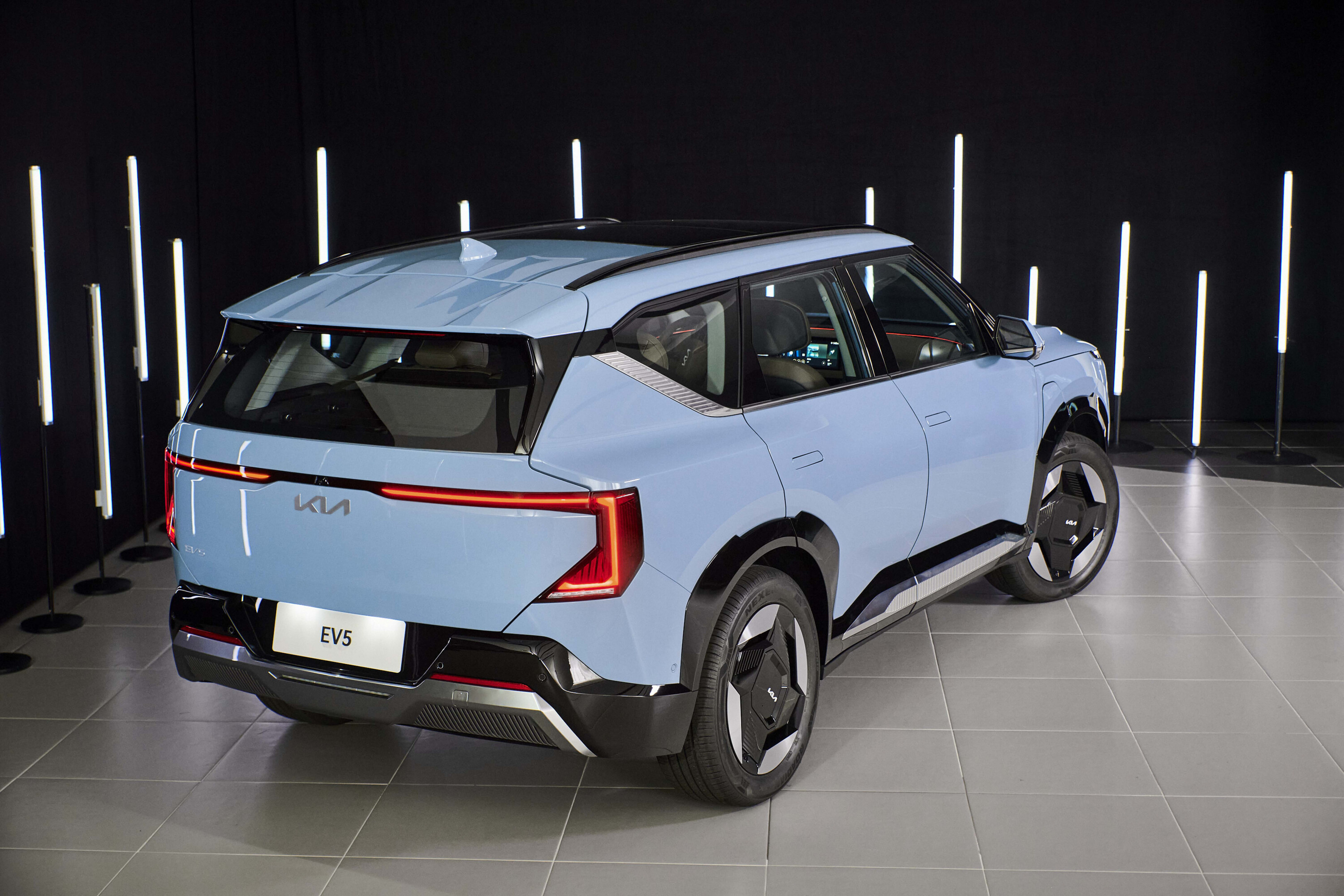
Following hot on the heels of the Car of the Year-winning EV6 (2022) and the game-changing seven-seat EV9 (2023), the all-new Kia EV5 is an entirely different taste of electric vehicle architecture.
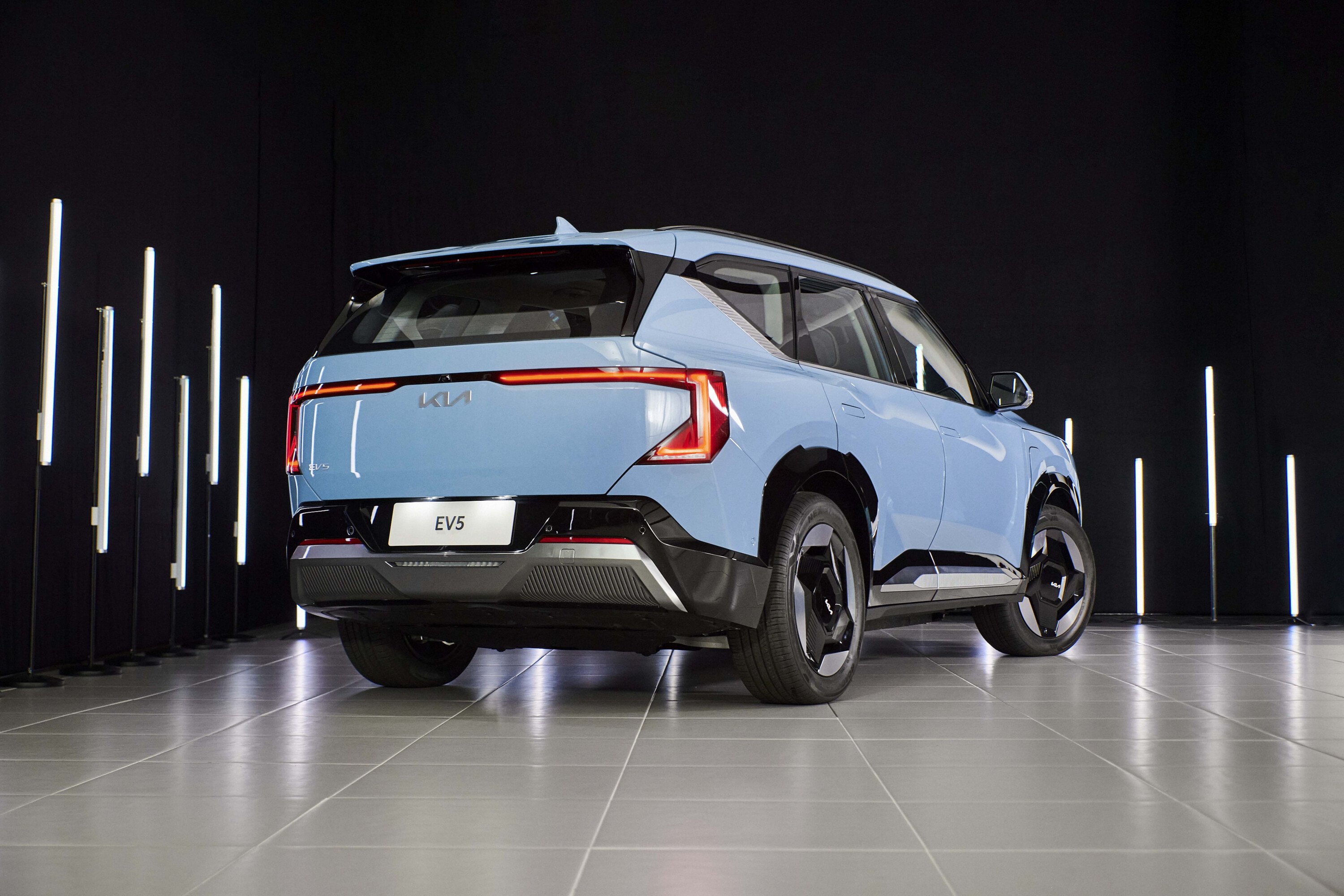
While it’s clearly inspired by the show-stopping style of the seven-seat EV9 electric SUV, the five-seat EV5 mid-sized SUV deftly manages to appear part of the visual family, yet a distinctly unique EV offering from Kia. It’s blockier and stockier, yet in no way inferior to the EV9. It’s simply its own thing, which is great from a differentiation perspective.
Presented here in the global hero colour of Frost Blue, this pre-production EV5 is apparently a mixture of specs – essentially a left-hand-drive EV5 GT-Line with a few Earth-spec elements such as (potentially) the four-blade-spoke 19-inch alloys with 235/55R19 Nexen tyres (given that 2023’s Concept EV5 wore 21s with Pirellis).
Also featured on this pre-production EV5 is Kia’s full digital face with a horizontal light bar linking the rather aggressively angled, C-sectioned LED running lights.
Like the Oz-spec EV9 with its missing light-pattern ‘grille’, the Australian EV5 won’t feature the centre light bar due to ANCAP pedestrian impact requirements.
Beneath the clamshell bonnet is a fully insulated separate luggage area that isn’t huge, but it is neatly trimmed and usefully shaped – much like the overall body design of the EV5. With its blistered wheelarches and dramatically tapered glasshouse, the EV5 is very much a relative of the EV9. But there’s much to like about its more animated front lighting and abruptly cut-off tail.
1
Inside, the treatment is very similar to EV9, but concentrated.
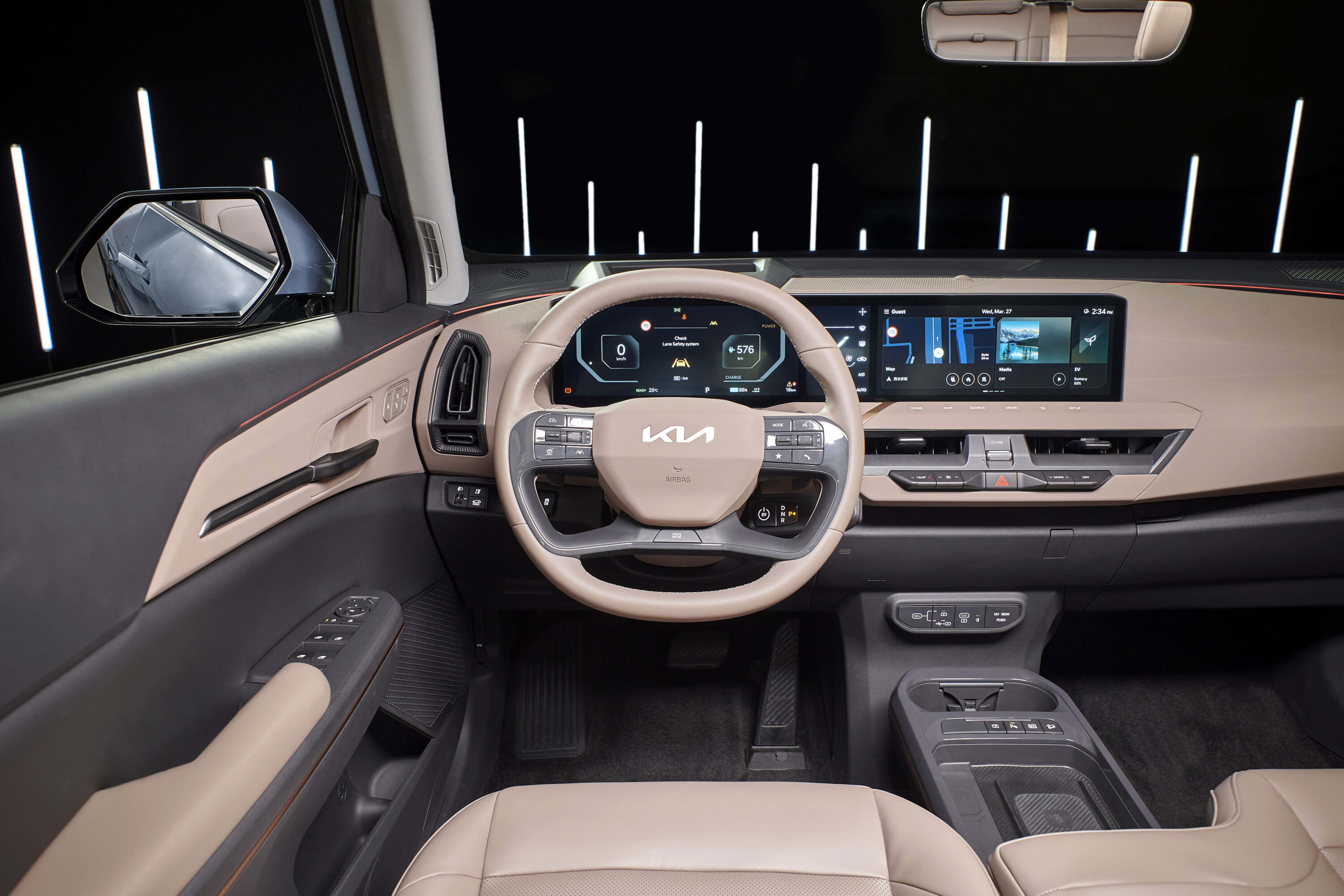
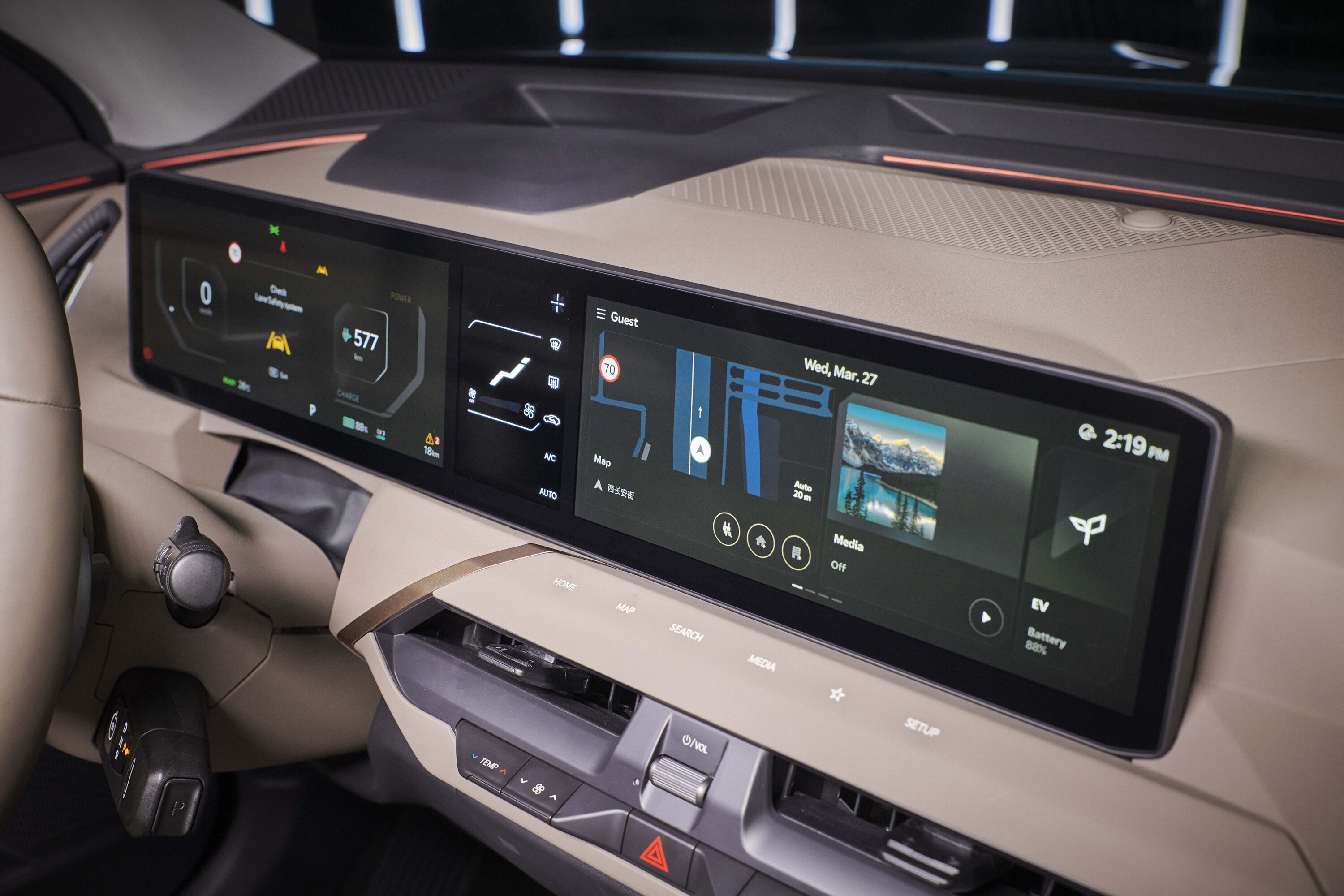
The EV5 has the same excellent four-spoke SUV steering wheel with drive-mode button at the bottom, as well as a column-mounted transmission selector, twin 12.3-inch screens segmented by a smaller 5.0-inch climate-control screen, and physical centre-dash controls for temperature adjustment and audio volume.
As in EV9, the smooth interior plastics aren’t necessarily soft touch, though there is a degree of squishiness to the dashboard surface. And while the other plastics don’t quite achieve the silky matte finish of the EV9, they’re not too dissimilar.
1
Our pre-production EV5 featured hero-colour Nougat Brown two-tone upholstery with Nougat Brown seatbelts, and I think it looks quite classy – especially alongside the bronze accents underneath the armrests on each door.
The way the upper dashboard sweeps around and blends into the doors feels more interconnected than in the slabbier EV9 – enhanced by a band of ambient lighting that runs across the top of the doors, then seamlessly bisects the lower Nougat Brown part of the dash from the upper black section just below the cowl.
The cowl itself does feel slightly higher than in an EV9, but maybe that’s because the dash slopes downwards more (rather than being a flat expanse), with a lower hip-point to the seating.
1
Yet the EV5 does feel like a significantly smaller vehicle than the EV9, despite the clearly visible humps of its outer bonnet haunches (as opposed to the cinemascopic expanse of flat bonnet and glass in the imperious EV9), making the EV5 feel bigger than it actually is.
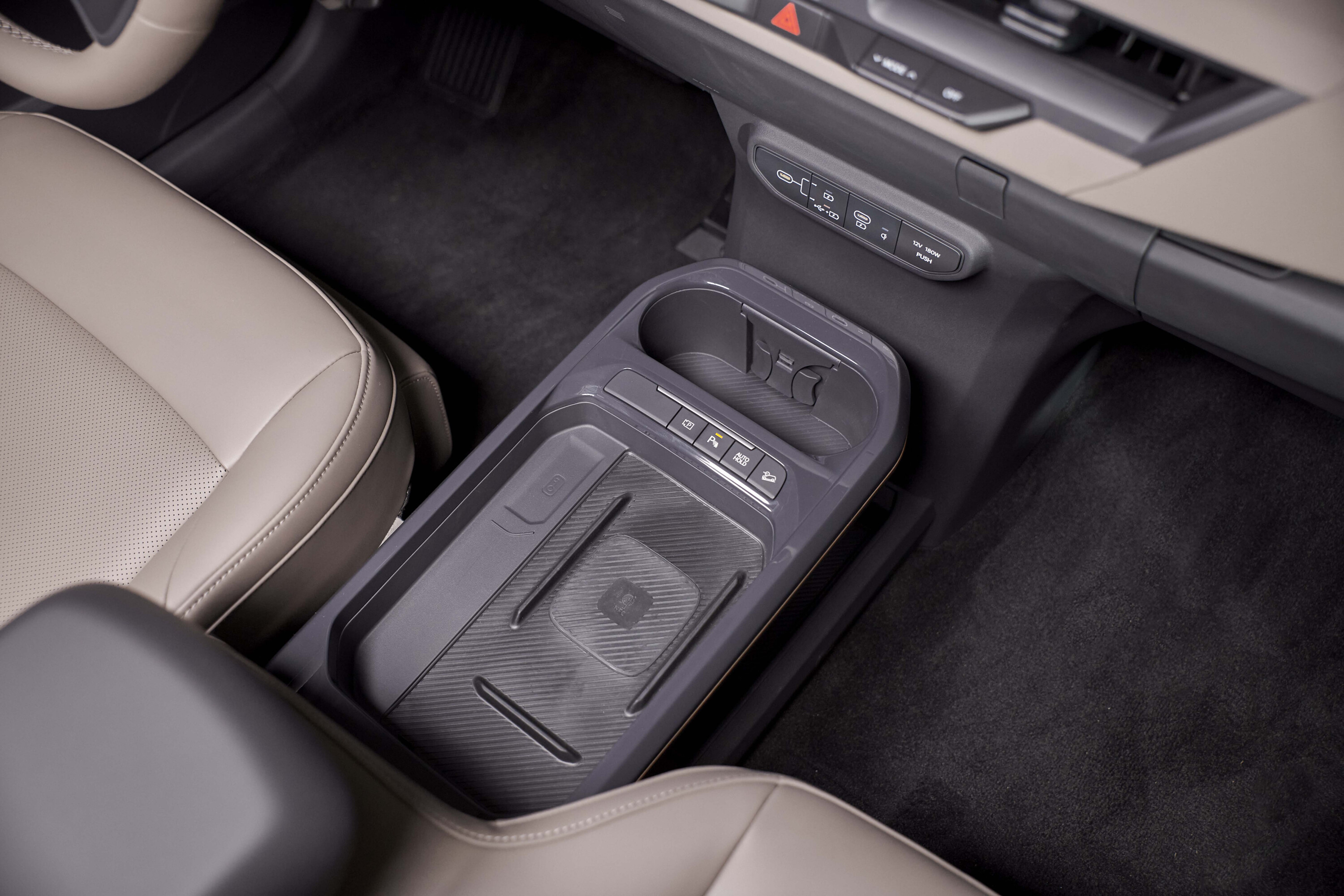
This car has what the Chinese call a centre bench-type seat, where there’s an extra seat hump in the middle (without a belt) disguising a little phone pocket underneath the upholstery, and then ahead of that is a floating tray with the wireless phone charger and dual cupholders, plus a huge, semi-hidden rubberised tray beneath. You have to reach deep down to grab anything, however, because you can’t lift the centre section up to access it.
Above the centre bench-type seat is just a simple folding armrest that doesn’t open or close, while ahead on the dash in a concealed take-away hook that may prove handy for smaller bags.
1
And to keep everything uncluttered, Kia has located the front-seat heating and cooling switches near the door handles.
The front seats themselves are really good. In this instance, the driver gets multi-way electric control with an electric ottoman extender, electric seat recline and electric lumbar, whereas the front passenger (at least when the bench-type seat is fitted) only gets four-way electric adjustment, without any cushion tilt.
Thankfully, under-thigh support is impressive – often a failing in Korean cars – and the multi-position headrest is a welcome touch. But the door bottle storage is pitiful – 600ml bottles at best, which lags well behind the EV9 or even the new-gen Hyundai Kona.
1
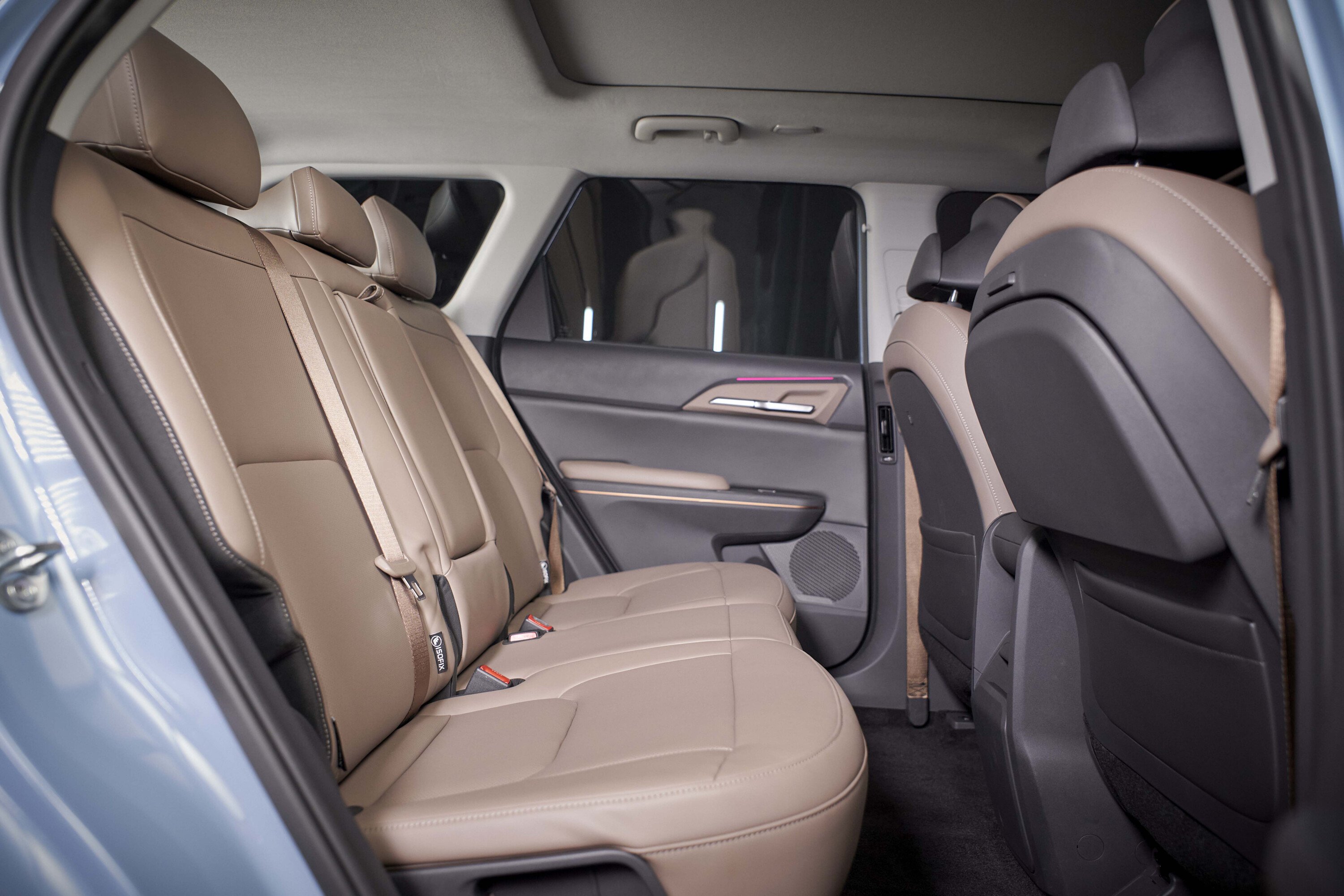
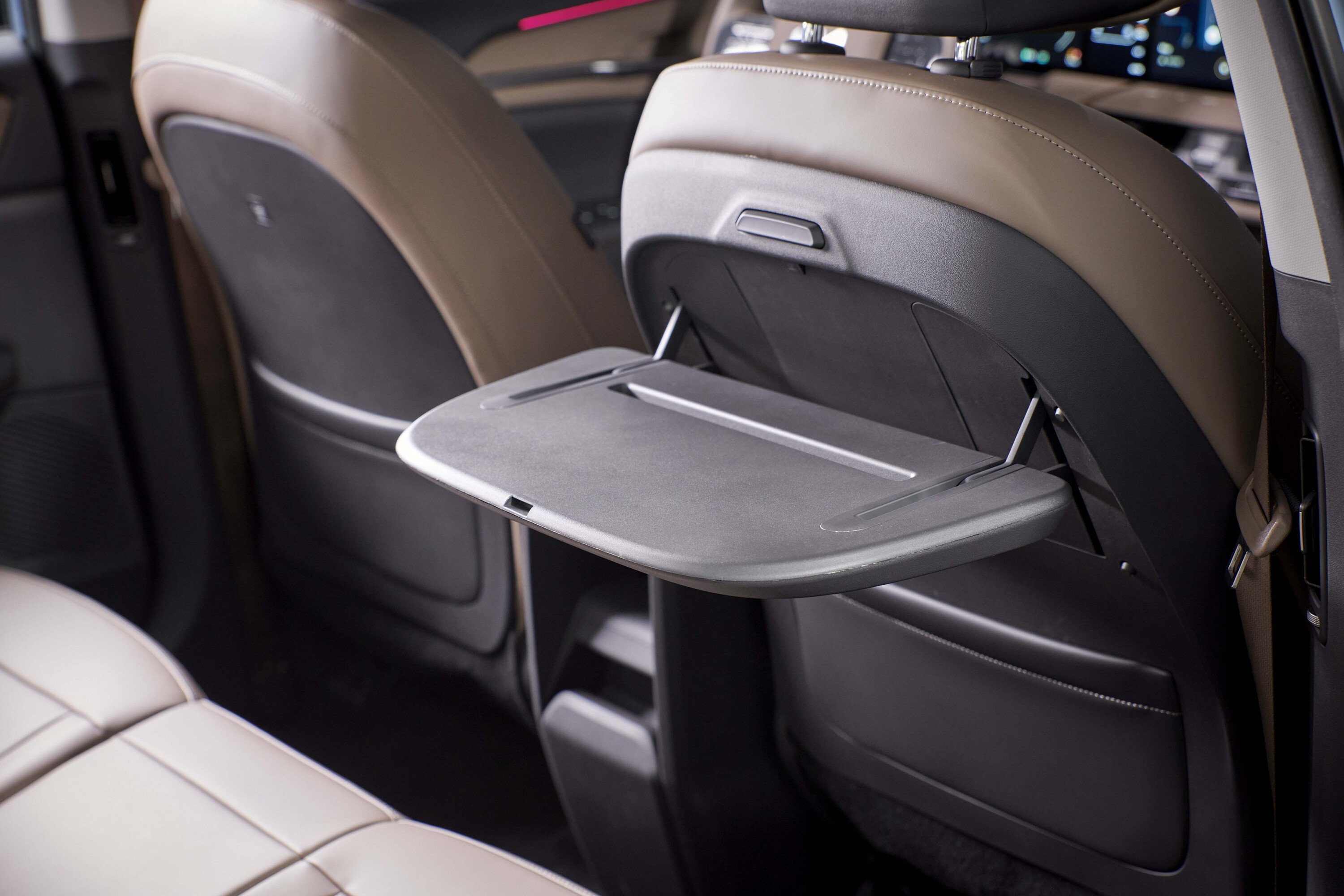
In the rear, the roomy EV5 feels expansive and well thought-out. There’s an ingenious picnic table – a very solid single tray on the back of the front passenger’s seat, complete with pen holder and easy access to the USB-C ports on the sides of the front seats.
And because the rear air vents are mounted in the B-pillars (just like EV6), there’s room for a large centre slide-out tray that Kia plans to offer with heating and cooling (for food and drinks), though this wasn’t on our pre-production EV5.
The seat itself is excellent – impressively supportive, with a terrific forward view and supple perforated enviro-upholstery that somehow feels nicer than leather, yet nothing like vinyl.
1
Even the centre position is reasonable, thanks to a fully flat floor, plenty of space in all directions and relatively supple cushion, though the centre backrest (incorporating the folding armrest) is a bit firm.
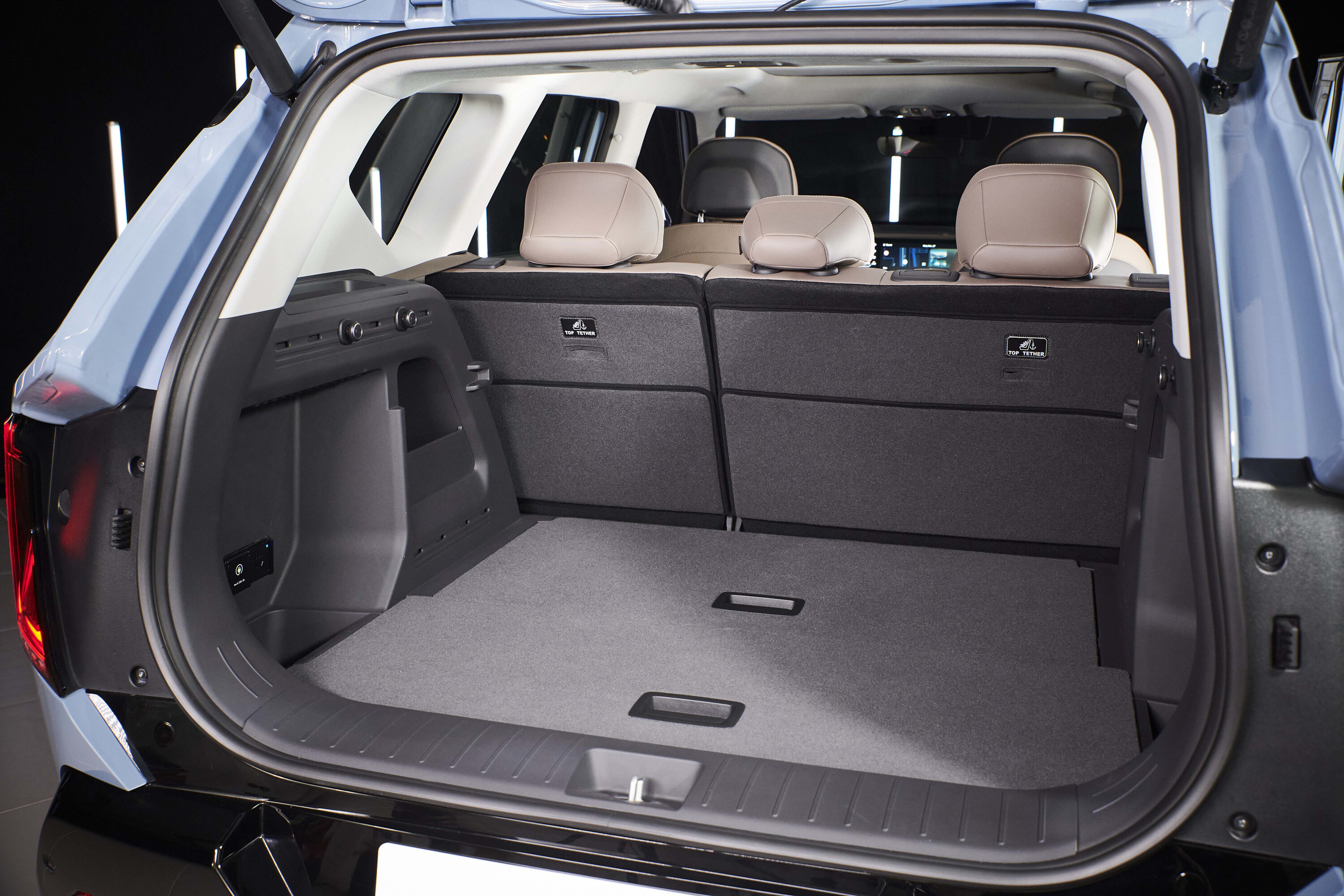
While there’s no fore-aft adjustment for the rear bench, the 60/40 backrests can be adjusted in 10 positions, and when they’re folded, the EV5’s cargo floor is completely flat (with in-built flaps to cover the gap between seat and boot floor) for outstanding versatility … tempered only by the pathetic little bottle slots in the rear doors.
At least the EV5’s boot area is tremendous. Kia is yet to quote a volume amount but in person, it’s intelligently shaped and looks highly useful.
3
There are two floor sections that lift up – both disguising under-floor bins – though the section near the boot edge actually cantilevers up against the rear backrest to make a clever shelf.
The panelling on the cargo area’s side sections house three bins each – making six in total – and there’s a three-prong power outlet, plus moveable cargo knobs that can be used for both shopping bags or tidying up your cabling.
And the finish in the EV5’s boot area is just as consistent as the rest of the vehicle, even in this pre-production model.
If the EV5 drives as well as it looks, it’s hard to see how this medium electric SUV can fail to succeed
Given contemporary Australia’s conservatism when it comes to colour, it’s potentially unlikely that we’ll see the Nougat Brown interior, though the top-spec Thai EV5 (it went on sale there a week ago) does offer that interior colour, as well as a vibrant Marine Navy (think petrol blue) alternative, as well as Frost Blue and Iceberg Green exterior colours.
Either way, if the EV5 drives as well as it looks, and costs as little as Kia Australia promises, it’s hard to see how this Korean-designed, Chinese-built, Australian-tuned medium electric SUV can fail to succeed.
Kia says it should have no issue accessing around 850 units of supply per month. But based on our initial walk-around, 10,000 Australian EV5 sales per year might actually prove to be a little conservative.
Just in case you thought the Polestar 7 would be a massive flagship SUV…
Long, long ago, French carmaker Peugeot would give each successive generation in a series its own number, thus never repeating model names over the years.
Polestar has revealed it will take a similar approach to its model naming – but, where Peugeot’s model lines helped to create a hierarchy by establishing a fixed first number in a three-digit name where only the final number ever changed, Polestar won’t link size or price to its model numbers. Its model naming method will be purely chronological.
This means that while an increasing number of brands use alphanumericals to help buyers understand a model’s dimensions, position and purpose with only the slightest familiarity, a Polestar 12 could be anything from a large SUV to a third-generation successor to the original Polestar 2 – depending on life cycles and whether any other new body styles join the range in the interim.
We’ve known for sometime that a Polestar 7 is in the works, but it wasn’t until this week that the brand revealed it will effectively be the second-generation Polestar 2 – confirmed by CEO Thomas Ingenlath in an interview with the UK’s Autocar.
The 7 may end up being larger than the 2, however, with the 2’s compact interior limiting its appeal and sales potential as a price rival to the more capacious Tesla Model 3. Indeed, Ingenlath sees Polestar’s approach to model naming as a clever way of avoiding the “trap” of market expectations of what a familiar badge should represent in size, design and price.
“As much as we might build a very similar car, because it has a different number we won’t have this natural trap where we’re boxed into that concept of what the car had been,” he said.
“As nice as it is to have a ‘Golf’ category of car, it’s very limiting in terms of innovative power, because you’re always back in the box of what the ‘Golf’ should be.”
Whatever Polestar’s plans, Ingenlath isn’t saying much else. “What type of car and how we will do it, we can discuss when it’s time,” the former Volvo design boss told Autocar.
For now, we can be sure that the Polestar 7 will switch from the 2’s petrol- and diesel-shared CMA platform from Volvo, to a version of the EV-focused SEA platform that underpins the new Polestar 4 – an architecture again developed primarily by Volvo, but for all Geely group members.
The Polestar 7 is expected to enter European production in 2027 – seven years after the 2 rollout began – but it remains to be seen if Australia’s 7 will come from there or from China.
Perhaps the biggest question is whether it will have a rear window – or if, like Peugeot in 2012, Polestar will eventually settle on a number. 8 has a couple of rings to it…
The Polestar range as we know it
The small 2 was followed recently by the Polestar 3 large SUV, which is produced at Volvo’s USA plant in South Carolina and Chengdu, China. The luxury electric car will reach Australia this year.
The Polestar 4 coupe crossover is a slightly more affordable and compact companion to the 3, produced at another separate plant: Geely’s Hangzhou Bay factory in China. It’s positioned squarely to rival the newly revealed Porsche Macan EV.
Finally, the Polestar 5 large grand tourer sedan and related Polestar 6 convertible roadster will be made at the carmaker’s first dedicated factory in Chongqing, China, starting this year. The 6 will follow in 2026, launching with an LA Concept variant limited to 500 examples globally – which have all been sold out.
The Polestar 0 is also planned for release by 2030, as the brand’s first climate-neutral production car from start to finish in the circular economy.
November: Australian pricing revealed
Links to our stories with Australian pricing for the Zeekr X and Zeekr 009 have been added below, but the story is otherwise unchanged.
June: Zeekr announced for Australia
A new Chinese electric car brand is poised to arrive in Australia, with luxury-focused Zeekr confirming plans to launch here in 2025.
A sister brand to Volvo and Polestar, Zeekr is a fast-growing EV offshoot owned by Chinese conglomerate Geely, and will launch in Australia with two models.
Leading the charge is the Zeekr 009, a large six- or seven-seater family mover that promises sportscar-like acceleration and up to 800km of driving range.
Zeekr will also offer a small SUV, known as the Zeekr X, which will be a rival to the BMW iX1 and the closely-related Volvo XC40 Recharge.
Until now Zeekr has been building cars in left-hand drive at its factories in China and claims to have delivered more than 220,000 vehicles since production began in late 2021.
Plans for a rapid global expansion are now underway and include the establishment of a new factory in Thailand which is already producing the Zeekr 009 and X.
1
Zeekr says both models will be offered for sale in Thailand in Q3 this year, meaning an Aussie launch in early 2025 is likely.
Zeekr has already begun hiring top-level executives in Australia, including its new head of marketing Andrew Haurissa who moves across from fellow Chinese brand Chery.
How much with the Zeekr 009 and X cost in Australia?
Pricing and specifications for the Zeekr 009 and X are yet to be locked in although both vehicles are likely to be premium offerings.
In China, the cheapest Zeekr 009 is priced at 499,000 Chinese Yuan (AU$107,000) and comes with a large 116kWh battery and a claimed driving range of 702km.
The flagship version of the 009 costs 588,000 Yuan (AU$127,000) and has a bigger 140kWh battery and a range of 822km.
1
Both versions are powered by two electric motors producing a combined 405kW/686Nm and can hit 0-100km/h in a claimed 4.5 seconds.
Size-wise, the Zeekr 009 is bigger than a combustion-powered Kia Carnival and is available either as a six- or seven-seater. It is 5209mm long, 2024mm wide and 1867mm tall, with a wheelbase of 3205mm.
1
The smaller Zeekr X, meanwhile, measures 4450mm long and 1836mm wide and is available solely as a five-seater.
Overseas it is available either with a single electric motor or a more powerful twin e-motor set-up, with the latter offering a claimed 0-100km/h dash of just 3.8 seconds.
Driving ranges for the Zeekr X are between 500-560km on the Chinese testing cycle, which is more lenient than the European WLTP standard.
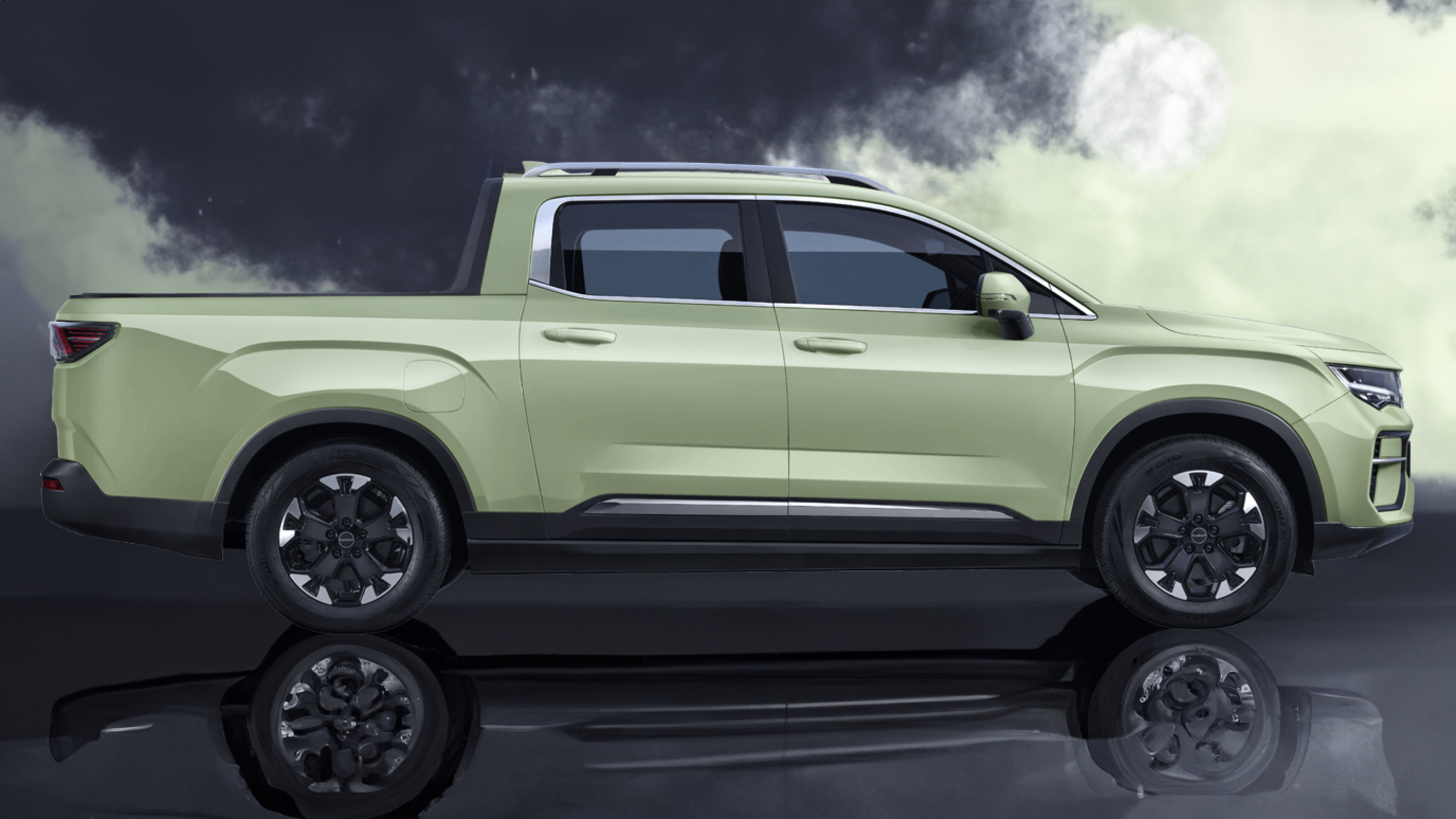
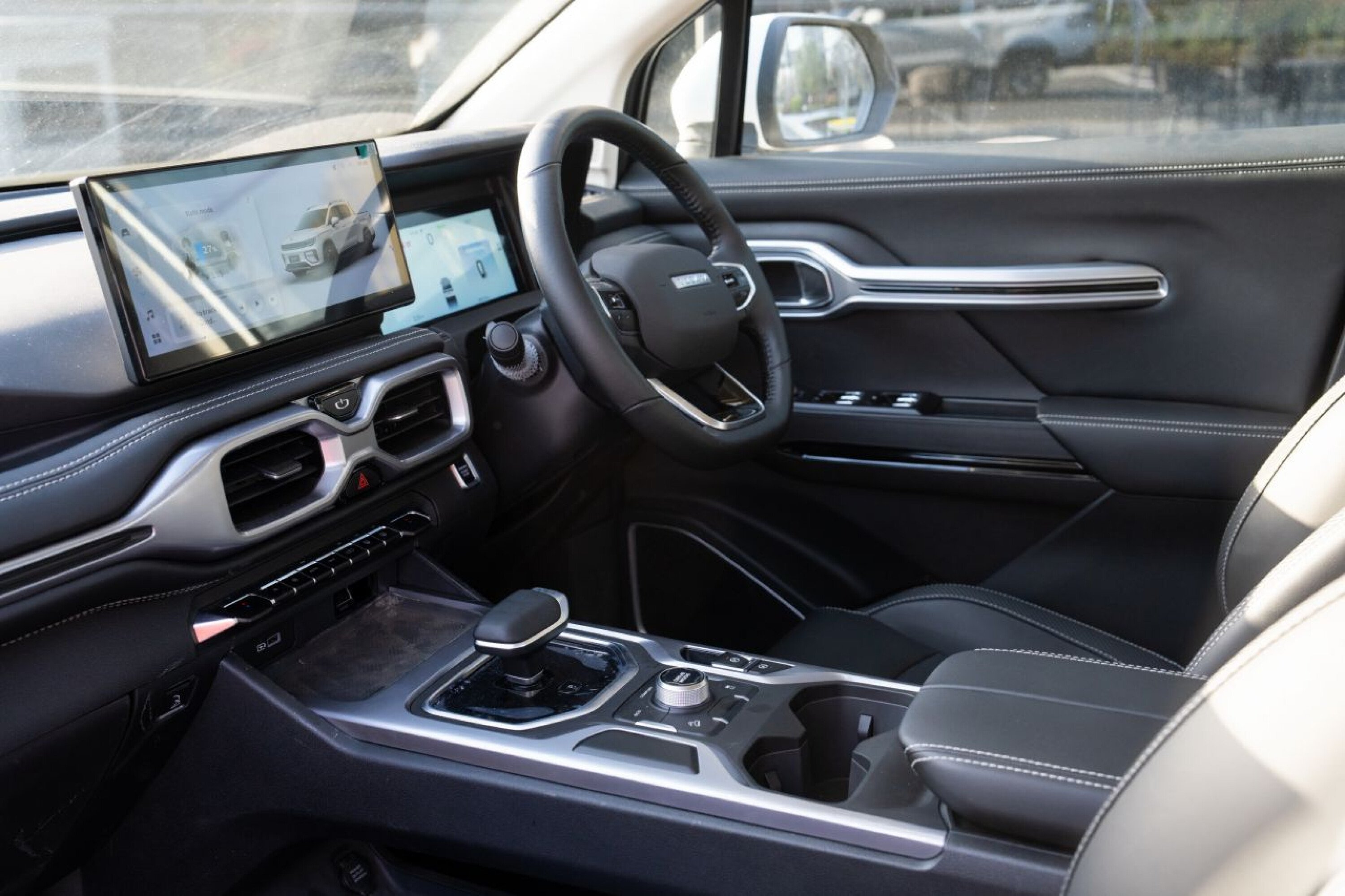
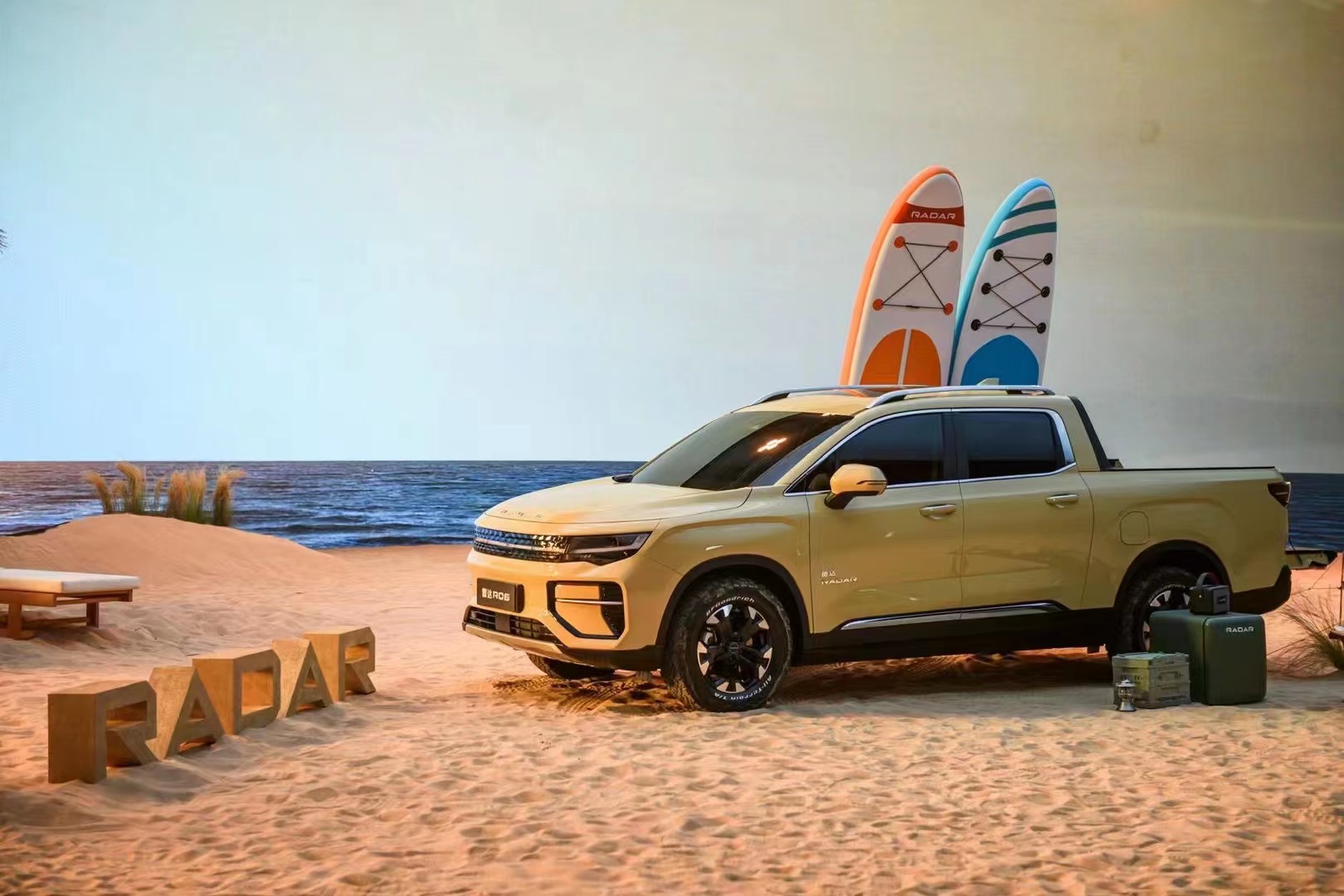
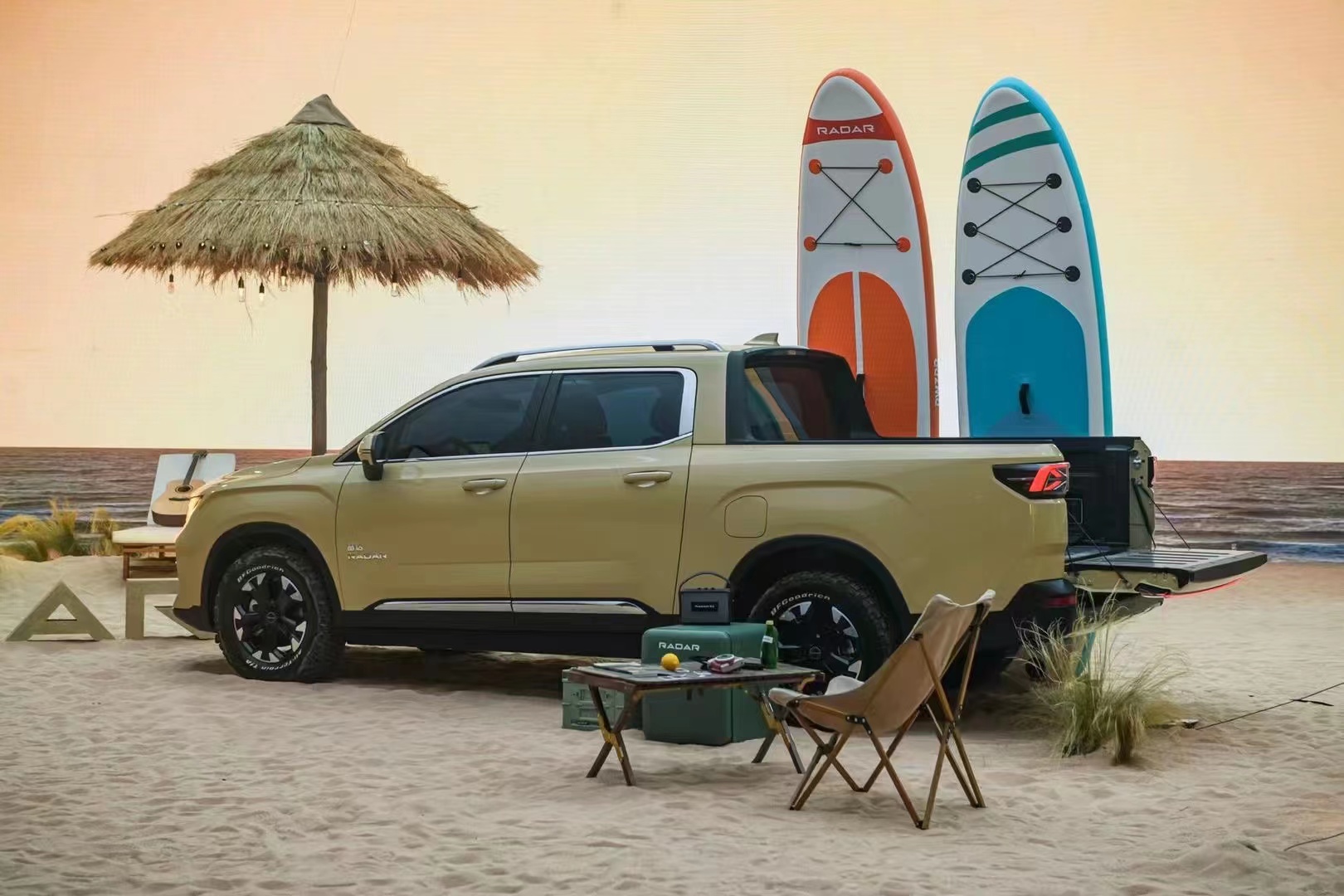
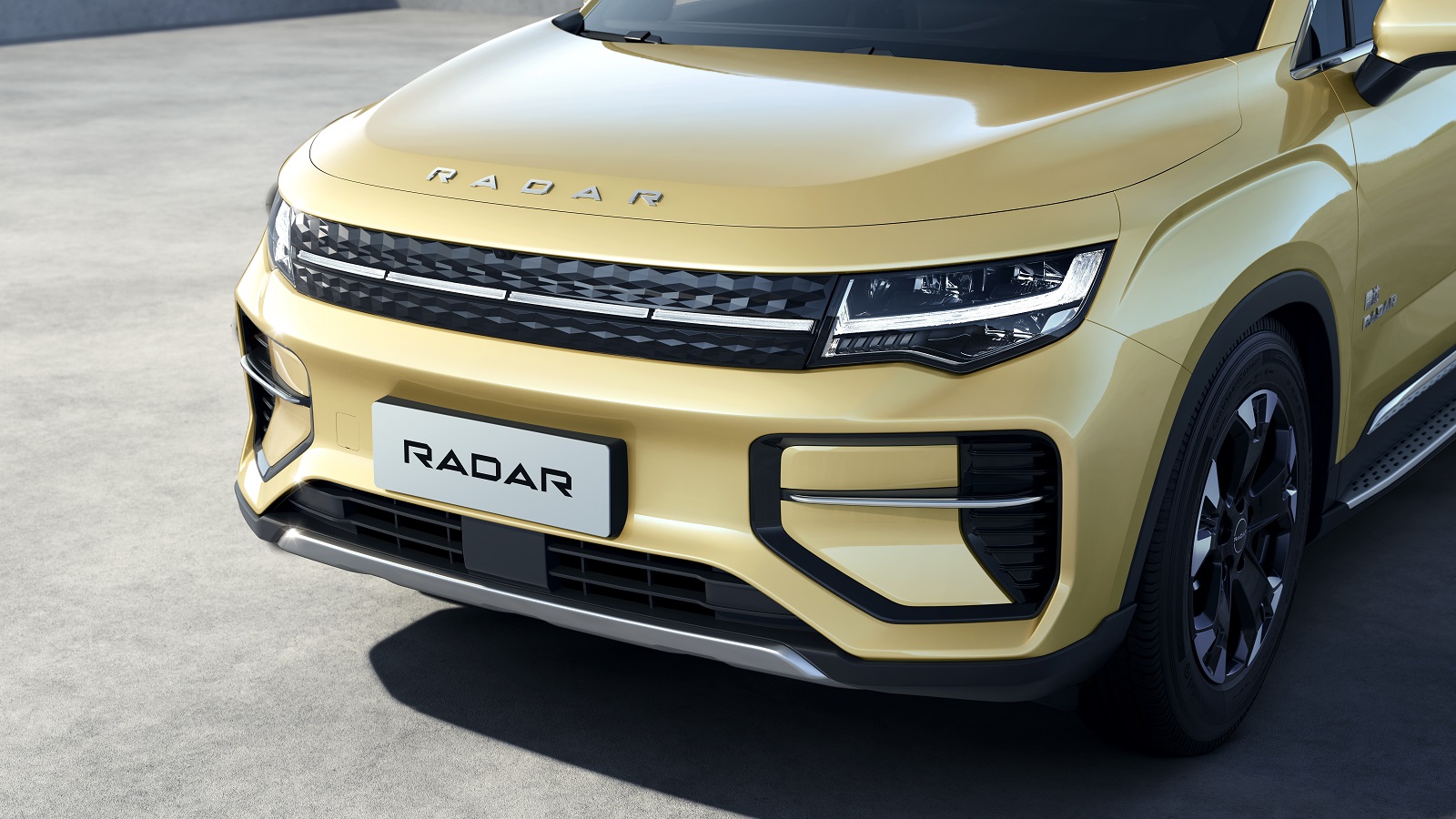
Radar RD6 offers more than 600km range. Roughly the same size as Ford Ranger
Volvo could act as official importer for Radar Auto in Australia
Volvo will also begin talks with Lynk & Co to import its models
April 2024: Riddara RD6 electric ute looks bound for Australia
Way back in July 2022, Volvo parent Geely revealed a new electric ute through its Radar brand, the RD6. That ute is now the Riddara RD6, and it appears to be on its way here.
In a post to its LinkedIn page, Geely confirmed the electric RD6 has a right-hand-drive production schedule locked in, adding that it will be “available in your market soon”.
1
The post doesn’t specify which countries were meant by the words “your market”, but it would seem a cruel oversight if it simply forgot that Australia is a right-hand-drive market.
As our earlier story below notes, Geely’s biggest western brand, Volvo, has been vocal about its interest in establishing the Riddara brand in Australia as its official importer.
“If that’s what they want to do and bring it [the Radar RD6] to Australia then that’s something we could do and help them with back office functions and training,” Volvo Australia boss Stephen Connor told Wheels in late 2022.
9
Wheels Media has requested an update on Volvo’s position, but the company did not respond in time for publishing. We’ll update this story if a comment is provided.
Geely cancelled its Radar trademark in Australia in 2022 after resistance from Singaporean tyre company Omni United, which has a brand called Radar Tires. Geely registered a new trademark for Riddara in early 2023.
A door has opened that could see Geely’s new electric ute, the Radar Auto RD6, join the Aussie market place.
Volvo Australia has emerged as a potential candidate to import the Chinese ute in an arrangement that would double the number of electric dual-cabs available Down Under. Currently the only fully electric ute offered here is the upcoming LDV eT60 which launches locally in the middle of November.
Revealed earlier this year, the Radar RD6 is the first vehicle from Radar Auto which is a new lifestyle-orientated sub-brand from Chinese automotive giant Geely. Volvo is also owned by Geely and it’s that family connection that has caught the eye of Volvo Australia boss Stephen Connor.
1
“What I’d love to do is talk to our Geely counterparts and say to them ‘we will be the sales company for you for Radar’,” Connor told Wheels. “That could be a possibility. It’s no different to them going to Ateco (the official importer of LDV, Maserati and RAM among others) or something like that.
“If that’s what they want to do and bring it [the Radar RD6] to Australia then that’s something we could do and help them with back office functions and training.”
1
Radar Auto estimates the dual-cab segment will expand to 3 million annual sales in China by 2030 and has confirmed plans to build SUVs and even ATVs (all terrain vehicles) to be sold alongside its electric ute. The RD6 is Radar’s first model and will be built on Geely’s Sustainable Experience Architecture (SEA) which also underpins a host of current and upcoming models from Volvo, Lynk & Co and Polestar.
“It’s the same platform so we could do training for the team, we could do technical support and sales support,” said Connor. “I’d love to offer them that because I think it’d be a great way to broaden our skill sets plus also help at the retailer level.”
When asked if Volvo Australia has already approached Radar Auto or Geely about the opportunity, Connor replied: “No, not yet. We will do. We will do.”
1
Official details on the Radar RD6 are scarce although it’s understood to be around 5.2 metres long and roll on a 3120mm wheelbase which makes it slightly smaller than a Ford Ranger. It’s also believed to be offered with three battery sizes: 66kWh, 86kWh or 100kWh. The largest battery is said to offer a range of 610km.
But it’s not just Radar that’s on the, er, radar for Volvo Australia. Conner added he sees potential in offering a similar importer arrangement to Lynk & Co.
1
“Again we will offer them the same,” he said. “We will start that conversation with them and if they want to come they do, if they don’t, they’re a different company. So it’s no different to how we interact with Polestar. We work with Polestar to offer back office services, we offer them training and support but we treat each other like competitors.”
Lynk & Co has already confirmed it will have an official presence in Australia by 2025 so it’s unclear how Connor’s offer will impact those plans.
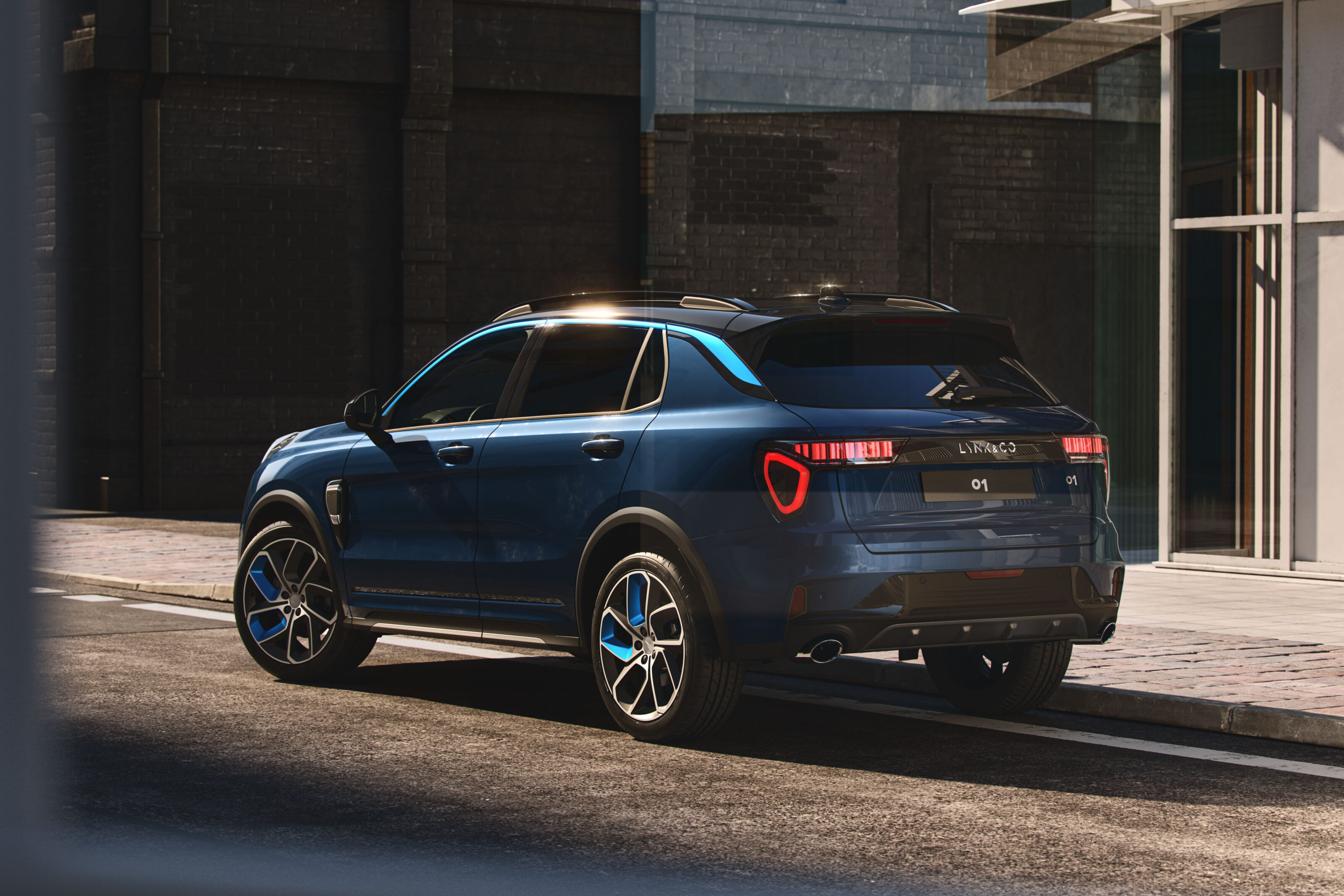
Similar to Cupra’s relationship with Volkswagen, Lynk & Co is the Geely Group’s youth-orientated sub-brand. It was established in 2016 and its current SUV and passenger car line-up shares platforms and powertrains with Volvo.
Like Volvo, Lynk & Co plans to launch five new electric models before 2025, all spun off Geely’s SEA architecture. The Chinese brand has an interesting approach to selling cars. While you can buy one of its models outright, in Europe most customers subscribe to their cars on rolling month-by-month contracts. The subscription includes the car, insurance and access to other benefits like music tickets and exclusive events. Lynk & Co is marketing the subscription service as a chance to “leave the ownershit behind”.
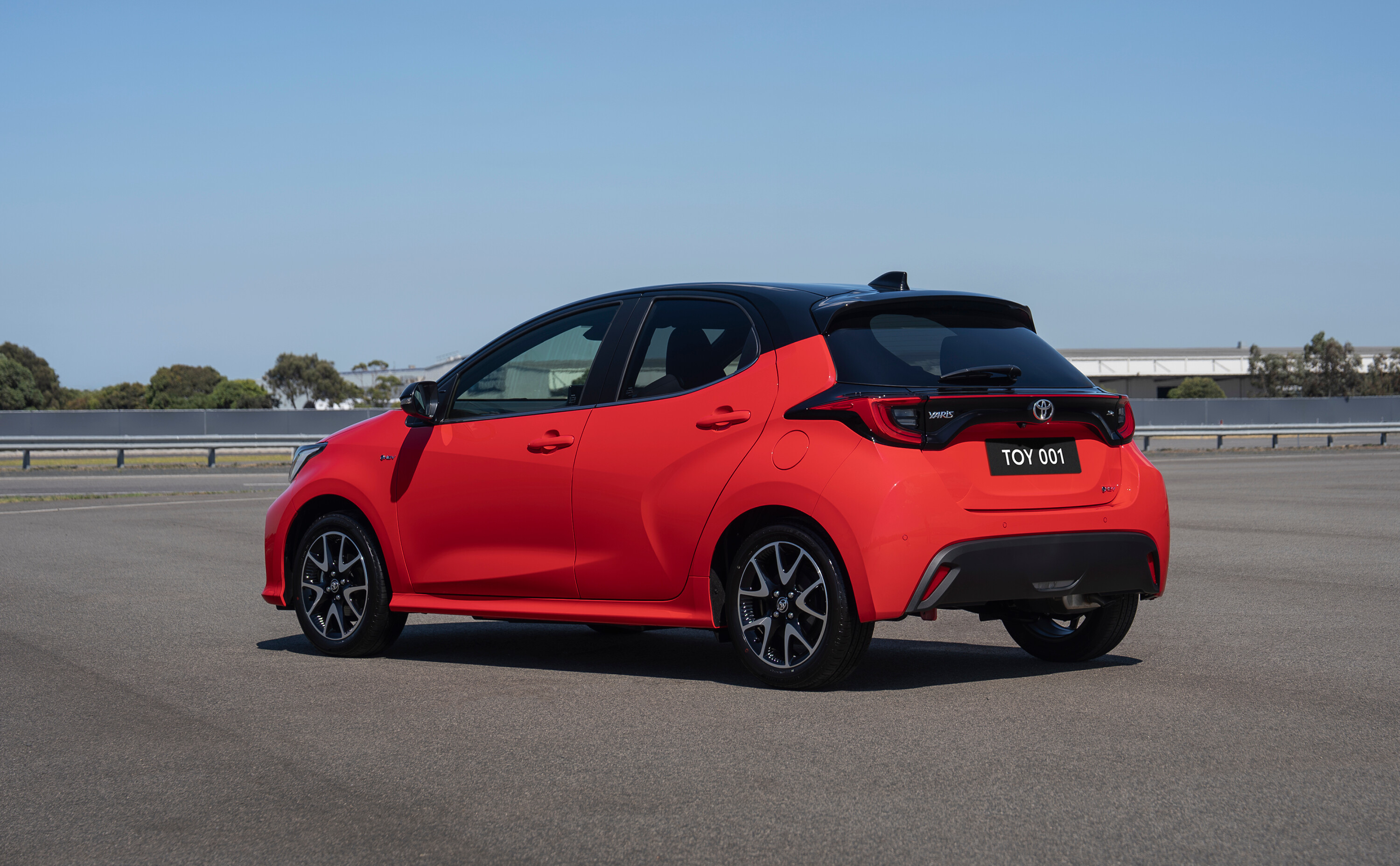
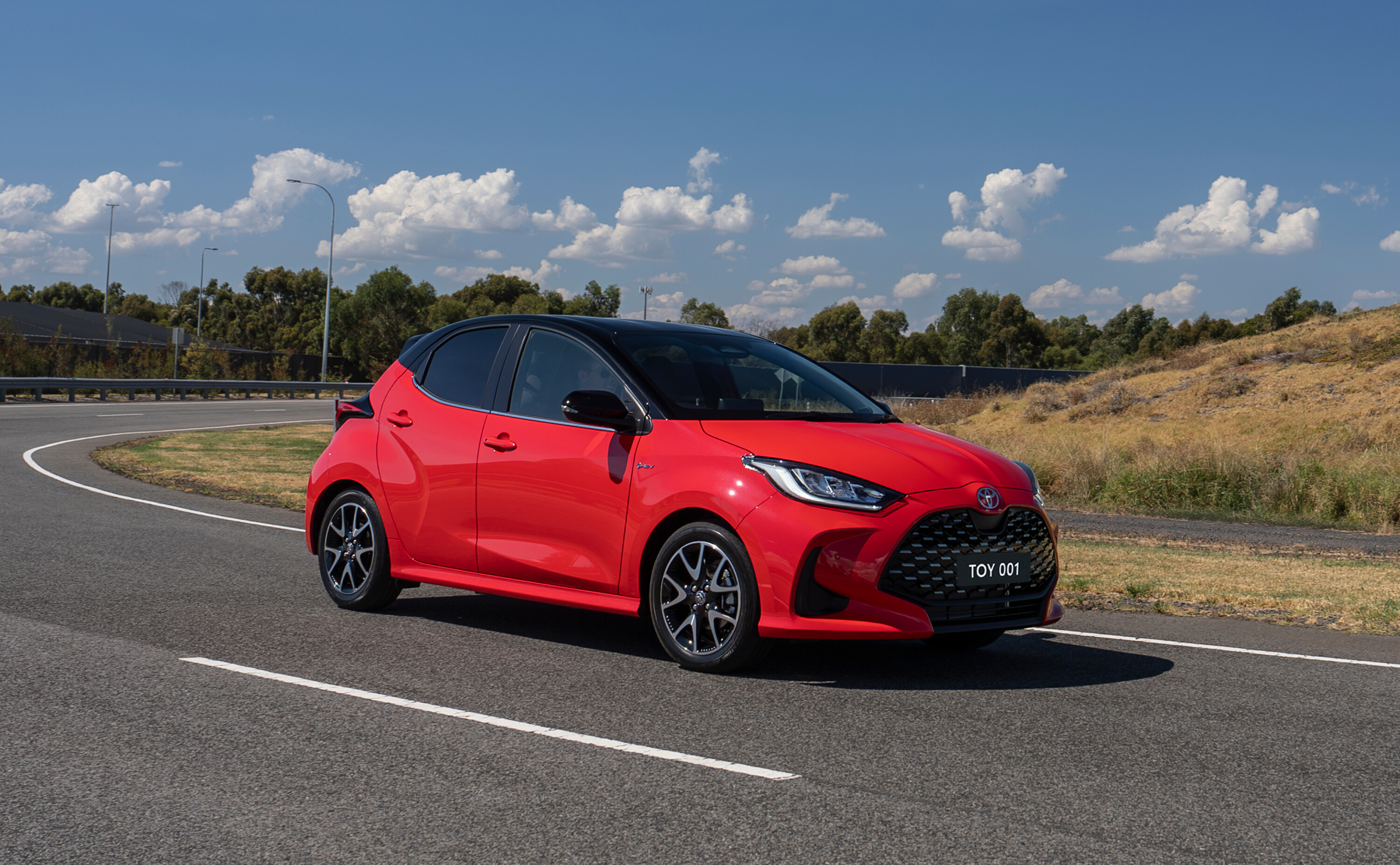
An update for the 2024 Toyota Yaris hatch has landed in Australia.
The changes are headlined by the return of a sub-$30,000 base model variant after Toyota deleted petrol-only versions of the Yaris last month.
At the time, the pre-update Yaris line-up was reduced to two hybrid variants – the mid-spec SX and top-of-the-range ZR – as the Ascent Sport was not available in hybrid form.
1
The newly-added Yaris Ascent Sport hybrid is priced from $28,500 before on-road costs – up $3700 over the now-deleted petrol version, but down $1690 over the previous most-affordable hybrid.
All 2024 Toyota Yaris variants also receive a handful of tech upgrades, including a larger 8-inch touchscreen running Toyota’s latest infotainment system with wireless Apple CarPlay and Android Auto connectivity.
It also supports updated Toyota Connected Services functionality, which sees the previous three-year free trial move to a shorter 12-month complimentary period.
1
Connected satellite navigation is now standard, which costs $12.50 per month to maintain after the 12-month free trial period expires as part of Toyota’s ‘connected multimedia’ subscription.
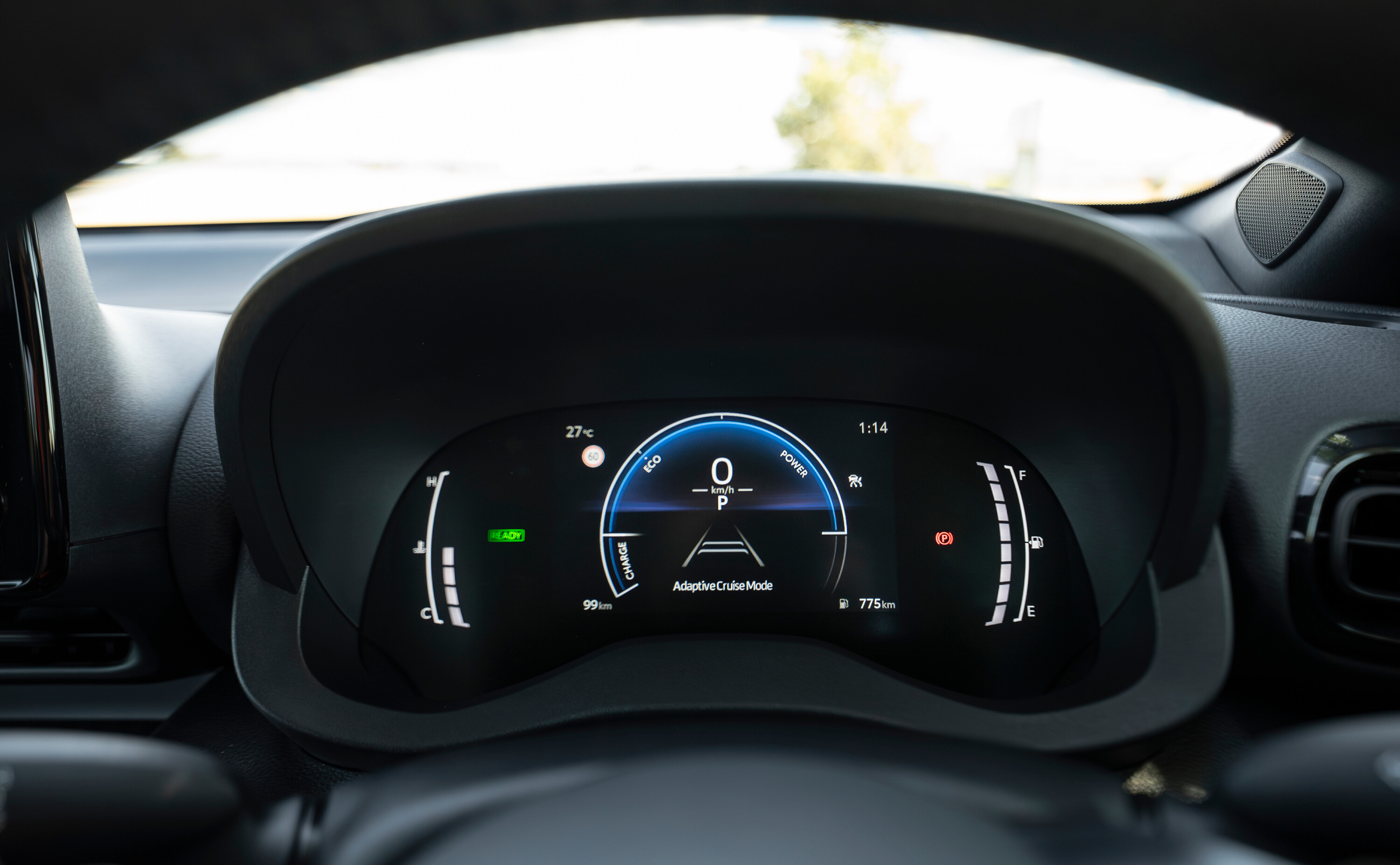
SX and ZR variants are also fitted with a new 7-inch digital instrument cluster, which replaces analogue dials and a 4.2-inch multi-function display.
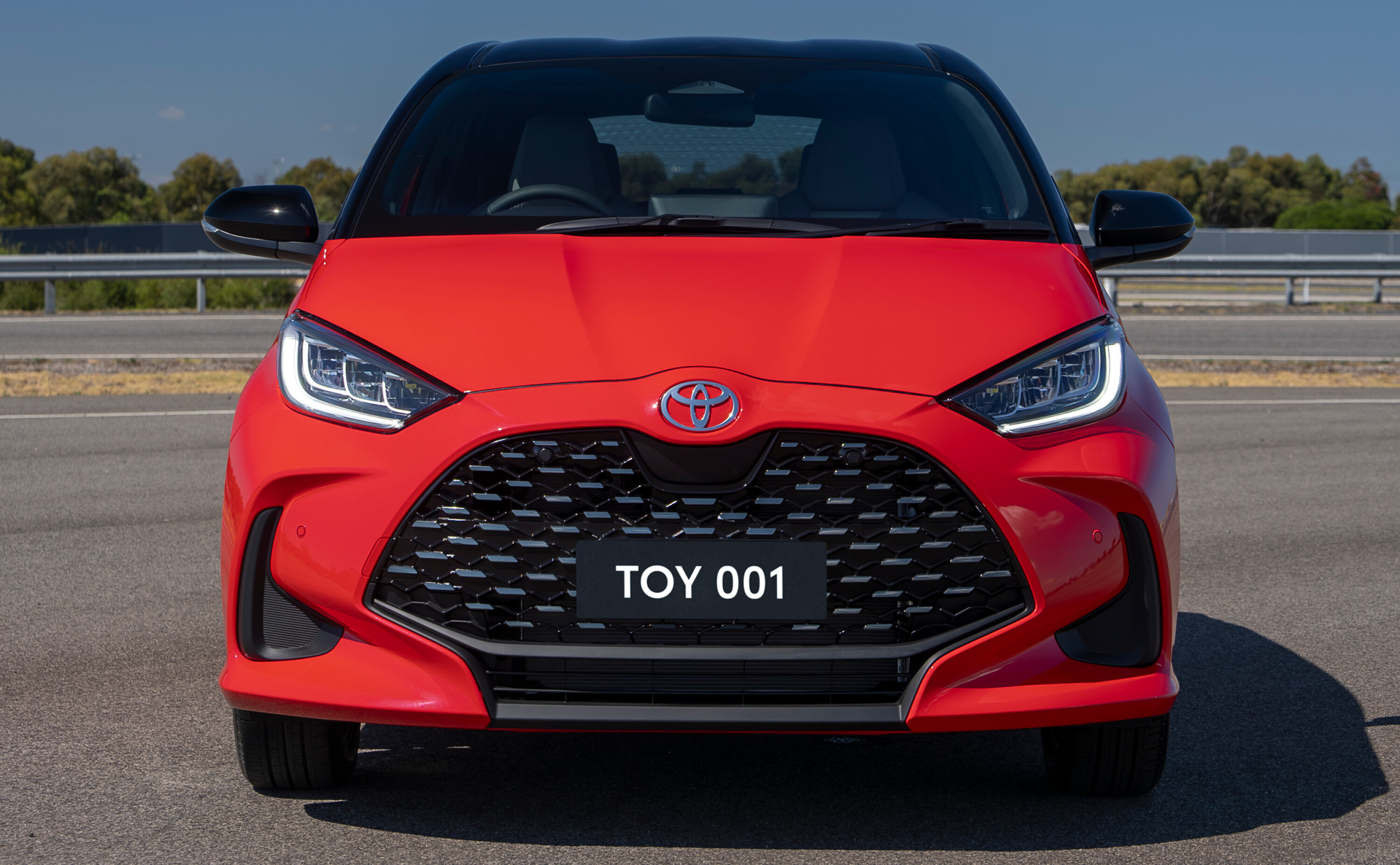
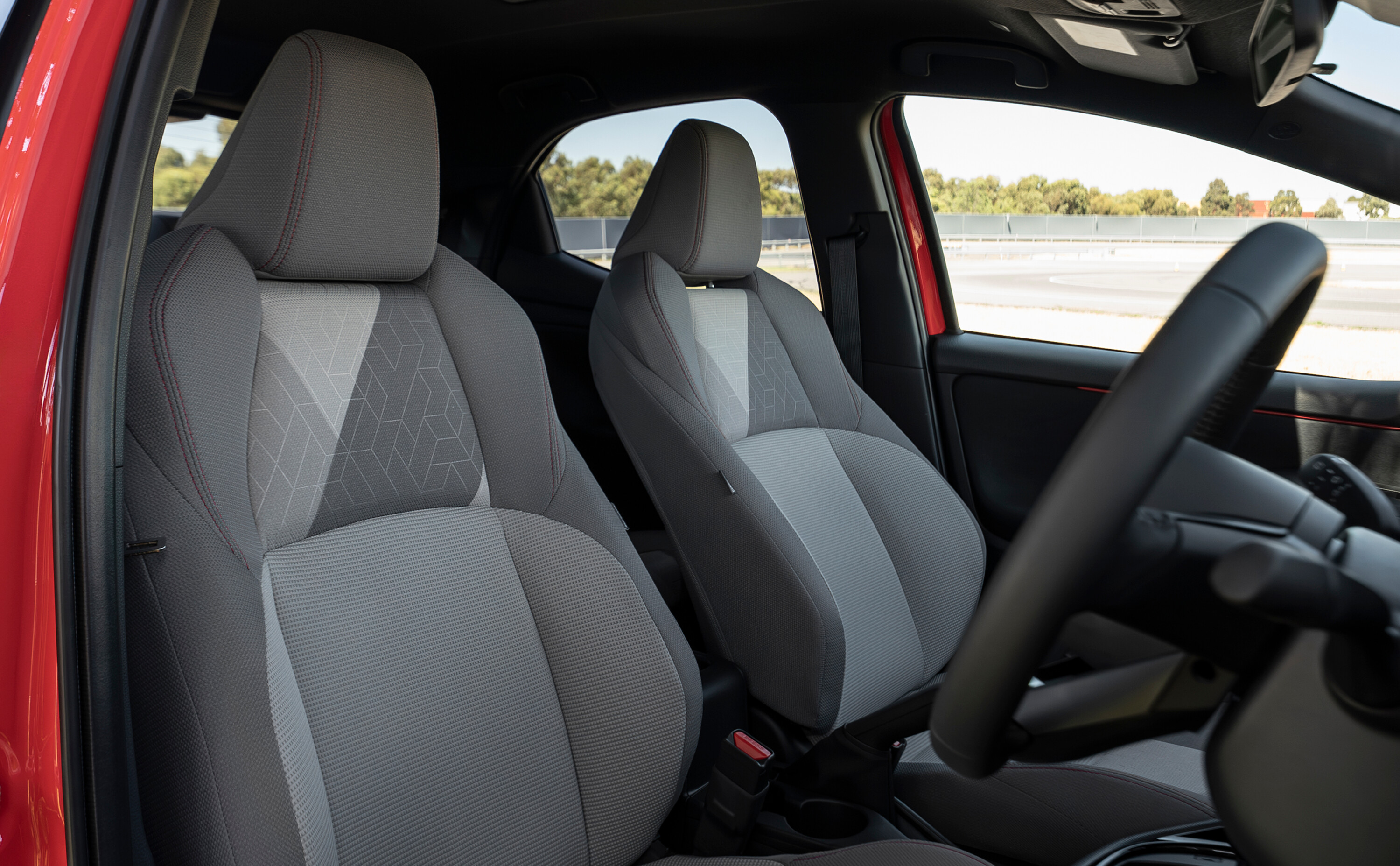
There’s also a new front grille pattern and seat trim patterns for all variants, new ‘HEV’ badges, and additional USB-C charge ports throughout to replace USB-A sockets.
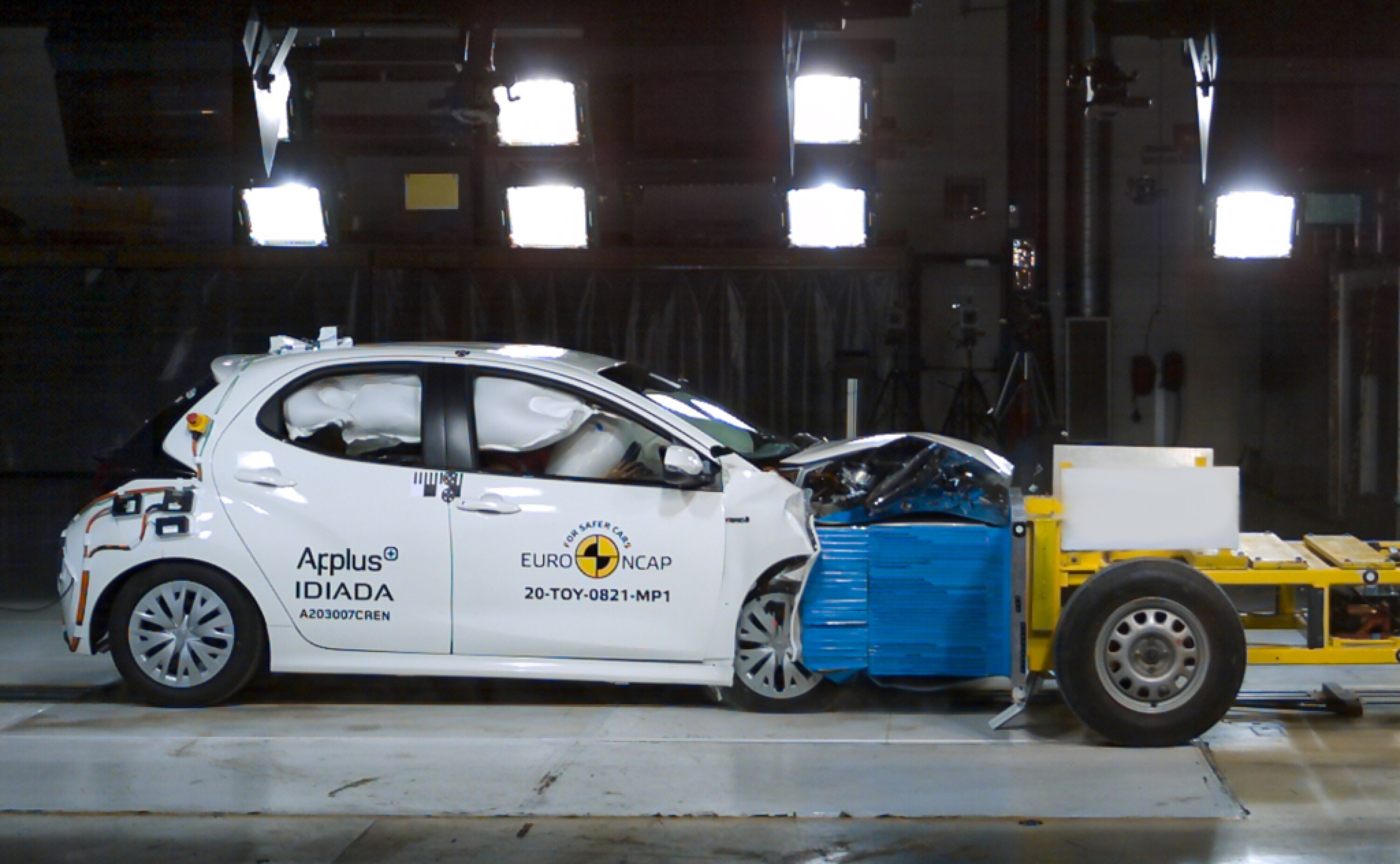
Active safety improvements include motorcyclist and vehicle head-on detection for the autonomous emergency braking system, which also has enhanced intersection detection during the day.
1
Emergency steering assist is now available for all Yaris variants, while the cameras and sensors for the adaptive cruise control and lane-keep assist now operate over a wider area.
SX and ZR variants add low-speed emergency braking in forward and reverse when parking if an imminent collision is detected, while the ZR features safe exit assist – which uses the same radar as the blind-spot and rear cross-traffic alerts – to prevent ‘dooring’ other road users.
Prices have increased between $1270 and $1770 for 2024 Toyota Yaris SX and ZR variants.
Wireless Apple CarPlay and Android Auto (previously wired-only)
Cloth upholstery
USB-C charge ports (previously USB-A)
Leather-accented steering wheel
Connected satellite navigation (new)
Keyless entry with push-button start
15-inch steel wheels with covers
Halogen headlights
4.2-inch instrument cluster display
LED daytime running lights
AM/FM/DAB+ radio
Electronically-adjustable, auto-folding side mirrors
Toyota Connected Servicesu00a0
Reversing camera
Six-speaker audio system
2024 Toyota Yaris SX features
In addition to Ascent Sport
Low-speed emergency braking u2013 forward and reverse (new)
Bi-LED headlightsu00a0
Front and rear parking sensors (new)
Keyless entry and push-button start
7-inch digital instrument cluster (new)
Single-zone climate control
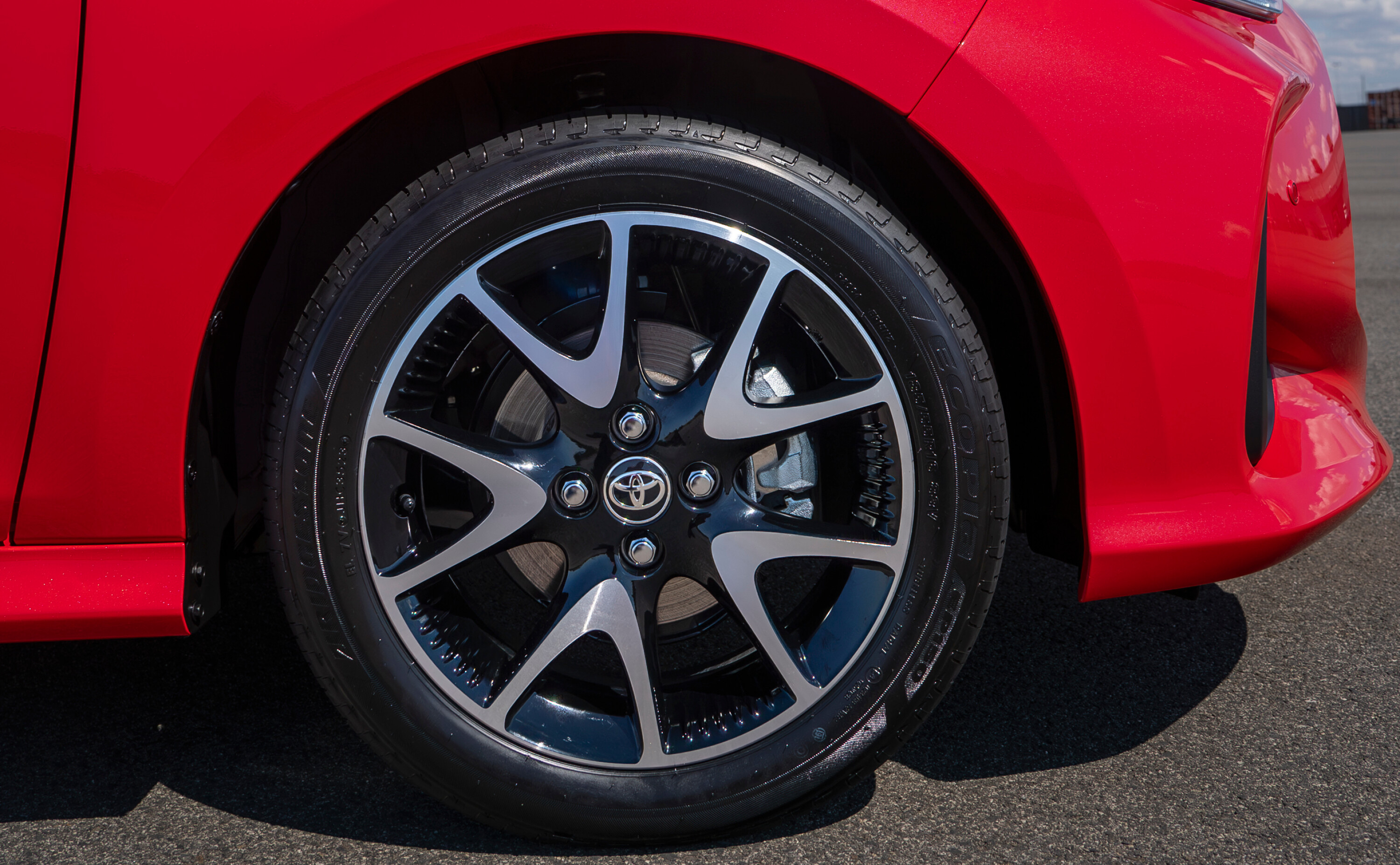
15-inch alloy wheels
Rear privacy glass
2024 Toyota Yaris ZR features
In addition to SX
Safe exit assist (new)
Blind-spot alert
16-inch alloy wheelsu00a0
Rear cross-traffic alert
Head-up display
Sports seats
Toyota Connected Services is standard on the Yaris. Available features include automatic collision notification, SOS emergency calls, stolen vehicle tracking, guest driver settings, vehicle function statuses, and current vehicle location.
The SIM-based service is complimentary for 12 months from the date of vehicle delivery.
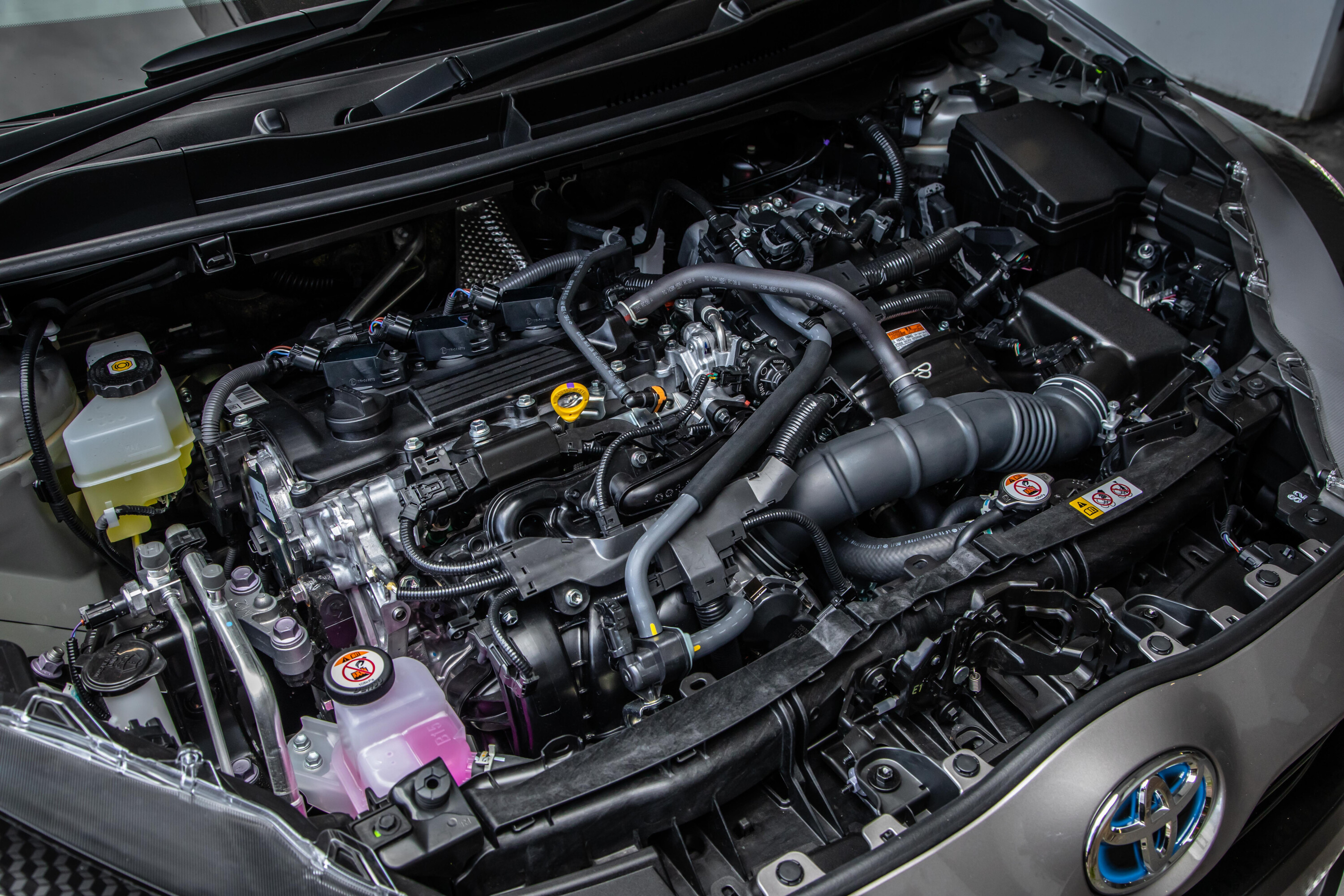
All Toyota Yaris hybrids use a 1.5-litre Atkinson cycle petrol engine paired with two electric motors, for a maximum combined 85kW/141Nm power output. It is matched to a CVT automatic transmission.
2024 Toyota Yaris fuel consumption (combined cycle)
Front/rear parking sensors and low-speed emergency braking are available on SX and ZR grades, while the ZR adds blind-spot monitoring, rear cross-traffic alert and safe exit assist.
The Yaris is covered by Toyota’s five-year/unlimited-kilometre vehicle warranty.
If a Toyota dealer services the vehicle, a seven-year warranty applies to the engine and driveline, while a 10-year warranty covers the hybrid battery.
The Japanese manufacturer also offers customers capped-price servicing, with the first five visits to a dealer for servicing costing $245 each.
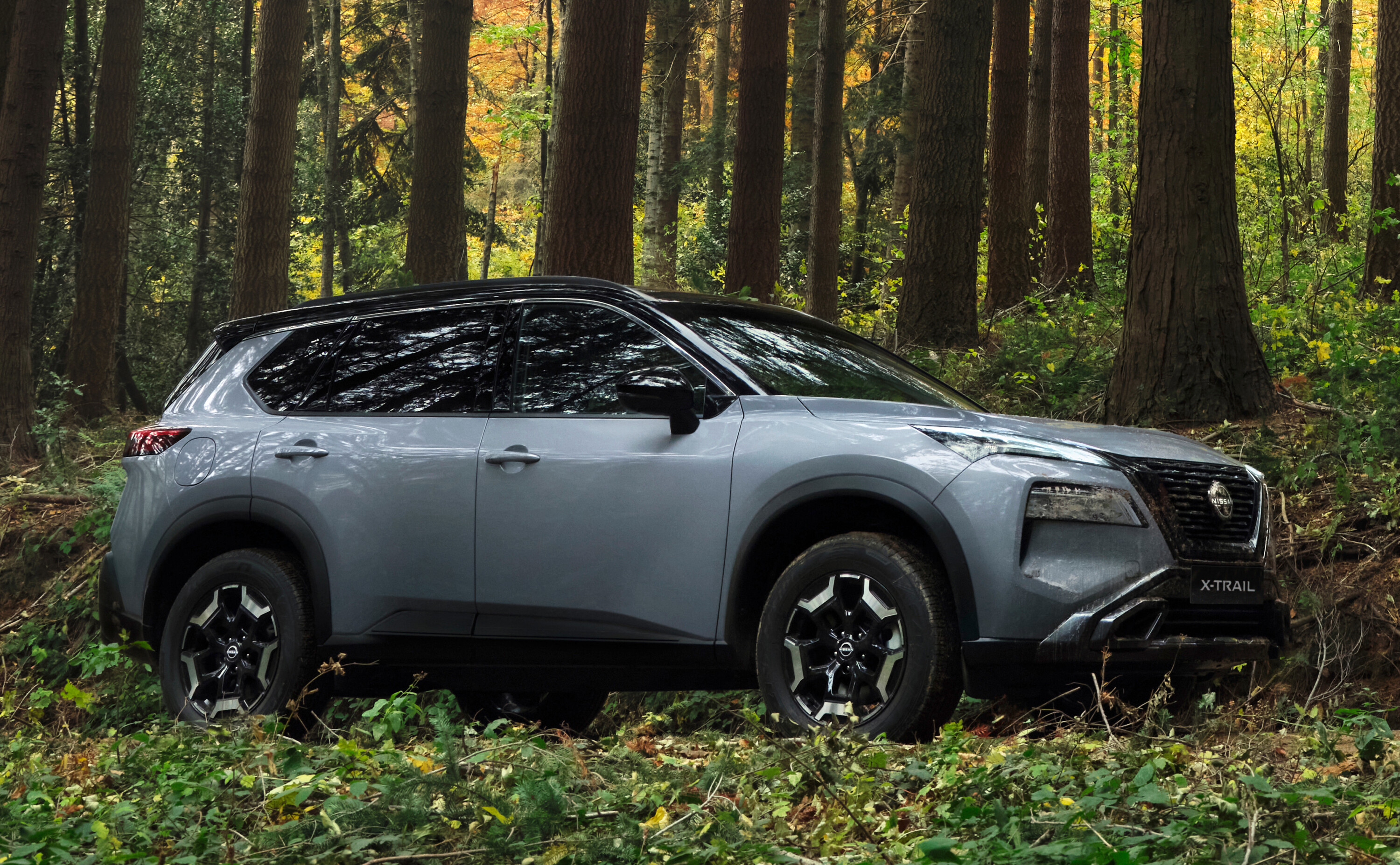
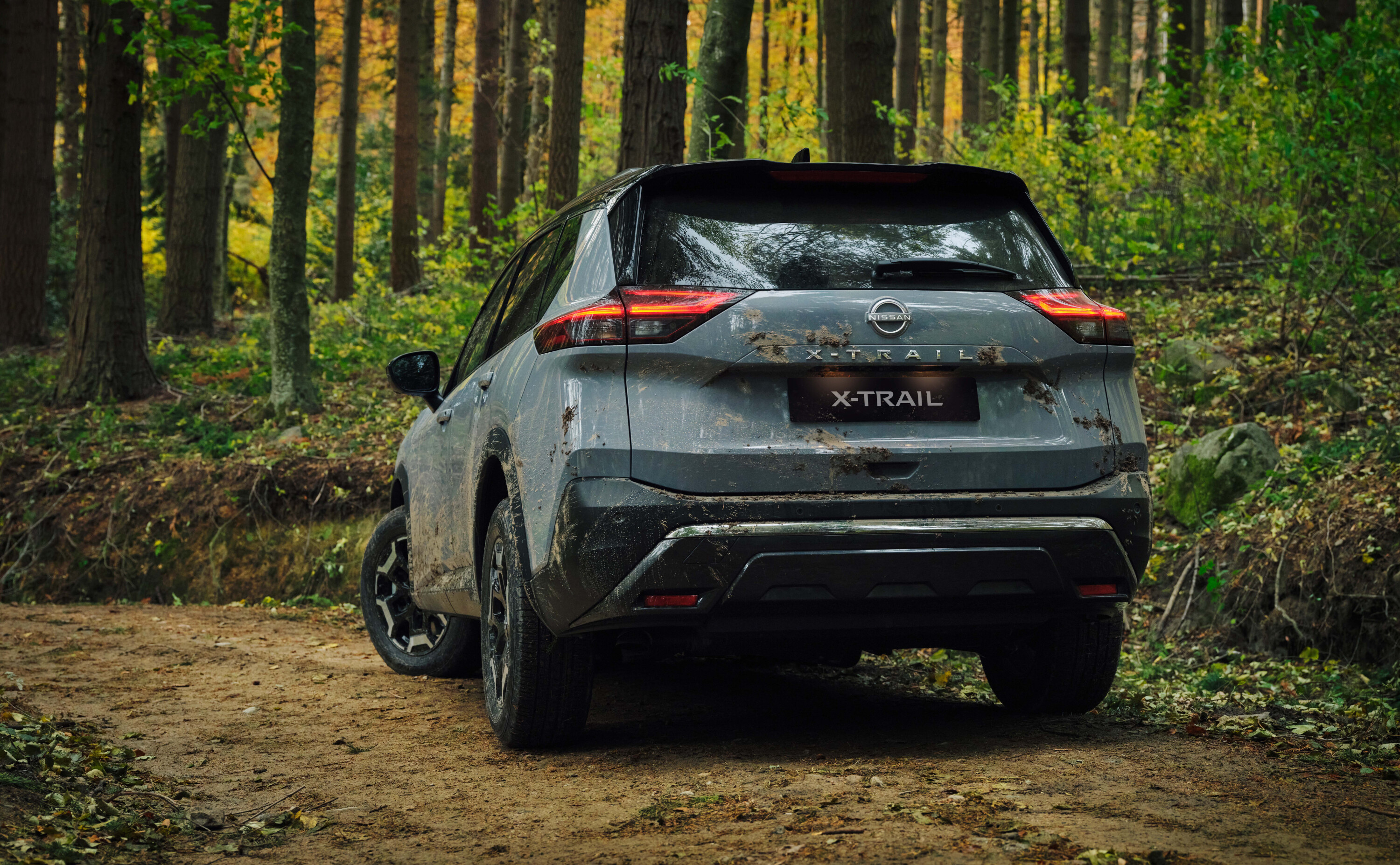
The 2024 Nissan X-Trail N-Trek mid-size SUV has been unveiled with an off-road focus.
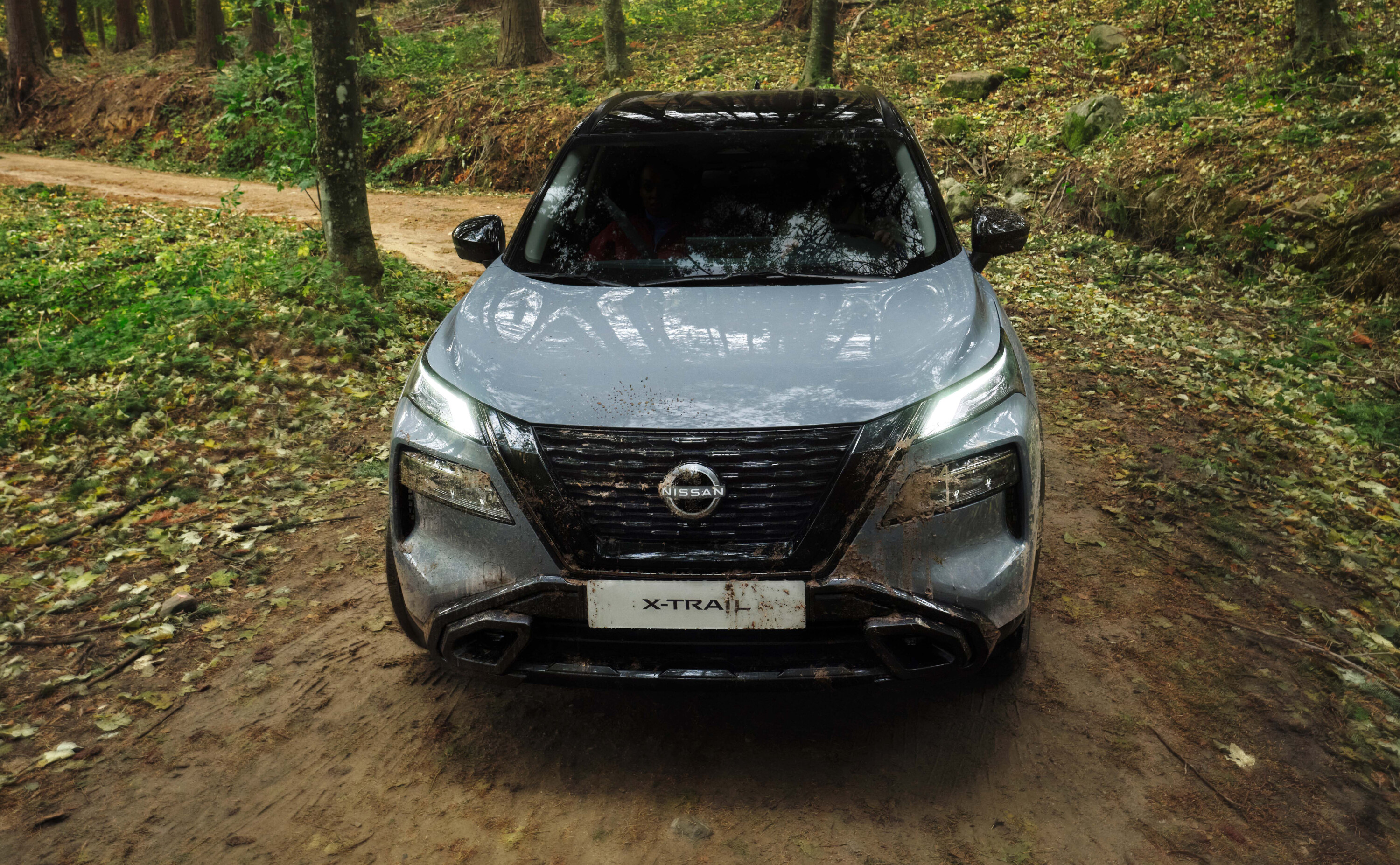
Due in local showrooms later this month, the X-Trail N-Trek slots between the ST-L and Ti in the line-up, adding a darkened grille, a unique lower front bumper with different LED fog lamps, and black-painted side mirror caps, door handles and roof rails.
It is a rival for other off-road-styled mid-size SUVs including the Toyota RAV4 Edge and the Subaru Forester Wilderness, the latter of which currently isn’t offered in Australia.
1
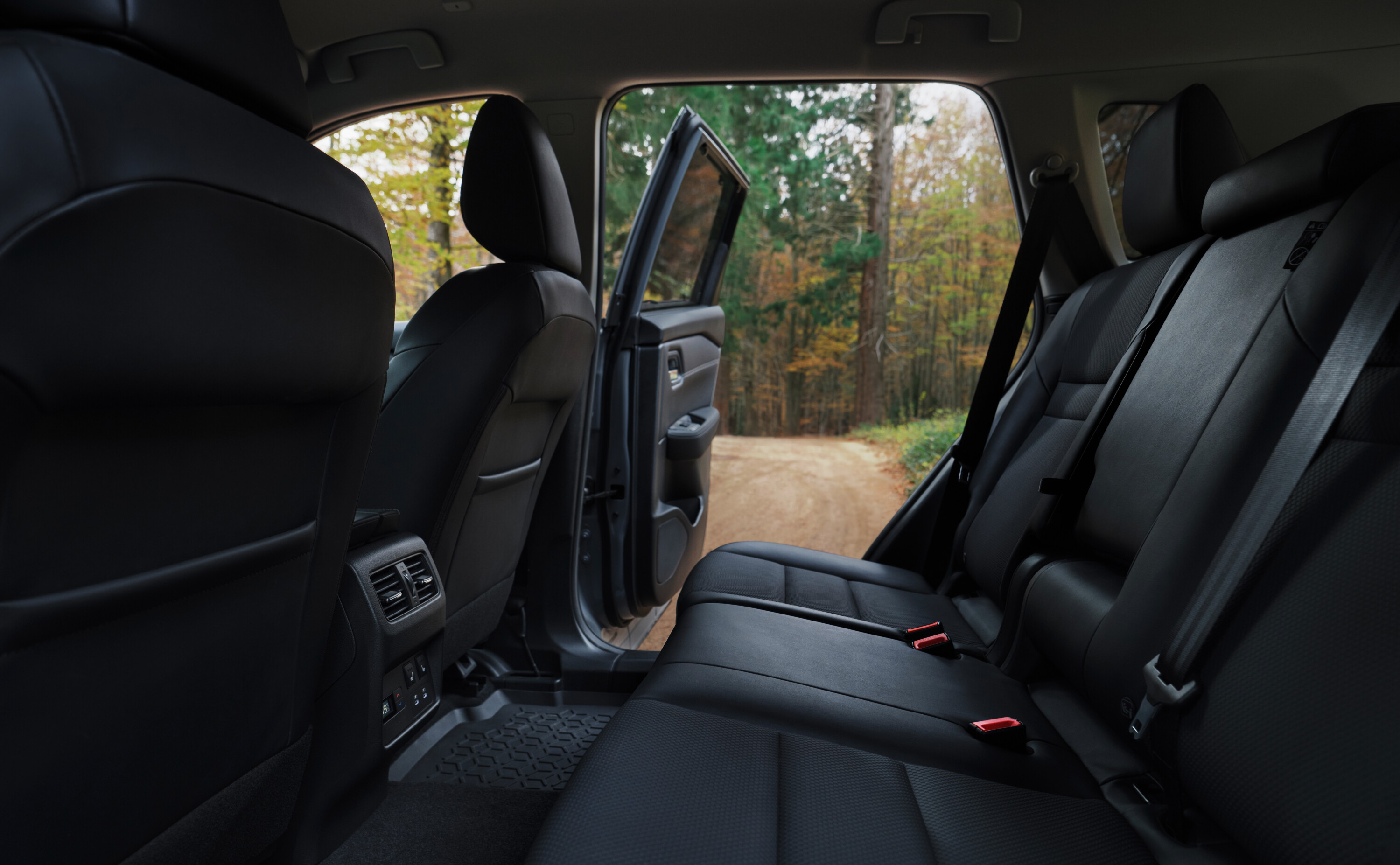
There is also a different 18-inch alloy wheel design, while the N-Trek adds synthetic leather upholstery with water-resistant qualities.
Compared to the ST-L, the N-Trek also features the larger 12.3-inch infotainment system and 12.3-inch full-digital instrument cluster available in the Ti and Ti-L, along with a 10.8-inch colour head-up display.
All other features are shared with the X-Trail ST-L, including a 360-degree camera, dual-zone climate control, keyless entry and push-button start, heated front seats, and key active safety features.
1
It commands a $3600 premium over an equivalent ST-L variant. The N-Trek AWD also undercuts the Ti AWD – which has more equipment but fewer seats – by $100.
Available colours include ‘gun metallic’, ‘diamond black’ ‘champagne silver’, ‘ivory pearl’, and ‘ceramic grey’ in a single-tone finish. The last three colours are available with a two-tone black roof.
The X-Trail N-Trek is available in five-seat front-wheel-drive or seven-seat all-wheel-drive form with a 2.5-litre naturally-aspirated four-cylinder petrol. An E-Power version is not currently planned for Australia.
1
A Nissan Australia spokesperson told Wheels an E-Power petrol-electric hybrid version of the N-Trek is under consideration for our market.
“We are constantly reviewing our product line-up and ensuring we have the right product offering for the market. X-Trail N-Trek will commence with the ICE engine however, we will continue to evaluate the opportunity and suitability for X-Trail N-Trek e-Power for this market,” said the spokesperson.
The 2024 Nissan X-Trail N-Trek is due in Australia in late April.
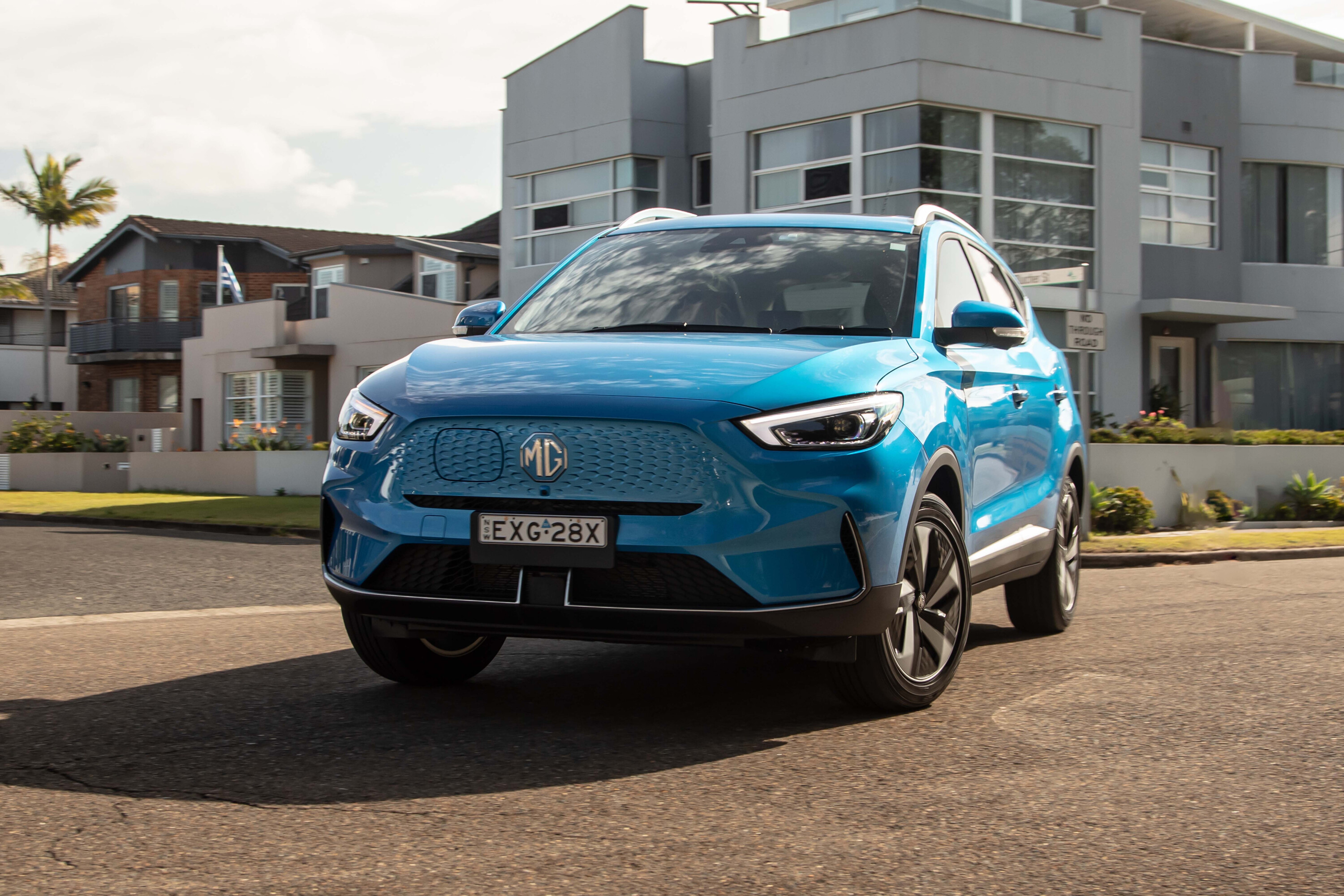
The drive-away prices for all petrol and hybrid MG vehicles sold in Australia – except the MG5 sedan – have been slashed by up to $6000.
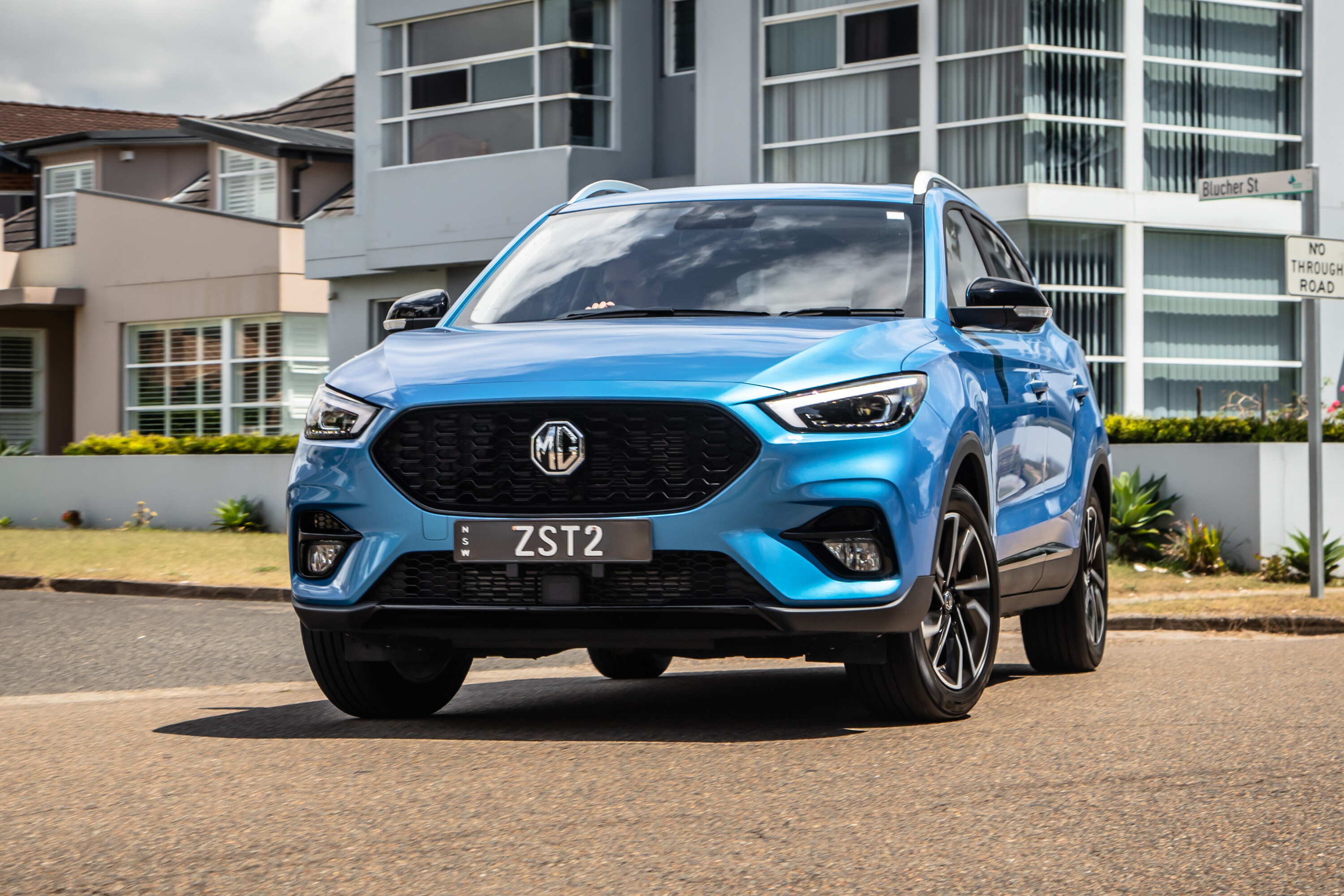
MG Australia has announced price reductions for the soon-to-be-replaced MG3, ZS, ZST, HS and HS Plus EV models, which apply to vehicles ordered from 1 April 2024.
The Chinese brand has confirmed that “due to advancements in technology, safety and specification”, the new MG3 will not be priced from under $20,000.
Instead, the new MG3 will start from around $24,990 drive-away, with petrol or hybrid options.
Prices for Australia’s cheapest SUV, the small MG ZS, have fallen $1000 to $22,990 drive-away, while the better-specced ZST is between $1500 and $3500 cheaper than before.
The MG HS is between $3000 and $6000 more affordable – with all variants now available below $40,000 drive-away – while both versions of the plug-in hybrid MG HS Plus EV have fallen $5300.
New-generation versions of the ZS and HS have been uncovered in leaked design patents, with both models expected to arrive in Australia within the next 12 months.
MG Australia has not amended prices for the MG5 sedan launched in mid-2023.
“MG is putting customers first by ensuring everyone can access a wide range of affordable vehicles thanks to reduced nationwide drive-away pricing on our most popular models. Whenever we can pass price reductions like this onto our customers, we will make sure we do,” said MG Australia CEO Peter Ciao.
1
“In a market where customers are becoming increasingly aware of their finances, providing transparency on the final cost customers will pay for purchasing and servicing a new vehicle is very important; that’s why MG has made the move to offer both to customers with no hidden costs.”
VFACTS new-car sales data reveals MG was Australia’s seventh best-selling brand in 2023, ahead of Tesla, Subaru, Isuzu Ute, Volkswagen and Nissan.