
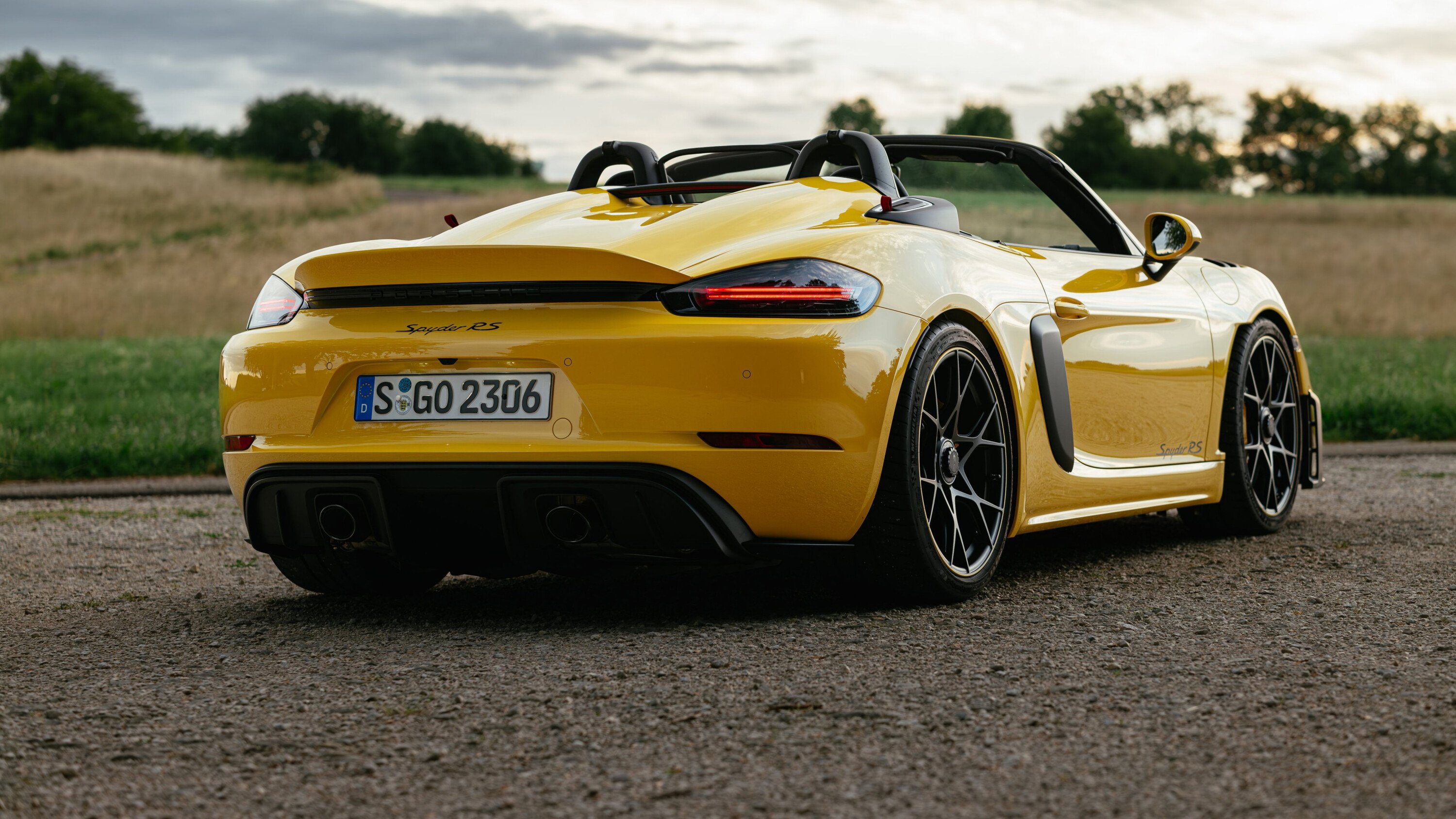
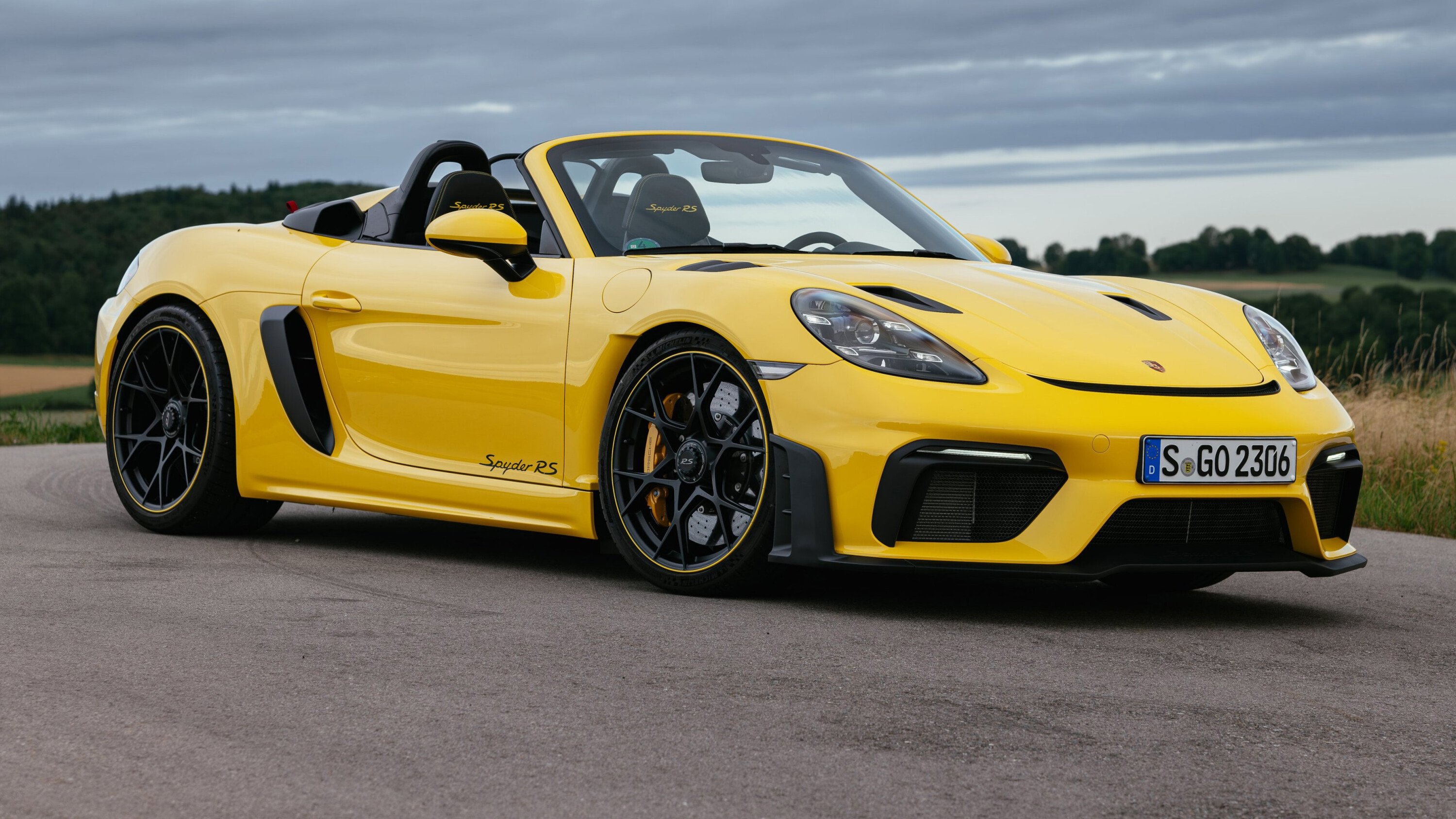
Sit Andreas Preuninger down and ask him to envisage his ideal sports car, and the constituents come together to form something extremely close to the Porsche 718 Spyder RS.
During a chat with Collecting Cars back in 2021, Porsche’s director of GT products was asked what would be the perfect recipe for fast road driving. “I think a sports car in a way that Porsche started its brand, a two-seater, open, lightweight, normally aspirated engine,” he muses.
“Not too big power, because big power means big brakes, big weight. A beautiful shape, a feast from every angle, and with a great sound would be something I would like to own myself. We’ve got a lot of ideas. There are some products coming in the near future.”
1
It seems we’re looking at Preuninger’s passion project right here.
We’re in the tiny village of Odenwaldstetten in the Swabian Alb, south of Porsche’s home town of Stuttgart. More specifically, the Hotel Speidel’s BrauManufaktur, which is a bit of a home-from-home for the GT division. It launched the 991.1 GT3 from here, and the 4.0-litre version, and serves as an off-site for team meetings of Flacht’s finest.
The reason? The hills either side of the Danube valley make these some of the best and least-trafficked roads in southern Germany. Perfect for a summer’s day in an open-top car. Except today the weather isn’t playing ball. But more on that later. Let’s dig into the details of this fascinating roadster.
1
JUMP AHEAD
- How much is it and what do you get?
- How do rivals compare on value?
- What’s the Porsche 718 Spyder RS like inside?
- What is it like to drive?
- How is it on fuel?
- How safe is it?
- How long is the warranty and what are the running costs like?
- Would you recommend it?
- Specifications
How much is it and what do you get?
The elevator pitch for the 718 Spyder RS is simple.
Take the lightest mid-engined body available and plumb the incredible engine from the 911 GT3 into it. With 368kW propelling a mere 1410kg up the road, the results are predictably explosive.
Let’s be clear about one thing from the start. It’s not the 4.0-litre engine that we’d previously seen in the 718 Cayman GTS and GT4. That 309kW engine was derived from the 992’s 3.0-litre 9A2EVO unit, enlarged and shorn of its turbochargers, and while it sounded great at the top registers, it was saddled with gearing that was too long (especially when fitted with its ancient manual gearbox) and sounded like a sack of spanners off-cam.
1
This 368kW powerplant is a far more exotic piece of engineering.
With rigid valve drives, individual throttle bodies and dry-sump lubrication, it develops a hefty 450Nm, taking it beyond the torque limitation of the old manual box, which is why, despite this being a car engineered primarily for road use, it is sold exclusively with a seven-speed PDK dual-clutch.
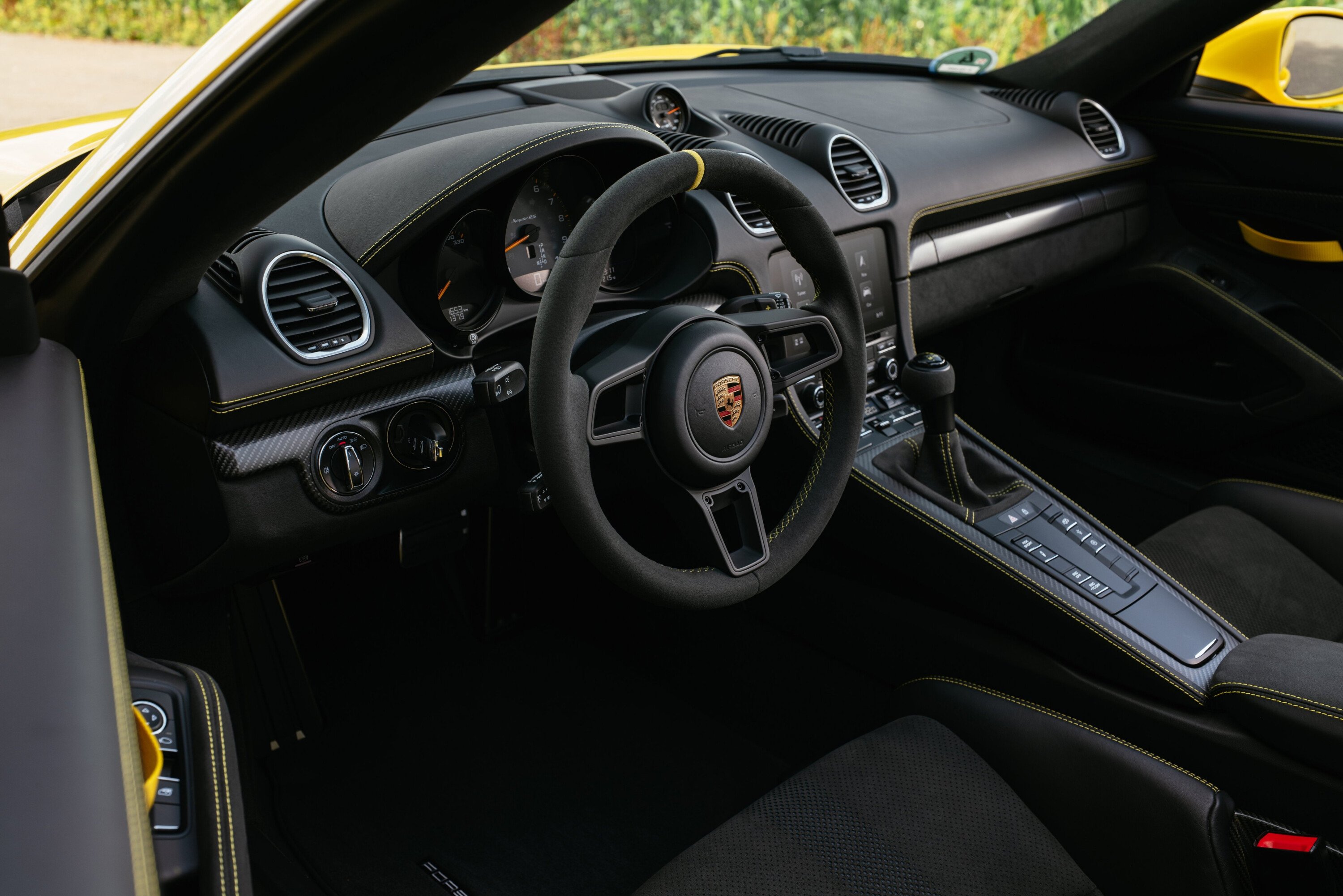
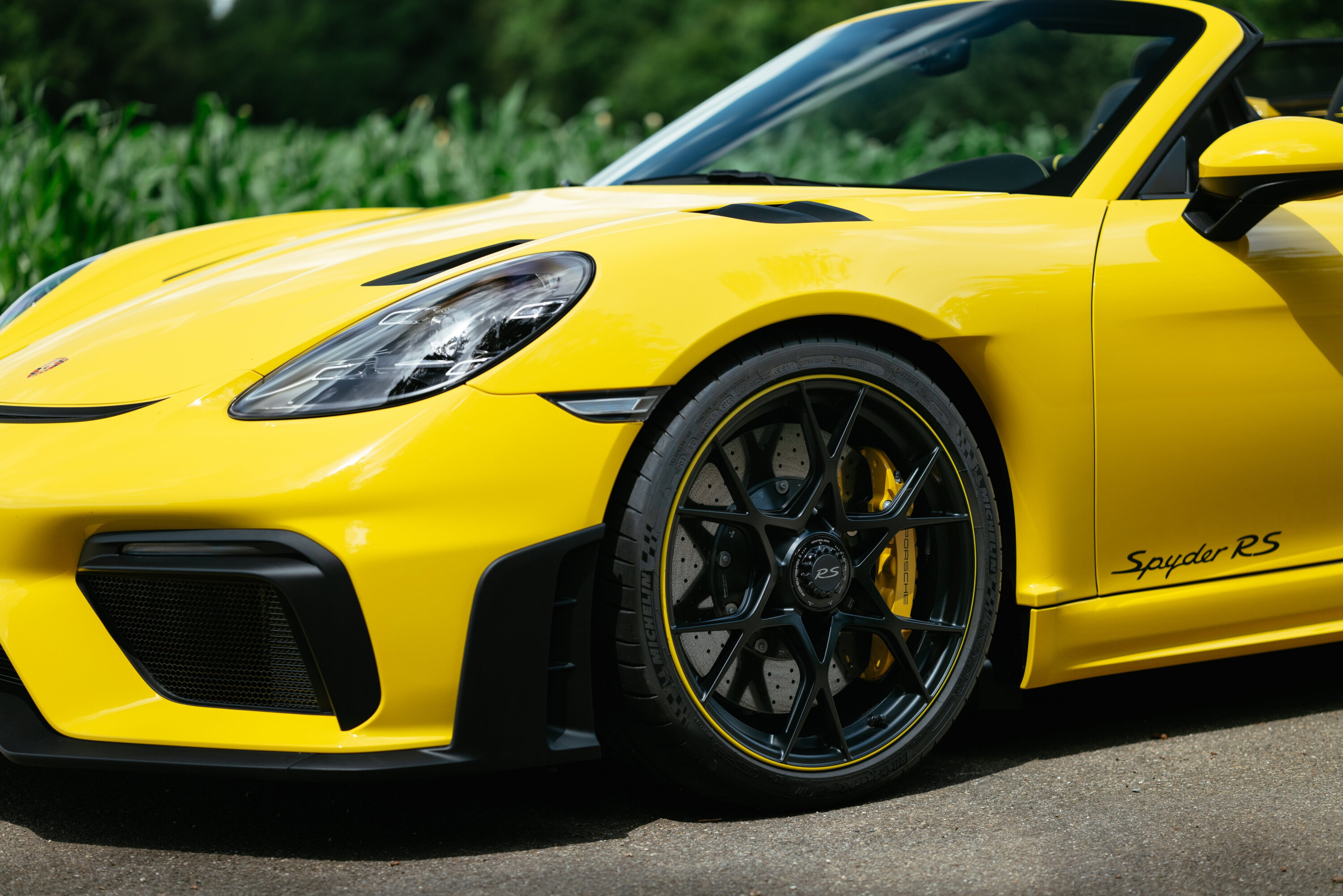
You sit low in a car that’s already 30mm lower than a Boxster, the standard Race-Tex trimmed bucket seats positioned so low that it’s almost impossible to prop an elbow onto the door roll top. Choose the optional Weissach Package and you’ll get the option of lightweight magnesium wheels that shave 10kg off the unsprung and rotational masses, titanium exhaust tailpipes and Race-Tex slathered across the top of the dash.
1
Given the standard car retails for a heady $336,800 before on-road costs, it’s unlikely that many buyers will be deterred by the extra $22,610 asked for the Weissach Package.
Available exterior colours include four standard paint finishes: black, white, Guards Red and the colour you see here, Racing Yellow. Metallics like Vanadium Grey, GT Silver and Gentian Blue are part of a $6K Special Colour palette that also includes Arctic Grey, Shark Blue and the delicious Ruby Star Neo. There’s also a palette of 115 Paint to Sample hues on offer.
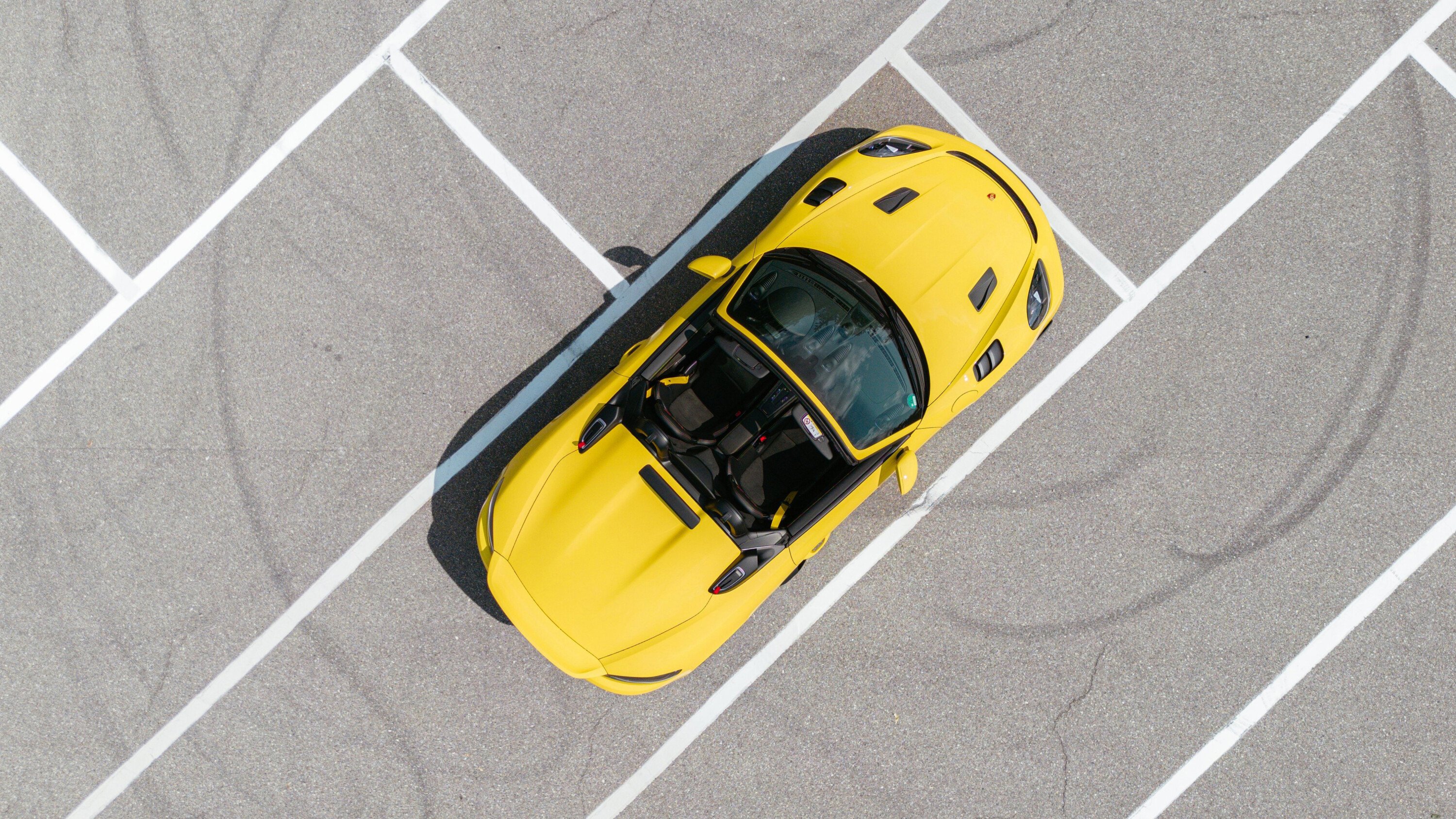
And that roof? We’ve already undergone a seminar on how to erect and dismantle the two-piece fabric roof and, after a little practice, we seem to have it down to a fairly slick 90-second or so operation.
1
Slot the header rail into place, locate the rear pins, tension the roof and then ker-chunk the rear into place.
It’s all so satisfyingly ASMR in its mechanical solidity and weighs just 18.5kg compared to the 34.8kg of a 718 Boxster’s electric roof. Plus you have the option of leaving it at home if the weather looks fine and you want to go full lightweight.
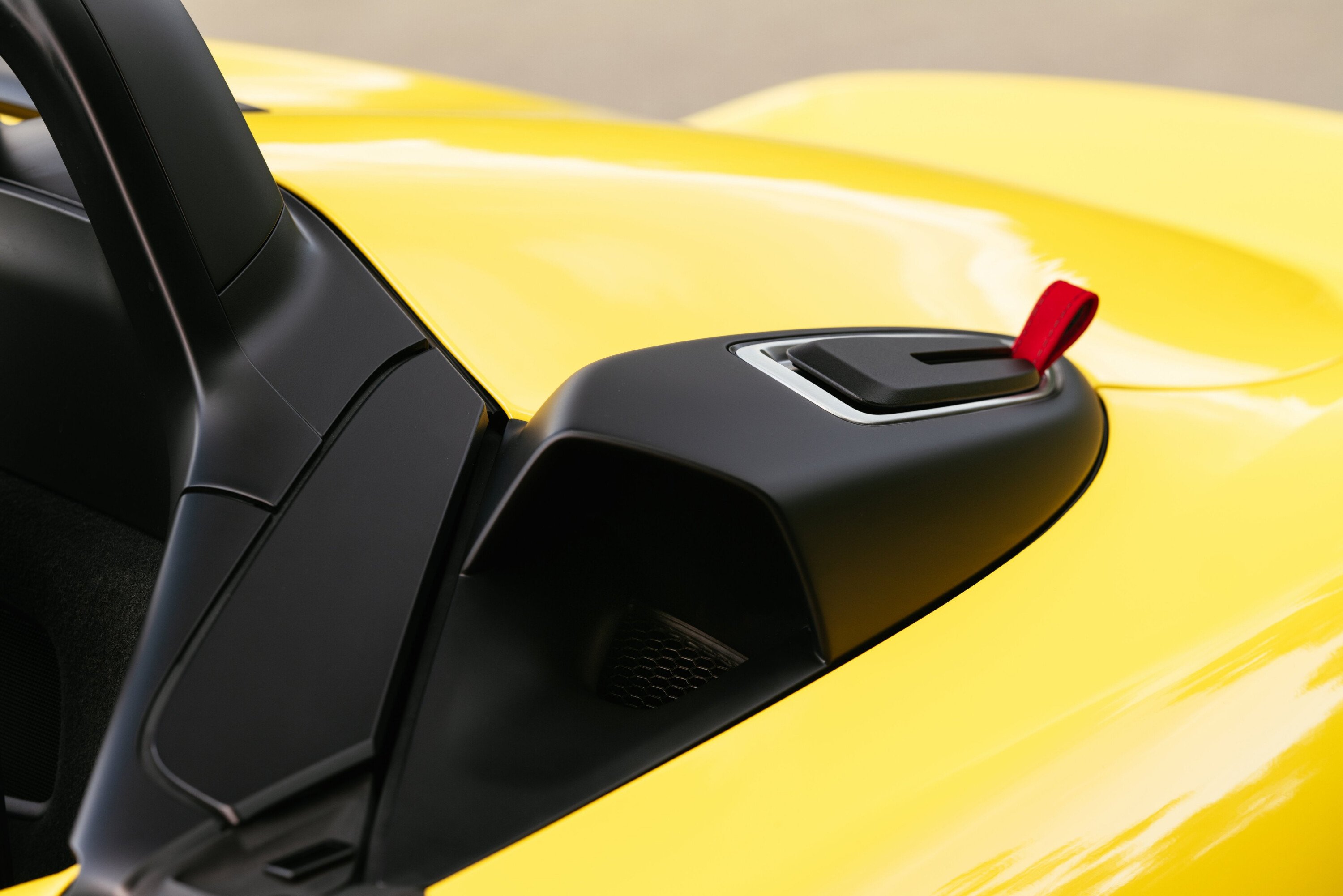
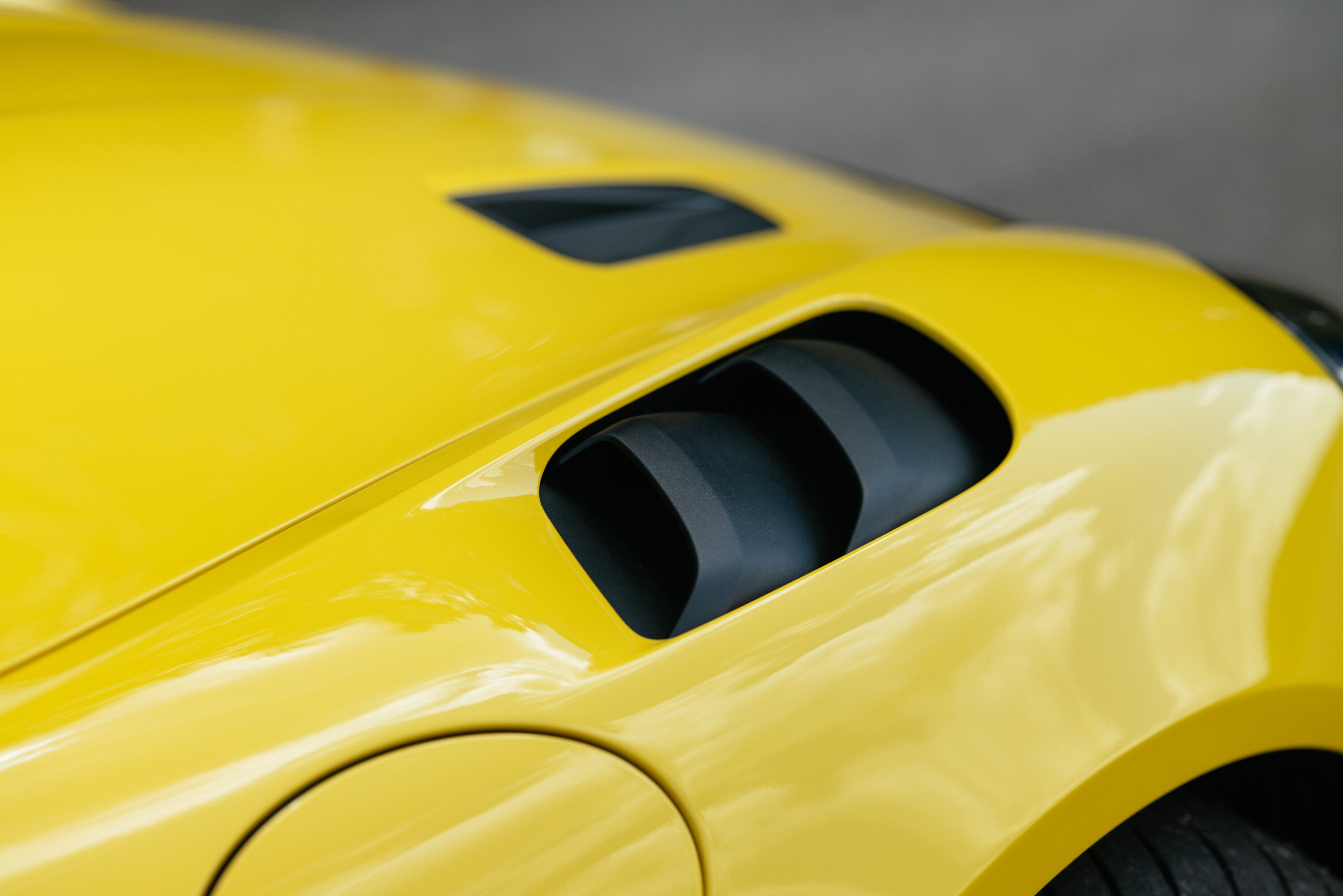
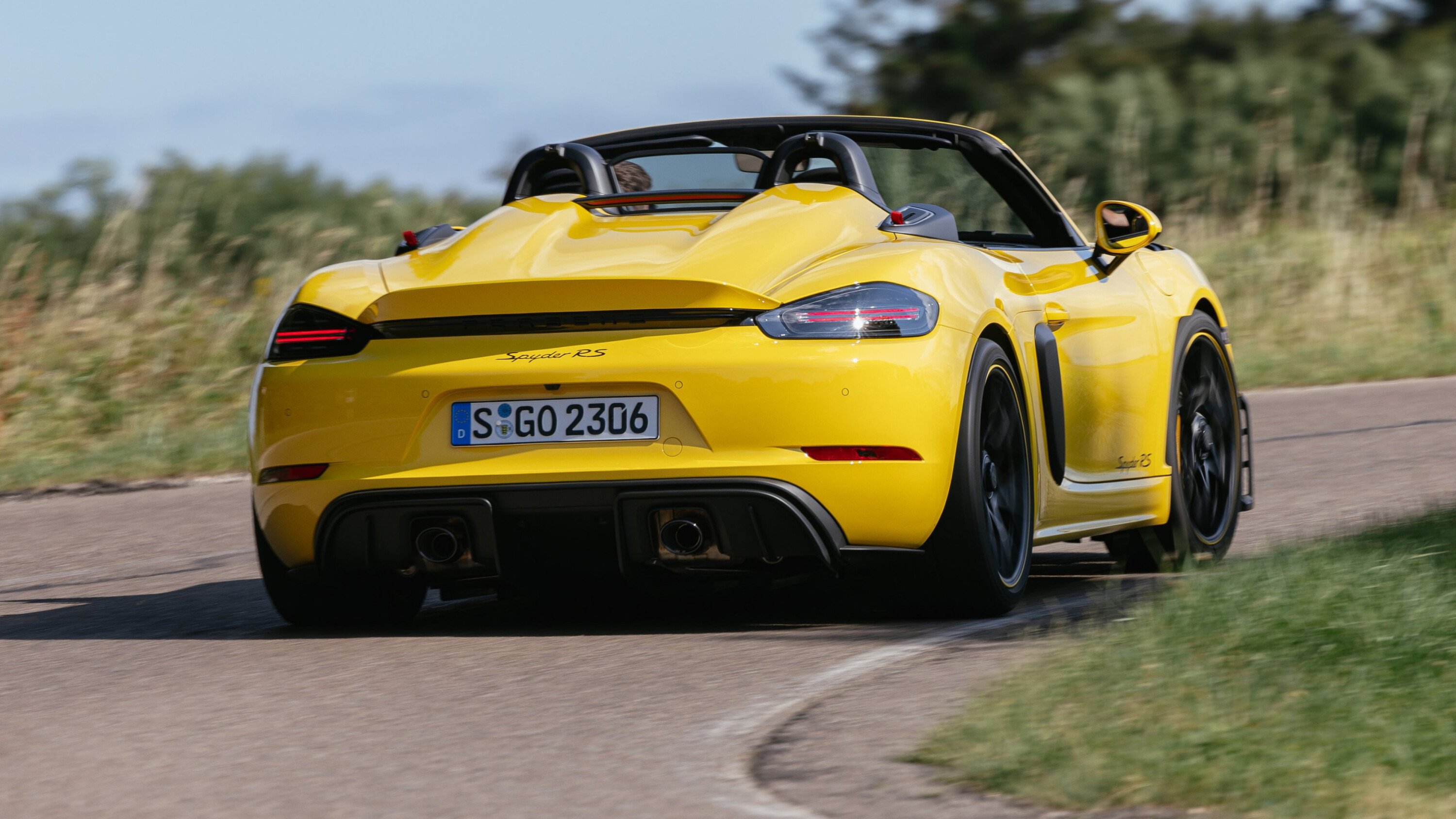
There is a secondary piece, a rear weather deflector with a glass window inset, but just fit the Bimini top and you have adequate rain protection while still getting all of the sound effects from what Preuninger calls the Spyder’s “music boxes”, the dual air intakes sitting like ears on the car’s haunches.
1
How do rivals compare on value?
Let’s line up all of those 300kW+ open-topped rivals in the $300K-$400K bracket featuring naturally aspirated engines that rev to the heavens and assess their suitability.
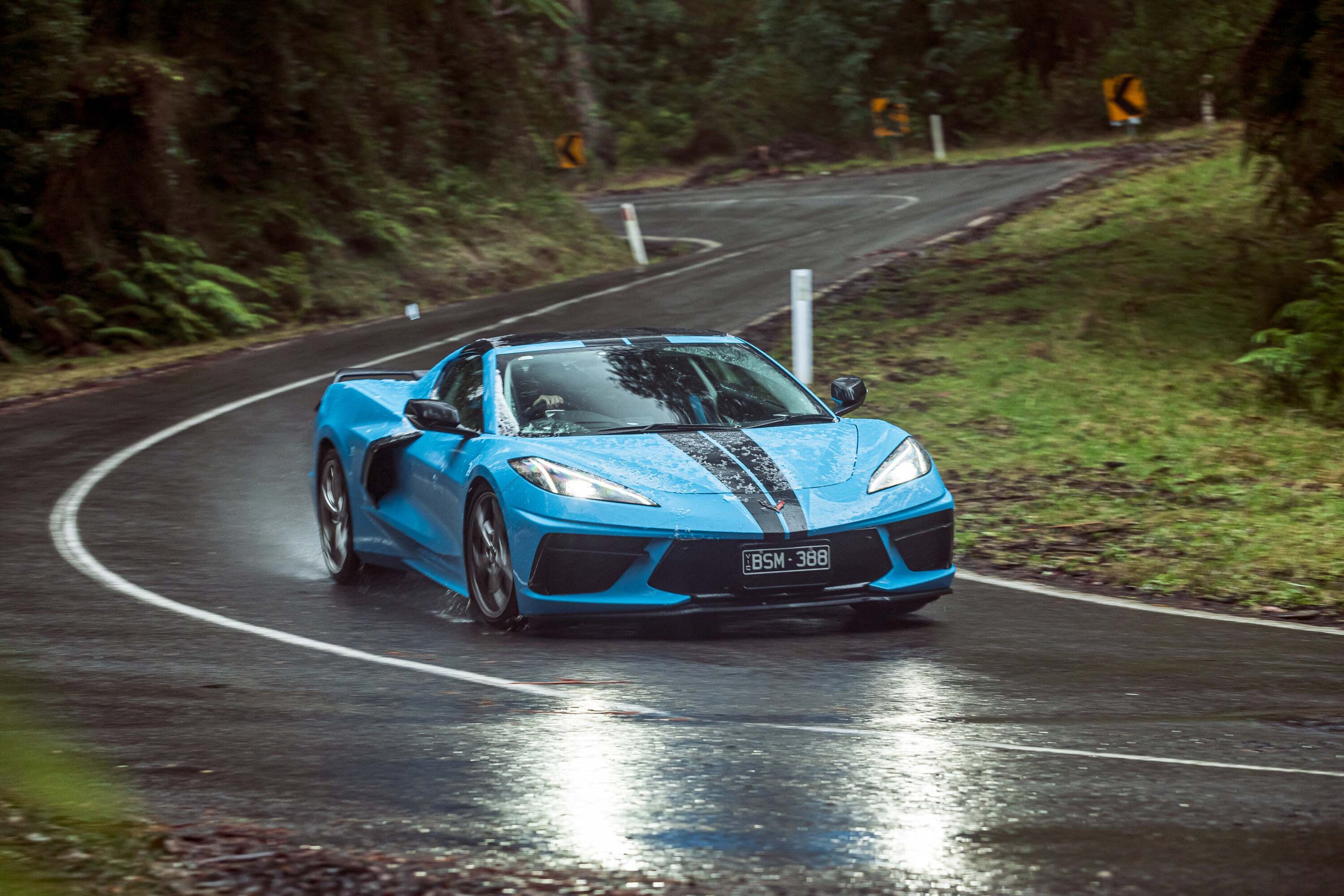
There is currently only one and it’s the mighty Corvette Z06, which fronts up with a 499kW powerplant, a detachable roof and a price tag of $336,000 before on-road costs; a mere $800 less than the Spyder RS.
In terms of bang for your buck, the Corvette gives the Porsche a resounding kerb-stomping. There are no two ways about that. It’ll do likewise at the drag strip and on the race track, and this underscores the difference between the two cars. The ‘Vette is a fierce creature, the Porsche one that’s a little more sensual and subtle. There won’t be a lot of cross-shopping between these two.
1
What’s the Porsche 718 Spyder RS like inside?
Intimate might be the word. If you’ve become used to the relative spaciousness of, say, a 992 Cabriolet, the 718 Spyder RS feels a far cosier place.
Although there are no rear seats onto which you can fling a bag, there’s 120 litres of luggage space at the back and 125 litres in the front boot, so there is an element of practicality as long as you pack light.
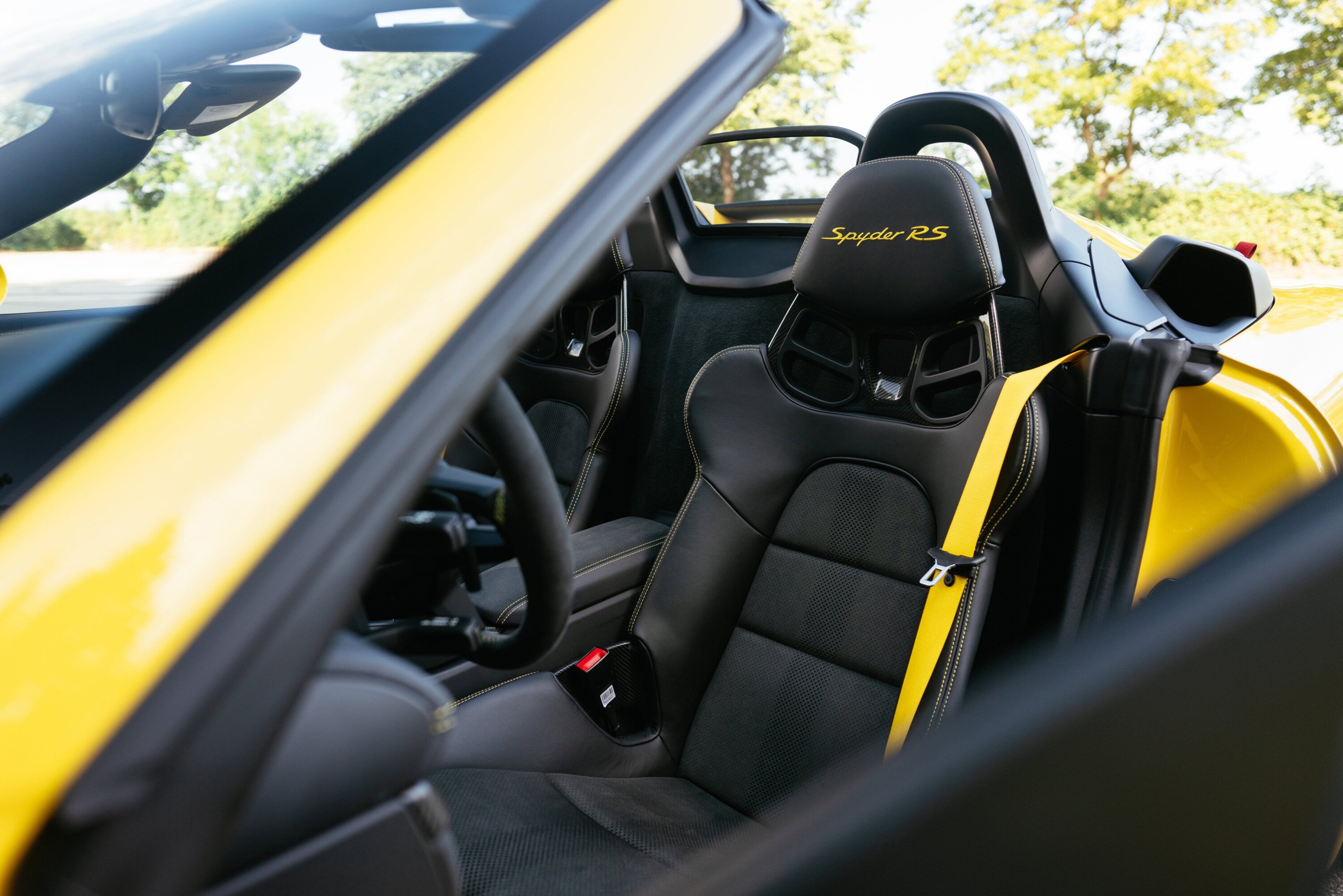
The cabin is well finished, with 918 Spyder-style full carbon bucket seats fitted as standard. Should these prove a little too focused, you can option the Adaptive Sports Seats Plus, which are a little more generously cut and feature 18-way power adjustment.
1
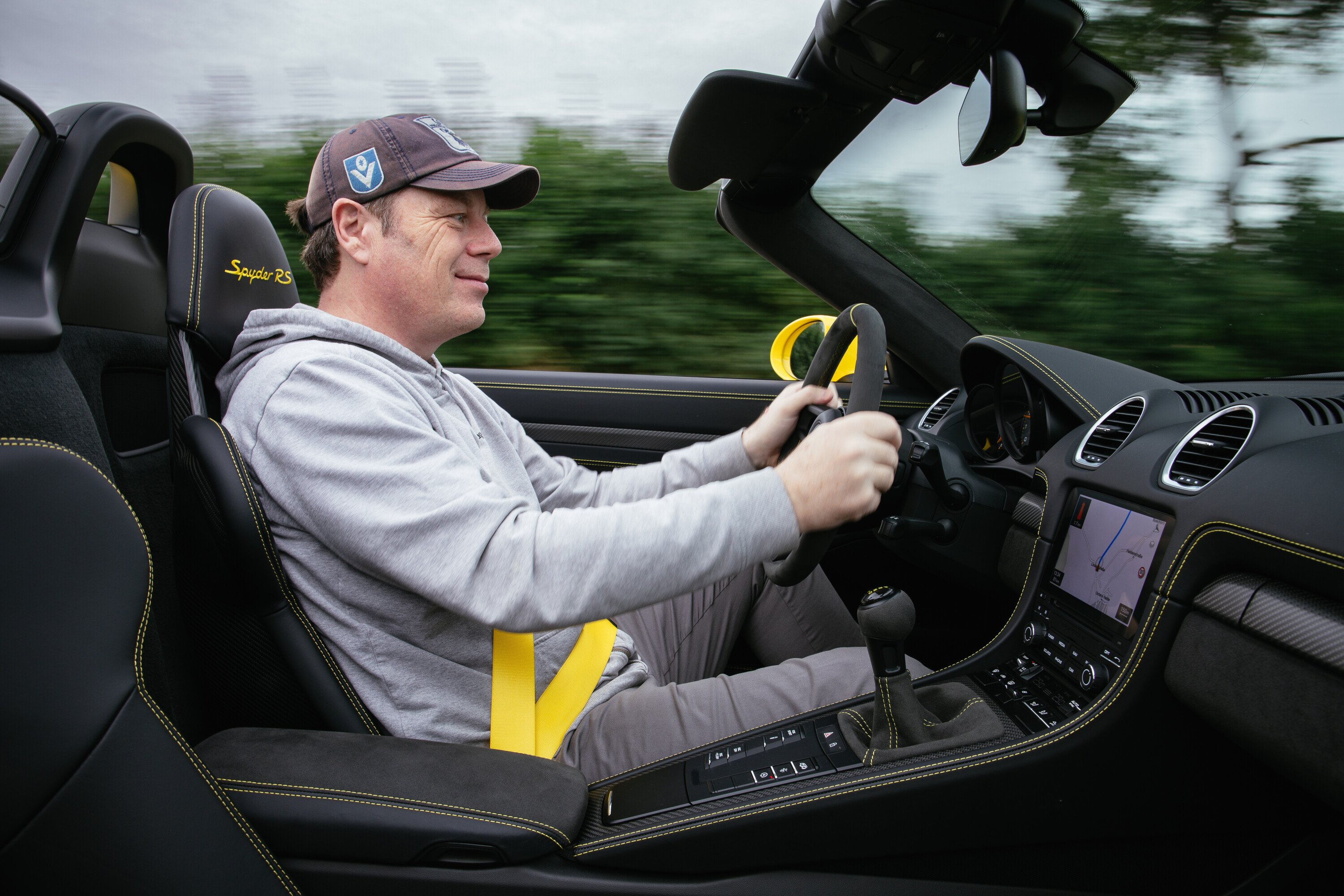
You grip a 360mm wide steering wheel trimmed in Race-Tex, with a yellow top band and there’s a decent amount of rake and reach adjustment.
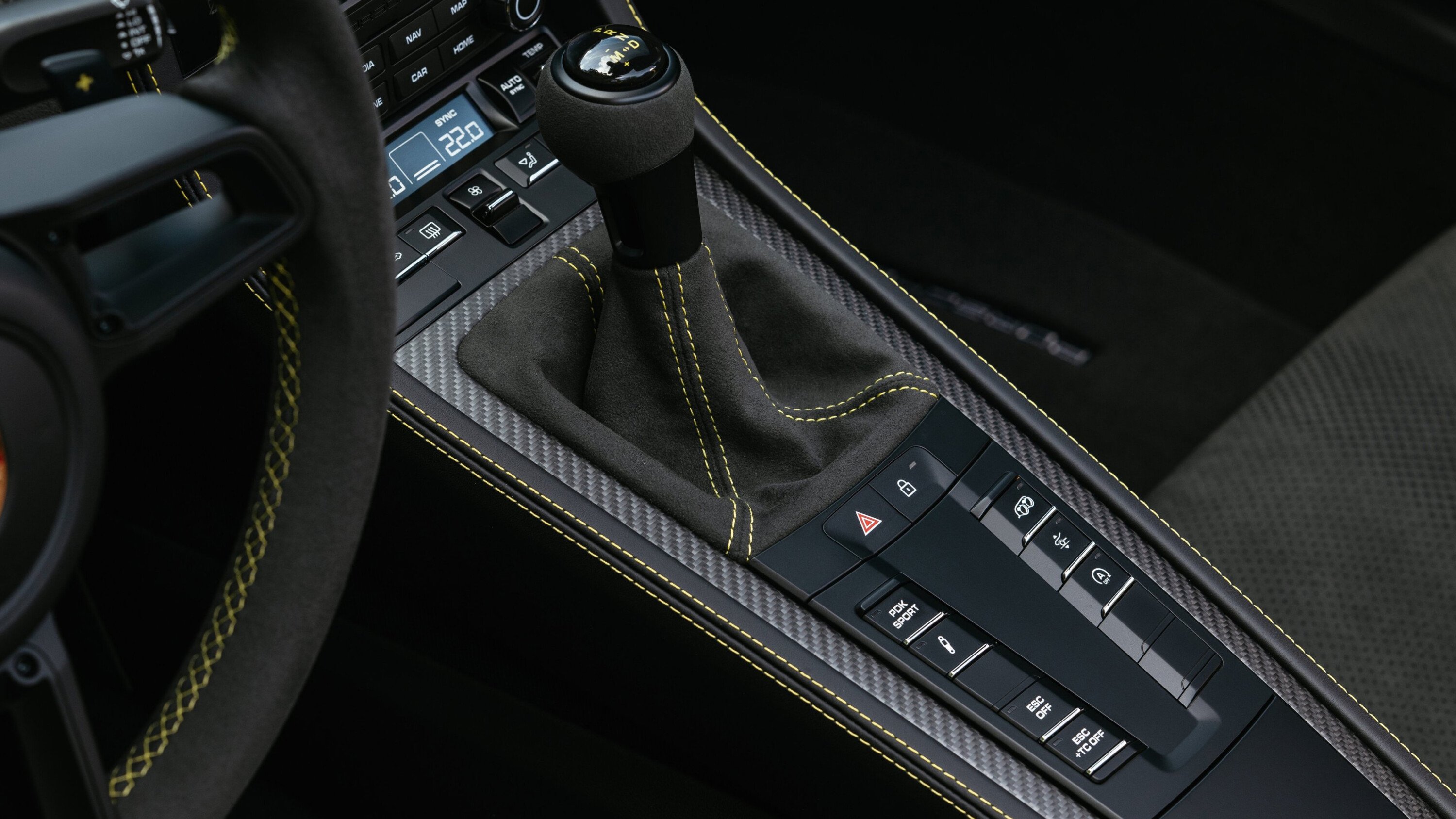
Rather refreshingly there are precisely zero controls on the steering wheel, underscoring the appeal of this car which, in many regards, offers a high-tech take on an old-school formula. Even the gear lever mimics a manual stick.
“On road, I like to steer with one hand and shift gear with the other,” admits Preuninger, which is probably the reason why the Spyder dispenses with the 911’s tiny knurled gear shift tab in favour of something that looks a lot like a manual shift knob.
1
If you’re really serious about weight reduction, you can tick a box to remove all of the infotainment
Its action is correct too, with downshifts effected by knocking it forward. “I have no idea why other manufacturers get that wrong,” he tuts in exasperation. “It makes no sense to me.”
Fitted as standard to the 718 Spyder RS is Porsche Communication Management (PCM) and a navigation system that includes Porsche Connect. Car Connect Services with Remote Services, Safety Services, Security Services and wireless Apple CarPlay are also present and correct.
Android users are not so lucky. If you’re really serious about weight reduction, you can tick a box to remove all of the infotainment, which will shave another 6kg off the kerb weight.
1
What is it like to drive?
While we might all have our own idea of what the greatest-sounding road car engine is, there can be few to match the Spyder RS’s 4.0-litre for sheer multitimbrality.
Flick up and down the gears and it’s as if you’re unleashing the acoustics of an entirely different engine with every gearshift. At little more than tickover, you’ll hear the intakes behind you slurping away like a salaryman at a bowl of ramen.
The note hardens as you climb, overlaid with a light breathiness that’s reminiscent of an old-school Porsche air-cooled unit until you hit 4500rpm, whereupon a butterfly valve opens in the exhaust as if somebody just knocked the bass fader right up.
1
Keep your foot planted and through to 8000rpm there’s a lifting, pure note of induction and valvetrain before everything coalesces into a crescendo between 8000 and 9000rpm.
If you can hit the redline without laughing out loud, you’re dead inside. The way the car shimmies subtly as it snicks home another gear reminds you that it’s alive and urgent, surprisingly analogue.
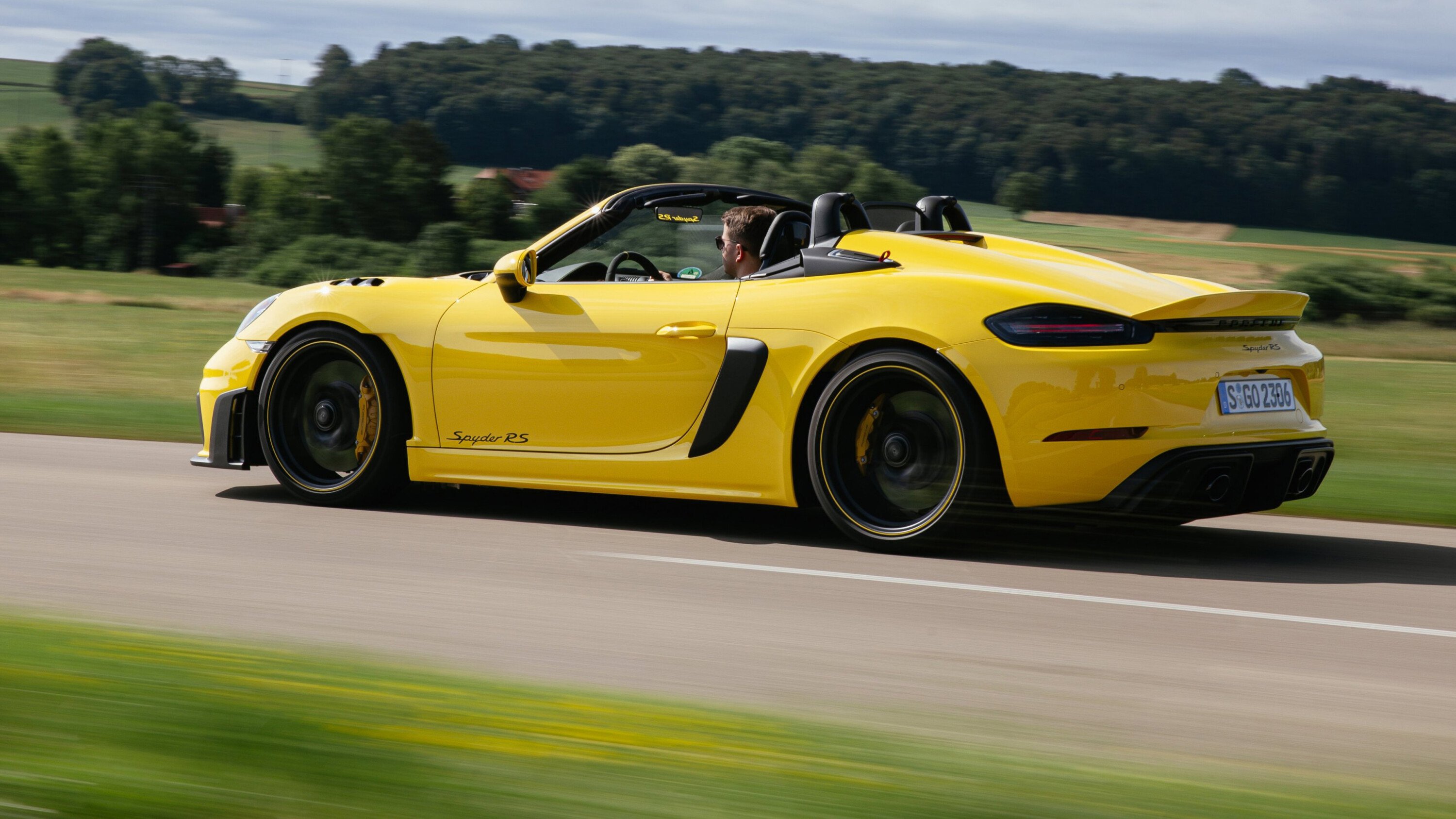
Porsche claims 0-100km/h in 3.4 seconds and 0-200km/h in 10.9 seconds, which makes it a few tenths shy of a 911 GT3. It’s not achieving anything like that on the patchily wet roads of the Swabian Alb, but it is impressing with its sheer driveability. Porsche Active Suspension Management is fitted to the Spyder RS; an active dual-mode damping system. In Normal mode, the dampers feel relatively long-stroke, but automatically firm up when the car is being exercised.
1
Alternatively, a press of a button on the centre console switches the dampers into Sport mode, whereupon the car tautens, like a flexed bicep.
In default mode, traction is strong, the ride never crashes on the few bumps we encounter and there’s a reassuringly measured feel to the steering and pedal maps.
The stability control calibration is about as good as it gets and off means off. A front axle lift system is available as a highly recommended $5K option, raising the nose by 30mm to help with negotiating crossovers, drop kerbs and parking ramps.
“The suspension and steering are different to that of the 718 Cayman GT4 RS,” explains Daniel Sprissler, project leader for suspension and driving dynamics.
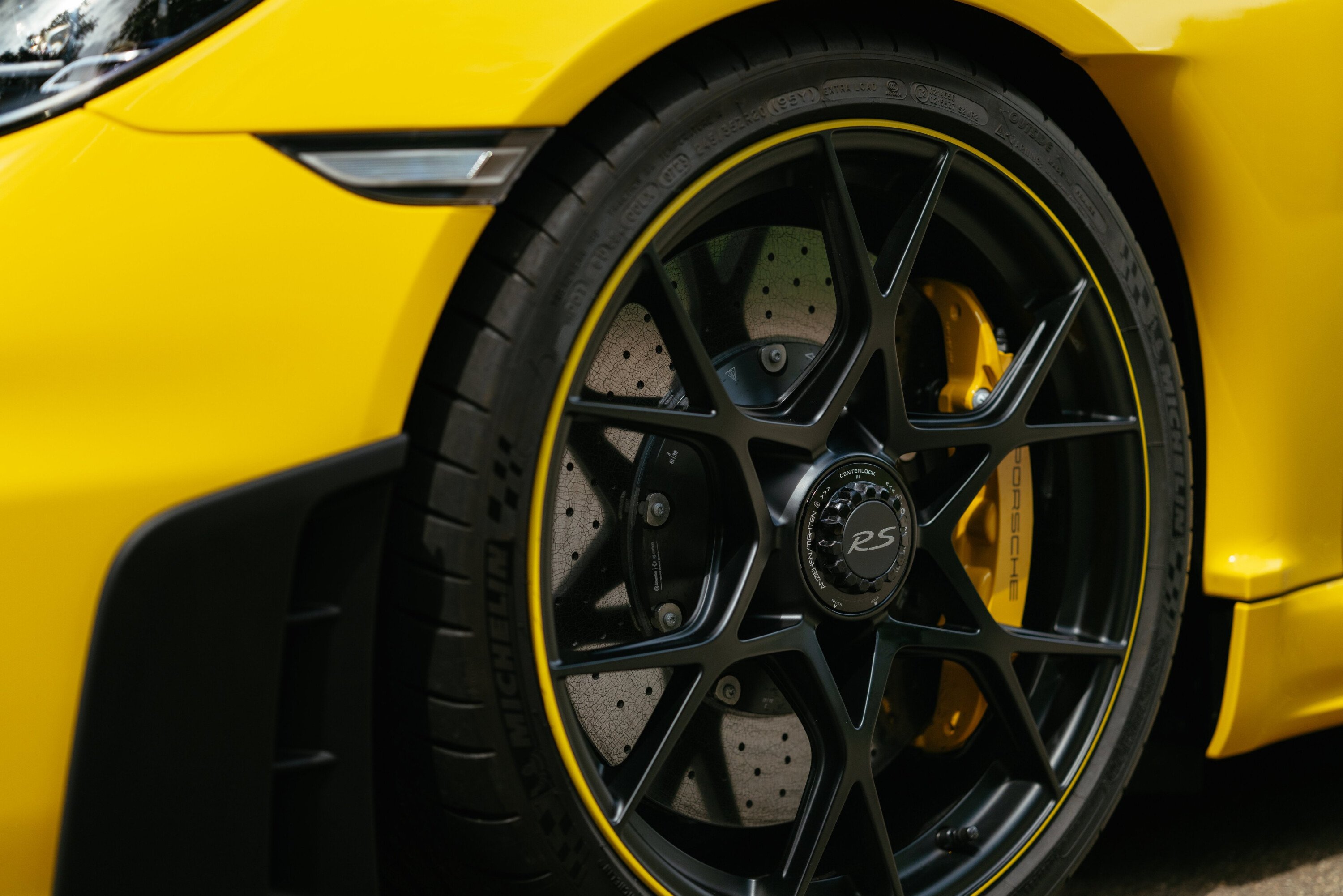
1
There are also some significant aero modifications that diverge from the GT4 RS.
“With that car, we’d optimised the springs and dampers to recover very quickly from being driven over kerbs on a race track,” he explains. “The Spyder RS is a road car, so the spring rates are around 50 per cent less front and rear.
We’ve left the anti-roll bars the same and the steering hardware is the same. We’ve made software changes to the steering map.” Should you wish to tinker, the ride height, camber, track and anti-roll bar can all be adjusted individually.
Some significant aero modifications diverge from the GT4 RS. Without the benefit of the big rear wing, the aero balance has changed. It means Porsche has had to bleed off some of the front aero to compensate.
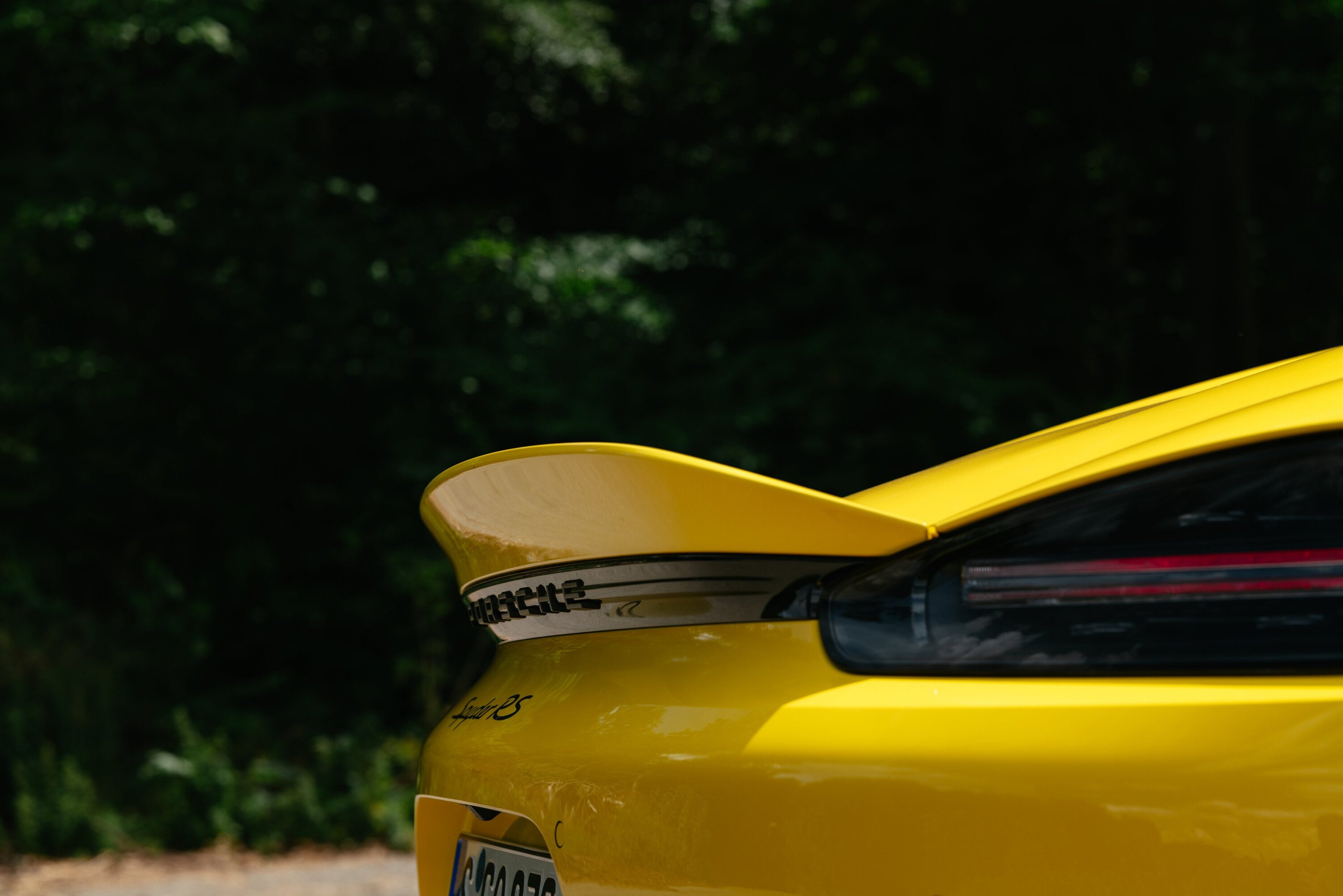
1
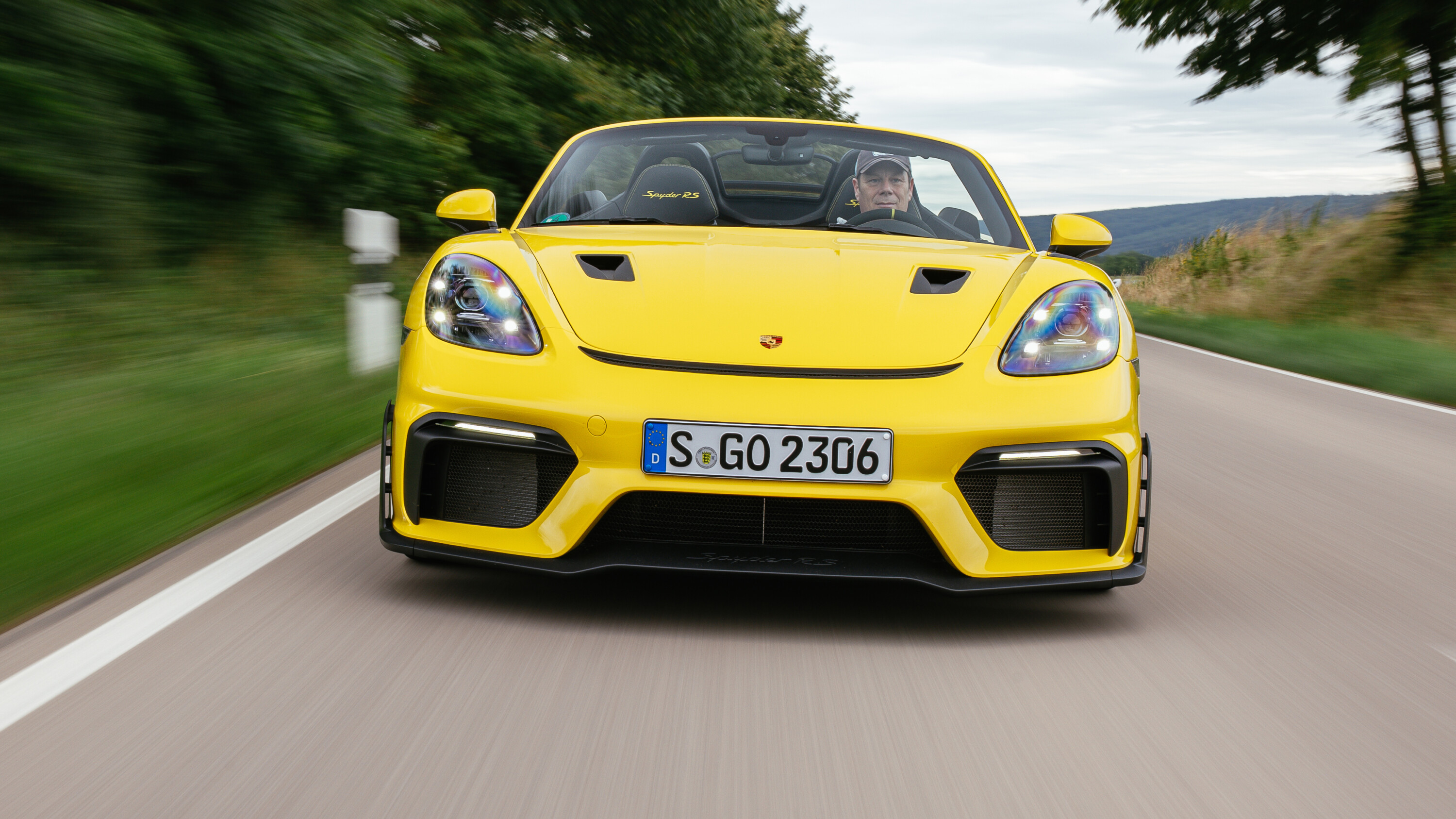
There’s a bespoke underbody at the front and the splitter is 5cm shorter so that the car doesn’t feel too pointy at speed, the revised front structures combining with the ducktail rear spoiler for neutral lift.
Gearing has also been shortened compared to the previous Spyder. Whereas with that car 8000rpm in second saw you travelling at 120km/h, this time round there’s a far more street-relevant set of ratios, with 9000rpm in second equating to 105km/h.
Where conditions allow, a top speed of 308km/h is attainable al fresco, although Porsche would prefer you don’t exceed 200km/h with the hood up.
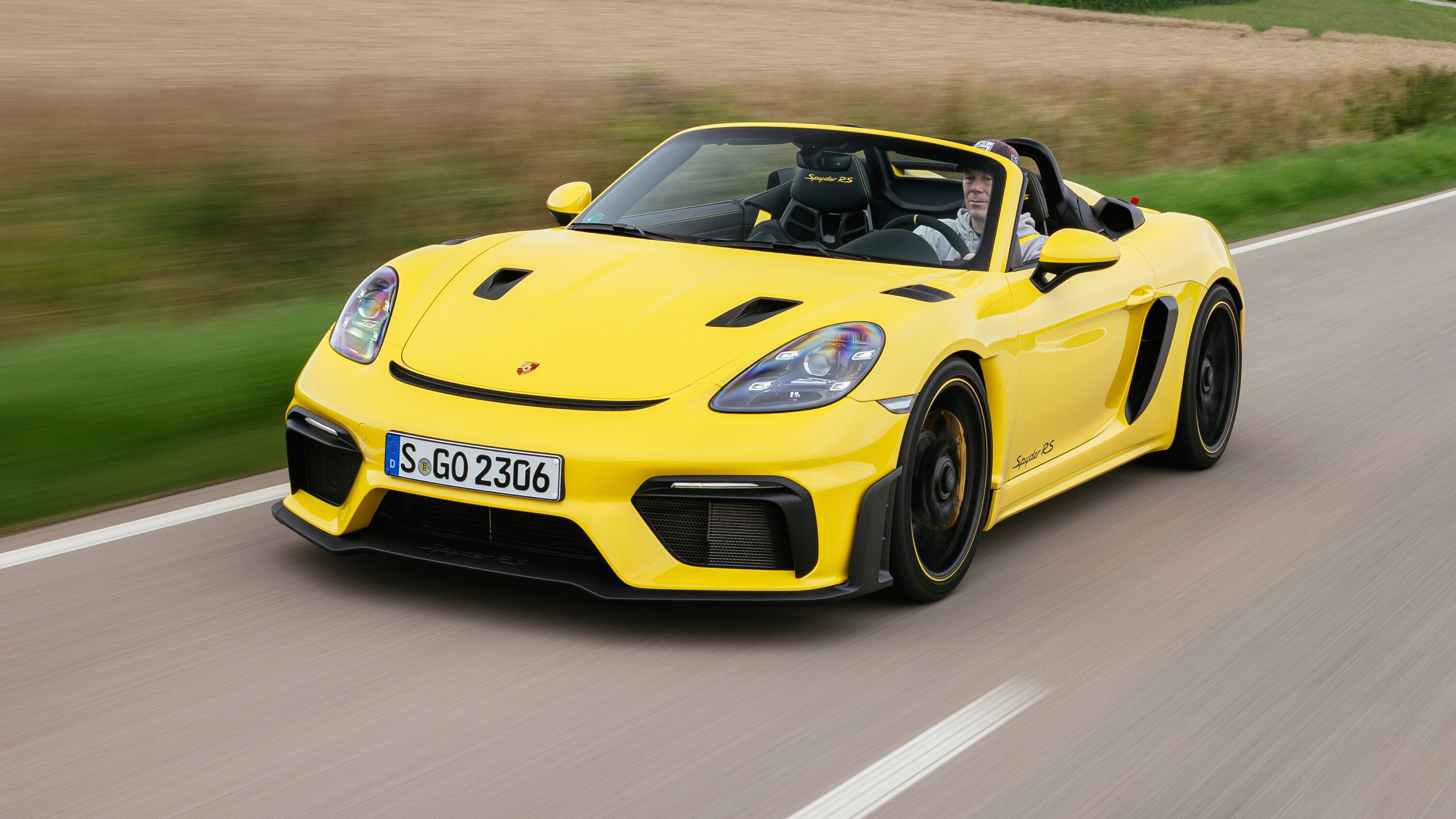
1
How is it on fuel?
Porsche claims a combined figure of 13.0L/100km for the Spyder RS, and that’s based on the tougher WLTP regimen.
On a mixed route that saw some spirited driving, we averaged 13.2L/100km, so the official estimate doesn’t seem too far off the mark.
The fuel tank is a relatively small 64 litres, so you’ll need to keep an eye on the fuel gauge if you’re taking the Spyder RS on track, as it will likely have an effective range of around 150km if you’re fully committed. On road, that range will stretch out to a comfortable 475km if you’re a little more measured with the loud pedal.
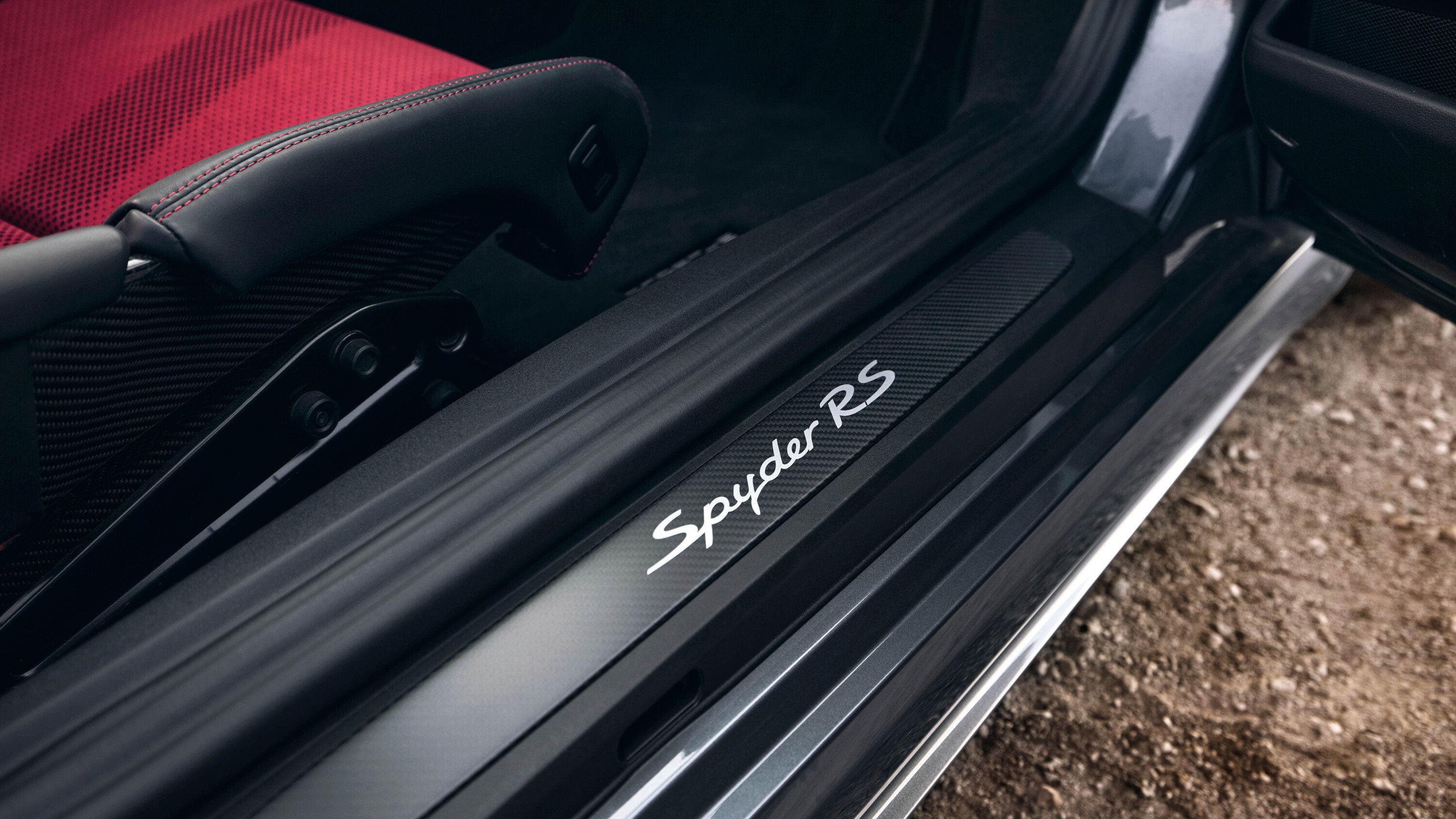
1
How safe is it?
Porsche doesn’t submit its sports cars to ANCAP for testing. Nevertheless, it has built a reassuring measure of safety provision into the 718 Spyder RS.
While we often fixate on crash testing (passive crash protection), an oft-overlooked safety consideration is active crash avoidance – namely how well-equipped the car is to avoid an accident in the first place.
The heart of the driving assistance systems is the Porsche Stability Management (PSM), which marshals the anti-lock braking system (ABS), electronic stability control (ESC) and traction control (TC).
1
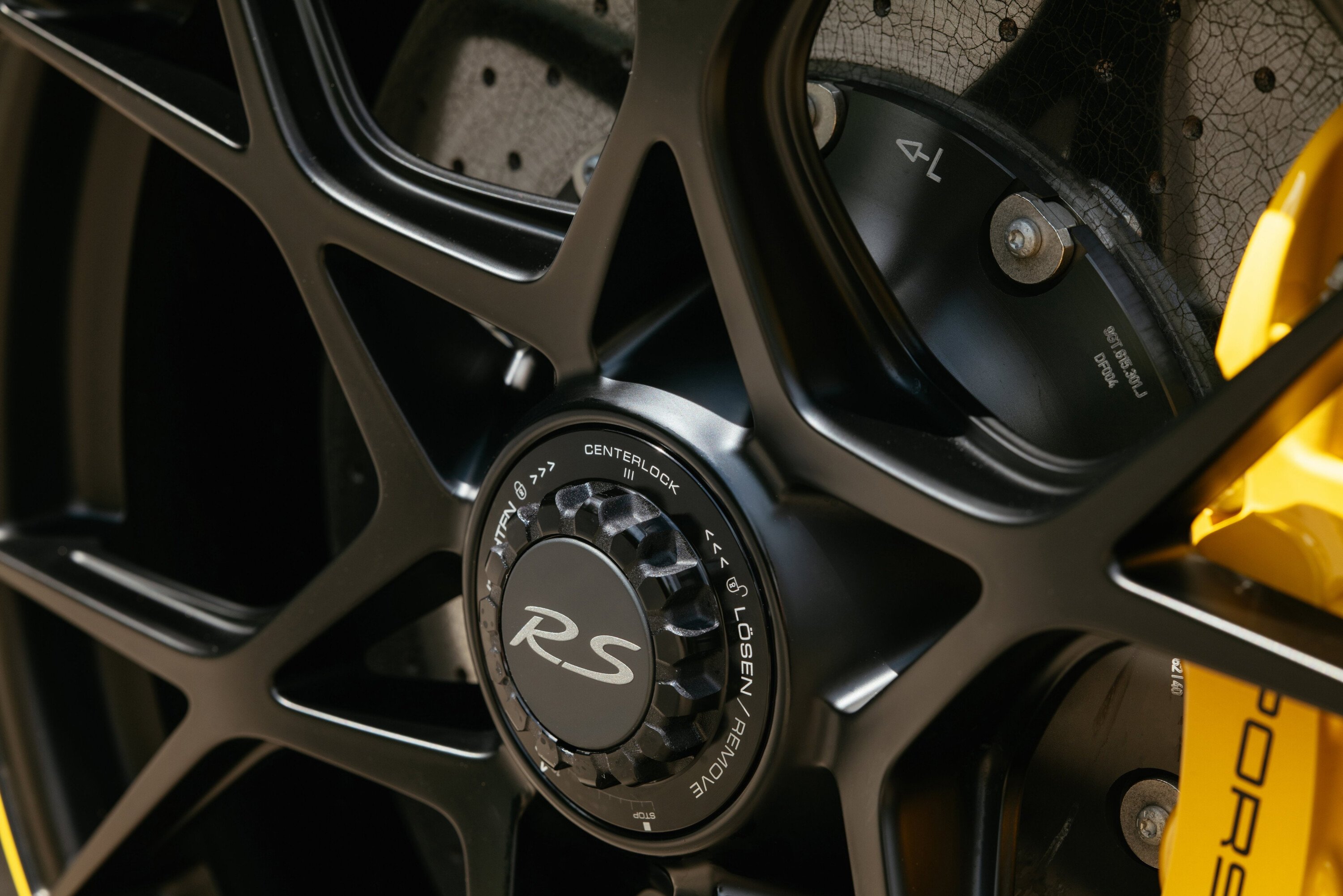
The rear brakes on this car are beefier than the front brakes on many sports cars
Porsche Torque Vectoring (PTV) is also fitted, which nips the brakes of the inside rear wheel on corner entry, sending more power to the outside rear wheel to lend a steering impulse in the desired direction and boosting the feeling of agility. This is backed up by the more analogue appeal of a mechanical limited-slip differential with RS-specific locking values (traction 30 per cent/overrun 37 per cent).
Brakes are huge 408mm rotors up front with six-piston calipers. The rear brakes on this car are beefier than the front brakes on many sports cars – it gets 380mm rear discs with four-pot calipers. Should you wish to upgrade to carbon ceramic discs, well, that’s a $15K option.
The Spyder RS also features full-sized driver and passenger airbags as well as some beefy door protection plus head and thorax side airbags.
1
How long is the warranty and what are the running costs like?
The warranty for the 718 Spyder RS is three years with unlimited kilometres.
While three years might seem a bit mean given that much of the new car market has moved to five-year warranties, there’s still a bit of lag at the top end of town. The likes of Aston Martin, Bentley, Ferrari, Lamborghini, Lotus, and Maserati all offer a similar three-year deal.
To keep your 718 in fine fettle, Porsche suggests a $695 annual oil service and an $1110 intermediate service for all 718 Boxster and Cayman variants.
1
Would you recommend it?
The Porsche 718 Spyder is one of the most convincing sports cars to come out of Weissach in recent years. It’s a roadster that absolutely understands its remit and executes on it with genuine elan.
We are also witnessing something of a watershed in the company’s history, as this marks the very last mid-engined Porsche with an internal combustion engine.
It’s no great secret that the next generation of 718 will be powered by a pure electric drivetrain, of which the engineers assembled would say little officially, but there were enough nods, winks and nudges to assume that they think it’ll be something special.
1
“It sounds like the [3.8-litre] engine of the 991.1 GT3,”
But we’re not here to talk batteries. This one’s all about celebrating one of the all-time great engines. It’s one that Preuninger can’t help but get excited about, his eyes widening as he goes into full salesman mode.
“Rev this engine from 8000 to 9000rpm and you get that metallic edge to it, a really exciting sound,” he chuckles. “It sounds like the [3.8-litre] engine of the 991.1 GT3,” he adds. He’s on record as noting that the 3.8 sounded fiercer than the later 4.0-litre in the GT3 and was keen to bring back that purer mechanical top note.
There’s no need for the hard sell. The car speaks for itself. It might well have been Preuninger’s pet project, and perhaps there is an element of indulgence about both the Spyder RS and the recently announced 911 S/T. You can forgive that when the results are so spectacular.
1
He has every right to feel proud of the 718 Spyder RS.
For so long the company had hobbled its mid-engined cars in order to preserve the hierarchy. And with good reason.
But with the impending death of internal combustion in this body, Porsche has thrown everything it knows at this car in a supernova of corporate largesse.
There’s something almost unPorsche-like about the performative nature of the Spyder RS; a GT division product that knows how to let its hair down. There’s a time and a place for buttoned-down rectitude. This joyous demo party is most certainly not that time.
MORE
Everything Porsche
| 2023 Porsche 718 Spyder RS specifications | |
|---|---|
| Body | Body 2-door, 2-seat coupe |
| Engine | Engine 3996cc flat 6cyl, 24v, DOHC, petrol |
| Power | 368kW @ 8400rpm |
| Torque | 450Nm @ 6750rpm |
| Transmission | 7-speed dual-clutch |
| 0-100km/h | 3.4 seconds (claimed) |
| L/W/H | 4418/1822/1252mm |
| Wheelbase | 2482mm |
| Track width | 1545/1542mm (f/r) |
| Boot space | 245L (125L front / 120L rear) |
| Weight | 1410kg |
| Fuel / tank | 98 RON / 64 litres |
| Fuel use L/100km | 13.0L/100km (combined) |
| Suspension | Struts, coil springs, adaptive dampers, anti-roll bar (front) Multi-links, coil springs, adaptive dampers, anti-roll bar (r) |
| Steering | Electric rack-and-pinion |
| Brakes | 408mm ventilated/dimpled discs with six-piston calipers (f) 380mm ventilated/dimpled discs with four-piston calipers (r) |
| Wheels | 8.5J x 20 (f) 11.0J x 20 (r) |
| Tyres | Michelin Pilot Cup 2 245/35 ZR20 95Y (f) 295/30 ZR20 101Y (r) |
| Price | $336,800 + on-road costs |
The limited-run 2024 Porsche 911 S/T has debuted to honour the iconic nameplate’s 60th anniversary.
Snapshot
- 2024 Porsche 911 S/T: Lightweight puristu2019s special
- Limited-run model celebrates 911u2019s 60th anniversary
- Priced at $660,500 plus on-road costs
1
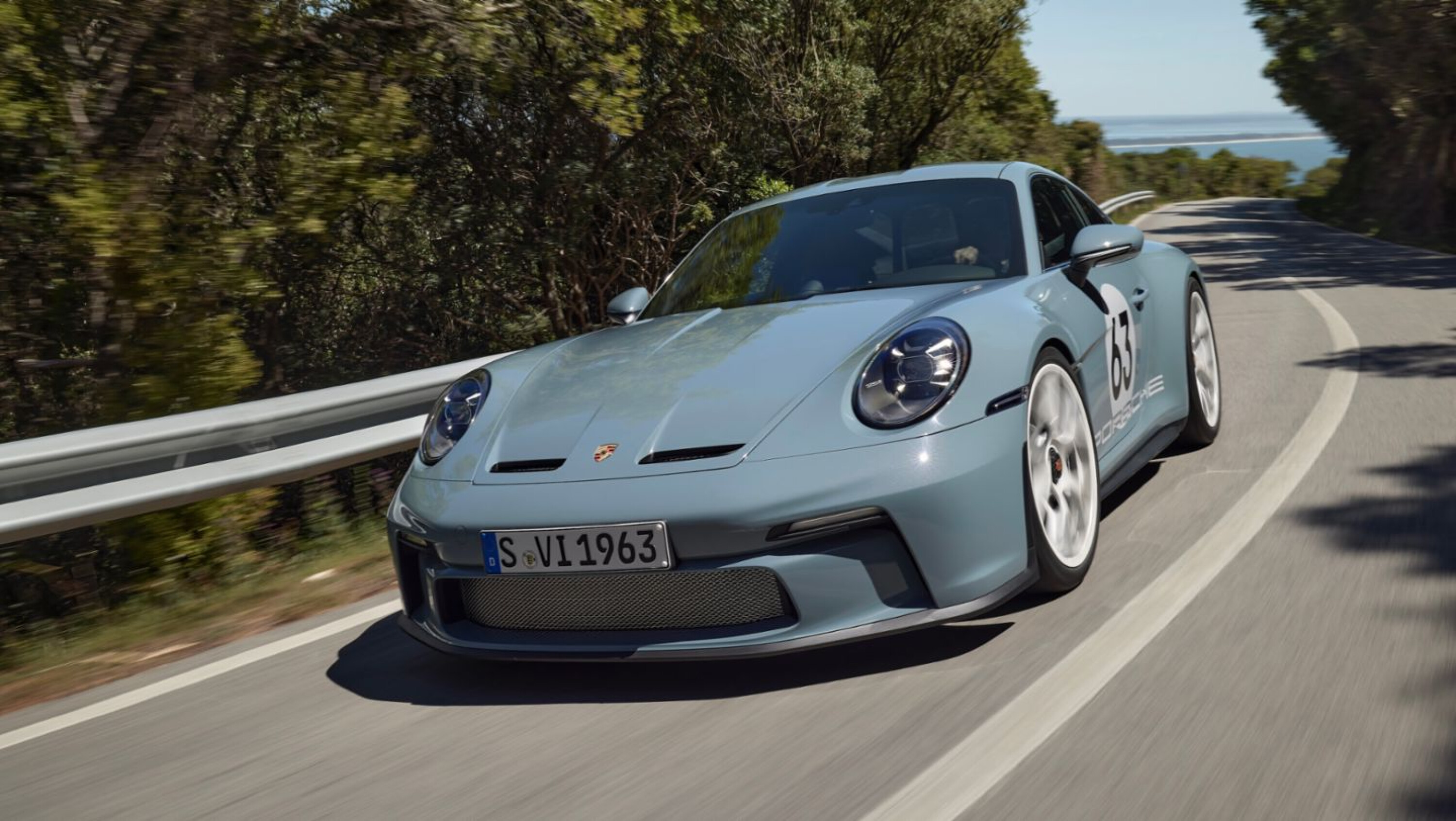
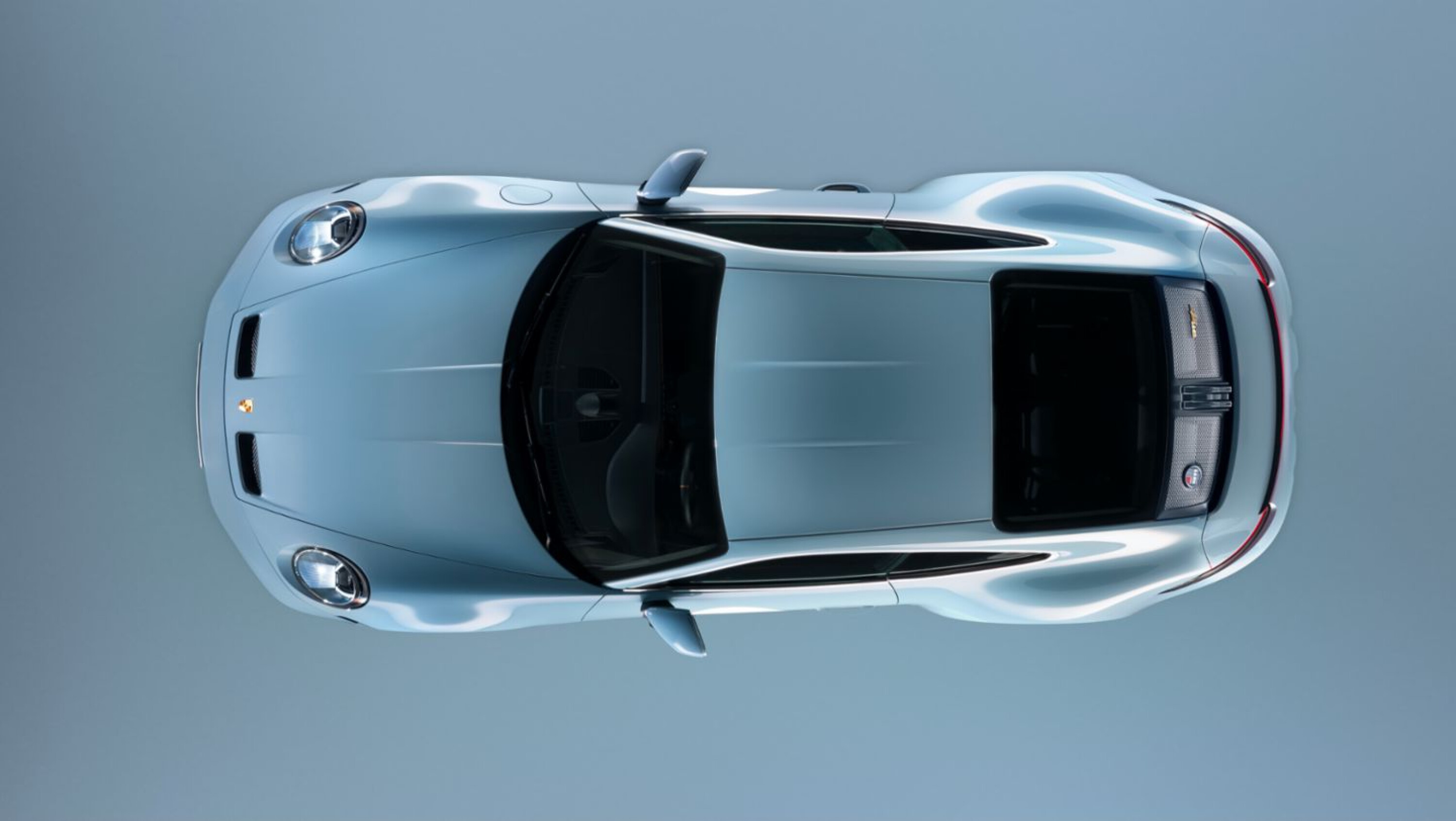
Limited to just 1963 units worldwide, the heart of the 911 S/T is borrowed from the track-focused GT3 RS, but with a toned-down body and manual from the GT3 with Touring pack.
This means a naturally-aspirated 4.0-litre flat-six engine producing 386kW is paired with close-ratio six-speed manual transmission.
In a nod to the 911 S racers of the 1960s and 1970s, the S/T focuses on weight reduction. Tipping the scales at 1380 kilograms, it’s the lightest of any 992 911 and weighs 40kg less than a manual GT3 Touring.
Porsche claims a 3.7-second 0-100km/h sprint time and 300km/h top speed for the 911 S/T compared to 3.2s and 296km/h for the GT3 RS, and 3.9s and 320km/h for a manual GT3 Touring.
4
It will arrive in Australia in “limited numbers”, priced from $660,500 before on-road costs.
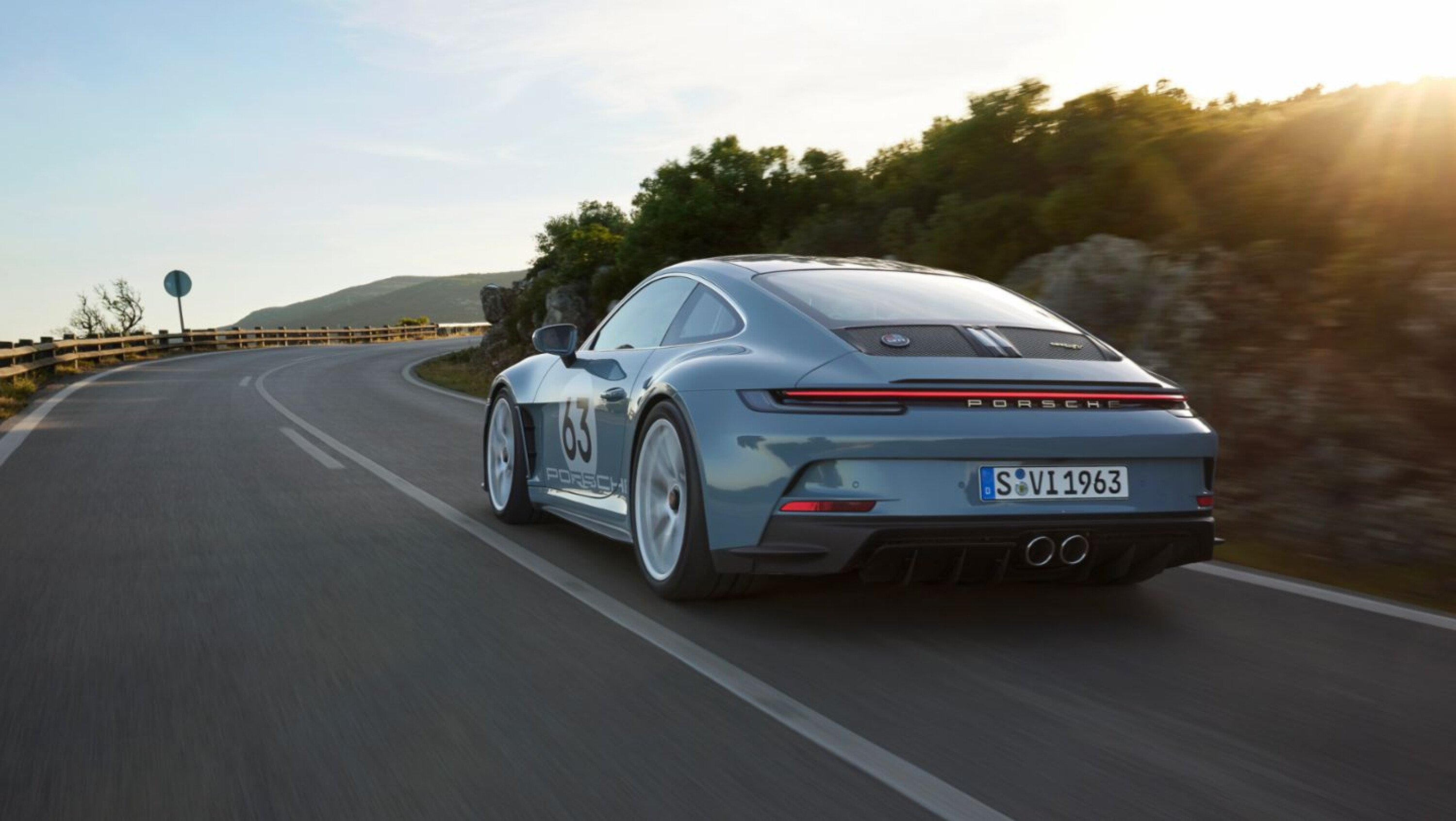
For those seeking a touch of nostalgia, Porsche offers a Heritage Design package with an optional starting number between 1 and 99 in a white circle.
Shoreblue Metallic and ‘ceramica’ wheels are worn over two-tone semi-aniline leather upholstery with a cognac cloth centre, perforated suede headlining, and classic Porsche logos inside.
The Heritage Design package is priced at $36,760, and a Chronograph 1 timepiece – with “a rotor in the design of the magnesium wheel of the 911 S/T” – is priced at $21,041.
1
Porsche’s engineers focused on enhancing on-road dynamics to prioritise driving pleasure over track performance.
A new lightweight clutch and single-mass flywheel reduce the rotating mass weight by 10.5kg, and the 911 S/T is the first 992 911 to combine double-wishbone front suspension with a multi-link rear axle without rear steer.
The weight savings extend to various components, with traditional door handles replacing electronically-operated flush units found on other 911 variants.
In addition, the front bonnet, roof, front wings, doors, roll cage, rear axle anti-roll bar and shear panel are produced from carbon-fibre-reinforced plastic (CFRP).
Other measures include magnesium wheels, ceramic composite brakes, a lithium-ion starter battery, and lightweight glass.
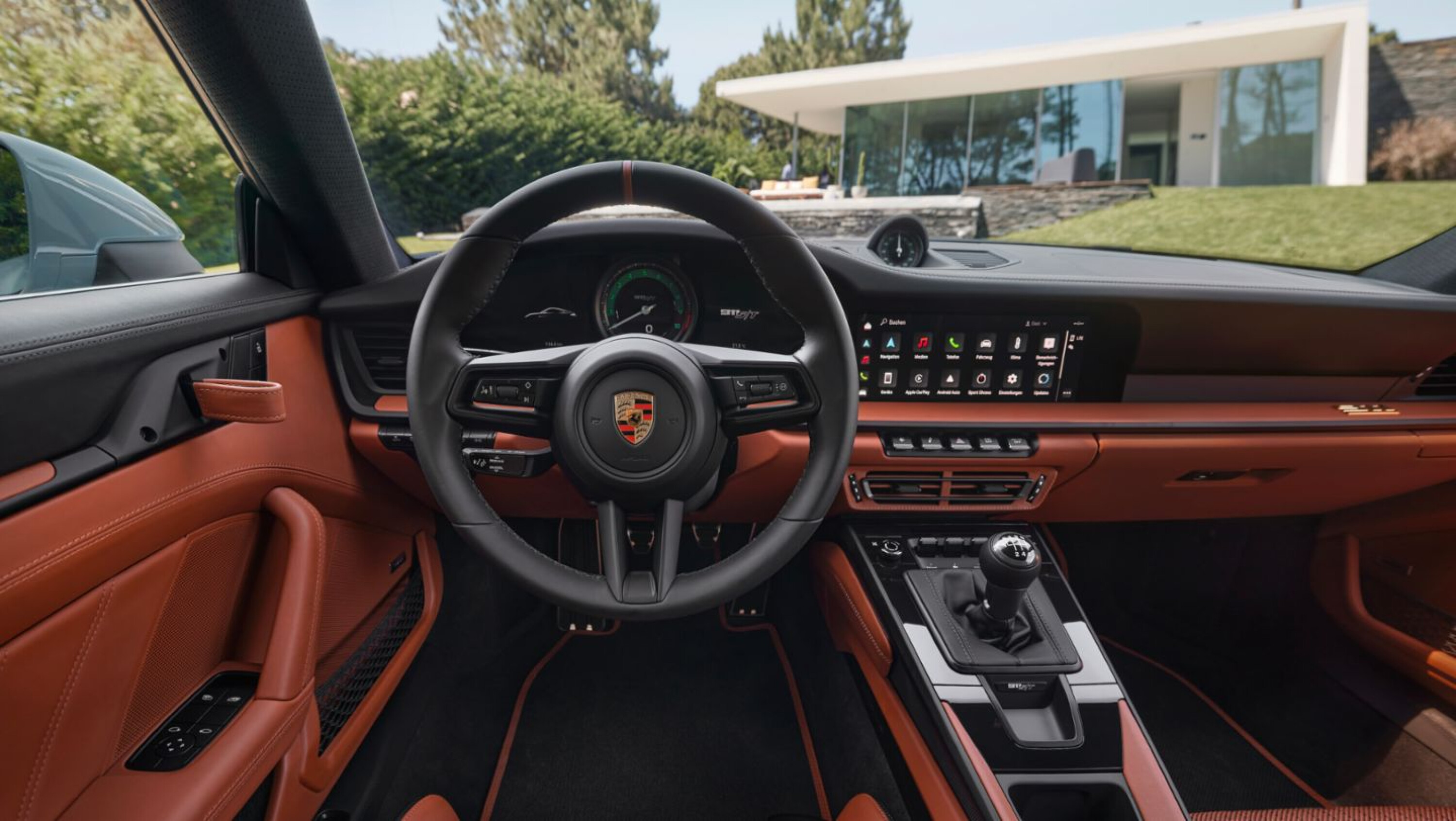
3
Porsche’s commitment to weight reduction even extends to removing certain features, such as sound insulation and rear-axle steering.
In Australia, the 911 S/T adds additional standard equipment, with a front-axle lift system, a tyre fit set, dynamic LED headlights, auto-dimming mirrors, rain-sensing wipers, rear parking sensors, a rear-view camera, and DAB+ digital radio.
MORE
60 years of Porsche
MORE
Everything Porsche
The 2024 Mercedes-AMG GT 63 S E Performance four-door (now breath) is available to order now at dealers from $399,900 before on-road costs and options.
Snapshot
- 620kW makes this AMGu2019s most powerful production car yet
- Available to order now with a $400K price tag
- PHEV powertrain with 12km electric-only range
Unveiled in September 2021 and previously promised for Australian release in the second half of 2022, the GT 63 plug-in is the first of AMG’s performance PHEVs to hit our shores.
With deliveries beginning imminently, the 620kW/1400Nm V8-electric monster will arrive before its down-sized C 63 S E Performance – with a four-banger – and six-cylinder E-boosted E 63 sedans.

1
Having been on sale in Europe and the US for some time, the GT 63 brought AMG’s latest plug-in hybrid performance layout to the world.
A familiar 4.0-litre ‘M177’ twin-turbo V8 sits at its heart with a 150kW electric motor adding boost from the rear axle.
The electric motor is powered by an 89kg 6.1kWh battery designed to be charged and discharged at an extremely rapid rate – great for power, but with only 12km electric-only driving range and a 7.7L/100km ADR consumption rating, it isn’t going to challenge a Mitsubishi Outlander PHEV for efficiency.
There’s a consolation price – the F1-inspired AWD GT 63 PHEV rockets itself from rest to 100km/h in just 2.9 seconds.
Helping transfer all the power to the road is multi-chamber air suspension with adaptive dampers and rear axle-steering while a switchable exhaust allows drivers to choose between AMG’s signature V8 woofle or a sedate and refined note. You can read all the performance details in our original reveal story below.
Australian vehicles will arrive in high specification, this includes a 14-speaker Burmester system, ‘exclusive’ Nappa leather upholstery for the electronically-controlled heated and ventilated front seats. Just like the luxury S-Class, the flagship AMG model gets warmed armrests too.

1
Creature comforts continue with open pore Ash Wood trim, 64-colour ambient lighting, a head-up display, a power sunroof, driver assistance features including adaptive cruise control and lane-trace assist, with a pair of digital displays for control and information.
The GT 63 S E Performance four-door is available to order from AMG dealers now.
Our original story, below, continues unchanged.
May 2022: Mercedes-AMG GT 63 S E Performance unveiled!
Snapshot
- New flagship AMG GT is the most powerful from the brand
- 620kW and more than 1400Nm from its first plug-in hybrid powertrain
- Up to 12km of electric-only driving
Not only is the new GT 63 S E Performance the first plug-in hybrid model from Mercedes-AMG, it’s also the most powerful production car ever offered by the manufacturer.
As the performance arm of Mercedes-Benz, AMG has fitted the GT 63 S E Performance with a 4.0-litre twin-turbo V8, coupled with a 150kW electric motor powering the rear axle.
The result is a total combined output of 620kW of power and more than 1400Nm of torque.
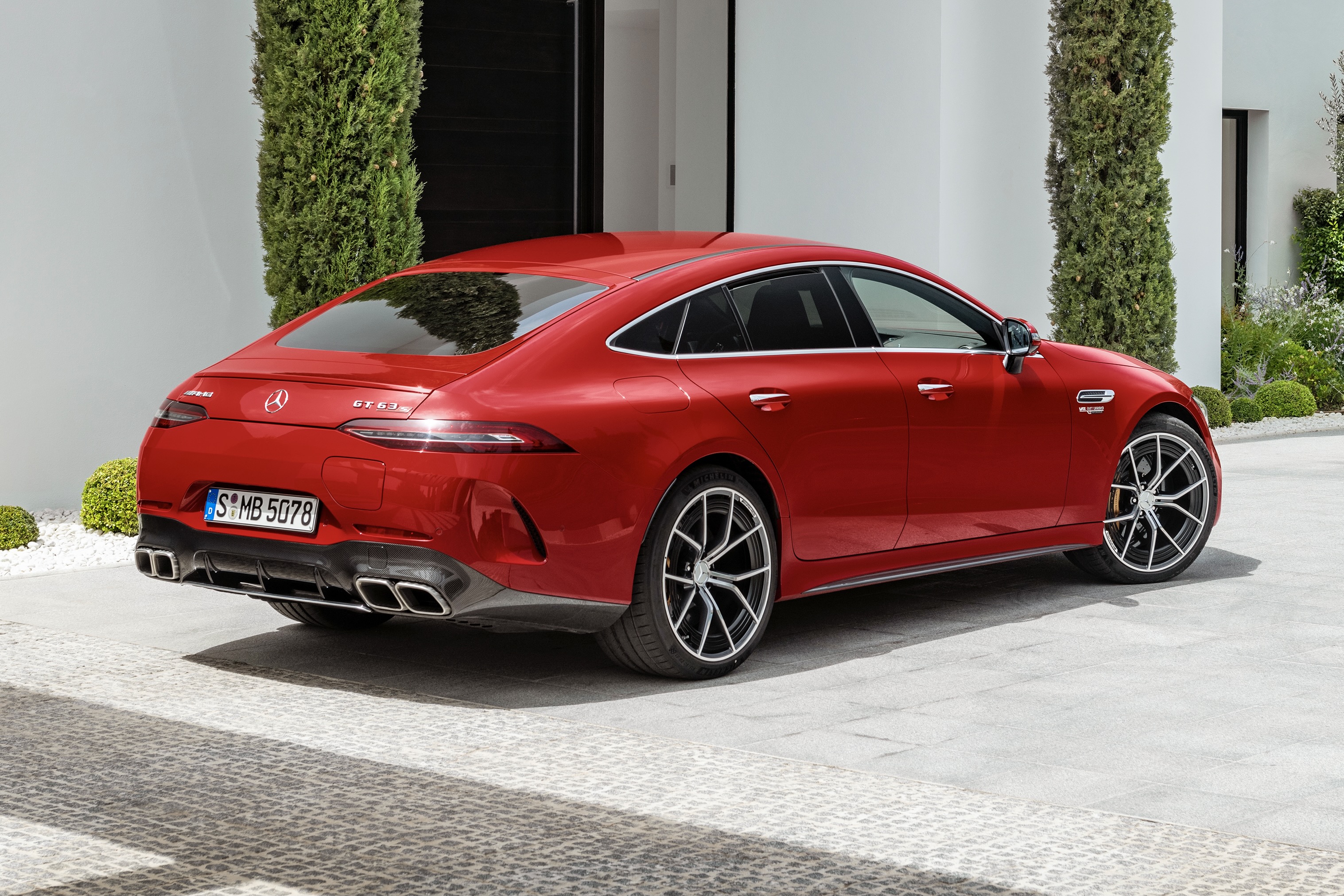
2
It’s enough to propel the four-door coupe to 100km/h from a standstill in a claimed 2.9 seconds – only bettered by the forthcoming AMG One hypercar – while the German carmaker lists a combined fuel consumption figure of 8.6L/100km. Combined emissions are 196 grams of CO2 per kilometre.
A 6.1kWh lithium-ion battery pack gives drivers up to 12 kilometres of zero-emissions driving range for speeds up to 130km/h (based on the WLTP test cycle) before the petrol engine engages.
AMG engineers worked closely with the company’s championship-winning Formula 1 team to create a light-weight battery pack, complete with direct liquid cooling for all 560 individual cells – a first for battery technology, AMG claims – allowing the system to power the electric motor repeatedly.
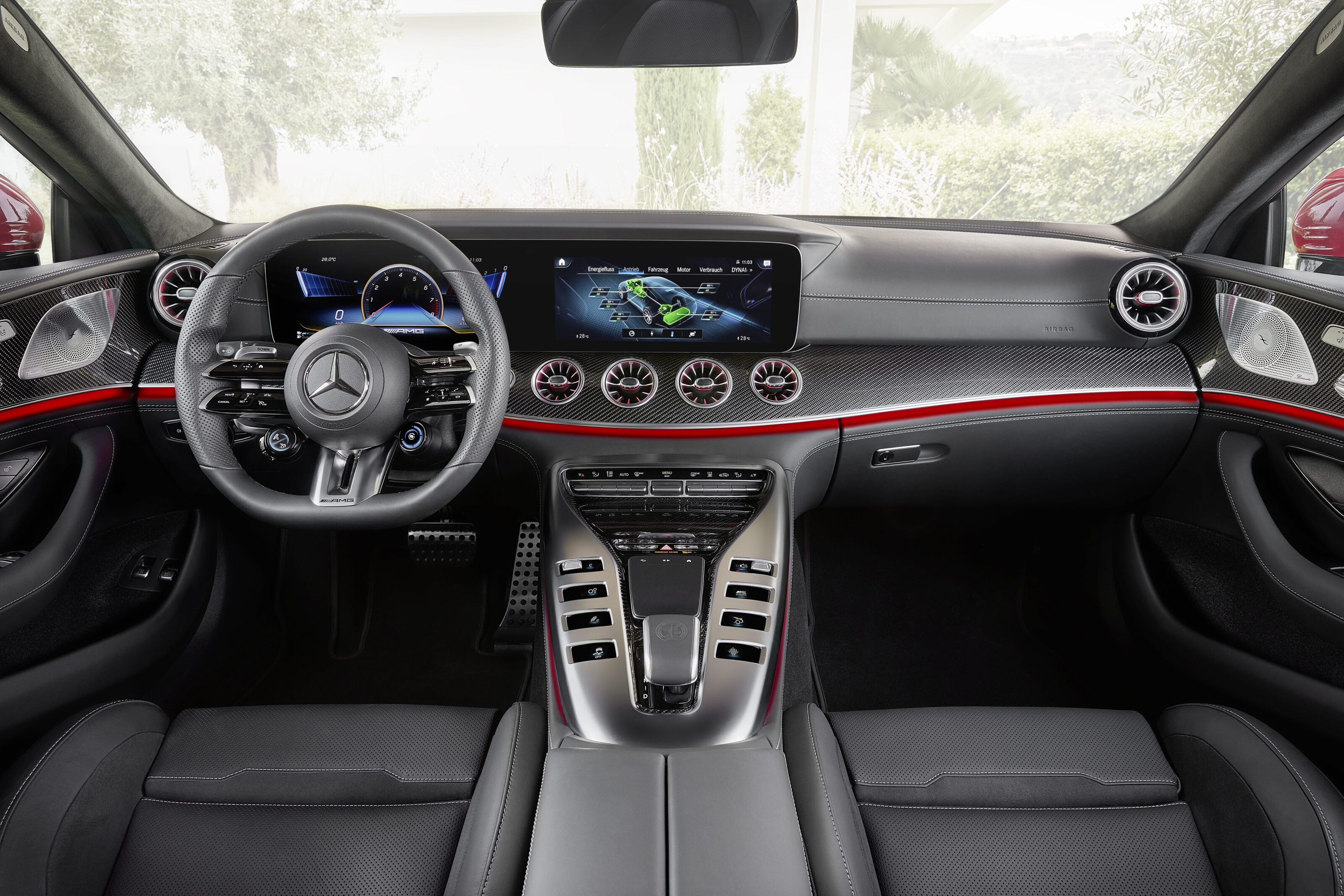
5
While the V8 engine delivers 470kW through a nine-speed automatic transmission to all four wheels, the electric motor provides a continuous 70kW through a two-speed transmission to the rear axle – with 150kW of peak output available in 10-second bursts.
Charging the battery is done through regenerative braking, or via the GT 63’s on-board 3.7kW AC charger, which can be used with a home wallbox, standard electricity socket, or at a charging station – however, DC fast charging is not available.
The electric-only driving range of 12km is far less than most plug-in hybrid models (40-80km on average), but Mercedes-AMG says the battery “is designed for fast power delivery and draw, not for the longest possible range”.
It also means the GT 63 can be driven from the garage and out of a residential area silently before the V8 comes to life.
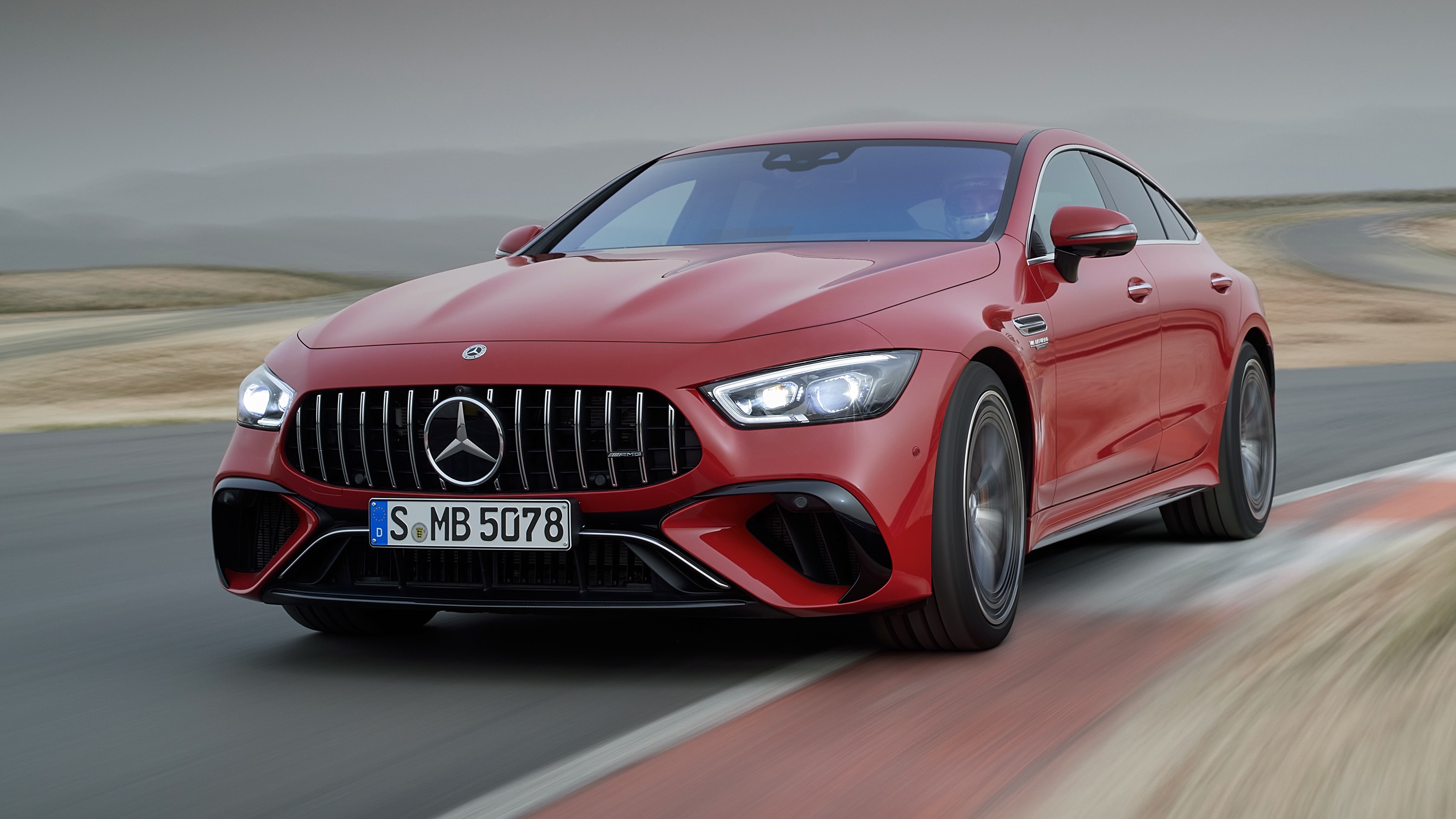
3
As per the model’s recent upgrade, the new GT gets ceramic high-performance composite brakes, AMG Ride Control+ suspension, and the company’s MBUX infotainment system.
Drivers can adjust the vehicle’s set-up from the steering wheel, allowing changes to steering and suspension, throttle response, and exhaust volume, or they can choose from six preset driving modes and one customisable option.
Local pricing has yet to be announced for the new flagship AMG GT, but buyers should expect a hike above the current range-topping model, which is currently on sale for $363,576 before on-road costs.
First deliveries of the 2022 Mercedes-AMG GT 63 S E Performance are expected to arrive in the second-half of 2022.
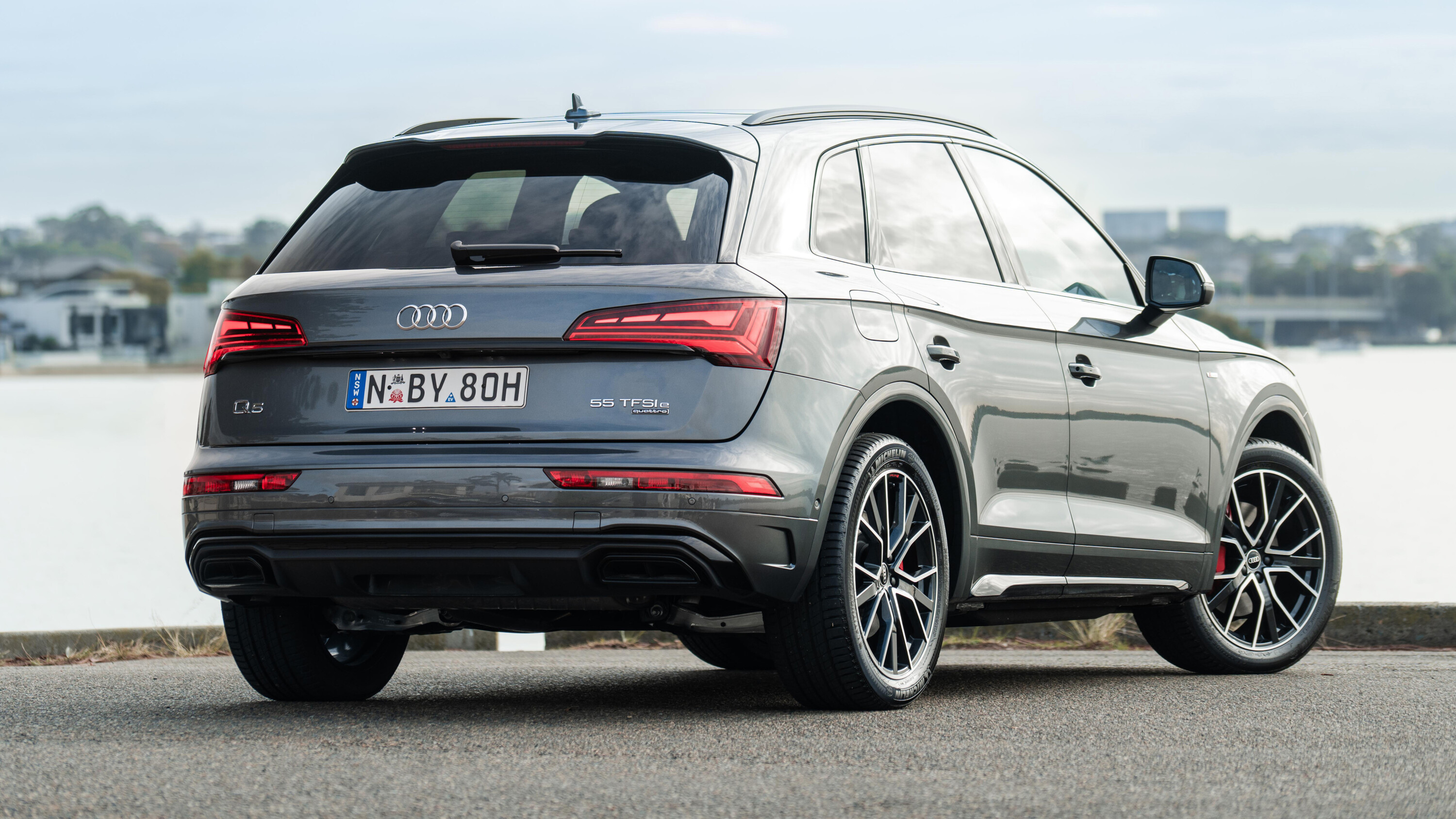
Audi has launched its Q5 55 TFSI e locally, its first PHEV since that false start with the slow-selling A3 and Q7 E-Tron models.
This time around, the brand has approached things with a clear focus on performance.
First things first: The go-fast PHEV is actually the most powerful Q5 ever, yet it’s just two-tenths of a second slower to triple figures than the top-spec SQ5 – although it’s not much cheaper than its big brother, either.
Audi opted for the more powerful of two Q5 PHEV variants available globally, positioning this model as a performance hybrid for buyers wanting the ‘best of both worlds’.
Click here for specifications and launch details of the new Audi Q5 55 TFSI e
1
JUMP AHEAD
1
Pricing and features
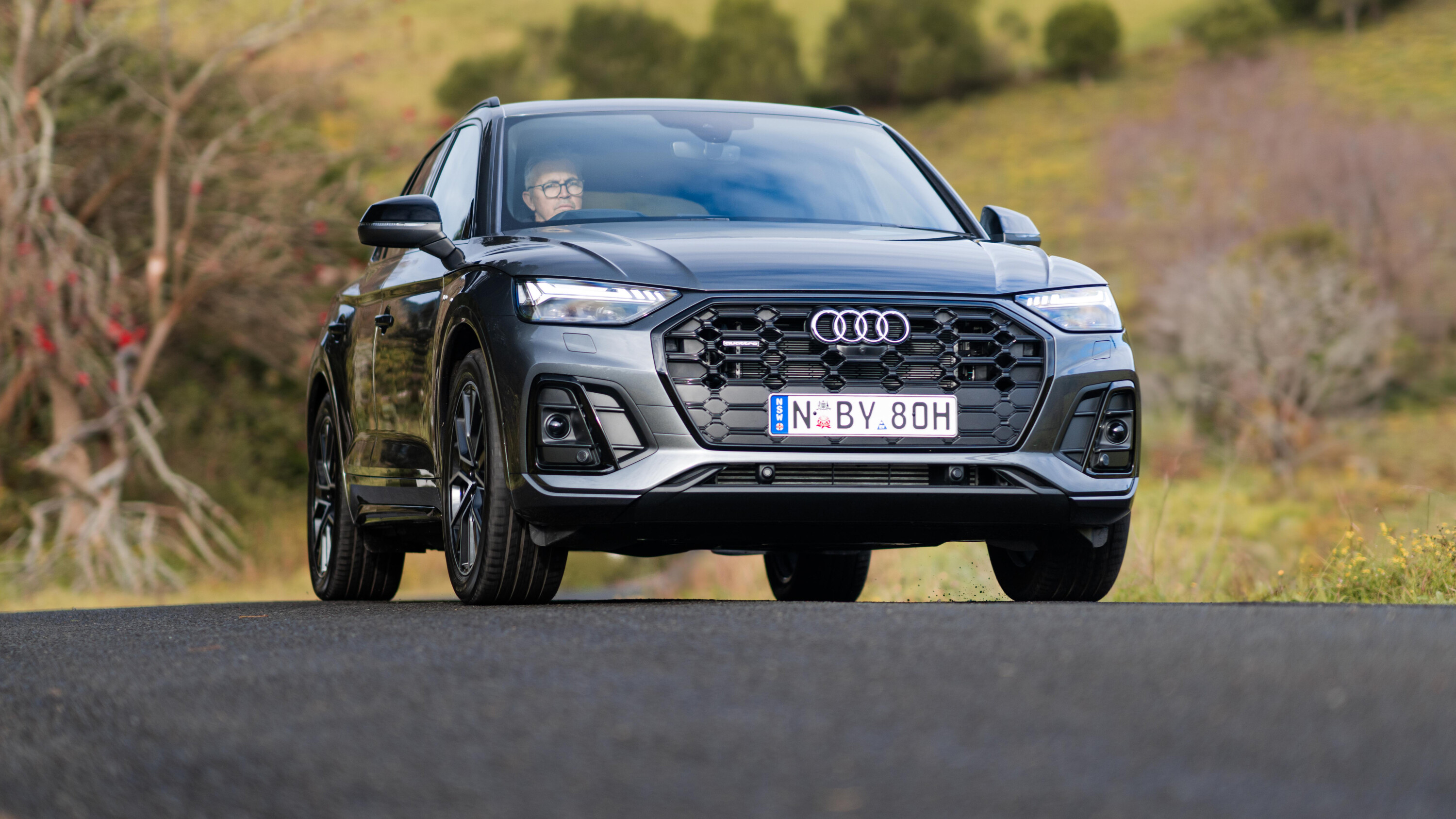
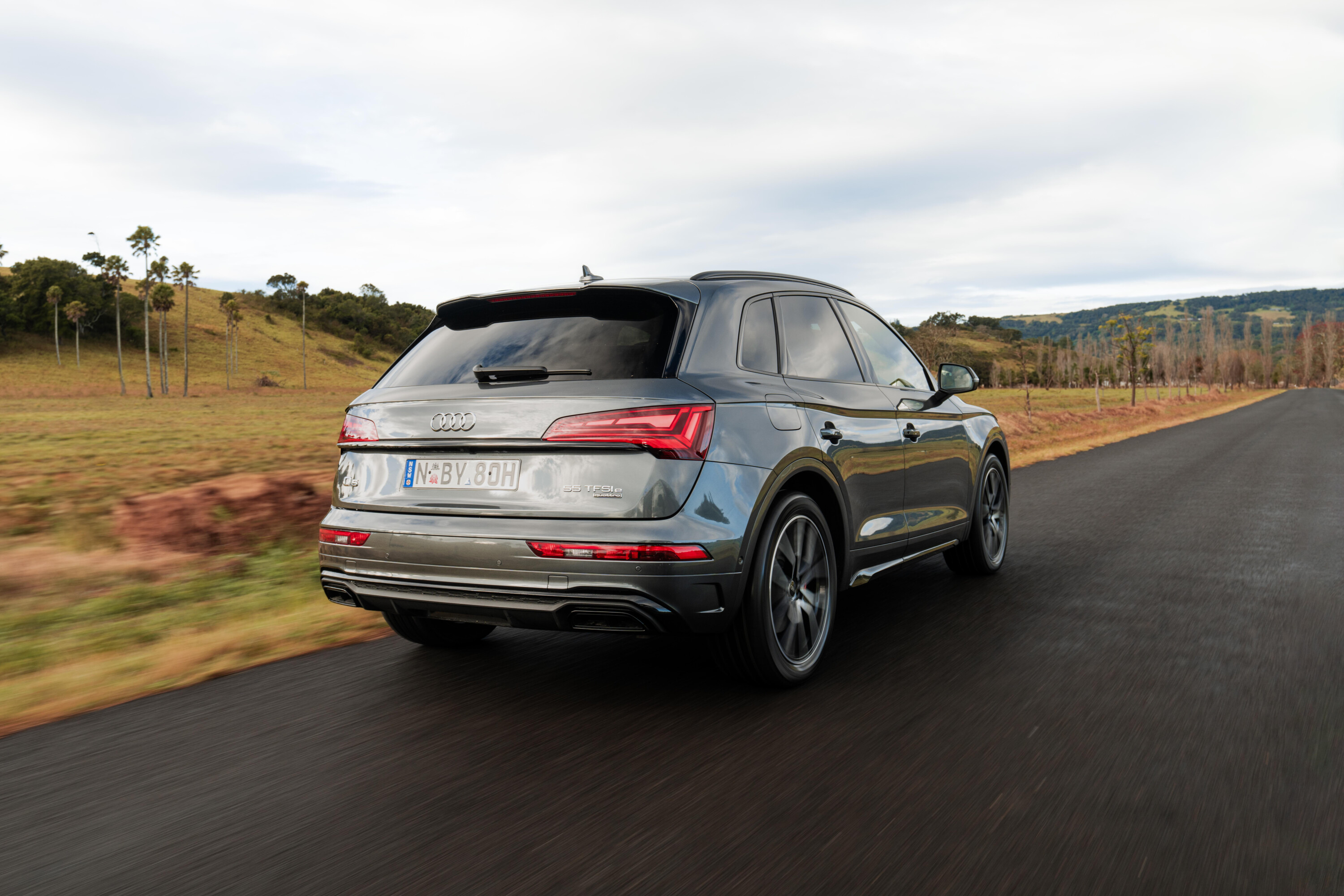
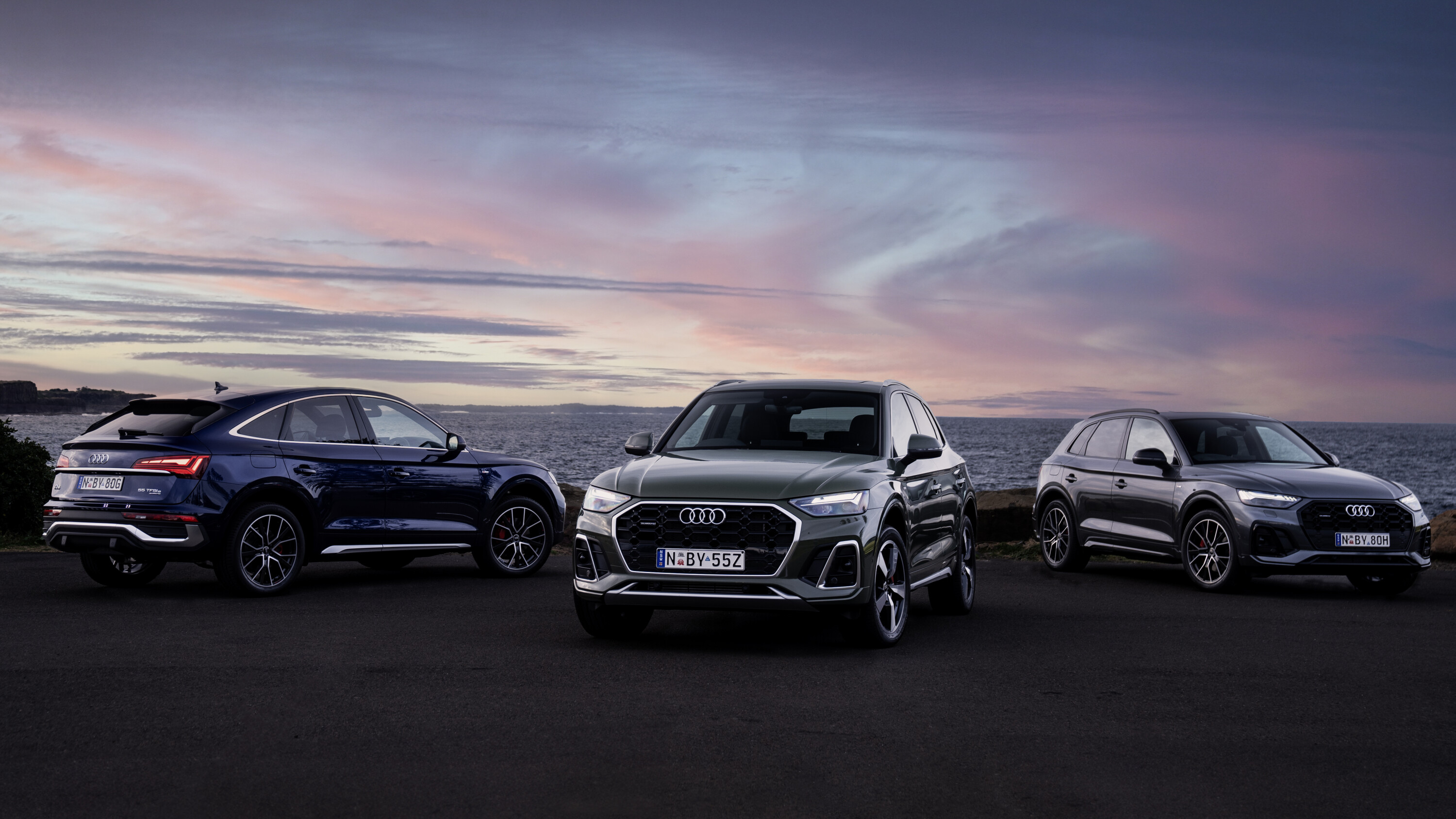
The Audi Q5 is offered in both SUV and sportback variants, with slight specification differences but identical powertrains.
Audi’s Q5 PHEV SUV starts from $102,900 before on-road costs, while the sportback is priced from $110,200, the latter scoring Matrix LED headlights, S-Line interior and Nappa leather upholstery.
Both models offer a rich array of standard inclusions, in line with their premium pricing. Goodies like Audi Sport 20-inch wheels, panoramic sunroof and S-line exterior styling all hint at their sporting potential.
1
The 2.0-litre turbo petrol engine and electric motor offer up healthy combined outputs of 270kW and 500Nm, propelling the mid-size SUV to 100km/h in 5.3 seconds.
A dedicated EV mode allows you to drive up to 55 kilometres using only the electric motor, with Audi claiming regular hybrid use will return fuel use of just 2.0L/100km.
Audi Australia offers a full five-year / unlimited-kilometre warranty on all new models.
| 2023 Audi Q5 55 TFSIe SUV equipment and features | |
|---|---|
| S-Line exterior | Ambient lighting |
| 20-inch wheels | Illuminated door sills |
| Panoramic sunroof | Audi connect plus |
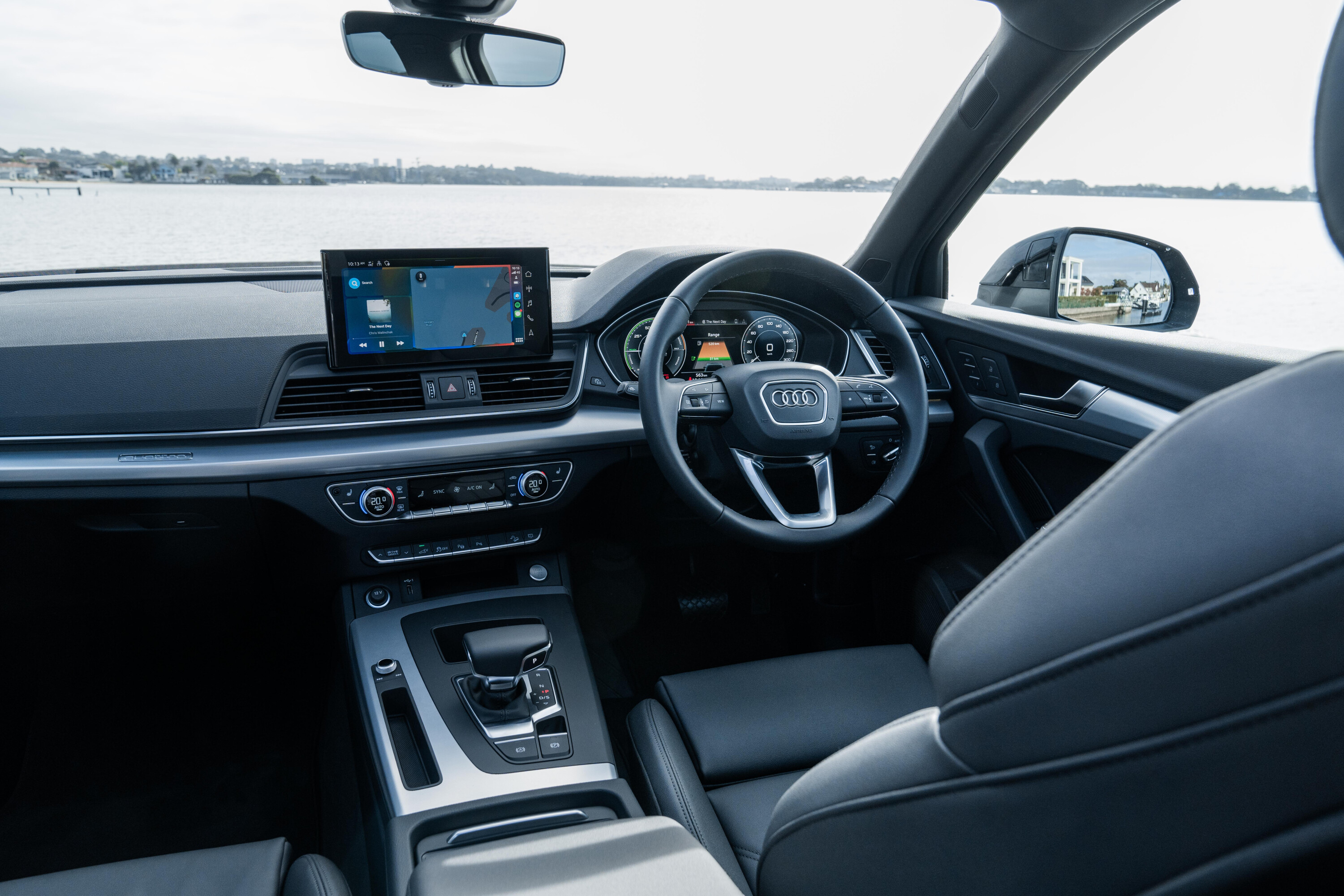
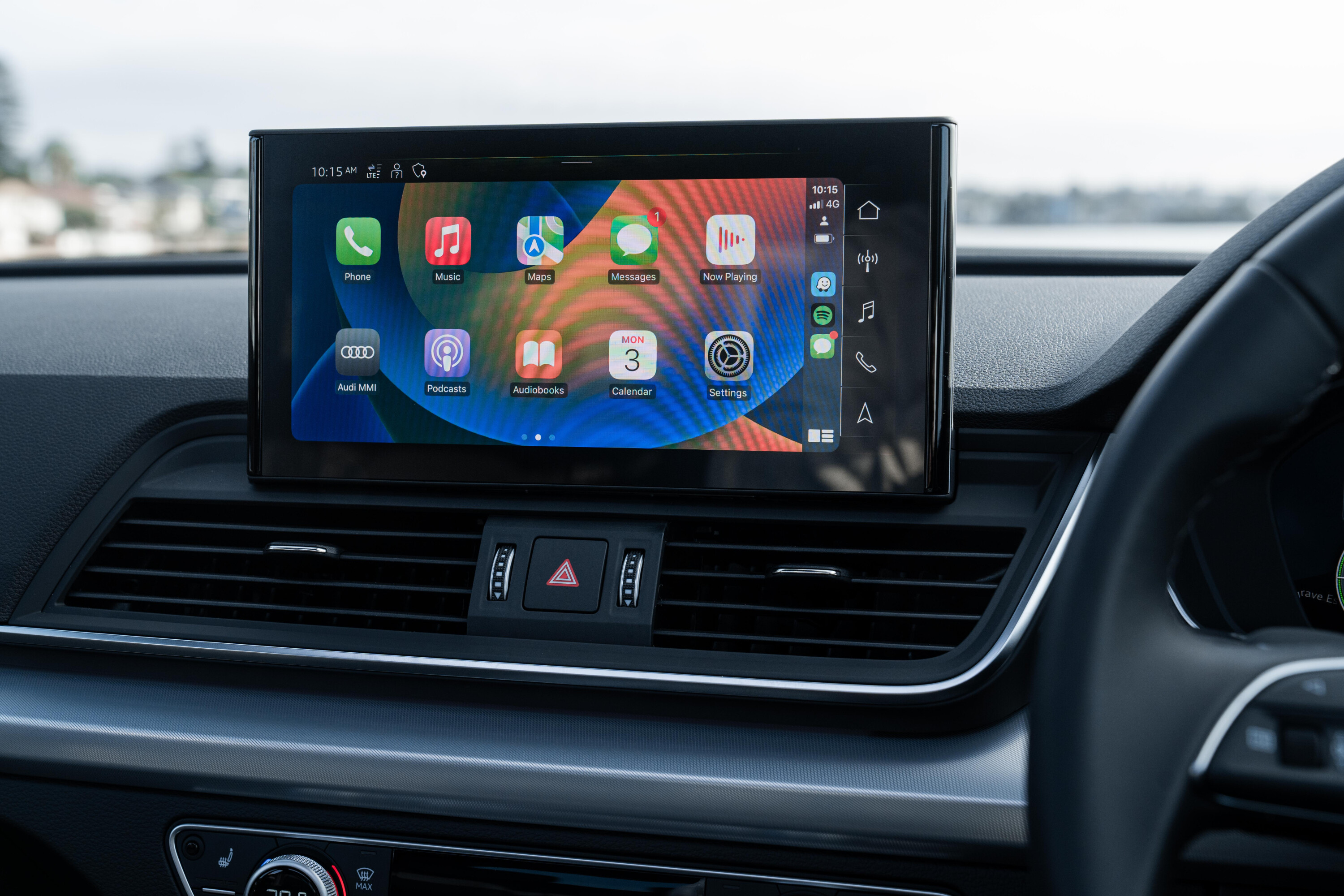
| Privacy glass | Wireless CarPlay/Android Auto |
| Red brake callipers | 10-speaker 180W sound system |
| Leather appointed upholstery | Adaptive cruise control |
| Sports front seats with memory function | Swerve/park assist |
| Three zone climate control | 360 surround view camera |
1
Safety
The Q5 range has a full five-star ANCAP safety rating, however the PHEV is yet to be rated.
Eight airbags are fitted throughout the Q5 PHEV, including front airbags for driver and passenger, side airbags for front and rear passengers, and head-level curtain airbags for front and rear occupants.
Audi’s full suite of safety and driver assistance technology is standard on this model too, with inclusions like autonomous emergency braking, pedestrian detection, lane assist, cross traffic assist and adaptive cruise.
1
On the road
Pros
- Linear power band that offers effortless pace
- Perks of an EV, with long distance hybrid capability
- Frugal sipper, even if we couldnu2019t quite get achieve the claimed 2l/100km
Cons
- Itu2019s expensive, potentially pitting it against the sportier SQ5
- May have come too late, as e-tron range grows at a faster pace to PHEV range
- A little roly-poly in corners, but only noticeable because straight-line performance is so swift
The Q5 PHEV is deceptively quick in a straight line, however when pushed in corners it leaves a little to be desired compared with the sportier SQ5.
It is, however, the most refined Q5 so far and, while expensive with its six figure asking price, it is also richly appointed. It is equal parts luxurious, efficient and engaging.
Watch this space for a more comprehensive assessment of the Q5 PHEV’s on-road capabilities as we get a proper post-launch run with the car.
Click here for more detailed expert opinions of the sportier Audi SQ5’s on-road qualities.
1
- What is a Powertrain or Drivetrain?
- Power vs torque
- Car suspension explained
- Automatic transmissions (‘gearboxes’) explained
- Chassis control systems explained
- Car vs Ute vs SUV: How the vehicle you buy should guide the way you drive
While mild hybrids are rather common across the SUV segment, plug-in hybrids aren’t as plentiful.
Add to that the Audi Q5’s premium positioning and it narrows down the field considerably. However, there are still a few standout premium SUV options, with the category lending itself well to the PHEV format.
EV-assisted rivals worth considering
- Volvo XC60 T8 Recharge ($101,990)
- Land Rover Discovery Sport PHEV ($103,450 – coming)
- BMW X5 xDrive50e ($149,900)
Something a little more affordable, perhaps? ?
Should I put the Q5 55 TFSI e plug-in hybrid EV on my shortlist?
The Q5 PHEV comes in at a high price point but, given its extensive list of standard inclusions and its performance capabilities, it does offer value for the right buyer.
If you already own an electric vehicle but want a second, more versatile all-rounder the Q5 55 TFSI e might just be the SUV for you.
After all, it will still embarrass plenty of performance cars off the line, while returning sub-five litres per 100 kilometres of fuel use.
The best of both worlds? Could well be…
2
MORE
Everything Audi
MORE
PHEV and Hybrid Cars
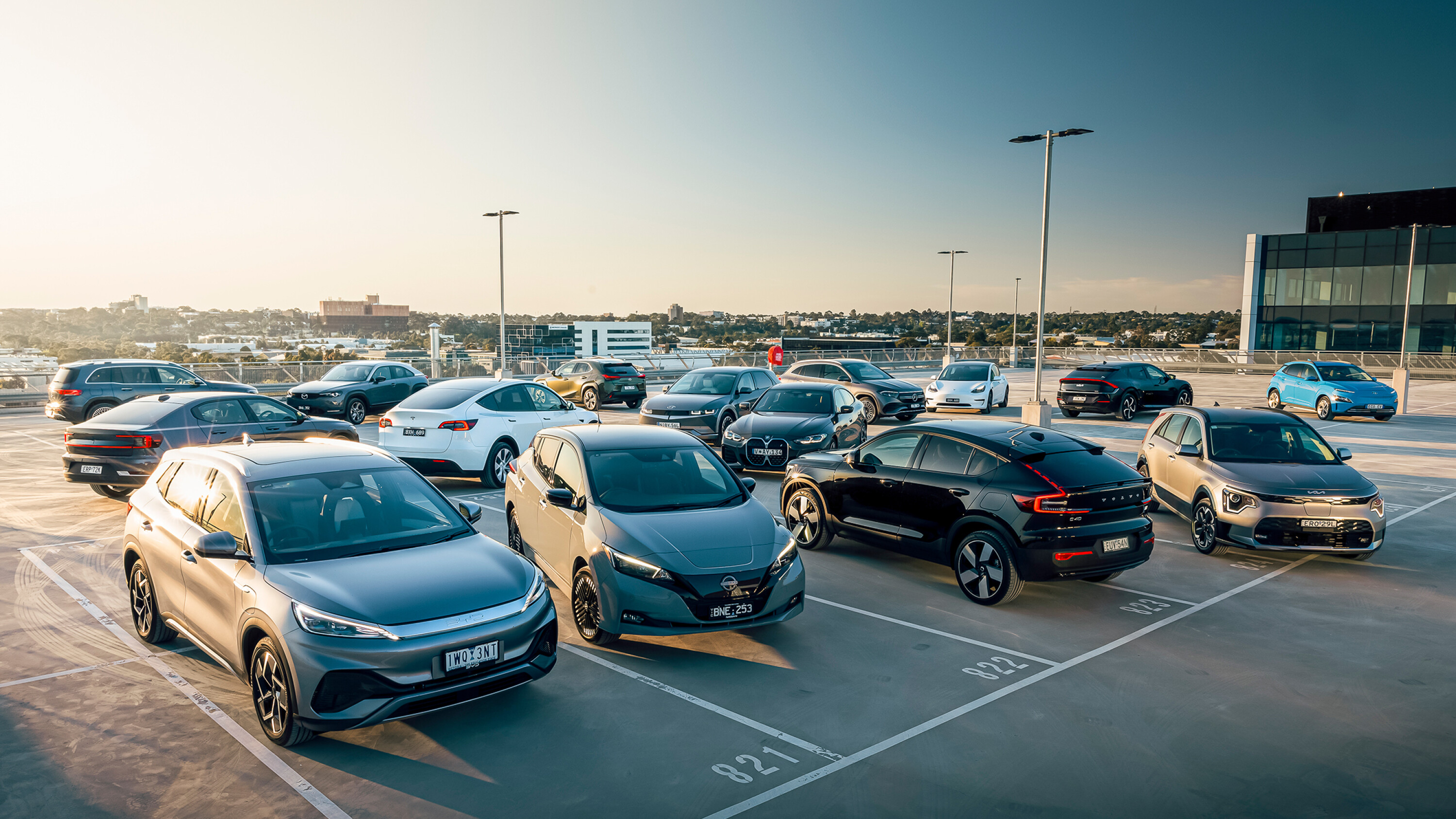
Last year, a total of 33,410 new pure-electric vehicles were sold in Australia. A considerable number for a nascent technology, but in a market that hit 1,081,429 sales overall that equated to just over three percent of the total mix.
However, considering just 5149 EVs rolled out of showrooms the year prior*, that represented a 549-per cent explosion in demand for battery-electric vehicles in 2022.
Is our renewable energy sector advanced enough to support EV? No, but the government has got a plan to reach a certain percentage by 2030
Editor’s note
*Tesla – Australia’s biggest EV seller – only began reporting its sales in April 2022
1
That pace has continued with just under 50 thousand EVs sold so far this year, with year-on-year growth currently measuring in at 385 per cent.
A tripling of sales volume is nothing to be sneezed at, and right now, EV sales account for 7.3 per cent of all cars sold in Australia. Aussies are clearly warming to the idea of parking something electric in their driveway.
But some in the industry aren’t expecting this enthusiasm to sustain itself long – the trendline is forecast to flatten once demand from early adopters is satisfied, and Mazda’s local boss believes it’ll be a while before EVs become the dominant choice in Australia.
1
“Globally in major markets, the transition to EV is well and truly started – there’s no doubt – and Mazda has made its statements and shared its plans from now until 2030,” said Mazda Australia’s managing director Vinesh Bhindi to Wheels.
“But if I bring the focus back to local conditions, [industry monitor] VFACTS is showing about eight per cent of new car sales are EV, and of that eight percent Tesla captures about 80 percent of that business – but that is evolving.”
According to Bhindi, electric vehicles still aren’t out of the early-adopter phase. With limited choice of product and high prices of entry even for the more basic and range-limited options, it’s not hard to understand why.
“In any market, you have a percentage of consumers who are early adopters. Is the infrastructure as advanced? I’d say, probably not – in fact, I’d say definitely not, but it’s getting there.
“Is our renewable energy sector advanced enough to support EV? No, but the government has got a plan to reach a certain percentage by 2030.”
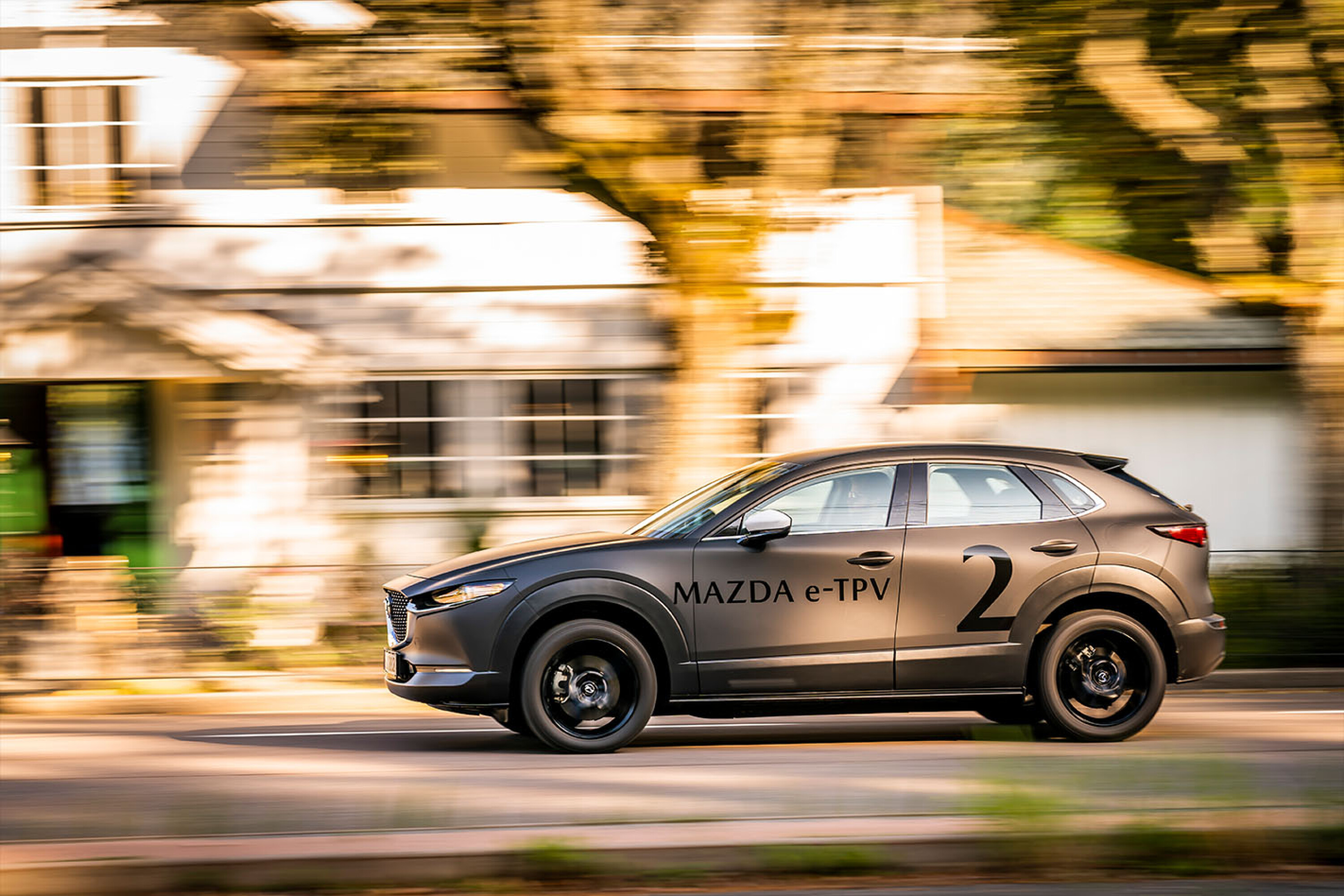
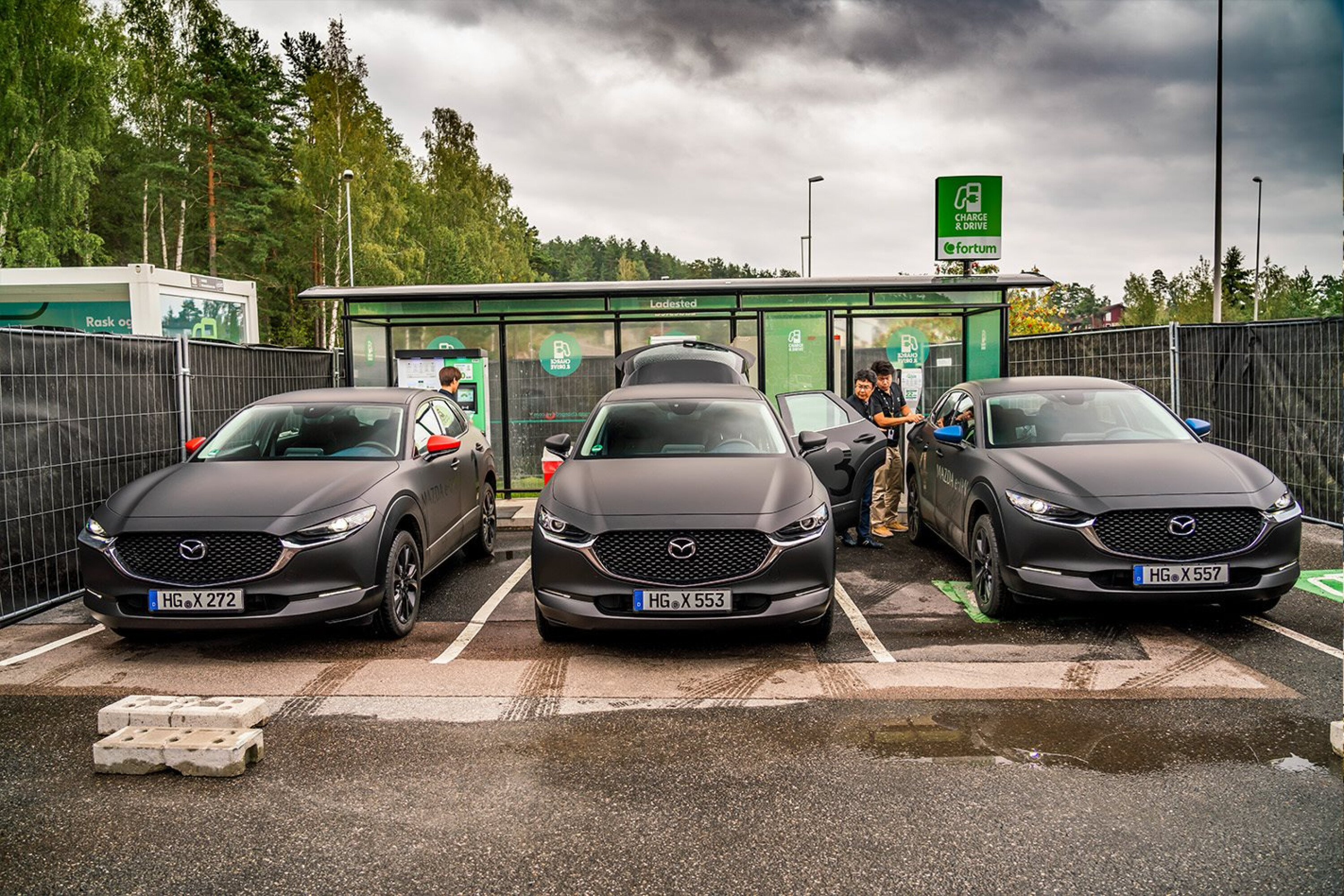
Unlike some automakers, Mazda has so far only made tentative steps into the world of electrification. Its first fully-electric vehicle, the MX-30 Electric E35, is a variant of the combustion-powered MX-30 family and offers a range claim of just 224km per charge – around half of most new EVs. Mazda is currently developing a new scalable platform for its next generation of electric vehicles, but the first product of that effort won’t be seen until the latter half of the decade.
Asked when Mazda Australia will have its own pure EV products to offer the masses, Bhindi said “[we’ll have ours] well before EVs become the majority”. Mazda is playing a typically Japanese strategy – slow, but carefully considered.
1
“We think our multi-solution approach is the best path forward,” Bhindi continued. “No country has gone from internal combustion engines to EV in one step, there is a transition phase. In terms of where Mazda is, we’ve got a three-phase strategy – between now and 2024, Mazda is working on phase one, which is getting the experience and getting the know-how for batteries, battery supply, etc.
“Then, between 2025 and 2027 we’ll see the first of our EV products starting to appear, and then between 2027 and 2030 there’ll be our full-fledged EV deployment using that scalable architecture that Mazda has.”
Reading between the lines, Mazda isn’t anticipating the recent surge in EV demand to continue unabated. That said, the EV sales chart isn’t going to flatline either. The steady influx of new EVs, a progressive reduction in the price of entry, and the spread of charging infrastructure and greener grids will keep EV market share on an upward march – just don’t expect that trendline to be anywhere near as steep as what we’ve seen since 2021
MORE
Everything Mazda
MORE
VFACTS
The original BMW M2 was an absolute smash hit. Small, punchy and relatively affordable, it was also the best-selling M car ever thanks to 60,000+ sales over its seven-year lifecycle.
But the real magic was in how it drove. At a time when the iconic M3 and M4 lost their way a little, the M2’s gutsy, rear-driven dynamics, compact footprint and taut, perfectly proportioned bodywork embodied everything we’d come to love (and miss) from BMW M.
All of which adds a layer of trepidation to the arrival of this new, second-generation version.
1
Now bigger, heavier and more expensive than before, the risk is the M2 has lost some of the magic that pegged the original as a future modern classic.
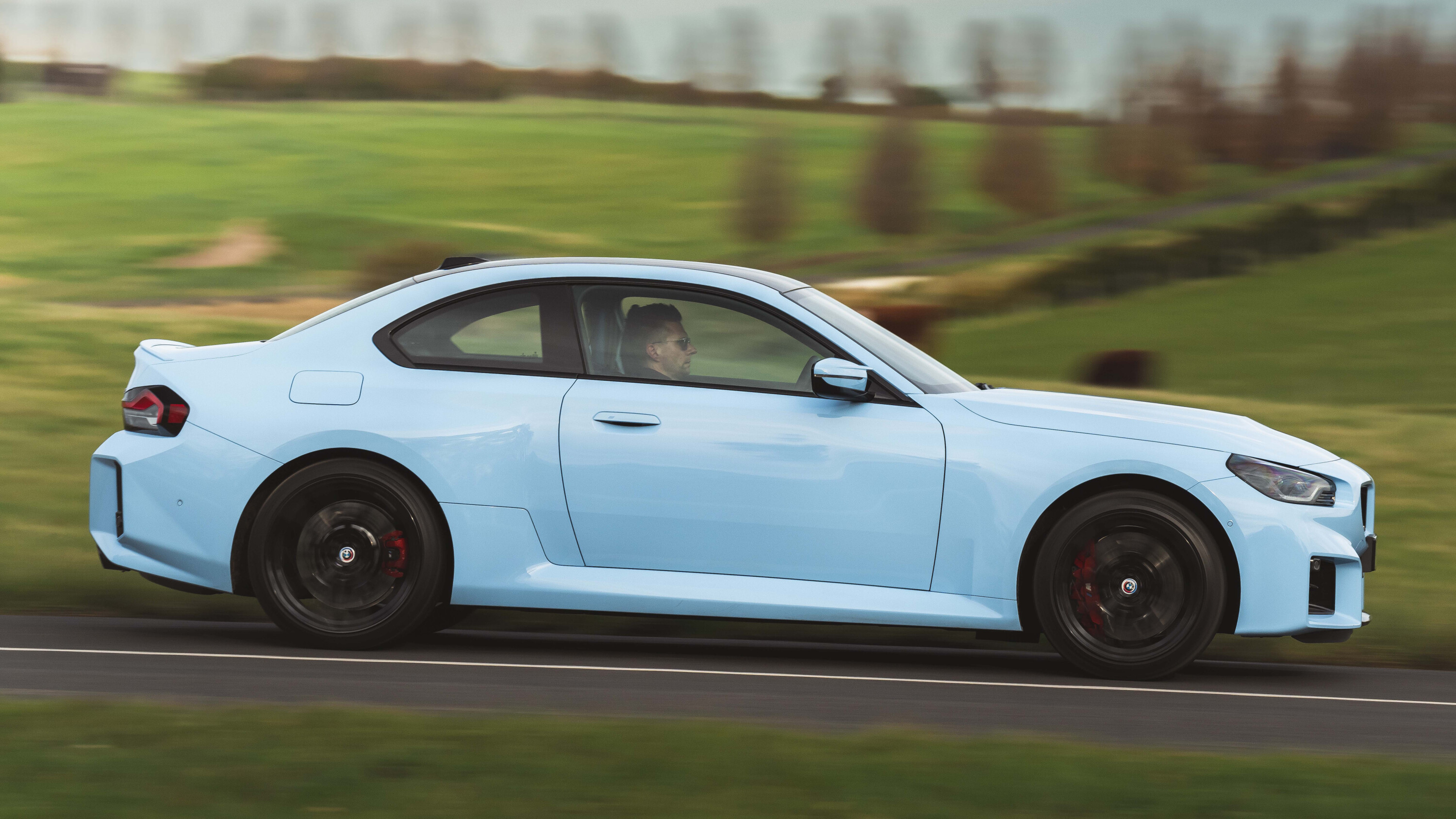
But fear not, for while the M2’s flavour has changed slightly, its core greatness remains. This is still a terrifically engaging sports coupe, only it’s now roomier, quieter, more predictable to drive and armed with a higher quality cabin.
Question is, if you’re a current M2 owner, should you consider upgrading? As you’ll see, that’s a curlier one to answer…
1
JUMP AHEAD
- How much is it and what do you get?
- How do rivals compare on value?
- Interior space, comfort and storage
- What’s it like to drive?
- How much fuel does the BMW M2 use?
- How safe is the BMW M2?
- VERDICT
- Specifications
How much is it and what do you get?
The M2 is still the most affordable dedicated M car you can buy.
Priced at $121,700 (before on-road costs) with either an eight-speed automatic or a six-speed manual for no additional cost, the M2 is $44,800 less than an M4 and $39,600 cheaper than a base M3.
The flip side to those sums is that the M2 is also now more expensive than it’s ever been. Before it went off sale, you could snaffle up a first-gen M2 Competition for $102,900, meaning this new model is now $18,800 pricer. Damn you inflation!
1
The good news is that you’re gaining a whole lot of additional performance for your cash.
Now built on BMW’s modular CLAR architecture for the first time, this fresh M2 – known as G87 for the model code fanatics – is essentially a slightly less powerful, short-wheelbase M4.
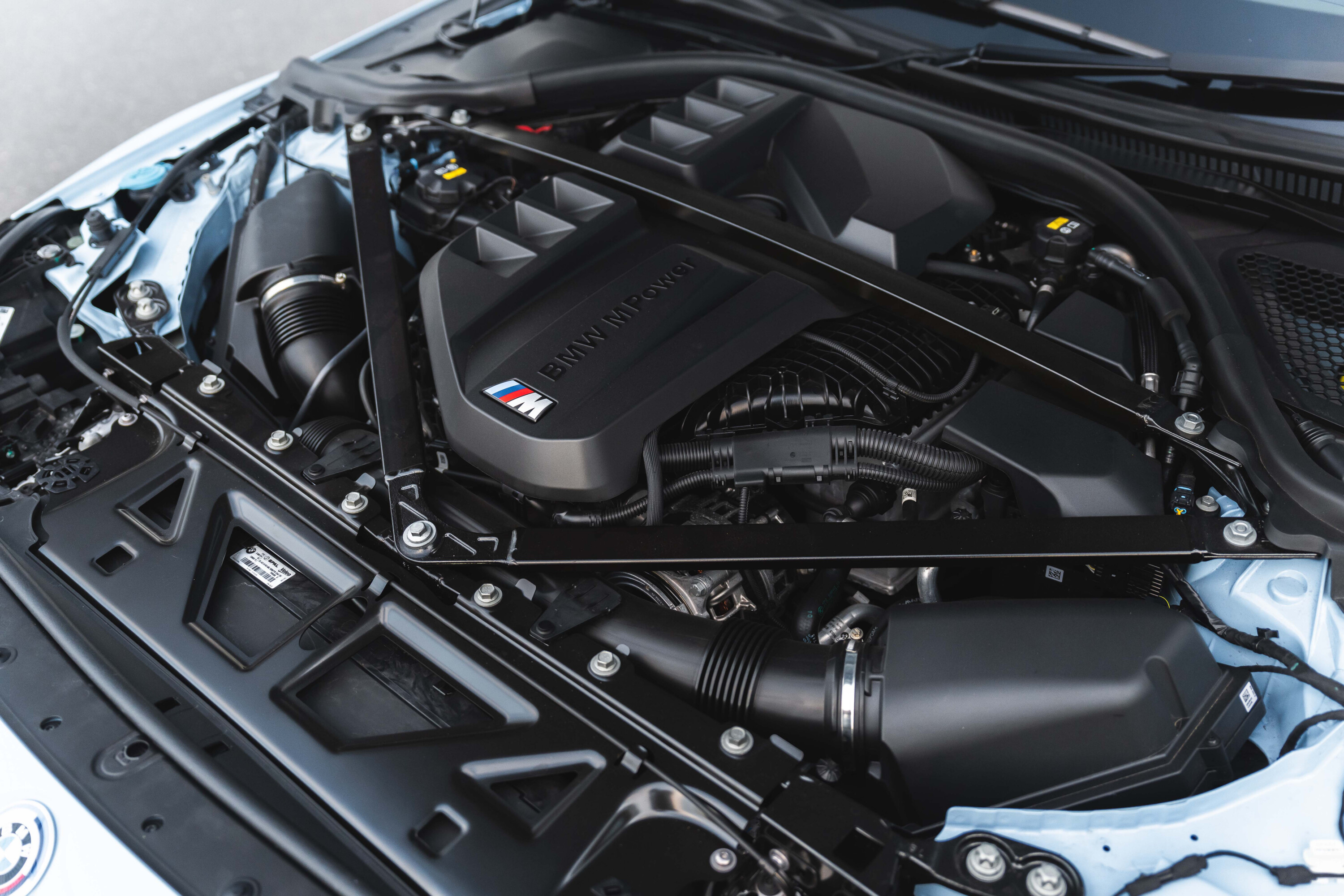
The pair share the same platform, the same suspension hardware, exactly the same track widths and the same S58 3.0-litre straight six, which in the M2 develops a healthy 338kW/550Nm. That makes this new ‘base’ M2 even more powerful than the previous M2 Competition and halo M2 CS which had 302kW/410Nm and 331kW/550Nm respectively.
2
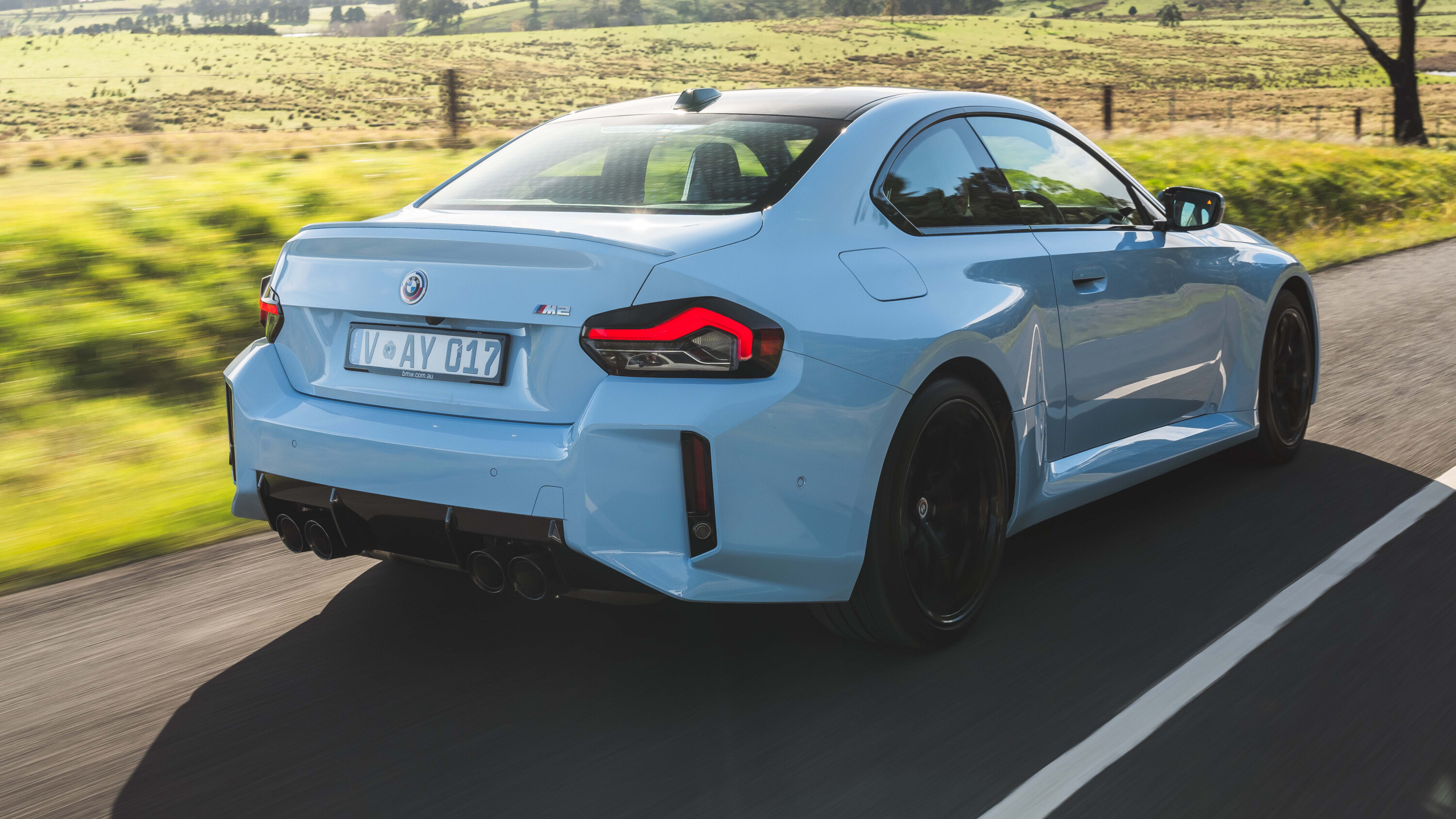
All that grunt is moving a significantly bigger car, however. At almost 4.6m long, this new M2 is 119mm longer, 16mm wider and 7mm lower than the original.
Its wheelbase has also grown by a substantial 54mm, which has quelled the original’s feisty and snatchy rear-end a touch, but the number that’s grown the most is weight. Throw the new M2 onto the scales and you’ll see a readout of 1725kg, meaning M’s smallest car is now 175kg heavier than before. For perspective, that’s exactly the same weight as a base M4!
At least the extra heft hasn’t blunted the M2’s straight-line performance. Auto versions can hit 0-100km/h in 4.1sec while the manual is two-tenths slower at 4.3sec. That’s lineball with an M4 and first-gen M2.
2
Moving to the M4’s platform has also brought a host of other additional goodies previously not available on the M2.
Adaptive dampers, for example, are now included, and the M2 now runs exactly the same staggered wheel and tyre package as an M3 Competition – 275/35 ZR19 Michelin Pilot Sport 4S rubber up front and 285/30 ZR20 out back.
The braking hardware is also identical to the M3 Comp, with the M2 using 380mm ventilated/perforated front discs clamped by six-piston calipers.
1
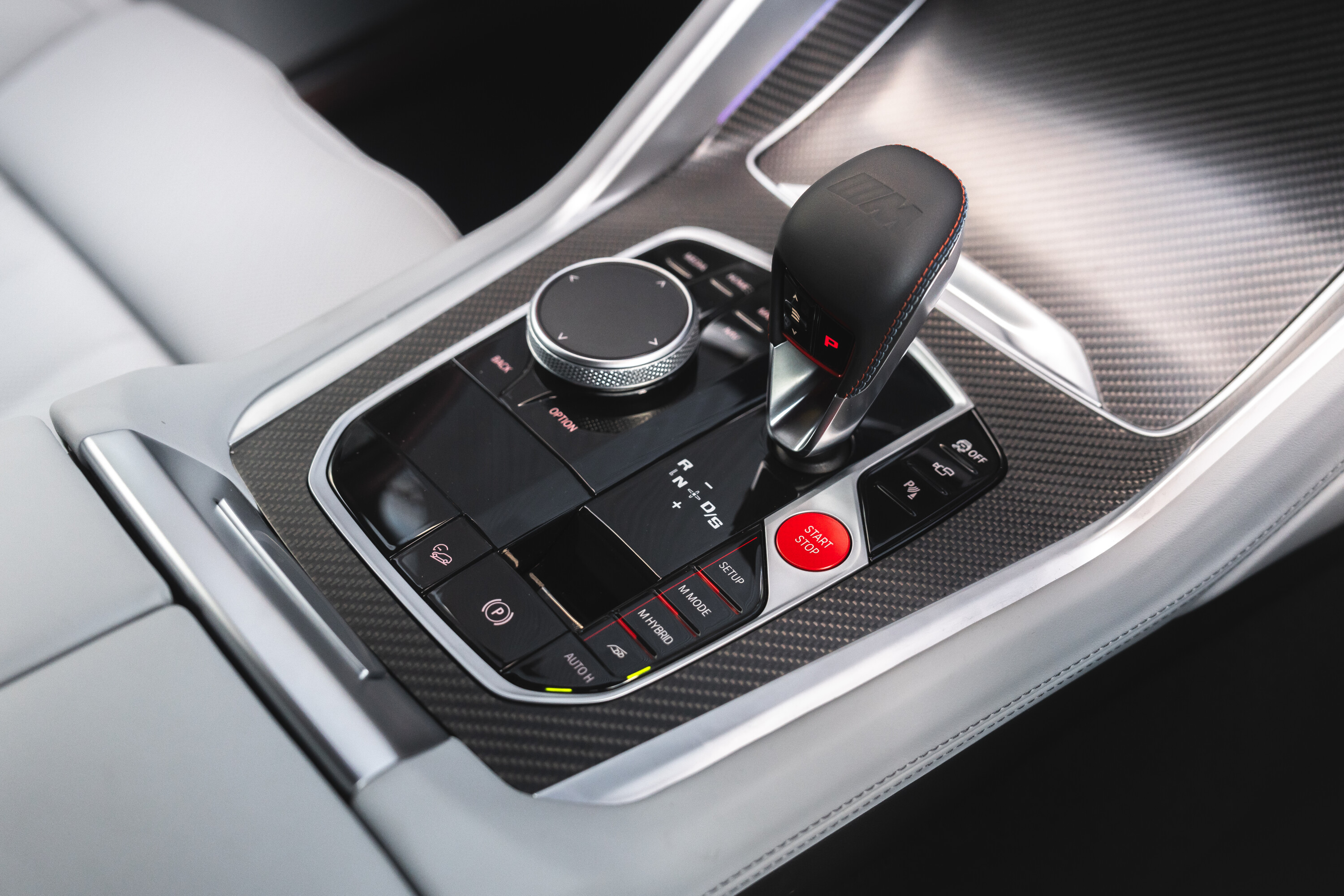
You also gain two settings for the feel of the brake pedal, accessed through the same densely configurable drive mode buttons on the centre console as you get in the M3/M4/XM.
A carbon-fibre roof is now standard on all Aussie M2s, which helps to save 6kg and lower the centre of gravity, with BMW confirming the M2 has a 50:50 weight distribution.
Combine it all and there’s no escaping the new M2 is now a much more serious proposition and is, to all intents and purposes, an ‘M4-lite’.
1
How do rivals compare on value?
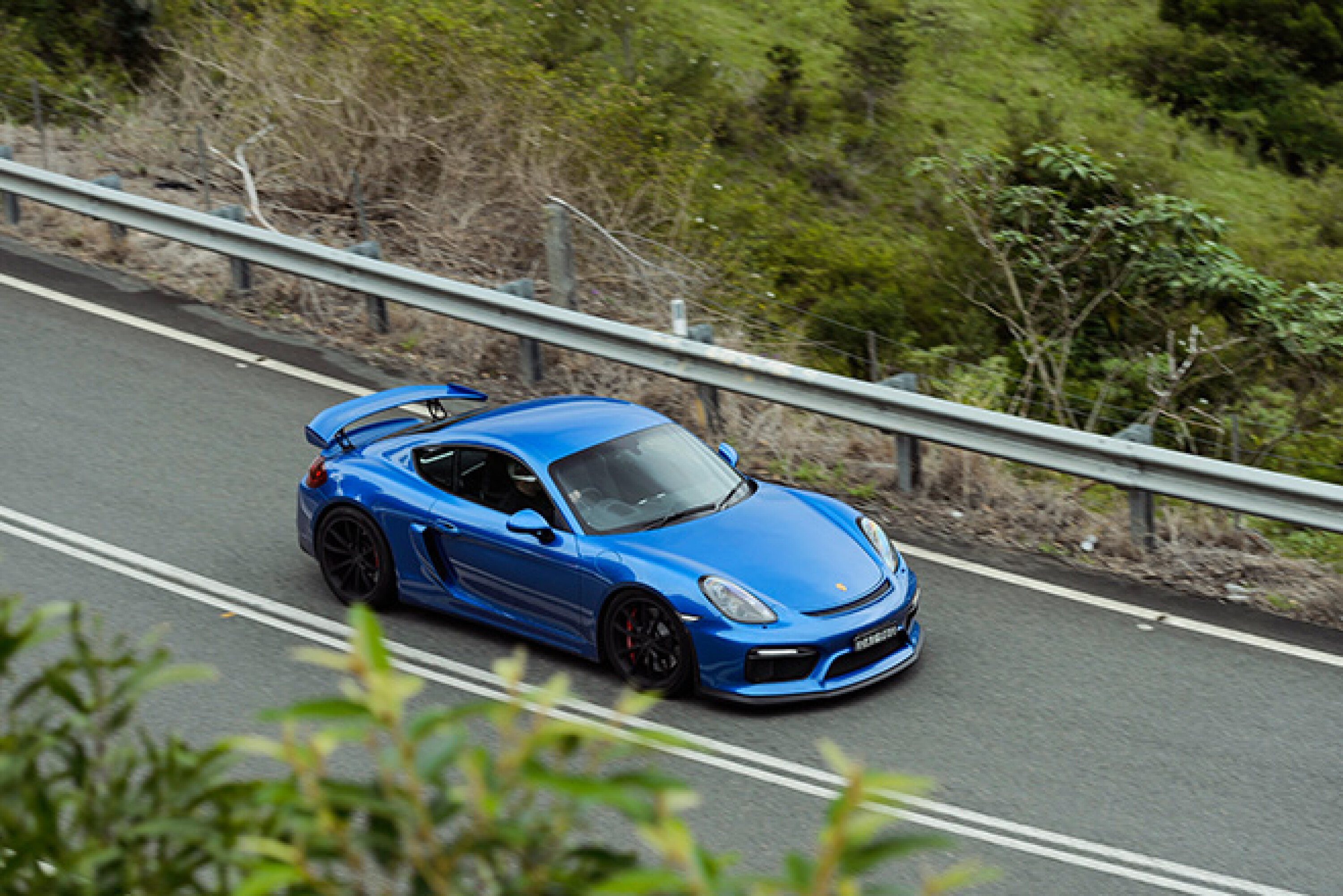
Increasing the M2’s price has put it firmly in the crosshairs of one of the performance world’s heaviest hitters: the Porsche Cayman.
At $132,500 before on-road costs, the Porsche is more expensive but it’s also a dedicated sports car, rather than a modified production car, and it uses a mid-engined layout for sharper handling and greater balance.
Plus, it’s a whopping 400kg lighter. It can’t match the M2 for grunt, though, with its 2.0-litre four-cylinder engine making ‘just’ 220kW/380Nm.
1
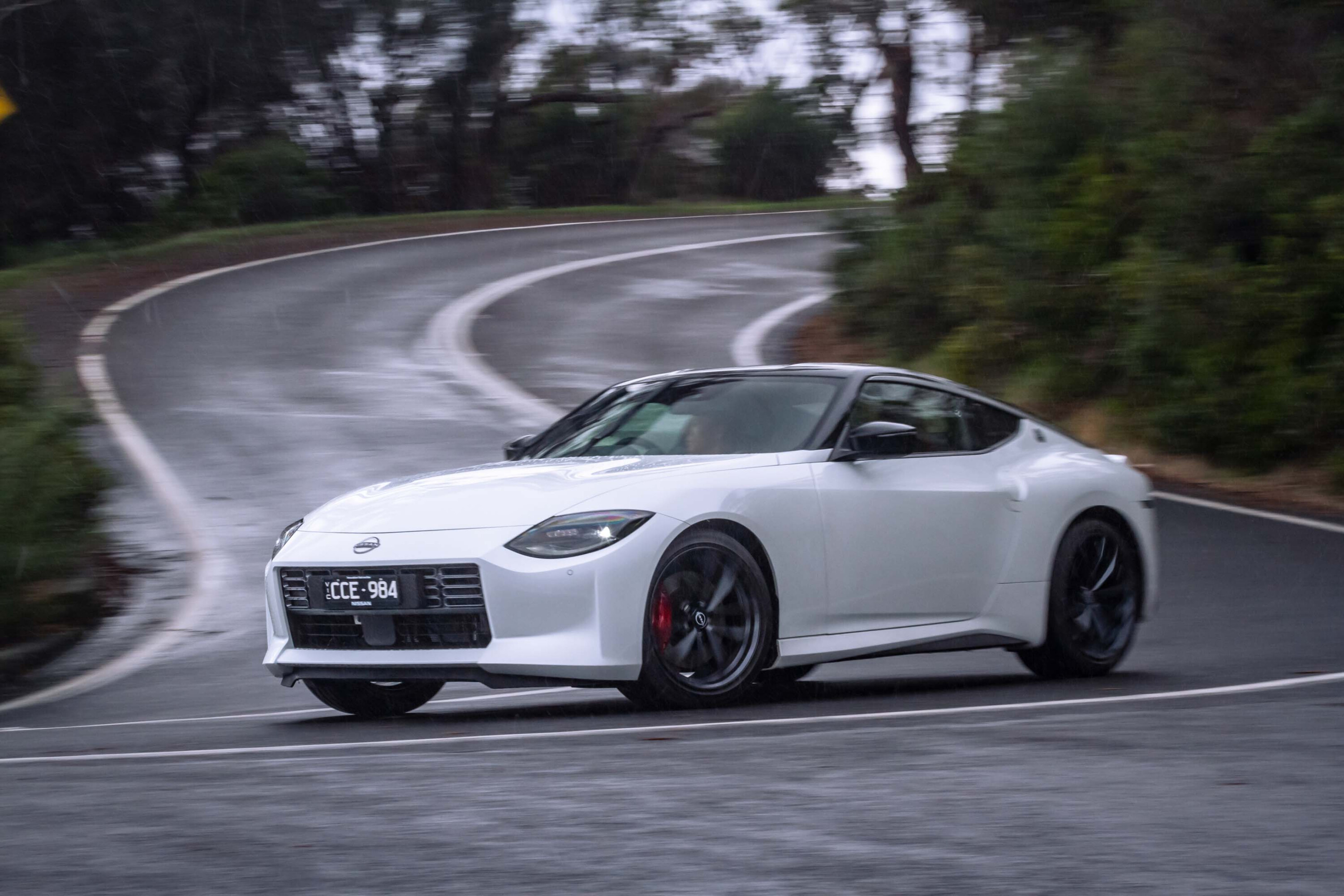
Other rivals to consider are the Toyota Supra GTS ($97,380), which ironically has a BMW six-cylinder engine and a lot of BMW in the cabin, and the Nissan Z Proto ($80,700).
A Ford Mustang GT ($64,412) is also a cut-price alternative and its V8 character, rear-driven layout and manual option make it an intriguing alternative for half the price of an M2.
Two final rivals you should consider if shopping at the M2’s price point are the Mercedes-AMG A45 S ($106,90) and Audi RS3 ($92,369). Neither can match the BMW for traditional rear-drive thrills, but both are cheaper, have an extra set of doors and are some of the quickest real-world performance cars you can currently buy.
All the above prices exclude on-road costs.
1
Interior space, comfort and storage
A big benefit of moving to BMW’s CLAR architecture isn’t just a big boost in cabin space but also a substantial lift in quality and cabin tech.
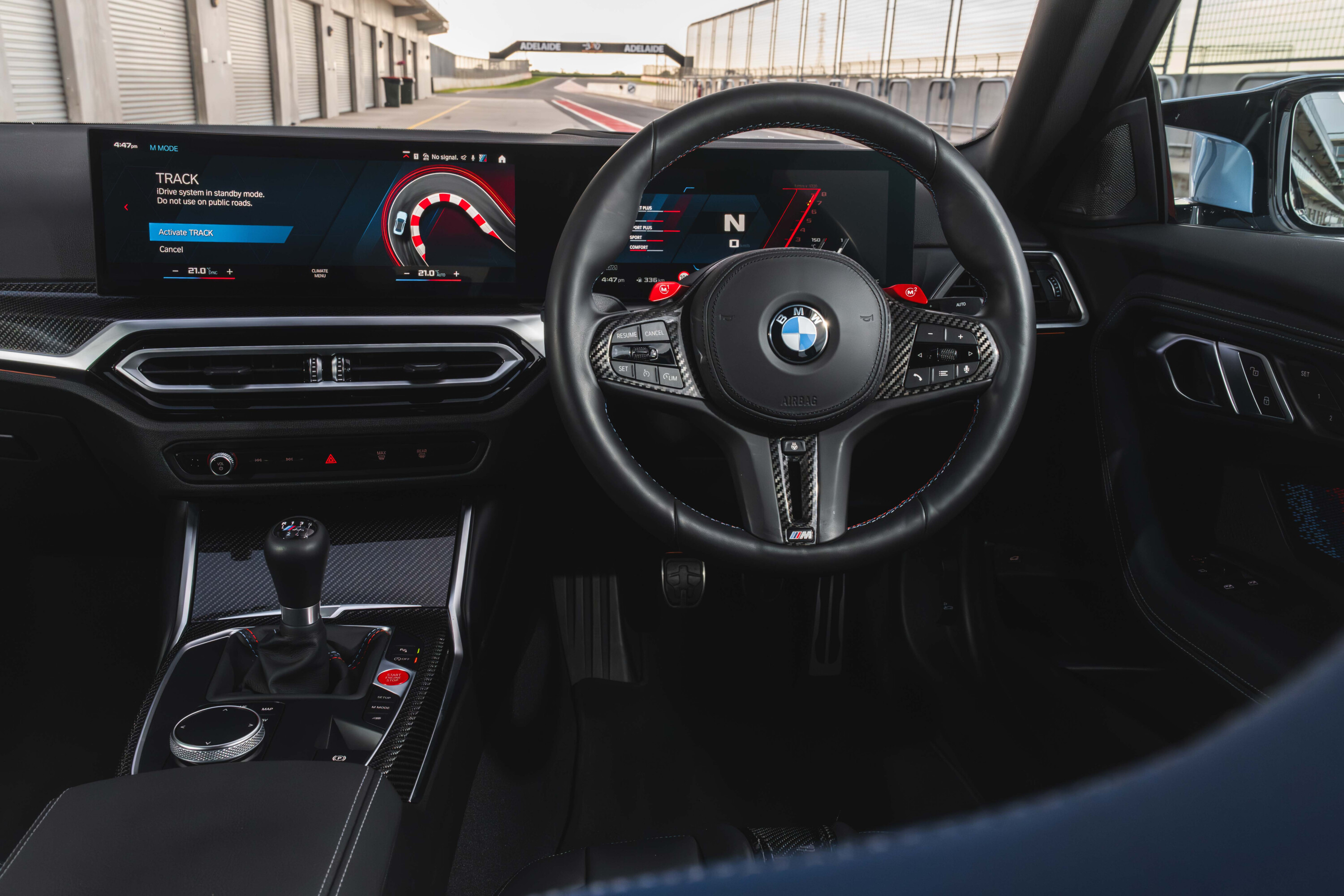
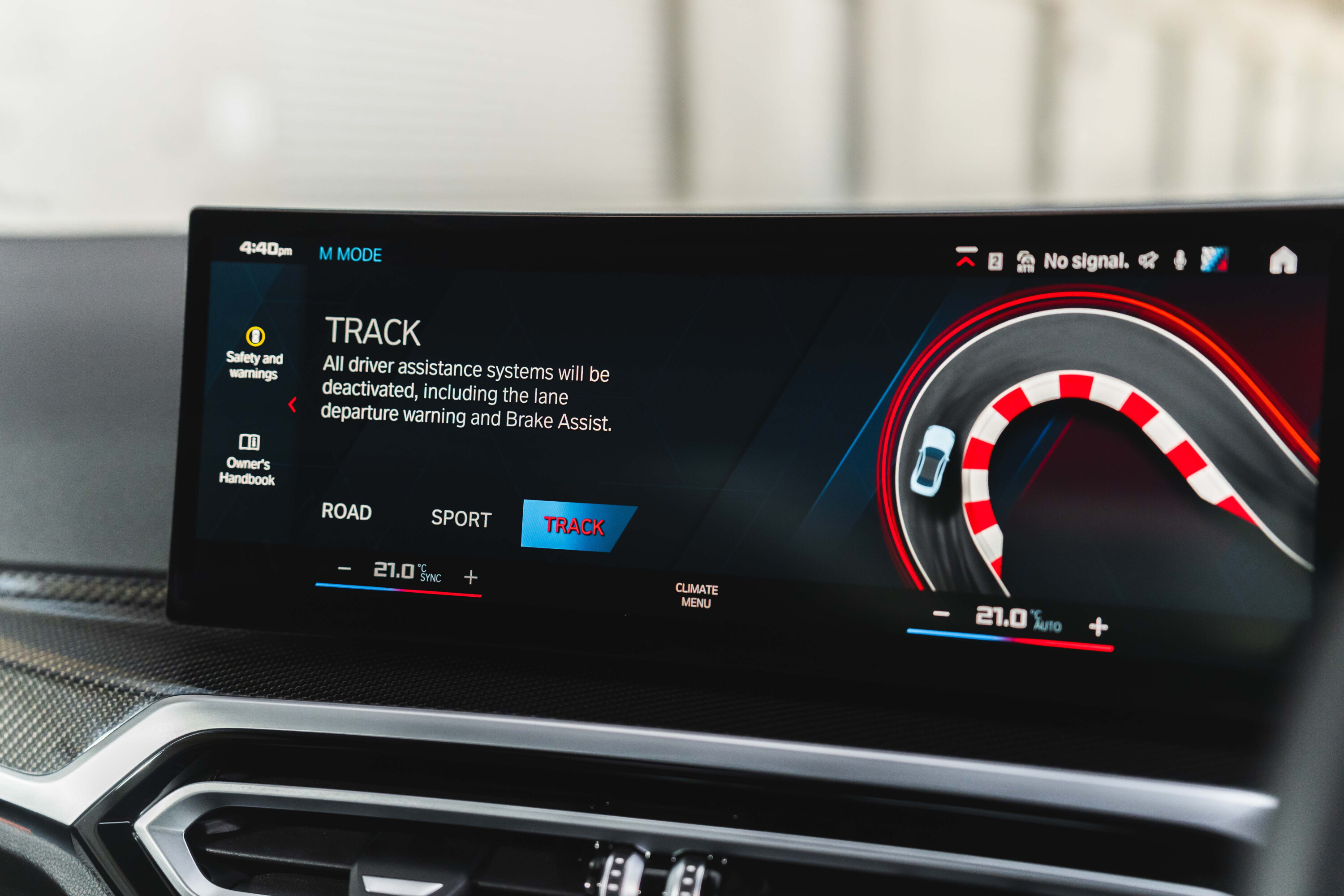
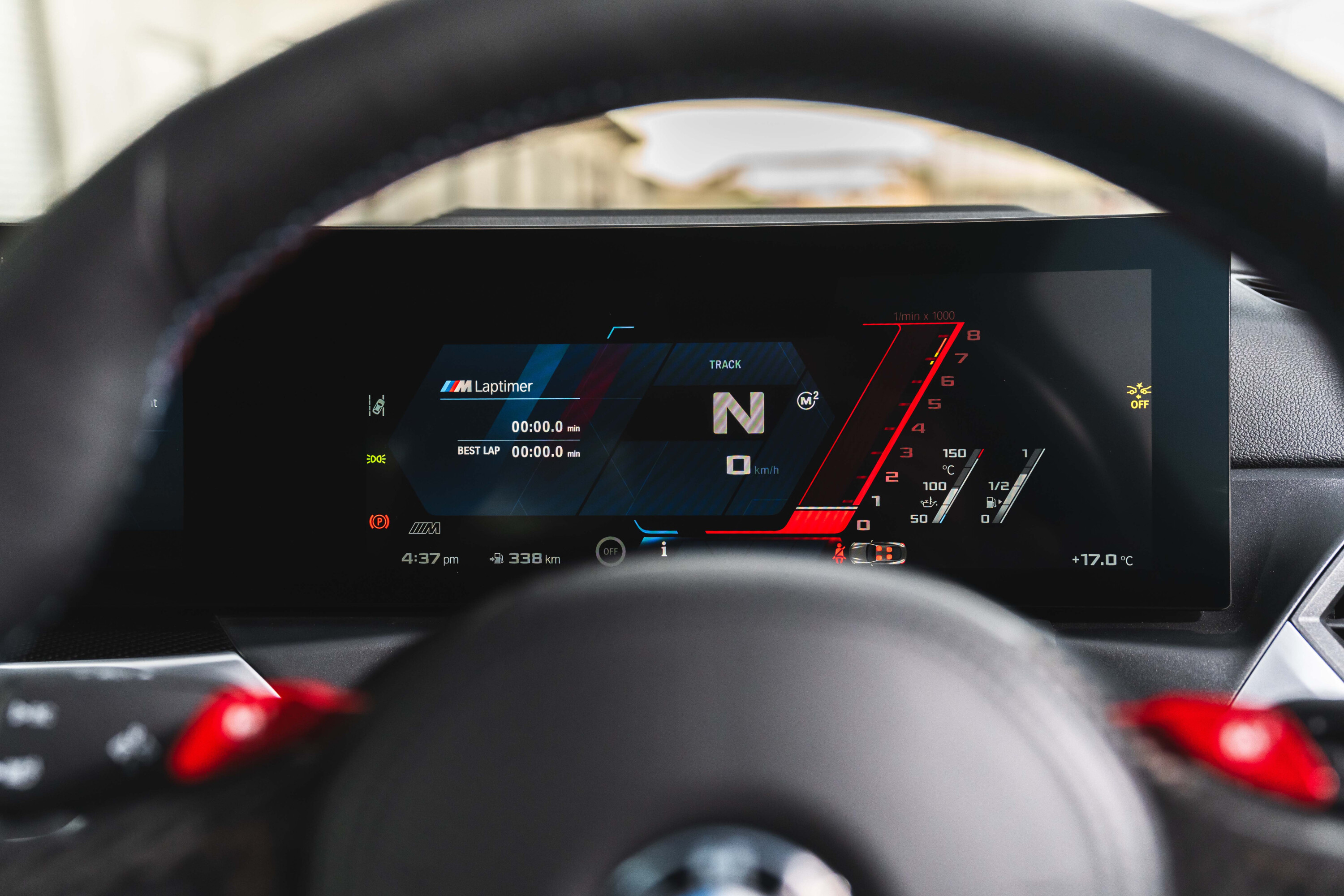
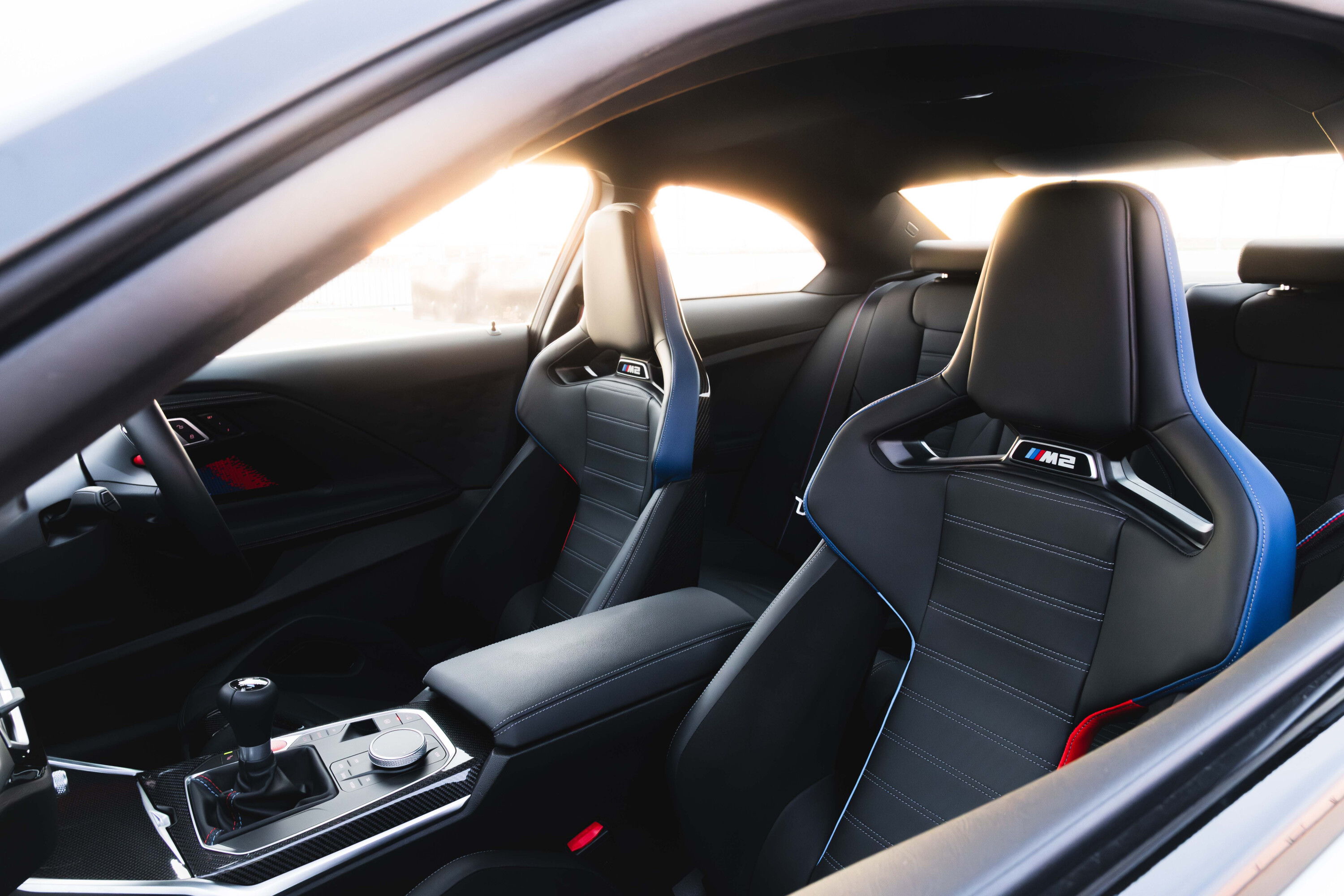
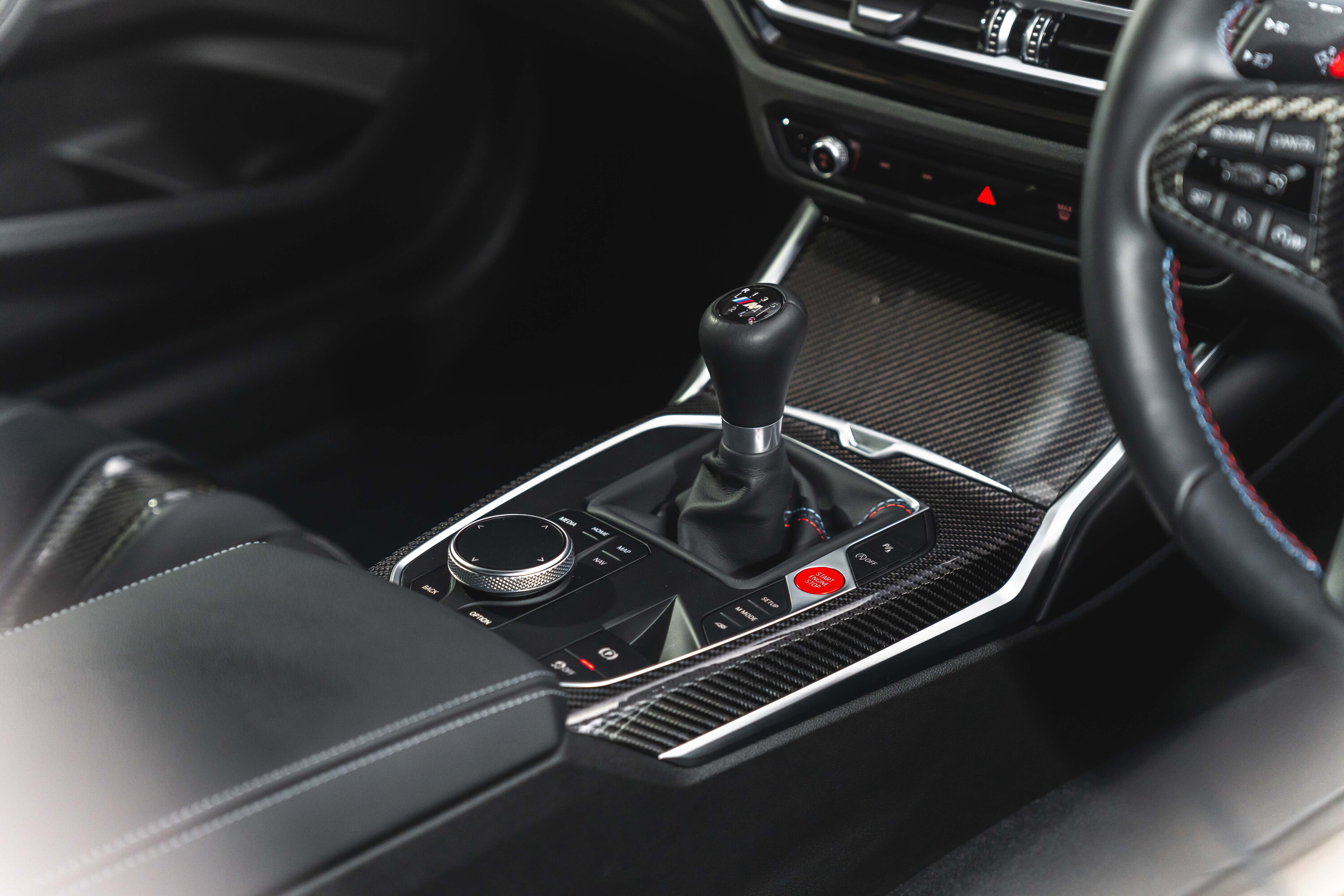
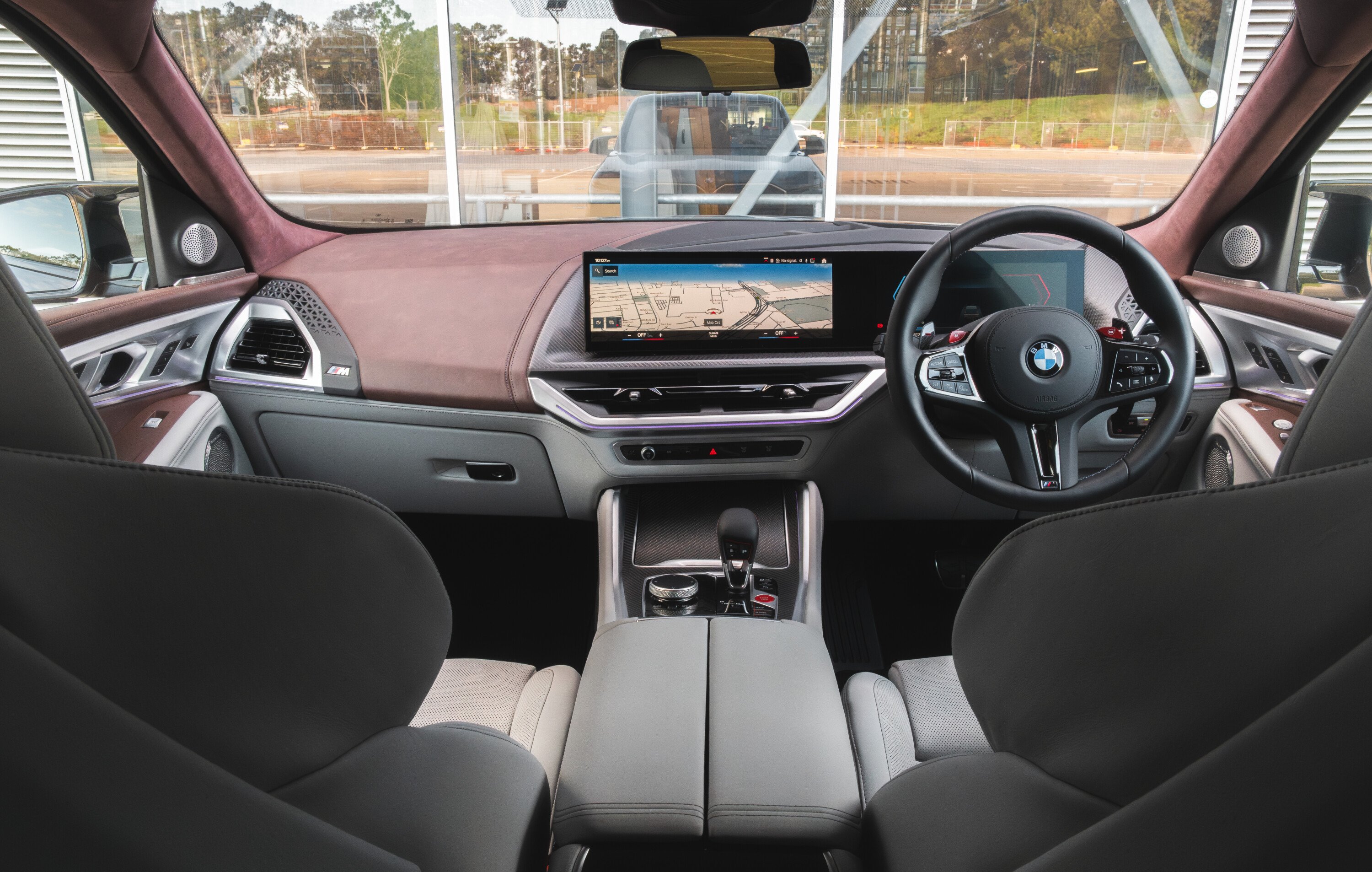
Slip inside the new M2 and you’ll discover it uses exactly the same dash layout as the facelift M3/M4, meaning you score a huge curved display that combines two high-resolution screens as well as a head-up display.
You also score the same foibles, like burying key controls into annoying submenus like the fan speed and air recirculation controls for the aircon.
1
The quality and materials are a marked step forward over the previous M2
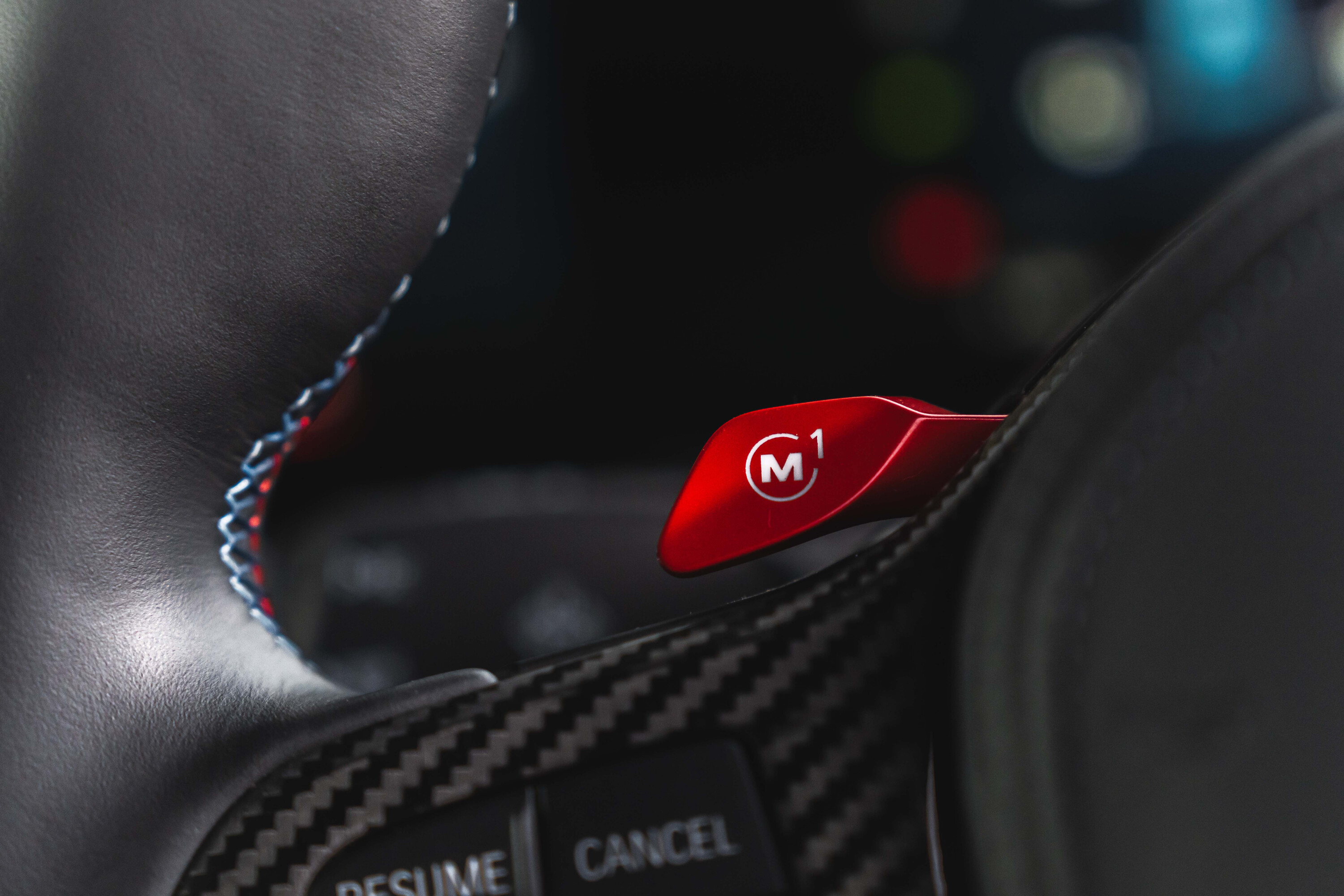
The interface to change the many drive mode parameters is also daunting (there are multiple settings for the dampers, steering, brakes, exhaust, engine, transmission and even the active safety systems) but we suspect most owners will quickly assign their favourite settings to the M1 and M2 hot keys on the steering wheel.
However, the rest of the cabin is excellent. The quality and materials are a marked step forward over the previous M2 and the seating position is spot on thanks to a seat that can go incredibly low and plenty of steering wheel adjustment.
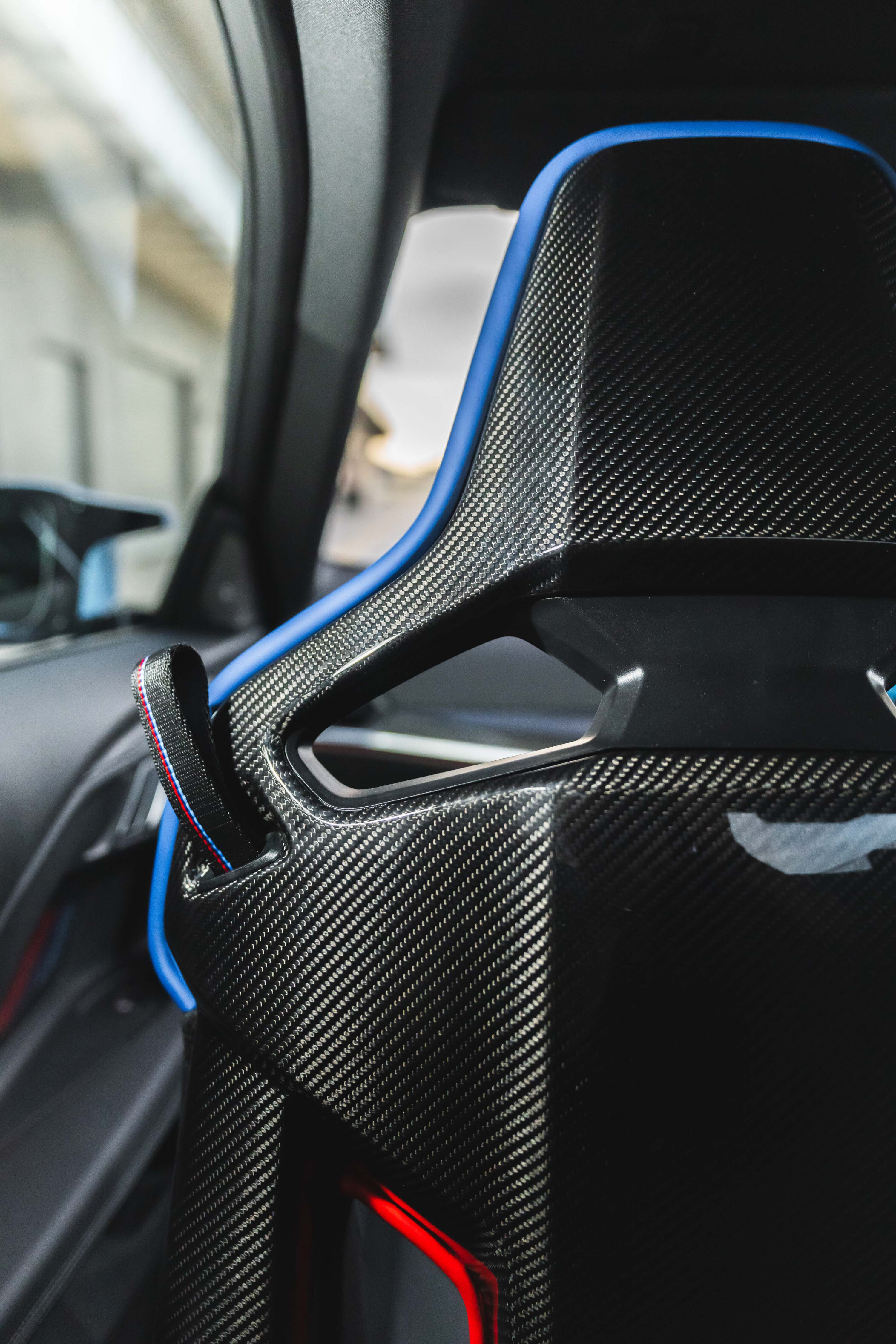
The standard ‘sport seats’ are also excellent, although BMW does offer its crotch-coddling carbon buckets as part of the $14,500 Carbon Experience package. The carbon seats look great and save a worthwhile 10.8kg, however, we reckon we’d stick with the comfier standard pews.
1
Storage is impressive for a performance car thanks to wide door pockets and decently sized lidded cubbies ahead of and behind the gear shifter.
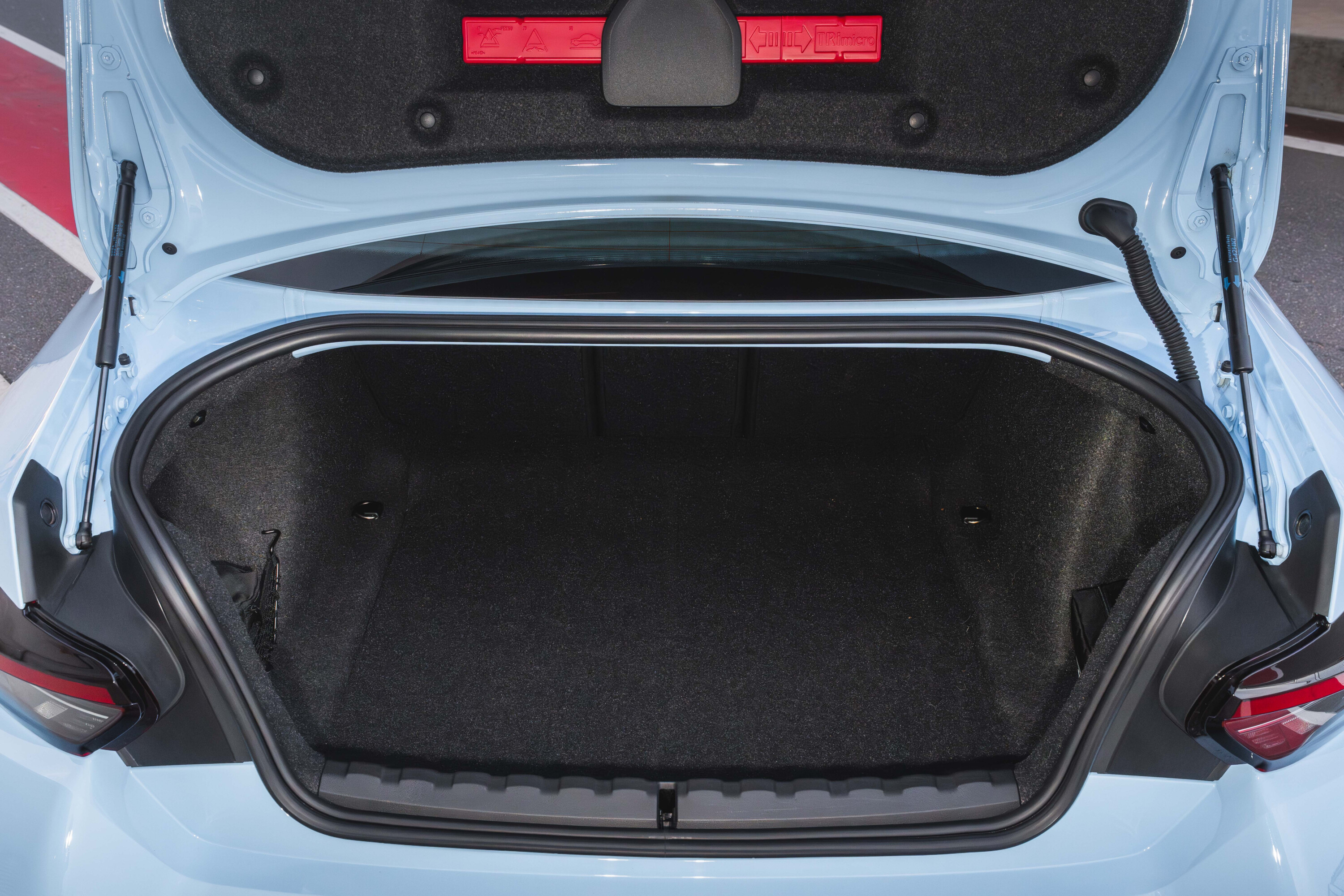
And the boot is a useful 390L, which is about what you get in most small SUVs. Best to think of the rear seats as occasional transport for tall adults, however, due to a lack of headroom. For kids or shorter grown-ups, the back seat is surprisingly comfortable.
There’s ample toe room, the outboard seats are scalloped and comfortable and there are dedicated rear air vents with a third climate control zone. Nice.
1
What’s it like to drive?
Quicker and more predictable are the key dynamic takeaways.
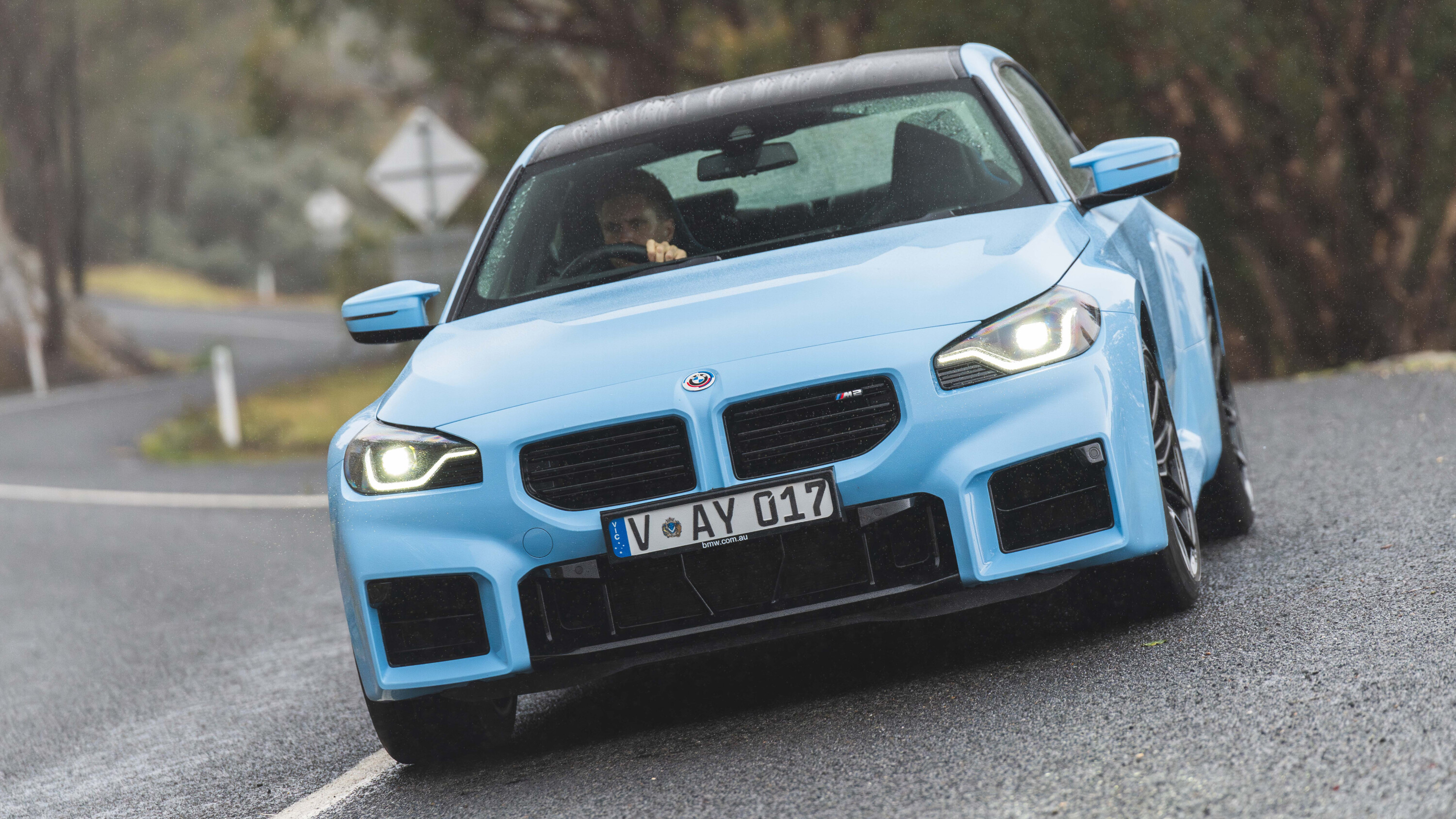
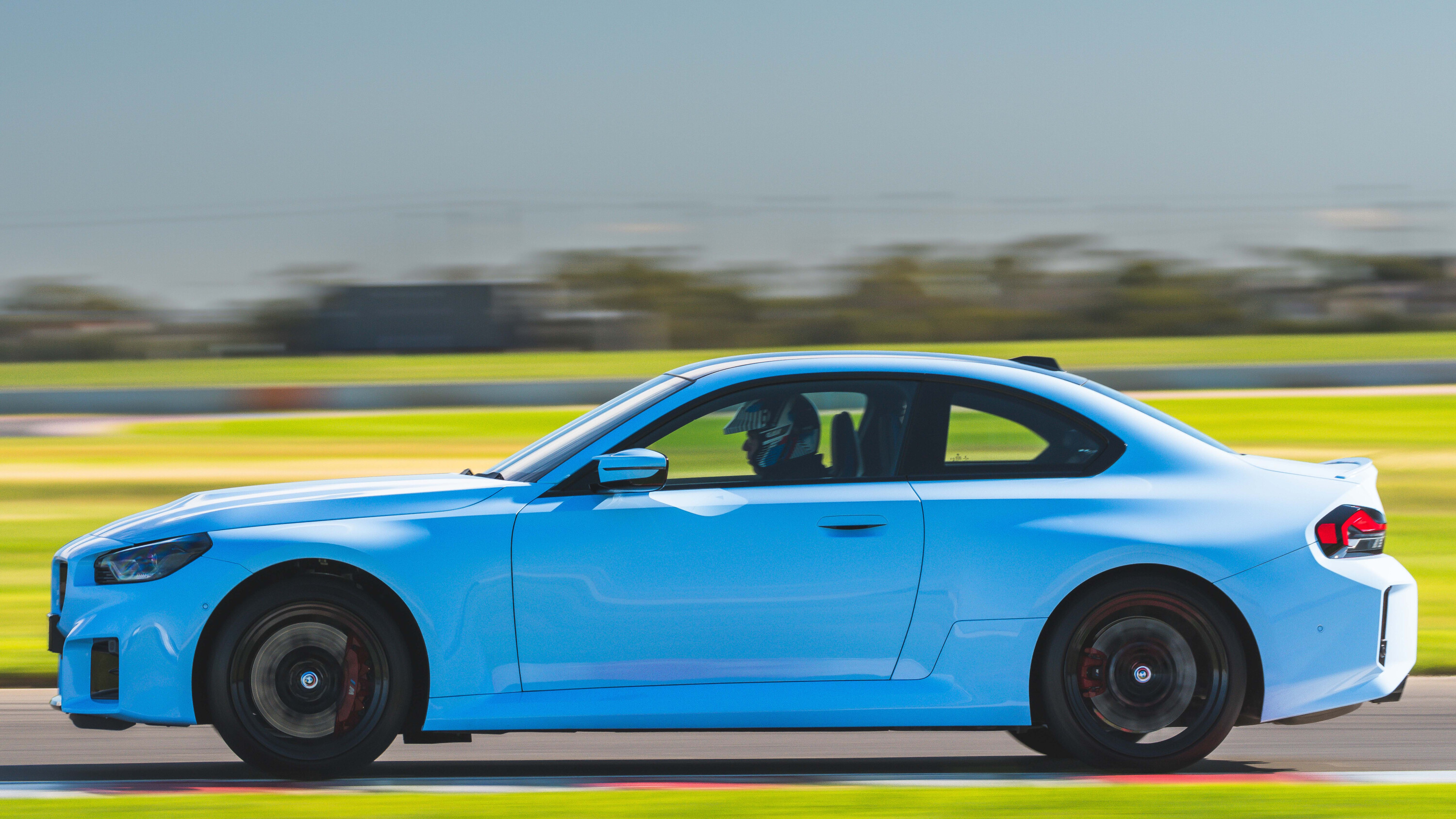
The old M2 could be a raw and spiky brute on greasy roads – there was always a sense it’d bite you, hard, if you overstepped your limits – but the new car’s longer wheelbase, wider tracks and larger tyres have made it a friendlier and more confidence-inspiring car to hustle.
It’s still ferociously quick on a challenging road, though. The 3.0-litre straight six is a highlight. Strong and responsive, the S58 unit pulls cleanly through the rev range and has enough grunt to make the M2 feel every bit as quick as its 0-100km/h acceleration claim.
The noise ranges from authentic and a touch distant without the exhaust button pressed, to deeper and slightly synthetic with it switched on, but both deliver the kind of soundtrack you expect from a BMW straight six.
1
Both gearboxes are excellent. The eight-speed auto is smooth and quick-witted, though current M2 owners might miss the immediacy and whipcrack nature of the old car’s dual-clutch.
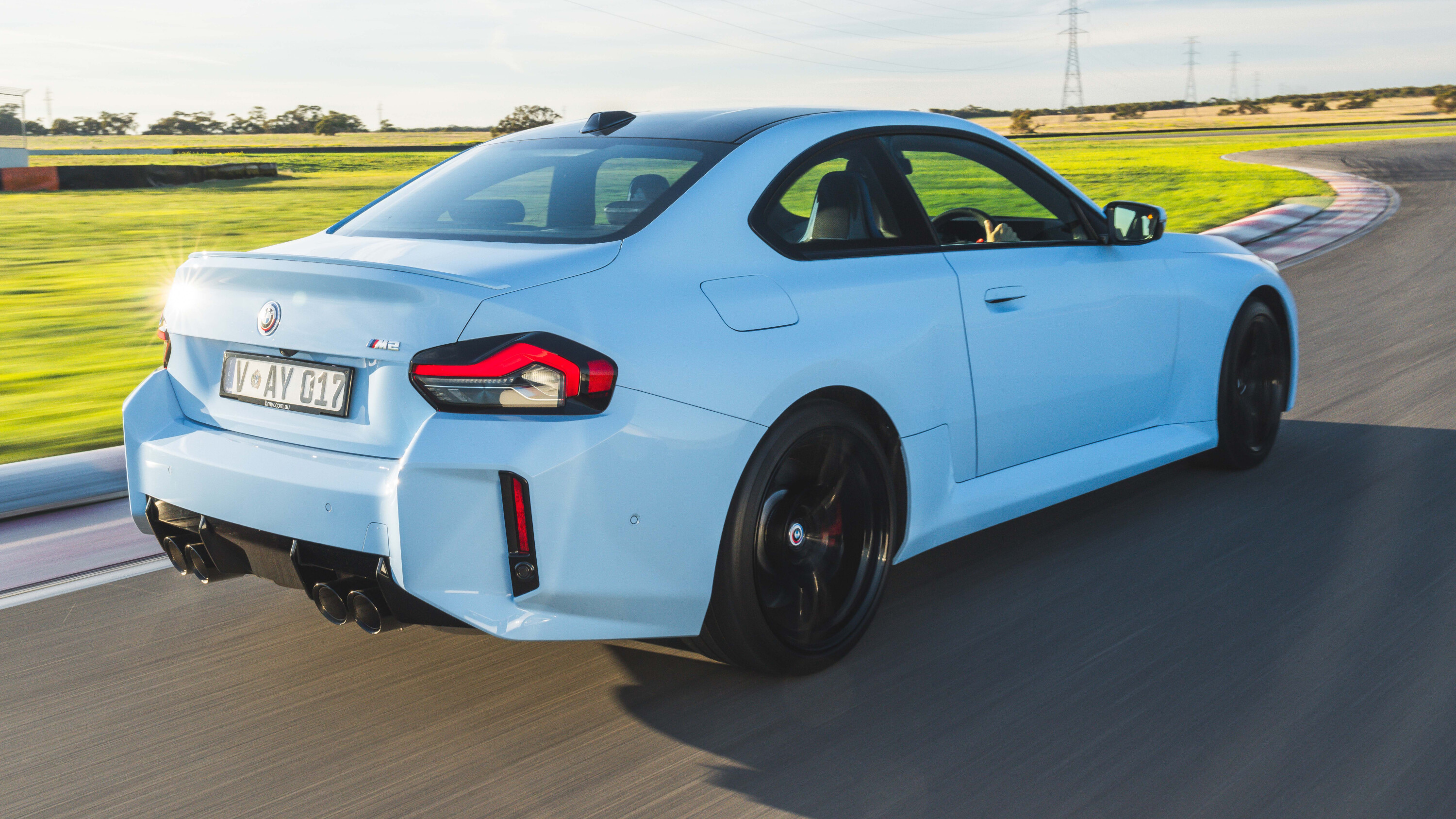
The pick of the transmissions, however, is the six-speed manual. Early orders suggest the manual could make up as much as 30 per cent of the M2’s Aussie volume and it adds a welcome layer of involvement to the driving experience.
Its shift action isn’t amazing – it lacks the oily precision and snickety satisfaction of a Honda Civic Type R or Porsche Cayman and the clutch action could do with more bite – but it does feel like a slight improvement over the first-gen M2.
1
There’s plenty of talent to the new chassis, too.
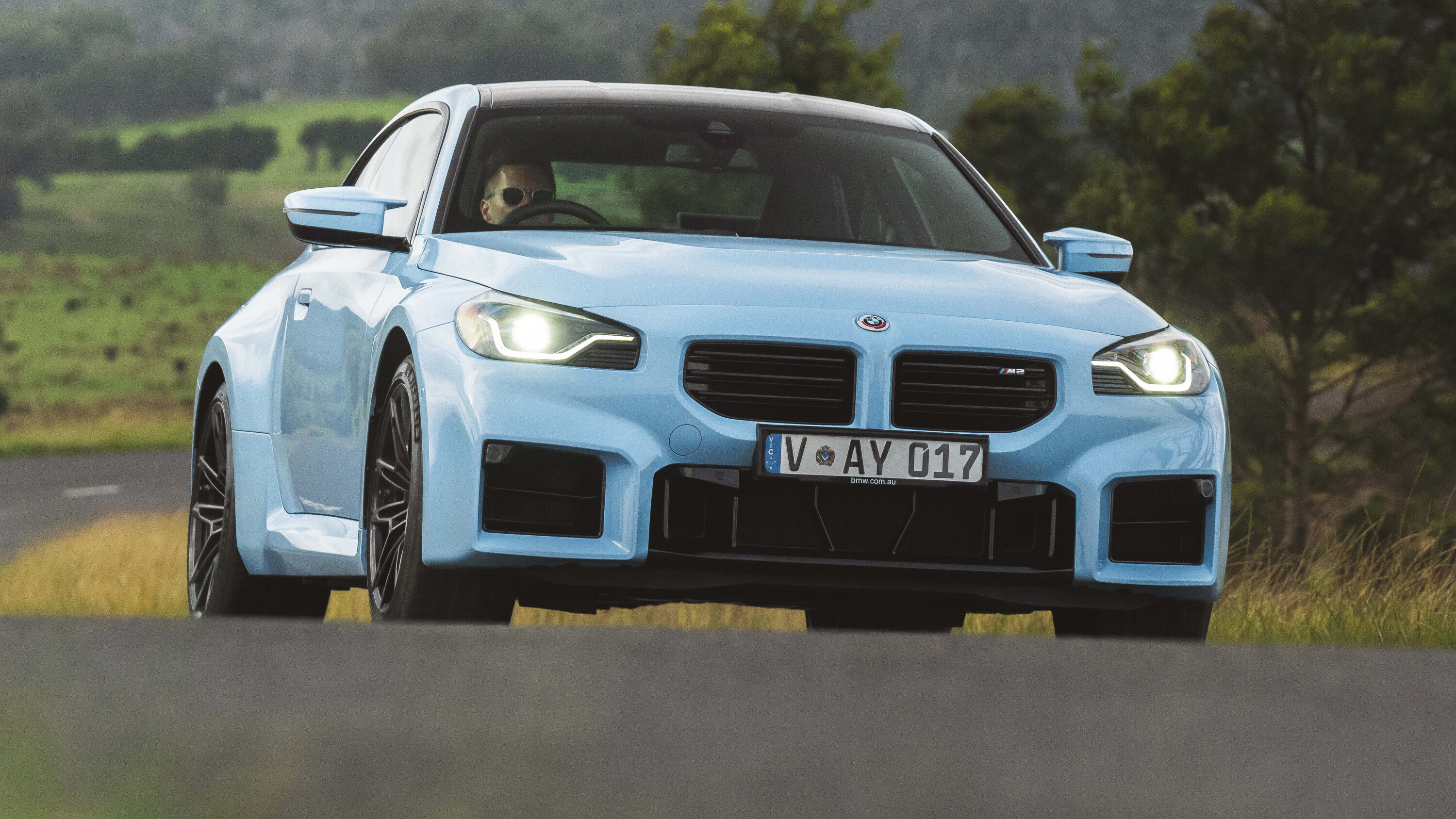
The front axle is grippy and positive, the body control is taut and assertive and the way it wants to rotate mid-corner so you can exploit the rear-drive balance is deeply satisfying.
Like the M3/M4 the M2 now has M’s 10-stage traction control and a ‘Drift analyser’ so lurid, tail-out high jinks are easy to tap into. And thanks to the longer wheelbase, slides are now easier to maintain, too.
1
Calm things down and it’s obvious this new M2 has more bandwidth to explore in everyday driving.
The steering is good, without being great. Like all modern M cars, that steering wheel rim is too fat and while the electric power assistance system is accurate and meatily weighted, any sense of connection to the front wheels is distant and muted.
Calm things down and it’s obvious this new M2 has more bandwidth to explore in everyday driving.
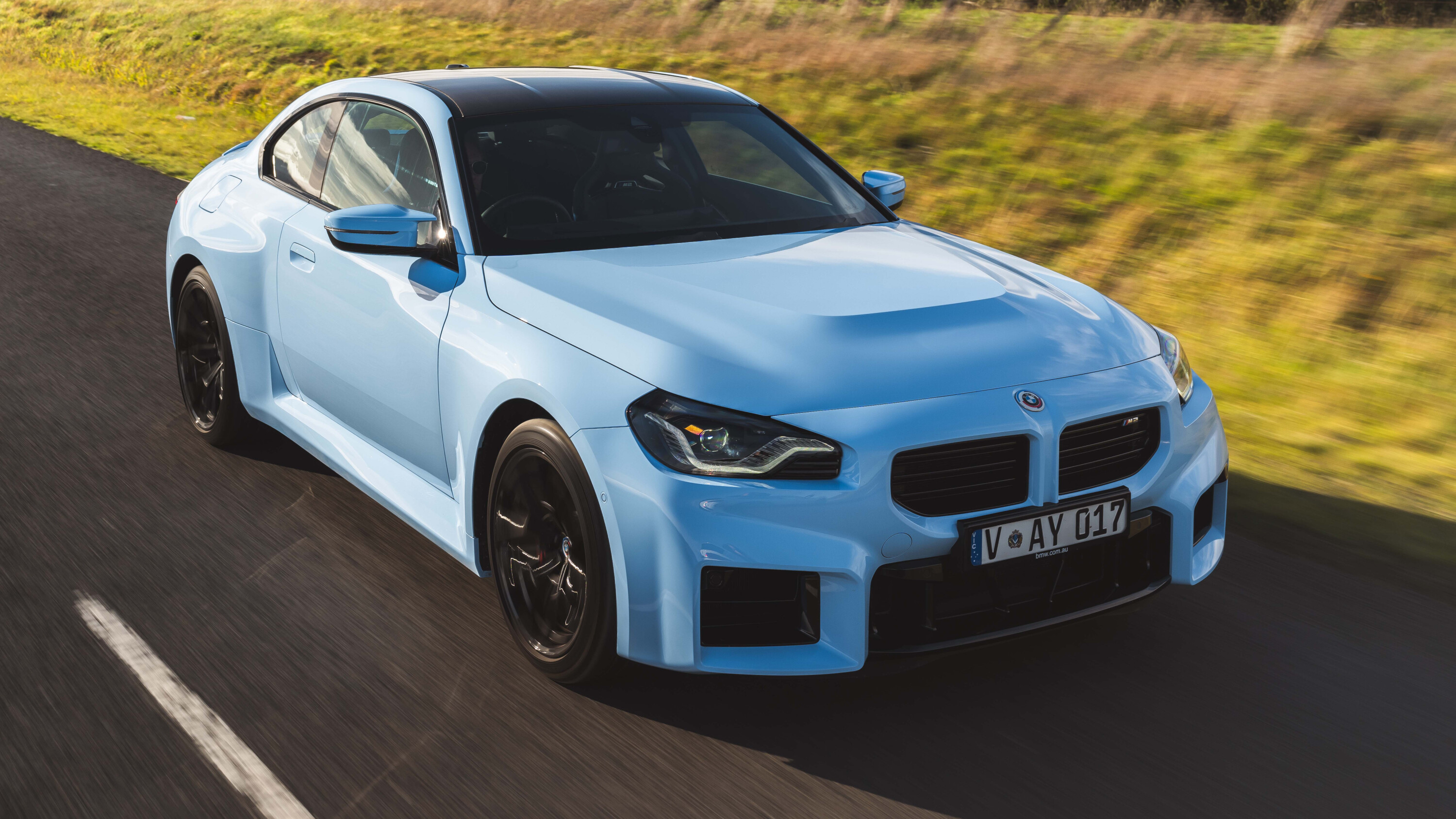
While the ride is firm – even in its softest setting, bumps are transmitted keenly into the cabin – expert damping ensures the M2 doesn’t feel harsh or crashy. Cabin refinement has also improved and while there’s no escaping this is a focused sports coupe – it is a full-fat M car after all – it’s clear the new M2 is a better and more usable daily than the original.
If any of the terms in this section have left you scratching your head, these articles will help bring you up to speed!
1
- What is a Powertrain or Drivetrain?
- Power vs torque
- Car suspension explained
- Automatic transmissions (‘gearboxes’) explained
- Chassis control systems explained
- Car vs Ute vs SUV: How the vehicle you buy should guide the way you drive
Automatic versions of the 2023 BMW M2 have an official combined fuel consumption figure of 9.7L/100km.
Manual versions drink slightly more at 10.2L/100km. Those figures are similar to the first-generation M2 which had combined ratings of 9.2L and 10.0L respectively.
1
How safe is the BMW M2?
Like most M cars, the M2 doesn’t carry an official ANCAP crash-test rating. The regular BMW 2 Series Coupe has been tested, however, and it carries a four-star safety score.
Sub-par results for some of the 2 Series Coupe’s active safety systems like lane-keep assist and autonomous emergency braking were the reason it failed to achieve five stars.
The 2023 BMW M2 is fitted with the following safety systems: six airbags, autonomous emergency braking with pedestrian detection, lane-departure warning, blind-spot monitoring, rear-cross traffic alert, lane centring assist, adaptive cruise control with stop-and-go function, and a tyre pressure monitoring system.
One thing to note is that choosing the six-speed manual means your M2 loses adaptive cruise control.
1
VERDICT
It’s hard to shake the sense that this new M2 is the end of an era.
Likely to be the last ever pure-combustion M car, it’ll also be the last fitted with a manual gearbox, and with M’s (admittedly excellent) xDrive system now becoming the default, it’s likely to be the last rear-driven model as well. For those reasons alone, we’d recommend buying one.
But there’s more to this new M2 than merely ticking the right boxes. It evolves the core attributes of its predecessor into a package that’s quicker, comfier, roomier and more predictable at the limit. Is that enough to warrant an upgrade if you’re a current M2 owner? That’s a trickier one.
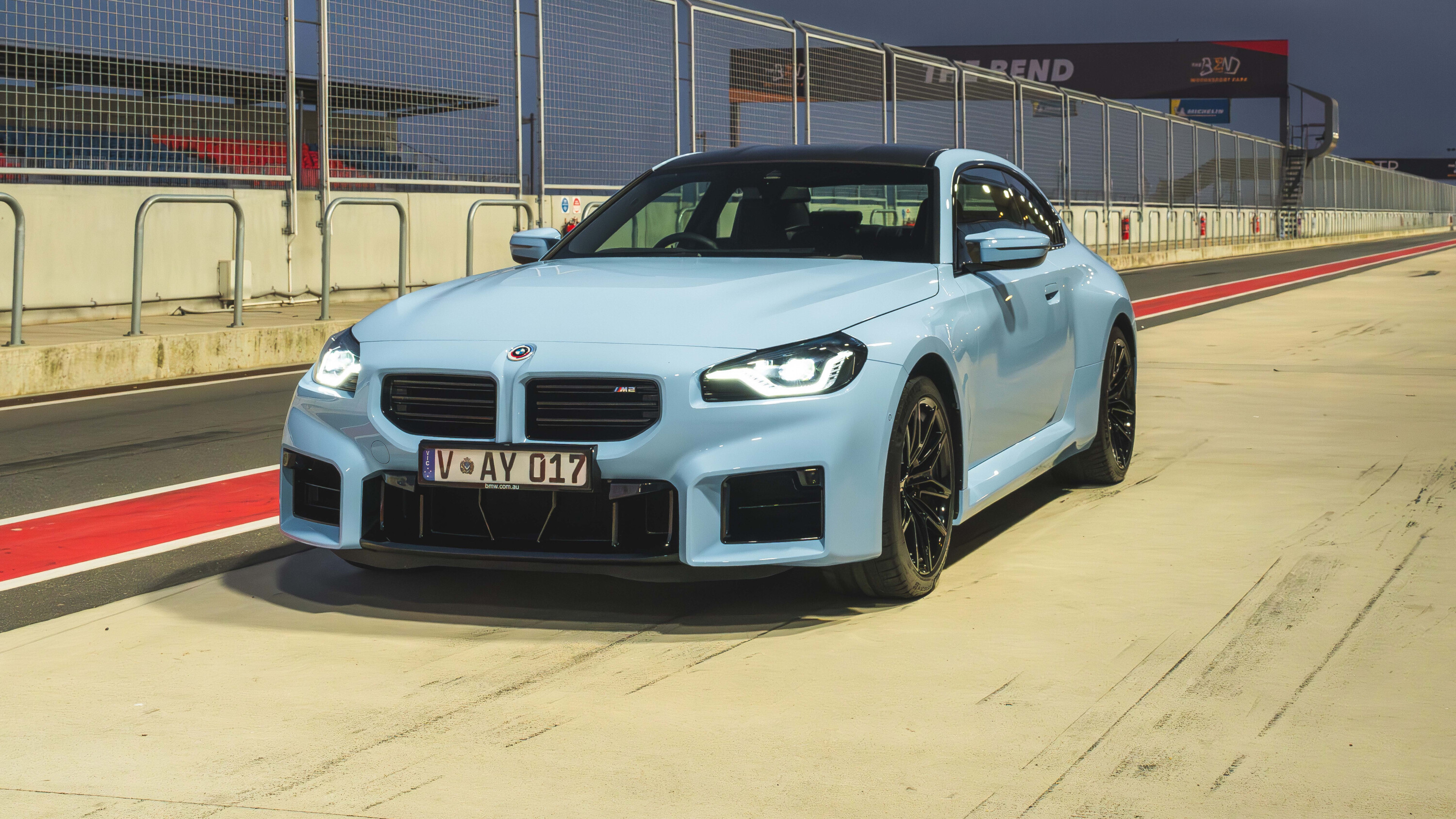
1
Objectively the G87 is a superior and more complete car but there’s no doubt some will lament the loss of the fiery original’s snappy rear-end and prettier exterior – the taut proportions of an original M2 Comp are nigh on perfect.
The new car’s weight gain is also a step in the wrong direction and while it disguises the extra heft well, it will likely yield higher tyre wear and other maintenance costs.
What’s easier to recommend is buying an M2 over the current M4. It isn’t only significantly cheaper but its shorter wheelbase and smaller proportions help to make it a more engaging road car.
Once again, BMW M’s smallest model is one of its best.
MORE
Everything BMW
| 2023 BMW M2 specifications | |
|---|---|
| Body | 2-door, 4-seat coupe |
| Engine | 2993cc inline 6cyl, 24v, DOHC, twin-turbo petrol |
| Power | 338kW @ 6250rpm |
| Torque | 550Nm @ 2650-5870rpm |
| Transmission | 8-speed automatic |
| 0-100km/h | 4.1 seconds (claimed) |
| L/W/H | 4580/1887/1403mm |
| Wheelbase | 2747mm |
| Track width | 1617/1605mm (f/r) |
| Boot space | 390L |
| Weight | 1725kg |
| Fuel / tank | 95 RON / 52 litres |
| Fuel use L/100km | 9.7L/100km (combined) |
| Suspension | Struts, coil springs, adaptive dampers, anti-roll bar (front) Multi-links, coil springs, adaptive dampers, anti-roll bar (r) |
| Steering | Electric rack-and-pinion |
| Brakes | 380mm ventilated/perforated compound discs with six-piston callipers (f) 370mm ventilated/perforated compound discs with single-piston callipers (r) |
| Wheels | 9.5J x 19 (f) 10.5J x 20 (r) |
| Tyres | Michelin Pilot Sport 4S 275/35 ZR19 (f) 285/30 ZR20 (r) |
| Price | $121,700 + on-road costs |
The 2023 MG 5 has arrived as Australia’s most affordable sedan, priced from $24,990 drive-away.
Snapshot
- Two-model range with ultra-sharp pricing
- Cut-price Toyota Corolla, Hyundai i30 and Kia Cerato rival
- No local plans for electric MG 5 wagon sold in Europe
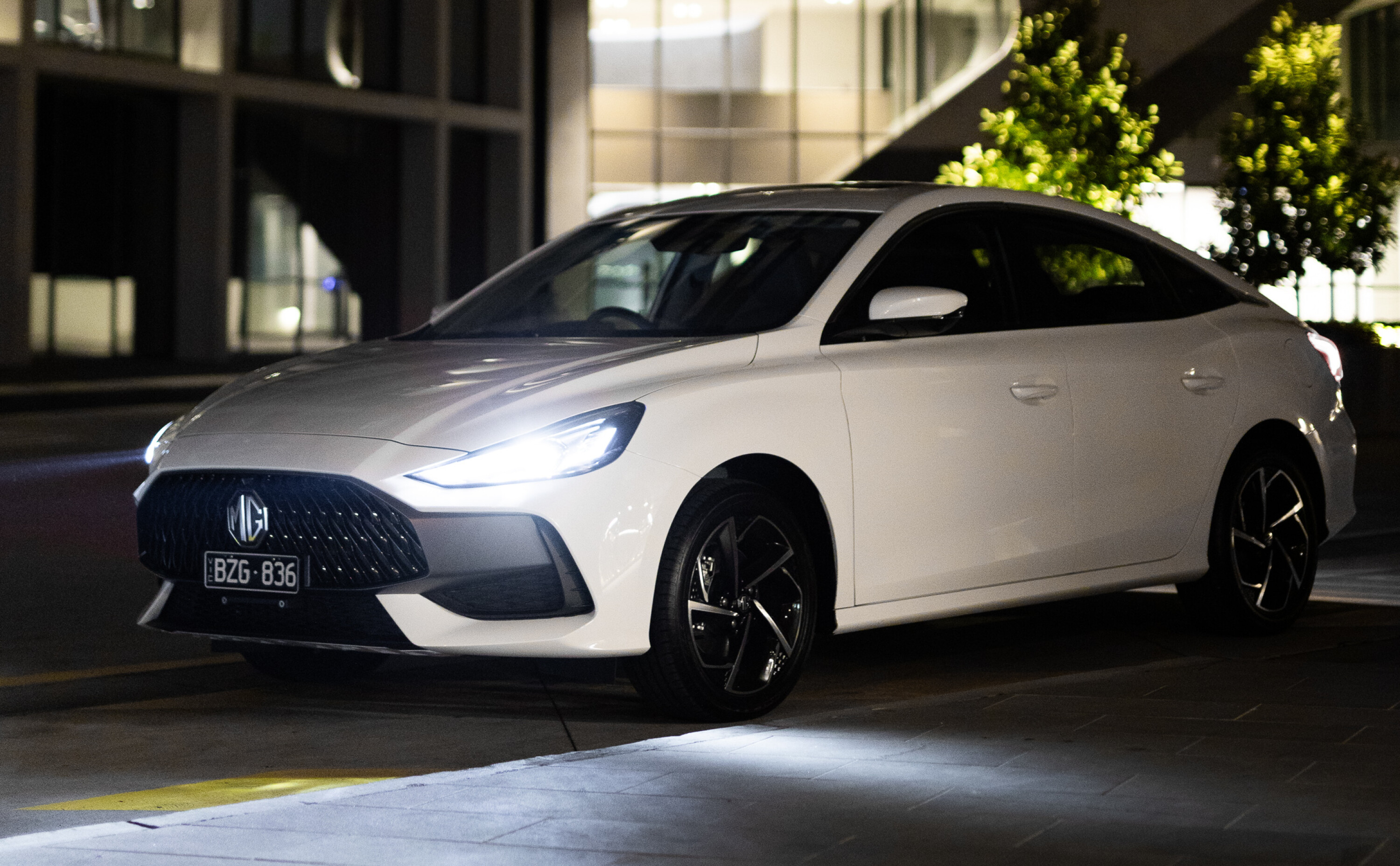
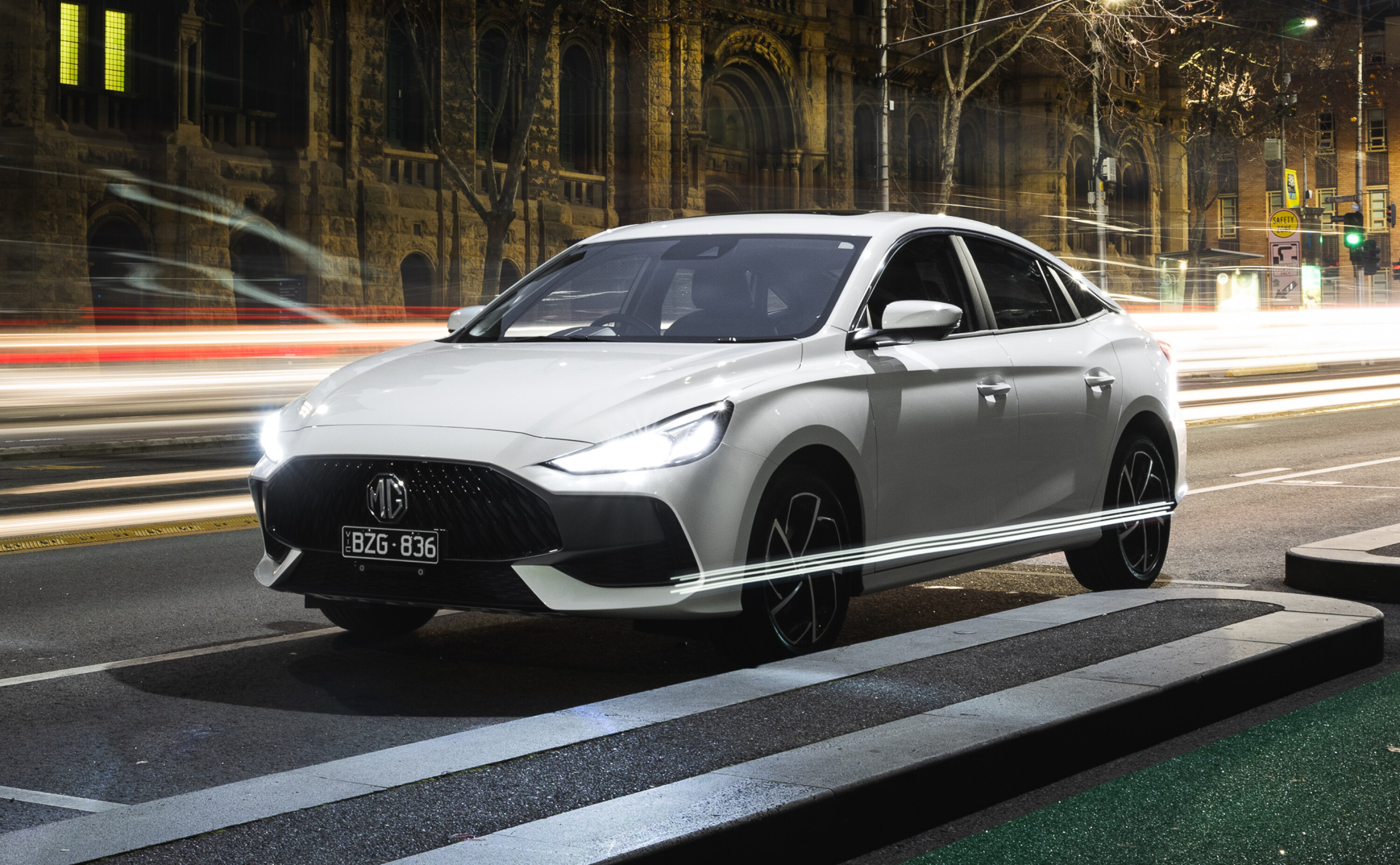
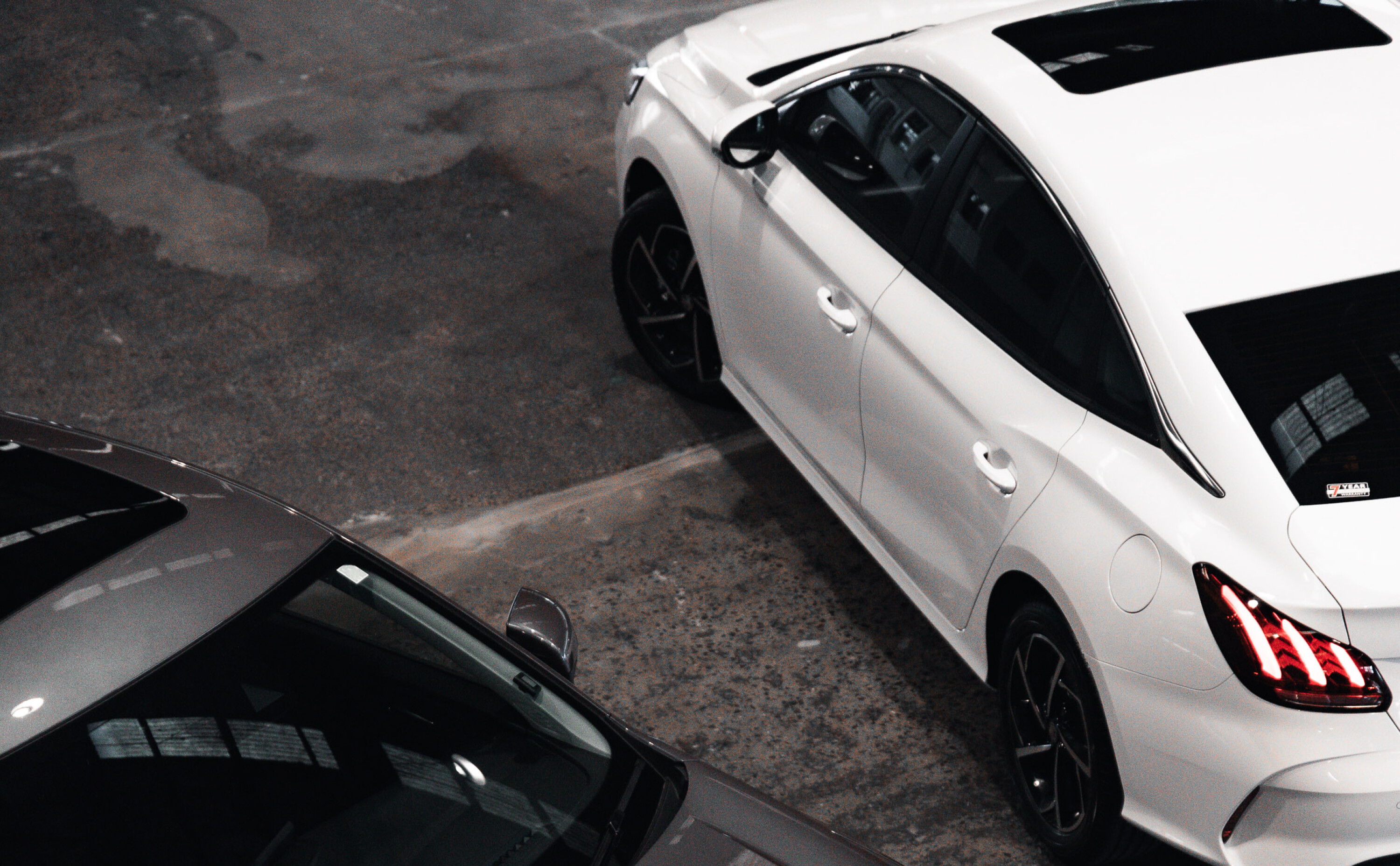
MG’s small-medium four-door will be offered in two trim levels, each with different equipment levels and drivetrains.
Straddling the small and medium-size segments at just under 4.7 metres, the MG 5 will compete directly with four-door versions of popular small cars, including the Hyundai i30, Toyota Corolla, Kia Cerato and Mazda 3.
UPDATE, August 2023: This story, first published on June 16, has been updated and pulled forward to reflect additional details and local imagery released by MG Australia.
1
Starting prices for those models range between $26,000 and $30,320 before on-road costs, emphasising the sharp value of the Chinese-built MG.
It even undercuts the Mazda 2 light sedan, which costs $24,410 before on-road costs, or about $28,200 drive-away in base form.
However, while those vehicles include a more comprehensive suite of active safety equipment, leading to higher prices, the MG 5 is limited to low-speed autonomous emergency braking – a requirement for all newly-introduced vehicles sold in Australia since March 1, 2023.
1
MG Australia has continued to rule out the MG 5 all-electric wagon that shares the petrol sedan’s nameplate and is sold in markets including the UK.
The MG range will expand further this month with the arrival of the MG 4 electric hatchback.
JUMP AHEAD
- 2023 MG 5 pricing
- 2023 MG 5 features
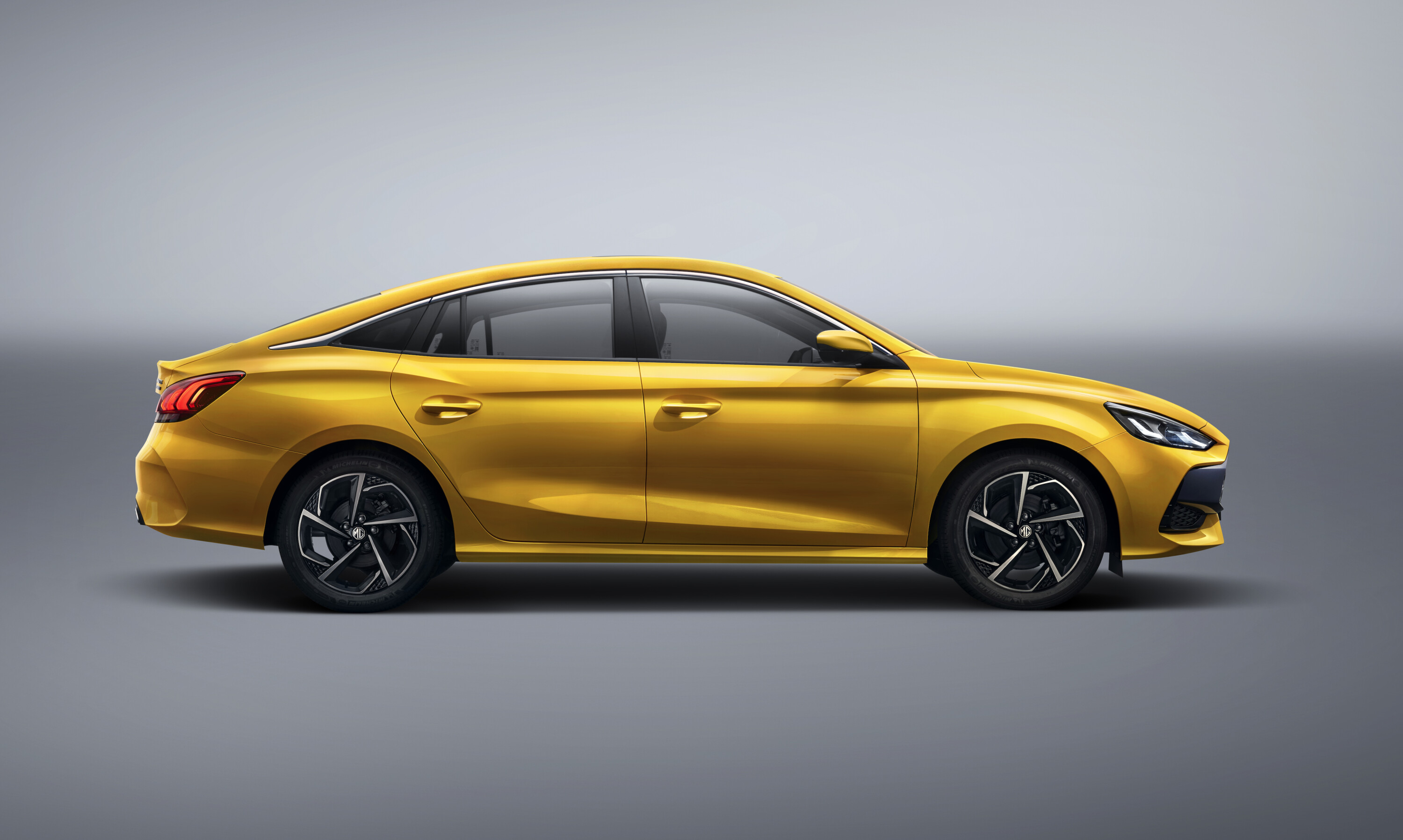
- Colours
- Engine, drivetrain, and fuel economy
- Safety
- Dimensions
- Warranty and servicing
- Availability
1
2023 MG 5 pricing
All prices are drive-away.
| Model | Pricing |
|---|---|
| Vibe 1.5 | $24,990 |
| Essence 1.5T | $28,990 |
1
2023 MG 5 features
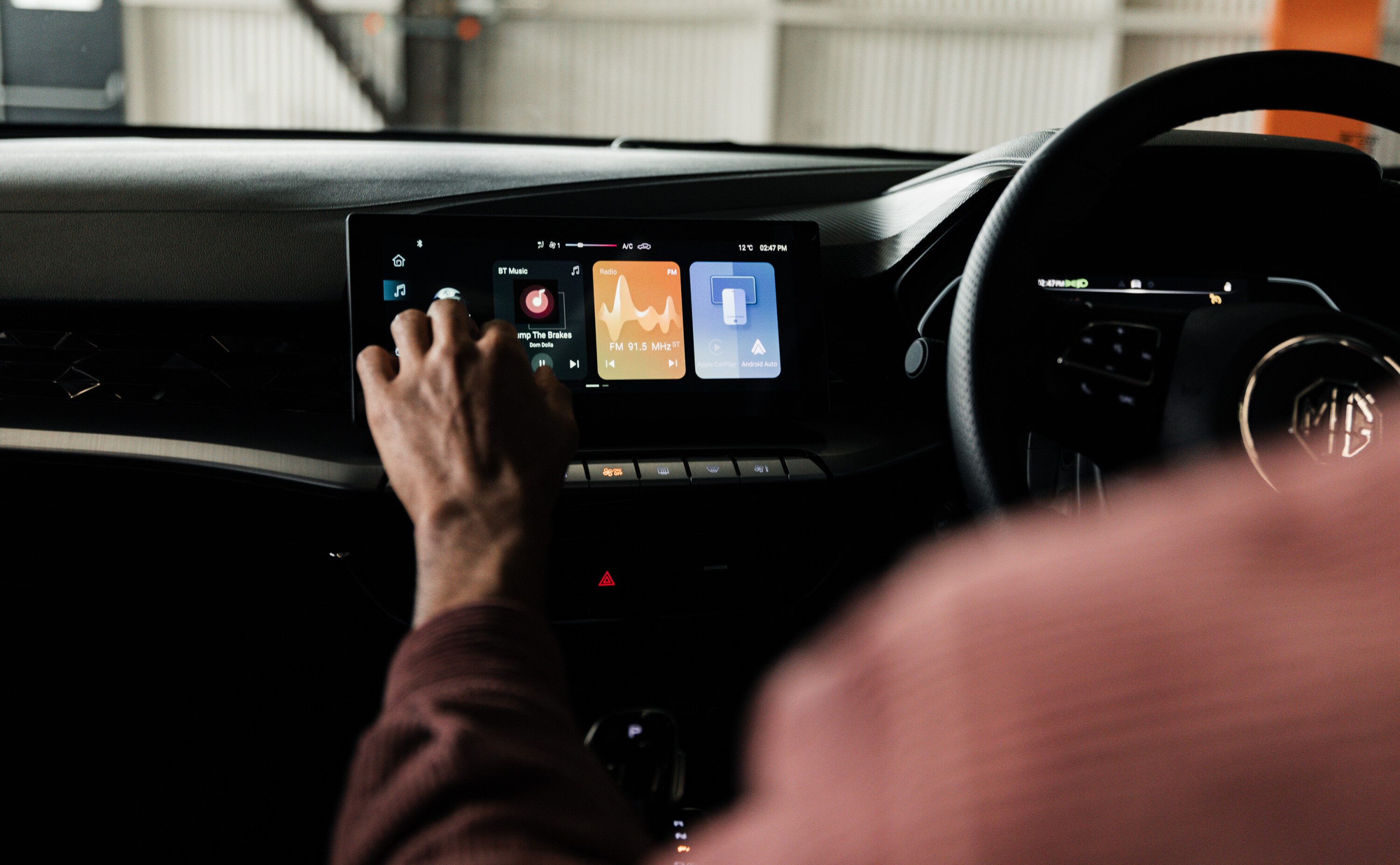
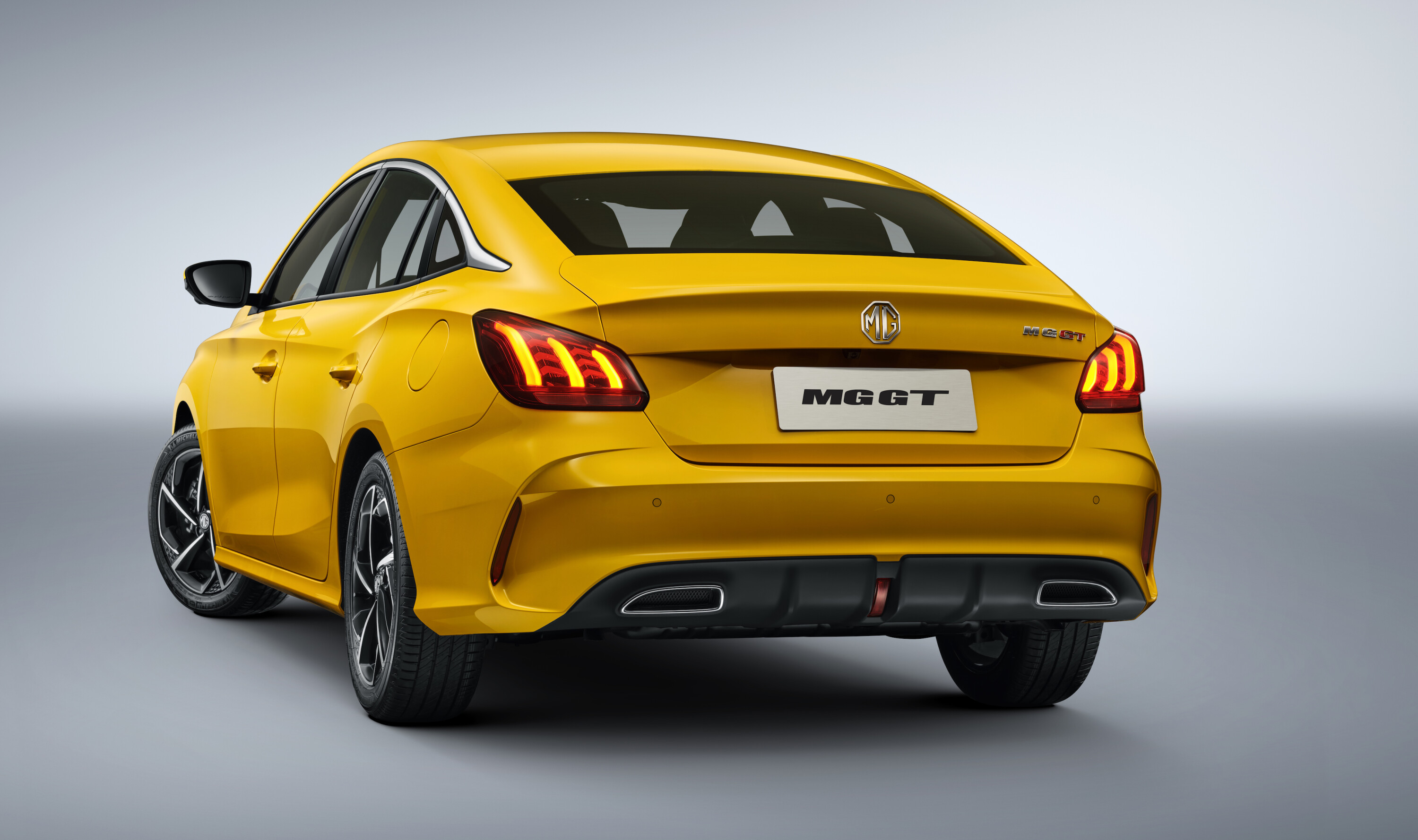
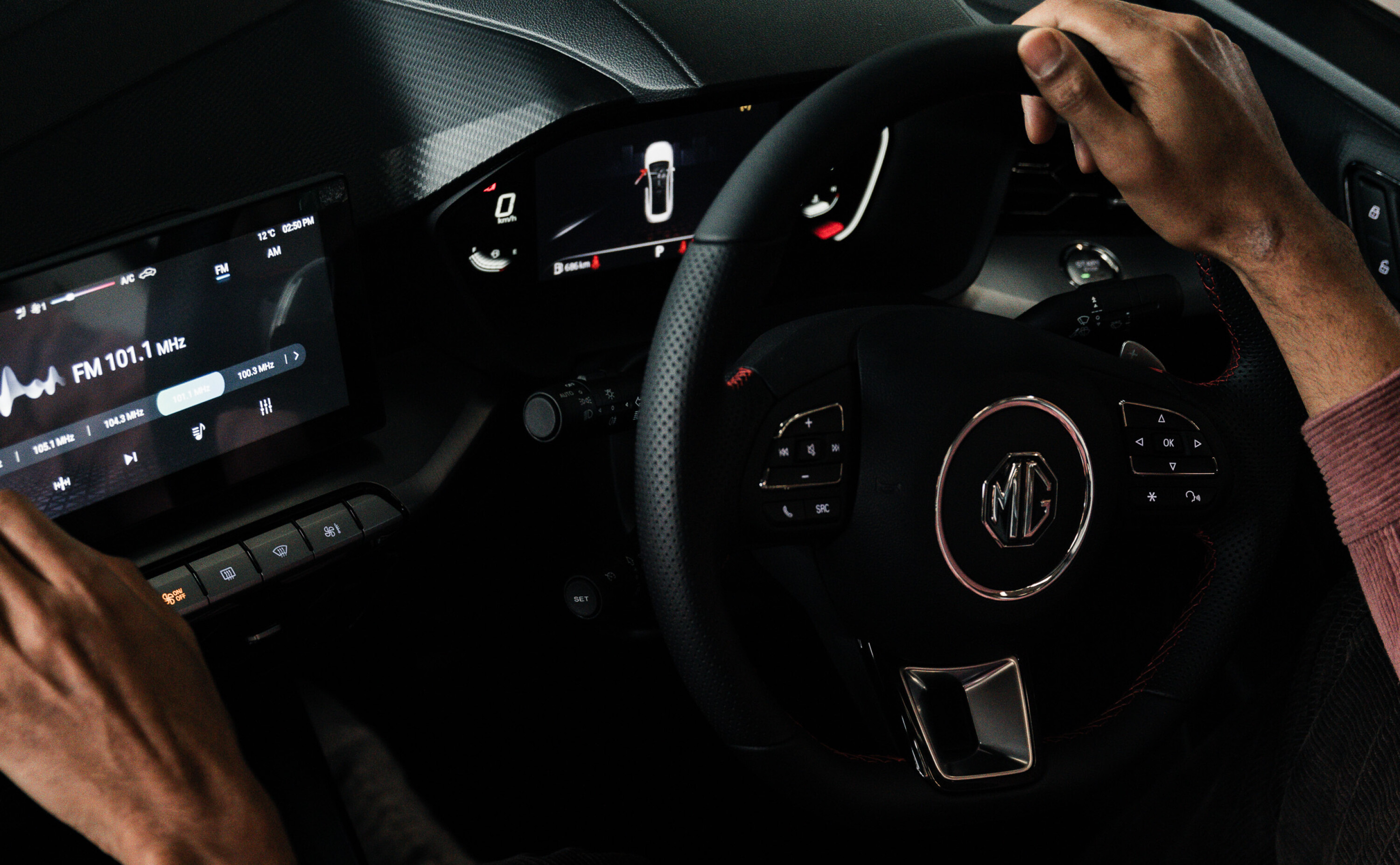
Standard features include 17-inch alloy wheels, faux-leather seats, and a 10-inch touchscreen with Apple CarPlay and Android Auto.
| 2023 MG 5 Vibe features | |
|---|---|
| 16-inch alloy wheels | Single-zone air conditioning |
| 10-inch infotainment system | Rear air vents |
| Wired Apple CarPlay and Android Auto | Heated side mirrors |
| Four-speaker audio system | Keyless entry and push-button start |
| Semi-digital instrument cluster | Rear-view camera |
| LED headlights and daytime running lamps | Rear parking sensors |
| Leather-accented upholstery | Manual cruise control |
| Six-way manual driveru2019s seat | Front seatbelt reminder |
| Four-way manual passenger seat | Tyre pressure monitoring. |
2023 MG 5 Essence features
The Essence adds a 360-degree camera, a retractable sunroof, six rather than four speakers for the audio system, and a steering wheel wrapped in artificial leather.
| In addition to Vibe | |
|---|---|
| Turbocharged engine | Eco drive mode |
| 17-inch alloy wheels | Leather-accented steering wheel |
| Six-speaker audio system with 3D effect | Six-way power-adjustable driveru2019s seat with manual lumbar support |
| Power-folding side mirrors | u2018Sport-tunedu2019 electronic stability control |
| Glass sunroof | 360-degree camera system.u00a0 |
| Front and rear seatbelt reminders | |
1
Colours
| Dover white | Royal yellow |
| Diamond red* | Misty grey* |
| Black pearl* | Brixton blue* |
| * Metallic paint, $700 |
1
Engine, drivetrain, and fuel economy
The entry-level MG 5 Vibe features a 1.5-litre four-cylinder engine with outputs of 84kW and 150Nm, powering the front wheels via a CVT auto.
The range-topping MG 5 Essence, priced at $28,990 drive-away, steps up performance with a turbocharged version of the 1.5L engine producing 119kW and 250Nm.
While also a front-drive model, the transmission changes to a seven-speed dual-clutch automatic that characteristically provides faster gearchanges than a CVT or conventional torque converter auto.
Both variants have a torsion-beam rear suspension.
Fuel consumption is rated at 5.7 litres per 100km for the Vibe and 5.9L/100km for the Essence.
| 2023 MG 5 fuel economy | |
|---|---|
| 1.5-litre petrol | 5.7L/100km |
| 1.5-litre turbo-petrol | 5.9L/100km |
1
Safety
The 2023 MG 5 sedan has yet to be tested by ANCAP.
While it is equipped with low-speed autonomous emergency braking, the MG 5 lacks lane-keep assist, lane departure warning, blind-spot and rear cross-traffic alerts, and speed recognition or driver monitoring systems, and the entry-level Vibe is not fitted with rear seatbelt reminders.
ANCAP assesses active safety equipment in its ‘safety assist’ and ‘vulnerable road user’ categories – with minimum scores of 70 per cent required to achieve a five-star rating, or 60 per cent for a four-star rating.
It is fitted with six airbags (front, side and curtain). However, a front-centre airbag to protect the driver and front passenger from clashing heads in a side-impact collision is not fitted, which could impact its ability to score top safety marks.
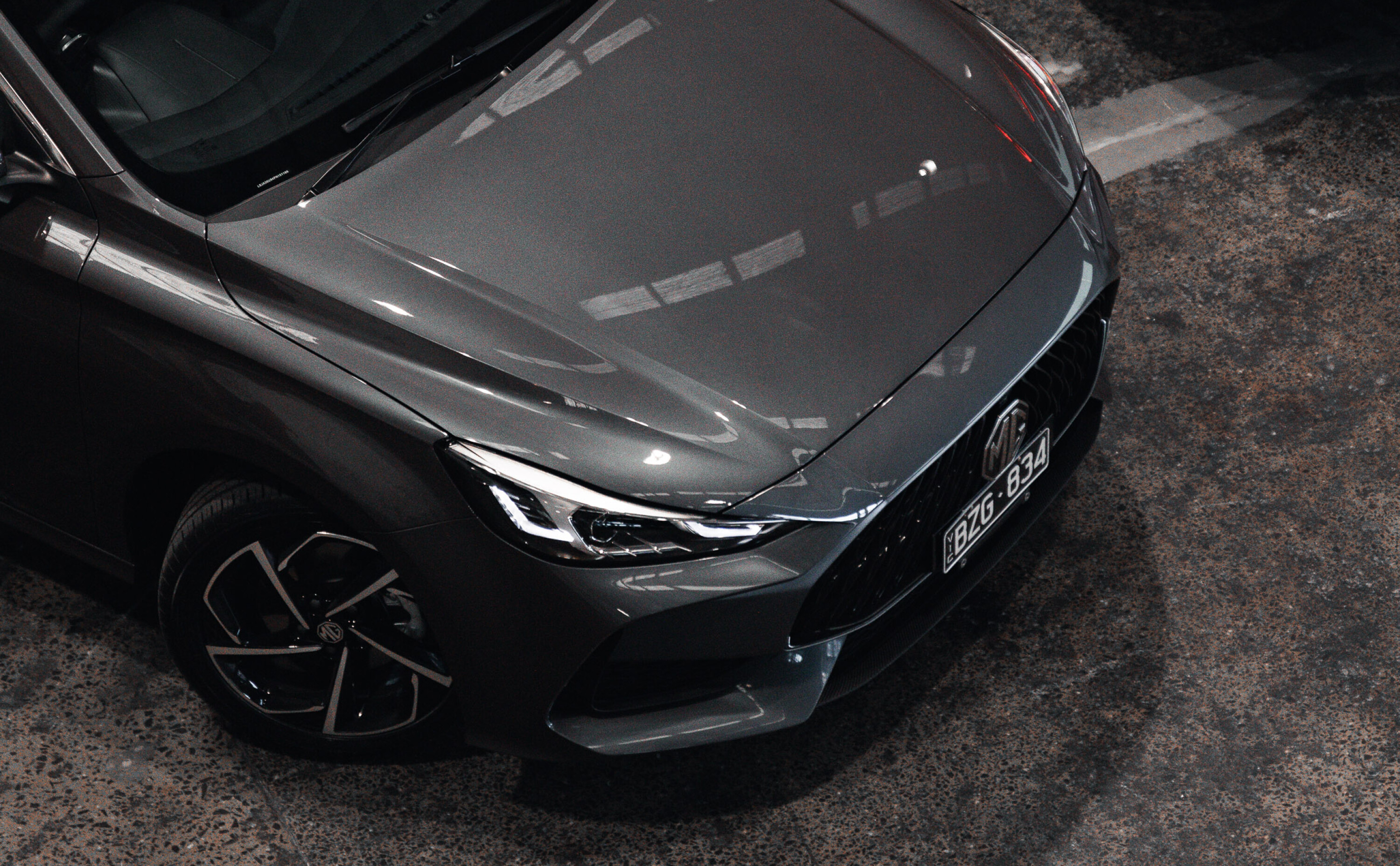
1
Dimensions
Measuring 4675mm long, 1842mm wide and 1480mm tall with a 2680mm wheelbase, the MG 5 is similar in size to a Toyota Corolla sedan, but with a similar width to a one-size-up Camry.
2023 MG 5 boot space
Boot space for the five-seater sedan is quoted at 401 litres.
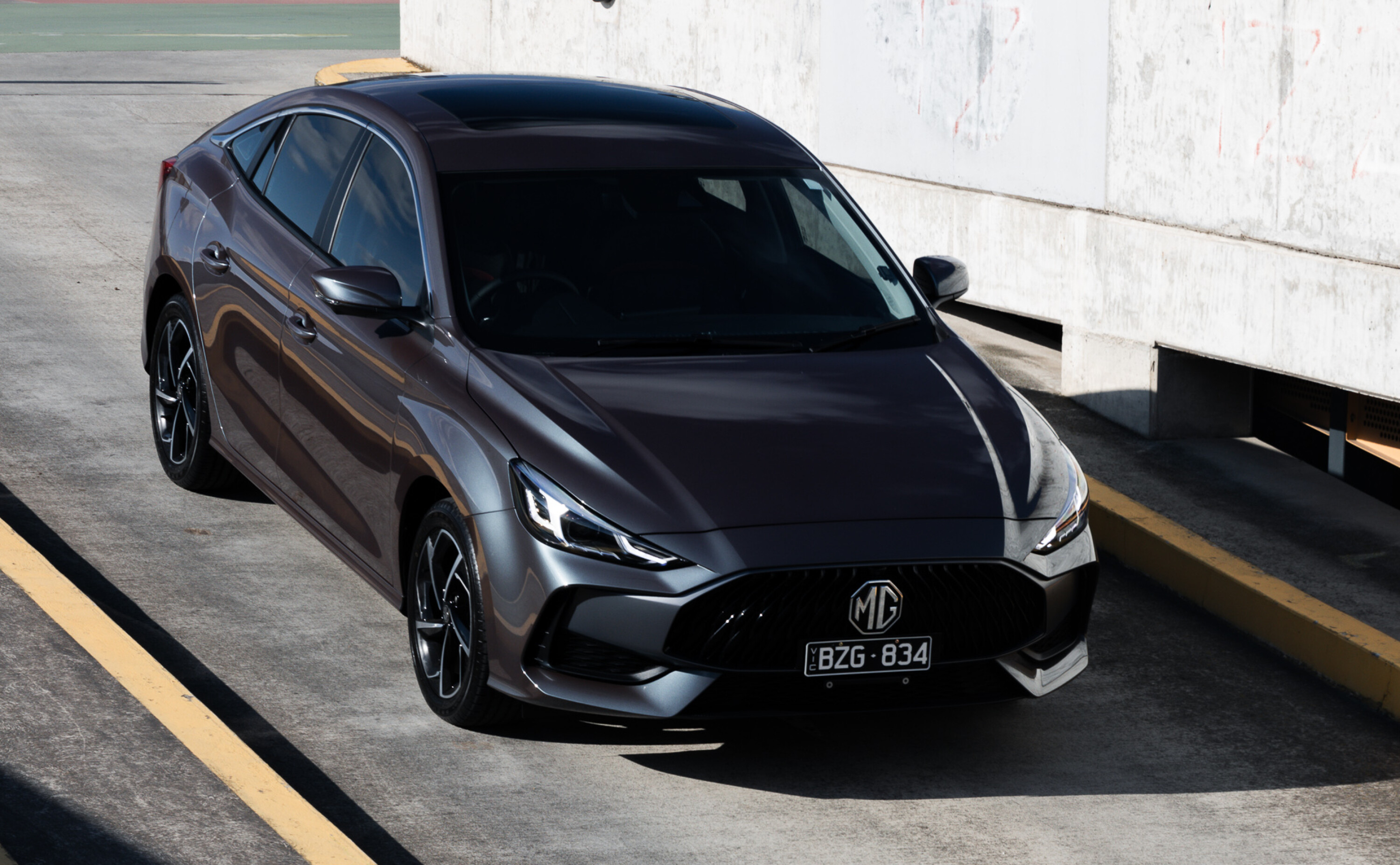
1
Warranty and servicing
As per the wider MG range, the MG 5 is covered by the brand’s seven-year/unlimited-kilometre warranty.
Maintenance details for the MG 5 have yet to be confirmed, but other MG vehicles require servicing every 12 months or 10,000 kilometres, whichever occurs first.
Availability
The 2023 MG 5 is now available at the brand’s showrooms across Australia.
MORE
Everything MG
The man in charge of the performance world’s most famous single letter, M, closes his eyes and shakes his head, a pained expression passing across his face.
Frank van Meel is cold, his chin tucked into the high collar of his branded jacket as we huddle around a feeble gas heater in pitlane at The Bend near Adelaide, yet he’s working himself into a lather as he explains the complexity of making BMW M’s first ever fully electric car.
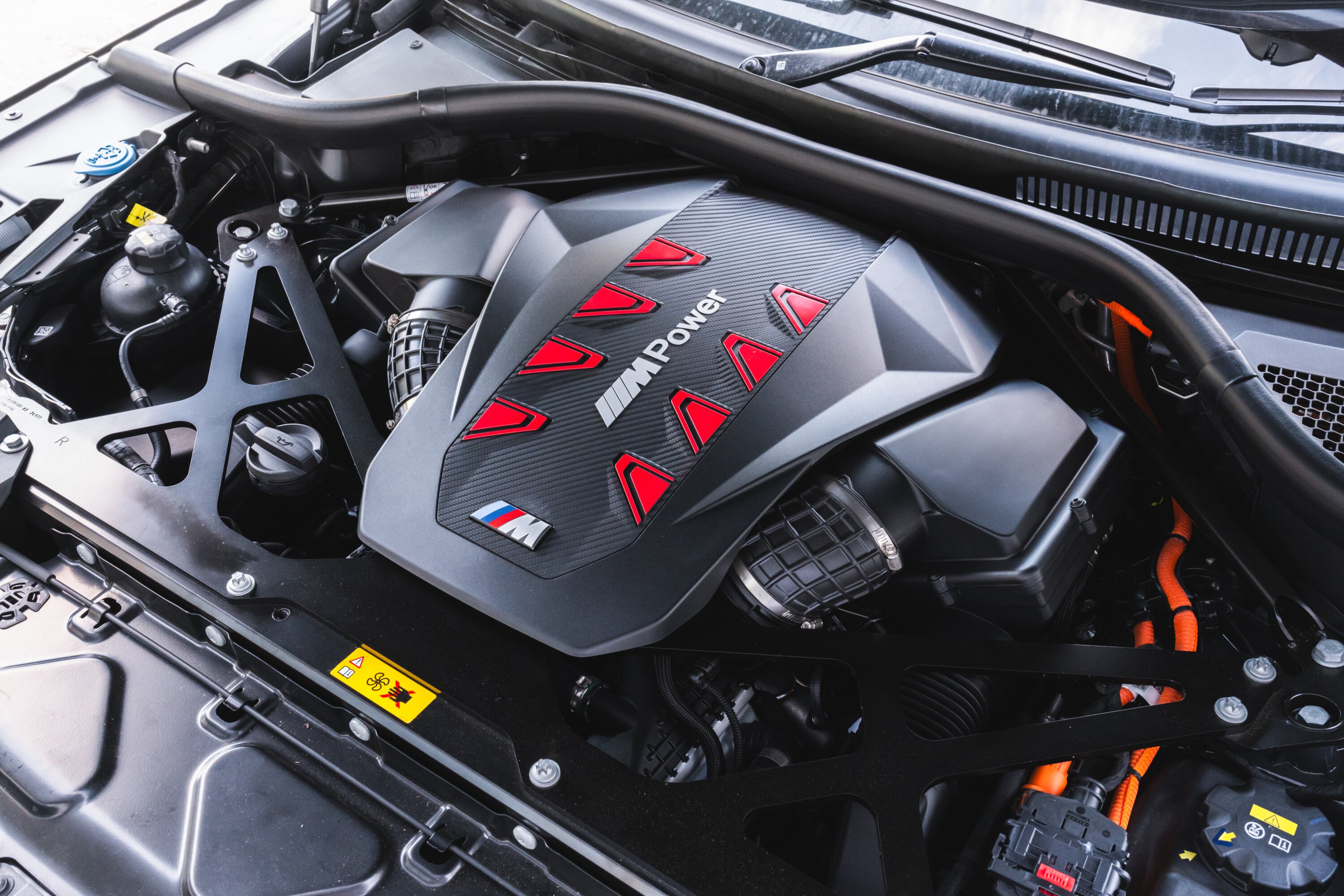
Finally, after delving into the benefits and challenges using four individual electric motors on M’s forthcoming EV, which is already testing, should produce in excess of 1000hp (745kW) and will debut a cutting-edge control unit known as ‘the hand of God’, van Meel sighs and says: “It’s… complicated”.
He’s right, of course, but technical complexity is just one of the challenges facing M’s first EV. The bigger question mark surrounds how it’ll be received by M’s diehard fan base…
Right now BMW M is on a roll. The M5 CS is one of the company’s best ever efforts, the new M2 is punchy, engaging and continues the magic of the original and then there are the M3 Touring and M5 Touring, cars that threaten to usurp the mighty Audi RS4 and RS6 as the ultimate all-weather, everyday performance cars.
But there are treacherous waters ahead. The polarising XM, which is the company’s second bespoke car following the legendary M1 of the late ’70s, is getting a lukewarm reception from the press and M’s traditional fan base.
And once petrol engines, evocative soundtracks and manual gearboxes make way for electrons, how does M retain its identity?
This isn’t a distant horizon, either. M says more than half of its volume will be electrified by 2027.
Which is perhaps why Frank van Meel has returned as the boss of M. This is the 46 year-old Dutchman’s second tilt at M’s top job, having previously held the role between 2015-18.
A car industry veteran, van Meel studied engineering in Berlin before working at Continental and then landing the top job at Audi Quattro (now Audi Sport) where he established his performance credentials by overseeing models like the R8 supercar and TT RS.
A switch to BMW followed in 2014, with van Meel’s first stint as the head of M seeing the famously rear-driven brand embrace all-wheel drive with the introduction of a new, fully variable system on the M5.
It also fleshed out M’s model hierarchy, with the line-up expanding to include the sought after (and profitable) Competition, CS and CSL badges. But then BMW’s HR department came knocking…
“At BMW Group you’re not supposed to do one job longer than five years,” van Meel tells us. “So after four years, I had to move to headquarters to get to know BMW better.”
Van Meel’s new role made him responsible for Total Vehicle Development, which had a strong focus on future vehicle architectures and strategy for EVs – handy homework when his current task is dragging BMW M into the electrified age. So what is van Meel’s philosophy on high-performance EVs?
“Our overall goal is to be better than the current M cars,” he says, rather simply.
M’s electric expansion is already well advanced, of course. The i4 M50 and upcoming i5 M60 are just two examples of fully electric models already in market. And M debuted its first ever plug-in hybrid powertrain in the XM SUV, which combines a 4.4-litre twin-turbo V8 with a 25.7kWh battery and a single e-motor to produce outputs as high as 550kW/800Nm.
The new M5, which is due to arrive later this year as both a sedan and a wagon, is also heavily tipped to use plug-in power, though it’s unlikely to top the XM for power.
“I think there is a natural limit where you say even more power does not help,” van Meel says. “And with 750 horsepower (560kW), I think that is the top of what you should do with a drivetrain like that because I mean, okay you can do even more, but the car doesn’t get faster anymore. The overall harmony in the car is perfect with 750 horsepower.”
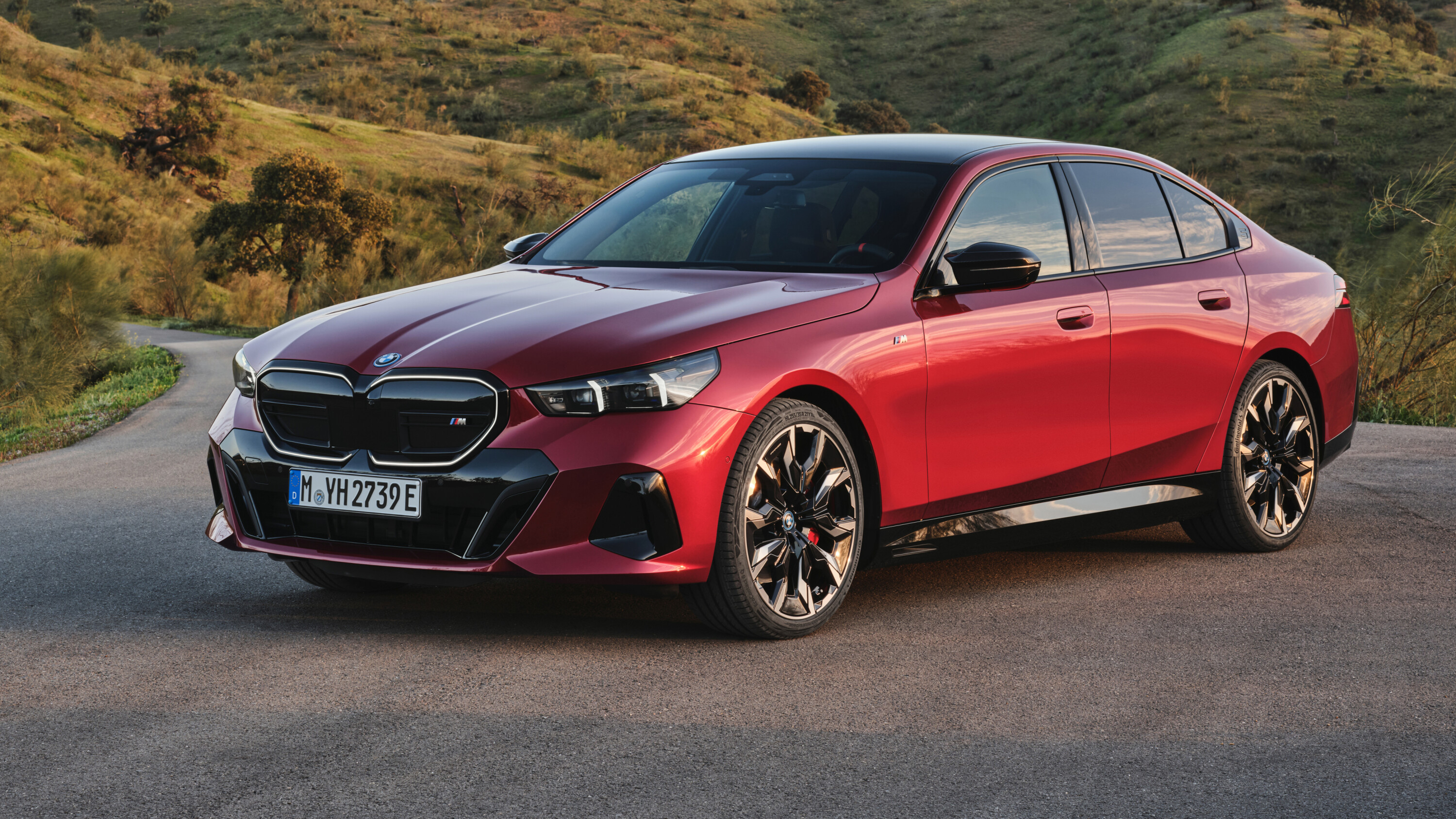
1
Prioritising balance and connection, rather the outright power, provides an interesting insight into how van Meel is approaching the challenge of creating M’s first ‘full fat’ EV.
Already being tested as an i4 development mule, M’s forthcoming quad-motor EV is likely to produce in excess of 1000hp (750kW) but van Meel is more concerned about repeatability of performance rather than a headline power figure.
“The interesting thing if you look at electric performance is how much performance can you deliver continuously,” he says. “It’s very easy to have huge numbers in like a ‘boost mode’ and for like 10 seconds say I can give you a megawatt out of the e-motors, so 1360hp. But actually, it doesn’t help because you use it once and then the car needs 10 minutes to cool down.”
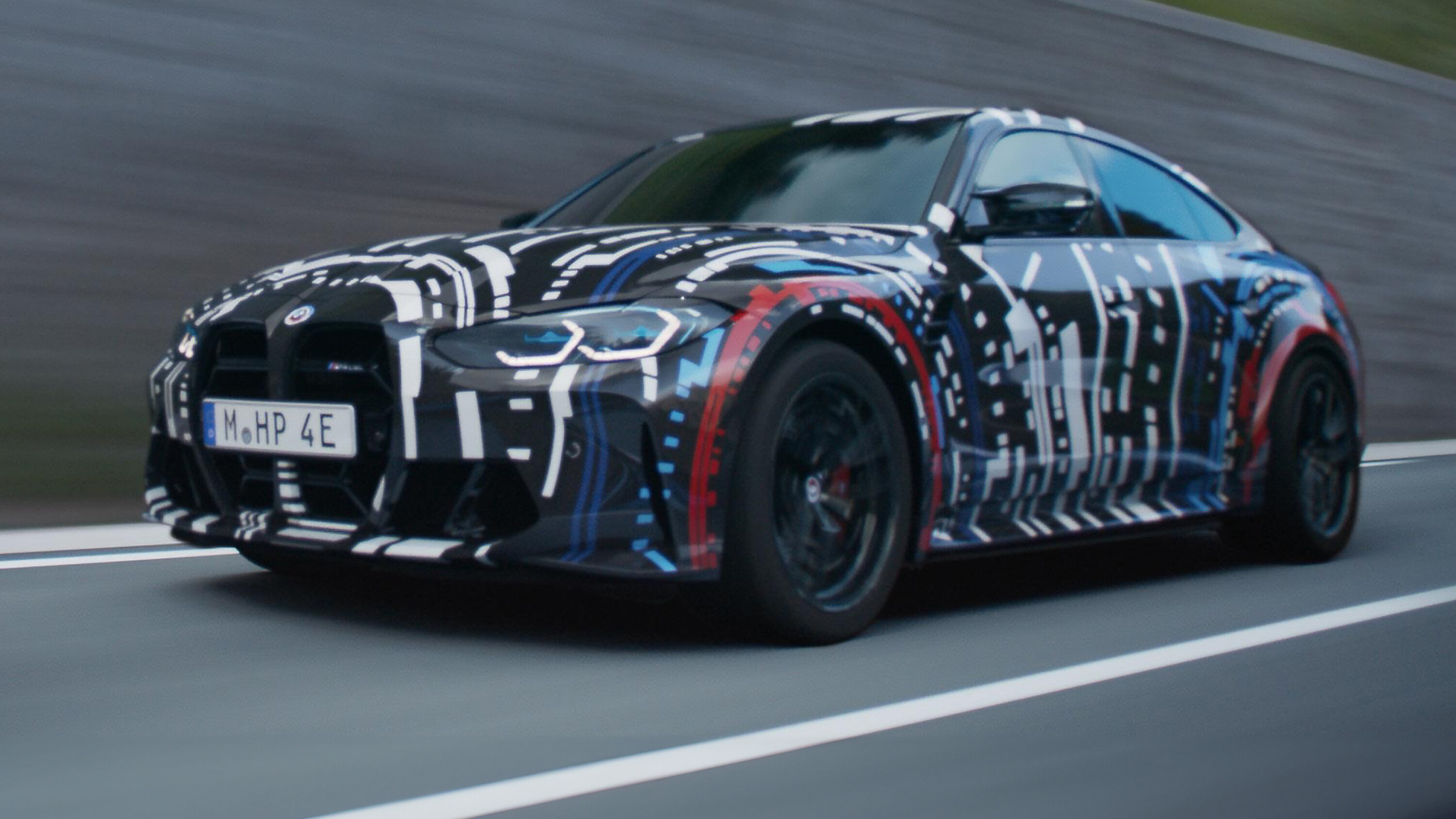
1
“There will be a few that can stay on the track and the other ones who are just show offs”
Building a high performance EV that can maintain its peak power for extended periods is clearly a top priority for van Meel, with the Dutchman predicting a divide between manufacturers chasing a big power number and others who place more of a focus on track driving.
“There will be a few that can stay on the track and the other ones who are just show offs,” he says.
“What’s really important for high-performance electric cars is they have this continuous power. And that’s in regards to the electric motors but also in regards to the high voltage battery cooling system and the cabling.”
1
Which is where BMW’s potentially groundbreaking ‘integrated driving dynamics system’ comes in.
Known inside M as ‘the hand of God’, it’s easiest to think of the system as a gigantic brain that won’t only control the four individual e-motors and electronic stability and traction control systems but also the braking regen (van Meel says up to 1G of deceleration is possible) and torque vectoring.
“It’s very clear you need a centralised control unit,” says van Meel. “And with that, you can also make the car drive like something you’ve never seen before.”
1
The issue, and the reason the usually reserved father of six gets quite animated during our interview, is that making ‘the hand of God’ work is proving to be quite the challenge.
“It’s the next step and it’s even more difficult that the already difficult task of getting the continuous power output,” van Meel says. “We need a completely different kind of system architecture, including software. So it’s hardware, it’s software and it’s the drivetrain and only if you can manage those things, and all of those things, do you get the perfect car. And that’s what we’re striving for.”
Time is on van Meel’s side, for now. Ask him to commit to a date for M’s first EV and all he’ll offer is “it’s going to take place this decade”, suggesting the evolution from combustion to hybrid to full electric will be a steady but inevitable progression. There will be some casualties along the way, though…
1
M has already firmly ditched dual-clutch gearboxes in favour of conventional automatics.
And if you ask van Meel about the future of the manual, his response is swift and brutal: “they will disappear”. Happily the news is brighter when it comes to the iconic straight six.
“The market is booming for six-cylinder inline engines,” he says. “We love it and the customers love it, so it’s probably going to be around for quite a while.” Hurrah.
So it’s shaping up to be a busy half-decade for BMW M. On top of developing its first EV, it’s also chasing an aggressive sales increase and hopes to top 200,000 units globally this year. Motorsport is also expanding, with the German brand returning to top tier prototype racing at Le Mans in 2024.

1
Despite the potential for distraction, however, it’s clear that building cars with a sense of connection is a top priority for van Meel. As is exploring ways to keep weight gain as low as possible, despite the unavoidable heft of EVs.
“Of course, with battery driven cars, the weight will go up,” he says. “ The good thing is we have been fighting weight since the beginning because weight is our, let’s say, basic enemy.
“But it’s like in racing, you have this window of performance and it’s always about aerodynamics, weight, fuel consumption and efficiency. So that’s what we’re used to. So it’s finding a new position in that window of performance.”
View it that way and van Meel’s challenge suddenly doesn’t seem so daunting. The ingredients for an electrified future might have changed, but the overarching method is reassuringly familiar: to deliver an engaging driver’s car. And on that front, BMW M and Frank van Meel have form.
MORE
Everything BMW
SAIC Motor and Audi have agreed to partner on electric vehicle projects, which could see some MG parts being used in the German luxury brand’s new models.
Snapshot
- Audi and SAIC agree to partner on developing EVs
- Reportedly wants EV platform from IM Motors to catch-up with market
- Amid VW Group EV delays, new luxury Chinese EV brands, Tesla market domination
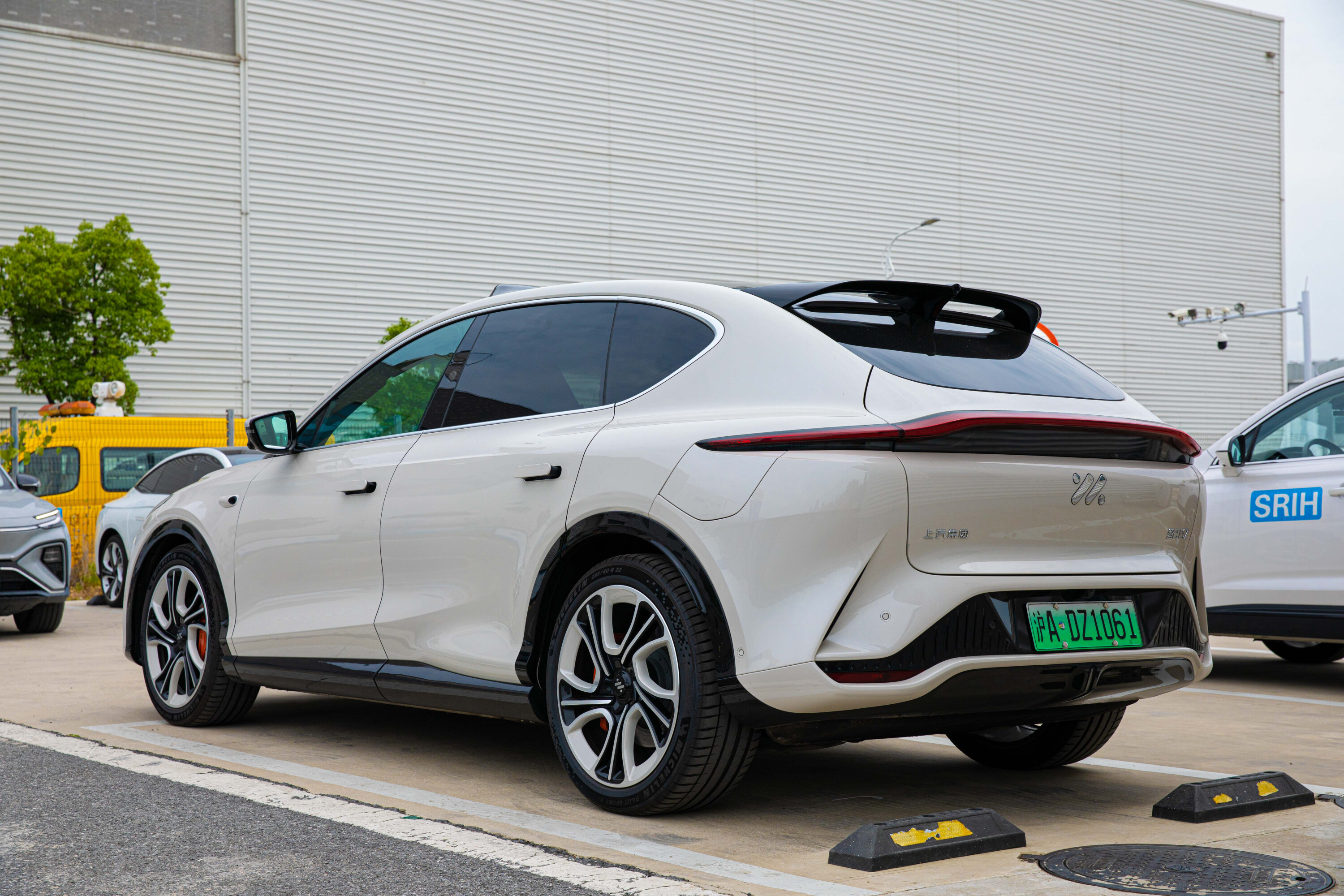
Bloomberg [↗] reports Audi is seeking to use a platform from IM Motors, SAIC’s premium EV brand, as it’s under pressure to catch-up with the electric car market and improve sales – especially in China.
SAIC owns car brands, including MG and IM, with the upmarket IM LS7 electric SUV likely to launch in Australia by 2026 but rebadged as an MG.
3
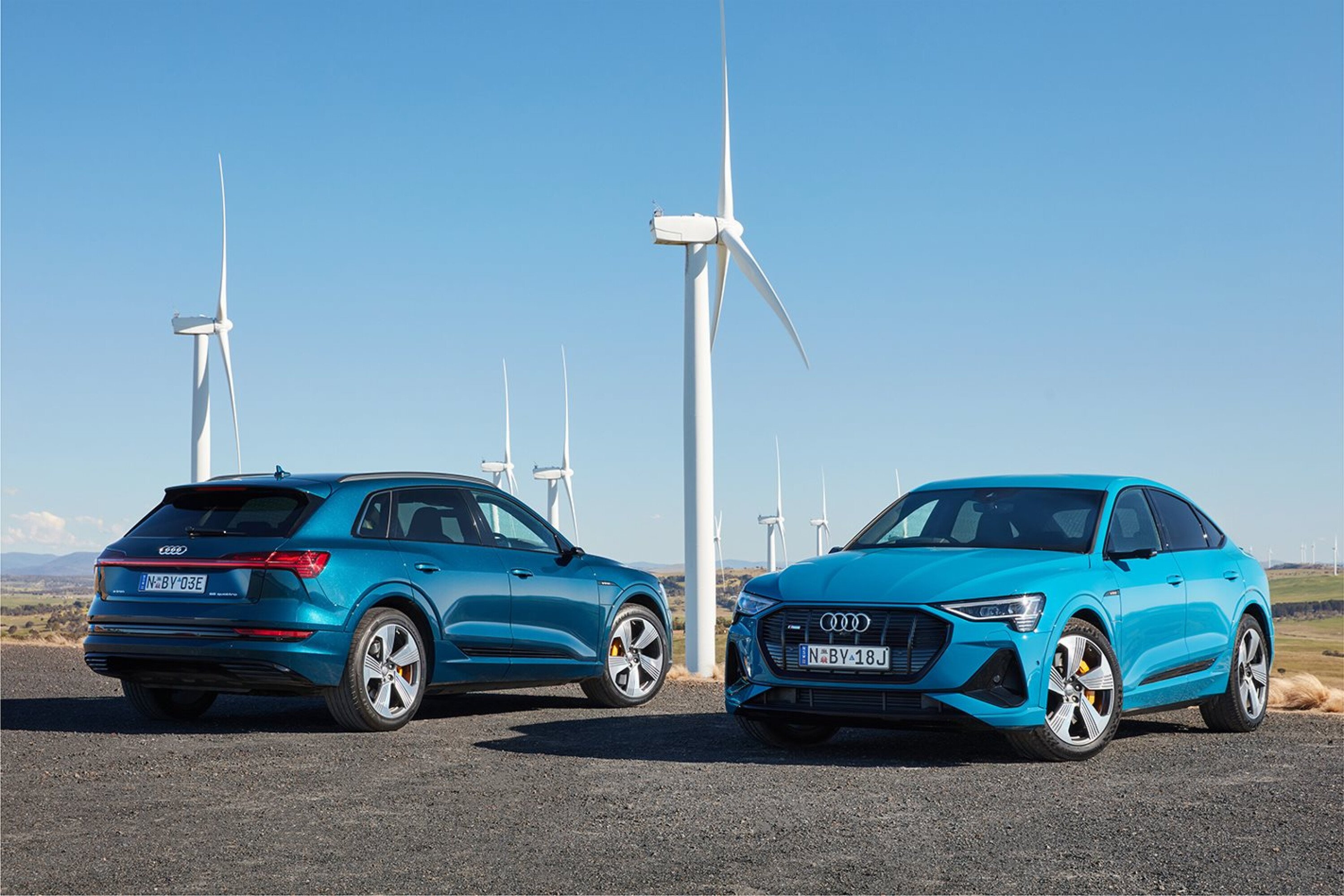
Currently, Audi only sells electric models in Australia – the E-Tron SUV (soon to be updated as the Q8 E-Tron) and E-Tron GT sports sedan. The Q4 E-Tron small SUV is also available overseas.
The Q6 E-Tron medium electric SUV will also debut soon after some delay on the new Premium Platform Electric (PPE) – shared with the forthcoming A6 E-Tron and Porsche Macan EV – while the Volkswagen Group’s flagship Scalable Systems Platform (SSP) has been postponed to around 2030 due to software issues.
Audi’s parent, the Volkswagen Group, already partners with SAIC to manufacture traditional internal combustion engine vehicles in China.
Despite the luxury brand’s slow EV start, it aims to only launch pure-electric models globally from 2026 – aided by a new factory with the FAW Group in Changchun, China to only produce electric PPE-based models – leading up to an electric-only line-up by 2033.
Audi EVs in context
So far this year to the end of June, Audi has only sold a total of 231 EV models in Australia.
In contrast, BMW’s wider EV line-up has managed to register 993 examples, Mercedes-Benz at 859, and Genesis trails at 162 year-to-date.
However, these numbers are still tiny compared to market-leader Tesla, which has sold 25,577 EVs from just two near-identical models alone.
Tesla demonstrates carmakers, such as Audi, don’t necessarily need to release more electric models to attract buyers to make the switch.
1
General Motors (GM), the BMW Group, Hyundai, Kia, Honda, Stellantis, and Mercedes-Benz have partnered to roll out a ‘leading’ electric vehicle fast charging network in North America – but not in Australia.
Snapshot
- Seven major car brands partner to establish North American charging network
- At least 30,000 DC stations from around mid-2024
- Australian public EV infrastructure still left behind with no official carmaker support
The major joint venture will aim to install at least 30,000 high-powered DC charging stations in urban areas and along major highways from winter 2024 (summer in North America).
The network will offer both Combined Charging System Type 1 (CCS1) and Tesla’s North American Charging Standard (NACS) connectors – the latter coinciding with the plug’s expansion to non-Tesla EVs, such as Ford, GM, and Rivian.

1
With the network supported from public and private investments on a federal and state level, each EV charging hub will be placed in “convenient locations” with canopy shades “wherever possible” and amenities, such as bathrooms, food and retail.
The network will also be integrated to participating automakers’ built-in navigation systems and adopt Plug and Charge technology to start charging compatible EVs automatically, without a smartphone app or RFID card.
It will complement – and compete against – Volkswagen’s Electrify America subsidiary, Tesla’s Supercharging network, and Mercedes-Benz’s upcoming own network in North America.
Car brands unite, as Australia lags behind
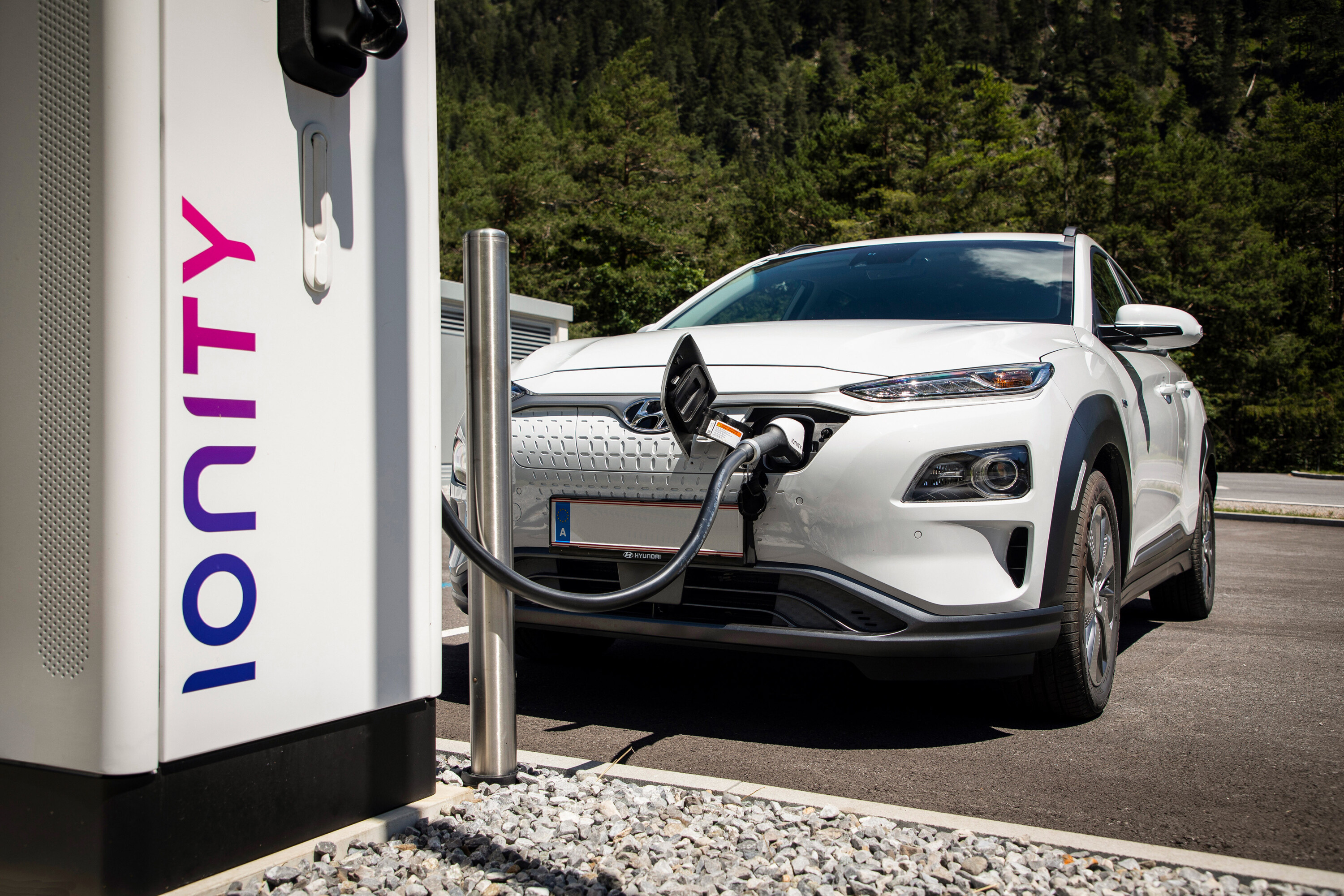
The major partnership is a similar move to the widespread Ionity EV charging network in Europe – in a bid to address a key barrier to electric adoption.
Ionity was founded in late 2017 as a joint venture between the Volkswagen Group, Hyundai Motor Group, Ford, BMW Group, and Mercedes-Benz to quickly expand public charging infrastructure.
3
However, Australia is still left out, with major charging providers – such as Chargefox, Evie Networks and BP Pulse – needing to be funded independently or be co-funded by philanthropists, other organisations, and/or the federal government’s Australian Renewable Energy Agency (Arena) – in order to expand and, importantly, maintain infrastructure.
The Australian Government has committed to a region-linking EV charging network with the NRMA to particularly fill blackspots in remote and regional areas by 2025.
