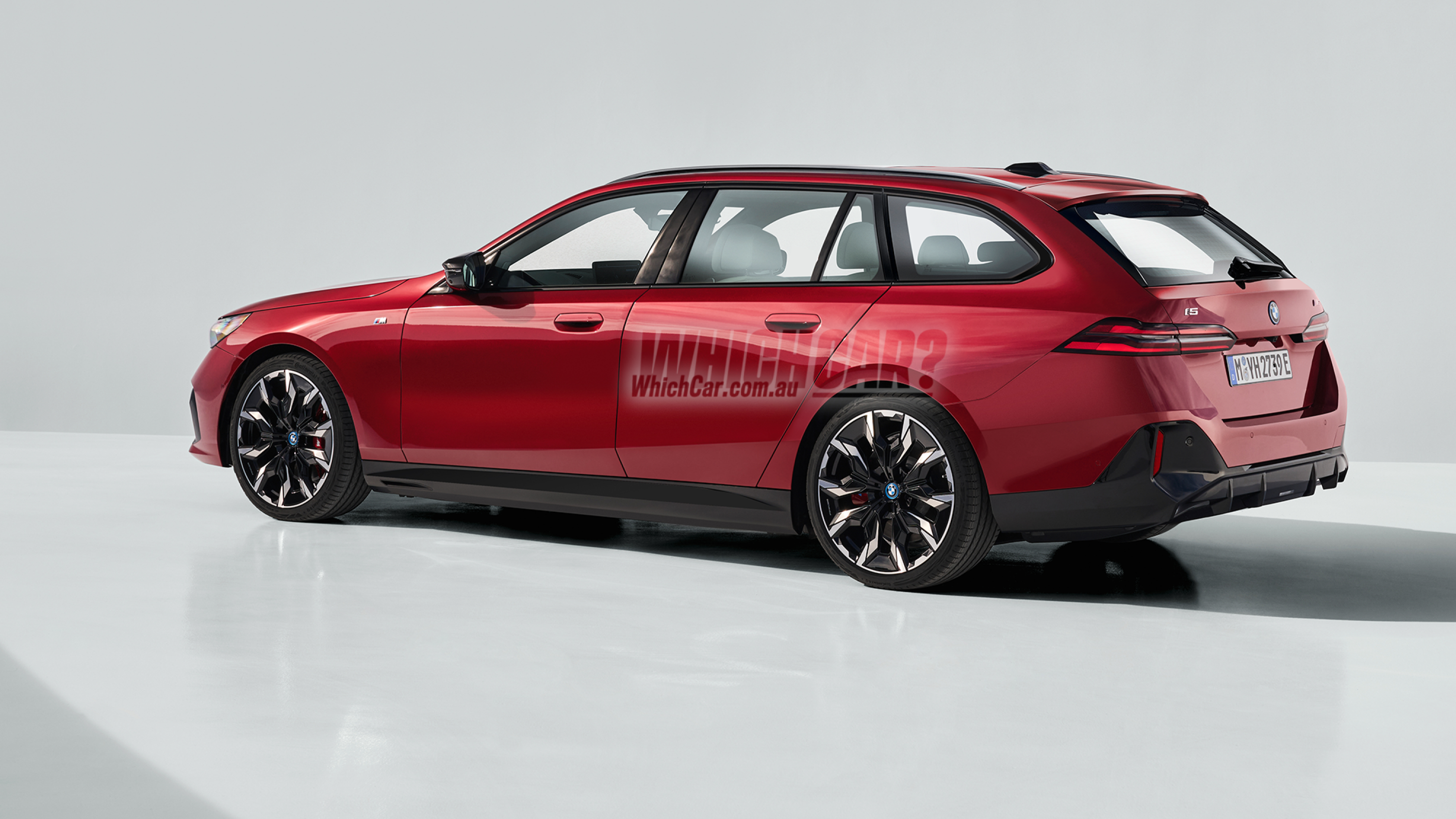
Theo’s renderings don’t bring any surprises, of course – it’s no mind-bending challenge to imagine a BMW wagon, given the brand has so much history with the form. Nonetheless, we like what we see here.
Whether we’ll see either of those new wagons in Australia, however, is another thing.
Although the current 5 Series Touring did come to Australia, it was only in small numbers and most were gobbled up by the police fleets. Of course, in this era of SUV obsession, customer demand for the wagon would’ve been low.
Mercedes-Benz has already exited its E-Class Estate wagon in Australia, focusing instead on the E-Class All-Terrain – a jacked-up and plastic-cladded version of the regular wagon, similar to the Subaru Outback and the many European rivals that have followed it.
Mercedes has yet to confirm a new E-Class Estate, although spy photos [↗] reveal it’s in the works.
Audi, to its credit, did the right thing in 2022 and teased its next-gen A6 in Avant wagon form, leaving little doubt that we’ll see the longroof carry on into a new generation.
Watch the new i5 transform into a stylish Touring wagon
Welcoming a new member to your family should be cause for celebration, but for some it may just generate angst when they look at what’s already in their driveway.
Is that ancient sedan going to cut it as a family car? Is a two-door sports car going to be a pain to live with when the baby comes along?
Allow us to help. Our first advice is this: Get the newest car you can afford. Newer cars will have a higher degree of standard safety equipment and better crash performance that older models, and when it comes to carting around a young family it’s safety that should be the primary consideration.
But beyond that, what do we recommend? Not everyone has the budget to put a hulking SUV in their garage, but the good news is that there are a number of good baby-friendly cars across a very broad range of prices.
There are some common attributes new parents will need to look for.
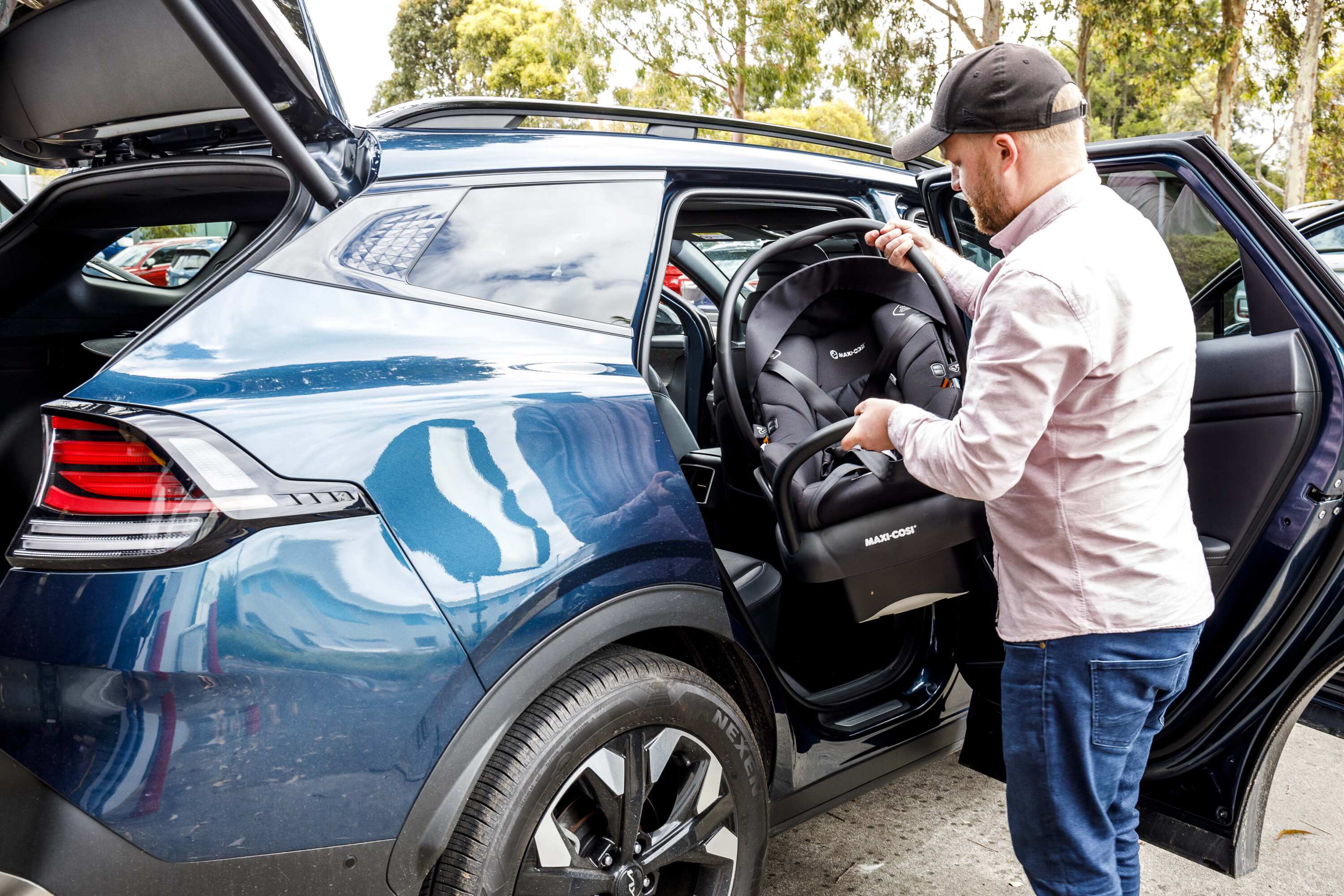
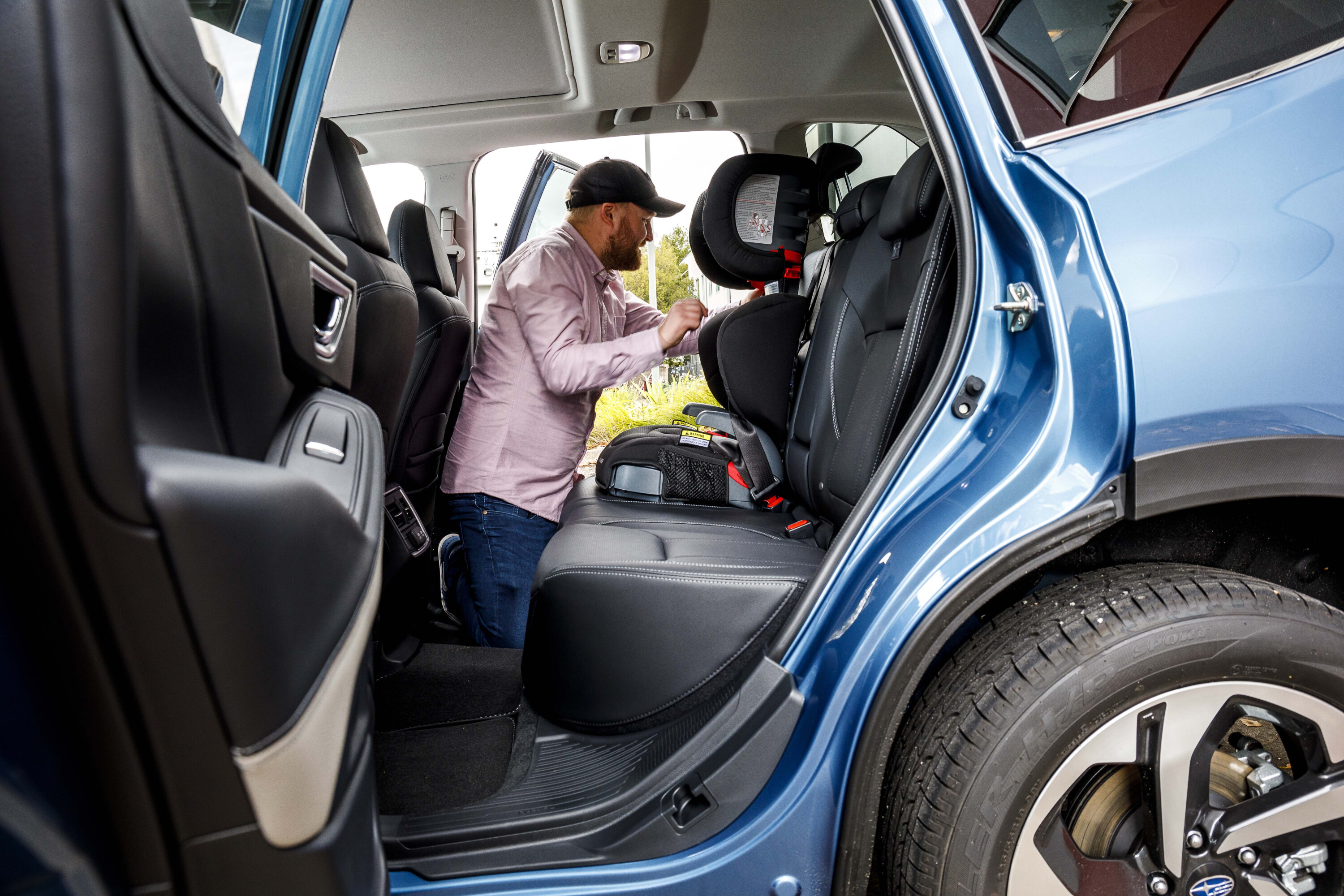
For one, it needs to be easy to get children in and out of the second row.
All of these cars have either heaps of room between the front and rear seats to help mum or dad strap junior in, a wide-opening rear door, or – in most cases – both.
A sizeable boot area is also a must.
Given the need to house a pram and bags of baby gear like toys, food, nappies and more, you’ll want to make sure there’s loads of room in the boot.
So, which cars in today’s market are the best picks for babies?
While this list is by no means exhaustive – there are no doubt many other vehicles that aren’t mentioned here that also have good credentials as baby haulers – these are the new vehicles we recognise as being among the best in their segment when it comes to toting a young family.
Wait!
Before you skip down to our list of suitable cars, you can also see our Best Medium SUV and Best Dual-Cab Ute stories, each of which have comprehensive family-friendliness sections.
Now, on with the list…
Small cars: Subaru Impreza, Honda Civic, Kia Cerato
The small car class is no longer one of the most popular vehicle categories in this country, however there are still a couple of models that continue to do well month-in-month-out.
1
There are a few that rate better in the baby stakes, however, all by virtue of having roomy back seat areas that allow two (or even three) baby seats to be strapped in while still leaving enough room for a parent to lean in comfortably.
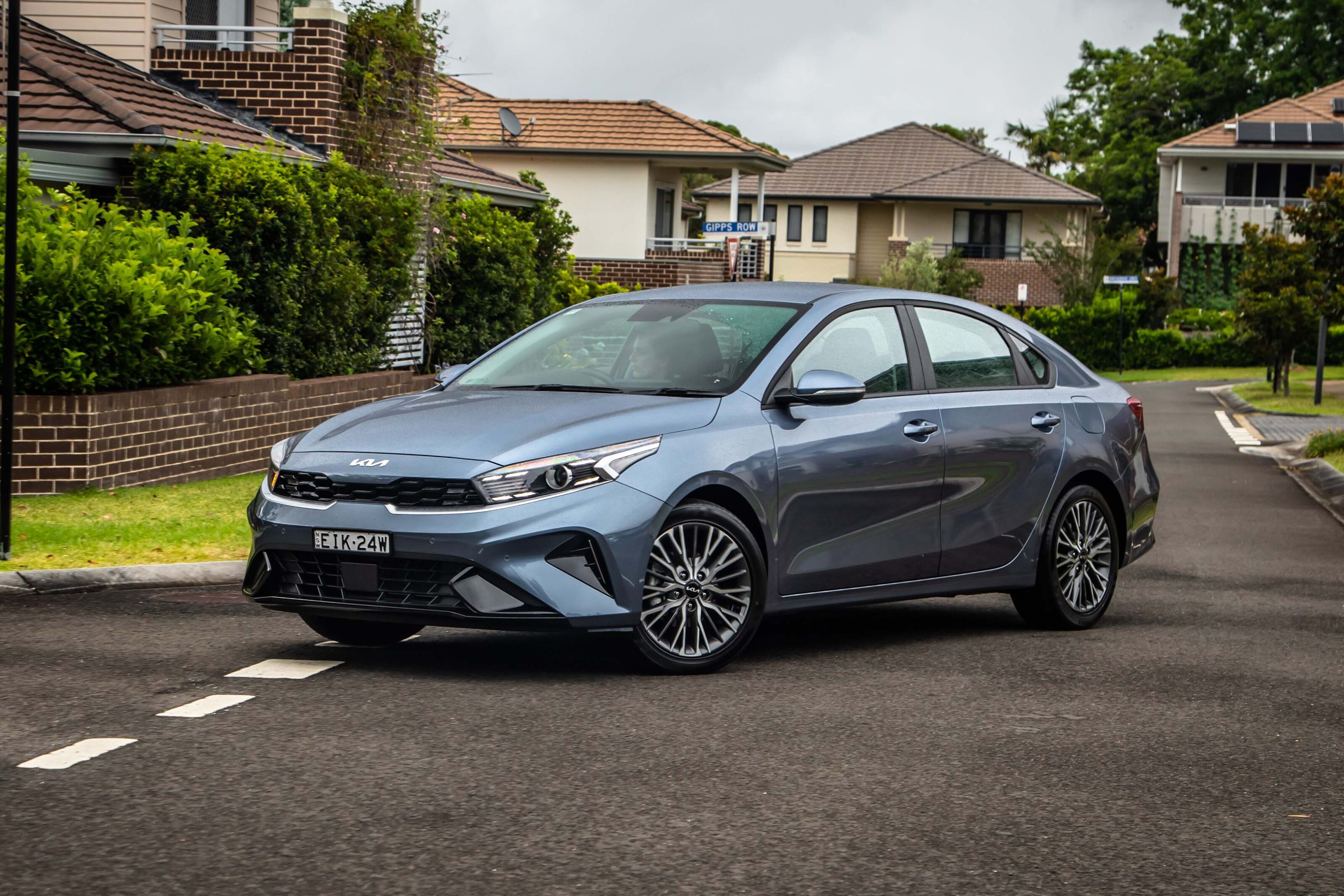
The Subaru Impreza is a standout, whether in sedan or hatch form, as are the Honda Civic and Kia Cerato. The Impreza gets a few more points for having the extra grip of all-wheel drive as standard on every model, an important safety consideration.
New car buyers are abandoning the medium and large sedan categories in droves, but savvy shoppers should recognise that there are still some appealing and value-rich vehicles in those segments.
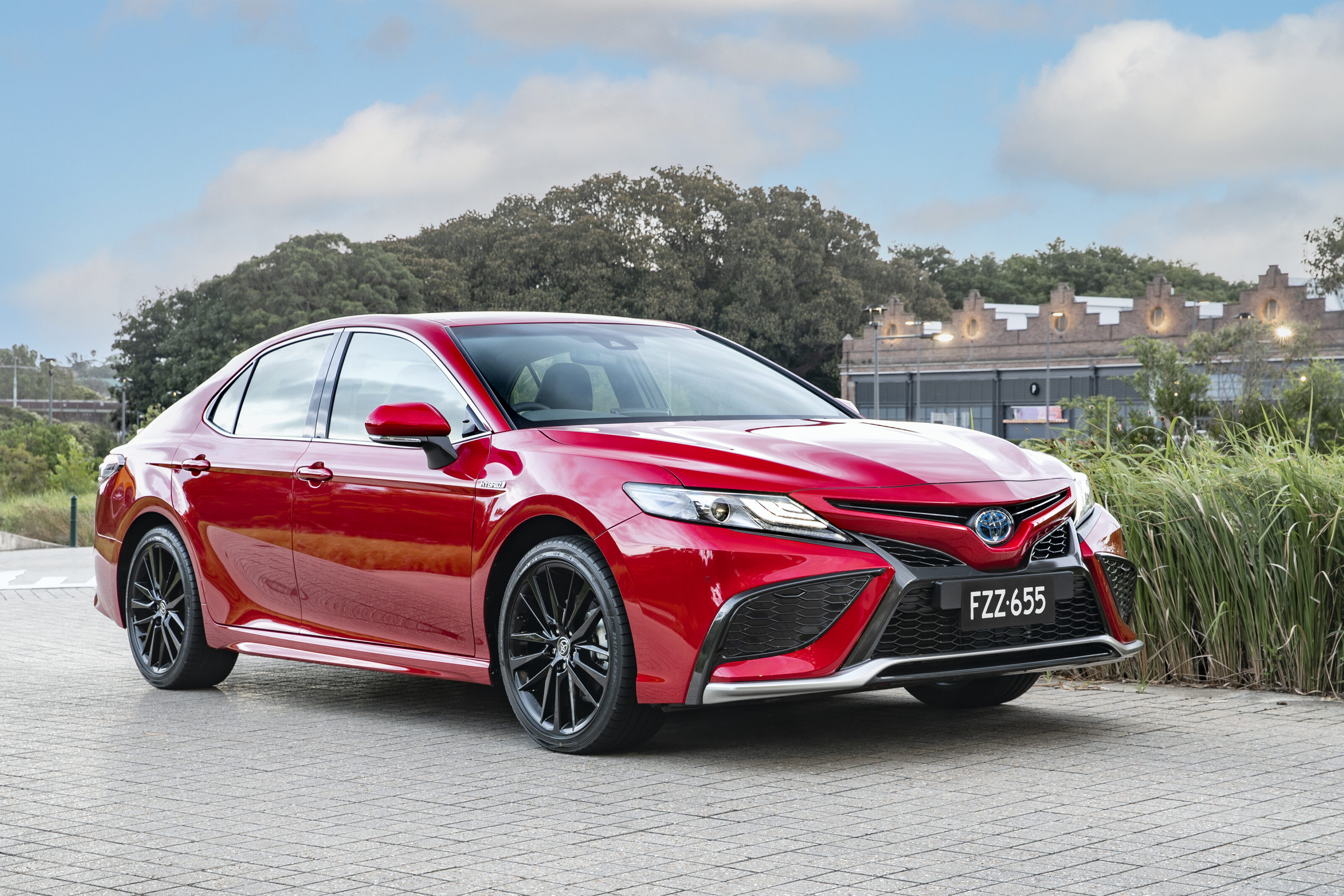
Cars like the Toyota Camry provide plenty of metal for your money, with the $36,729 Camry Ascent base model offering those baby-friendly virtues of a big back seat area and sizeable boot (you get 524 litres of cargo capacity in most Camrys, except in the base model which gets ‘only’ 493L).
1
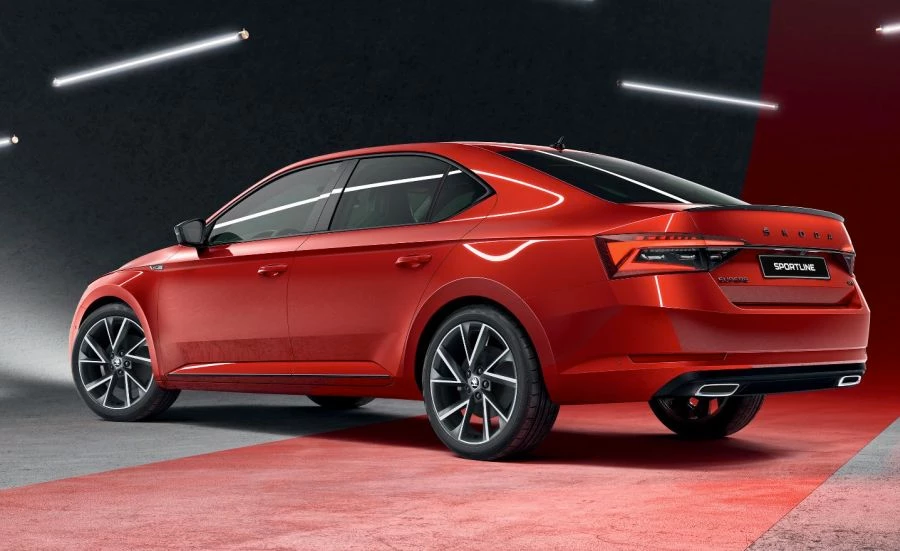
While the Skoda Superb is supremely roomy in the back seat, has a huge boot, and comes with a dignified European design that looks more expensive than its actual retail sticker.
You’ll need $56,990 to get into one, but the Superb is one for those looking for a premium car on a mainstream budget.
And now we’re into SUV territory, the category that is now well and truly the family-car heartland.
Not everything you find at the bottom end of the SUV spectrum is suited to baby duty. Some, like the Mazda CX-3, are very much the opposite thanks to cramped rear seats and tiny boots. Some might think a jacked-up ride height is all you need to make a good family car, but they’d be wrong.
1
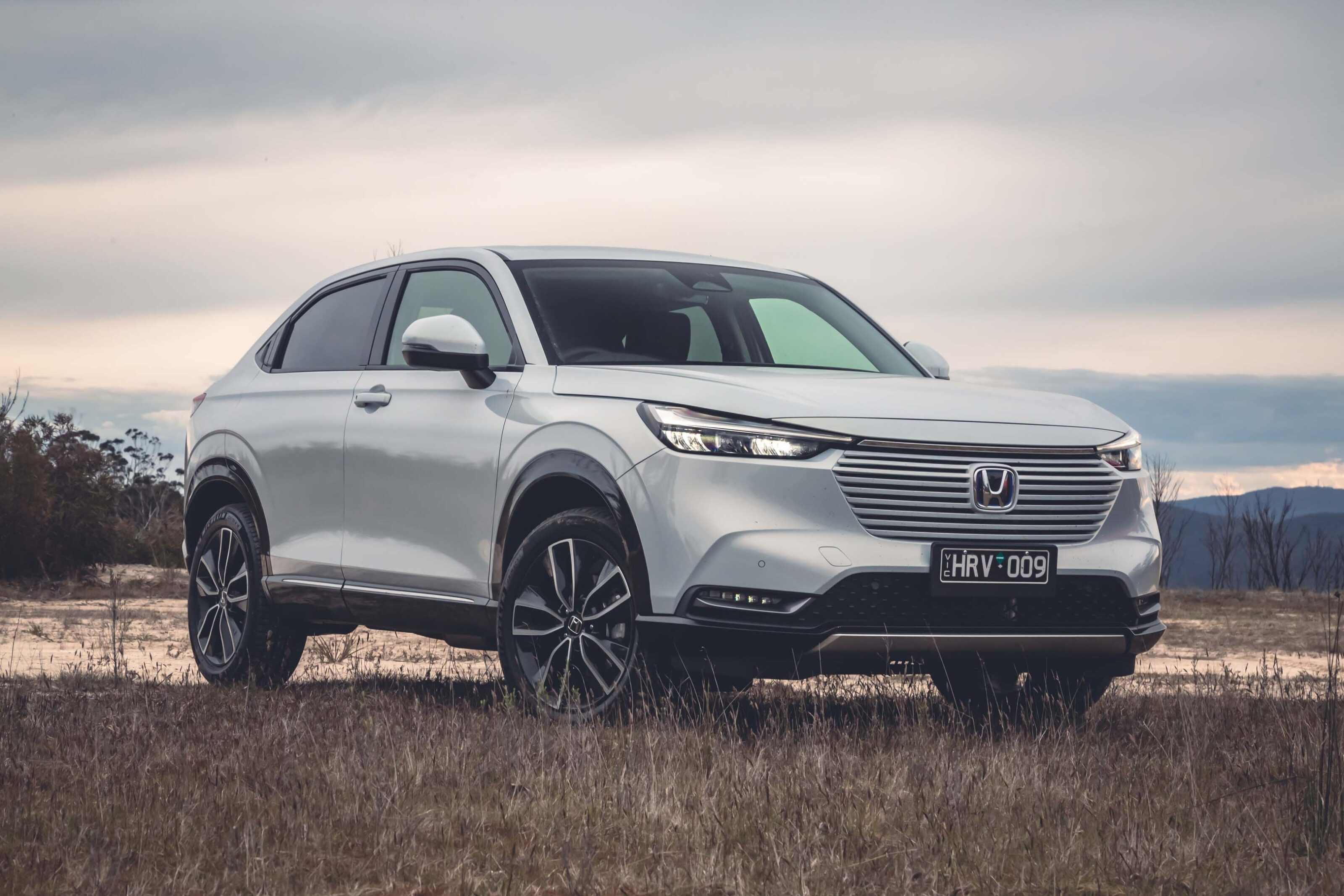
There are still some good choices though, with the comparatively spacious Honda HR-V and Subaru XV (soon to be replaced by the Crosstrek) being standouts. The XV is no surprise, given it’s based on the Impreza hatch and shares virtually all of its interior and generous cabin proportions with that car – with the added bonus of a tall ride height to make it that little bit easier to belt in the kids.
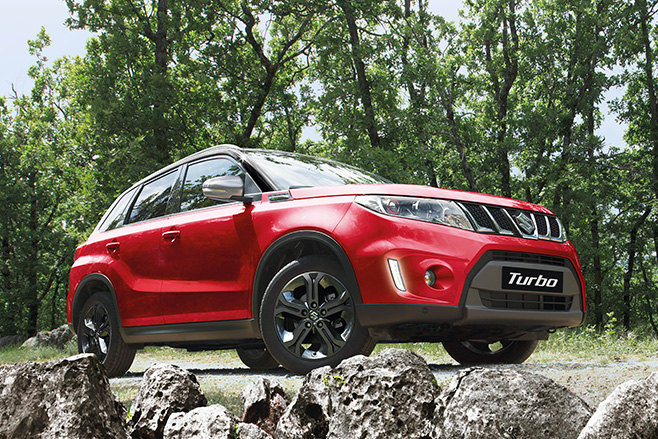
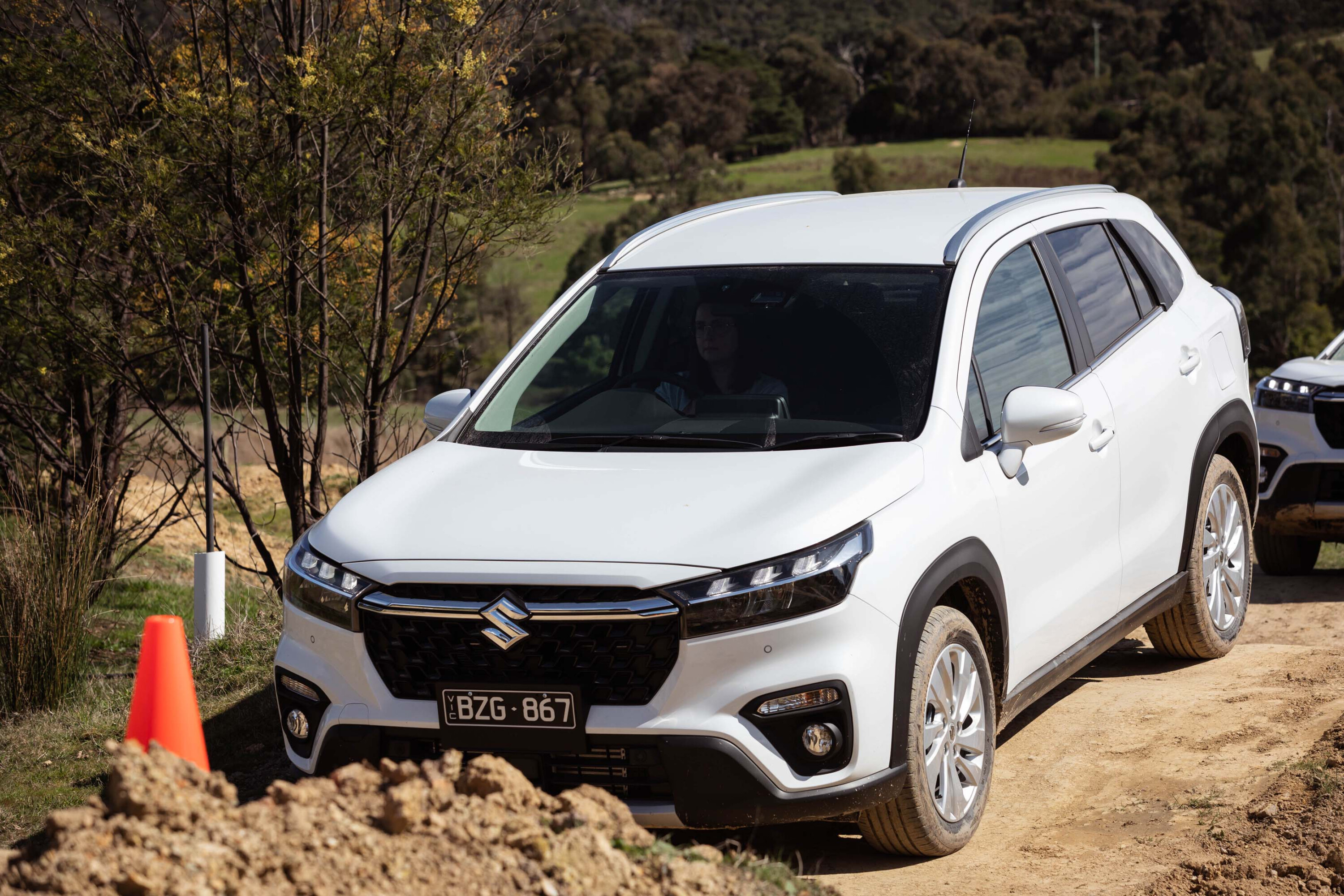
The Suzuki Vitara is another notable small SUV, with its big boxy body being what most would consider to be a traditional SUV bodystyle, and being commendably practical as a result.
Medium SUV: Subaru Forester, Mitsubishi Outlander, Nissan X-Trail, Kia Sportage
This is arguably the sweet spot for growing families, with cars that are still a manageable size – yet big enough to comfortably take the parents and a few baby seats.
Gangly teenagers are a different story, but you’ve got at least a decade to prepare yourself for that.
3
Within the segment, the standouts are the Kia Sportage and Subaru Forester, both for their excellent rear-seat room and versatile luggage spaces with wide-opening tailgates.
The Mitsubishi Outlander deserves mention for its optional third-row of seats too, and so does the Nissan X-Trail and CR-V – that extra passenger-carrying versatility can be invaluable.
Large SUV: Skoda Kodiaq, Mazda CX-9, Ford Everest, Volkswagen Passat Alltrack, Subaru Outback
If all you need is a family wagon and don’t necessarily require rock-hopping off-road capability, there’s plenty of road-biased options within the large SUV segment to keep you happy.
The Skoda Kodiaq exists at the smaller end of the large SUV spectrum but has plenty of intelligent interior features that maximise is cabin utility, not to mention a three-row layout that allows plenty of child seats to be strapped in, a huge 603-litre boot capacity (third row down) and built-in retractable sunshades in its rear doors.
1
Mazda’s CX-9 is one of the most popular large SUVs around, and with a high-quality interior, car-like handling and heaps of space for seven people it’s not hard to see why. It’s a solid family choice for quite good reason.
Got a big family but also like to tow or go bush every once in a while? The Ford Everest has the blend of space and off-road capability you need, with its available three-row configuration and capacious cabin allowing plenty of room for a growing brood. It’s not a cheap thing, mind you, with three-row versions starting north of $66K.
1
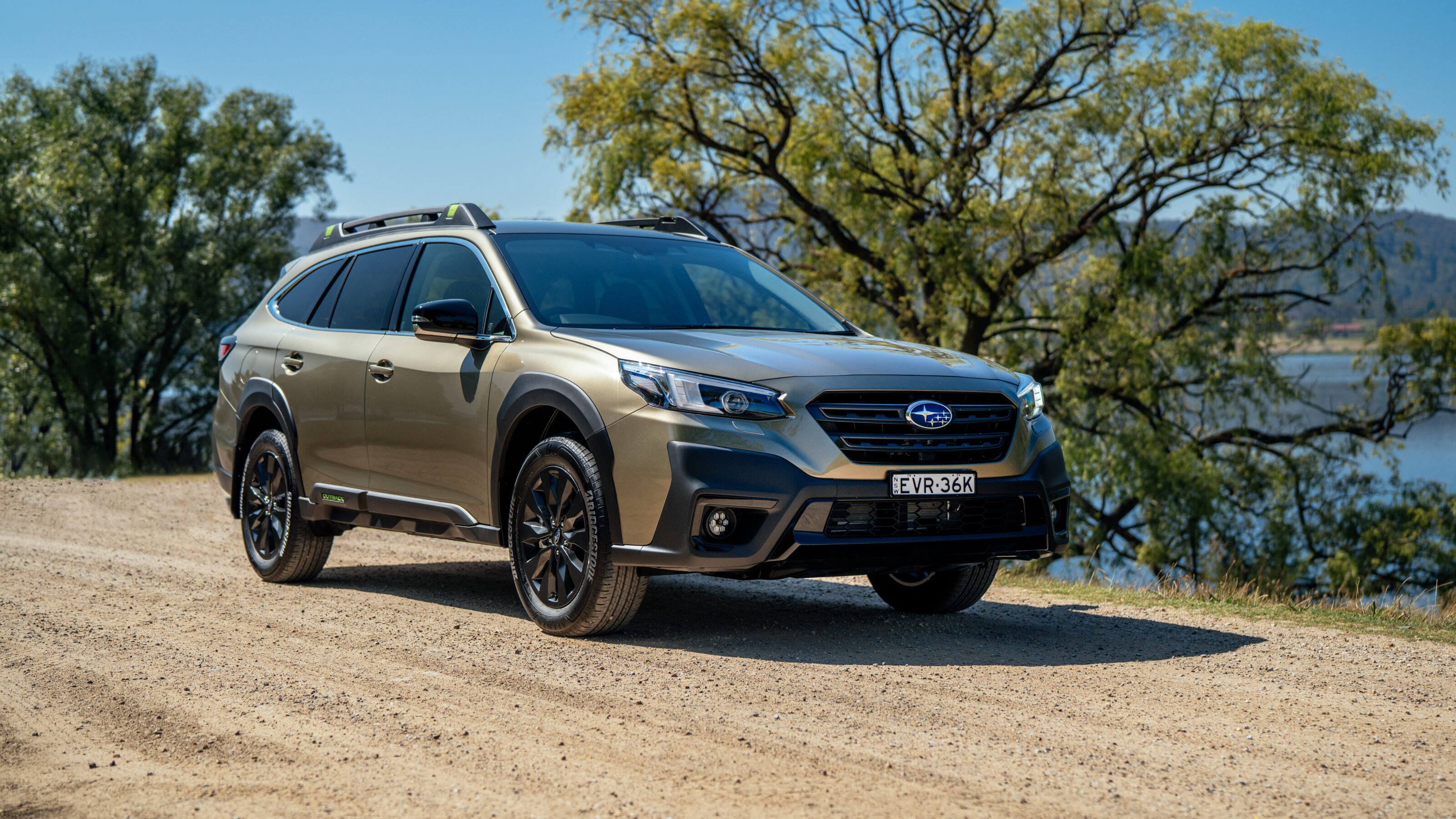
Within this segment there are also crossovers like the Volkswagen Passat Alltrack and Subaru Outback, both based on more conventional large wagons, but with extra ride height, all-wheel drive and rugged body plastics.
They warrant a mention for having ultra-huge boot areas and plenty of back seat space (and an attractive $47K starting price in the case of the Subaru), however neither are available with a three-row seat configuration.
More guides to help you choose the best car & tyres for your needs
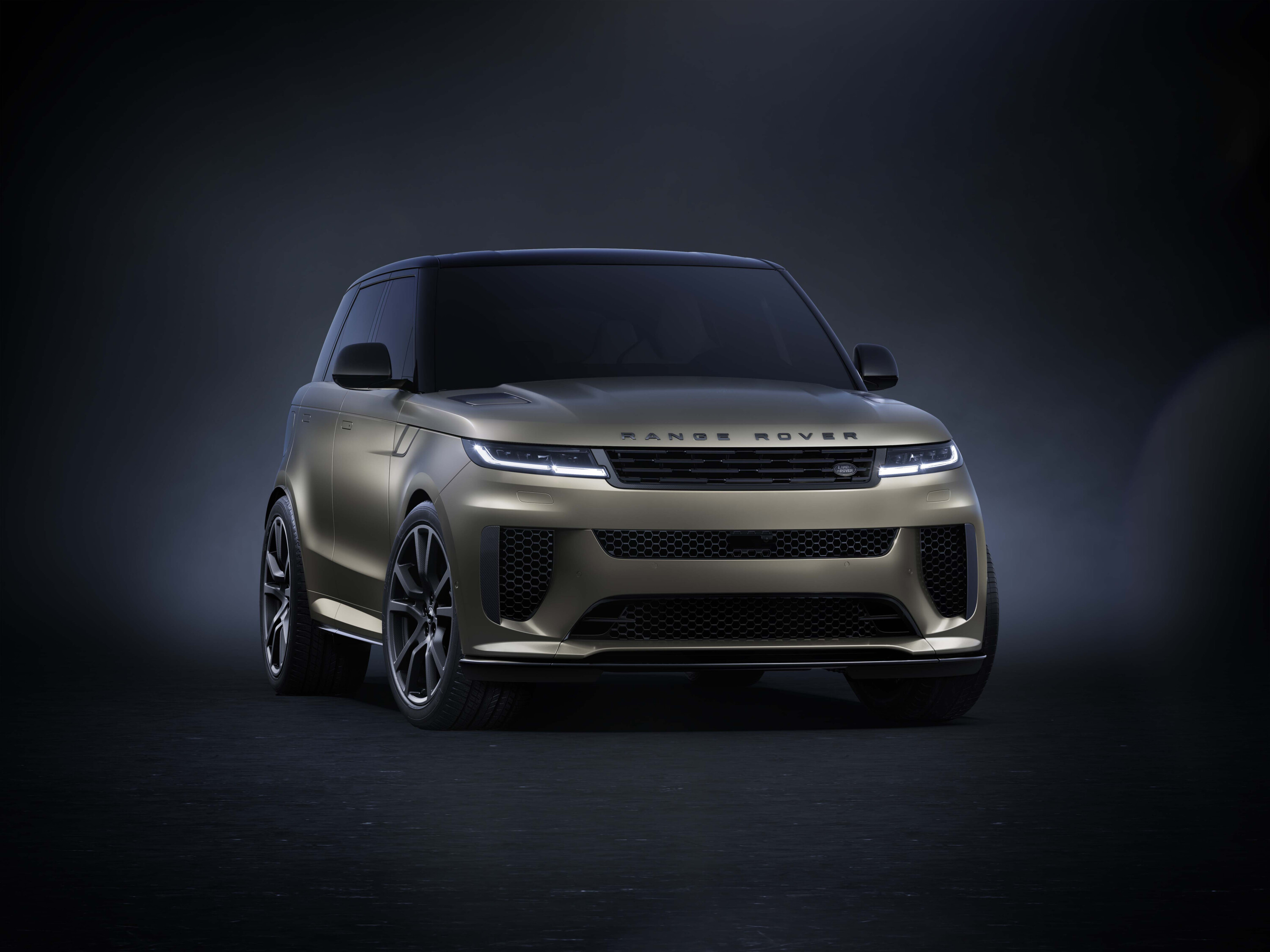
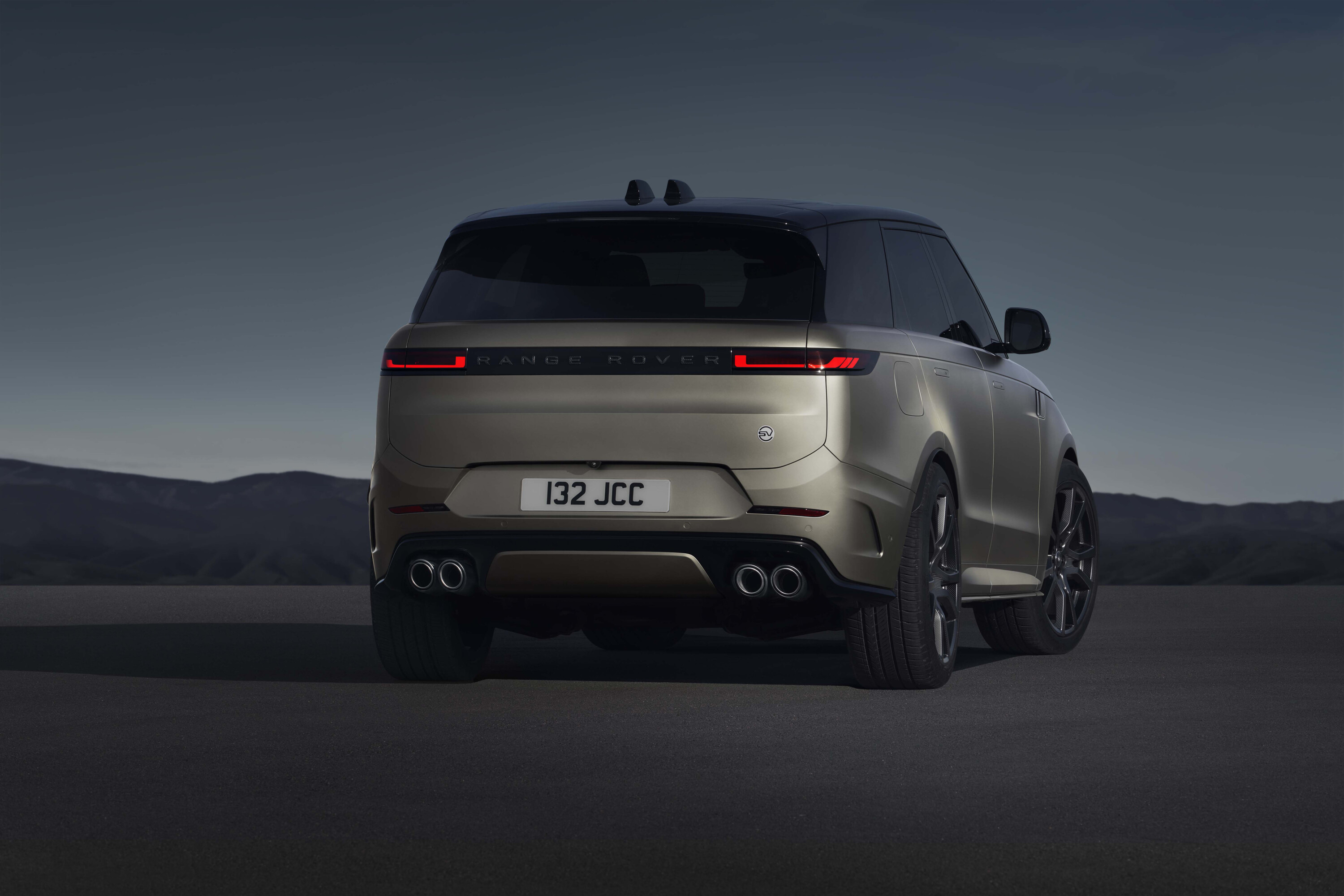
The new-generation 2024 Range Rover Sport SV P635 has been unveiled today, with Australian pricing and details revealed in step with its global debut.
Key Points
467kW twin-turbo V8 on board
Priced from $360,800
Wider Sport range starts from $143,600
Priced from a huge $360,800 before on-road costs, the new Range Rover Sport SV will reach Australia in extra-special Edition One form – an “invitation-only” trim reserved for “select clients” for the first year of production. Lotto winners need not apply.
Exactly what the Edition One’s features will bring is unclear, or what sort of price premium is factored into that $360k number – although the brand has so far specified exclusive branding on the front splitter, centre console, treadplates and puddle lamps.
1
2024 Range Rover Sport SV P635 Power & Acceleration
Power in the SV P635 is provided by a twin-turbo V8, producing 467kW and 750Nm to launch the big SUV to 100km/h in “as little as” 3.8 seconds.
Those numbers make the SV P635 44kW and 50Nm more powerful than the previous-generation Range Rover Sport SVR, which was powered by a delectable supercharged 5.0-litre V8 and claimed a 0-100km/h time of 4.5 seconds.
In standard trim, the SV P635 is shod with Michelin Pilot Sport All Season 4 tyres, measuring 305mm at the rear and 285mm at the front.
This arrangement is in service to a rear-biased dynamic setup, matched to increased rear roll stiffness for rapid steering response.
JLR claims the SV P635 can generate more than 1.1G on those all-season tyres, bettering the summer-tyre performance of the old SVR by 22 per cent.
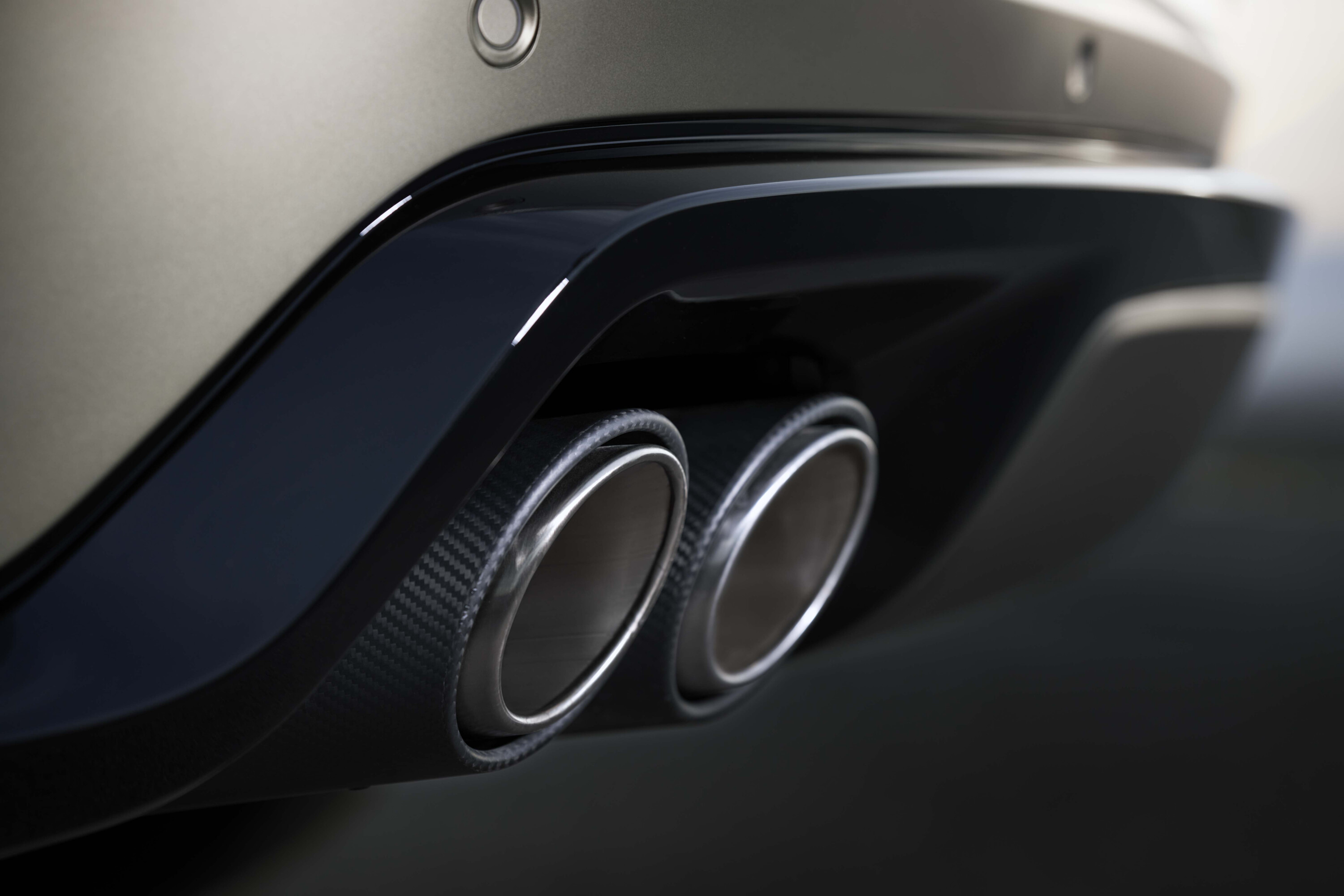
Underscoring its performance focus – for those focused on performance – the SV P635 comes with the option of 23-inch carbon-fibre wheels that reduce weight by 76kg, along with optional carbon-ceramic brakes (34kg total unsprung weight reduction against the standard steel discs) with eight-piston Brembo calipers at the front. (Should these features be standard at the asking price? Tell us below!)
1
One piece of weight-saving equipment that does come standard, is the carbon-fibre bonnet.
The SV P635 rides between 10 and 25mm lower than regular Rangie Sport models, and a new ‘6D Dynamics’ suspension system is matched to specific SV-tuned settings for the all-wheel drive, all-wheel steering, Torque Vectoring by Braking, Configurable Dynamics and active locking rear differential systems.
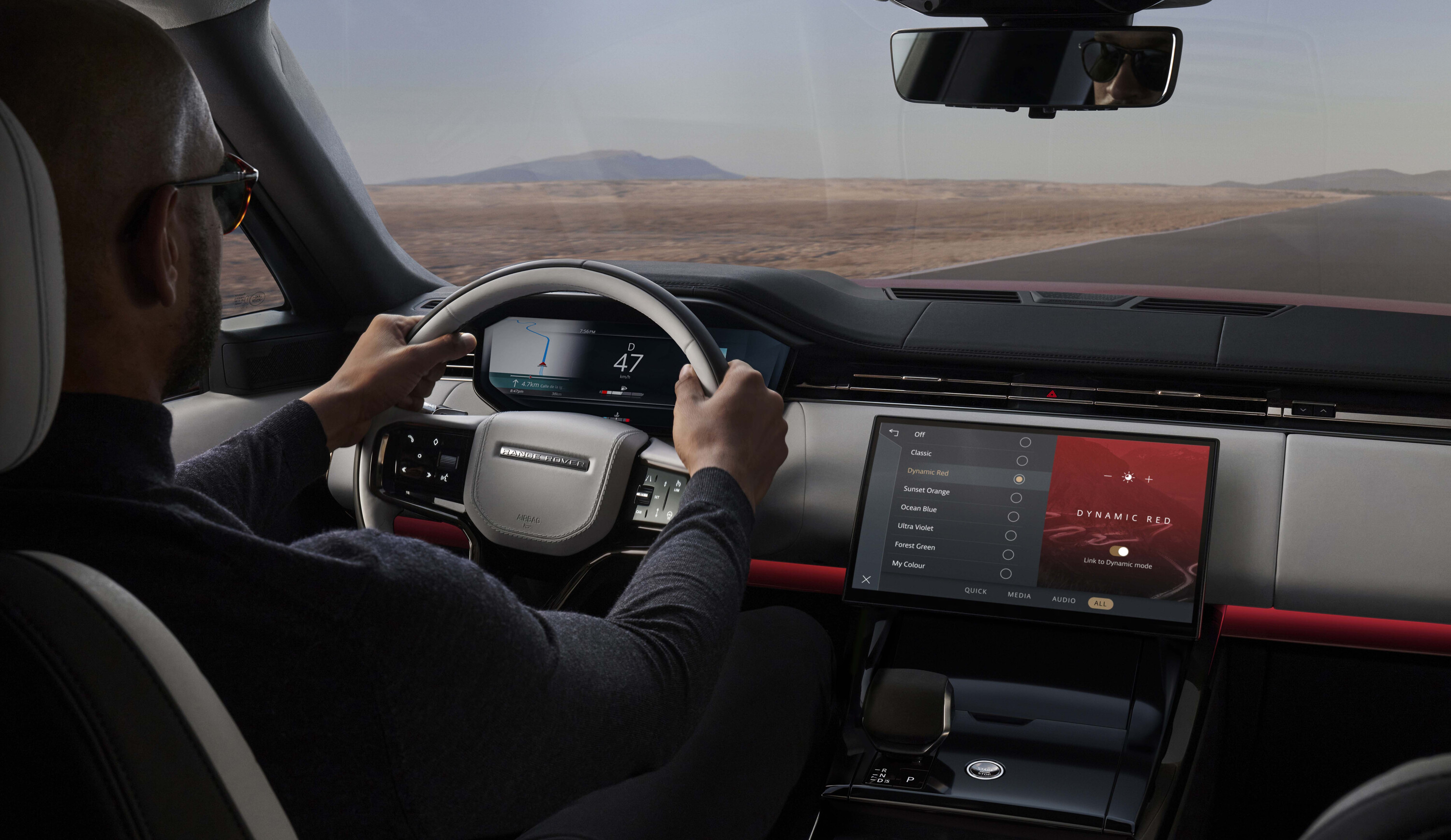
A new SV Mode button appears on the steering wheel with this generation, optimising the eight-speed auto, throttle response, exhaust note (of course) and suspension – including a further 15mm drop – while enabling track-specific TracDSC stability for a performance-first experience.
1
When will the Range Rover Sport SV P635 come to Australia?
The Range Rover Sport SV P635 is on sale in Australia now, with deliveries set to begin in the fourth quarter of 2023.
As noted above, however, the first year of production is already spoken for, made exclusive to “select customers”.
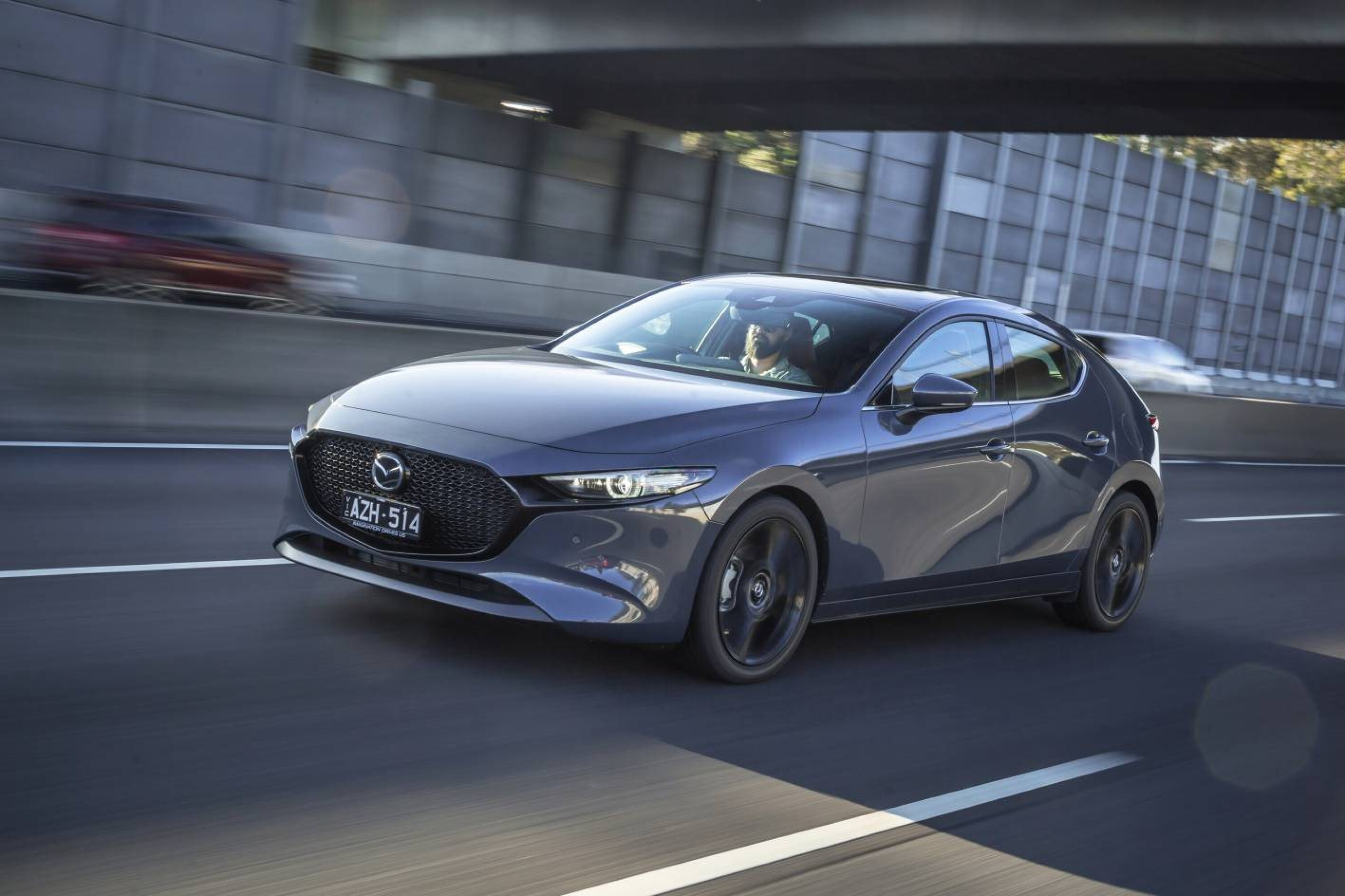
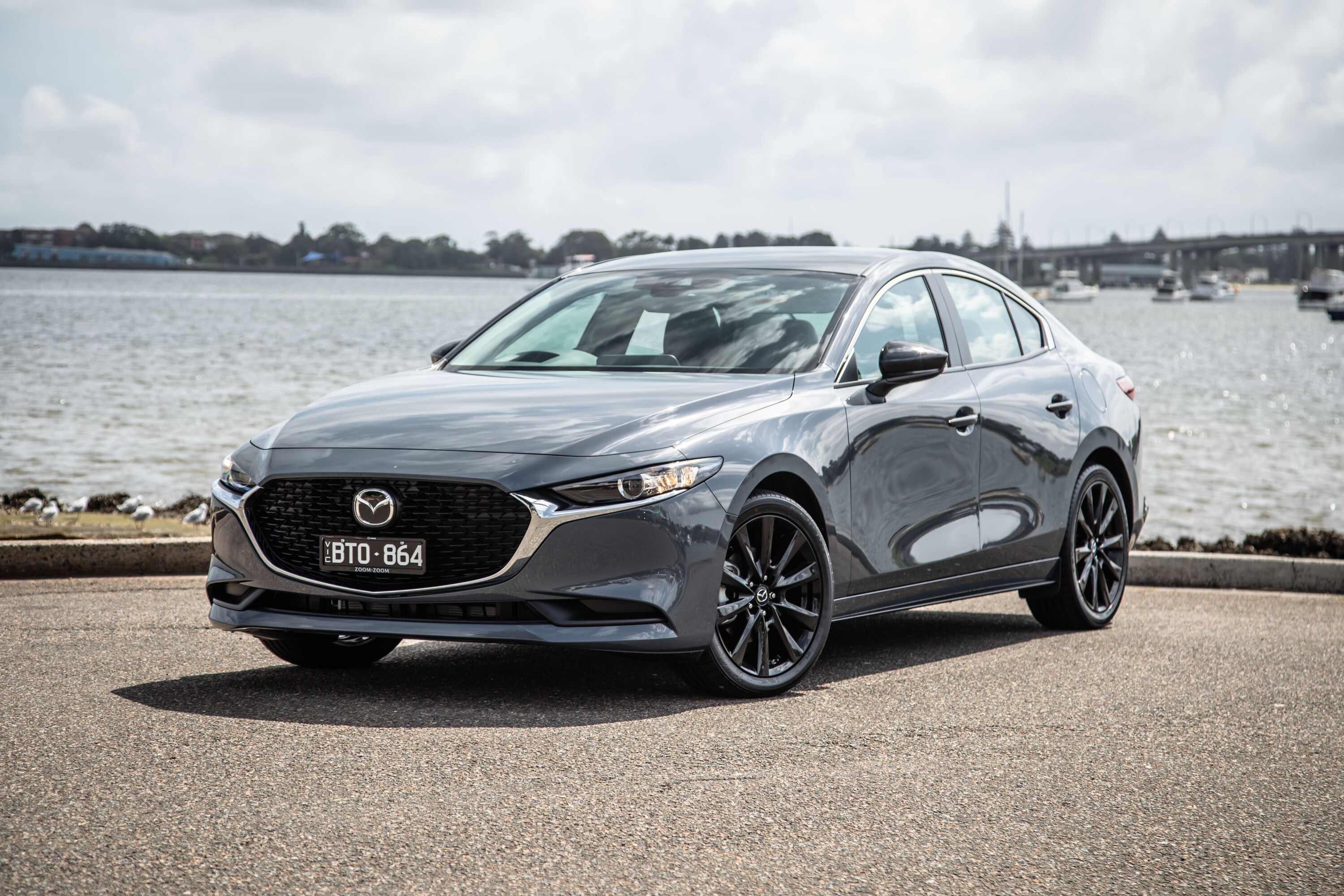
Mazda’s design philosophy often seems to be ‘if it ain’t broke, don’t fix it’ – a symptom of doing big-brand things on a small-brand budget.
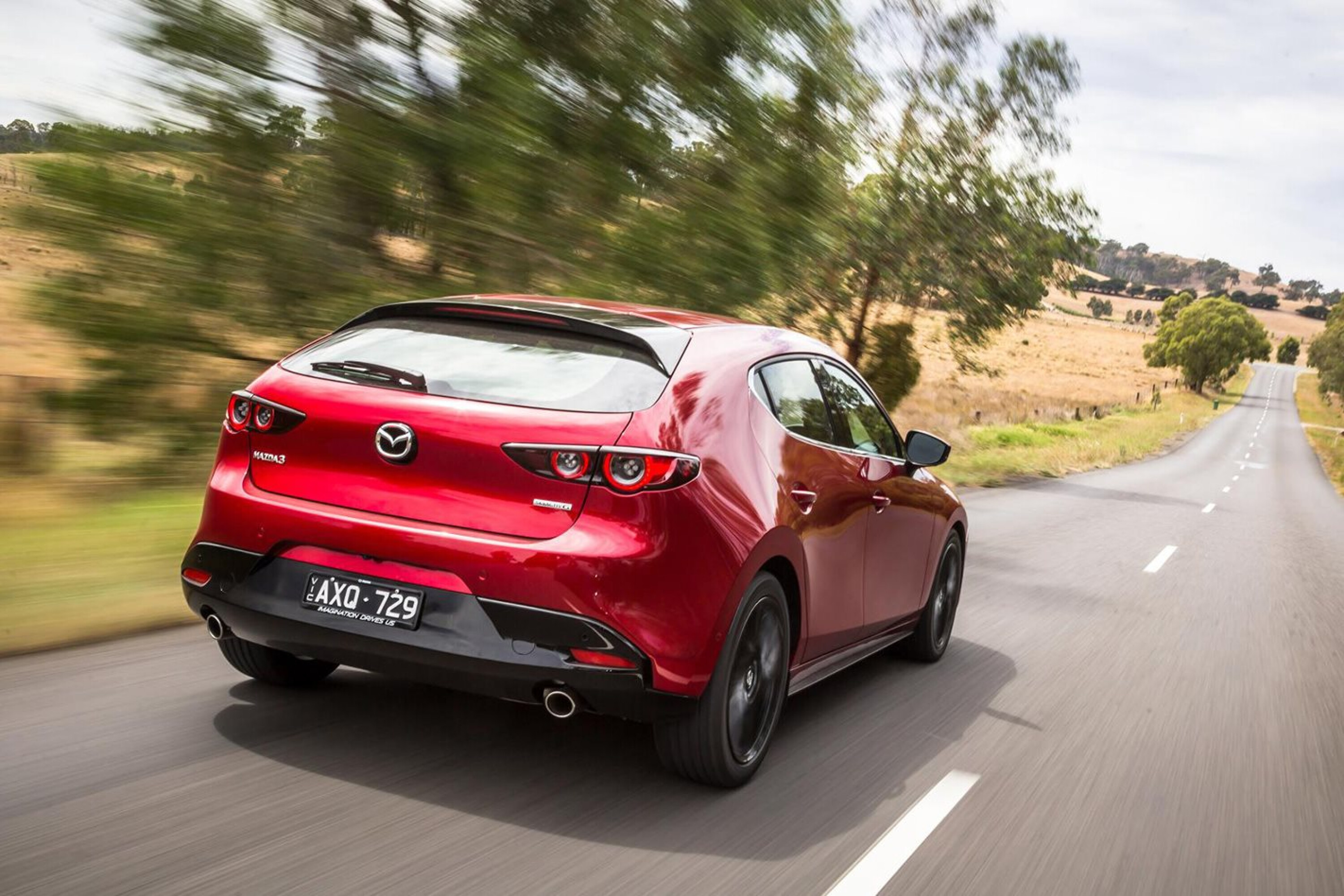
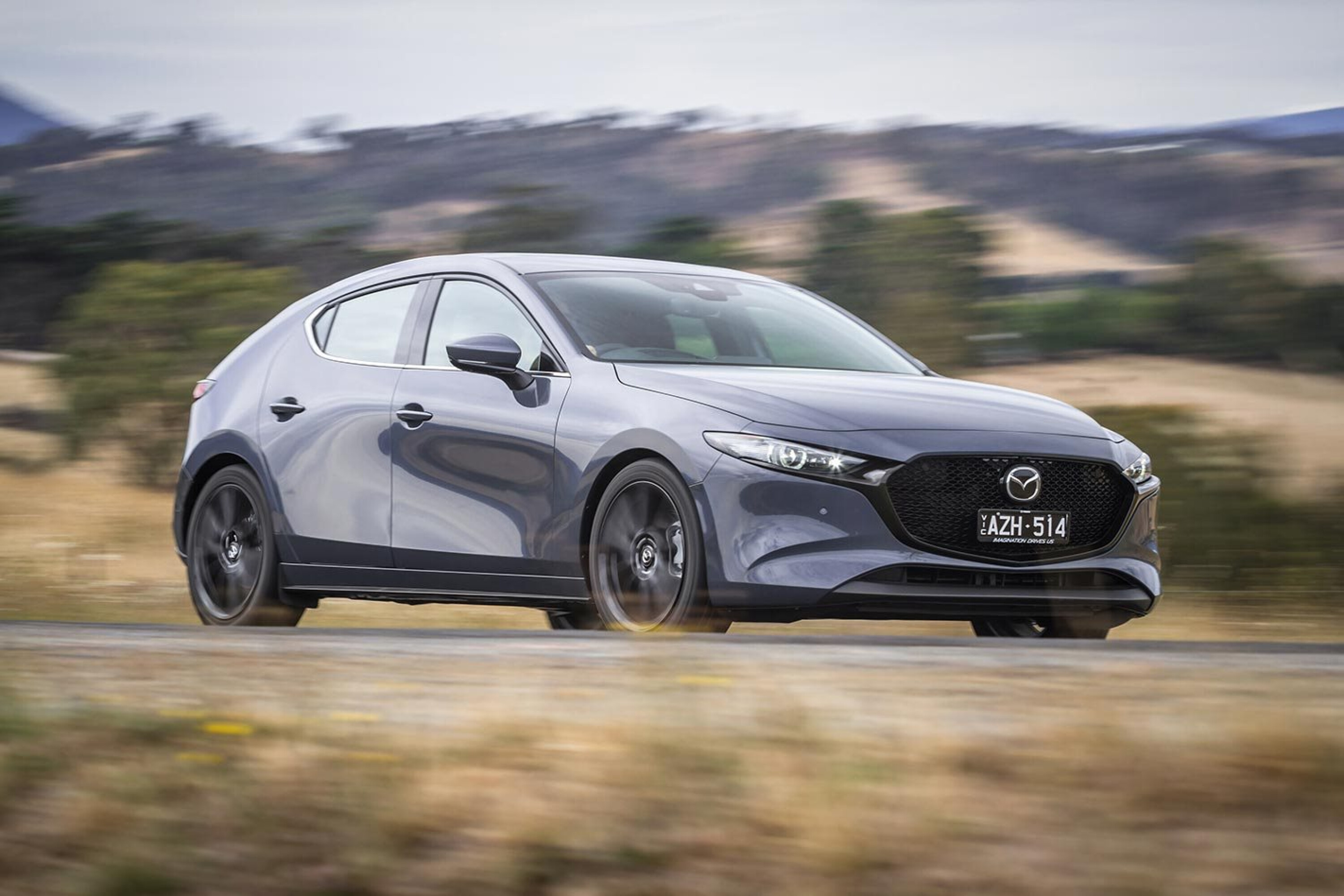
Despite this, the fourth-generation Mazda 3 managed to represent a vast improvement over the popular third-gen model and gives pricier Euro-badged models a run for their money.
But its superior refinement, dynamics, ride comfort, cabin quality and style haven’t translated into bigger sales due to the rise of small SUVs and higher entry-level pricing.
From May 2023, it cost even more to join the Mazda 3 club, with the entry-level manual gearbox dropped from the range – plus a $2000 price increase across the line-up seeing the entry-level price leap by more than $3000.
Mazda also deleted its G20e and X20 mild hybrid engines, so now there are just six variants to choose from instead of 14 – though that’s not necessarily a bad thing.
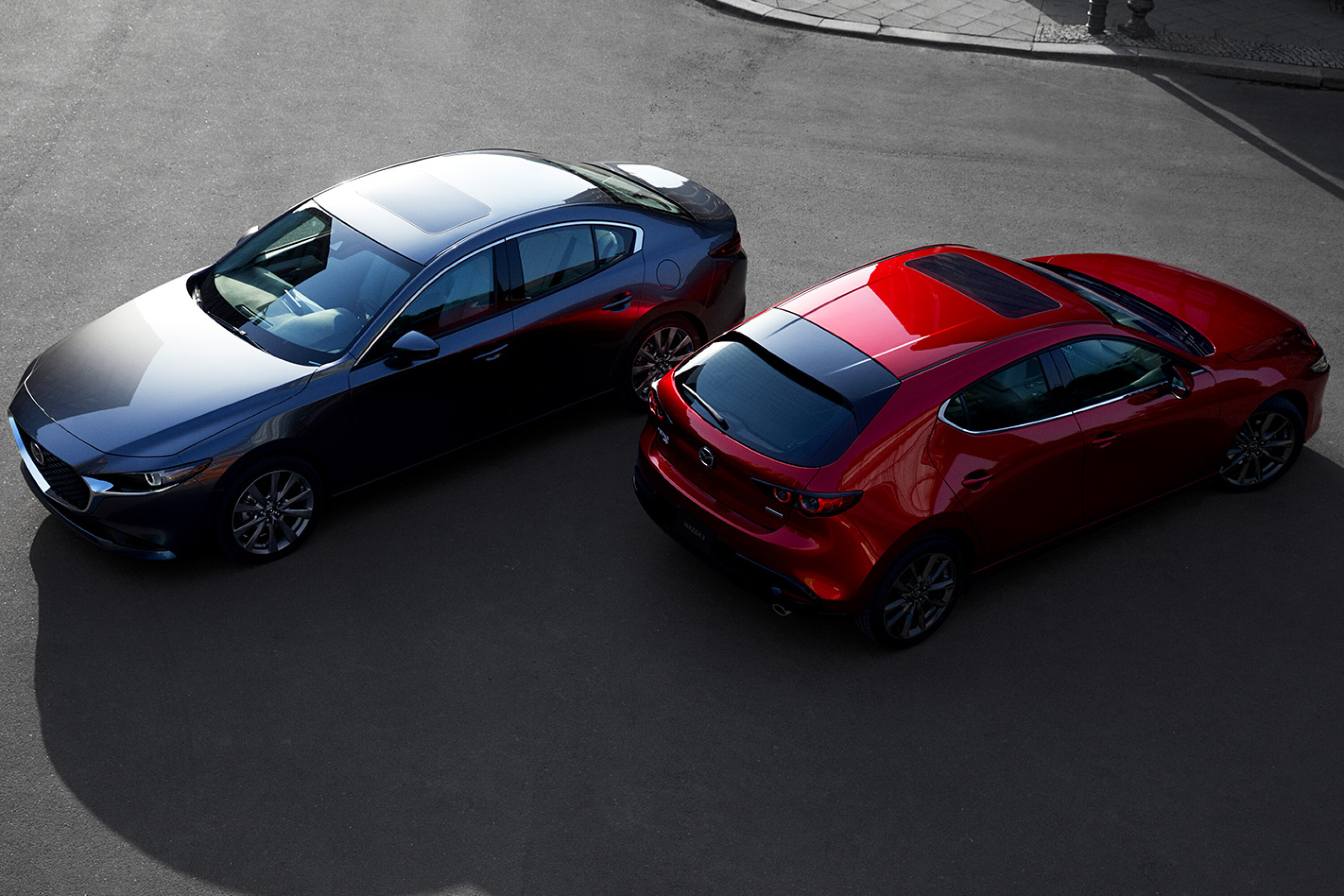
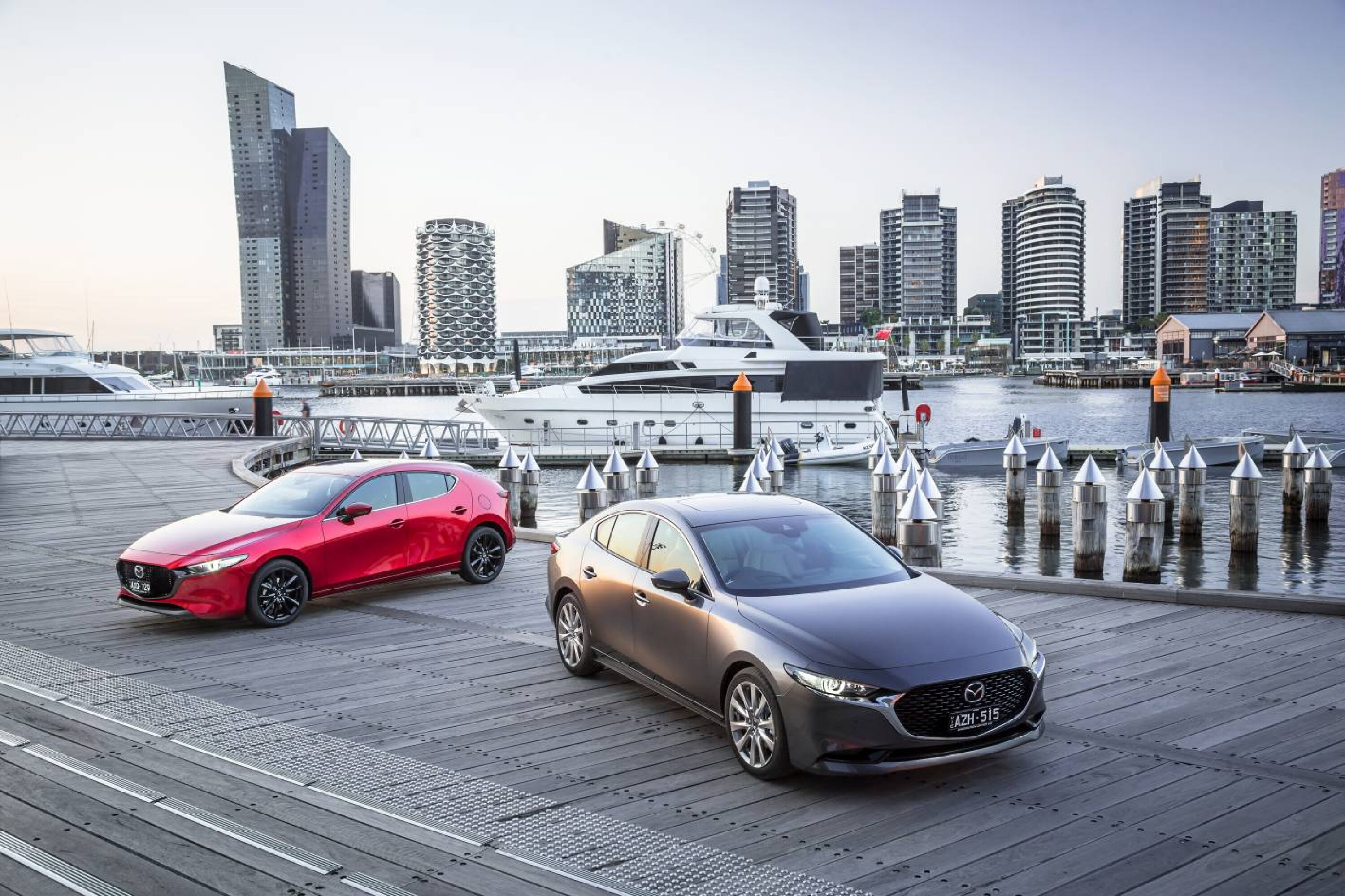
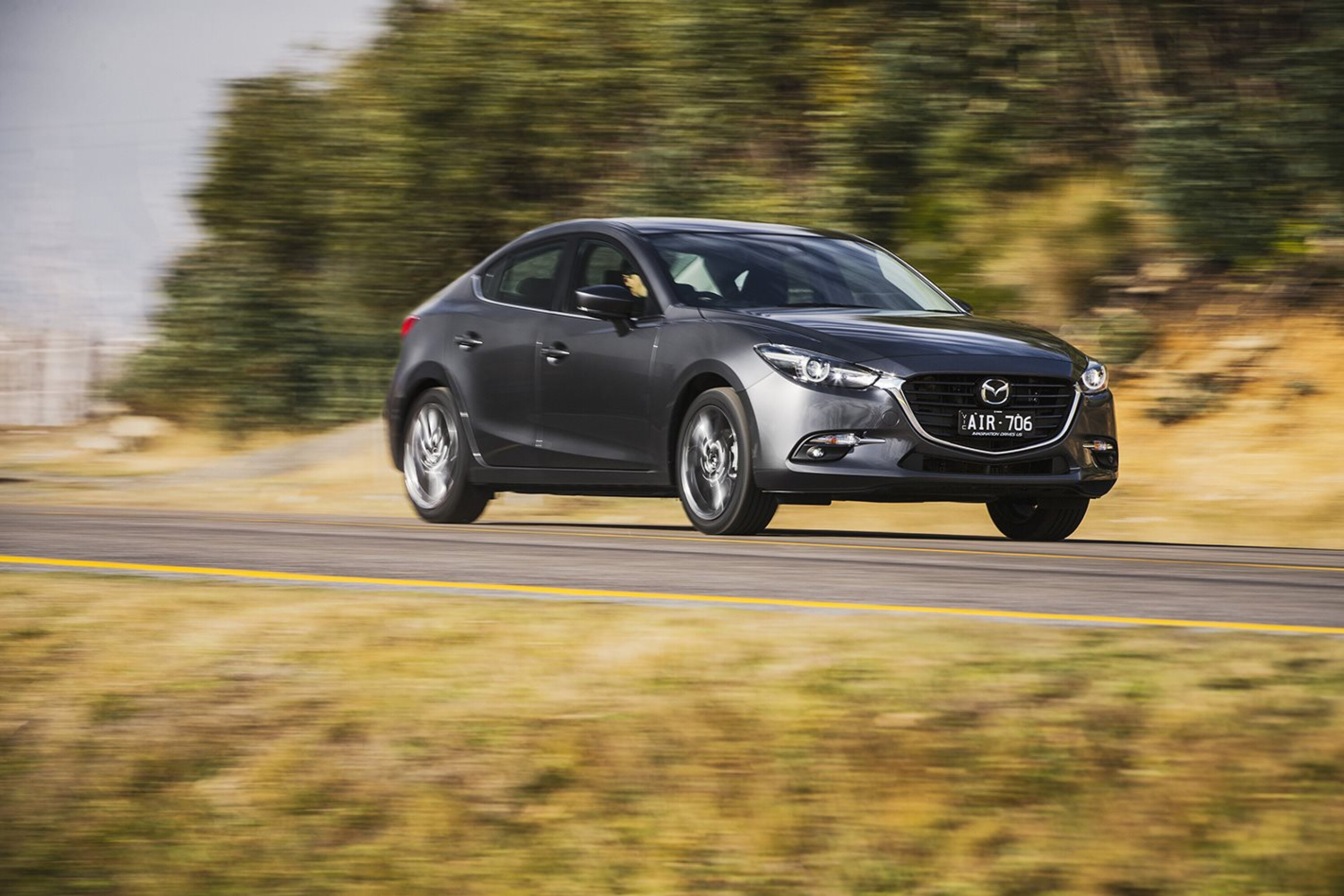
The Mazda 3 is available as a five-door hatchback and four-door sedan, neither of which incurs a price premium. Both are front-wheel drive. The Mazda 3 is classed as a small car, lower priced.
The features listed below are standard in the entry-level model and will appear in higher-grade models unless replaced by more premium equivalent features.
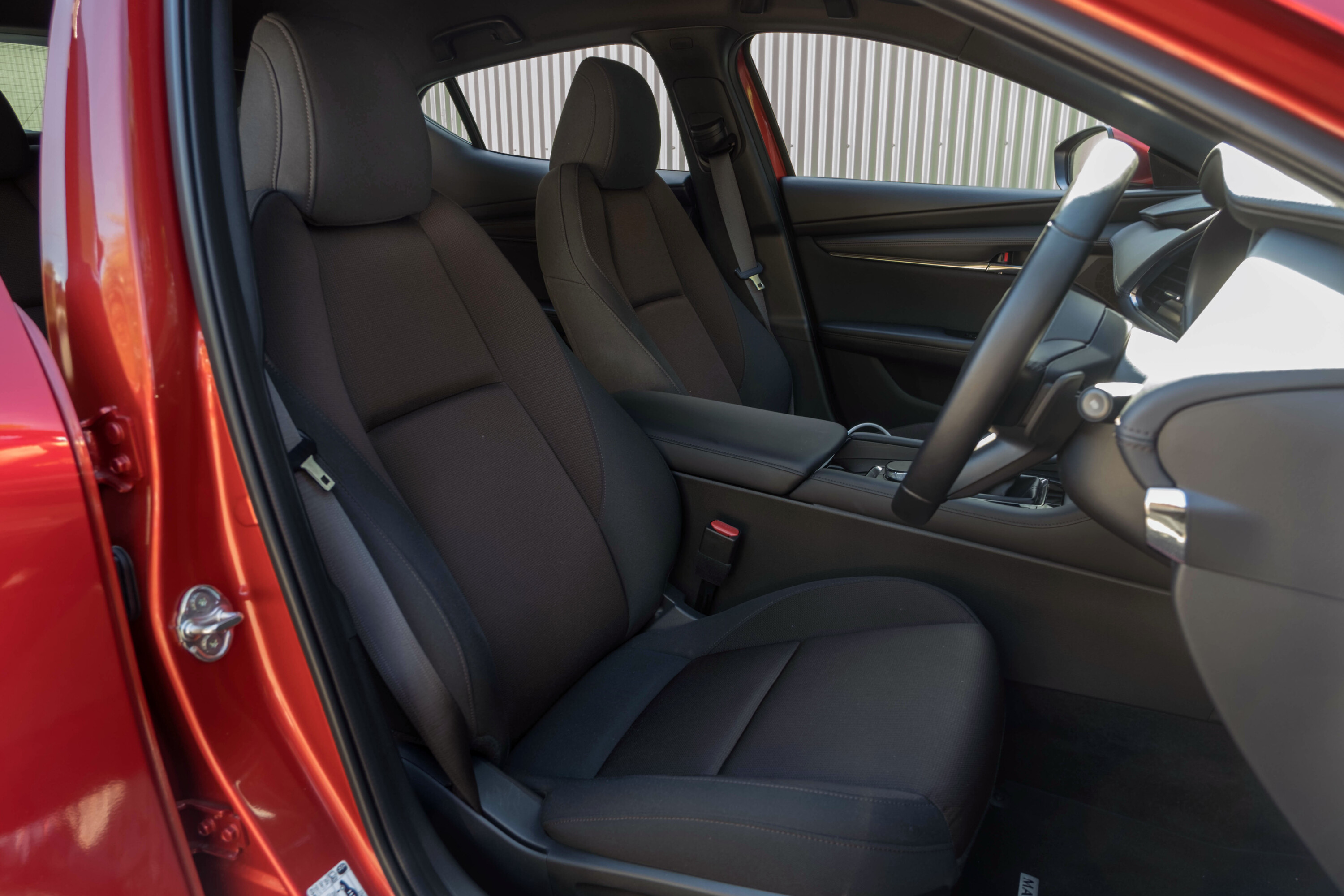
The well-equipped entry-level G20 Pure comes with 16-inch alloy wheels and cloth seats.
The G20 moniker refers to the 2.0-litre four-cylinder petrol engine, which is coupled with a six-speed automatic gearbox.
3
Stepping up to the G20 Evolve brings:
2023 Mazda 3 G20 Evolve additional features
18-inch alloy wheels (grey finish)
Paddle shifters (auto).
Dual-zone climate control
Auto-dimming rear-view mirror
Rear air vents
Rear seat armrest
The G20 Touring adds more desirable features, including:
2023 Mazda 3 G20 Touring additional features
Keyless entry
Leather upholstery
Wireless Apple CarPlay/Android Auto
Wireless phone charger
Door mirrors with memory and reverse tilt functions
Auto-dimming mirror (driver’s side)
10-way power adjustable driver’s seat
USB-C ports
1
The G25 Evolve SP brings the spirited 2.5-litre four-cylinder petrol engine.
It has most of the G20 Touring’s features but loses the leather seats in favour of black cloth upholstery. The 18-inch alloy rims are matt black, as are the door mirrors and grille.
4
The G25 GT ups the luxury features with:
2023 Mazda 3 G25 GT additional features
10.25-inch infotainment screen
Heated front seats
Heated door mirrors
Heated steering wheel
18-inch alloy wheels (grey finish)
Leather upholstery
1
Unfortunately, the G25 GT misses out on the 12-speaker Bose premium audio system available in the range-topping Astina spec, because of the ongoing semiconductor shortage.
The G25 Astina comes with the lot, which includes the following extras over the GT:
2023 Mazda 3 G25 Astina additional features
Adaptive headlights
LED daytime running lamps
LED daytime running lamps
Vision Technology package
Glass sunroof
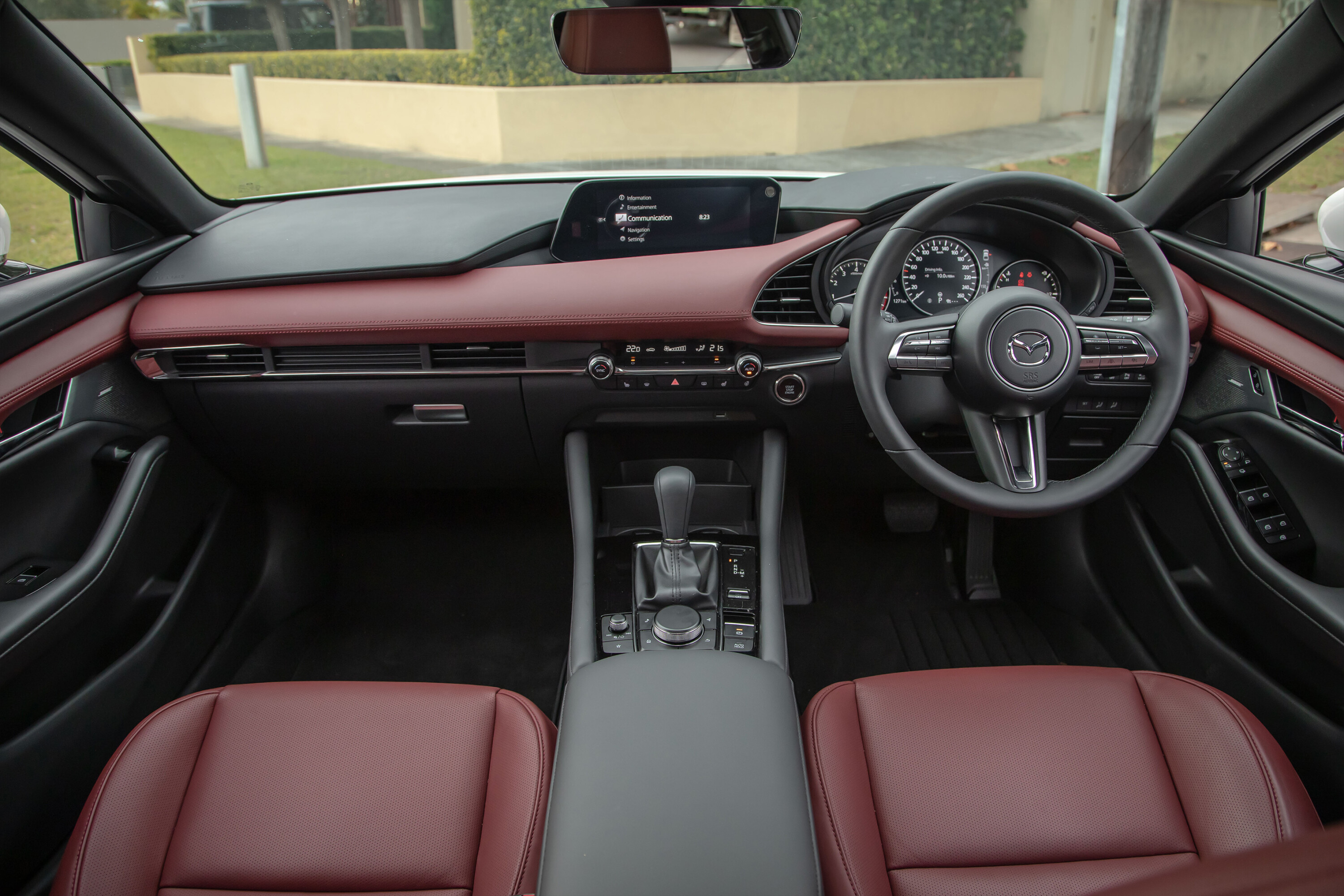
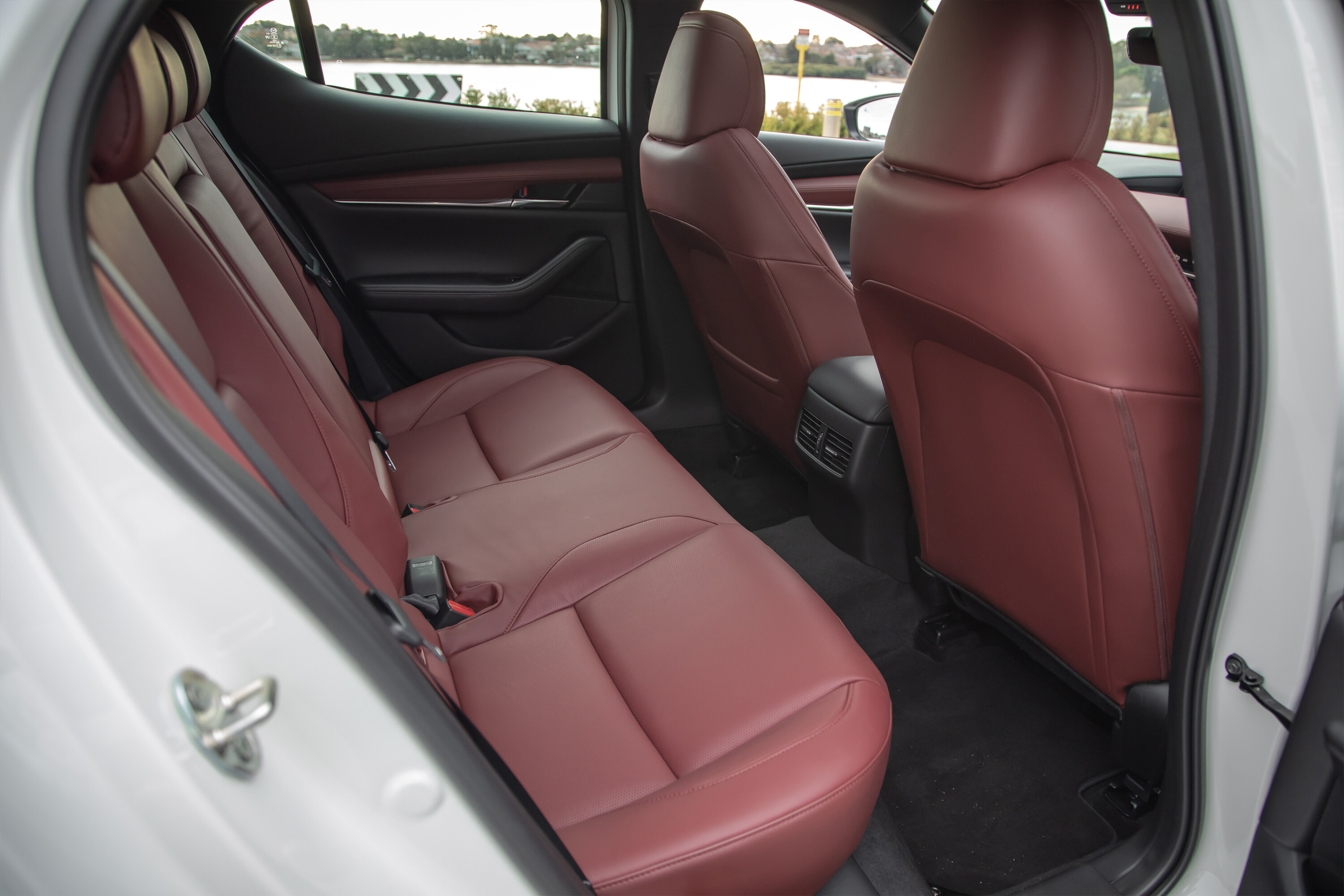
Leather upholstery with choice of Black, Burgundy (hatch) and Pure White (sedan)
18-inch alloy wheels (black finish, hatch only)
12-speaker Bose audio system
9
Options
The Vision Technology package that is standard in the G25 Astina is a $2000 option in the Pure, Evolve and Touring grades, and a $1500 extra in the G25 GT, which already has the 10.25-inch infotainment screen.
Some price lists refer to the pack as a separate variant, such as G20 Pure Vision.
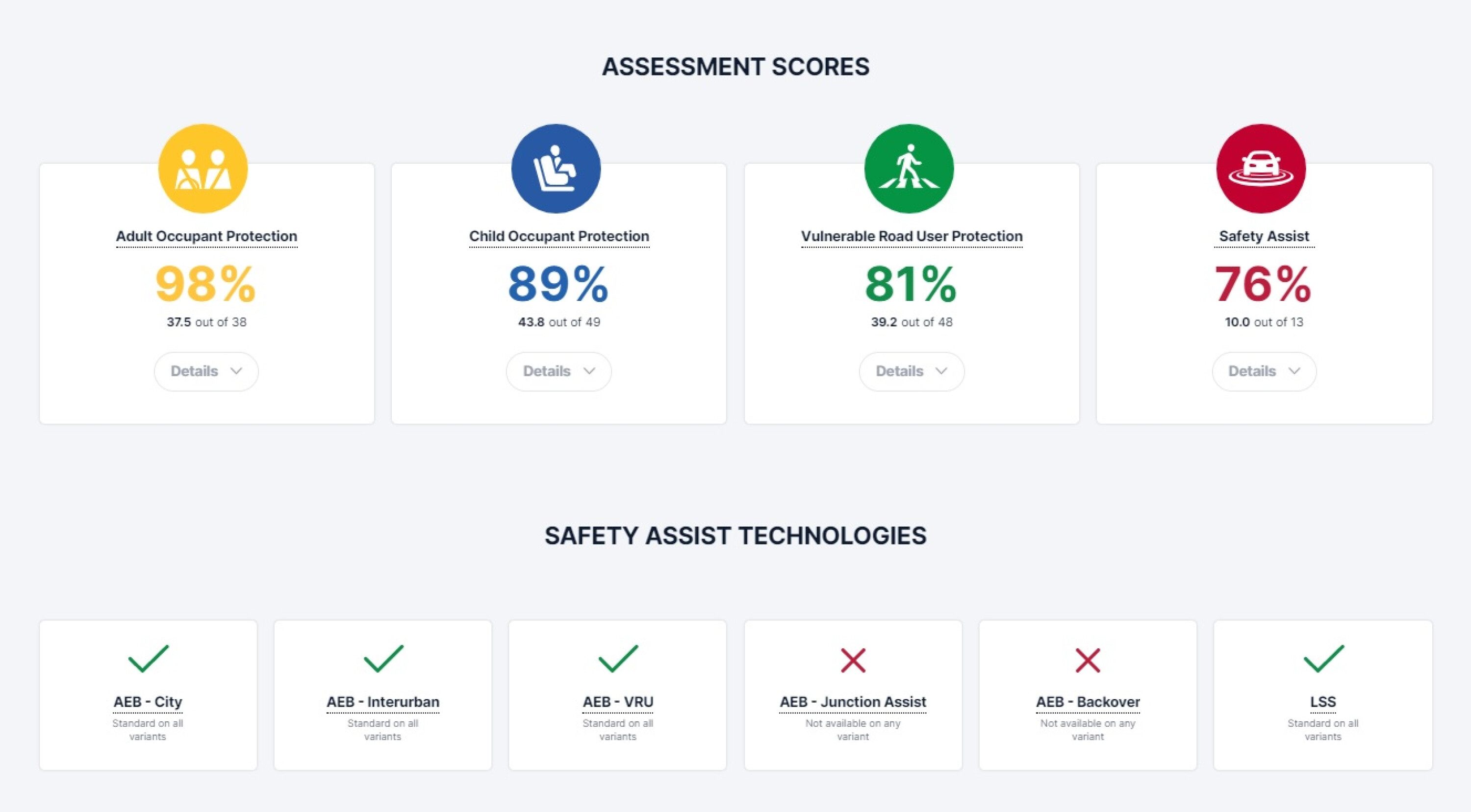
The entire Mazda 3 range is covered by a five-star ANCAP safety rating, based on testing conducted in 2019.
It has a 98 per cent score for adult occupant protection, 89 per cent for children, 81 per cent for vulnerable road users, and 76 per cent for safety assist.
Seven airbags (dual front, side, curtain, and driver’s knee) feature across the range.
Each variant includes the following active safety equipment as standard:
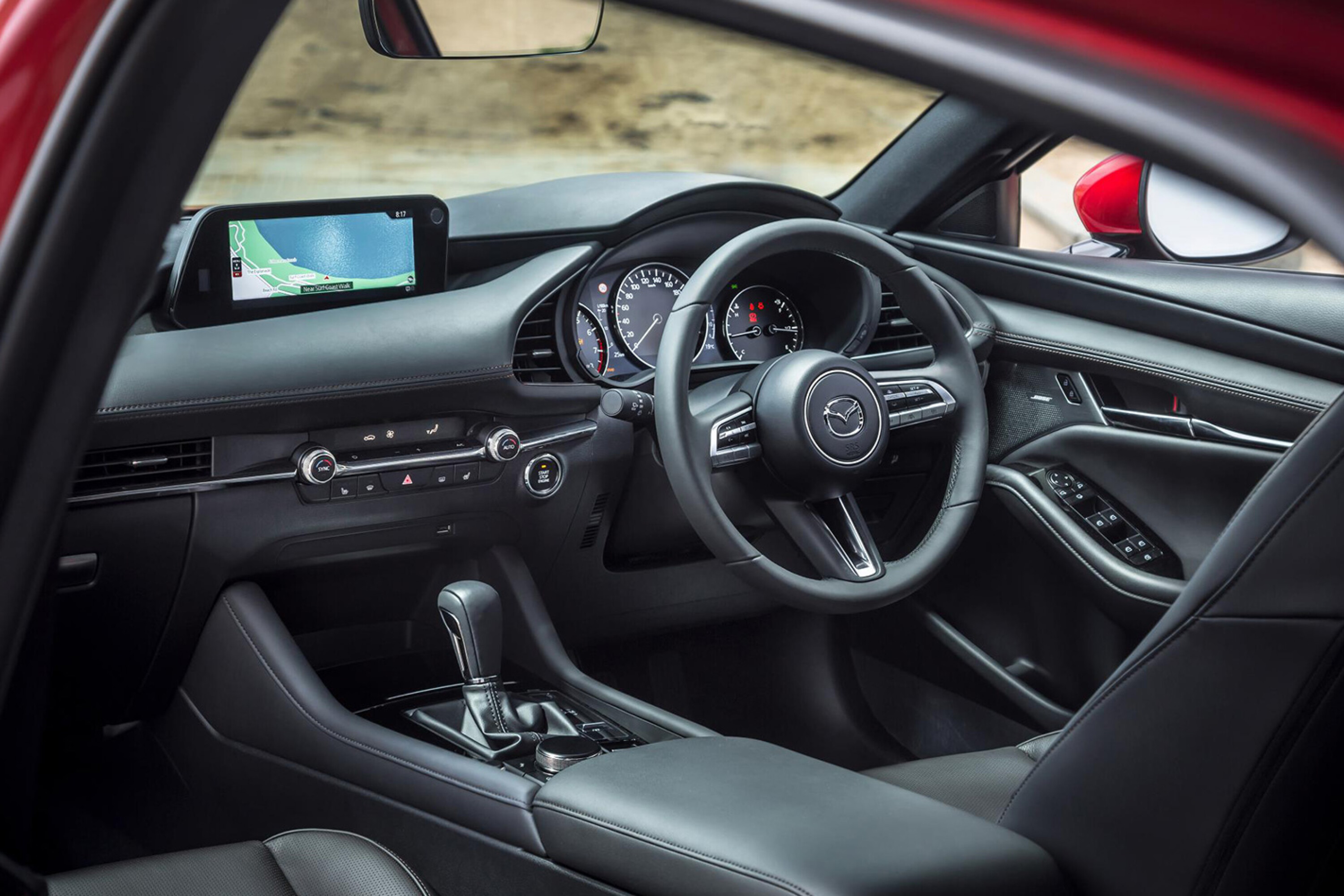
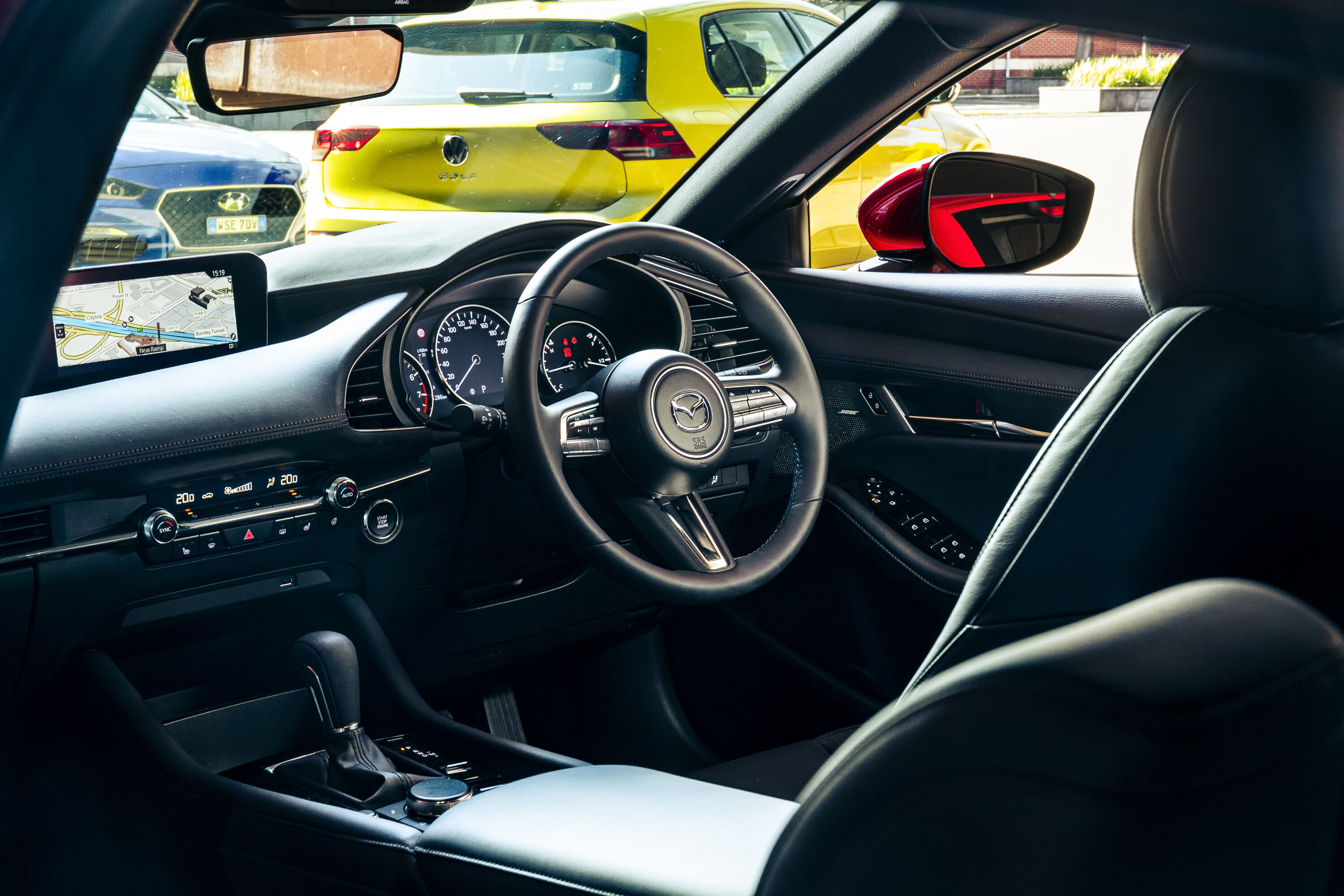
You sit quite low in the 3, a position designed to deliver a sporting feel, and to distinguish it from the higher-riding CX-30.
It’s a lovely dash in front of you too, beautifully built and it’s all integrated nicely. You know a lot of midnight oil was burned to ensure even the fonts were consistent.
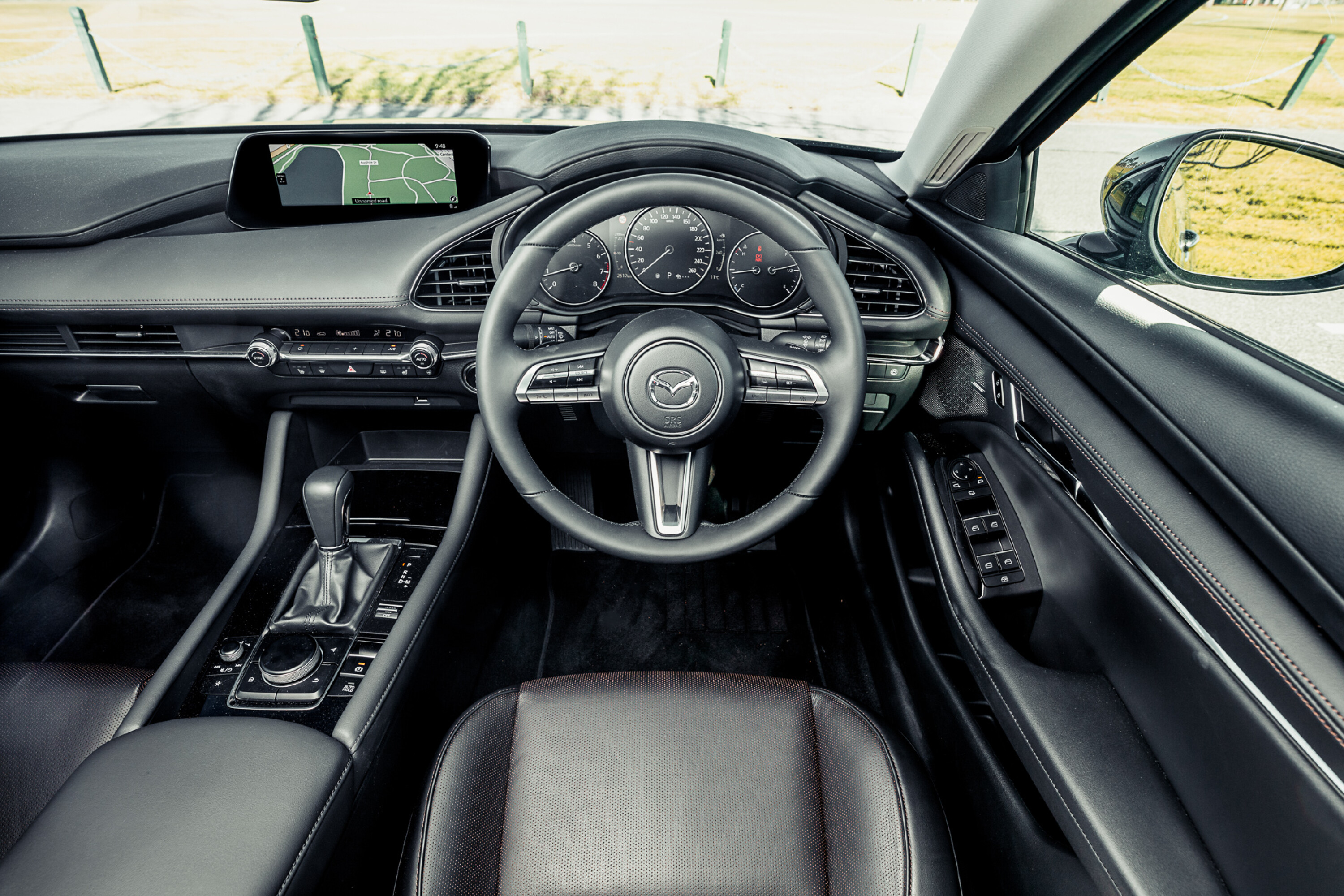
The thin-rimmed steering wheel is very nice, too, and feels like it was plucked from an MX-5.
4
The driving position feels spot-on, with the steering column providing an extra 20mm (for a total of 70mm) of reach adjustment, allowing taller drivers to pull the wheel in closer.
Mazda has also vastly improved road noise using sound-damping ‘nodes’ sandwiched within the bodywork.
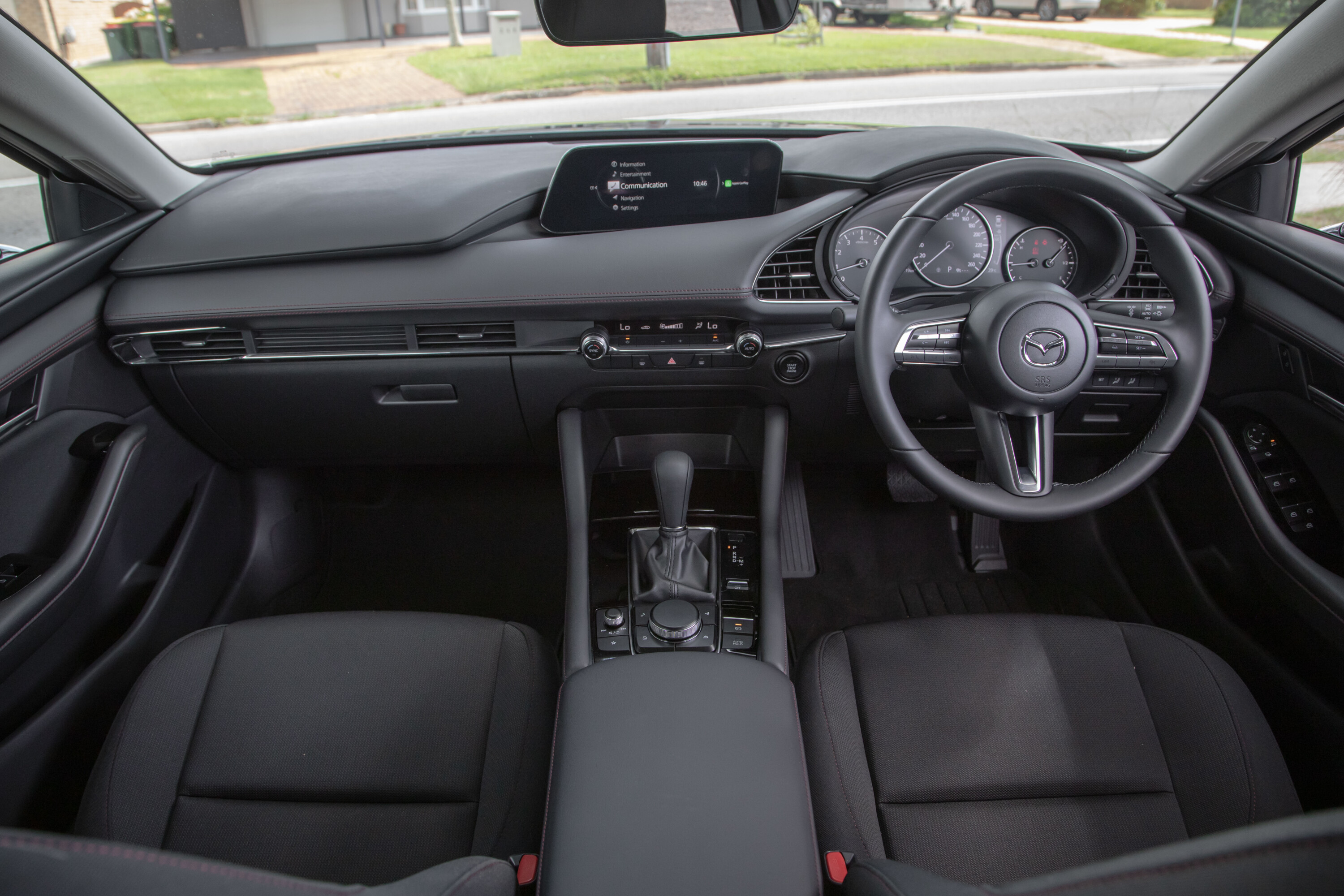
Interior design is another highlight. The cabin ambience elevates the Mazda 3 above most competitors.
1
The instrument panel, air-conditioning controls and centre console are clutter-free with greater practicality evident in things like the dual cup holders forward of the shifter, and a generous bin ahead of that for a phone or sunglasses.
The 8.8-inch touchscreen isn’t the biggest out there, but it’s quite wide thanks to its cinematic aspect ratio. It is positioned slightly further away from the driver to reduce the eye-focussing time from the road ahead to the display.
2
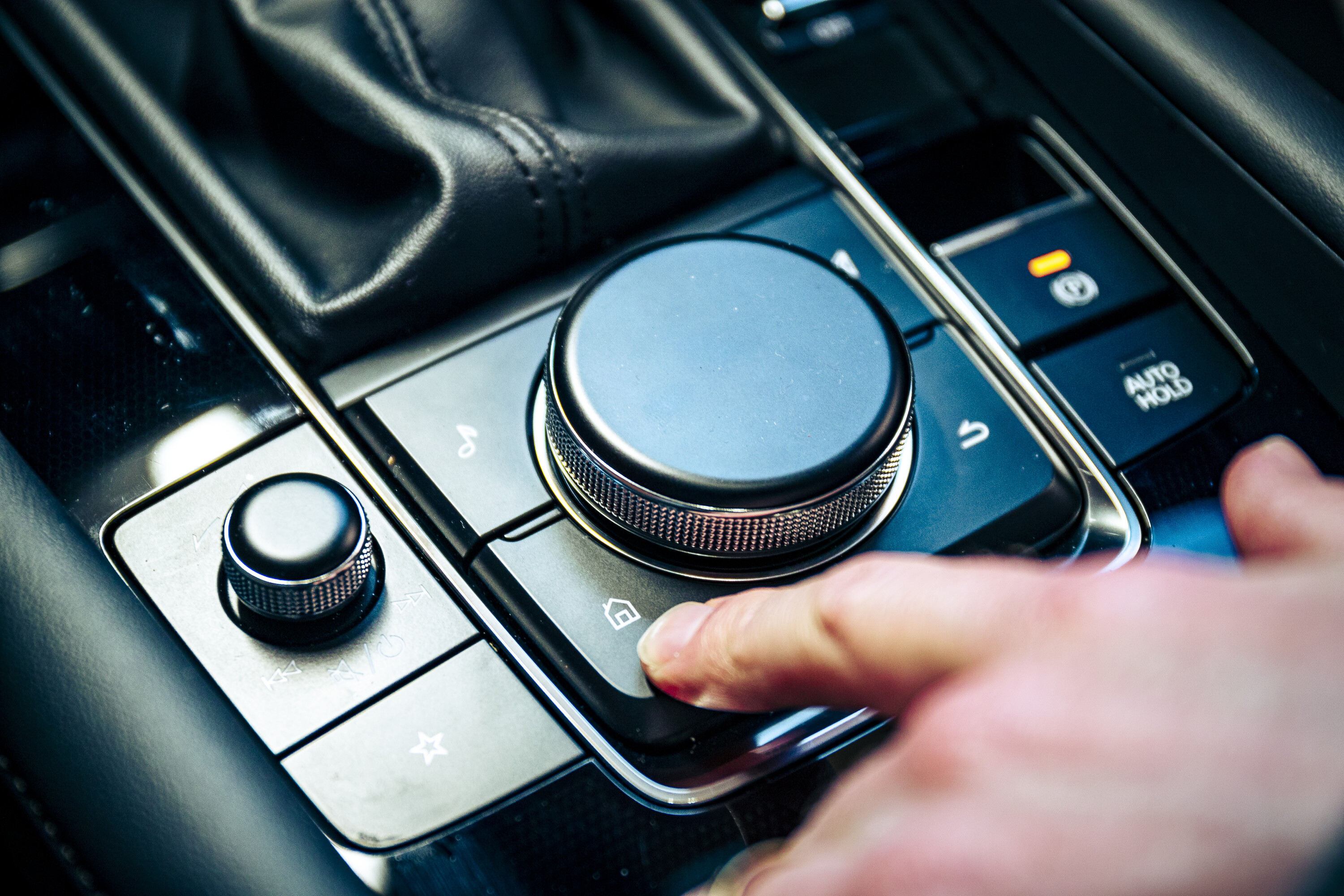
Mazda has also bucked the touch-screen trend, claiming it’s safer for drivers to navigate the improved system via the larger rotary controller.
Some see this as a minus, but the system is easy enough to operate.
The head-up display uses an integrated and sophisticated projector system that doesn’t intrude over the dashboard. Eyes-ahead clarity for navigation and speed-sign recognition is excellent.
Interestingly, while the G20 Pure gets advanced kit like a head-up display it misses out on rear air vents and a fold-down centre armrest.
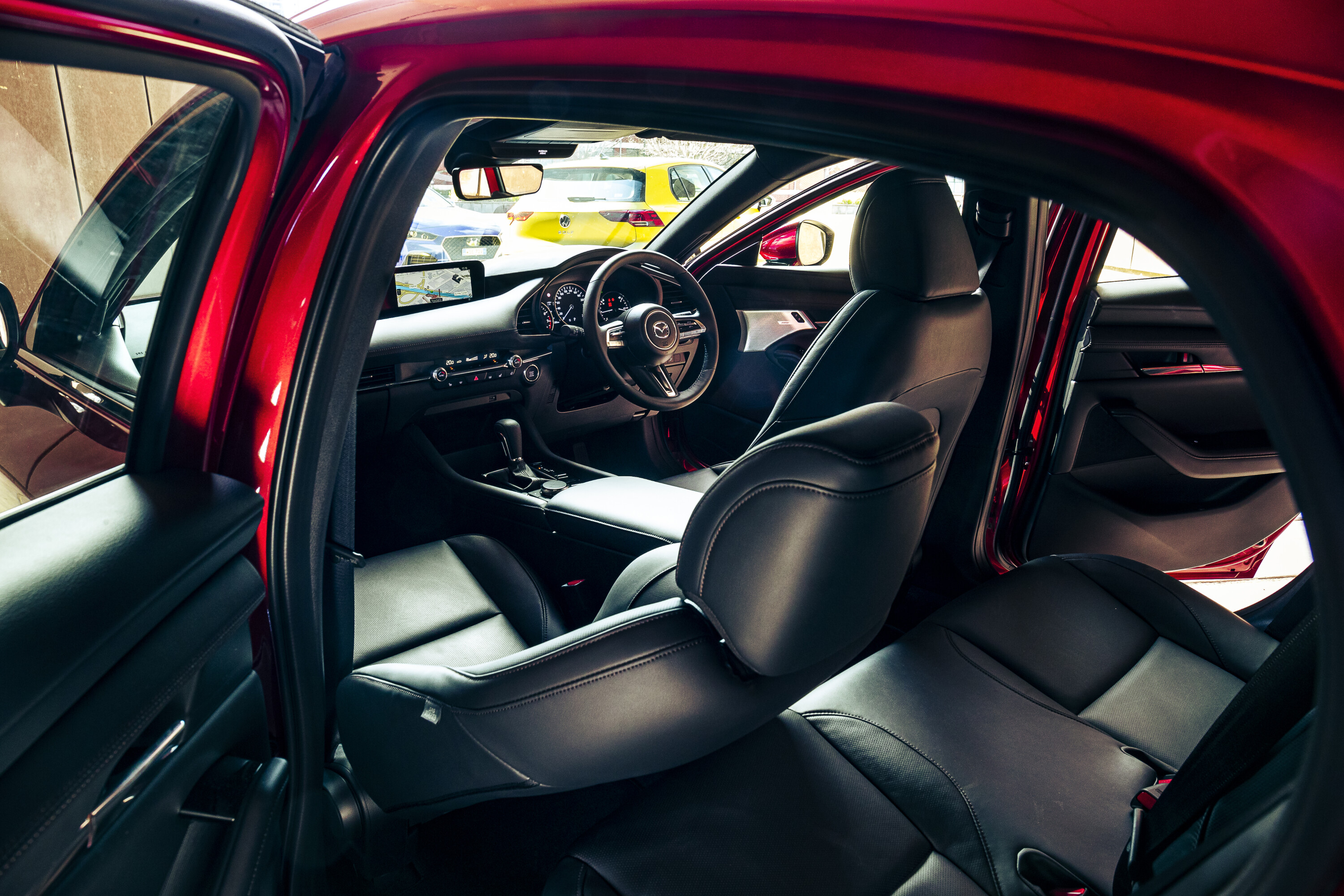
But overall, rear leg- and knee-room are quite good as headroom considering the swoopy exterior profile. The seat cushions are comfortable, and the leather-appointed upholstery has a more quality feel than its rivals.
Variants with the centre armrest bring two cup holders to the rear seats, but there are no USB sockets, which is an odd oversight considering the attention to detail at the front of the cabin.
Side vision isn’t great, particularly in the hatchback which has a broad C-pillar and, unless you’re in an Astina with a sunroof and two-tone trim, it can get a little gloomy back there.
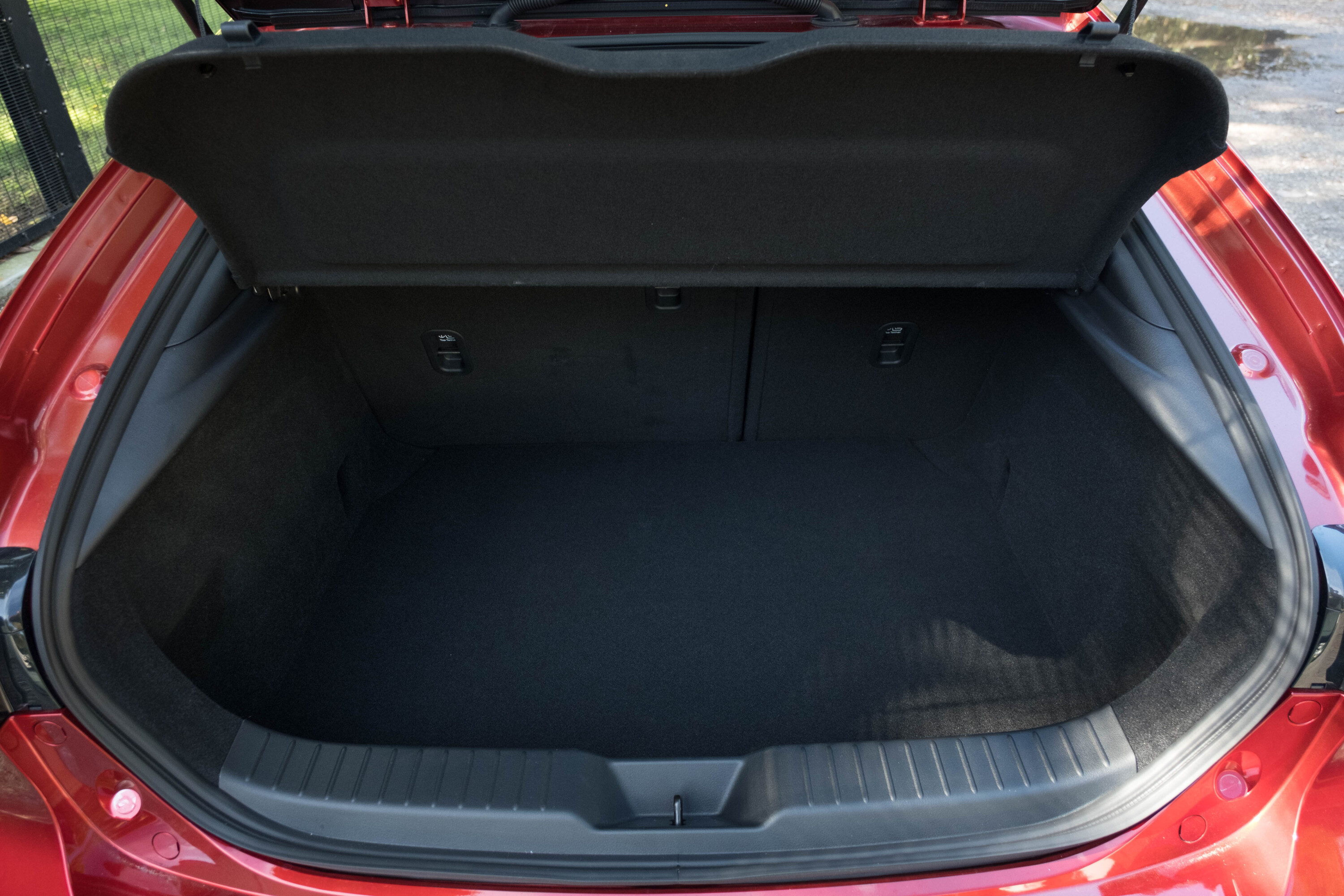
The boot in the hatchback is a tight 295 litres, which is 100 litres less than the Hyundai i30.
It’s helped by 60:40 split-folding seats and a broad tailgate opening that allows you to fit a bicycle laid on its side.
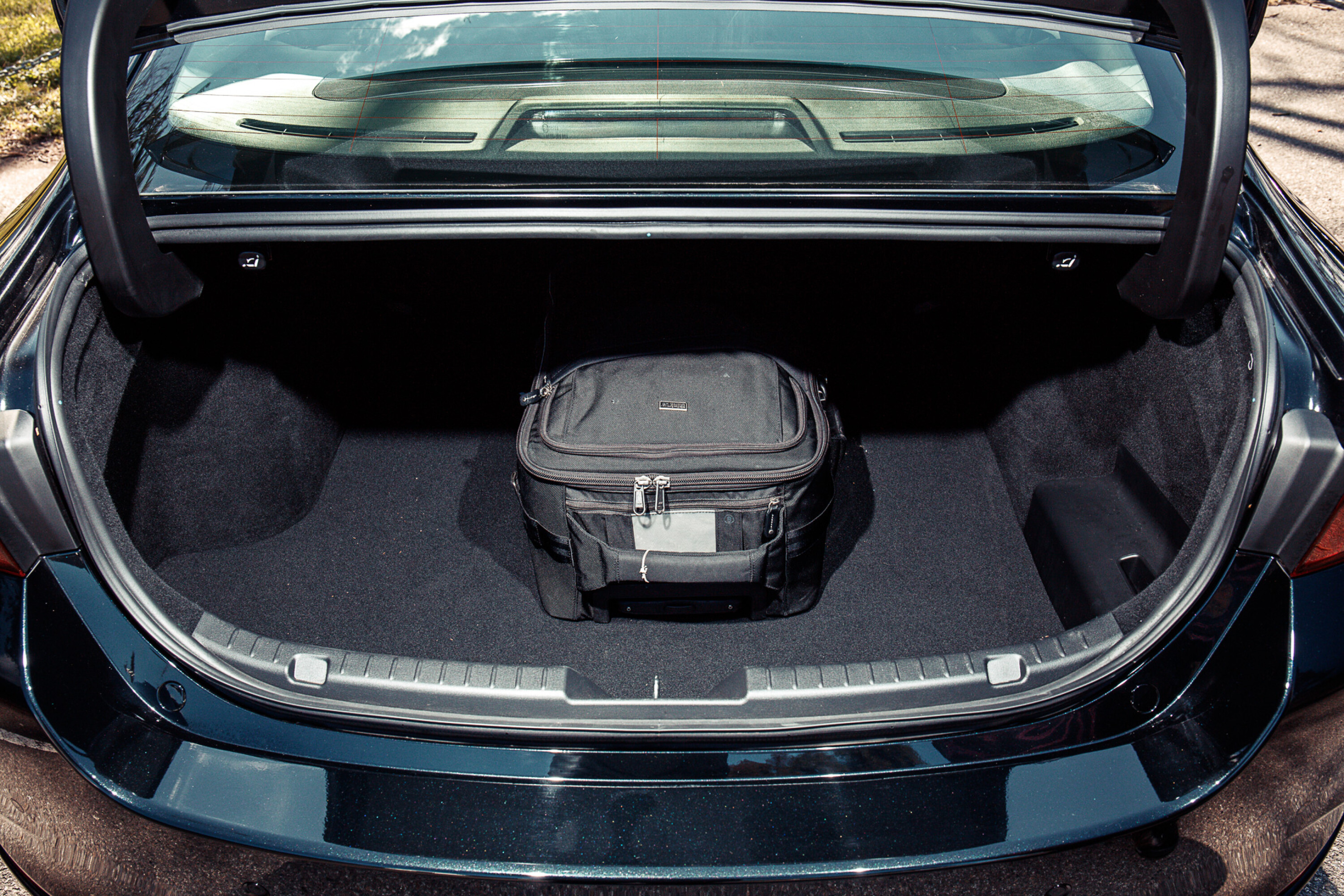
The Mazda 3 sedan holds a considerably more functional 444 litres (which is 36 litres more than the previous model) albeit without the hatchback functionality.
The sedan’s seatback can also split 60:40 to allow for bulkier items.
Yep. The Mazda 3 has a delightfully responsive steering set-up that manages to balance slow-speed manoeuvring with high-speed handling, without the need for different steering modes.
Keen drivers will lap up the precision with which you can place the nose when pushing into corners.
3
The 2.0-litre engine copes admirably with city life and has enough power for easy highway touring. It revs freely and mates well with the six-speed auto gearbox that most buyers opt for.
This engine doesn’t provide as much shove when you first press the accelerator, as with the turbo engines in some small-car rivals – it needs to spin past 4000rpm before really waking up but when it does it’s keen and even sounds a little rorty. Of course, driving this way will send your fuel economy north of its official 6.2L/100km fuel consumption.
1
The bigger, 2.5-litre petrol engine in the G25 versions is the better fit for this car and offers about 25 per cent more go than the 2.0. With the added grunt the car feels deliciously responsive, and its driveability is abetted in auto form by immaculate gear changes.
While it’s not what you’d call a strong performer – the 2.5-litre turbo found in some of Mazda’s larger models would be perfect here – it’s more relaxed than the smaller engine and happier to go up hills and drag a full load of people and things.
1
The Mazda 3 also benefits from Mazda’s G-Vectoring Control, whose operating principle is simpler than the name might suggest.
It adjusts the engine when you turn the steering wheel, decelerating slightly so as to transfer load to the front tyres and help them bite (and reversing the process as you return to the centre). You don’t notice it working but the car feels more planted, while changing direction more fluidly.
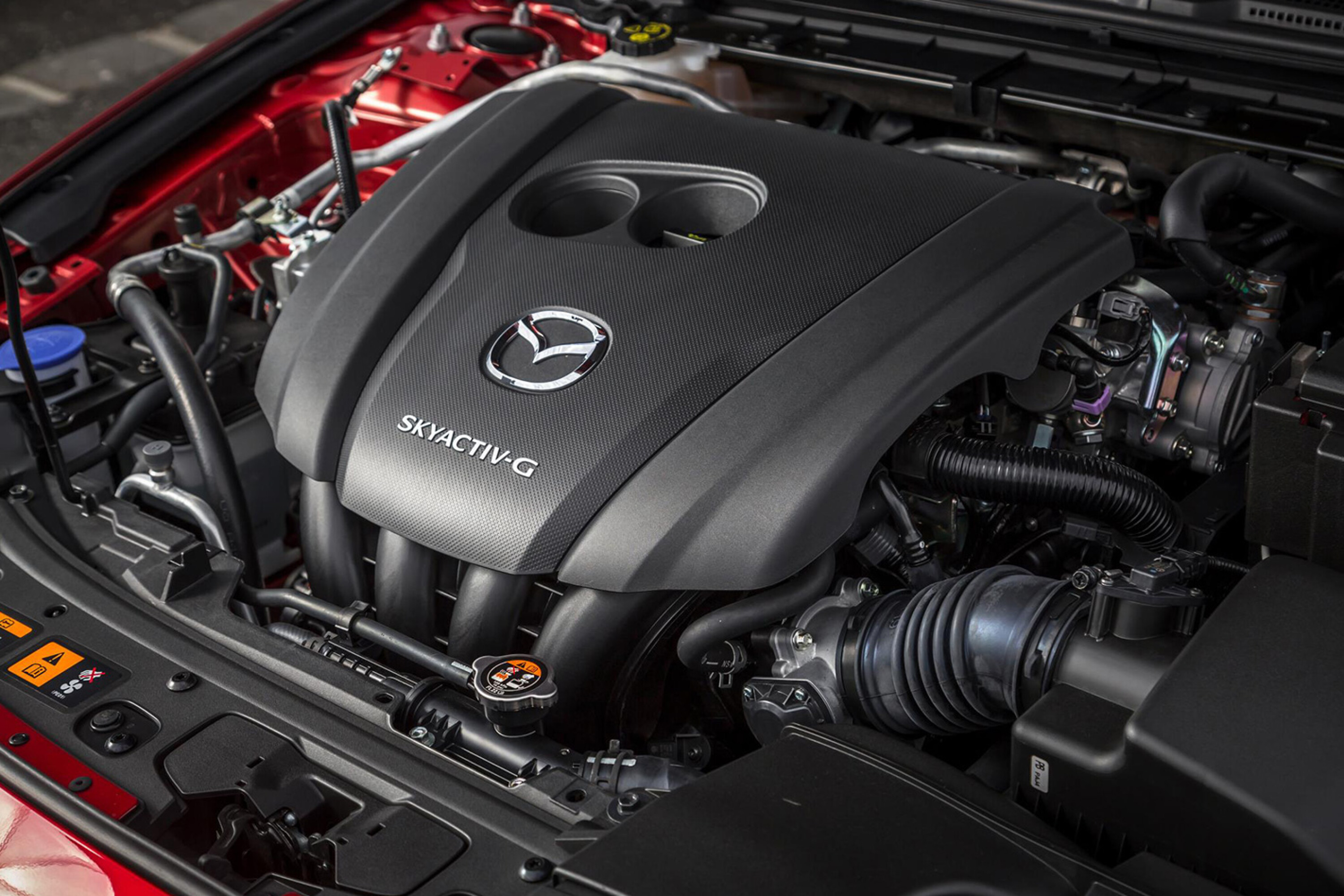
The G20’s 2.0-litre four-cylinder SkyActiv G petrol is the more fuel-efficient of the two engines available in a Mazda 3 on paper.
Until recently it consumed 6.2 litres/100km in the official test (city and country combined) but the introduction of cylinder deactivation in May 2023 brought a 5.0 percent reduction to 5.8L/100km for the hatch and 5.9L/100km in the sedan.
Producing 114kW/200Nm, this engine is otherwise the same one that was under the bonnet of the previous model but is still an excellent unit.
The sportier Mazda 3 G25 SkyActiv G is a more powerful 2.5-litre four-cylinder petrol that also carries over from the third-generation 3. Its 139kW/252Nm peak output brings you about 25 per cent more thrust in most driving conditions, which brings swifter overtaking and, for some drivers, more fun, with only a slight increase in fuel consumption (6.6L/100km).
1
Both engines are now only coupled with a six-speed automatic and have an auto stop-start system that reduces fuel use in city driving.
It shuts down the engine whenever you stop, and starts it automatically when you take your foot off the brake pedal to drive away. It can be a little irritating in heavy traffic, but you can turn it off.
The Mazda 3 range did have Mazda’s 2.0-litre SkyActiv X ‘supercharged’ engine, which provided superior power and torque (132kW/224Nm) but consumed just 5.5L/100km.
However, it was only available in the range-topping Astina and cost $3000 more than the G25 so buyers weren’t exactly lining up for it.
There was also the mild-hybid G20e, which consumed a frugal 6.0L/100km, but was deleted from the range in early 2023 along with the SkyActiv X.
With either engine or body shape, the Mazda 3’s braked towing capacity is 1200kg.
It can tow unbraked loads up to 600kg, while its maximum towball download is 80kg.
How long is the warranty and what are the Mazda 3’s servicing costs?
As per the wider Mazda range, the 3 is covered by the brand’s five-year / unlimited-kilometre warranty, along with a complimentary roadside assistance program over the same period.
In addition, Mazda offers five years of capped-priced servicing. It has 12-month or 15,000-kilometre service intervals, whichever occurs first.
Servicing prices for each powertrain can be found below:
Which version of the Mazda 3 does Wheels recommend?
There’s no bad option in the Mazda 3 range. Each variant is well-equipped for the price and is a pleasure to drive.
The sweet spot of the range would have to be the G25 Evolve SP, which has the punchier 2.5-litre engine and some attractive additions.
With no more manual gearbox option, you just need to choose between colours and body shape, which we’ll leave up to you.
The bold-looking hatchback still stands out after a few years, especially with the G25 black exterior garnish. But while the sedan is more demure, it’s elegant in a scaled-down Mazda 6 way and brings the bigger boot.
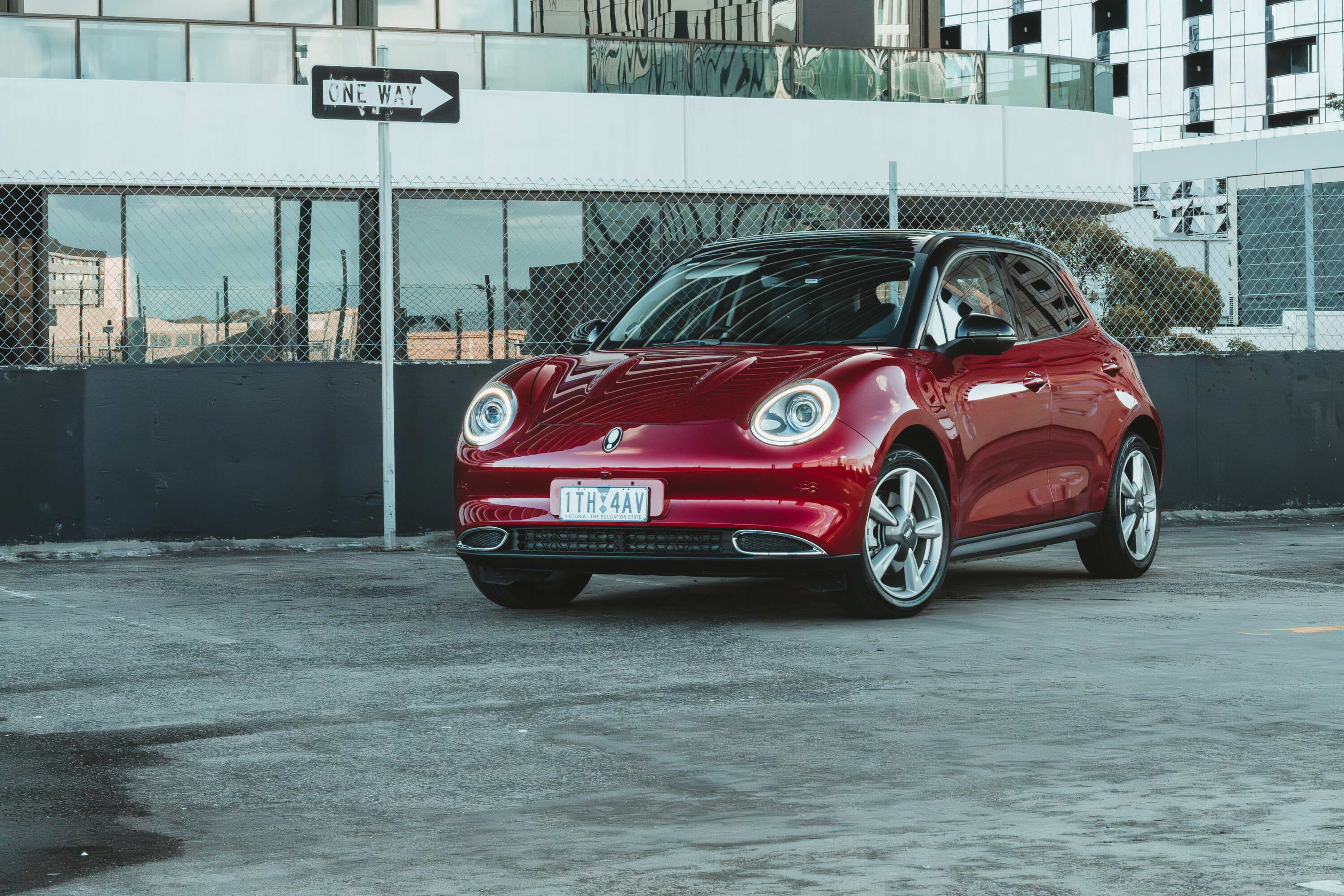
July 5: GWM cuts Ora pricing as MG 4 and BYD Dolphin set new bar
Now priced from $39,990 before on-road costs – a reduction of $4000 – The GWM Ora becomes a much more compelling rival to the $38,990 MG 4 and the $38,890 BYD Dolphin. Full details at the link below.
May 30: GWM Ora electric hatch delayed
GWM’s Australian arm confirmed today it has yet to commence deliveries for the Ora electric hatch, initially due in April.
Speaking with Wheels Media, GWM Australia communications manager Steve Maciver said the company is “making final preparations ahead of cars going into dealers”, with further news expected soon.
Watch for more Ora details to come in the weeks ahead.
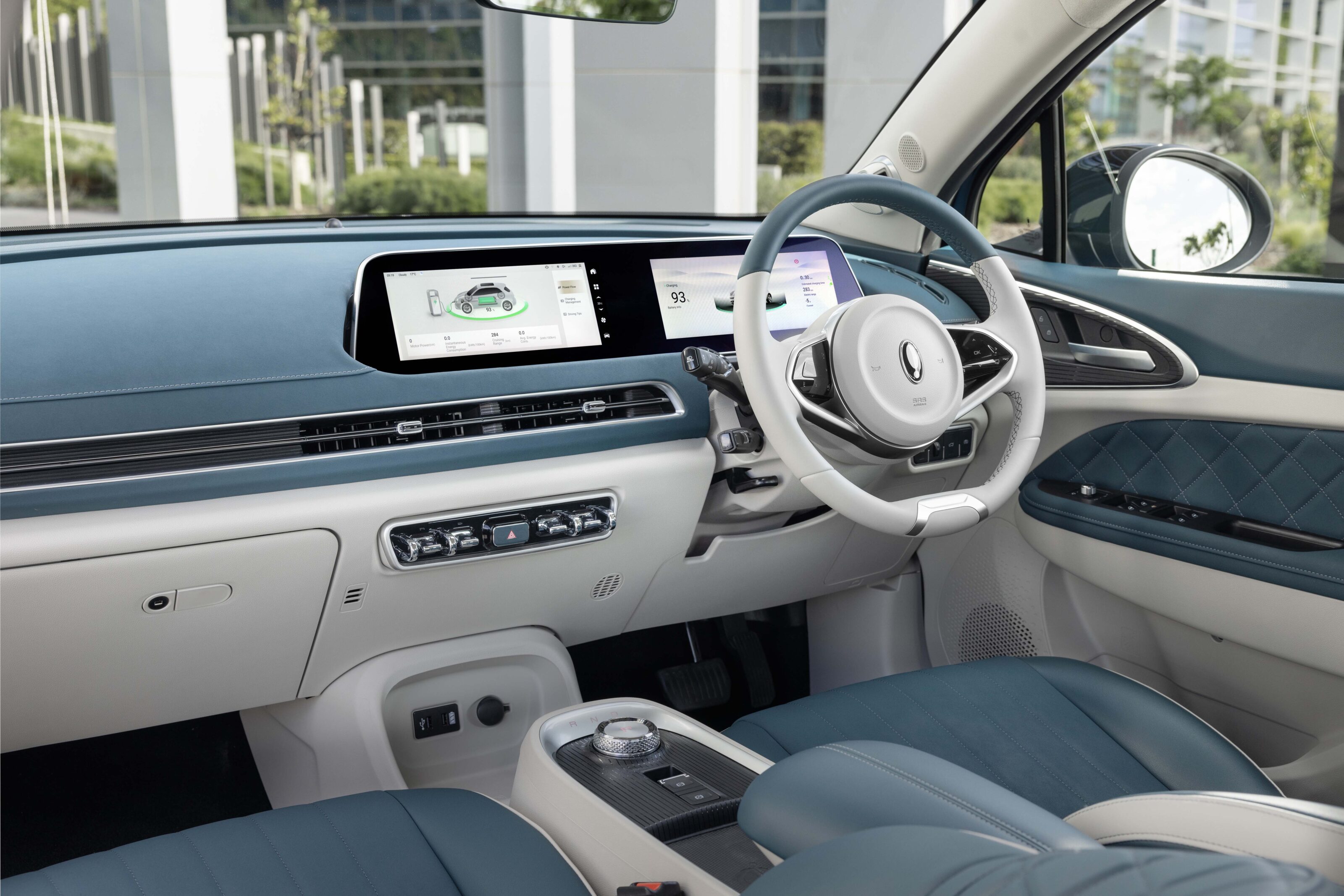
April 2023: GWM Ora EV pricing and details announced
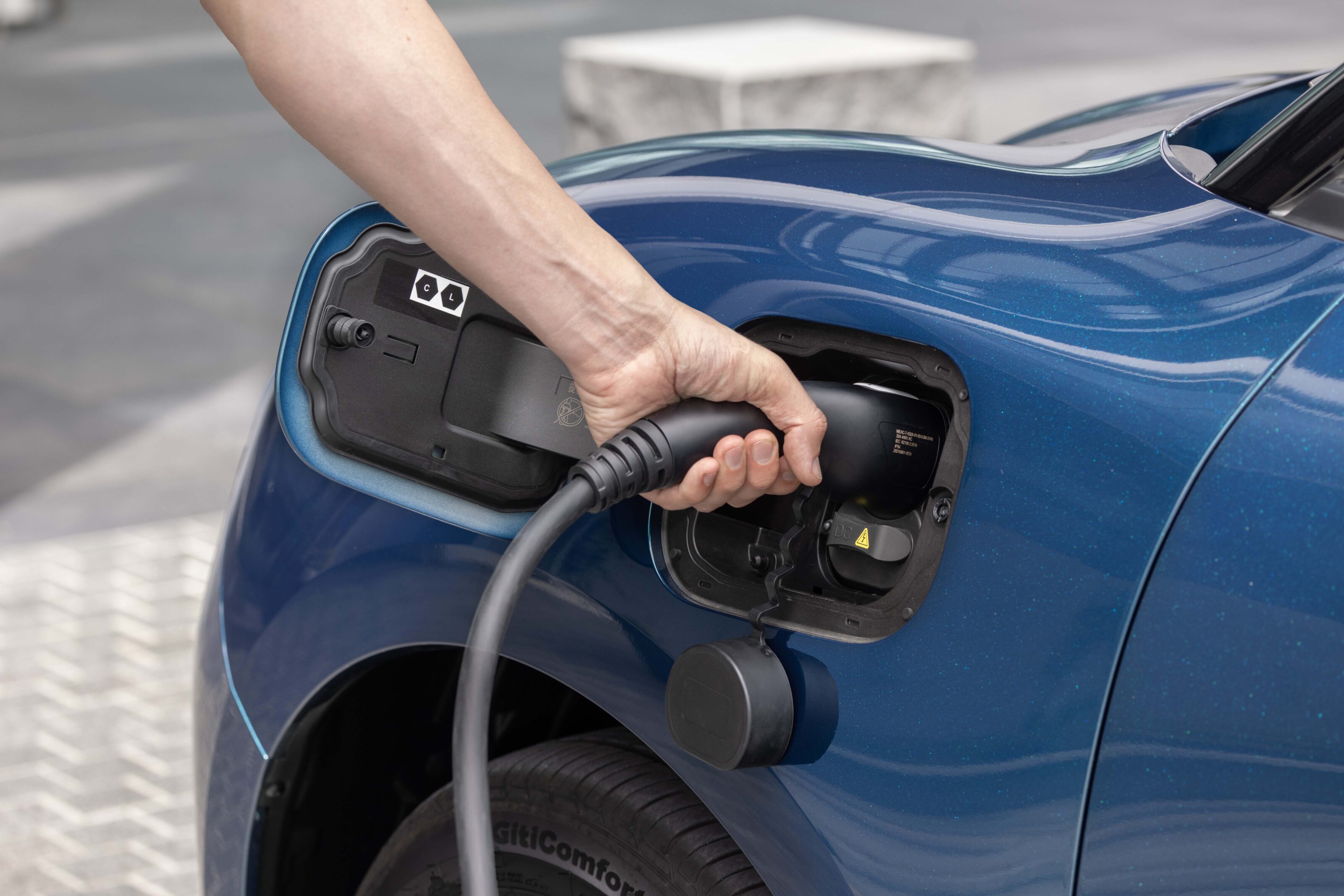
Here is everything you need to know about GWM Ora EV pricing, servicing, safety and equipment.
Looking to capitalise on the growing price-driven EV market in Australia, GWM has keenly priced the 310 kilometre WLTP Ora Standard Range from $43,990, and the Extended Range at $47,990, both before on-road costs.
A flagship GT variant with side stripes, sportier wheels, heated windscreen and memory driver’s seat will headline the range at $53,990 before on-road costs.
Before on-roads, the Ora standard range is dead even with the MG ZS EV Excite. The Ora will also compete against the MG 4 electric hatch and BYD Atto 3 small SUV.
MG offers seven years of capped-price servicing for the ZS EV, though it rises to as high as $757 for one service – and it’s also a similar situation for the BYD.
Ora drive-away pricing differs state-by-state, ranging from as low as $44,490 in the NT to $47,891 in WA. See the table for the full breakdown.
“There’s a lot of movement in this segment in terms of what competitors are doing”, head of marketing and communications at GWM, Steve Maciver, told Wheels.
“We think the quality in [GWM Ora], the spec that’s in that car, the ownership package of a seven year warranty and roadside assist, capped-price servicing is a very, very compelling customer proposition.”
2023 GWM Ora pricing
UPDATE, JULY 5: Pricing updated to scrape below $40,000 barrier.
As noted at the top of this story, the pricing in this story has now been updated to reflect reduced pricing. There is also a new Ultra grade.
For the Ora electric hatch, GWM offers five exterior colours in Australia.
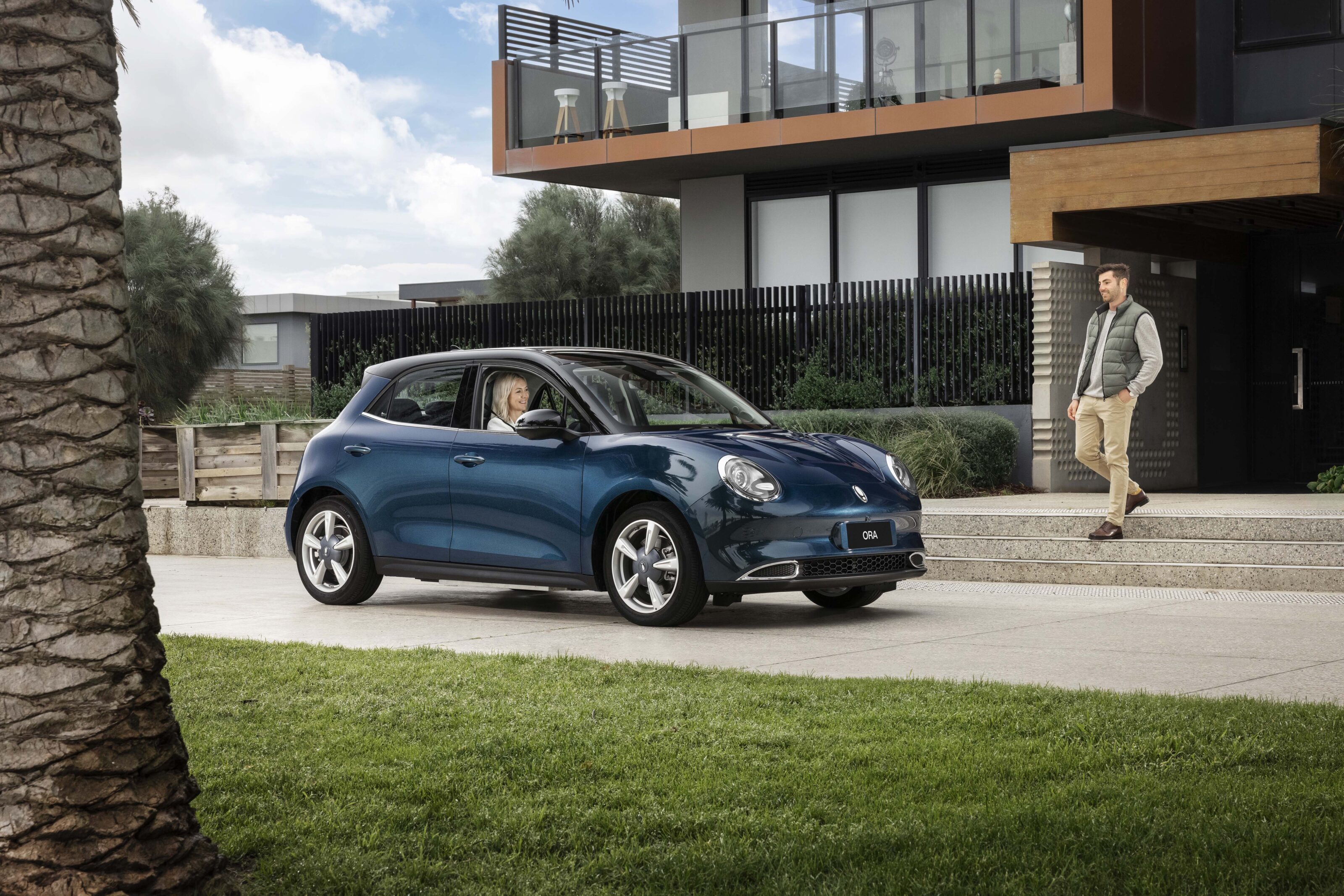
All but the aurora green communications colour will be paired with black upholstery, the pictured car gets the attractive two-tone turquoise/cream leatherette.
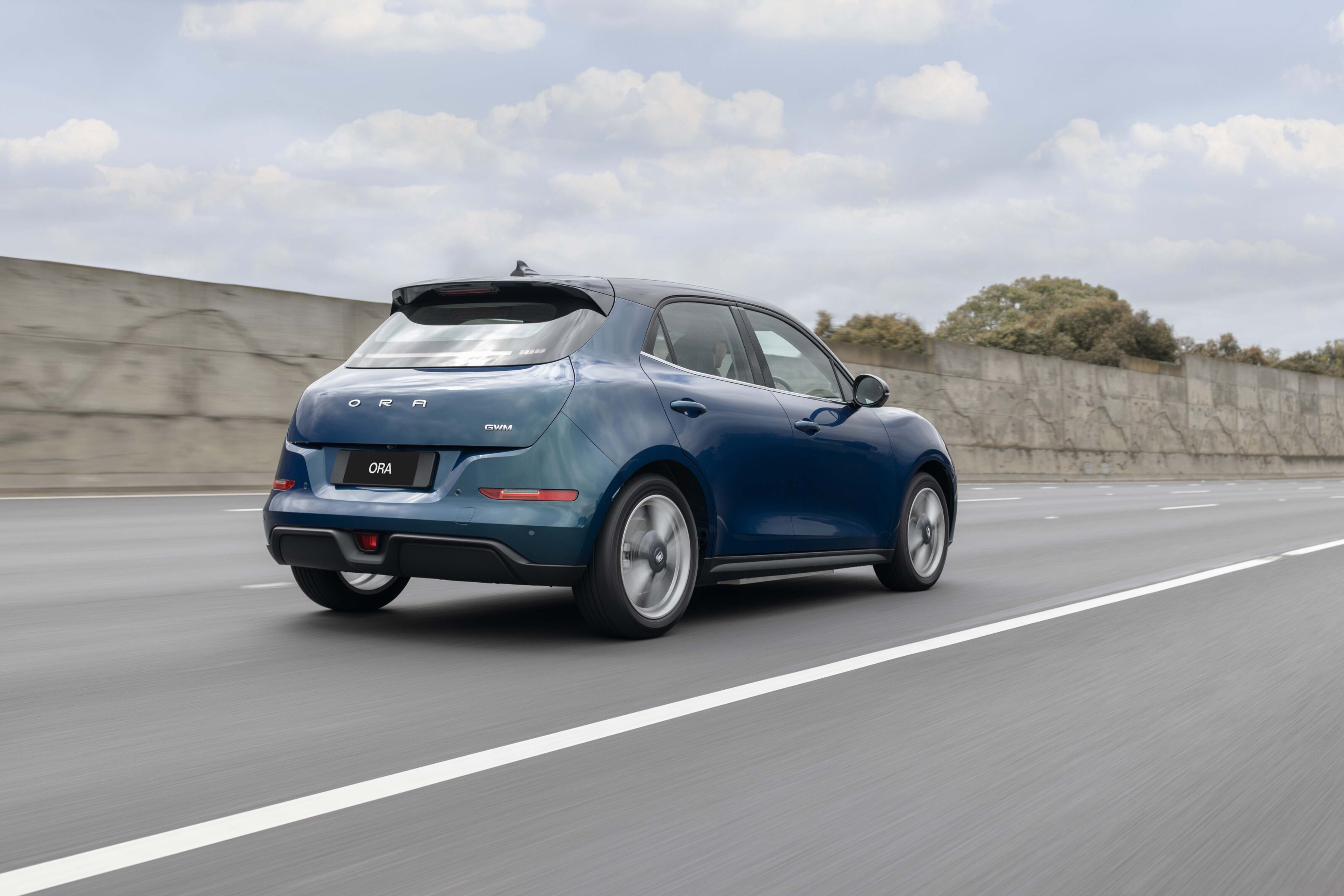
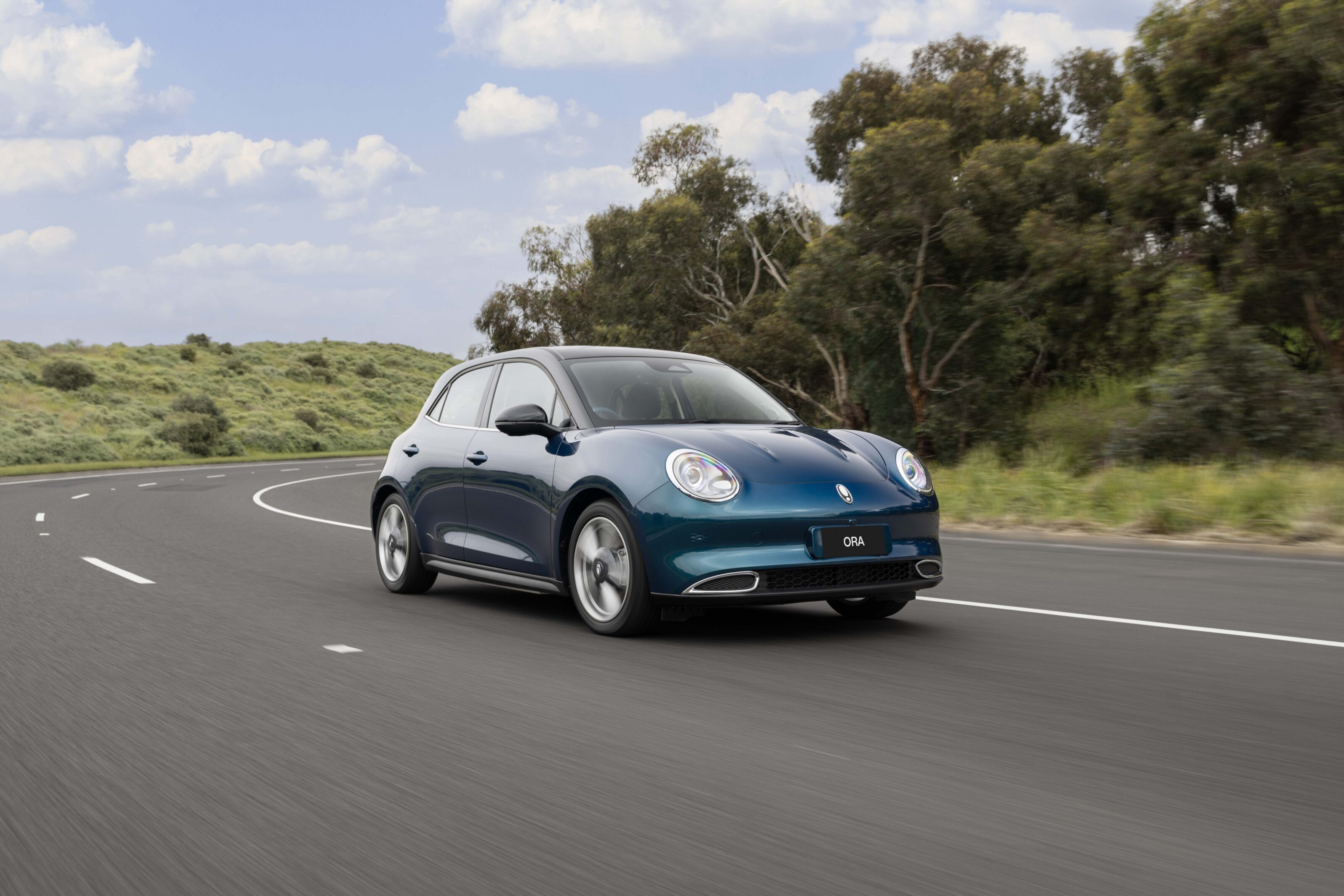
The GWM Ora measures 4235 millimetres long, 1825mm wide and 1603mm tall, while riding on a 2650mm wheelbase.
That makes it roughly the same size as a typical small car like a Volkswagen Golf, or Toyota Corolla – though the Ora does have a higher roof.
GWM is not marketing the Ora as an SUV despite its tall stature, likely due to its minimal 120mm ground clearance.
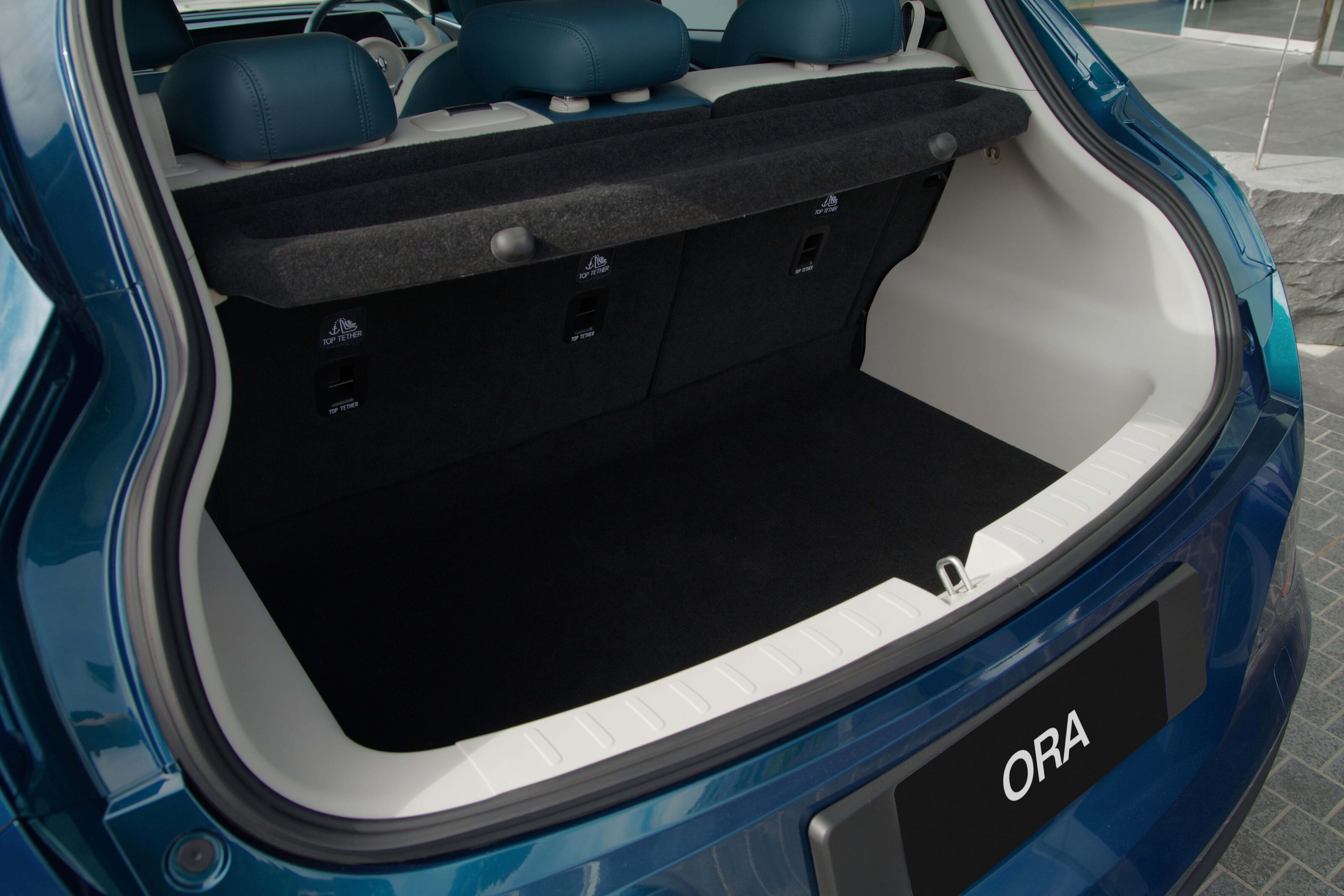
The Ora’s boot is small for the class, however, measuring 228-litres (VDA), or 884L with the seats folded. There is no spare tyre under the boot floor.
GWM’s Australian arm confirmed today it has yet to commence deliveries for the Ora electric hatch, initially due in April.
Speaking with Wheels Media, GWM Australia communications manager Steve Maciver said the company is “making final preparations ahead of cars going into dealers”, with further news expected soon.
Watch for more Ora details to come in the weeks ahead.
Skoda Australia has announced the arrival of 1000 vehicles in a single month, marking its largest stock intake since mid-2021.
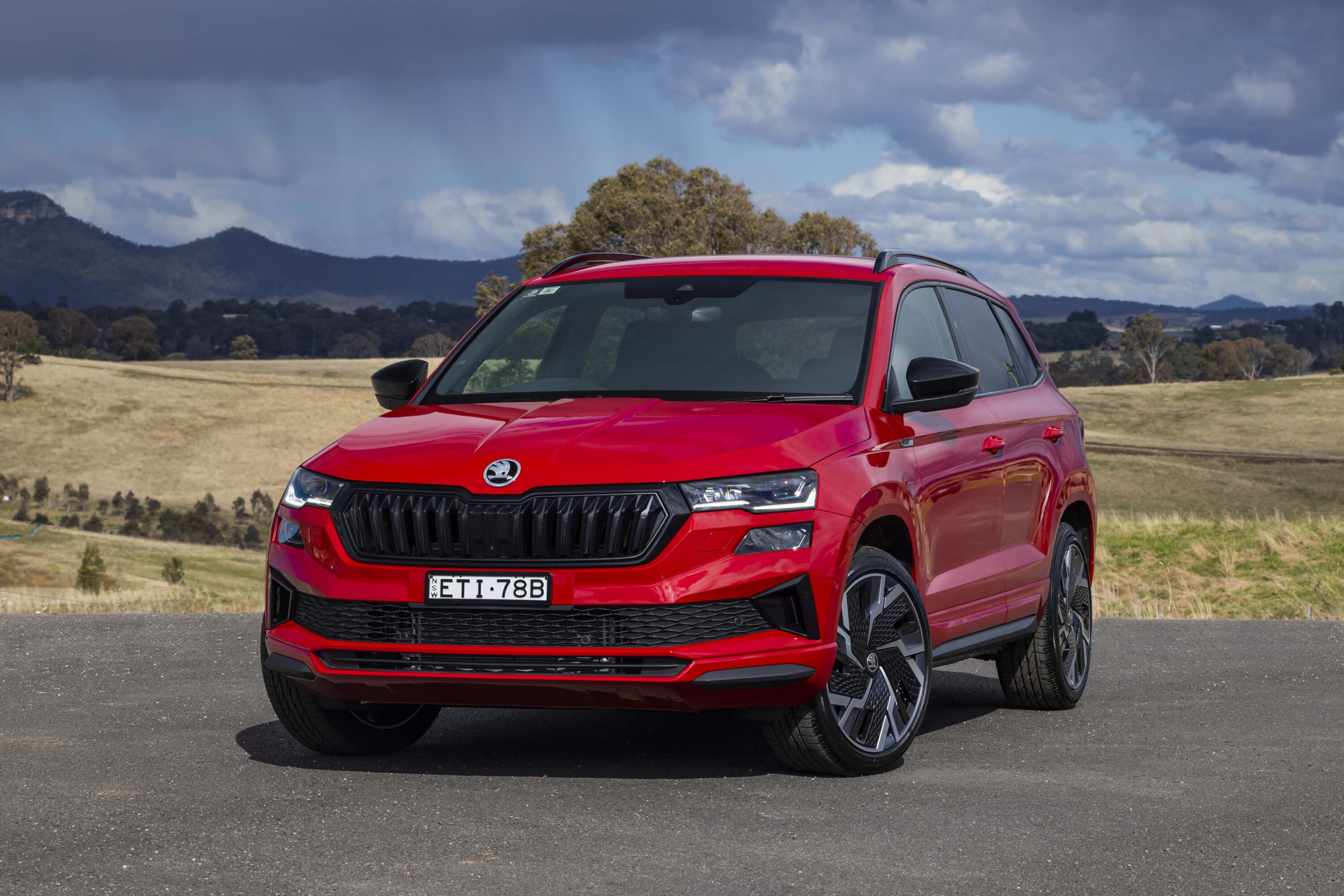
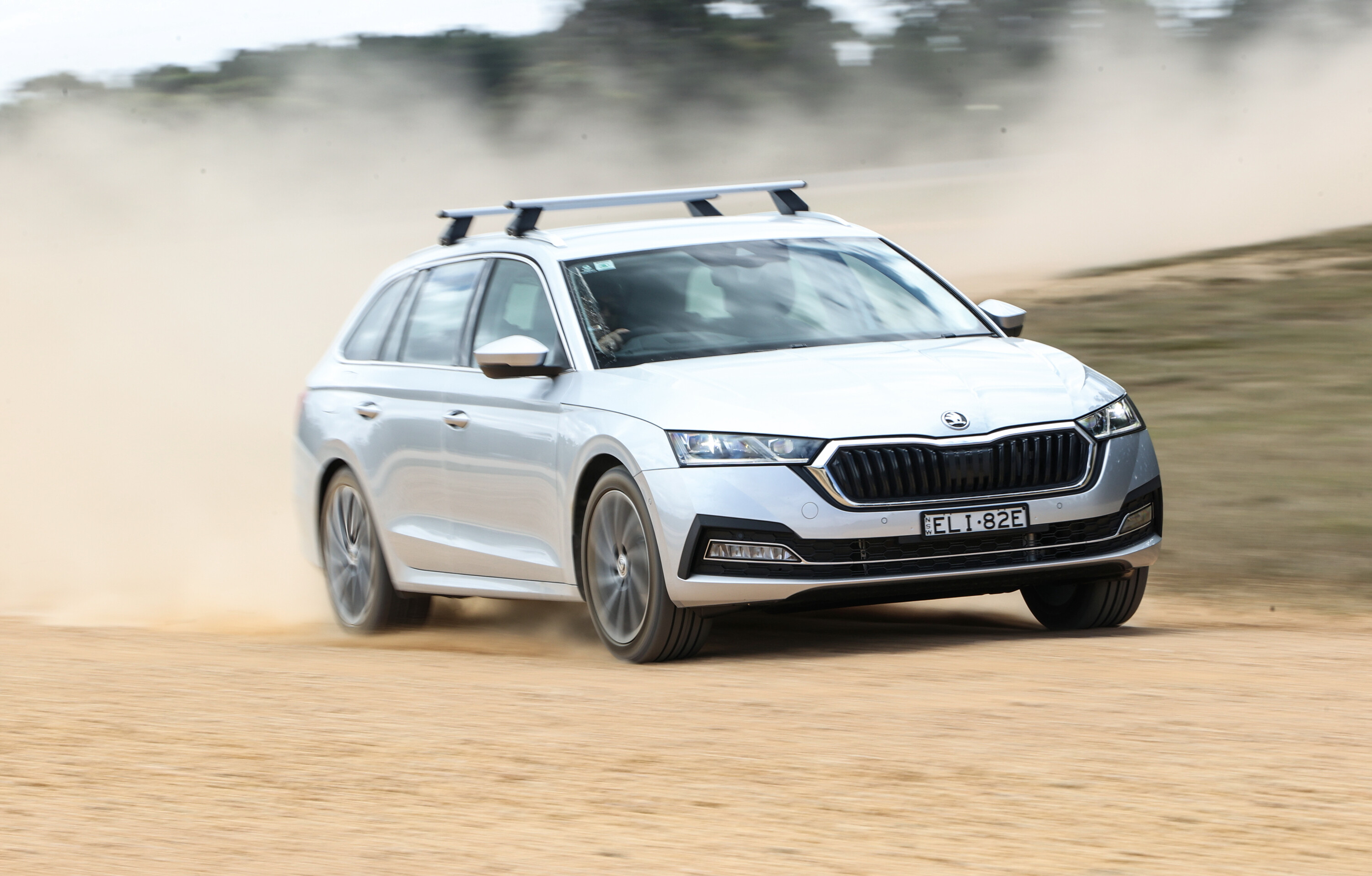
This influx of vehicles comprises “more than” 300 Kamiq small SUVs, 200 Kodiaq large SUVs, 150 Karoq medium SUVs, 115 Octavia wagons and 60 liftbacks, 100 Scala small hatches, 90 Superb liftback and wagons, and 40 Fabia light hatches.
As with the entire automotive industry, Skoda – and its Volkswagen parent – remains impacted by recent supply and logistical constraints, including the semiconductor chip shortage, which has seen key active safety tech deleted from its model lineup.
1
The affected blind-spot and rear cross-traffic alerts remain available to option in these vehicles, but a longer wait time is expected for a factory order.
Skoda has previously confirmed the “vast majority” of Octavia, Kamiq and Karoq stock will be fitted the sensors for blind-spot and rear cross-traffic alerts.
“For the first time in two years, we are able to meet the strong market demand for ŠKODA models,” said Skoda’s national sales and planning manager, Kieran Merrigan.
Merrigan attributed the increased interest in Skoda vehicles to factors such as the brand’s newly-introduced seven-year, unlimited-kilometre warranty and its EOFY deals available until June 30, 2023, detailed below.
The brand said the availability of in-stock vehicles could assist business customers considering purchasing a new vehicle before the federal government’s instant asset write-off program ends at the end of the current financial year.
These vehicles are expected to be followed by the next-generation Kodiaq and Superb due for reveal in the third quarter, though Skoda Australia has provided no official comment at this early stage.
Both the Kodiaq and Superb will be underpinned by the Volkswagen Group’s updated MQB Evo platform, with a close connection to the redesigned Volkswagen Tiguan and Passat, respectively.
As detailed here, the all-electric Enyaq and Enyaq Coupe – siblings to the Volkswagen ID.4 and ID.5 – will arrive next year, with local details to be announced closer to launch.
Wheels tested the Kumho Crugen in the urban environment around Healesville in country Victoria, fitted to a 2023 Nissan Pathfinder as standard equipment.
The Kumho was satisfactorily quiet and comfortable around town, and delivered impressive grip for an SUV tyre during extreme dynamic testing on a winding road.
That was no doubt in part to its wide, 255mm fitment on the big Nissan – often a size reserved for sports cars.
Fitted to the massive Pathfinder, Wheels found the Kumho Crugen to squeal noticeably loudly during hard cornering, but buyers should have little reason to push their family SUV so hard.
For daily driving, family-hauling purposes, the Kumho Crugen ticks the right boxes.
In this particular test, we didn’t get to test the Kumho Crugen in wet conditions, off-road or unsealed conditions, or assess highway road noise. Watch for more on those aspects to come in the near future.
Queensland has announced a $10 million allocation to add 44 more public electric vehicle charging stations to the statewide network by the end of 2024.
Snapshot
44 additional QESH chargers earmarked for 32 locations by 2025
Focus on regional Queensland, deliver u2018reliableu2019 chargers
Co-funding with successful applicants (including Tesla?)
The fourth-phase project would almost double the footprint of the state-backed Queensland Electric Super Highway (QESH) network by reaching 32 new sites – focused on serving regional areas.
The state government claims the new stations would “increase reliability, reduce queuing, and ensure that EV drivers have confidence in road tripping through regional Queensland.” Construction will start in the next 18 months.
It would co-fund and work with the successful applicants in a 50-50 investment to deliver the infrastructure, which include:
The current QESH network adopts Brisbane-made 50kW or 75kW Tritium DC fast chargers offering CCS2 and CHAdeMO plugs, installed by Yurika, and is facilitated by Chargefox – costing a low $0.30 per kilowatt-hour.
Most charging locations today only have one station, but this roll out will deploy “multiple sites” at select towns as listed below.
The Queensland Government claims since QESH launched in 2017, there have been more than 106,000 charging sessions and has removed around 2841-tonnes of carbon dioxide exhaust emissions (equivalent to 825 vehicles).
The co-funding comes from the state government’s $55 million 10-year Zero Emission Vehicle Strategy.
Mitsubishi Australia has announced it’s providing $1000 cash to Holden owners who trade their car for a new vehicle.
The offer – available from May 15, 2023, to March 31, 2024 – applies to all Holden-badged vehicles eligible for trade-in and can only be claimed by taking delivery of a new Mitsubishi vehicle.
To qualify, Mitsubishi said a buyer’s contract must “clearly [identify] an eligible Holden vehicle included in trade-in”, and then lodge an online claim to receive a $1000 prepaid gift card.
An additional $250 bonus is available if one Holden owner refers another to the deal, who then makes a purchase.
Mitsubishi also specifies that the offer is available to private and ABN buyers who are Australian residents aged 18 and above. For more details, click here [↗].
“We know it’s not always easy to let go of your old vehicle, so we’re giving you a thousand more reasons to trade in your old Holden for a new Mitsubishi,” said the brand.
While service centres remain in some locations, the closure of Holden’s showrooms saw several franchisees across Australia switch to selling Mitsubishis or convert their larger Holden site to Mitsubishi, where both were already offered.
As the new financial year approaches, vehicle manufacturers have traditionally geared up for annual End of Financial Year (EOFY) car sales.
While attractive discounts, promotions, and drive-away deals were previously offered for most brands – often a symptom of oversupply and missed targets – there has been a notable shift in recent years.
Simply put, very few of the top brands are struggling to move product this year as the automotive industry continues to battle supply and logistical challenges. Several brands – including Toyota, Ford, Kia, Isuzu, Nissan and Subaru – have elected to forego the usual EOFY campaigns.
However, many brands still have offers running separate from EOFY-specific marketing.
While fewer brands are involved, those who participate now place a greater emphasis on finance-based offers to promote available in-house financial services, rather than direct savings.
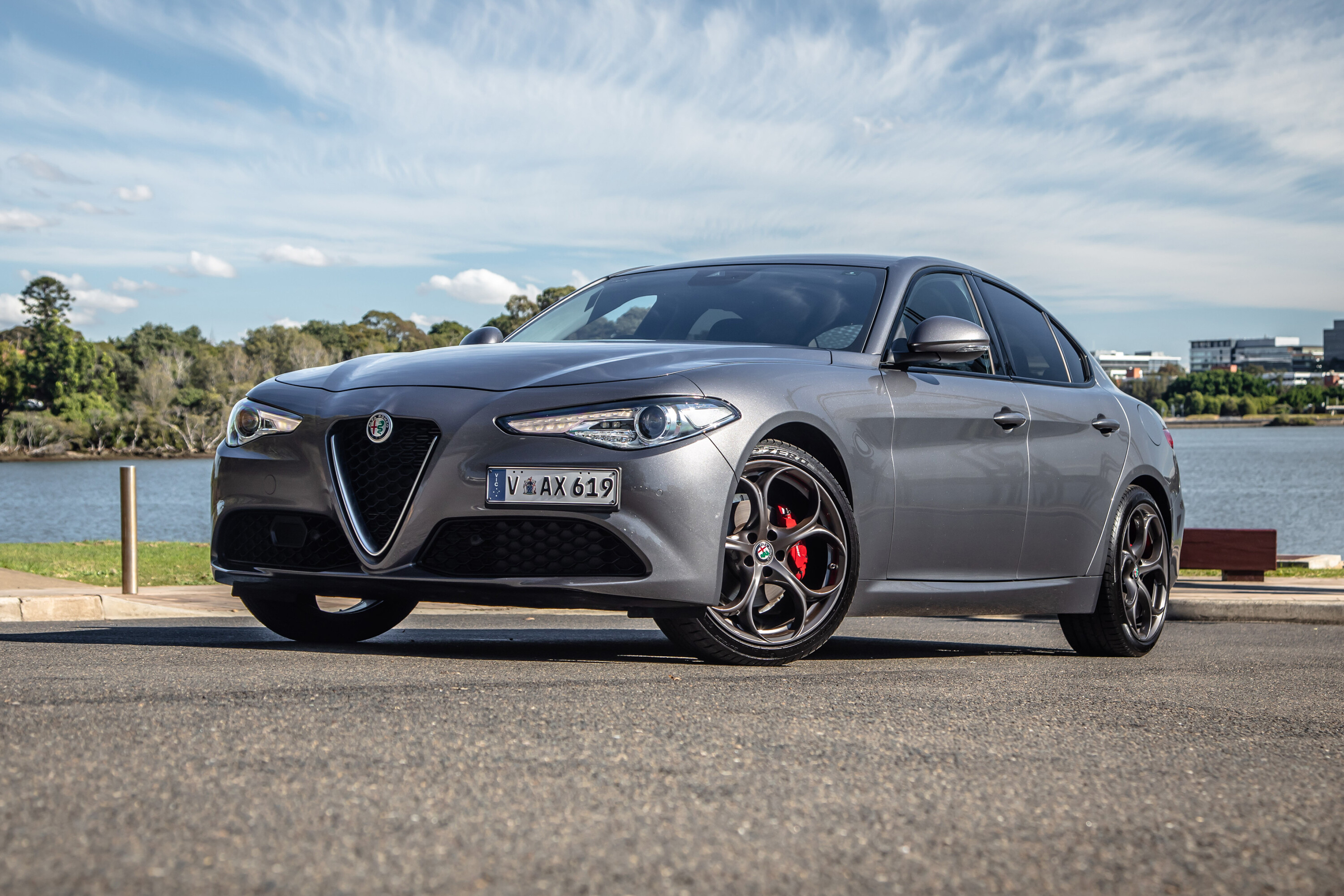
Demonstrator bonus: $1500 for Stelvio Veloce and Quadrifoglio
Deposit contribution: $3000 when financing with Alfa Romeo’s in-house service, or $5000 for the Stelvio Quadrifoglio.
* While stocks last. Offers applicable to the pre-facelift Giulia and Stelvio. Vehicle must be ordered and delivered by June 30, 2023.
Audi
1
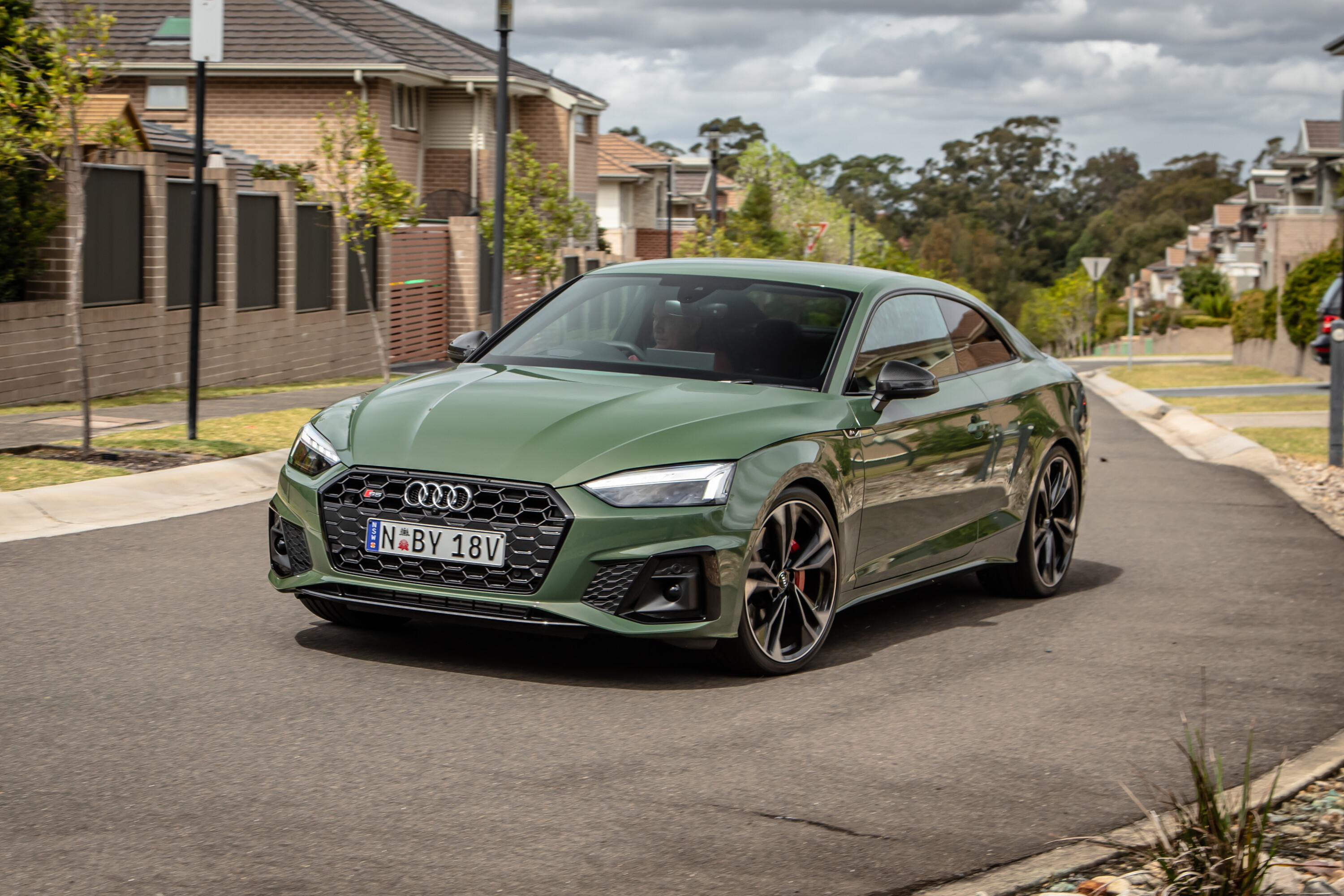
Audi has complimentary on-road costs for selected in-stock vehicles until June 30, 2023.
* excludes Q3, E-Tron, E-Tron GT, and RS models. Vehicles must be in-stock, purchased and delivered by June 30, 2023. Offer includes 12 months registration fees, stamp duty, and 12 months compulsory third-party insurance.
Finance offer: 3.98 per cent p.a. comparison rate and complimentary home charging equipment installation.
* financial applications must be received by June 30, 2023. Offer applicable to 12 to 36-month terms. Additional fees and charges apply. Home charging equipment available for E-Tron and E-Tron Sportback vehicles purchased and delivered by June 30, 2023. Equipment supplied by Jet Charge.
Complimentary servicing: Five-year/80,000-kilometre (BMW Service Inclusive Basic Package)
Finance offer: 5.99 per cent p.a. comparison rate.
* offer applies to 118i. Excludes 120i, 128ti and M135i vehicles. Must be ordered and delivered by June 30, 2023. Finance offer applies to a 48-month term, with the guaranteed future value option.
Complimentary servicing: Five-year/80,000-kilometre (BMW Service Inclusive Basic Package)
Finance offer: 5.99 per cent p.a. comparison rate.
* offer applies to 218i Gran Coupe, M235i Gran Coupe and 220i Coupe models. Excludes 230i, M240i and M2 coupes. Must be ordered and delivered by June 30, 2023. Finance offer applies to a 48-month term, with the guaranteed future value option.
‘Power Pack’: BMW Wallbox charger (7.4kW single-phase, 22kW three-phase AC) with five-metre Type 2 portable charging cable; six-year, unlimited-kilometre complimentary servicing; $5000 trade-in bonus.
* offer applies to new and demonstrator iX xDrive40 and iX3 vehicles only. Must be ordered and delivered by June 30, 2023. Installation costs not included. <\/em>
Complimentary servicing: Five-year/80,000-kilometre (BMW Service Inclusive Basic Package)
Finance offer: $5000 deposit contribution.
* offer applies to X5 xDrive30d, xDrive 40i and xDrive45e models. Excludes xDrive25d, M50i and X5 M, and facelifted, vehicles. Must be ordered and delivered by June 30, 2023. Finance offer applies to 36 to 60 month term, with a 7.99 per cent p.a. comparison rate and guaranteed future value option.<\/em>
GWM’s $1000 discount applies to in-stock 2022-built vehicles only. Must be ordered and delivered by June 30, 2023. Excludes Jolion Premium and Lux Hybrid, Ute Cannon 4×2, cab-chassis and Cannon-XSR, H6 Lux Hybrid, H6 GT, Tank 300 and Ora vehicles.
Finance offer: $2500 deposit contribution when using Hyundai’s in-house financial service.
* excludes Santa Fe Hybrid. Finance applications must be settled by June 30, 2023. Applicable vehicles must be sold and delivered by June 30, 2023. Available at participating dealerships while stocks last.
Victoria, WA, Tasmania, and the ACT: $1000 deposit contribution for new or demonstrator BT-50s delivered by June 30, 2023, when financing with Mazda’s in-house service.
NSW, QLD, SA, and the NT: $1000 deposit contribution for new BT-50s delivered by June 30, 2023, when financing with Mazda’s in-house service.
Other dealer-specific EOFY savings are available for in-stock Mazda vehicles sold and delivered by June 30, 2023. Contact your local dealership for more information.
* offer applies to vehicles ordered by June 30, 2023, and delivered by July 31, 2023. Excludes the new GLC 300, pre-owned, built-to-orders, fleet and leasing vehicles.
Mercedes-Benz EQ electric vehicles
Finance offer: 5.99 per cent interest rate; complimentary three-year service plan.
* offer applies to EQA, EQB, EQC, EQE and EQS vehicles ordered by June 30, 2023, and delivered by July 31, 2023. Based on a five-year term with a 7.99 per cent comparison rate. Fleet, government and rental buyers excluded.
Finance offer: 6.99 per cent comparison rate with Skoda’s in-house financial service and guaranteed future value option.
* all Skoda finance offers inclusive of 20 per cent loan deposit. Applies to vehicles purchased by June 30, 2023, and delivered by July 31, 2023. <\/em>
* all Volkswagen offers apply to vehicles sold and delivered by June 30, 2023. <\/em>
Other deals: All Volkswagen commercial vehicles – excluding the new Amarok – receive a five-year service plan for the price of a three-year package until December 31, 2023.