
The already stylish new-generation Toyota Camry has been given a sporty makeover for the Japanese market, thanks to the release of new ‘GR Parts’ and ‘Modellista’ body kits and accessories.
A number of similar items have already been released for other Toyota models, including the new Yaris Cross compact SUV, but these mark the first official styling enhancement options for the new Camry.
Neither kit offers any performance improvements, with the GR Parts range offered entirely as an aesthetic exercise to give the Camry a little more visual flair.
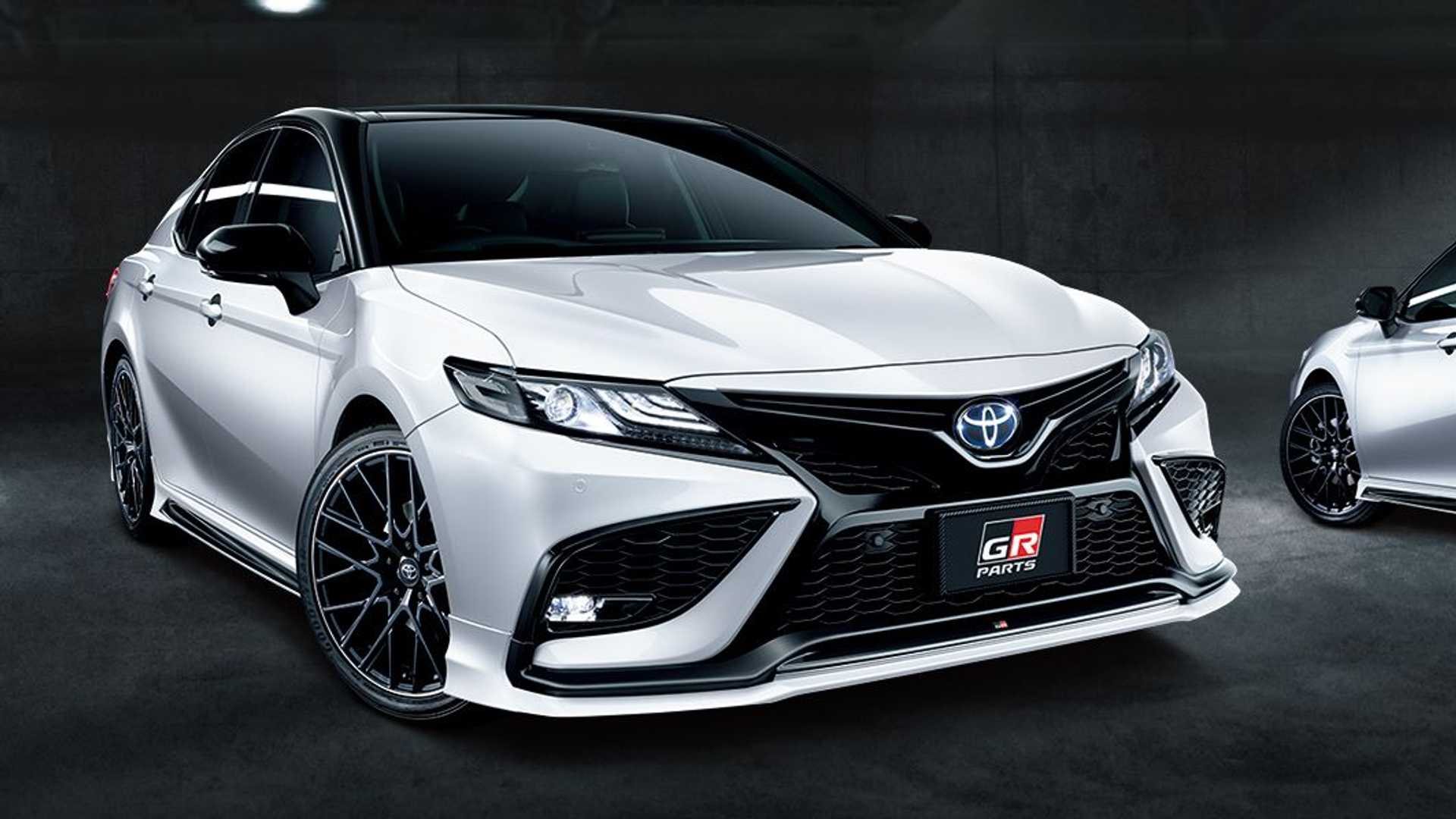
Pieces include new front and rear bumpers with large faux intakes and chrome-trimmed fake exhaust tips, new 19-inch alloy rims, low skirts and boot-lip spoilers.
Various accent and garnish items are also on offer, including bold chrome frames to surround the grille and front bumper openings.
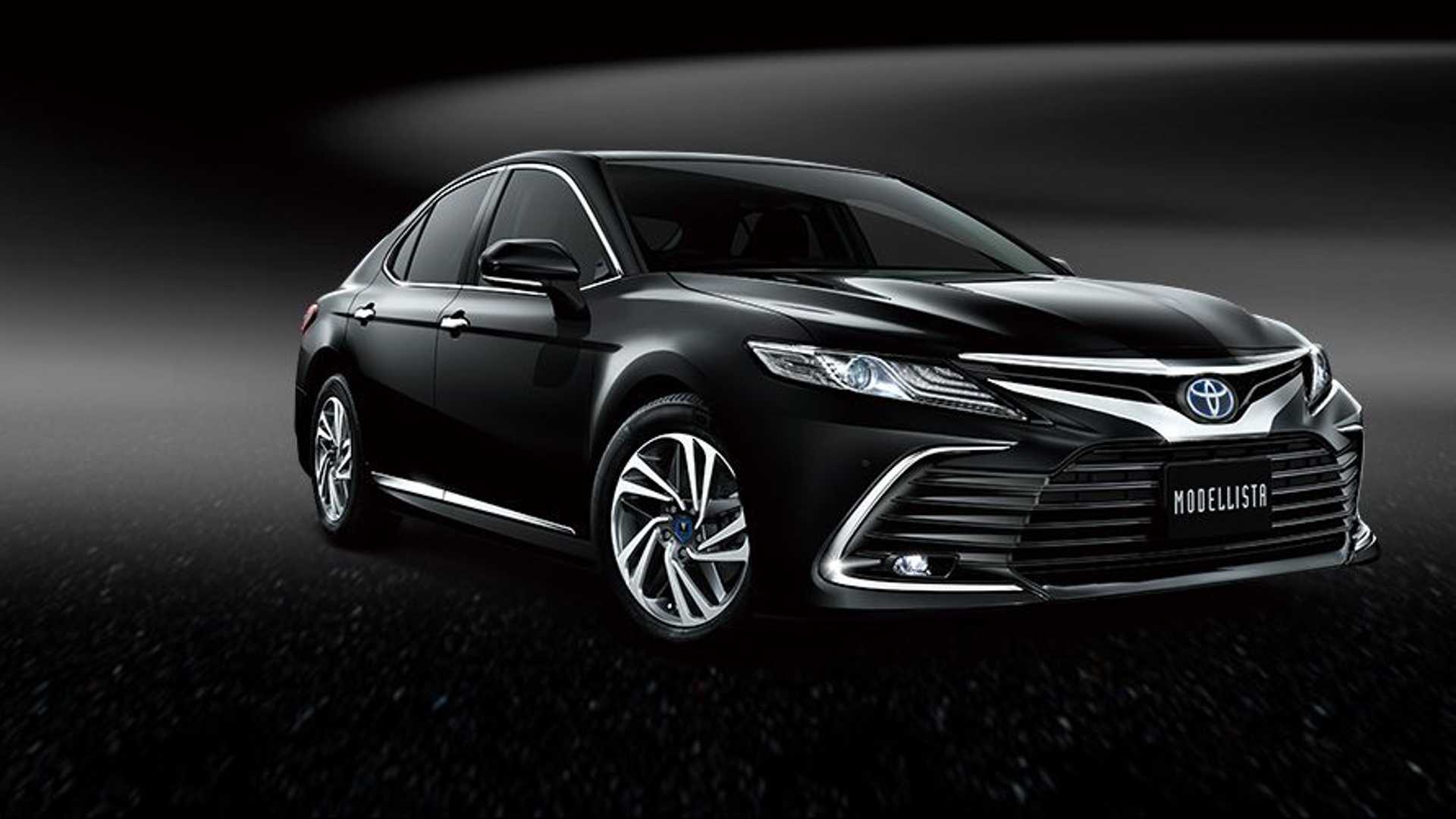
Where the GR Parts package focuses on a racing look, the Modellista brand is aimed at more of a Japan-style premium look.
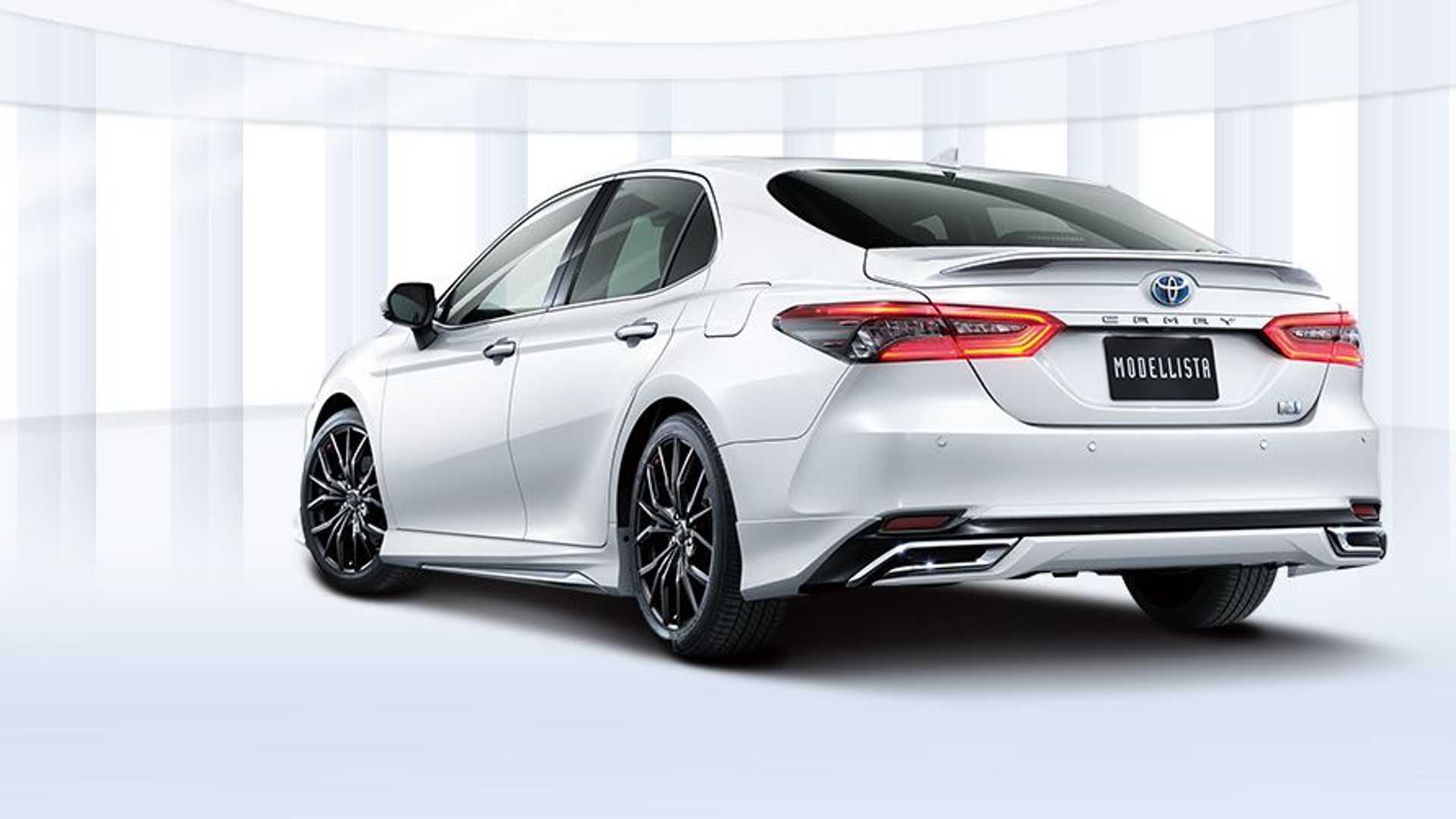
Neither package is planned to come to Australia – at least not through official channels – with Toyota’s local arm focused on building the GR (Gazoo Racing) brand as a bonafide performance offering before it considers diluting the program with styling or handling options, in the case of next-level-up GR Sport models.
Watch for more on the Camry, including a facelifted and upgraded model, to come in the months ahead.
MORE: Camry news and reviews MORE: All Toyota stories
As Roland Dane prepares to step down as Triple Eight team principal in 2022, Supercars’ winningest driver is readying himself to step up to the top job.
Jamie Whincup announced he’s retiring from full-time driving at the end of the 2021 season, coinciding with Dane’s announcement, along with the addition of businessman and racer Tony Quinn as major shareholder in the team. While Whincup still appears to have some years of competitive driving left in him, Wheels asked JW: why now?
“I like racing. I want to [be involved in] racing for a long time to come… and you can’t drive the race car forever,” Whincup says.
“In some regard you can’t do any role [for] too long because you lose your spark for it. I’ve enjoyed my driving career and that’s still continuing to the end of this year, but I’m looking to enjoy the new part of going racing – that’s being a team principal.”
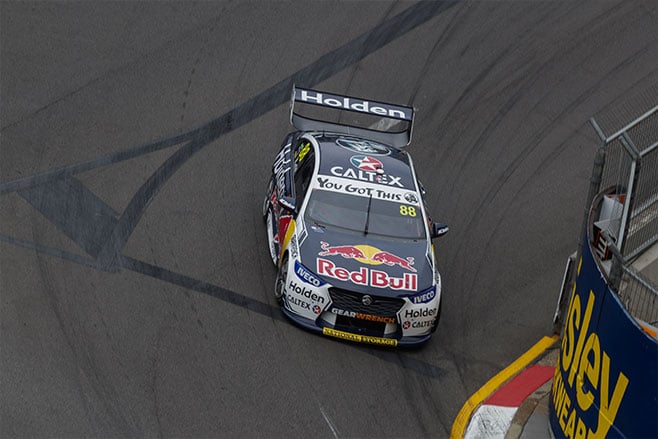
Whincup says the team is in the right position to be bringing younger drivers in and giving them the resources to become the next generation of great racers.
“You get to a point in your driving career where you’re better off developing a young kid. I still think I could be a competitive driver for the next few years but we might as well start the transition now with Gen3 coming in with a new driver.
“Me continuing would be more selfish than what’s best for the team and I’ve always said I’ll do what’s best for the team; first and foremost.”
It’s possible those who want to see Triple Eight remain a dominant force in Supercars would prefer to see Whincup behind the wheel, but his career has already provided the team with 122 race wins, seven championships, and four Bathurst 1000 victories. Whincup says he never set out to be quite as good as he has proven himself to be.
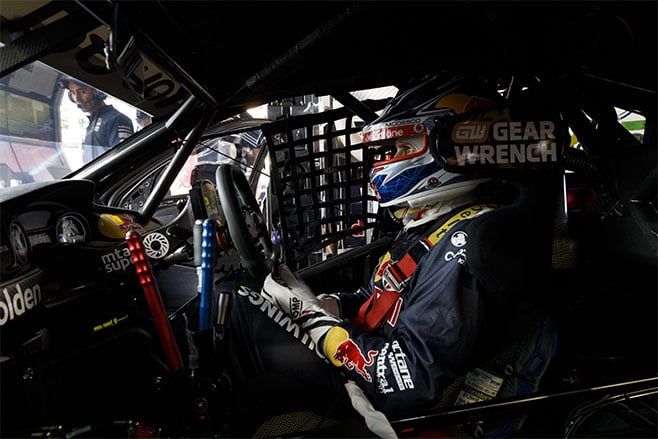
“I never planned too far ahead, and I never had any real specific goals that I wanted to achieve in Supercars. I think if I did then I’ve achieved them without a doubt.”
Whincup adds that even though he believes fresh talent will keep the team competitive, there’s something in it for himself too.
“Listening to a lot of AFL players who now coach, they said they’ve got a massive rush out of winning a premiership as a coach, as in, it’s almost been as rewarding as it was as a player. The obvious goal for me after this year is to win a championship as a team principal. Potentially there’s just as much satisfaction there as there is behind the wheel.”
Where does Whincup see Triple Eight in a couple of years time, then? He’s confident the team has been left to him and new owner Tony Quinn in top shape in terms of management.
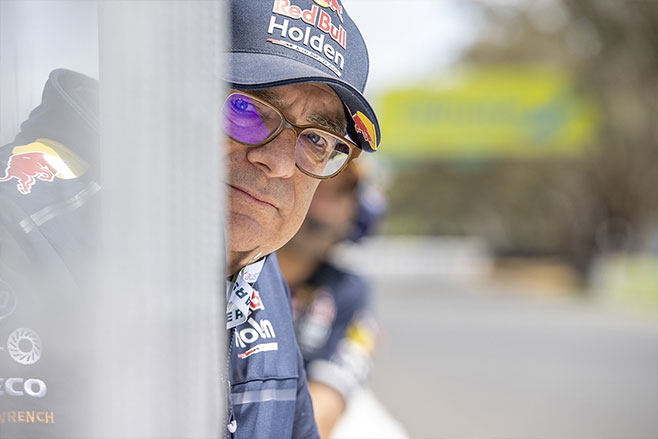
Triple Eight’s mastermind Roland Dane
“I think Roland’s put a fantastic succession plan in place to make sure Triple Eight is a force to be reckoned with for a long time. No doubt there’ll be a massive hole to fill when RD decides to spend long periods of time away, but that’s up to me to raise my standard to the position that Roland’s generated over many years. If the place can’t operate without Roland, that means I’ve failed.
“Everything I attack in my life I give 110 per cent. I’ve had a lot of success with things I’ve given my utmost attention to, and I’m hoping this team principal role at Triple Eight is no different to anything else I’ve given all my efforts to over the years.”
That part is clear to anyone paying attention to Whincup’s career. Almost one of every four race starts has resulted in a win for Whincup – in large part thanks to Triple Eight. It’s hard to imagine Whincup doing anything other than his best to allow a young driver that same opportunity.
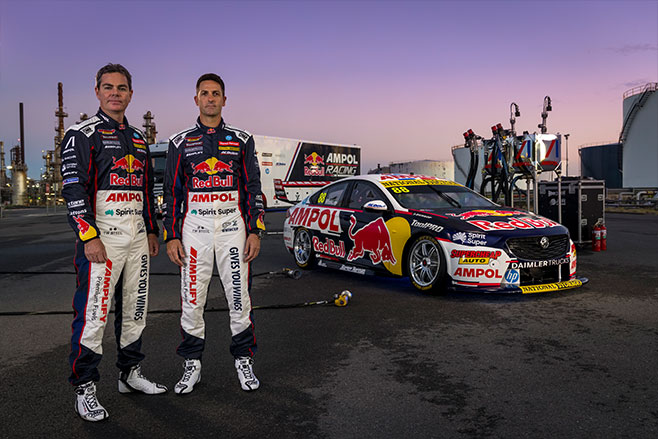
Craig Lowndes and Whincup with the 2021 Red Bull Ampol Racing Commodore
Full interview transcript:
Wheels: Why the move to a management position? And why now?
Whincup: I like racing. I want to go racing for a long time to come… and you can’t drive the race car forever. In some regard you can’t do any role forever because you do it too long and you lose your spark for it. I’ve enjoyed my driving career and that’s still continuing to the end of this year, but I’m looking to enjoy the new part of going racing and that’s being a team principal.
So it’s a way to stick around without feeling like it’s getting stale?
Yeah you get to a point in your driving career where you’re better off developing a young kid, I still think I could be a competitive driver for the next few years but we might as well start the transition now with Gen3 coming in, so we can start Gen3 with a new driver. Me continuing would be more selfish than what’s best for the team and I’ve always said I’ll do what’s best for the team first and foremost.
Do you feel like, if you had any goals, you’ve achieved what you set out to in your full-time career?
I never planned too far ahead, and I never had any real specific goals that I wanted to achieve in Supercars. I think if I did then I’ve achieved them without a doubt. I’m not a greedy person… I didn’t set out to win over 100 races so I’m more than happy with the results myself and the team have been able to achieve.
Do you have any goals for T8 or your own career going forward, driving or otherwise?
There’s no driving event that really stands out but I’d love to do some laps at iconic circuits around the world. It’ doesn’t have to be competitive but I’d love to cut some laps at places like Monza, Spa Francorchamps… even a high-speed oval would be good fun as well, I haven’t been able to do that in my career. I don’t need to do an event, I’d just love to do some laps.
Listening to a lot of AFL players who now coach, they said they’ve got a massive rush out of winning a premiership as a coach, as in it’s almost been as rewarding as it was as a player. The obvious goal for me after this year is to win a championship as a team principal. Potentially there’s just as much satisfaction there as there is behind the wheel.
Or leading the team to a Bathurst win?
For sure. They say the satisfaction is just as good, if not better, because there are so many other elements in being a coach… that’s certainly a goal for me post-2021.
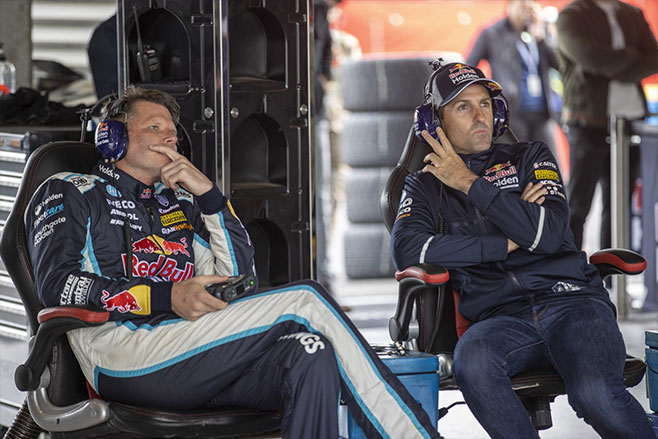
Garth Tander and Whincup during the 2020 Bathurst 1000
Is T8 in a particularly good position for that right now, with McLaughlin and Penske leaving DJR?
Well we never like anyone coming down, and I don’t think DJR will lose much of their performance this year. We’re not about ‘we’re in a better place because someone else has been brought down’. We’re about trying to put in the best performance we possibly can, and if anything, trying to raise the game in the category wherever we can.
I feel like we were very competitive last year, as competitive as we’ve ever been, and I hope that continues this year. I think it will.
It’s the satisfaction of coming out on top in a year where the other teams are at their best?
We want our opposition to bring everything they’ve got, and we want to be able to bring everything we’ve got and we simply try and get to the finish line before anyone else. That’s what got us into motorsport many years ago and that’s what drives us now.
How do you feel about T8 minus Roland Dane?
I think Roland’s put a fantastic transition in place, a succession plan, to make sure Triple Eight is a force to be reckoned with for a long time. I also want to add that, outside of RD, the management within Triple Eight is exceptional. There are many elements of the team managed by people internally who are still in place and will be for a long time to come.
It’s just the team principal position for myself, and obviously I’ll get a lot of support from Tony [Quinn] and Jess [Dane]. And even my good mate Paul Dumbrell, who understands the Triple Eight business and Supercars very well. He’s offered his support to me for at least the next couple of years.
No doubt there’s a massive hole to fill when RD decides to spend long periods of time away, but that’s up to me to raise my standard to somewhat a position that Roland’s generated over many years. If the place can’t operate without Roland that means I’ve failed.
Everything I attack in my life I give 110 per cent. I’ve had a lot of success with things I’ve given my utmost attention to, and I’m hoping this team principal role at Triple Eight is no different to anything else I’ve given all my efforts to over the years.
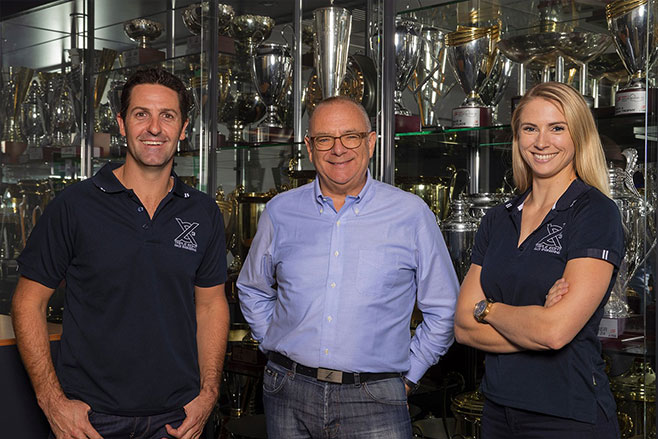
Whincup with Roland and Jess Dane, the latter to remain an important part of the T8 management team
Are you glad to have Tony Quinn’s experience at hand?
100 per cent, Tony is an asset to the team. There are many people out there with probably enough money to buy a percentage of one of the best sporting teams in the country, but it was all about finding the right person to be able to bring value to the team and will Tony bring a massive amount of value to what we do here at Triple Eight. We’re very grateful to have him on as a major shareholder.
If you had to have a hypothetical dream team of drivers, even if not full time currently, who?
You can answer that two ways. You can put together a dream team of drivers who have achieved a lot and are established, but my dream team for Triple Eight would probably be two young kids that you don’t know the names of yet. We’re all about youth and trying to bring on the next generation.
Last thing, if you want to speak to the Wheels audience rather than a specifically motorsport audience, now’s your chance.
I guess I just want everyone to embrace the direction the motoring industry is going in at the moment. We’ve got to be careful and balanced in how the motoring industry changes are then incorporated into motorsport. As a team we’re embracing the direction the industry is going, and I think we all should be excited about that.
There’s no negative, there will still be muscle cars around to drive and see and enjoy, but as far as the top line of motorsport in this country, let’s keep on the frontline of innovation and be excited about the next generation of the motoring industry, because I think it’s really cool and exciting.
Enjoy it… and I’m probably targeting the older audience of your magazine, but let’s not be negative, let’s be positive and enjoy the journey.
WHEN behind the wheel, few things can cause frustration as easily poor merging and impolite lane etiquette.
Not only can a driver who doesn’t merge properly cause your blood to reach boiling point, it can create very serious and dangerous situations on our roads as other motorists are forced to avoid a clashing of metal.
While in some instances frustration can be brought on by a driver who clearly lacks basic driving skills or knowledge, it can also be caused when two drivers interpret or understand the road rules differently.
What can be an honest mistake could result in a serious crash. So, to help, WhichCar is here to run you through lane etiquette 101.
We’ll explain the different road rules, along with some protocol to ensure you don’t leave fellow road users seeing red.
There are two different types of merges in Australia, and they each come with a different set of rules.
The first is the most common; it’s a dotted-line merge, often seen on highway and motorway onramps. Here one lane ends, and merges into another, with drivers crossing over a dotted-line.
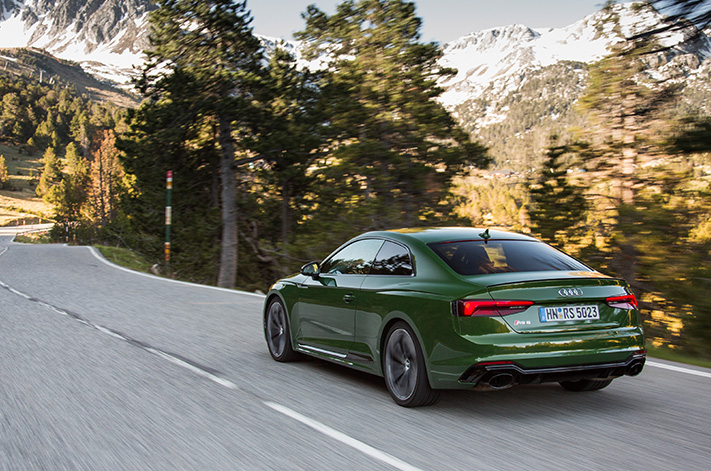
It is this road marking – the dotted line – which is the important distinction. Dotted-line merges require the driver whose lane is ending to give way to the lane they are merging into.
Technically, this means that even if you are merging and the front half of your car is ahead of a vehicle in the other lane, the other driver has right of way – despite being further behind you.
As for etiquette, while it is the merging driver’s responsibility to give way, it is considerate of the driver whose lane is being merged into to consider making room, either by dropping back or moving over, and allowing for a smooth transition. You don’t have to, but the other road user is sure to be thankful for the gesture and it should help traffic flow.
For merging drivers, put your indicator on early, and try to find a spot in the other lane where you can merge into. It’s important you are matching the speed of the lane you are merging into before completing the move. This usually means speeding up and ensures you don’t start the merge too slowly with another car rapidly approaching and impeding the room available to you.
The second variation of a merge is one where two lanes become one, and the dividing line stops. These are particularly common in Victorian. In this scenario, it becomes a case of whoever’s car is in front, has right of way.

The etiquette with this kind of merge is to prepare early, put your indicator on ahead of the merge, and try and line your car up with a space in the other lane to allow for an easy merge for everyone.
This is often described as a zipper merge, with a drivers merging on a one-for-one basis. A zipper merge should also apply in slow moving traffic where a dotted-line merge occurs.
Finally, we’ll look at lane choice on multi-lane highways.
While it’s not relating to a merge, it’s an important part of lane etiquette, and poor behaviour here can turn other drivers to fits of rage easily.
The most important rule with lance choice is to keep left unless overtaking. If the lane to your left is empty, or you are travelling at the same speed as vehicles in that lane, merge into it. It’s a simple rule, but vital to ensuring highways and motorways operate efficiently.
This is especially important in relation to the ‘fast lane’, which is the far right lane on a multi-lane highway. If driving in this lane, ensure you are overtaking other drivers in an efficient and timely manner, and to move back into the slower lanes once you have passed.
And that’s it! Share this article with friends or family who need an update on lane etiquette.
What do the world’s fastest drivers and our most cunning criminals have in common? A lot, it turns out.
We’ll start with Hans Heyer, the only man to simultaneously fail to start, fail to finish, and be disqualified from the same race.
A prominent German touring car driver in the ’70s, Heyer decided to try his hand at F1 for his home grand prix at Hockenheim in ’77, but missed the cut-off to qualify for the race. That wasn’t going to cut it for ol’ Hans, and so with help from a couple of buddies volunteering as marshals he snuck onto the back of the grid and joined the grand prix.

Nine laps into Heyer’s F1 debut, a gear linkage on his Penske PC4 broke and he was forced to retire, at which point the officials clued in on his secret participation, disqualifying him on the spot. As a side note, Heyer also holds the record for most Le Mans starts without ever finishing – 12. Which brings us neatly to another dubious racer.
Jack Griffin was a moderately successful real estate broker from Texas who had a brief, if forgettable, racing career. He took part in just 17 races over three years, including a debut at the 12 Hours of Sebring in 1983, and participated in the 24 Hours of Le Mans the two following years. What makes Griffin’s participations so notable is the fact he didn’t have the licence required to compete in both of those events.
Two weeks prior to his professional debut, Griffin had never even sat in a proper racing car.
A four-day crash course at the famous Bondurant driving school gave Griffin the false sense of confidence he needed to take on Sebring, where he promptly crashed after completing 15 laps. You see, Griffin had a mate, M.L. Speer, a fellow Texan who did hold the required licences to compete, and a winning smile that stopped all inconvenient questions in their tracks. Speer had convinced Griffin to take part in the Sebring race, and followed it up with an invitation to spectate at Le Mans a year later.
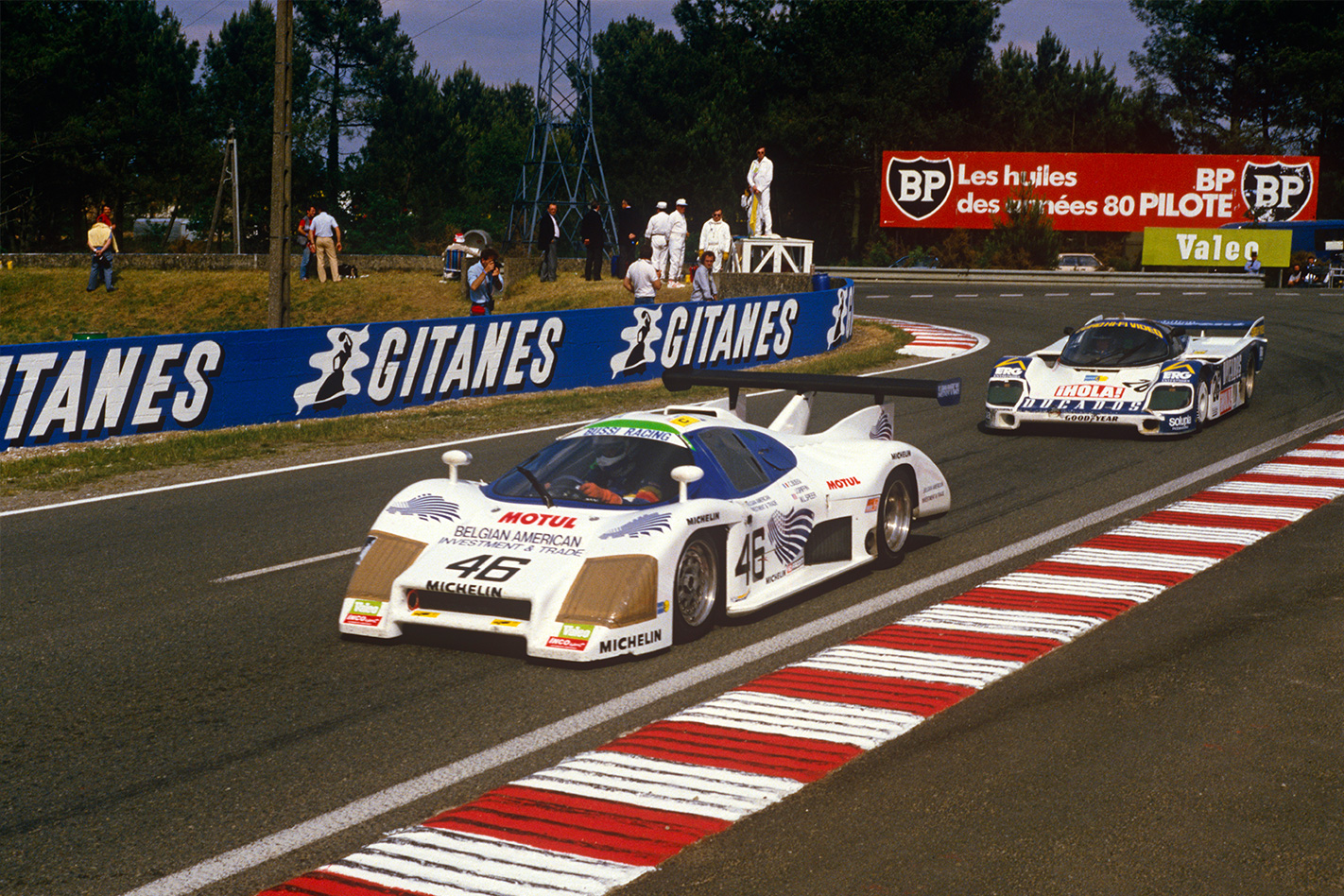
It was there the pair heard that a French team, Bussi, needed a driver. A few more white lies later, and Griffin was set to compete against the likes of Klaus Ludwig, Vern Schuppan, and Stefan Johansson in the team’s Rondeau M382. A blown engine would mean Griffin’s Le Mans debut resulted in a DNF, but somehow this Texas real estate broker, who just 18 months earlier had never driven a racecar, managed to swindle his way onto the entry list.
Finally, we have the story of L.W. Wright, a veteran of 43 NASCAR Cup races from Nashville Tennessee looking for a ride in the 1982 race at Talledaga… or so he claimed. No one really investigated Mr Wright’s story as he was quick on the draw with cheques, laying them on the table to get what he needed to compete, including buying a car for $20,000.
Thing is, L.W. Wright didn’t exist.
It was a fake name dreamt up by a con man with zero racing experience who successfully swindled everyone he shook hands with. ‘Wright’ retired from the race 13 laps after it started, but by its conclusion was nowhere to be seen, and the cheques he’d used to pay his way onto the track bounced. Multiple arrest warrants were issued, but they remain unanswered to this day.

So, what do these three have to do with today’s motorsport elite?
Well, while Heyer, Griffin and Wright are the most egregious examples of bare-faced cheek, bulging egos and ethical flexibility in racing history, their tenacious approach isn’t entirely out of place.
The same mentality that pushed them to bend or outright ignore the rules is something every successful racing driver carries deep in their soul. Without it, a driver would never be able to compete at the upper echelons of the sport.
That same bravado is what allows Valtteri Bottas to fall asleep at night, confident in his own mind that he is a superior racing driver to Lewis Hamilton, and it’s what stops Fernando Alonso hanging up his helmet in graceful silence when a humble retirement calls his name. A recipe filled with a lack of remorse and no shame paired with a self-aggrandising mentality can just as easily make an elite-level racing driver as it can a grifter.
So, watch your wallet next time you’re at the track, eh?
UPDATE, February 13: Despite earlier news that Chrysler has killed off the big 300 SRT hero sedan, the brand itself looks to have been thrown a lifeline by the boss of its global parent company, Stellantis.
Formerly part of the smaller Fiat Chrysler Automobiles (FCA), Chrysler now lives in a much larger stable – thanks to the recent merging of PSA Group (Peugeot, Citroen, Opel, Vauxhall, DS) and the FCA brands.
Our story below touches on reports that the Chrysler brand might be put out to pasture, in a move to consolidate the number of brands under the Stellantis banner.
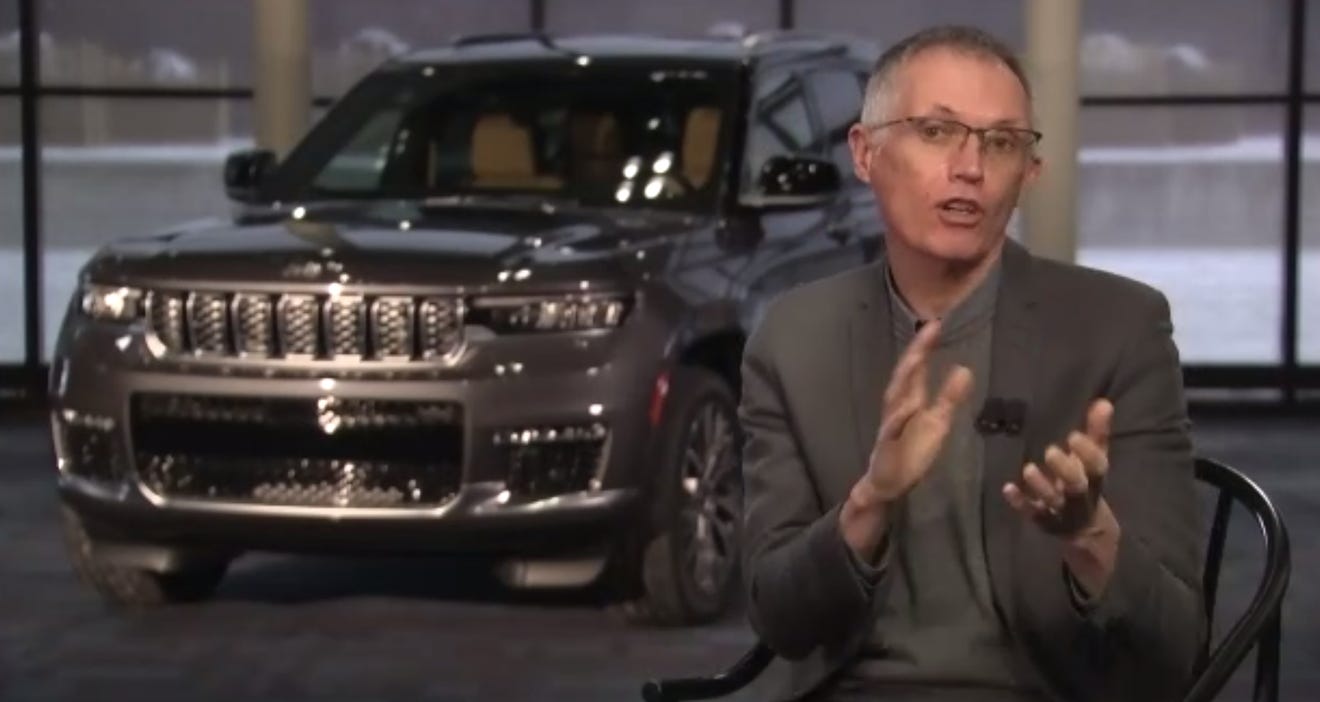
In an interview this week with The Detroit News, Stellantis chief Carlos Tavares described Chrysler as a “pillar” of the group – although his team is still determining just what the storied American brand’s “vision destination” might be.
“It is an opportunity for us to make the brand rebound,” Tavares said.
“We do not forget that Chrysler was in the past the expression of the automotive American technology, the best technology available at that point in time. Perhaps there is a connection there that we can do and protect ourselves in the future – perhaps using other ideas like autonomous vehicles, zero-emission vehicles, highly connected vehicles.
“This is something that is still in the works. I don’t think we have concluded anything so far.”
The story to here
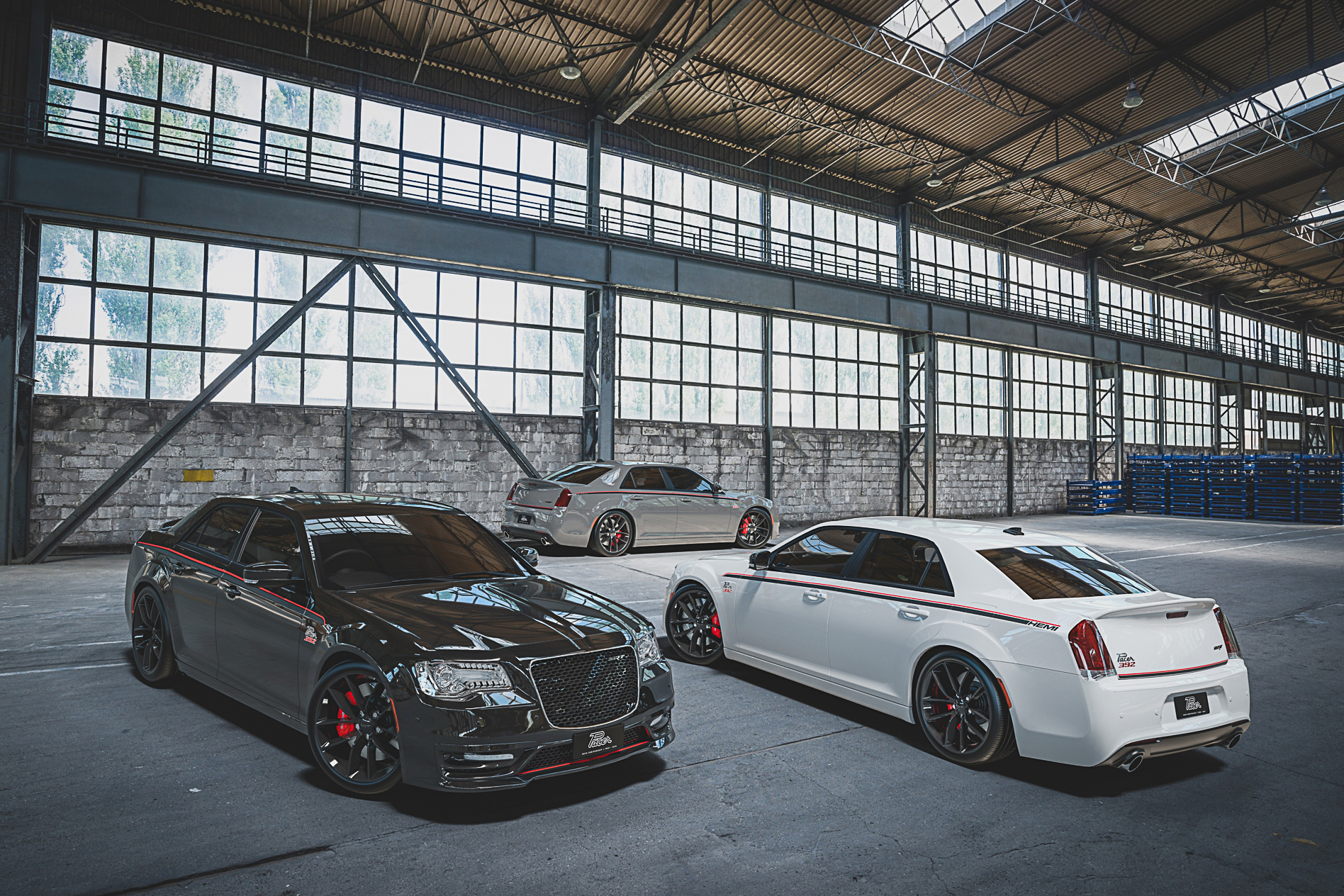
UPDATE, January 10: Vale the affordable V8… Chrysler’s 300 SRT is no longer available for sale, ending a more than decade-long run on Australian soil.
Chrysler rolled availability back to a single SRT variant in 2020, but it appears US demand for Hemi V8s has spelled the end for the venerable four-door here in Australia.
Reports suggest that FCA will fulfil standing 2021 orders owed to the NSW Police Force, who use a law enforcement-spec 300 SRT as a highway patrol car alongside the diesel-powered BMW 530d.
It was the last remaining V8-powered rear-drive four-door sedan on the market that costs less than $100,000.
A 6.4-litre Hemi V8 cranks out 350kW and 637Nm through an eight-speed auto to the rear wheels of the five-seat, four-door sedan.
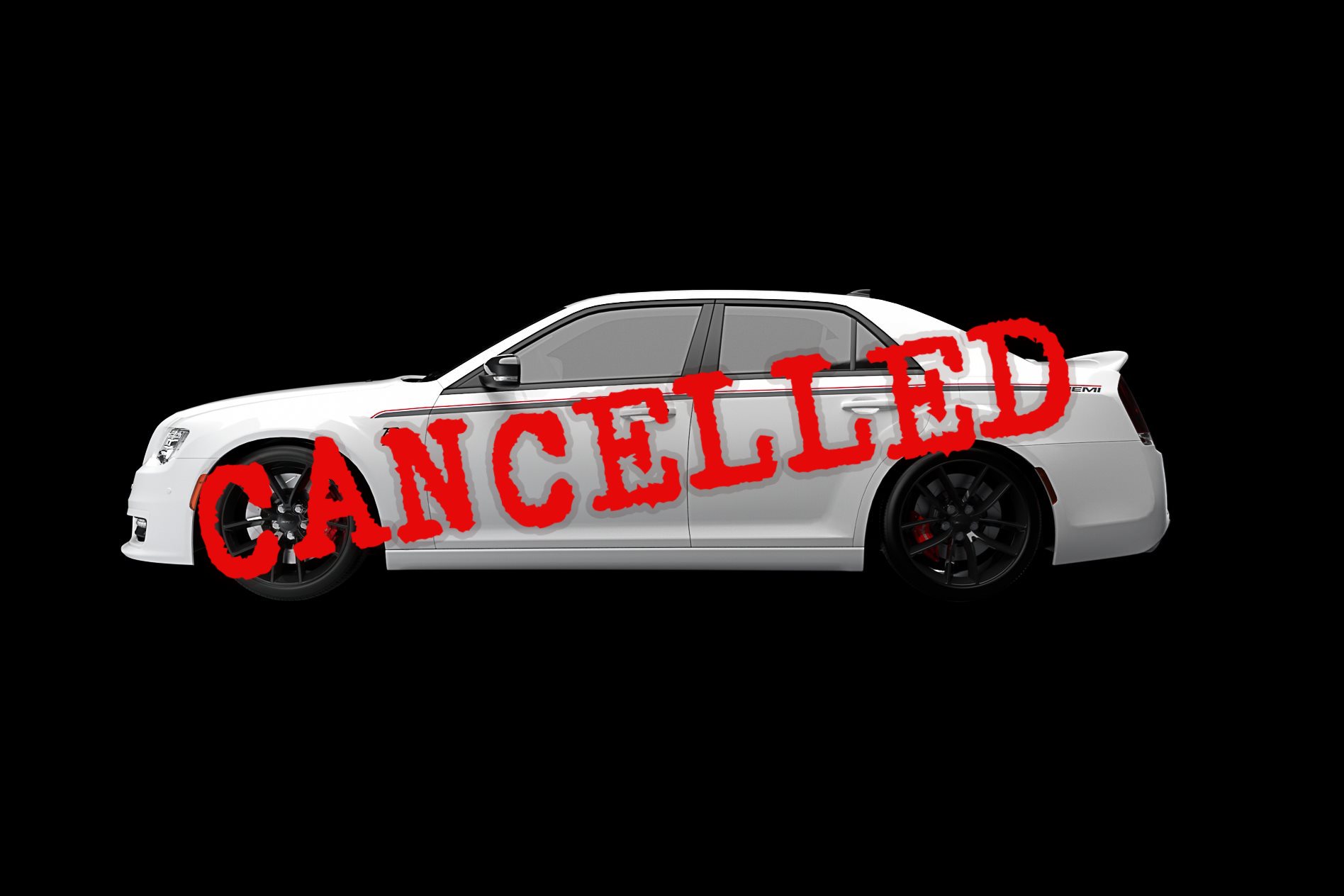
This second-generation car, launched in 2011, can trace its lineage back to the launch of the original 300 in 2005 – itself based on parts pilfered from the W211 Mercedes-Benz E-Class when Chrysler and Daimler were bedfellows.
Once available with V6 petrol and even diesel power, the 300 (or 300C as it was once known) morphed into a pure V8 play.
The future of its parent company is in doubt, too, after US parent FCA finalised its merger with Peugeot-Citroen owner PSA to form Stellantis, which is looking for quick cost savings amongst its 14 newly merged brands.
Significantly, the 300 SRT is Chrysler’s only car in-market in Australia, while its overseas portfolio comprises three elderly cars in total, with no replacements planned.
The market for large sedans continues to shrink worldwide, as well, with Chrysler 300 sales sliding more than 35 per cent in the US last year as its customer base moves towards SUVs.
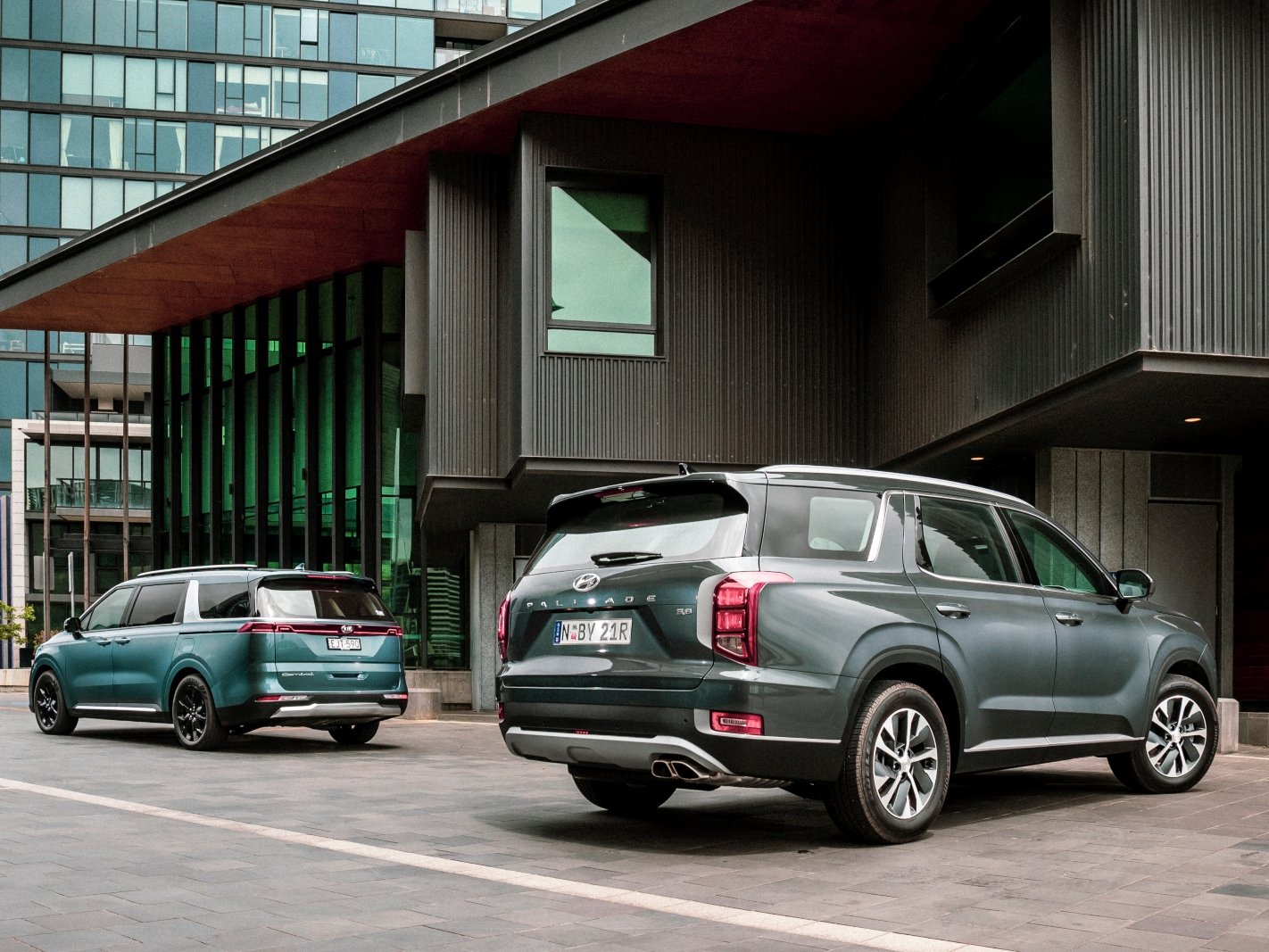
Perhaps ‘battle’ is the wrong word. If you were hoping for a contest between two vicious power players in a haze of tyre fog and singing V8s, then I’m afraid you are going to be disappointed. However, this fight is still between two intriguing machines that are undeniably mighty in their own way.
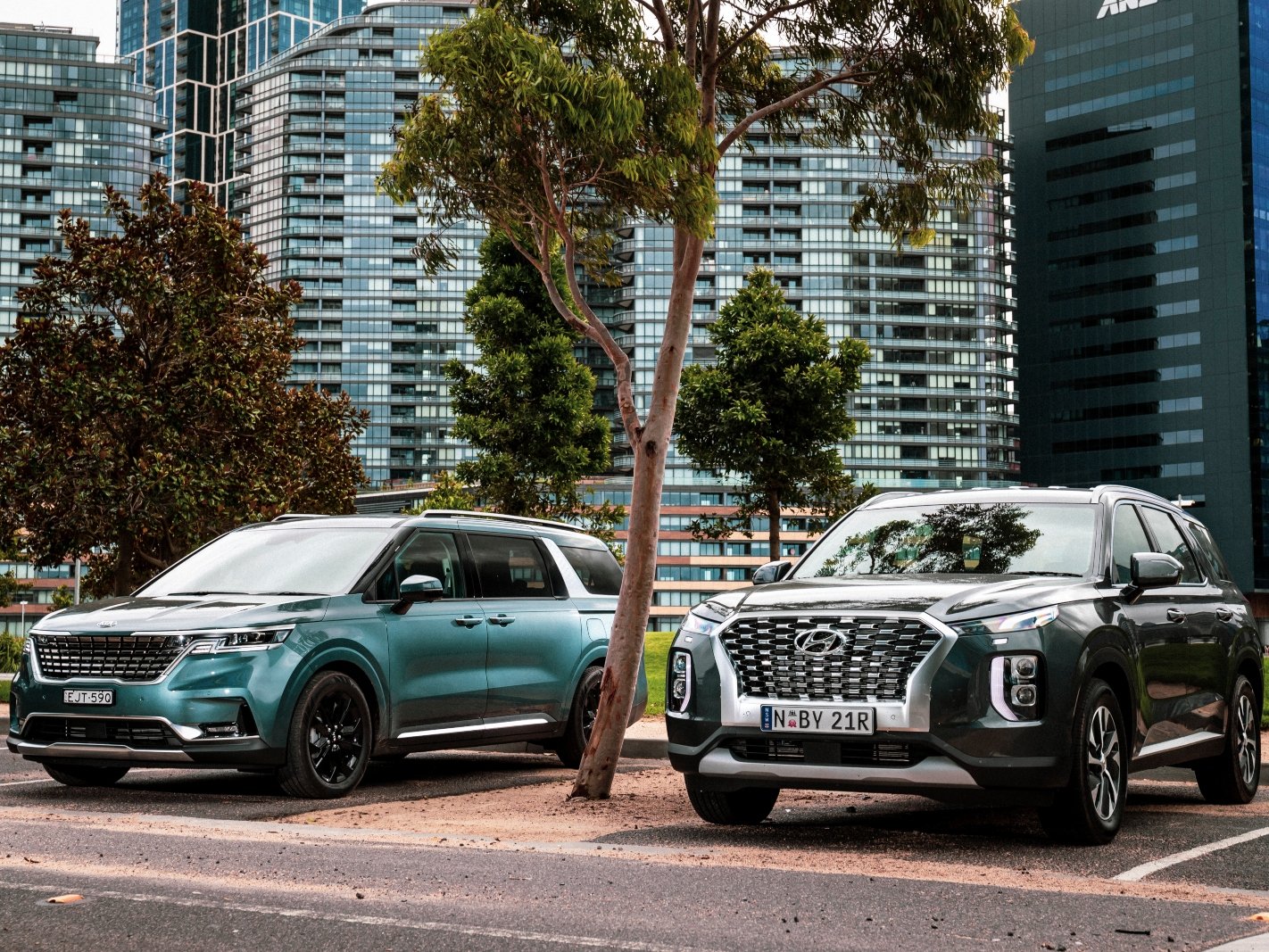
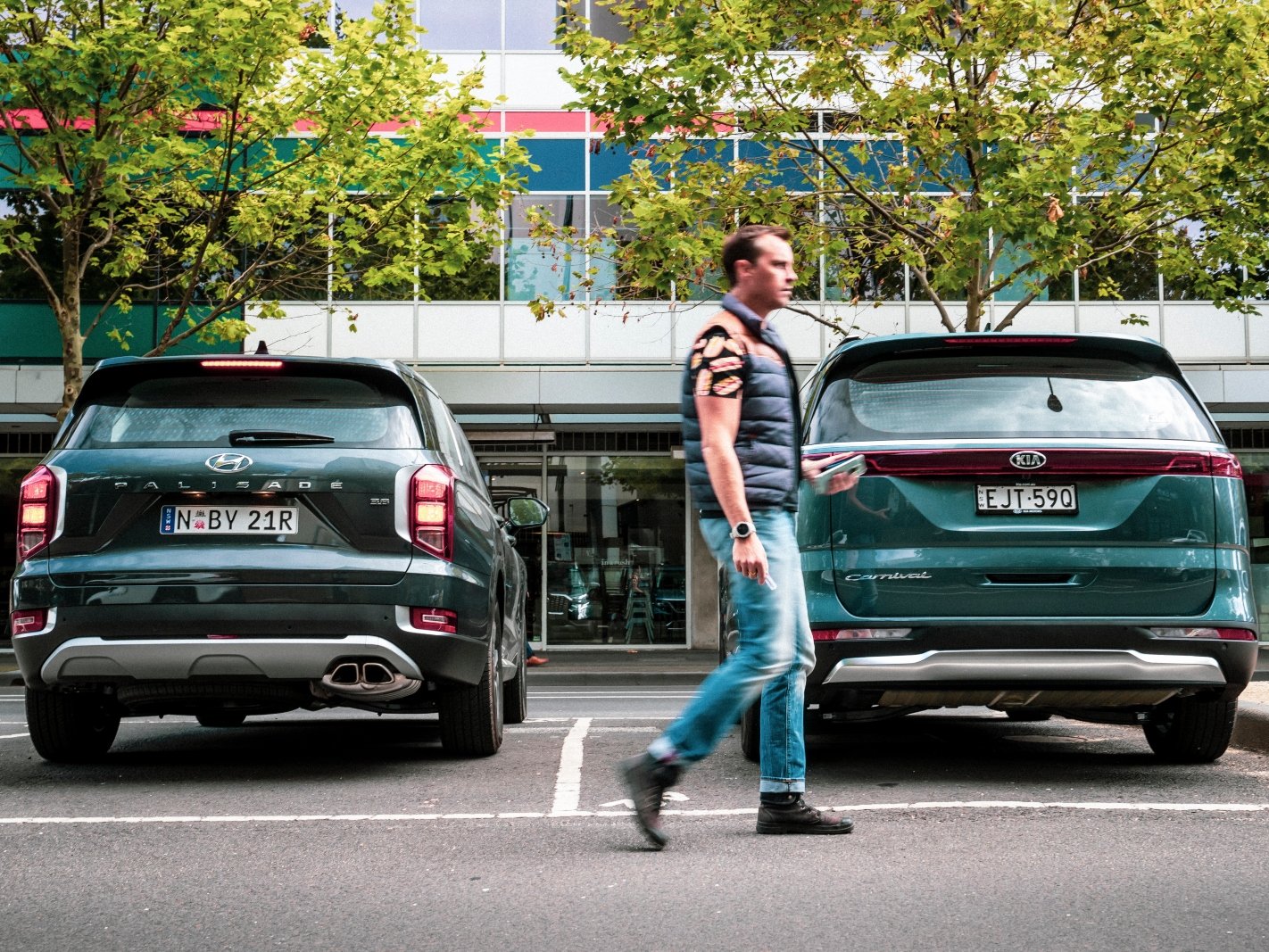
At five metres long and 1.75m tall, Hyundai’s new Palisade is big and imposing but still trumped by the Kia Carnival which measures 5.2m in length and tops the Hyundai’s height by 25mm, towering at 1775mm.
And, in both cases, the epic exterior proportions of this South Korean pair translate to cavernous cabins on the inside, enabling the unique selling proposition offered by both models – eight seats.
For this comparison, we lined up the top-shelf Carnival Platinum and the entry level Palisade which means the two models also align on approximate pricing and powertrains, with a V6 petrol driving the front wheels with the same amount of power and torque.
Dig a little deeper and you’ll find a few other family resemblances in technology and shared parts but beyond that, the Kia Carnival and Hyundai Palisade are very different.
In Australia’s SUV-centric market, it’s likely more large families will give the high-riding Palisade their attention compared with the Carnival but, on paper at least, the Kia appears to offer much more for less cash.
If you need to ferry a lot people or things, have a $60,000-odd budget and can’t stand the notion of driving a passengerised van, which eight-seater is the pick?
Space is, of course, key in this specialised niche of the car world and while both models offer a lot of volume, one is a clear leader in outright quantity and the way it makes use of space.
Simply speaking, the Palisade has a 704-litre boot with the third row of seats folded away and even with the rearmost bench in use offers a respectable 311-litre boot.
Fold both second- and third-row seats flat and the Hyundai’s cabin opens up to accommodate a whopping 2447 litres of stuff.
Whopping – until the Kia brags about its cargo capabilities.
With all eight seats in place, the Carnival still offers 627 litres of space – the same as a Skoda Kodiaq in five-seat mode. Stow all the seats and it’ll swallow 2785 litres.
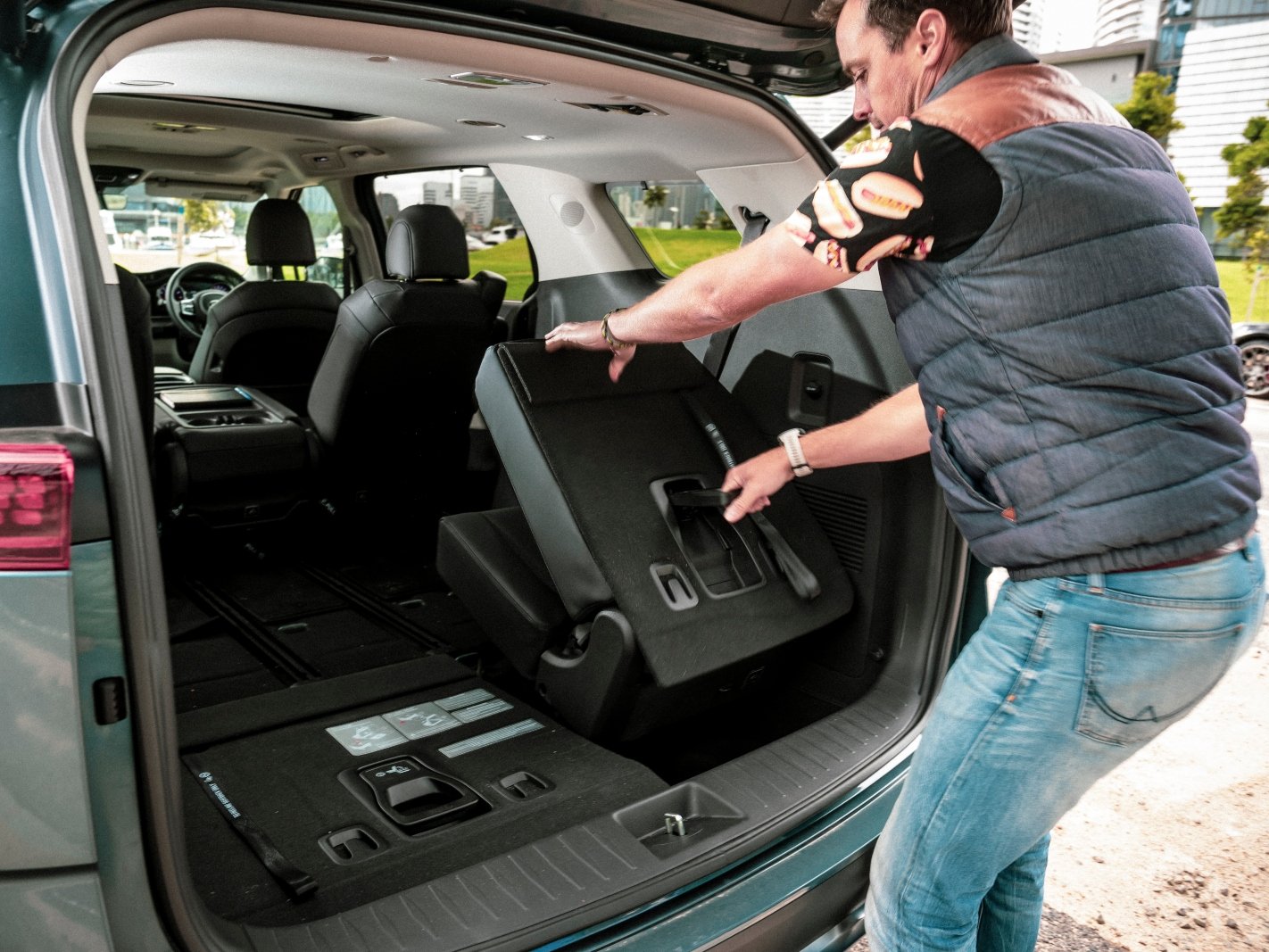
Those impressive figures are made possible in part by some seriously clever use of space, including huge wells in the boot floor.
The voids are filled by the third-row seating which ingeniously hinges and pivots down into place and also results in a flat boot floor for more versatile loading.
Hardly any other vehicles can pull the same trick as the spare wheel and exhaust system typically occupy the under-boot space, but Kia’s engineers relocated the items under the Carnival’s floor in the middle of its body.
And while the Palisade has more conventional doors and tailgate, the rear space of the Carnival is accessed through power sliding doors which allow easier access in tight spaces as well as a larger aperture when open.
The only downside is the mechanism robs a little interior space.
Neither car feels exactly claustrophobic inside however. Second row seating in both has as much space as the front row and, even out back, the passenger space is surprisingly generous.
It’s not quite business class and we would feel a little guilty about putting adult passengers in the third row for long trips but children will be quite happy in both vehicles, even if you slot them in three-wide for shorter trips.
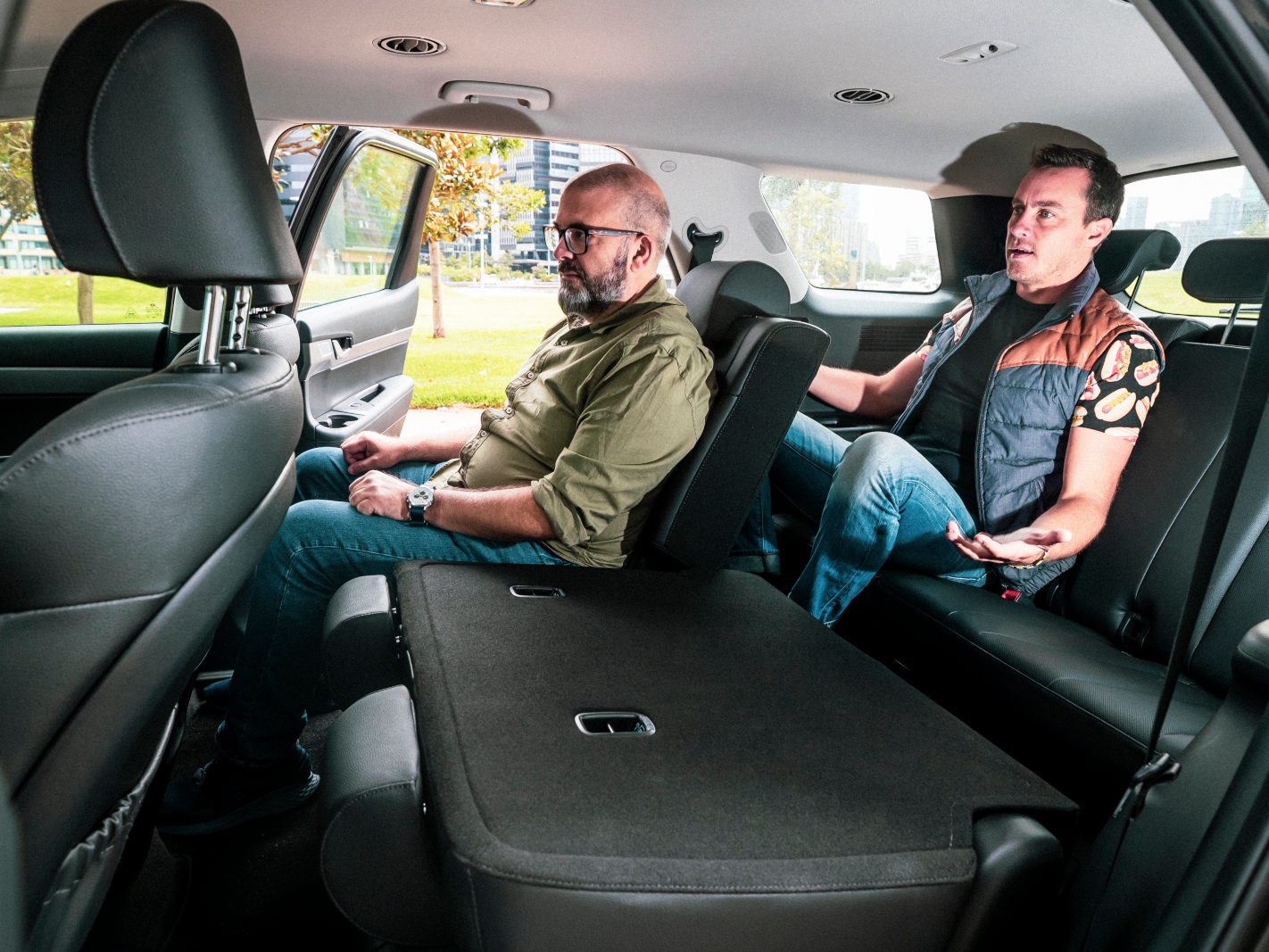
Both the Kia and the Hyundai offer the rear passengers air vents, cup holders and lighting but the Carnival goes a little further with side window sun shades and more generous headroom.
The Carnival, however, has a few tricks over the Palisade in this price bracket when it comes to the second row.
Splash a bit more cash and Hyundai will sell you the Palisade Highlander which has a smart pair of captain’s chairs and a few more luxuries but it doesn’t fit a circa-$60k budget.
Priced from $64,680 the Carnival is in the highest Platinum grade of the range and that means all the extras Kia can offer. Second row passengers get heated and cooled seats, a neat climate control panel mounted on the driver’s side of the roof lining and electrically adjustable seats.
They’re not quite the full captain’s chairs offered by a $71,000 Palisade Highlander, but if you’re handy with catches and latches, you can remove the centre seat for a similar effect.
The Kia’s interior seating is also reconfigurable for different layouts.
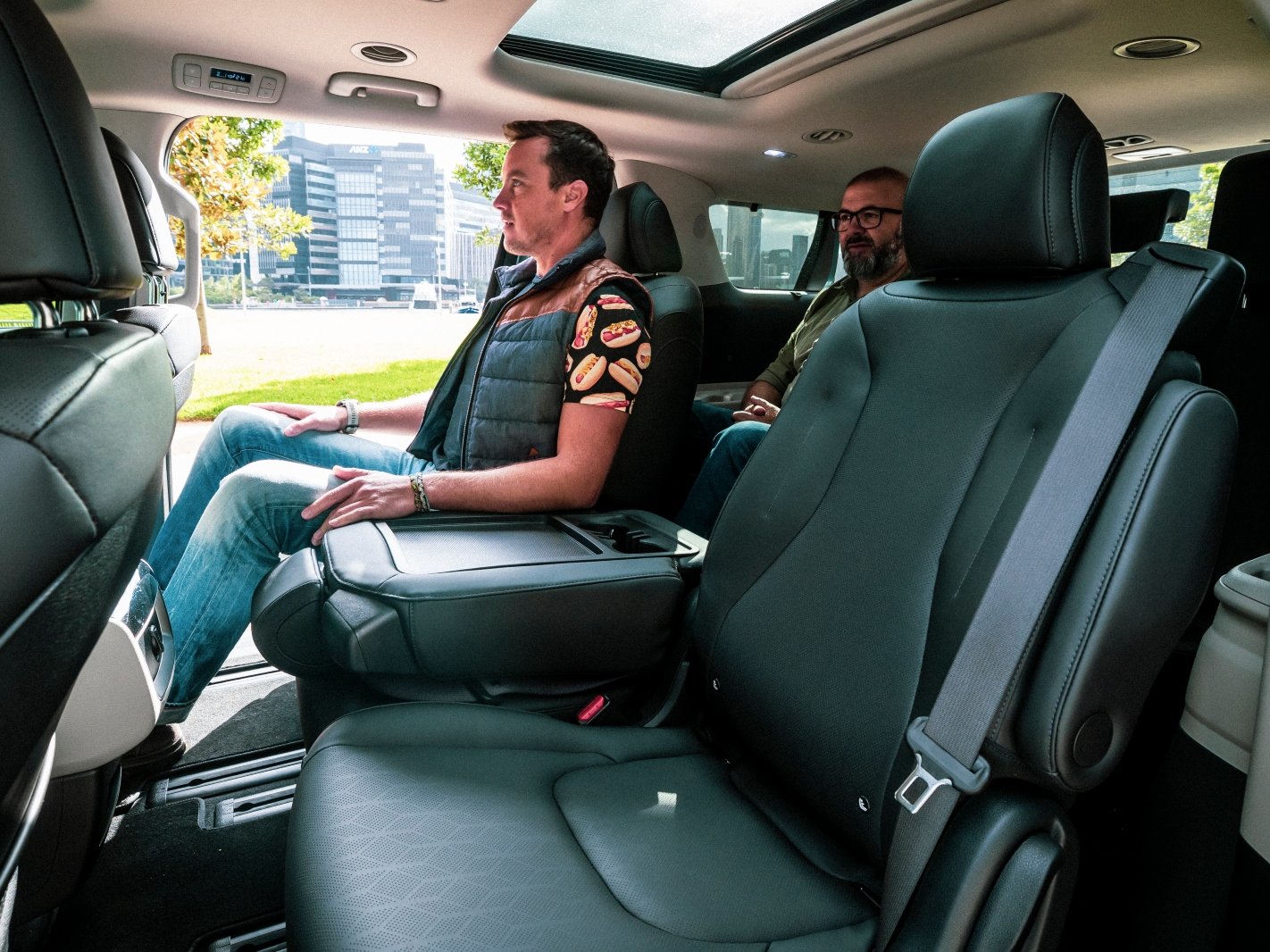
Both the Kia and the Palisade offer eight genuinely useable seats with a third row that is more inviting than almost all seven-seat models available, but with its extra luxury features the Kia is the more limo-like of the two.
It’s a similar story in the front row, too, with standard levels of equipment generally high for both. Indeed Kia and Hyundai were clearly picking technology from the same shelves in many cases.
The central 10.3-inch touchscreen and dash cluster with digital driver’s information display are largely the same, as are many of the features contained within.
Smartphone mirroring will keep occupants of both models happy while Kia gets an extra point for wireless device charging.
We particularly liked the antique valve-amplifier graphics when tuning different radio stations and, while the selection of relaxation background soundtracks initially seemed a bit of a gimmick, the soothing rainforest sounds were still playing 30 minutes later. Warning though – the raindrop option will make you want to pee and the snow footsteps track is a bit creepy.
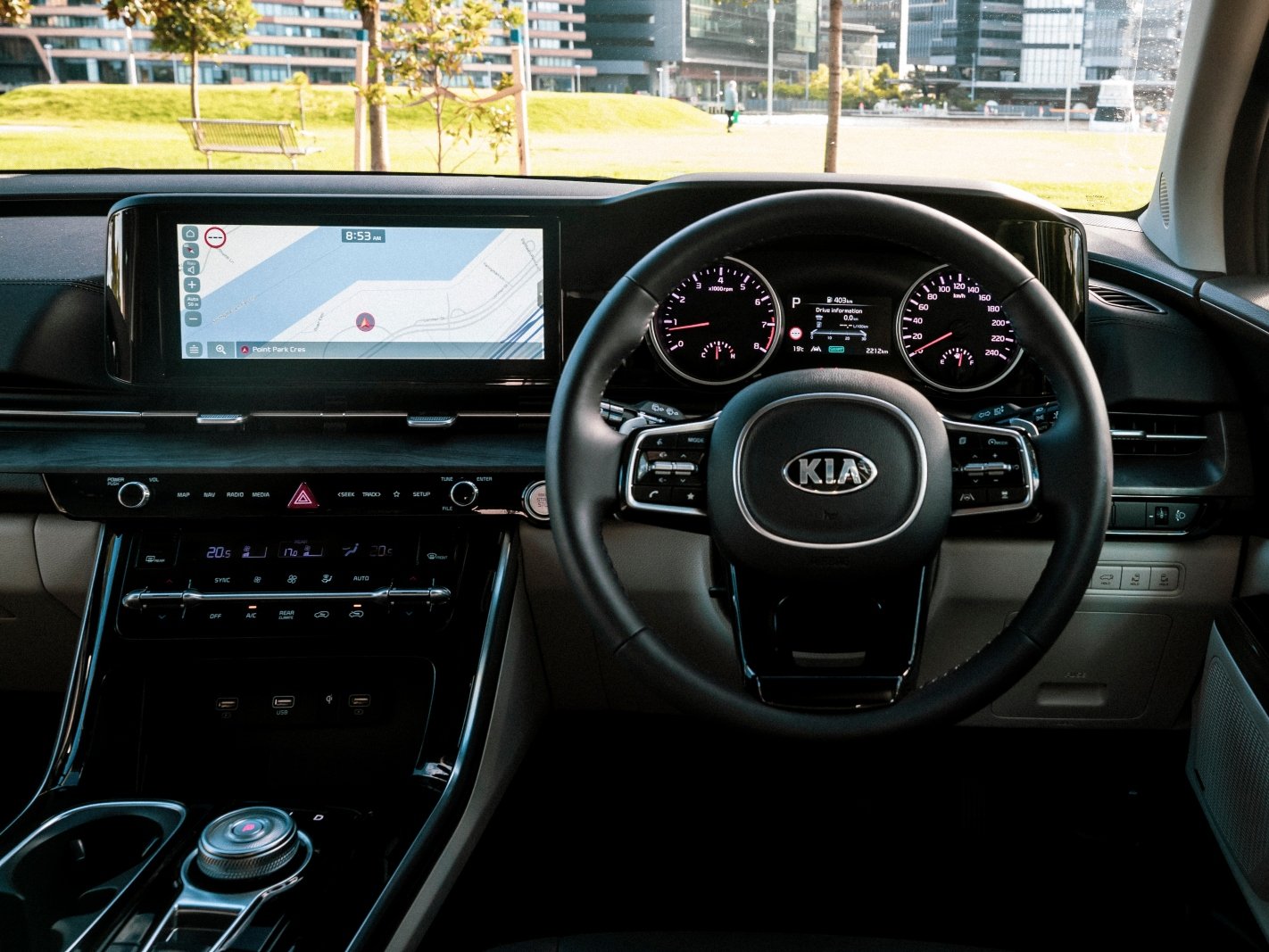
Well-finished part-leather upholstery and quality materials are common to both the Kia and Hyundai, although subtle touches such as solid-state gloss black switches and more premium finishes elevate the Kia cabin above the Palisade’s interior. The Kia also gets seat heaters and ventilation in the front row as well as a heated steering wheel.
The Hyundai wins back recognition for a more car-like driving position though. It’s not that the Carnival offers an unpleasant place for the driver, but it certainly feels more commercial.
Slotting behind the wheel of the Palisade is more immersive with a cozier feeling surrounded by the pleasantly finished interior touches.
We particularly like the flying-buttress-style centre console which places all the climate control and transmission selector switchgear close to hand but allows lots of storage space underneath and out of the way.
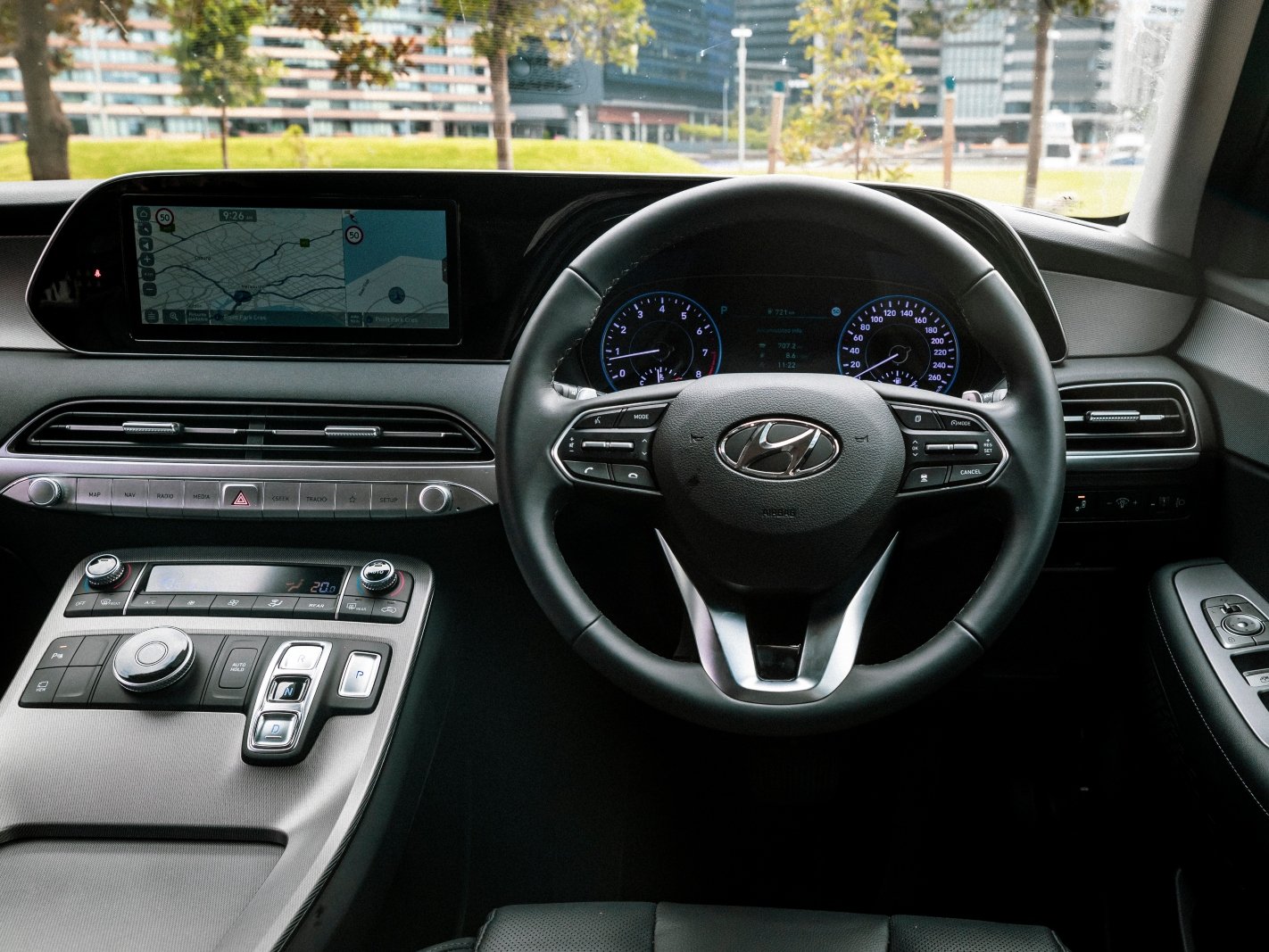
Both cars have somewhat unorthodox gear selectors. In the Kia, it’s a cool looking knurled dial that’s rotated to the required drive mode.
In the Hyundai, a button is pushed in a similar fashion to the Ioniq electrified sedans. In practice, the simple buttons feel more intuitive and urgent when you need to maneuver quickly.
They are connected to an eight-speed automatic transmission that in turn sends power from the naturally aspirated V6 petrol engine to the front wheels only.
Even though the Palisade can brag a 3.8-litre version of the engine compared with the 3.5-litre Carnival, both produce almost identical outputs.
Maximum torque is 355Nm in both cases and 216kW for the Carnival vs 217kW from the Palisade V6. Despite their bulk, both manage respectable performance with strong in-gear acceleration, smooth power delivery and a pleasing note.
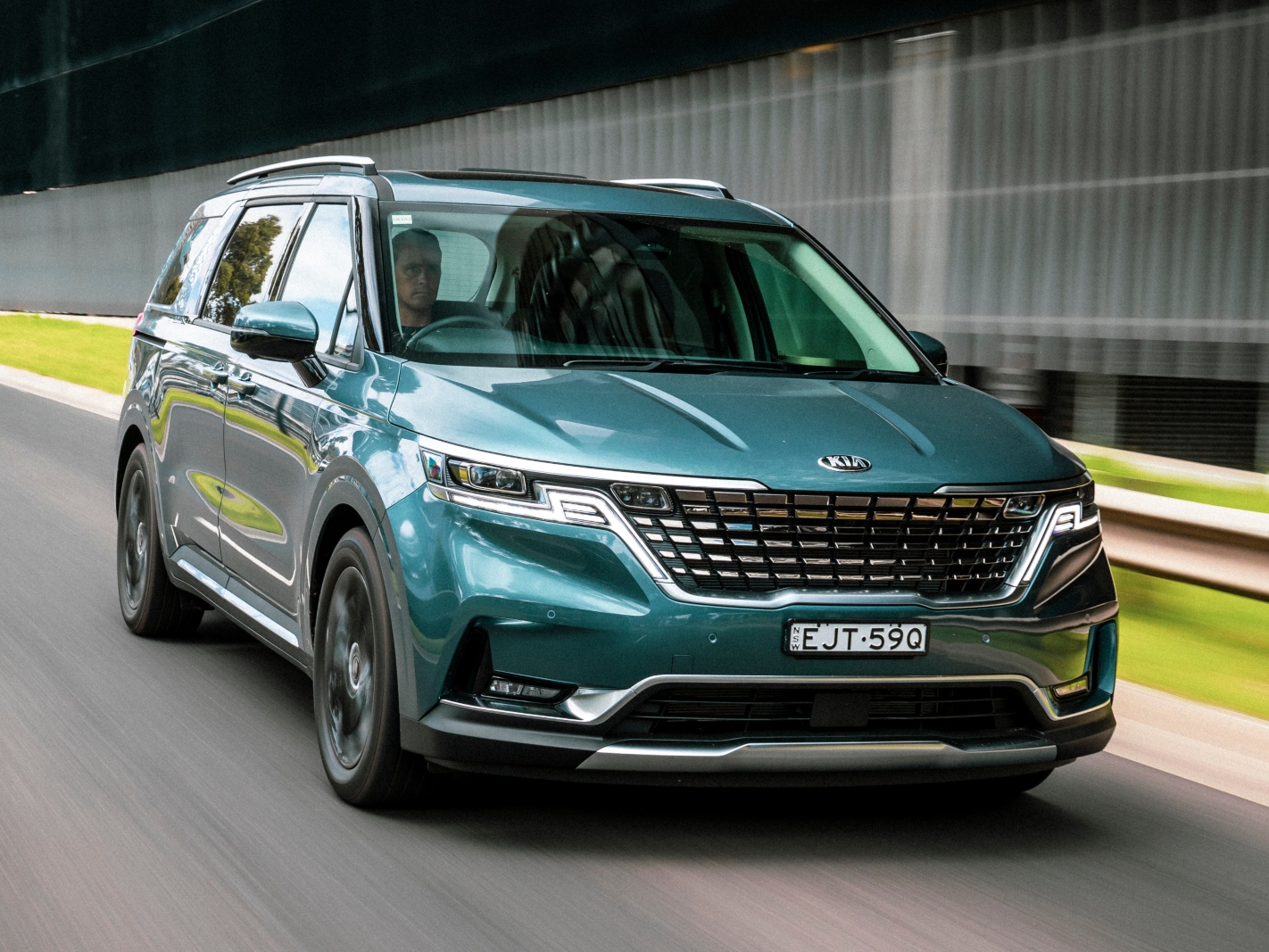
Unfortunately, muscular torque low in the rev range, combined with the inertia of a two-tonne vehicle and only front-wheel drive causes some significant traction shortcomings for both the Kia and the Hyundai.
In dry weather the front wheels chirp and squeal embarrassingly even when trying to pull away moderately fast and in the wet the problem is magnified with traction control cutting in annoyingly early to minimise wheelspin, but shutting off any meaningful acceleration in the process.
While some may regard the Palisade’s AWD option an unnecessary luxury for about town use, our preference would be for four-wheel traction in all driving conditions. Worse still, the Carnival is not offered with the AWD transmission.
Once you are able to get both beasts rolling, there is a more enjoyable driving experience to be had. The Carnival’s cabin is easily the smoothest with a suspension tune that insulates all occupants from the rigours of the outside world.
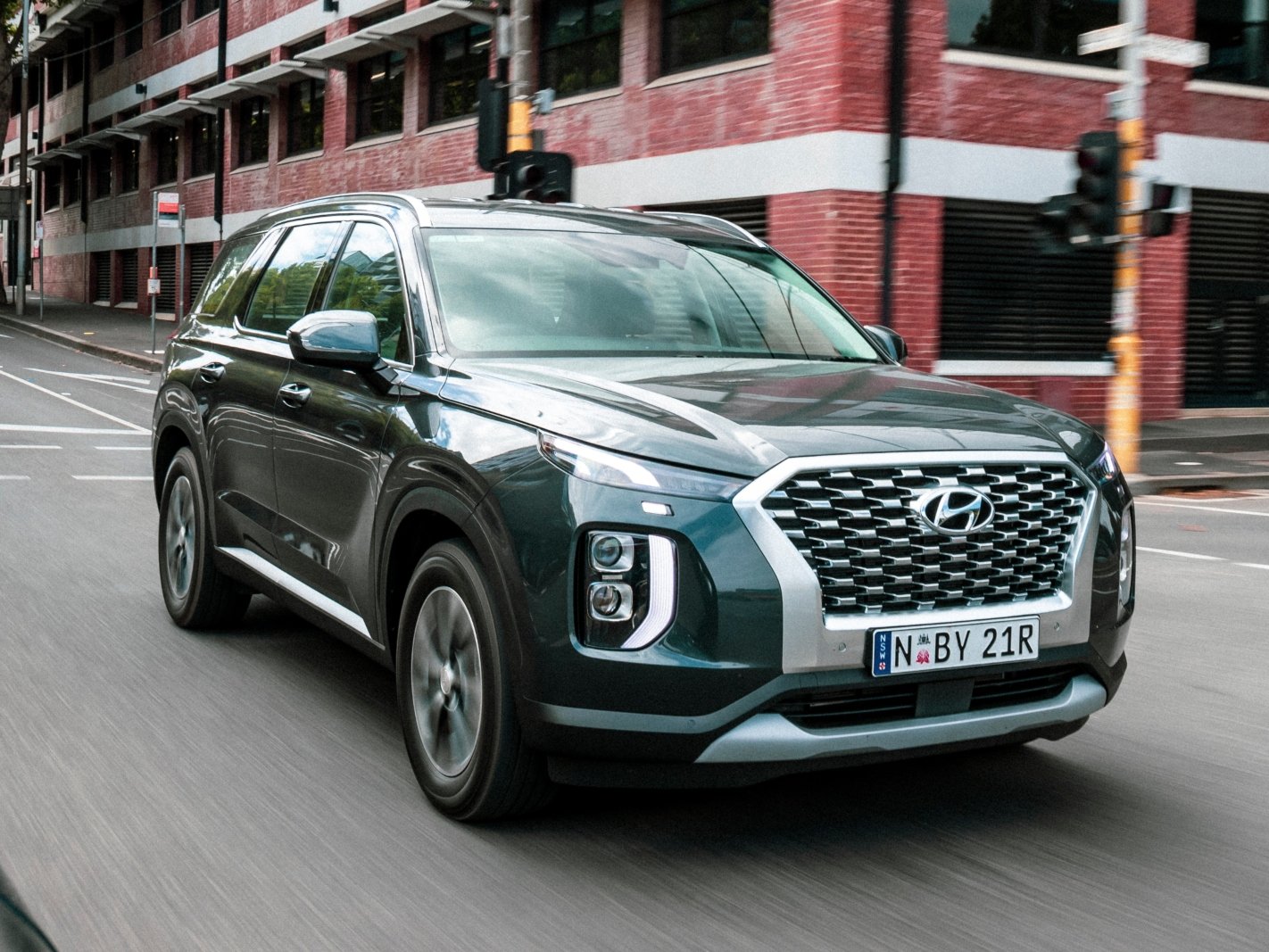
But there’s less enjoyment to be found behind the wheel. Excessively light steering feels disconnected from the road, a noticeably longer wheelbase compared with the Palisade requires a more bus-like approach to corners and the flatter seats are sat on, not in.
Even though the Carnival looks and feels nothing like a van from the outside and passenger seats, it’s a little more commercial in the driver’s seat.
Surprisingly, the Palisade is the driver’s pick. Even though it has a firmer and more utilitarian ride as well as more body roll from taller suspension, the big SUV has a more responsive and eager nature.
The ride quality is still high and cabin noise is minimal but the Palisade is certainly the more rewarding of the two to drive.
That’s all the more surprising when you consider the Palisade is the only Hyundai that doesn’t have suspension tuned by the company’s local chassis outfit.
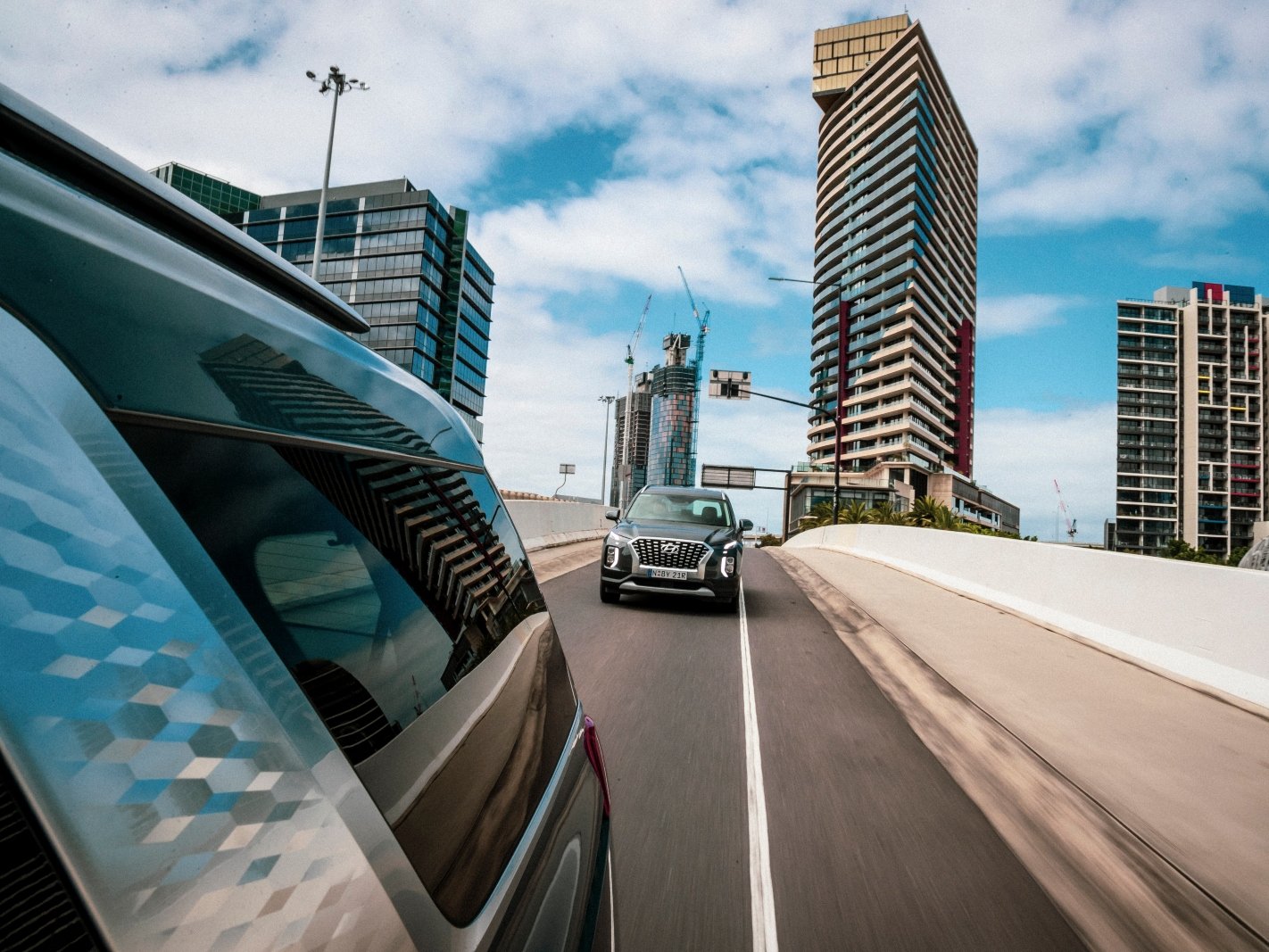
Those drivers who prefer large SUVs for the more commanding position they offer over smaller vehicles should not discount the Carnival.
With a similar overall height, the Kia offers excellent visibility of the surroundings and both have tall glazing for a panoramic view for all passengers.
If you want an eight-seater that is kindest to the driver with more rewarding dynamics and driving position, the Palisade delivers a surprisingly good combination of ride and handling, but if it’s all about your passengers, with the most space all round and more comfort features, the Carnival is the model that will keep everyone the happiest.
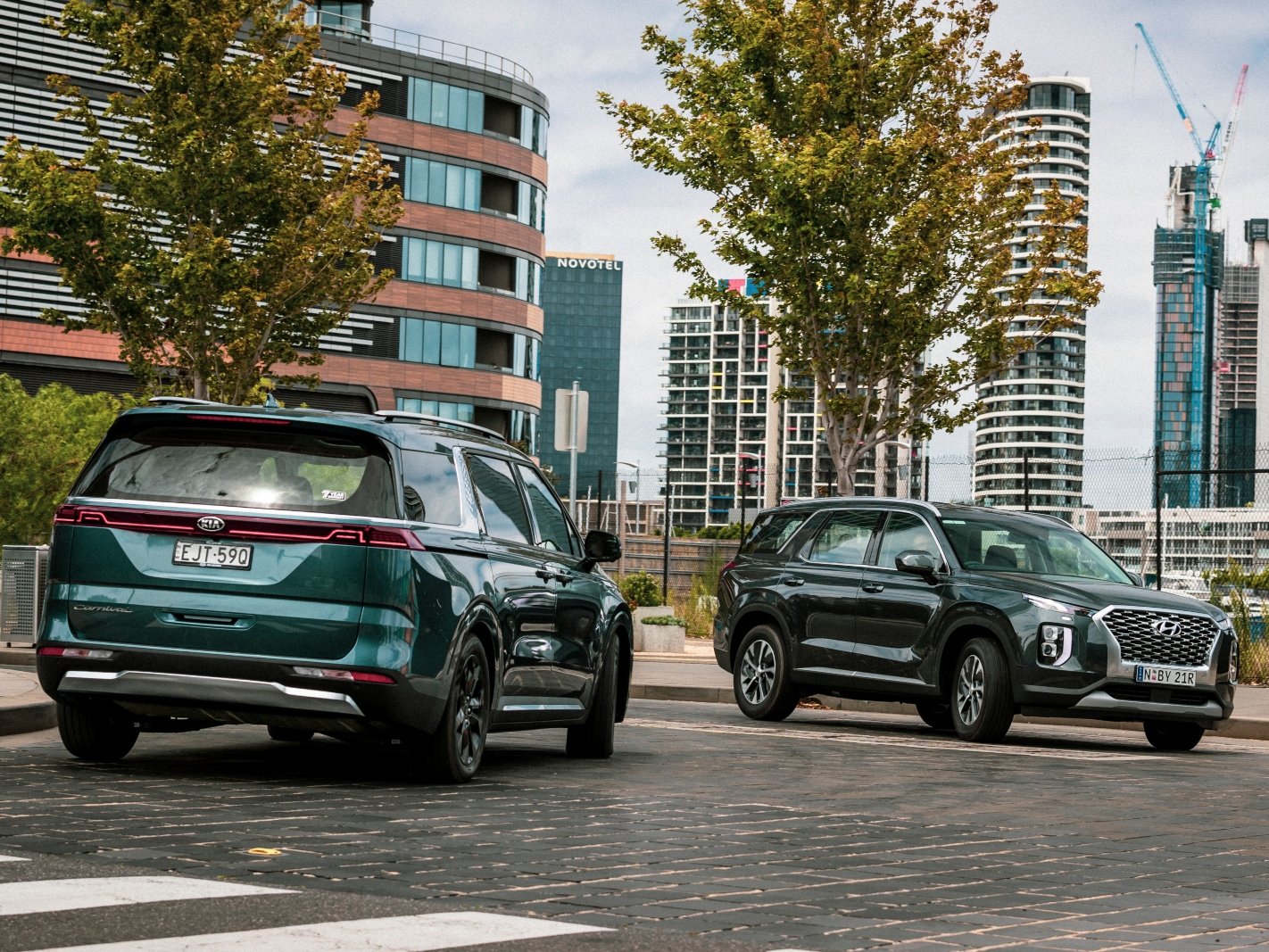
With its SUV proportions and chunky tyres Hyundai’s new flagship may have a greater perceived value over the more people-movery Kia, but unless you wade into diesel all-wheel drive territory that’s somewhat of an illusion.
At the same time, Kia says its Carnival is “SUV Inspired” but that probably doesn’t do it justice. It’s precisely because the Carnival isn’t trying to be something it is not that makes it stand out with confidence.
Even with a worthy new adversary on the scene and the strong-performing Palisade, the incredibly complete Kia Carnival is still the master of mass moving.
SPECS
Model Hyundai Palisade Engine 3778cc V6, 24v Max power 217kW @ 6000 rpm Max torque 355Nm @ 5200 rpm Transmission 8-speed auto Weight 1897kg Economy 10.7L/100km Price $60,000 On sale now RATING 4/5
Model Kia Carnival Platinum Engine 3470cc V6, 24v Max power 216kW Max torque 355Nm Transmission 8-speed auto Weight 2136kg Economy 9.6L/100km Price $53,330 On sale now RATING 4.5/5
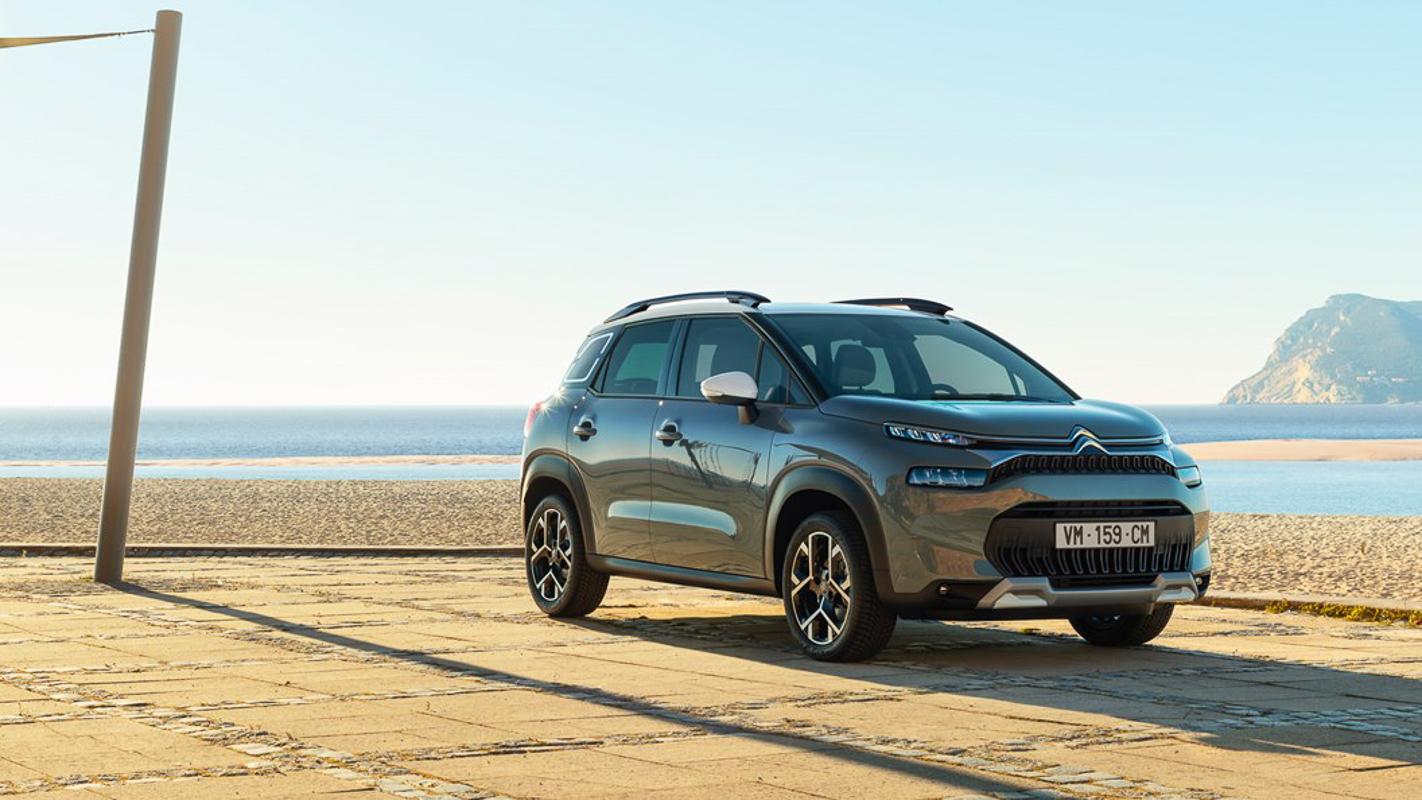
Citroen has updated its C3 Aircross crossover for 2021. Most noticeably, that chubby-cheeked and rounded face of the original has been replaced by something a little more Predator-like.
It’s not just the face that’s changed, though, so read on for what else is new.
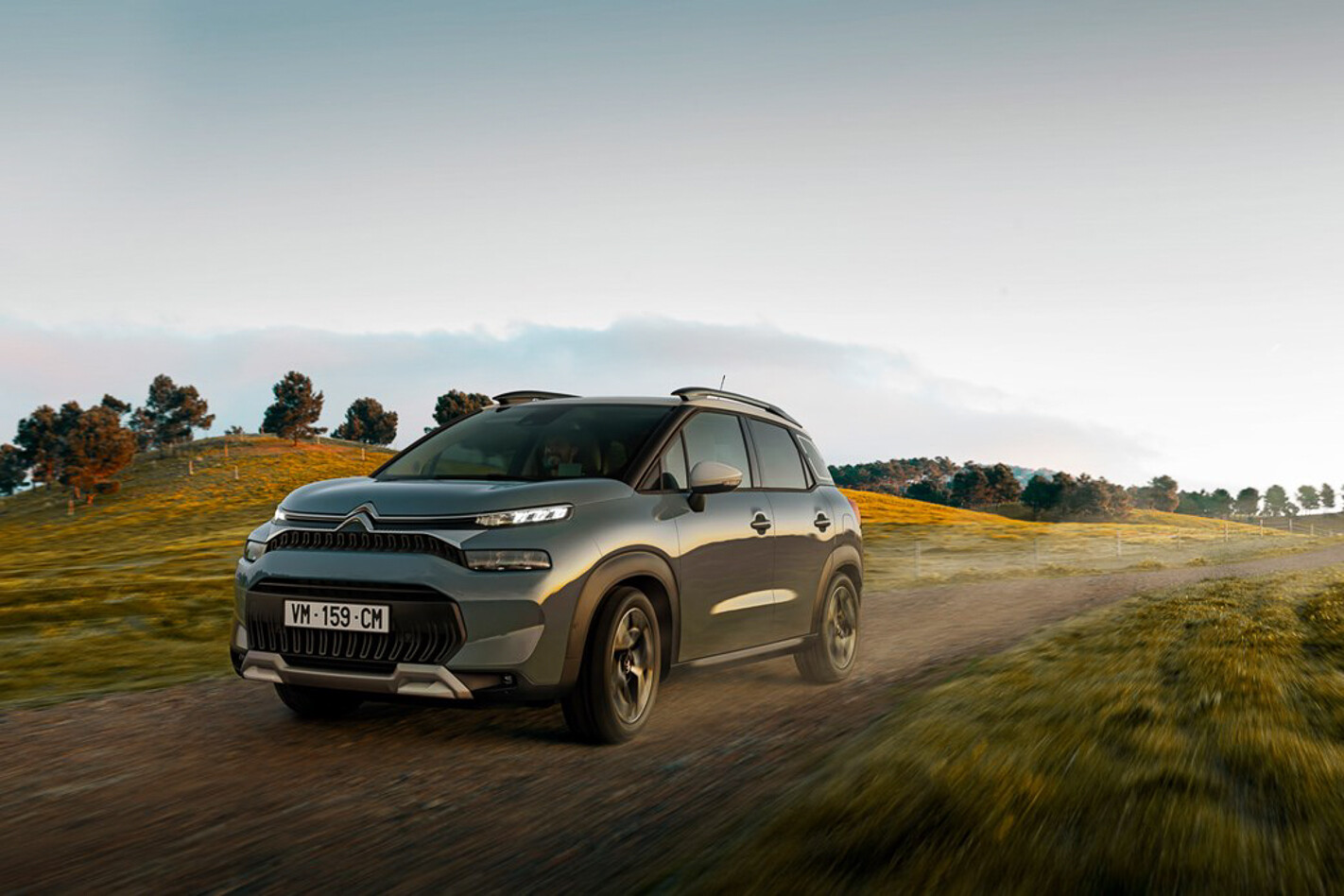
It’s angry now!
Yeah, just a bit. Clearly Citroen designers are a little bit bored of making squircles and rounded edges giving the effect of quirky softness and wanted to do something with a little more aggression.
It’s the same story as the updated C3 – sharper lines, more cross-referencing between other Citroen models like the new C4 and some cues from the wild CXperience concept. New grille patterns skid plates and wheelarch shapes feature, too. You can still customise it with different roof colours and graphics for the C-pillar window.
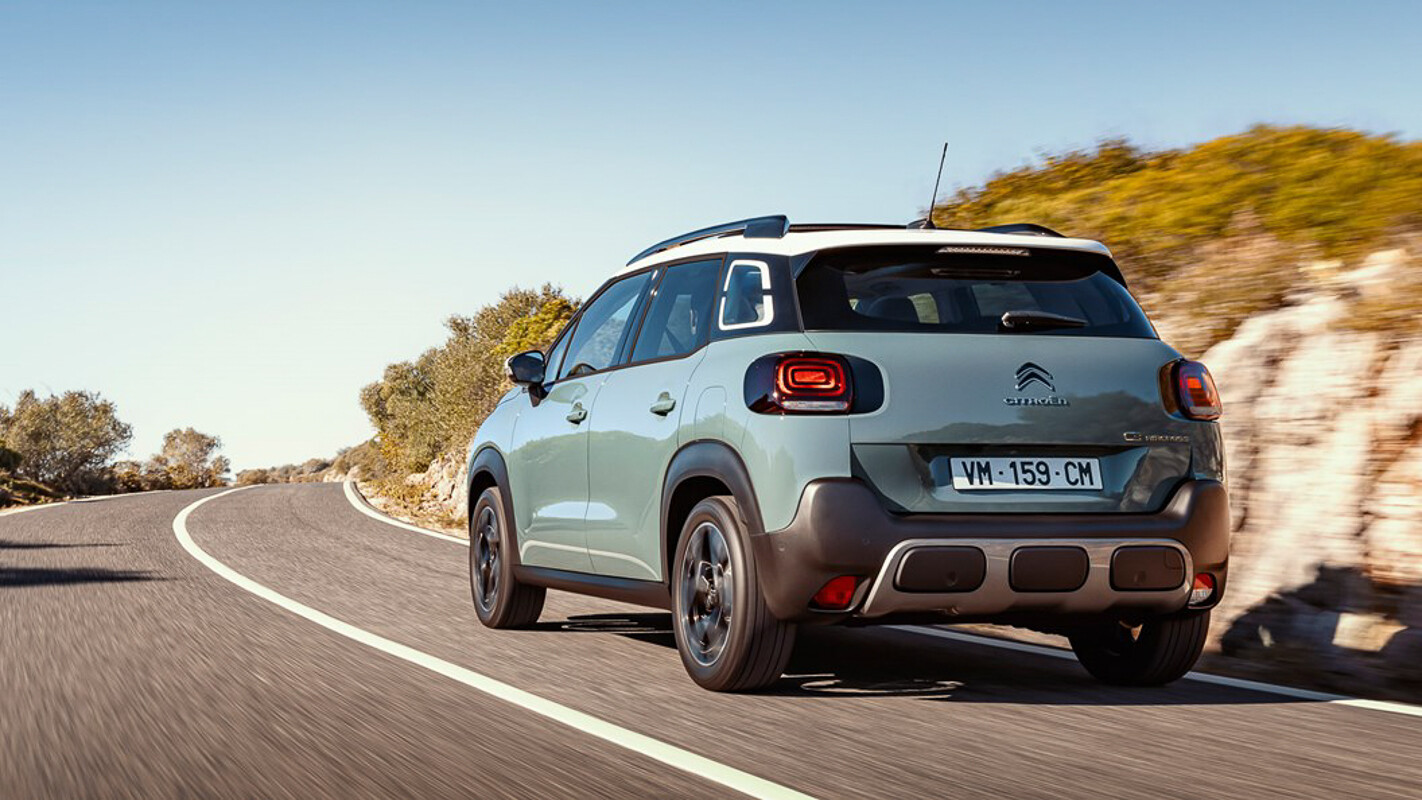
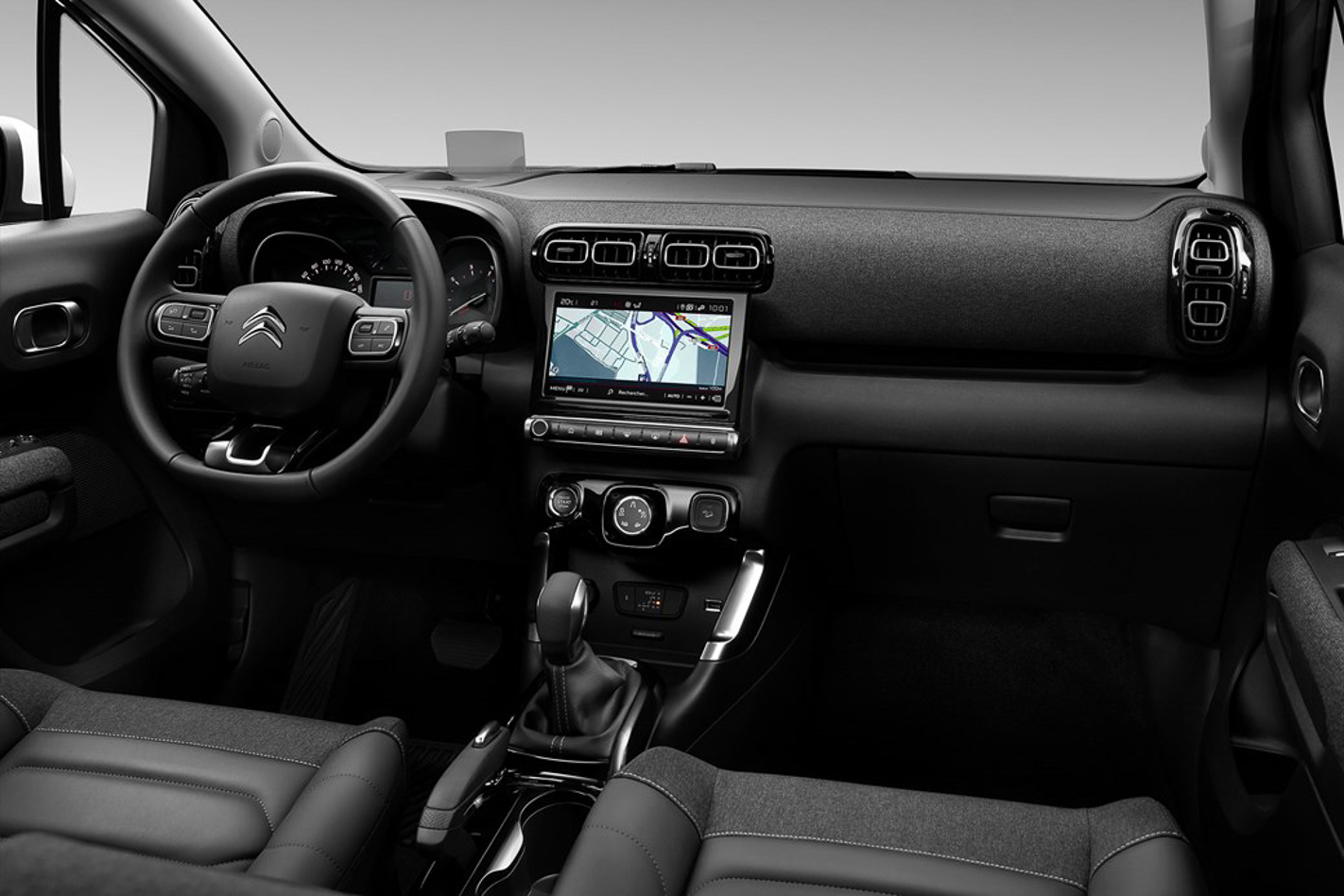
It’s still roughly the same inside, design-wise. But Citroen has added in its latest Advanced Comfort seats from the larger C5 Aircross, plonked in a larger 9.0-inch infotainment screen and added some extra storage cubbies. The rear seat bench can be slid fore or aft, boosting boot space from 420 litres to 510 litres.
It’s expected to carry over a 1.2-litre three-cylinder turbocharged petrol engine that makes 81kW and 205Nm and drives the front wheels only.
Unlike the (former car group) PSA products such as the Vauxhall Mokka, or Peugeot 2008, there’s no electric variant, despite the three cars sharing some componentry. That’s because the C3 Aircross, like the regular C3, use PSA’s older PF1 platform, rather than the up-to-date CMP that allows electric variants.
When can I get one?
The specification mentioned in this story is in relation to the global reveal of the new C3 Aircross – local Australian specification may vary.
Citroen Australia “is working closely with the factory regarding evaluating the new Citroën C3 Aircross for local introduction.”
This article was originally published at carmagazine.co.uk
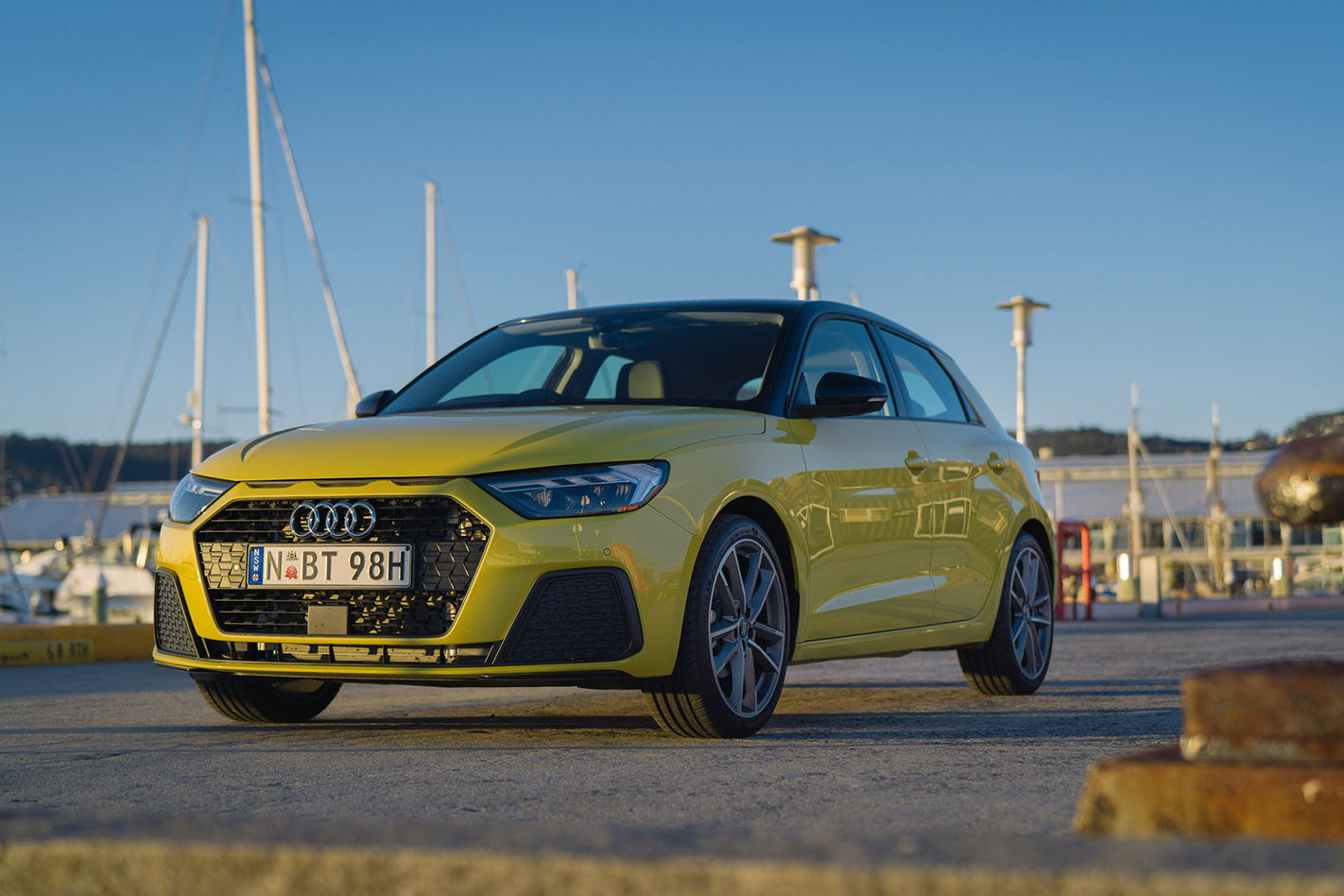
The fate of the Audi A1 premium light hatch is reportedly hanging in the balance, due to the relative high cost of electrifying small cars.
It’s about that time we would begin to see spy shots of a mid-life facelift Audi A1, no doubt with added electrification to help hit stricter emissions targets imposed in Europe.
But no such update is understood to be in development, yet.
Speaking to journalists ahead of the E-Tron GT’s unveiling, Autocar quoted Audi chief executive Markus Duesmann as saying “We do discuss what we do with the small segments. In the A1 segment, we have some other brands [in the Volkswagen Group] who are active there and very successful, with very high production, so we do question the A1 at the moment.”
It’s becoming more difficult for manufacturers to offer smaller cars, due to the increasing cost of developing and producing them compared to what they can be sold for.
Advancements in safety, electrification and high-tech infotainment are all demands that buyers and governments are making, but they’re proving too difficult for manufacturers to equip at entry-level prices.
It’s part of the reason we’ve seen models such as the Honda Jazz and Renault Clio removed from our local market – along with the cost of sourcing them from expensive and distant regions – and why cars like the Toyota Yaris have jumped in price due to extra safety and tech additions.

Audi is understood to be developing an entry-level electric replacement which could revive the A2 moniker, a car that was never sold in Australia. It could use the MEB electric platform and draw upon the Audi AI:ME concept’s styling.
“Maybe not exactly with that design, but I like the A2”, Audi’s boss said. “Certainly we discuss the A2 segment as well. So, it might be an A2 or an E2, or an A3 or an E3. We’re at the moment discussing that.”
Despite a question mark hanging over the smallest Audi in its line-up, it seems the SUVs are safe.
“We will certainly offer Q2s [small SUVs] and the like,” he continued. “That might be the new entry level for us; we might not do anything smaller.”
UPDATE, February 12: In an awkward new development for Jeep, its big Super Bowl ad, ‘The Middle’ – calling for the left and right of America to find unity – has been moved to ‘private’ on the carmaker’s YouTube channel.
Why? It turns out the star of the ad, ‘The Boss’ Bruce Springsteen, was arrested on a charge of drink-driving and reckless driving in November last year. Springsteen is due to face court in the coming weeks.
It’s unclear how this detail failed to make its way to Jeep’s marketing team, and the brand isn’t offering much in the way of comment. For now, it has said the following to American news outlet CNBC:
“It would be inappropriate for us to comment on the details of a matter we have only read about and we cannot substantiate. But it’s also right that we pause our Big Game commercial until the actual facts can be established.”
It’s a sorry moment for Springsteen, particularly as the iconic singer had previously maintained a decades-long position of not appearing in any sort of advertisement. It’s understood he felt moved by Jeep’s call for unity – but it seems the small matter of a drink-driving charge may have slipped his mind. 2020 was a long year.
The ad has been made private on Jeep’s YouTube page, but you can view a re-uploaded version below – until YouTube removes it, at least.
The story to here
February 5, 2021: While Americans are gearing up for the Super Bowl LV annual American football championship, the rest of the world relishes in watching the entertaining commercials shown during the ad breaks.
The Super Bowl is one of the most-watched television events in the world, regularly raking in viewers in the hundreds of millions.
That insane viewership figure is the reason why companies pay upwards of A$9 million per 30-second ad slot, and that’s before you account for the production costs of the ad itself. Many of these ads involve celebrities with big-dollar paycheques and expensive stunts.
That said, it’s a cost many automotive manufacturers are willing to bear in order to get their products in front of the eyes of the world.
In anticipation of this year’s event, we’ve collected some of our favourite car ads that’ll air during the big game.
Ford: Finish Strong
Ford used its big ad slot to reflect on a year unlike any other. Its #finishstrong campaign promotes unity and empowers the public to keep going as “we’re so close” to seeing the other side of this pandemic.
It’s a commercial that doesn’t advertise any of its cars, though still sends a strong message about Ford’s commitment to beating this pandemic by touting its own Covid-19 mitigation efforts.
General Motors: No Way Norway
GM’s airtime promotes its newly-formed plan to switch to electric-only production from 2035. It features Will Ferrell, the new GMC Hummer electric vehicle, some good-old national pride and a lot of jokes at Norway’s expense (a country with notoriously-high EV uptake).
Toyota: Upstream
Another one with no actual car advertisement, this emotional Toyota commercial signifies the brand’s sponsorship of the Team USA Paralympics squad by telling US Paralympian Jessica Long’s story.
Weathertech: American Dream At Work
American parts manufacturer Weathertech is always good for a big-dollar ad spend. This ad shows the world that the company is an employer of choice with a workplace that respects its employees as much as does its customers.
Vroom: Dealership Pain
Vroom offers a hassle-free car buying experience that this ad-spot goes to dramatic lengths to point out. Instead of feeling threatened (or tortured) into buying a car, Vroom is an online car marketplace that delivers a brand new car to your home, contact-free.
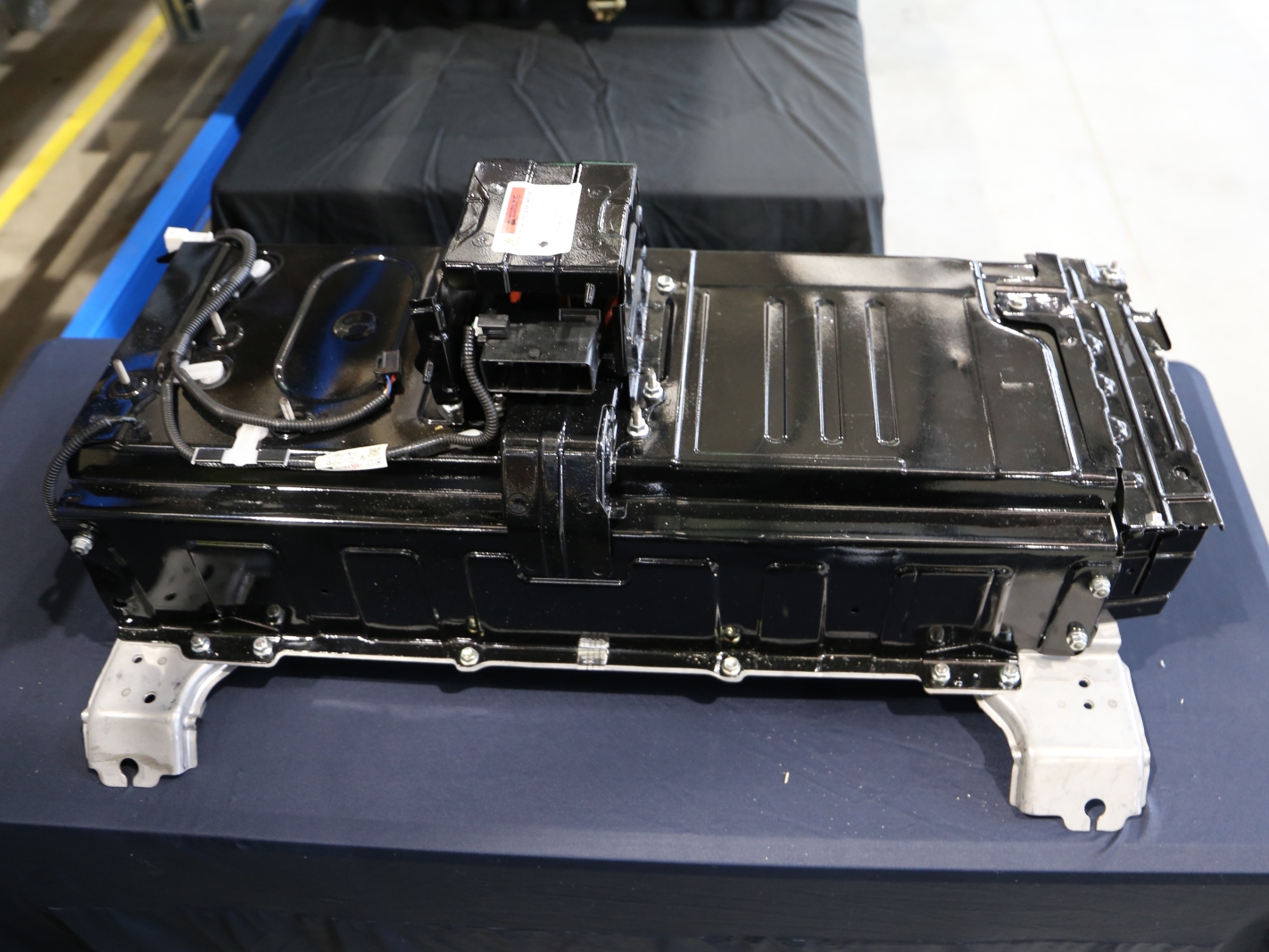
Melbourne-based auto electronics specialist Injectronics has developed a battery remanufacturing process that will swap your hybrid’s tired battery for up to 80 percent less cash than a new original-equipment part.
Assisted by a $103,000 federal government grant, the company will be rolling out its Hybrid Battery Remanufacturing Exchange Program in the second quarter of 2021, allowing new life to be breathed into older hybrid vehicles – potentially sparing them from the scrap heap.
Replacement hybrid batteries can cost up to $10,000 from the original manufacturer depending on the brand, and with 150,000 hybrids on Australian roads (with the oldest of those nudging 18 years old), a dead battery would in many cases mark the end of the line for increasing numbers of vehicles.
However, Injectronics is offering an exchange battery for as little as $2000 depending on the model, slashing the cost and potentially extending the life of thousands of early-model hybrids that would otherwise be put out to pasture.
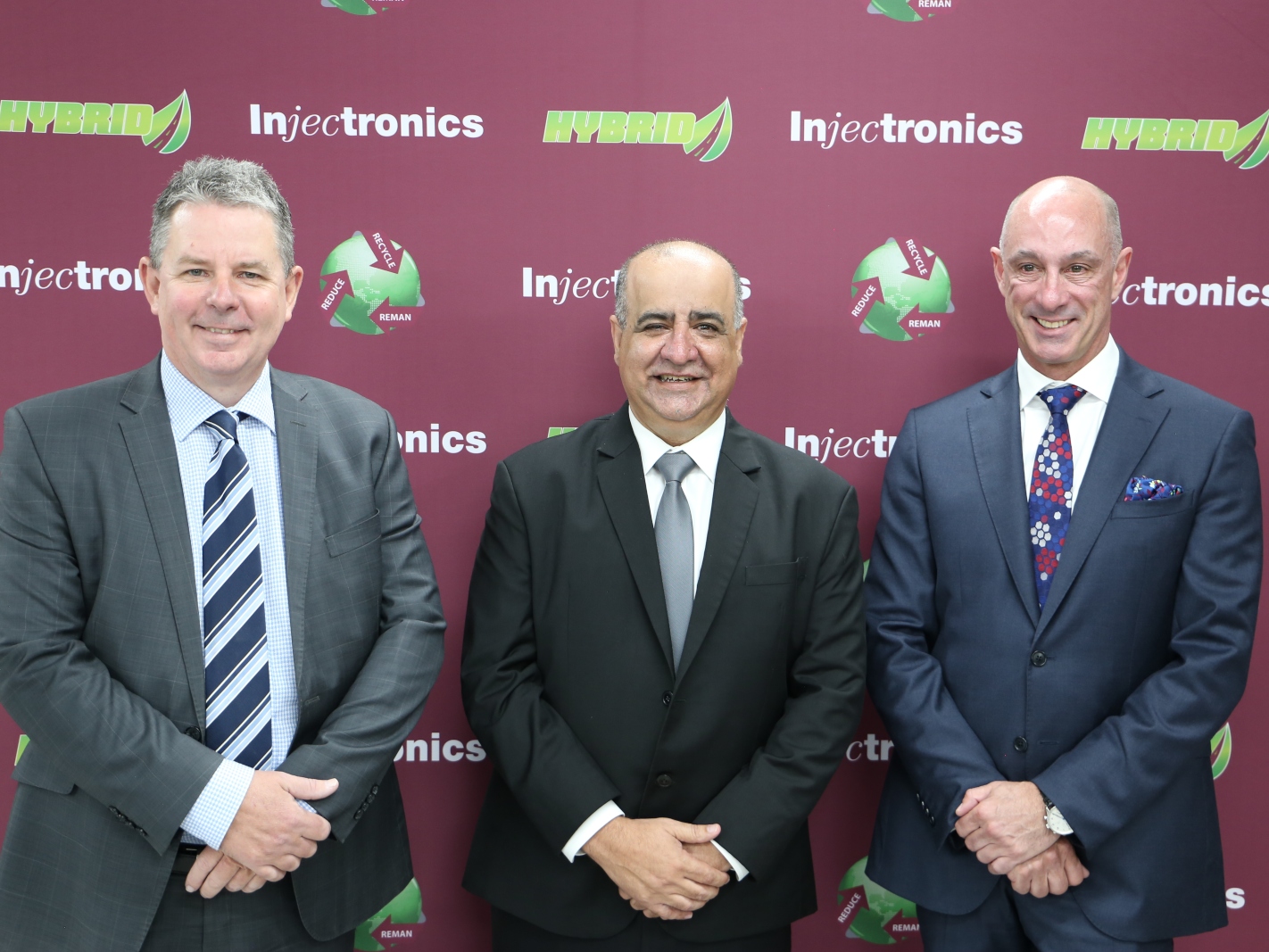
Speaking at the launch of the program at Innovative Mechatronics HQ in Melbourne’s east, Liberal senator for Victoria David Van said projects like the battery exchange are “as exciting as it gets when you’re in parliament”.
“Projects like this would probably happen anyway, but being able to back it with a grant of $103,000 allows (Injectronics) to bring forward some of that work, to bring forward the research and innovation that goes behind a project like this, to drive that innovation into products and real-world solutions for problems that we are going to face – not only economically but environmentally as well.”
“We believe the technology is the solution to fixing our emissions problem”.
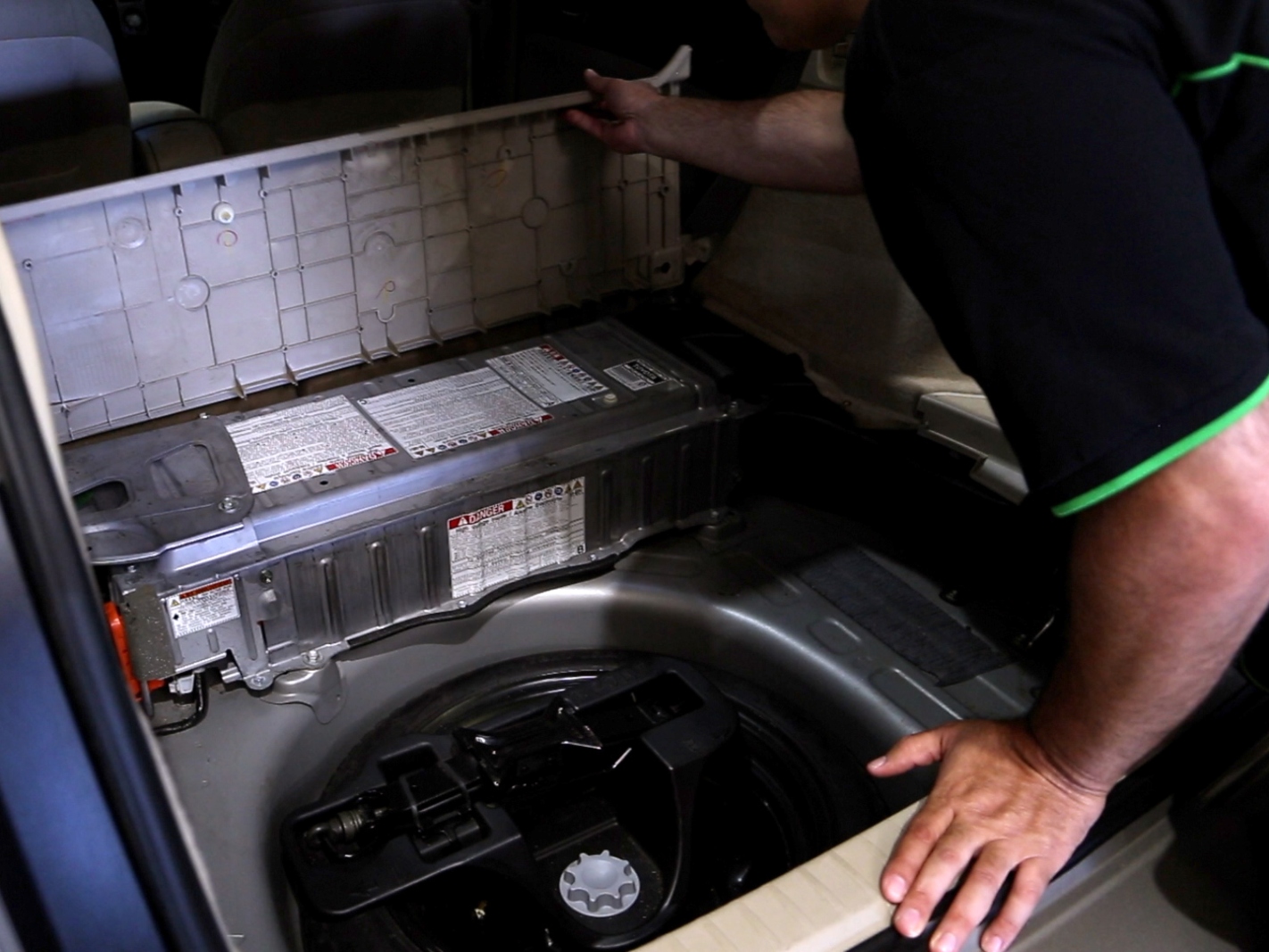
Injectronics’ initial focus will be Toyota’s ageing Prius and Camry Hybrid fleet, which represents both the oldest and most common hybrid on Australian roads and, in particular, the large number of very-high-kilometre taxis around the capitals.
While the company is promising significant savings over the cost of replacement at the pointiest end of the spectrum, the difference in price in the case of a Prius, for example, is slimmer, with Toyota offering a new battery for about $3000 and replacement labour not exceeding $400 for any model, says its maker.
But the company already has grand plans to expand its operation to include other hybrids – as well as full-electric cars – as more models join the national car park and create demand in other areas.
“We recognise there’s a significant number of early hybrid batteries that are underperforming and out of warranty,” said IM Group managing director Gino Ricciuti.
“The stats show that 13,000 batteries needed changing last year, and we expect by 2024 to have 23,000 batteries that need changing.
“Currently, the only option is a brand-new battery, and that’s very cost prohibitive and could be more than the vehicle is worth,” he added.
While some other Australian companies are offering battery recycling such as Envirostream and EcoActiv, Injectronics is the first to offer a faster, more cost effective and environmentally friendly remanufacturing process.
How is a hybrid battery remanufactured?
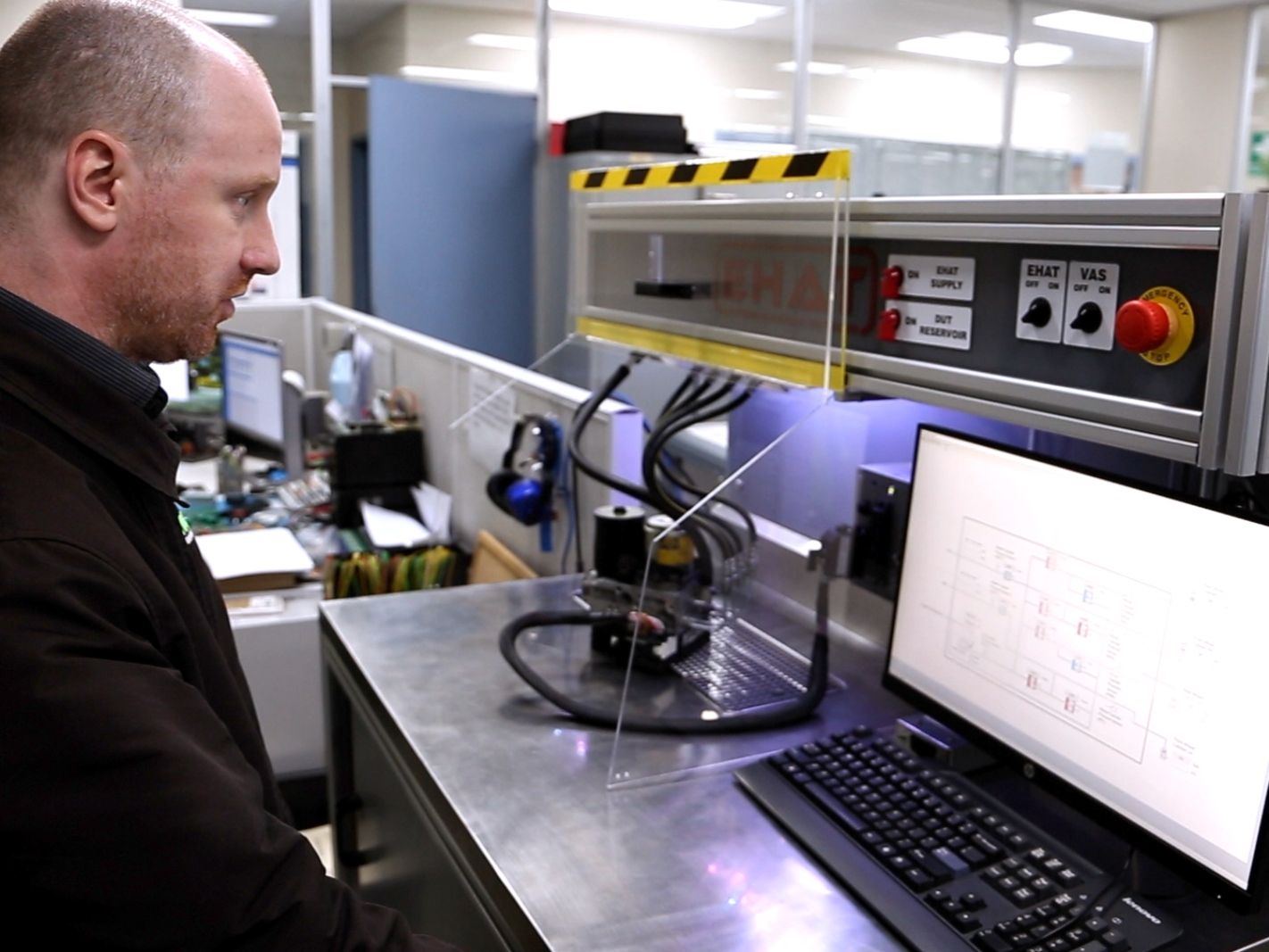
A battery pack is comprised of multiple cells and, in the case of Toyota’s unit, it only takes one or two of the 28 cells falling below an 80 percent threshold before the vehicle’s power management electronics reject the entire battery. It’s at this point the battery will need replacing.
But instead of swapping the degraded unit for an expensive all-new component, Injectronics has a different approach.
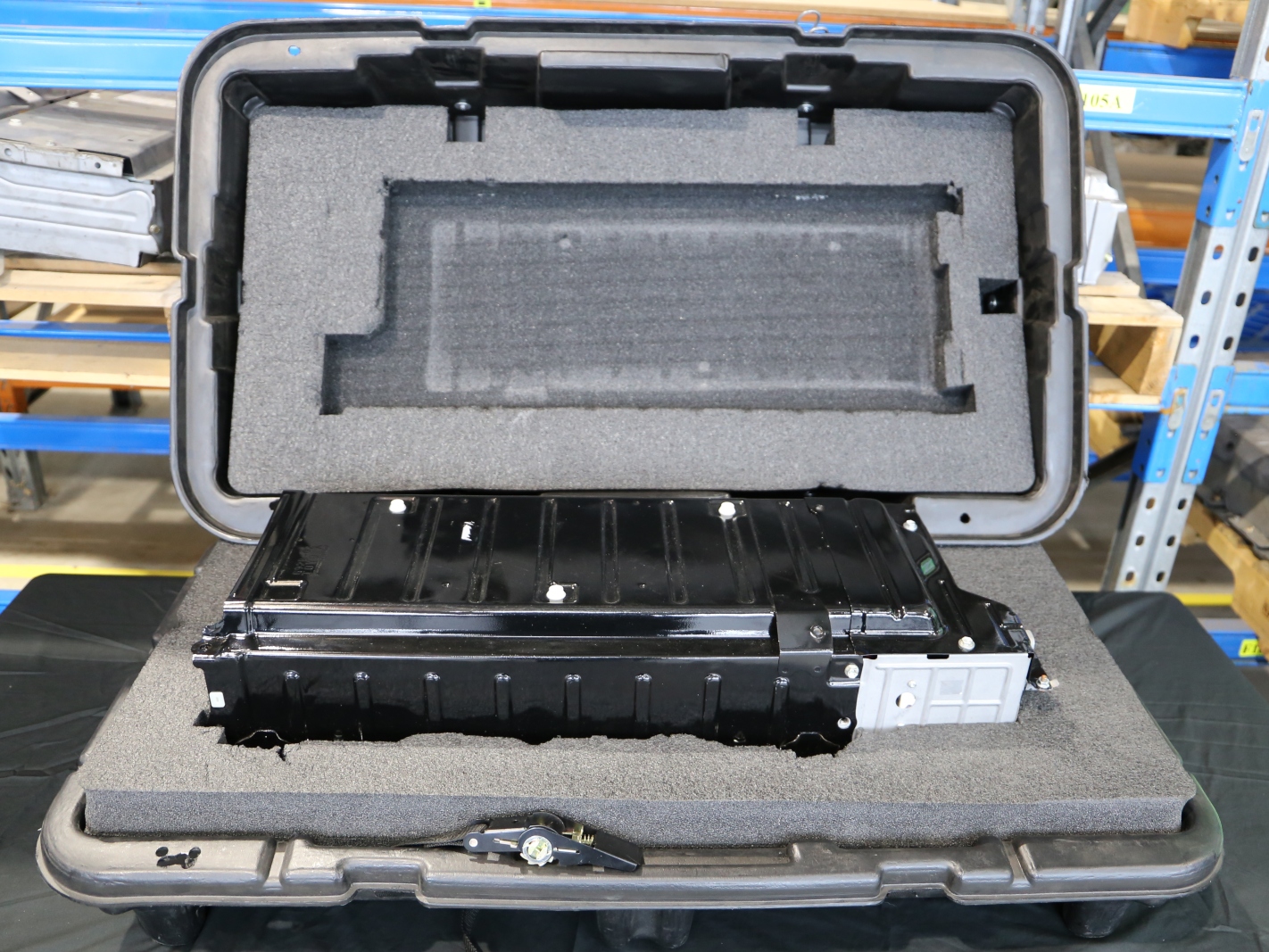
A technician removes the battery from the car, strips out the individual cells and, using sophisticated equipment, measures the serviceability and capacity of each cell on an individual basis. The healthy cells are retained and rebuilt into a new pack, with replacements for the defective cells only.
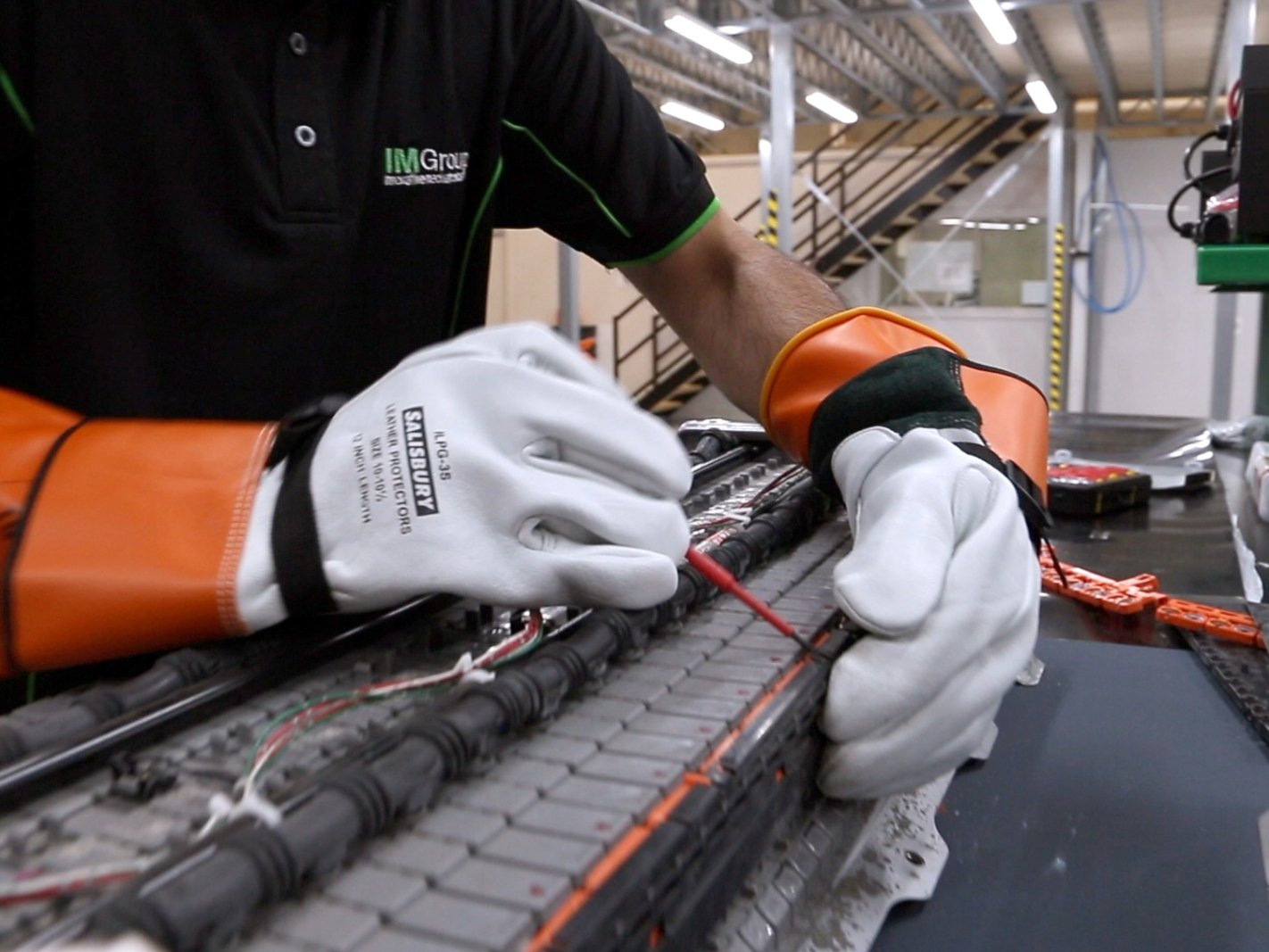
Cleverly, no new cells are required to build a maximum-capacity remanufactured unit, with the replacement cells donated from other used batteries in the process cycle.
For example, five used batteries may contain enough healthy cells to rebuild four remanufactured units.
Finally, the cell testing process identifies not just the excessively degraded cells, but also those which are likely to break down soon – and these components are also rejected, resulting in a battery that is capable of performing reliably and for as many years as a new replacement.
Each Injectronics remanufactured battery is sold with a two-year guarantee.
Cheaper replacement hybrid vehicle batteries
Full recycling programs offered by a handful of companies break down end-of-life batteries to their constituent compounds and materials – but these processes are energy intensive and require massive plants, whereas remanufacturing requires much less energy and produces less waste.
Most of the small energy requirement for processing is provided by solar power generated at the facility itself.
The main resource therefore, is labour, with a skilled technician required to accurately diagnose the status of each cell before barcoding and storing it in a bank for later use in the rebuilding stage.
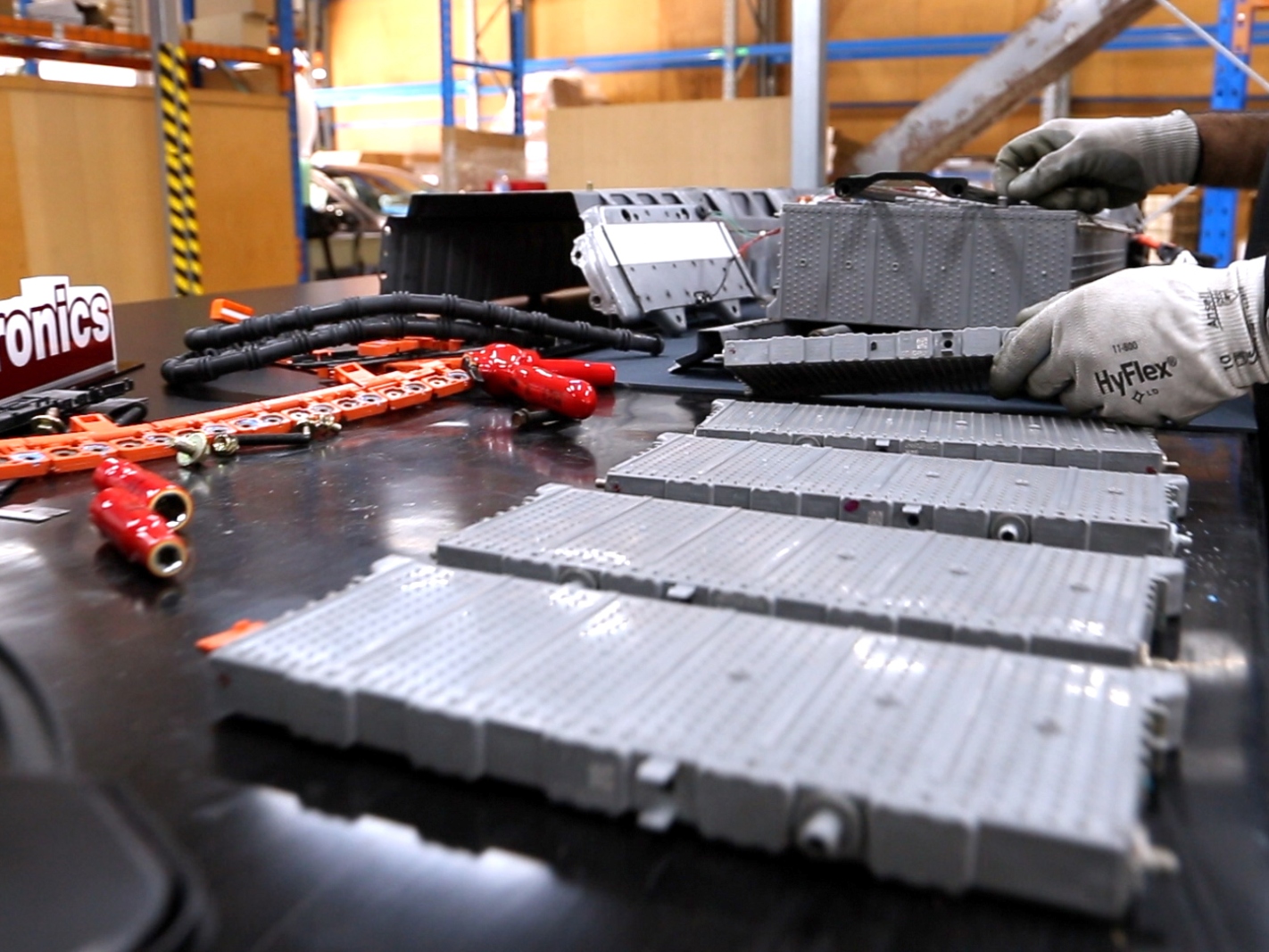
Even when faulty or degraded cells are discarded, they are not simply disposed of in landfill, as happens in a majority of battery replacement jobs.
Instead, cells with between 30 per cent and 80 per cent have enough capacity to be used in other applications, including home power storage solutions.
The net result is a remanufactured battery that costs between $2000 and $4000 – or about 60 to 80 percent of the cost of an OEM (original equipment manufacturer) new replacement.
What’s next?
Toyota’s Camry and Prius are one of the few electrified vehicles that use a nickel metal-hydride battery, but Injectronics will broaden its remanufacturing operation to include larger battery packs comprised of other compounds – including the more advanced lithium-ion technology used in far more brands and models.
And the research into other remanufacturing applications could even branch into heavy commercial, along with e-bikes, carts and wheelchairs, says Ricciuti.
Its scalable process is key to the expansion, and additional facilities will be commissioned in other states as the demand grows, ensuring a reliable and fast supply of batteries where and when they are required.
Australian Automotive Aftermarket Association CEO Stuart Charity said the Injectronics venture is a shining example of independent manufacturers diversifying and capitalising on an ever-changing automotive landscape.
“There are a lot of experts that predicted when the car industry shut down a few years ago it spelled the total demise of automotive manufacturing and remanufacturing in Australia, and how wrong they were,” he said.
“There’s a lot of experts also saying that the onset of electric and hybrid vehicles will be the end of the aftermarket as well, because there’s no parts. Again, they are wrong.
“Our industry has shown over time that we adapt to new technologies and adapt faster and better than the car (manufacturing) industry did. I think what IM Group are demonstrating this morning is exactly that progression into the new technologies”.
