
Anyone else missing the thrill of driving right now? Well, while we’re all doing our bit and staying inside, let’s plan our drives for when the lockdown lifts.
Wheels is starting a #DriveAfterIso campaign, and we want to hear from you!
Post a picture of your car and tell us about your favourite driving roads. The road can be a long loop, or a short stretch, that you love heading to when you need to escape.
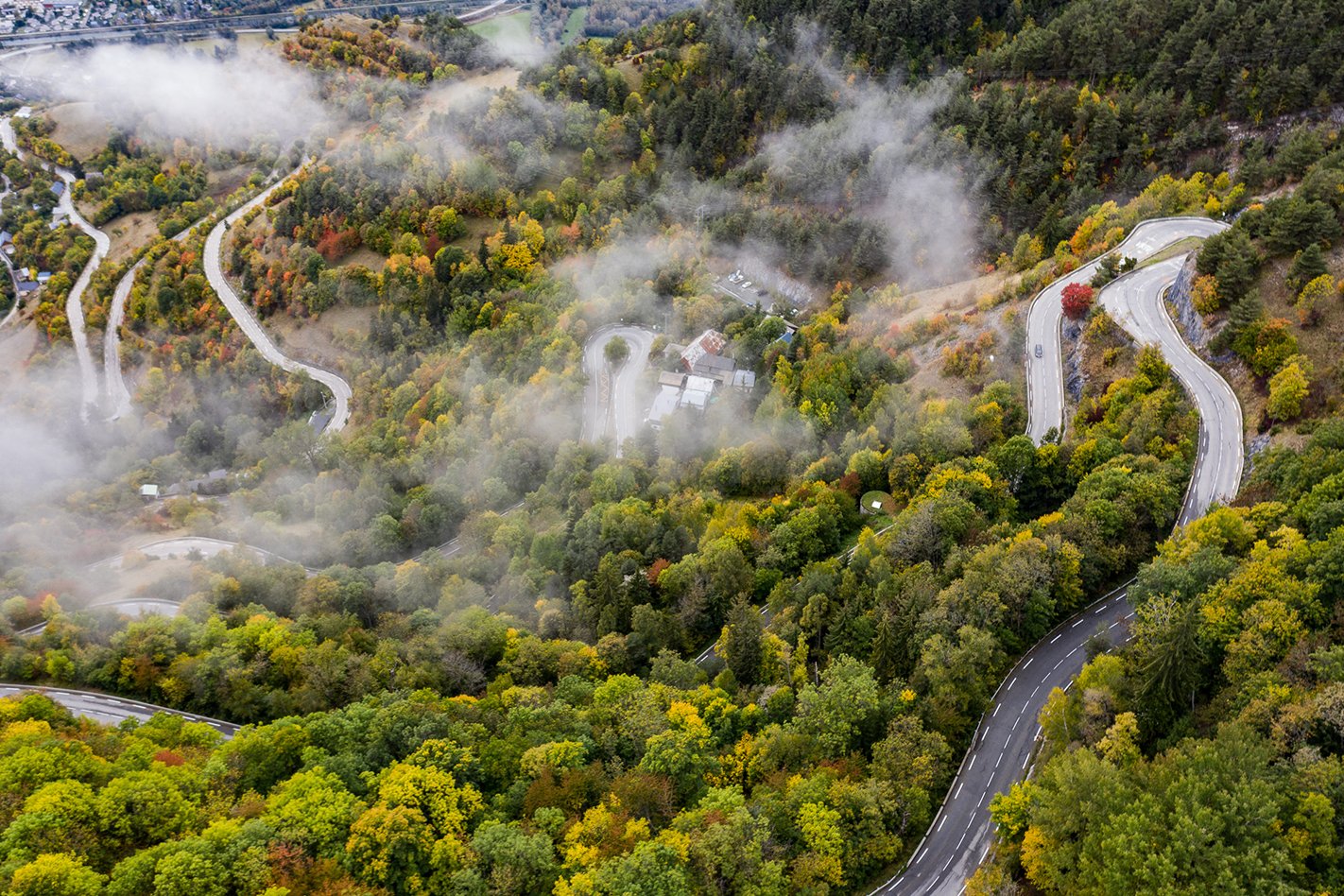
Share your favourite roads, and a picture of the road or of your car, on your Instagram page. Tag Wheels (@wheelsaustralia) and use the hashtag #DriveAfterIso. Nominate your friends to hear their suggestions too.
And think global. Aussie love their cars, but we want to hear from people the world over. We’re also keen to learn about some great international driving roads.
So get posting! We’ll share your suggestions and publish the best cars and roads in an upcoming issue of the magazine.
To help get the ball rolling, here’s a personal favourite of ours from a recent comparison test.

The Great Alpine Road is a staple for Aussie car lovers. Start in Bright and head towards Omeo before looping back through Falls Creek.
It’s an epic four-hour loop of stunning vistas and challenging tarmac. It’ll suit any car, though is perfect for a pair of Porsches like the similarly priced 718 GT4 and 911 Carrera.
We’ll be sharing more of our favourite roads (including a list of ’50 roads you have to drive’) in the coming days and weeks.
Show us your favourite #DriveAfterIso road or car!
Think Yamaha, and you’re probably conjuring images of screaming litre sports bikes, Valentino Rossi duking it out with Jorge Lorenzo, or maybe just the days of your youth blatting around dirt tracks on a DT125 with learner plates.
But there’s more to the Japanese manufacturer than that.
Six archers have won Olympic gold medals using Yamaha bows, it’s still the world’s largest manufacturer of musical instruments, and the Yamaha Entertainment Group is an Emmy award-winning record label and film production company.
Oh, and they also build fantastic engines for cars, which is a fact that has often slipped under the radar.
Here we pay tribute to eight of the very best. So, in reverse order…

8. Ford Duratec Ti-VCT
Australia never received the original Ford Puma coupe. Shame. It was a great handler and was also the recipient of a fascinating engine, the Yamaha-developed 1.7-litre four. This made a modest 93kW in the standard Puma and a healthier 114kW in the Tickford-tickled Racing Puma.
The 1.7-litre 16v engines started life as 1.4-litre units and were then bored to capacity. These rough-machined blocks were then shipped from Ford’s Valencia plant in Spain to Yamaha in Japan. There they were treated to Nikasil liners and a forged crankshaft before accruing a few more miles under their belts and being shipped to Cologne, Germany, where they met their recipient vehicle. The Nikasil bore-plating process took 25 minutes per engine, which was why Yamaha had to do it. Ford’s mainstream engine plants had a maximum cycle time at any one station of six minutes.

7. Ford SHO V6 KOA
Ford billed its 1989 Taurus as one of the two most significant American cars of the 1980s. The other, rather magnanimously, is a Chrysler minivan.
Despite the late-’80s styling, by far the highlight of the Taurus range was the SHO version, which featured a 164kW/271Nm 60-degree V6 up front.
Commissioned by Ford and built by Yamaha, the 3.0-litre engine was compact, reliable, surprisingly high-revving for a car intended for Yanks (peak power arrived at 6200rpm), and it sounded ridiculously exotic for its price point. It was finally ditched for the third-gen Taurus in 1996 and Ford promptly lost its sales lead to Toyota’s Camry.

6. Volvo B8444S V8
The Yamaha-built B8444S that found its way beneath the bonnets of the Volvo S80 and XC90 was a curious engine. Volvo had designed the engine bays of these models to accommodate straight-five and 60-degree V6 engines, and it was clear that significant re-engineering would have to take place in order to shoehorn in a traditional 90-degree V8.
Volvo’s solution was to get Yamaha to build a compact 60-degree 4.4-litre V8, which got around the NVH issues inherent in a narrow-angle V8 by using a timing chain-driven balancer shaft. The engine sounded great, proved durable, was the first V8 to meet ultra-low emission ULEV III standards and was also used in Noble’s giant-killing M600 supercar.
Aussie fans might remember a 5.0-litre version beneath the bonnets of Garry Rogers Motorsport’s Volvo S60s in V8 Supercars from 2014 to 2016.

5. Toyota 4A-GE 1.6
They say imitation is the sincerest form of flattery, and maybe Yamaha wasn’t shy of being ‘inspired’ at times. Take the iconic 4A-GE four-cylinder, built by Yamaha, and most famous for being the engine from the Toyota AE86 Trueno/Sprinter/Hachiroku and also the powerplant nestled in the middle of the original MR2.
Some point to the fact that early ‘Bigport’ or ‘Bluetop’ versions of this engine shared exactly the same bore, stroke, valve sizing and port designs as the Cosworth BDA and claim it’s more than inspired by the BDA. Others dispute that the Toyota engine is a crib of Cosworth’s. I’m in the latter camp. This engine ultimately developed into the five-valve fifth-gen Blacktop design, a powerplant still in big demand among tuners for drift car builds.

4. Toyota 2ZZ-GE
This engine originally piqued our interests beneath the bonnet of the Celica ZR and Corolla Sportivo models. This 1.8-litre four certainly had something about it, the Yamaha-designed head featuring a valve timing and lift system that went feral at 6200rpm, utterly changing the nature of this otherwise mild-mannered four. Then you got around 141kW pretty much all the way up to the spark cut at 8500rpm.
Lotus saw the potential of this engine and it appeared in its Elise and Exige models for 2005. Toyota and Lotus both began separate projects on supercharged versions. The 165kW Corolla Compressor proved a bit of a flop, whereas the Lotus installation was warmly received, the supercharger nicely filling the hole in the torque curve before the VVTLi system readied itself. It found its ultimate iteration in the 191kW Exige Cup 260 of 2009 to 2011.

3. Toyota 2UR-GSE V8
When the Lexus IS-F arrived in 2007, we were all about that 5.0-litre V8 engine. It was a gem, with high-flow heads and a die-cast aluminium block all designed by Yamaha. We thought the 310kW output was something pretty special, especially as you needed to rev to 6600rpm to access it, but better was to come.
High compression variants of the 2UR-GSE would subsequently roll out. The 348kW RC F and GS F were dominated by their powerplants, and it was only with the showstopping LC 500 coupe with its 351kW iteration of the 2UR-GSE that this great engine finally got the platform it deserved.

2. Toyota 3S-GE/3S-GTE
So good was this family of engines that they found their way into everything from the 1984 Toyota Corona to the 2007 Toyota Caldina ST246 GT-Four. The GE family was normally aspirated, reaching its zenith in the 154kW Altezza RS200, but is more normally associated with Celicas and second-generation MR2 models. Yamaha can’t claim sole credit for this lump, Toyota having worked extensively on its development as well.
The 3S-GTE unit is the 2.0-litre turbocharged sibling, made famous by the Celica GT4 and the MR2 Turbo. With its Yamaha-designed DOHC 16-valve aluminium alloy head, versions of the 3S-GTE would go on to power Juha Kankkunen, Didier Auriol and Carlos Sainz to World Rally Championships at the wheel of Group A Celica GT4s.
1. Toyota 1LR-GUE
Okay, so this 4.8-litre V10 isn’t just up there for consideration as the best Yamaha engine, it would be in many people’s top 10 automotive engines. Period.
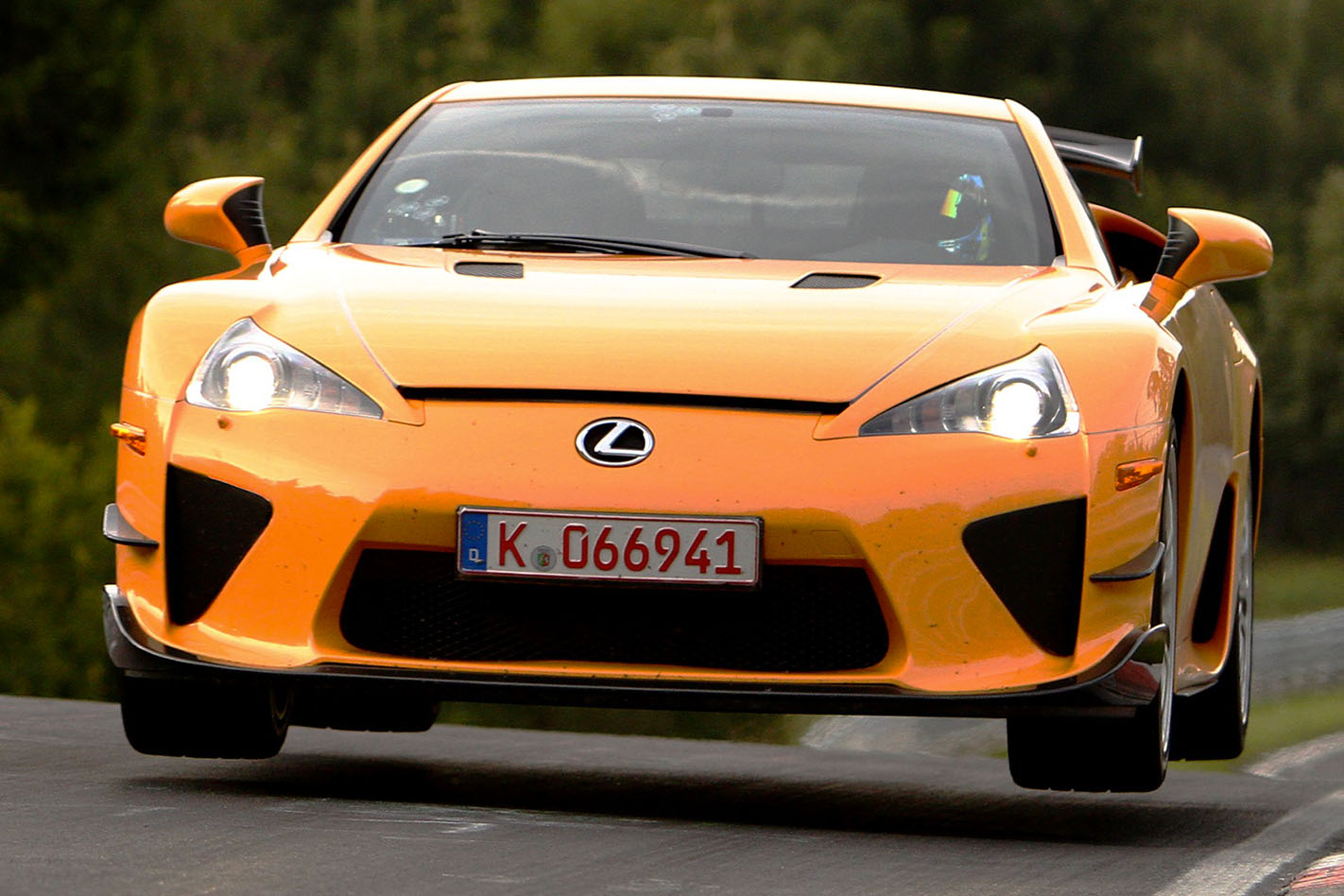
Co-developed by Toyota and Yamaha for the iconic Lexus LFA sports coupe, this 412kW/480Nm dry-sumped masterpiece featured 10 individual throttle bodies and could rev to 9500rpm. As a result it’s also one of the very best sounding sports car engines in existence.
Don’t believe us? Check out this video where we gave one a thrashing on a closed road at Lake Mountain.
- Huge cash injection for Aston may not be enough
- Coronavirus disrupts recovery efforts
- Next six months are critical
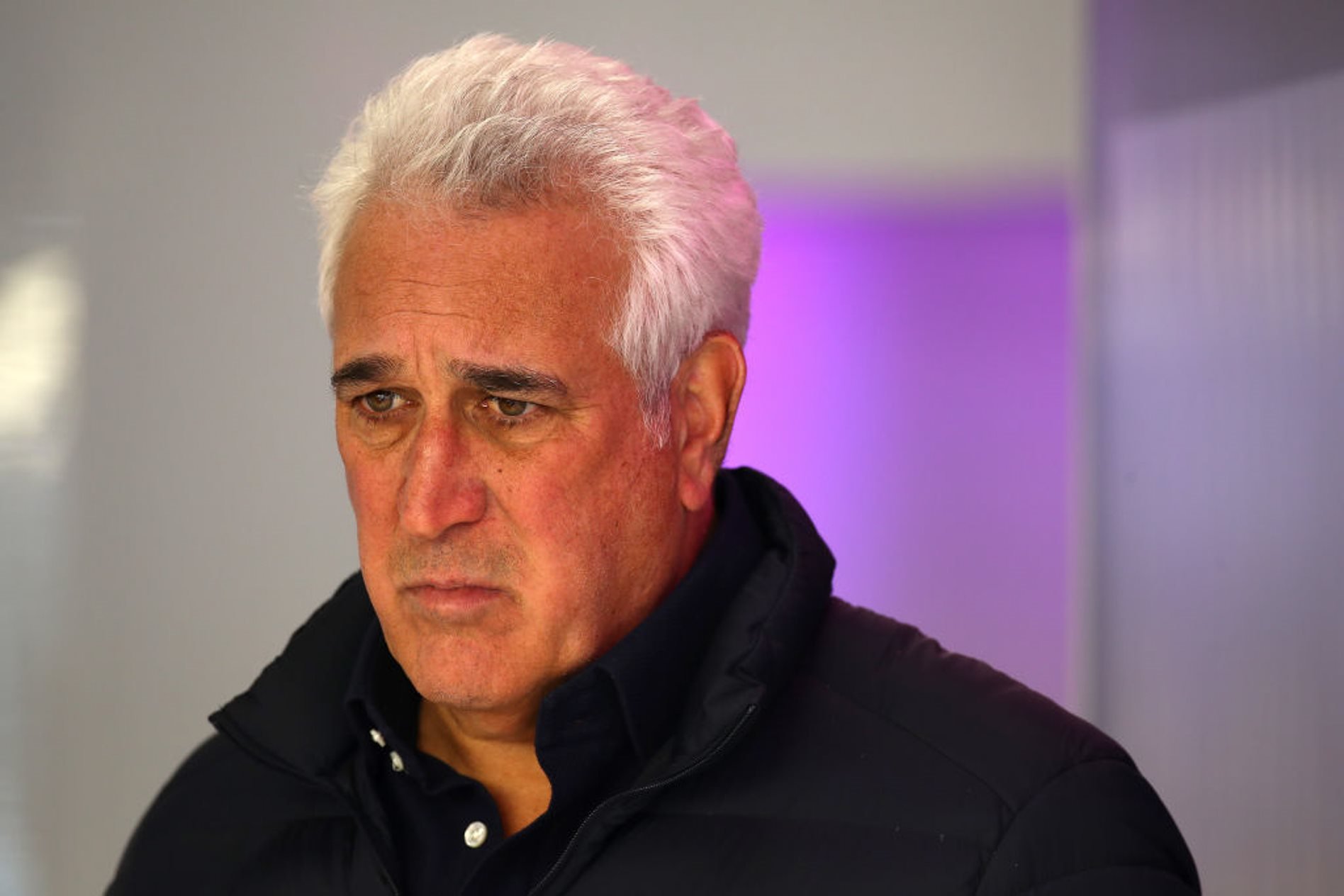
Its share price plunged to new lows this week after it declared to the market that it didn’t have sufficient money in reserve to survive another 12 months, despite a cash investment of more than one billion dollars (AUD) rounded up by its new executive chairman-in-waiting, Canadian clothing magnate Lawrence Stroll (below).
Its share price fell from GBP2.20 to as low as 65p this week, before settling at around 80p. The company was floated on the stock exchange in late 2018.
The iconic British sports car company, founded in 1913, is also suffering under the weight of excess stock, with slow sales for the Vantage and DB11 coupes compounded by the delayed launch of its first-ever SUV, the DBX.
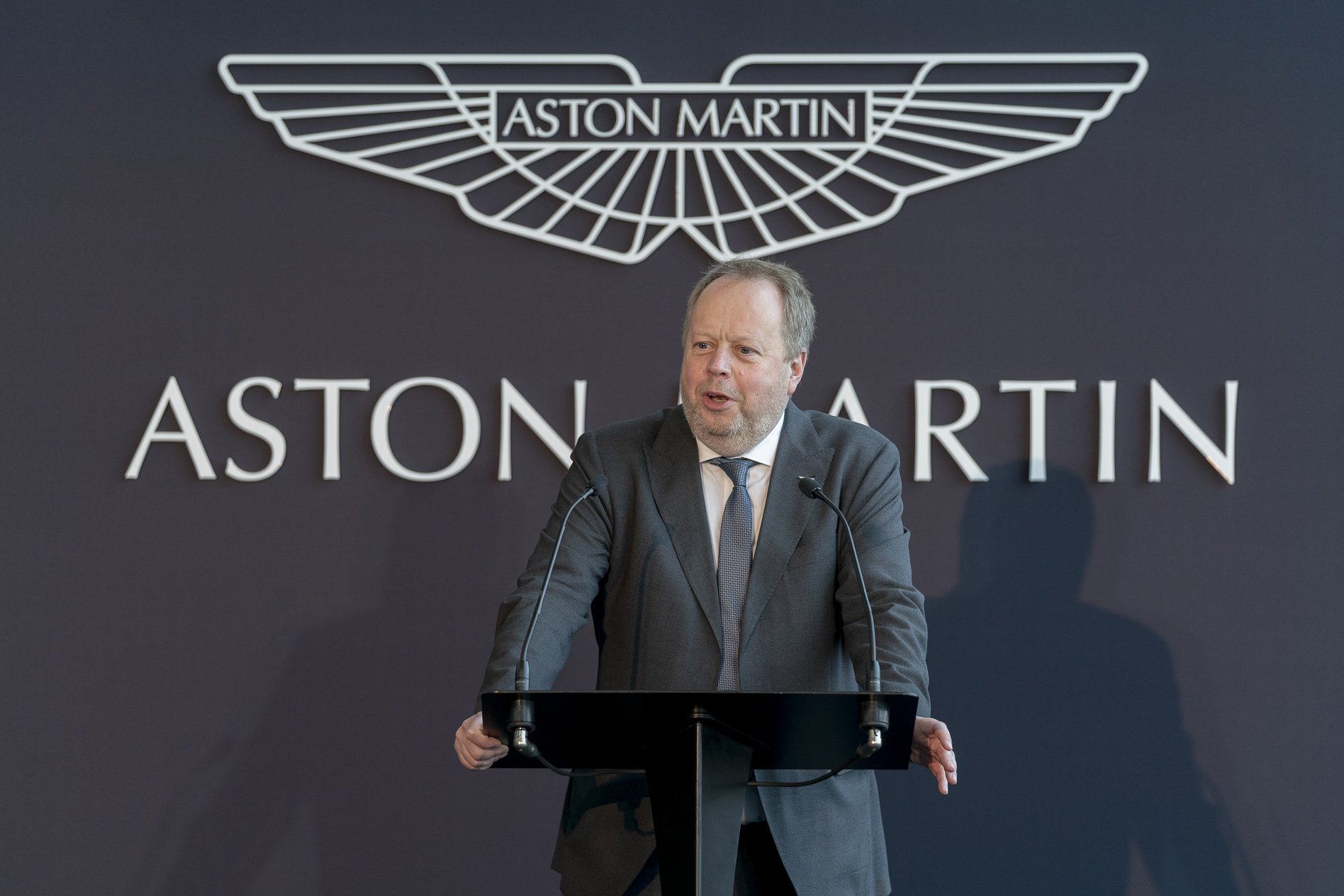
“We have to balance demand and supply to remove extra stock out of the system and get back to building cars to order,” Aston Martin CEO Andy Palmer (below at the opening of the company’s new DBX factory in Wales in December) told UK magazine Autocar in an interview this week.
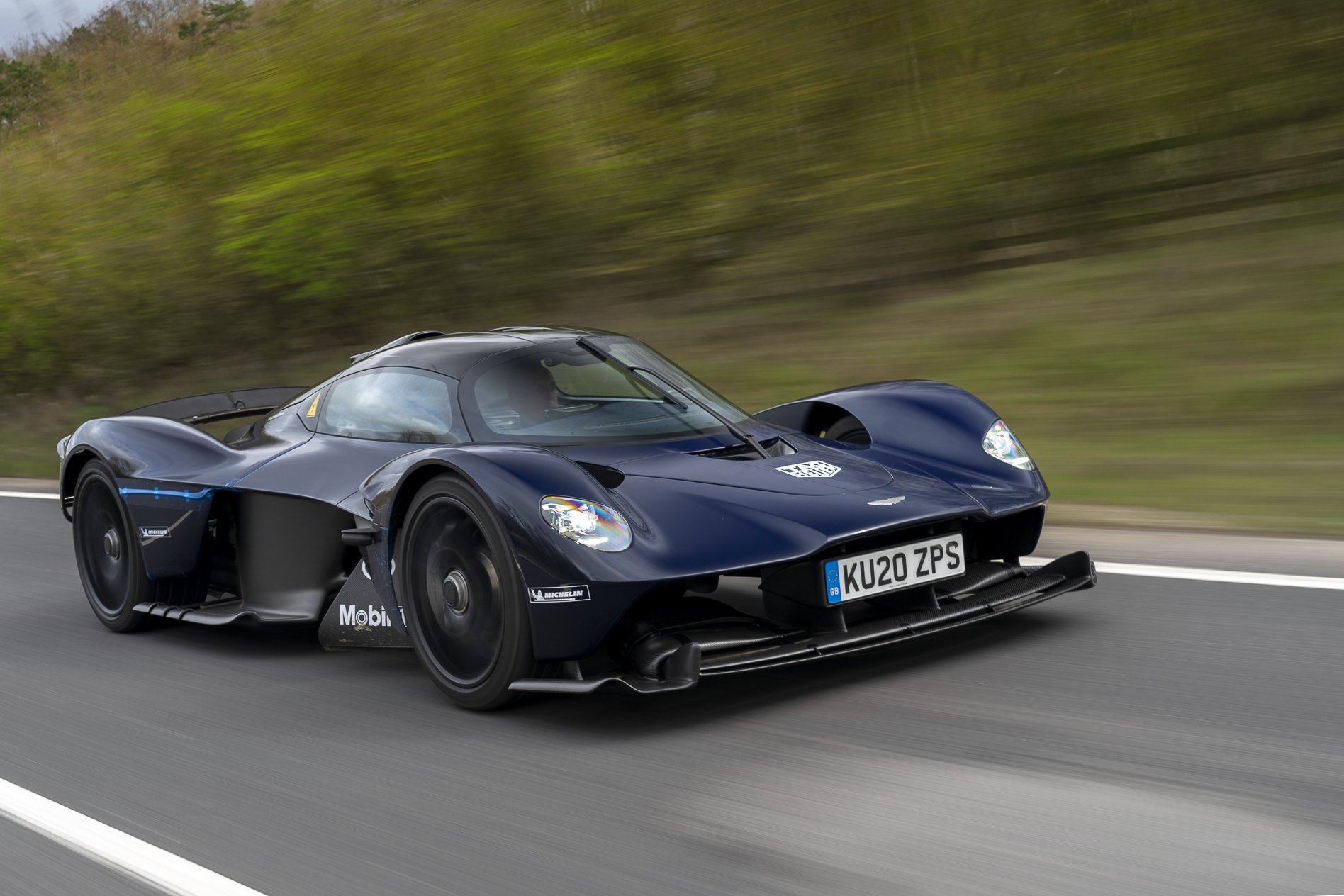
Last year the company built 5800 cars, but Palmer suggested it would build fewer in 2021. Those cars are set to include the DBX and the limited-run, multi-million dollar Valkyrie (below), while a mid-engined and more ‘affordable’ version of the latter, known as the Valhalla, is due in 2022.
The DBX has been in development for some five years, and it could add 4000 sales a year to the company’s bottom line, according to Aston Martin.
It is being looked upon as a potential saviour for the company, much in the way Porsche avoided the gallows in the early part of this century with the release of the non-core but very profitable Cayenne SUV.
However, the COVID-19 outbreak in Europe has seen production halted at all of Aston Martin’s UK sites including at its brand new St Athan plant in Wales (below), while a press event in May has been cancelled.
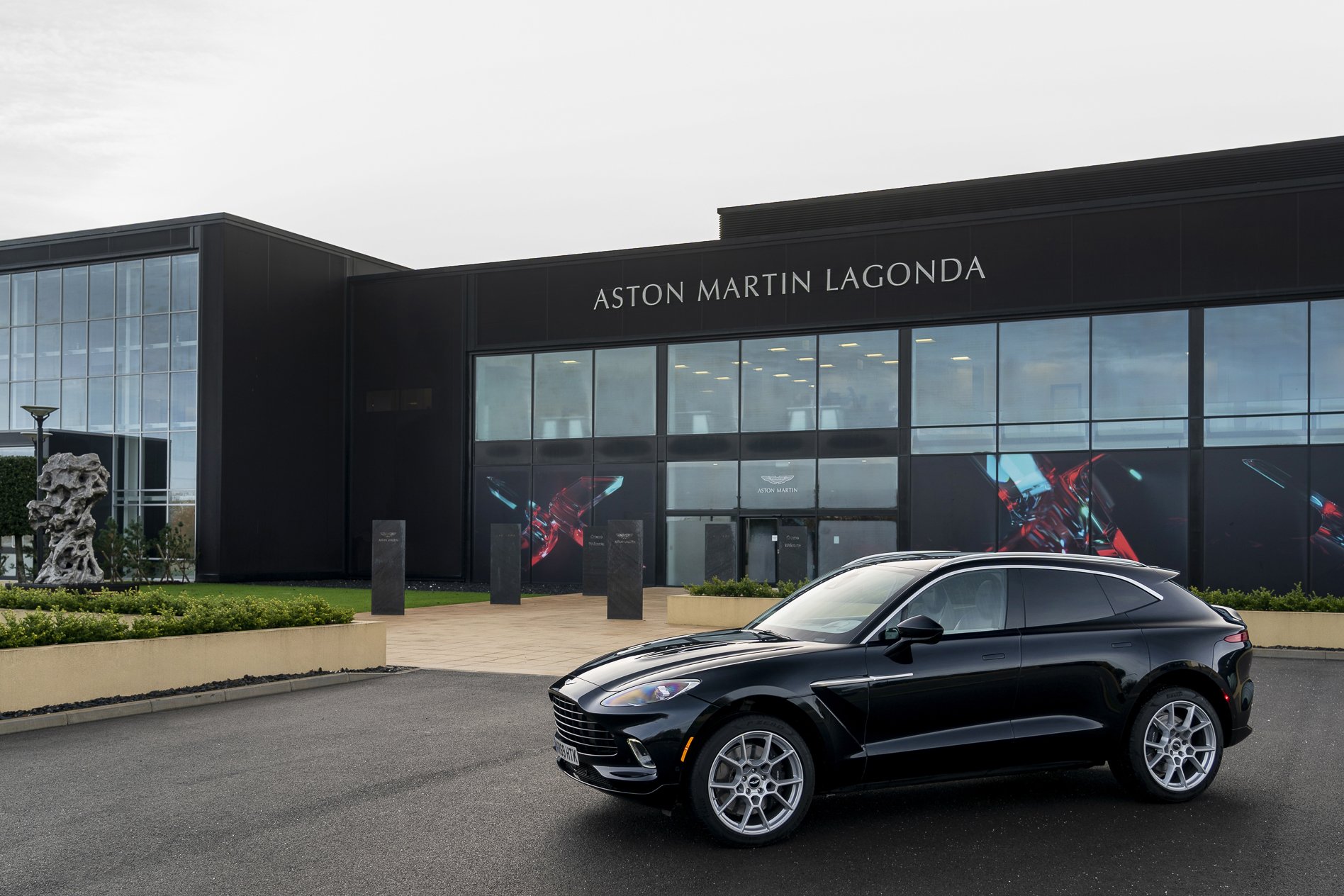
This will mean a delay of several months at least before Aston Martin can dispatch cars to key markets like the US.
The slump in the company’s share price, coupled with a perfect storm of imperfect sales conditions for luxury vehicles, will be a difficult cross to bear. Stroll has taken steps to preserve Aston’s bottom line by shelving well-advanced plans to produce a pair of sports EVs and halting plans to join the Le Mans hypercar class.
By contrast, he is insisting that the company remain on the F1 grid next year as the factory backer of his own F1 team, currently known as Racing Point.
The sponsorship will be pulled from Red Bull Racing, despite the fact that Red Bull and Aston Martin worked closely together on the development of the Mercedes-AMG Project One rival, the Valkyrie.
It seems that the clothing magnate – who is also the Ferrari importer for Canada – has deep pockets for the moment, but only time will tell whether his largesse is proven to be well placed.
Porsche’s engineers might actually be wizards. There have been several examples of relatively inexpensive cars from the Stuttgart brand besting pricier competition, but now Porsche seems to have done something incredibly rare. It’s made an SUV that handles well. Very well.
That SUV is the Porsche Cayenne S Coupe, and it might just be the most sensible option if you really want an SUV that’s fun to drive. I’ll leave the ‘get a wagon’ argument out of it this time.
So, the first thing you need to know is that the Cayenne S Coupe will set you back at least $166K, more if you tick options (you will) like the ‘comfort access’ box which adds $2420 to the price for keyless entry. Our test car’s real-world price was $190,580 before on-roads, but it was painted in Crayon (not pictured), a $5000 option we could do without.
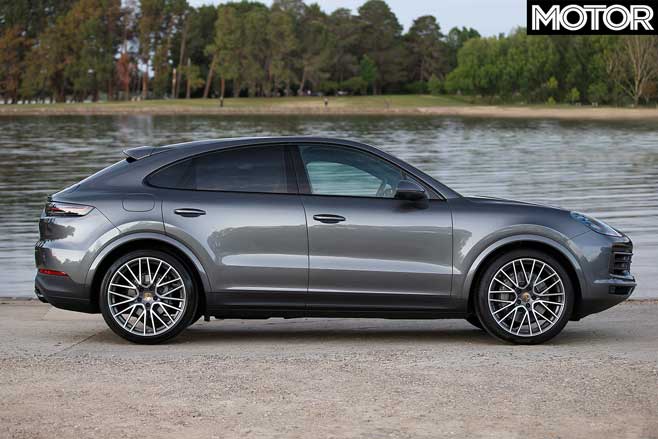
Paint aside, the styling of the Cayenne S Coupe is much better than initial press imagery would have had us believe, and we suspect you may still feel the same with the shots you see amongst these words.
It’s a better-looking car in the metal, so you’ll have to take our word for now. The rake of the rear end is rather sleek, and though it’s still Cayenne-sized, it looks purposeful. Inside, the same goes, sleek and purposeful.
Once out on the testing route of our choice (having experienced a pleasant ride on its standard air suspension for the commute), the top of Lake Mountain via Reefton Spur, Cayenne S Coupe quickly made it known it could tackle a drive unlike many other SUVs can.
Rather than stiffening up far too much to be comfortable in Sport Plus, the Cayenne lowers itself slightly and uses its PASM (Porsche active suspension management) with precision.
It’s calibrated well enough that, rather than becoming an understeering mess though fast corners, the S Coupe holds its balance and actually rotates with a hint of oversteer, in part thanks to optional rear-axle steering ($4300 for that one).
It behaves in such a way that, and I hesitate to write this, it mimics a sports car. It feels much more composed and far less top-heavy than anything its size should.
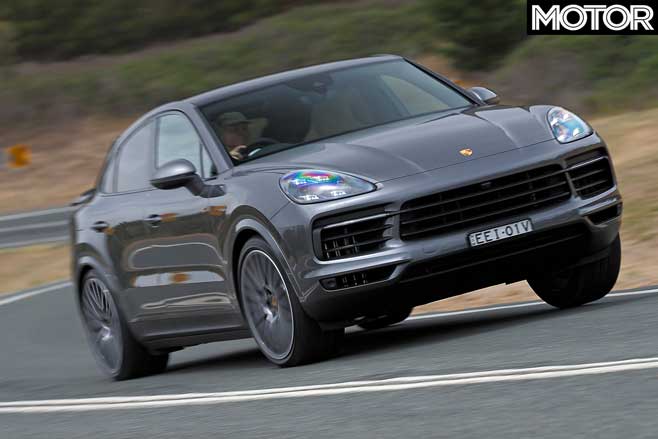
In fact, its handling and grip (on Pirelli P Zeroes) allow you to do some very silly things, get away with it, and ask yourself ‘how?’ But its chassis always keeps you in the loop as to how much room you’ve got left to mess about.
Even on a cold, damp road, it feels as though you’d have to be driving like a full-blown numpty to crash it. Sport Plus lets you slide, in quite a controlled manner, quite a lot. Hilariously so for an SUV.
After the corner, the sweet 2.9-litre twin-turbo V6’s 324kW and 550Nm come into play. It’s a strong engine which delivers power smoothly, so much so you wouldn’t guess it’s claimed to hit 100km/h in five seconds flat.
It’s even rather responsive for a turbocharged engine, and if you’re on top of the gearbox (which can often be left to its own devices) you’ll find there’s always power when you need it. It pairs well with the chassis… and it sounds good too, which brings us to another option.
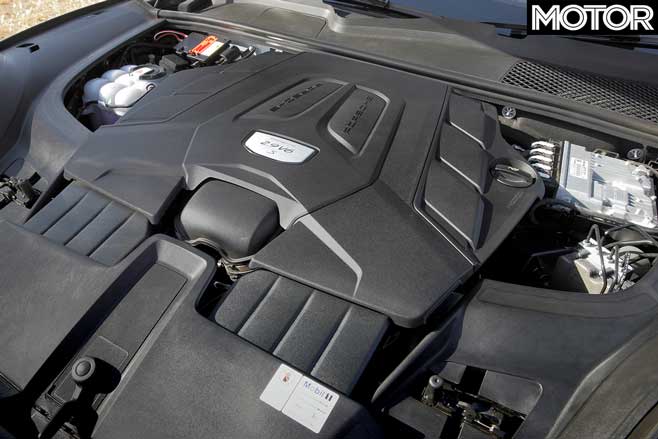
The only other box we’d suggest you need to tick is the sports exhaust, which was $5970 on our test car with tailpipes in silver. This gives the engine’s sound a bit more bark and come across rather intensely even from outside the car, free of the false generated sounds inside.
With some frugal choices, you could probably land a Cayenne S Coupe that’s as satisfying to drive as this one for around $175K. For this reviewer, it’s the only SUV in recent memory that’s really worth taking for a drive on mountain roads just for the sake of it.
It feels more balanced and composed than even smaller, faster SUVs from rival companies – AMG’s similarly-priced GLC63 S, for example. In fact, it might be the best driver’s SUV for less than $200,000. Maybe even one of the best full-stop.
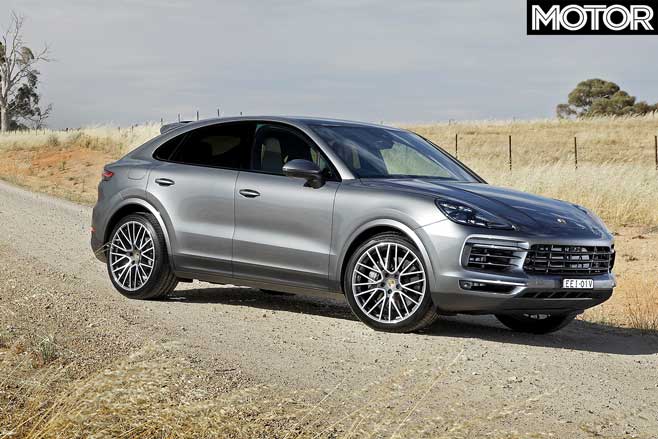
2020 PORSCHE CAYENNE S COUPE SPECS Engine: 2894cc V6, DOHC, 24v, twin-turbo Power: 324kW @ 5700-6600rpm Torque: 550Nm @ 1800-5500rpm Weight: 2050kg 0-100km/h: 5.0sec (claimed) Price: $166,200 ($190,580 as tested)
Likes: Can do things SUVs shouldn’t; ride quality; sounds aggro Dislikes: Still hasn’t beaten physics completely; price with options; wagons exist
Rating: 4 out of 5 stars
It wasn’t too long ago that drivers spent as much time under the bonnet as they did behind the wheel, getting to know their car intimately and saving decent money by doing their own repairs and servicing.
For many people that’s a good thing; after all, that’s what mechanics and service intervals are for. But if you like to tinker there are still a few useful maintenance tasks you can do yourself to save some money while being more in tune with your car’s workings and needs.
While doing your own servicing could void the car’s warranty you should be able to do individual tasks when the need arises, though it’s best to check the warranty contract and with the car manufacturer first.
Before doing any work always consult your owner’s manual and have the necessary tools and consumables ready. It’s also a good idea to invest in an appropriate maintenance guidebook for your car. Also, check YouTube or internet forums specific to your car for helpful advice from fellow enthusiasts.
Here are some jobs you can do yourself that could spur you on to bigger things.
Windscreen wipers
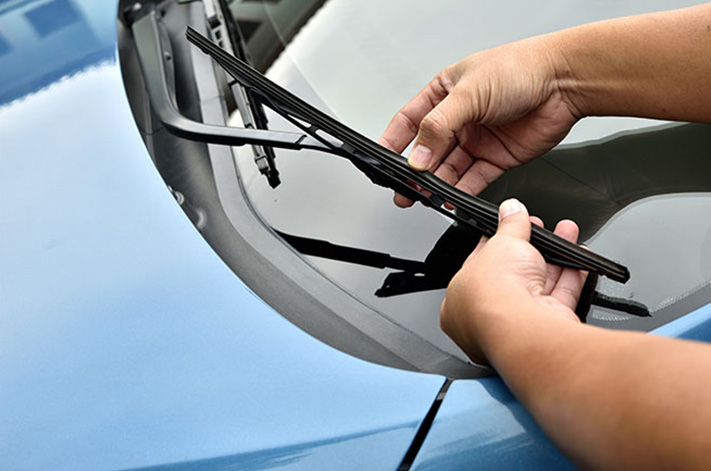
Wiper blade assemblies vary between cars so consult your owner’s manual and the wiper blade packaging.
Replacing globes
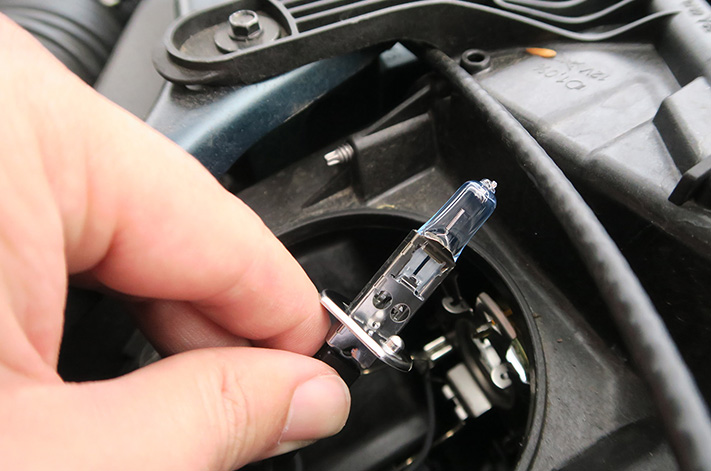
Whether its headlight or taillight globes or interior lights this is an urgent but relatively simple task that could save a bit of money and hassle. The most important thing about changing globes is knowing how to access them, so it’s best to consult a manual, specialist internet forum or YouTube first to avoid frustration or damage.
Air filter
The air filter prevents dirt and other particles from getting into your engine where they can cause poor efficiency, decreased performance or even permanent damage.
Meanwhile, a clogged air filter allows less air in which affects your car’s fuel efficiency. They are checked during services but not automatically replaced so it’s worth inspecting them yourself from time to time. In most new cars air filters are in black boxes with metal clips on the side.
Some cars may have more than one air filter, and if you live in a dusty environment you may need to replace your filter more frequently than normal.
Battery maintenance
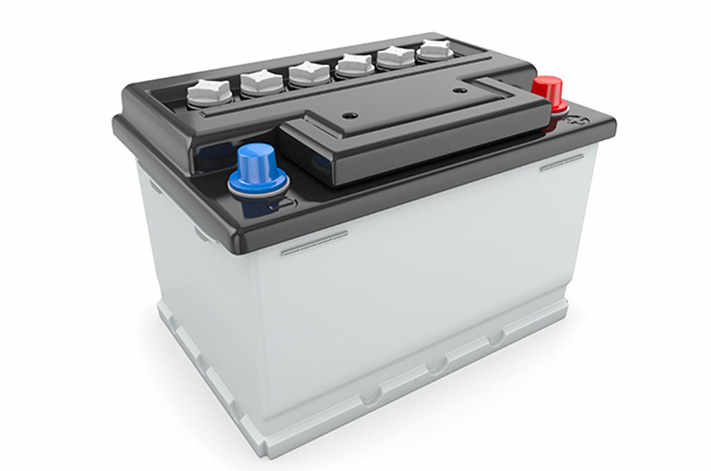
White powdery residue is one of the eight tell-tale signs that your battery may need replacing but you should be able to prolong its life with some TLC, a wire brush and corrosion removal fluid. Be sure to disconnect the battery before you start.
Replacing a battery is usually a matter of disconnecting the negative terminal followed by the positive terminal, then unbolting a retaining bracket, but some cars may require a special procedure. Doing it incorrectly could impact your warranty too, so tread carefully.
Oil and oil filter
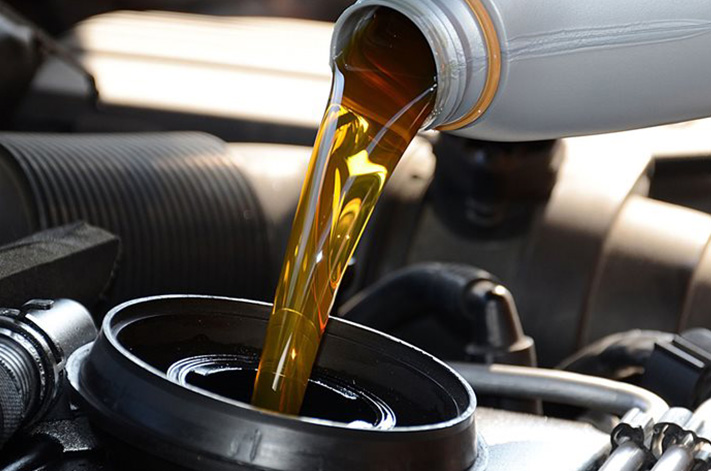
This is one task that could have warranty implications so check your local service department. Some manufacturers have propriety tooling for undoing sump plugs and oil filter housings, meaning only authorised repairers with specialised equipment can do it.
If you are able to replace the oil and oil filter yourself you’ll need an oil filter wrench, oil pan and funnel.
Only do this when the engine and oil have cooled down and when finished pour the old oil from the pan to the empty oil bottle and dispose of it and the old oil filter appropriately. Always follow the manufacturer’s recommendation for which grade and type of oil to use, and ensure the oil filter is designed to be used with your car’s engine.
Flushing the radiator
Depending on the car it’s a good idea to replace the radiator coolant every year or two years – your driver’s handbook should tell you the correct frequency.
This task requires radiator flush solution, coolant, a funnel and receptacle to take and dispose of the old coolant. As with changing oil make sure the car engine has cooled down and don’t use ordinary water instead of coolant as the impurities can corrode or block the radiator cells. Coolant also has anti-freeze in it, which is vital if you drive in sub-zero weather on occasion.
Dispose of the old coolant carefully and wash any spillage away so animals don’t drink it.
Spark plugs
This is an easier task than it appears; you just have to do it carefully doing one plug at a time. As well as replacing the spark plugs you might need to change the plug leads as well – if your car has them. Note that it may be quite difficult to gain access to the plugs on some cars depending on their engine layout – especially on boxer engines and V-format engines.
Ensure you have the correct plugs and cables for your car and appropriate tools such as a ratchet socket set with a 30cm extension and spark plug socket. It’s also a good idea to have a feeler gauge to measure the spark plug gap even if using ‘pre-gapped’ plugs as knocking the base of a spark plug could affect the spacing needed to create a spark.
Brake pads
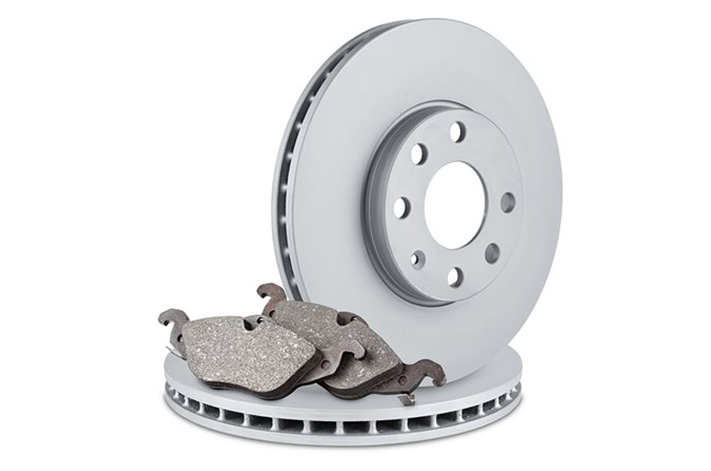
Replacing brake pads is probably the most complex DIY car maintenance tasks on this list and requires tools such as a G-clamp, shifting spanner, hammer and secure car jack.
This is one task that shouldn’t be attempted without an appropriate maintenance manual and, if you get to a point where you’re not sure of things, be sure to consult an expert. Brakes are critical to your car’s safety and roadworthiness, so don’t attempt this one if you’re not sure of what to do.
The Australian government has righted Honda’s past wrongs after approving the Japanese-only 2007 Civic Type R sedan for Australian import under a new, enthusiast-friendly legal framework.
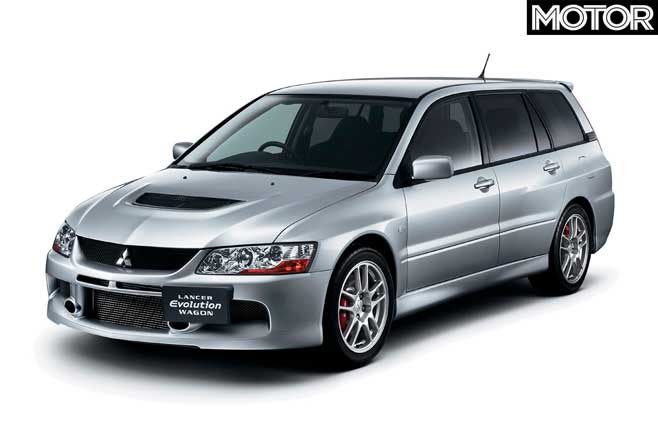
That’s not all, though. It’s also said the second generation Subaru Forester STI is good to go, along with the wagon-bodied Mitsubishi Lancer Evo IX.
These JDM legends would have been ineligible to qualify for local import under the outgoing SEVS criteria, but incoming new import rules, known as the Road Vehicles Standards interim regulations, have drastically opened the scope of eligibility.
And now the Department of Infrastructure, Transport and Regional Development (DIRD) has started approving cars to allow dealers to begin importing cars and workshops to start the all-important compliance process.
As you might remember the four-door racetrack-tuned Civic Type R from Japan skipped the rest of the world in 2007, with a less remarkable rear torsion-beam version gracing Europe and Australian roads instead.
But now you can import the 167kW four-door Type R wonder, which sported duct-cooled Brembo front brakes and independent rear suspension, through specialised dealers, provided you’re willing to cough up.
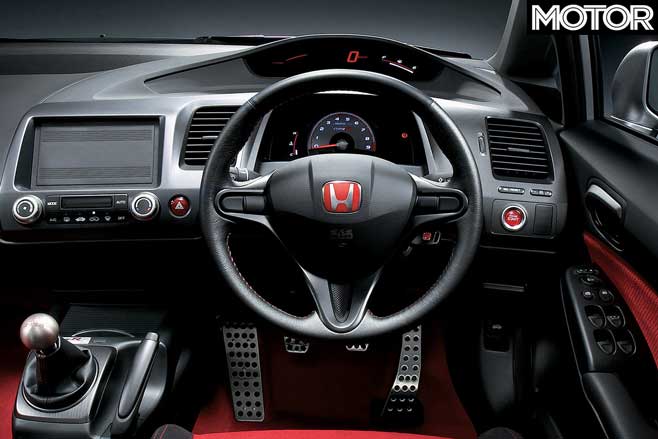
“Regarding the import cost,” Geoff from importer Prestige Motorsports says, “the range in price for 2007 to 2010 models will be from about $25,000 to $50,000 complied plus on road costs, dependent mostly on km.
“White is the most popular colour. The high price range is for very low, collector cars. Lower range would be for a 2007 with over 100,000 km, decent condition daily driver.”
Importers across the country have been championing the news but also warned buyers the compliance process could take some time.
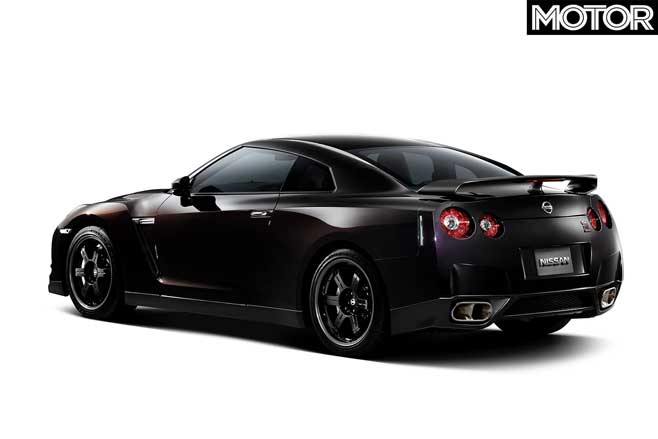
“It’s worth noting that making a car eligible is only half the battle,” Kristian Appelt, from well-known Iron Chef Imports told us, “the other is convincing workshops there is a business case for putting the car on their model schedule.
“No one wants to spend $30K doing emissions and light testing if they won’t then comply a heap of them to recoup those costs.”
That means while there are a bunch of cars on the now-approved list, there’s still the issue of making sure you can drive it once the car’s here.
“We have a fair handle on who is doing what, so we can generally advise people who they need to call,” Iron Chef Import’s Appelt continues.
“Once workshops have completed their evidence packs, they will often make them available for purchase by other workshops. It helps reduce the time taken for testing procedures (lights and emissions are the two big ones).”
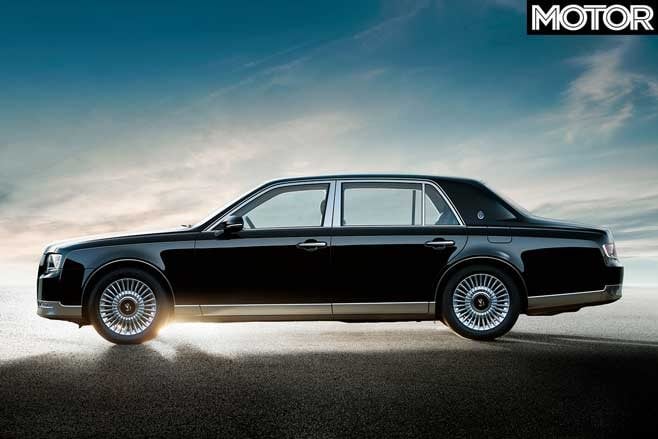
Otherwise, you can find an approved workshop through DIRD’s website to seek out your own compliance for more niche and limited models – like a Bugatti Chiron, which can be imported under the new ‘Rarity’ criteria.
That said, we understand there’s a lot of momentum behind complying Forester STI. The short run of STI-fettled Forester, with a proper 2.5-litre turbo flat four and Impreza STI-aping suspension, skipped our shores and left us with the less desirable versions in lieu.
We understand low kilometer examples around 60,000km would fetch $30K complied according to Prestige Motorsport.
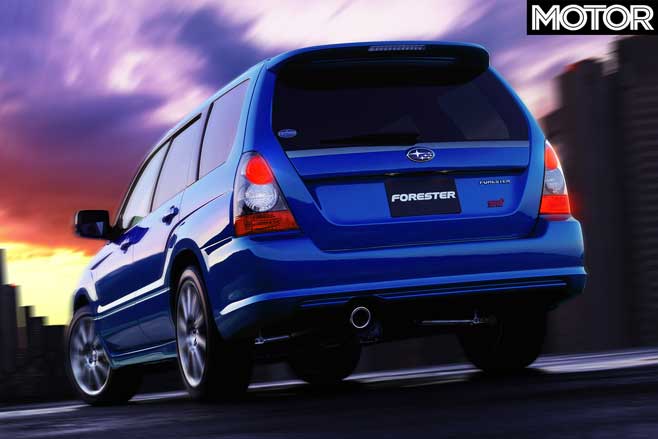
Previously, outgoing SEVS rules would have blocked these cars on grounds a base model was sold through showrooms during the same period. This left enthusiasts to rely on drastic measures, like overseas ownership, race-only use or the pre-1989 rule to get around the restrictions.
Currently, cars are being approved at discretion by the minister responsible under the new RVS guidelines that come into permanent effect on July 1, 2021.
DIRD has been going ahead with the approvals since it’s been transitioning the entire approval scheme to online for the new rules since December 10, 2019, leaving the framework in a half-way phase where cars are first considered under outgoing MVSA rules, then new RVS rules if they don’t qualify. Cars are then complied under existing MVSA framework.
The latest laws are a result of persistent lobbying and negotiation between importers, manufacturers and the government.
The full list of considered-eligible cars can be seen here.
Sign-up here for your free weekly MOTOR report
*This article originally stated the Honda Civic Type R sedan sported 160kW, when it was in fact 165kW. It’s been updated to reflect the information.
MOTOR review
In some ways, the Lexus RC F Track Edition is the most focused coupe Lexus has built since the LFA. But it also seems a little confusing.
For a brand with an average buyer age north of 55 years-old, building a carbon and metal car that looks like it belongs on a racetrack… in a videogame… seems an odd move.
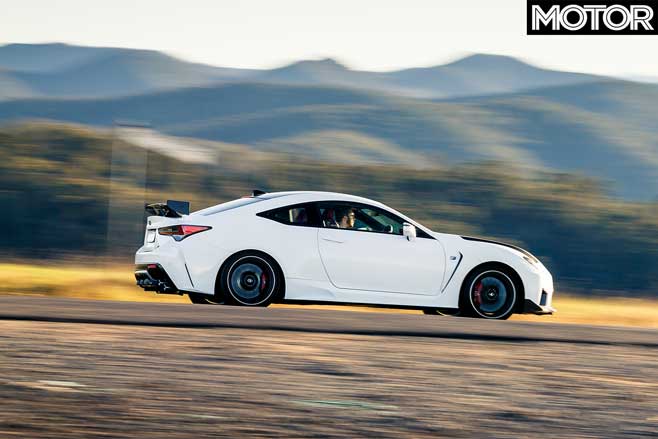
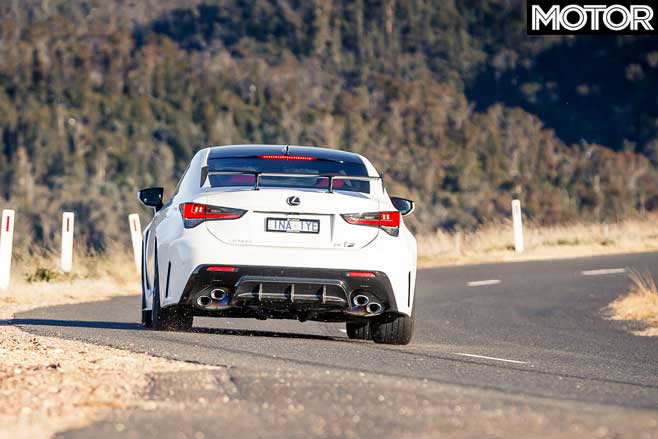
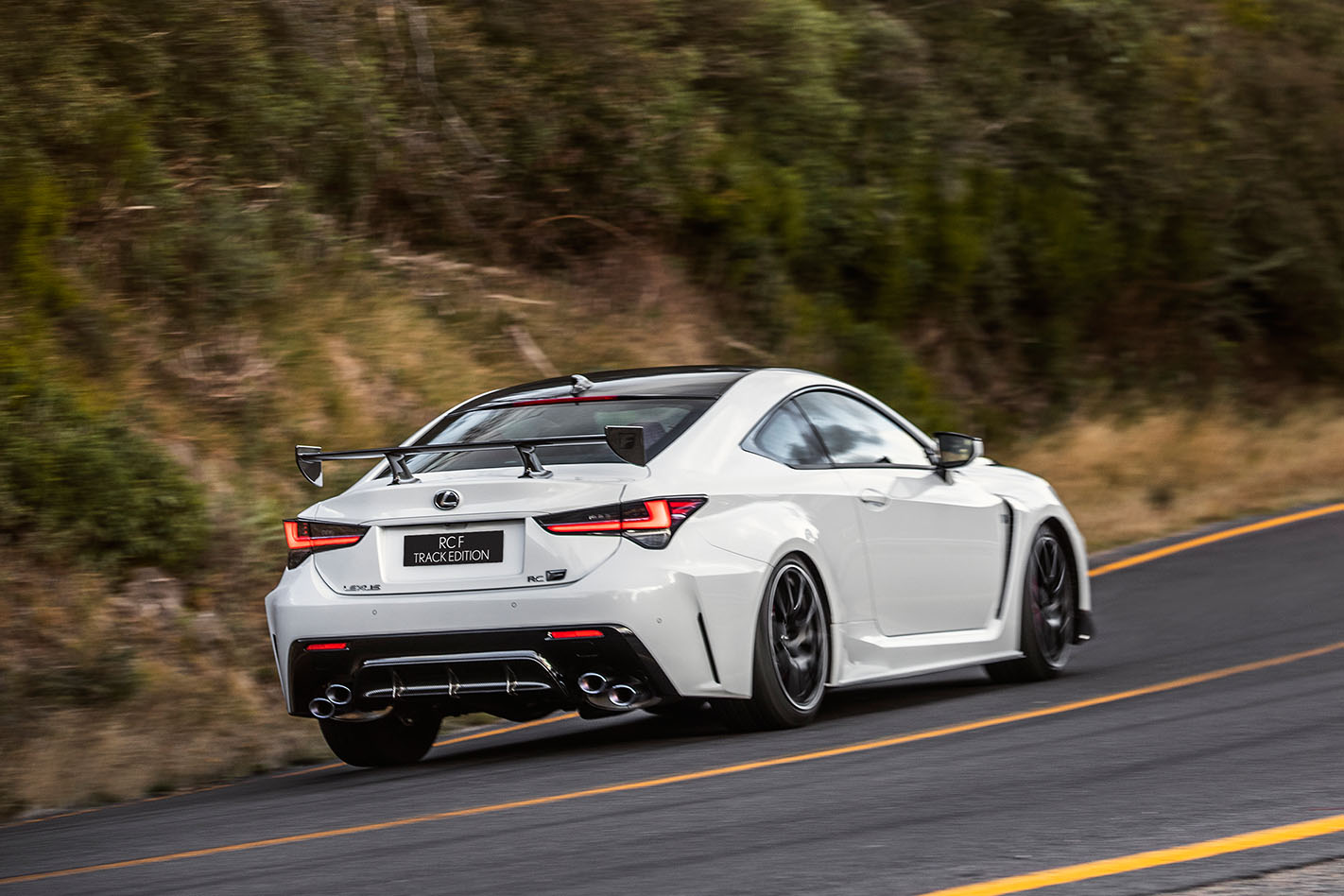
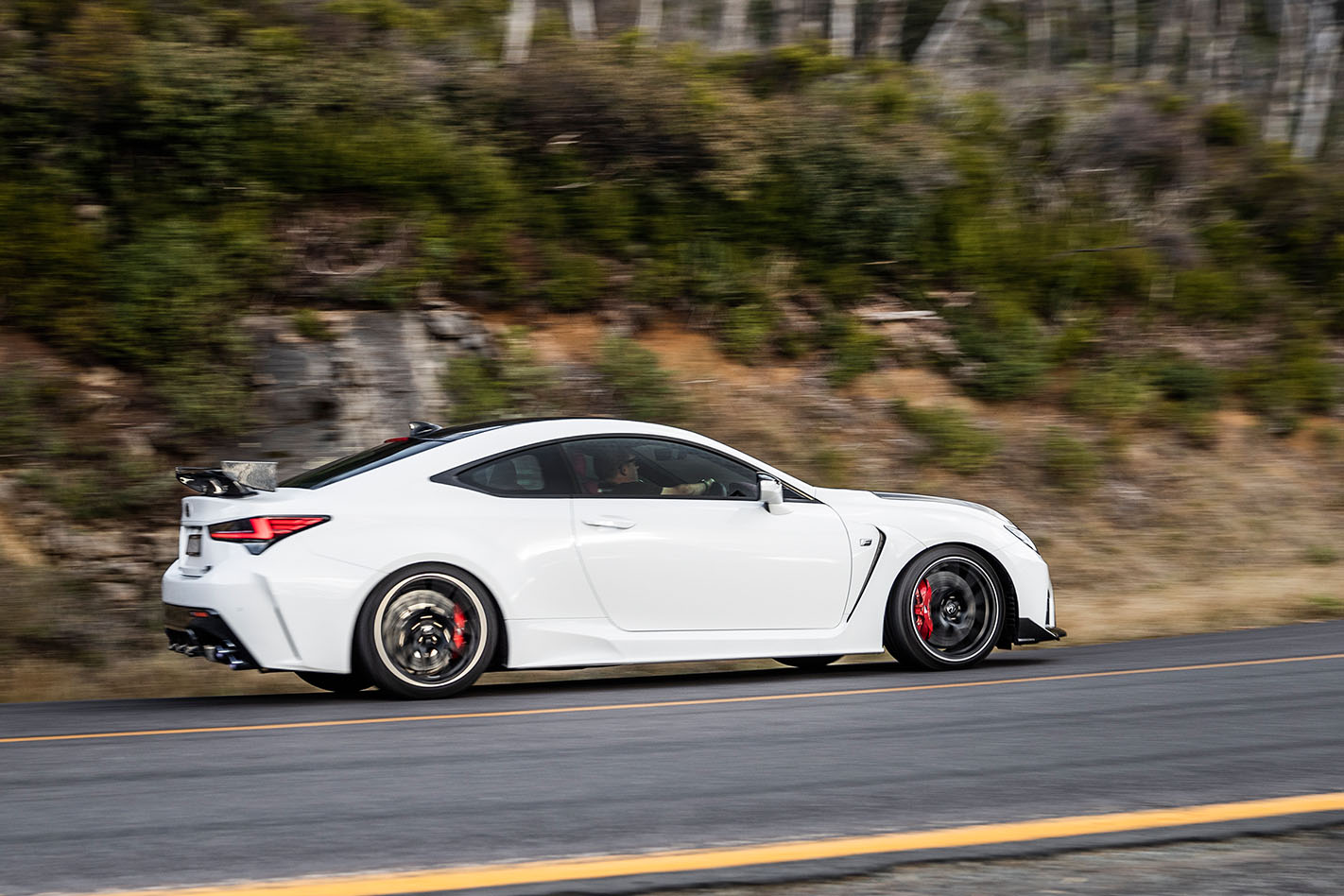
It exudes automotive aggro, from the staggered titanium exhausts turned blue from heat, past the lightweight forged BBS wheels, up to the black and white face of our test car, looking like a Stormtrooper has left the Star Wars universe and gone anime instead. Fortunately, the imposing black ‘n’ white works in the Track Edition’s favour.
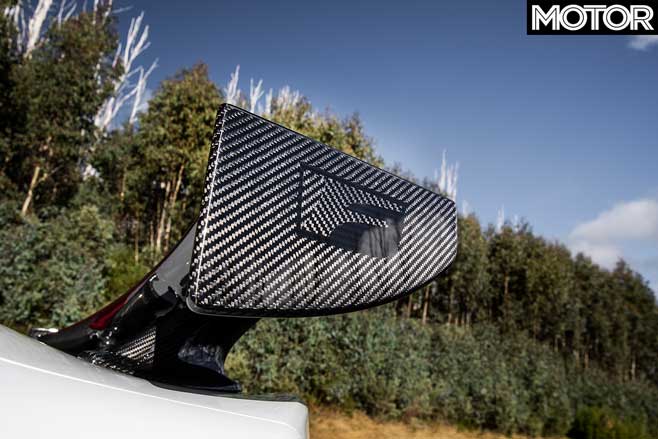
The carbon wing on the back is also a big tick for these eyes, though it doesn’t seem like something Lexus would normally do itself.
But it’s not all show. The carbon keeps the RC F’s centre of gravity lower, and the 19-inch BBS wheels reduce unsprung weight, helping the big carbon ceramics behind them pull the admittedly still-heavy car up. Weight is also saved though the removal of Lexus’ tricky computerised torque vectoring diff (TVD) in favour of a Torsen mechanical unit (we’ll get to that later), as well as a hollow but reinforced driveshaft.
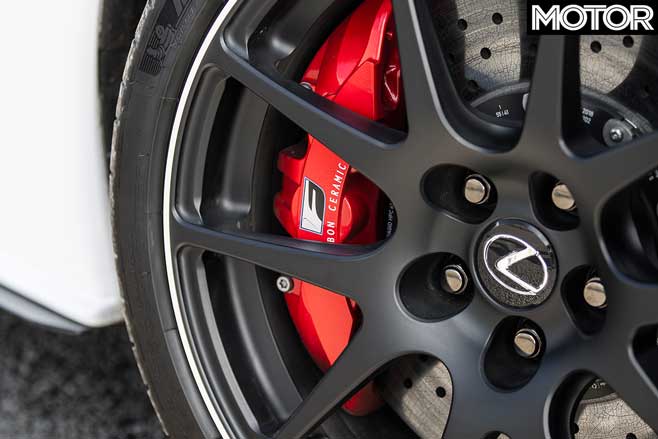
Carbon and simplification mean the Track Edition is down 65 kilograms from its standard RC F sibling, the equivalent of kicking out your smallish passenger to get a faster lap time.
And while the weight reduction is welcome, it’s the simplification which achieved it that makes the Track Edition a better car. It’s like Lexus’ engineers stopped trying to turn an ageing car into something ‘cutting-edge’, and instead embraced the fact it’s a bit old school.
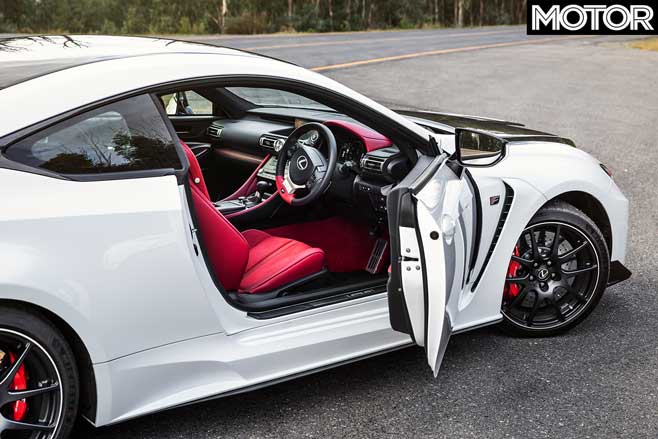
From inside, the retro vibe is strong thanks to red carpeting, Alcantara, and leather, with the now-dated Lexus infotainment system taking pride of place in the centre. That touchpad must go. Please, Lexus?
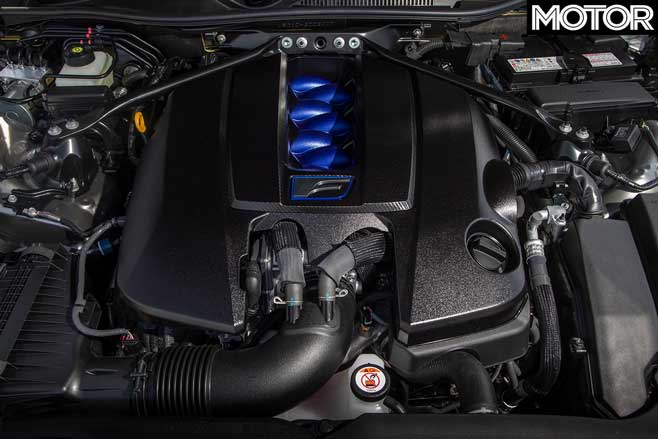
Start up, and the 5.0-litre sounds relatively muted for what it is. It’s also rev-limited based on engine temperature, so reaching the upper-end of the tacho where the V8 really sings is only possible after getting on your way.
This means its peak power of 351kW, which is available at 7100rpm, is off-limits at first. Peak torque, however, is. The full 530Nm comes along at 4800rpm, and stick around until 5600rpm, though the sound of induction and atmo screams tempt you to chase the redline. Sticking near it is also easier thanks to a honey of an 8-speed torque converter, which responds eagerly to upshift requests (via paddle or shifter) and is still relatively compliant when it comes to downshifts.
As a car to drive on the road every day, the Track Edition is a little stiff, though that gearbox becomes very smooth in Comfort. The car handles and behaves well, but even Comfort mode gets a little much after a long stint behind the wheel – which itself is not massively feelsome thanks to numb but light steering. But as a driver’s car, this might be one of Lexus’ best.
Without masses of boost, the RC F’s need to remain towards the top of the tachometer means even in a straight line, there’s an element of excitement to the car that’s not incredibly common. Luckily, that carries through to its cornering ability.
Wheels shod with MOTOR’s Tyre Test 2019 winner, the Michelin Pilot Sport 4S, help hide a little of the RC F’s weight through bends, as it makes traction rather predictable. The tyres are sticky enough that they won’t let go given a reasonably sharp turn, but they won’t surprise you with a sudden loss of traction if you overcook it.
This means you can have a little bit of fun with the rear, via your right foot, if you happen to find the right moment. This also comes thanks to the Torsen diff, where the techy TVD unit would be trying to fight your mid-corner antics by keeping you ‘on course’.
But where the diff’s advantage is simplicity, it’s a good thing the brakes went the other way. Rather large carbon ceramics are capable of halting the relatively heavy car efficiently, but doing it mid-corner can result in some unwanted rotation, and doing it in the wet… well, the whole exercise becomes a bit sketchy in the wet – you’re best to choose a dry day as 1715kg becomes rather a handful otherwise.
But even then, it’s actually a fun handful. A reminder that bug V8 coupes can still be muscular, and that Japan still builds exciting cars north of the $100,000 marker.
Sure, it’s probably not going to be the first choice for the 60-year-old business exec who’s owned Lexus cars since he was a yuppie, but with only 10 Track Editions coming to Australia, it shouldn’t be too hard to find buyers even at $166K. It’s certainly rarer than a C63 S Coupe or an M4 Competition. It’s also arguably as likeable, even if not as capable.
It turns out Lexus’ strange exercise in undergoing a track-focused rebrand makes sense after all, even if you don’t quite get it at first.
2019 Lexus RC F Track Edition specs BODY: 2-door, 2-plus-2 seat coupe DRIVE: rear-wheel ENGINE: 4969cc V8, DOHC, 32v BORE/STROKE: 94 x 89.5mm COMPRESSION: 12.3:1 POWER: 351kW @ 7100rpm TORQUE: 530Nm @ 4800-5600rpm WEIGHT: 1715kg POWER-TO- WEIGHT: 204kW/tonne TRANSMISSION: 8-speed automatic SUSPENSION: double wishbone, dampers, coil-springs anti-roll bar (f); multi-link, dampers, coil springs, anti-roll bar (r) L/W/h: 4710/2050/1390mm WHEELBASE: 2730mm STEERING: electrically assisted rack-and-pinion BRAKES: 380mm carbon ceramic discs, 6-piston calipers (f); 380mm carbon ceramic discs, 4-piston calipers (r) WHEELS: 19.0 x 9.0-inch (f); 19.0 x 10.0-inch (r) TYRES: Michelin Pilot Sport 4S, 255/35 ZR19 (f); 275/35 ZR19 (r) PRICE: $165,690
LIKES: GT3 styling; won’t get tired; old-school fun; sounds potent but…
DISLIKES: …should sound angrier; still a weighty unit; THAT INFOTAINMENT INTERFACE
4 out of 5 stars
Sign up here for your free weekly report on the world of fast cars!
Second Opinion: Wheels review
Overall Rating
4 out of 5
Plus & Minus
Plus: Glorious V8 soundtrack; rear-driven dynamics; interior quality
Minus: It’s far from cheap; up against stiff competition; cabin ergonomics
The Wheels Verdict: The Lexus RC F Track Edition might not be the sharpest tool in the performance-coupe shed, but it has a good heart. It’s easy to like from behind the wheel and, most importantly, Lexus has kept the naturally aspirated V8. It offers old-school thrills with a modern twist… just be prepared to pay for the privilege.
WHAT IS THE LEXUS RC F TRACK EDITION?
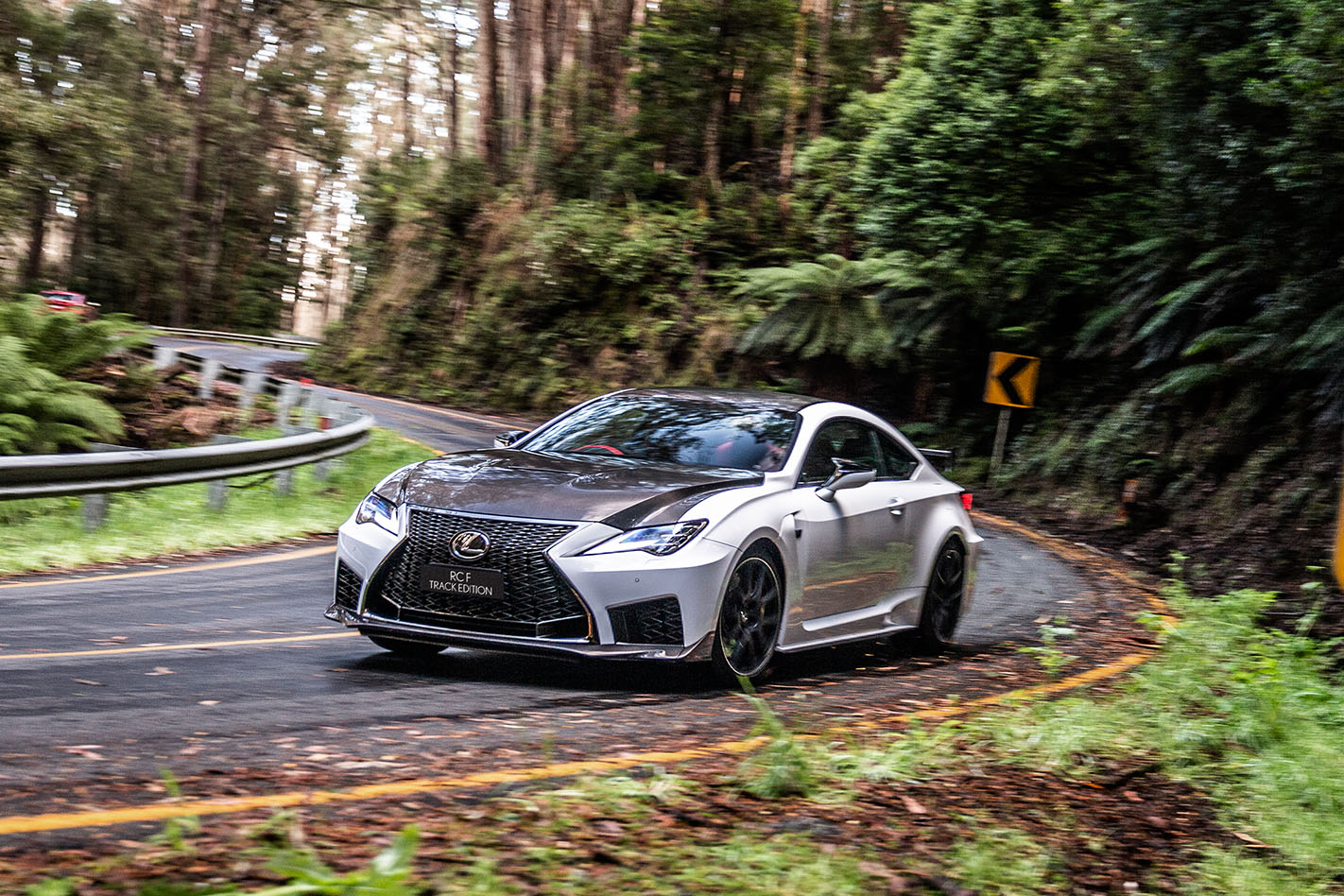
At $165,482 the Lexus RC F Track Edition isn’t cheap – it’s now squarely in the crosshairs of serious German performance. For the extra spend over the standard $133,921 RC F, the circuit-focused version gains Brembo carbon-ceramic brakes, 19-inch BBS alloys, a mechanical LSD, myriad carbonfibre additions and a lighter titanium exhaust.
WHY WE’RE TESTING IT
According to Lexus, it’s the next-quickest model the marque has made behind the LFA. That’s not an insignificant call from the luxury Japanese brand. So we’d better see if it stacks up on Aussie roads.
LEXUS RC F TRACK EDITION REVIEW
Car buyers are, as a summation rather than a rule, governed by habit and perceived reputations. Going outside usual lines is more a rarity than the norm. Those within the circa $150-$200K performance coupe market generally stick to the trusted German trio of the Audi RS5, BMW M4 and Mercedes-AMG C63 S. You could even throw in the Chevrolet Camaro ZL1 for kicks. However, there is another way to gain two-door, rear-drive thrills – and it’s decidedly more old school.
It’s been around down under in various guises since 2015, but the Lexus RC F has always been the left-of-centre beacon for individuality. The exterior styling is polarising and the outright performance isn’t quite comparable to the Germans. However, that hasn’t stopped the team in Nagoya honing it to what we see here, the Track Edition. Which seems rather odd given you’d unlikely state the RC F’s USP as a circuit warrior.
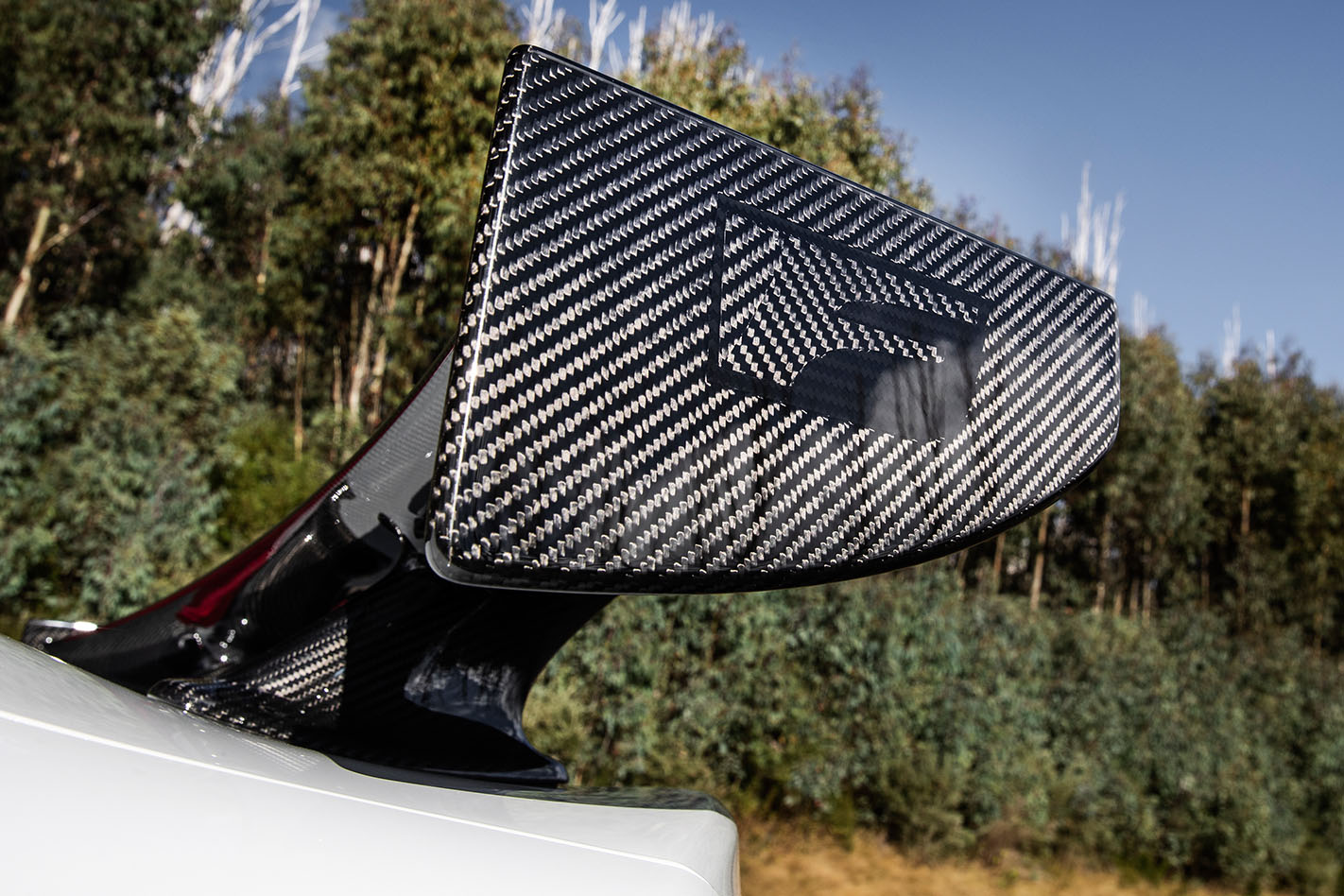
Still, at $165,482 the newly coined Track Edition is festooned with carbonfibre, so much so that the kerb weight has been cut by 65kg to 1715kg. You also get beefed-up brakes in the form of Brembo carbon-ceramic discs (380mm all round, six-piston calipers front and four rear), BBS alloys and a titanium exhaust. The huge carbonfibre rear wing screams GT3 pretensions, while the underlying RC F exterior design is only amplified by the various addenda.
While it remains unchanged, the beating heart of the RC F is still one of the key factors that make you want it. The atmo 5.0-litre V8 produces 351kW and 530Nm and can vault the Track Edition to 100km/h in a launch-control-assisted 4.2 seconds. Not bad given the 1.7-tonne heft. Throttle response is top notch, but the 4969cc bent-eight needs more than 3000rpm to boogie, so working the eight-speed auto’s lower ratios returns the most meaningful progress.
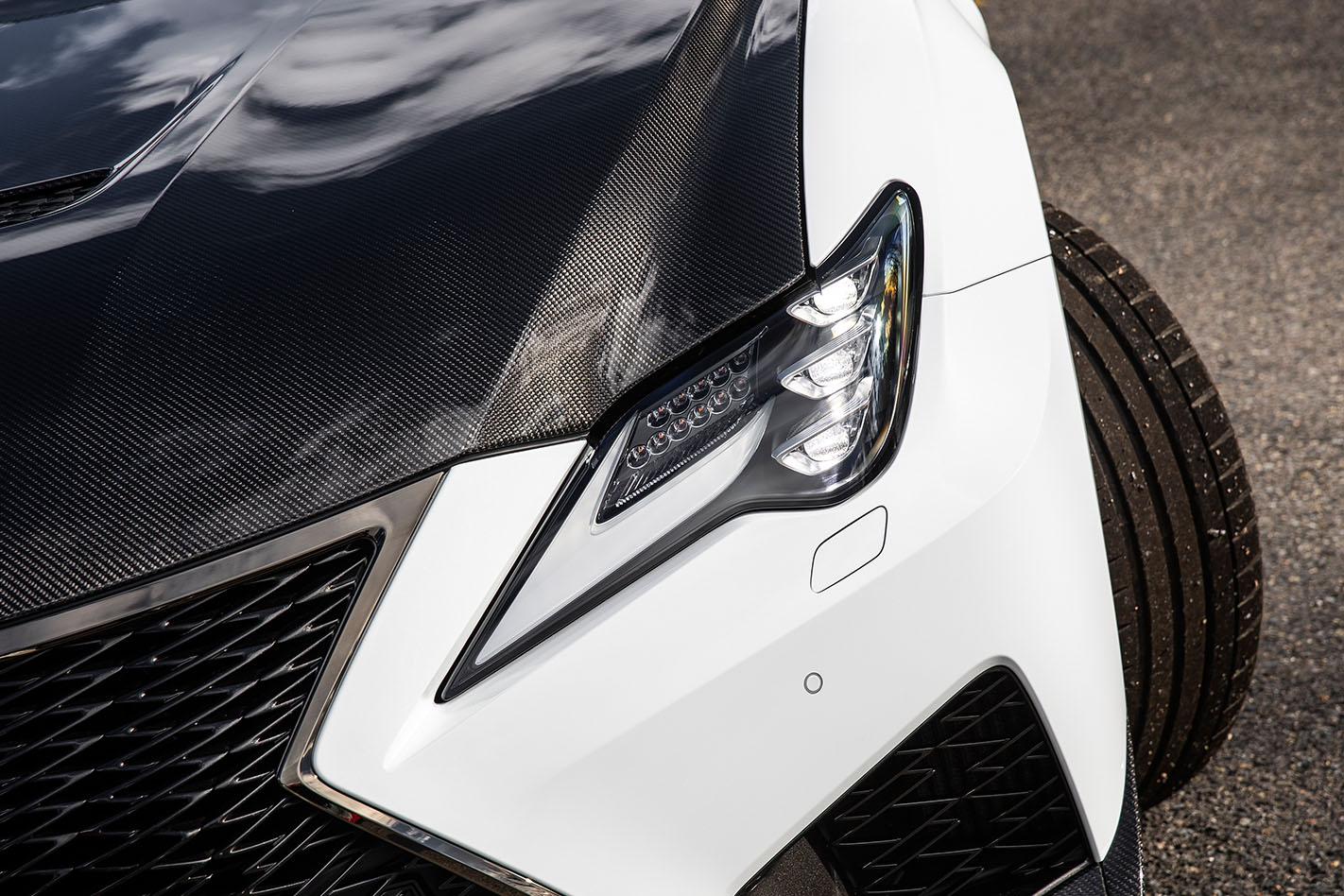
And boy does it emit a soulful tune while doing so. It’s deep and burbly down low, but shifts up as the revs rise and the heady induction roar joins the party in the upper reaches of the tacho. The torque-converter auto will even blip the throttle on downshifts (although the change doesn’t always happen as immediately as you want it to), which verges on sounding like the LC500. NASCAR eat your heart out.
Dynamically the RC F is surprisingly good fun – and competent. Despite wearing grippy Michelin Pilot Sport 4S rubber (255/35 ZR19 front and 275/35 ZR19 rear), the back end is mobile. It’ll even squirm in a straight line under heavy load and it’s easy to attain controllable levels of slip on corner exit. The Torsen mechanical limited-slip differential helps here, as does the ‘Expert’ mode for the ESC.
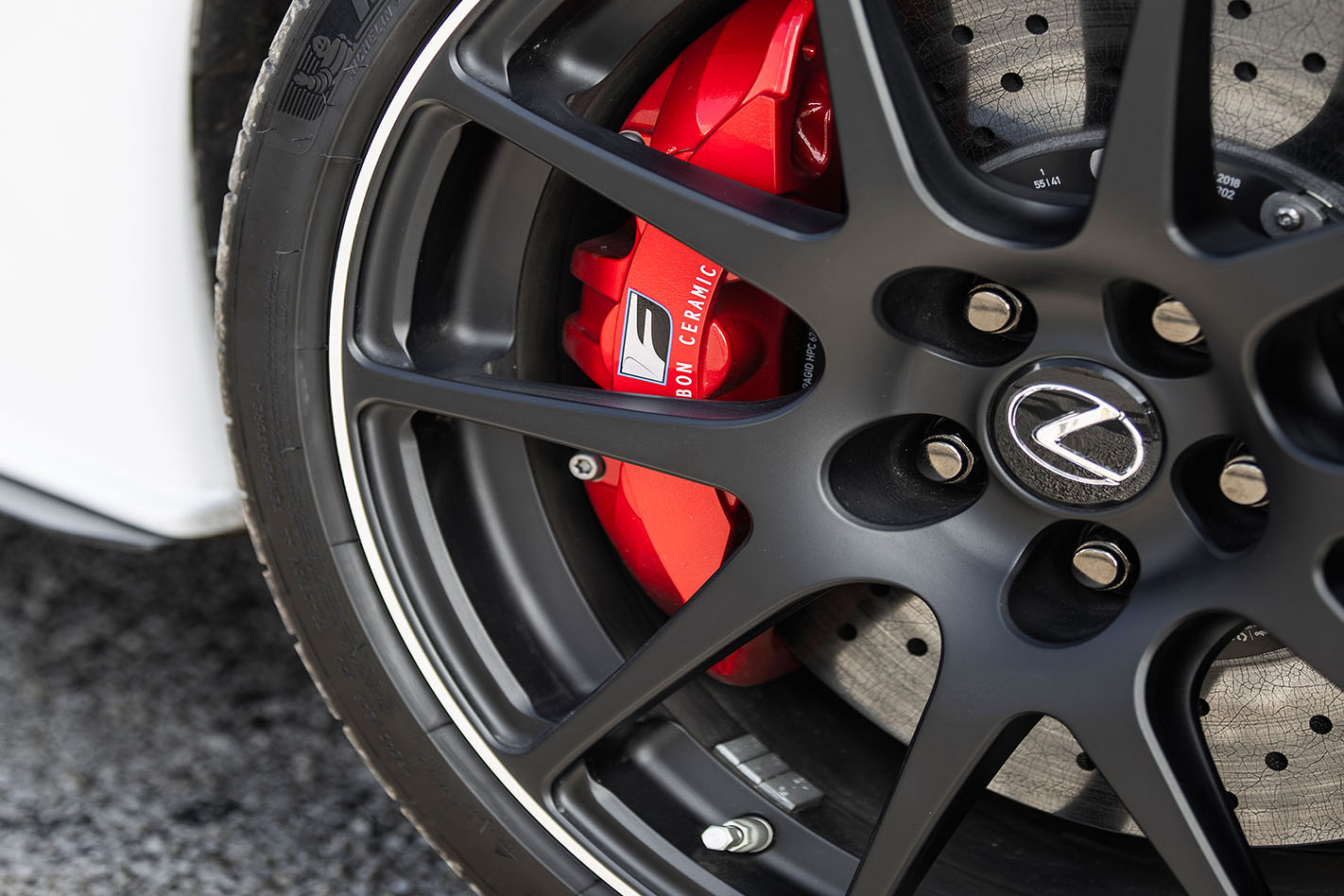
In terms of ride quality it is slightly sharper than the garden-variety RC F, but there is a genuine suppleness and added control. The damping range and suspension tune works well enough both for comfort and performance levels. The steering isn’t the final word on feel, but it is progressive and direct. Accounting for much of the Track Edition’s price premium over the regular RC F, the Brembo carbon-ceramic brakes are very strong and fail to fade with heavy use.
The interior is showing its age. Yes, there is a high level of quality – it’s a Lexus after all – but the design has dated and the ergonomics are unresolved. The track pad that manages the infotainment system is a case in point. It’s unresponsive, or annoyingly sensitive when you don’t want it to be. Add to this the fact that the 10.3-inch colour screen isn’t touch-enabled and the graphics are in need of modernisation.
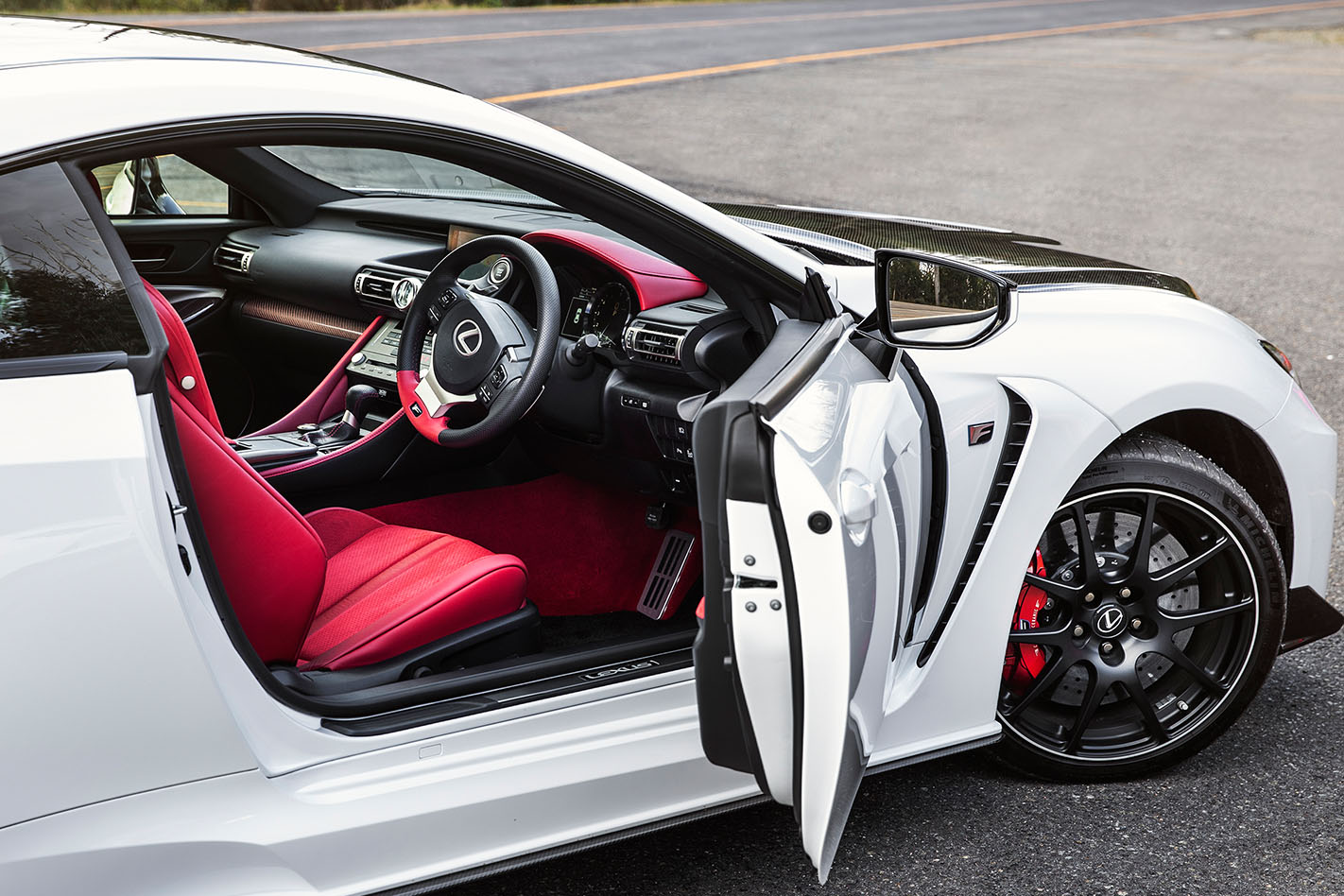
Apple CarPlay and Android Auto are now both standard, and you still get the quirky touch-sensitive climate controls and prominent analogue clock. Space is okay, but the rear seats are for kids or occasional use only, and the driver’s seat is too high for tall drivers. The boot is spacious at 366 litres.
All in all, the Track Edition retains the liveability factors that make the RC F such an easy GT cruiser. Factor in the driving experience on offer and it’s one of those cars that get under your skin and make you love them.
So, we arrive at the $165K question – is the RC F Track Edition worth the spend? The harsh reality is that the Lexus is one segment option too far. You’d have to be slightly mad to buy it over the Audi, BMW or AMG equivalents at this price point. But then, we’d completely understand if you did.
RIVALS
Audi RS5; BMW M4; Chevrolet Camaro ZL1; Mercedes-AMG C63 S
Lexus RC F Track Edition specifications
Model: Lexus RC F Track Edition
Engine: 4969cc V8, dohc, 32v
Max power: 351kW @ 7100rpm
Max torque: 530Nm @ 4800-5600rpm
Transmission: 8-speed automatic
Weight: 1715kg
0-100km/h: 4.2 seconds
Economy: 11.2L/100km
Price: $165,482
On sale: Now
It was one of our favourite hot hatches of recent years, but a change of strategic focus from Peugeot Australia means the brilliant 308 GTi has been axed.
The 200kW hot hatch hero, which finished on the podium in our last 12-car hot hatch megatest, pipped for the top spot only by the Hyundai i30N and the Civic Type-R, is being cut largely due to its manual gearbox, Peugeot only seeing a local business case for automatic 308s.

“The 1.6-litre engine in the 308 GT has been discontinued globally because it doesn’t meet emissions, but the 308 GTi is a Peugeot Sport model that will only ever be offered as a manual. In this market that means limited sales for us.
“Peugeot is moving towards electrification and autonomous vehicles, and is moving away from putting large engines into small cars. We’re opting for more fuel-efficient versions moving forwards, with the business spending a lot of money on Level 3 autonomy.”
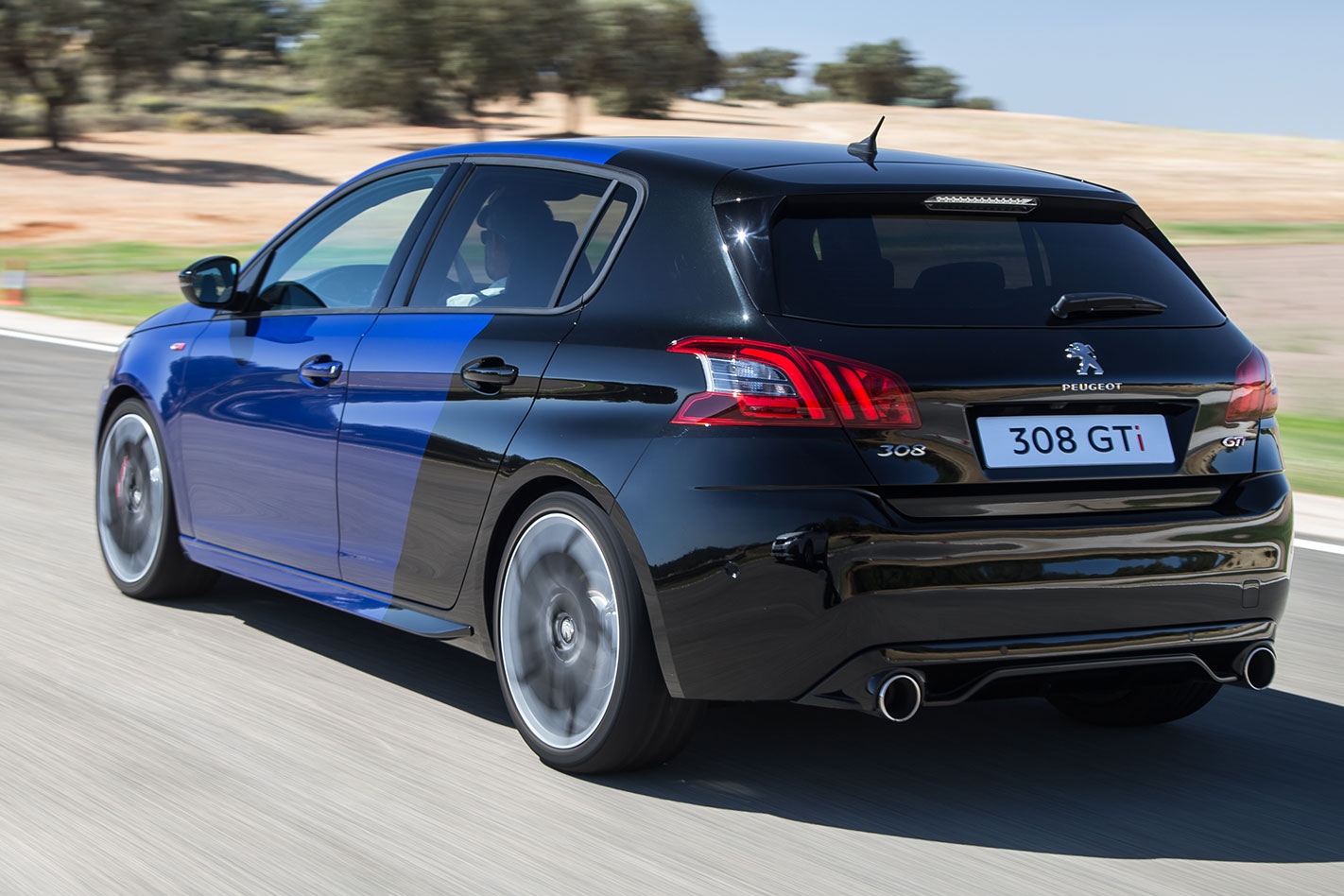
The 308 had long been a Wheels favourite, coming second at 2014’s Car of the Year. The appeal of the car was best expressed in its dynamics, being both the lightest car in its class and one of the best-riding. The 308 GTi raised many eyebrows at our hot hatch megatest when it became apparent that it had the best power-to-weight ratio of any of the cars presented, Golf R Grid, WRX STi, Civic Type R – the lot. It was 65kg lighter than the Clio 200 we tested, despite being a class bigger.

That latter part is key. There were aspects of the 308 GTi that not everybody got along with, such as the tiny, low-set steering wheel, the contra-rotating rev counter and the lack of an ESC Sport setting, but overall, it nailed the hot hatch brief extremely well.
Not well enough for auto-loving Aussies it seems, with a mere 185 sales since it was launched in 2017. We’ll miss it.
The Formula 1 grid is at risk of losing almost half its cars, as the global COVID-19 pandemic tests the sport’s financial house of cards.
Up to four teams could collapse under pressure, according to McLaren F1 boss Zak Brown, which would wipe eight cars from F1’s 20-car grid.
Williams F1 announced it has put a number of staff on furlough, with drivers and management taking a 20 percent pay cut, while the Lawrence Stroll-owned Racing Point has also put staff on furlough and cut pay for drivers Lance Stroll and Sergio Pérez.
Brown made the decision to also put staff at McLaren on furlough.
“This is potentially devastating to teams,” he told the BBC. “If [it is devastating] to enough teams, which doesn’t have to mean more than two, then it’s very threatening to F1 as a whole.
“Could I see, through what is going on right now in the world if we don’t tackle this situation head on very aggressively, two teams disappearing? Yeah. I could see four teams disappearing if this isn’t handled the right way.”

The struggle for teams comes from lost revenue, which traditionally comes via three streams. The biggest of these is race fees, which have been devastated by the cancellation of eight grands prix – with that number likely to rise. Broadcast rights payments and sponsorship have also been hit hard.
F1 has been trying to rectify the situation, by delaying the introduction of new technical regulations by a year, and extending the mandatory shut-down period.
A crisis meeting held with team bosses earlier this week resulted in the new strict budget cap which was to be introduced for 2021, reduced from US$175 million to US$150 million. Brown says that this should be lowered further if the pandemic drags on.
“F1 is in a very fragile state,” Brown said. “You have everyone at $150 million, and the strong majority – including one of the big teams – willing to come substantially under $150 million.
“If we don’t make an aggressive enough budget cap and some people feel they have to top up this year and have no chance of getting it back, then they ask themselves: ‘Why are we in it?’”
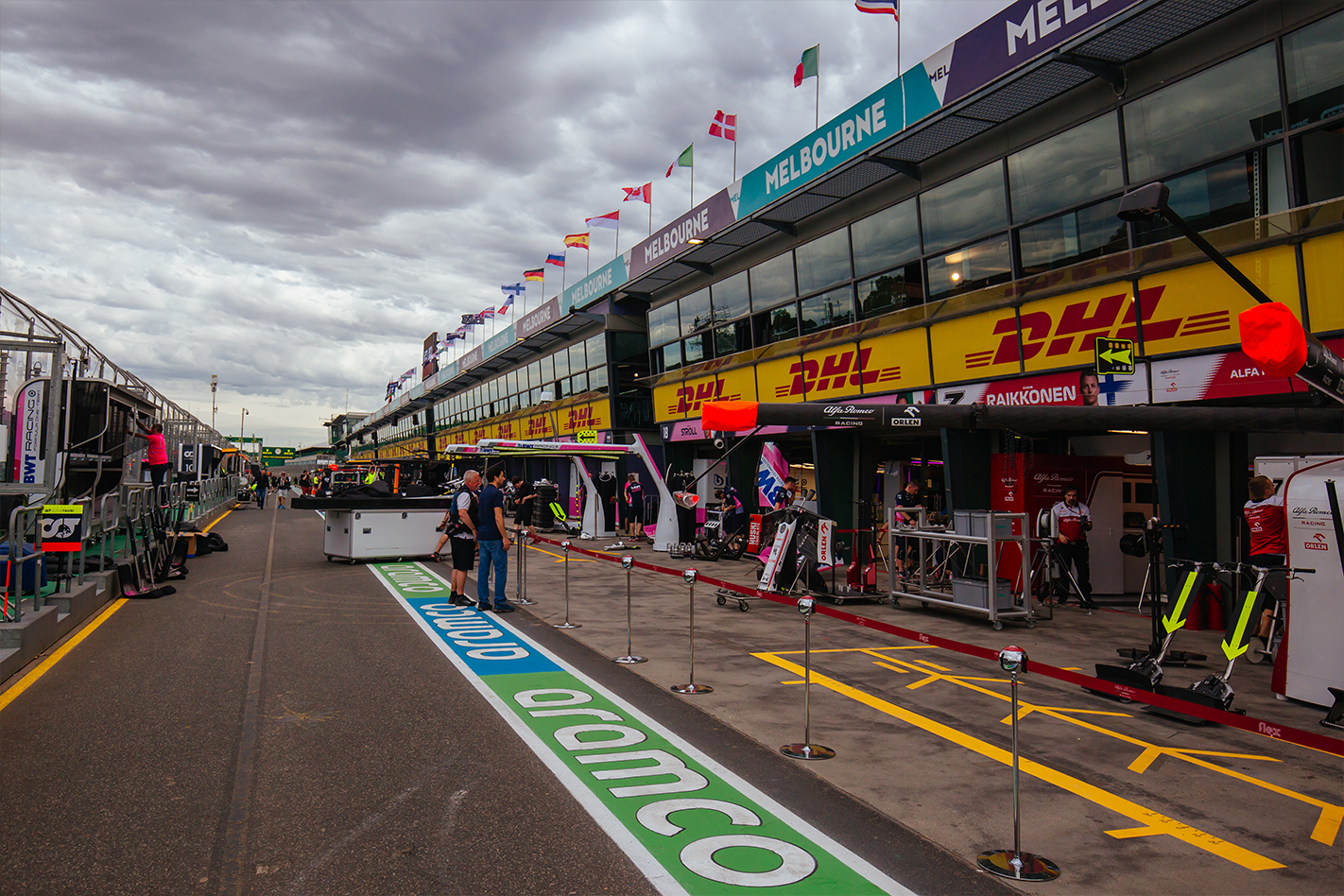
Paddock speculation suggests of the three biggest-spending teams – Mercedes-Benz, Ferrari, and Red Bull – only the German manufacturer supports lowering the budget cap further.
If what Brown is saying comes to fruition, and four teams do collapse, there would be serious repercussions throughout the Formula 1 grid.
The agreement that F1 has with teams that runs until the end of 2020 states that better-funded squads would be forced to run a third car if the grid dropped below 20 competitors.
The rule was introduced by former head honcho Bernie Ecclestone when he was in charge of F1, and he envisaged that instead of the surviving teams expanding to three cars, they would supply the minnows with a vehicle.
Ecclestone explained how it would work when a number of teams were at risk of collapsing in 2014.
“They would supply a third car to someone else so if, for example, Sauber disappeared, a team could do a deal with Sauber,” he said.
“Ferrari could say, ‘We will give you a car, all that goes with it, and we want you to put this sponsor on it. You have your own sponsors but we want you to include this one as well and we want you to take this driver.’
“The team wouldn’t have to go under then, would they? If Red Bull decided they would give a car to Caterham, for example, that could solve their problem.”
Somehow, we don’t think this will be the end of the struggles for motorsport’s crown jewel in 2020, and when racing eventually resumes, things could look very different to what we knew in 2019.
The names August Achleitner and Frank Walliser should be well-known by every died-in-the-wool Porschephile.
Achleitner, known as ‘Gustl’ to his friends, took charge of the 911 program in 2001, overseeing the development of the 997, 911 and latest 992 models before handing over the reins to Walliser in early-2019. The identity of Gustl’s successor was no surprise considering Walliser’s star-studded CV as head of motorsport includes the RS Spyder, 919 Hybrid and 911 RSR, not to mention the 918 hypercar.
However, when the keys to the chief engineer’s office were handed over the DNA of Porsche’s iconic sports car family took an invisible step towards even more empathic and extrovert dynamics. This journey begins with the new Porsche 992 911 Turbo S.
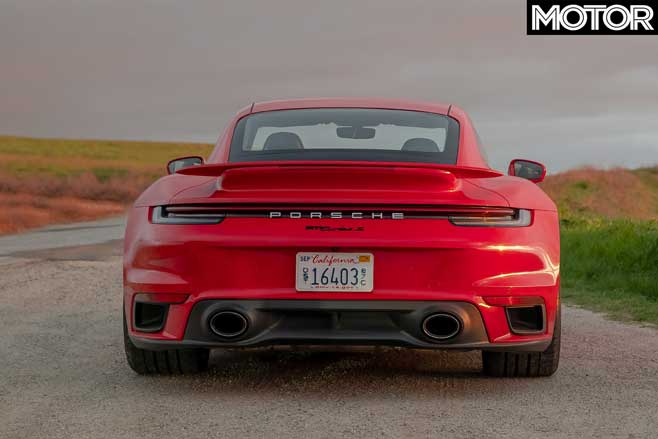
The previous 991.2 Turbo S, MOTOR’s 2017 Performance Car of the Year, was a remarkable piece of kit – super quick in a straight line, entertaining in the twisties, totally forgiving 24/7 – but previous Turbos have tended to attract a certain clientele, typically gentleman drivers who enjoy showing off in a prestigious piece of street furniture.
The latest example still ticks that street-cred box, but beneath the wider-than-ever bodyshell lurks a totally different animal: raw, aggressive, more tactile, massively faster and a handful at the limit for those who seldom rest more than two fingers on the wheel. At a glance, our test car looks a predictable evolution of a well-established licence to print money. The visuals suggest more of the same, not a radical departure from a proven recipe. This initial impression is thoroughly misleading; this is definitely not your sugar daddy’s Turbo anymore.
The tracks have been extended once again, this time by 45mm up front and 20mm at the rear, the adaptive aerodynamics are even more elaborate, the shiny multi-spoke wheels are now staggered in size, 20s in the nose and 21s under the tail, and shod with wider Pirelli P Zero rubber (255/35 and 315/30 respectively) while the fresh make-up includes LED matrix headlights and four fat rectangular exhausts.
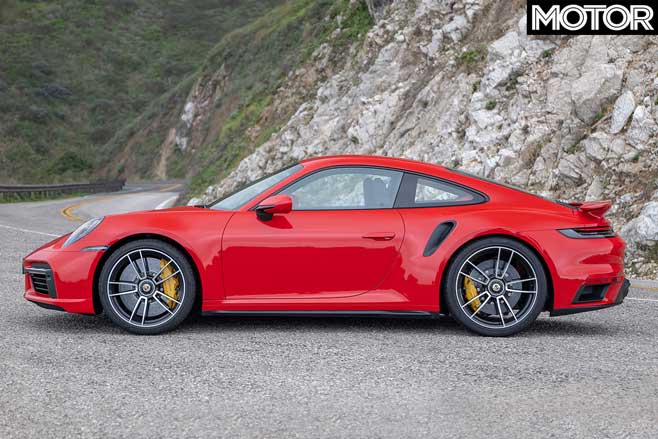
Instead of a relaxed high-speed cruiser, the new Turbo is a hardcore sports car almost worthy of its own RS badge. Did I say sports car? Make that supercar, for the ultimate 992 can outsprint the Ferrari F8 Tributo, leave Aston’s DBS Superleggera trailing in its dust and give the McLaren 720S a run for considerably less money. It’s that good.
How fast is the latest iteration of the quintessential Porsche? Top speed is an unchanged 341km/h, however in terms of acceleration Stuttgart’s brighest icon shaves 0.2sec off the 0-100km/h time – now a blistering 2.7sec – while covering the 0-200km/h stunt in an even more thrilling 8.9sec, one whole second fewer than before.
The hardcore GT2 RS is marginally more accelerative once up and rolling, but then it has 515kW/750Nm with only 1440kg to shift; the Turbo S manages 478kW/800Nm from its new 3.8-litre twin-turbo flat-six but weighs in at a hefty 1640kg thanks to the bigger wheels, eight-speed dual-clutch gearbox, extra emissions gubbins and added cooling.
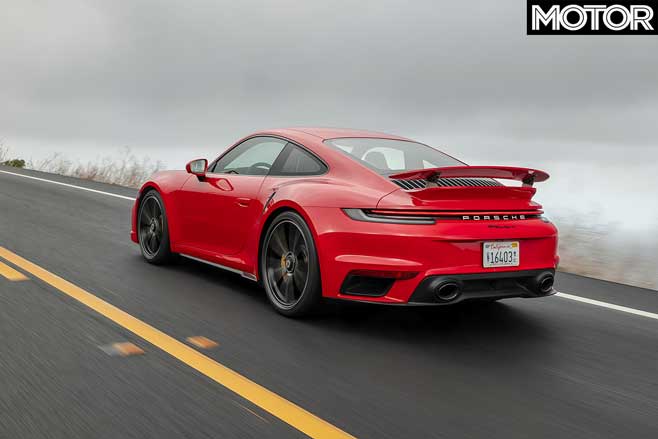
That extra mass also includes all-wheel drive and the eight-speed PDK offsets its added kilos with a launch-friendly first gear, long-legged top gear that enables an indicated 345km/h and a works in conjunction with a fuel-saving 3.02:1 final drive.
Overall consumption is claimed as 11.1L/100km but depends almost entirely on the hooligan inside, extended stretches of COVID-cleansed autobahn doubling that and then some. But frequent fuel stops is a small price to pay for enjoying this tellurian fighter jet; after all, this high-tech transformer beams itself to 200km/h in the time it takes the average family SUV to reach half that. It is insanely quick throughout the entire rev, gear and speed spectrum to the point that a tear-off pad with blank driving licences should be offered on the options list.
Forward thrust is squashed just as effectively by the family pizza-sized brakes. The 390mm carbon-ceramic discs and four-piston calipers would be considered overkill on the front of most cars, yet here are just a rear-mounted supporting act to the 420mm discs and 10-piston calipers that do the bulk of the work. Heavily applications are aided by the eye-catching pop-up airbrake that momentarily darkens the rear-view mirror.
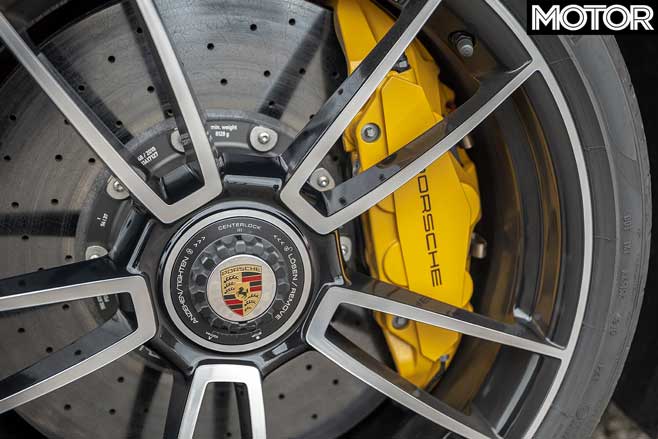
The Performance active aero, activated in Sport Plus, ramps up the drag from 0.33 to 0.38 but brings a commensurate increase in downforce, the rear wing flattening slightly at 150km/h and laying fully horizontal at 175km/h. This most aggressive drive mode also delays upshifts until the last possible moment, downshifts strike early like unexpected lightning and the adaptive dampers tense like four champagne bottles about to pop their corks.
This firmness crushes the low-speed ride, but the Turbo S scores big points in the handling sweepstakes thanks to quicker-acting rear-wheel steering, more sophisticated damper control and that wider footprint. At low speeds tight turns elicit a rhythmic sequence of thumps from the driveline and even in Wet mode, which proves virtually foolproof in the lower Carrera models, sudden full-throttle action triggers a heart-stopping moment of breakaway before the electronics wake and steady the ship.
On dry roads this boosted monster tracks with confidence-inspiring precision; at nine-tenths the driver can do almost no wrong, but the last step towards total satisfaction is a dare form man and machine, in that order. Add some moisture and previous Turbos’ unflappable composure is replaced by early aquaplaning and momentarily questionable lane-changing grip.
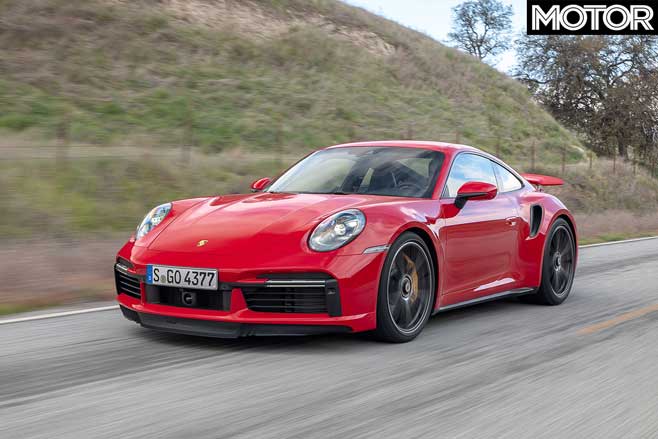
What is there not to like about this Porsche, you ask? For starters, the price has increased from $456,200 to $473,900; this test car adds a further 10 per cent to that and isn’t even fitted with the lightweight pack which shaves off 30kg.
Furthermore, electrification, head-up displays and advanced driver assistance are clearly still alien terms to Frank Walliser’s vocabulary and some mod-cons like the electric pop-out door handles and busy touchscreen are a debatable interpretation of progress.
But if I had to choose a car to keep me going for the rest of my life, this is it. The GT3 and GT2 RS are in different ways similarly involving, but no 911 has ever been as disarmingly multi-talented as this new Turbo S. Well done indeed, Mr Walliser.
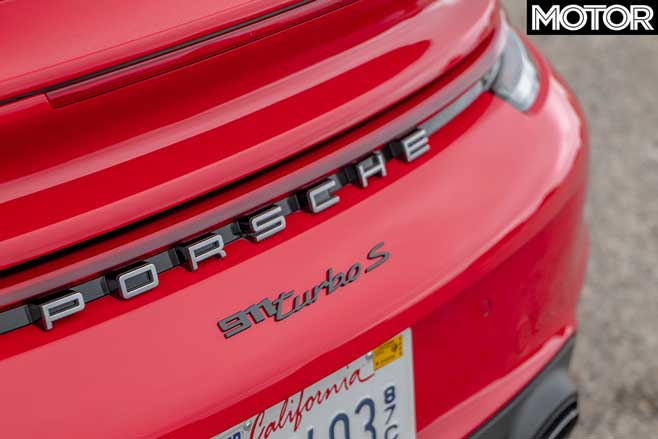
2020 Porsche 911 Turbo S specs Body: 2-door, 2+2-seat coupe Drive: all-wheel Engine: 3745cc flat-6cyl, DOHC, 24v, twin-turbo Bore/stroke: 102.0 x 76.4mm Compression: 8.7:1 Power: 478kW @ 6750rpm Torque: 800Nm @ 2500-4000rpm Weight: 1640kg Transmission: 8-speed dual-clutch Power-to-weight: 291kW/tonne Suspension: struts, coil springs, adaptive dampers, active anti-roll bar (f); multi-links, coil springs, adaptive dampers, active anti-roll bar (r) L/W/H: 4535/1900/1303mm Wheelbase: 2450mm Tracks: 1583/1600mm Steering: electrically assisted rack-and-pinion, rear-wheel steer Brakes: 420mm ventilated/drilled carbon-ceramic discs, 10-piston calipers (f); 390mm ventilated/drilled carbon-ceramic discs, 4-piston calipers (r) Wheels: 20 x 9.0-inch (f); 21 x 11.5-inch (r) Tyres: 255/35 ZR20 (f); 315/30 ZR21 (r)
Rating: 5 out of 5 stars
