
If you thought the Quattroporte is as cool as Maseratis get, this one-off Maserati Quattroporte wagon, currently listed for sale in the UK, begs to differ.
Listed on ClassicDriver, this long-roofed five-door Quattroporte, nicknamed the Cinqueporte, was inspired by a British aficionado who missed out on buying one of four Carrozzeria Touring’s Quattroporte-based Bellagio Fastbacks that was auctioned in 2013.
Determined to have a Quattroporte wagon, the Cinqueporte’s owner consulted several prototyping companies about producing a shooting brake based on the current Quattroporte. Unfortunately for him, the quotes received were in the £200,000 region ($500,000) with a timeline that was deemed “far too long”.
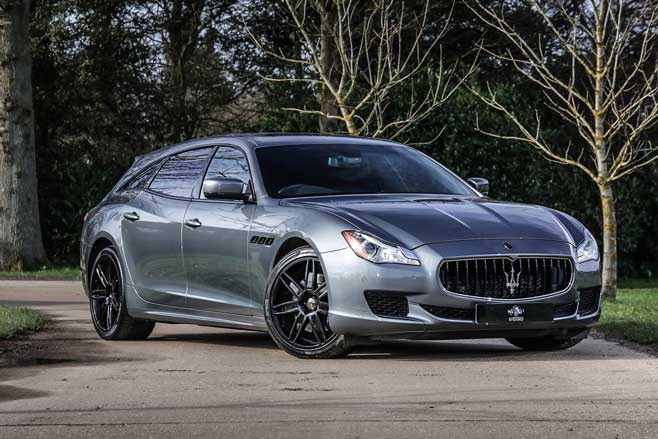
Eventually the owner was introduced to a UK-based classic car restorer, Adam Redding, who spent 1500 hours converting a standard current-generation Quattroporte into the Cinqueporte.
According to the listing, the hardest part of the conversion was getting the electrics for its motorised tailgate to work. The original plan was to source parts from OEM suppliers, but when the parts couldn’t work, Adam Redding resorted to designing a system in-house to get the tailgate to work.
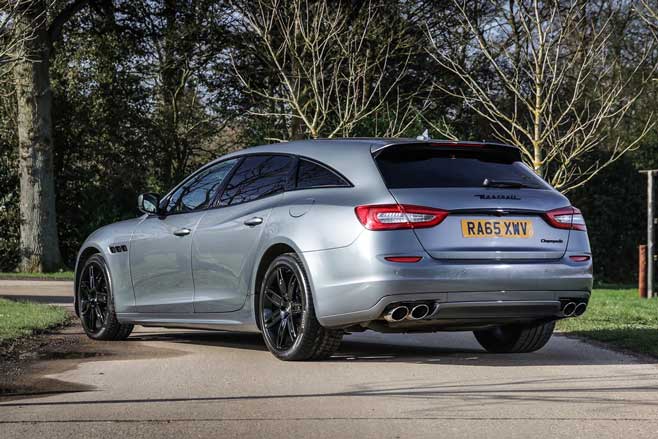
While the workmanship does look convincing from the photos, it does have a less-than-appealing side, and that is the Cinquenporte sports Maserati’s 3-litre V6 turbo diesel, which manages a humble 205kW and 600Nm of torque, beneath its exquisite frock.
Registered in 2016, the Cinqueporte has since racked up a modest 8714 miles (14,023km) on the odometer, and is listed by UK-based classic car dealer, Autostorico, with its price provided on request.
Don’t expect this one-off creation to be cheap, though considering that the aforementioned Carrozzeria Touring Bellagio Fastback went for a relatively humble €117,600 (A$207,000) at auction, you might never know.
What stands out?
The CX-3 is among the most engaging of small SUVs, coping happily with workaday duties but commanding an easy highway lope. Beautifully weighted steering contributes to fluid and secure handling. Mazda’s baby high-rider is more than a Mazda2 on stilts, with all-wheel drive available. autonomous emergency braking is standard.
What might bug me?
Squeezing stuff into the boot, which is one of the smallest of any SUV. For example, a pram might not fit unless you fold down one rear seat.Having bought the only new Mazda model yet to be upgraded with Android Auto/Apple CarPlay smartphone pairing. The good news is you can have it added to the MZD infotainment system for about $500.Driving at 80km/h on the space-saver spare until you can fix your full-sized flat tyre.
What body styles are there?
Five-door wagon only.The CX-3 is available in all-wheel drive, or front-wheel drive only.All-wheel drive CX-3s use an on-demand system. They supply power to their front wheels all the time, and to their rear wheels if the front tyres are about to slip.The CX-3 is classed as a small SUV, lower priced.
What features does every Mazda CX-3 have?
Infotainment system with touch screen and dial control, a sound system with an AM/FM/DAB+ (digital) radio, Aux and USB inputs, Bluetooth connectivity for phone calls and audio streaming, and at least four speakers.Reversing camera and rear parking sensors, which help you judge how close you are to objects behind.Cruise control, and air-conditioning.Height and reach adjustment for the steering wheel, which has controls for the audio system, cruise control, and your phone (via Bluetooth). Height adjustment for the driver’s seat.Windows tinted to reduce sun penetration.Keyless entry/start and an electronic parking brake switch.A space-saver spare tyre. (A maximum speed of 80km/h is recommended for these.)Electric parking brake and Hill-launch assist, which helps you start from rest on a slope – by controlling the brakes automatically.Electronic stability control, which helps you control skids. Every new car must have this feature.Seat-belt reminders for all five seating positions.Six airbags, and forward and reverse autonomous emergency braking, which Mazda calls Smart City Brake Support – a camera-based system that operates at suburban speeds. (For the placement of airbags, and more on CX-3 safety features, please open the Safety section below.)Every Mazda CX-3 carries a five-year, unlimited kilometre warranty.
Which engine uses least fuel, and why wouldn’t I choose it?
There is now just one engine option in the CX-3 range, the 2.0-litre four-cylinder petrol engine that’s very similar to the 2.0 petrol supplied with the Mazda3 small car. It is a smooth and strong engine, propelling the CX-3 in a lively – if not noisy – manner when worked very hard.The 2.0 petrol consumes about 6.5 litres/100km on the official test. In real-world testing by Wheels magazine staff, a petrol-engined CX-3 sTouring AWD automatic recorded an average of 8.5 litres/100km over 4500km.The petrol engine can be ordered in six-speed automatic form on all versions, and in 6-speed manual form on all front-wheel drive versions.Mazda dropped the more economical 1.8-litre turbo-diesel engine in March 2020. It consumed about 5.0 litres/100km on the official test cycle (urban and country combined).
What key features do I get if I spend more?
The least costly CX-3, the Neo Sport, has cloth-covered seats, 7.0-inch infotainment screen, six-speaker audio, rolls on 16-inch steel wheels, and has the equipment common to all CX-3s.Spend more for the Maxx Sport and you get better looking aluminium alloy wheels, the option of all-wheel drive, and the option of diesel power.The Maxx Sport has satellite navigation that’s an extra-cost option in the Neo Sport, climate-control air-conditioning that maintains a set temperature, a leather-wrapped steering wheel and two cup holders in the rear-centre armrest. And the Maxx Sport gains two rear-focused active safety aids: a Blind-spot monitor, and a Rear cross-traffic alert.The CX-3 sTouring bumps the wheel size to 18 inches, using tyres of a lower profile for marginally more responsive steering and a racier look. It has fog-lamps, LED daytime visibility lamps, and LED headlamps – which are brighter and longer lasting than conventional lights.There is a head-up instrument display, which lets you view the speedo and the road simultaneously, and Traffic sign recognition, which helps you keep track of speed limits, and driver attention alert that senses if your driving is erratic.You can unlock and start the car while the key remains secure in a pocket or handbag. Wipers operate automatically when it rains, the rear-view mirror dims automatically, and you can choose Maztex fake-leather seat trim (or cloth).The CX-3 Akari, offers a choice between black or white leather seats, and you can heat the front seats. The driver’s seat is power-adjustable and remembers your settings (so that you can restore them easily after a companion has driven the car). There is a power-opening, glass, sunroof. Adaptive headlamps dim automatically only those parts of the high beam that might dazzle oncoming traffic, maintaining extended vision to either side.In addition to the active safety of less costly versions, the Akari has adaptive cruise control and lane departure alert that tells you if are drifting out of your lane or over the centre line, and a 360-degree surround view monitor to help you spot obstacles around your CX-3 when parking.The Akari LE adds plush brown Nappa leather upholstery to the Akari trim with contrasting white stitching and other details.
Does any upgrade have a down side?
None of the all-wheel drive versions is available with a manual transmission – which could be a downside for keen drivers who like full control of gear selection. The manual gearbox on front-drive CX-3s is a delight to use, too.The part leatherette Maztex trim available in the sTouring CX-3s is a type of vinyl, and is vastly inferior to the perforated real leather in the Akaris.Of the eight available colours, six colours are available at no extra charge, with Soul Red Crystal Metallic and Machine Grey Metallic cost extra.
How comfortable is the Mazda CX-3?
Up front, seat comfort is comparable with any small SUV in this price range, while forward vision is impressive thanks to the fairly upright A-pillars at either end of the windscreen. The placement of the driver’s seat feels spot-on – high enough to command the road, yet low enough to still feel sporty and car-like.The dashboard is similar to the Mazda2’s, which is no bad thing. The head-up display and colour touchscreen, where fitted, are good too.The distance between front and rear axles is also the same as on the Mazda2 light car, so that the CX-3 is nippy to steer in the city. But the body is longer, meaning it is not quite as easy to squeeze into a parking spot.In top-spec Akari guise, the CX-3 is a seriously luxe little tinker, complete with a sunroof, proper leather, selectively dimming LED headlamps, and a broad active-safety suite.The Akari LE takes premium levels another step with higher quality Nappa leather.
What about safety in a CX-3?
Every CX-3 comes with the mandatory stability control, six airbags, reversing camera, rear parking sensors, and autonomous emergency braking that works at suburban speeds and when reversing. It is a package designed to protect you in crashes, and to avoid rear-end collisions in traffic.There are two airbags directly in front of the driver and front passenger; one alongside each front occupant to protect the upper body; and curtain airbags that protect front and rear passengers’ heads in side impacts.The auto braking uses camera-based sensors to scan the roadway ahead, and is effective at speeds below 80km/h. It recognises pedestrians, will warn you of a collision risk, and can apply the brakes automatically if you should fail to react to the warning. Its primary purpose is to prevent your crashing into a car ahead that has slowed or stopped unexpectedly, or to reduce the severity of an impact.Ultrasonic sensors on the rear bumper can also trigger auto-braking at low speeds if you are about to reverse into something.The CX-3 Maxx Sport adds rear-facing radar sensors that monitor blind spots near your rear corners, warning you of the presence of other vehicles should you indicate to change lanes. When you are reversing – say from a shopping centre parking space – these also warn you if another vehicle is about to cross your path.The CX-3 sTouring gains two more safety related features: a Driver attention alert, and Traffic sign recognition. The former operates at highway speeds, keeping track of how you are driving and suggesting a break if it detects signs you are in danger of falling asleep. The latter seeks to recognise speed signs, and also uses satellite navigation mapping to keep track of speed limits. It displays what it takes to be the speed limit in force, and flashes a warning if you exceed it.The Akari brings you in addition Adaptive cruise control with Stop&Go function that works in traffic jams, and Lane departure warning, alerting you if it predicts you are about to veer unintentionally into an adjacent lane on the highway – perhaps from distraction or fatigue. And its Adaptive LED headlights retain high-beam illumination of the roadside when dipping for oncoming traffic, helping you see where you are going in country driving at night.The Australasian New Car Assessment Program (ANCAP) awarded the Mazda CX-3 five stars for safety, its maximum, in September 2015.
I like driving – will I enjoy this car?
Yes, and especially if you get an all-wheel drive version – provided you are satisfied with the very good auto gearbox.All-wheel drive CX-3s feel better balanced in corners than their front-drive sisters, largely because they use a more sophisticated rear suspension design. The result is meatier, more consistent steering and an involving feel.Front-drive CX-3s steer less crisply and naturally, with the versions powered by the heavier diesel engine feeling less satisfying than the petrol models. But they are still quite good.All CX-3s feature Mazda’s G-Vectoring Control, which is designed to enhance front-end bite by adjusting engine output momentarily on turn-in.The CX-3’s six-speed manual gearbox – available only with a petrol engine – is a ripper, shifting with fabulous precision and a beautifully oiled weightiness that makes it feel like it has come from a sports car. Combine that with the 2.0-litre four-cylinder’s lively enthusiasm and the superbly weighted steering and you have a baby SUV with panache.All-wheel drive versions of the CX-3 are great on gravel roads, but are intended for these and slippery (or snowy) sealed roads only. The CX-3’s low ride-height, and road-oriented suspension and gearing, stop it early when the going gets rough.
How is life in the rear seats?
The CX-3’s rear seat is mounted quite high – theatre-style – giving passengers a decent view forward, though rather less over its rising hipline. The comfort of the seat itself is excellent. Rear seat passengers have marginally more leg room and knee clearance than they would have in a Mazda2.The outer rear seats are fitted with ISOFIX anchors, for easy securing of compatible child-seats.All CX-3 versions, apart from the Neo Sport, have two cup holders in the fold-down armrest.
How is it for carrying stuff?
Cargo space is again only slightly greater than in the Mazda2 light hatchback – 264 litres versus 250. So it will hold a stroller or a pair of suitcases, or lightweight camping gear for a couple. But for a week-long tour with two children, you would need to pack light – or invest in a roof pod.The CX-3s can tow up to 1200kg (braked trailer).
Where does Mazda make the CX-3?
The Mazda CX-3 is made in Hiroshima, Japan.
What might I miss that similar cars have?
Standard active cruise control across the range, as with the Toyota C-HR, for example.The ability to display apps from your smartphone on the touchscreen, and control them from there, via Apple CarPlay or Android Auto. The Hyundai Kona, Hyundai Venue, Kia Seltos, and Suzuki S-Cross offer this, for example. There is a kit that lets you add this feature to the CX-3’s MZD infotainment system, which costs about $500.A full-sized spare tyre, which could mean a flat interfered less with your road trip. This is rare in small SUVs, but the Trax offers one as an option.More space in the back for carrying cargo, such as you would find in the versatile Honda HR-V.If you’re set on a Mazda, one way to overcome all these issues is to opt for the new and slightly bigger Mazda CX-30, which is based on the Mazda 3.Other small SUVs you might consider include the Peugeot 2008, Mitsubishi ASX, and Jeep Renegade.
I like this car, but I can’t choose which version. Can you help?
While the Maxx Sport is a great little car for the money, this is one case where the most costly model offers compelling value. The Akari LE’s cossetting, leather-trimmed cockpit, head-up display, very sophisticated LED headlamps, active safety equipment, and dynamically engaging all-wheel-drive chassis add up to a comprehensively appealing package. We would choose petrol power, but mainly for its small handling advantage: the diesel is an excellent touring engine.
Are there plans to update the CX-3 soon?
The Mazda CX-3 debuted in March 2015, with a significant update arriving in May 2017. This brought a revised suspension, standard city-speed auto braking (which is more broadly effective than the previously optional laser-based system), and on Maxx and sTouring versions additional active safety aids. The Akari gained power-adjustable front seats and adaptive headlamps.In August 2018 Mazda changed the name of the Neo and Maxx to Neo Sport and Maxx Sport and added the top-spec Akari LE to the range. The MZD infotainment system with 7.0-inch screen and reversing monitor was added to the Neo Sport, making it standard across the range, while the Akari gained a 360-degree monitor and adaptive cruise control.The diesel engine was also upgraded, with the 1.5-litre changed with a more powerful 1.8-litre version.In December 2018 Mazda introduced the Akari LE to the top of the range, which added plush Nappa leather upholstery to the Akari spec.The 1.8-litre diesel engine was dropped from the CX-3 range in March 2020.Expect a new-generation CX-3 about 2021.
Australia’s Supercars series won’t be running any races until June at the very earliest – and potentially beyond if the COVID-19 shutdown is extended – but fans will still be able to tune in to a virtual substitute to get their racing fix
Dubbed the Supercars All Stars Eseries, it’ll feature a broad array of Australian professional drivers… and will also allow average Joes and Josephines to have a crack themselves.
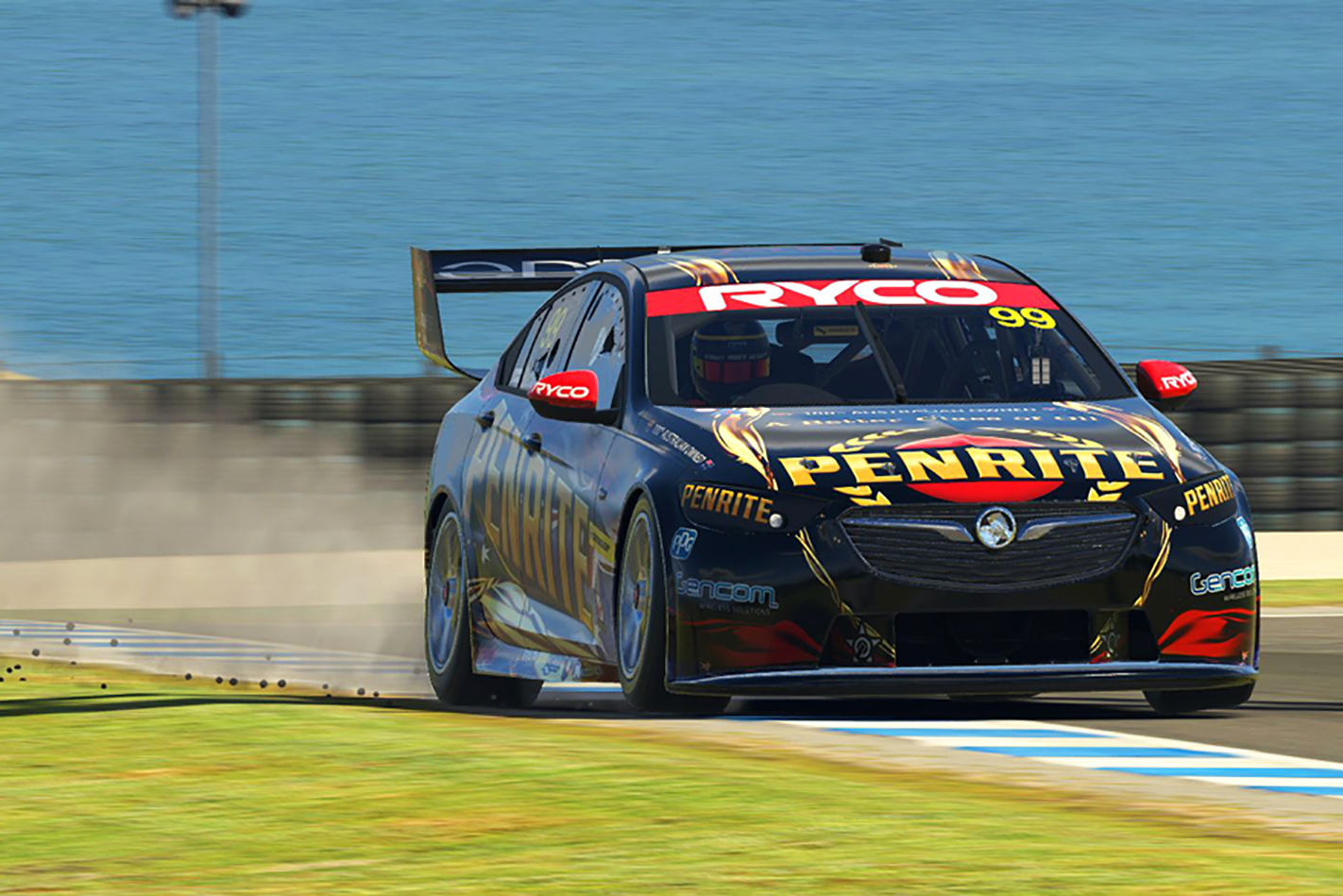
The Eseries starts tomorrow night, April 8, and uses iRacing as its platform – just like a bunch of other racing codes right now. Because iRacing is already a well-established driving sim with a substantial player base, Supercars has taken the admirable step of giving its fans the opportunity to try their hand at what the pros will be doing.
However, it won’t be wheel-to-wheel. Instead, Supercars are making the same setups the race drivers will use (all cars on the Eseries grid will have identical settings to ensure parity) available for download, meaning the stay-at-home crowd will be able to drive the same tracks in the same cars in a time-attack mode.
It’s a little different from actually mixing it with top-tier drivers, but as far as audience participation goes it’s still a cool idea.
With 25 big-name drivers like Andre Heimgartner, David Reynolds, Jamie Whincup, Rick Kelly, Fabian Coulthard, Mark Winterbottom and Shane van Gisbergen all set to be on the Eseries grid, it’ll be fascinating to see how close the ‘civilians’ can get to the qualifying times of the professionals.
(In fact, tune back into our story later in the week – we’re planning on throwing our own tame iRacing driver at the challenge to see how close we can get!)
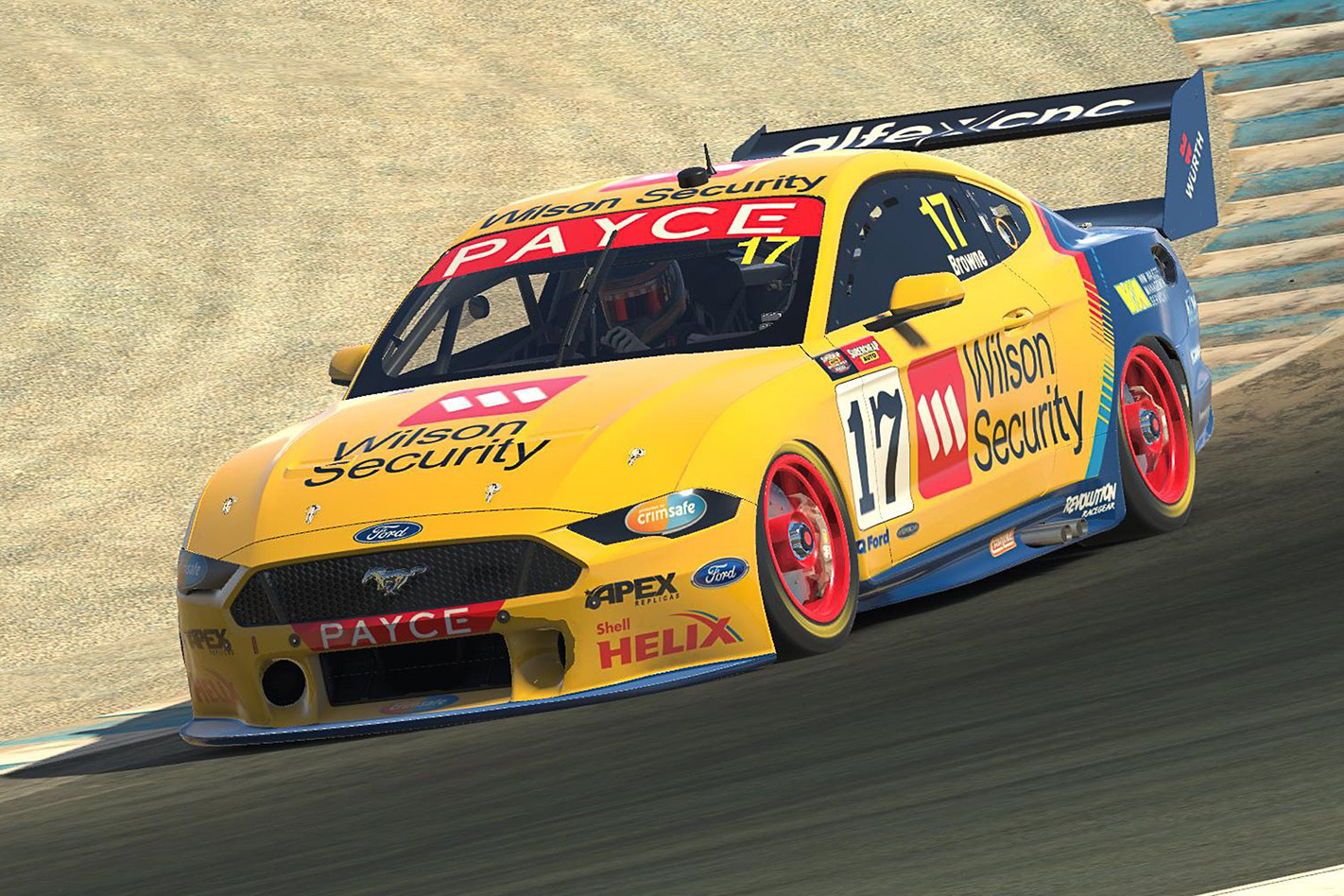
Brodie Kostecki, the 22-year-old current leader of the Dunlop Super2 Series is the driver responsible for fixing the vehicle setups for the Supercars Eseries, and says it should be simple for punters to get involved as long as they have a current iRacing subscription.
“The setups that will be used in the first round of the BP All Star Eseries are going to be available on the Supercars.com website, so head over there, download them, do some laps, post your lap times and we’ll see if we can have a bit of fun!” he said.
“Everyone is going to be on the same set-up so everyone has got the same chance at having a crack at a win.”
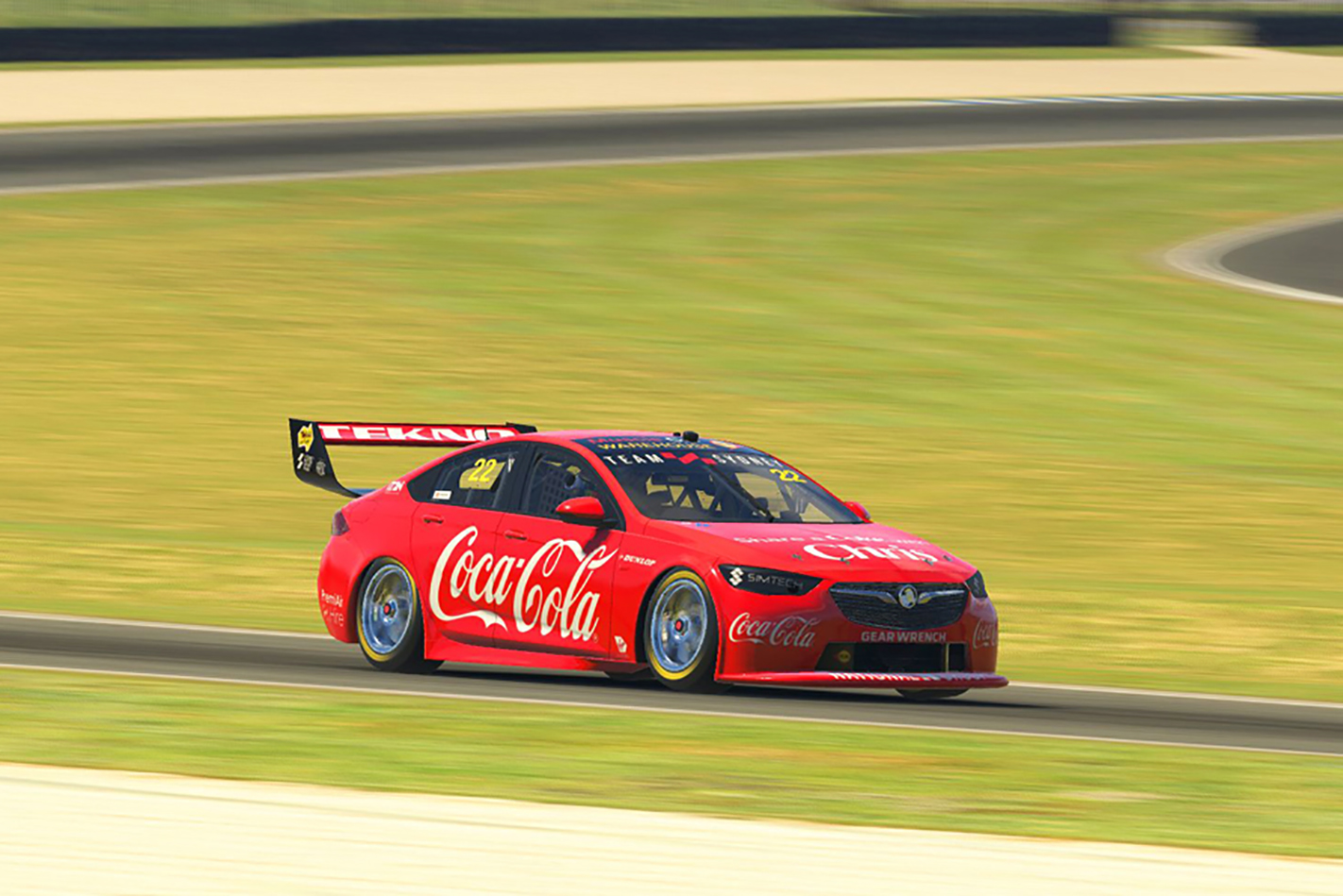
The Eseries will be broadcast from 7PM AEST on April 8 on Fox Sports 506 and live-streamed on Kayo, Ten Play, the Supercars Twitch channel and the Supercars Facebook page, with weekly races for the next ten weeks.
Supercars Eseries Schedule
Take a look at the schedule below to see which (virtual) tracks the Eseries will be heading to.
- Round 1, April 8 – Phillip Island and Monza
- Round 2, April 15 – Silverstone and Barcelona
- Round 3, April 22 – Mount Panorama
- Round 4, April 29 – Montreal and Watkins Glen
- Round 5, May 6 – Spa and Nürburgring
- Round 6, May 13 – Circuit of the Americas and Sebring
- Round 7, May 20 – Daytona Speedway and Talladega SuperSpeedway
- Round 8, May 27 – Imola and Interlagos
- Round 9, June 3 – Road Atlanta and Road America
- Round 10, June 10 – Oran Park and Mount Panorama
The second-generation of Hyundai’s hatchback curio – a small sporty front-wheel drive that borrows much of the hardware of the Hyundai i30 but adds more exclusive styling.
While the original model perhaps put more effort into looking different and standing out rather than much dynamic substance, the new version claims to deliver driving enjoyment in equal measure, without compromising on style.
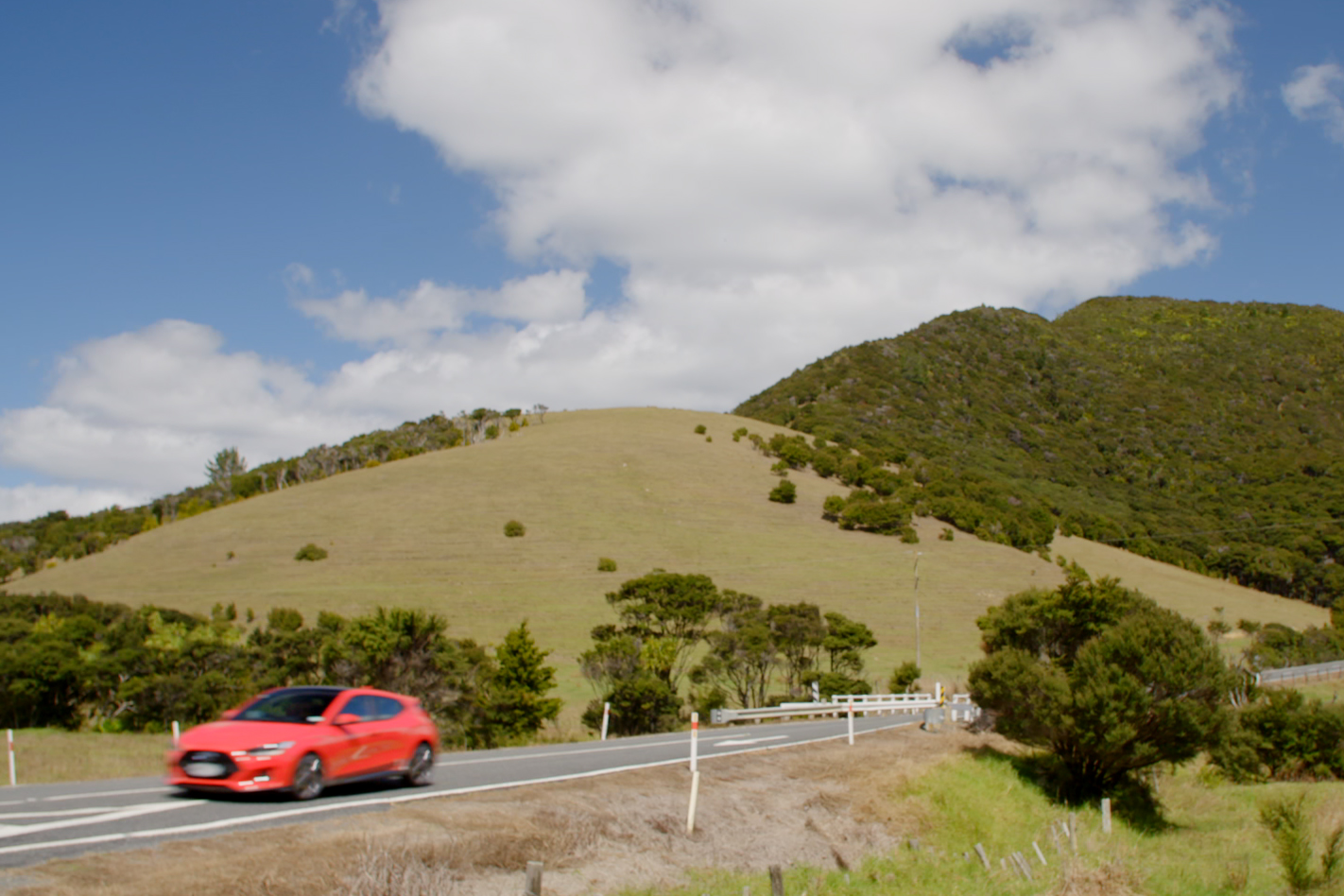
Make up your own mind about how it looks; for our money, it’s a massive improvement with a more aggressive stance and altogether more handsome design that more effectively ties the entire car together. Less subjective, however, are the many tangible improvements.
What’s the Hyundai Veloster like to live with?
We took the Veloster on a nine-day tour of New Zealand’s far-north which was long enough to learn life with this charming hatchback would be a real pleasure.
Negotiating the traffic out of Auckland offered insight into how the Veloster would fare on a daily metropolitan commute. Fortunately, this particular model sacrifices little compared with the Hyundai i30 when sitting in traffic.
The seven-speed dual-clutch auto can be a little aggressive for stop-and-start traffic, but otherwise, slick, light and smooth steering, excellent seat comfort and a cosy cabin without being claustrophobic made what little congestion we encountered a breeze.
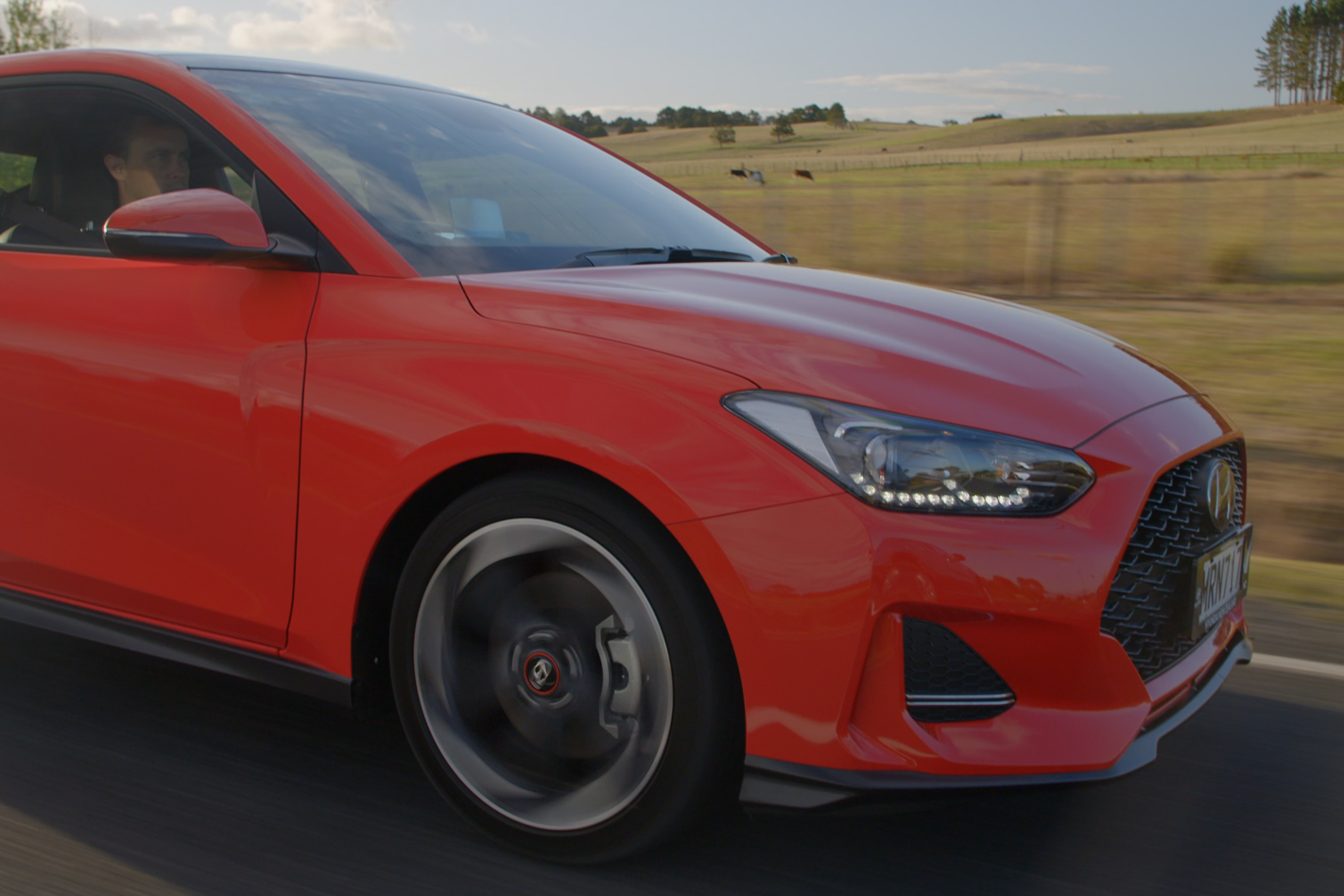
A letterbox rear window and a strange downward-biased reward view were the only elements of the Veloster’s exterior that make it less liveable over its more conventional sibling.
Even its curiously likeable two-plus-one-plus-one doors didn’t impact the usability any great degree. Actually, we found the unorthodox layout improved practicality.
On the passenger’s side, a pair of doors enable better rear occupant access, but on the other side, the absence of a rear door allows the driver’s door to be longer and bigger. This makes loading large items through the folding rear seats much easier, as well as easier access for the driver. As is often the case, choice and versatility are best.
During freeway cruising, the Veloster is almost teetotal despite big wheels and sticky sports tyres and its 1.6-litre turbo four-cylinder petrol strikes a great balance of performance and efficiency that offers fun or economy when it suits.
There’s also a surprisingly large boot which, along with the second row of seating, doesn’t appear to have been greatly impacted by the more coupe-like roofline when compared with the i30.
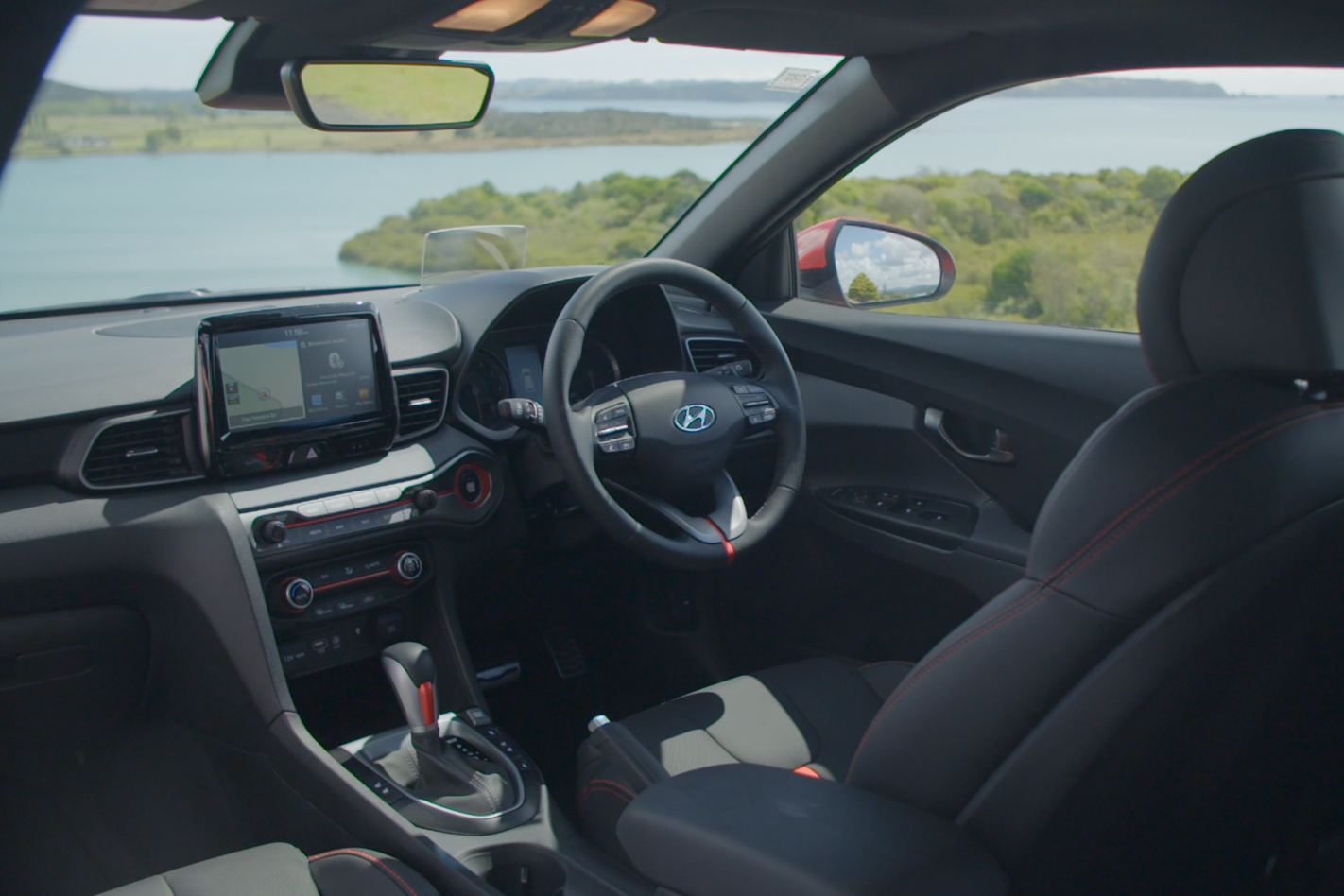
Finally, the Veloster is very generously equipped at this most premium end of the spectrum. Luxuries that were once only found in hugely expensive limousines are included in this affordable hatch.
High-quality leather upholstery, heated steering wheel, heated and cooled seats, head-up display and an impressive suite of driver assistance and safety systems are all included in the deal. There’s also an intuitive information and entertainment system that includes a great navigation system and smartphone connectivity.
While most of the driver assistance systems are well executed including the adaptive cruise control, others are a little meddling such as the lane-keep assistant, which is nagging, aggressive and excessively early in its intervention.
Cancelling the system must be done with a push of a button each time the car is switched off then restarted, which we went ahead and did every time.
What’s the Hyundai Veloster like to drive?
In its previous guise, the Veloster didn’t keep the driving dynamic promises that its sporty looking body made. Things could not be more different in the new generation, however.
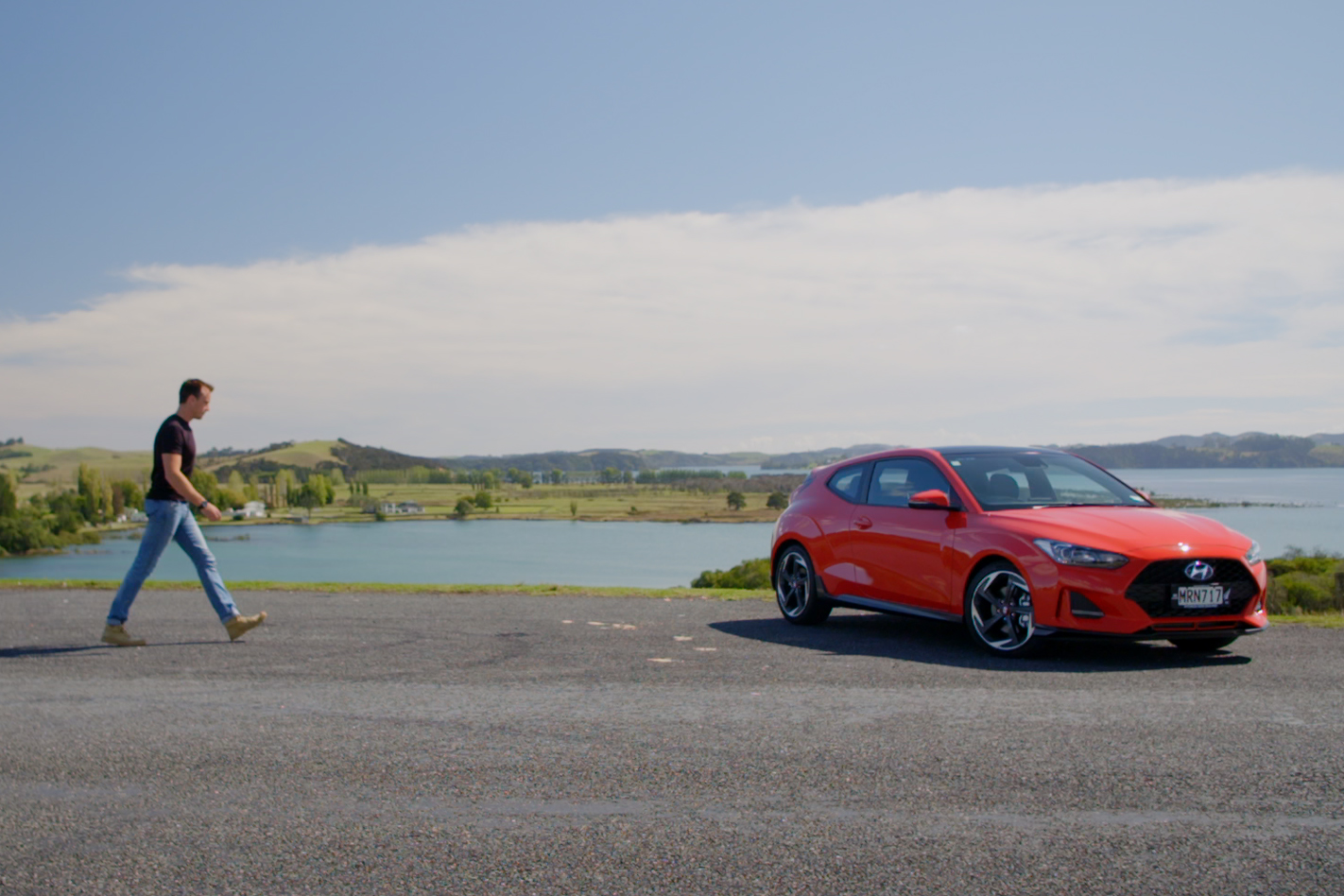
Not only has the exterior styling become more aggressive and imposing, but the chassis has also taken a big step up to match its new more purposeful stance on the road.
On the simply perfect roads we found near Russell, the Veloster is beautifully rewarding with almost endless grip and a front-drive chassis that completely refuses to understeer. Instead, the Veloster’s tail becomes light and playful at the limit and is fun but manageable.
The massive grip is matched to light but fine steering, its brakes are confident and capable without resorting to more expensive fixed, multi-piston callipers, and the responsiveness from throttle and steering matches the brilliantly tuned body-control.
There’s a naturally aspirated 2.0-litre at the entry point of the range, but the 150kW/265Nm 1.6-litre turbo is absolutely the pick. Strangely, even though the engine is largely a carry-over from the previous generation, it feels stronger and more involving now.
The relatively small unit generates plenty of pulling power from low in the rev-range but is equally happy spinning out to its redline, thanking you in the process with a sporty note from the exhausts.
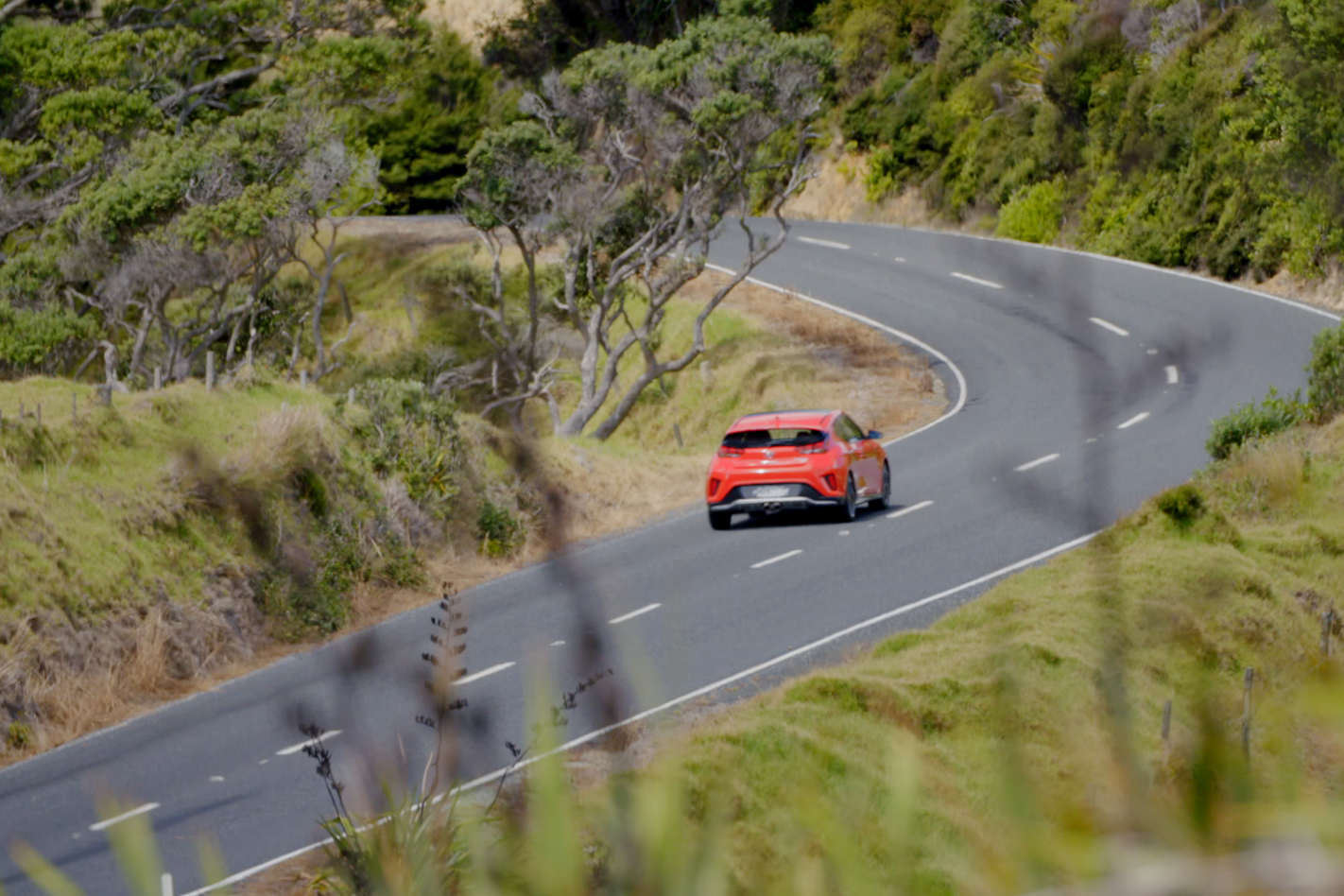
We can only imagine and fantasise what the Veloster is like when honed into a fire-breathing N monster as is sold to the Americans because the flagship model (which shares the important bits of the i30 N) will not be coming Down Under. That’s perhaps our only grievance with the new Veloster range.
But the absolute best part of the Veloster’s nature is its ability to turn from corner-carving terrier into a sublimely comfortable cruiser when it’s time to head home.
Away from the more interesting path, the Veloster settles into a comfortable ride with surprisingly little road noise despite the 19-inch wheels, and its suspension set up that is so capable of resisting roll in fast corners is supple and smooth.
There are few cars that do such a convincing double act without compromise.
Is the Hyundai Veloster worth the money?
If you wanted to put the price of the Veloster into simplistic perspective then, at $41,990, the flagship we tested costs $6750 more than the equivalent i30 N Line Premium, which is almost identical in mechanicals and specification.
However, there’s a justifiable and reasonable premium to be applied to exclusivity. Anyone who has bought a pair of Hunter natural rubber gumboots over a pair of $15 Aussie Disposals pair will know what we mean.
While you’ll see many i30s on the road (which aren’t a bad looking car in any case) the Veloster takes the same excellent functional recipe and adds the automotive equivalent of an adjustable buckle strap, GoreTex liner and a range of primary colours.
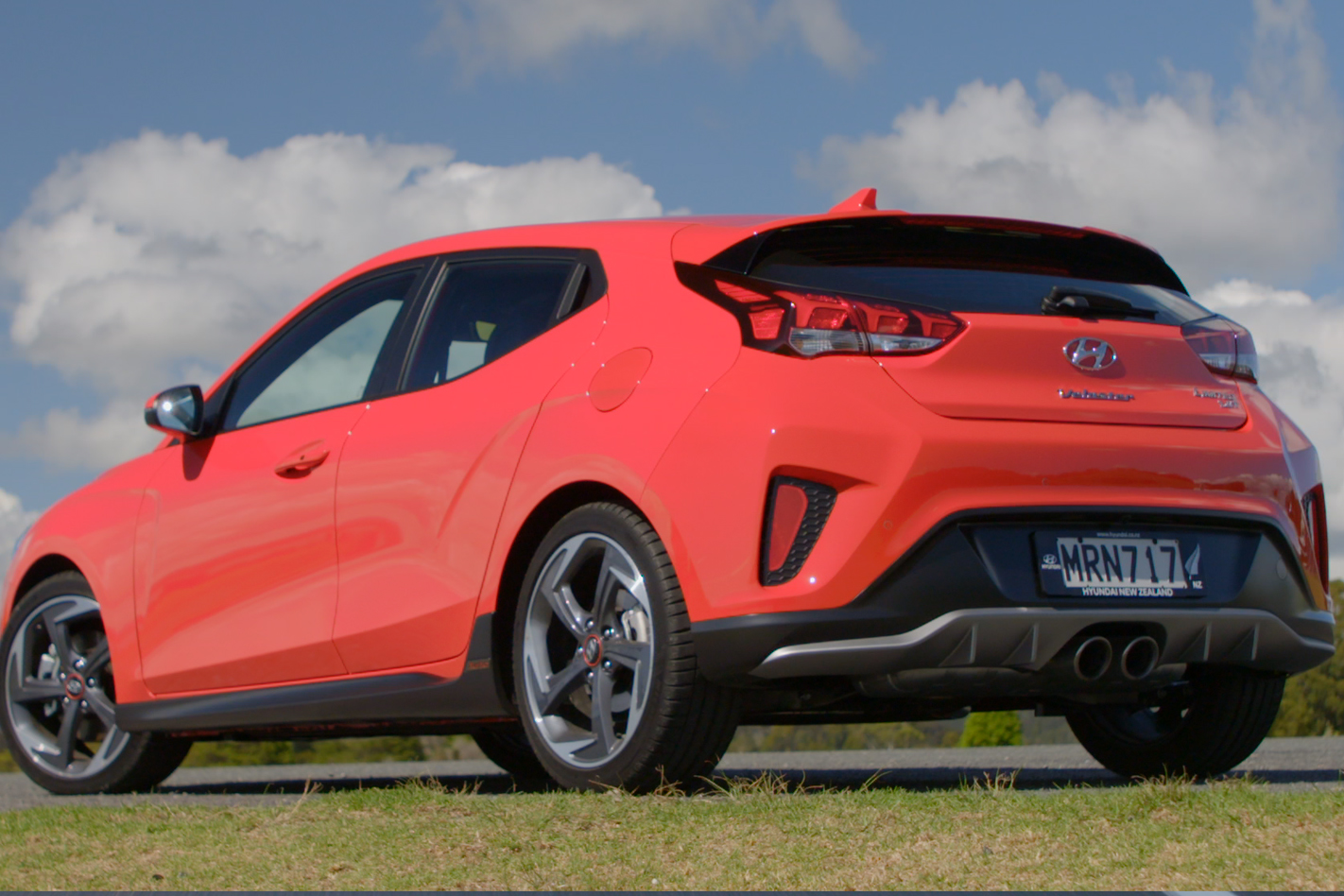
Nearly $7000 might seem like too much of a premium for an exercise in style but for those moments you catch a glimpse of the new Veloster reflected in a shop window or when yet another passer-by complements its charming looks – which happened a lot – it starts to seem like a reasonable proposition.
After spending some time with the dramatically improved model, it’s clear the new Veloster has successfully distanced itself from any other mechanically related model and deserves to be appraised on its own virtues and excellent qualities.
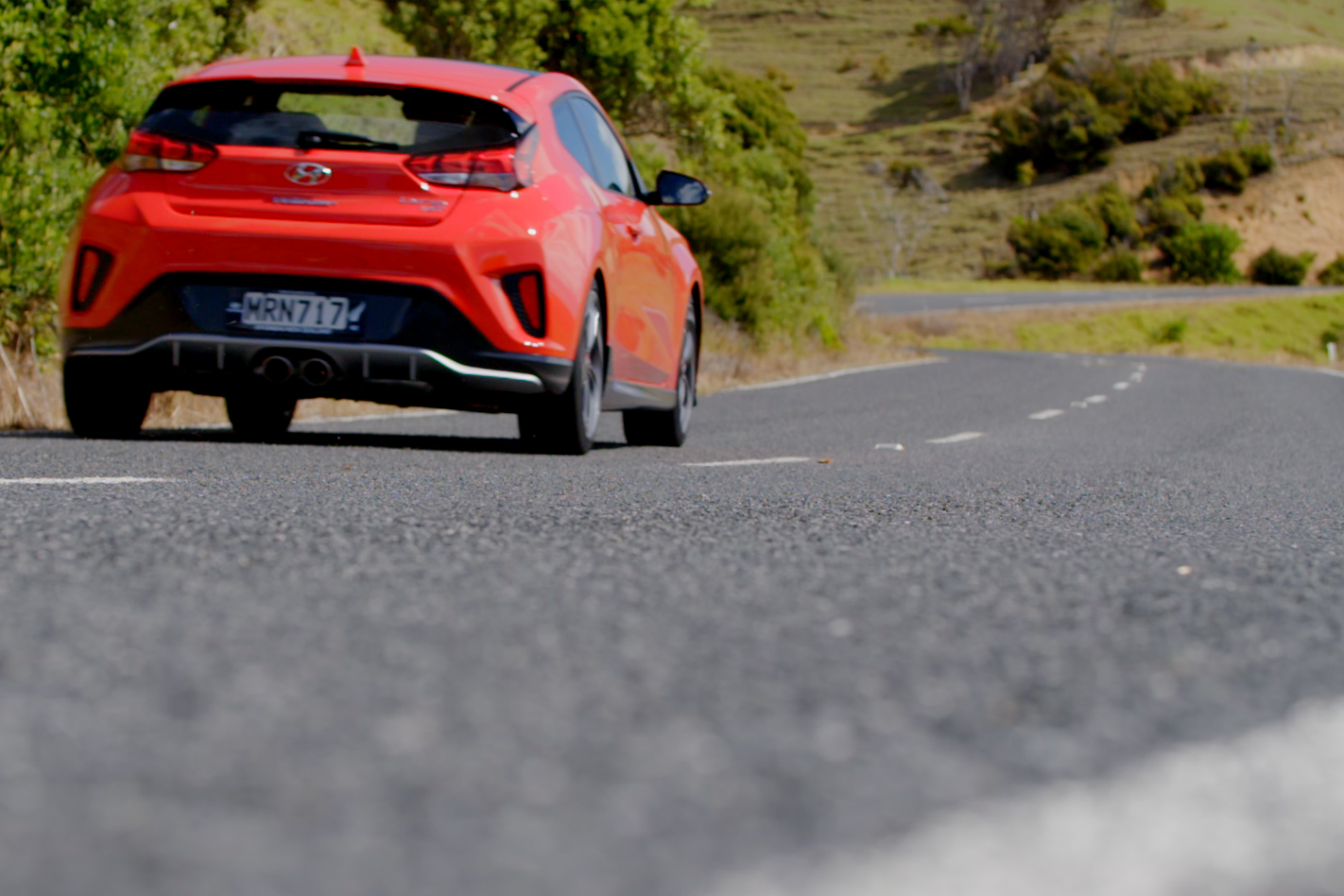
Pros: Amazing comfort/dynamics balance; excellent equipment; surprising practicality
Cons: meddling driver assistance; restrictive rear view: no Veloster N coming to Aus
Rating: 4.5/5
Last year the new car industry in Australia went through a sizeable shift, with the new normal for warranty periods extended from three years to five.
It was something that started slowly, before a flood of announcements were made as many mainstream brands extended their warranty offerings in a rush to not get left behind.
Now, even luxury brands are joining the extended warranty party, with Mercedes-Benz announcing its shock move to a five-year arrangement earlier in the year.
Standing above the sea of five-year warranties is Kia, which has offered its customers a seven-year guarantee for many years now. There are other brands that offer warranty periods longer than five years, but they are not among the top sellers, and are best described as challengers in the industry, using an extended warranty as a way to attract new customers.
Similarly, some specific models may be offered with a longer warranty period, but this is a strategy to increase sales. It’s unlikely we’ll be seeing a push to seven-, or even 10-year warranties across the board in the near future, as an insider at a top-selling car company explained to Wheels.
“For us the extension happened because our mainstream rivals were going to five-year warranties,” our source said.
“We thought about seven [year warranties], but you can see that it would cost a lot of money. If it wasn’t cost prohibitive, we would have just gone straight to a seven-year or 10-year warranty.”
The costs associated with extending warranty periods aren’t small either, with our insider indicating that the final bill could run into eight figures.
“For a top-10-selling brand, the cost of extending their warranty period from three to five years would surely be in the millions,” he said. “It is not a small amount of money.”
Making things even harder for car companies is the fact that the cost increases the longer the warranty is offered for.
“As vehicles get older they cost more [to maintain], so providing a warranty for year four to five will potentially be more expensive than a warranty from year one to two,” our insider said.
“The flipside of the equation is that a longer warranty will help residuals, which is important for the brand’s identity.”
Another roadblock standing in the way of decade-long warranties gaining traction is the possible hit to new car sales.
“If you have a 10-year warranty, as an owner are you going to update your car in five, six, seven years?” our insider added.
“The end of the warranty period is in a way a prompt for some people to update their cars.
“If you make your warranty seven or 10 years, what is the motivation to update your car, as an owner? The new product would have to be pretty convincing.”
Now’s your chance to own the car former FPV boss David Flint called “scary” and “irresponsible.”
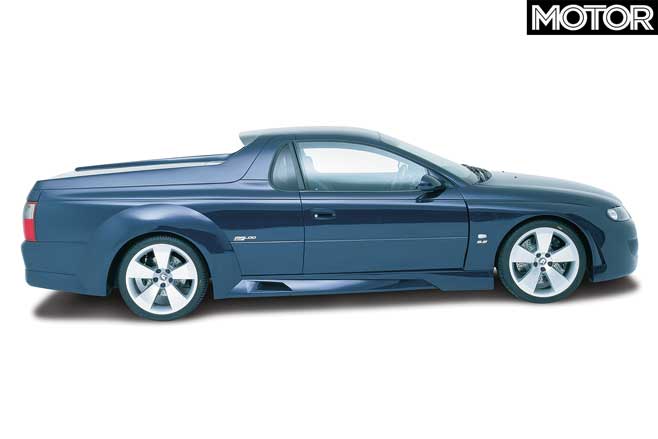
That’s right, the 2001 HSV HRT Maloo concept is up for sale in an online listing.
The one-off ute, featuring the 6.2-litre Callaway-tuned V8, based on the third-gen GM V8, dubbed LS6.
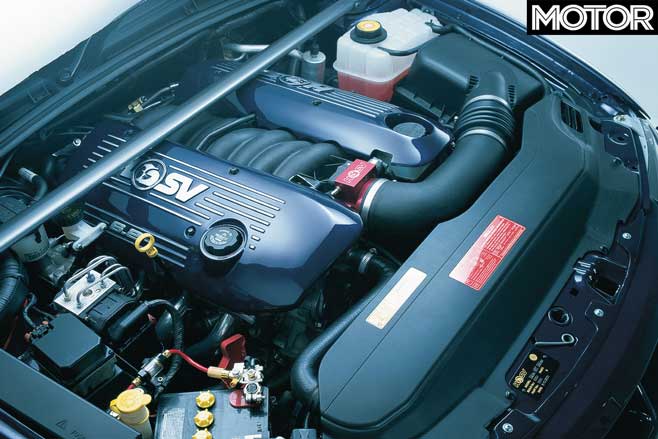
What this meant is that HSV took a huge step forward in the ‘red versus blue’ power war. A massive 350kW (impressive even now) and 600Nm makes the HRT Maloo more powerful than anything Ford or FPV was building at the time, thus the comments by Flint.
And now you can be the next owner of this one-off beast. If you’ve got a spare quarter-million around, that is.
Yep, turns out it’s not cheap to buy a concept car designed and built in four months for the 2001 Sydney International Motor Show.
At the time, MOTOR featured the HRT Maloo in the December 2001 issue (which the seller has provided images of but you can read for free here) and spoken to then HSV marketing boss Chris Payne and the project engineering manager Brad Dunstan.
Payne said the car came about because Holden head honcho Peter Hanenberger told them to ‘step things up’.
“Early on Peter said HSV needed to move to the next level, to be more challenging in our concepts and it was directly in response to him that we got into it.
“This car’s not so subtle. Who knows where it’s going to end but we’ve got to start somewhere.”
Dunstan concurred: “The guys in engineering are really enthusiastic about projects like this, they’re all petrol heads,” he said. “To let them have free reign is a good thing.”
Obviously this wasn’t the last of the wild utes, the Maloo name lived on until the demise of the Aussie Commodore, and shortly after with four W1 Maloos.
But if you want this one, you can check out the ad at Carsales.
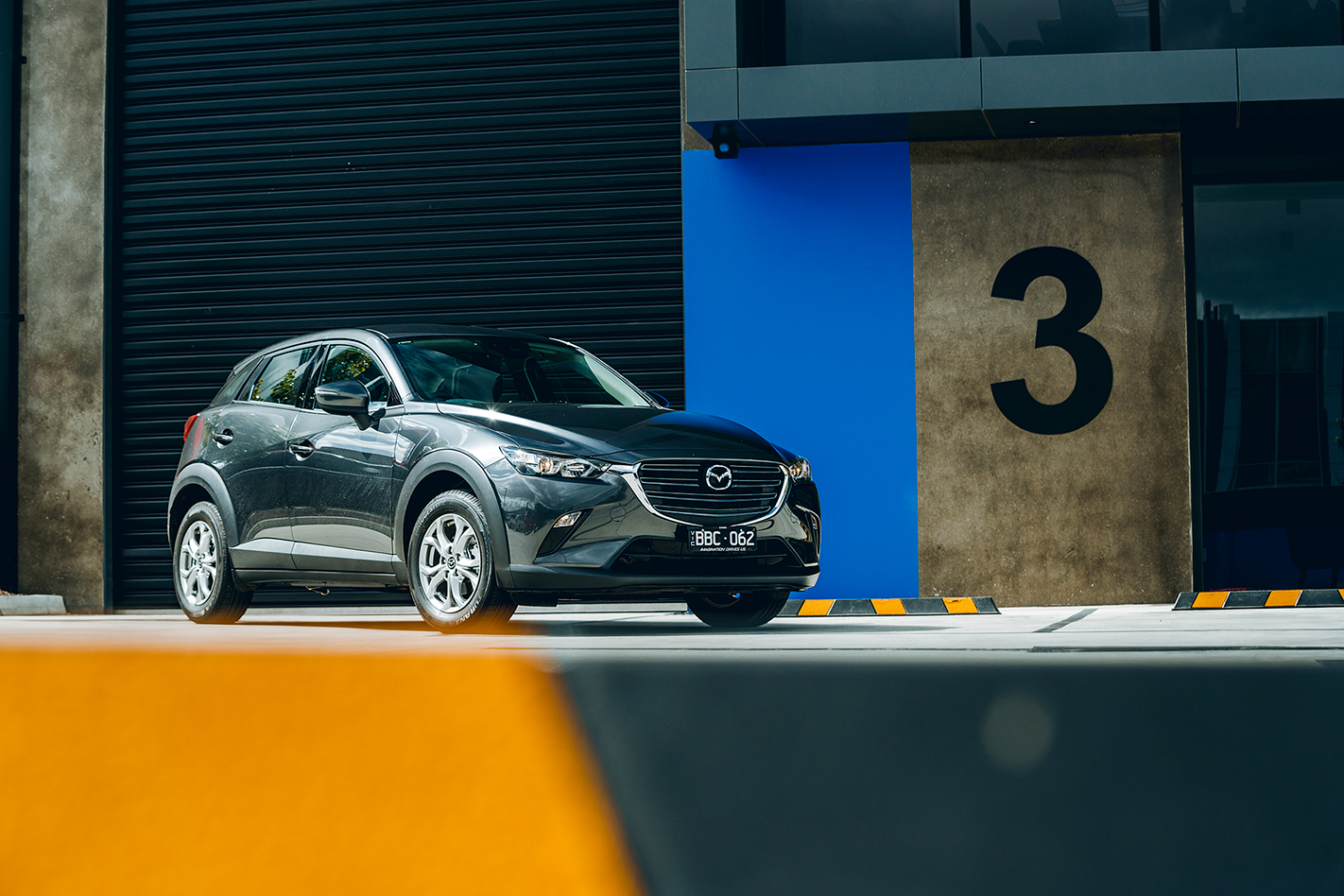
Mazda Australia has deleted the 1.8-litre SkyActiv-D turbo diesel from its CX-3 light-SUV line-up, citing overwhelming buyer preference for the 2.0-litre petrol variants.
This leaves the MY20 CX-3 range with just the one engine option, though buyers can still choose between manual and automatic front-wheel-drive, and all-wheel-drive automatic powertrains.
This is the second Mazda model to lose its economical diesel option during the past year, with the Mazda 6 losing the excellent SkyActiv-D twin-turbo in May 2019.
That engine is still available in the CX-5 and CX-8 SUVs, though, interestingly, the latter gained a petrol option in February to help boost sales.
Along with the BT-50 ute, the two bigger SUVs are now the only Mazda models with diesel variants, though Mazda Australia insists such engines still have a place in its stable even with the ultra-efficient SkyActiv-X petrol engine that’s just months away from arriving in Australia in the Mazda 3.
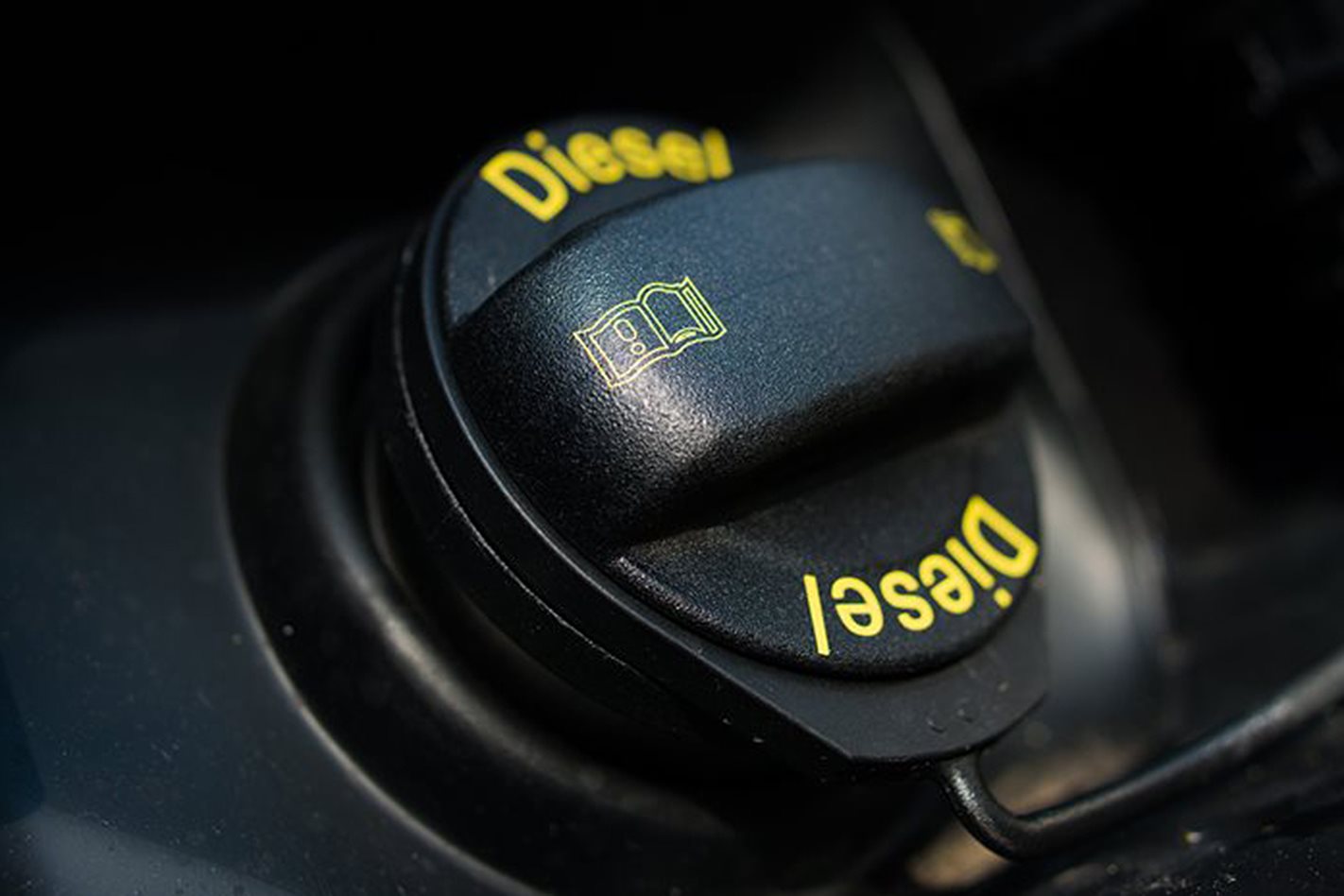
Mazda isn’t alone in dropping oil burners due to lagging sales, with the Mitsubishi ASX, Renault Koleos, BMW 3 Series, Volvo XC40, Peugeot 308, and Volkswagen Tiguan among the growing list of models to go with a petrol-only strategy over the past two years.
Fewer options and decreasing demand saw diesel passenger car and SUV sales drop from 146,313 in 2018 to 121,416 in 2019, which represents a 17 percent decrease; more than double last year’s 7.8 percent sales slump across the entire Australian vehicle market. The diesel’s slice of the new car sales pie is dropping.
As for the Mazda CX-3, sales are holding up well despite not seeing an update since August 2018, with year-to-date sales at the end of March down just 0.4 percent to 3712 to lead the new light-SUV segment and outsell all small SUVs apart from the venerable Mitsubishi ASX.
Camry with soul. Verve. Spunk. Vim, even. And no, I’m not using performance enhancers.
This review was originally published in MOTOR’s October 2006 issue
It wouldn’t be too great a leap to suggest that the last iteration of the Toyota Camry Sportivo wasn’t thus. Competent? Yep. Involving? Nope. And let’s be fair; Camrys were never meant to rend the fabric of cutting edge automotive dynamics.
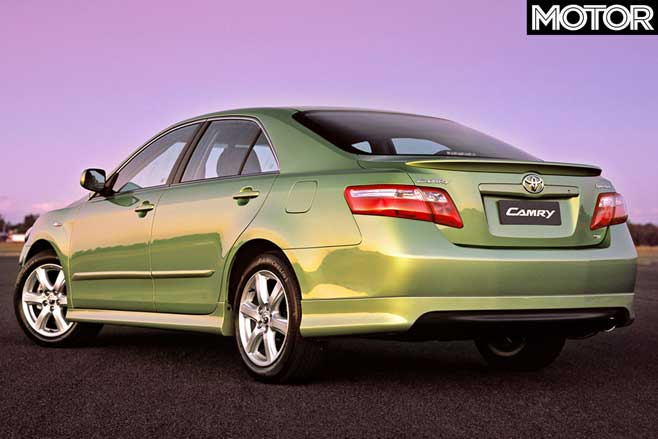
But given the current landscape of the medium car market, populated by competent competitors like Mazda6, Honda Accord and the like, that’s something that had to change.
Enter the 2006 Camry. Redesigned from the ground up as a world car, Toyota’s studios all around the world competed to stamp their mark on the car that is, believe it or not, the best selling passenger car in the United States. Toyota Design Australia, led by the vastly experienced Paul Berenger, had more than a little input into the final version of the car, and the Sportivo’s styling cues will be sent as-is to the States, where it’s sold as the Camry SE.
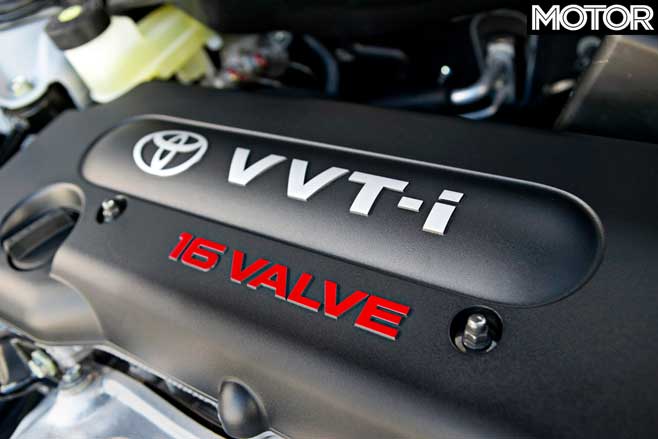
Unlike the previous car, this Camry will only be offered with Toyota’s 2AZ-FE 2.4-litre VVTi four cylinder, good for 117kW at 5700rpm. Torque from the long-stroke motor (also seen in the Kluger wagon) tops out at 218Nm at 4000rpm. Fully optioned, it’ll weigh in at 1480kg. A raging powerhouse? Erm, no.
It’ll be offered with a five-speed auto or a five-speed manual; a bit of a surprise, given the proliferation of six-speed manuals in the Toyota family.
On the face of it, the Sportivo appears to be little more than a bodykit and lower springs. There’s no power-up planned, and no other options to be found. But the substance of the Sportivo is in its rather surprising chassis. With more track and more wheelbase to play with, the chassis boys have gone in hard and hefty on giving the base car a little sparkle where it matters.
The Sportivo does score a few tweaks that the stock Camrys don’t get, including a unique rear chassis V-brace that attaches to the ski-port. There’s also an integral front brace. Senior chassis engineer Paul Diamandis relates a story of a six -hour meeting with senior Japanese engineers late one winter Sunday. “It was all about steering feel, and I wasn’t going to back down,” he chuckles.
It’s a good thing he and his team persevered. With more wheelbase (up 55mm on the previous model) and track (up 30mm front and 45mm rear), and a lower centre of gravity, it’s transformed the Camry from a bland repmobile to something much more entertaining.
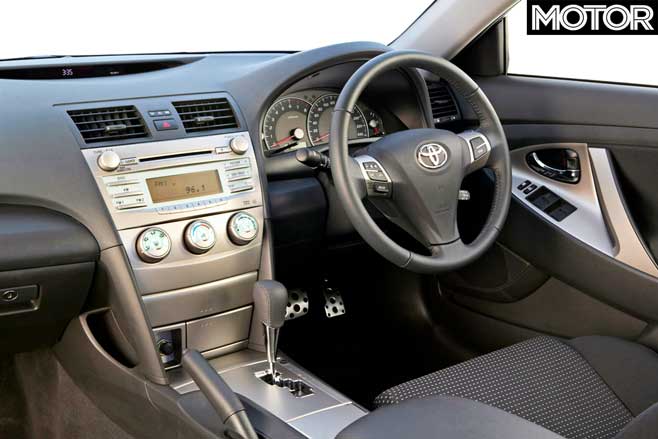
Steering feel is exceptional for a mid-size front-driver, with feedback right through the arc of motion at all road speeds. There’s too many turns lock-to-lock, with hairpins becoming a real handful, but the twin-bush-mounted rack is well weighted, feelsome and not very Camry-like at all. Brakes, from local supplier PBR, are an eye-opener as well, with impressive modulation and feel.
The chassis, too, is well behaved, with good levels of roll resistance and a well resolved spring/damper relationship. The Sportivo sits 10mm lower than the standard car and cops a set of helper springs to perk up rebound. It’s calm and composed, but there’s a hint of playfulness there now. It’s a determined kind of mischief; it’s almost like a kid who’s not naturally gifted at physical pursuits, but has worked like buggery to be as good as he can be.
The chassis refinements don’t gel with the conservative engine spec, however, with the four-potter patently short on torque when pressed hard. Typical Toyota ergos combine with a slick if clinical shift (ironically, a six-speed manual would suit the high-revving mill to a tee), supportive seats and a ace steering wheel.
Bodes well for the Aurion, really.
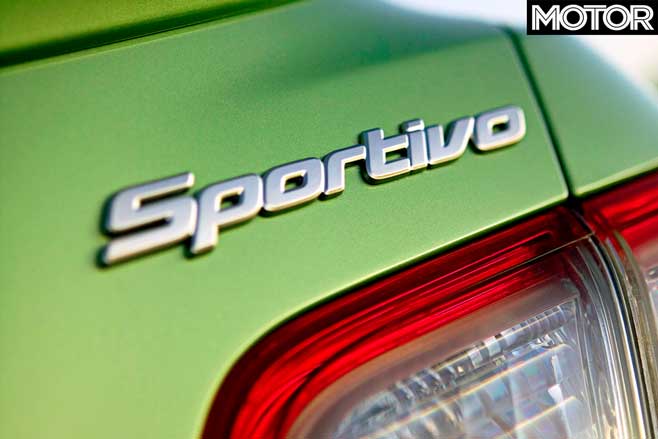
2006 TOYOTA CAMRY SPORTIVO SPECS Engine: 2.4-litre four-cylinder Power: 117kW @ 5700rpm Torque: 218Nm @ 4000rpm Weight: 1480kg Price: $33,000
So the police are fining people for going for a drive. It’s something I feared might happen (it was a little unclear where ‘going for a drive’ fell in Australia’s fast-evolving COVID-19 legislation) and now that it has, it made me irrationally angry.
I felt indignant. Shocked; as though this was one too many freedoms of which I’d been robbed. For me, it was the final straw.
Perhaps it was because the police were having a field day. And they seemed to be relishing it. In Victoria, the coppers completed 983 spot checks and handed out 108 fines in 24 hours for ‘non-essential travel’, slapping motorists with massive $1652 infringements. Nine News reports that one officer told an offending motorist they were “smashing it on the roads today”.
It just seemed so illogical. I’m not talking about that group of 150-plus enthusiasts who were stung in Queensland for holding a car meet in a cul-de-sac. That I can understand. Mixing in large groups is irresponsible. No, I’m talking about people like the Victorian learner driver who was fined for going for a drive with her mum. How does handing that family a $1652 fine help stop the spread of COVID-19?
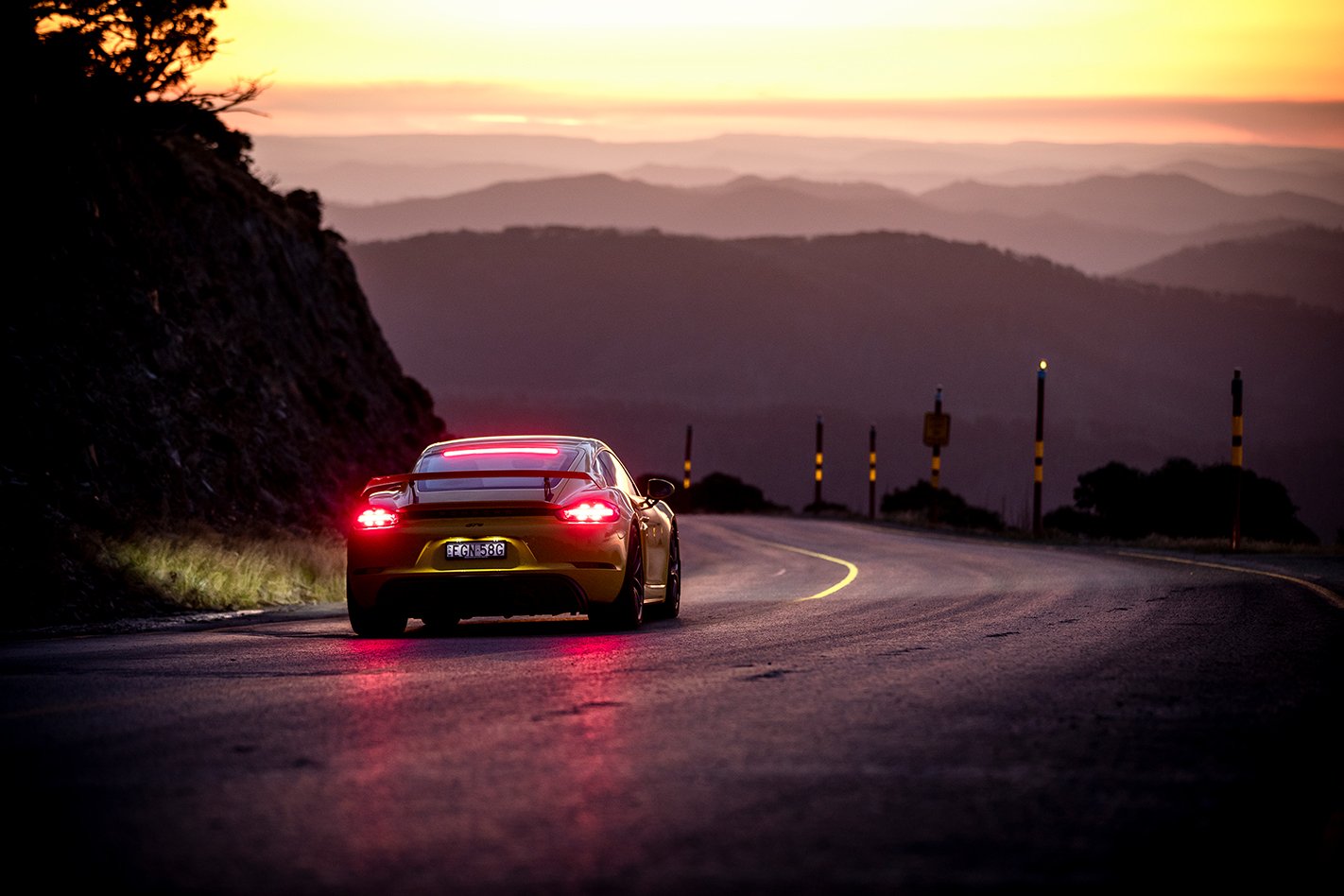
And why can’t I get out of the house and go for a drive by myself? Who could I possibly hurt by hopping in my car, alone, and going for a cruise over my favourite piece of tarmac to clear my head? If I don’t stop, or refuel, or interact with anyone else, then there’s no way I can be infected. Or infect anyone else. Ironically, the riskiest moment would likely be speaking to a police officer if I’m pulled over.
Think about it. What’s riskier? Going for a drive, or ducking into Coles to battle the crowds as people rush to grab the last stalk of broccoli from the shelf? Social distancing laws seem marginal in these shops. The last time I ducked out for milk, two people brushed against me. Enforce that, not some poor mum giving her L-plater daughter a driving lesson.
Then there’s the issue of refuelling. This is championed as proof that going for a drive is irresponsible, but how is handling a fuel bowser and then waving my credit over an EFTPOS machine any riskier than waiting in line for a coffee or dropping my kids off a childcare, both of which are perfectly legal?
Yes, there are some unlikely situations that might bring me into contact with others, like a mechanical failure or worse, an accident, but again, I doubt the stats on the likelihood of these are any higher than slipping over during my morning run and breaking my ankle.
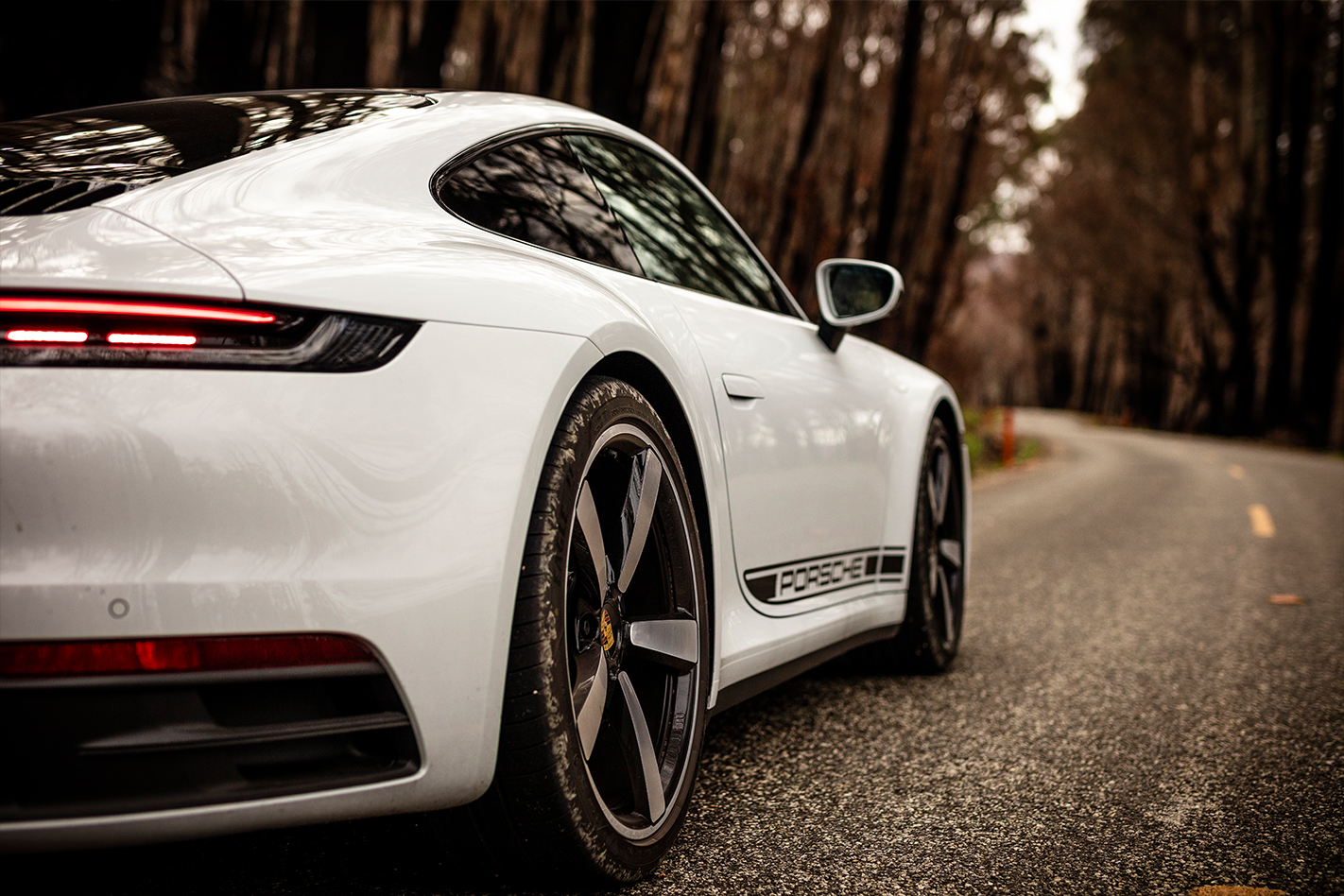
But here’s the thing. If you really try, you could justify pretty much any activity as ‘essential’. And while that might seem okay in our minds, the reality is we’re contributing to a global pandemic. This isn’t a trivial situation we’re all dealing with. More than a million people now have the virus. Over 70,000 have died.
There’s a broader social responsibility we all need to consider. And the only thing we need to do to help the situation is to stay at home. That’s it. That’s the only cure we have at the moment and it’s working. The curve is flattening. Suddenly not going for a drive seems a small sacrifice to make. Actually, frame it that way and going for a drive starts to feel pretty selfish.
So please, stay home. The reality is your burning desire to go for a drive is probably a case of ‘you only want what you can’t have’. When was the last time you actually took the car out for no other reason than to scratch an itch? If you have to think about that answer, you can wait until all this clears up before you grab the keys.
What we should all be doing is using this as a wake-up call. We should be making a vow to drive more when we can. To appreciate the simple pleasure of heading out with no real destination in mind; to revel in the isolation and thrill that comes from guiding your car over a quiet section of road.
So get planning. Start thinking about where you’ll go once the restrictions lift. Where you’ll stay, what roads you’ll conquer, and what restaurants you’ll eat at. Wheels is launching a campaign later this week that does exactly that. We’re using the hashtag #driveafteriso on Instagram and we want you to join in. Tag us, or send us photos of your favourite section of road and we’ll share them with our community. The goal is create a backlog of superb driving roads Australia wide and to start driving them once this crisis is over.
We’re all in this together, after all. The only way we’ll get out of it is if we’re all part of the solution. So stay home and plan that drive. It’ll be even sweeter when you finally get to do it.
Just like the RS7, German performance brand ABT Sportsline has gone to work on Audi’s ultimate Avant to create what it calls the RS6-R. Only 125 of these will be made but, fortunately, the upgrade list is a pretty long one.
First and foremost, ABT has managed to turn the 4.0-litre twin-turbo V8 up to 544kW and 920Nm (compared to the regular car’s 441kW and 800Nm) due to new turbochargers and a more powerful intercooler.
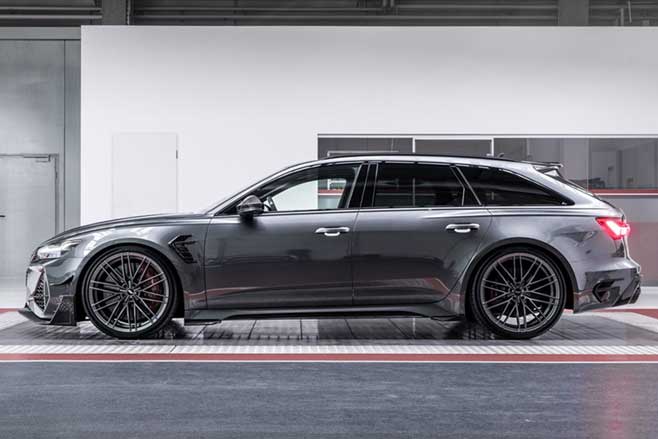
Performance specs haven’t been revealed but the 0-100km/h sprint will undoubtedly be significantly quicker than the regular RS6, and ABT offers to up the top speed to 320km/h. ABT’s sports exhaust system is also included, with carbon-tipped tailpipes.
Along with the significant power hike, carbon aero parts like a front splitter and grille modification, side skirts and wheelarch details are all thrown in. ABT’s own coilovers and anti-roll bars are buried under the skin, and the hyper-Avant sits on 22-inch ‘weight-optimised’ alloys.
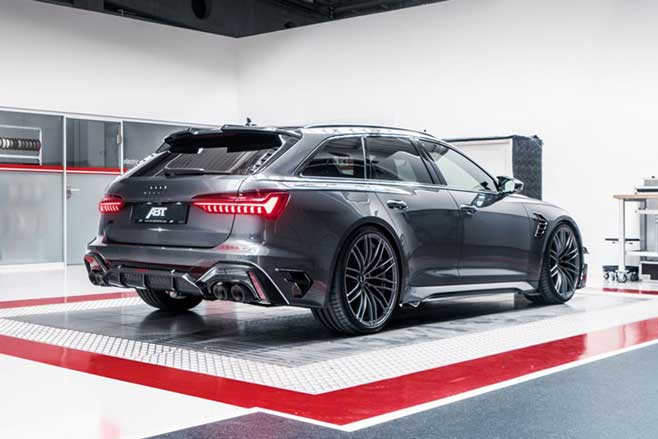
If you want to trick out the RS6-R even more, ABT offers carbonfibre detailing for the cockpit and another wheel design. Each car will get a ‘1 of 125’ marking on the door sills.
How much? Quite a lot. ABT is asking for just under €70,000 (AUD$124,000) in Europe for the upgrade, before the cost of actually buying an RS6 (complete with the Dynamic Plus pack, RS Suspension and carbon black pack) to be fettled with. That’s a whole lot of dosh.
This story first appeared on our sister site Car Magazine UK.
