
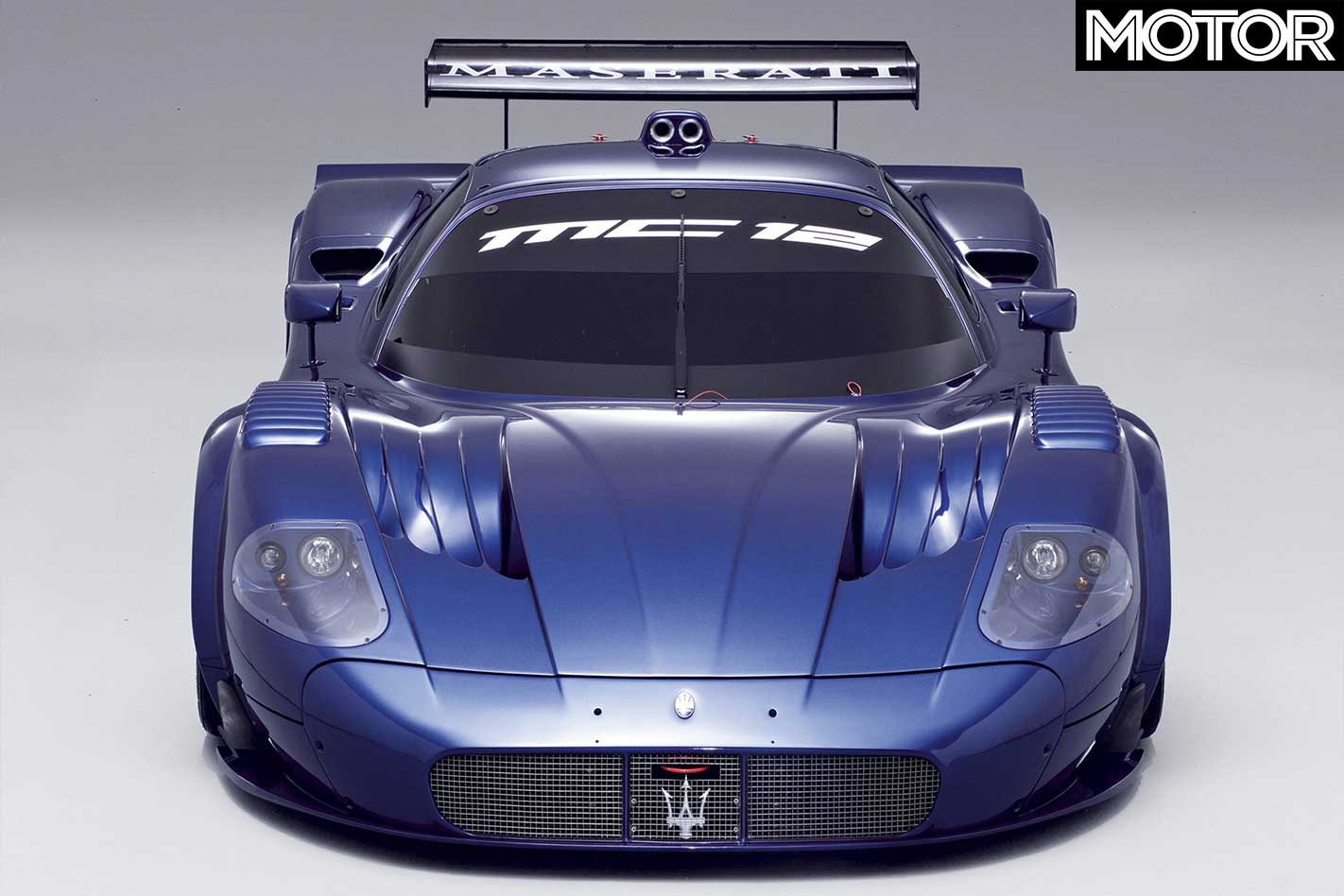
Picture this, you’re set inside a Maserati MC12 Versione Corse. Behind you, a 6.0-litre V12 is screaming and it’s pelting you at the horizon behind Varano De’ Melegari circuit in Northern Italy.
You’re moving fast. Stupidly fast. With 489kW per tonne, it accelerates from zero to 200km/h in 6.4 seconds. A Volkswagen Golf GTI will hit half that speed in the same time.
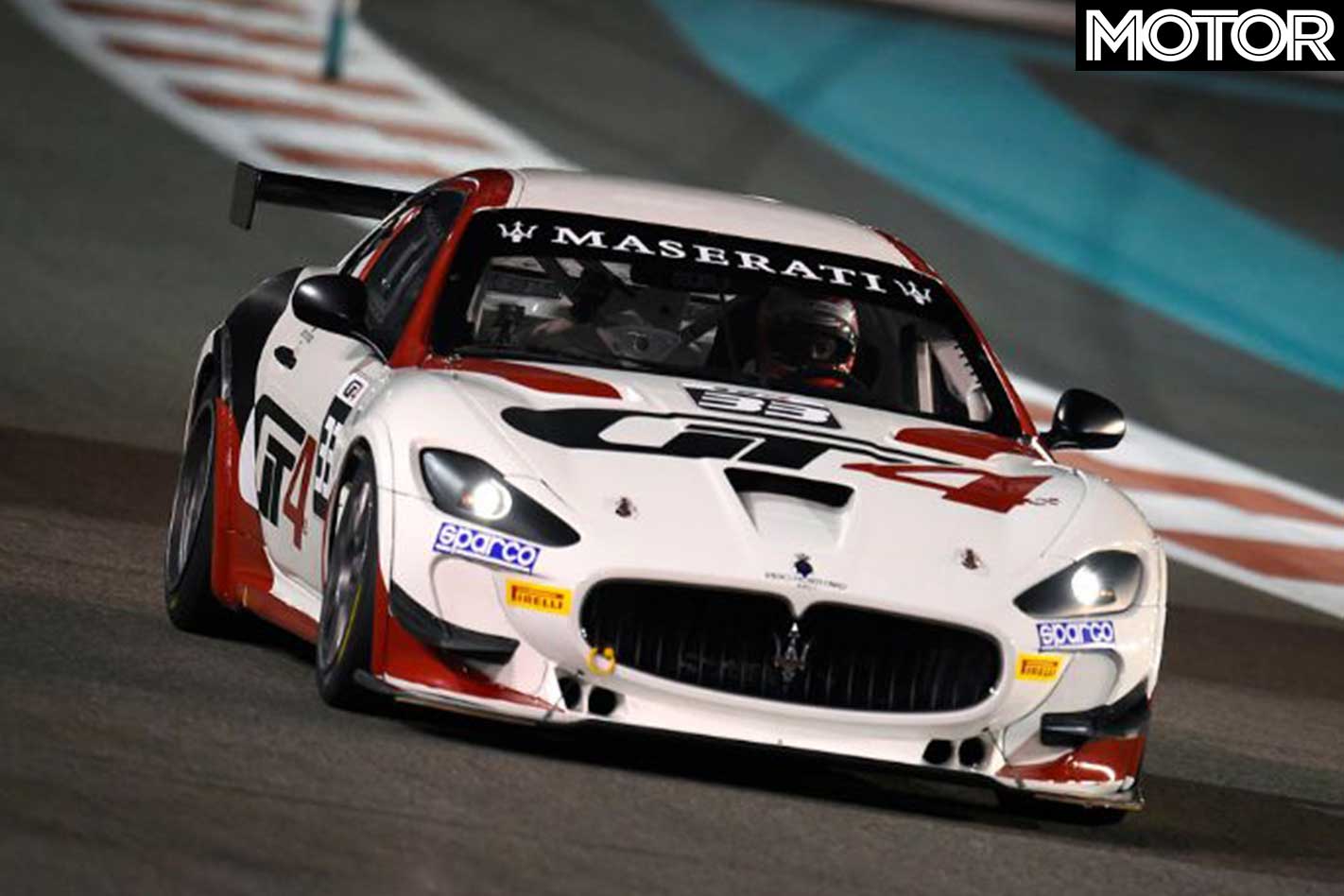
The bad news is you’re in the passenger seat. But you’ll still be driving the next best thing– a GranTurismo GT4. It’s a stripped out GT car with a Ferrari built V8. And, according to Maserati, you’ll be qualified to wring its neck.
That’s the idea behind its Master Maserati Driving Course. It’s one of the many programs performance car manufacturers offer that hone customers’ skills until they’re ready for race cars. Programs are usually staged over multiple levels, progressing from basic instruction to analysis and assistance from seasoned race professionals.
With the appeal for customers obvious, thrashing a car legally at a racetrack without any guilt of depreciation, they’re great for building a community between a brand and its customers. But they’re also a fuel-injected sales technique. Maserati says customers have bought a car three years after driving it at one of these days. That becomes quite a successful sale if they progress to the point where they’re unleashed in a customer race car.
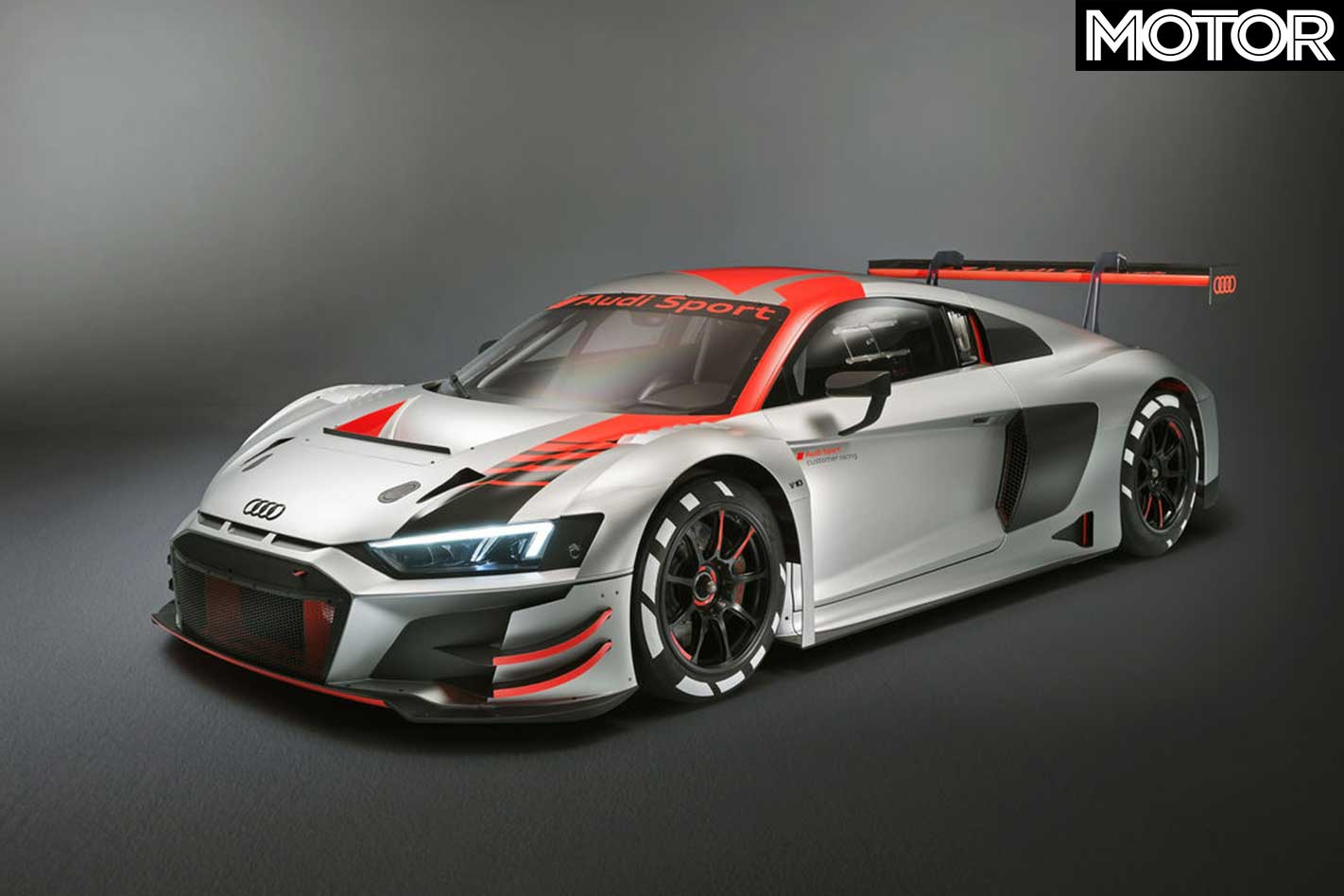
Audi’s R8 LMS GT3, for instance, costs $750,000. You’d almost need $1m for the equivalent Ferrari 488 GT3. Or if they catch the bug and prefer to race more serious machines, customers might end up in ultra-exclusive and expensive arrive-and-drive days like the Ferrari Corse Clienti.
Before any of that, though, the journey begins where I am: Sydney Motorsport Park. We’ve been invited to an ‘equivalent’ to the first step in its course. Think of it as the yellow belt in karate. Officially, though, this is not part of its program. You’ll have to fly to Italy for a genuine pay-to-play experience.
Maserati’s Australian arm instead runs an invite-only event for customers, media or prospects. We’re told it’s everything, if not more, than what happens in Italy. That might explain why even though we’re at a track right next to a garbage tip in Sydney’s western suburbs, it feels like we’ve arrived at a luxury driving retreat.
On top of being driven here in a cavalcade of Maseratis with chauffeurs willing to block traffic, as if they’re transporting parliament members, we’re greeted by a concierge. Behind them is a coffee machine, with baristas, platters of fine foods, and a cold fridge full of sparkling water.
We’re given time to peruse our waiting lounge that feels like a showroom. It’s air conditioned and adorned in white leather. On its walls hang grainy black and white images of Juan Manuel Fangio, laying lines at Monaco with a dap of oppo in post-war F1 cars.
Normally I’d feel ashamed for wearing anything other than moccasins in a place like this. We’re told the expensive watches were stowed before the journalists arrived. And although we laugh, it feels like only half a joke. But I remember we had been promised more precious things. The cars.
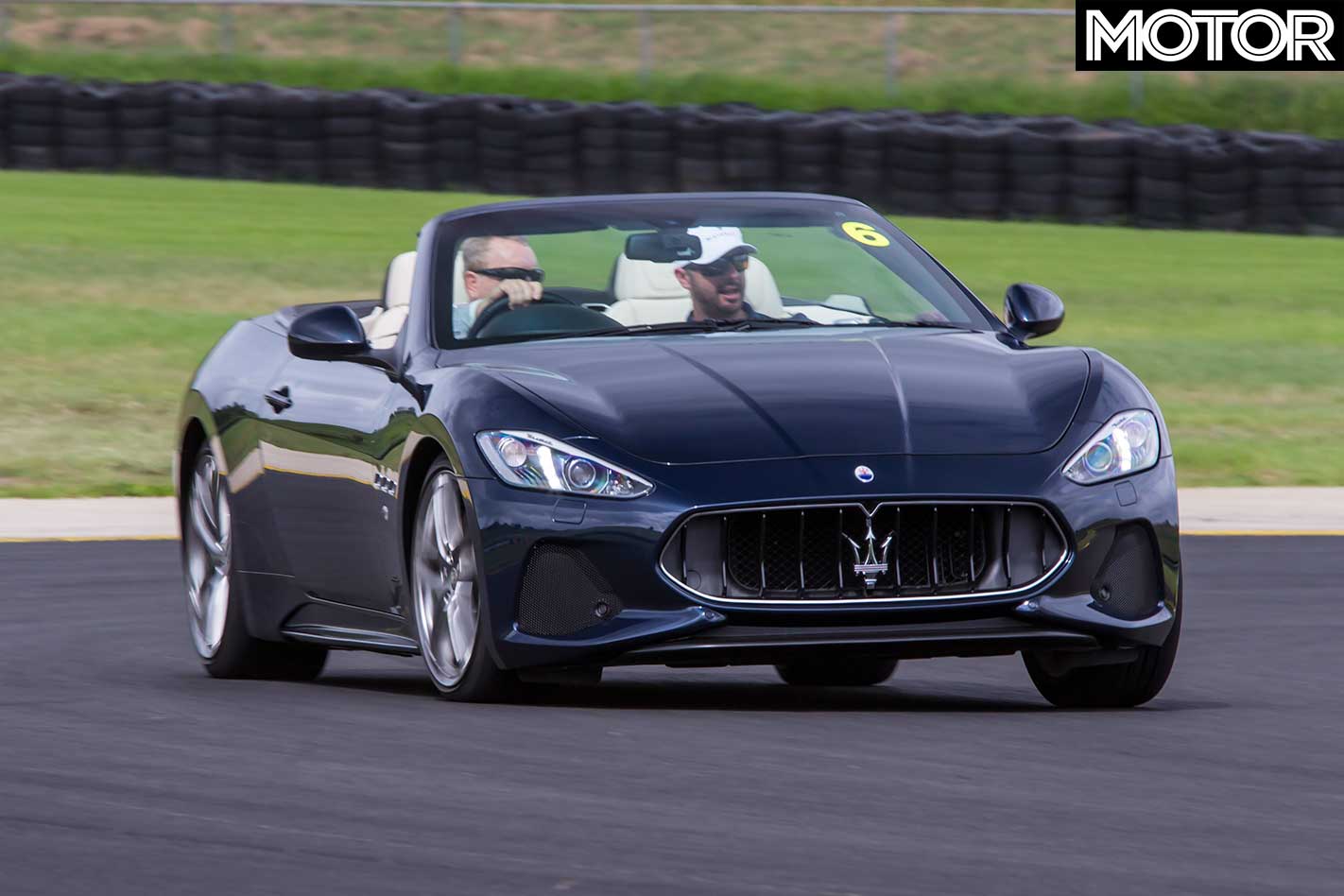
Waiting in pit lane for us is Maserati’s complete 2019 range. From the cash-generating Levante SUV to the ageing, but beautiful, GranTurismo coupe. And we’re only a (relatively) tedious driver’s briefing away from being able to unleash them.
We’re greeted by Renato Loberto, the man behind Motokinetic. He’s not Andrea De Adamich, the ex-F1 racer that leads Maserati’s lead instructor team, but he could be the next best thing. He’s raced and won in Ferraris at Bathurst and even instructed the military on high-speed tactical driving. His team is a handpicked bunch of local guns who will be our teachers.
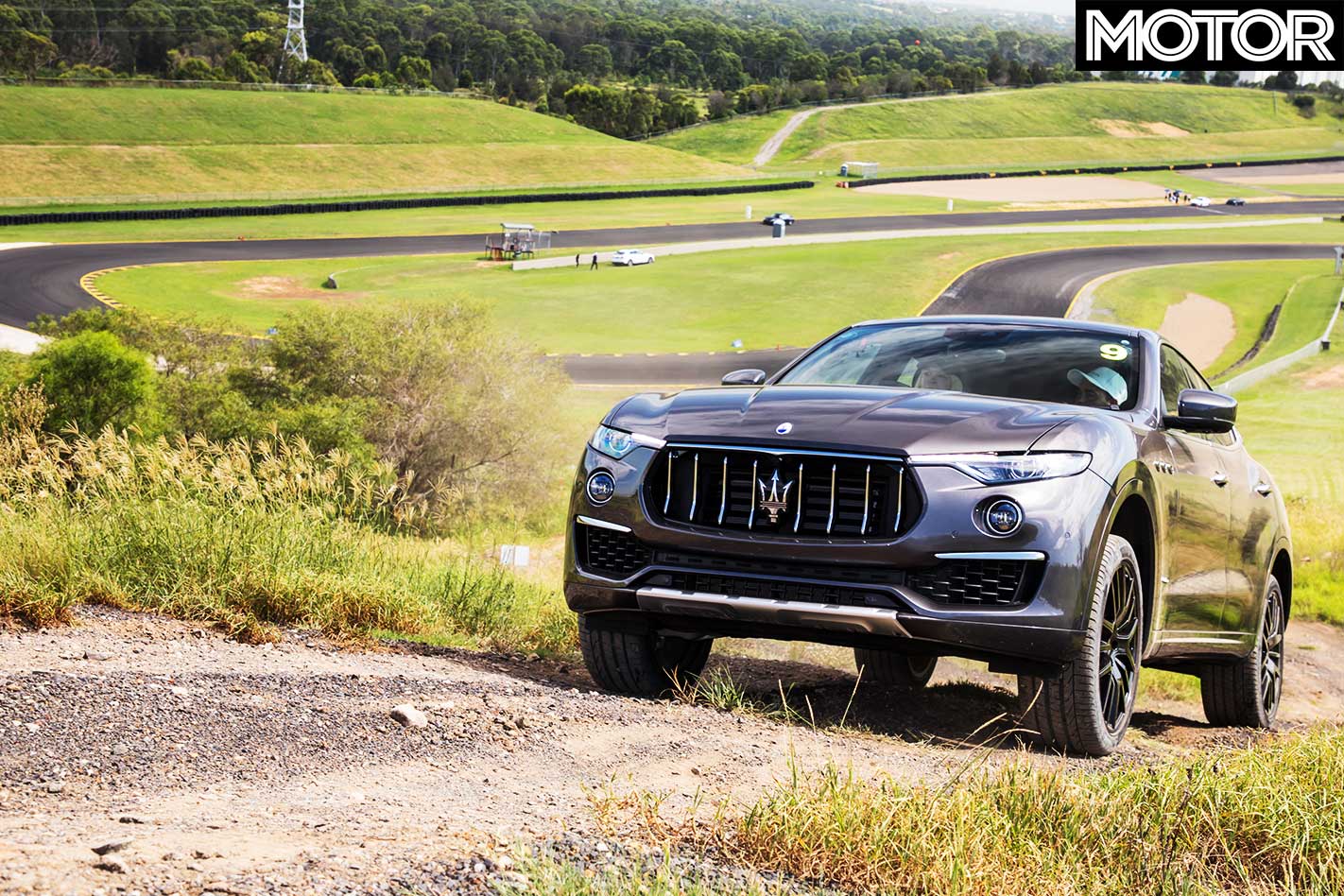
We’re split into groups and I’m sent to the off-road course in the track’s south-west corner. It’s a brilliant vantage point to watch the action on the West-end of the circuit, except for the steep 50-degree drops. We use them to test the Levante’s hill descent control. It’s impressive, but we’re counting down the minutes to the next exercise.
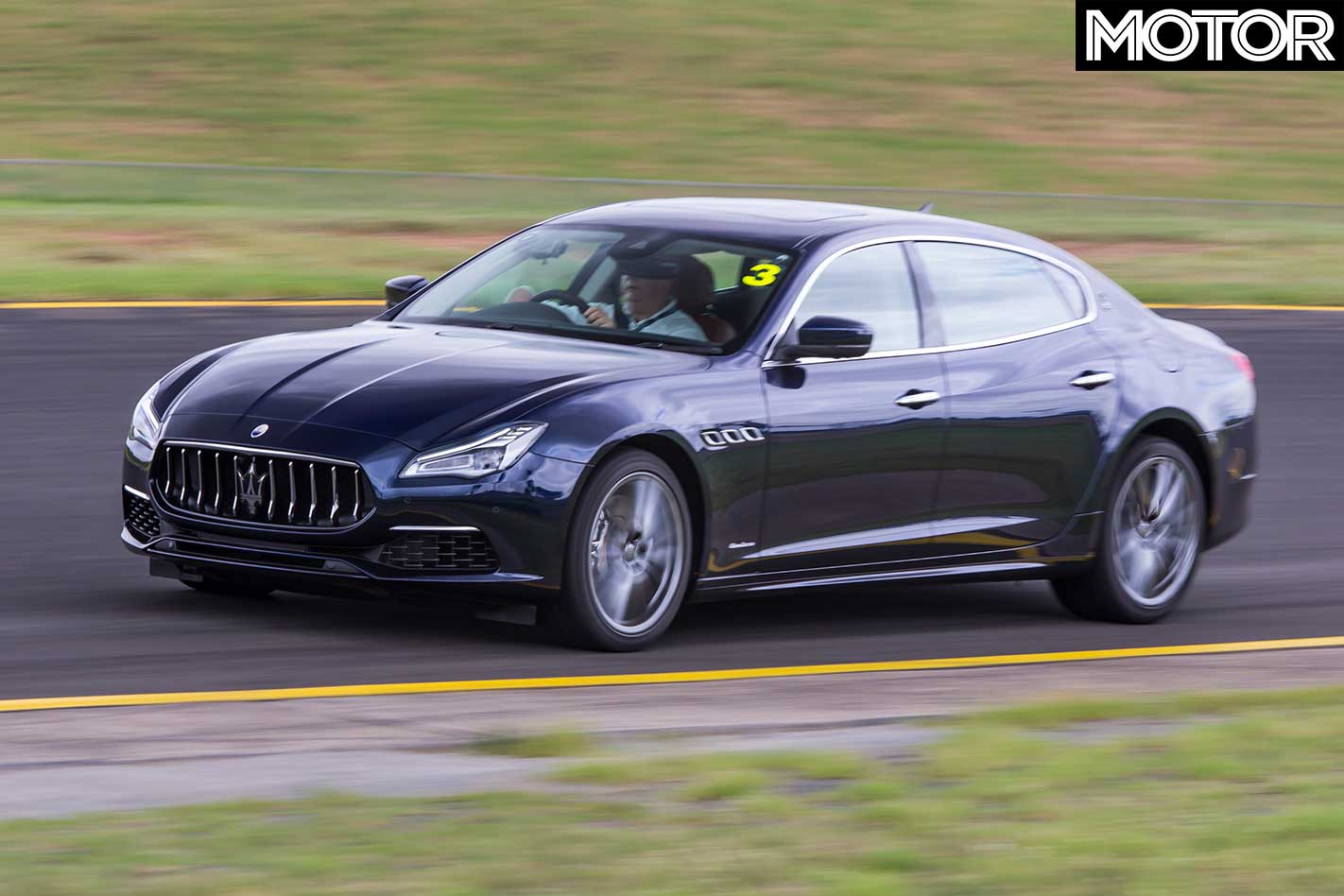
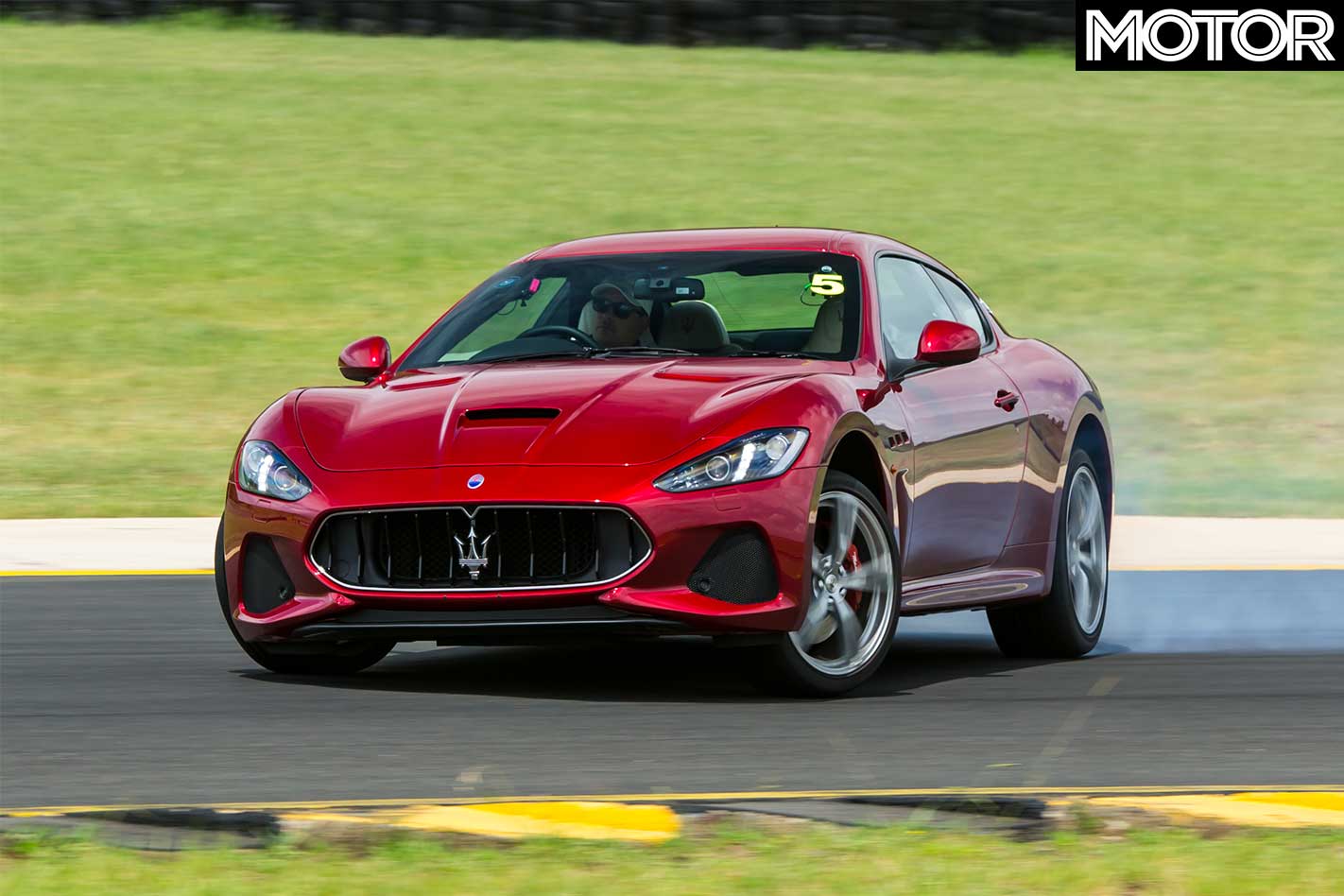
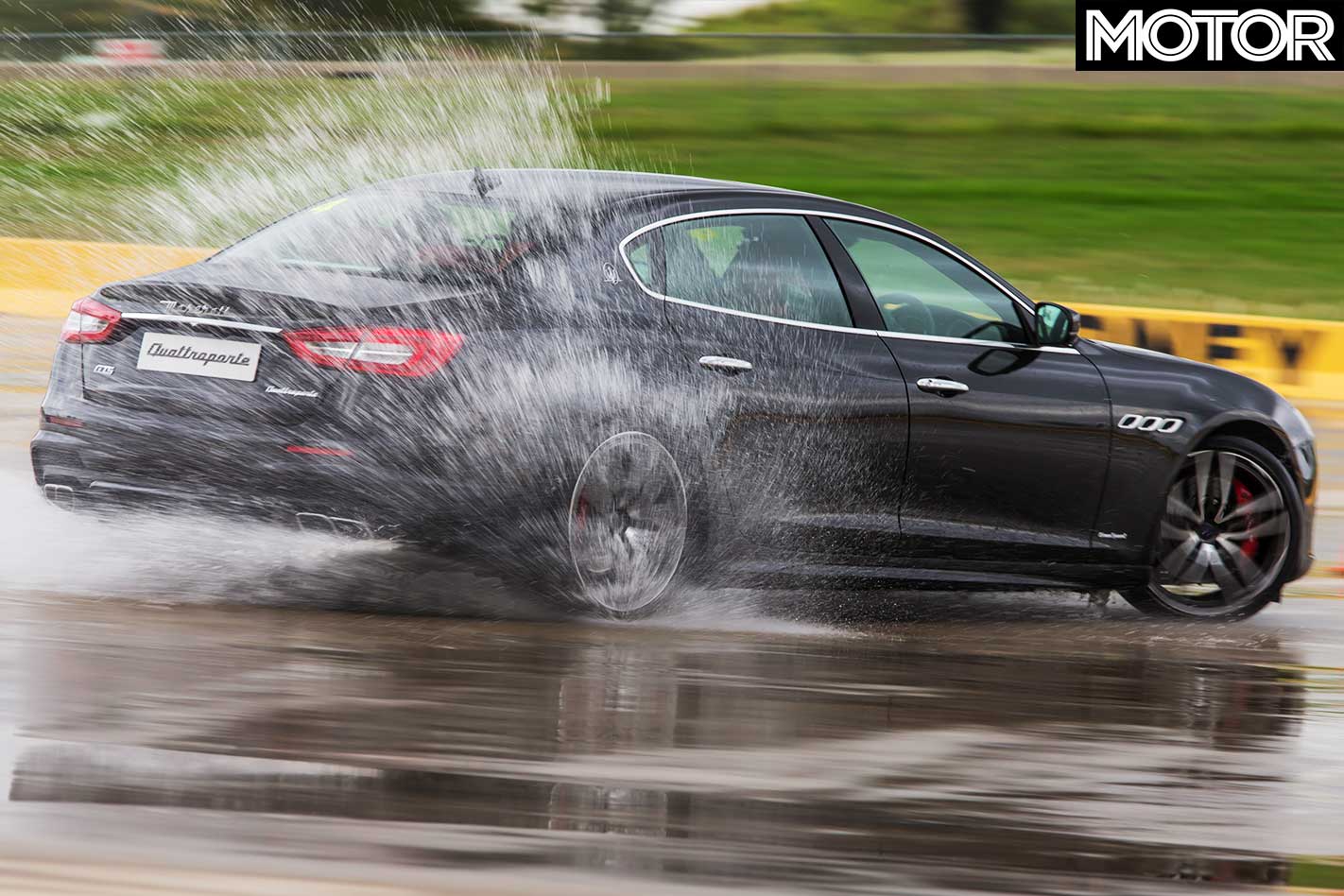
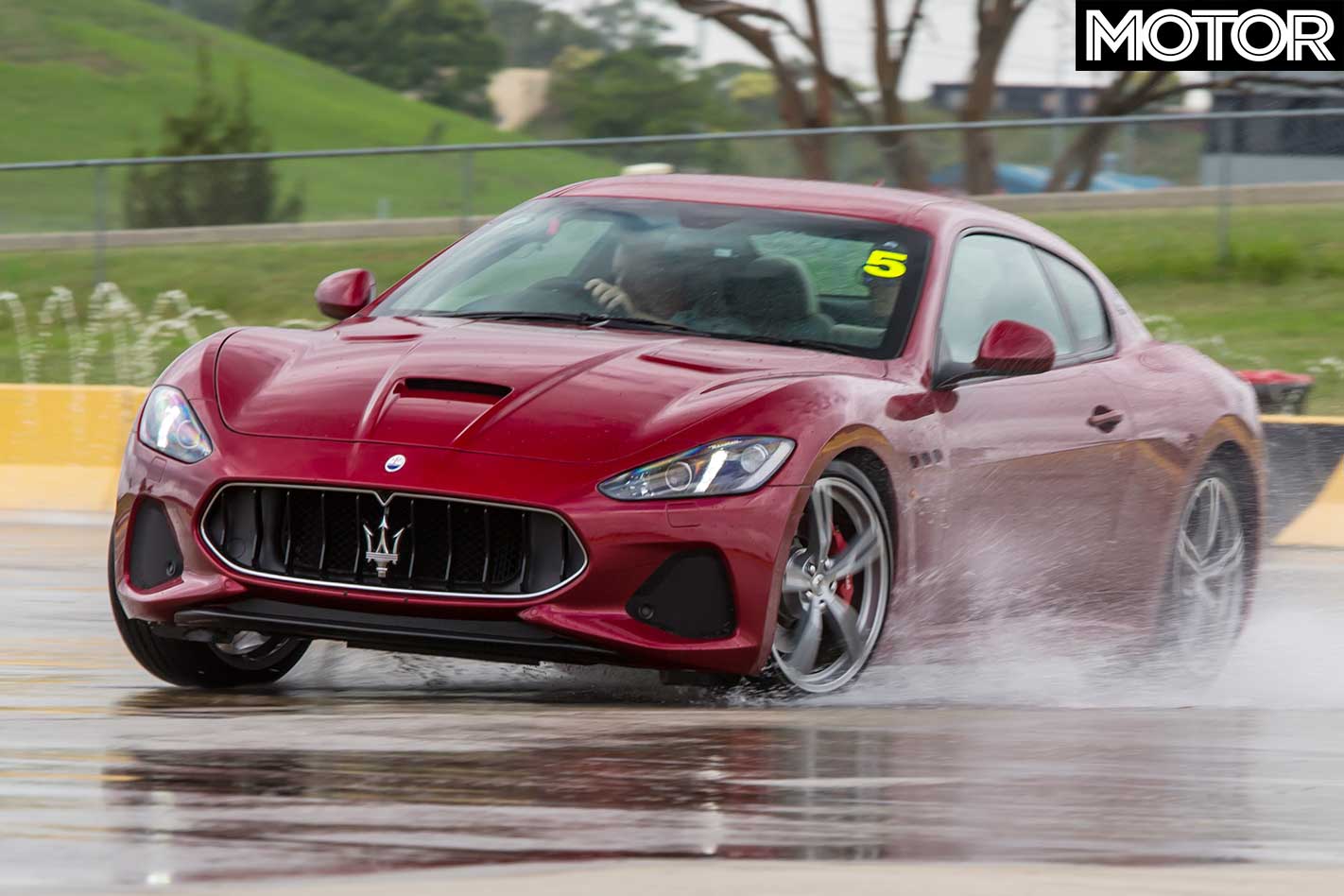
The wet skidpan is a chance to pretend you’re at Summernats. With Sydney’s heat doing its best to undo the sprinklers’ hard work, the best lubricant here is the 395kW twin-turbo V8 in the Quattroporte GTS. The instructors throw us its keys first, citing its big wheelbase and meaty turbo torque as superior tools for skids.
On the other hand, a GranTurismo MC, with its crisp, atmo V8 and shorter wheelbase, is more of a next challenge. There’s less castor angle built into the GranTurismo’s front-end, we’re told, so its steering feels heavier and less keen to re-centre. Meanwhile, it also needs a big rev, as the 4.7-litre Ferrari-built atmo V8 produces its torque peak at 4750rpm.
Although it’s meant to be more difficult to slide, the GranTurismo’s instant throttle response and sharper steering give you more control, even though everything happens quicker. With the revs pinging off the 7500rpm limiter, it’s easy to want to stay here for the rest of the day. But that’d be a waste.
Sydney Motorsport Park, in my opinion, is one this country’s greatest tracks and you should seize any chance to drive its 3.9km GP configuration. Before we do, though, we’re ushered to a feast prepared by Sydney chef Giovanni Pilu.
Freshly cooked steaks and handmade pasta are a long way from the Mrs Macs and Coca-Cola combo we’re used to at track days, but considering the trouble Maserati went to have Pilu on hand, it’s a non-negotiable aspect for the brand in keeping an Italian connection.
I fight an urge to gorge suspecting it might come up only hours later. It’s a wise choice, as afterwards we set out in the plush, high-riding Levante. Surprisingly, it’s not the rolling and pitching mess you’d expect from an SUV. It even cajoles me before I’m warned that its hard-used brakes would prefer some easy laps. I relent, using them to get my eye in.
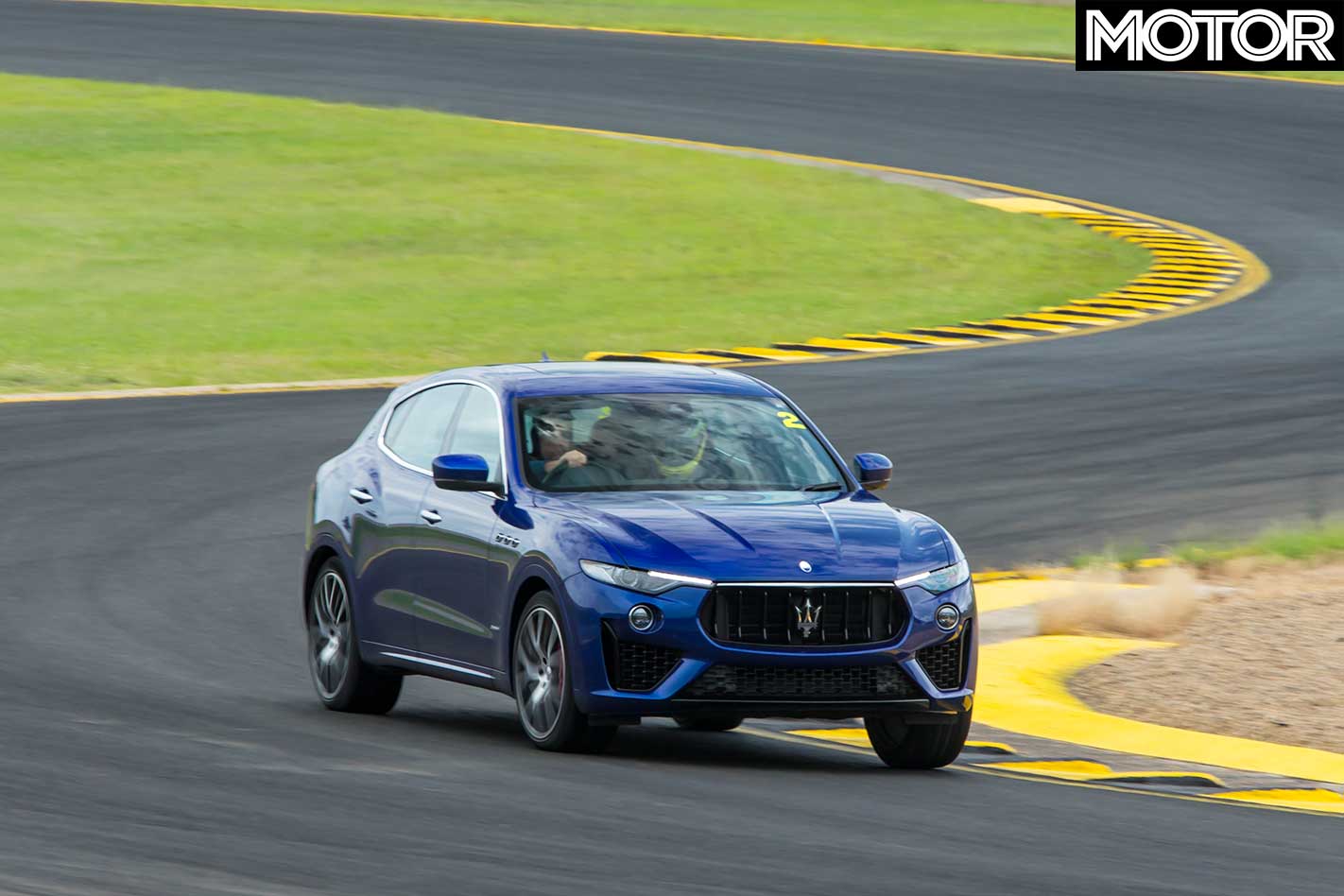
It’s hard to dissect and compare each car in the short time we had, but GranTurismo MC is a standout as something that felt cohesive and willing to work with you. Its pedigree is obvious in the way its brake and throttle pedals are robust and responsive. And that engine should be a protected species, it’s blissful.
It’s almost easier to compare the styles of each instructor as they actually are in the car with you. As tempting as it is to show them what you have and floor it out of the pits, imagine sitting next to a complete stranger as they take your life in their hands at 200km/h. After all, having them in your car at all is a privilege. It’s more effective than being led by a pace car like other courses.
Some prefer to sit and watch you drive in silence, offering feedback towards the end of your session, whereas others encourage you to push immediately. By the day’s end, at a track I’ve driven a handful of times, I’ve learned how to properly take the turn 16, 17 and 18 sequence, where to brake for turn six and how to set up Corporate Hill properly. And that’s what’s most important, seeing how far you can push yourself.
It might not apply to its cars, we’re yet to drive them thoroughly, but Maserati speak truth when they call this event the ‘Ultimate Drive Day’ experience. Now, how much is a plane ticket to Italy?
Course: Maserati Ultimate Drive Day Experience How long: All day Where: Sydney Motorsport Park Contact: https://www.maserati.com/maserati/au/en/brand/master-maserati-driving-courses
Another week in the fast-paced and ever-changing automotive world has flashed by, but the WhichCar Weekly team has the high points covered.
This week, Scotty is off tearing up the outback in a Raptor, and has left Dan to hold the fort. Joining Dan, Wheels journalist and motorsport anorak Cameron Kirby makes his WCW debut alongside regular Andy Enright.
In this episode Cam gives us his review of the Bathurst 12 Hour and explains why it is gaining increasing attention from both motorsport diehards and new fans to the sport. Later in the show he reveals what it’s like to pilot a TCR racer ahead of the new touring car series kicking off this year. He still hasn’t stopped talking even though we switched off the mics and turned out the lights.
Andy returns from New Zealand and regales us with tales from the Leadfoot festival, where for one weekend each year, Rod Millen’s driveway becomes ground zero for petrolheads. Could the Kiwi event put Goodwood on notice? He also explains why the local police want to ask him some questions about an AirBnB.
And the boys say happy 50th birthday to Honda Australia and discuss their favourite models from the Japanese maker from the past five decades.
If you’re on the run or in the car, you can find the WhichCar Weekly podcast on iTunes or Podbean and you can follow the WhichCar team on Facebook, Twitter or Instagram – @whichcarau.
Join us each week as we bring you up to speed on all the hottest car news.
Listened to the show? Help us out:
- Leave a note in the comment section below.
- Leave a review on Apple Podcasts/iTunes
- Subscribe to our podcast
Last year at a track in Germany called Bilster Berg we got our hands on Mercedes-AMG’s updated super sedan, the bonnet-bulging 2019 C63 S – and we were wowed by its improved refinement, smarter interior and tyre-friendly new nine-stage traction control.
At long last, this facelifted version of AMG’s best-seller has arrived in Australia. And you should read our international test report first before continuing below – in it, we’ve outlined all the changes, from interior to the new transmission to the different noise, and given our first impressions.
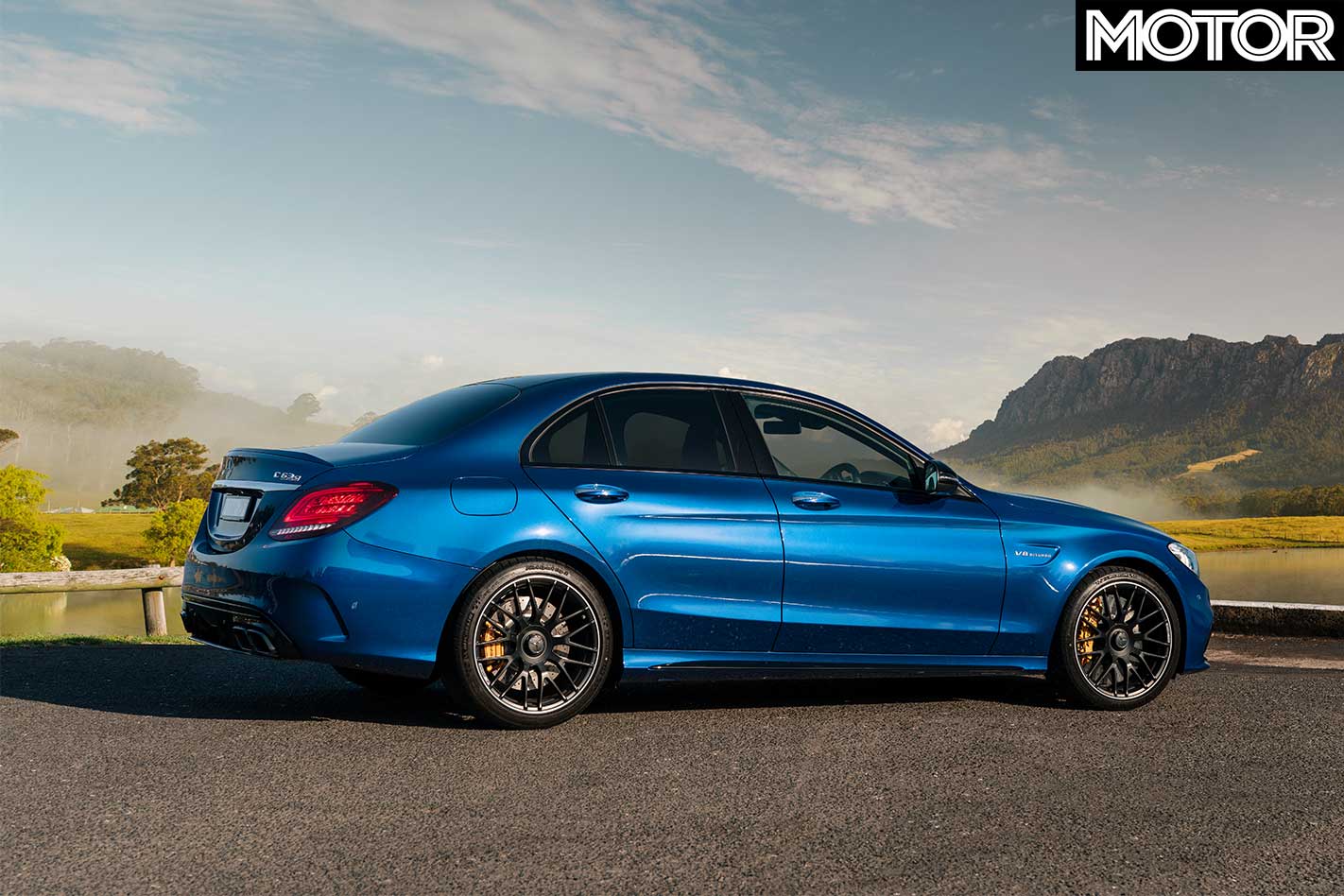
In this review, our first taste of the C63 S on Australian roads, we delve deeper into the Big Ticket Items for C63 S, those being the improved refinement and the veritable toy-box of Electronic Stability Program (ESP) and Traction Control (TC) modes now available in the form of what AMG calls its new Dynamics menu.
Whether you’ve read our other review or not, let’s get one thing straight first-up: the new C63 S is brilliant. No, really, it does strange things to our soul, with its classic combination of sonorous and stunningly powerful twin-turbo V8; rear-wheel drive and electronically locking rear diff; sweet and accurate steering and generally delicious handling.
Could the W205 C63 S be the best all-round rear-drive muscle sedan ever made? We’d say yes. And in this age where we are struggling to feed our long-held, rear-drive V8 sedan addictions, we are so glad the hot-rod-in-a-suit C63 S exists.
But when it was released in its first form in 2015, all was not right – it was a bit too stiff, not as refined as the gorgeous baby S-Class interior suggested, and the transmission could make some crankiness known at car-park speeds, by way of a clunk or a hesitation; and also it wasn’t quite as fast down the gears as it was up, when you were burying a foot into what was (and still is) one almighty brake pedal.
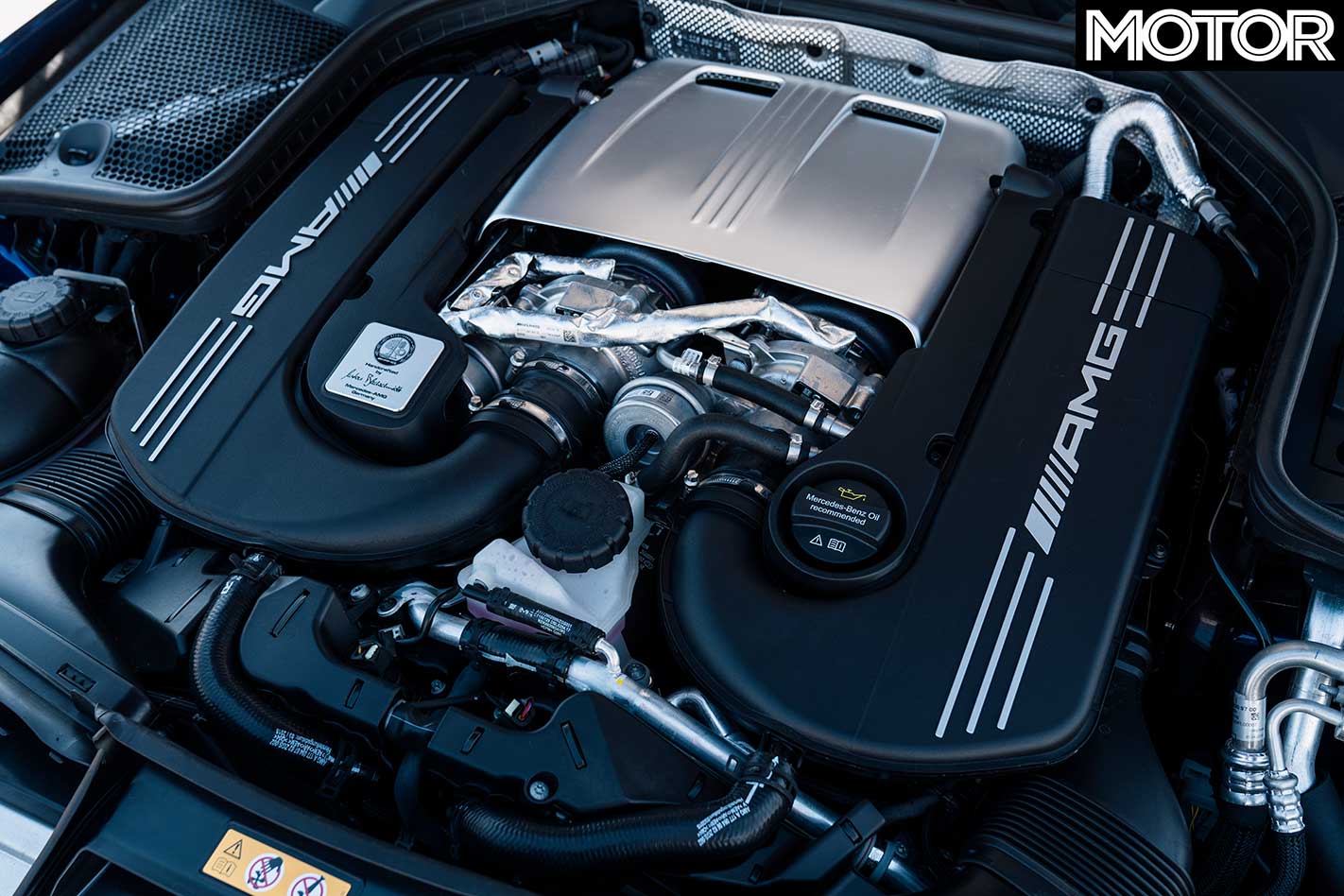
Nobody sane ever complained about the engine being underpowered, of course, and so it’s telling that for this update, outputs remain 375kW and 700Nm in what would be a textbook if-it-ain’t-broke case study. AMG says the engine has not been touched.
Okay, so with a general overview out of the way, let’s skip ahead a bit and talk about the ride and refinement before delivering a few verdicts on the new nine-stage TC and other ESP modes.
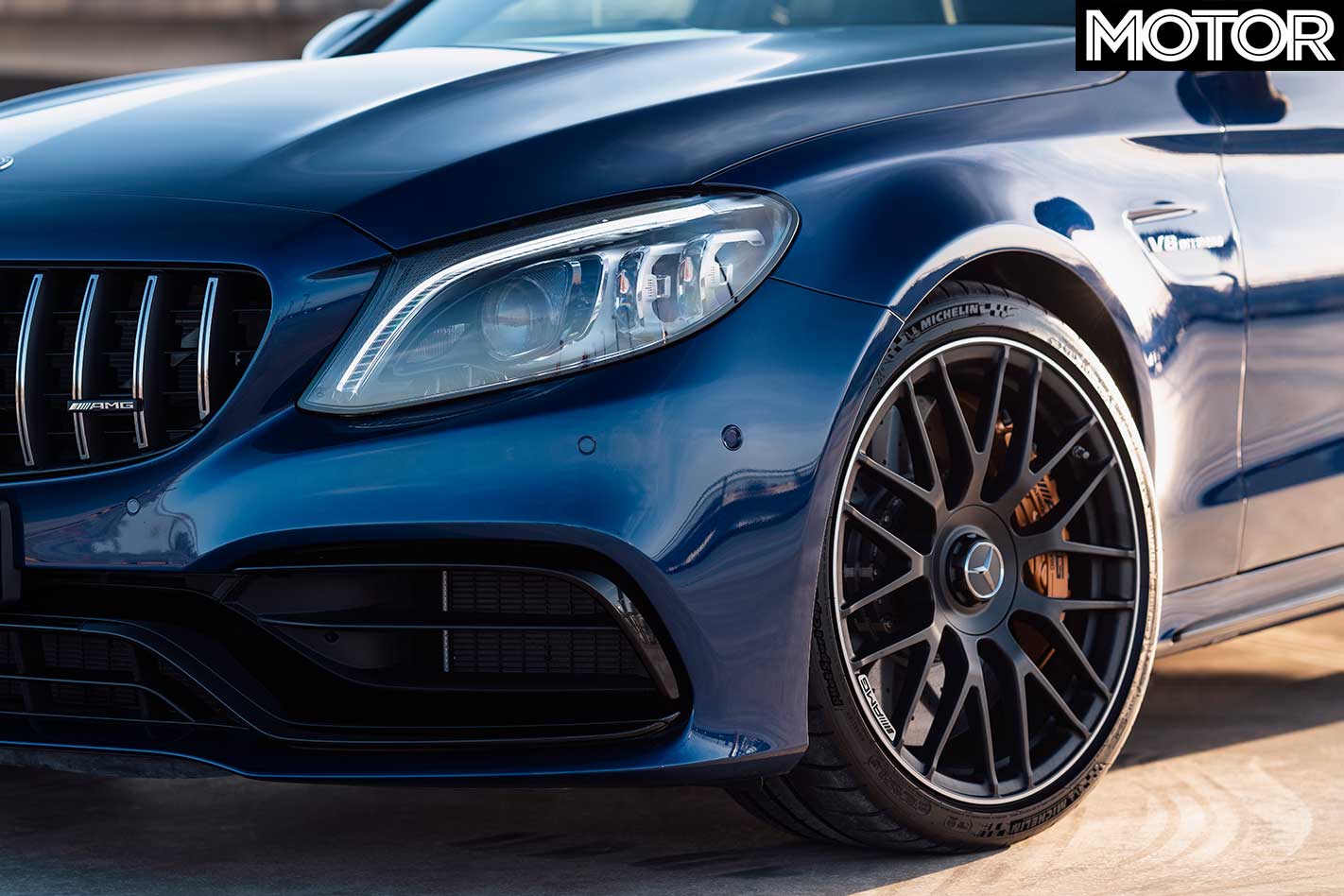
The previous W205 C63 S was, as mentioned, a sporting beast, and it made this known every drive. Even in the Comfort damper mode, you were well aware you were in a sports car – it felt like the adaptive dampers were set permanently to Sport. The ride was harsh. We told AMG and of course told you in our reviews, and the reply from the car’s creator was, ‘this is what AMG customers want’. We didn’t quite buy that, and it turns out neither did the customers, and so AMG has fitted softer springs and dampers as part of this facelift.
It’s made a big difference. Thoughts like ‘oof’ and ‘eek’, the kind you’d have as the old C63 S thudded over harsh bumps, now occur significantly less often. It’s perfectly comfortable 85 per cent of the time (if the old car was more like 65 per cent), and the C63 S is now much more of a daily driver.
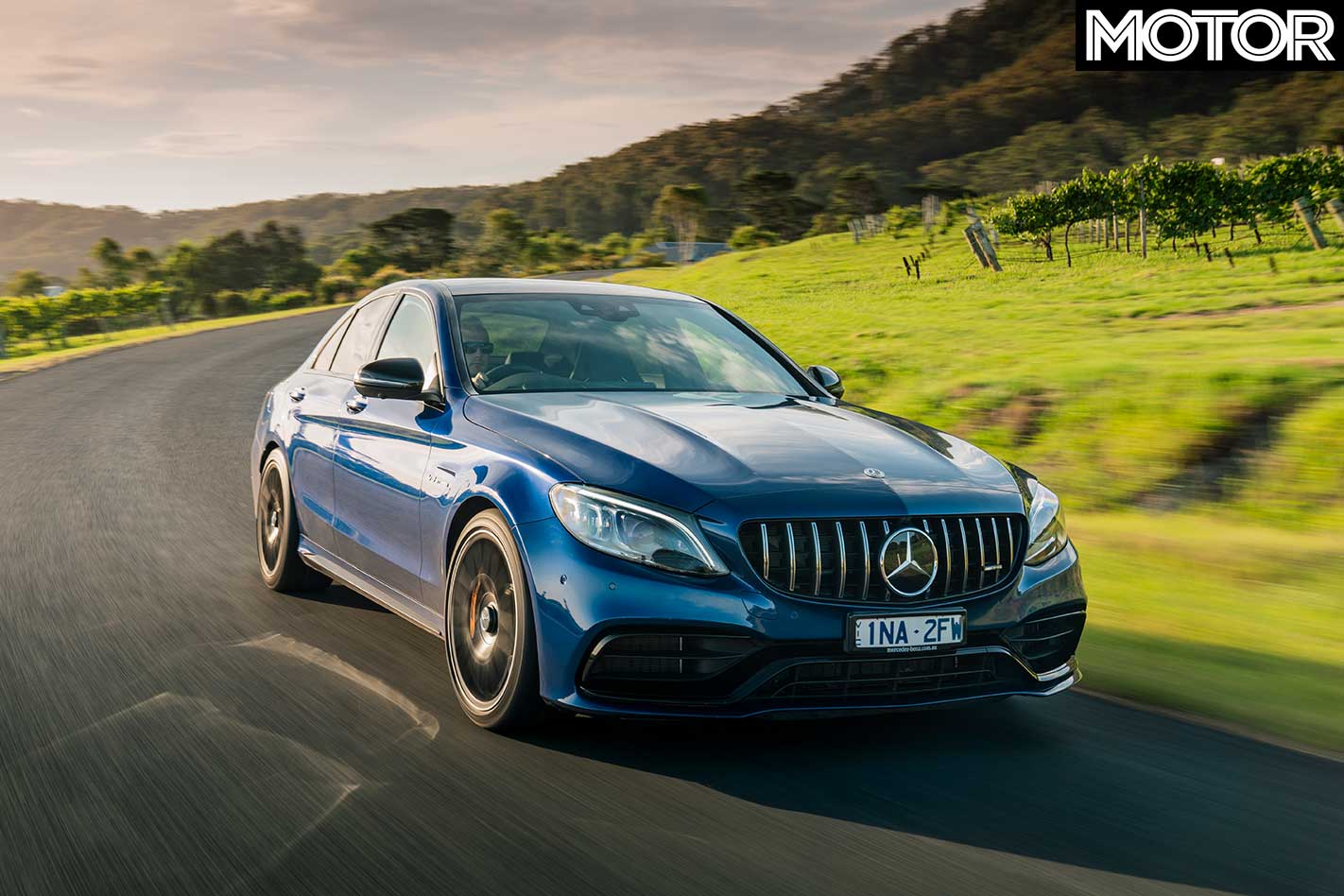
Okay, a degree of harshness is still transmitted into the cabin, and the ride is still nothing like the bliss of a Magic Body Control S-Class, but it’s a massive improvement over the old car. And much more acceptable.
Well done, AMG.
So has the C63 S gone soft? Well, apart from obviously literally if you mean the suspension, if you mean the rest of the car – no, it has not.
This is still a precise car, easy to place and with huge grip. There is now a new body-roll about the C63 S that requires management as you push harder into those grippy Michelin Pilot Super Sport tyres, and certainly the C63 S does not sit as flat as we remember the old one doing.
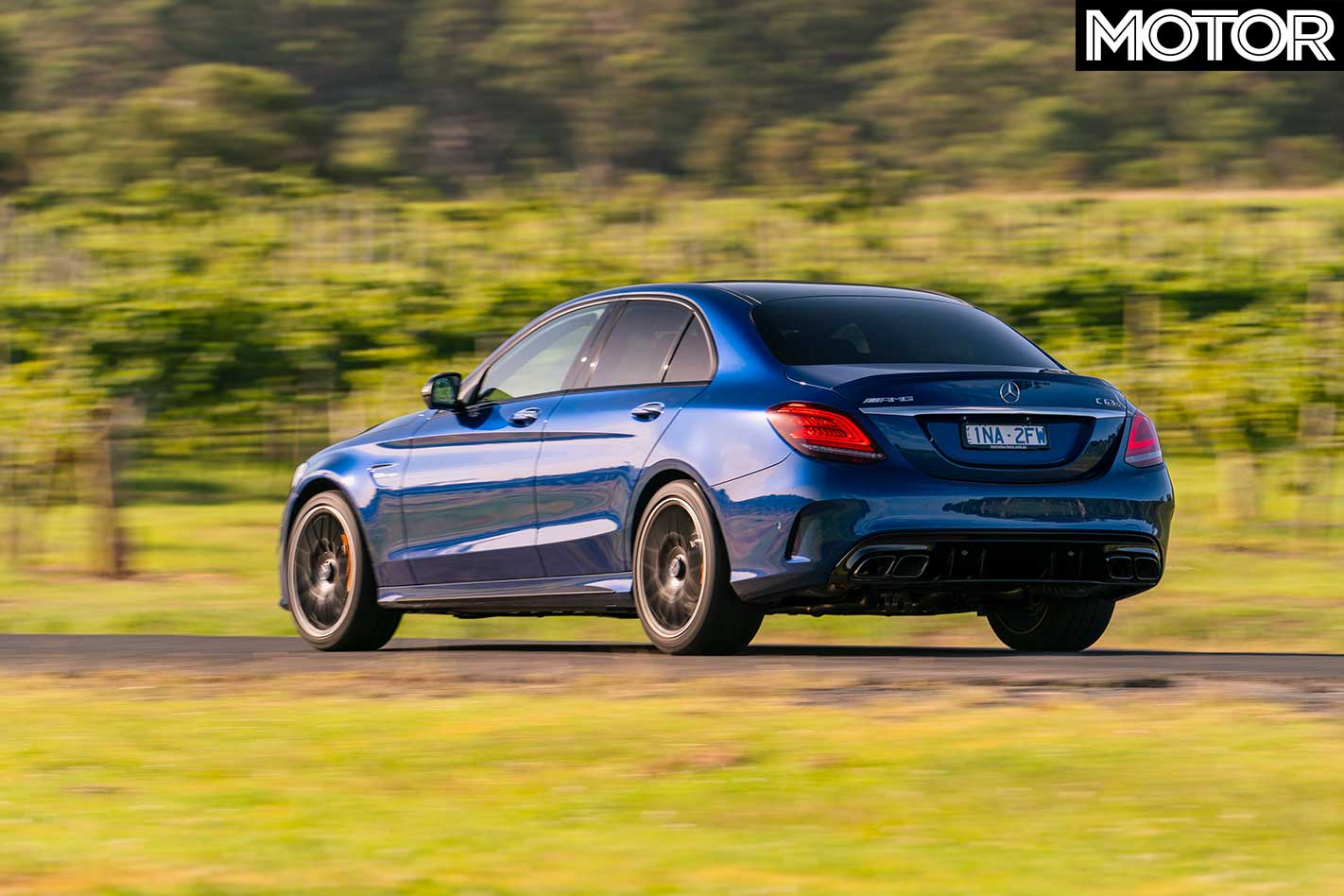
In this sense, the C63 S has become less tolerant to poor driving, and so you need to pick your inputs a bit more carefully as you move the 1680kg C63 S body through longer arcs. But this is why the damper button still exists.
Sport damper mode, and Sport Plus damper mode, are entirely usable on the road. Yes, ride comfort suffers, but now you won’t care, as you don’t hit this button until the horns are out and there’s still an impressive degree of mid-corner compliance even with the dampers wound into their tautest setting. (Previously Sport Plus was a Yas Marina-only proposition.) As we said in our international report, once you went searching for the damper button for ride comfort; now you go searching for the damper button for body control. And you get it.
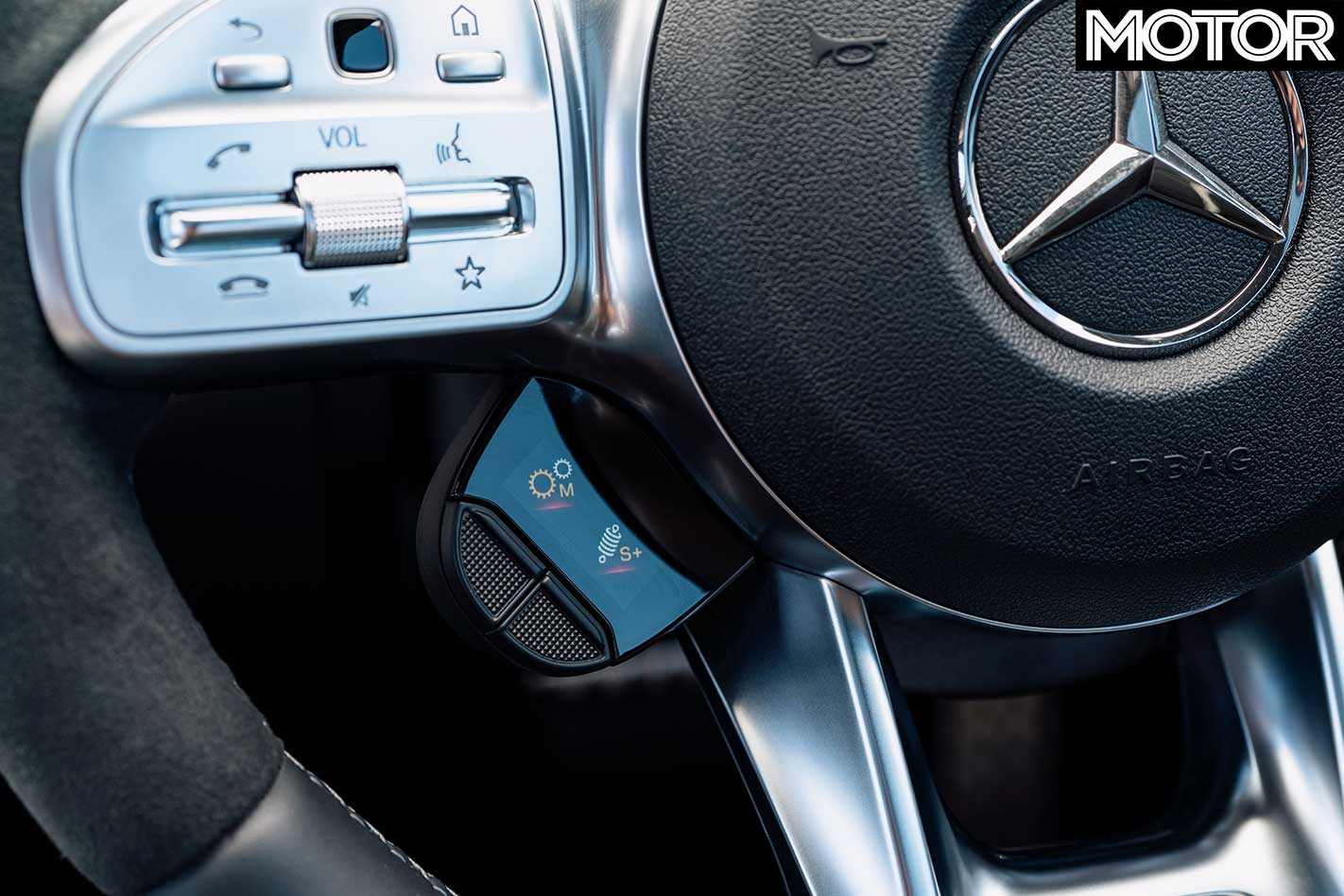
This ride/handling balance is much more befitting of a torque-fat twin-turbo V8 four-door with an interior as nice as this one.
Speaking of which, refinement has improved. A lot. Possibly AMG owes Mercedes on this one, thanks to refinement gains made during the most recent C-Class mid-life update, where there are supposedly 6500 new parts. It feels like a lot of those were to make the C-Class, and in turn the C63, a bit quieter, with a bit less vibration.
Again, the C63 has not been transformed in one fell swoop into a baby, more nimble S63; instead, what were bordering-on-disappointing levels of NVH are now much improved. The plusher Sports seats are now standard in Aussie C63s, too, with the firmer and more focused Performance items becoming a $3700 option.
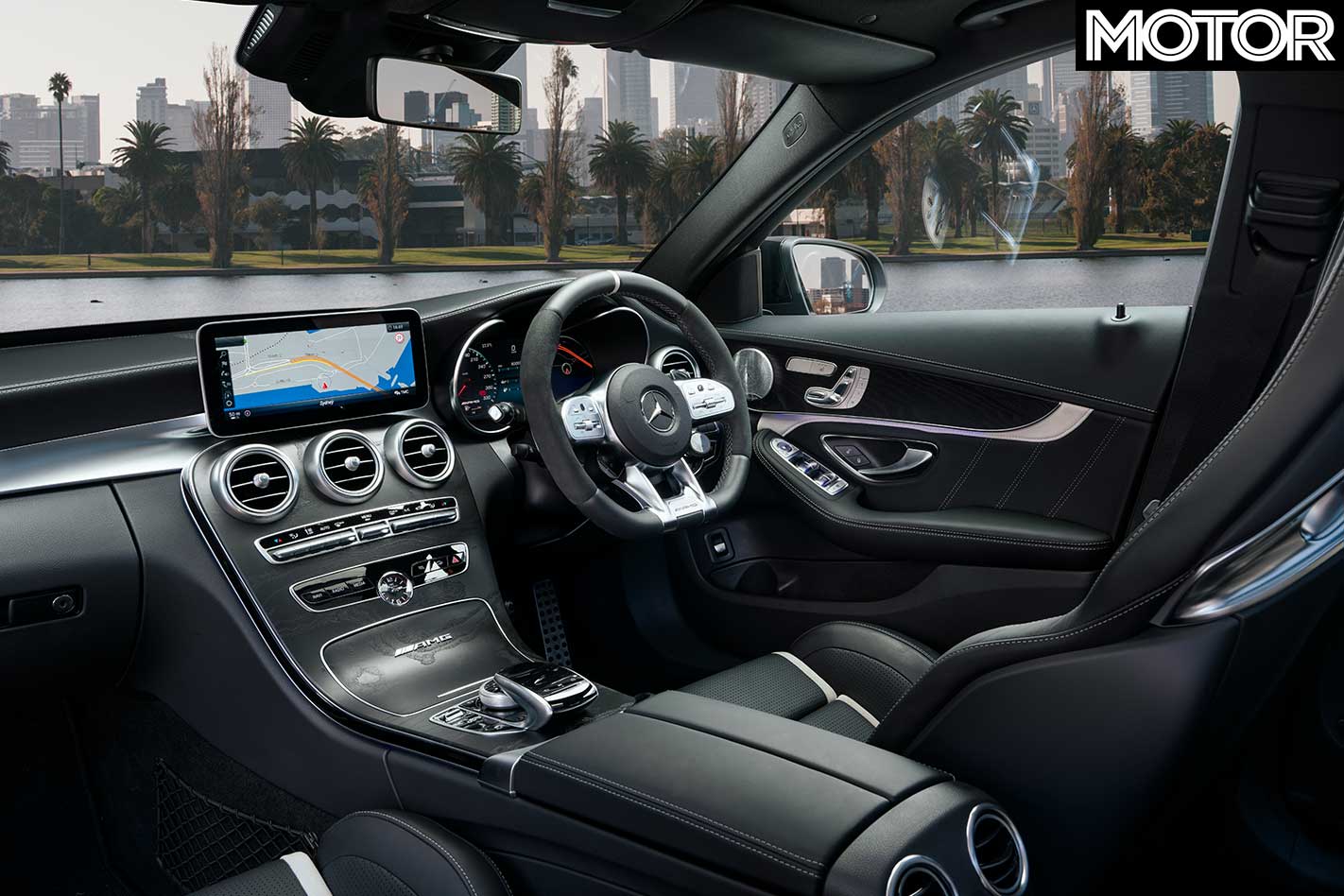
Let’s talk about the new ESP/TC modes. There’s a few of them; the new AMG Dynamics menu offers Basic, Advanced, Pro and Master modes, which control mostly the ESP, and increasingly slacken off as you switch between the general drives modes, those being Comfort (Basic), Sport (Advanced), Sport Plus (Pro) and Race (Master). Pressing the physical ESP button once shortcuts you to Master ESP mode no matter what drive mode you’re in.
Turn the ESP all the way off and the rotating controller below the right spoke of the new steering wheel turns into a nine-stage traction control selector, with a small and attractive colour display. No joke, the first time we turned this on, we felt like an eight-year-old ripping open something from Santa on Christmas morning.
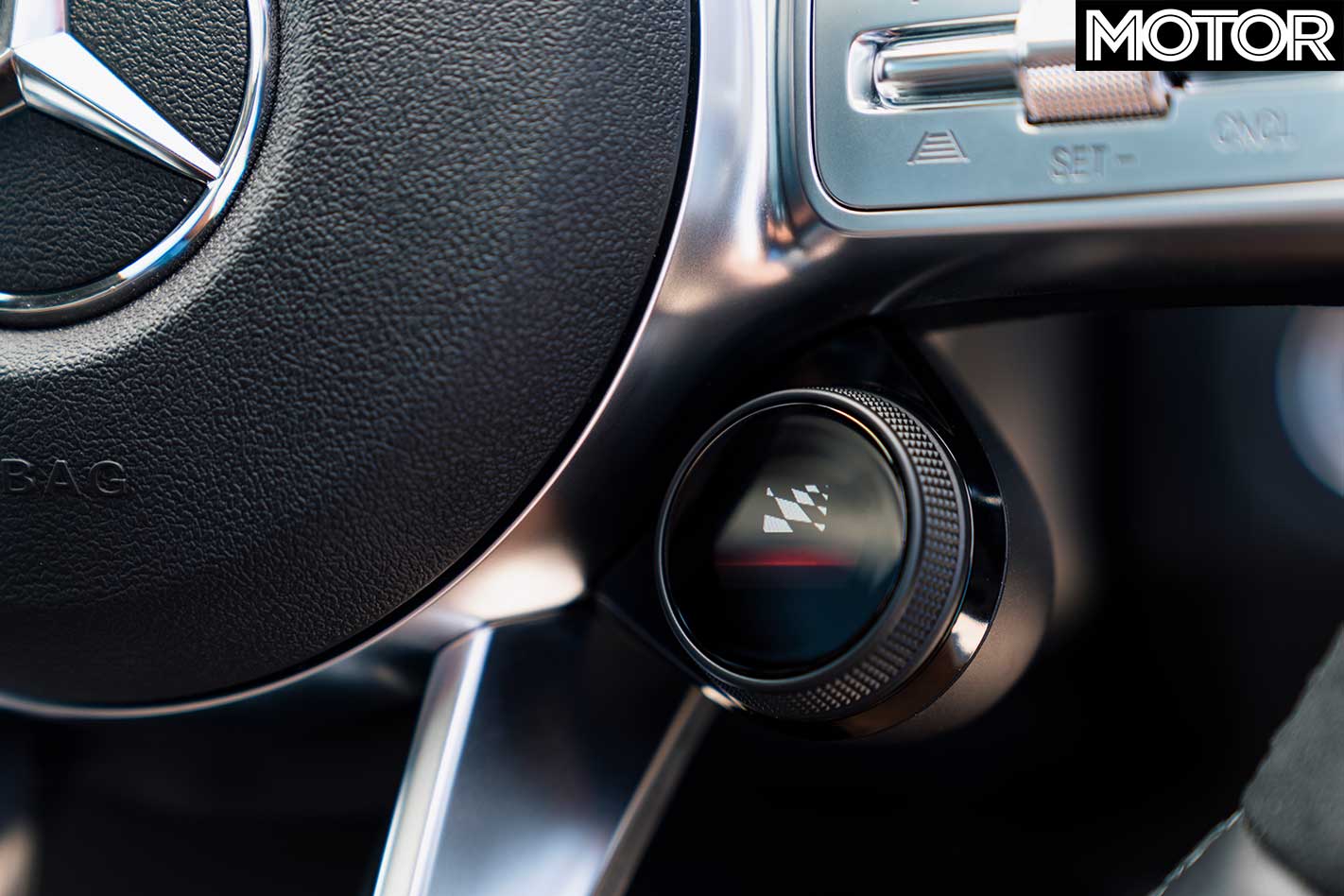
Now, you might think that the nine-stage traction control is a total game-changer for enjoying your 375kW rear-drive sports sedan, with you being able to, presumably, remove precise layers of electronic assistance as you click from zero (fully on) to nine (off).
However, it is like a classic motorsport traction control system – you’d undoubtedly be faster around a track with assistance from the computer putting the power down, rather than just your right foot. But degrees of yaw with a safety net? You’re better off with the ESP on and in Master mode.
So in that sense, the new nine-stage TC might be a useful tool at your next track day, as you’re hunting down a new PB lap time, but for hang-the-tail-out thrills, Master is your friend. And thank the gods of computer-assisted power oversteer, it’s excellent – the updated C63 S is more fun to more people than it was before.
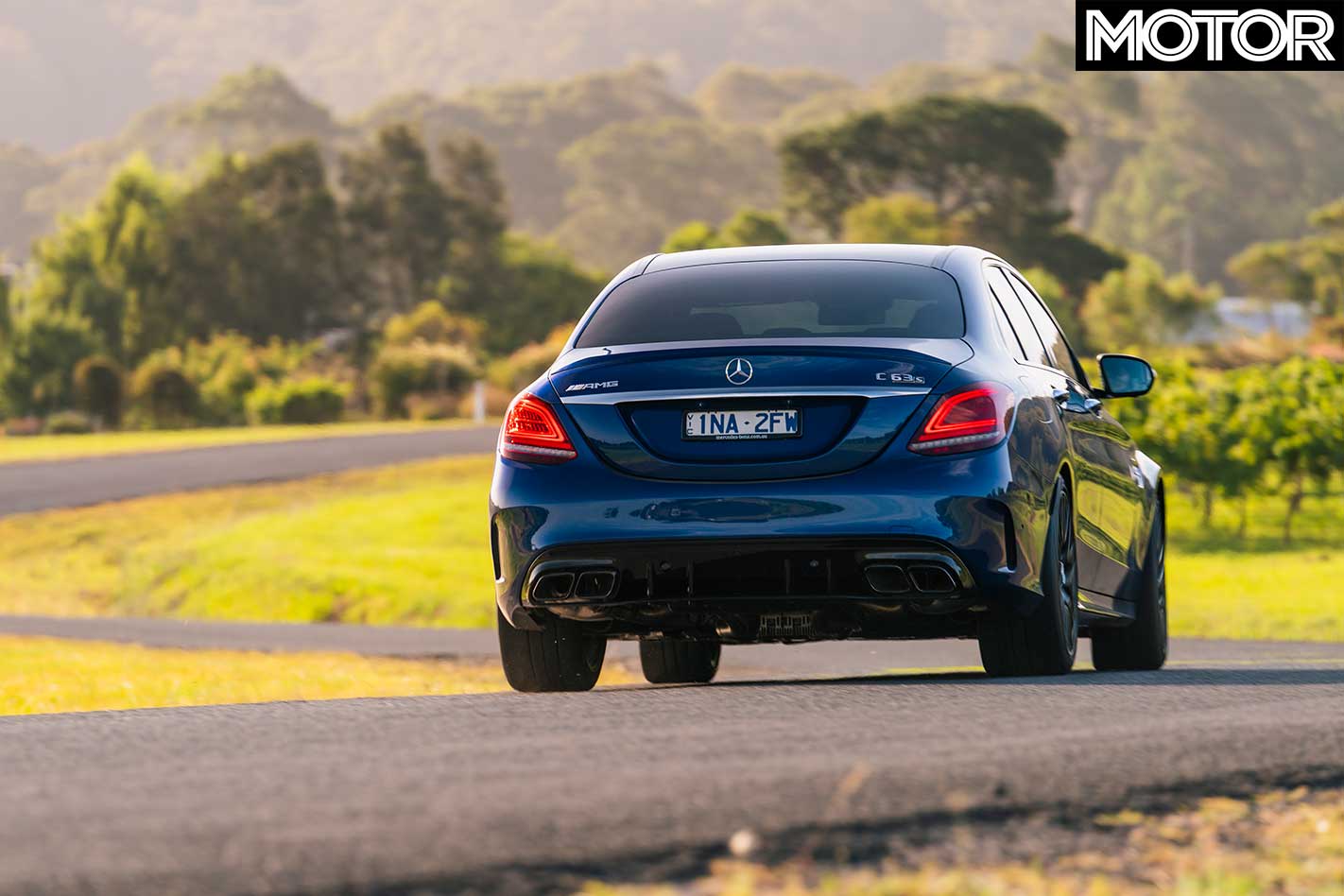
In fact, the C63’s chassis and electronics are now so good, we have a First World Problem to report – the C63 S could use more power. It’s at this point AMG would sigh and stop listening to us, but we can’t help but fantasise about a C63 Black Series with either the more powerful M177 from the E63 S or even better, the more power-focused M178 dry-sump V8 from the GT. Particularly if the latter was mated to the super-responsive seven-speed twin-clutch transmission.
There’s precedent, of course, by way of W204 C63s such as the Black Series or Edition 507 which both utilised more potent versions of the 6.2-litre atmo V8 from the SLS – to create unforgettably good cars.
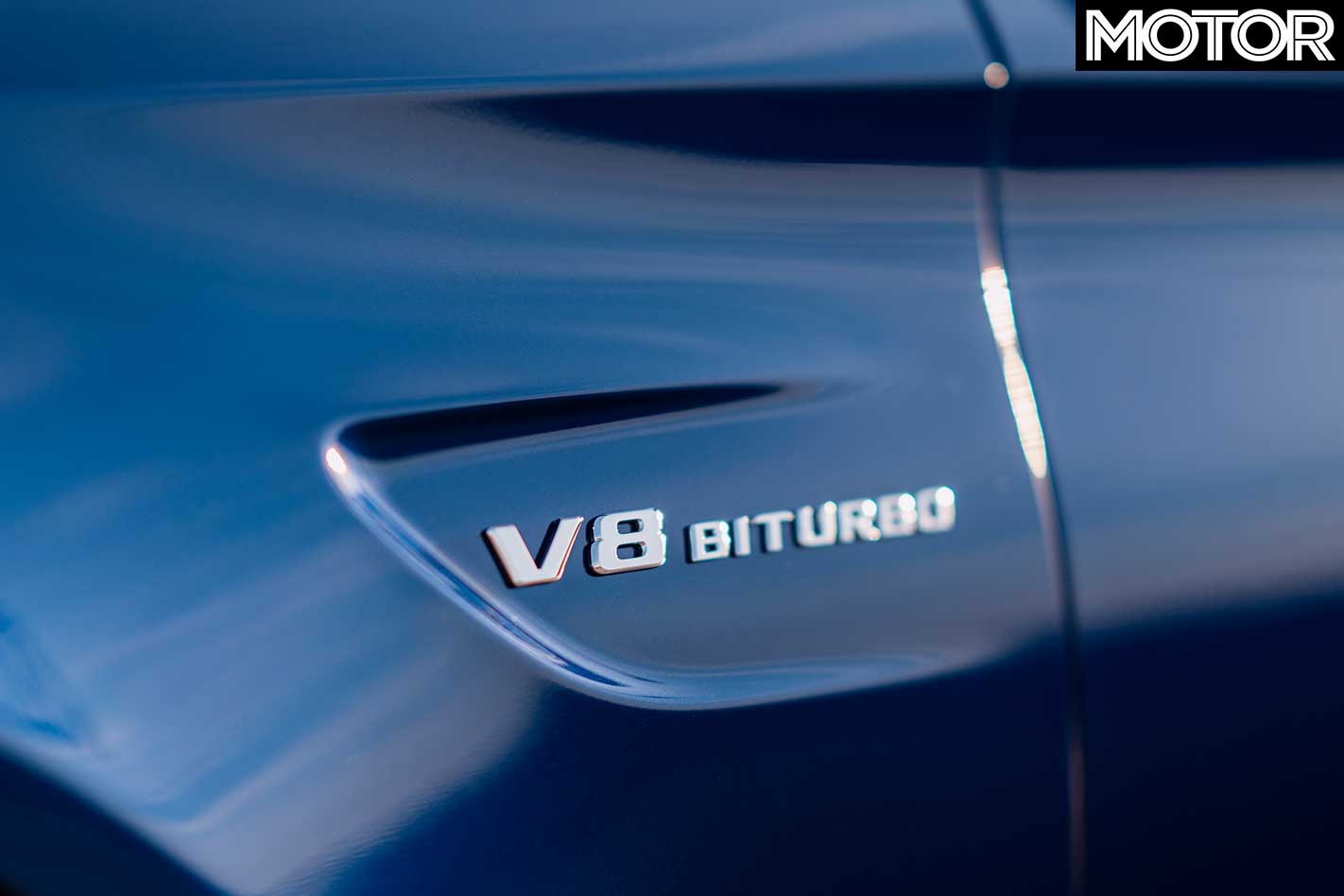
It’s worth a reality check here to say that lend your C63 S to someone who’s never driven a powerful car before and they’ll still give you the keys back, hands shaking, having turned white, but for people who read MOTOR, the idea of a C63 with this updated chassis combined with the potent, excellent AMG GT powertrain is truly saliva-inducing stuff. It would be tantalisingly close to a five-out-of-five star car.
AMG says there aren’t any plans for such a thing so S shall remain the big daddy C63 for now. But to be frank, with the new suspension and electronics, and improved transmission and interior, we are happy to lay our Black Series dreams to rest and appreciate what we have right now. And that is one of the greatest V8 muscle cars the world has ever, and maybe ever, will see.
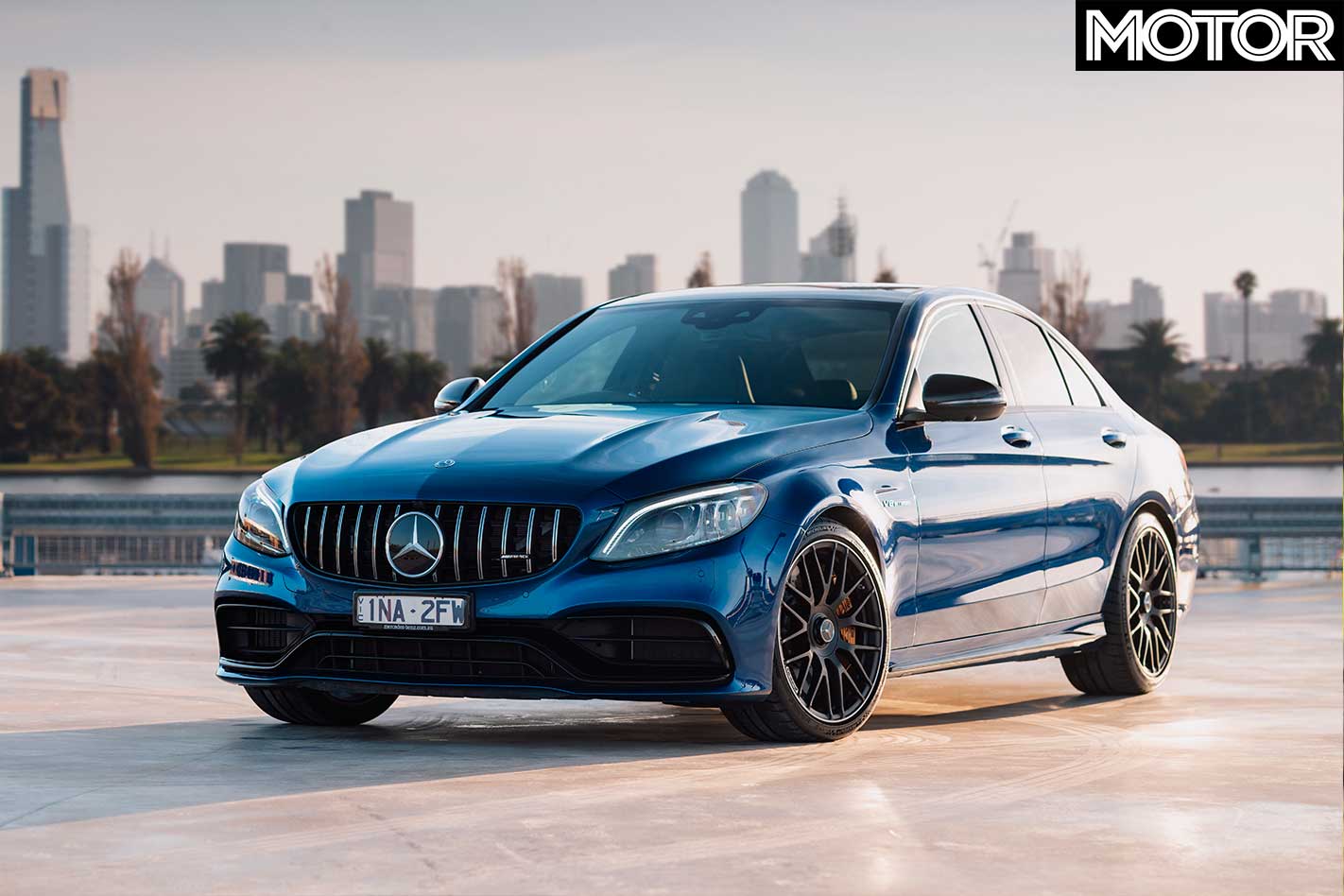
2019 MERCEDES-AMG C63 S SEDAN SPECS Engine: 3982cc V8, twin-turbocharged, DOHC, 32v Drivetrain: nine-speed automatic, wet clutch; rear-wheel drive Power: 375kW @ 5500-6250rpm Torque: 700Nm @ 2000-4500rpm Weight: 1680kg 0-100km/h: 4.0sec (claimed) Top speed: 290km/h (claimed) Fuel consumption: 10.4L/100km (claimed, combined) Price: $160,900* On-sale: Now
Rating: 4.5 out of 5 stars Likes: Hugely improved ride comfort; same old ridiculous twin-turbo acceleration; rear-drive thrills; easier to enjoy thanks to brilliant new multi-mode ESP/TC; eager, precise handling; awesome V8 noise; beautiful cabin, steering wheel and much-improved infotainment software Dislikes: Another level of refinement still imaginable; new transmission still asks for a bit of patience with multiple downchange requests in quick succession
2019 Mercedes-AMG C63 S sedan options – highlights
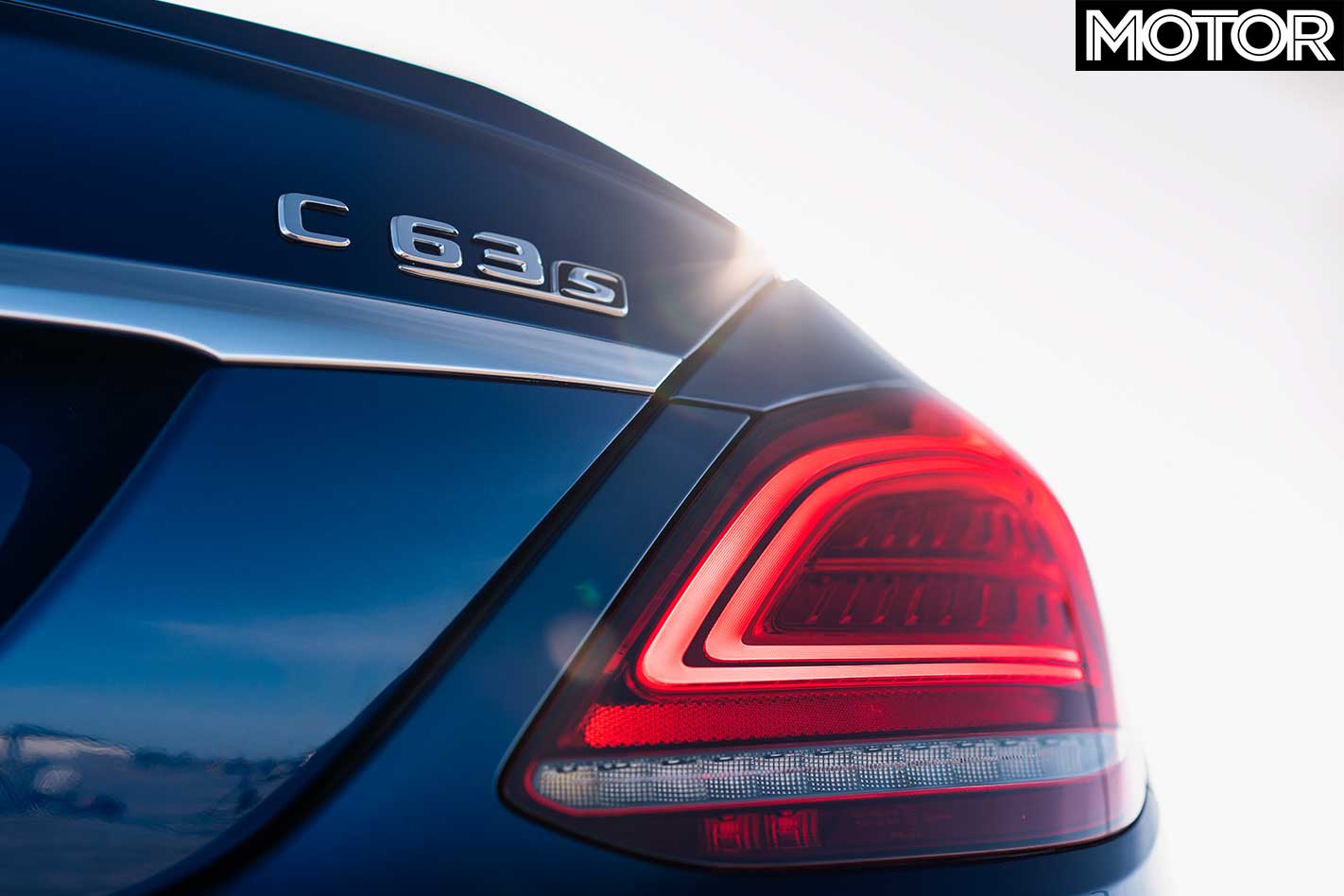
Exterior Carbon Package, $8200: carbon-fibre front bar insert, sill panels, rear bar insert, mirror covers and rear wing. Get it if you have a thing for carbon-fibre but not to improve the power-to-weight ratio. Interior Carbon Package, $2200: carbon-fibre interior trim inserts, including steering wheel. Again, for those who must have the glossy dark weave. AMG Carbon Ceramic brakes, $7900: Replaces front brakes with 402mm carbon ceramic items. Up to 50 per cent decrease in critical unsprung weight. Longer service life than steel items; significantly less brake dust. Michelin Pilot Sport Cup2 tyres, $1200: Replaces standard tyres (Michelin Pilot Super Sport) with more track focused Cup2.
2019 Mercedes-AMG C63 S variants and pricing* Sedan – $160,900 (increase of $4060) Coupe – $165,900 (increase of $2660) Estate – $163,400 (increase of $4060) Cabriolet – $184,000 (increase of $2760)
*All prices correct as of February 2019. Exclude on-road costs.
Reports have emerged today that global automotive powerhouse Inchcape – importers of brands like Subaru, Citroen and Peugeot into Australia – is looking to take over the importation of Holden from its US parent, General Motors.
While talks are at a very early stage, a report in the Australian Financial Review indicates that due diligence (book checking, in essence) is already underway.
General Motors, however, seems unconcerned by the report.
“We are fully focused on supporting [Holden CEO] Dave [Buttner] in building a strong Holden for the future, as it remains an important part of GM’s business,” a US-based spokesperson told AFR.
It’s a clever play by UK-based Inchcape, who claims to be the world’s largest independent international automotive retailer, with operations in nearly thirty countries.
General Motors is in the midst of a worldwide cost-cutting spree as it seeks to future-proof against an impending turndown in the industry. It’s closed operations in Russia, the UK and Germany over the last two years, as well as shuttering plants and laying off more than 4000 staff in the US.
More than 30 dealerships have been closed locally, while the first year of sales after shutting the doors on local manufacturing was the worst in decades for the 163-year-old company.
Sales fell by almost a third, with key models like the imported Commodore and the mid-sized Equinox SUV failing to fire.
Holden currently holds a 6.5 per cent share of the Australian market, down from a high of more than 21 per cent in 2001. Subaru currently holds four per cent.
For Inchcape, importing Holden-badged cars directly from GM would work in exactly the same way it does now, but it would not have to bear the same costs as Holden presently does.
For example, fees for back-office functions and other work are paid by Holden back to its parent company, and Inchcape would be able to sidestep these all together, which should mean cheaper vehicles.
Inchcape may also have greater right-hand-drive sales potential for GM due to its presence in the UK market, and rumoured interest in South Africa. All are right-hand drive markets.
However, any deal may be complicated by elements like Holden’s Lang Lang proving ground, its Melbourne design centre and the fact that the company has had boots on the ground here for more than 160 years. Unravelling Holden from General Motors would not be the work of a moment.
Theoretically, GM may cede the rights to importing cars to Inchcape, while hanging onto the engineering base it recently spent $7 million refurbishing. Lang Lang has facilities for engine and transmission calibration, as well as multiple facilities that are used to test vehicles for both left- and right-hand-drive markets.
Inchcape doesn’t just import cars; it also owns premium dealer network Trivetts, as well as automotive logistics outfit AutoNexus. Should any deal happen (and it’s still very early days) it could catapult Inchcape into the position of being Australia’s second largest car importer behind Toyota.
Holden has been contacted for comment.
Hey guys, love the advice column!
Our dad is on his own now and has been off the road for a few years without a car. Lately, though, he’s expressed an interest in getting back behind the wheel.
He’s not especially fussy – his short list comes from the three closest car dealerships to his house! He likes the size of the Volkswagen Polo, but my brother and I wonder if a compact SUV might not be a better choice? He’s tall, and his flexibility isn’t what it used to be. Budget isn’t an issue.
Dave and Darren Braid, Geelong, Victoria
Hey guys, glad you like the advice! Good to see your dad’s still keen on being mobile, and honestly this is a great time in the motoring industry for small yet well-formed, great value cars.
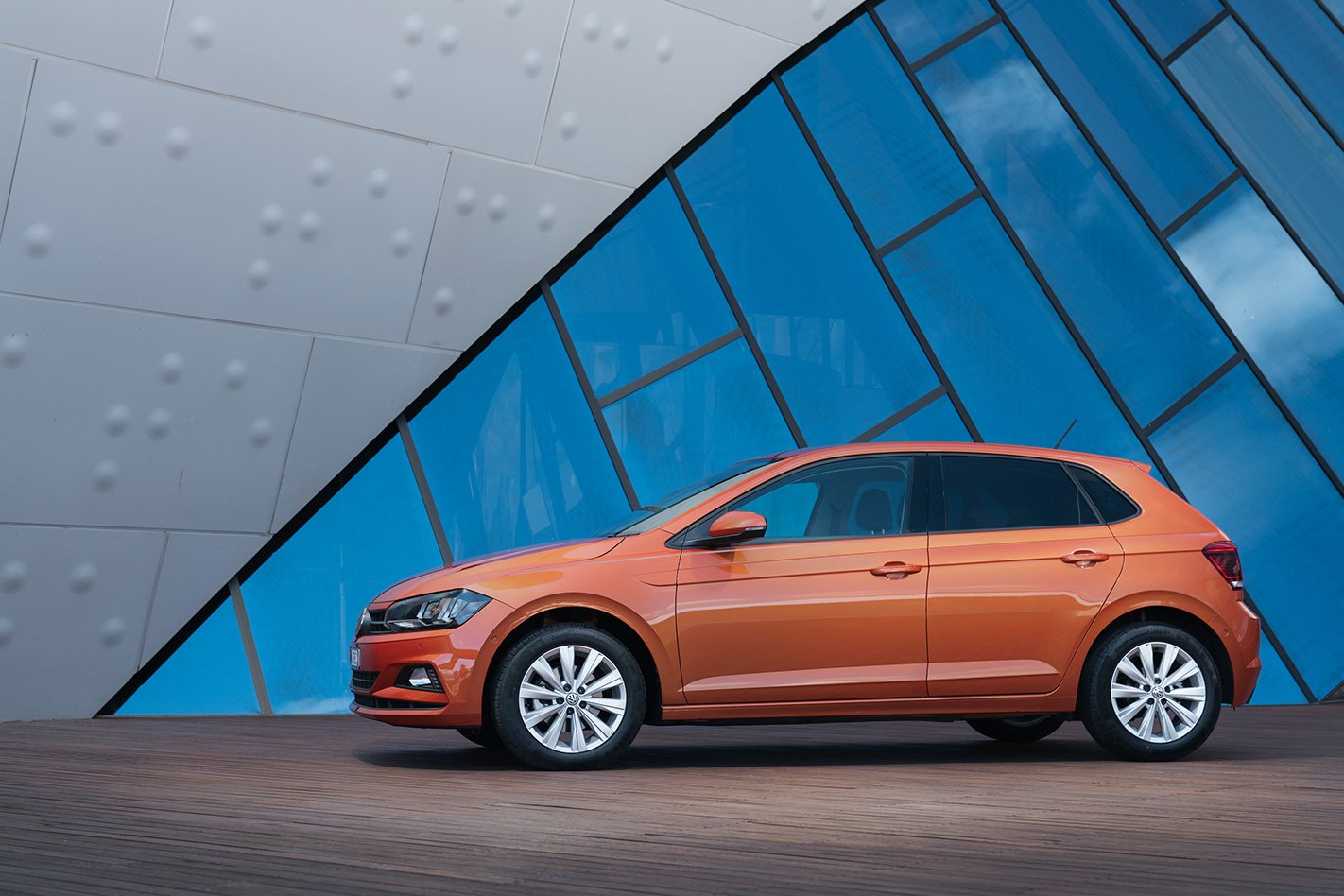
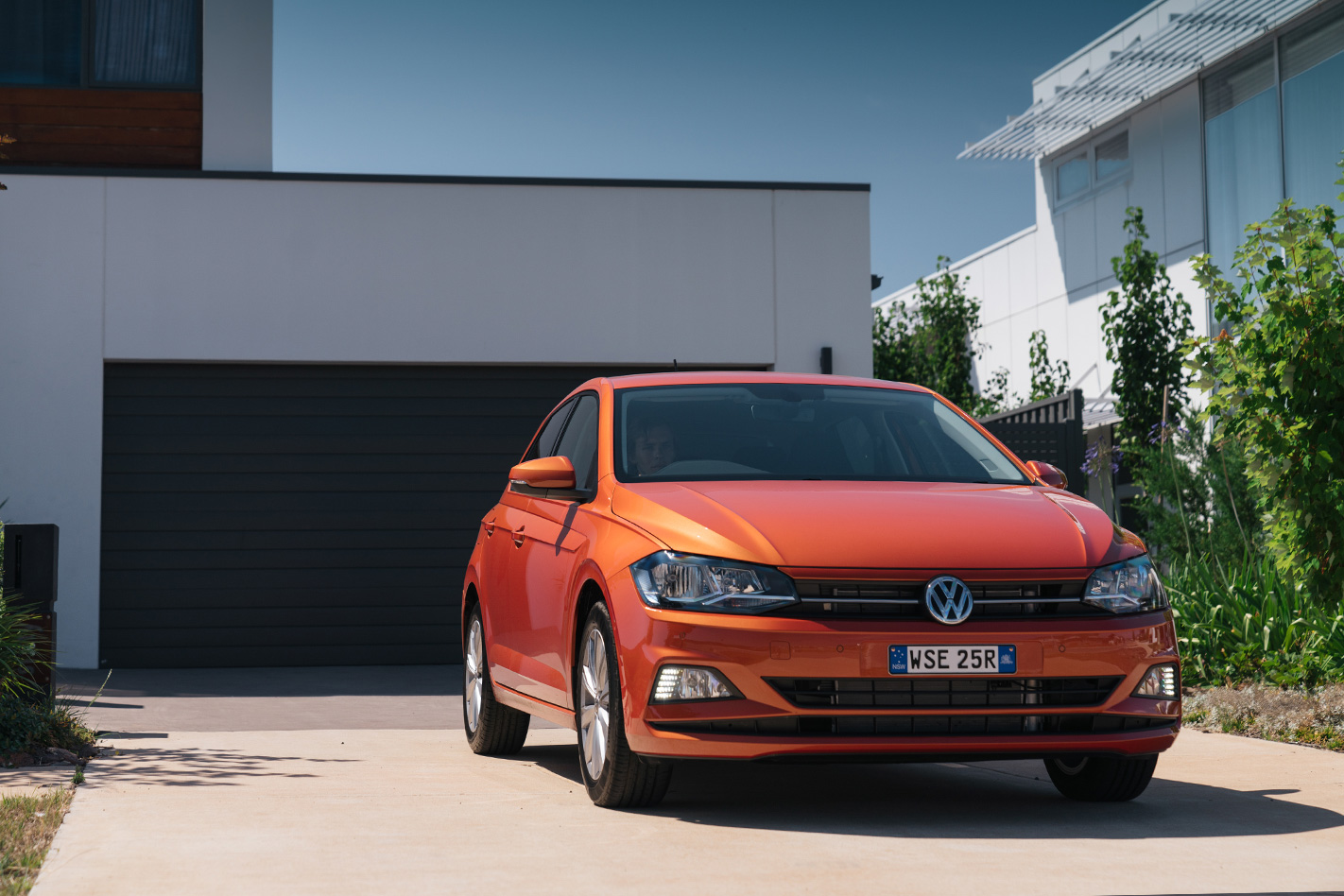
The Polo (above) is a terrific choice, especially now that it’s grown in size a little bit. For around $22,000, the 85 TSI Comfortline with a seven-speed dual-clutch auto is a great option, and it offers loads of standard kit that make life a little easier. AEB, for example, is standard, as is a rear-view camera, hill-hold assist and a sizeable boot.
It’s also easy on the juice with that three-cylinder 85kW engine, though your dad will need to remember to top it off with 95 RON fuel as a minimum.
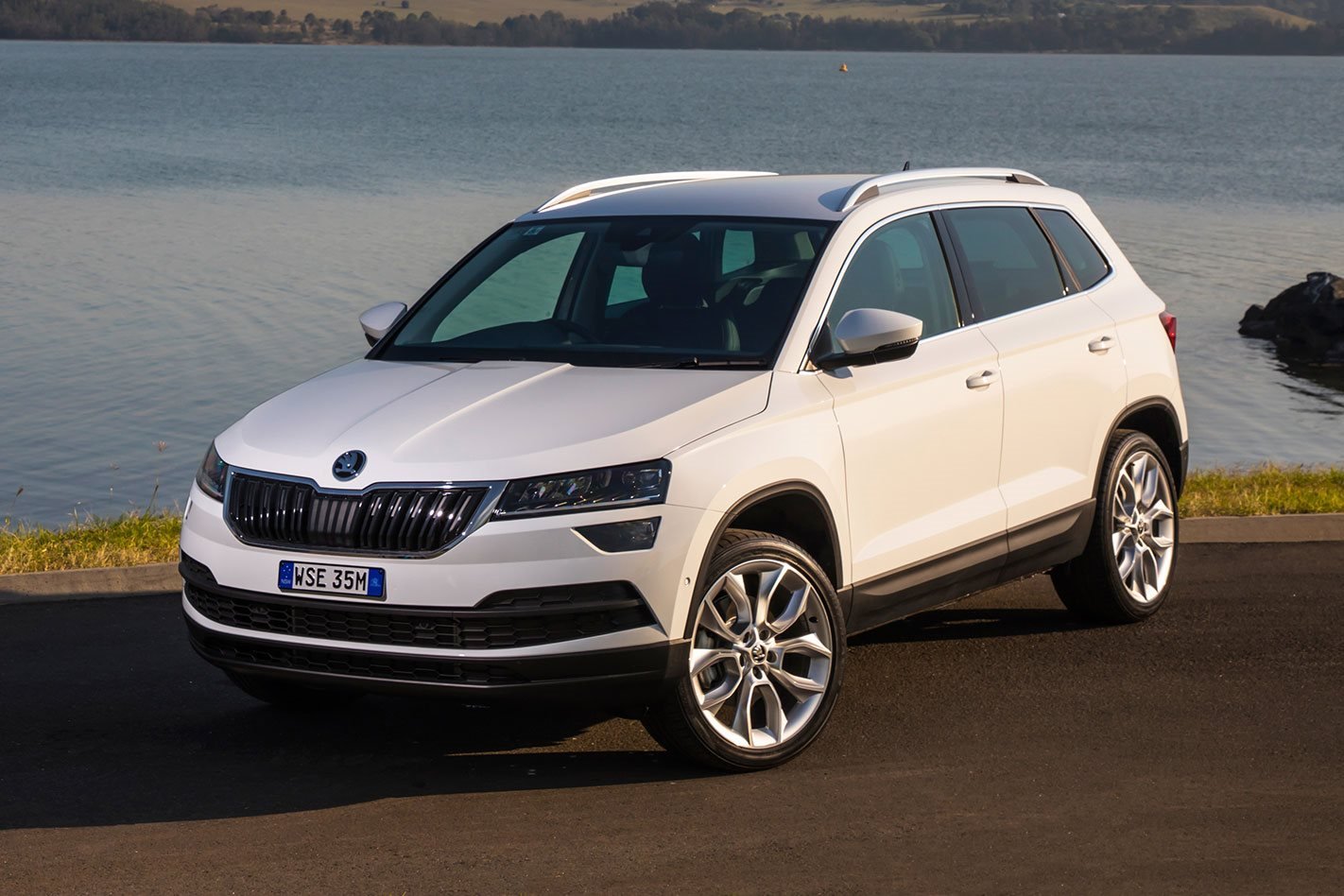
There are loads more options out there, of course, and one that’s a fraternal twin of the Polo. The Skoda Karoq (above) is based on the same platform – it replaced the Yeti a couple of years back – so the interior fit-out is similar in execution to the Polo.
It rides about 10mm higher than the Polo, so it’ll be a little easier to slide into, and it’s almost 150mm taller, which gives it a lot more room in the cabin. For us, it’s also a simpler car with analogue dials and the like, so it might appeal more to someone not looking for bells and whistles.
The 1.5-litre turbocharged four-cylinder engine is a good thing, too, and for about $42,000 all in, he’ll get lots of driver safety aids thrown in, too.
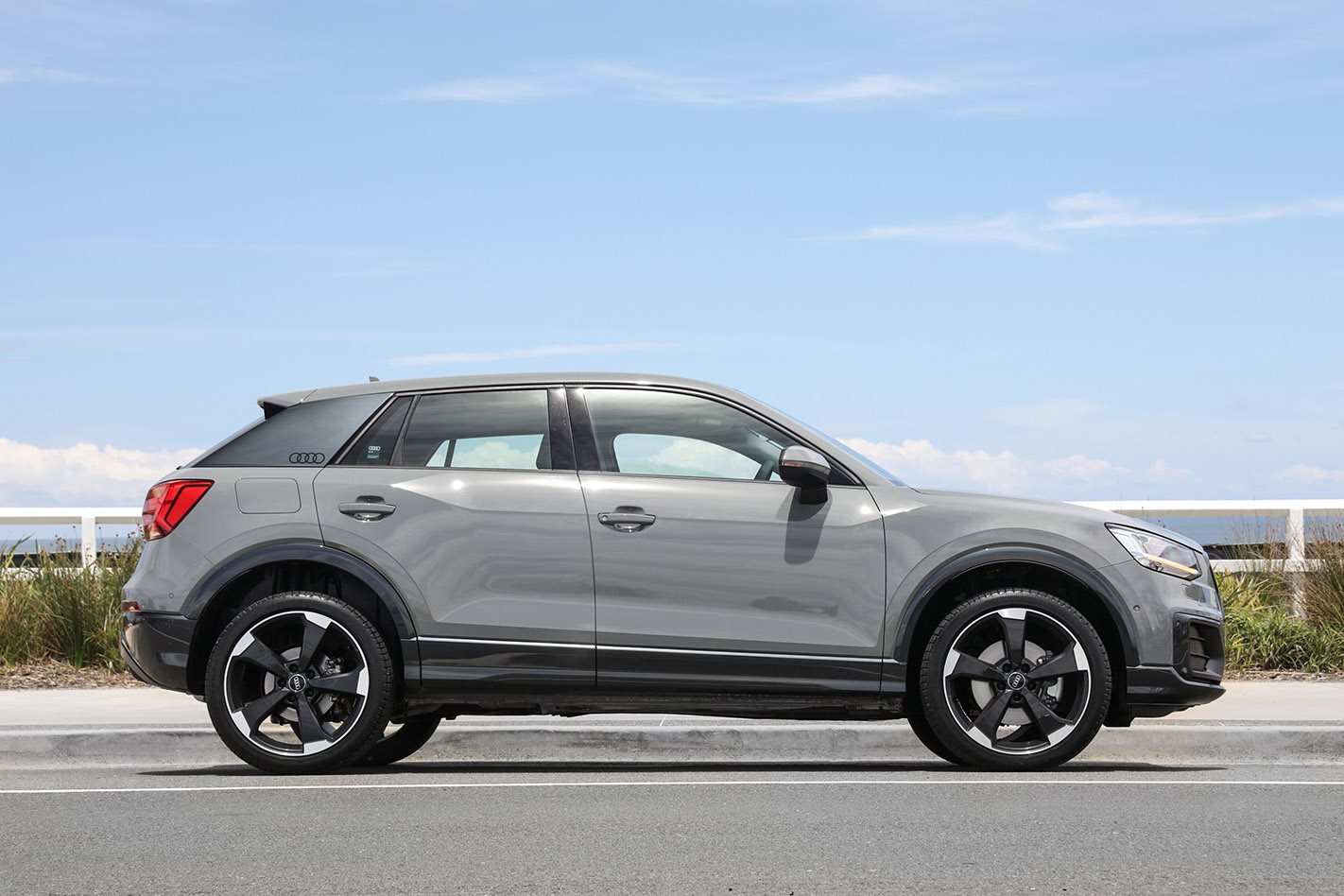
If your dad wants to pop for a premium brand, then again he can stay within the Volkswagen family and have a look at the Audi Q2 (above). It’s also based on the same platform as the Polo, and it’s only 15mm taller than the Volkswagen. It is more compromised for rear space thanks to that sloping roofline, but it’s a big step up when it comes to standard equipment.
If he opts for the $48,500 2.0-litre petrol-powered version, he’ll also get all-wheel-drive, driver safety aids like blind spot/approaching traffic warning and intersection assist.
WhichCar recommends
The Volkswagen Polo – which made the final cut at Wheel’s Car of the Year in 2019 – really can’t be beaten on the value-for-money stakes, and it’s really matured as a car, as well. If your dad is okay getting in and out, and if he’s only heading to the shops, then why spend more than twice as much on the (admittedly very nice) Audi?
WHAT if the cars we know and love today were in fact conceptualised and built decades ago?
That was the thought that occurred to Dutch illustrator Ruben Ooms. He’d previously developed concept sketches and visualisations for the likes of BMW, Renault and Volkswagen, so it wasn’t a huge leap for the Amsterdam-based artist to turn his hand to reimagining how modern cars would look if sent back in time.
It’s a fascinating concept, and automotive historians among you will no doubt be able to draw parallels between the cars that Ooms has sketched and contemporary vehicles that were possibly ahead of their time. We’ll let the pictures do the talking from here.
1974 Audi R8
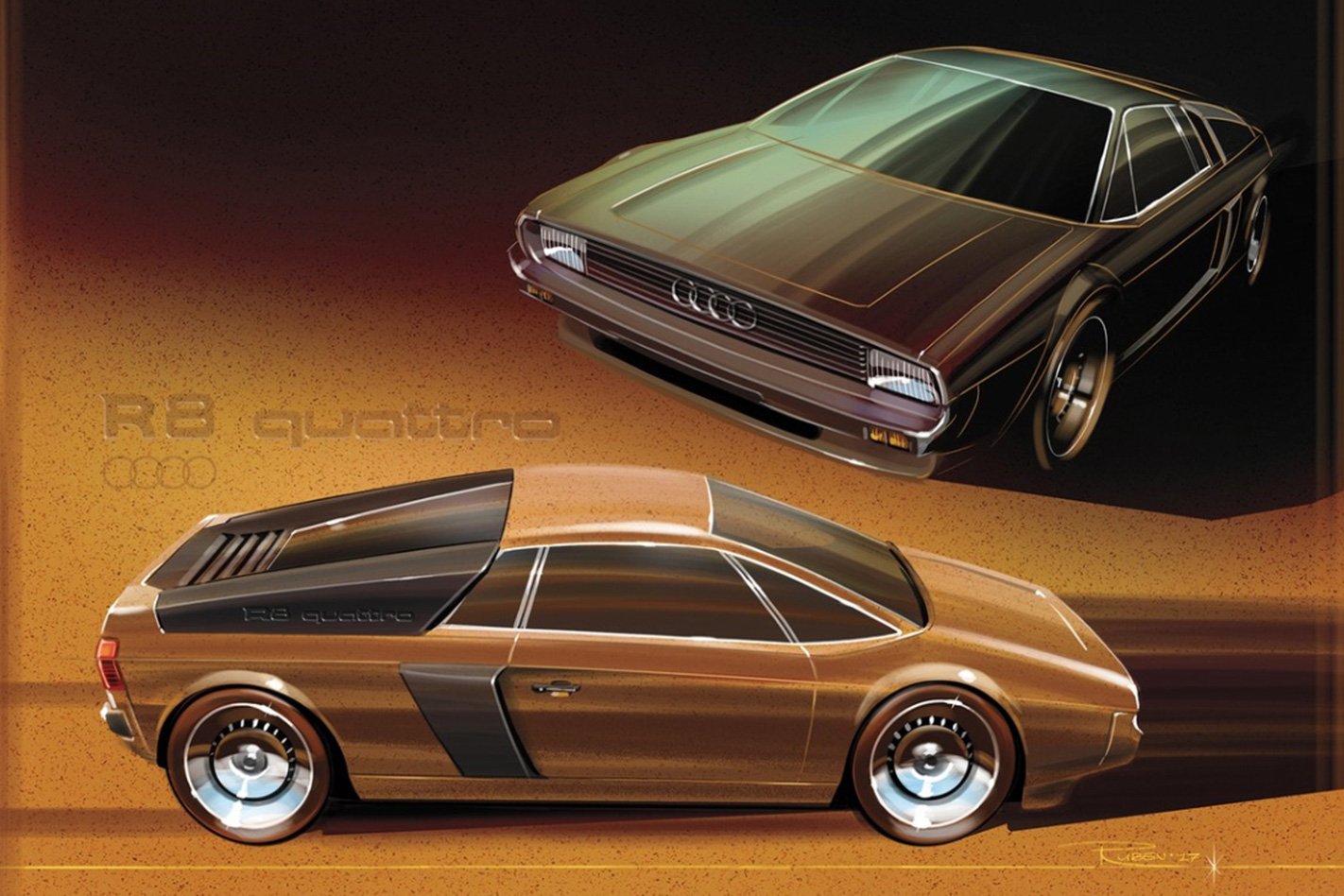
The amalgamation of the modern R8’s sideblades with the design influence of the original Audi 100 C1 (1968-76) works surprisingly well. We particularly love the deep dish wheels and classic wood laminate paint hue. The stance borrows heavily from that of the Lancia Beta Montecarlo, but as a precursor to the ur-Quattro, this would have been a cracker. We’re already trying to imagine it in rally livery.
1956 BMW i8

The modern i8 is an unashamedly futuristic design. How could you possibly send that back to era of Marty McFly and Biff Tannen? By imagining it as the logical progression of the beautiful BMW 507, that’s how. The nod to electric power is particularly neat in this illustration with the bowser jockey having plugged the scissor doored and flying buttressed BMW into a period charging station. We’re not too sure how far up Route 66 it would have progressed with 1950s battery technology. It’s interesting to note that BMW reversed this process with the Z8, effectively a millennial reimaging of the classic 507.
1979 Range Rover Evoque

There’s an argument that the original Spen King three-door Range Rover wasn’t actually that far off the concept of the modern three-door Evoque. The baby of the contemporary range is actually a bigger car than the original Range Rover, occupying a larger road footprint. Nevertheless, Ooms has sketched a more aggressive fastback shape that evokes a more lifestyle image than the utilitarian classic. Granted, back in the late Seventies, lifestyle meant golf, shag pile and the great smell of Brut 33, but it’s a start.
1972 Porsche Cayenne
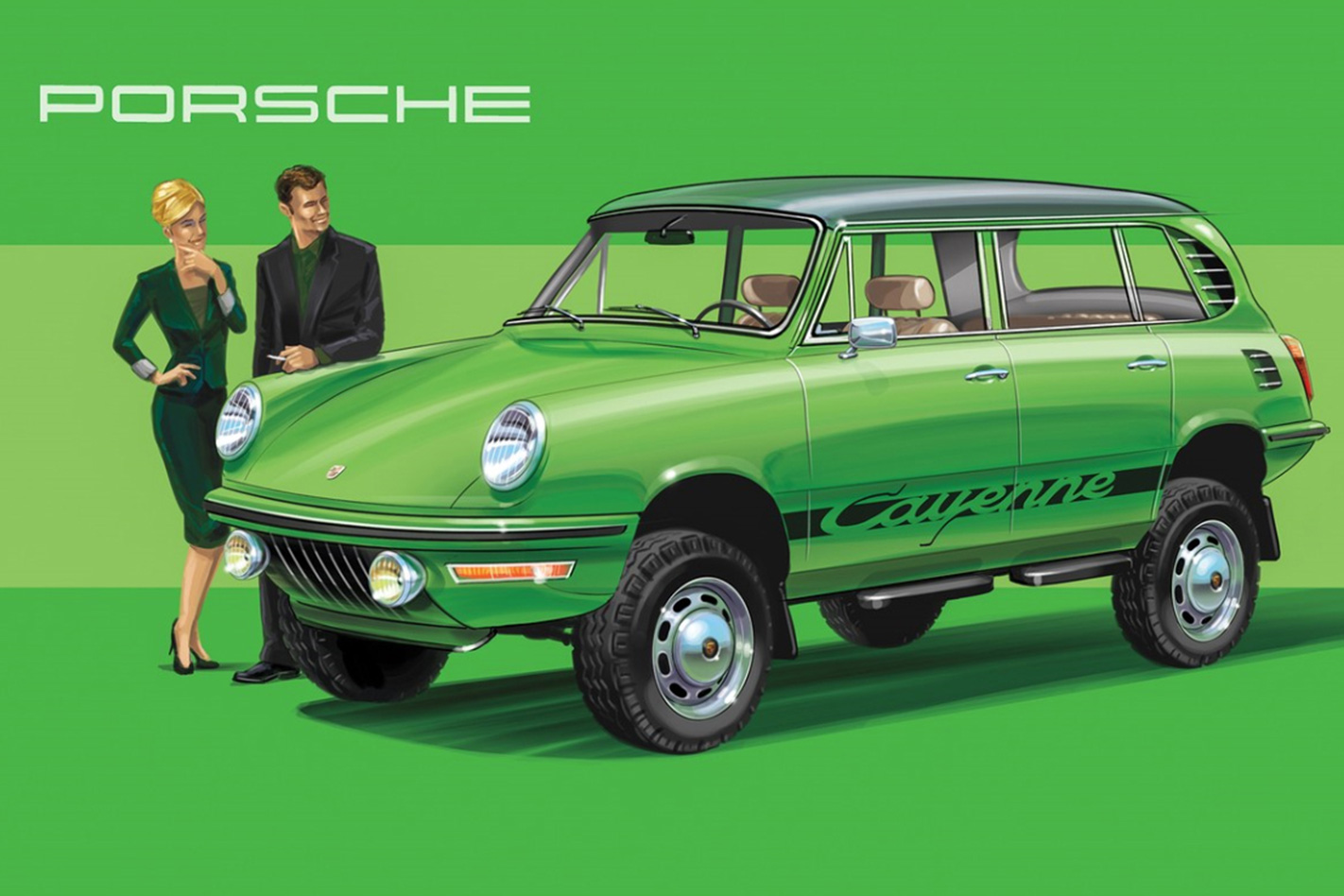
Range Rover might well have pioneered the modern notion of the sport utility vehicle in 1970, but this Porsche imagining, arriving a couple of years later would demonstrate a very different take on the theme. There’s a whole heap of Volkswagen Type 4 in the genes here, as well as some classic 911 cues. Cast your mind back to how closely the original Cayenne aped the 996-generation 911 and we reckon it’s spot on the money. It also looks agreeably light, tough and green. We approve.
1936 Tesla Model S
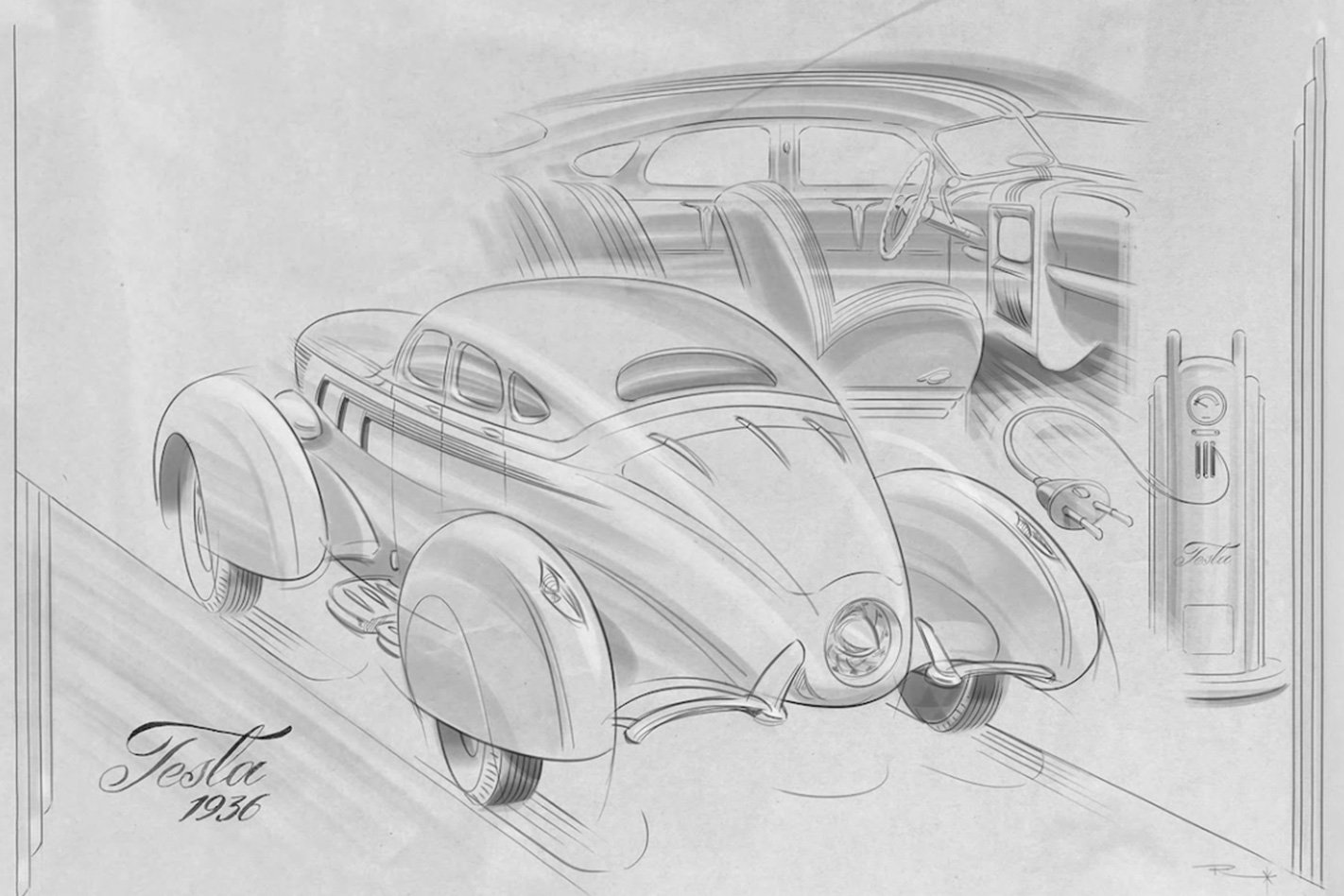
Electric cars aren’t anything particularly new. In fact they predate the production of internal combustion powered cars by over 20 years, Thomas Parker’s rechargeable battery-powered EV creating range anxiety on London streets back in 1884. Therefore the notion of a 1936 version of the Tesla Model S isn’t as outlandish as it may seem. Even the in-screen display could, in theory, have been developed from the bestselling Baird Televiser cathode-ray screen that sold over a thousand units in the UK between 1930 and 1933.
1977 Toyota Prius

The perfect solution for a world economy crippled by the Oil Crisis, this ’77 reimagining of the Prius also draws on technology that isn’t exactly box-fresh. Porsche had already developed a petrol-electric hybrid in 1898 with the System Lohner-Porsche. This used a gasoline engine to supply power to an electric motor that drove the car’s front wheels and was well received, with over 300 were produced. It was the 1997 Prius that really kickstarted the hybrid revolution, with its XW20 successor selling almost 1.2 million units. The Prius’ Kammback profile also makes it absolutely ripe for a spot of plastic louvring.
1970 Dodge Viper R/T
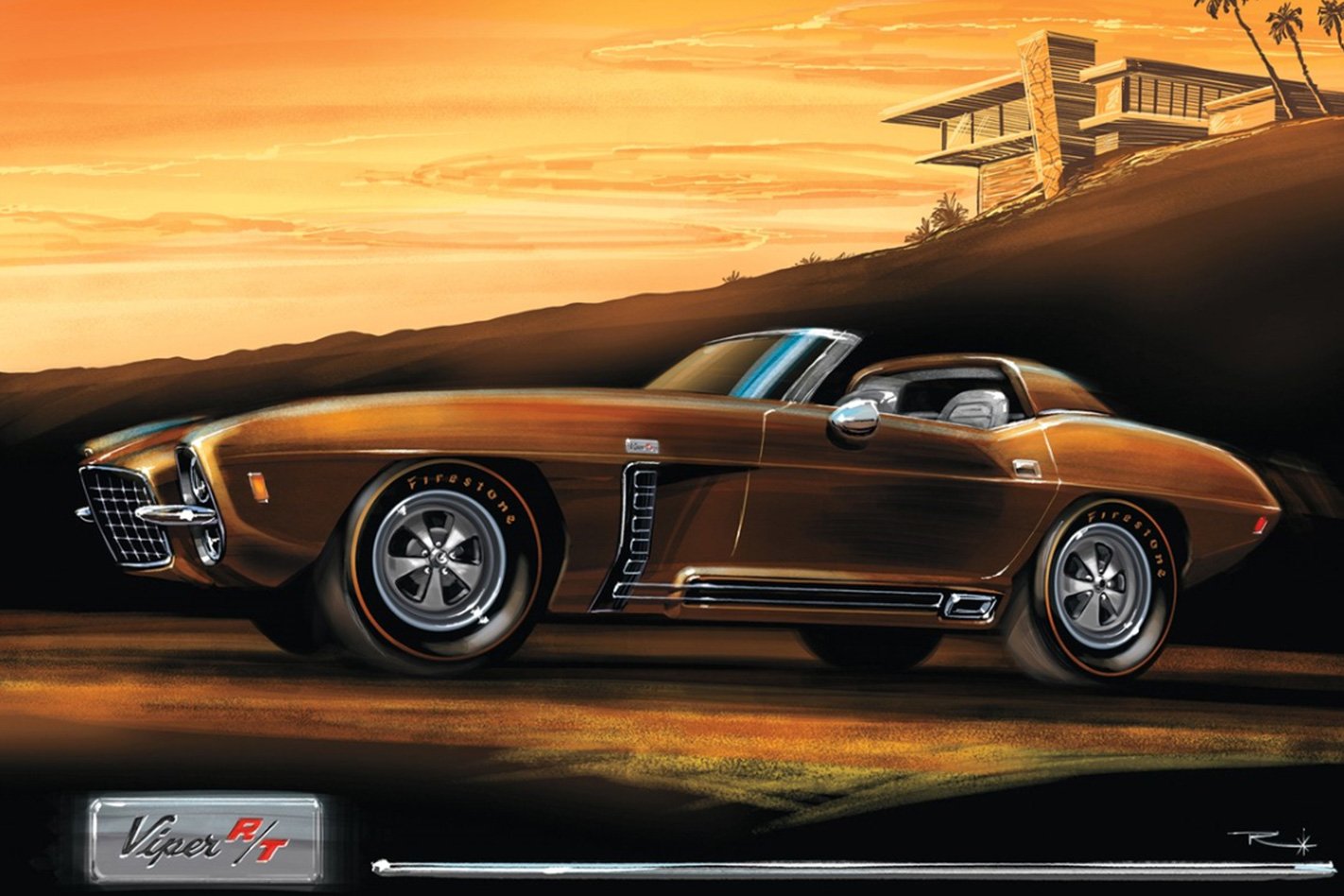
Given that the Viper always was a throwback concept wearing 1990s wraparounds, the idea of a 1970s version isn’t actually that much of a stretch. In fact, this rendering of an old-school Viper would fit right into any muscle car meet. The canted forward rear pillars, subtle side pipes and targa top are all recognisable Viper R/T motifs, and teamed with the split front bumpers and aggressive grille treatment result in a design with the requisite attitude to carry a big ol’ Hemi under the hood.
Video of Ruben Ooms at work: https://youtu.be/zhb80c-Riyw
What is it?
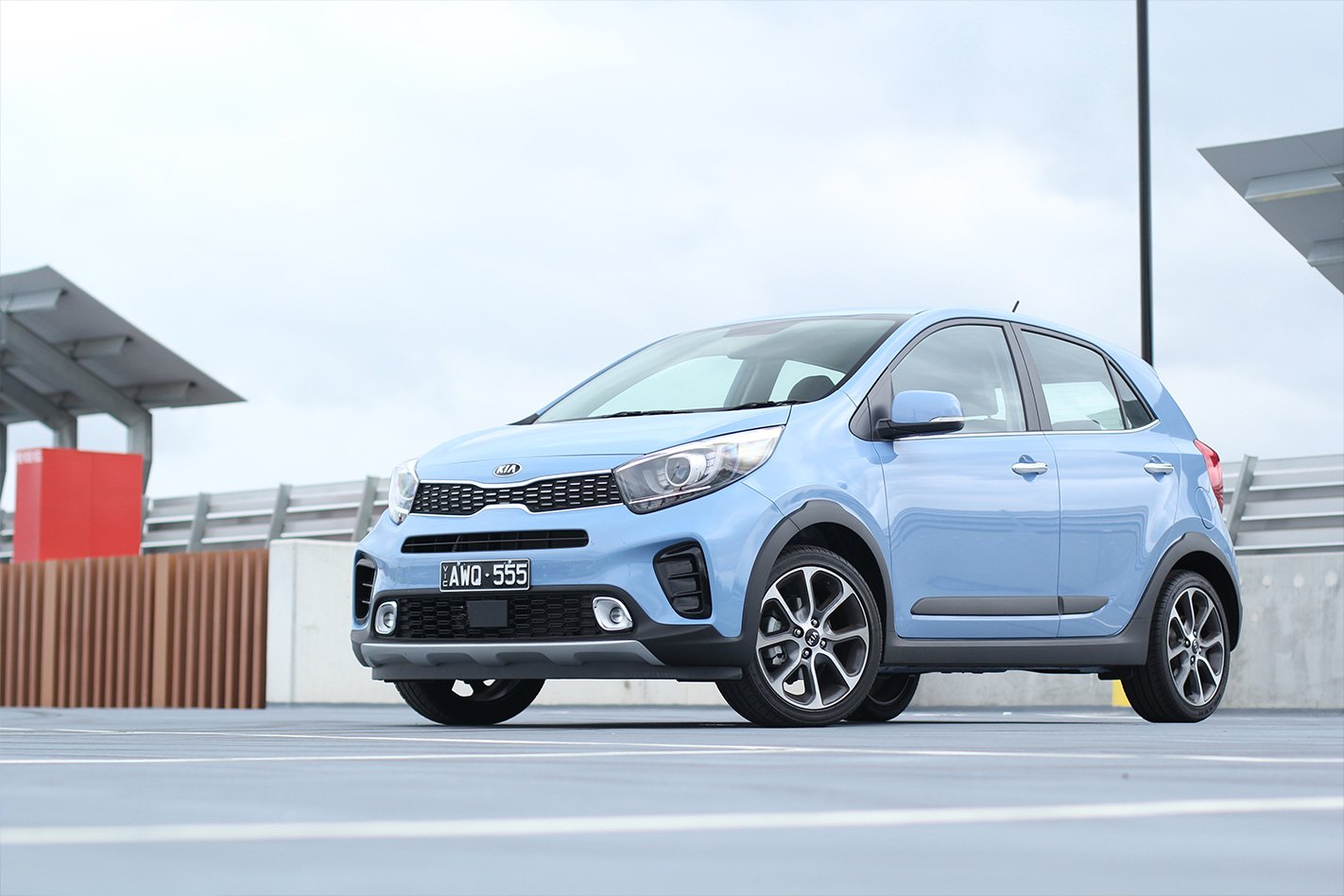
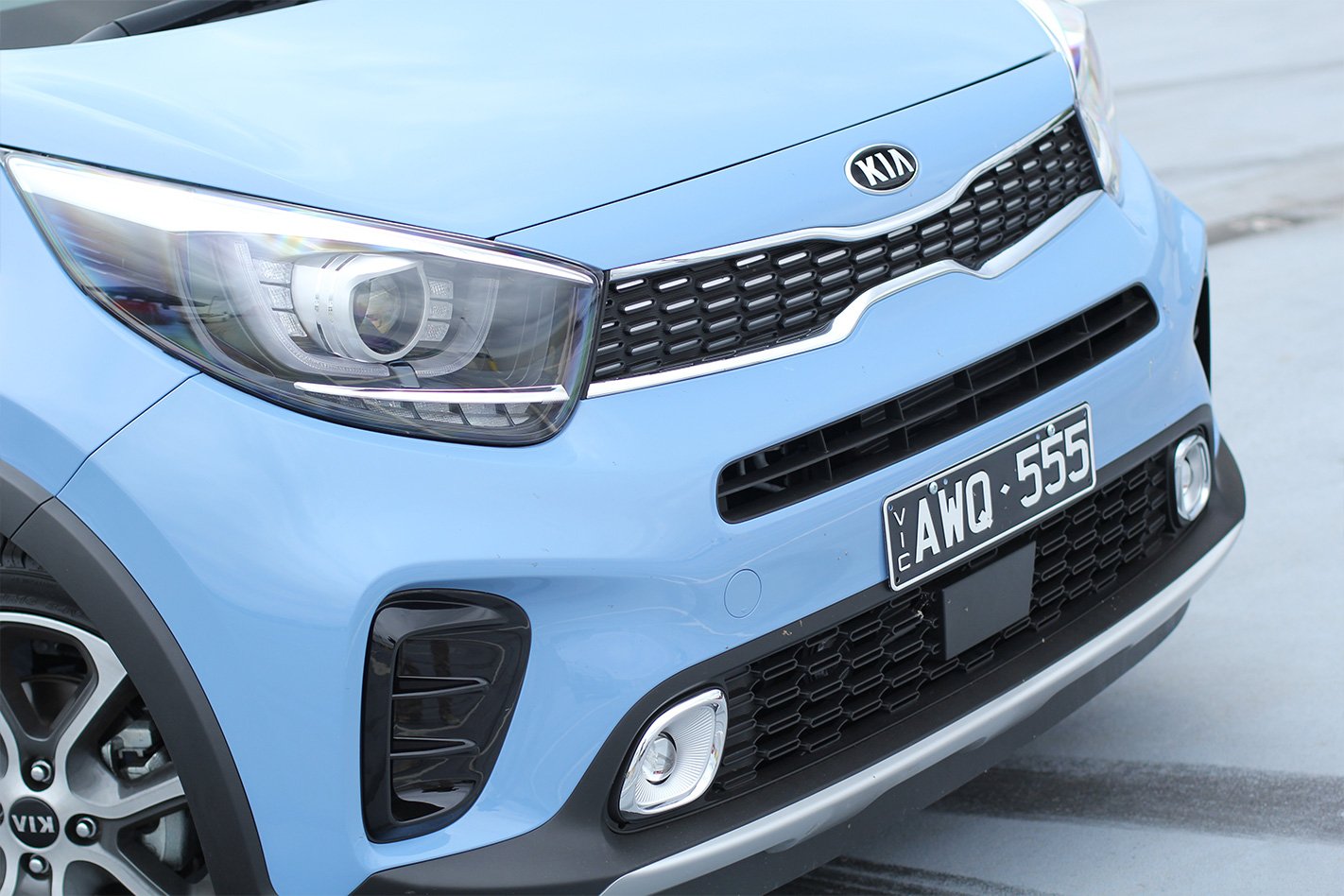
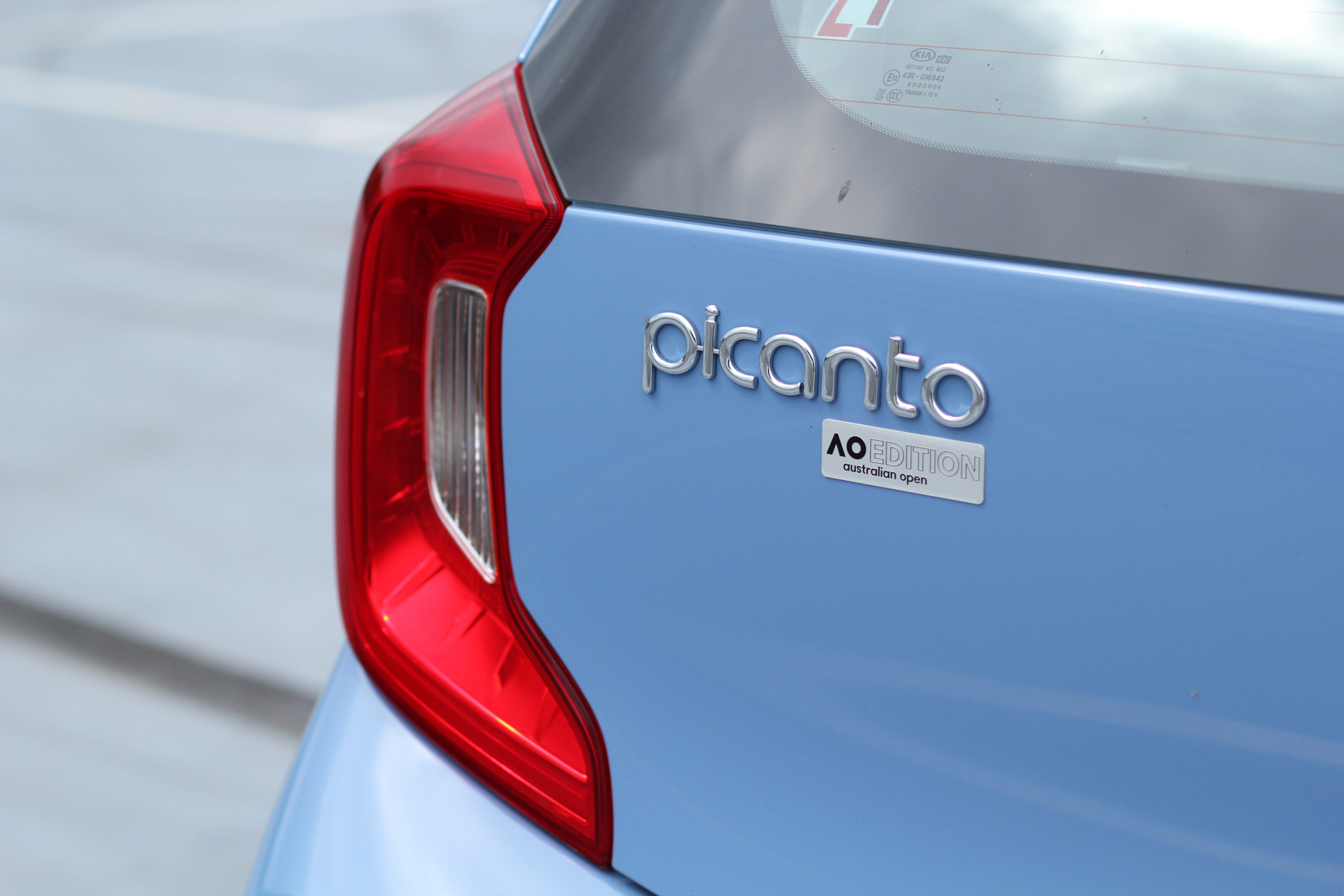
The Picanto is Kia’s established entry-level model, and one of the cheapest vehicles on the market with a starting price of $14,190 for the base Picanto S manual. The Kia Picanto X-Line Australian Open Edition we have here takes the basic Kia Picanto package, sticks on some crossover-style body cladding, jacks up the suspension and loads it with heaps of equipment.
How much is the Kia Picanto X-Line?
For the manual-equipped Picanto X-Line we’re testing here, the drive-away price comes in at $17,510 – $16,990 for the car itself, $520 for the attractive ‘Alice Blue’ paintwork that carries a premium colour charge. Want an automatic? Budget $17,990 (inclusive of on-road costs) for the optional four-speed auto.
Who is it for?
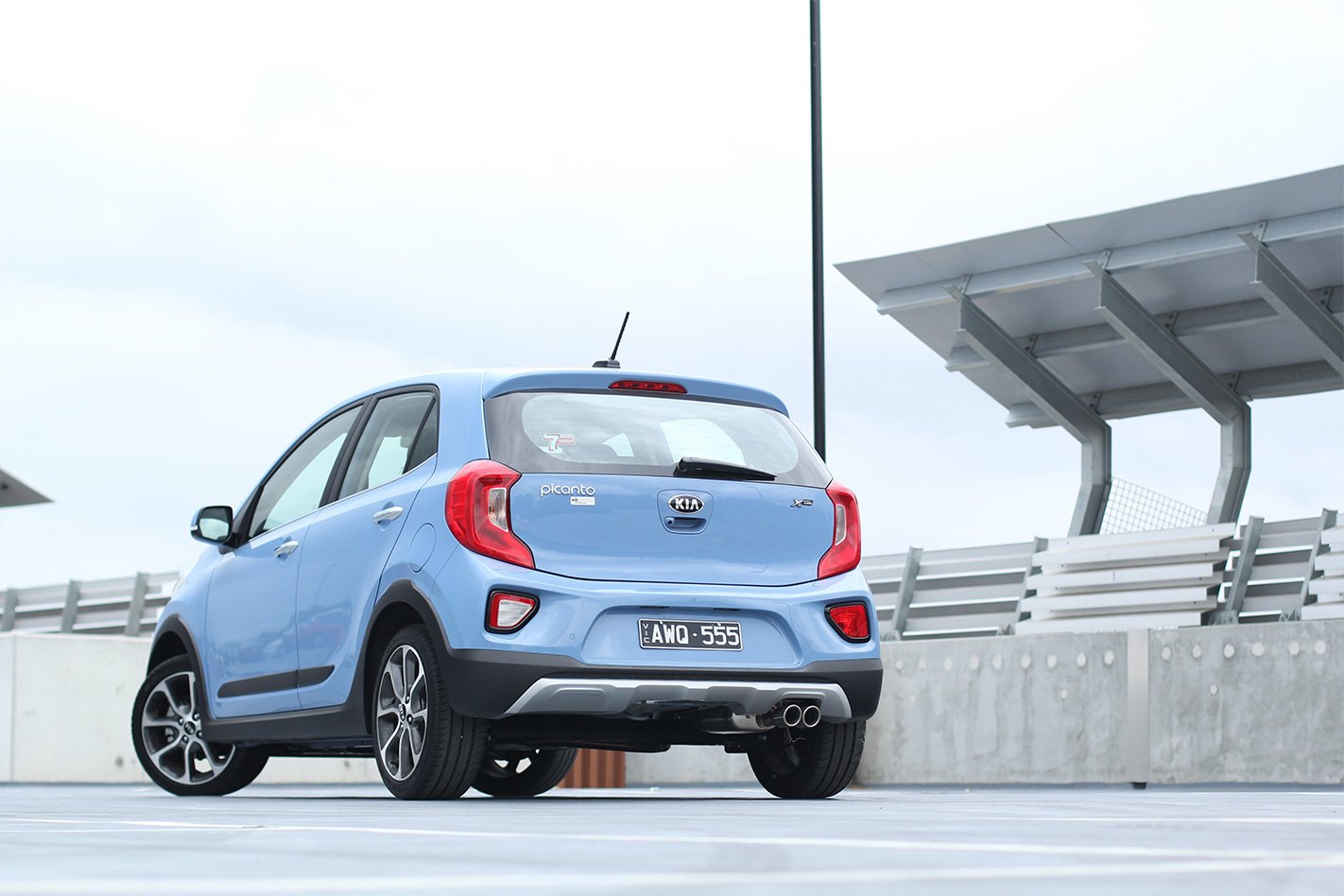
With sub-$20K pricing, a five-door body style and tiny external dimensions, the Picanto X-Line is perfect for those looking for a cheap and practical city car – with a little more visual cool-factor than the average compact hatchback.
Is the Kia Picanto X-Line easy to live with?
Despite its diminutive size, the cabin remains quite practical and able to transport two adults with zero problems, or even four full-growns without too much trouble. Cabin plastics are, of course, indicative of its price, but the design is clean and functional with plenty of open-topped storage for your odds and ends along the centre console.
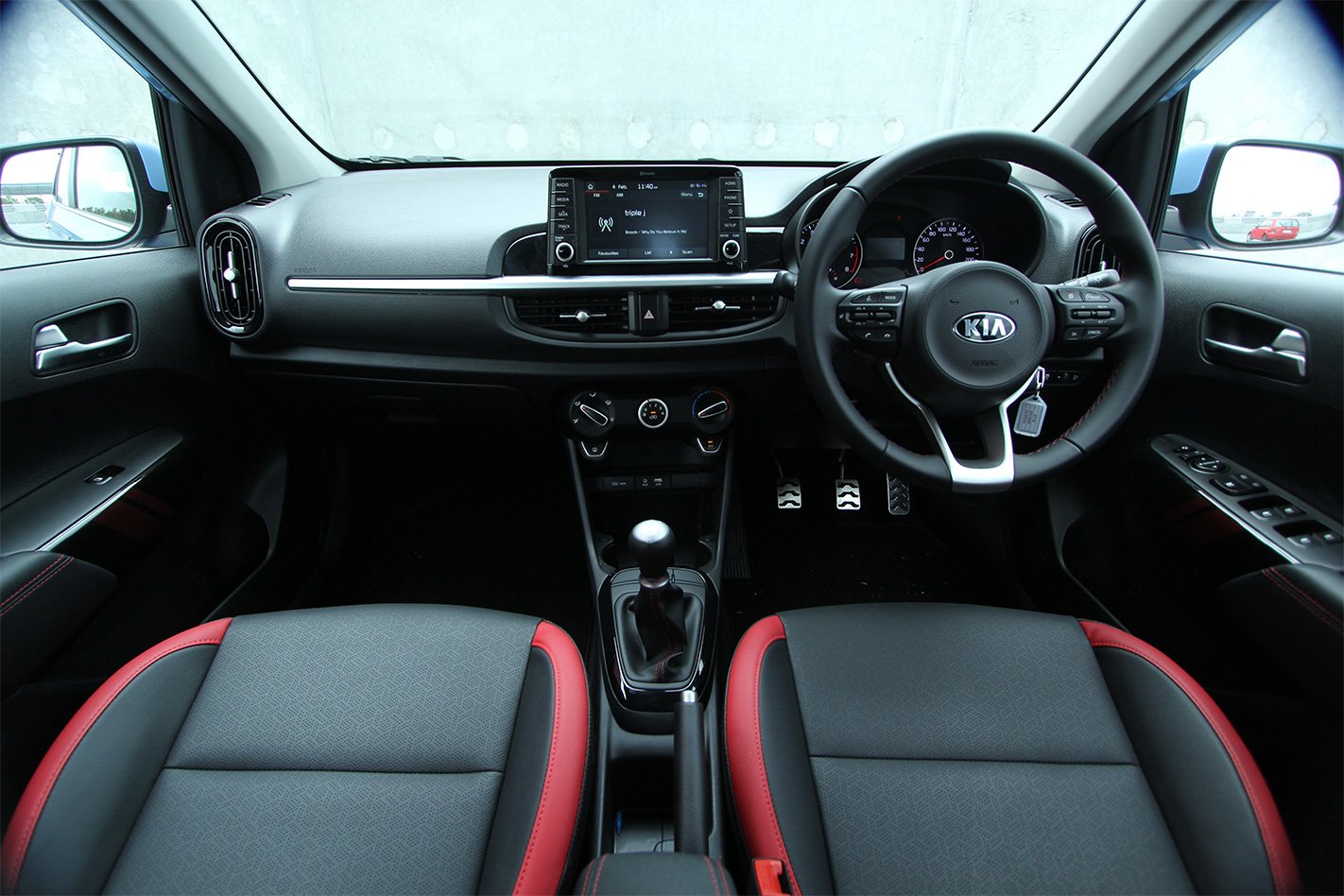
The ‘leather’ upholstery is a nice touch at this price point, but it feels very synthetic and carries an odour to match – it’s one example where high-quality cloth seats would be a better choice.
As for the seats themselves, they feel quite flat and aren’t built for long-distance comfort, but they are easy to get in and out of. The absence of reach adjustment to the steering wheel is a bigger complaint.
The boot capacity, at 255 litres, is pretty good for such a compact car, and the rear seats can fold down to accommodate bigger cargo.
But you do at least get a huge amount of standard equipment. A high-mounted 8.0-inch screen provides Apple CarPlay and Android Auto smartphone mirroring capabilities (which in turn bring satellite navigation and audio streaming apps), and there are dusk-sensing headlamps, LED daytime running lamps, electric folding wing mirrors, alloy pedals, air conditioning, Bluetooth, six-speaker stereo, a USB input and cruise control.
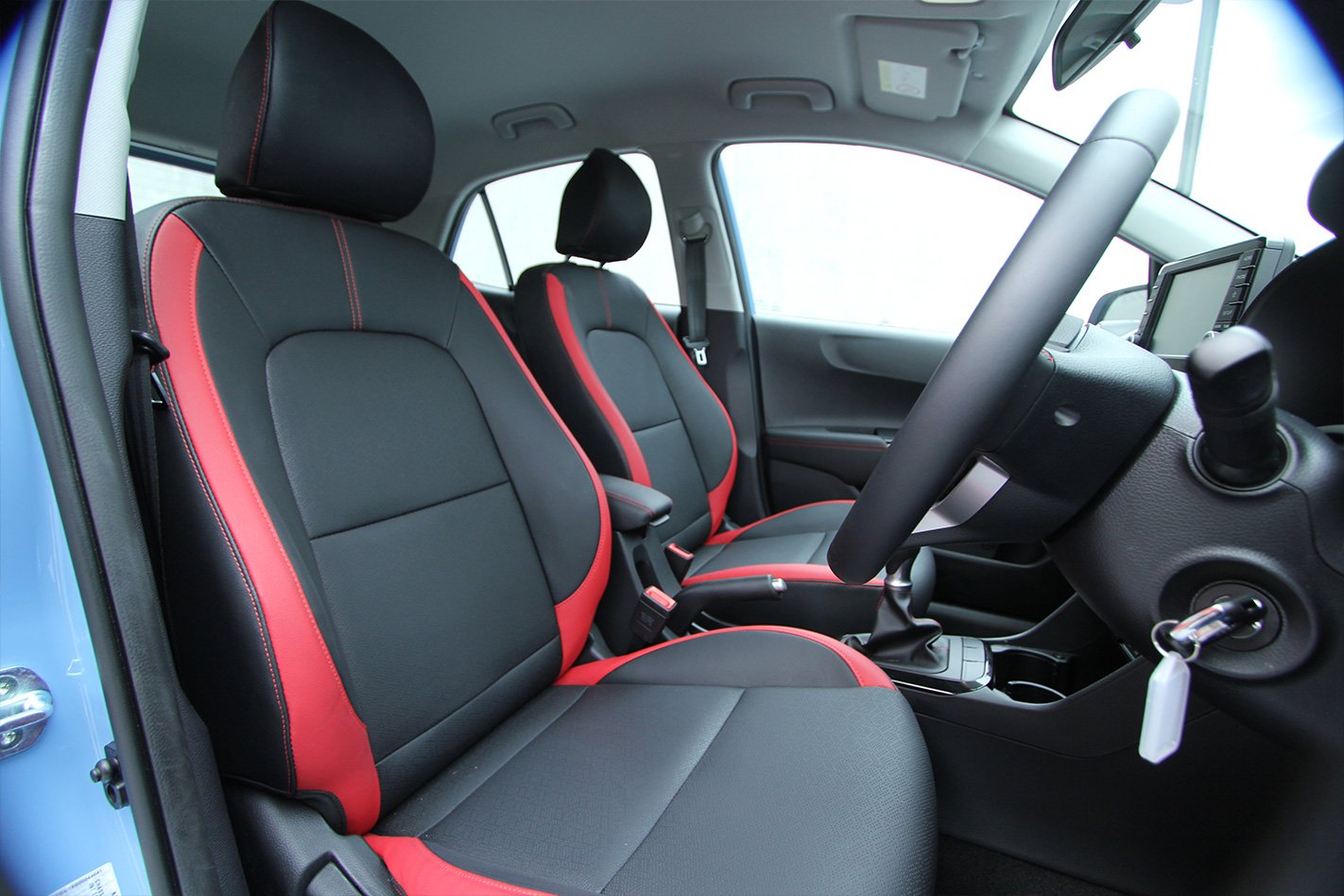
Safety-wise, the Picanto only scores four stars out of a possible five from ANCAP. It offers AEB, rear parking sensors, a rear-view camera, two ISOFIX baby seat mounts and curtain airbags.
How well does the Kia Picanto X-Line drive?
If you live in a big city, very well indeed. The Picanto X-Line measures just under 3.7 metres long and around 1.6 metres wide, so it’ll slip into tight carparks and weave through peak-hour traffic with ease.
What it won’t do is move terribly quickly. It might weigh less than a tonne, but with just 62kW of power from its 1.2-litre naturally-aspirated petrol four-cylinder the Picanto X-Line is admittedly a bit of a slug.
There’s some fun in rowing through the five-speed manual, but with the clutch pedal offering a fairly vague friction point it’s a good thing the Picanto features hill-start assist – getting going on a steep hill would be somewhat tricky otherwise.
It’s more suited to inner-urban driving than big highway stints, but high-speed cruising doesn’t necessarily faze it. It loses speed quickly once a hill presents itself, though, as the engine can’t supply enough oomph to deal with uphill inclines. Downshifting a gear (often two gears) is frequently necessary in such circumstances, even with just one person on board.
Also, don’t be fooled by that tough-looking body cladding. The Picanto X-Line is no offroader, and the 15mm increase in ride height is more for show than for adding any real dirt trail capability.
The upside is fuel economy. Its light weight and low power confer exceptional efficiency to the Picanto X-Line, and the claimed average fuel consumption of 5.0 L/100km is realistic – we achieved 5.7 L/100km in mostly urban driving.
Verdict:
Measured against other comparably-priced light car rivals like the Mazda2, Honda Jazz or Suzuki Swift, the Picanto X-Line trails in terms of space, cabin quality and ease of driving. But if you’re looking for a compact with rough-and-tumble styling and generous servings of equipment, there’s really only one other alternative to the Kia within that mid-to-high-teens price bracket: the Suzuki Ignis.
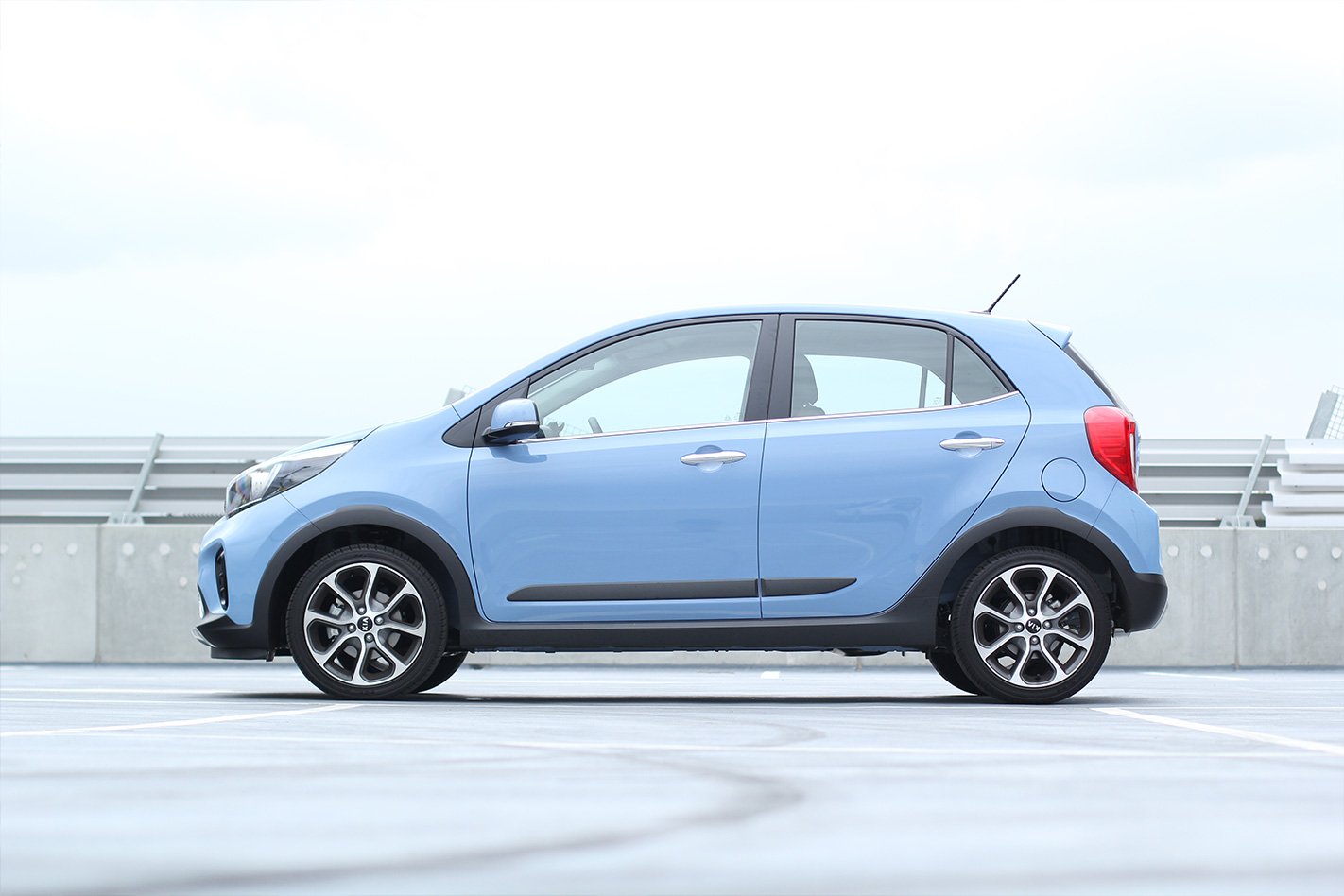
Compared to the Suzuki, the Picanto X-Line handles better, feels more spacious in the back seat, and totes an ultra-attractive seven-year warranty versus the Ignis’ five years.
If your needs are basic but you want a cheap hatch with more visual attitude than ‘the usual choices’ (or indeed, the regular Kia Picanto), the Picanto X-Line is well worth a look.
1 – Honda S2000 (AP1)
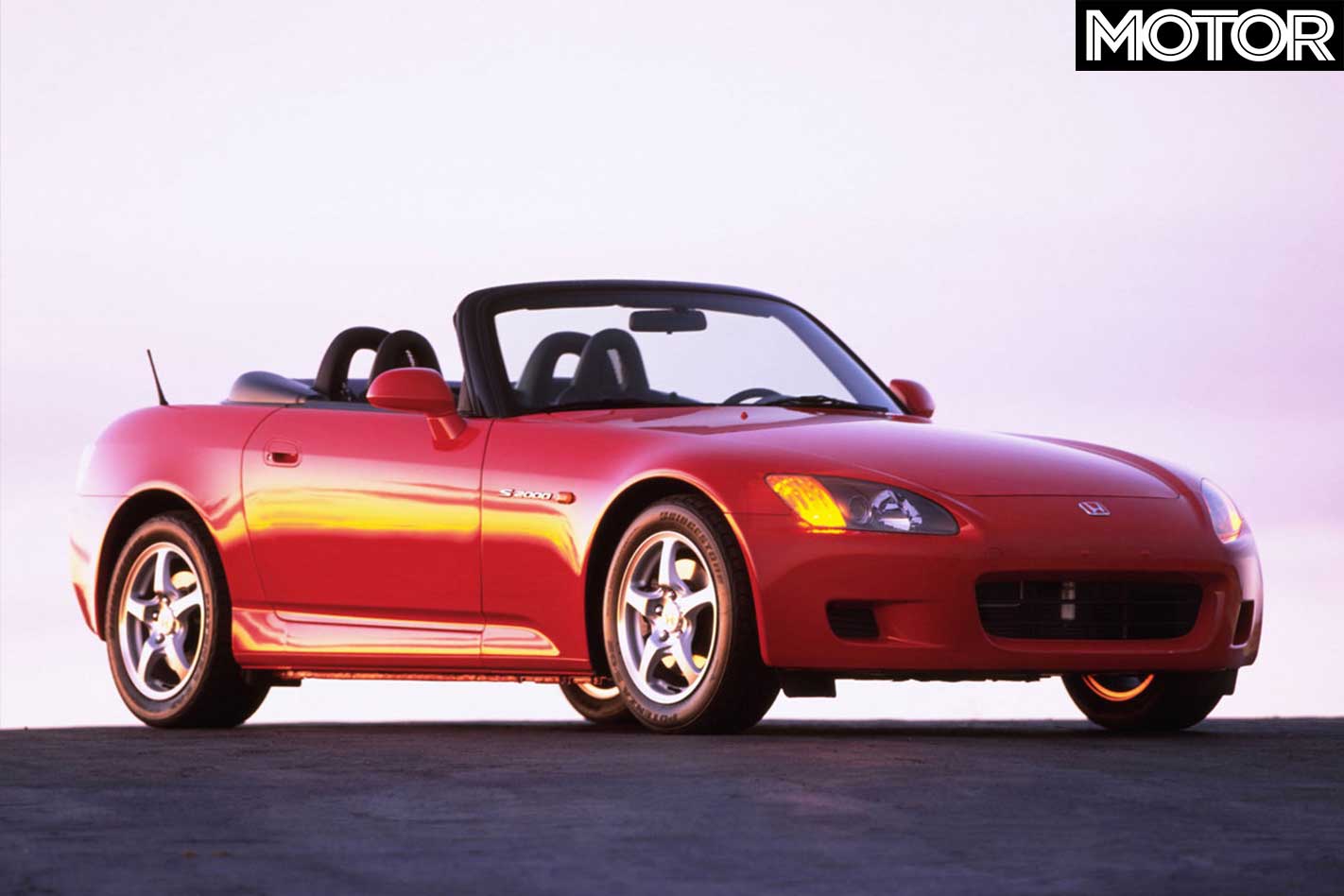
Honda broke a record when it first released the S2000 convertible sports car to the market in 1999. The 2.0-litre VTEC F20C four-cylinder became the world’s highest specific power engine with 89kW per litre when it was released (only beaten by the Ferrari 458 when it was released many years later).
Featuring Honda’s famous VTEC variable valve lift technology, which offered two cam profiles to enhance performance and economy, the engine revved to 9000rpm and produced 186kW/217Nm in JDM spec. While that might not sound like a lot by today’s standards, the S2000 would surely give an ND MX-5 a good run for its money.
An AP2 generation car was later produced with a 2.2-litre four but unfortunately engine redline was dropped in order to create better low down torque. The result was a six per cent increase in torque to 220Nm.
S2000s are still commanding high second-hand market prices despite being up to 20 years old. If you have gotten your hands on an AP1, you’ve done very well.
2 – EK9 Civic Type R
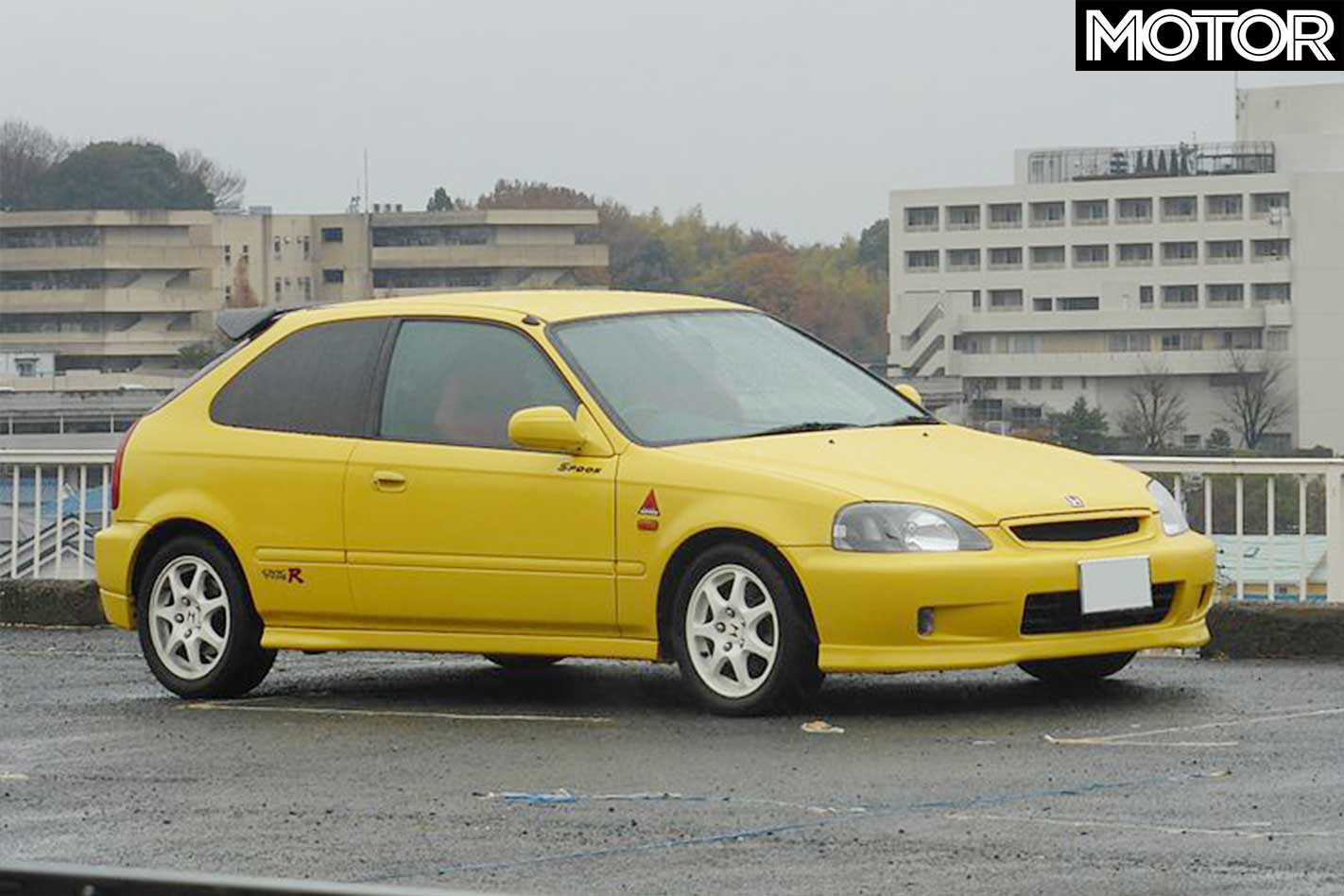
The EK9 was the first Civic to receive the venerable Type R badging, with a pumped up 1.6-litre B16B four-pot, producing 136kW/160Nm at a screaming 8200rpm. The EK9 was a Japanese-exclusive model, so to see one in Australia would be a very rare sight indeed.
Owners didn’t just get a highly strung engine. The EK9 came equipped with bright red seats, a titanium shift knob and a leather-wrapped steering wheel – accessories still found in the newest generation FK8 Civic Type R. What a great package!
3 – Honda CR-X Del-Sol
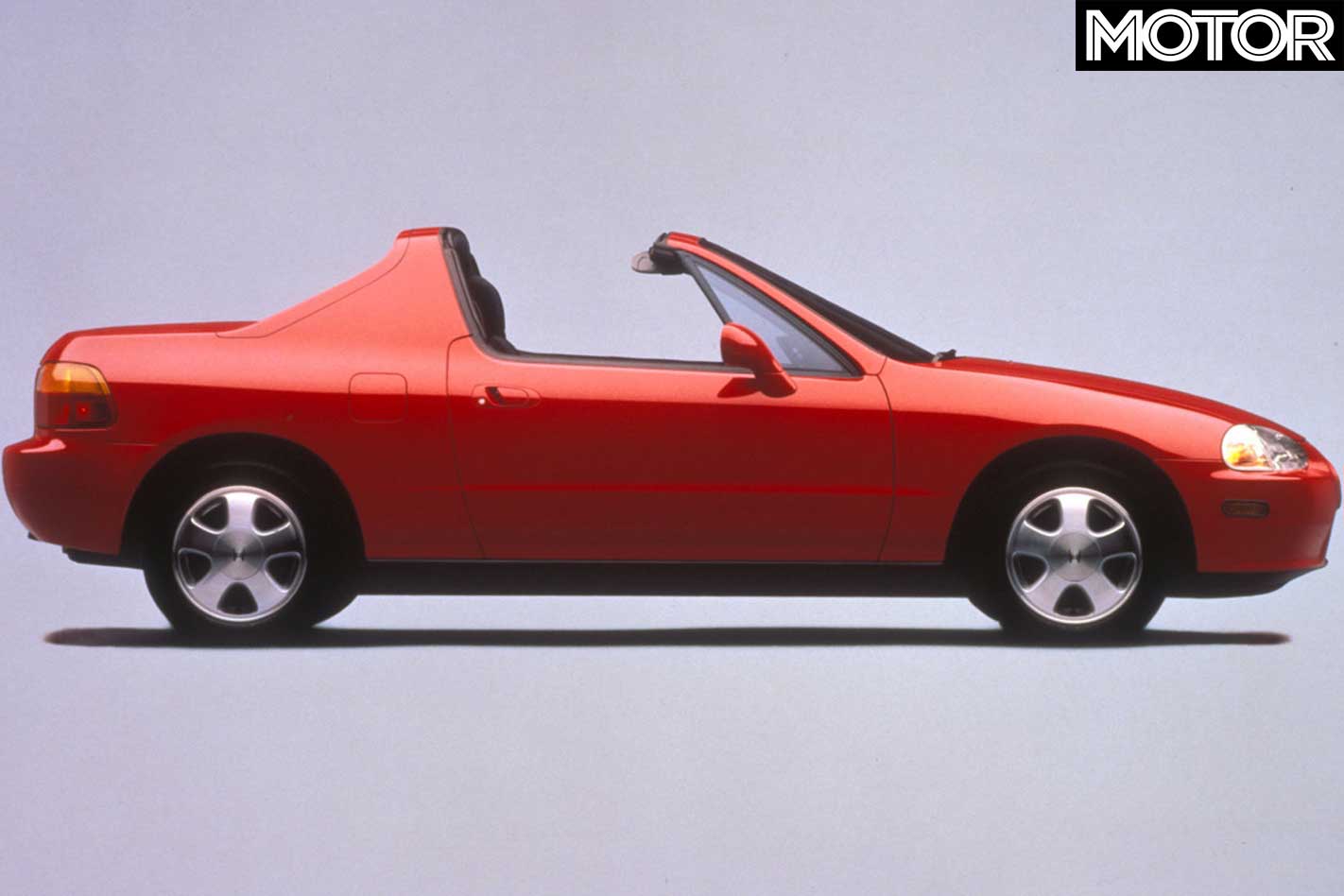
Although not the most attractive sports car to ever be released, the CRX Del-Sol made up for that with plenty of character and soul (or should I say, Sol).
The Del-Sol was the first production Honda vehicle to feature an engine which produced more than 100hp (75kW) per litre with 79kW/litre and also had a removable ‘targa’ style roof which is now most commonly seen on Porsche 911 Targas, where the roof stored away conveniently in the boot.
The Del Sol featured a 1.6-litre, 16-valve B16A engine which made an impressive 127kW/157Nm at 7000rpm (VTEC kicked in, yo, at 5500rpm). For its time, the CRX Del-Sol gave the competition a good run for its money. The 4AE-GZE supercharged engine found in the E90 Toyota Corolla made just 121kW despite having forced induction.
The top spec model of the Sol was the SRi and featured mod-cons such as cruise control, disc brakes all round and additional front and rear sway bars. You can pick one of these up now for around $5000-$9000 with a lot of kilometres, but hey, they’ll still be fun.
4 – Honda (Acura) NSX R
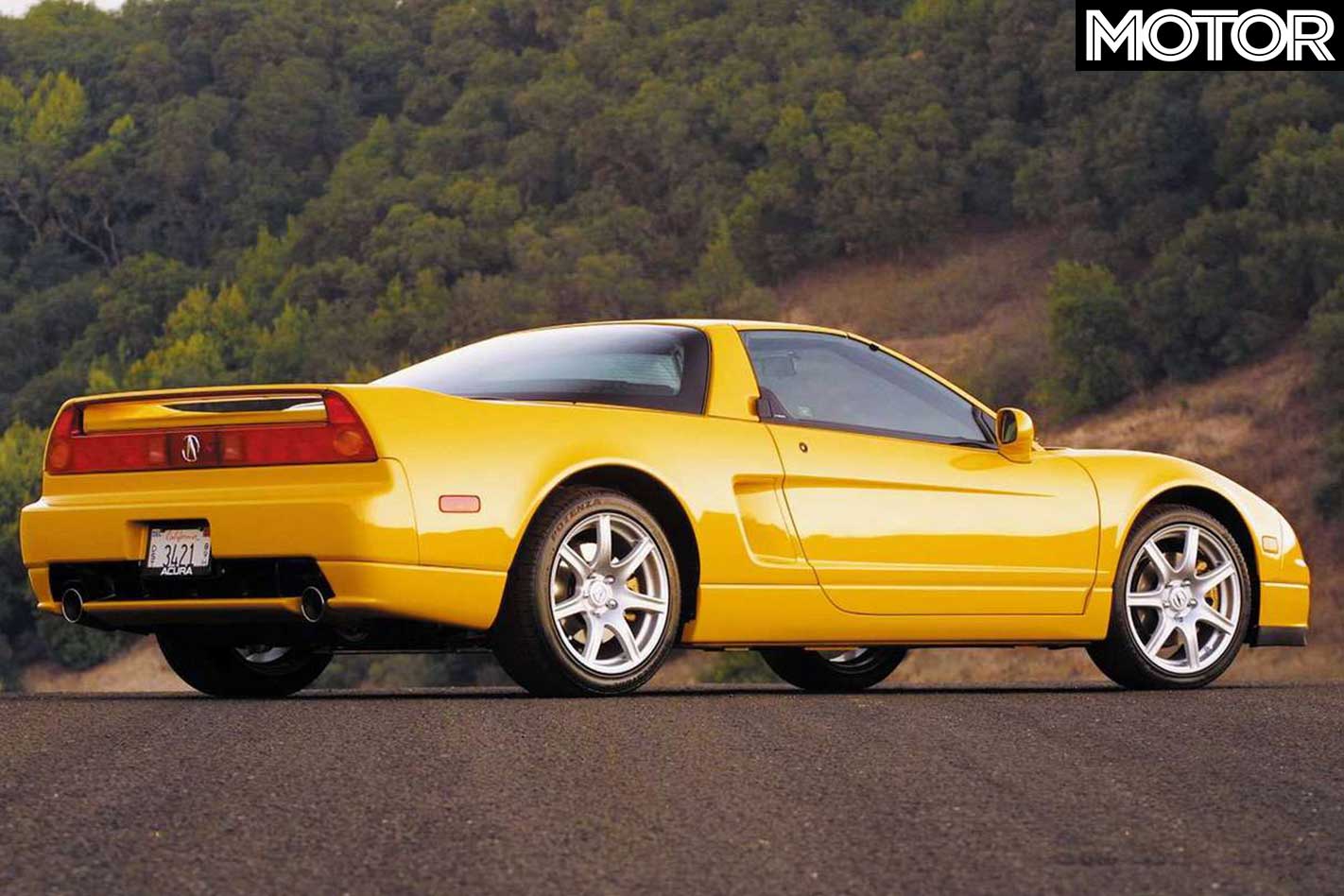
Arguably one of the most easily recognisable Honda sports cars ever produced, the NSX first released in 1990 after development was overseen by the one and only Ayrton Senna.
The company later released an R version of the mid-engine sports car in 1992 which did without sound deadening, air conditioning and other niceties.
Power from the 3.2-litre VTEC V6 engine was lifted from 201kW/285Nm to 206kW/294Nm with peak power at 7100rpm which was then sent through a limited-slip-differential at the rear. NSXs were known for their addictive induction sound which would fill the cabin on wide-open throttle.
The R only built and improved on this sound dynamic to make the car even better than before.
5 – Honda S800
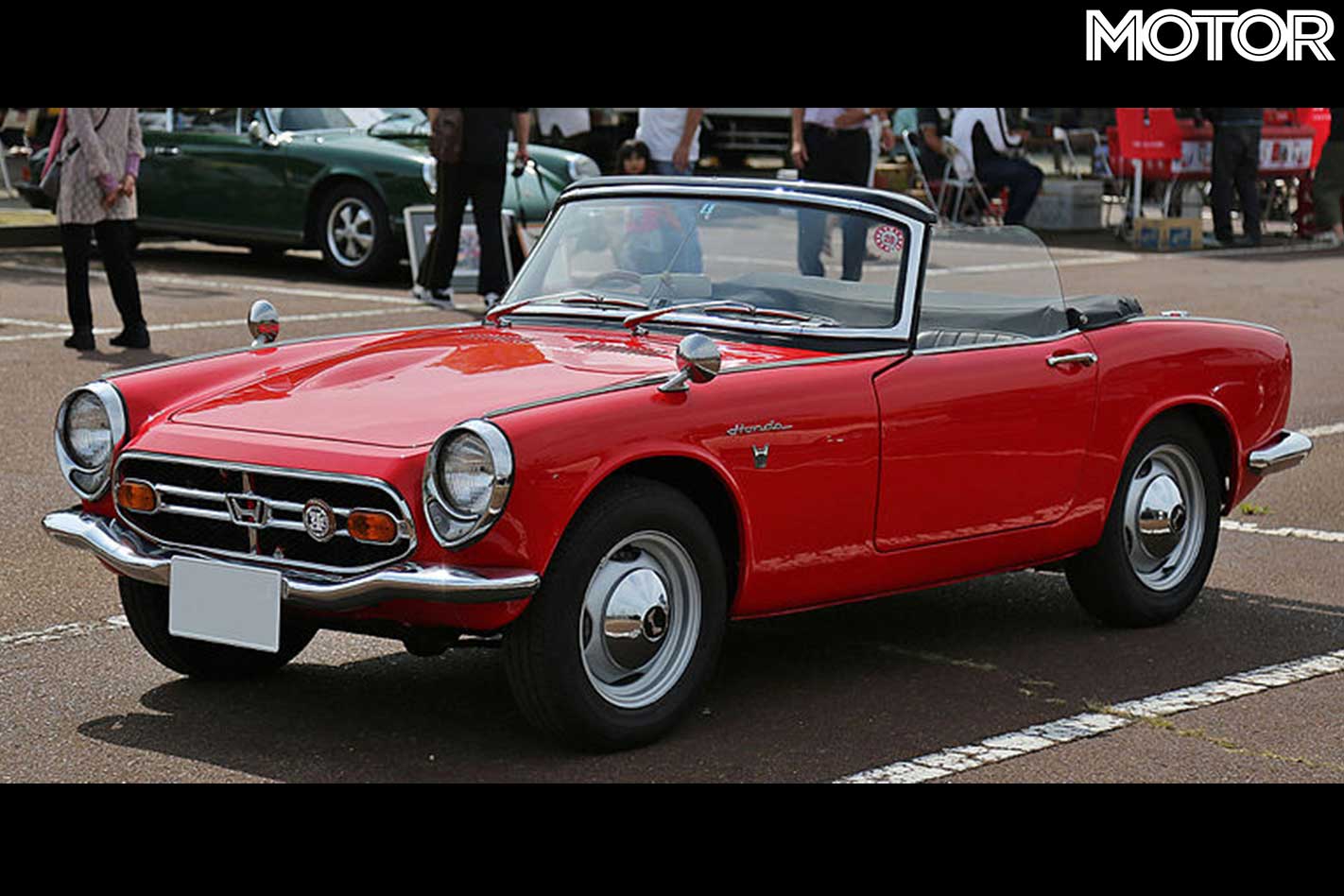
Part of Honda’s sports car genesis, the S800 looks like something James Bond would have driven on a Sunday afternoon with a beautiful woman by his side.
The S800 was the successor to the S600 and was available in either a coupe or roadster body style. The car was the first Honda to reach 160km/h and revved to a screaming 10,000rpm!
While its 50kW motor didn’t produce neck-snapping acceleration, the style, personality and sound of that high revving engine are enough to make it a classic. It is still cherished today by motoring clubs across the globe.
6 – Honda Civic Type R (FK8)
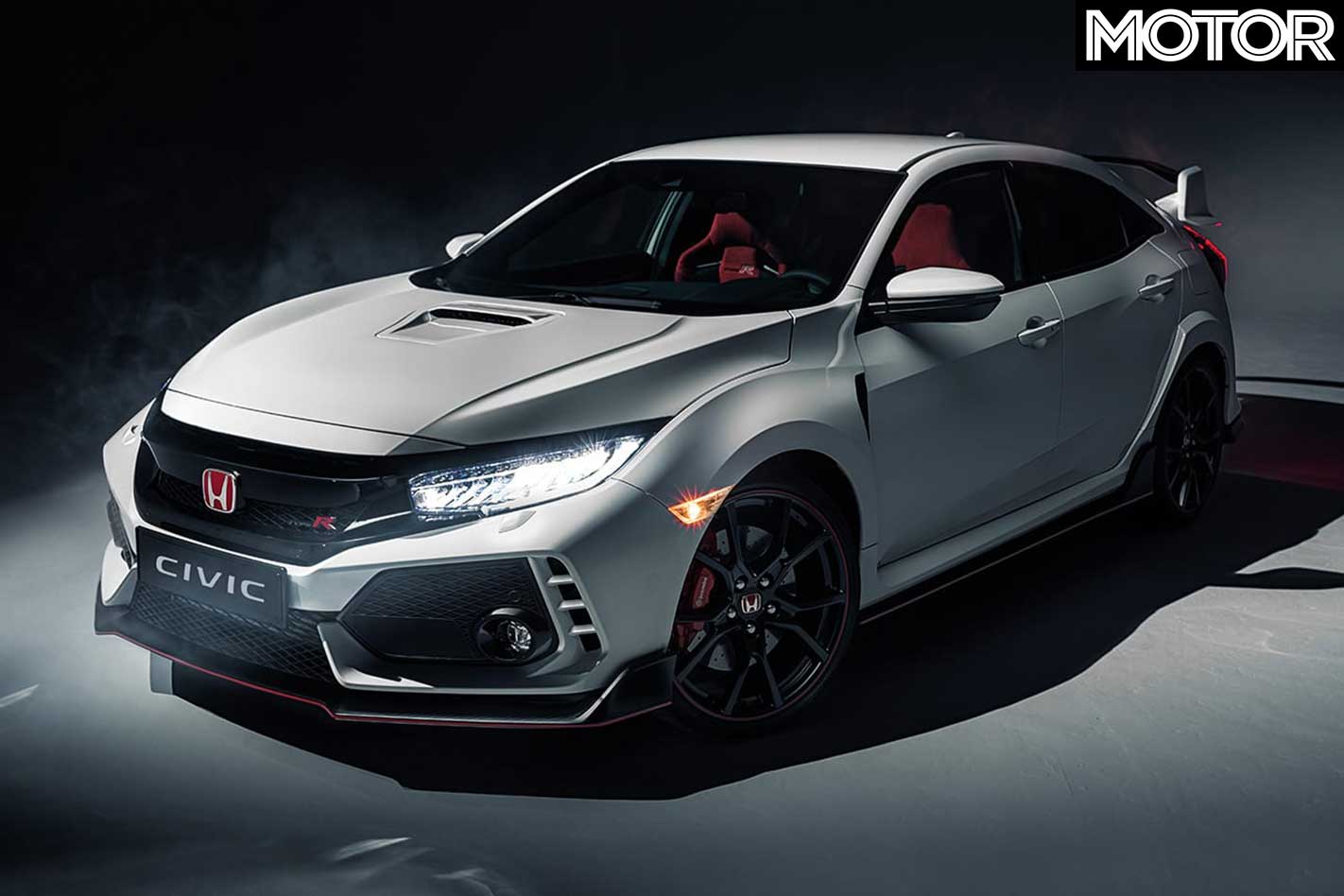
The newest generation Civic Type R is not just flashy body panels and a crazy wing. This car won MOTOR’s PCOTY in 2018, beating the likes of the Nissan GT-R Nismo, BMW M4, Kia Stinger and HSV GTS-R W1.
Packing a 2.0-litre VTEC turbo four-pot, the FK8 Type R is a born and bred canyon-carver, producing a punchy 228kW/400Nm. Like most Type Rs, too, you still get the signature red seats but with the added modern tech, a front limited-slip-differential and adjustable dampers standard. This car will surely become a classic in future years.
Here it is, folks. Performance Car of the Year 2019.
The issue you’ve all been waiting for has arrived, and if you’ve managed to avoid spoilers it’s time for you to find out which car took home the PCOTY crown.
Plus, the new Supra, a supercharged Mustang, and all the usual suspects.
You can find our gorgeous mags at retailers around Australia. Or you can subscribe and save yourself some cash, there’s even a digital subscription.
Subscribers often receive their mags earlier, depending on the postal system, so you’ll get to see what MOTOR has to offer before anyone else.
Or, if you want to give us feedback and see behind the scenes, you can follow us on Facebook, Twitter, and Instagram where we interact with our followers regularly.
Enjoy!
PERFORMANCE CAR OF THE YEAR 2019
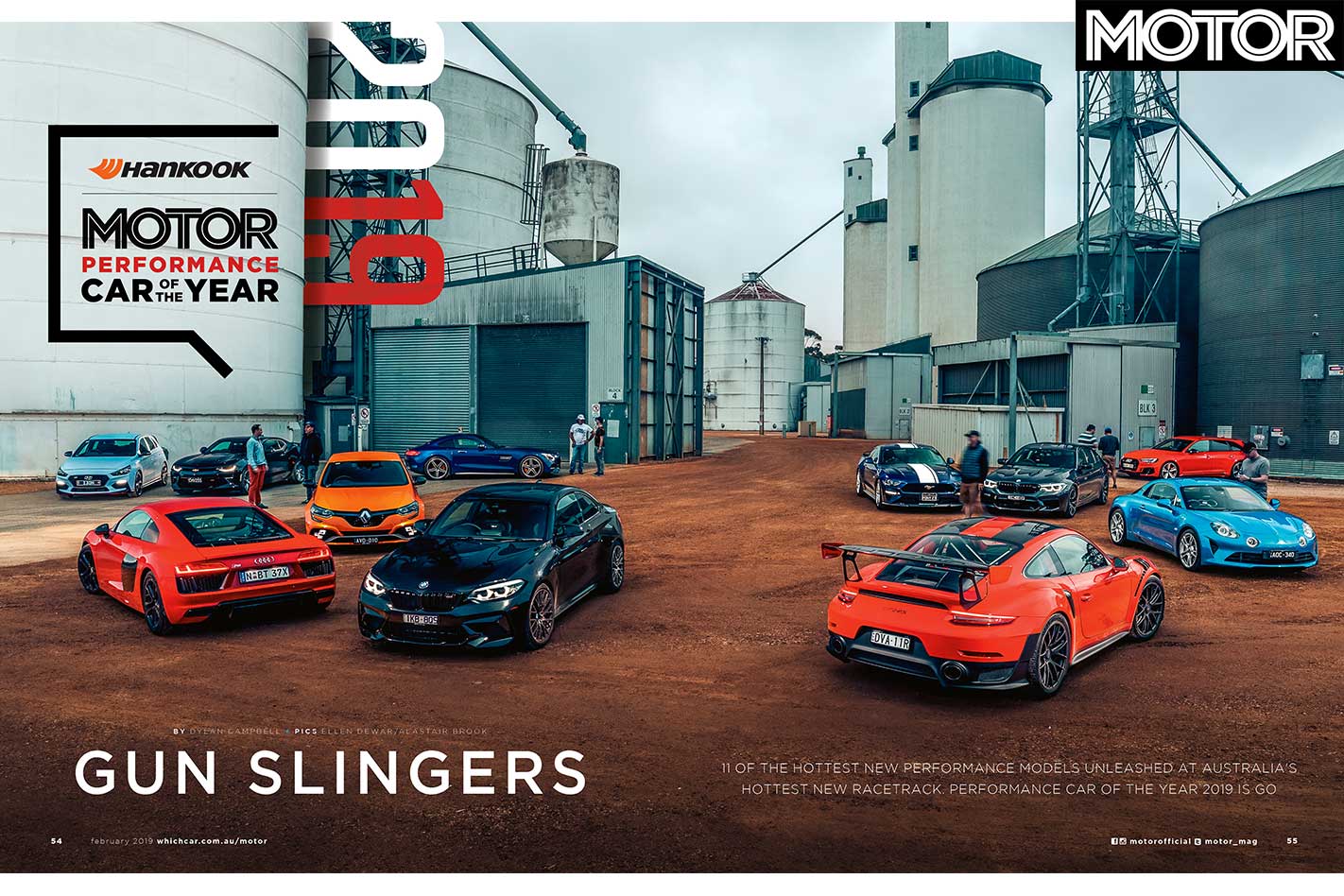
11 hell-raising cars, five days in scenic SA, and one champion.
Our PCOTY feature is split into sections for road and track, plus the final countdown with each car featured on a full page with its ranking. We even have a few pages of outtakes.
PCOTY 2019: The Road
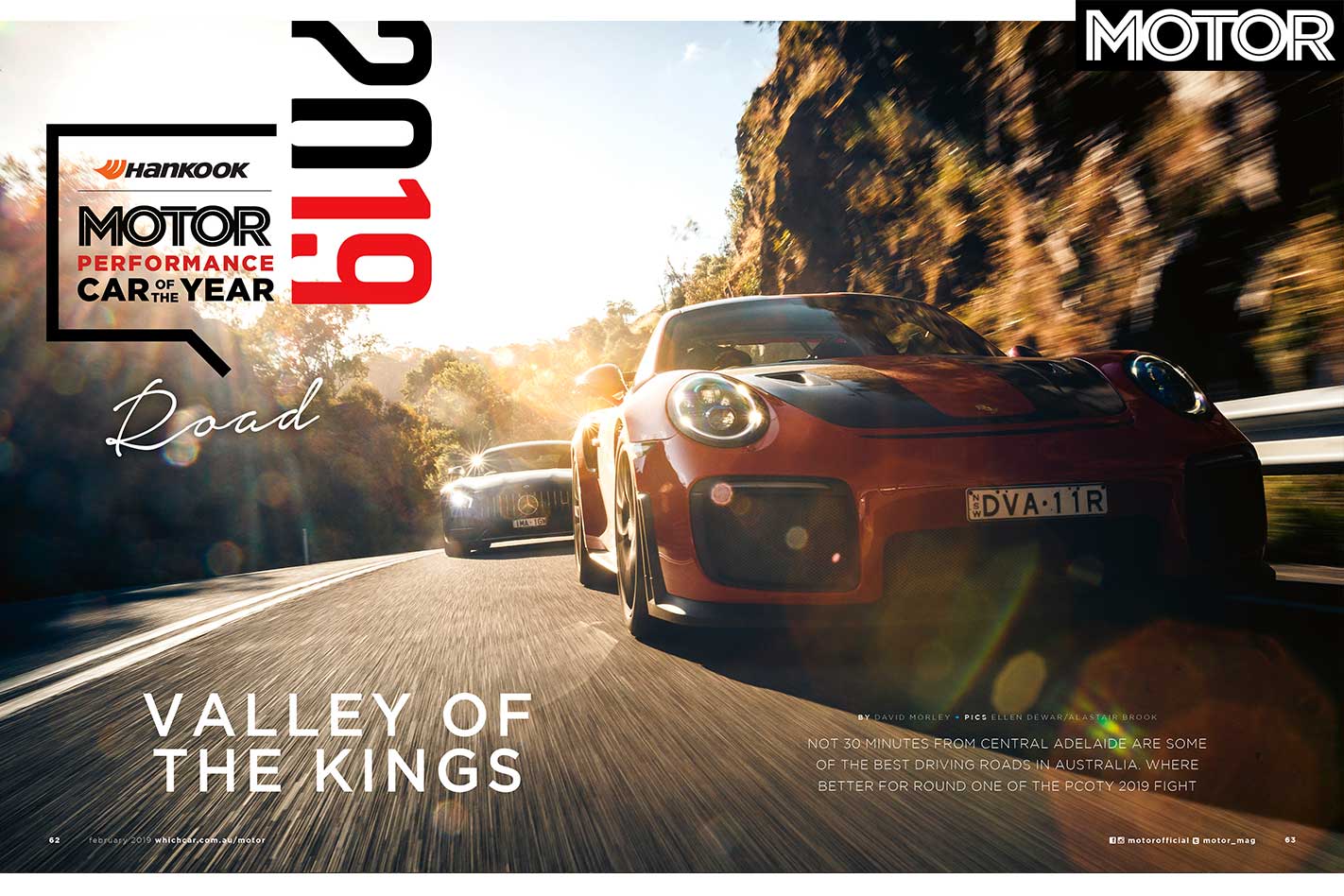
South Australia’s Gorge Road is driving nirvana, which doubles as a stern test for our crop of performance cars.
PCOTY 2019: The Track
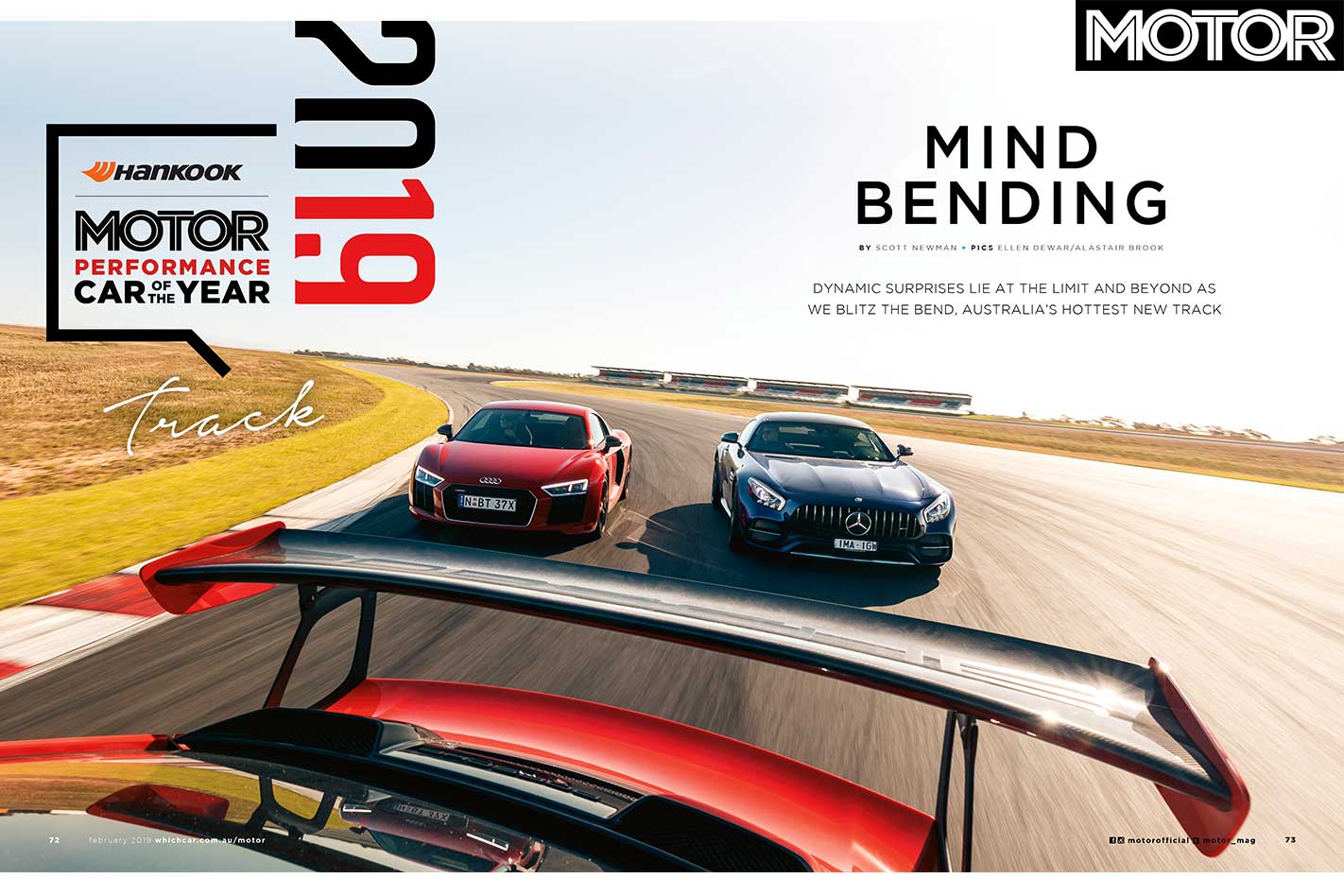
Fresh tarmac, number crunching and drifts for the camera – welcome to The Bend Motorsport Park, where our contenders need to impress both the judges and the stopwatch.
PCOTY 2019: The Countdown
Six Germans, two French, two Americans and a South Korean fight it out.
PCOTY 2019: Robbo’s Diary
Former MOTOR Ed. Tim Robson takes off his judging hat and takes over the role of bystander. But he’s not mad about it. Not at all.
SNAKE BITE: Shelby Mustang Super Snake review
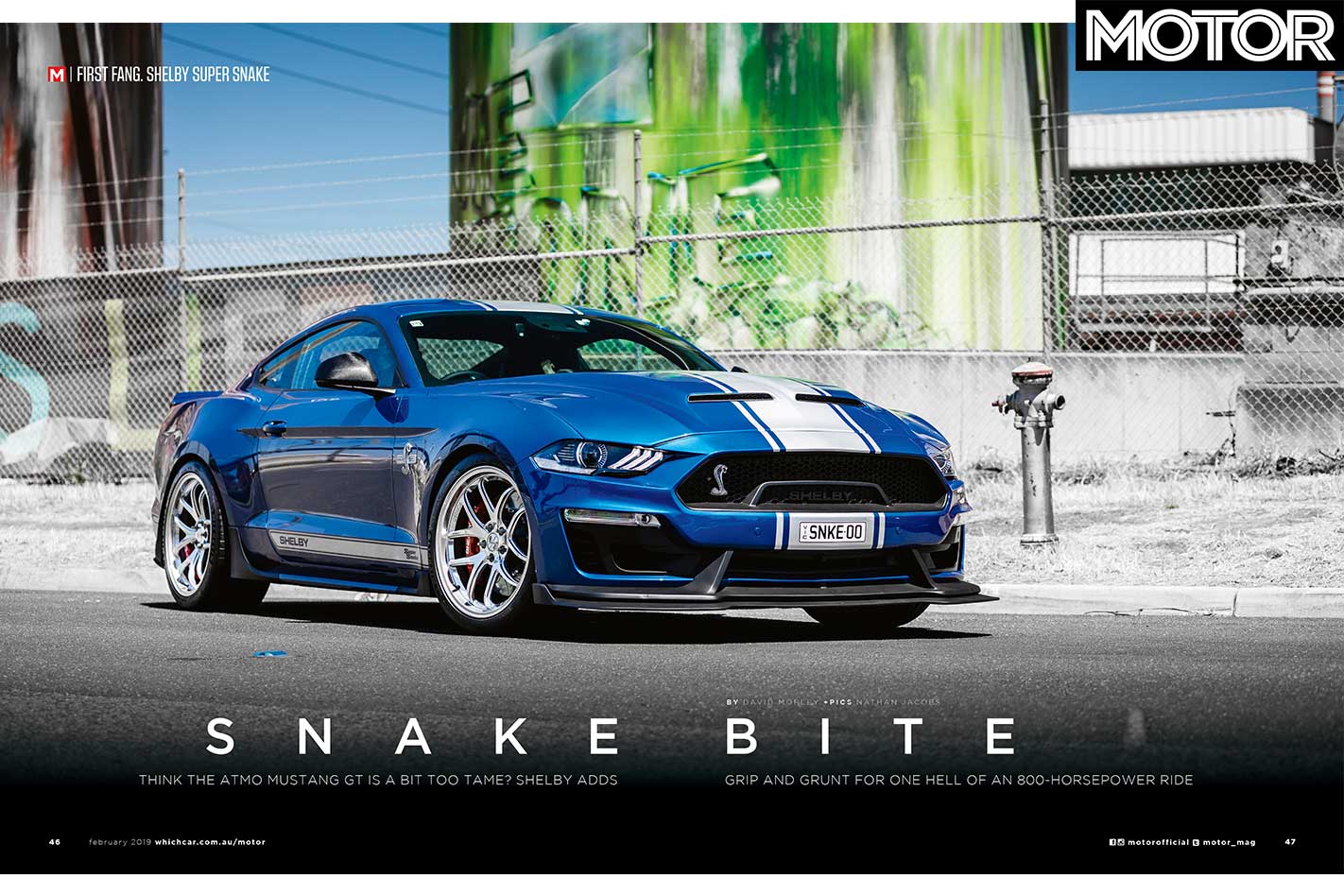
If you thing the atmo GT is a bit tame, then this 800hp blown Shelby might be for you!
NEWS: New Supra is here!
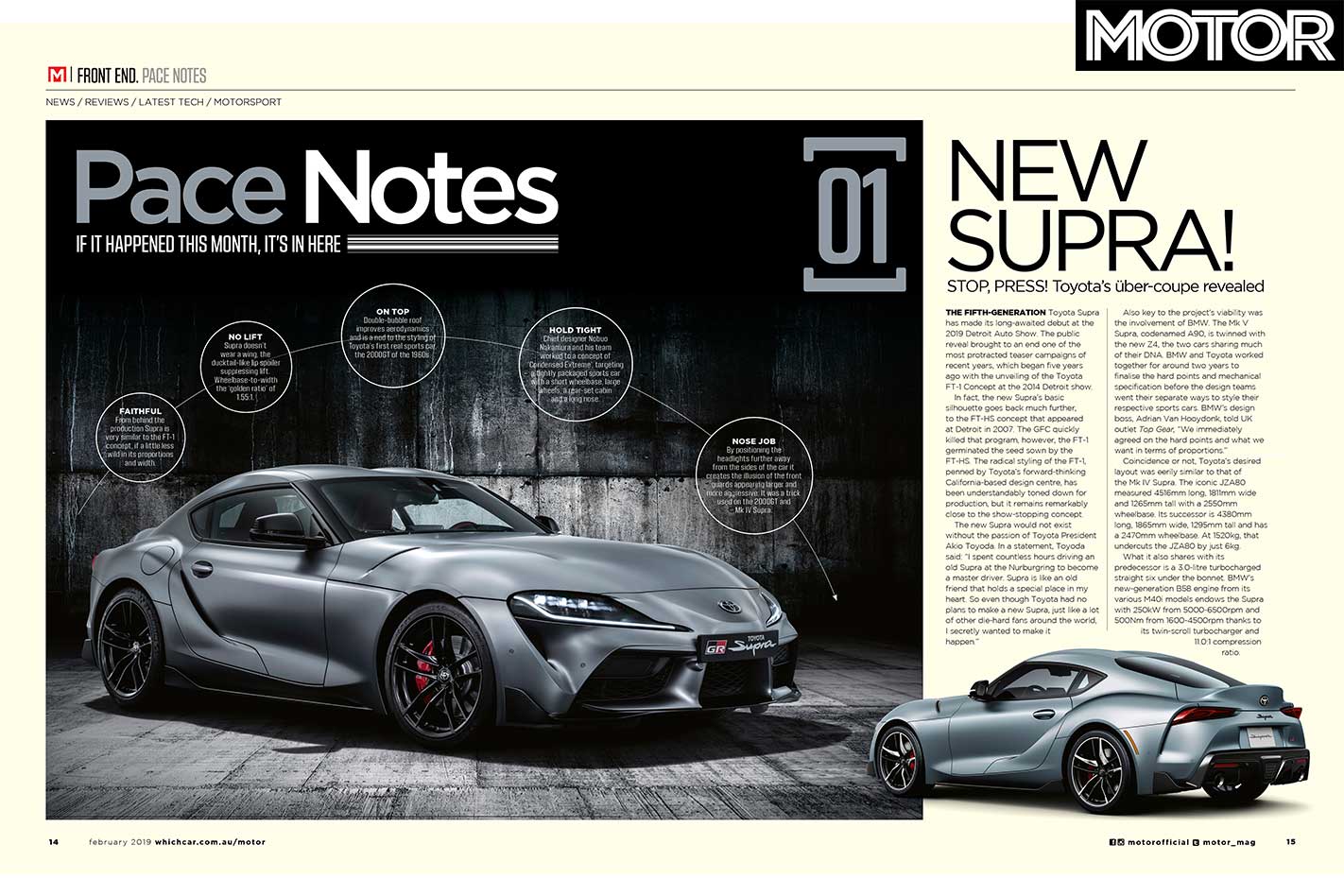
Finally! We dish out everything you need to know about the return of Toyota’s golden child.
AND THE REST: Columns, reviews, and features
Make sure you check out DC’s editorial column. It’s about him being hospitalised during PCOTY, and it’s funnier than it sounds.
PRESS material from Slovakia has leaked online, revealing Euro-specific outputs for Mazda’s revolutionary compression-ignition SkyActiv-X engine.
Until now production-spec power outputs for the engine, which had remained a closely guarded secret, were the work of well-intentioned speculation.
However, a spec sheet from Mazda in Slovakia, of all places, has appeared online, showing the cutting-edge engine will produce 133kW and 222Nm. Ford’s Focus ST-Line warm hatch produces 134kW and 240Nm for context.
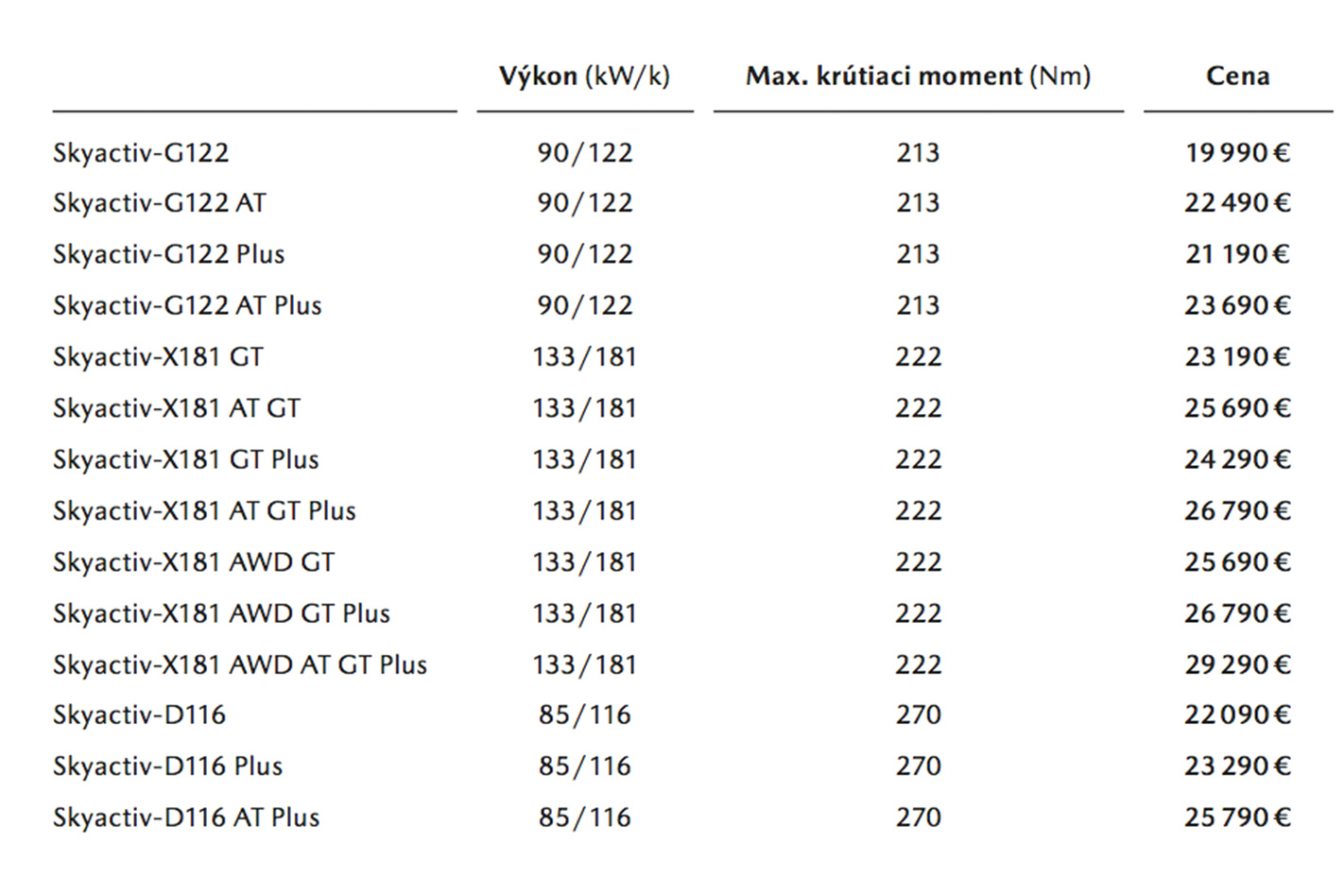
While the new Focus’s power comes thanks to a traditional 1.5-litre three-cylinder turbocharged internal combustion engine, the SkyActiv-X unit ditches the spark, for a supercharged compression ignition system Mazda claims could provide the performance of a 2.0-litre MX-5, with the economy of a 1.5-litre Mazda2 diesel.
When we drove SkyActiv-X prototype in 2017, Mazda claimed the engine produced 140kW and 230Nm.
When the Mazda 3 launches in Australia in the coming months, it will be fitted with updated SkyActiv-G petrol four-cylinder engines in both 2.0- and 2.5-litre capacities, with 114kW/200Nm and 139kW/252Nm outputs respectively.
Euro-spec Mazda 3’s will be fitted with the emission capped 2.0-litre, which throttles power to 90kW/213Nm.
It is unclear if the SkyActiv-X engine will have more power in Australia when it arrives in Q3, thanks to less restrictive emissions regulations.
Unfortunately, the leaked document doesn’t include official fuel efficiency claims, meaning we’ll have to wait a little longer to know exactly how frugal the new unit will be.
Displacement for the SkyActiv-X also remains unconfirmed, however the prototype engine was a 2.0-litre unit.
