
HYUNDAI Australia has welcomed its Korean parent’s announcement that it is considering boosting production of the hardcore i30 N hatch, as the local lead time grows towards six months.
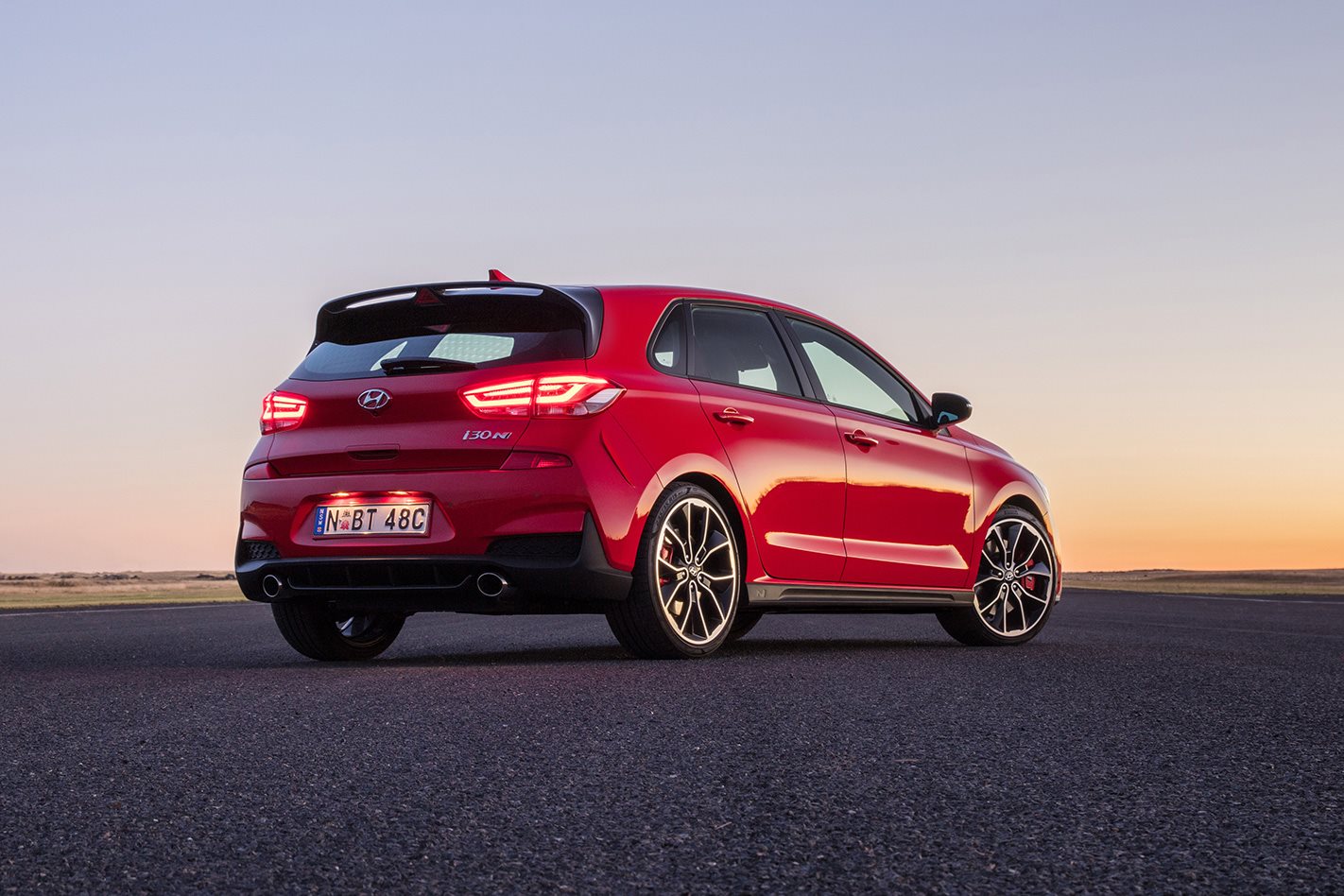
The car maker has confirmed that buyers here are already facing up to a five-month wait after slapping down a deposit on the $39,990 Volkswagen Golf GTI-baiting i30 N, a gap that’s likely to get even wider as European demand for the beer-budget hot hatch continues to outstrip supply.
“Yes, we’re finding it a challenge to meet demand in the Australian market, Hyundai Australia external affairs general manager Bill Thomas told Wheels. “It’s a nice problem to have, because it’s a great reflection on the car’s capability, but it’s obviously not ideal either.
“Australian customers who order a car now are looking at delivery in October or November. It’s not something we can change right now.”
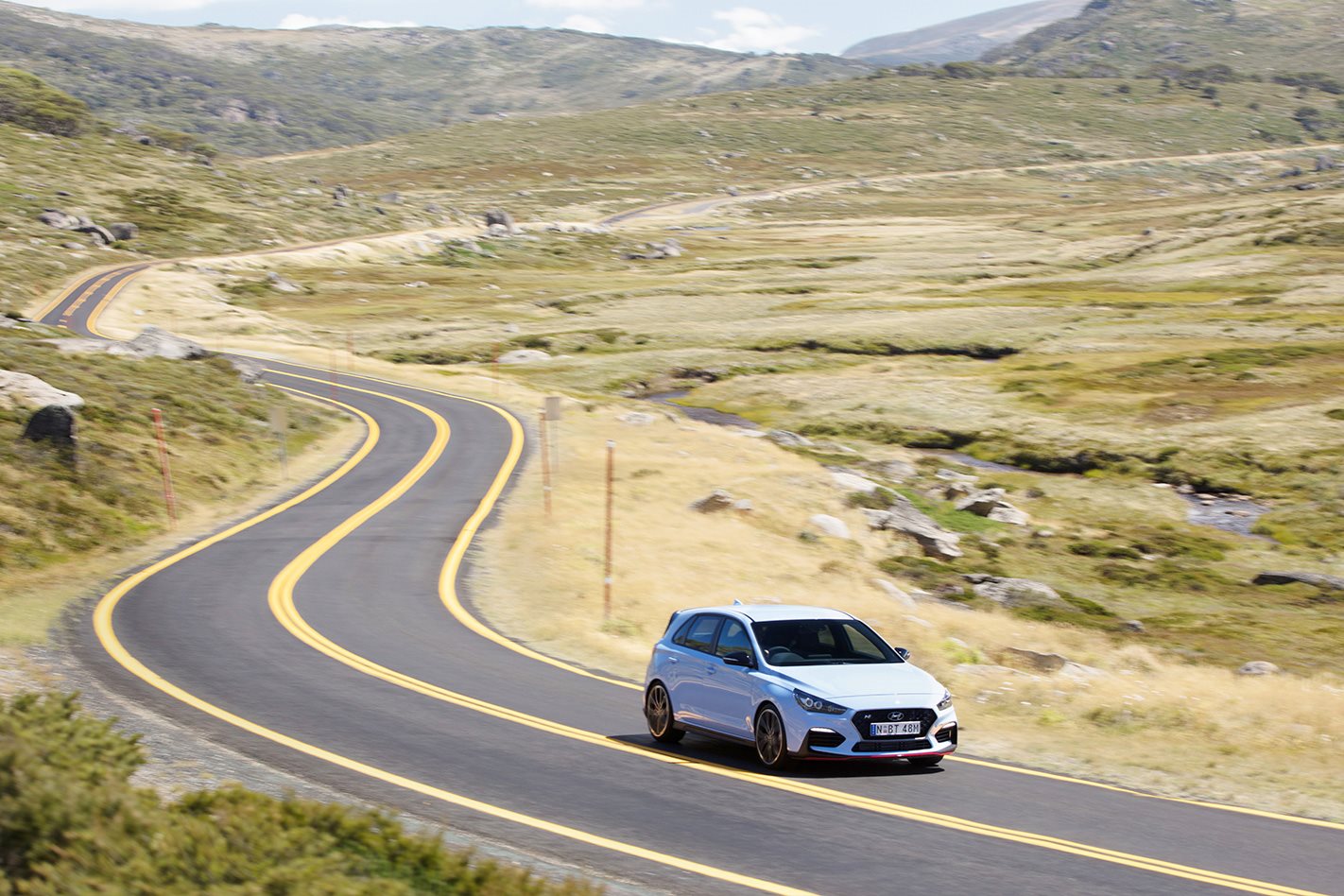
Hyundai’s Nošovice manufacturing plant in the Czech Republic, which produces the 202kW/350Nm N-badged version of the i30, is believed to be running at full capacity in an attempt to meet global demand.
Hyundai announced overnight that it would “further diversify” its N brand to include “high-performance N models, N line vehicles with new design and performance-enhancing elements and N Option, customisation parts by N, which will be available for the entire Hyundai line-up”.
It said the market response to the first N model, the i30 N, had been “so positive that the company is even considering increasing the production volume”.
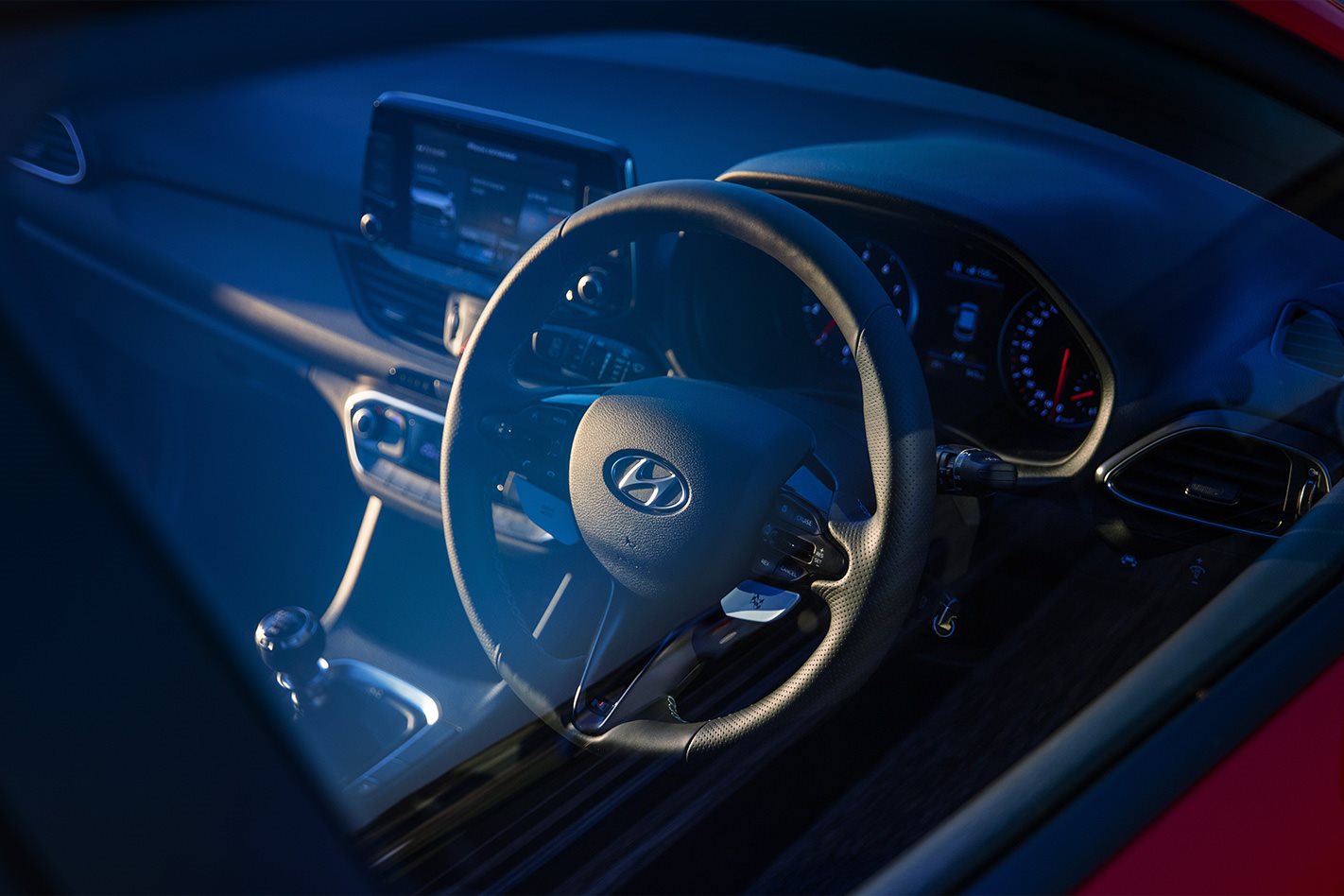
Despite the pent-up demand, Hyundai is looking after hot hatch-hungry Australia’s interests. “The team there [at Nošovice] has been very helpful – they have actually built more for us than we initially asked for,” Thomas said. “There is a limit to what’s possible, though.
“Word is clearly getting around fast about the car’s capability. That’s great, the car’s performance is what should matter most to potential buyers, and we will manage production as best we can in these initial stages.”
Thomas said Hyundai Australia was currently working through what parts of the expanded N range it would bring here, with plans to make an announcement “at a later date”.
The Blue Oval brand’s first genuine global Mustang has been a smash hit the world over, building on decades of pent-up demand for this muscle-car icon. But what’s good and proper for the US market isn’t necessarily so for Europe and Australia, hence why this MY18 version has spent some time at deportment and grooming college.

A higher-quality interior, moresafety features, more creature comforts, more technology and, in the V8 GT model, considerably more power make the restyled 2018 Mustang a better car all round, no matter how you look at it.
But what has changed to make the MY18 Mustang so much better?
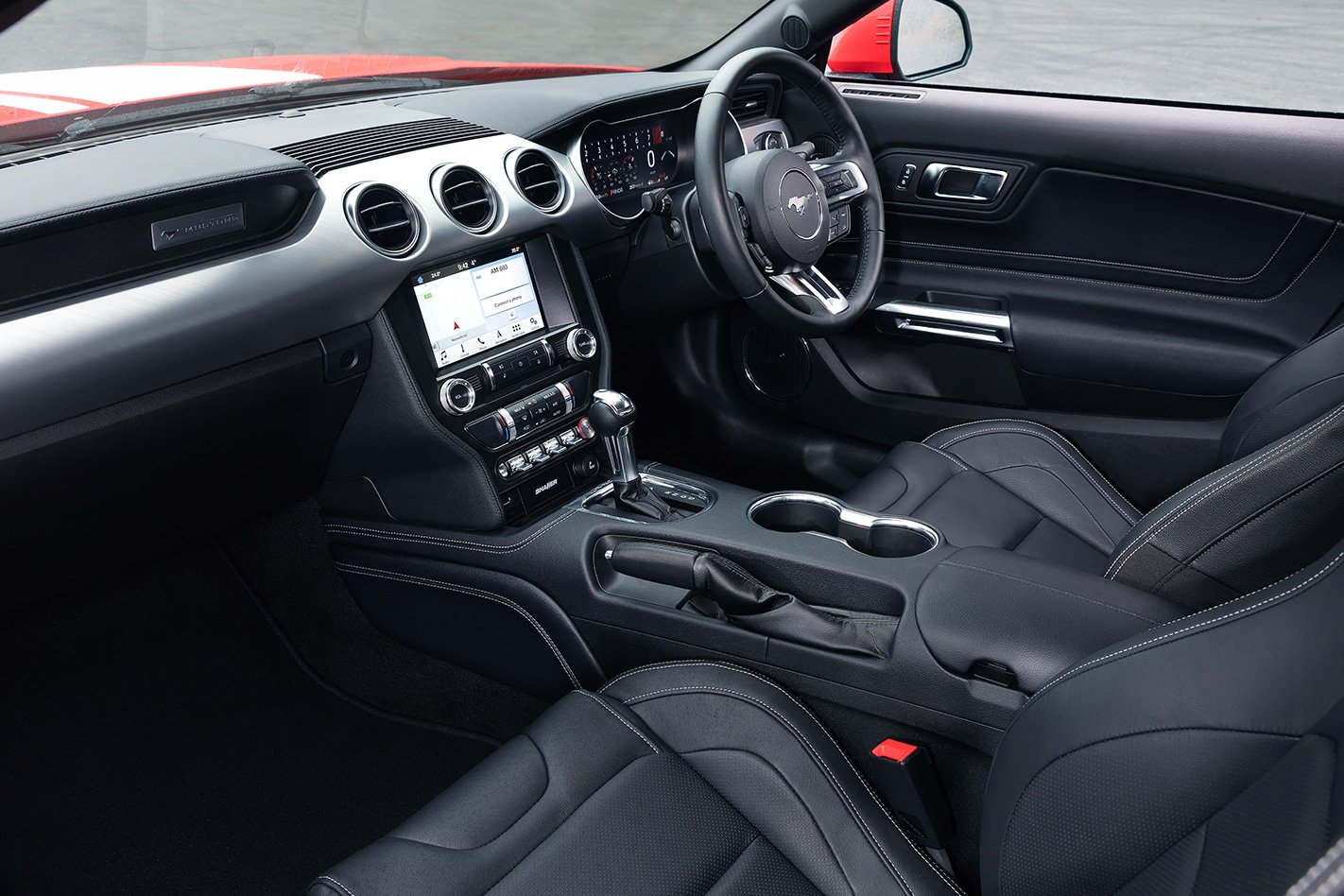
- Most of the things you see and touch inside this Mustang’s familiar-looking cabin are new, including the door trims. They’re now squishy, not rock hard, the centre console wrap has funky stitching, it’s the same for the dashboard trim insert, which is less cheap and putrid, and even the steering-wheel is now softer because it’s sourced from a cow’s belly, not its fence-damage-prone hindquarters.
- The MY18 Mustang’s fresh front end wasn’t prompted by pedestrian-impact regulations – quite the opposite, in fact. The designers’ word du jour was “sleek”, meaning a 25mm-lower bonnet height without the previous car’s muscular bonnet bulge flowing more obviously into the car’s front haunches, a 65mm-broader grille and a full-LED headlight arrangement, with the inner detailing inspired by an actual eagle’s eye. But with the lower bonnet sitting closer to the engine hardware, Ford’s safety designers had to work hard to get the Mustang to achieve its 78/100 pedestrian-impact rating.
- The new bonnet now has working air vents unlike its lumpy but vent-less predecessor, thanks to customer demand, and it’s made of aluminium. In an effort to reduce “bonnet flutter” on bumpy roads, Ford has increased the steel bracing and riveting underneath for strength, meaning the new bonnet is actually heavier than before.
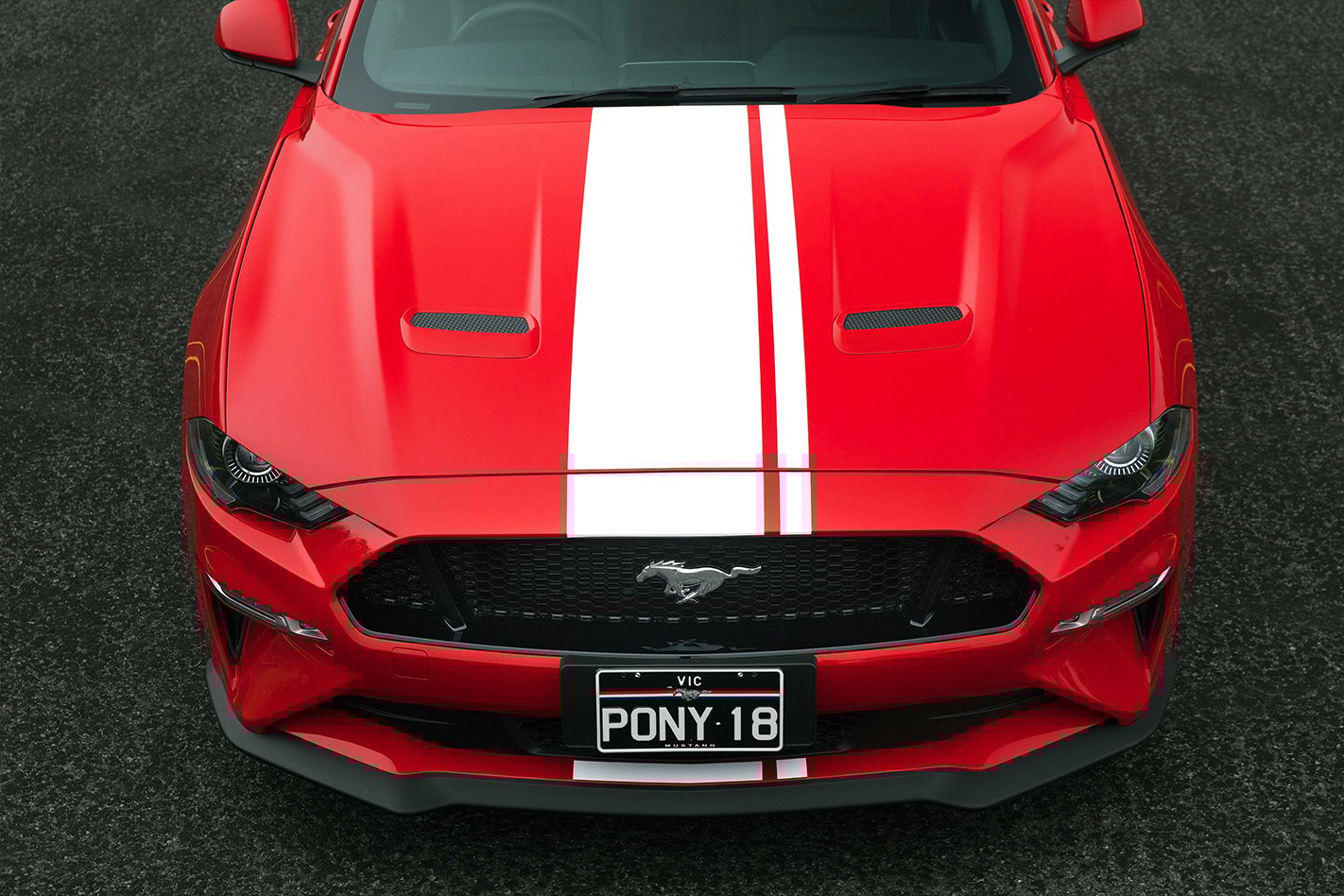
- Both the 5.0-litre V8 and 2.3-litre turbo Ecoboost four (due here in September) have been upgraded for better driveability. But it’s the big-selling V8 that goes nuts on mechanical updates. A new direct and port fuel-injection system, a higher compression ratio, bigger-bore pistons taking capacity up to 5038cc, and revised heads with larger intake and exhaust valves means 11 percent more power and 339kW, while torque is up five percent to 556Nm. Ford has a new automatic transmission too – a 10-speed unit that costs three grand extra and does a terrific job mastering all those ratios.
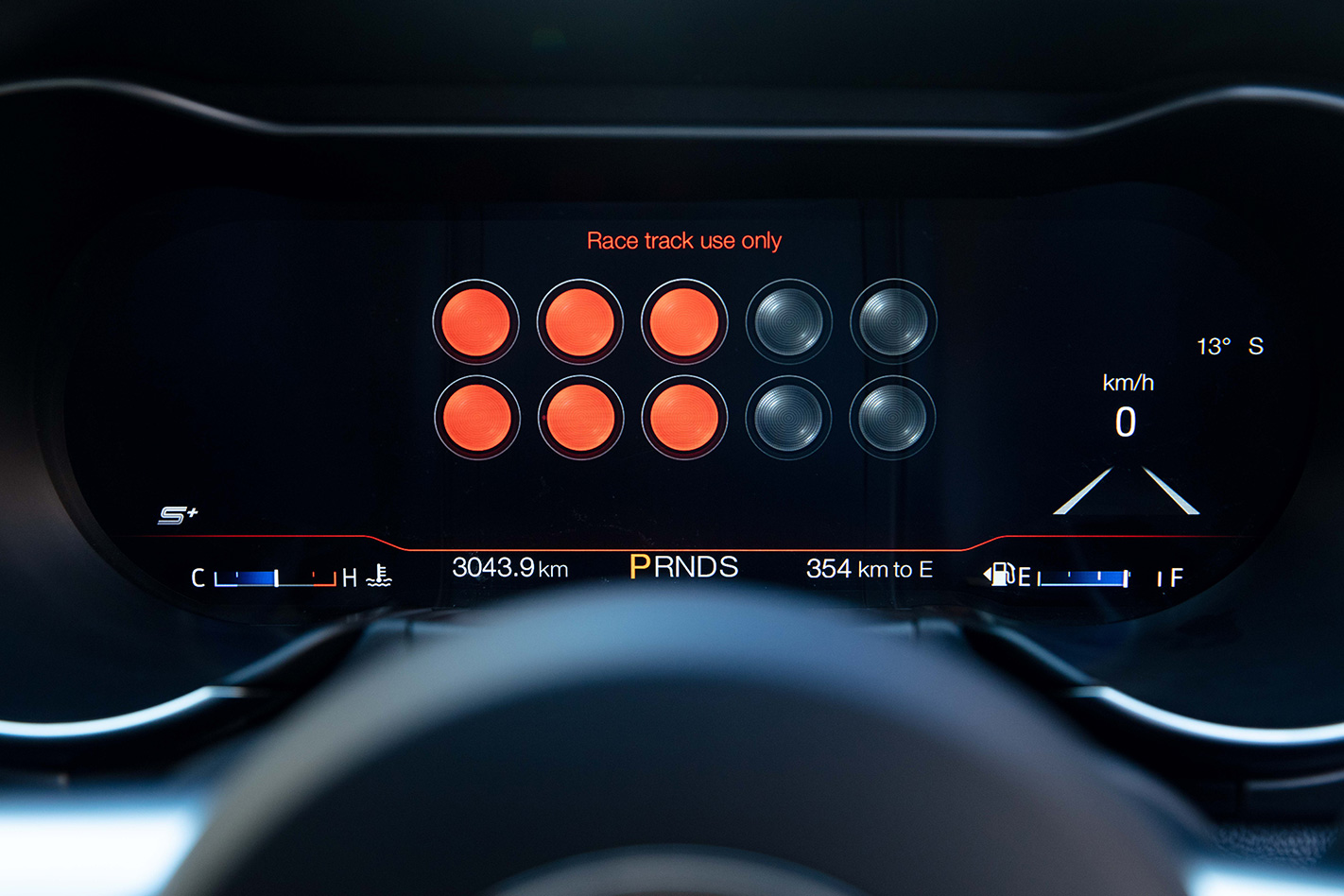
- Both the GT V8 and the forthcoming Ecoboost turbo four get active-valve exhaust systems – a design that has filtered down the from the range-topping US-market Mustang Shelby GT350. This gives the V8 a much meatier, bassier note, and the Ecoboost – a purposeful “snarl” when your right foot is pressed. You can also select what level of exhaust noise you’d prefer: Quiet, Normal (which has a bit of a burble in the V8), Sport (which adds some serious thunder) or Racetrack (which is borderline gratuitous in both its sound and volume).

- MY18 Mustang introduces an “industry-first” feature that Ford calls ‘Good Neighbour Mode’. It allows you to customise the Mustang’s exhaust setting based on the time of day. You can electronically set it to ‘Quiet’ between, say, 6am and 9am, then have it switch to Racetrack after that, ensuring you don’t wake sleeping babies or grumbling locals when heading to the gym before work.
- The trickle-down effect from the supersonic Shelby GT350 has majorly benefitted the way the MY18 Mustang handles, steers and rides. An upgraded front suspension set-up with forged-aluminium lower knuckles and increased lateral strength not only means sharper cornering but also crisper steering and a more confident feel. And for $2750, you can option ‘MagneRide’ adaptive magnetic shock-absorbers, that adjust the damping rate 1000 times per second and make the Mustang feel much calmer over challenging surfaces. Brand-new tyres – Michelin Pilot Sport 4 S – developed specifically for the MY18 Mustang complete its impressive dynamic repertoire.
- Instead of regular analogue instrument dials, the MY18 Mustang gets a 12.4-inch all-digital cluster that can be customised in a number of different ways. There’s a rainbow’s worth of ambient lighting selections, as well as three different instrument layouts – Normal, Sport and Track. The digital dash also displays navigation information and has a ‘Mustang MyMode’ memory function that allows drivers to save their favourite drive settings (including suspension, steering and exhaust-note preferences) for each time they’re behind the wheel.
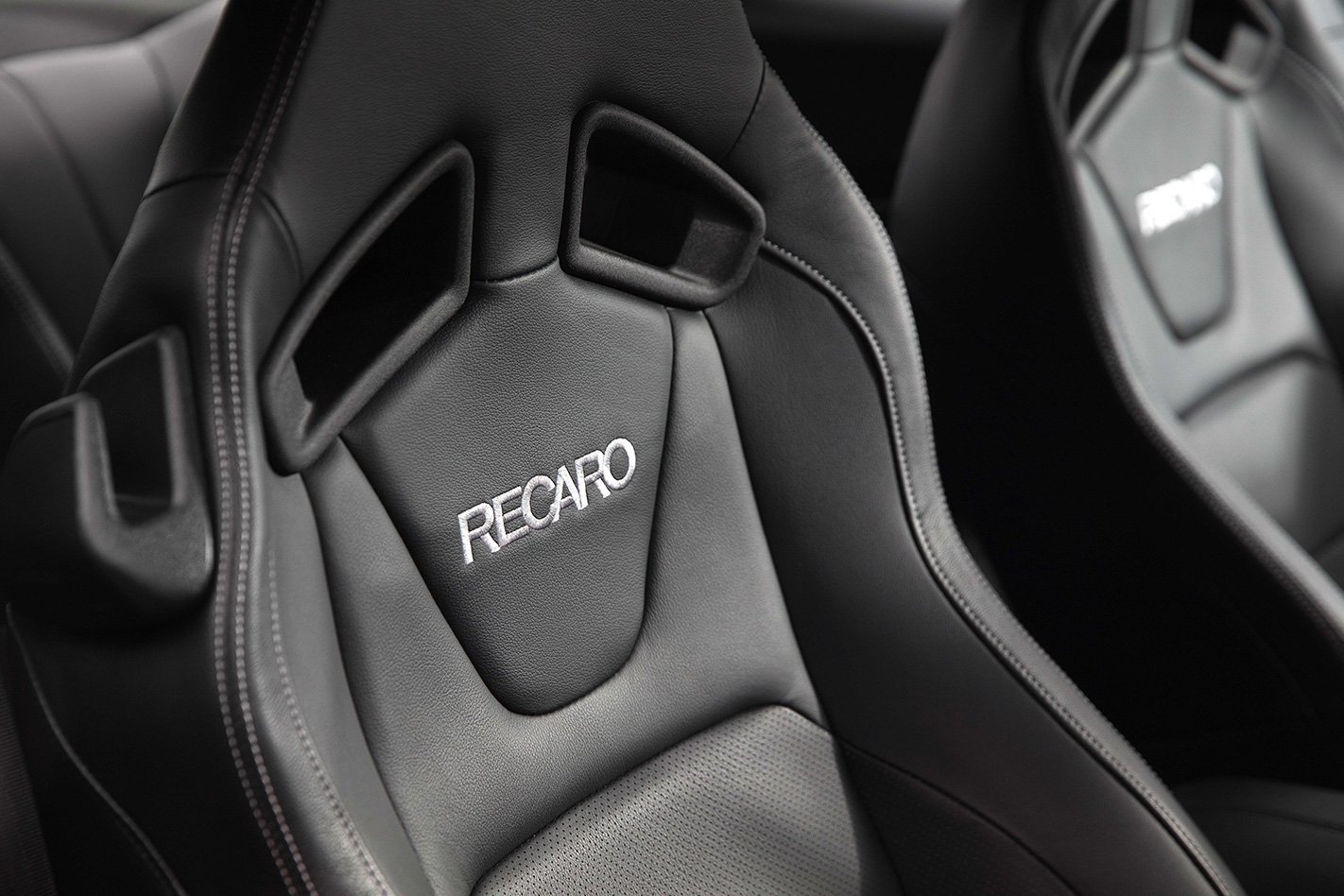
- Justifying its $4000 price rise over its predecessor, the MY18 Mustang backs that up with a bunch of fresh features, including Autonomous Emergency Braking (AEB), Lane Departure Warning, Blind Spot Monitoring, adaptive cruise control, auto-levelling LED headlamps with auto high-beam, and an upgraded 12-speaker ‘Shaker’ stereo, as well as the aforementioned trim-quality, engine and transmission improvements. There’s also some new-to-Mustang options for 2018, including OTT (for ‘Over The Top’) stripes in black or white for $650, a rear spoiler on the Fastback ($750), Recaro semi-electric sports buckets (Fastback only – $3000), 19-inch five-spoke forged alloys (GT only – $2500), and ‘MagneRide’ adaptive suspension ($2750)
- In line with recent changes to Ford Australia’s owner support, MY18 Mustang comes with a new five-year, unlimited-kilometre warranty, as well as fixed-price servicing, a loan-car program for when your car is in the shop, navigation updates (whenever they arrive) and a low-price tyre guarantee for those delightful Michelins tightly hugging each alloy.
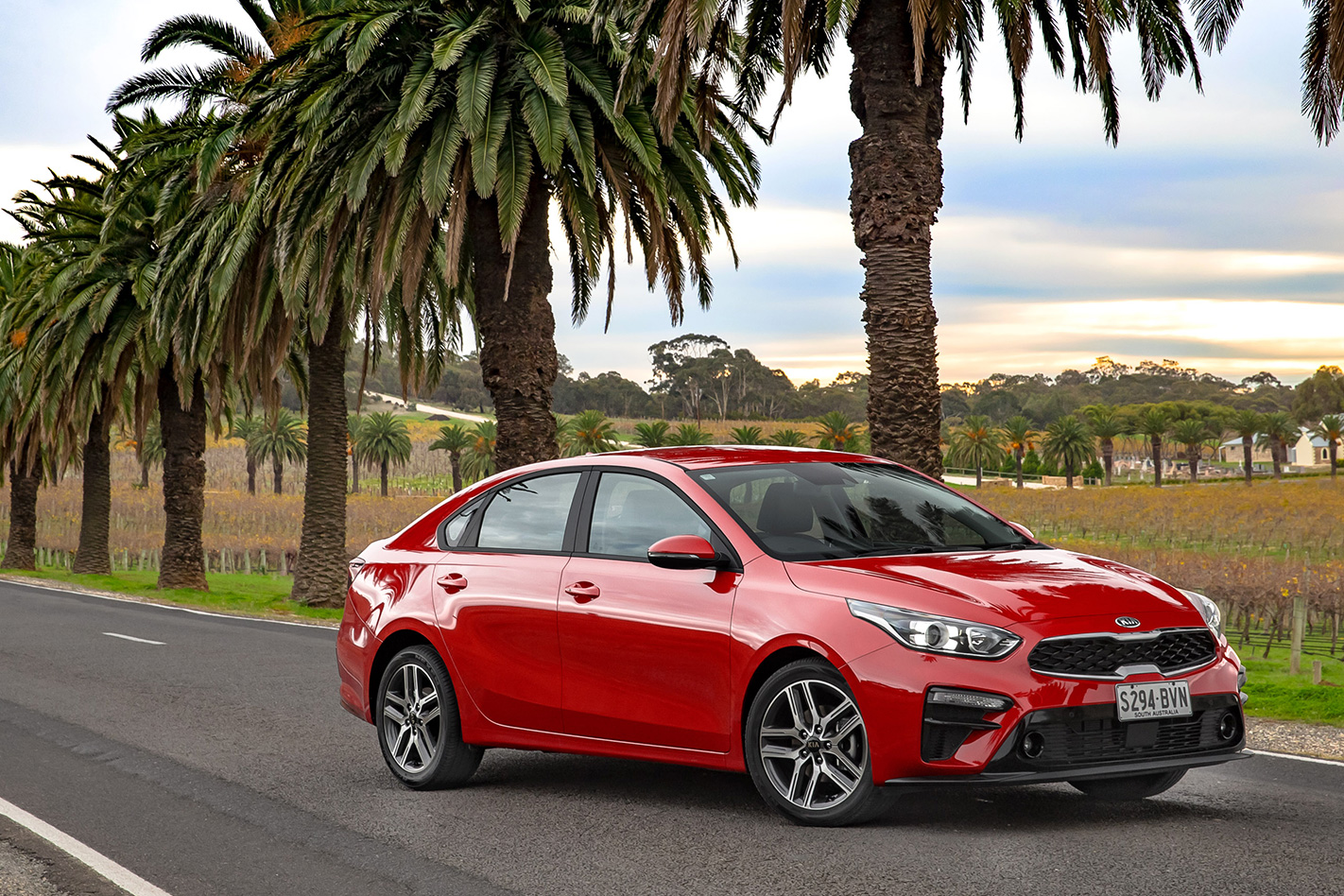
Kia Australia has rolled out its box-fresh third-generation Cerato sedan, with the four-door version of its volume-selling small car arriving on Aussie soil roughly half a year ahead of its hatchback stablemate.
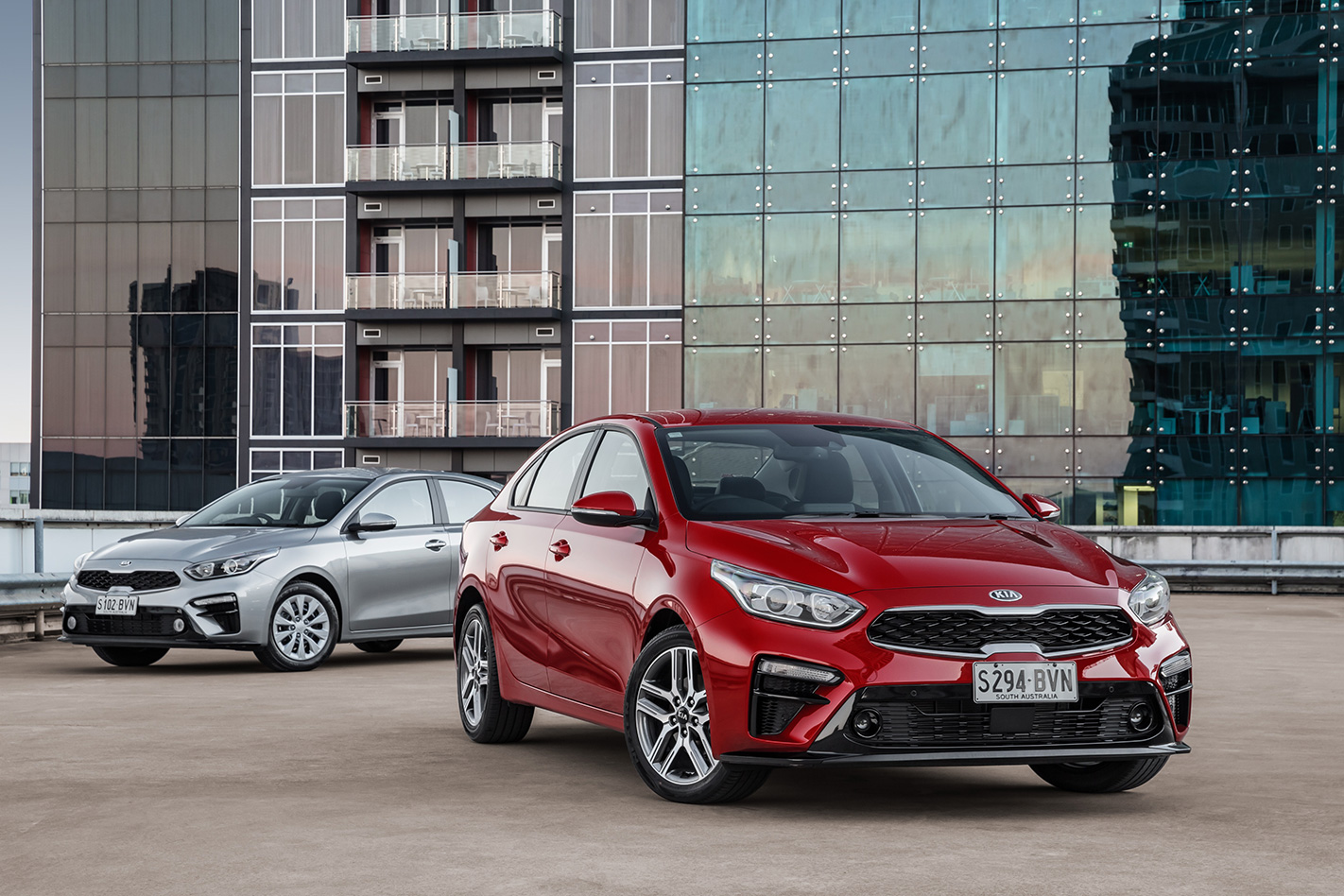
While the five-door Cerato will see out the rest of the year in second-generation form, the 2018 sedan brings forth a considerably modernised cabin, a fatter standard equipment list and more safety gear.
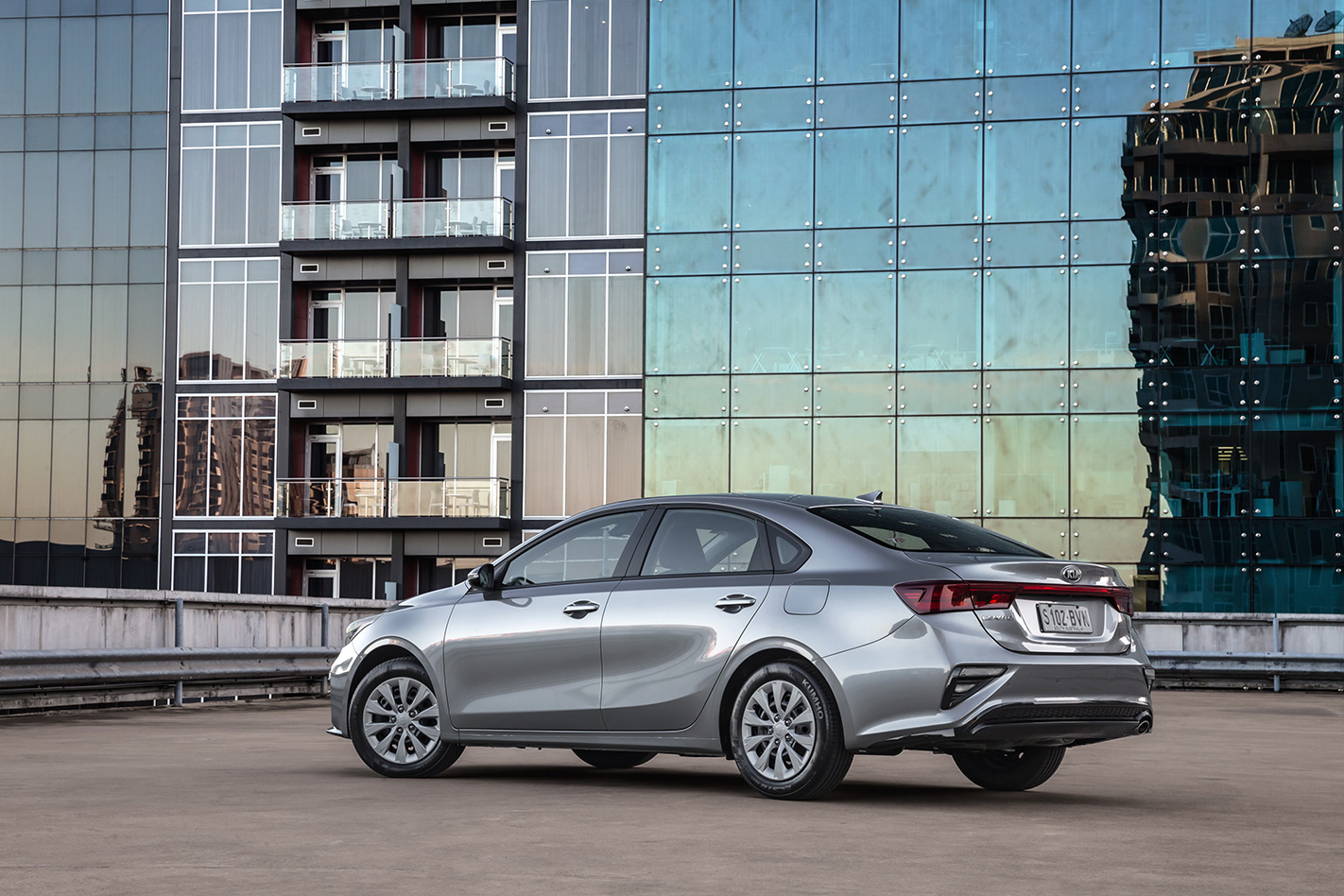
While the price of the base manual Cerato S sedan remains a sharp $19,990 drive-away, prices for other models in the range have fallen. The Cerato S automatic is now $21,490, a reduction of $800, the Cerato Sport auto falls $1100 to $23,690, and the top-grade Cerato Sport+ is trimmed to $26,190, a saving of $2800 over the now shelved Cerato Si. All of those prices are drive-away.
That’s despite critical equipment such as automatic emergency braking (AEB), rear parking sensors and a reversing camera being made standard range-wide. Other headline additions for all Cerato sedans include digital radio, lane-keep assist and a sizable 8.0-inch colour touchscreen display with built-in Android Auto and Apple CarPlay smartphone mirroring.
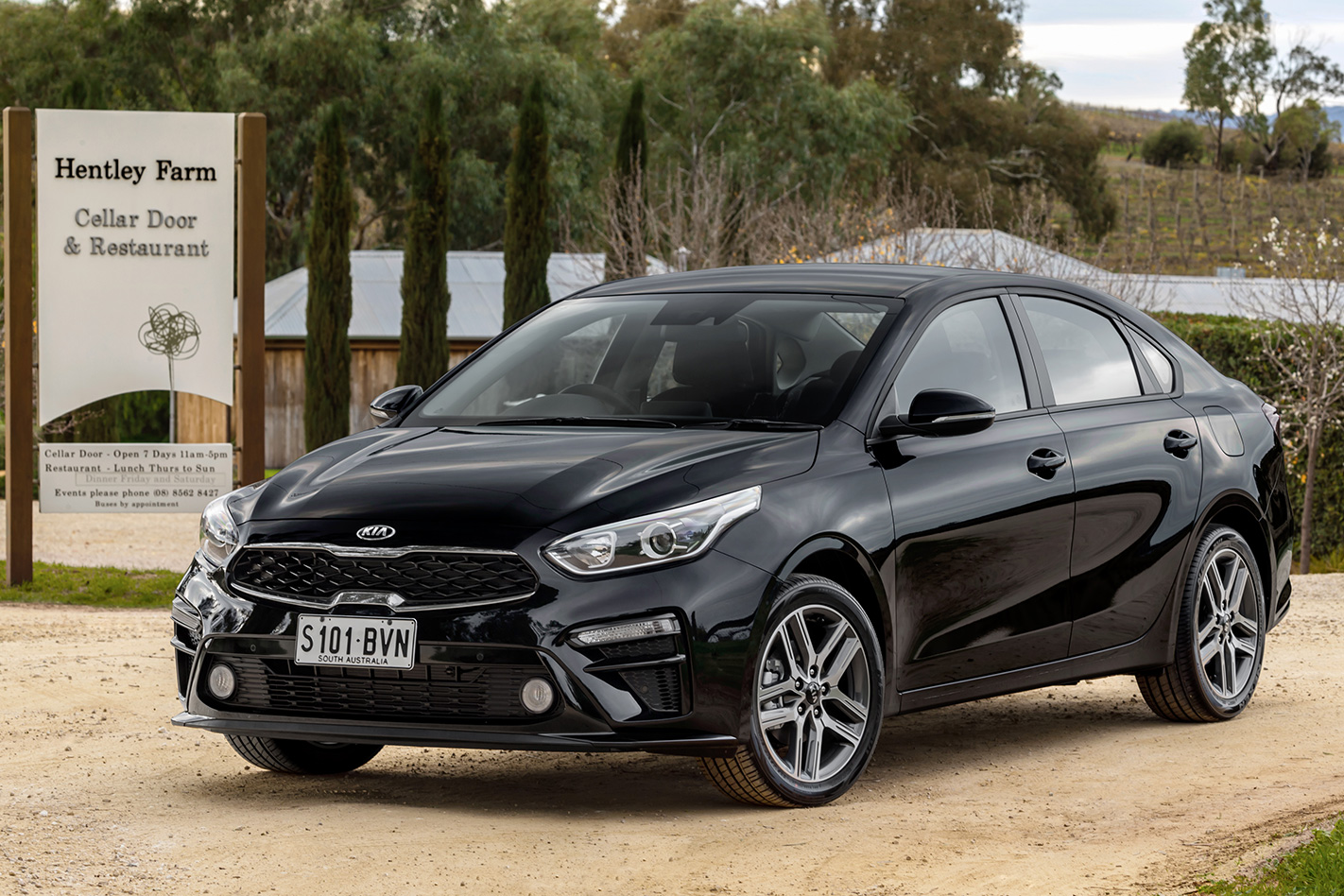
Step up into the mid-grade Cerato Sport and you gain sports cloth upholstery, integrated satellite navigation, 17-inch alloys (rather than the S’ 16-inch steel wheels), a leather-wrapped steering wheel and gear lever, standard-fit six-speed automatic, illuminated sunvisor mirrors and soft-touch door trims.
Bigger upgrades await if you opt for the flagship Cerato Sport+. That model has all of the above equipment, but augments it further with partial leather trim, active cruise control, dual-zone climate control, rear seat air vents, a seatback pocket on the passenger side, heated front seats, power folding wing mirrors, a self-dimming interior mirror, a sliding centre armrest, keyless ignition and LED daytime running lamps.
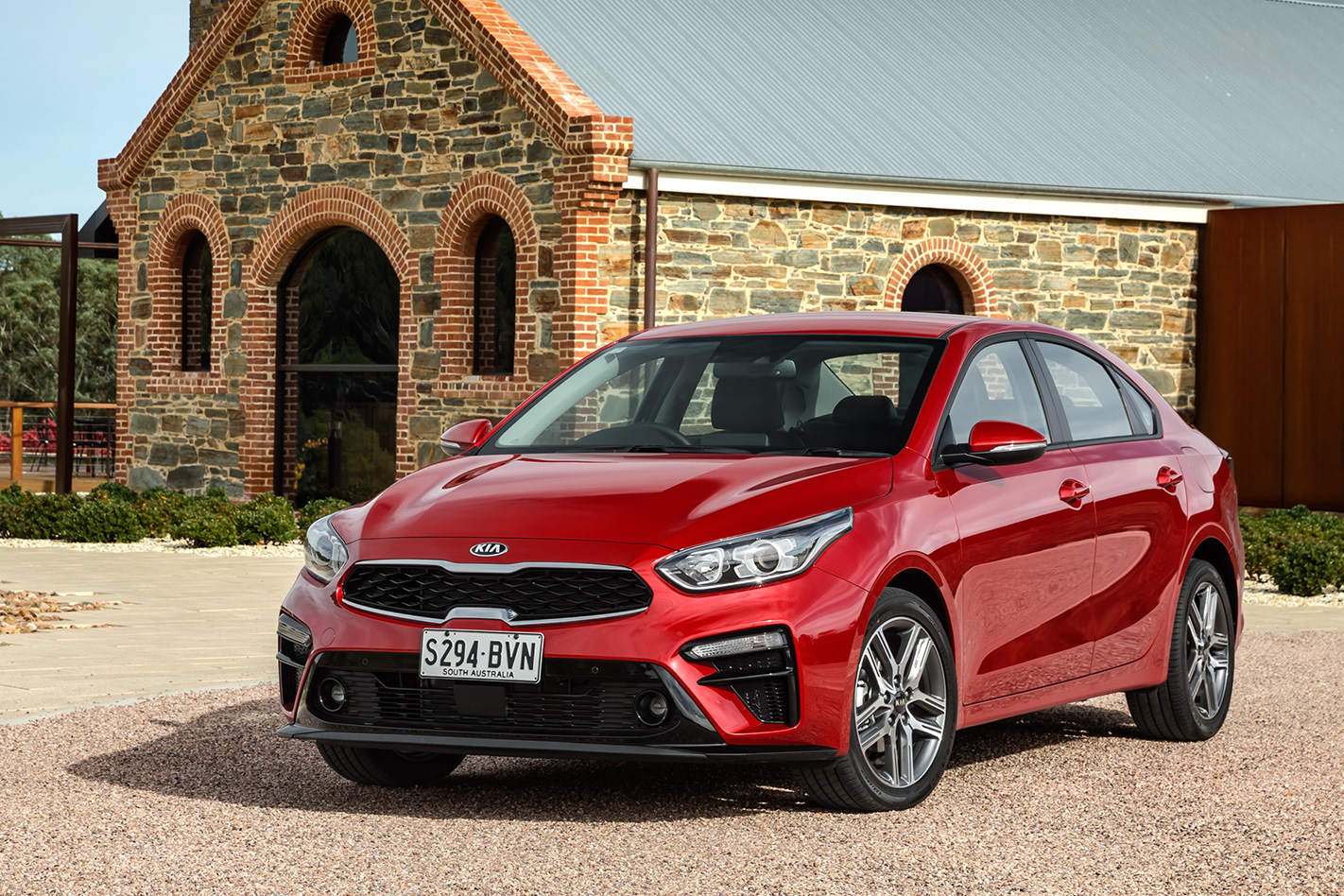
On top of that, the Sport+ is gifted a more high-featured AEB system that can detect pedestrians and cyclists, rather than the simpler system in the S and Sport that only reacts to other cars. It’s available as an option on lower grades for those who want the highest level of safety (as well as the active cruise control, blind spot monitoring and rear cross traffic alert that’s bundled with it), but it costs $1000 extra.
The Sport+ has the above features as standard, with the exception of blind spot monitoring and rear cross traffic alert. Those items are optional, and cost $500.
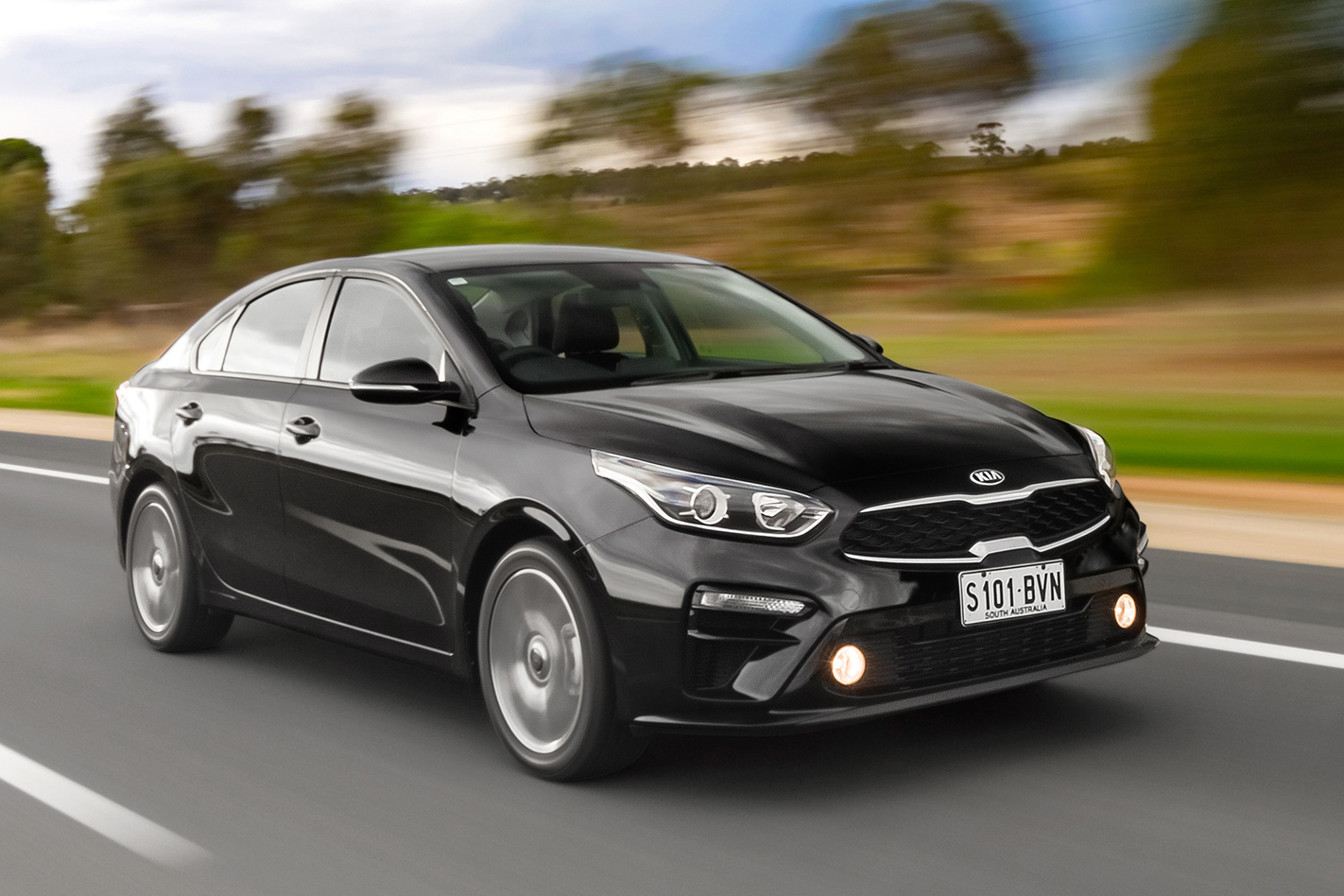
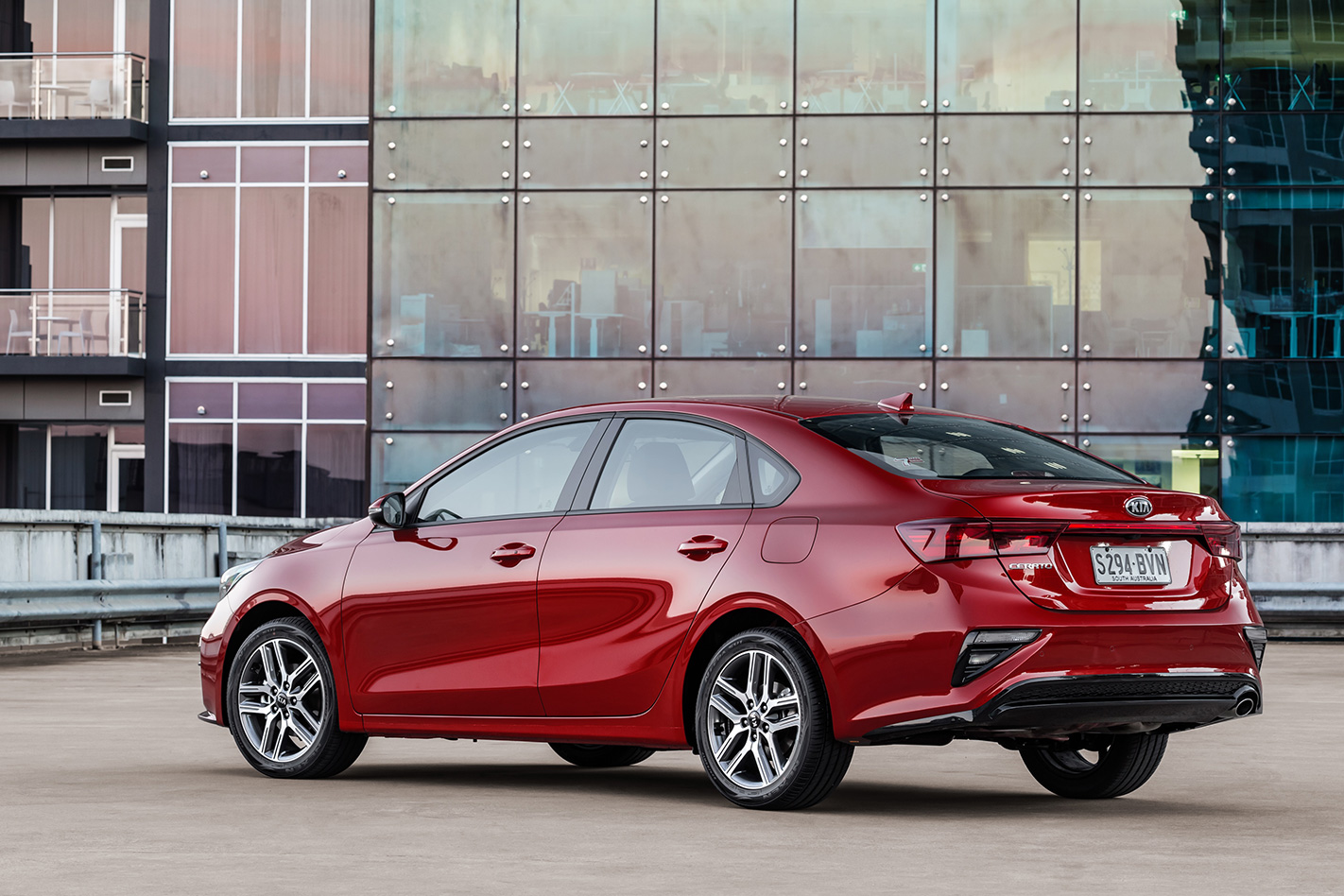
Styling both inside and out remains conservative, but it’s considerably more modern and mature than the blobby, organic form of its predecessor. From the front there’s an aggressively shaped bumper designed to echo that of the larger – and more performance-focused – Kia Stinger, while the rear is dominated by a rump-spanning tail-lamp graphic that links the lenses with a clear red bar to add some visual width.
Along the side the beltline now runs parallel to the ground rather than rising toward the rear, which benefits children in the back seat by bringing the window sills lower.
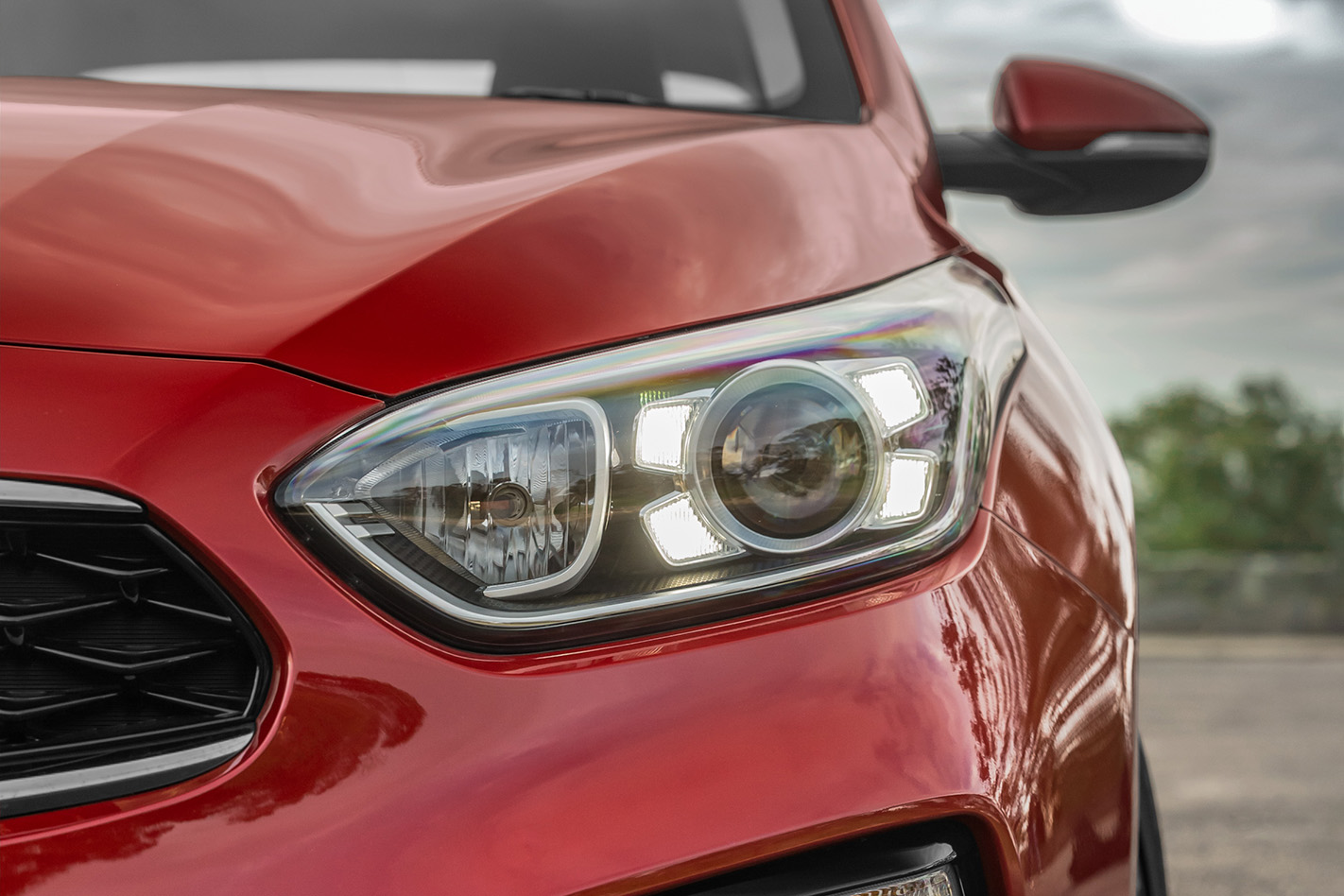
In terms of size the new Cerato sedan occupies a slightly larger footprint, with 80mm growth in overall length, 20mm wider hips and 5mm more height. The wheelbase remains 2700mm, but while passenger space stays roughly the same as a result (only growing 4mm in headroom and adding 3mm of legroom for front seat passengers and 10mm of rear-seat shoulder room), a longer rear overhang nets a more meaningful 20L increase to luggage capacity. With 502 litres of total seats-up boot space, the Cerato sedan has load-lugging capability that’s on par with cars from a size segment above.
The 2018 Cerato sedan’s suspension is tuned for local conditions by Kia Australia, and though the platform architecture is new (and now incorporates a higher percentage of high-strength steel), the suspension layout remains a basic MacPherson strut front, torsion beam rear arrangement.
There are fewer mechanical changes. All Cerato sedans are powered by a 112kW/192Nm 2.0-litre naturally aspirated and port-injected petrol inline four that carries over from the previous-generation model. Only the base Cerato S grade is available with a six-speed manual (and accounts for just five percent of overall Cerato sales), with the Sport and Sport+ grade being exclusively six-speed auto.
A slight weight increase coupled with the Cerato’s larger body dimensions and carry-over engine means fuel use worsens relative to its predecessor. The manual uses 0.3L/100km more than before while the auto receives a 0.2L/100km hit, taking the average fuel economy to 7.6L/100km and 7.4L/100km respectively.
2018 Kia Cerato sedan pricing
- Kia Cerato S sedan manual – $19,990
- Kia Cerato S sedan auto – $21,490
- Kia Cerato Sport sedan auto – $23,690
- Kia Cerato Sport+ sedan auto – $26,190
Options
- Safety pack 1 (for S and Sport) – $1000
- Safety pack 2 (for Sport+) – $500
- Premium paint – $520
HYUNDAI says it will expand its N performance sub-brand into a showroom-wide options pack as it maps out the future of the standalone division.
This means that as well as expanding the range of N-badged products beyond the firebrand i30 N, it will introduce a range of N Line vehicles that will include “design and performance-enhancing elements”, and customised parts that will be made available across Hyundai’s showroom line-up.
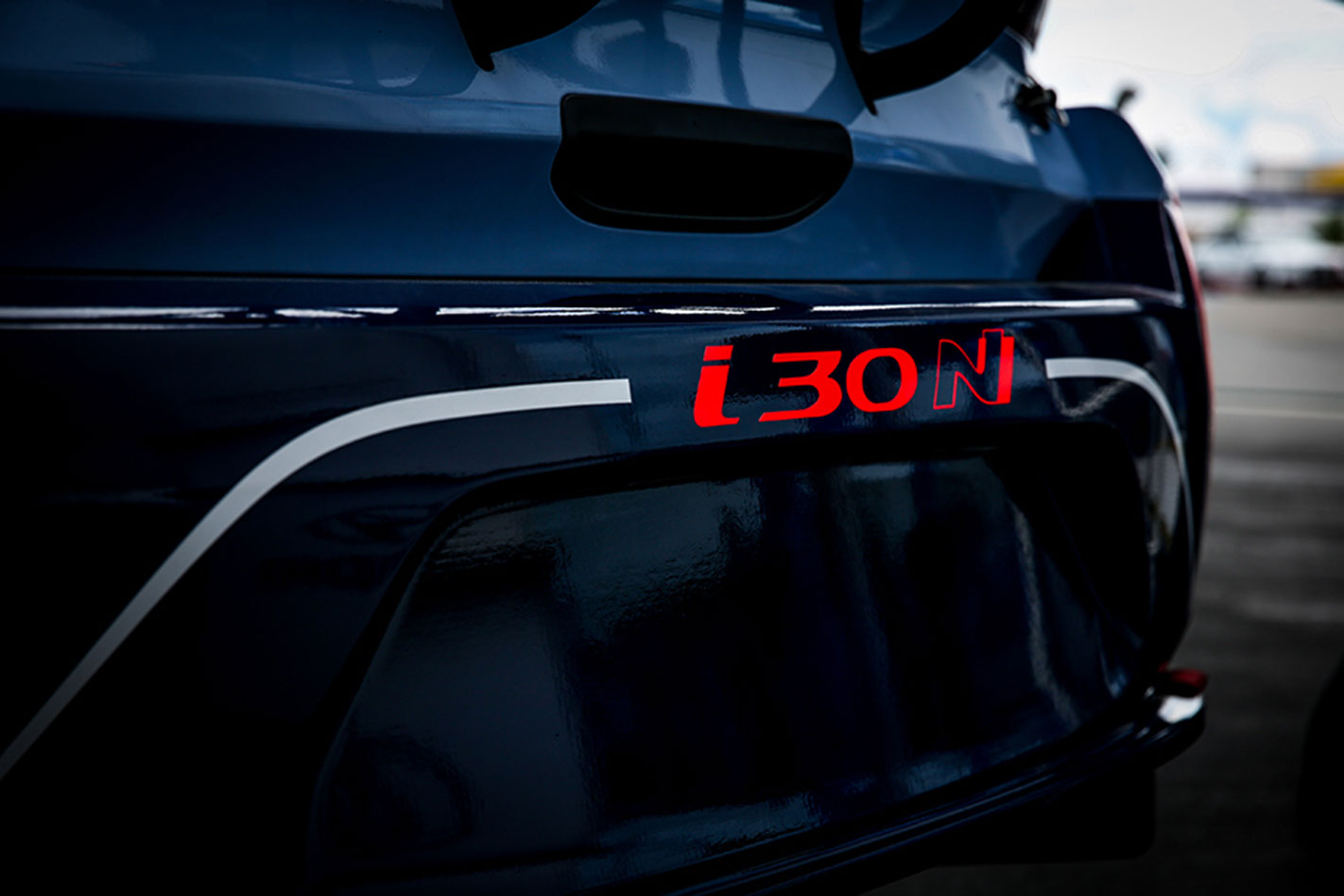
“Our motorsports vehicles will spearhead the N Brand at the apex of the brand’s hierarchy,” high performance vehicle and motorsport executive vice-president Thomas Schemera said. “Not to mention that the valuable experience and technology derived from our success in motorsports will cascade down to all the future N products.”
It is not known what Hyundai’s announcement means here. Wheels has contacted Hyundai Australia for comment.
The improvements have allowed the Korean carmaker to build “high-performance driving technology and an exciting driving experience reminiscent of motorsports, granting dynamic feeling and sensation to everyday drivers” into the hatch.
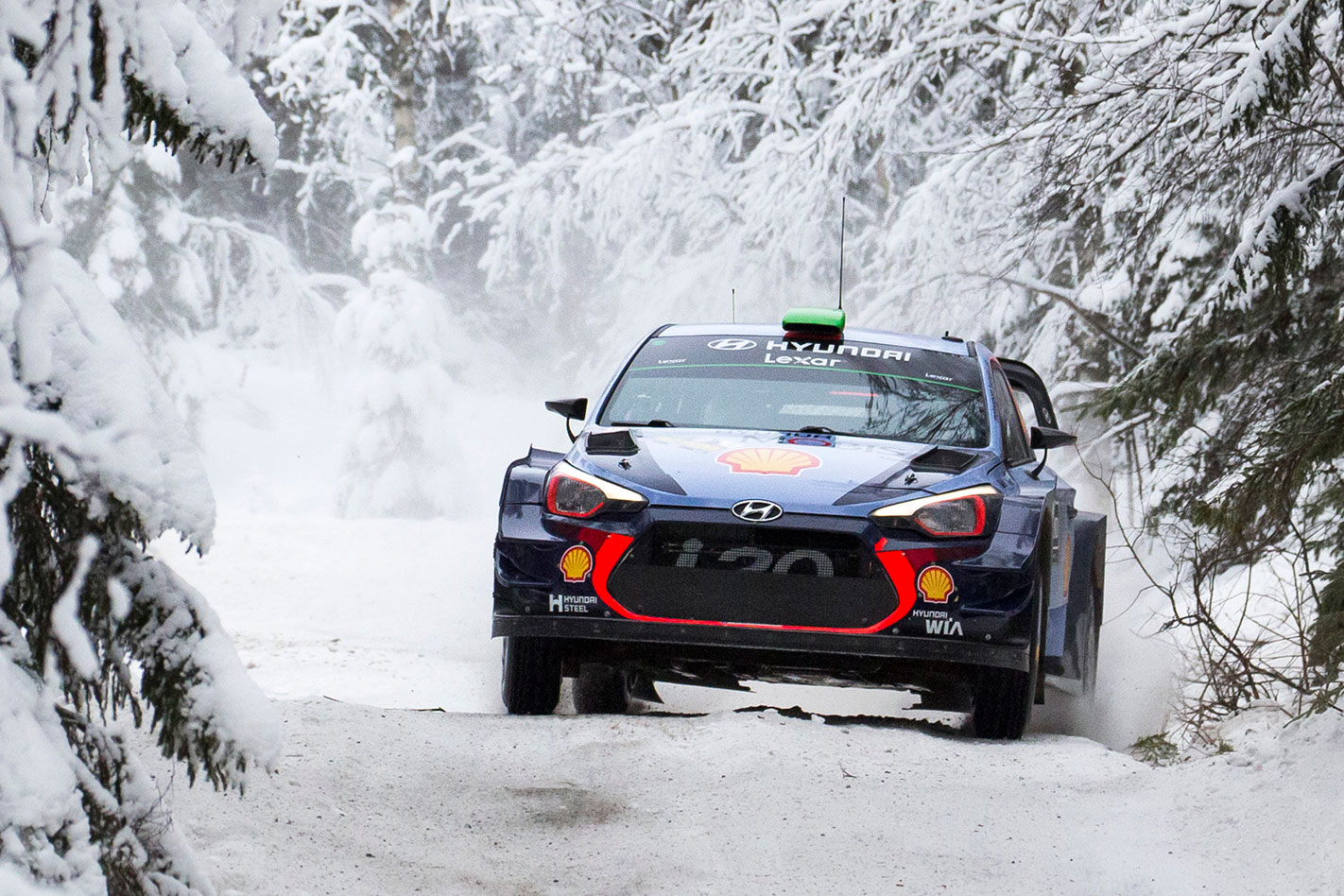
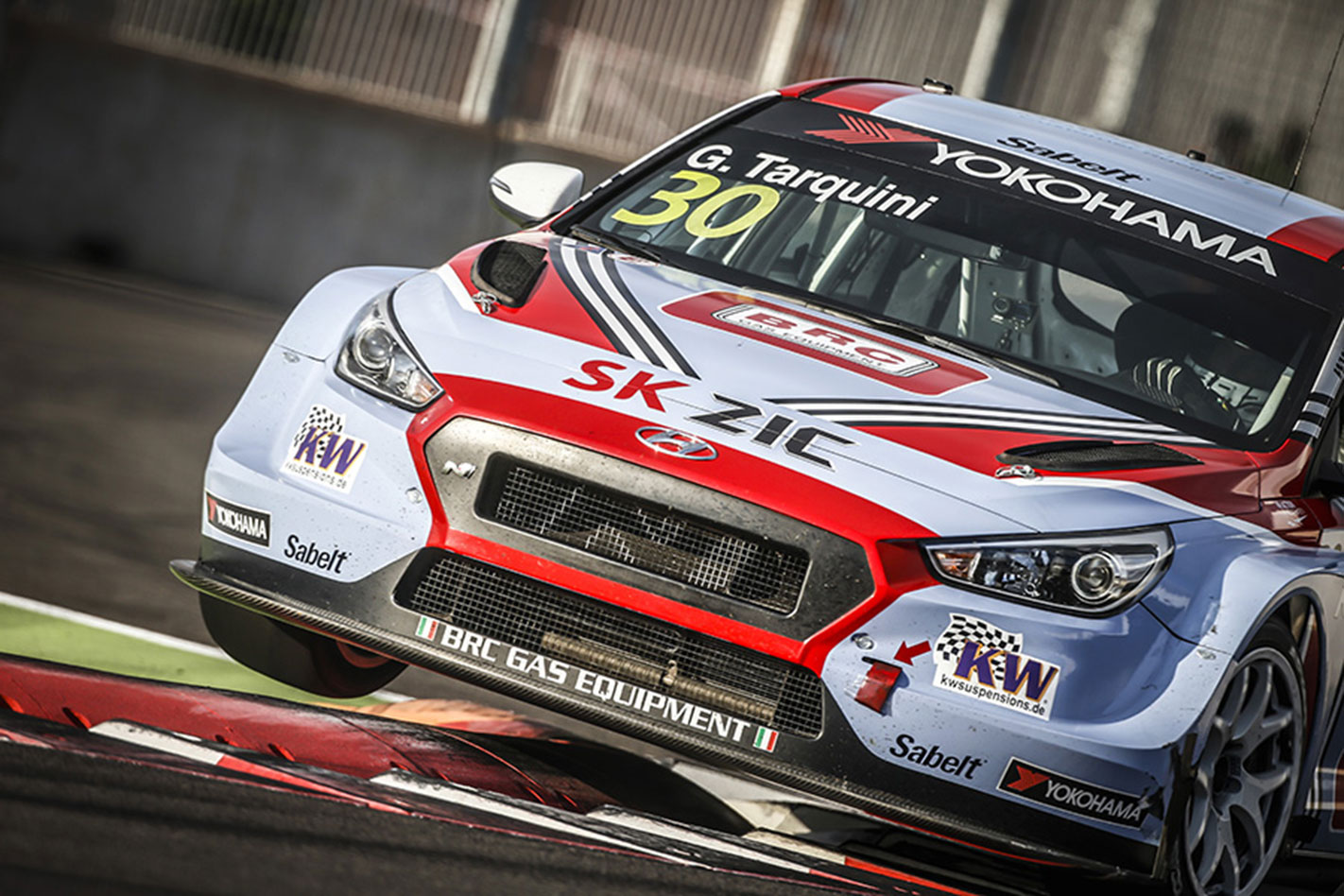
It also builds and sells a turnkey i30-based touring car called the i30N TCR, which finished second and fourth on its racetrack debut under the Hyundai Motorsport N banner at the gruelling Nurburgring 24-Hour Race.
INTRO
ALL new (mostly) for 2018, the new-look Kia Cerato sedan prepares the ground for the arrival of the hatchback later this year, and offers significant boosts to design, space, equipment and on-road manners – though there are fewer advances under the bonnet.
WHAT IS IT?
Kia’s unassuming Cerato is the fly-under-the-radar high achiever of the company’s local range, consistently providing a full third of the company’s sales volume in both sedan and hatch form. An all-new, third-generation Cerato sedan is now here, and though a more broadly-appealing hatchback bodystyle won’t join it until later this year (or early next), Kia’s latest C-segment four-door should give the company a solid push forward in the small car market.
WHY WE’RE TESTING IT
As an all-new replacement for a mainstay of the Kia lineup, the new Cerato sedan needs to impress. Although SUVs continue to chip away at passenger car market share, the small car market is still a crucial battleground in Australia and one that’s populated by a huge array of contenders. Not counting premium marques, there’s a total of 24 different small cars all vying for the attention – and wallets – of Australian new car buyers. Success here isn’t just determined by having the right price tag, the product itself has to be good enough as well.
MAIN RIVALS
Hyundai Elantra, Mazda 3, Toyota Corolla, Ford Focus, Holden Astra, Mitsubishi Lancer
THE WHEELS VERDICT
The new breed of Cerato has the right interior, the right feature set and, perhaps most importantly, the right price, however it’s hard to overlook its increased thirst and mediocre carry-over engine. Will punters care more about the latter than the former, however? It seems unlikely.
PLUS: Good-looking interior, strong infotainment suite, spacious back seat, comfortable ride
MINUS: Sole engine choice is lacklustre carry-over unit, potentially life-saving high-spec AEB only on top-spec
THE WHEELS REVIEW
CONSIDER this: the Kia Cerato, as ordinary and unassuming as it is, is responsible for a solid third of Kia Australia’s sales volume. And those numbers are for the second-generation model, a vehicle right at the end of its lifespan – and one that’s remarkably average in most measurable criteria.
Furthermore, the demure Cerato is also a stout performer in the new car sales race – currently sitting in fifth place in one of the most competitive segments in Australia. Pricing has a big part to play, of course, and for the new-gen sedan Kia has retained an ultra-compelling $19,990 retail sticker for the entry-level Cerato S manual.
However, with a mere 5 percent sales split it’s not the Cerato variant that most punters will go for – rather, it’s the mid-strength Cerato Sport automatic, with an anticipated 40 percent split, that will be doing much of the heavy lifting in Kia showrooms. The top-shelf Sport+, meanwhile, is the value-rich flagship that loads up on gear for a modest $2500 premium over the Sport
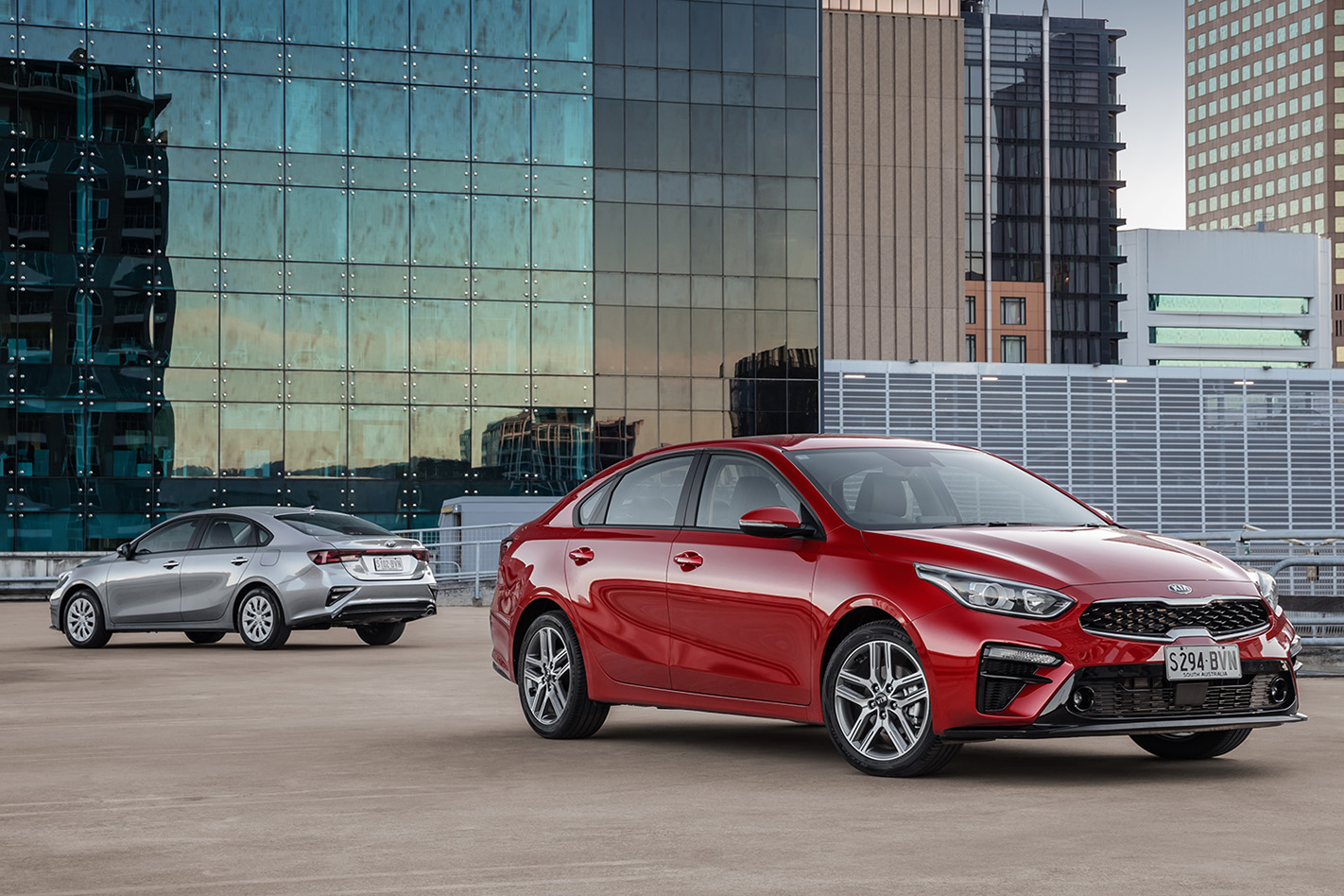
However, no matter which grade you select, you’ll find a small sedan that departs significantly from its predecessor in many ways – bar one crucial aspect.
Styled to mimic the broad-shouldered and confident stance of the Stinger, the new Cerato sedan sits astride the same 2700mm wheelbase, but is fractionally bigger in height, length and width. The front and rear overhangs have grown with the rear stretching by 60mm, a change which boosts boot space by 20 litres to a large-car-rivalling 502 litres, with the rear seats-up.
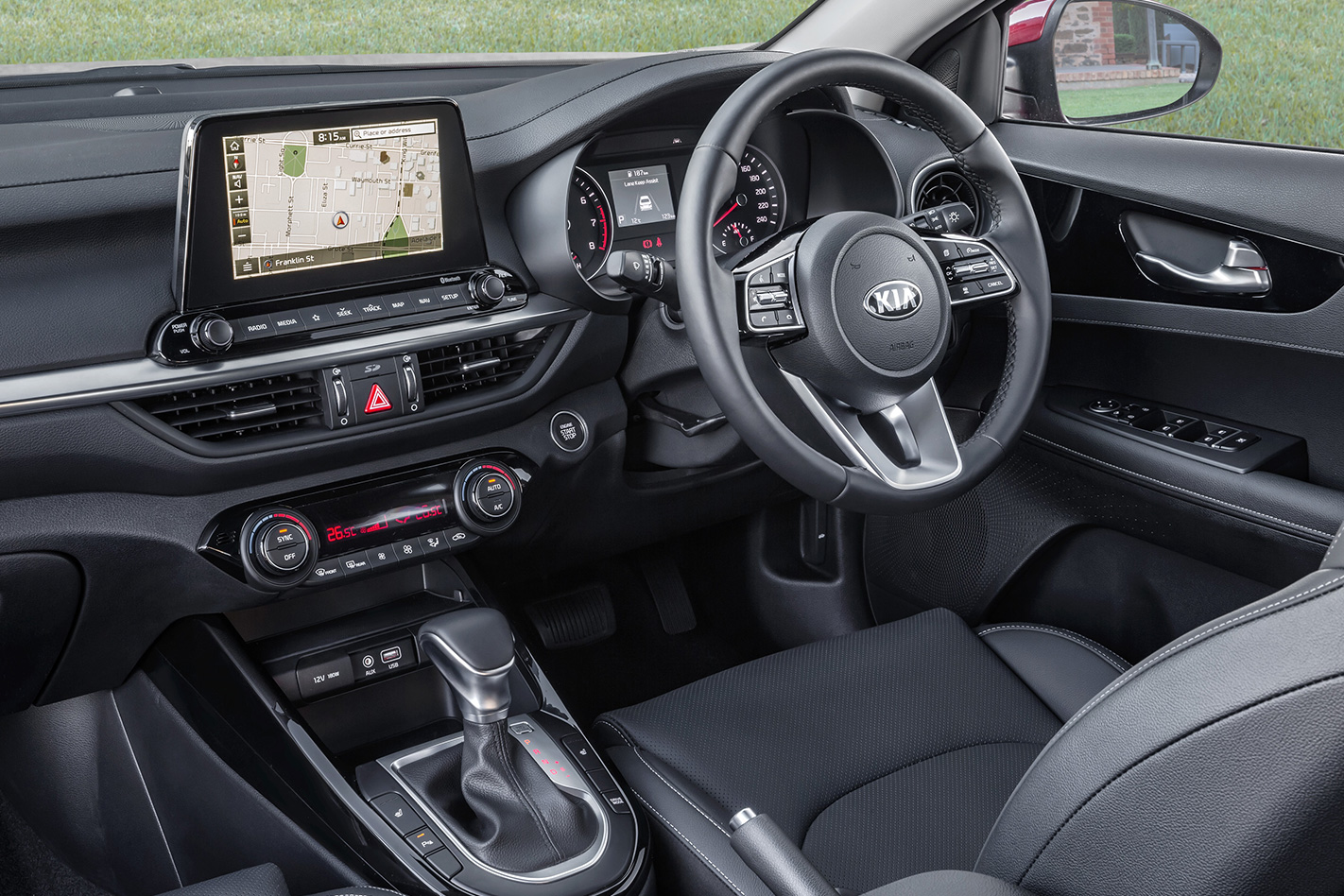
The new Cerato’s dash also lifts the cabin ambience markedly. More upright and putting a large tombstone-style infotainment screen front and centre, the blobby aesthetic of the old Cerato’s dash has been banished in favour of a more visually satisfying design.
The squishy upper dash pad, circular vents and silver horizontal trim bar look quasi-premium too, though the rock-hard and leather-grained lower cabin plastics offset that.
Hard seatbacks shells, so long a staple of C-segment Korean cars, also give the rear seat space a bit of a taxi vibe however – as do the rock-hard door card uppers and lack of rear air vents on all but the range-topping Sport+ grade.
That said, the rear seat is spacious with generous leg and foot room, plus a rear window that’s low enough for kids to see out of due to Kia’s conscious move to avoid an upswept beltline. Headroom is also decent, and a fold-down centre armrest houses two cupholders.
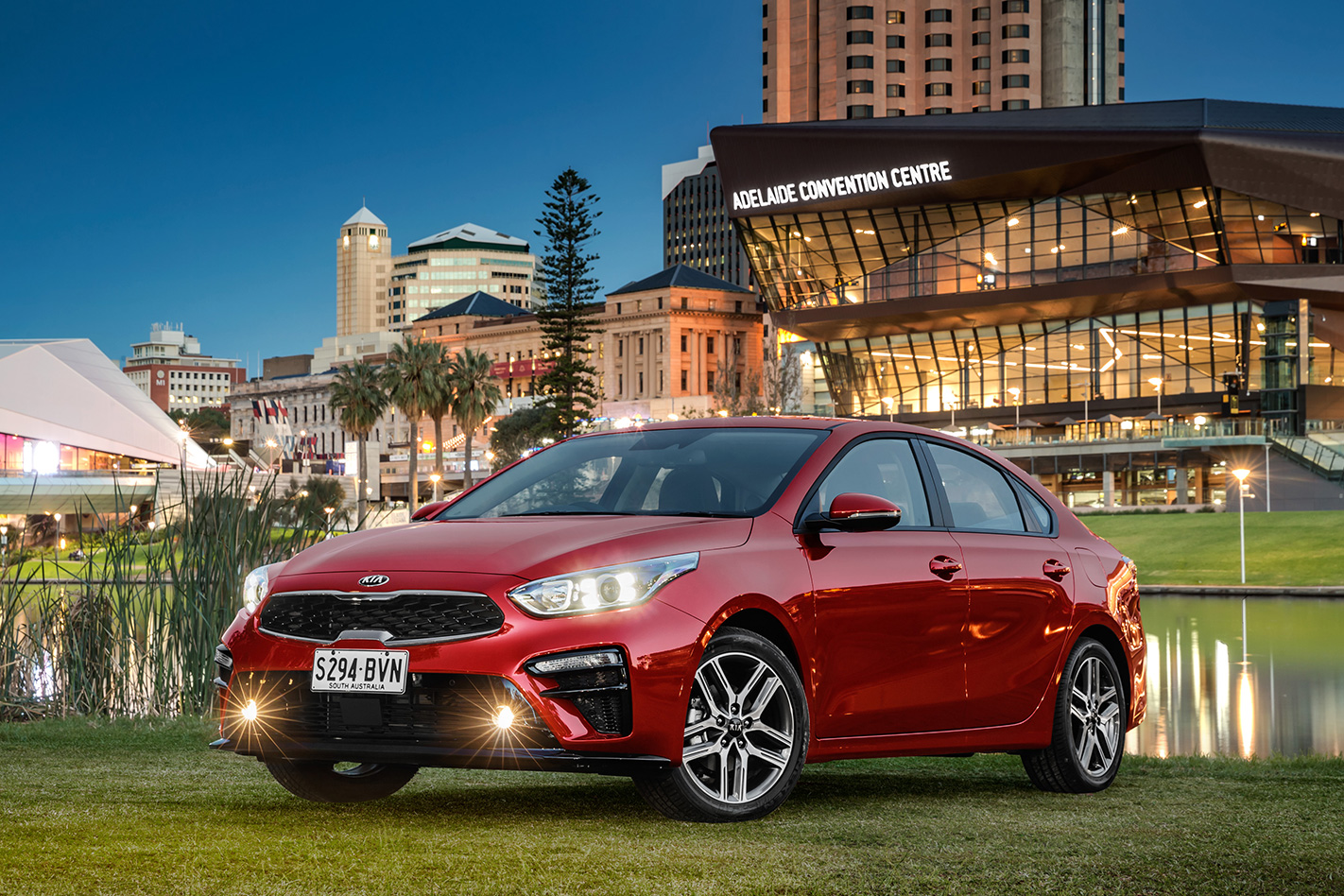
Up front, a digital radio tuner is standard on all models, and, from the mid-grade Sport and up, there’s integrated sat-nav via that clear and intuitive 8.0-inch touchscreen, which boasts smartphone-like responsiveness to inputs that’s not often found at this end of the market. Android Auto and Apple CarPlay are also standard-issue, should you prefer an internet-enhanced experience.
Elsewhere around the Sport+ you’ll find heated seats, dual-zone climate control instead of manual air-conditioning, self-dimming rear view mirror, keyless ignition, power-folding wing mirrors and active cruise control.
All Cerato sedans are fitted with AEB now, but the Sport+ grade goes a step further with a more intelligent system that can detect pedestrians and cyclists, rather than just other cars. It’s optional on the base S and mid-spec Sport, but at a cost of $1000, and putting it on the options list for those grades seems like a missed opportunity for Kia to take a position of leadership on safety.
Another missed opportunity can be found – or rather not found – in the engine bay. Lifting the bonnet reveals a carry-over 2.0-litre petrol four-cylinder that makes 112kW and 192Nm – identical numbers to the outgoing car. However, thanks to a kerb weight that’s 19kg heftier than before and a bigger body, fuel economy worsens to 7.4L/100km. That’s a 0.2L/100km penalty relative to the car it replaces, making the Cerato sedan’s powertrain story not just a case of “nothing to see here”, but one that actually hurts buyers in the hip pocket over time.
It’s clear that Kia has tried to compensate by making the multi-mode driveline electronics preference high gears if left in self-adjusting ‘Smart’ or ‘Eco’ settings, but the end result is a car that feels dozy and sluggish until you really sink the right pedal. In Sport mode it actually feels reasonably perky, but that penalises fuel efficiency even further.
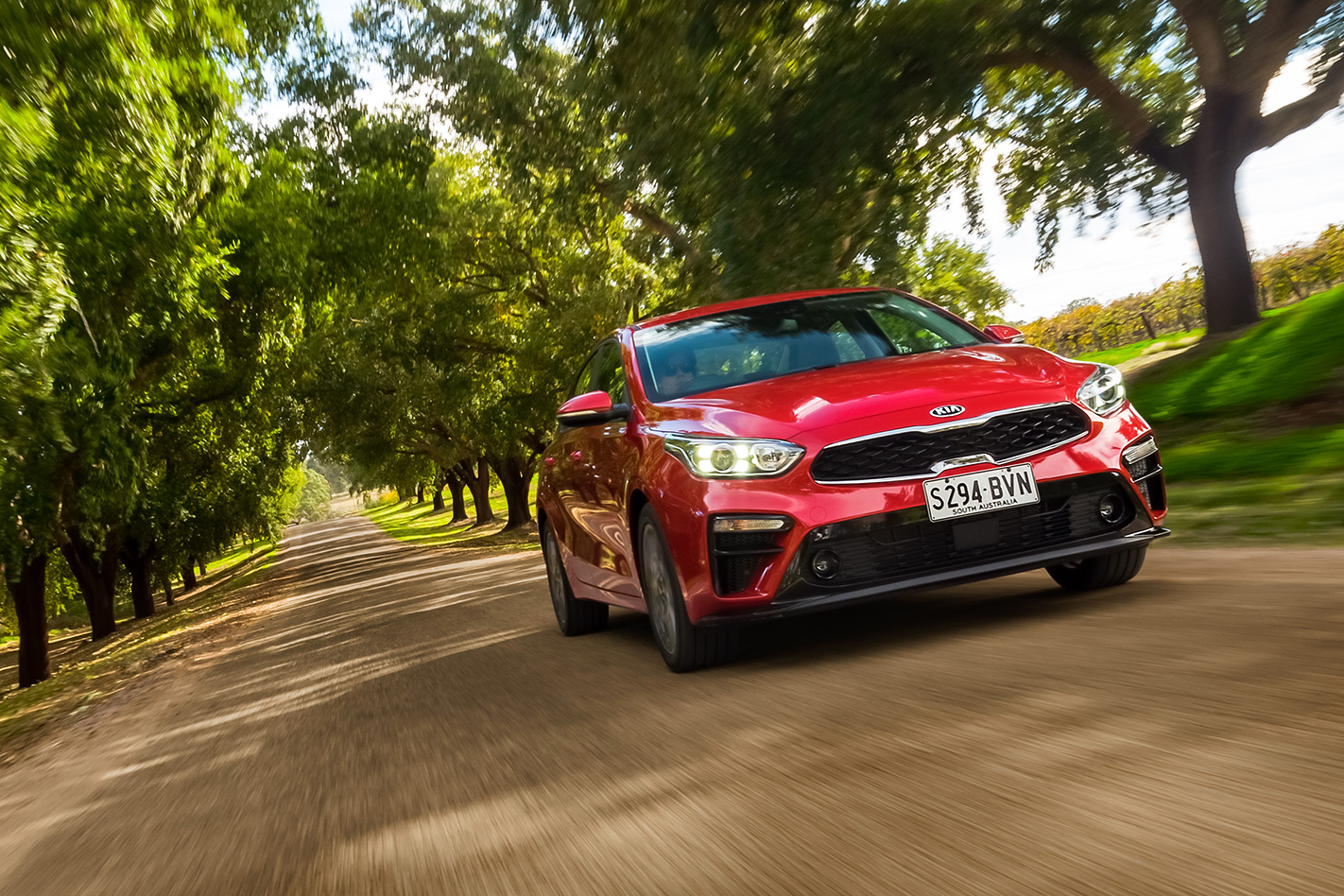
Fortunately, the driving experience is a solid one. A stiffer bodyshell combined with Kia Australia’s policy of honing the handling of all of its vehicles gifts the new Cerato sedan with direct steering (albeit devoid of feel or feedback) and a ride that feels stable and tied-down in most regular driving conditions. It grips fairly well, but its cornering performance is typical FWD Korean – safe, but unexciting.
Ride comfort is good too. Besides some thumping on rough-edged asphalt, the Cerato’s suspension is fairly well contained, though can border on floaty when the speed gets up and big compressions are encountered.
There are some great leaps forward with the new Cerato sedan, and arguably they’re the ones that are most important to the average small car buyer – cabin comfort, features and design.
It’s just a shame that the big improvements contained within its well-kitted interior haven’t been matched on the other side of the firewall.
SPECS
Model: Kia Cerato Sport+ Sedan Engine: 1999cc 4cyl, dohc, 16v Max power: 112kW @ 6200rpm Max torque: 192Nm @ 4000rpm Transmission: 6-speed automatic Weight: 1320kg Fuel economy: 7.4 L/100km Price: $26,190, driveaway
It’s what everybody wants to know – just how quick is the new 2018 Ford Mustang?
We’ve already established on the Herrod Performance dyno that the new Mustang makes plenty more power than the car it replaces and Ford makes some pretty bold acceleration claims for its new beast.
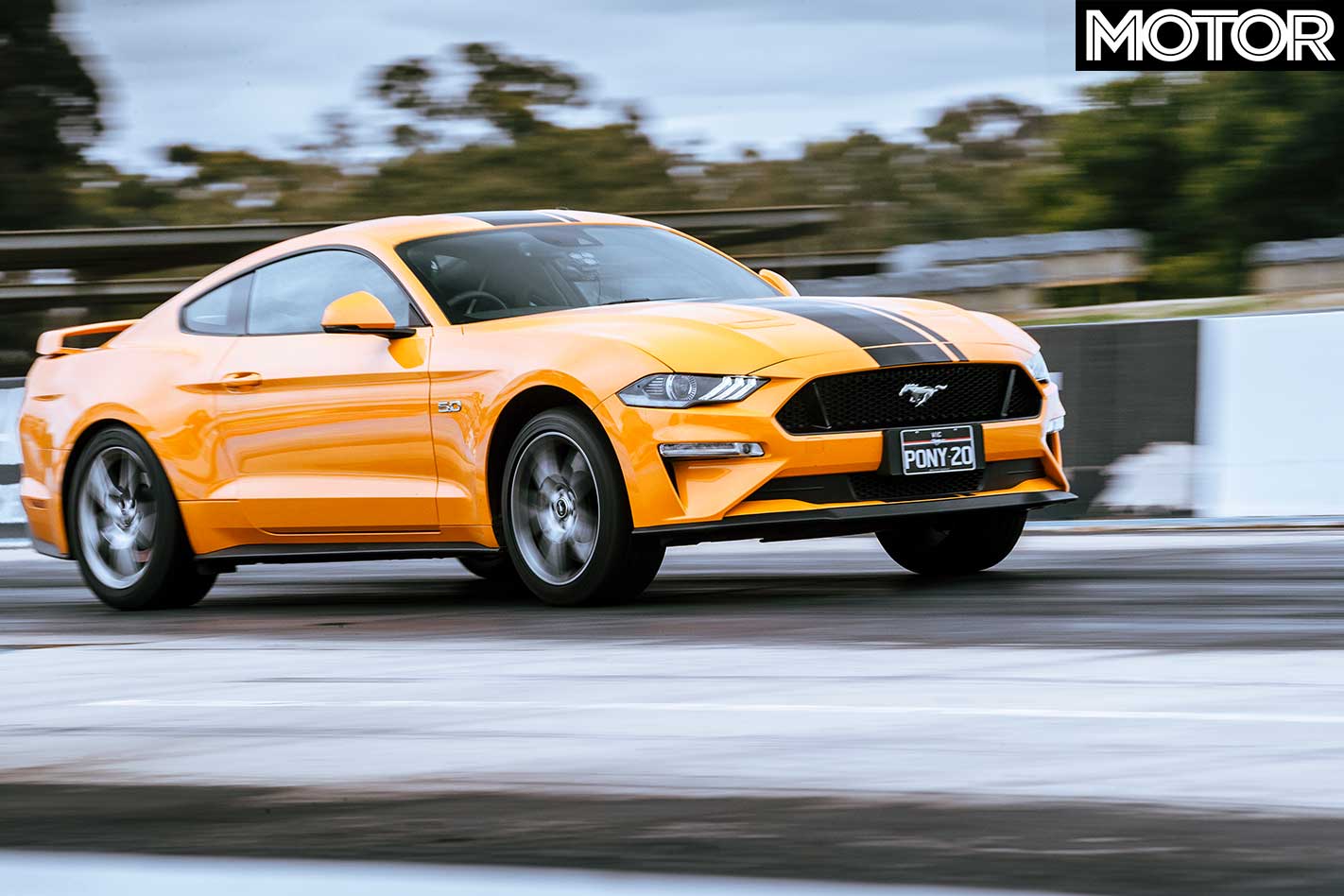
According to European figures, the 5.0-litre V8 GT should do 0-100km/h in just 4.3sec when fitted with the 10-speed auto and 4.6sec with the six-speed manual, though the latter is an “anticipated figure”.
In tests like this it’s important to set the ground rules and we wanted to find out how quick the 2018 Mustang is in standard showroom trim. Tyre pressures were as per placard front and rear, the fuel tank was around two-thirds fuel, we didn’t use rollout and the Heathcote strip was unprepped.
The early results weren’t promising, the automatic struggling to dip under 5sec to 100km/h and 13.0sec over the quarter mile. While the times were little better than the previous model, the 188km/h trap speed was a different matter, suggesting there was plenty more to come if we could get the car to hook up.
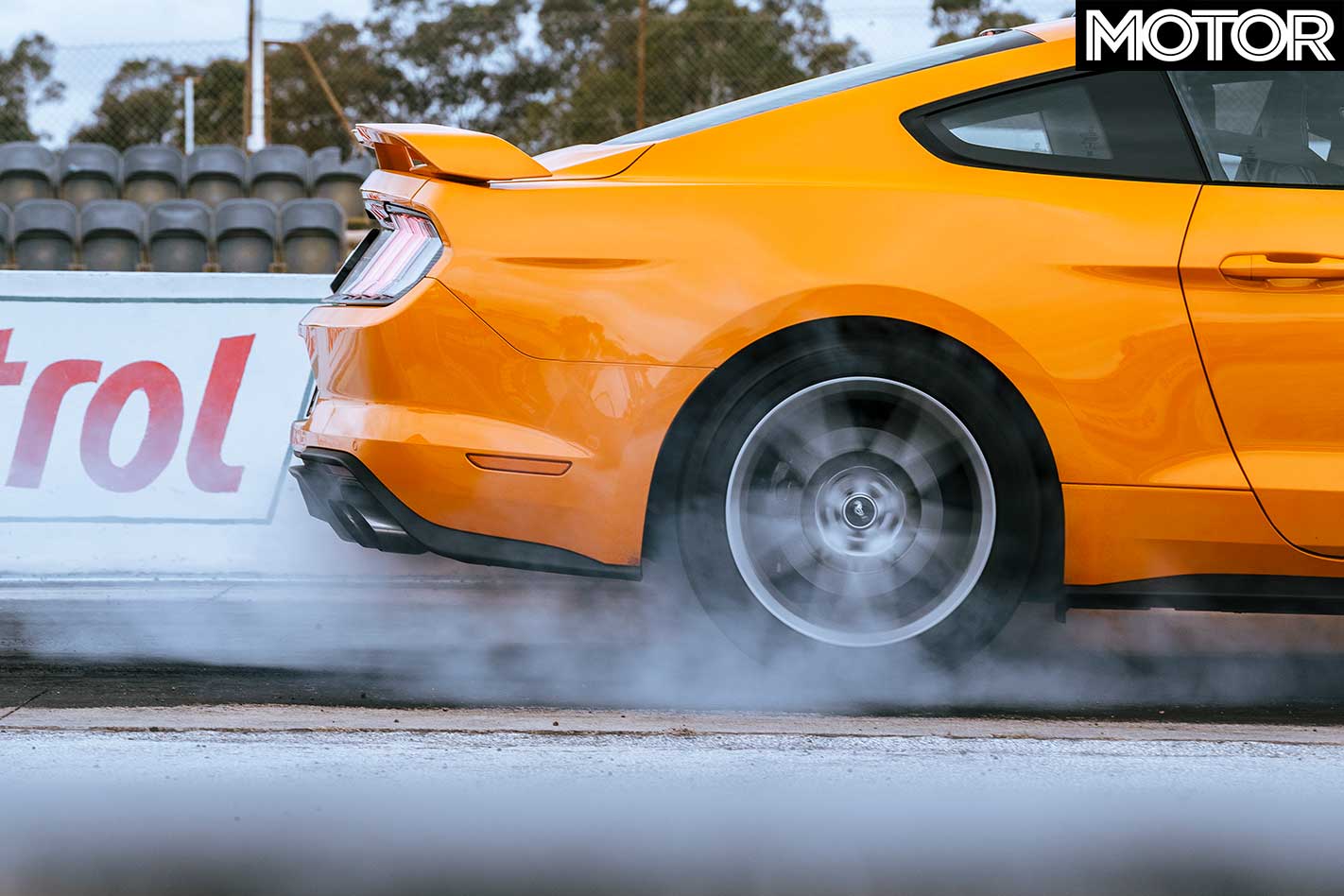
As we experimented with launch rpm, technique and different modes, the rubber build up improved traction and the times began to fall. Finally, the Mustang would accept full throttle in first gear from a stall speed of 2100rpm – any more and the brakes weren’t sufficient to stop the rear wheels spinning.
Drag mode was used, but its violent shifts required ESP to be deactivated completely, as the electronics were cutting power on the 5-6 change and costing precious km/h. The end result was 0-100km/h in 4.53sec and 12.49sec 0-400m at 188.16km/h, roughly seven-tenths quicker than the best we achieved in the previous Mustang.
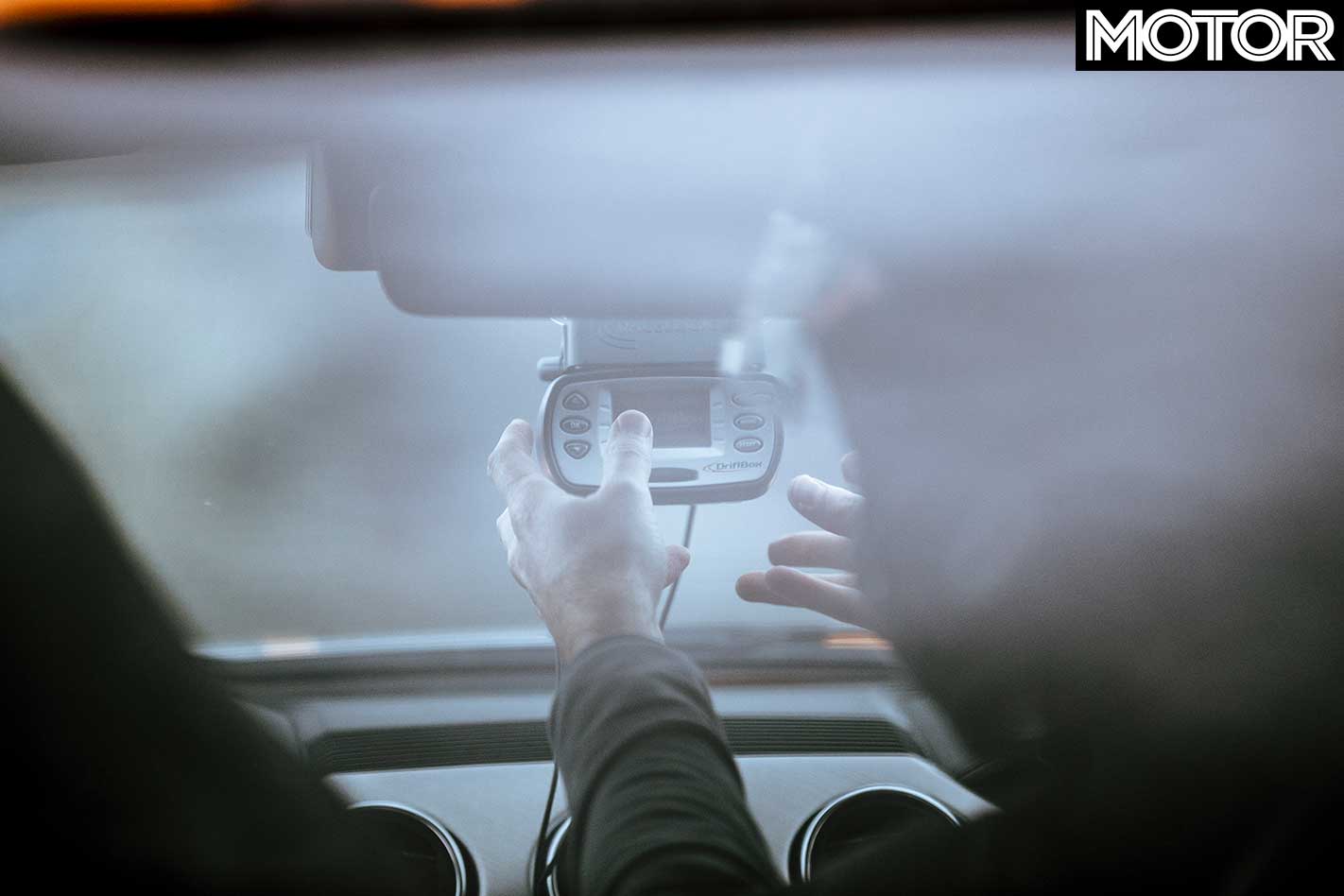
The new 10-speed auto ensures you’re always in the meat of the power band and the finish line is crossed at the top of sixth gear.
Unfortunately, we weren’t so successful in the manual, with best figures of 0-100km/h in 5.21sec and 13.2sec 0-400m at 183.14km/h, the reason being the 2018 Mustang manual is one of the most difficult cars to performance test we’ve ever experienced.
Unlike the auto, the new six-speed manual gearbox has massively tall gearing, to the point that you’re still in third at 185km/h as you cross the quarter mile mark.
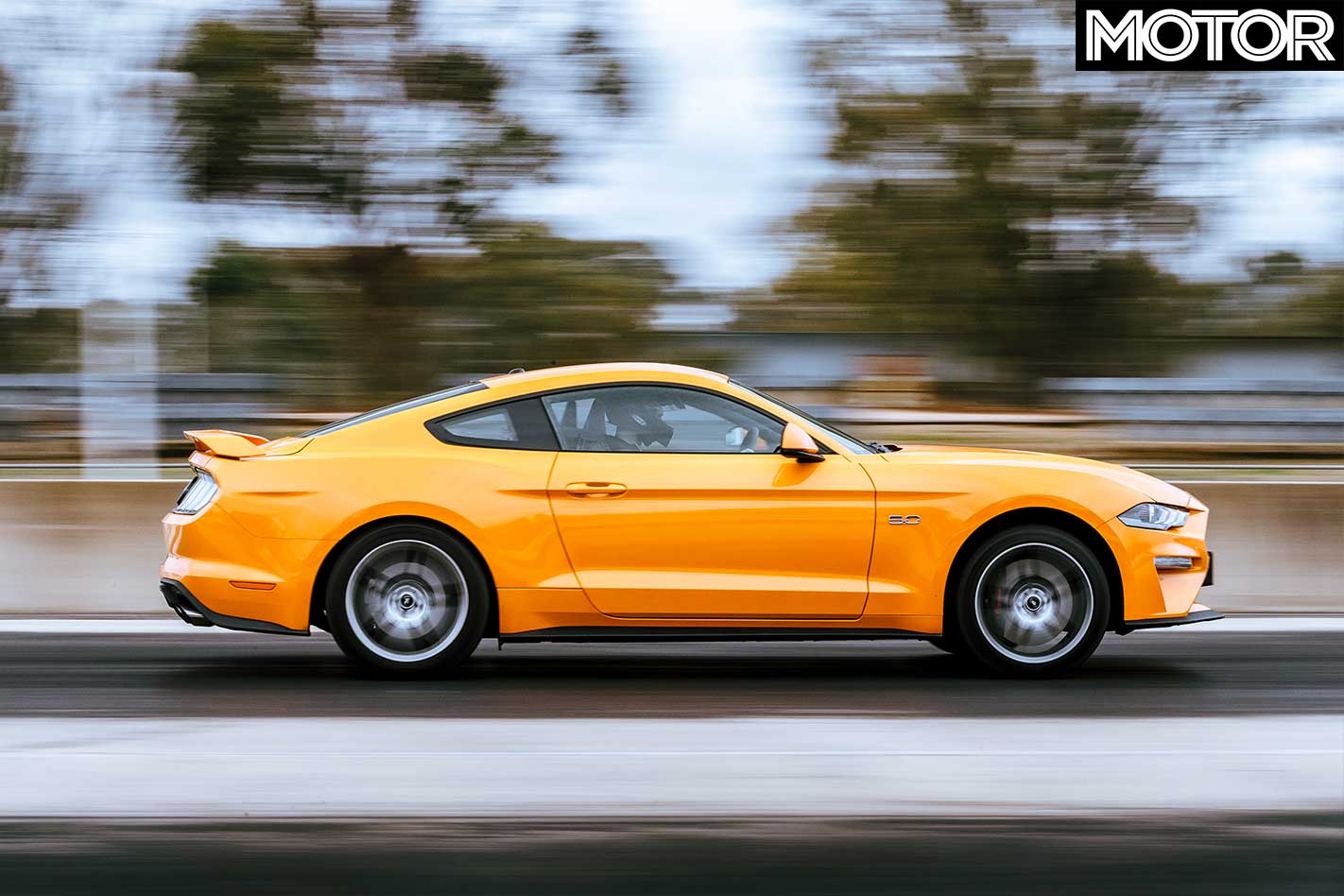
First runs to 81km/h, which resulted in three things occurring: 1. Too few revs and the engine bogging 2. Too many revs and the rear tyres spinning into oblivion 3. Just enough revs to have the rear wheels slipping but enough axle tramp to rattle your fillings out.
To be clear, there will be a sweet spot at which the manual Mustang will fire off relatively cleanly, but it required more time and more clutches than we had access to on the day. We’ll revisit the manual on another day, but it’s clear that if you want easy, repeatable acceleration, the extra $3000 or so for the new 10-speed automatic is money well spent.
More on the 2018 Ford Mustang GT: – Up-close gallery – The Dyno Test – The Road Test
Holden has relaunched its financial services product under the banner of the brand’s global owner, GM.
GM Financial will officially launch here early next year, with the group saying it will allow its customers to “affordably upgrade their cars every few years”.
As well, the finance company will allow customers to lock in a future trade-in price for their car at the end of the leasing period.
The group will operate under the name of Holden Financial Services from October this year.
In the US, GM Financial allows customers to lease a vehicle, and then trade it in at the end of the lease period and swap it for a new vehicle.
They also have the choice of handing the car back to the financial group and walking away, subject to the terms outlined in the lease agreement.
GM Finance asks US customers to make a down payment for leasing the vehicle, and then offers a number of mileage options. Unlike some lease options available here, the US requirement is for owners to service the vehicle by the logbook, or not make changes to its appearance.
Holden previously offered personal loans to buy cars and novated lease packages via a tie-in with St George Bank, a service that has also operated under the Holden Financial Services name.
Holden has also recently launched Maven, a short-term car leasing service for ride-sharing drivers.
It costs from $215 a week to use the service, depending on the size of the car.
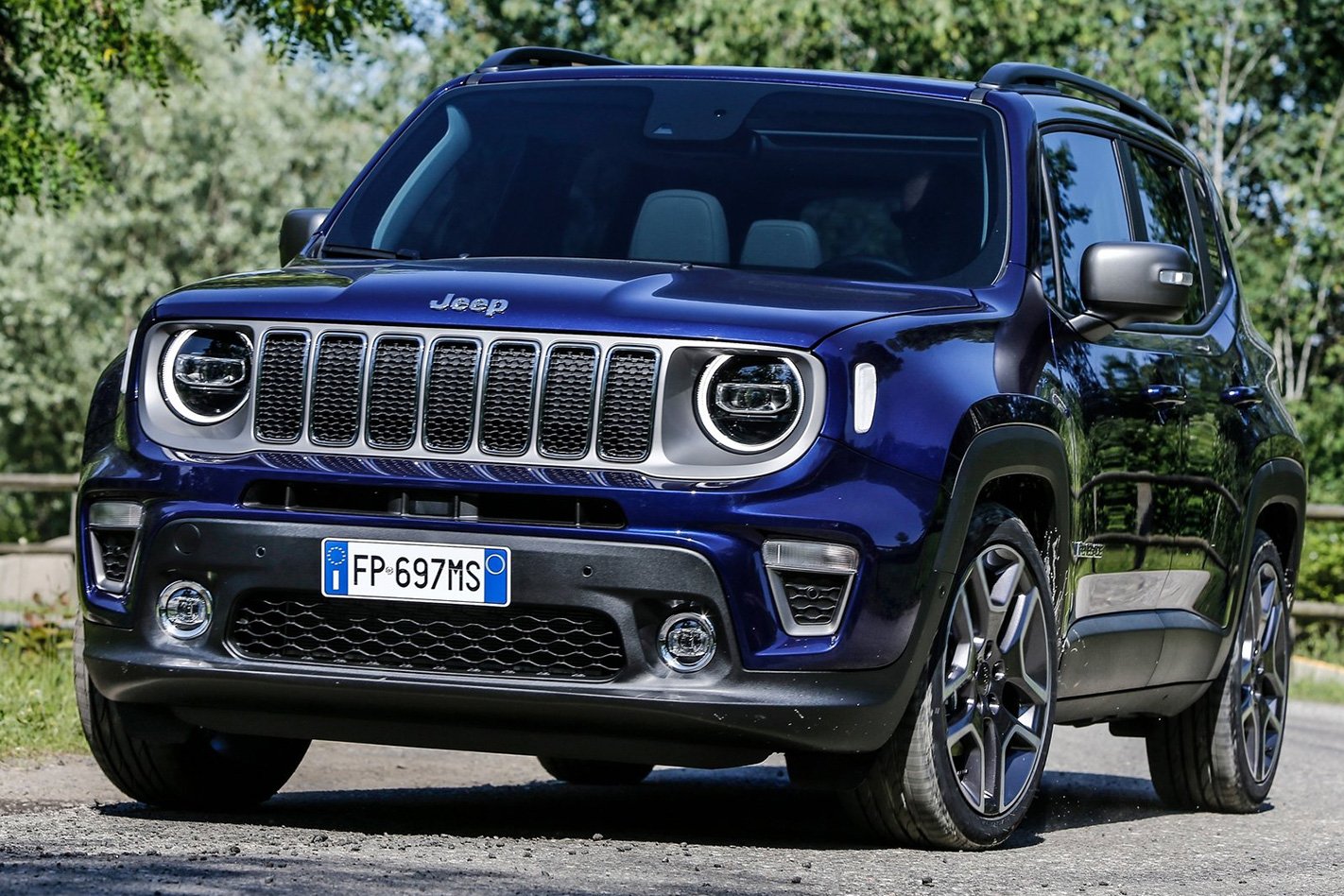
The Jeep Renegade has received its first refresh since the current generation arrived on the scene in 2015. The smallest SUV in Jeep’s portfolio is built in Melfi, Italy and was partially revealed at the Turin Motor Show. The redesign gives the Renegade a more mature appearance, with Mini-like LED rings around the headlight rims, newly designed grille with more elegant, narrower vertical bars, and a revised bumper design that includes low-slung fog-lights and DRLs.
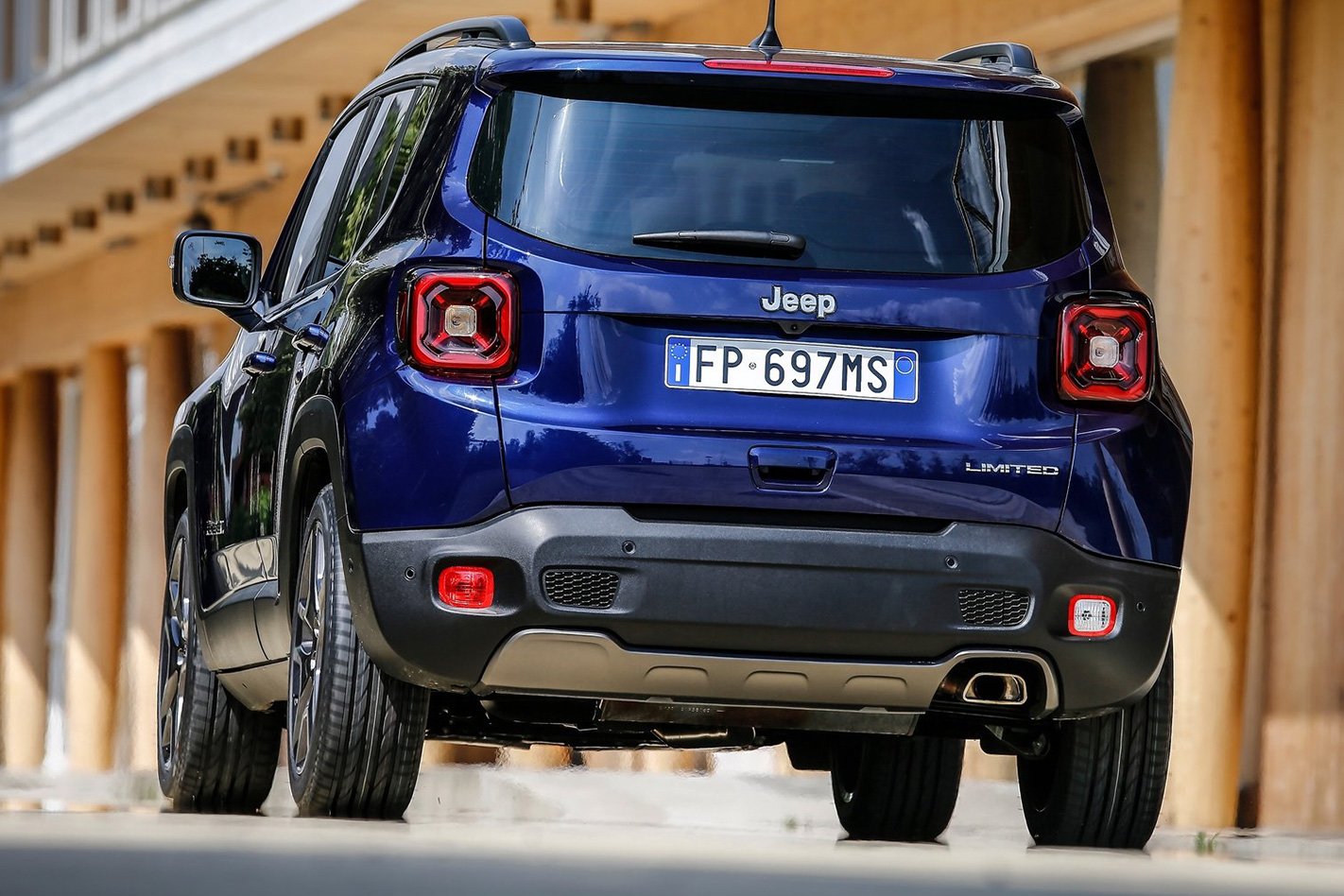
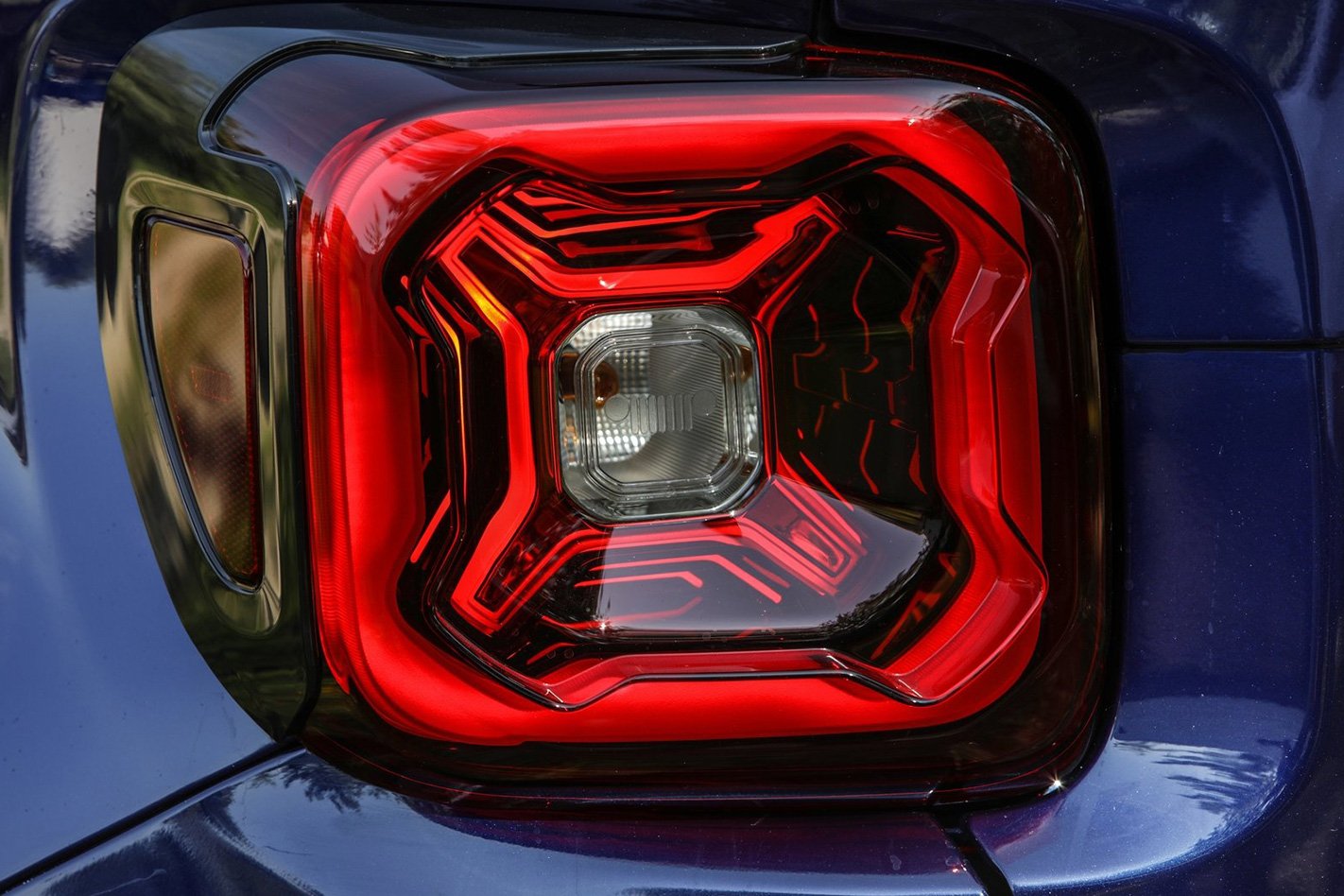
At the back you’ll notice a new take on the X-shape tail-lights which were originally designed to resemble the stamped sides of jerry cans, as carried on the back of the original WWII Jeeps. There’s also an exposed tailgate handle at the bottom of the hatch.
It’s unclear if Jeep has modified the interior, though you can assume that, after three years there will be styling updates and some new kit, including updated infotainment and a bigger touchscreen.
The biggest changes are under the bonnet, with new engines added to the line-up including 110kW and 132kW versions of a 1.3-litre turbocharged-petrol that’s leaner and more powerful than the current 1.4-litre turbo. Jeep has also added a 1.0-litre three-cylinder petrol turbo generating 91kW.
The 2019 Jeep Renegade is due to arrive in November this year, though it remains to be seen if it can give a much-needed fillip to Renegade sales figures, which are the lowest of any Jeep model here. Just 85 have found new owners in Australia during the first five months of 2018.
While it’s Jeep’s most affordable model, Aussie buyers are preferring to spend an extra $2000 on the bigger and fresher Jeep Compass; or a little less on its Italian cousin, the Fiat 500X that has shared the same underpinnings and 1.4-litre engine.
USING fuel with a higher RON rating can offer some cars a performance boost comparable to a larger engine.
Mazda revealed recently that the newly introduced turbocharged petrol version of its mid-sized 6 sedan could up its power from 170kW to 184kW, a more than 8.2 percent gain in performance. The key? Reaching past the cheaper 91RON fuel pump at the petrol station and instead giving it a splash with higher-octane – but, we should note, more expensive – 98RON.

The RON rating relates to the octane content of a given fuel and, at this point, we need to take a small science lesson. When fuel enters your engine’s combustion chamber, two things happen; firstly the air and fuel mixture is compressed, and then it is ignited, creating the carefully controlled explosion that drives the piston down and, ultimately via crank shafts and gearboxes and drive shafts, turns the car’s driven wheels.
Octane is essentially a measure of how much the engine can squeeze the air and fuel mixture before it experiences “knock” or “pinking” – a phenomenon where the squeezed air and fuel mix self-combusts rather than waiting for the engine’s spark to do the job, and usually just a matter of milliseconds before the car’s electronic ignition system tries to do the same job. The knock refers to the sound produced by the more violent, untimed explosion, which is potentially very damaging to the engine.

The Mazda 6 is something of an anomaly in that the carmaker has tuned its new 170kW/420Nm 2.5-litre four-cylinder engine to run on 91RON fuel. Why this is unusual is that turbocharged engines run at a much higher compression ratio when the turbo is working its hardest than ones that just rely on atmospheric pressure to fill the engine’s lungs, increasing the risk of knock. That means many of the turbocharged petrol engines on the market today have a minimum 95RON rating to prevent knock, and should never be run on 91RON fuel.
The secret is the 91RON-friendly Mazda engine uses a relatively low 10.5 to 1 compression ratio – a measure of how much the rising piston squeezes the air and fuel mixture, compared with the base model version’s 13.0:1 – it only produced 140kW and 252Nm from what is effectively the same engine but without the turbocharger. Squeezing the mix less reduces the tendency for the engine to knock.
So then, how does Mazda’s 98RON-fuelled performance boost stack up? At 170kW, the Mazda 6 turbo’s engine has about the same power output as a high-end 2.0-litre turbocharged four-cylinder Ford Mondeo. At 184kW, it’s almost on a level playing field with a 3.0-litre V6-engined Holden Captiva. It’s that big a difference.
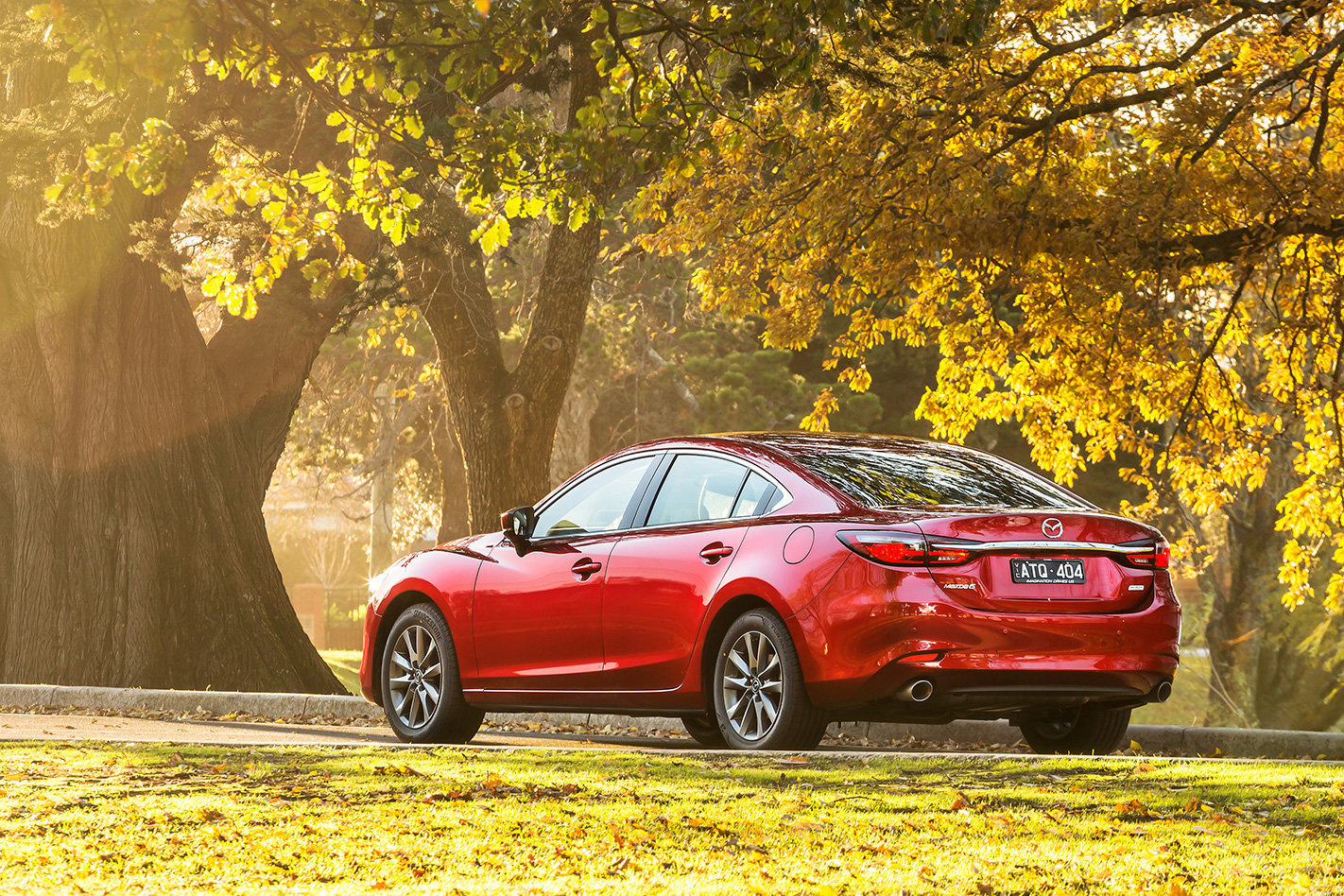
The engine’s minimum RON rating on new cars is normally included somewhere on the fuel filler flap. A rule of thumb, though, is if your car doesn’t have a turbocharger and it is rated to run on 91RON fuel, there’s no real gain from giving it a splash of 98RON unleaded and hoping for a performance lift. In other words, all you’re doing is burning through a more expensive fuel at the same rate as the cheaper one, and all for no performance benefit.
That said, doing the opposite – stepping down from the carmaker’s recommended preference for 98RON over the cheaper stuff – is not an option. Because the lower-rated fuel is more susceptible to knock, all you’re going to do is cause headaches for the engine.
A WAGON form of the Peugeot 508 called the Touring will join the recently revealed 508 sedan, with the French owner of the Holden Commodore revealing a sharp, shooting brake-styled load-lugger for the second-generation family runabout.
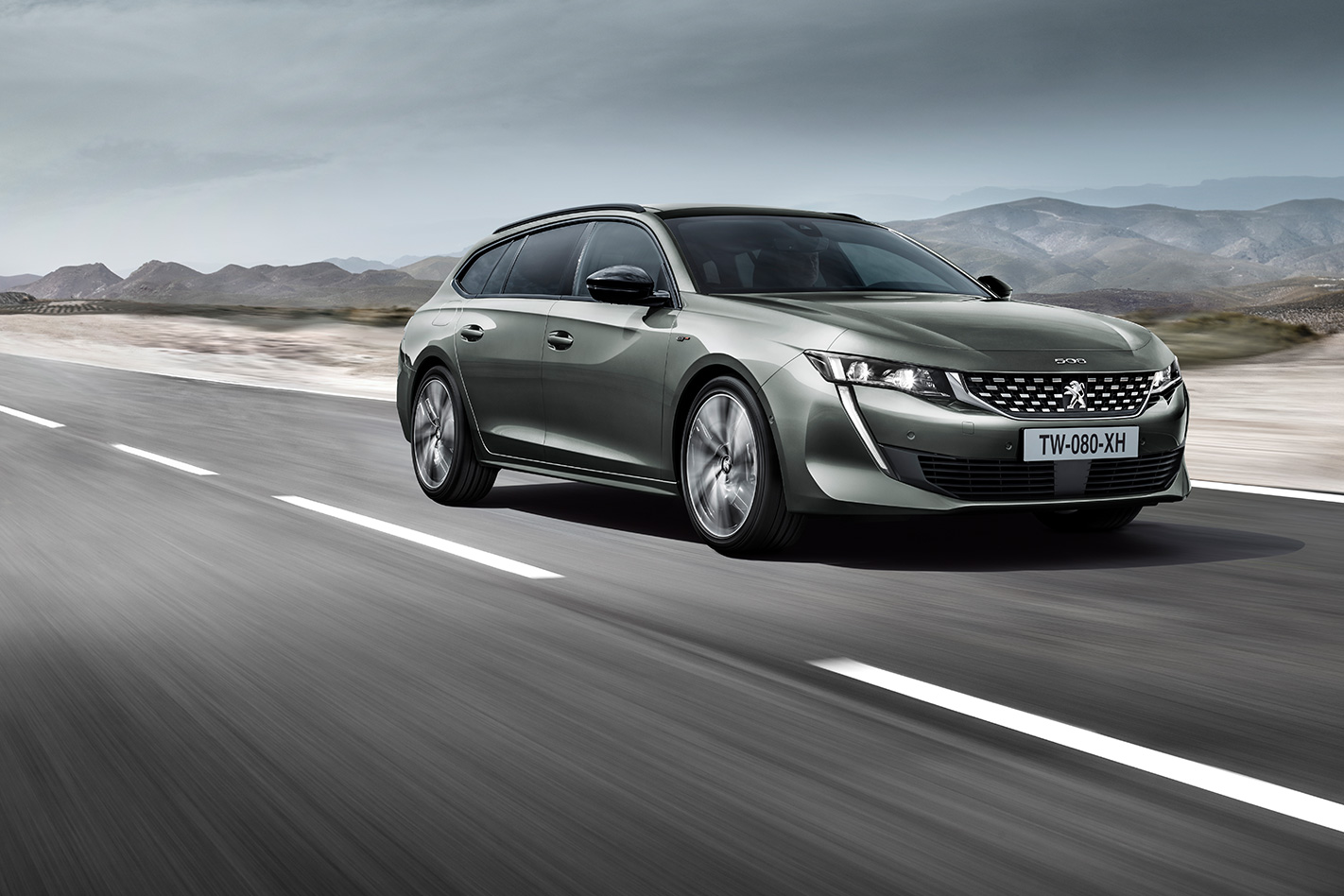
Built off Groupe PSA’s EMP2 platform that also underpins the smaller 308, the 508 Touring will go head-to-head with the SUV-styled Holden Commodore Tourer when it potentially arrives in Australia, expected to be sometime in mid-2019 at the earliest.
The big-booted 508 will make its official debut at October’s Paris Motor Show, the brand has confirmed.
It’s a good-looking thing. As classy and elegant around the front as the sedan with its bit of sabretooth tiger in the way the daytime running lights hang off the LED headlights, and featuring the same frameless windows with hidden pillars as the sedan, it’s down the rear where the newly fettled “SW” in Peugeot-speak is markedly different.
The cat-claw tail-lamps are connected via a continuous strip running across the tailgate, showing off a rear that looks more like a Porsche Macan than a Peugeot family hauler. Spread across the tailgate is a stretched “P E U G E O T” that’s missing from the smaller-booted version.
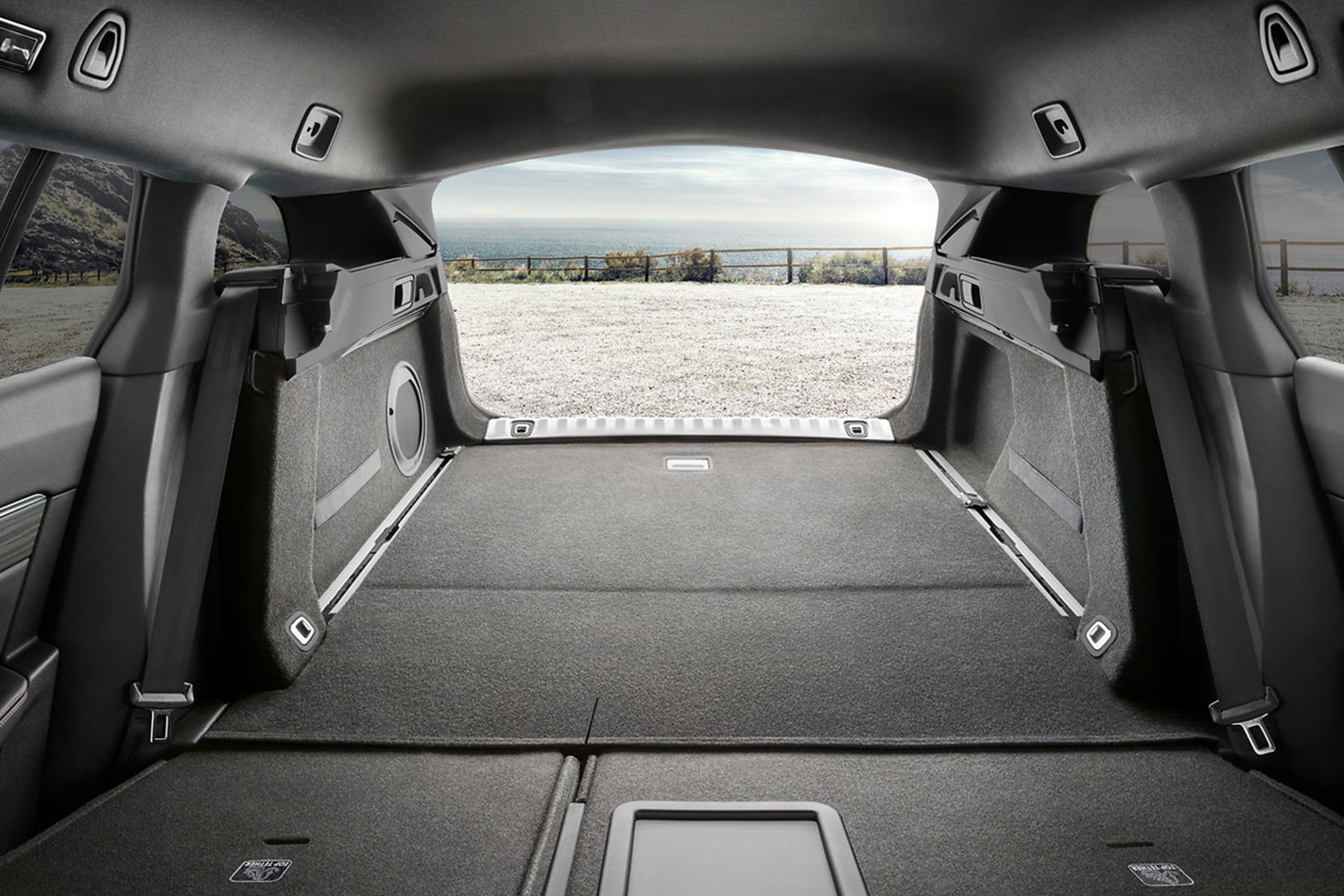
Lift the tailgate, and the 508 wagon will swallow 530 litres when filled up to the level of the rear seats, which expands to 1780 litres once the rear seats are tumbled forward. That’s more than 110 litres roomier than the Holden Commodore Tourer’s cargo bay.
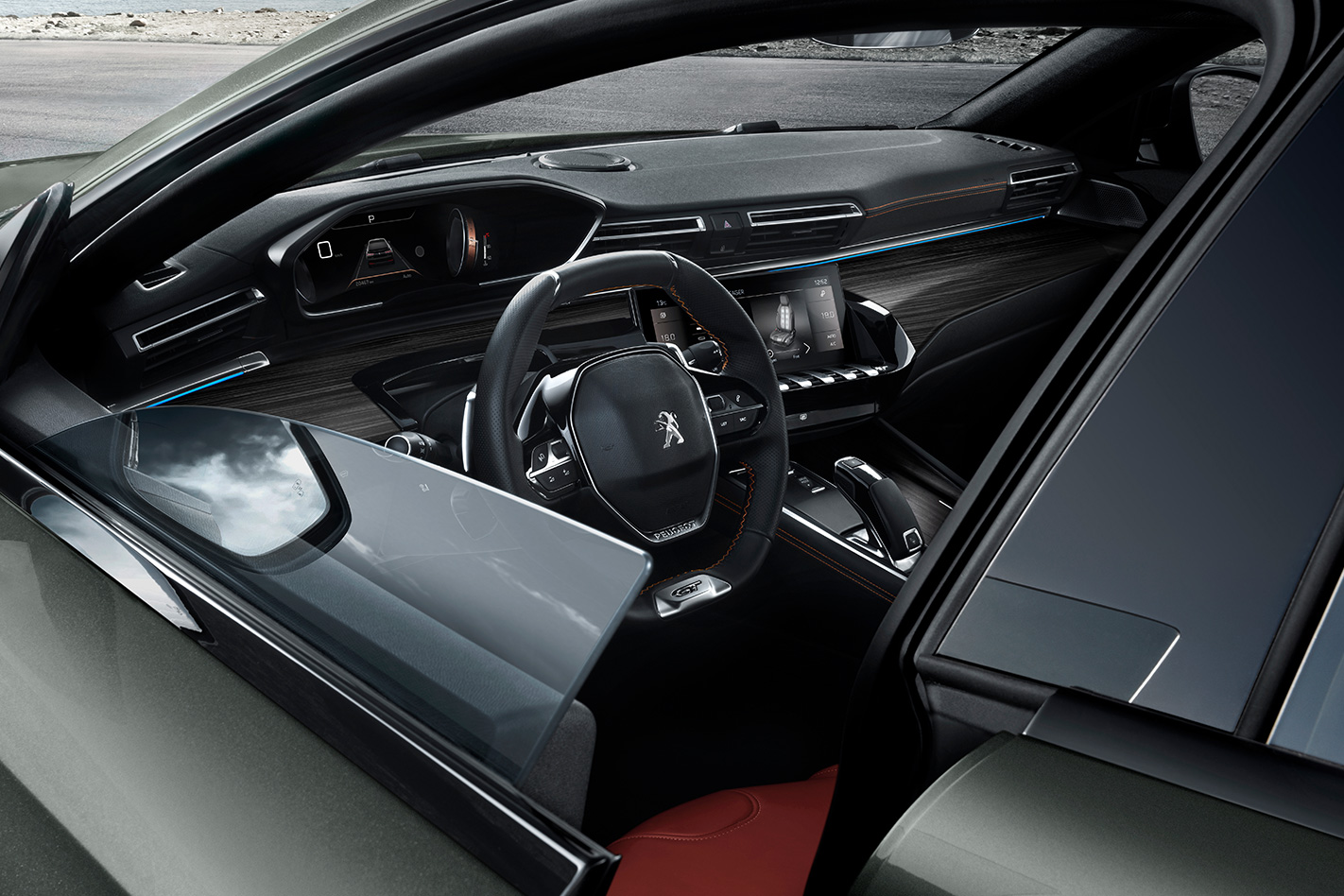
Like the sedan, the wagon version of the 508 sports twin exhausts, although for the sedan they’re pushed to either side of the diffuser, while in this version of the wagon they’re almost kissing each other on the left edge of it.
Inside, European versions of the 508 will have access to the full suite of Groupe PSA’s driver-assist technologies, including a night-vision camera – Peugeot is claiming this as a first for the segment.
Unlike the GM-sourced atmo V6-only, Twinster diff-equipped all-wheel-drive Commodore Tourer, the bum-dragging 508 SW is expected to pick from a range of turbocharged petrol and diesel four-cylinder engines sourced from within Groupe PSA. It will use an eight-speed automatic across the range.
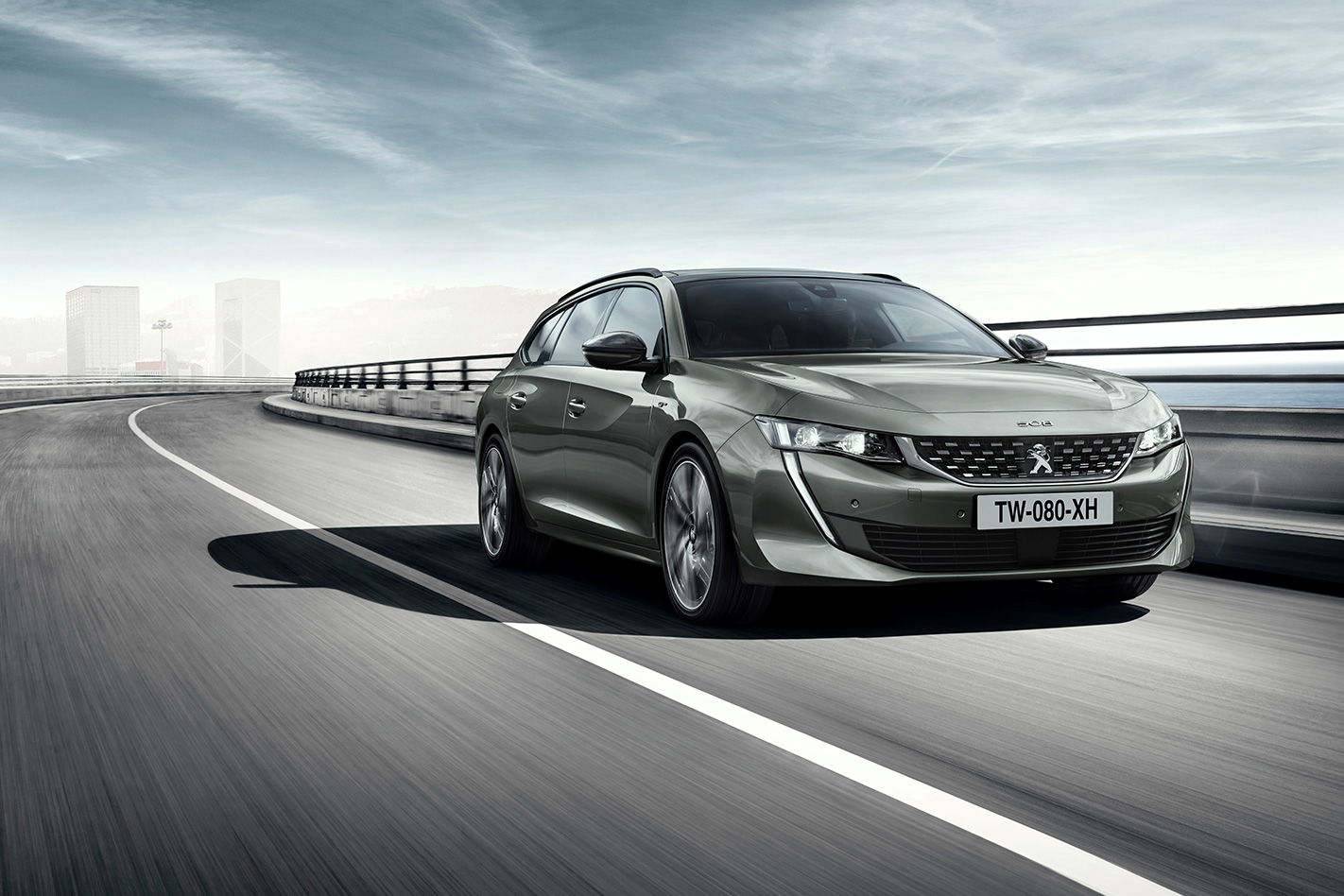
But the big-booted Pug faces a real challenge in Australia. Not only does it have to fight the growing consumer switch to high-riding SUVs at the expense of traditional passenger cars, it will also need to face stiff competition from the wagon-bodied likes of the Ford Mondeo, Skoda Superb, Mazda 6, Subaru Levorg and the Volkswagen Passat.
