
QUESTION – VIN:
I am looking for a medium SUV to act as a second car to our Audi Q5. I would like to be able to fit two car seats in the back and still have a spare spot for a passenger. Good satnav and infotainment are important to us.
BUDGET:
$35000
ANSWER – FRASER STRONACH:
Your budget of $35K won’t get you far I’m afraid with a new medium-size SUV especially if want high-end sat-nav and infotainment. $35K will get you into a small SUV but it will be a real squeeze for two child seats plus a third rear-seat passenger. Even medium SUVs can be a squeeze in that regard.
The pick of the so-called medium SUVs, which are still on the small side, is the Subaru Forester but at $35K you will only get a base or mid-spec model. The Mitsubishi Outlander is one of the bigger medium SUVs but again $35K won’t get much in the way of equipment. In either case you may have to look at a low-kilometre second-hand example. Buying a low-kilometre second-hand car (less than two years old and under 30,000Km) saves a lot of money compared to a new car where the depreciation as soon as you drive out of showroom is a killer.For the extra space they offer I’d actually go for one of the larger SUVs, again a second-hand low-kilometre example. In that case your best bet would be a Hyundai Santa Fe or a Kia Sorento, which are mechanically near identical under the skin.
JACK of all trades. It’s something many of us would love to be, kinda like any bastard who can bench press 100kg-plus, but also sing, dance, make people laugh, build a new front fence and effortlessly command a barbeque.
First published in the March 2017 issue of Wheels magazine, Australia’s most experienced and most trusted car magazine since 1953
But if we’re talking cars – or, in this case, range-topping dual-cab utes with delusions of passenger-car grandeur – trying to be all things to all people is a hard thing to master.
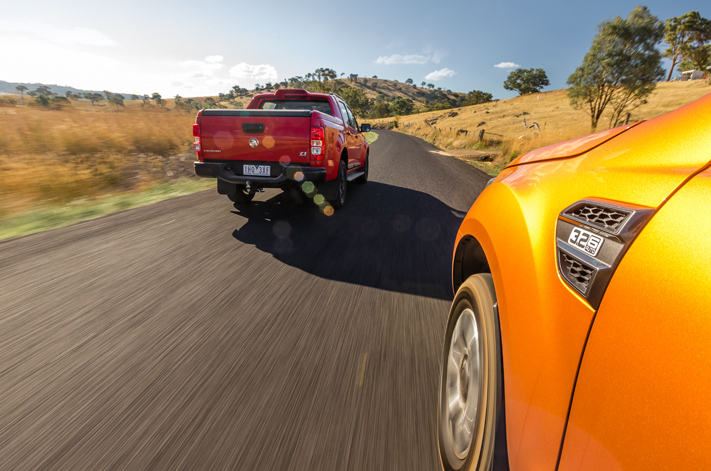
By 1950, it was our best-selling car. Sixty-six years later, that title is held by the separate-chassied Toyota Hilux (with 42,104 sales), leaving the once-dominant large-car class in a state of abandonment.
2017 Ford Ranger FX4 targets Hilux buyers
Want to know what Ford’s best-selling ‘car’ was in 2016? The Ranger pick-up (4×2 and 4×4) with 36,934 sales, five times more than the Blue Oval’s next biggest seller (the now-dead Territory SUV).
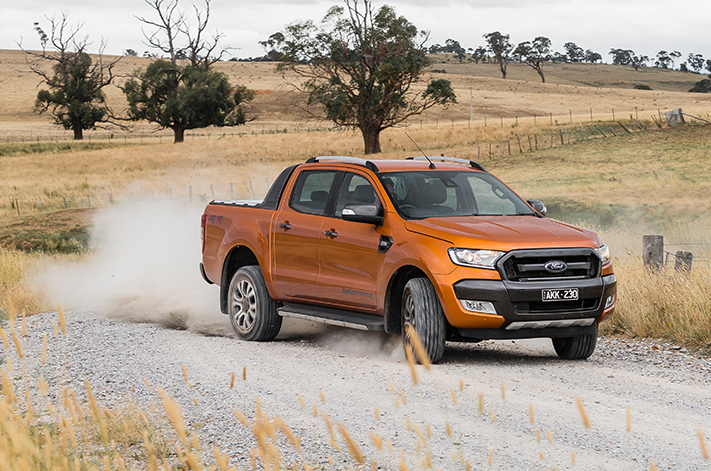
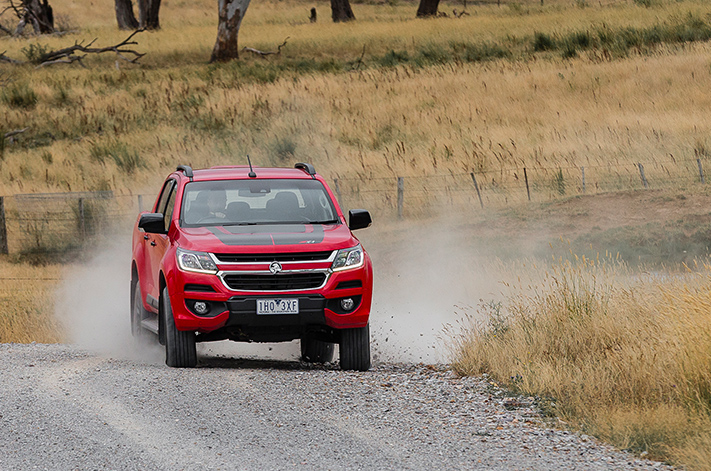
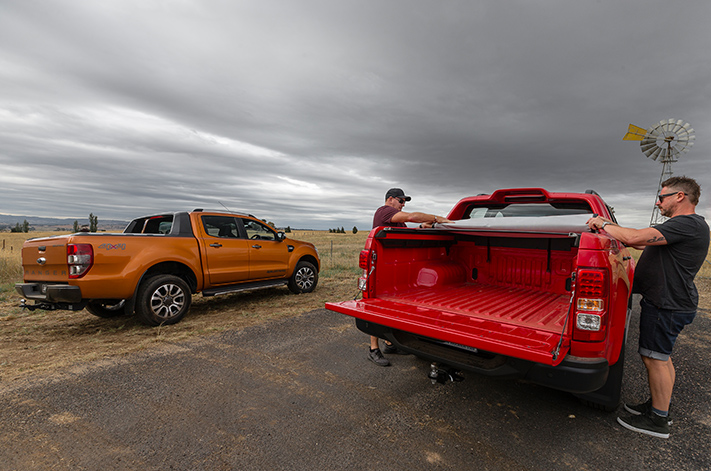
Forward collision alert, lane-departure warning, leather-appointed trim, climate control (dual-zone in the Ford), Apple CarPlay/Android Auto phone projection, factory sat-nav, electric driver’s seats (and heaters up front), 18-inch alloys, roof rails and sporty ‘sail plane’ additions garnishing the rear tray area feature on both the Colorado Z71 ($57,190) and Ranger Wildtrak ($61,790).
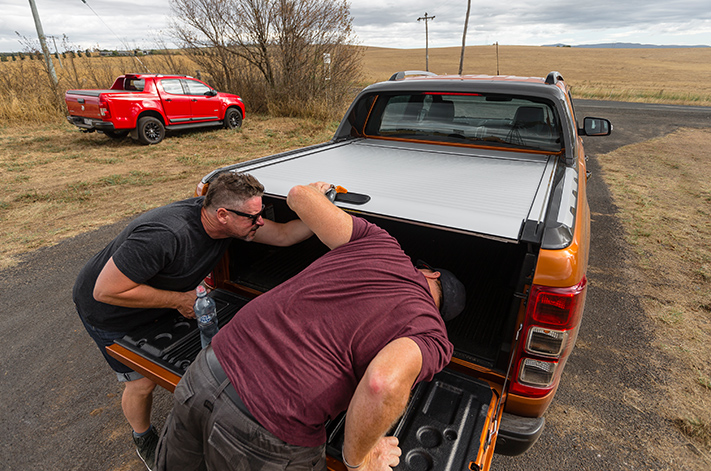
For its additional spend, the Wildtrak adds adaptive cruise control, a lockable roller-blind-style metal tonneau cover, 12-volt outlets in both the rear cabin and tray (perfect for refrigeration purposes), a chilled centre console bin, auto high-beam and external puddle lights, while the Colorado Z71 counters with LED daytime running lights, four auto up/down windows, a manually height-adjustable front passenger seat and some groovy 1970s black-out body decals.
Off the line, the Holden is instantly in the game, hooking up and charging forward with positive upshifts and significantly more snot than the five-cylinder Ranger.
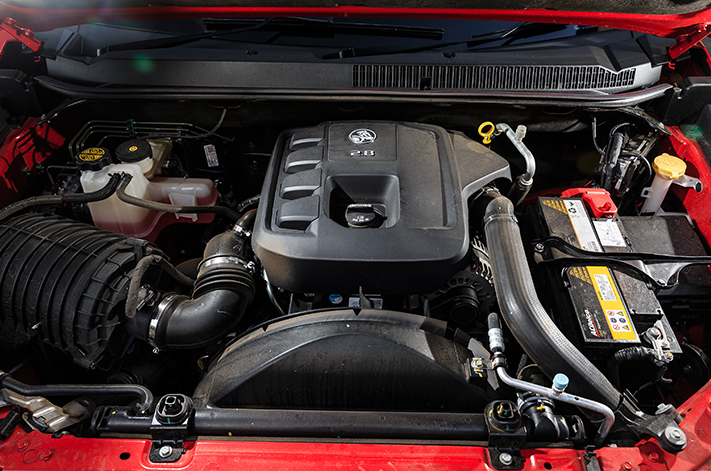
The Colorado’s 2.8-litre four is a more agricultural engine than the Ranger’s 3.2-litre five, with fan noise and diesel clatter at low revs, and more gravel in its voice, but there’s a sweet spot between 2800 and 3200rpm, and given the grunt on offer, it’s easy to forgive the Z71’s shoutier manner.
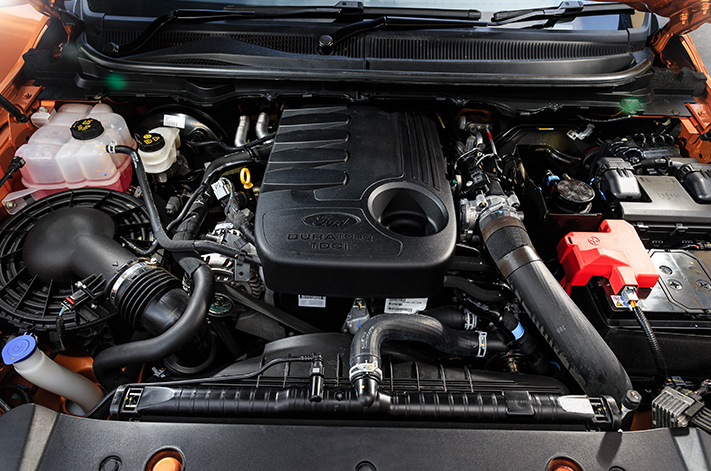
It, too, upshifts at just 3600rpm (and falls off a power-curve cliff shortly thereafter), though you can feel the Ranger’s torque-convertor slurring drive, particularly in third gear, when it should be throwing everything it has at its rear tyres, like the Colorado does.
There’s another 100kg to deal with as well, leaving the Ranger feeling slightly breathless at times, and thirstier too, drinking 1.2L/100km more than the Colorado on test.
Turn the wheel and the Ford responds, immediately pointing its nose where you want, and informing its driver what the front and rear ends are doing.
Confirmed: Tickford name returns to Ford Ranger and Mustang
Primitive as a leaf-sprung live axle may be, the Ranger’s rear end feels interconnected with the rest of its suspension set-up, resulting in nicely balanced handling and an unexpected level of feel.
It’s an effortless car to drive quickly over smooth, winding surfaces, though when bumps join the party, the Ford chooses to give its passengers a free horsey ride, whether they’d like one or not.
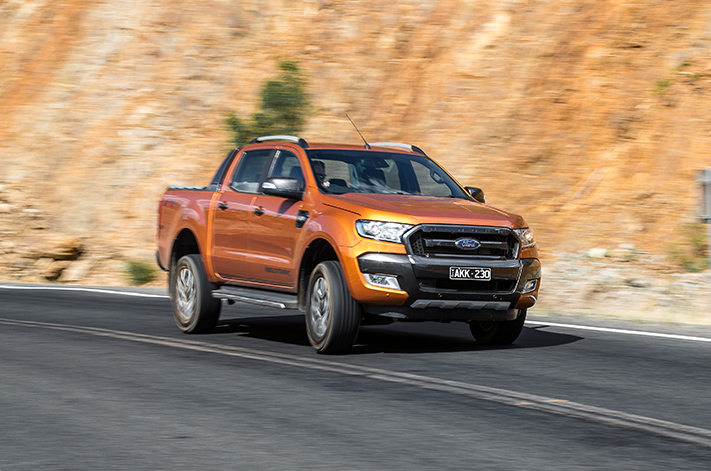
On anything bar a billiard-smooth surface, the 18-inch-wheeled Wildtrak transmits a jiggly, pattery motion up into its cabin that must surely be car-sickness kryptonite. Adding passengers improves it slightly, and so do 100km/h-plus speeds, but if this is the compromise for having a one-tonne load-carrying tray out back, then you get what you deserve if you aspire to owning a dual-cab ute as the family express.
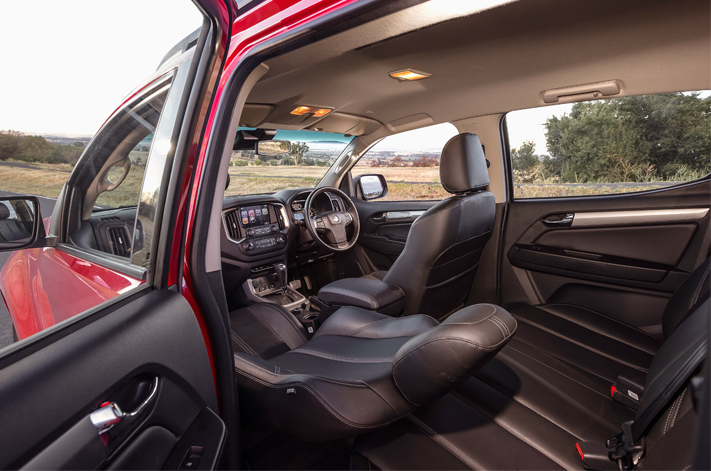
There’s an irony here, though, because the Colorado’s almost-comfortable ride is countered by a contorted driving position destined to offend almost everyone.
A near-flat cushion, tilt-only steering column, an intrusive centre-console shape, very basic electric seat adjustment, a too-high seating position, too-high brake pedal and nowhere to comfortably rest your right foot while cruise control is activated conspire to make the Colorado a body-achy experience on a long drive.
And in urban driving, the pedal positioning adds right-ankle torture to the mix. Bizarrely, the manually adjustable front passenger’s seat has better under-thigh support and is actually quite comfortable…
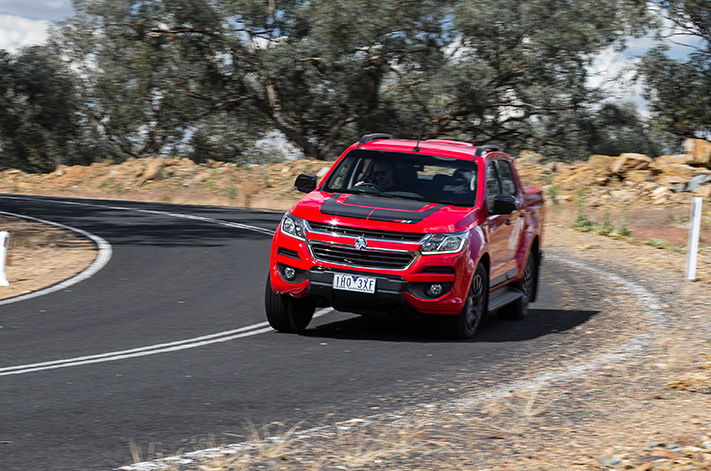
But in tighter stuff, there’s plenty of understeer to be had unless you do your best to try and minimise it, and same goes for the tyre howl from its 265/60R18 Bridgestone Dueler rubber (identical to those fitted to the Ranger).
Given the level of performance on offer, it can be frustrating trying to keep the Colorado tidy on really twisty roads, and then there’s its coarse-surface road noise, which is significantly greater than the Ranger’s.
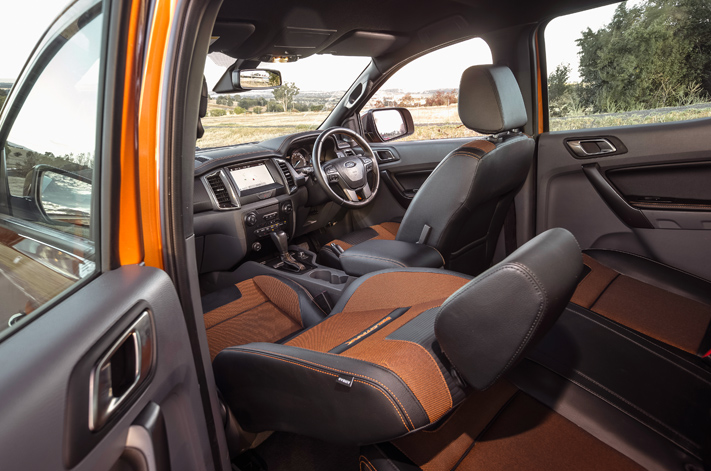
At least the Colorado’s new dashboard is a revelation compared to the old model’s tat, though the Ranger’s stitched dashboard top, padded door trims/armrests and superior seating make it feel significantly classier.
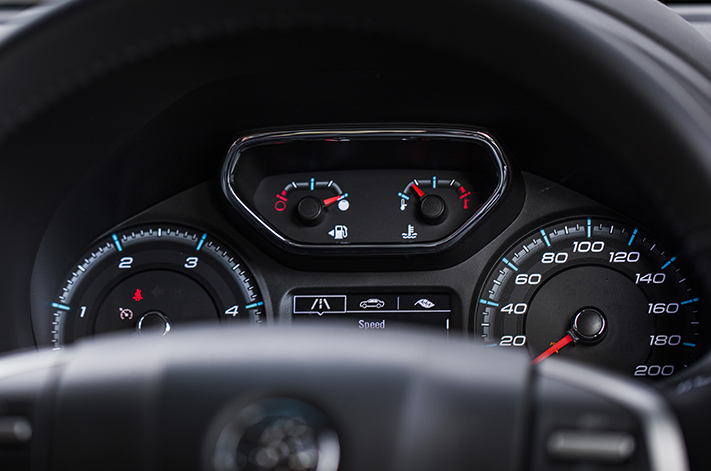
The Colorado’s GM-generic centre switches and column stalks are much easier to operate, with clear markings and a simple-to-use layout that also looks reasonably neat. But the ugly carry-over steering wheel is a sad reminder of just how rubbish the Colorado used to be before Holden dragged it into this century with this MY17 update.
What no amount of fettling can overcome, however, are the fundamentals of the Colorado’s ageing design, starting with its short wheelbase (over 120mm less than Ranger’s) relative to its overall length (longer than Ranger). The Holden’s seats are mounted higher, to the detriment of legroom and cushion support, front and rear, whereas you sink into the leggy Ranger’s lovely seats, and enjoy greater space and fields of vision.
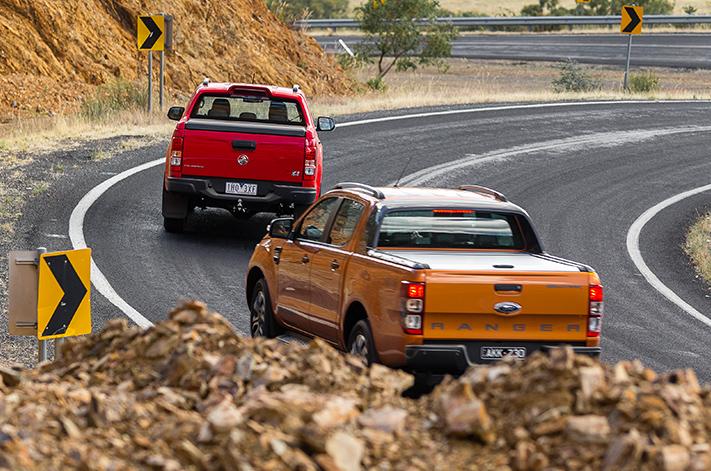
The Holden, on the other hand, simply can’t overcome its more obvious commercial-vehicle origins, and the lesser expectations of markets like Brazil, where this current generation was developed. That said, it makes the most of what it has on offer, and if you can cop its driving position, then it’s a more affordable, more efficient and inherently honest form of transport.
If it wasn’t for its terrible ride, the Ranger would walk this comparo. But the compromise of blending Ford dynamic DNA with one-tonne load-carrying ability means it isn’t such an obvious choice.
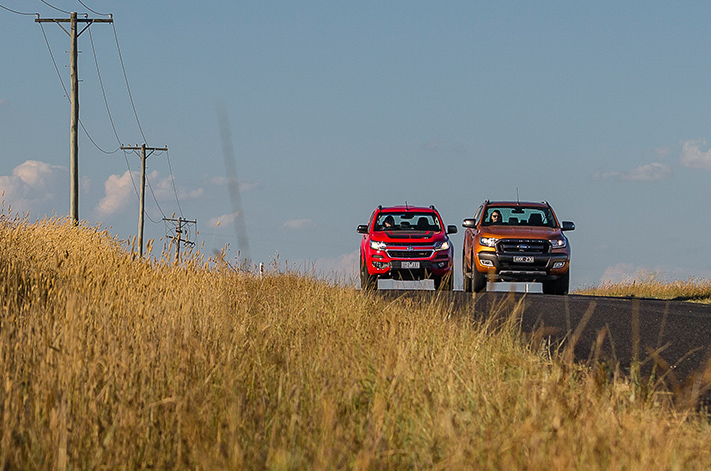
But we couldn’t help wishing we were at the wheel of a proper car – almost any new car – after nearly 700km in the Ranger and Colorado. Jack of all trades and master of none? At least they look cool.
Ford Mustang GT Fastback vs Holden Commodore SSV Redline Ute
Price & Equipment | Winner: Commodore
The premise: Pony car meets modern V8 Aussie ute, which is considered by most to be a (critically endagered) two-door muscle machine. The Mustang GT is officially $55K and gets auto HID headlights, DRLs and LED tail-lights, rain-sensing wipers, tyre-pressure monitors, a reversing camera, dual-zone climate control, and heated/cooled front seats.
Commo’ ute is no workhorse in circa-$50K SS-V Redline spec. As well as FE3 suspension, big brakes and 19s, the V8 trayback gets equipment to level with its rival, and plenty of advanced safety, including forward-collision alert, blind-spot monitoring, lane-departure warning, and reverse-traffic alert. Misses Ford’s dual knee airbags.
Interior & Versatility | Winner: Draw
The Mustang strikes a mean kerb presence, being a fraction wider, much shorter and precisely 100mm lower than its rival. Butch design and US quality pervades inside yet low, six-way-powered front seats make it easy to get comfy. Plus-two back seats with Isofix mounts set the ’Stang apart in term of usefulness. Its boot hauls 383 litres.
It’s more polished and modern in the Holden, which could be a sedan but for the fact there’s a bulkhead rather than a back seat behind you. Generous tray brings enviable lugging ability, though might mean you’re roped into helping mates move. Leather seats, colour head-up display and internet radio crown a surprisingly classy cabin.
Performance & Economy | Winner: Commodore
A 5.0-litre quad-cam V8 beats at the heart of this Blue Oval coupe. With 306kW pushing an identical kerb weight, outright accelerative ability falls in the Ford’s favour but 530Nm at a high-ish 4250rpm means you have to work its six-speed manual. The tank holds just under 61 litres, taking you 465km at the official 13.1L/100km fuel figure.
A bigger 6.2-litre pushrod V8 with bi-modal exhaust and mechanical sound enhancer gives the Lion a deeper, more substantial aural presence. Almost line-ball for power but with 40Nm extra delivered at similar revs, GM’s loping V8 delivers more of its substantial torque down low. Slurps from a 71-litre tank at a rate of 12.6L/100km.
Ride & Refinement | Winner: Commodore
Despite wearing 19s on 40-series tyres – with broad 275s at the rear – the Mustang manages a well-damped ride that improves with speed. The suppression of noise, vibration and harshness is good, if not quite as well executed as in its rival, leaving a trace of wind rustle … not that you’ll notice when the taps are wide open.
The Commodore has carried its expertly engineered and calibrated ride/handling compromise from VE to VF and VFII. In fact, better than that, it’s improved with age. The Holden, as a home-grown hauler, has the edge at high speeds on bumpy coarse chip and practically everywhere else, even with the Redline Ute wearing 275/35R19s at the rear.
Steering & Handling | Winner: Commodore
Mustangs used to be image machines; now they’re decent to drive away from the strip, too. A strut front suspension and an integral-link independent rear end provide fine fundamentals for handling balance, though you’re always aware of the big coupe’s weight. Electric power steering is not rich in feel, though it improves with load.
The SS-V Redline Ute is poised on similar suspension to the sedan and wagon, meaning more sophistication than just about any other load lugger. Cue front struts and multi-link IRS with a limited-slip diff, just like the Ford. The Redline shrinks around its driver, and offers terrific handling cohesion with meaty, connected steering feel.
Verdict | Winner: Commodore
The Michigan Mustang and home-grown Holden are surprisingly similar machines. Peak power figures are within a gnat’s appendage (2kW), kerb weights are officially 1739kg and they roll on almost identical wheel and tyre sizes.
Then there are the differences, such as the fact the Mustang comes wrapped in an eye-grabbing exterior, while the Commodore ute is as familiar as an old mate; the most obvious departure is that the Ford offers cramped rear quarters, and the Holden has two seats and a tray.
Your priorities might dictate the pick, but the Commodore wins in pure two-door muscle terms, because it’s better to drive, both day-to-day and on back roads, with a tougher soundtrack. The Holden’s nicer cabin and more robust value equation are the icing.
TOUCHING IS SPECIAL. SEEING AND HEARING CAN STIMULATE THE DESIRE TO BECOME ACQUAINTED, BUT ABSOLUTE INTIMACY MEANS HOLDING, STROKING, OR EVEN caressing. AND I APPRECIATE OPPORTUNITIES TO DO ALL THESE THINGS… TO CARS. OBVIOUSLY. WHERE DID YOU THINK THIS WAS HEADING?
First published in the March 2017 issue of Wheels magazine, Australia’s most experienced and most trusted car magazine since 1953
The ride was stripped well and truly bare at the launch of the Mercedes-AMG GT R. This is, to my mind, the most persuasive version of the German two-seater.
I’d got into the habit of calling the GT, with intentional disrespect, a Kraut Corvette. They do, after all, have much in common; both are rear-drive, with a stonking V8 up front, a transaxle down the back and a torque tube joining the two.
Exclusive: One-on-one with the scorching new AMG GT R
But the fierceness and finesse of the GT R was enough to make me seriously consider being more polite in future…
While the thrill of thundering laps of Portimao was still fresh, it was upstairs to a suite overlooking the technical and challenging Portuguese circuit’s main straight for the inevitable launch program propaganda.
The presentations weren’t especially memorable, but an adjacent area had been set aside for the GT R’s inner workings to be displayed. There was a bare bodyshell and beside it a complete set of chassis components arrayed in their proper places.
But the best stuff, I thought, was in the corners and against the walls. Engine and powertrain development engineer Philipp Neuwirth was happy for me to fondle some of his equipment. After I’d given the sectioned engine against the wall a thorough touch-up, he led me across to the corner of the room.
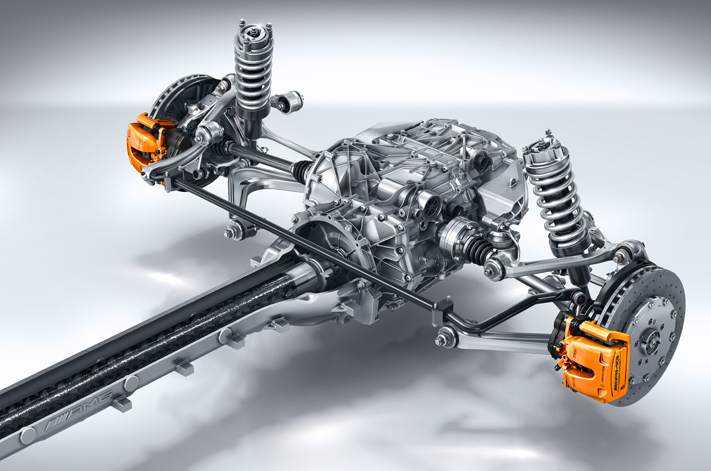
It’s a hefty thing, flanged at either end for fasteners and festooned with brackets. It’s the rigid connection between AMG’s fiery-tempered twin-turbo 4.0-litre V8 at one end and the seven-speed double-clutch transaxle at the other.
It’s one of the most complex pieces of structural carbonfibre I’ve ever seen. With the pattern of the carbon weave glowing darkly though the glossy resin that imprisons it, the urge to stroke was irresistible. It has that distinctive faint texture of carbonfibre, and is warmer to the touch than metal. And, despite the substantial loads it must cope with, it’s not heavy. Just under 14 kilograms, in fact.
AMG GT R thrashed at the Nurburgring
Light, yes, but not as fabulously feathery as the driveshaft beside it. The GT R uses the same carbonfibre driveshaft as the GT S. Engineering is the exact opposite of miracle working, but this is something that inspires genuine awe. It can be lifted one-handed with startling ease. How can something so insubstantial serve as a conduit for 430 kilowatts and 700 Newton metres?
These hidden parts contribute to making the GT R something truly special to drive. While you can feel their value and virtue in the way the Mercedes-AMG drives, this is an indirect experience.
Touching them, on the other hand, is to gain a deeper and more intimate sense of their worth.
Aristotle observed that ‘nature abhors a vacuum’, and the same is true of the automotive industry.
Anyone who has studied the rapidly expanding ranges of the premium German brands will see the truth evident in this statement. No sooner has a gap in the market been identified than it’s filled with the latest niche model.
Ford also experienced this phenomenon when it introduced the Mustang to Australia, the level of pent-up Pony Car demand catching it off guard and resulting in year-long waiting lists. But that’s not the end of the story.
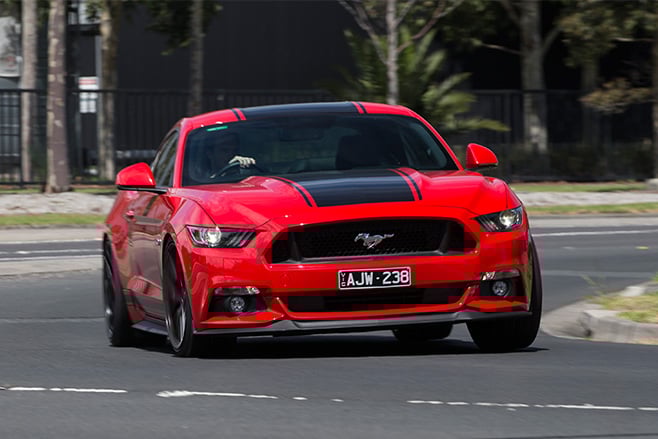
Thankfully, those customers are spoiled for choice, with modified Mustangs the flavour of the month, and a familiar name has now added its own offerings to the menu.
The Tickford brand has long been associated with tweaking Fords, but the latest iteration has nothing to do with Tickford Vehicle Engineering, the company responsible for everything from the Capri Clubsprint and right-hand drive conversions of the fourth-gen Mustang to the Falcon-based HSV competitors of the late nineties and early 2000s.
Tickford’s first offering was based on the Ford Ranger, however, it’s now expanded its portfolio to include the Mustang. Both GT and EcoBoost (which we’ve also sampled; see breakout below) have received attention, with Harris saying Tickford’s intentions are “to bring out the personality of the [Mustang]. Especially with the EcoBoost, we just wanted to bring it to life.
We wanted to keep the packages simple, easy for consumers to understand, and whilst we’re somewhat conservative in our approach, the intention was to make it feel like a sports car without compromising a great package.
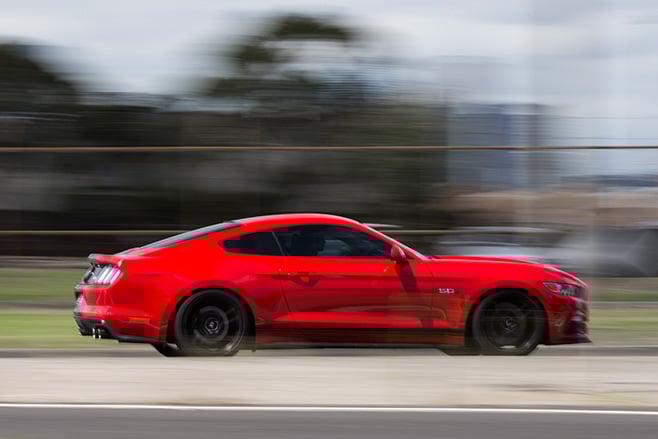
The Tickford Mustang certainly looks the part. With the height-adjustable suspension set to its lowest setting, the body hunkers down over the larger wheels which fill the guards perfectly.
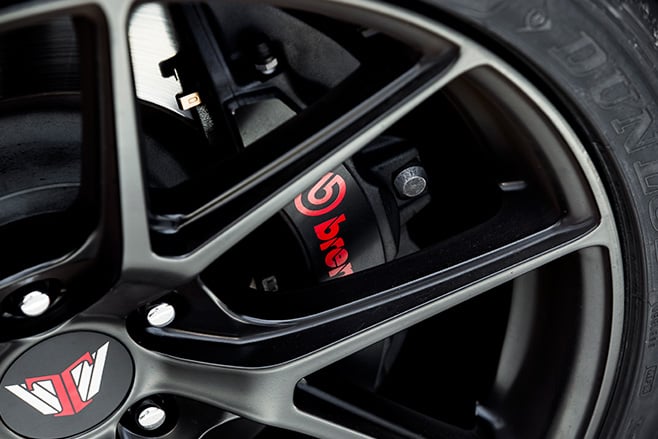
Tickford’s 20-inch wheels measure 9.5 inches front and 11 inches rear wearing 265/35 and 295/30 Dunlop Sport Maxx RT tyres respectively, with a tyre pressure monitoring system and chrome wheel nuts also part of the $4490 package.
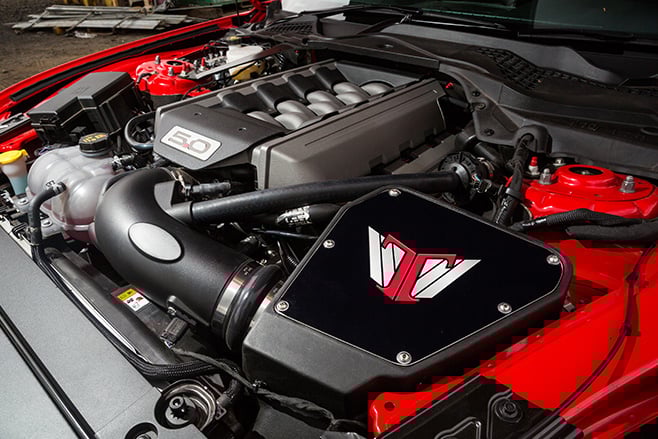
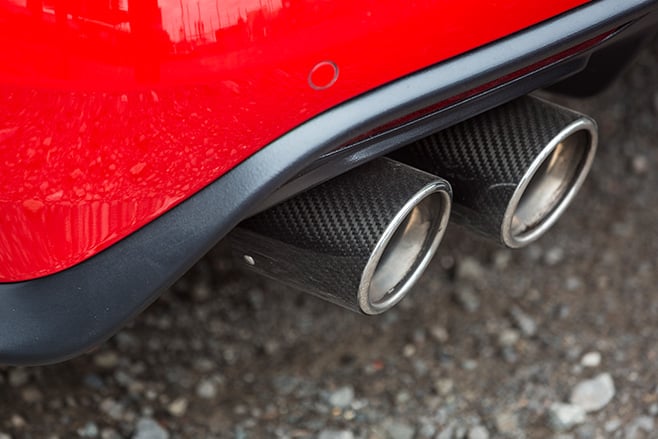
Its conspicuous nature is only enhanced when a press of the starter button produces a thunderous boom from the quad carbon-wrapped exhaust tips. Gasses exit a 3.0-inch cat-back exhaust, which together with a hi-flow cold air intake, throttle body spacer and custom tune lifts outputs from the 5.0-litre Coyote V8 to 360kW/585Nm from the standard car’s 306kW/530Nm.
Those are substantial increases for a naturally aspirated engine but impressively, the Tickford ’Stang feels good for the claimed numbers.
Unfortunately we didn’t have the chance to performance test the car on this occasion, but by the seat of the pants it feels like an improvement of around half-a-second over the quarter mile would be on the cards, resulting in roughly a 13-flat. The engine revisions inject a welcome dose of attitude into the Mustang.
As good as the standard car is, it does feel a little sanitised, whereas the Tickford’s louder soundtrack and addictive extra urge makes it feel more special. It’s not perfect; a fellow tester found the razor-sharp throttle response a step too far and the bass-heavy exhaust note isn’t to my tastes.
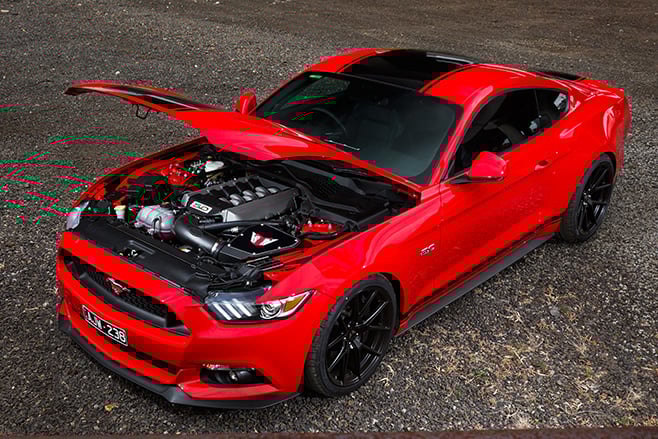
Tickford’s chassis modifications are likely to be equally polarising, as whether they’ve improved the Mustang or not will depend on your priorities.
In addition to the aforementioned rolling stock upgrade, Tickford’s $3990 suspension package adds new springs and dampers developed with an overseas supplier. Tickford claims the setup is biased towards road driving, with roughly a 70:30 weighting between road and track use.
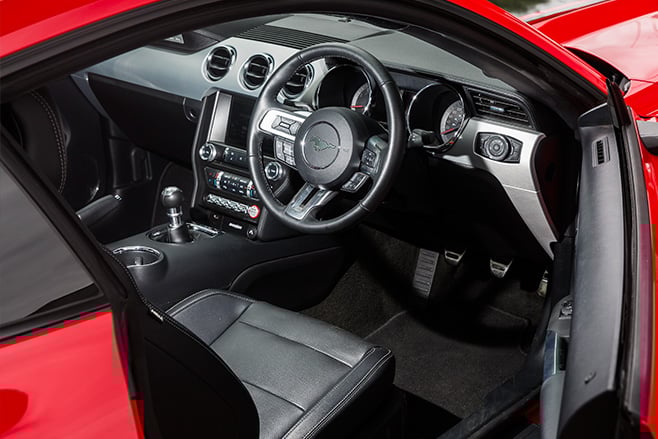
It’s a polished performer that feels more European than American, but Tickford’s stiffer setup swings the pendulum back towards the latter.
The ride has suffered most, deteriorating over poor surfaces and at high speed, where it feels to lack travel. It’s not terrible – there’s no crashing or evil behaviour – but it is very reactive to the road and there will be those that prefer the standard car’s greater compliance.That said, both editor DC and I agree we’d happily live with the sharper ride given how good the car looks with this setup.
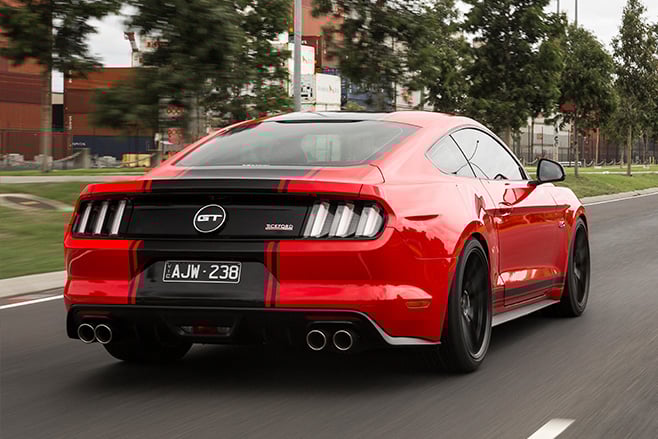
Even just stamping on the throttle in a straight line is enough to have the rear end waving in first or second gear, something which the lenient ESP system is only too happy to allow.
Get greedy with your entry speed and the nose will wash wide, but judge it right and you can throttle-steer the car in a fashion that’s much more difficult with a standard Mustang. The progression with which it loses grip at either end makes it easy to play around the limit with confidence; the sharper responses do exacerbate the slow steering, but it’s a compliment to the chassis that you crave that extra precision.
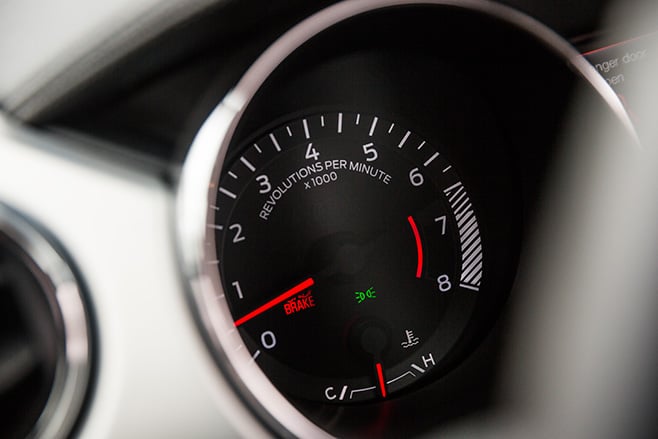
If you’re a fan of outright grip and refinement, it might be preferable to keep the standard setup, but if you like to feel a car squirm beneath you, Tickford’s suspension does give the car more personality.
Of course, the beauty of Tickford’s package approach is that you are free to make the choice. Despite the supposed road bias, there’s the suspicion that on a smooth track with stickier rubber the stiffer setup would come into its own. And why not take it to a track? It’s the perfect place to explore the extra performance and the Mustang brakes are more than up to the task.
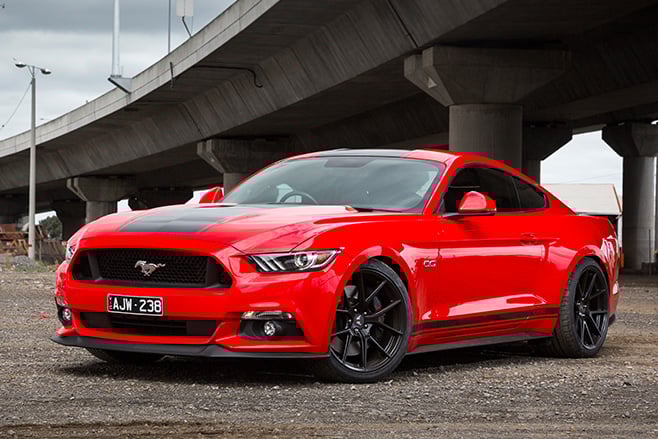
Has Tickford improved the Mustang? Objectively, probably not, as in boring but important areas like ride and refinement the car has taken a step backwards, however, in our opinion it’s now a better Mustang. It sounds, looks and handles more like a proper muscle car. If Tickford’s intent was to bring out the Mustang’s personality, then it’s absolutely nailed it.
Specs Body: 2-door, 2+2-seat coupe Drive: rear-wheel Engine: 4951cc V8, DOHC, 32v Bore/stroke: 92.2 x 92.7mm Compression: 11.0:1 Power: 360kW @ 5760rpm Torque: 585Nm @ 4620rpm Power/weight: 207kW/tonne Transmission: 6-speed manual Weight: 1739kg Suspension(F): struts, anti-roll bar Suspension(R): multi-links, anti-roll bar L/W/H: 4784/1916/1381mm Wheelbase: 2720mm Tracks: 1582/1655mm (f/r) Steering: electrically assisted rack-and-pinion Brakes(F): 380mm ventilated discs, 6-piston calipers Brakes(R): 330mm ventilated discs, single-piston calipers Wheels: 20.0 x 9.5-inch (f); 20 x 11.0-inch (r) Tyre sizes: 265/35 ZR20 (f); 295/30 ZR20 Tyre: Dunlop Sport Maxx RT Price as tested: $72,960 Pros: Extra grunt; frisky handling; looks Cons: Terse ride; boomy exhaust Star rating: 4/5
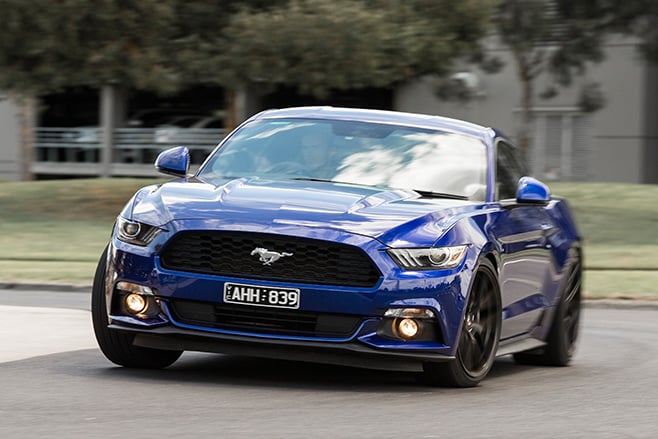
Boosted! 270kW EcoBoost
The Mustang EcoBoost is a hard car to give a verdict on, and in some ways Tickford’s enhancements only enhance the difficulty. What is certain is that the $6990 Power Pack, which lifts outputs from 233kW/443Nm to 270kW/520Nm, makes the EcoBoost a much more attractive proposition.
Not only is it now a properly fast car, feeling comparable to the standard V8 GT, but the growl under acceleration and pops and sneezes on the over-run inject it with a much needed dose of character. There is some lag to contend with, and our test car had a weird hesitation from rest at times, but in general this boosted-up four-pot was much more fun to drive.
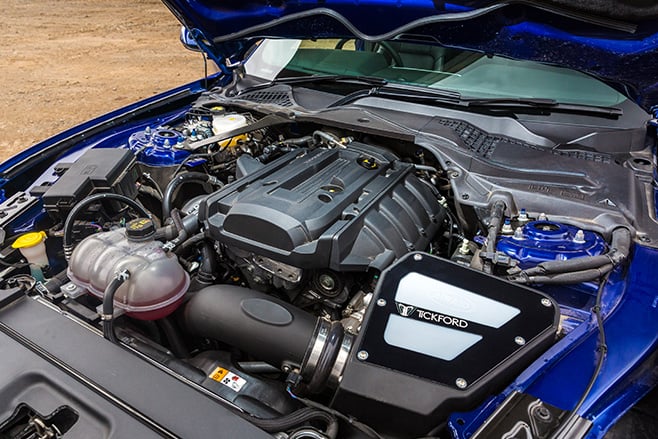
The trouble is, thus equipped, Tickford’s EcoBoost comes in at $61,470, or enough to buy a standard V8 GT with change (assuming you can get one at something close to RRP). And while improved, we’d still take a standard V8 over a tuned-up EcoBoost.
That said, if you’re a turbo fan, we’d recommend the upgrades as they definitely lift the four-pot’s fun factor.
Hyundai is looking to use a lightweight plastic developed by BASF for its RN30 show car as a possible replacement for carbonfibre in production cars.
First published in Wheels magazine, Australia’s most experienced and most trusted car magazine since 1953
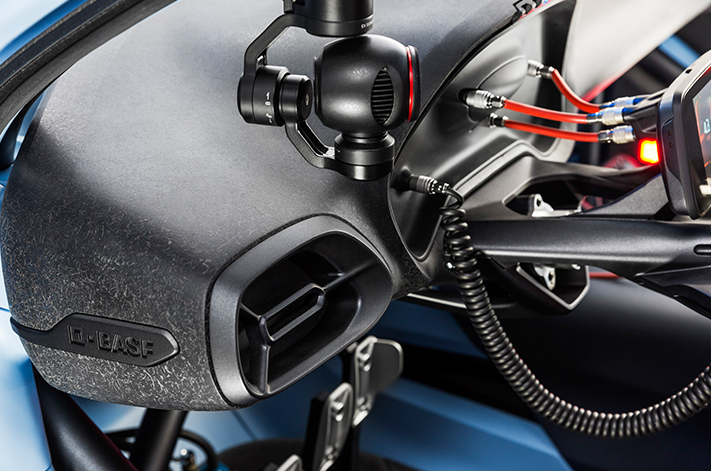
The polyphthalamide material is among the highlights of the radical 280kW all-wheel-drive Paris show car, which demonstrated how far Hyundai could push the hot-hatch formula.
The new material is used extensively throughout the RN30, while other components sourced from BASF were employed elsewhere, including the seats.
Lamborghini’s composite factory is making carbon-fibre con-rods a reality
The distinctively grained plastic is featured on the front splitter and rear diffuser, the dash and inside door skins, and even the spine-like fin that runs down the centre of the roof.
A BASF spokeswoman told Wheels: “Our high-performance materials support making the car lightweight as well as providing more design freedom when compared to traditional materials”.

“We didn’t want to make a cliché, so that’s why we went away from carbon,” Bretecher said.
“We talked to BASF and said … do you have anything useful, and they came up with this material. We found it, in terms of look, much more intriguing [than carbonfibre].”
The plastic is produced from carefully crafting natural fibres, including some metal, with a water-based resin to create a matte-grey finish with distinctive random graining.
BASF says the plastic “enables an environmentally compatible, dimensionally stable and, above all, lightweight solution for car composites such as dashboards and door panels that can be finished in various ways for high-quality design”.
While the RN30 is purely a show car, Bretecher said it provides clues to future production models – most likely the highly anticipated i30N hot hatch due in 2017 – and that elements such as the new lightweight plastic would appear somewhere.
“If we make a collaboration with BASF it is obviously because we have something in mind … I’m quite sure there will be some applications [of the new plastic in production models].”
BASF also produced innovative seat materials; the structure uses a new thermoplastic composite with fibre reinforcement to provide strength claimed to exceed that of metal. While it performs a similar job to carbonfibre, it’s understood the production process is less intensive, making it more affordable and easier to produce.
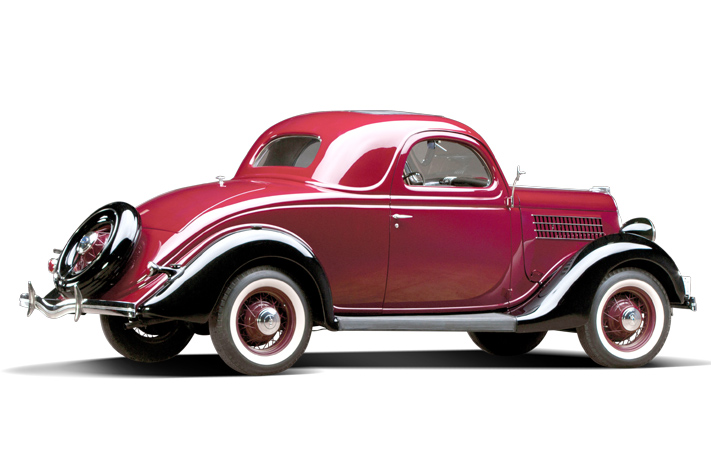
HENRY Ford is justly famed for having put America and much of the world on wheels, through his pared-down and production-designed Model T of 1908. But Ford deserves just as much credit for making the world on wheels go (and look) faster, through a landmark model launched in 1932, the Ford V-8 Coupe.
First published in the March 2017 issue of Wheels magazine, Australia’s most experienced and most trusted car magazine since 1953
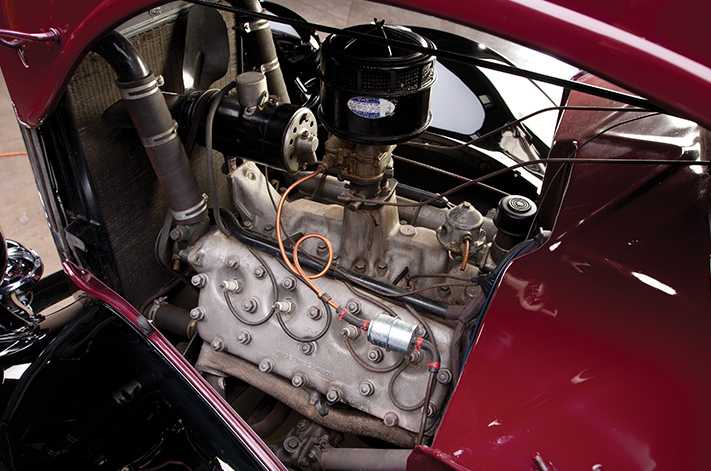
Convinced of his own genius, he spent much of the 1920s pursuing the idea of an eight-cylinder radial engine, his so-called X8. Radial designs, while already common among aero engines, presented cooling and lubrication problems in cars that were eventually deemed too difficult to overcome.
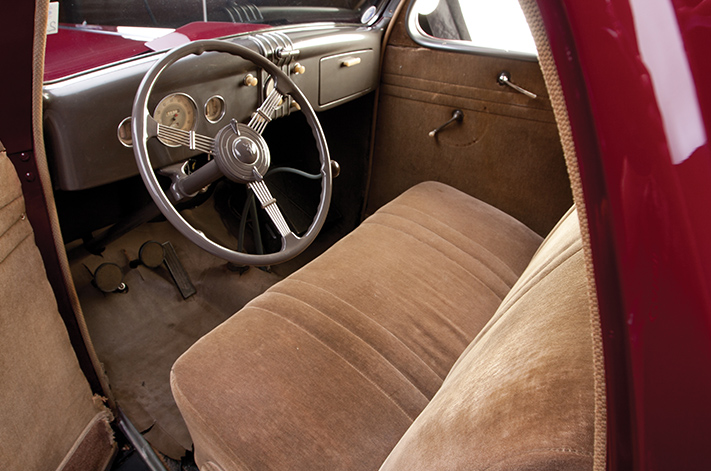
They looked great, too. Most credit for the flowing, Lincoln-influenced lines goes to young designer Bob Gregorie (who would found Ford’s in-house studio in 1935). However, Gregorie worked closely with Edsel Ford, whose refined taste and collegiate approach made him the polar opposite (and some say, the scapegoat) of his hard-nosed father.
From this uneasy father-and-son relationship, however, came a car whose cool style and cheap performance have made it an enduring icon. Think ‘hot rod’ and chances are you’re thinking of a customised creation that started out life as Ford’s pretty little coupe.
Five Fast Facts
1. Beaut Aussie ute
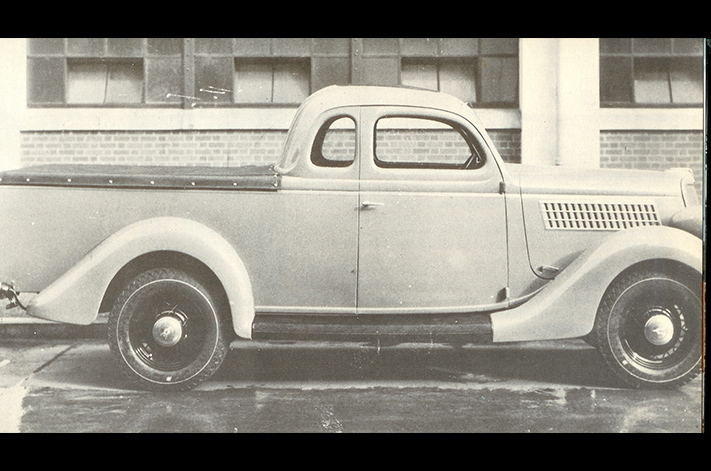
Aussie legend Lew Bandt designed the world’s first ‘coupe-utility’ in 1933, based on a 1932 Ford V8 five-window ‘dicky-seat’ Coupe
2. Movie star
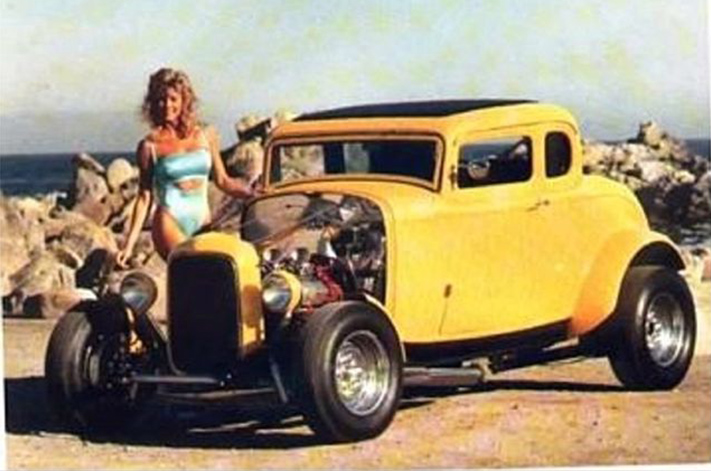
The yellow ’32 Coupe in American Graffiti (1973) is today credited with saving hot-rodding. Yet after filming, the car failed to sell for $1500
3. Heist society
Bank robbers John Dillinger, Clyde Barrow and Bonnie Parker enjoyed the Ford V8’s performance; the latter pair were shot to ribbons in one.
4. Rodding life
The Ford ‘flattie’ ignited the smouldering hot-rod scene, with an industry of performance parts catering for cheap used cars post-WW2
5. Artistic license
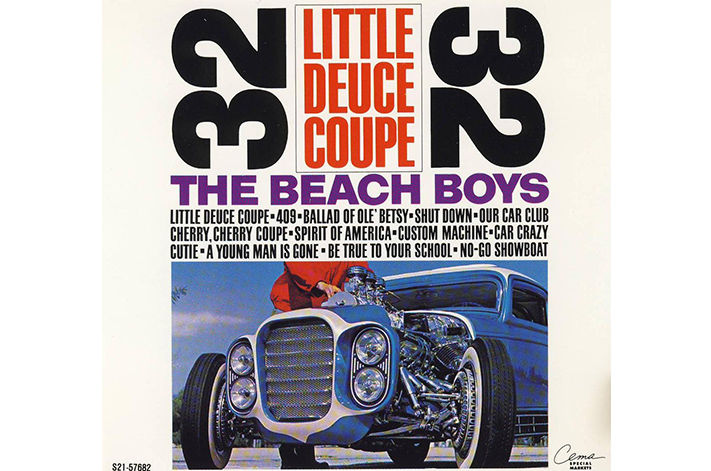
The Beach Boys’ 1963 hit song ‘Little Deuce Coupe’ is about Brian Wilson’s imaginary ’32, “with four on the floor”.
Melbourne might not be hosting the Australian Grand Prix if it were not for Bernie Ecclestone. In fact, there might not have ever been an Australian Grand Prix in the first place if it were not for Bernie.
Ecclestone played an instrumental role in getting Adelaide to stage Australia’s first world championship Formula 1 race in 1985. That’s not to say that if Ecclestone had not been around that Formula 1 would never have made it to Australia in the past 30-odd years, but he was the first person to get the job done here Down Under.
One year later the first Formula 1 race was held behind the Iron Curtain. Bernie did that. The Hungarian Grand Prix, like Australia, is now a fixture on the calendar.
Ecclestone ruled Formula 1’s commercial side for 40 years, and he planned to keep running the show. At the Canadian Grand Prix last June, during the announcement of the new lucrative Heineken sponsorship contract – another Ecclestone deal – he said the news of his retirement would be broadcast from the funeral parlour.
As it turned out that announcement came early this year on January 23, which was just days after the Federation Internationale de l’Automobile (FIA) had announced that it had approved the sale of the majority of Formula 1’s commercial rights to Liberty Media. Initially it was believed that Liberty would give Ecclestone, now 86, a three-year contract to continue to run the business just as he had done for the previous owners including the most recent one – CVC Capital Partners.
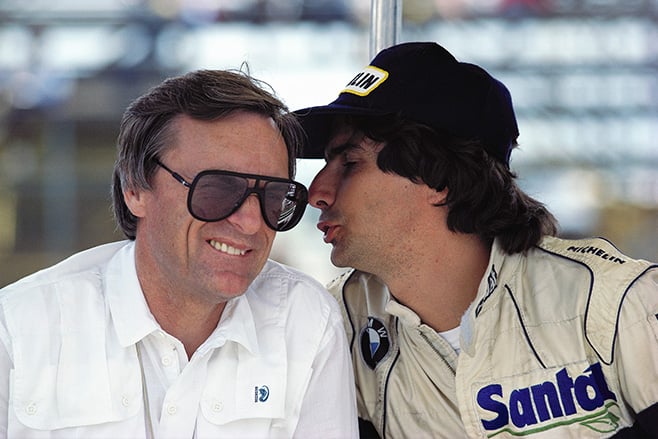
Liberty gave Ecclestone the role of Chairman Emeritus of Formula 1. He can offer advice but he can’t conclude deals, and Bernie has thrived on making deals. He is the one that turned the sport and business into a multi-billion-dollar global affair. And he helped turn the Formula 1 brand into a household name rather than something only known to racing fans.
With marques like Alfa Romeo, Maserati, Ferrari, Lotus and Honda, and big name teams like BRM, Cooper, Tyrrell and McLaren, it’s not like Formula 1 was just a bunch of amateurs messing about with racing cars before Ecclestone started to take over.
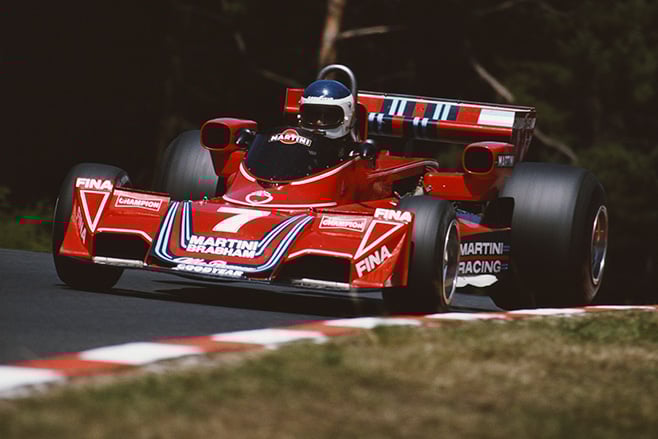
Yet when it came to maintaining power and control, such as when a majority of the teams planned to strike off on their own with the Formula One Teams Association (FOTA) in 2009, Ecclestone deployed another favourite weapon in his powerful arsenal – divide and conquer. He did individual commercial deals with first Red Bull and then Ferrari. FOTA crumbled.
Still, along with his wheeling and dealing on a global scale, Ecclestone was, and is, a racer. For all his ruthless negotiating, he loves the concept of drivers and cars competing on the track.
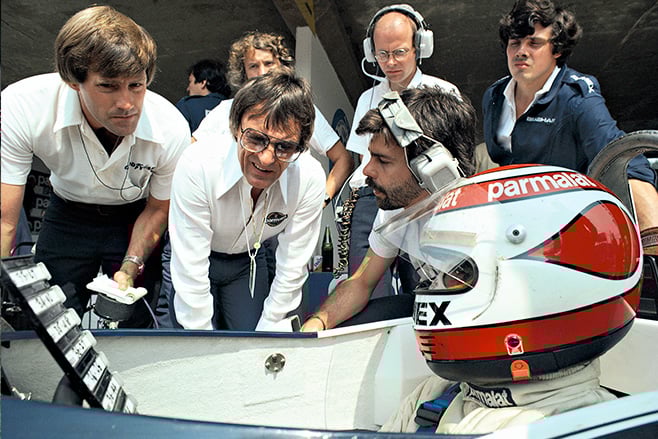
In 1957 he bought the remnants of the Connaught Formula 1 team, and he tried and failed to qualify one of the cars in the 1958 Monaco Grand Prix. Stuart Lewis-Evans, who drove for the team and was managed by Ecclestone, died of severe burns suffered in a fiery accident in the 1958 Moroccan Grand Prix. That prompted Ecclestone to retire from driving for good and to walk away from racing.
Ecclestone returned and became the manager and friend of Jochen Rindt only to suffer more grief when Rindt died in a crash during practice for the 1970 Italian Grand Prix. One journalist recalls seeing the sad figure of Ecclestone walking from the accident scene back down the Monza straight to the pits carrying Rindt’s helmet.
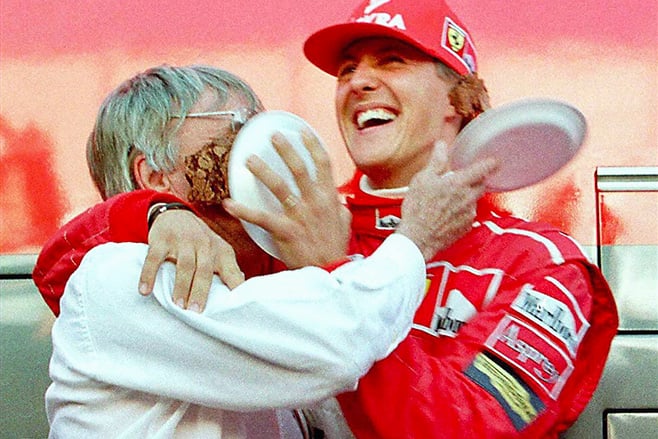
Meanwhile, Ecclestone was becoming a mover and shaker and taking the first steps that would make him a billionaire and the boss of Formula 1. The basic idea of a teams’ union had been in place already, but Ecclestone and other team bosses formed the proper Formula One Constructors’ Association (called F1CA and later FOCA) in 1974. Ecclestone turned it into a force to be reckoned with. In the early days each team negotiated individually with each track organizer for starting money. Ferrari could command a lot of dosh while a small team had to settle for the dregs.
Ecclestone banded the teams together and offered the tracks an all-of-us-or-none-of-us proposition. Naturally, he kept raising the price, but FOCA also guaranteed the tracks a full field of cars and drivers.
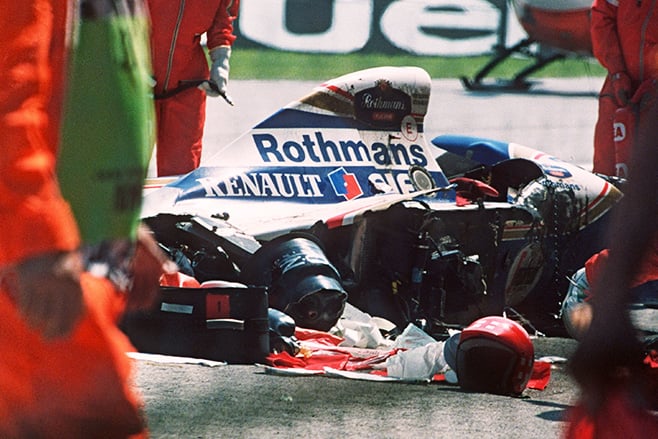
Things were finally settled in 1981 with the Concorde Agreement, a document that exists to this day and stipulates how the sport and business are run. The basics were that FISA ran the regulations and technical side of things while Ecclestone ran the commercial business.
Ecclestone was one of the first to recognise how lucrative television would be, and he set off doing deals with various broadcasters around the world. He also became involved in advertising, sponsorship and hospitality at the race tracks, effectively freezing out the organisers and taking all the money. And, of course, he kept increasing the fees those tracks had to pay to get a Formula 1 race – the standard contract still calls for a 5 to 10 per cent raise per year. How many other businesses can claim that sort of guaranteed growth? The only way the tracks could make money, and this still holds true today with current venues, was by raising ticket prices for the fans and by calling for government funding.
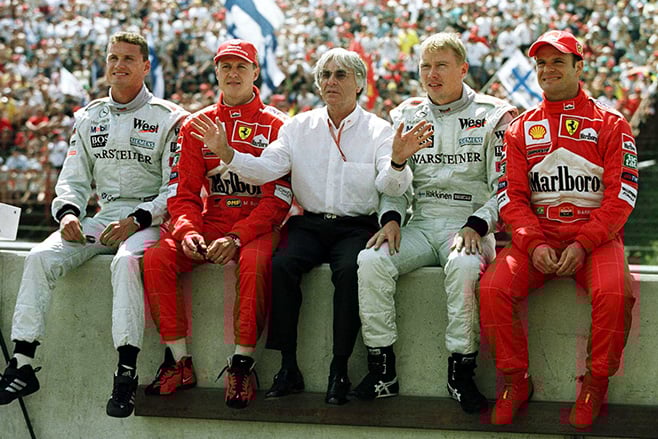
Still, the team bosses and drivers were earning money, and quite a few were becoming millionaires. Ecclestone, meanwhile, was becoming a billionaire.
In 1996 he paid the FIA a measly US$360 million for Formula 1’s commercial rights for 100 years. He then set about selling shares. That was something he later would say was one of his biggest regrets. It started in 1999 when Morgen Grenfell Private Equity bought 12.5 per cent. Over the years a number of different banks and investment companies, some of which went out of business along the way, bought shares. In 2005, CVC Capital Partners became the major stake holder with 63.4 percent.
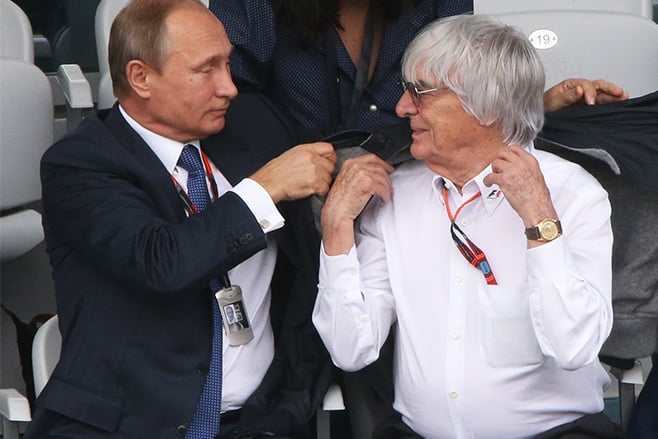
Throughout his ruling decades Ecclestone continued to expand Formula 1 into different countries while at the same time culling some of the traditional European races. His ventures did not always pan out. Races in places such as Korea, India and Turkey eventually failed.
Ultimately, trying to ram Formula 1 down the throats of people who knew little about the sport but were asked to pay high ticket prices just didn’t work. But there have been hits from Australia to Singapore to Mexico to Japan and, while it took time, China. The jury is still out on Russia. Other events like Bahrain and Abu Dhabi are cash cows that add considerably to Formula 1’s profits.
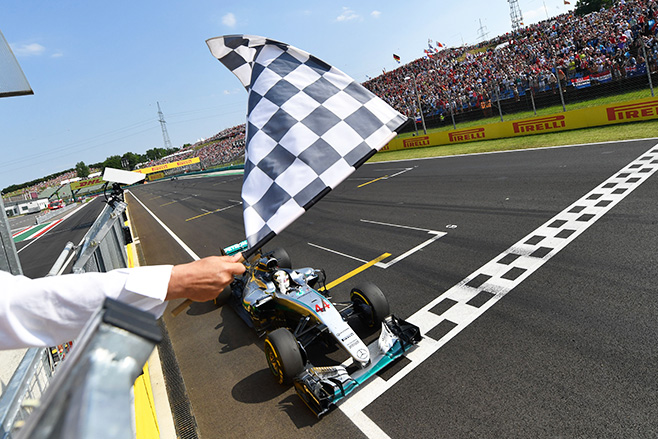
His “women should be dressed in white like all other domestic appliances” remark did not go over well, nor did his praise for Adolf Hitler for being “able to get things done,” nor his statement that “democracy … hasn’t done a lot of good for many countries” including the United Kingdom. Ecclestone’s close association and praise of Russia’s President Vladimir Putin hasn’t made him popular in some quarters.
Ecclestone’s vision and drive and tactics were very effective. But, as Chase Carey says, things have stagnated in the past few years. Television viewing figures are down, and Ecclestone has shunned social media which has changed the world.
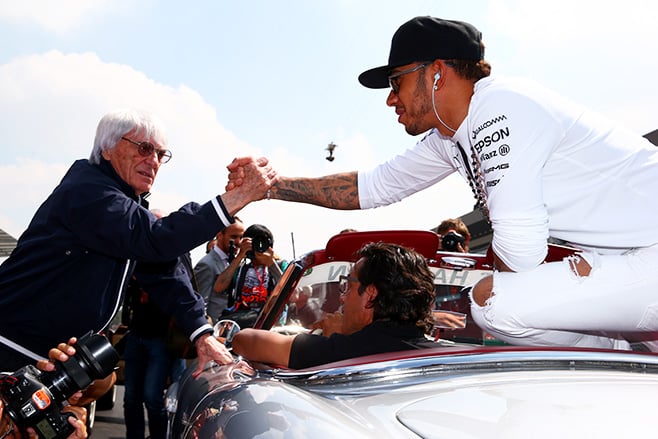
Grand Prix racing has been around for 100 years, and it will exist in some form or another for a long time to come. For 40 of those years Bernie Ecclestone ruled and expanded an empire into what it is today. But the time has now come to say goodbye to Bernie.
The Era of Ecclestone
The life and times of F1 and its most influential figure
1949 READY TO RACE Ecclestone takes to the track and races a 500cc Formula 3 at Brands Hatch
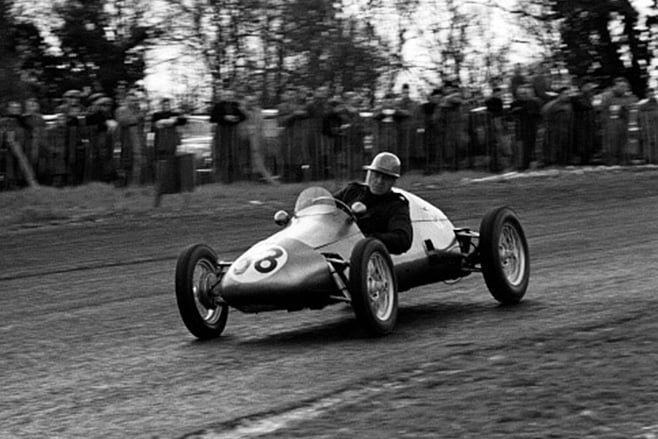
1970 LOSS OF A MATE Manager and friend of Jochen Rindt, his death takes a toll and leads to Bernie leaving racing
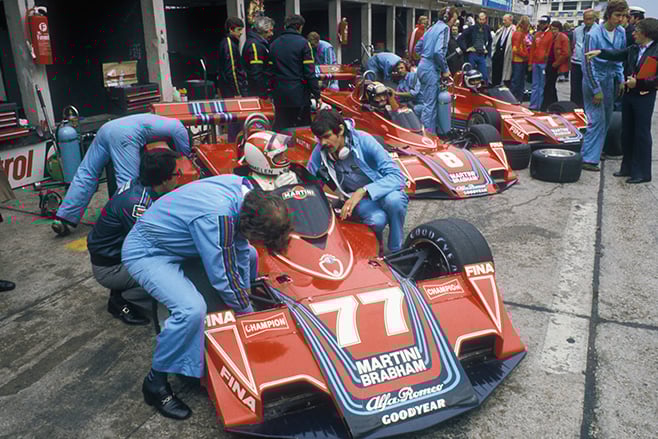
1978 BACK IN THE GAME Ecclestone buys the ailing Brabham team for £100,000, but endures an unsuccessful 1972
1974 TOP OF THE PODIUM The South African GP is the first win for Bernie’s Brabham with Carlos Reutemann at the helm
1978 TAKING THE LEAD Bernie becomes chief executive of FOCA and battles with FISA head Jean-Marie Balestre
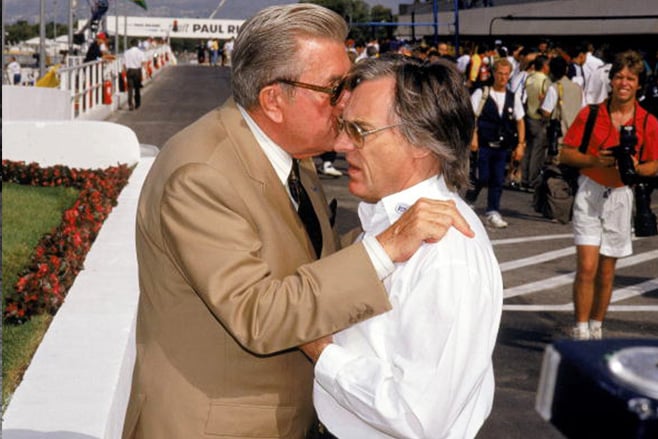
1985 LAND DOWN UNDER Bernie leads the charge to bring F1 to Adelaide. Senna claims pole, but Keke Rosberg wins
1987 CHANGE IN FOCUS Brabham is sold for more than $5m so that Ecclestone can ramp up his F1 involvement
1994 DEATH OF A GREAT Senna’s family did not allow Ecclestone to attend the funeral after the fatal crash at Imola
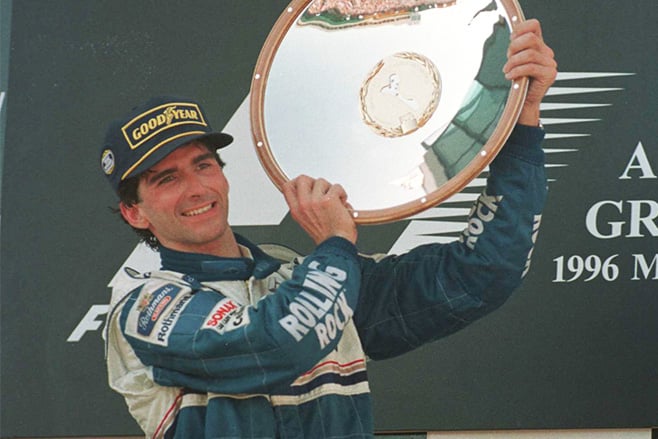
2005 ON DANICA PATRICK “Women should be dressed in white like all the other domestic appliances”, Bernie said
2015 SCHUMACHER VISIT “I don’t want to see Michael like that”, Bernie said on why he won’t visit the F1 great
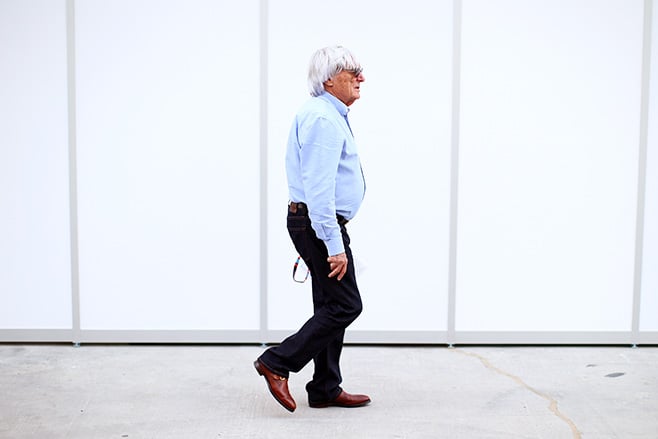
Post Bernie, Now what for F1?
CVC Capital Partners, the most recent majority shareholder of F1’s commercial rights, was happy to sit back and rake in profits while letting Bernie run the business. The new majority stakeholder Liberty Media plans to take a much more proactive role. Yes, Liberty is in this to make money, but it also plans, unlike CVC, to invest, improve and expand the entire Formula 1 product.
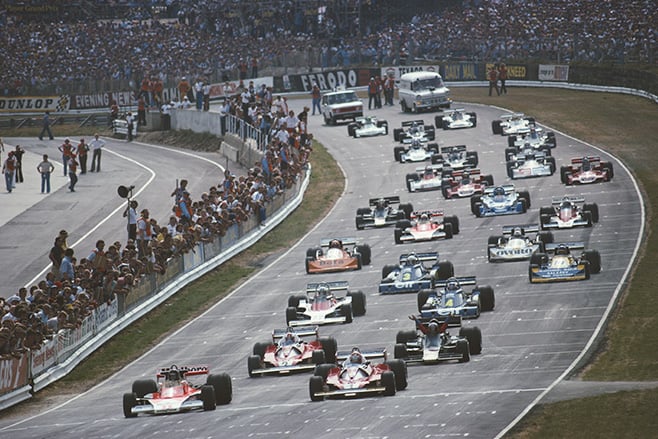
Such was Ecclestone’s control over Formula 1 that Liberty had to put in three people to take over his tasks. Liberty Media’s Chase Carey became the Chairman and CEO of Formula 1, former ESPN marketing executive Sean Bratches is the new Managing Director of Commercial Operations and former F1 technical director and team boss Ross Brawn became the Managing Director of Motorsports.
Carey detailed his plans for a two-prong strategy. “One,” he said, “put an organisation in place that lets us make these events everything they can be, reaches out to digital media that we’re not connecting to today, build an organisation that connects with the fans and enables the fans to connect with the sport.
“And, on another level, to really build a spirit of partnership with our teams, promoters, sponsors and broadcasters that will enable us to work together.” That vision differs considerably from CVC’s profits-only strategy of the past. Indeed, interesting times ahead for F1.
It may seem somewhat illogical for someone who works as a motoring journalist, but I donu2019t own a car. A shocking and possibly damning admission, I know, but before I get thrown to the wolves, let me explain.As a cash-strapped uni student my beloved first car (a faithful 1993 Toyota Corolla) had to be sold. But my aversion to any form of public transport meant I needed another means of getting around, and I sure as hell wasn’t about to go slip on the lycra. So I ended up cutting through traffic on a motorcycle. Starting full-time work might have meant rejoining the four-wheeled community, but the extreme cost of living in Sydney (or too much smashed avocado if one of Murdoch’s papers is to be believed) meant that didn’t happen – although I did purchase another motorbike…
Now that I feed my smashed-avo habit by writing about road cars (as opposed to motorsport), it’s only right and proper I have four wheels permanently placed in my garage.
“I’ve found you a long-termer,” chirped Nathan Ponchard down the phone after a particularly long day in the office.
Brilliant! The reign of the week-long press vehicle was finally over, and I could build a proper relationship with a car.
“And it has a bodykit!”
Ha! Take that riding in Melbourne’s constant miserable rain.
“And a turbo!”
I could already see myself as the new king of the Oakleigh traffic-light grand prix.
“It’s a Suzuki Baleno…”
I think Ponch meant that final remark as a punchline after building up my hopes for a high-powered, tuner missile. But he read me wrong. I was, and remain, genuinely excited about what is now my little Suzuki Baleno.
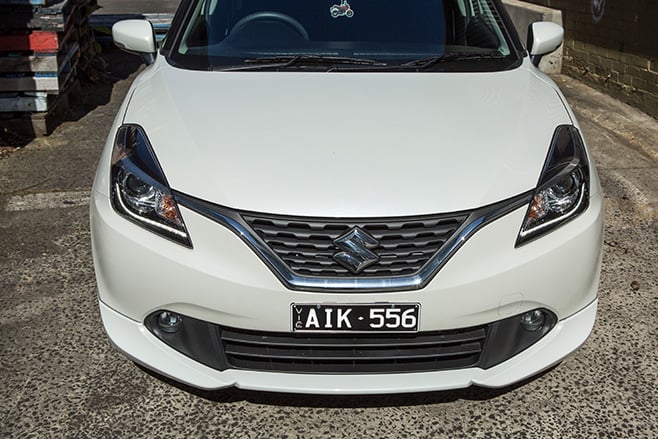
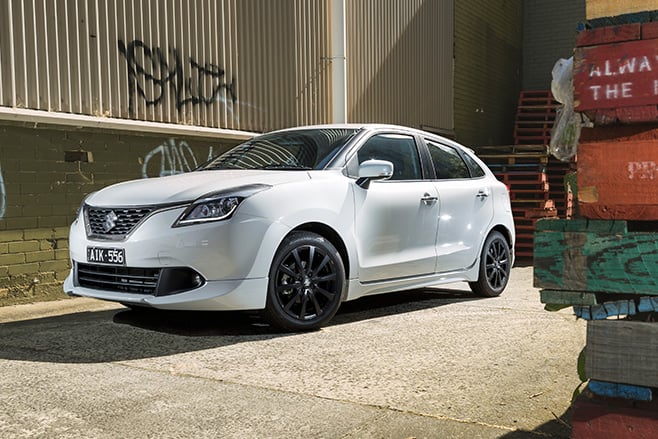
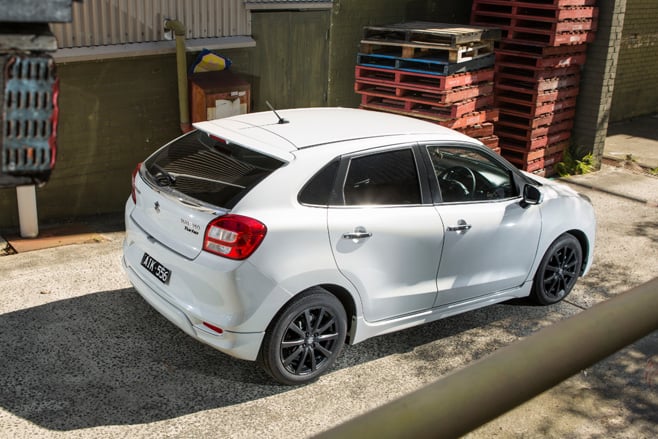
The white body over black rims is a classic look, and a winner with me. As for the bodykit, while some people say they find it a tad tacky, I adore it. Perhaps it’s because my favourite film is The Fast and the Furious (not everyone got to grow up with Bullit, okay?), but I think the lip and side skirts add flair without making the styling too aggressive.
I’ve had the keys in my hands for little more than a week, but the Baleno has already been affectionately nicknamed (Bailey) and there are some clear observations, such as an interior that has more plastic than a Hollywood surgery.
But funnily enough I’m still enjoying my time rolling in the Baleno. The infotainment system is intuitive and easy to operate, the seats are relatively comfortable (if a bit on the firm side, and the seating position could be lower) and the audio is above par for a car that retails from $21,990.
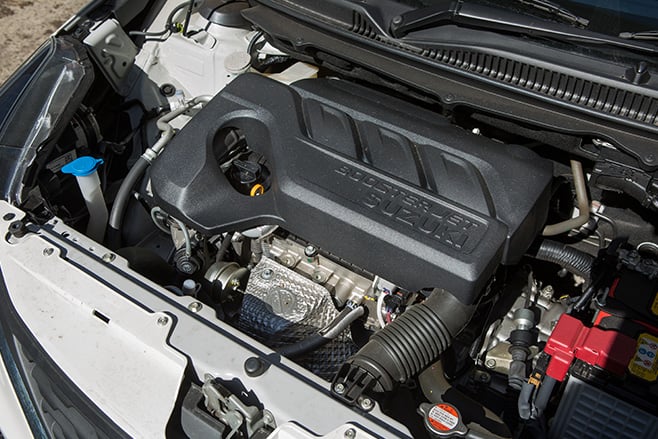
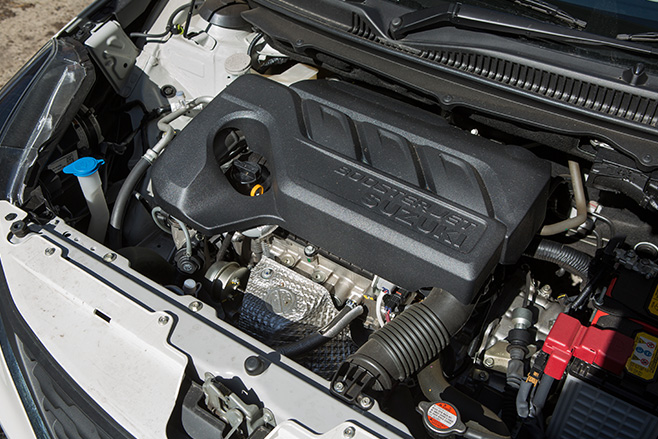
The 1.0-litre three-cylinder turbo is dwarfed in the engine bay, where it sits on plastic engine mounts. Eek! However, it shifts the plucky Baleno along nicely. It’s not thrust-mode acceleration, but neither would you call it lethargic. There’s very little lag from the turbo, though inputs through the accelerator pedal aren’t always instant, which is infuriating. I wouldn’t accept the same standard of response from the brakes, so why should I cop it from the throttle?
From my rather short work commute, and a few brave trips to the fearsome Chadstone Shopping Centre car park, Bailey the Baleno has impressed me as a fun city runabout, with serious potential. But will the doe-eyed affection last as our relationship develops? Here’s hoping.
Update #2
Humans are said to be creatures of habit, and I’m unashamedly a living embodiment of that statement. I will get up every morning at the same time, complete the same morning routine, which includes eating the same breakfast I have consumed since before I attended primary school, take the same route to work and park in the same car park. I could plot my daily routine on an Excel spreadsheet.
This monotony is broken only on the hallowed weekend when alarm clocks are outlawed, breakfast can be a lottery, and a plan for the day can be as simple and carefree as “let’s just see what we feel like”.
Repetition is handy when testing cars. Hitting the same pothole every day in different vehicles will tell you a lot about how different suspensions soak up bumps. But sometimes you just have to say “screw the beaten path” and do whatever you feel like.
It was time for the Suzuki Baleno to break free from the weekday commute and get out into the countryside. With the girlfriend in the passenger seat, favourite music playlist at the ready, fuel tank filled to the brim and snacks prepped, we headed off for a 600km drive via the Dandenongs. Aside from a rough list of roads I wanted to travel, there was no plan, and it was glorious. Both the Baleno and myself revelled in just seeing where each country road took us, doubling back on our own route to discover another new piece of fine twisting bitumen.
While I enjoyed the freedom, the Baleno took the curves in its stride. This turbo-triple-cylinder hatch makes a rather capable hill-climber, though after re-setting its trip computer, I noted its economy soared into the 10s in even lightly spirited driving.
The Baleno doesn’t wallow around like you might expect, instead holding its line admirably. And while the steering is electrically assisted – and not universally praised – I really rated its feedback and feel.
The biggest letdown of the entire day was the Suzuki’s seats. It wasn’t a lack of comfort – you could tour all day in the Baleno GLX just fine – but there is minimal lateral support, leaving you (and the missus) sliding all over the place through twisty mountain passes.
With the day wrapping to a close, in a moment of contemplation overlooking Bonnie Doon, my girlfriend couldn’t hold back a cliched quip: “How’s the serenity, darl?”
On a day like this, with a car as eager as the Baleno GLX, on roads as brilliant as these, with company like that? Almost as good as a well-priced pair of jousting sticks.
Siri, please…
When it comes to navigating my new city, I’m spoiled for choice in the Baleno. Satellite navigation comes standard, Apple CarPlay means Apple Maps is thrown in, or I can use Google Maps through Bluetooth or auxiliary audio with a phone app. You’d wouldn’t expect much difference between the three, but you’d be wrong. After much experimenting, I’ve abandoned the standard sat-nav and Apple Maps – visual aids aren’t much help if the suggested route is terrible – in favour of Google Maps, regardless of the fact it has audio guidance only.
Update #3
“HAIL Mary full of grace, please find me a parking space.” I’m not a religious bloke, but I’ll recite a small prayer to any deity that feels like listening if it helps me find a parking spot in the madness of going hunter-gatherer grocery shopping.
Thankfully, the Suzuki Baleno makes life amidst the madness that is a Westfield parking station a little easier. A while back I had attempted to run some errands in an Audi RS Q3 whose keys were thrown in my direction for the weekend. An SUV, yes, but with a 4410mm length, not exactly gargantuan. However, the Audi’s moon-sized 12-metre turning circle forced me to abandon the venture in sheer white-hot frustration before it had even begun.
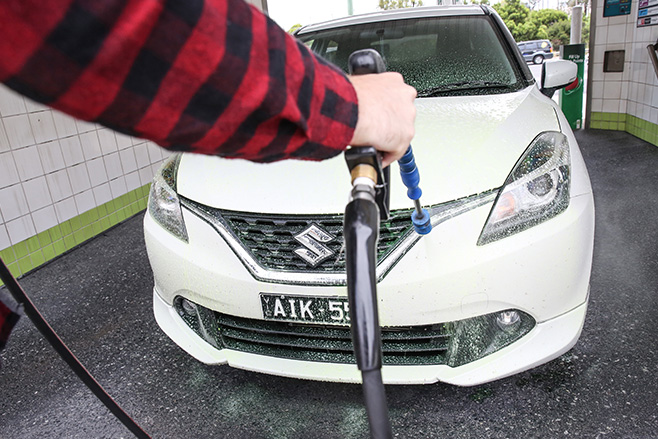
Not so in the Suzuki. Its abbreviated length means it can carve up the carpark with ease. The Baleno’s sole weakness in the madhouse of the underground is its low-geared steering rack, which requires much wheel-twirling. But once you’re at full lock, the little Suzuki has a tight 9.8-metre turning circle. That’s identical to a Mazda 2 on 16-inch wheels.
With a reversing camera as standard, parking the Baleno GLX is a no-brainer for even the most dent-prone driver.
The Baleno is an outsider in the light-car schoolyard, too pudgey to hang with the svelte superminis like the aforementioned Mazda 2, and not able to rub shoulders with the bigger, more gym-prone small cars like the Volkswagen Golf. It sits somewhere in the middle, and that pays off in the concrete jungle. Its 1745mm width meant I wasn’t having to play vertical limbo to squeeze out of the car to avoid smashing my door into the neighbouring vehicle.
Conversely, when transporting co-workers who took part in last month’s small-car megatest, it was remarked how much room was available in the rear-seats compared to some of the vehicles from that comparison.
With a girlfriend who lives interstate I am left to shop for one, which means I never come close to filling the Baleno’s 355-litre boot size. The rear space has great depth, but not a huge amount of length, so you will have to stack items in larger loads. You have to be careful which order you load your groceries unless you want a raw tomato sauce hand squeezed by an oversize Milo tin.
It hasn’t all been happy times with the Baleno. The throttle tip-in is frustrating,
as there’s a dead spot of travel before the by-wire set-up seems to make a connection with the engine and you’re jolted forward. Is this a fuel-saving measure? Whatever it is, it makes stop-start traffic a hassle.
Update #4
By Tony O’Kane
I’VE BEEN eyeing off Kirby’s long-termer for a while now. Admiring glances in the car park quickly turned to a full-blooded longing to get behind the wheel of his turbo-triple Suzuki Baleno and now, with him out of the state to visit his long-suffering girlfriend and family for a couple of weeks, I finally get my wish. Time to snatch the keys.
Full disclosure: I have a thing for Suzukis. No other manufacturer seems to inject its automotive offerings with as much charm as the little company from Hamamatsu, Japan. Being principally concerned with making motorcycles – perhaps the most emotionally engaging machines of all – probably helps Suzuki give its road cars a similar warmth, even something as prosaic as the grocery-getting Baleno.
You know what else helps? A thrummy three-cylinder engine with a turbo bolted to the side. Chest-thumping, V8-loving types may rail against the downsizing trend, but if the result is an engine as willing and lovely as the Baleno’s 1.0-litre turbo, then the future isn’t looking so grim after all.
It is rev-happy, surprisingly torque-laden in the mid-range, and although it has ‘only’ 82kW and 160Nm to play with, those numbers are plenty considering the Baleno’s ballerina-esque 975kg kerb weight. The mantra “Less is More” must be rendered in wrought iron above the gate to Suzuki’s HQ.
There are some flaws, though. The Baleno’s glossy plastic dash looks like it belongs at the bottom of a Dimmeys bargain bin, and that chrome strip across the hatch is an acquired taste. However it’s the steering’s slackness around dead centre that’s a greater irritation, as is the six-speed auto’s habit of slipping its clutch bands after it upshifts into third. The latter would easily be remedied by selecting the manual transmission option … if it actually existed. I’ll let Kirby rant about that topic further, as that particular spec oversight really gets his temples throbbing. Stay tuned.
There’s also the Baleno’s surprisingly fussy ride over small-amplitude, high-frequency corrugations, which is strange as it’s actually fairly plush over bigger lumps. There was also one peculiar moment where the Baleno went into oversteer … while cruising uphill at 60km/h and driving in a straight line. Tram tracks appeared to be the cause, but it’s literally the only car I’ve ever driven that required an impromptu dab of oppo on a dead straight road.
Despite those niggles, the turbo Baleno got under my skin in a good way. Its chuckable chassis, boosty engine and Tardis-like interior are its most endearing facets, and though the overall package could still use some polish, the core of it is solid.
Farewell
IT’S A cliche as an automotive enthusiast and writer to bemoan the downfall of the manual gearbox, and cliches are lazy.
But screw that, because I have an axe to grind, and it requires a third pedal.
The Suzuki Baleno GLX Turbo has a great, rorty engine and is nicely balanced, but the lack of a manual gearbox leaves me severely disappointed. The arduously slow steering ratio and mandatory automatic transmission for this model left me wanting more from what I knew could be a tidy sporty package.
Don’t get me wrong, the automatic shifter mostly performed admirably. But with each drive I was left wondering if I would not be having more fun with an extra pedal. The Baleno isn’t an involving car to drive unless you are on the hunt for the limit, despite an engaging and characterful engine.
The frustrating thing about my gearbox gripe is that despite the number of you who agree with me, the commercial reality is our wishes are unlikely to ever be granted. Suzuki Australia General Manager Andrew Moore told me at the Suzuki Ignis launch early this year that manual gearboxes make up barely five percent of cars sold by the company, and if he had his way the number would be even less as the three-pedalled stock is hardest to move. Consumers just don’t want them.
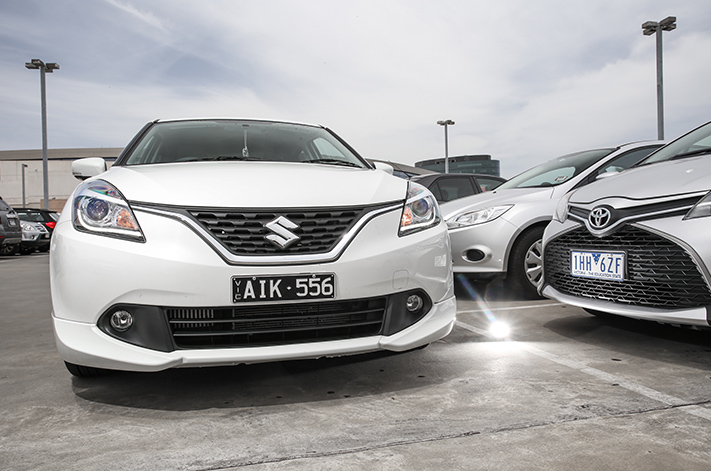
The Baleno’s styling did win me over. Without the bodykit the car is visually a bit beige, but the optional extra bits change the character completely. For young buyers wanting something other than a run-of-the mill Swift, the Baleno adds some extra eye candy (along with bigger boot space), and the optional body styling makes the car stand out from the crowd. If any of my friends were looking for a first car in this segment, but didn’t want one of the staple offerings like the Mazda 2 or Polo (being an individual matters to some), I’d gladly point them in the direction of the Baleno.
One point that must be addressed before the Baleno is farewelled is the issue of its crash rating. Euro NCAP gives the Baleno a three-star safety rating. It’s not Ford Mustang, two-star, headline-making shocking, but something worth investigating and explaining further. The lack of any active safety features like AEB is the main drag on the rating (a 25 percent ‘safety-assist’ result sticks out like a sore thumb), but doesn’t actually affect the way the Suzuki will protect you in the instance of an unavoidable metal-crunching crash. Adult occupant and child occupant results were 80 percent and 73 percent respectively – perfectly acceptable for this class – while for pedestrian safety the Baleno earned a 65 percent rating.
So viewed in a more real-world light, it’s hardly a deal-breaker, but is definitely something worth considering for the more safety-conscious consumer. I’ve been without the Baleno for a few weeks now, and must admit I’ve missed the way it eagerly tipped into corners and navigated tight inner-urban mazes with ease. The infotainment system was intuitive, if not entirely glitch-free (see breakout, above), and the rear seats proved adept at accommodating passengers without turning them into human origami.
But while the Baleno is a well-packaged offering, and a capable city runabout, it couldn’t quite deliver on the fun promised by its brilliant three-pot engine. In my perfect world, the GLX Turbo would have a brother, the Turbo Sport, and that would come with the rims and bodykit as standard, a warmer engine, quicker steering rack, and the option of a manual gearbox. A bloke can dream.
QUESTION – DI:
I need help deciding between the Mitsubishi Mirage, Holden Spark and Suzuki Celerio. It will be used simply to drive to and from work (every two to three days, with a 20 minute distance). The main priority would be price, as it is my first car and I’m not looking for luxury, just one that will safely get me from A to B. Any car brands that will be very expensive to service (eg. Alfa, Merc, BMW) are also off the list.
BUDGET:
$17,000
ANSWER – SAMANTHA STEVENS:
Of the three light city cars you are looking at, the Holden Spark is the strongest.The Holden Spark is a grand plus more expensive, but it offers a higher level of specification with features like sat-nav, infotainment system and streaming personal music as standard feature on even the base $13,990 LS. It also has nice value-add options such as cruise control and front/rear parking sensors, something not often found on budget micros, and is an affordable all-round micro with better than average resale.
The Mirage is a frugal car, with a five year warranty and attractive $12,250 price tag. But you do get what you pay for; its cabin is extremely basic, and its engine in dire need of a bit more grunt for higher speed stuff like overtaking on highways. That said, it is a true city car and its highway kays are likely limited.
The Suzuki at $12,990 is also a good basic car, but its one-litre engine is even more wheezy when it comes to needing some puff. However its cabin dimensions are surprising for its size, and it’s quite a smart little jigger to drive.
Two more to consider are the Mazda2 and Toyota Yaris, which are high quality cars that are easy and affordable to keep, safe, and have great resale. The Mazda2 range starts at $14,990 for the Neo, though we like the Maxx mid-spec vehicle for its inclusions and value proposition, which starts at $17,690. The Neo is pretty basic, and Mazda’s servicing intervals are shorter at 1yr/10,000km, though this should not worry you with the kilometres you expect to travel. It has great handling and dynamics making it fun to drive, practical, it’s frugal, and easy to squeeze into small spaces.
The Toyota Yaris is a stalwart in this segment, and like most Toyotas it is super-reliable, cheap to own and run, and does everything well, and starts at $15,290. Gain the next step up, the SX from $17,330 is the pick in this range. Ultimately, it will come down to your finances and your personal preferences. We recommend you test-drive your shortlist to truly feel comfortable with your choice.
