
Bluelink is a connected-car service offered by Hyundai Australia since 2022, allowing drivers to monitor their vehicle, remote start, and send navigation directions remotely. It also supports SOS emergency calling, geofencing and time limitations. A five-year subscription is complimentary, with further costs yet to be announced.
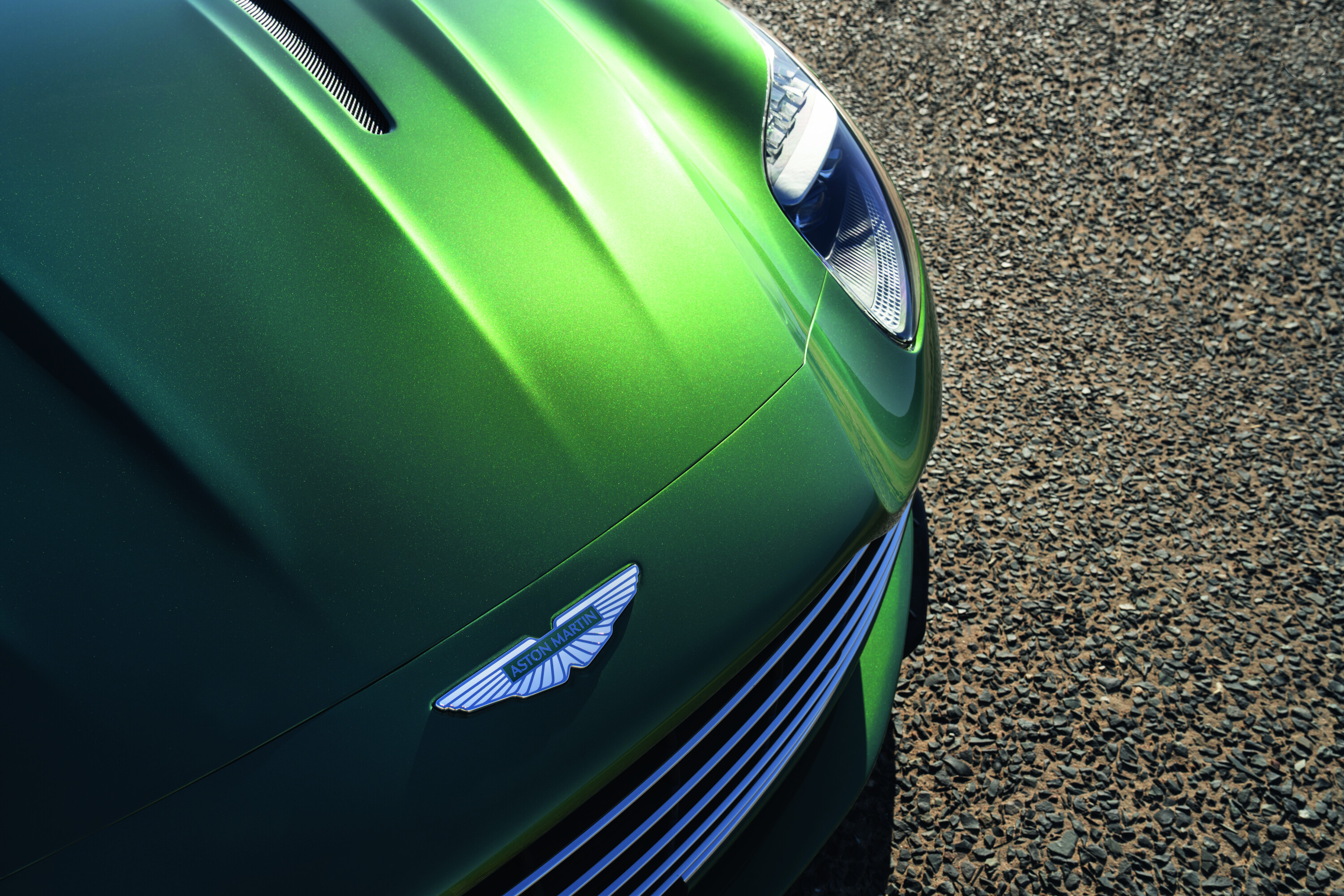
Aston Martin has teamed up with Californian EV maker Lucid for its next generation of battery-electric vehicles.
Snapshot
- Aston to develop EV architecture, first model launching 2025
- Lucid will provide battery and motor tech for electric Astons
- Power could exceed 800kW in some models
Announced at the London Stock Exchange, the partnership means Lucid EV tech will feature on Aston Martin’s new electric platform set to spawn hypercars, sports cars, grand tourers, and SUVs.
Lucid will supply powertrain components such as high-output electric motors, batteries, Wunderbox charging, and inverters. The first vehicle on the new platform is expected to debut in 2025 after the Valhalla hypercar’s 2024 launch.
The agreement is part of Aston Martin’s plan to electrically reinvent itself as part of its sustainable ‘Racing. Green.’ strategy implemented under executive chairman Lawrence Stroll. By 2030, Aston’s goal is to offer an electrified variant of every model.
1
“The supply agreement with Lucid is a game changer for the future EV-led growth of Aston Martin.
“Based on our strategy and requirements, we selected Lucid, gaining access to the industry’s highest performance and most innovative technologies for our future BEV products”, said Stroll.
Aston Martin and Lucid’s partnership will be similar to the current deal with Mercedes-AMG which supplies the ‘M177’ 4.0-litre twin-turbo V8 for the current Vantage, DB12, and DBX.
1
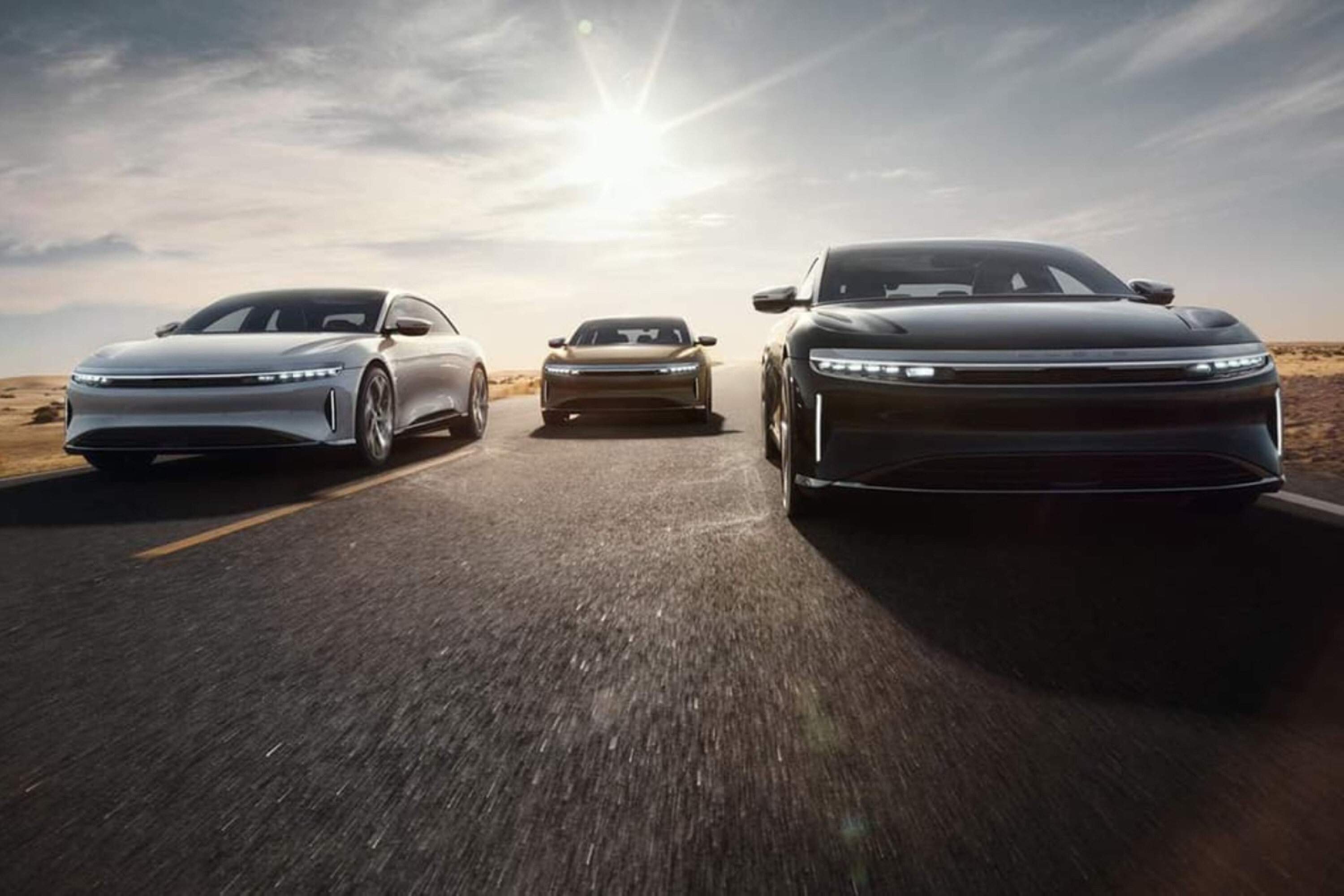
What’s Lucid bringing to the table?
In short, excellent electric goodies with 800-plus kilowatts and four-wheel torque vectoring – and that’ll just be the start. The deal includes both current technology and future advancements, so 1000kW isn’t out of the question.
Lucid offers a barrage of options for the Air, but we’ll talk about the fast one, given Aston’s market standing. Rated at an astounding 895kW, the soon-to-be-released tri-motor Air Sapphire suggests a lot of pace from Aston’s EVs.
Driving range will likely be excellent with Lucid’s 113kWh battery onboard. Although the Sapphire is not yet EPA rated, the ‘lowly’ 783kW Grand Touring Performance is nothing to sniff at with 718km EPA driving range.
Lucid’s ultra-rapid Wunderbox charging technology can add 483km driving range in 20 minutes and will likely feature in Aston Martin’s electric vehicles.
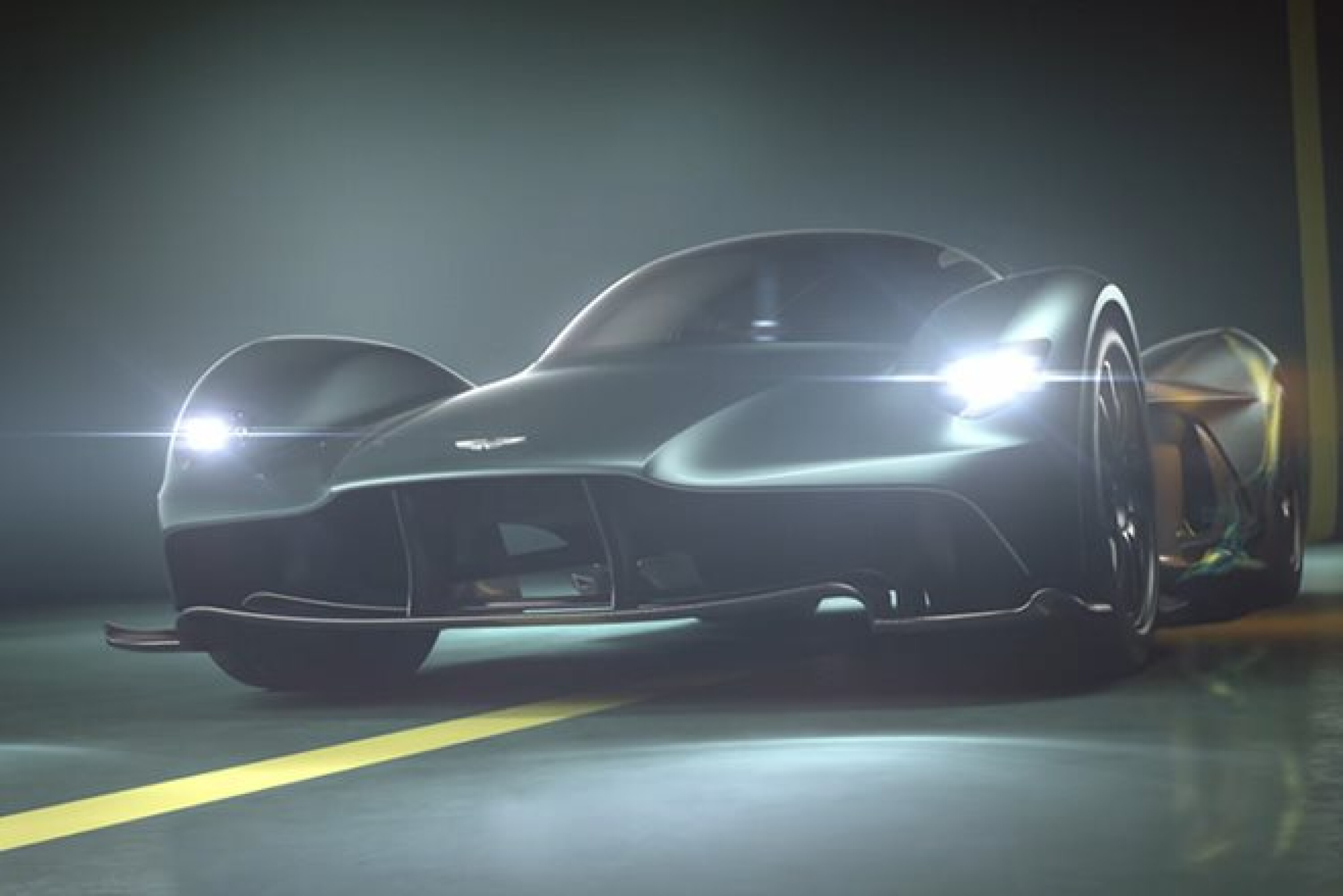
The result will be a selection of new vehicles from Aston, with the first likely to ape the design teaser silhouette (pictured top). It appears to be a grand tourer or sports car, but Aston is yet to provide details.
“The proposed agreement with Lucid forms a significant pillar of our electrification strategy, providing Aston Martin with access to the industry’s leading powertrain and battery systems technology”, said Roberto Fedeli, Aston Martin’s chief technology officer.
1
Aston’s other partnerships continue
Aston will continue working with Mercedes-AMG for combustion technology – Stroll referred to AMG and Lucid as “world-class suppliers” – and the long-term Geely partnership will continue, which ought to help with Aston’s crucial Chinese market penetration.
An agreement with Brembo to develop high-performance brake-by-wire systems to interface with EV regen braking has been put in place, and Aston will play a crucial role in the development of Pirelli’s Cyber Tyre technology.
Naturally, Aston Martin’s F1 knowledge will be put to work with active aerodynamics to increase efficiency and driving range.
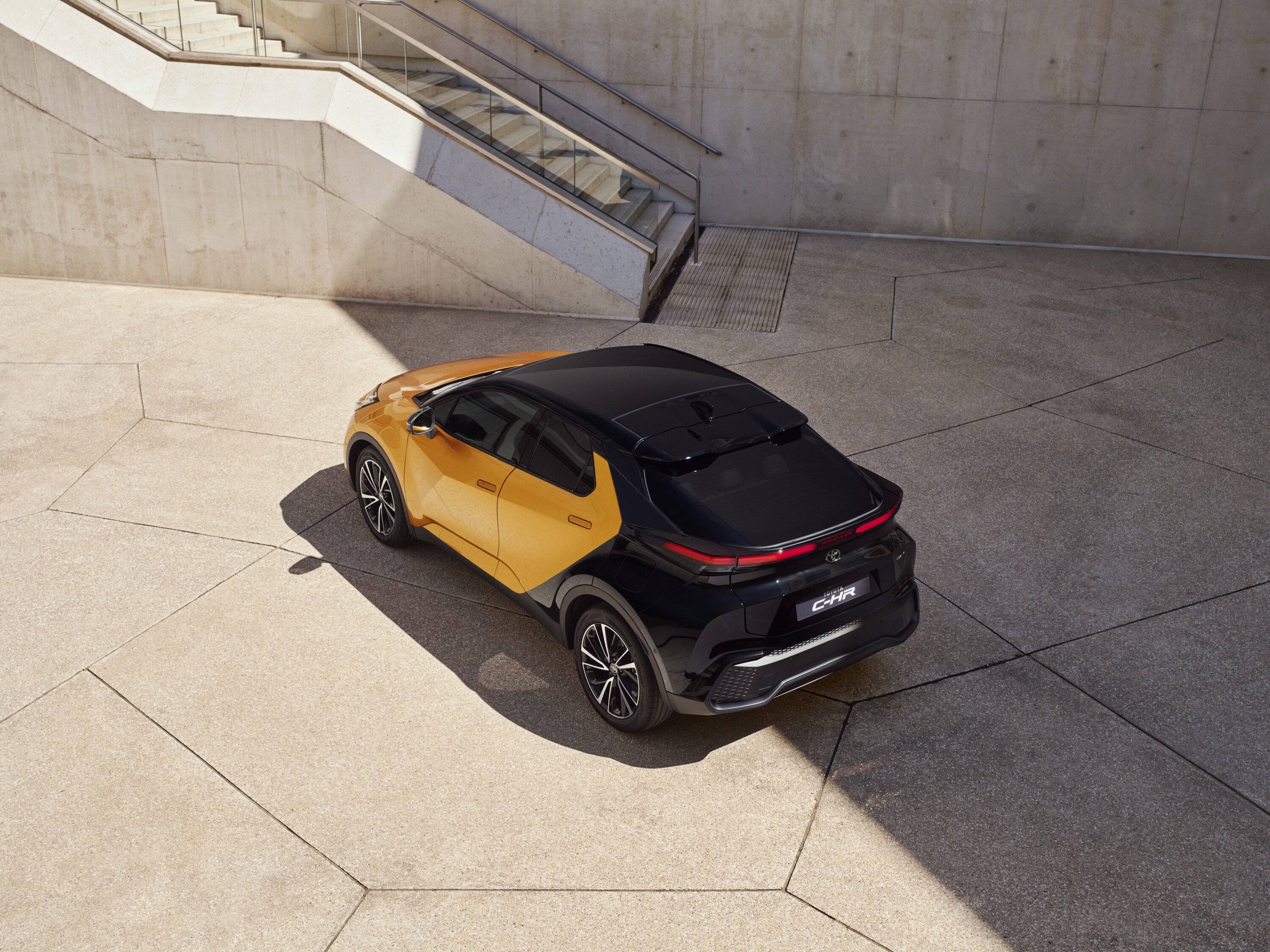
The 2024 Toyota C-HR small SUV has debuted in Europe before its Australian launch in the first half of next year.
Snapshot
- Second-gen 2024 Toyota C-HR small SUV unveiled
- Two hybrid-only powertrains for Australia
- Due here in the first half of 2024
Toyota Australia has confirmed the second-generation C-HR will be available with two electrified powertrains, including a flagship GR Sport with all-wheel-drive.
Petrol-only engines have been ditched globally for the new C-HR, while a plug-in hybrid version is confirmed for Europe – but it is unlikely to reach Australia as a Mitsubishi Eclipse Cross rival.
A Toyota Australia spokesperson said the current C-HR is sold-out, with customers – including recent order holders – encouraged to speak to their local dealer for more information about the new model.
The latest C-HR was designed and developed in Europe, where it’ll also be built. The spokesperson confirmed local examples will be manufactured in Europe – rather than Japan, where today’s model is sourced.
1
Under the skin, the new C-HR is built on evolved TNGA-C architecture, with similar powertrains and technology to the not-for-Australia Prius small car.
The new C-HR will be offered in three familiar variants in Australia, with a more-powerful 1.8-litre hybrid and front-wheel-drive for the GXL and Koba.
A 2.0-litre hybrid will feature in the range-topping GR Sport variant with all-wheel-drive.
1
The outgoing C-HR offered a 1.2-litre four-cylinder turbo-petrol or a 1.8-litre petrol-electric hybrid borrowed from the Corolla.
Last year, the hybrid powertrain accounted for 44.1 per cent of C-HR sales in Australia, split between the Koba (84 per cent) and GR Sport (16 per cent) grades.
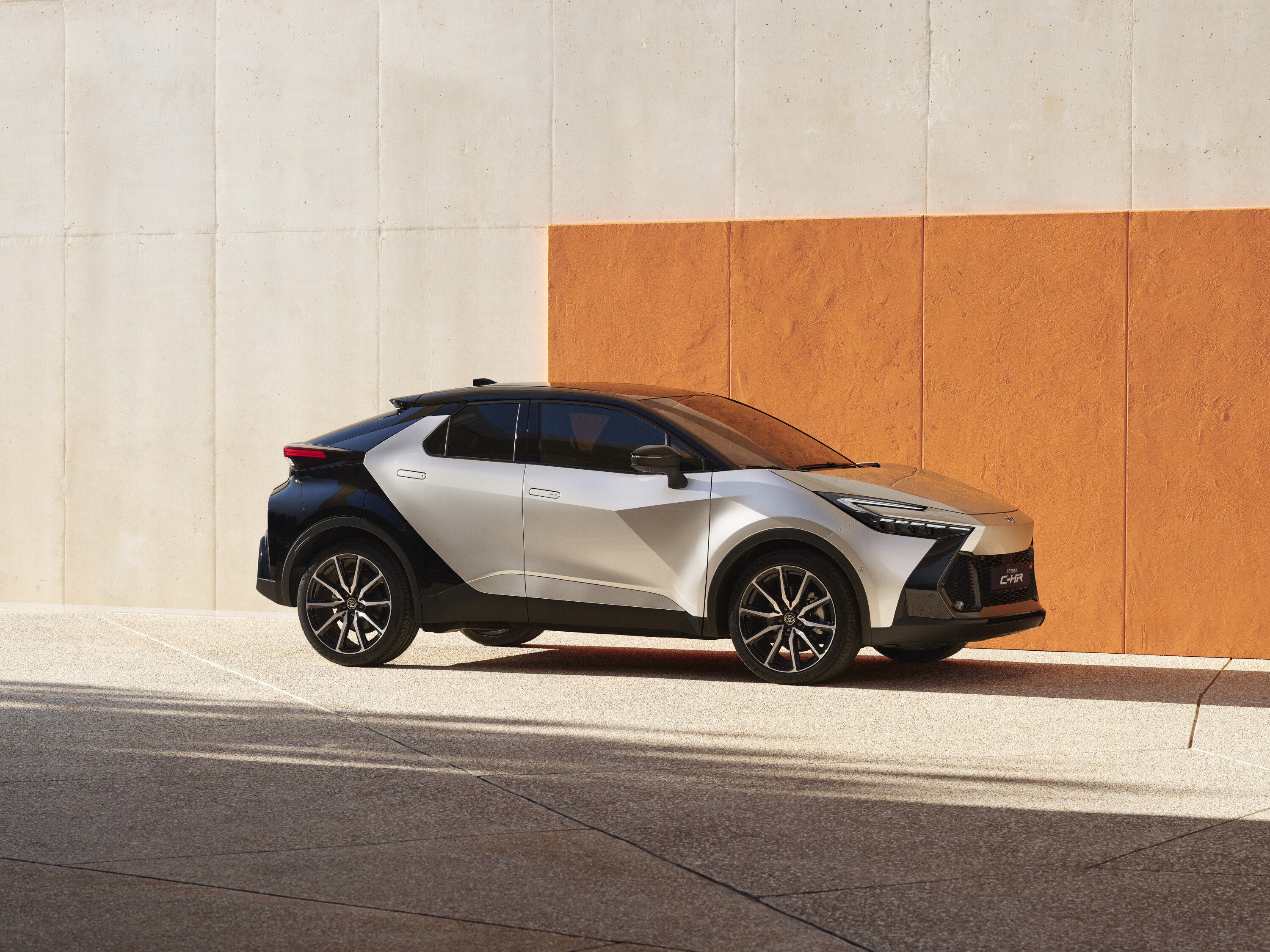
Measuring 4360 millimetres long, 1830mm wide and 1558 to 1564mm tall, with a 2640mm wheelbase, the new C-HR is 30mm shorter than before – but it is 35mm wider and similar in height, with an identical wheelbase.
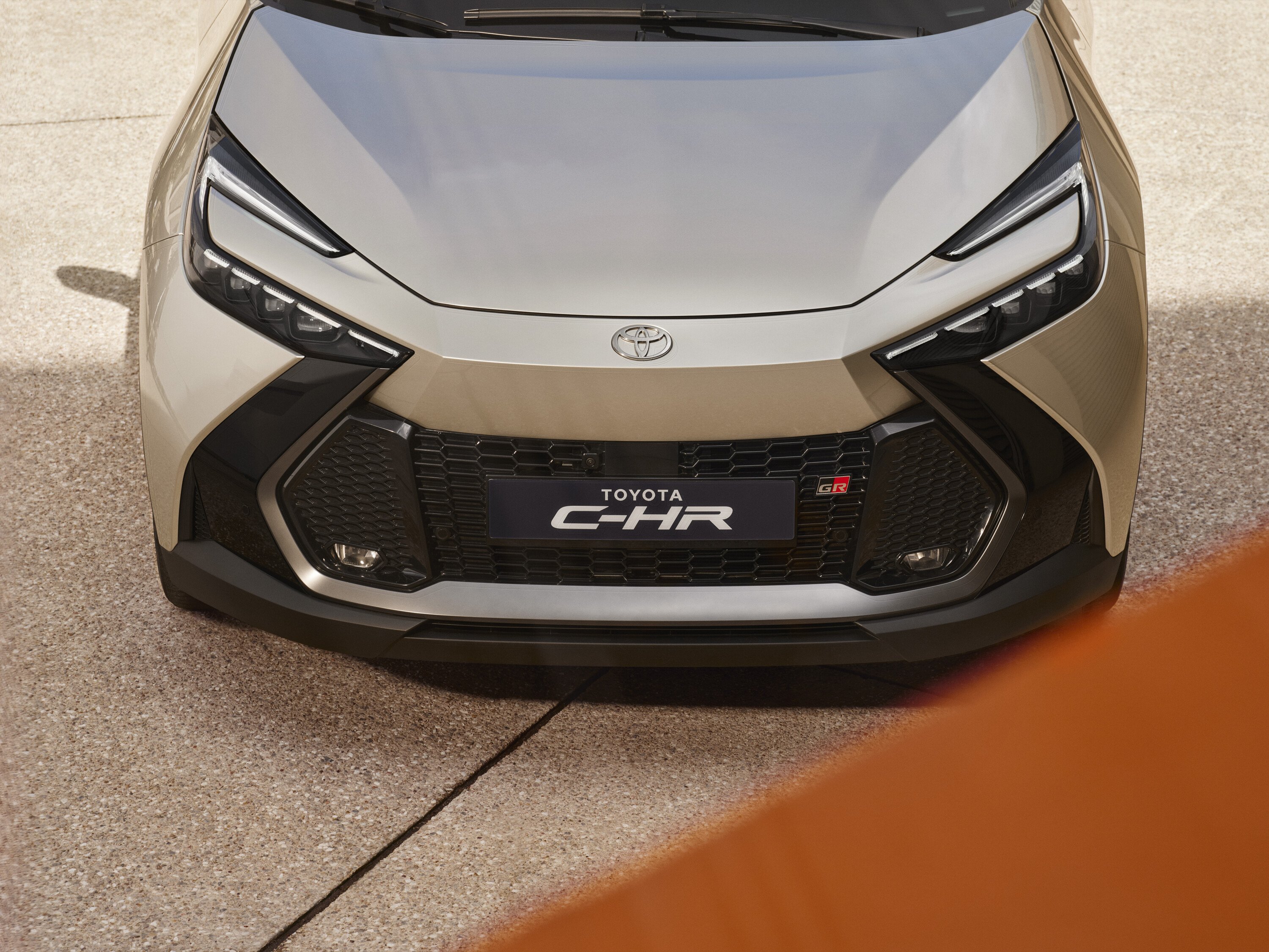
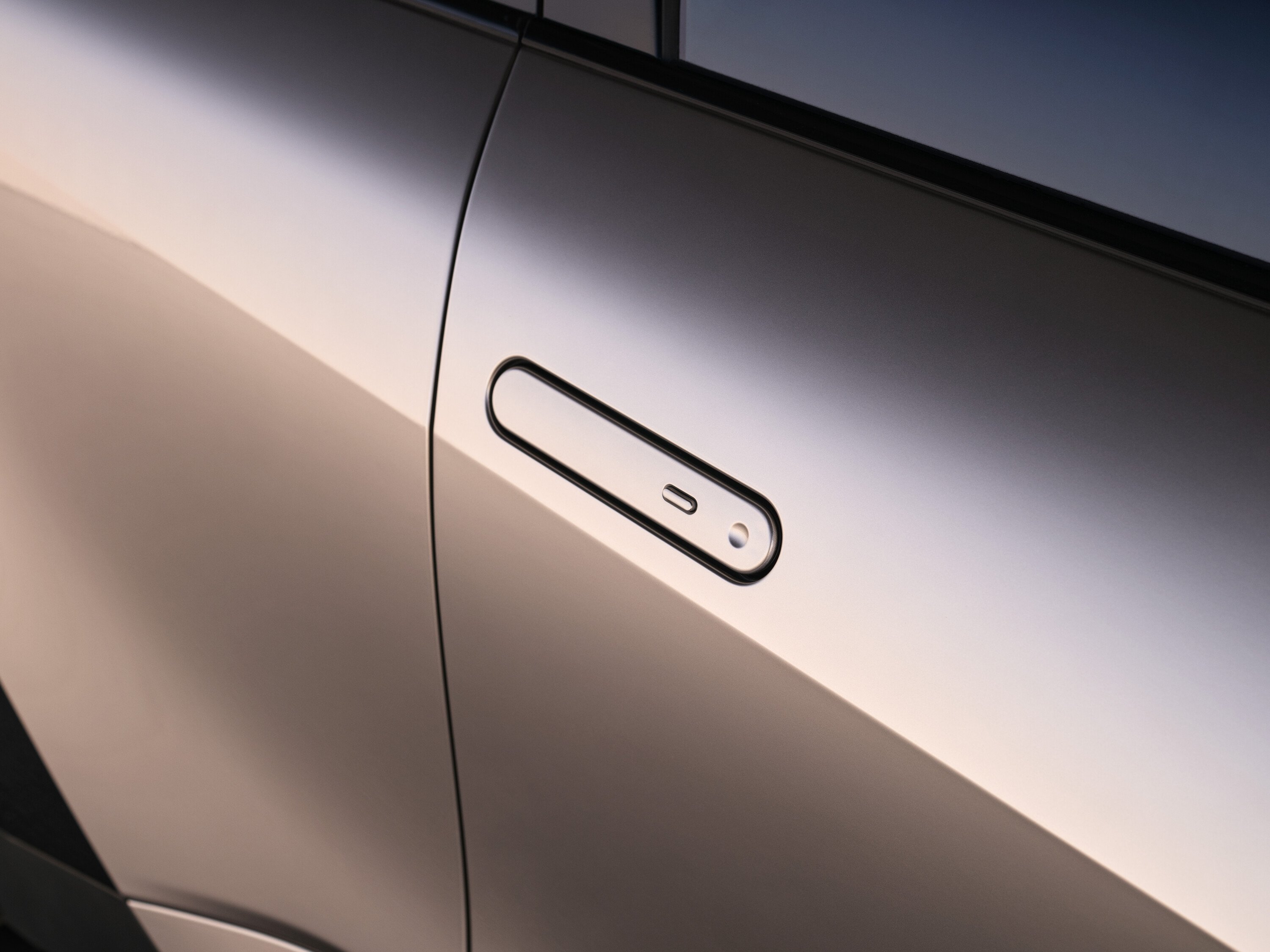
As a toned-down version of the C-HR Prologue concept unveiled in late 2022, the production version retains its two-tone look, with Toyota-first pop-out door handles and an LED light strip at the rear with illuminated red centre badging.
1
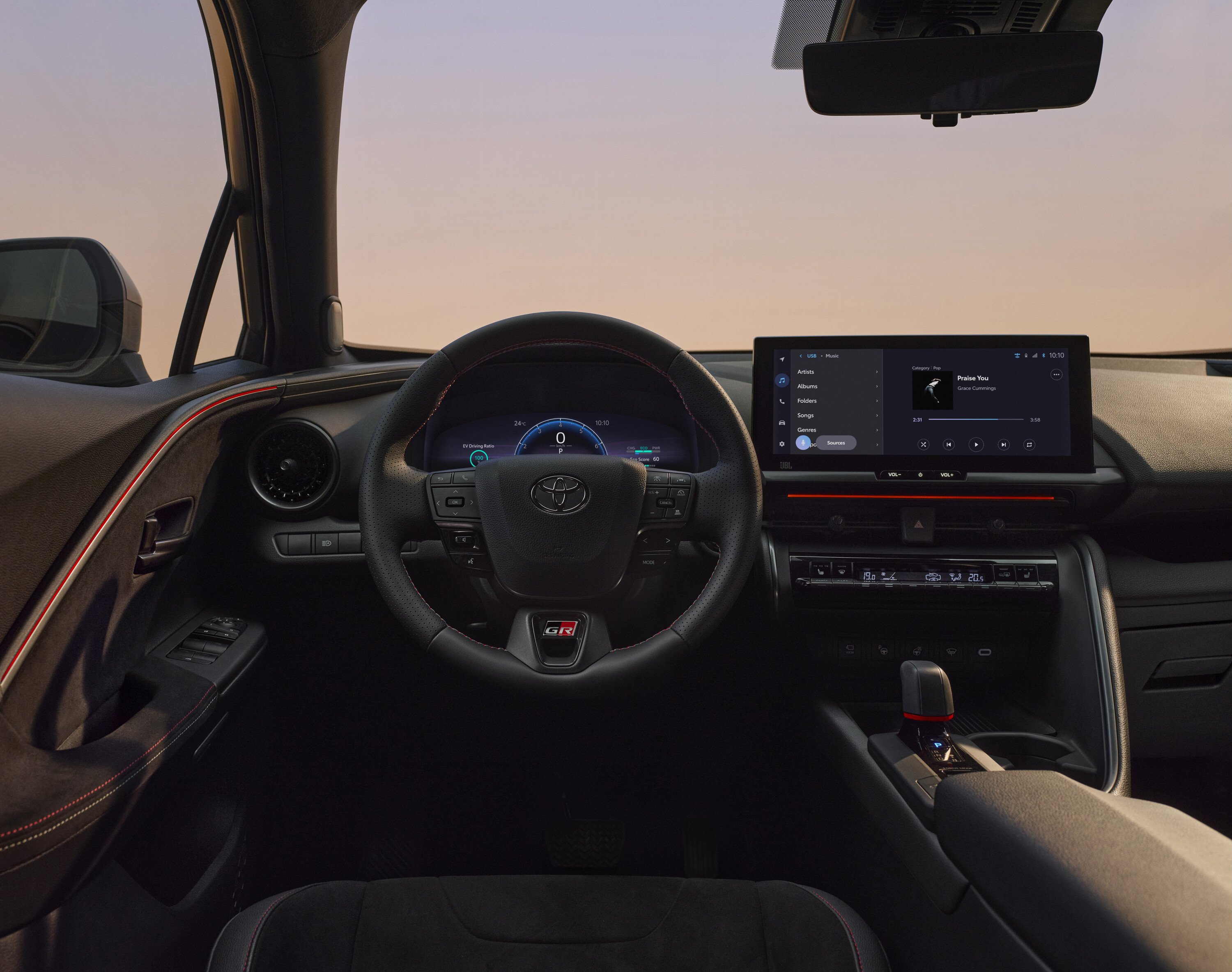
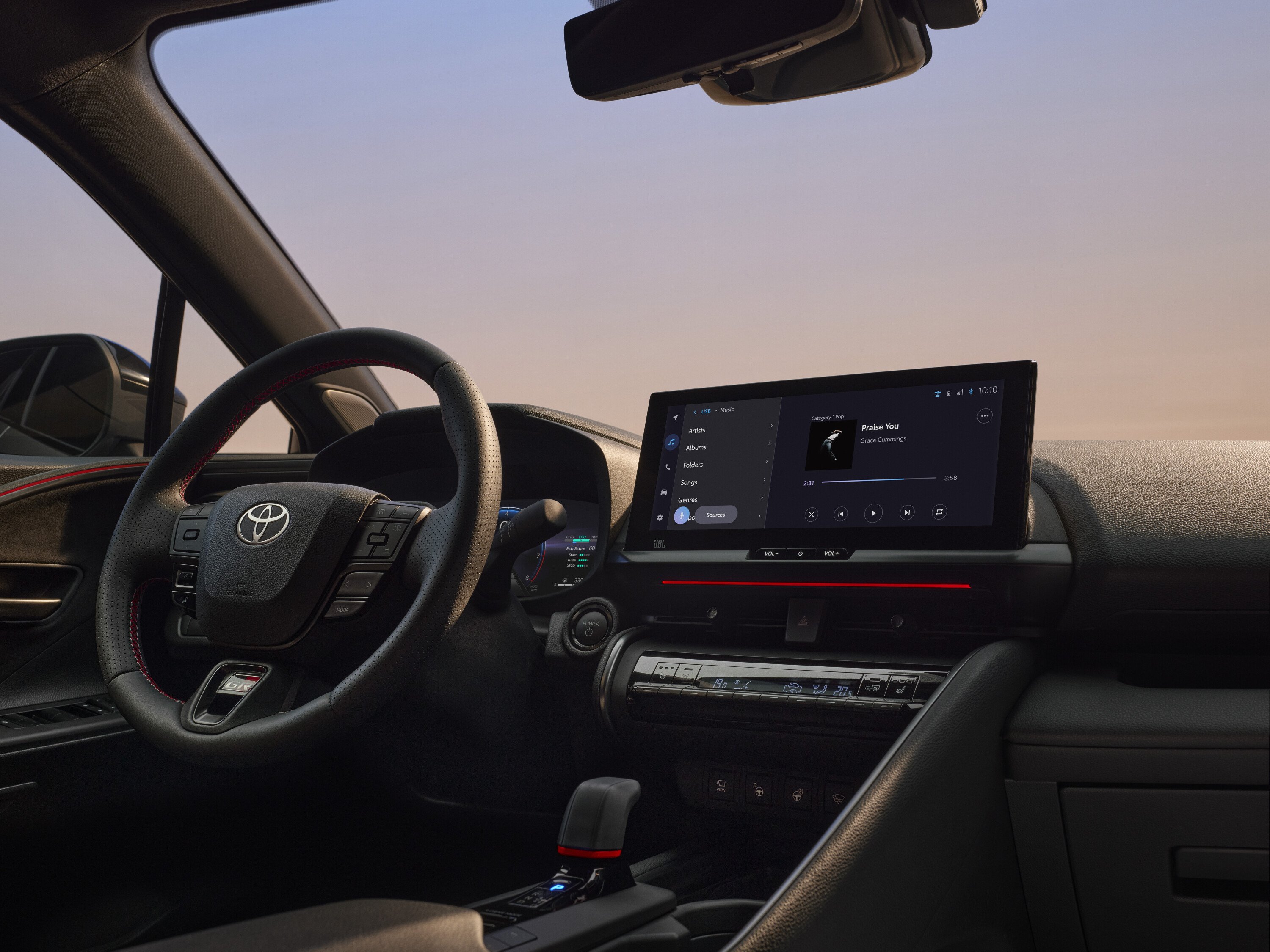
Inside, the C-HR has a 12.3-inch digital instrument cluster ahead of the driver and a freestanding 12.3-inch infotainment system.
A semi-digital instrument cluster and eight-inch infotainment unit are standard on lower grades, with all versions running Toyota’s latest software with wireless Apple CarPlay – but Android Auto remains wired-only for Australia.
It has a new-look steering wheel similar to the Prius and Crown, while the use of recycled plastics has doubled, with it now “used in more than 100 different parts,” including the seat upholstery.
1
The panoramic sunroof is said to use an infra-red reducing cost that has allowed Toyota to delete the sunshade, saving five kilograms, adding 30 millimetres of additional headroom, and reducing the need to use the air-conditioning.
Under the skin, the C-HR’s hybrid system includes “fifth generation” electric components with a 4.08Ah lithium-ion battery and a new transaxle and power control unit.
The 1.8-litre hybrid available in the GXL and Koba produces 103kW in total – up 15 per cent – while the 2.0-litre system in the GR Sport introduces dual electric motors with all-wheel-drive and a 145kW total system output.
1
The flagship GR Sport variant features a unique G-mesh pattern grille, 19-inch alloy wheels (20-inch units available in Europe) and GR badging, while its cabin includes sports front seats with a GR logo embossed on the headrests.
Features available but yet to be confirmed for Australia include digital key support, 64-colour adjustable interior ambient lighting, an automatic parking function, adaptive LED headlights, a head-up display, and a JBL-branded audio system.
Newly-added active safety features include safe exit assist, proactive driving assist, automatic lane change assist, front cross-traffic alert, a driver monitoring camera, and traffic jam assist.
1
Toyota will release local specification details later, but it has confirmed that the C-HR will feature Toyota Connected Services technology, with a 12-month complimentary subscription likely.
The 2024 Toyota C-HR will arrive in Australia in the first half of 2024, with more local details to be announced in the coming months.
VFACTS new-car sales data reveals 1906 examples have been sold in Australia year-to-date, placing it at the lower end of the small SUV segment, behind rivals including the MG ZS (9823), Mazda CX-30 (4939), Kia Seltos (4283), Mitsubishi ASX (3859), Volkswagen T-Roc (3360) and Toyota’s own Corolla Cross (2302).
An all-electric small SUV similar in size to the new C-HR – potentially badged bZ3X – will debut later. It was previewed by the BZ Compact concept in 2022.
Toyota’s local arm has announced it will offer three all-electric vehicles in Australia in the next three years, including the soon-to-launch bZ4X medium SUV – but hybrid technology is still the main focus.
Following the bZ4X, Toyota Australia is tipped to confirm the production version of the BZ Compact SUV concept for our market, and another electric vehicle due within the next three years.
MORE
Everything Toyota
January 19: 2024 Kona Electric pricing
The final piece in the 2024 Kona puzzle is here, with pricing and drive impressions now available.
See the below links, and continue reading for more on the standard Kona range.
December: Kona petrol and hybrid pricing
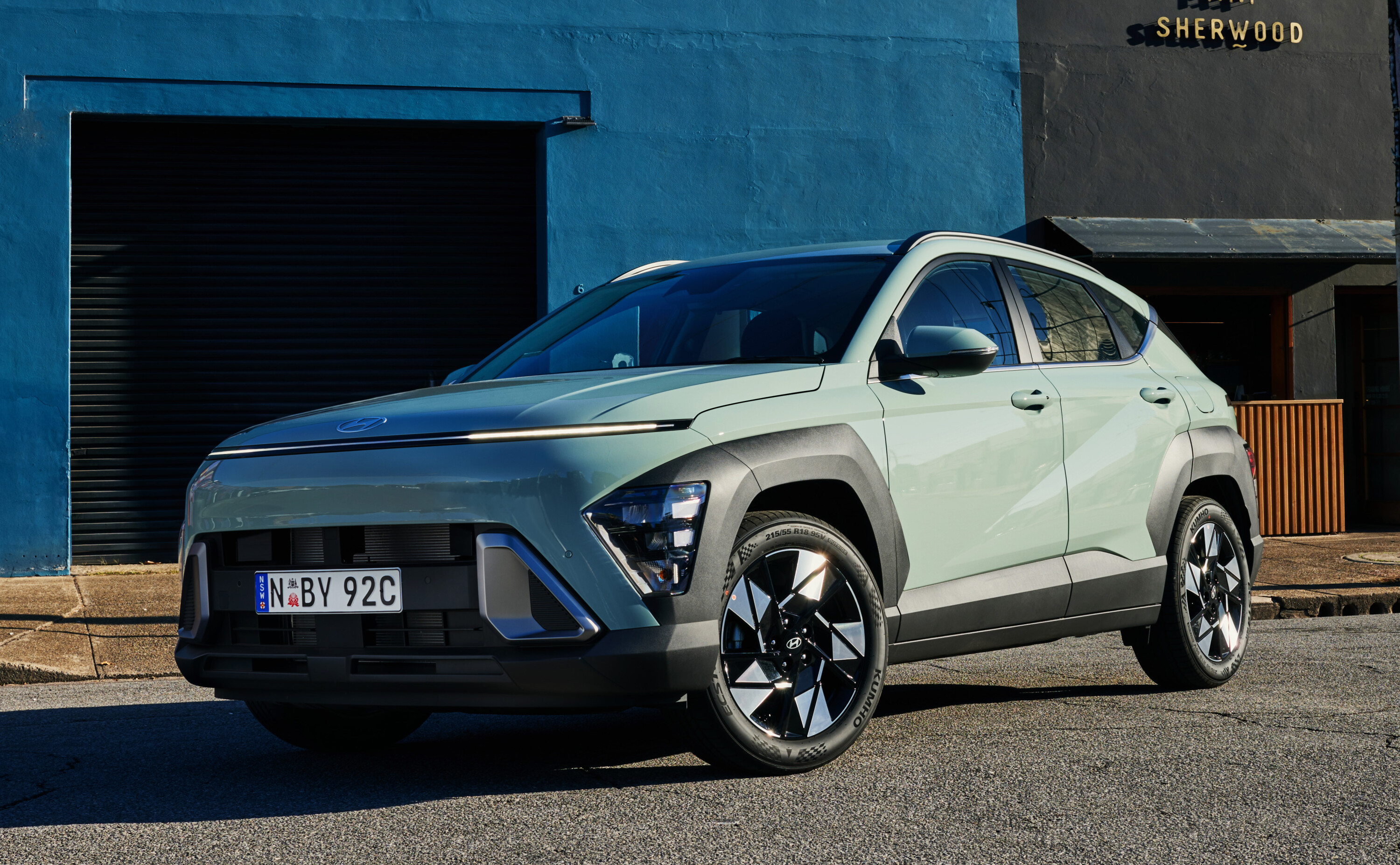
The 2024 Hyundai Kona small SUV has landed in Australia, priced between $32,000 and $46,500 before on-road costs.
Snapshot
- 2024 Hyundai Kona: Full Australian details
- Bold EV-centric styling with larger proportions
- More safety and tech as standard; entry price up $5100
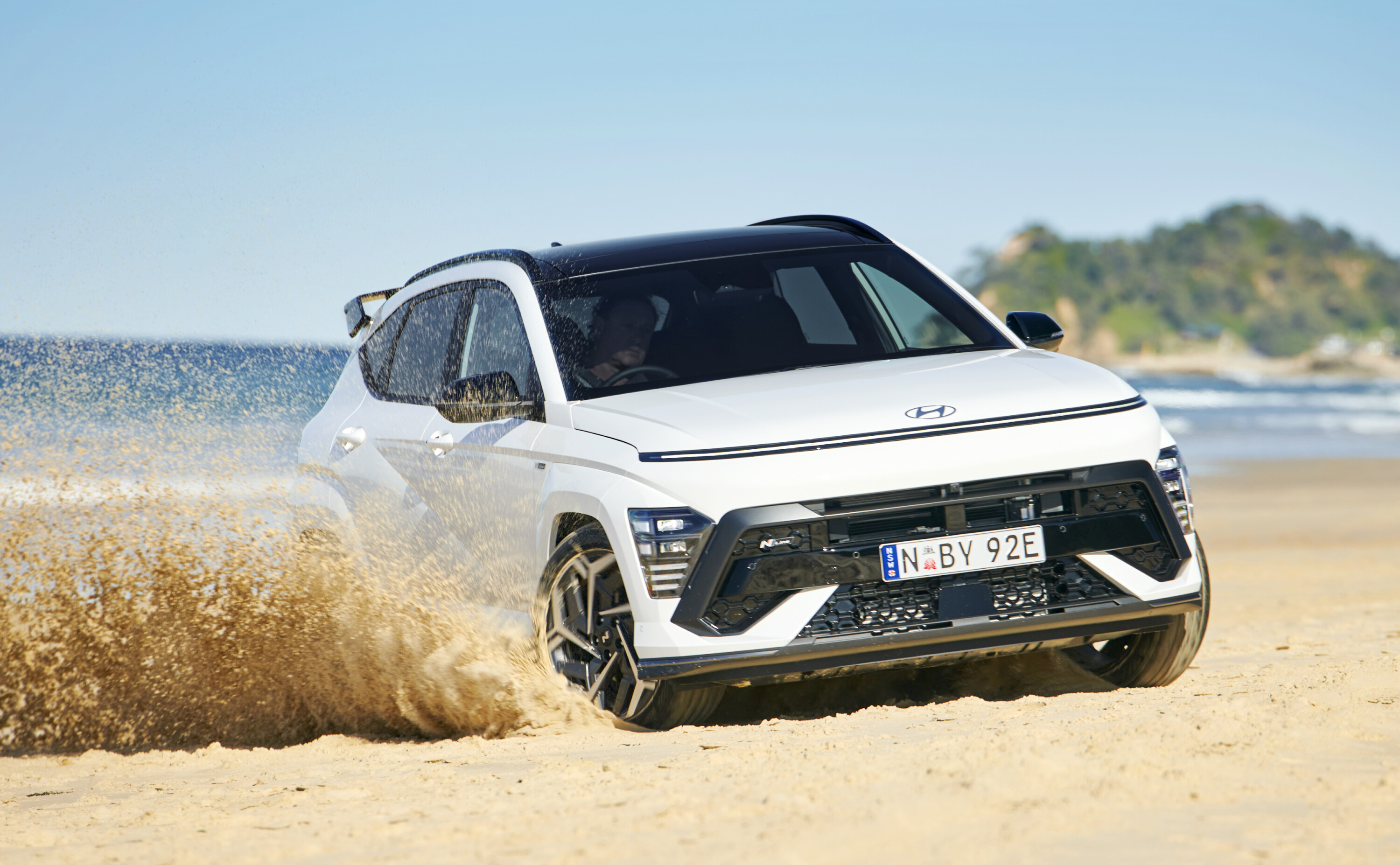
Along with striking new looks, the Kona range has been rationalised – there are now only Kona and Kona Premium trims, with an optional N Line package for both variants.
The entry price has climbed by a steep $5100, but the new base Kona variant features standard equipment in line with the outgoing Active ($28,500) and Elite ($31,900) with more safety and convenience inclusions – apart from leather upholstery.
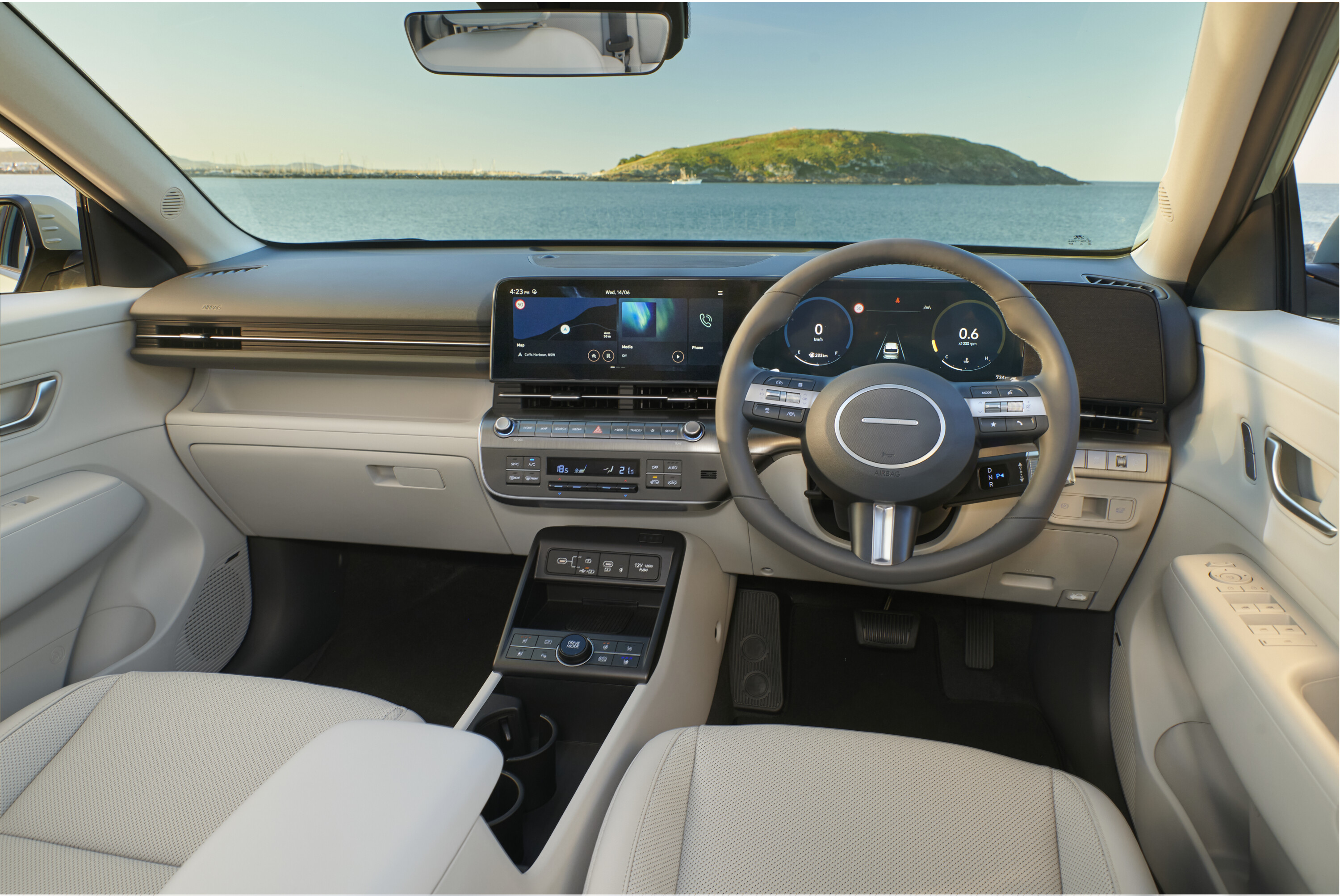
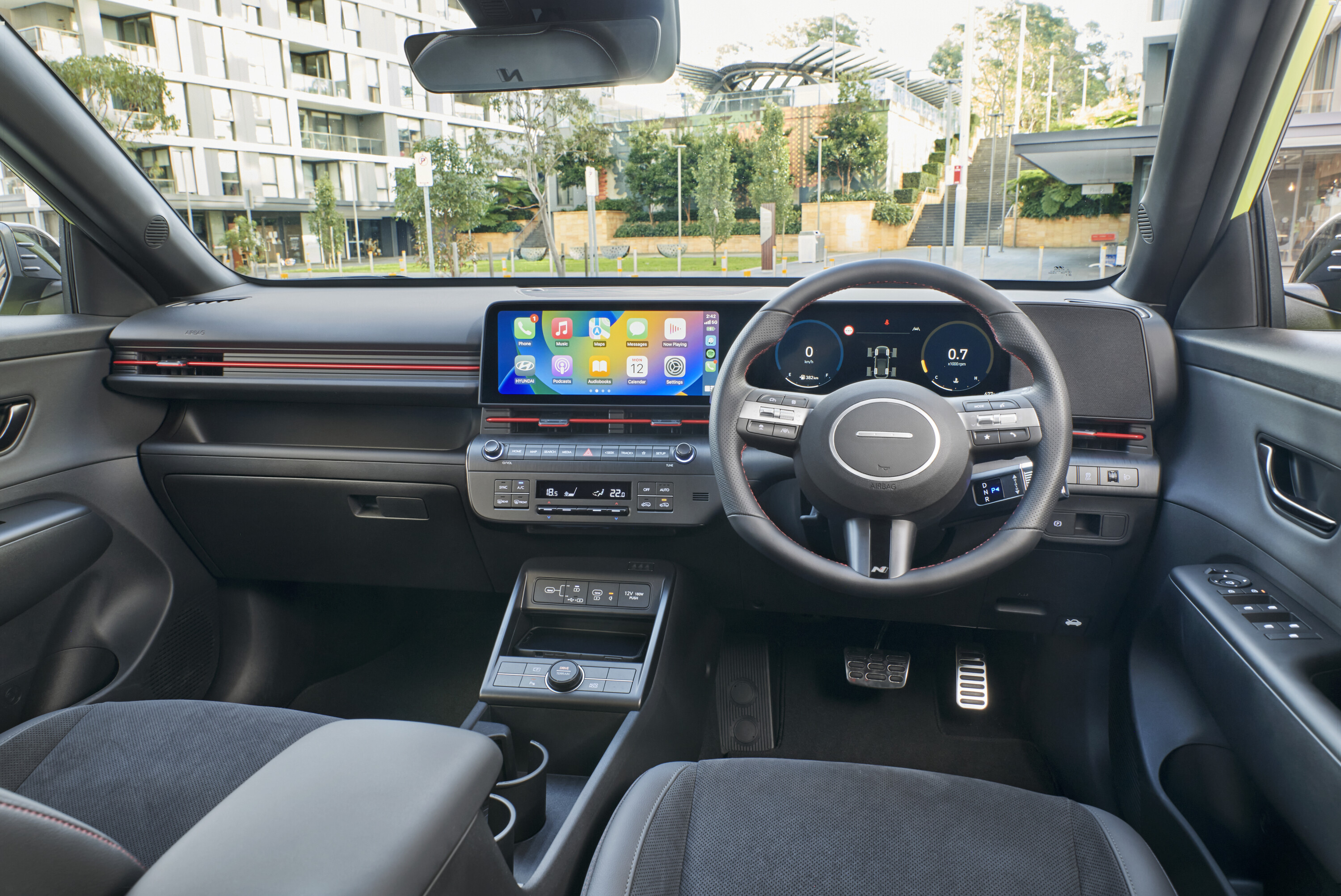
Inside, the latest Kona has a more sophisticated design inspired by the brand’s all-electric Ioniq vehicles and a larger 12.3-inch infotainment system with Bluelink connected-car technology.
The base Kona has wireless Apple CarPlay and Android Auto, while Premium variants revert to wired connectivity. An update is expected soon to enable wire-free mirroring.
What is Hyundai Bluelink?
? Tony O’Kane drives the Kona N-Line 1.6 turbo petrol
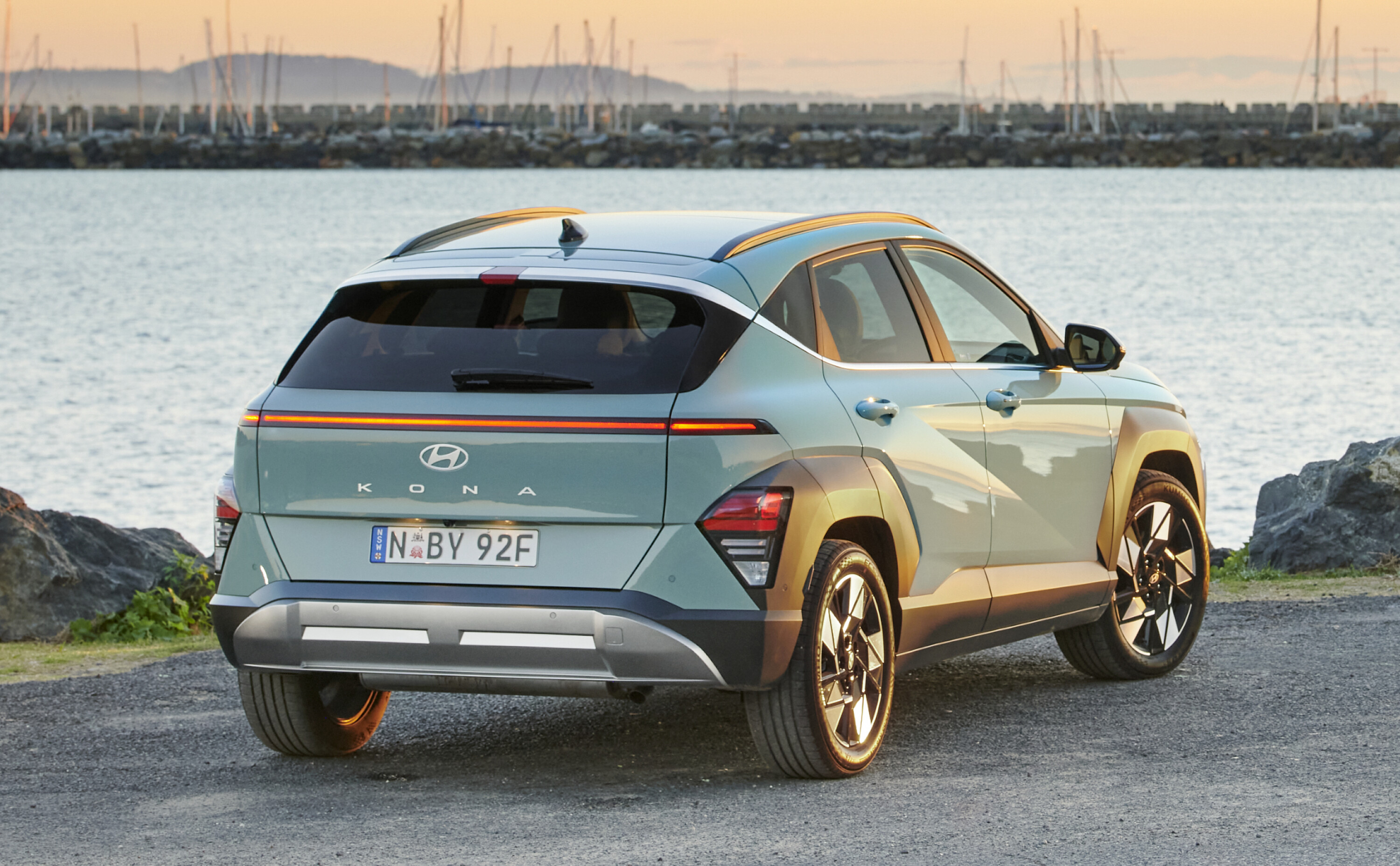
Hyundai claims the Kona’s clever packaging means it’s also segment-leading for cabin space, with a wider – but shorter – boot than the one-size-up Tucson midsize SUV.
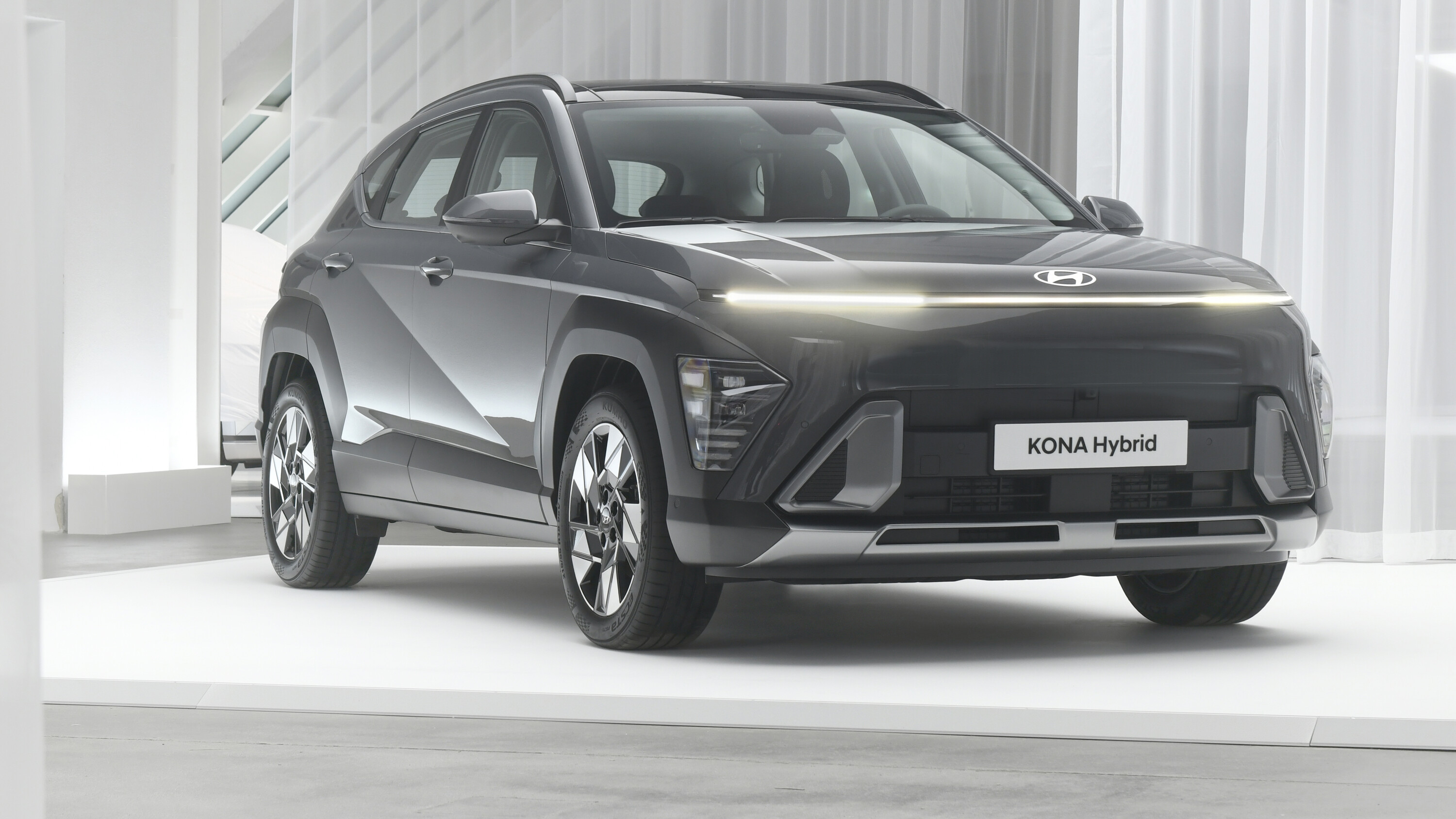
Electrified small SUVs come under threat with the Kona Hybrid’s arrival. It sips a claimed 3.9L/100km, besting the Toyota Corolla Cross, Honda HR-V, Nissan Qashqai and GWM Haval Jolion
Even with a small 38-litre fuel tank, the Kona Hybrid has a theoretical driving range of almost 1000 kilometres. It incurs a $4000 premium over the FWD petrol variant, with the sportier N Line package also available in hybrid.
1
Its powertrain is shared with the Kia Niro small SUV, which is almost $9000 dearer with less standard equipment in entry-level form. The flagship Kona Premium Hybrid undercuts the Niro GT-Line by around $7000.
Customer deliveries of the 2.0-litre petrol and 1.6-litre turbo-petrol will begin imminently, while hybrid and electric models will arrive in the fourth quarter (October to December inclusive).
“All-new Kona scales new heights with its futuristic EV-like styling, roomy interior, [a] full suite of safety features and class-leading connectivity and convenience technologies, to give customers a compelling small SUV,” said Hyundai Australia chief executive officer, Ted Lee.
JUMP AHEAD
- 2024 Hyundai Kona pricing
- 2024 Hyundai Kona features
- Options
- Colours
- Engine, drivetrain, and fuel economy
- Safety
- Dimensions
- Warranty and servicing
- Availability
2024 Hyundai Kona pricing
Prices exclude on-road costs.
| Model | Pricing | Change (vs. 2023 Kona) |
|---|---|---|
| Kona | $32,000 | up $5100 (over base) |
| Kona N Line | $36,000 | new |
| Kona Hybrid | $36,000 | new |
| Kona Premium | $39,500 | up $1200 (over Highlander) |
| Kona Hybrid N Lineu00a0 | $40,000 | new |
| Kona N Line AWD | $40,000 | up $2900 (over N Line AWD) |
| Kona Premium N Line | $42,500 | new |
| Kona Premium Hybrid | $43,500 | new |
| Kona Premium Hybrid N Lineu00a0 | $46,500 | new |
| Kona Premium N Line AWD | $46,500 | up $3300 (over N Line Premium AWD) |
1
2024 Hyundai Kona features
| 2024 Hyundai Kona (base) features | |
|---|---|
| 18-inch alloy wheels | Keyless entry and push-button start |
| 12.3-inch ccOS infotainment system | LED headlights (reflector-type), tail-lights and DRLs |
| Wireless Apple CarPlay and Android Auto | LED cabin lighting |
| Hyundai Bluelink connected-car service | Dual-zone climate control with rear vents |
| Over-the-air remote software updates | Rear-centre fold-down armrest |
| DAB+ digital radio | Remote start |
| Six-speaker audio system | Heated, auto-folding side mirrors |
| 4.2-inch semi-digital instrument cluster | Front and rear parking sensors |
| USB-C charge ports (3x front, 2x rear) | Manual height-adjustable driveru2019s seat with two-position power lumbar support |
| 15-watt wireless phone charger | Manual height-adjustable passenger seat |
| Black cloth upholstery | Tyre pressure monitoring |
| Leather-wrapped steering wheel and gear shifter | Roof rails. |
The hybrid’s shift-by-wire system means it’s a little different inside.
| 2024 Hyundai Kona Hybrid specific features | |
|---|---|
| Virtual engine sound system | Column-mounted shift-by-wire gear selectoru00a0 |
| Adjustable regenerative braking (to a complete stop) | Paddle shifters |
| Torque vectoring control | Open-type centre console |
| Low-speed audible pedestrian alertu00a0 | Driver-only fan function. |
1
2024 Hyundai Kona Premium features
1
Options
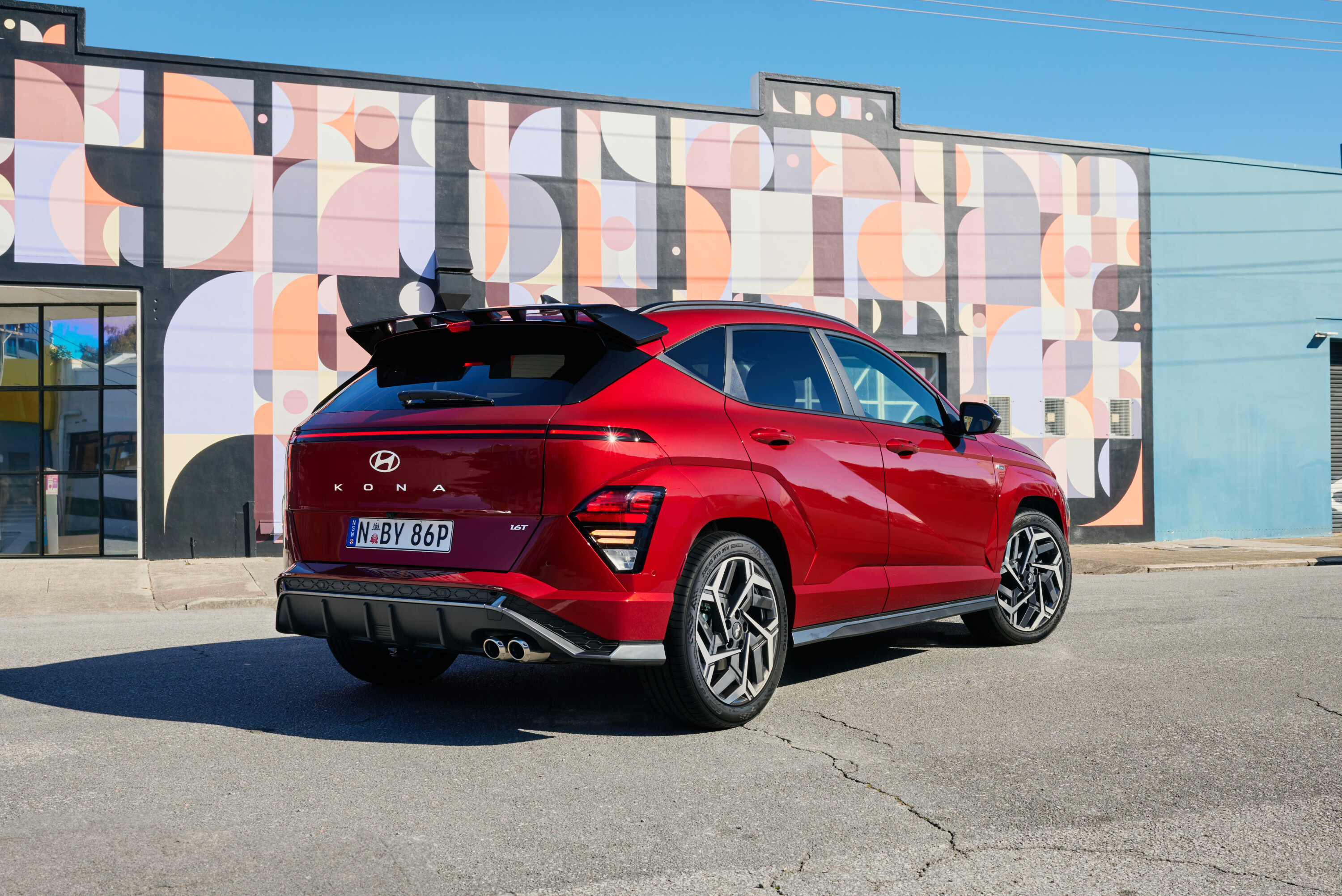
- 2024 Hyundai Kona N Line Option Pack – $4000
| In addition to Kona | |
|---|---|
| 1.6-litre turbo-petrol AWD option | Red interior trim |
| 12.3-inch digital instrument cluster | Black headlining |
| 19-inch N Line alloy wheels (petrol); 18-inch N Line alloy wheels (hybrid) | Alloy pedals |
| Gloss black rear spoiler | LED headlights (projector-type) |
| Black leather upholstery with Alcantara inserts, N emblem, and red accents | LED turn signals and full-width front strip |
| Colour-matched body cladding | Auto-dimming rear-view mirror |
| Chrome twin-tip exhaust | Rain-sensing wipers |
| Gloss black side mirrors | Column-mounted shift-by-wire gear selector (hybrid, 1.6T) |
| N Line perforated steering wheel | Multi-terrain mode (1.6T). |
| Paddle shifters | |
- 2024 Hyundai Kona Premium N Line Option Pack – $3000
| In addition to Kona Premium | |
|---|---|
| 1.6-litre turbo-petrol AWD option | Gloss black side mirrors |
| 19-inch N Line alloy wheels (petrol); 18-inch N Line alloy wheels (hybrid) | N Line perforated steering wheel |
| Gloss black rear spoiler | Red interior trim |
| Black leather upholstery with Alcantara inserts, N emblem, and red accents | Black headlining |
| Colour-matched body cladding | Alloy pedals |
| Chrome twin-tip exhaust | Multi-terrain mode (1.6T). |
- Wide glass sunroof (Kona Premium, Premium N Line) – $1500
- Light shale grey or sage green interior (Kona Premium) – $295.
1
Colours
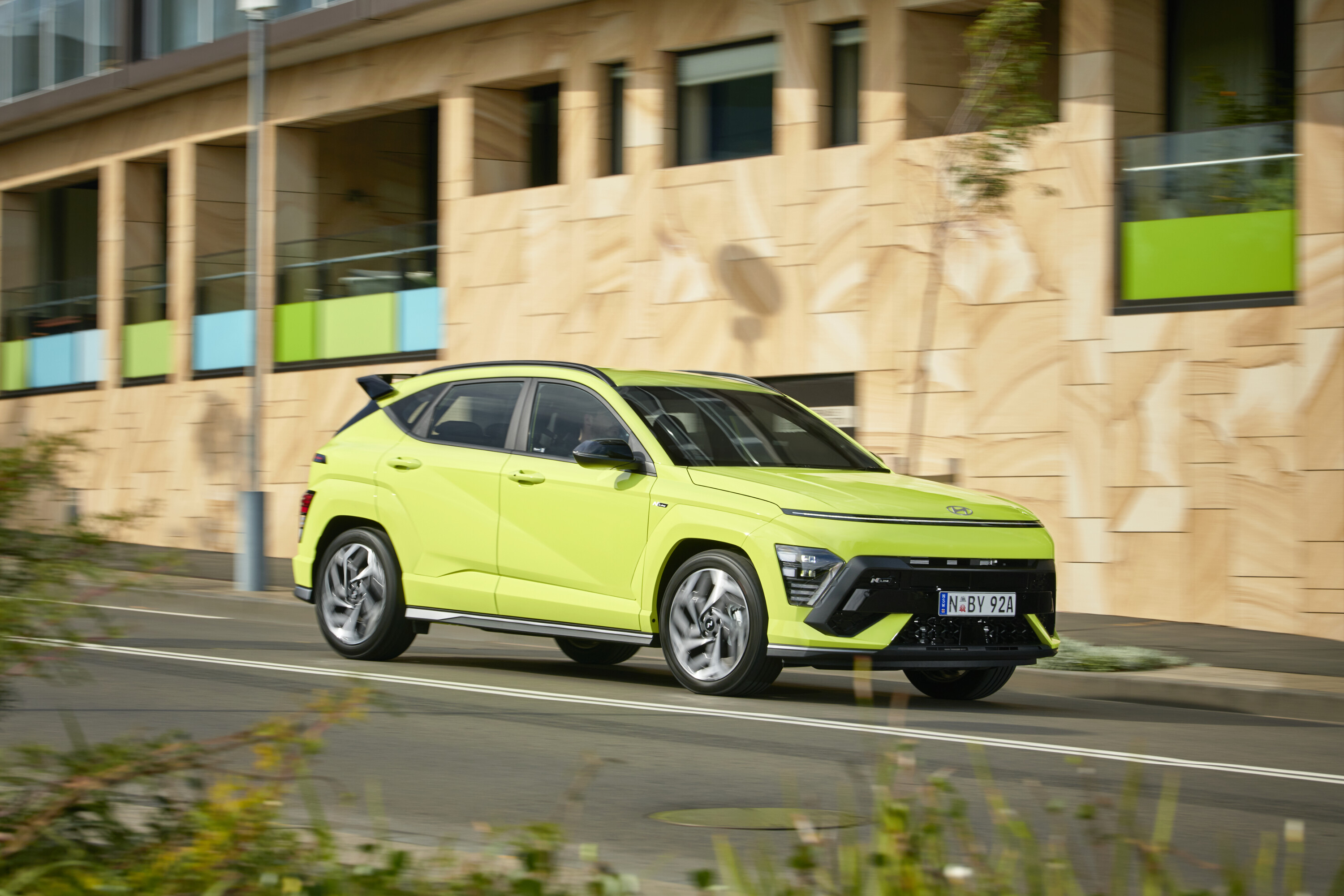
The new Kona is available in nine exterior colours, though some are reserved exclusively for N Line variants.
| 2024 Hyundai Kona and Kona Premium available colours | |
|---|---|
| Atlas white | Mirage green |
| Ecotronic grey* | Ultimate red* |
| Denim blue* | Abyss black* |
| * Metallic paint, $595 | |
2024 Hyundai Kona N Line and Kona Premium N Line available colours
| Atlas white | Neoteric yellow |
| Cyber grey* | Soultronic orange* |
| Ultimate red* | Abyss black* |
| * Metallic paint, $595 |
1
Engine, drivetrain, and fuel economy
The Hyundai Kona is available with four powertrains, with three internal-combustion options to be the first to hit the market.
The all-electric Kona will arrive in the fourth quarter of this year, with local details to be announced in the coming months.
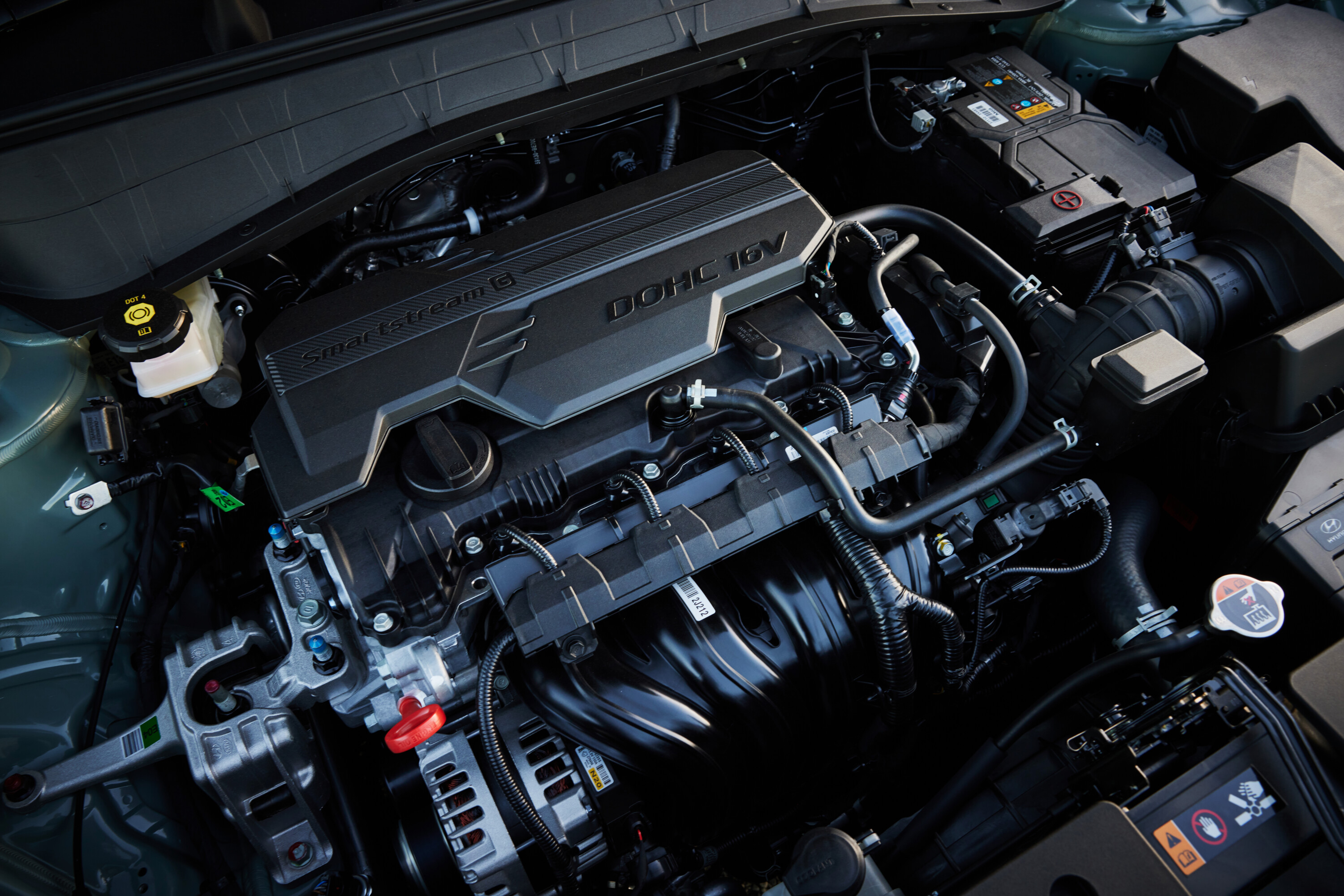
The most affordable is a carryover 2.0-litre four-cylinder non-turbo, multi-point injected petrol. Hyundai claims it has been refined, running in the Atkinson cycle with dual continuously variable valve timing (D-CVVT).
1
It develops unchanged outputs (110kW/180Nm) and powers the front wheels via a CVT with eight simulated ratios. The combined fuel economy is 6.6L/100km, a 0.4L/100km drop from the old car.
Moving up to the 1.6-litre turbo-petrol, it is a new 146kW/265Nm unit similar to the Kia Seltos, with constantly variable valve duration, and a 0.7L/100km efficiency dip.
It brings on-demand AWD and multi-link rear suspension instead of the 2.0-litre’s front-drive and torsion beam. It also gets an eight-speed torque-converter automatic, replacing the seven-speed dual-clutch auto from the old N Line.
1
The hybrid is the most efficient choice, with an impressive 3.9L/100km rating in combined testing. It differs in configuration from Toyota’s synergy drive system, with a 32kW/170Nm motor sandwiched between the 1.6-litre four-cylinder (77kW/104Nm) and gearbox for a 104kW and 265Nm total system output.
Despite its front-drive layout, the hybrid also introduces multi-link independent rear suspension. It is matched to a six-speed dual-clutch automatic transmission.
Hyundai hasn’t yet detailed the electric Kona for Oz, but similar tweaks to the latest Kia Niro suggest improved driving range and less-potent 150kW/255Nm outputs.
| 2024 Hyundai Kona fuel economy | |||
|---|---|---|---|
| 1.6-litre hybrid FWD | 3.9L/100km | 89g/km | new |
| 2.0-litre petrol FWD | 6.6L/100km | 149g/km | down 0.4L/100km |
| 2.0-litre petrol N Line FWD | 6.6L/100km | 154g/km | new |
| 1.6-litre turbo-petrol AWD | 7.6L/100km | 174g/km | down 0.7L/100km |
1
Safety
The 2024 Hyundai Kona has yet to be evaluated by ANCAP or Euro NCAP, though it has all the safety features to achieve a likely five-star rating under the more stringent 2023 criteria.
Seven airbags (dual front, side, curtain, and front-centre) are standard-fit.
| 2024 Hyundai Kona active safety features | |
|---|---|
| Autonomous emergency braking (vehicle, pedestrian, cyclist, motorcycle, junction-turning, direct oncoming) | Traffic sign recognition |
| Lane-keep assist | Intelligent speed limit assist |
| Lane following assist | Driver attention alert |
| Blind-spot alert | Driver monitoring camera |
| Rear cross-traffic alert | Leading vehicle departure alert |
| High beam assist | Safe exit warning |
| Adaptive cruise control | Rear occupant alert. |
The Kona Premium adds:
| Blind-spot view monitor | 360-degree camera system |
| Low-speed reverse AEB | Remote smart parking assist. |
| Side parking sensors |
1
Dimensions
Despite proportional ties to the old Kona, the new car rides on the new ‘K-platform’ shared with the i30 Sedan and Kia Niro. It has grown by 60 millimetres in the wheelbase (2660mm), 150mm in overall length (4355mm), and 25mm in width (1825mm), while there is 10 per cent more structural rigidity.
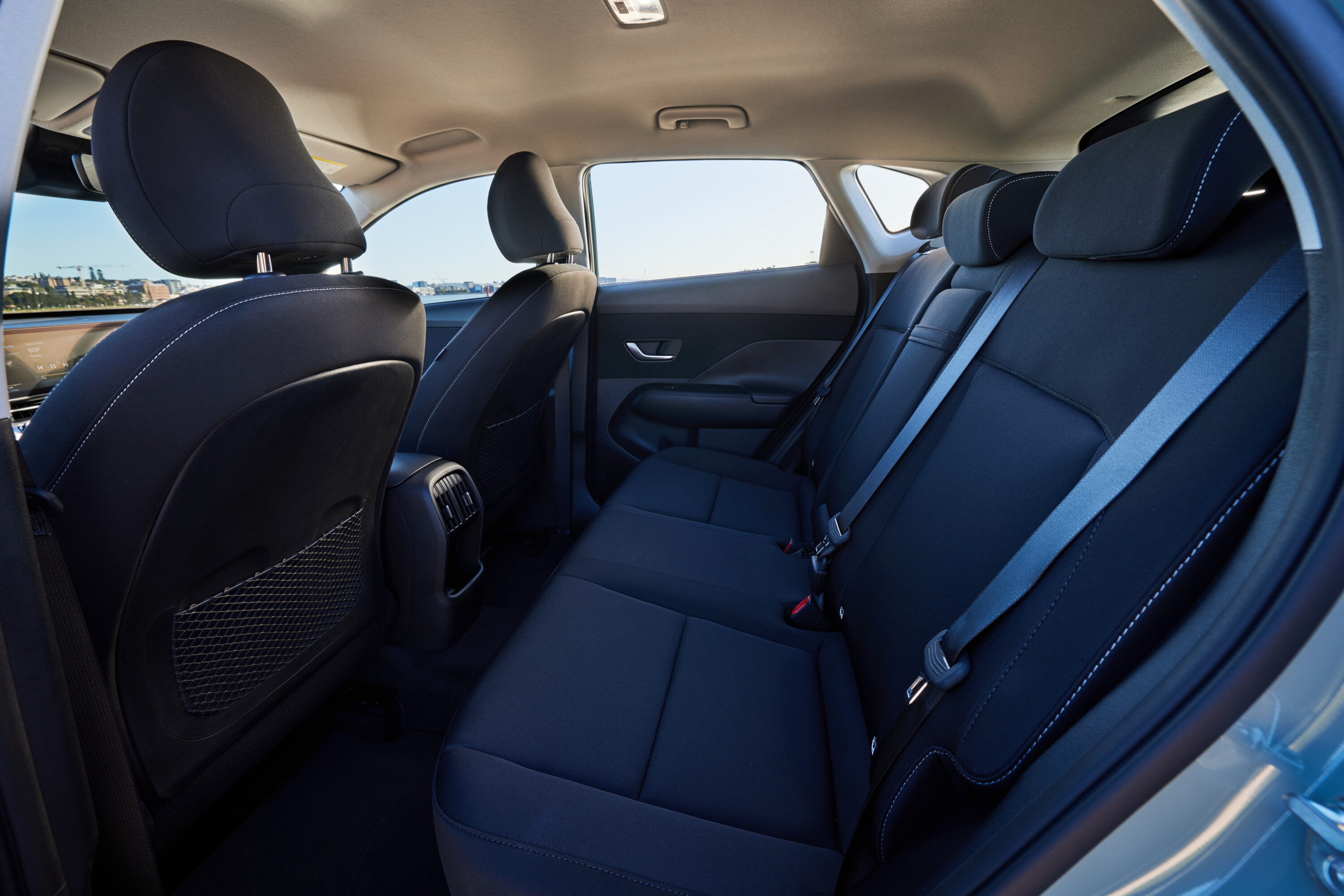
Hyundai claims the result is “best-in-class” rear space, with 77mm more legroom and 11mm more headroom. The rear seatback also has two incline positions: 26 and 32 degrees.
The new Kona weighs between 1355kg (2.0L FWD base) and 1585kg (1.6T Premium), with the hybrid (1410kg to 1525kg) not incurring a significant weight penalty. It has increased in weight, mainly due to Hyundai’s focus on cutting interior noise with added sound insulation and laminated glass.
1
2024 Hyundai Kona boot space
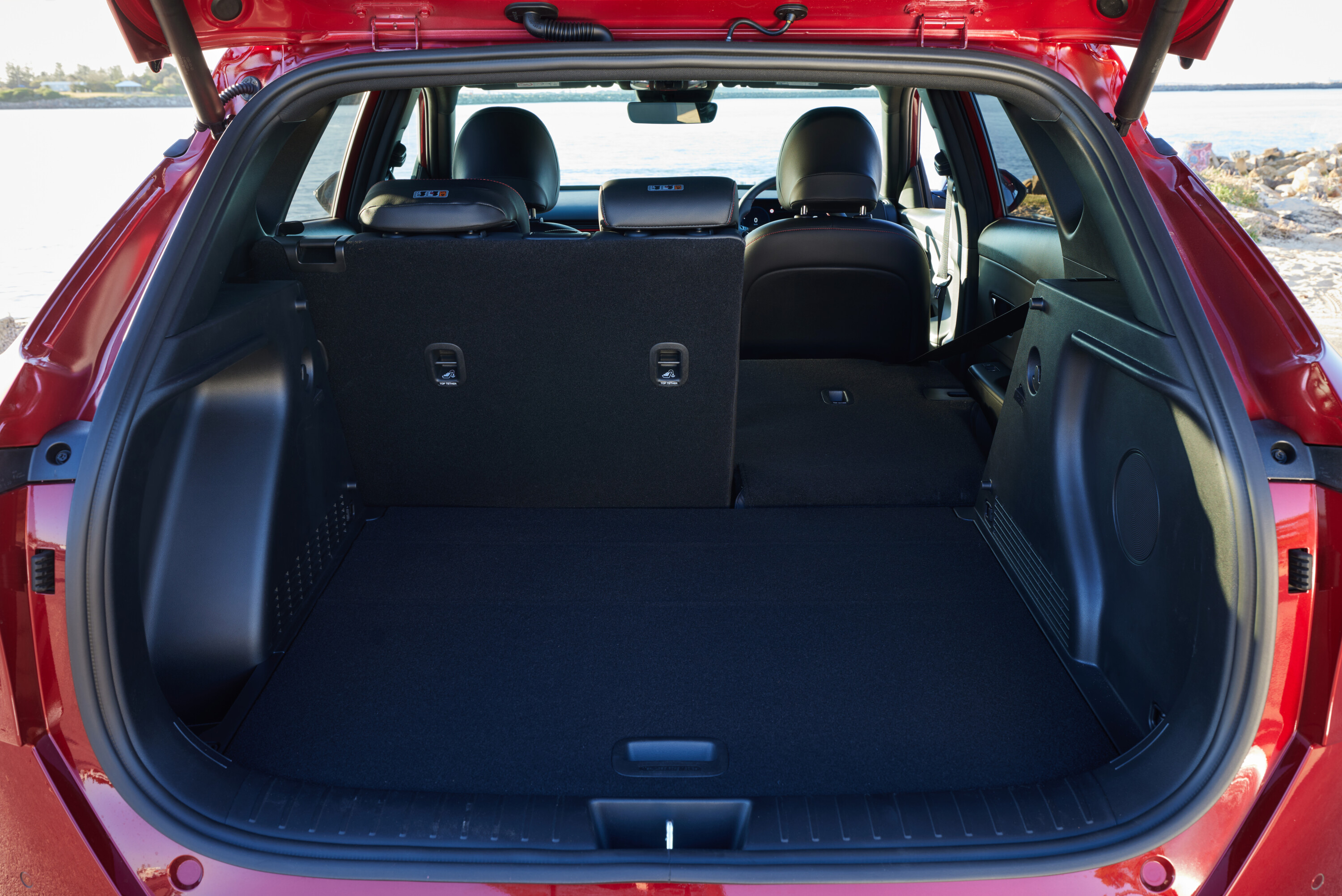
The Kona’s boot is set to get smarter with up to four bag hooks, a hidden cargo shelf behind the rear seat, a standard luggage net, a twin-level boot floor and wet storage recesses.
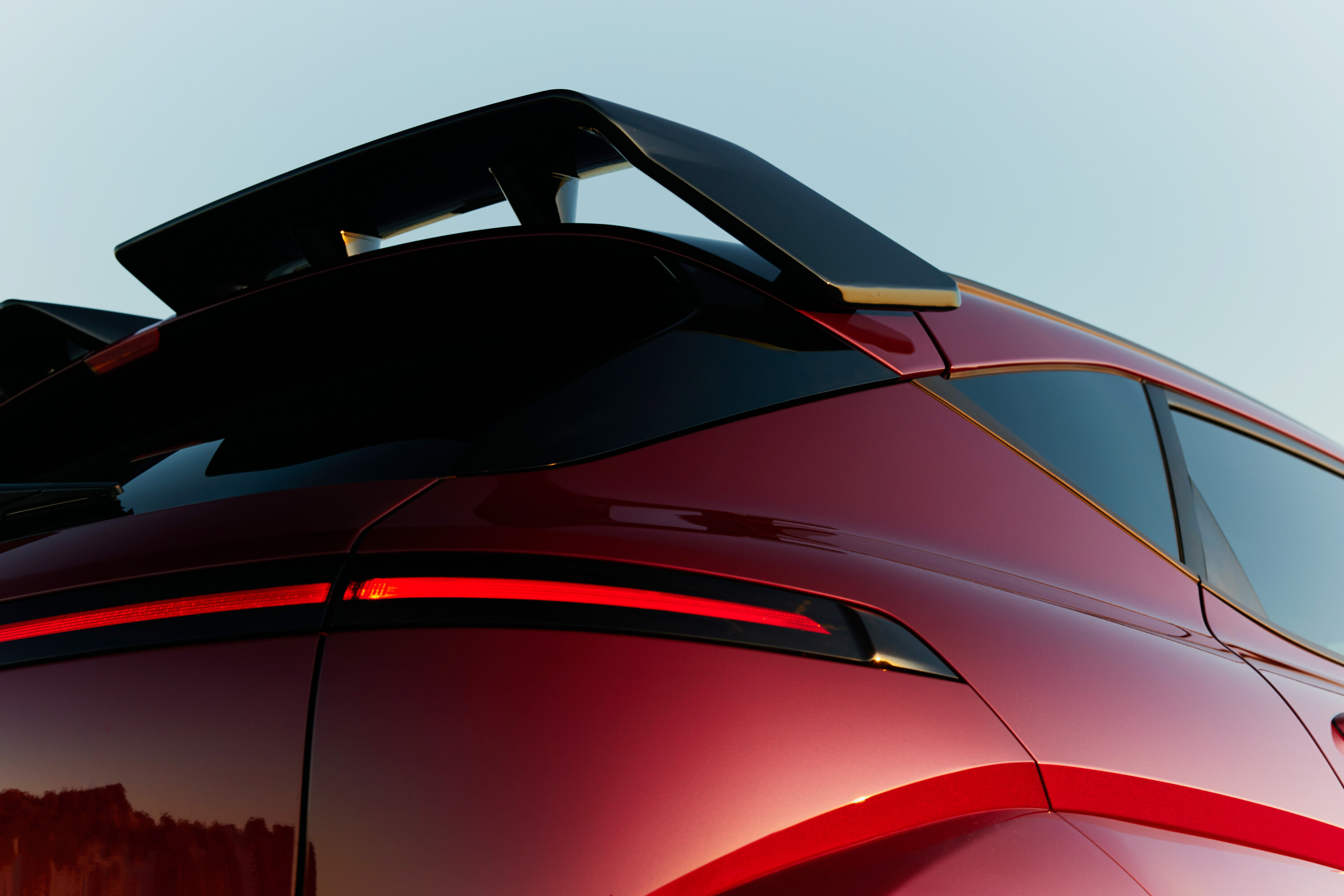
Space-wise, the new Kona packs an extra 33L of space into its boot (407L), retaining a space-saver spare beneath the floor. Folding the 60:40 backrest opens up 1241L.
1
Warranty and servicing
Hyundai’s five-year/unlimited-kilometre warranty covers all Kona models sold in Australia.
It has one year of complimentary roadside assistance, with an additional 12 months of coverage at the vehicle’s annual service within Hyundai’s dealership network
Servicing is due every 12 months, with the 2.0L FWD and hybrid able to travel 15,000km between maintenance, while the 1.6-litre turbo is limited to 10,000km. Hyundai has yet to confirm capped-price servicing, but the scheme will cover five years and up to 75,000km.
Availability
The 2024 Hyundai Kona is now available in 2.0-litre FWD and 1.6-litre turbo AWD in base Premium and regular trims.
The 2.0-litre N Line variants will arrive in the third quarter (July to September inclusive), while the hybrid and electric variants will arrive in the final quarter (October to December inclusive).
MORE
Everything Hyundai
MORE
Hybrid Cars
The latest Mercedes-Benz GLC and Land Rover Discovery Sport have received a five-star ANCAP safety rating – although both were tested under older 2022 criteria.
Snapshot
- All-new GLC, updated Disco Sport get five-star ANCAP rating
- Eight-year-old Disco re-assessed, maintained top score
- Tested under older 2022 safety testing criteria
Why the outdated criteria?
Both the new GLC and Discovery Sport were carried from ANCAP’s overseas counterpart Euro NCAP, which published the safety ratings in December 2022 – before the new 2023 criteria.
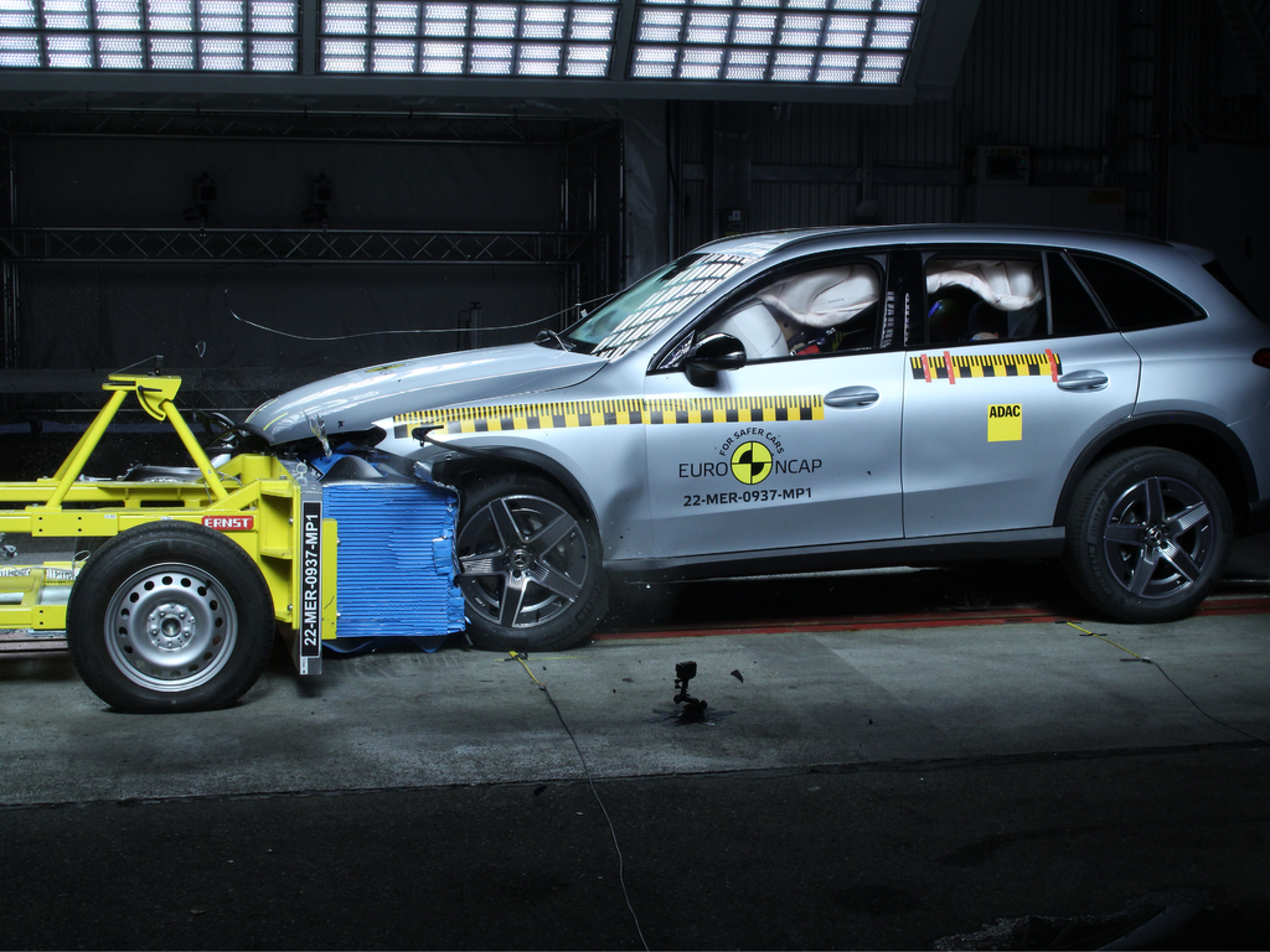
The second-generation 2023 GLC luxury medium SUV achieved a high 92 per cent in the adult and child occupant protection categories, while it was rated at 74 per cent for vulnerable road user protection and 84 per cent for its active safety assistance systems.
However, the safety authority noted that it had weak protection for the driver’s chest area in the oblique pole test assessed and had poor protection for preventing serious pelvic injury to a struck pedestrian.
1
The eight-year-old Land Rover Discovery Sport was re-assessed due to safety upgrades introduced in a 2022 refresh.
ANCAP praised the smaller Disco for maintaining its full five-star safety rating, despite being subject to its more stringent 2022 testing criteria.
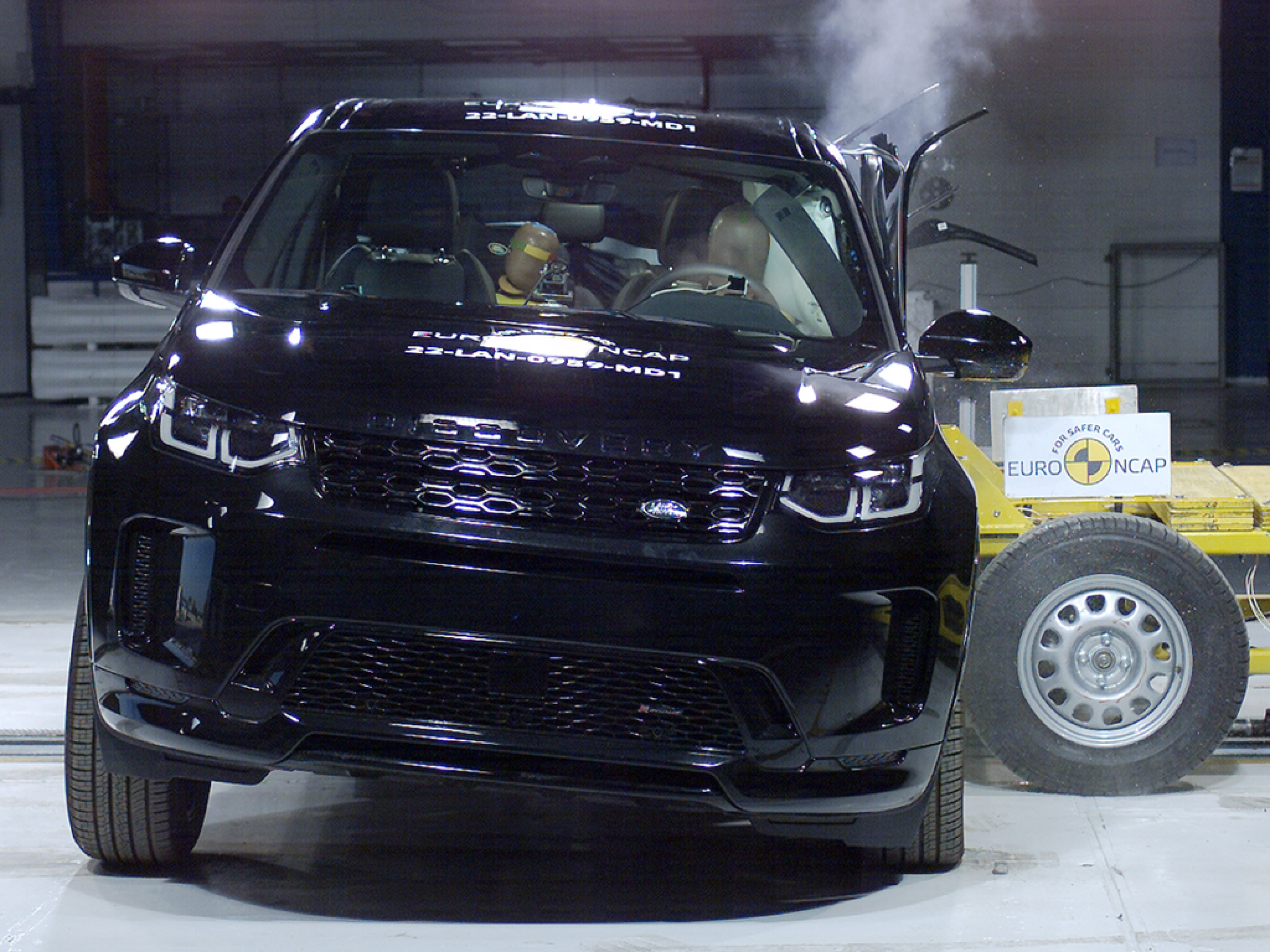
It scored 85 per cent for adult occupant protection, 88 per cent for child occupant protection and 71 per cent for vulnerable road user protection.
1
While the medium SUV was structurally ‘sound’, points were deducted for its side chest-protecting airbag not ‘deploying correctly’ in ANCAP’s side impact test.
Updates to its auto emergency braking (AEB) system contributed to an 83 per cent safety assist score, although it had adequate AEB pedestrian collision avoidance and lane support systems.
The re-assessment applies to all Land Rover Discovery Sports built from February 2022, excluding the SE P300e plug-in hybrid due to launch at the end of this year.
MORE
SUV Buyers Guide
The only thing bigger than the Kia Carnival’s boot space is its whopping 80 per cent market share of the Australian people mover market.
As well as being the darling of corporate and rental fleets, it’s a big seller with families needing more space than the average large SUV, thanks to an attractive package that combines practicality with driveability and oodles of showroom appeal.
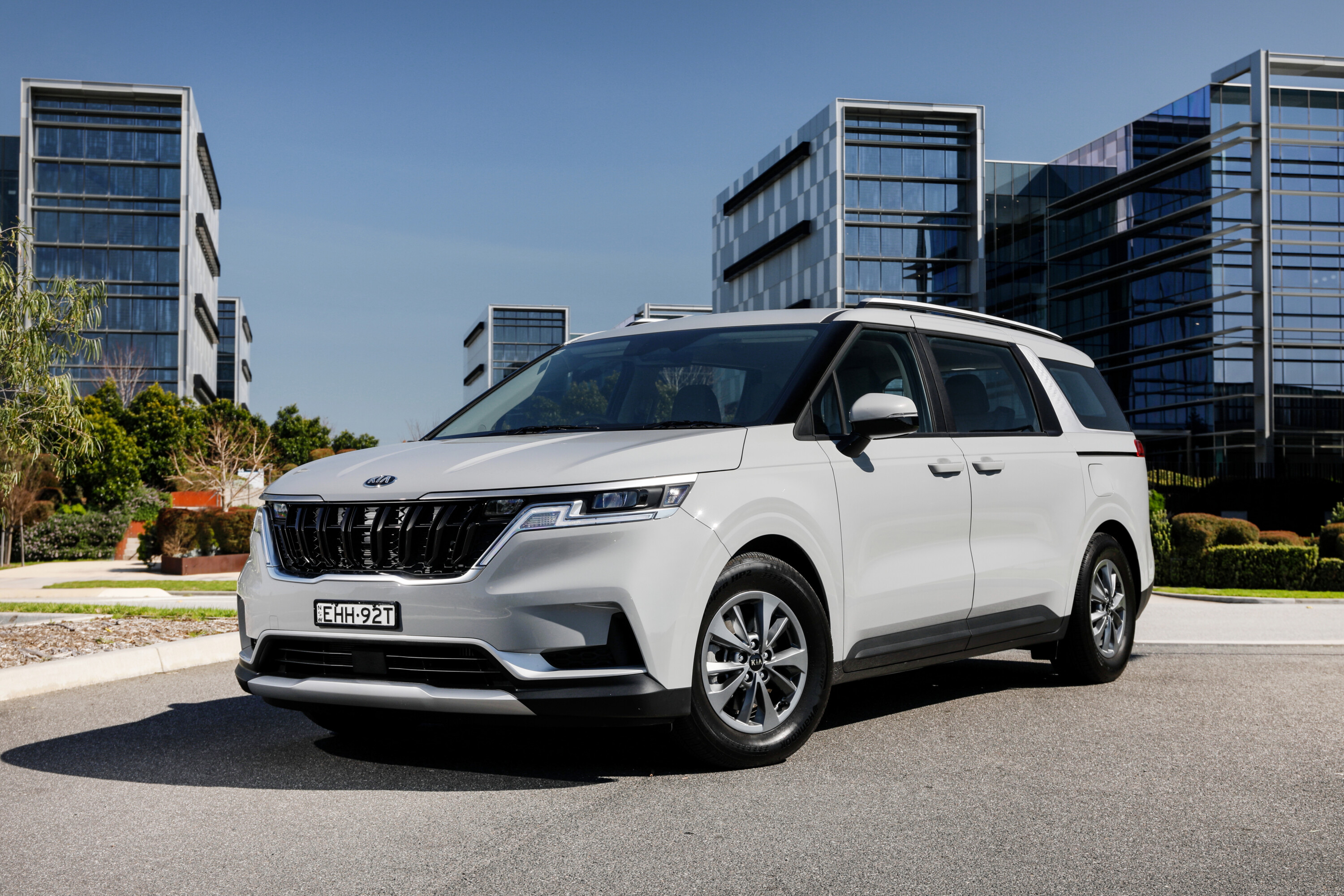
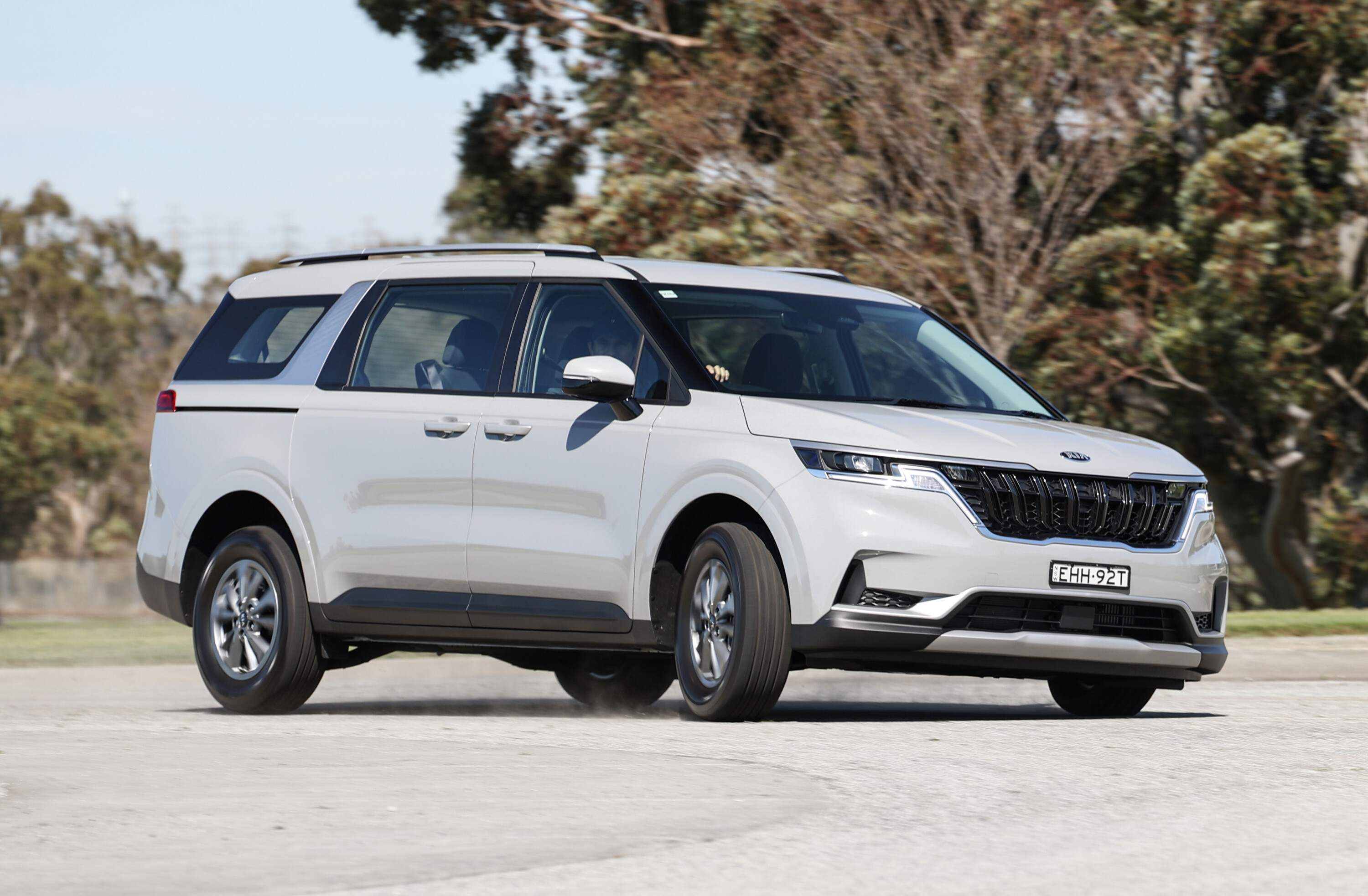
Riding on the KA4 platform that also resides under the excellent Sorento SUV, the Carnival is 5.2 metres long and a shade over two tonnes.
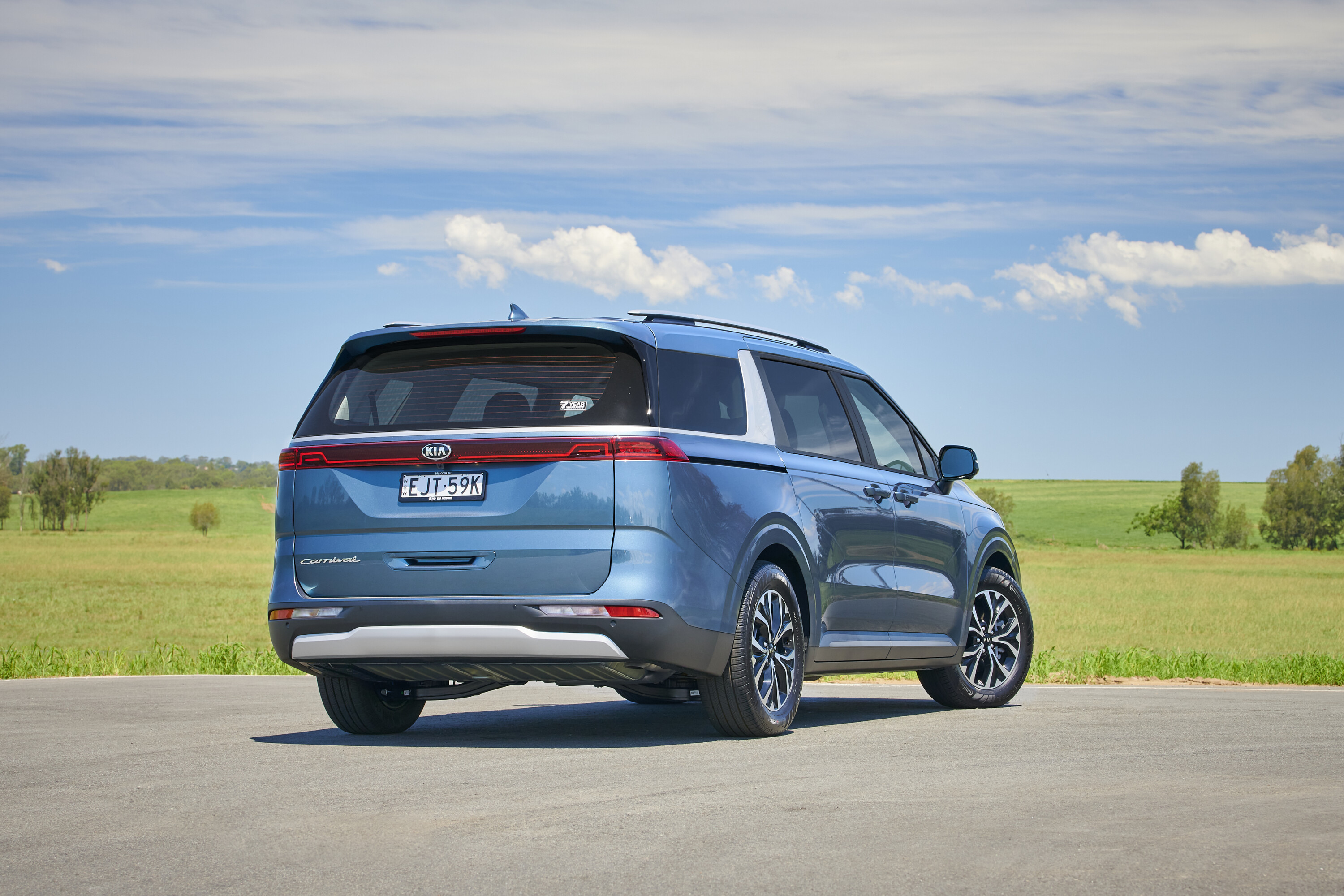
But its bluff nose and fancy grille, sculpted bonnet and bejewelled rear-end soften the squared-off roofline and straight sides to make it look a lot sleeker than the big family bus it is.
Powertrains include an updated version of the Hyundai group’s 3.5-litre V6 petrol engine and 2.2-litre four-cylinder turbo-diesel, both coupled with an eight-speed automatic transmission.
4
JUMP AHEAD
- Pricing
- What body styles are available for the Kia Carnival?
- What features are standard in every Kia Carnival?
- What key features do I get if I spend more?
- How comfortable & practical is the Carnival?
- How much boot space does the Carnival offer?
- I like driving, will I enjoy this car?
- Which Carnival engine uses the least fuel?
- What is the Carnival’s towing capacity?
- How long is the warranty & what are the Carnival’s servicing costs?
- Which version of the Carnival does Wheels recommend?
- What are the Kia Carnival’s key rivals?
2023 Kia Carnival pricing
| Kia Carnival variant | Pricing |
|---|---|
| Carnival S petrol | $47,480 |
| Carnival S diesel | $49,480 |
| Carnival Si petrol | $52,980 |
| Carnival Si diesel | $54,980 |
| Carnival SLi petrol | $57,780 |
| Carnival SLi diesel | $59,780 |
| Carnival Platinum petrol | $65,580 |
| Carnival Platinum diesel | $67,580 |
| Prices are before on-road costs |
What body styles are there?
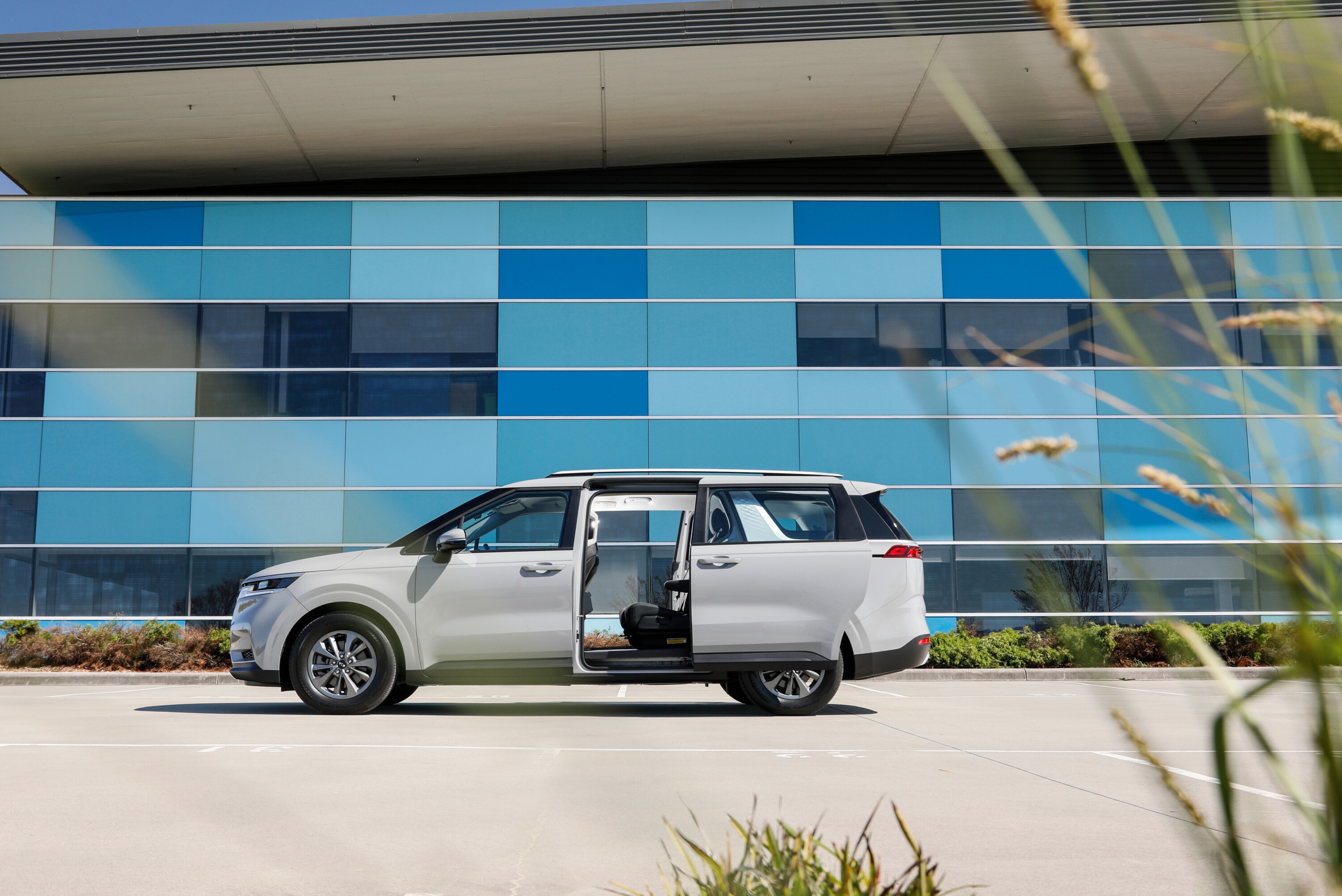
The Carnival is a five-door wagon that seats up to eight people and has sliding rear doors.
It drives its front wheels and is classed as a people mover, lower priced.
3
What features are in every Kia Carnival?
| 2023 Kia Carnival standard features | |
|---|---|
| Apple CarPlay/Android Auto | Bluetooth connectivity |
| Sound system | LCD colour infotainment touchscreen |
| Reversing camera | Rear parking sensors with dash display |
| USB sockets: 3x front, 2x middle row | Illuminated vanity mirrors in sunvisors |
| Power-folding heated door mirrors | Roof rails |
| Rear spoiler with hidden wiper washer | Shark fin antenna |
| Air-conditoning front and rear | 3rd-row air vents |
| LED headlights | LED daytime running lights (DRLs) |
| Dusk-sensing headlights | High beam assist |
| Alloy wheels | Space saver spare wheel |
| Autonomous emergency breaking | Driver attention alert |
| Speed limit information function | Intelligent speed assist |
| Blind spot collision avoidance assist | Rear cross traffic alert |
| Lane keeping assist | Lane change assist |
| Lane departure warning | Adavanced smart cruise control |
What key features do I get if I spend more?
The Kia Carnival comes in four specification grades, each with automatic petrol and turbo-diesel powertrain options.
Carnival S
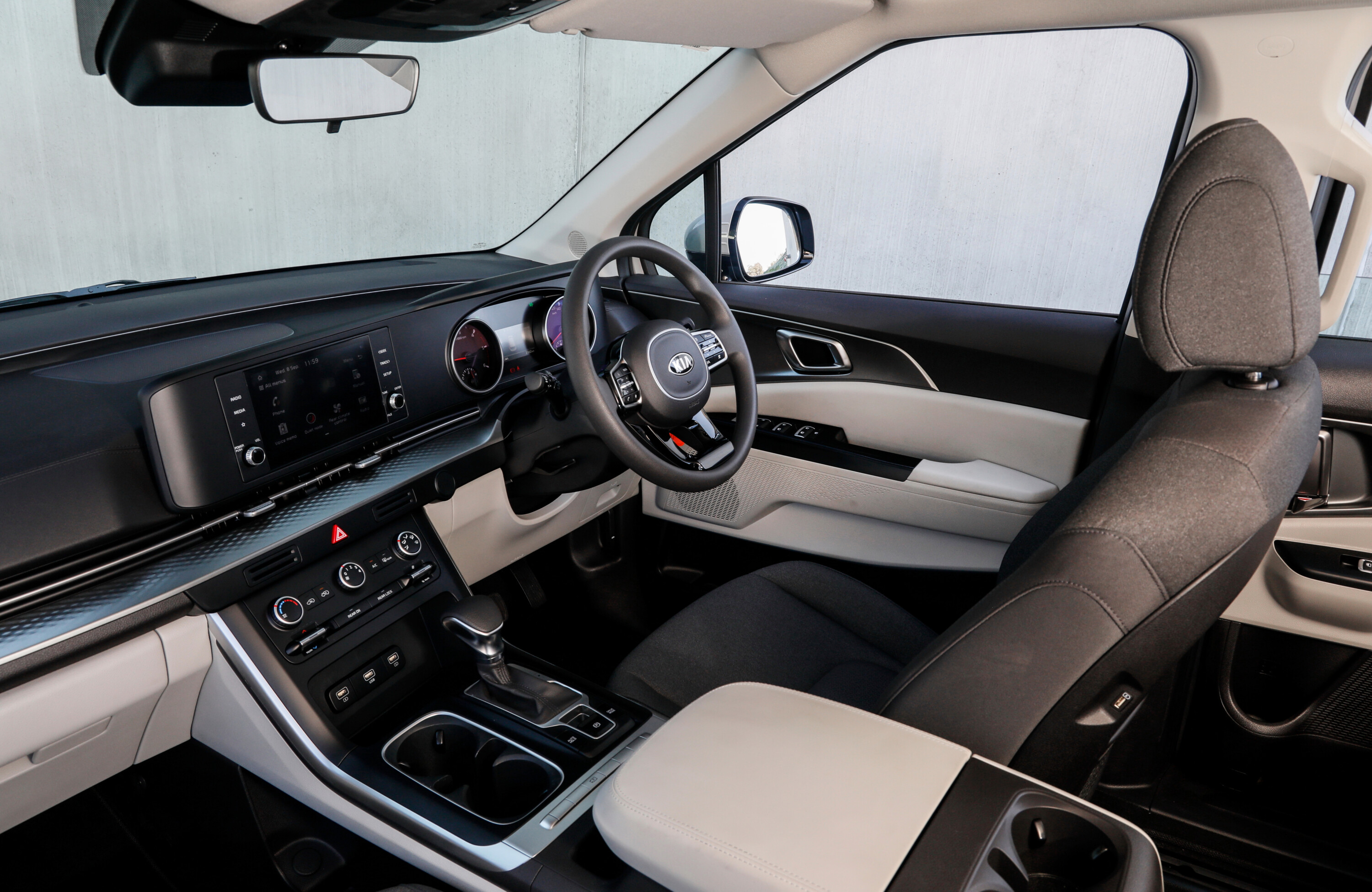
The entry-level Carnival comes with all of the above features, cloth seats with manual adjustment, a six-speaker sound system, an 8.0-inch LCD infotainment touchscreen, manual air-conditioning and 17-inch alloy wheels.
Curiously, the cheapest Carnival is the only spec to come with wireless Apple CarPlay and Android Auto, which is an issue across the Kia and Hyundai range. This has something to do with the wireless phone pairing only being able to be used with the smaller 8.0-inch screen, which is some kind of legal issue rather than a technical one.
3
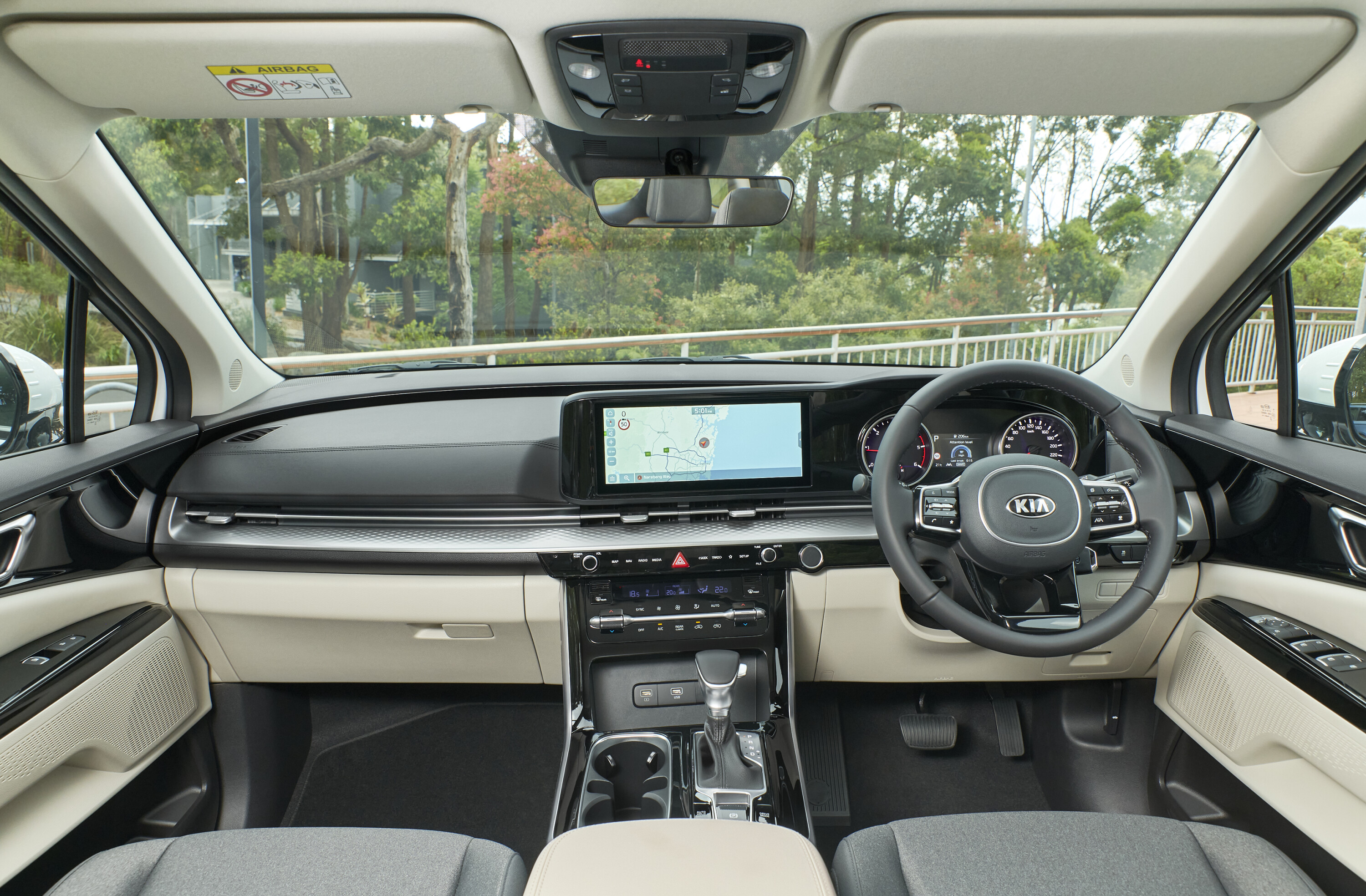
Carnival Si
2
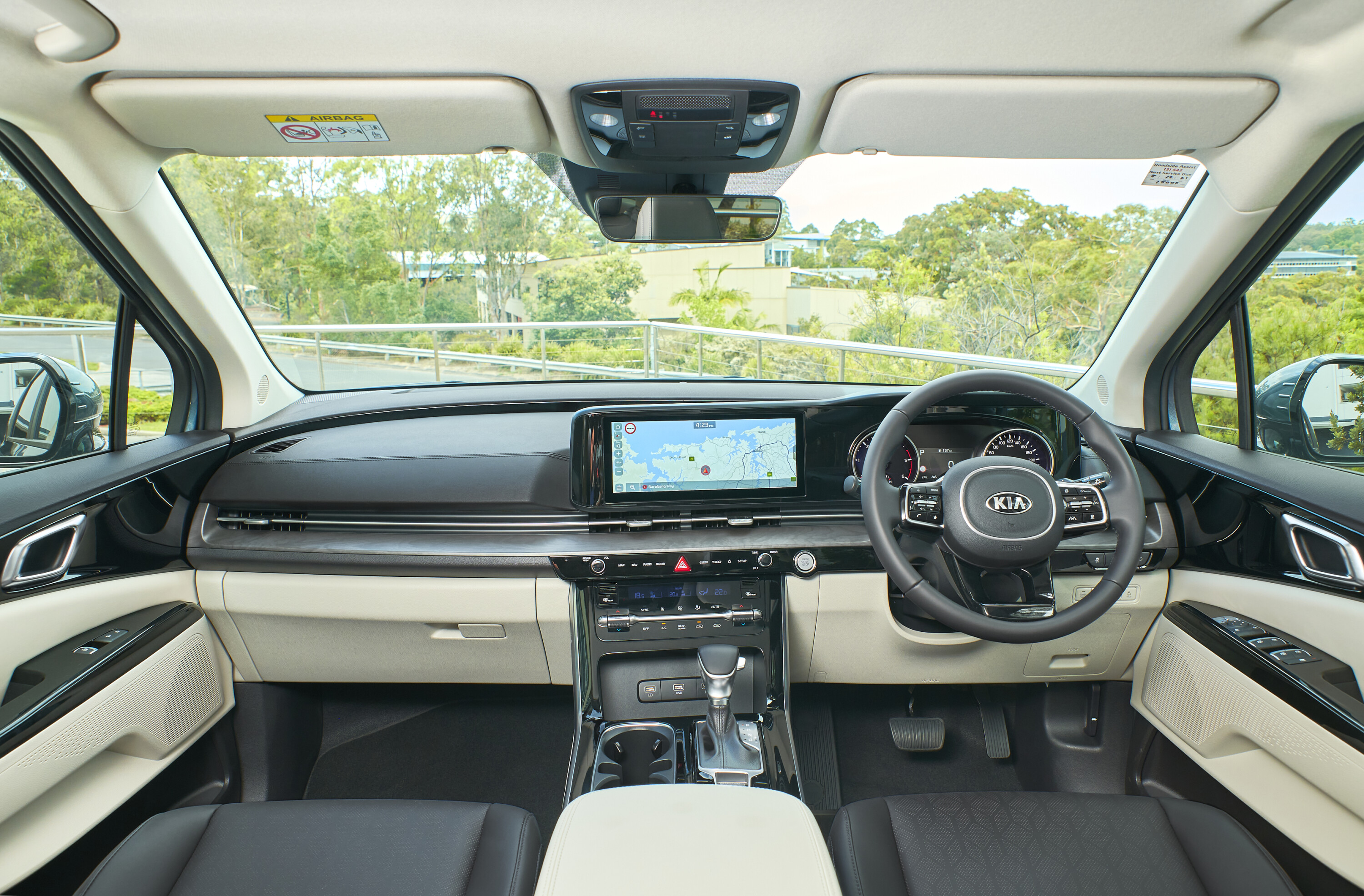
Carnival SLi
| SLi features (in addition to Si) | |
|---|---|
| 360-degree parking monitor | Smart key with push botton & remote engine start |
| Artificial leather seats | 10-way power adustable driver’s seat |
| Auto-dimming rear-view mirror | LED fog-lamps |
| Rear cross traffic collision avoidance assist | Hands free powered tailgate |
| Privacy glass (rear windows) | One-touch open sliding doors and tailgate |
| Aero-Blade front wipers | 2x third row USB sockets |
3
Carnival Platinum
| Platinum features (in addition to SLi) | |
|---|---|
| Dual projection LED headlamps | Puddle lamps |
| Driver’s seat memory | 12-way powered drivers seat |
| Shift-by-wire dial gear shifter | Paddle shifter |
| Heated steering wheel | Interior mood lighting |
| LED interior lights (all rows) | Sunshine blinds, 2nd & 3rd rows |
| Wireless phone charger | 12-speaker BOSE premium audio |
| Heated front seats | Ventilated front seats |
| Heated middle row seats | 19-inch alloy wheels |
| Dual sunroof | |
9
Paint
1
How safe is the Kia Carnival?
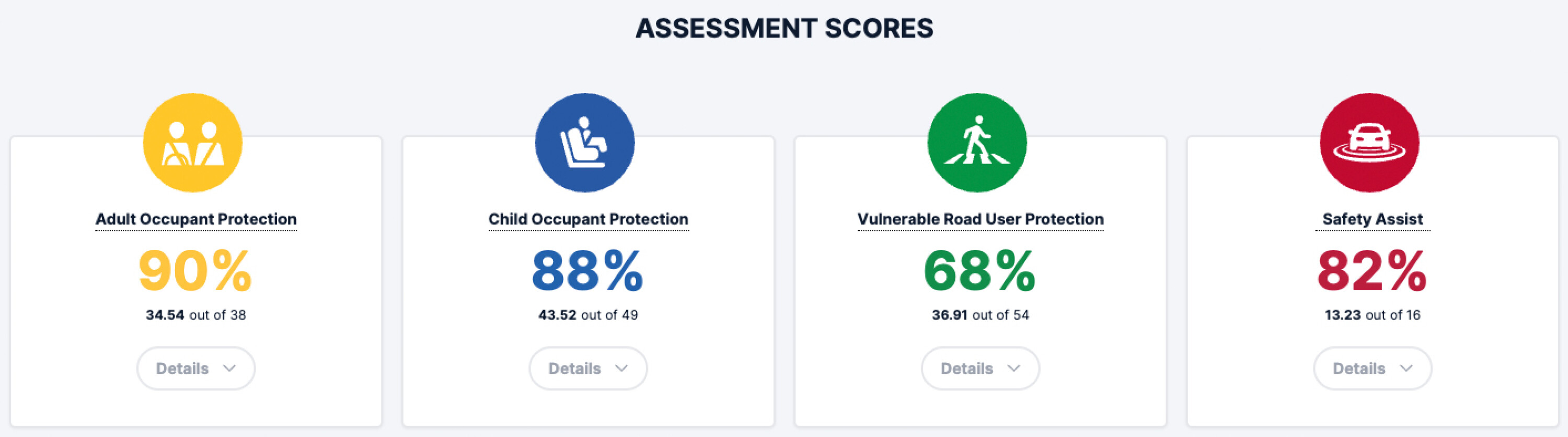
The Carnival has a five-star ANCAP safety rating, earned in 2021, helped by a decent suite of safety features included across the range.
| Kia Carnival safety features | |
|---|---|
| 7 airbags | ABS |
| Stability and traction controls | Forward AEB (high and low speed) |
| Forward collision warning | Reverse cross-traffic alert |
| Multi-collision braking | Front cross-traffic alert |
| Lane departure warning | Lane-keep assist |
| Driver attention detection | Safe exit warning |
| Blind-spot monitoring | Reversing camera |
Its forward auto emergency braking (AEB) system includes pedestrian and cyclist detection and works at high and low speeds.
The Carnival also scored very well in crash testing, including 90 per cent for adult occupant protection and 88 per cent for child occupant protection.
It has seven airbags, including frontal, driver’s knee, front curtains for side/head protection and side curtains for the second and third seating rows.
For child seats, ISOFIX points are provided in the middle and back rows of seats and five top tether points are spread across the two rearward rows.
Oh, and while it’s not exactly a safety-critical feature, rain-sensing windscreen wipers are a curious omission from a vehicle not otherwise short on technology.
4
How comfortable and practical is the Kia Carnival?
Comfort and practicality are the reason for the Kia Carnival’s being.
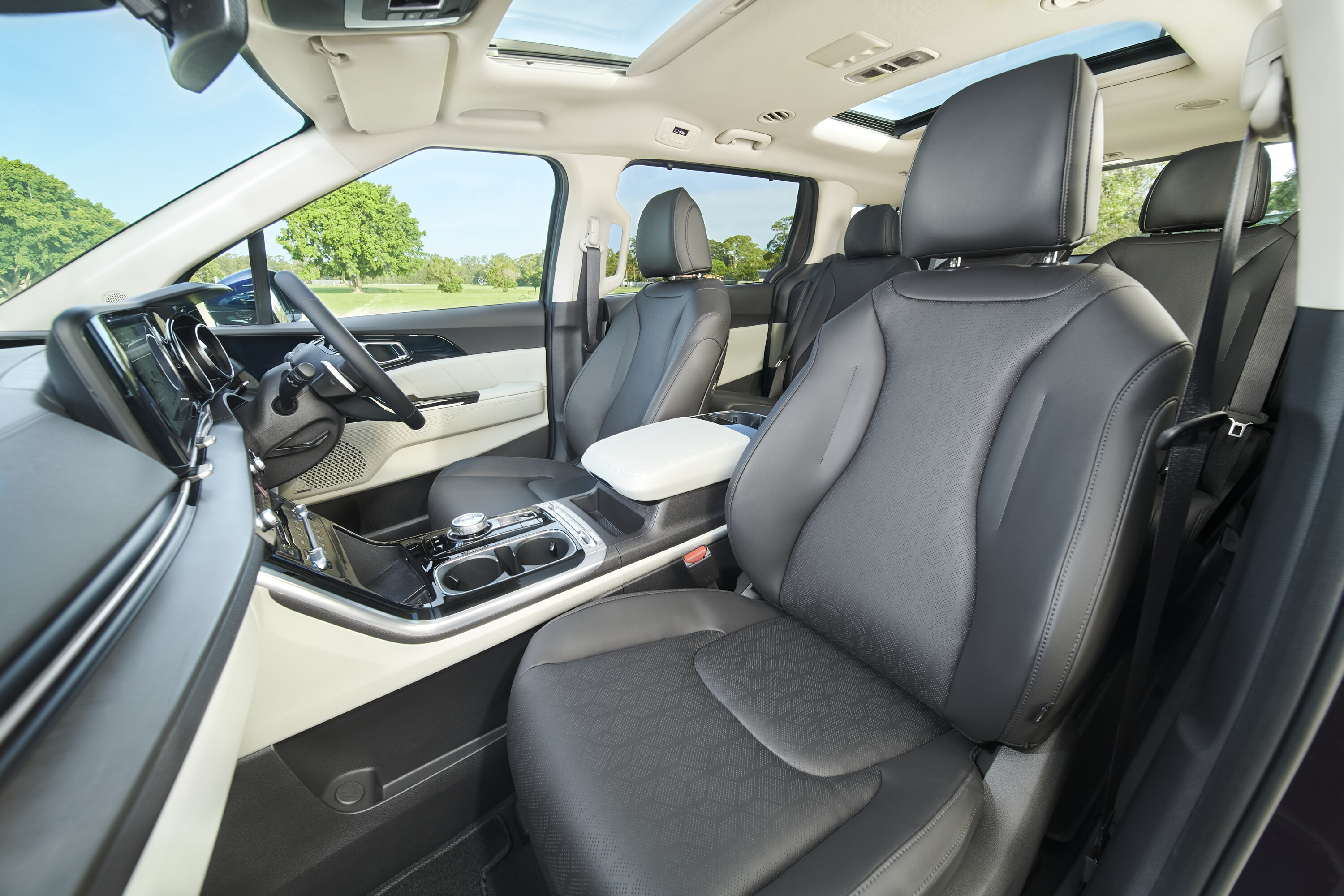
The entry-level S spec is a nice place to be even if you’ve been assigned the third row, and as you go up in the range things start getting plusher.
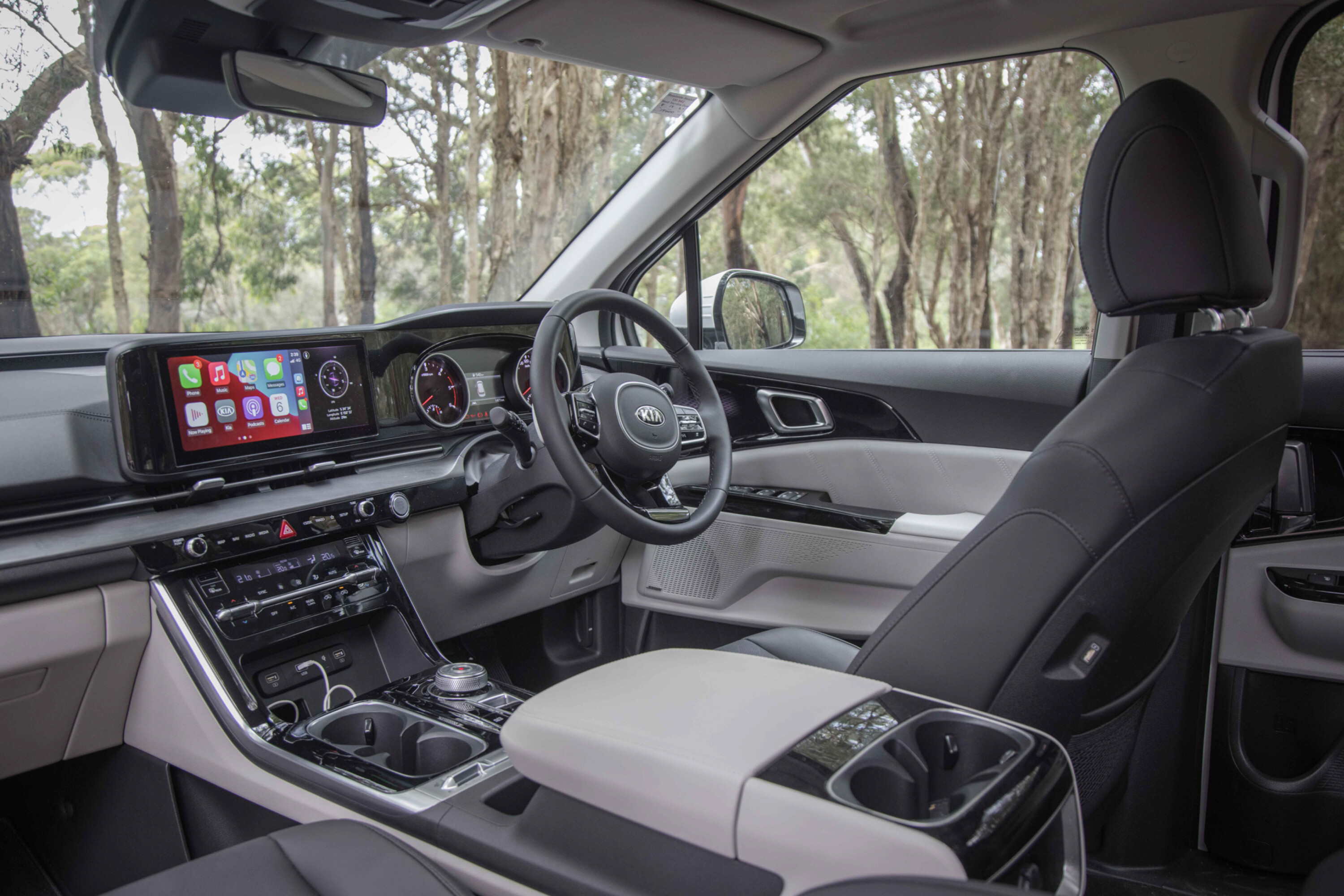
While the Carnival is designed for passenger comfort, the driver is well looked after. The front seats feel very supportive and don’t sit too high; it feels more like a slightly jacked-up wagon than a van and offers a very pleasant driving experience.
Cabin ergonomics are excellent, with key controls clearly labelled and easy to reach.
A huge, wide centre console box doubles as a centre armrest, there are two two cup holders and you can stow your bottles in the big door pockets.
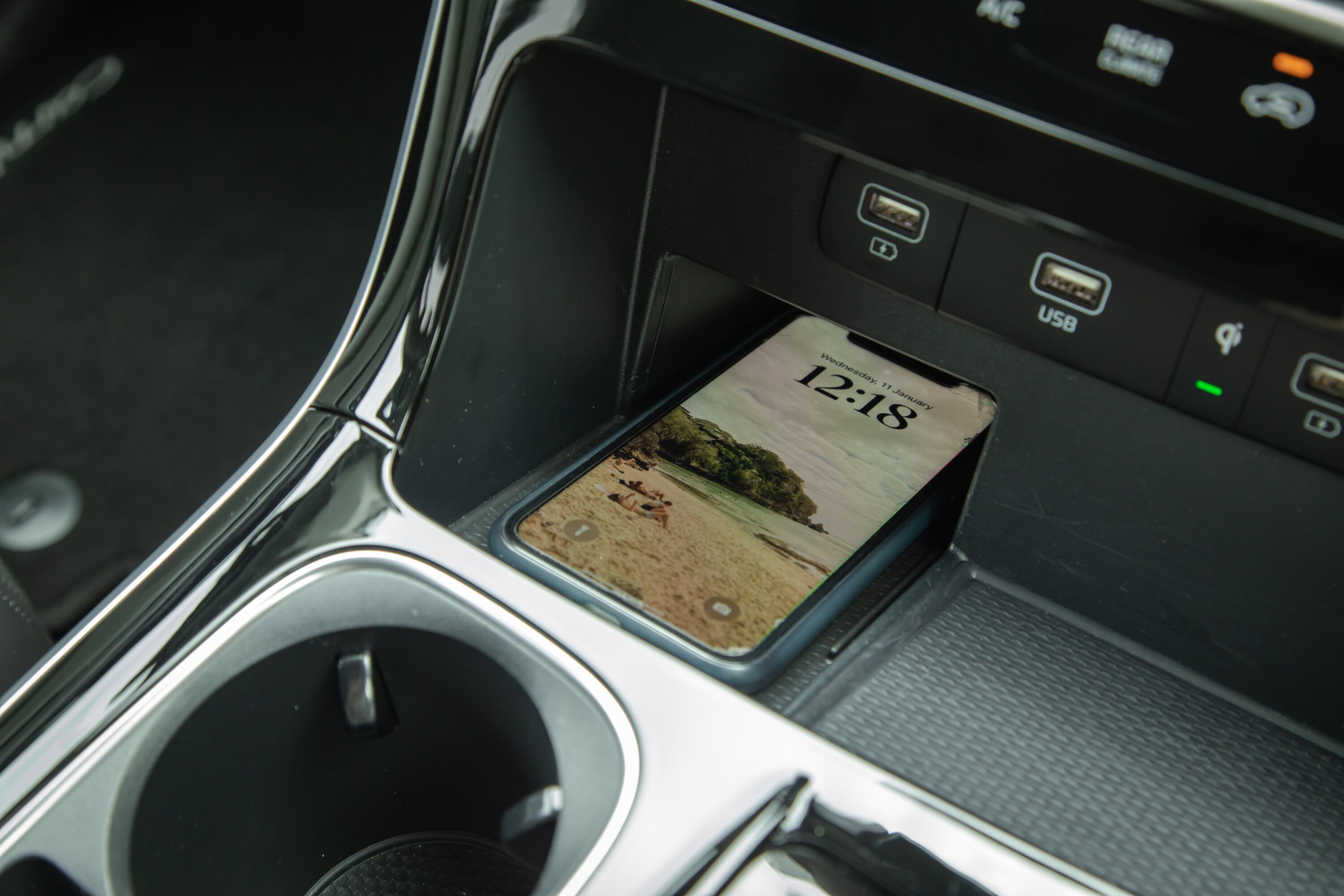
There are USB ports for power, with the range-topping Platinum gaining a wireless phone charging pad, though this would be more useful in the S spec in combination with its wireless Apple CarPlay/Android Auto connectivity.
9
Rear seat comfort
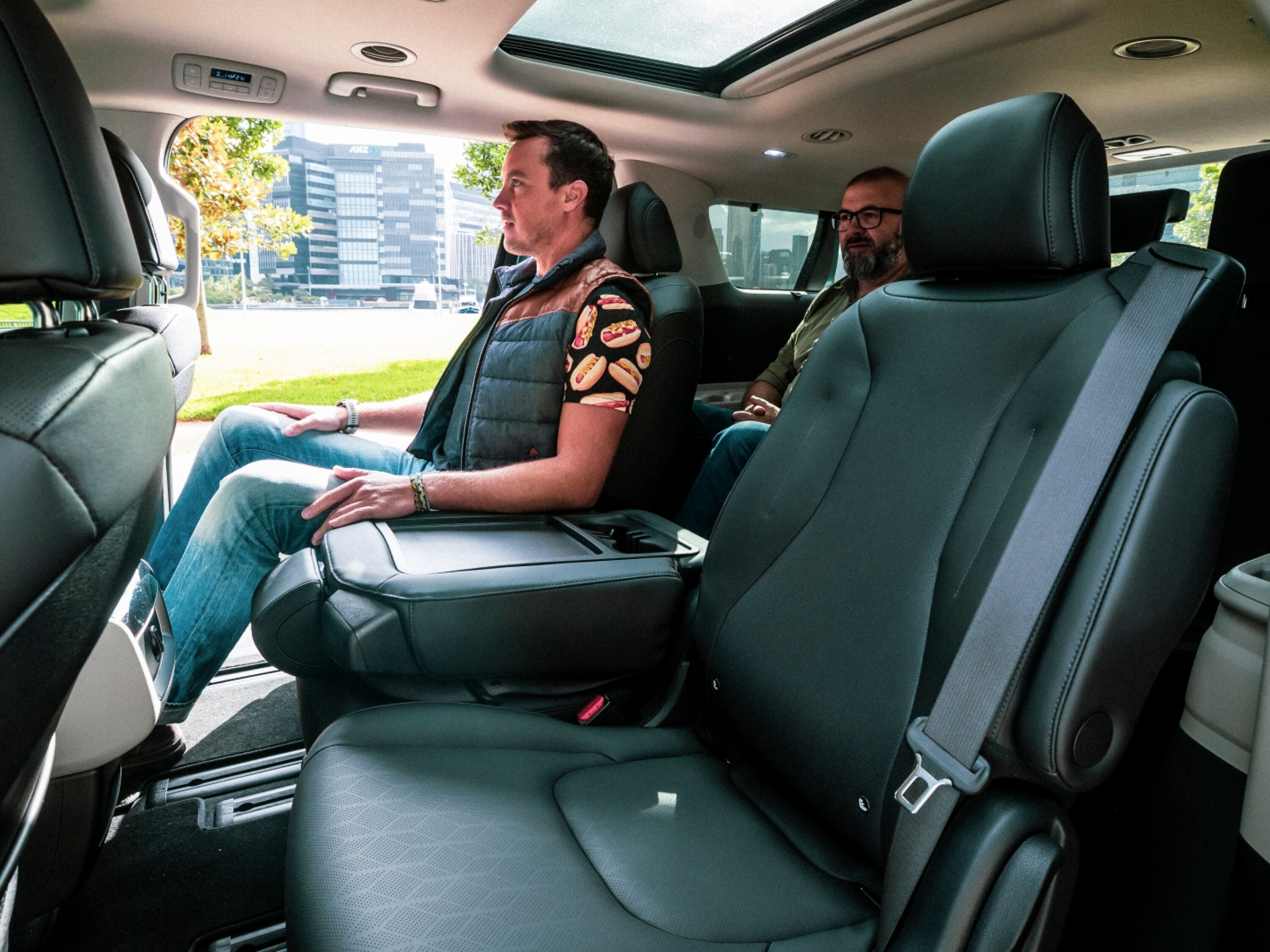
The second row features three separate seats, which makes it easy to load people into the third row from either side.
The middle row slides for and aft for more space at the rear, which creates extra space for big loads or third-row passengers.
With two people, the middle seat folds down to reveal a tray and cup holders. There are also cup holders at the rear of the centre console above the armrests, but such is the legroom that they can be difficult to reach. You can also store bottles in the door pockets.
Middle-row passengers also have plenty of headroom, even with the Platinum’s sunroof, which makes it feel even bigger inside, providing tons of light from above and through the big side windows. You can keep cool under the glass sunroof, too, with your own climate zone and overhead air vents.
4
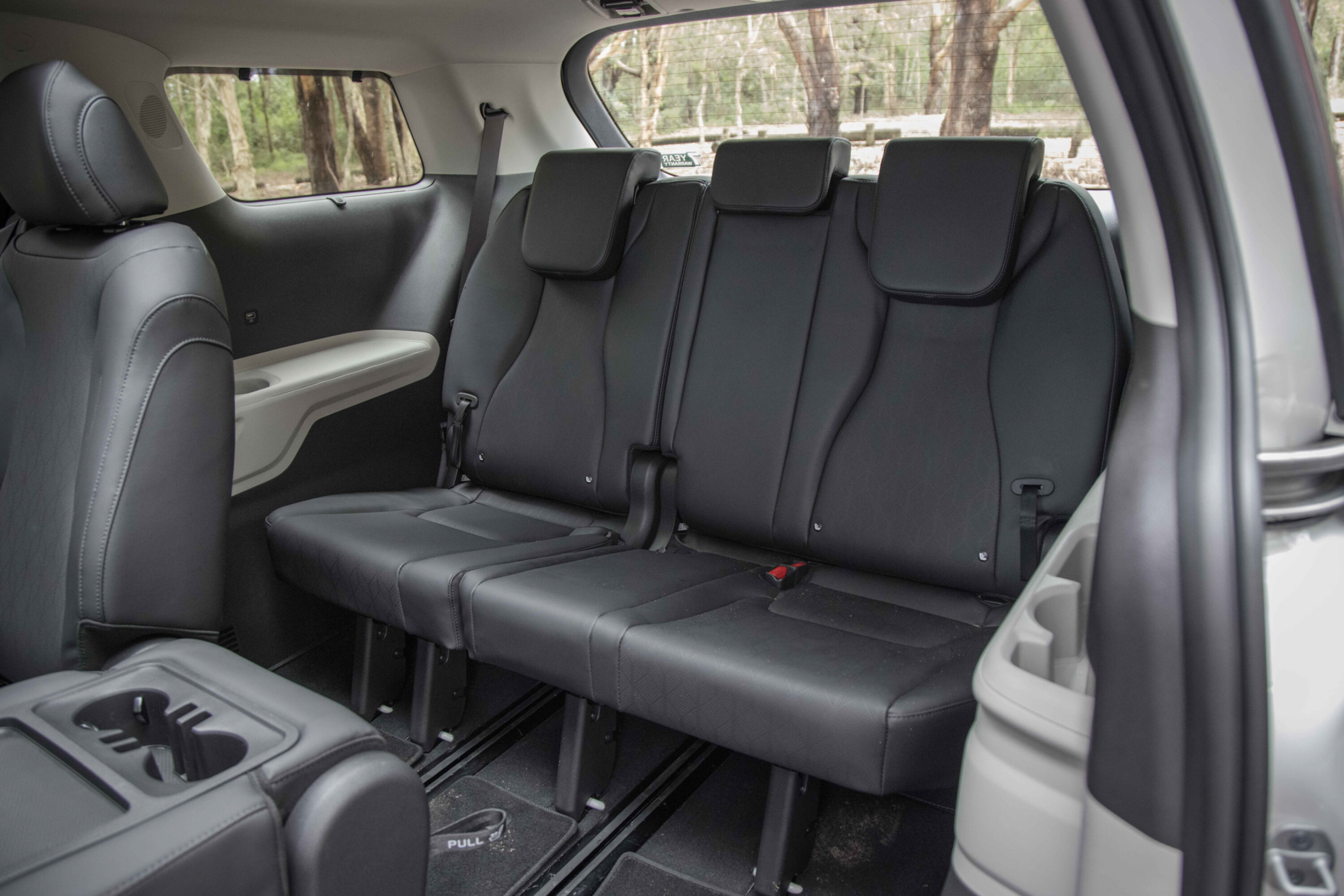
Accessing the third row through the broad side-door aperture is easy enough. A simple lever action moves the outboard middle seat forward enough to be able to step in the back without the grunts that come with hopping into the very back of a seven-seat SUV.
With some seat sliding, a 180cm person can sit in the third row in reasonable comfort for the airport run, though three across will be tight. The seats are nicely shaped and aren’t a basic plank bench.
The third row has four cup holders, a storage tray and air vents, with the SLi and Platinum specs bringing two USB-A charging ports so no passenger is left behind.
1
How much boot space does the Kia Carnival offer?
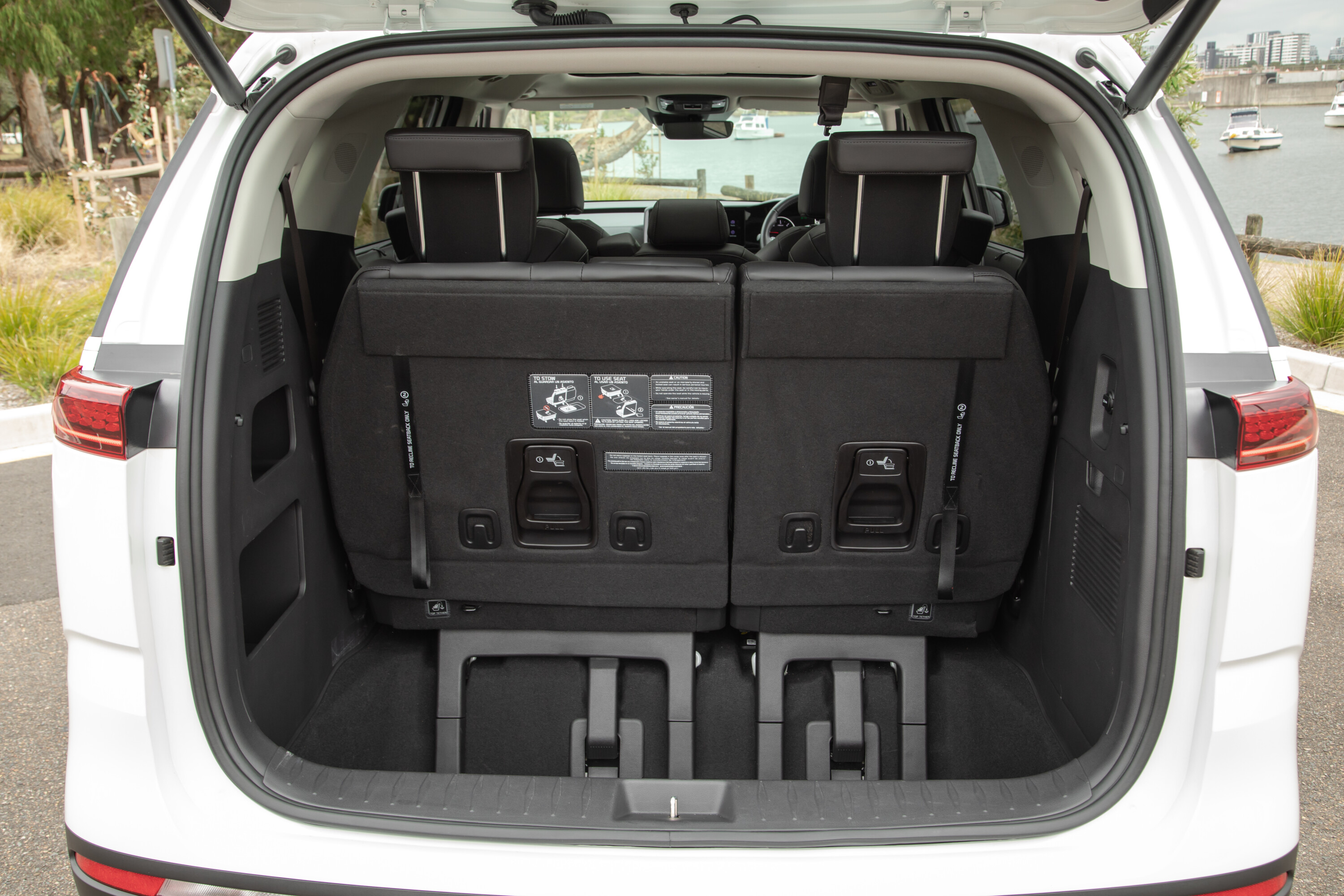
A lot! With all eight seats in place, the Carnival still offers 627 litres of space – the same as a Skoda Kodiaq in five-seat mode.
This makes it effective as an airport shuttle and allows a family of seven or eight to go on a week’s driving holiday without needing a roof pod.
10
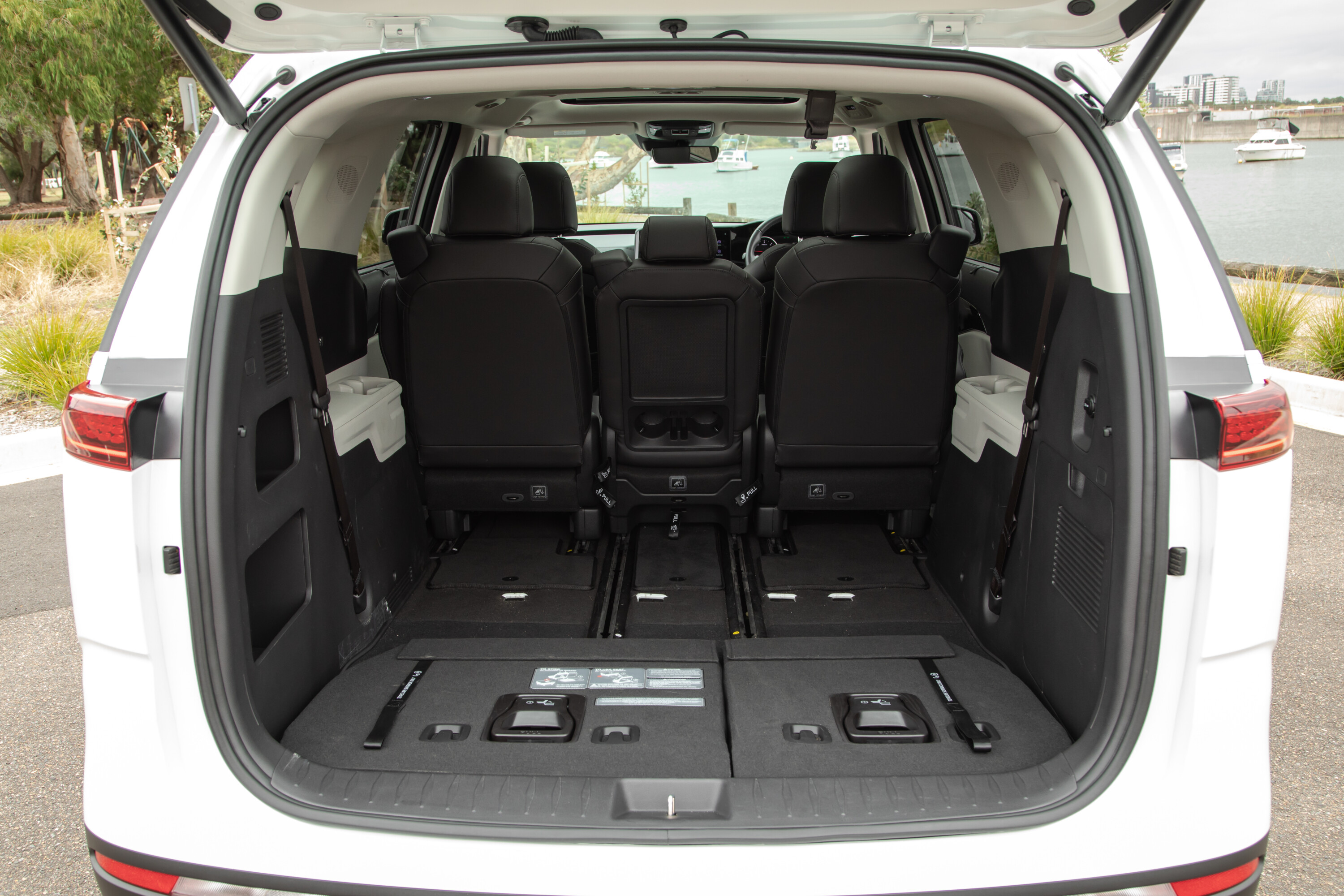
Stow the rear seats and the Carnival will swallow 2785 litres, with enough depth and height to store a mountain bike standing up.
In part, these impressive cargo capacity figures are made possible by some seriously clever use of space, including huge wells in the boot floor.
When stowing the third-row seats, they fill these voids by using an ingenious hinge and pivot mechanism that also results in a flat boot floor for more versatile loading.
I like driving, will I enjoy this people mover?
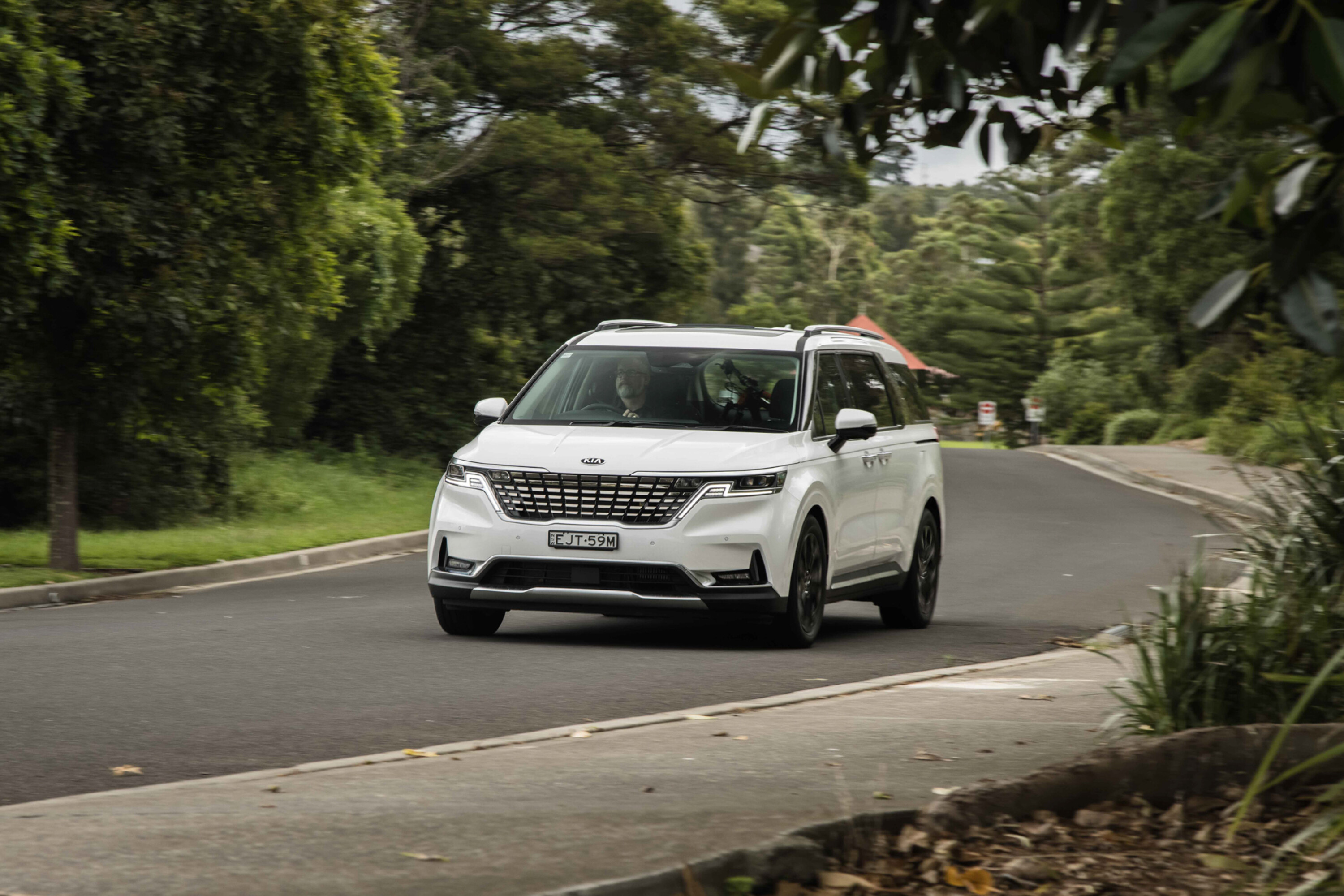
The Carnival’s driving position feels almost like that of a car and the same can be said about how it drives.
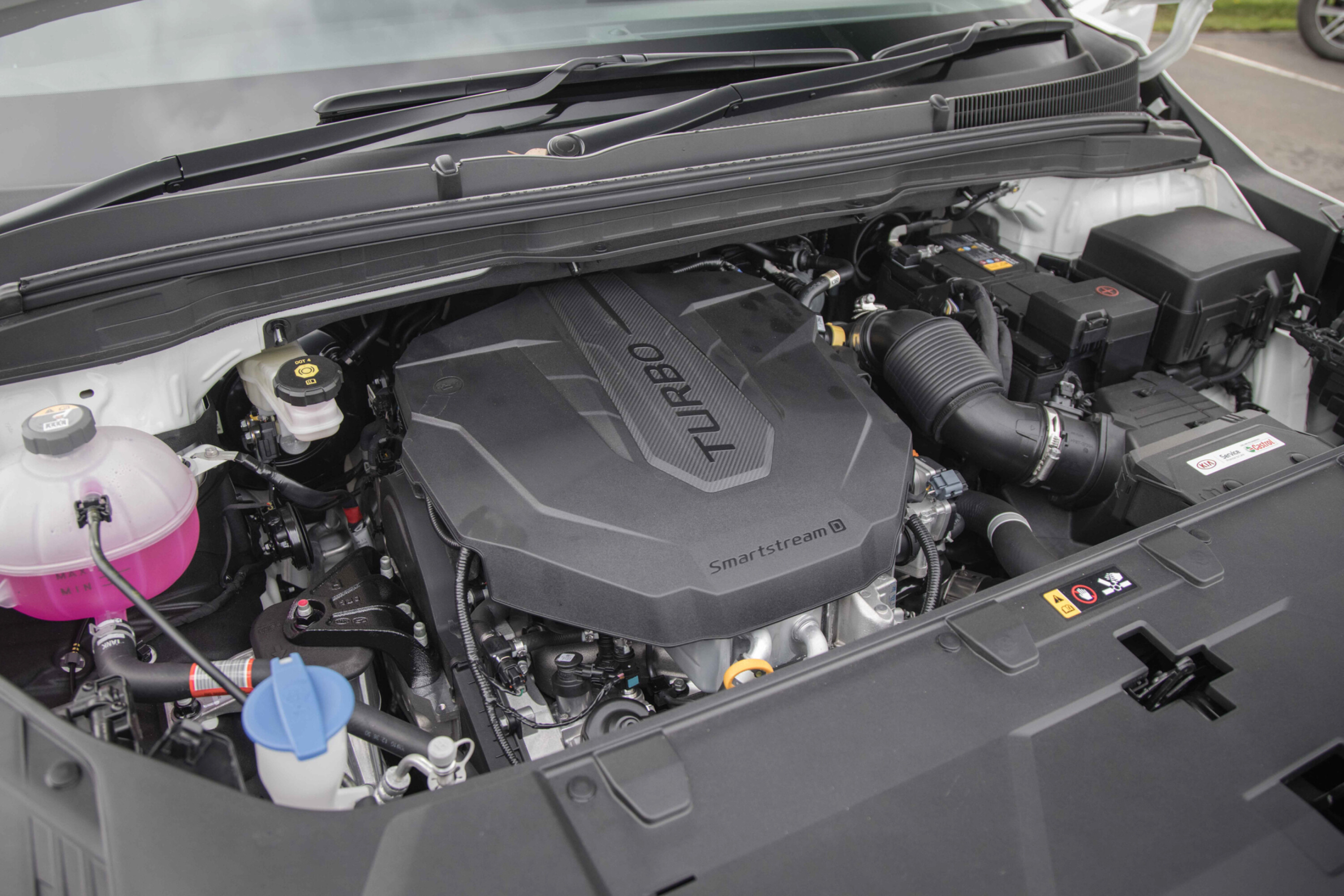
Kia’s 2.2-litre turbo-diesel engine is a strong unit and seems made for the Carnival. It’s not particularly noisy and gets the job done with a thrummy character that never becomes overbearing.
The eight-speed auto is excellent and shifts smoothly and decisively, rarely tripping up or worse, letting you roll back on hills.
2
Despite having to shift well over two tonnes of van, the diesel never feels stressed, happily wafting along on its solid torque output.
It’s pretty relaxed but not docile, with plenty of shove available from decisive use of your right foot.
The 3.5-litre V6 petrol engine, also coupled with an eight-speed automatic, also offers a smooth ride with virtually no lag.
It can take off surprisingly quickly, but unlike big SUVs with a similarly sized engine and front-wheel drive (we’re looking at you, Hyundai Palisade) you don’t get the wheel chirps when taking off at the lights, thanks to the Carnival’s shape placing more weight over the front wheels.
4
The Carnival steers nicely. The front end responds promptly to your instructions, and there is good communication between your hands and the front wheels.
Its suspension is tuned for Australian conditions, with comfort in mind but without really compromising handling. The long wheelbase helps, as does a centre of gravity that’s lower than comparatively-sized SUVs and contains body roll to a reasonable degree.
Despite its two-tonne heft, the Carnival doesn’t even feel too heavy, but parking can be a bit of a pain because it is well over five metres long. That said, there’s good all-around vision and electronic assistance.
If any of the terms in this section have left you scratching your head, these articles will help bring you up to speed!
1
- What is a Powertrain or Drivetrain?
- Power vs torque
- Car suspension explained
- Automatic transmissions (‘gearboxes’) explained
- Chassis control systems explained
- Car vs Ute vs SUV: How the vehicle you buy should guide the way you drive
The 148kW/440Nm 2.2-litre four-cylinder turbo-diesel is clearly the more fuel-efficient of the two engines available in a Carnival, consuming 6.5L/100km on the official test (city and country combined).
It is a great engine for highway use, hauling the Carnival down the road and up hills without fuss while feeling refined enough for urban duties.
There is also a lot to like about the 216kW/355Nm 3.5-litre V6 petrol engine that, like the diesel, sends power to the front wheels via an eight-speed automatic transmission.
This is the more refined engine of the two and feels more relaxed around town.
However, it is also a lot thirstier, with an official combined fuel consumption of 9.6L/100km, which will get into the teens when the Carnival is loaded with people and their luggage.
And it’s when the Carnival is loaded up that you’ll see the difference between having 355Nm of torque and the diesel’s 440 Newtons.
What is the Kia Carnival’s towing capacity?
Whether petrol or diesel, the Carnival’s towing capacity is a competitive 2000kg with a braked trailer and 750kg unbraked.
The towball download weight is a decent 200kg.
1
How long is the warranty and what are the Kia servicing costs?
Kia’s seven-year/unlimited-kilometre warranty applies and you get a year of roadside assistance that’s extended every time you service with Kia.
Servicing comes around every 12 months or 15,000km, which is probably a little short if you’re not working either powertrain too hard.
The capped-price servicing program covers the first seven services, which average out to be more than $500 per visit to the service centre, but at least you know what you’re in for.
Which version of the Kia Carnival does Wheels recommend?
The Kia Carnival SLi diesel is the pick of the bunch for economy, value and comfort.
It looks and feels luxurious, and brings enough over the Si to justify the $5000 premium while bringing much of what we like about the range-topping Platinum
The SLi’s 18-inch wheels also offer a slightly smoother ride than the Platinum’s 19s.
2
What are the Kia Carnival’s key rivals?
- Hyundai Staria
- LDV G10 Wagon
- LDV Mifa
- Mercedes-Benz Vito Tourer
- Toyota Granvia
- Volkswagen Caravelle
- Volkswagen Multivan
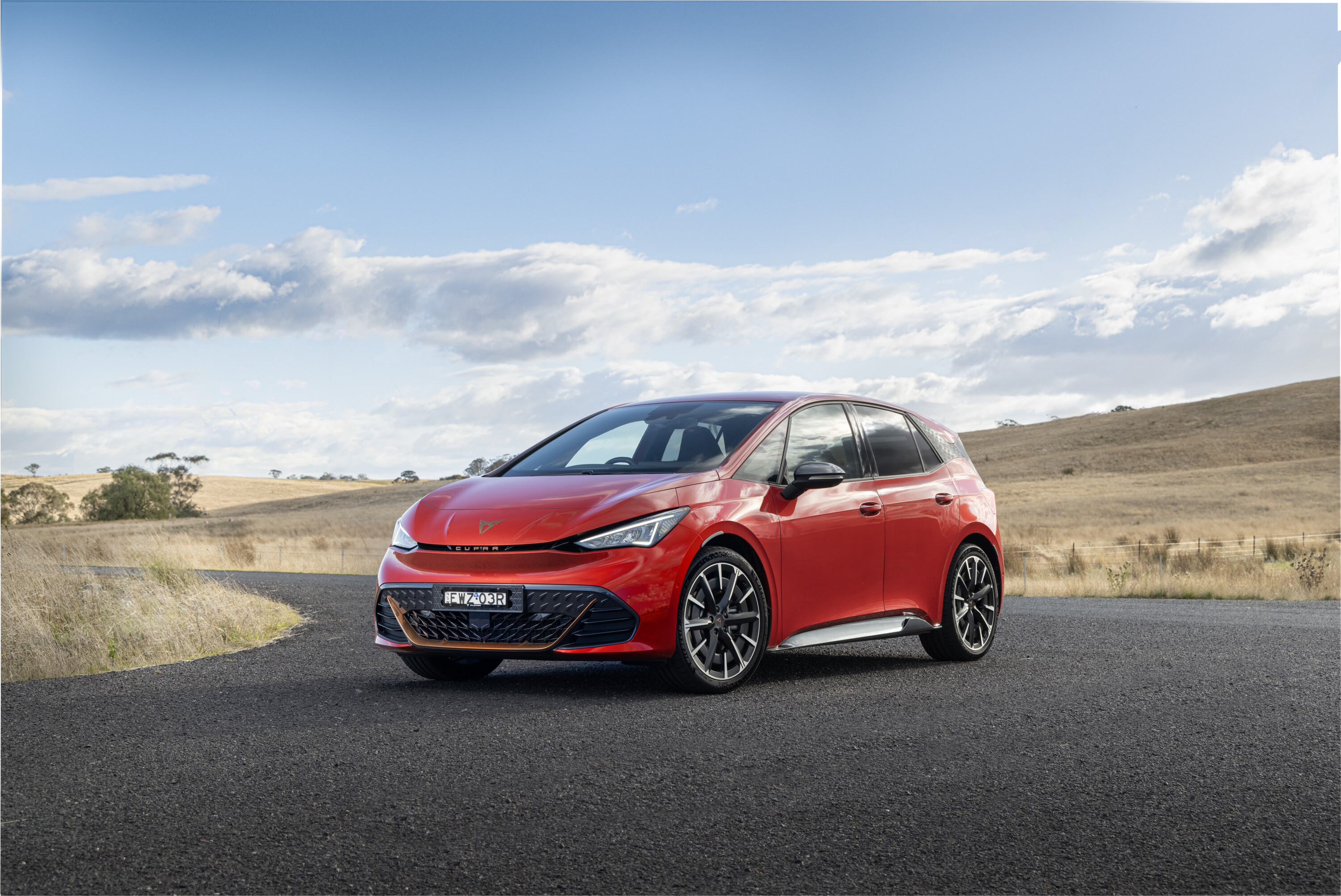
Cupra has confirmed a strong order bank for its first battery-electric vehicle, the Born hot hatch. Launched in April, the Born’s already notched up 700 orders.
At the Born’s launch, Cupra confirmed that the first 600 cars had been built, meaning that – providing shipping goes smoothly – most of the 700 orders will be satiated by the initial batch.
Some 90 Borns have found homes in two months on sale, with 59 of those coming in May.
Cupra remains confident it can deliver over a thousand Borns to punters this year, which could prove compelling for buyers tired of the long waits confirmed by other brands.
Things we like
- An enthusiast’s EV
- Price and standard equipment
- Option packs are considered, and affordable
Not so much
- Infotainment can be tough to grasp
- Haptic controls not for everyone
- Adaptive dampers locked to Performance Pack
“A third of Cupra’s orders are for our [Born] BEV or PHEVs (plug-in hybrid EVs)… Seven hundred of these are the fully electric Born, which was released only in April,” Cupra Australia director Ben Wilks said.
At the Born’s launch, product boss Jeff Shafer told Wheels: “If demand is there, we’re confident we can deliver four figures [of Borns] this year”.
Capable of 511km driving range from a charge, the Born starts at $59,990 before on-road costs. Its price makes it eligible for discounts in some states, likely driving interest.
Cupra’s small car is more affordable than a base Tesla Model 3, but dearer than an equivalent MG 4 – and early impressions suggest the MG 4 is going to provide some serious competition.
1
| 2023 Cupra Born features | |
|---|---|
| 19-inch alloy wheels (black and copper) | Auto-dimming rear-view mirror |
| 12-inch infotainment system | Drive mode selector |
| Wired Apple CarPlay and Android Auto | Tyre pressure monitoring |
| DAB+ digital radio | Front bucket seats |
| 5.3-inch digital instrument cluster | Recycled fibre upholstery |
| Four USB-C ports (2x front, 2x rear) | Dual-zone climate control |
| Wireless phone charger | Adaptive steering |
| Colour-adjustable ambient lighting | Sports suspension |
| Leather-wrapped heated steering wheel | Automatic parking |
| LED head and tail-lights | Rain-sensing wipers |
| Rear spoiler | 360-degree camera system |
| Heated power-folding side mirrors | Carpet floor mats |
| Keyless entry and push-button start | |
Electrified Formentor SUV and Léon hatch popular too
Plug-in hybrid versions of the Formentor SUV and Léon hot hatch models are in-demand too, with 350 orders in for them.
While it doesn’t mean Cupra will overtake the goliaths of the EV and hybrid worlds – Tesla, BYD, and Toyota come to mind – it says something about the kind of buyer Cupra is courting.
“This tells us that CUPRA’s customers are all on board with our blend of dynamic design and driving, whether it comes in BEV, PHEV or ICE form,” said Wilks.
Cupra’s goal is to keep the Born in a perpetually on-sale state now that the worst of the Covid-19 pandemic’s effects on shipping and production are behind us.
MORE
Everything Cupra
| 2023 Cupra Born specifications | |
|---|---|
| Body | 5-door, 5/4-seat hatchback |
| Boot min / max | 385L |
| Drive | rear-wheel |
| Powertrain | 82(77)kWh battery, single motor (rear) |
| Max power | 170kW |
| Max torque | 310Nm |
| Transmission | 1-speed automatic |
| Weight | 1811kg |
| L/W/H/W-B (mm) | 4322/1778/1540/2766 |
| 0-100km/h | 7.0sec (claimed) |
| Price | $59,990 + on-road costs |
| On sale | now |
Starting from $52,490, the Triton GSR stamps its ground in the premium ute segment by offering plenty of standard features and a reliable 2.4-litre turbo-diesel engine.
Plus, the six-speed automatic transmission ensures a smooth drive, whether navigating city streets or tackling off-road trails.
Pricing and features
At the pinnacle of the Triton line-up, the GSR touts an extensive list of features including LED headlights, dual-zone climate control, a seven-inch infotainment system compatible with Android Auto and Apple CarPlay, black exterior treatment, faux leather trim and a multi-around monitor.
Mitsubishi’s Super Select II 4WD system and rear differential lock comes standard, making it an adventure-ready package.
The GSR variant further adds luxury in the form of leather seats with heating function for the front, and electric adjustment for the driver. There’s also the added convenience of keyless entry and push-button start.

4
Safety
The Triton GSR is loaded with a comprehensive suite of safety features. Standard safety tech includes Forward Collision Mitigation with pedestrian detection, Lane Departure Warning, and Emergency Brake Assist. Enhanced features include Blind Spot Warning, Lane Change Assist, Rear Cross Traffic Alert, Ultrasonic Misacceleration Mitigation System, and Hill Descent Control.
Key Rivals
The Triton GSR is up against some serious competitors in the high-spec ute market including:
Should I put it on my shortlist?
If you’re seeking a blend of off-road ability, comfort and advanced features without stretching your budget too thin, then the 2023 Mitsubishi Triton GSR should be on your shortlist. It offers a strong blend of value, capability and modern conveniences.
It could be a battle of the titans…
When was the last time you saw a comparison between two sub-$100K sedans, one of which happens to be a top-ten seller in Australia?
Blur your eyes a little and you could almost trick yourself that this is an AU Ford Falcon v VX Holden Commodore battle.
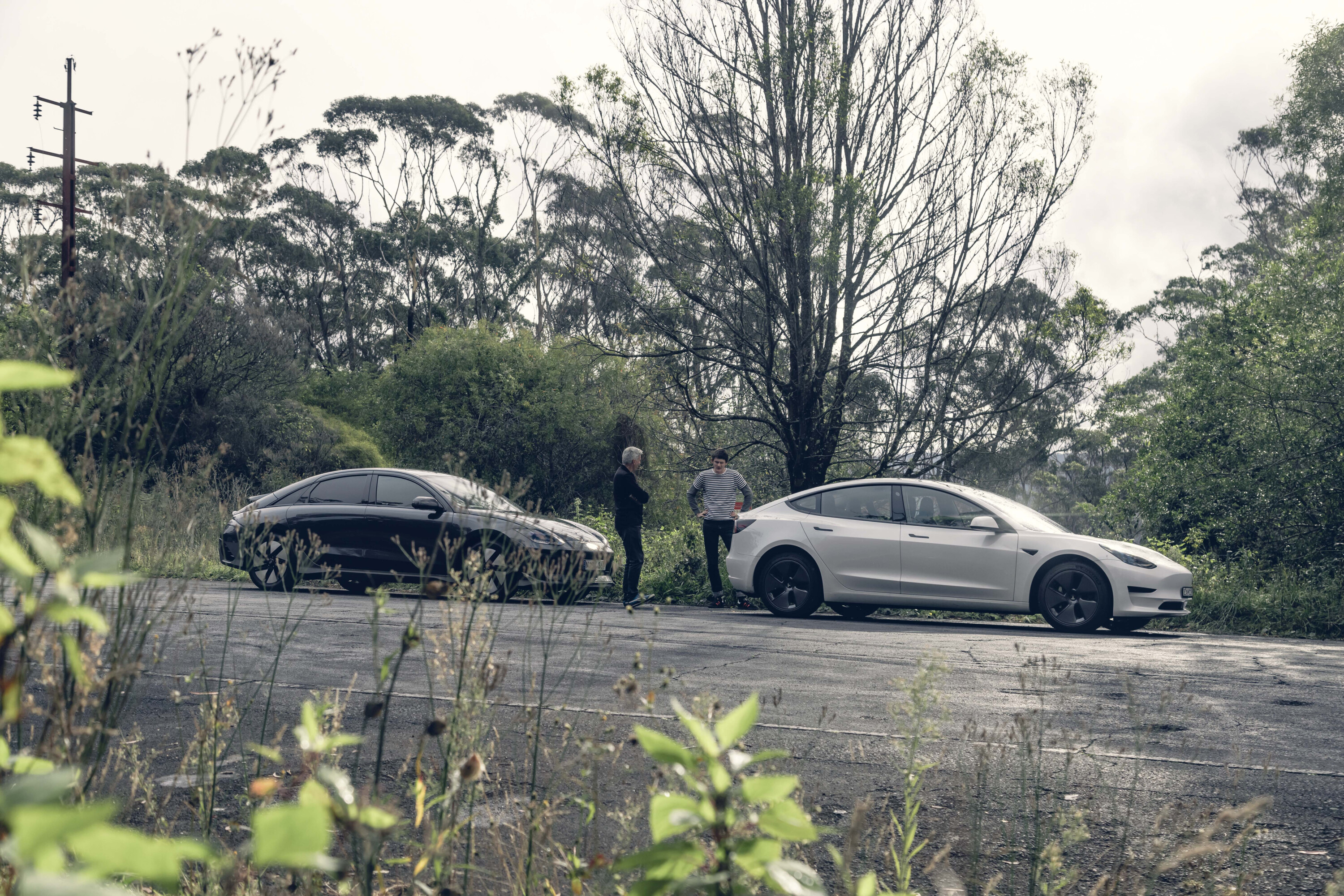
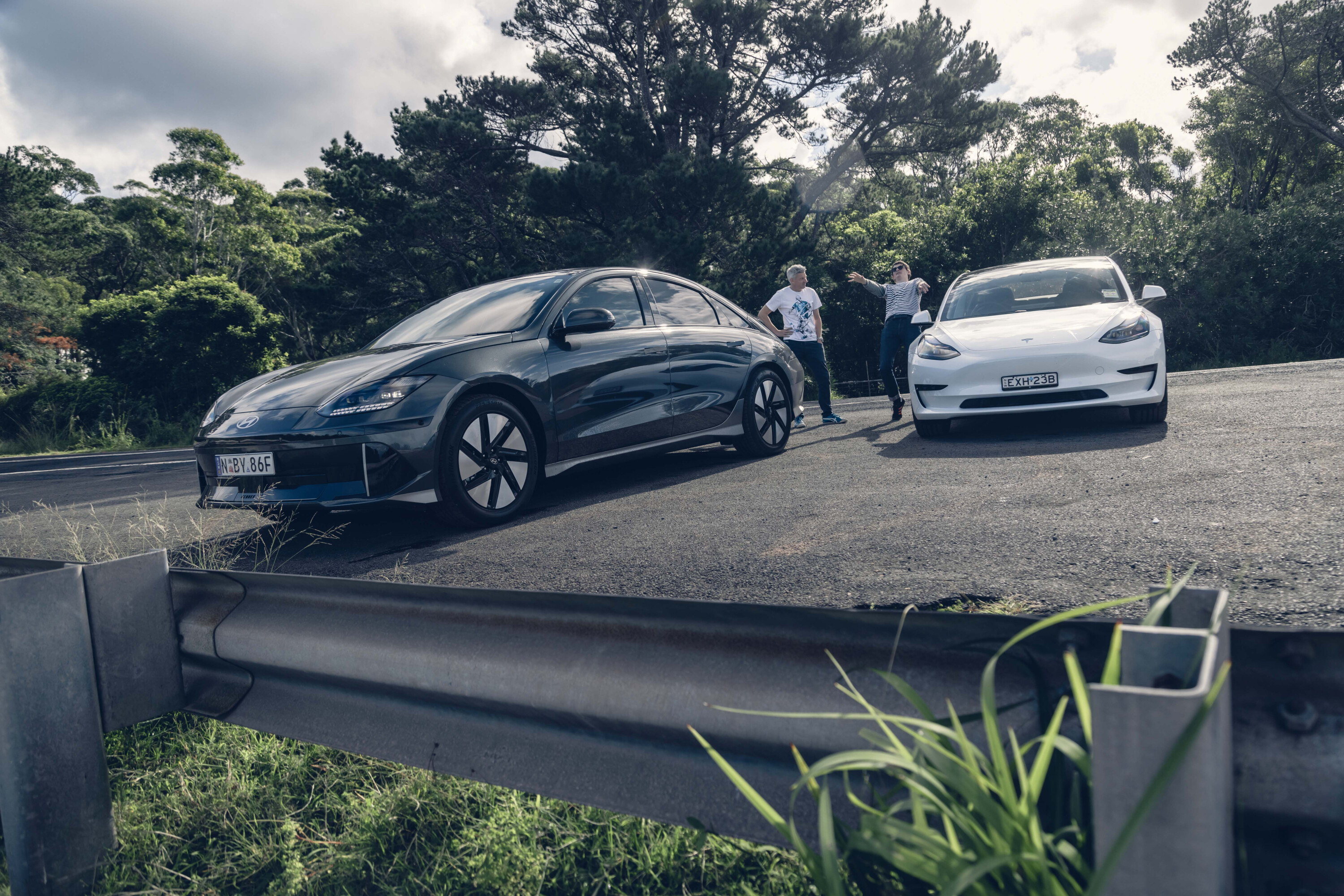
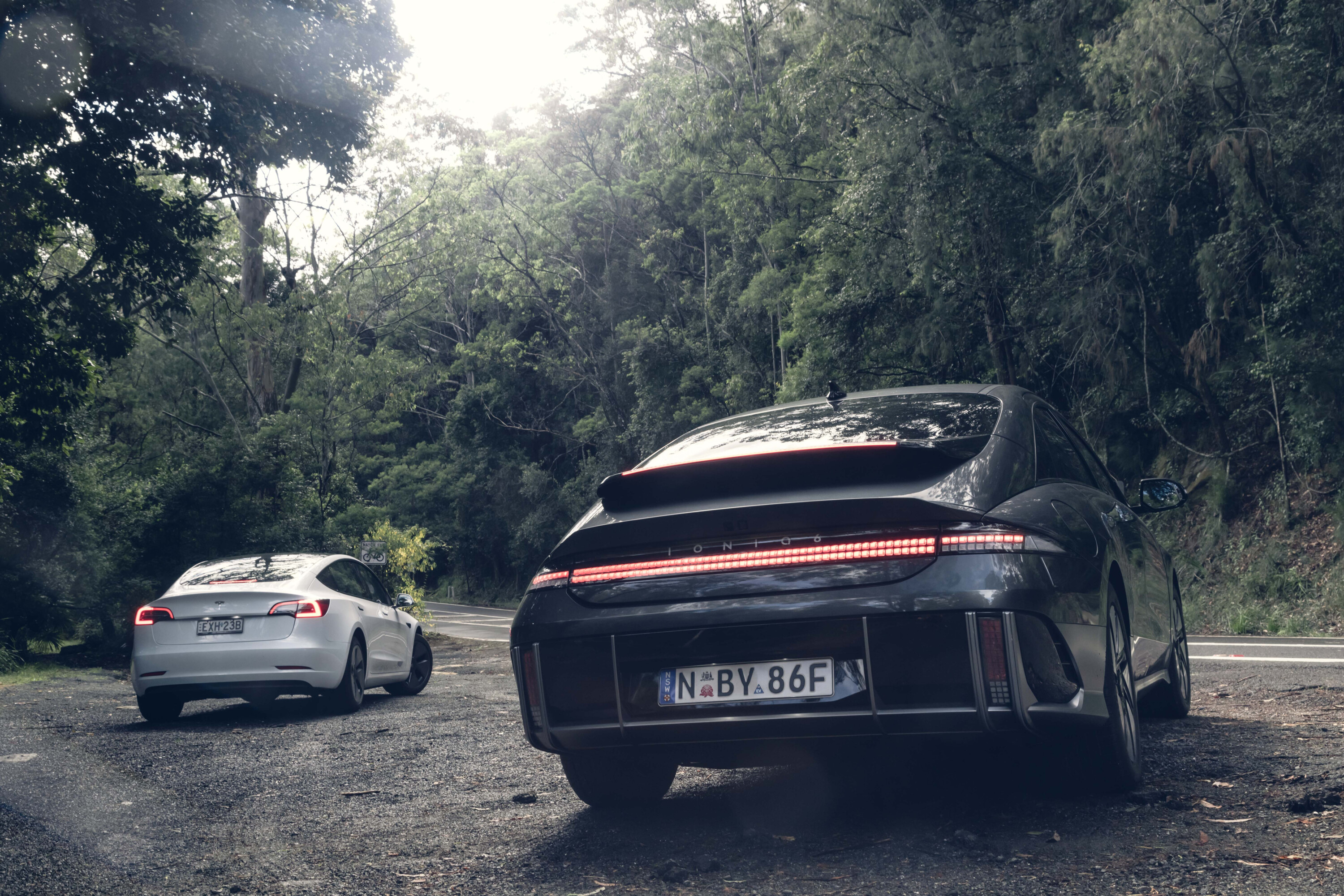
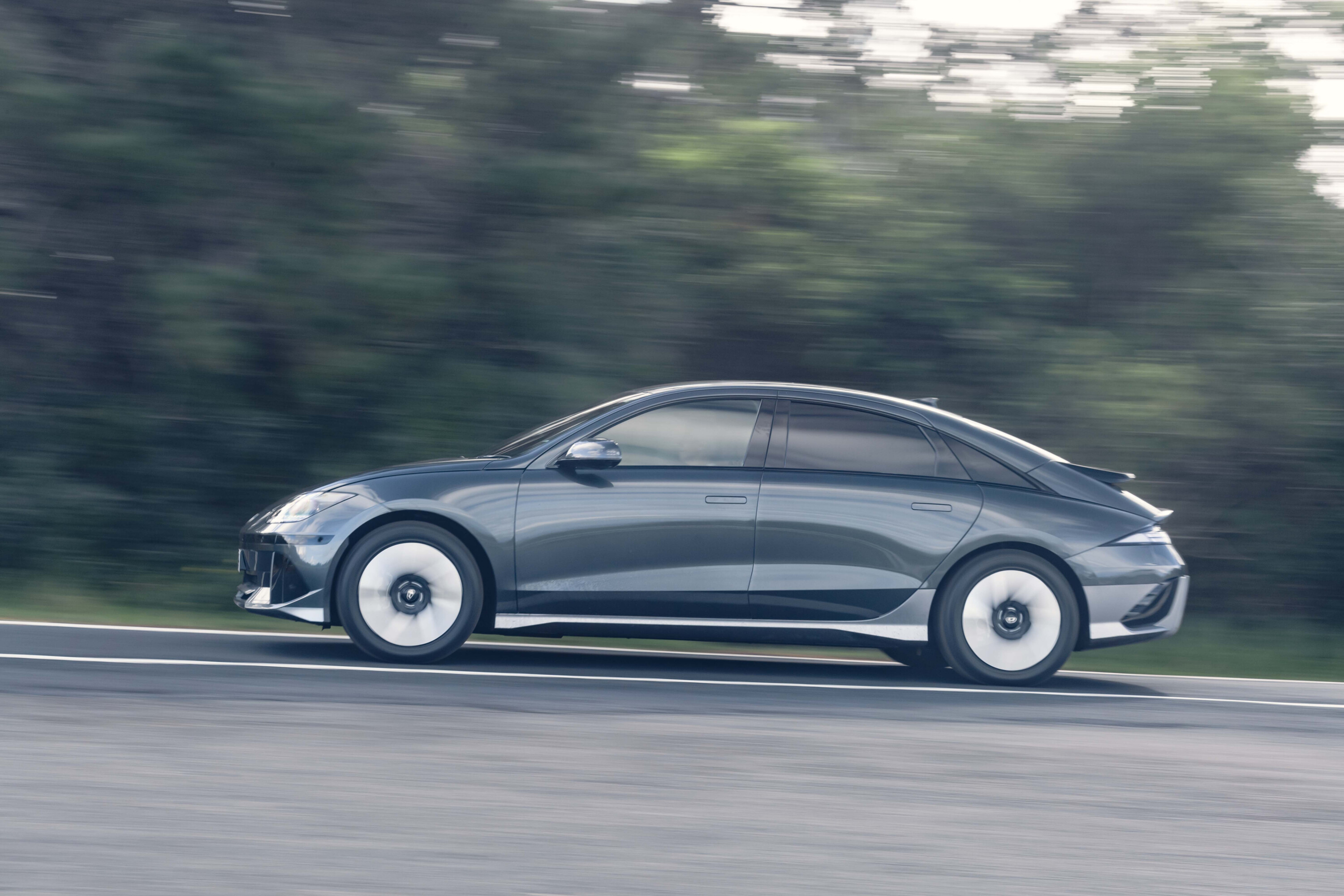
The Tesla doesn’t do a great VX impression, sure, but the way the IONIQ 6’s body lines curve in an arch from front to back gives more than a whiff of AU Falcon.
Although SUVs and utes are flavour of the moment, Tesla’s disruptive Model 3 has stamped its foot. Not only is it a top seller (this doesn’t always equate to greatness), but it also became our EV benchmark by taking top honours in our electric car Megatest in December (Wheels Yearbook 2022).
Fast forward a few months to March 2023 and editor Enright’s first encounter with Hyundai’s new IONIQ 6 – an ‘electrified streamliner’ as the brand calls it – and the Tesla’s supremacy was thrown into question. Andy came away from the IONIQ 6’s launch program suitably impressed.
December 2023: Updated Model 3 driven
Story continues…
1
“If you want the better car, right now it comes from Korea,” was Enright’s initial verdict on Hyundai’s electric sedan.
That’s why we’ve lined up the most affordable version of each for a twin test on familiar bitumen to directly compare and contrast the pair.
In its cheapest form, the $74,000 (before on-road costs) IONIQ 6 is currently $12,700 dearer than our base Model 3. The extra ask brings a generous 77.4kWh NMC battery pack and 614km range (WLTP). Courtesy of Hyundai/Kia’s 800-volt E-GMP platform, you also get faster charging with 10-80 per cent taking just 18 minutes on a 350kW public charger.
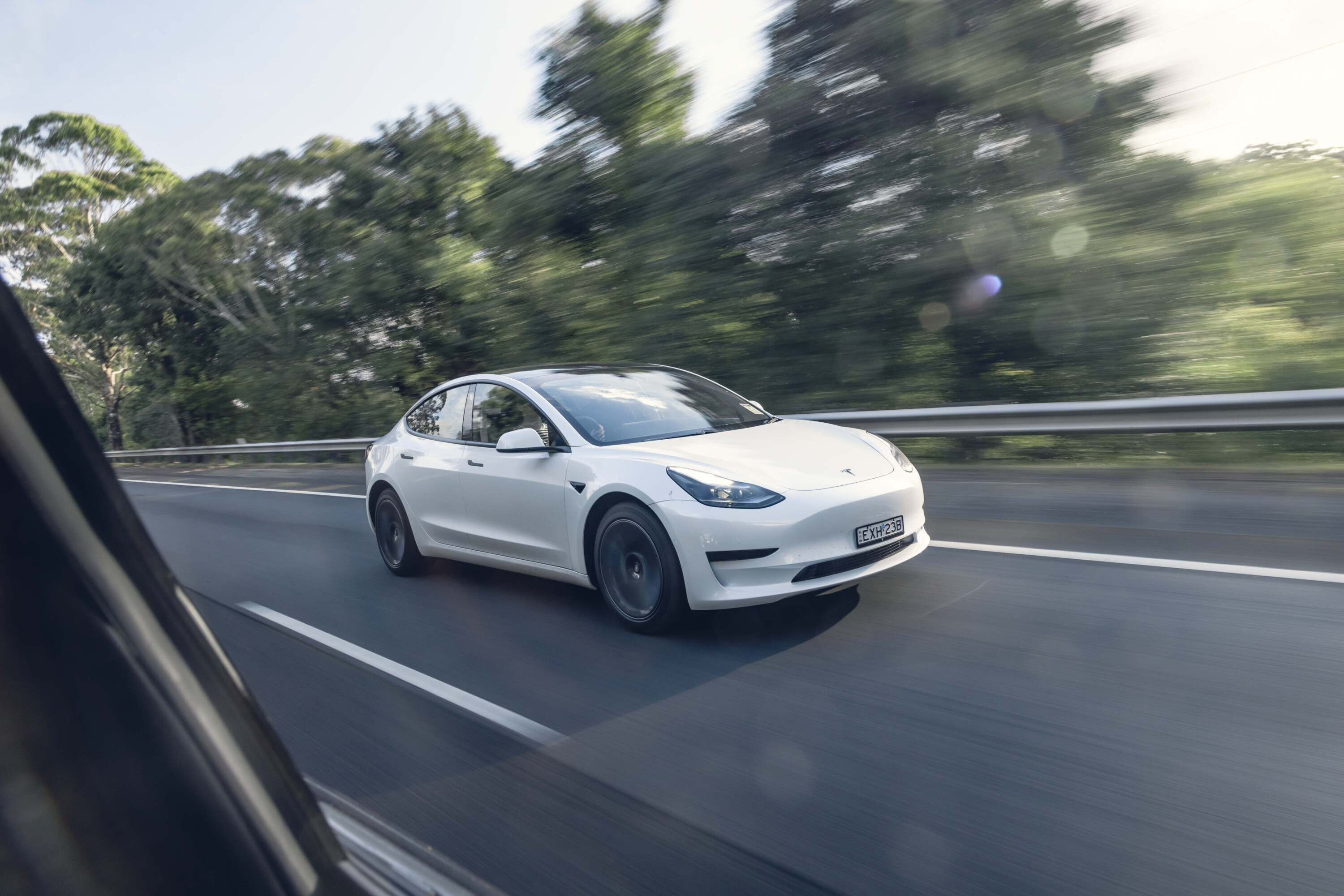
Played against the Model 3 – which takes around 25 minutes for the same interval – the IONIQ 6 is handily quicker at getting you back on the road, more than offsetting its slower 0-100km/h sprint (6.1 seconds plays 7.4 seconds). As for power, Tesla doesn’t advertise figures, but estimates put it 50kW up on the IONIQ 6’s 168kW figure, and 70Nm on the Hyundai’s 350Nm.
1
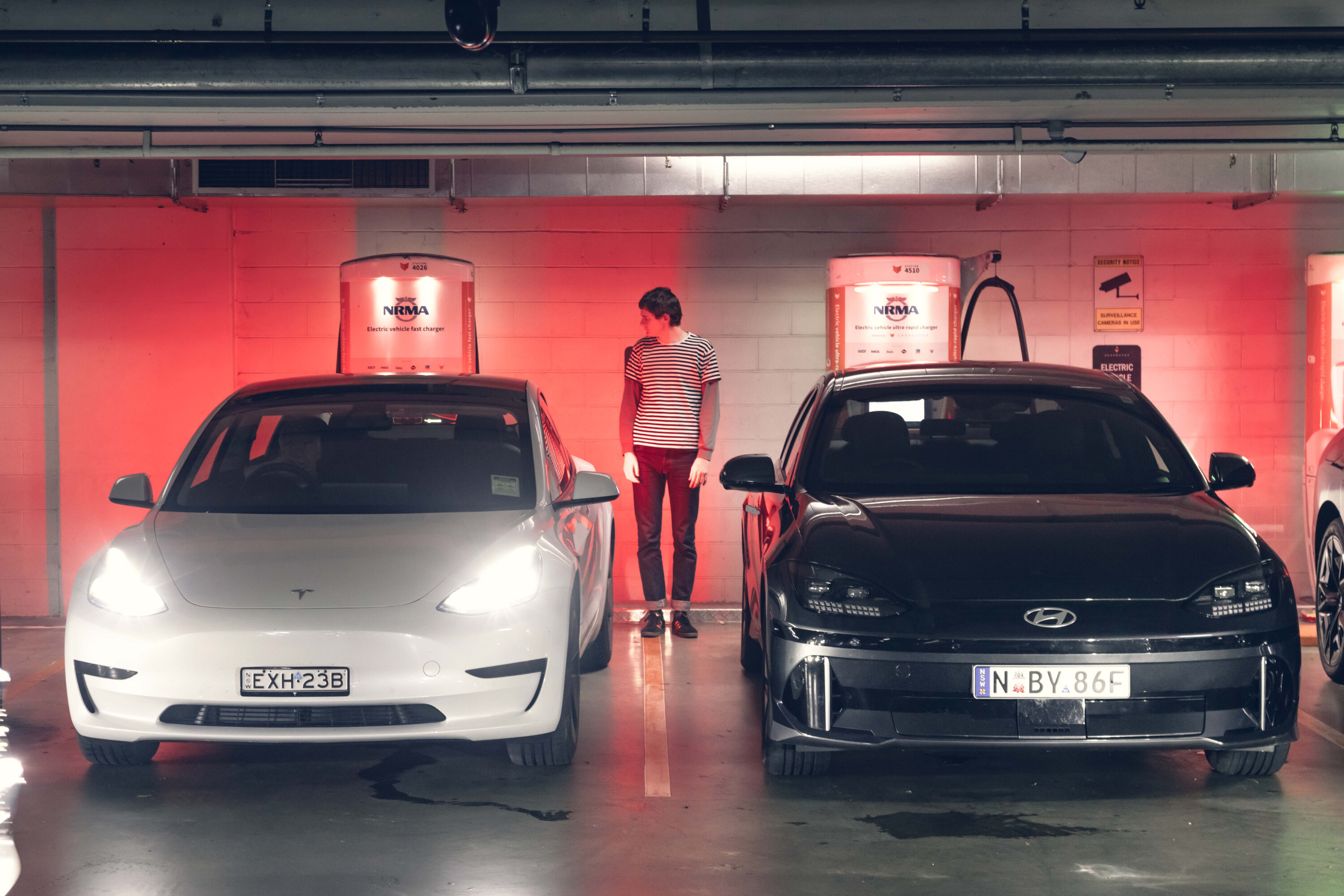
We observed lower peak charge speeds than both Tesla (170kW) and Hyundai (230kW+) advertise due to what we believe was a faulty charger, but the IONIQ 6’s consistent 150kW was still double the Model 3’s 80kW rate.
The Model 3 RWD standard range on test – that we graciously thank a reader for lending us after Tesla was unable to supply one within our comparison timeframe – has an advertised 491km WLTP range from its smaller 57.5kWh LFP battery. Tesla’s Supercharger network remains a drawcard for Model 3 ownership, too, even though it’s gradually opening up to other brands.
Due to different battery chemistry in MY23 base Teslas, you can charge the Model 3 up to 100 per cent regularly (taking six hours and 15 minutes on an 11kW wallbox), whereas the IONIQ 6 is best topped up to 80 per cent. Coincidentally, 80 per cent of the Hyundai’s range is identical to the Model 3’s 491km WLTP rating.
1
Compared to their SUV relations, the sedans’ aero advantages are laid bare in WLTP figures.
In Tesla’s case, the Model 3 will travel 36km more than a Model Y RWD, while the IONIQ 6 blows its 5 cousin out of the water with 113km of extra roving range from the same 77.4kWh battery.
In testing, both cars came close to matching their claimed numbers. The IONIQ 6 returned 14.5kWh/100km over 221km of driving, and the Model 3 13.6kWh/100km. This gives real-world ranges of 530km and 426km respectively – both about 13.5 per cent shy of WLTP.
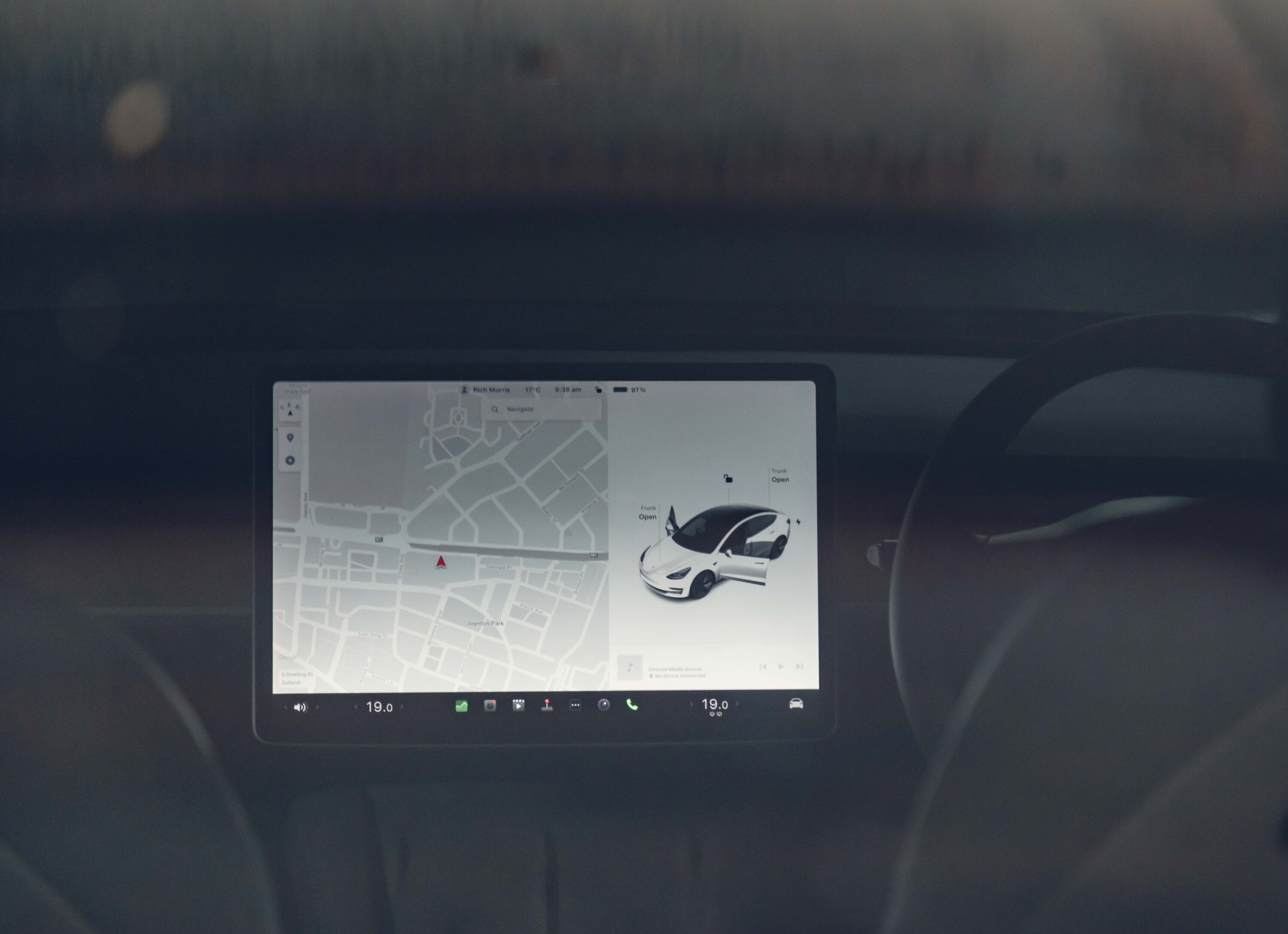
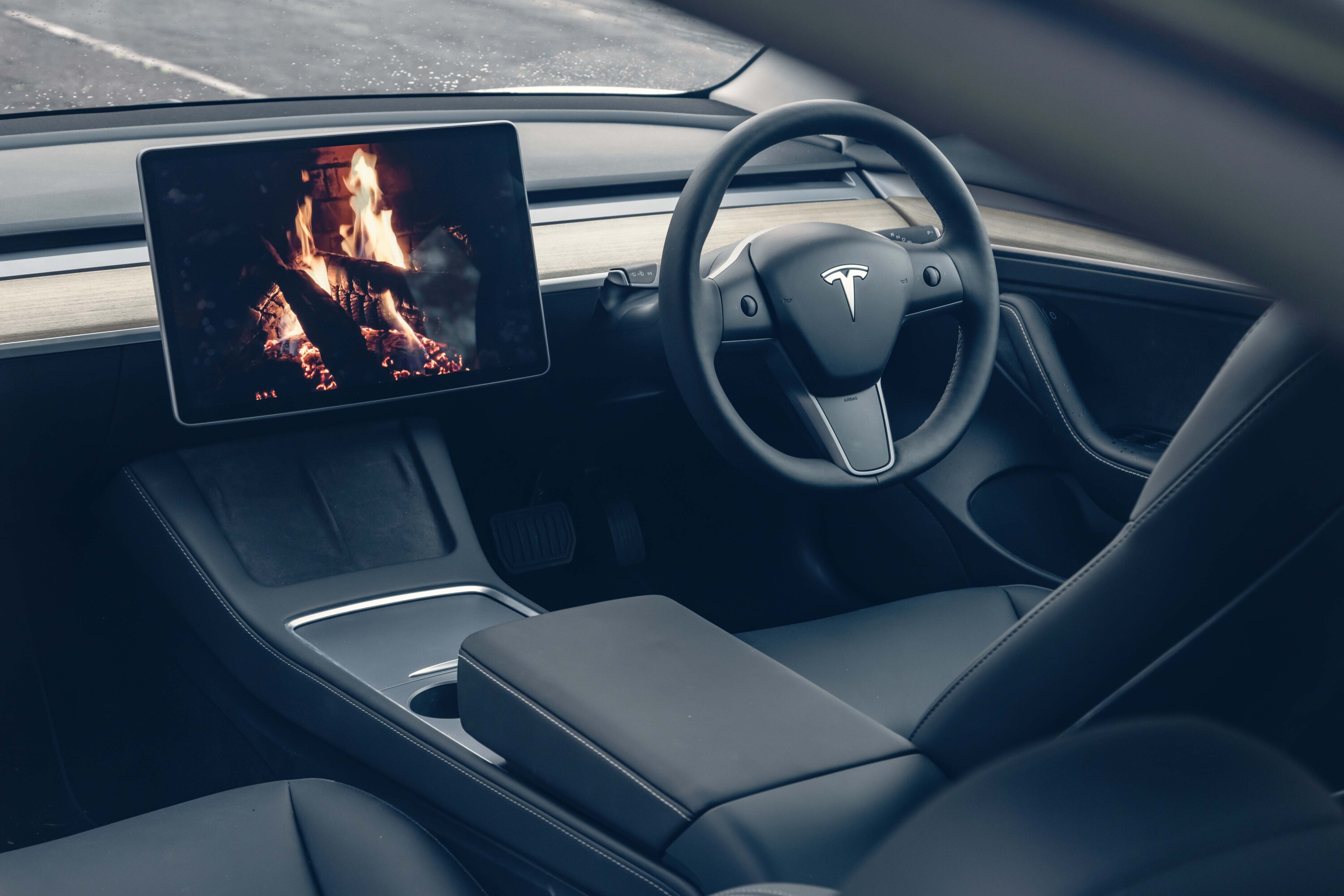
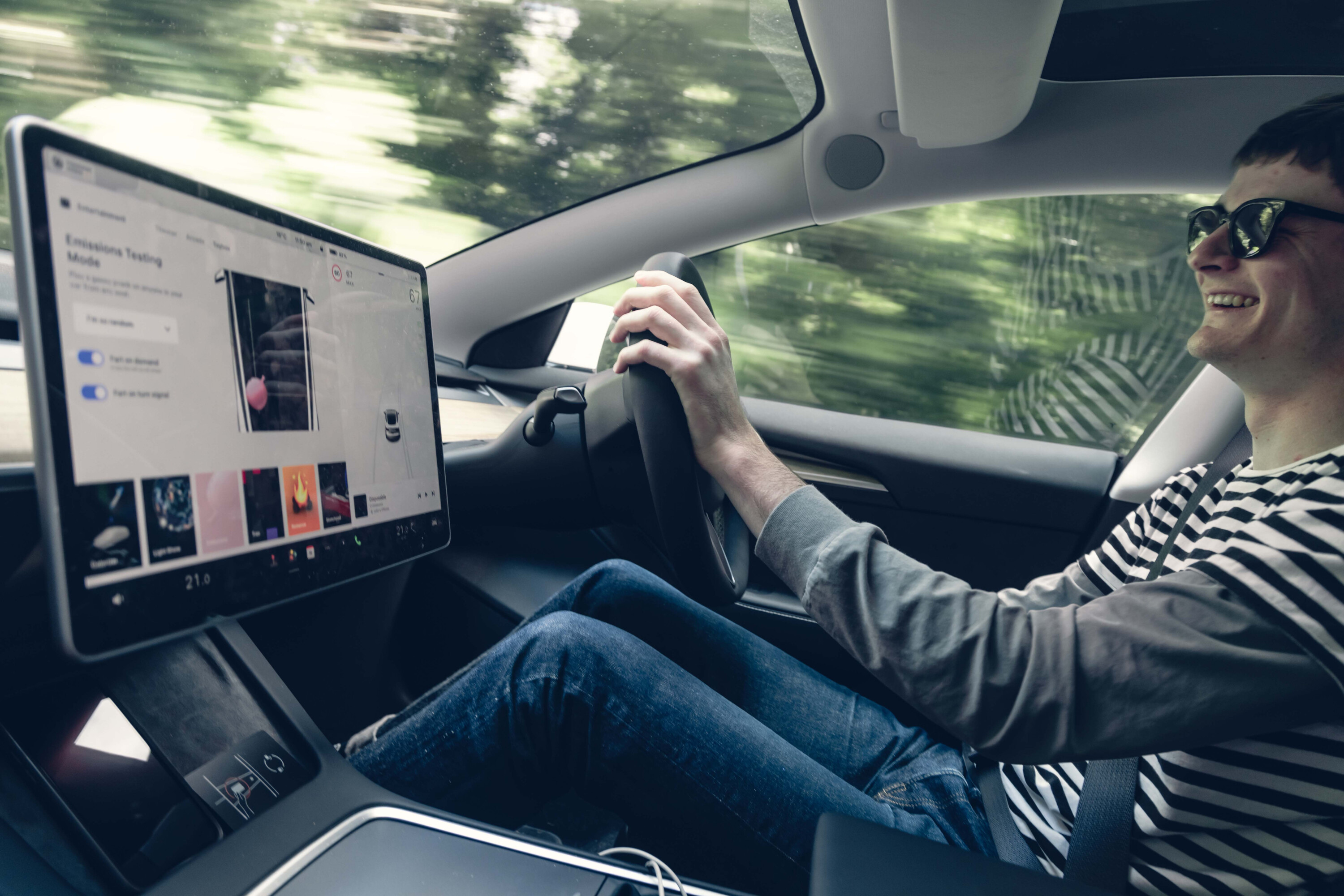
Loaded with a 14.6-inch touchscreen that lets you download video games, watch Netflix, and make the indicators trigger synthesised fart sounds (childish as it may sound, it’s quite hilarious) the Tesla is a veritable tech fiesta. If you’re the kind of person who indulges in the latest, greatest smartphone the Model 3 will be a comfortable companion – and at a whisker under $60K after government incentives, it’s a real bargain.
1
Tesla’s purchasing experience is significantly more digital, too
Excess digitalisation comes at an ergonomic cost, though. Even with the Model 3’s generous touchscreen, the targets are smaller than on an iPhone and therefore tricky to hit while driving.
As road testers swapping between cars, the Tesla’s mirror and steering wheel adjustments being buried in the menu is frustrating, but we understand that for an owner with set profiles (and they’re very customisable) it’s unlikely to be such a hassle. An easy-to-read head-up display would be nice, though.
Tesla’s purchasing experience is significantly more digital, too. You can visit minimalist experience centres if you need and organise test drives from Tesla hubs, though the Model 3 purchase can be made entirely online and, as Jez pointed out, pricing is laid out in simple-to-understand monthly repayments rather than a single cash sum.
1
Buying a Hyundai IONIQ 6 is a more familiar affair.
Though online transactions are possible, Hyundai still has plentiful brick-and-mortar dealerships to view the car in person and engage with a familiar salesperson, with trade-ins possible.
Where the Tesla’s cabin is minimal (almost to a fault), the IONIQ 6 is a more hands-on design. The interior is mature and well-appointed, sculpted carefully with backlit door cards diffusing the changeable ambient lighting, tactile materials and an appearance that calls back to the optimistic 1950s.
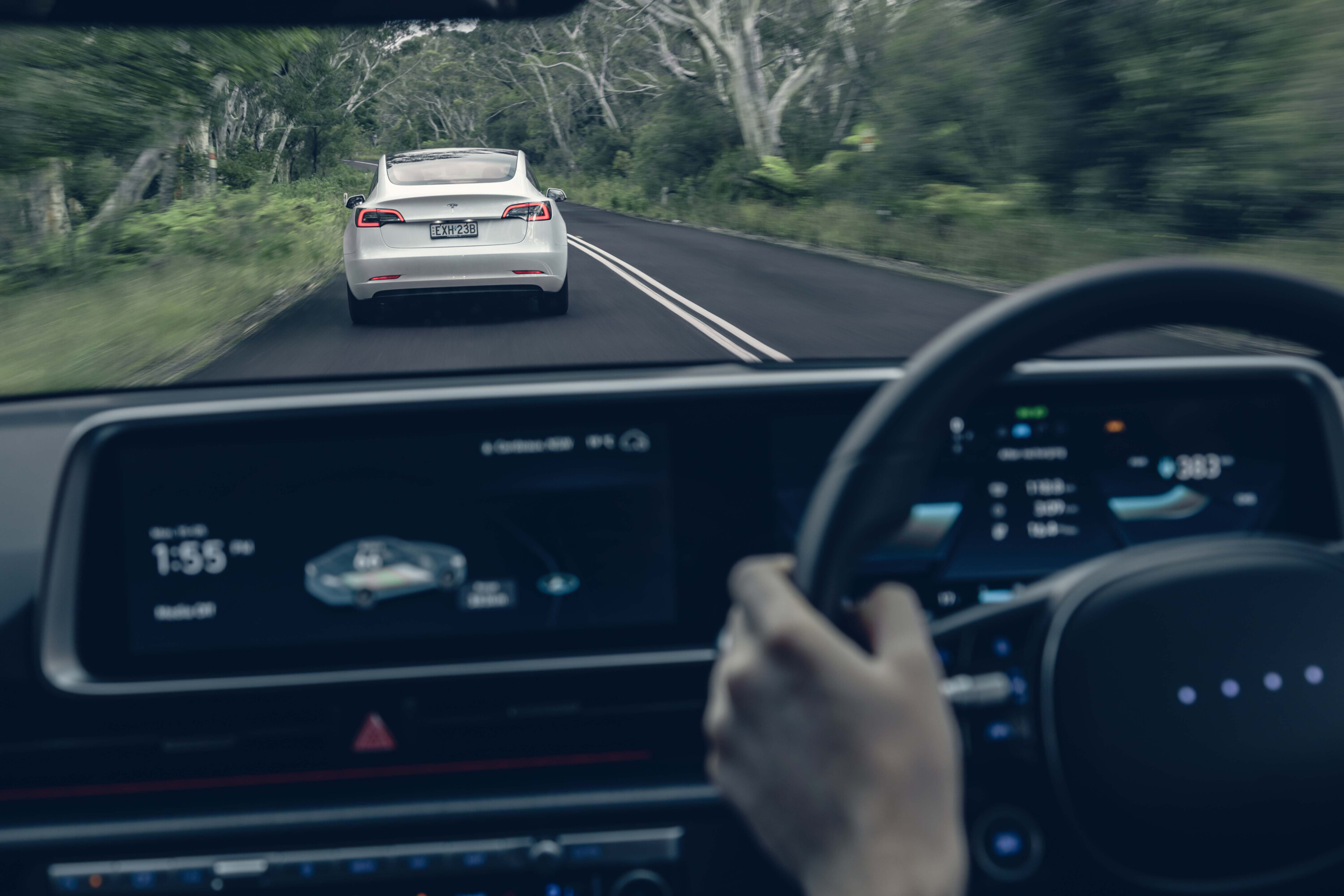
A pair of 12.3-inch screens are integrated almost seamlessly ahead of the driver. One is the digital driving display that features vehicle information (an easily-seen speedometer, for example) while the central touchscreen houses the responsive but familiar infotainment system with live-traffic navigation.
1
There’s a clear head-up display, too. An eight-speaker Bose sound system is standard, though it doesn’t match the Tesla’s excellent hi-fi for power and clarity.
Hyundai still doesn’t offer wireless Apple CarPlay or Android Auto for its larger infotainment screens and it feels old hat connecting your phone via the USB-A port. However, the clever storage spaces include an open centre console, a smart wireless charging pad that retains phones assuredly, and a deep storage cubby beneath a well-added armrest. The Model 3’s twin wireless charging pad is still the best in the business, but overall the IONIQ 6 edges ahead in cabin practicality.
The aerodynamic and weight advantages of these three-box sedans next to their SUV relations are profound enough to have us thinking EVs could usher in a sedan revival… until entering the back seat.
1
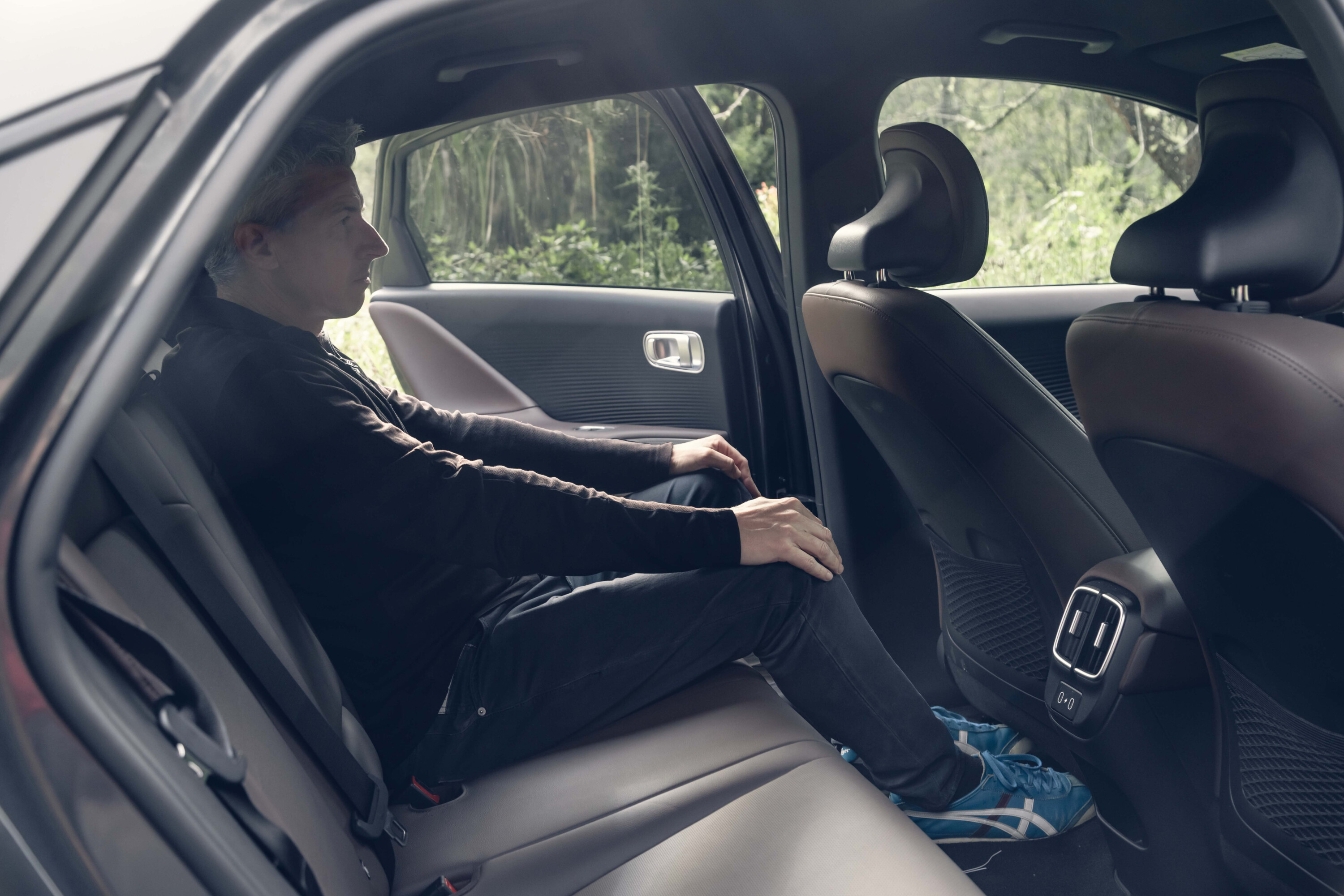
Unfortunately, as comfortable as both cars’ front driving positions are (they each get 10-way electric leather-appointed seats with three-stage heating and memory functions), the rear seats are compromised next to spacious internal combustion engine equivalents like the Hyundai Sonata and Toyota Camry.
With so many battery cells below deck, the floors remain high in both. The IONIQ 6’s 161mm extra length and 75mm longer wheelbase free up plenty of legroom, but there’s little space beneath the seat for toes, and taller riders will find their knees hovering above the cushion. Headroom is also compromised for those over 180cm in height.
The Model 3 suffers from a similarly high floor, though it does have a touch more under-thigh support. Headroom is tighter, so at 188cm I was less comfortable in the Tesla, though Jez’s 182cm frame was better accommodated in the Model 3. Rear air vents, USB-C charge points, bottle holders and fold-down armrests are standard in the pair.
1
Despite the IONIQ 6’s size advantage, the Hyundai’s cargo capacity is smaller, with 445L when combining the 400L boot and 45L ‘frunk’, which is really only sufficient for charging cables.
A three-pin socket is found in the IONIQ 6’s rear seats for vehicle-to-load functions; something the Tesla doesn’t have.
There are two pull tabs to drop the rear backrest, but the IONIQ 6’s rear bulkhead encroaches into the space, meaning it’s tough to put a bicycle inside.
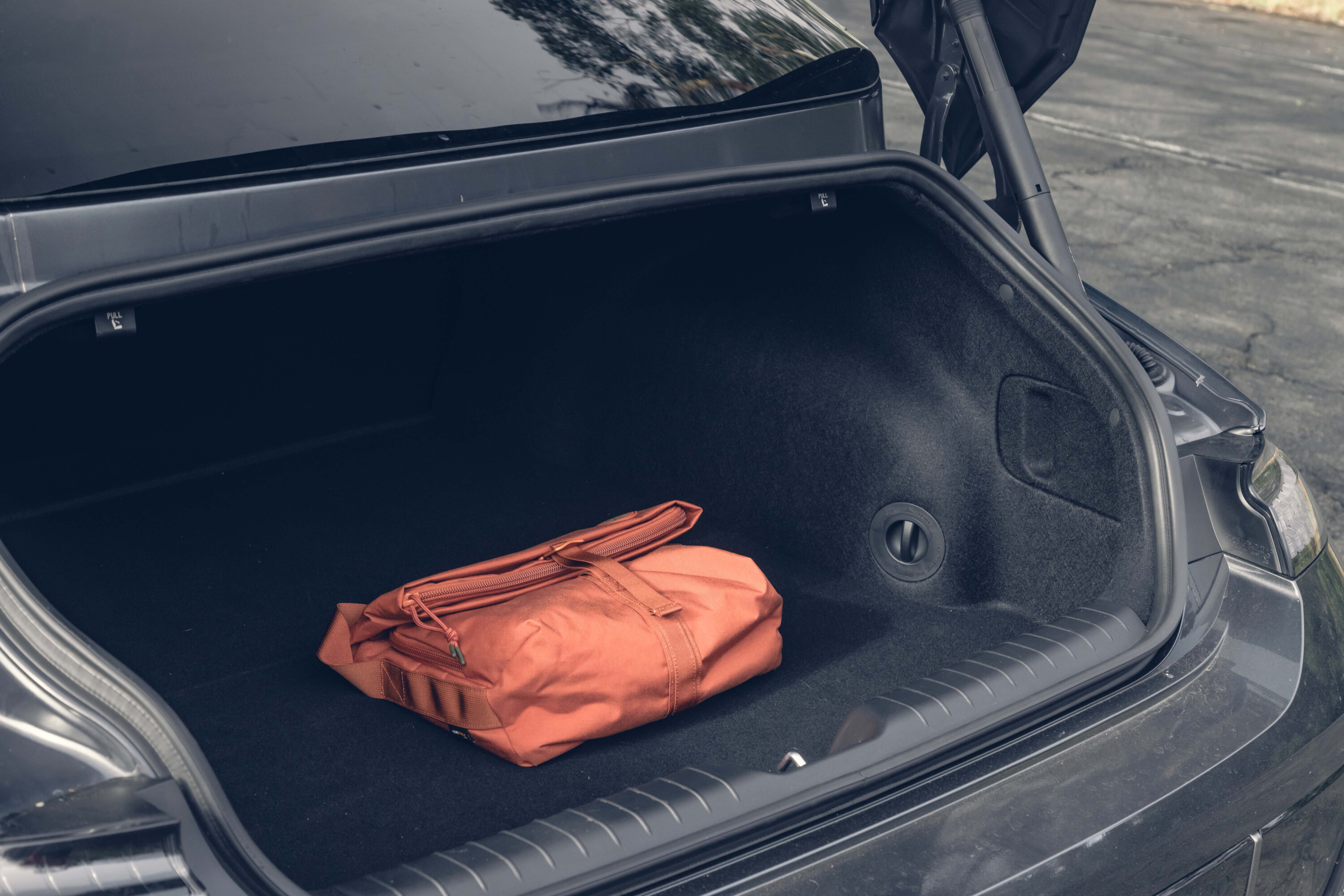
Model 3 boot space is a more generous 649L and there’s a capacious cavity beneath the boot floor. Neither car has practicalities like shopping bag hooks or nets or even a spare tyre – it’s mobility kits and roadside assist for these two.
1
Thus far, the Model 3 and IONIQ 6 offer very different experiences
One is clean, crisp, and takes getting used to, and the other is a more mature take on cabin design with better build quality, materials, and a wholly less digital experience.
The IONIQ 6 is more car-like, and the Model 3 is like a phone – and one with more than a whiff of in-built obsolescence.
One thing is clear: the easy power of electric vehicles is quickly superseding ICE vehicles. In 2011, a BMW 335i would get you a similar 225kW to the Tesla, though it cost $91,900, or about $118K in today’s money. The Tesla costs half that; it’s safer and better equipped with barely any drop in straight-line performance.
Of course, the Model 3’s single electric motor delivers its kilowatts in a more anodyne fashion. Gun it and go; no waiting for kickdown or boost to build.
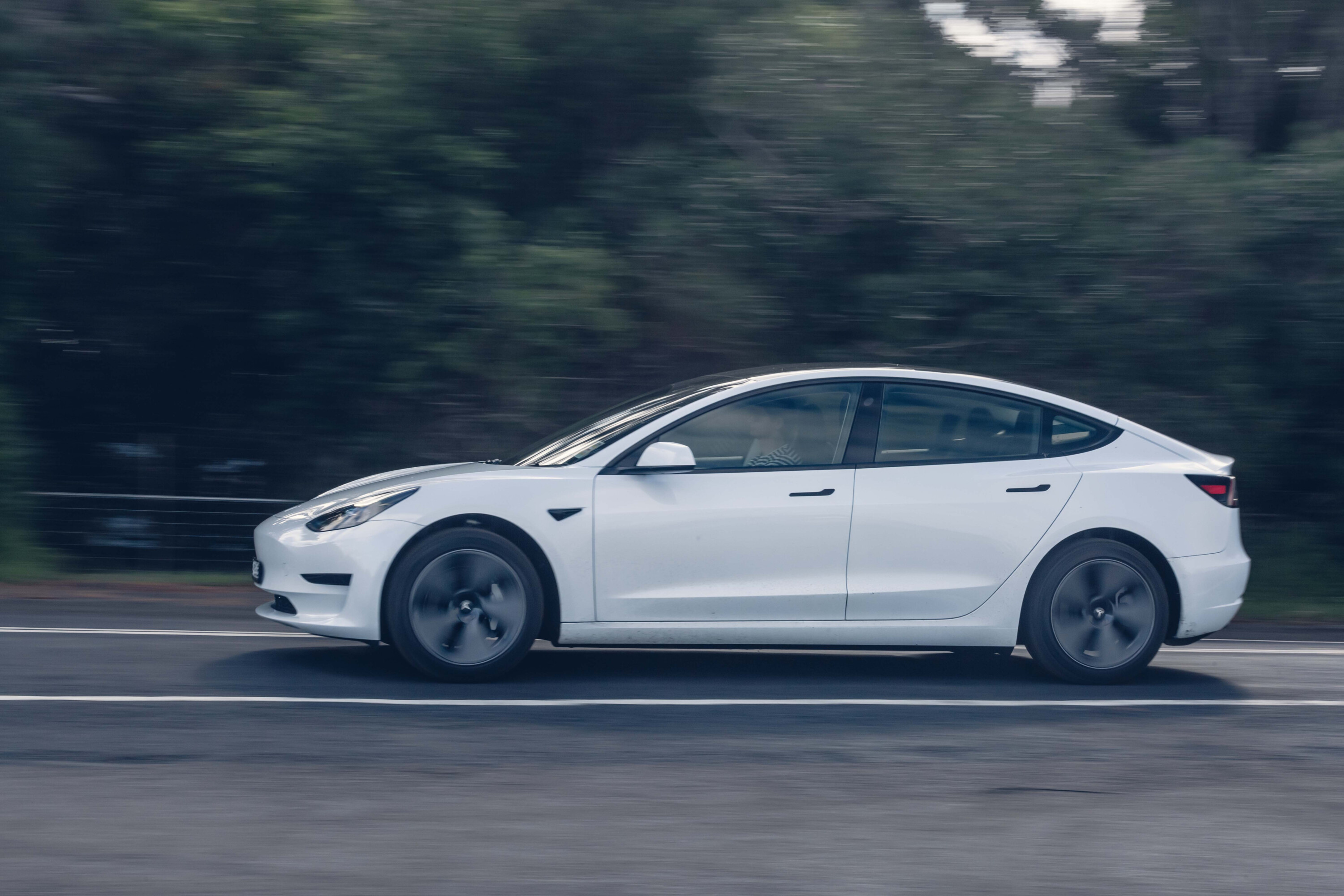
The way even this base Model 3 can snap your neck back against the headrest is pretty stunning. Even in the damp, the Tesla’s pre-emptive traction control limits wheelspin for effortless acceleration. It’s also not that heavy (for an EV), tipping the scales at 1752kg – 216kg less than the IONIQ 6.
With only one choice for regenerative braking – stronger than even the IONIQ 6 in its strongest-of-four ‘i-Pedal’ setting – the Tesla’s pedal calibration immediately feels natural.
The Hyundai’s power delivery is more conservative, too; the IONIQ 6 takes a moment to build maximum thrust. It’s still brisk, sure, but it can’t keep up with the Tesla. In roll-on acceleration, the IONIQ 6 was 7km/h slower than the Tesla. And, for $700 less than the IONIQ 6, you can get an even more powerful twin-motor Model 3 that’ll hit 100km/h in 4.4 seconds.
1
Where does that leave the IONIQ 6’s strengths? In refinement, ride comfort, build quality, and all the things that traditional manufacturers strive for.
The Model 3’s ride is not wholly unpleasant in isolation (and is much better than the tiresome Model Y), absorbing big potholes well. But it’s the everyday granular imperfections, small hits and expansion joints that make the Model 3’s body fidget.
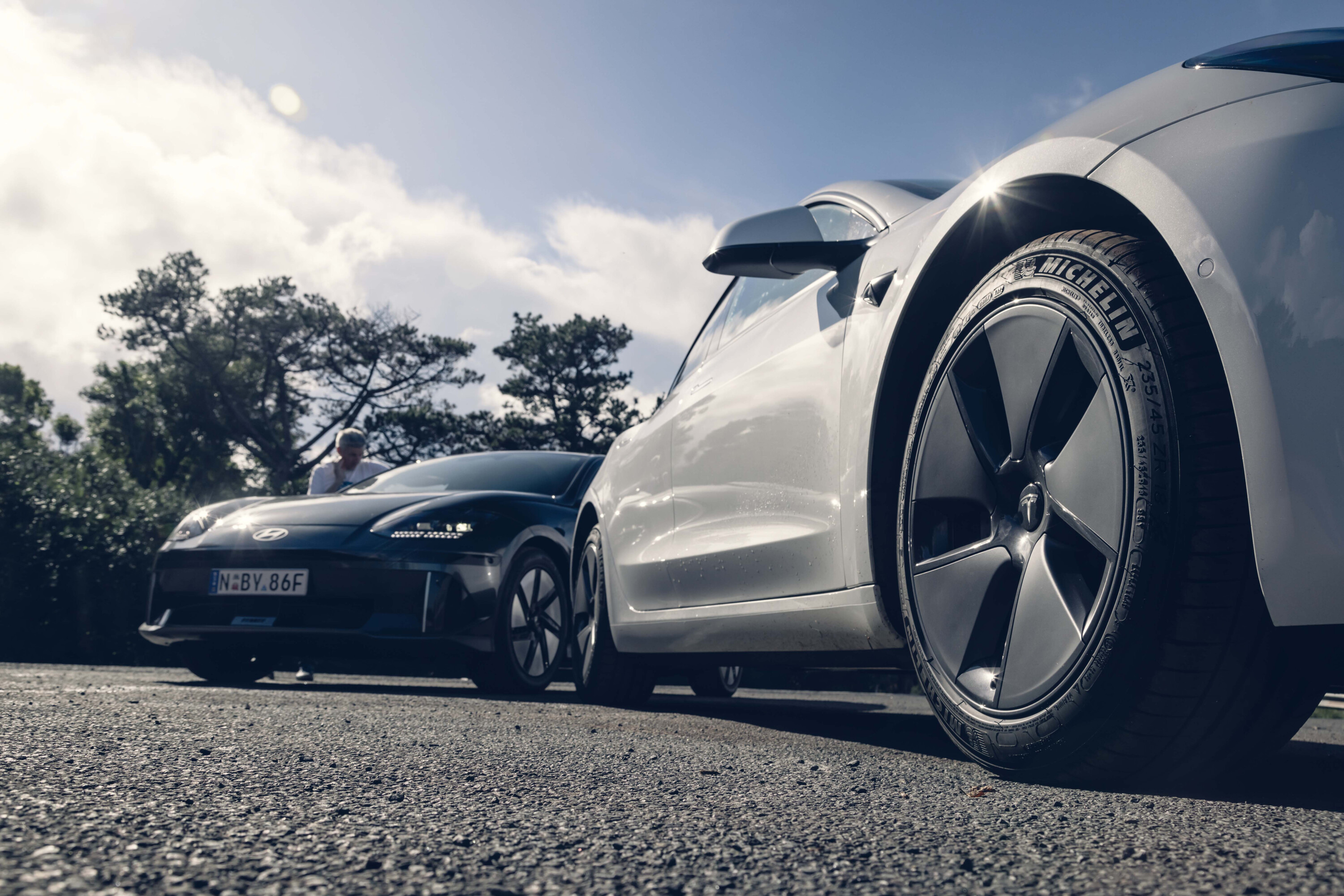
It’s loud inside the Model 3, too. Partially a symptom of grippy 245/45R18 Michelin Pilot Sport 4 tyres, there’s plenty of cabin roar (which you naturally notice more due to the lack of engine noise) and low-frequency resonances on surfaces where the IONIQ 6 remains quiet.
There are also occasional thumps from the Model 3’s front and rear suspension, and ours had rattles from B-pillar trim pieces and a creak from the driver’s seat.
1
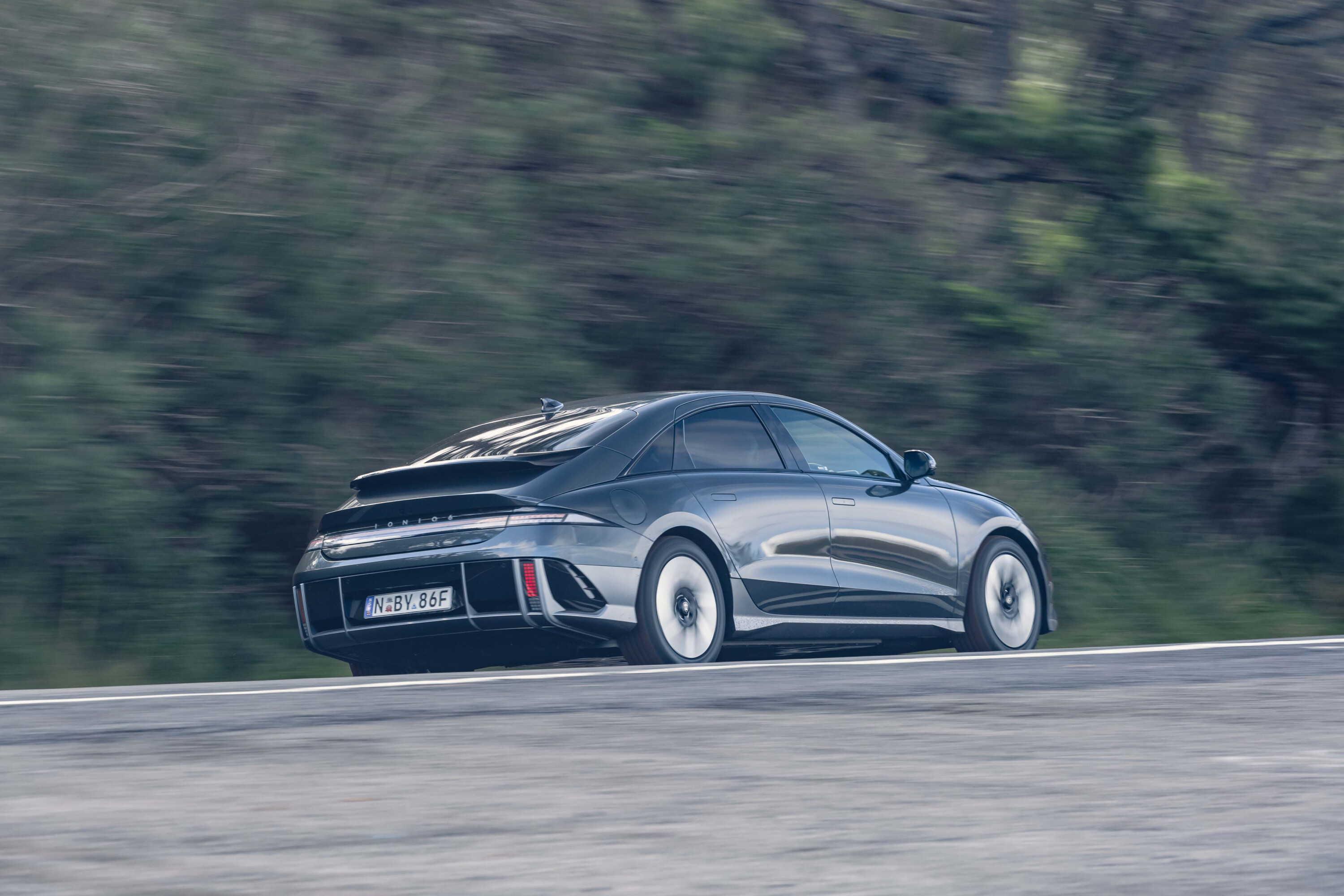
With its frequency selective dampers, the Hyundai IONIQ 6 remains compliant and relaxed over common imperfections, with its soft 225/55R18 Hankook Eco tyres contributing to a chassis that’s largely undisturbed by bumps. Bigger hits are met with firmer damping, but this is actually positive as it stops the IONIQ’s body from falling into dips, easing car-sickness-inducing head toss that is a common complaint in the IONIQ 5 SUV.
Those chasing roadholding and sharp handling, though, will enjoy the Tesla’s crisp two-turn steering rack. It may be ultra-fast, but it isn’t too hyperactive off-centre. The Hyundai’s is less confidence-inspiring and slower (2.75 turns lock-to-lock), though it does wake up in Sport mode with added heft.
It’s likely that the Hyundai’s eco tyres liberate 2-5 per cent extra range, but it comes at the cost of grip – especially in damp conditions. Where the Tesla’s Michelin’s bite into the bitumen, the IONIQ 6’s rubber has a less commanding relationship with the tarmac and a tendency to slip with little warning.
1
Both cars have a rear-drive balance, but with the lower centre of gravity afforded by EVs, their roll characteristics are very different from the typical soft and relaxed body movements associated with ICE sedans of the past. Although less sporty to drive, the IONIQ 6 – with its three switchable drive modes – is more soothing to pilot and passenger in.
Providing, that is, you’ve disabled the speed limit assist. Although helpful in theory (it beeps when you exceed the limit), it isn’t effective here. In time-sensitive zones, such as roadworks or school zones, the IONIQ 6 can’t recognise the hourly constraints. It’ll say it’s a 40km/h limit even at 6am on a Sunday. The system turns on every time you start and takes at least four taps on the touchscreen to disable.
Speed limit aside, the IONIQ 6’s adaptive cruise control, lane-trace assist, blind-spot monitoring with cameras, rear cross-traffic alert, and AEB with pedestrian, cyclist, junction, and reverse functions match the Model 3’s impressive suite. Both electric sedans carry five-star ANCAP safety ratings.
1
In all likelihood, you’re reading this comparison with a clear favourite in mind
Even though the IONIQ 6 is very well equipped, when it comes to the latest and greatest technology, the Model 3 is unbeaten. Tesla really has moved the game on for sheer screen dominance at this price point.
Those sympathetic to Elon’s regular rants will undoubtedly find Tesla’s disruption and ensuing industry revolution attractive. It stands for more than the sum of its parts, but as a vehicle in the traditional sense, the Model 3 misses key targets.
There are still build quality issues as we experienced in this customer car’s rattly B-pillar and creaky seat. Likewise, some money invested in tuning out unpleasant cabin resonance and fitting higher-quality dampers would surely see the Model 3 surpass the IONIQ 6 at this price. If the Tesla were to climb by $10K for the base variant? That’s a less sure equation.
1
VERDICT
If you want an electric car now that performs bloody well for a whisker over $60K (and under once some state government incentives are loaded on), the Model 3 is the winner.
If you don’t have a TikTok account or care about keeping up with Tesla-owning colleagues, the IONIQ 6 is a tantalising package.
The real clincher – one that Andy touched on in his launch review – is that the IONIQ 6’s out-there design will divide opinion. Plenty of people we ran into were unconvinced and there were thoughts that, even though the IONIQ 5 was a little less refined to drive (and lost out for range), the SUV is the one most want to own due to its more resolved design.
All said and done, Hyundai has made a quieter, smoother, more refined, better built, and still immensely efficient electric car with the IONIQ 6. Its maturity both in the cabin and behind the wheel is beyond what the Model 3 offers.
1
Whining about ChargeFox
We based our charging out of an inner-city ultra-rapid location. It’s supposed to deliver up to 350kW DC rates. Our best number? 200kW for a mere second, before dropping to a disappointingly consistent 150kW. The Tesla only managed to crack 100kW for a brief moment. Only one of the two stations was functional, too, and it’s been this way for nearly six months. As more EVs find homes (it’s about 6000/month, concentrated around inner-city suburbs) infrastructure drain will get worse before it gets better.
*Tesla does not supply power of battery size data, these are reliable estimates from EV Database [↗]
Driving range and charging table
| Driving rangeu00a0 | Tesla Model 3 SR RWDu00a0 | Hyundai IONIQ 6 Dynamiq RWD |
|---|---|---|
| Battery size (usable) | 57.5kWh* | 77.4kWh |
| WLTP range | 491km | 614km |
| Tested consumption | 13.4kWh/100km | 14.5kWh/100km |
| Tested range | 426km | 530km |
| Varianceu00a0 | -13.6% | -13.7% |
SCORING
Tesla Model 3: 8.5/10
Things we like
- Value proposition
- Straight-line pace
- Consistent availability
Not so much
- Poor cabin insulation
- No dedicated instrument panel
- Fidgety ride quality
Hyundai IONIQ 6: 8.5/10
Things we like
- Cabin refinement
- Interior design
- Smooth, absorbent ride
Not so much
- Price of entry
- Compromised back seat
- No wireless phone mirroring
Scoring breakdown
| Tesla Model 3 SR RWD | Hyundai IONIQ 6 Dynamiq RWD | |
|---|---|---|
| Safety, value and features | 9 | 8.5 |
| Comfort and space | 8 | 8.5 |
| Engine and gearbox | 9 | 8 |
| Ride and handling | 7.5 | 8.5 |
| Technology | 9.5 | 8.5 |
| Overall | 8.5 | 8.5 |
MORE
Everything Tesla
More EV stories to help you choose the best car for your needs
- EV news, reviews, advice & guides
- ❓ Short & sweet: Your EV questions answered
- ⚡ New EVs: Everything coming to Australia
- Australia’s EVs with the longest driving range
- ⚖️ Best-value EVs by driving range
- How much do EVs cost in Australia?
- How much more expensive are EVs?
- ⚖️ Number crunching: Is it time to switch to an EV?
- ♻ Should you buy a used EV?
- Are EVs more expensive to insure?
- Costs compared: Charging an EV vs fueling a car
- EV charging guide
- EV servicing explained
- EV battery types explained
- When do EV batteries need replacing?
- Hydrogen v EVs: What’s best for Oz?
Specifications
| Tesla Model 3 SR RWD | Hyundai IONIQ 6 Dynamiq RWD | |
|---|---|---|
| Price | $61,300** + on-road costs | $74,000 + on-road costs |
| Drivetrain | ||
| Layout | single-motor RWD | single-motor RWD |
| System power | 220kW* | 168kW |
| System torque | 420Nm** | 350Nm |
| Gearbox | single-speed reduction gear | single-speed reduction gear |
| Chassis | ||
| Body | 4-door, 5-seat medium sedan | 4-door, 5-seat medium sedan |
| L/W/H | 4694/1849/1443mm | 4855/1880/1495mm |
| WB | 2875mm | 2950mm |
| Track (F/R) | 1580mm | 1635/1644mm |
| Weight | 1752kg | 1968kg |
| Boot | 649L | 401L + 45L |
| Battery | 57.5kWh* | 77.4kWh |
| Driving range | 491km (WLTP) | 614km (WLTP) |
| Charging (AC/0-100%) | 11kW/6h 15m | 10.5kW/7h 20m |
| Charging (DC/10-80%) | 170kW/25m | 220kW (approx)/18m |
| Suspension | Front: double wishbones, coil springs (f) / multi-links, coil springs (r) | Front: Macpherson strut / multi-link with frequency-selectice dampers |
| Steering | electric rack-and-pinion (2.0 L-L) | electric rack-and-pinion (2.75 L-L) |
| Front brakes | 4 piston front caliper, 320mm ventilated discs rotors | 325mm ventilated rotors |
| Rear brakes | Single-piston sliding caliper, 335mm ventilated rotor | 325mm solid rotors |
| Tyres | Michelin Pilot Sport 4 | Hankook Eco |
| Tyre size | 235/45R18 | 225/44R18 |
| Safety | ||
| ANCAP rating | five stars | five stars |
| Performance | ||
| 0-100km/h | 6.1sec (claimed) | 7.4sec (claimed) |
| *figures based on estimates provided by EV database | ||
Where have all the performance cars gone? Why have they disappeared? Will they come back?
In just a few years, countless sports cars and performance models have quietly disappeared. A Chicxulub-scale meteorite has hit planet Fast Car, wiping out a whole generation of performance models we took for granted, with no replacements planned.
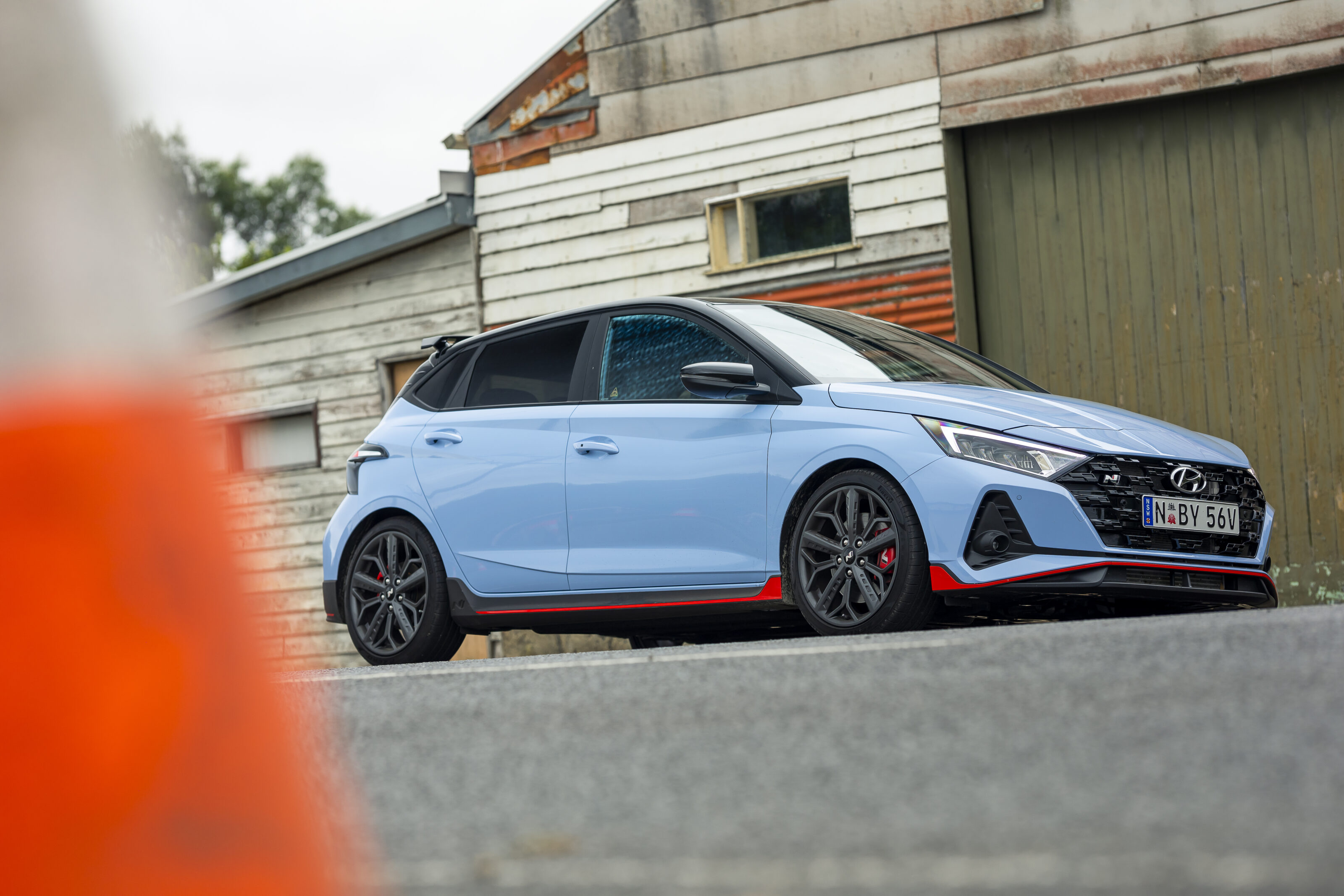
Gone are the Peugeot 208 and 308 GTI; Ford Fiesta and Focus ST, and Focus RS; Abarth 124 Spider; Chrysler 300 SRT and its Hemi-powered sibling, the Jeep Grand Cherokee SRT. The Renault Clio RS is dead and the Megane RS not far behind, the Megane itself set to be turned into a small, electric SUV. Which thrills us like hearing Phillip Lowe announce another interest rate rise.
153
The sports car mass extinction extends further – in the USA, Dodge is cancelling Challenger and Charger, Chevrolet says this will be the last Camaro and if the Mustang coupe was an animal, the World Wildlife Foundation would be gathering up the remaining breeding pairs and stuffing them into candlelit enclosures.
The Kia Stinger is one and done, the Hyundai i30 and i20 N are shaping up as mere kimchi-flavoured flashes in Korea’s hot hatch history, and Jaguar won’t replace the F-Type, nor Audi with its iconic TT, both bowing out permanently in the next year or two.
What’s going on?!
2
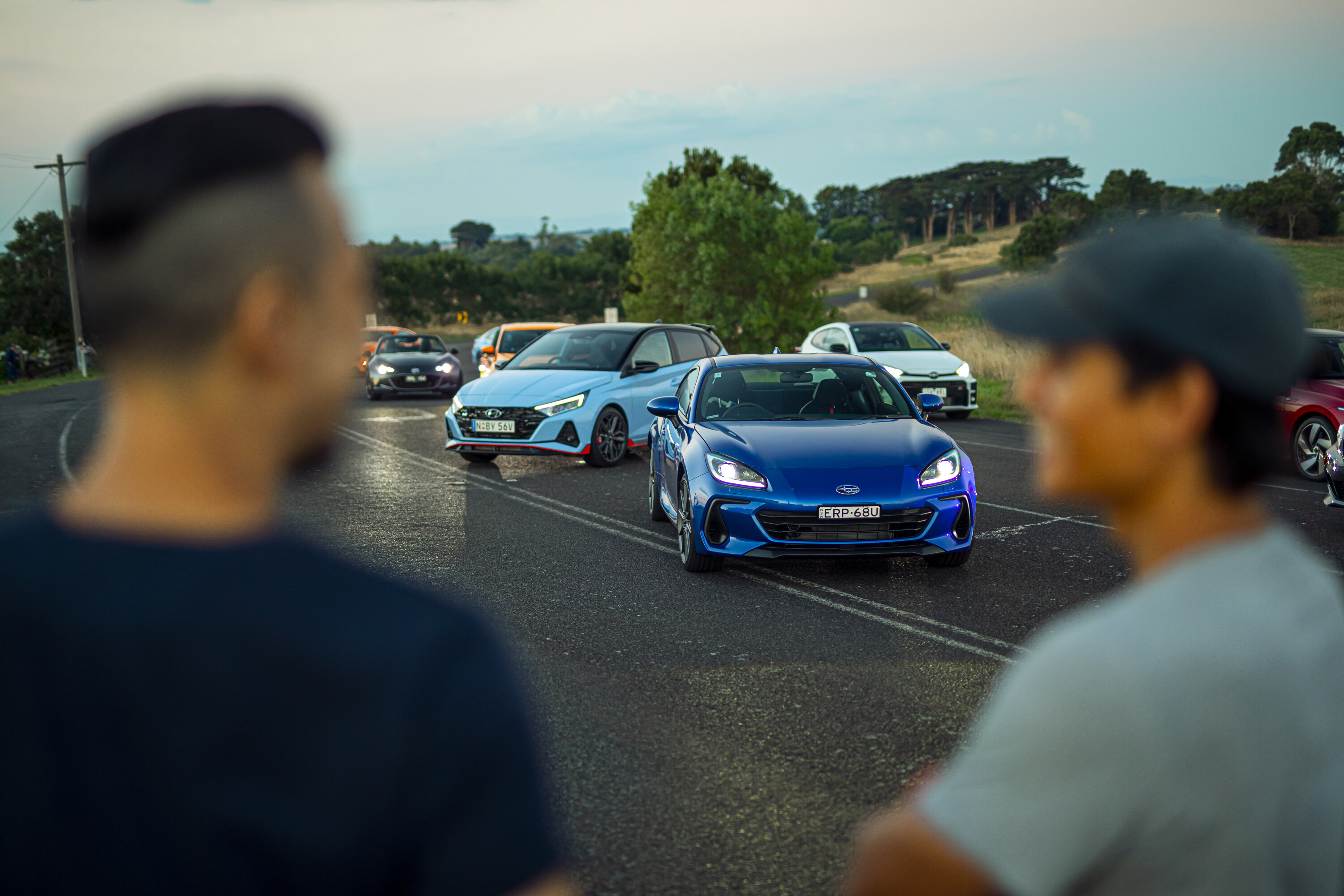
Basically, emissions regulations such as the proposed, almost unrealistically strict EU7, are consuming more money and manpower than any other challenge in the history of car making.
Niche performance models, and sports cars, are a distraction.
“Car manufacturers are thinking 2027, 2030 and beyond,” says an anonymous industry insider, working in the senior engineering ranks at a global automaker. “They need to reroute the money into the programs that they need to make (to meet future emissions regulations).
“A lot of those [electric vehicle] programs take more investment because the technology is not quite there yet, or not as mature as everyone thought it was going to be by now.
“The cost of stuff hasn’t come down as much as everyone expected. It’s expensive, the engineering is expensive, and that makes it difficult to cast your net wide and do those emissions-based programs that you need to do to stay relevant in the market – and then still do the performance stuff on the side.”
2
That means the only brands likely to continue offering performance models are the ones that ‘don’t have a choice’, such as Porsche, Ferrari and Mercedes-AMG.
And to survive, every new model they offer will at least “need a plug” – like the new plug-in hybrid C63.
“I think everything will get heavier,” says our man. “They kind of have to at the moment. At least from now until 2030.”
It goes further than emissions – demand for sports cars and performance models has been declining globally. And EVs are cutting the sports car’s grass as an ‘image leader or brand champion’.
“In many instances they think they can do that through EV. They can position that as a technological tour-de-force whereas previously a tech-equipped hot hatch may have done it.
“Or a high-end sedan loaded with features, that may have been the grand champion. Now it’s about, ‘if we have a Tesla competitor’. Or using Kia’s example, an EV6 GT, then ‘We’ve got EV and we’re doing performance at the same time’.”
1
Moral of the story?
Now’s the time to make the silliest but most satisfying financial decision of your life – buying a sports car.
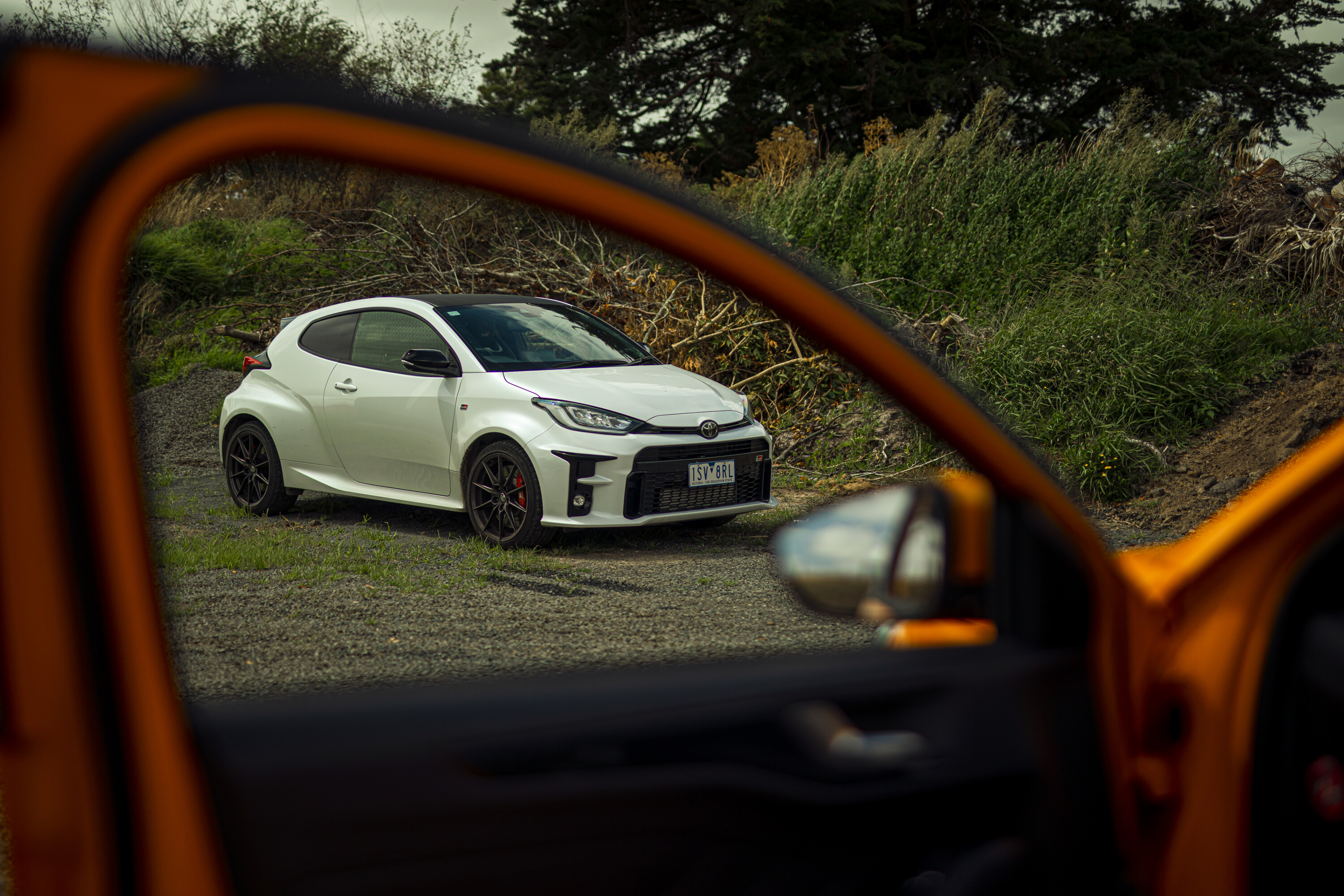
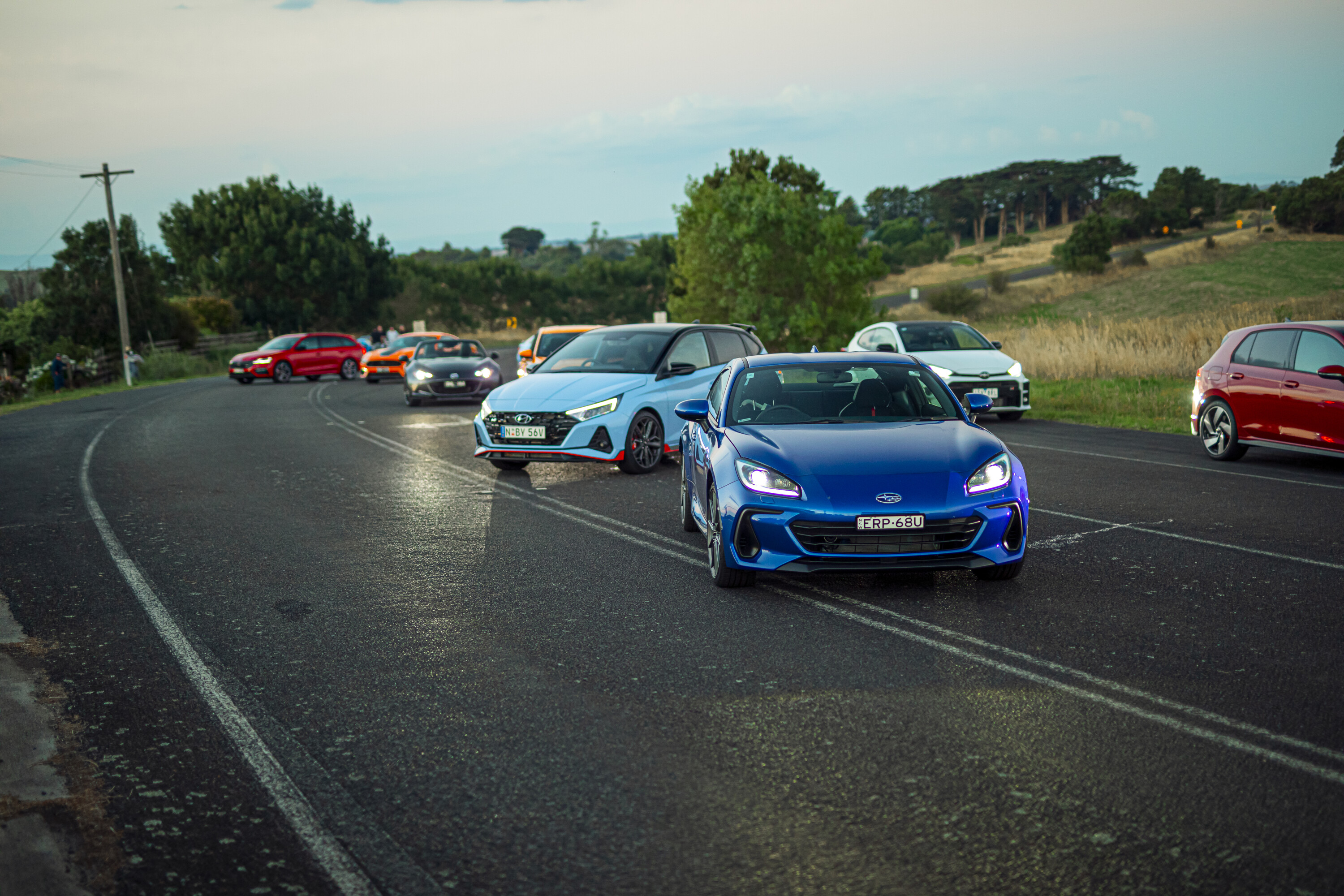
New BMW M2, Ford Mustang, VW Golf GTI, Mazda MX-5, Honda Civic Type R, Toyota GR Corolla, Subaru BRZ… there’s still a few top drawer models to choose from.
“I think we’re in a golden era at the moment,” says our source.
“Some of the big bangers we’ve got now, we won’t have [again], and everybody should be enjoying what we’ve got.”
In celebration of Wheels magazine’s 70th birthday, we’re running through the 70 greatest cars of all time – defined not by sales or talent alone, but simply as our writers past and present see it.
To follow the series, hit our Greatest Cars Ever main story here.
We covered the thrilling sports car and blisteringly fast hot hatch before, but for this final instalment, we’re moving into the more exotic territory of the greatest supercars.
1
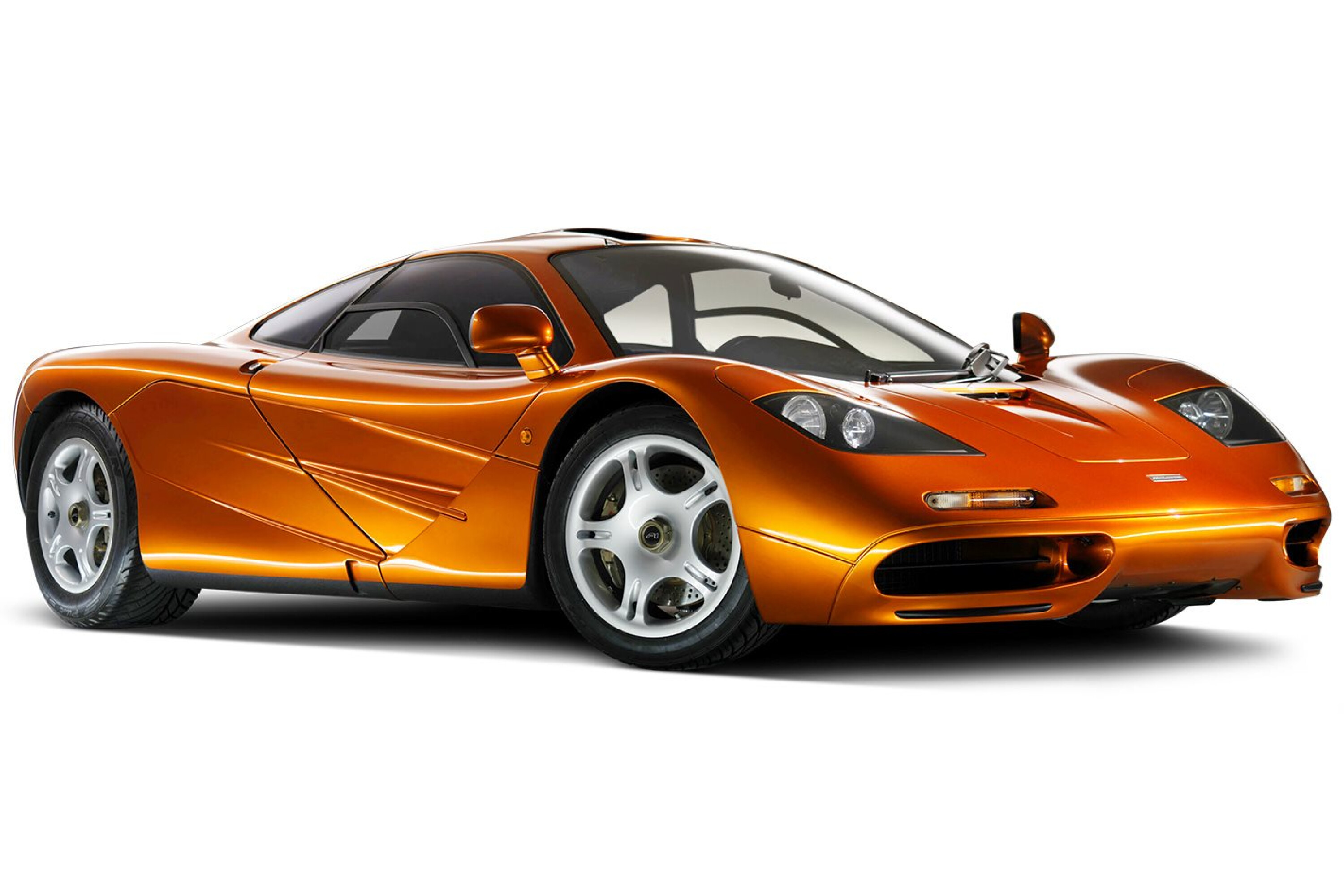
McLaren F1
WE LOVE
- Still the record holder in many categories if you exclude forced induction vehicles
NOT SO MUCH
- Brakes feel distinctly period by modern standards
“… there are few of the design stupidities we’ve accepted as normal in cars of this breed.”
It’s easy to wax lyrical about the extraordinary speed, focus and ingenuity of the McLaren F1 but in doing so, it’s easy to lose sight of what makes this car different. Different to every supercar that went before it and different to many that subsequently arrived. To fully understand the F1, it’s instructive to focus on the ordinary.
Peter Robinson perhaps encapsulated that thought best in his road test for Wheels back in June 1994. After proclaiming that you wouldn’t find a better supercar chassis anywhere in the world, he changed gear and noted “yet in the McLaren, there are few of the design stupidities we’ve accepted as normal in cars of this breed.” Therein lay the genius.
3
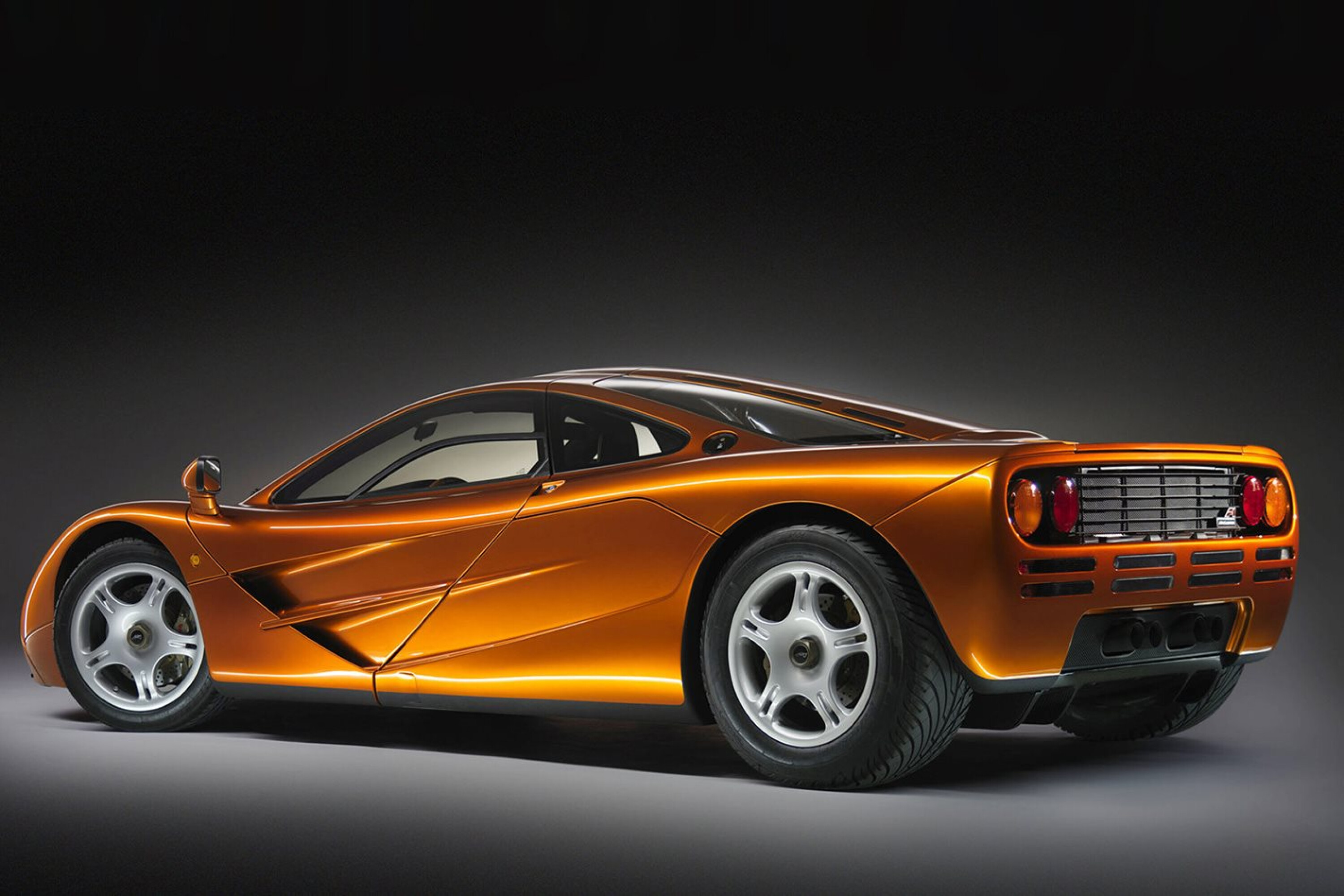
Here was a car that was comfortable, that you could see out of, that rode well, that could carry 280 litres of luggage, that could accommodate two passengers as well as the driver, that delivered in spades even at normal road speeds.
It featured a fan to suck it to the ground and a built-in modem to transmit ECU data to servicing centres from anywhere in the world.
Gordon Murray knew that impracticality in certain regards defined supercars, an attribute that made them something other than mainstream but instinctively knew that it didn’t need to be that way.
The F1 did all of this and redefined what we thought of as a supercar. It won Le Mans. It demolished every performance metric imaginable. And it did so completely and unanswerably on its own terms.
MORE
Everything Mclaren
1
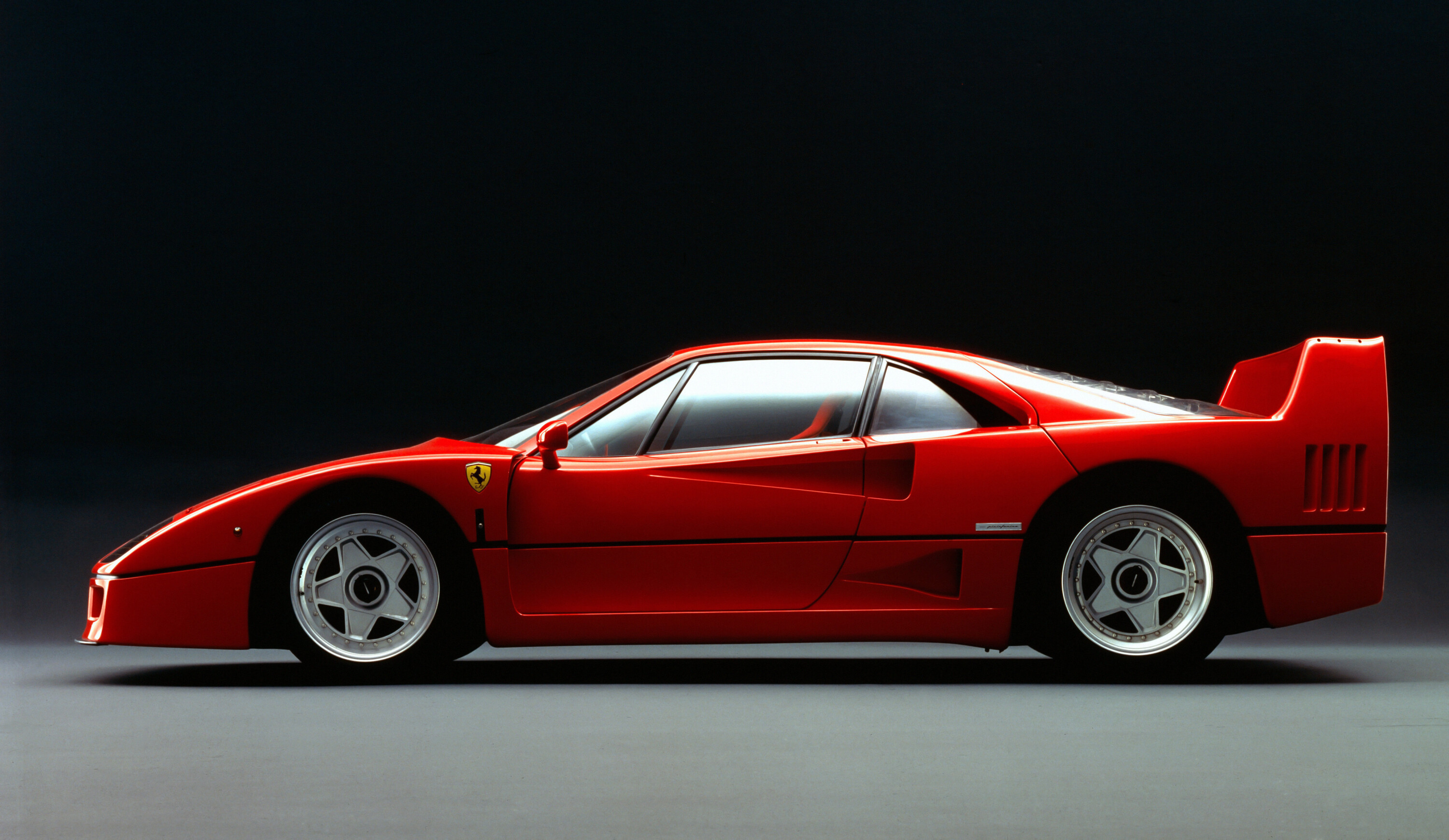
Ferrari F40
WE LOVE
- You will never be one-upped at a car meet. It just can’t happen
NOT SO MUCH
- Ferrari built too many
A Ferrari F50 is a better car than a Ferrari F40. But is it a greater supercar? Definitely not. Not in the larger meaning of the word.
The F40 carries far more historical heft, was the first 200mph production car, and showed that light is right versus Porsche’s 959. When we first drove the pair, we thought the 959 was the more eloquent supercar statement. But while technology ages, theatre, it seems, has a longer shelf life.
MORE
Everything Ferrari
1
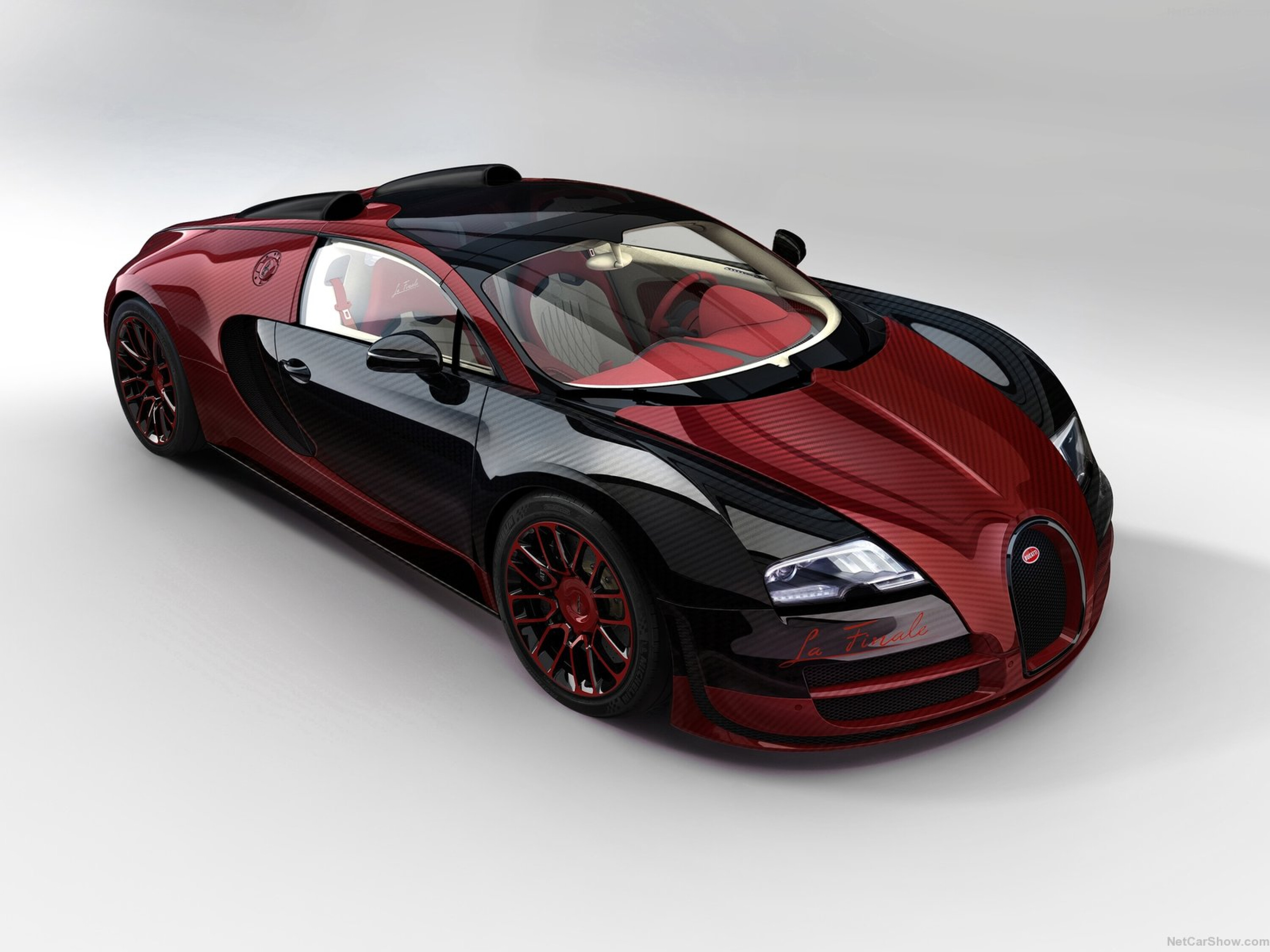
Bugatti Veyron 16.4
WE LOVE
- With 736kW at its elbow, the original Veyron could hit 408km/h
NOT SO MUCH
- A disgruntled Gordon Murray called it u201cthe most pointless exercise on the planetu201d
The Veyron could easily be dismissed as Ferdinand Piech’s folly; brute force engineering over any semblance of sensuality.
Its styling, never pretty at the best of times, hasn’t aged gracefully. Yet here was the unlikely heir to the McLaren F1, Molsheim’s destroyer of worlds and only a churl would deny it its dues. It lifted the concept of the hypercar onto a hitherto unimagined plane.
MORE
Everything Bugatti
1
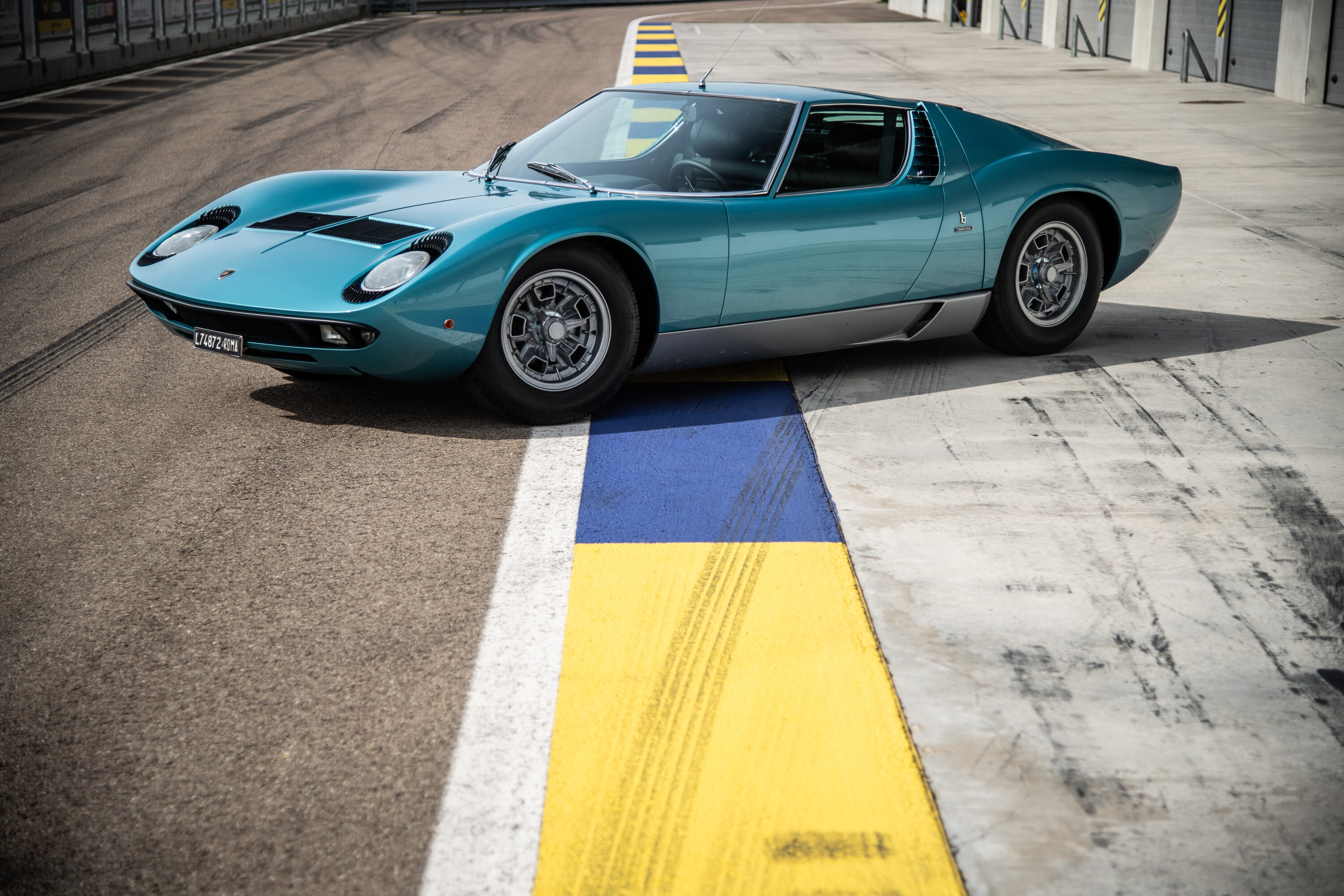
Lamborghini Miura
WE LOVE
- The shape, the sound, the presence, the significance
NOT SO MUCH
- If we catch you listening to Matt Monro, we are done
Arguments still rumble over whether Gandini or Giugiaro was responsible for the shape of the Miura, but it remains unquestionably the first mid-engined supercar.
Matra Djets and De Tomaso Vallelungas with their feeble four-cylinder engines don’t count. It took Ferrari another 7 years to put the engine behind the driver, with the lovely 1973 BB. By then the Miura’s work was done.
1
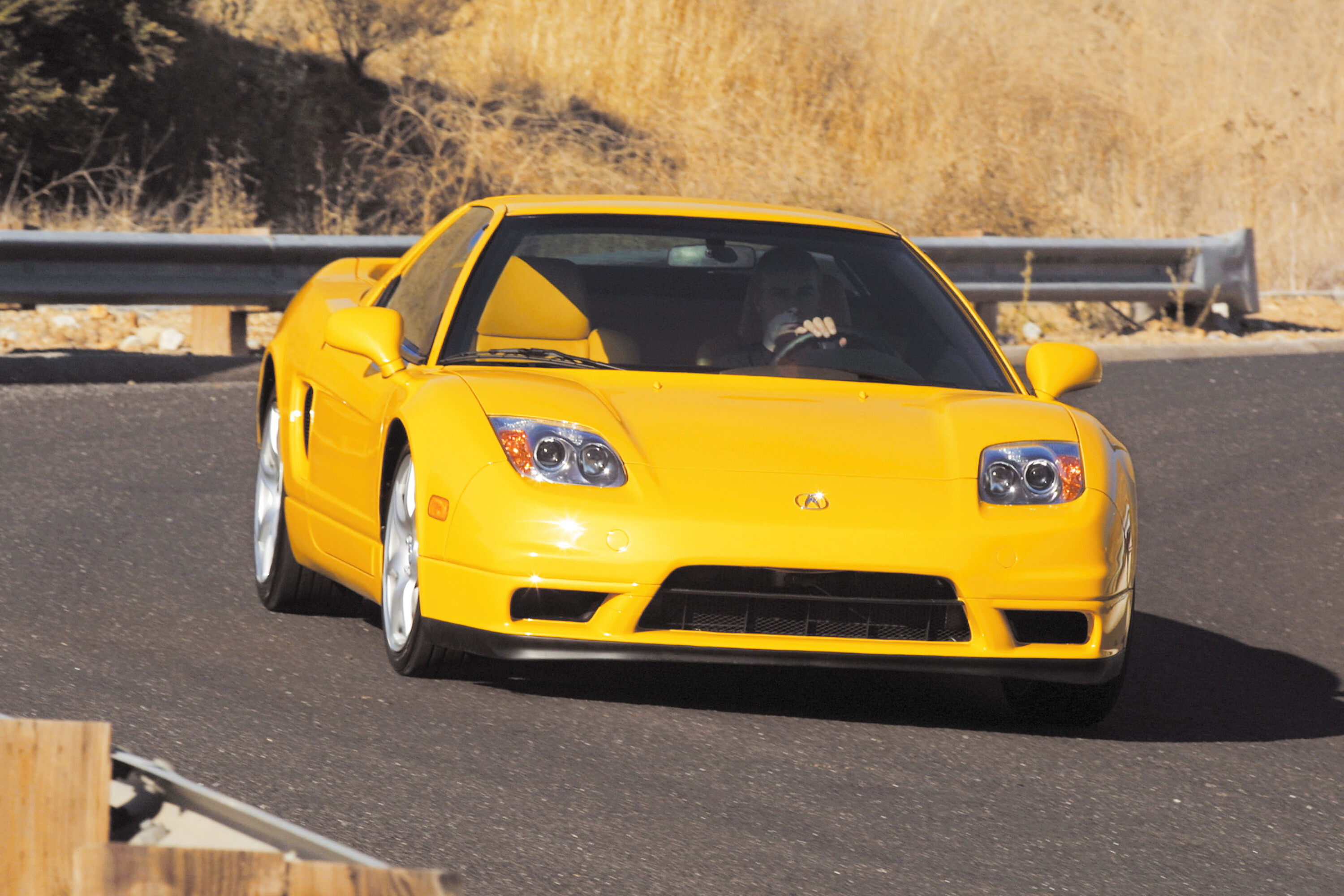
Honda NSX
WE LOVE
- Sounds magnificent, effortlessly cool
NOT SO MUCH
- Some can’t equate 285Nm with the notion of a supercar
The inspiration for much of Gordon Murray’s thinking around the McLaren F1, the Honda NSX showed that the supercar didn’t need to be super high maintenance.
It was never cooler than when it was thrashed around Suzuka by Senna in loafers. Go manual, fixed roof with pop-up lamps and you’ve hit the sweet spot.
MORE
Everything Honda
1
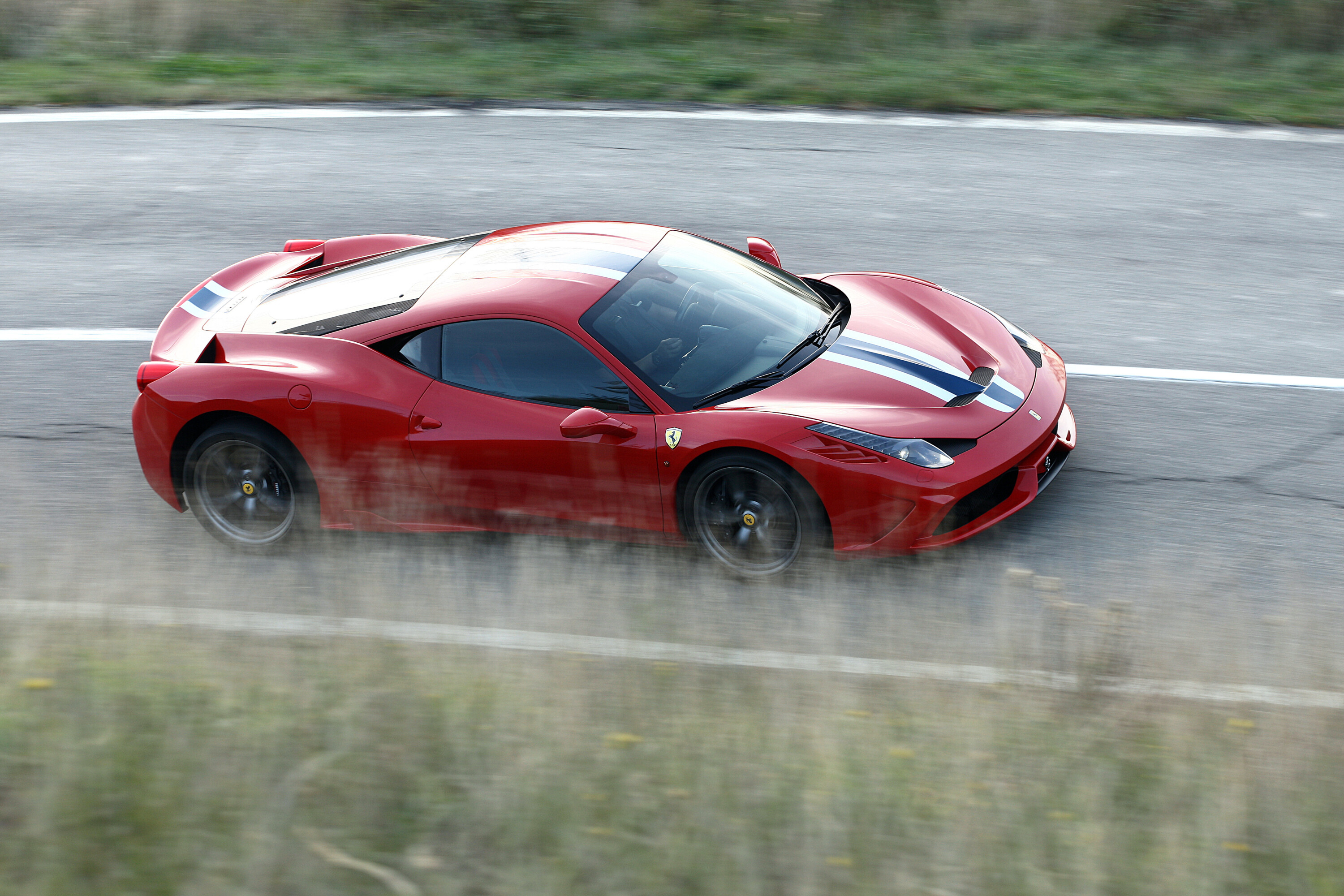
Ferrari 458 Speciale
WE LOVE
- Makes a 488GTB feel about as charismatic as a laser printer
NOT SO MUCH
- If we’re being logical, the standard issue 458 Italia is a better all-rounder
The high water mark for natural aspiration?
Argue among yourselves for the Aston Martin Valkyrie, the Porsche 992 GT3, the Pagani Zonda or the GMA T.50, but we’ve voted for beautiful too in the shape of the Donato Coco-styled Ferrari 458 Speciale. It’s revered now and will only become more so.
1
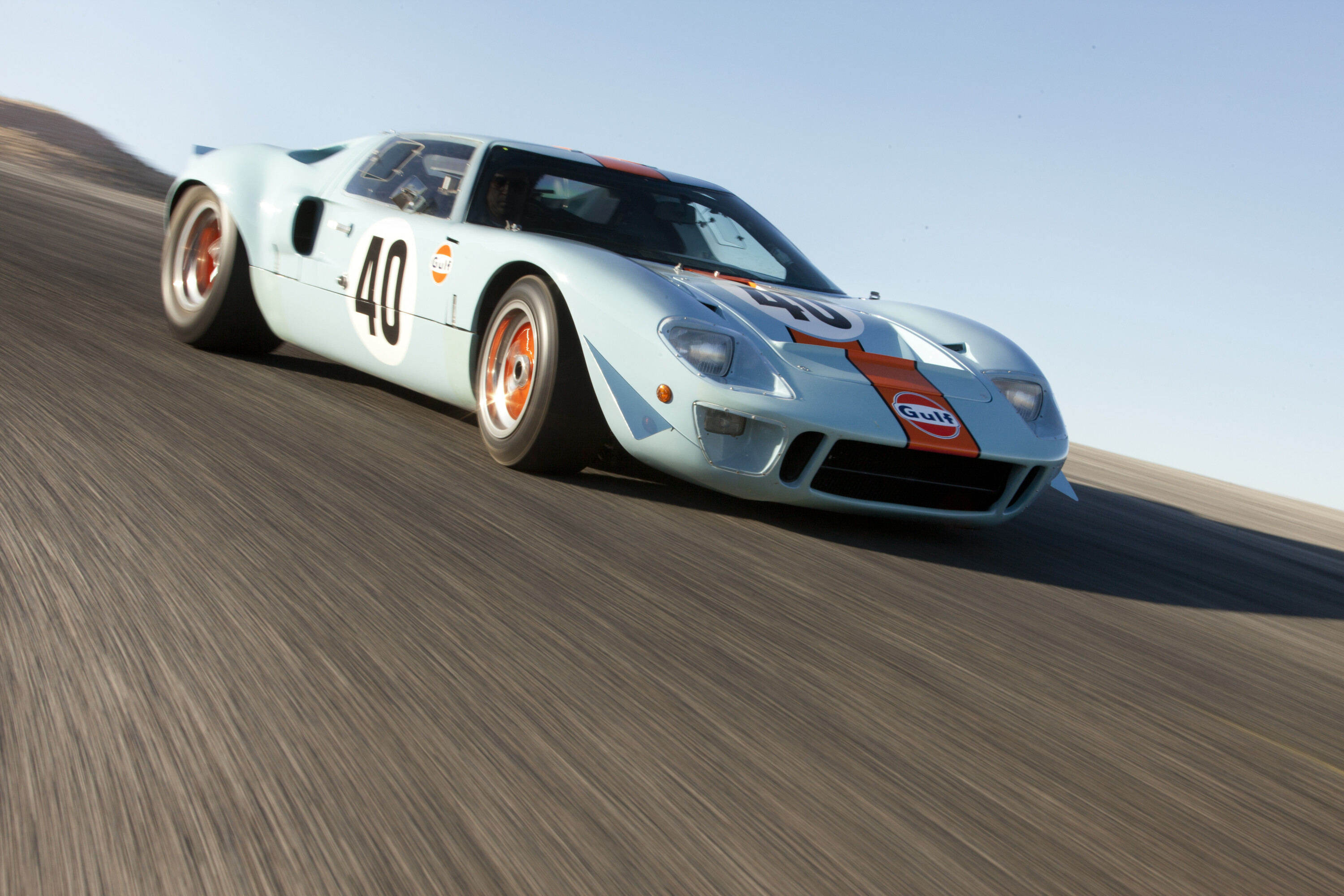
Ford GT40
WE LOVE
- The truth behind Ford versus Ferrari is even wilder than the fiction
NOT SO MUCH
- Due to no longer owning the copyright, Ford can’t badge any reissues GT40
Like the McLaren F1, another Le Mans-winning British car with an engine shipped in from overseas.
Spawned from the Lola Mk6, we’re perhaps being a little facetious, as it took the Mk II and the expertise of Holman Moody and Shelby America before the GT40 started hitting its straps. But here’s a thought. Had Enzo Ferrari been a more reasonable bloke, neither the GT40 nor the Miura would exist.
MORE
Everything Ford
1
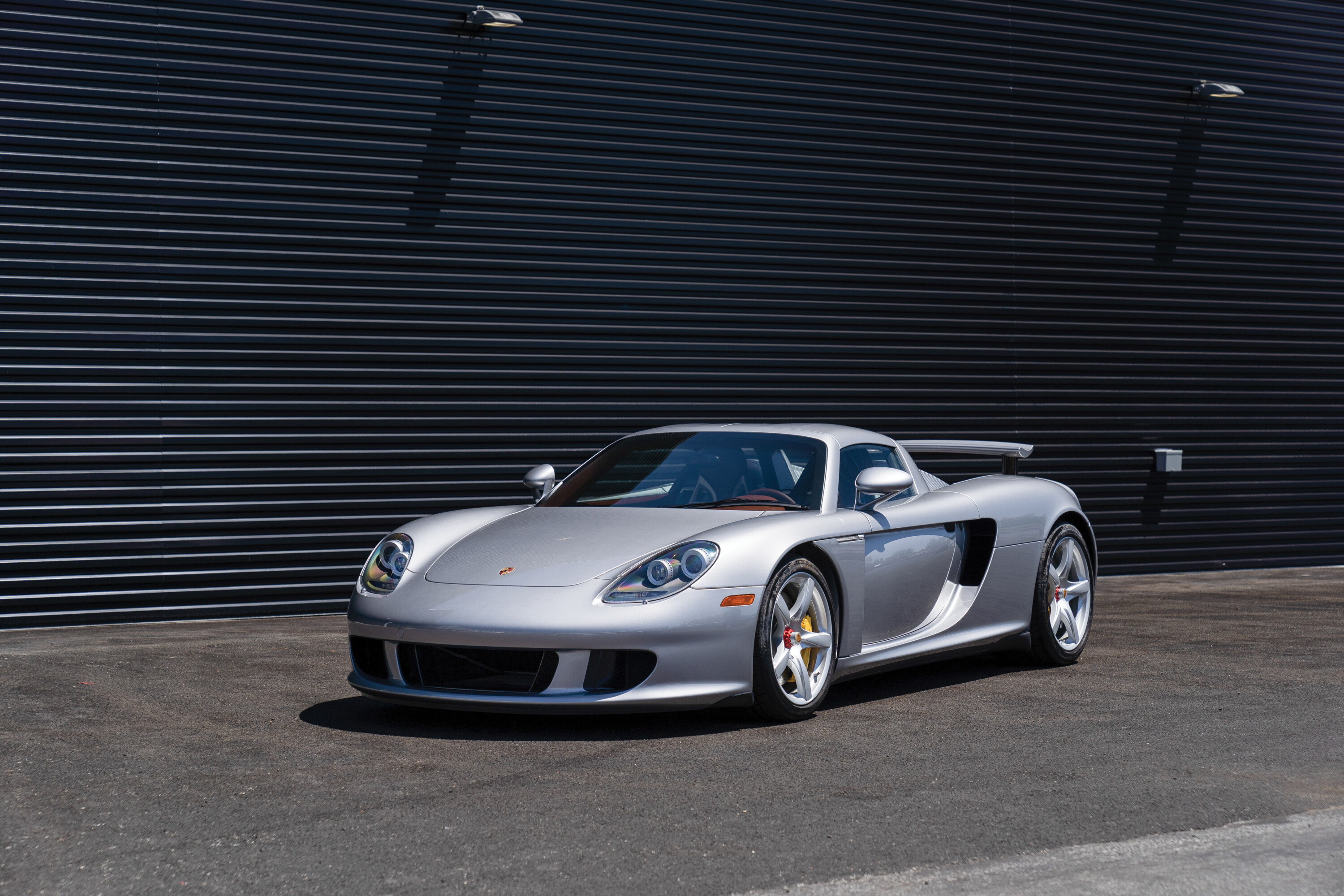
Porsche Carrera GT
Famously spiky, the edge can be taken off the CGT’s bite with modern tyres and a KW V5 coilover kit.
Debates raged long and hard as to whether the Carrera GT was a worthier inclusion than a 959, but we all got a little misty-eyed over the CGT’s incredible V10 which, given that a ten-pot never appeared in any other production Porsche, edged the decision. Famously spiky, the edge can be taken off the CGT’s bite with modern tyres and a KW V5 coilover kit. KW will even supply a (much needed) hydraulic lifter.
WE LOVE
- The V10 project’s original client was the Footwork F1 team
NOT SO MUCH
- Left-hook only, so a very rare sight on Aussie roads
MORE
Everything Porsche
1
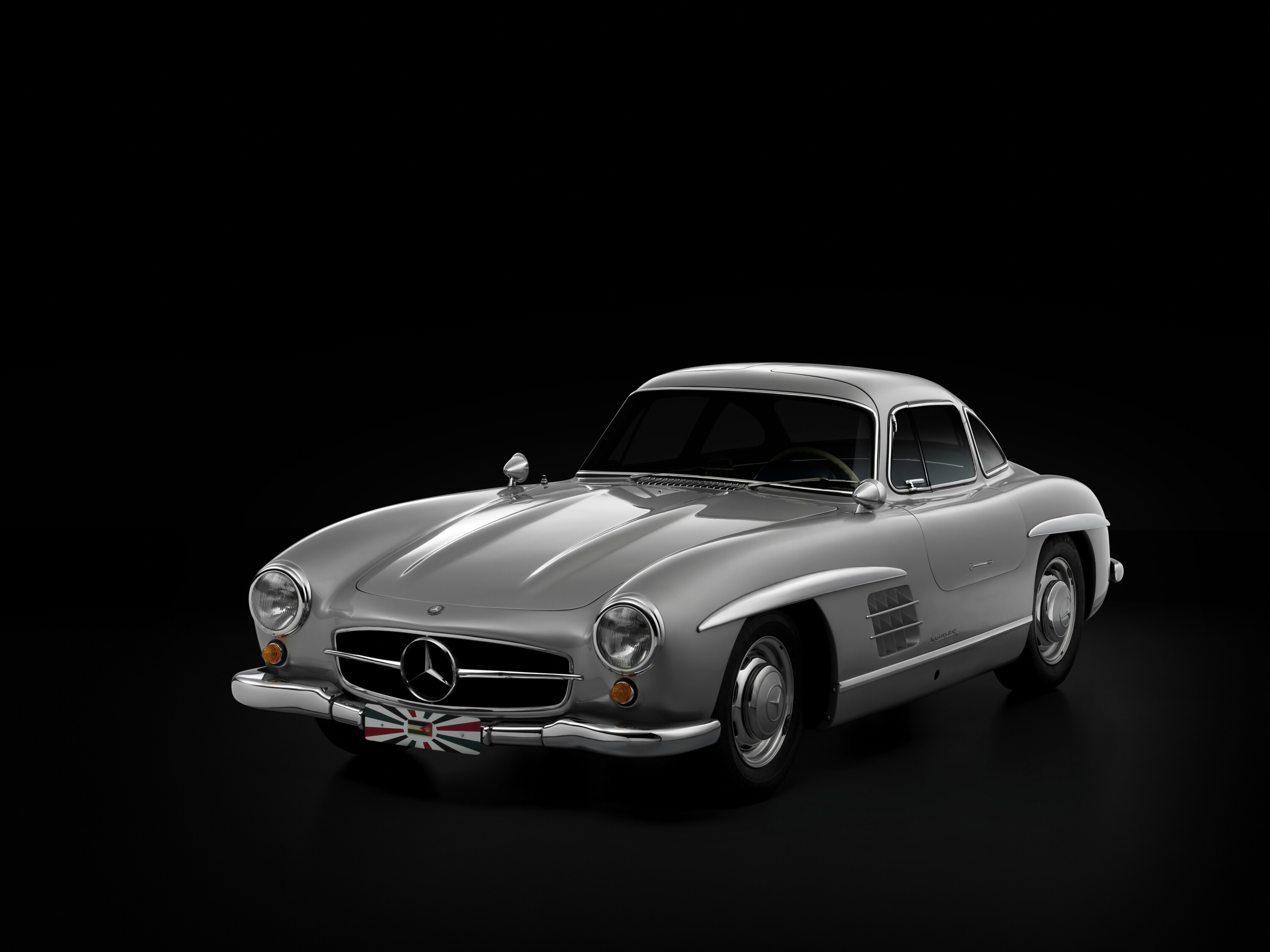
Mercedes-Benz 300SL
WE LOVE
- It was from another galaxy with direct fuel injection back in 1954
NOT SO MUCH
- Flabbergasted Detroit manufacturers were the biggest 300SL customers
It’s hard to comprehend quite what the Mercedes-Benz 300SL ‘Gullwing’ must have looked like to a shocked public in 1954.
Griff Borgeson might have written the best sentence in motoring journalism in his April ’56 review for Car and Driver: “Beyond 3600 the acceleration was appalling.” Was it the first supercar? Maybe not. The Blitzen Benz did 142mph in 1909 and given that was double the speed of the fastest plane, it probably has a fair shout.
1
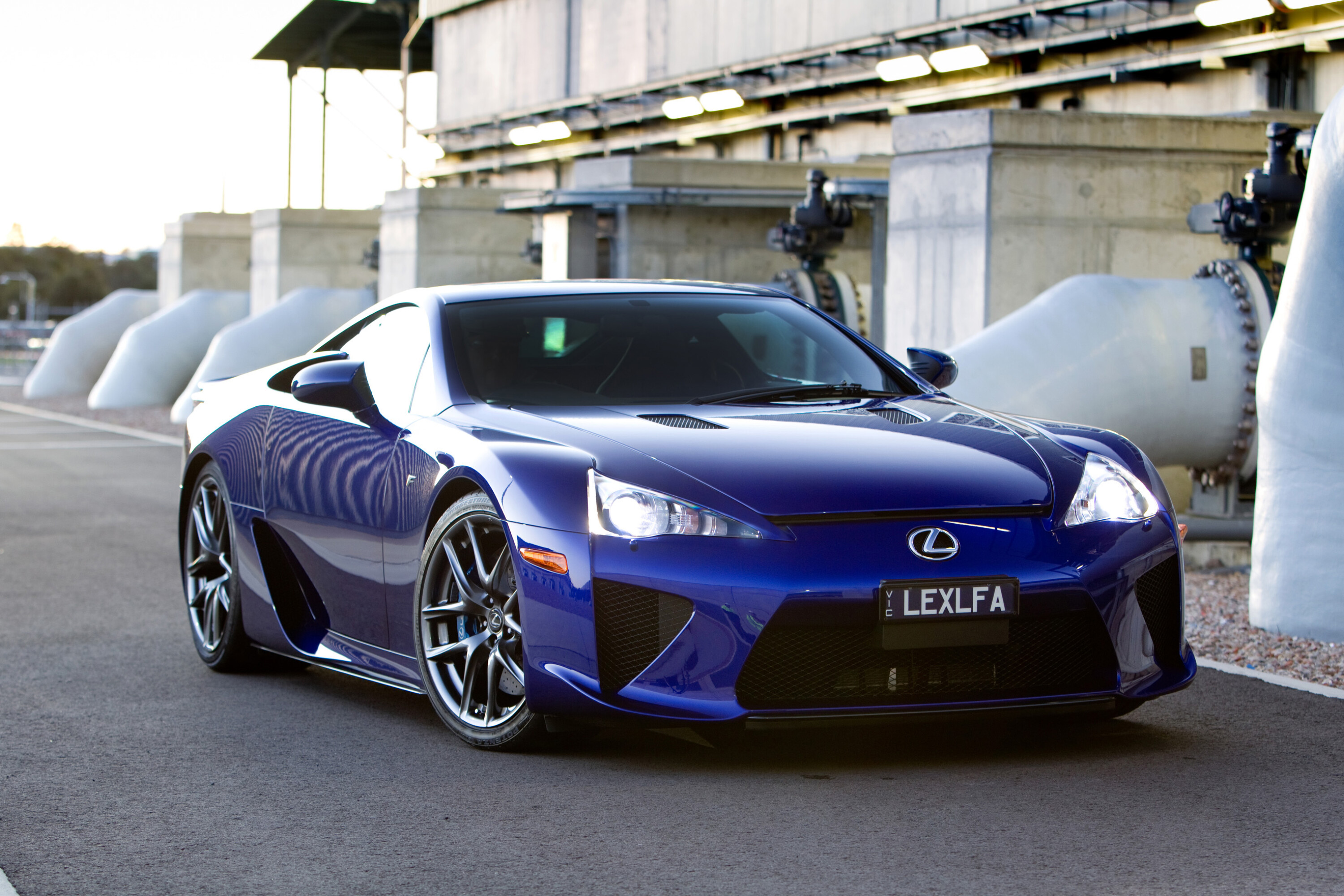
Lexus LFA
WE LOVE
- The greatest sounding sports car of all time?
NOT SO MUCH
- The regret of not buying one when they were advertised for USD$375k
“… the LFA and its Yamaha-fettled 4.8-litre V10 belatedly become unlikely icons.”
It’s not the fastest, it’s not the best looking, it’s far from the best handling, it’s not the most technologically advanced and it’s a million miles from the most financially successful supercar, but the Lexus LFA might just be the best sounding. The best-built too. A flop at launch, with unsold stock available years after it had finished its 500 car run, the LFA and its Yamaha-fettled 4.8-litre V10 belatedly become unlikely icons.
MORE
Everything Lexus
