
March 2023: This story is now part one in a two-part series. When you’re finished reading this one, you’ll find a link at the bottom to continue onto part two.
All mobile phone detection cameras are now live in NSW
For the first ten months of 2022 alone, the cameras are responsible for $61 million in fines. And, according to reports, over $185 million since the program’s inception, along with hundreds of thousands of demerit points.
The world-first program began operating on December 1, 2019, with warning letters being issued for the first three months.
Drivers caught using their mobile phones via mobile phone detection cameras were sent a warning letter, but NSW authorities having been issuing fines since March, 2020.
What are the fines and penalties for mobile phone use in a car?
- The penalty for being caught by mobile phone detection cameras in NSW is five demerit points and a $362 fine.
- If you’re caught in a school zone, the fine rises to $481 and in both cases attracts a five demerit point hit on your licence.
- The penalty increases to 10 demerit points during double-demerit periods, from a licence maximum of 12. Big price to pay for picking up your phone.
At the introduction of the cameras, the NSW government claimed it would reduce road deaths by 100 over five years.
So far, figures show an increase in fatalities during that time.
Mobile phone detection cameras: Frequently asked questions

1
2020: 45 mobile phone detection cameras planned in NSW
Authorities are planning to roll out 45 cameras across the state in largely undisclosed locations, which gives them the potential to check up to 135 million vehicles over the next three years.
Known mobile phone detection camera locations in NSW include the Sydney Harbour Bridge, Prospect, Nowra and Moore Park.
The NSW Government has made it impossible for you to use a clean driving record to downgrade your fine to a caution as you can with low-level speeding offences.
If you do receive a penalty notice, you can view the photo online and if it wasn’t you, you’re able to refer the driver who did it. That will make you popular, but with fines and points this big – and the fact that mobile phone use while driving is spectacularly dangerous – that seems like a good idea.
However, the location of the majority of NSW mobile phone cameras won’t be disclosed.
“A decision has been made not to disclose the location of the cameras,” said Bernard Carlon, the executive director at the Centre for Road Safety. “Driving while using a mobile phone is dangerous behaviour and motorists need to know that they can be caught at any time, anywhere.
“Independent modelling has shown these cameras could prevent around 100 fatal and serious injury crashes over five years. There is strong community support for more enforcement, with 80 percent of people surveyed supporting the use of detection cameras to stop illegal mobile phone use.”
Camera from three companies will be used, but the majority are expected to look like these units located on Anzac Parade, Moore Park.

1
2019: First mobile phone detection cameras activated
NSW law enforcers have activated the first batch of mobile phone detection cameras in undisclosed locations throughout the state.
The cameras, which were developed in Australia and are the first of their kind in the world, have been on trial for almost 12 months.
Ten fixed and transportable cameras will commence operating at locations across the state, according to Transport for NSW.
“Coupled with ongoing enforcement by NSW Police, these cameras will target illegal mobile phone use anywhere, anytime,” read a statement from the government body.
While the location of the cameras is a secret, it’s known that there is a camera on the Sydney Harbour Bridge, while other mobile phone camera locations include Nowra, Lucas Heights, Moore Park and Prospect.
Warning letters relating to camera-detected offences will be issued for the first three months, but the penalty for offending drivers will increase from four to five demerit points (from a total of 12), while a $362 fine ($481 in a school zone) will also be applied.
More law enforcement news
- Mobile phone use in cars: is it too late to stop it?
- Man found guilty of stalking ex via her car app
- Are you breaking the law via Apple CarPlay and Android Auto?
Almost 1000 drivers a day were being captured using their mobile phones while behind the wheel during the phone detection camera trial in Sydney.
Incredibly, all of the drivers were sprung at just two locations, on the M4 motorway at Prospect and at Anzac Parade, Moore Park (below).
According to 9News, the high-resolution cameras captured 20,125 cases of illegal phone use in the first 25 days after the trial began on January 7.
These included a driver holding a phone in each hand, and appearing to text on one of them while lightly holding to the steering wheel with his other hand.
Another image showed a driver with both hands on his smartphone held close to his face, while his passenger held on to the steering wheel (below).
The cameras also captured a woman with both hands on her phone while the steering wheel remained untouched.
Luckily for them, no fines were issued during the three-month trial.
Mobile phone detection cameras mean big revenue
If each driver detected so far was slapped with a $337 infringement, those two cameras alone would have earned the state $6.8 million over just 25 days.
The system uses high-resolution cameras to snap photos of each car, with artificial intelligence then sorting through each image to see if a phone is being used by the driver.
The cameras are said to work in both day and night time, in poor weather, and can detect vehicles travelling at up to 300km/h.
A human operator then validates images that indicate a positive result.
Unless NSW drivers change their behaviour the state government is expected to reap a significant windfall with the new technology.
Last financial year, around 40,000 fines were issued for illegal mobile phone use without the benefit of the cameras. Interestingly 30- to 39-year-old drivers were the main offenders, receiving more than a quarter (11,695) of the fines.
But the NSW Department of Roads and Maritime Services insists that the cameras are not about revenue raising.
“74 per cent of the NSW community support the use of cameras to enforce mobile phone offences. I strongly believe this technology will change driver behaviour and save lives,” said the minister for Roads, Maritime and Freight, Melinda Pavey.
Both Western Australia and Victoria are also examining phone-detecting camera technology – though not necessarily the same tech adopted by NSW, which is developed by Australian start-up Acusensus.
UPDATE, November 4: 2022 MG HS Plus EV plug-in hybrid pricing up
The 2022 MG HS Plus EV plug-in hybrid medium SUV has been hit by a price rise for the fourth time this year.
It is now priced from $49,690 drive-away for the entry-level Excite and $52,690 drive-away for the flagship Essence – up $1000 from the previous increase on July 1.
Our original story, below, has been updated to reflect this change.
Snapshot
- MG HS Core dropped from local range
- Medium SUV now starts from $31,990 drive-away
- Price increases for non-hybrid and plug-in hybrid variants
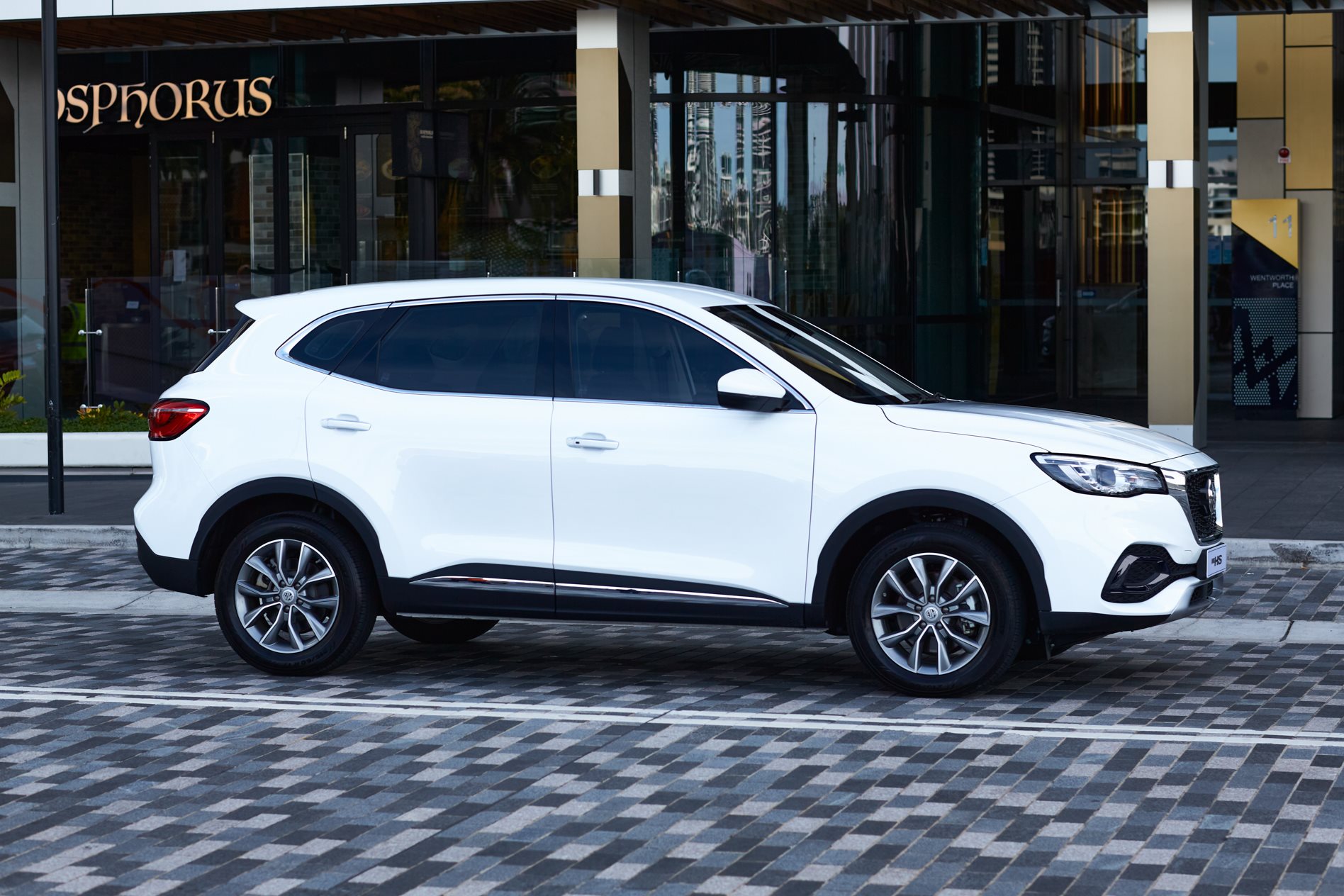
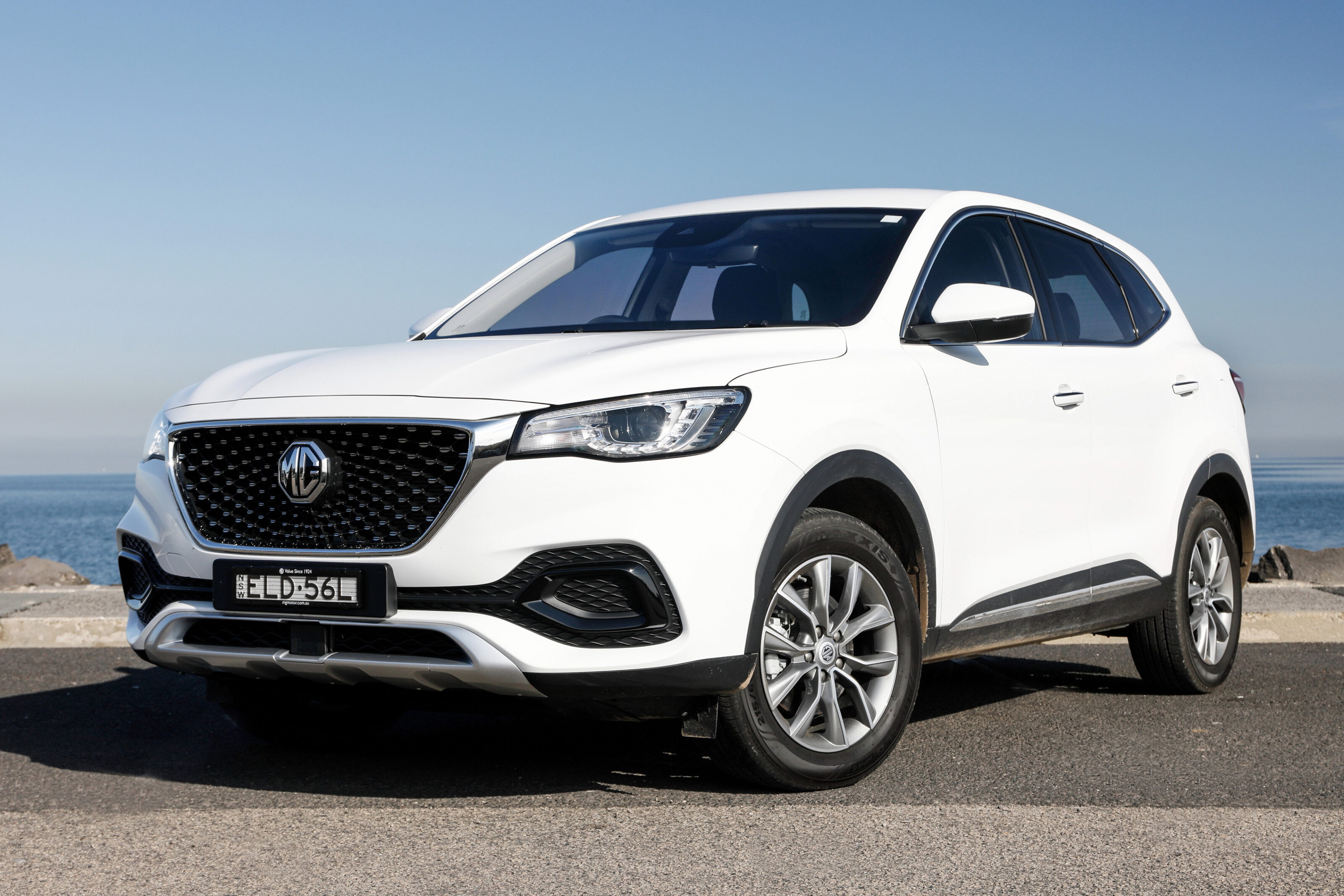
The cost of entry into a 2022 MG HS medium SUV has risen by $1000, with the entry-level Core deleted from the local range.
Speaking with Wheels, a spokesperson for MG Motor Australia confirmed the Core – priced from $30,990 drive-away – had been discontinued from the HS line-up.
1
It previously occupied the most affordable position in the range, with a sub-$30k list price achieved with cloth upholstery, a polyurethane steering wheel and a basic four-speaker sound system.
With the Core axed, the HS medium SUV range now opens with the slightly dearer HS Vibe, advertised for $31,990 drive-away.
While pricing for the new base variant has remained unchanged, the Excite, Excite X, Essence, Essence Anfield and Essence X grades are $1000 dearer.
1
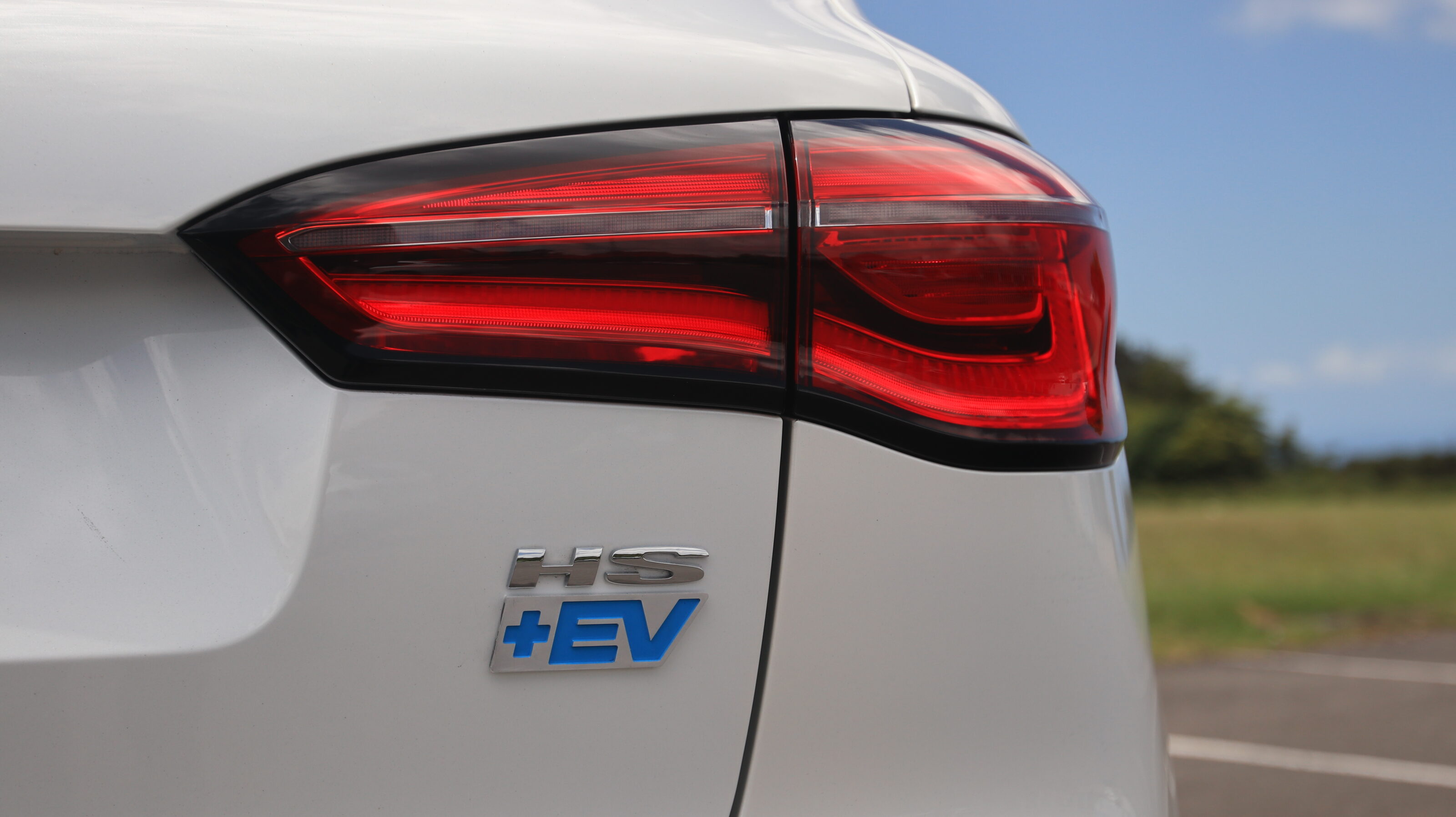
Meanwhile, the MG HS Plus EV plug-in hybrid is up by $2700 across the board since an updated model launched in March 2022, bringing a more-affordable Excite variant.
Metallic paint is now standard for the plug-in hybrid, with the deletion of the non-metallic clipper blue finish.
There have been no specification changes for existing HS variants in 2022.
MORE
SUV Buyers Guide
Watch our video review of the MG HS Essence X above, or check out the written review here.
2022 MG HS pricing
All prices are drive-away.
| Model | Pricing (drive-away) |
|---|---|
| HS Vibe | $31,990 |
| HS Excite | $35,990 |
| HS Excite X | $38,990 |
| HS Essence | $39,990 |
| HS Essence Anfield | $41,690 |
| HS Essence X | $43,990 |
| HS Plus EV Excite | $49,690 (+$1000) |
| HS Plus EV Essence | $52,690 (+$1000) |
1
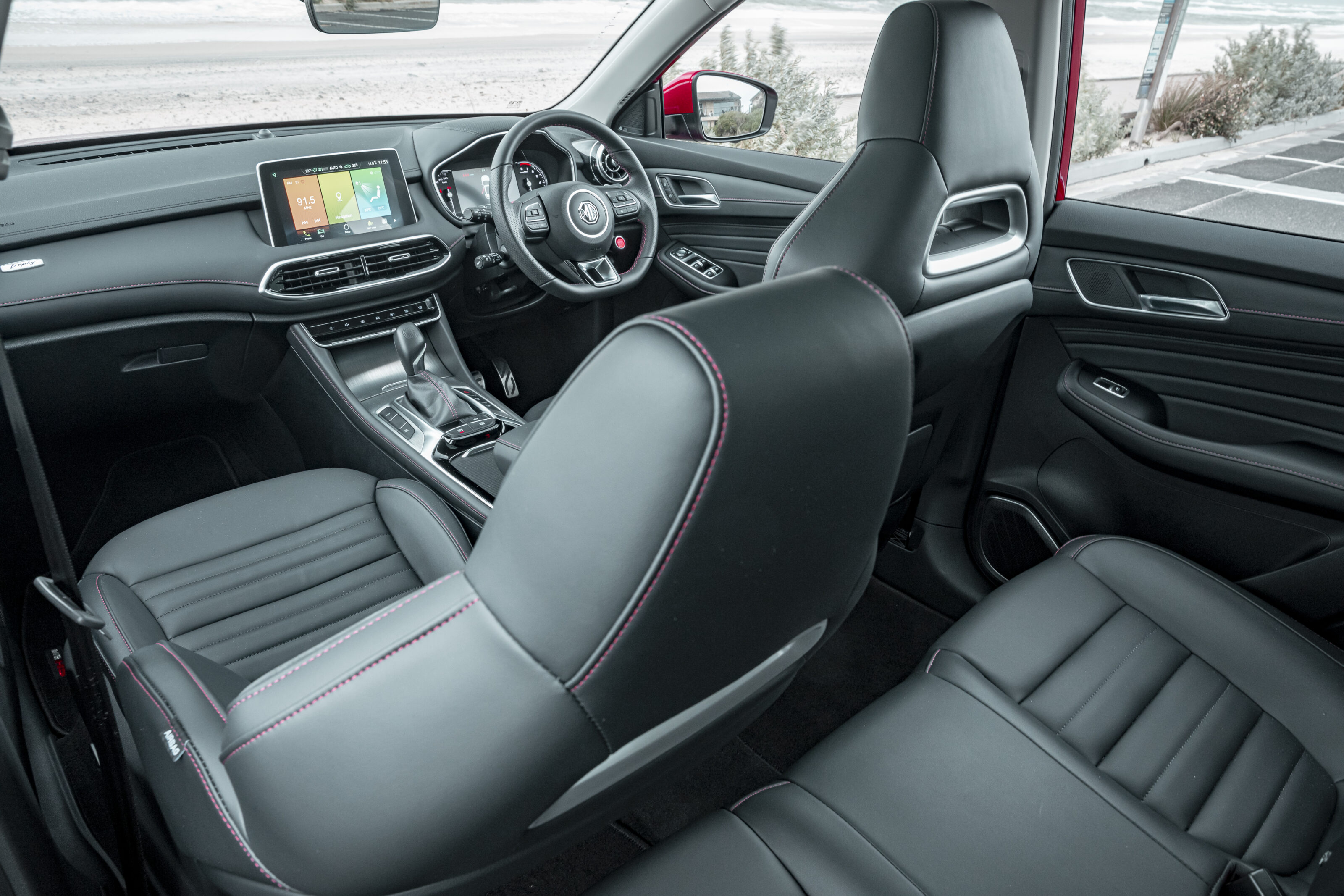
2022 MG HS features
Vibe
- 17-inch alloy wheels
- 10.1-inch infotainment system
- Apple CarPlay and Android Auto (wired only)
- Semi-digital instrument cluster
- Six-speaker audio system
- Four USB-A ports (2x front and rear)
- Manual air conditioning
- Leatherette upholstery
- Leather-wrapped steering wheel and gear shifter
- Front centre console with cooling
- Rear air vents
- Halogen headlights
- Front fog lights
- LED daytime running lamps
- LED tail lights
- Reverse camera with rear parking sensors
- Keyless entry with push-button start
- Heated, electrically-operated door mirrors
Excite and Excite X, in addition to Vibe
- 18-inch alloy wheels
- LED headlights
- Satellite navigation
- Rain-sensing wipers
- Electric tailgate
- Sequential rear indicators
- Dual-zone climate control
- Alloy pedals
- ‘Super Sport’ drive mode
- Paddle shifters
- Ambient interior lighting
Essence and Essence X, in addition to Excite
- 360-degree camera
- Two-tone leather sports seats
- Heated front seats
- Panoramic sunroof
- Six-way power-adjustable driver’s seat
- Four-way power-adjustable passenger seat
Essence Anfield, in addition to Essence
- Red leather upholstery
- Standard metallic paint (black or white)
1
Plus EV Excite (PHEV)
- 17-inch alloy wheels
- 12.3-inch digital instrument cluster
- 10.1-inch infotainment system
- Apple CarPlay and Android Auto (wired only)
- Satellite navigation
- Six-speaker audio system
- Four USB-A ports (2x front and rear)
- Dual-zone air conditioning
- Six-way power-adjustable driver’s seat
- PU/PVC (plastic-like) upholstery
- Leather-wrapped steering wheel and gear shifter
- Front centre console with cooling
- Rain-sensing wipersRear air vents
- Halogen headlights
- LED daytime running lamps
- LED tail lights
- Reverse camera with rear parking sensors
- Keyless entry with push-button start
- Electrically-operated door mirrors
- Tyre repair kit
Plus EV Essence (PHEV)
- 18-inch alloy wheels
- LED headlights
- Sequential rear indicators
- Front fog lights
- Panoramic sunroof
- Electric tailgate
- 360-degree camera
- Two-tone leather sports seats
- Four-way power-adjustable passenger seat
- Ambient interior lighting
- Alloy pedals
- Welcome lights
- Heated, electrically-operated door mirrors
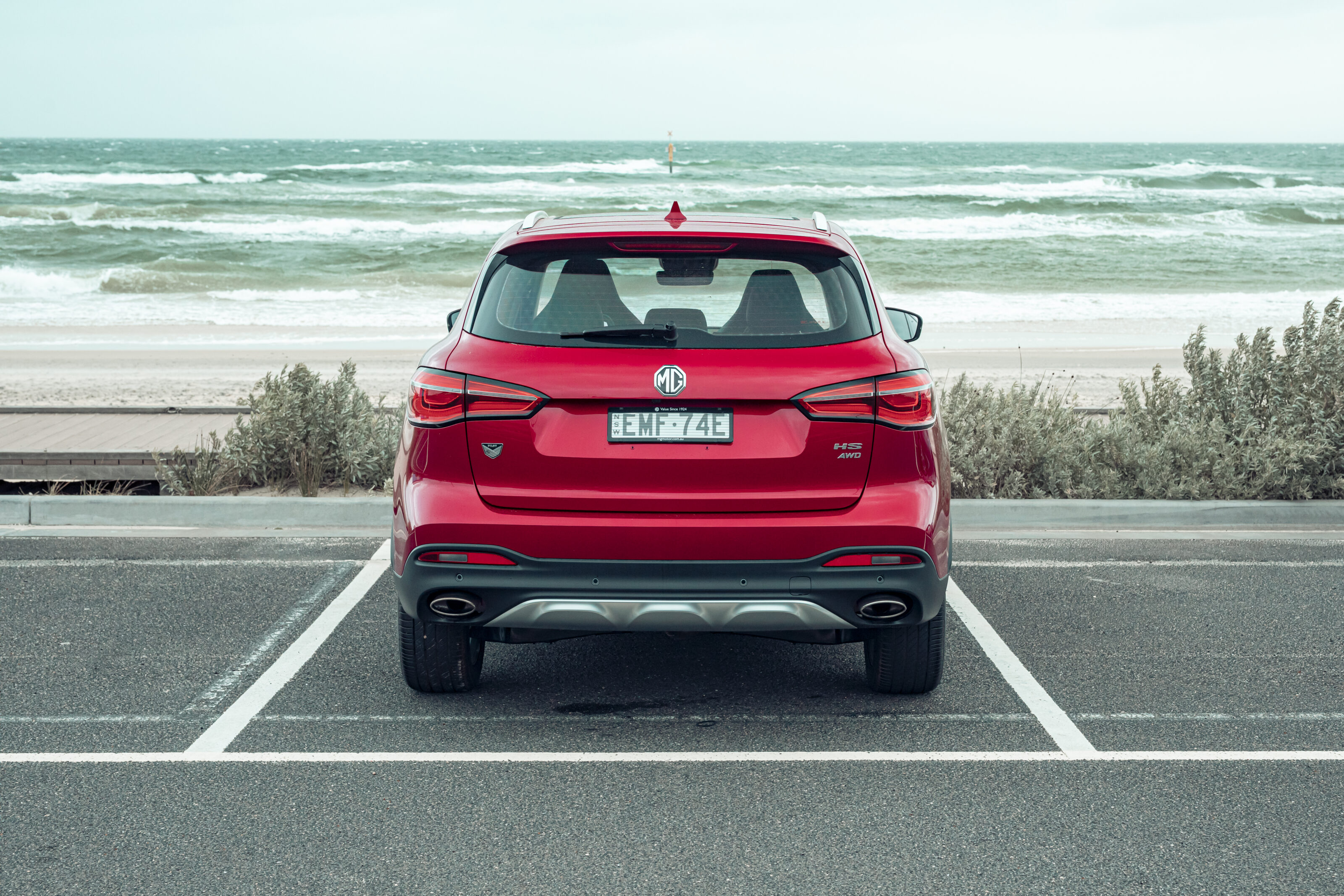
1
Engine, drivetrain and fuel economy
As standard, the MG HS is powered by a 1.5-litre turbocharged four-cylinder engine producing 119kW of power and 250Nm of torque.
This powertrain is matched with a seven-speed dual-clutch automatic transmission and front-wheel drive.
All-wheel drive is standard on the Excite X and Essence X models, which upgrade to a 168kW/360Nm 2.0-litre turbocharged petrol engine with a six-speed dual-clutch automatic.
The plug-in hybrid MG HS Plus EV reverts to front-wheel drive, with a 1.5-litre turbocharged petrol engine, an electric motor on the front axle, and a 16.6kWh lithium-ion battery.
It is mated to a 10-speed automatic transmission, split between a traditional six-speed unit for the petrol engine and a four-speed electronic drive unit for the electric motor.
Combined outputs are 189kW of power and 370Nm of torque.
Fuel economy figures can be found in the table below:
| 1.5-litre turbocharged petrol FWD | 7.3L/100km |
| 2.0-litre turbocharged petrol AWD | 9.5L/100km |
| 1.5-litre petrol-electric FWD | 1.7L/100km |
Safety
1
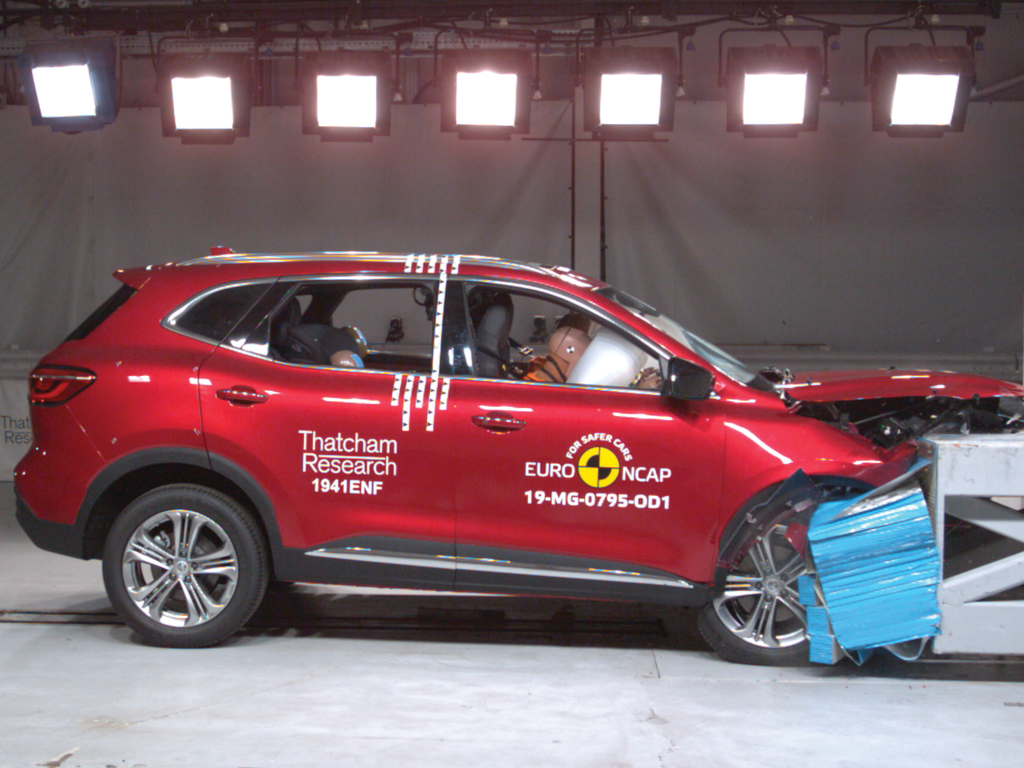
The non-hybrid MG HS is covered by a five-star ANCAP safety rating, based on testing conducted in 2019.
Plug-in hybrid variants remain untested.
Six airbags (dual front, dual side and dual curtain) feature across the range.
Each variant includes the following active safety equipment as standard:
- Autonomous emergency braking
- Forward collision warning
- Lane-keep assist
- Adaptive cruise control
- Traffic jam assist
- Blind-spot alert
- Rear-cross traffic alert
- Auto high-beam
- Traffic sign recognition
- Door opening warning
2
Dimensions
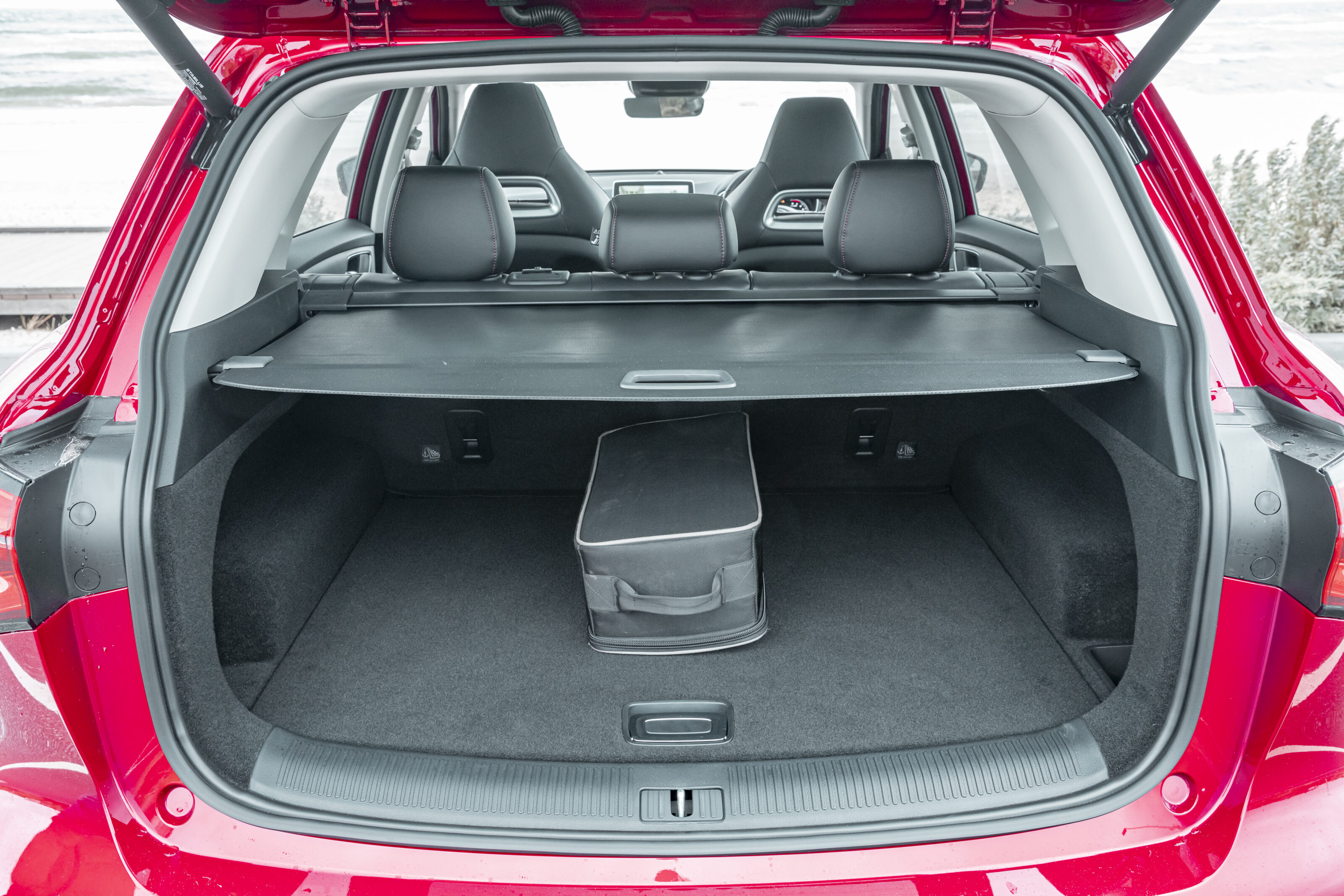
The MG HS has a wheelbase of 2720 millimetres, and is 4574mm long, 1876mm wide and 1685mm high.
Warranty and servicing
As per the wider MG range, the HS is covered by the brand’s seven-year, unlimited-kilometre warranty, along with complimentary roadside assistance during the warranty period.
The HS Plus EV includes a seven-year, unlimited-kilometre battery warranty.
Capped-price servicing is offered for seven years across the HS range.
MORE
Everything MG
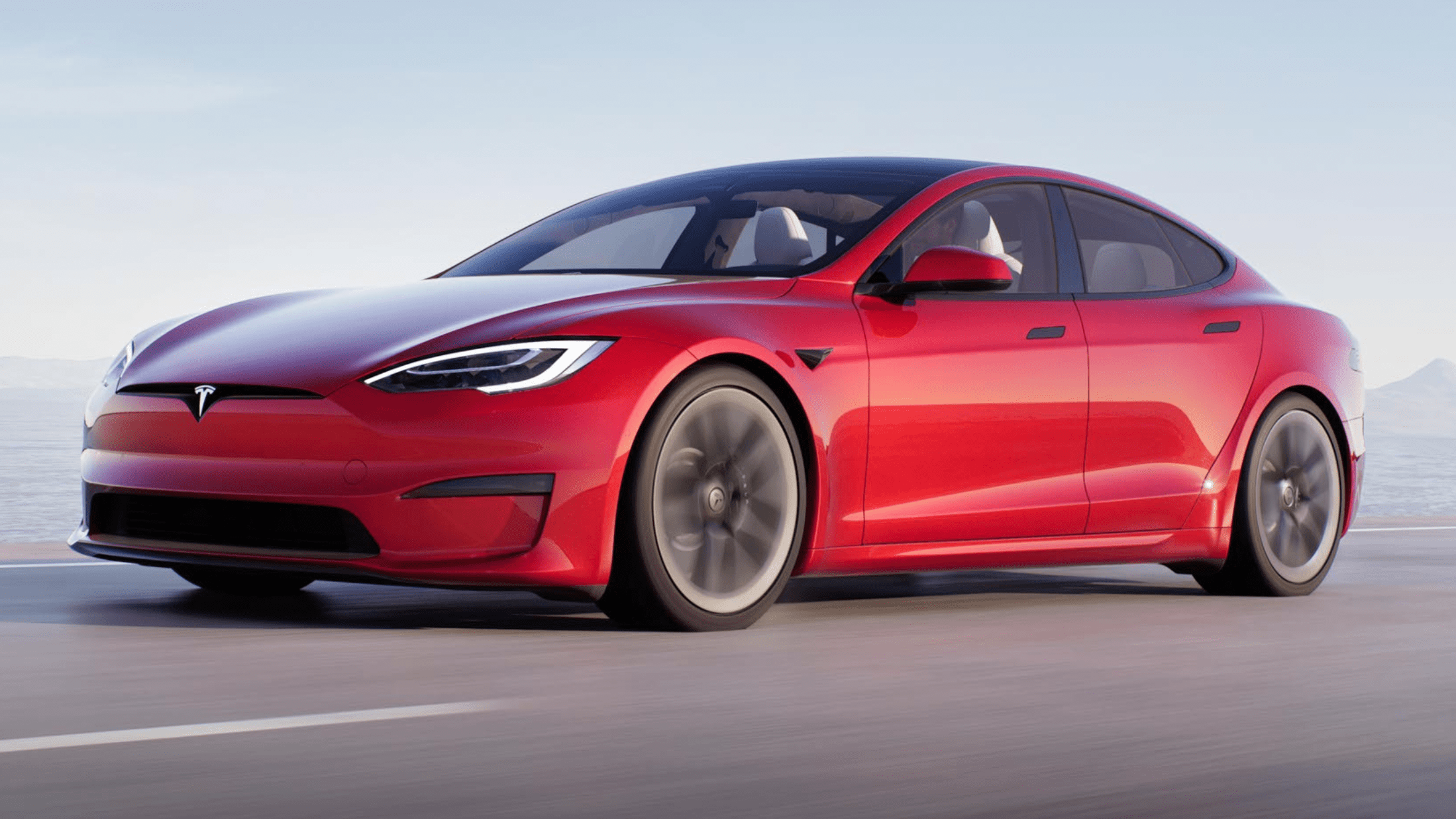
No one saw Tesla coming. A Silicon Valley start-up putting electric motors into a handful of Lotus sportscars was about a niche as car-making gets.
Then Elon Musk took over. Scarily smart, and with the balls to simultaneously bet billions on two industries with staggeringly high costs and razor-thin margins – space travel and car manufacturing – Musk saw an opportunity. In the same year his space company, SpaceX, launched its first rocket, Tesla launched the Model S, a car that changed the way the world thought about electric vehicles.
Elon Musk’s masterstroke, however – the real genius of the Tesla business model – was to create an ecosystem within which the Model S could legitimately function as an alternative to a vehicle with an internal combustion engine. Tesla’s Supercharger network made the Model S a real car, not a novelty.
Part 2!
JUMP AHEAD
Advice
Australia’s best electric cars for 2023
We’ve tested nearly every EV below six figures in Australia to rank the best on sale today
Tesla sold just under a million vehicles last year.
It’s also the first genuinely new premium automotive brand – as opposed to an artificially created one such as Lexus – to emerge in decades, its cars outselling similarly priced vehicles from traditional premium brands such as BMW and Mercedes-Benz in lucrative markets such as the United States.
1
Look past the headlines, though, and Tesla has some big challenges ahead.
Tesla’s total share of the global EV market last year may have been almost 20 per cent, but just two models, the Model 3 sedan and Model Y SUV accounted for 97 per cent of its sales.
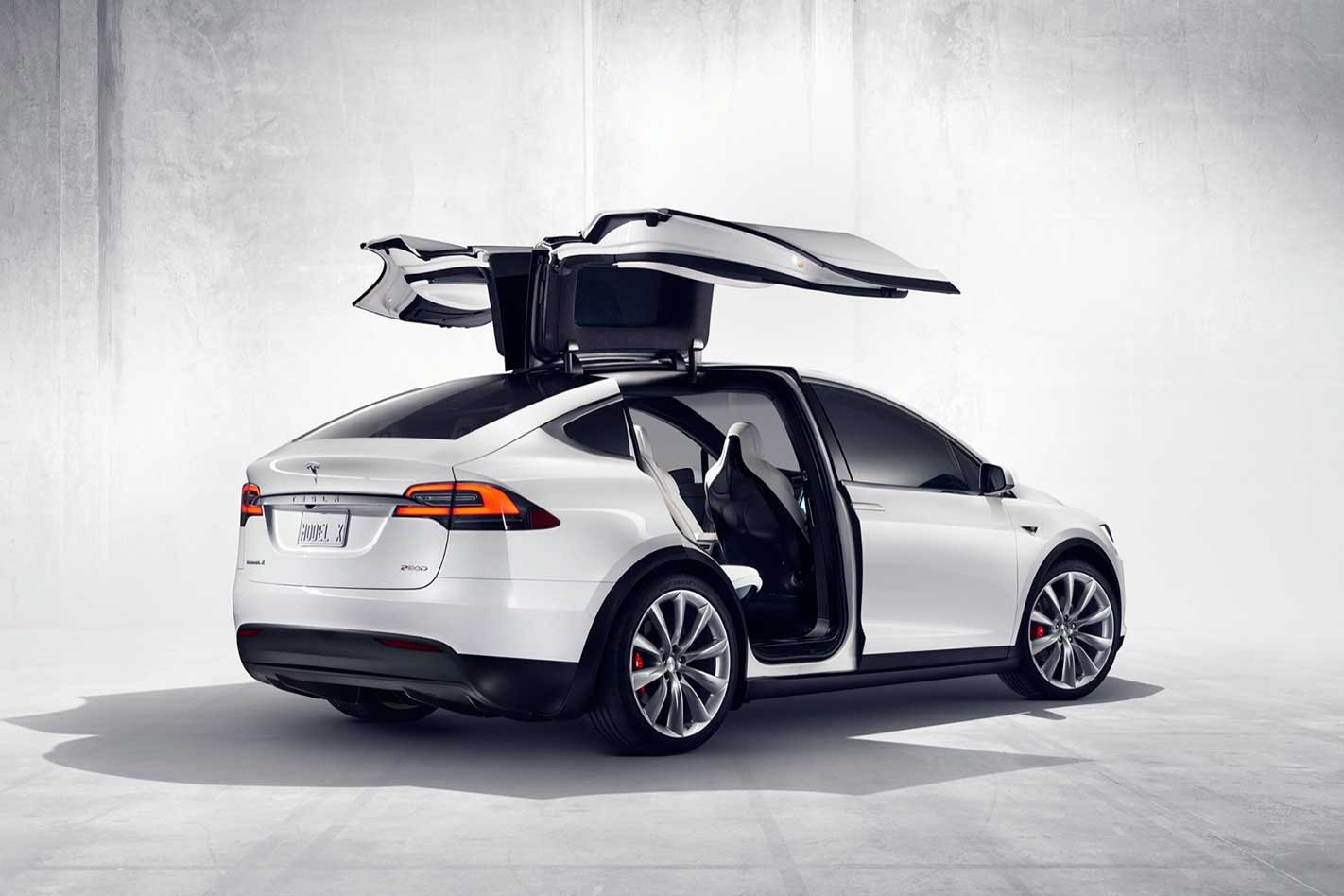
The car that kickstarted it all, the Model S, is now nine years old, with no replacement in sight. The Model X SUV, now six years old, still has its heavy, complex, and troublesome ‘Falcon Wing’ rear doors.
1
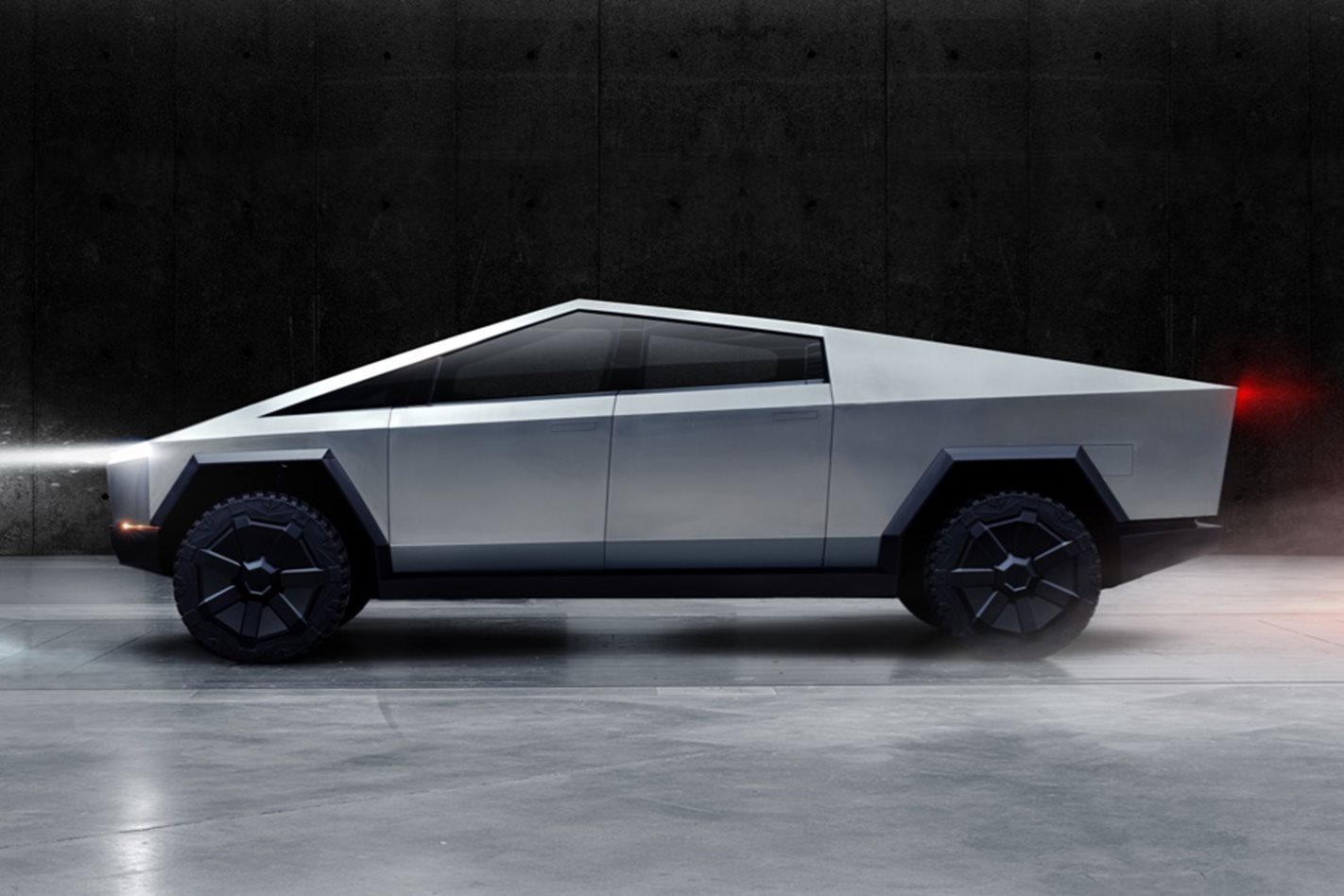
The much-hyped Tesla Cybertruck ute Musk claimed would be in production in 2020 has been delayed until next year at the earliest. References to the next Tesla Roadster, unveiled as a high-performance flagship in 2017, have quietly disappeared from the Tesla website.
More significantly, the automotive establishment is starting to fight back, using skills and resources accumulated by decades of designing and manufacturing the most complex consumer products ever created. By 2030, traditional manufacturers will each be producing dozens of EV model lines and chasing EV sales targets in the millions.
1
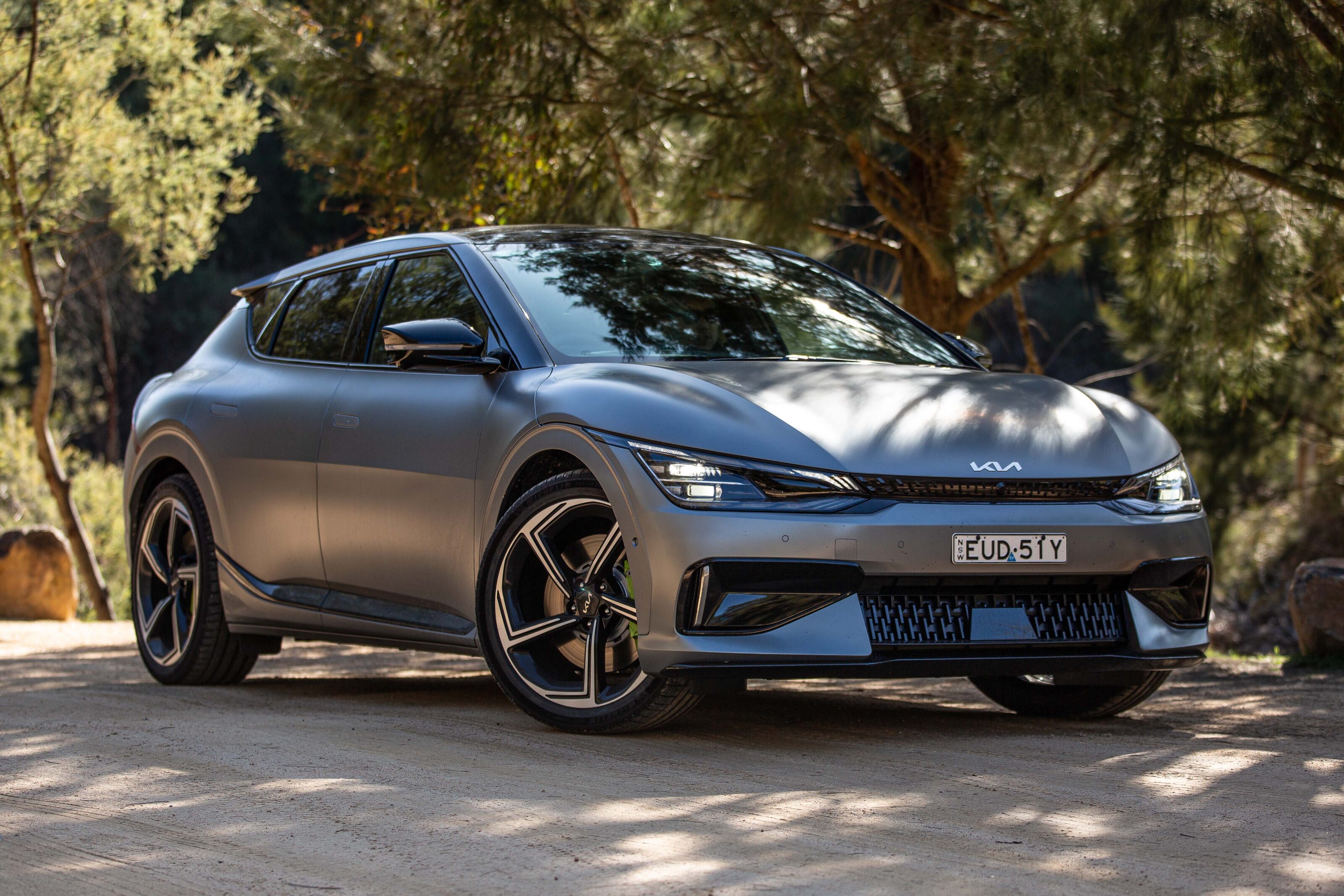
Hyundai Motor Group, for example, plans to offer 11 Hyundai-branded EVs, six Genesis-branded ones, and 14 Kia EVs by 2027. It is targeting global sales of three million EVs by 2030.
Volkswagen Group, which last year sold 8.6 million vehicles worldwide, expects EVs to account for half its global sales by the end of the decade. GM says it plans to launch 30 new EV models in the next three years.
In total, traditional car-makers are set to splurge more than US$515 billion on EV research and development this decade. Tesla, by contrast, has spent less in total vehicle R&D since 2008 than Toyota and Mercedes-Benz each spent in 2020 alone.
1
The traditional OEMs are poised to outspend and out-produce Tesla, a company that’s still struggling to build cars at volume and to high levels of quality.
More troubling for Tesla, though, are the new and emerging car-makers that are looking to follow in its wheel tracks, many using near-turnkey EV powertrains and battery packs developed and sold by a growing legion of suppliers. The car industry’s arch-disruptor is a role model for a whole new generation of disruptors.
Here are some to watch for.
XPeng
Based in Guangzhou, China, XPeng was founded in 2014 by two former senior executives from Chinese car-maker GAC and Chinese tech billionaire He Xiaopeng.
By the end of this year, it will be producing and selling four EVs in China. XPeng already sells one of its models in Norway and plans to increase exports to other European countries and the US over the next few years.
XPeng’s four models are built off two platforms. The smaller platform, designed for vehicles with wheelbases from 2600mm to 2800mm and codenamed David, underpins the G3i compact SUV currently on sale in Norway, and the P5, a Chinese-market compact four-door sedan that features a long wheelbase and ultra-roomy rear seat. Both are available with a single motor driving the rear wheels, or dual motors and all-wheel drive.
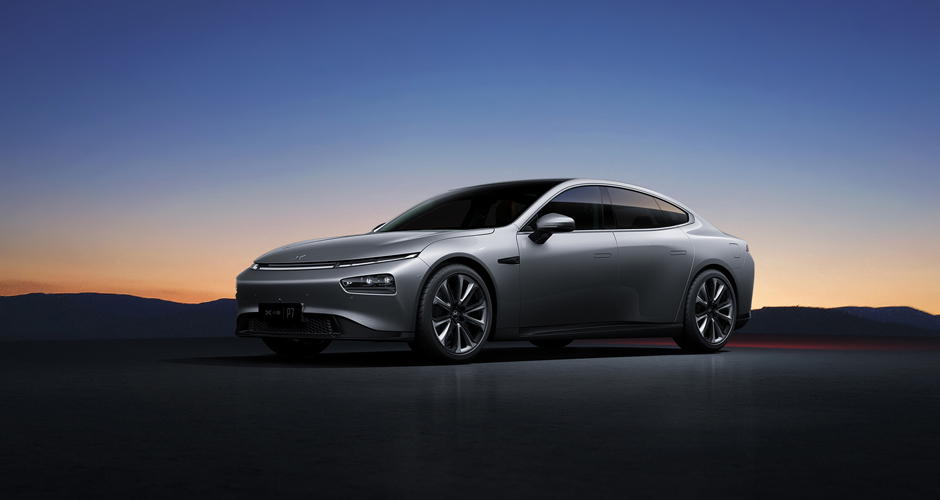
The XPeng P7, a sedan with Tesla Model S styling cues, is built on the Edward platform, which is designed for vehicles with wheelbases from 2800mm to 3100mm. Developed in conjunction with Porsche, it features multi-link suspension all round.
1
The single motor P7 RWD Long Range is powered by a rear-mounted e-motor that develops 196kW and 390Nm of torque. The dual-motor P7 4WD High Performance packs a total system output of 316kW and 655Nm.
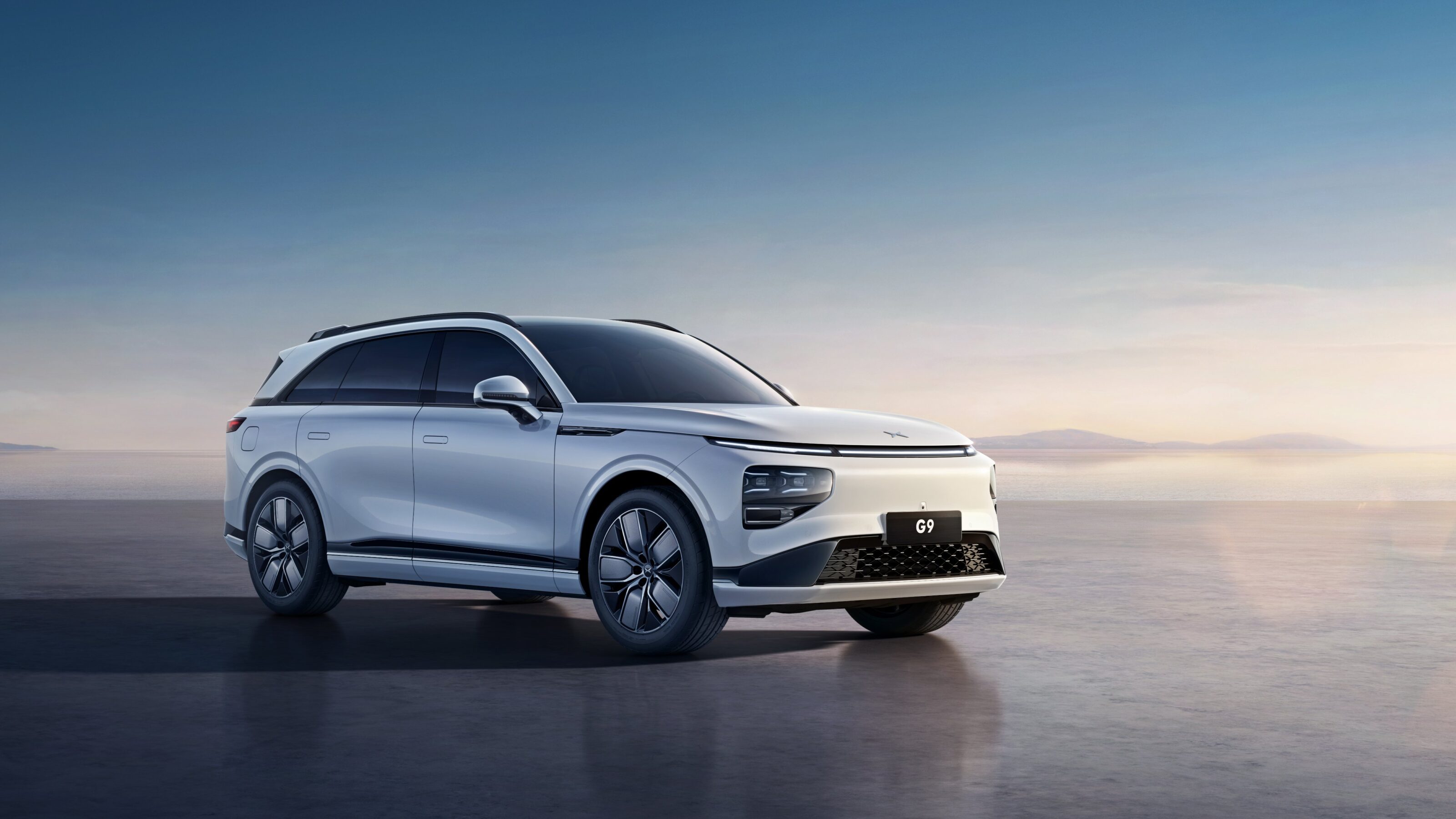
XPeng’s Edward platform also underpins the company’s newest model, the G9 SUV, which goes on sale in China in the third quarter of this year and is rumoured to be destined for the US. The G9 features an 800V electrical architecture that will allow fast charging.
It’s taken eight-year-old XPeng less than half the time Tesla took to get four vehicles into production and on sale. But the Chinese company’s biggest threat could be its end-to-end software architecture, a technology concept that has hitherto been unique to Tesla in the automotive sector.
Dubbed Xmart OS and initially Android-based but now highly evolved and unique, it controls driver assistance systems as well as connectivity functions and infotainment systems. The system also supports AI capabilities, including a ‘Hey XPeng’ voice activation function and a smart navigation system and allows over-the-air updates and remote vehicle diagnostics.
1
VinFast
VinFast was founded in 2017 and though headquartered in Singapore, is part of Vingroup, the largest private company in Vietnam.
A US$39 billion conglomerate with interests in real estate and the leisure industry, Vingroup is owned by Pham Nhat Vuong, who got his start selling ramen noodles in Ukraine in 1993.
Founded as a maker of conventional internal combustion engine vehicles, VinFast announced in 2020 that it would switch to producing pure EVs within two years. Chairman Pham Nhat Vuong reportedly personally underwrote the cost of the design and engineering changes required for the two internal combustion engine vehicles the company had under development at the time.
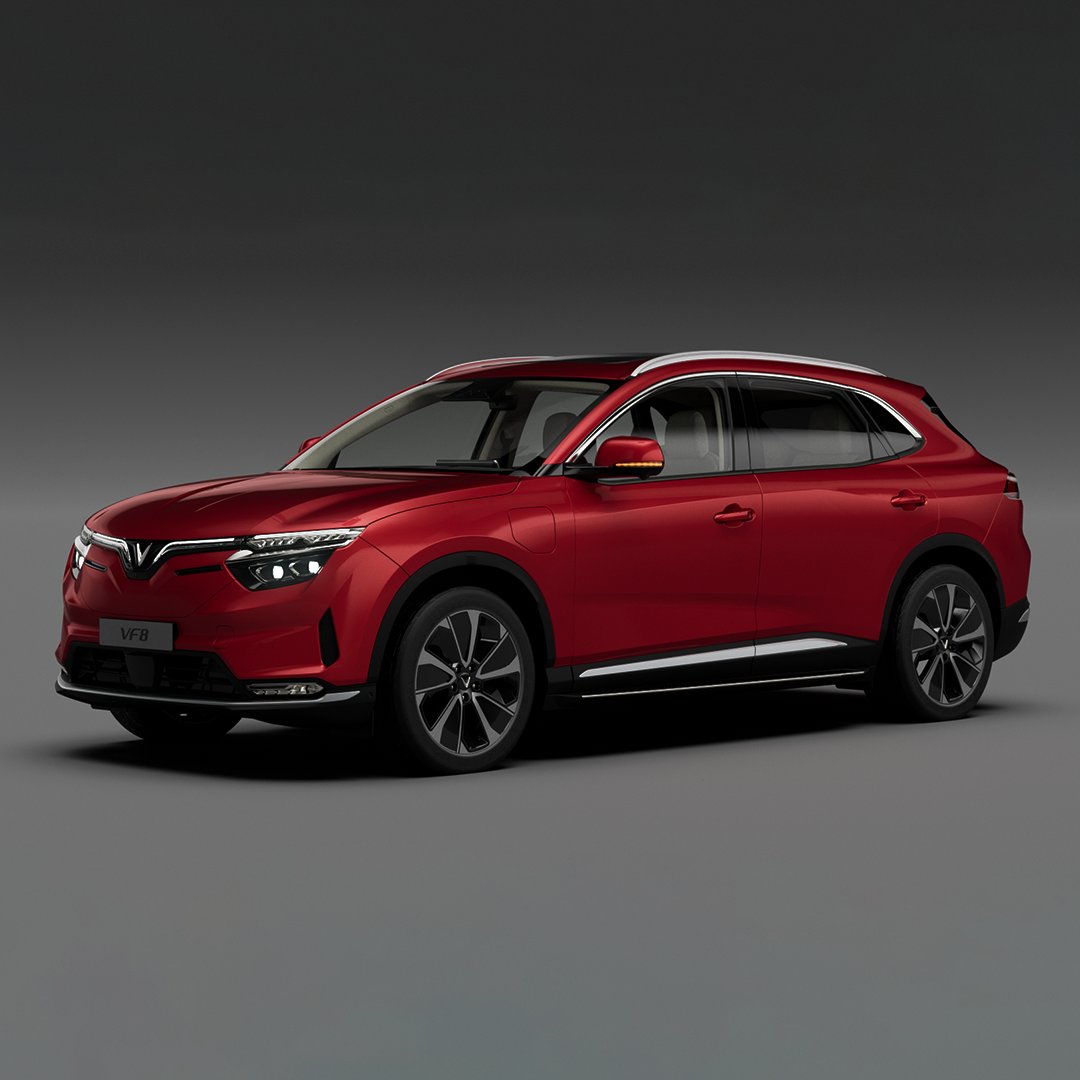
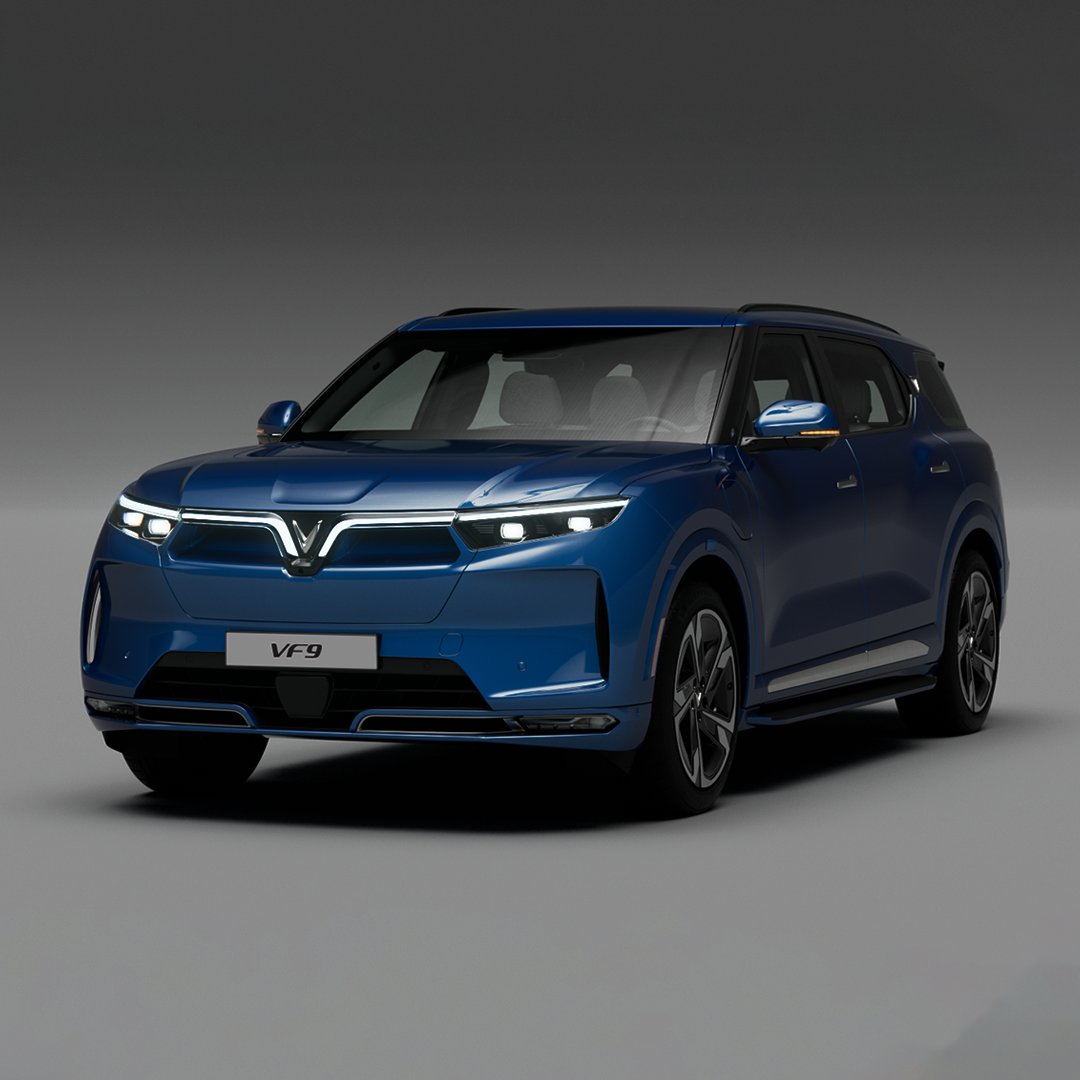
Those vehicles, the VinFast VF 8 mid-size SUV and the larger VF 9 three-row SUV, have just entered production in Vietnam and production of export models for the US market is imminent.
1
The VF 8 will be available in the US in two trim levels – Eco and Plus. Both are dual-motor, all-wheel drive models, the Eco offering 260kW and the Plus 300kW. VinFast claims a 0-100km/h acceleration time of about 6.0 seconds for the Eco, and 5.5 seconds for the Plus.
Two battery sizes will be offered, the Standard Range delivering an estimated 418km range on the WLTP cycle in the Eco and 400km in the Plus. The Enhanced Range battery boosts those numbers to 470km and 455km respectively.
VinFast has announced VF 8 pricing will start at US$40,700 – plus a monthly battery subscription fee of US$110. Customers who don’t travel long distances can pay just US$35 a month for 498km worth of travel each month, with each additional kilometre being charged at the rate of 18 cents.
1
VinFast’s idea behind the subscription fee is to keep initial purchase costs down – batteries are expensive – and to reassure buyers. Though VinFast is offering a 10-year/200,000km warranty in the US, the subscription deal means it will replace the battery if its storage capacity degrades below 70 per cent.
The VF 9 will be priced from US$55,500, with a battery subscription fee of US$160 per month, or a flexi rate of US$44 a month for 498km with each additional kilometre costing 24 cents.
A VF 9 can be configured as a six- or seven-seater and will also be available in Eco and Plus trims, but unlike the VF 8, both come with the 300kW dual-motor powertrain.
The Standard Range battery pack gives claimed a 0-100km/h acceleration time of about 7.4 seconds for both Eco and Plus versions, with respective claimed WLTP ranges of 438km and 422km.
1
The Enhanced Range battery delivers a claimed 0-100km/h time of about 6.5 seconds and claimed range of 594km in the Eco model, and 6.6 seconds and 580km in the Plus version, which comes standard with larger 21-inch diameter wheels.
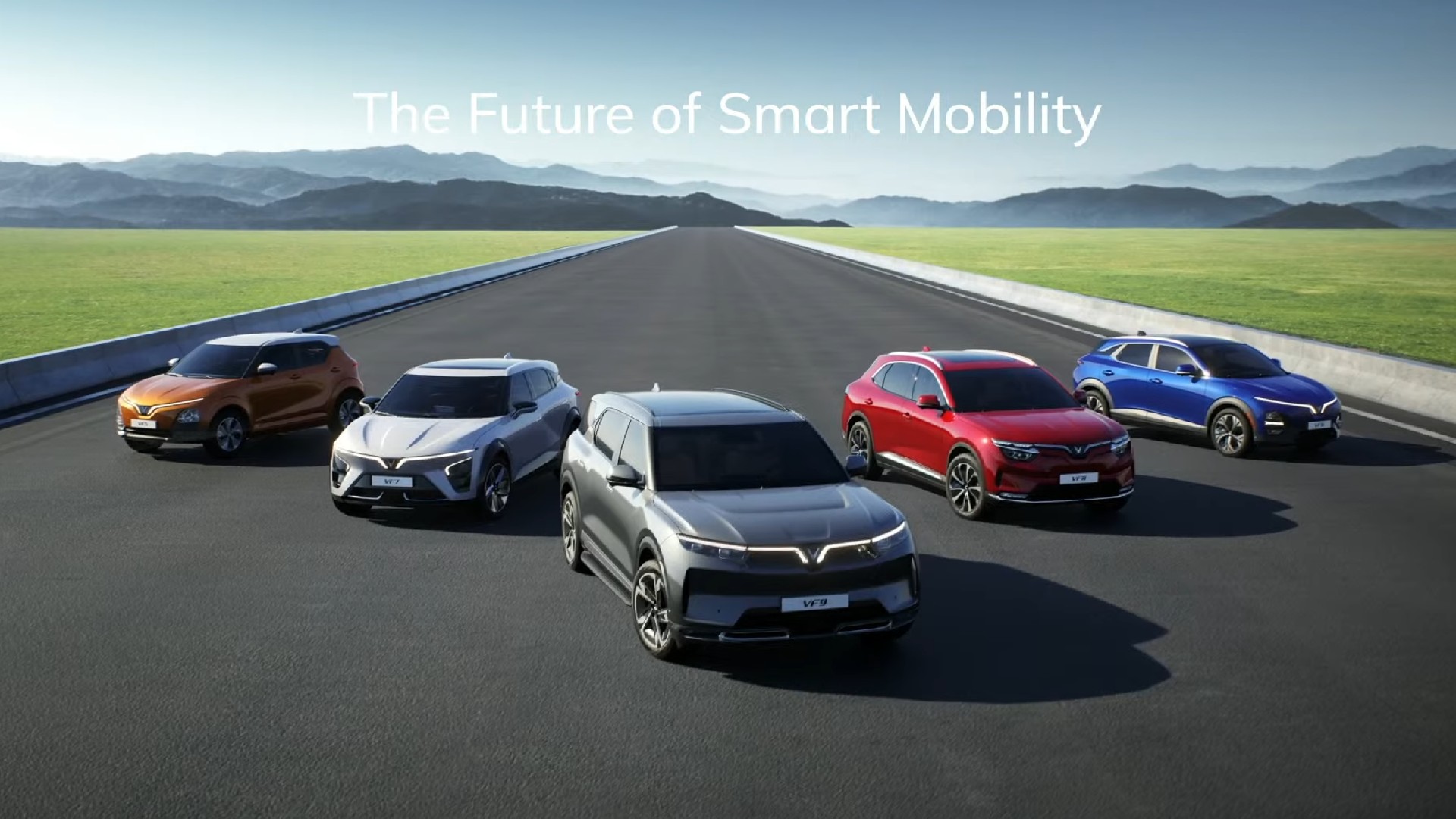
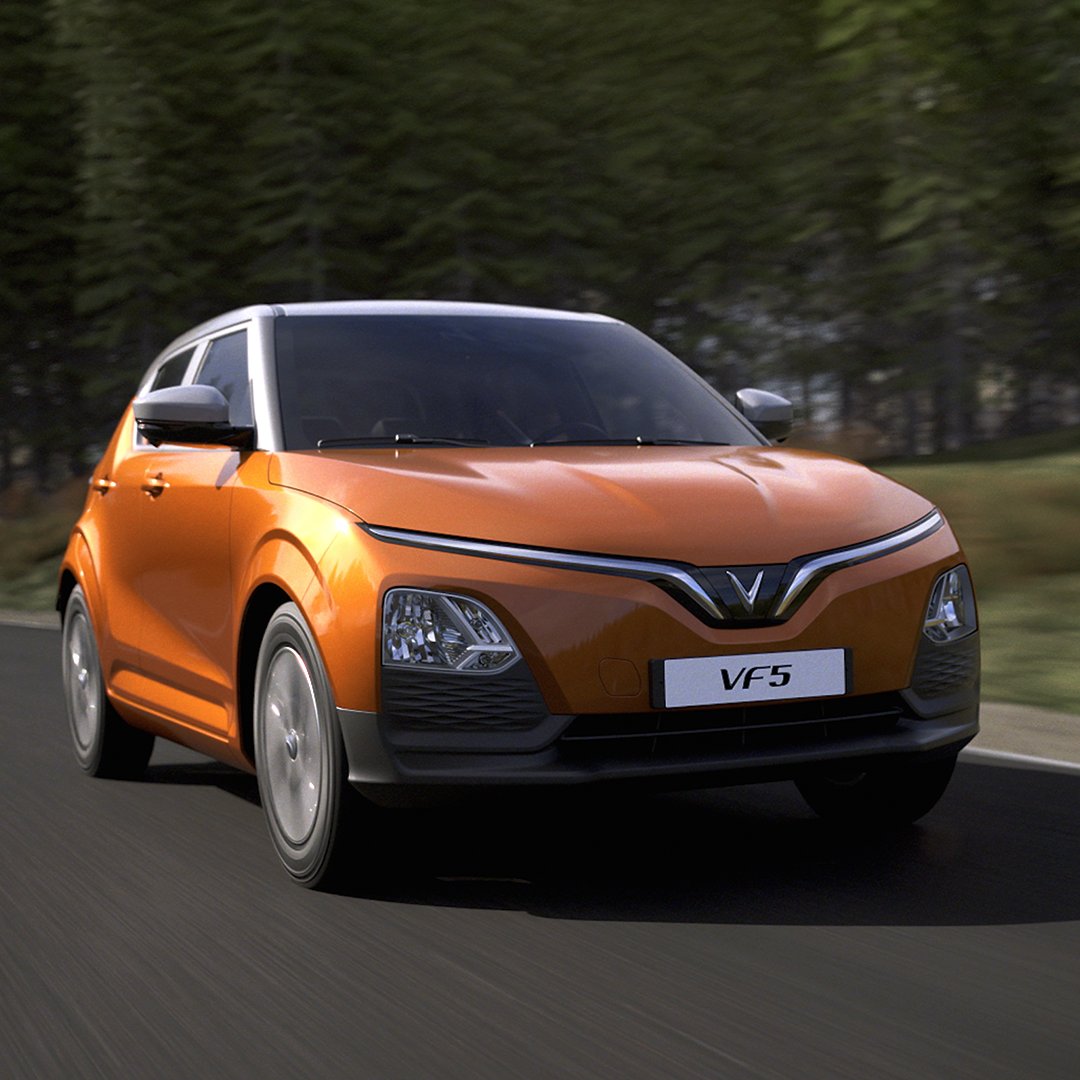
VinFast has three new EVs scheduled for launch by 2024 – the VF 7 compact SUV, the VF 6 hatchback and VF 5 city car, all of which are aimed at European and Asian markets.
This ultra-rapid product rollout and aggressive pricing strategy aren’t the only things Tesla should worry about. VinFast has just announced it is spending $2.8 billion on a new factory in the US to manufacture VF 8 and VF 9 models specifically for Tesla’s home market. The factory will have the capacity to produce 150,000 vehicles a year.
1
BYD
Chinese entrepreneur Wang Chuanfu founded BYD in 2003 to build cars, trucks, and buses.
The initials stand for “Build Your Dreams”, though industry wags quickly changed that to “Borrow Your Designs” after the company’s early cars featured styling egregiously cribbed from brands such as Mercedes-Benz, Renault, and Toyota.
BYD has already toppled Tesla as the world’s biggest producer of EVs, with reported sales of 641,000 vehicles for the first six months of this year, compared with Tesla’s 564,000 units.
What’s more, the company, which is part-owned by billionaire American investment guru Warren Buffett’s Berkshire Hathaway Inc., has also overtaken South Korea’s LG as the world’s second-biggest producer of EV batteries, behind China’s CATL.
1
Dominant in China, the world’s largest car market, BYD is planning to go global – having already started in Australia with its Atto 3 crossover – and its product pipeline is full of models aimed at export markets in Europe and North America.
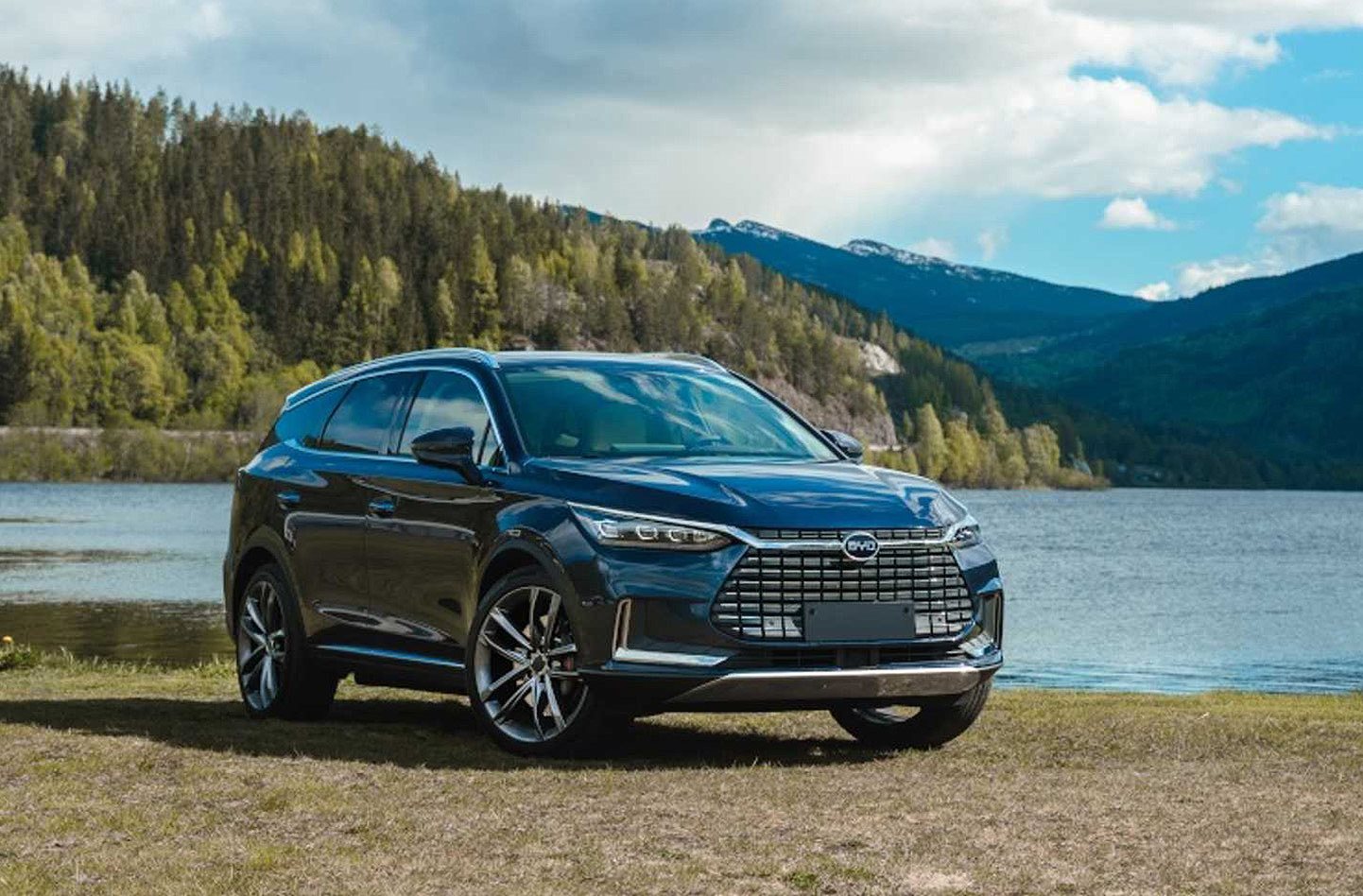
BYD’s second-generation, seven-seat Tang SUV is a convergence-platform vehicle that can be built with a conventional internal combustion engine, as a plug-in hybrid, or with a full battery electric powertrain. It is already being marketed in Europe.
The all-wheel drive, dual-motor version of the Tang packs 380kW and 680Nm of torque, enough to scoot the 2489kg SUV from rest to 100km/h in a claimed 4.6 seconds.
JUMP AROUND
Its 86.4kWh battery gives a claimed 400km range on the WTLP combined cycle and will accept a 110kW DC charge rate, enabling the battery to be topped up from a 30 per cent charge to 80 per cent in 30 minutes.
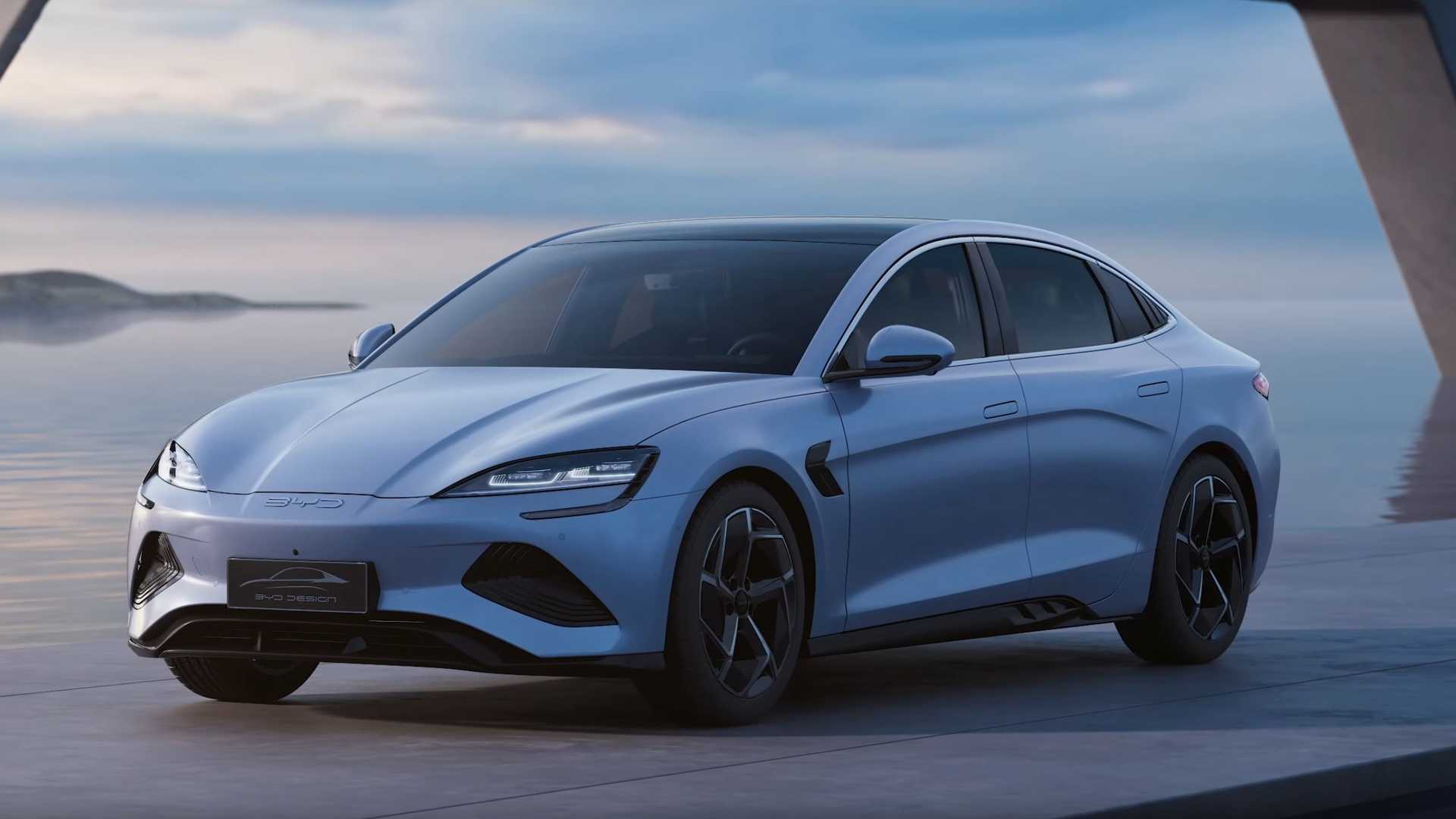
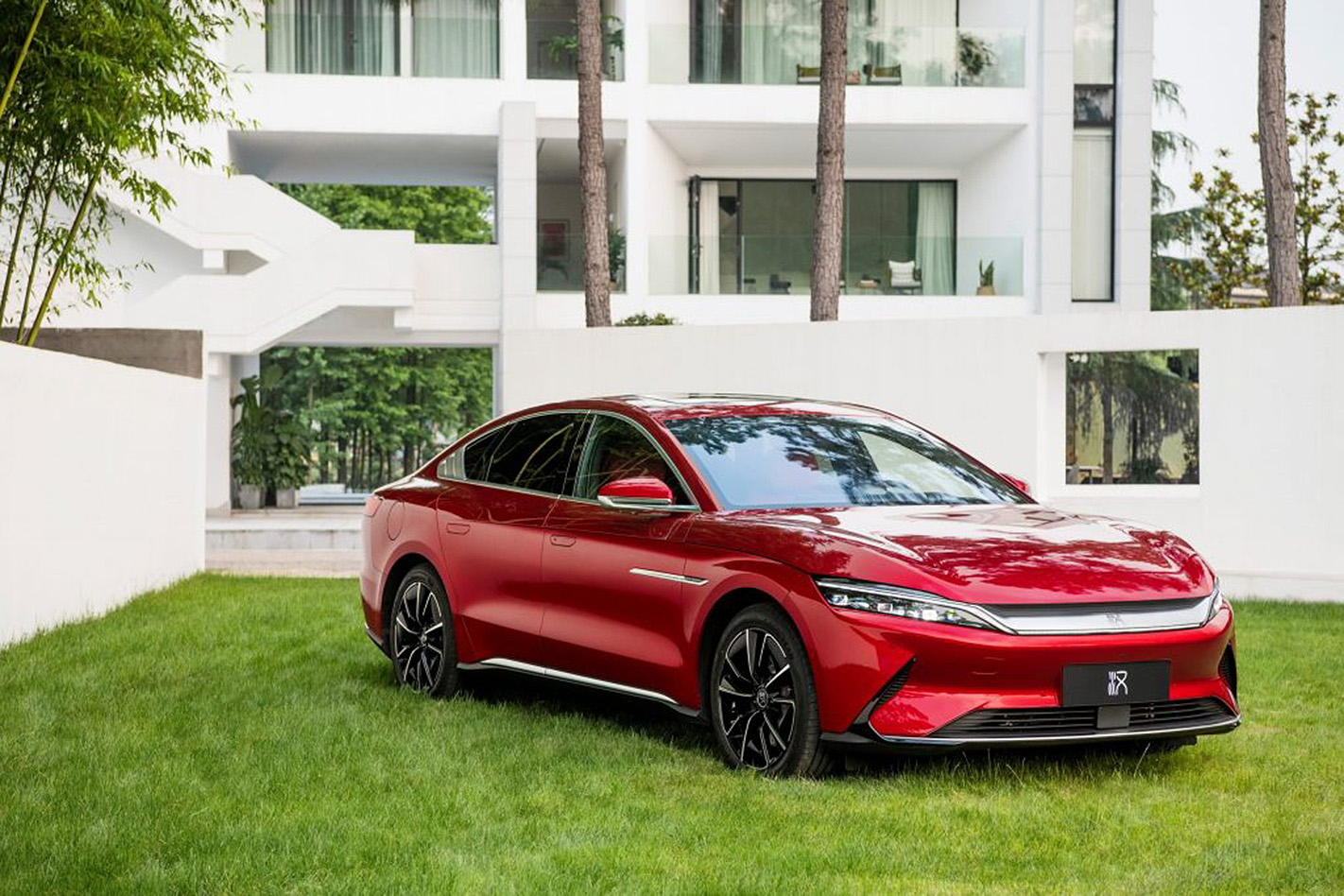
BYD’s Han EV sedan went on sale in selected Latin American and Caribbean countries last October.
Launched in 2020 and recently facelifted, the Han EV is available in China with a single 163kW motor driving the rear wheels, or as a dual-motor model with a 200kW front motor bringing the car’s total system output to 363kW. The rear-drive car is said to hit 100km/h in 7.9 seconds, while the dual-motor car is claimed to be able to nail the sprint in just 3.9 seconds.
1
BYD’s existing sales and manufacturing strength has obvious implications for Tesla’s growth ambitions.
Tu Le, managing director of advisory group Sino Auto Insights, recently told Britain’s Financial Times newspaper that BYD was “firing on all cylinders,” with products covering many critical EV market segments. He said he also expected BYD to soon challenge foreign carmakers on their home turf, especially in the US.
“They’re going to make some really aggressive moves to go international.”
1
Polestar
Polestar started life as a Volvo race car builder and tuner. China’s Geely, which acquired Volvo in 2010, decided to make it the company’s dedicated premium EV brand in 2017. Polestar has since been spun off from Volvo and Geely via a merger with a US-based special purpose acquisition company, Gores Guggenheim, which raised US$890 million.
Its first EV, the Polestar 2, is built on a version of the platform that underpins Volvo’s XC40, among others, and aimed squarely at Telsa’s Model 3. Forthcoming Polestar models are aiming way higher than that.
First up is Polestar 3, a rakish, high-performance SUV built on a bespoke EV platform, aimed squarely at Porsche Cayenne customers.
Due to go on sale later this year, the 3 will come with a dual-motor powertrain fed by a large battery pack that will deliver a range of 600km. It will also come with hardware and electronics, including a LiDAR system, that Polestar says will enable autonomous highway driving by 2025.
Polestar 3s for the North American market will be built at Volvo’s factory in South Carolina and the company expects it to be instrumental in increasing global sales to 290,000 units by 2025, a ten-fold increase over 2021’s total.
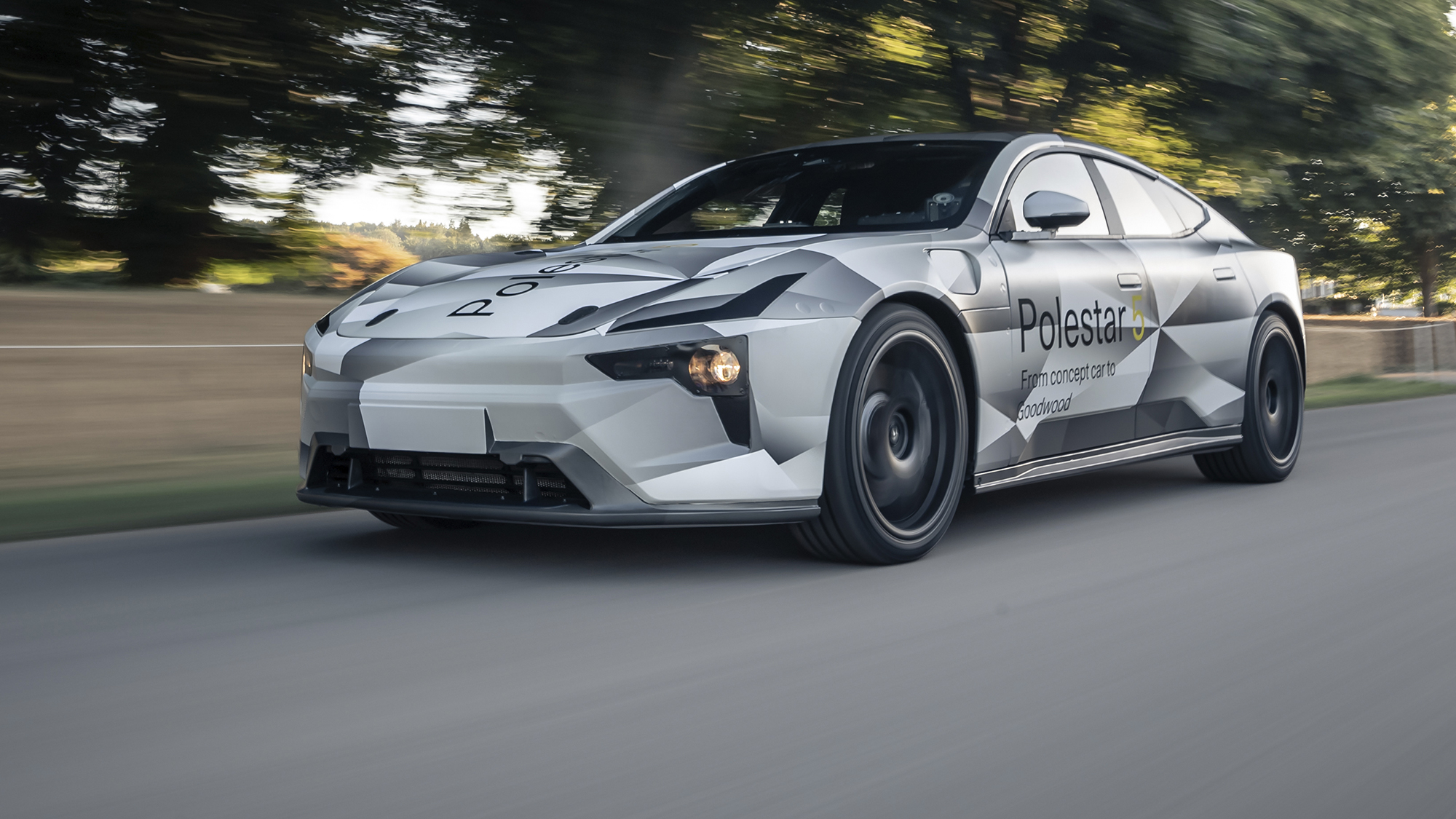
Following in 2023 will be the Polestar 4, another SUV, but this one aimed at Porsche’s Macan. And 2024 will see the launch of …wait for it… the Polestar 5, a high-performance four-door GT fastback inspired by the stunning Polestar Precept concept unveiled in 2020.
1
The Polestar 5’s target is the Porsche Panamera, and like the other Polestars, the car will be built in Geely-owned plants in China. Boasting 650kW and 900Nm, the dual-motor Polestar 5 will debut a new dedicated platform and will feature a very rigid bonded aluminium spaceframe and an 800V electrical architecture to allow ultra-fast charging.
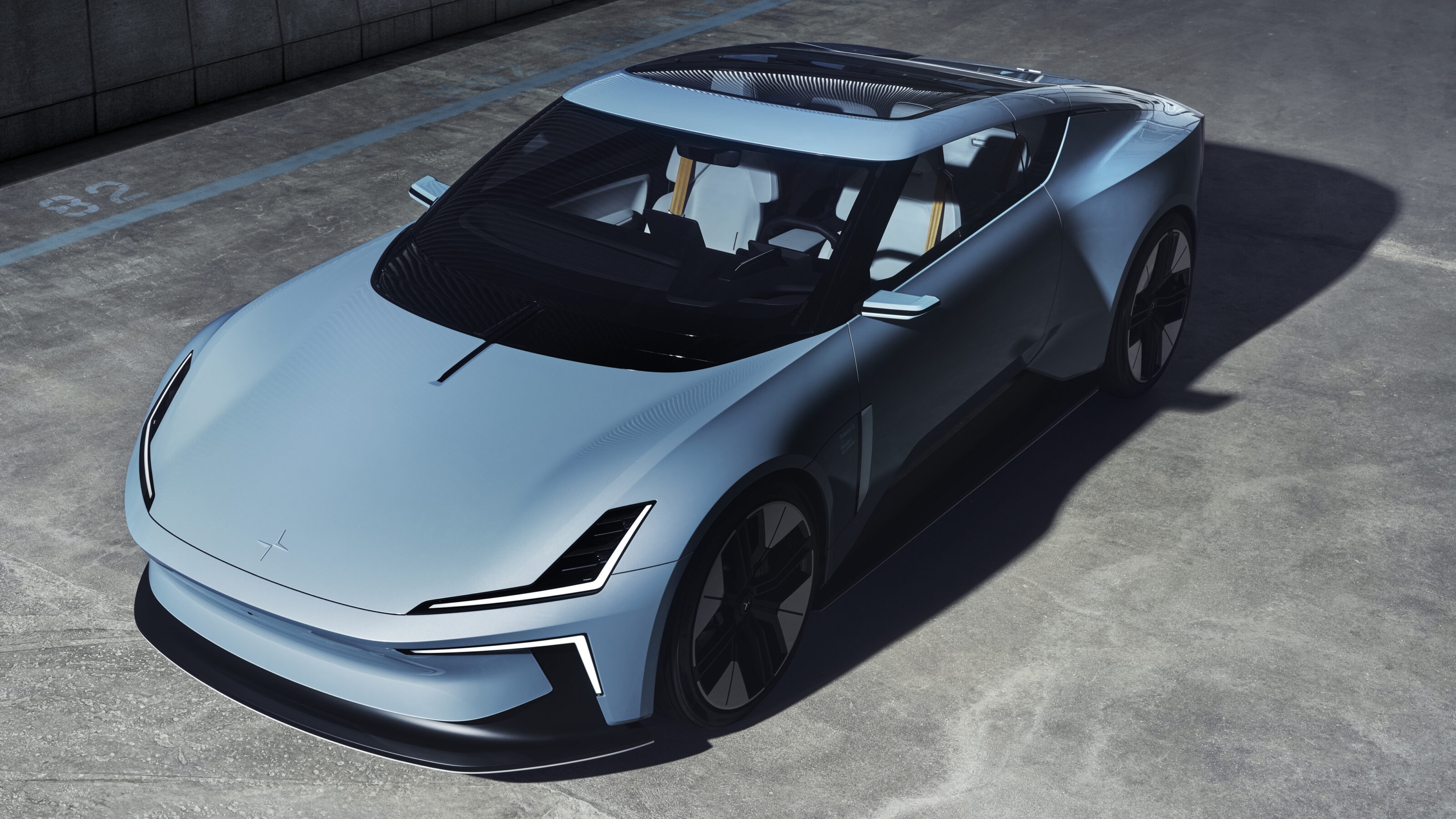
Polestar has also confirmed it will bring the O2 roadster concept into production, badged Polestar 6, quickly finding takers for the first 500 examples.
You may have noticed a theme here: Polestar is unashamedly targeting Porsche with high-quality, beautifully designed, upscale cars.
But that strategy is also a problem for Tesla, which has found itself regarded as a premium EV manufacturer.
2
Part of this is because it was a first mover in the space, with vehicles that attracted wealthy early adopters. But it’s also because it has subsequently been unable to produce vehicles at the much lower prices the company originally promised.
Teslas are expensive. And unless Tesla has a robust plan to redesign existing models and release new ones over the rest of this decade, it’s in danger of being swamped by a swarm of brands offering EVs that look fresher or feel more luxurious or are simply better value.
“Production is hard. Production with positive cash flow is extremely hard.” Elon Musk tweeted this in 2021.
Welcome to the car business, Elon. And it’s not going to get any easier.
March 2023: The Empire Strikes Back
The story you’re reading right now, focuses on incoming threats from new brands. But will Tesla fans still favour Elon’s ‘disruptor’ when old-fave legacy brands become more and more competitive in EVs? Read part two here of Tesla Killers at the link below.
⚡ More EV stories to help you choose the best car for your needs
Nearly six years since it was first announced, the hotly anticipated Lamborghini biopic – titled Lamborghini: The Man Behind the Legend – finally has a full preview trailer online.
And, well, you can forget some key details of what you’d read in our earlier story below. There’s no Alec Baldwin as Enzo Ferrari, and no Antonio Banderas as Ferruccio Lamborghini.

1
That’s probably for the best, too, with new leading men – Italian-American actor Frank Grillo (one of those ‘that guy!’ actors) and Irish legend Gabriel Byrne – bring plenty of talent to the roles, without as much potential for the blockbuster names of their predecessors to overshadow the story.
The trailer appears to cast Ferrari as the villain, of course, and Lamborghini as the protagonist who – after Ferrari famously tells Lamborghini he won’t take advice from a tractor mechanic – vows to beat his new sworn enemy at his own game.

1
The film’s director, Bobby Moresco, is an Academy Award winning writer – having shared an Oscar with co-writer Paul Haggis for the 2004 film Crash. His directing credits, however, are limited mostly to small-screen series and films, none of them international hits. Car enthusiasts will of course be hoping for Lamborghini to be his breakout directorial hit.
You can watch the trailer below. An Australian release date has yet to be announced, but it will hit screens overseas on November 18. (In the meantime, you might as well rewatch Ford vs Ferrari…)
THE STORY TO HERE
2017: Lamborghini movie announced
The idea has been knocking around for a while, but distributor AMBI has confirmed that a biopic of the life and times of Ferruccio Lamborghini is in the works.

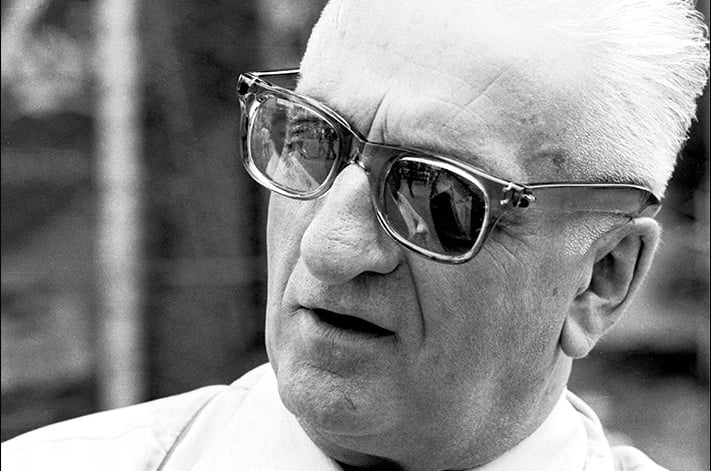
Antonio Banderas is set to play Lamborghini, with Alec Baldwin in the role of his nemesis Enzo Ferrari.
Some big name talent has been recruited behind the scenes too, with Michael Radford (“The Merchant of Venice,” “The Postman”) directing the movie from a script by Bobby Moresco (“Crash,” “Million Dollar Baby”).

Andrea Iervolino and Monika Bacardi’s AMBI Group first mooted the project in 2015 when they optioned the rights to “Ferruccio Lamborghini. La storia ufficiale”, written by the carmaker’s son Tonino Lamborghini.
Set to debut at the Cannes Film Festival, the movie’s working title “Lamborghini – The Legend’ follows the industrialist’s career as a manufacturer of tractors, military vehicles and, ultimately, the designer of some of the world’s most iconic supercars, presiding over Automobili Lamborghini until the late 1970s before his death in 1993.

A colourful character and one of Italy’s richest men, Lamborghini had one car for each day of the week and his love of women, celebrity lifestyle, and getting one over on Il Commendatore, Enzo Ferrari, is the stuff of legend.
With racing biopics like Senna and the dramatized Rush (the story of the Niki Lauda and James Hunt rivalry) having outstripped box-office predictions, perhaps there’s appetite for a motoring-related movie that’s a little more closely rooted to reality than Need for Speed or the Fast and the Furious franchise.
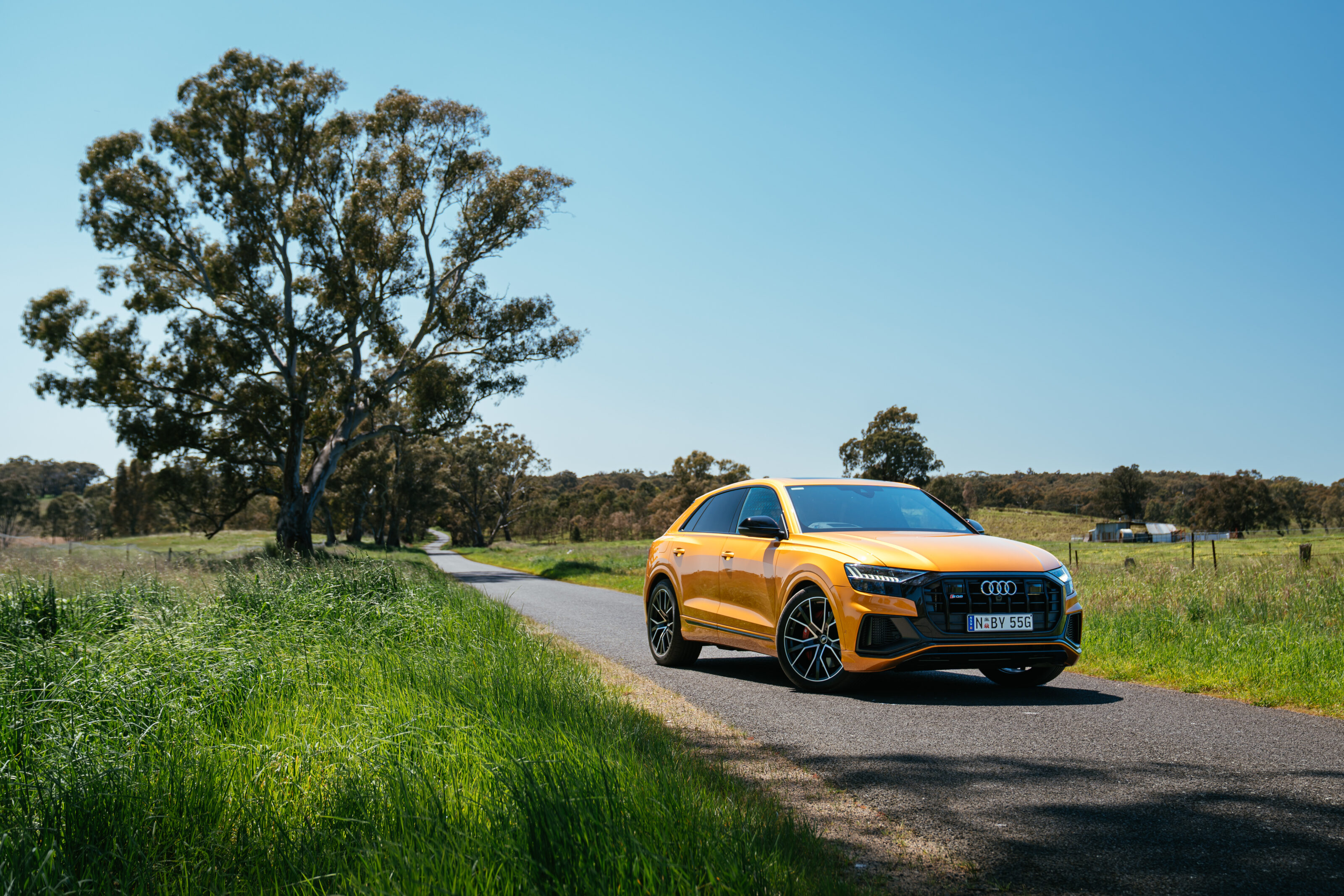
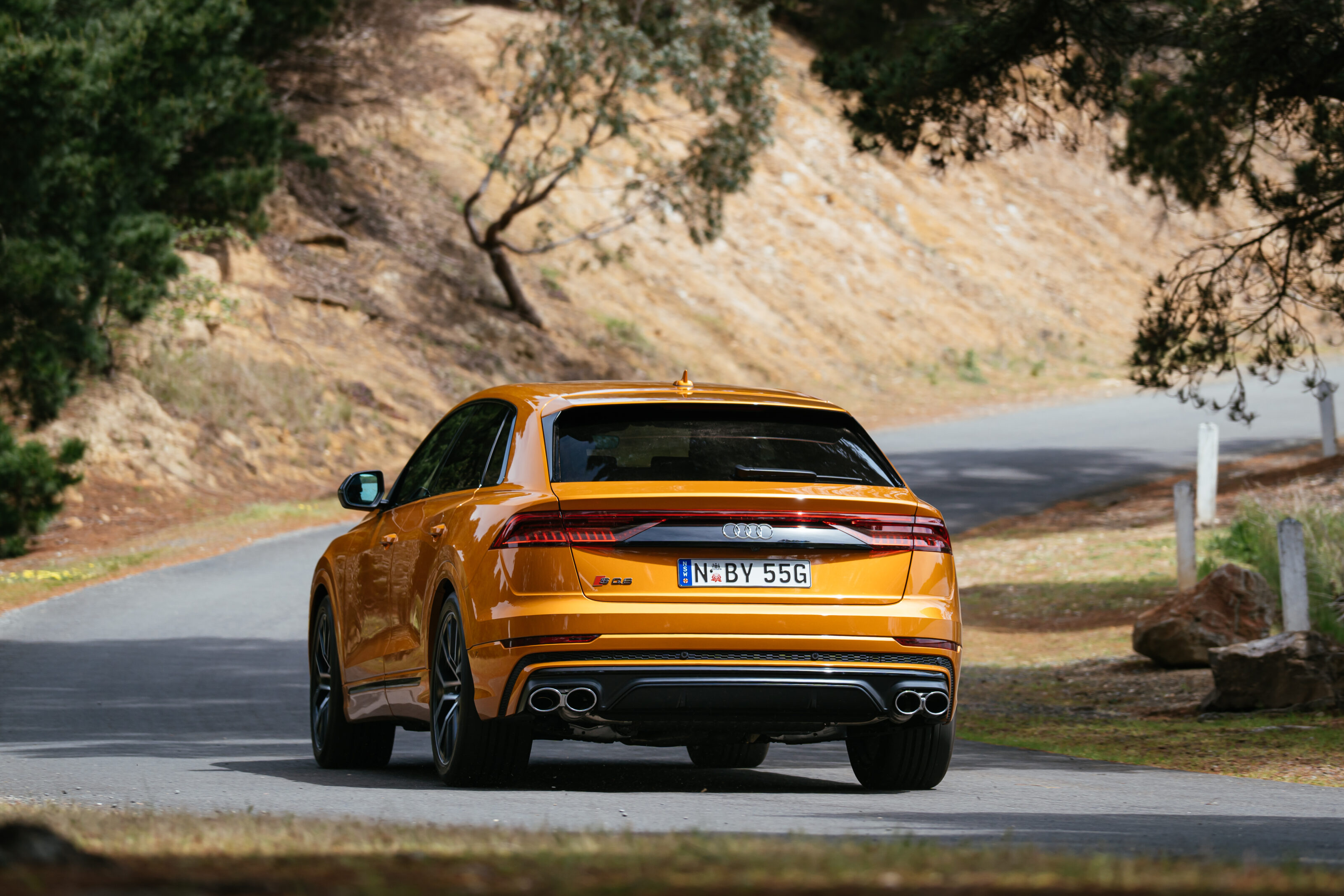
On the surface, the 2023 Audi SQ8 4.0 TFSI represents a not-inexpensive but rather luxurious, and fast, large family SUV. Yet, at $168,800 before on-road costs, a price ballpark in which people seem to buy Mercedes-AMG C63s and GLE63s left, right and centre, I don’t think its reason for existence is the question that needs answering.
Zoom out above the larger VW family tree, and perhaps the perspective becomes clearer. It’s almost 25 per cent more affordable than the uncaged RS Q8, yet is 15 per cent less powerful and just seven per cent slower from 0-100km/h.
1
Compared against the MLB Evo platform’s arguable ultimate evolution, the Lamborghini Urus, the return of the petrol-powered Audi SQ8 (…the Audi skate?) is almost 57 per cent less expensive, yet 21 per cent less powerful and just 13 per cent slower from 0-100km/h.
The question remains whether the suave German marque’s discreetly fast family hauler is an option worth looking at in the increasingly active sub-$200K luxury family segment.
JUMP AHEAD
- How much is it, and what do you get?
- How do rivals compare on paper?
- Interior comfort, space and storage
- What’s it like to drive?
- How is it on fuel?
- How safe is it?
- Warranty and running costs
- VERDICT
- Specifications
How much is it, and what do you get?
The basics
| Body | 5-door, 5-seat large SUV |
|---|---|
| Drive | all-wheel |
| Engine | 4.0-litre V8 petrol, DOHC, twin-turbo |
| Power & Torque | 373kW/770Nm |
| Transmission | 8-speed automatic |
| Fuel consumption | 12.4L/100km (tested) |
| Boot min / max | 605L / 1755L |
| Price | $168,800 (before on-road costs), $197,321 (as tested) |
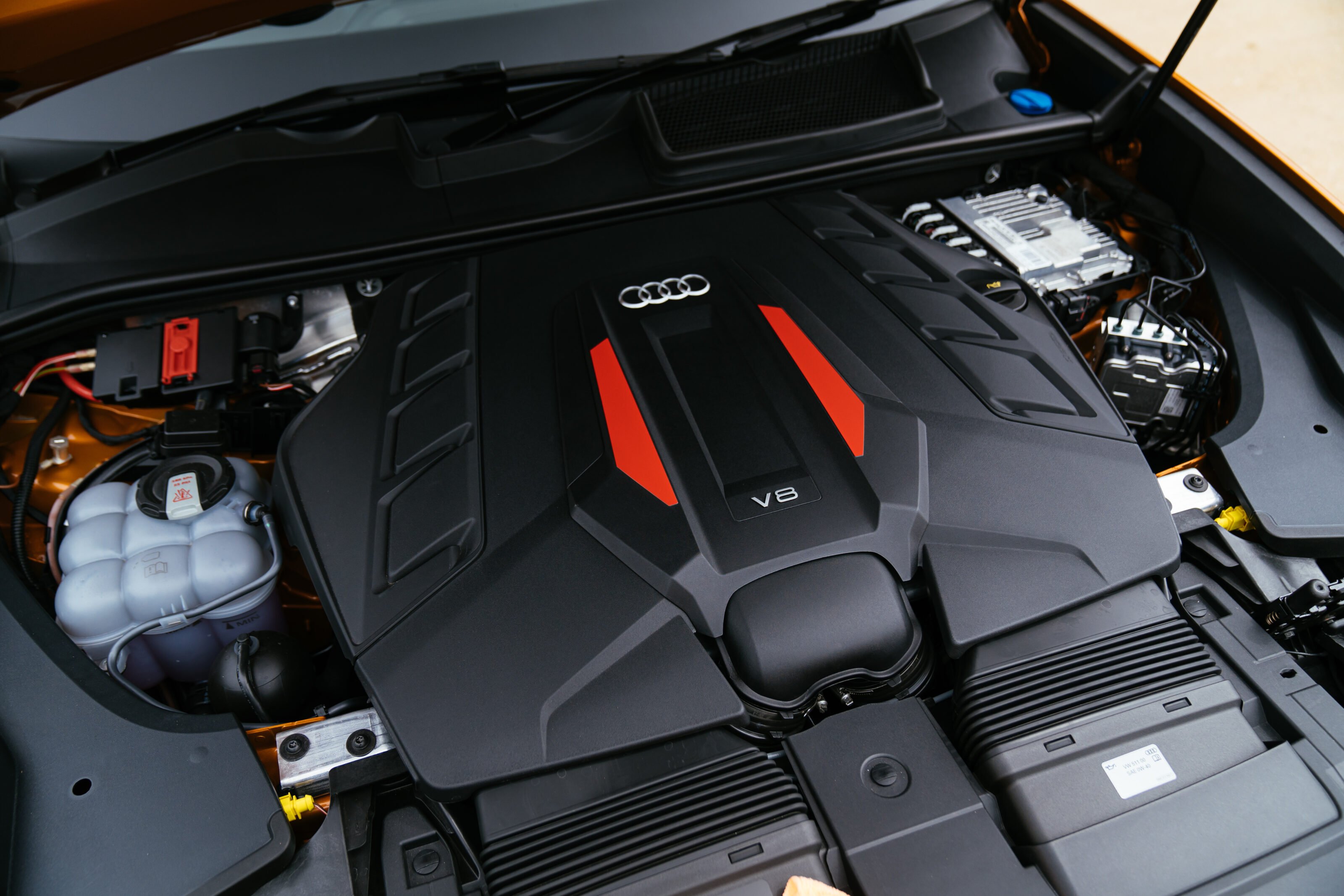
Gone is diesel-only power, the SQ8 TDI consigned to history and supplanted by the SQ8 4.0 TFSI with Volkswagen Group’s flexible 4.0-litre ‘hot-vee’ twin-turbo V8 now in the engine bay.
This Porsche-Audi-developed engine, dubbed the EA825 series, can be thought of as VW Group’s ubiquitous turbocharged four-cylinder E888 on steroids, used extensively throughout the family’s high-performance models, including the SQ8’s close sibling, the Audi SQ7, the RS7 and RS6, aforementioned Lamborghini Urus, Porsche Panamera GTS and Turbos, Porsche Cayenne Turbos and all V8 Bentleys.
1
In this instance producing 373kW/770Nm, the advanced V8, and an eight-speed automatic transmission linked to Audi’s hallmark Quattro all-wheel-drive system make up the main oily bits of the 2023 SQ8.
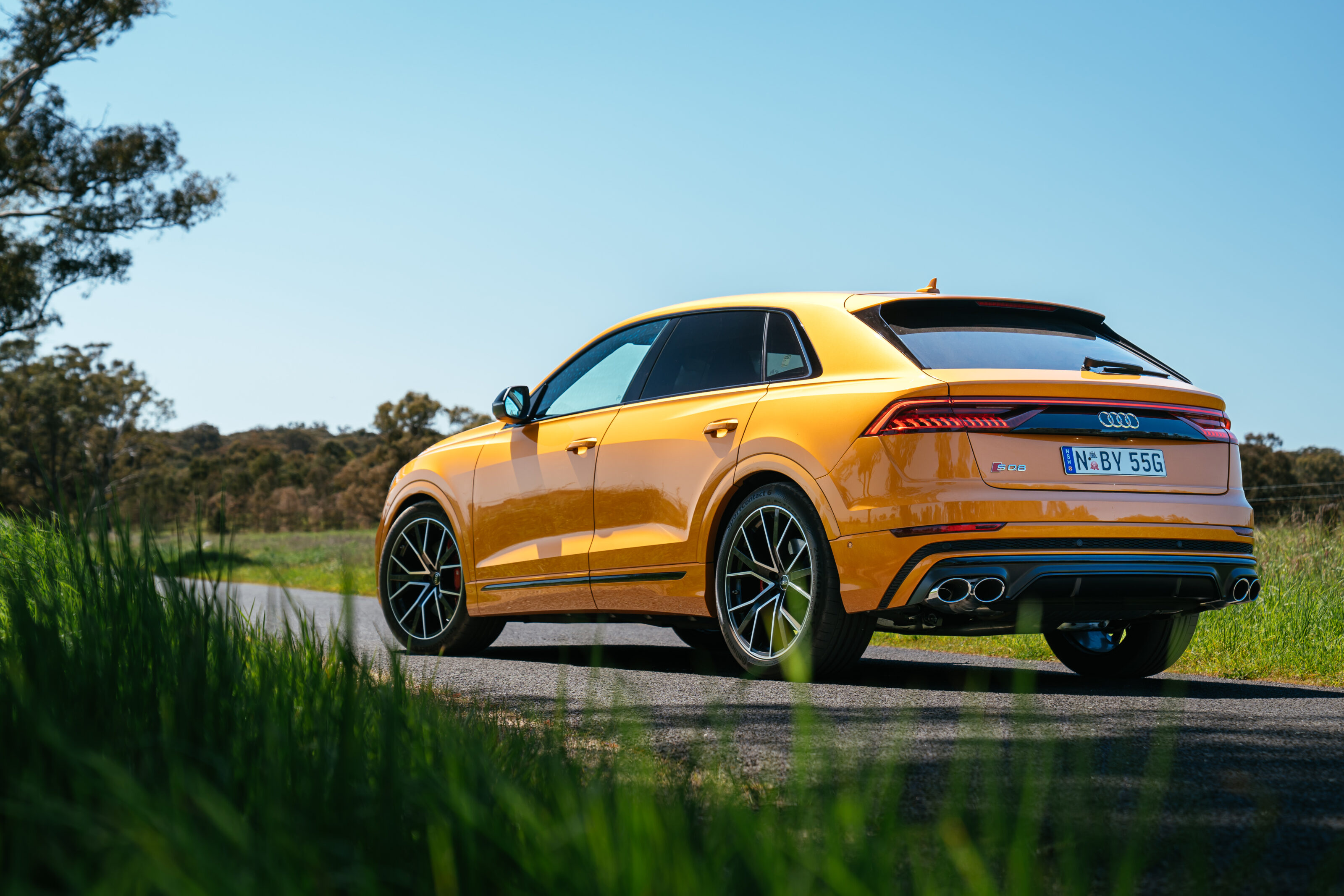
Elsewhere, you net LED Matrix headlights, S body styling pack, electric tailgate, keyless entry and start, privacy glass, panoramic two-section sunroof, power-assisted soft-closing doors, S sport front seats, Valcona leather upholstery, electric front heated and memory seats, four-zone climate control, ambient lighting, leather sports steering wheel, 12.3-inch digital instrument cluster, wireless Apple CarPlay and Android Auto, DAB+ digital radio and head-up display as standard.
1
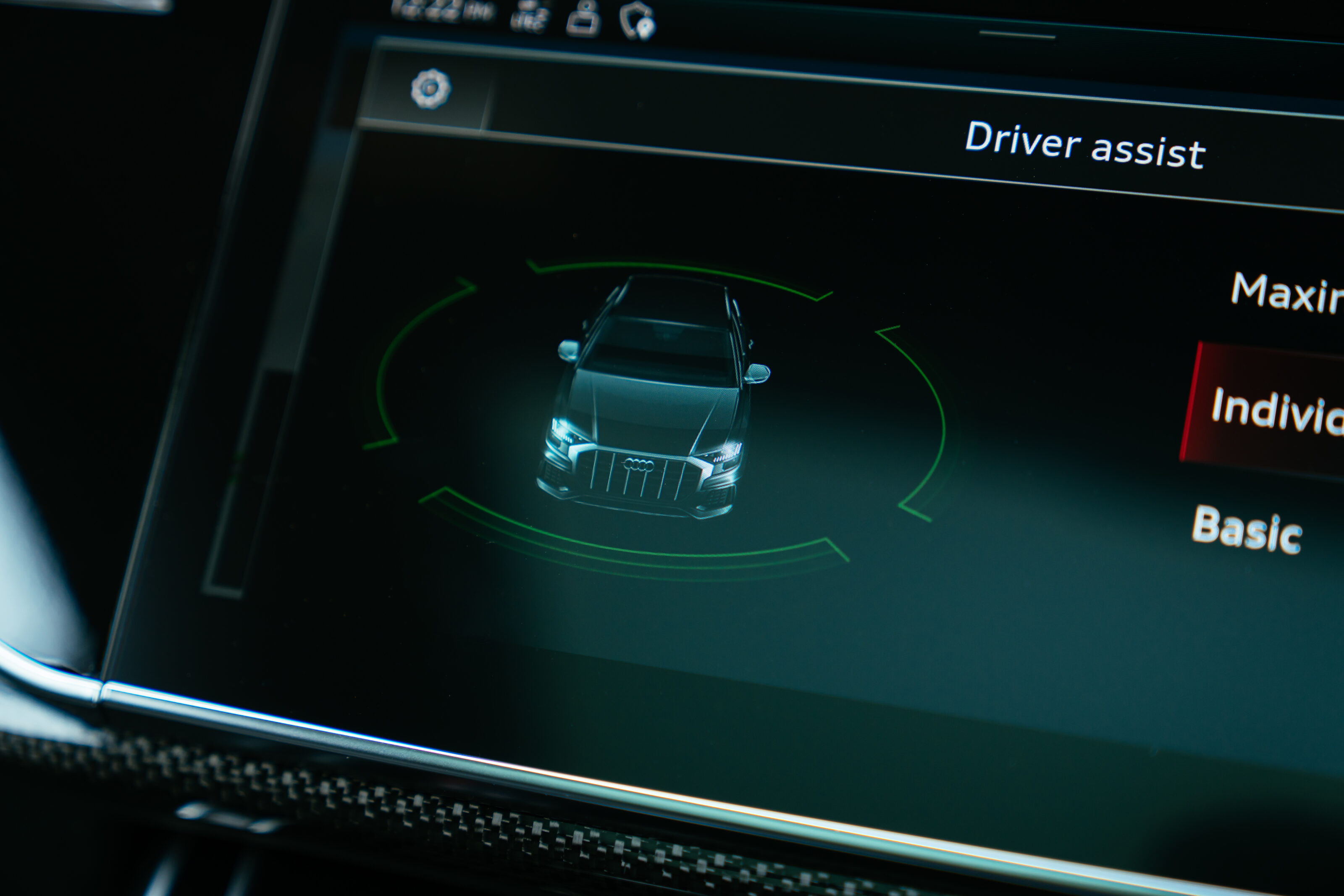
Safety and assistance systems include adaptive cruise control with stop-and-go function, traffic jam assist and lane guidance, blind-spot monitoring, 360-degree camera, park assist, collision avoidance assist, rear cross-traffic alert, exit warning system and junction assist.
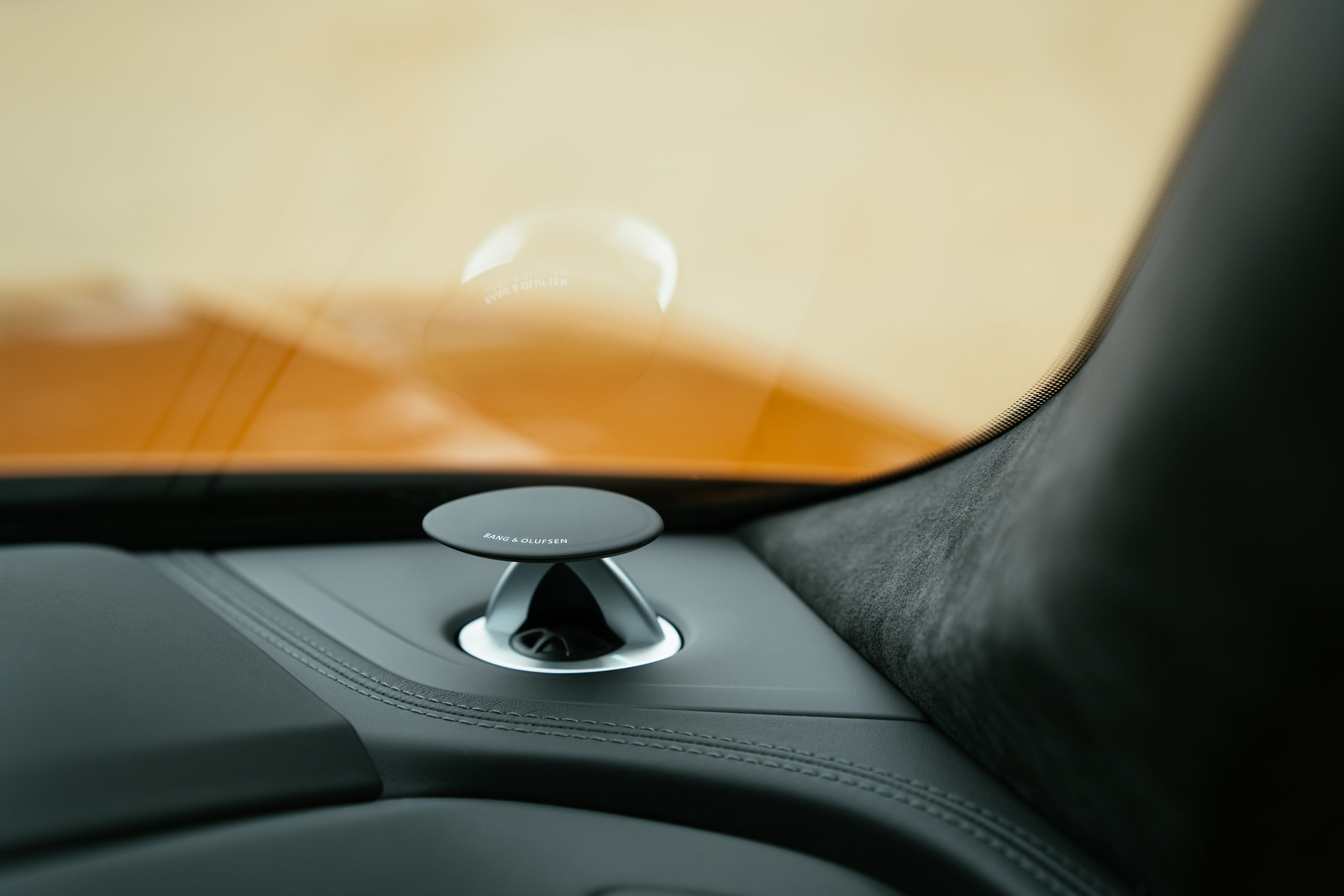
There is an optional Sensory package that includes a 17-speaker Bang & Olufsen 3D sound system, Dinamica (suede-like) headliner in black, front seat massage, adds second-row heated seats, full leather interior package, electric sunshades for the second row and air quality system, for $13,900.
1
A $10,900 Dynamic package adds electromechanical active roll stabilisation and the Quattro sport differential, and is an almost-transformative pack for keen drivers of this 2195kg beast.
Of course, Audi’s ten-piston 420/370mm carbon ceramic brake package is optionally available for a further $19,500 – if you must.
1
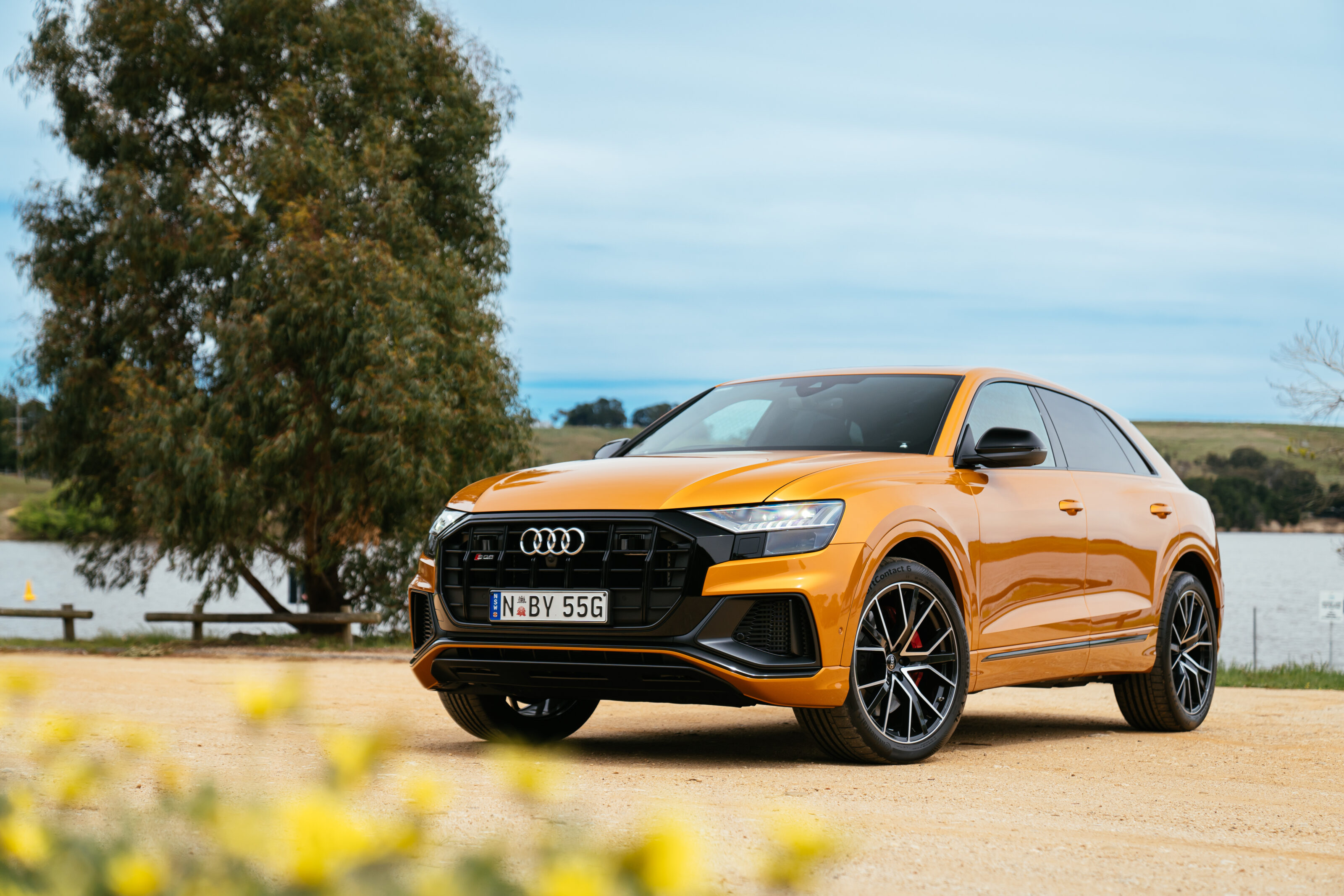
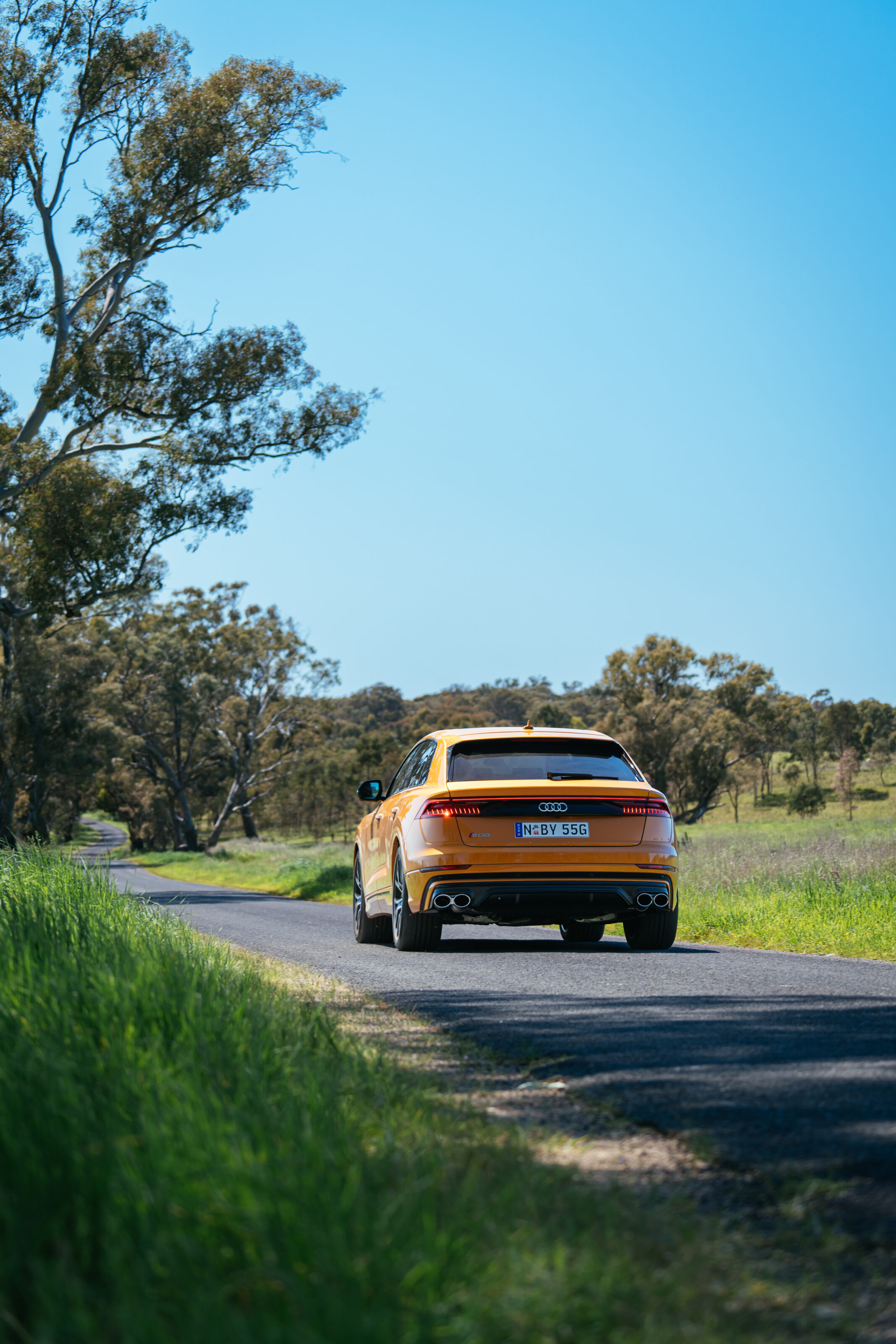
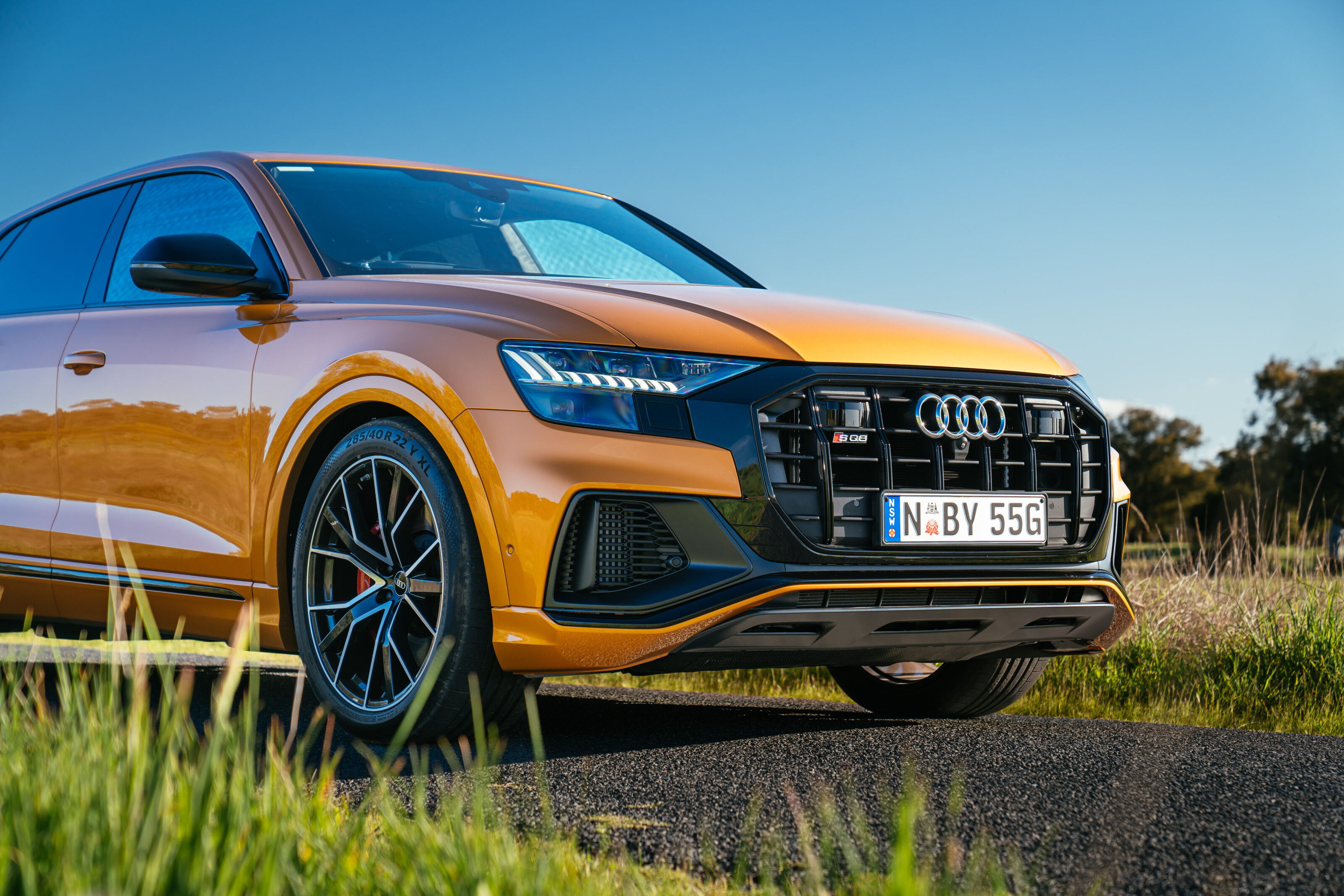
Our Dragon Orange (no cost option) tester came fitted with the Sensory and Dynamic packs, but sans carbon ceramic brakes. Its specific 22-inch wheels cost a further $1000, and it was also fitted with the exclusive titanium black exterior styling pack costing $1850 and carbon vector interior inlays asking $1950. All up, ‘our’ SQ8 sets in at $197,321 as tested, before on-road costs.
So it’s certainly no fleet special, but on first impressions, poking around the cabin and setting up my driving position, it certainly looks, feels and presents like an almost-$200K car.
How do rivals compare on paper?
The segment of over-$150K fast and luxurious SUVs is a murky one, and for most buyers, it’s really simply down to personal taste.
Audi, however, has positioned the 2023 Audi SQ8 intelligently, offering a little less than a GLE63 Coupe in terms of performance for much less than GLE53 Coupe money – the pair of Mercedes-AMGs asking $235,500 and $183,850 respectively (before options and on-road costs).
1
It’s also faster than BMW’s X6 M50, undercutting the fully-loaded $170,900 M50i (again, before options and on-road costs) by a few grand.
Between BMW’s divisive modern styling and the fact that not everyone wants to be a Mercedes-Benz owner, I’ve always liked to think of Audi as the thinking person’s pick of the traditional German Big Three.
Interior comfort, space and storage
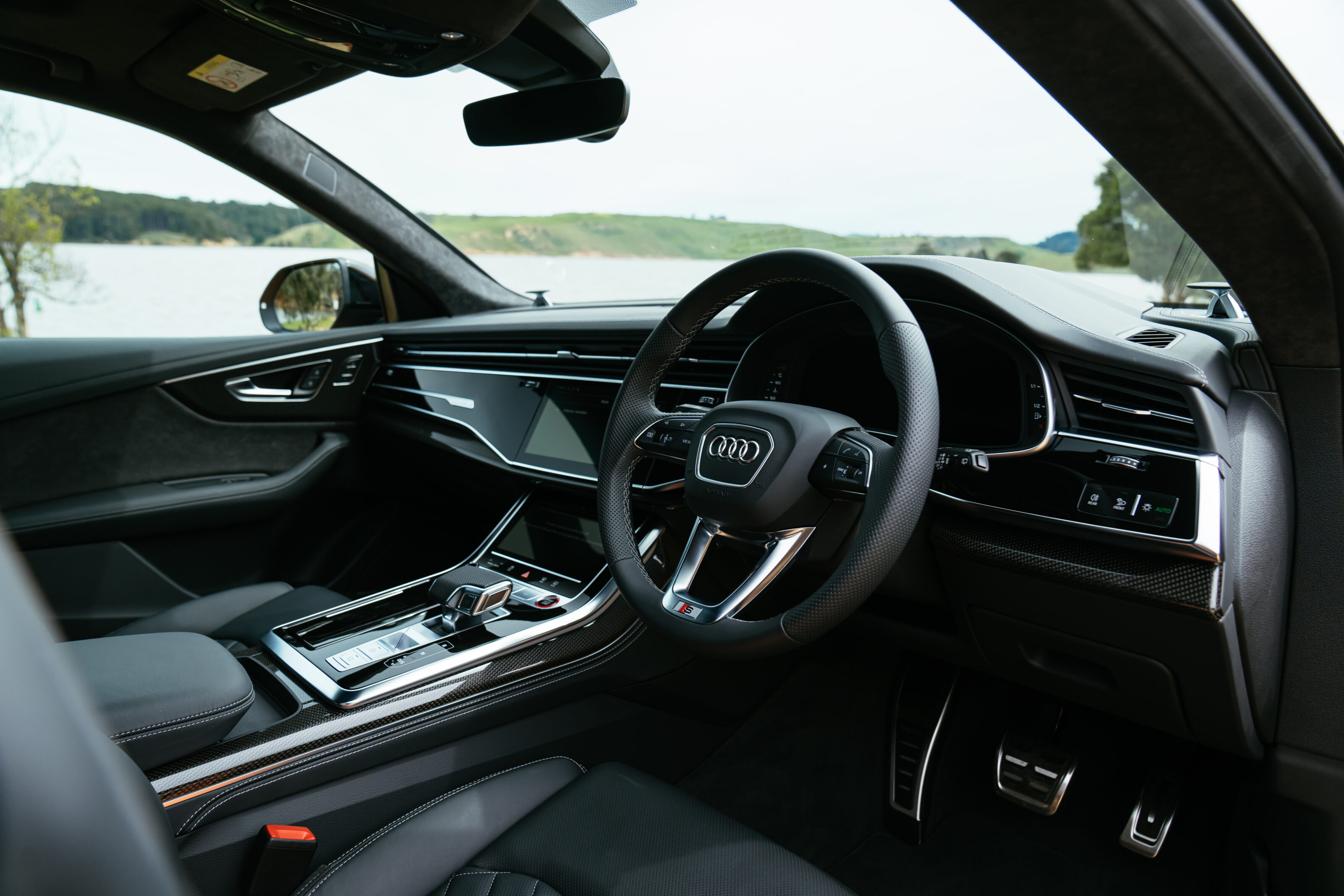
Jumping into a cabin blending black and Bauhaus motifs, the instant impression is one of striking pared-back design with immediate touchpoints feeling solid and well-made.
Having not been in an Audi for some time, and having recently been subjected to a touchscreen overdose from a week-long 16-car EV megatest, there was an embarrassing moment where I had to relearn that Audi’s impressive twin-pack of 10.1-inch upper and 8.6-inch lower central displays actually take a level of deliberate haptic pressure to function.
1
Large dashings of piano black trim, however, signal fussy upkeep in the future. No wonder Audi supplies a sturdy microfibre cloth.
There is a wide range of electric adjustment for the quilt-stitched front seats, as well as the (manual) steering column. Blame the chip shortage for that last bit, though if it’s truly a dealbreaker for you, one must question where we as a nation have come to as a car-buying public.
A wireless phone charger is located in the front row armrest, along with further USB ports.
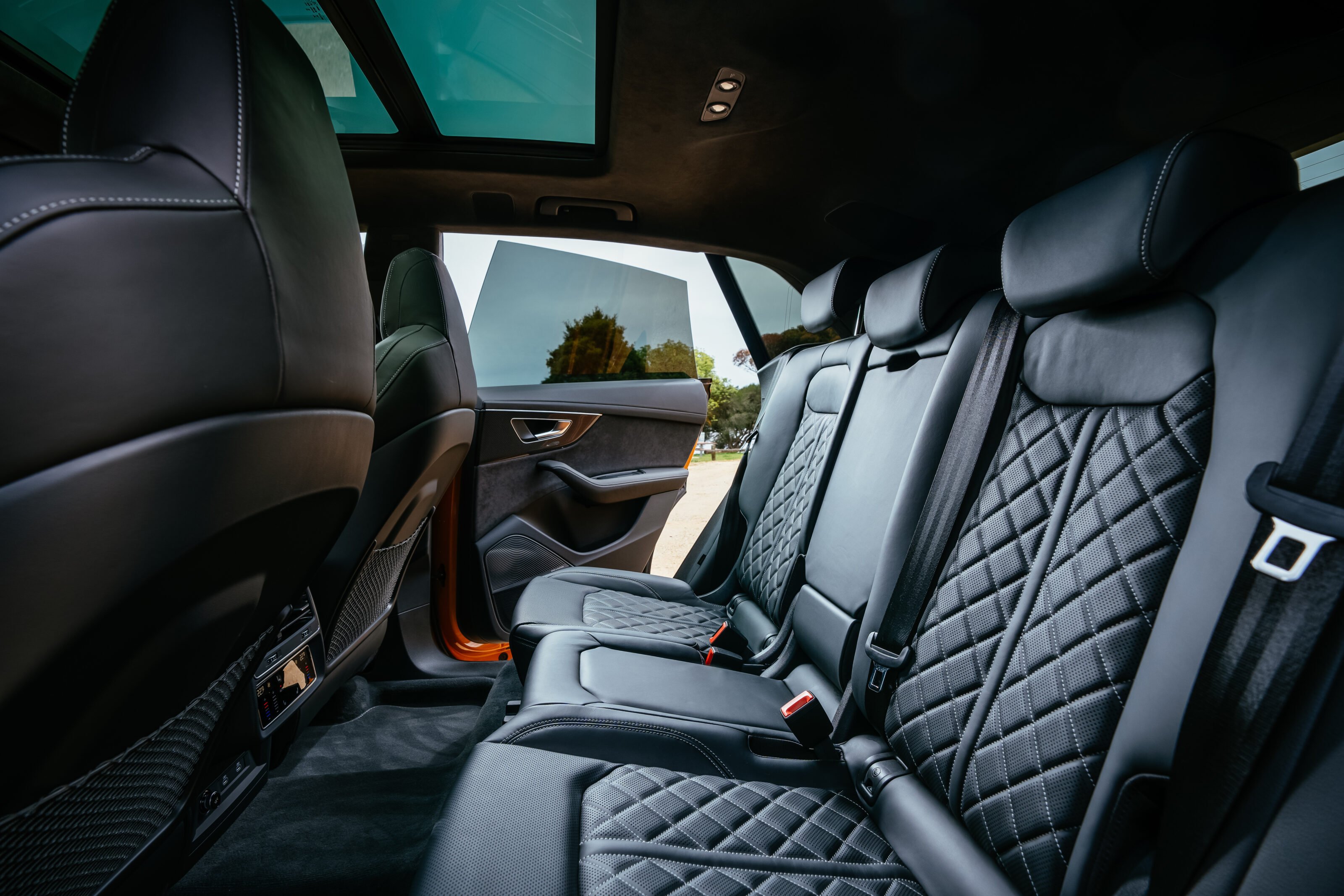
Despite the Q8’s more dynamically styled roofline, the second row does cater for taller occupants with a considerate scalloping of the headliner behind the sunroof.
1
Second-row occupants are treated to good amounts of legroom and toe room aplenty. They also benefit from rear air vents with their own climate control zone, a 12-volt plug and two USB-C ports.
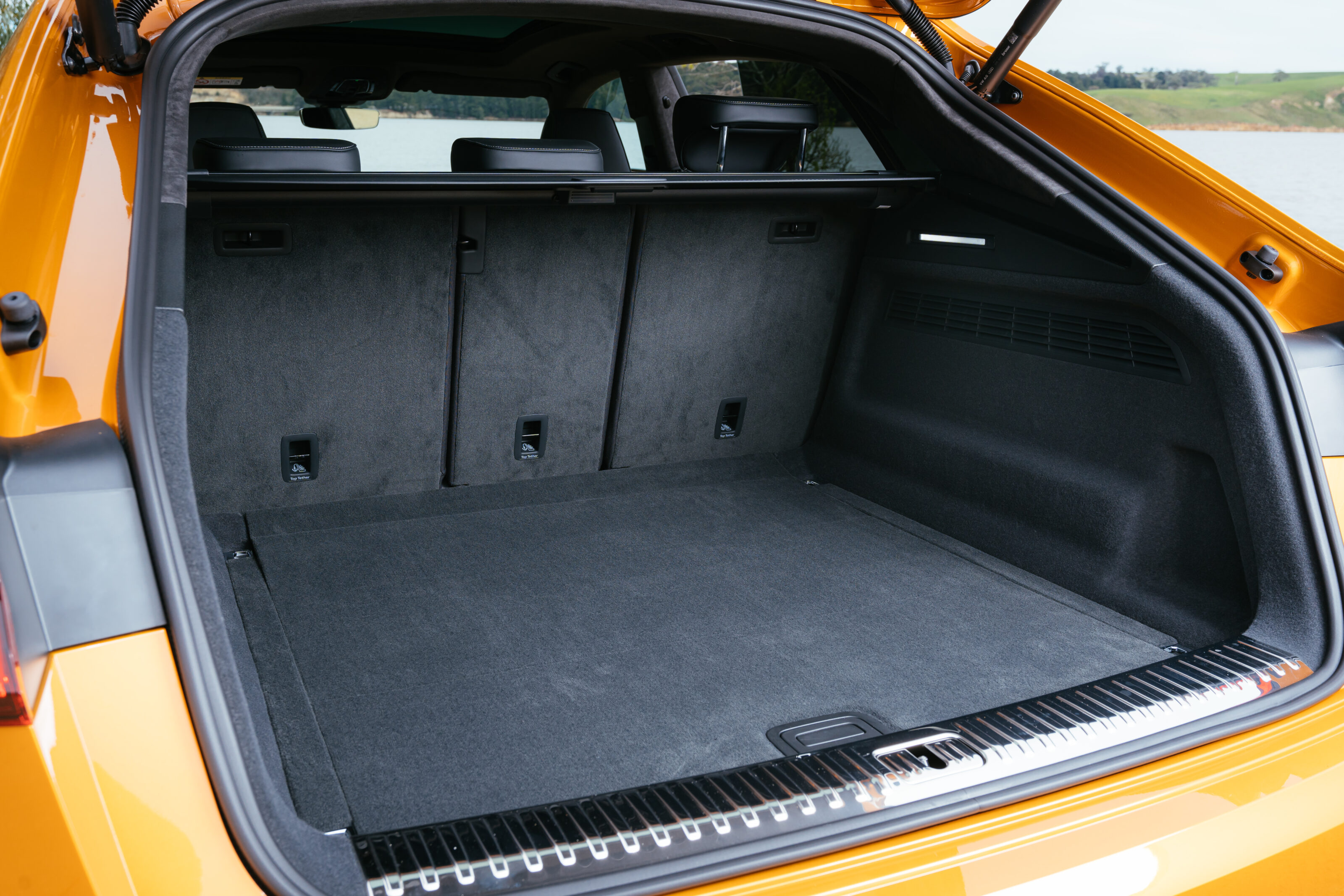
Further back, the boot offers 605L of cargo space, extending to an impressive 1755L with the second row completely folded.
1
What’s it like to drive?
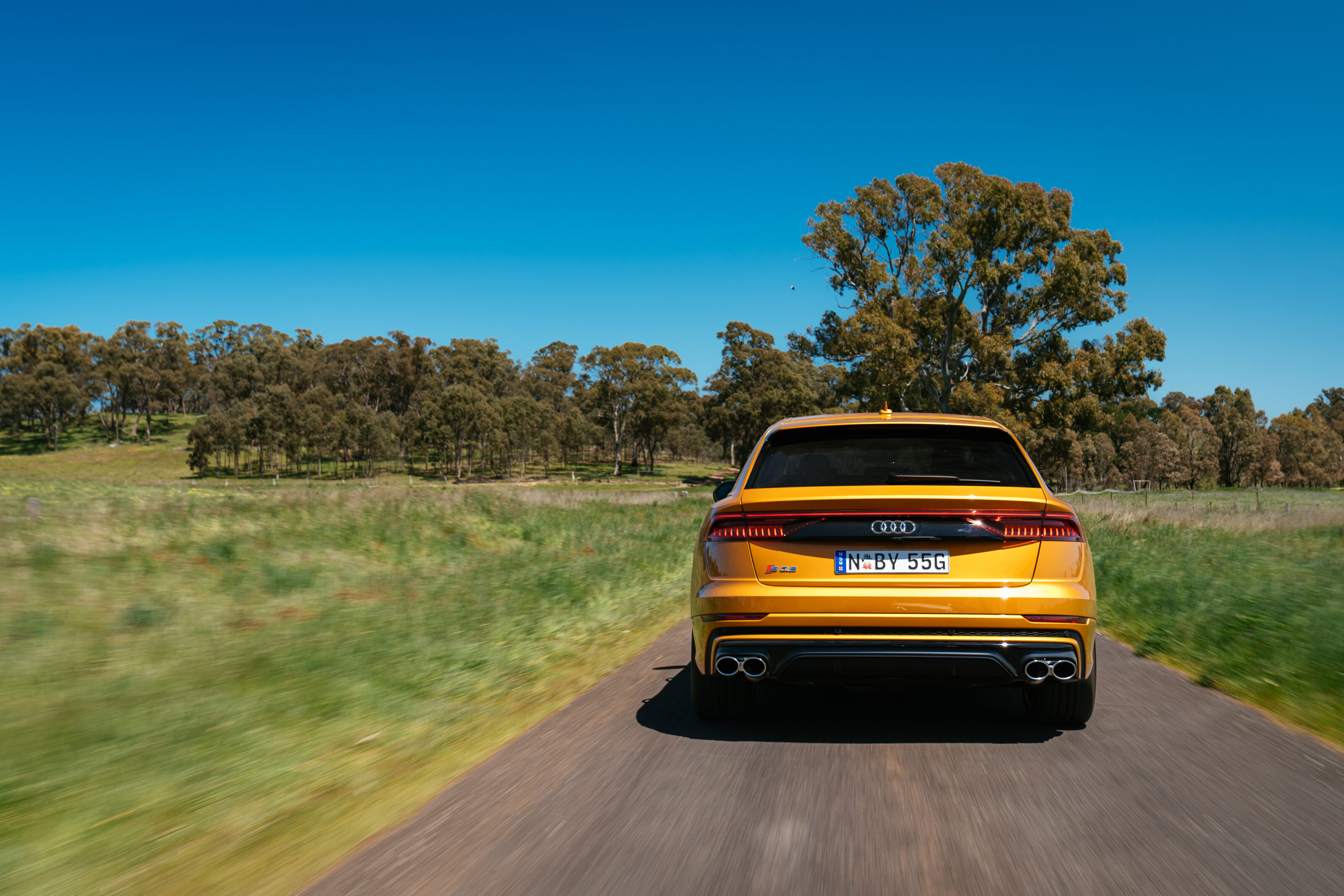
With the muscular 4.0-litre twin-turbo V8, smooth and smart eight-speed auto plus confident Quattro traction, the SQ8 delivers a wide skillset over virtually all road-going scenarios.
Riding on standard-fit air suspension, the distinction between Comfort and Dynamic modes is stark, with the former leaning lazily on a conservatively gentle throttle calibration and unstressed engine, ironing out test loop potholes made worse by recent Victorian drenchings better than any car of this size and weight, let alone rolling on 22-inch wheels, should be expected to.
1
Body control is impressively judged in Comfort, with none of the lingering body movement experienced in smaller coil-sprung adaptively damped Audi SUVs
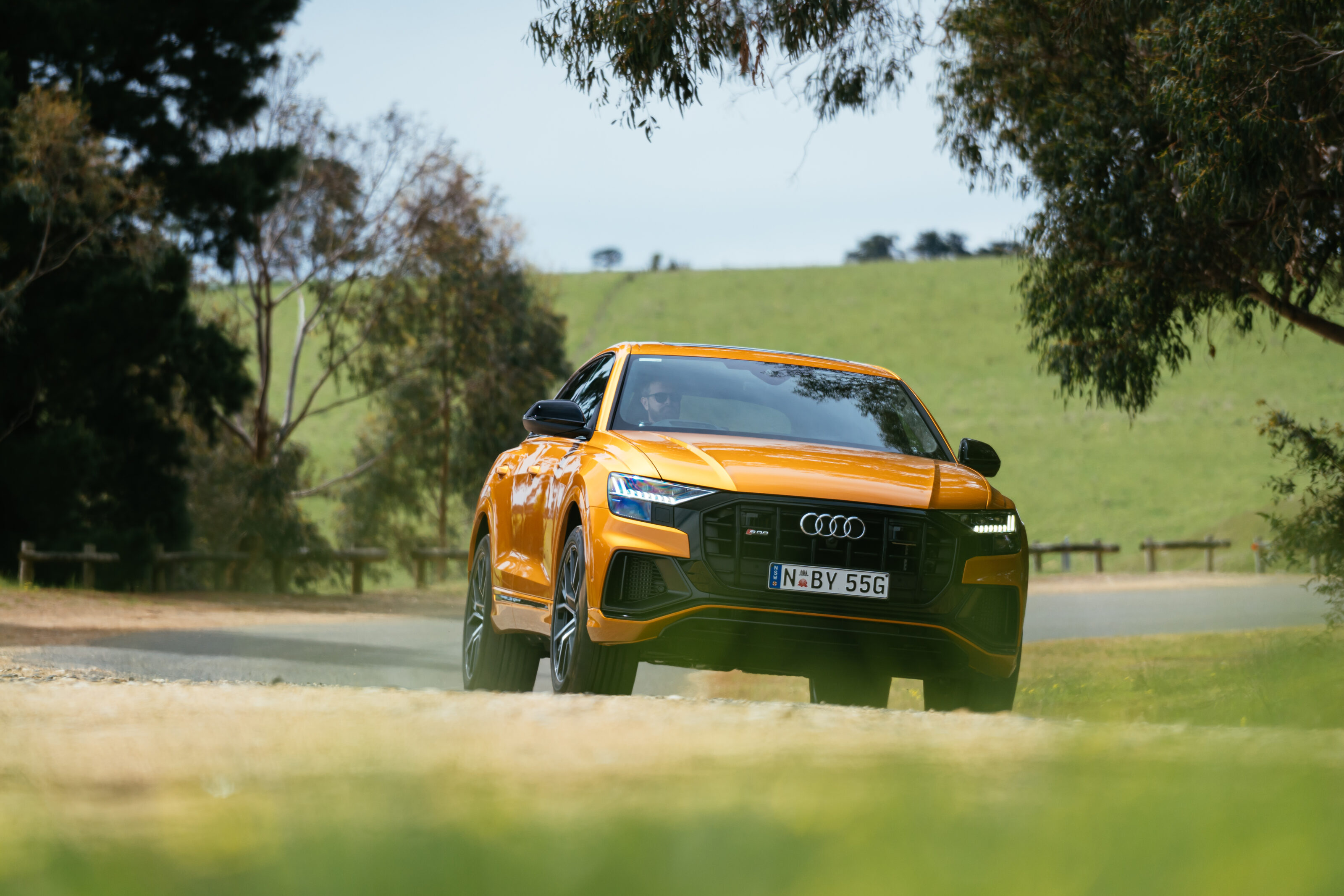
Take a few seconds to search for the anonymous Drive Mode toggle buttons, flick the SQ8 into Dynamic mode, and the SQ8 emerges equally as confident in a twisty road scenario.
Steering is light in typical Audi fashion, but is responsive off-centre and, despite a lack of outright steering heft, communicates the front axle’s steering position, road surface and grip levels through to the driver’s hands well.
1
The 4.0-litre petrol V8 makes a bit less torque than the old V8 TDI, but makes significantly more power and feels noticeably more urgent for most on-road scenarios in the mid to upper range.
It’s here that we should mention the car’s optionally fitted Dynamic pack comprising electromechanical active roll stabilisation and torque-splitting rear differential.
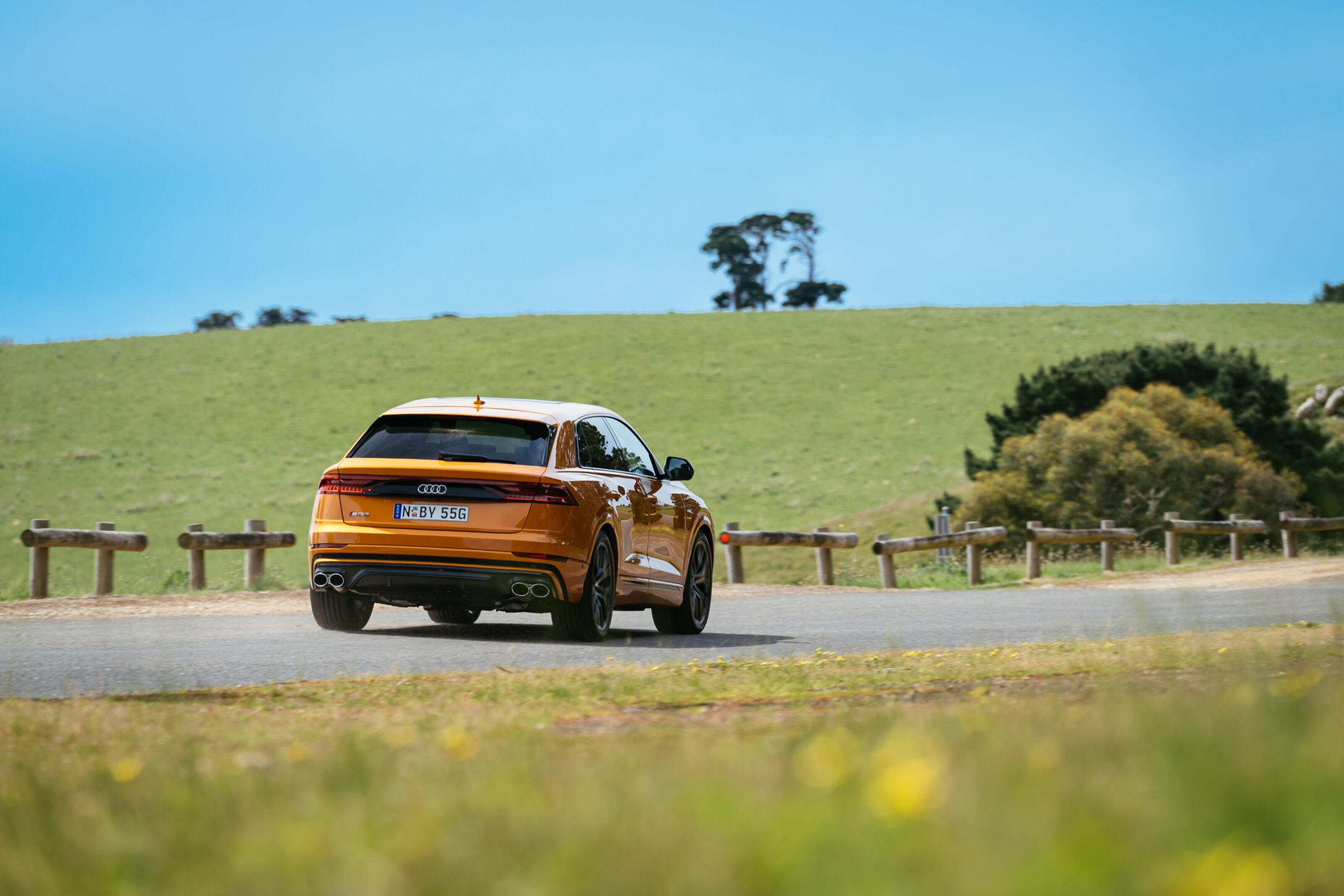
Audi’s sport rear differential dynamically splits torque between each rear wheel, greatly aiding the mid-corner stability and corner exit ability of a vehicle this large. The active roll stabilisation further contributes with its ability to dynamically tighten or slacken the front and rear sway bars, with the combined effect often leaving you in disbelief about how a car this large and heavy can change direction with such poise and precision.
The only downside is that Audi can’t possibly fit a space-saver or spare wheel, as the active roll stabilisation requires an ancillary battery to be fitted under the boot floor.
1
If you’re an owner that likes to take the family on the longer, twistier, route to the weekend road trip destination and is willing to roll the dice on punctures, the Dynamic pack is an all-but-essential option to tick.
How is it on fuel?
Over two days of testing, the Audi SQ8 we were driving registered 12.4L/100km, within an impressive whisker of Audi’s claimed 12.2L/100km fuel figure claim.
Given the notoriously heavy right foot of the Australian motoring journalist, you’d have to imagine that the SQ8’s OEM claim is well within reach.
1
How safe is it?
The 2023 Audi SQ8 specifically remains unrated by ANCAP, however, the rest of the Q8 range wears a five-star rating, awarded upon release in February 2019.
The SQ8 features dual front, side (front and rear) and curtain (front and rear) airbags, the same suite as the rest of the range.
1
All Australian-spec Audi Q8s include adaptive cruise control with stop-and-go function, traffic jam assist and lane guidance, blind-spot monitoring, 360-degree camera, park assist, collision avoidance assist, rear cross-traffic alert, exit warning system and junction assist.
Warranty and running costs
All Audis sold in Australia are supported by a five-year, unlimited-kilometre vehicle warranty, with five years’ coverage for manufacturer paintwork defects and a 12-year manufacturer warranty for corrosion and perforation.
The optional Audi Advantage ownership package includes two years of scheduled servicing (added to any existing service plan), two years of roadside assistance and two years of vehicle warranty added to any existing warranty balance.
1
Audi also offers customers the option to pay upfront for a five-year service plan covering the first five annual scheduled services (intervals run every 15,000km or 12 months, whichever occurs first).
VERDICT
When it comes to family vehicles at this price point, segments often become blurred for buyers. It can often come down to whichever vehicle the prospective owner likes the look and feel of best.
It’s up to you whether you think the Audi SQ8 looks good. Personally, I think it’s easily the most handsome offering of its ilk, more distinguished than the Three-Pointed Starred SUVs, and much more graceful than what the other German folk at Garching are doing. All that’s beside the point.
What I must tell you is that there is real substance behind the style here, and when you really break it down to the dollar, I think there’s a lot of it in Audi’s SQ8.
MORE
SUV Buyers Guide
2023 Audi SQ8 4.0 TFSI specifications
| Body | 5-door, 5-seat large SUV |
|---|---|
| Boot min / max | 605L / 1755L |
| Drive | all-wheel |
| Engine | 4.0-litre V8 petrol, DOHC, twin-turbo |
| Max power | 373kW @ 5500rpm |
| Max torque | 770Nm @ 2000-4000 |
| Transmission | 8-speed automatic |
| Fuel consumption | 12.4L/100km (tested) |
| Weight | 2195kg |
| L/W/H/W-B (mm) | 5006/2190/1708/2998 |
| 0-100km/h | 4.1sec (claimed) |
| Price | $168,800 (before on-road costs), $197,321 (as tested) |
| On sale | now |
New car sales in Australia continue to improve in 2022, with SUVs and light commercial vehicles accounting for 80 per cent of the market.
Ford’s new-gen Ranger ute climbed to the top of sales charts for the first time, while Tesla sales slipped following last month’s record high.
According to monthly results provided by the Federal Chamber of Automotive Industries (FCAI), it was a bumper October compared to last year, with 87,299 vehicles registered compared to 74,650 this time in 2021 – but down on September’s 93,555 posting.
The FCAI noted the improvement over October last year is largely down to 2021’s supply constraints which it said are beginning to ease. Still, it puts the market up 0.8 per cent YTD compared to 2021, with 7639 more sales recorded in 2022.

1
Following last month’s slip, Toyota is back on top of the brand game posting a 20.9 per cent market share this month, just shy of its YTD 21.7 per cent share. Mazda continued to slip with 6.6 per cent market share as Ford (bolstered by the new Ranger), Kia and Mitsubishi all outsold the Hiroshima-based brand in October.
However, Mazda has comfortably retained its second year-to-date place with 13,089 more cars sold this year than third-spot Kia.
New South Wales sold the most vehicles with 26,869 units shifted, followed by Victoria with 23,283 and Queensland at 18,850.
1
FCAI chief executive, Tony Weber, warned this month of the popularity of SUVs and light commercial vehicles in an era when lowering emissions is critical.
“It is important to note the continuing, strong preference for SUV and Light Commercial vehicles in Australia. Consumer preference for these vehicles needs to be considered when charting any policy designed to increase the uptake of zero emission vehicles. This is particularly critical given the low availability and high price points of zero and low emission models in these segments,” he said.
“We look forward to working with governments to provide practical guidance on how emissions from light vehicles can be reduced within this context,” Mr Weber added.

1
Top 10 models ?
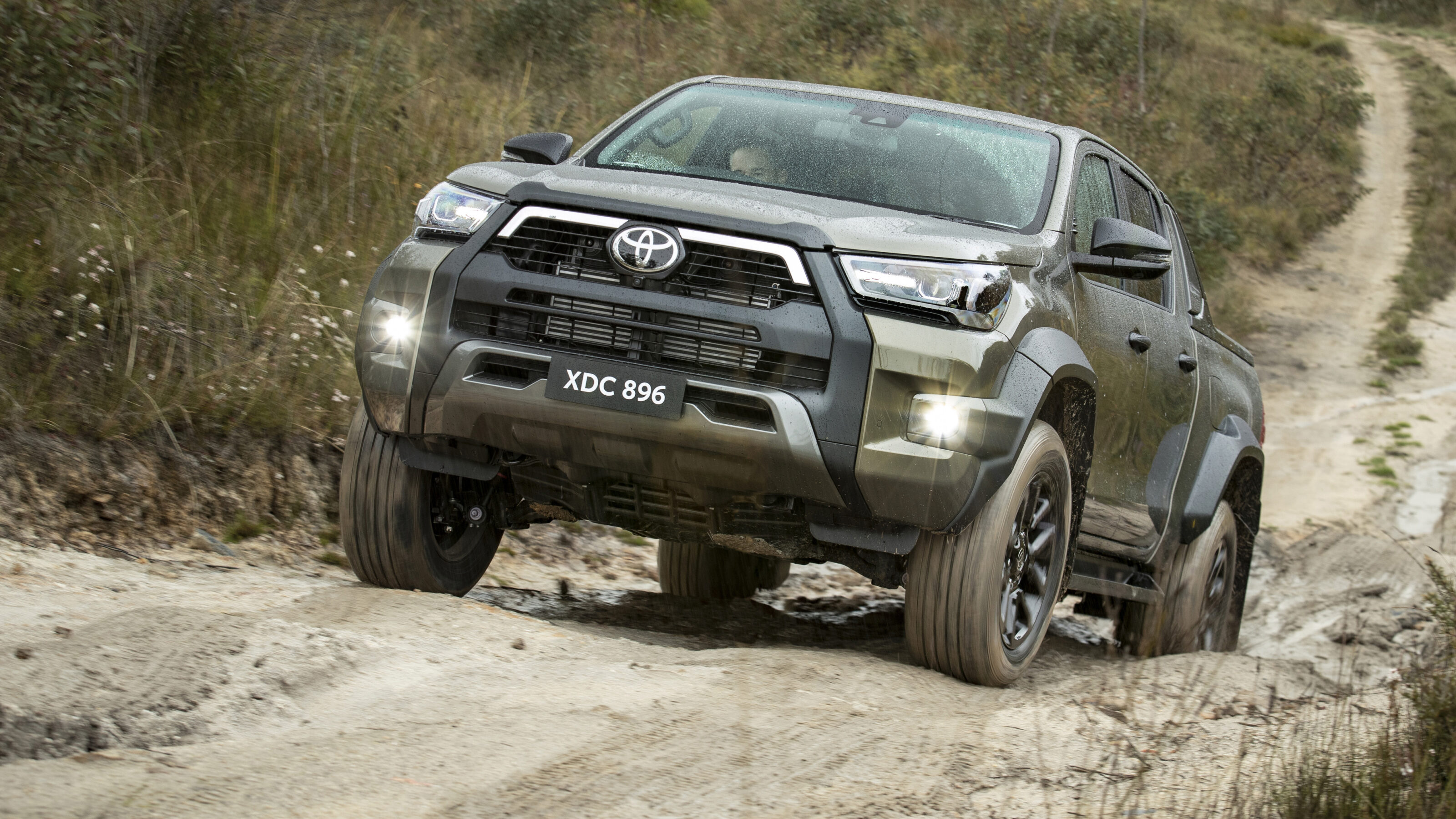
For the second time this year, the Ford Ranger ute (5628) outsold the Toyota HiLux (4884). This is a significant milestone for the new-gen Ranger, and indicates Ford is delivering bulk quantities of its new ute. The HiLux’s YTD sales of 54,680 sees it maintain the overall lead for 2022.
Status quo resumed in October with the Toyota RAV4 medium SUV getting third spot (3222) with a 73.6 per cent increase on last month. The Tesla Model Y is nowhere to be seen this month, posting 1076 sales.
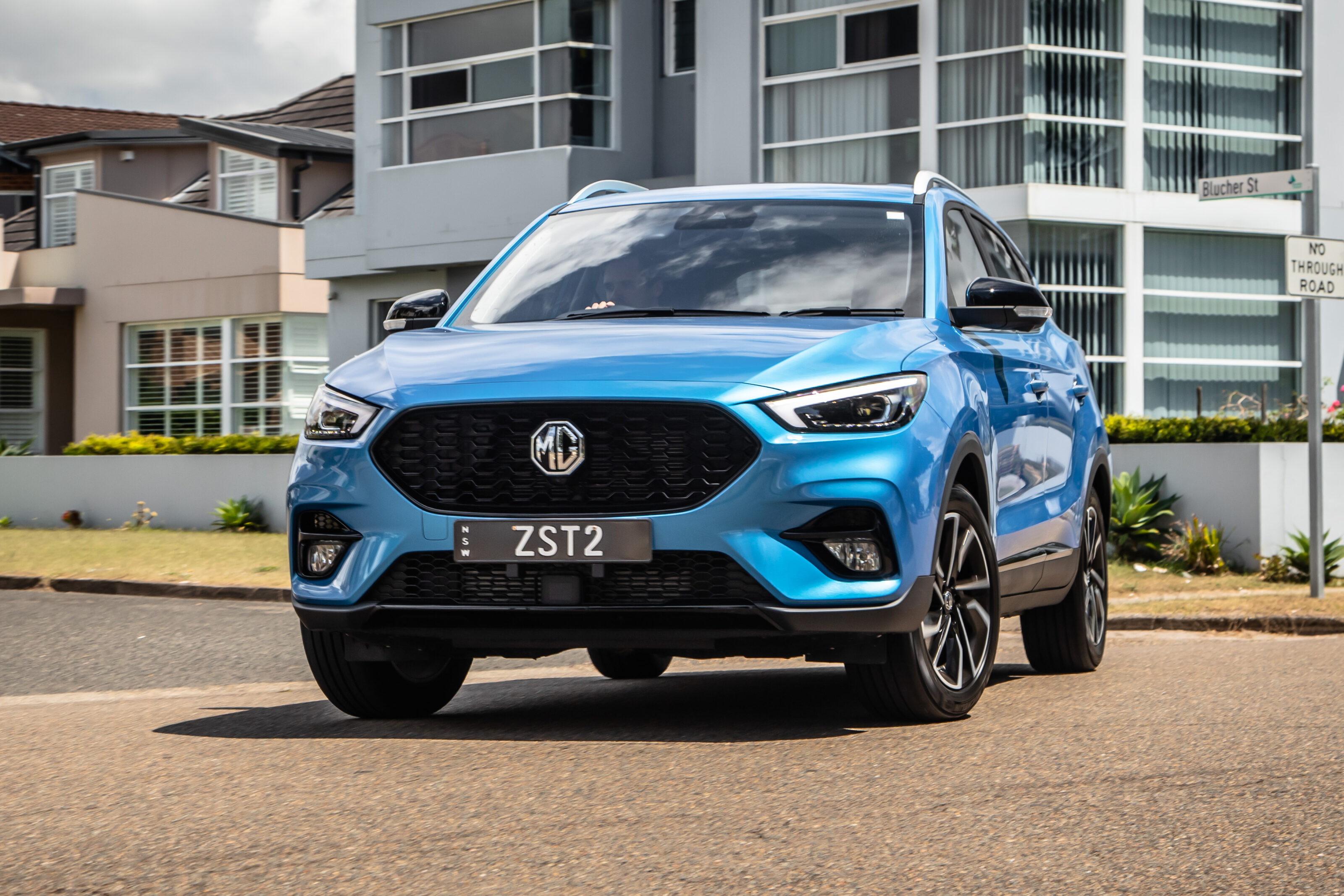
The Mazda CX-5 followed the RAV4 in fourth spot posting a solid 2352 sales and retaining its fifth YTD status. The MG ZS small SUV broke into the top 10 again with 2293 sales, followed by the third ute, the Isuzu D-Max (1951).
1
Another medium SUV broke into the leaderboard, with the Kia Sportage selling 1877 this month, a small increase over 102 units over September.
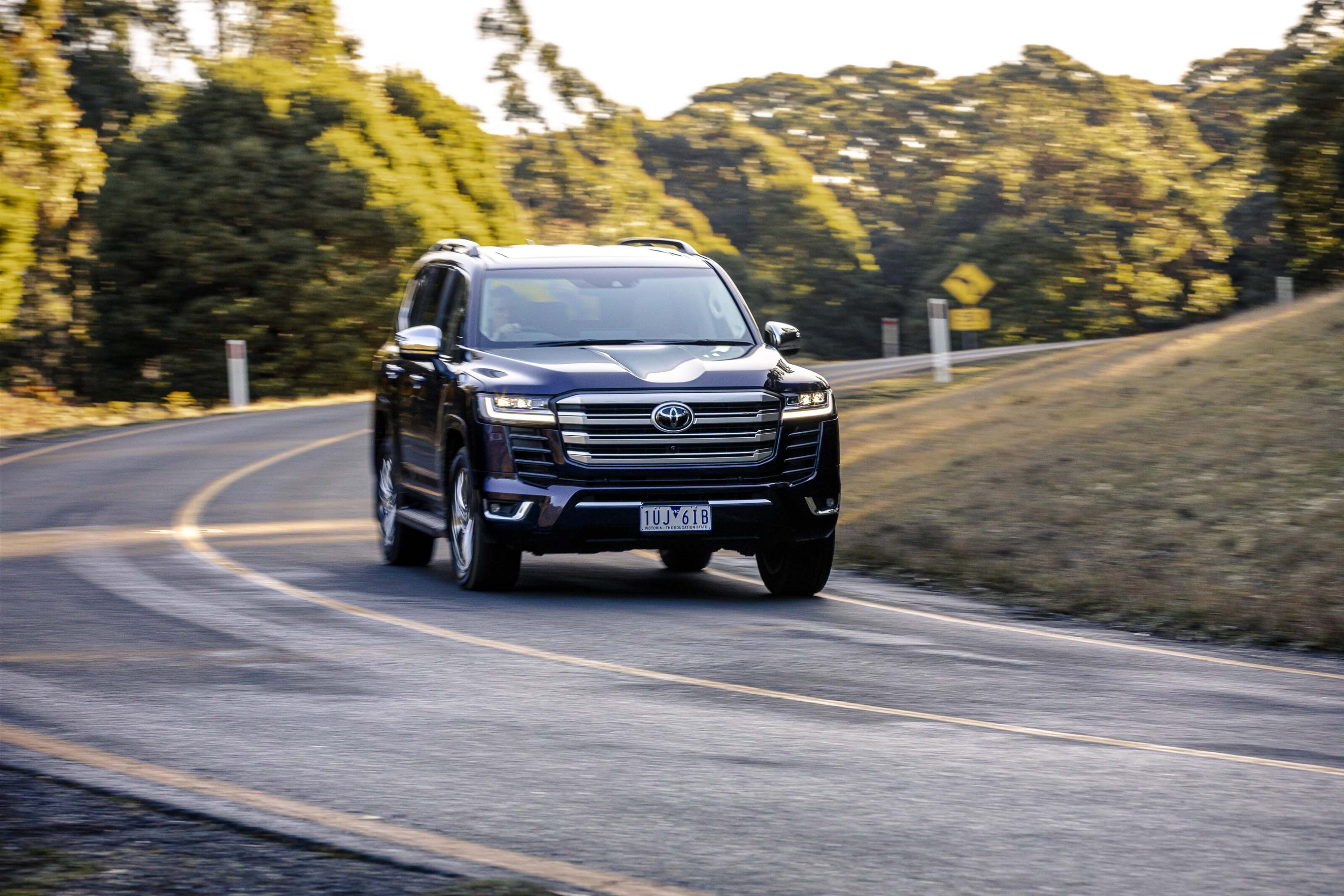
Following in eighth was the MG 3 light car, showing that low prices can still drive sales. At the opposite end of the size spectrum is the combined Toyota LandCruiser range, which is starting to find its feet in the sales charts as 300 Series deliveries continue to improve (1217 sales) and 70 Series stay strong (550).
Rounding out the top sellers this month is the Mitsubishi ASX, which is in run-out ahead of the launch of a minor MY23 refresh in December.
After several bumper months, the Mitsubishi Triton ute dropped out of the top 10 sellers posting 1679 sales.
1
Top 10 cars in Australia: October 2022
Top 10 cars in Australia: YTD 2022
1
Top 10 car brands ?
Following a tricky September, Toyota is back on top this month recording 18,259 sales in October; up 23 per cent on last month and 18.6 compared to October 2021. Year-to-date sales are 194,669.
With deliveries of Ranger in full-swing Ford jumped to second spot for October at 7823 units, for 53,298 and sixth-spot YTD. Of Ford’s Australian sales, 92 per cent come from light commercial vehicles and Everest SUV.
Kia maintained strong sales this month nabbing third spot with 6380 sales and 66,580 YTD keeping its nose just ahead of Mitsubishi (5982 monthly; 66,505 YTD).

1
Mazda’s usual second-place is maintained comfortably in YTD sales (79,669) but not in monthly sales, with the brand slipping back to fifth spot in October with 5,775 sales followed by a similarly uncharacteristic number from Hyundai in sixth (5289 monthly; 63,392 YTD)
Mitsubishi took fourth place, selling 6784 cars in September and 60,523 YTD for a 47 per cent growth, followed by Ford – which climbed to fifth spot last month with 6635 units (up 15 per cent), and came sixth year-to-date with 45,575 vehicles sold.
MG may have ‘only’ held seventh position for the month and year, but with 5031 sales in October, it was the Chinese brand’s best month to date, managing to get two cars into the top 10.

1
Volkswagen had another strong month. Despite not getting any cars into the top-10 sellers, its 3199 registrations spread relatively evenly across Golf, T-Cross, T-Roc, Tiguan were enough to secure eighth spot ahead of Isuzu (2865).
Rounding out the monthly lis was GWM posting strong sales figures at 2462, though somewhat adrift of its record September sales (3065). It sits in 14th place YTD with 18,833 registrations in 2022.
Subaru (28,264) and Mercedes-Benz (26,841) kept ninth and 10th in year-to-date tallies but slipped to 11th and 12th for the month respectively. Tesla, meanwhile, was nowhere to be seen in October with 1109 sales getting it 19th for the month and 16th for the year (15,132).
Top 10 brands: October 2022
Top 10 brands: YTD 2022
1
Ups and downs ? ?
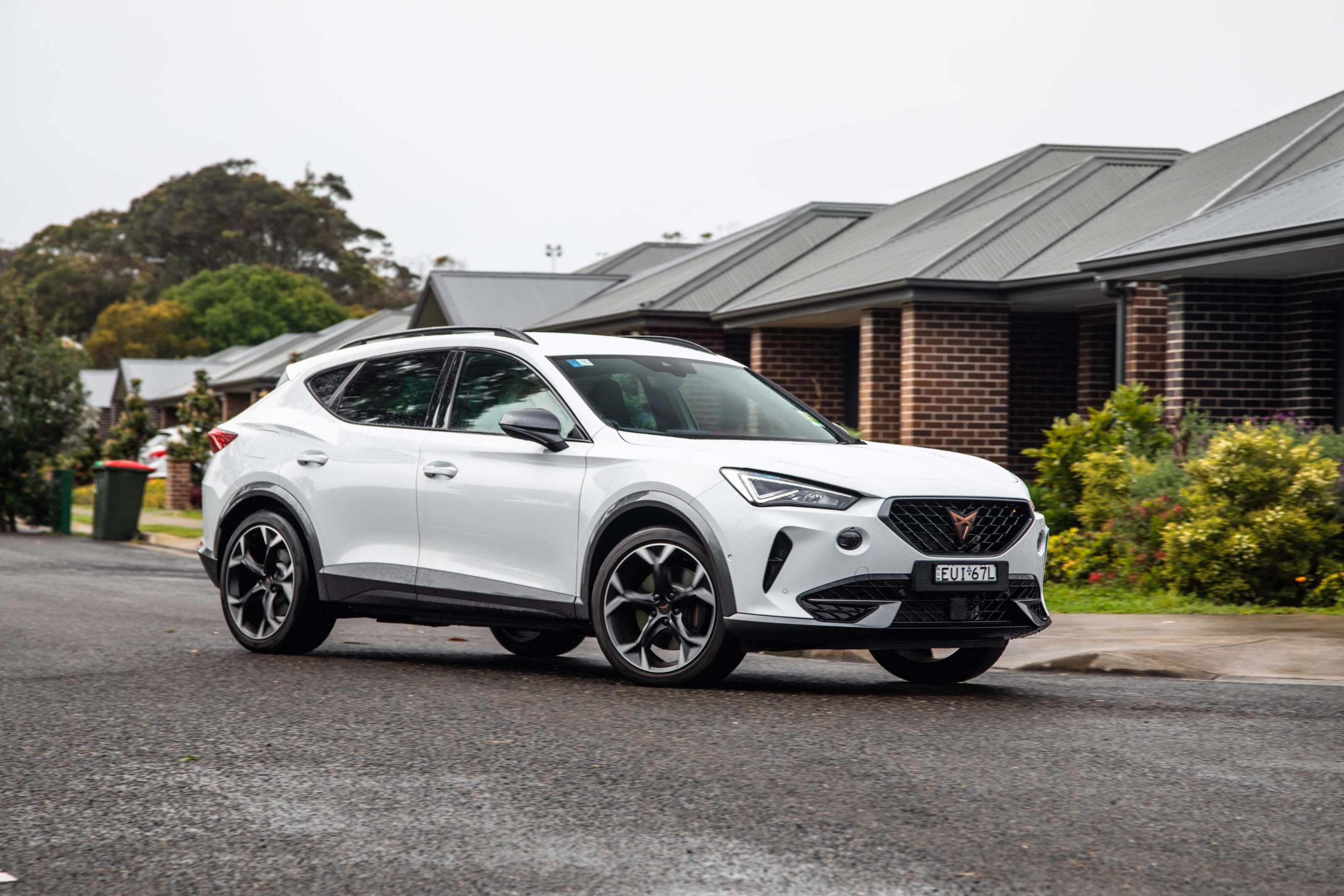
From outside the top-10 brands, Cupra continued to grow momentum posting 248 sales in October, a number up 24.6 per cent on last month and one that represents 40 per cent of total sales this year.
Ford’s Mustang is losing momentum as order books close; the sports car only sold 135 units in October compared to 237 in September, and 269 in October 2021.
A pair of Chinese challenger brands – GWM and MG – both had bumper months getting into the top 10 sales list by brand. GWM posted its best-ever sales last month and slipped slightly for September, but MG comprehensively beat its previous best number, registering 5031 new cars in October.
As a stark illustration of Tesla’s selling power in Australia, EV sales dropped a staggering 71 per cent from September to October, with BEVs accounting for 2.4 per cent of October sales. There were only 33 Model 3 sedans sold this month.

1
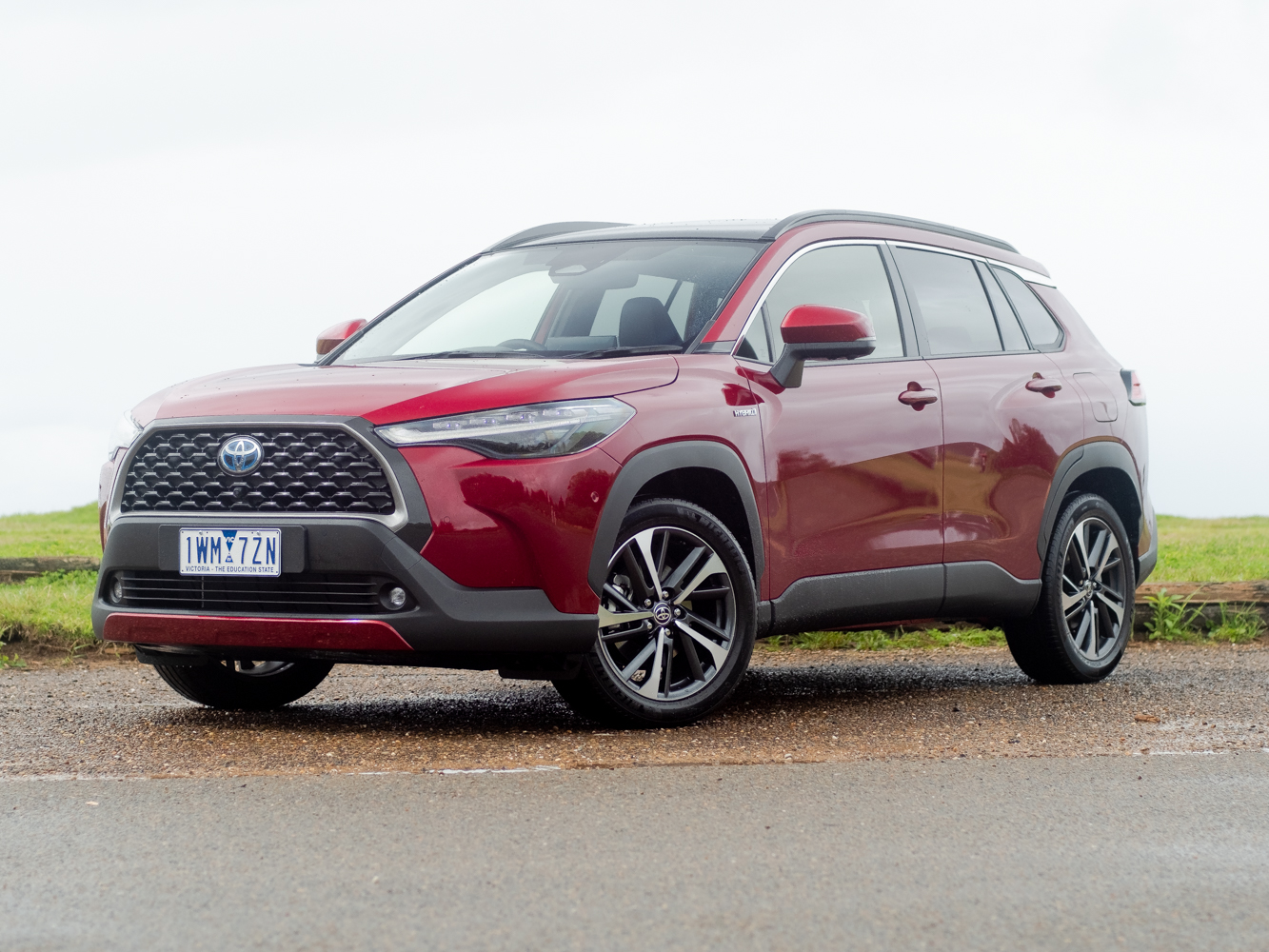
Hybrid sales improved over last month and October 2021 – down to the new Toyota Corolla Cross arriving and RAV4’s return to form – with 6860 sales this month compared to 4616 in September.
Medium SUVs were the single most-popular market segment accounting for 21.2 per cent of sales, compared to 15.2 per cent last October meanwhile 4×4 utes were the second most-popular with 19.1 per cent share.
Every SUV category – except large SUVs – posted an increase in market share in October 2022, while every passenger car genre except for people movers posted a decline.
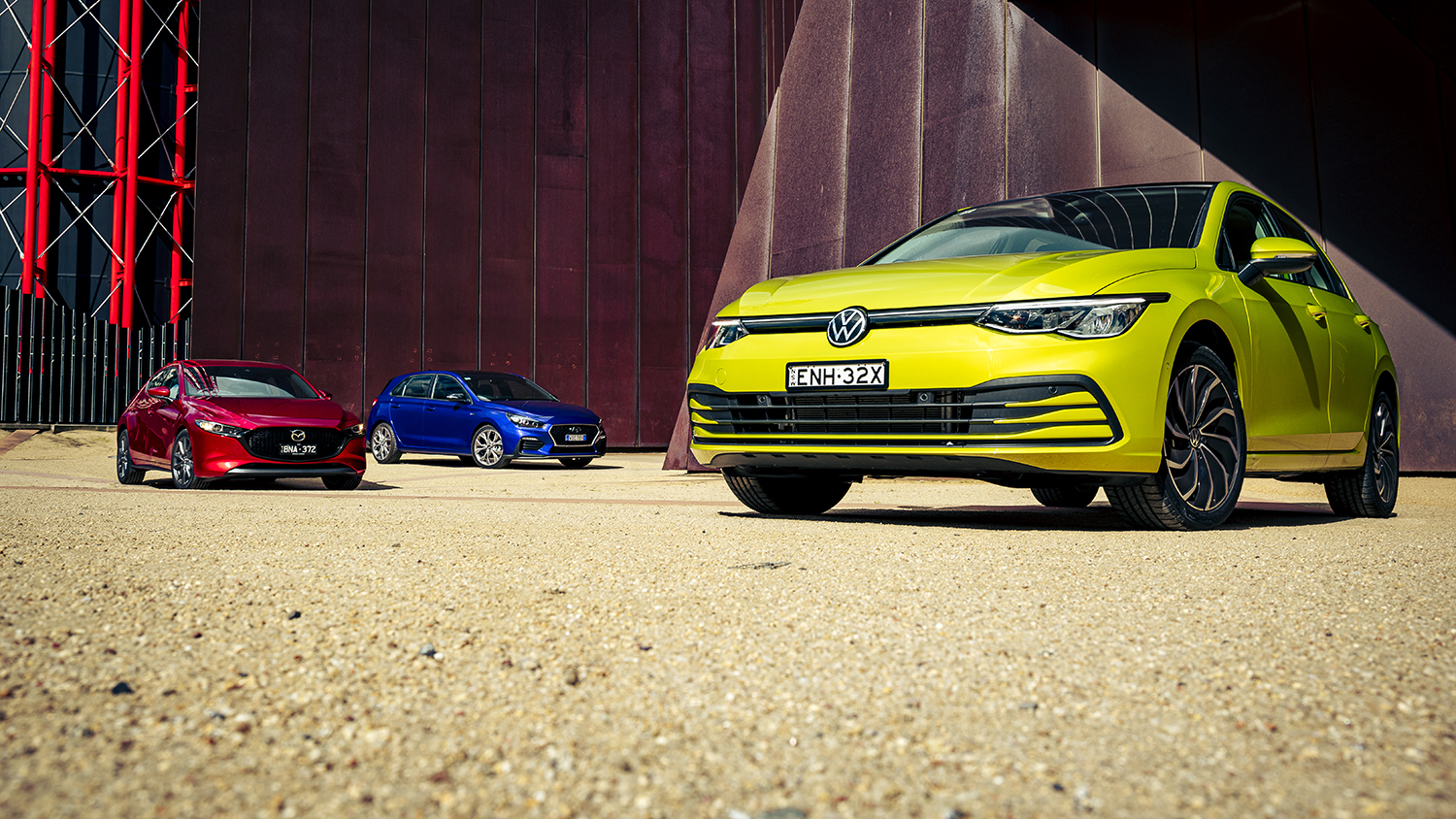
The small car class was really hampered this month with no examples in the top-10 – the Toyota Corolla (904) and Hyundai i30 (1441) failed to make the best-seller list, while Honda only registered 84 new Civics, compared to 284 in 2021.
1
In charts ?
October 2022 – Top 10 models
https://infogram.com/1p5kdkp6q00v76up5zkmdgl9qqu3em27j95
October 2022 – Top 10 brands
https://infogram.com/1p0jpv6l5lq9rgaeg5pzd1m11jtnvdn1ynj
October 2022 – Overall segment sales
https://infogram.com/1p5lk5ynmnnwlrhp77rgn6xp3la30n6rznv
October 2022-2021 category sales
https://infogram.com/1pn9dpxyy73wndfzp3vjpr2r9qimgwwp105
October 2022-2021 category YTD sales
https://infogram.com/1pv1rq6k1q3xlpfxn6nlqyznpgcrr39qyg9
2022 sales race
https://infogram.com/1pgdewdger7pnmt9mzwnel22q3i2xdqp2m
October 2022 Australian sales map
https://infogram.com/1pp0k0w7226wnrurd6597erm96iz0jlyx2p
October 2022 buyer type
https://infogram.com/1pn0wre2mjpdvptzdeqnpq5mnrcm122krm1
MORE
All VFACTS stories
Snapshot
- MG Australia 6th most popular brand in October
- Record sales for ZS SUV
- ZS and MG3 in Top 10
Chinese brand MG has registered more than 5000 new-car sales in Australia for the first time.
Two of its three models featured in the Top 10 best-sellers list in October, led by the ZS compact SUV that was the country’s fifth most popular vehicle. The MG3 city car placed 8th.
MG sold 2293 ZS SUVs last month – a record for the vehicle and just 59 units shy of the Mazda CX-5 medium SUV. The figure equates to a 104 per cent year on year increase.
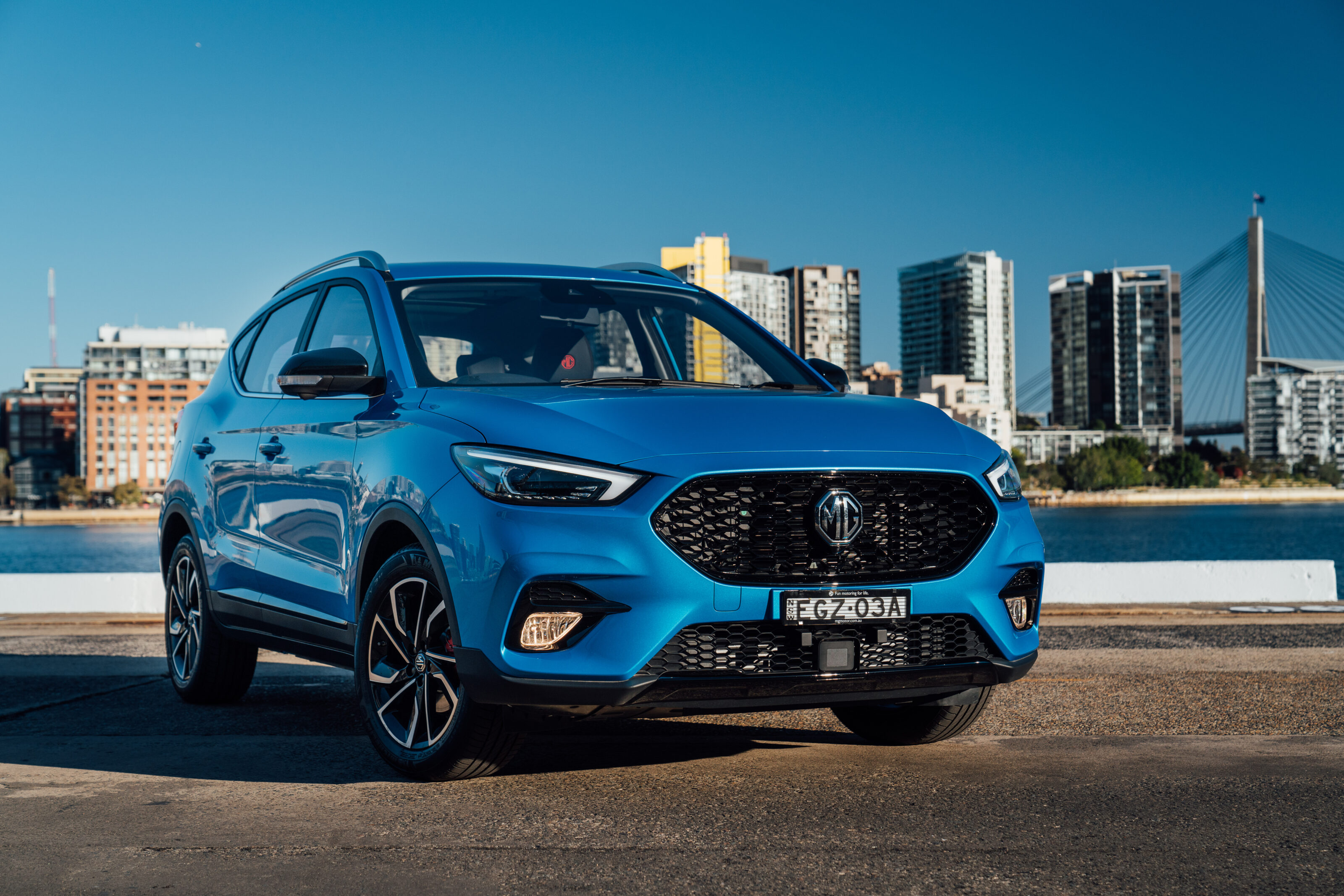
The MG ZS (main picture and below) led the Small SUV segment, out-selling popular vehicles such as the Mitsubishi ASX, Mazda CX-30, Hyundai Kona, and the new Toyota Corolla Cross.
1
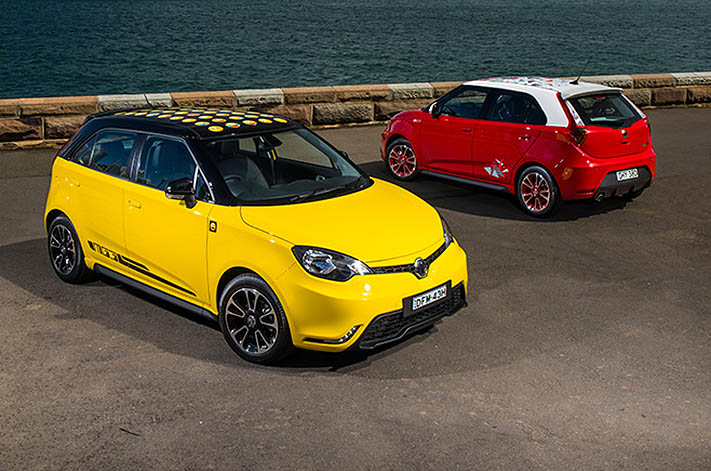
The MG3 (pictured below), with 1823 sales, is up 44 per cent on its October 21 result.
It continues to dominate the city-car category, with 55 per cent market share last month. Its closest rival was the Toyota Yaris with 348 sales.
The HS midsize SUV secured 915 sales last month, up 26 per cent year on year.
MG’s total October sales were up 60 per cent on this time last year.
October’s figures pushed MG into 6th place in the list of most popular brands, with its 5031 sales netting a market share of nearly six per cent.
1
MG’s previous best month was May with 4403 units, a month after it passed 4000 sales for the first time.
MG is Australia’s seventh most popular brand year to date, with total sales of 38,891 up 22 per cent.
In another generally strong month for Chinese brands, GWM joined MG in the Top 10 brands thanks to 2462 sales – up 46 per cent on October 2021.
LDV sales also increased, by 24 per cent.
Snapshot
- 2023 Mazda CX-5 update detailed
- Widescreen infotainment standard; price-leading manual axed
- Expected to arrive in Australia in early 2023
UPDATE: 2023 Mazda CX-5 pricing and features
Mazda Australia has confirmed official details for its 2023 CX-5 medium SUV.
Our original story, below, has been updated to reflect this information.
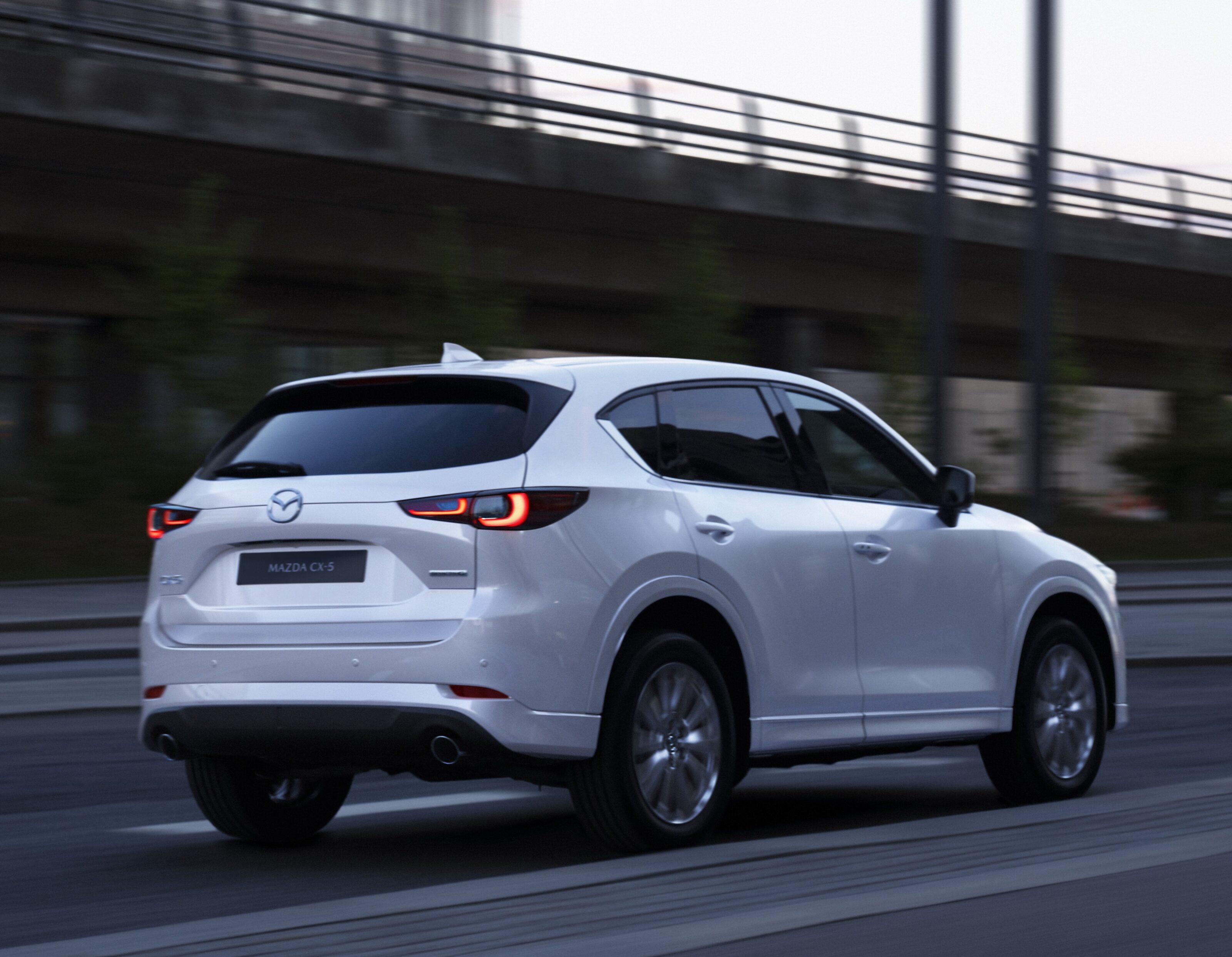
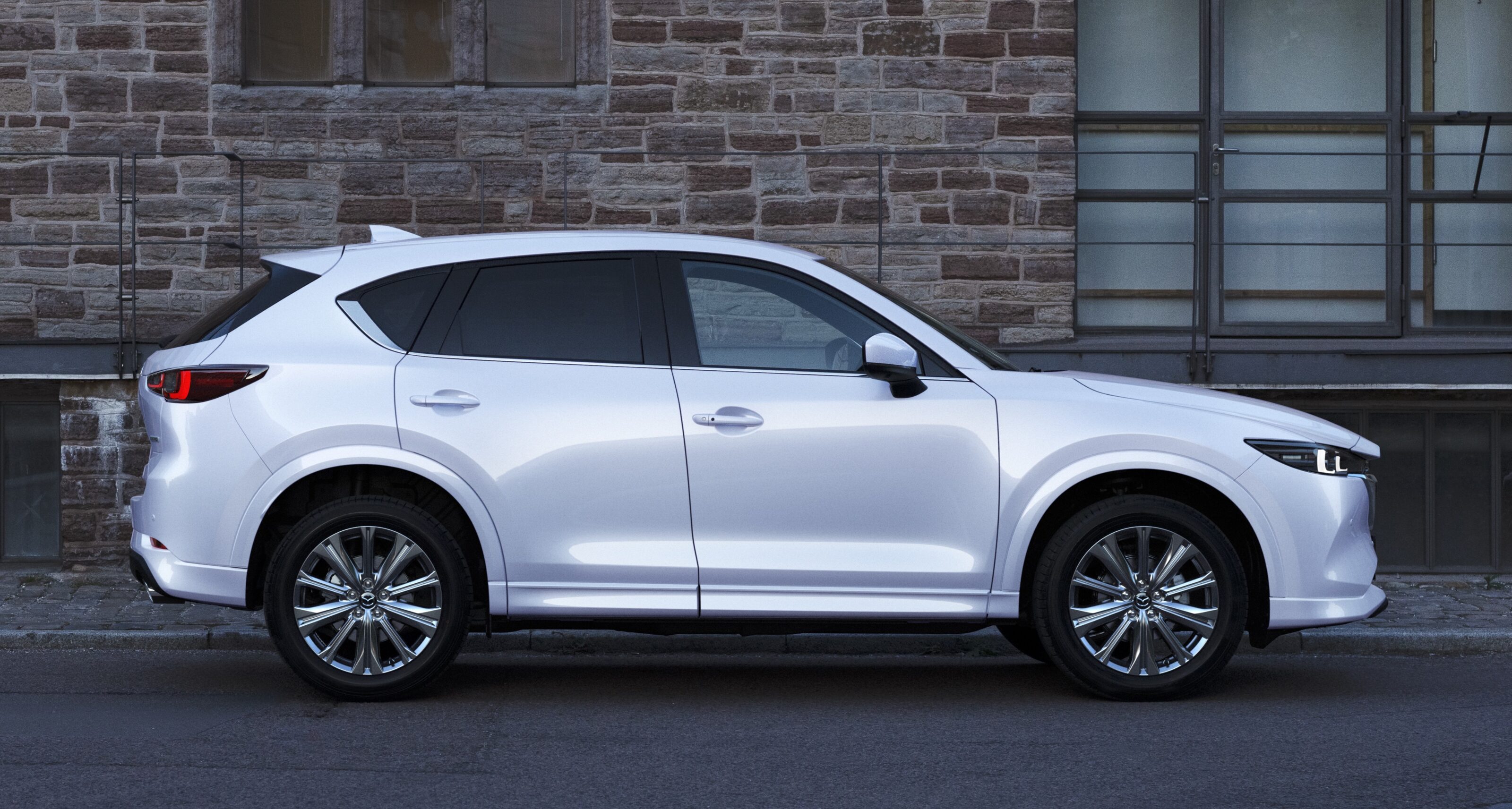
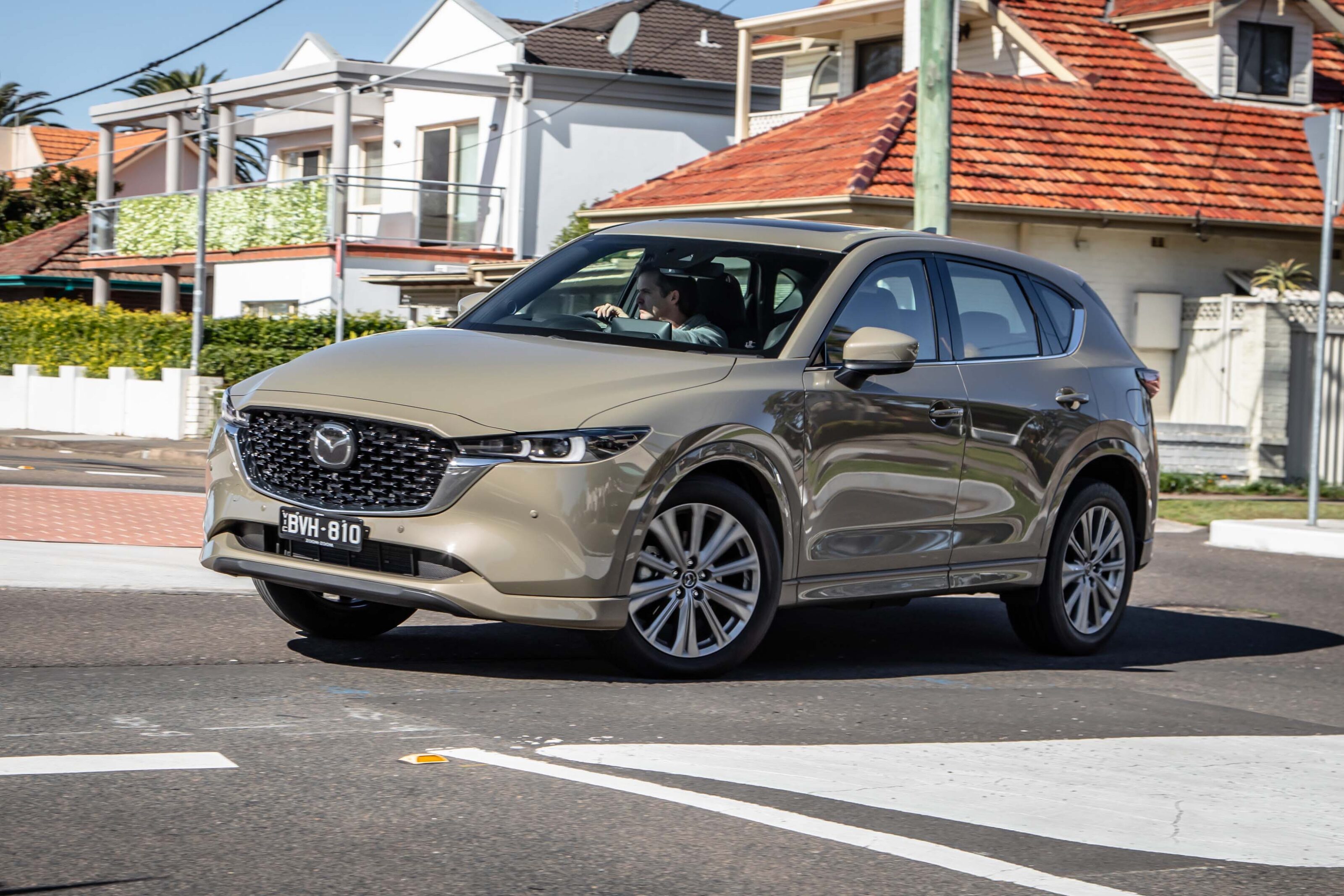
The updated 2023 Mazda CX-5 has been detailed ahead of its launch early next year.
It is the fifth update for the CX-5 in the past five years, with the last three occurring in the first quarter of 2020, 2021 and 2022.
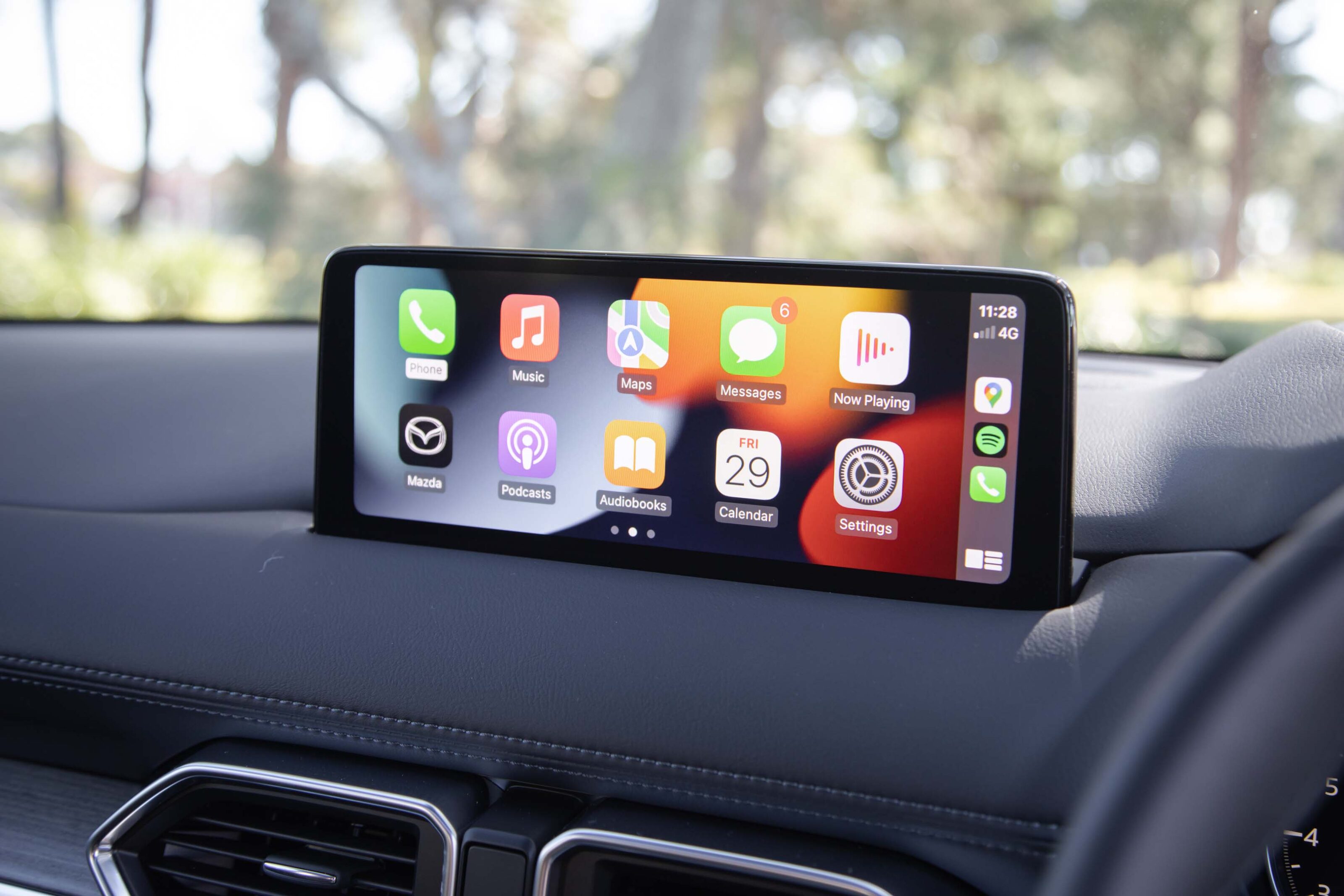
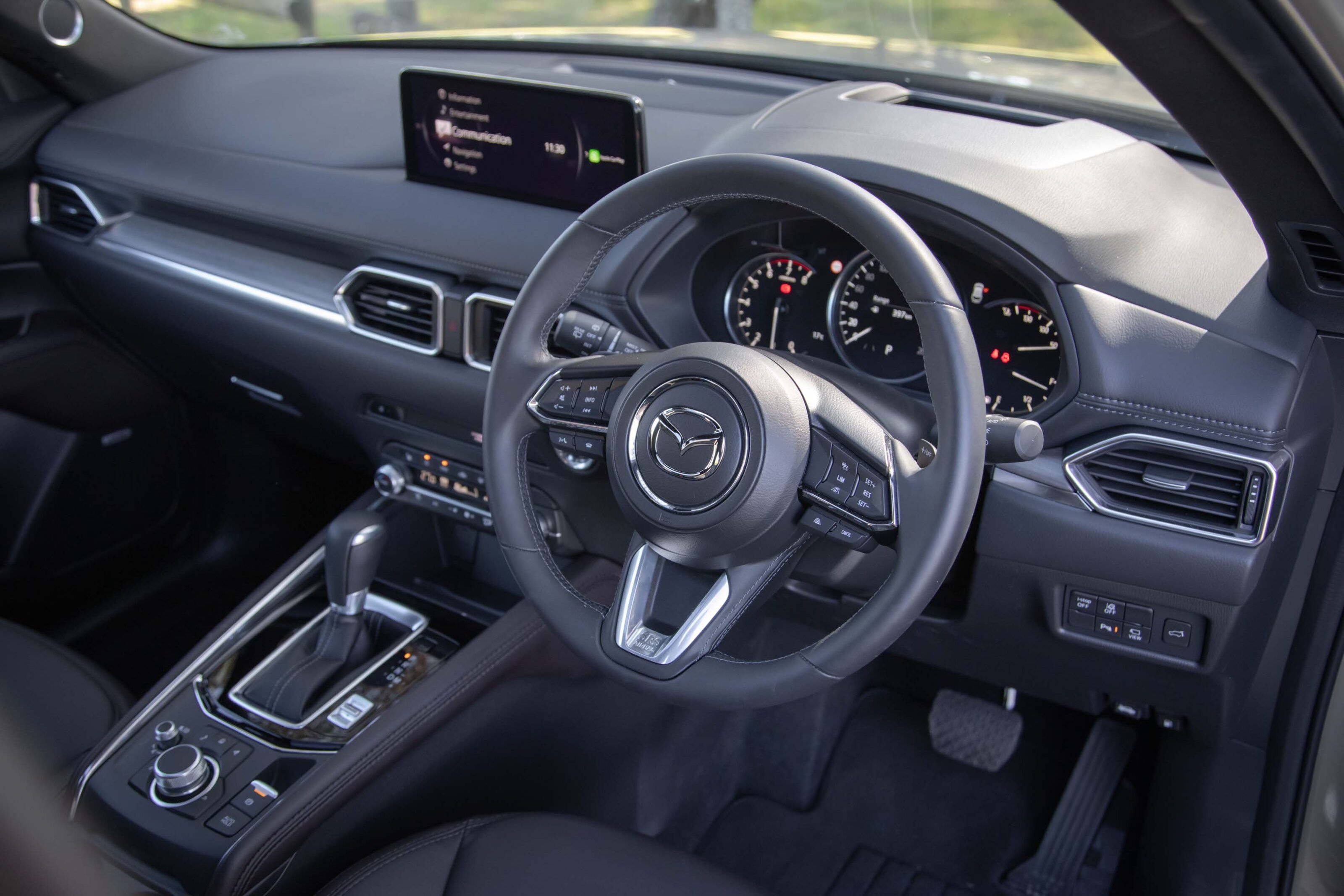
As expected, the 10.25-inch Mazda Connect infotainment system – currently limited to the GT SP and Akera – is standard across the range, with wireless Apple CarPlay and Android Auto on most variants.
1
It replaces the ageing 8-inch MZD Connect system first launched on the previous-generation Mazda 3 in 2013.
Mazda notes Android Auto will be unavailable for vehicles built between November 2022 and March 2023, with a free software update expected from April 2023 to restore the feature.
However, pricing has increased between $200 and $1000 across the range, with the highest increase for the Maxx, Maxx Sport, Touring and Touring Active variants.
4
The entry-level Maxx includes a wired-only smartphone mirroring connection, and built-in satellite navigation remains limited to the Maxx Sport and above.
Other changes include two front USB-C ports replacing USB-A connections, LED glovebox illumination for the flagship Akera, and a feature allowing drivers to open the windows from the key fob – but not close it remotely.
In a Mazda first, the petrol CX-5’s service intervals have increased to a 12-month/15,000-kilometre period, whichever occurs first (up from 10,000km), in line with most of its competitors. The diesel will remain at 12 months or 10,000km.
A new colour, rhodium white metallic, will replace the current no-cost snowflake white finish for $795 – following a $200 price increase of Mazda’s premium hues earlier this year.
1
While a hands-free electric tailgate was available on early units of the 2022 CX-5 GT SP and Akera, the kick sensor was removed in mid-2022 due to the semiconductor chip shortage – and this remains the case for model-year 2023.
Meanwhile, the six-speed manual transmission has been discontinued for the entry-level Maxx, with the range opening with the more-popular automatic model for 2023.
It follows the Toyota RAV4, Hyundai Tucson, Mitsubishi Outlander and Nissan X-Trail in losing a price-leading base model. This leaves the Kia Sportage as the last mid-size SUV to offer a manual transmission.
1
2023 Mazda CX-5 pricing
Prices exclude on-road costs.
1
2023 Mazda CX-5 features
Maxx
Maxx Sport, in addition to Maxx
Touring, in addition to Maxx Sport
Touring Active, in addition to Touring
GT SP, in addition to Touring
Akera, in addition to GT SP
Engine, drivetrain and fuel economy
1
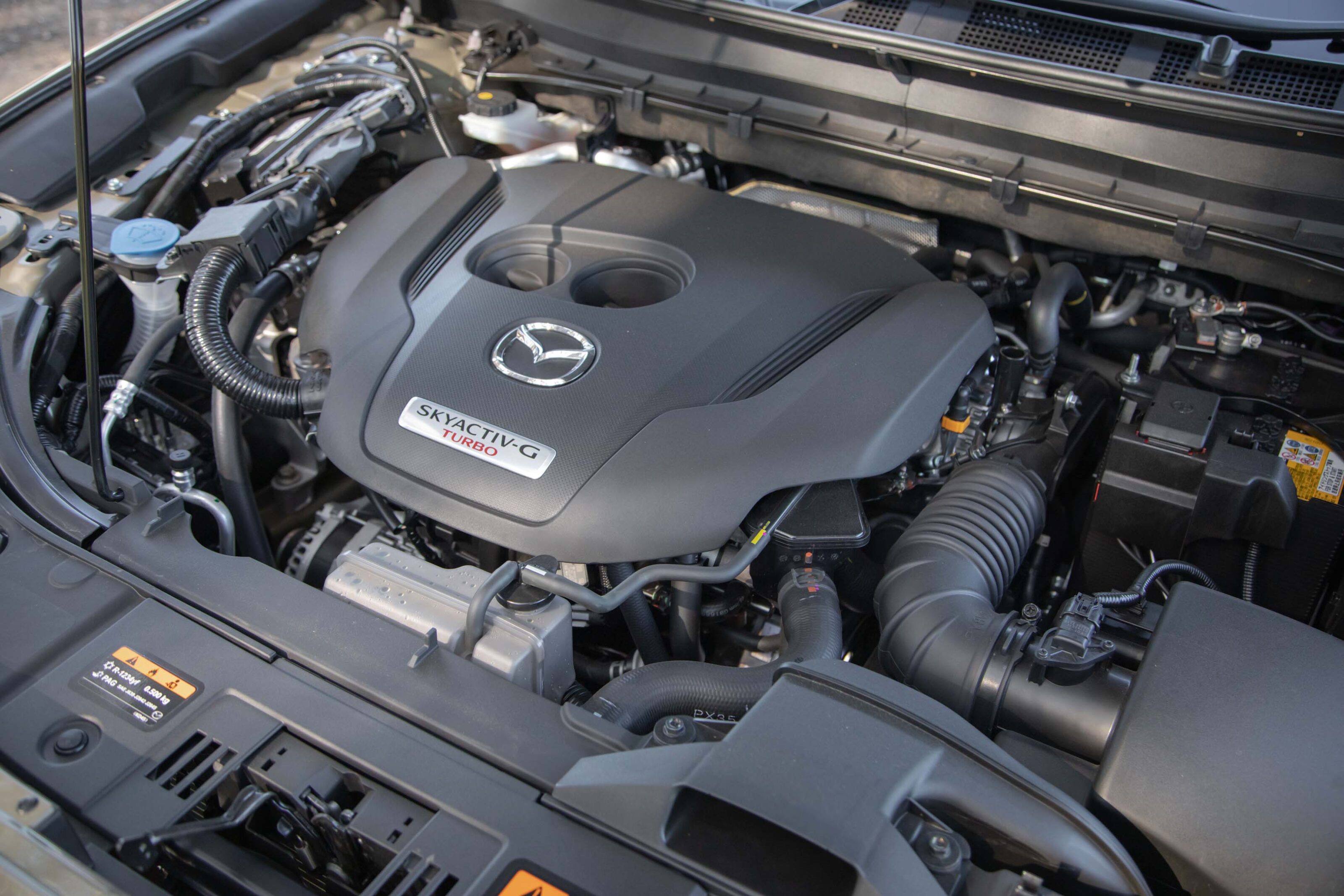
Like the current CX-5, engine options include a naturally-aspirated 2.0-litre and 2.5-litre petrol mills, as well as a 2.5-litre turbo-petrol and a 2.2-litre twin-turbocharged diesel.
Exclusive to the Maxx variant is the 2.0-litre naturally-aspirated ‘G20’ petrol engine, producing 115kW and 200Nm.
Stepping up to the naturally-aspirated ‘G25’ 2.5-litre engine – available on all CX-5 variants above the Maxx – sees power outputs rise to 140kW/252Nm.
The turbocharged ‘G35’ 2.5-litre petrol further boosts numbers to 170kW/420Nm, while the 2.2-litre ‘D35’ turbo-diesel produces 140kW/450Nm.
A six-speed automatic transmission is standard-fit across the CX-5 range.
Fuel economy figures can be found in the table below:
1
Safety
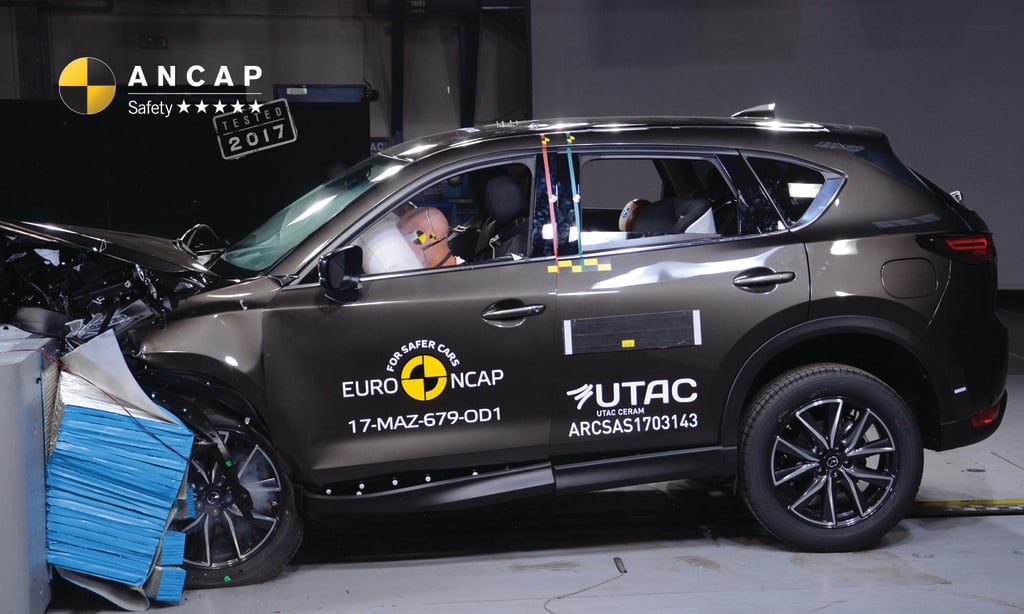
The entire Mazda CX-5 range is covered by a five-star ANCAP safety rating, based on testing conducted in 2017.
This rating will expire at the end of 2023, in line with ANCAP’s six-year date-stamp limit. Mazda has not flagged any plans to submit the CX-5 for retesting under the latest criteria.
Six airbags (dual front, side and curtain) feature across the line-up.
Each variant includes the following active safety equipment as standard:
1
Dimensions
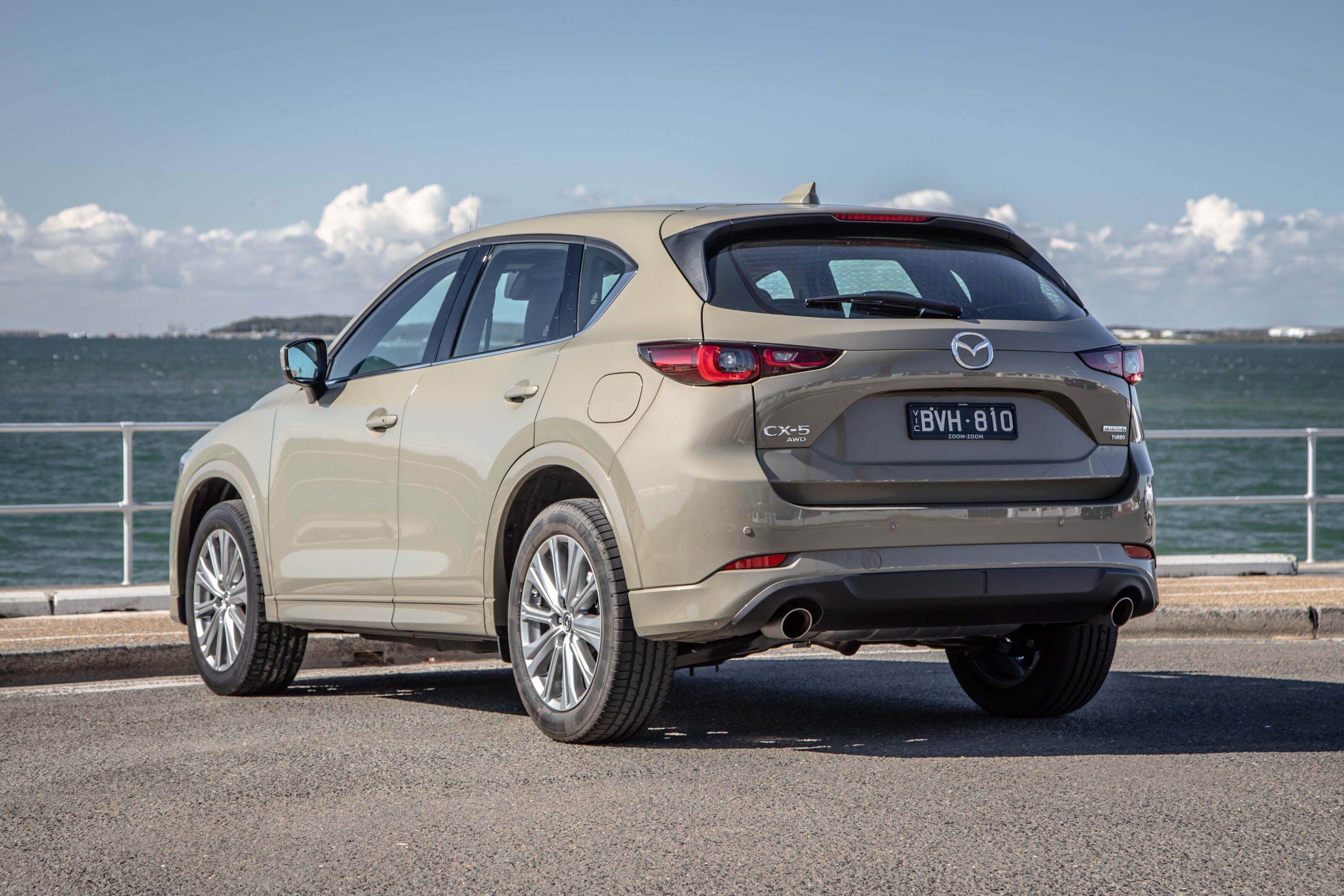
The Mazda CX-5 has a wheelbase of 2700 millimetres, and is 4575mm long and 1845mm wide.
Variants with 17-inch alloy wheels are 1675mm high, while grades with larger 19-inch wheels are 1680mm tall.
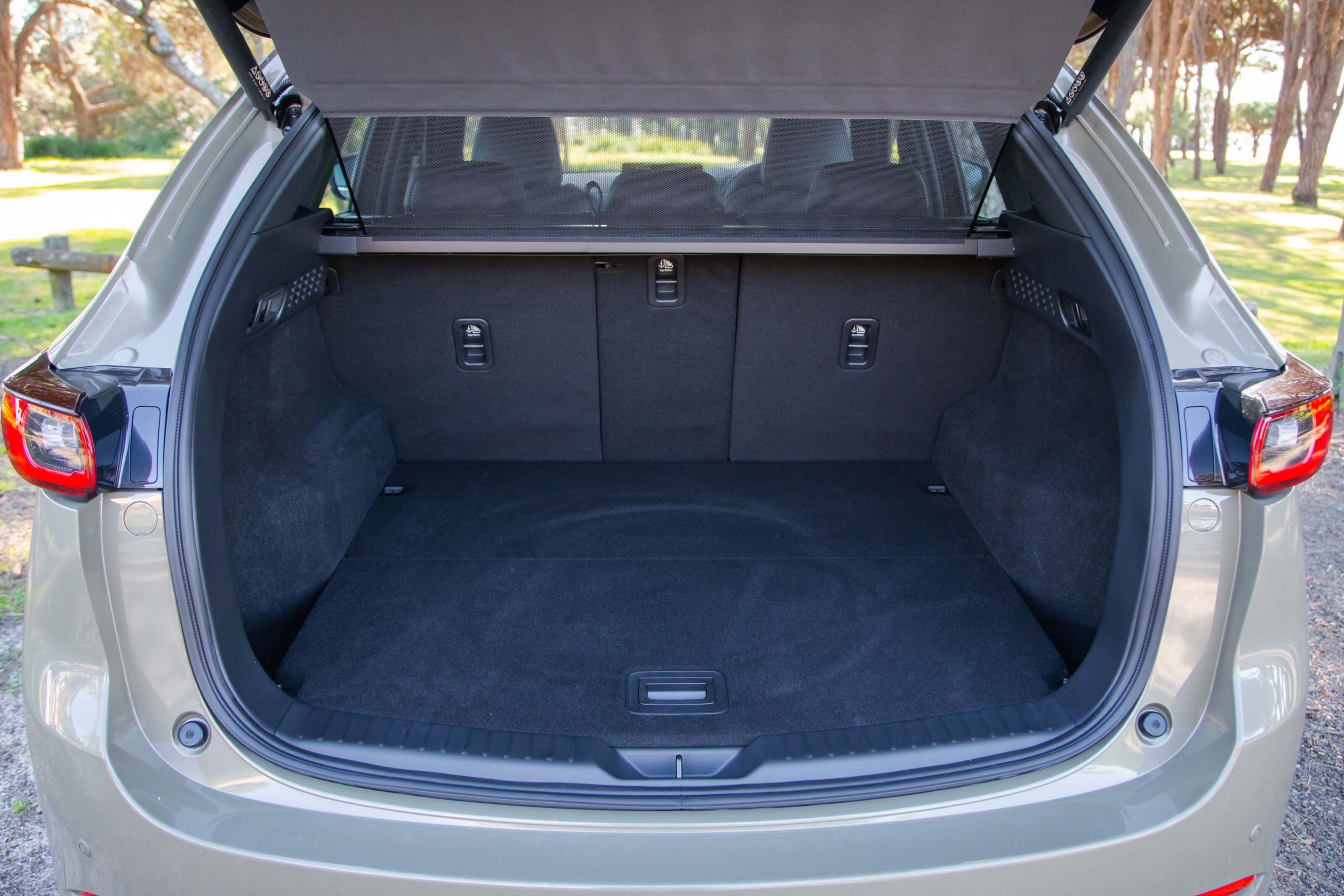
It has a claimed 438-litre boot capacity, extending to 1340L with the rear seats folded.
Warranty and servicing
1
As per the wider Mazda range, the CX-5 is covered by the brand’s five-year, unlimited-kilometre warranty, along with a five-year roadside assistance program.
The service schedule for petrol CX-5 variants is 12 months or 15,000km, whichever occurs first. The diesel has a lower 12-month or 10,000km interval, as before.
Mazda offers capped-price servicing on the CX-5, covering the first five years or 50,000 kilometres.
Availability
The 2023 Mazda CX-5 is on sale now.
MORE
Everything Mazda
Snapshot
- 2023 Volkswagen Caddy pricing and features
- Updated van receives safety and technology improvements
- Pricing unchanged; starts from $36,990 before on-road costs
The 2023 Volkswagen Caddy is on sale now, with the updated range gaining safety and technology improvements.
Available in panel van, people mover and camper body styles, pricing for the updated Caddy is unchanged for model-year 2023, starting from $36,990 before on-road costs.
This follows a $2000 price increase across the range in January 2022.

1
New for 2023 is the standard fitment of lane-keep assist and a wireless phone charger, while the Cargo and Crewvan now support cyclist, pedestrian and junction-turning detection for the autonomous emergency braking system.
Further changes include chrome trim on the side doors and tailgate for the Caddy Life seven-seat people mover, and pop-out side windows for the Caddy Life, Caddy Crewvan and Caddy California (with up to 40mm of movement).
Due to the semiconductor chip shortage, Volkswagen Australia notes the Caddy Cargo will be “temporarily” unavailable with the optional automatic park assist or 10-inch infotainment system with built-in satellite navigation and wireless Apple CarPlay/Android Auto.

1
2023 Volkswagen Caddy pricing
Caddy Cargo (panel van)
| Model | Transmission | Price |
|---|---|---|
| Caddy TSI220u00a0 | Manual | $36,990 |
| Caddy TDI280 | Manual | $38,990 |
| Caddy Maxi TSI220 | Manual | $38,990 |
| Caddy TSI220 | Automatic | $39,990 |
| Caddy Maxi TDI280 | Manual | $40,990 |
| Caddy TDI320 | Automatic | $41,990 |
| Caddy Maxi TSI220 | Automatic | $41,990 |
| Caddy Maxi TDI320 | Automatic | $43,990 |
| Caddy Crewvan TSI220 | Automatic | $45,990 |
| Caddy Crewvan TDI320 | Automatic | $47,990 |
Caddy Maxi (seven-seat people mover)
Caddy California (campervan)
| Caddy California TSI220 | Automatic | $57,690 |
|---|---|---|
| Caddy California TDI320 | Automatic | $59,690 |

4
2023 Volkswagen Caddy features
Caddy Cargo
Caddy Cargo Maxi
Caddy Cargo crewvan
Caddy Maxi people mover
Caddy Maxi Life
Caddy California

1
Engine and drivetrain
Opening the Caddy range is the TSI220, which features a 1.5-litre turbocharged petrol four-cylinder engine with 84kW and 220Nm, available with either a six-speed manual or seven-speed dual-clutch ‘DSG’ automatic transmission powering the front wheels.
A choice of two 2.0-litre four-cylinder turbocharged diesel engines are offered across the Caddy range, although the lower-spec TDI280 only features in the Cargo variants, making 75kW of power and 280Nm of torque with power being sent to the front wheels through a six-speed manual gearbox.
Also available in Cargo guise but standard across the passenger variants of the Caddy, the TDI320 engine puts out an improved 90kW and 320Nm, mated exclusively to a seven-speed dual-clutch automatic transmission.

1
Safety
The Volkswagen Caddy people mover is covered by a five-star ANCAP safety rating, based on testing conducted in 2021. The panel van is unrated.
It has an 84 per cent score for adult occupant protection, 86 per cent for children, 69 per cent for vulnerable road users, and 76 per cent for safety assist.
Seven airbags (dual front, side, curtain, and front-centre) feature across the range.
The following active safety equipment is fitted as standard:
| Autonomous emergency braking (vehicle, pedestrian, cyclist, junction) |
| Lane-keep assist |
| Lane departure warning |
| Manual speed limiter |
| Driver attention alert. |
Blind-spot alert and rear cross-traffic alert are optional on panel van models and standard on the people mover.
Dimensions
Available as either the standard short wheelbase or the Maxi long-wheelbase, exterior and interior dimensions vary between the two bodies.
| u00a0 | Length (mm)u00a0 | Width (mm) | Height (mm) | Wheelbase (mm) | Payload (kg) | Boot space (L) |
|---|---|---|---|---|---|---|
| SWB | 4500 | 1855 | 1856 | 2755 | 724 | 3100 |
| LWB | 4853 | 1855 | 1860 | 2970 | 754 | 3700 |

1
Warranty and servicing
As with the wider Volkswagen range, the Caddy is covered by the brand’s five-year,unlimited-kilometre warranty and a 12-month complimentary roadside assistance program.
A choice of three and five-year service packs are also available, with the three-year/45,000km pack setting buyers back $1300 – a saving of around $246 to $265 – while the five-year/75,000km pack costs $2100, including the first service free – a saving of around $631 to $669.
Availability
The 2023 Volkswagen Caddy range is now available to order, with pricing unchanged from the current model.
Volvo has announced it is only going to sell fully electric vehicles in Australia by 2026.
Snapshot
- Volvo Australia to be EV-only by 2026. Combustion and hybrid models to be phased out
- New plan puts Australia four years ahead of Volvou2019s global strategy
- Volvo admits it will lose sales initially but hopes to grow to 20,000 units by 2026
- Five new electric Volvos coming in the next five years spanning SUVs and a large sedan/wagon
The bold commitment means Volvo will not launch another car Down Under powered by petrol or diesel, with mild-hybrids and plug-in hybrids also set to be phased out under the new plan.
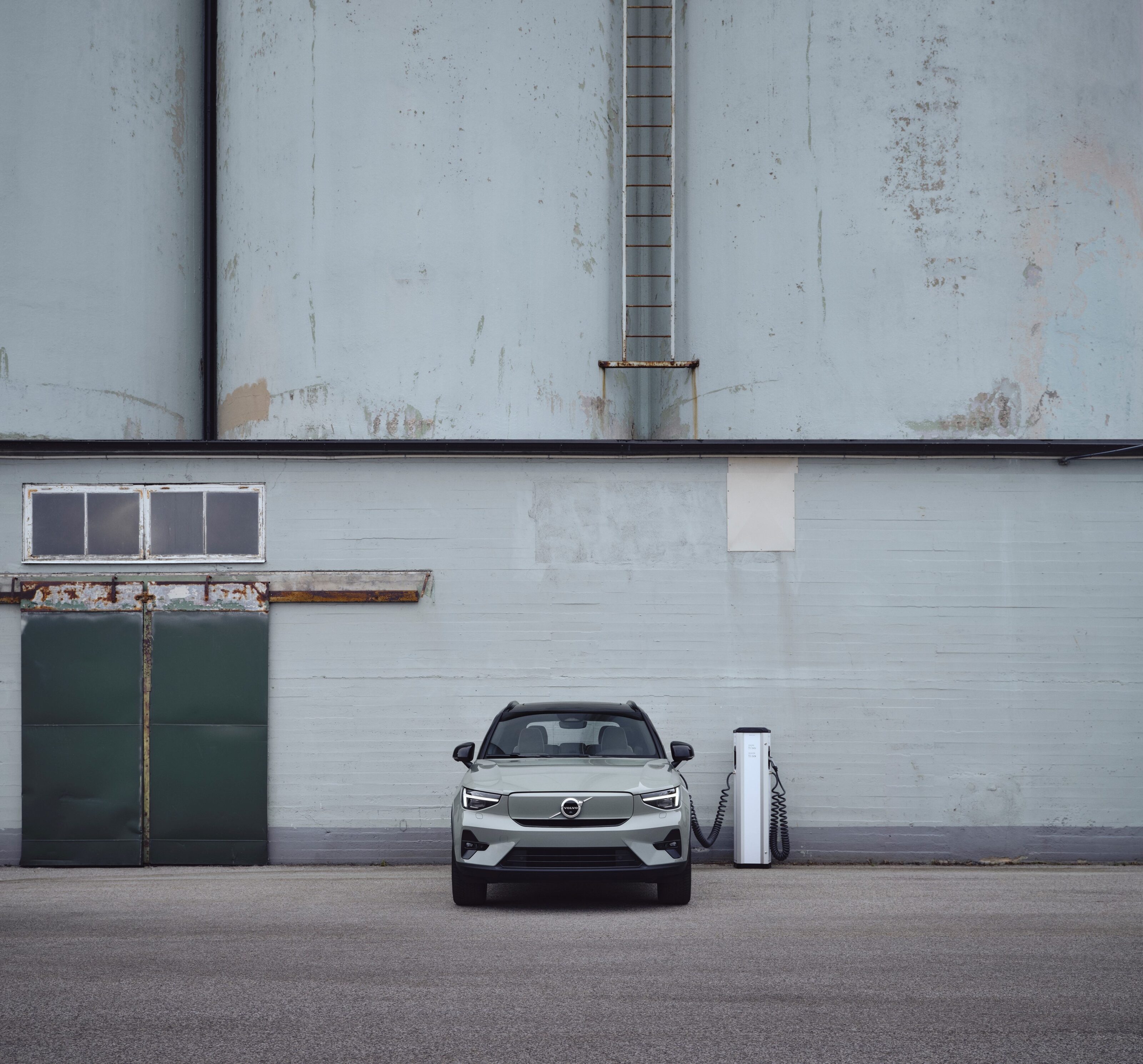
Instead, every new Volvo sold by 2026 will be powered purely by electricity, with the Swedish brand planning to launch five new electric models in Australia over the next five years.
The new EV-only mandate also means Volvo’s Australian arm has one-upped the Swedish brand’s global mandate, which is to be fully electric by 2030 and entirely carbon neutral by 2040.
“Our global strategy is that we will be fully electric by 2030,” said Volvo Australia boss Stephen Connor at the local launch of the Swedish brand’s second EV model, the C40. “The biggest thing that’s come to mind for us is we don’t have to wait for global…
“We’ve agreed on a local level in Australia that we’re not going to wait for 2030. I’ve put a proposal to Gothenburg the other day and we will be fully electric by 2026 in Australia.”
1
Connor says Volvo Australia sees an opportunity to not only completely eradicate its tailpipe emissions, but to rapidly grow its sales to from 12,500 units annually to 20,000 by capitalising on a sizeable shift in consumer sentiment towards electric cars.
“I actually think the Australian consumer is ready for the change,” he told us. “If you look at the facts, Tesla will sell 20,000 cars this year [in Australia]. I think people want to see the revolution.
“My personal opinion is the market will be crowded by 2030. The acceleration of change is happening so fast that it will actually only get faster. If we wait until 2030, we’ll lose the march on our competitors; I think we’ll lose market share. If we go for 2026, we will gain market share and get the early adopters.”
Making a land grab for buyers in the booming electric segment is a key driver behind Volvo’s strategy and Connor is confident it will catch some of its key rivals napping.
“I’m planning that by 2026 we will sell 20,000 units, have 2 percent market share and be fully electric,” he said. “We’re going to sell 12,500 cars this year, so that growth isn’t huge. What is huge is our current Recharge [electric] share is 30 percent roughly, but we’re going to switch to be full electric. That’s the transition.
“Production and supply will start to improve; within two years the whole world will be back to normal and the ones still tinkering with diesels and the odd ICE car, then I think they’re the manufacturers that will be struggling.”

1
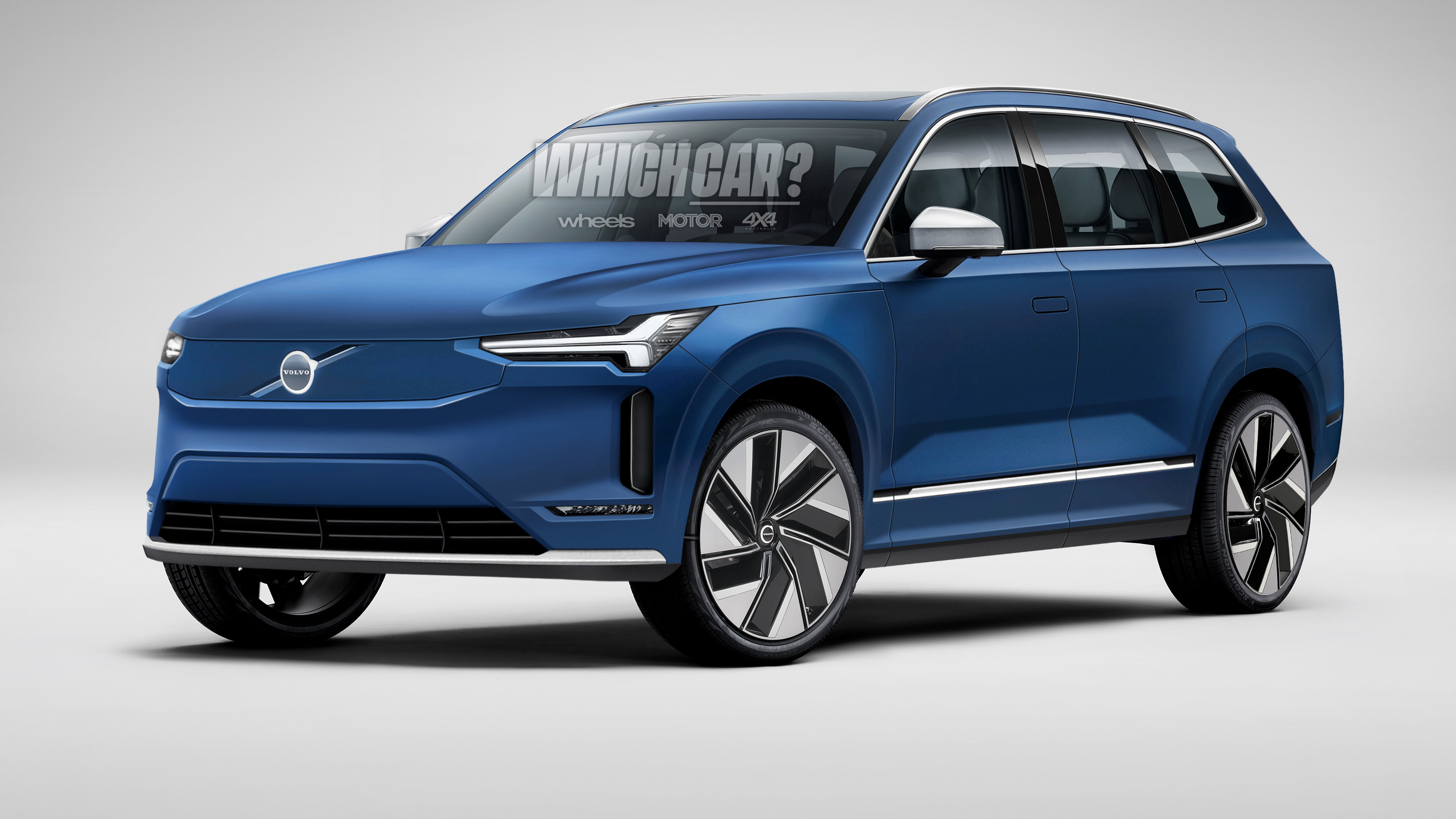
Already confirmed in Volvo’s EV pipeline is an electric version of the seven-seat XC90, dubbed EX90, which is due to start production next year. A smaller SUV, likely to be called EX30, is also planned, as is a battery-powered large sedan. The final model to make the switch from combustion to pure electric will be the mid-size XC60.
“I’d like to say to you today that it will be by December 2025,” added Connor after he was asked when the full transition to an EV only line-up will be complete. “I’d like to believe we’ll get the supply by 2025 but that’s why we set 2026, because today I’m confident we can do that.”
“Even if it’s 2026, that’s still four years ahead of global, and in some instances that’s nine years earlier than some of our competitors. I think some of our competitors will hear this and bring their plans forward, so it’s a race to get there.”
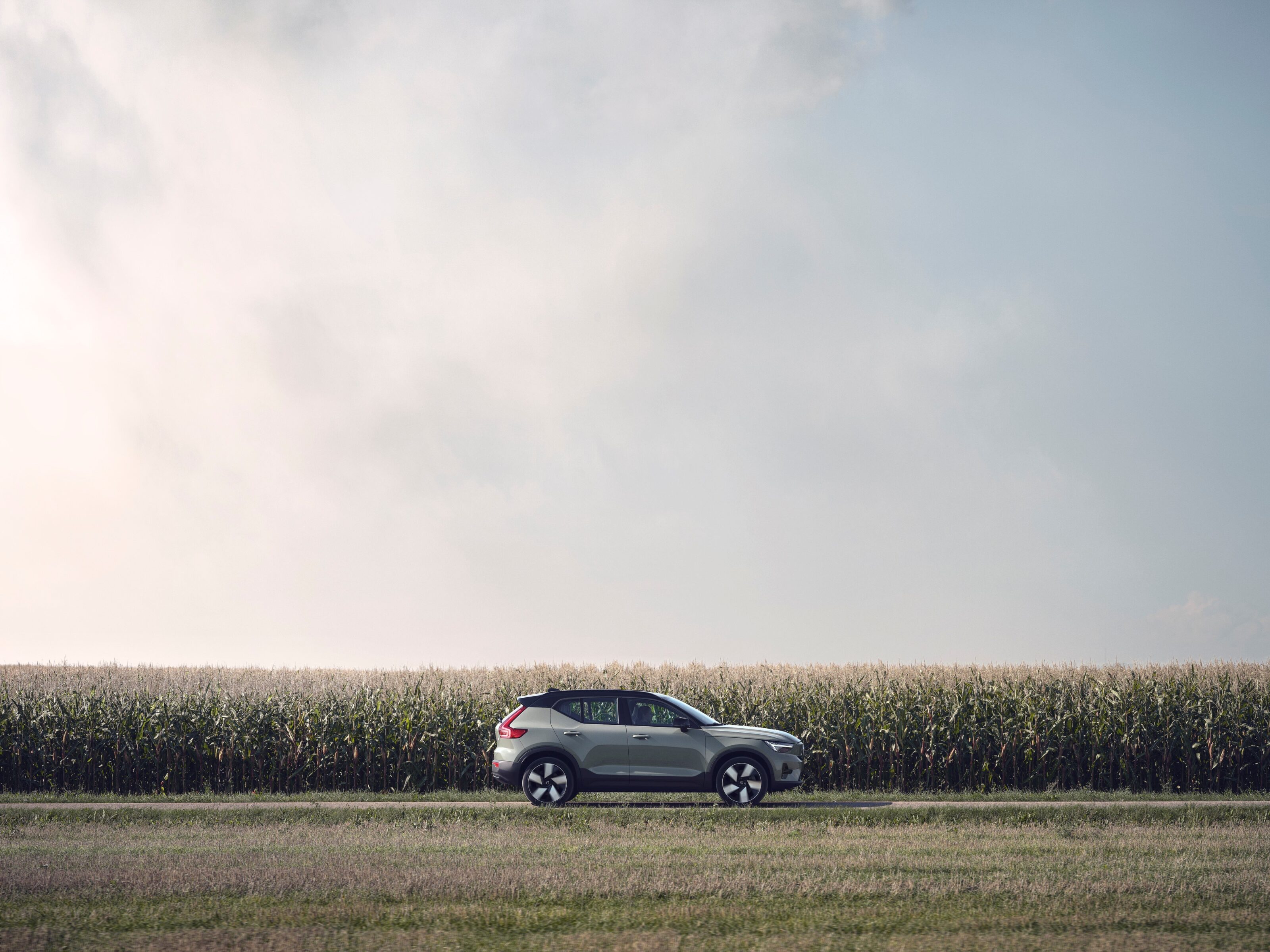
Helping bolster Volvo’s vision is the fact that it’s already enjoying booming sales of its current electric models, the XC40 Recharge and the newly launched C40. Currently, the brand has 1600 backorders for the XC40 Recharge and it’s tipping it will sell 5000 battery-powered models next year, meaning it’s fast approaching the point where it will sell more electric cars than combustion models.
“If we don’t [sell more EVs in 2023], then it will be the following year,” said Connor.
“We’ve ordered 3450 XC40 Recharges and 1550 C40s for 2023. That’s 5000 units, so that’s close to 40 percent of our mix next year. But we’ve asked for more…”
1
Actually making the switch to an all-electric line-up, however, isn’t as simple as it sounds
Not only will Volvo need to secure strong supply, which is a challenge when global demand for electric models is so high, but it needs to sell the idea to a nationwide dealer group that currently makes a nice living selling combustion cars.
“Coming out with the strategy is one thing but we have to work very hard on the operational implementation,” Connor acknowledged. “Next year we’ll make sure every one of our retailers will have a fast charger which will be free to every customer. We will make sure our customers will also have free coffee so they will have the ability wherever they are to stop off and get charged. And hopefully early next year we’ll announce some other partnerships to help support that.
“What I will say is change is confronting at the best of times. It doesn’t matter who you are or where you’re from. They [the dealers] will experience a level of discomfort because there’s change afoot.”
“One day they were great at selling ice cars and diesel cars, now all of a sudden we’re going fully electric. But all we’re doing is bringing it forward by four years so they already knew the deadline was there but again this pace of change is unbelievable.
“But we’re not saying to them that this stops your business model, you have to close your doors. What we’re saying is it’s a new way of working, let’s be bold. There’s still 20 million cars on the road so they’ll still need to service cars – and that will continue for the next 30 years, probably even longer, so there’s still that profit opportunity.”
Despite Connor’s optimism, it’s possible the transition could be a tough sell. Especially as Volvo admits it fully expects it will lose some customers who aren’t ready to make the jump into a pure EV.
Prices are also likely to rise.
Part of Volvo’s product plan is to simplify its model ranges and offer a single, highly-specced variant that leaves customers only two key choices: whether they want one or two electric motors, and which colour to go for.
“Simplicity is really where we’re headed,” said Connor. “As you’ve probably seen with S60 and V60, we went down to one model and that didn’t harm our sales at all. Actually the feedback from consumers is “I love it, now all I have to choose is the colour.” And even then we won’t have 100 colours, we’ll have four or five colours.”
But with Volvo’s current electric models being the most expensive in their respective ranges, moving to EV-only means the price of entry will undoubtedly spike. A combustion-powered XC40, for example, starts at $52,990 – but the more richly equipped XC40 Recharge is priced from $72,990.
“Inevitably, when you come out with a strategy like this, you will lose some customers – but that’s okay, because maybe Volvo isn’t right for them either,” said Connor.
1
“I don’t want to prove to everyone that Volvo is right for everyone. What I’m saying is for Volvo and Volvo customers, we know today 40 percent of our CO2 emissions come from the tailpipe, so if we do nothing that’s not acceptable either. So actually what we’re doing is we’re turning around and saying ‘by cutting 40 percent of our emissions, we’re actually making a difference to the world’.
“I know that sounds grandiose and it’s not meant to be, but we are making a difference. And when you roll it out to our steel production, 95 percent of our steel work is coming from carbon neutral companies. Then you roll it to our retailers who will be fully carbon neutral as well, so absolutely we’re making a difference.
“So to those customers I’ll say to them “great, there’s still some beautiful brands out there that will absolutely sell you a combustion car, and feel free to do so. For those customers who are more climate neutral orientated, then we’re the brand for them. Everyone is on this journey in different levels.”
So it’s a bold statement of intent from Volvo. Whether it can deliver in a world plagued by rising production costs and shipping delays remains to be seen but Connor is convinced the opportunity is ripe for Volvo to attract customers that may have been considering other brands, including Tesla.

1
“On a personal level, I love Tesla, because they revolutionised the way we think,” he said.
“They’ve done all the heavy lifting. So why wouldn’t you piggy back off the good work they’ve done? You can’t deny they’ve done a great job. They’ve changed how people think about battery electric and that’s absolutely going to help us.
“So we will actually ride off the back of Tesla. I also think as well, the great thing about Tesla is people bought a Tesla because they were early adopters. Now they’ve adopted, they’ll start to look out and see what else is there and start to migrate to other brands because they weren’t there before. So that’s where we get to steal the march and take the lead.”
MORE
Everything Volvo
