
We think you’ll agree that 2020 has felt that little bit longer than usual. But in many other ways: the fact that it’s almost Christmas feels just as surreal as many other of this year’s moments.
If you’re scrambling for gifts, or simply looking to treat yourself, here’s a handful of goodies that have been threatening our own wallets lately.
Eleven luckiest escapes of motorsport
1. BMW M Thermos – $49 – bmw.com.au
BMW’s thermos keeps your drinks hot and your hands cool with stainless steel, plastic and silicone construction. Measures 450ml and features M branding.

2. Mark Skaife Book – $45 – booktopia.com.au
Mark Skaife, one of Australia’s most successful racing drivers, details his career and life in this 300-page hardcover.

3. Alpinestars Boot – $500 – revolutionracegear.com.au
Alpinestars has brightened up its Supermono race boot in a limited edition Lando-like orange. Available in most sizes and has the FIA tick of approval.

4. F348 Watch – $450 – fuoriserie.co
Sydney-based company Fuoroserie uses a Ferrari 348 TB’s doors for a limited edition 42mm watch dial. Powered by a Japanese Miyota quartz movement, they are limited to 150 pieces.

5. Lambo Bike – $25,000 – totalrush.cc
Cervolo’s unveiled the Lamborghini Aventador of bikes. The Canadian-Dutch maker’s put its R5 in the Aventador SVJ’s camouflage when it stormed the ’Ring in record time. Only 63 will be made, featuring Campagnolo, Deda, Fizik and Vittoria bits.
2019 Lamborghini Aventador SVJ vs Ferrari 812 Superfast comparison review

6. Mazda MX-5 Tee – $50 – garage79.com.au
Represent Mazda’s fourth-gen MX-5 with this Garage 79 custom tee design for MOTOR reader Randy Navarra.

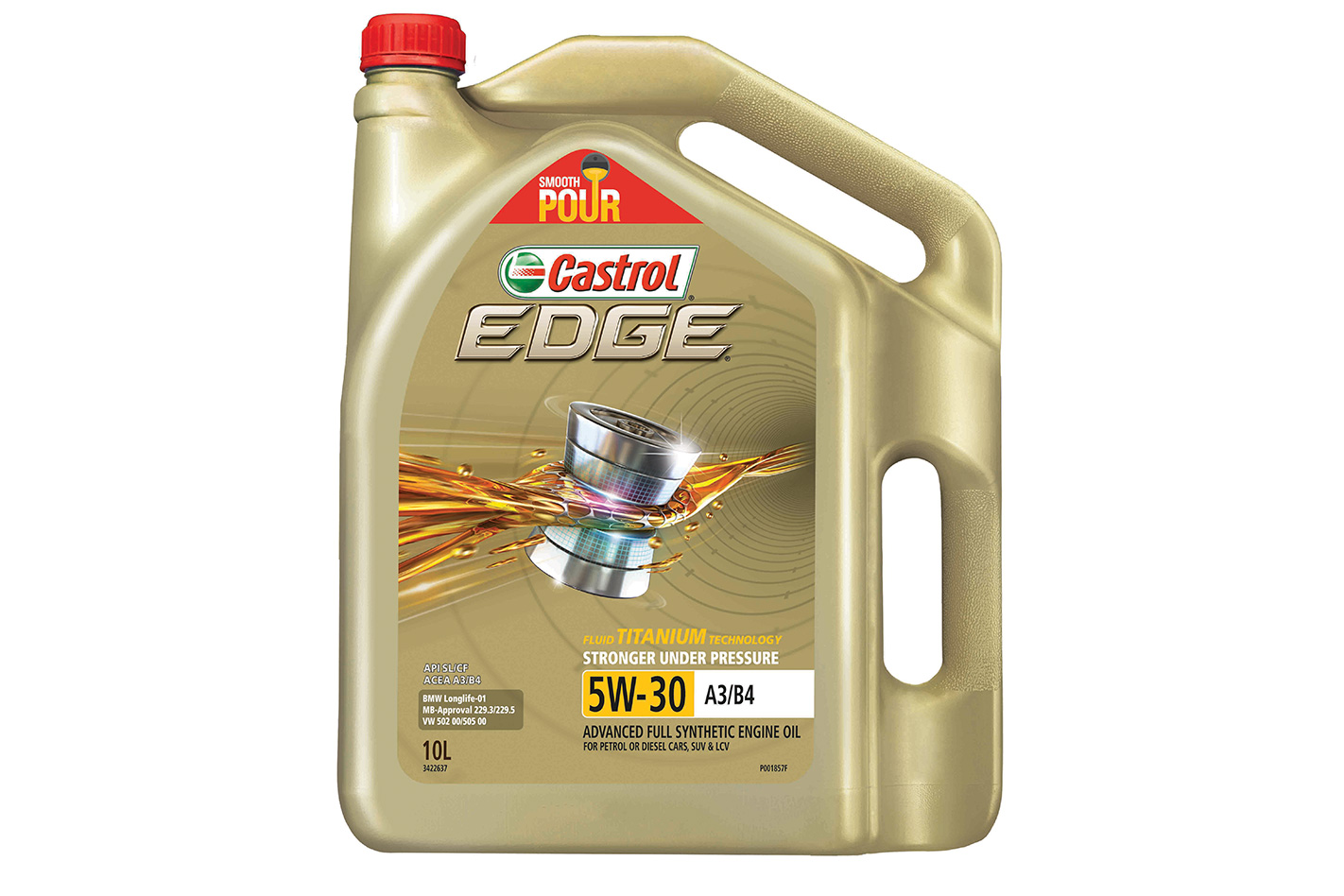
7. CASTROL edge – $127 – castrol.com.au
Keep your baby’s motor running its best with Castrol’s full-synthetic Edge oil. Now in a 10L bottle with smooth pour technology.
Sign-up here for your free weekly MOTOR report
General Motors will recall almost seven million vehicles after America’s road safety authority refused its appeal to be excluded from replacing potentially dangerous airbags.
The National Highway Traffic Safety Administration (NHTSA) rejected GM’s petition to avoid the recall, citing multiple concerns about research lodged by GM to prove its cars are safe.
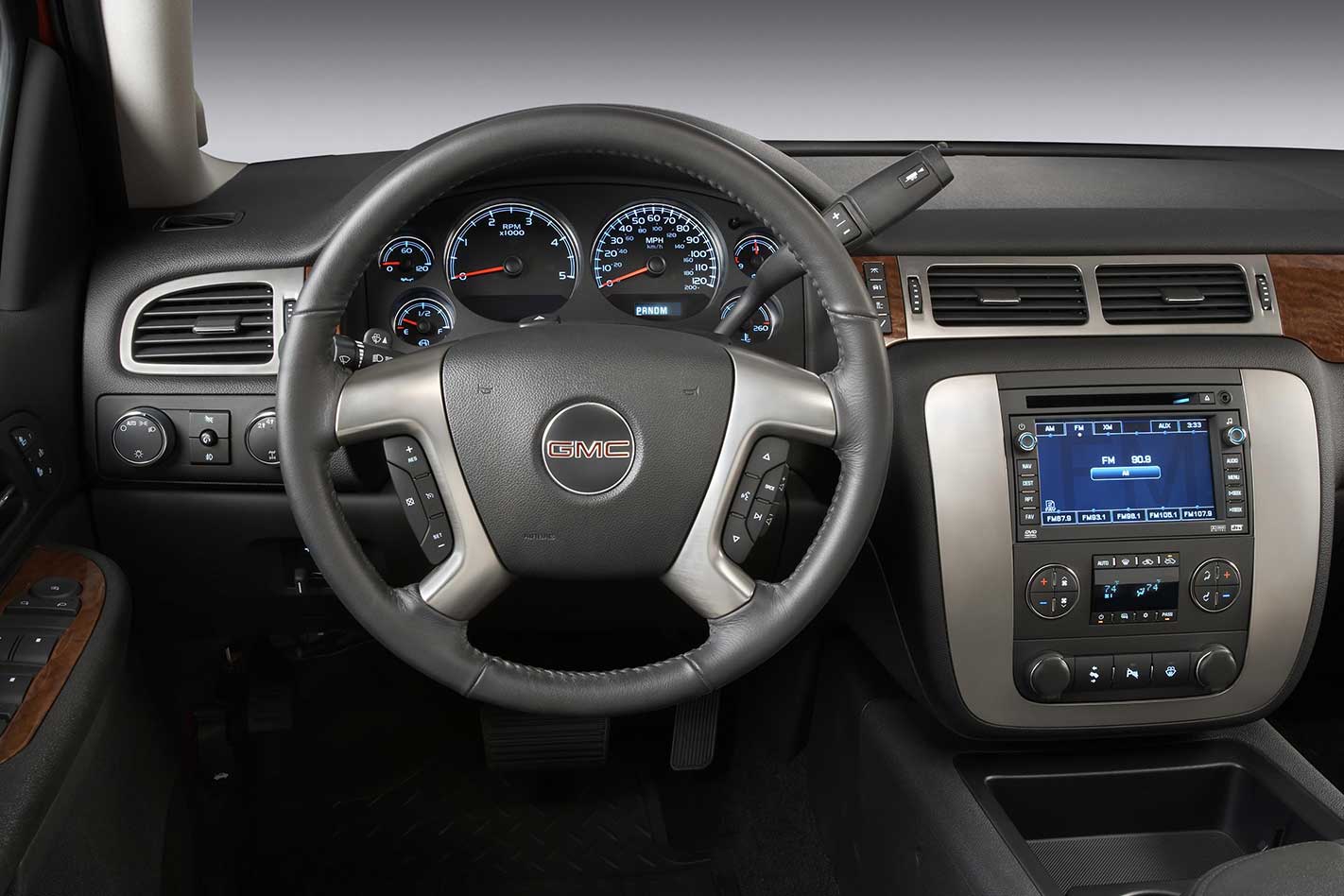
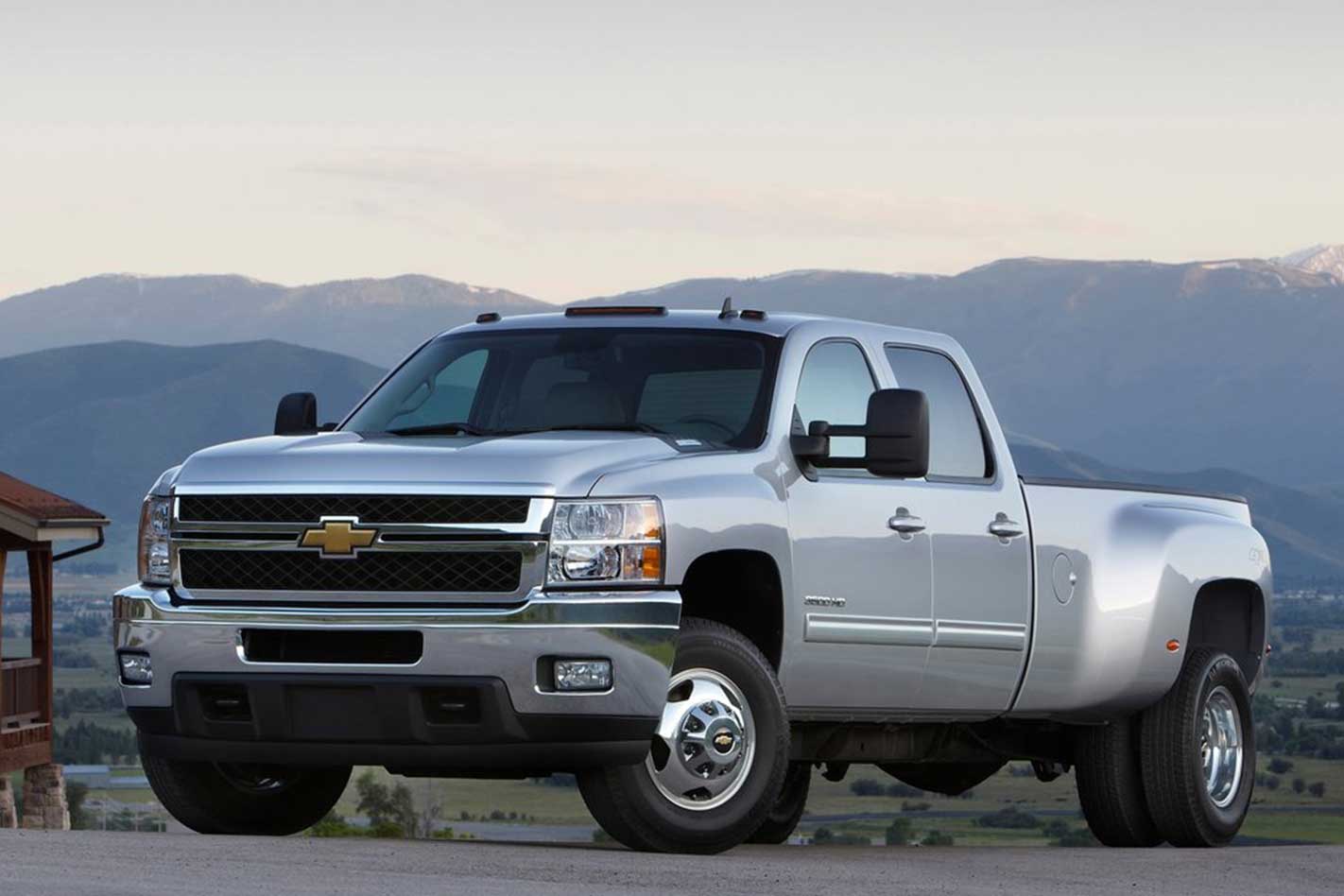
These include the Cadillac Escalade, Chevrolet Silverado 1500, 2500 and 3500; Chevy Suburban and Tahoe; GMC Sierra 1500, 2500 and 3500; as well as the Yukon and Yukon XL.
A recall has already been in place for 2006-2008 Silverados and Sierras.
None of these vehicles have been imported into Australia through official channels, General Motors Specialty Vehicles tells WhichCar, but says it will supply airbags free of charge to repair any cars that have been privately imported with faulty airbags.
“The safety and trust of those who drive our vehicles is at the forefront of everything we do at General Motors,” a spokesperson said.
Grey-import companies are not bound to the same level of marketing about potential recalls, according the Product Safety government website, but they at least must contact owners.
In Australia, companies like Performax International, Overseas Vehicles Sales and Victorian American Imports are listed as importers of affected GMC Silverado and Sierra models.
We’ve asked for comment on how many of these affected vehicles may be in Australia.
While GM’s new recall will be relatively small in Australia, it’s reported GM will have to shell out $1.2b (A$1.63b) to address it on a global scale.
Potentially explosive Takata airbags have driven the largest vehicle recall in history, with over 100 million cars fixed worldwide.

Takata filed for bankruptcy back in 2017 and at least 30 deaths have been attributed to the faulty airbags.
A propellant used to inflate the bags degrades over time and in humid conditions, potentially destabilising the airbag detonation.
This has led to airbags projecting deadly fragments at occupants.
Australia has recalled three millions cars as part of the global push but there are still thousands of cars on the road with defective airbags.
Recently, the scope of the recall has been widened after deeming a new type of airbag to be dangerous.
This comes only months out from the deadline for manufacturers to have rectified all cases by December 31, 2020.
Head to ismyairbagsafe.com.au to check your vehicle.
Introduction: Welcome to Subaru’s hybrid era
Update two: Serious kilometres
Update three: All-terrain or all talk?
Introduction: Welcome to Subaru’s hybrid era
ODO 1011km
Distance driven 15km
If hybrid powertrains were a school camp swimming pool, Toyota’s Prius would have been the kid who ran straight up to the 10-metre board and bombed in before anyone else has barely finished pulling on their boardies.
At the other end of the pool, however, and some considerable time later, Subaru was quietly wading into the shallowest part and trying not to make too much of splash.
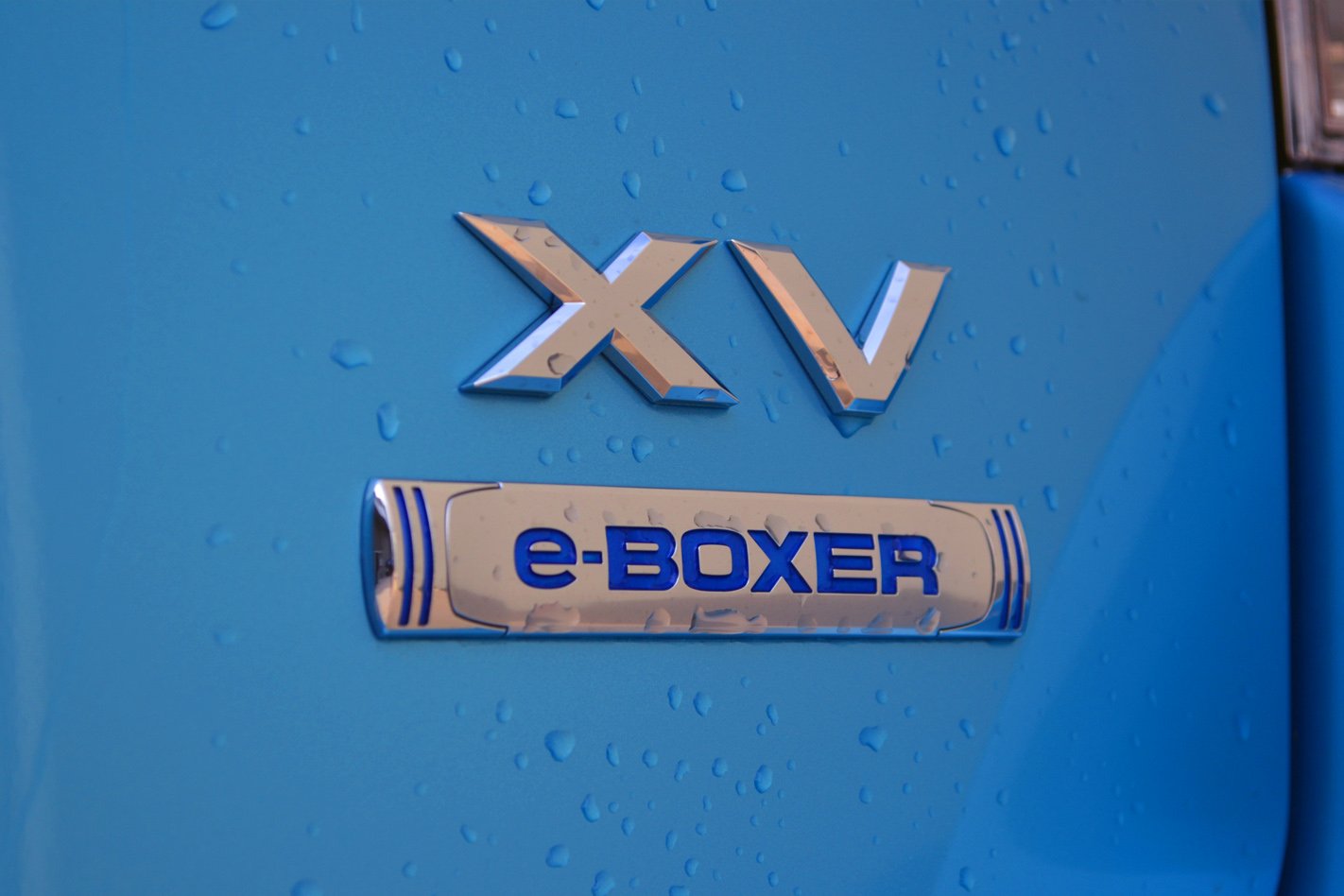
While Toyota is unequivocally the vocal early adopter of hybridisation, others such as Subaru have taken longer to dip a toe in the water. Neither is necessarily the right or wrong entrance as long as you stay afloat once you’ve taken the plunge, right?
Toyota and a handful of others have laid the ground for hybrid cars, building public interest along the way, but now other brands are getting in on the action. Has the delay been a disadvantage to Subaru or has the Japanese brand swooped in at exactly the right moment?
That’s what the next few months with the Subaru XV Hybrid are all about – Subaru is a relative latecomer to the electrified car world but it has recently made its debut with the Forester Hybrid and XV Hybrid.
We want to see if those years abstaining from hybrid models has allowed the company to watch from the sidelines, learning from the earlier adopters and the market’s response to them.
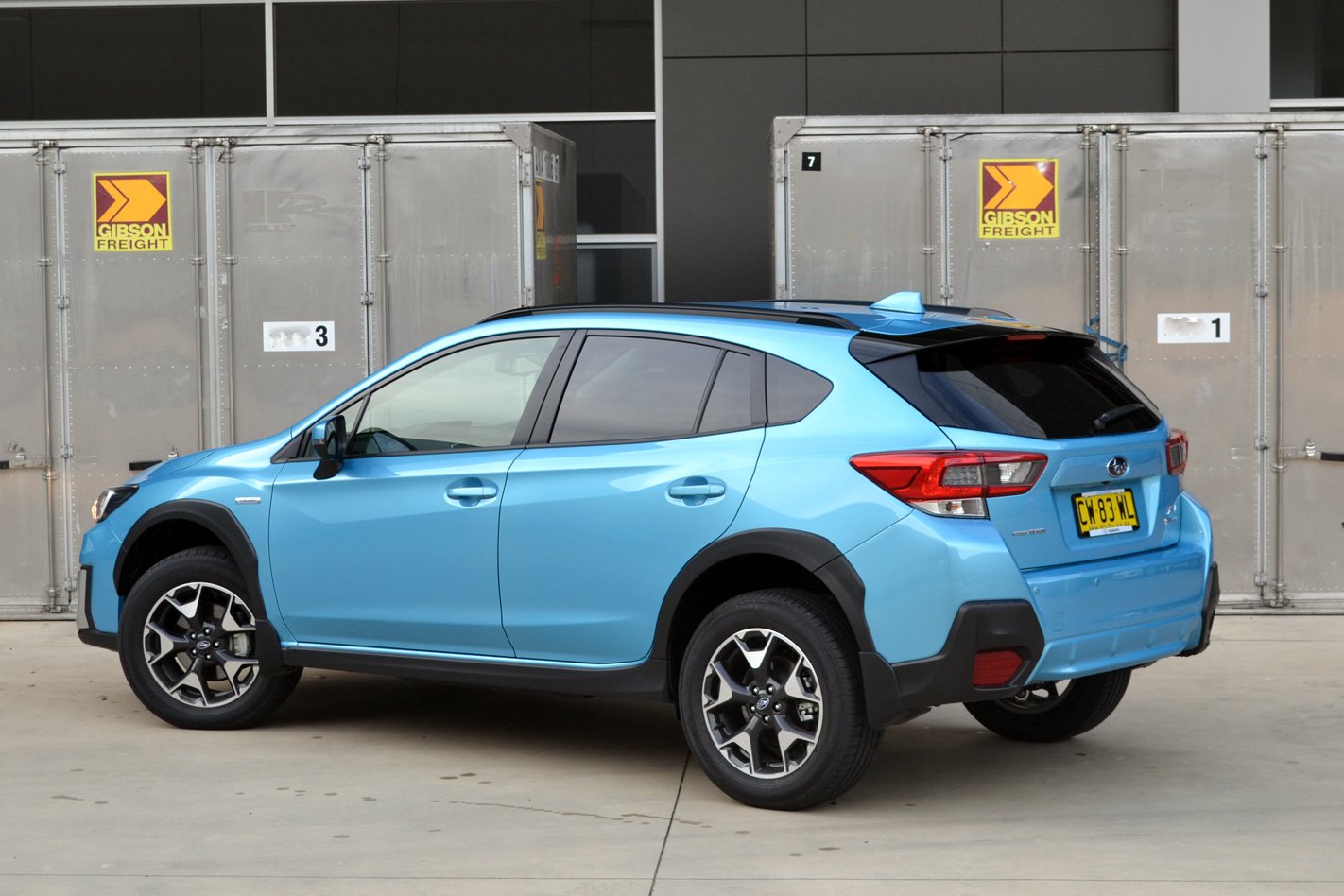
Is the XV Hybrid a well-executed and refined addition to the growing hybrid fleet available in Australia, or a benign first attempt that has some catching up to do? Let’s find out.
XV Hybrid – what you get for your cash
If you want to get the lowdown on the XV and all the reasons we rate it in ‘standard’ form since it launched in 2017 you can read all about it here, but let’s cut straight to what makes this new version unique and our focus over the coming months.
Its most obvious defining feature is, of course, the ‘e-boxer’ hybrid powertrain which takes the standard 2.0-litre naturally-aspirated flat-four petrol engine with 110kW and 196Nm and discreetly slots in a 12kW/66Nm electric motor in the transmission to boost the grunt sent to all four wheels via Subaru’s proprietary full-time four-wheel-drive system.
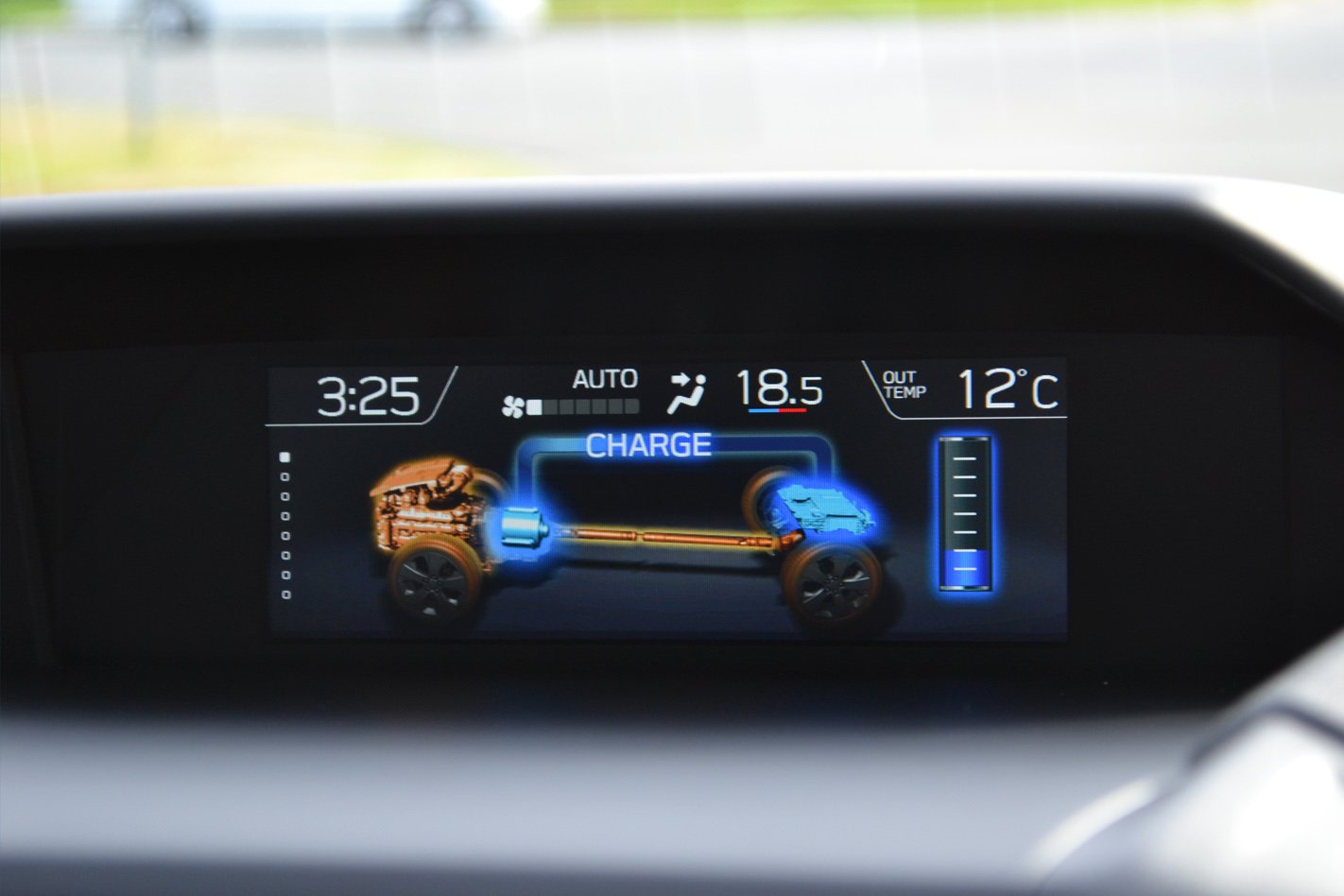
Its maker says the boost elevates the XV’s off-road ability in combination with the X-Mode driving selector, while chopping fuel consumption by about seven percent for an average figure of 6.5 litres per 100km.
Both are claims we will be testing during the XV’s tenure with the WhichCar team.
As far as specification goes, the XV is based on the mid-range 2.0i-L but the addition of the hybrid extras bumps the price up about another $4000.
It’s not quite that straightforward, though, as it also gains additional active safety features.
But even with its price premium, a $35,580 XV is still affordable and still brings a lot to the table.
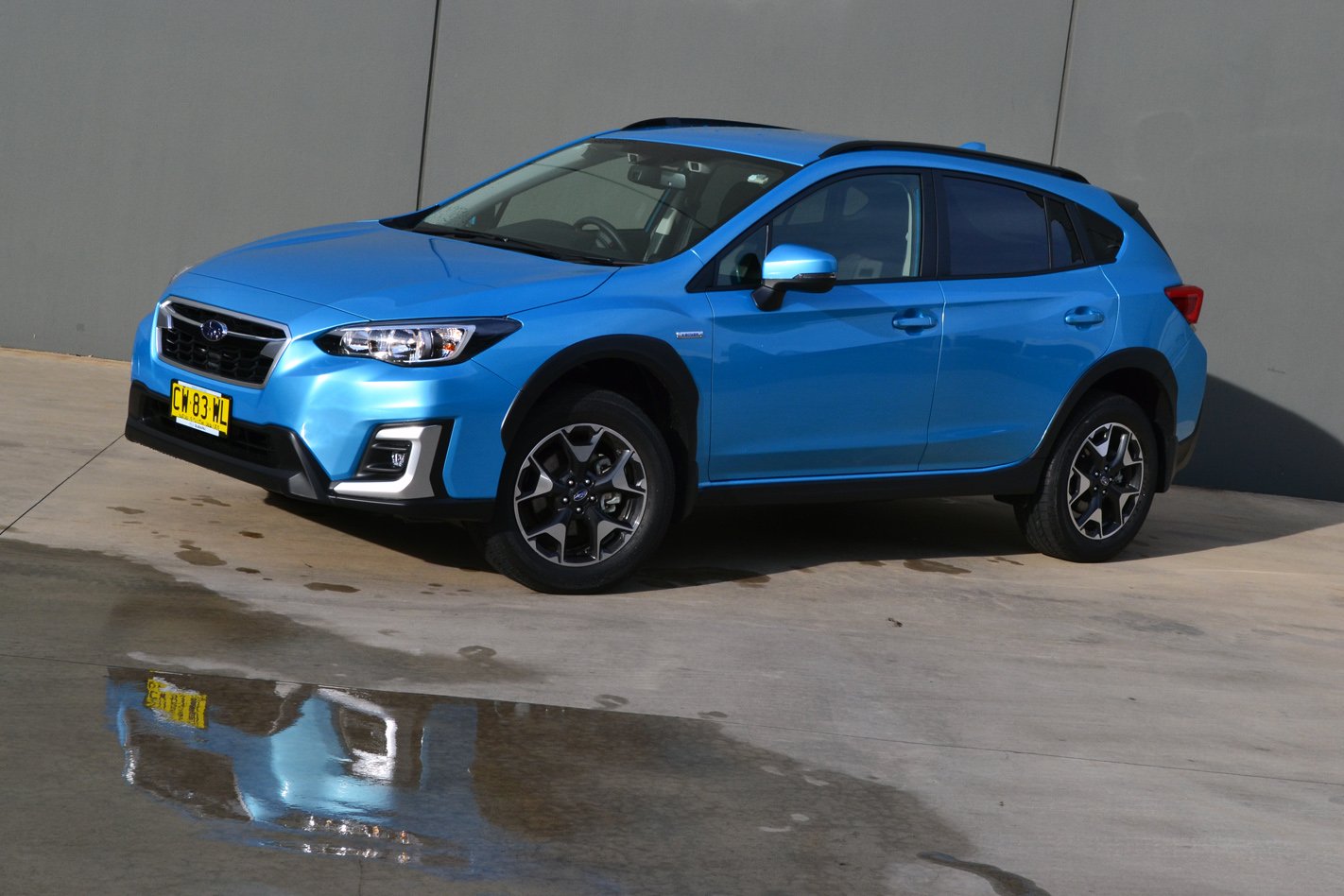
Beyond its subtle facelift and unique-to-the-variant Lagoon Blue paint, you might mistake the newest addition to the XV stable for any other, and that might be the unexpected genius behind Subaru’s hybrid foray.
A subtle enhancement of what was already an excellent package of car dynamics and wagon practicality paired with go-anywhere ability, could push this Subaru to the top of the pack.
While our first impressions of the XV Hybrid have been promising, the only way to investigate Subaru’s economy and all-terrain claims is time in the saddle. Let’s go.
Update one: quiet achiever
ODO 1538km
Distance driven 527km
Average fuel use 6.7L/100km
In its first few weeks in WhichCar’s garage, Covid-19 restrictions have limited the XV Hybrid’s duties to ‘essential’ excursions only, which were about as uninspiring as you can get.
Nonetheless, pedestrian, routine chores are still a part of daily life and definitely worth handing to the Subaru. After all, it’s a hybrid and that should mean it takes to mindless commutes and thankless grocery runs like a hypochondriac to hand sanitiser. And it has.
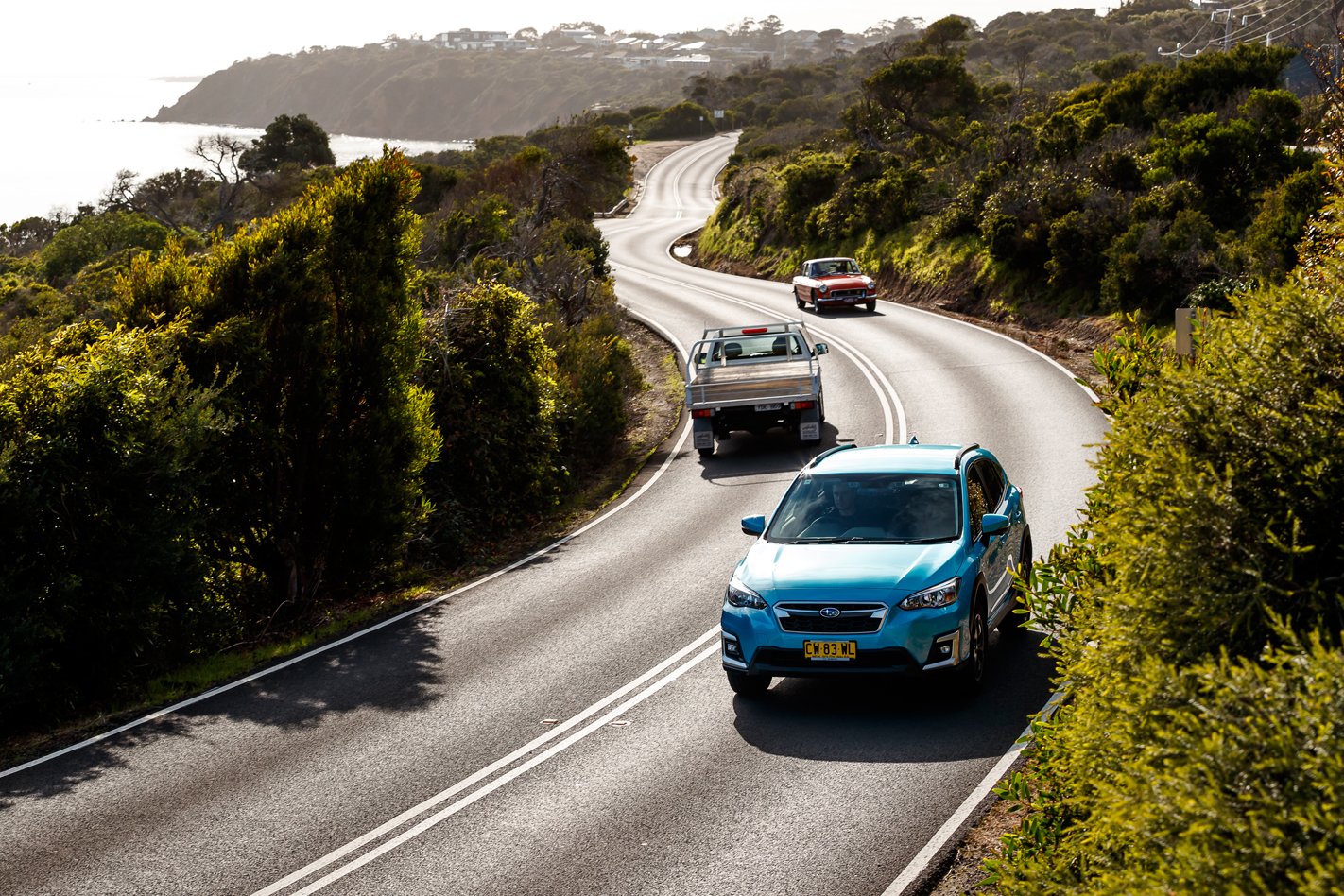
One of the XV’s talents is its ability to behave like a larger vehicle even though it occupies a small footprint.
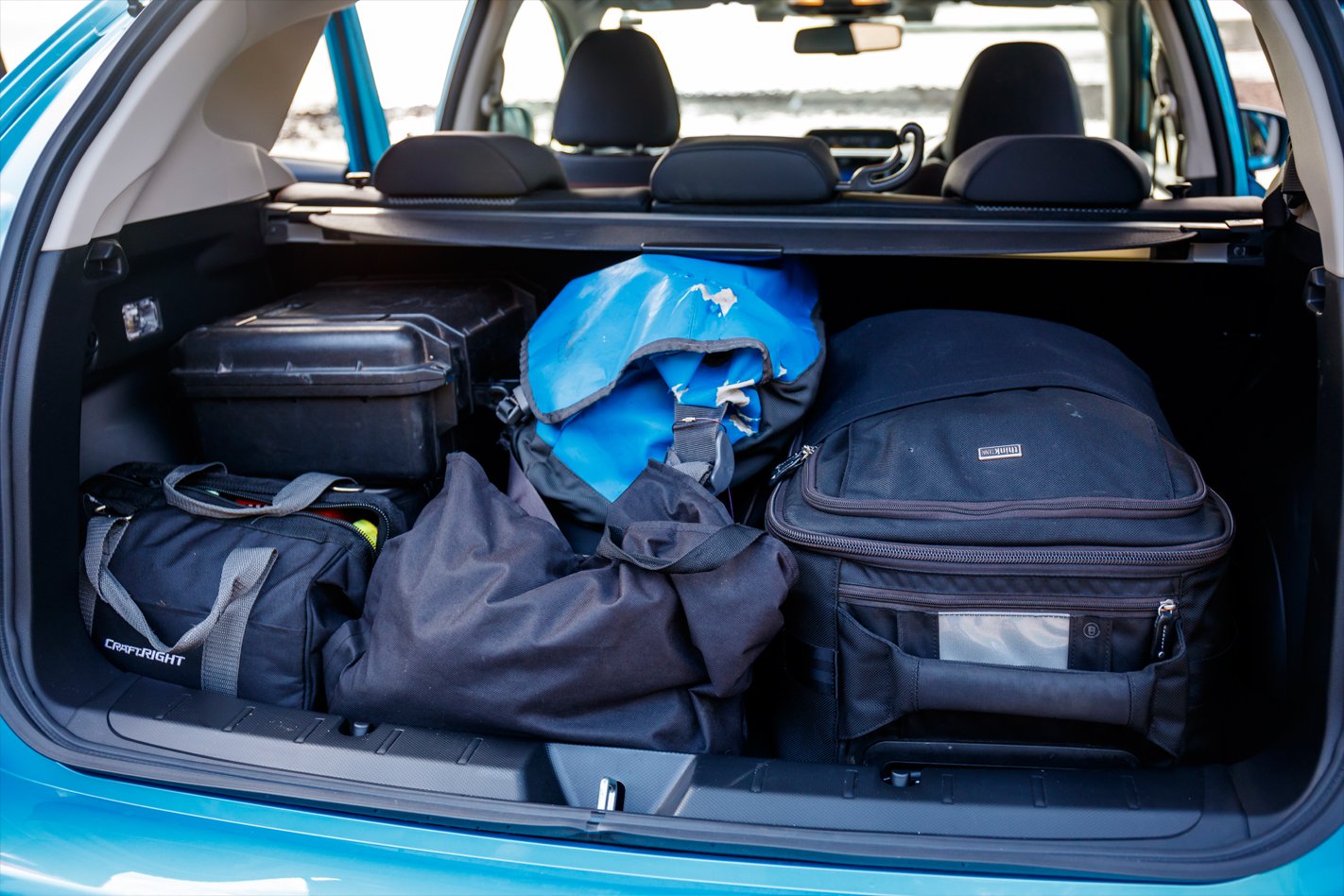
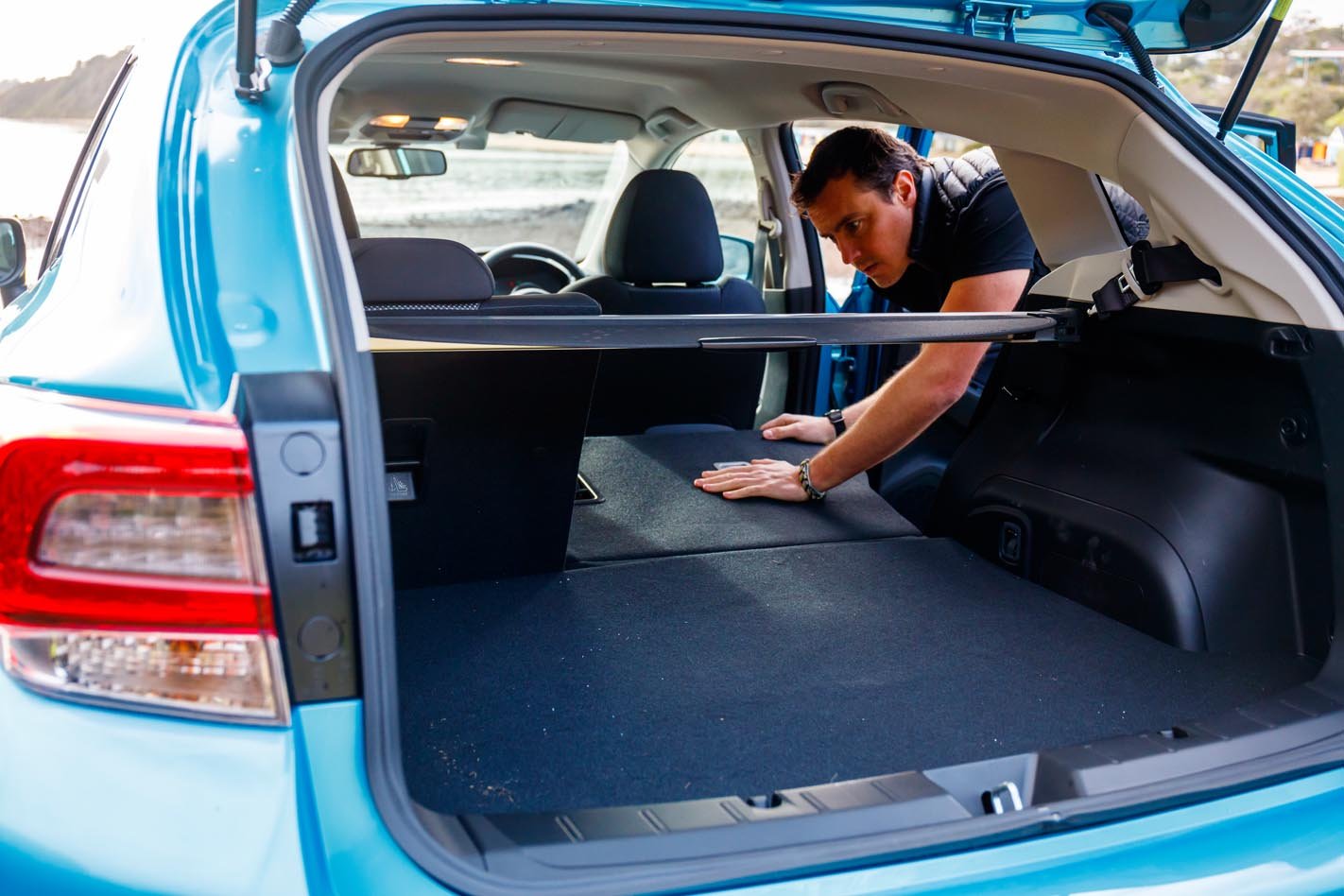
Cathedral-like headroom in both front and rear seating is great for a full load of adults, there’s a surprising amount of legroom in the back and the boot is not just a good size but, critically a good shape too (There’s little benefit to 345-litres of volume if it can only be occupied by long, thin items).
Luggage area capacity is unaffected in the Hybrid but spare wheel space is. With the lithium-ion battery hidden away under the boot floor, a full-size or even space saver wheel is usurped by a mobility kit.
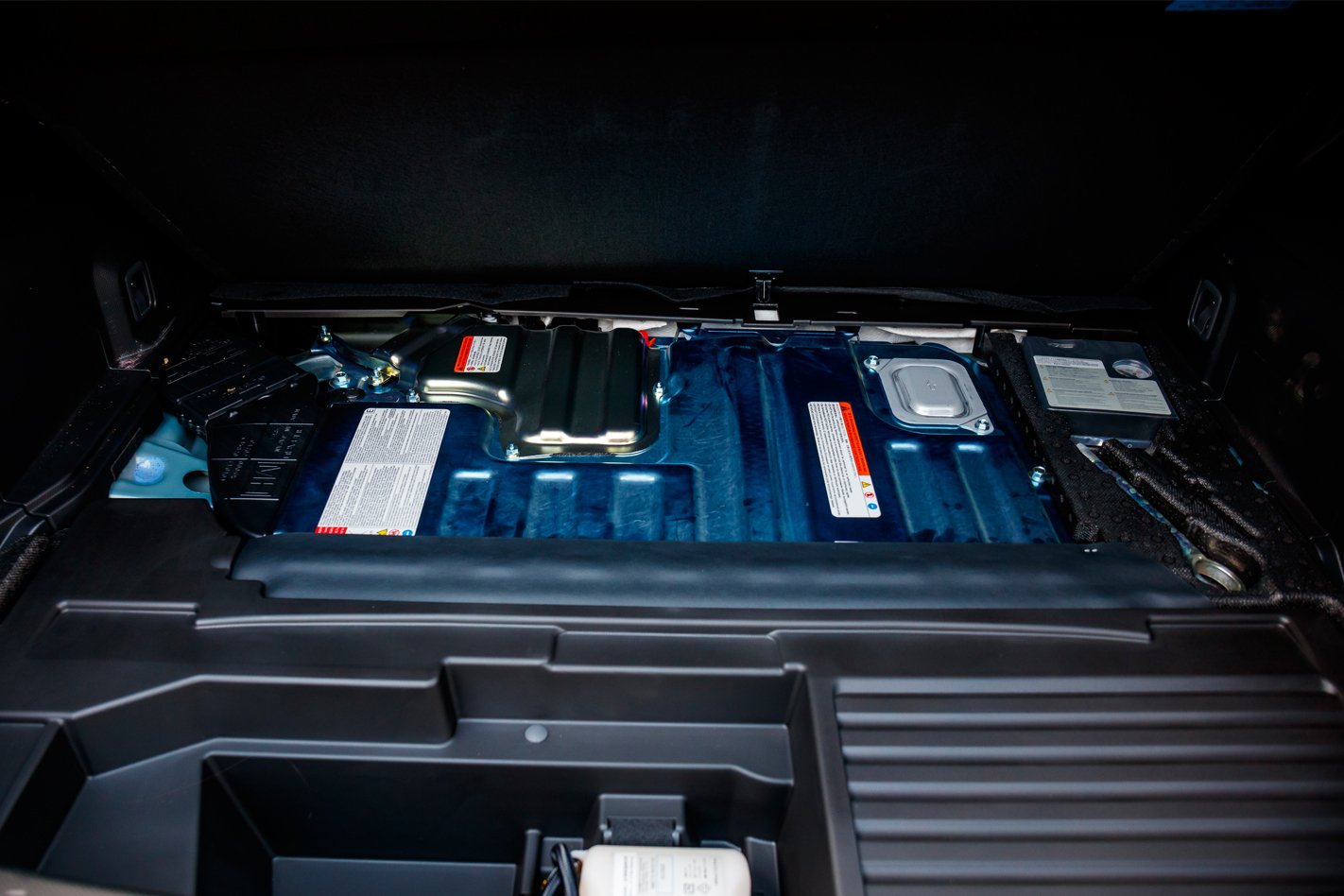
Day-to-day duties, therefore, have been a breeze and the Subaru has been a benign but not unlikeable addition to our garage.
Its hybrid powertrain has been a bit of a curio, though. I was hoping the addition of electric torque and smoothness to Subaru’s CVT automatic would perhaps refine the transmission.
Subaru’s application of CVT tech is one of the best but I’m still not the biggest advocate and there’s still room for improvement.
Strangely, the addition of an electric motor piggybacked onto the gearbox has confused it a little. Where the un-hybridised box is smooth, the transition from pure electric drive at walking pace, through to dual-power is sometimes accompanied by a jolt.
Driving smoothly at low speeds requires more concentration than you might appreciate as the electrical management decides what to do.

The extra 12kW intervention does contribute a small but noticeable boost to performance. Off the mark acceleration is adequate if not sporty.
The XV will drive under electric-only propulsion up to about 20km/h but only if you ask very little of it. Even a light prod of the accelerator or anything steeper than completely flat prompts the 2.0-litre boxer petrol into life.
Rival systems such as Toyota’s now-commonplace hybrid drivetrain allows more exclusively electric locomotion but that’s only possible with a bigger (heavier) battery and an engine (Atkinson Cycle) that is nowhere near as energetic as the Subaru’s once it starts to help out.
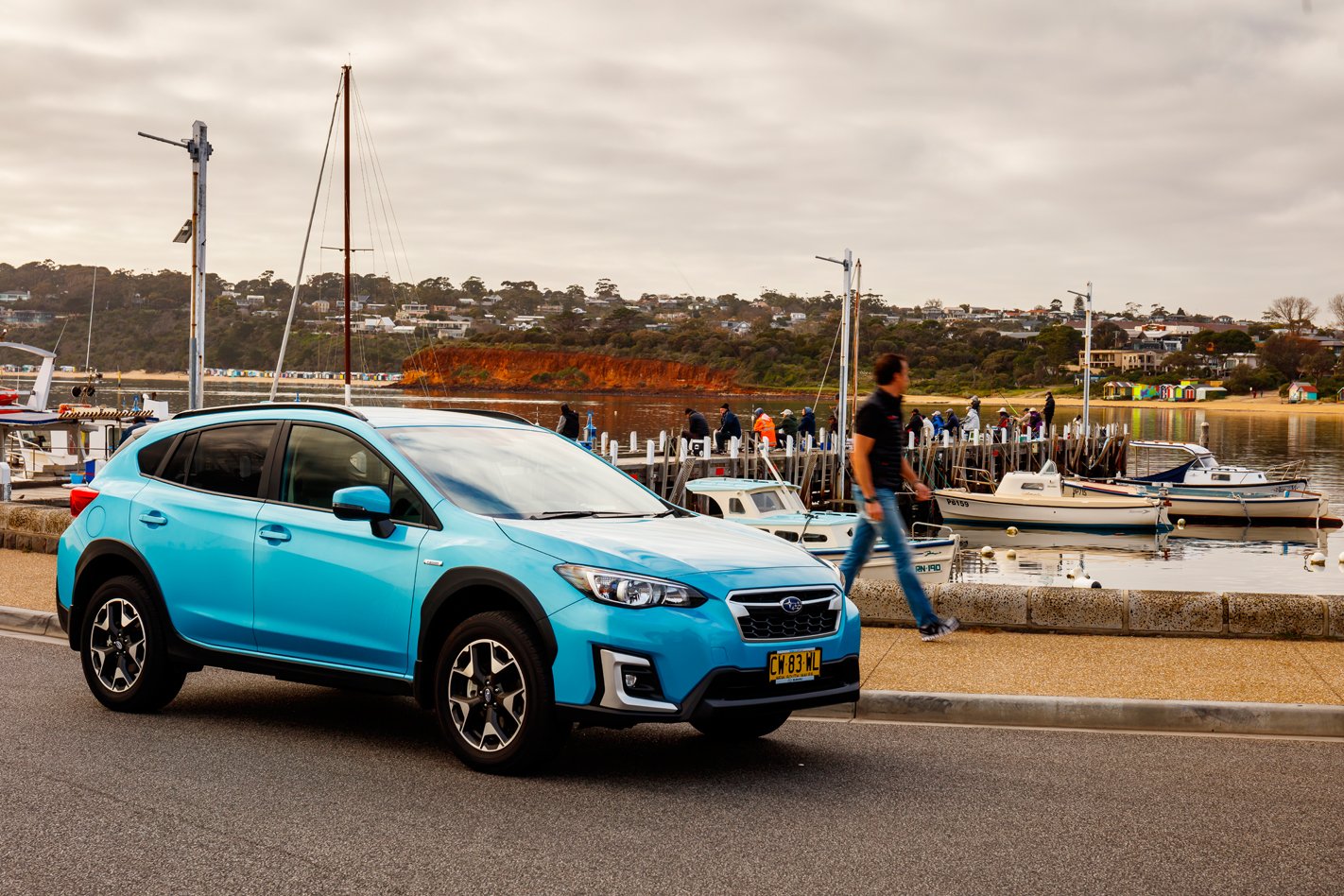
The efficiency gains are more enhanced with Toyota’s system but the impact on driving style is also more pronounced.
Put simply, the Subaru feels more like a ‘normal’ combustion-powered vehicle than almost any other hybrid.
As I had suspected from the start, Subaru’s first hybrid is almost unnoticeably subtle in its adoption of electrification and little, if anything, of the combustion-powered XV’s function is compromised compared with the hybrid. Except for visits to the petrol station.
Despite virtually undetectable electrical intervention, the hybridisation is definitely saving me trips to the servo, with an average fuel consumption not far off the claimed figure of 6.5L/100km.
Given a majority of its work until now has been notoriously inefficient urban crawls, 6.7L/100km is impressive.
Claims of about 10 percent fuel saving over the standard 2.0-litre versions appear to be substantiated, but Subaru also says the extra grunt offered by the electric motor has advantages when you steer away from the beaten trail…
Now that day-to-day life in Australia is gradually changing course and resembling something normal again, it’s time to stretch the XV’s legs and continue this review into more adventurous territory.
But I’m not sure ‘normal’ will ever return as we knew it before and, of course, this is no normal Subaru, so I’m looking forward to revisiting the definition of ‘essential’ and taking the XV Hybrid with me.
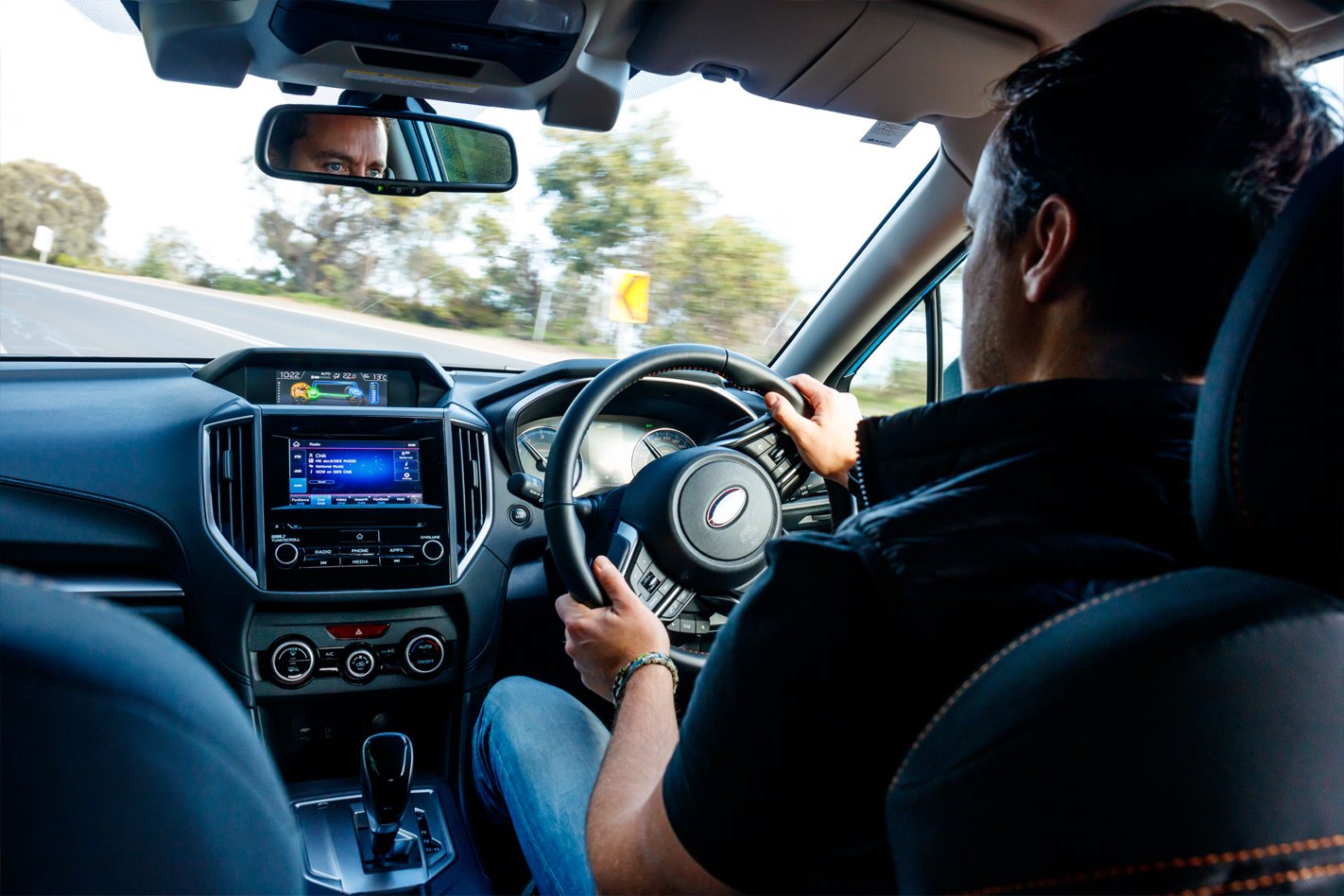
ODO 3690kmDistance driven 2706kmAverage fuel use 7.2L/100kmWith each instalment, these updates are feeling less like a long-term car review and more like ominous captain’s log entries and, as I re-read the final paragraph of update one, I am chilled by the significance and prophecy of my own words.When I wrote that last update at the start of June, the nation was nervously taking a sigh of relief as the coronavirus pandemic seemed to be loosening its grip and we were all looking forward to some relaxed restrictions to enjoy life again.
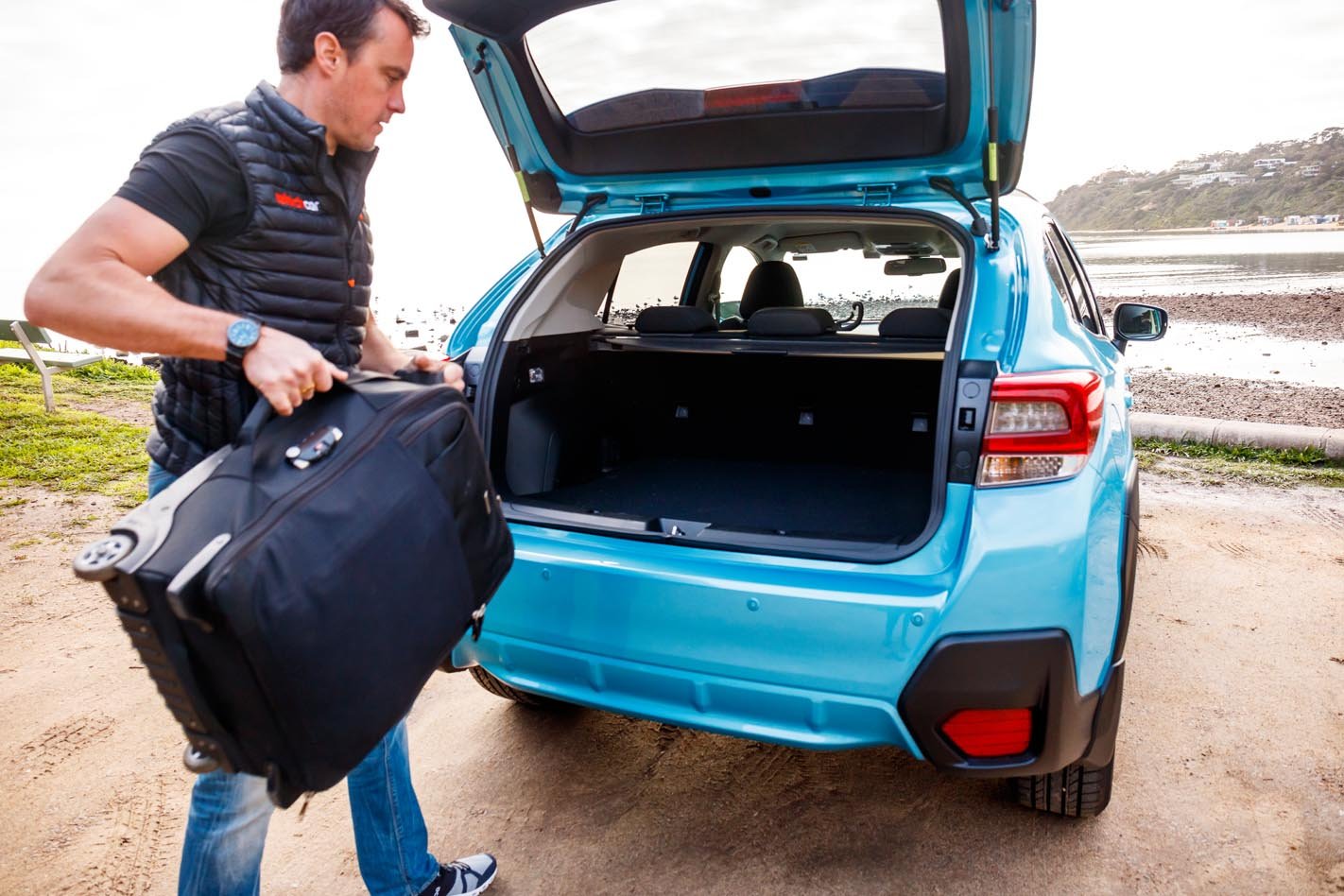
It was during this dark time that I issued the Subaru with its most important duty since its arrival in the WhichCar garage.With border closures looking increasingly likely, the possibility of seeing an imminent NSW arrival in the family was looking low, as well as the feasibility of several crucial TV shoots for the TV series.We made the call, packed the XV with everything we might need for an unknown period away from home, and headed north.
July 6, 14:00 – On the road
I should make it clear at this point that the borders were still completely open and our scheme bolting to make a crossing was completely legal, especially as we were travelling from an outer Melbourne suburb nowhere near one of the emerging ‘hotspots’.
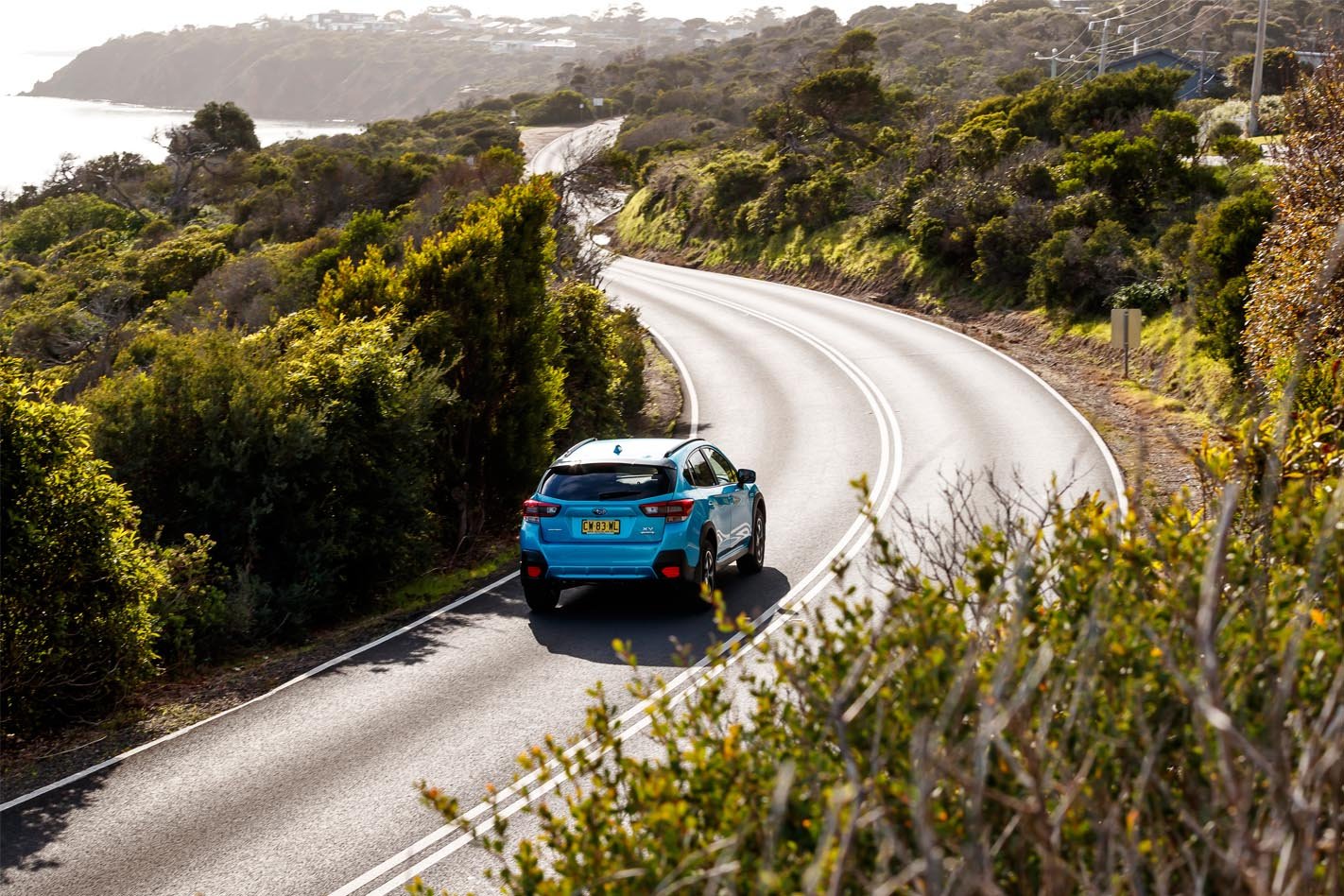
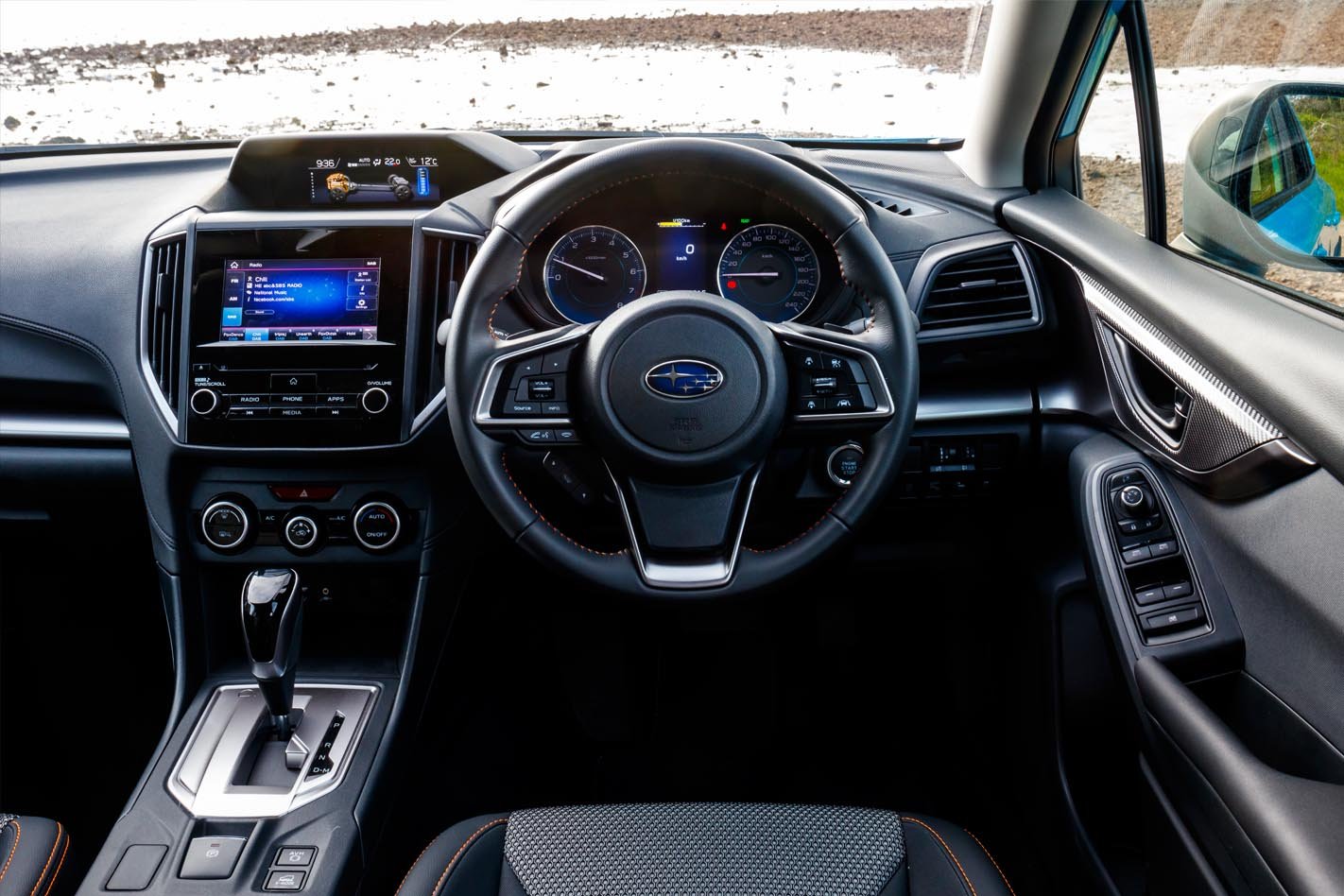
Adaptive cruise control was flicked on and left to its devices and, when it was disengaged, the lane-departure warning is among the least annoying only intervening on the rare occasion you may actually need an alert.
20:00 – Over the border
For long cruises out of town, including this milestone road trip, the combination of electric and boxer-four, the XV is perfect and we quietly sail into New South Wales at Albury just hours before restrictions kick in.
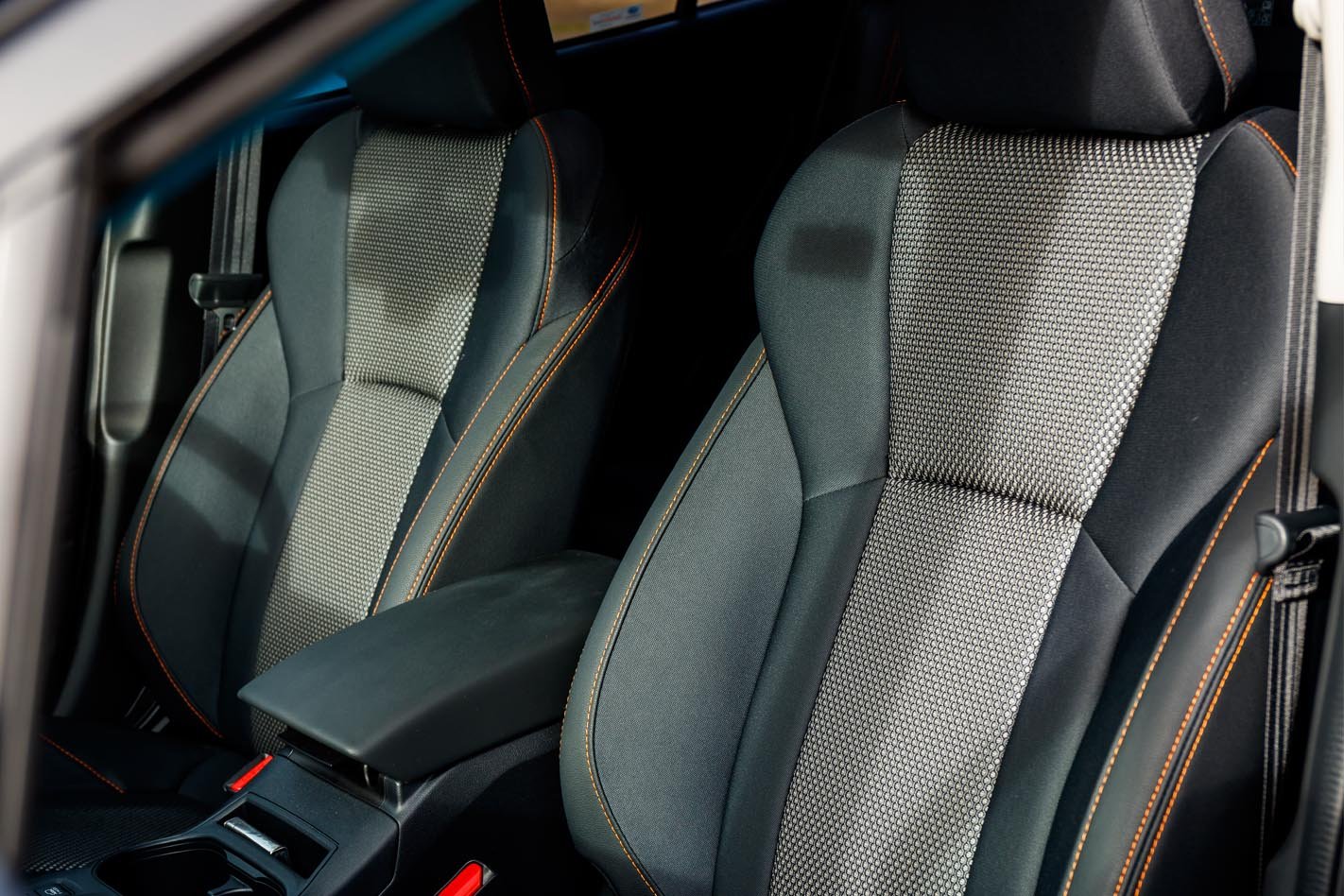
22:50 – Refuel stop #2
While the XV was reporting very respectable fuel economy, a second fuel stop seemed to suggest otherwise. Turns out the Subaru’s tiny 40-litre tank necessitates frequent refills on a trip like this.The upside is that you are never carrying a heavy load of fuel which would impact consumption as any heavy load would, but a slightly longer range would be an advantage.
Makes you wonder how much the extra weight of a motor and battery is impacting efficiency…
00:20 – Arrival
As the witching hour ticked over, we rolled into a leafy northwestern Sydney suburb and powered down the XV for the night. It doesn’t matter how many times you make the trip, the final hour is always gruelling.It could have been a lot worse, though. The XV had passed this test with flying colours. With surprising fuel consumption, excellent cruising comfort and the driver assistance systems to ensure a safe arrival, it had been a welcome companion on this spontaneous trip.
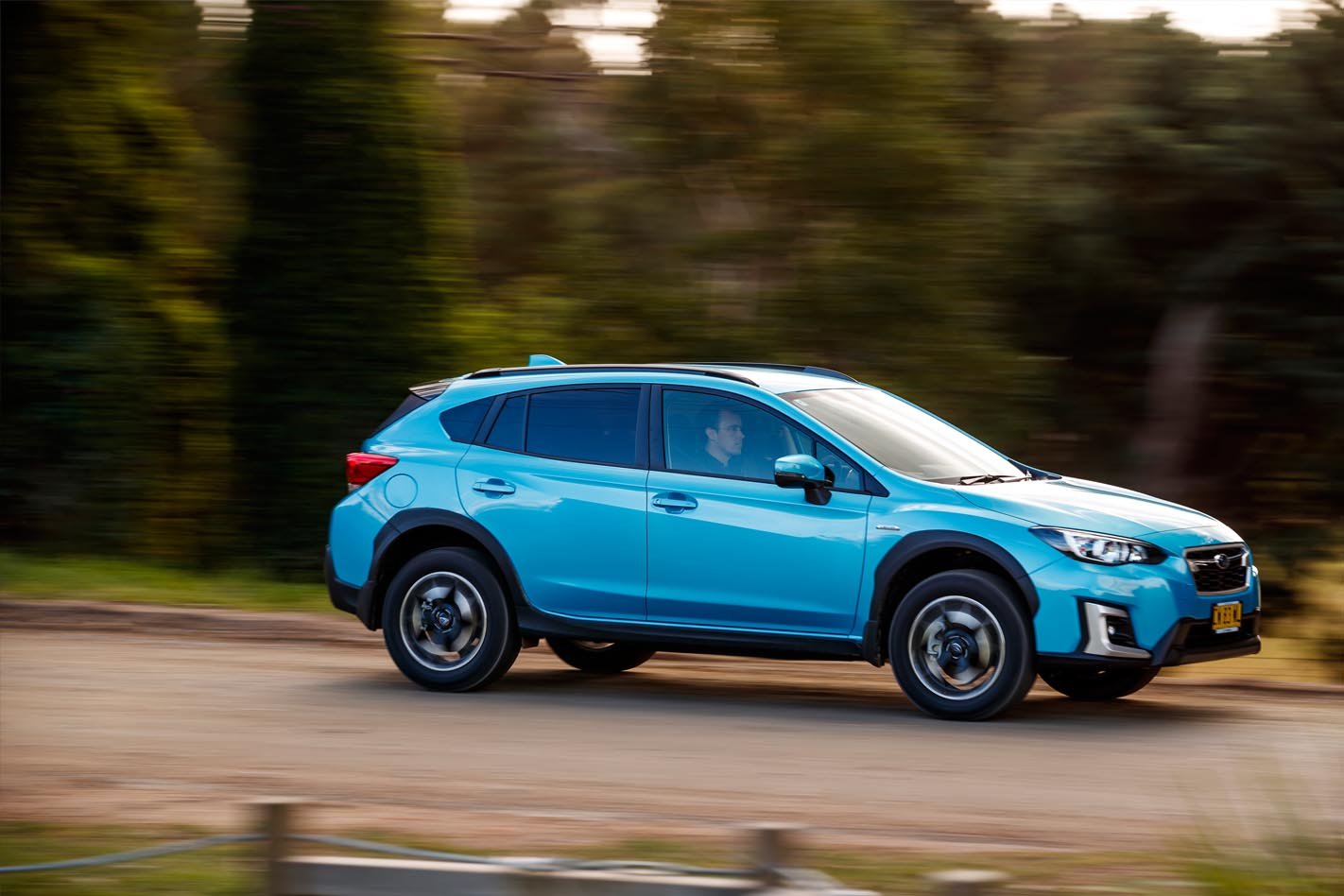
Regardless of the Victorian situation, home beckons and I’ll be saddling up the XV Hybrid and heading back into who knows what?
Update three: All-terrain or all talk?
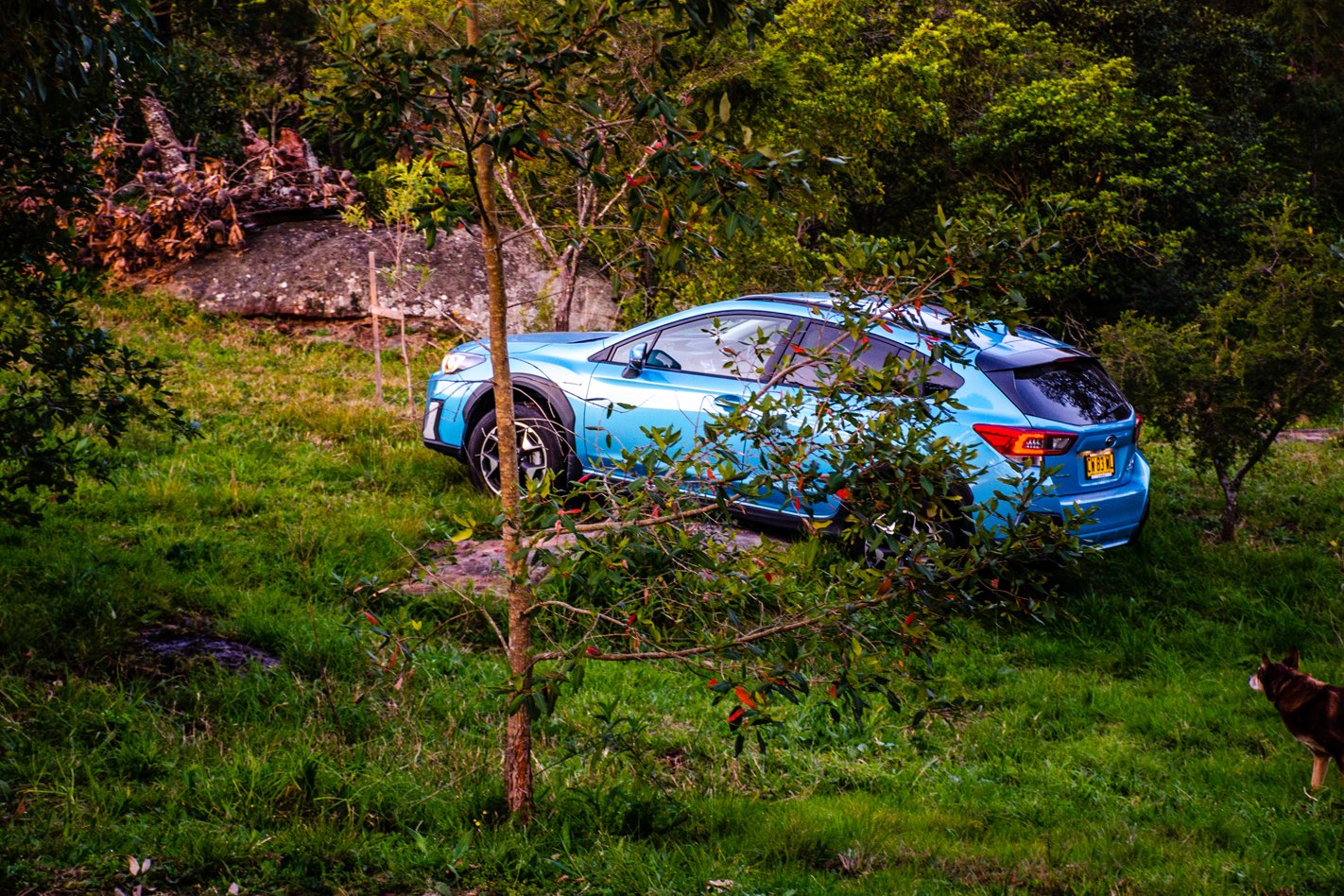
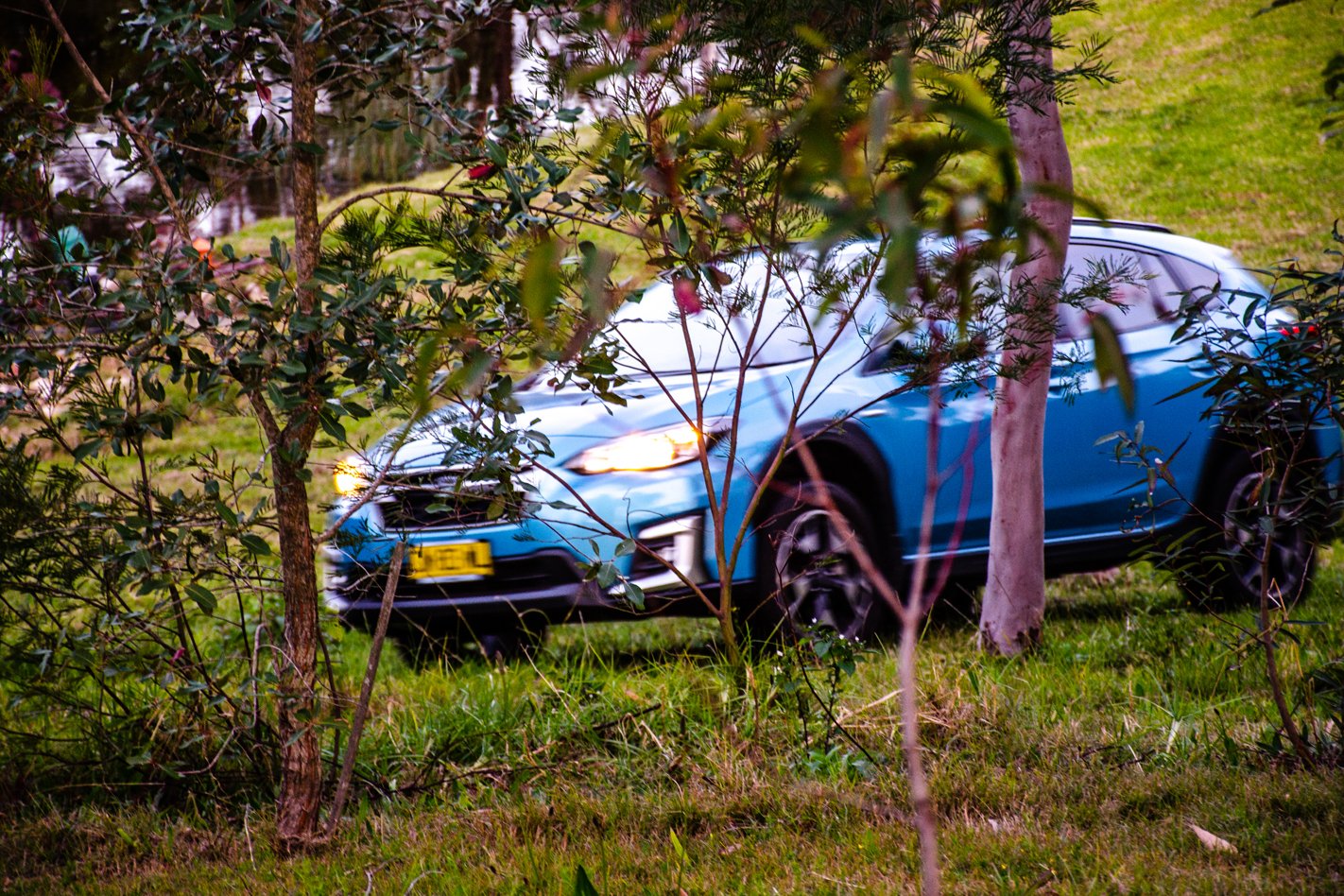
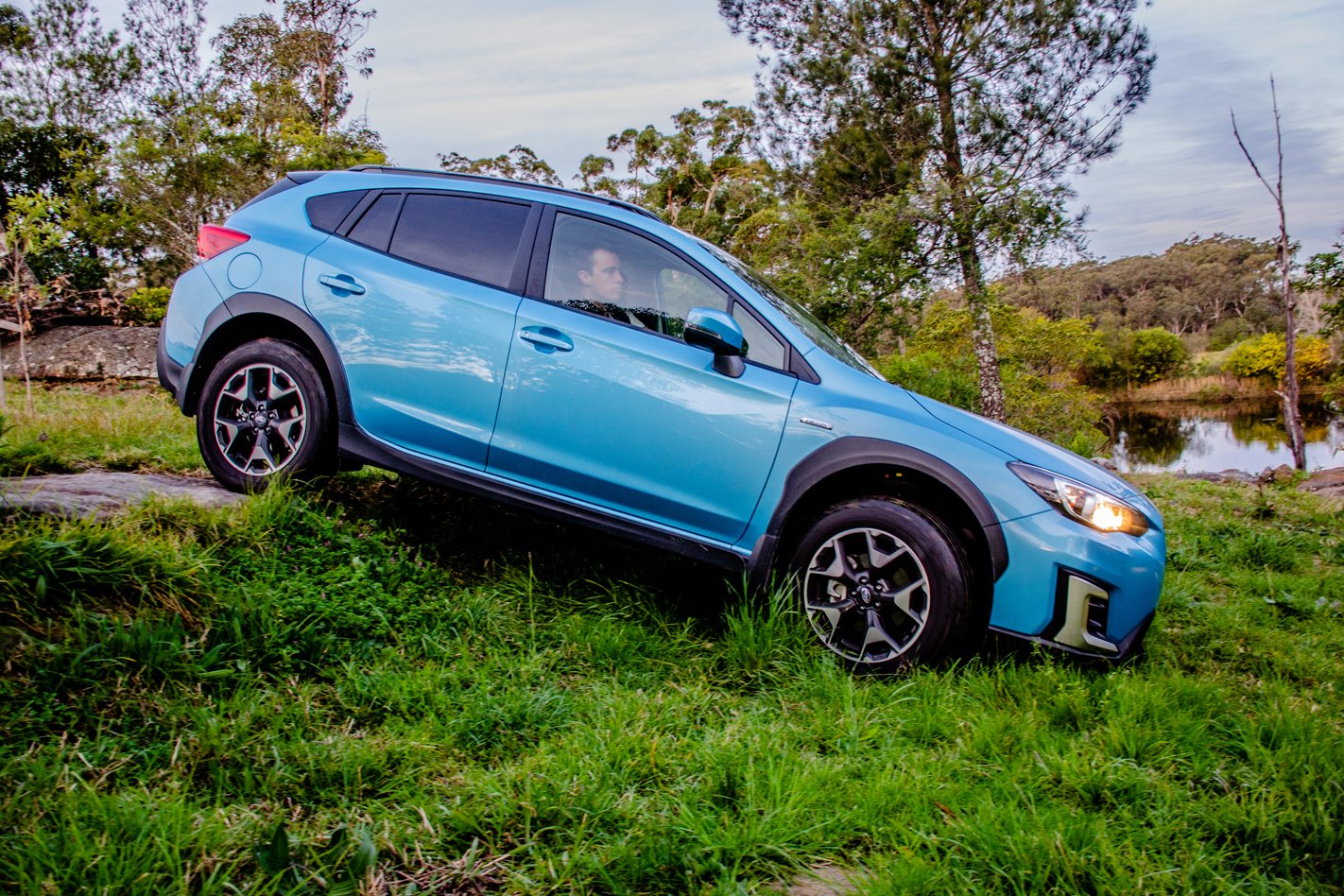
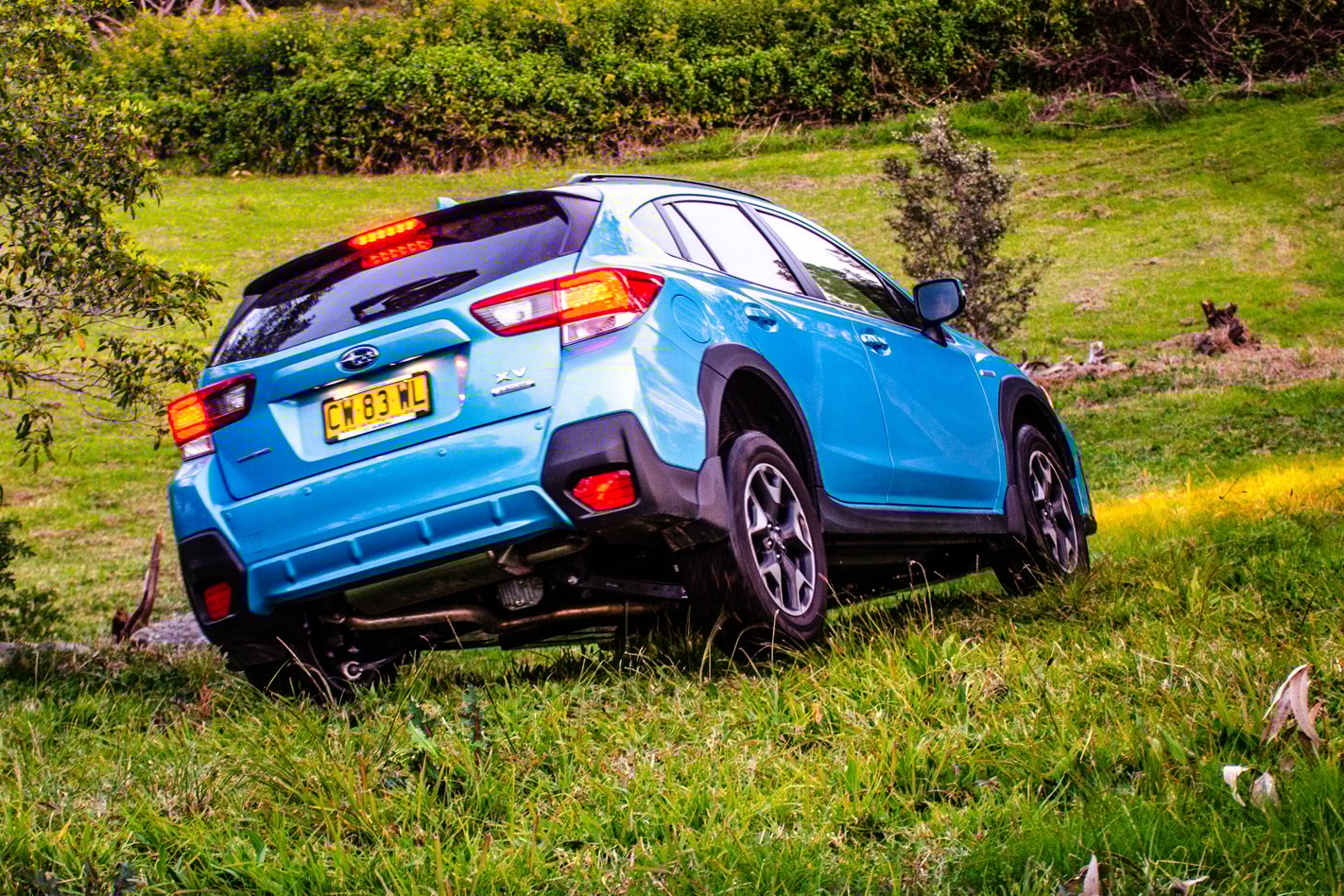
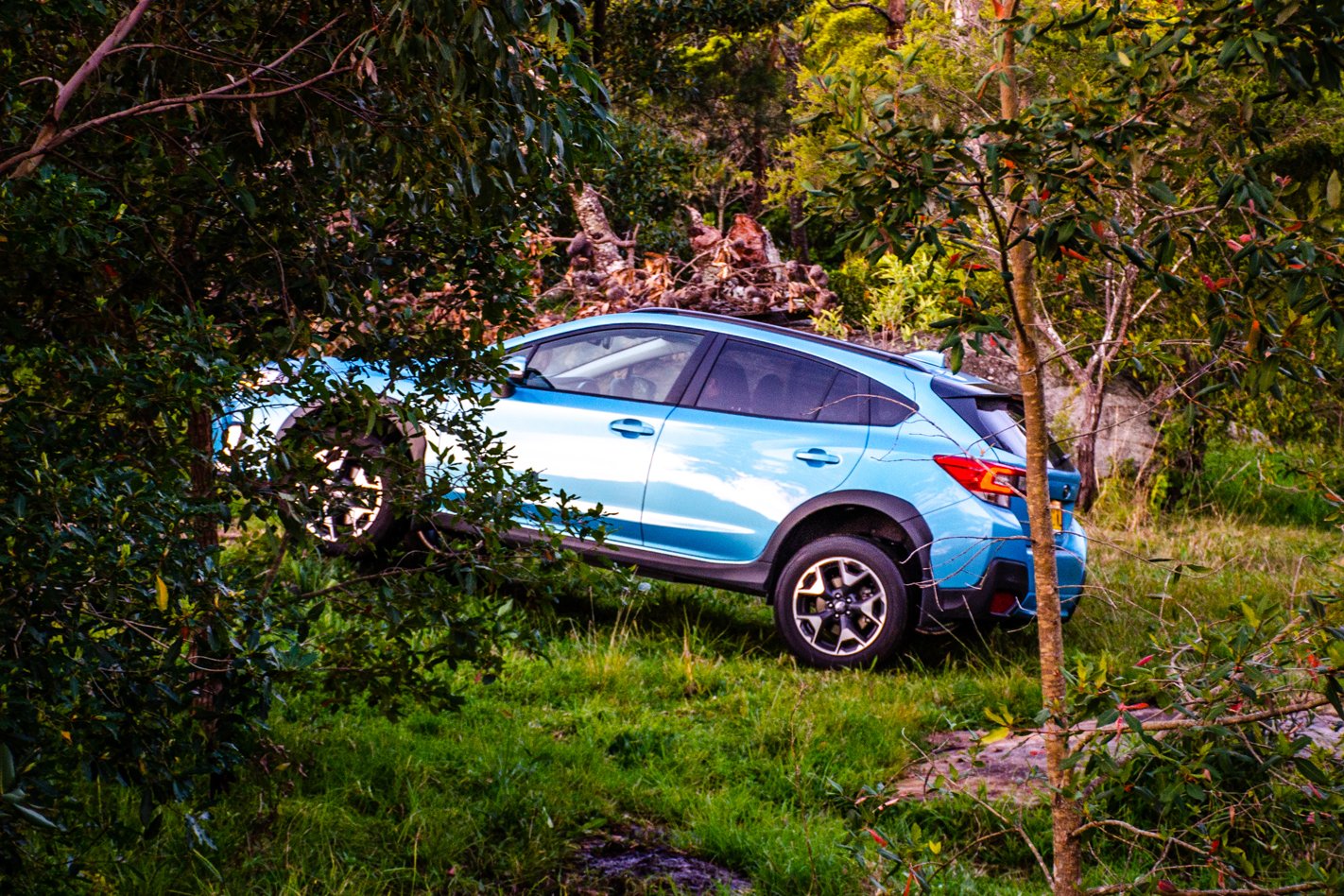
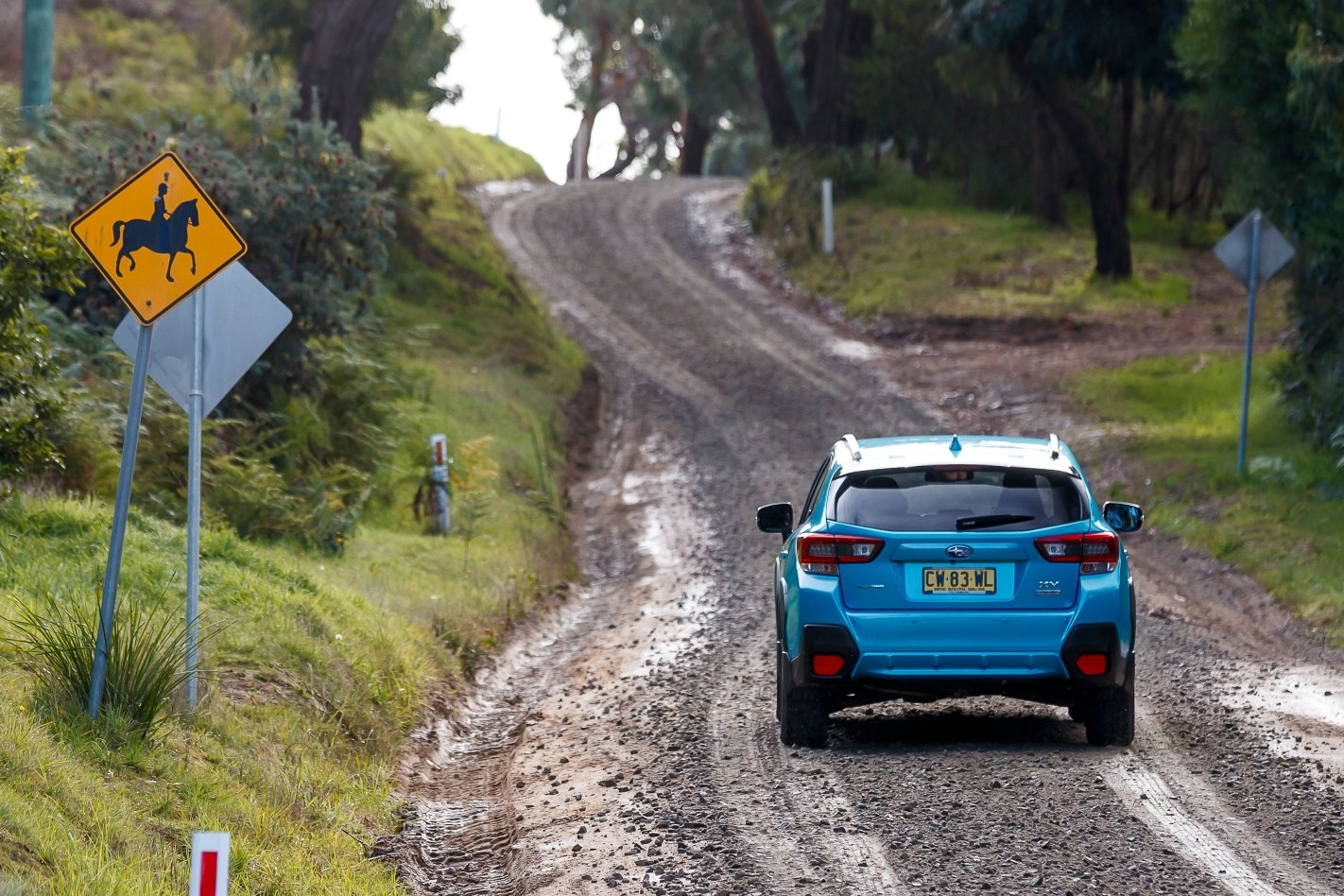
ODO 4786kmDistance driven 1096kmAverage fuel use 6.9L/100kmFrom its initial duty as urban runabout and some seriously uninspiring drives, the Subaru has been thrust into far more significant work staying one step ahead of the corona pandemic. And it’s handling that responsibility very nicely.But before heading back into Melbourne’s petri dish and the stage four lockdown, (yeah I know, don’t ask) I thought it a good time to test another of the XV Hybrid’s claims and something that would appeal to people looking to leave the beaten trail, whether it be for a little light exploration or evading doomsday.
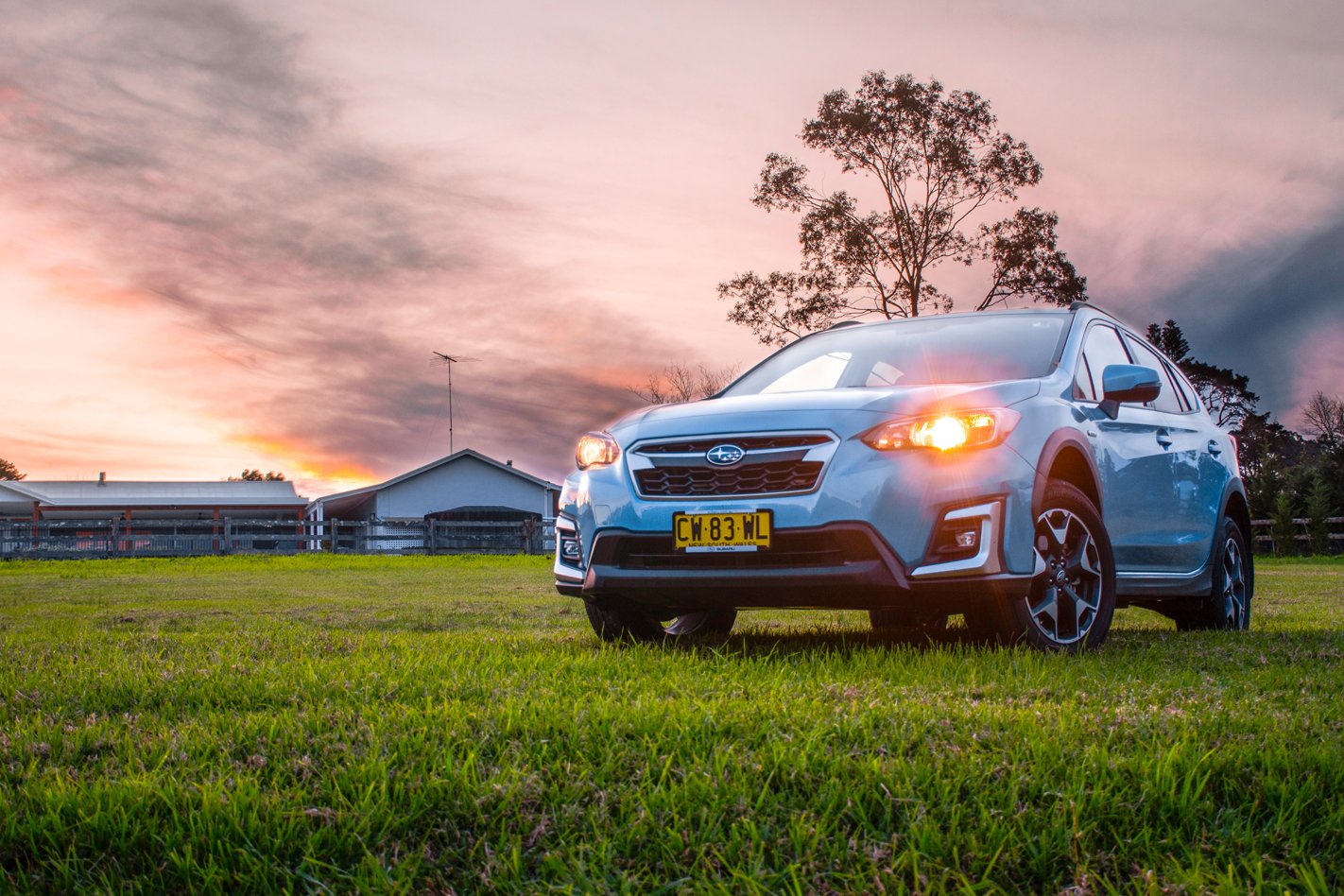
Read next: Snow and ice in the XV One of the most pleasing things about the XV in any guise is the simplicity of switching from its good on-road manners to the off-road realm.
There’s one button to hit to switch its brain into X Mode but other than that, everything stays as it was. No selecting surfaces, altering ride height, faffing with this and adjusting that.
Update four: Farewell
ODO 6184km
Distance driven 1398km
Average fuel use 6.9L/100km
It seems like an age since I grabbed the keys to the XV Hybrid and started planning what I was going to do with Subaru’s hybrid foray over the months it would be resident in the WhichCar garage. But I could never have imagined the dramatic changes that the Lagoon Blue wagon would carry me though. Perhaps not quite an age, but certainly an era.
The original plan had been to keep the electrified wagon for a generous six-month tenure but perhaps the most unexpected global circumstances have blown its residency out to nearly eight months and the kilometers covered to more than 6000.
It will be a year no one will forget but the one many probably want to and, while there are certainly parts I wish could have been different, there are also chapters worth reflecting on in a positive light.
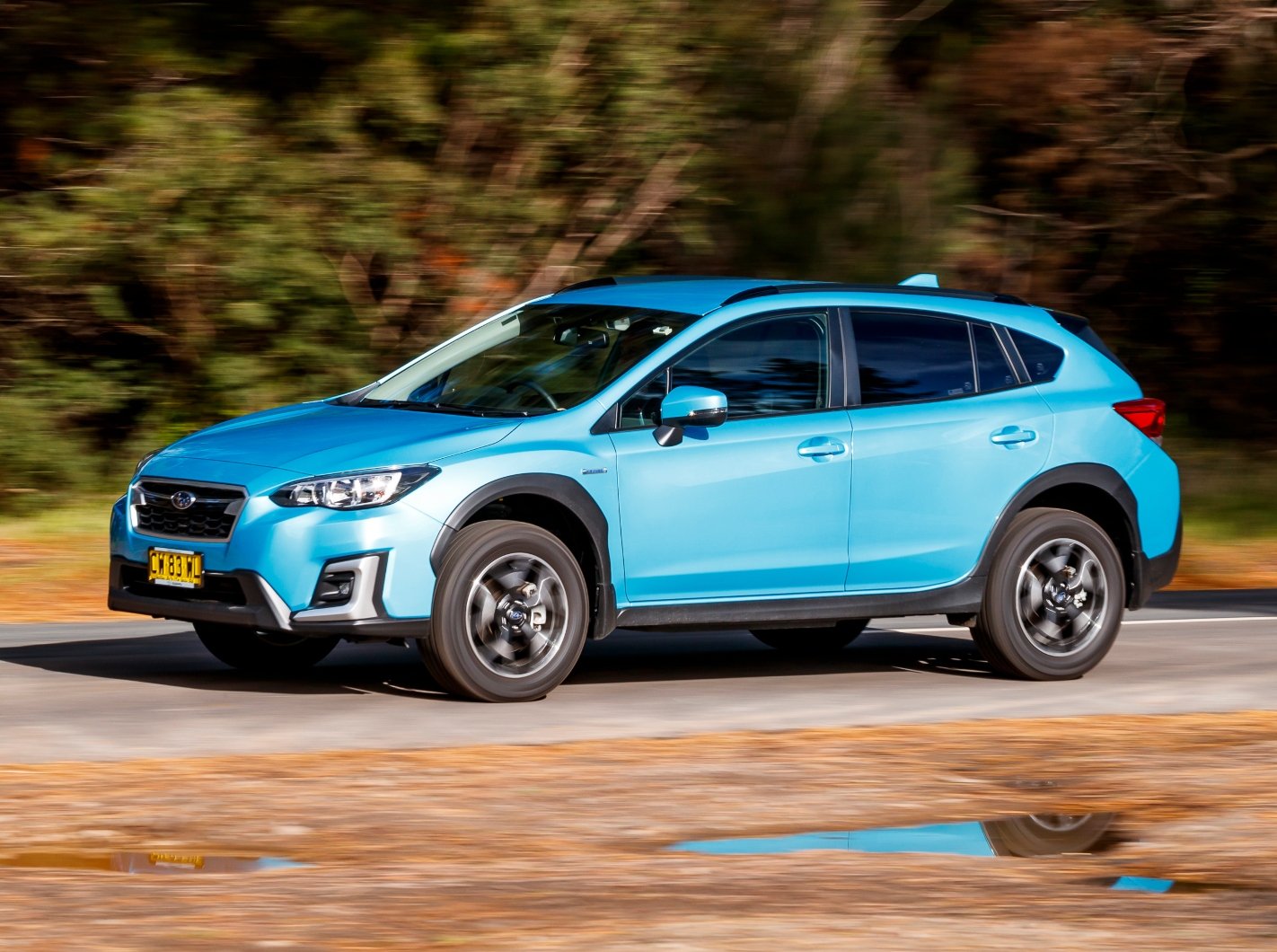
And one of those is the steed that served as my companion from start to … well … whatever point we are in right now. The XV Hybrid’s boot was loaded floor to ceiling when Victoria’s borders looked shaky, enabling our escape to NSW and the completion of WhichCar’s second TV series filming.
It was the vehicle that shuttled me back into Victoria at the peak of the crisis much to the perplexed look on one police officer’s face at a checkpoint. And it marked another milestone travelling more than 5km when the situation appeared to be evolving into better times.
Surrounded by a world that had been flipped on its head and an entire community entranced by Dan’s updates and the ‘daily number’ it was comforting to have a car as stoic and versatile as the XV in our stable.
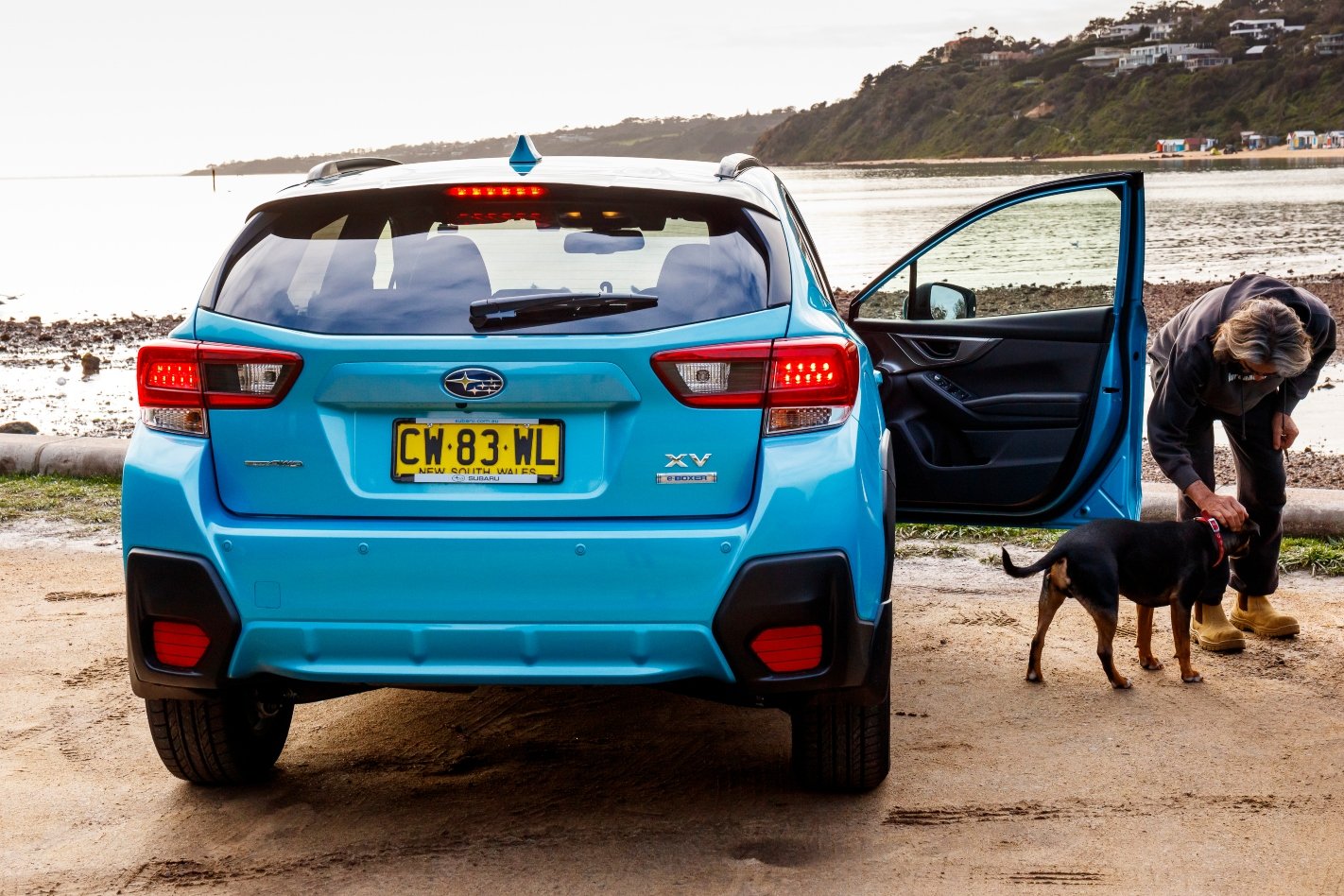
Subaru’s promise of go-anywhere ability and all-paw stability has been attracting many loyal Australian customers for years but, in 2020, the nation was craving those virtues in every aspect of life. For me, at least, the XV has been a metaphor for hope and a symbol of something better.
Sure, its hybridization is about as mild as a system can be while still accurately claiming to use both electricity and petrol power for motion, and its balance of both can be clunky at times, but minimizing resistance to change is all about small steps.
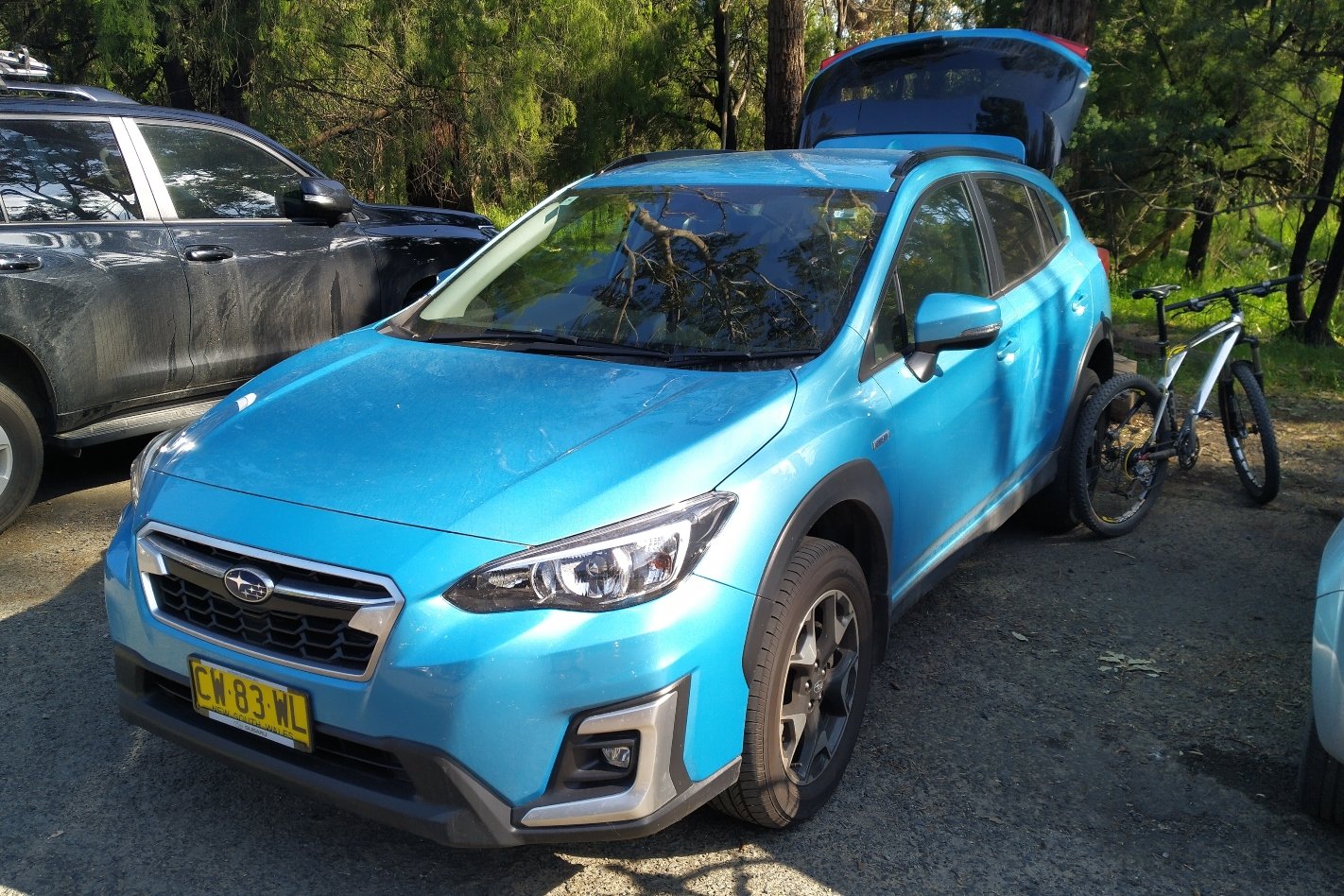
Indeed, since taking custody of the XV Hybrid, Subaru has announced another XV Hybrid choice in the line-up with a Hybrid S representing a more generously equipped option above the original version – now named the Hybrid L.
And that’s a trend you can expect to see continuing. With a hybrid and electric compatible Subaru Global Platform (SGP) now proliferating the entire family, more electrified models are imminent including plug-ins and don’t be surprised if you see the company’s first pure EV on the horizon.
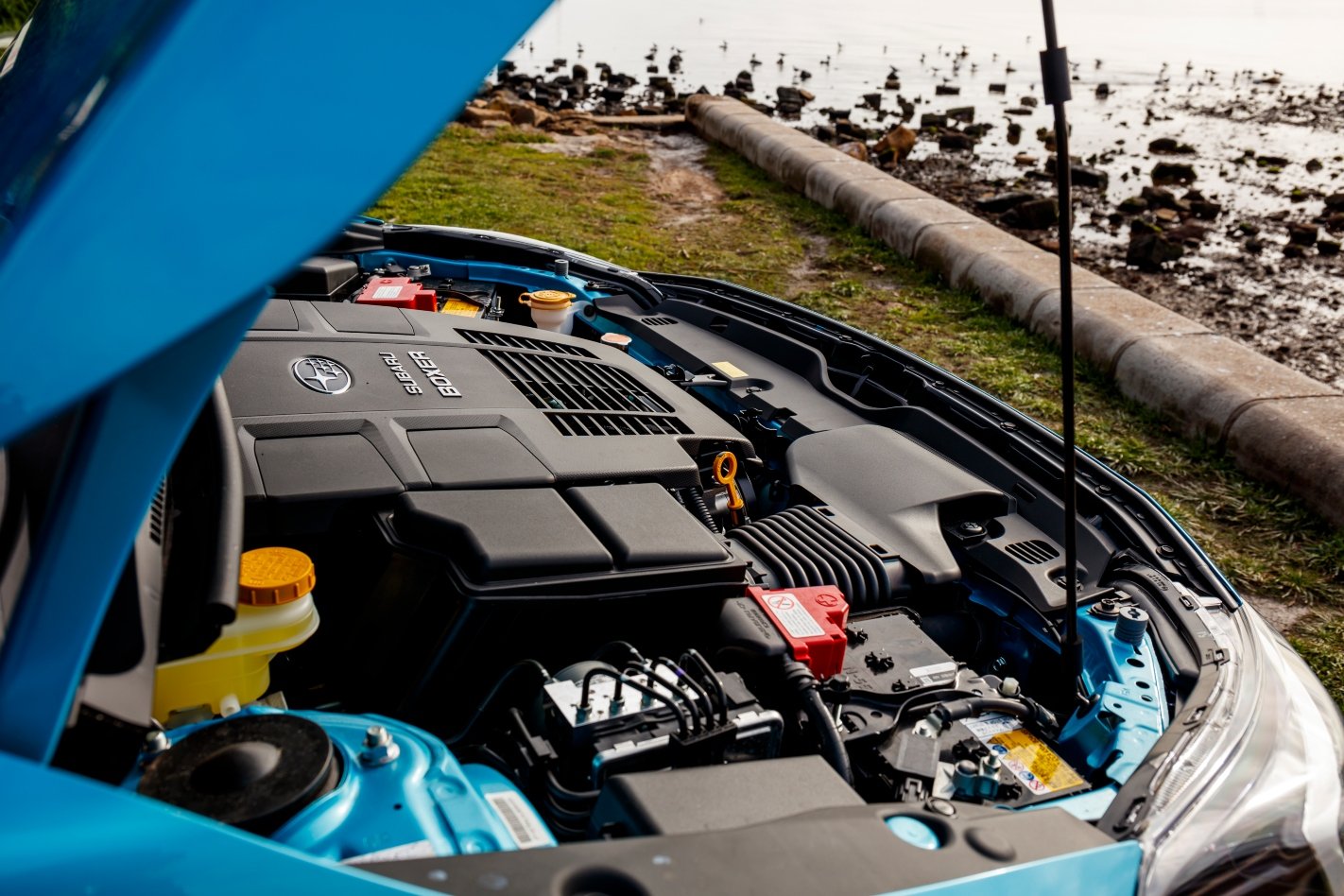
For now, the empty spot on my driveway serves as a reminder of a car that manages to make benign surprising. The XV Hybrid drives like a small car but has the space of a decent wagon, it doesn’t feel like an SUV but goes places many rivals won’t and, although the benefit of its electric motor is hard to pick on the road, its shows at the pump.
I don’t think anyone expected Subaru to blast onto the EV scene with a mighty full-electric machine that would make the Porsche Taycan look like a golf cart. Instead, a mild but well-rounded pair of hybrid models makes far more sense as a start.
And that’s exactly how the XV Hybrid and Forester Hybrid should be regarded – not as an earth-shaking game changer that turns everything on its head (we’ve had enough of those over the last year) but as a statement of intent and a glimpse of a brighter future – and right now, that’s exactly what the world needs.
>
There’s a cresting right-hander at the Sutton Road Training Centre track, Canberra, hell-bent on thrusting any hasty machine’s rump towards the hilly scenery and the GR Yaris seems born for it.
In Sport mode, Gazoo Racing’s new poster child jinks hard to a mild throttle lift, its Dunlops settling rotation into a neatly cocked slide as safe as houses.
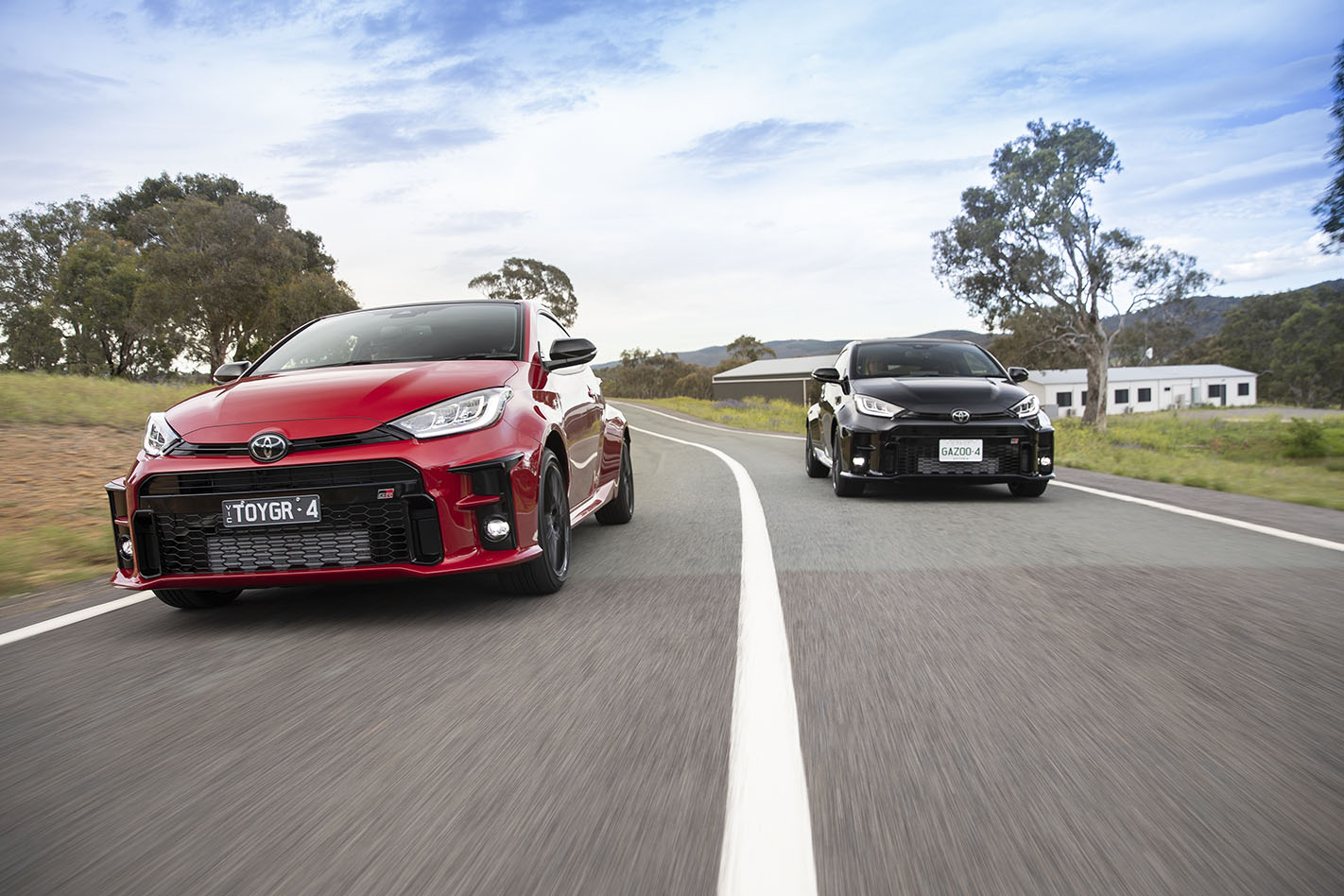
Poise, for such a scant wheelbase, is wonderful, the slip angle easily adjusted at 4000rpm, in the thick of the world’s most powerful turbo three-cylinder engine’s torque band. A small flick of opposite lock correction is its only demand.
Sport offers 70 percent static rear torque, though it’s infinitely variable at the machine’s own whims. It sacrifices shades of pace for throttle-balancing friskiness, with uncanny telepathy between right foot pressure and oversteer angle.
It’s a hoot.
Next lap, Track mode. It’s split 50:50 static, until the GR Yaris decides otherwise.
The chassis cocks urgently and then settles on the outside rear with Sport-like aplomb, then transmits stronger front axle torque feed and a sharper recovery.
It’s tidier and more focused for swifter A to B transit, without robbing much from Sport’s theatrics.
Sport or Track? Distinctively different, both excellent, each a well-honed ally depending on driver whims and conditions. Bravo.
HOW DOES IT DIFFER FROM A REGULAR YARIS?
Its maker claims sorting the GR-Four all-paw system was the most difficult task of what was a clearly challenging project.
Grafting the GA-C Corolla rear end to the GA-B Yaris front architecture was primarily designed to contend with AWD torque, the double-wishbone suspension, bespoke with added trailing arms, was a convenient by-product.
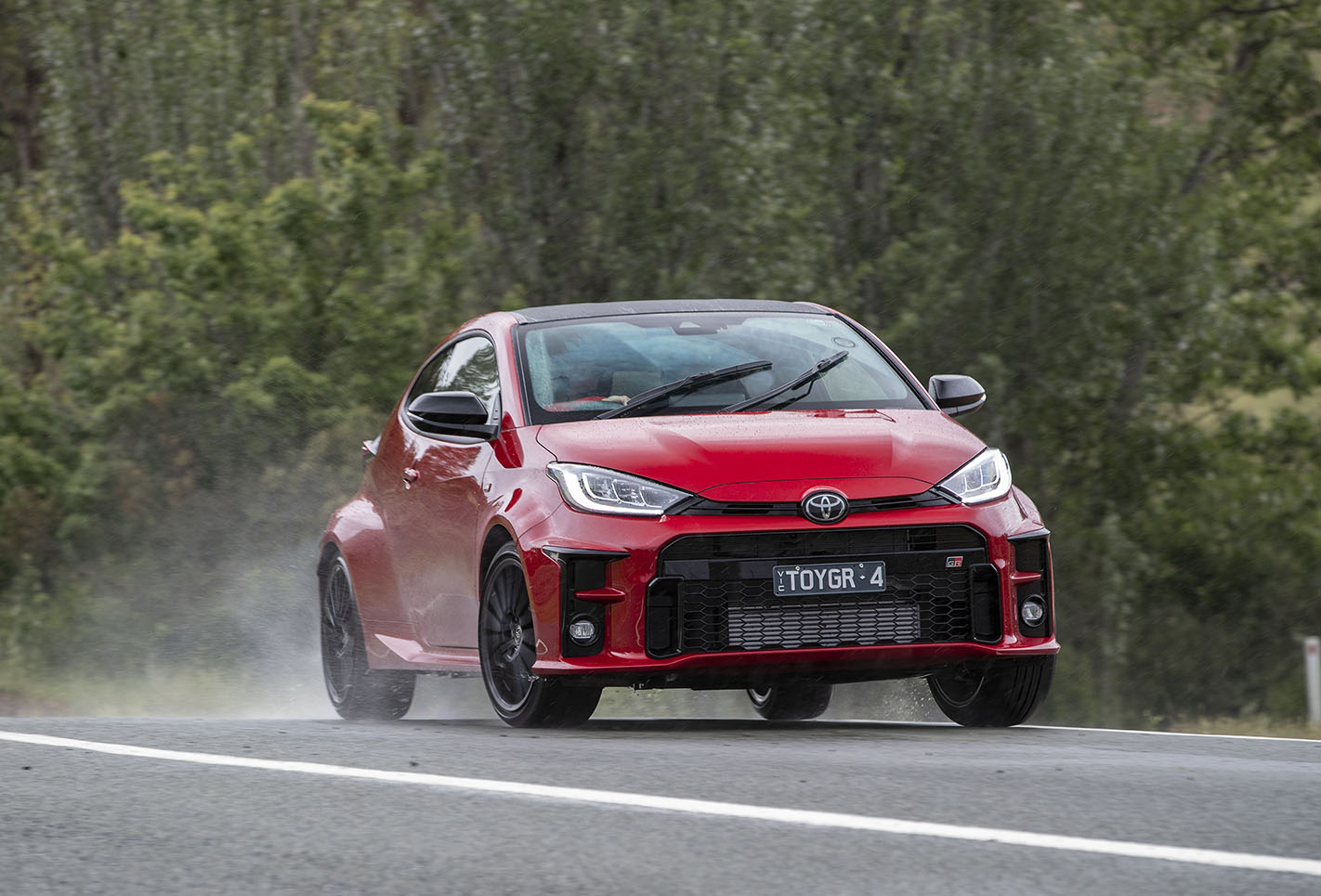
Then there’s the body, five centimetres longer, six wider and nine and half lower in roofline and just sharing lights, mirrors and fin aerial with Aunty Beryl’s five-door Yaris grocery getter.
Its three doors and bonnet (saving 24.1kg) are aluminium and its roof carbon fibre polymer (shaving 3.5kg), a 38-kilogram body-in-white reduction in the project where weight management ruled over most everything else.
It’s why a 1.6 three-pot was favoured over a two-litre four. And why it’s a six-speed manual rather a heavier if perhaps more WRC-aligned dual-clutcher.
Its stiffer, slipperier form is perhaps the crucial homologation element of a road-goer its maker says was backwards engineered from the existing WRC racecar to then be repurposed back into rally-dom with an optimum competitive advantage.
For instance, the doors and hatch must carry over from the mandated 25,000 donor cars for rally homologation.
WHAT MAKES IT SPECIAL?
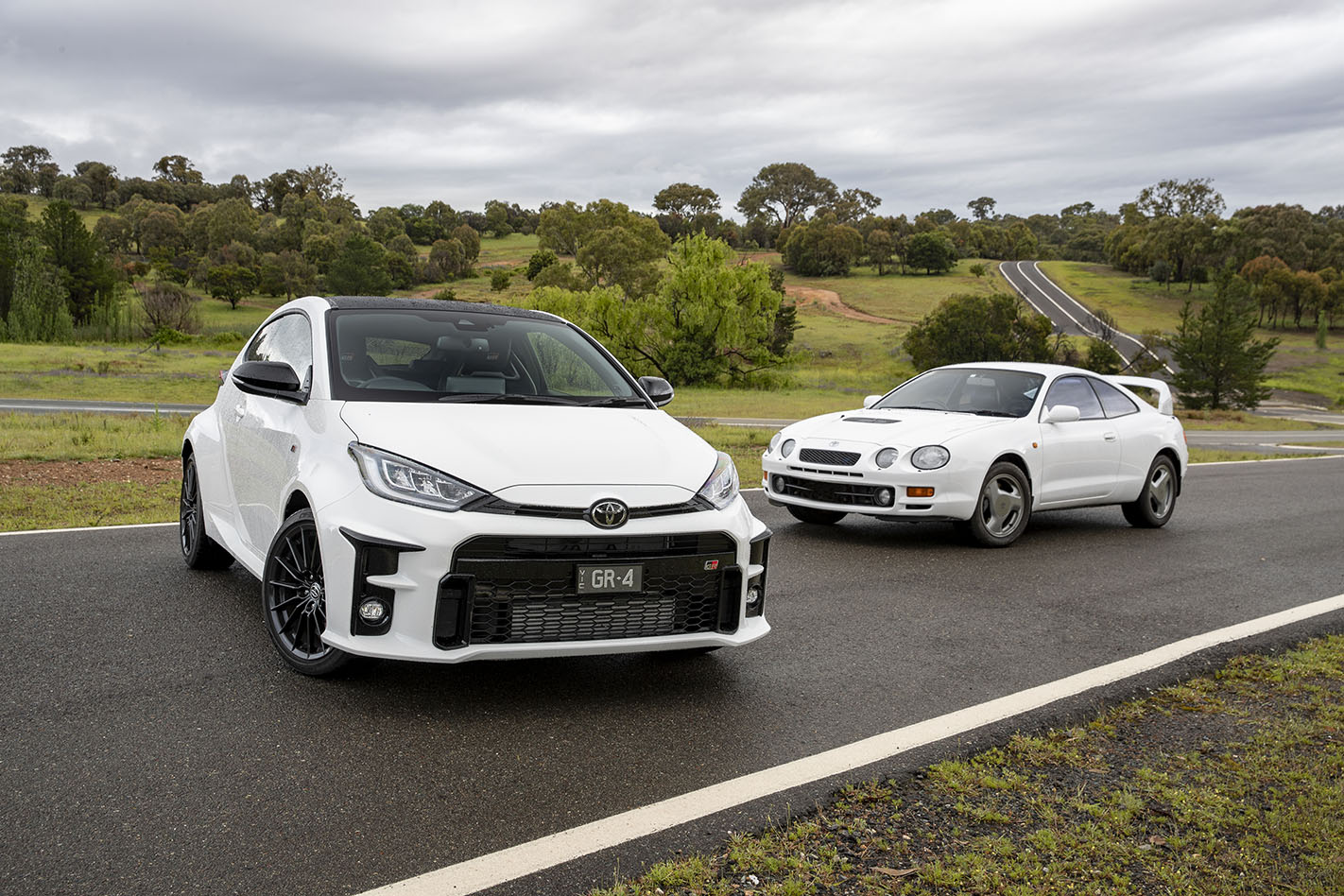
Serving motorsport wasn’t GR Yaris’s only key mandate: it’s the first properly bespoke model from Toyota in two decades since Celica GT-Four ceased production in 1999, Toyota Gazoo Racing’s key gambit being accepted as road car skunkhouse of the likes of BMW M and Mercedes-AMG.
It’s also a dedicated GR model, not merely a lower GR Sport enhancement that’ll roll out in the likes of C-HR.
It not only drives better than a mere component-cobbled racecar donor has a right to, it’s seemingly supremely well built.
The 1100 Aussie order holders that snapped the GR Yaris up so quickly primarily for collectability and investment reasons were and are in for a surprise treat on-track and on-road.
It’s built on a dedicated line at the Motomachi plant in Japan, former home of Lexus LFA production. And on the road, there’s a sense of solidity, integration and refinement not as evident in the recently launched ‘new’ Yaris or Yaris Cross.
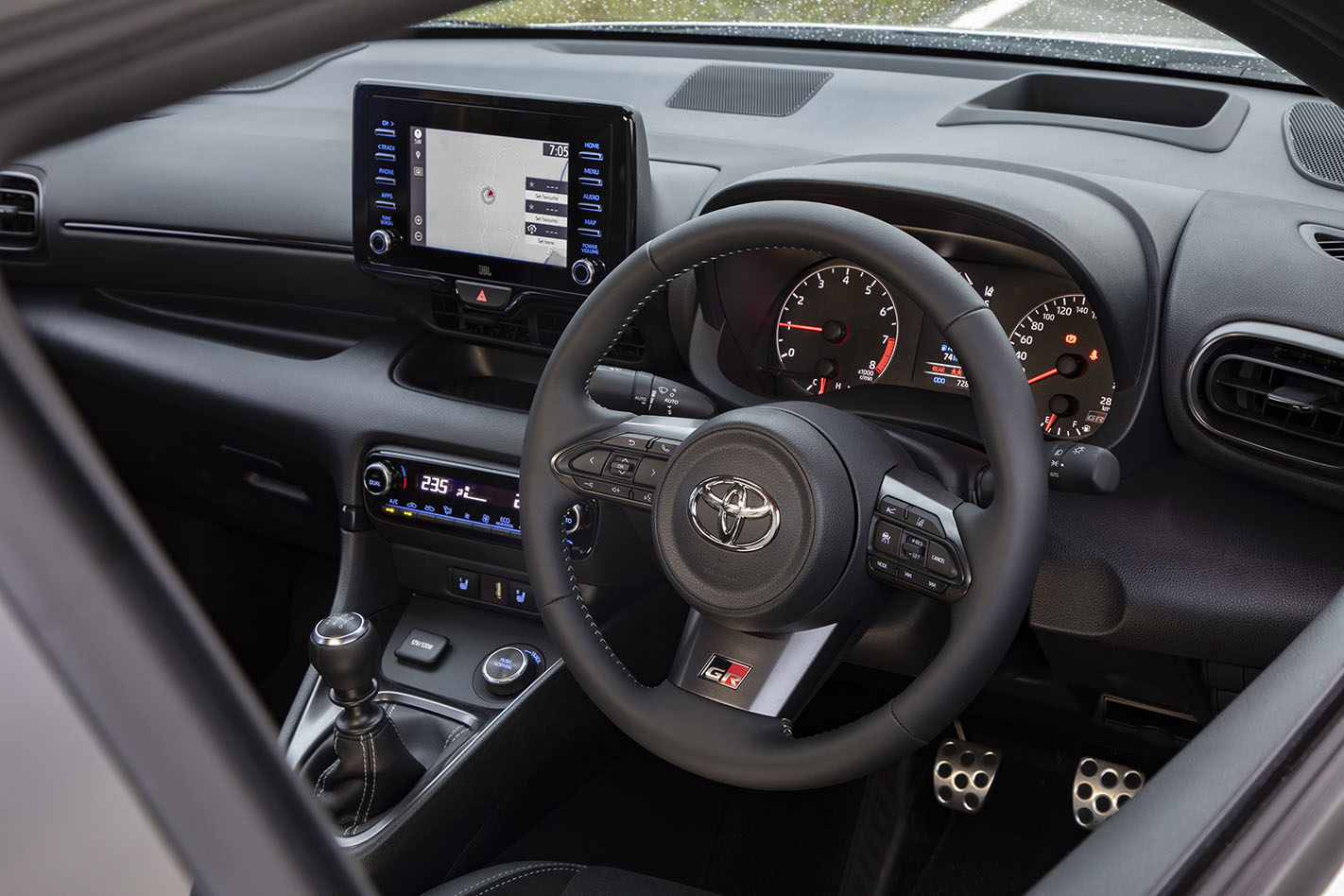
It’s tight, honed, connected, and despite as cabin design as conventional as its exterior is unorthodox, there’s a certain premium feel to on-road manners.
Its ride is compliant, it’s powertrain flexible, and would make an easy-to-live-with daily driver. And from safety kit to servicing costs, it’s thoroughly ‘normal Toyota’, not some highly-strung prima donna requiring ownership babying.
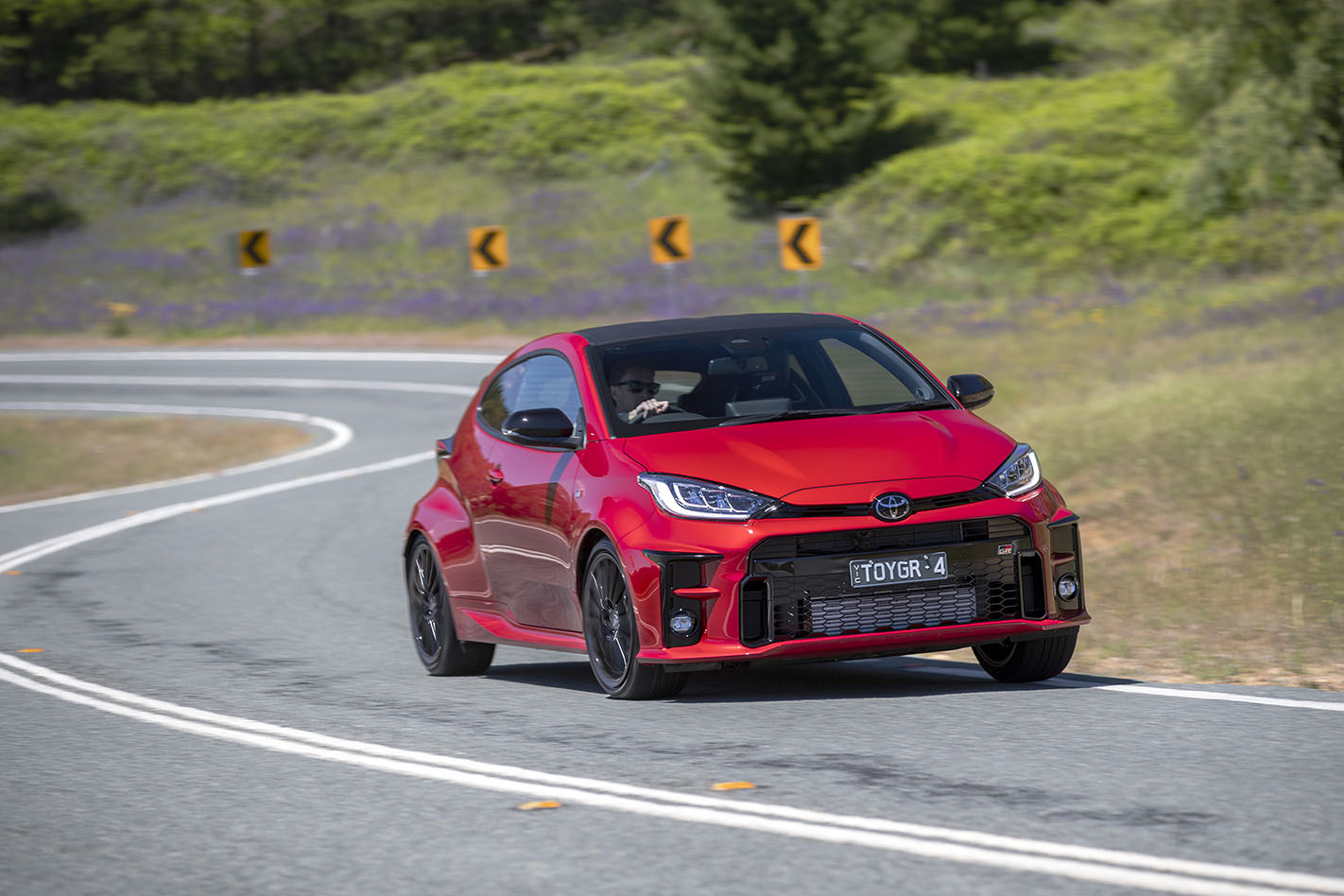
IS IT A TRUE PERFORMANCE CAR?
But there’s no shortage of purpose: 200kW, 370Nm, 156kW-per-tonne, 5.2-second 0-100km/h, these sorts of figures local V8 muscle mustered back in the Group A homologation heyday.
The little 1.6-litre swells rather than punches, hauling 1280kg off the mark assertively. If you’re racing the stopwatch, though, a quick getaway demands little mechanical sympathy.
It wants to be well north of the 3000rpm peak torque entry figure to come on song, complete with a swell in its neat if synthetic soundtrack, though the dig-in nature of its output delivery suits the rally-esque vibe just so.
Aim for the hills and there’s enough swing from the three-pot to refrain from needing to constantly rowing through the gears to find the redline.
Rolling muscle is impressive and it only really founders a touch falling off the boil in hairpins. Direction change is brisk and in Sport much is it done with the right foot.
The shift is slick and positive, and the pedals are ideally staggered for heel-and-toe shifting, which is handy given the (switchable) rev-matching is so tardy. The lack of a proper dead pedal to brace with during cornering G forces is an oversight, though.
At one point during the local launch program, a film plays of motorsport-addicted Toyota boss Akio Toyoda, hands-on in the car’s development, demanding “more steering feel” from some anonymous engineer.
I imagine he and his colleagues lost sleep over the result: clear, even, linear, with a nice moderate weight that only reveals its somewhat simulated nature by becoming sudden too light when the car pulls to a stop.
It’s that sort of car: someone, somewhere, likely sweated bullets to arrive at the details of its driving experience.
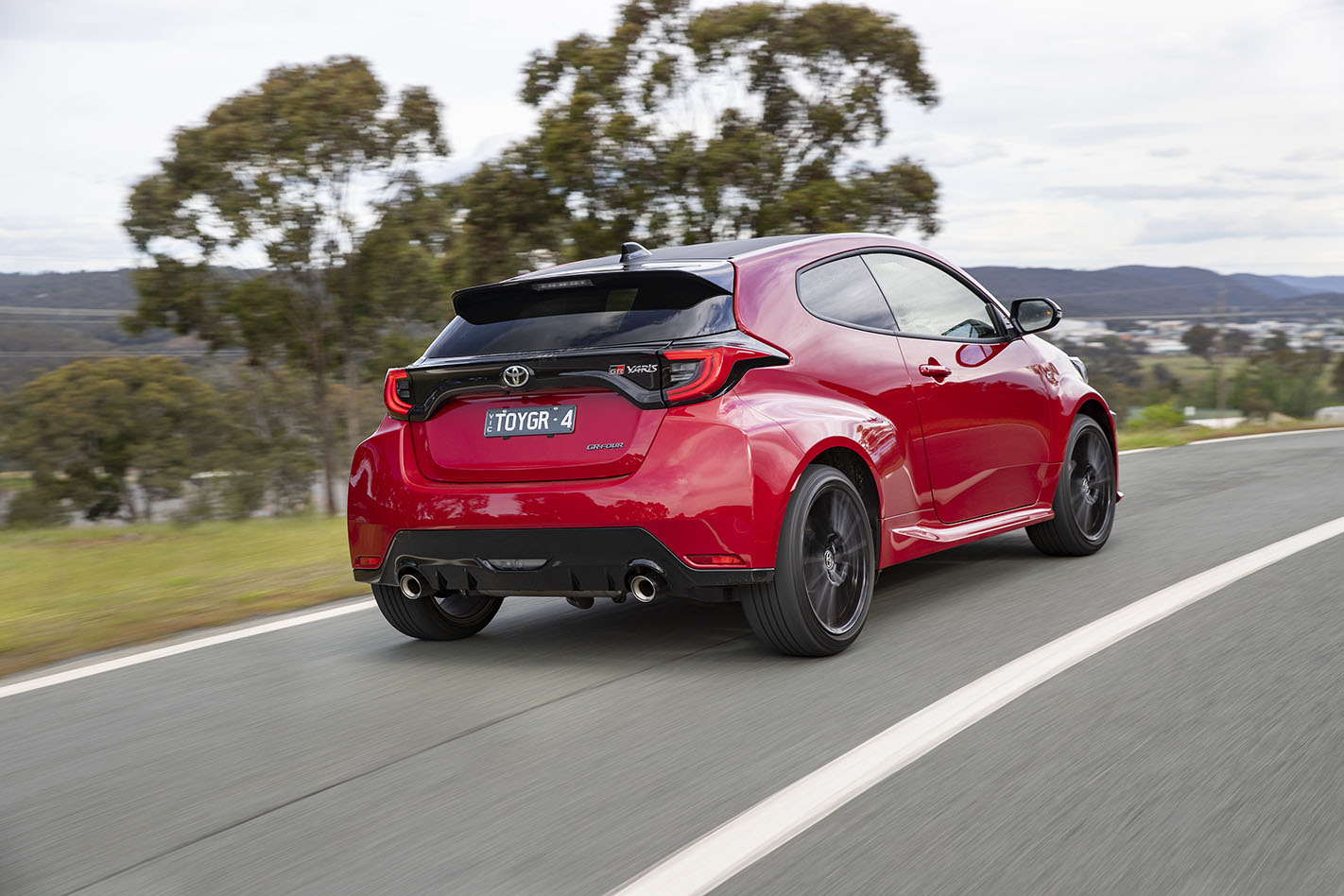
SHOULD YOU WAIT FOR THE GR YARIS RALLYE?
Does this regular GR Yaris’s lack of mechanical LSDs front and rear – offered on the forthcoming harder-core Rallye version – hurt it? On dry tarmac, by the seat of the pants, no it does not.
Flat-knacker around the 2.5-kilometre Sutton Road closed circuit, there’s only one in its relentless second- and third-gear corners where an unloaded front wheel cries freedom for a brief moment.
That it sits as flat as it does, offering up as much grip and drive from its Sport Maxxs as it does, is remarkable.
As for wet, snow, gravel, skidpan, or anywhere else where the GR Yaris might pull you, the jury is still firmly out. I suspect that the three-pot’s swelling torque delivery isn’t quite enough to unhinge traction in dry sealed conditions.
That it feels fast and frisky as a pace that won’t threaten your licence is a big drawcard, but you do need to tap Sport’s tail-happy nature to drive around the torque lull in tighter corners on road.
Often, the GR Yaris leaves you wishing for more front-end point and more steer-induced rotation in order to get back onto the loud pedal harder and quicker.
I imagine the switch to Rallye-spec Michelins might return instant dividends in point-to-point pace.
The Rallye will undoubtedly be the track version of choice. But that doesn’t take away from just how good the regular version is, particularly as an all-rounder.
It was a laughably good sub-$40k driveaway prospect for the early adopters and a $45k bargain for those who snapped up the ‘extras’ Toyota Australia has scrounged to date.
Even at full-whack $49,500 retail price for further examples – not due until later in 2021 – still looks like incredibly enticing value.
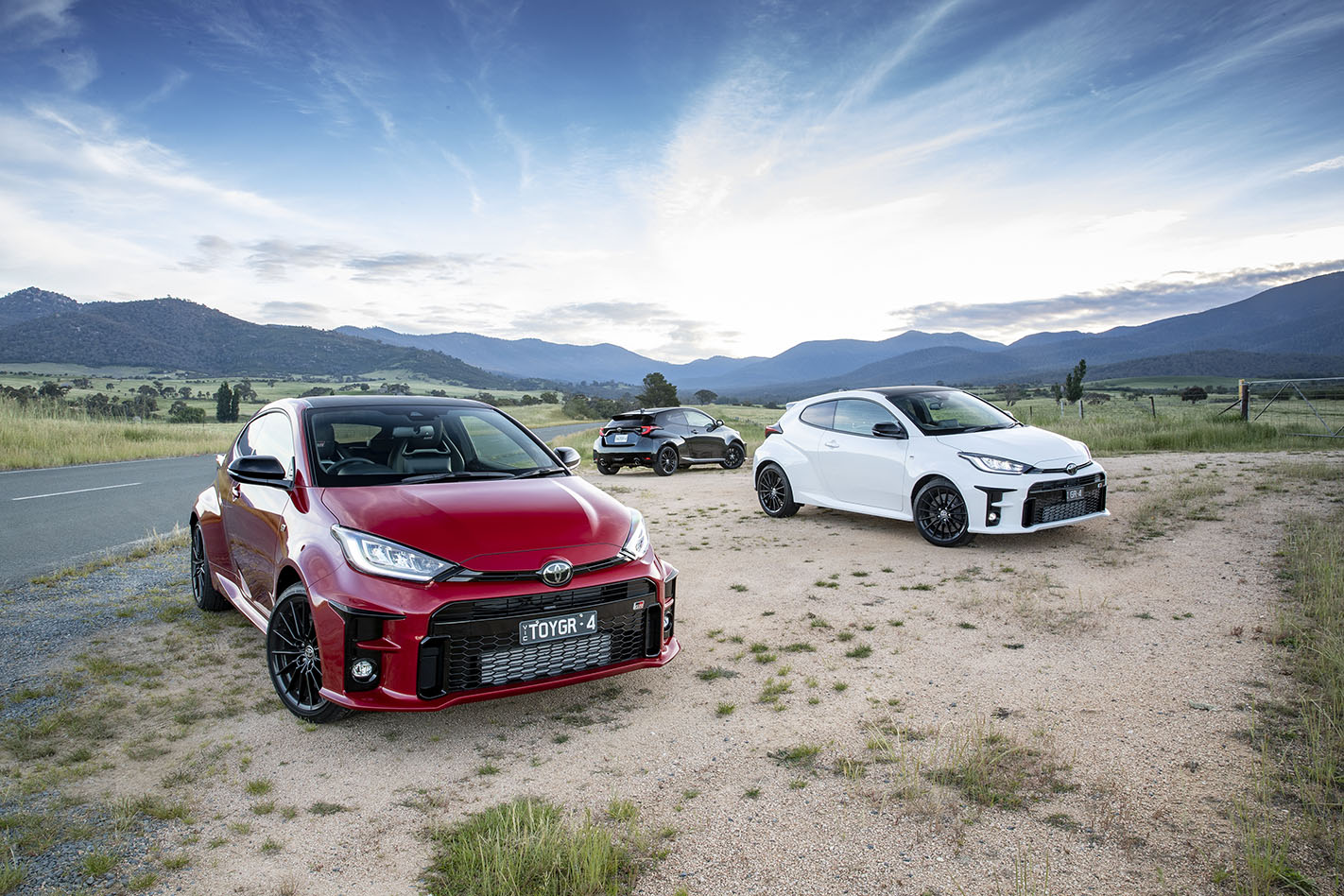
2021 TOYOTA YARIS GR SPECS
- Engine: 1618cc in-line 3, DOHC, 12v, turbo
- Power: 200kW @ 6500rpm
- Torque: 370Nm @ 3000-4600rpm
- 0-100km/h: 5.2sec (claimed)
- Weight: 1280kg
- Price: $49,500
Hyundai Motor Group has unveiled its dedicated Battery Electric Vehicle (BEV) platform that will underpin 23 new Hyundai and Kia EVs scheduled to be introduced by 2025.
Dubbed the ‘Electric-Global Modular Platform’ (E-GMP), the new architecture will serve as the core technology for Hyundai Motor Group’s next-generation BEV line-up, marking the biggest commitment to electrified vehicles from the South Korean company to date.
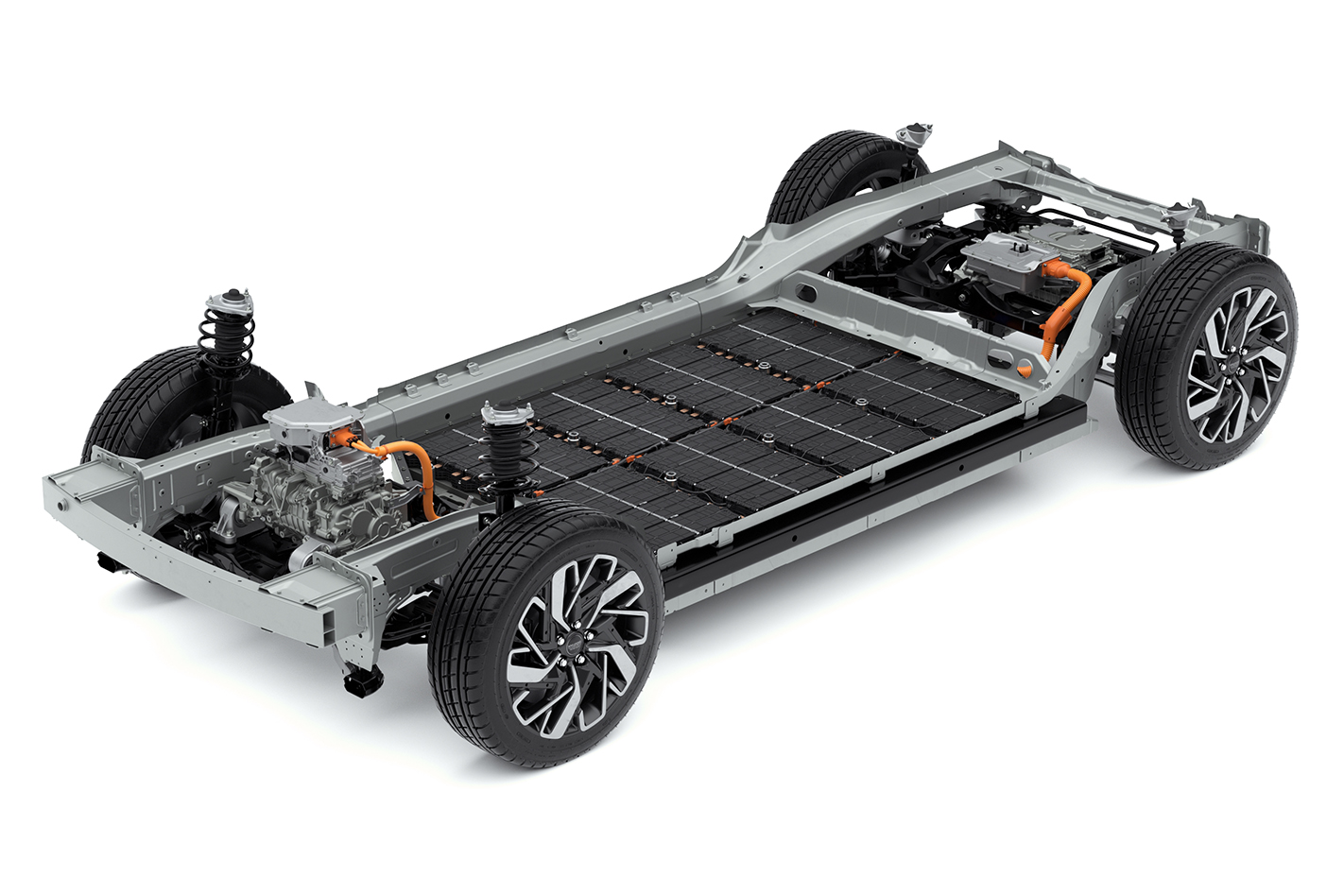
It will be complemented by an all-new electrification system offering 500km range, bi-directional charging, and 800v multi-charging that promises 100km worth of range in five minutes at the plug.
With a dedicated ground-up design for BEV’s, E-GMP provides various advantages compared with the Group’s existing internal combustion-engine platforms, including increased development flexibility, higher performance, longer driving range, enhanced safety features, and more interior space for occupants and luggage.
“Today our front-wheel driven Hyundai and Kia BEVs are already among the most efficient ones in their segments,” said Albert Biermann, President and Head of R&D Division for Hyundai Motor Group.
“With our rear-wheel driven based E-GMP, we are extending our technological leadership into segments where customers demand excellent driving dynamics and outstanding efficiency.”
With a standard BEV platform in its ranks, Hyundai will also reduce complexity through modularisation and standardisation, allowing rapid and flexible development of products, which can be used across most vehicle segments, such as sedans, crossovers and SUVs including large seven-seaters.
Performance
E-GMP will also underpin rear-wheel-drive sports BEVs capable of accelerating from zero to 100km/h in less than 3.5 seconds and hitting a maximum speed of 260km/h, says its maker.
Hyundai claims E-GMP will also offer improved cornering performance and driving stability at high speed, with the low-mounted battery back creating a low centre of gravity resulting in ‘optimal weight distribution’ between front and rear axles.
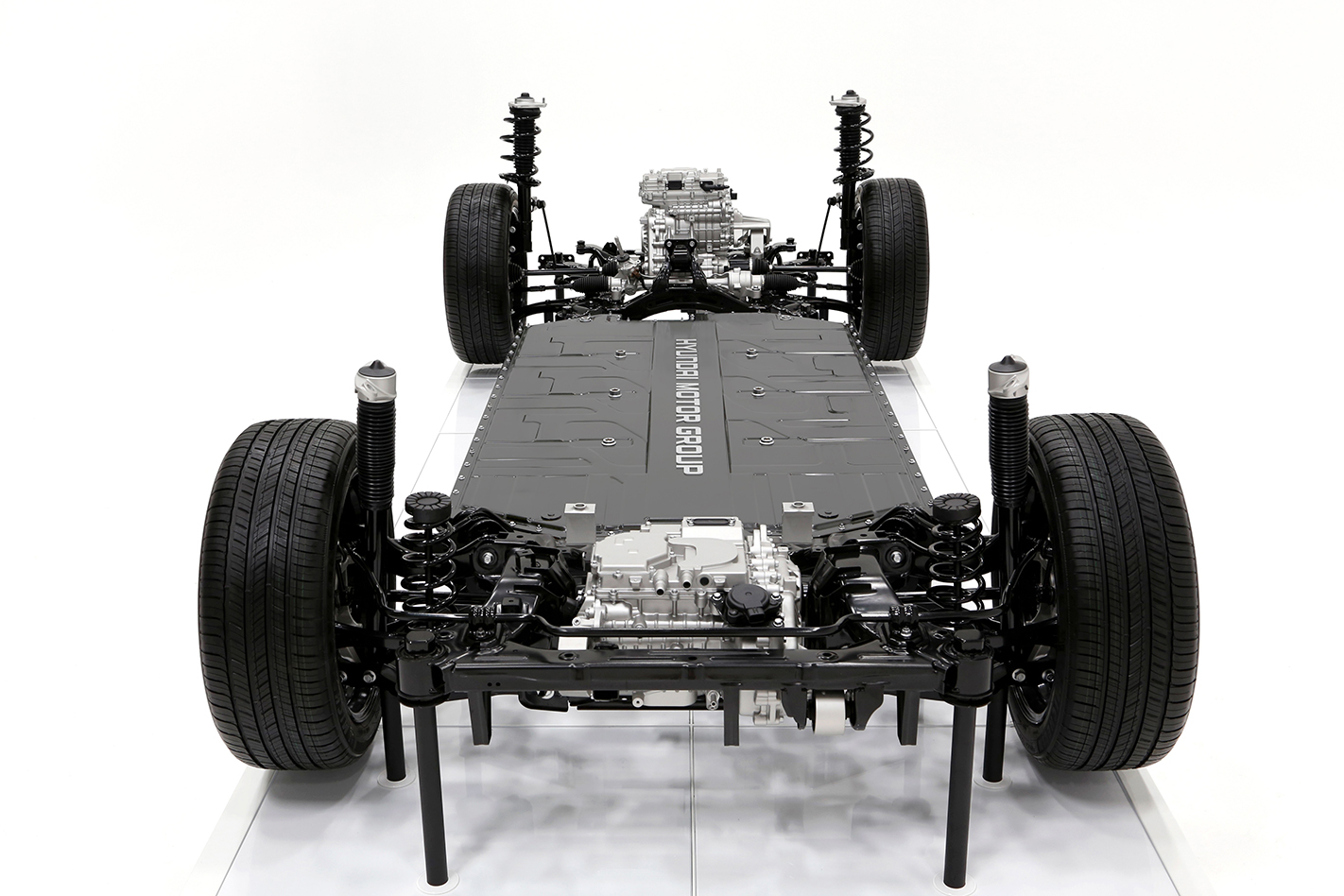
It is designed primarily for rear-wheel-drive for enhanced driver engagement, however, customers will be able to choose all-wheel drive with an additional motor which can switch between two-wheel and all-wheel drive modes to enhance efficiency by offering the ideal level of power or performance according to the driving conditions.
It will also feature a standard five-link rear suspension system, which is typically used for medium and large vehicle segments, and the world’s first integrated drive axle (IDA), which combines wheel bearings with the driveshaft for a more compact method of sending power to the wheels.
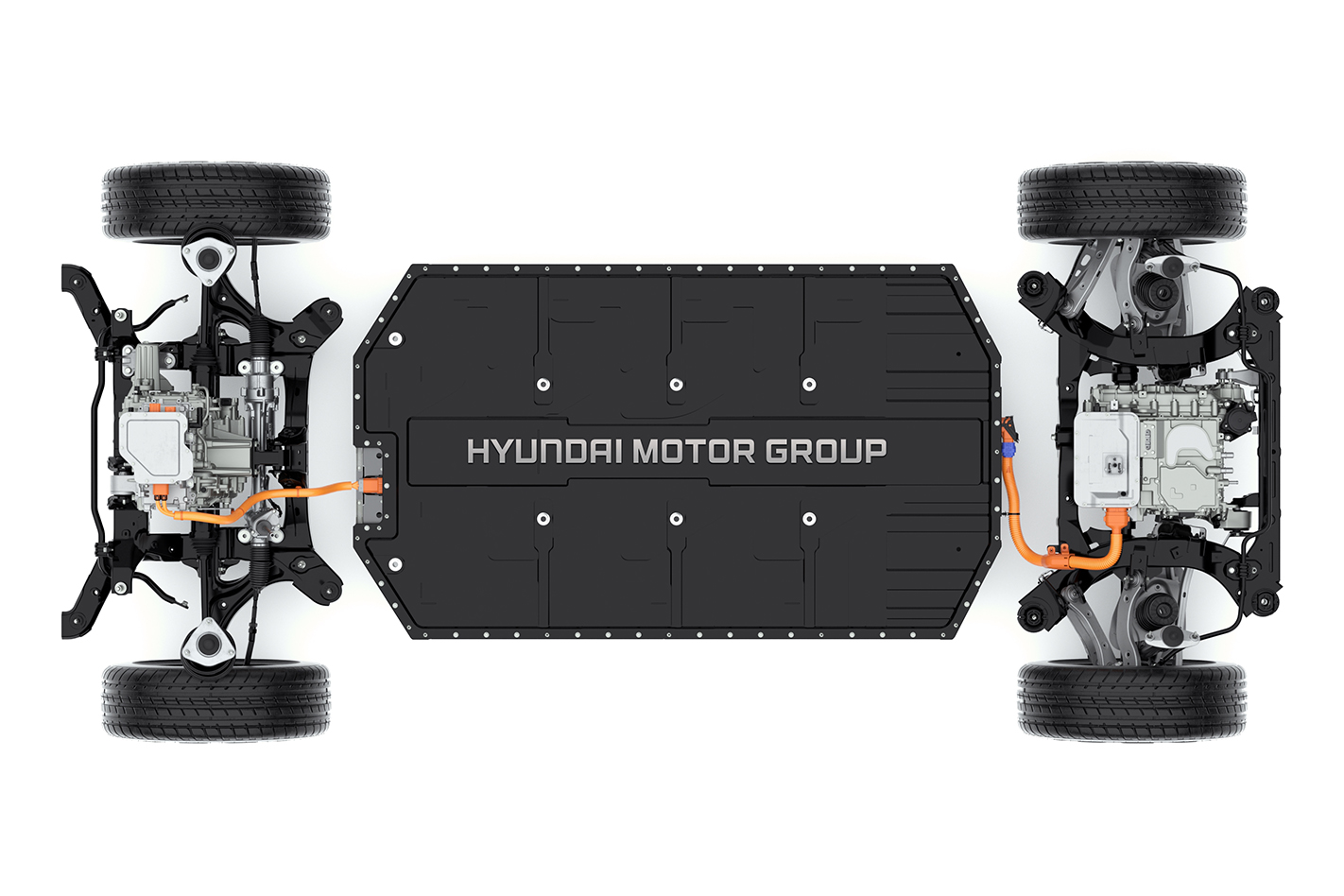
Hyundai’s battery design only allows cells to be arranged in a single layer, limiting the unit’s scalability and potential for significantly larger capacities. This design limitation most likely rules out the application of E-GMP in light commercial vehicles such as utes.
According to Biermann, Hyundai will concentrate on developing hydrogen fuel-cell technology for such vehicles.
Electrification System
The E-GMP’s compact electric (PE) system consists of a powerful motor, EV transmission and inverter integrated into a single compact module.
The high-speed motor is relatively small compared with other EV units but provides comparable performance, and brings efficiencies in both space maximisation and weight minimisation.
The standardised battery system can be tuned to offer performance appropriate for a specific vehicle segment, to maximise driving range, or produce more power for performance models.
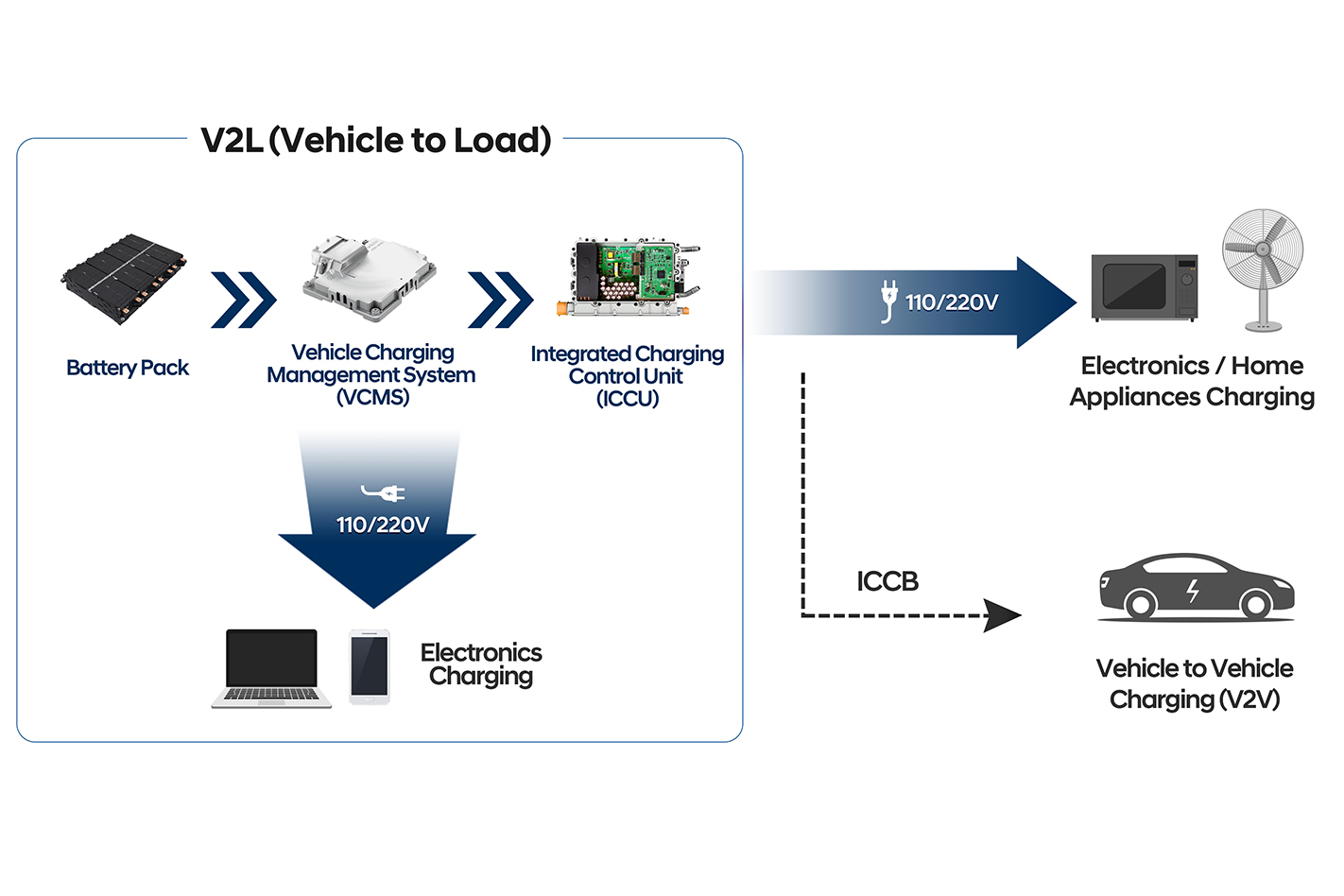
While most existing EVs and fast-charging infrastructure cater for 50kWh-150kWh charging and EVs equipped with a 400V system; BEVs built on the E-GMP will feature an 800V system, with up to 350kW ultra-rapid charging that allows for an 80 percent charge in 18 minutes or 100km every five minutes.
Porsche is the only other manufacture to yet reveal its use of 800v systems in its Taycan high-performance sedan, while Californian start up manufacturer Lucid uses 900-volt technology.
Hyundai’s solution will also feature bi-directional charging, as currently available on the Nissan Leaf, which allows for Vehicle to Load (V2L) and the option to power a home, return power to the electricity grid, or run appliances with up to 3.5kW of power – approximately the requirement for a mid-sized air conditioner unit and a 55-inch television for about 24 hours.
New bespoke BEV models
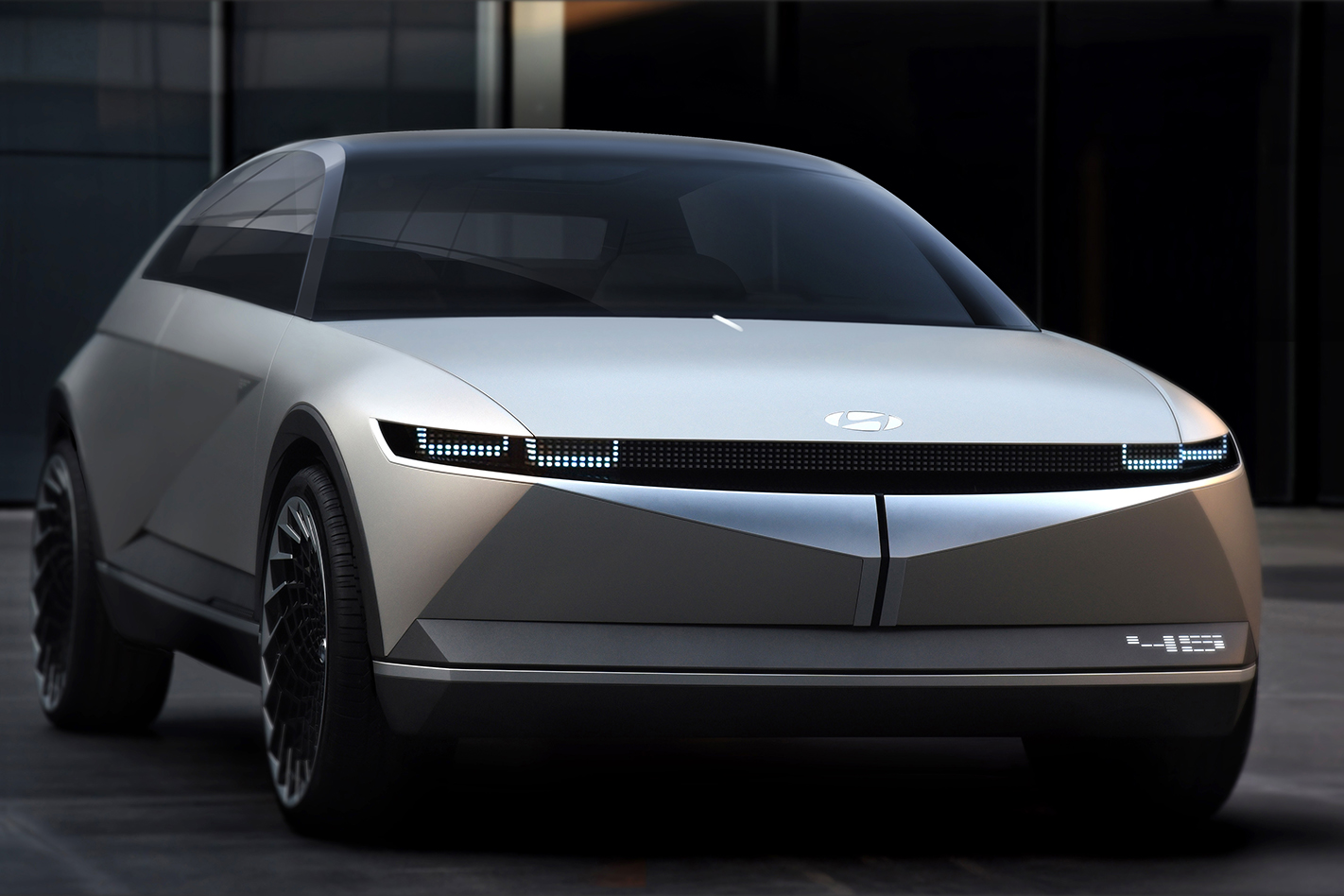
The E-GMP will underpin a total of 23 BEV models by 2025 across the Hyundai Group brands including its new Ioniq EV sub-brand, Genesis and Kia. These include the Ioniq 5 SUV, based on the Hyundai 45 concept (pictured), arriving next year.
Kia will also introduce a new pure electric crossover in 2021 as part of its ‘Plan S’ mid-to-long term strategy to take its share of EV sales volumes to 20 percent of overall sales by 2025, with seven all-new models due by 2027.
In the meantime, Hyundai and Kia will also continue to use its existing platforms for EV versions of ICE models, such as the Hyundai Kona Electric.
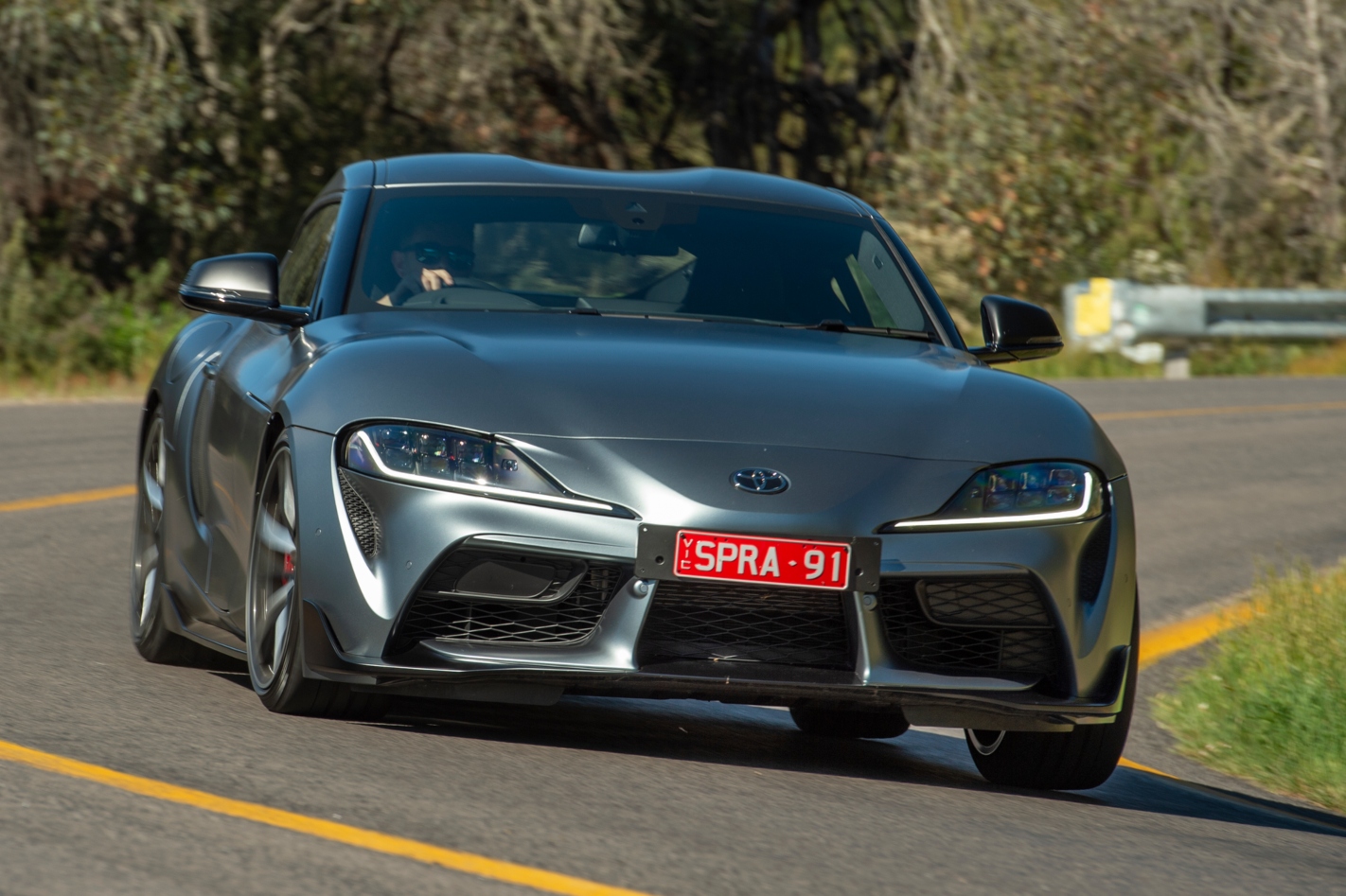
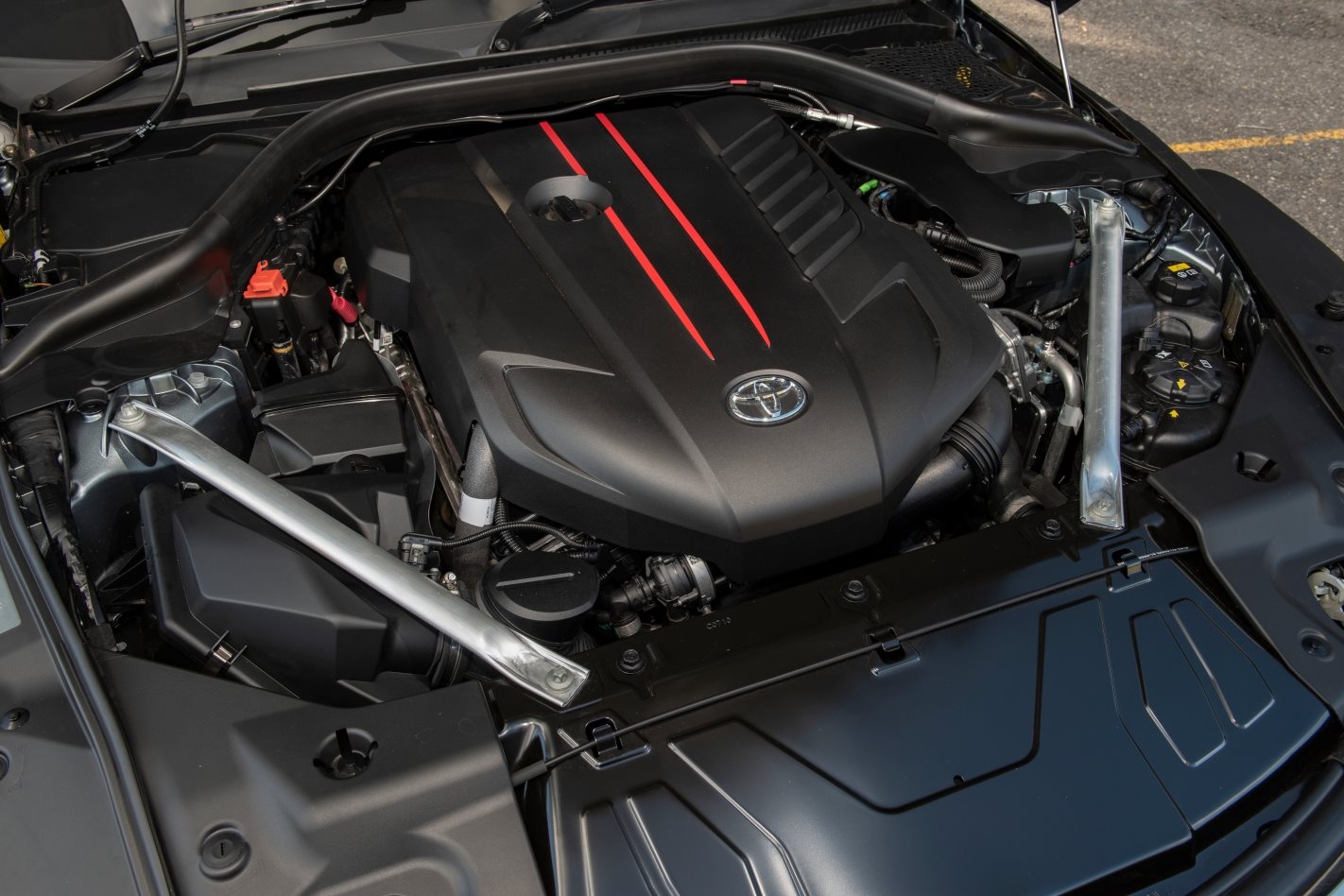
Toyota has wicked up the 3.0-litre turbo straight six under the bonnet of its Supra sports halo, finding another 35kW and taking peak power to a potent 285kW, while slashing two tenths from its zero to 100km/h acceleration time.
The upgrade boosts the Japanese coupe’s performance to match its mechanically related BMW Z4 sister convertible and the current M40i range-topping variant, which does the milestone dash in 4.1 seconds.
More under-bonnet bracing is included with the tune-up to increase chassis stiffness and manage the extra muscle, with handling benefiting from the added rigidity, says Toyota.
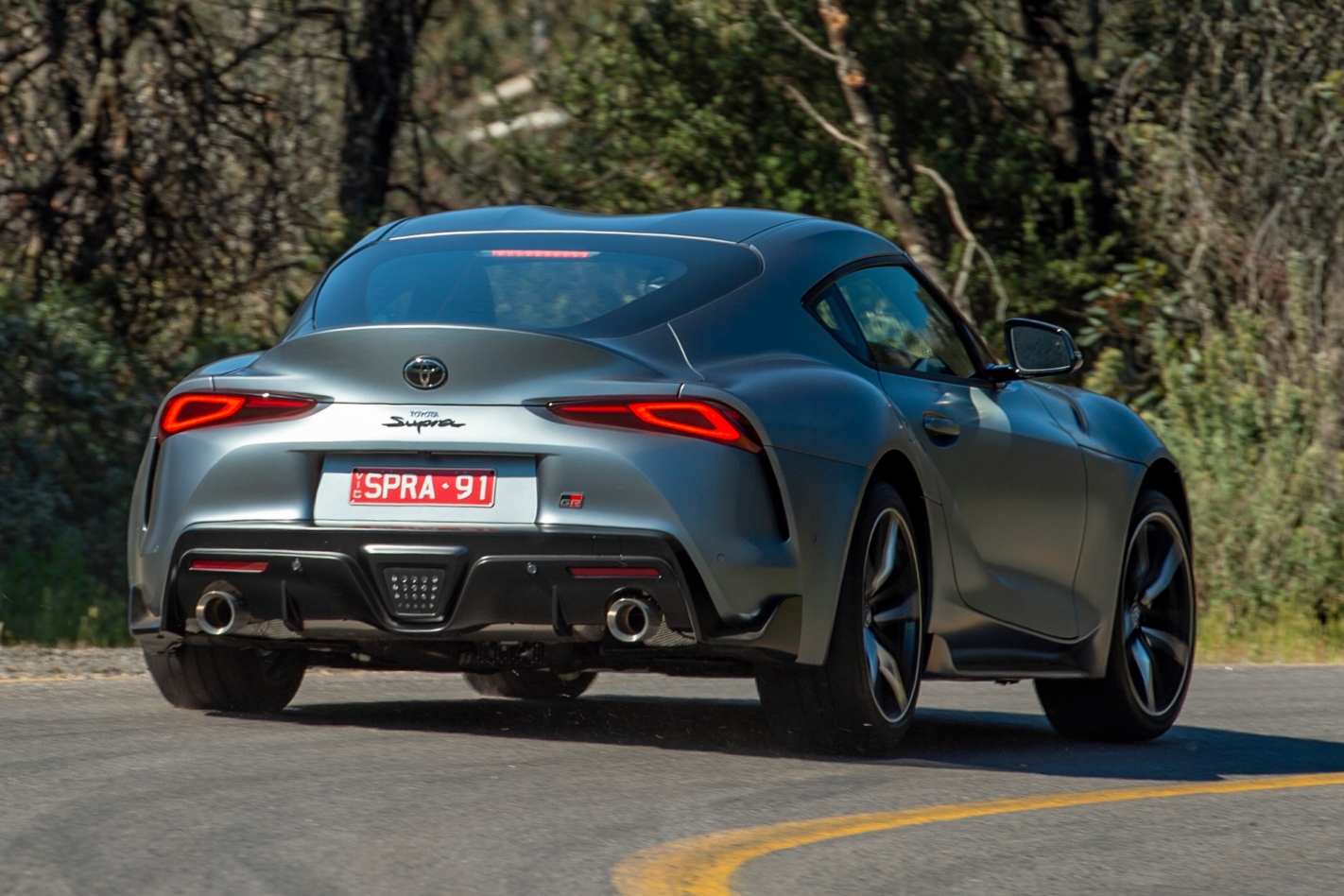
Both the GT and GTS Supras are treated to the update with the new 285kW unit succeeding the 250kW six that introduced the fifth-generation (J29) model in 2019, but the more potent 2021 Supra comes at a cost.
Increasing by $2590, the price of the entry GT rises to $87,126 before on-road costs, while the more generously equipped GTS now starts at $97,126 – a relative bargain compared with the equivalent Z4, which will set you back $127,900.
Torque, for the Supra, remains unchanged at 500Nm although the full figure is now available between a broader 1800-5000rpm rev range, as is fuel consumption of 7.7-litres per 100km despite the extra performance.
A lowering of the BMW-built B58 engine’s compression ratio is largely responsible for the output increase, allowing a higher turbo boost pressure and the more feisty power figure.
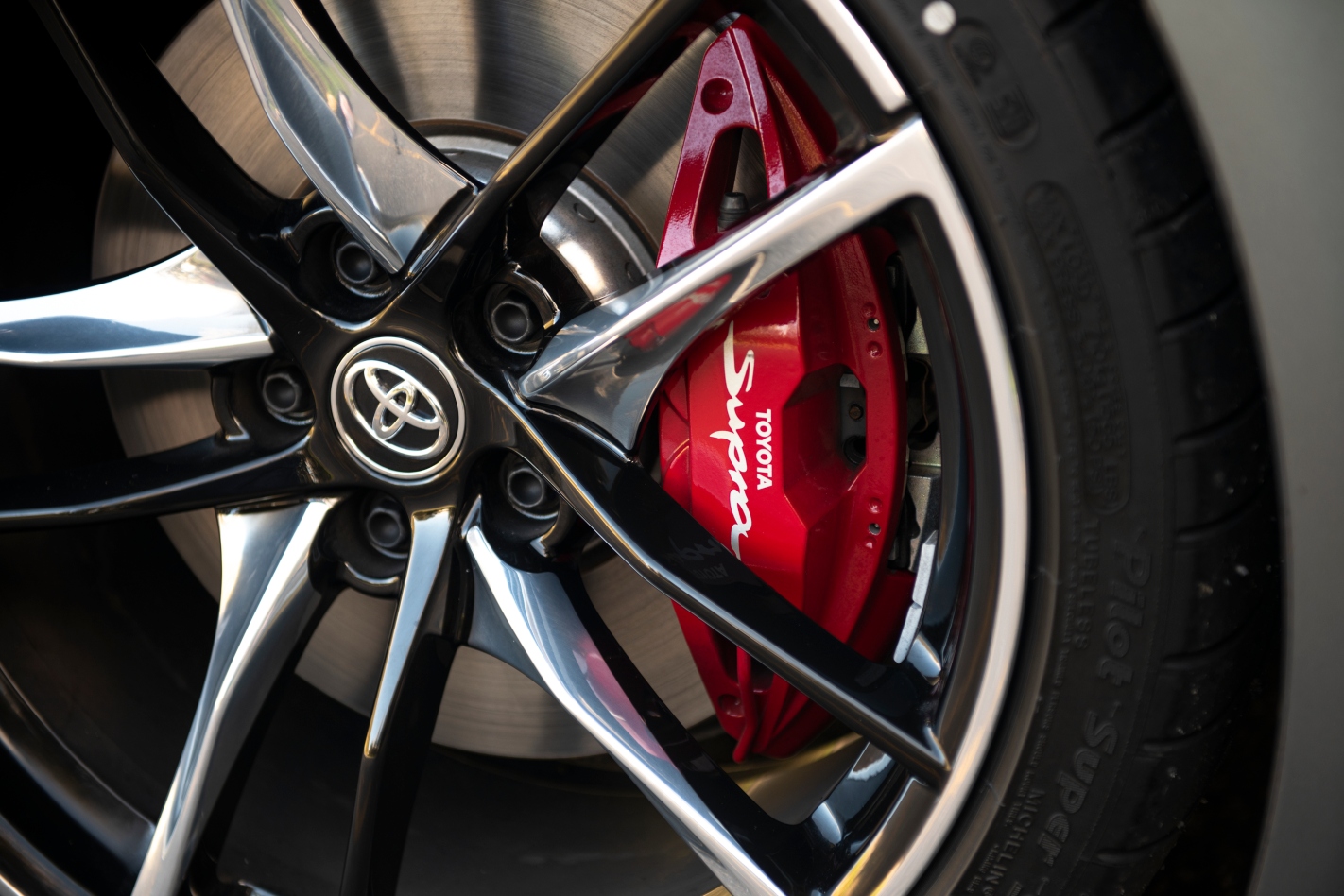
No other changes accompany the engine update and added strut bracing apart from the Supra moniker which is now applied to the front red calipers of the GTS.
As before, the extra $10,000 for the range-topping Supra includes larger 19-inch wheels, head-up display, premium JBL sound system with 12 speakers and alloy sports pedals.
It also has the option of limited-edition Nurburg Matte Grey paint finish and Alcantara upholstery, each adding another $2500 to the bottom line.
“This upgrade for GR Supra will continue our quest to deliver ever-better cars, with more power and under-bonnet bracing that will further enhance the thrilling driving experience offered by this iconic car,” said Toyota Australia sales and marketing vice president Sean Hanley.
Ford‘s electric Mustang Mach-E keeps getting quicker.
The Mustang Mach-E has stepped up the GT performance with a Performance Edition model to sit at the top of the range.
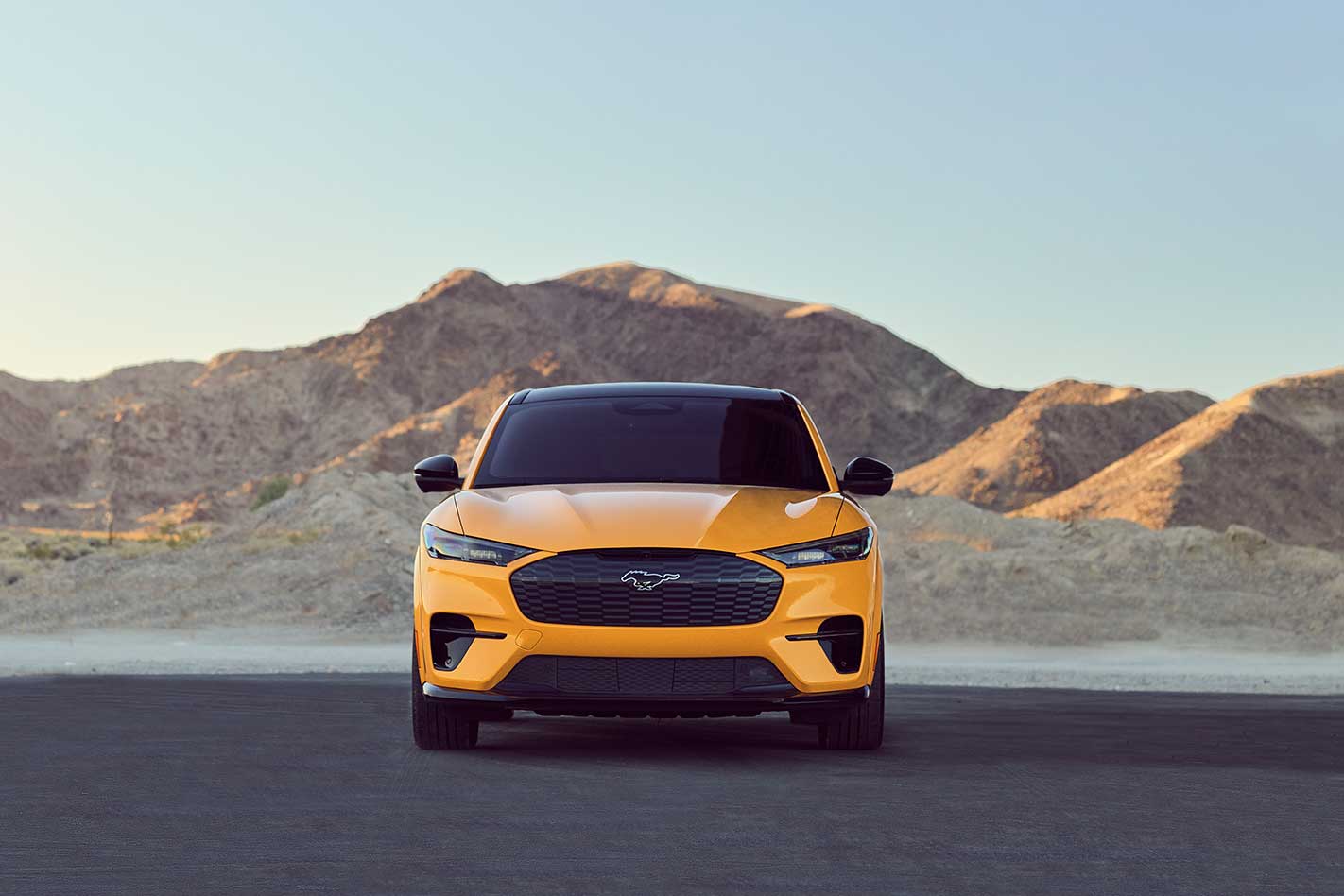
Whereas GT in the traditional Mustang sense signifies a V8 engine, in the Mach-E it means more electric power – and it’s channelled to all four wheels with an electric motor for each axle.
And for the Performance Edition it brings the ability to draw more torque from the 88kWh battery pack, in turn translating to more grunt and more go.
Outputs peak at 358kW (the same as the regular GT) and 860Nm (a 46Nm bump), enough to launch the Mustang-inspired electric SUV to 60mph (96km/h) in an estimated 3.5 seconds, about the same as the Model Y that is the Ford’s prime competition.
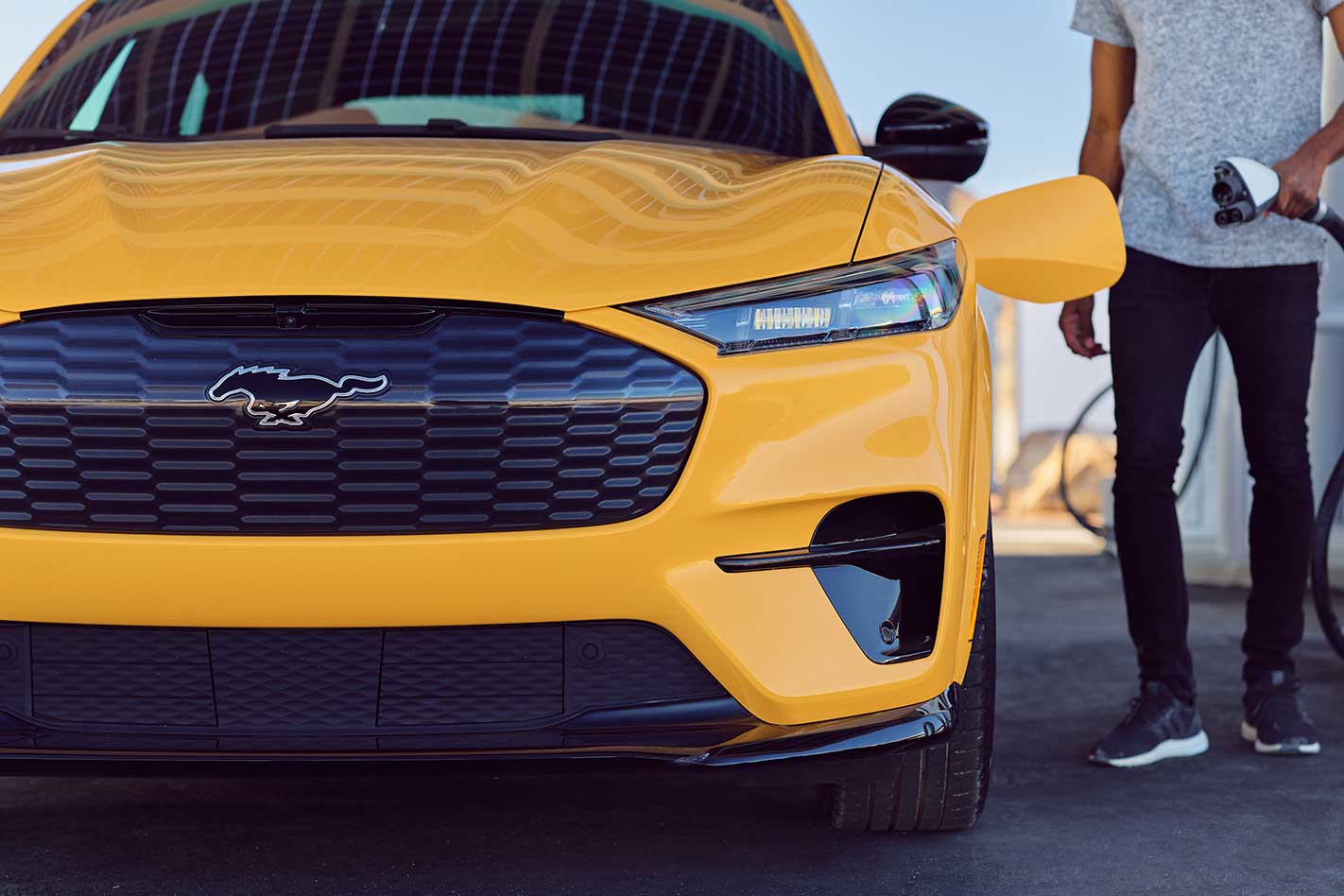
“We already pushed the envelope by creating an electric vehicle with the pony badge, so it’s only natural that we push it even further,” said Darren Palmer, Ford’s global director for battery electric vehicles.
“Mustang Mach-E GT Performance Edition not only gives you the added performance you expect from the GT name, but accentuates the thrill with the responsiveness of an all-electric powertrain.”
The Mustang Mach-E Performance Edition also gets larger Brembo front brakes with red calipers and unique 20-inch alloys. MagneRide adjustable dampers are also thrown in; no word yet on the price, although clearly it will be more expensive than the US$60,500 GT.
Certainly sounds very high tech and a big departure from the leather that has dominated in top-end models.
The Mustang Mach-E is not yet confirmed for sale in Australia, but it’s difficult to see it not coming here eventually.
The car is already engineered for right-hand drive production and is confirmed for sale in the UK.
Hopefully, it’s only a matter of time…
READ NEXT Ford’s bonkers Mustang Mach-E 1400 in focus
Update 1: Escape from Victoria
It seems like such a good idea at the time… drive to Melbourne from Sydney to swap long-term cars, say hi to the rest of the team and drive home again.
I drove out of Melbourne with ‘my’ new Jeep Cherokee Trailhawk about a day and a half before it all went to poop again…
Jeep’s mid-sized Cherokee SUV has had, it’s fair to say, a bit of a chequered career thus far. Launched locally in 2015 to… umm… a lukewarm response to its challenging visage, let’s say, it’s never really resonated with buyers enamoured with the likes of Mazda’s CX-5 and the evergreen Toyota RAV4.
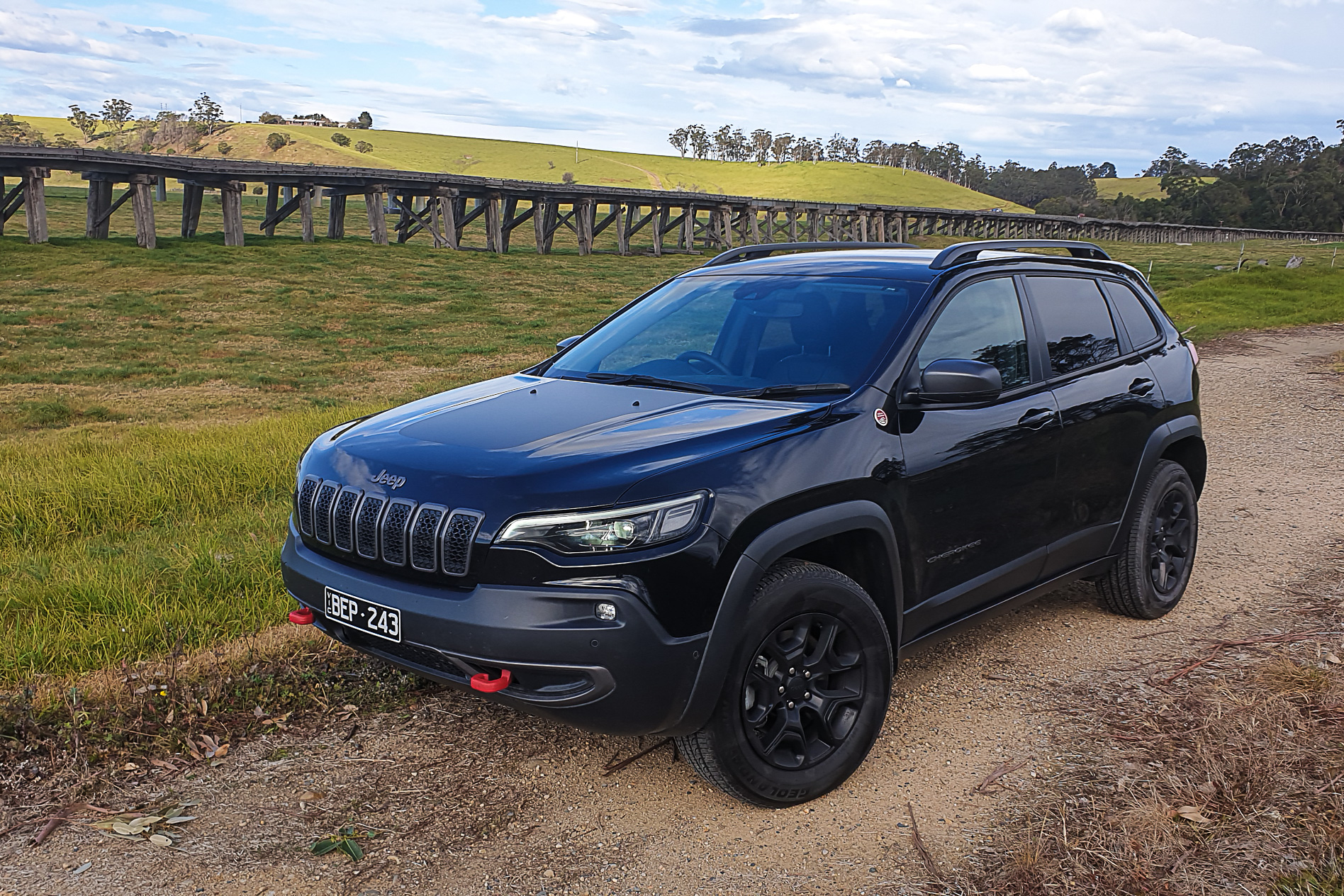
Part of the issue is the reasonably obvious disparity between these three cars. The CX-5 trades on its driveway appeal and ease of use, while Toyota’s unassailable reputation with generations of buyers has worked hand-in-hand with a top-notch new version.
This is the updated version of the Cherokee, such as it is. It was made over a couple of years back to soften the ill-advised grille treatment, while the variant line-up was tidied up earlier this year.
I’ve got the top-spec Trailhawk, Jeep’s self-rated offroad-ready version of the Cherokee that complements the Wrangler and Grand Cherokee Trailhawks.
Complete with a proper low-range 4×4 drivetrain hooked up to a 200kW, 312Nm 3.2-litre V6 petrol engine, its triple-diff 4x4drivetrain also includes a low-range transfer case, the ability to lock all three diffs, hill ascent and descent control, taller suspension, unique bumpers and underbody skid plates.
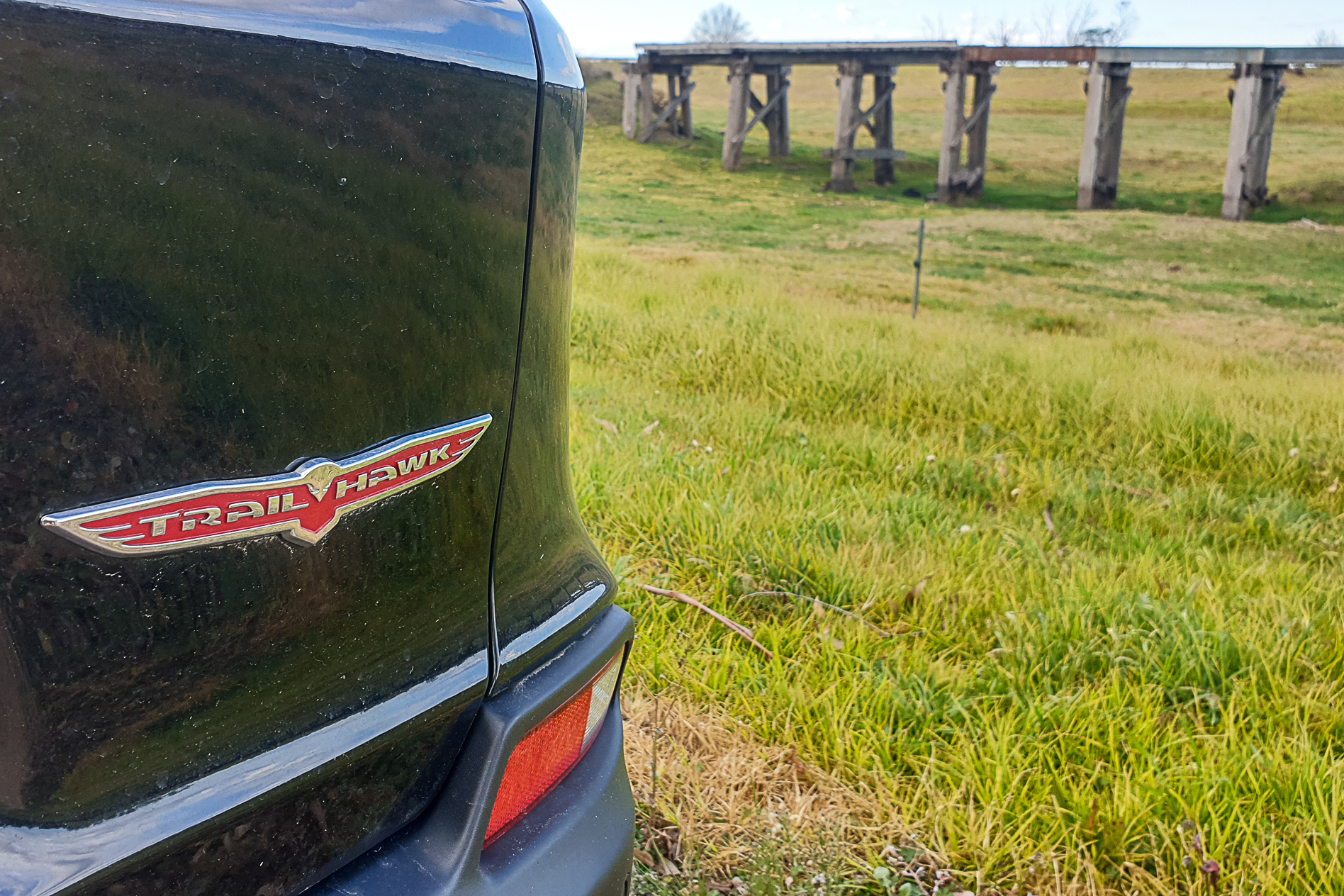
It also has offroad-spec rims and leather/cloth seats with heating and venting, 18-inch rims, a large 8.4-inch multimedia system with sat-nav and smartphone mirroring, and a colour screen between the dash dials and automatic parking.
Our Diamond Black tester has a Premium package of kit included, which includes adaptive cruise control with stop-and-go, auto high beam headlamp control, black leather upholstery with red accent stitch, two-position seating memory and fore/aft adjustable second-row seat backs.
It adds $2850 to the base price of $48,450, and a premium paint surcharge of $645 brings it up to $52,045 before on-roads.
This is Volkswagen Tiguan 162TSI Highline or even top-of-the-tree Mitsubishi Triton dual-cab money – and it will even get you into an entry-level petrol-powered Grand Cherokee Laredo.
That price point also punts it a grand clear of the dearest AWD petrol-powered CX-5 and a not-inconsiderable eight grand above the most expensive RAV4.
So, what’s the hook? Jeep will tell you –and it has a point – that the Cherokee’s robust drivetrain is pretty unique in the medium-sized SUV space.
Land Rover’s Discovery Sport is similarly equipped, but its price of entry starts with a six. The V6 petrol engine, too, is becoming a scarcer commodity, and what it loses in economy it makes up for in smoothness and alacrity.
Do you need a petrol-powered medium SUV with a dual-range transfer case, a locking rear diff and 2200kg towing ability? They say there’s a car for everyone…
I’m going to use this car like it’s not mine, because I know there are plenty of you out there who question Jeep’s reputation for reliability and durability.
And this thing is supposed to be built Tonka tough, so let’s prove that theory by towing stuff, slinging dirty mountain bikes in and out of it and putting some decent kilometres on it (as far as we can in this ever-changing world, at least).
My wiggly route home from Melbourne put just over 1000km on the Trailhawk’s odo, and included a variety of surfaces and road conditions, as well as a bit of elementary dirt work… just to get a feel, you understand.
My Norco Optic slides into the cargo area, but only with the front wheel removed; plenty of other medium SUVs will swallow my large MTB wheels-on, so that’s a bit annoying.
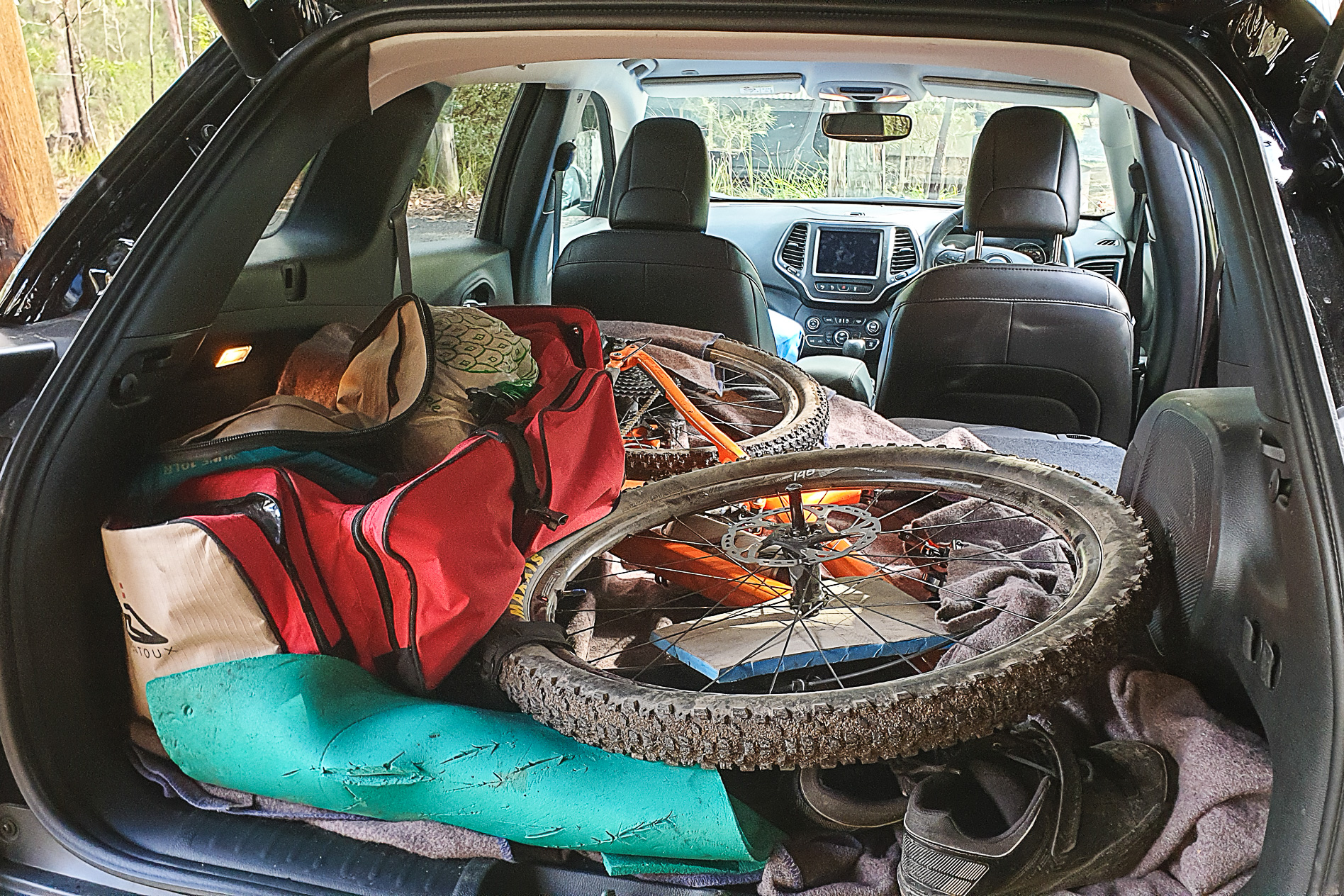
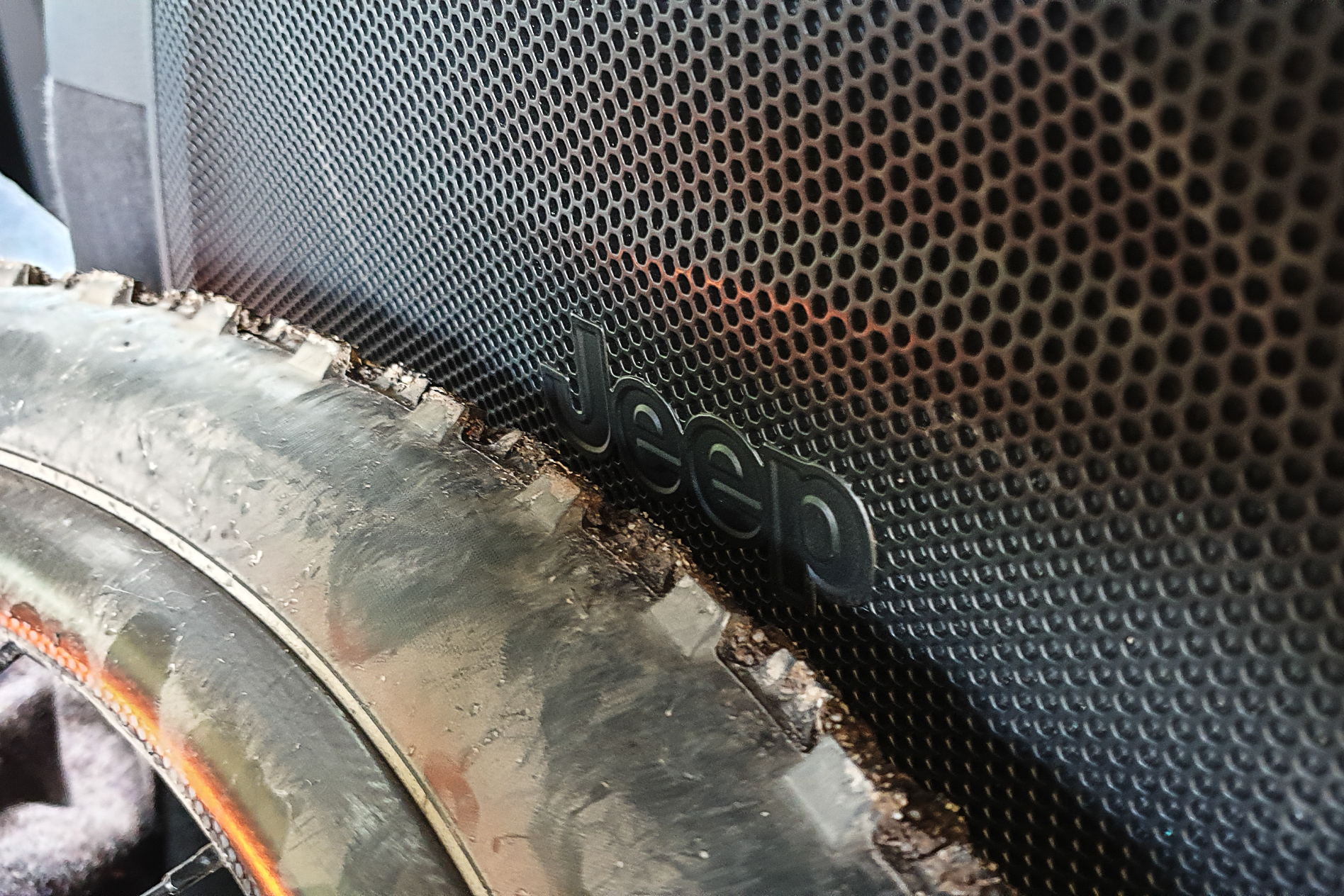
There is a lot of plastic trim back there, which should weather a torrent of mud and crud a bit better, and kudos for the trim protection around the tailgate, too. That huge speak enclosure eats into the cargo room a bit, though.
I wish the leather seat could be lowered further and the seat base is a little short and narrow, but the rest of the driving position is pretty spot-on – except for one glaring oversight.
The switch to right-hand-drive overlooked one crucial element; a place for the driver’s left foot. A bulbous transmission tunnel exacerbates the omission. You learn to live with it, but it’s not ideal.
Cruising at the state limit is comfortable and surprisingly quiet, with the tractable V6 giving the relatively small Cherokee a bit of genuine zip.
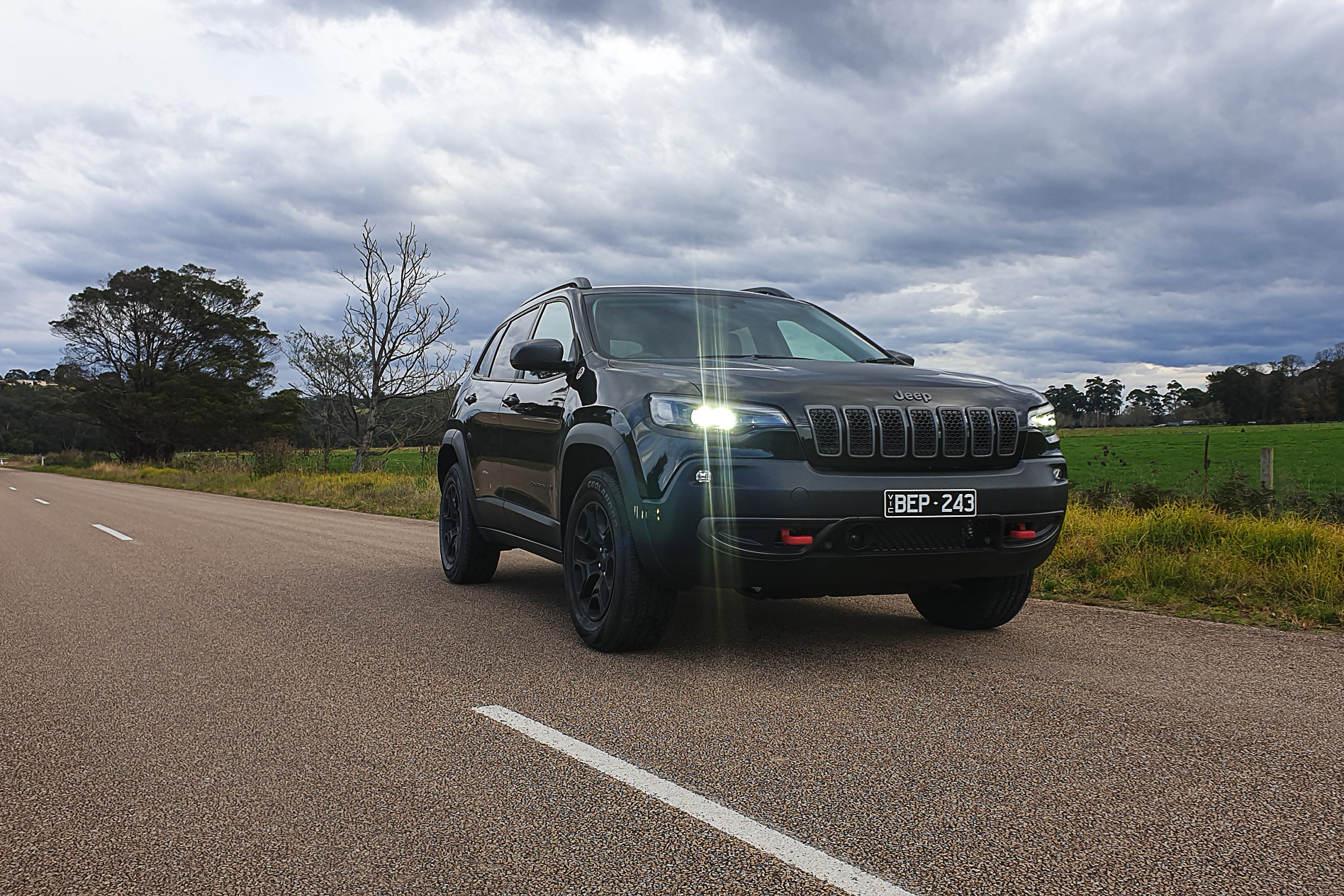
The only transmission option is a ZF nine-speed auto, which for the most part plays nicely with the engine – though there are moments when downshifting at moderate speeds where there feels like there’s a brief conflict between which ratio should be the next to be engaged.
It’ll be interesting to see how the relationship develops – the ZF nine-speeder yielded more than its share of gremlins when it launched with the Cherokee and Renegade back in 2015, but you’d hope those bugs have been well and truly ironed out in 2020.
On-road handling is surprisingly good; the Yokohama GeoLandar tyres hang on well, the four-link rear end provides decent feel and the steering, while light, is decently feelsome… and not just for an SUV.
Brake feel and modulation, too, is excellent, and something I really appreciate in a car.
To get some mud under the tyres, it’s simply a matter of selecting a suitable terrain map with a rotary dial. I traversed a moderately tricky forestry road for photography purposes and the Cherokee just yawned a bit.
I’m eyeing a steep track not far from our place that will certainly give the Trail Rated brand a go, though. And it might be a great tool to access some mountain bike trails I’m too lazy to climb. Honey? What are you doing this Saturday?
Odo 9450km
Kilometres travelled 1255km
Fuel economy (actual) 9.8L/100km
Update two – first service ace
It’s a rarefied life for motoring journos, to be fair – and a life that can miss the harsh realities of the everyday.
Car companies are very happy to roll out freshly washed and vacuumed press fleets, but can occasionally get a bit leery when we ask to take a car into a dealership for a small fix.
Why? Put simply, the company can’t control the outcome. Sounds harsh, but that’s why car companies have press departments…
As it turns out, though, I needed to take our Cherokee back for its first service, and rather than schlep into the Big Smoke, I lobbed into the local Jeep dealership in Wollongong, on the south coast of NSW.
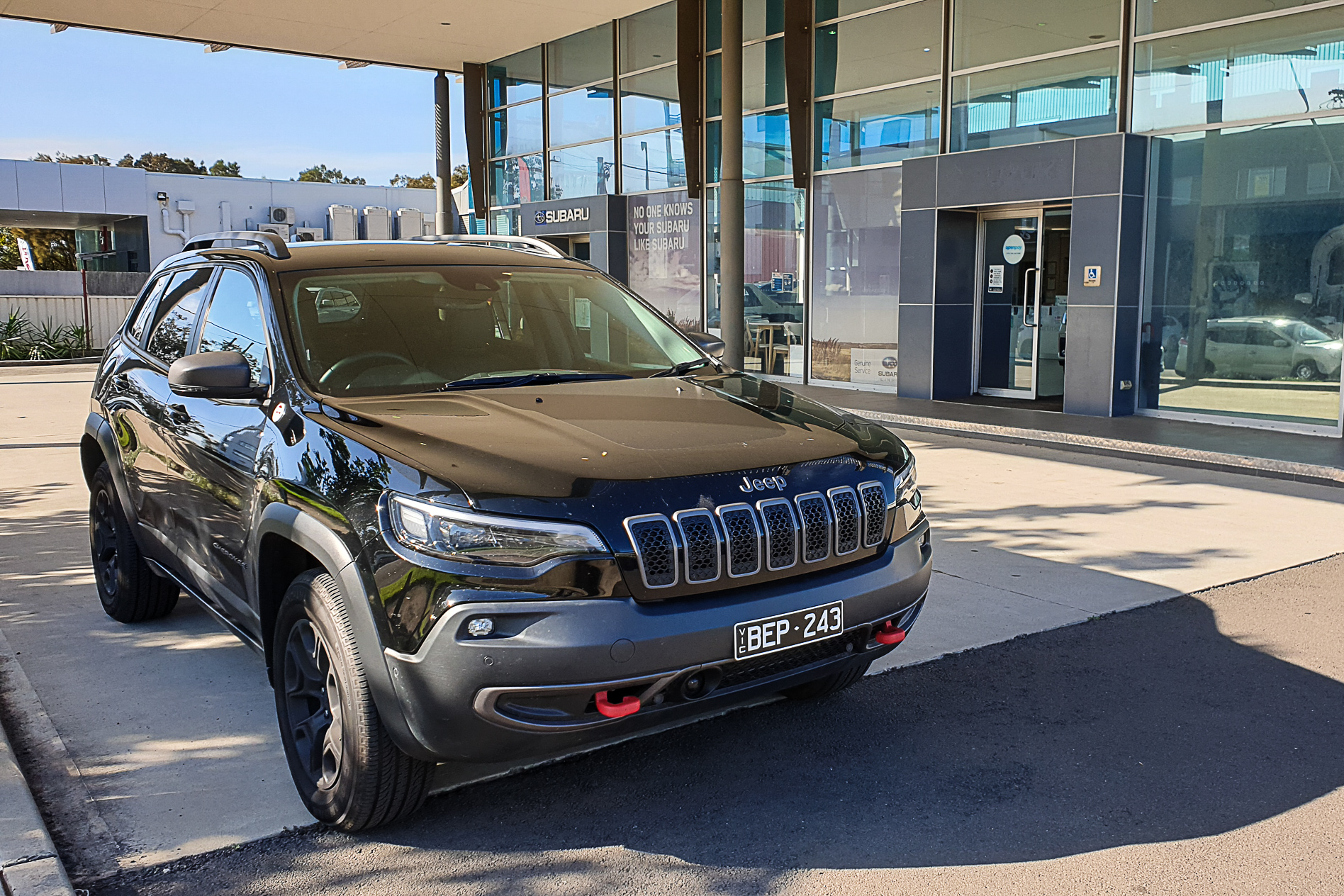
Now even though the affordability chasm between brands like, say, BMW or Mercedes-Benz and Jeep is reasonably wide, the fundamentals of the car dealership don’t change much.
Display car in one corner, a new model in another, a person or two at a row of desks not quite in customer reach typing furiously and some sort of counter arrangement where a customer is required to approach. While the finer points may vary, trust me… they’re all variations on a theme.
My initial contact with the Guardian of the Front Desk is friendly enough, and soon the Cherokee is being examined by a young chap who is courteous and attentive – and honestly, in this day and age, that’s a bloody good result.
I don’t envy the modern retail worker, especially if even a perfunctory glance at Facebook is any guide these days, and for the most part, people are only visiting a service centre to hand over money or to explain a problem that they’re usually not sure how to explain. It can make for a fraught day in the office.
For me, I got straight answers to some deliberately dopey questions, and I got an honest appraisal of how long I’d need to wait.
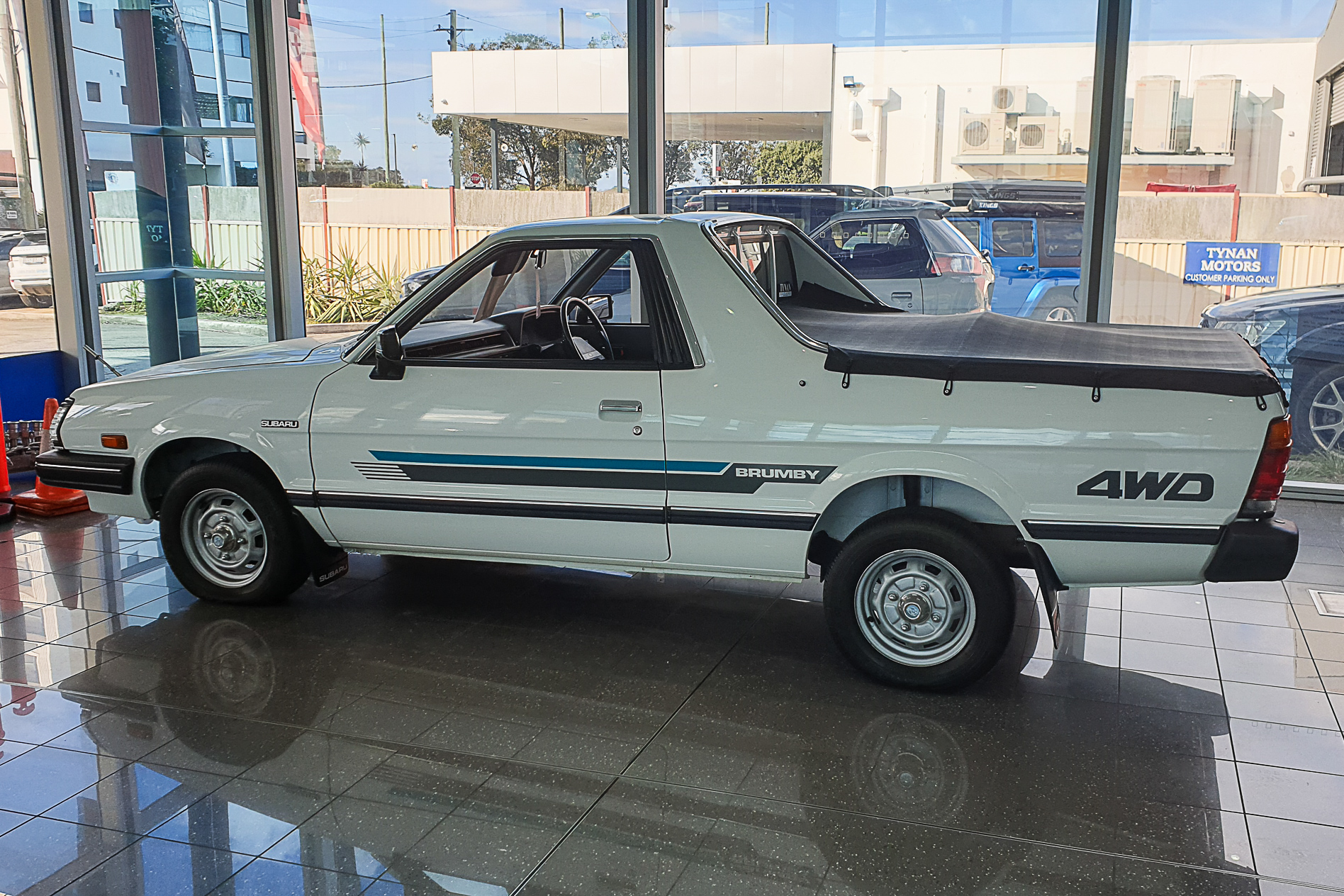
A quick text from the Guardian duly arrived about five minutes after the agreed-upon time, and after a quick chat about the aforementioned display car – a beautiful old Subaru Brumby – I’m on my way again.
Jeep has repeatedly told us this year that its new boss Kevin Flynn – a veteran of the car game and a petrolhead to boot – is here to fix the issues that Jeep owners have complained about for years.
Expensive parts? Price cuts across the thousands of product lines. Unsolvable problems at a retail level? A ‘flying doctor’ squad of techs who can be dispatched to get things on the right path again.
As well, no matter how old your Jeep is or how many services you have skipped, return to service your Jeep at an authorised dealership, and you’ll get an additional 12 months roadside assistance and can continue to do this for the lifetime of the vehicle.
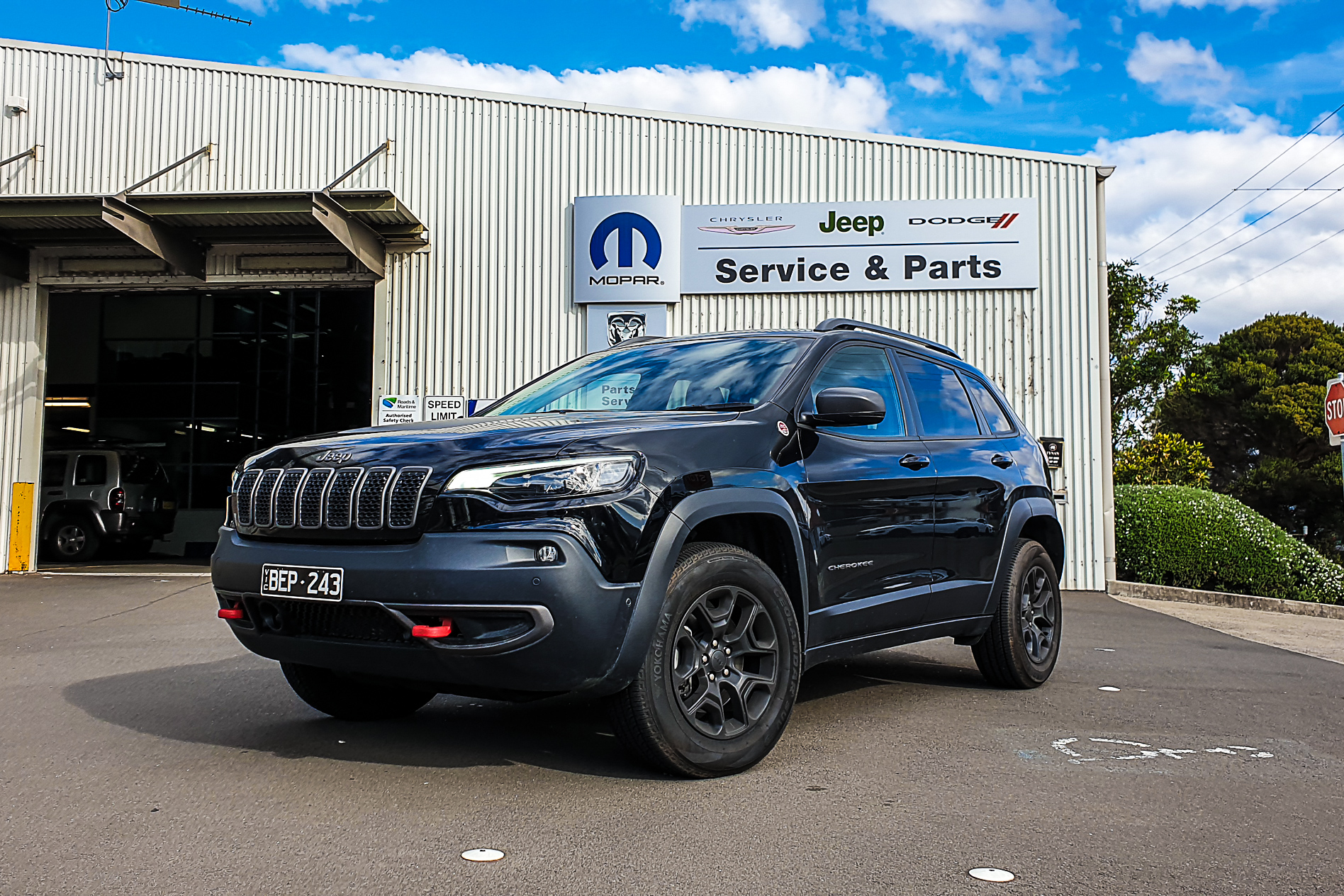
Let’s be honest… Jeep has built a rod for its own back when it comes to its customer base past, present and future, so it needs to tick every box it can tick to ensure that it can entice buyer back into the fold.
Dealerships will play a big part in that transformation, and on first blush, it seems as if the changes are taking effect.
Odo 10,227km
Kilometres travelled 827km/2072km total
Fuel economy (actual) 9.7L/100km
Update three – Empty Esky to the rescue
At home, we’re surrounded by bushland. We’re pretty lucky, all things considered, to be able to take in a vista of rustling bushes and swaying trees rather than Colourbond fencing and grey roof tiles.
Over the last couple of years, though, that view feels as if it could come at a cost. In 2019, particularly, NSW’s bushfire fields – while still a good 25km away at the closest point – closed us in on three sides, with day after day of dense smoke blanketing the skies.
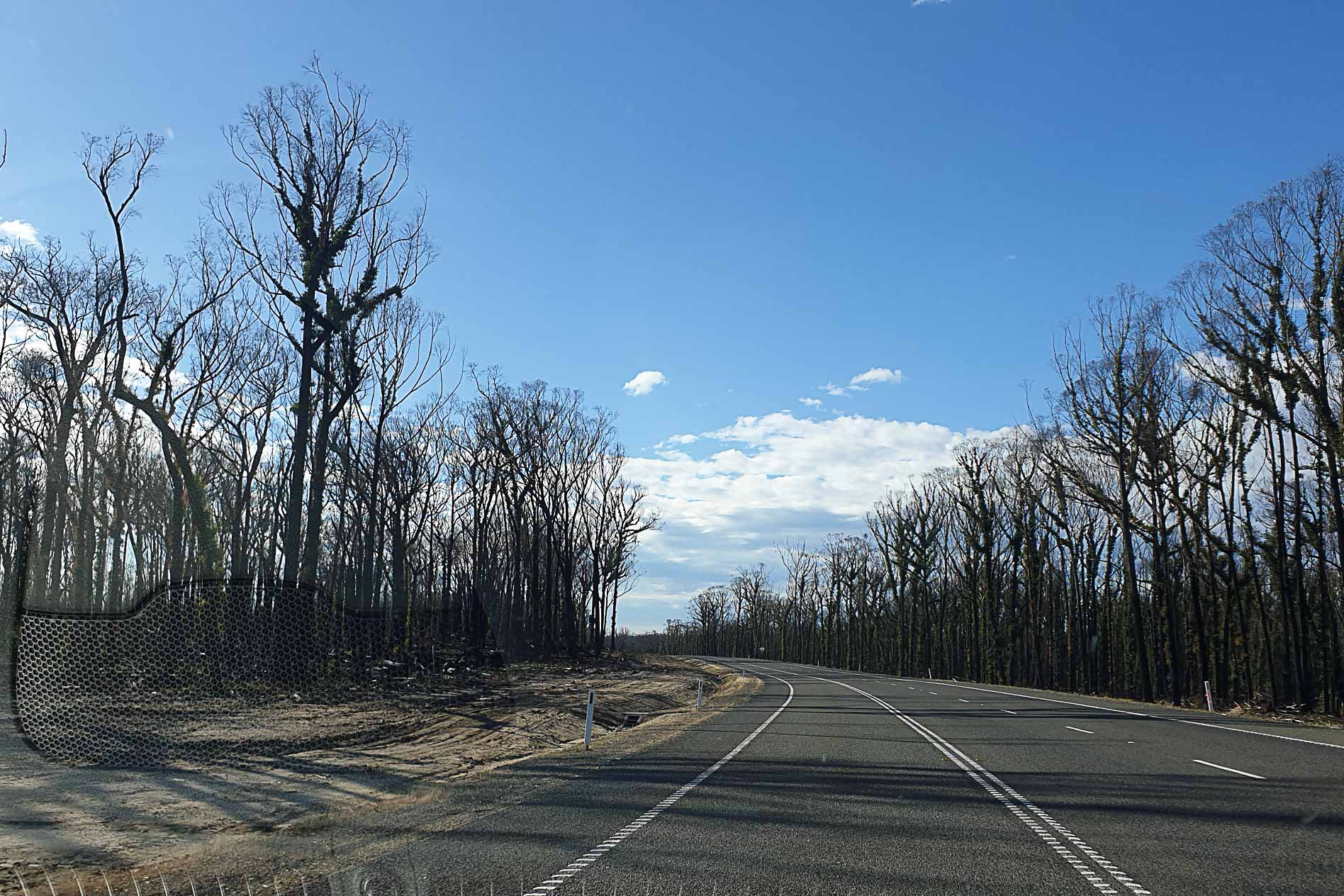
That bush suddenly looks pretty damn flammable, so much so that we’ve got our evac plans in place should we need to beat a hasty retreat. And we’re in suburbia!
Of course, a lot of people lost an awful lot in 2019 and in the years preceding, while the double punch of COVID-19 has hurt a lot of small businesses in our neck of the woods throughout the curse that is 2020.
Several operations have sprung up to try and bring relief to these businesses, and there have been some amazing tales of generosity from the wider community.
One such operation is called Empty Esky, and the premise is a simple one; hit the road, take a wallet, buy some stuff from local stores.
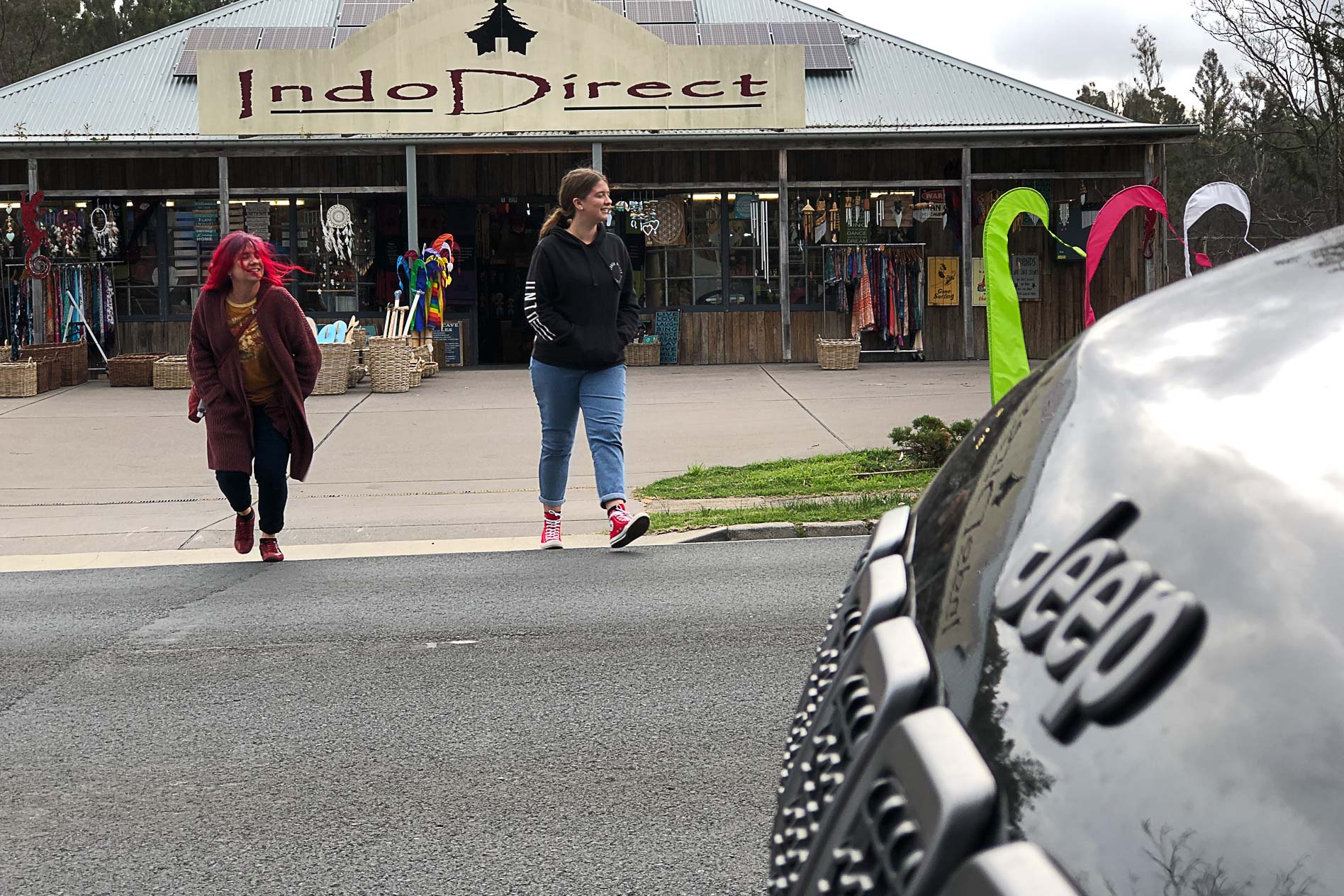
“Empty Esky is a national tourism movement of foodies and adventurers on a mission to support small businesses affected by the Australian fires,” said Eleanor Baillieu and Erin Boutros, the co-founders of Empty Esky.
“Regional small businesses in Australia have really done it tough this year, but it’s been incredible to see the Aussie spirit shine through to support some of our hardest-hit areas.
“The fires have had devastating effects on not only the environment, communities, animals and human life but also on the local economy and peoples’ livelihoods.
“We encourage everyone to grab an Empty Esky, embark on a road trip to a fire-affected town (when it’s safe to do so) and to stock up with produce and wares purchased from local traders.”
Run as a not-for-profit on a volunteer basis, Empty Esky’s site offers a brace of connections with locally owned cafes, restaurants and even homewares stores on its site… which proved the basis for my cunning plan.
I’ve taken the Cherokee to Tathra before, and the chance to return – this time with the family in tow – is too good to pass up.
This time, instead of a single body and a bike, the Cherokee is loaded with my wife and I, as well as our 14-year-old daughter and a brace of bags. The bike will have to hang off the back.
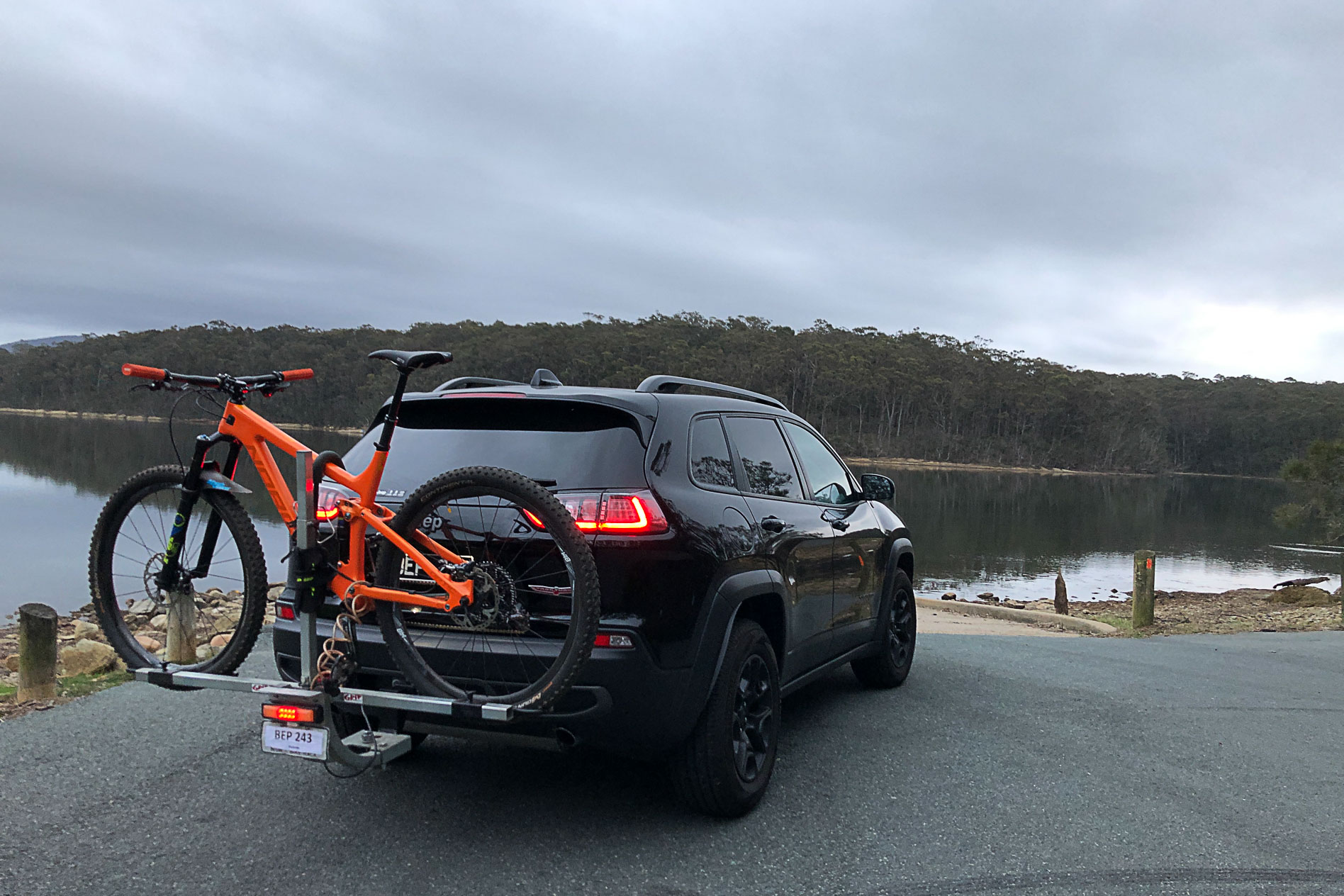
It’s not my first rodeo with towbar-mounted racks, but the plan nearly came unstuck at the first hurdle, thanks to an insanely tightly torqued factory towball.
Initially, I thought I could quickly swap out the towbar’s square hitch for another, but the shallow depth of the Jeep’s mounting thwarted that idea. Carmakers… can we please make all this junk more standard?
I eventually prised the factory unit apart, bodged in a number plate mockup and got everything set to go… only to find that the Cherokee’s rear cross-traffic alert system was not at all happy with a bicycle mounted on the back, squealing indignantly and activating the brakes whenever reverse was engaged.
The system can be turned off at the touch button and the reversing camera works fine, but the sensors do not, making reversing a bit more of a challenge.
Usually, a trip to Tathra takes about five hours, but we manage to extend that to almost eight by indulging ourselves with stops in Berry, Narooma and Mogo, taking the opportunity to load up on all sorts of stuff. Mostly chocolate, cheese and wine, if I’m being honest.

Between grub, gifts and grog, I reckon we left our fair share of dollars in the local’s pockets, and I reckon that, with the COVID thing looking like it’s (knock on wood) at a level we can deal with, the chance to fill your own Empty Esky this summer looks good.
As with the previous run down the coast, the Cherokee’s larger engine and well-resolved ride/handling combo mean it’s a great companion on a long journey. Our rear-seat rider was perfectly content even on longer stints, too, even though the Cherokee isn’t as generous with its interior space as others in the category.
A fuel consumption score of 9.5L/100km over 524km isn’t shabby, either.
The gearbox is still a bit of an Achilles heel for mine, though – it just feels like there’s a ratio or two too many to choose from, and the software gets caught on the hop picking the right one for the right moment.
It’s most obvious when shuffling back a couple of cogs to deal with an incline and there’s a bit of load on the drivetrain; it’s possible to lightly lift the throttle when you feel it which can smooth it out – but it doesn’t always work.
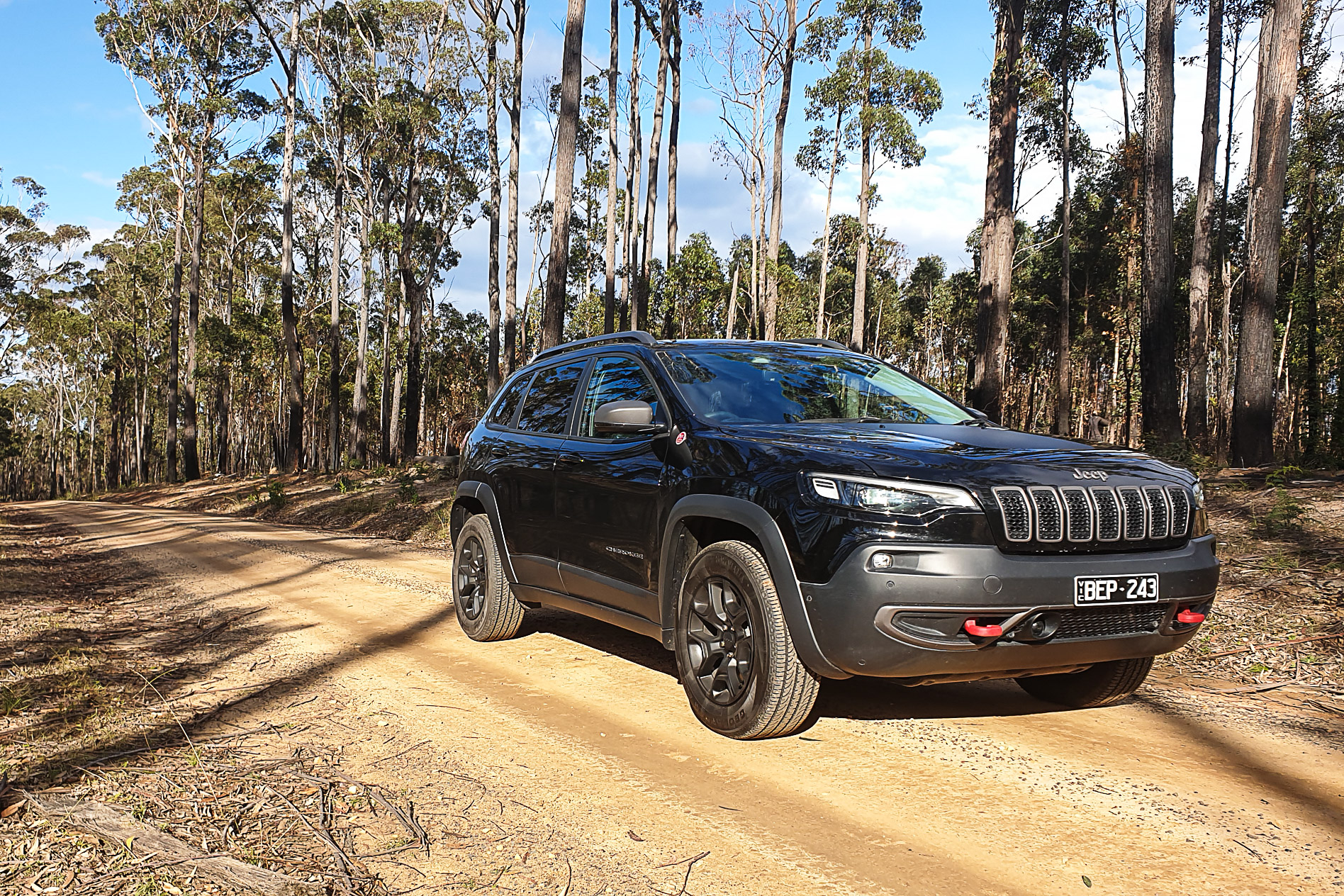
Otherwise, it’s another clean bill of health for the Cherokee. We’re into our last stint with the car this month, so we’ll try and find some real dirt to play in.
Odo 11,210km
Kilometres travelled 983km/3055km total
Fuel economy (actual) 9.7L/100km
The Victorian Government didn’t exactly enamour itself to EV owners this month with its decision to subject electric vehicles to a road tax, but new penalties against drivers of internal combustion engine (ICE) vehicles who park at EV charging bays should curry it some favour.
The act known as ICE-ing can be terribly frustrating for EV owners seeking to charge their vehicle at a public charging station, especially if there are no nearby alternatives.
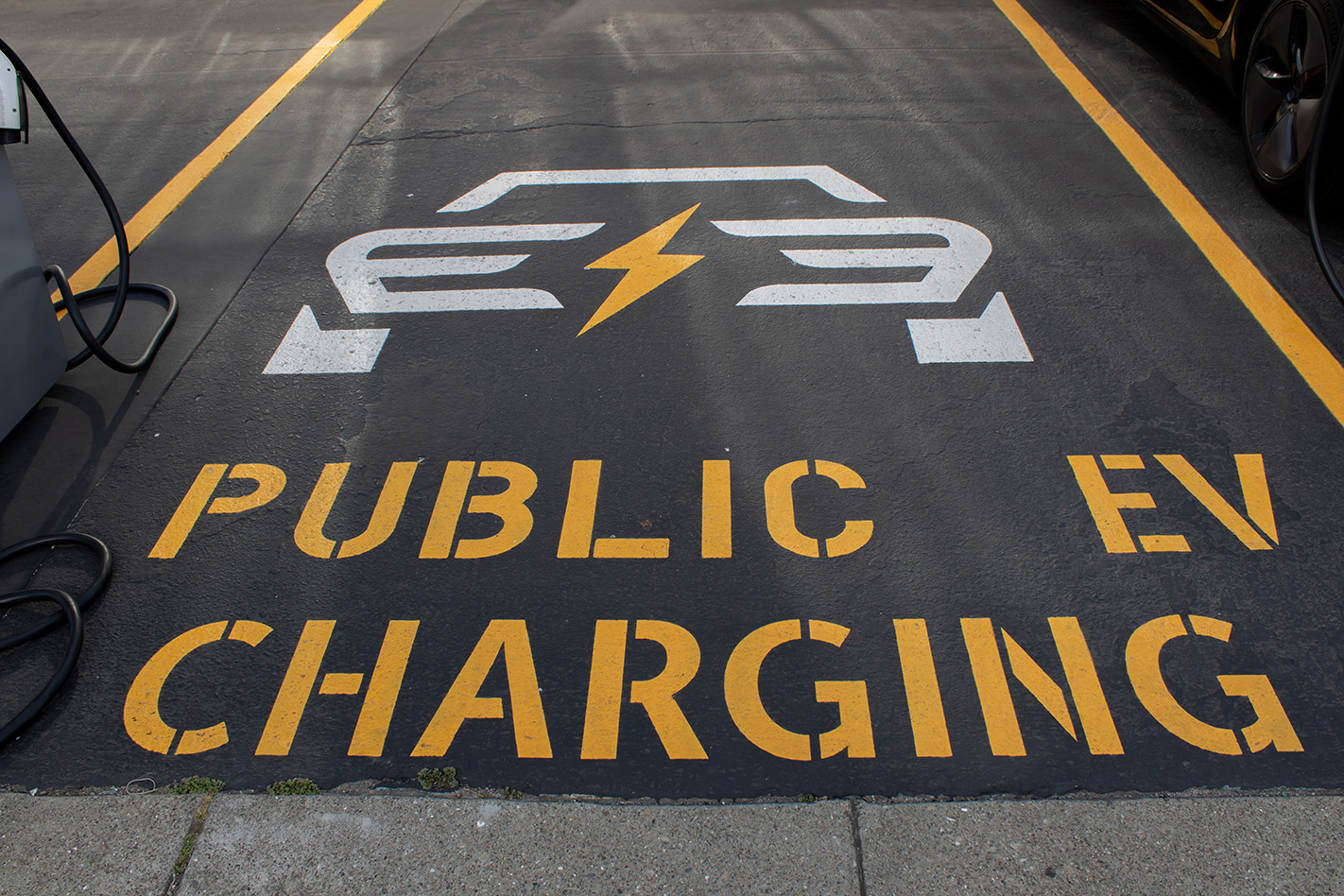
From December 2, 2020, anyone who parks a non-electric vehicle in a parking or charging area designated for EVs of Plug-In Hybrids faces a fine of $99, or $330 should the matter be unsuccessfully contested in court.
Victorian Minister for Public Transport, Minister for Roads and Road Safety, Ben Carroll last month submitted amendments to the Road Safety Act 1986, including Rule 203B ‘Stopping in a parking area for electric vehicles’, which simply states: A driver of a vehicle that is not an electric powered-vehicle must not stop in a parking area for electric powered vehicles.
Note that 203B refers to parking places reserved for EVs, and not charging stations. These are covered in the proposed Rule 203C that similarly states: A driver must not stop in a parking area for the charging of electric-powered vehicles unless – a) the driver’s vehicle is an electric-powered vehicle; and b) the electric-powered vehicle is plugged to an external source of electricity.
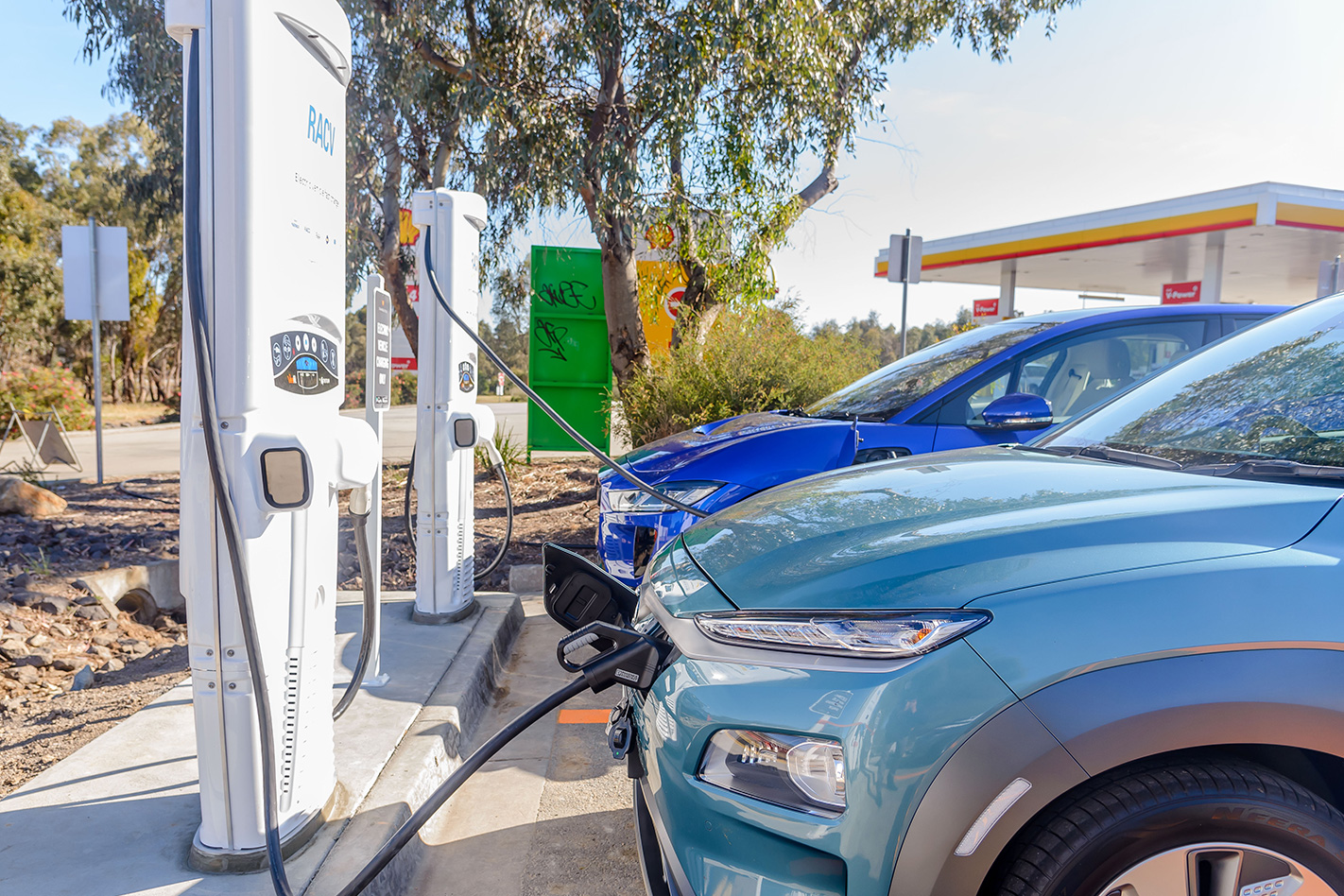
Clause “b)” is an interesting one that recognises a practice where some EV owners think because their car has a socket they can use charging stations to simply park their car even when not plugging in, preventing others from accessing the charger.
The definition of an electric-powered vehicle is ‘powered by one or more electric motors or traction motors, regardless of whether the vehicle is also powered by another form of propulsion; and can be recharged from an external source of electricity – this includes Plug-In Hybrid Vehicles’.
National laws
Other states are expected to follow Victoria’s lead, with the rule changes having been agreed between States and Territories at the national level in November 2019.
The National Transport Commission (NTC) led the process to develop new regulations after observing that Councils and other parking operators were increasingly provided spaces exclusively for use by electric-powered vehicles but had limited ability to enforce their proper use through current road rules.
Signage installation and designating car spots for electric vehicle use will be a matter for councils and or other parking infrastructure managers.
JET Charge CEO Tim Washington (below) welcomed the new rules and told WhichCar that empowering local government to enforce its EV charging strategy is an absolutely crucial step in advancing the transition to low emission vehicles.

“More than anything, EV drivers need to have confidence that when they turn up at a charging station, and it says it’s available, for example on the Chargefox app, that it actually is available,” Washington said.
“It’s also important that government and corporates get a good return on investment in rolling out charging infrastructure. Every time a non-EV or a non-charging EV parks in front of an EV charging station, it diminishes the investment the site owner has made.”
The NSW government is currently reviewing the November 2019 national amendments with a view to introducing this rule in 2021.
Overall Rating
4/5
Plus & Minus
Plus: Cossetting primary ride, decent torque, cabin space, good looks, tech Minus: Sleepy transmission, jarring secondary ride
WHAT IS THE MERCEDES-BENZ E300 COUPE?
The two-door coupe version of the recently facelifted E-Class sedan. The 300 badge denotes the more powerful four-cylinder petrol turbo engine, compared to the E200.
WHY WE’RE TESTING IT
The E-Class attracts some of the brand’s most loyal customers, second only to the S-Class, the Coupe accounting for almost one in every four sold. We’re investigating if the two-door’s sleek lines bring something more to the experience.
THE MERCEDES E300 COUPE REVIEW
It’s only when you search for an ESP button in the new Mercedes-Benz E300 Coupe that you wake up to what sort of car you’re in.
Banished from the centre console or steering wheel spokes like in AMG models, the E300 instead hides any sort of ESP configuration under layers of infotainment sub-menu.
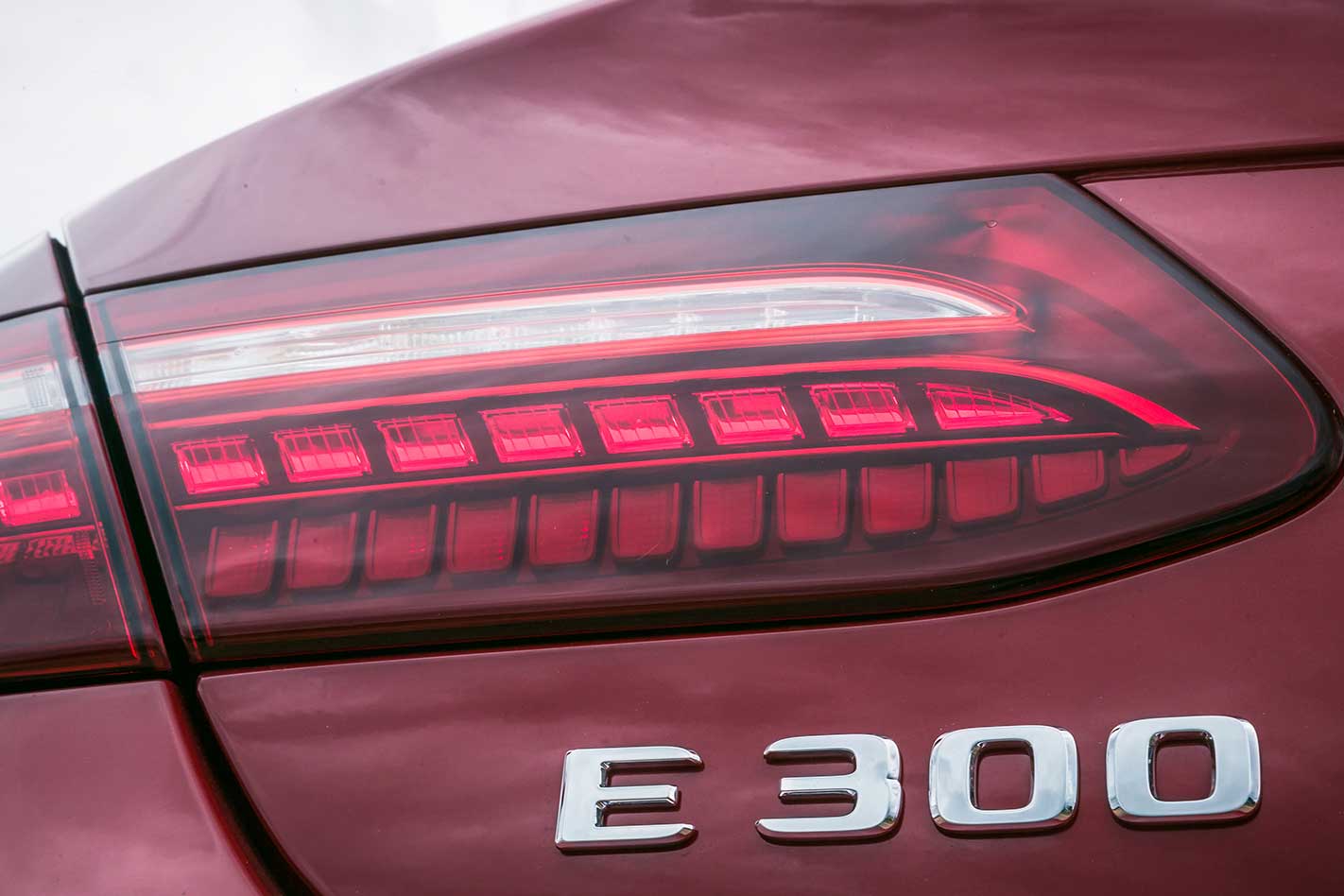
While its swooping roofline and athletic physique can promise something different at first, you’re reminded this is a stately ride – built to appease a core clientele of brand loyalists who return to the E-Class for its refinement, class, safety and comfort.
And so it goes for the fresh facelift Mercedes-Benz has levelled at the model; with exterior changes, interior tweaks and safety upgrades building value into the $4060 price jump over the pre-facelift W213-series Coupe.
With that, designers have given the E-Class a fresh face and bum centred around new lights and grille. The new LED headlights and taillights now align with a horizontal plane, rather than vertically, and leave the car’s head-turning ability unspoiled.
A standard-fit AMG line design package on Australian cars also lends a sporting touch to its exterior, with multi-spoke 20-inch wheels wrapped in 30-series rubber complementing AMG bumpers, a sparkly AMG grille and power dome bonnet.
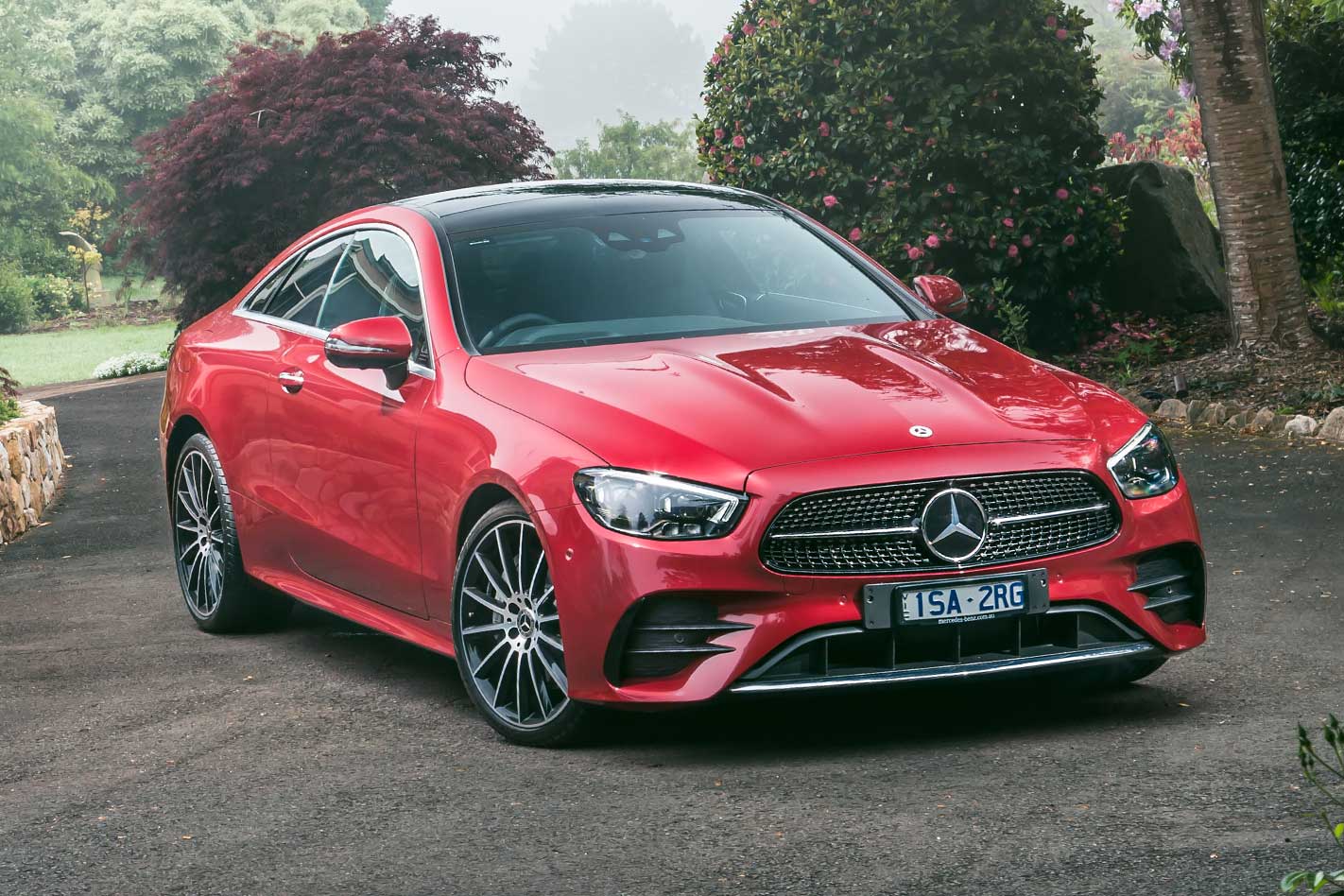
Unlike the old E-Class Coupe that rode on a C-Class platform, this generation coupe is born from the E-Class sedan underpinnings. And at 4.8 metres long the E300 Coupe remains a big car, with the interior offering ample room for heads and feet in the back two seats – as long as you’re under six foot.
But with that size comes mass. Not helped either by the E-Class’s reputation for technology, as this model’s new capabilities include an active brake assist tuned to better handle traffic. Active steering assist only needs hands on the wheel, rather than input, to know you haven’t fallen asleep.
All up, at 1700kg, you’d assume the E300 would feel more laboured hauling around its big bones. Like before, the E300 relies on a 2.0-litre turbocharged four-cylinder – code-named M264 and shared with the C-Class – that feeds the rear wheels 190kW/370Nm through a nine-speed automatic transmission.
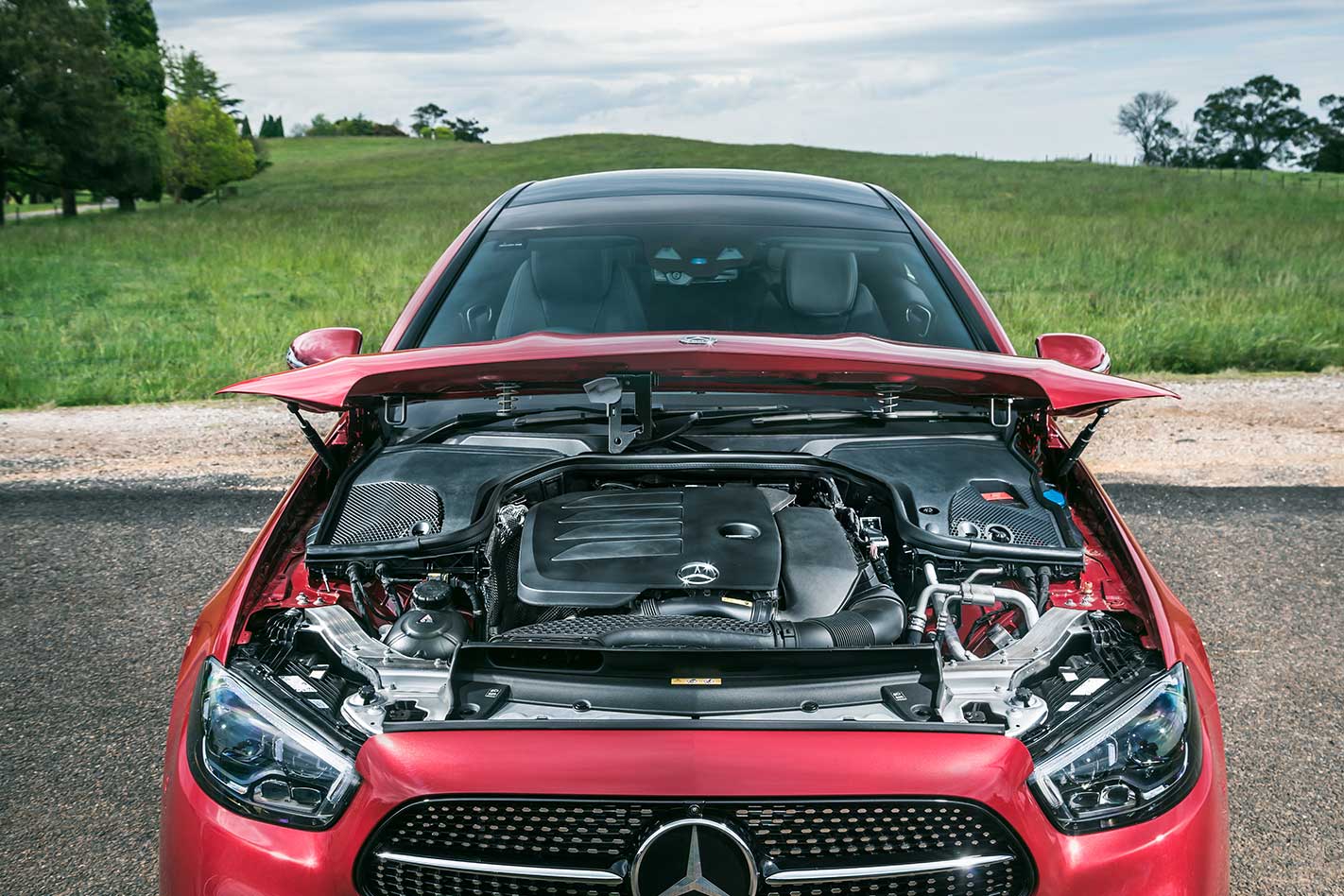
In truth though, the engine, which also bears relation to the M260 unit found in the A-Class, is loaded with ample torque and loves to rev. With some momentum, the E300 feels quicker than it should, given it’s rated to hit 100km/h from rest in 6.4 seconds, but the absence of exhaust tuning, artificial or otherwise, hints the E300 is uncomfortable on the winding road.
Supple, wafting air-suspension goes some way to back this up. Even in sport plus, the E300 can never hold itself flat, highlighting its mass is a lot for its Pirelli P Zeros to handle, even with a footprint just as wide as a Ford Mustang GT’s with 275mm rear tyres.
This doesn’t mean you won’t enjoy corners. The E300 steers true, with direct steering leading the way. But only noticing anything about smooth transmission until you’re begging for a downshift into a hairpin speaks volume about its purpose.
Of course, the E300 feels more suited to long distance touring. The ride is also brilliant when the 20s aren’t skipping over high-frequency bumps, and the seats, while supportive, halve the time your body feels like it’s been sitting down.
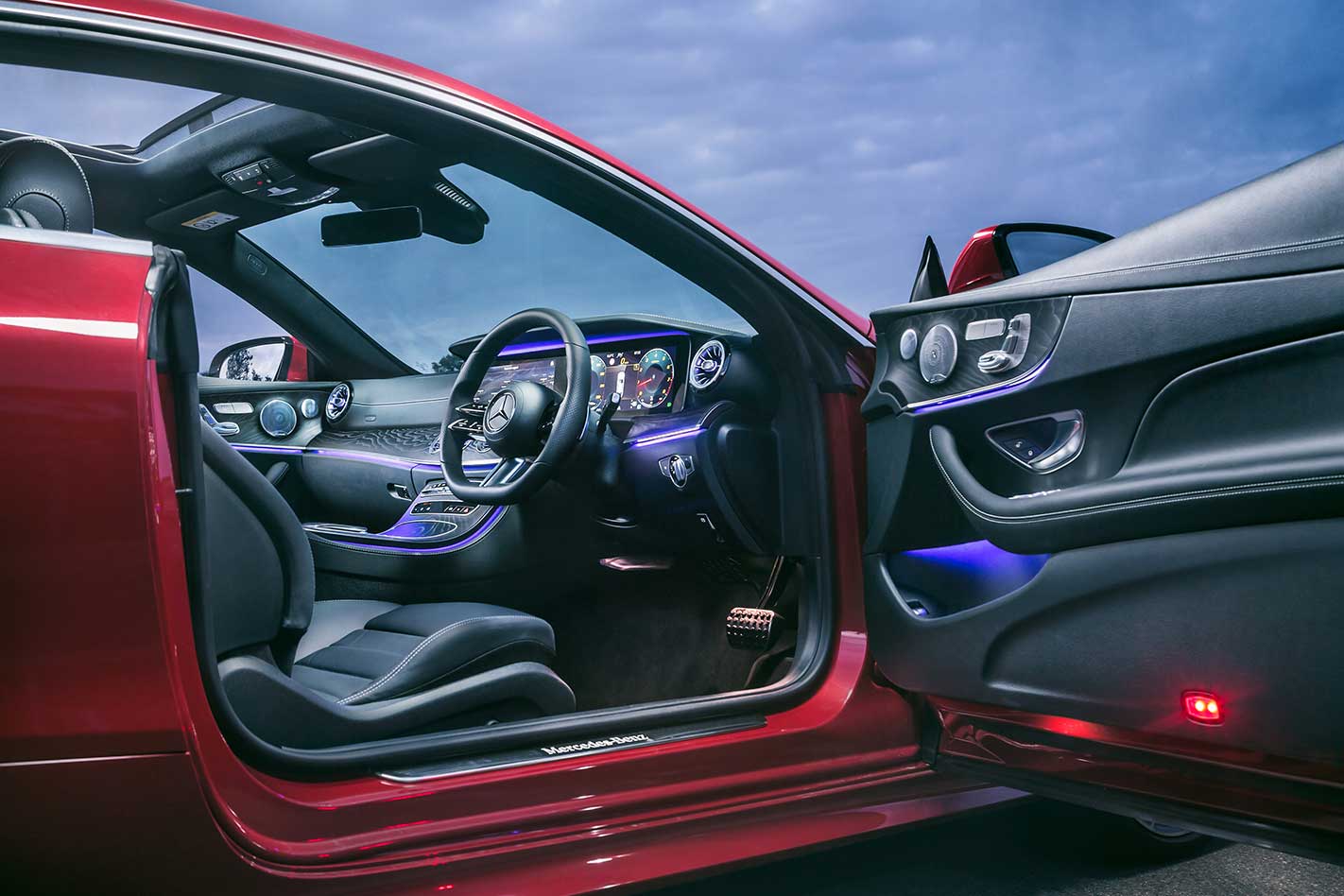
Relying on quick turbo response to dispatch most cars from the right lane with ease, its broad mid-range and well-spaced gearing offer legs long enough to ask if you need a six-cylinder E-Class.
On top of this, a four-cylinder E-Class has fewer reasons to leave you feeling short-changed. Its dual 12.3-inch panels on the widescreen cockpit carry the latest MBUX infotainment system, and an excellent new-generation steering wheel has solved the old version’s poor touch-capability.
While our verdict on the E300’s excellent touring qualities is interchangeable with its sedan counterpart, the coupe version builds a stronger lead on its rivals given its combination of sexy styling, exquisite design and a clear focus.
While its coupe looks deliver a character that’s less pipe-and-slippers and more James Bond, we’d still forget the ESP button and enjoy the more mature drive.
