
There appear to be no signs that the almost unbelievable popularity of dual-cab utes is slowing any time soon. Gone are the days when small hatchbacks fought it out from one month to the next as Australia’s favourite vehicle type – now it’s one-tonners that are engaging in a heavyweight battle for Australian driveways.
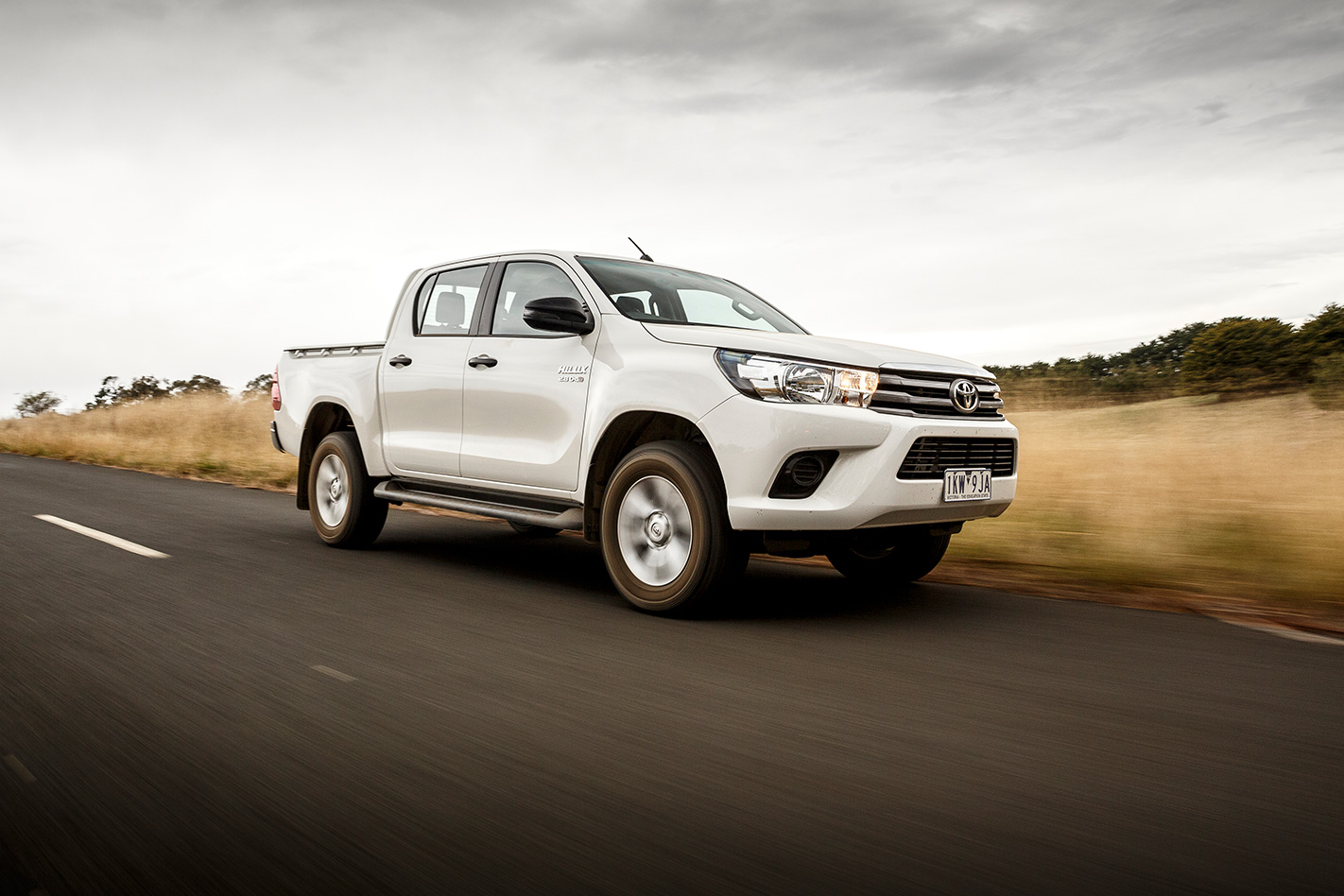
The Toyota Hilux has been a consistent top performer, only challenged recently by the Ford Ranger, but does it deserve the tradie truck crown? With so many other options in the growing market, including newcomers at the premium end such as the Volkswagen Amarok and Mercedes-Benz X-Class, the Toyota has never felt more pressure from rivals.
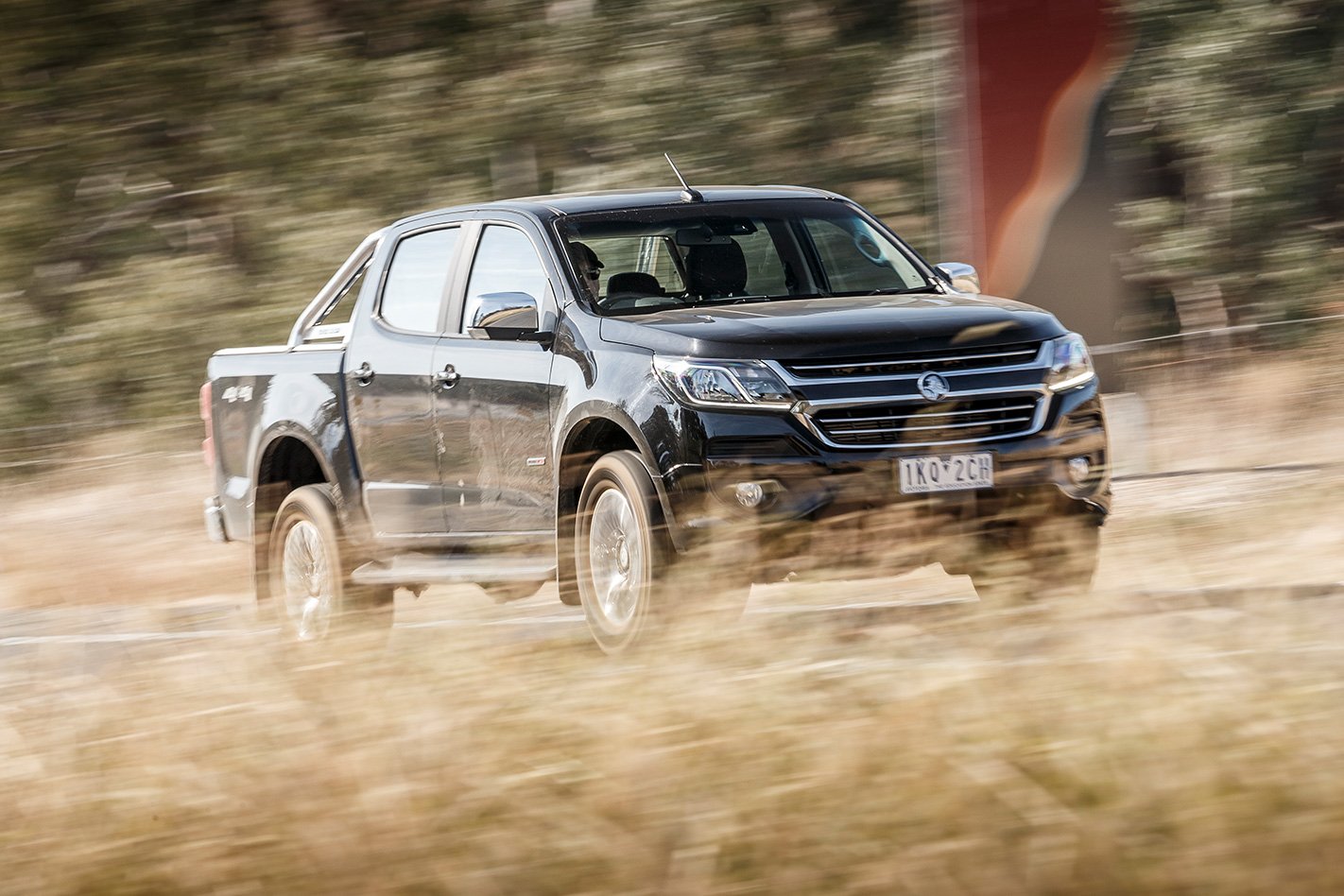
While Mercedes and Volkswagen wage a new posh truck war, an old adversary is encroaching and, following a significant update in 2015, Holden’s Colorado has never looked so strong.
We pitch the universally improved Holden Colorado against the venerable Toyota Hilux to see which makes the most sense for buyers wanting to join the dual-cab revolution.
Price and equipment
Toyota Hilux: At $48,560, the Hilux appears to be a bit of a bargain but that’s before you see what’s left out. To pick up standard navigation, climate control, 18-inch alloy wheels and keyless start to name a few standouts, you have to step up to the SR+ and spend $54,440. Without the plus, the SR makes do with basics including fabric seat upholstery, vinyl on the floor, a seven-inch colour touchscreen with Bluetooth, automatic on/off halogen headlights, 60:40 split folding rear seats, side steps and body-coloured bumpers.
As this is the 4×4 version, a low-range transfer case and rear diff lock is included with electric switching for boosted off-road agility. Power comes from a 2.8-litre diesel four-cylinder, bolted to a six-speed automatic transmission that feeds 130kW and 450Nm to the wheels.
Safety gets a good look-in with a heap more standard gear included in the Hilux’s latest update. In addition to all the required systems, the SR has a reversing camera, hill descent control, seven airbags, hill-hold, EBD and an ANCAP five-star safety rating.

Holden Colorado: Putting a Colorado LTZ on your driveway costs $52,690, which brings a generous amount of kit. An eight-inch touchscreen includes navigation, there’s climate control, leather steering wheel, an electrically adjustable driver’s seat, second row ventilation and remote engine start. The exterior is treated to an alloy sports bar and 18-inch alloys, while LED tail lights and DRLs at the front are part of a recent facelift that lends a more car-like look to the Holden.
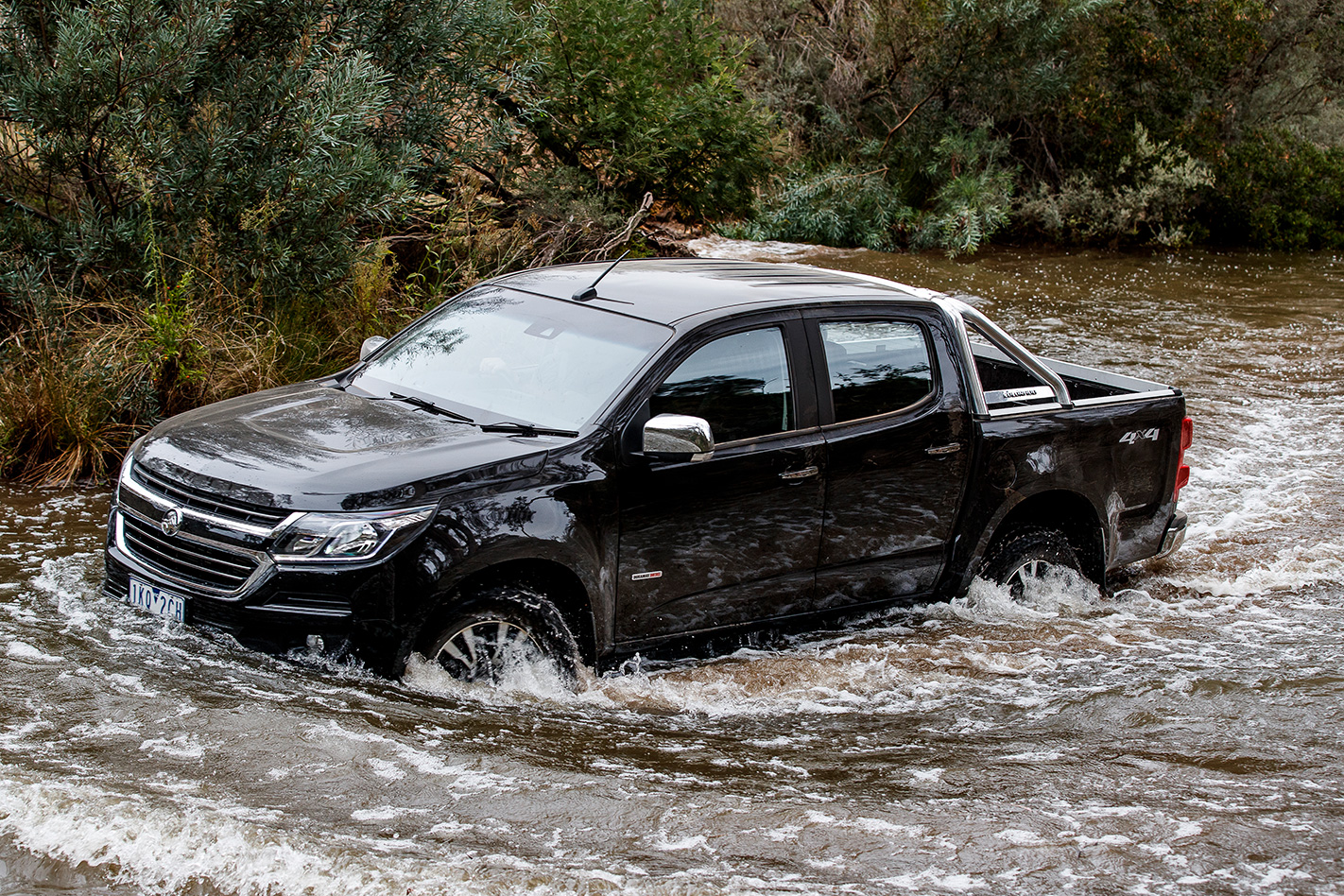
Like the Toyota it’s powered by a 2.8-litre four-cylinder diesel, but the Colorado ups the output to 147kW and 500Nm. It also offers four-wheel drive with an electrically-operated transfer case, plus a lockable rear diff and six-speed automatic transmission – although a manual is available for both models.
In the safety equipment stakes, the Holden gets forward collision and lane departure warning, seven airbags, tyre pressure monitoring, ISOFIX child seat anchors, EBD, trailer sway prevention, hill descent control and hill hold. The Colorado also shares the Hilux’s maximum five-star safety rating from ANCAP.
Interior and connectivity
Toyota Hilux: You could argue that interior functionality has greater importance to a vehicle in this class than fit and finish – they are called light commercials after all, but as more and more drivers opt for a one-tonner as the main family vehicle, cabins are having to look less like a trade vehicle and more comparable to SUVs.
Unfortunately Toyota seems to have missed this memo and the Hilux, at least in SR trim, falls short of almost all other dual-cab utes, including more affordable options. Black plastic covers virtually everything, including steering wheel, handbrake and dash, and fake moulded stitching isn’t fooling anyone. The layout is also haphazard and a conglomerate of plonked together pieces resulting in a busy and intrusive dashboard. The steering column adjusts in two axes but the telescoping direction offers a token few millimetres of travel. Taller drivers will find it hard to adjust to the best driving position and will continue to be frustrated by the lack of a digital speed reading.
There’s better news when it comes to the central touchscreen which is modern and fresh in light of the rest of the cabin but still not best in class, the double glovebox adds more storage options and we suspect the plasticky construction will prove durable and reliable for years.
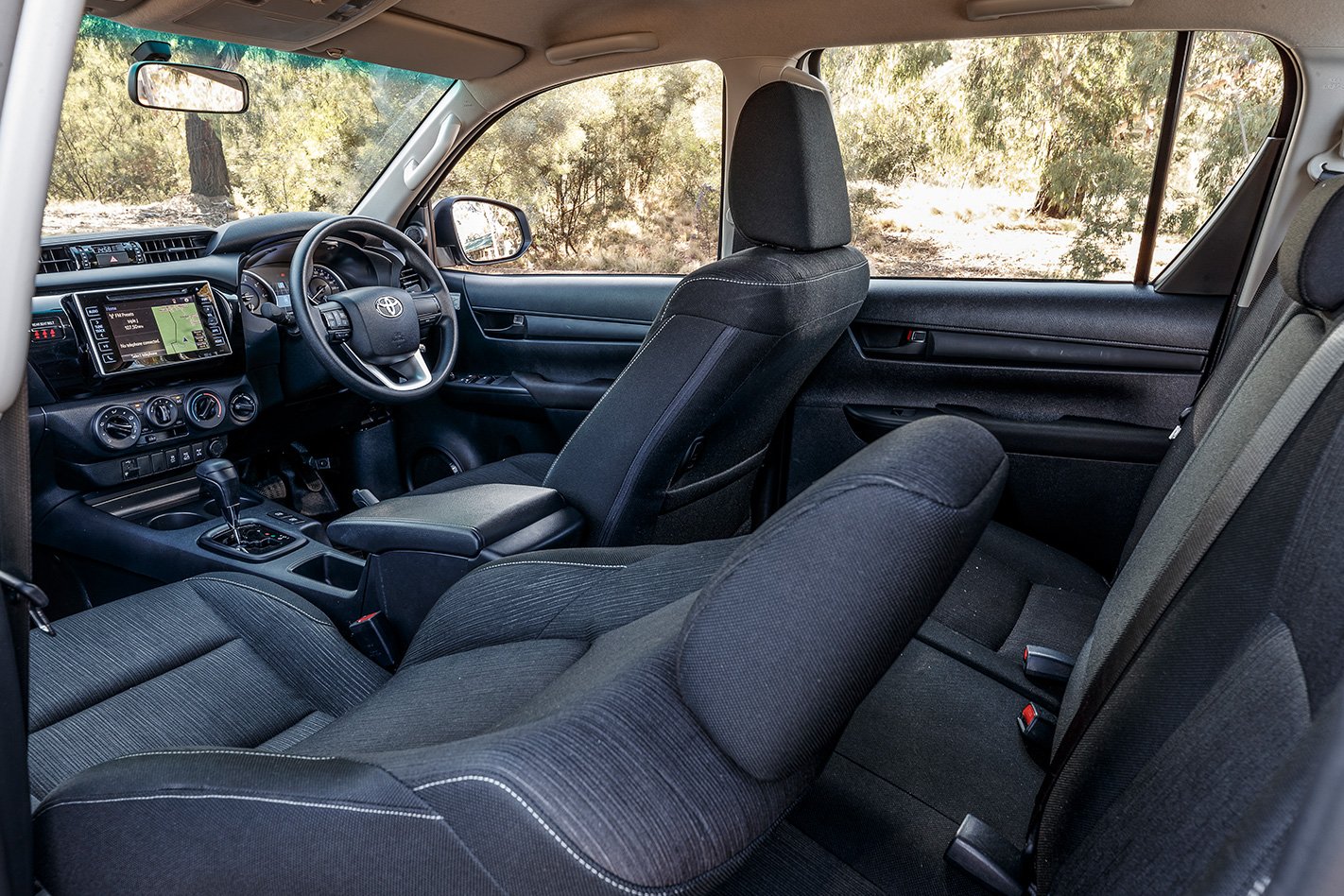
Connectivity tech is in relatively short supply with a 3.5mm Aux and USB inputs for hard connection and Bluetooth. Toyota Link is included however, and allows the connection of some Apple and Android smartphones. The system enables the use of Toyota’s Link applications including weather, guidance and local fuel pricing services, for example.
Holden Colorado: Before its extensive update in 2015 the Colorado was not the strongest performer when it came to interior fit or features, but the revamped cabin is a big step up. Gone is the daggy and space-wasting circular button arrangement on the centre stack and in its place is a dash layout that is among the more car-like offerings in the segment.
The touchscreen is more seamlessly integrated, with graphics that are simple but don’t look too basic. Like the Toyota there’s acres of plastic, but different textures and tones break up the expanses. Second row passengers are treated to enough shoulder room for three adults, the window line is low enough to allow smaller occupants to take in the scenery and there’s a centre armrest for when the rear seats have fewer than three on board – as there is in the Hilux.
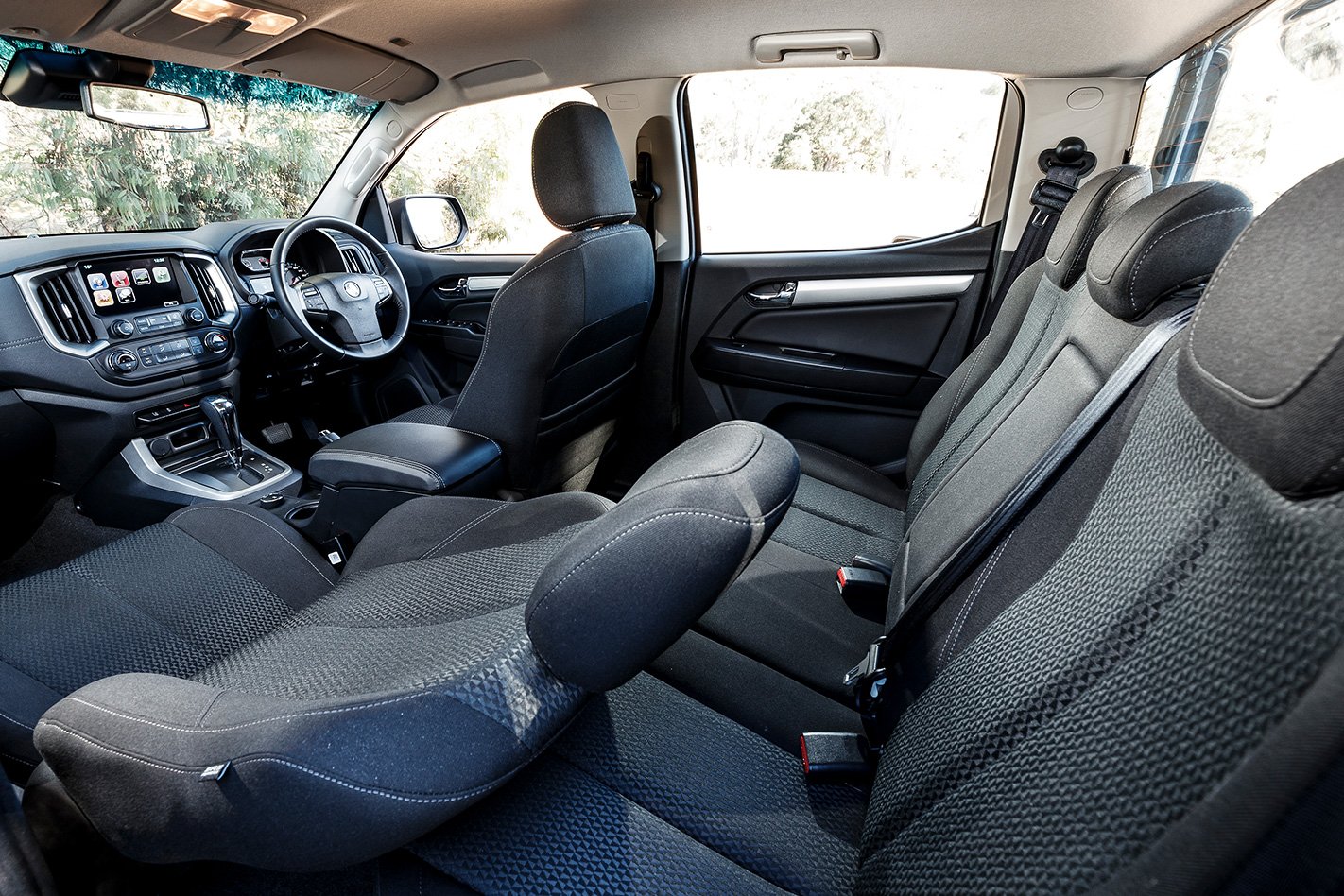
Unlike Toyota’s comparatively limited ToyotaLink system, the Holden’s MyLink infotainment screen supports Apple CarPlay and Android Auto for a more full-featured smartphone mirroring capability. There’s also Bluetooth connectivity and USB connection.
Ride and handling
Toyota Hilux: As with interior quality there is a degree of agricultural ‘charm’ you can forgive a vehicle in this segment, but again, as quality and consumer demand increases, inferior driving dynamics and ride comfort are less forgivable.
With the advent of coil-spring rear suspension as found under the tail of the Mercedes X-Class and Nissan Navara, ute manufacturers have never been more serious about imparting good road manners on their ute-bodied commercials.
The Hilux is still very much in the past with its set up, however, with a leaf-sprung arrangement that is very well suited to off-road and loaded work but less pleasant at other times. On imperfect surfaces, occupants are shaken and rattled particularly in the second row. Generally speaking, the Toyota chassis has been tuned for a confidence-inspiring feel no matter what the surface, and a rock-solid steering feel enhances that sense of stability. For its most recent update – also in 2015 – the Toyota received significant NVH and chassis updates and the Hilux cabin has never been as quiet, but that’s relative. A heavy focus on engineering for Australian conditions has resulted in a far more obedient Hilux chassis on local roads and trail, but at a cost to pliancy and comfort.
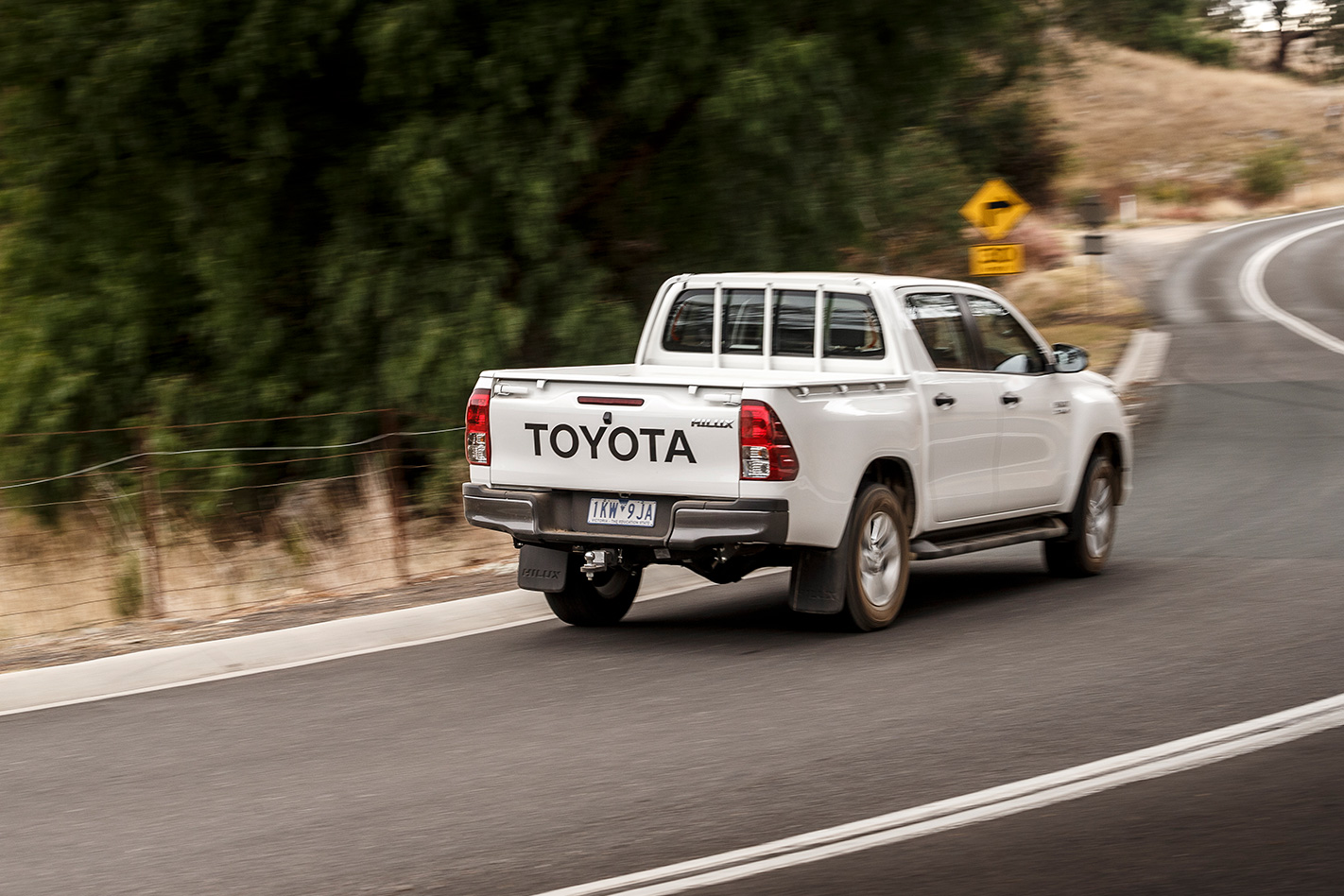
Holden Colorado: While the Colorado has to be praised for across-the-board improvements, it is the road manner that is perhaps worthy of the greatest acknowledgment. Part of the revision brought all new spring and damper rates along with revised suspension bushing and body connection points, the result being a ute that has never felt more at home on Australian roads. It’s still a stiff ride without a load in the bed, but the Colorado cuts a fine balance between hardworking truck and day-to-day family wagon. Its steering doesn’t have the weight or confidence of the Hilux but the overall package is one that’s far better suited to on-road passenger delivery rather than off-road load-lugging.
Performance and economy:
Toyota Hilux: The Japanese competitor here comes to the market with an engine and drivetrain that competes with many others in the segment – at least on paper. But as part of its most recent update, the Hilux gained a whopping 150kg while others strive to lose weight, and that has dented performance. In recent testing of nine dual-cabs, the Hilux put in the slowest zero to 100km/h acceleration time of 11.2 seconds and stressing its four-pot engine produces a gruff report that is loud in the cabin. The automatic transmission does a decent job and is a good match for the diesel, although it too is feeling its age in a time when even truck transmissions are gaining in sophistication.
Its extra heft is also apparent at the pumps. During testing, our Hilux used an average of 10.9 litres of fuel per 100km.
Where the Toyota gains back praise is in off-road manners, and its tried-and-tested formula stands confidently on unforgiving terrain thanks to particularly good rear wheel articulation and locking differential. It’s also worth noting that, given the popularity and longstanding family lineage of the model in Australia, the Hilux is the ute most bush mechanics will know how to get back on its wheels fastest. If you’re serious about hitting a long unbeaten track, the Toyota is arguably the one-tonner that will bring the greatest peace of mind.
Holden Colorado: Surprisingly, the Colorado manages to be among the fastest options on the market despite sharing the same engine size and configuration as the Toyota. It managed to hit the 100km/h benchmark in 9.5 seconds and the beefier torque and power figures are noticeable in virtually all driving. There were even more pleasant surprises and despite the impressive performance the Colorado used just 9.9 litres of diesel per 100km during our time with it.

There is still a familiar four-cylinder diesel clattery soundtrack from under the bonnet but NVH levels have been improved and the noise is less intrusive than the Toyota.
If your focus is to spend more time off-road than on, then the Hilux is the pick. But that doesn’t mean the Colorado is a wet rag away from the blacktop. It can’t brag the wheel articulation that the Toyota is known for but it competes about the middle of the one-tonne pack with a solid driveline, complimented by its six-speed auto trans for a point-and-go approach to all-terrain motoring.
Warranty and servicing
Toyota Hilux: Every Toyota is covered by a three-year or 100,000km warranty. Service intervals vary depending on driving style, environmental conditions and kilometres. The company offers Toyota Service Advantage which applies capped-price servicing costs for three years or 60,000km, or an extended deal of four years or 75,000km.

Holden Colorado: The Colorado raises the Toyota deal by two years for a five-year plan that also includes roadside assistance and does not limit the number of kilometres during the warranty period. All vehicles under five years old are offered capped price servicing.
Verdict
With a comprehensive revamp, the Holden Colorado has never been a stronger contender in the ute race. Dramatically improved over its lifespan to respond to consumer wants and pressure from newer rivals, the Colorado has managed to evolve to remain competitive.
In an almost polar opposite reaction, the Toyota appears to be resting idly on its laurels. Yes, it has also progressed and improved, but in incrementally small steps rather than leaps. No doubt, the Toyota will continue to sell strongly thanks to its ‘unbreakable’ reputation and its familiarity no matter where you go in Australia.
Excellent resale value is a key attraction to Hilux buyers, but that is largely driven by demand – and if a majority of those buyers weighed up the competition on objective terms it’s likely many would be defect to another brand.

If a majority of your time behind the wheel is spent exploring far off desert climes and gnarly back roads, the Toyota may prove to be the wisest option, but if you see a dual-cab ute as the most sensible multi-purpose family car for doing the school run and occasional camping trip, the Colorado is the pick in almost every regard.
Porsche’s famous Rothmans livery and the surprising Pink Pig livery will make a comeback at the upcoming 24 Hours of Le Mans. But not on their original cars.
This time, the Porsche 911 RSR race cars will be wearing the Rothmans and Pink Pig liveries in houor of the cars that made them famous.
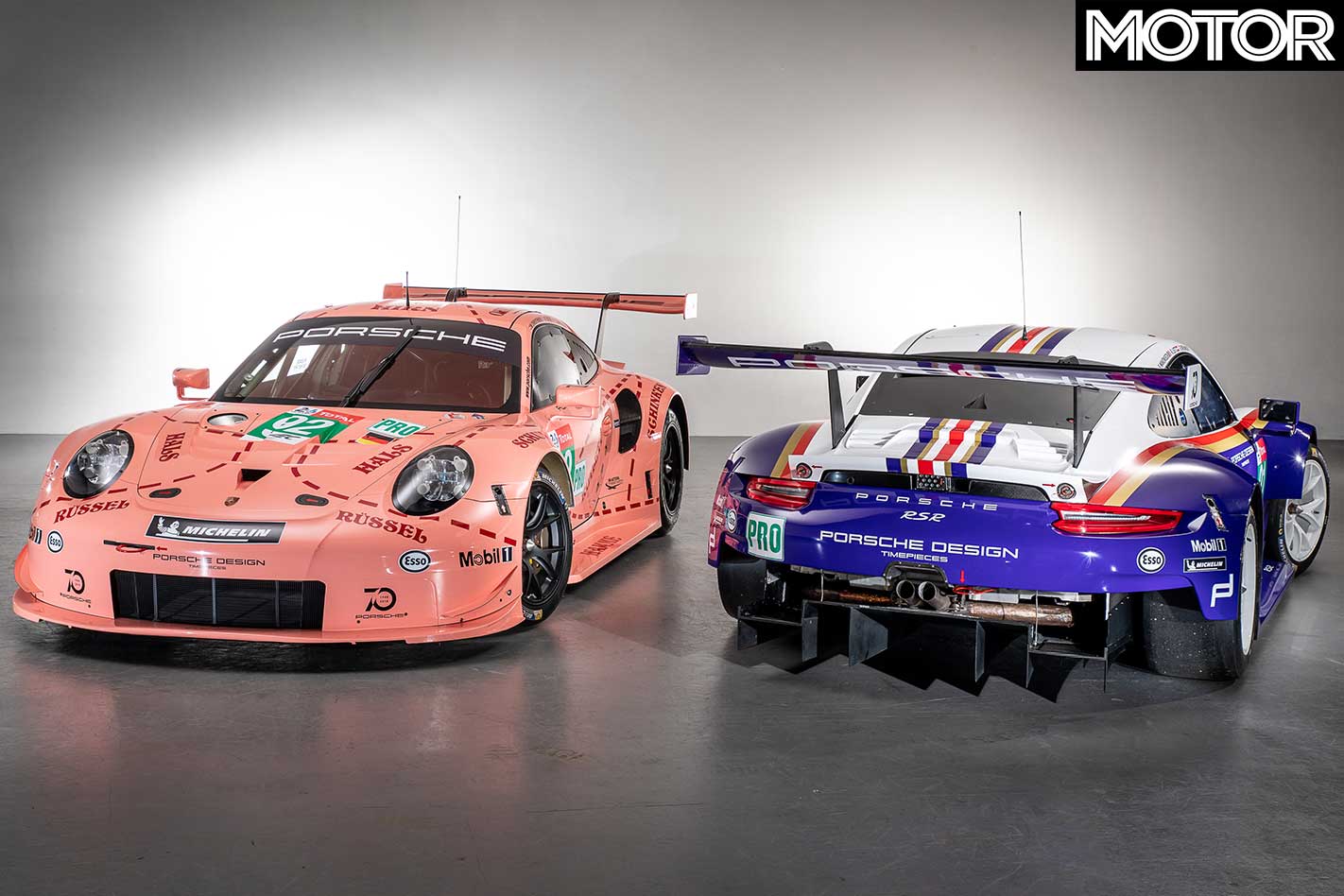
The most well-known is the blue and white Rothmans paint scheme, which appeared most famously on the Porsche 956 C and the 962 C.
The 956 marked the first use of Porsche’s PDK dual clutch (Porsche Doppelkupplung) transferring up to 460kW from a 2.6-litre turbo flat six.
It’s also the car (chassis number 007, according to Porsche) which Stefan Bellof steered around the Nürburgring in a record 6 minutes and 11.13 seconds. His record still stands decades later.
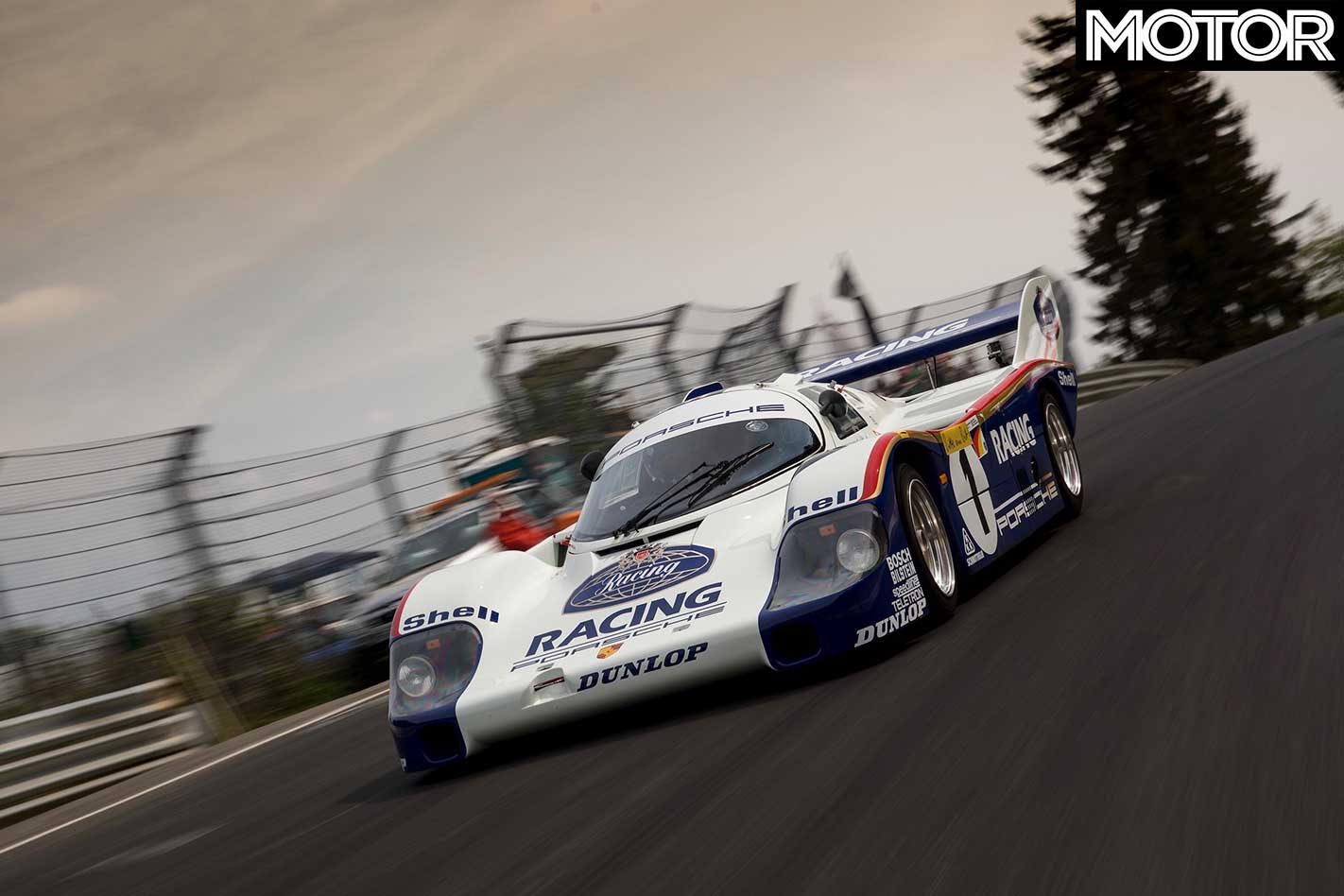
This feat somewhat eclipses the 956’s prolific success between 1982 and 1984, when the car took out the drivers’ and manufacturers’ championships each year in the World Sportscar Championship.
The Porsche 962 C also wore the Rothmans livery, famously driven by the likes of Tiff Needell, Derek Bell, and Jacky Ickx.
It won the 24 Hours of Le Mans in 1986 and ’87 with Bell, Al Holbert, and Hans-Joachim Stuck driving for both, as well as having a long active life between 1985 and 1992.
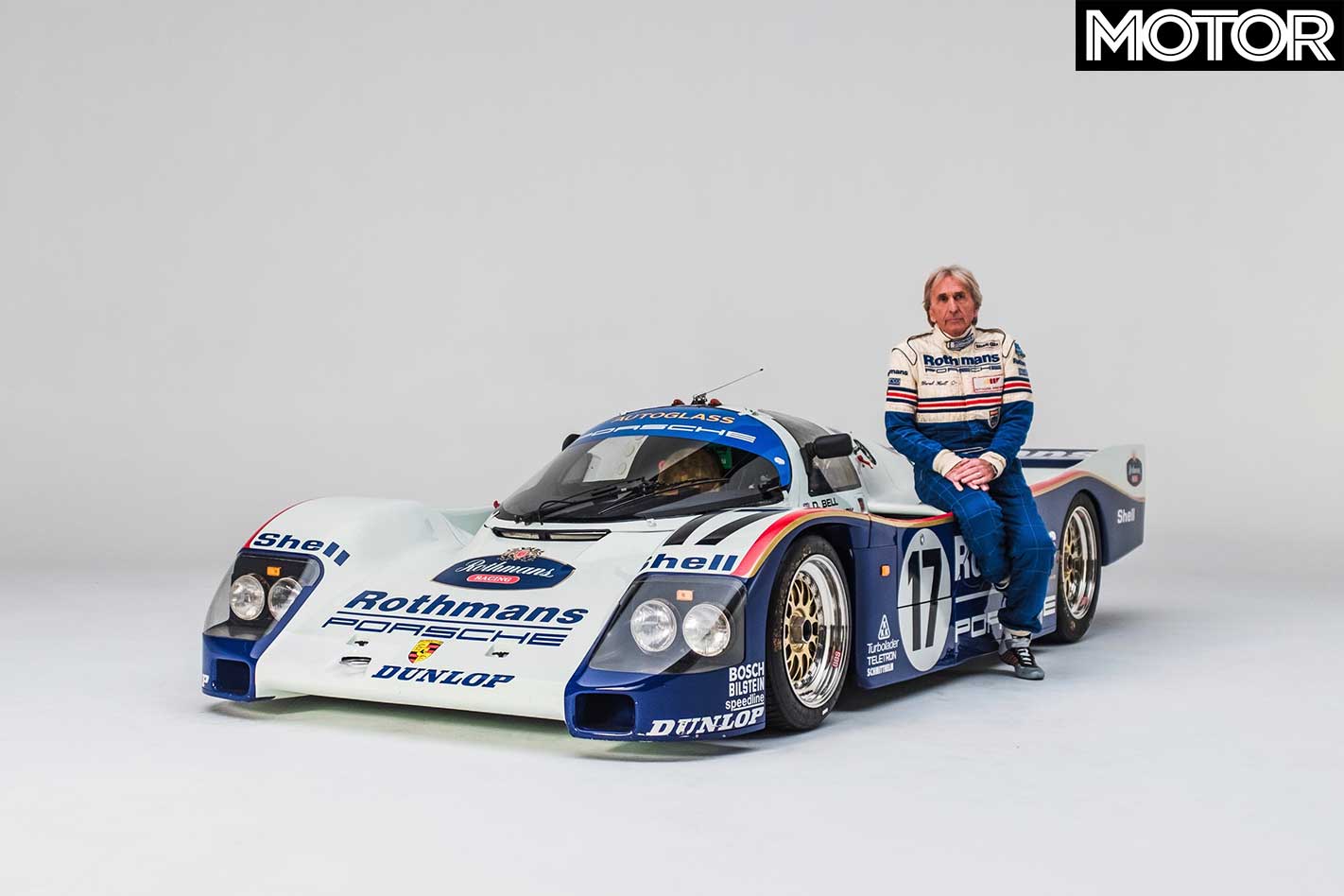
Less well-known, perhaps, is the Rothmans-liveried Porsche 959 which took victory at the 1986 Paris-Dakar.
The other classic livery which will see a return to Le Mans, the ‘Pink Pig’ scheme, was far less prolific.
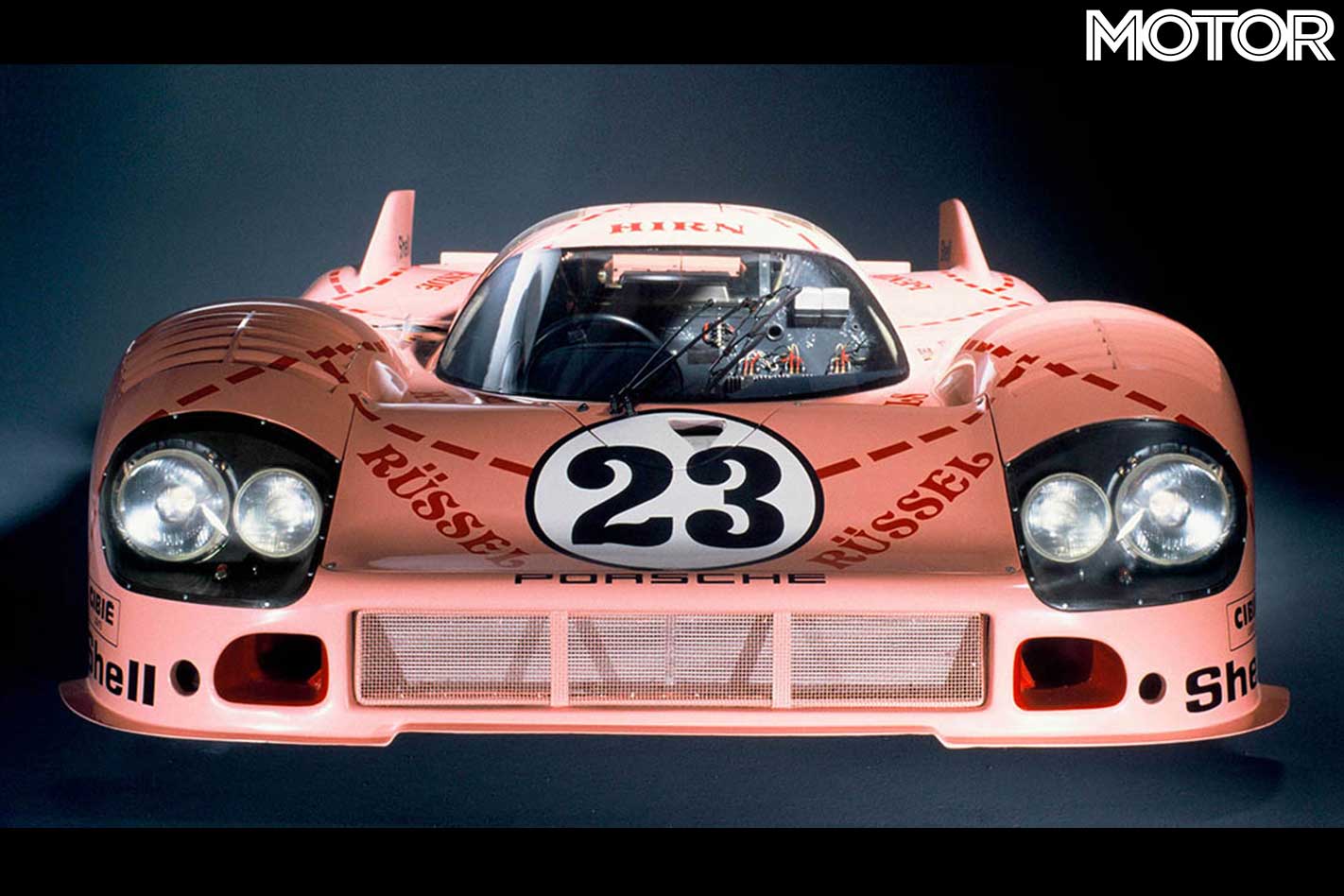
Porsche designer Anatole Lapine came up with the idea, and applied it to a Porsche 917/20, a one-off racer that “was designed to combine the aerodynamic advantages of the short and long-tail versions of the 917.”
Though it qualified 7th in the only race it participated in, the 1971 24 Hours of Le Mans, it crashed with Reinhold Jöst at the wheel.
As the above video shows, the car has been restored and is now on display at the Porsche Museum.
The 2018 24 Hours of Le Mans kicks off on June 16 at the Circuit de la Sarthe in France, though Porsche’s LMP1 team will not be competing after its disbandment in 2017.
After MOTOR was given exclusive early access to the 2018 Ford Mustang GT, we’re able to bring you some detailed studio shots which we captured for a feature (which you can read in the June 2018 issue of MOTOR Magazine, on sale until June 28).
For now, cast your eye over Ford’s new pony, as captured by MOTOR photographer Nathan Jacobs in the gallery above.
More on the 2018 Ford Mustang GT: – The Dyno Test – The Drag Test – The Road Test
Now that the Australian pricing and specs for the 2018 Alpine A110 have been revealed, we figure we need to work out how it stacks up against the competition on paper.
We’re calling the base model Porsche Cayman and the Alfa Romeo 4C Coupe its biggest rivals, given their premium branding and lightweight focus.
PRICE
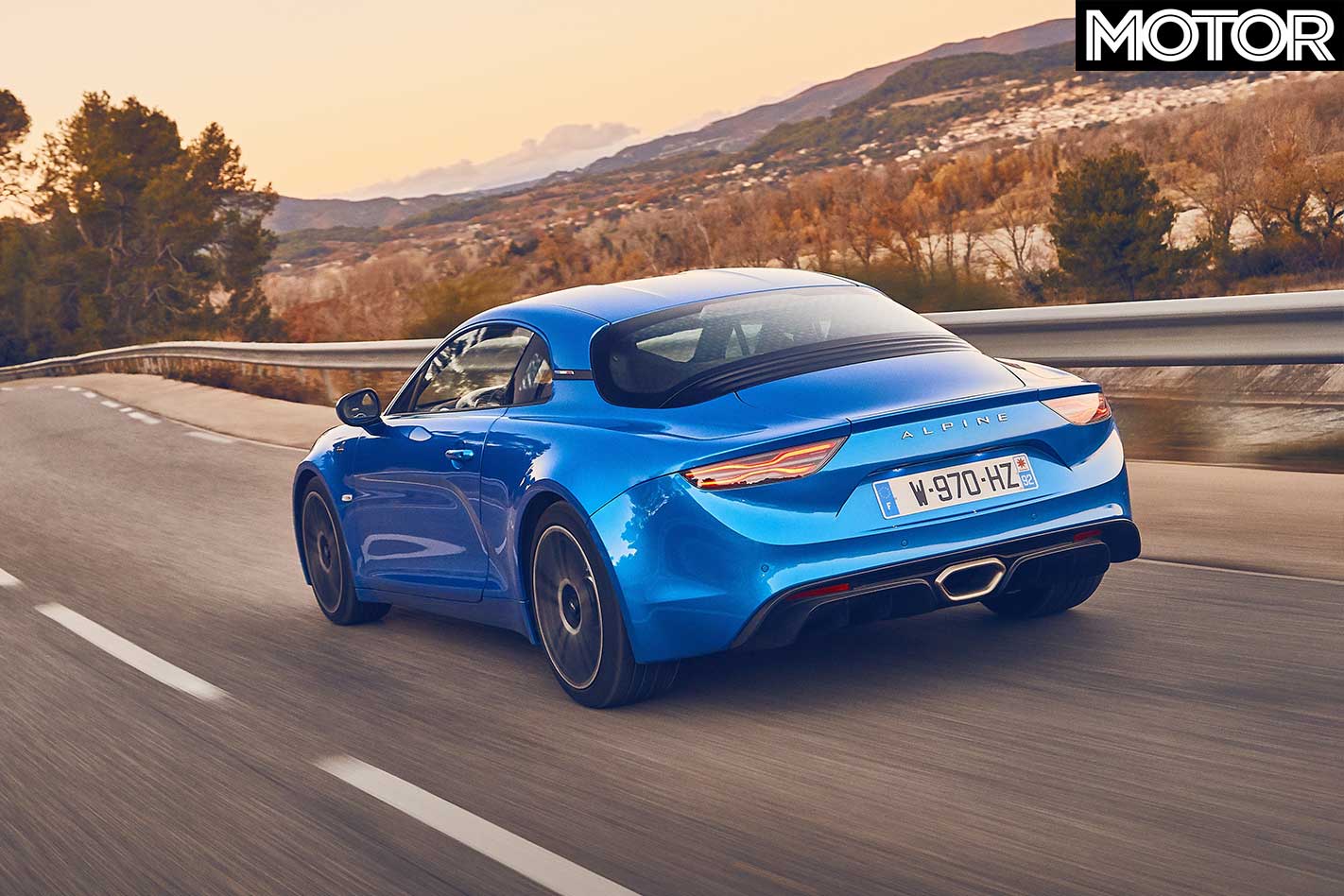
The 4C is far cheaper, at just $89K, though it’s the elder of the trio.
The Alpine A110 is also showing up in two more specs, the standard Launch Edition, and the Legende Edition, coming in at $106,500 and $103,500 respectively.
ENGINE and POWER
When it comes to outputs, the Porsche’s 220kW/380Nm trump both the 185kW/320Nm of the A110, and the 177kW/350Nm of the Alfa.
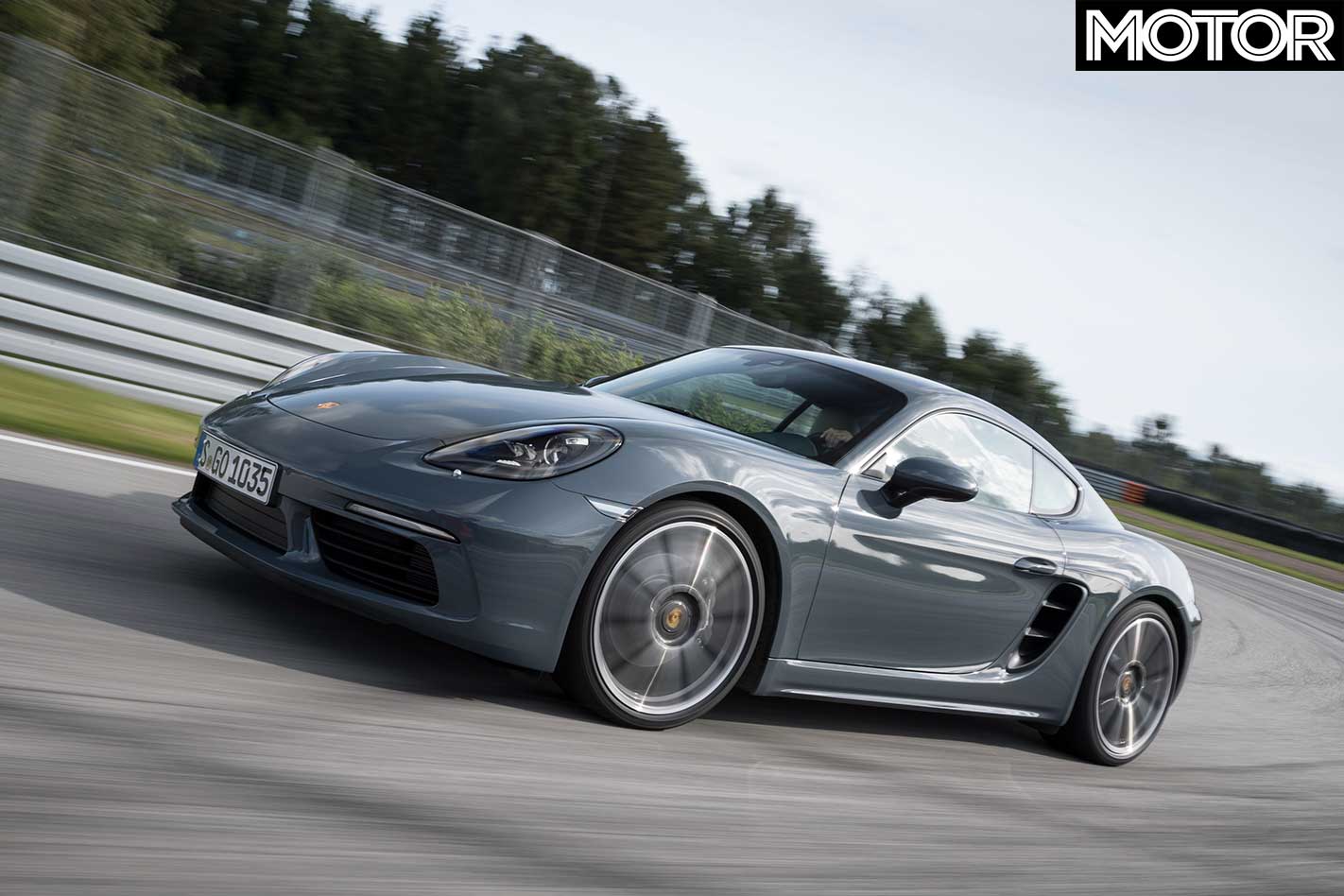
However, the Porsche’s 2.0-litre flat-four only delivers its peak power at 6500rpm, while the others manage it at 6000.
Alpine hasn’t confirmed where torque peaks, though we assume it’s low in the range, likely near to the 1950rpm and 2200rpm of the Cayman and 4C respectively.
PERFORMANCE
When it comes to speed, it’s surprisingly the Porsche (even with dual-clutch) left trailing. Though its 275km/h top speed is the highest, a 4.7 second run to 100km/h falls two tenths behind both of the other cars in this face-off.
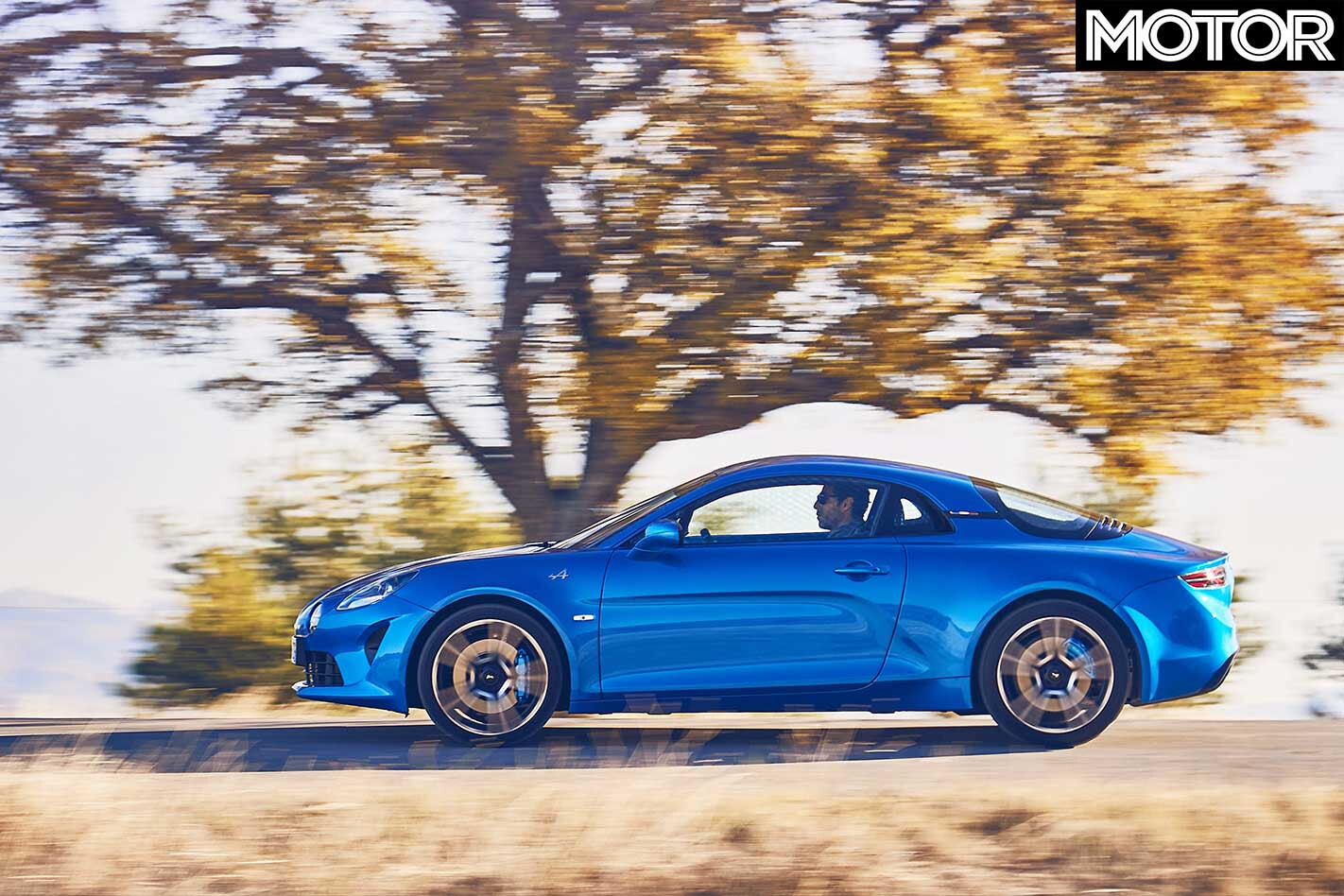
In manual guise, the Cayman takes 5.1 seconds.
The A110 and 4C will, for reference, reach 250km/h and 258km/h, though how often is that going to happen in Australia?
WEIGHT
This is crucial for these three sports cars, as they’re all relatively light by today’s standards.
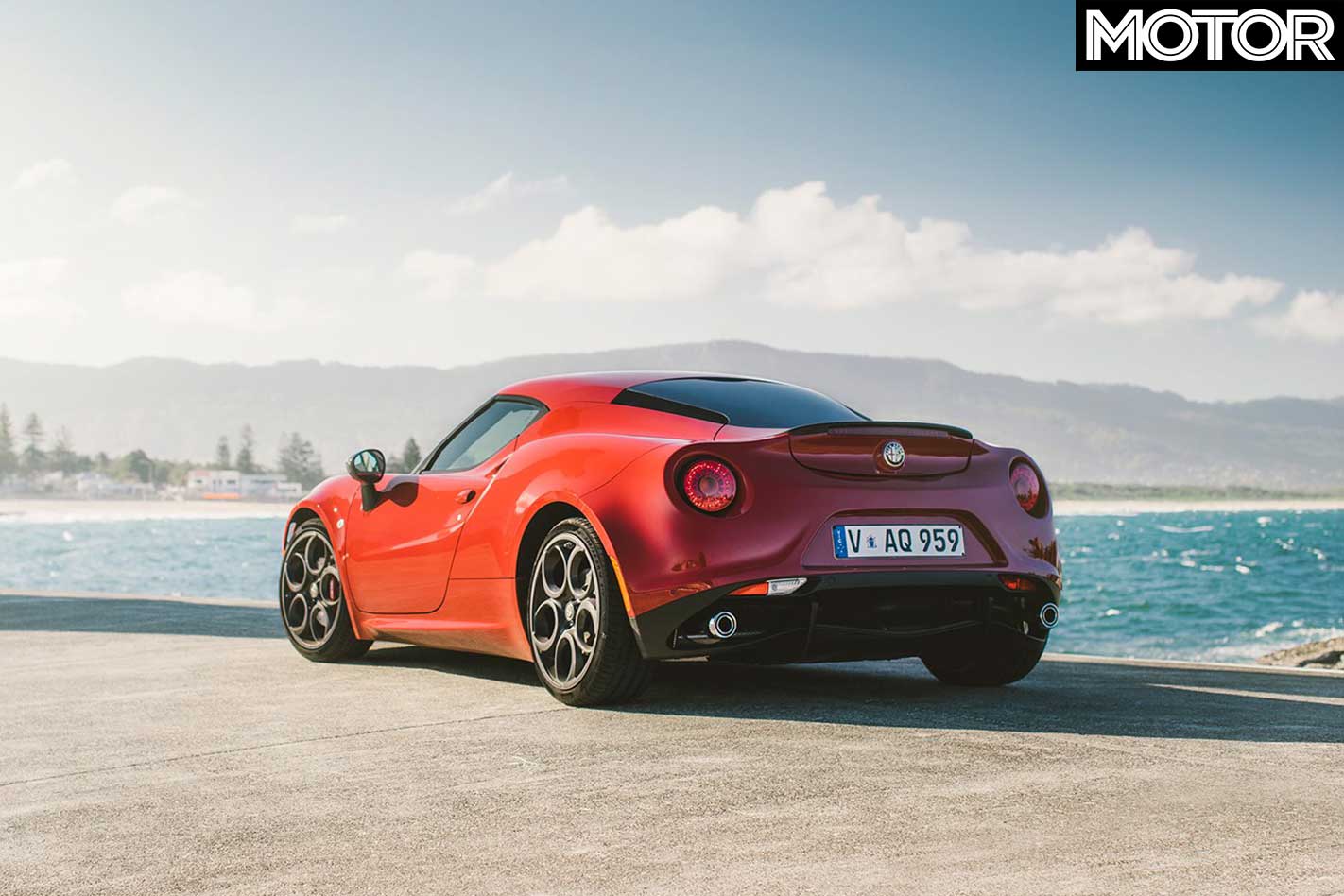
Going some way to explaining its slower sprint, the Porsche is the heaviest at 1335kg, meaning it’s packing 165kW per tonne.
Next up, the nimble A110 comes second here with a respectable 1094kg kerb weight, and 169kW/tonne.
So, in terms of power to weight, the Alfa 4C takes it with a 173kW/tonne figure thanks to its delicate 1025kg kerb weight.
So… now what?
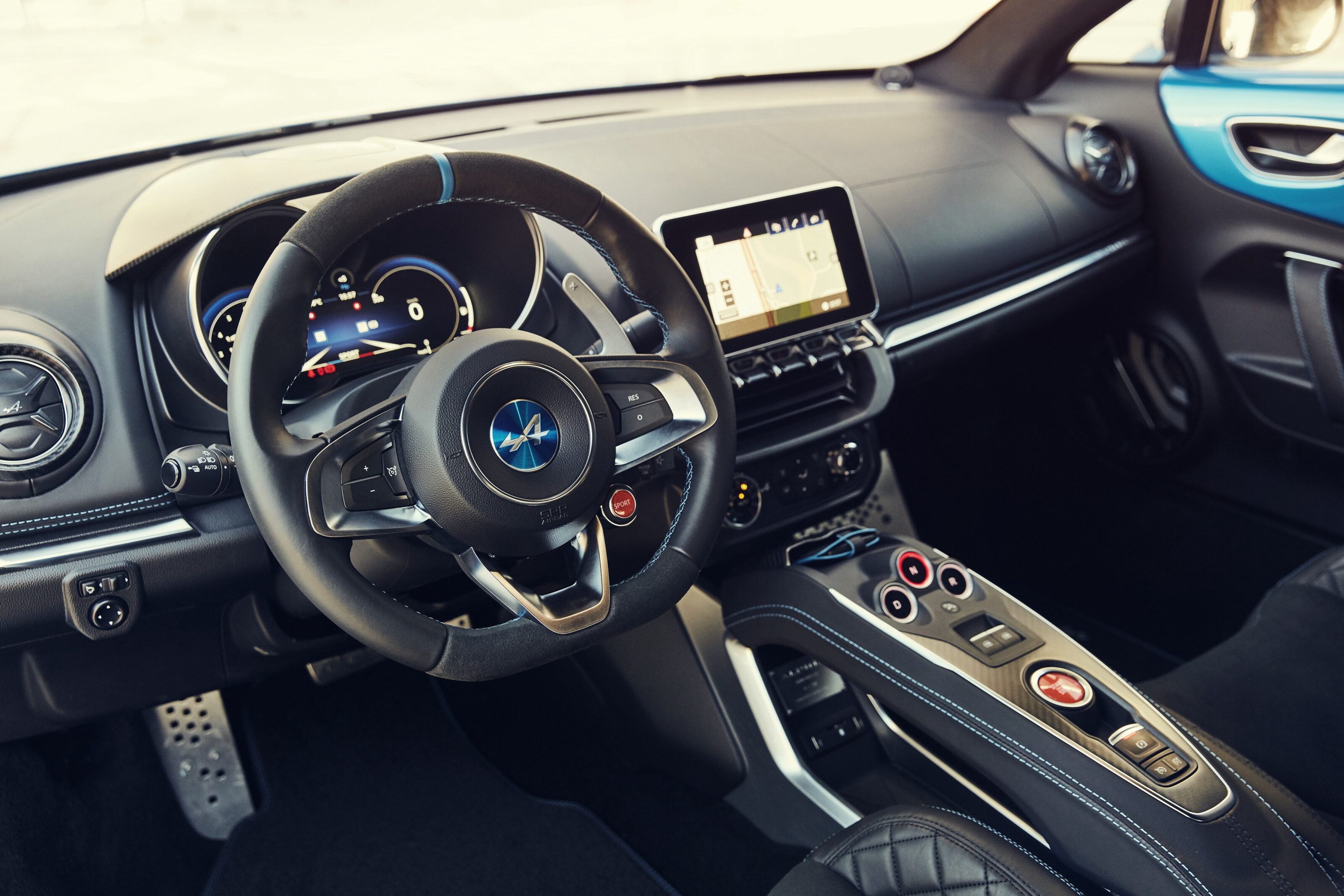
Given each car has its own strengths and weaknesses – and that this is an on-paper comparison – we’re not going to call any car here a winner.
However, we will say that it’s clear the 4C provides the most power for its money, and that the Cayman is likely to make the ‘nicest’ ownership proposition. It’s still all down to perspective.
We’ll wait to get our hands on an A110 in Australia before we make any final decisions. Plus, there’s always the likes of the Lotus Elise, if you prefer the ‘less is more’ approach.
THE 2018 Alpine A110 will land in Australia at a cheaper price than a Porsche 718 Cayman when the full range arrives early next year, Wheels can reveal.
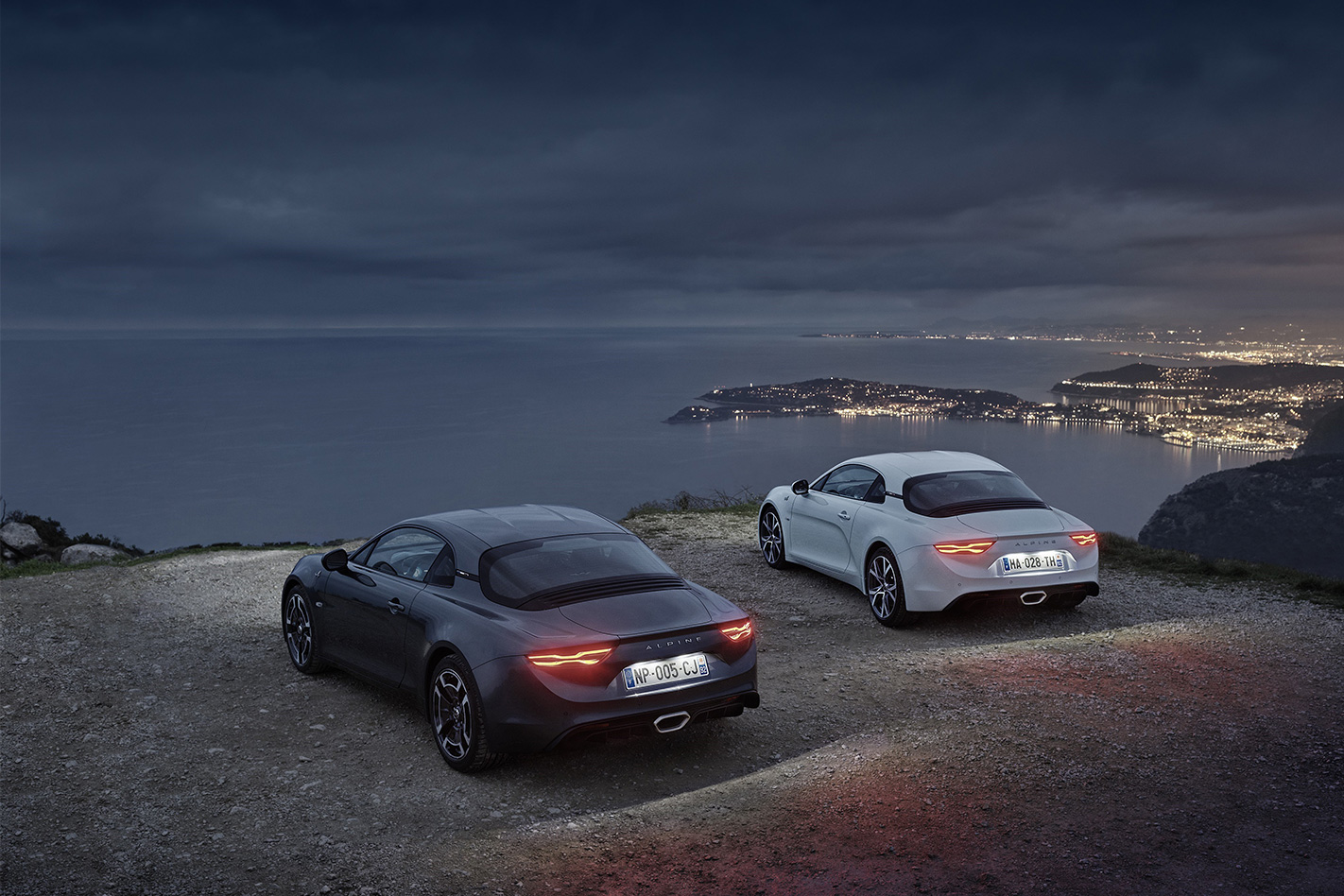
The Alpine A110 Pure will wear a $97,000 price tag when it goes on sale here, with the Alpine A110 Legende priced from $103,500. However, Renault has announced that those wanting to jump behind the wheel early will be in line for one of only 60 Australian Premiere Editions, priced from $106,500 – that’s still thousands cheaper than an entry-level Cayman – and on sale from late this year.
The Premier Edition will come standard wearing the iconic Alpine Blue metallic paint, and include lightweight 18-inch Fuchs forged wheels, rear parking sensors, a blue Alpine logo in the centre of the steering wheel, blue Brembo callipers wrapped around bi-material brakes, an active exhaust system, lightweight fixed-back seats, aluminium brake and accelerator pedals with matching footrest, and a high-end Focal audio system.
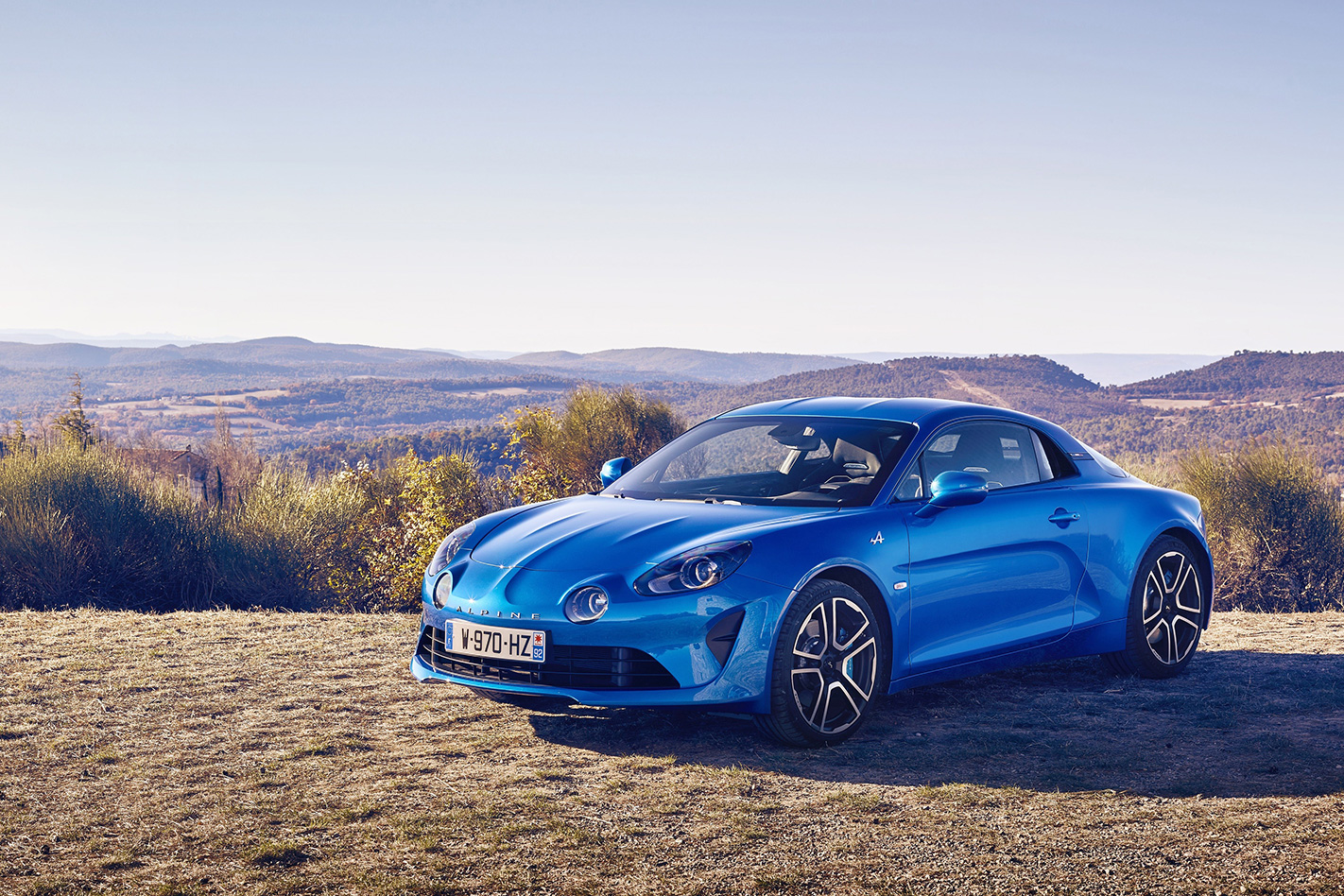
Each of the Launch Edition versions of the Alpine A110 will also come fitted with a numbered plaque. It will use the same 185kW/320Nm 1.8-litre turbocharged engine as the rest of the A110 line-up, mid-mounted and sending drive to the double wishbone-suspended rear wheels.
Renault says the A110 is capable of accelerating from 0-100km/h in 4.5 seconds – that’s faster than the official time quoted for the 257kW/420Nm 2.5-litre turbocharged 718 Cayman. It’s secret? The aluminium-bodied Alpine weighs just 1103kg compared with the Cayman 2.5’s 1355kg. Ticking the options list to ditch the Alpine’s front storage tub will strip another 6kg off that number.
Renault is marketing the Pure as a stripped back, driver-focussed version of the A110, with the Legende filling the role as a “sophisticated grand tourer”.
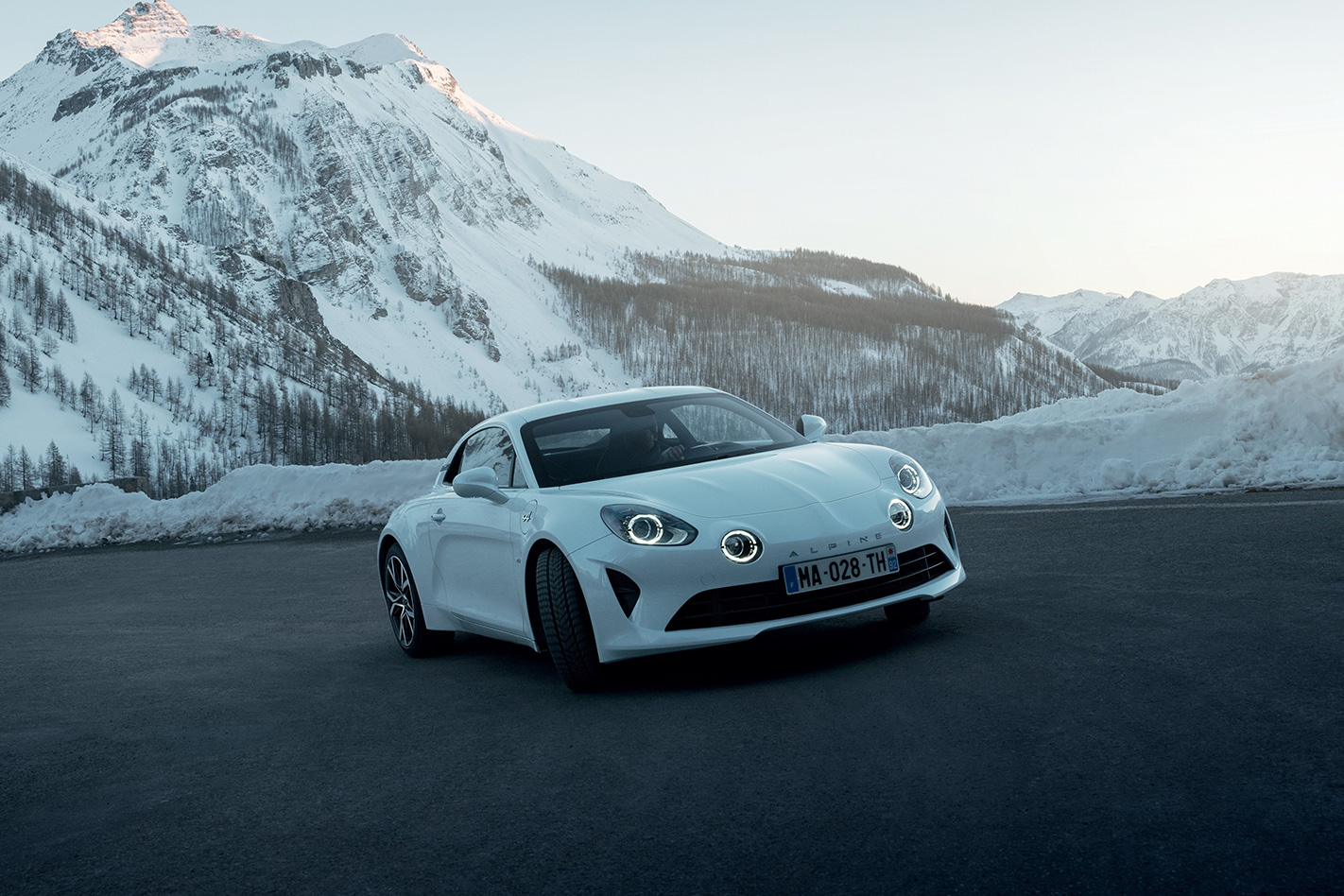
The Pure rolls on 18-inch wheels and includes weight-saving measures such as one-piece Sabelt sports seats that weigh just 13.1kg each – they’re the same as those fitted to the Australian Premiere Edition. Inside, there’s also a mix of leather and microfibre upholstery, matte carbonfibre trim, climate control air-conditioning, satellite navigation, and LED headlights and tail-lamps.
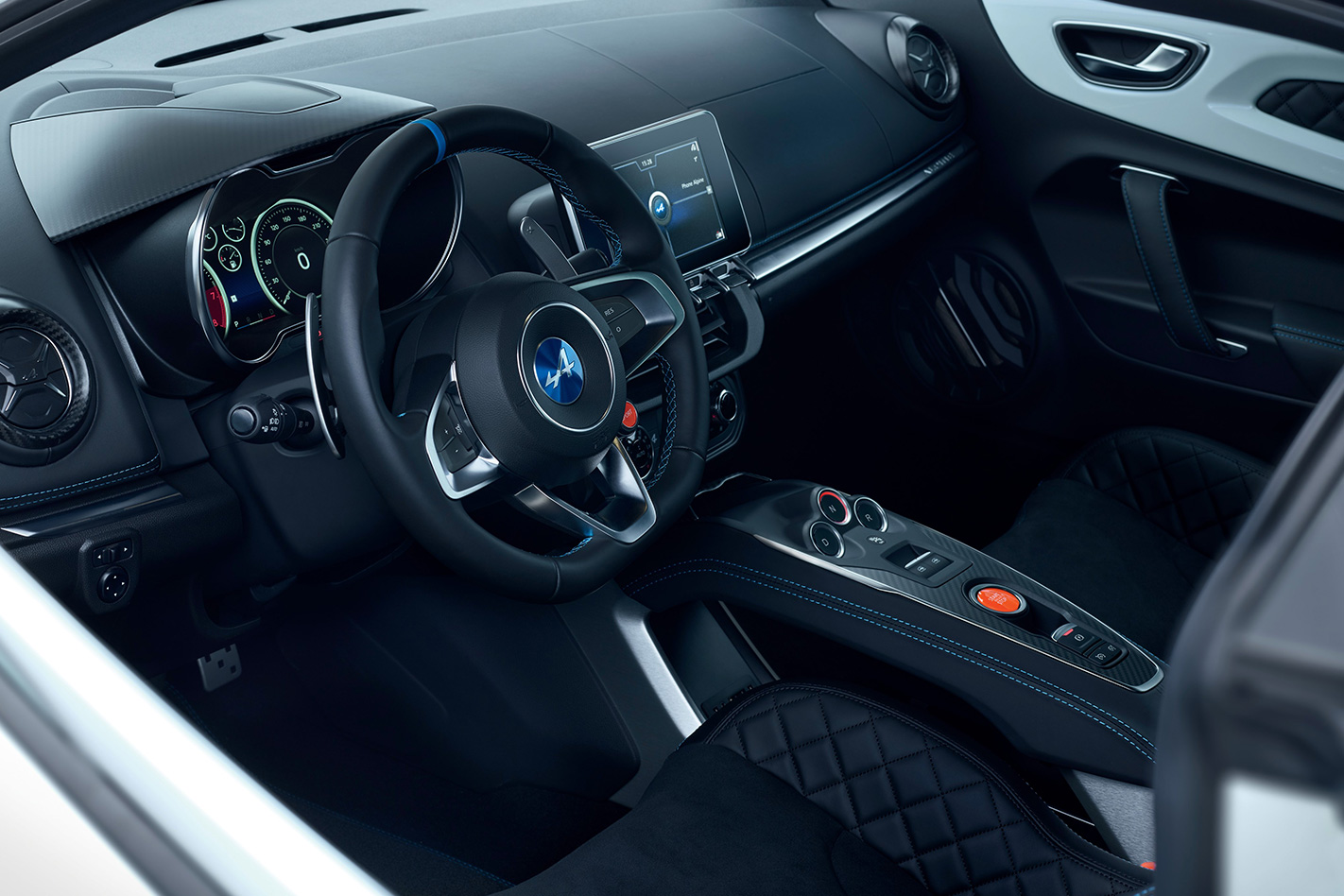
The Pure also gains the Alpine Mode Selector, which allows the driver to switch between Normal, Sport and Track modes.
Options include a Brembo brake upgrade pack with an active exhaust, different-look 18-inch alloys, and front and rear parking sensors tied in with a reversing camera.
The Legende spec chucks out the fixed-back buckets for heated six-way adjust seats trimmed in black or brown leather, while gloss-finish carbonfibre trim replaces the matte finish of the Pure. It gains the Focal audio system as standard, as well as the reversing camera and front and rear parking sensors, two-tone 18-inch alloys that pay homage to the 1960s-era A110 Berlinette 1600S, climate control air-conditioning, satellite navigation and LED headlights and tail-lamps.
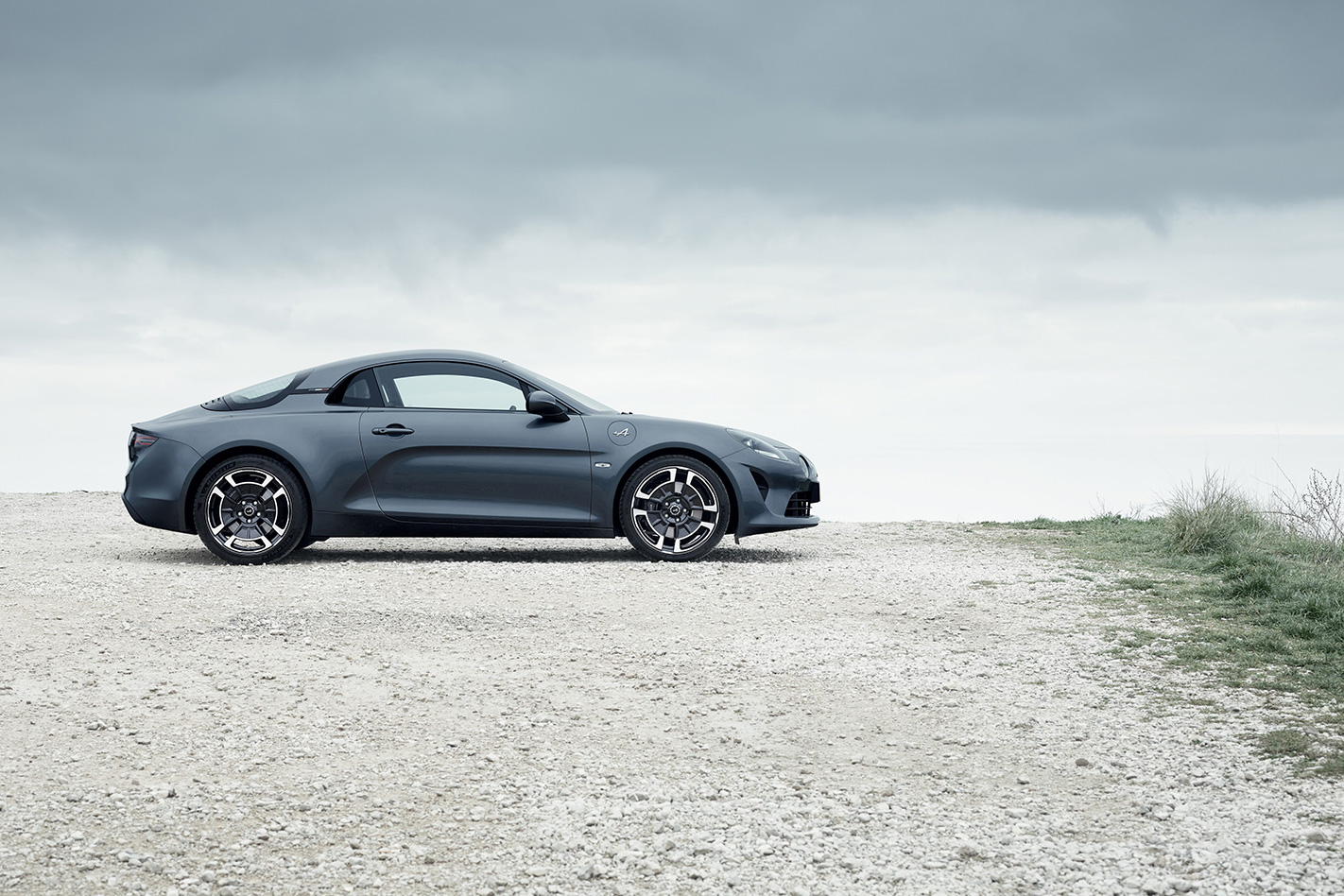
Options include a more premium Focal audio system that adds a subwoofer and a pair of tweeters, and an active sports exhaust.
A Melbourne-based dealership, Alpine Brighton, has been named as the first Australian showroom to sell the reborn sports coupe range.
FORD’S updated Mustang will continue to wear a three-star crash rating despite answering criticism leveled at the former model by Australia’s crash safety watchdog.
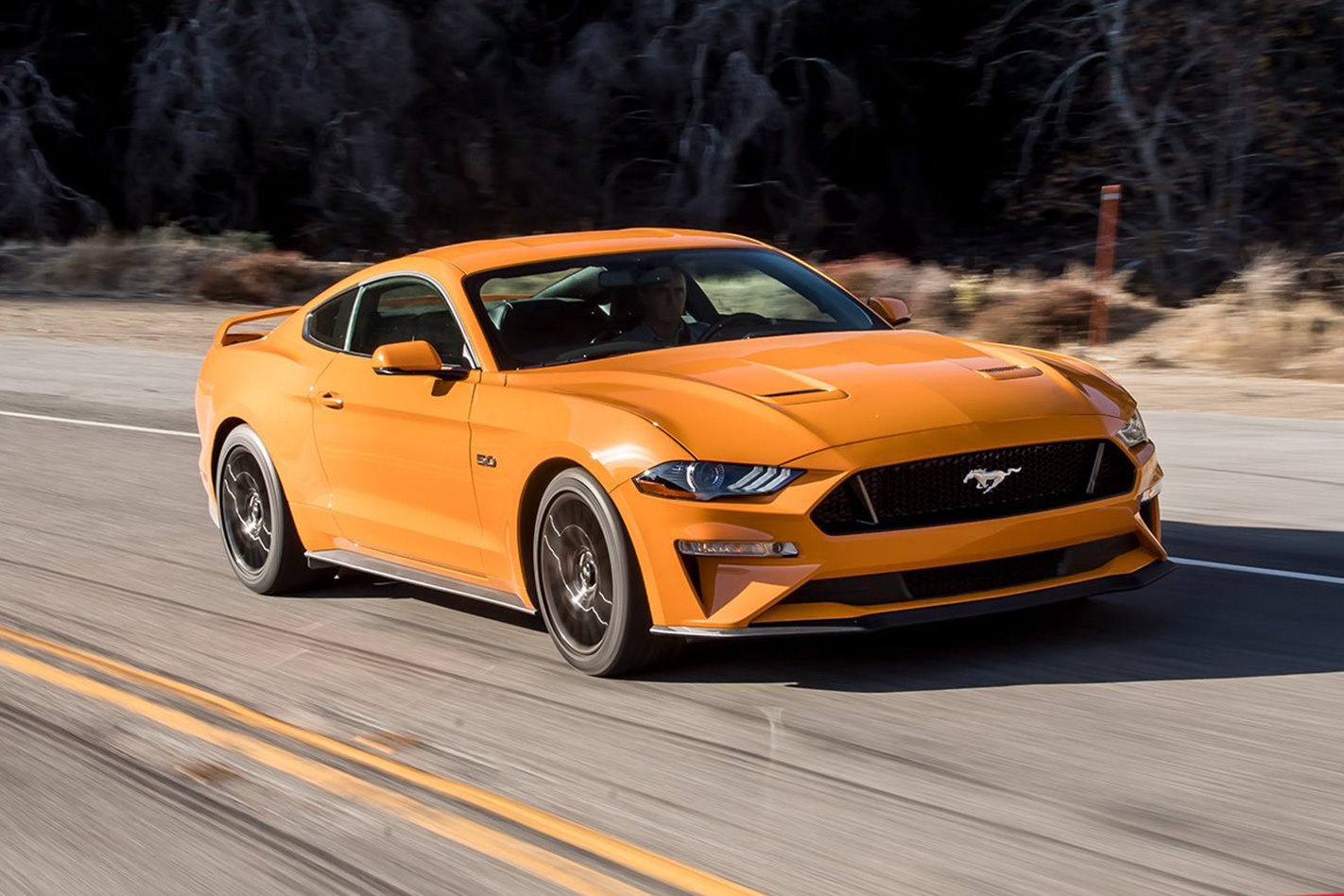
The Australasian New Car Assessment Program announced the updated Mustang, which today makes its official debut in Australia with a raft of driver assist systems including automatic emergency braking, a forward collision alert system and a lanekeeping assistant, would carry over its mediocre rating.
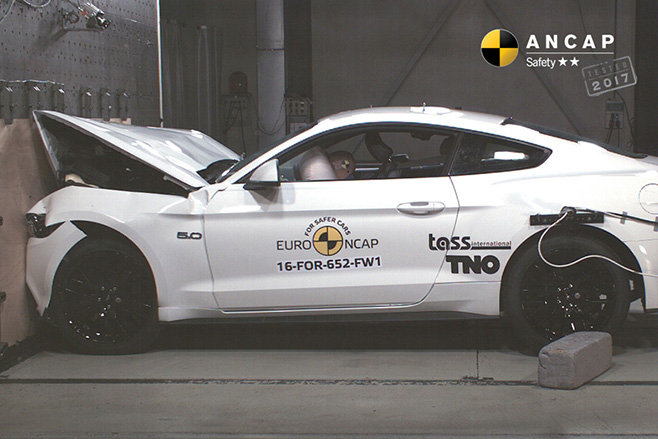
The Australian three-star crash rating is the same that was given to the facelifted Mustang late last year via ANCAP’s continental equivalent, EuroNCAP. The EuroNCAP scoring system initially gave the Mustang a two-star rating, but this was later re-rated to three stars after the coupe added the extra driver assist technology.
While the extra driver assistance helped lift the coupe’s safety assist score from 2015’s low of 16 percent to the new score of 61 percent, and pedestrian protection from 64 percent to 78 percent, ANCAP said Ford had not improved rear-seat passenger or whiplash protection – the areas where the previous model lost points.
“Improvements have been made to the Mustang’s safety assist features as well as tuning to restraint systems,” ANCAP chief executive James Goodwin said. “Structurally however, the revised Ford Mustang is identical to the Mustang we originally rated, meaning it still falls short of our expectations in the areas of adult occupant and child occupant protection.”
Goodwin said that while the inclusion of driver assistance systems such as AEB and lane keep assist were “a definite step in the right direction”, the improvements to the Mustang had “neglected to address the injury risk posed to rear seat occupants as well as whiplash Protection”.
A two-star crash safety rating still applies to Mustangs built between December 2015 and December 2017.
According to the EuroNCAP test results, the Mustang still offered generally poor rear-seat protection in a head-on collision after the crash-test dummy “submarined”, slipping under the lap section of a seatbelt that exerted “an excessively high tensile force in the test” that could also induce chest injuries.
While the ANCAP rating applies to all four-cylinder and V8-engined fastback versions of the Mustang, the convertible version remains unrated.
Ford Australia said the Mustang was a safe car. “We are committed to continued improvement in vehicle safety and have taken action and updated several systems on the MY2018 model,” a spokesperson said.
“The overall EuroNCAP and ANCAP rating is based on four pillars (adult occupant protection, child occupant protection, pedestrian protection and safety assist), with a very strong focus on family car and SUV safety characteristics and specific safety assist features, which are usually not part of the standard equipment of cars in the Mustang category.
“The MY2018 Mustang delivered a four-star result for Adult Occupant Protection, a five-star result in the Safety Assist pillar and a five-star result for Pedestrian Protection.However, a three-star result for Child Occupant Protection limited the overall result to a three-star rating.
“An important element of the EuroNCAP child safety rating includes elements such as ease of ingress/egress of the child seat, an area where two-door coupes traditionally have a disadvantage.”
The Mustang’s result flies in the face of another two-door coupe that continues to carry a much higher rating stamped on it under a less-stringent crash testing regime.
The strong-selling Toyota 86, which last month eclipsed 20,000 Australian sales since its launch, and the closely related Subaru BRZ were last crash-tested in 2012 and still carry a five-star rating despite having no driver assist systems, rear headrests or rear-seat seatbelt reminders – all criteria on which the Mustang was assessed. Similarly, the Hyundai Veloster, assessed in 2013, also carries a five-star rating without the modern-day safety gear.
ANCAP’s crash-test ratings publish the year in which the vehicle was tested, but the system leaves it up to the buyer to fill in the gaps of what the safety benchmark was at the time the vehicle was tested.
The Monash University Accident Research Centre releases annual crash test ratings for secondhand cars, based on real-world crash data, however sports cars are not included in the results.
Wheels has contacted the centre to ask what scores the Toyota 86/Subaru BRZ and the Hyundai Veloster would receive under the Used Car Safety Rating system.
After former Holden chief Mark Reuss smashed a Corvette ZR1 pace car at the Detroit IndyCar GP prior to the race last weekend, we got thinking about all the other crazy things that have happened to course cars over the years.
Then we picked a few to remind you of. For example, do you remember the time Franz Engstler crashed into a safety car at the 2009 WTCC Race of France at Pau?
In race 2, Engstler was leading the race when, only a couple of laps in, he blindsided the safety car as it left pit lane, losing Engstler his front tyre.
To be fair, it was a blind corner, but the yellow flags were out before the collision. Knowing what Engstler could actually see might make it easier to know whether it could have been avoided.
Another infamous incident is the time Nick Heidfeld went nose-first into the door of a medical car at the 2002 Brazilian GP.
The medical car – a Mercedes-AMG C63 Estate – had stopped for Enrique Bernoldi, who had crashed his Arrows F1 car into the wall.
While the medical car’s door was open (on the opposite side to the track), Heidfeld took the preceding corner too hot and according to him, there was no way he could save it.
Somehow, the door managed to stay on the car, and no one was badly injured.
There’s also the time Taki Inoue copped a medical car’s bonnet to the torso, after it hit him while he was walking by.
Inoue, himself infamous for having never scored a point in F1 over 18 entries, crashed his Arrows and was out of the 1995 Hungary GP.
This was only a few races after a safety car had hit his own racer during practice at Monaco, so what else could possibly go wrong?
While Inoue was walking in front of the medical car which had arrived at the scene, it moved a little further than he seemed to anticipate and hit his leg, throwing him onto the bonnet.
If we want to take things back to the IndyCar realm, and more specifically Pace cars, we have to go further back.
In 1971, for example, a Dodge Challenger pace car lost control at the end of pit lane during the Indy 500 at.
The Challenger, driven by a local car dealer with astronaut John Glenn along for the ride, ended up in a photographers’ stand, though thankfully no one was killed, though up to 30 were injured, two seriously.
Or, in what could be the worst/best thing to happen to a pace car in history, there’s the NASCAR Talladega incident of 1986.
In a scene that looked like something you’d see in a bizarre Blues Brothers remake, the pace car started up around the track before the race, but the officials weren’t driving it.
The commentators discover, as the below video shows, that a ‘spectator’ has found his way into the pace car, a Pontiac Trans-Am, and started lapping the speedway.
Very quickly, a roadblock is formed by officials, and police motorcycles give chase. Though he only manages a short joyride, the crowd is absolutely enamoured with his performance.
The commentators say he’s cheering for the police who are taking him out of the car, but we know that’s not why they’re cheering.
To balance out all this fail, we have something a little more on the ‘win’ side. Do you remember when four-time Le Mans winner and now safety car driver Yannick Dalmas drifted the flashing-light-equipped Audi R8 through the rain at Le Mans in 2016?
It drew admiration from Mark Webber, who mimicked a bit of opposite lock while talking to someone about what had just made him smile.
If you’re a loyal – and very wealthy – Ferrari customer, you might be given the chance to build your own unique Ferrari via the ‘One-off’ program.
As long as Ferrari is happy with it, that it. You can’t have one in neon pink, for example.
As the one-off Ferrari SP38 was recently revealed, we figured now was a good time to check out the rest of the one-offs Ferrari has built.
2008 Ferrari SP1
The first of Ferrari’s official one-offs (hence the name), the F430-based SP1 was one of the simpler cars in terms of its styling.
Traditional colours and clean bodywork were chose by its owner, Junichiro Hiramatsu, carried out in the design by Leonardo Fioravanti, a former Pininfarina stylist and now CEO of his eponymous design company.
The SP1 is also able to be driven in Gran Turismo 5 and 6.
2009 Ferrari P450 Superfast Aperta
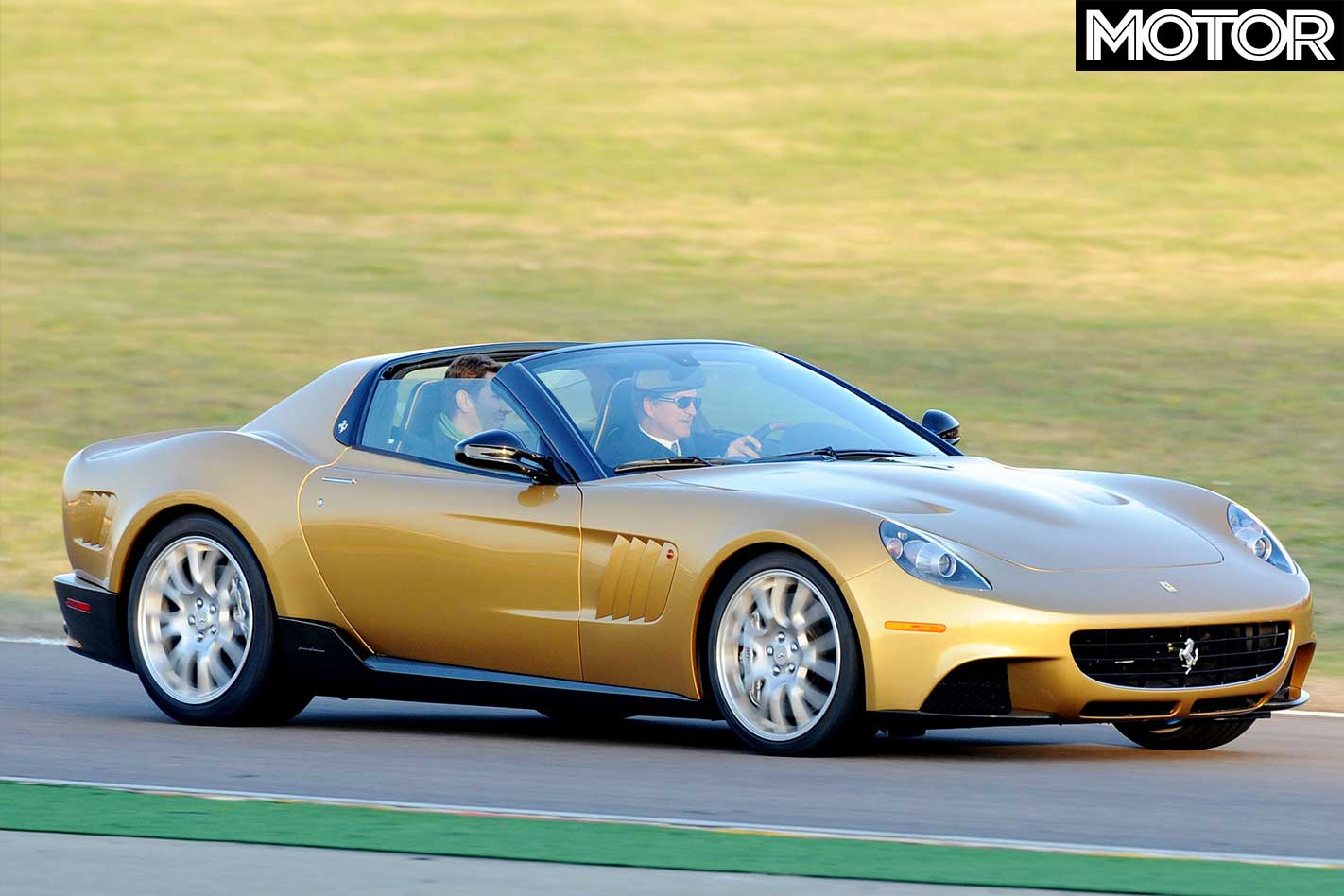
Based on the 599 GTB Fiorano, this car was built after the owner wasted a modern version of the gold Ferrari 330 LMB from the 1968 film Toby Dammit, partof a series based on stories by Edgar Allan Poe.
Ferrari says the car took 14 months from concept sketches to becoming a road-legal car. Its 6.0-litre V12 is good for a hearty 456kW and 608Nm.
Its owner, Edward Walson, who Ferrari says is the son of cable TV inventor John Walson, reportedly said “when I saw [Toby Dammit] the decision came of its own accord: one day I would have ‘my’ Ferrari.” An odd choice given the primary character is decapitated in the Ferrari by a steel wire.
2009 Ferrari 599 GTB Fiorano ‘China’
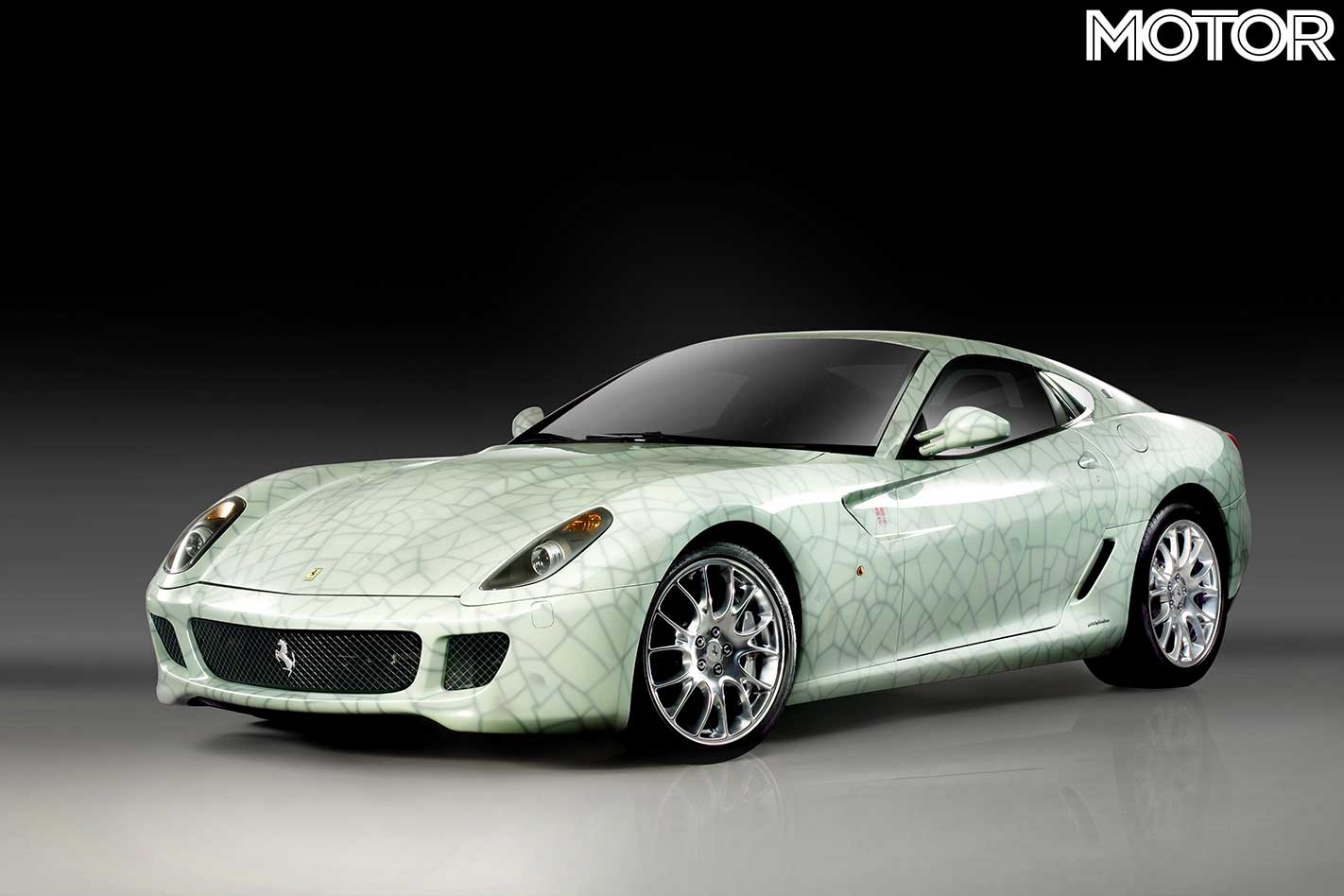
While the 599 GTB Fiorano China Limited Editions are not one-offs, one was given its own exterior by Chinese artist Lu Hao.
The car, signed by Hao, is finished in a style inspired by Song Dynasty Ge Kiln porcelain, of which only a few hundred pieces remain.
2011 Ferrari ‘SP’ Superamerica 45
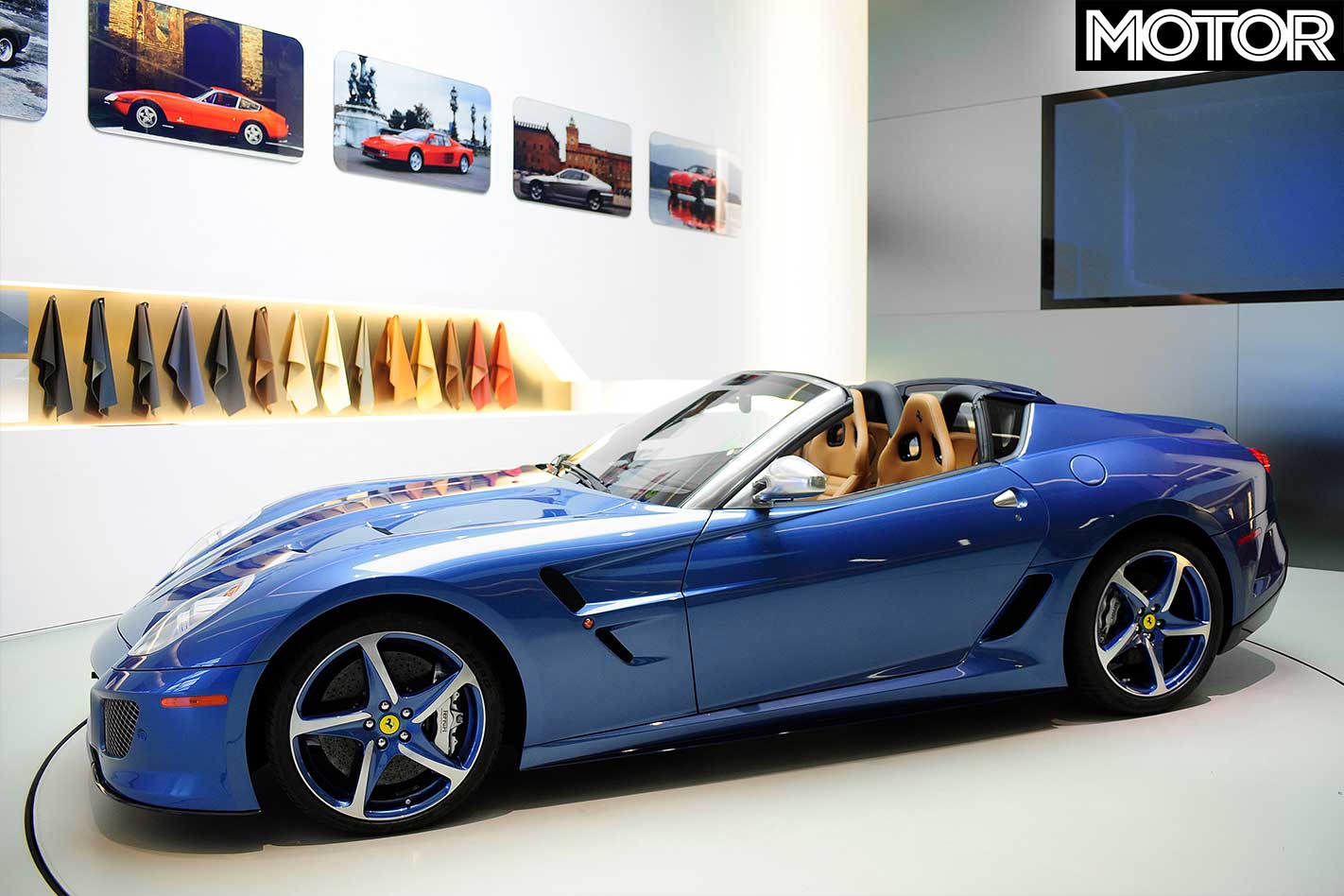
Also based on a 599 is this, the Superamerica 45.
Its design is changed through the addition of a carbon-fibre rotating hard-top, a new boot to hold the roof when it’s not over the cabin, and changes to body panels and vents.
Finished in Blu Antille to match the owner’s 1961 400 Superamerica cabriolet, the car also features colour-matched wheel accents.
2012 Ferrari SP12 EC
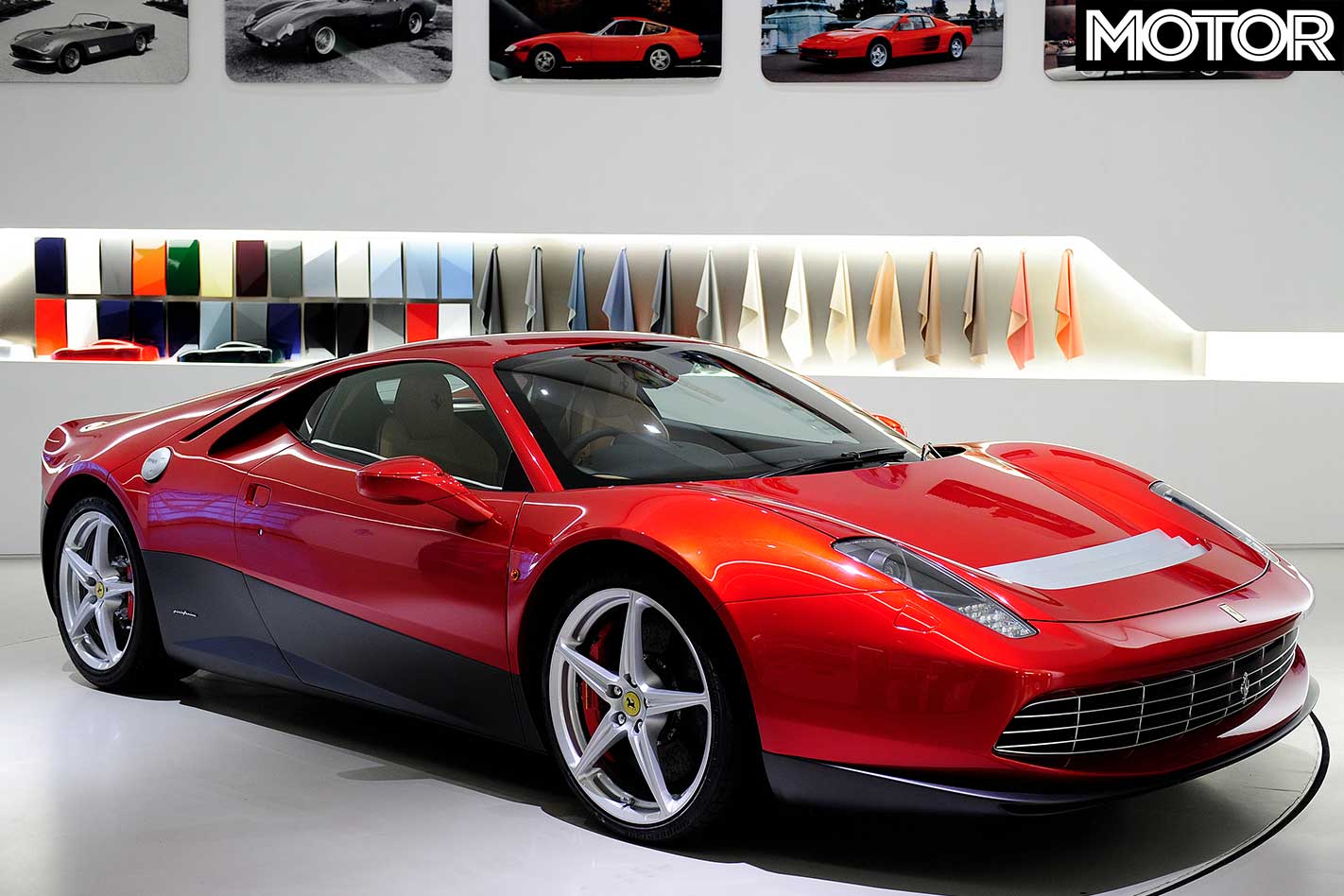
‘EC’ Stands for Eric Clapton. No prizes for guessing who ordered the car.
It’s been designed to resemble a modern Ferrari 512 BB, though it’s running on slightly more modern 458 Italia power.
Ferrari reported that Clapton called the process of specifying the car “one of the most satisfying things [he’s] ever done,” though we imagine one of the world’s greatest guitarists probably has a few other favourite pastimes.
2014 Ferrari F12 TRS
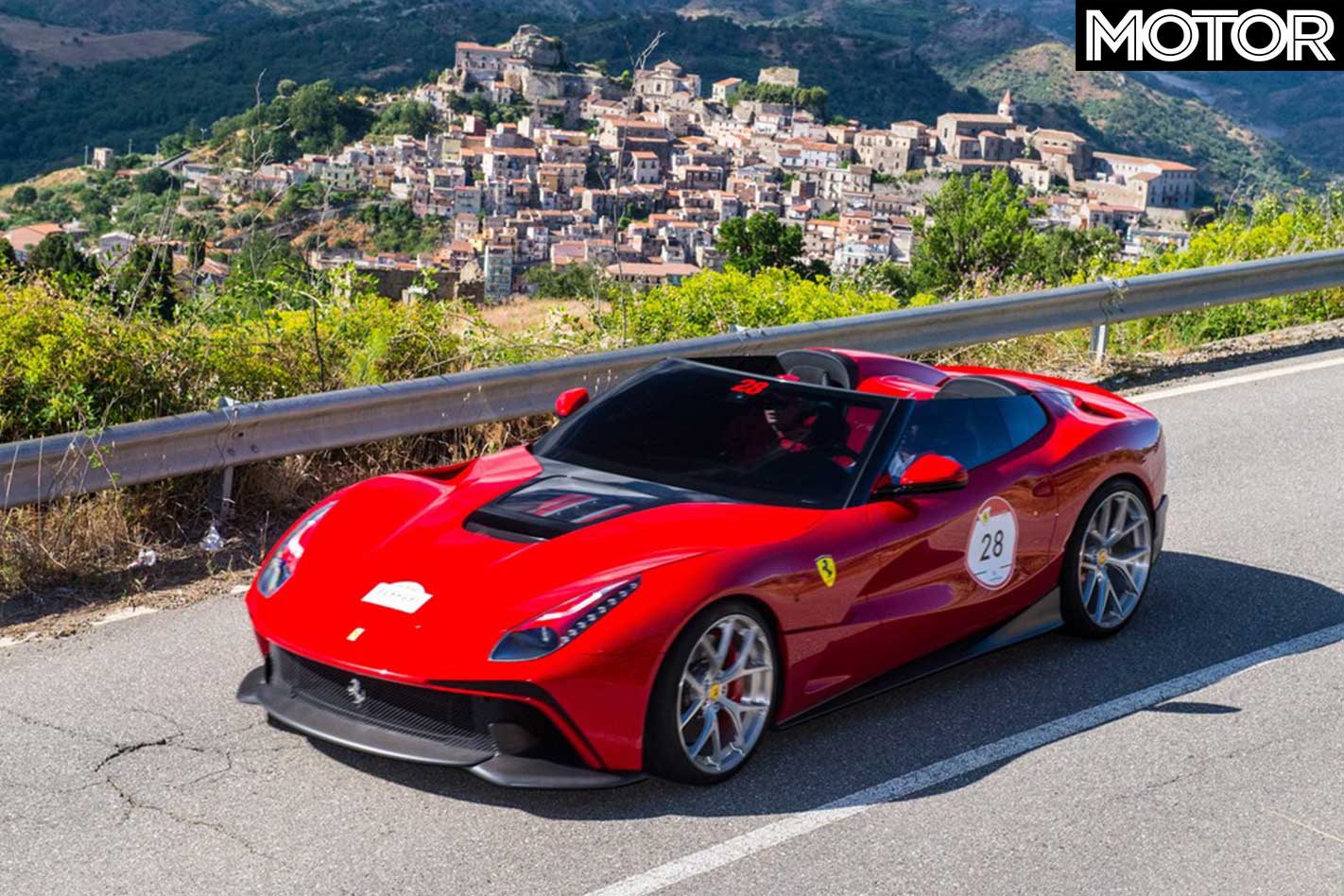
The F12 Berlinetta-based TRS is inspired by the 1957 250 Testa Rossa, though you wouldn’t know by looking at it.
The ‘extreme, two-seater, open-top sports barchetta’ is the work of Flavio Manzoni and the Ferrari Style Centre team, who gave it a clear window in the bonnet to make the V12’s red cylinder heads visible from outside the car – the only feature on the TRS Ferrari specifically attributes to Ferraris of the ‘50s.
It does, however, feature haunches behind each seat resembling that from behind the driver in a 250 Testa Rossa.
2016 Ferrari 458 MM Speciale
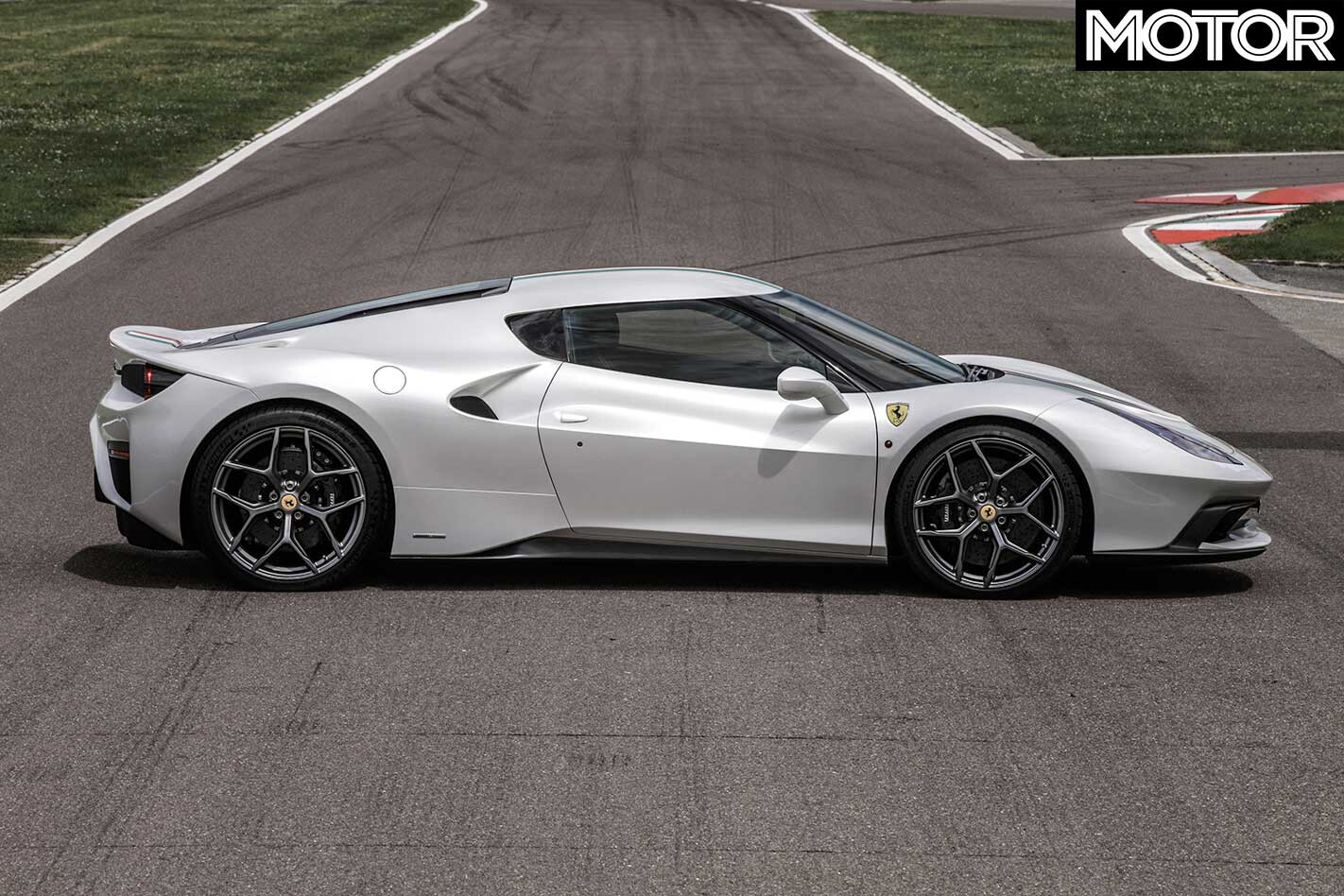
Designed in-house by Ferrari, the ‘MM’ is heavily based on, well, the 458 Speciale. However, it features enough body alterations and aero that Ferrari deems it a one-off.
Ferrari says, in fact, it was intended to mimic the 1984 Ferrari GTO in terms of its styling – particularly where the black A-pillar gives the car a ‘wrap-around windscreen’ look.
2016 Ferrari SP 275 RW Competizione
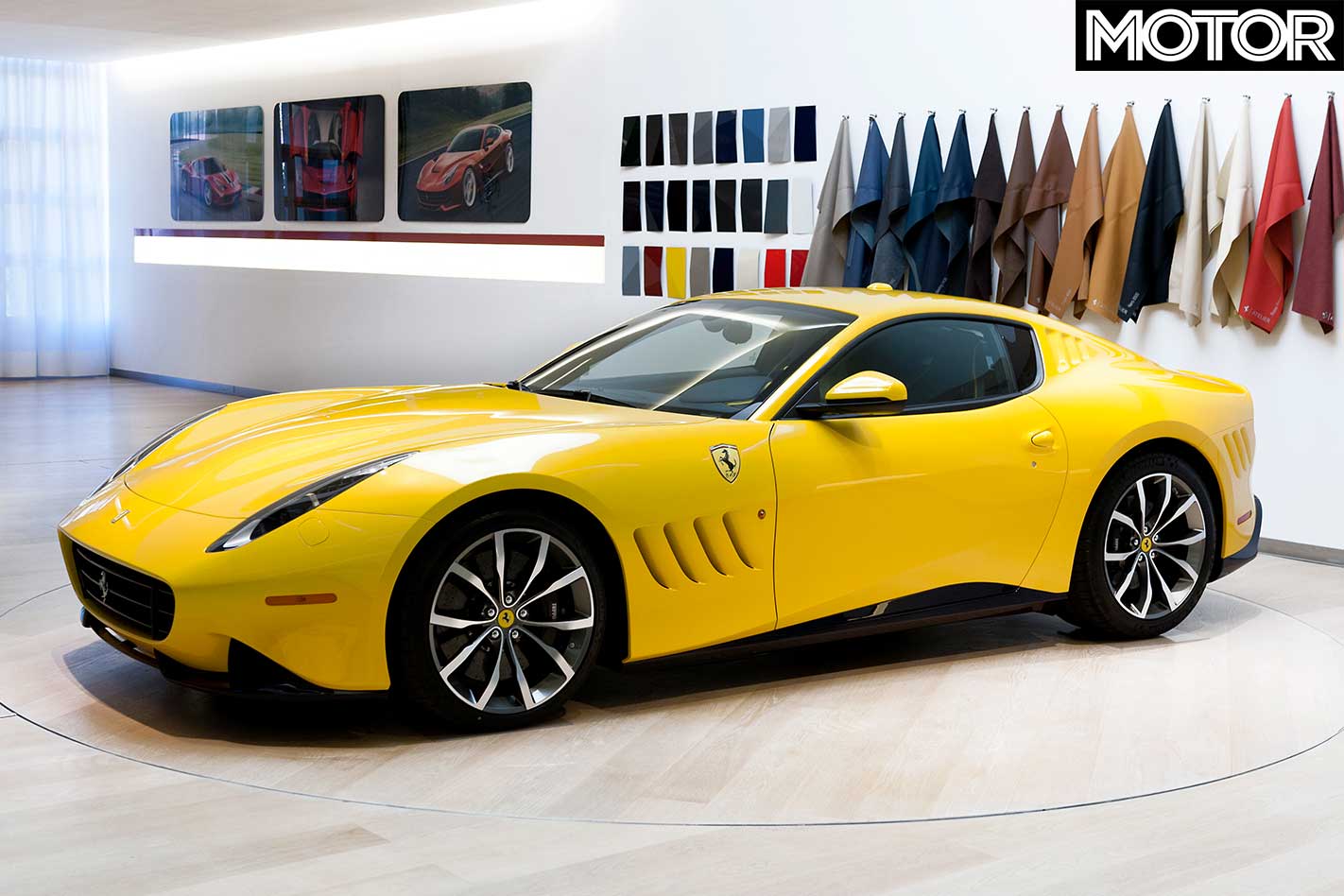
Built on the F12 Berlinetta chassis, but utilising the F12 TDF’s drivetrain, the RW Competizione is inspired by the Ferrari 275 GTB that won the GT category in the 1965 Le Mans 24 Hour race.
The yellow paint comes from the Ecurie Francorchamps team livery, while its vents and rear very closely mimic the original car.
BONUS: 2006 Ferrari P4/5 by Pininfarina
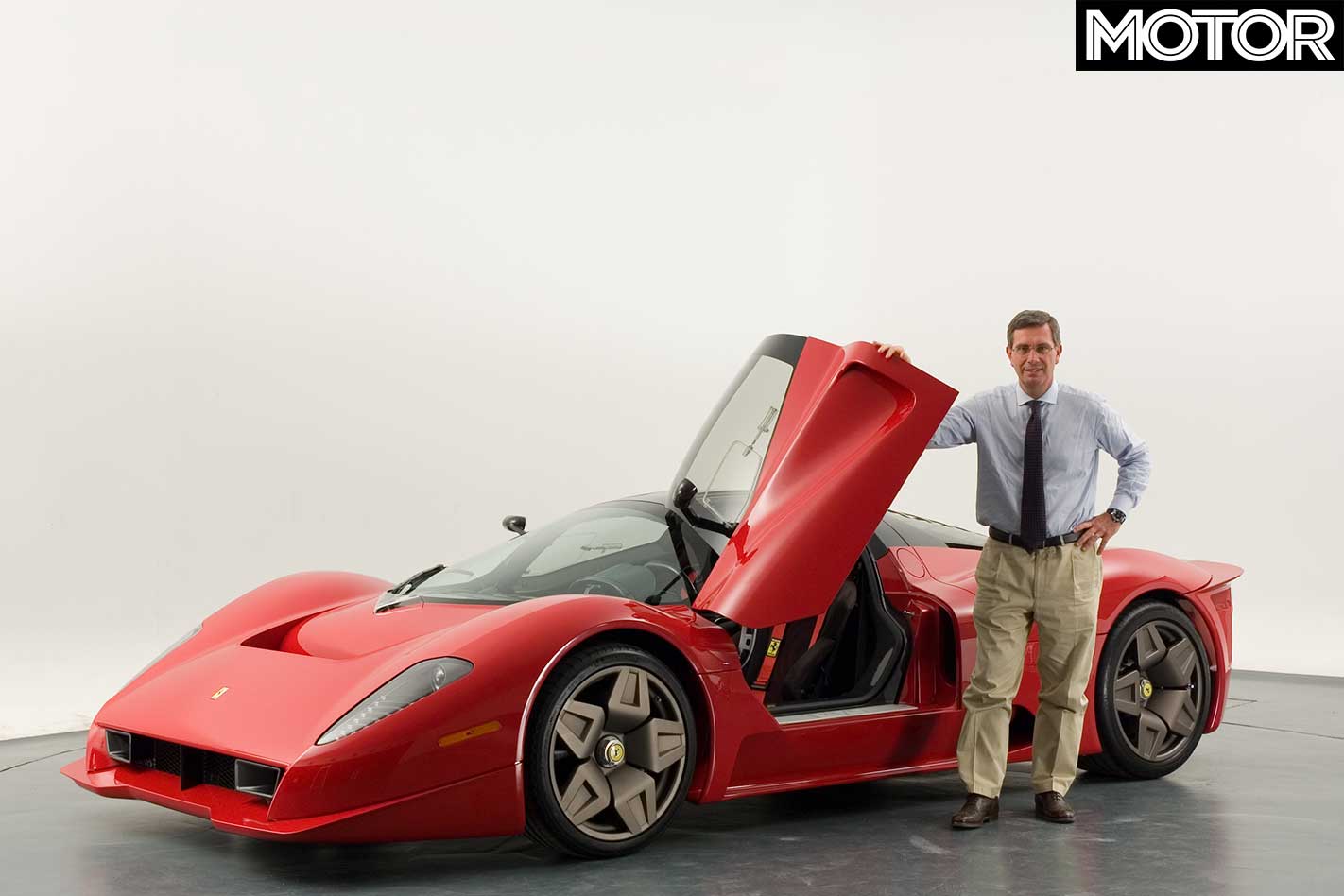
Though not part of the One-off program (as it proceeds its inception), this car was built specially for James Glickenhaus.
‘Designed, engineered, and built entirely’ by Pininfarina, the Ferrari P4/5 is actually based from an Enzo, and still uses its powertrain.
Ken Okuyama, styling director for Pininfarina at the time, said the car ‘expresses elegance and fluidity with the clear-cut, uncluttered lines that are typical of Pininfarina’s style.’
It reportedly cost Glickenhaus USD$4 million, including the cost of the Enzo.
But there’s more!
There are other one-offs cleverly hidden from public eyes, like the SP Arya ordered for business magnate Cheerag Arya, and the SP FXX which has been very well-hidden since grainy pictures of it appeared online shortly after it was built in 2014.
With the one-off department reportedly booked out for the next couple of years, we’re sure we’ll see more in the near future, too!
The facelifted Mini range will arrive in Aussie showrooms on July 1 this year with a trimmed-down range and higher starting price of $29,900 for three-door Mini Cooper hatch.
A restyled range has dropped the entry-level Mini Ray and diesel-powered Cooper D, with the Copper, Cooper S and sprightly John Cooper Works (JCW) hatch and convertible variants making up the revised range.
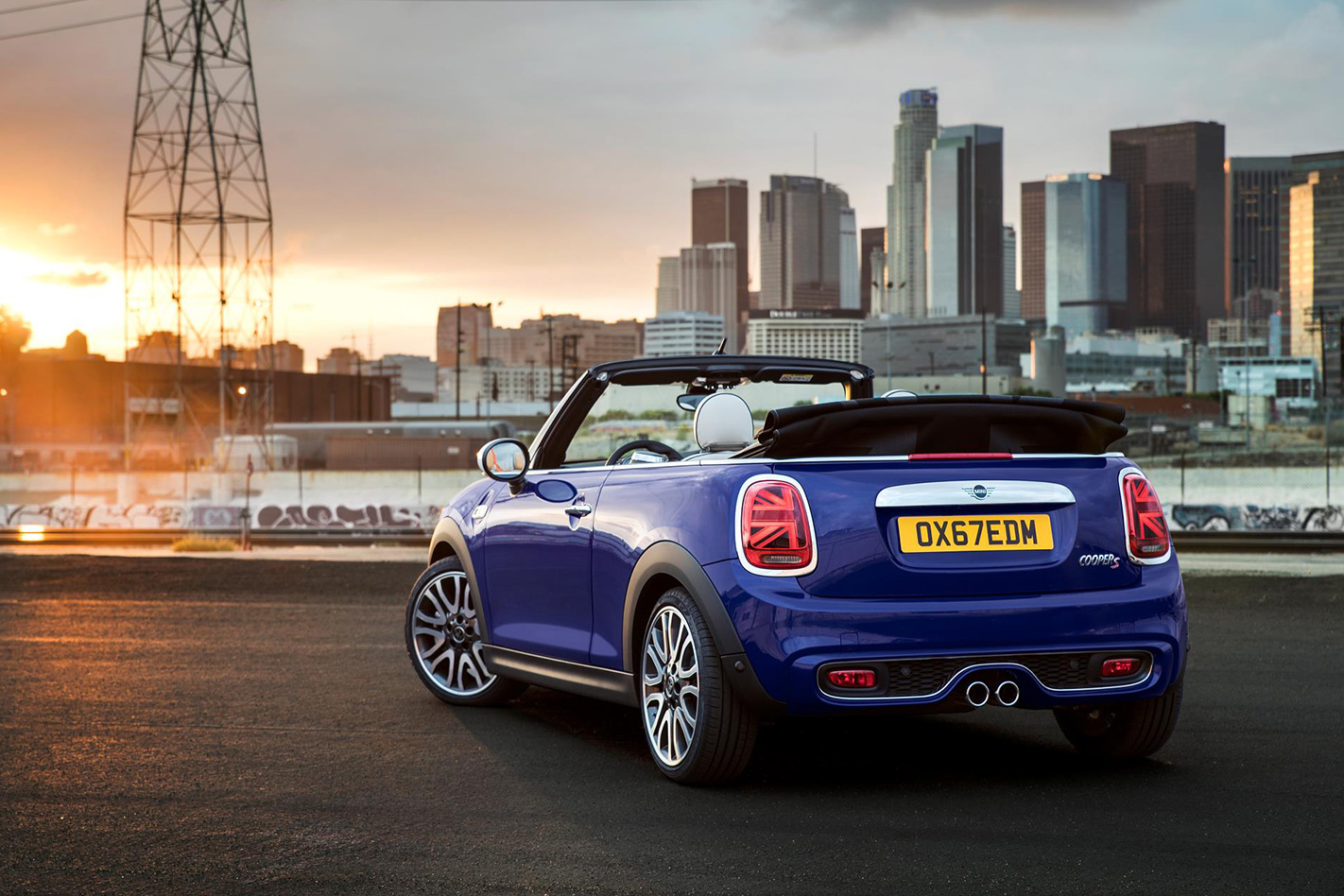
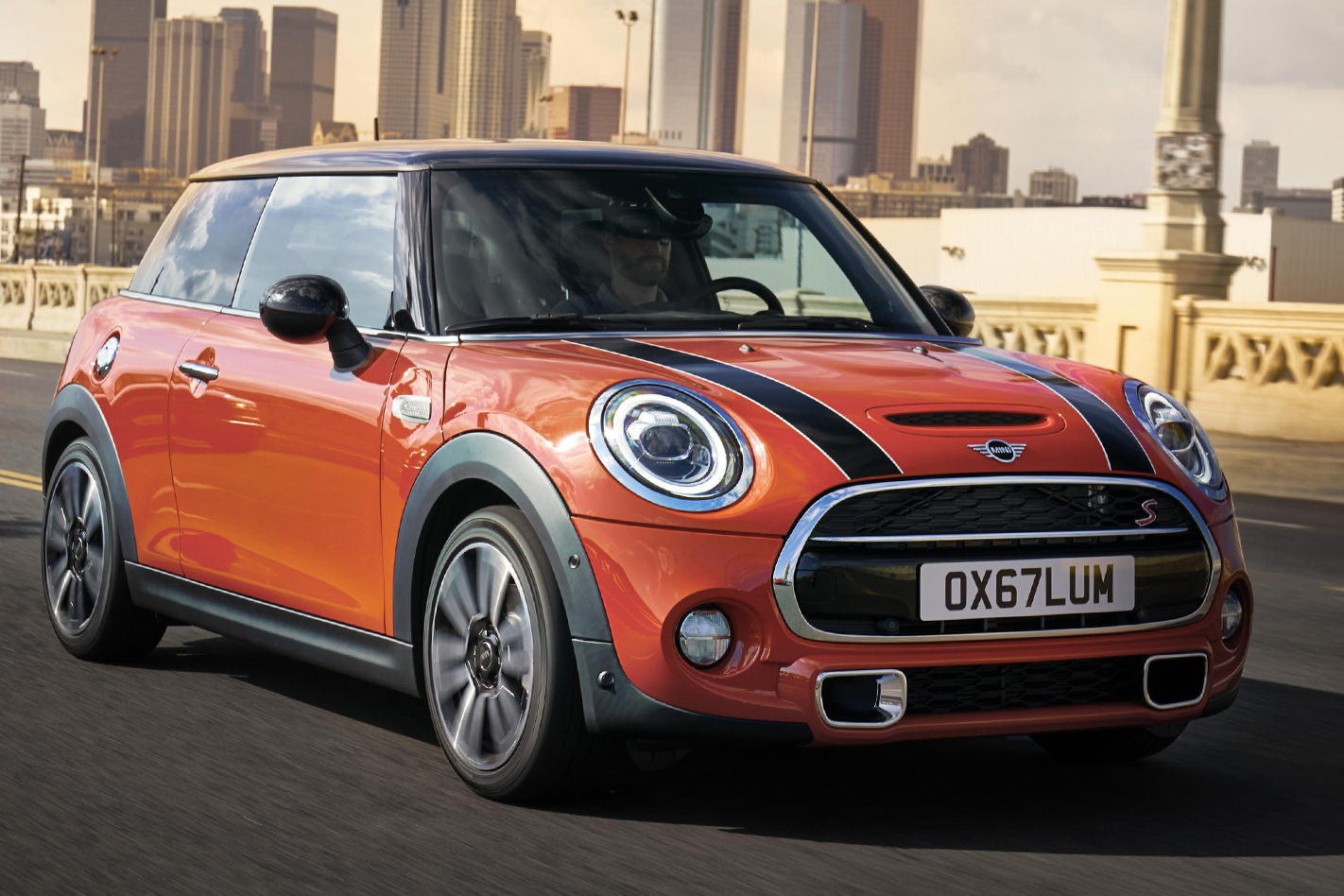
A big part of the facelift is the new LED lighting that’s standard on the Copper S and JCW variants, and optional on the Cooper over its standard halogen and incandescent lamps.
Up front the new LED headlights have increased low- and high-beam range, and stand out with daytime running lights and LED turn indicators around main headlight fitting to create a unique lighting signature.
An optional Adaptive LED system is also available, featuring a ‘matrix’ high beam function that adapts to the road ahead.
The Cooper S and JCW versions have distinctive Union Jack styled tail lights, which have been a popular feature ever since the updated Mini was first revealed last year.
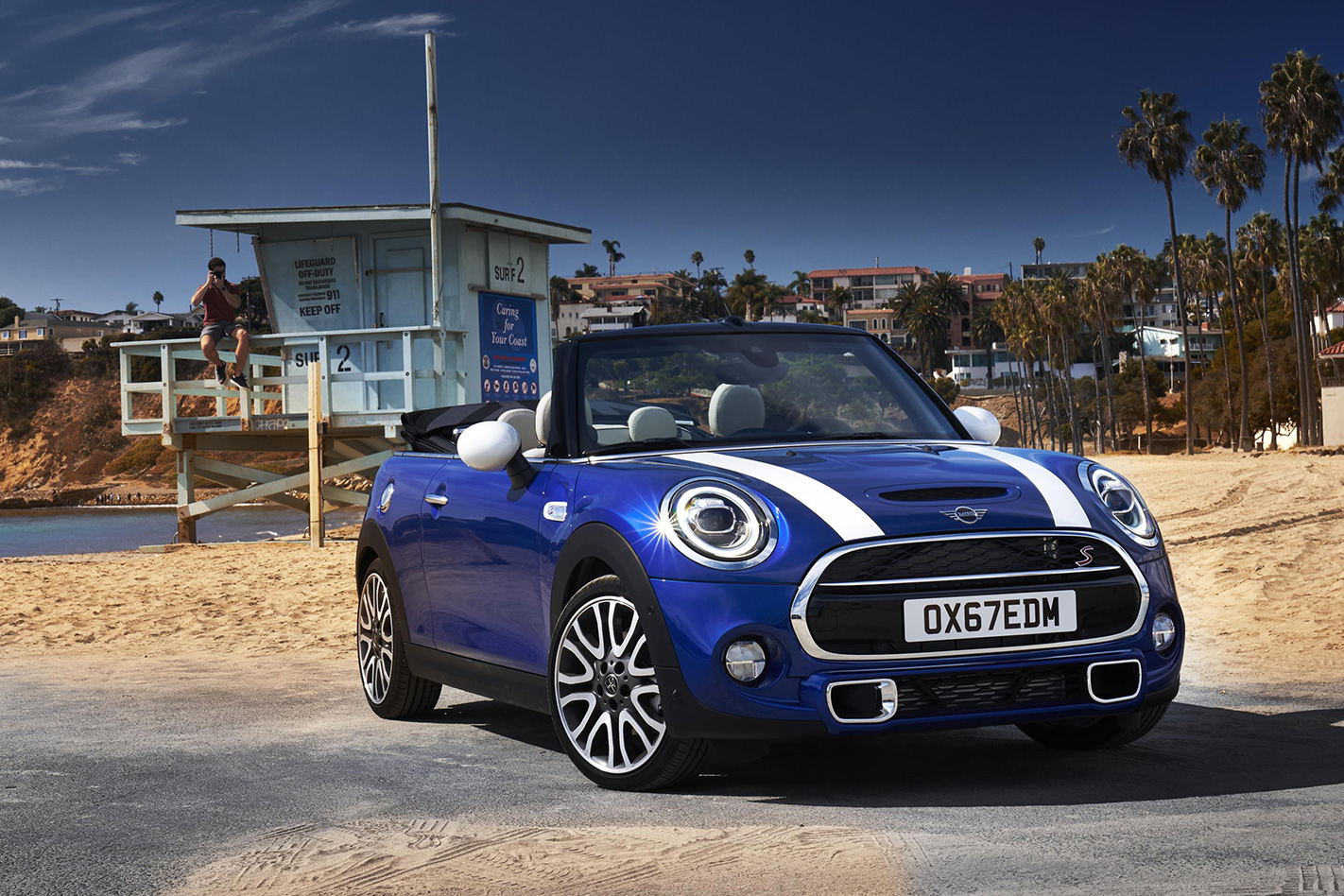
The 2018 Mini range also stands out with new design elements on everything from the steering wheel to the key-fob, and an additional five colour options, including Solar Orange, Emerald Grey, Starlight Blue, Melting Silver and Chili Red, with contrasting roof and stripe options.
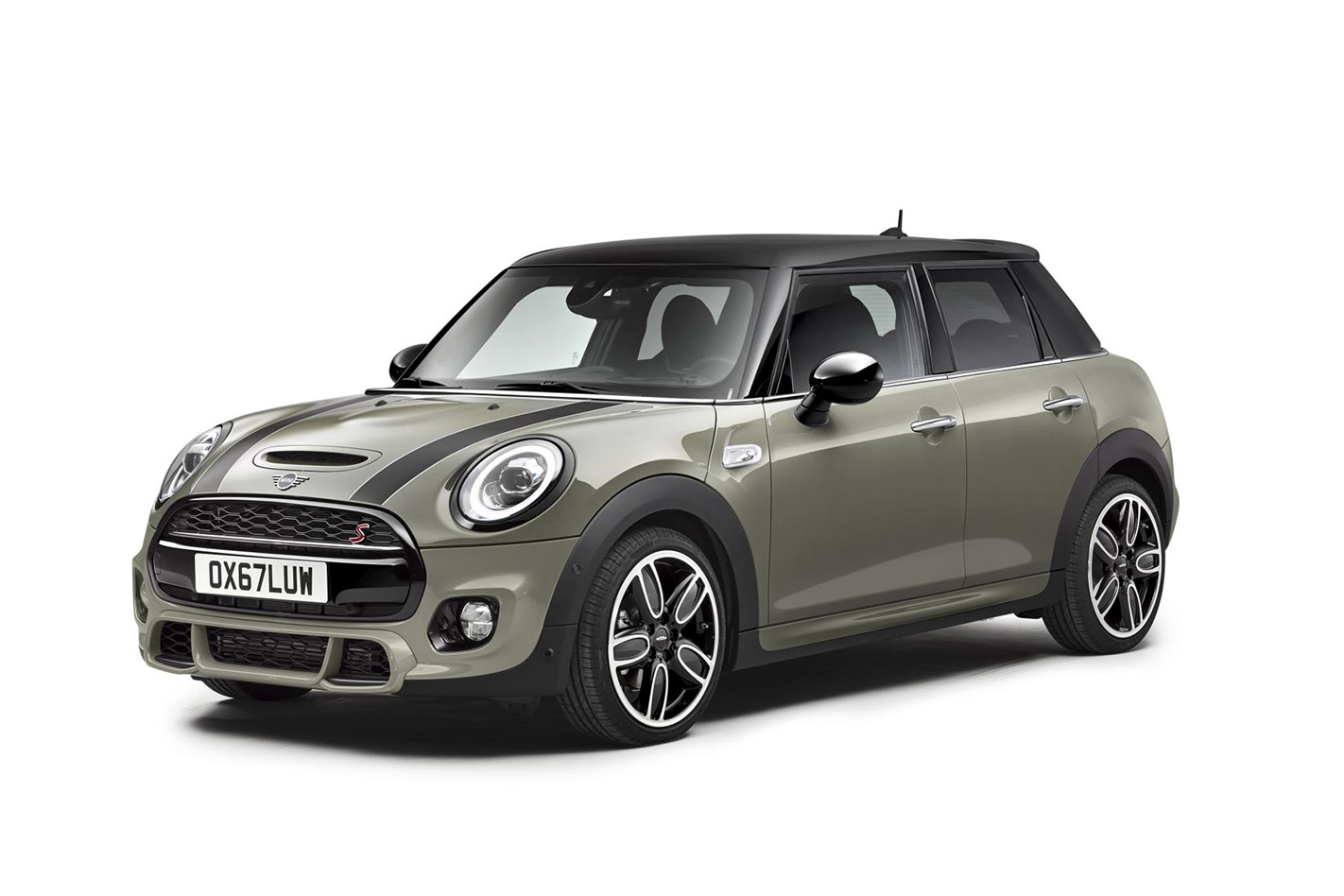
Customised ‘Mini Yours’ highlights are also available; including special Luxury Lapis Blue, or Rebel Green (JCW only) paint.
The Mini’s infotainment system has also been enhanced, with the introduction of Mini Connected that’s similar to parent company’s BMW Connected Drive and provides real-time traffic info, and an emergency eCall function that automatically contacts emergency services if you’re involved in an accident.
An accompanying Mini Connected phone app allows you to view your Mini’s location, and fuel level via your phone and even flash the lights or lock/unlock the doors. It also lets you share your calendar with the car so it can create a navigation route and text you departure times based on traffic information.
Apple CarPlay is included as standard across the range (sorry, Android users) and Cooper Convertible and all Cooper S and JCW variants come with wireless phone charging for suitable phones.
Engines carry over from the outgoing model. Trimming the Cooper D and Ray from the range means there’s no longer a diesel option and the smallest engine is now the Cooper’s 100kW/220Nm 1.5-litre three-cylinder turbo.
The Cooper S variants retain the 141kW/280Nm 2.0-litre four-cylinder turbo, while the JCWs still get the punchy 170kW/320Nm 2.0-litre turbo four.
Each hatchback variant comes standard with a new seven-speed dual-clutch automatic transmission. The Cooper S Convertible comes with boosted sports version, while the JCW Convertible has an eight-speed sports (torque-converter) auto. Both are optional in their respective hatches.
Purists can also opt for a six-speed manual gearbox as a no-cost option in any Mini variant.
Cooper standard features include auto stop/start, keyless start, 16-inch alloy wheels, 6.5-inch touchscreen, reversing camera with guidelines, rear-parking sensors, digital radio, cloth upholstery, auto headlights, rain-sensing wipers and heated exterior mirrors with washer jets.
The notable exclusion is automatic emergency braking, that’s increasingly standard kit on more affordable small cars, but is still only available across the Mini range as part of a pricey option pack.
Cooper S adds the bigger four-pot engine plus 17-inch alloys, driving modes, cloth and leather combination trim, front sports seats, dual-zone climate control, dual central tailpipes, LED headlights, LED ‘Union Jack’ tail-lamps, interior ambient lighting, and Mini puddle light.
The JCW comes as three-door hatch and Convertible only and adds 18-inch alloys, adaptive suspension, run-flat tyres, 12-speaker Harman/Kardon premium sound system, head-up display, JCW interior and exterior embellishment, cloth/Dinamica upholstery, Anthracite headliner and park assist function.
2018 Mini pricing
- Mini Cooper, 3-door hatch – $29,900
- Mini Cooper, 5-door hatch – $31,150
- Mini Cooper Convertible – $40,900
- Mini Cooper S, 3-door hatch – $39,900
- Mini Cooper S, 5-door hatch – $41,150
- Mini Cooper S Convertible – $47,900
- Mini JCW, 3-door hatch – $49,900
- Mini JCW Convertible – $57,900
New car sales in Australia dropped slightly during May, however year-to-date sales are still 2.1 percent ahead of the same month in 2017, figures released today show.
According to the VFACTs figures, Australia-wide sales in May hit 100,754 as traditional passenger car sales slumped severely, mainly because mum and dad buyers kept their bank accounts topped up for the month.
The slow May was also 2.1 percent down compared with the same month last year.
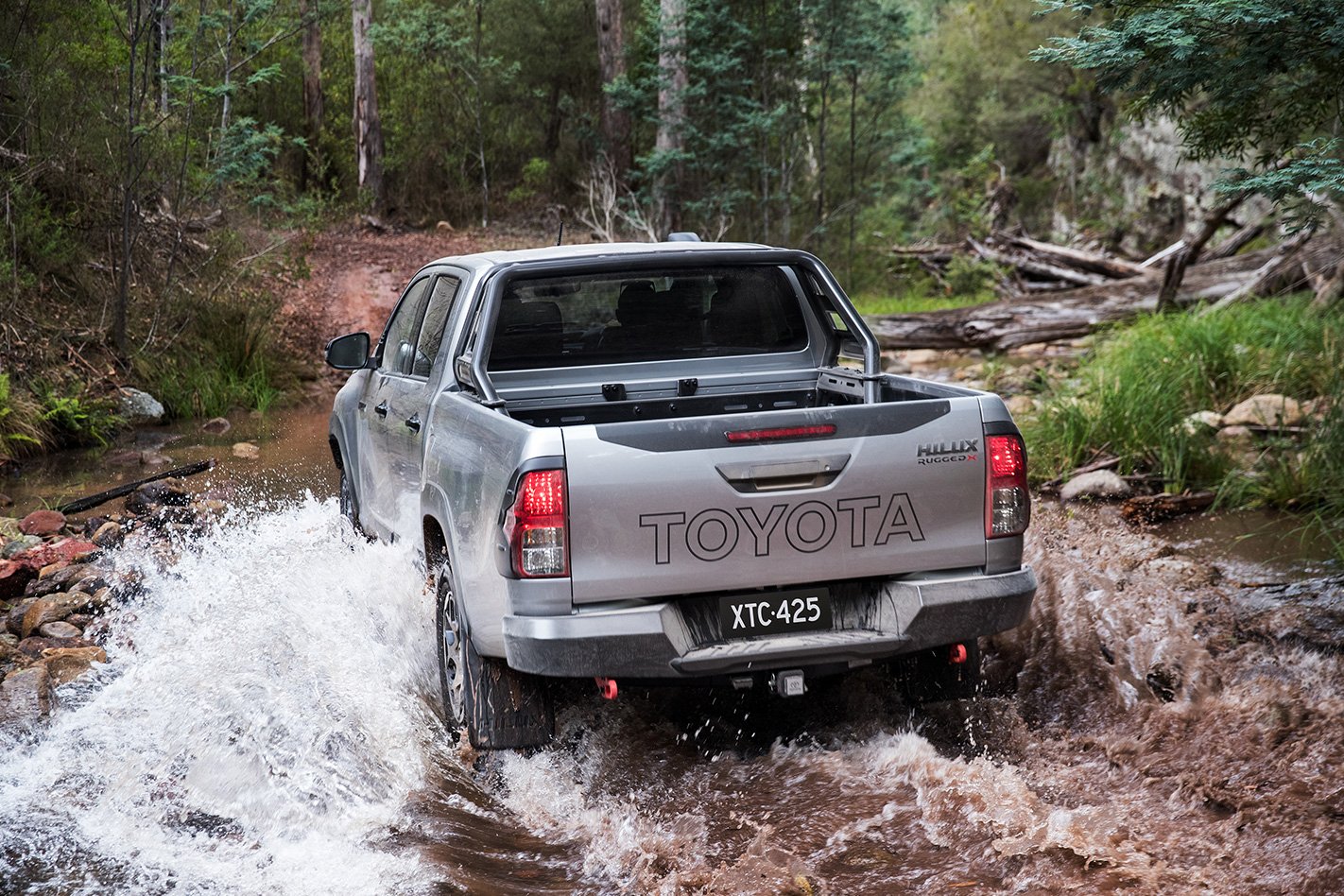
The Toyota Hilux trade ute continued as the top-selling vehicle for the month, snaring 4385 sales, a 5.6 percent rise compared to May 2017.
Likewise, the Ford Ranger trade ute (3674) filled second place as the war for market dominance between the two worksite rivals heats up.
Just nine sales separated the two in May when just the higher-priced 4×4 segment sales are taken into account, with Toyota traditionally much stronger in the showroom on the more workmanlike 4×2 models.
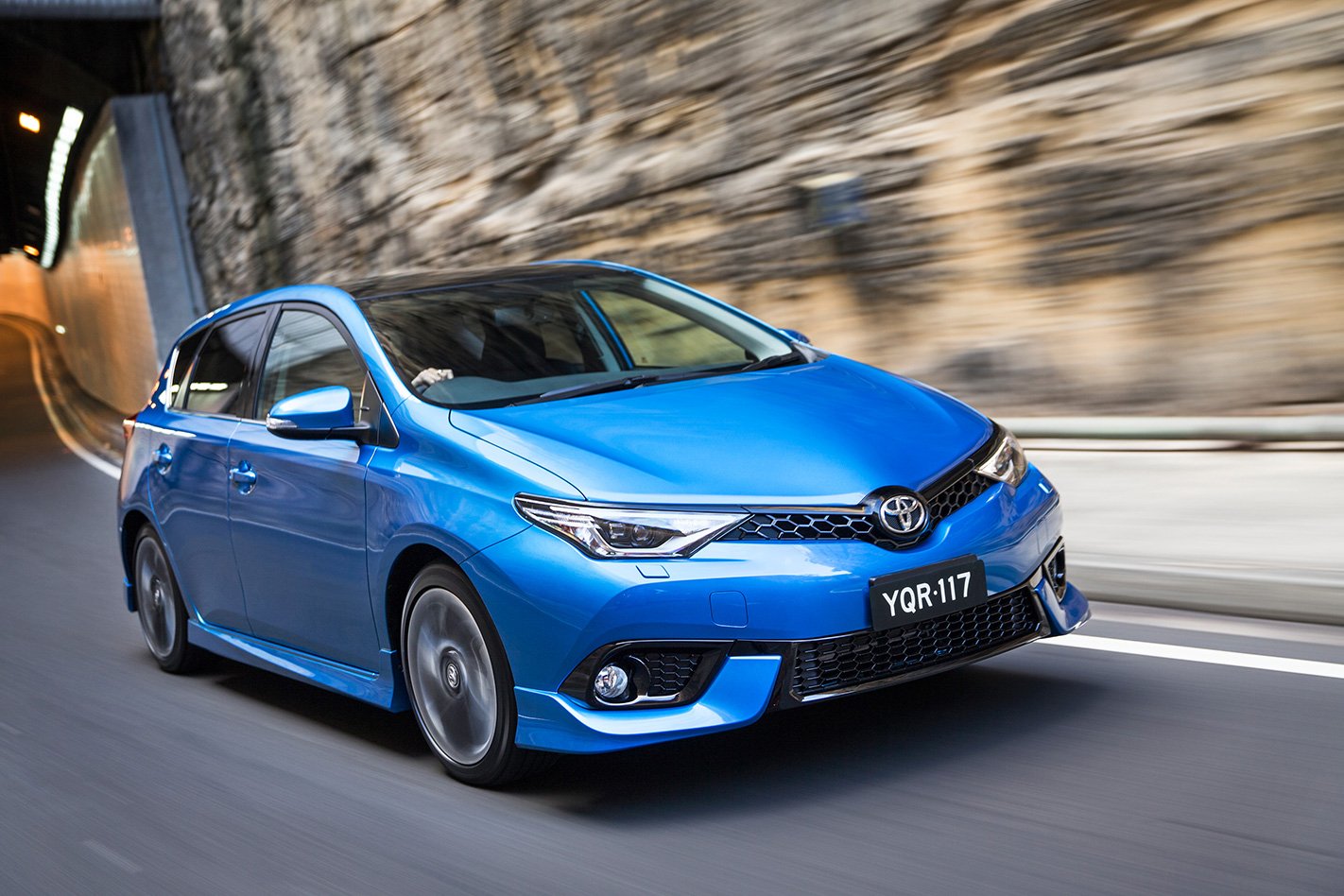
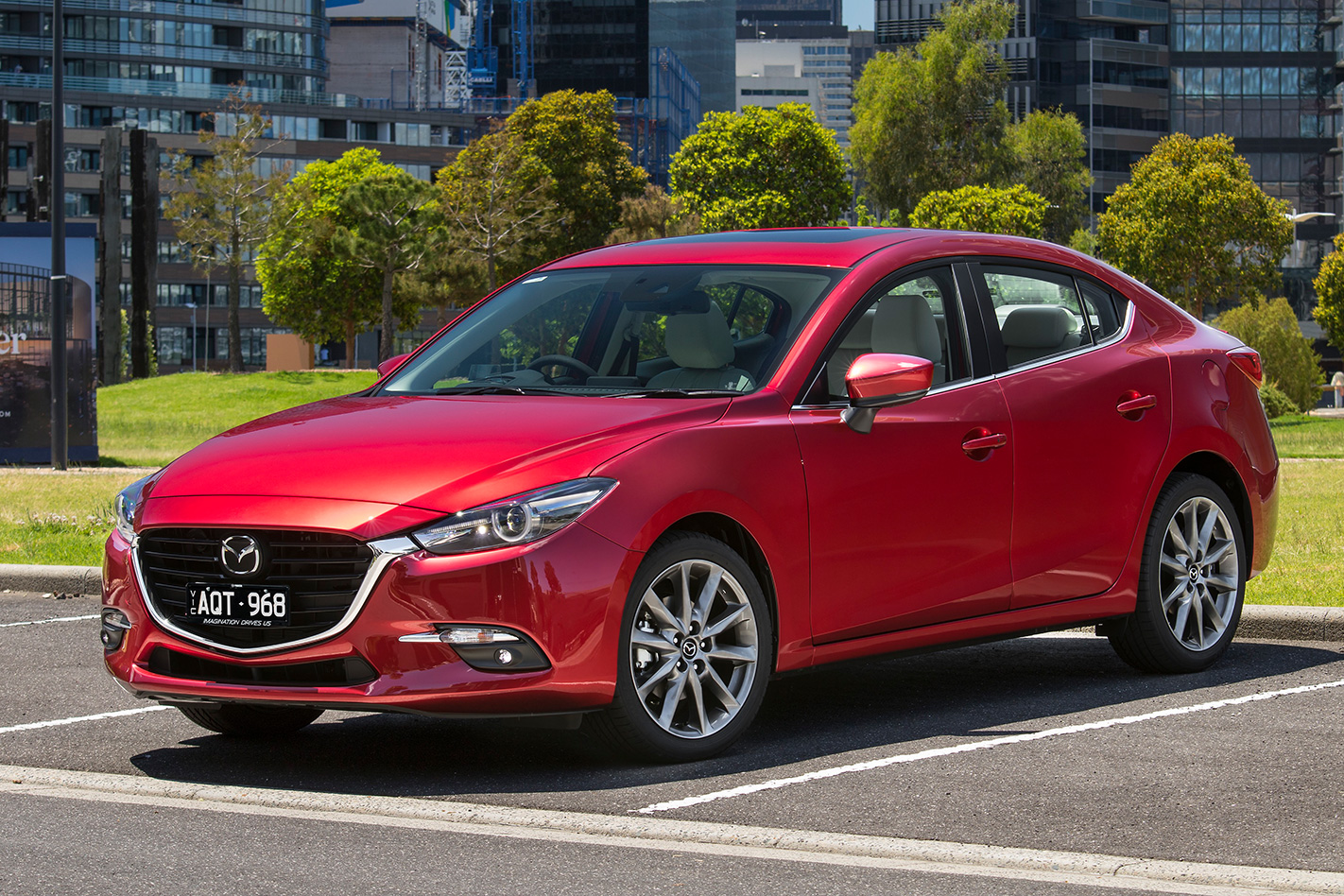
The Toyota Corolla (3120 sales) remains Australia’s best-selling passenger car, sitting well ahead of the next in line, the Hyundai i30 (2779 sales) and the Mazda 3 (2586).
The Mazda’s sales are a better indication of the heat of the Australian market, as the brand sells almost exclusively to private buyers, and doesn’t rely on bulk deals with fleets and rental companies to bolster its monthly sales.
Mazda’s updated CX-5 ranked as Australia’s best-selling SUV in May, attracting 2382 buyers to hold off the next-best placed high-riding hatchback, the Toyota RAV4 (2063). Mitsubishi’s ASX – a close rival to both the CX-5 and the RAV4 – slipped in behind them with 2029 sales.
The Volkswagen Golf (1951 sales) stands as Australia’s third best-selling hatchback in May ahead of another five-door model, the Kia Cerato (1843).
Rounding out the top 10 passenger cars were the Hyundai Tucson SUV (1839 sales) and the Toyota Prado (1712), indicating there are still plenty of Aussies out there dreaming about an outback adventure.
Toyota dominated the market ahead of Mazda and Hyundai in what was a slightly slower month for most brands.
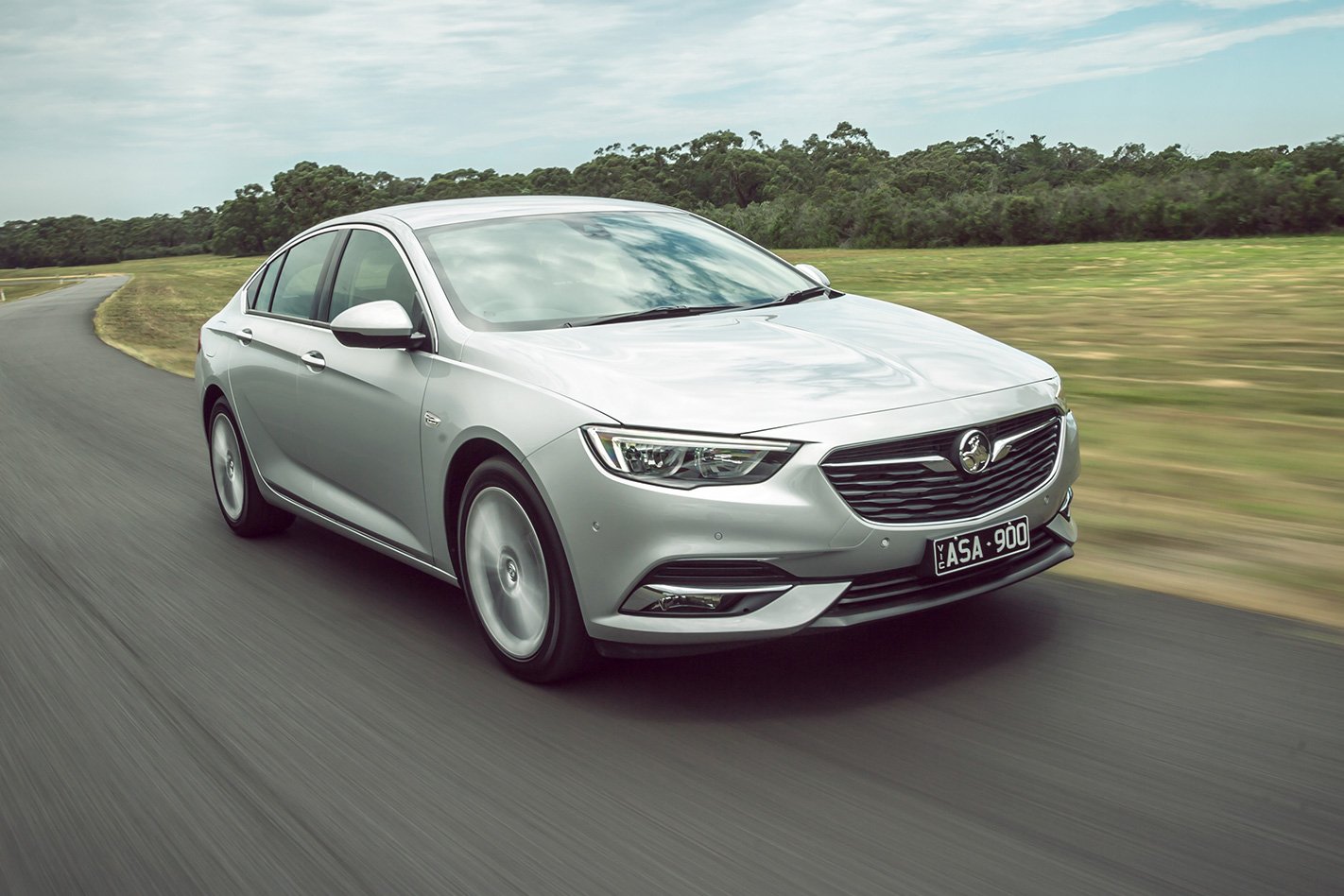
The stand-out negative performance was Holden, which slipped two places to eighth on the charts as it struggles to hold ground after the loss of Australian manufacturing in October last year. Hardest hit was the Holden Commodore, down to just 1040 for the month and number 23 on the list of the nation’s best-selling passenger cars – a low watermark for the model.
Luxury sports car and performance SUV brand Porsche struggled for the month, falling to 260 sales to end May down almost 40 percent on the same month last year.
That was mostly down to much slower sales of the Porsche Macan SUV and its soon-to-be updated larger sibling the Cayenne that make up two thirds of the brand’s monthly numbers.
