The 2018 Mazda 6 has undergone a radical makeover five years into the midsize family car’s lifecycle that brings a raft of changes, including a turbocharged engine for more expensive models.
The range retains its mix of normally aspirated 2.5-litre petrol and twin-turbo 2.2-litre diesel engines, with the petrol mill growing slightly in performance but patching on extra fuel-saving technology, and the diesel making a big leap in both performance and fuel economy.
But the headline act is a turbocharged version of the 2.5-litre engine that’s lifted from the larger, 2017 Wheels Car of the Year-winning Mazda CX-9 people mover. It’s the first turbo engine in the 6 in more than a decade, and transforms what was a flexible and somewhat conservative family car into something that’s now also quite fun to drive.
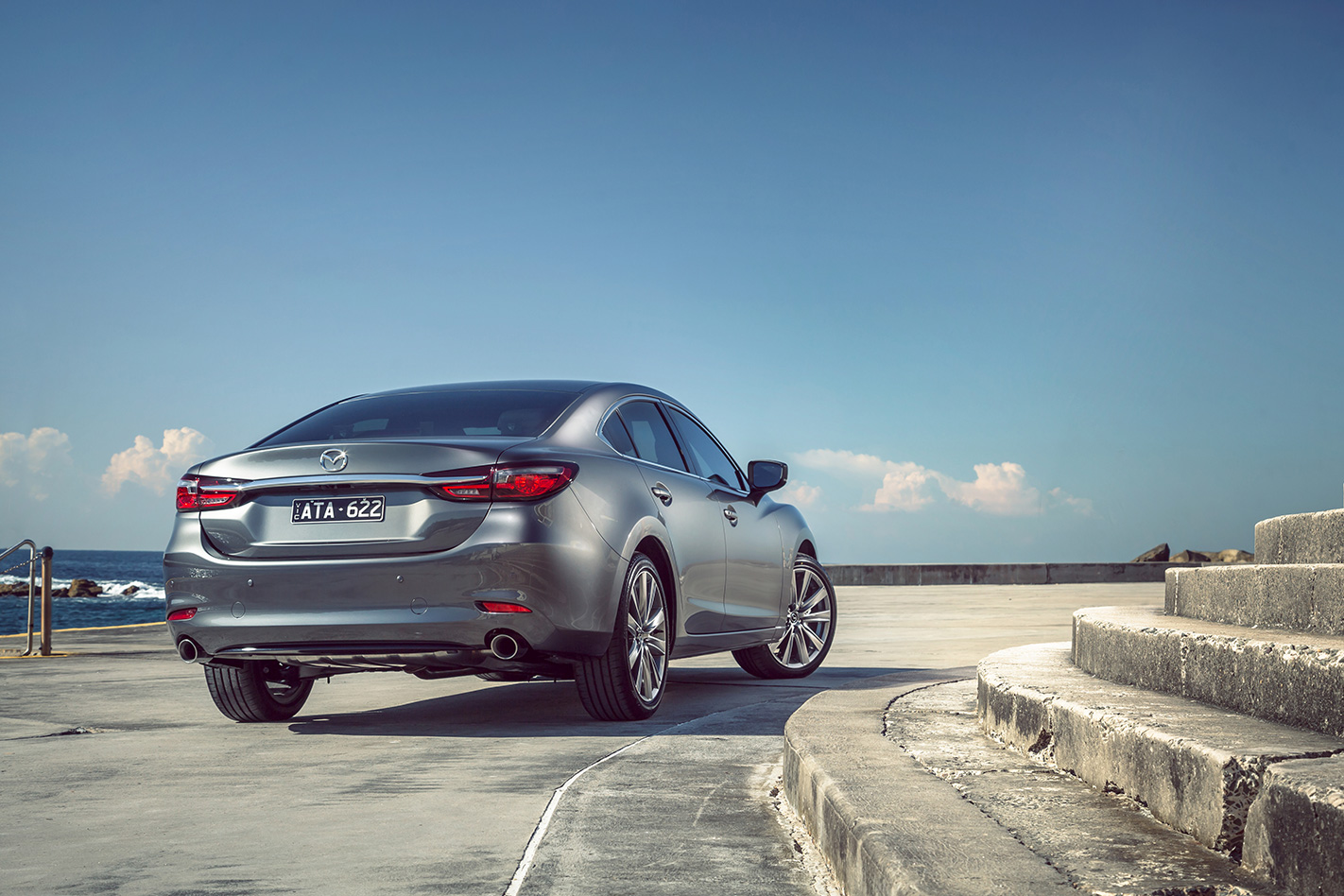
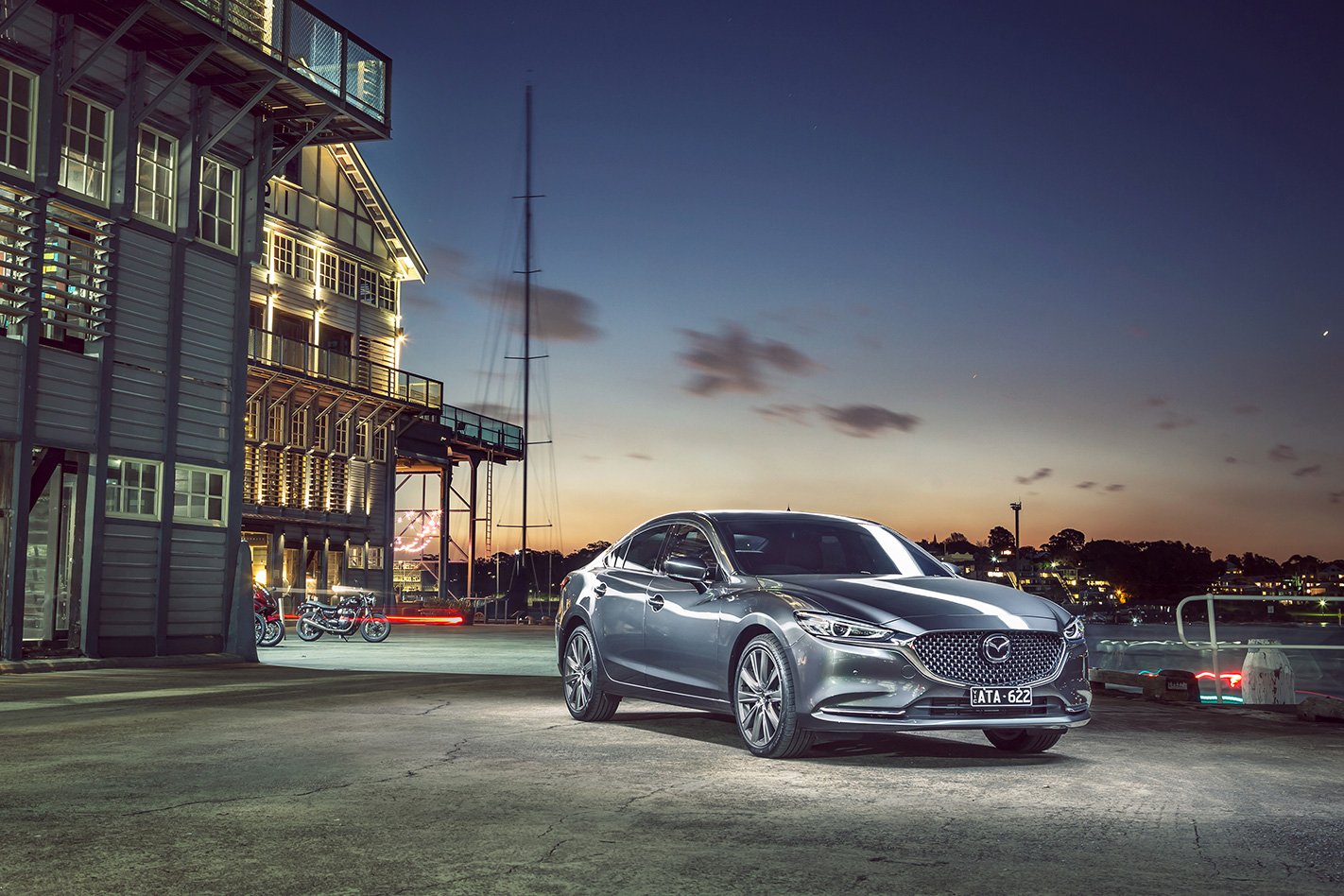
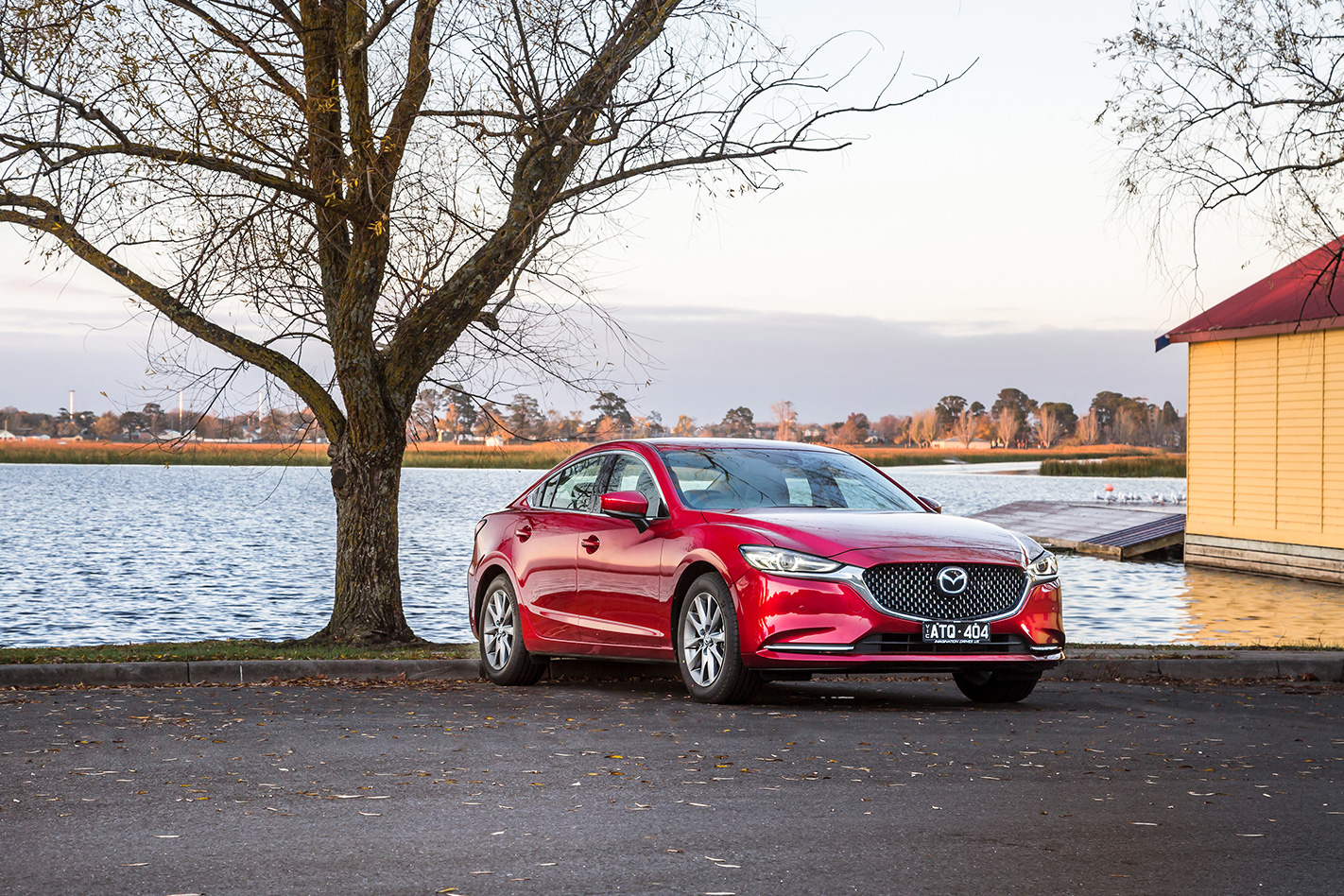
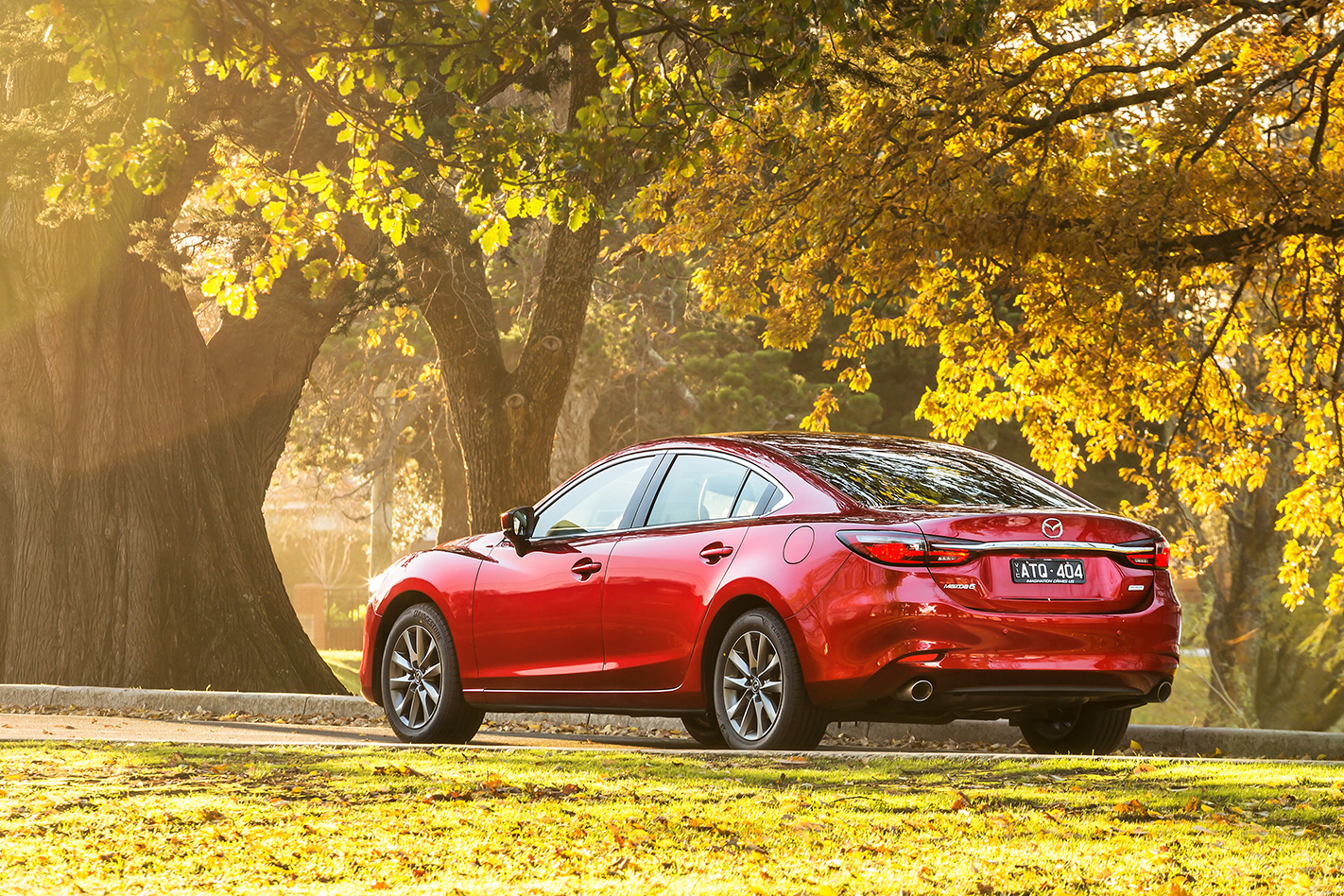
The four-variant, three-engine Mazda 6 range now looks very different. The front has changed from the wing mirrors forward, closely following the design of the Mazda Vision Coupe concept unveiled at the 2017 Tokyo motor show. Down the rear, the sedan is also very different, somehow giving the illusion the car sits lower and wider than before.
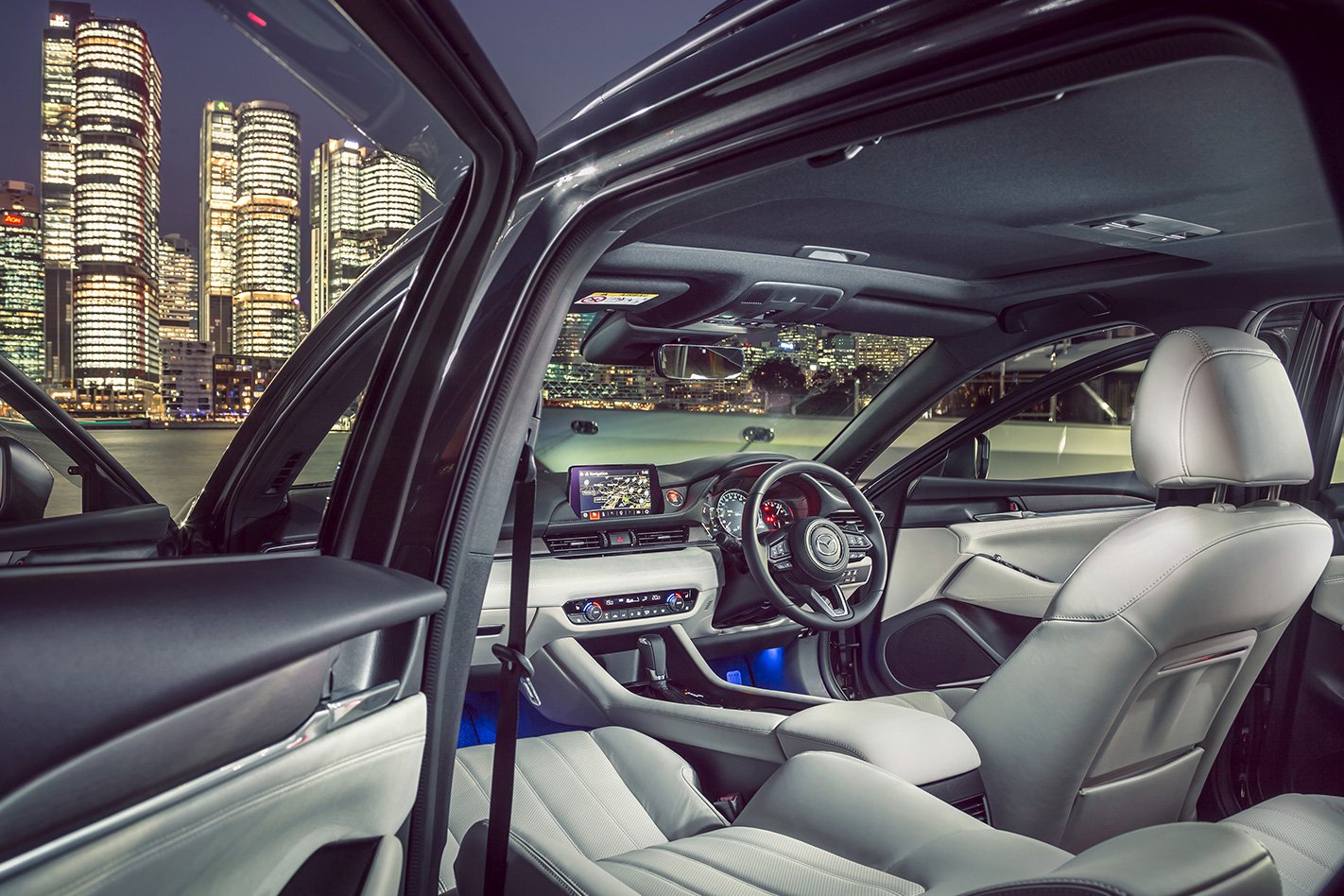
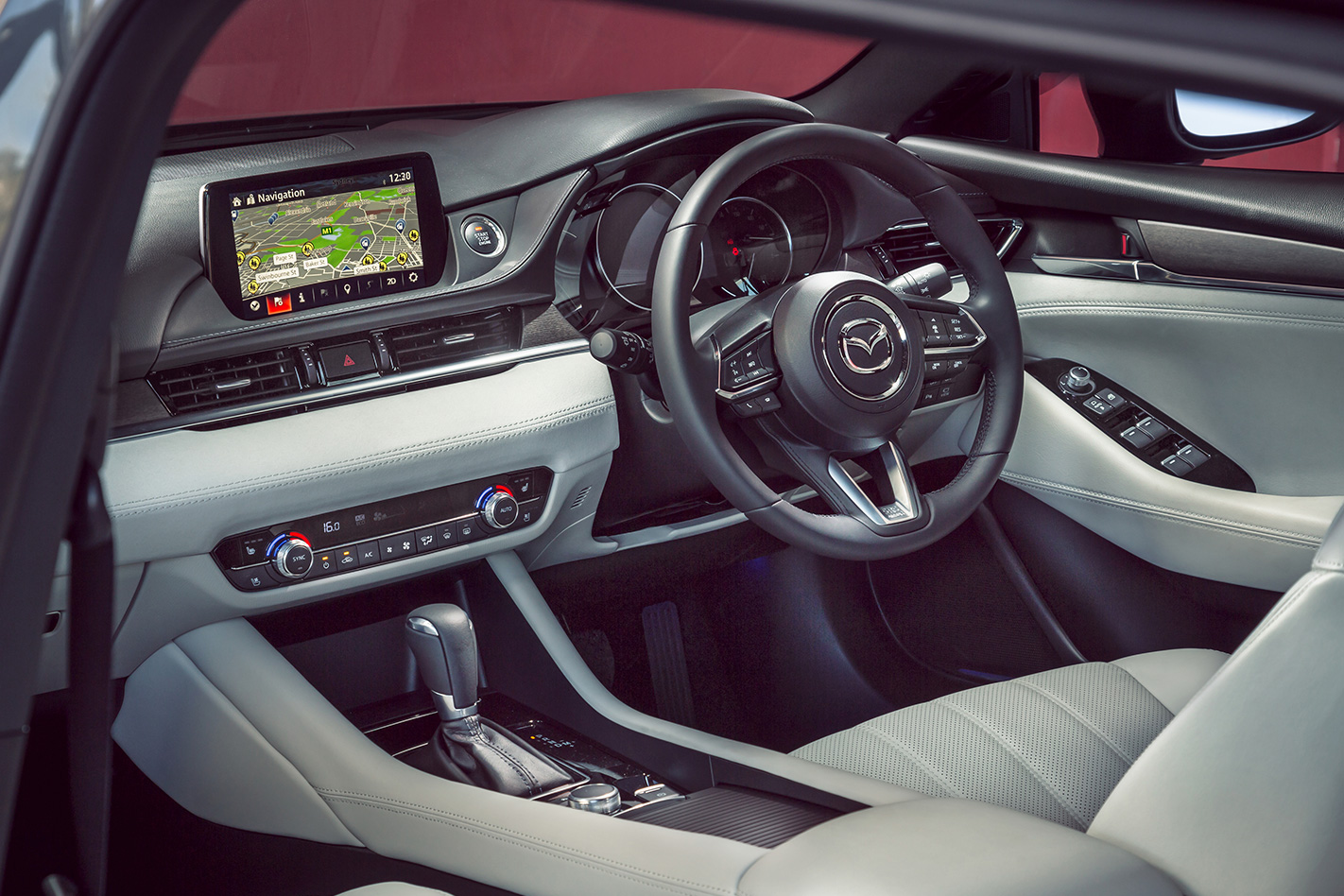
Inside, there’s a huge change. The seats are new and cut to a better fit, the pop-up head-up display has gone and in its place is a projector version, and the dashboard is completely overhauled, featuring a much cleaner look and outer air vents that extend into the doors, giving the impression that the interior is much wider than it really is.
The range still kicks off with the base 6 powered by the carryover normally aspirated 2.5-litre four-cylinder engine, but with a 2kW and 2Nm lift to its outputs to 140kW/252Nm.
The front of this model is now fitted with active shutters in the bumper that close off and push airflow around the car when cooling isn’t needed, and cylinder deactivation, saving on fuel use.
With that, the base Mazda 6 will now use 7.0L/100km – up 0.4L/100km compared with the previous model – on the combined cycle as Mazda makes the switch to using fuel numbers that more accurately reflect what happens on the road, and not in the lab.
All versions come with the carryover six-speed automatic.
Mazda has also made significant changes to the amount of noise that filters inside the Mazda 6’s cabin – a black mark against the previous generation of the midsize family car – and also to the way it drives – you can read about that here.
The entry-level Sport, fitted with the atmo 2.5-litre engine, remains at $32,490 – the same price as the outgoing model. Standard kit runs to:
- 17-inch alloy wheels with 225/55 tyres
- Larger chrome exhaust tips
- LED headlamps and tail-lights
- Body-coloured power-adjust mirrors with heating and folding functions
- Power windows
- Two-speed rain-sensing wipers
- 8.0-inch colour touchscreen with USB connection, satellite navigation, digital radio, internet radio integration and six-speaker audio
- Dual-zone air-conditioning including two rear-seat vents
- Electric parking brake with an auto-hold function
- Cloth seats with height adjustment (driver and passenger), lumbar support adjustment (driver) and seatback pockets
- Leather gear shifter and steering wheel
- Paddle shifters
- Rear seats with a 60/40 split fold backrest and twin USB charging ports in the armrest
- Keyless push-button engine start
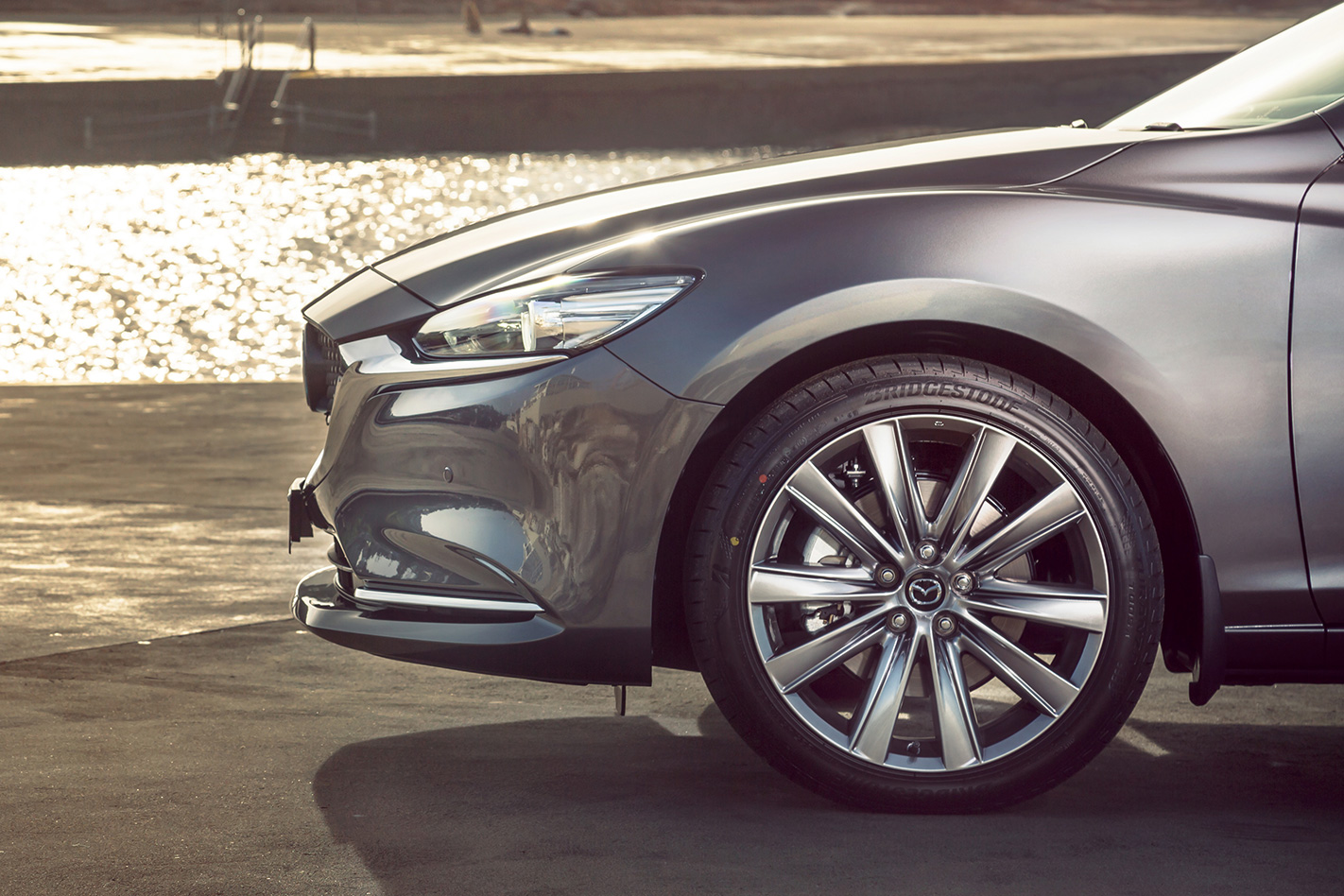
Standard safety other than the six airbags includes:
- Blind spot monitoring
- Driver fatigue warning
- Automatic high beam control
- Hill launch assist
- An intelligent speed assist system that warns when you’re exceeding the speed limit
- Lane departure warning including a lane-keeping assist system
- Adaptive cruise control that works all the way up to a complete stop
- Reversing camera with rear parking sensors and cross traffic alert
- Auto-dimming rear-view mirror
- Low-speed forward and reverse automatic emergency braking
- Traffic sign recognition
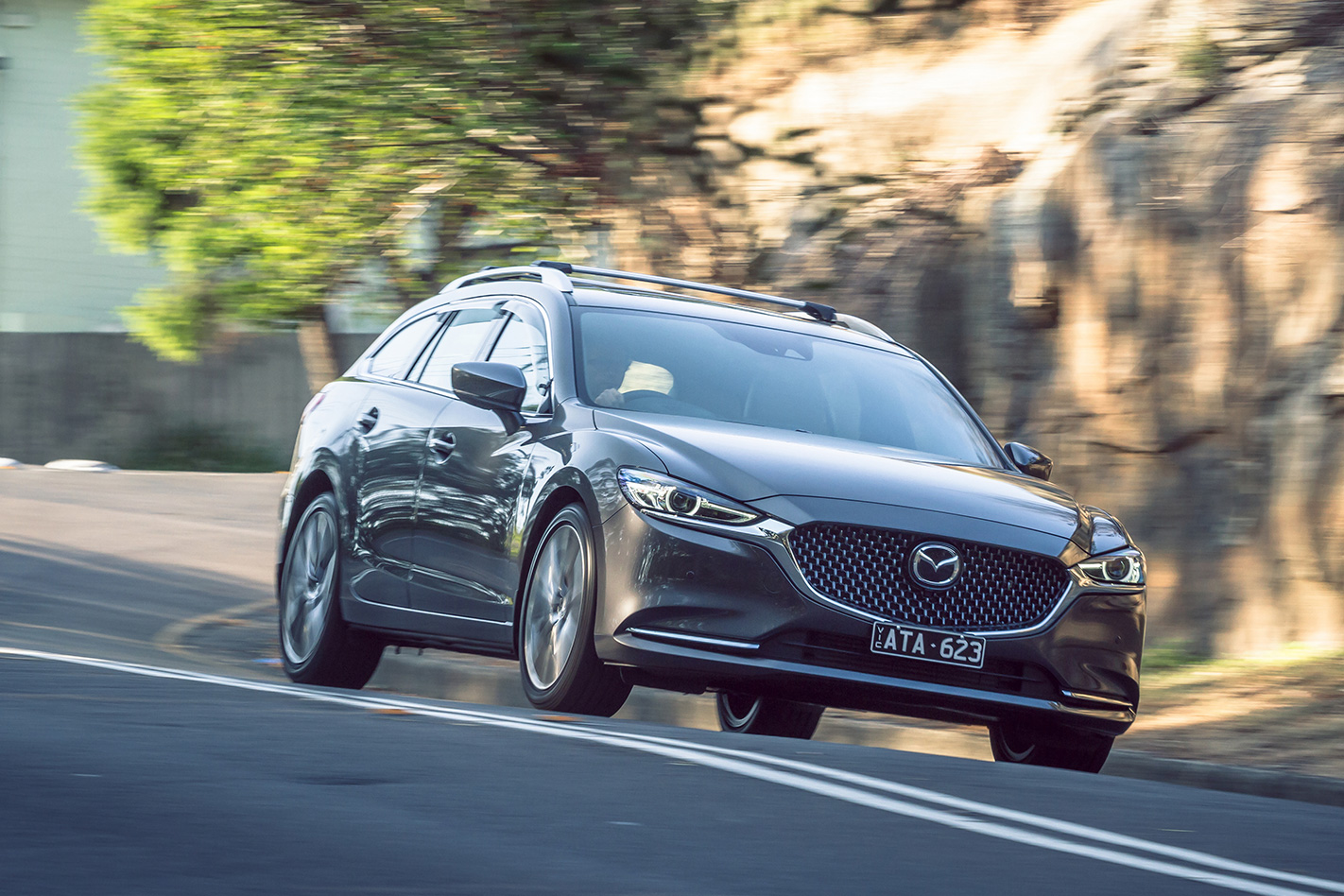
The Sport also comes as a $1300 more expensive wagon that, unusually, has a slightly shorter wheelbase than the sedan version. It adds a rear wiper, load bay cover, cargo net, a rear lip spoiler and roof rails over the sedan.
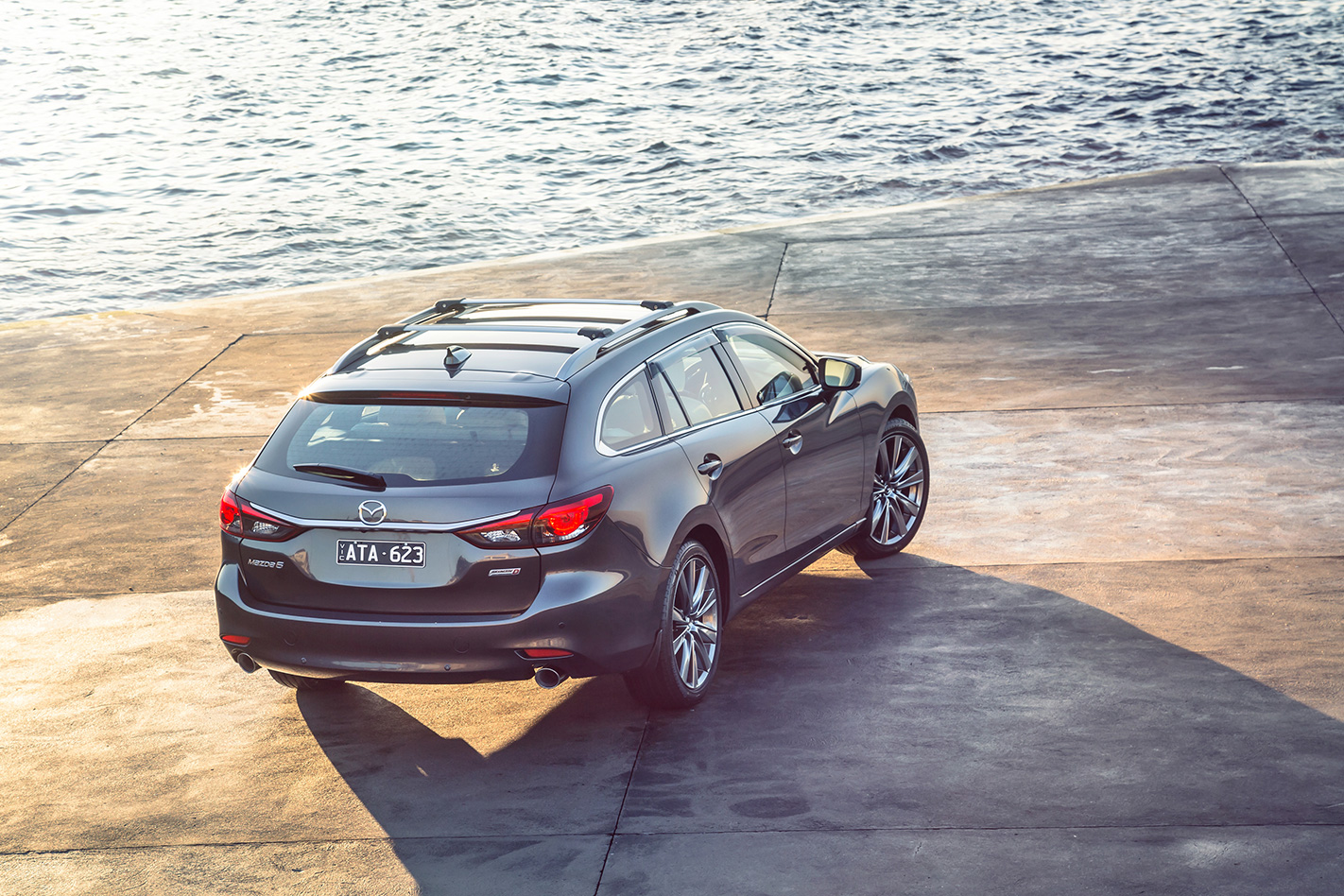
The $36,690 Touring comes with either the Sport’s 2.5-litre engine or a 140kW/450Nm twin-turbo 2.2-litre diesel engine that adds $3000 to the price, but cuts official combined fuel use to just 5.6L/100km. Standard gear over and above the Sport includes:
- LED daytime running lamps
- Black leather trim and front seats with a two-position memory function (driver), six-way power adjustment (passenger) and 10-way power adjustment (driver)
- An 11-speaker 231-watt Bose sound system with 11 speakers
- Front parking sensors
- Keyless entry
- Heated side mirrors
The $43,990 GT is the first variant to introduce the new turbocharged petrol four-cylinder as an optional powerplant to the diesel. It represents a $1300 rise over the former entry price to the model grade, but you do get a significantly richer 170kW and 420Nm of performance. Over the Touring, it brings:
- 19-inch alloy wheels with 225/45 tyres
- Black or white leather trim
- Rear heated seats
- Adaptive headlights
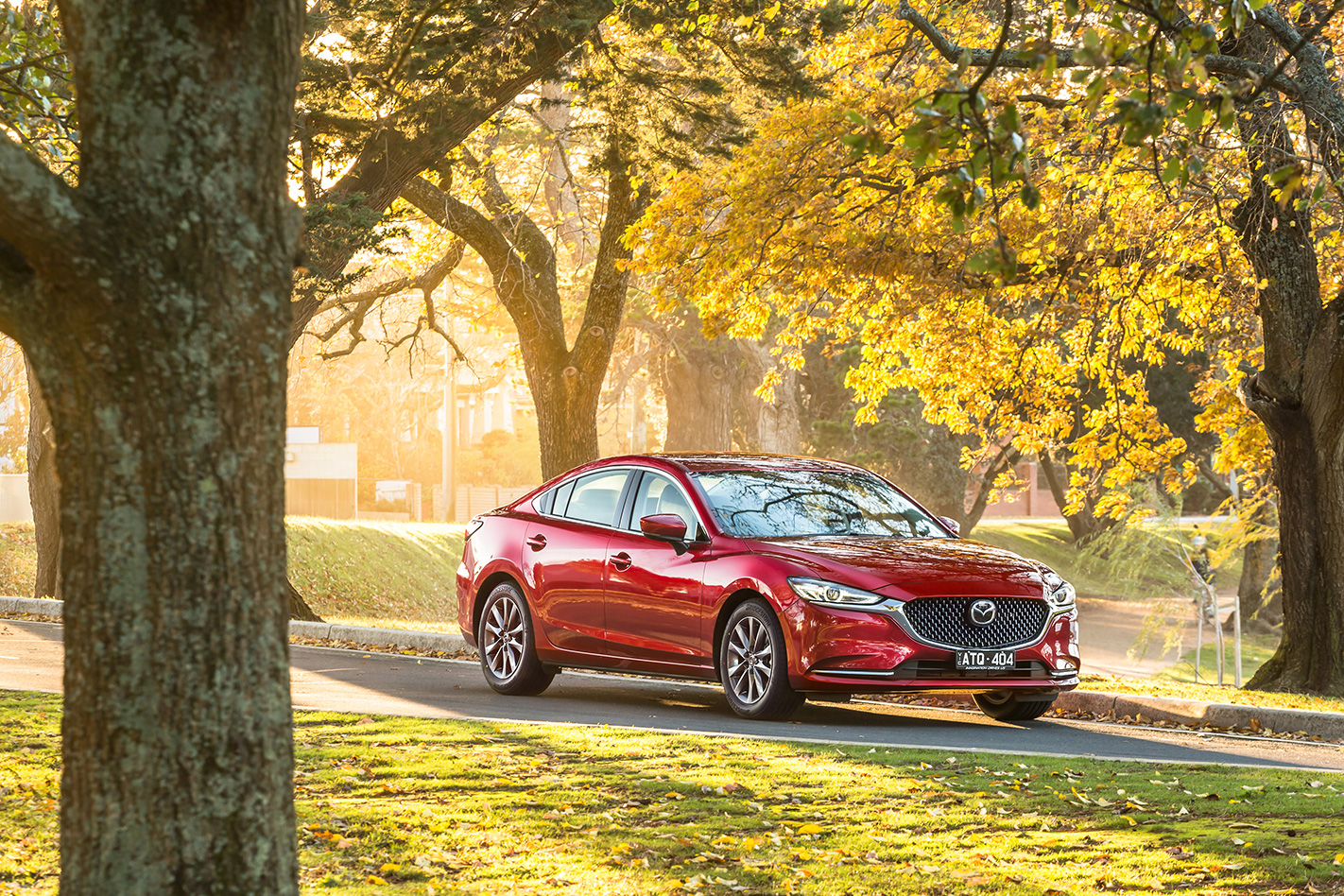
The range-topping variant is the Atenza, available with either the turbo petrol or diesel engine and priced from $47,690. It gets a markedly different-styled overhead console, but also adds over the GT:
- White or walnut brown nappa leather trim with synthetic suede dash and door trim
- Wood door and dashboard trim inserts
- Sunroof
- Adaptive LED headlights
- Cooled front seats, a Mazda first
- Surround-view camera
- 7.0-inch touchscreen
- LED ambience lighting
- Frameless rear-view mirror
All variants come with the $1300-extra wagon option.
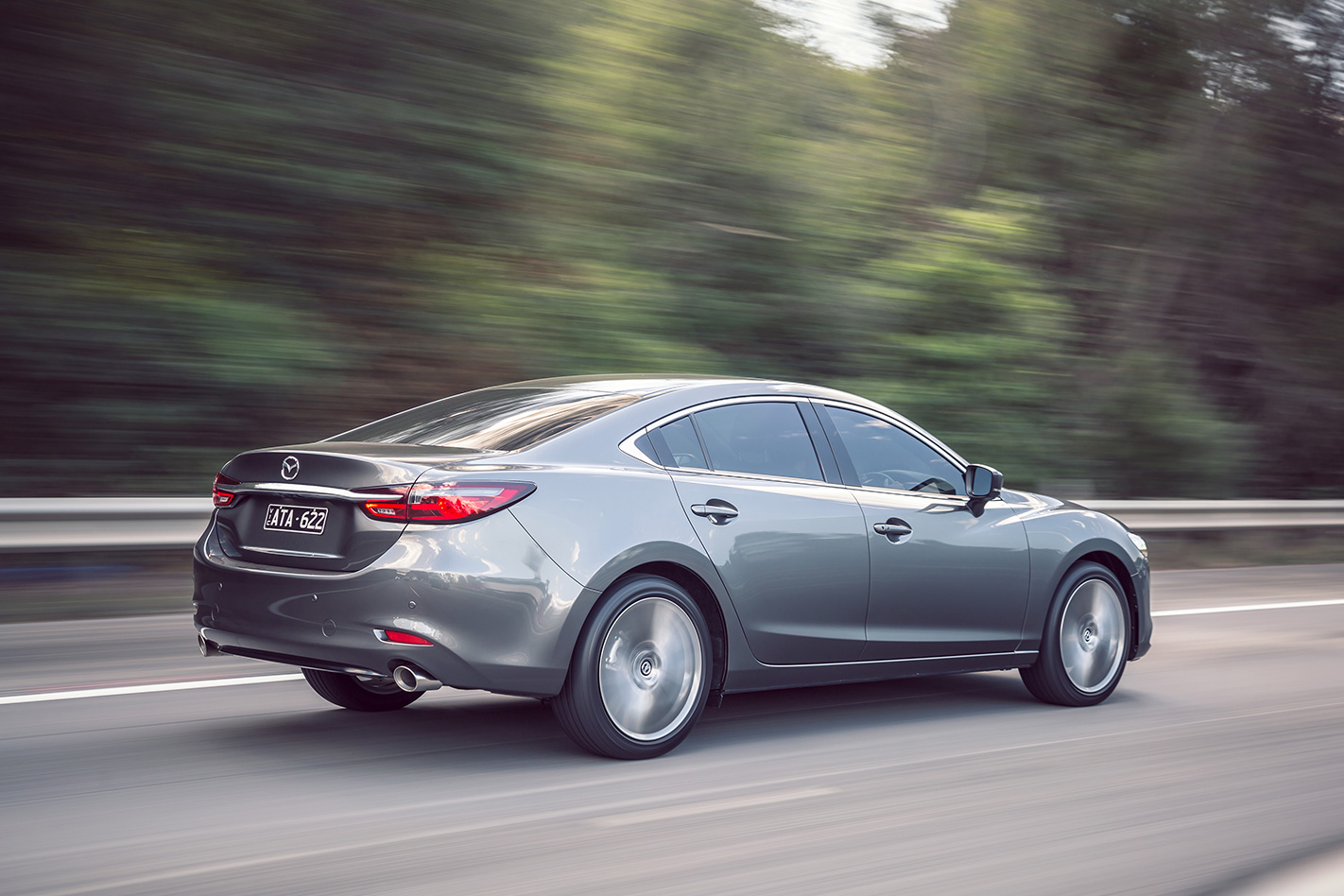
2018 Mazda 6 pricing
- 6 Sport sedan 2.5L petrol – $32,490
- 6 Sport wagon 2.5L petrol – $33,790
- 6 Touring sedan 2.5L petrol – $36,690
- 6 Touring sedan 2.2L diesel – $39,690
- 6 Touring wagon 2.5L petrol – $37,990
- 6 Touring wagon 2.2L diesel – $40,990
- 6 sedan GT 2.5L turbo petrol – $43,990
- 6 sedan GT 2.2L diesel – $45,090
- 6 wagon GT 2.5L turbo petrol – $45,290
- 6 wagon GT 2.2L diesel – $46,390
- 6 Atenza sedan 2.5L turbo petrol – $47,690
- 6 Atenza sedan 2.2L diesel – $48,790
- 6 Atenza wagon 2.5L turbo petrol – $48,990
- 6 Atenza wagon 2.2L diesel – $50,090
WHAT IS IT?
Mazda has lifted the turbocharged engine from its 2017 Wheels Car of the Year-winning CX-9 SUV and slotted it into up-spec versions of the heavily facelifted 2018 Mazda 6 range, in conjunction with a swathe of engineering and aesthetic changes to its mid-size sedan and wagon.
WHY WE’RE DRIVING IT
It’s the first turbocharged Mazda 6 since the short-lived, manual-only 2005-07 MPS that made 190kW/380Nm from its 2.3-litre four-cylinder mill. In 2018, this facelifted mid-sizer’s 2.5-litre turbo-petrol four punches out 170kW/420Nm – the same as it does in the 200kg-plus heavier CX-9 SUV this engine was initially developed for.
MAIN RIVALS
Ford Mondeo Titanium, Holden Commodore/Calais, Honda Accord V6L, Hyundai Sonata Premium; Kia Optima GT, Skoda Superb, Subaru Liberty 3.6R, Toyota Camry SL V6, Volkswagen Passat
THE WHEELS VERDICT
The introduction of Mazda’s superb turbo engine is the icing on the cake for the much-improved 6 line-up. Finally, after five years of the current generation model, we get the car we really wanted from the start.
PLUS:Greatly improved NVH and dynamics; more willing engine; big lift in interior’s perceived quality; largely unchanged pricing MINUS: Turbo not available on base models; keeping the white suede-like interior trim clean; no turbo manual for Australia
THE WHEELS REVIEW
“YOU’VE asked for it, and we’ve delivered it.” That’s how Mazda Australia kicked off the launch of its significantly overhauled medium-size sedan and wagon range, adding a turbocharged engine option for the first time since the short-lived, manual-only Mazda 6 MPS (2005-07) huffed its way into the history books.
But this isn’t just any turbocharged engine. It’s the same one that powered the larger, heavier front- and all-wheel drive Mazda CX-9 to our 2017 Car of the Year title. It was there that judges discovered that the boosted 2.5-litre Skyactiv-G donk, making 170kW/420Nm, provided vast dollops of silky torque that yielded what was described as “performance once reserved for muscle sedans”. To say we went into this launch with big expectations of what this new-age forced induction would do for the 6, then, is something of an understatement.
Producing the same outputs as in the CX-9 (though 184kW if you feed it 98-octane fuel), this turbocharged debut is but one of a series of sweeping changes to the 6 range. The most significant is a new look forward of the wing mirrors that pays homage to the Mazda Vision Coupe unveiled at the 2017 Tokyo Motor Show (which we all mistakenly thought would spawn a next-gen RX-8). The rear, too, gains a more handsome, lateral makeover and larger exhausts.
Inside, the steering wheel is about the only recognisable carry-over. Clever, minimalist design brings a big lift in perceived quality, with a wide expanse of uncluttered dashboard, and air vents that seem to blend into the doors, giving a sense the 6 is wider than it really is. Even the sunvisors have a new tactility to them.
Softer seats and a more easily readable instrument cluster with an integrated – not flip-up – head-up display are plusses; the brilliantly white suede-like surface on high-contact areas of the dash and door trims in our Atenza test car that probably won’t age well is arguably the only minus. Better to option the new brown leather trim, or the carry-over black, and leave the white to Mazda’s brochures.
Buyers walking into the entry-level petrol- and diesel-engined Mazda 6 Sport and Touring-spec cars gain more for the same money as before. The atmo 2.5-litre direct-injection engine, which makes use of active shutters for better aerodynamics and cyl;inder deactivation for the first time, lifts its outputs by only 2kW and 2Nm to 140kW/252Nm, with a slight penalty to fuel use (7.0L/100km – up 0.4L/100km) on the combined cycle. Mazda claims the engine is no less efficient; more that its drivetrain calibration has focused on real-world driveability, to the slight detriment of its quoted economy number.
Buyers opting for the twin-turbo 2.2-litre Skyactiv-D diesel fare much better. Thanks to variable-vane turbo technology, its 140kW/450Nm is an 11kW/30Nm gain over the previous diesel 6, with fuel use falling 0.1L/100km to an official combined 5.3L/100km.
Back to that turbo petrol engine, though. You can only experience it in upper-level GT and Atenza-spec sedans (and, for $1700 more, the shorter-wheelbase wagons), with the cheapest, the GT sedan, starting at $43,990 and the most expensive (Atenza turbo wagon) stretching to $48,990. They’re sleepers, too, with no distinguishing badges to hint at the newfound under-bonnet potency.
The turbo Mazda 6 is like a breath of fresh (forced induction) air. Acceleration, best described as progressive in the atmo-powered version, is more urgent with turbo power, and provides decent in-gear acceleration up to 5400rpm before the carry-over six-speed auto shifts up a cog – well short of the indicated 6200rpm redline. Mazda Australia doesn’t quote an official 0-100km/h time, and with less than 700km on its odometer, our test car didn’t quite feel Kia Stinger 200-quick (7.0sec to 100km/h). But you could rightfully expect the turbocharged 6 to clock something in the high-sixes, given we’ve managed 7.5sec to 100km/h from the much-heavier front-drive CX-9, and a 7.6sec from an atmo Mazda 6 sedan in the past.
Step-off acceleration is helped by a turbocharger that, at low revs, feeds in air through a smaller opening, similar to putting a finger over the end of a hose to increase pressure and flow, minimising turbo lag. There’s some torque steer evident – manifesting itself as a light lateral tug on the steering wheel – but only if you’re being club-footed with the accelerator pedal.
More noticable is how quiet and comfortable the 6’s cabin has become. Road refinement on Bridgestone Turanza 225/45R19 hoops isn’t class-leading, but it’s a hell of an improvement over the car this 2018 version replaces. Mazda’s engineers worked hard to eliminate reflected noise, filling gaps and holes to prevent sound transfer to the cabin. A different headliner absorbs more vibrations, the floor under the car is flatter and more aerodynamic, and active ducts on the front spoiler of the atmo 2.5-litre version of the 6 close to push air around the car, rather than through it, when cooling isn’t needed.
The way the Mazda 6 drives has also improved markedly. The steering box has a more rigid mount, making it more neutral in the hands of the driver, and the steering knuckles sit lower, making the front end feel more pointy. The lower arm also sits slightly higher. Anti-roll bars are bonded to the mounting bushes to improve rigidity; the front suspension geometry is changed to include rebound springs and 3mm-diameter-larger shock absorbers; front and rear damping valves have been tweaked; and the suspension has had its travel increased via revised bump stops.
Mazda claims the 6’s tendency to axle tramp is now well and truly “suppressed”, and it shows, with a smoothing of rough backroads, and even a section of dirt, on our drive route through central Victoria with what must come close to class-leading refinement. Only a little high-speed bounce, likely caused by the low-profile tyres on these road surfaces, flows through into the cabin.
Missing from our drive route were enough twists to allow us to assess how much the turbo’s fluent dynamics have changed compared with the just-replaced atmo-only 6, given the forced-induction engine adds 60kg to the nose. Body rigidity is improved for this makeover, particularly around the cowl and front suspension, and the front floor of the passenger cell, which bodes well for the boosted 6’s cornering talent. The few corners we did attack hinted at a more engaging driving experience.
Early signs are the turbo version of the Mazda 6 is a promising thing. It’s something we’ll need to explore further once we get a test car through the garage with an engine that’s properly bedded in, but in the meantime, this is exactly the drivetrain the Mazda 6 was crying out for.
SPECS Model: Mazda 6 Atenza turbo sedan Engine: 2488cc 4cyl, dohc, 16v, turbo Max power: 170kW @ 5000rpm Max torque: 420Nm @ 2000-4000rpm Transmission: 6-speed automatic Weight: 1627kg 0-100km/h: 6.8sec (estimated) Fuel economy: 7.6L/100km Price: $47,690 On sale: Now
When the B7 version of Audi’s go-fast RS4 Avant rolled into the MOTOR garage in 2006, there was a surprising lack of enthusiasm. To be fair, previous generations had been stiff, robotic, uninvolving things, which had clouded our mutual views.
Then we drove it.
History will show that the nat-atmo eight, combined with a new-found sense of chassis compliance and chutzpah from the muscly motor, will go down as one of the great wagons – indeed, great Audis – of all time, but those times have changed, and the launch of last year’s RS5, complete with the new-for-B9 2.9-litre V6, pointed towards a leaner, greener future for the RS4.
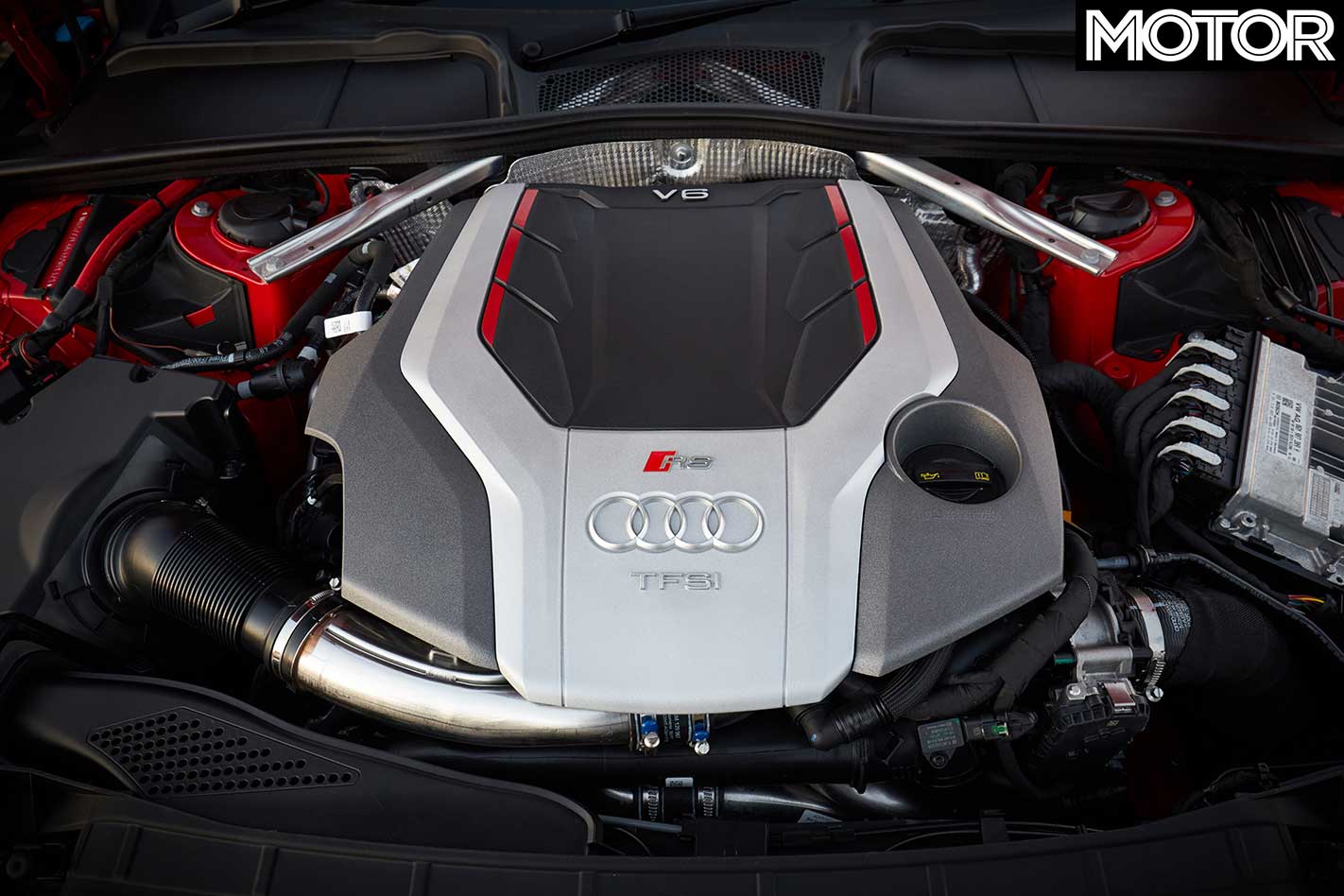
Based on the SQ5 engine but with a shorter stroke, the two turbos nestle in the so-called hot vee, and there’s one for each bank. It also uses port and direct injection, variable valve timing and lift, variable cooling and all the good stuff, and it’s 31kg lighter than the last-gen eight.
In fact, the entire car is 80kg lighter overall, despite being bigger, thanks to magnesium in the seat frames, more high-strength steel and lighter suspension parts.
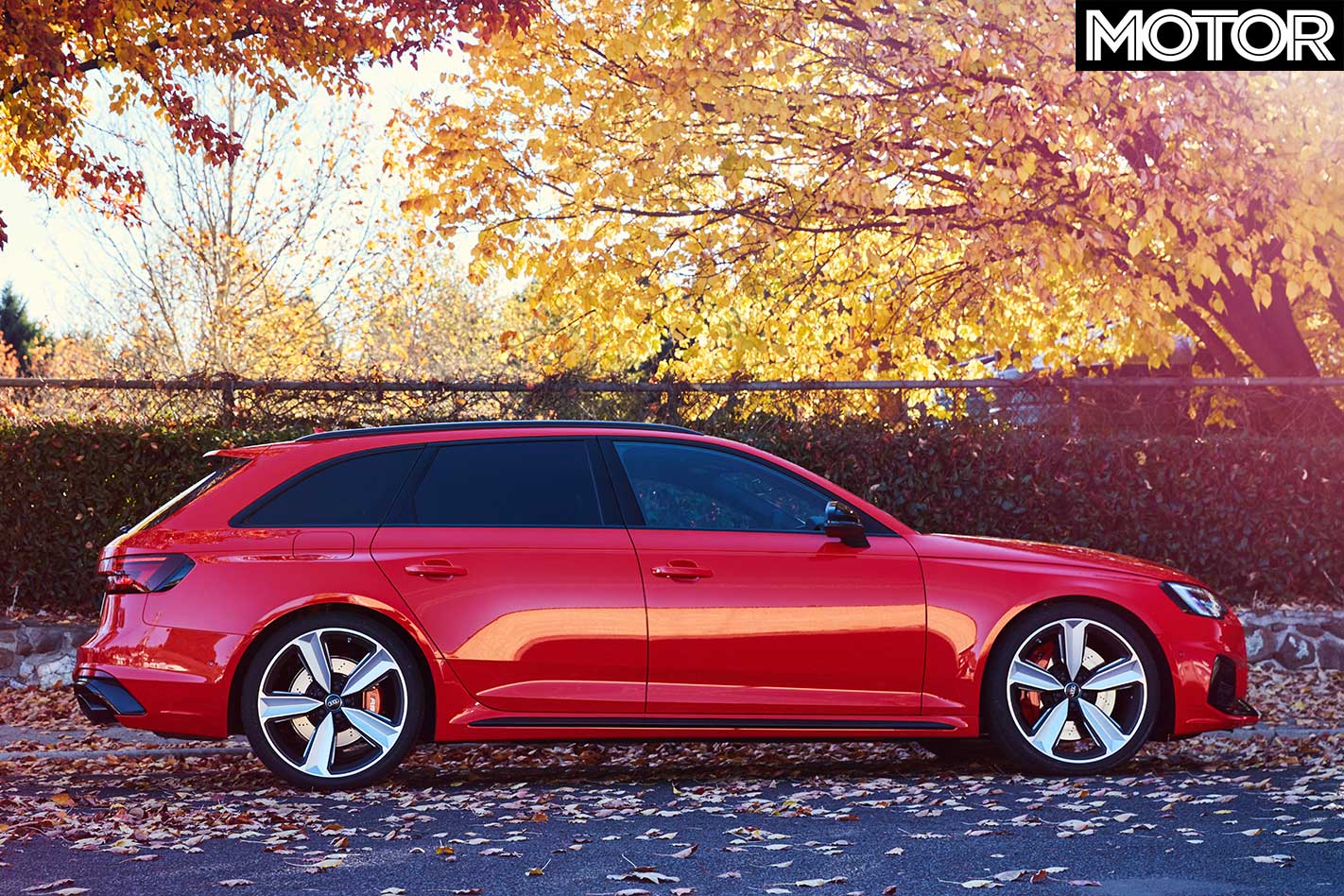
It’s now backed by an eight-speed auto that replaces the seven-speed dual-clutch gearbox… which was originally designed to replace the auto. Go figure… A two-stage sports exhaust is standard on Aussie cars, as is an electro-mechanical sport diff. There’s torque vectoring for all four wheels, too.
The RS4 Avant looks smaller and more compact on screen than it does in the metal, and even up close it’s more tuxedo than technical microfibre. Audi’s designers took inspiration, apparently, from the bonkers Audi 90 IMSA racer that terrorised US tracks on the 1980s, with the the ‘quattro blisters’ from the top of the 90’s guards inspiring a 30mm wider guard stance than the S4.
The rear diffuser and spoiler are unique to the RS4, along with a wider grille too. Lower and longer than A4/S4, it’s also wider. Twenty-inch rims are standard this time around as well, with 98 per cent of customers updating to 20s on the last model.
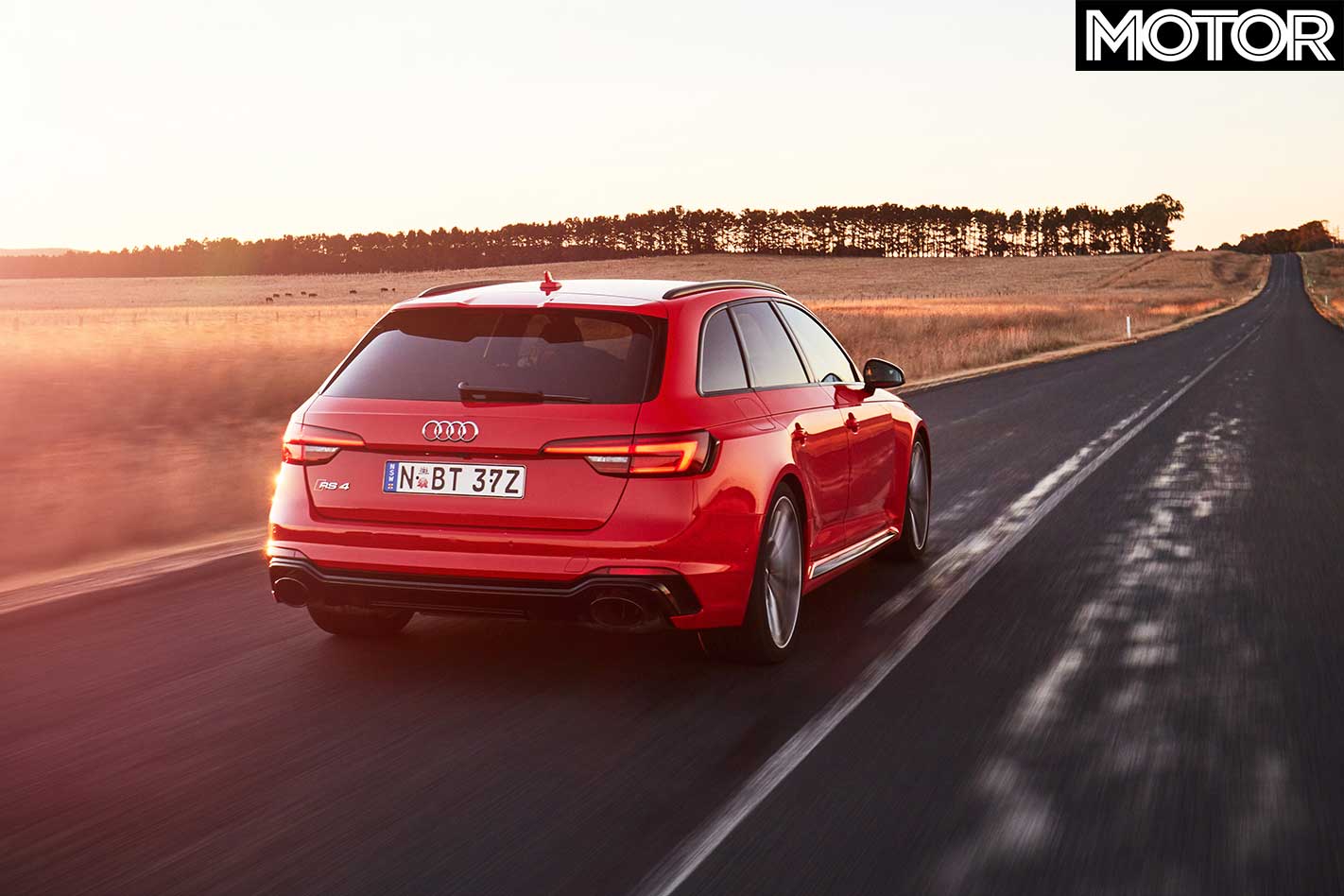
Optional 20-inch milled alloy wheels save another 2kg per corner for $1600 (but they look a bit underdone, if we’re honest), and you can have bigger, 8kg lighter carbon-ceramic front brakes for $11,900.
The stock brakes aren’t bad, though, with 375mm rotors and six-piston fronts teamed with 330mm rotors and twin-piston jobbies out back. The suspension, too, picks up the cross-linked adaptive dampers from the RS5.
Inside, the Avant wagon can lug 505 litres of stuff with the seats up and 1510 litres – or a set of track rims – with them lowered. The front seats are terrific, though their bulk detracts from the space in the second row, particularly for toes.

A perforated leather wheel and shifter wrap, and unique RS-spec carbon inlays separate the RS4 from the riff-raff, while the honeycomb pattern on the sports seats matches the grille. There’s also specific RS functionality for the Active Dash Display.
You can delete-option the sunroof, and there’s adaptive LED headlights, heated Nappa seats with adjustable side bolsters and massage, 19-speaker Bang & Olufsen and tailgate gesture control all included in the box. In fact, Audi reckons it’s added more than $22,000 of additional stuff, at at $152,900 before on-roads, it’s just two grand dearer than the last of the B8s, and $16,000 cheaper than our fave B7.
Fanging it across a curvy, twisty highway test route in northern NSW, it’s obvious the RS4 is not as blunt an instrument of back road destruction as, say, the Mercedes-AMG C63, but it still manages to deliver on the thrill-o-meter – just in a different, more subtle but effective way.
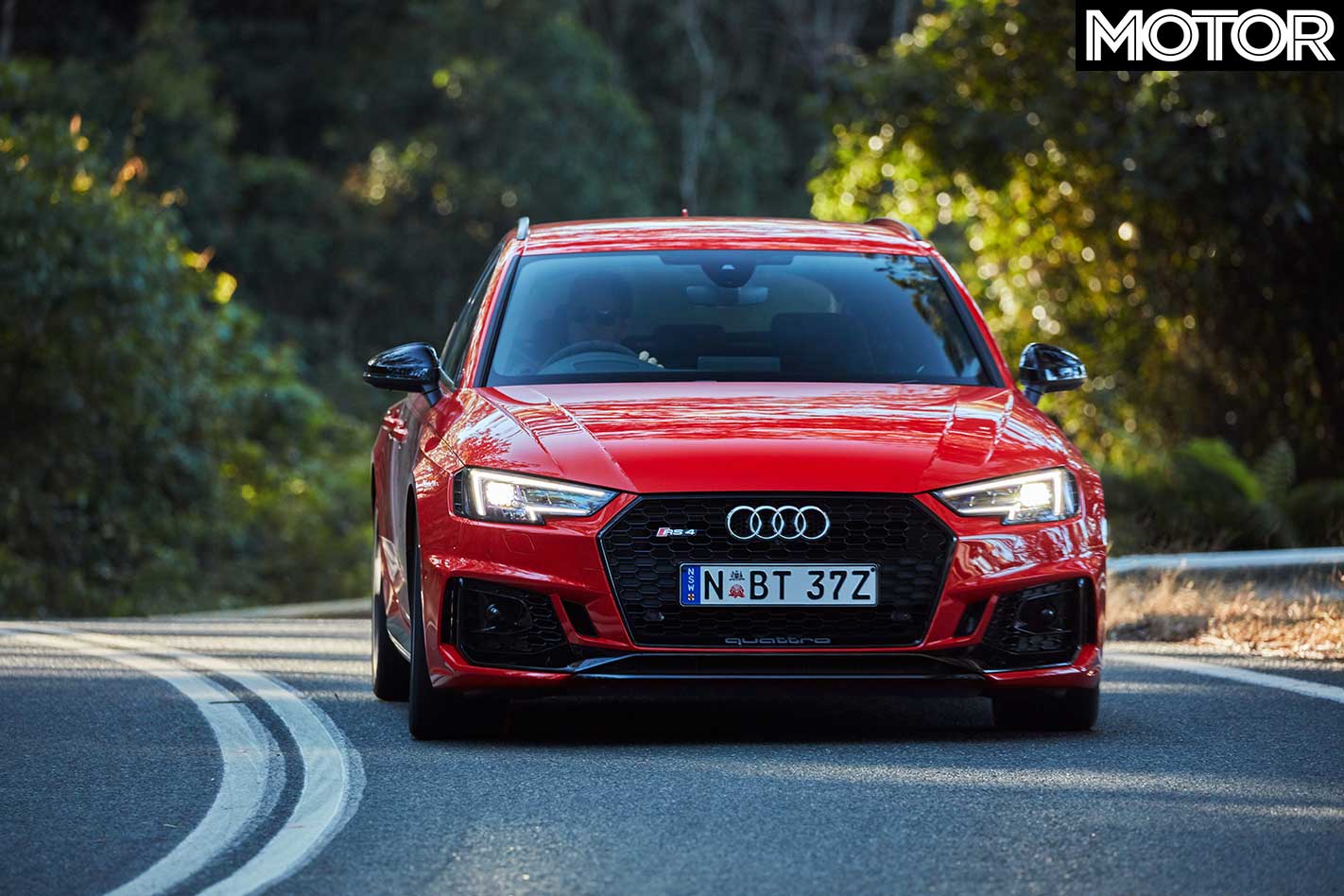
Its Dynamic mode doesn’t go all the way to 11, and while it’s not in your face like a helicopter mum, there’s a sense that the RS4’s tractions systems have both second and third slips in play. The ability to simply flatten the gas once you’re past the apex is pretty hilarious, and an 85 per cent rearward power bias from the ye olde worlde Haldex-based system feels about right, especially when the clever rear limited slipper comes into play.
It’s got thunder and presence, too, especially off-throttle, when a staccato ‘brrrrrrrb’ resonates out the huge rear tips on throttle overrun. It’s never loud – read; obnoxious – but it’s obvious you’re in something hotter than stock.
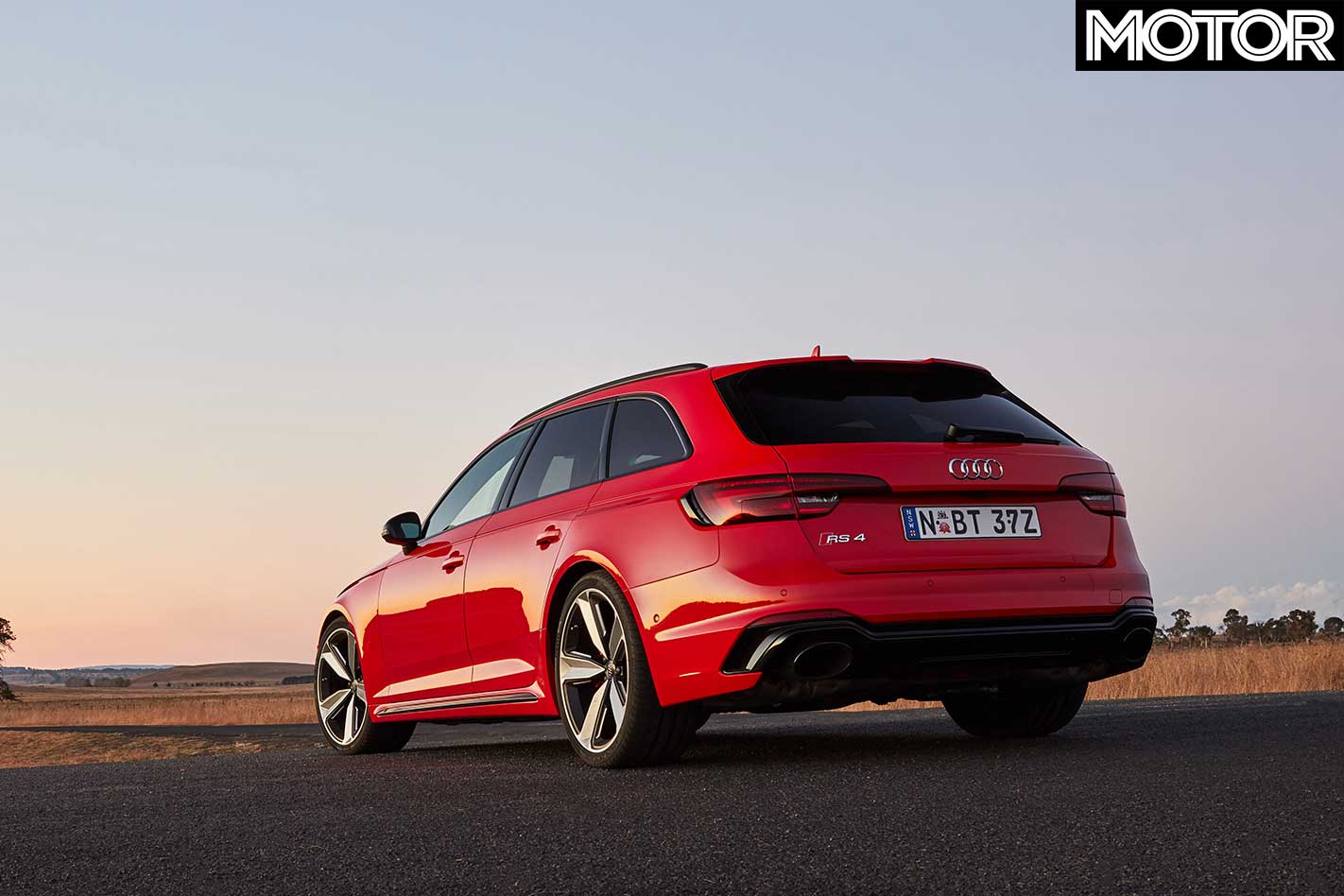
Steering is okay-to-good but it lacks involvement, and the plastic shift paddles behind the steering wheel are a strange oversight when it comes to tactility and interfacing. The eight-speeder, too, can be a bit conservative about allowing downshifts when you’re getting keen, but it’s still a burly cracker of a thing.
Audi’s calling it the only car you’ll ever need, but we’ll need more time in it to ratify that claim. There’s certainly a wide gulf between its softest and strongest modes, and that bodes well for a daily. At first blush, though, the RS4 Avant is a somewhat subtle but stylish bruiser that will turn only the heads that know what they’re looking at.
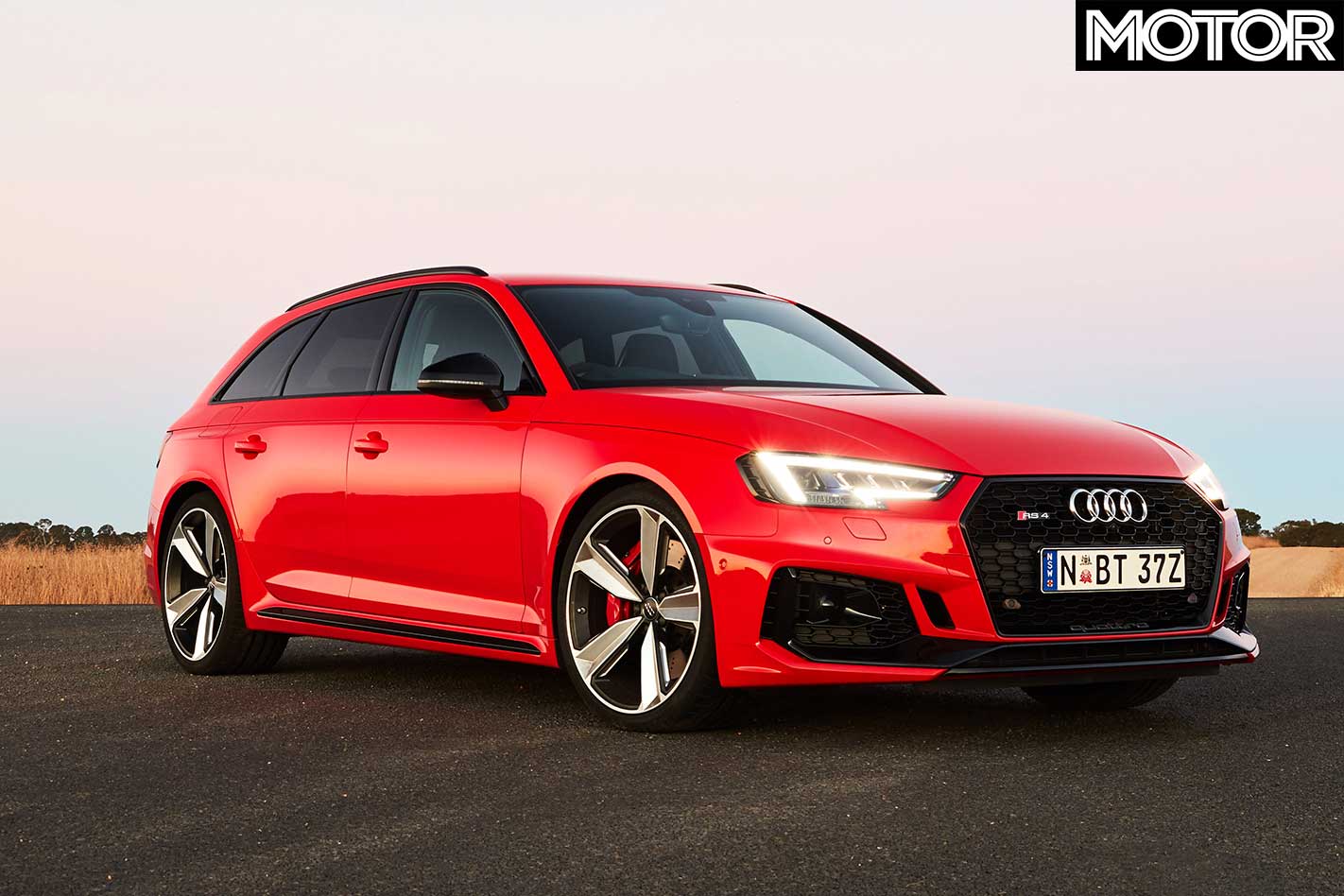
2018 AUDI RS4 AVANT SPECS Engine: 2894cc V6, longitudinal, twin turbo DOHC, 24v Power: 331kW @ 5700-6700rpm Torque: 600Nm @ 1900-5000rpm Transmission: 8-speed automatic, electro-mechanical locking rear differential, AWD Weight: 1790kg 0-100km/h: 4.1sec (claimed) Top speed: 250km/h (limited) Price: $152,900 Rating: 4 out of 5 Stars
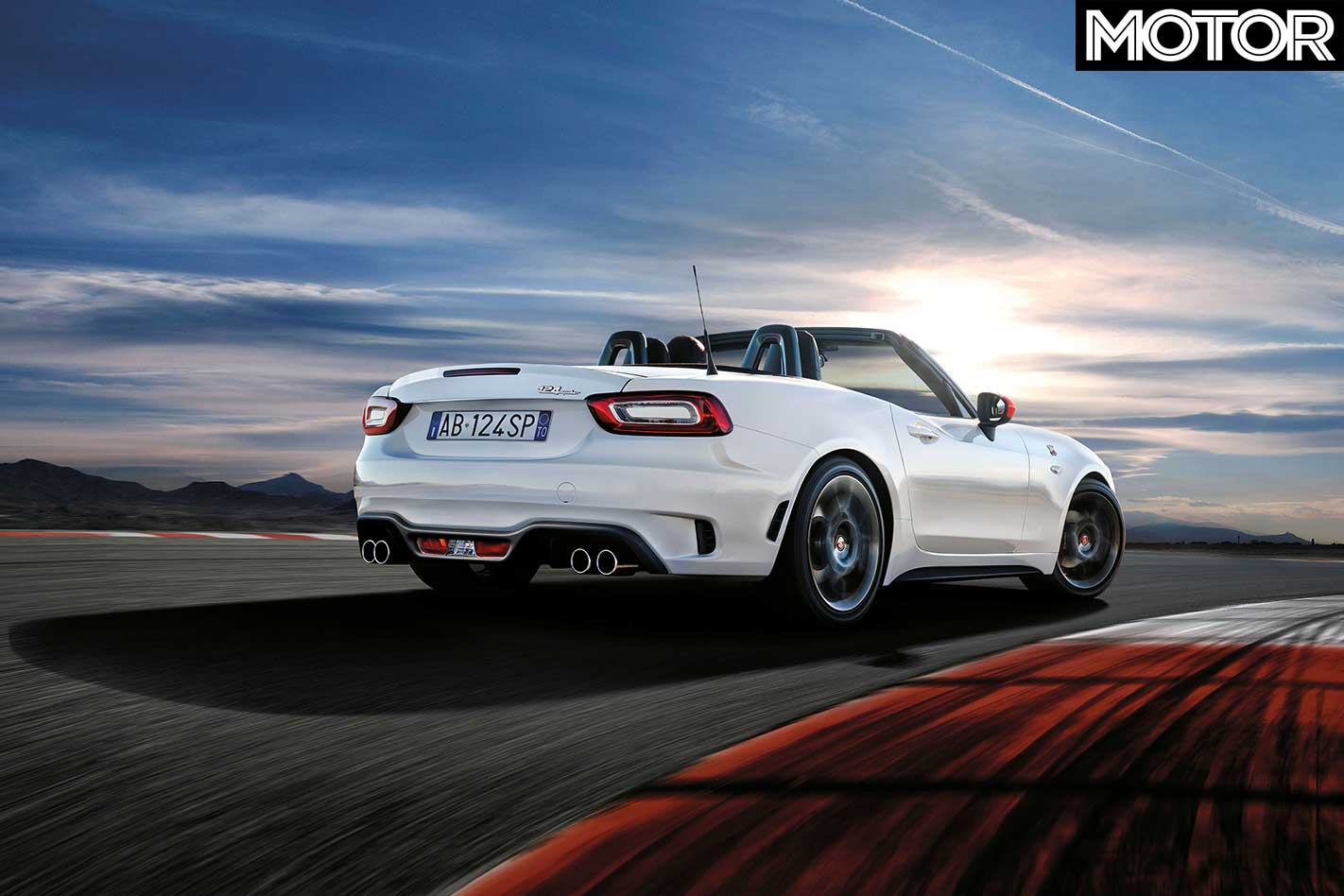
Abarth Australia has announced a limited run of 30 Abarth 124 Spiders to be dubbed Monza Special Editions.
The limited run of roadsters honours Abarth’s founder, Carlo Abarth, specifically his achievements at Monza.
The Abarth 124 Spider Monza Edition itself is essentially a fully-specced 124, with standard 125kW/250Nm outputs from a 1.4-litre turbo four, though it also has special paint options and interior treatment.
Interestingly, the colours are named for 124 Spider victories in European Rally Championships, by year and location. The options are: Turini 1975 White, Costa Brava 1972 Red, and San Marino 1972 Black.
Two-tone black an red leather seats further differentiate the Monza, not far from an interior-mounted plaque that is laser etched with a map of the Monza circuit.
And, of course, a Record Monza exhaust is fitted, though this is also an option on the standard 124 Spider.
In manual, the car will cost $47,580, or $49,580 in auto (up from $41,990 and $43,990 respectively).
The reasoning for this special edition, Abarth says, comes from a list of records which its founder broke in the 1950s and ‘60s.
The average speed record over 24 hours was the first, totalling 3743km at 155km/h in 1956 at the track. He also broke the average speed records for 5,000km, 10,000 km, 5,000 miles and the records for 48 hours and 72 hours. All in one month.
In 1965, he broke the acceleration record over a quarter of a mile (and over 500 metres) driving the Fiat Abarth ‘1000 Monoposto Record’ and the next day again with a single seater, both for separate record classes.
“The legacy of Carlo Abarth has driven the production of some of the world’s most exciting motor vehicles and this Monza Special Edition continues the realisation of his passion,” says Director of Abarth Australia Fulvio Antonelli.
YOU’VE made the one-percent, congratulations, but on your quest to get there you’ve inadvertently made a few enemies. Ergo, you now have a slightly elevated chance of dying in a hail of M-16 fire on your way to the airport.
You have some options in front of you – start being nice to people, or buy a car that’s a grenade-proof living room on wheels. Given the existence of a thriving armoured car industry that sells more than 100,000 bulletproof vehicles globally, it’s clear which direction the world’s dirty-rich would rather go.
There’s all manner of toughened-up cars designed to prevent everything from sustained AK47 fire to gas attacks, ranging from inconspicuous (but invincible) Toyota Camrys to futuristic para-military styled vehicles that repel would-be assassins through sheer ugliness … and the ability to carry a military-spec minigun.
So how do you convert a car from a delicate petal that will screw your insurance premium if you hit a bollard, to a badass daily driver that sees landmines as a minor inconvenience?
At the very least you need to replace all windows with ballistic protection glass and install armour panels, made from materials such as Kevlar, behind all bodywork including the roof. It’s also handy to fit bomb-blast-absorbing floor protection, run-flat tyres, anti-explosive gas tank, a satellite phone for emergency communications, and perhaps a siren or air horn to attract attention and spook your assassins.
Inspired by the new bulletproof Skoda Superb wagon, we’ve come up with a list of some of our favourite armoured cars to feature all that kit, and then some.
Dartz T-98 Kombat
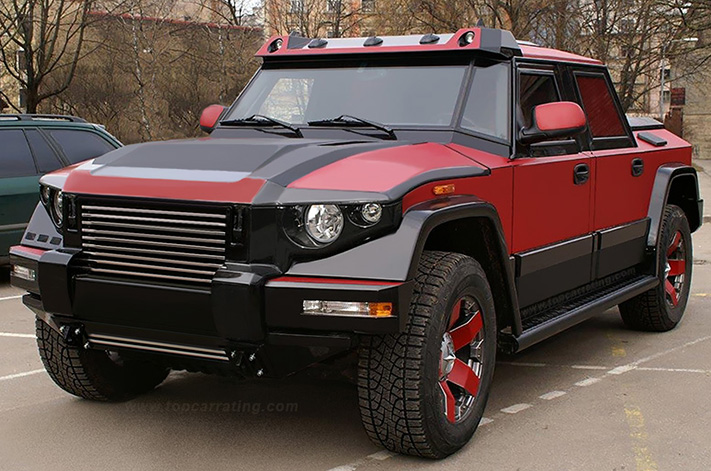
The 8.1-litre V8-powered, Russian-built luxury SUV protects oligarchs from sustained AK47 fire and rocket propelled grenades, thanks a monocoque body built from composite armour of ceramic between steel layers. Built to suit the tastes of their gregarious owners, some of the more outlandish versions include the Dartz Prombron Monaco Red Diamond Edition featuring diamond- and ruby-encrusted white gold gauges, gold-plated bulletproof windows, 22-inch bulletproof tyres, and somewhat symbolic whale-penis leather upholstery.
INKAS Mercedes-AMG G63
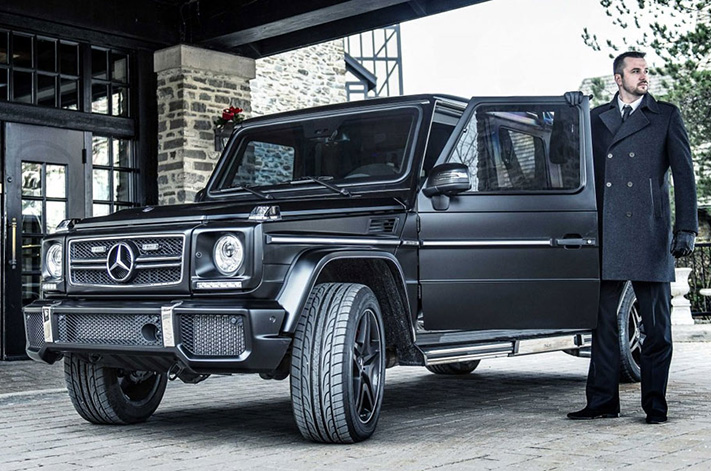
This stretched G63 expands on the G-Wagon’s bulletproof reputation, while toughening up the floor to withstand the blasts of up to two grenades. Modified by Canada’s INKAS Armoured, it has security cameras to provide perimeter surveillance and a luxurious rear cabin featuring a built-in speed-pistol holder, along with less hostile features such as heated and cooled captain-style rear seats with massaging function, satellite television and a bar.
We can think of worse things to spend $US1 million on.
Avtomobilnoe Moskovskoe Obshchestvo – Zavod Imeni Likachova 41052
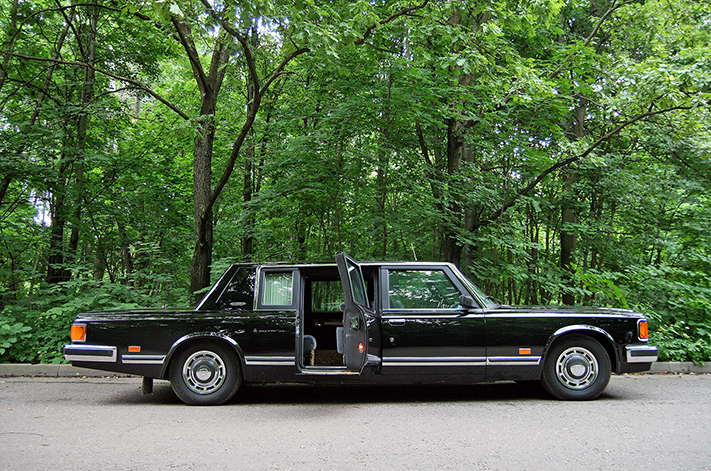
Russian president Vladimir Putin has taken delivery of the new Rolls Royce-inspired Kortezh armoured limo that looks all stately, but isn’t a match for the old ZIL-41052 that was so squarishly manly even Putin himself thought was a bit much.
Twenty-two 41052s were built and one was up for sale in 2014 with 8-10mm thick body armour and bulletproof glass. With a 6.2-metre body almost as long its full name, the ZIL was designed to absorb as many bullets as possible as evading attackers wasn’t really an option – with a 5500kg kerb weight, its 231kW 7.7-litre V8 engine could only manage 0-100km/h in 13 seconds, on its way to top-speed 190km/h.
Mercedes-Maybach S600 Pullman Guard
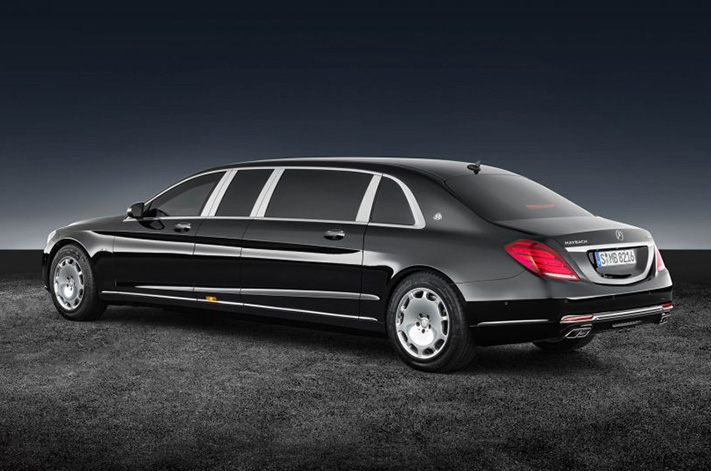
The Pullman Guard is designed so it doesn’t look any more ridiculously conspicuous than the standard Maybach S600, with the powertrain and suspension tweaked to cope with the extra heft.
Mezcal Lexus LX 570
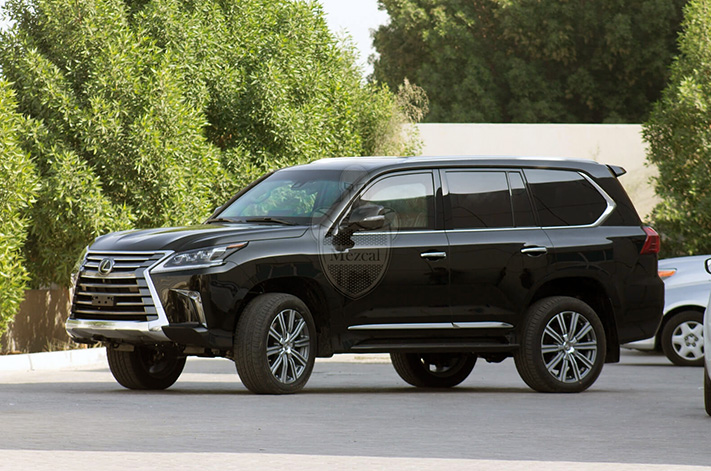
This is perfect if you want to tow a caravan in style, enjoy a commanding ride height, or wish to prevent Boko Haram rebels from kidnapping your daughters during the school run. Dubai-based Mezcal have added multi-layered ballistic glass, armour plating, reinforced pillars, heavy duty door hinges, run-flat tyres, and modified suspension and brakes to the standard LX 570 so it looks like bloody big tank … just like the standard LX 570.
There really isn’t much aesthetic difference to the standard model, until you open the tailgate to reveal a second hatch that looks like it was stolen from an armoured personnel carrier – and presumably makes loading the shopping a little difficult.
Cadillac presidential state car
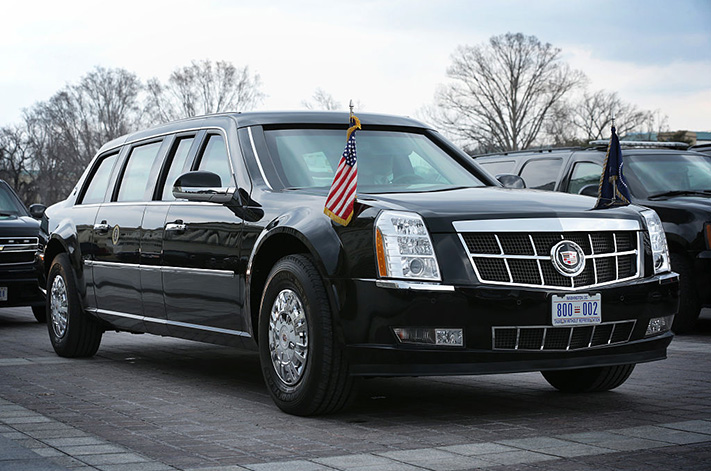
Code named Stagecoach and also known as ‘The Beast’, Cadillac One and Limousine One, is the current official car of the President of the United States and went into service in January 2009 in time to take President-elect Obama to his inauguration. Designed by the Secret Service and built from the ground up, about the only thing about The Beast that’s Cadillac is its badge.
Described as a truck that looks like a limo, it features military grade armoured panels, armour plated fuel tank encased by rupture proof foam, a halon fire suppression system, separate oxygen supply, medical equipment including vials of the Commander in Chief’s blood type; Kevlar-reinforced Goodyear run-flats and night vision cameras mounted inside the grille. The cabin is sealed to prevent the effects of a chemical weapons attack with 8.0-inch doors (and 5.0-inch windows) that need to be opened from outside.
The Beast is being replaced with a new, and delayed, model for President Trump that will be better – there will be none better than this new one.
Dillon Aero SUV
Here’s a bonus vehicle that’s more armed than armoured. The Beast is pretty great and all, but the coolest vehicle in the presidential motorcade has to be the GMC Yukon XL, which has a more offensive approach to fending off attackers with an M134D Gatling gun that pops up through the roof with the gunner, who can swivel it 360-degrees.
The M134D is an electrically-driven six-barrelled mini-gun that spits out 3000 rounds of hot led per minute with a hellish ‘paaaarrrp’. The gun spits out so many expired casings that the driver has to use the windscreen wipers to see through the brassy rain.
Who says SUVs can’t be cool?
THE Jaguar XF Sportbrake is a refreshing departure from the flood of luxury SUVs sweeping showrooms.
WHAT IS IT?
It’s the more practical, long-weekend version of the revamped XF sedan, coming to our shores for the first time.
WHY WE’RE TESTING IT
Traditional wagons are becoming something of an acquired taste in the blinkered world of high-riding, ego-fluffing and chronically flawed SUVs. It’s significant, then, that vehicles such as the XF Sportbrake exist despite the pressure to send them the way of the dodo.
MAIN RIVALS
BMW 530i Touring; Mercedes-Benz E220d All-Terrain
THE WHEELS VERDICT
It’s taken its time to get here, but the bigger-booted version of the Jaguar XF brings slightly more practicality to what the sedan has already shown to be an exceptionally well-grounded package. However, given the rush to luxury SUVs, our days enjoying the Sportbrake may be numbered.
PLUS: Strong engine; great steering; sharp dynamics MINUS: Expensive, especially options; rear doors slightly too small; no supercharged V6 petrol option
THE WHEELS REVIEW
WE MISSED out on the first-generation XF wagon. Australia issued a collective, wistful sigh as we saw European and North American reviews of the stunning sibling to the sedan on which it was based pour nothing but praise on the new form. All we could do was watch from afar, and go and kick tyres of the more Teutonic BMW 5-Series Touring and the now defunct Mercedes-Benz E-Class Estate (replaced in Australia by the SUV-styled E-Class All Terrain) and believe that one day, yes, one day we too could share in the dream.
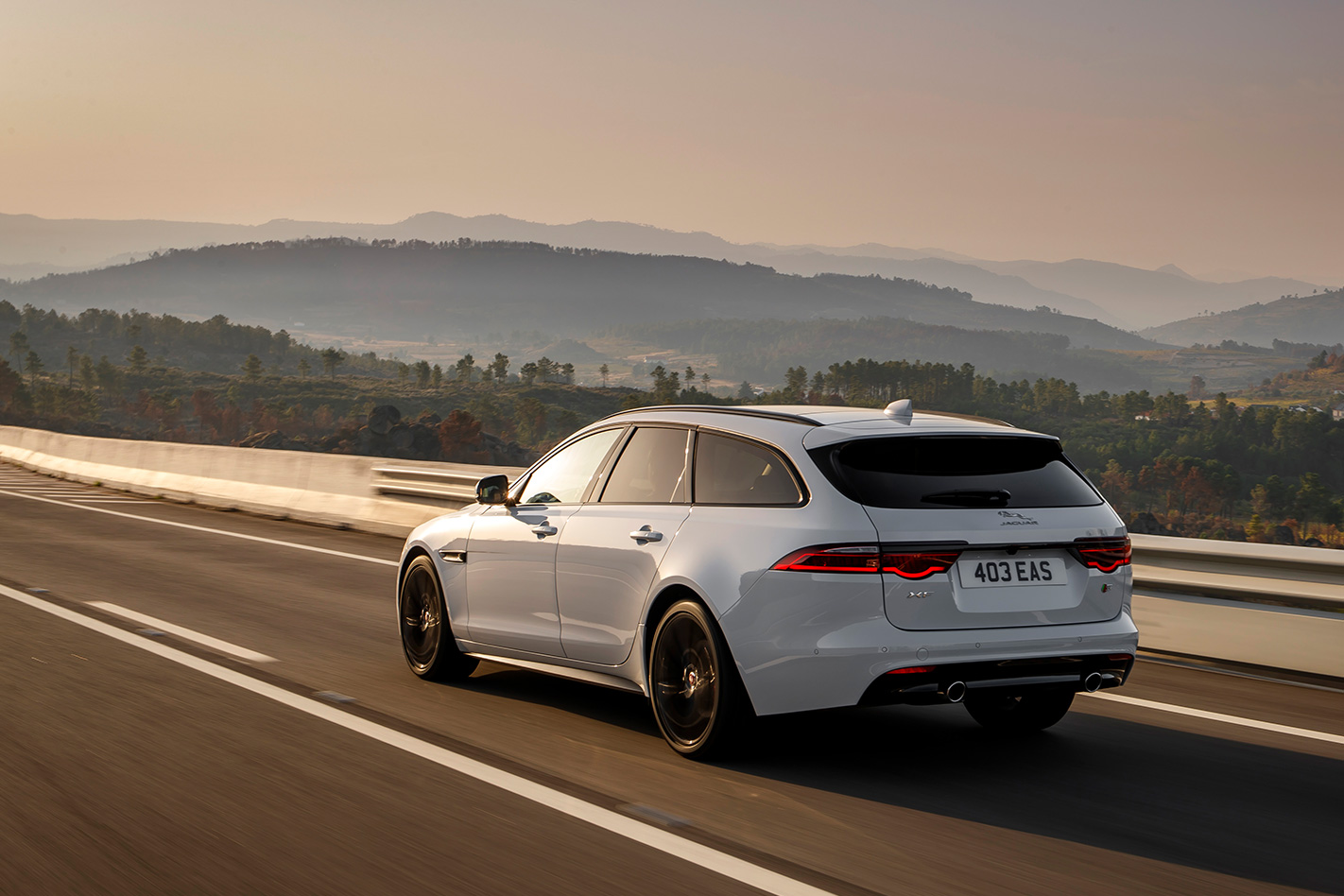
Now we can. Jaguar’s global push, funded in part by the success of the first-generation XF, means Jaguar’s Australian showrooms now have access to a car we once could see but not touch. At 4955mm, the Jaguar XF Sportbrake (“wagon” in Jag parlance) is a single millimetre longer than the sedan on which it is based, and with an identical 2960mm wheelbase but sitting 39mm taller at 1496mm. At 565 litres, the boot is 25L larger than the sedan, although that expands to 1700L with the rear seats folded down.
A little of the theatre of the first-generation XF is lost in this one. Punch the start button and the dash-mounted side air vents still rotate into their working position as the gear selection dial rises slowly from the centre console – that’s more surprise and delight than you get in Jag’s brand-new baby SUV, the E-Pace. But the XF’s touch-sensitive electronic glovebox release switch is now a manual one, the centre air vents are fixed and no longer rise dramatically from the dash in between the front seats, and the puddle lamps – which on other models cast shadowed silhouettes of jaguars, and in the case of the E-Pace an adult jaguar trailed by a cub – are just plain old puddle lamps.
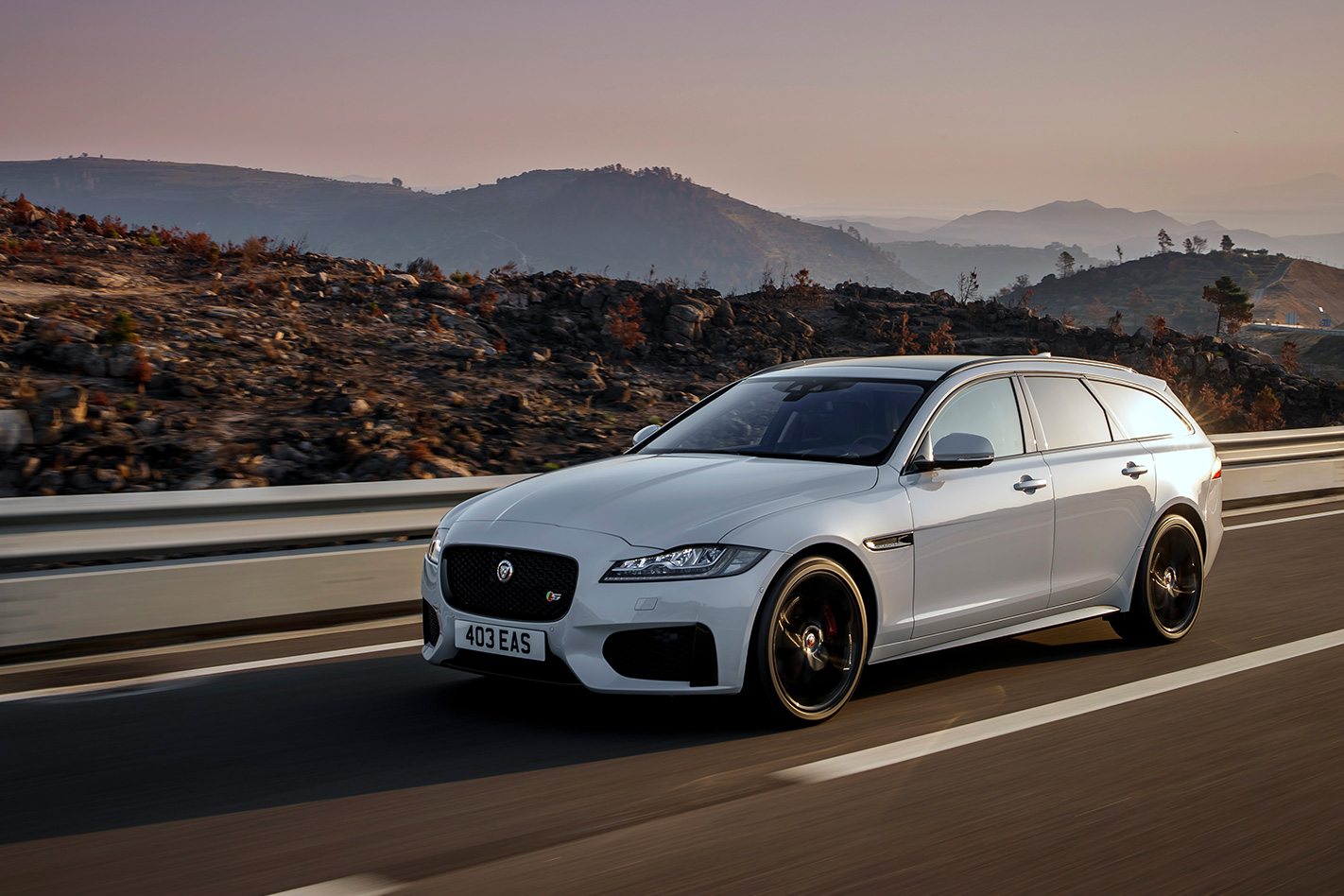
What’s left to sell the XF Sportbrake though, is that wonderful coupe-like wagon profile. We once thought the Holden Commodore Sportwagon was the duck’s nuts of large wagon styling, but it’s now gone and the Jag has done a Bradbury, taking the title. Despite the fastback looks, rear headroom isn’t impeded, and although the rear doors are still a fraction short making entry and exit a bit cumbersome, and the boot a bit small and shallow to be truly practical, it just works. Wonderfully.
Jag’s Sportbrake line-up in Australia is much skinnier than for the sedan, limited to just turbocharged diesel and petrol 2.0-litre Ingenium four-pots, and the car tested here, the 3.0-litre diesel V6 – not a supercharged petrol, sadly – that is tested here.
Luxury carmakers like to stab you in the heart via the options list, and Jag is no different. However, standard equipment for the admittedly pretty high price of the S includes the torquey twin-turbo V6, keyless entry and start, rain-sensing wipers and dusk-sensing adaptive LED headlights, dual-zone climate control, surround-view camera, digital radio, a head-up display, black roof rails, and auto-dimming mirrors. Our test car included more than $30,000 in options, running to a huge glass roof ($3560) that opened its blind at the sweep of a hand ($1440), a 12.3-inch digital dashboard with better audio ($5280), and a Sportbrake convenience pack including a bootlid that opens at the sweep of a foot under the bumper, storage rails, and an adventure-proof wristband that doubles as a wireless key to unlock the doors ($1770).
The 3.0-litre twin-turbo powerplant under the Sportbrake’s bonnet is not that far removed from the single-turbo 2.7-litre one that once powered diesel versions of the Ford Territory. Jaguar’s literature only quotes where the V6’s full serve of 700Nm arrives on the rev range – 2000rpm – and not how long it stays at the party. It’s all over early, though, appearing to trail off after 3000rpm. If you’re a bit overly excited with the throttle, the torrent of newton metres the engine dumps at the rear wheels from not far off rest will have the low-profile 255/35 Goodyear Eagle F1s wrapped around their 20-inch alloys struggling to lay it all down to the bitumen, especially when they’re cold.
Once warmed, though, and with a meandering road opening up in front of it, the diesel V6 feels like an old-school V8 with plenty of lazy torque that can be tapped via a pair of cold-touch aluminium steering wheel-mounted paddle shifters that give almost total control over the eight-speed ZF automatic. The engine’s character, combined with electronic torque vectoring that drags an inside brake to help with turn-in and quick, sharp steering mean the XF Sportbrake is heaps of fun to point at corners, with a connected feel at the front and a little bit of tail happiness down the rear. The Jag uses double wishbones up front, while the rear uses self-levelling air suspension that has the double benefit of smoothing over the worst of the road’s corruptions, and reducing the amount of noise entering the cabin.
The XF Sportbrake includes JaguarDrive Control. It doesn’t appear to make a lick of difference to the engine’s performance or the sound of the exhaust, although the throttle pedal becomes more sensitive, the steering adds weight and the gear changes in full automatic mode hold out longer before upshifting. And the tractability of that engine, combined with the eight gears to choose from, will give the long, sleek cat small hatchback-like fuel economy on the freeway, and sub-10.0L/100km returns when pushed.
The Jaguar XF Sportbrake S is a perfect complement to the already impressive sedan on which it is based. However, with wagons historically making up only a small proportion of the showroom mix and SUVs now preying heavily on traditional passenger car sales, we fear for its future.
SPECS Model: Jaguar XF Sportbrake S 30d Engine: 2993cc V6 (60°), dohc, 24v, twin-turbo Max power: 221kW @ 4000rpm Max torque: 700Nm @ 2000rpm Transmission: 8-speed automatic Weight: 1855kg 0-100km/h: 6.6sec (claimed) Fuel economy: 5.9L/100km (claimed) Price: $123,450 On sale: Now
- It’s fast. Its 294kW and 696Nm can propel the i-Pace from 0-100km/h in 4.8 seconds. That’s as quick as convertible Porsche 911.
- A 90kW battery housed under the floor is comprised of 432 individual lithium-ion pouch cells. Fully charged, the battery has enough stored energy to top up 9000 smartphones or power the i-Pace for up to 480km.
- An 80 percent charge takes about 10 hours using a 7kW home charger. A specialised 100kW public charging station will reduce that to 40 minutes.
- Adaptive air suspension allows the i-Pace to lower its ride height at speed for greater efficiency and handling, or raise it for greater ground clearance. At the highest setting, the Jaguar can wade through 500mm of water.
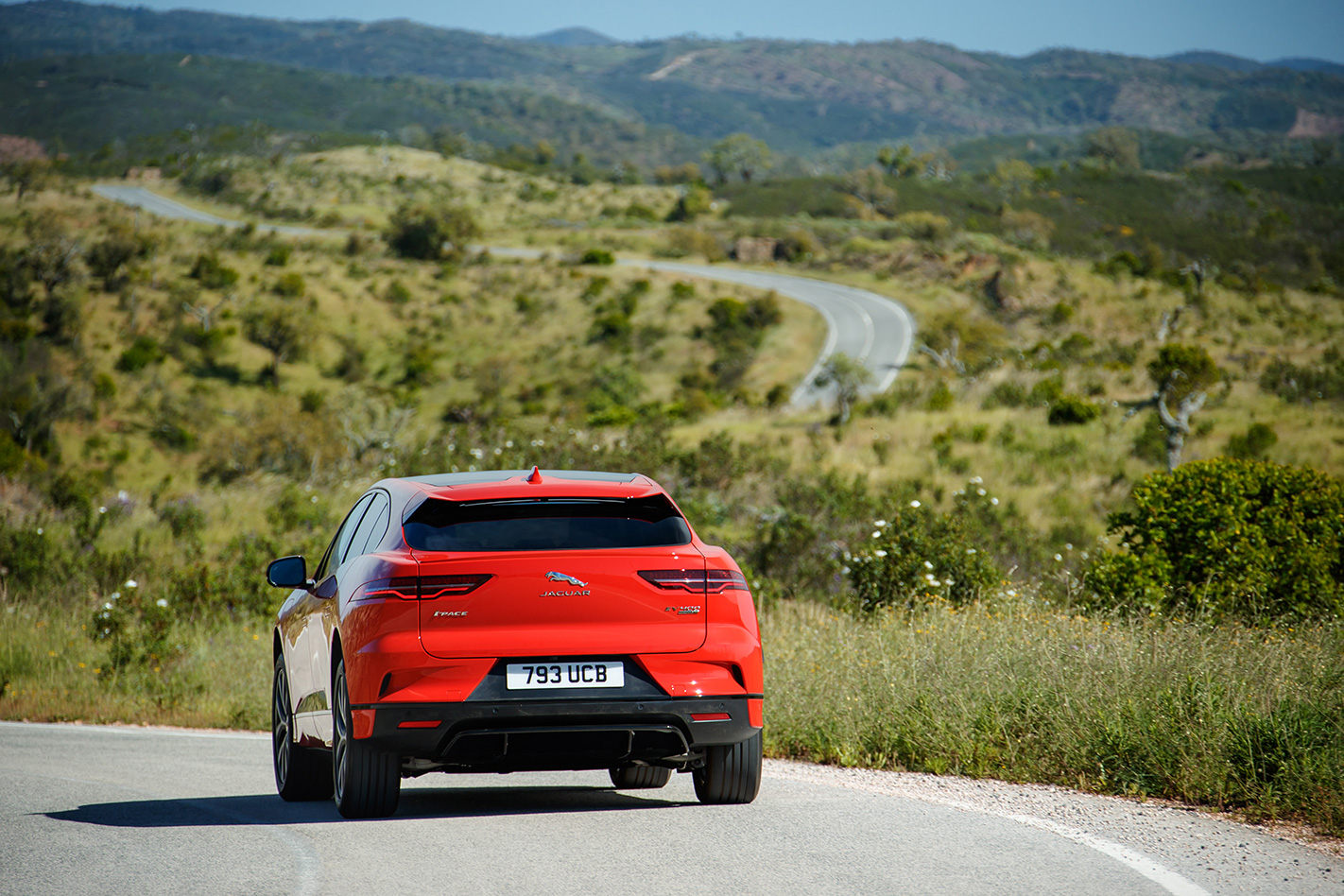
- With a body made from 94 percent aluminium, the i-Pace uses more of the lightweight metal for its construction than any Jaguar before it.
- Aerodynamics are key to reducing drag and extending battery range, and the i-Pace has a slippery drag coefficient of 0.29Cd. A special vent at the top of the grille exits through the bonnet and allows air to pass over the windscreen at an optimal angle, cutting air resistance.
- Powering the i-Pace are two electric motors – one for the front wheels and another for the rears. The layout allows completely independent four-wheel drive as well as 50:50 front-to-rear weight distribution.
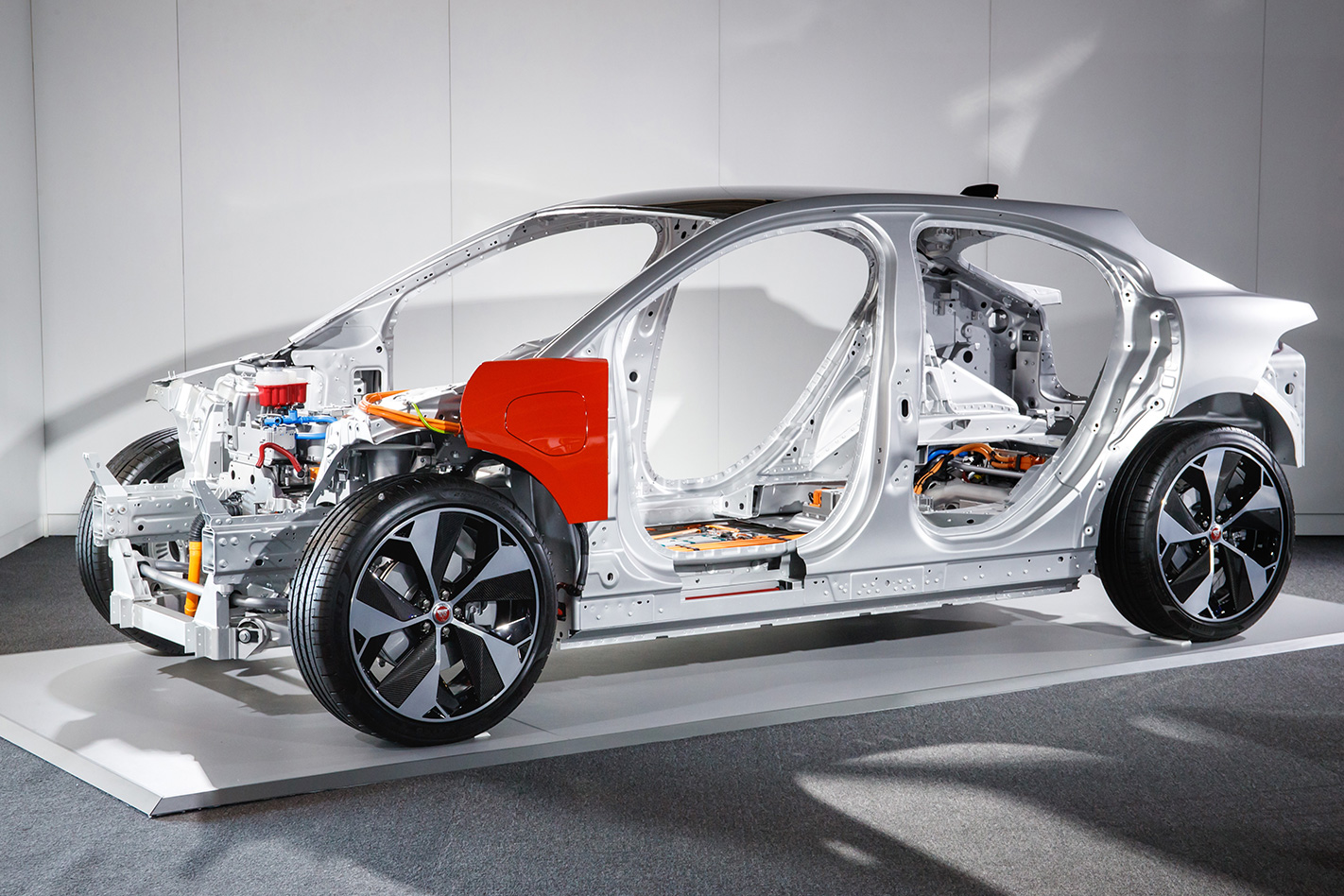
- There’s space for five in the cabin, and a 656-litre boot that expands to 1453L with the rear seats folded. A second 27-litre storage compartment sits under the bonnet where a conventional engine would normally be located.
- At its maximum effect, aggressive regenerative braking can bring the i-Pace to a complete stop, allowing ‘single-pedal’ driving. Instead of pressing the brake pedal, simply releasing the accelerator will adequately slow the vehicle in most driving situations.
- Connectivity features heavily in the i-Pace, which has 30 specially designed smartphone applications including one that can heat or cool the car before you set off. It will even remind you if you’ve jumped behind the wheel without your phone. The i-Pace can also connect to a house and switch on the heating or lighting before you even arrive home.
New car shoppers looking at entry-level versions of Hyundai’s i30 hatch, Elantra small sedan or Tucson medium SUV have been handed an extra choice to consider, with Hyundai’s local arm bringing new value-boosted, limited-edition Trophy variants for each model.
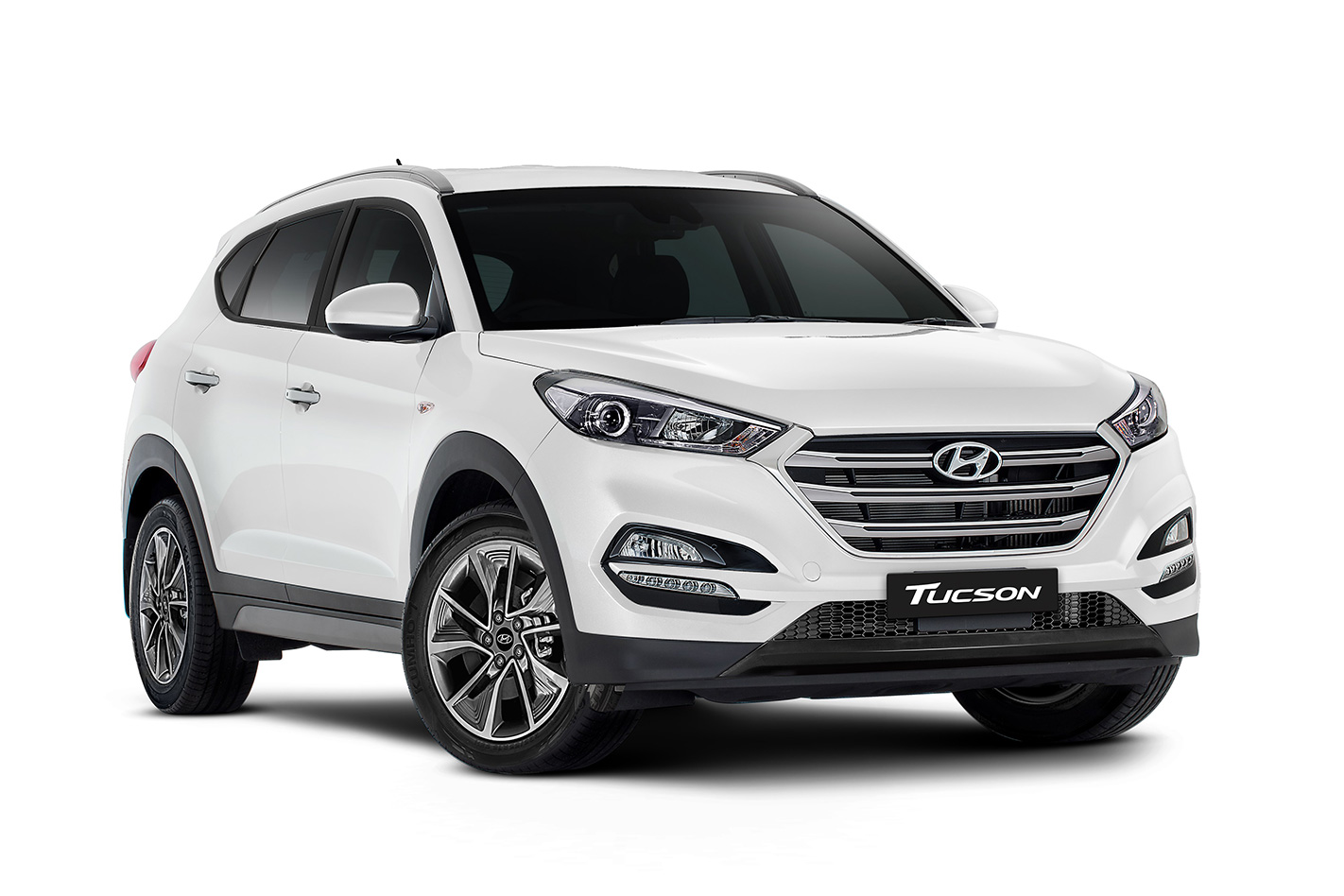
Based on the base i30 Go, Elantra Active and Tucson Active, the Trophy editions add extra gear for modest additional outlay.
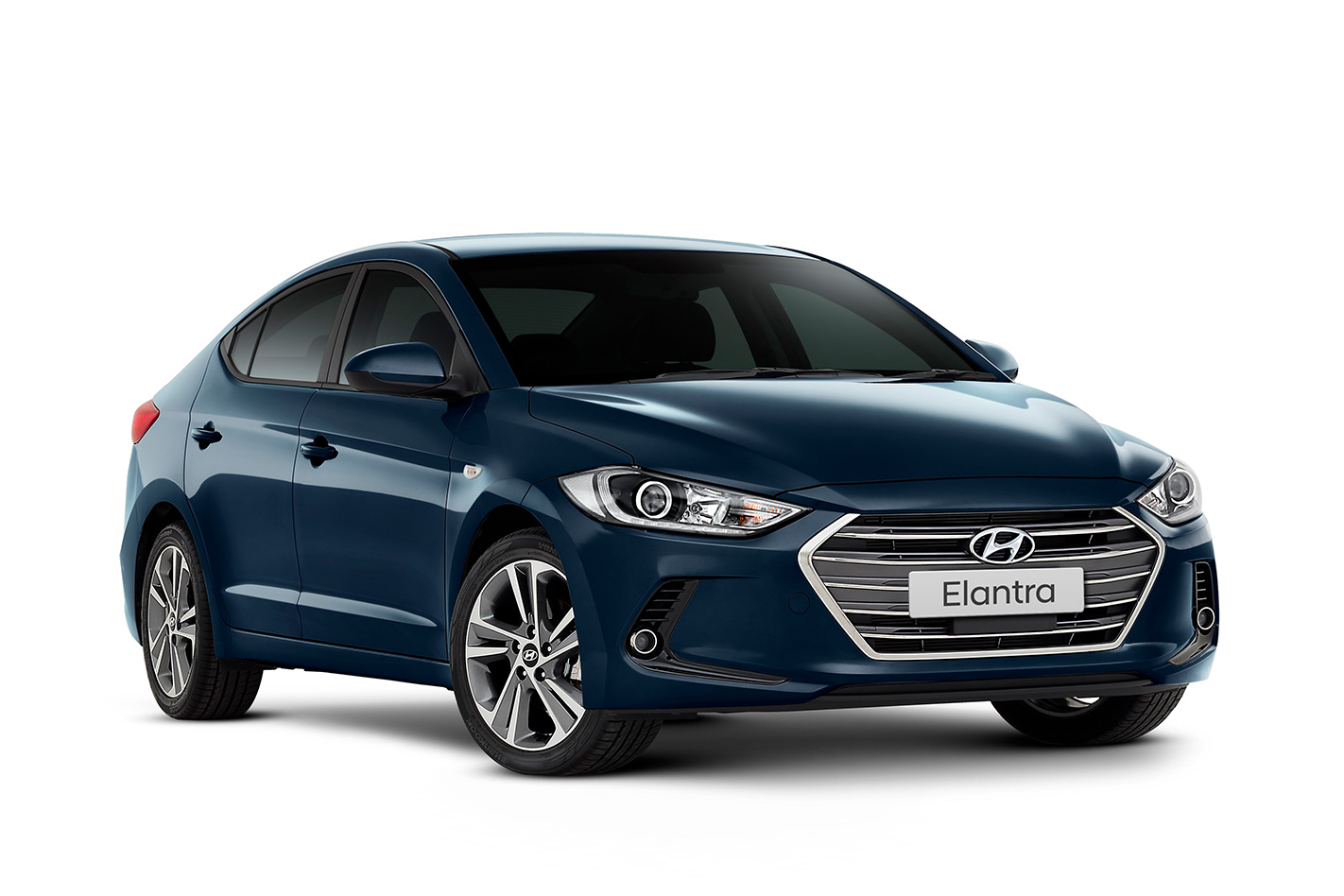
For the $25,350 Elantra Trophy, the premium over the Elantra Accent automatic is just $1560 and replaces the Active’s 16-inch steel wheels with 17-inch alloys, adds leather-appointed upholstery over the standard cloth, and tacks on a chrome grille surround for some extra exterior bling.
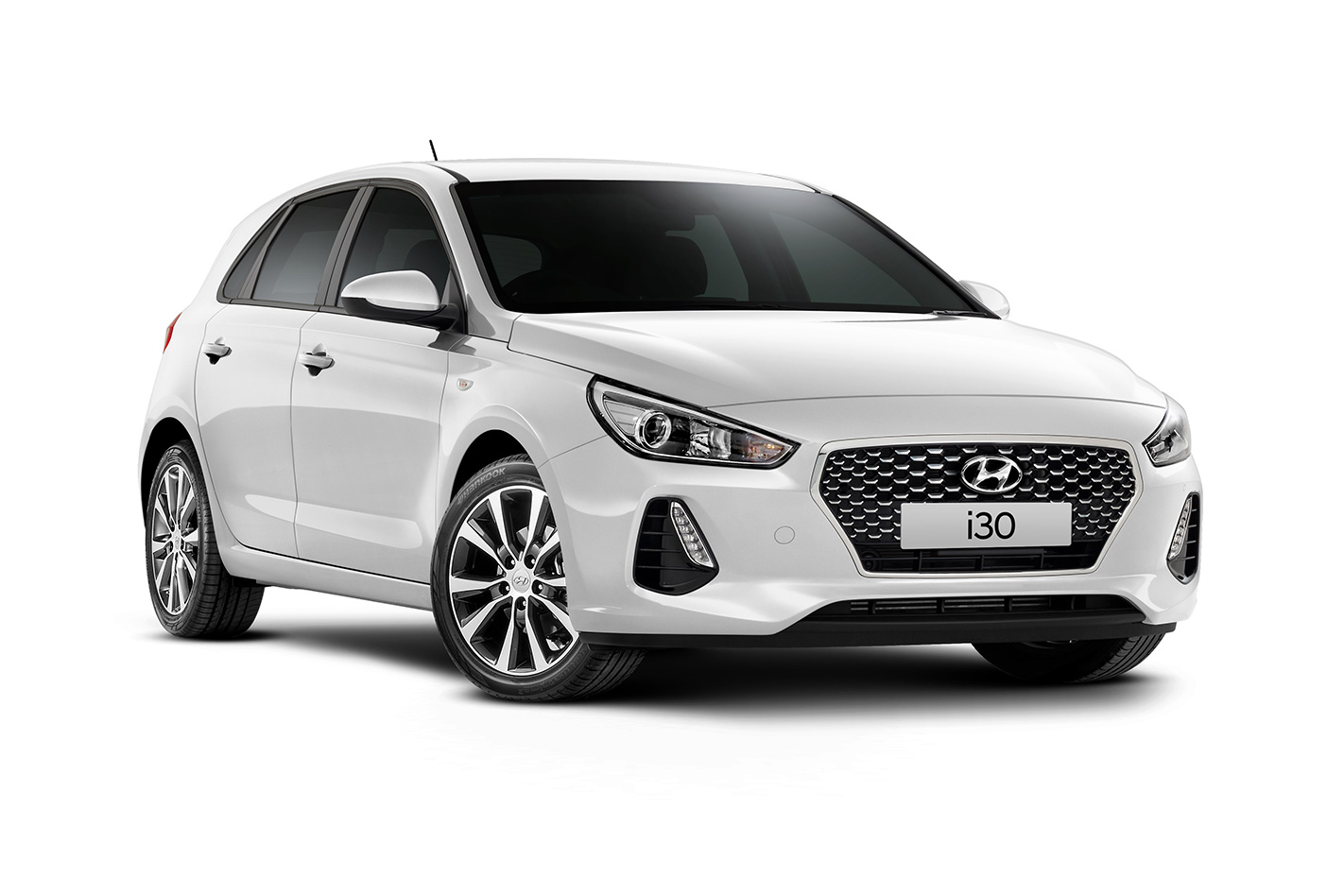
The $23,390 i30 Trophy boasts the same additions over the i30 Go’s standard spec, while also gaining rear parking sensors – an item that’s already standard on the Elantra Active grade (and thus the Elantra Trophy). Priced just $1100 higher than the i30 Go automatic that it’s based on, the i30 Trophy’s value-for-money quotient is even stronger than the Accent’s.
The Tucson Trophy goes even further, though at $33,650 its price premium over the Tucson Active is a heftier $2560. For the extra dosh, the Tucson Trophy packs bigger 18-inch alloys, heated exterior mirrors, leather-appointed upholstery, chrome-finished door handles and grille surround, matte-grey exterior trim and an illuminated glovebox and sunvisor mirror.
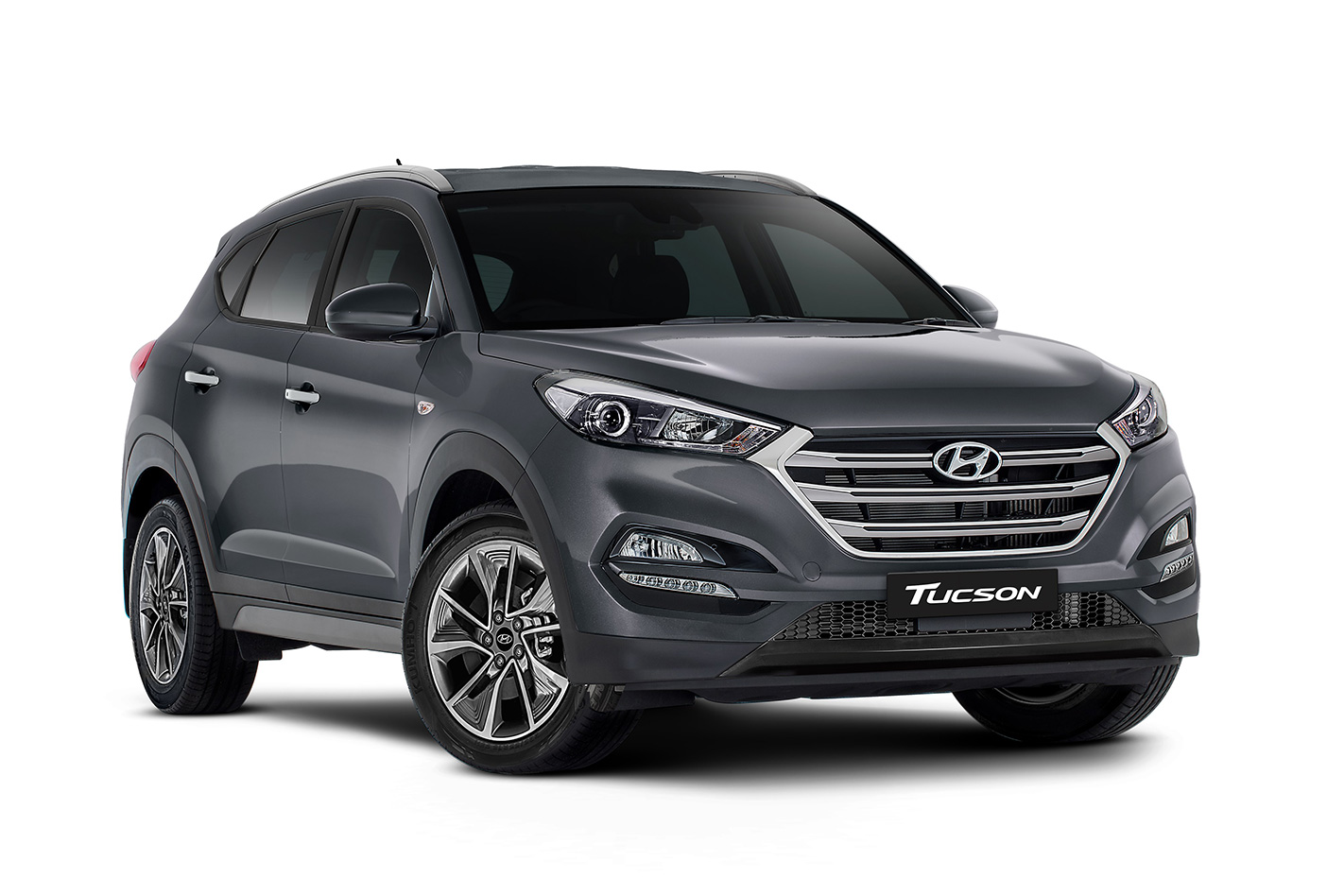
All Trophy editions are offered with 2.0-litre petrol engines and six-speed automatics as standard, with no other powertrain or drivetrain options. The Tucson, being based on the entry-level Active petrol grade, is only available in front-wheel-drive form. For the i30 and Tucson, power is provided by a 2.0-litre direct-injected inline four with 120kW/203Nm, while the Elantra produces 112kW/192Nm from a port-injected 2.0-litre.
PRICING
The i30 Trophy, Elantra Trophy and Tucson Trophy are available now, with production limited to 1000, 300 and 650 units of each respectively. Pricing is as follows:
- Hyundai i30 Trophy 2.0L automatic – $23,390
- Hyundai Elantra Trophy 2.0L automatic – $25,350
- Hyundai Tucson Trophy 2.0L automatic – $33,650
Speeding motorists could be allowed more leeway in the form of warnings instead of tickets, should a proposal by Scottish police be approved.
Drivers caught travelling over the limit in 20 and 30 mile per hour zones (roughly 30 and 50km/h) would be given a written warning that expires in three months. Should the driver be caught again within that window, they’ll cop a fine and receive points on their licence.
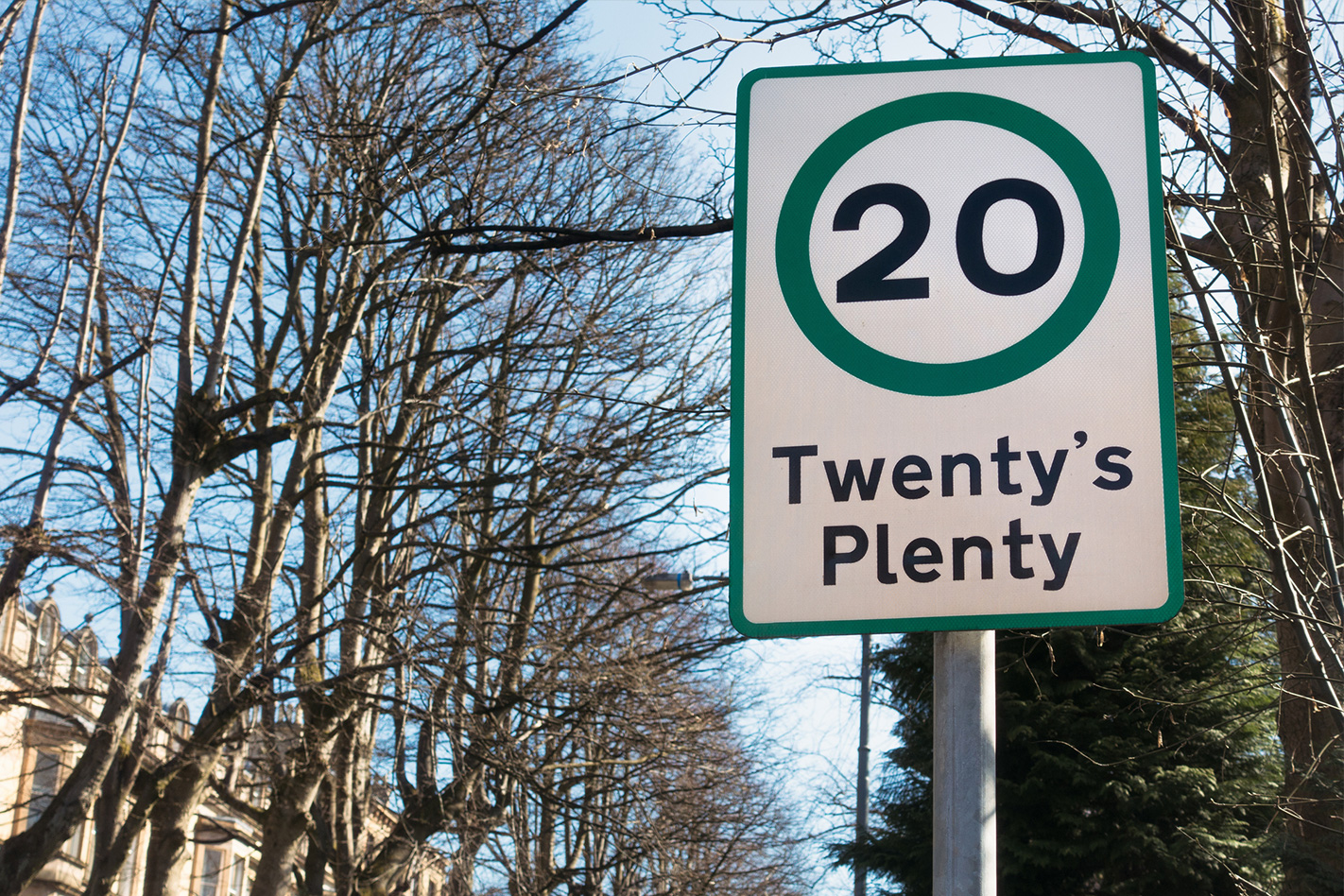
No further action would be taken for those who heed the warning and slow down.
The move to a more lenient warning system would see an estimated 18,000 drivers escape unscathed each year – provided they adhere to the condition of not speeding again for the following three months.
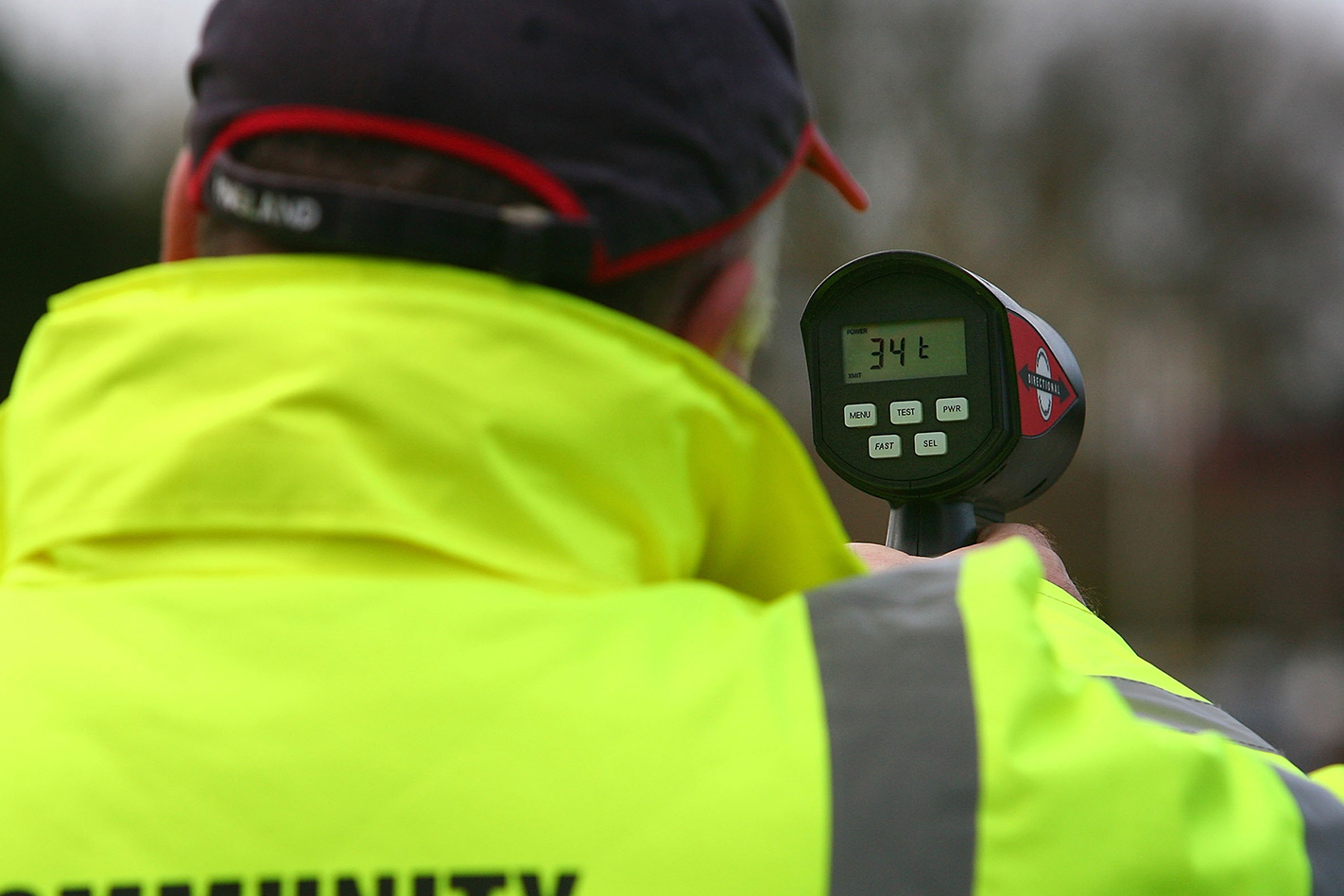
Chief superintendent Stewart Carle, head of road policing, suggests that written warnings would only be handed out by officers, leaving those caught by fixed speed cameras out of luck.
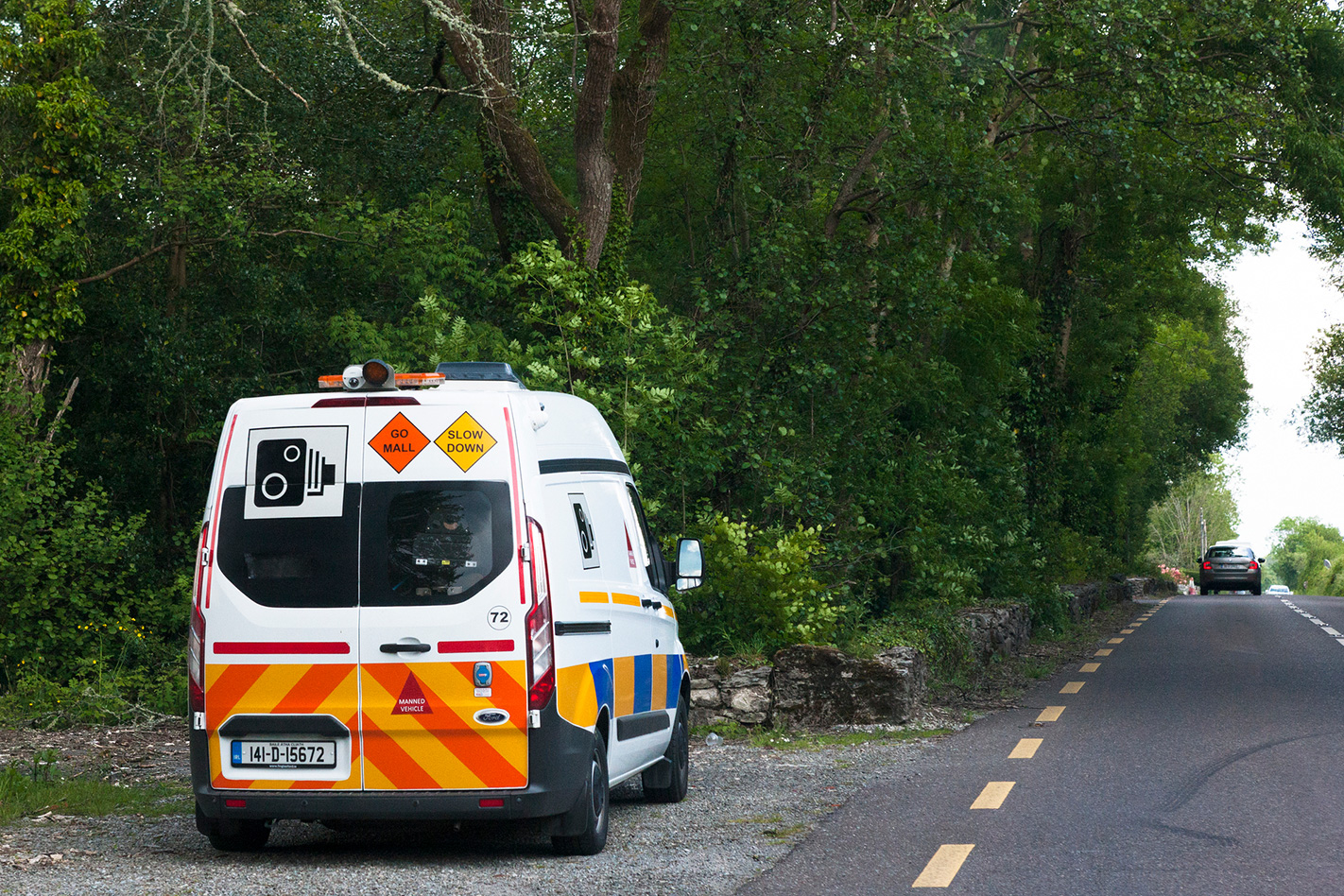
“If you have an opportunity to say ‘Speeding is one of four fatal factors and we’re not going to prosecute on this occasion, we’re not going to give you a fine, will you accept this warning?’ I think most people will say ‘Yes, absolutely’,” said Carle.
There is no official line on how much faster you’re allowed to go in the 20 and 30mph zones before a warning is deemed insufficient, however Carle said the margins are “relatively generous”.
Carle said that the proposed change would not only free up the time of prosecution authorities to focus on more serious cases, but that the judicial system would not have as many cases clogging up the courts too.
Still currently under investigation as a suitable replacement, Scottish Police hopes to be implementing the program within a year.
This new system comes on the back of UK research finding that “speed awareness courses” would have more benefit in reducing speeding offences when compared to the traditional fine and points approach.
We can only hope that the three month warning system passes the scrutiny of the Scottish Crown Office’s evaluation, and other countries like Australia take notice.
Despite plentiful supply of cars at dealers and in online listings, some of HSV’s greatest muscle cars are all but out of reach of anyone with a sub-$100K budget.
A trawl through classifieds across the web, prompted by the discovery of a HSV W1 on Tradeuniquecars.com.au asking $295,000 with 673km showing, revealed a plethora of both new and classic HSVs listed for well above the six-figure mark.
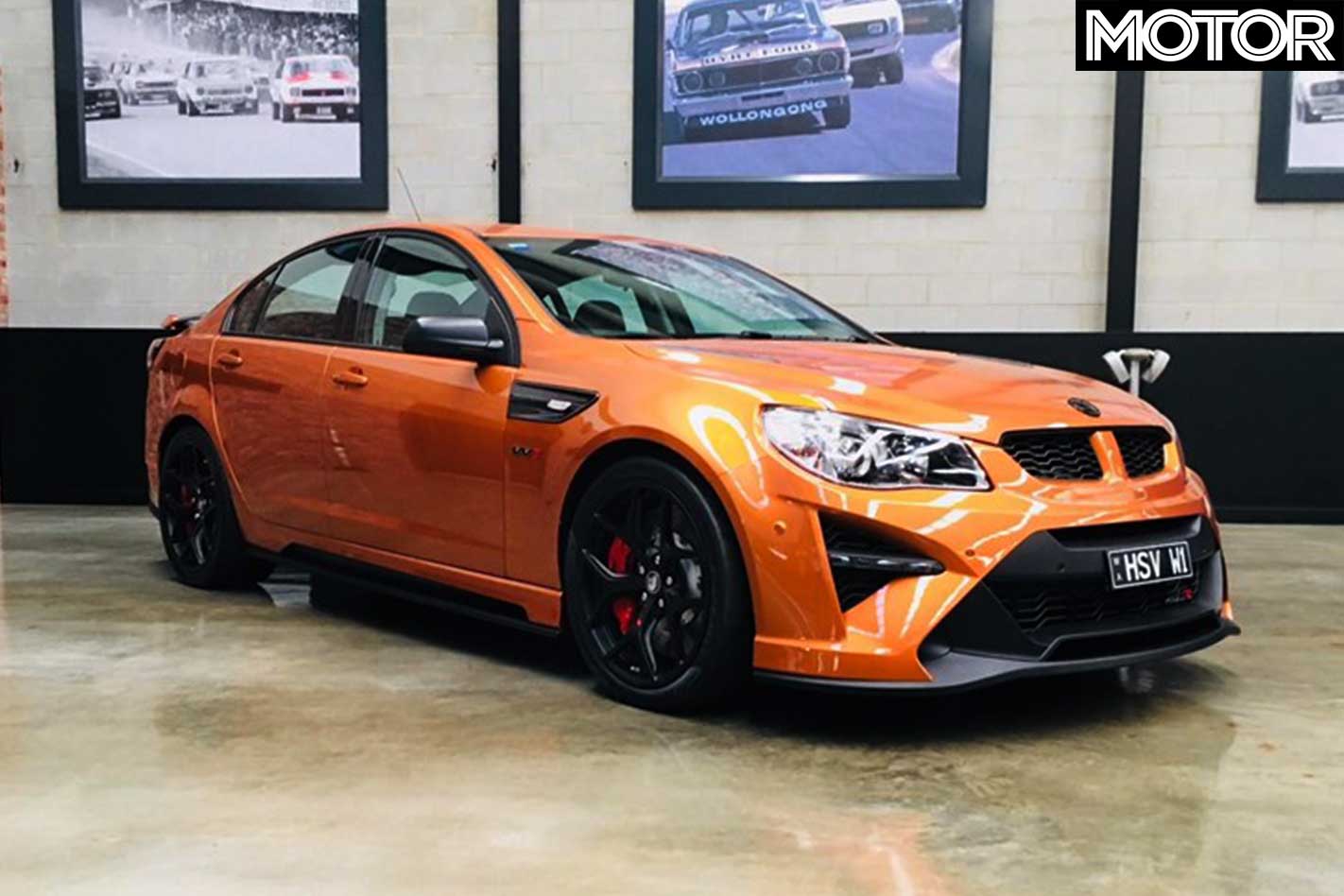
Other W1s ranged from $240,000 to $300,000, with several listings having been placed by dealers. Only the W1 listed on Trade Unique Cars had an odometer showing three digits.
A MY17 HSV GTSR Maloo in manual is the next-most expensive new HSV you can buy, with dealers and private sellers asking up to $190,000. We did find one at $125K, though this is still around $28K more than the RRP set by HSV.
As for sedans, a manual GTSR can cost up to $150K, while most auto listing fell around the $125K mark.
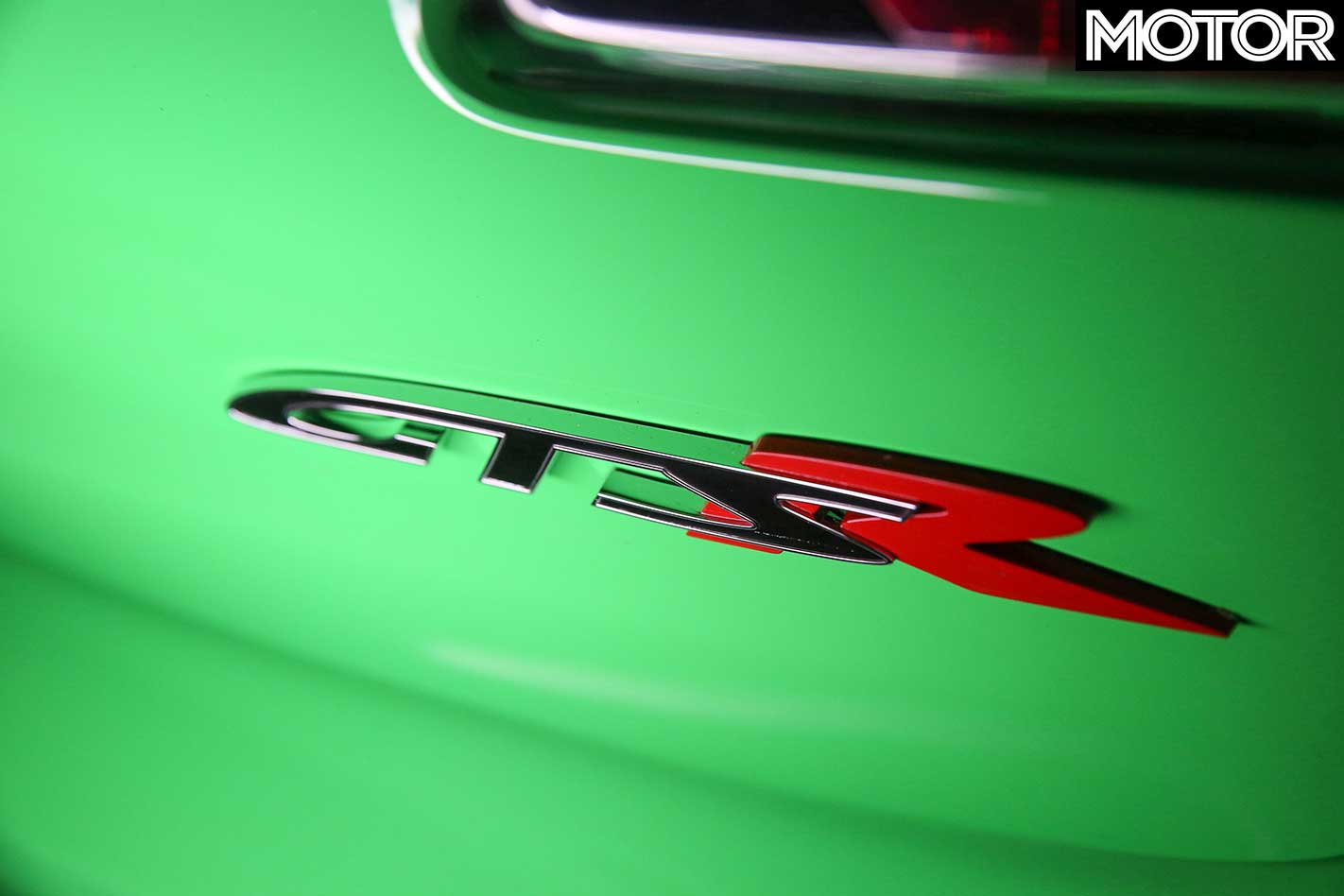
A HSV spokesperson told MOTOR that a limited number of new MY17 cars in varying models are still available in official HSV dealerships, but that HSV isn’t involved with setting prices – HSV only provides a pricing recommendation.
Turning back the clock, even the first examples of HSV’s engineering have started to rapidly gain value. A 1988 HSV VL Group A SS Walkinshaw is currently listed on Unique for $219,990, with 76,807km of wear.
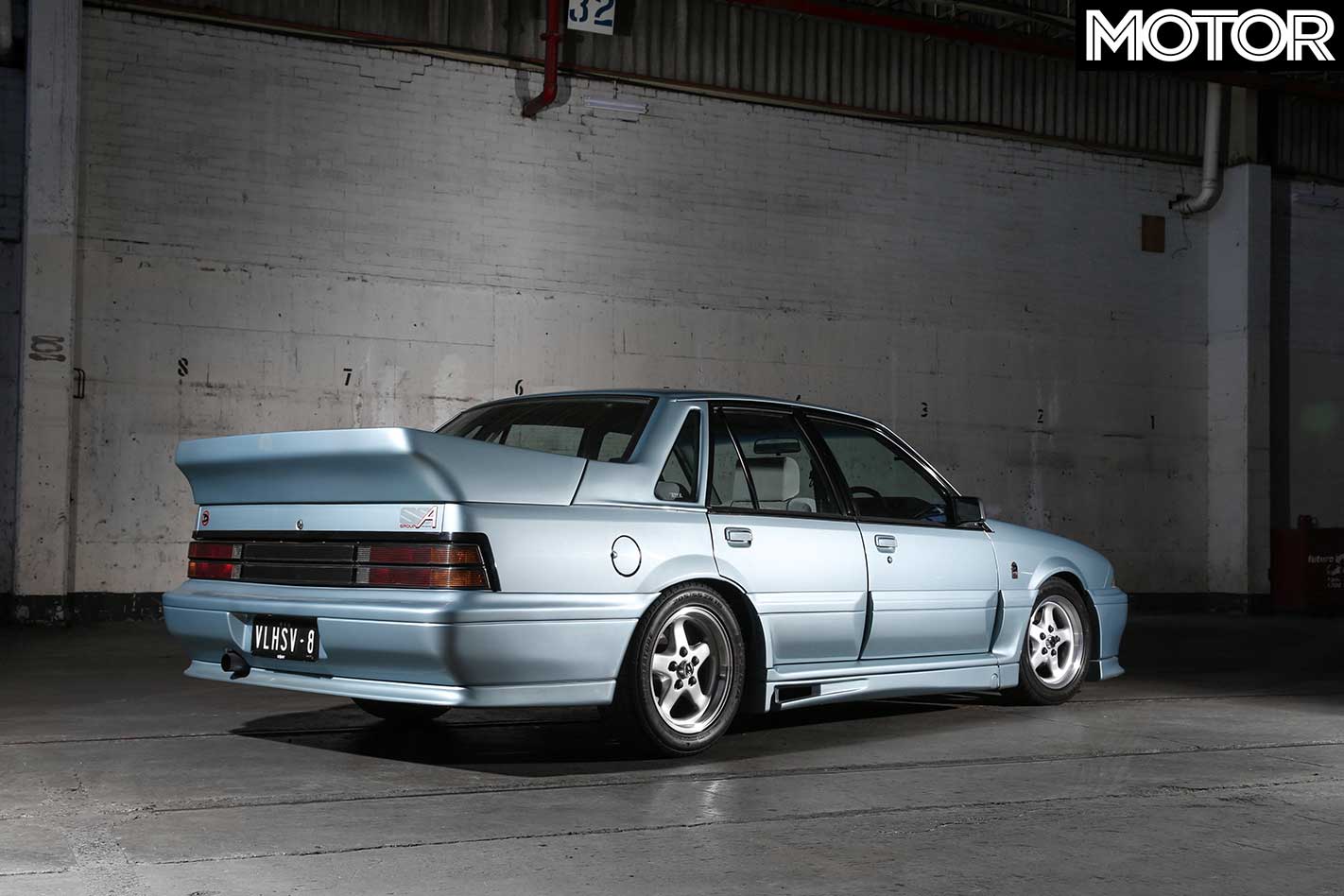
It doesn’t come close to the $340,000 VL Walky which sold at a recent auction, but that car was build number 333, allocated to the D’Alberto family, and had only 1308km showing. Listings elsewhere range from $195K to $220K.
And, what could be an unexpected hero, the HSV VN Group A SS has recently beomce a hot item, with a listing on Unique for $127,000.
This one has travelled 100,536km, but its asking price doesn’t hold a candle to the $210,000 one fetched at the D’Alberto auction. That car was also build number 333, despite only 302 having been built.