
Just like a big rack on a small rib-cage, you’ve got to love an unfeasibly big engine crammed into a small car. It’s why we regard with such reverence gadgets like the Peugeot 205 GTi, the SLR/5000 and the 147 GTA. And Dannii Minogue.
This review was originally published in MOTOR’s February 2005 issue
And it’s also why AMG has been so successful and well respected. It has almost nothing to do with the core engineering inherent in the Mercedes-Benzes on which it bases its creations. Nope, it’s pretty much all because AMG continues to take small cars and jam dirty great V8s between their front rails.
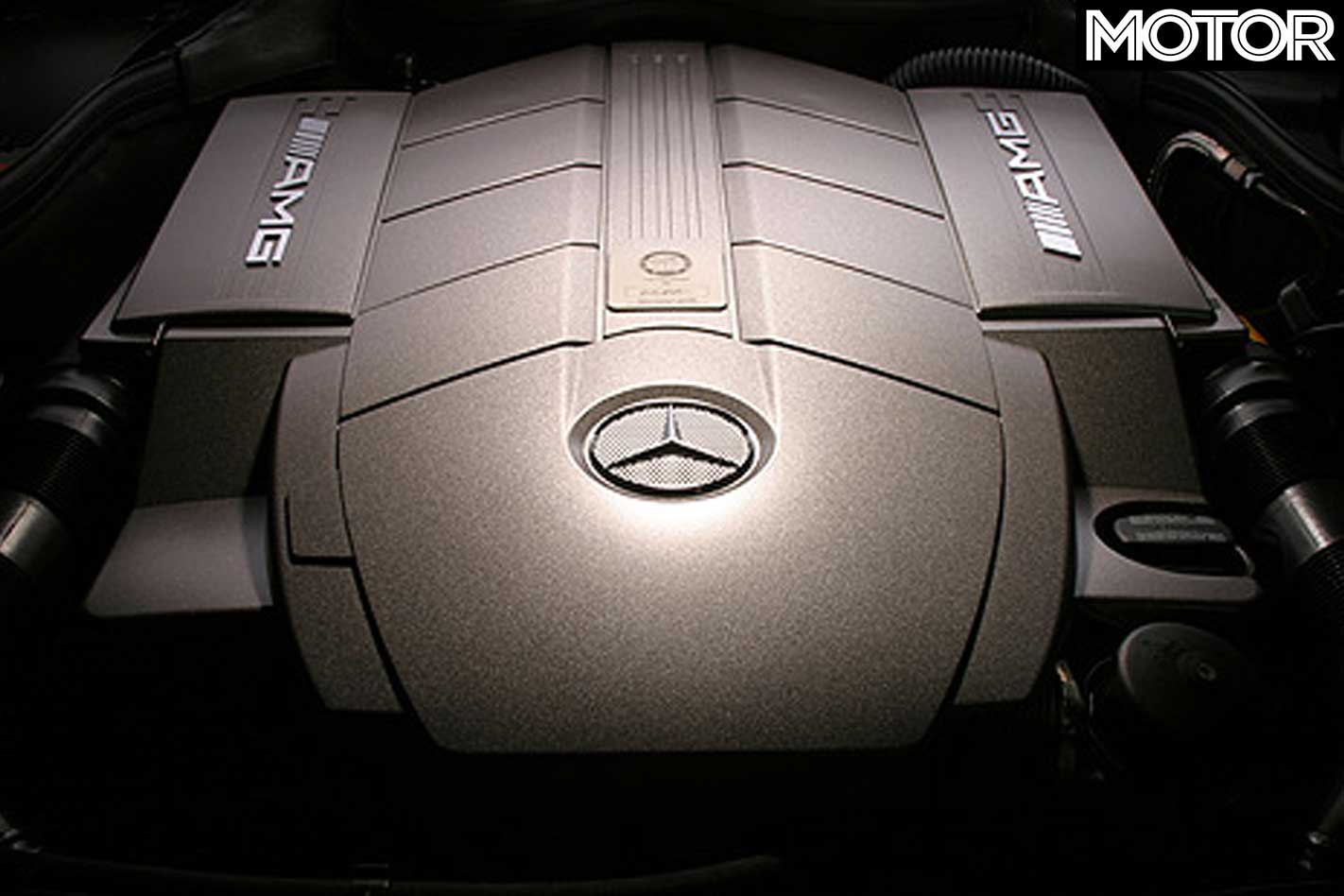
Thankfully, such a mechanical Frankenstein was not beyond the realms of possibility at AMG and, equally thankfully, those crazy funsters up in Stuttgart gave the thing the green light.
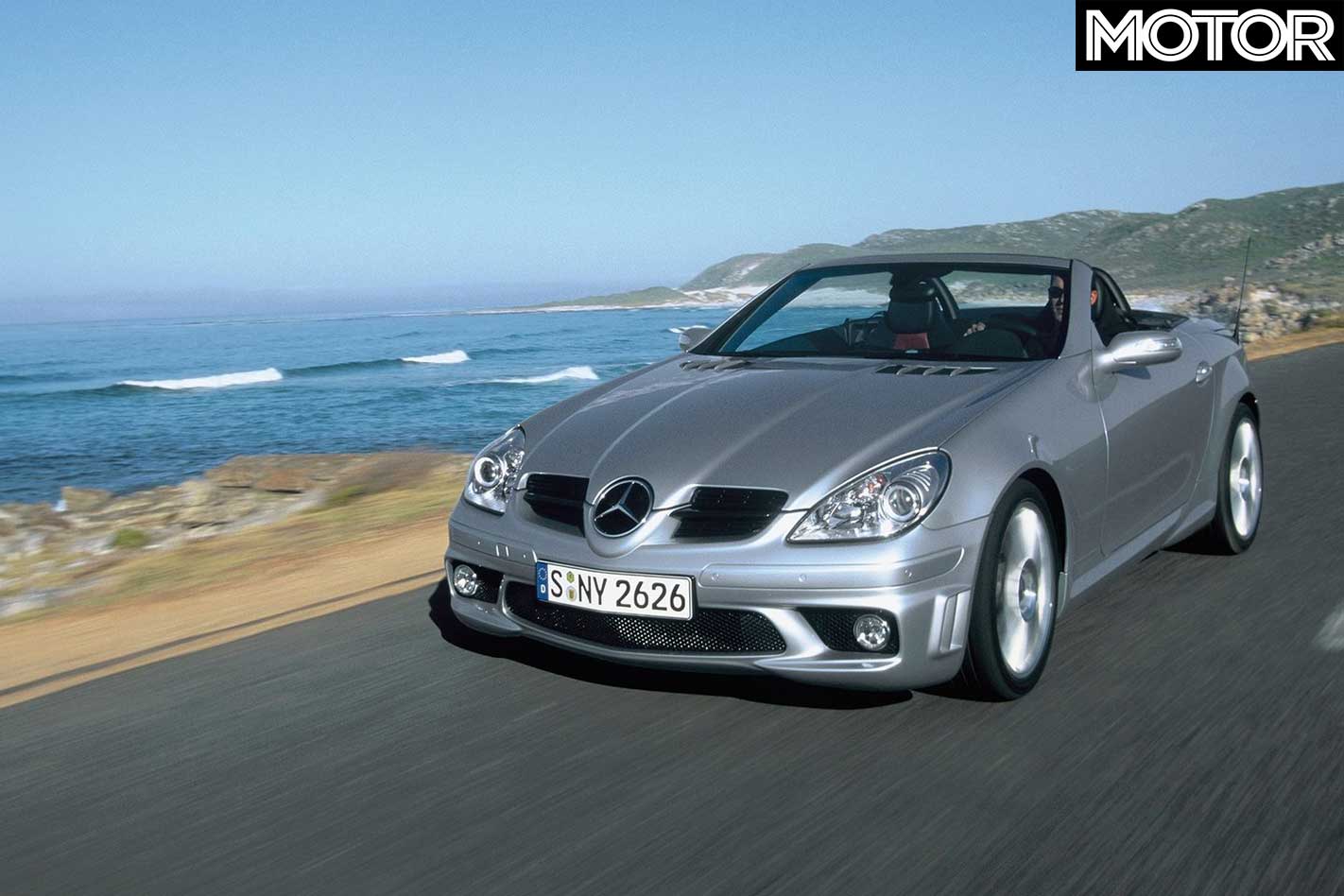
Exactly how a conservative outfit like M-B justifies the SLK55 at boardroom level is anyone’s guess. But just in case the Stuttgart suits have been conned the thing is anything but a complete headbanger, allow us to spill the beans. Even though it’s based on a clever, well made sun-chaser, it’s that monster-donk that completely dominates proceedings.
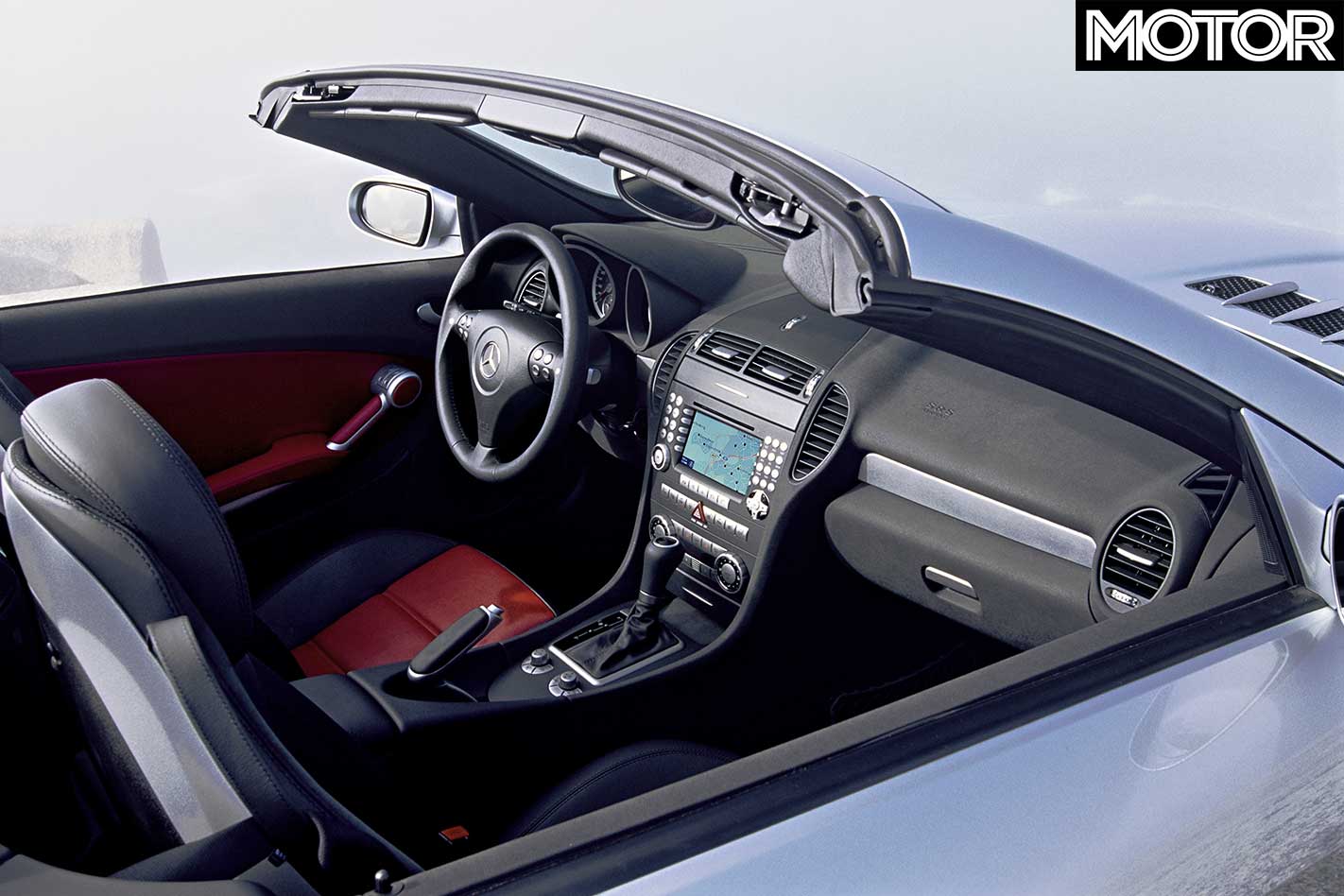
Drive it back-to-back against the garden variety SLKs with their supercharged four-bangers and V6s, and even though most of the package is the same, you’d never really pick the AMG version as being from a limb of the same family tree.
And that’s purely because – like we said earlier – it is going to take months of ownership before you can get your head around the engine and what it’s capable of doing. There’s oodles of urge from the minute you fire her up and it continues to swell, flinging the SLK along as if it’s in a giant slingshot.
Speed builds and builds fast, but it’s also very linear and the 55 gives the impression that it’ll never stop accelerating. It will, of course, the computer pulls the pin smack dab on 250km/h.
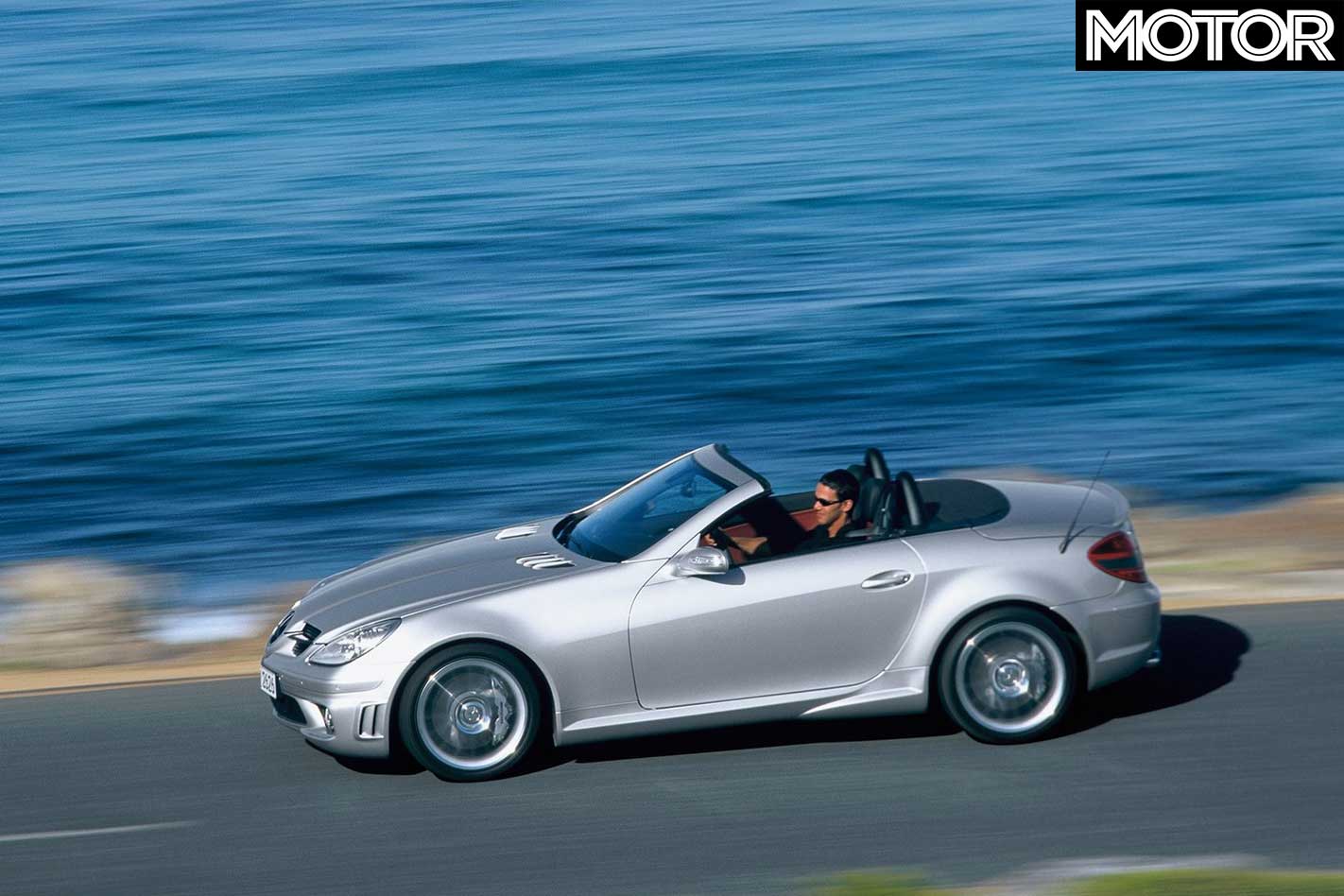
In the process, says AMG, you’ll trip over 100km/h in the first 4.9 seconds and there’s not a single mark on the speedo where you can’t mash the throttle and feel a real spurt-o-squirt.
Equally, there’s excellent part-throttle response via the dead-feeling gas-by-wire set-up and keeping the SLK wafting along requires nothing more than breathing lightly on the noise pedal every couple of kays.
Throwing seven forward gears at such an engine suggests a seamlessness will ensue, and so it does. The seven-speed auto shifts almost imperceptibly and only a bit of a clunk as it picks up the very lowest gears as you roll to a stop spoils the illusion of the thing not having fixed ratios at all.
Tragically, the dopey shift mechanism doesn’t give you full over-ride, so maybe it’s just as well the bugger is smarter than you to begin with. Even so, having decided to shift manually and then having the ’box shuffle its own deck makes you wonder what the hell Mercedes-Benz was thinking about when they specced the tranny’s brain.
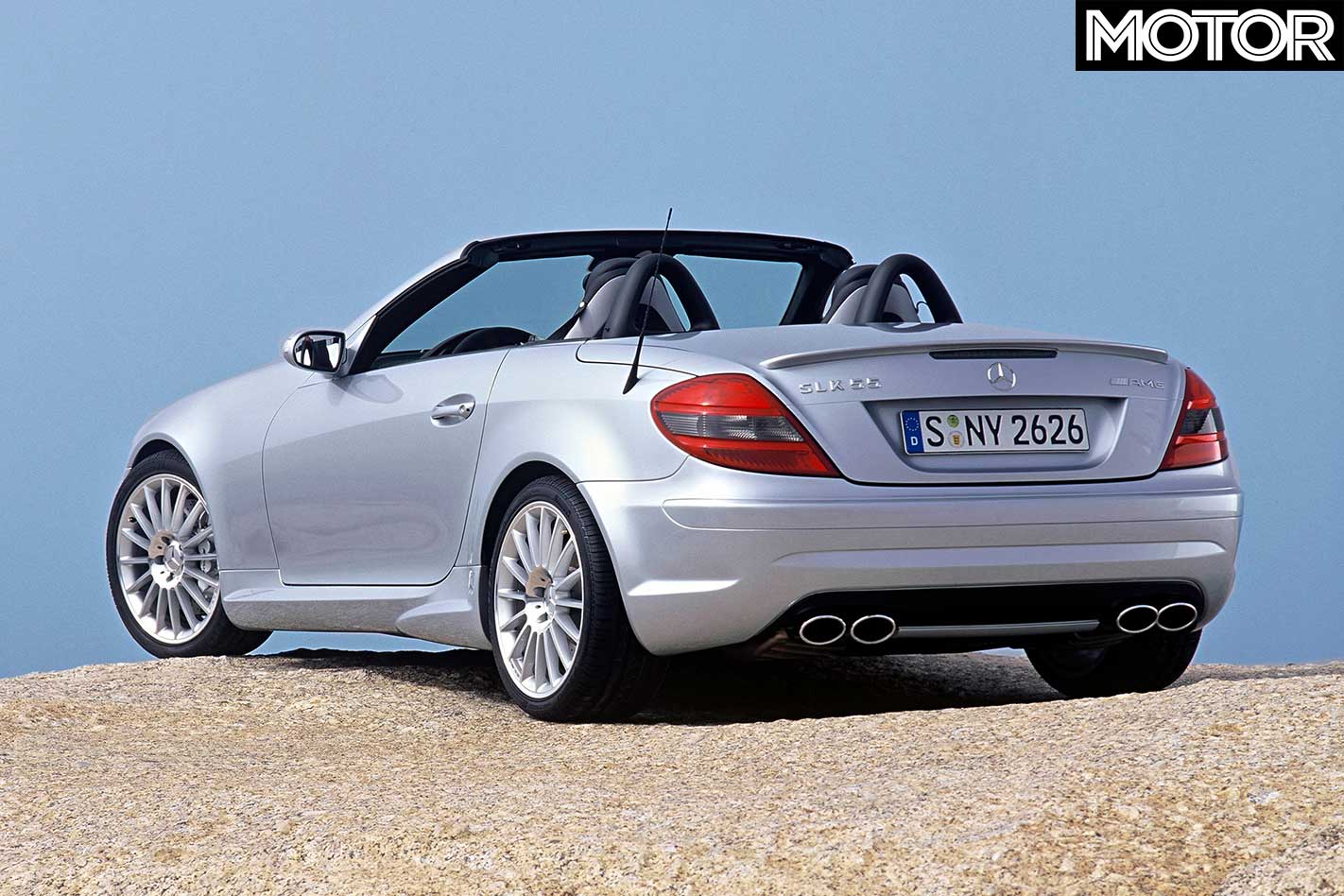
Maybe it’s the extra weight over the front axle, but the AMG version of the SLK doesn’t have the same rubbery steering feedback as the garden varieties.
Just as well, too, because given the 55’s propensity for piling on the pace, the last thing you want as you tip into a sweeper is a tiller that doesn’t want to talk to you.
Even then, it’s not as razor sharp as an M3, nor as talkative as a 911, but it does place the front wheels pretty much where you want them with a fair degree of repeatability.
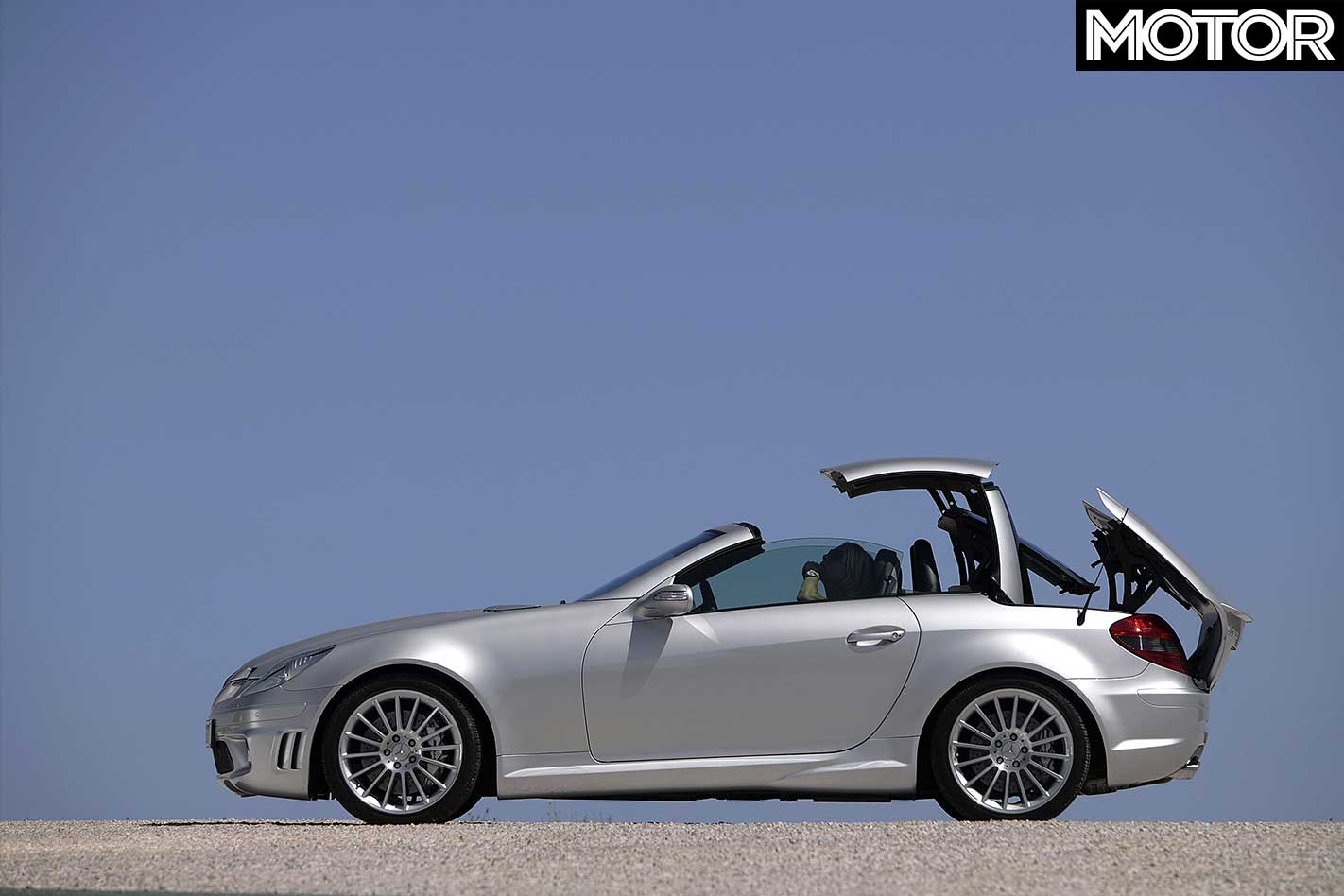
The rest of the deal is just how you remembered the SLK. The cabin is roomy (although it’s still a strict two-seater) and the ergonomics are faultless.
The clever tin lid that folds away in seconds is the best in the business and it all feels beautifully made, giving the impression that it’ll all still be working in another 30 years’ time.
And that’s about the length of time it’d take most of us to pay the bugger off.
FAST FACTS Mercedes-Benz SLK55 AMG Engine: 5.4-litre SOHC 24-valve V8 Power: 265kW Weight: 1540kg Drive: rear-wheel Price: $160,000 (est)
After almost 700km on a glorious Tuesday in April, one thing is clear.
Those who are in the market for an ultra-high-performance SUV might as well go straight to their nearest Lamborghini dealer.
Yes, there are quite a few rivals out there, but if you want badge cred, extroverted style, boisterous sound and performance wrapped in one, then the new Urus is exactly what you need. That’s, of course, once you get over the concept that a twin-turbo V8 SUV is something you ‘need’ in your life.
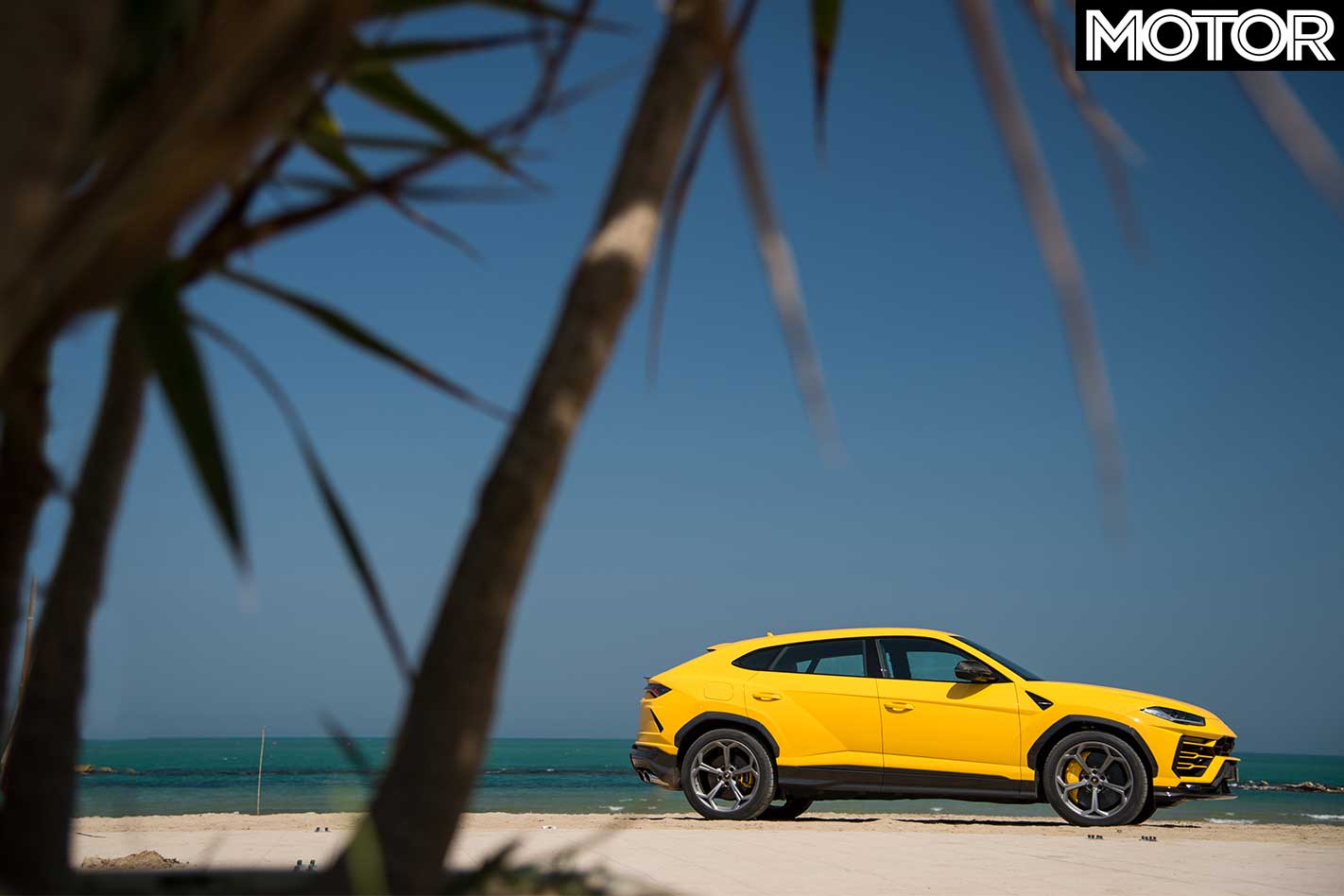
Believe it or not, the Urus is every bit as quick as the rear-wheel drive Huracan Spyder around the Nardo handling track.
You have to remind yourself that this is a 2200kg SUV. Yet, with 478kW on board, the power tends to outweigh the heft. Adding to that, there’s 850Nm (between 2250 and 4500rpm) of thrust channelled to all four wheels via an eight-speed auto, fusing diesel-like urge with petrol-esque punch.
So it’s safe to say the Urus is fast, then. But what about fans of the Defender and G-Class; will they look at the Urus in disrespect?
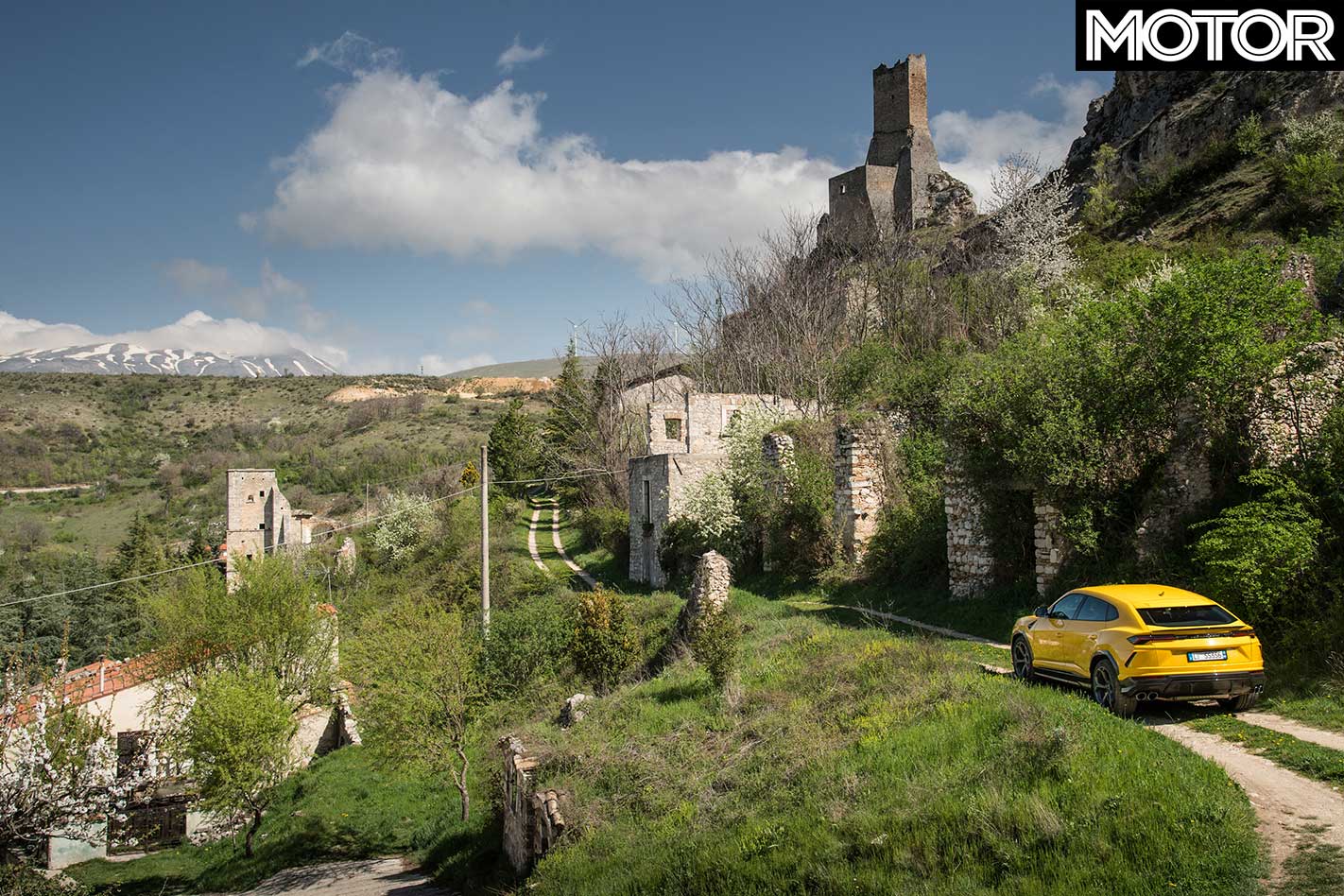
Although the low-profile Pirelli rubber and jewel-finish 22-inch rims, along with a lack of transfer case, probably will turn them off to start with. Still, in terms of actual off-road ability, the ‘rugged’ Lambo is a real pro when travelling on sand, through mud and over gravel. We have done a full assessment of the Urus’s off-road capabilities during our stint with the pre-production mules.
The reality is, though, that the Urus is likely to see bigger potholes than it is beaten tracks. And sadly, a sequence of surface imperfections will send shockwaves straight through the Alcantara-rimmed steering wheel and driver’s seat.
While smooth damper responses and a cat-like chassis compliance are not among the fortes of this Lamborghini, the Urus won’t lose its inner equilibrium. It never strays, and its proven German-built-tough DNA suggests it won’t break, either.
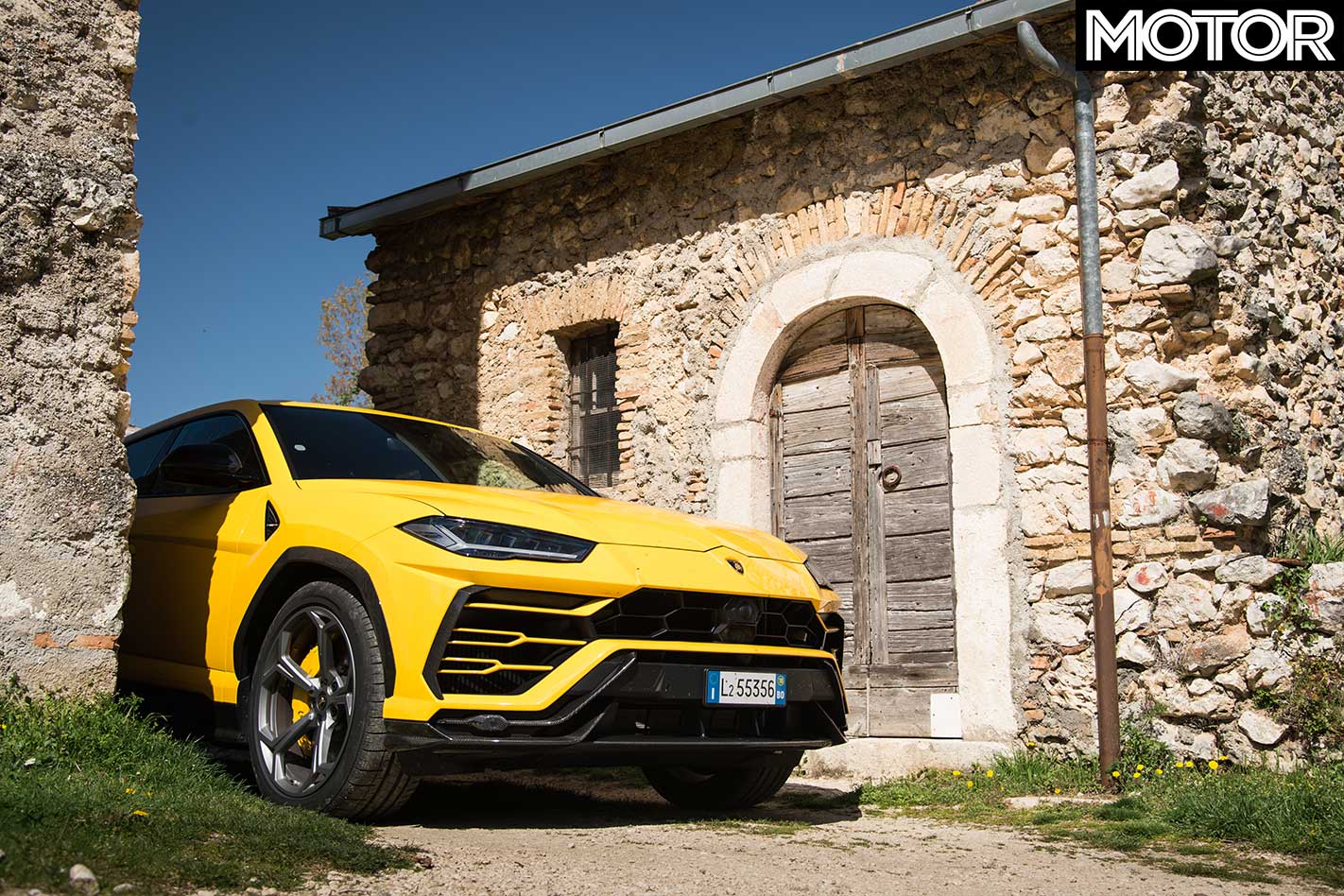
In just about all conditions, the secret-recipe Pirelli P Zeros clench the tarmac with rubber claws. The traction systems and torque vectoring step in to control the considerable lateral and longitudinal forces whenever the driver feels the itch to boot the throttle.
Dish up an adult portion of mid-range grunt, and the air suspension will duly summon its double cushions, the active anti-roll bars eliminate lean almost completely, and the rear-wheel steering keeps assisting the trajectory. Despite the considerable bulk and weight, the Urus is a confidence-inspiring piece of kit.
Like any modern performance car – ahem, I mean, SUV – the jacked-up Lambo has various driving modes from off-road, to comfort, to sport, etc. But let’s jump straight to Corsa, where the motto is fast and hard. Here the ESP works with a scalpel, the chassis feels like it tightens and the rear-wheel steering comes into play.
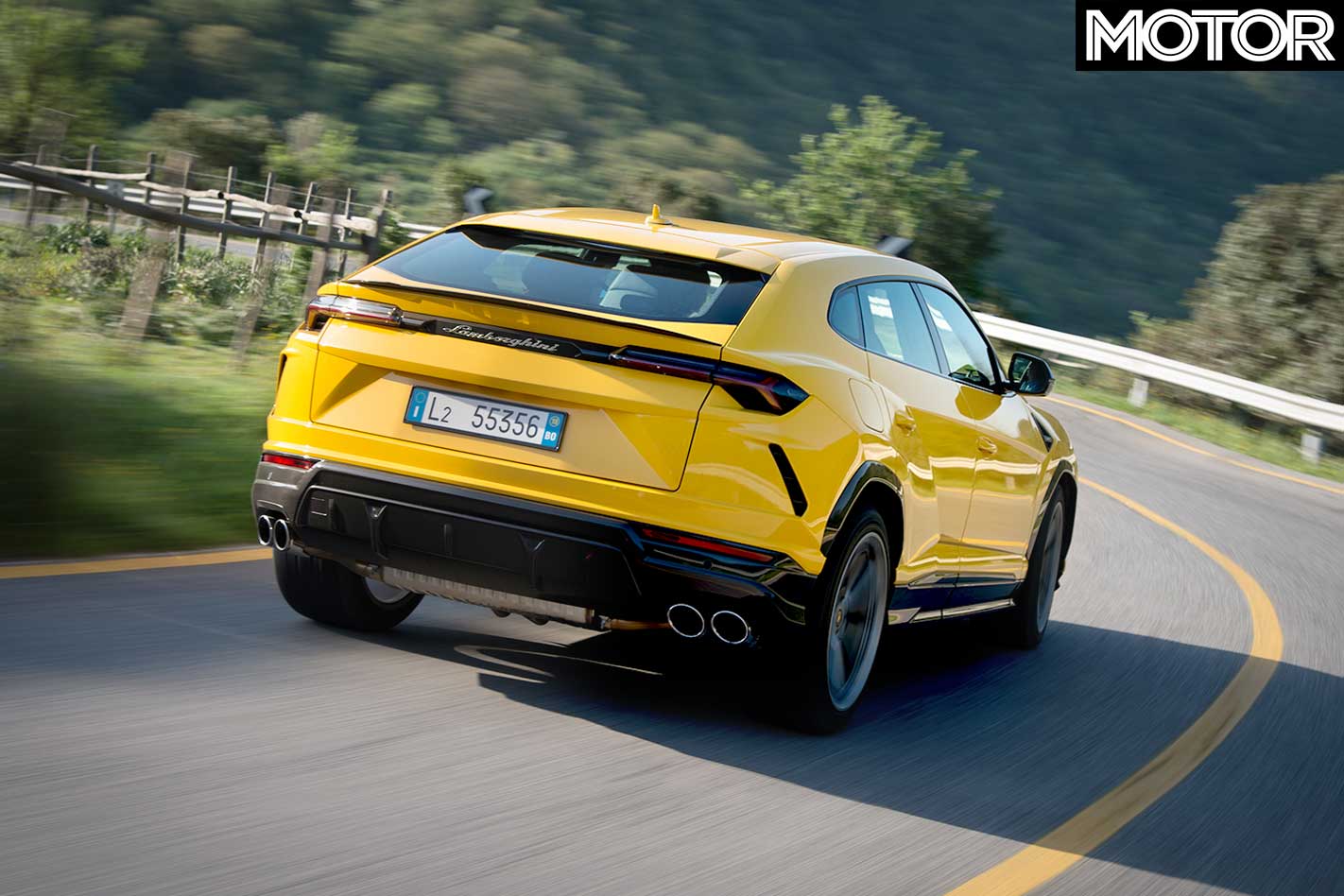
Sadly, you can’t have 95 per cent of the variables in hyper-active Corsa and the dampers in cushy Comfort at the same time – you can in a Ferrari. This may be a disadvantage on paper, but it is almost irrelevant on the road where Comfort is more of a token gesture than a true orthopaedic aid.
Still, you can’t help but question whether it is actually as fast as a Huracan on a twisty road – you bet it is. Unlike the Spyder, the new SUV musters quantifiably more spring travel, an extra hand’s width of ground clearance, exceptional composure and tangible torque vectoring.
In its segment, the Lamborghini Urus epitomises dynamic excellence. Despite all the mechanical and electronic wizardries, you can always feel, if only to a varying degree, that going really fast is a challenge to the driver and not a computer-controlled virtual reality excursion. It’s engaging, which is, in many ways, the biggest surprise.
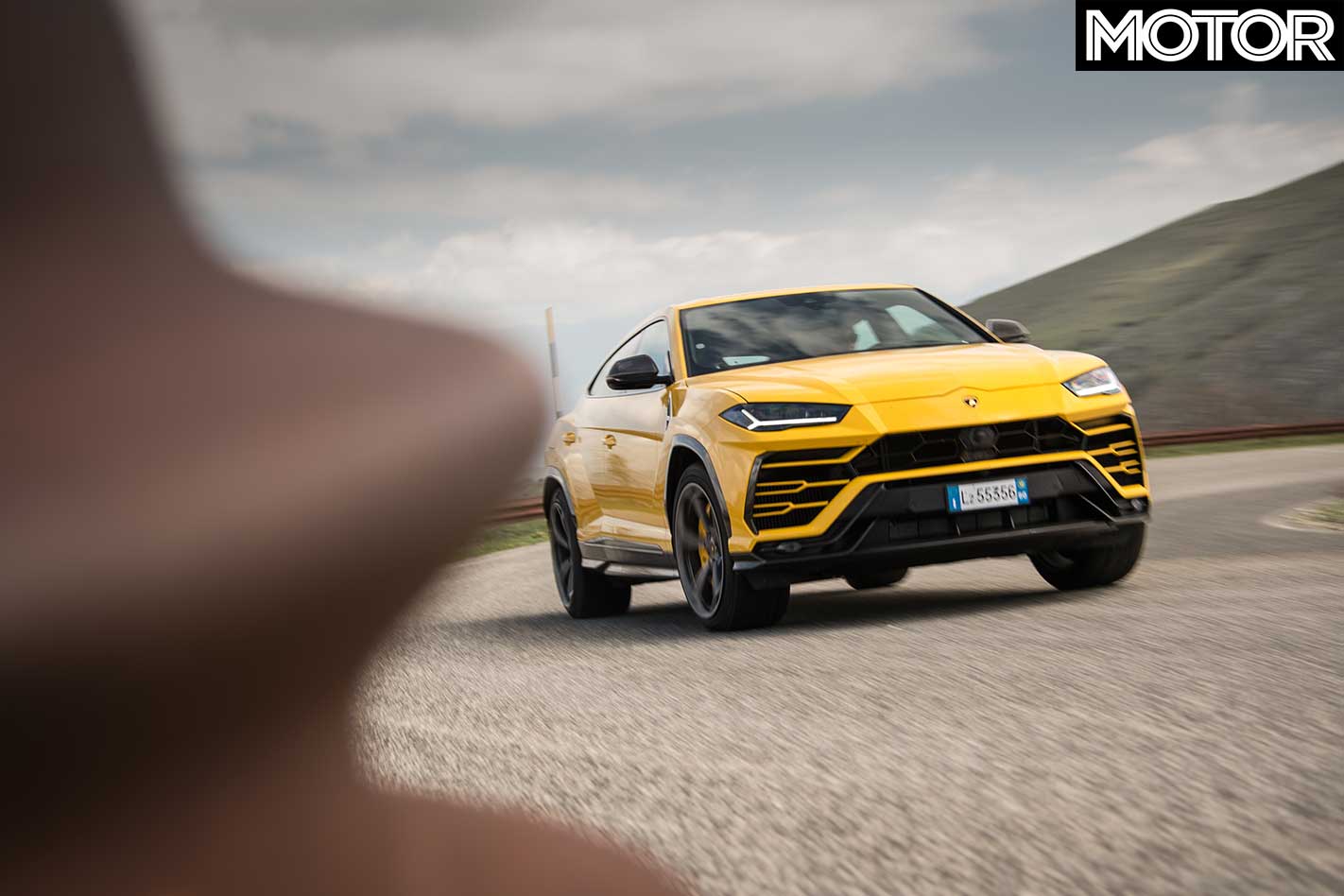
Given the performance at hand here, it’s lucky that before things go seriously wrong, the carbon-ceramic brakes feel as though they are pulling your eyes out of their sockets. The giant 440mm front discs offering plenty of purchase to arrest the pace. Still, if the brakes don’t pull you up, the scary fuel consumption and rather small 75-litre tank certainly will.
Despite the purist’s cry for a sonorous atmo V12 (think LM002), it’s the exhaust which leaves the most lasting impression to those left in the wake of this crazy SUV.
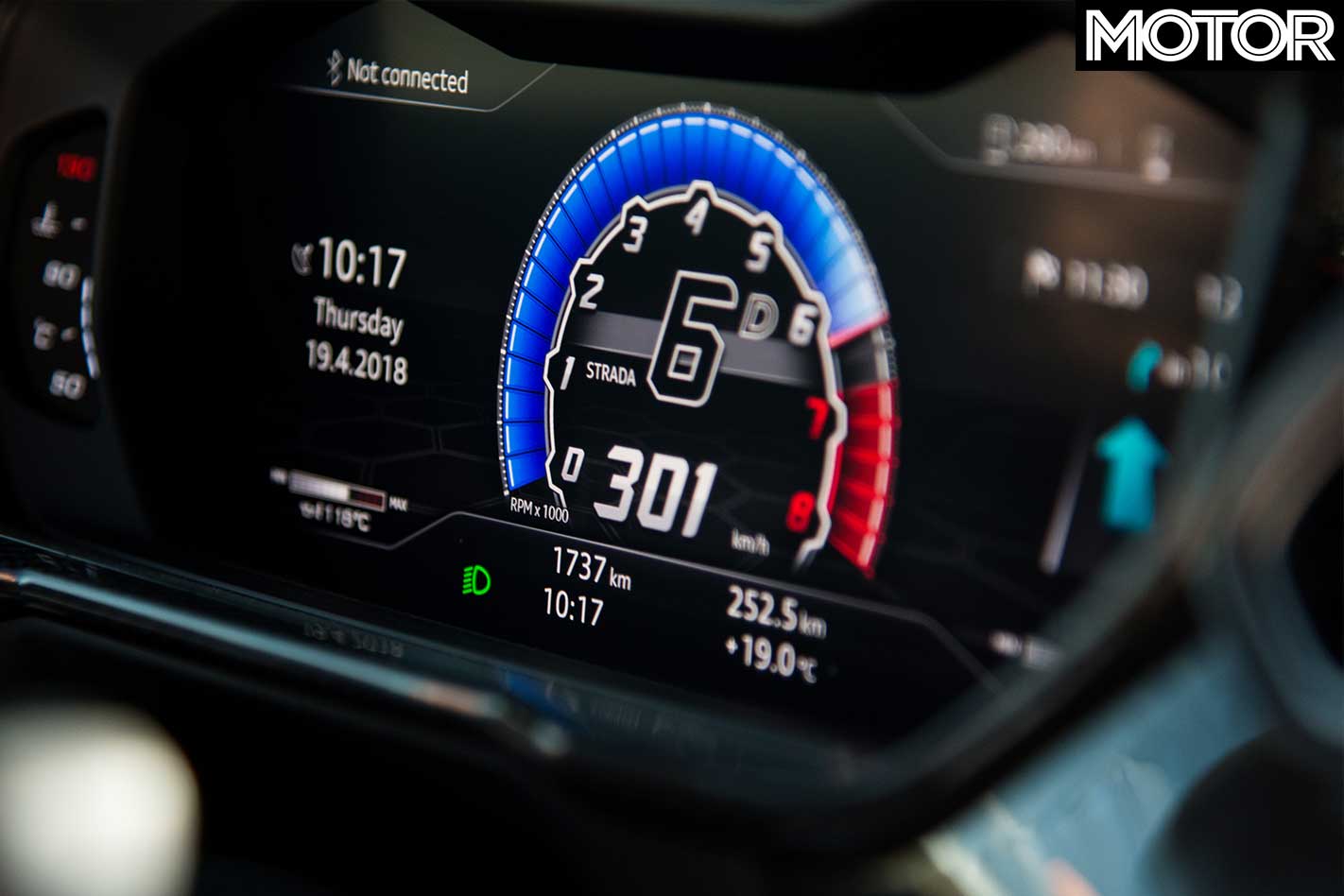
After all, full throttle in a low gear rocks the ancient Autostrada tunnels to their very foundations, while raucous, intermittent downshifts make paint chips flake from the ceiling and the overrun is equally as intense. It threatens to deafen anything within earshot. While it doesn’t have a V12, the acoustics are still an event – and so they should be for a $390K Lamborghini four-by-four.
Inside, the Urus looks like a Q7 on drugs… stick with me. The hexagonal trademark motif inspired by the Marzal concept car from way back when is the overriding theme – like the Nike swoosh or the M of the golden arches. The rainbow design of the centre instrument cluster mixes Atari overtones with futuristic graphics, suggesting the creator originated deep within the PlayStation generation.
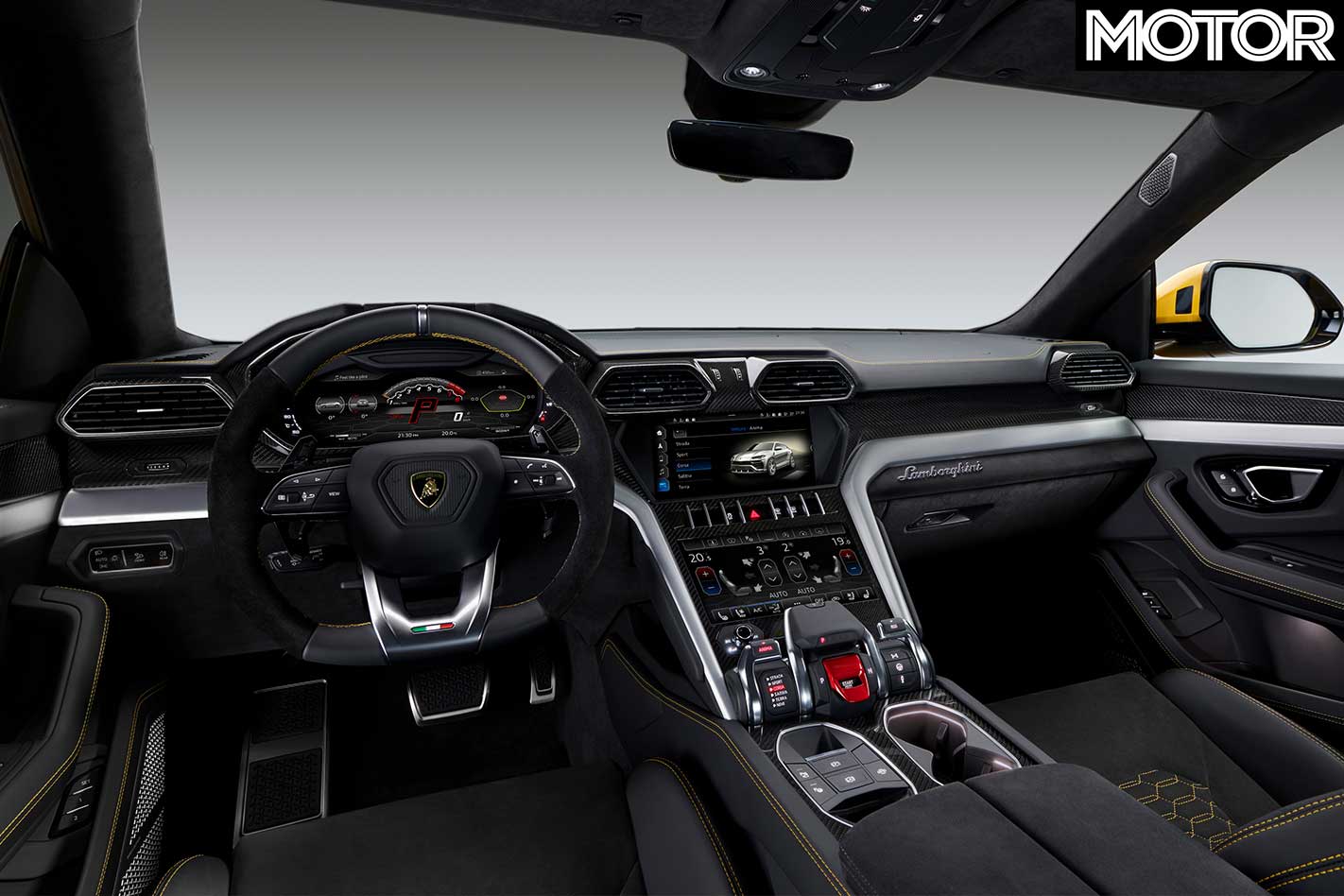
The long horizontal array of tiny push buttons separated by even tinier silver dividers that runs along the centre stack is still as confusing as it was in the Gallardo. The main in-dash screen is now of the push-button kind, which doesn’t help much because its location renders it out of reach for some drivers and it collects greasy fingerprints.
The Alcantara-trimmed seats could do with longer cushions and more supportive squabs, but there is leg and headroom in abundance, if only for the driver and the front-seat passenger. What’s not to like is the letterbox view through the rear-view mirror, the compromised packaging in row two and some ergonomic idiosyncrasies. Still, when have you had a 575-litre boot in a Lamborghini recently?
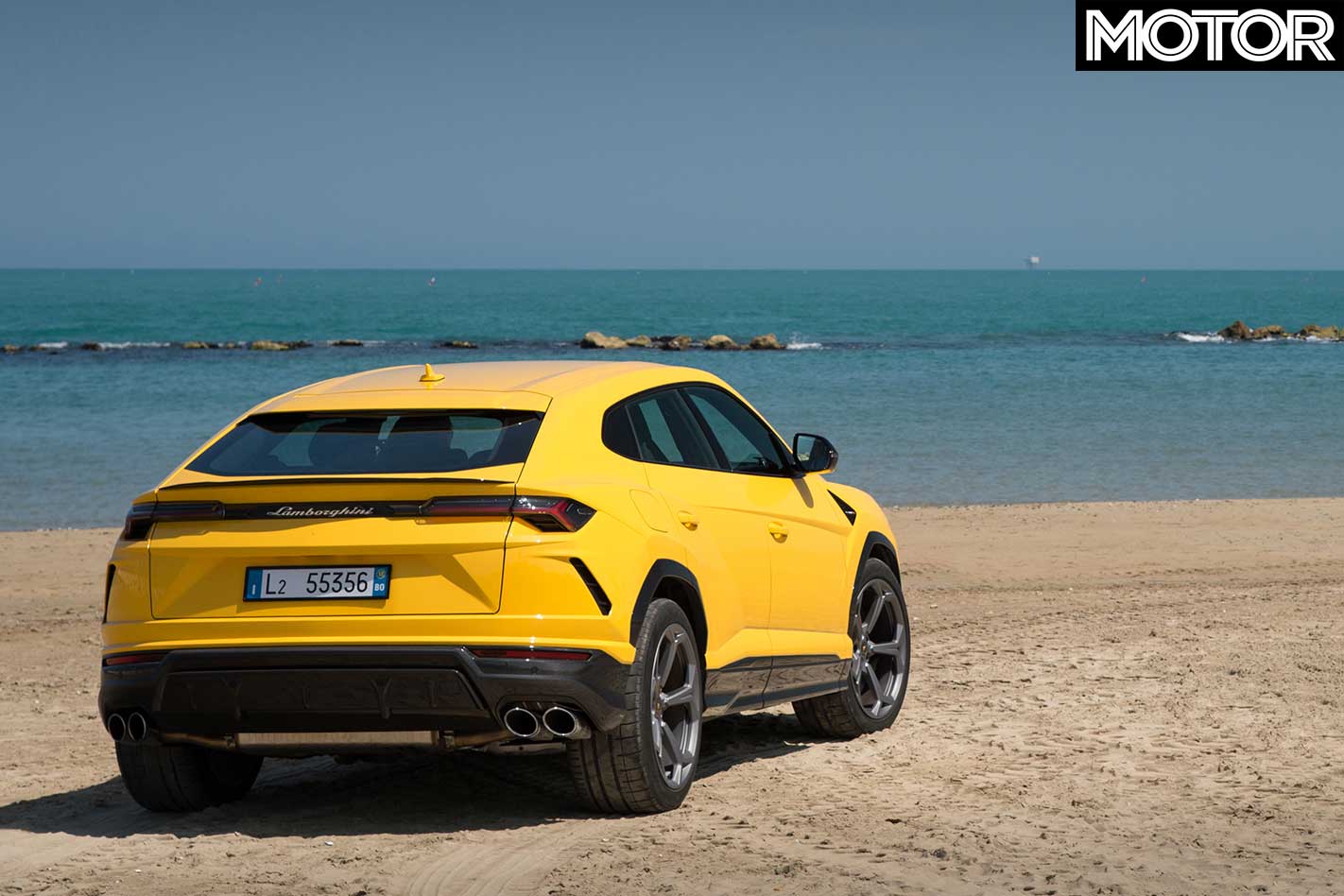
Ultimately, what matters is how the Urus makes you feel. It is a Lamborghini after all. And when you hear this thing between 5000 and 7000rpm in all its big-bang glory, you’ll feel a lot.
It has a seductive blend of roadholding and straight-line performance that’s coupled with a depth of feedback that runs through the steering, drivetrain and brakes. Oh, and it gets 11 out of 10 for street cred (according to some). And with predicted sales of 3500 per year (which would double Lamborghini’s production), you better get used to seeing this super-SUV hounding your rear-view mirror.
The Nemesis
2018 Porsche Cayenne Turbo 4.0-litre twin- turbo V8, AWD, 404kW/770Nm, 0-100km/h 4.1sec 2175kg, $239,400
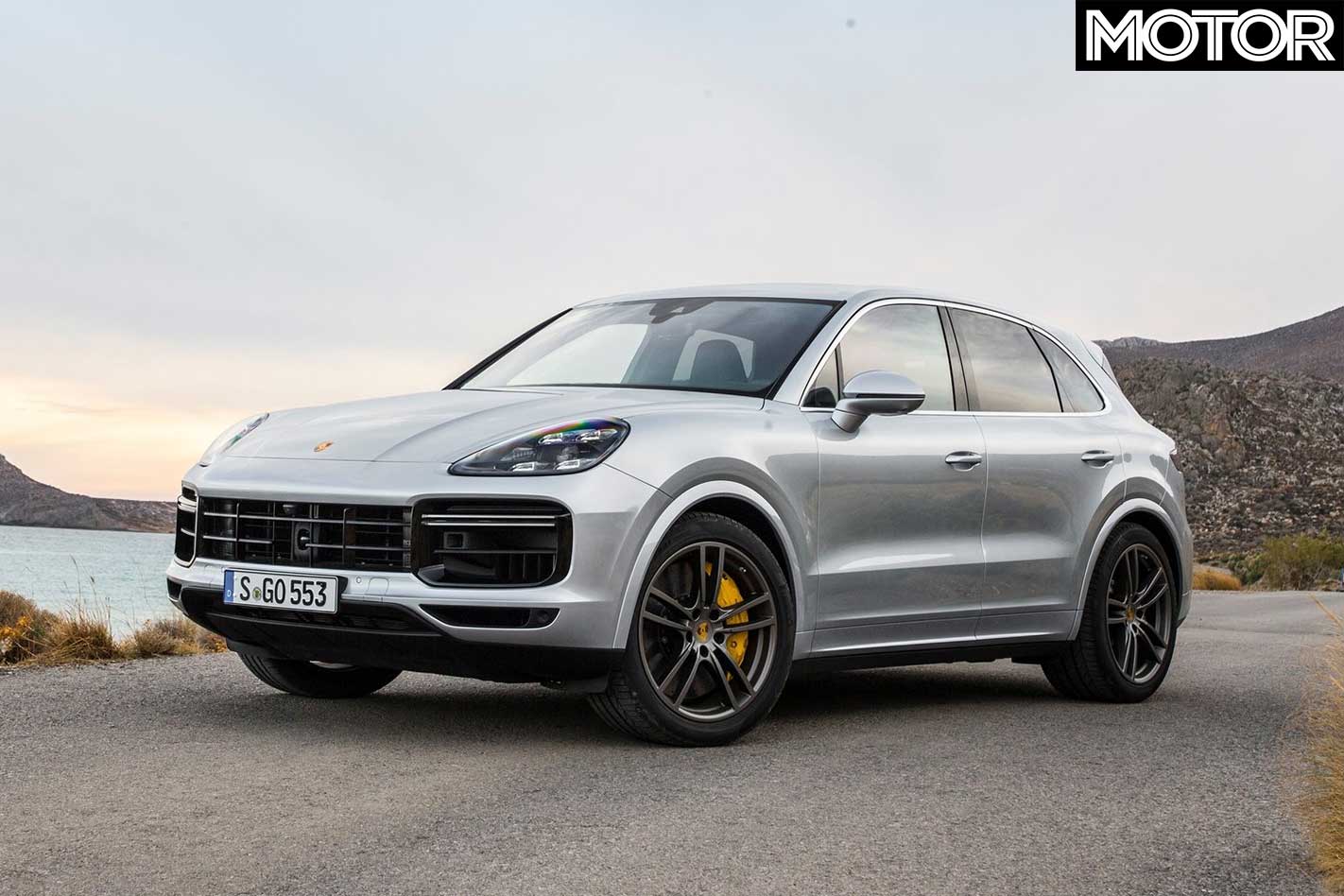
While we wait for the release of the berserk Cayenne Turbo S, the current range-topping Turbo continues to redefine the laws of physics. With a 4.1sec 0-100km/h time, it’s almost a match for the Lambo on pace – it’s also the pragmatic choice.
2018 LAMBORGHINI URUS SPECS: Engine: 3996cc V8, DOHC, 32v, twin-turbo Power: 478kW @ 6000rpm Torque: 850Nm @ 2250-4500rpm 0-100km/h: 3.6sec (claimed) Weight: 2200kg Price: $390,000
Rating: 4.5 out of 5 stars Like: Blends Huracan pace with Q7 off-road ability; impressive handling; sound Dislike: Ergonomic flaws; compromised packaging; rear vision; no thumping V12
SOME of the fastest cars on sale in Australia have been scooped up in the widening Takata scandal, with the recall overnight adding another 1.1 million cars to the official fix list.
The Ferrari 488 GTB and Spider, which can both dispatch the 0-100km/h sprint in a claimed 3.0 seconds, have joined an expanding list of cars needing replacement airbags – a list that also includes every single model in rival supercar brand McLaren’s showroom.
The growing list of recalled vehicles adds airbags to the list that are safe for the moment, but are under a future safety cloud as the propellant used in them ages and reduces the airbags’ effectiveness in a crash.
The Australian Competition and Consumer Commission’s website now also lists dates that the carmakers will start rolling out recall programs, details of which airbags need replacing, and also details of whether the replacement airbag being installed will need to be replaced again in the future. All Takata airbags must be replaced with non-defective units by 2021.
The recalls will be staggered according to geographic regions, with cars located in areas with high heat and humidity given priority over those in more temperate climates, and driver’s airbags given priority over passenger ones.
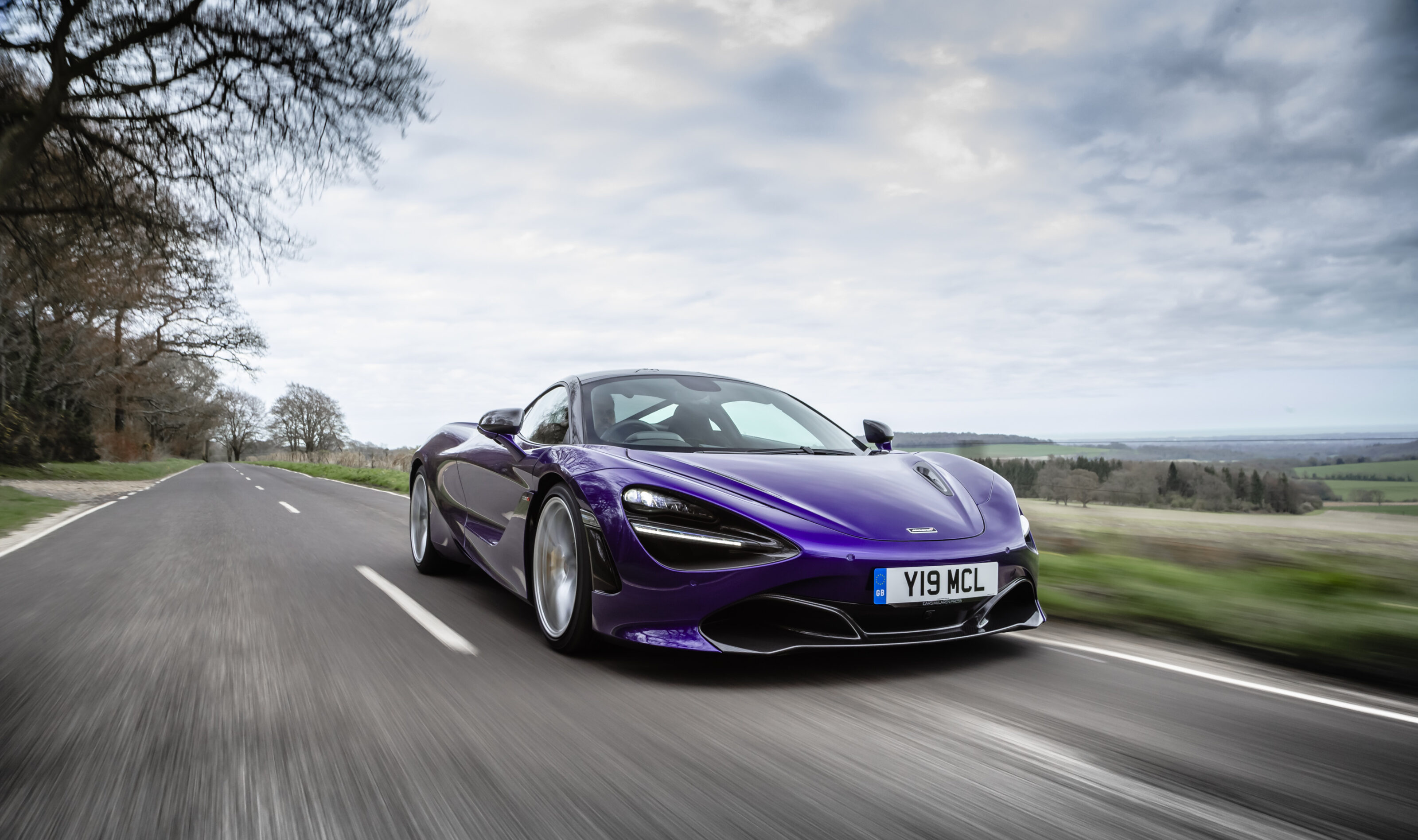
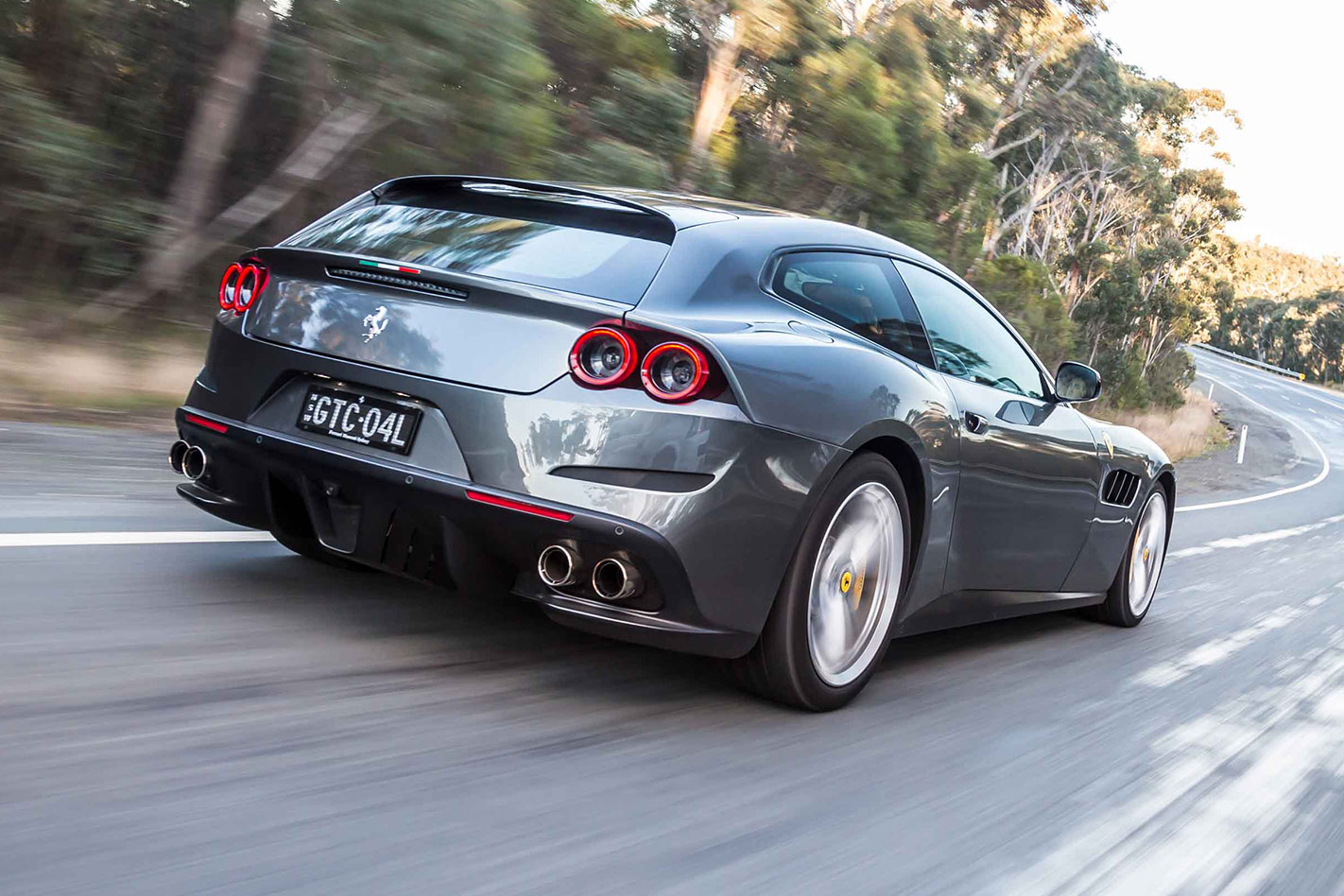
The recall also covers a number of new cars on sale this year, including the Ferrari 488 GTB, 488 Spider, California T, F12 Berlinetta, F12 tdf and GTC4 Lusso; the Holden Barina, Cruze and Trax; what appears to be McLaren’s entire showroom; and everything in Skoda’s showroom apart from the all-new Karoq.
Carmakers are picking up the cost of the recall. Holden has estimated the more than 300,000 cars it will need to fix as part of the Takata scandal will cost it up to $53 million, with only a portion of that being charged back to GM’s global divisions that built the vehicles – namely the now French-owned Opel, and GM Korea.
However, not everything appears to be going smoothly, with one industry insider telling Wheels the antiquated recall system was in need of a radical overhaul to bring it into the modern era. “The recall legislation calls for manufacturers to contact people via a mailing address, but that’s getting us the lowest response rate,” the source said. “The two methods of contact that are showing the most success are mobile phone numbers and then emails, but we often don’t have access to these details.”
The industry’s concerns also fly in the face of information provided by Assistant Minister to the Treasurer Michael Sukkar, who said owners would be notified by email, phone or text message when a vehicle’s airbag would need replacing.
Also of concern are second-tier governments unwilling to help carmakers contact owners, the source said. The industry is believed to be lobbying for access to up-to-date contact information contained in state- and territory-level vehicle registration details, with some departments willing to help, but others baulking at putting voters offside.
The Takata scandal is already responsible for 23 deaths worldwide, and 230 injuries. In Australia, the fault has been linked to one death and a single serious injury. More than 100 million vehicles are believed to be affected globally.
AUSTRALIA’S Daniel Ricciardo has come out victorious in a gruelling duel on the streets of Monte Carlo.
Ricciardo had topped every practice and qualifying session before the race, then led every one of the race’s 78 laps – but that belies the difficulty of the Australian’s victory.
Early in the race it became clear there was an issue with Ricciardo’s power-unit, with the Red Bull down on power and top speed compared to second-place finisher Sebastian Vettel.
But despite the engine issue, Ricciardo dug deep, and held on through a tense race to claim his first victory at Monaco.
The victory is redemption for the Honey Badger, who came tantalisingly close to his first Monaco Grand Prix win in 2016.
Lewis Hamilton rounded out the top three, ahead of Kimi Raikkonen and Valtteri Bottas.
The seed which became Ricciardo’s victory was planted on Saturday, when he qualified on pole, breaking the track record in the process.
Max Verstappen was close to his teammate in practice, but a shunt in FP3 caused the Dutchman to miss qualifying, starting from last place. He recovered to ninth.
The streets of Monte Carlo are notoriously difficult to pass on, and the tyre selection for the weekend – which included the new-for-2018 hypersoft compound – didn’t help during the race, which was rather processional with the top six qualifiers finishing where they started.
Ricciardo joins Sir Jack Brabham and Mark Webber as the third Australian driver to win at the Monaco Formula 1 Grand Prix.
Tim Slade’s driven 700 horsepower cars before.
He is, after all, the current World Time Attack Challenge king and a Supercar series driver.
But what about in a kerb-crushing soft roader like a Jeep Grand Cherokee Trackhawk? The brand launched its new range-topper at Phillip Island circuit last week and the tame racing driver was on hand to test its limits on track.
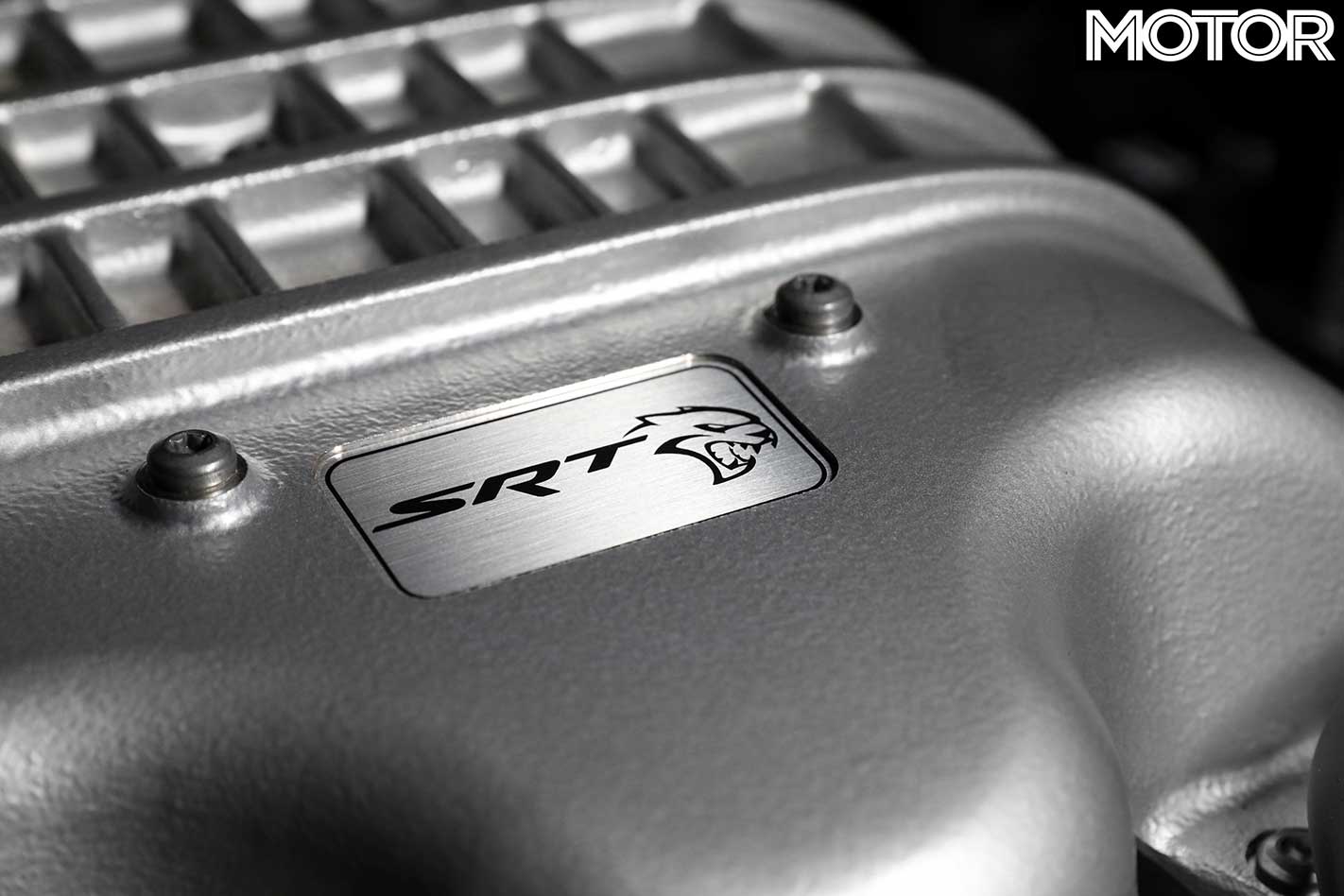
With a 6.2-litre supercharged V8 from the Dodge Challenger Hellcat lurking in its nose it produces an incredible 522kW and 868Nm.
“The most impressive part is the grunt,” Slade told MOTOR. “It’s got so much torque so it’s good out of the slow speed cornere here. Lots of punch.”
Power isn’t the only big figure. With all-wheel drive, room for your family and dog, and that engine, the Trackhawk tips over 2.4 tonnes on the scales.
Specially reinforced Pirelli P Zero rubber and stiffer spring rates help the Trackhawk keep its mass in check. But Slade confirms you can’t fight physics.
“If you push too hard into the corners with the car being big and heavy and soft it uncouples the rear a little bit,” he adds.
“You end up fighting the car into the corner as opposed to bringing your braking marker back to make sure you can get in smoother an carry more entry and mid-speed.
“That’s the best way to get the car nice and square and get all that power to the ground.”
Footage-wise, an errant wheel weight means a vibration creeps into the cabin at high speeds and the audio’s a bit dodgy.
But seeing him wrestle this beast around one of Australia’s fastest tracks is an interesting experiment. The Trackhawk laps the circuit in 1 minute and 53 seconds.
That’s about as quick as a well sorted hot hatch.
Unsurprisingly, the $134,900 behemoth is more comfortable in straight lines. Jeep quotes 0-100km/h is dispatched in 3.7 seconds. Quicker than any other SUV currently on sale.
Stay tuned for our write-up next Friday.
Ever been to a fancy-dress party where two blokes have both turned up as Superman?
There are a couple of things wrong with this, starting with the fact that you’ve just found yourself at a fancy-dress party. And second, two delta-males trying to be the same thing at the same time is never going to end well.
Odds on there’ll be tears, starting with failed attempts to use X-ray vision to guess the colour of the hostess’s knickers. That’ll be followed by the sound of ambulance sirens as one wannabe superhero takes a swannie off the roof of the chook shed, trying to prove that only the real Superman can ‘fly’.
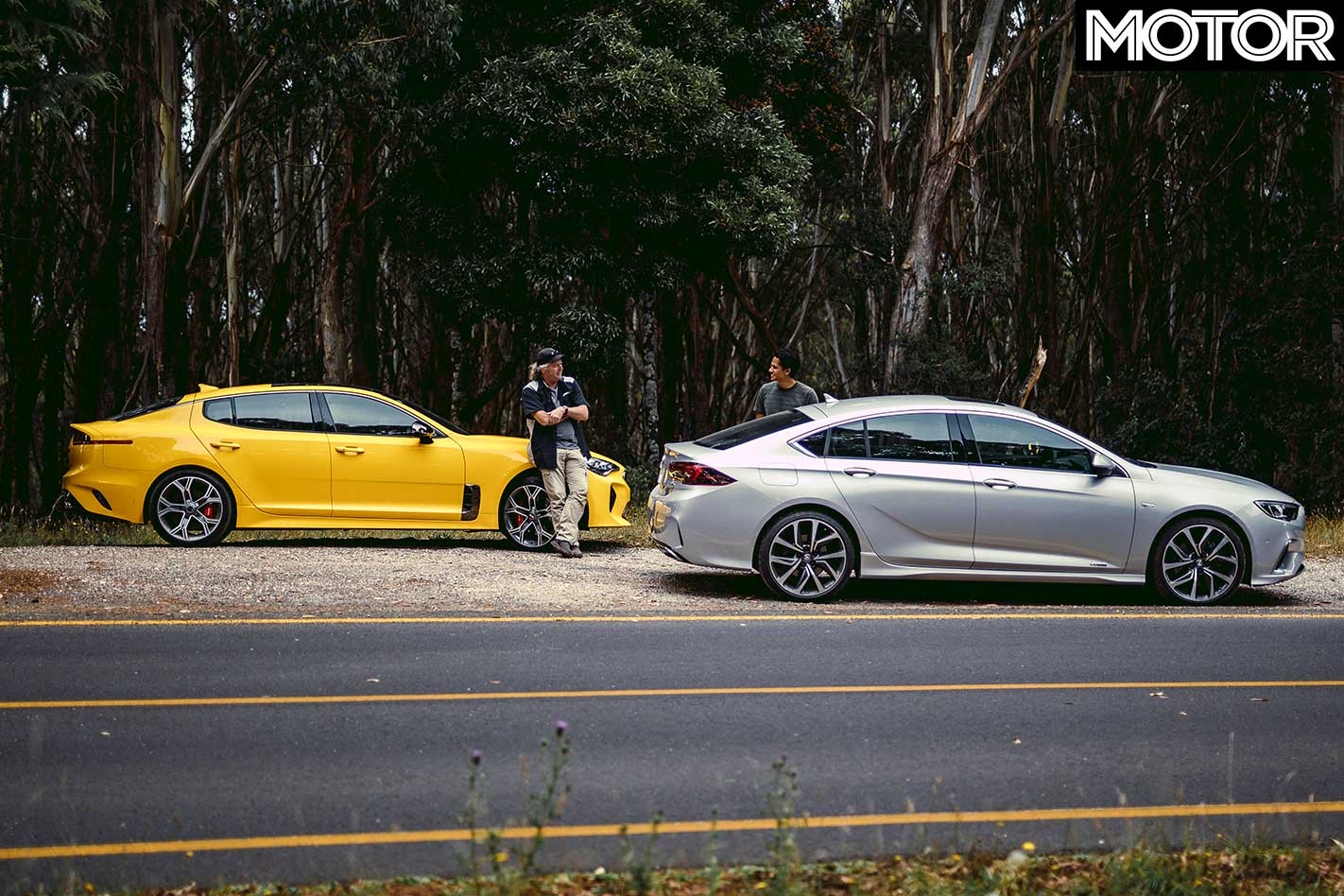
Okay, so we all know that a successor to something like the VF SS-V Redline will probably never exist, but in the meantime, both the Kia and the new Holden are sniffing around the ruck to pick up the rear-drive-Commodore crumbs.
The Kia, as the cleanskin, probably has less at stake, because it’ll attract its own followers regardless of any sense of tradition, imagined or otherwise.
For its part, Holden freely admitted to MOTOR that it knows the new ZB will never sell as well as the VF, nor will it ever attract the same quorum of default buyers who bought a succession of Commodores over a succession of decades. But don’t be fooled by such frankness; both these cars have a job description that involves – among many other things, admittedly – luring VF (and Falcon) owners in for a look-see.
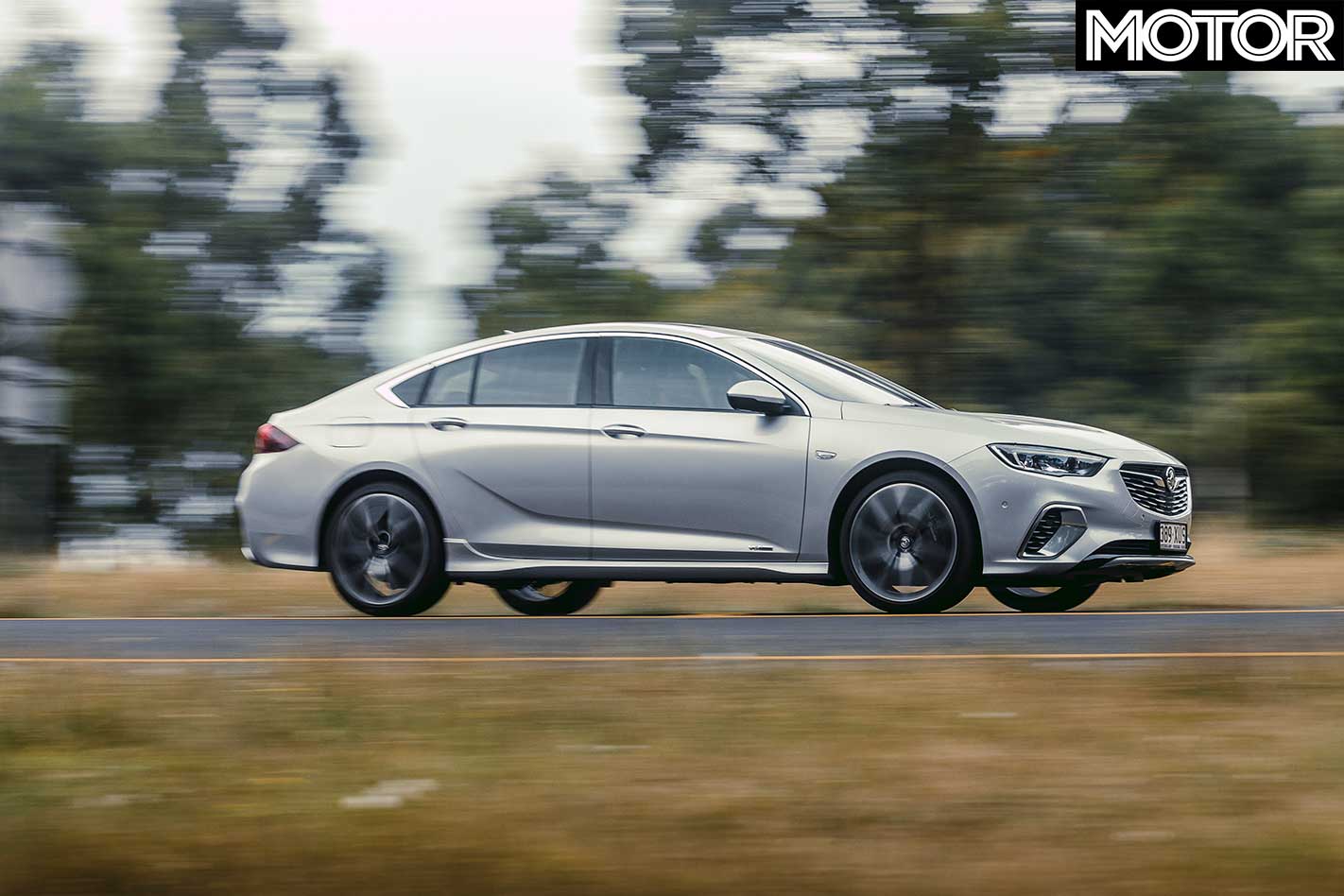
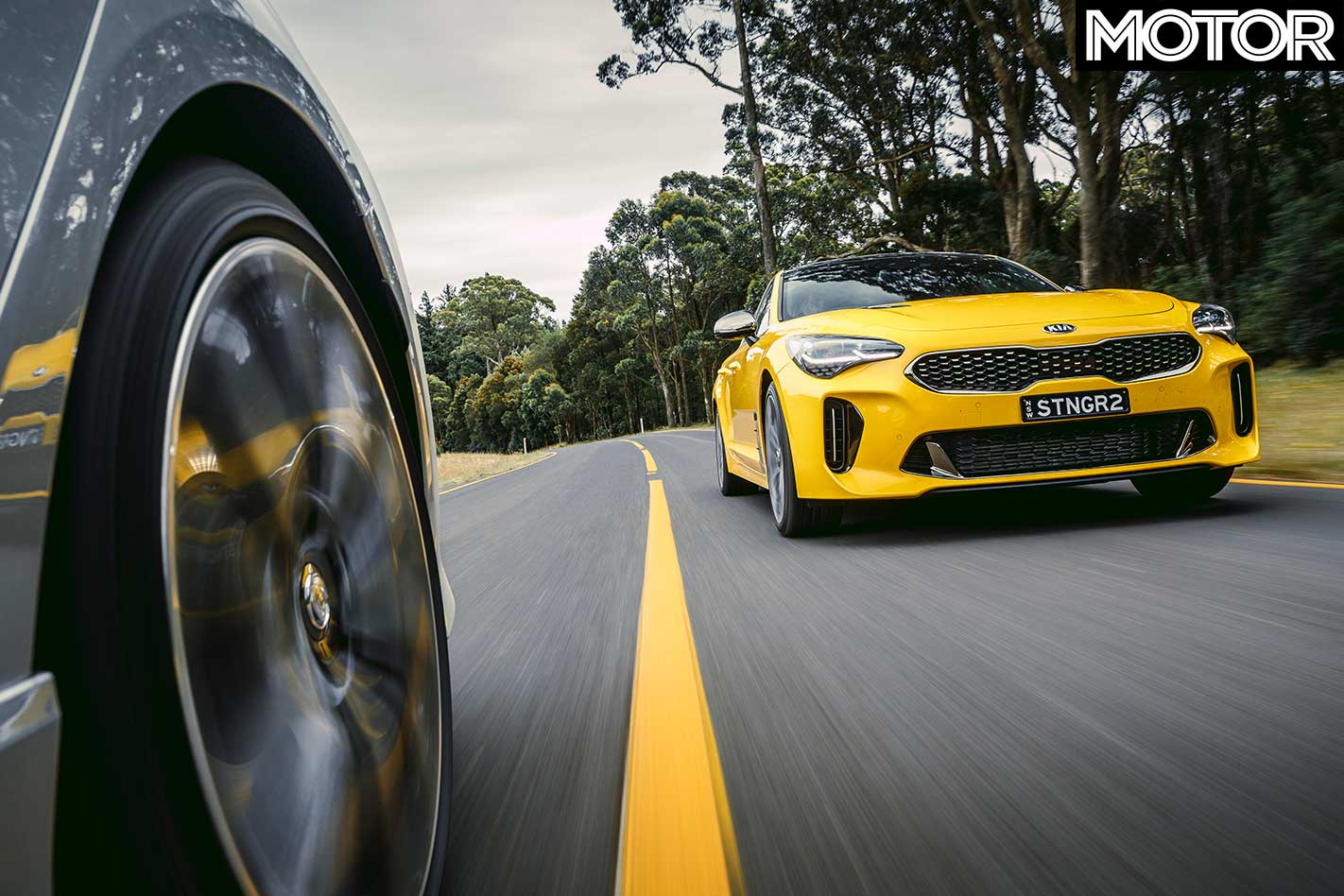
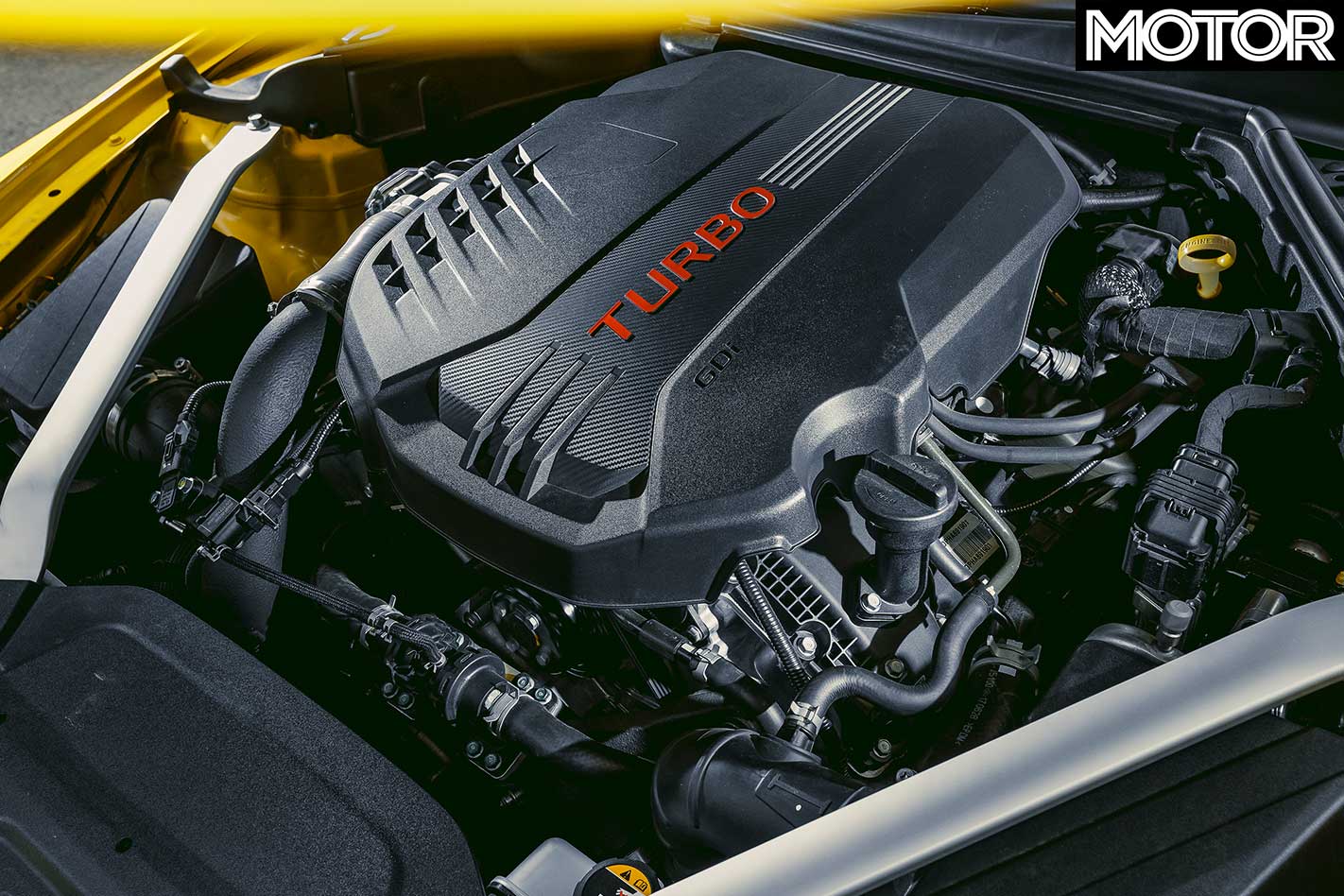
Ironically, it’s the non-Holden Kia Stinger that probably makes the most convincing case on paper. It’s rear-drive, just for starters, and that must surely be one of the big talking points for those staring at a lease-is-up VF or FG-X in the driveway. The Stinger isn’t a V8, of course, but at least with a pair of turbos bolted to the 3.3-litre V6, it makes the sort of power that local-V8 owners can relate to.
The ZB? Er, not so much. Yes, it’s a V6, but packaging constraints mean that there’s no hairdryer on board. And while it isn’t front-drive, it isn’t rear-drive, either, and the best Holden could come up with was to install all-wheel drive onto a platform that was essentially a tail-dragger in its purest form. And the Holden – despite what the contrived engine cover suggests – has its engine mounted east-west to prove the point.
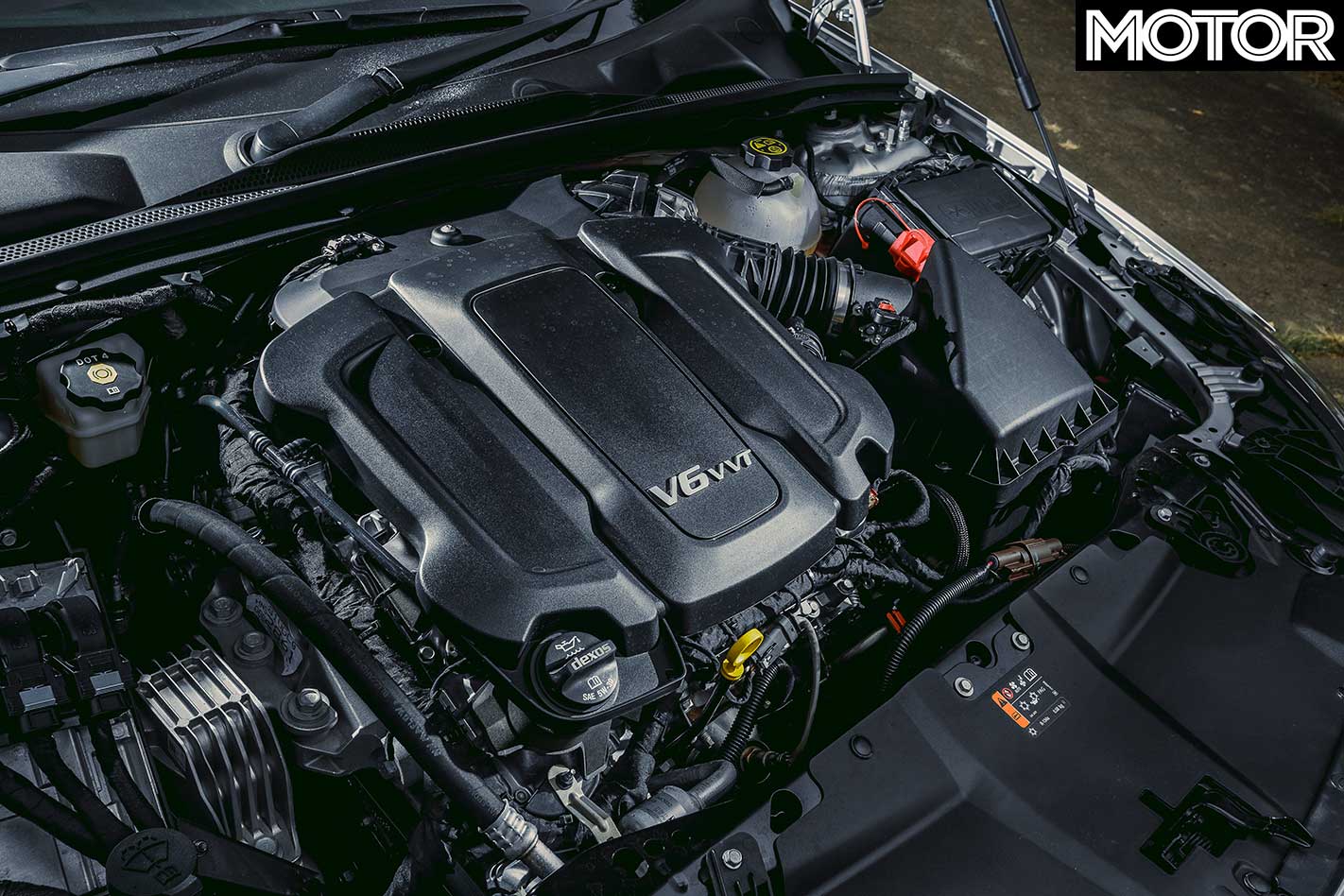
And guess what else? Neither of these cars is actually a sedan. They do their best to look like sedans (and the Holden is a bit more convincing) but the fact is that both are five-door liftbacks.
That said, they’re both quite handsome cars, although we reckon the ZB is a bit less obvious. That long snout on the Kia could, if you were the cruel type, be described as a bit try-hard. Nor is there a single manual gearbox option to be found anywhere within the Stinger and Commodore ranges and while that’s a reflection of 2018, it’s also an oversight for any carmaker trying to rope in an old-school car guy (or gal).
So if we’re not talking traditional performance sedan values, what are we dealing with when the stopwatch appears?
The Commodore certainly makes plenty of grunt with its 235kW but, without turbine-assistance, it’s all stacked up pretty high and the thing needs a solid rev to get going properly. That’s helped by the nine-speed auto which has plenty of low ratios on hand, but the 0-100km/h time of 6.1 seconds is left in the shade by the blistering five-seconds dead of the Stinger which, with a full 272kW and turbocharged mid-range to propel it, simply racks off.
We didn’t get a chance to run quarter miles back-to-back, but given the 0-100 time for the ZB, you can bank on something like a mid-14 for the 400m (that’s what it feels like, anyway). Meanwhile, the Stinger has just rattled off a 13-dead or maybe even a high-12 over that same stretch of hotmix and is already backstage in the green room, swilling Jack and eating caviar, having just performed a 400-metre mic-drop.
On the real roads of this wide, brown land, the gap closes up considerably. Why Kia thought it would be a good idea to team that crackerjack engine with a dumber-than-a-box-of-hammers auto is beyond us. Not that the eight-speed doesn’t shift nicely, because it does, but it’ll only hold the gear you select for about six seconds before it reverts to full auto. Why not flip it into manual mode? There isn’t one!
No, really, there isn’t. I checked twice. And even if you do issue a manual upshift command via the flippers, push the throttle past the détente and the Kia will kick-down as many gears as it physically can, even though your upshift instruction mere seconds ago would suggest this was not what you wanted.
The ZB’s nine-speed unit seems like one better, but in some aspects it’s not.
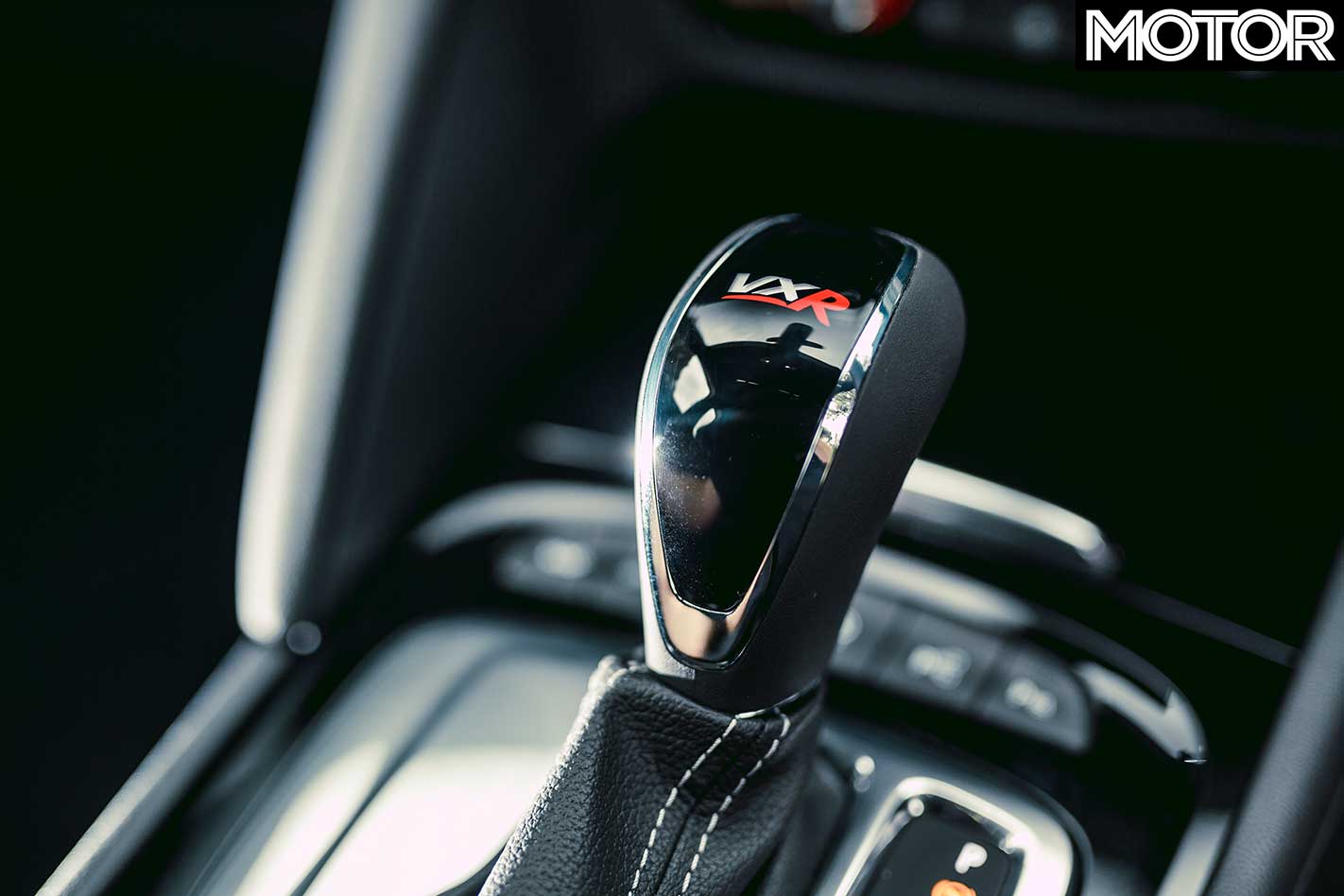
See, nine ratios sounds techy and grooved-up, but the reality is that there’s so little difference in ratios, particularly between second and third, that shifting twixt them manually feels more like the torque-converter has had a brain-fart rather than an actual ratio has changed. In part-throttle going, the ’box will probably shift from second straight to fourth and you won’t ever know it.
The other grizzle is the tall, tall gearing and Holden’s obvious attempt at chasing a fuel consumption number for the windscreen sticker.
At 100km/h in ninth, the ZB’s V6 is turning about 1500rpm which, really, isn’t far off idle and at a point in the rev range where it’s making about 12 horsepower (or so it feels). Which is fine if you’re shifting the cogs yourself, but left in D, the Holden will actually drop into top gear as low as (according to my tests) 84km/h.
At that point the engine is turning about 1300rpm and the poor old thing is lugging. In turn, that sends a shiver of discontent right through the seats and floor and a gravelly tone through the cabin. Not nice.
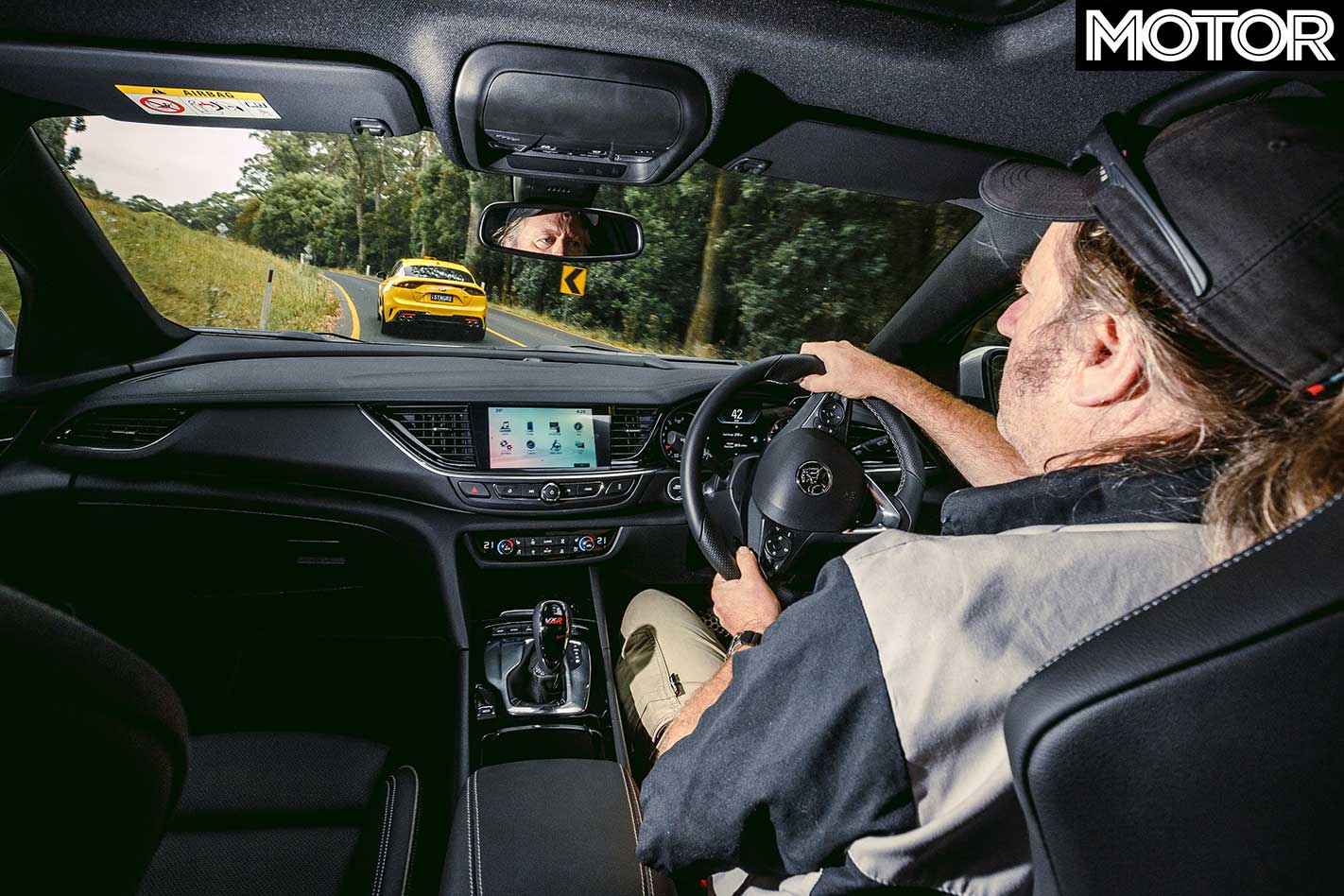
And switching the ZB’s tranny to Sport mode doesn’t fix it, because ninth is still available from 84 onwards. And you’d be amazed (I was) at how much time you spend around the mid-80s in this modern world. I’d be looking for a tuner who can re-flash the thing to rule out top gear below about 110km/h. It is, after all, just software, right? Curse those official fuel-consumption tests.
Beyond that, though, the Holden wins for aural appeal with its meaty V6 yowl, while the Kia sounds like it is lacking. Bring on the optional Kia zorst, I say.
Throw these cars at some corners and the Holden catches up even further. Okay, so it’s got less torque, more grip from its 245/35 20-inch tyres and the added advantage of all-paw scrabble. But it’s also a calmer platform when you start getting into eight-tenths territory and above. Till then, the Kia feels fine, but eventually, the inherent balance in the ZB’s arrangement starts to show through.
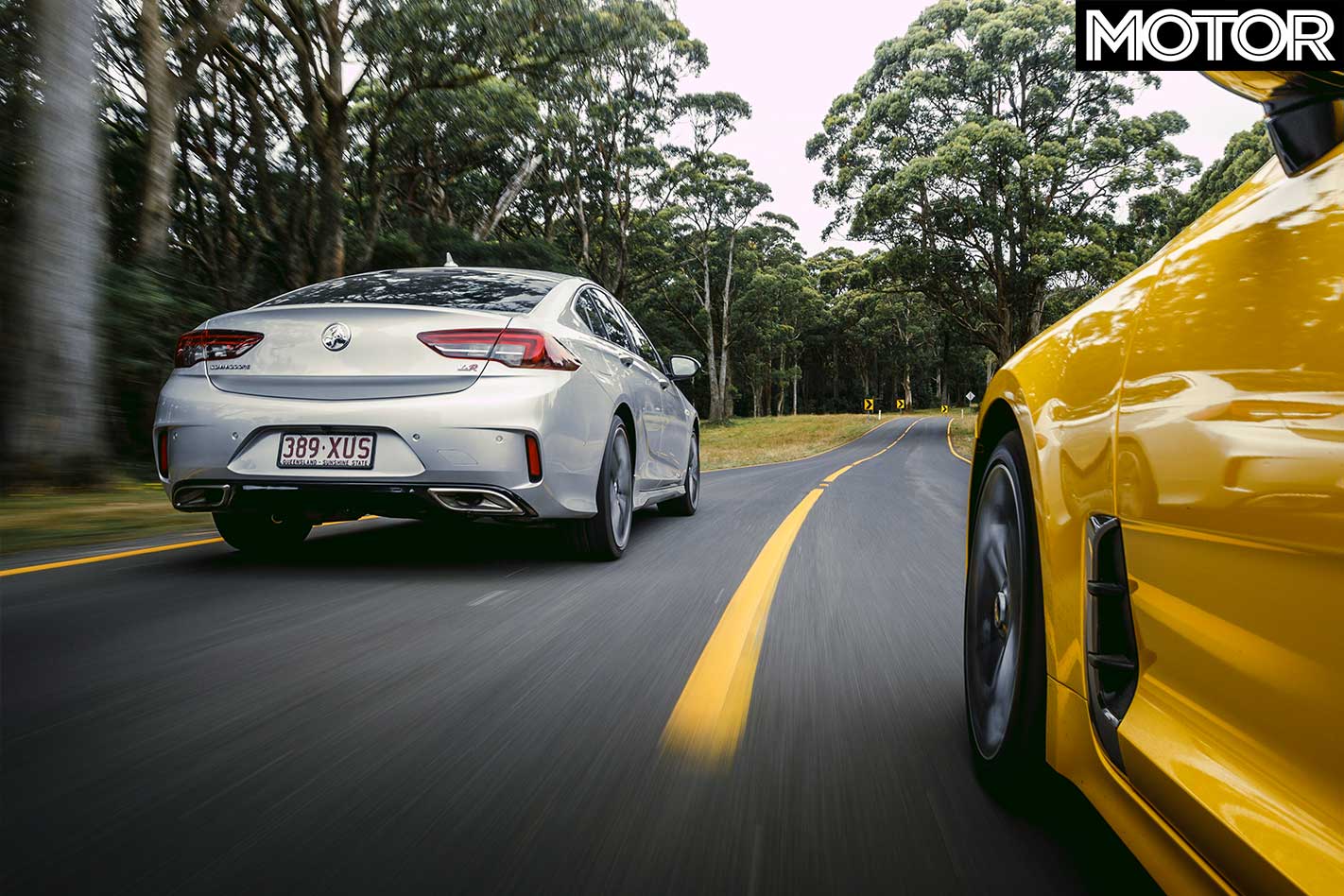
There’s a bit of front-end push if you’re too optimistic with your entry speed, but that clutch-pack rear diff and the ability to shuffle torque from front to rear axle makes a big difference when it gets hot and heavy.
I wouldn’t say there’s a huge difference in ride quality between Normal, Sport and VXR modes, but in the latter, there’s definitely a pretty secure, planted feel that comes though the helm, even if the steering itself feels a bit light when you’re pressing on.
The Commodore is a bit slow to obey downshift commands from the paddles and it feels like there’s even a hint of converter slip at times. And the semi-synthesised engine note seems to have been calibrated to make the engine sound slower and lazier than it really is. A couple of times I figured I was holding around 4000rpm, only to look at the tach and discover it was, in fact, time for another cog.
In direct contrast, the Kia always feels urgent and up for it, poking you in the chest and demanding to know if that’s all you’ve got. Problem is, sometimes that’s right at the point where the car itself has tapped the depths of its talent.
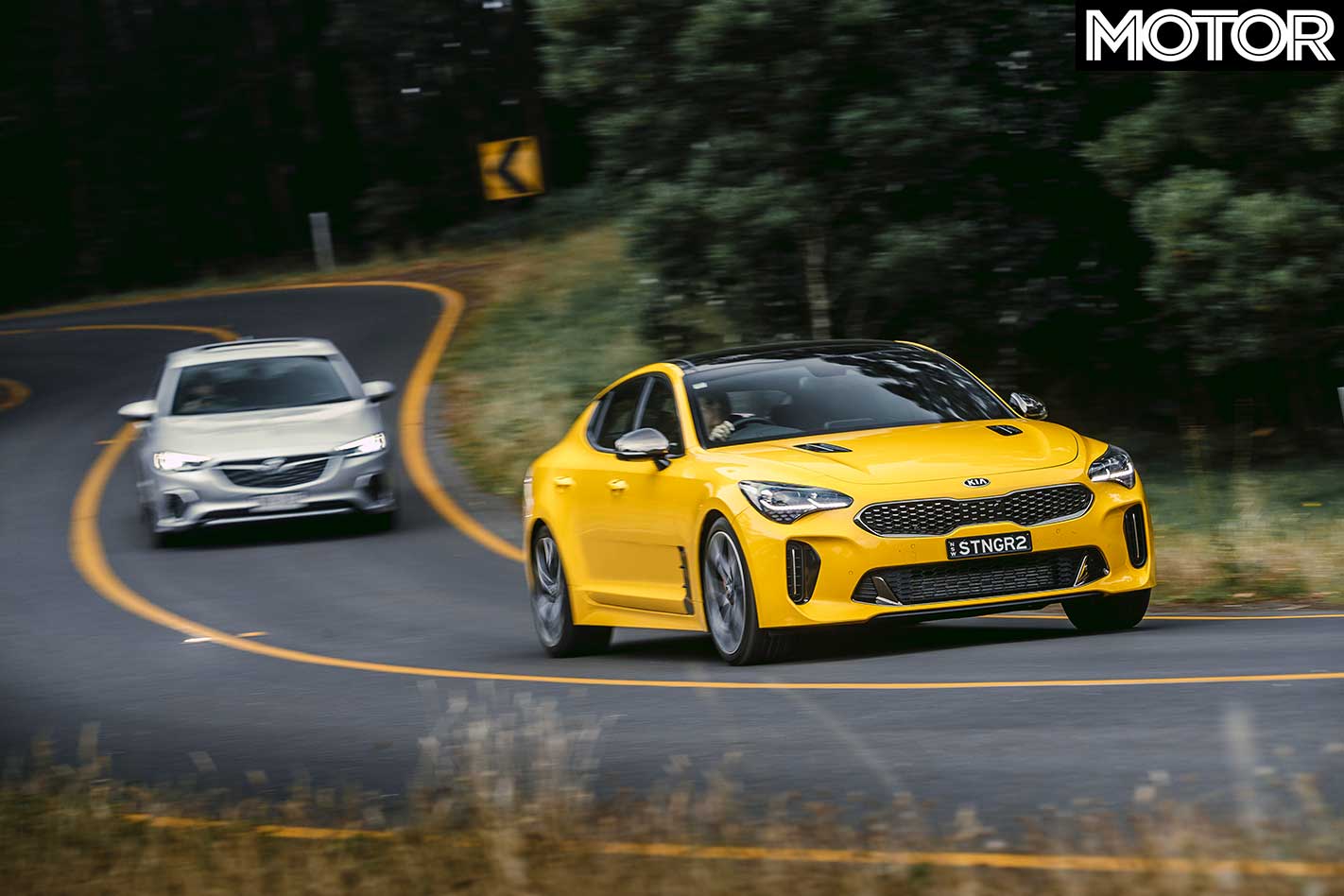
In Sport mode, the Stinger is definitely firmer than the ZB, but actually none the better for it. In fact, mid-corner bumps are not the Kia’s best mate and there’s less accuracy through the tiller, despite a much faster rack ratio which, at first, tries to fool you that the Kia is all business.
But once you get used to the ratio, you also notice that there’s a fairly big dead-spot at the straight-ahead and what info you are getting back up the column is pretty non-committal. Which, if you’re even half smart, should be enough to encourage you to take the same approach.
That said, the Stinger is pretty easy to rotate, purely because you’ve always got enough grunt and, apparently, enough rear weight bias to bring the tail around at will. Fact is, the Kia is quite rear-steery which starts out as playful, but degenerates into ‘hang-on-kids’ as the speed rises.
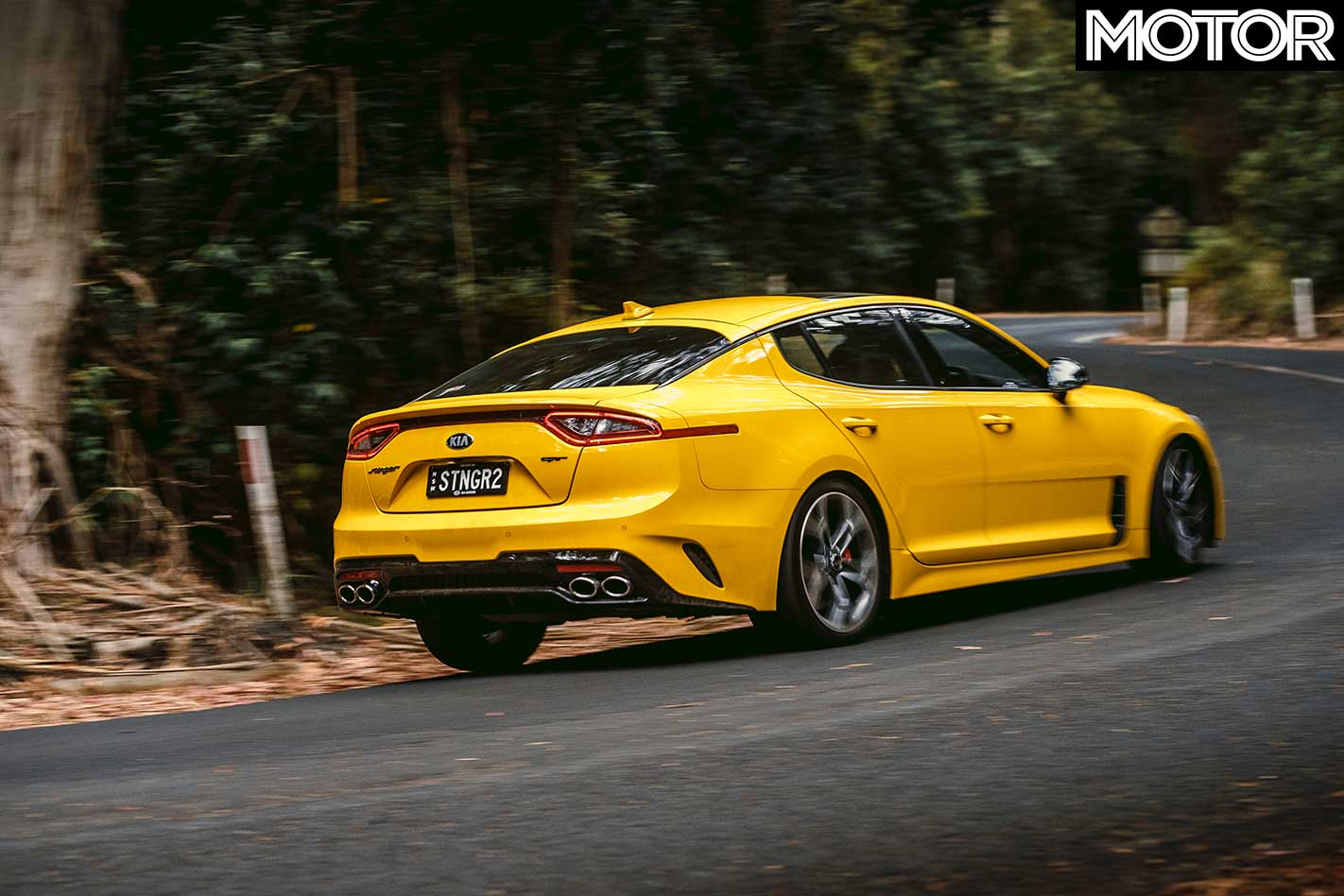
Eventually, you’ll reach the limit of the tyres and the rear grip and the whole plot becomes a slave to whatever Newton-metres are hanging around at the time. And for all that ride firmness, there’s still more body roll and lateral head-toss apparent in the Stinger.
As the top-shelf versions of each car (Stinger GT and Commodore VXR) both cars run Brembo brakes. No, you won’t make them fade at road speeds (even if you are a nutter) and I’d be very surprised if either ever came over faint on a racetrack either.
Other stuff? Well, the Holden has those lovely, firm front chairs that locate you properly, even if they look a bit boy-racer. The Kia’s pews, meanwhile, were a bit narrow for mine, but I’m a fairly broad unit (big bones – ask my mum) and the tykes that run this magazine have never complained.
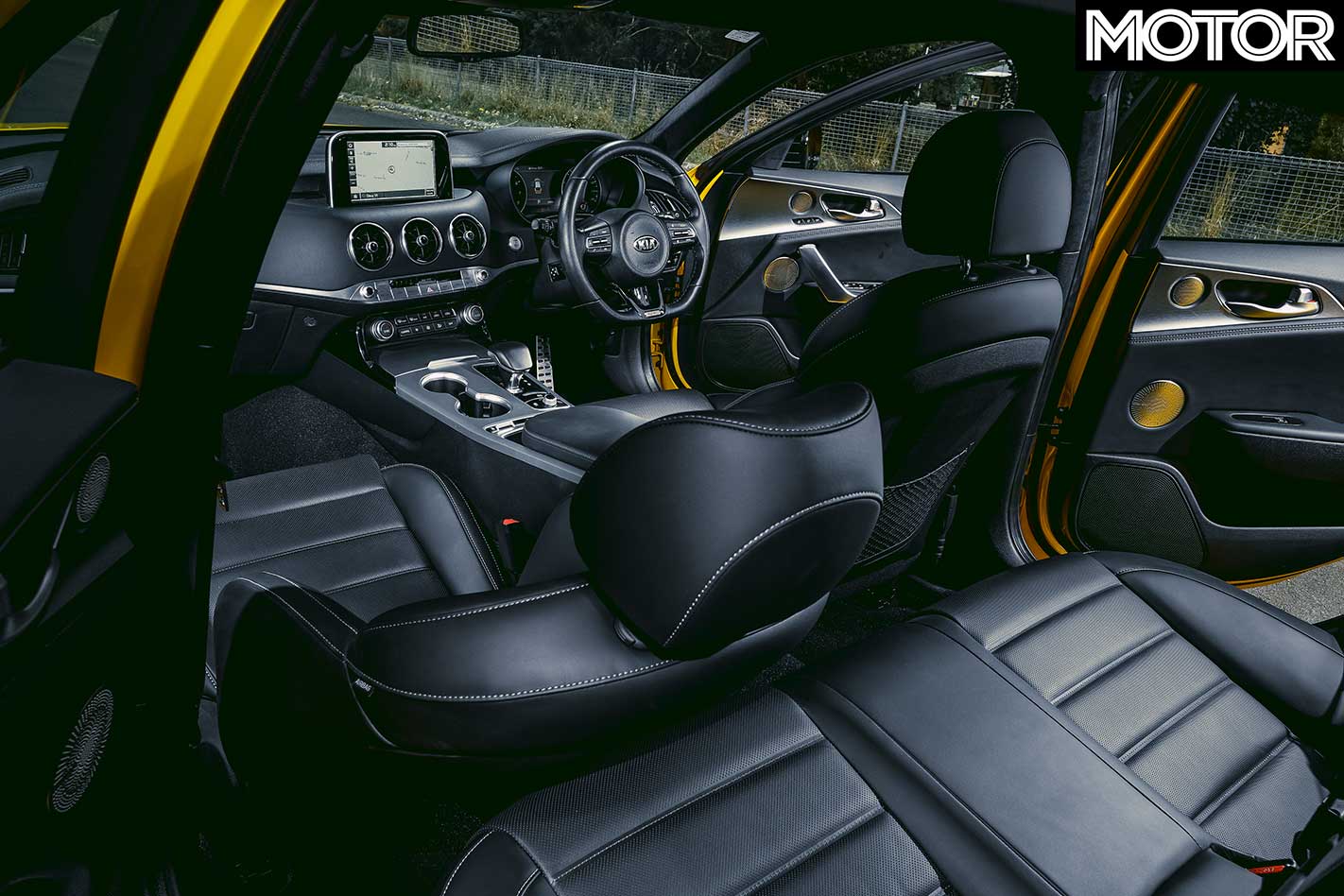
Back seats? Not much in it with plenty of stretching room in each and only the ZB’s roofline and the Stinger’s rear wheel-arch to impede entry and exit slightly. The boots are line-ball, too, and both have fairly high floors that means they won’t be as big as they look.
It’s pretty easy to draw the conclusion that the new Commodore is a smoother, sweeter car in most circumstances. But the surging thrust of that twin-turbo V6 in the Kia is going to swing a lot of decisions. But where does that leave each car when it comes to that inevitable question of which one replaces the family cars we knew and loved?
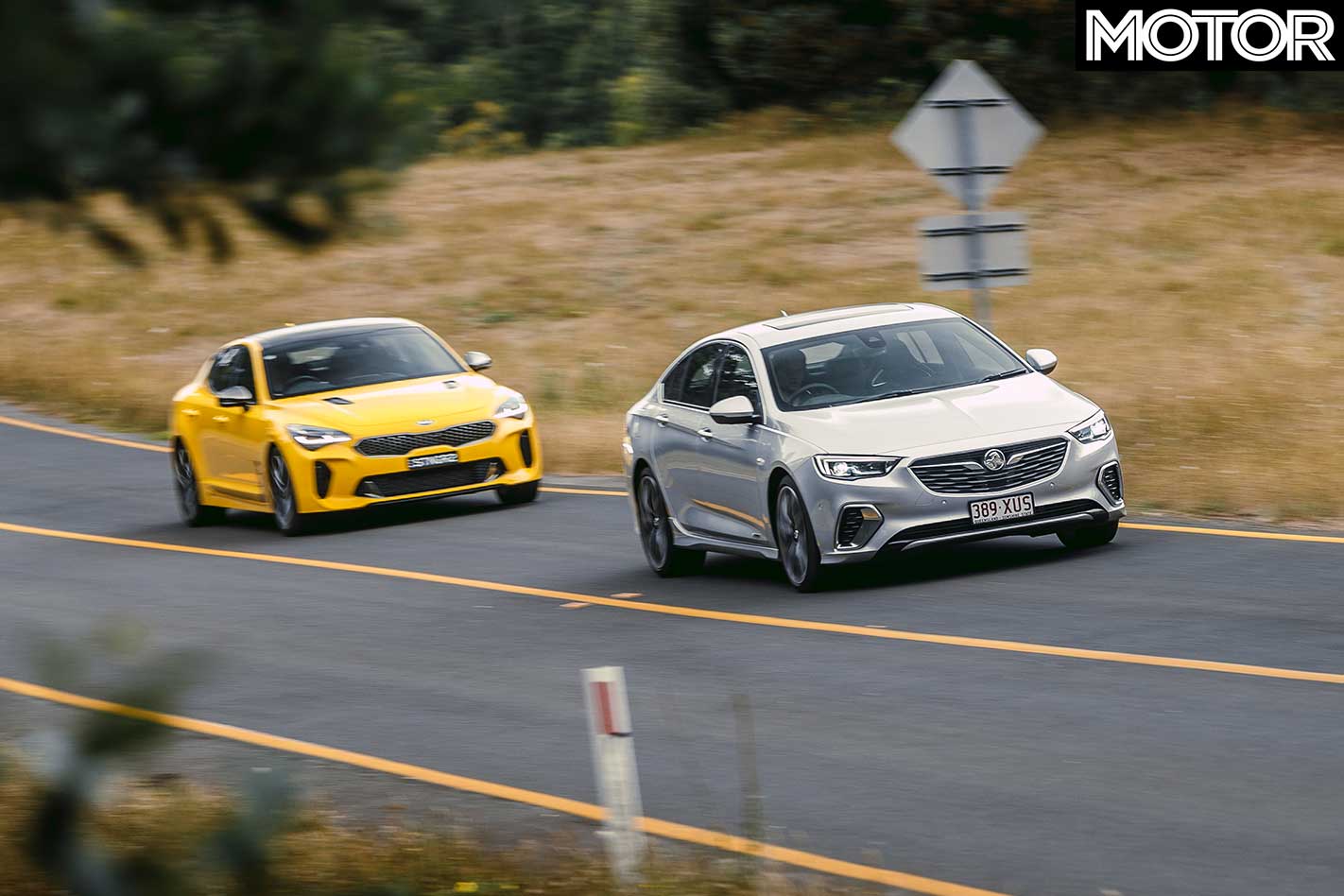
Well, if you’ve historically craved a six-cylinder Commodore or Falcon, the new Holden will probably do the trick. But if you were a V8 kind of guy, then the Stinger with its edgy manners and swingin’-dick engine will be the one.
Presuming you’re still in the game and haven’t gone out an bought an SUV or a hot-hatch already. But let’s not get on to the topic of relevance. Or we could be here all day.
Interior Quirks
Kia Stinger GT
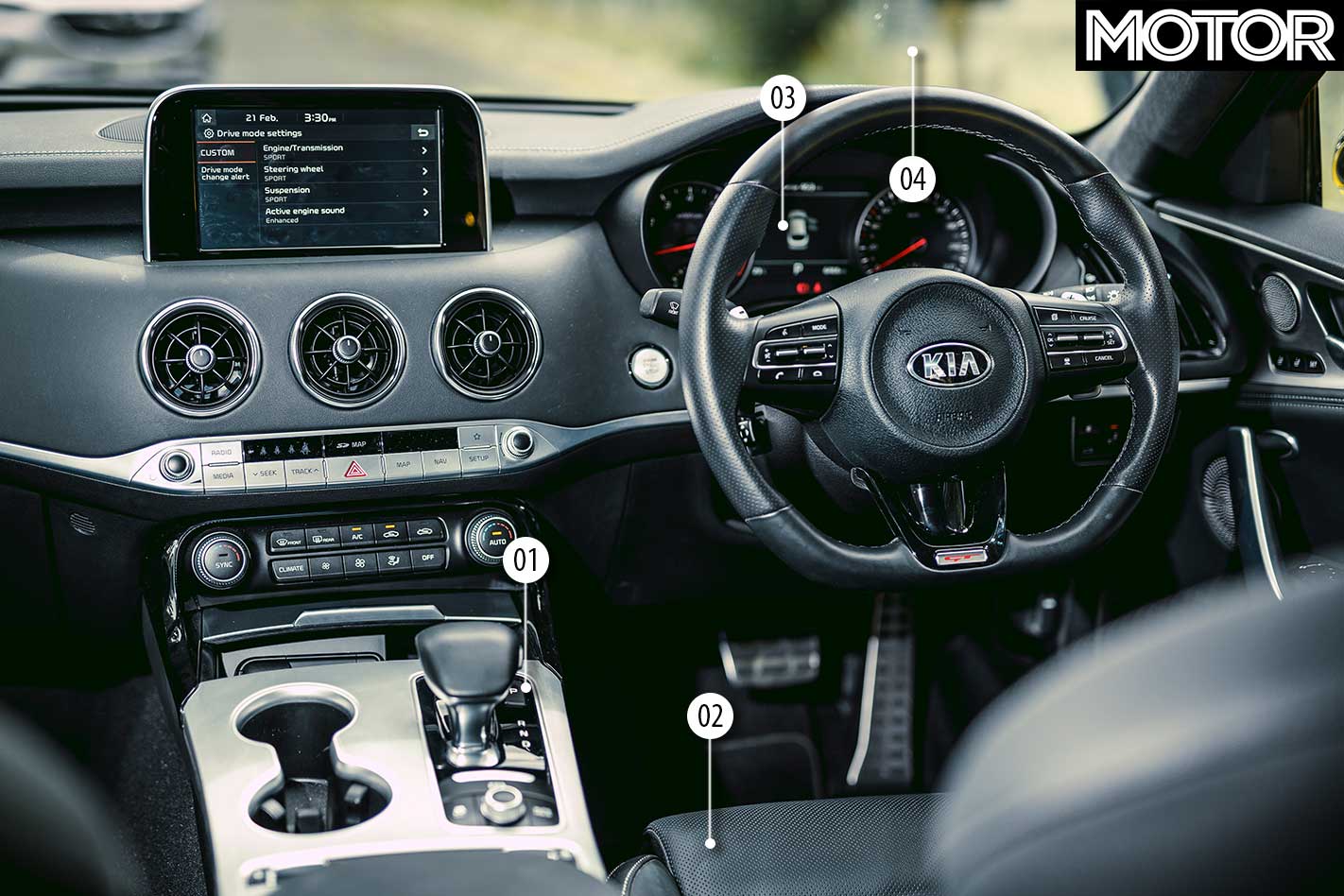
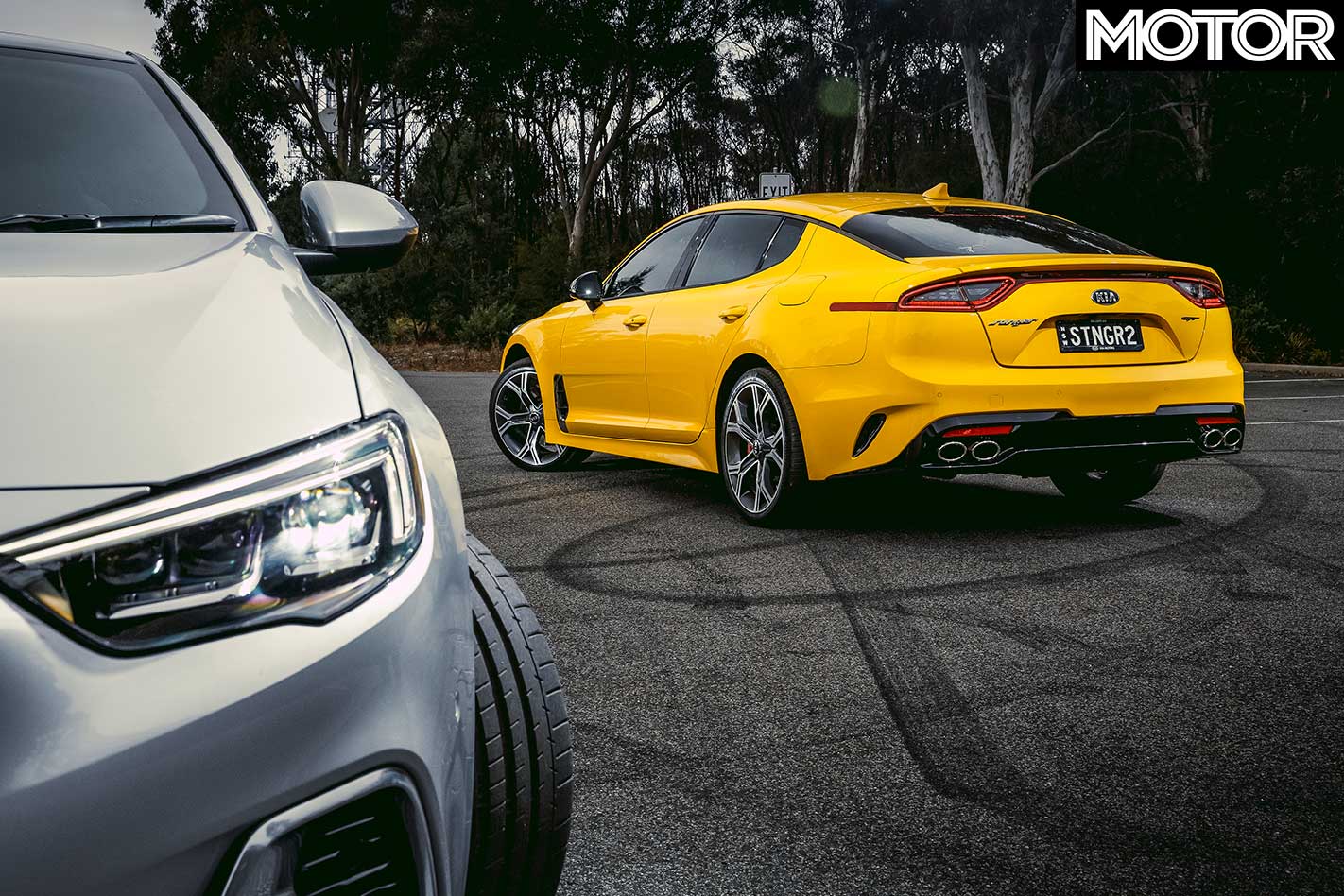
1 – Since when has a button replaced the traditional park position at the top of the gear selection? To some it’s a bit of an ergonomic fail. But everyone’s doing it… 2 – While the front seats are comfortable, they are a bit too narrow for some and they lack sufficient side bolstering – especially compared to the VXR 3 – The graphics on both the Kia and Holden could be better, but the Stinger’s appear a little more outdated and the speed-zone warning can be slow to update 4 – Why would Kia have gone to the trouble of fitting a heads-up display that doesn’t tell you what gear you’re in? Also, why doesn’t the Kia have stop/start technology?
Holden ZB Commodore VXR
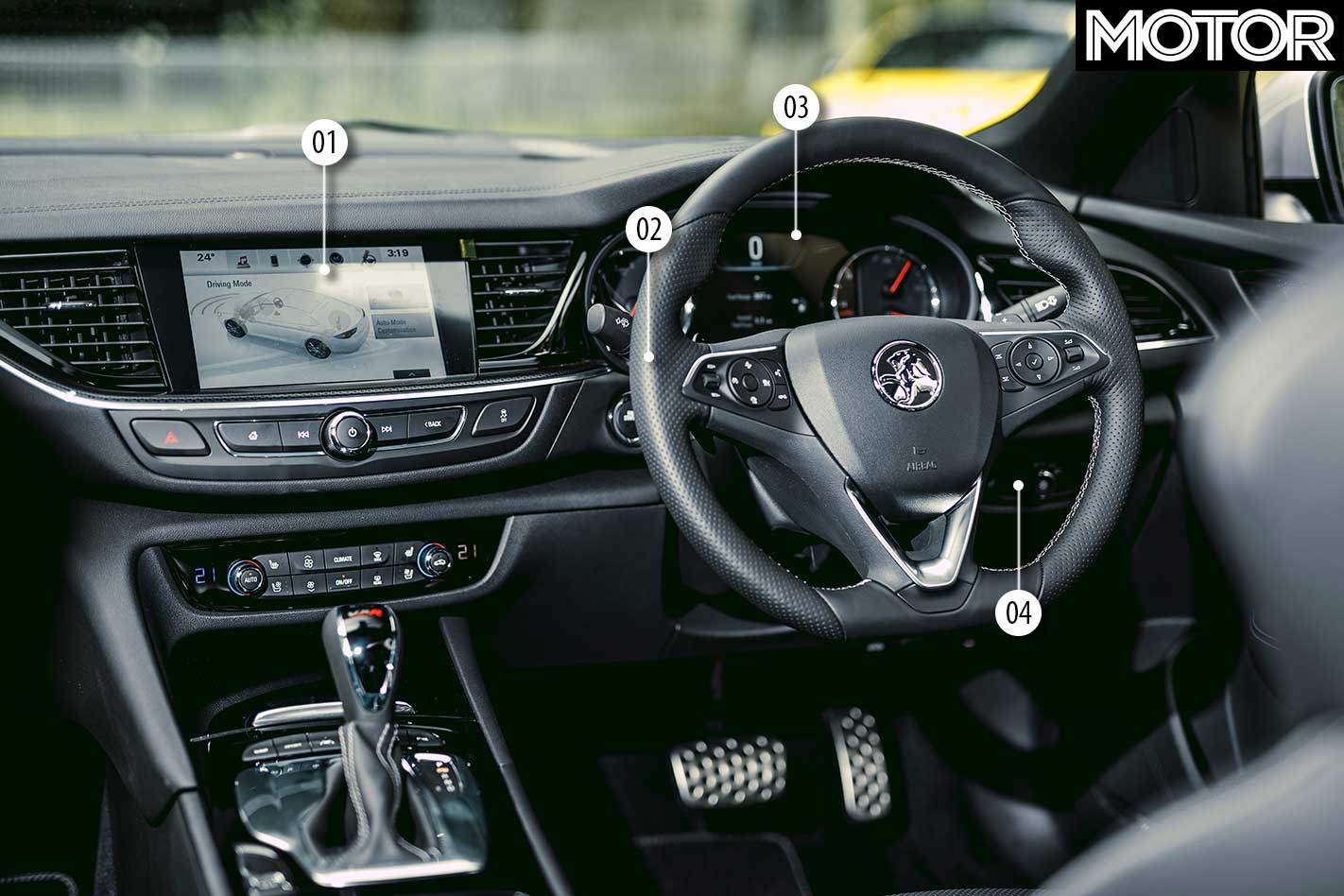
1 – There’s (thankfully) no fiddly track pads or dial to operate the MyLink infotainment system, but the seating position renders the screen too far away 2 – Both interiors are a bit plain given their high price tags, but the Holden is slightly plusher with more gadgets as well as a lot more stitching and soft-touch materials 3 – Why has Holden calibrated the Commodore’s temperature gauge so that the normal coolant temp shows just above the marked increment? 4 – Despite the range-topping status, the Commodore VXR misses out on a power-adjustable steering column and an electronic boot close
Fast Facts
| u00a0 | 2018u00a0Holden ZBu00a0Commodore VXR | 2018 Kiau00a0Stinger GT |
| BODY | 5-door, 5-seat liftback | 5-door, 5-seat liftback |
| DRIVE | all-wheel | rear-wheel |
| ENGINE | 3649cc V6, DOHC, 24v | 3342cc V6, DOHC, 24v twin-turbo |
| BORE x STROKE | 95.0 x 85.8mm | 92.0 x 83.8mm |
| COMPRESSION | 11.5:1 | 10.0:1 |
| POWER | 235kW @ 6800rpm | 272kW @ 6000rpm |
| TORQUE | 381Nm @ 5200rpm | 510Nm @ 1300rpm |
| WEIGHT | 1737kg | 1780kg |
| POWER/WEIGHT | 135kW/tonne | 152kW/tonne |
| TRANSMISSION | 9-speed automatic | 8-speed automatic |
| SUSPENSION (f) | HiPer struts, anti-roll bar, adaptive dampers | MacPherson struts, adaptive dampers |
| SUSPENSION (r) | Five-link, coils, anti-roll bar, adaptive dampers | Multi-link, coils, anti-roll bar, adaptive dampers |
| L/W/H | 4897/1863/1455mm | 4830/1870/1400mm |
| WHEELBASE | 2829mm | 2905mm |
| TRACKS | 1596/1599mm (f/r) | 1596/1619mm (f/r) |
| STEERING | electrically-assisted rack-and-pinion | electrically-assisted rack-and-pinion |
| BRAKES (f) | 345mm ventilated discs, 4-piston calipers | 350mm ventilated discs, 4-piston calipers |
| BRAKES (r) | 315mm ventilated discs, single-piston calipers | 340mm ventilated discs, 2-piston calipers |
| WHEELS | 20.0 x 8.5-inch (f/r) | 19.0 x 8.0-inch (f); 19.0 x 8.5-inch (r) |
| TYRES | Michelin Pilot Super Sport; 245/35 R20 (f/r) | Continental ContiSportContact 5; 225/40 R19 (f); 255/35 R19 (r) |
| PRICE | $55,990 | $59,990 |
| PROS | Resolved and sophisticated; roomy inside; lots of grip | Engine is a ripper; very fast in a straight line; GT looks good, too |
| CONS | Itu2019s good, but itu2019s no VF SS-V Redline | Gearbox, sketchy handling at the limit |
| RATING | 3.5 out of 5 stars | 4 out of 5 stars |
I’d forgotten just how good the WRX STi is. First and foremost is the power thing. Oh yes. Not only in numbers but nature.
This feature was originally published in MOTOR’s February 2005 issue
Slot it into sixth and you can leave it there right over the Blue Mountains, floating from Homebush to Hartley. Paddle about, instead, and it’ll cut-and-thrust across the westbound ridgelines with the best of them.
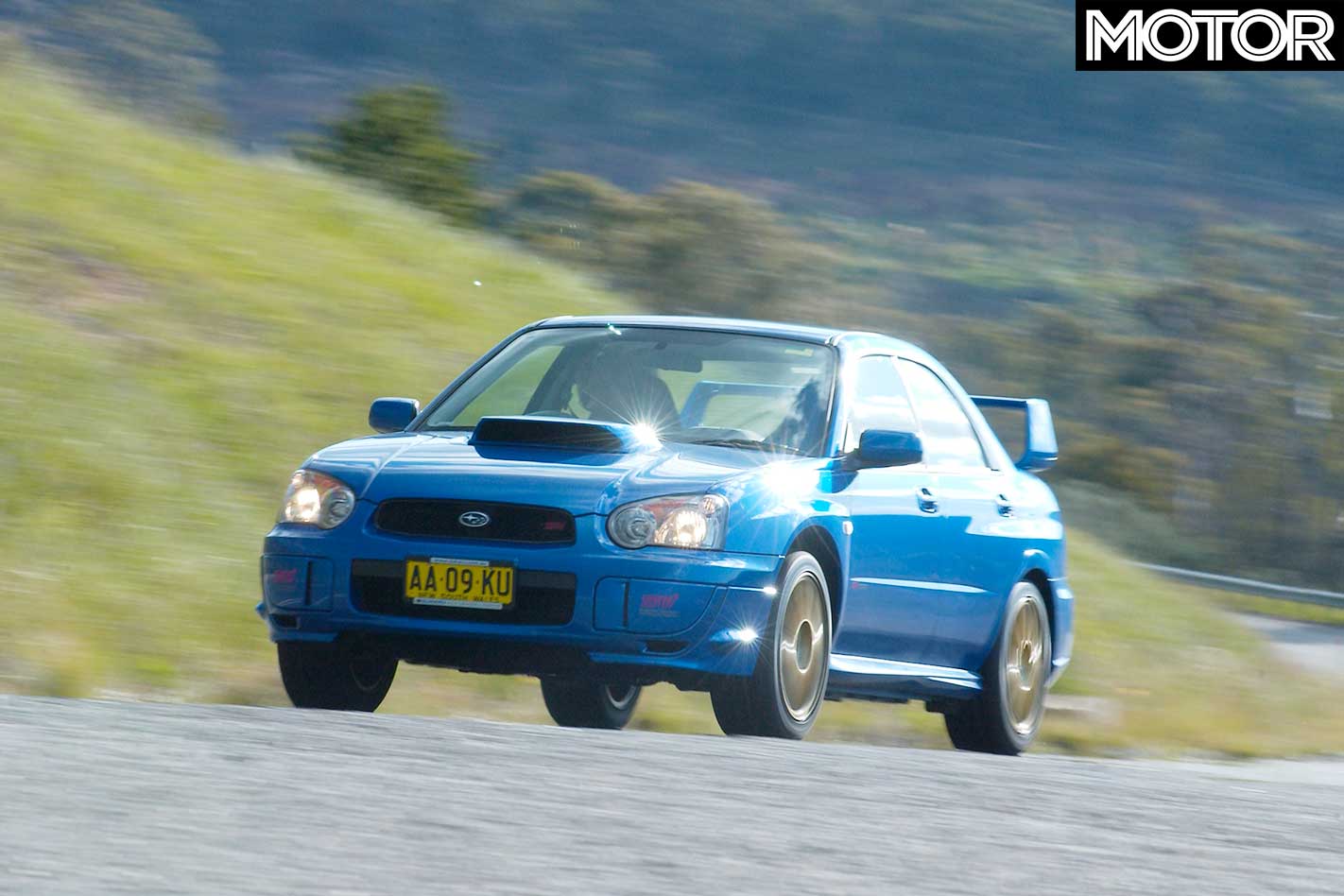
Then there’s the steering; whip-quick, well-weighted and incorruptibly connected to semi-slick grippers that respond right now. And how did I forget about those brakes? Surely the lines are stainless braid; there’s just no other way they can feel so direct. Or the boy-racer detailing, like the Water Feature to make the intercooler cooler. Okay, the ride’s still choppy and the tyre noise is horrible but let’s be serious…
Its only shortfall is aesthetic: it’s a guppy-eyed and gormless little bugger and why anyone would take inspiration from its appearance is a complete mystery. But not to Kia’s young Australian sales manager, Justin Hirano, who whipped up the ‘Kia Rio Sport-Pac’ as a dealer-fit option for anyone drawn to Rex’s beauty but unmoved by its other virtues. As bloody if.
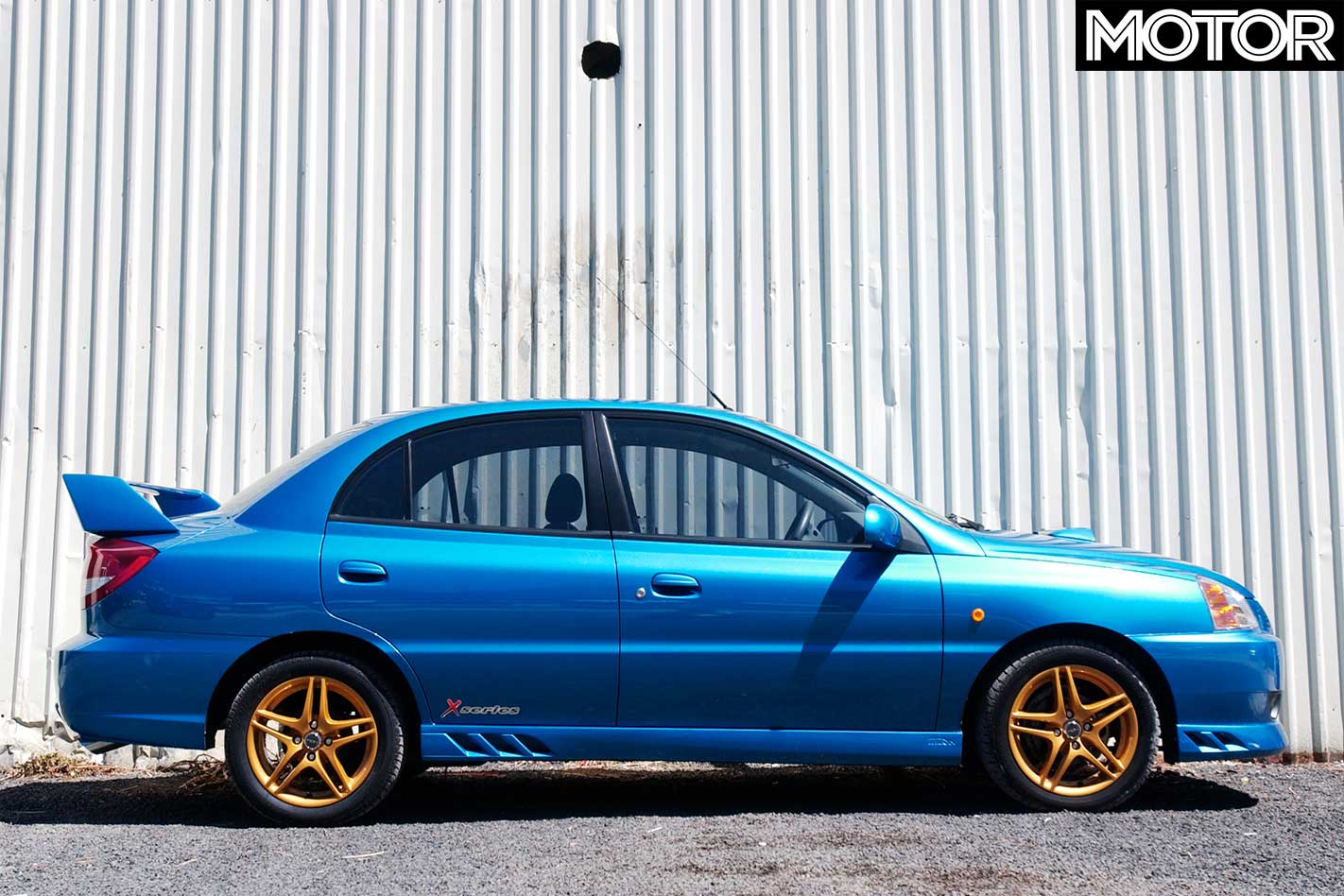
The thing is patently a deceit for the young ’n spotty, whippersnappers like Garry Morris, whose name we gain from the dealer who sold him one. And whom, armed with the Real Thing by way of illustration, I am most keen to enlighten.
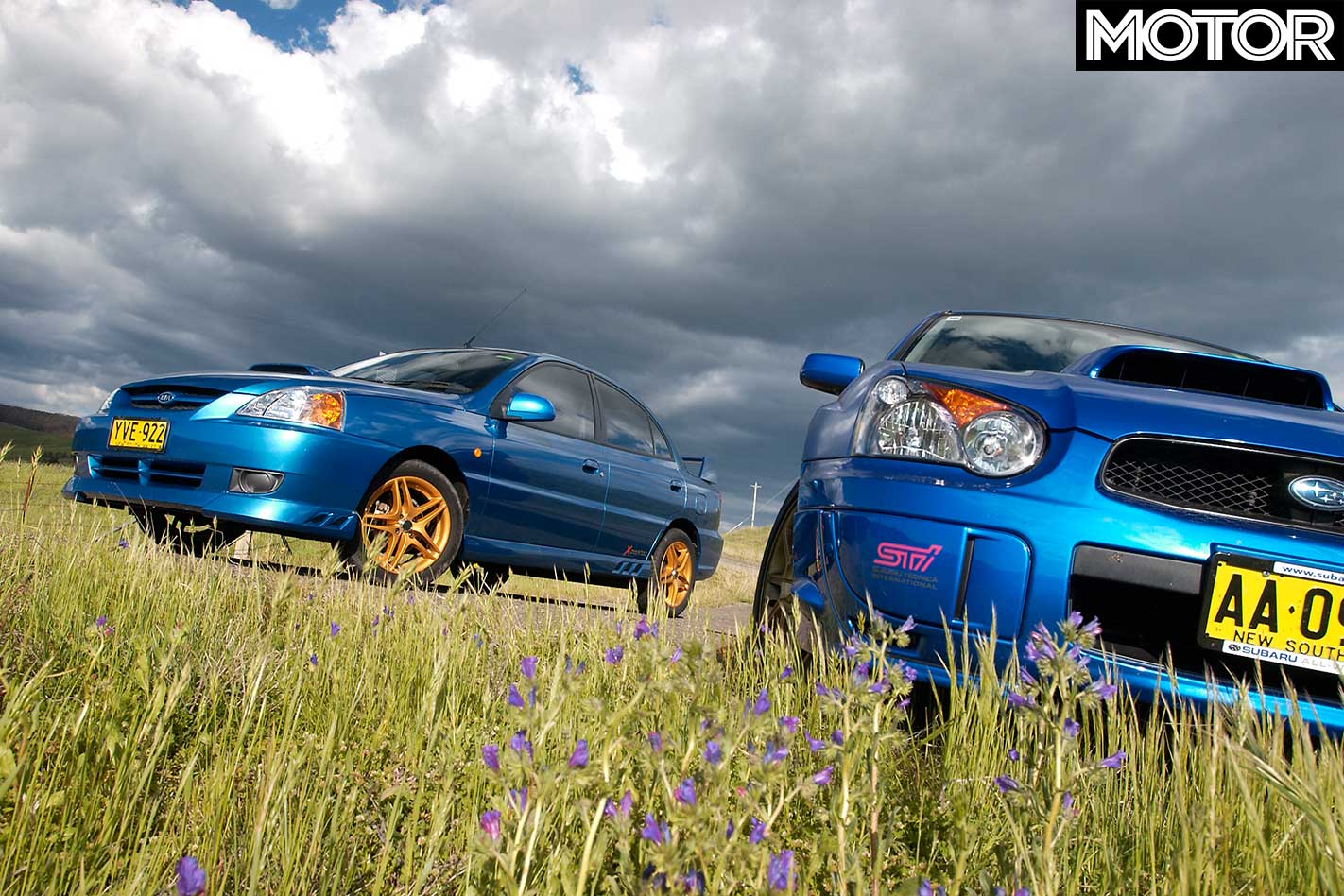
Hence the journey inland where, in the carpark of the appointed eatery, we find the Bizarro World Suba-clone parked. And, placing the STi alongside it, the initial resemblance is eerie. The standard Kia ‘Rally Blue’ is a ringer for the Rex’s signature hue and the high wing, bonnet scoop and gold alloys all, for an instant, resonate. But the differences quickly surface.
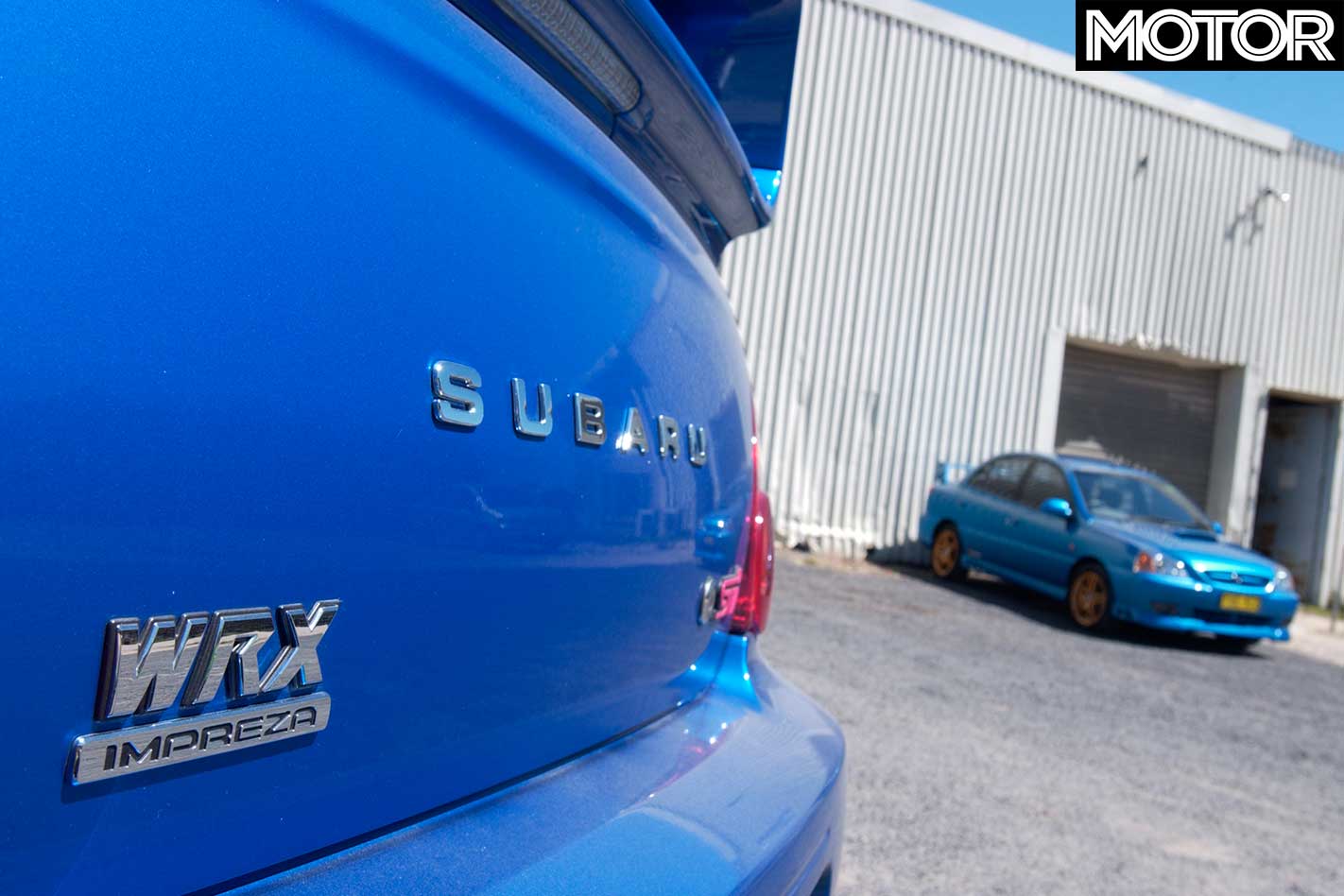
The Subaru, with its swollen arches and monstrous brakes, looks like Clark Kent on a bad-disguise day. The Kia, by contrast, is just in drag – the slots and scoops are dummies and its wheels have a two-inch shortfall and one nut less. Which figures. Because underneath all the rice-rocket cues is a Kia Rio, the Morris of our age, which, other than a little lowering, is unmodified in any way.
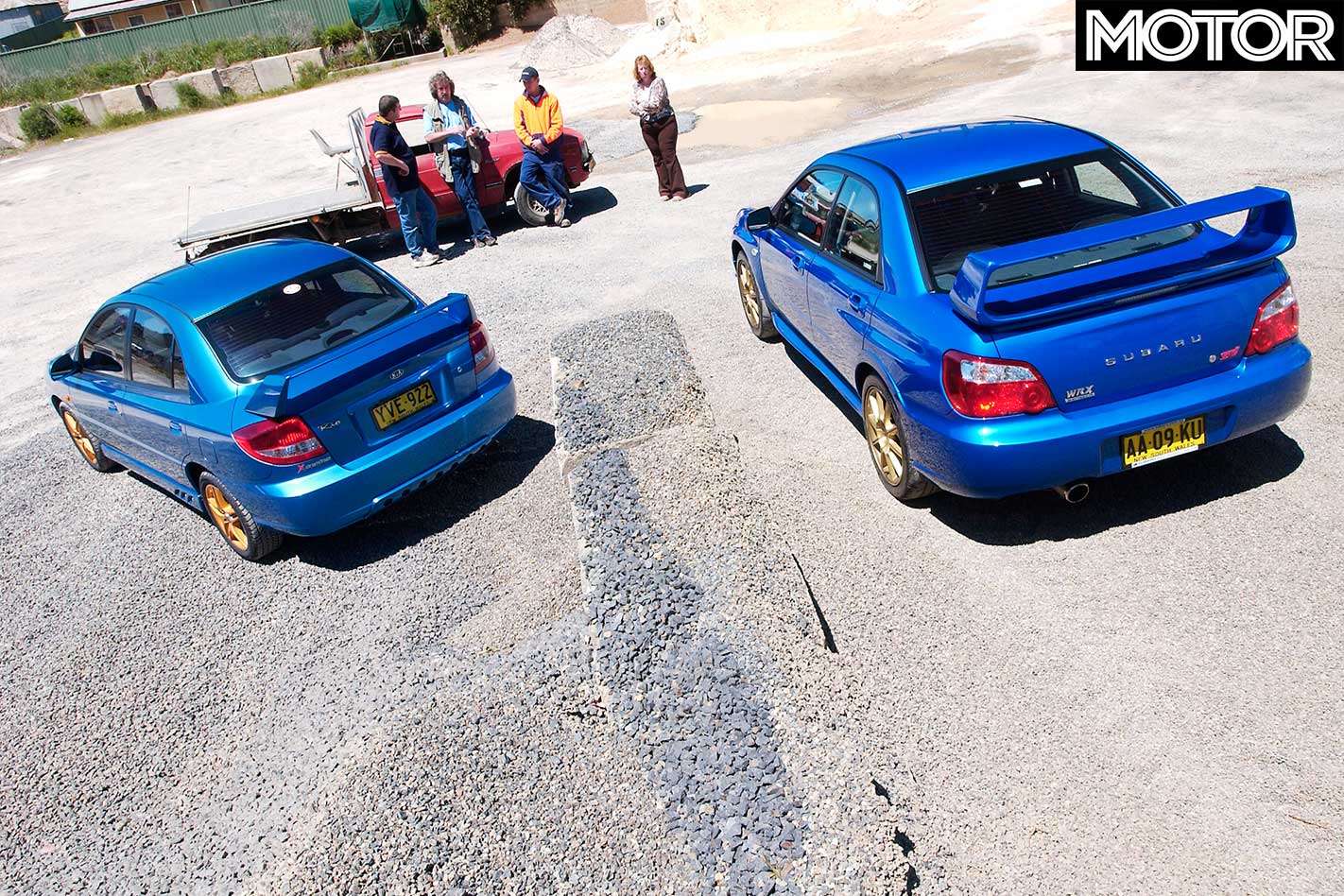
This primes the pump for a piss-take of tsunamic proportions until I meet its owner. Garry is 47. Garry is a fitter at a mid-west gold mine. Garry says “We’d thought about buying a Subaru” and then, glowing with a canny buyer’s pride, continues “but we saw this in the showroom and I thought ‘why would you wanna pay more?’” and I am, for the moment, silenced.
Garry is a notably fit man. “So… um… do people mistake it for a WRX?” “All the time.” “Any takers at the lights?” “Oh yeah. It does a fair few of ’em, too.” He looks at me, unblinking. “You’ve just got to know how to drive it.”
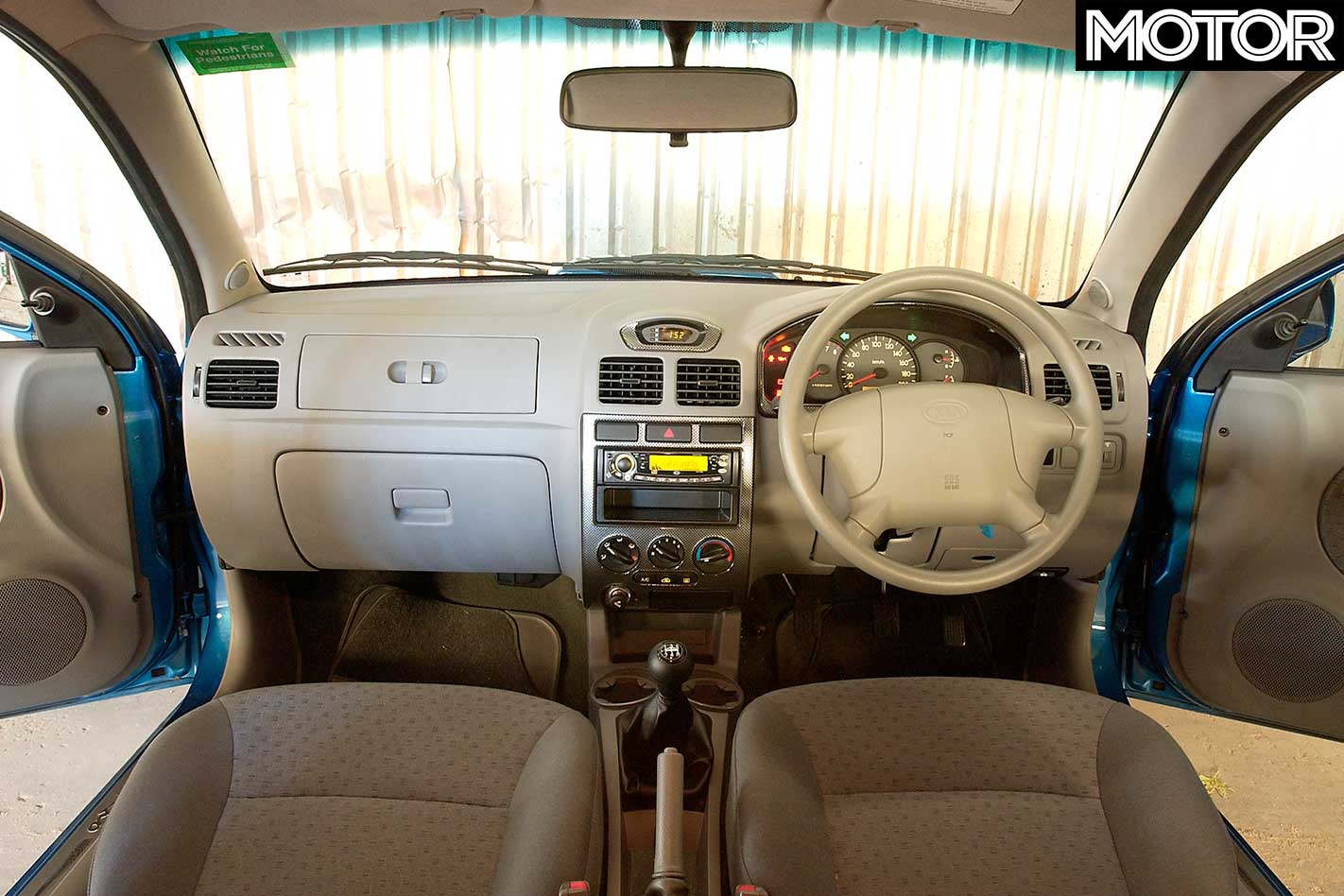
An unpleasantly fit man. Particularly solid. Best keep the eyebrows in the normal position when such things are said. Ditto when his friend, Janette, relates it storming Mount Victoria like a rally-car.
After all, they’ve added a sports muffler to make up for any dynamic deficit, so you never know. And neither, in great depth, does Garry: “I only drive it every now and then. We keep it as the Good Car.” It’s hard-work country out here. Full of big blokes. We’ve got all day. Let someone else tell him…
So we seek out the strong and, in a stoneyard where we stop for photography, the young manager announces himself a big fan of Rexs. This’ll be good. But after his inspection of the pair the best we get is a slow “Well I’ll be buggered” as the truth dawns. He didn’t know? Nope.
Thought both were Subarus… with the Kia being the later model. It’s certainly the looker, he tells Garry of his pride and joy. Throw in the $18,400 on-the-road ask and it’s back-slappin’ time.
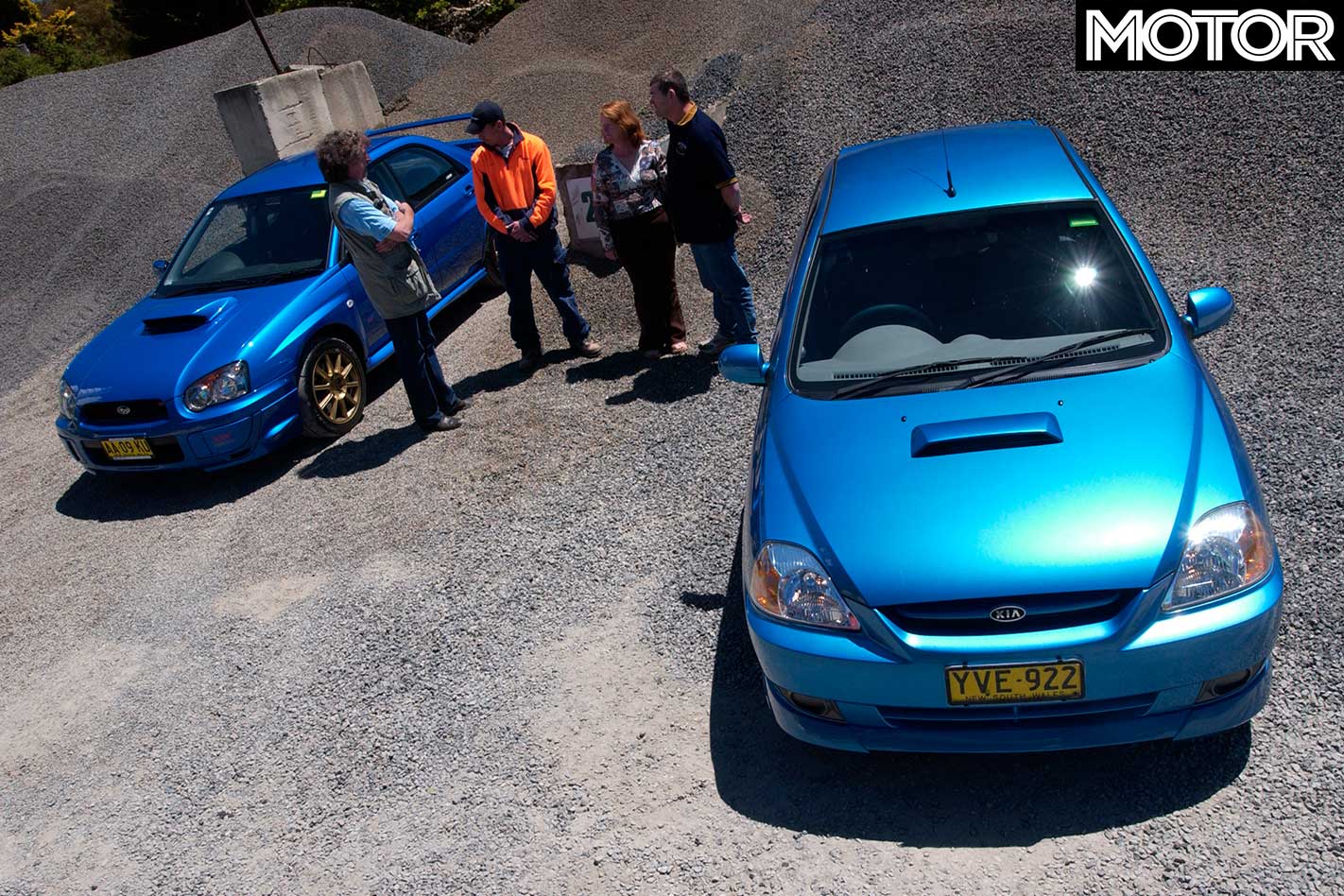
Photographer Wielecki’s eye leads us next to the corrugated rawness of the local bus company, which suits me just fine. The men here must know machinery well and will, doubtless, treat shortcomings harshly.
The first driver, Bob, views the contenders, and is charmed by the Kia’s perky exhaust note. Despite the Korean’s obvious sporting potential, however, Garry assures him that it’s given “not a moment’s trouble”, which rates really well with bus-drivers. Certainly more so than the STi’s maddening security keypad and cop-calling scoop. Kia gets the vote.
The next driver, another Bob as luck would have it, is even more pragmatic, and enquires as to fuel economy, mechanical complexity and insurance costs before deciding the Kia’s clear advantage in these matters outweighs any “unusable performance” advantage the Subaru may offer.
Only one bus-man, Phil, seems attracted, albeit modestly, to the WRX: “I’ll give you two-bob for that,” he offers, but having met both I’m not tempted. Let the record show that an apprentice casts another vote for the Subaru but as it’s “because you can’t beat German engineering” that one goes on the Informal pile.
Only one court of appeal remains. The Young, three of whom Wielecki lures into a Lithgow alley with an ease that mortifies. Carl, Mitch and James are introduced to the contenders, which promotes immediate excitement, and Garry, which doesn’t. The shape of Garry’s nose suggests both an interesting history and the inadvisability of enquiry. It certainly promotes a greater degree of interest in the Kia than might normally burden these strangers to moderation.
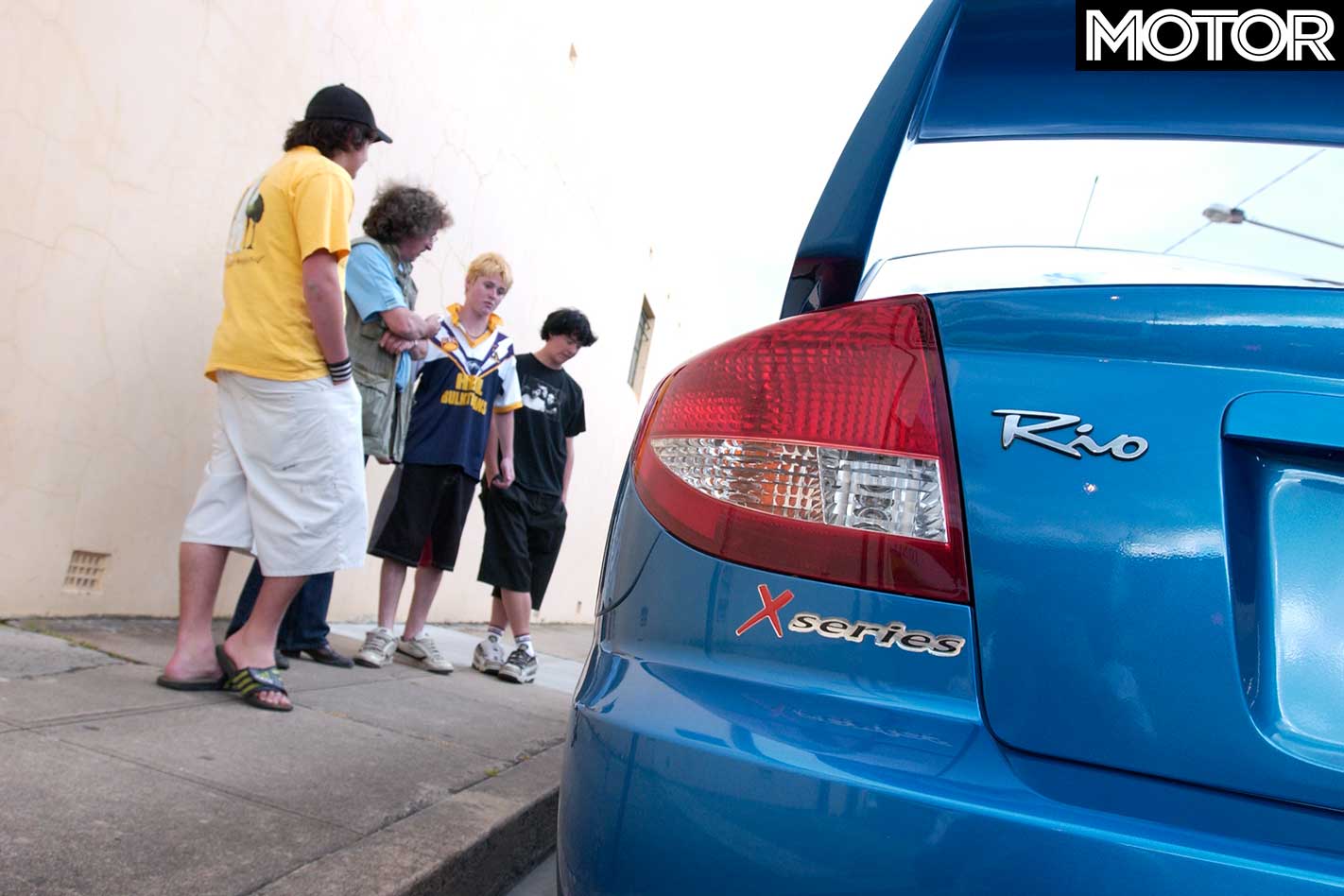
They are not discouraged by its unblown 1500cc 71kW engine and are much impressed by the 3:1 price advantage. But their eyes are darting. And lingering elsewhere. On a Subaru that, I am informed, is only one set of “huge-arsed chromes” short of perfection.
So when I finally ask the question the answer is honest: “I’d take the WRX.” “Even despite the price?” “BUY? Oh, the Kia”
There are some things learnt only by experience, and in that fervent hope I suggest to Garry that we briefly exchange cars. Taking this as a request for the Kia, the Big Fella obliges without hesitation.
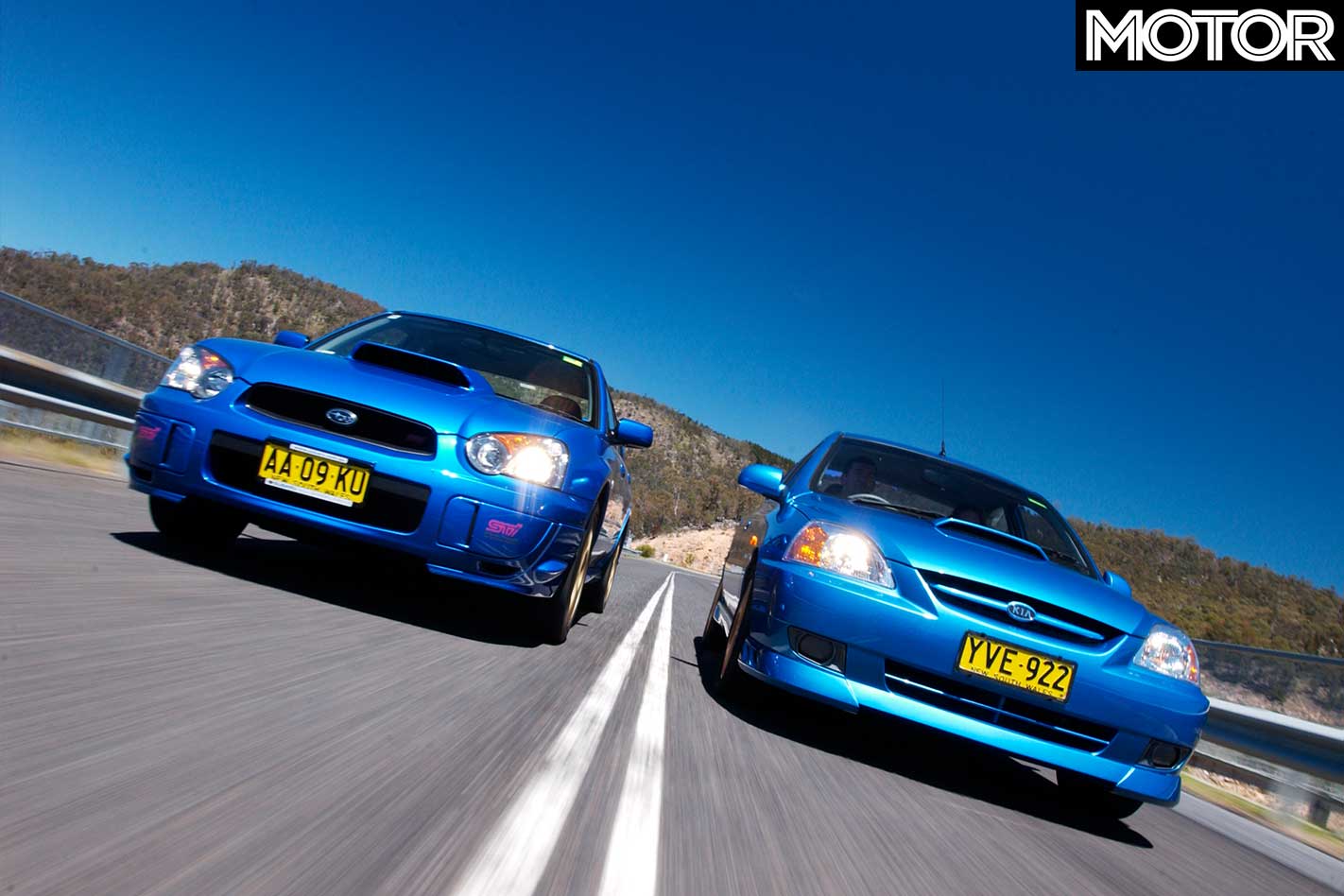
So, I go through the motions and find it, as expected, acceptable in most things and outstanding in none. Okay, the exhaust is fun and the motor works if you wind it up, but the difference in 0-100km/h times (11.3 vs 5.4 secs) is the same as the gap in chassis response. However, nothing else under $20,000 commands similar attention and, in that and all other regards, not one owner, fully aware of what they’re buying, will have cause for complaint.
Garry, conversely, climbs into the STi, applies his customary amount of throttle and instantly disappears. He comes back some time later with a very firm grip on the wheel and a noticeable case of big-eye. “That… ah… That’s frightening,” he says quietly.

Belting homeward up Mount Victoria, tasting driving at its sweetest, I contemplate, between volcanic bursts of thrust, that so few souls seem to understand, GET OUT OF THE WAY, or cherish the STi. Or give it the respect it deserves.
Not one person has been offended by the Kia’s cheek and several have thought it admirable. I’m disappointed. And so, I fear, will be the Editorial Gods who sent me here for blood. And Kia’s Mr Hirano has ensured that a small number of unobservant ram-raiders are going to be very disappointed indeed. But not Garry. He’s happy. Because, journo-ravings aside, he knows there’s not much wrong with his Rio.
And that even if there is, no-one’s going to tell him.
Fast Facts
| u00a0 | 2005 Kia Rio Sport-Pac | 2005 Subaru Impreza WRX STi |
| BODY | four-door sedan | four-door sedan |
| DRIVE | front-wheel | all-wheel |
| ENGINE | front-mounted 1.5-litre DOHC 16-valve four-cylinder | front-mounted 2.0-litre DOHC 16-valve horizontally-opposed four-cylinder turbo |
| COMPRESSION | 9.5:1 | 8.0:1 |
| BORE x STROKE | 75.5mm x 83.4mm | 92.0mm x 75.0mm |
| POWER | 71kW @ 5500rpm | 195kW @ 6000rpm |
| TORQUE | 132Nm @ 4500rpm | 343Nm @ 4000rpm |
| WEIGHT | 1056kg | 1475kg |
| POWER/WEIGHT | 67kW/tonne | 132kW/tonne |
| TRANSMISSION | five-speed manual | six-speed manual |
| SUSPENSION (f) | MacPherson struts, coil springs | MacPherson struts, coil springs, anti-roll bar |
| SUSPENSION (r) | torsion beam axle, coil springs, anti-roll bar | multi-link, coil spring, anti-roll bar |
| L/W/H | 4240/1700/1420mm | 4415/1740/1440mm |
| WHEELBASE | 2410mm | 2540mm |
| TRACKS | 1430mm (f); 1435mm (r) | 1490mm (f); 1495mm (r) |
| BRAKES (f) | ventilated discs, single-piston calipers | 326mm ventilated discs, four-piston Brembo calipers |
| BRAKES (r) | drums | 316mm ventilated discs, two-piston calipers |
| TYRES | Bridgestone Potenzau00a0195/50 R15 (f/r) | Bridgestone Potenza RE070, 225/45 R17 (f /r)u00a0 |
| FUEL | 45 litres, PULP | 60 litres, PULP |
| PRICE | $17,528 | $56,630 |
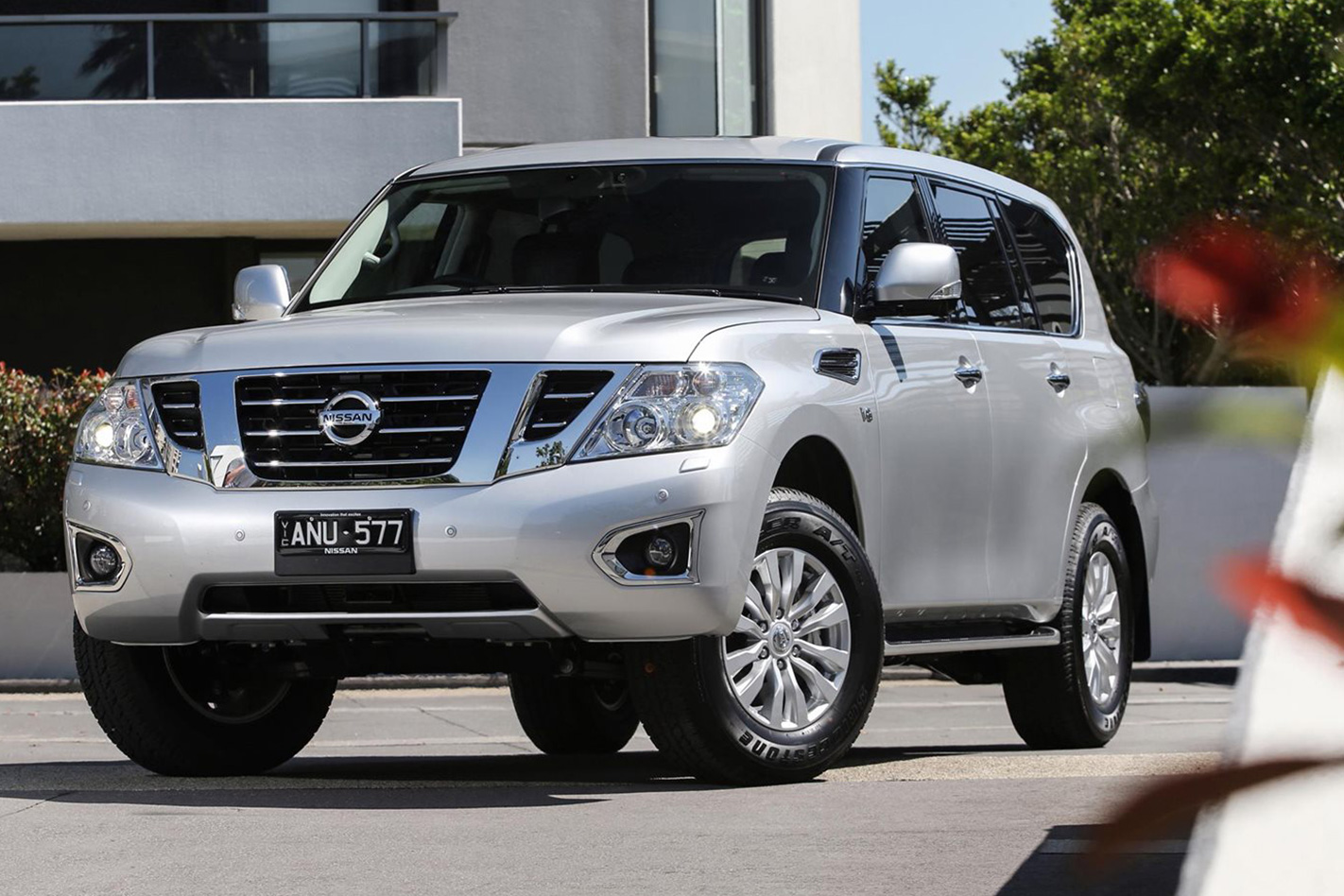
1. Nissan Patrol Ti-L – 2832kg
The Nissan 4WD’s notoriously hefty thirst is partly attributable to its big 5.6-litre petrol V8 but also an obese kerb weight that tops 2.8 tonnes.
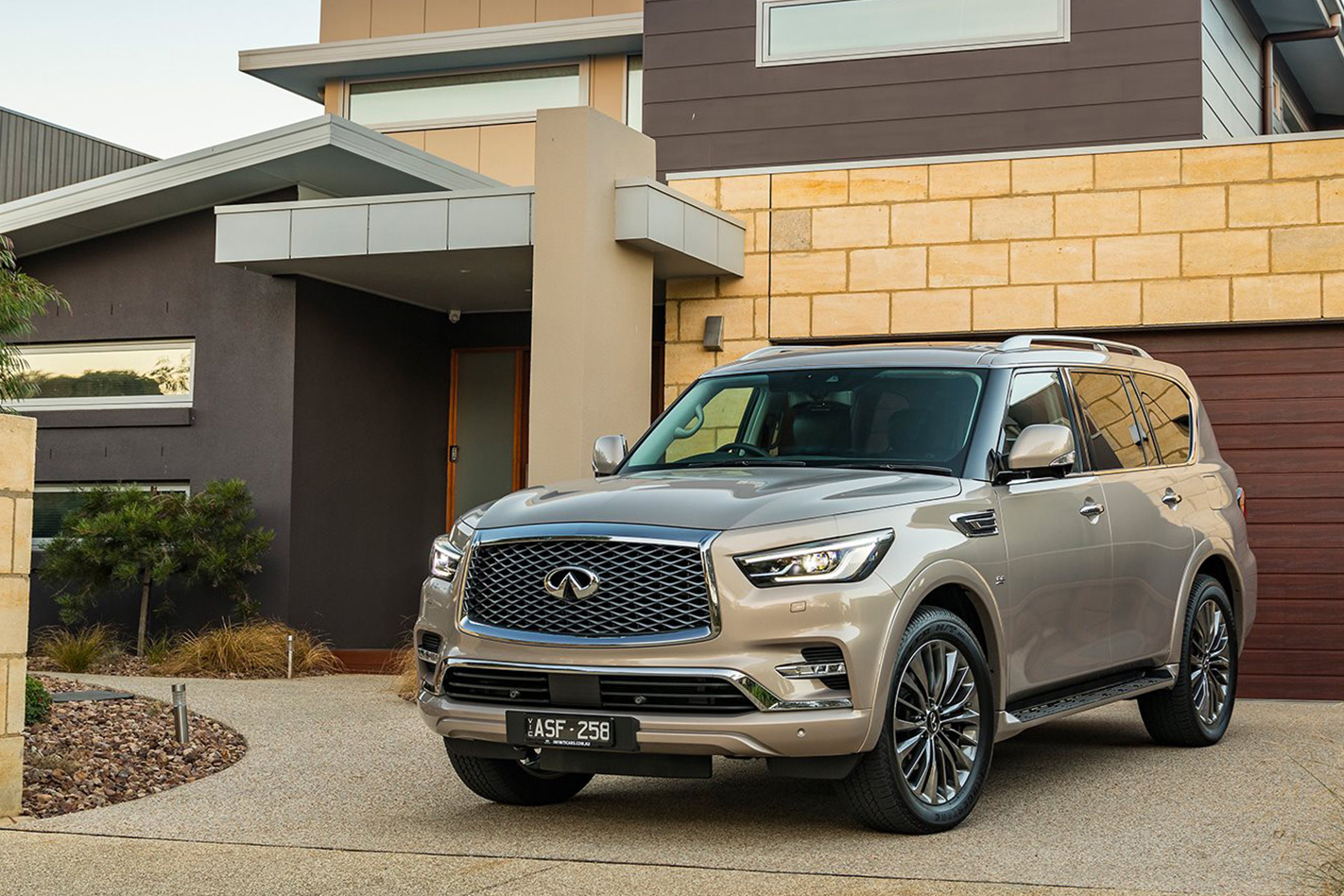
2. Infiniti QX80 – 2783kg
Infiniti’s luxury sibling to the Patrol is almost 50kg trimmer, yet sharing the same platform and V8 ensure the QX80’s plush ride comes at a weighty price.
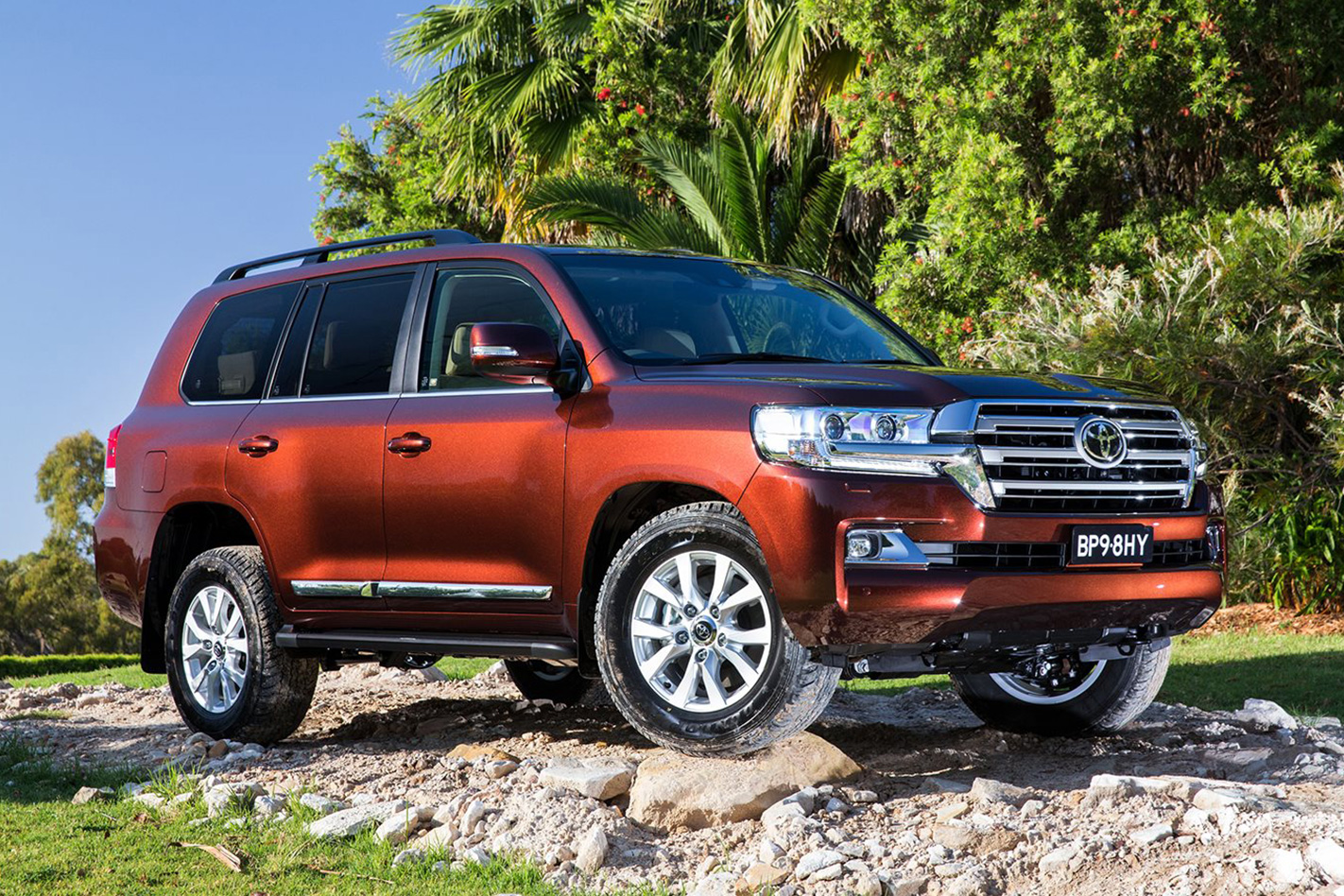
3. Toyota Landcruiser Sahara TD – 2750kg
Arguably the most Aussie Japanese vehicle on sale, the 200-series ’Cruiser wagon is also one of the most durable. But invincibility comes at a cost, and that cost is 2.7 tonnes.
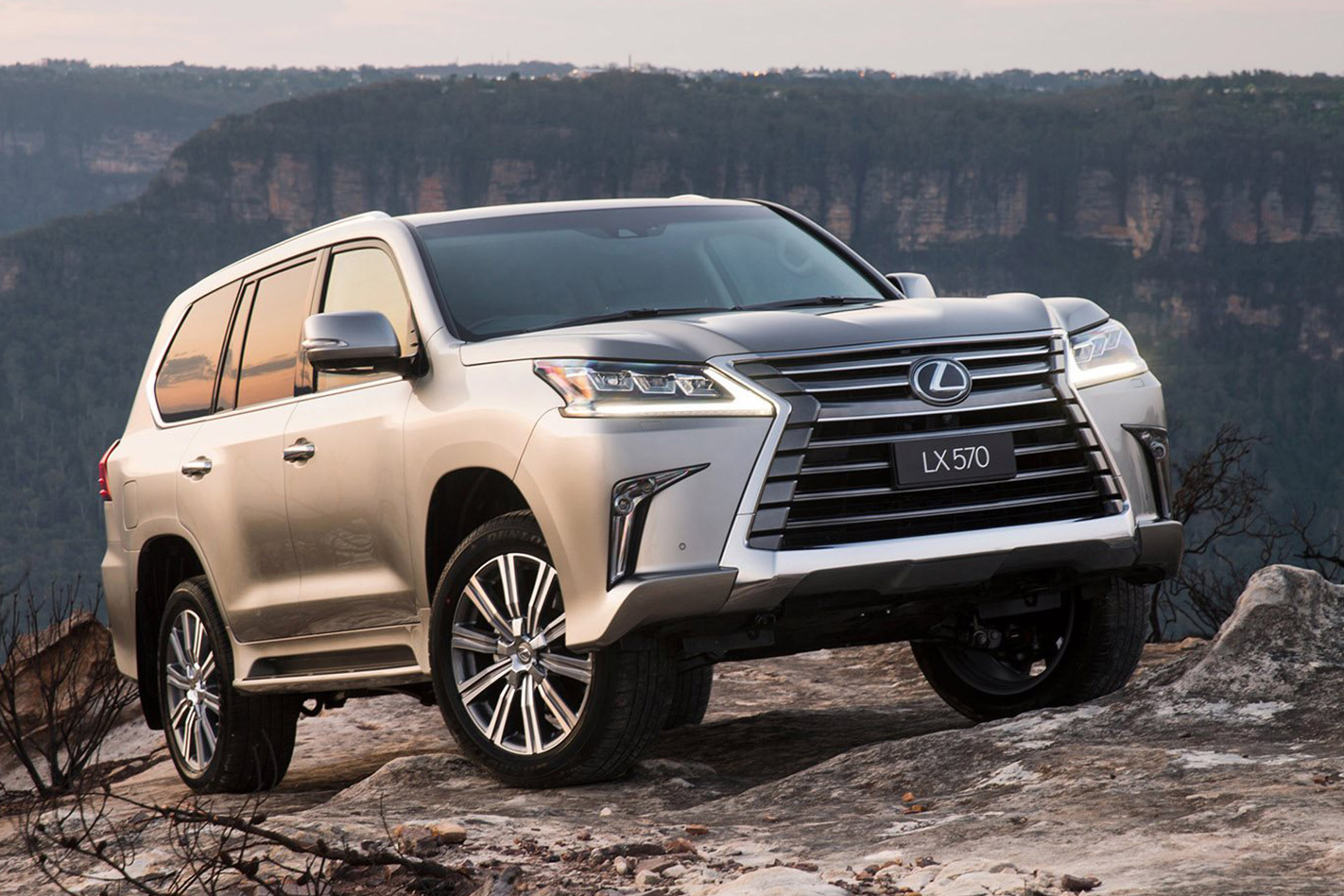
4. Lexus LX570 – 2740kg
More expensive than the LandCruiser on which its based, dumping diesel in favour of a 5.7-litre petrol V8 has done little to lighten the LX570’s colossal mass. Or thirst.
5. Bentley Mulsanne – 2685kg
Luxury doesn’t come lightly and Bentley’s Mulsanne is a case in point. A whopping 3300mm wheelbase and massive 6.8-litre V8 all add to the, er, portly bottom line.

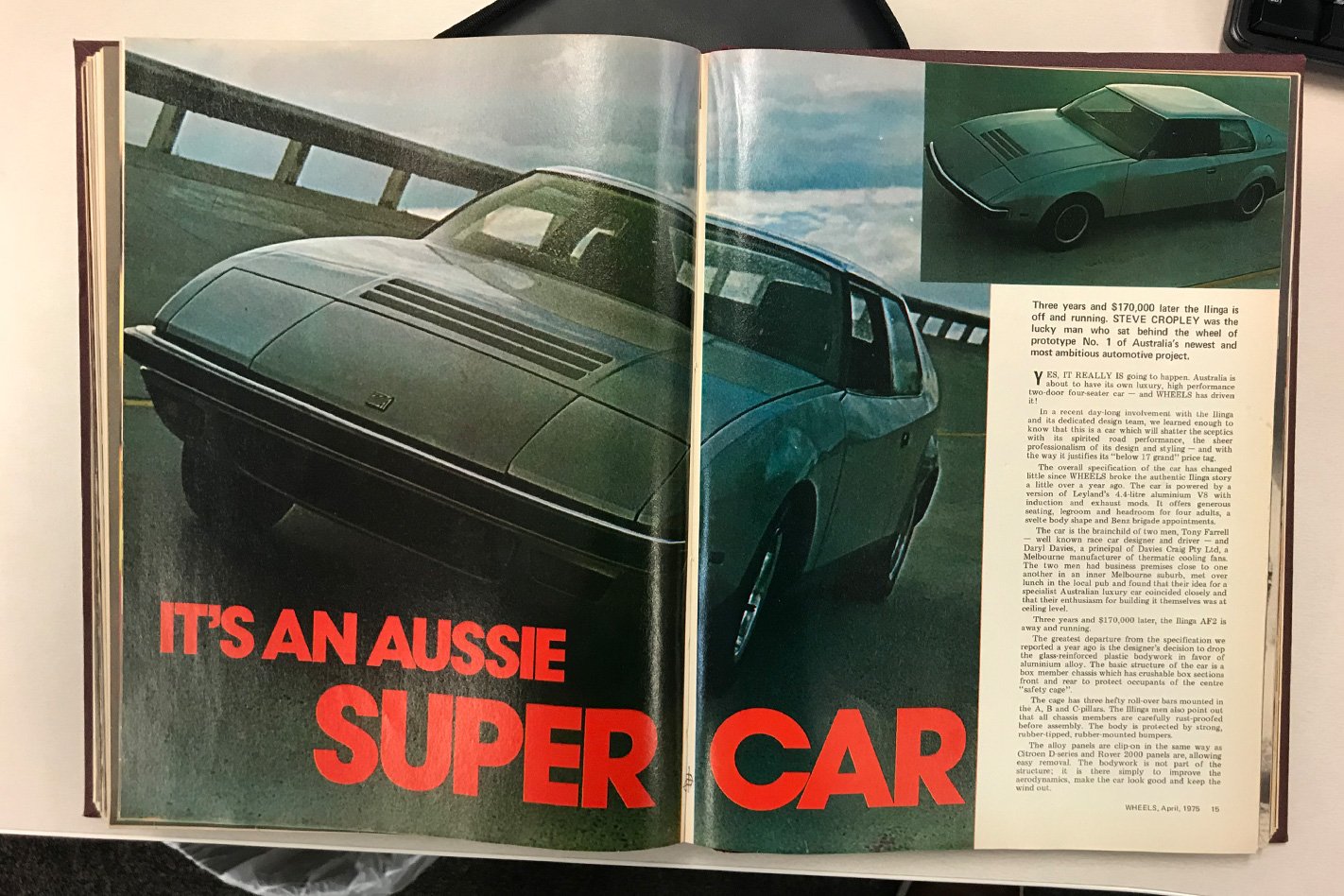
IN early 1975, when Wheels’ assistant editor Steve Cropley drove the Ilinga, our optimism that the ambitious project would soon see cars in the showroom led to this highly confident opening sentence: “Yes, it really is going to happen. Australia is about to have its own high-performance, two-door, four-seater luxury car.”
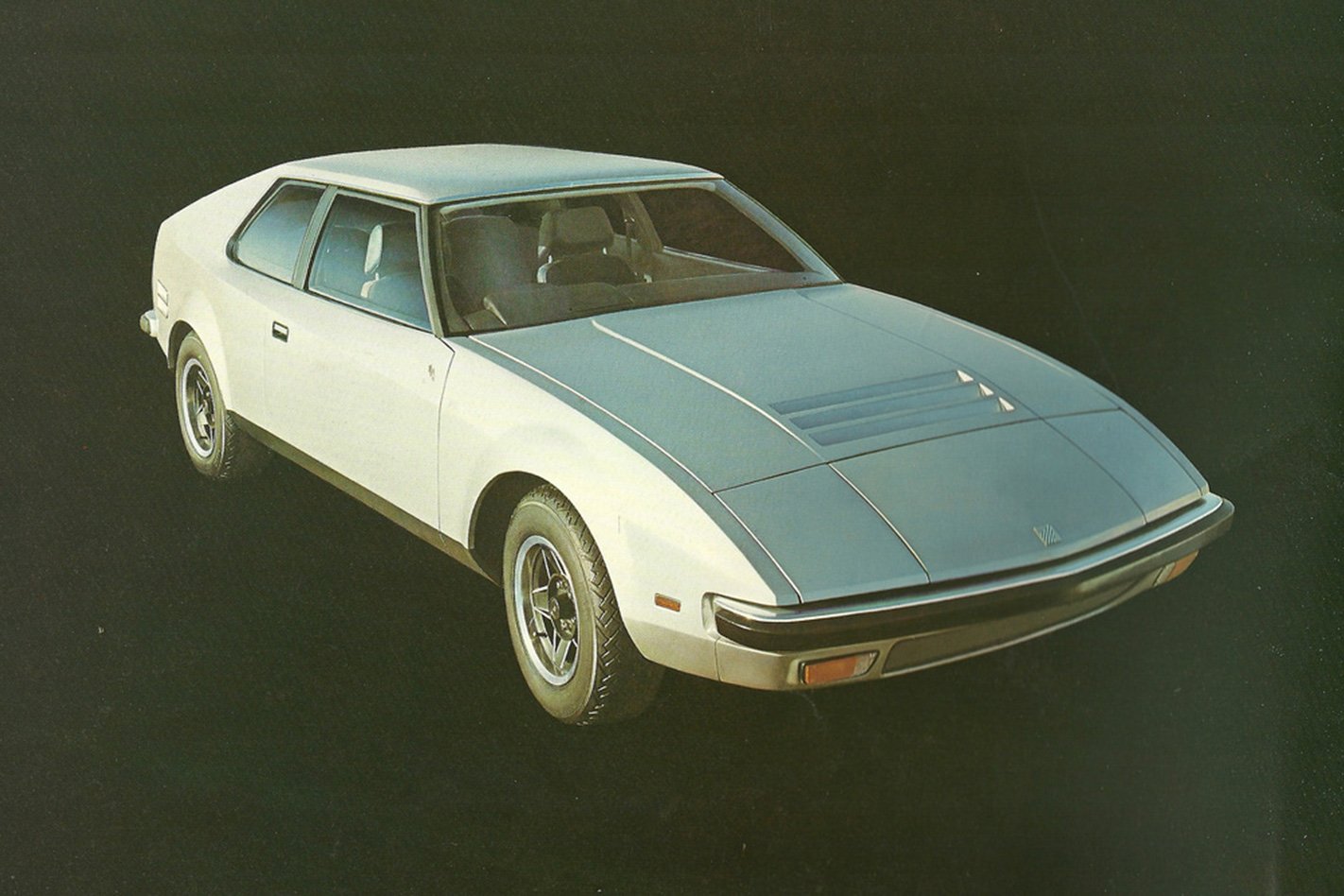
Sadly, of course, and despite holding 15 firm orders, the project folded after just two AF-2 prototypes were built. The original prototype was launched at the Melbourne motor show in March 1975, following a press unveiling of the $16,000-$17,000 coupe at a Rippon Lea mansion, both events shadowing Cropley’s first drive.
Ilinga, an Australian Aboriginal term for ‘over the horizon’, was founded in Melbourne three years earlier by British-born racing car driver and engineer Tony Farrell in partnership with businessman Daryl Davies, who ran the automotive cooling systems company Davies Craig, which is still in business today.
Cropley explains: “The two men had business premises close to one another in an inner Melbourne suburb. They met over lunch in the local pub and found that their idea for a specialist Australian luxury car coincided closely and that their enthusiasm for building it themselves was at ceiling level.”
Designed around a modified Leyland P76/Rover 4.4-litre alloy V8, the Ilinga was intended to rival Aston Martin and Porsche as a high-performance two-door luxury sports/tourer coupe. The body used aluminium panels over a steel chassis and sub-frame fitted with three roll-over bars and crumple zones for added safety. Farrell achieved an ideal 50/50 weight distribution.
The steel sub-frame was apparently based on a Ford Cortina floor pan, with the aluminium panels used in place of the originally envisaged Noryl plastic material. The chassis was, in many respects, ahead of its time, featuring a rigid box-member design with crushable sections front and rear to protect the passenger cell. The distinctive and still-attractive styling was the work of the multi-talented Tony Farrell.
The AF2 was designed to be fitted with four-speed manual or three-speed automatic Borg-Warner transmissions, all-coil suspension, electric windows, pop-up headlights, air-conditioning and central locking. The company planned to build two cars per week or 100 cars a year, but ran into problems with the Borg-Warner manual gearbox that was unable to cope with the extra power and torque of the modified 164kW V8 engine.
According to Richard Davies, brother of Daryl Davies (who no longer lives in Australia), the lack of a suitable gearbox would have forced the use of either a Ford or Holden V8 and led to a redesign of much of the car, including relocating the 100-litre fuel tank. With funds fully extended, there was no way of “effectively starting again” and the project and Ilinga Pty Ltd folded in late 1975.
So Ilinga remains yet another Australian story of automotive enthusiasm and determination that couldn’t quite get over the line.
THE NEXT breed of high-powered hybrid drivetrains appears to be hurtling towards 750kW+ outputs – raising supercar performance to the level of today’s multimillion dollar hypercars through clean-sheet hybrid designs.
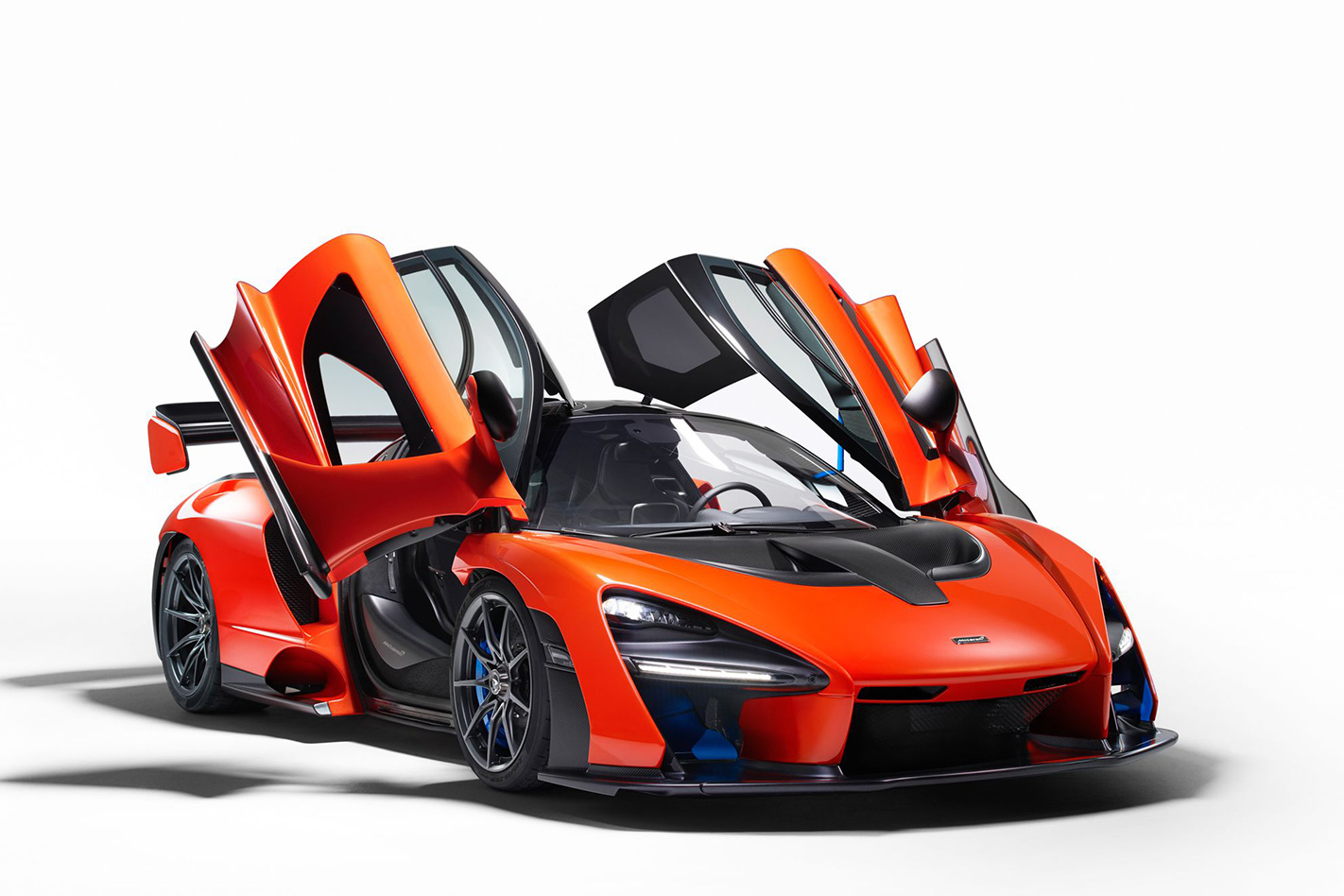
“This desire for each new model to be more powerful than the previous one is likely to continue,” McLaren CEO Mike Flewitt told Wheels. On the subject of ever-increasing outputs, Flewitt said: “If you mapped it out and drew a straight line through it, we’ll have 1000-horsepower supercars in 10 years’ time.”
Hitting those peaks while meeting stricter emissions targets typically points to a hybrid solution. McLaren is one carmaker planning a hybrid onslaught, part of a ‘Track22’ plan that promises half its cars will be hybridised by 2022. Flewitt confirmed McLaren is currently developing two engines, with the view to offering a split strategy in its future models.
While he said the V8 “will be around for quite some time”, he also said downsizing is inevitable, emphasising it is the power attributes and excitement provided by the engine – not the cylinder count – that will determine which way the brand jumps. A dedicated V6 hybrid seems likely.
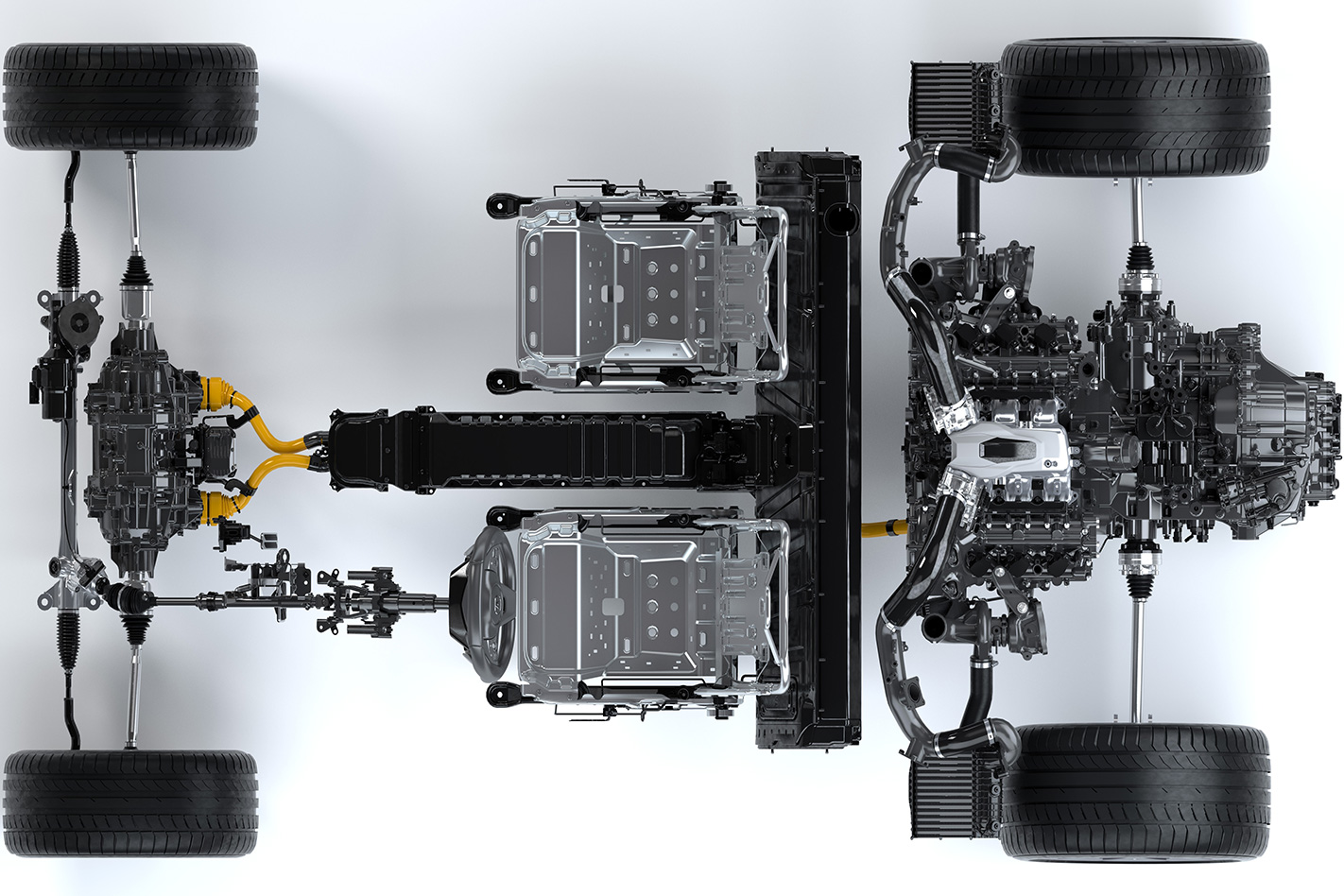
“The next generation [powertrains], they’re an integral part of the design, so the configuration is different. [We are] making decisions about engines and transmissions in the context of the fact that they’ll all be hybridised,” says Flewitt. “[With] smaller and smaller capacity engines with more and more turbocharging, the powertrain itself potentially becomes less driveable. You then add a hybrid system into that and you can then fill [the power curve] back out again, and get the characteristics from a hybrid [that you’d struggle to get with internal combustion alone].
“Typically, you then need to always have some [battery] charge available because [the hybrid system] is an integral part of the powertrain rather than an add-on.”
Increased processing power and advanced software controls are assisting drivers and allowing the safe control of big power.
“The amount of work that’s going in to developing powertrains, that’s going into chassis systems, that’s going into software controls, ties into every aspect of the car. It’s enabling the whole thing to keep ratcheting up,” says Flewitt.
It’s that software and electric work that is a focus for Aston Martin CEO Andy Palmer. Just as the British manufacturer now sources its 4.0-litre twin-turbo V8 engine from Mercedes-AMG, Palmer is planning to purchase battery cells from a supplier such as Samsung or LG.
But the Aston CEO acknowledges he’s gearing up for a major investment in electric motors and the software that controls them. “Two technologies we want to keep in house: one is the V12 [development] … and if we project 10 years into the future, what’s the next important stuff that’s left?,” he said, referencing electric motors. “What I don’t want to do is outsource that skill; I want to keep it in-house and somehow try to make character out of the electric drive in the same way as we make character out of the V12.”
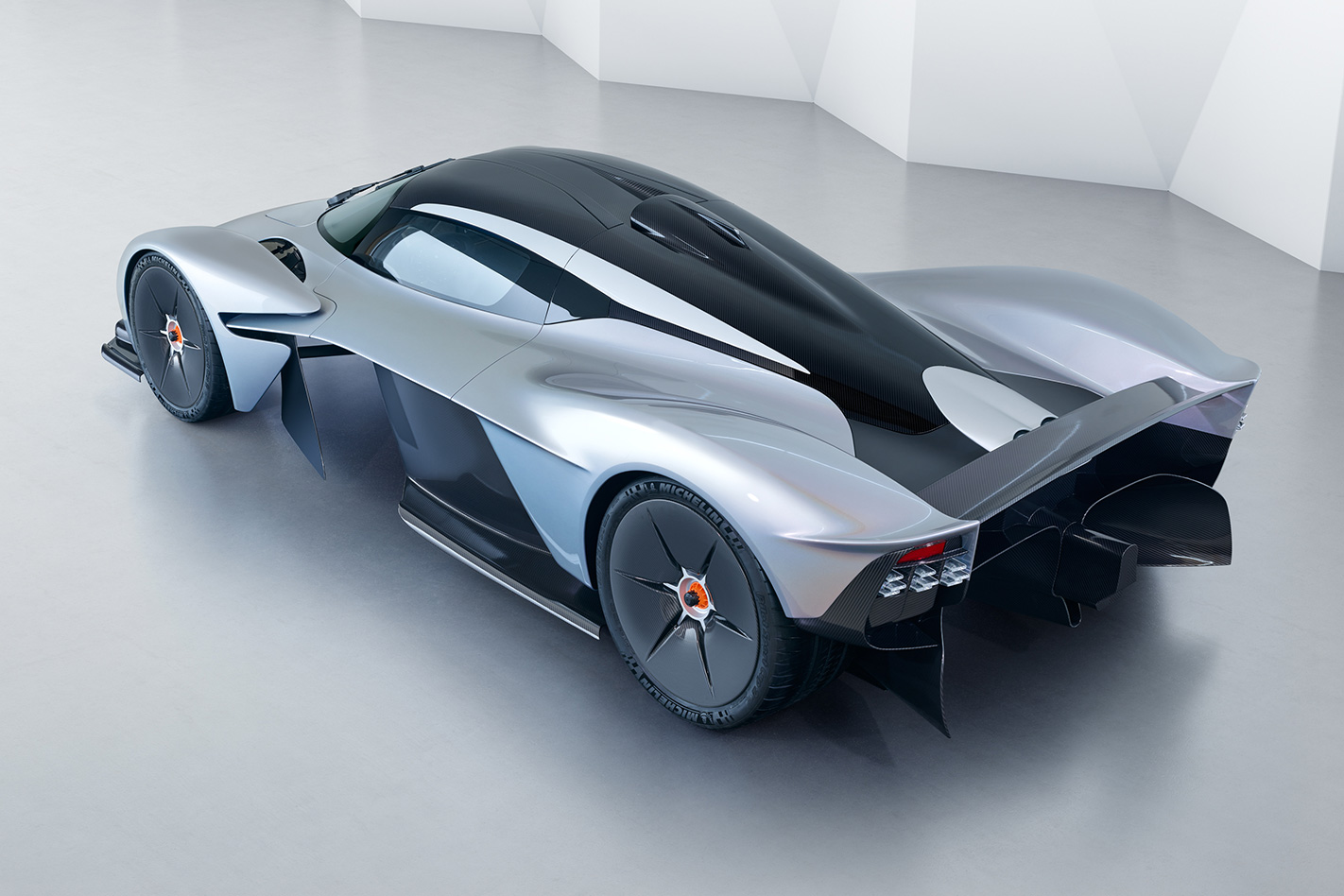
It seems the new age of 750kW supercars could be as much about sophisticated lines of software code as soaring engine revs.
