
IF THERE’S one car capable of keeping Honda’s front-drive Civic Type R honest in terms of sheer thrill factor for 50 big ones, it’s Subaru’s entry-level WRX STI. Yep, in 2018 you’ll need to spend $51,190 (not including on-roads) to slot yourself into even the base STI, yet what that money buys is a glorious slice of yesteryear.
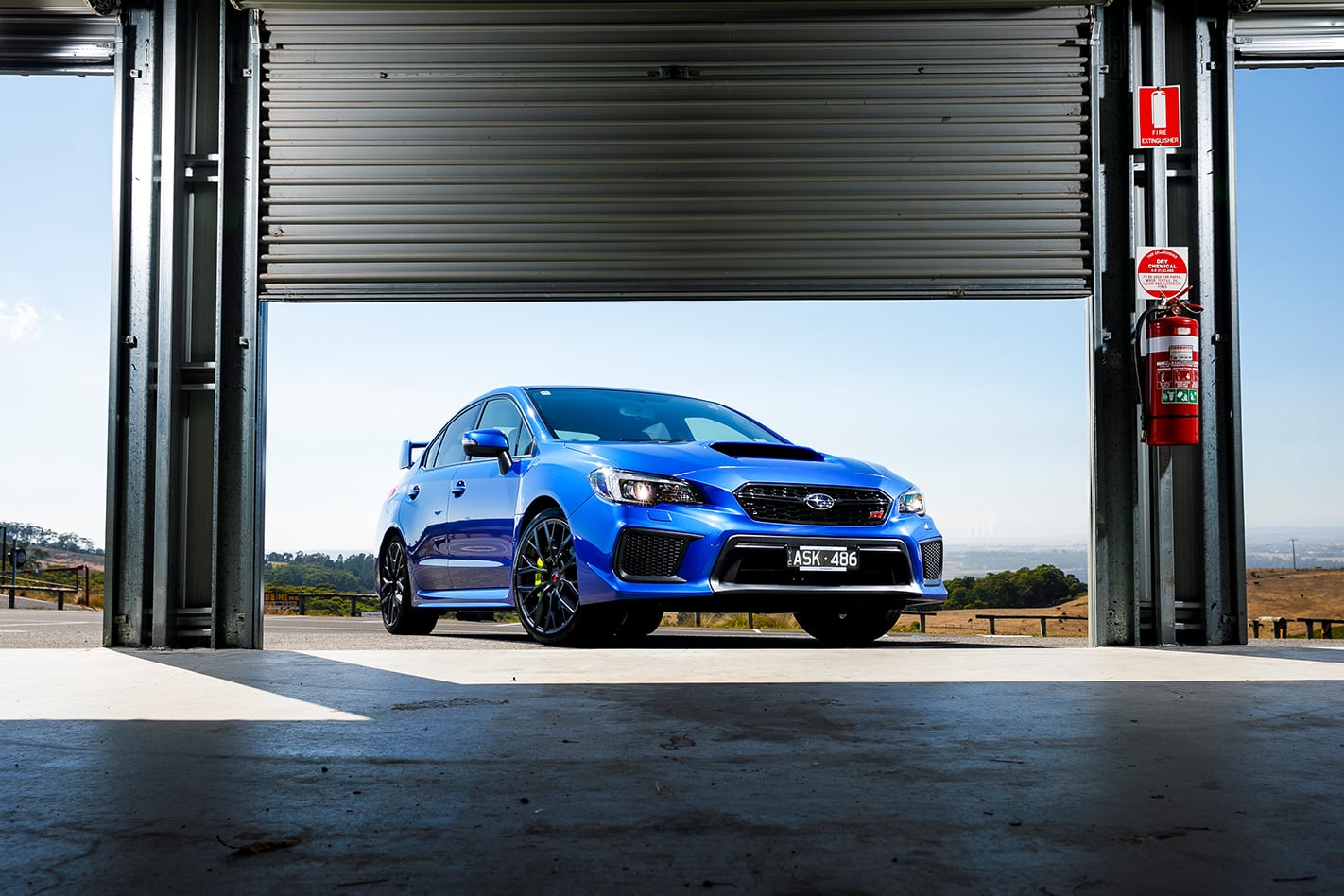
And the sort of car Subaru’s fan base probably expects when buying a WRX of any kind. Laughable steering rack rattle aside, the STI represents a clear step up from the base Rex in a bunch of key areas.
Firstly, its gearchange. The sloppy and vague piece of tat that swaps ratios in the boggo Subaru is transformed into a tighter, sweeter and delightfully positive instrument in the STI, working an engine that is both fruitier in its flat-four flavour and stronger in its mid-range. And even thirstier, making this the heaviest drinker on test.
The STI’s dynamic flavour is in keeping with its ‘back-in-the-90s’ fuel thirst. It might be more agricultural in some ways than a standard WRX, but this adds layers to its personality. And let’s be honest, who buys an STI and expects refinement?
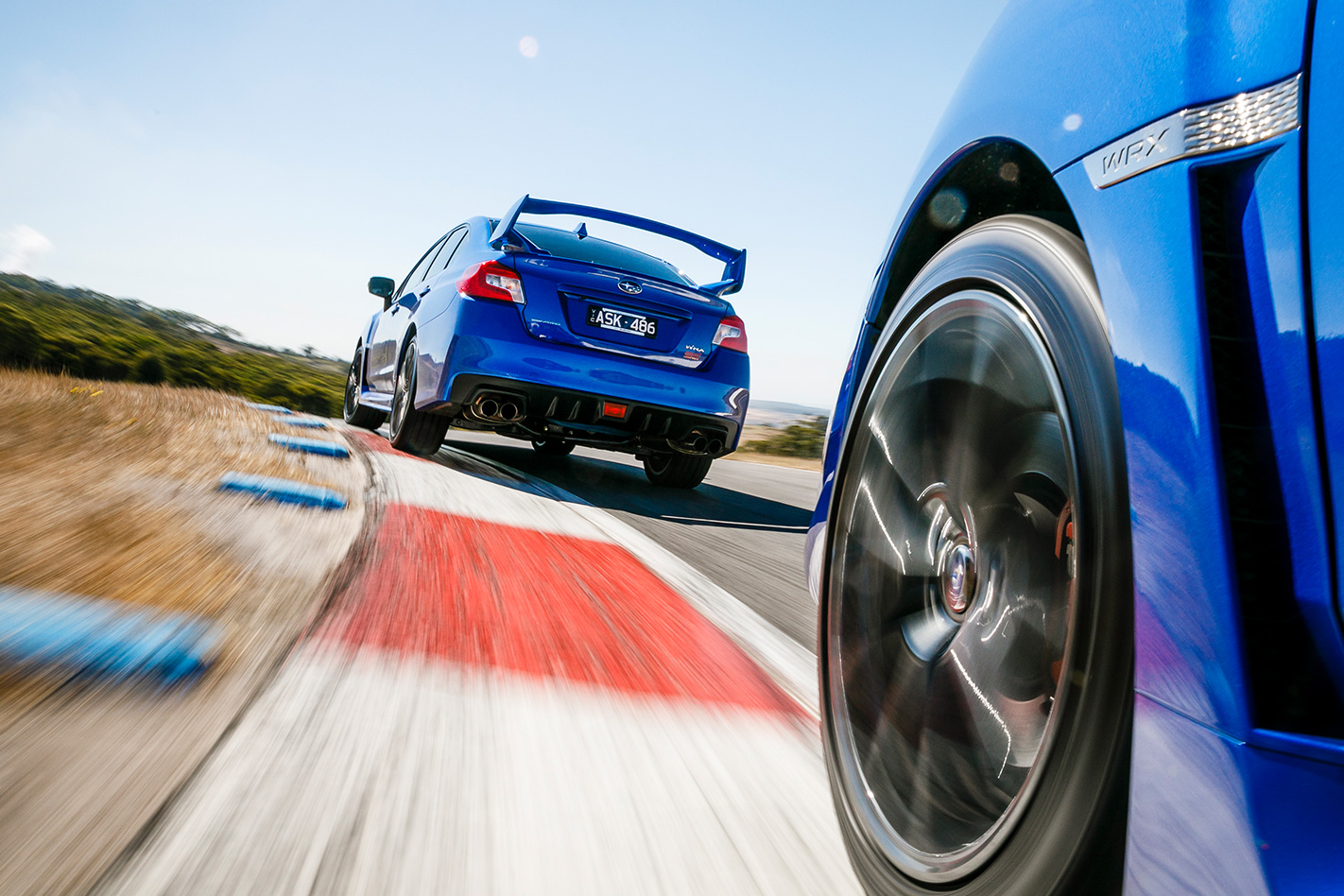
With its adjustable drive split permanently dialled to the rear, the STI is a playful and hugely capable performance car – one not entirely suited to a track like Haunted Hills, but as Renato pointed out, “if you had a faster course like Phillip Island, you would see a massive difference in lap time. Still, it’s an absolute joy to drive, certainly over the crests where other cars are struggling for grip; it also has a huge amount of mid-range torque.”
Out in the real world, the STI is one of few cars here whose overall limits far exceed what you can extract without becoming intimate with Aussie scenery. Covering ground fast in the STI is such a thrilling experience because it involves moderating its abundance of grunt, certainly in relation to the amount of grip available. And the harder you drive it, the better it gets.
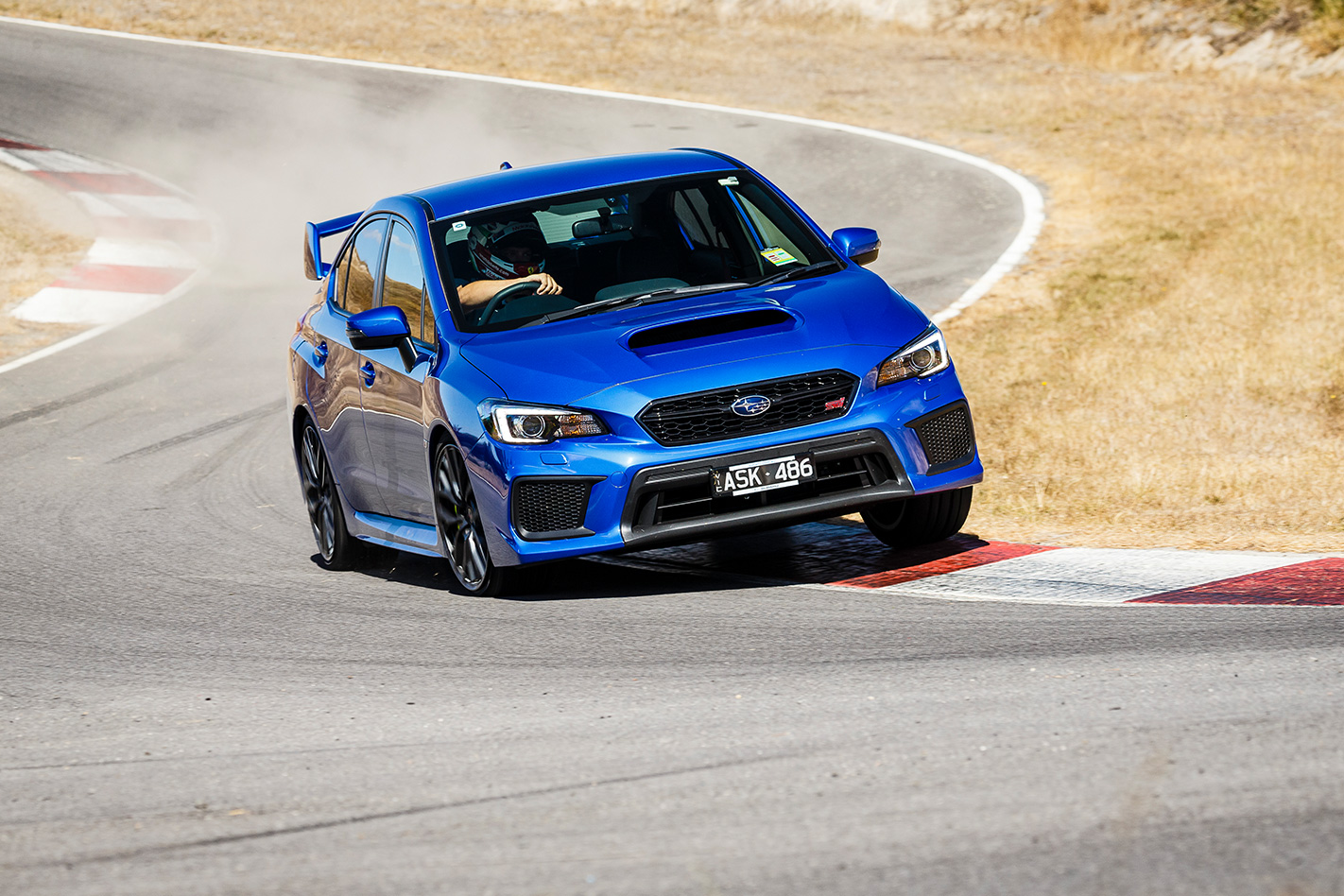
When you’re absolutely spanking the STI’s hindquarters, its over-light steering suddenly becomes animated as its drive system pumps power through the front axles, and if you’re brave enough to disengage ESC (beyond the mid-level Trac Mode setting), the STI will even serve up delightful oversteer drifts if you stomp the right pedal early enough when exiting a corner.
The STI’s advantages over the base Rex don’t stop there. A lower seating position with excellent in-house buckets creates a far superior work space, and enough detail bling to add a touch of sparkle to Subaru’s robust but workmanlike interior design elevate the STI closer to the hot-hatch (or sedan) barometer in 2018.
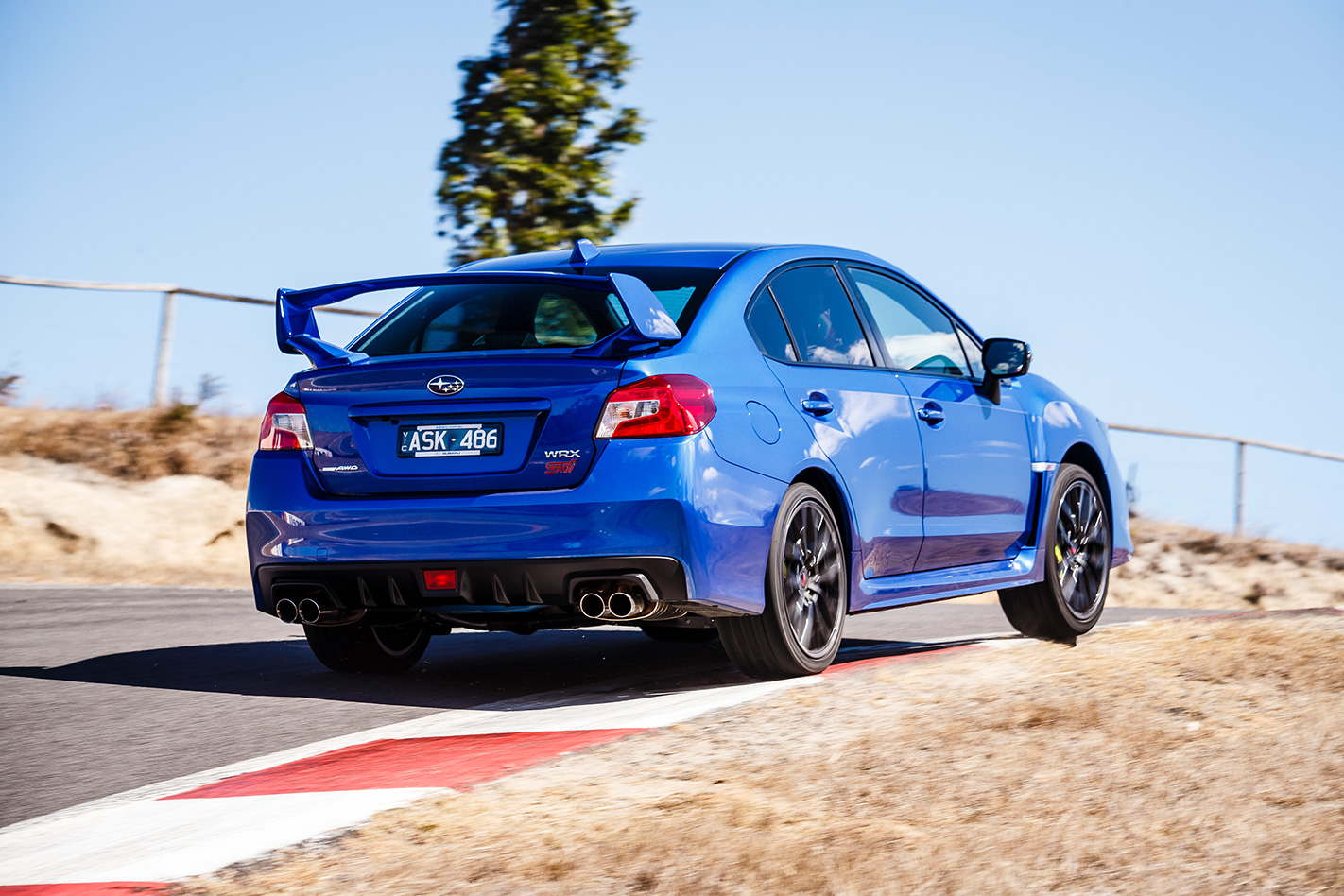
It looks better too, with 245/35R19s on retro-chic rims that fill the guards, making its Impreza sedan core look less long-nosed, high-roofed and frumpy. And it has much stronger brakes, as well as superior damping when loaded with mates (though both Subarus are a long way from delivering a level ride).
Yet there’s no escaping this is an old car trying desperately to keep up with the cool kids. And the STI makes such a racket that even its beefy Harman Kardon stereo struggles to be heard.
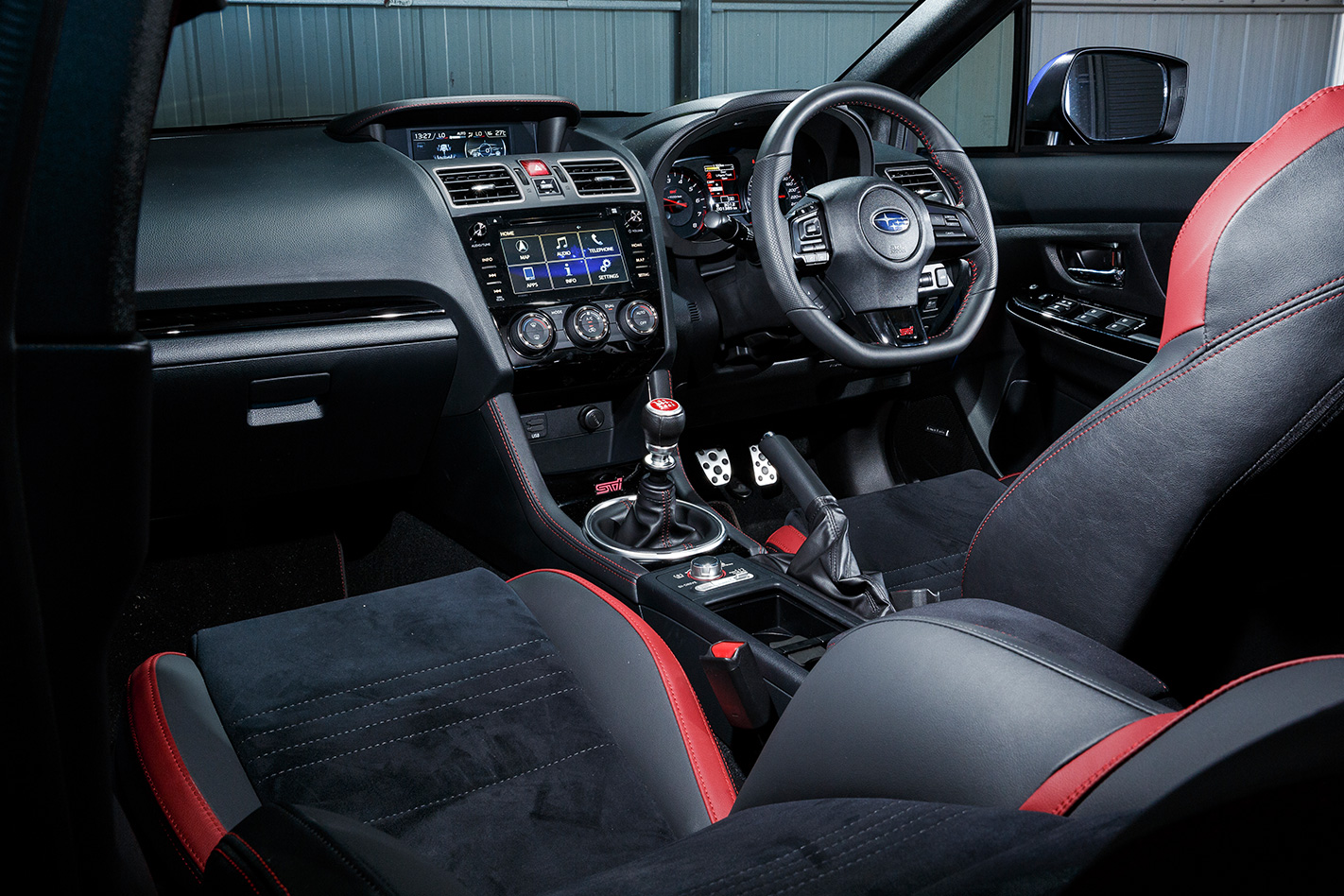
Back in 1989 when the WRX template (and the STI’s EJ-series engine) was born, Byron was lining up at Ticketek anxiously waiting to buy Roxette tickets. Almost 30 years later, wearing rally-inspired clothes hardly seems Dressed for Success. Yet there’s still lots to like about Subaru’s rough-and-ready AWD sedan.
In a world of young supermodels, the STI is Henry Rollins in new trainers. Yet when the cards are on the table, it plays a fast and engaging game.
Subaru WRX STI LAP TIME: 1:05.2sec SCORE: 7/10
Engine: 2457cc flat 4, dohc, 16v, turbo Power: 221kW @ 6000rpm Torque: 407Nm @ 4000rpm Transmission: 6-speed manual Weight: 1548kg Tyres: Yokohama Advan Sport V105 245/35R19 89W Fuel consumption: 18.2L/100km (tested) Power-to-weight: 143kW per tonne 0-100km/h: 5.2sec (claimed) Price: $51,190
Hot Hatch Megatest Contenders
12th, Score 6/10: Mini Cooper S JCW
11th, Score 6.5/10: BMW 125i
10th, Score 6.5/10: Subaru WRX Premium
9th, Score 7/10: Subaru WRX STI
8th, Score 7/10: Skoda Octavia RS245
7th, Score: 7.5/10: Ford Focus ST
6th, Score: 7.5/10: Renault Clio RS220 Trophy
5th, Score: 8/10: Volkswagen Golf GTI Original
4th, Score: 8.5/10: Volkswagen Golf R Grid
3rd, Score: 8.5/10: Peugeot 308 GTi 270
2nd, Score: 9/10: Honda Civic Type R
Winner, Score: 9/10: Hyundai i30 N
YOU CAN buy a Subaru WRX for $39,240. That’s really not a bad deal. The car we have here is the Premium edition, which ladles on a bunch of gear you don’t need and adds around $6500 to that figure, lifting it not only to within a few grand of the heavier-hitting WRX STI but also into the gunsights of some very talented rivals.

On track, the WRX made a decent fist of its hot laps. “That front diff gets power and torque there but pulling out of some of these tight corners when it comes on boost, it really lacks that front grip you think you would get out of an AWD,” said hired gun Renato Loberto. “The chassis doesn’t let you float the rear end into corners as much compared to, say, something like the Type R. That’s where it lost time.”
Still, fifth against the clock isn’t a bad result for the old stager, breaking the tape ahead of far more expensive rivals such as the Golf R, Mini JCW and BMW 125i. To inject a dose of perspective here, its lap time was still closer to relative lightweights like the Clio Trophy than it was to front runners such as the Civic Type R and Hyundai i30 N.
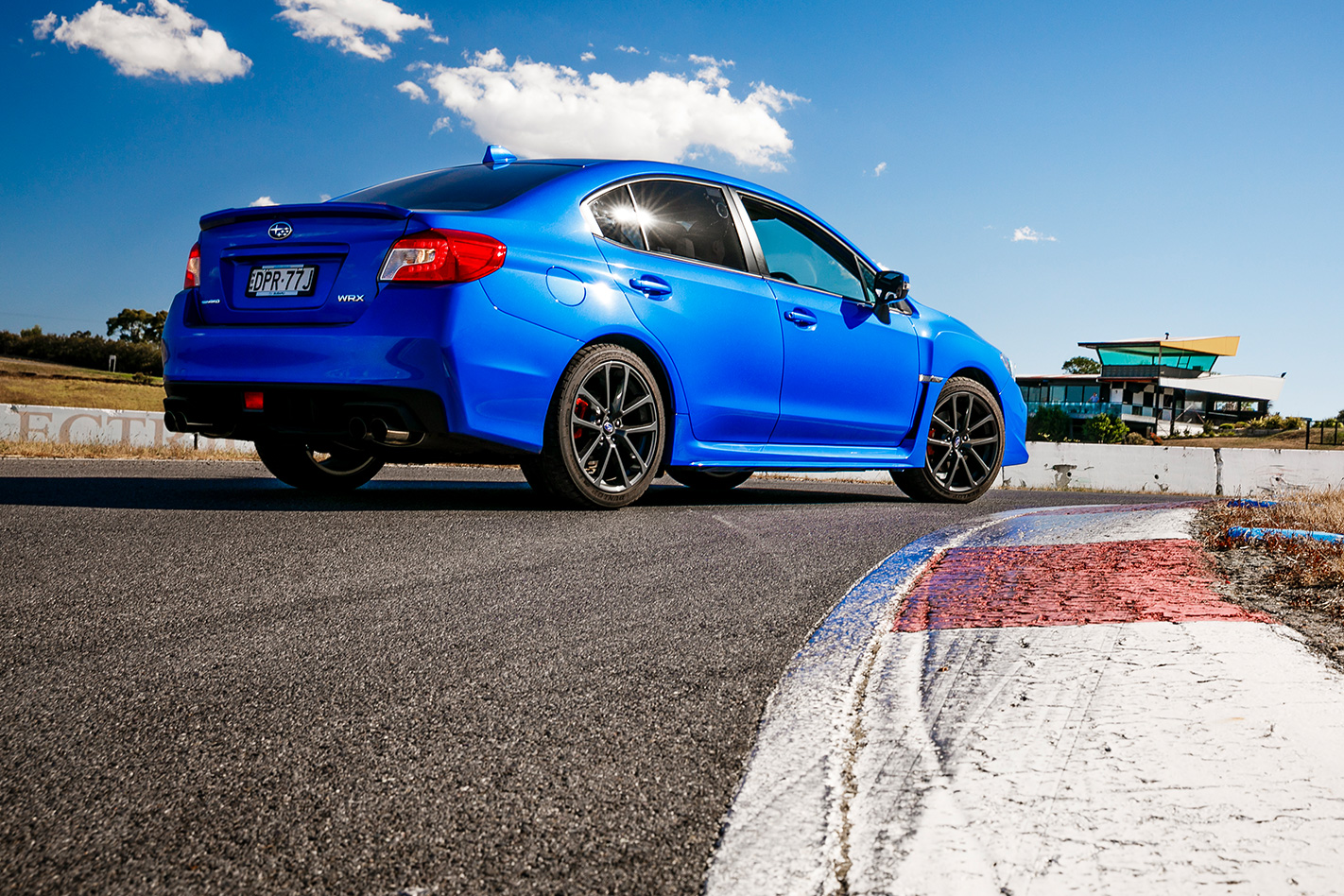
So has the WRX jumped the shark in the face of a new wave of hot hatches? The cabin feels laughably outdated, but then it was ever thus with the Rex. The seating position is too high and pedal placement is poor, with a yawning gulf between brake and throttle pedals. Ride quality is better than expected, but up the pace and the body feels pitchy; dips and crests setting up notable oscillations.
As Renato observed on track, it’s hard to quell the WRX’s inherent understeer bias with a quick throttle lift, the car feeling much like a front driver in its natural balance. It’s quite soft in roll too, but the electrically assisted steering system quells the rack rattle and kickback of its STI big brother, and turn-in is positive without inducing nervousness in the helm about the straight ahead.
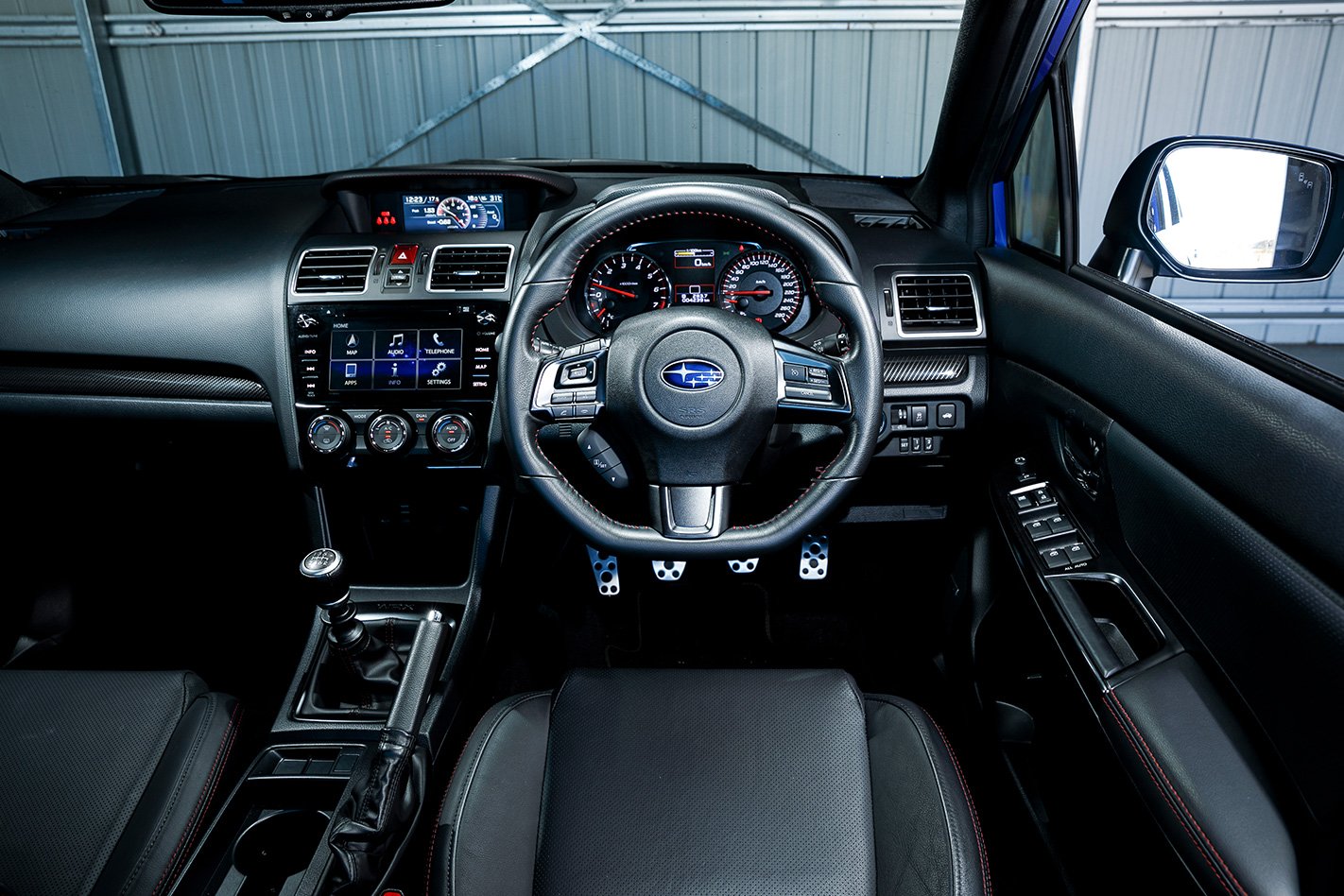
The soundtrack is memorable, the engine still retaining Subaru’s flat-four character, while the Dunlop Sport Maxx RT tyres are a decent OE selection, aiding the superb drive when gassed out of tight corners. But the WRX’s long-throw, rubbery gearshift argues a great case for spending the extra on an STI instead.
Ultimately, there’s no getting around the fact that the foundations of this car’s platform are old. In many ways it feels a decade behind the better cars here, and it proved the second thirstiest on test (predictably pipped by the STI). Today’s WRX is left behind by cheaper front-wheel-drive rivals that are better finished, deliver more tactility and mojo, and offer longer warranties, cheaper insurance and superior safety tech (EyeSight is not offered in manual WRXs).
As a $40K car, the WRX is not without merit. That said, other than its ability to get you to the highest chain bay at Falls Creek in winter, or to fill its boot with more stuff, it’s hard to think of anything the WRX does better than the i30 N for much the same price.
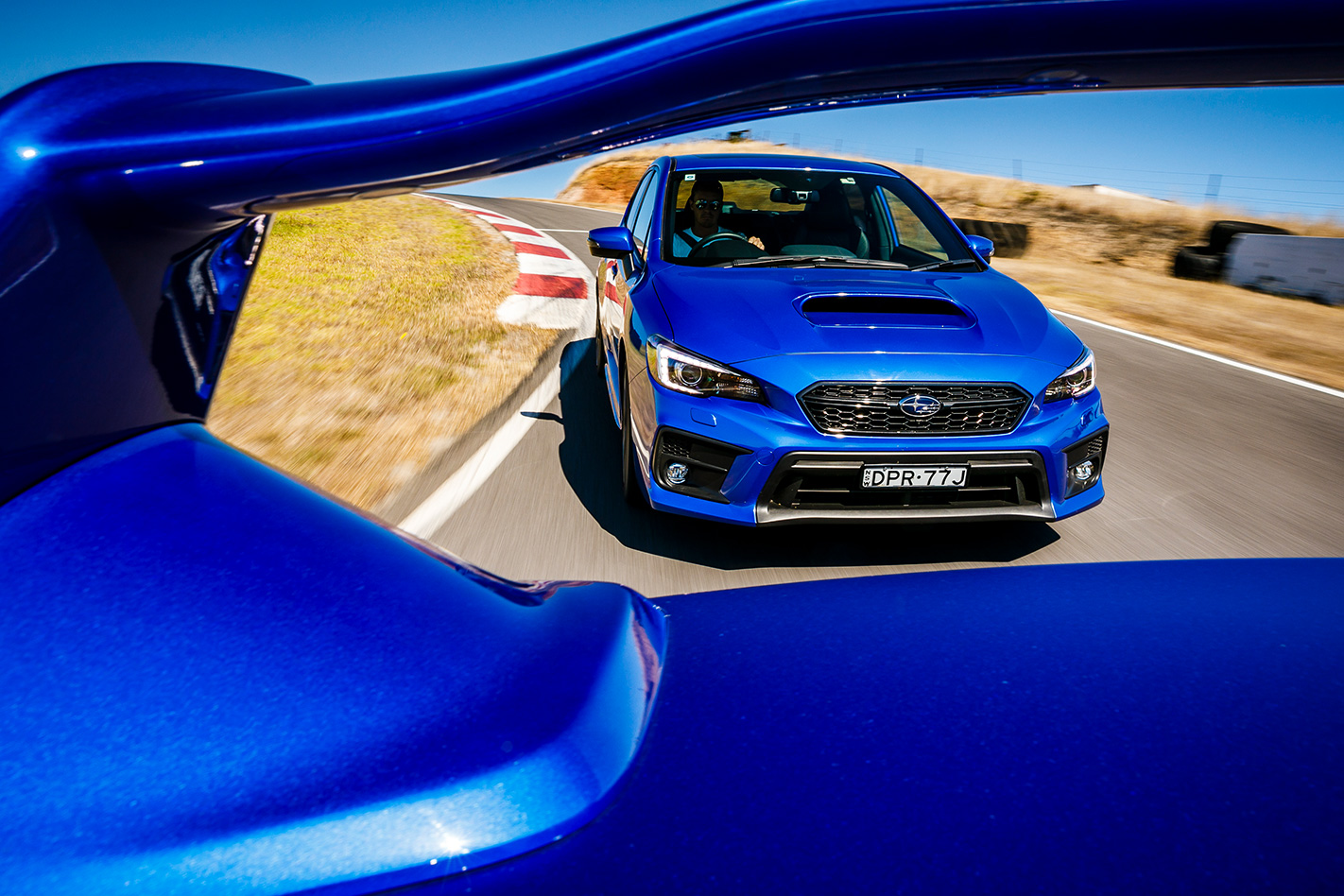
Still, if the Hyundai doesn’t appeal, then the WRX – in base trim at least – is the next quickest thing for 40 grand. Just don’t feel tempted to throw more money at it. The WRX is a cheap car and making it an expensive one merely blunts its edge. It might feel antediluvian at times, but the WRX still has a certain fun-to-drive appeal. Subaru’s problem is that this appeal grows more niche with every passing year.
Subaru WRX Premium LAP TIME: 1:05.4sec SCORE: 6.5/10
Engine: 1998cc flat 4, dohc, 16v, turbo Power: 197kW @ 5600rpm Torque 350Nm @ 2400-5200rpm Transmission: 6-speed manual Weight: 1504kg Tyres: Dunlop SportMaxx RT 245/40R18 Fuel consumption: 17.3L/100km (tested) Power to weight: 131kW per tonne 0-100km/h: 6.0sec (claimed) Price: $45,640
Hot Hatch Megatest Contenders
12th, Score 6/10: Mini Cooper S JCW
11th, Score 6.5/10: BMW 125i
10th, Score 6.5/10: Subaru WRX Premium
9th, Score 7/10: Subaru WRX STI
8th, Score 7/10: Skoda Octavia RS245
7th, Score: 7.5/10: Ford Focus ST
6th, Score: 7.5/10: Renault Clio RS220 Trophy
5th, Score: 8/10: Volkswagen Golf GTI Original
4th, Score: 8.5/10: Volkswagen Golf R Grid
3rd, Score: 8.5/10: Peugeot 308 GTi 270
2nd, Score: 9/10: Honda Civic Type R
Winner, Score: 9/10: Hyundai i30 N
The Toyota 86 is rightly viewed as one of smartest ways to spend $30-odd grand on a fun set of wheels. But fun means different things to different people.
The 86 is perfect if you want to carve some corners, but if you crave $30-odd grand of grunt (sorry, Russell Crowe) then you’re going to need to look elsewhere.
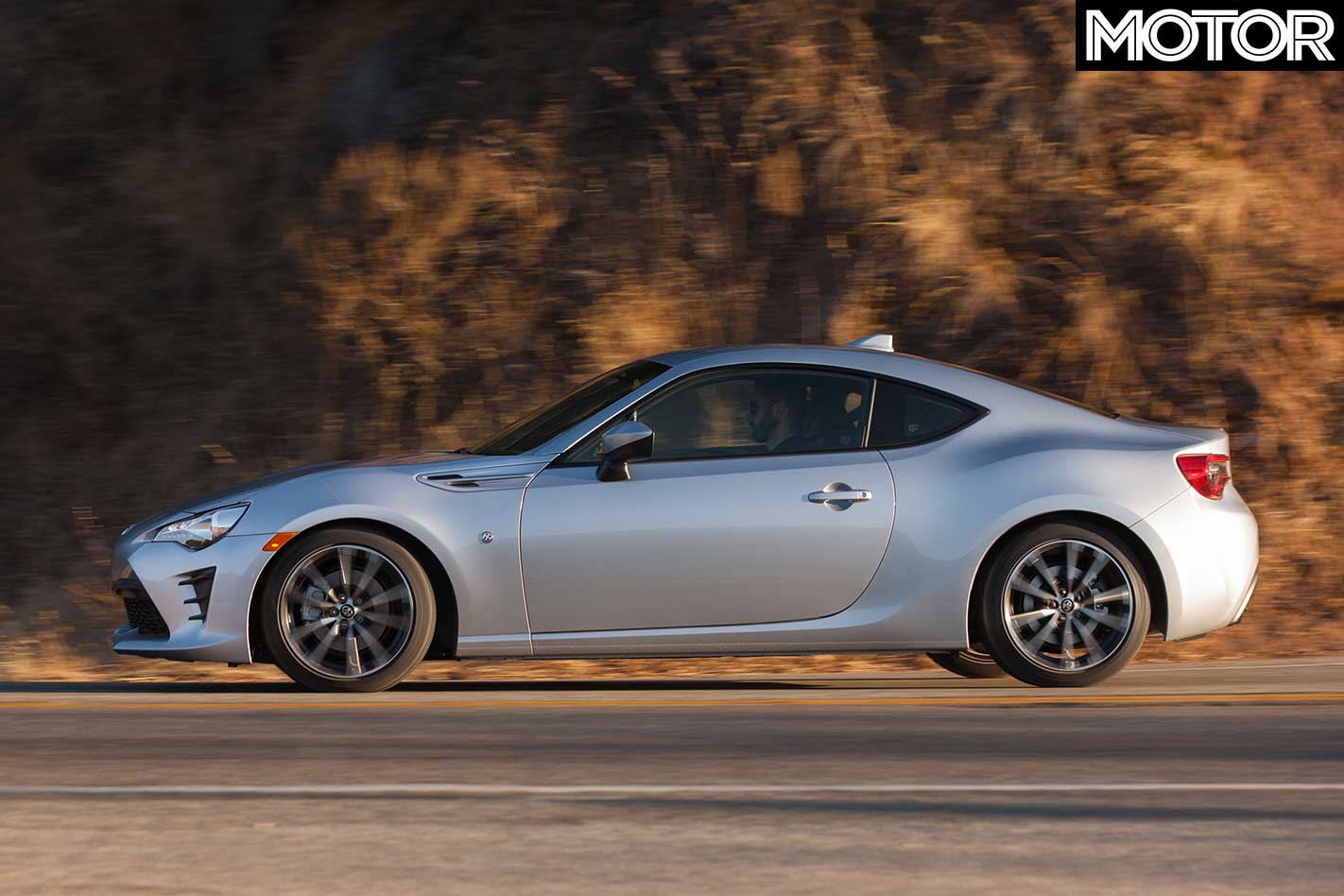
We’ve outlined a variety of options below, everything from US muscle cars to more exotic screamers from Japan and Italy, but one of the tastiest tempters was a 2003 Mercedes-Benz S55 AMG.
In the early 2000s AMG was beginning to play a major part in Mercedes’ product strategy and the introduction of its 5.4-litre supercharged V8 was a game-changer, transforming everything from the SL55 to the E55 into tyre-frying tyrannosaurs.
Up until 2002 the biggest dog in the super-sedan yard was the BMW M5 with 294kW/500Nm, a paltry amount of power compared with the AMG’s 368kW/700Nm.
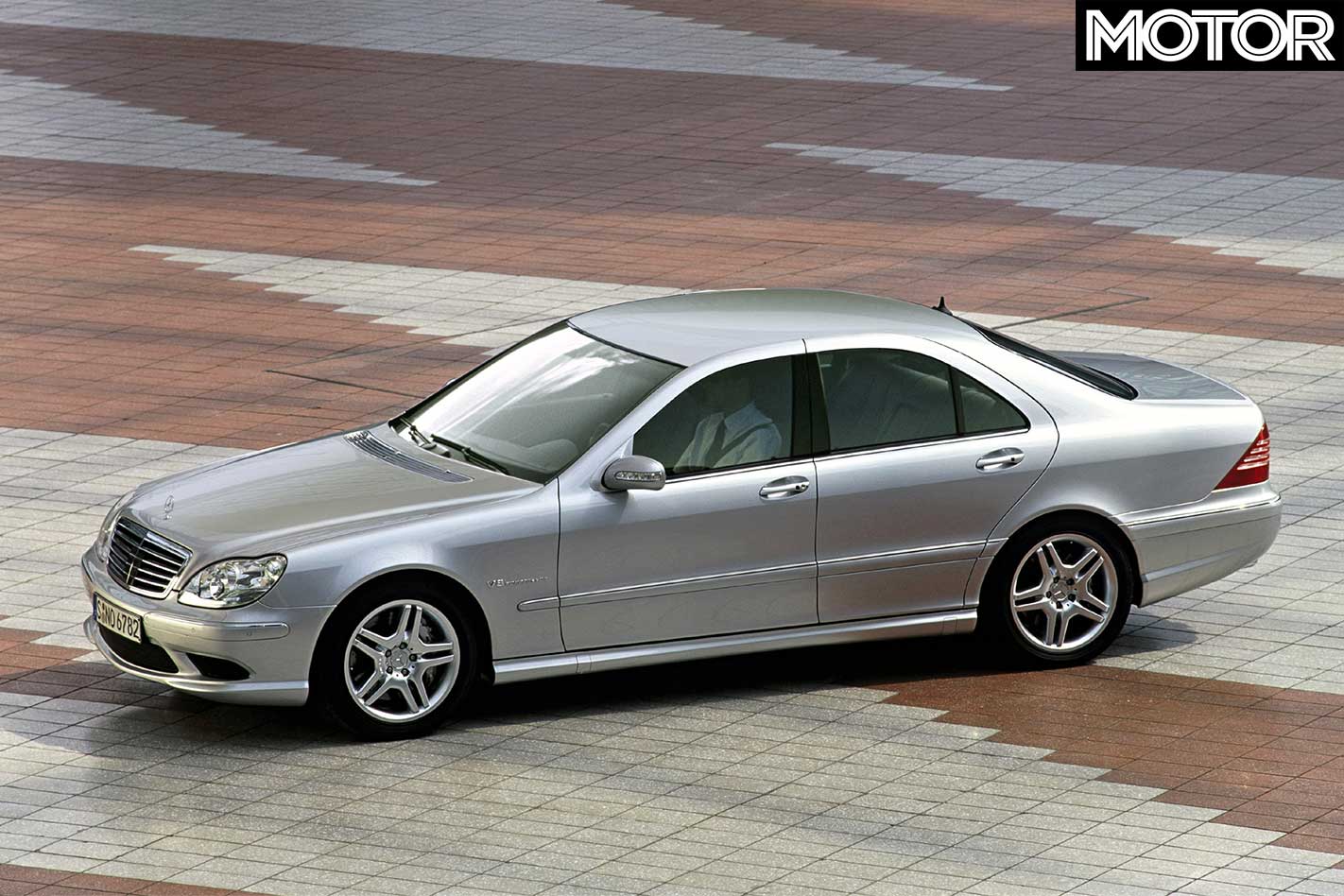
The S55 was one of the more incongruous homes for this engine, gifting this two-tonne palace on wheels the ability to sprint from 0-100km/h in 4.8sec or, more accurately, perform rolling burnouts for hundreds of metres – it’s an immense amount of car and performance for the money.
Go in with your eyes open as there’s a lot to fail on these cars, but the mechanicals are pretty good and you’ll feel like a king.
| 2018 Toyota 86 GTS | vs | 2003 Mercedes Benz S55 AMG |
| 1998cc flat-4, DOHC, 16v | ENGINE | 5439cc V8, SOHC, 24v, s/c |
| 152kW @ 7000rpm | POWER | 368kW @ 6100rpm |
| 212Nm @ 6400rpm | TORQUE | 700Nm @ 2750rpm |
| 1275kg | WEIGHT | 1985kg |
| 6.9sec (claimed) | 0-100KM/H | 4.8sec (claimed) |
| $36,640 | PRICE | $32,990 (used) |
Classies Watch
Modern classic tempters we found on tradeuniquecars.com.au
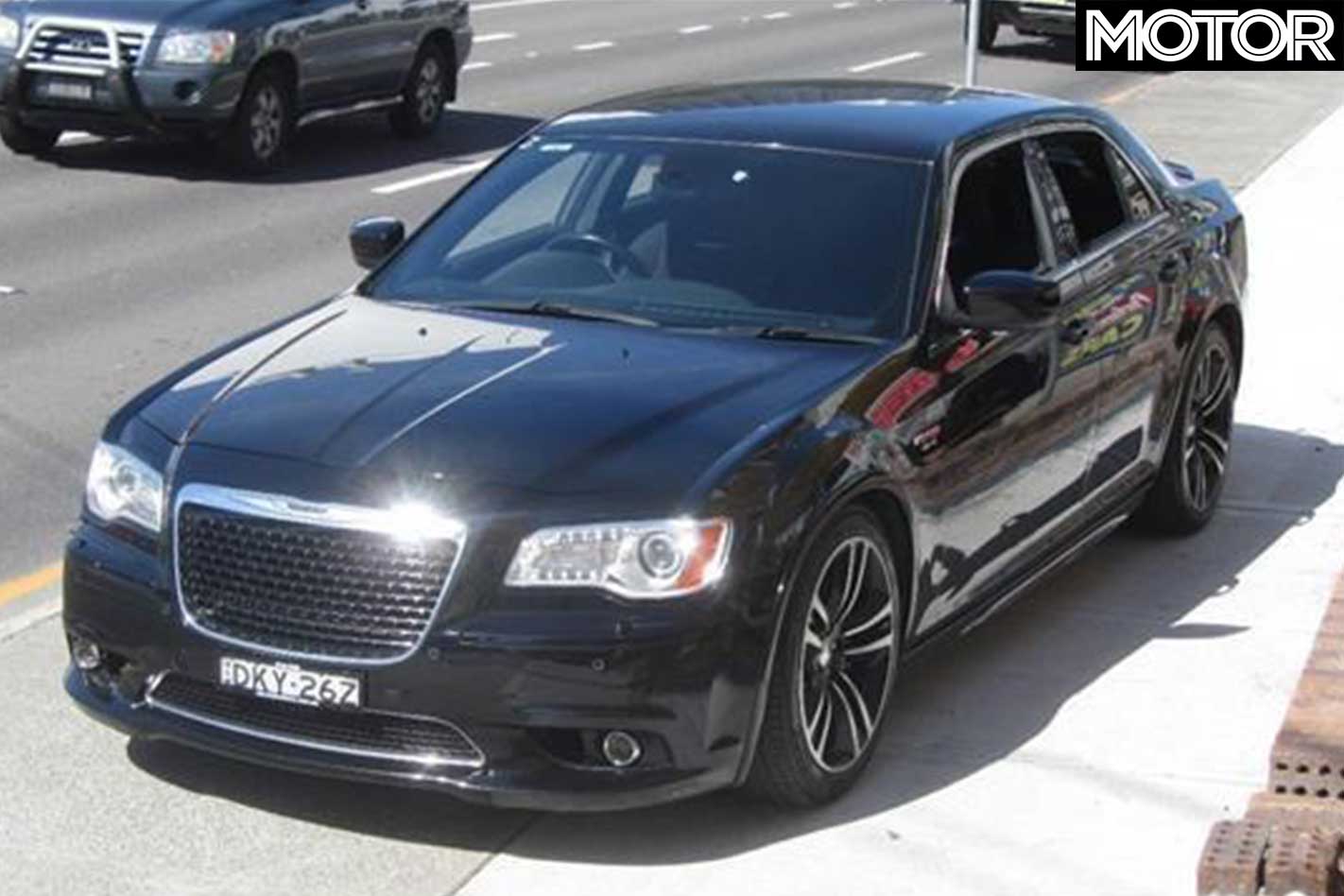
2013 Chrysler 300 Core – $32,990 6.4L V8, 350kW/637Nm, 135,572km, Homebush, NSW The SRT Core was basic, but it still looks good, goes hard and sounds mega.
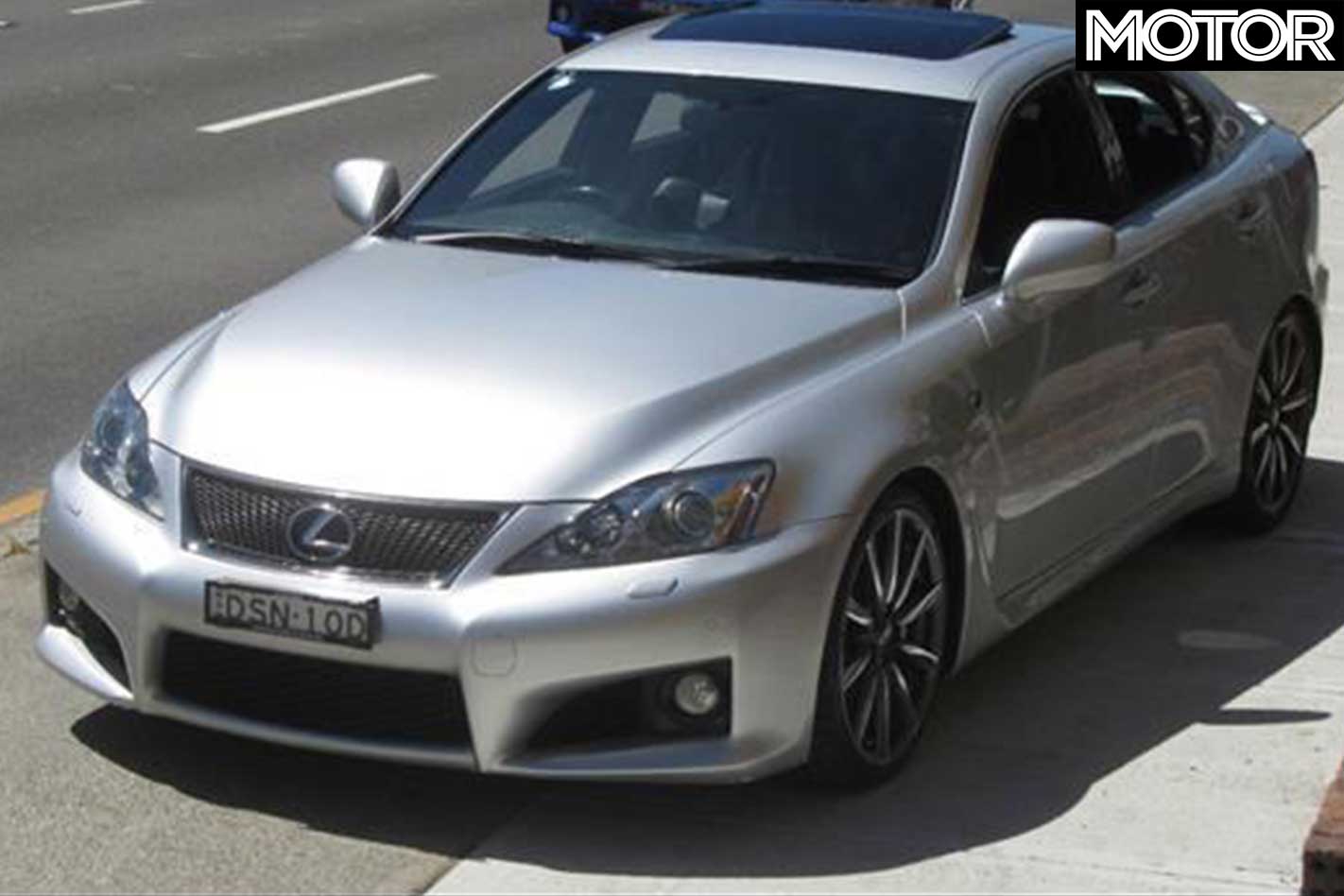
2008 Lexus IS F – $34,990 5.0L V8, 311kW/505Nm, 149,991km, Homebush, NSW Japan’s M3 can’t quite match its German rivals, but it’s depreciated a lot harder.
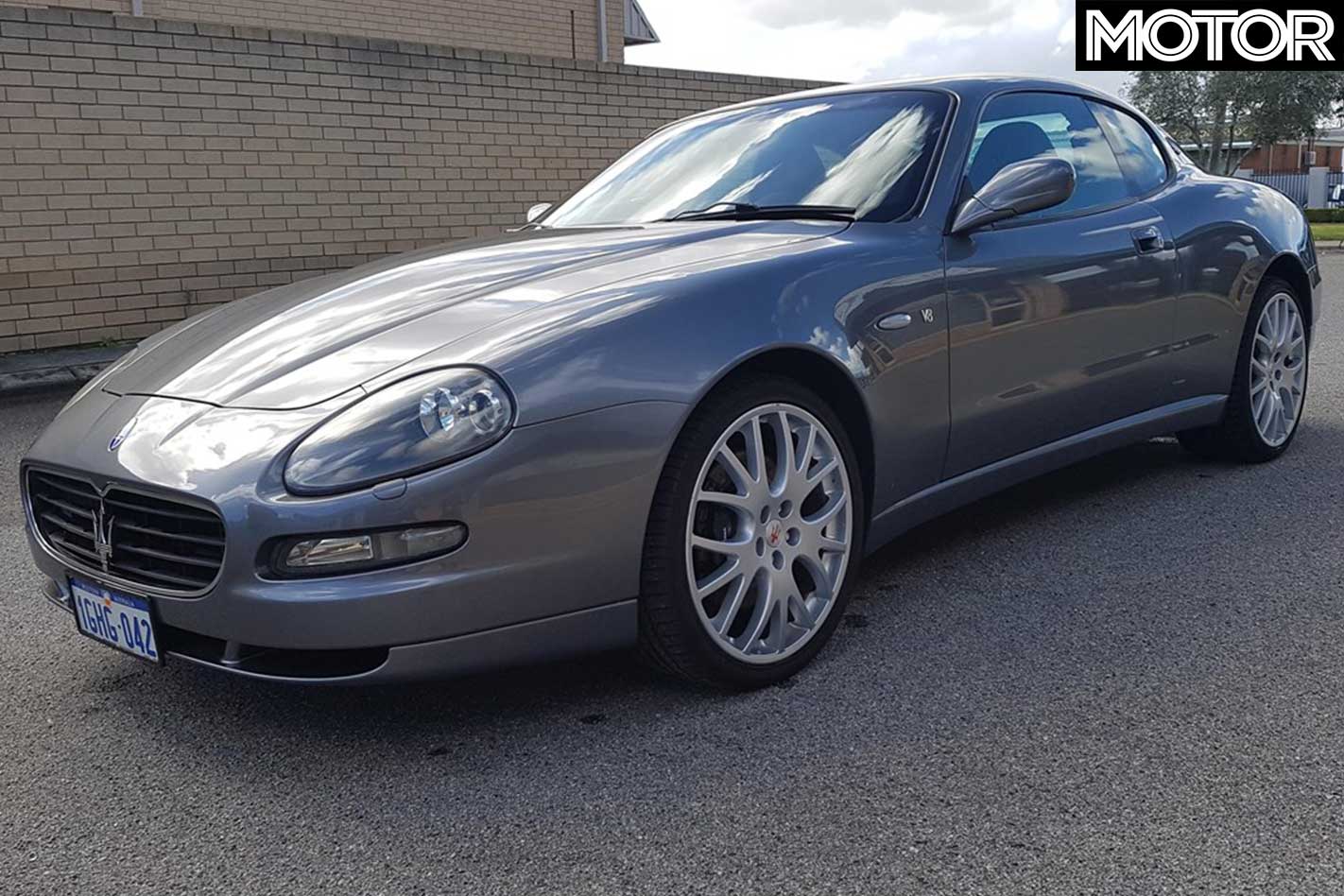
2006 Maserati 4200GT – $35,000 4.2L V8, 287kW/452Nm, N/Akm, Malaga, WA Those looks, that noise – if you can stomach the Cambiocorsa gearbox.
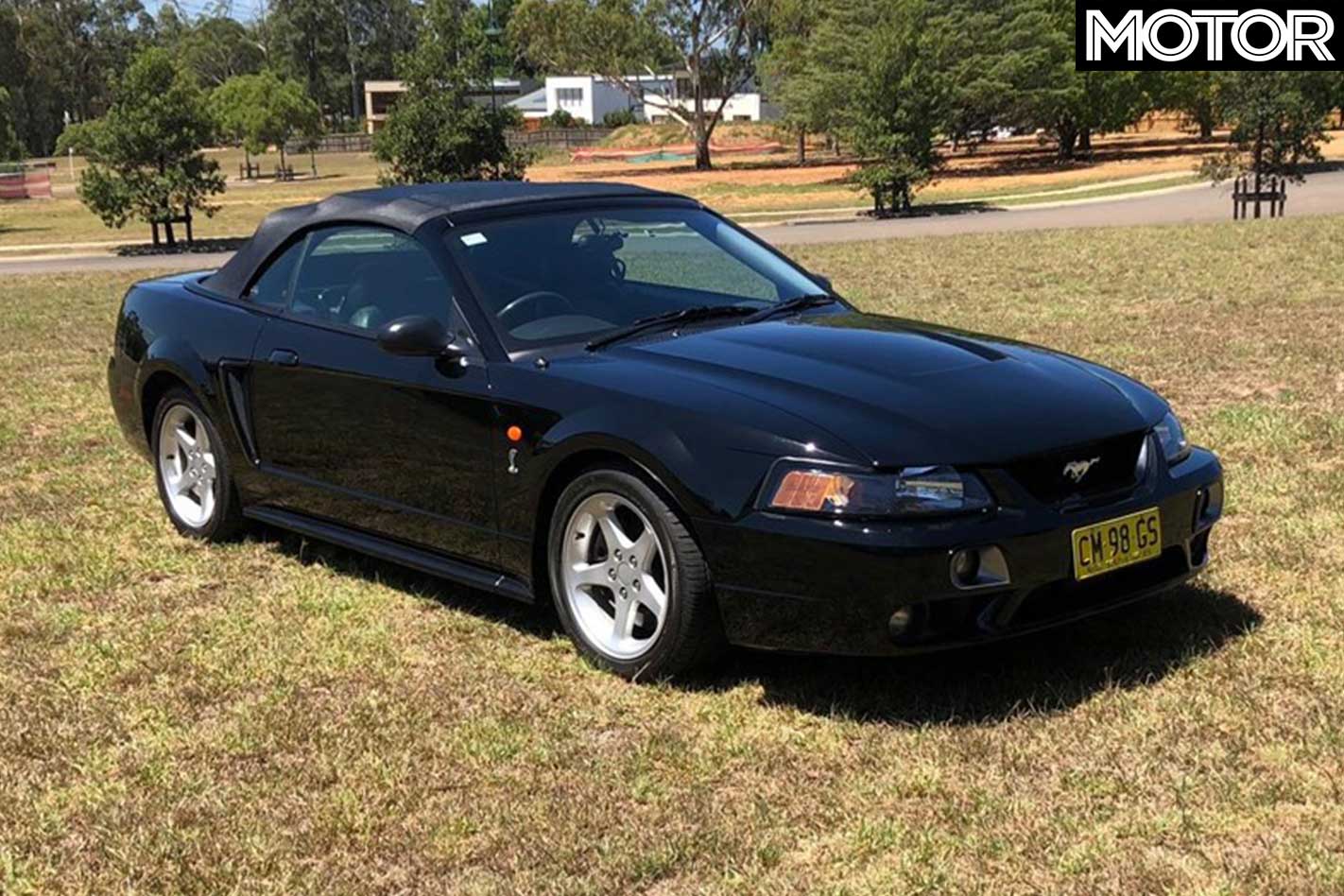
2002 Ford Mustang – $29,500 4.6L V8, 240kW/430Nm, 73,300km, Pymble, NSW Can’t wait for current Mustangs to depreciate? Here’s one to consider.
COLES Express has been named as the most expensive place to buy petrol despite its shopper loyalty program, a report looking at the state of the industry shows.
The Australian Competition and Consumer Commission’s annual report into fuel prices has this year named and shamed the nation’s most expensive fuel retailers in 2017, some of whom tap into new customers via loyalty discounts.
The report found the major retailers such as Coles Express, BP and Caltex had the highest prices on average during the survey period. In contrast, independent chains such as Independent and 7-Eleven were cheaper than the market average across cities including Sydney, Melbourne, Brisbane, Adelaide and Perth.
“Our analysis of petrol prices shows the range between major retailers with the highest average price and lowest average price varied across each city considerably,” ACCC chairman Rod Sims said. “Independent chains were the lowest priced in each of the five major cities and Woolworths was generally below the market average price in most cities.
“Average prices at Coles Express were the highest in all five cities, and average prices at retail sites where BP and Caltex head office sets the retail price were generally above the market average price,” Sims said. “The majority of consumers tend to go to the same petrol station every time they fill up. This research shows it might be time to consider which station to fill up at.”
The report also looked at the difference in average fuel prices over the last decade. It found the range between major retailers charging the highest average price and those charging the lowest average price had increased significantly since 2007, with BP above the average in all five cities, and Caltex above the average “in the majority of the five cities”, the report said.
Australasian Convenience and Petroleum Marketers Association chief executive Mark McKenzie told Wheels that selling fuel was a complex business, with up to 2200 companies selling fuel through more than 6700 ACPMA member sites across Australia.
He said Coles Express’ share of the retail petrol market had fallen 17 percent over a six-month period in 2017 compared with the previous year based on what appeared to be a strategy of steering clear of the monthly discounting cycle in which other fuel retailers engaged.
“The reality is that the [pump] price moves over a 30- to 35-day period,” he said. “At the start of the period, everyone sets their price high. Then they start and play discount leapfrog and we get this dynamic market where the average price drops over the next 30 or so days until it drops below the retail price and people stop making money on it.”
McKenzie said the ACCC report was based on the incorrect assumption that fuel retailers all paid the same wholesale price for their fuel. He said the price differences also did not reflect the differences between retailers who were focused purely on offering cheap fuel, and those that also offered convenience services.
The consumer watchdog’s reported the average difference between the lowest- and highest-priced petrol retailers across the five cities was 6.3 cents a litre. The largest range was 9.5cpl in Sydney and the lowest was 3.6cpl in Melbourne.
The ACCC also took a parting shot at fuel retailers offering shopping discounts and “premium” branding.
“Some retailers may offer discounts to qualifying customers,” it said. “Examples of these include shopper docket discount arrangements of the supermarket chains, discount arrangements between some major retailers and state motoring organisations, and discounts associated with fuel cards.
“These offers may also influence a retailer’s pricing strategy. These differences need to be borne in mind when considering the average prices of the major retailers.
“Consumers should remember, however, that there are minimum standards for RULP that all retailers must adhere to, and RULP sold by an independent retailer is typically supplied by the same refinery or import terminal as that sold by a so called ‘premium brand’.”
In 2017, the Federal Government asked the competition watchdog to monitor the prices, costs and profits of the retail fuel industry over a two-year period. This is the first report resulting from the request.
Many petrol stations are not owned or run by the companies that display their signs out the front. Coles Express is run by a company called Eureka Operations, while Shell stores are run by a company called Viva Energy. Woolworths-branded petrol stations, meanwhile, are owned by BP.
Caltex Australia, meanwhile, plans to scrap its franchises and bring all its retail sites under its control by 2020.
Loyalty programs are big business for fuel retailers; buying Woolworths’ petrol station network in 2016 cost BP a lazy $1.8 billion.
LEWIS Hamilton took a dominant victory in Catalunya, winning the Spanish Grand Prix with a lights-to-flag performance.
Starting from pole, the Briton controlled the race which lacked any engaging on track battles.
The only excitement of the forgetful grand prix was a first-lap crash that took three drivers out of contention.
Haas F1 driver Romain Grosjean spun, but kept his right foot planted, creating a thick smokescreen. Nico Hulkenberg and Pierre Gasly collided with the Frenchman in the melee.
Valtteri Bottas finished runner-up, with Max Verstappen third. Ferrari had a race to forget, with a poor strategy decision dropping Sebastian Vettel to fourth despite running second early on. Kimi Raikkonen retired mid-race with a mechanical gremlin.
Daniel Ricciardo rounded out the top five, setting a number of quick laps late in the race.
But for the dedicated motorsport fan there was still plenty to enjoy this weekend. In the German forests surrounding the Nordschleife Porsche held on in horrid conditions to win the Nuburgring 24 Hour.
The #912 Porsche 911 GT3 R took victory in the twice ‘round the clock battle, holding off the #4 and #5 Black Falcon Mercedes-AMG GT GT3s.
The race was marred by thunder, lightning, heavy rain, and fog from the halfway mark – but the warriors of the Nordschleife fought on until a late-race red flag for poor visibility.
Until then it had been a topsy-turvy race, with a number of different leaders, and more than a few race-ending crashes.
The red flag set up a gripping battle to the end when the action was restarted with 90-minutes remaining.
Just the #912 Porsche and #4 AMG remained on the leading lap, and the pair battled with iron wills through rain and traffic for an hour before the 911 could eek out a 20-second lead in the final 30-minutes.
Meanwhile, in the United States Australian Will Power took his first IndyCar victory of the year at the Indianapolis road circuit. The prologue to the biggest IndyCar race of the year – the Indy 500 – was a two-horse race, with the Aussie Penske driver battling with rookie Robert Wickens on a number of occasions.
Power used soft tyres to his advantage to hold the lead, while Kiwi Scott Dixon pounced on Wickens late in the piece to claim an unexpected second-place finish.
While Formula 1’s run of thrilling grands prix came to an end, it’s refreshing to know there is still plenty of thrilling motorsport around the world.
The next F1 round is the Monaco Grand Prix on May 27.
Would you let a complete stranger drive your car? I wouldn’t, and here’s (partly) why – because Kimi Raikkonen broke his mechanic’s leg.
That’s not as random and arbitrary a reason as it sounds (“I don’t face backwards on trains, because Nico Hulkenberg is allergic to tuna salad”) – simply put, it’s because even the world’s best drivers have accidents sometimes.
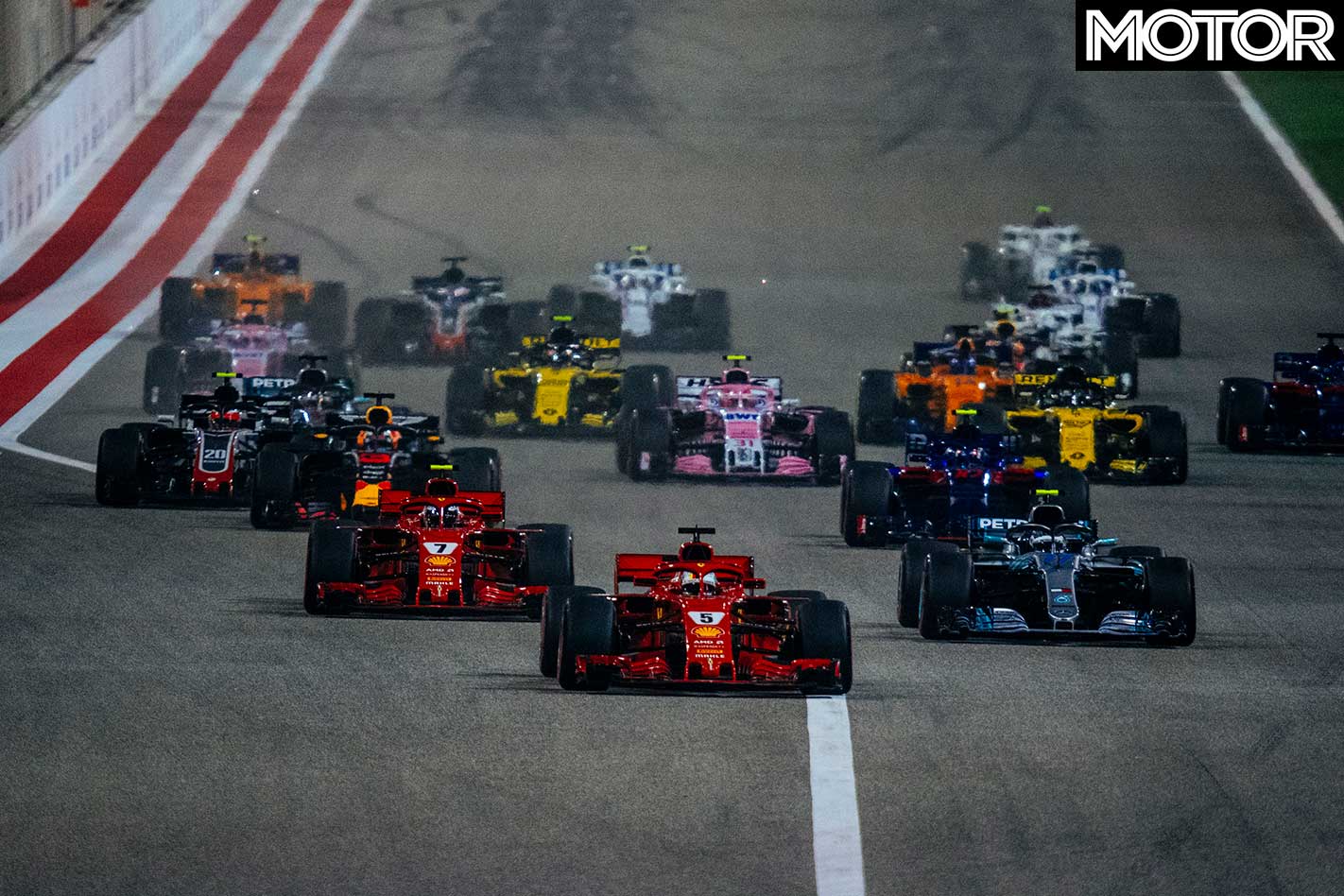
You might have watched Raikkonen driving over one of his wheel-changer’s legs during a pit stop at the Bahrain GP. (If not, let me save you the gory experience. “Broken tibia and fibula” is all you need to know.) And that’s with a supernaturally gifted wheelman in one of the most tightly controlled situations in the automotive world, the F1 pit lane.
But there’s a whole industry out there based on letting dozy, easily distracted strangers drive your car out there in the hideous messy real world.
Sites such as Turo are like the Airbnb of cars – you list your pride and joy, some punter comes and pretends like it’s his for the weekend, and he and his knucklehead friends listen to bad music on your stereo and fart on your upholstery. At least when it’s your house, they can’t T-bone it into a Tarago.
Sure, the car sharing companies have insurance to cover accidents, but do they have insurance to cover the angry electric jolt of violation and betrayal that sparks in your heart every time you see your baby and know that someone did her wrong… and that you were complicit? Ask Woody Harrelson how he felt about Demi Moore after one night with Robert Redford. Oh Woody, you short-sighted fool.
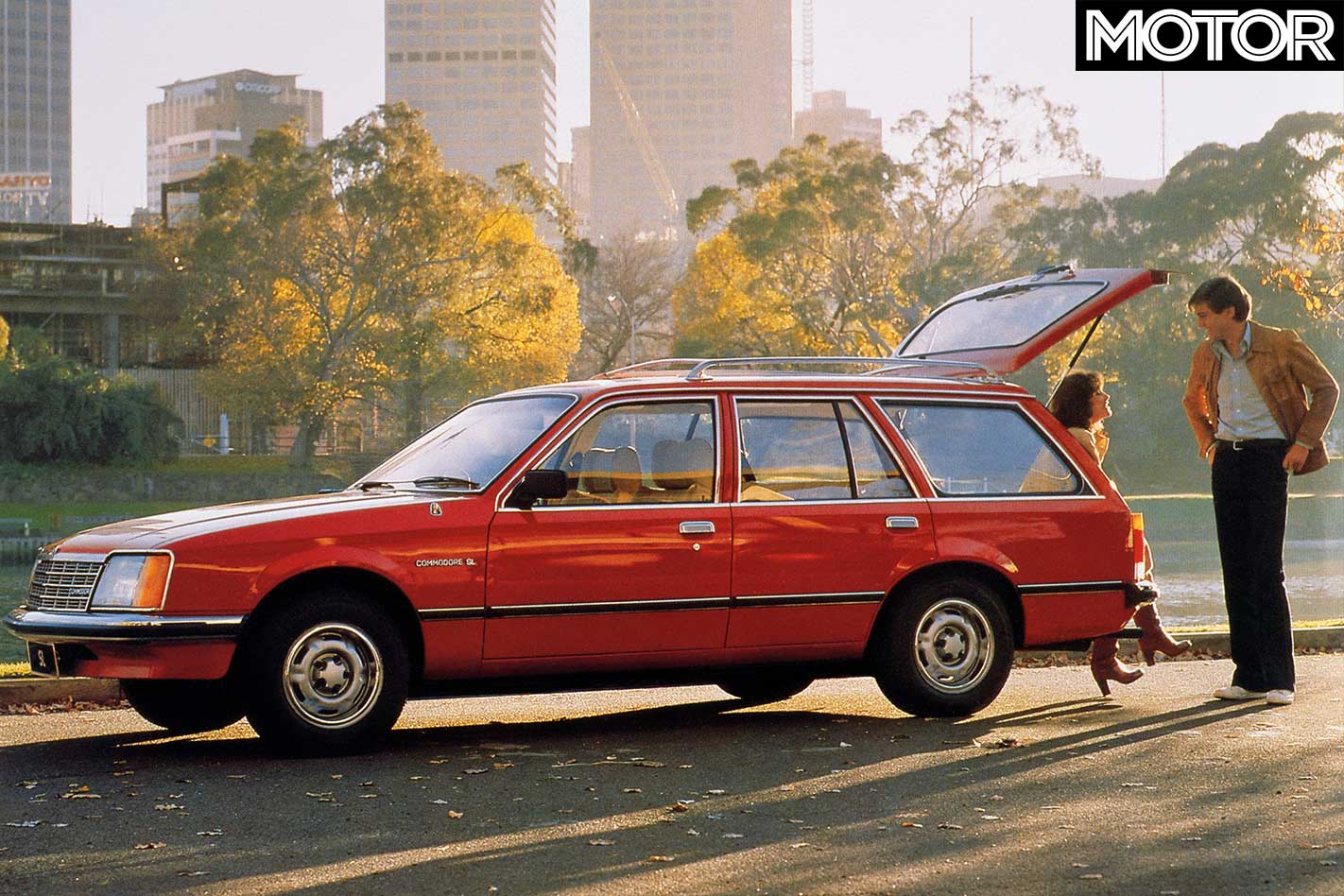
My car is not just one more interchangeable clone-machine that can be replaced with the latest one off the line. It’s my car.
Imagine a dog-sharing service, where some stranger pays you fifty bucks a day to borrow your dog, and then Sir Rex-A-Lot gets hit by a car (maybe by a stranger driving your own car, for the worst-day-ever jackpot). And Dog Sharing Dot Com says, “Hey, don’t worry, we’ll cover the cost of buying an identical dog.”
I don’t want an identical dog! I want my dog! I was, like, 60 per cent of the way through training him to fetch cans of beer from the fridge!
I don’t want your filthy blood-money, Dog Sharing Dot Com, I want you to take Sir Rex-A-Lot’s body to a Pet Sematary on an ancient Indian burial ground and return him to me, because I would rather have a demon-dog who is the soulless husk of my real friend, than some fluffy lookalike who just rubs my nose every day in the fact that he can’t even open a fridge door, let alone tenderly grasp a can of VB in his jaws! (Sorry, this hypothetical has sort of gotten away from me here.)
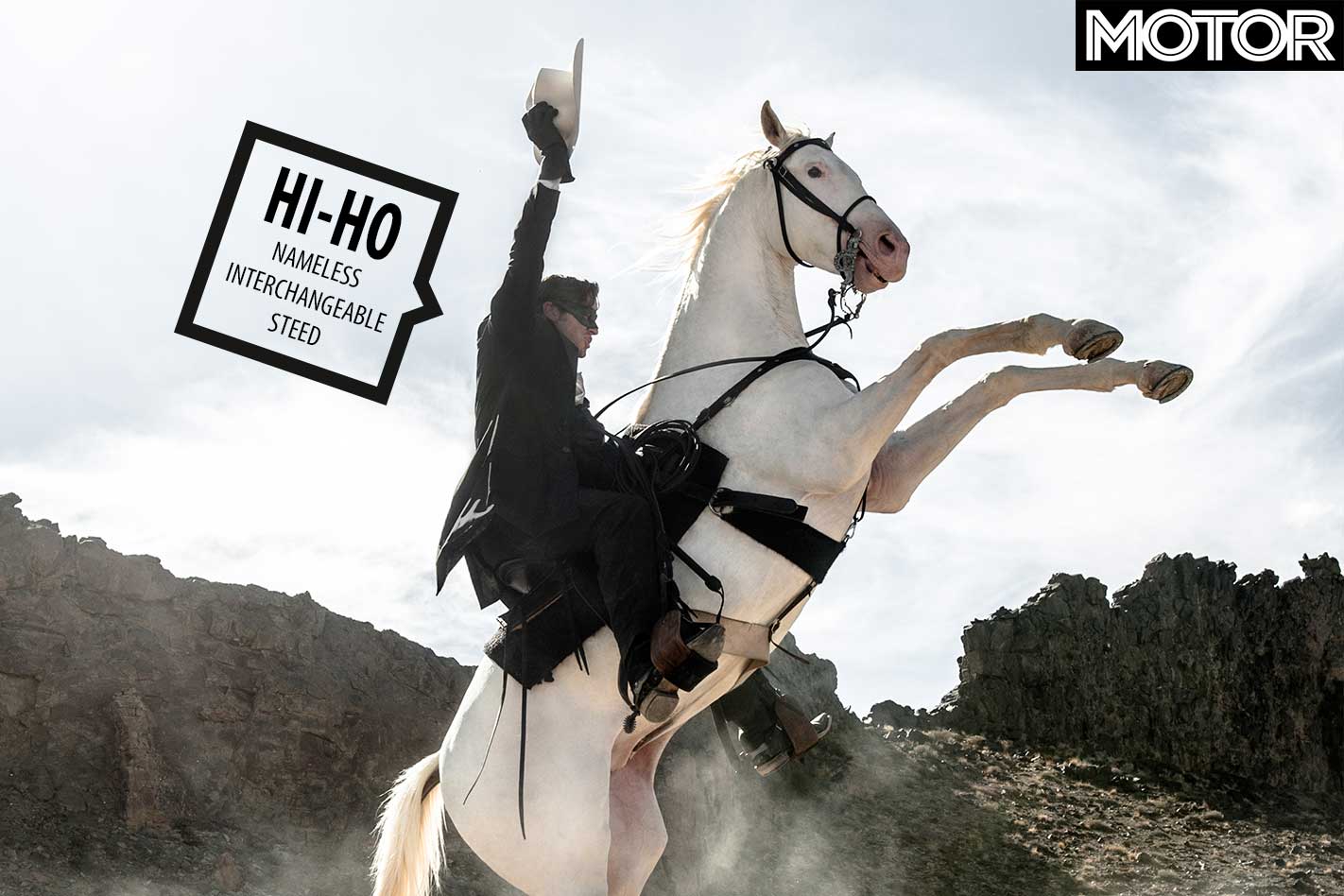
Regardless of the way the world seems to be heading, actually owning your car is part of the thrill – the connection between man and ride. It’s always been this way. Did the Lone Ranger say, “Hi-ho Nameless Interchangeable Steed”? No. He did not.
It’s not just cars, either. For our two-wheeled brethren there is Twisted Road, which is the same thing: Airbnb for motorbikes. Motorbikes!
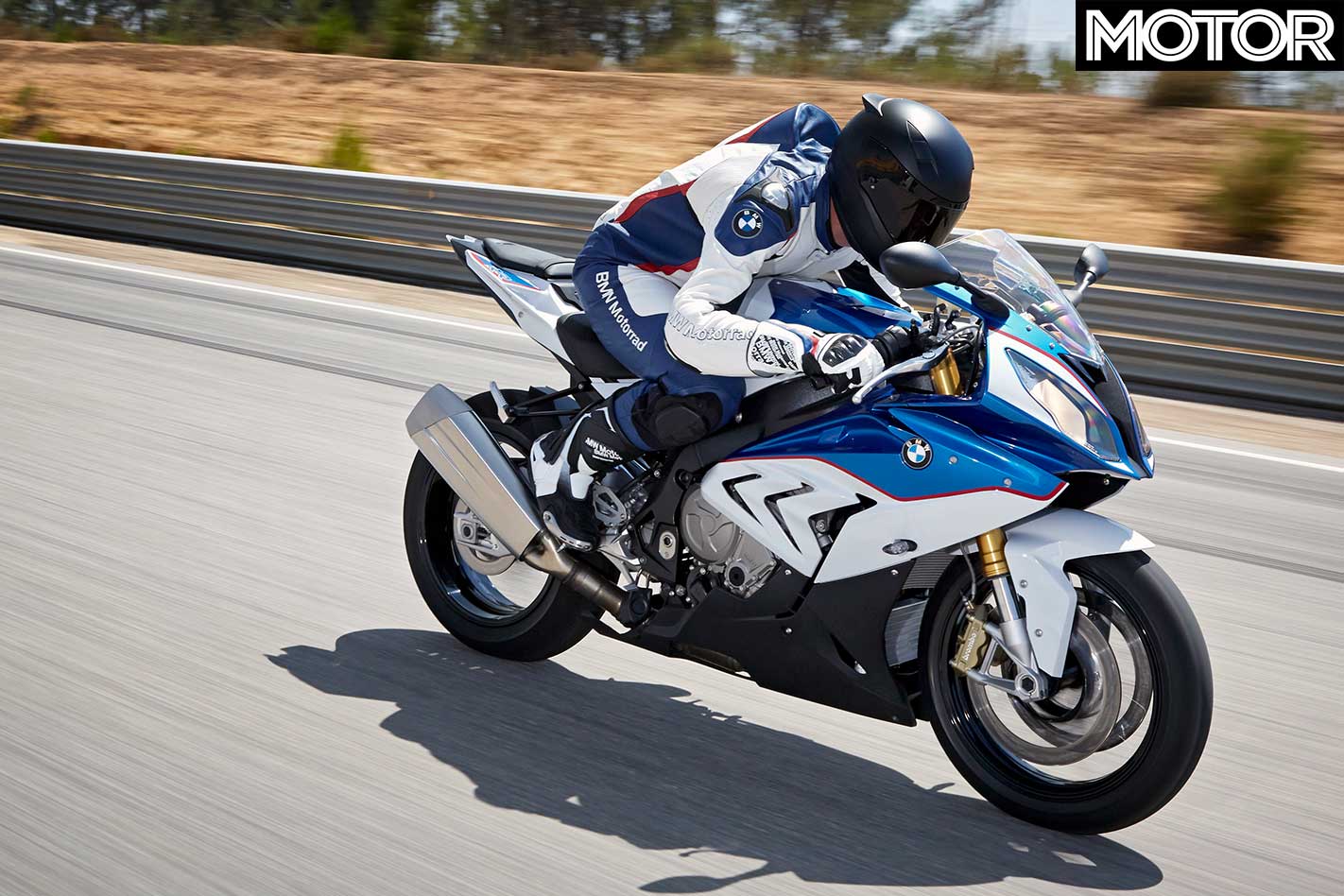
Even good, sensible, experienced motorcyclists have an average of 12 fatal crashes a week. Riding a motorbike is statistically as safe as being shot out of a cannon, and you’re going to lend your cannon – uh, bike – to a stranger and hope that this is the one day when someone doesn’t open their door into traffic without looking? Well, good luck to you, sir.
Get your motor running and head out on the highway – and not just a motor, your motor. Mr Steppenwolf was very clear about this.
Drive it like you stole it? Nothing beats ‘drive it like you own it’.
GRANTED, a mid-range 1 Series isn’t the most obvious inclusion here, especially as Munich’s smallest (non-EV) isn’t even trying to be a hot-hatch.
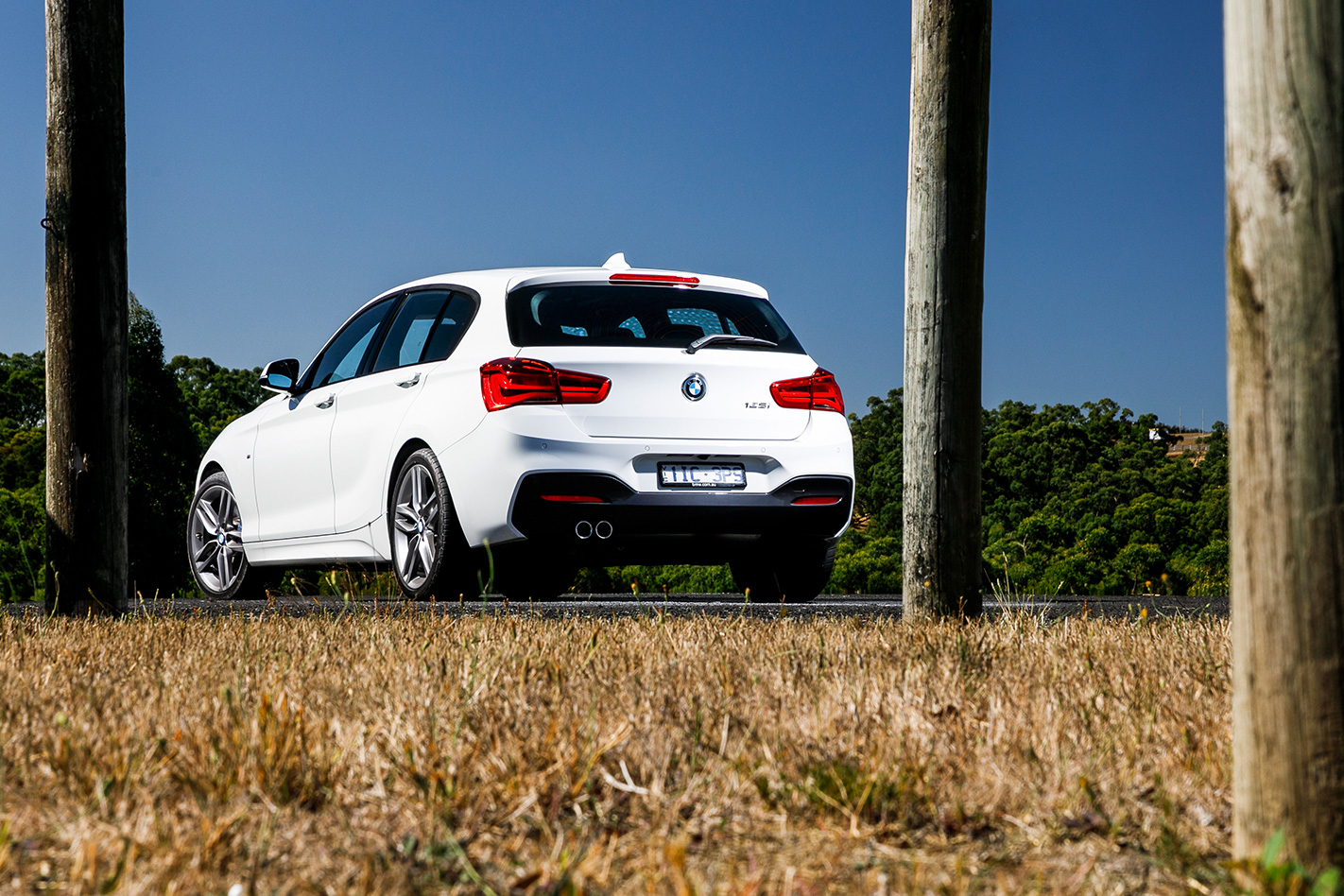
But wearing the BMW roundel, a standard M Sport package and a $50K price tag meant we couldn’t ignore the company’s final (ever?) rear-drive five-door. Welcome, then, to this dirty dozen’s wildcard entry.
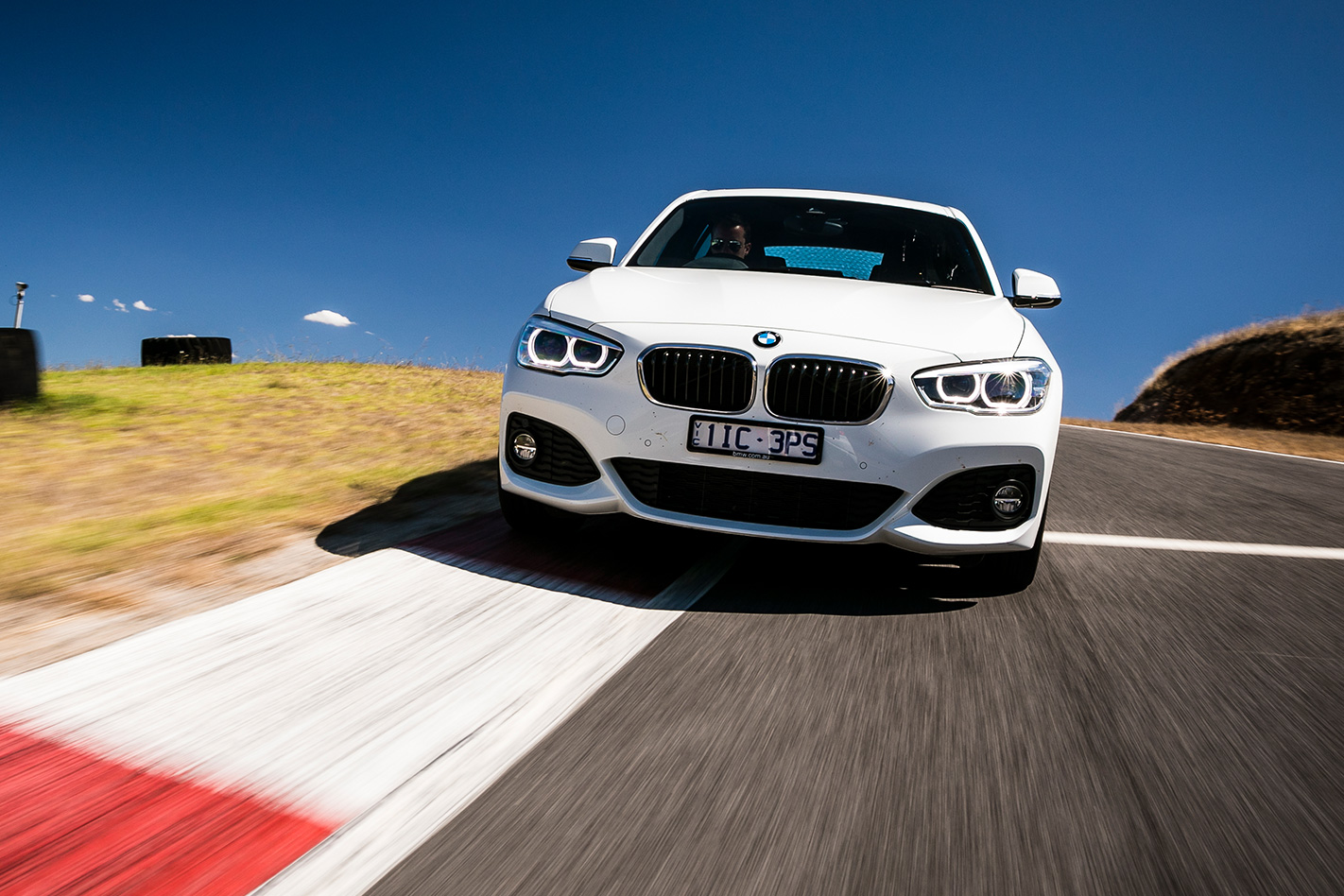
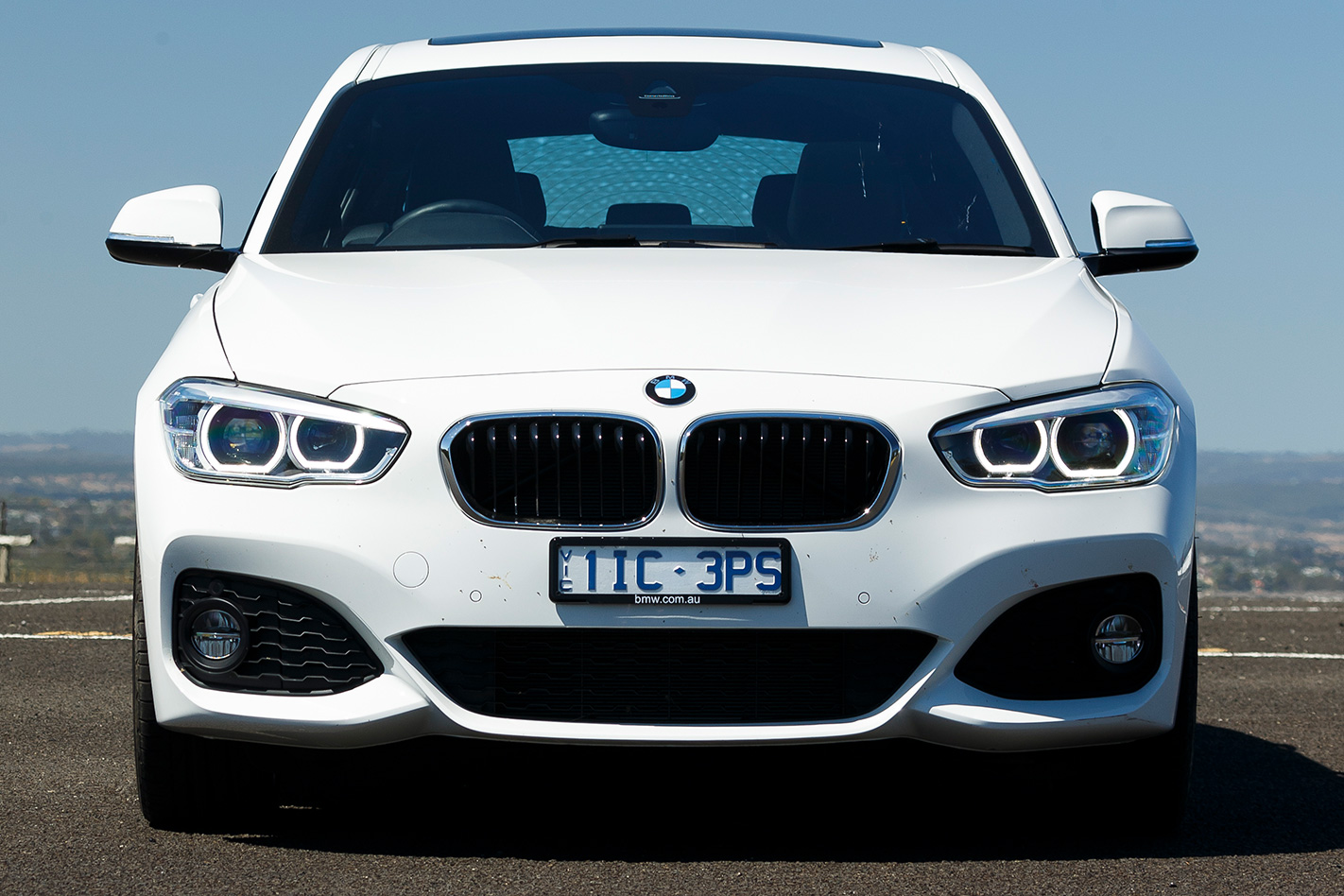
Squat, serious and defiantly cab-rearward, the 125i looks like it means business, especially in far-happier LCI guise as launched back in 2015.
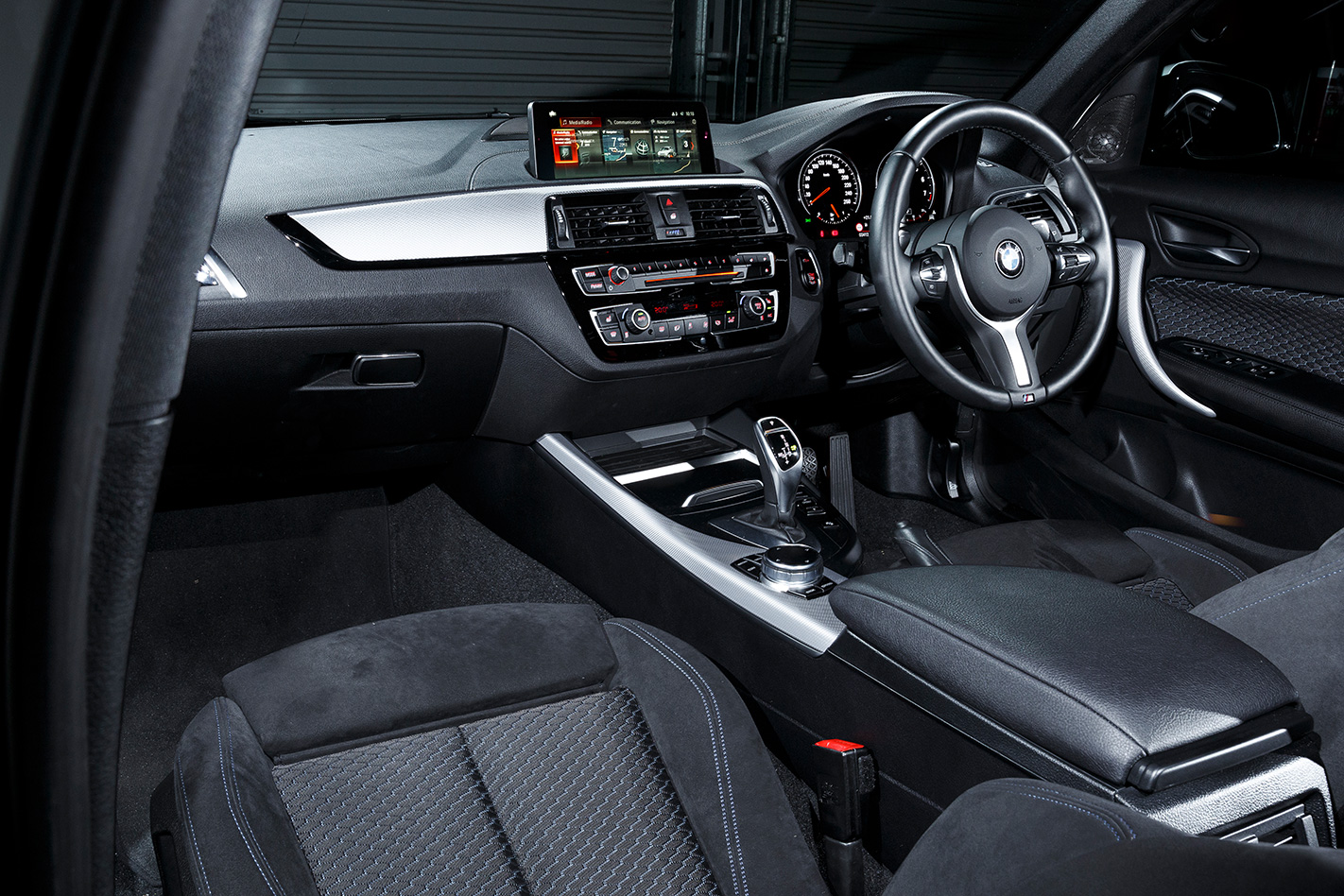
The minor changes made back then lifted the quality and ambience inside as well, eschewing the bland, rubbery austerity of the past. Quality fittings, supportive front seats ($2100 optional Comfort Pack items), elegant instruments and what is now iDrive perfected are all solid reasons to step up to a BMW. Mind you, paying hundreds extra for Apple CarPlay when a $14K Kia Picanto throws it in for free smarts.
Surprisingly, the 125i’s rear packaging isn’t bad, despite RWD and lofty seating. Yes, the amount of available room makes it cosy for six-footers, but at least they fit. And – lack of storage or centre armrest aside – a well-shaped cushion and backrest, air outlets and thoughtfully placed grab handles means at least the rear occupants feel cool and clamped in.
Which is important as the BMW’s 165kW/310Nm 2.0-litre direct-injection turbo four is a potent, polished performer, mating seamlessly with ZF’s intuitive eight-speed auto for rousing acceleration and muscular response in the mid-range, backed up by on-brand powertrain silkiness.
Additionally, the 125i’s handling and roadholding on the right road gel beautifully, with massive levels of grip and just enough play in the tail when provoked hard for the keen driver to cover ground and carve-up corners with quick and satisfying precision.
At Haunted Hills, Renato reckoned the BMW’s rear-end could easily be coaxed around in a playful manner, while stickier tyres would have made it even quicker around the circuit because the performance was certainly there. The 125i is effortlessly quick.
Back in the real world, however, other aspects of the 125i’s chassis left us wondering whether BMW is suffering corporate memory lapse. It seems that Munich has forgotten what made icons like the E46 3 Series so dynamically remarkable.
Poor ride is a bugbear with recent BMWs, and the 125i at least starts out well with good primary ride that ably soaks up bumps, and moderate tyre noise on 18-inch Bridgestone Potenza rubber.
But the vertical pitching endemic in all current 1 Series variants remains; this was the group’s only car to hit its suspension travel stops at speed with just the driver inside. And the secondary ride is restless on all but the smoothest surfaces, which is plain tiring.
Yet the biggest problem with the 125i is the very thing punters would expect a rear-drive BMW to absolutely nail – the steering. Inconsistent and remote, it lacks crispness and intimacy to a deeply disappointing degree.
Flicking through the drive modes does alter the weight, but doesn’t inject any more feel. Perhaps this is Munich’s ploy to make us welcome the hopefully more dynamically sorted next-gen front-drive 1 Series with open arms.
Keep in mind that all the other ingredients are present – the slick powertrain, sticky chassis, and subtly menacing appearance – and the 125i’s disinterested steering comes as an unexpected slap in the face. Without the desired damping finesse, body control and steering feedback, this car is the opposite of what M Sport represents. Wildcard? More like mild card.
It’s almost painfully ironic that the only rear-driver here – and BMW’s last rear-drive 1 Series – has the poorest steering of the group. So a lowly 11th it is for the otherwise likeable 125i M Sport.
BMW 125i M Sport LAP TIME: 1:07.5sec SCORE: 6.5/10
SPECS Engine: 1998cc 4cyl, dohc, 16v, turbo Power: 165kW @ 6500rpm Torque: 310Nm @ 1400-5000rpm Transmission: 8-speed automatic Weight: 1400kg Tyres: Bridgestone Potenza S001 225/40R18 (f), 245/35R18 (r) Fuel consumption: 14.2L/100km (tested) Power to weight: 118kW per tonne 0-100km/h: 6.1sec (claimed) Price: $49,990
Hot Hatch Megatest Contenders
12th, Score 6/10: Mini Cooper S JCW
11th, Score 6.5/10: BMW 125i
10th, Score 6.5/10: Subaru WRX Premium
9th, Score 7/10: Subaru WRX STI
8th, Score 7/10: Skoda Octavia RS245
7th, Score: 7.5/10: Ford Focus ST
6th, Score: 7.5/10: Renault Clio RS220 Trophy
5th, Score: 8/10: Volkswagen Golf GTI Original
4th, Score: 8.5/10: Volkswagen Golf R Grid
3rd, Score: 8.5/10: Peugeot 308 GTi 270
2nd, Score: 9/10: Honda Civic Type R
Winner, Score: 9/10: Hyundai i30 N
IN THE final reckoning, the Mini John Cooper Works registered the slowest lap time and one of the highest as-tested prices of our entire group. That combo alone ought to be enough to condemn it, but despite finishing flat last, and by some margin, the Mini is still a car that cracks smiles among all who drive it.
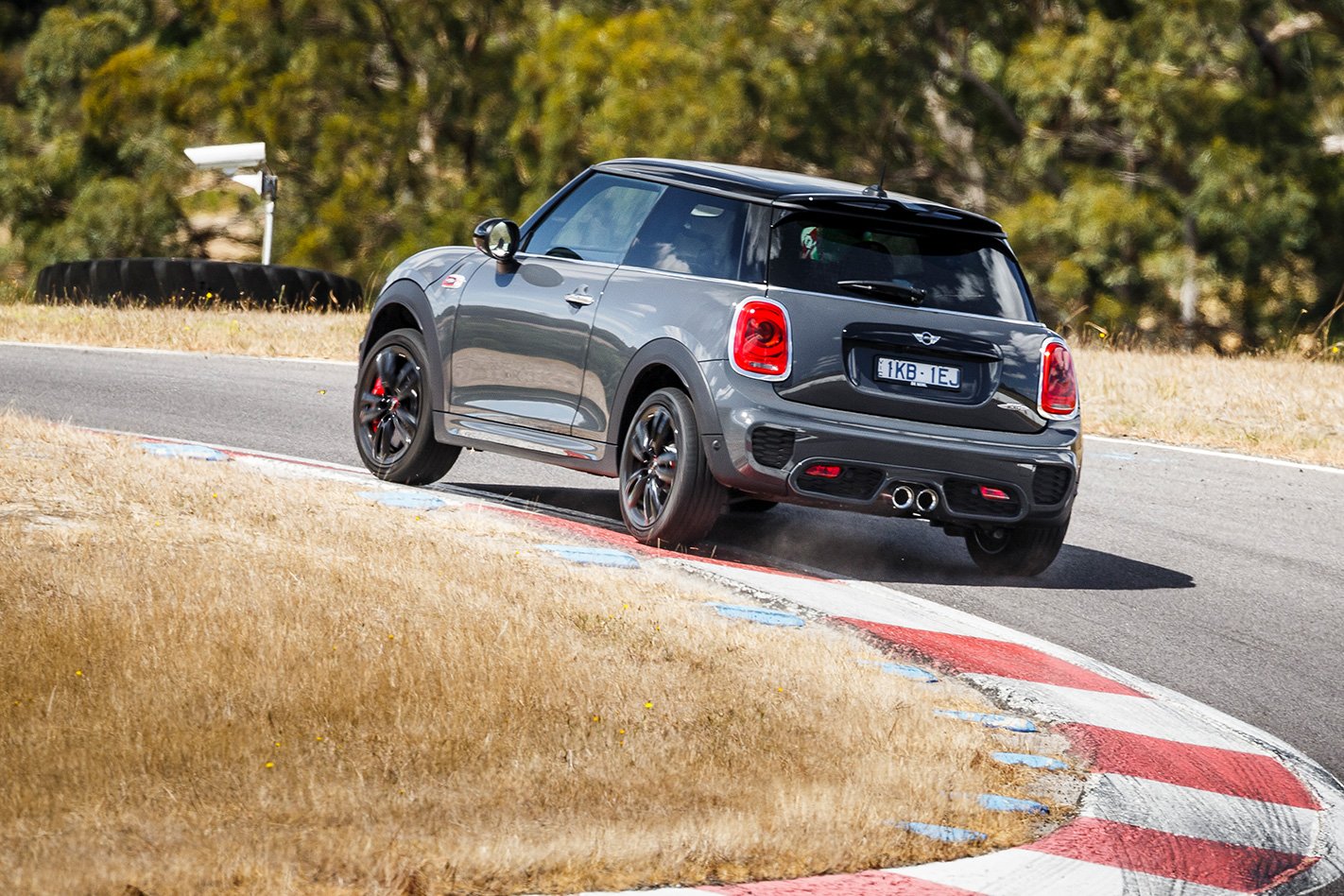
Were you looking for a stylish hot hatch that offers zip away from the lights and feels kart-like and cheeky at moderate speeds, even at $51,850 (or $49K for a manual), a case can be made for the JCW.
The thing is, if you’re spending that sort of money, you’ve probably done a little more research. You’re looking for something with a broader spread of talents, maybe something that gets more impressive the harder you push it. If so, the Mini rapidly finds itself running out of answers.
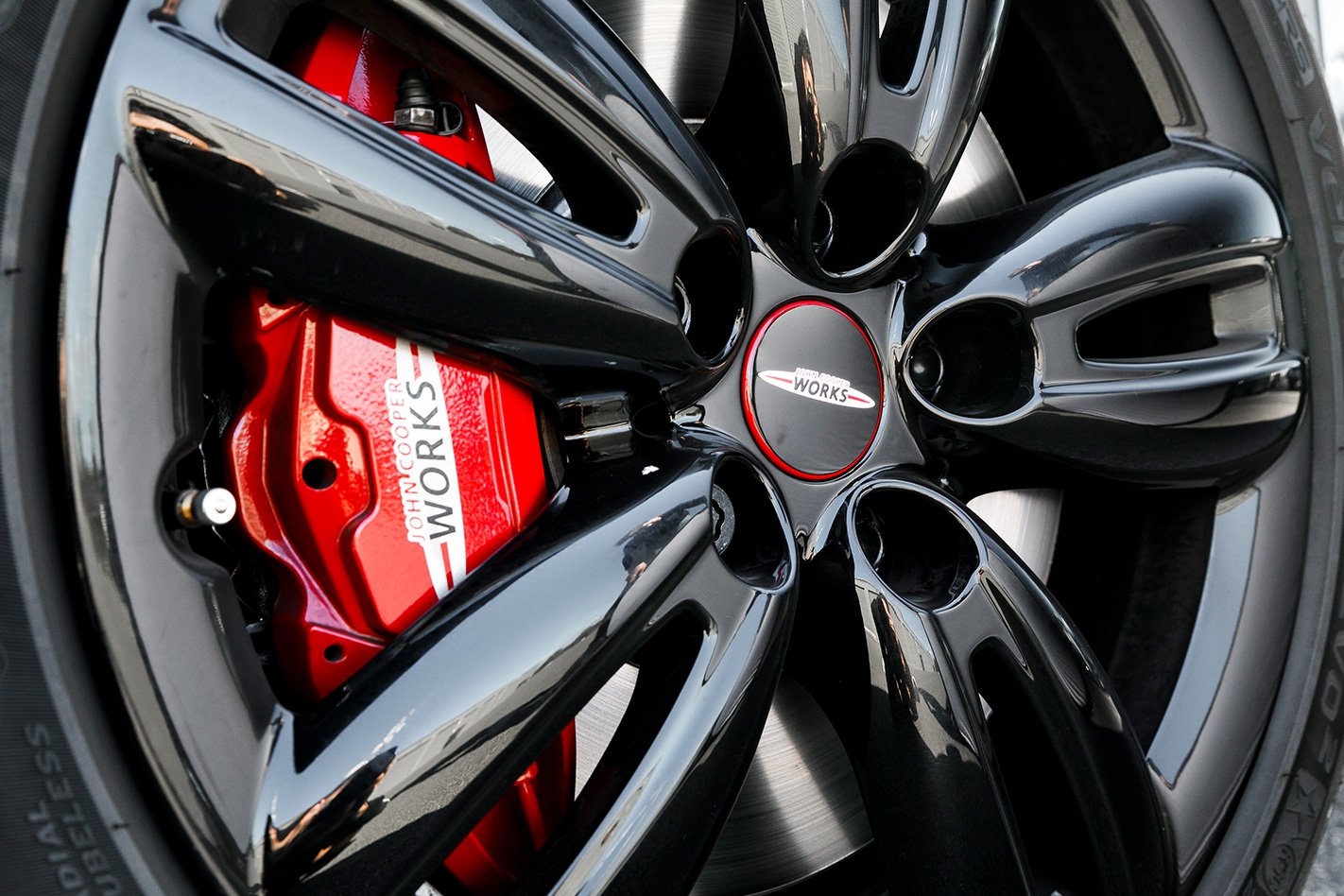
This car’s biggest problem is its meagre tyre footprint. At 100km/h the Mini is putting 21 percent less rubber in contact with the ground than the Civic Type R. The 205/45R17 Hankook Ventus S1 Evo run-flats are an odd choice of boots for a flagship sports model (see sidebar).
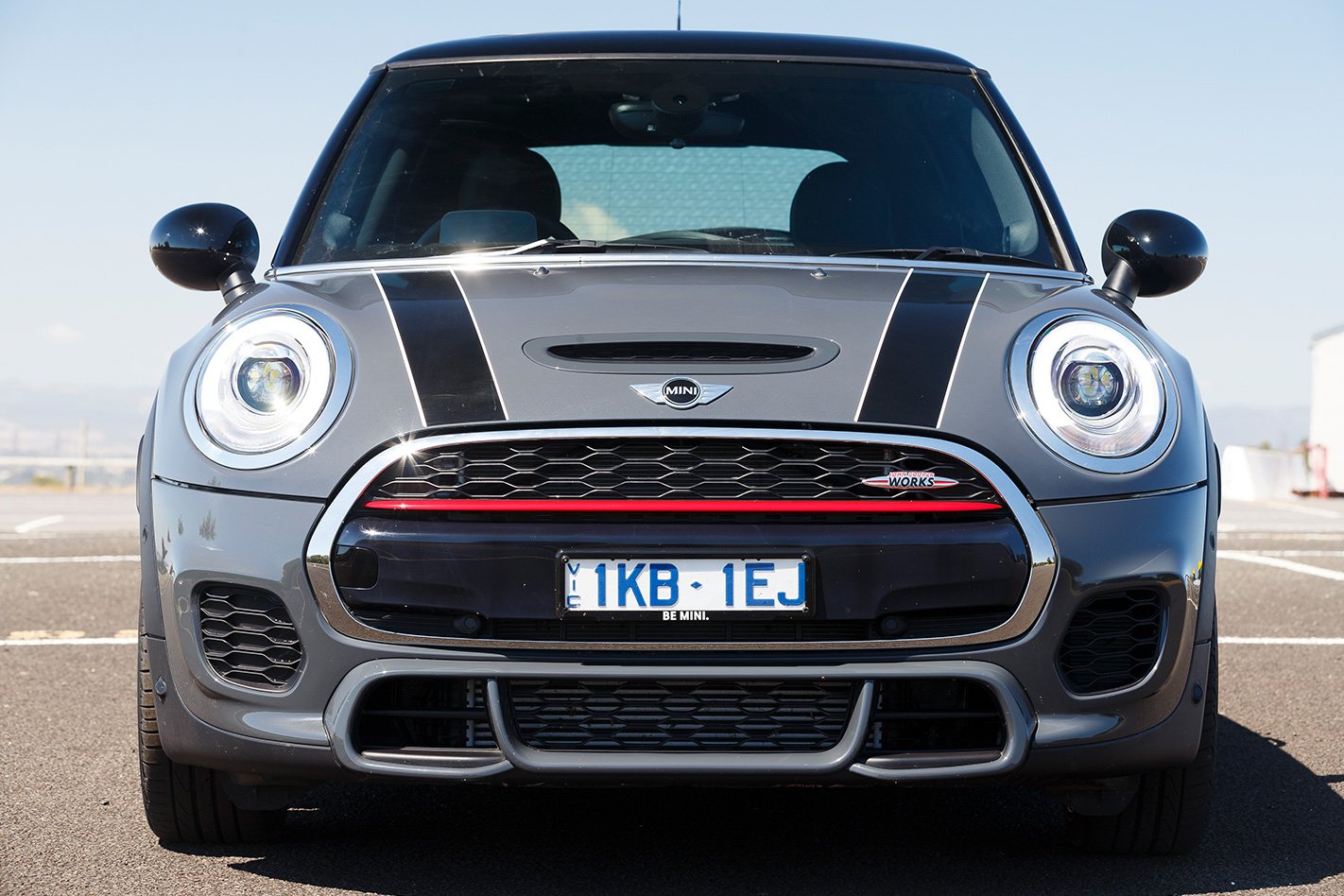
They never inspire a great deal of confidence on a twisty road, moving around a fair degree under braking, prompting sharp stabs of corrective steering from the driver.
It isn’t even the sort of prescriptive tail-happiness as displayed by the Clio Trophy 220 either. In that car you consciously bring the rear end into play. In the Mini, you often find yourself reacting to the car’s oversteer, even with all traction aids on, sometimes at very inappropriate speeds. And without the benefit of a limited-slip diff, it’s easy to overwhelm the fronts and lapse into understeer.
Many of the Mini’s issues could be solved with bigger and better rubber. The drivetrain is very good indeed, although 170kW starts to look a bit pedestrian at this price level. That’s more than 10 grand over the 202kW Hyundai i30 N. In other words, you really have to buy into the whole Mini shtick.
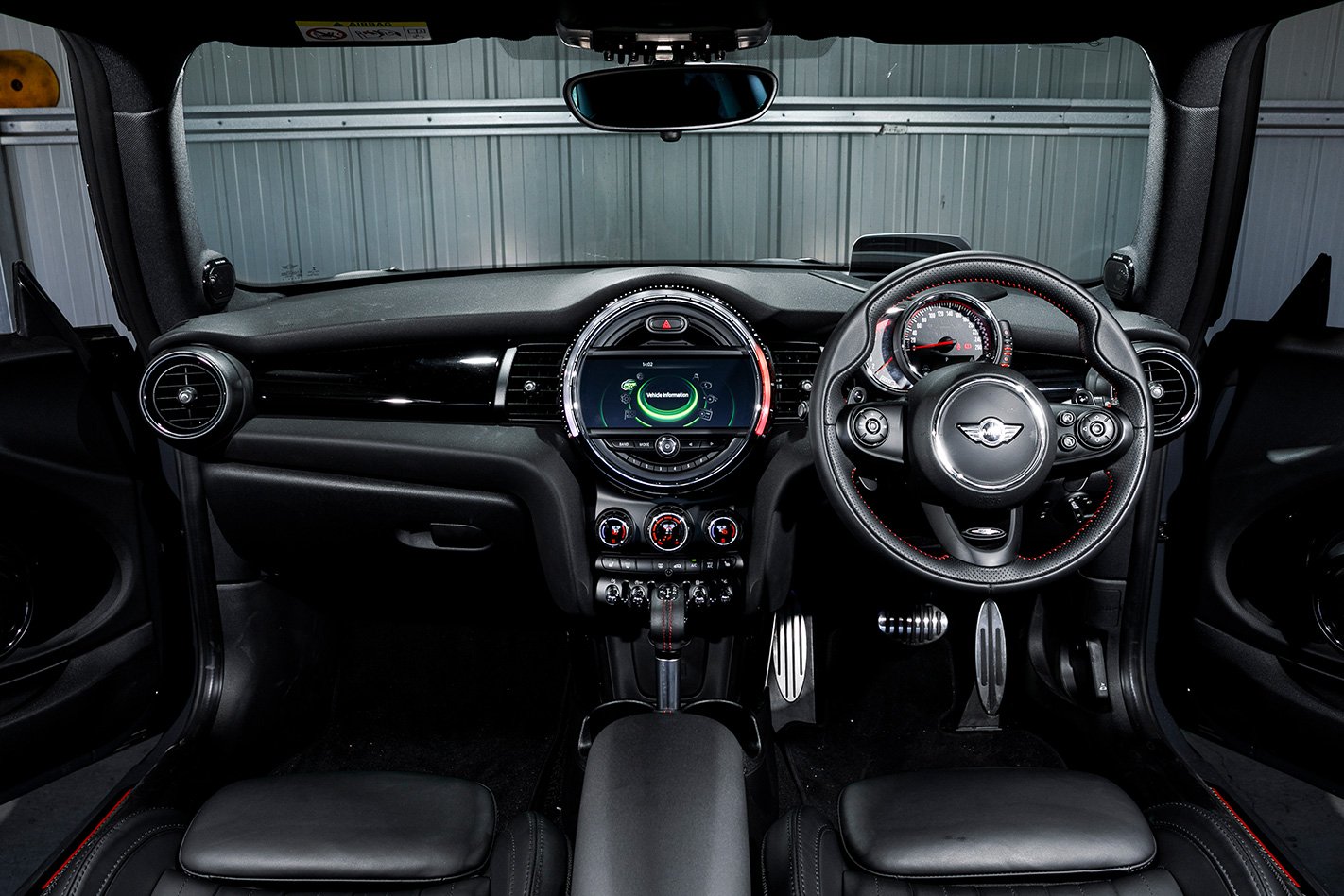
Some find the cabin comically overdone, while others see it as heavy-handed. The chequered flags running across the top of the dinner-plate clocks, a head-up screen that sounds like a snapping biro when retiring into the dash, and carbonfibre affectations in a car weighing more than a Peugeot 308 GTi from the next class up all make you question whether this generation JCW owes more to the marketing department than engineering.
The Mini’s 2495mm wheelbase is fully 120mm shorter than the control-sized car in this gathering, the Golf 7.5, and you feel it both on the road, where the Mini’s on-limit skittishness degrades its cross-country ability, and in the packaging of the vehicle, making it one of the least comfortable for rear seat passengers, with pinched headroom, persistent tyre thrum and the sole recompense of some natty Union Jack suede head rests.
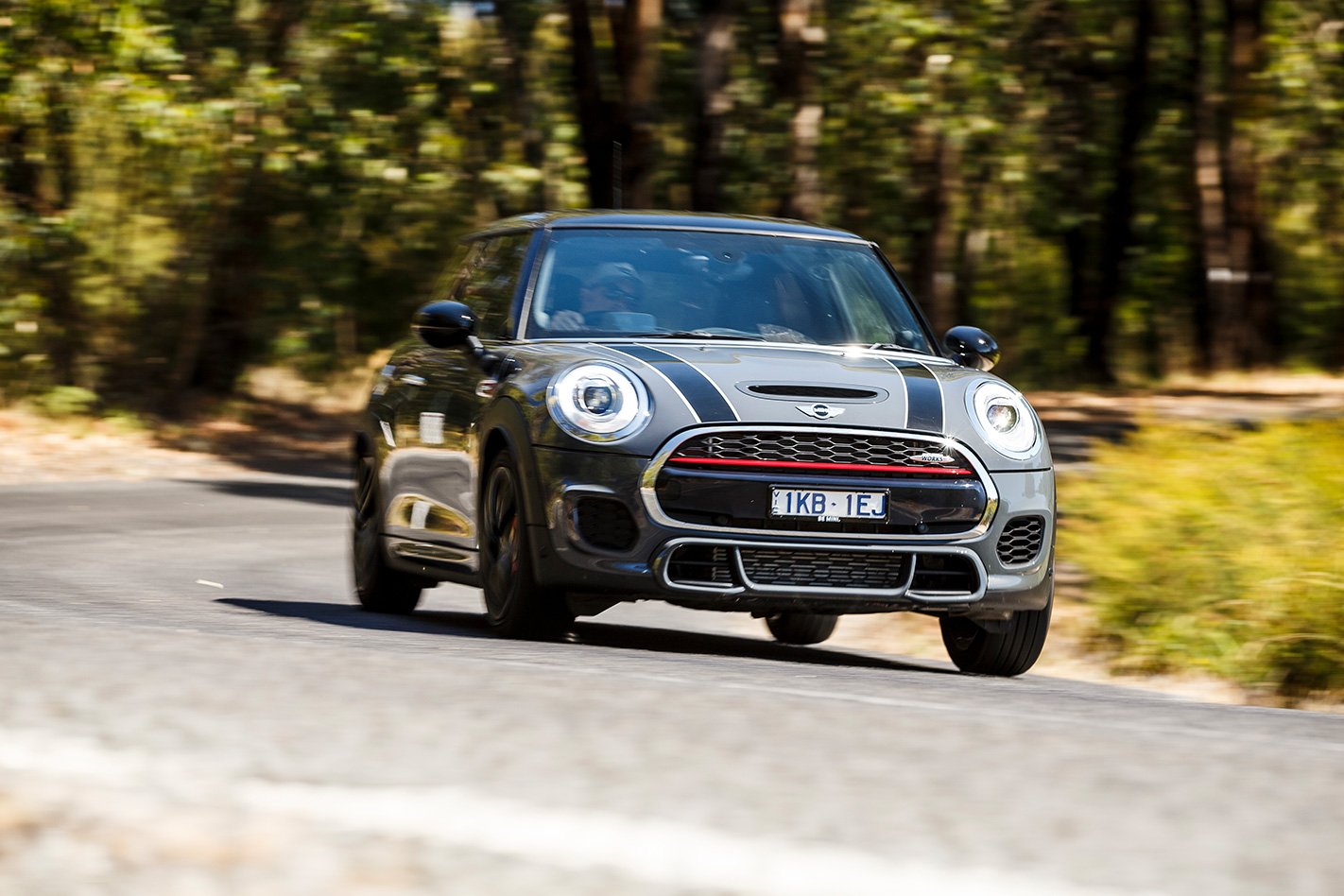
Again, much of this would be forgivable were the JCW priced around the upper range of its B-segment hot hatch brethren, possibly even $45K, but the fact is it’s not.
If you just want the range-topping three-door Mini and couldn’t give two hoots about the finer points of ride, handling and finesse, then the JCW won’t disappoint. But if you’ve read this far you’re a bit more curious than that, and we have 11 more deserving destinations for your money.
Mini Cooper S JCW LAP TIME: 1:08.2 sec SCORE: 6/10
SPECS Engine: 1998cc 4cyl, dohc, 16v Power: 170kW @ 5000rpm Torque: 320Nm @ 1450-4500rpm Transmission: 6-speed automatic Tyres: Hankook Ventus S1 Evo2 205/45R17 88W Weight: 1220kg Fuel consumption: 12.3L/100km (tested) Power to weight: 139kW per tonne 0-100km/h: 6.1sec (claimed) Price: $51,850
Hot Hatch Megatest Contenders
12th, Score 6/10: Mini Cooper S JCW
11th, Score 6.5/10: BMW 125i
10th, Score 6.5/10: Subaru WRX Premium
9th, Score 7/10: Subaru WRX STI
8th, Score 7/10: Skoda Octavia RS245
7th, Score: 7.5/10: Ford Focus ST
6th, Score: 7.5/10: Renault Clio RS220 Trophy
5th, Score: 8/10: Volkswagen Golf GTI Original
4th, Score: 8.5/10: Volkswagen Golf R Grid
3rd, Score: 8.5/10: Peugeot 308 GTi 270
2nd, Score: 9/10: Honda Civic Type R
Winner, Score: 9/10: Hyundai i30 N
The large sedan segment, once the golden goose for Australian carmakers, has hit upon tough times recently. Large-car customers are now swinging towards high-riding SUVs in swathes, playing a part in the death of Australian-built Commodores and Falcons.
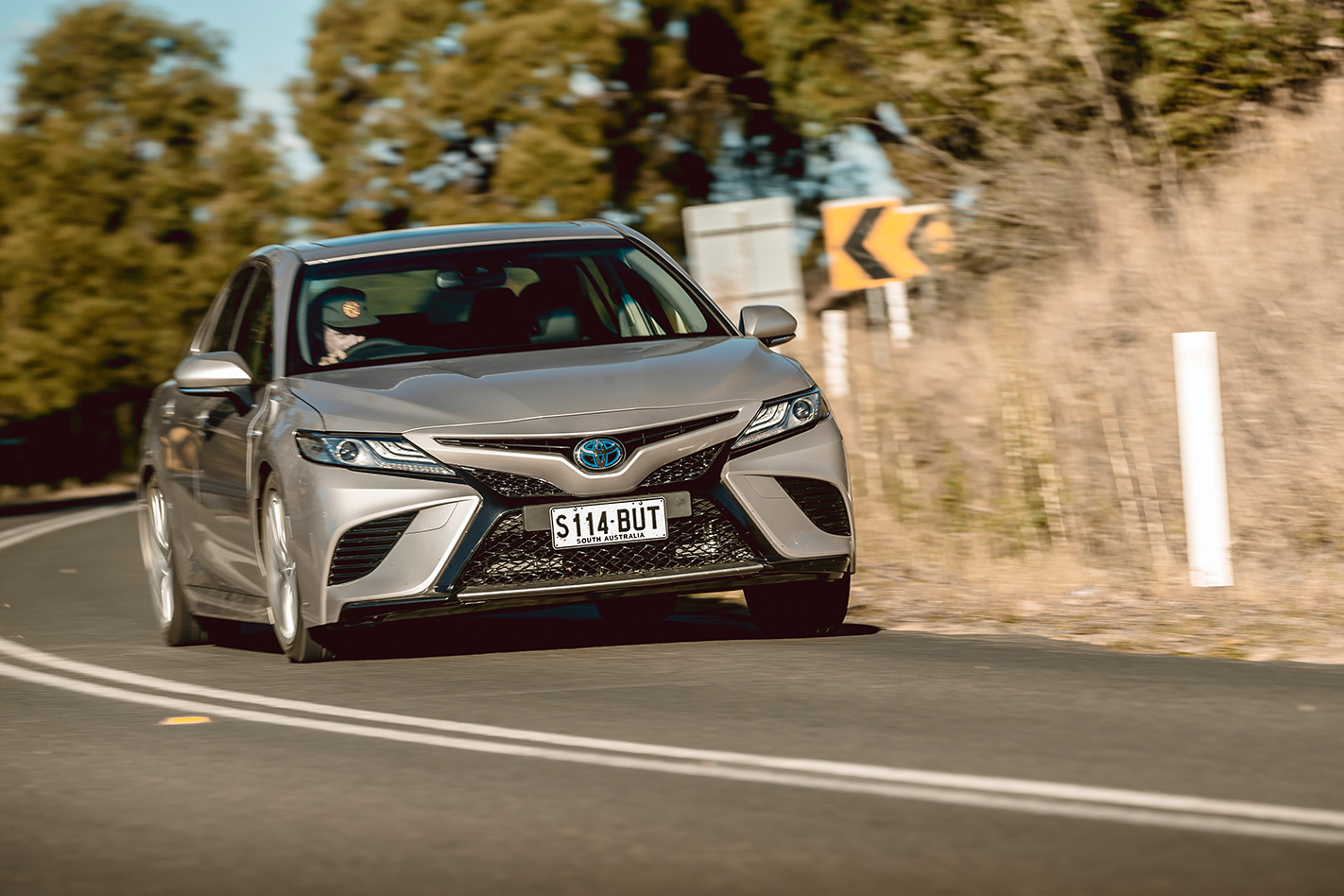
With no locally made product to capture people’s hearts and minds, is the time right for a new hero – from the midsize segment – to rise?
Toyota’s Camry Hybrid is hugely popular with both fleets and private buyers, selling well on the back of a trusted reputation and frugal, eco-friendly powertrain. Meanwhile, Ford’s Mondeo has large shoes to fill, replacing the Falcon.
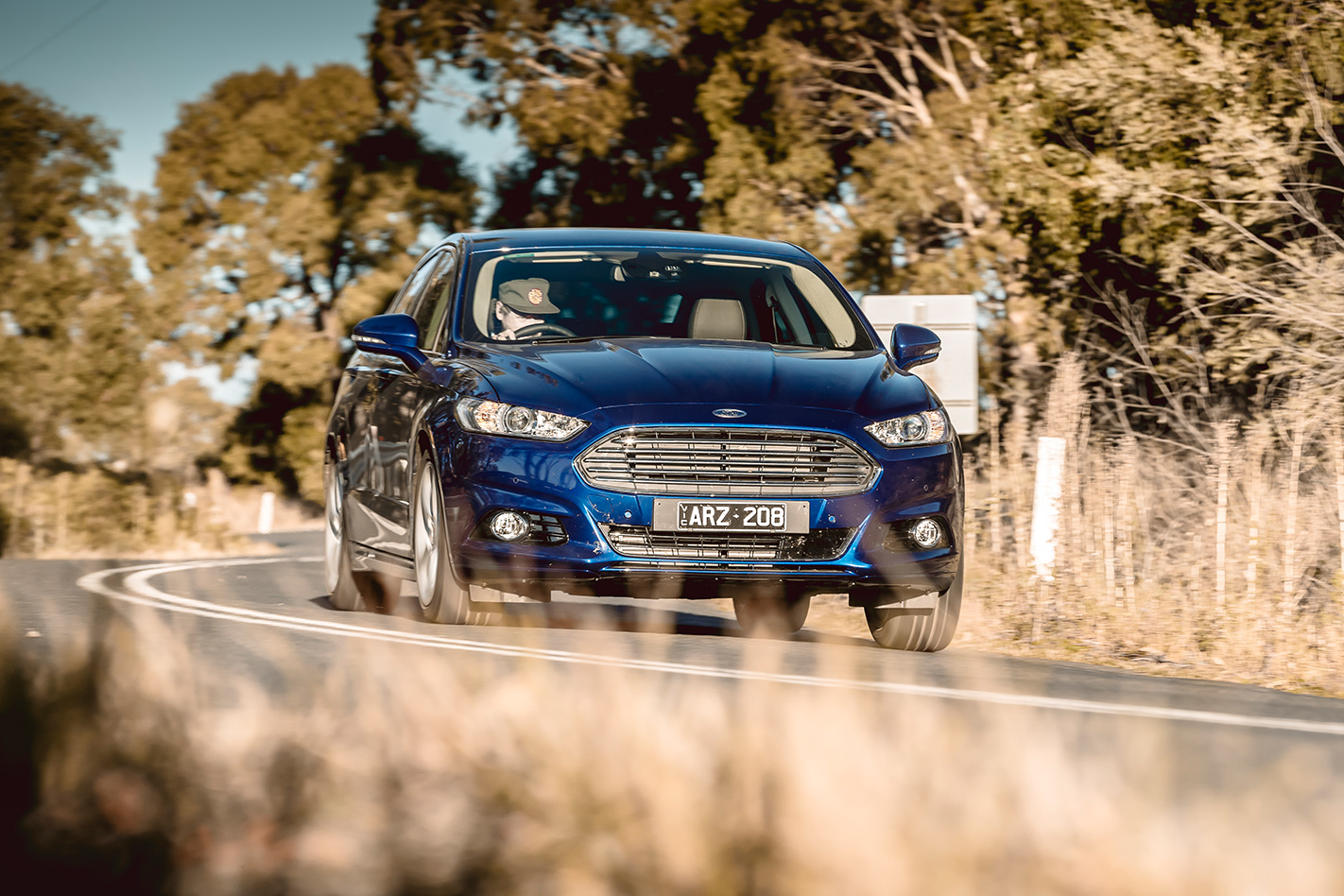
Going against the Mondeo in this face-off is its ageing platform, which was last overhauled in 2012, while the Camry is fresh-faced, both literally and technically, with an all-new, much changed generation.
This is the first Camry Hybrid to be built overseas, coming to Australia via Japan. The Mondeo, meanwhile, is Spanish-built.
This comparison is between the Ford Mondeo Trend, priced from $37,790, and the $40,990 Toyota Camry SL Hybrid. Both these models represent the most common choice that mums and dads, not fleet and rental buyers, favour. Straight away, the Ford is the best-value option for a cash-strapped buyer.
The Camry’s hybrid powertrain uses two main components; a 2.5-litre four-cylinder naturally aspirated petrol engine paired with an electric motor powered by a nickel metal hydride battery. Combined, the petrol engine and electric motor send 160kW to the front wheels via a continuously variable transmission. Toyota doesn’t quote a torque figure; a spokesperson says the engine’s 221Nm and the motor’s 202Nm are delivered in such a varied way as is impossible to measure a linear peak output.
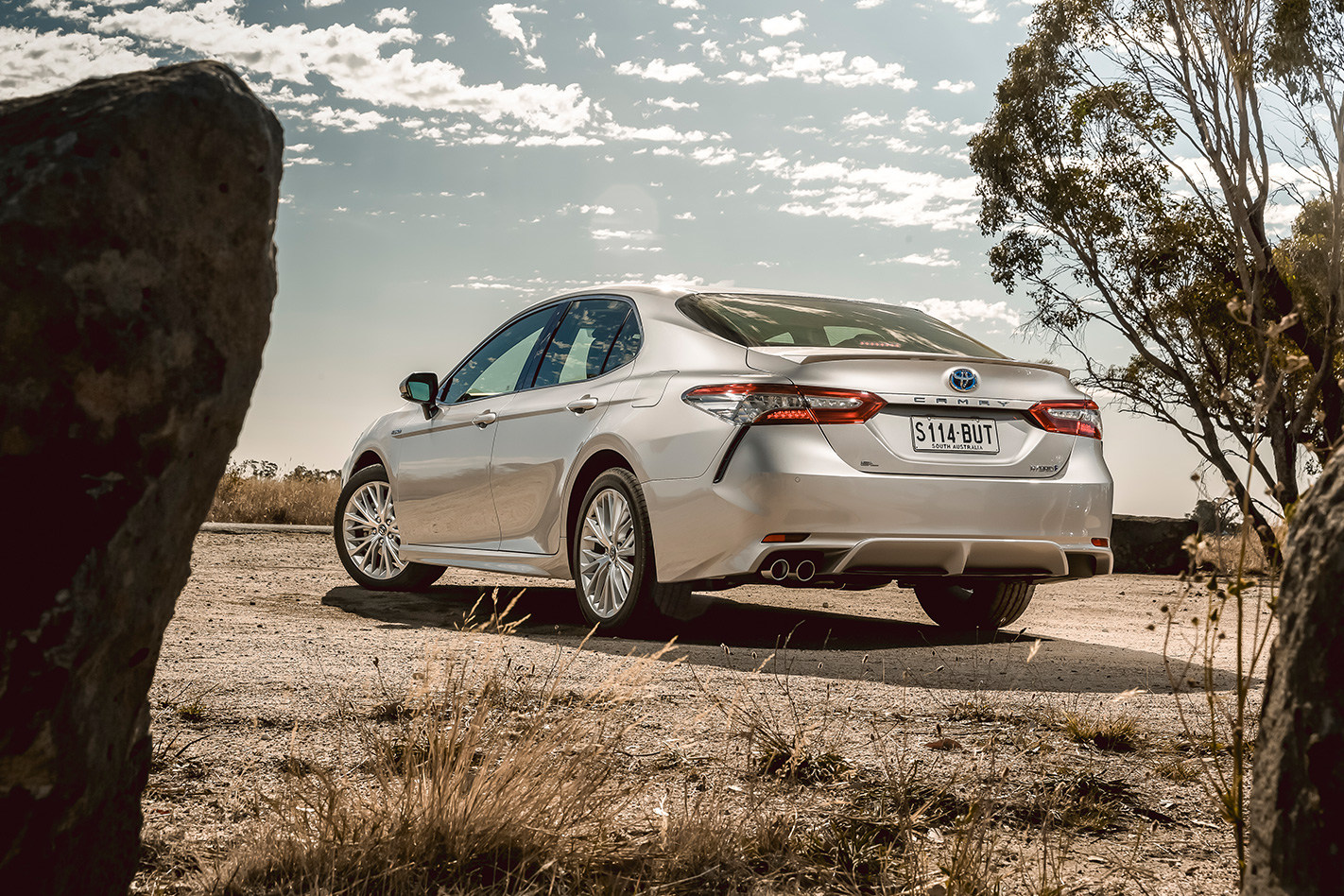
The Toyota’s strong selling point is its claimed ability to sip a class-leading 4.5L/100km of 95RON fuel.
Powering the Mondeo is a 2.0-litre turbocharged four-cylinder petrol engine, sending 177kW and 345Nm to the front wheels via a traditional six-speed automatic.
The on-paper figures translate to the real world, with the more traditional Ford unit thrummy and torquey, and showing plenty of personality. The Camry’s unit, meanwhile, is slick and smooth but outperformed by the Ford’s turbo power. If inner-city driving makes up a large portion of your behind-the-wheel duties, the Camry nails the brief, with a full-EV mode available at slower speeds.
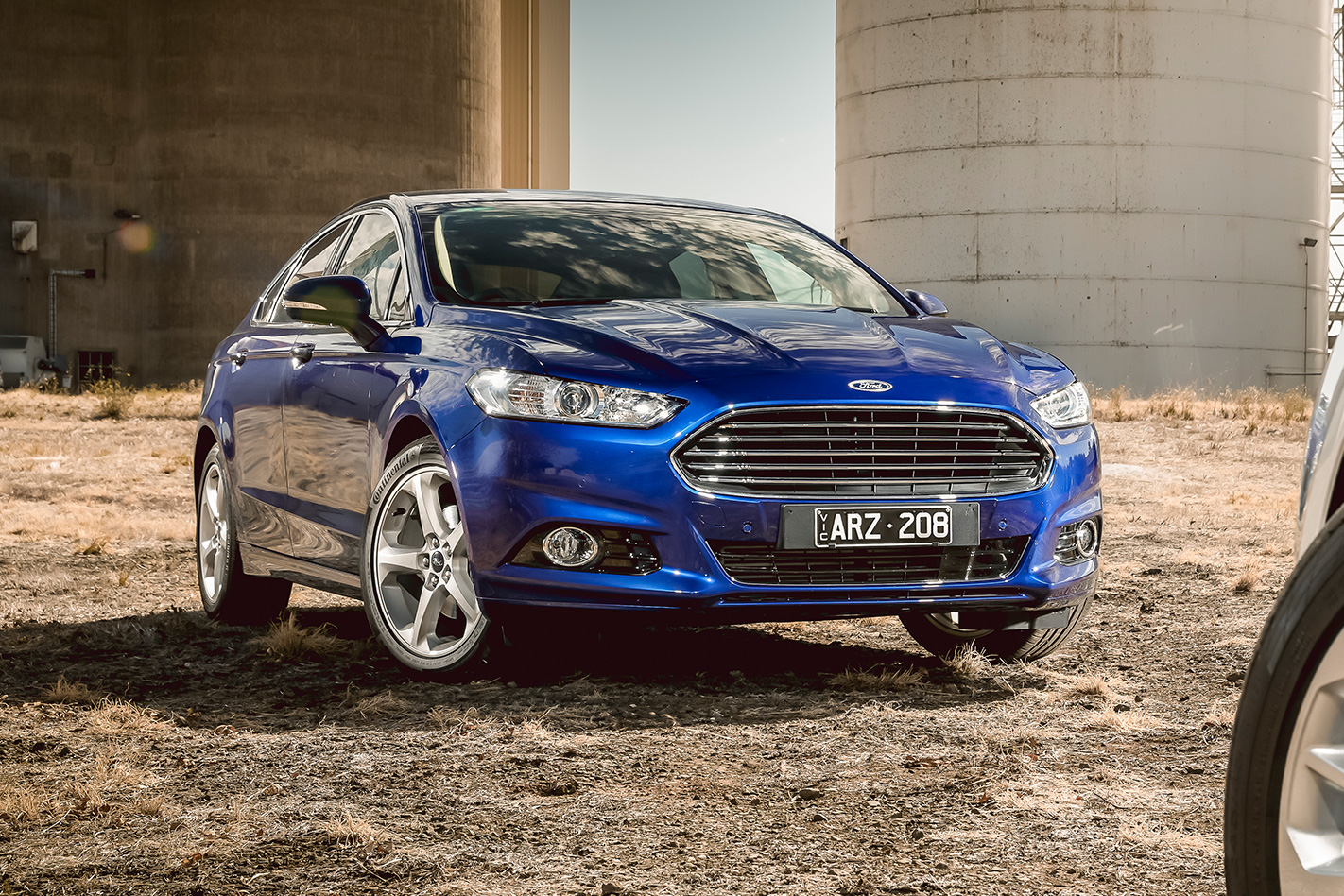
The Camry has a softly sprung ride, but it is supple and sweetly damped – gliding along with a Lexus-like sheen that is extremely alien to previous generations of the Toyota. This suspension tune has been a much-needed ingredient missing from Camry for at least 25 years.
The well-damped Ford gains an advantage as soon as the road starts to bend and tighten, with a ride that blends dynamic prowess and ride comfort. For the enthusiast driver, the Mondeo is the pick of the pair.
That’s not to say the Camry falls short on twisty roads. Pushed hard, it will hang on well, but lacks the body control of the Mondeo.
Rear-seat comfort is another victory for the Camry. Those in the second row are treated to independent LED reading lights, deep door pockets, soft touch points around everything but the window switches, a centre armrest set low and long with two cupholders, two USB ports and two air vents with flow, but not temperature, control.
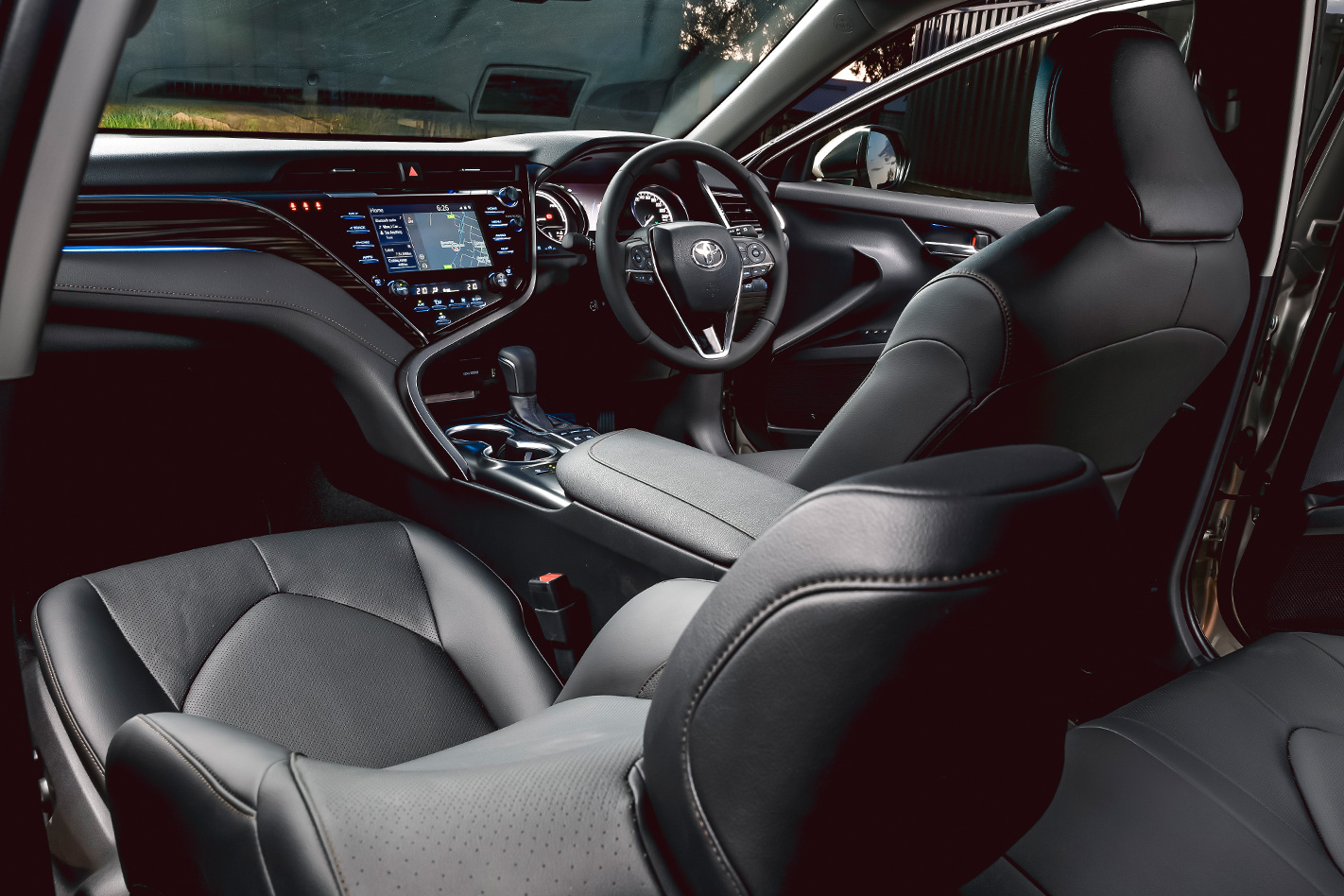
Passenegrs in the rear of the Mondeo have no USB ports, a single central LED reading light, smaller door pockets, fewer soft surfaces (but it is where it counts), and two air vents that lack flow and temperature control. They’re also forced to deal with a sloping roofline that cuts heavily into rear headroom – not an issue in a Camry that is even equipped with a sunroof.
The seat trim of the Mondeo has a plusher feel compared with the Camry, using a combination of leather and an Alcantara-esque suede material.
The Mondeo also uses Ford’s Sync3 system, and while the interface graphics look dated compared with the fresher Toyota’s, it is an intuitive and easy system to navigate. The Blue Oval sound system is a banger, with impressive clarity and volume, and outshines the Toyota’s unit.
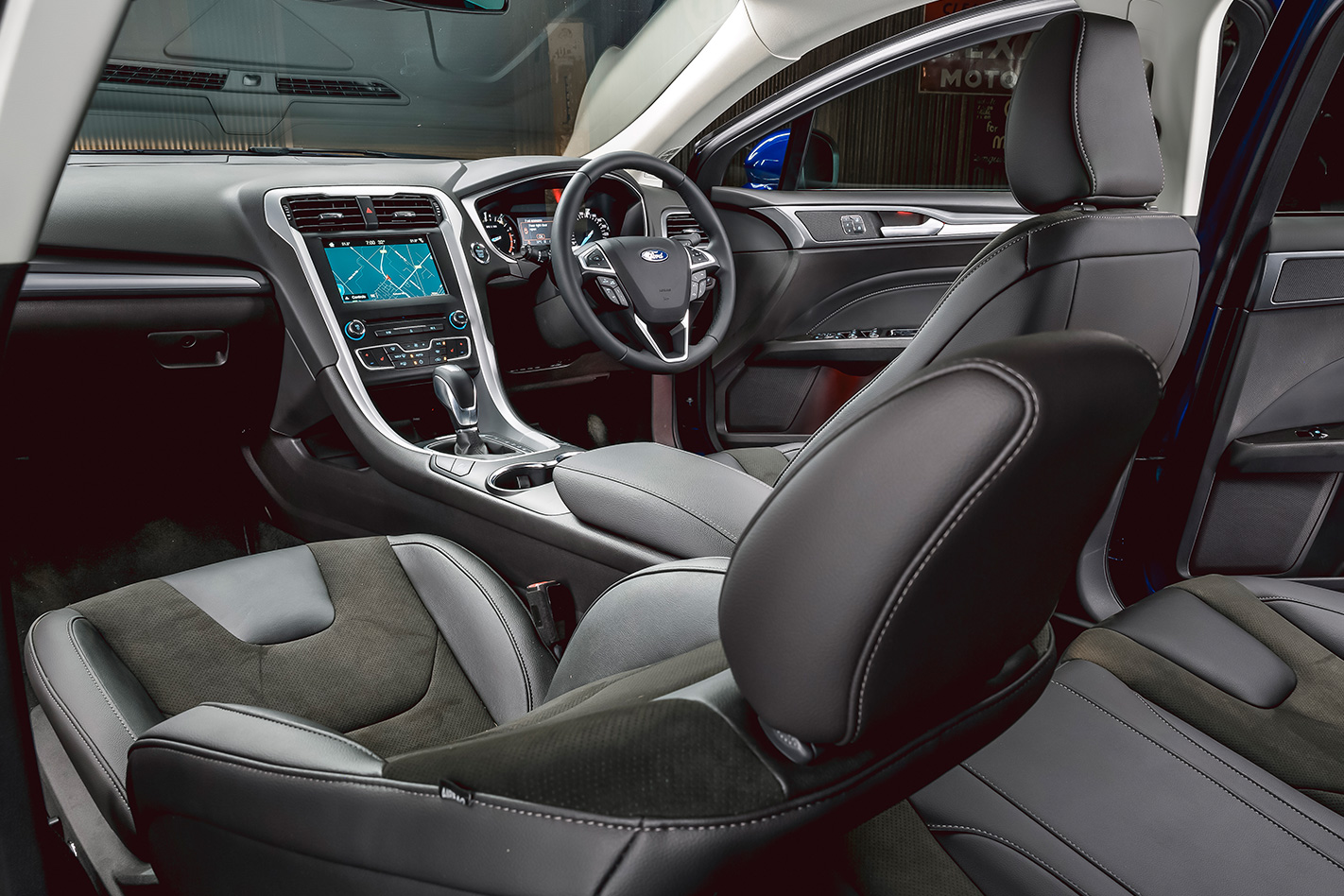
The Camry’s wireless charging feature is for serious tech-heads, but smartphone mirroring – a coveted feature for some buyers – is poorly supported. The Mondeo also shuns Android Auto and Apple CarPlay.
The Camry’s new Linux-powered multimedia interface is much easier to navigate than previous generations, though for safety reasons it will lock you out of a number of functions while the car is moving.
When it comes to the duo’s looks, the Mondeo and Camry are at opposite ends of the spectrum – where the Ford is conservative, bordering on a tad boring, the Toyota’s design is exotic, and divisive.
Design is always a subjective thing, but Toyota should be commended for giving the Camry a bold, striking look after decades of forgetful meh. Meanwhile, it would be unfair to slander the subdued styling of the Mondeo, which is understated and belies its capable nature. The Blue Oval’s largest sedan has a handsome, muscular stance, but it doesn’t really move the game forward.
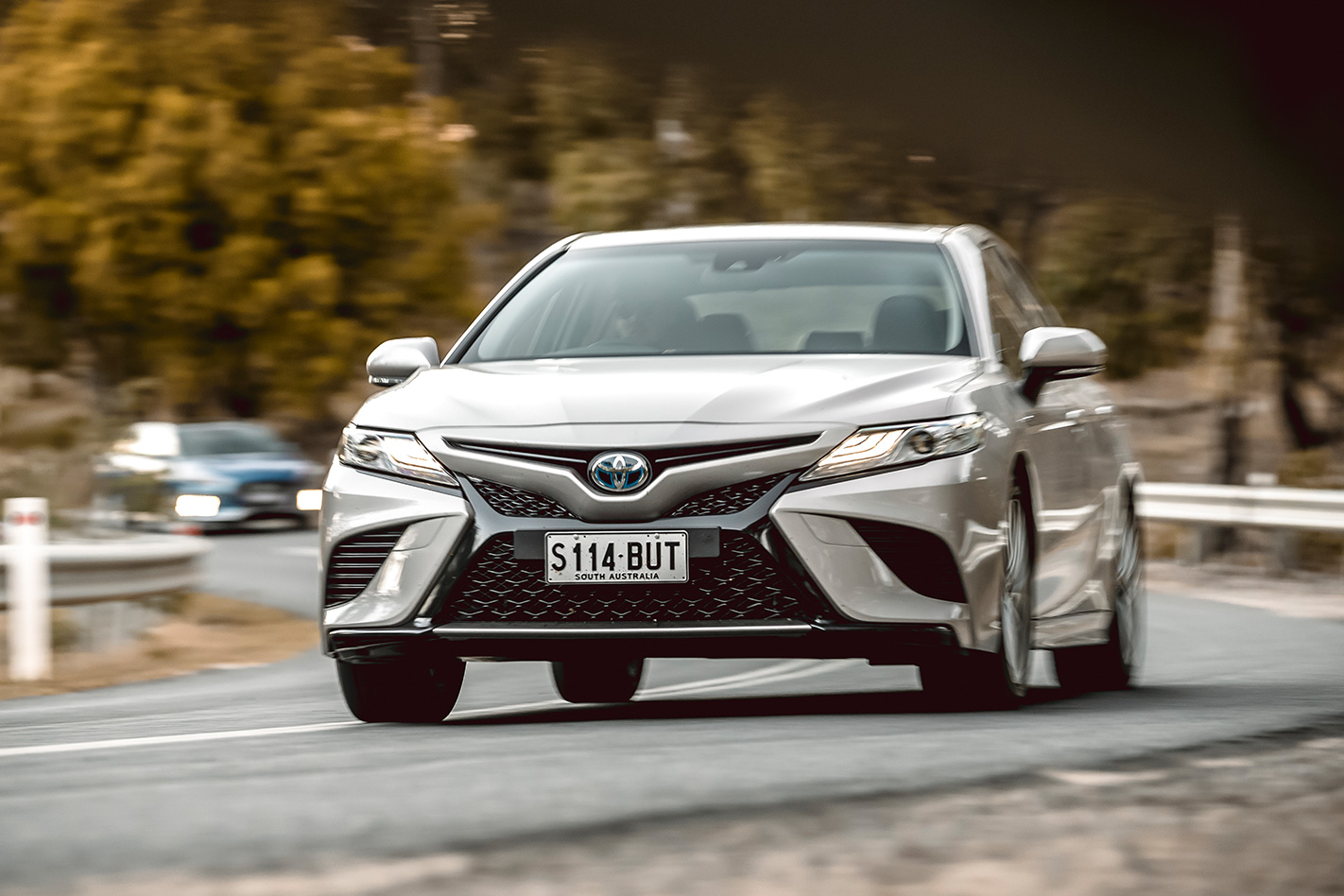
Overall, the Camry comes out with the victory here, but not by as big a margin as you’d expect.
While the Mondeo is ageing, it still holds up well against the competition, and outshines the Toyota in a number of areas, namely price, dynamic ability and performance.
However, for many, the plush ride, smooth and frugal powertrain, and slick interior design of the Camry – more commonly associated with Toyota’s Lexus luxury brand – will be difficult to walk past in the showroom.
This month’s Cool Kit has your head covered with a neat baseball cap and functional race helmet, while a selection of Swiss timepieces and classy men’s fragrances have got you covered for style.
1 – ED’s PICK “MUST HAVE GOODIE OF THE MONTH”: Sparco Formula RB-8 ($320 from racerindustries.com.au) Your feet will have never looked so good with these range-topping Sparco race boots. Perforated calfskin, stretch fabric, quick-lacing and ultra-thin pure rubber sole for maximum feel.

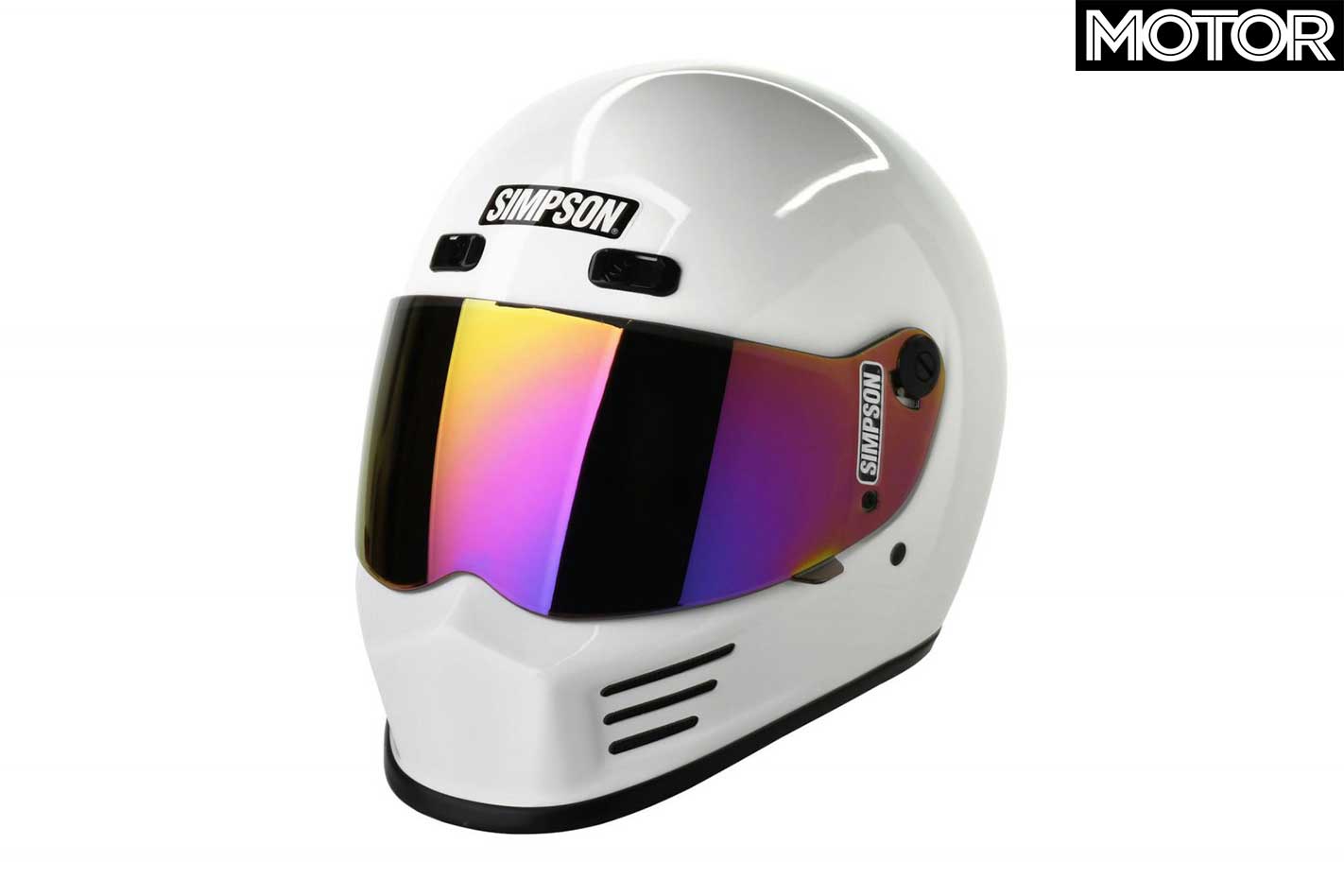
3 – Simpson Street Bandit ($385 from simpsonraceproducts.com) The Street version of Simpson’s iconic Bandit design offers a bigger eye-port in case you need more vision of what’s going on around you. Snell M2015 approved.
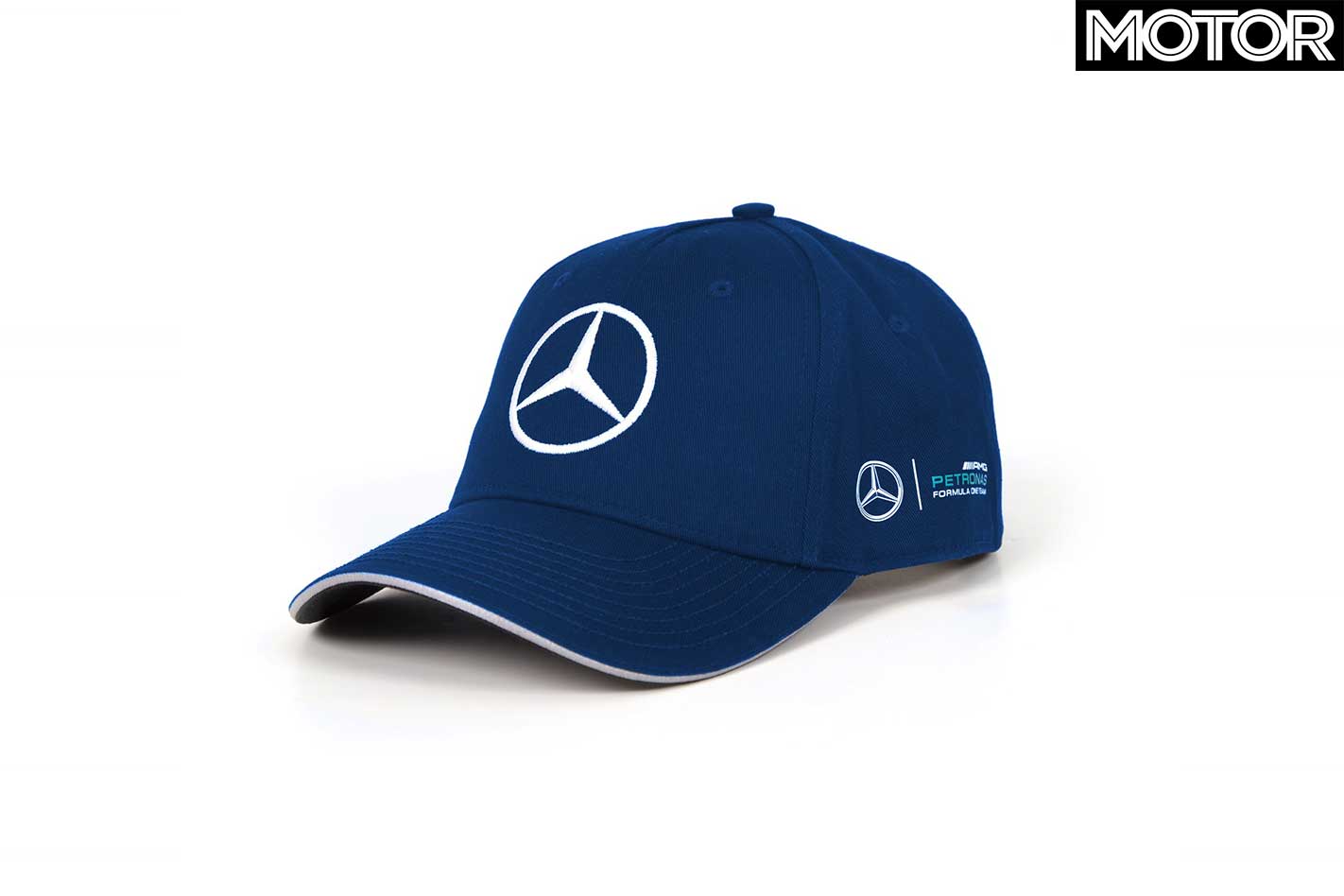
4 – Bottas baseball cap ($60 from shop.mercedesamgf1.com) Valtteri Bottas is a force to be reckoned with in the hot seat of Mercedes-Benz’s W09. Support the ice-cool Finn trackside with this hat sporting his number, #77.
5 – Hugo Boss ‘The Scent’ ($105 from hugoboss.com) Some say the Maninka tree’s flowers look like fried eggs, but all we know is, when mixed with ginger their extract makes for an “unforgettable” aroma in Hugo Boss’s new fragrance, The Scent.

6 – TAG Heuer Carrera 01 ($7750 from tagheuer.com) Special Red Bull Racing edition chronograph comes in 45mm case, is Swiss made and also available with blue calf skin rubber/leather strap. Water resistant to 100 metres.

7 – Aston Martin print ($130 from shop.astonmartin.com) Created by the Aston Martin design team and printed on heavy weight paper, this A2 print will make any wall look interesting. One of eight designs available. Price excludes shipping.

8 – TW Steel WTCR ($599 from twsteel.com) You might not care that much that this watch is to celebrate TW Steel’s sponsorship of World Touring Car team Boutsen Ginion Racing and driver Tom Coronel, but you’ll care that it looks this good.

