
Is the 1997 Subaru Impreza WRC the most recognisable rally car of all time?
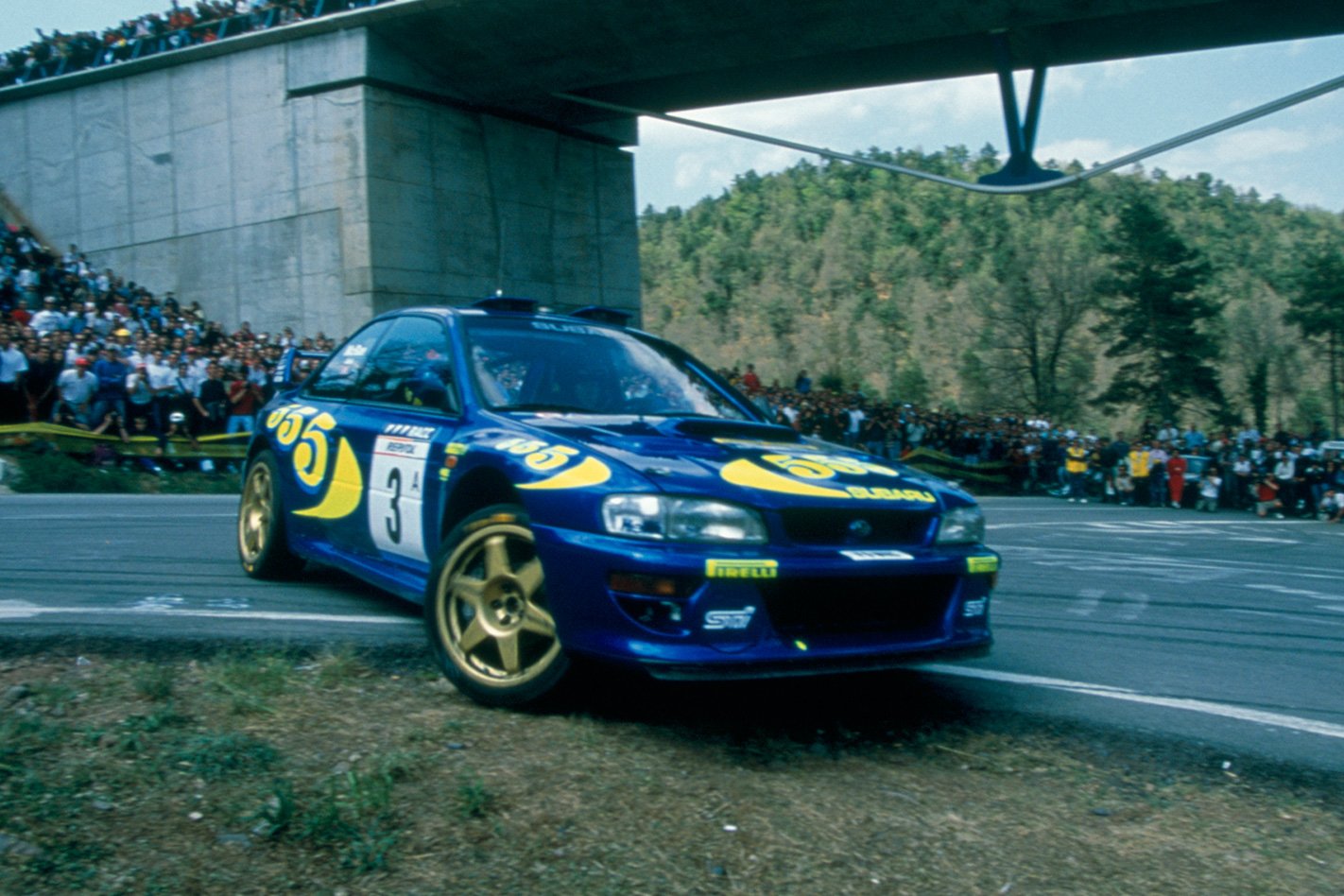
It wasn’t the most successful, but thanks to the popularity of the man who drove it and its subsequent appearance in the first Colin McRae Rally game, the first Impreza World Rally Car and its iconic blue and yellow ‘555’ livery was many fans’ first introduction to rallying.
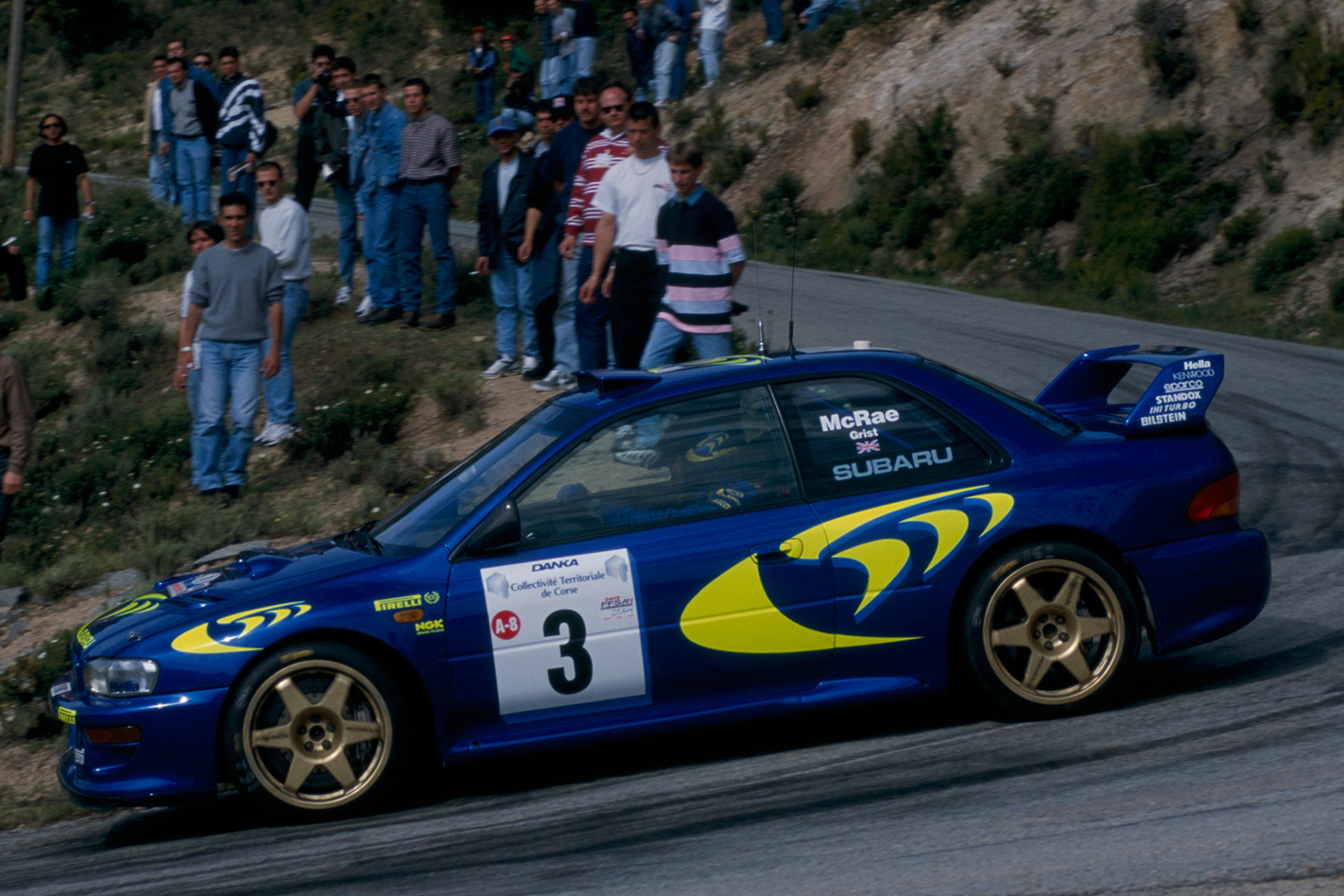
The new rules attracted the likes of Seat, Hyundai and Peugeot but while Subaru stuck with its Impreza, the greater technical freedoms made it a much wilder machine. The stiffer two-door bodyshell was introduced with massive wings and guards – styled by McLaren F1 designer Peter Stephens – allowed the use of better suspension geometry and wider tracks.
It was an immediate success, winning the first three rallies of the year in the varying conditions of Monte Carlo, Sweden and Kenya and added seven more wins by year’s end to make it by far the most successful car of 1997.
McRae recovered froma crash-ridden 1996 to be 1997’s most successful driver with five wins, however a disastrous mid-year run of four straight retirements allowed Tommi Makinen to secure his second straight title by just a single point.
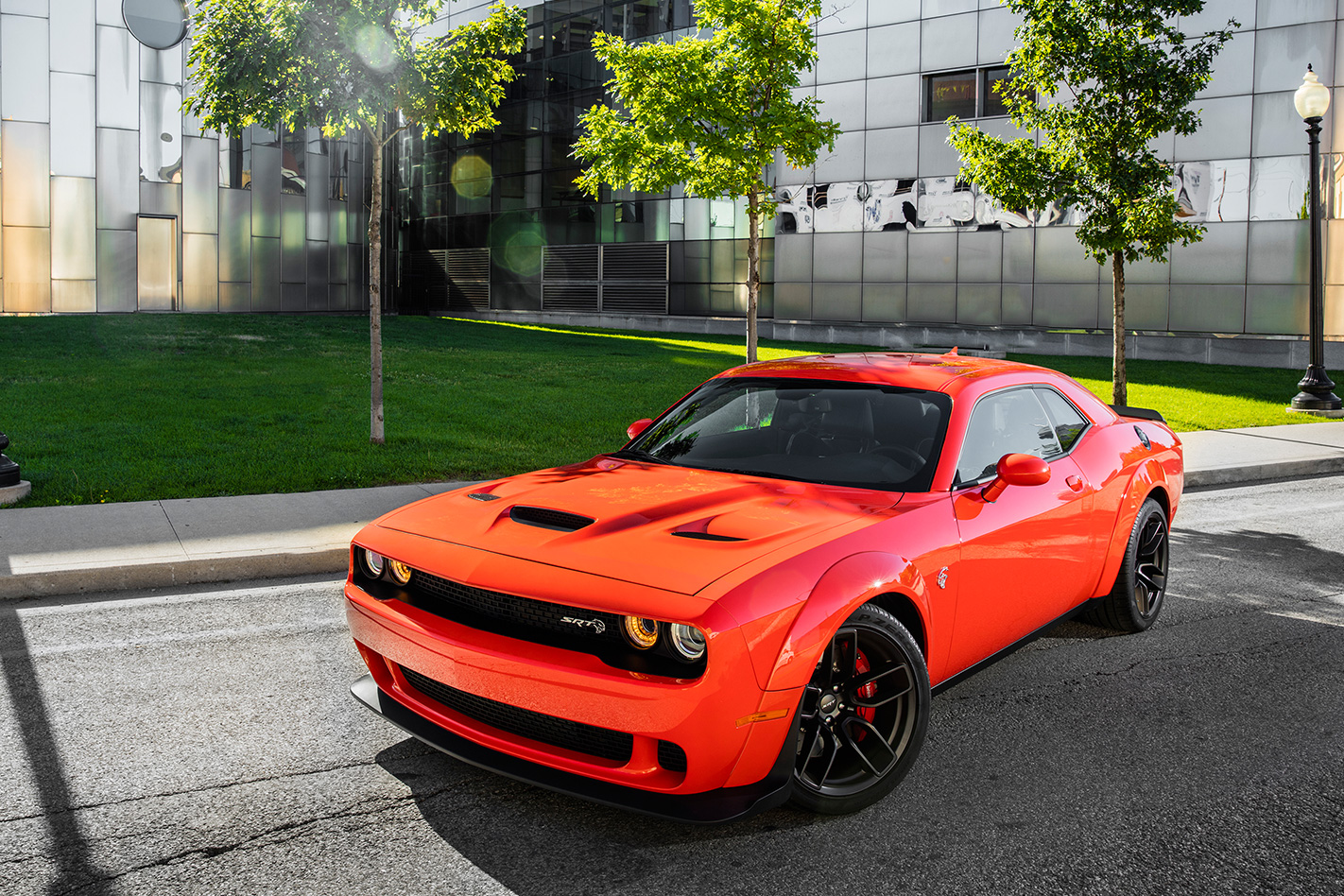
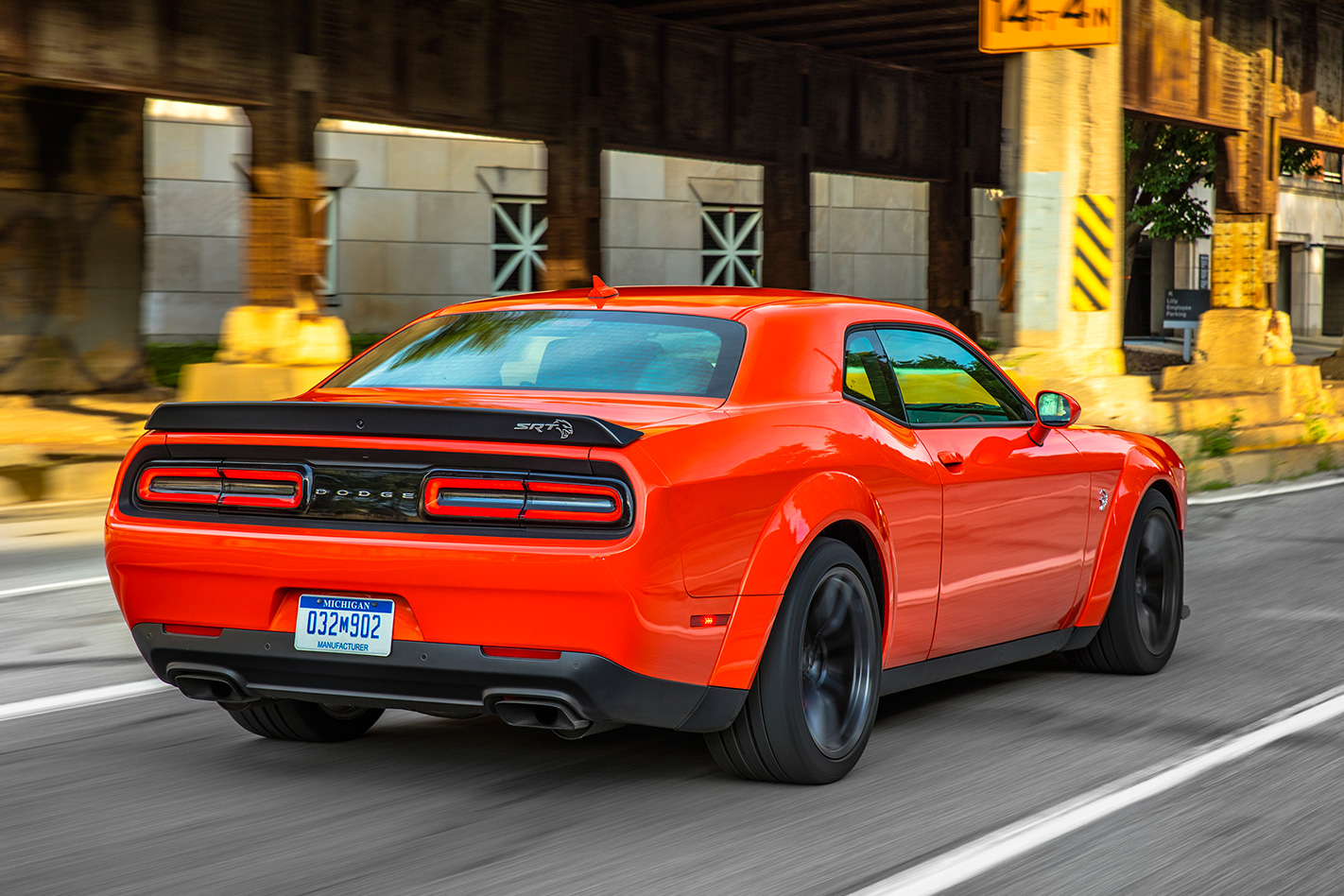
Dodge’s Challenger Demon or its widebody spin-off won’t come down under through official channels.
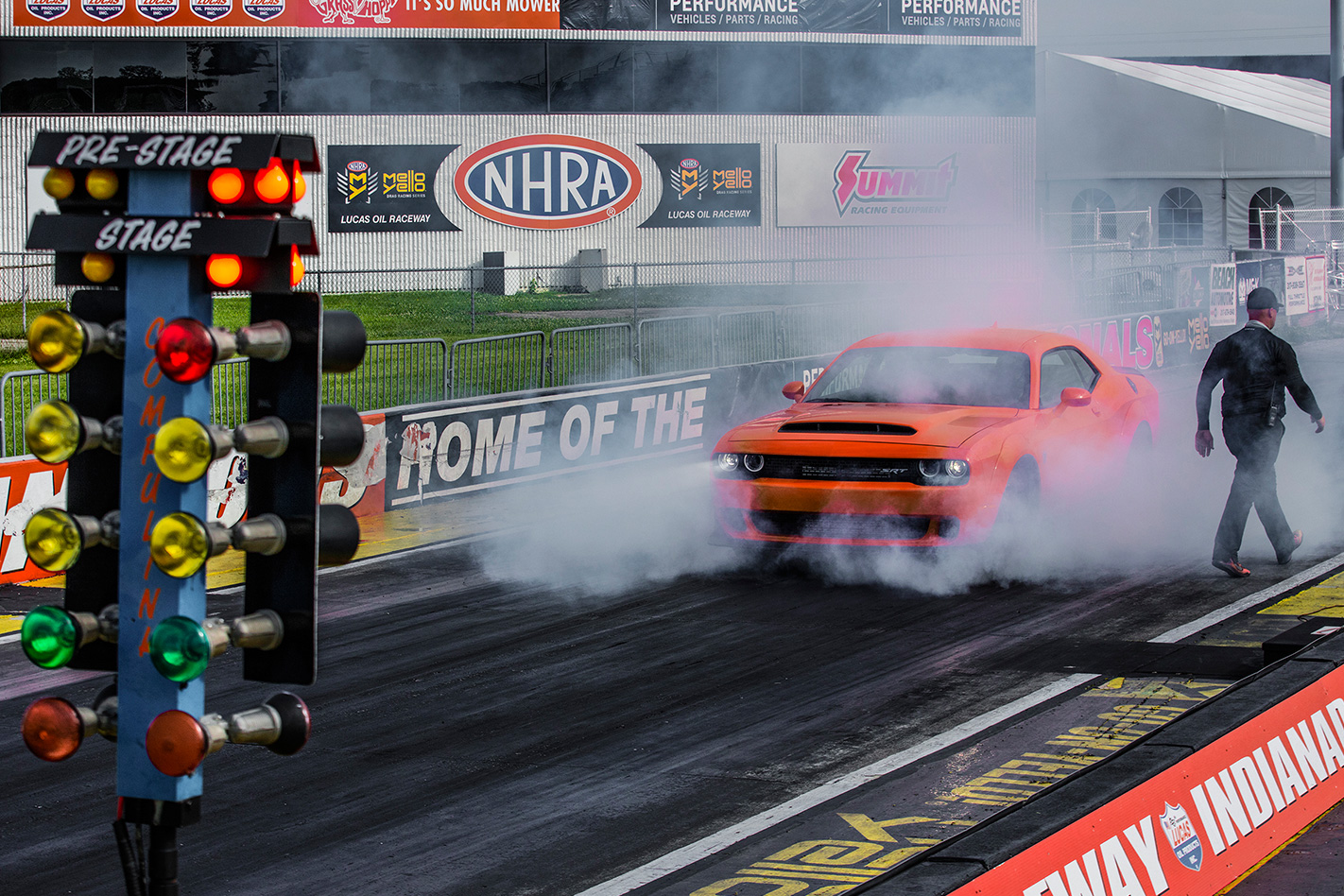
But the 626kW Challenger Demon has been confirmed for Australian delivery through private importer Crossover Car Conversions, who will swap the drag monster to right-hand drive for one lucky customer.
The Demon differs to ‘regular’ Hellcats with its widebody flares, 6.2-litre supercharged V8 capable of 626kW/1044Nm, and street drag radials. Or you can find the full rundown on its package here.
“On the conversion side, we’ll just have to work with that when it gets here,” Craig Dean, from Crossover Car Conversions, tells MOTOR. “The Demon’s not that big difference in the car, anyways, just a bit fancier and more power.”
After revealing the Demon at the New York Auto show in April, Dodge confirmed only 3300 will be made strictly for the North American market with deliveries starting in September.
Dean confirms the tough market. “To get it from the US it’s actually very hard to tie up a deal for that. There’s not many made.”
On top of that he says Dodge don’t like selling export examples. “You just have to buy them through the dealer network. We try and network and get the good stuff. We managed to get an order in.”
As for another Demon? He says they can definitely “try”.
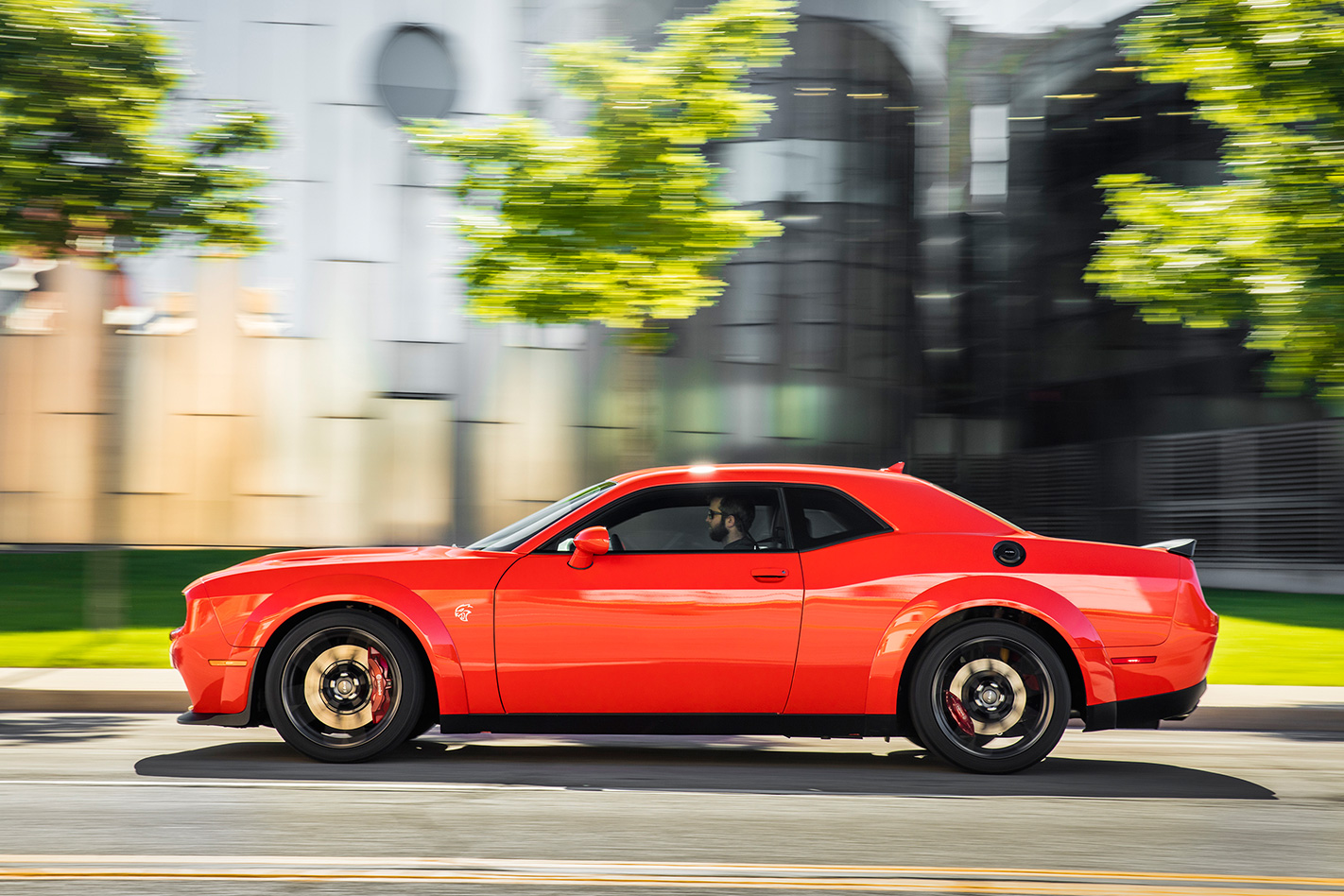
Hellcat Widebody’s cost another US$10K at point of sale, and Demon’s another US$23K, so we’re told a converted Demon will cost its local customer over AU$200K.
Not cheap. But very, very powerful.
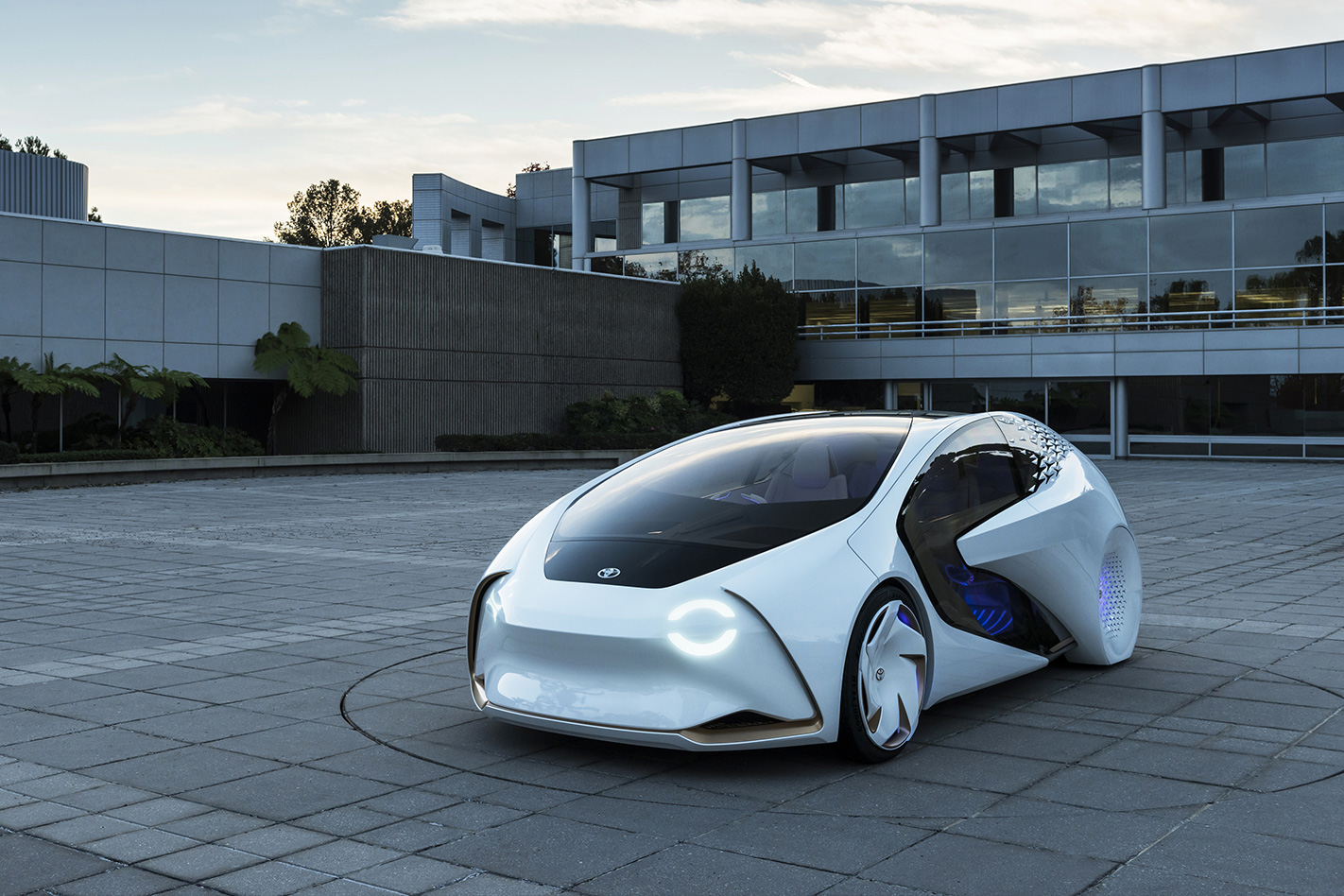
TOYOTA is reportedly working on a new generation of electric cars that will use solid-state capacitors to power themselves that can recharge much faster than conventional batteries.
Japanese news service Chunichi reported this week that Toyota planned to have the cars on sale in Japan by 2022, promising electric vehicles that can travel much further than the current generation of battery-fuelled versions, and cut top-up times to about the same as it takes to refuel a normal car.
However, they tend to have a low power density, meaning that while they can hold a lot of charge (energy), they can’t produce much power quickly.
The carmaker is currently rolling out the Toyota New Generation Architecture – a hybrid, electric and fuel cell-ready platform – across its product range that is expected to also be compatible with solid-state batteries.
Toyota also has the Mirai fuel-cell car that is built off the TNGA platform – the world’s first mass production hydrogen-fuelled car that converts the fuel to water and electricity to drive an electric motor – but the lack of refuelling infrastructure here has seen plans to launch it locally shelved.
Mazda is the only manufacturer to use a solid-state capacitor. The Mazda 6 sedan and wagon use the capacitor to store energy that’s normally wasted while braking, converting it into electricity that’s used for short periods while the car’s idle-stop system shuts down the engine to save fuel.
BMW and Volkswagen are believed to be working on similar solid-state electric vehicles.
The 2018 Porsche Panamera Turbo S E-Hybrid is worth the $75,600 premium over the base Turbo if you’re a technophile, an early adopter, someone who craves a little exclusivity, perhaps mindful of your carbon footprint or often find yourself needing to accelerate as hard as possible from 100km/h to 200km/h.
But if undiluted driving thrills is your thing, the base Panamera Turbo is 90 per cent of the experience for 15 per cent less coin.
What impressed us most about the new Panamera Turbo S E-Hybrid was its ability to drive up to 50km on electric-only power without waking the beastly 4.0-litre twin-turbo V8 under the bonnet – and reasonably effortlessly, thanks to the 100kW/400Nm single electric motor.
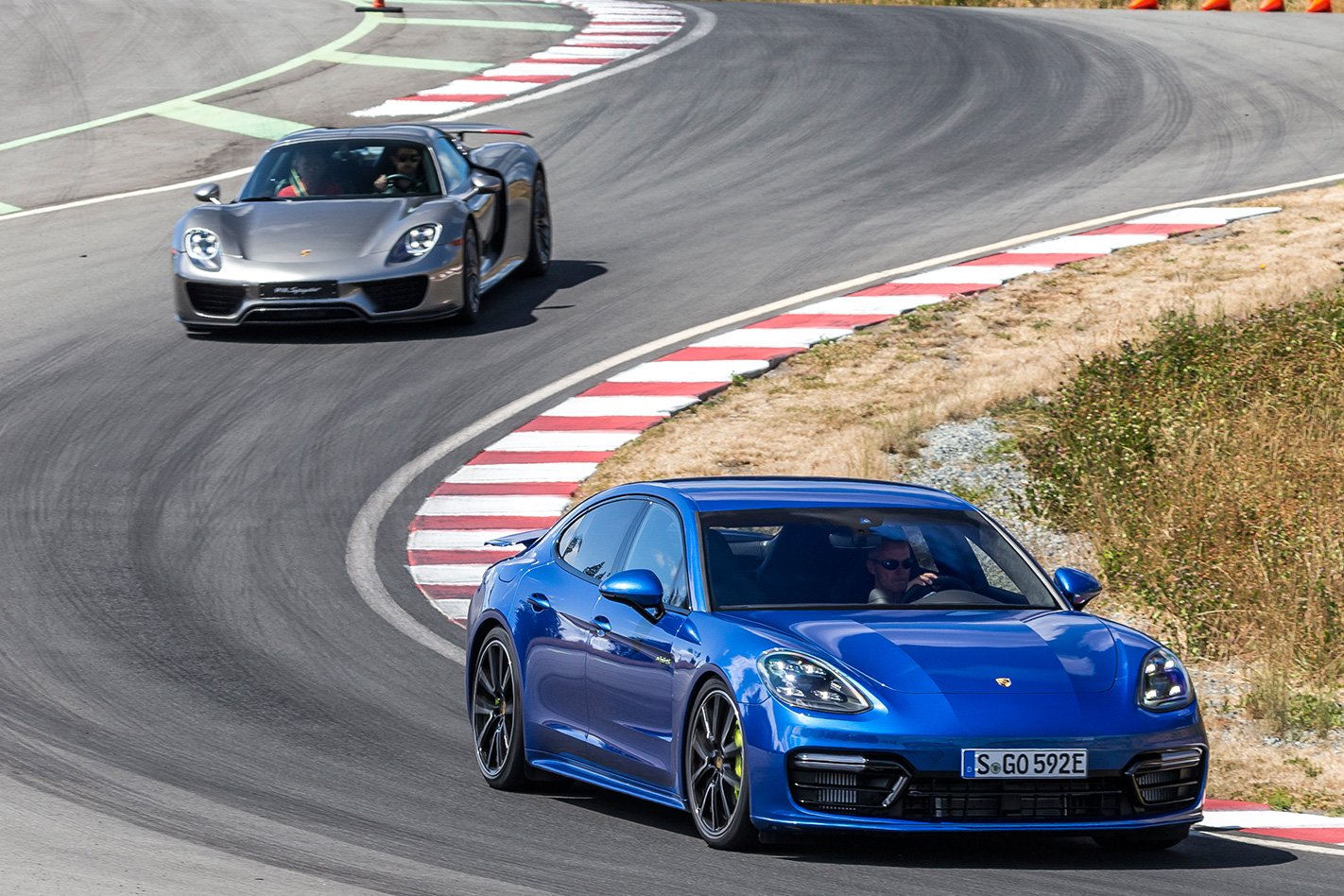
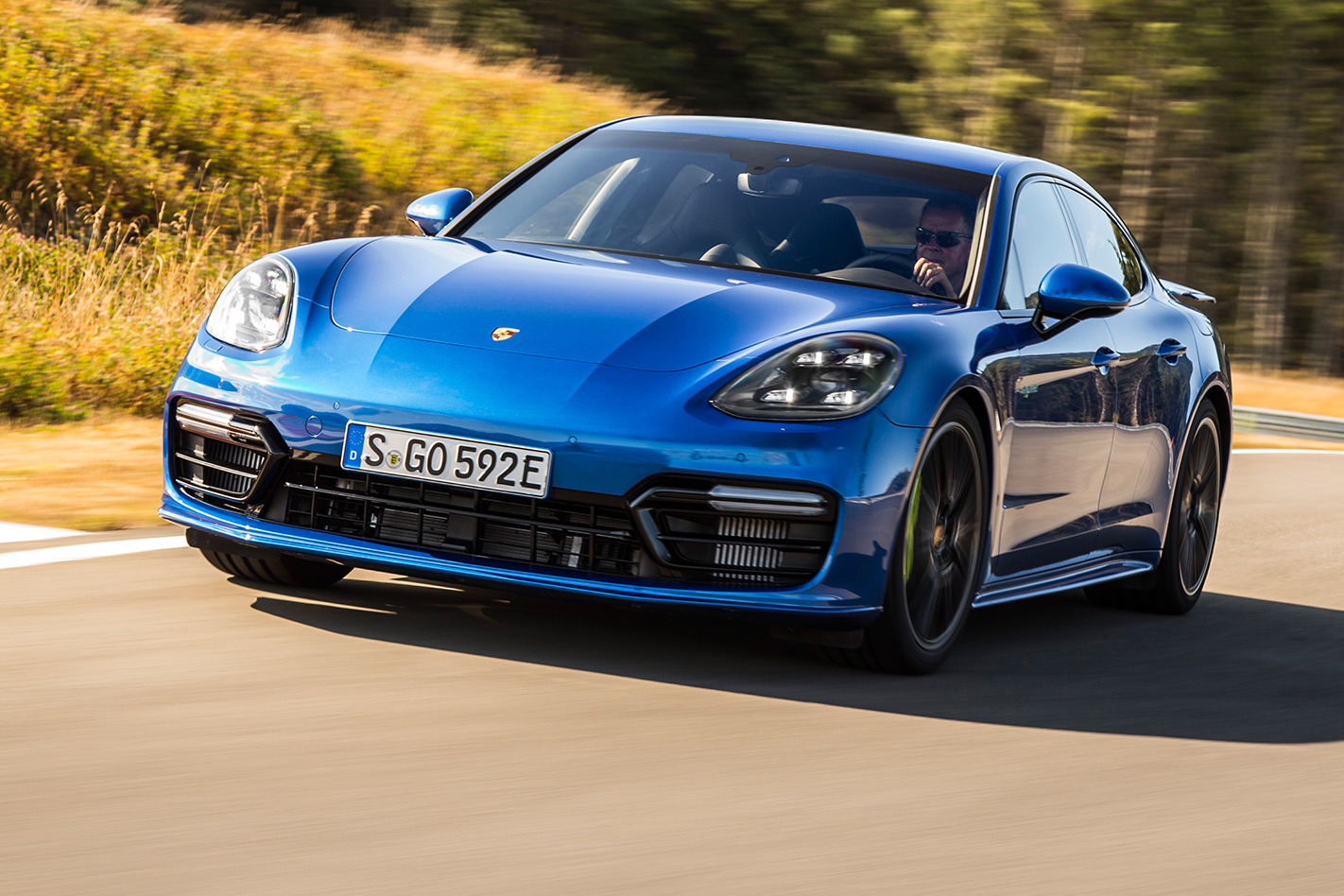
Visually this is a very similar car to the Panamera Turbo with only the Acid Green brake calipers and accented badges telling it apart from the exterior; and, with the car off, the Acid Green gauge needles in the interior.
It’s possible, with the right combination of options and badge deletes, to create identically looking Turbo and Turbo S E-Hybrids with the only exterior visual difference the S’s larger 10-piston front brakes.
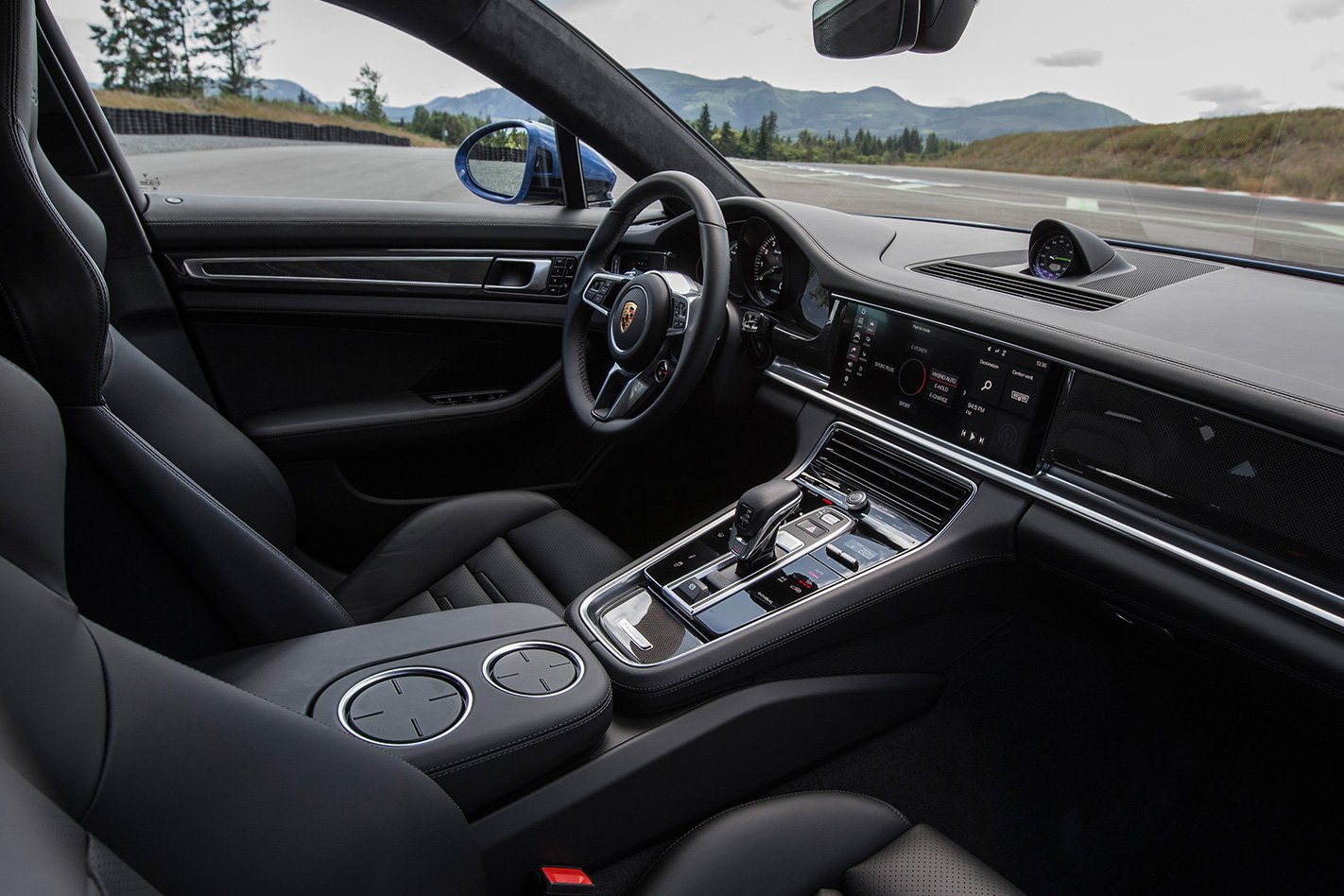
In the interior at least, Porsche didn’t need to do much to its new Panamera to make it feel more luxurious for the Turbo S treatment, as the base car has one of the nicest interiors of any car on sale today, beautifully built with waxy leathers, perforated seats, glossy panels of carbon fibre and piano blacks, the dashboard dominated by the gorgeous 12.3-inch centre touchscreen with Porsche’s intuitive and easy to use new PCM infotainment system.
This is a lovely, high-quality place to sit – luxurious, quiet, high-tech. Incredibly comfortable, serene and spacious, not to mention the design of the interior itself is just delightful to look at. Sitting in traffic in the new Panamera is a joy.
Build your own Porsche 911 GT2 RS
This is also an incredibly fast and muscular car. With the engine and electric motor combining for a stunning 500kW and 850Nm, acceleration is brutal and effortless, with tremendous all-wheel drive traction and huge overtaking punch.
While at 3.4sec – claimed, with launch control – the Turbo S E-Hybrid is ‘just’ 0.2sec quicker to 100km/h than the Sport Chrono-optioned Turbo, the E-Hybrid will leave a Turbo in its wake from 100 to 200km/h, 8.3sec pipping the Turbo’s 9.2sec. The Turbo S E-Hybrid also outguns the Turbo with a top speed of 310km/h vs 306km/h.
Australian customers should tick the box for the optional all-wheel steering, $4340 well spent as it gifts the big, 5m-long Turbo S E-Hybrid with an agility that completely defies its size. You would maybe guess it’s packing an extra 100kg over the Panamera Turbo, certainly not 300.
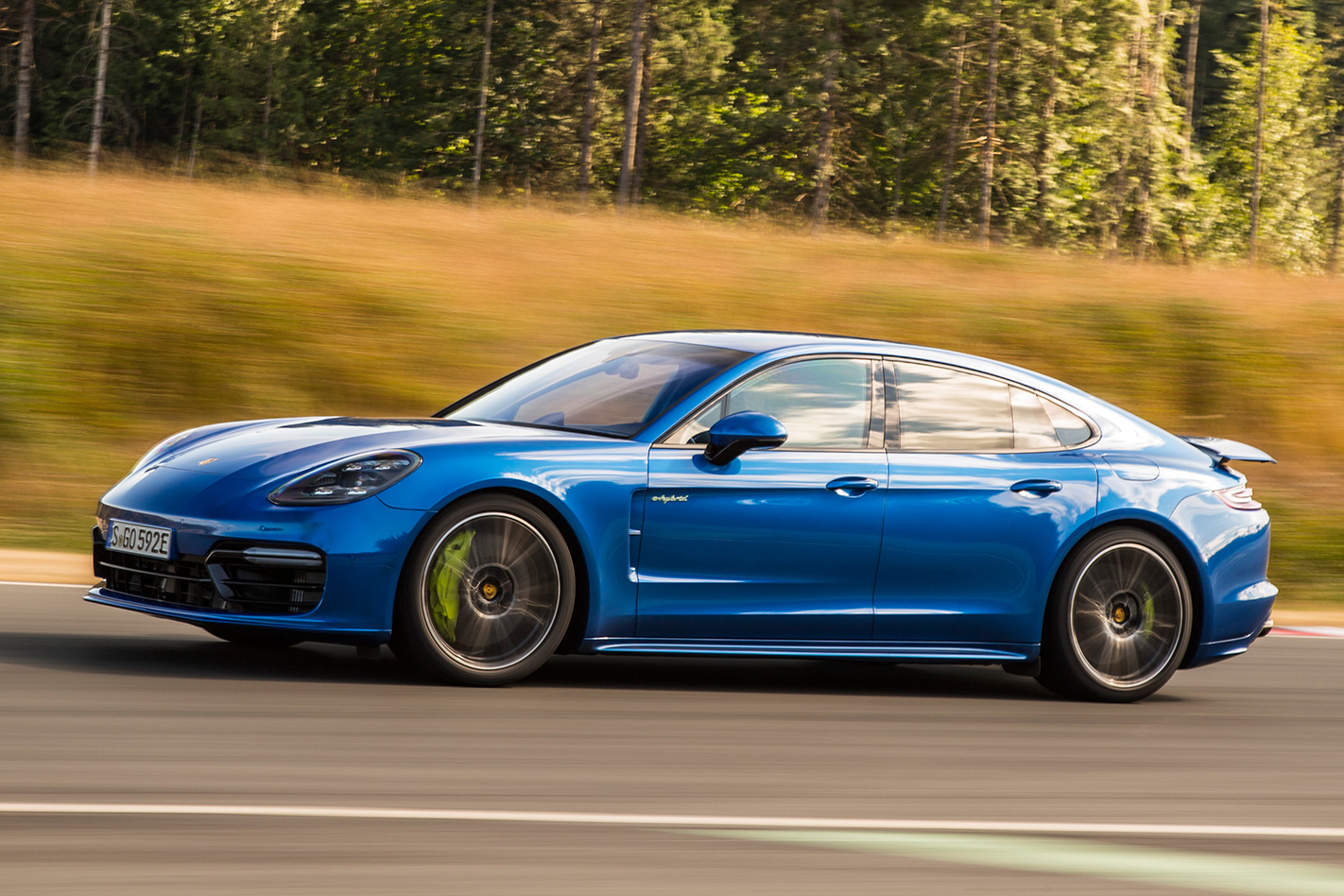
However, despite its surprising alertness, this is a car that works its hardware hard, including those bigger brakes and wider Michelin Pilot Sport 4 tyres.
Back on the road, the Turbo S E-Hybrid feels more at home, showing off its electric prowess, defaulting to electric-only mode at start-up, the twin-turbo V8 staying silent and keeping the neighbours happy. Moving away silently like any electric car, in electric-only mode the Turbo S E-Hybrid can dash to 60km/h in six respectable seconds and to a no-petrol-needed top speed of 140km/h.
In its hybrid mode, the car accelerates using the electric motor until you push through an artificial detente two thirds down the accelerator pedal travel, the engine kicking in without so much as the smallest judder.
Around town in Hybrid Auto mode, the engine shuts off when the car thinks electric-only is all that’s needed, and it can be difficult to know what’s propelling the car without looking at the tachometer, the switching is that seamless and smooth.
Porsche claims the Turbo S E-Hybrid will return 2.9L/100km on the combined cycle but that will quickly vaporise with a leaden foot, our trip computer displaying 21.7L/100km over 275km of ‘sporty’ driving.
Although, of course, if you were using your Turbo S E-Hybrid for your daily commute and plugging it in every night, provided your workplace was less than 20-25km away, you could feasibly go months without having to visit a petrol station.
Another neat trick of the Turbo S E-Hybrid is the ability to pre-cool or pre-warm the interior using the auxiliary air conditioning unit, which draws power either from the grid if plugged in, or the car’s rear-mounted batteries, using an app on your smartphone before you get in the car.
Because it’s possible that on certain racetracks, the lighter, more nimble-feeling Panamera Turbo could outpace the significantly heavier Turbo S E-Hybrid, and feel more lively in the process, although we don’t know this for sure.
We do know that if you specced a Panamera Turbo to Turbo S E-Hybrid levels – including the Porsche Carbon Ceramic Brakes, Porsche Torque Vectoring Plus, Sport Chrono and 21-inch wheels – you’ve suddenly added $43,000 to the price, the gap between the two cars shrinking to more like $30K.
But the base Turbo, which is an excellent car, doesn’t really need any of this stuff, only the all-wheel steering and Sports Exhaust which are optional on both cars and cost about the same ($4340-$4990 for the all-wheel steering and $6950 for the exhaust).
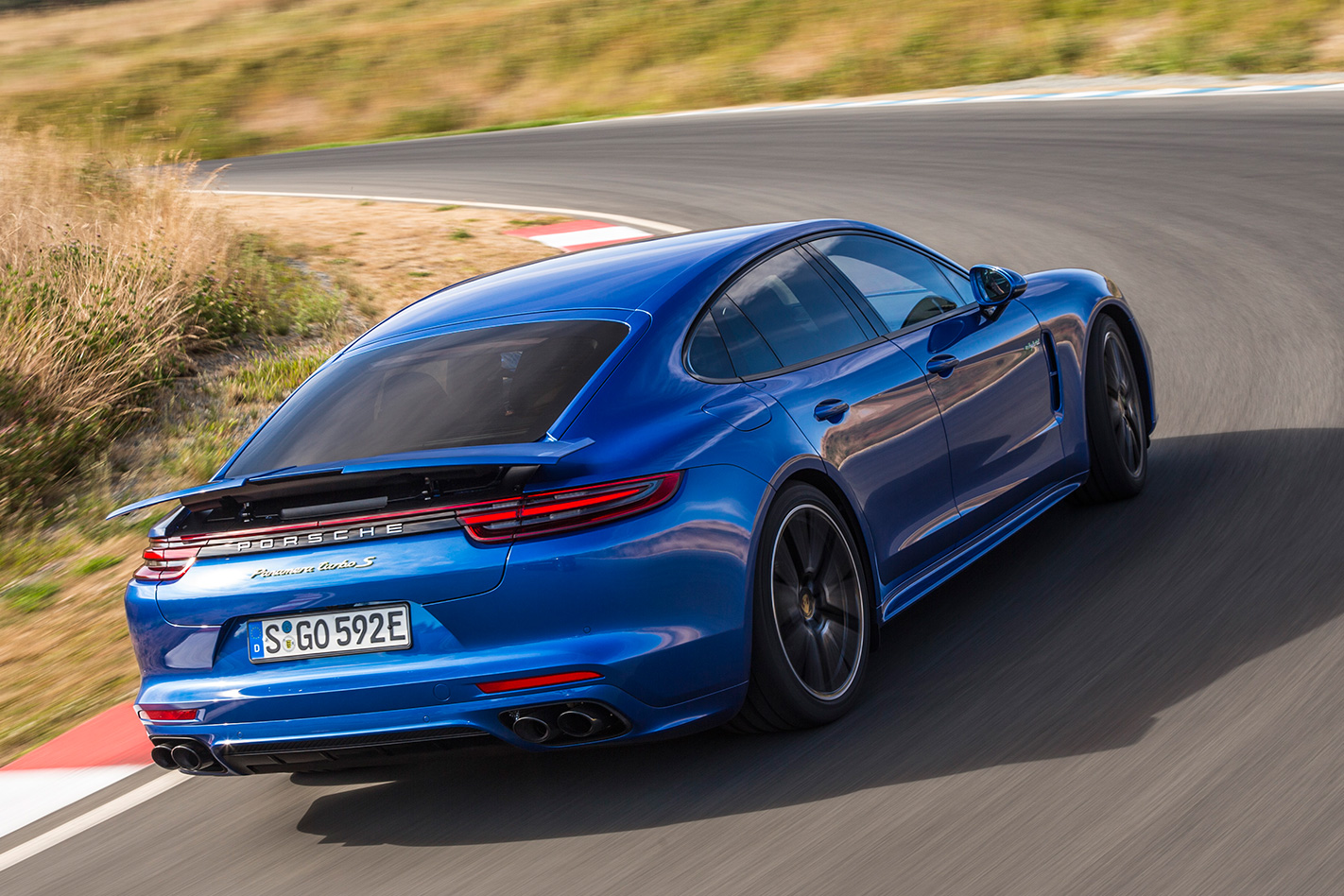
The Turbo S E-Hybrid is on-sale now with deliveries expected in the next two to three months.4 out of 5 stars2018 PORSCHE PANAMERA TURBO S E-HYBRID SPECS Engine: 3996cc V8, twin-turbo, DOHC, 32v, electric motor Drivetrain: 8-speed twin-clutch automatic, all-wheel drive Engine power: 404kW @ 5750-6000rpm Electric motor power: 100kW @ 2800rpm Power: 500kW @ 5750-6000rpm Engine torque: 770Nm @ 1960-4500rpm Electric motor torque: 400Nm @ 100-2300rpm Combined torque: 850Nm @ 1400-5500rpm Weight: 2310kg 0-100km/h: 3.4sec (claimed) Top speed: 310km/h (claimed) Price: $460,100
HOLDEN will completely revamp its SUV line-up over the next twelve months by introducing new models, facelifting old ones, and getting rid of others altogether.
The local brand admits to being behind the eight-ball when it comes to capitalising on the current SUV craze in Australia, however a considered push into these red hot segments could change its fortunes.
Just how serious is Holden about the SUV market? Speaking to Wheels, Holden PR head Sean Poppitt didn’t mince his words.
“Our traditional strength has been in large passenger cars and the market has seen a seismic shift to SUVs, which is exactly why we’ll have two brand-new, world-class SUVs launching over the next 12 months or so,” he said.
“We need to fish where the fish are.”
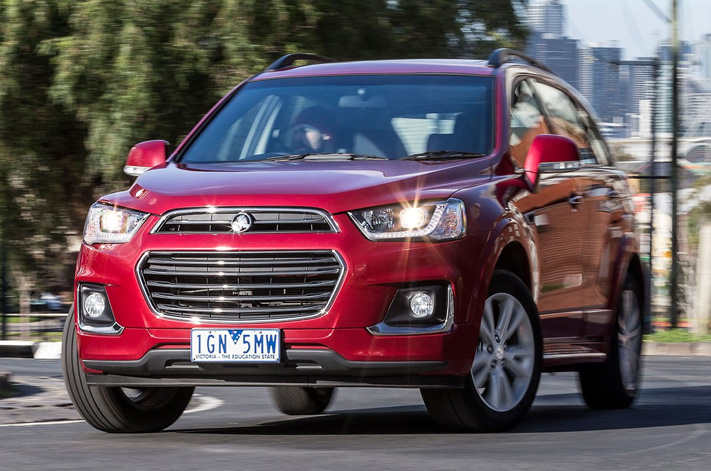
Part of Holden’s SUV shake-up means waving goodbye to the Captiva in both five- and seven-seat guises. It will disappear from showrooms as replacement SUVs arrive.
In total, Holden plans to launch 24 new models by 2020.
To help you better understand the plan and incoming SUV models from Holden, we have driven pre-production versions, along with current generation cars in showrooms, and laid out what buyers can expect.
Here’s a rundown on the next wave of Holden SUVs.
Acadia
The US designed and built Holden Acadia will be king of Holden’s SUV showroom when it lands in local dealerships later this year as the replacement for the discontinued Holden Captiva 7.
Acadia’s formidable stature is matched only by the quality of its large seven-seat competitor set. It will face off against the likes of the Mazda CX-9 that won Wheels Car of the Year, as well as the Toyota Kluger and Kia Sorento.
Of the engines available overseas, the highlight is a 3.6-litre petrol V6. Development has been led by the US arm of GM, though Holden’s engineering team has invested significant work into tuning the ride and handling for local roads. Changes have been made to tyres, bushings, dampers, and springs, and everything else is under the microscope to ensure Australian customers are offered a car best suited our driving conditions.
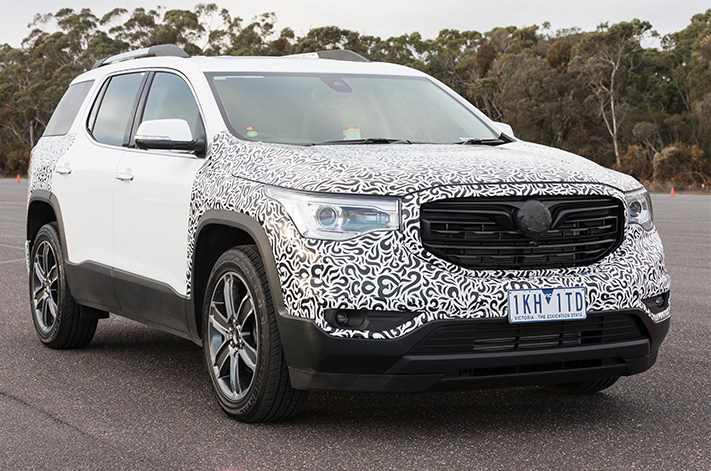
Expect Acadia to come with a full suite of safety features including automatic emergency braking (AEB), forward collision warning, lane departure warning with lane keep assist, and an advanced park assist.
Holden’s biggest challenge with the Acadia will be getting Aussie buyers to warm to a US designed product. An early first taste from behind the wheel of a pre-production vehicle tells us Holden has made a solid effort, but it is unclear whether it will be enough.
Equinox
Following closely behind the Acadia from the US will be the Holden Equinox, due late in the first half of 2018. The mid-size Mazda CX-5 rival, like its bigger brother, is designed and developed in America and built by GM in Mexico. It will replace five-seat versions of the defunct Holden Captiva.
There will be three engines on offer when Equinox launches locally; a 2.0-litre and 1.5-litre petrol turbo, and a 1.6-litre turbo diesel. All three will pair with a nine-speed automatic gearbox.
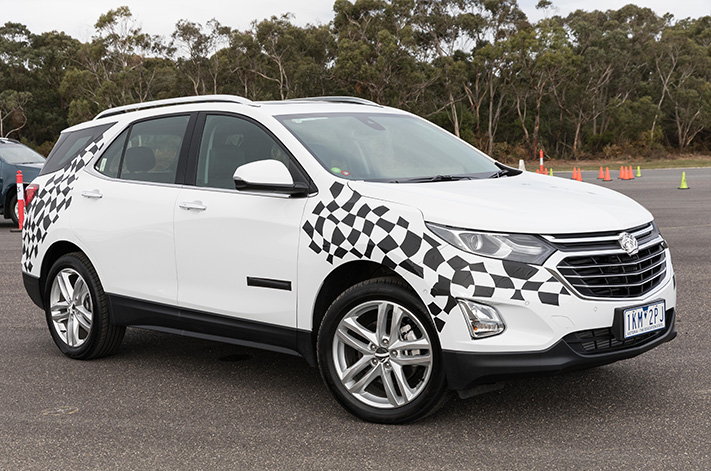
Again, Holden is investing in local suspension calibration and steering tuning. The Equinox’s handling characteristics will be aided by the introduction of torque vectoring by brakes, a first for the segment. Equinox will also be fitted with an extensive suite of safety features.
From our first drive, the Equinox feels better slightly suited to Australian needs and conditions than the larger Acadia, but it has a considerable fight on its hands to take on well-sorted competitors from Japan and Europe like the CX-5 mentioned above as well as the Volkswagen Tiguan, Hyundai Tucson, Subaru Forester and plenty more.
Trailblazer
Built atop the same chassis as the Colorado dual-cab ute, the existing Trailblazer will carry on as the Holden option for large SUV customers looking at vehicles with maximum off-road suitability.
Available now, it is priced from $47,990 to $52,490, with a single 2.8-litre Duramax diesel engine option.
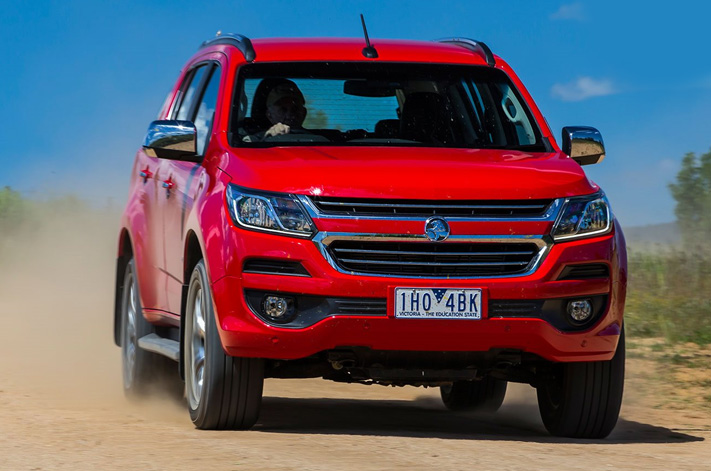
Rivals include the Ford Everest, and other pick-up based SUVs. While similar in size and stature to the Acadia, albeit with increased ground clearance, the Trailblazer is unlikely to cannibalise sales of Holden’s other large SUV due to its differing nature and purpose. Where the Acadia is designed for the urban crawl, the Trailblazer is built to be pointed off the beaten track.
Trax
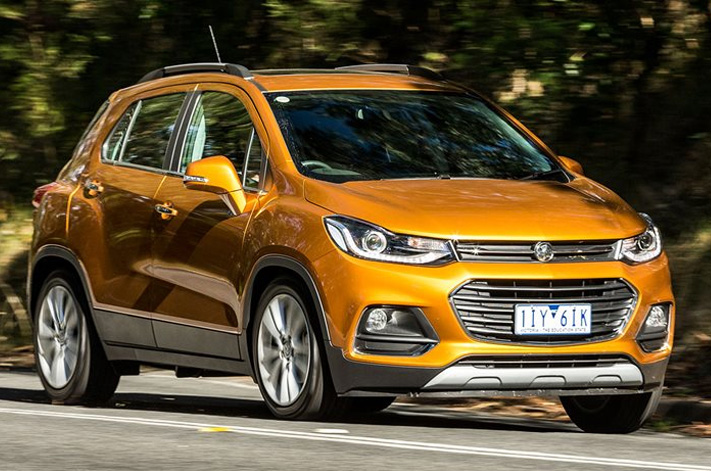
Trax is Holden’s smallest SUV offering, and also the cheapest. It has been on sale for a while, but a recent facelift has improved it slightly. Prices start at $23,990, and top out at $30,490 for the flagship Trax LTZ.
The current, lightly reworked version of Trax is still built on first-generation underpinnings which arrived in Australia in 2013. Enhancements to the local model have largely centred around infotainment and visual updates.
Holden’s baby SUV is competing against big sellers like the Mazda CX-3 and Honda HR-V, and funky newcomers like the Toyota C-HR and Hyundai Kona.
Wildcard: Grandland X
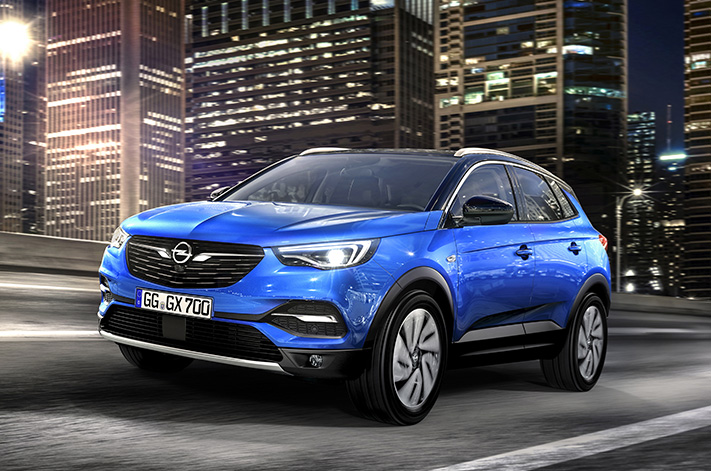
The Grandland X is yet to be confirmed for Australia, but speculation about its inclusion in the local line-up says we may see this sedan-based SUV Down Under.
Grandland X is built atop the same architecture as the Opel Insignia, which will be rebranded as a Holden Commodore and sold in Australia from 2018.
Holden remains tight lipped on the model’s chances of being sold in Australia, but if it was to make the trip from Europe it would fill the slight gap between the Acadia and Equinox, and solidify the brand’s overhauled SUV line-up.
BUYERS queueing up for the 2018 Ford Mustang will have to wait a little bit longer to know if Australia will go down the same path as the US and cut the price of entry to the pony club.
However, if performance is something you’re after, prices for the US version of the car hint that the cost of entry to the more desirable Coyote 5.0 club will hurt the hip pocket a bit more.

North American prices for the entry-level Mustang EcoBoost, powered by a turbocharged 2.3-litre four-cylinder engine, have fallen by $US500 ($A630) to below $25,000, Ford’s US market car configurator shows.
It’s a different story for the V8 version, though – you know, the one about to get a drag strip mode that Australian customers will potentially miss out on because of the more conservative approach the authorities take to it. The atmo 5.0-litre bent eight jumps $US1900 to $US35,995.
Our Stars-n-Stripes friends also pay a lot less than we do for the lop-topped version of the Mustang, with just a $US5500 difference, while we pay an extra $A9000 – the equivalent of $US7200 – for the roof-down experience.
However, the Australian launch is still a long way away, with Ford Australia pegging its arrival to an unspecified date “well into the new year”.
“We haven’t announced any Mustang specification for the 2018 model,” a spokesman for the company said. “We will do so closer to its arrival.”

The Mustang here is priced from $45,990 for the base four-pot paired with a six-speed manual gearbox, ranging up to $57,490 for the cheapest V8, again with a six-speed manual on board.
Ford is concentrating the rollout of its facelifted Mustang on its high-volume left-hand-drive markets. That means Australia has to wait, despite Ford Australia initially expecting to sell a couple of thousand units of the sixth-generation muscle car in 2016 – its first year on sale here – and instead shifting more than 6200, making us the car’s strongest market outside North America.
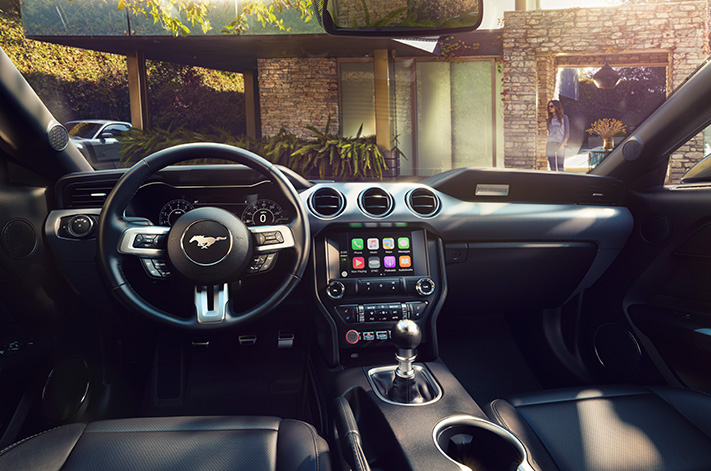
The Mustang’s fresh-for-2018 facelift, announced at April’s New York Motor Show, adds some trick bits to the modern-day muscle car’s repertoire. Foremost is the inclusion of magnetically adjustable sports suspension – a feature previously only available on the not-for-Australia Shelby GT350.
It will be made available in the US as part of a performance pack for both the 2.3-litre four-cylinder versions and the 5.0-litre V8s.
And the V8 will come in for a performance makeover, too. It will add a wider spread of revs via dual high-pressure direct injection and low-pressure port fuel injection, delivering what it says is “robust low-end torque, high-rpm power, and improved fuel efficiency”.
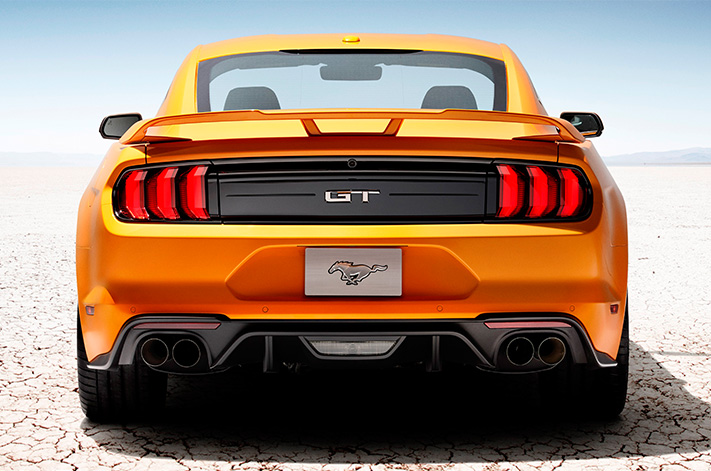
Ford will also lift the Mustang V8’s compression ratio from 11:1 to 12:1, a move that should add power while squeezing out better fuel economy. It also will include the option of an active exhaust that adds a deeper growl to the bent-eight’s exhaust tone.
But the big thing for Ford Australia is likely to be a jump in the current Mustang’s embarrassing two-out-of-five-star crash rating. Independent testing authority Euro NCAP scored the coupe on sale now as a two-star car after it scored poorly in terms of protecting children in the back seat during a crash, and any pedestrians unfortunate enough to step out in front of a moving version.
However, the facelifted version gains automatic emergency braking and a lane departure warning system, enough to drag the Mustang up to a still disappointing three-star rating. Ford Australia is yet to say how the versions of the 2018 Mustang sold here will be kitted out, so that crash safety rating improvement isn’t yet guaranteed once the facelift lands.
Happy birthday to the Ferrari F40, in many eyes the greatest supercar ever built.
To commemorate the occasion, Ferrari has released a number of images of the original presentation, an epic Ferrari Club of Germany gathering in 1992 and celebrity owners at Fiorano, including Sylvester Stallone and Pink Floyd drummer Nick Mason.
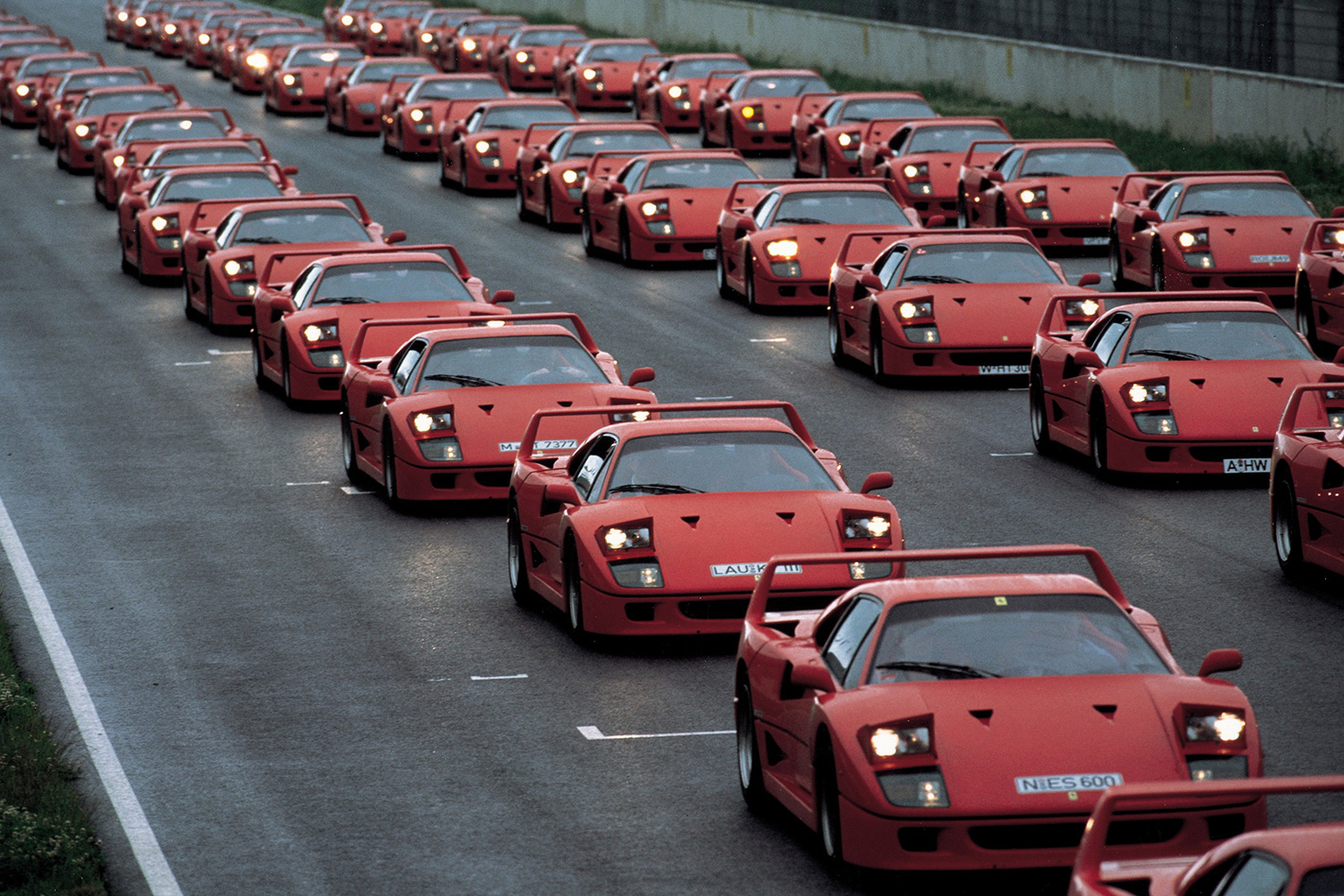
To compete, Ferrari took the choice bits from its ultra-rare 288 GTO – like the 959 built for the stillborn Group B racing regulations – and massaged them into an ultra-powerful road racer. Freed from the need to comply with a racing rulebook, Ferrari expanded the twin-turbo V8 from 2855 to 2936cc with masses of boost resulting in 352kW/577Nm.
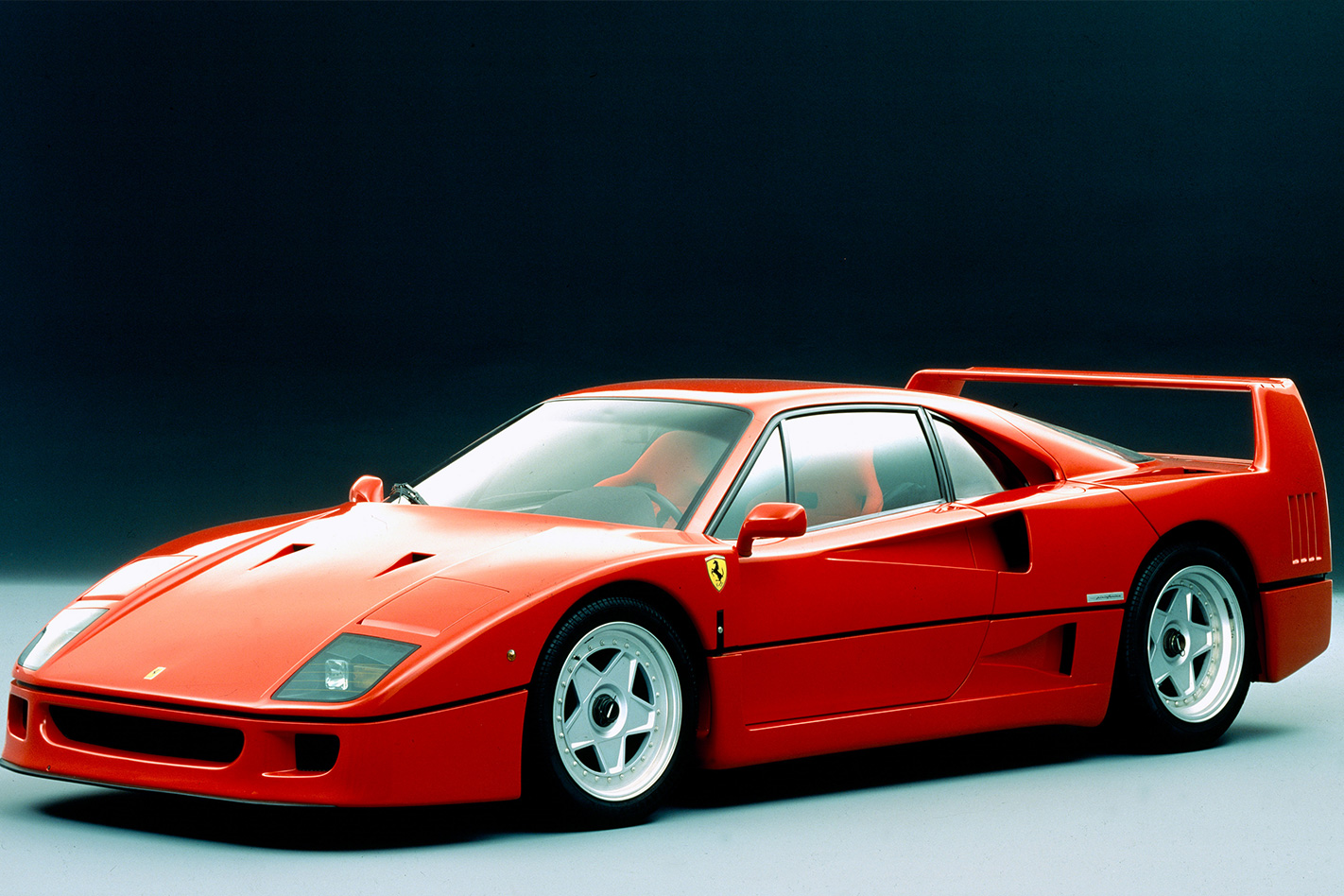
Unlike the heavily computerised Porsche, the F40 was almost crude in its simplicity with no electronic driver aids at all – it didn’t even have power-assisted brakes. Combined with its all-or-nothing power delivery the car could be a real handful. Ferrari initially planned to build 400 F40s; it ended up making more than 1300, though less than half are believed to survive.
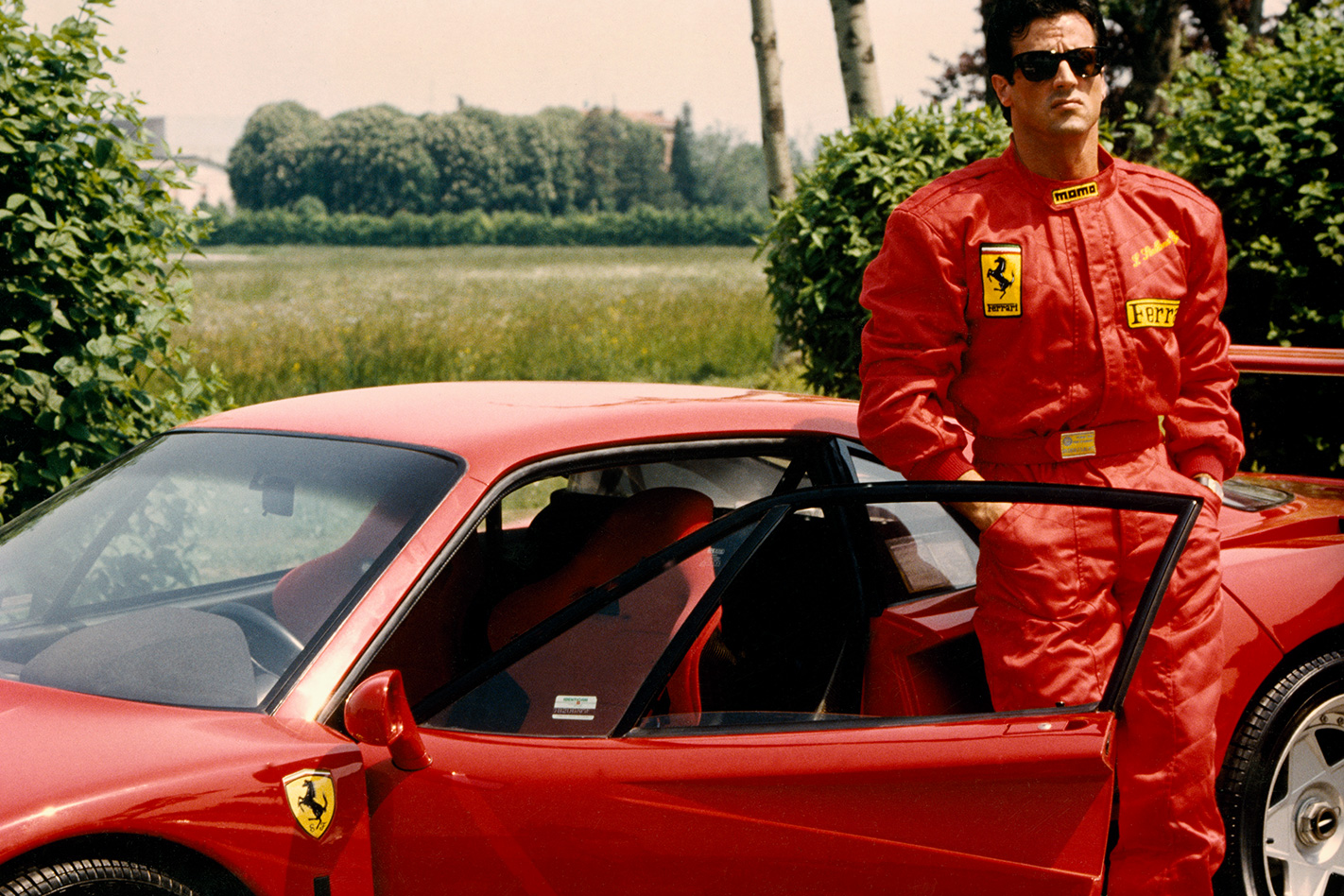
A decade ago an F40 could have been snapped up for around $700,000; today you’ll need at least double that. One positive of the car’s age is that it now qualifies for historic registration in Australia, which means if you’re lucky you might see one cruising the streets on a sunny weekend.
With a previous production car ‘Ring record of 7:12.13, which was set in September 2011, the Viper is already well embedded in the realm of supercars.
But now, it was the title back, and it will have to go through some new additions to the top of the charts.
The current overall record is held by the McLaren P1 LM, with a red-hot time of 6:43.2, though its status as a production car is up for debate.
Also, to beat the P1 LM, the Dodge Viper ACR will need to cut its lap time by 30 seconds.
In terms of bonafide production cars, the Viper will have to beat newcomers to the top such as the AMG GT-R, the Porsche 918 Spyder, and of course, the current production car king, the Lamborghini Huracan Performante.
To do this, the current Viper ACR will need to run the ‘Ring in under 6:52.01.
And that seems quite possible, with the car reportedly having run an initial test time of 7:03.45. That’s already a lot quicker than the record its predecessor set in 2011.
Behind the wheel for the next record attempt, as with the first one, is German racer and SRT factory driver Dominik Farnbacher. To break the record, however, they needed a car.
Dodge shop The Viper Exchange in the US actually offered to send two cars to Germany if a GoFundMe campaign raised USD $159K. Over six months, 427 people raised USD $177,722, which averages out to just over $416 each.
“We all love the Viper. Let’s go out on top,” the campaign creator writes. That goal is now well within reach.
We run the rule over the hottest diesel Countryman to see how convincingly it fulfils its SUV remit.
Tell me about this car:
The Countryman is the biggest Mini body size currently available. It runs on the same chassis as BMW’s X1 SUV, so the Countryman has the space inside to handle family duties. The SD All4 Cooper version gets a peppy 2.0-litre diesel engine and all-wheel drive, which means that you’ll be able to not only put all of that 170kW down in the wet, but you’ll also be able to take advantage of the elevated ride height with a bit of light-duty off-road use.
Now clearly we wouldn’t recommend taking the Countryman to places that would give a Jeep Wrangler something to think about, but it eats up muddy tracks and gravel roads, offering a real sense of security. The diesel engine also returns excellent fuel economy. Even with a fairly heavy right boot we’ve been seeing around 6.3L/100km which isn’t too far off the manufacturer’s 5.2L claim.
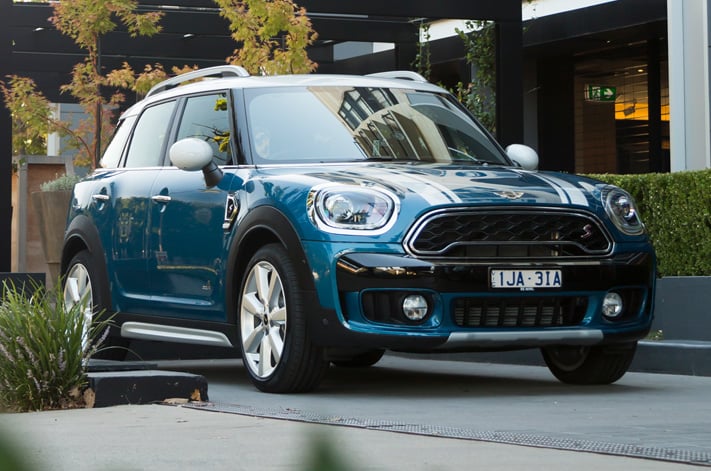
The looks are polarising and the interior has a lot going on, but perhaps the Countryman’s biggest Achilles heel when it comes to crossing over to mainstream buyers is its price. At $51,500 before you start adding options, it can get very expensive very quickly compared to workaday SUV alternatives. That said, it’s a premium car with real character, and that’s a commodity that’s in short supply amongst smallish SUVs. And it’s clearly one that customers are prepared to pay a premium for, if Mini’s bullish sales predictions are anything to go by.
Strengths
- Handling is taut and precise, with good steering and a fire-and-forget all-wheel drive system that requires no intervention from the driver. Should you get too excitable, the Countryman has a really good stability control system that will bring everything back into line in all but the most extreme circumstances.
- The automatic gearbox is smooth and quick-witted. You also have the option of either using the stick to change gear manually, or there’s a pair of paddle shifters on the steering wheel. Flick the drive mode into Sport and you probably won’t need to do much work yourself. The software’s that smart.
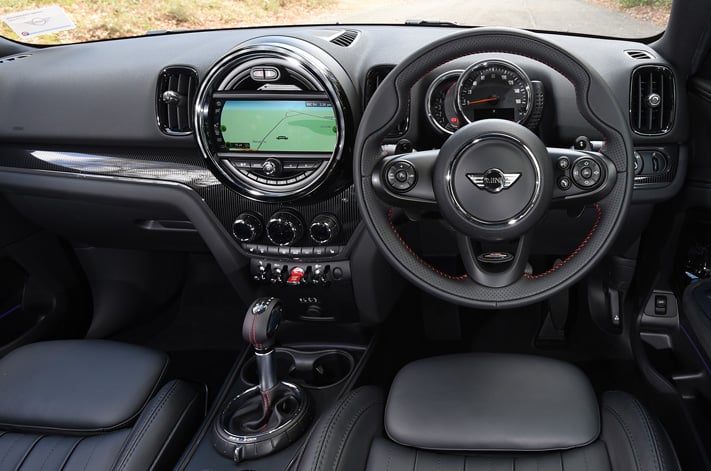
- The fascia delivers the sort of surprise and delight that’s a Mini trademark, with funky ambient lighting, beautifully tactile metal toggle switches and huge dials. Some of the infotainment functions take a bit of mastering, but after a while it’s all fairly easy to navigate.
- There’s quite a bit of space out back. Where the old Countryman had 350 litres of luggage capacity with the rear seats in space, the latest car now boasts 450 litres. Fold the 40:20:40 sliding rear seat and you get up to 1,390 cubic litres of fresh air at your disposal.
- Fuel economy is very good at a claimed 5.2L/100km.
- The rear parking sensors and camera combo are excellent and if you so wish, the car will even parallel park itself. The user manual disclaims any damage done to your alloy wheels if the system misjudges a kerb, so do bear that in mind.
- The active cruise control system does a great job in stop/start traffic. You’ll need to give the throttle a prod if the car comes to a complete halt, but otherwise it’ll happily trundle along in slow-moving lines by itself.
Weaknesses
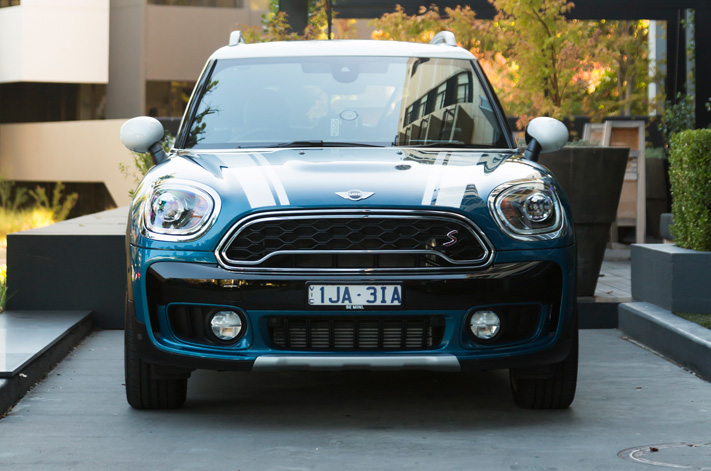
- The styling is, to put it kindly, divisive. It’s certainly a bit more socially acceptable than the old Countryman , with a more mature look, but there’s a lot going on, from the big headlights to the fake vents, body mouldings and chrome detailing.
- There are a few odd specification omissions. For a car that feels as high-tech as the Countryman does inside, it’s a bit strange that you can’t have Apple CarPlay or Android Auto mirroring. A Kia Picanto offers it, so why not a fifty grand Mini? Mini’s parent BMW argues that the inbuilt infotainment offers all of the same functionality.
- The ride quality is decidedly firm. It jolts over bumpy roads and never really settles even on relatively smooth freeways.
- The indicators are the work of the devil, being one-touch items that are supposed to stay on for a few blinks with a light tap or stay indicating with a heavier touch. The problem is, when you make a quick lane change on the freeway, you can set it indicating and the lane change doesn’t offer enough steering input to cancel the blinkers. You’re then likely to start indicating back the other way as you try to cancel them.
- The rear seats fold by using a fiddly fabric toggle at the seat base. A big tab at the top of the seat back would be a far friendlier solution.
Any rivals I should consider:
Audi Q3, BMW X1, Mercedes-Benz GLA, Volkswagen Tiguan
FORD has talked up the growing contribution of Australia in its second-quarter earnings report, despite the brand’s sales flatlining here.
The US carmaker said the earnings from its Asia Pacific division had improved compared to a year ago, “particularly in Australia and India”.
It said Australia had helped to push the pre-tax profit of its Asia Pacific $US151 million ($A181 million) higher than the same time last year, returning the division to a $US143 million profit compared with an $US8 million loss in 2016 as Ford Australia prepared to shut down its Falcon and Territory production lines.
Ford was commanding a 6.6 percent market share in Australia in June, down slightly from the 6.8 percent market share it has averaged over the first six months of the year. Last month, it fell back a rung on the charts tracking Australia’s best-selling brands, falling from fourth in May to fifth in June behind traditional rival Holden.
Overall, Ford made $US2.0 billion in net income for the quarter, a 3.7 percent rise compared with the second quarter of 2016 as it benefitted from lower tax rates. Its rival, General Motors, fared a little worse, earning only $US1.66 billion for the quarter.
The quarter was a significant one in the US, with the carmaker launching its first over-the-air update to its vehicles’ software in the US. It used the technology to upgrade the multimedia units in about 800,000 Ford products to allow the Sync3 software to use both Apple CarPlay or Android Auto.
Locally, Ford is finally running out of stock of the locally made Falcon large car and the Territory large SUV, which ended production in October last year.
While stock of the Falcon appears to have almost dried up, as of the end of June Ford had about two months worth of Territory SUVs remaining in showrooms, anecdotal evidence shows.
Ford’s global earnings report also spells out the separation package that Ford has offered to Mark Fields, the current chief executive of the global carmaker who will step down on August 1 after heading up what industry insiders say was a lacklustre time for the company.
As part of the deal, he will have access to two “executive vehicles” but need to pay for their fuel himself, access to two lease cars, and will be able to keep his Ford-issued phone, iPad, and any other bits of equipment the carmaker has installed at his house.
