
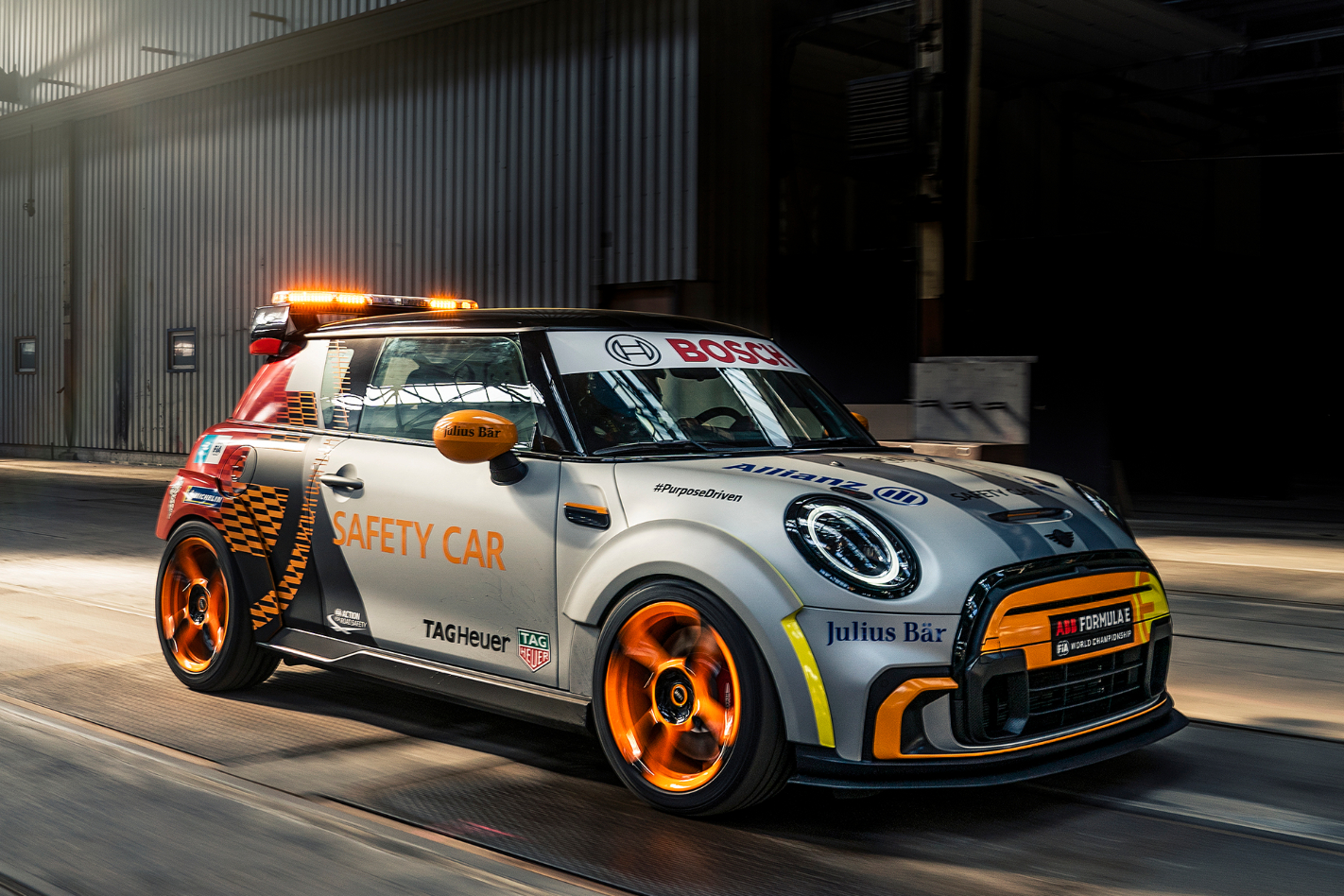
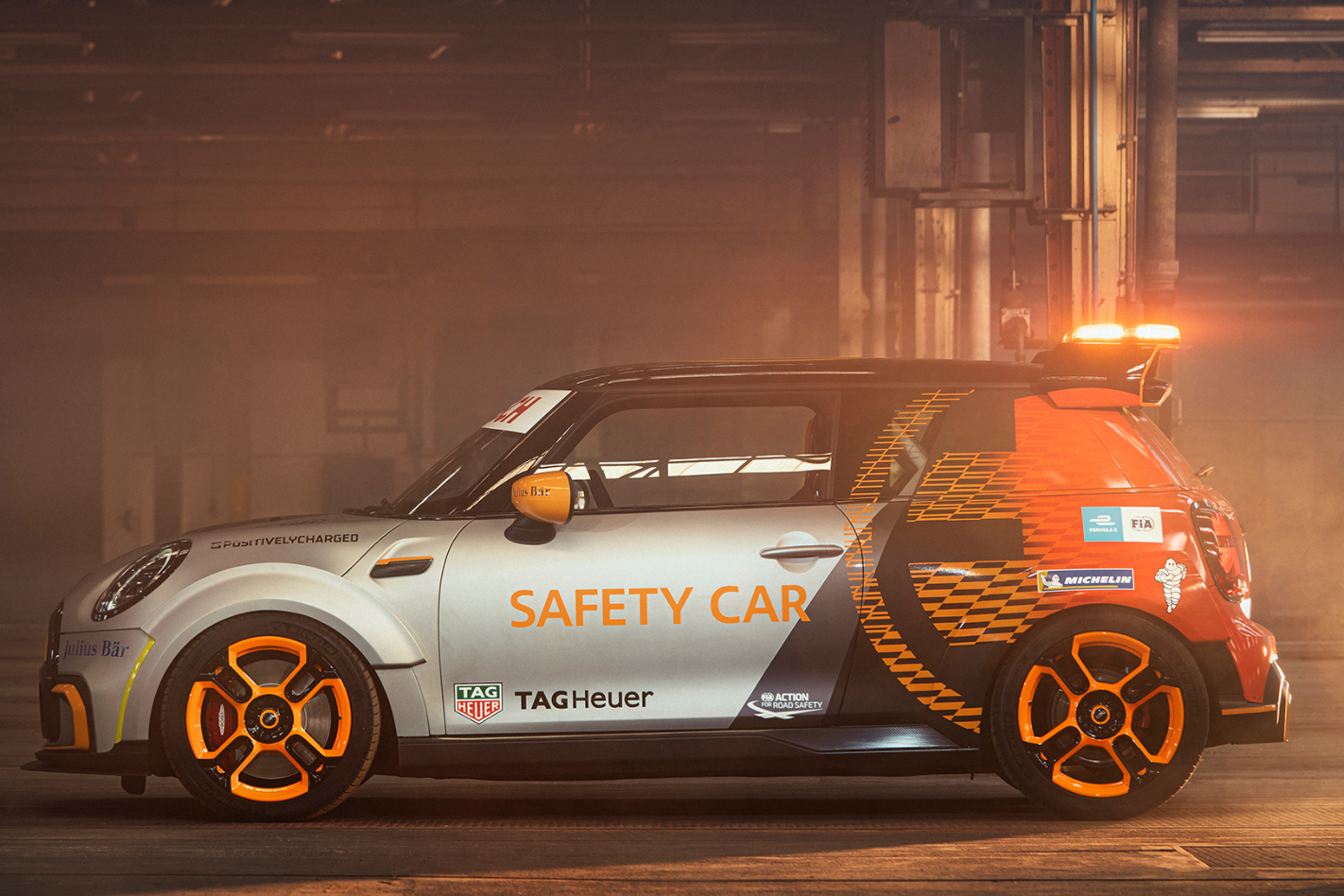
MINI has announced that a hotted-up, lightweight variant of its all-electric Cooper SE Hatch will be the official safety car of the Formula E World Championship race series.
Called the ‘Pacesetter inspired by JCW’, the safety car looks very similar to its conventional, combustion-engined MINI JCW Works GP hatchback sibling, sporting a familiar exterior body kit, albeit one with less box-like flared wheel arches.
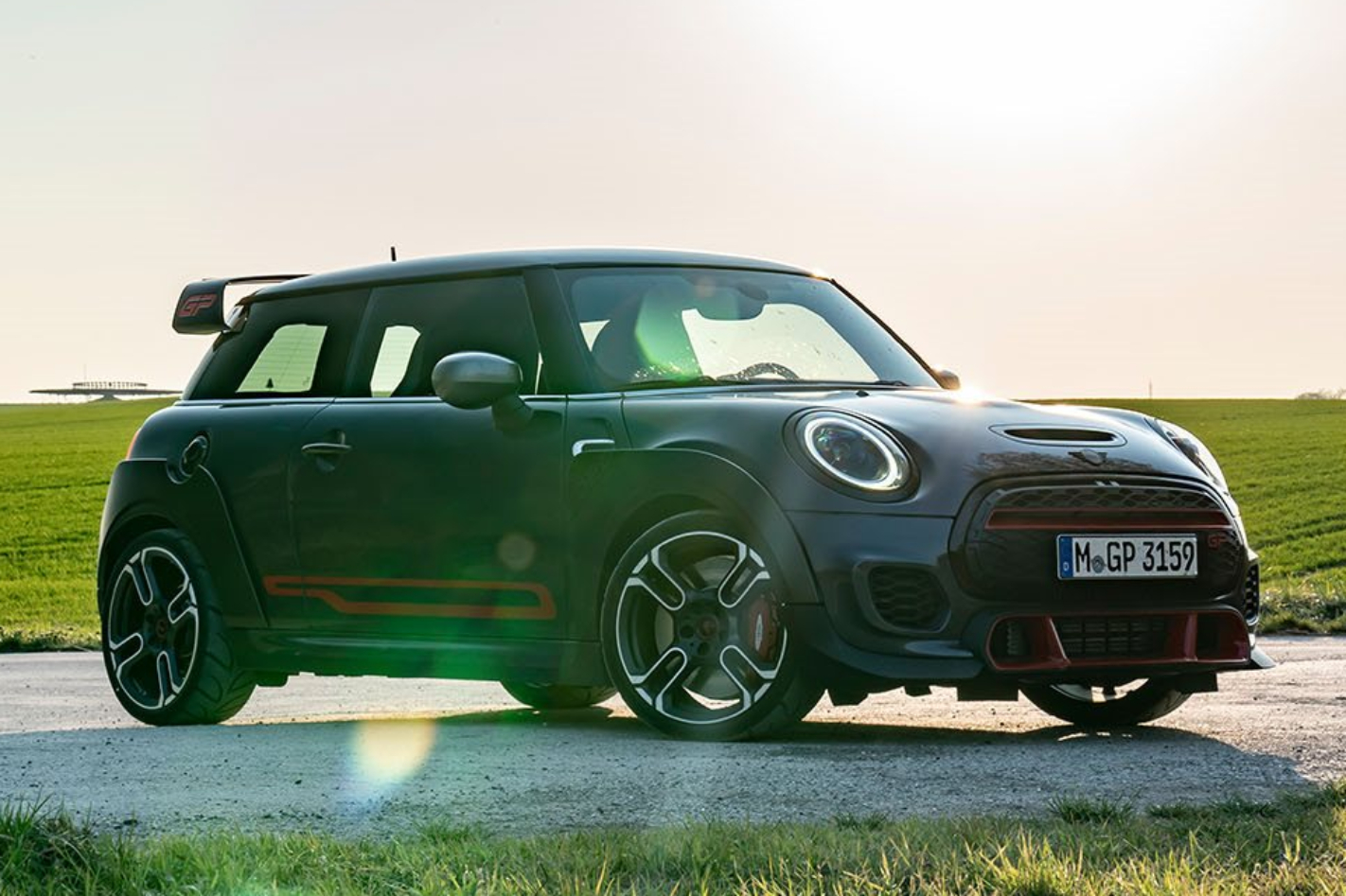
The 2020 Mini John Cooper Works GP.
The new EV safety car has been put on a strict diet to ensure it can set the pace at the top level of E-motorsports, with MINI managing to shed 130kg from its regular Cooper SE Hatch, resulting in a car that weighs just 1,230kg.
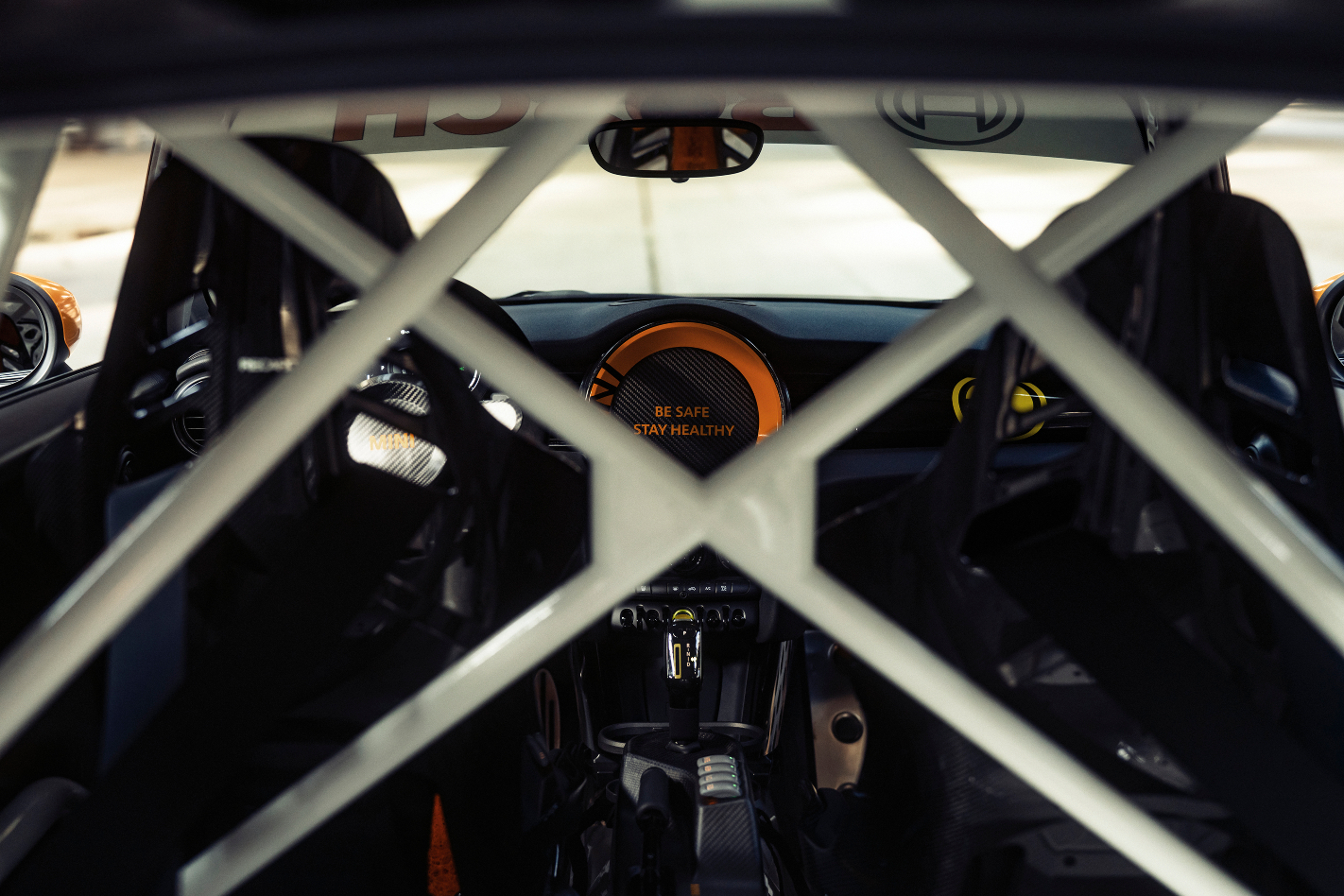
The British manufacturer was able to accomplish this by ditching the rear seats and much of the car’s interior features in favour of a welded-in roll cage and a smattering of carbon fibre parts.
Power from the car’s electric motor is still rated at 135kW and 280Nm, however, because of the mass reduction, the safety car is capable of accelerating from 0-100km/h in a brisk 6.7 seconds.
MINI also points out that it’s the on-the-move acceleration where the stripped-out racer really comes into its own, surging from 80-120km/h in 4.3 seconds.
However, the traditional fossil-fuel burning JCW Works GP still has both those performance stats beaten, completing the 0-100km/h sprint in 5.2 seconds and 80-120km/h dash in 3.3 seconds.
It would still be interesting to see which car would be quicker on a hot lap though, as the safety car comes equipped with three-way adjustable racing coilover suspension for maximum attack.
Surprisingly, the EV safety car is fitted with middling Michelin Pilot Sport 4 tyres, which aren’t exactly known for on-track performance.
This is at odds with the road-going JCW Works GP wheels being shod in Hankook Ventus TD semi-slicks, which are far superior tyres for track applications.
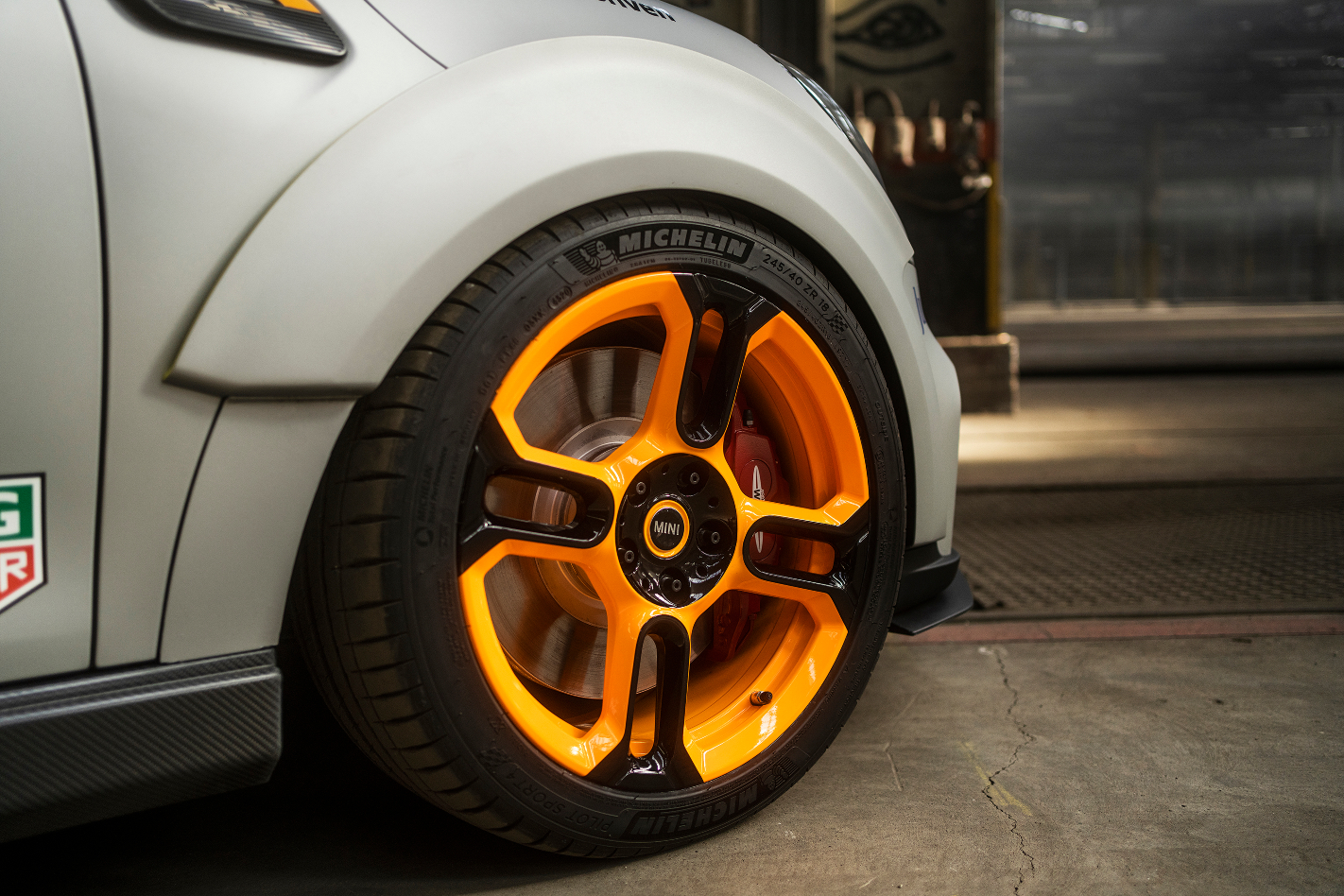
The electric safety car does have a wider track at front and rear though, utilising 245/40 R18 tyres, as opposed to 225/35 R18s in the Works GP, and 205/45 R17 in the Cooper SE.
And thanks to being owned by BMW, the motorsport arm of the Munich automaker has also been involved in the development of the safety car, so it should be full of steering feel and precision.
Bruno Correia, the official FIA Formula E Safety Car driver, has already driven the MINI Pacesetter inspired by JCW, and he found it favourable on track.
“Agility, performance, a cool looking car – the MINI Electric Pacesetter Safety Car for the FIA Formula E World Championship has got it all,” said Correia. “It’s very fun to drive, it feels like karting.”
It will be interesting to see whether any of the technical features or expertise learned from the safety car project will trickle down into a hot SE version of the all-electric MINI Cooper, as it could make for a compelling next-gen hot hatch.
SAIC, the parent company of MG, has previewed its latest fully electric SUV coupe concept, the R Auto ES33.
R Auto will be the state-owned automaker’s newest brand, and its focus will be entirely on creating electric vehicles.
SAIC has confirmed, although still in its concept stage, production-ready models of the ES33 are expected to be launched in the Chinese domestic market next year.
The contemporary SUV’s interior will also be unveiled in a few weeks at the Shanghai Auto Show on Monday, April 19.
The EV SUV will be constructed around an entirely new electric-only chassis called ‘R-TECH high-energy intelligent body’.
According to the carmaker, the EV architecture is the result of a $4 billion investment, and will “herald key partnerships with some of the world’s most advanced sensor and computing companies, and provides a compelling glimpse into the future for upcoming products”.
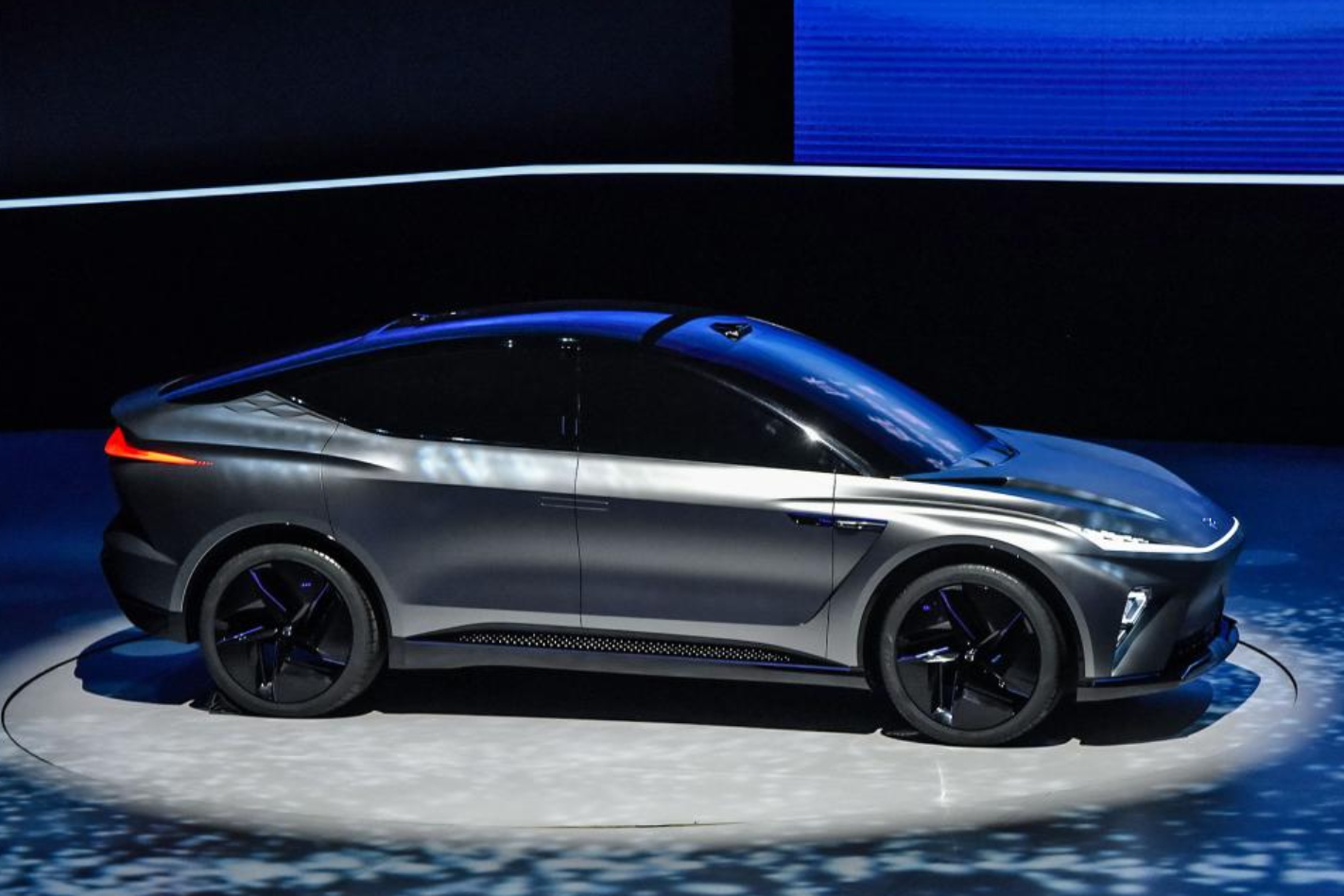
The R-Tech body will have the capacity to interchange batteries and hardware components, which could be a potential game-changer in the EV space.
Also built into the body of the ES33 are no less than 33 different sensors including; laser radars, 4D imaging radars and 22 separate cameras, which can be found in and around the vehicle.
US manufacturer Luminar has also worked with SAIC on creating bespoke lidar sensors, which are built into the roof of the ES33.
SAIC claims these lidar sensors, working in conjunction with the 4D imaging radars, will create awareness so powerful that the car’s onboard computers will be able to detect objects as small as a soft drink can 140 metres down the road.
5G-V2X mobile connectivity will also come equipped with the next-gen concept, and according to the Chinese firm, this will allow the ES33 to function with full ‘level five’ autonomy.
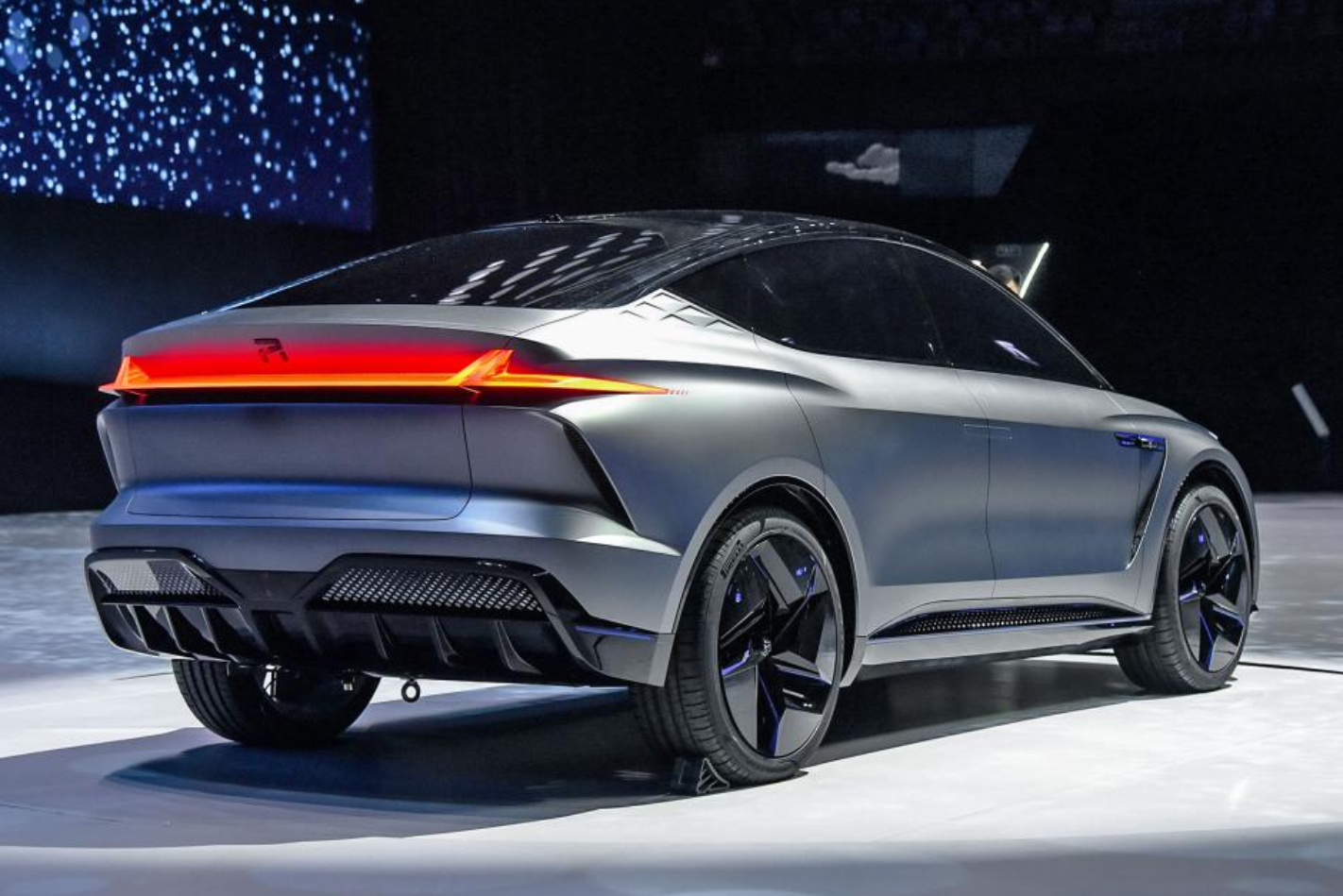
This is a very big claim, as level five autonomy, according to the SAE International classification, means the ES33 will be capable of driving itself completely without any human interaction – the vehicle may not even need a steering wheel.
To put that in further context, Tesla’s ‘Full Self-Driving Beta’, which is the manufacturer’s most advanced autonomous software currently being utilised, is only classified as offering ‘level two’ autonomy.
SAIC says all this will be possible thanks to the immense computing power of the ‘DRIVE AGX Orin chip’ made by NVIDIA.
The space-age chip has been, according to NVIDIA, “developed to enable architecturally compatible platforms that scale from a level 2 to full self-driving level 5 vehicle, enabling OEMs to develop large-scale and complex families of software products”.
As a result, the chip and its 17 billion transistors can reportedly perform 200 trillion operations per second.
This all sounds quite ground-breaking in the EV space, however, an MG Australia spokesperson has commented that the ES33 is still a concept at this stage, and its purpose is to showcase what may be possible in the future.
The representative also said MG Australia was currently in discussions with SAIC about the possibility of a production-ready variant of the EV SUV concept being brought to Australia and badged as an MG product.
WhichCar will bring you more details about the R Auto ES33 as it becomes available.
Lexus has just unveiled its radical LF-Z electric SUV concept that hopes to shine a light on the luxury brand’s future of performance, styling, and technology.
The electrified concept is expected to be built on Toyota’s latest e-TNGA platform, an all-electric chassis architecture that will serve as the base for many of the Japanese firm’s future EV models.
Drive will come from a rear-mounted electric motor and a liquid-cooled 90kWh lithium-ion battery pack that produces a highly charged 400kW and 700Nm.

Power will be sent to all four wheels, thanks to Lexus’ new variable force control technology known as ‘DIRECT4’.
The new four-wheel drive system will help propel the 2100kg SUV from 0-100km/h in a supercar-beating 3.0 seconds, and the LF-Z won’t stop accelerating until it reaches 200km/h.
Charging power for the battery bank is rated at 150kW, and once fully charged, Lexus claims the LF-Z will be capable of a 600km WLTP-certified driving range.

The swept-back styling of the concept is compelling, and the front fascia of the car looks exceedingly contemporary, which is only to be expected of a carmaker like Lexus.
The ultra-thin headlights give the car an aggressive and purposeful appearance, while the large front bumper previews the future of the automaker’s quintessential ‘spindle grille, which will shift from a functional feature to one made purely for ornament and brand identity.
A sleek, hunkered down side profile highlights the concept’s relatively low roofline, with the height of the LF-Z measuring in at just 1600mm.

At the back, slim wrap-around tail lights with bright red LED slats cut with angularity into the concept’s rear quarter, while an illuminated ‘electrified’ badge sits centrally on the tailgate.
Below that, a deep black bumper is topped by a thin vertical strip of LEDs and flanked on either side by large, stygian cut-outs.
Overall, the LF-Z may look similarly sized to Lexus’ current RX large-size SUV, but it sports a wheelbase that is considerably longer, measuring 2950mm (160mm more than the RX).

Coupled with very short overhangs at both the front and rear, and when taking into account the benefit of EV architecture, the concept should provide a cabin with considerably more room for its occupants than the RX SUV it may one day replace.
The interior of the LF-Z is equally as avant-garde as its exterior, and easily the most noteworthy feature is the yoke-like steering wheel, which is starting to become the norm for EV concepts in 2021.
The cabin features a driver-centric environment, with a floating centre console angled towards the driver’s seat that also separates the front two occupants of the vehicle.

There’s a typical digital dash on show, as well as an augmented reality head-up display that can depict navigational prompts, audio system functions, and driving mode selections.
Sitting beside the dash is a large, square-like touch screen display that will allow occupants to interact with the car’s infotainment system.
All four seats are angular and of the bucket variety, further supporting the EV’s outwardly sporty remit, and there’s ambient lighting that runs along the car’s ultra-flat floor.
The LF-Z will utilise a new form of artificial intelligence, which according to Lexus memorises the driver’s preferences and behavioural characteristics, and provides constant support to the driver.

Voice commands will also be available, and this will help to improve operational abilities while driving.
The concept also features a host of semi-autonomous driver functions and safety features, and for the first time in a Lexus, a steer-by-wire system that eliminates the need for a steering shaft.
It’s not known when we might see a production-ready variant of the LF-Z concept, however, Lexus has announced it intends to bring 10 new electrified models to market by 2025, and has confirmed that elements of this concept will be found in those future models.
The luxury automaker has also trademarked the ‘RZ 450e’ name in Australia, so we may see an all electric large SUV from Lexus in the not too distant future.
Perhaps I’m a pessimist, but whenever I see the word ‘experiment’ associated with anything I can’t help but feel a significant degree of risk is implied. It was, after all, an experiment that turned a Ukrainian power station into giant nuclear bonfire for a few weeks in 1986, and some years later my daring mango and anchovy salad was arguably just as toxic.
That said, where would we be as a species if we didn’t accept the potential risks and experiment? Edward Jenner would have never injected a small boy with pus collected from a sick milkmaid’s hands, and Colonel John Stapp wouldn’t have strapped into a rocket sled and subjected himself to more than 46 g of deceleration.
To any human with at least one functioning cerebral lobe, both ideas are fabulously stupid but fortunately neither of the men asked for a second opinion. As a result, we now have incredible lifesaving safety technology in cars and a coronavirus vaccine. Experiments are inherently risky but an essential part of progress.
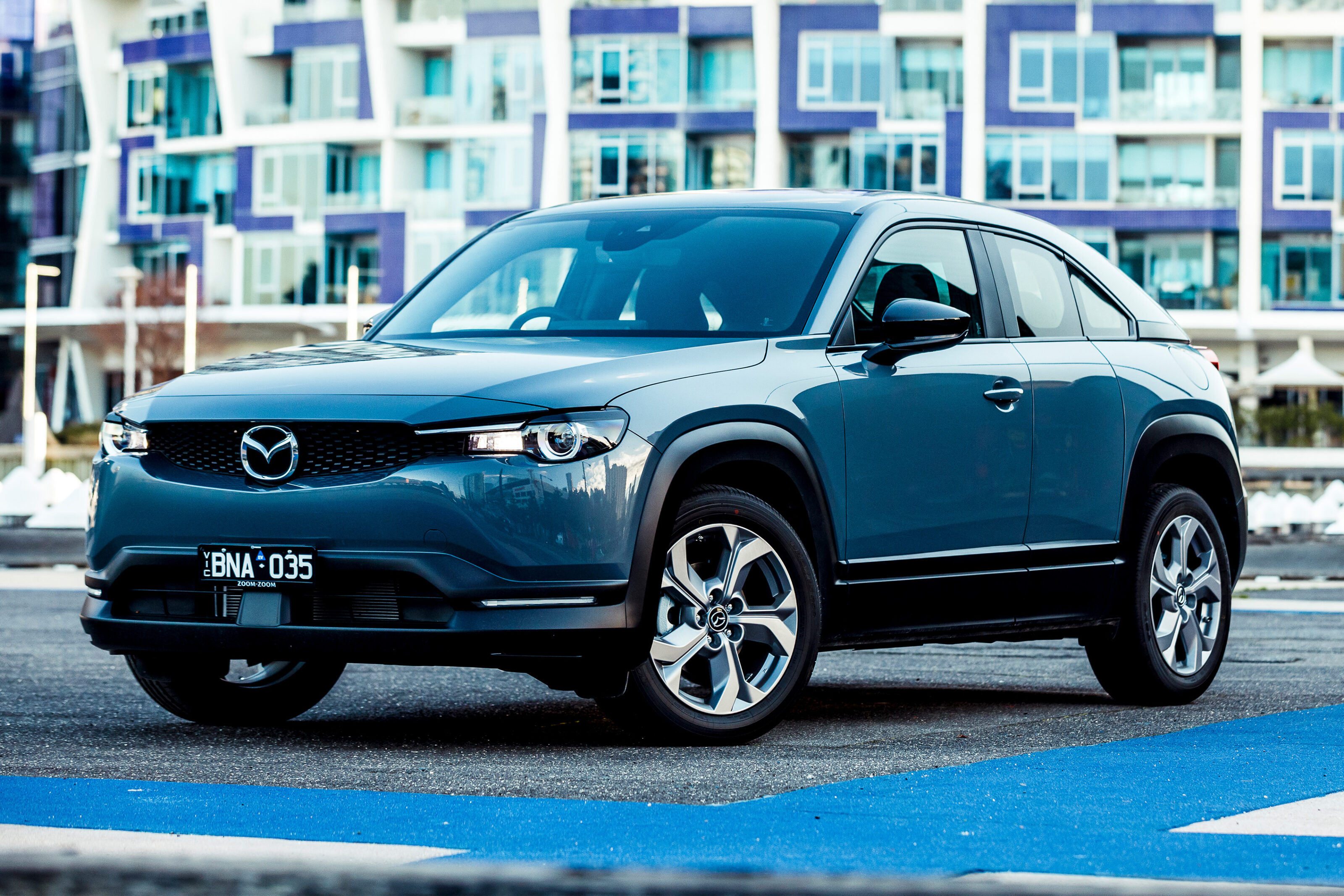
Mazda not only understands this but reserves a particular boot badge exclusively for its most transformative and empirical models – MX.
It stands for ‘Motoring eXperiment’ and examples don’t come along very often, while even fewer have successfully run the gauntlet from concept car to production model. From the very first MX-81 concept in 1981, just three product lines have emerged wearing the moniker as a vehicle you could actually buy in a Mazda showroom … until now.
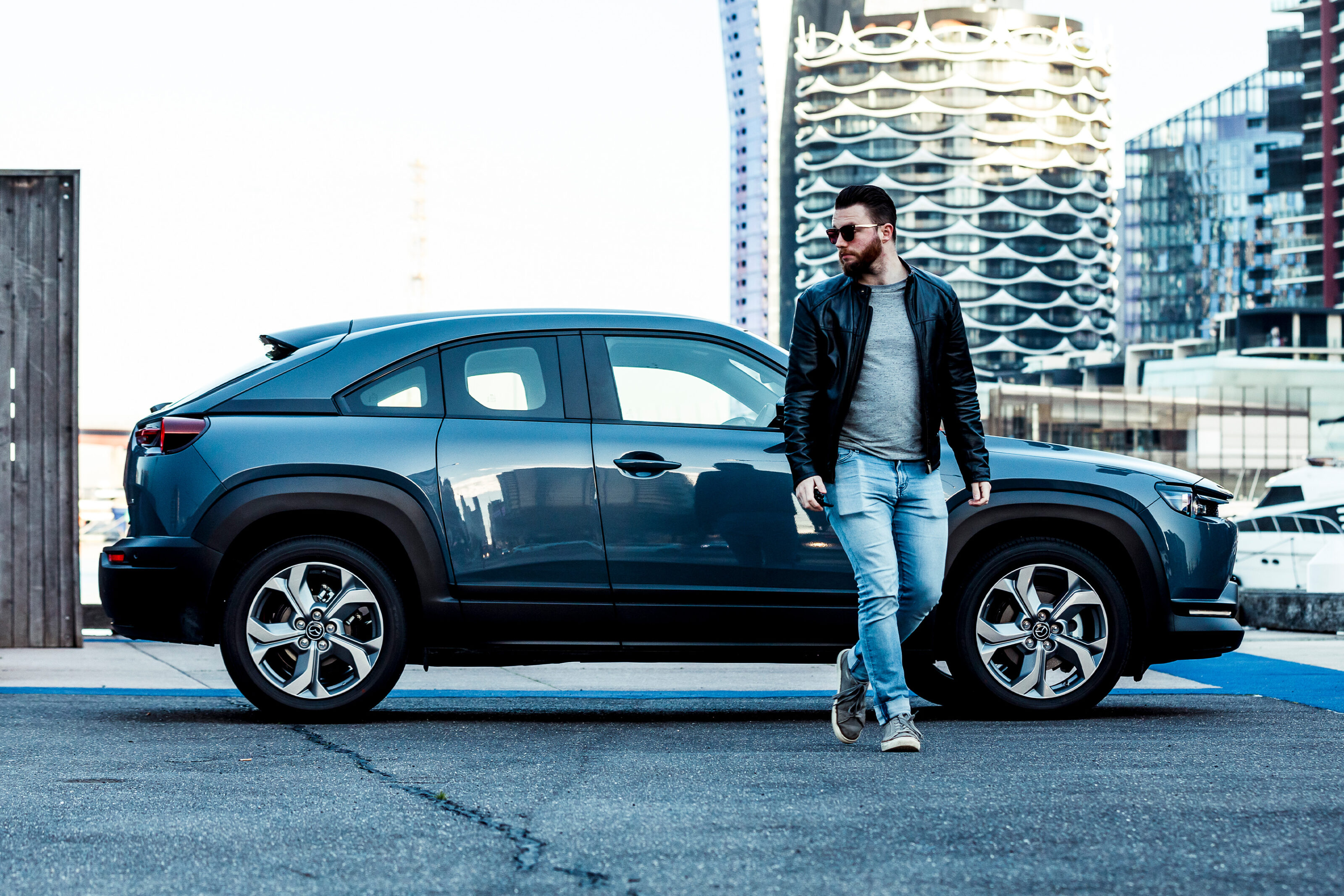
From April 2021, the MX-30 will appear in Australian dealerships charged with the task of taking the Japanese brand, once again, into new territory and I’ve just driven it. But before I tell you if it does the MX thing, here’s how MX-30 Program Manager Tomiko Takeuchi defines the badge.
“MX models are something we introduce as a symbol of Mazda’s new challenge,” she said. “The (MX) models have to be creating new values which defy the conventions of the automotive industry at that time. That’s the requirement.
“It exceeds just the mere functional value of being a transportation tool.”
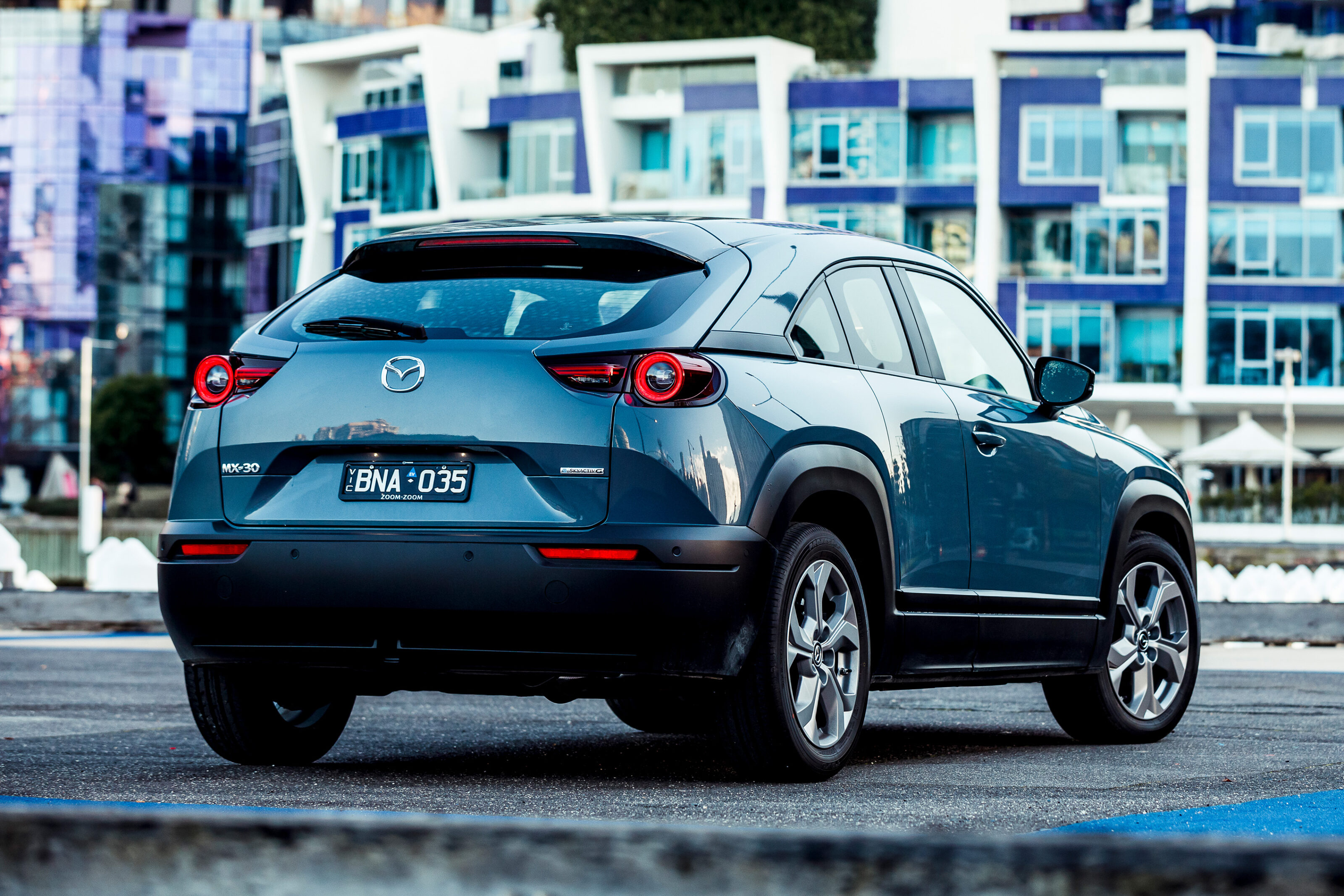
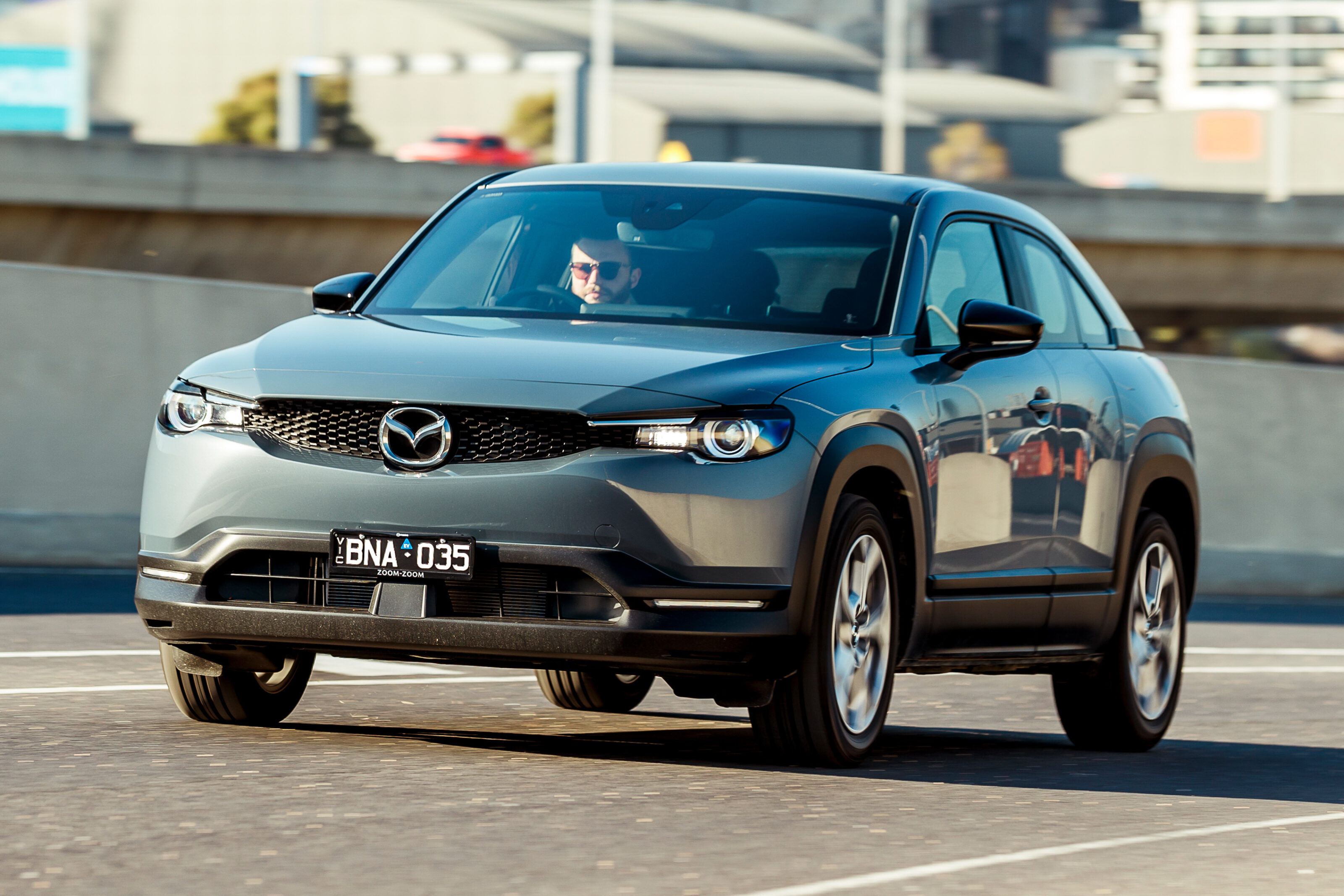
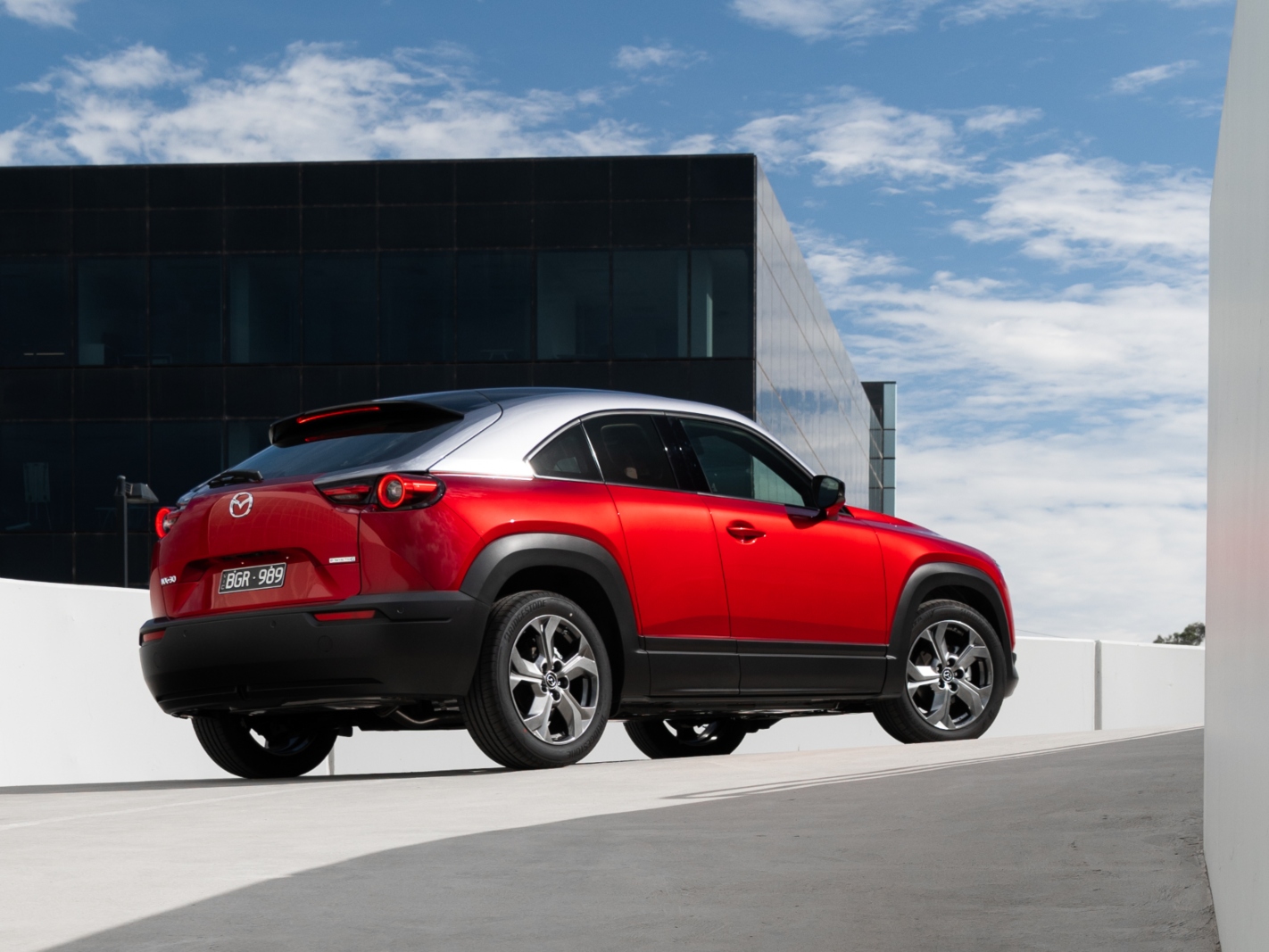
That’s a seriously big brief to nail and explains why not many Mazdas have ever been christened MX, but the newest inductee to the hall of MX-cellence certainly makes a big impression with its looks. The company says its Kodo design language is a set of design ‘principles’ not rules, which is lucky because, if they were, the MX-30 would have shamelessly broken virtually all of them.
The traditional eight-point grille has been narrowed and rounded into a slender slot that connects radical LED headlights and introduces sharp edges and lines throughout. The signatures continue all over with interesting details that are pleasing in their own right but combine for a vehicle that is paradoxically immediately recognisable as a Mazda but simultaneously looks nothing like one.
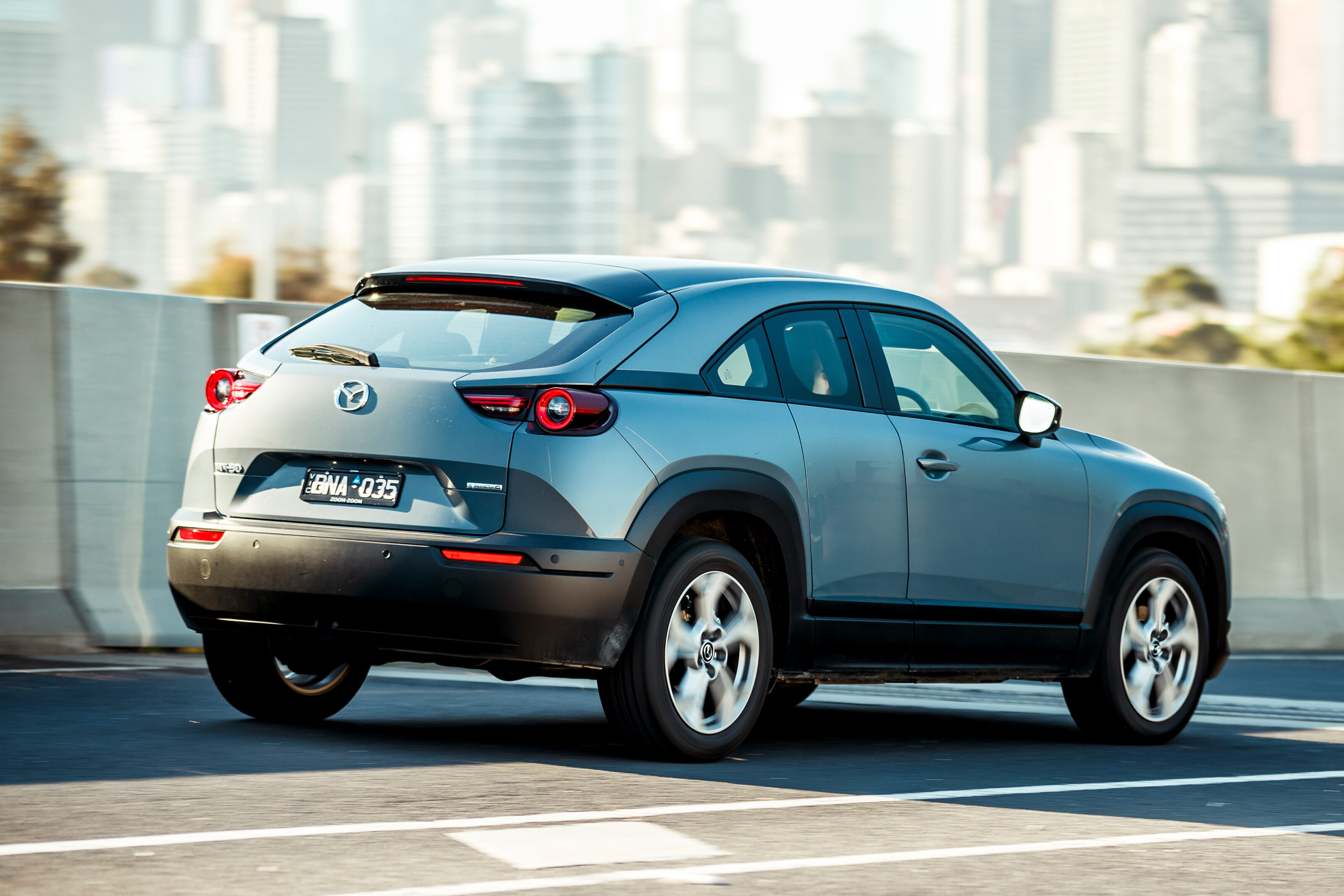
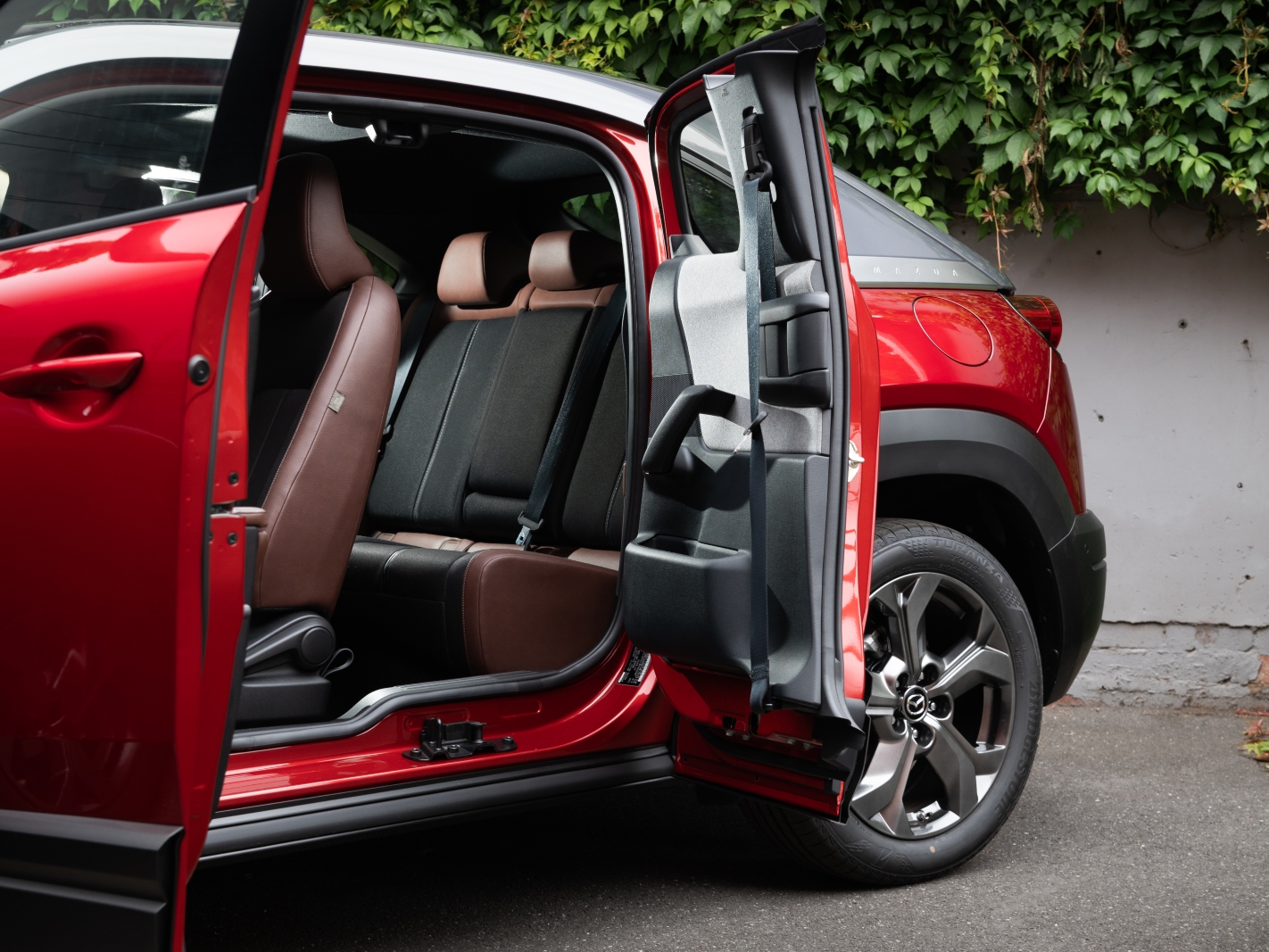
Take a step back and the MX-30 has a profile more akin to one of Mazda’s previous coupes rather than an SUV and there’s a nod to the RX-8 sportscar in the cool suicide (sorry, ‘freestyle’) rear doors.
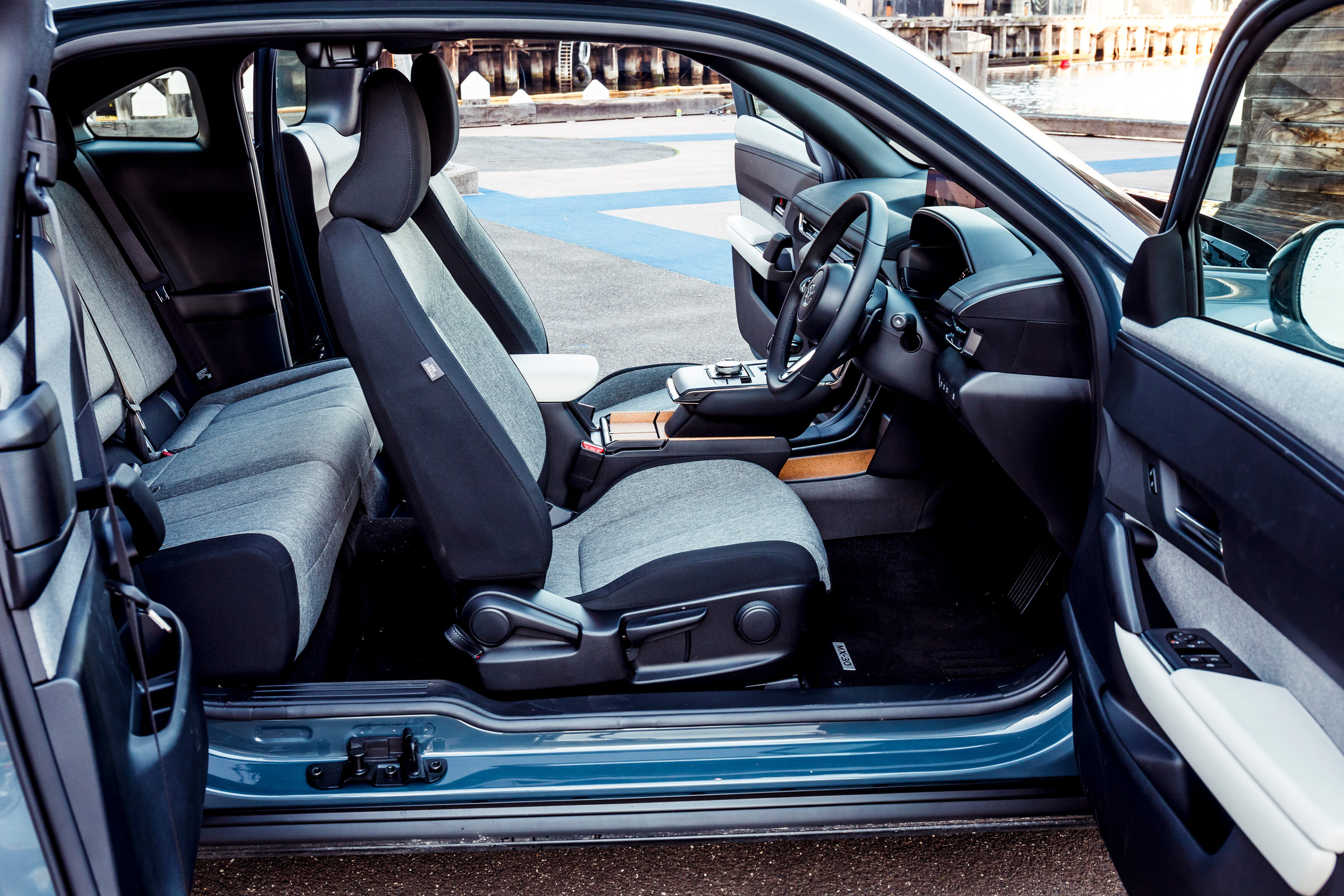
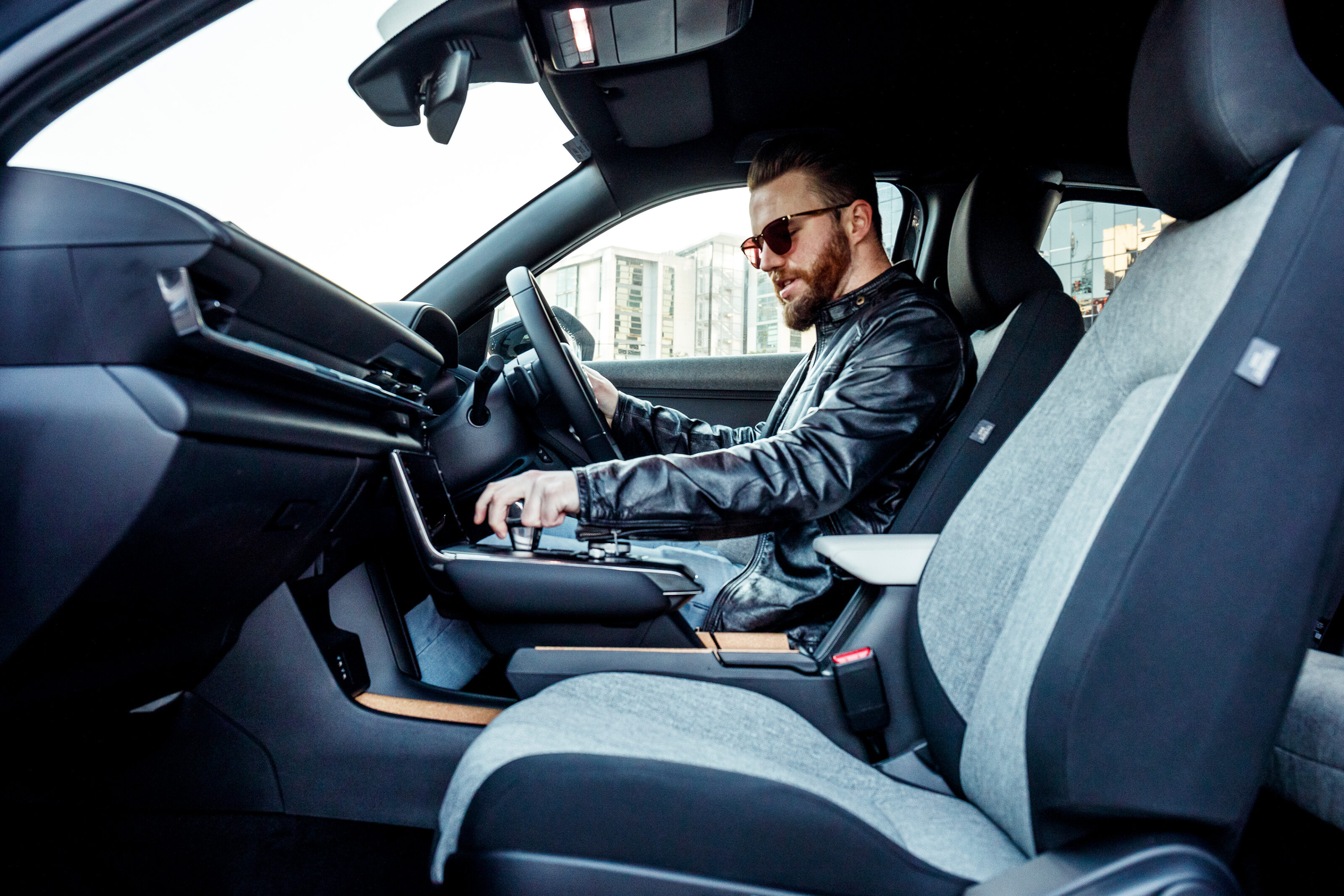
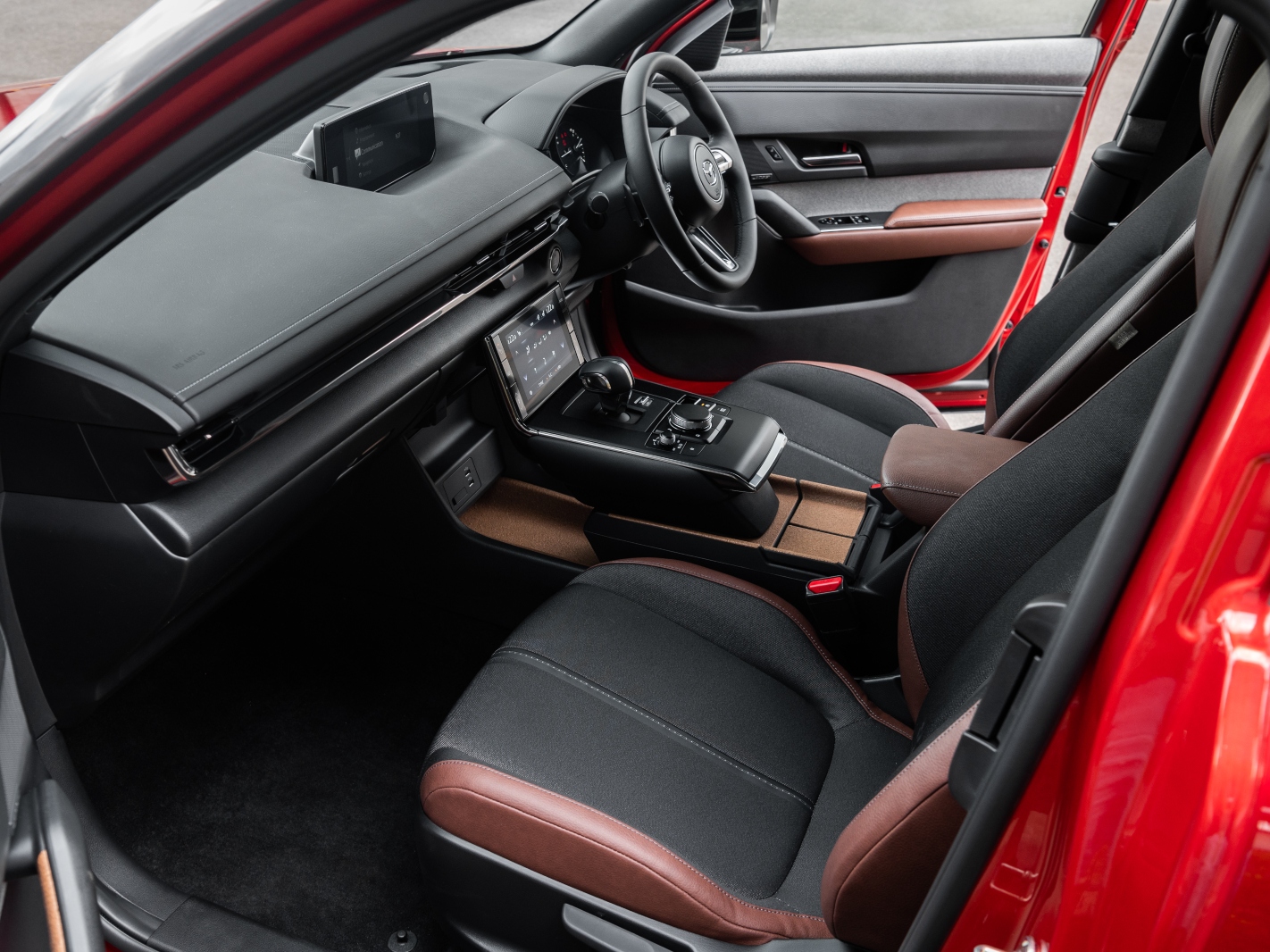
Less subjective however is the interior design where you’ll find not just an unusual layout in the form of a ‘floating’ centre console, terraced dashboard and expansive screens, but the use of unique materials.
Even in the entry level Evolve that we’re focusing on, there is a pleasant felt-like material for the door trims made from recycled plastic bottles and the centre console has a cool cork layer produced using waste from the champagne bottling industry, while higher-spec versions have a synthetic leather called Maztex that uses no nasty solvents but a water-based manufacturing process.
The combination of bohemian fabrics and neutral tones is not unlike a BMW i3 or Mini cabin and another example of Mazda’s departure from convention – including its own.
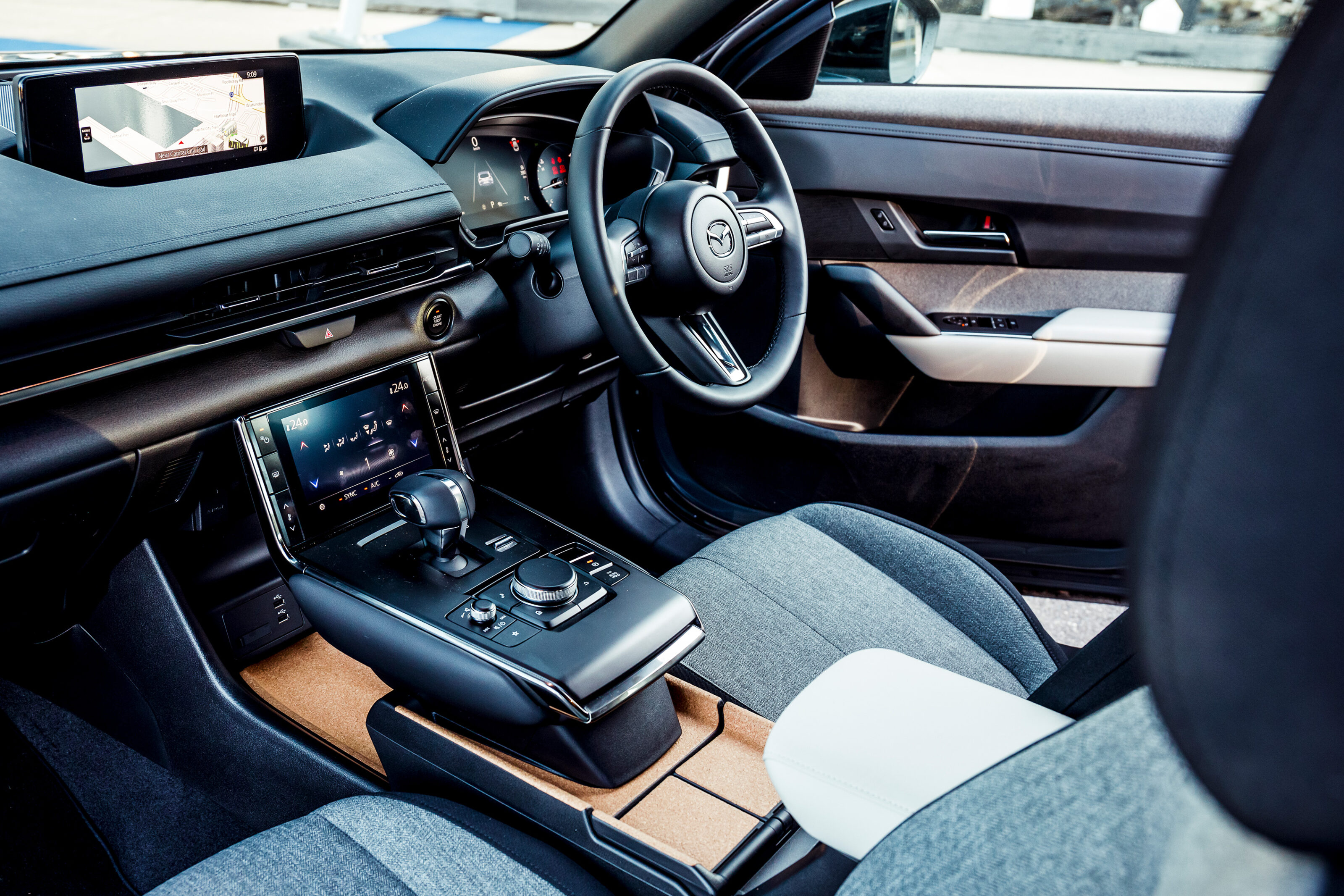
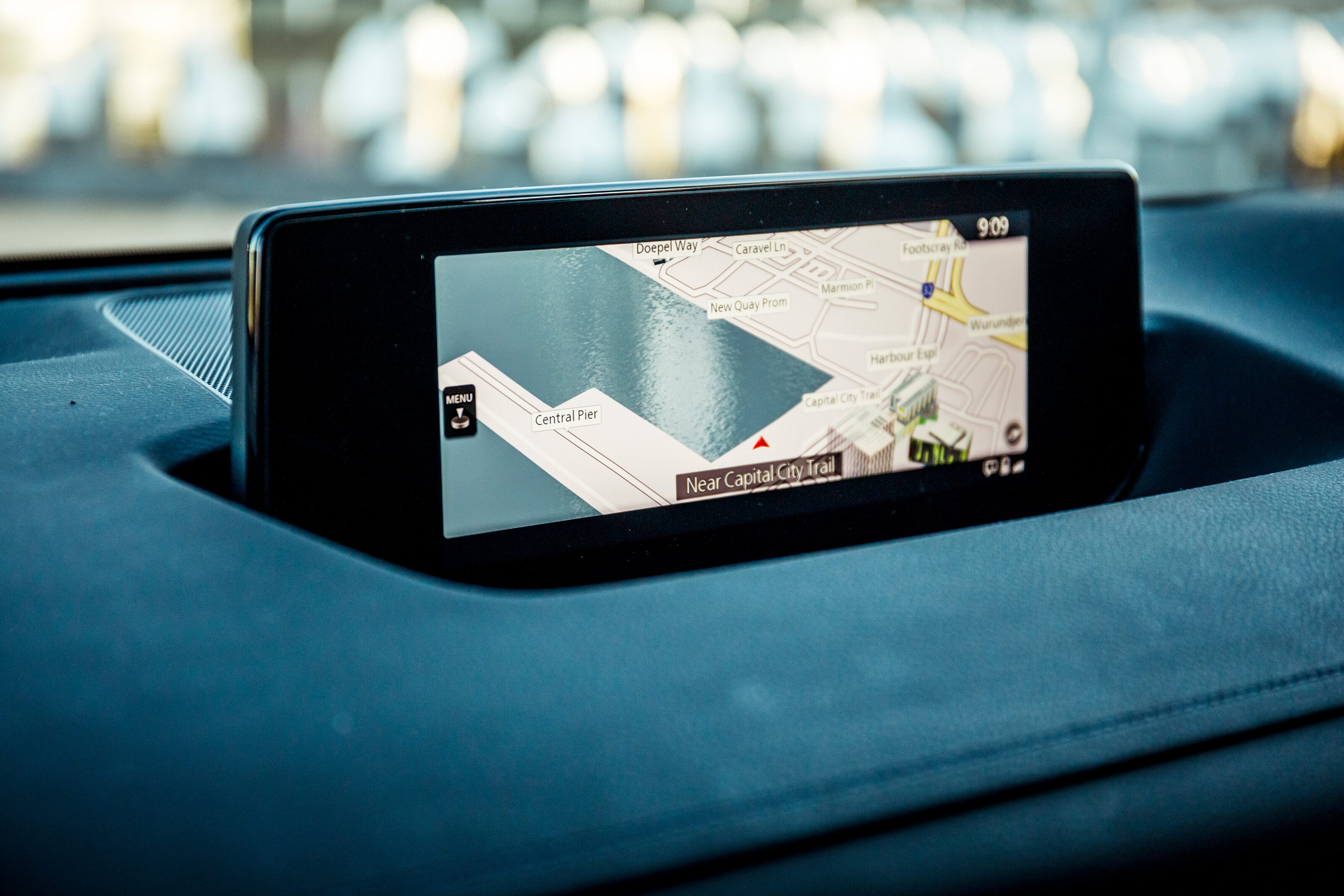
There are more top marks for the level of technology included as standard along with good ergonomics. The main digital display measures 8.0 inches but feels a little short-changed with a much larger surrounding frame – perhaps implying a bigger version will be offered later – but its widescreen proportions work well.
It’s complemented by a beautiful 7.0-inch touchscreen dedicated to climate control functions, while a third screen also measuring 7.0 inches and nestled between conventional analogue gauges provides heaps of information for the driver.
Included in the asking price, it brings smartphone mirroring for both Android and Apple devices, navigation, digital radio with eight-speaker sound system, keyless engine start and an electric park brake.
18-inch alloy wheels are standard to the entire range, as is real leather for the gear selector and steering wheel with paddle shifters.
A 311-litre boot is not massive – especially when you consider the CX-30 with which this car shares a platform (this won’t be the last time we compare the MX with the CX) can swallow up to 430 litres of stuff – nor is the rear seat space which feels a little claustrophobic thanks to tiny rear windows that don’t wind down.
It’s the price paid for those super-cool rear doors that hinge on the trailing edge for a unique design and surprisingly good entry and egress, but they also create another problem that you’ll only realise when up-front.
While forward visibility from the driver’s seat is excellent, the tight spacing of B, C and D-pillars almost completely eliminates an over-shoulder view into the blind spot. A whole plethora of range-wide standard driver assistance kit including blind-spot monitoring, rear parking sensors, camera and cross-traffic alert certainly helps, but is still feels a bit like driving a small van.
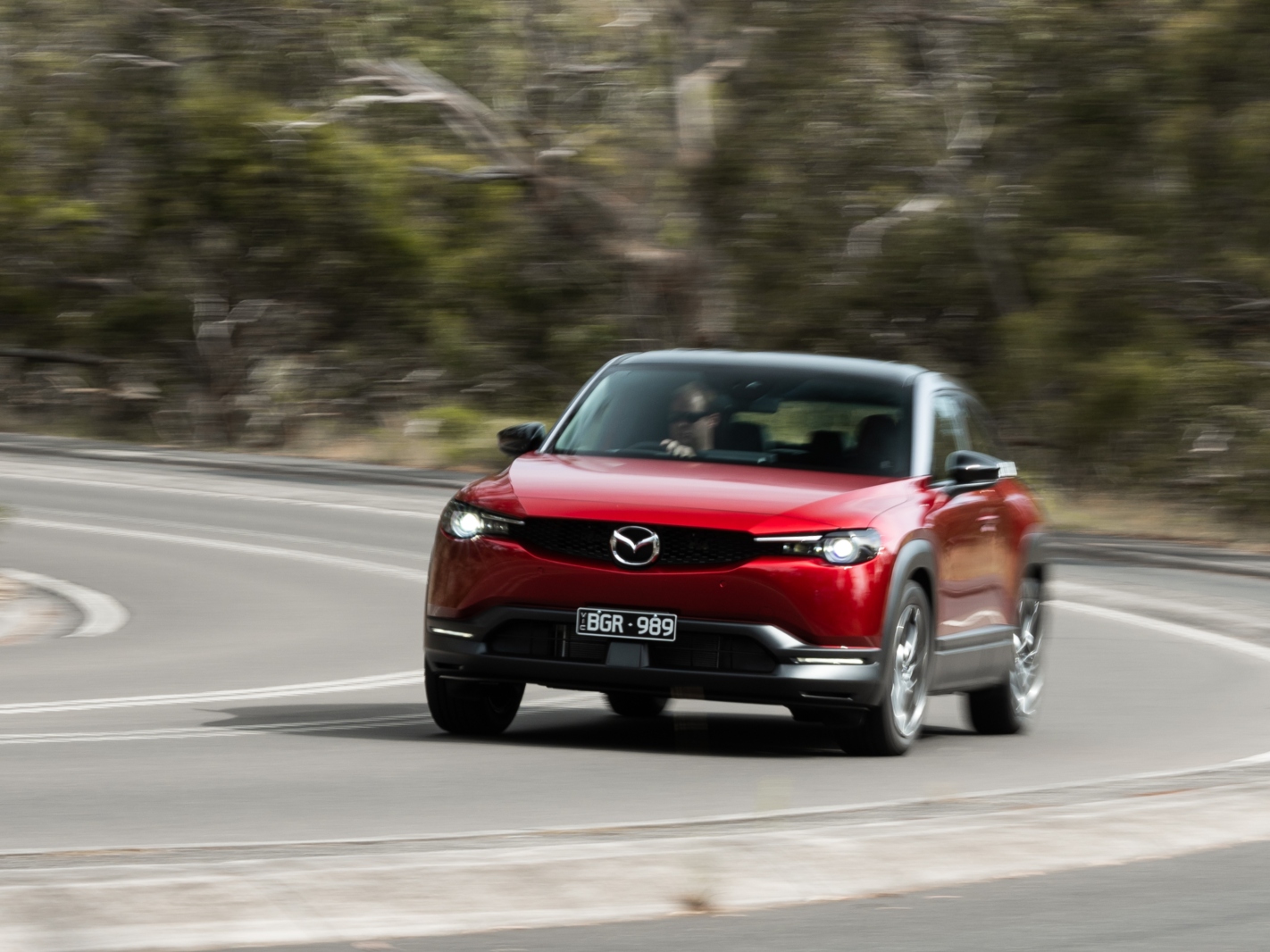
Thankfully, the same can certainly not be said for the rest of the driving experience, with much of the character and nimbleness of the CX-30 translating into the MX-30’s shell. The steering is direct and well-weighted, while the chassis is carefully tuned to return some reward for the more enthusiastic driver without completely compromising on comfort.
On the contrary, emphasis on a quiet and smooth cruising ride appears to have been in favour of corner-carving dynamics which perfectly addresses where this car will spend a majority of its time. Add to that a six-speed automatic transmission that manages to be slick at lower speeds but eager when out of town and the drivetrain is shaping up nicely.
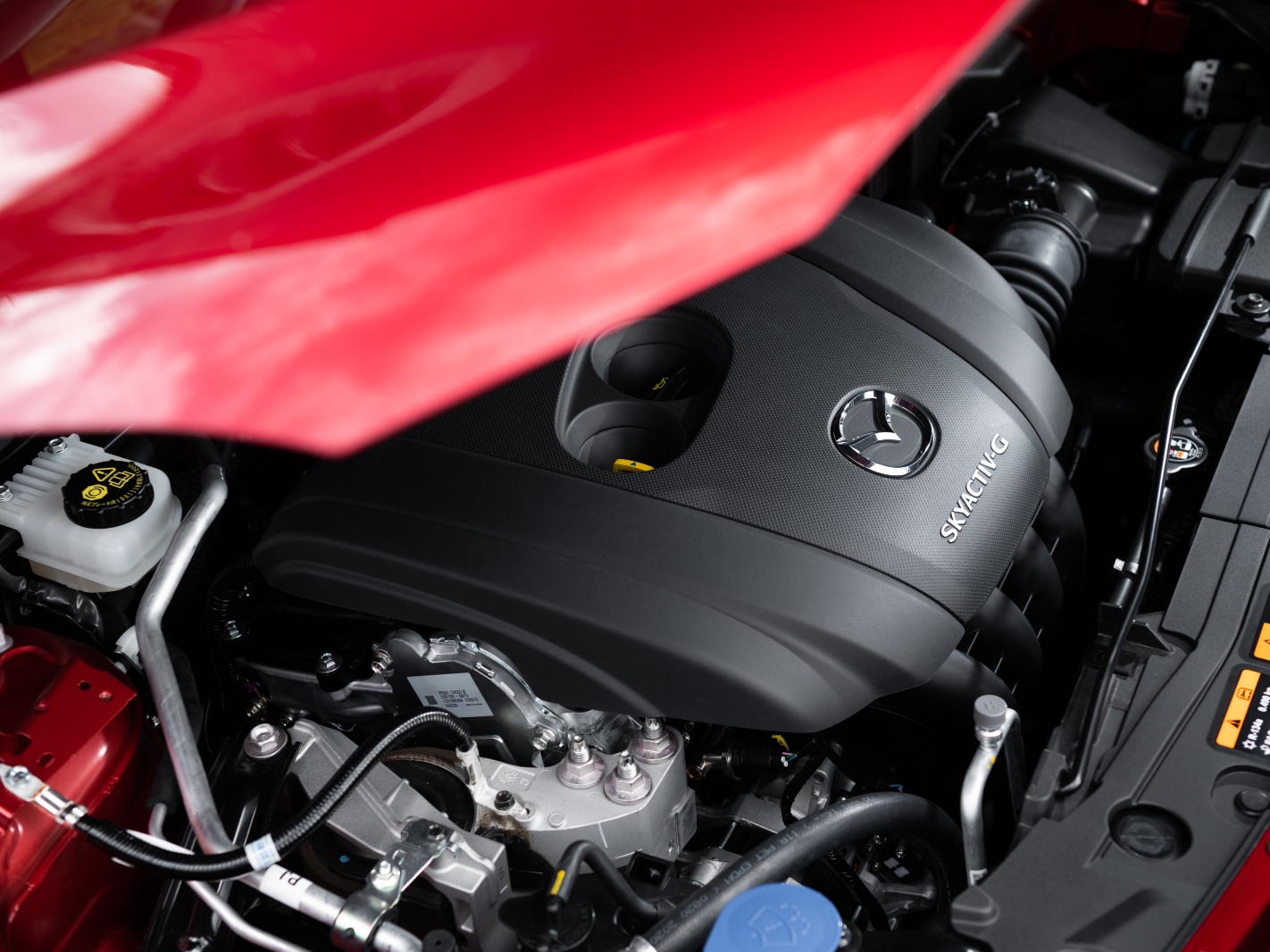
Which brings us neatly to the 2.0-litre naturally aspirated Skyactiv-G petrol engine under the bonnet. It’s the same unit that powers the more affordable Mazda 3 and CX-30 variants with 114kW and 200Nm, with one key difference.
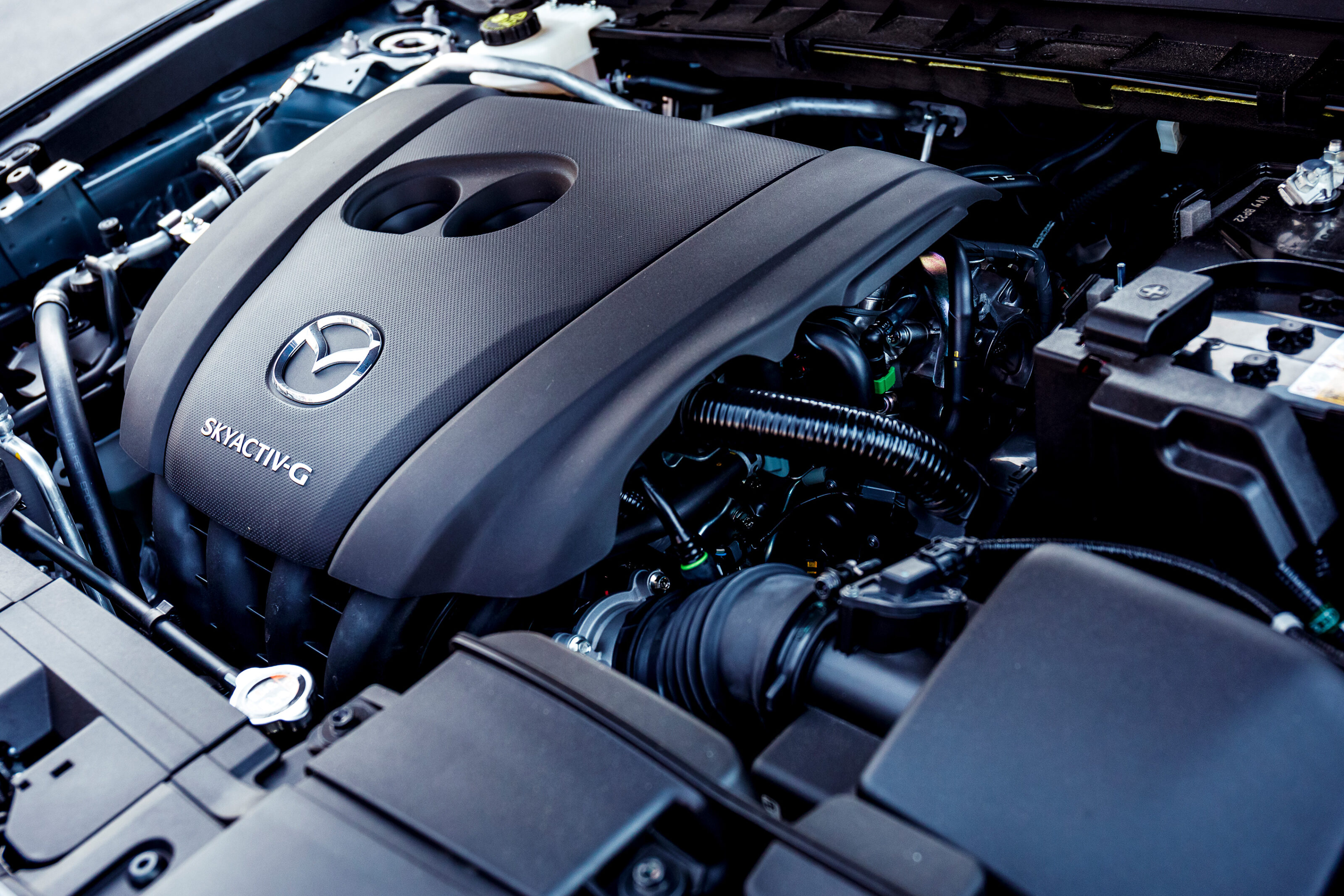
With the addition of Mazda’s M Hybrid hardware, the engine gains the assistance of a 24-volt belt-driven starter/generator for a little added grunt and efficiency. Mazda doesn’t say exactly how much power or torque the system adds back into the mix, but the extra urge is noticeable – sometimes.
Plant the throttle in-gear and there’s an immediate nudge from the electric assistance combined with the responsive four-cylinder, but not consistently. Perhaps the power management system was busy sending electricity elsewhere or we had drained the small battery but the effect isn’t the same each time.
Off-the mark acceleration is more dependable and performance is acceptable if not electrifying. The fuel saving potential is as mild as the electric assistance with an improvement of just 0.1 litres per 100km over the equivalent CX-30’s 6.5L/100km.
While we’re talking about sibling rivalry, you can buy an all-wheel drive CX-30 and a more powerful 2.5-litre version, while the MX-30 is strictly 2.0-litre front-drive relegating it to the crossover pile whether it likes it or not.
Compared with the CX-30, the MX-30 feels a little practically compromised in the name of style and at a price premium, but there’s not necessarily anything wrong with that strategy – Mini has been making it work since 2000.
There aren’t many other small crossovers that pack this much kit into a package that looks this good. For the same cash you might look at a Peugeot 2008 or Volkswagen T-Roc, but there’s not a lot to compete with in this niche market.
Shopping within the same family, however, it becomes harder to justify the more expensive MX-30 over the 2021 Wheels Car of the Year. Unless you simply adore those looks or absolutely must put a hybrid on your driveway (no matter how mild) you’re probably better off pocketing the $2500 and opting for the latter.
But the first versions of the MX-30 in mild hybrid G20e form are not the versions that will deliver the full-fat shot of MX magic that the company is promising. Mazda is not expecting the newest model to outsell the CX-30, nor will it get even close to the incredibly popular CX-3 compact SUV‘s volumes.
And, beyond the cool styling, it does little ostensibly different or better than the CX-30. In reality, the hybrid MX-30 is a scout, sent to prepare the ground for the main event and get Australia ready for Mazda’s first pure electric vehicle that will arrive in the same pretty package later this year.
Does the MX-30 G20e Evolve honour the MX mantra? Probably not. But with a 107kW/271Nm zero-emissions powertrain in place of the more conventional piston engine, the MX-30 E35 has the potential to be one of Mazda’s most significant new cars in more than 100 years of history.
And that’s before we even get to the rotary powered range extender…
MORE Mazda’s rotary engine timeline
Mazda is preparing the ground for its first-ever electric vehicle to arrive in Australia later in 2021. A G20e mild hybrid version of the Mazda MX-30 will lead the charge for the new range, ahead of the battery powered version.
Priced from $33,990 before on-road costs, the first of the “coupe SUV” MX-30 variants will go on sale locally from April 1, available in three levels of specification, followed by the pure electric E35 that’s expected later in the year.
Opening the G20e line-up is the Evolve, a sportier Touring version that looks after the middle of the range from $36,490, while the halo for now is the most generously equipped Astina, priced from $40,990.
While the order of arrival was out of Mazda Australia’s hands, the company is apparently “happy” that the hybrid version will roll into showrooms first, followed by the EV foray.
According to Mazda Australia marketing director Alastair Doak, introducing the new model with a more traditional powertrain first enables a potential audience to become familiar with the MX-30 – including its size and general features.
“It gives you that street presence and that’s really important … then we can concentrate on what makes the EV, the EV,” he said.
Powering the MX-30 G20e is a 2.0-litre four-cylinder petrol engine picked from Mazda’s Skyactiv G line-up, furnished with its M Hybrid belt-driven starter/generator technology.
Engine output is the same 114kW/200Nm produced by the identical engine under the CX-30 G20’s bonnet, although Mazda has not revealed how much shove the electric assistance adds to the final figure.
It sends power to the front wheels only, through a six-speed automatic transmission, and will ask for just 6.4 litres of fuel to cover 100km on the combined driving cycle, says Mazda. Acceleration figures have not been made available.
Onboard, the MX-30 seats five, with the second row accessible via unorthodox ‘freestyle’ doors that hinge at the rear – often referred to as ‘suicide doors’ – and are a nod to the RX-8 sportscar.
At the back end, the MX-30 has a 311-litre boot that’s expandable with folding rear seats that split 60/40.
Measuring 4.4 metres in length and 1.8 metres wide, the MX-30 slots into the small SUV/Crossover segment and shares a new platform (and exterior dimensions) with the CX-30 which will also accommodate the full-electric version and its radically different running gear.
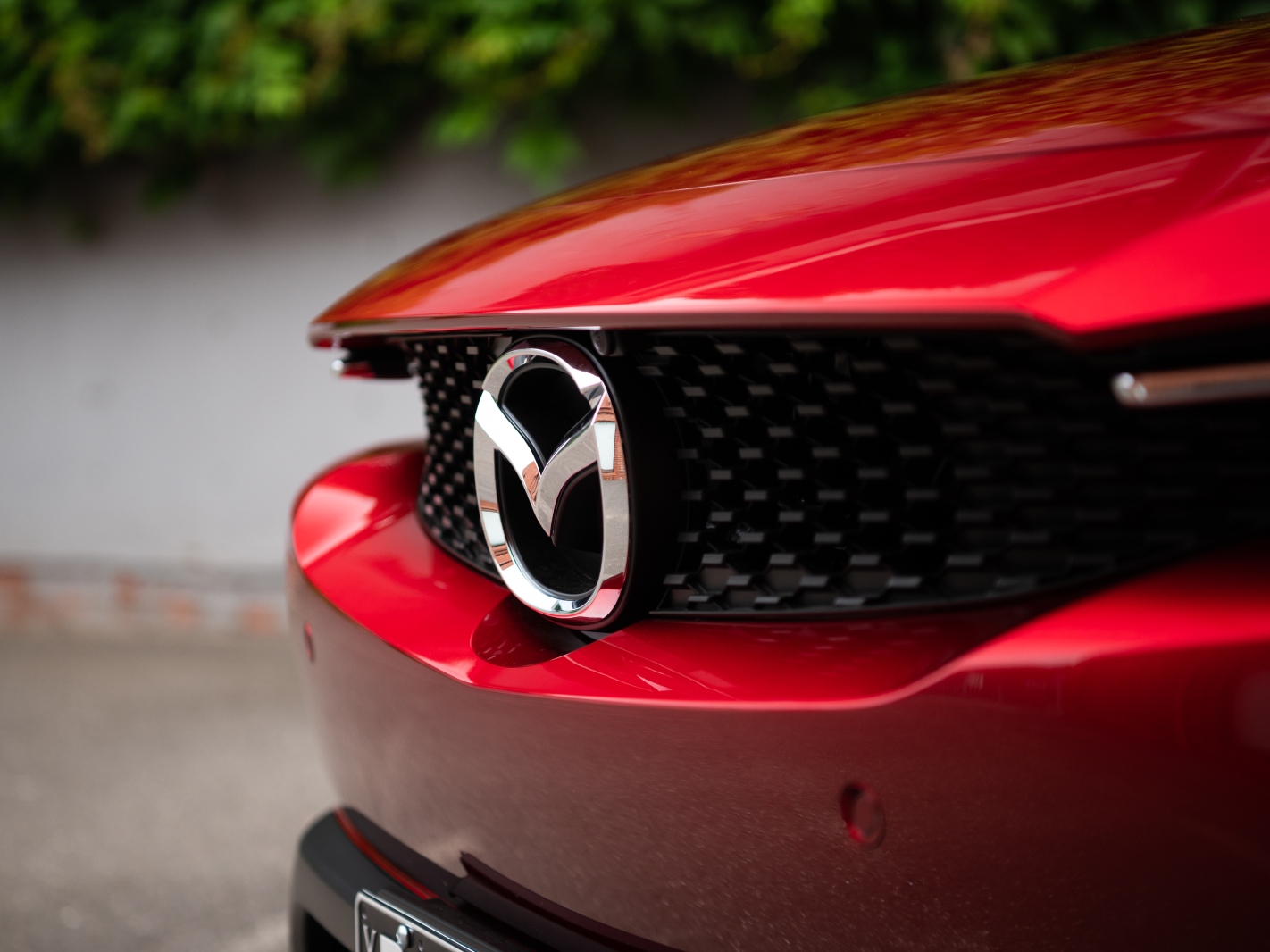
On the outside, the MX-30’s design pulls the ‘Kodo’ language in a new direction with a grille that almost completely abandons the usual eight-point design.
There’s a two/three-tone roof/body option and unique LED light clusters at both ends.
The dramatic design features continue on the inside, with an unorthodox layout that uses ‘floating’ centre console and a multi-layered dashboard that continues all the way through both doors to the rear.
An 8.8-inch central screen is complemented by a fully digital 7.0-inch climate control touchscreen and another located between conventional analogue dials for displaying driver and trip information.
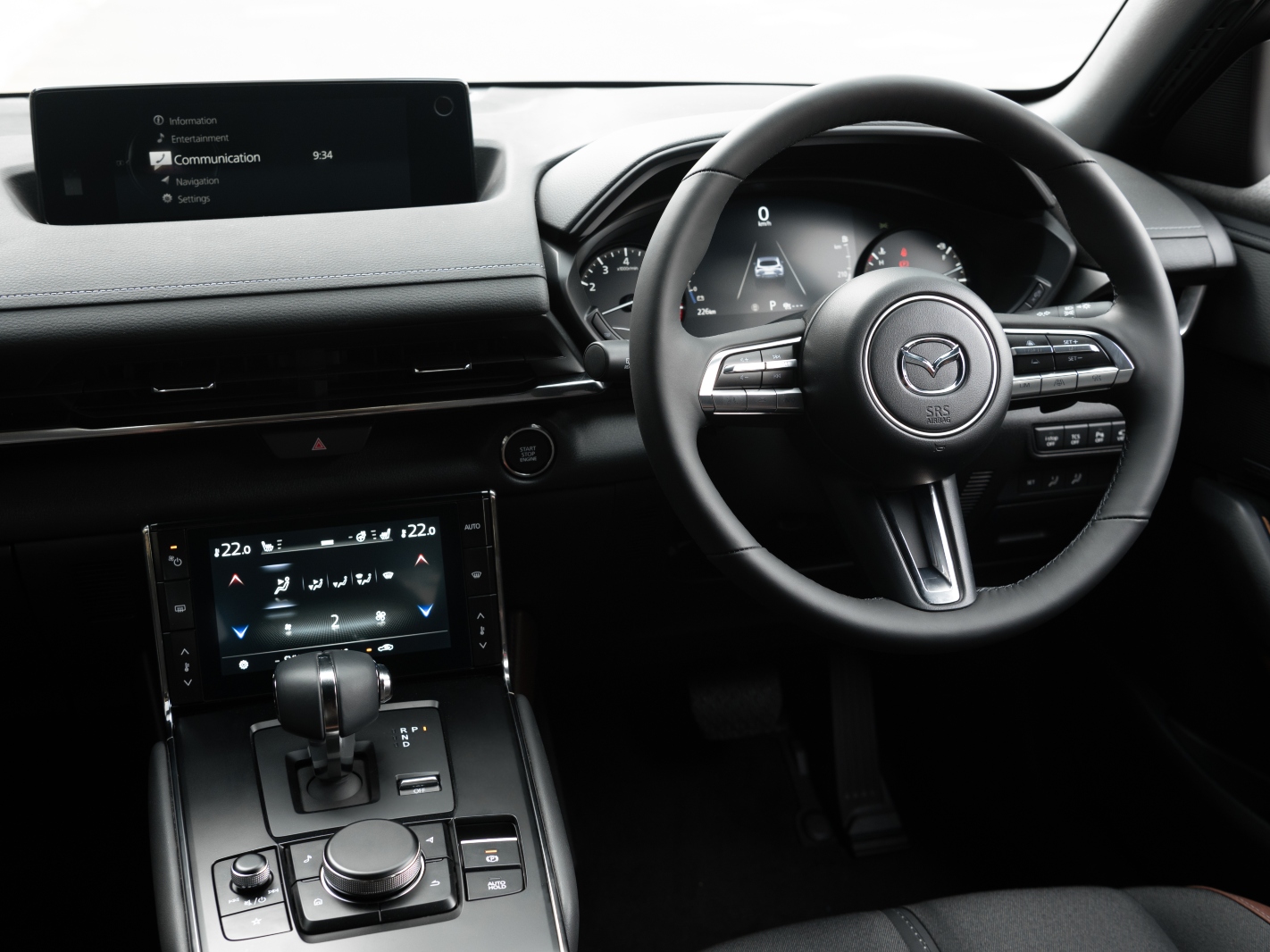
A wide use of sustainable and more environmentally sensitive materials is also included in each MX-30 cabin, including a felt-like material made from recycled PET bottles. Maztex synthetic leather not only requires no animals in its production, but also negates the use of nasty solvents in favour of a water-based process.
Cork applied to door handles and the centre console is also derived from sustainable sources and uses waste product from champagne-type cork manufacturing. It’s also a nod to Mazda’s origins in the 1920s, when it processed cork material.
Rather than opening the range of its newest offering to the local line-up with a bargain basement MX-30, Mazda says the most affordable Evolve weighs in with a respectable level of equipment more typically found about the middle of a range.
Included in the asking price, it brings smartphone mirroring for both Android and Apple devices, navigation, digital radio with eight-speaker sound system, keyless engine start and an electric park brake.
18-inch alloy wheels are standard to the entire range, as is real leather for the gear selector and steering wheel with paddle shifters.
Moving up to the mid-level Touring adds a handful of equipment highlights that include the Maztex fake hide in white with complementing light grey cloth, electric front seat adjustment, keyless entry and self-dimming mirrors.
At the top of the pack, the Astina gains a sunroof, heaters for the front seats and steering wheel, 360-degree manoeuvring camera, adaptive headlights, front parking radar sensors are added to the standard rears, and the 18-inch alloy wheels are finished in a more premium-looking bright metal effect.
A high level of safety equipment is common to all three MX-30 variants with 10 airbags, driver attention alert and tyre pressure monitoring, lane departure warning and assistance, adaptive cruise control, AEB and rear cross-traffic braking – to name a few standard inclusions.
Customers who feel the standard specification levels don’t completely meet their requirements can add a $1500 Vision Technology pack to the Evolve and Touring, which bumps the technology up to a level similar to the Astina.
Range-extender option coming, too
A third and arguably most exciting drivetrain has been confirmed for the MX-30, with a range-extended EV due to join the line-up in 2022.
The rotary range-extender uses a compact version of the company’s iconic rotary engine to top up the battery when it has been drained, boosting overall range in excess of the battery version.
Details are still thin on the ground including final technical specifications, performance and whether the version will be offered in Australia, although Mazda Australia managing director Vinesh Bhindi is hopeful.
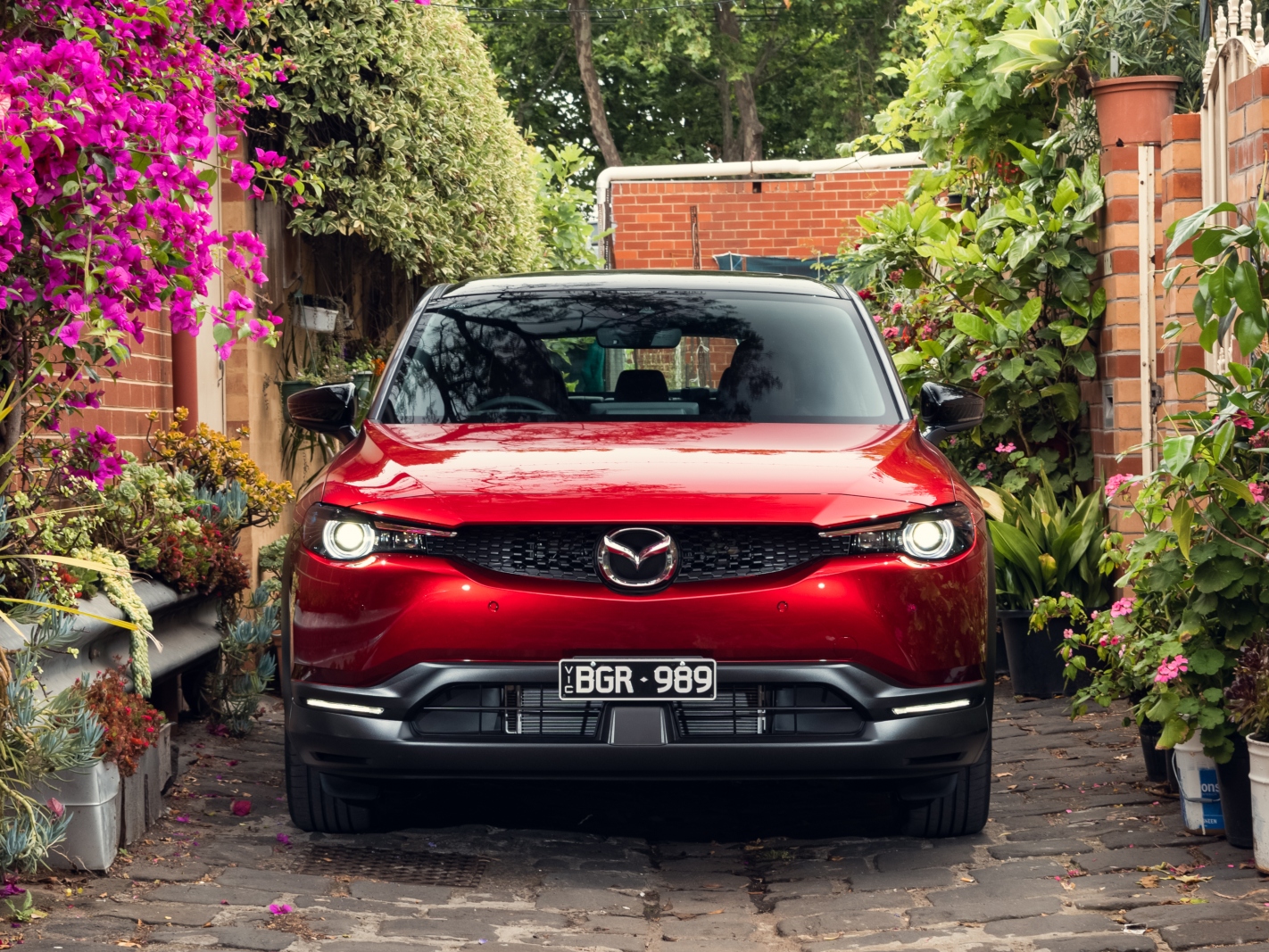
“We’re excited about MX-30 and we are fortunate to have two drivetrains and hopefully a third one down the track,” he said. “If you add the third piece with EV and rotary range extender, in my mind, it completes the full circle.”
2021 Mazda MX-30 G20e pricing
- Evolve $33,990
- Touring $36,490
- Astina $40,990
MORE Mazda MX-30 E35 Astina first drive
Just rarely, a car is launched that is so revered that it creates a huge headache for its manufacturer. We examine 10 instances where car makers asked “how the hell do we replace this?”
Lamborghini Diablo | 1990-2001
Did The devil really have the best tunes?
Lamborghini was in a mess in 1990, but then it was hard to point to a time in the years prior when the business was ever what most would deem financially secure.
In fact, its early history could best be described as reeling on the ropes from punch after punch. The company tried to launch the Countach the year after the 1973 oil crisis broke. Neither the Countach nor the Silhouette V8 could be officially exported to the US in those early days. A contract to build the M1 for BMW was cancelled in April 1978 with Lamborghini on the brink of bankruptcy. The Bologna courts acquired the business later that year and would retain administration until 1980.
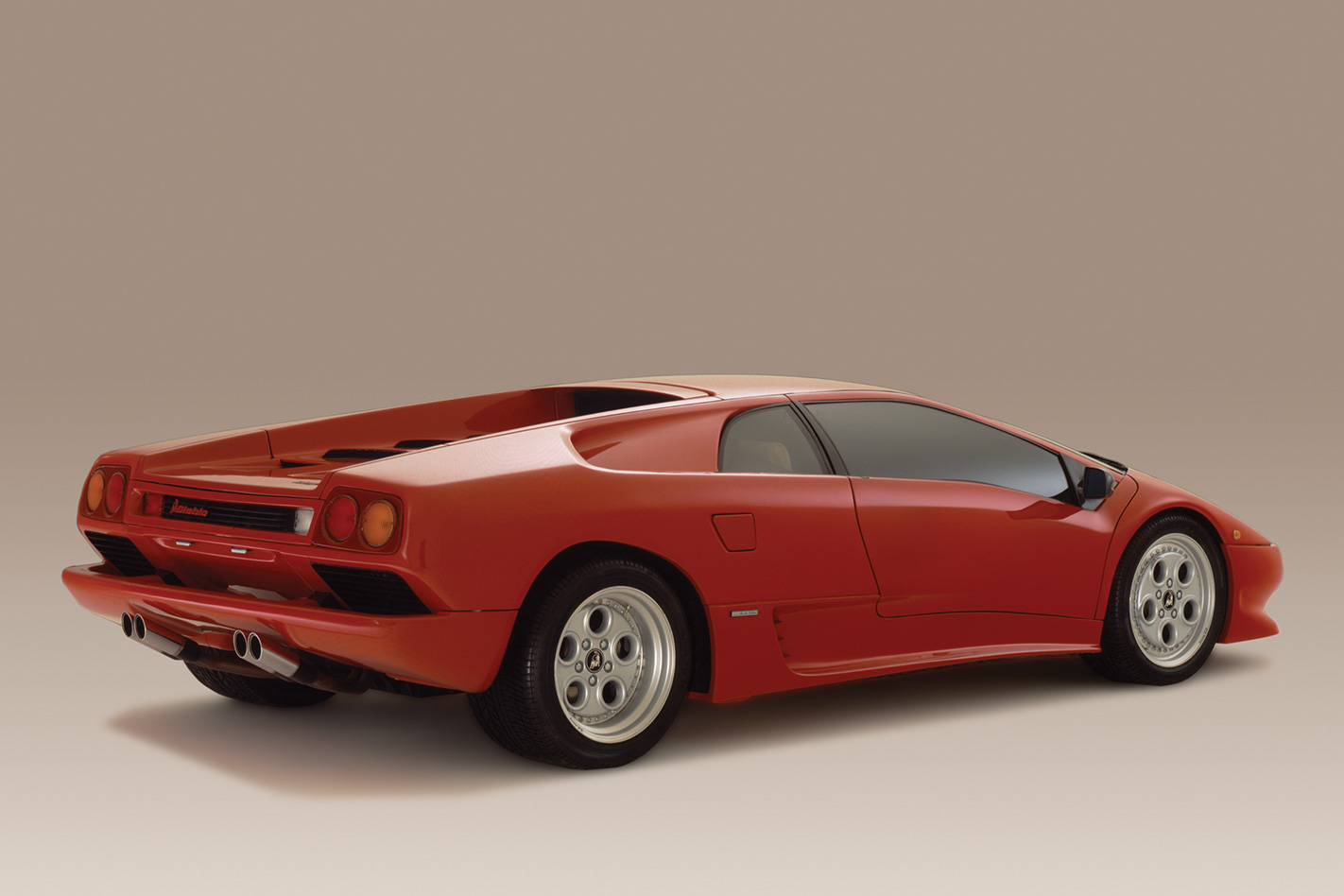
Enter Jean-Claude and Patrick Mimran, Sant’Agata’s third set of Swiss courtiers.
Jean-Claude was the money man, introducing himself as the Sugar King of Africa, while Patrick was the left-brain creative behind the world’s tallest giraffe sculpture.
The seemingly bottomless well of sugar cane francs spawned the LM002, the Jalpa and the Countach QV. But as the QV morphed into the straked and lumpen Anniversary model, it was clear that Lamborghini’s poster child had peaked. This was the Countach’s end-stage Elvis period, eating Fool’s Gold Loaf and downing barbiturates on the toilet.
The stylist of the lean and lovely original, Marcello Gandini, was commissioned by the Mimrans to develop a replacement. Named for a bull that had liberally perforated a few Madrileño matadors in 1869, the Diablo had to hit 200mph (322km/h) while delivering the visual impact of its predecessor.
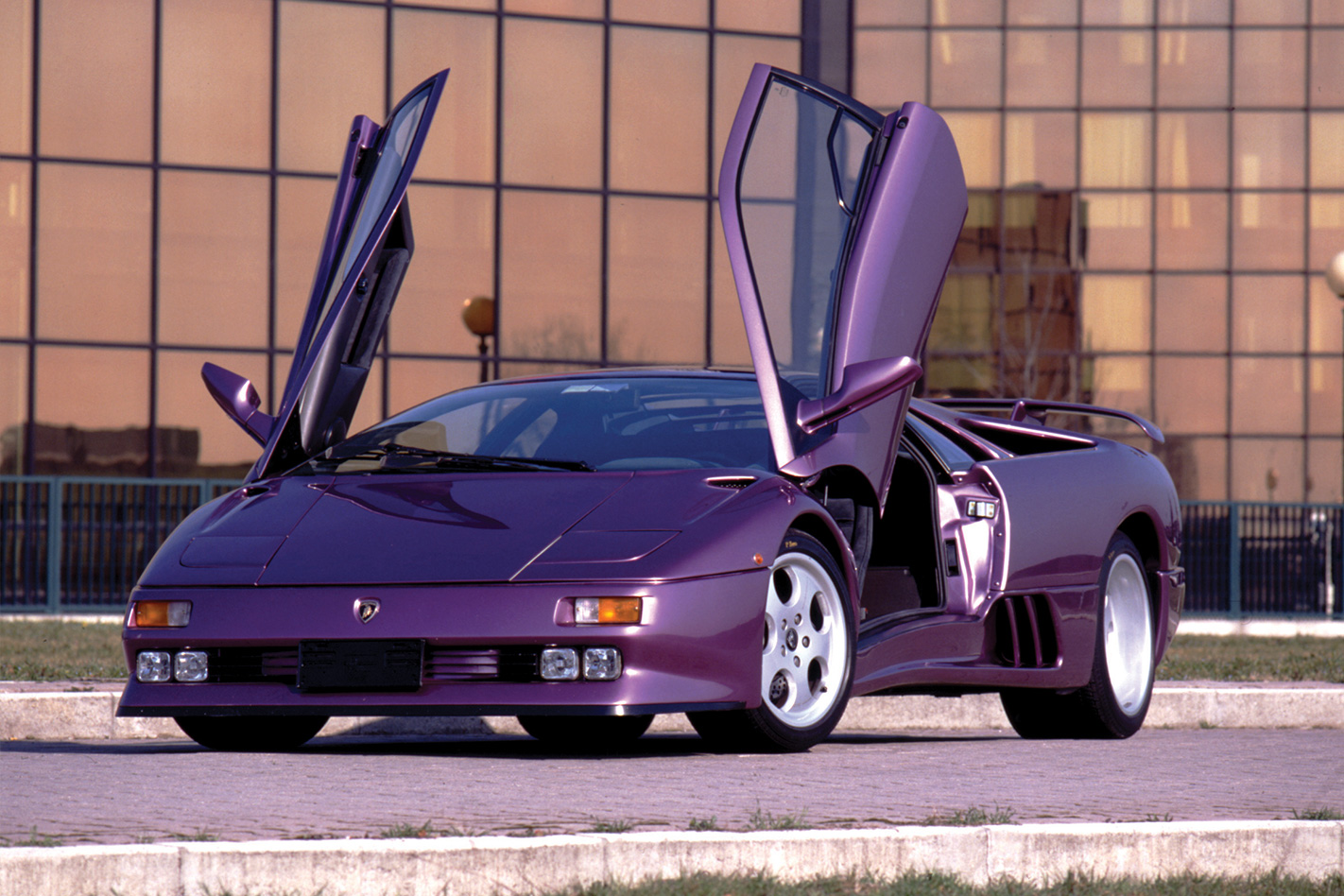
Gandini’s original sketches of project P132 shared the production Diablo’s banana profile and short bonnet, but were all angles and featured a bulky rear end.
Chrysler, who had taken over in 1987, weren’t enamoured and set to work refining the shape. The toys came out of Gandini’s pram and he revived certain elements of the design in the low-volume Cizeta-Moroder V16T.
The Lamborghini Diablo had some huge boots to fill and it more than doubled sales of the Countach, which averaged 124 cars per year over its 16-year production cycle. By the time the Diablo was replaced by the Murcielago in 2001, it had racked up 2884 sales at a rate of 262 cars per annum. It wasn’t much consolation to Chrysler who, upon divesting themselves of Lamborghini in 1994, sold just over 200 cars in the prior 12 months.
The Diablo was an innovative platform, however. It introduced all-wheel drive into Lamborghini’s supercar line up, it was the company’s first V12 supercar with an open-top option and, once Audi took over in 1998, it morphed into a polished product. Unlike the Countach, the final Diablos are the pick of the crop, with Ingolstadt’s quality control and Luc Donckerwolke’s design work making the final run of 42 VT 6.0 SE coupes extremely collectable.
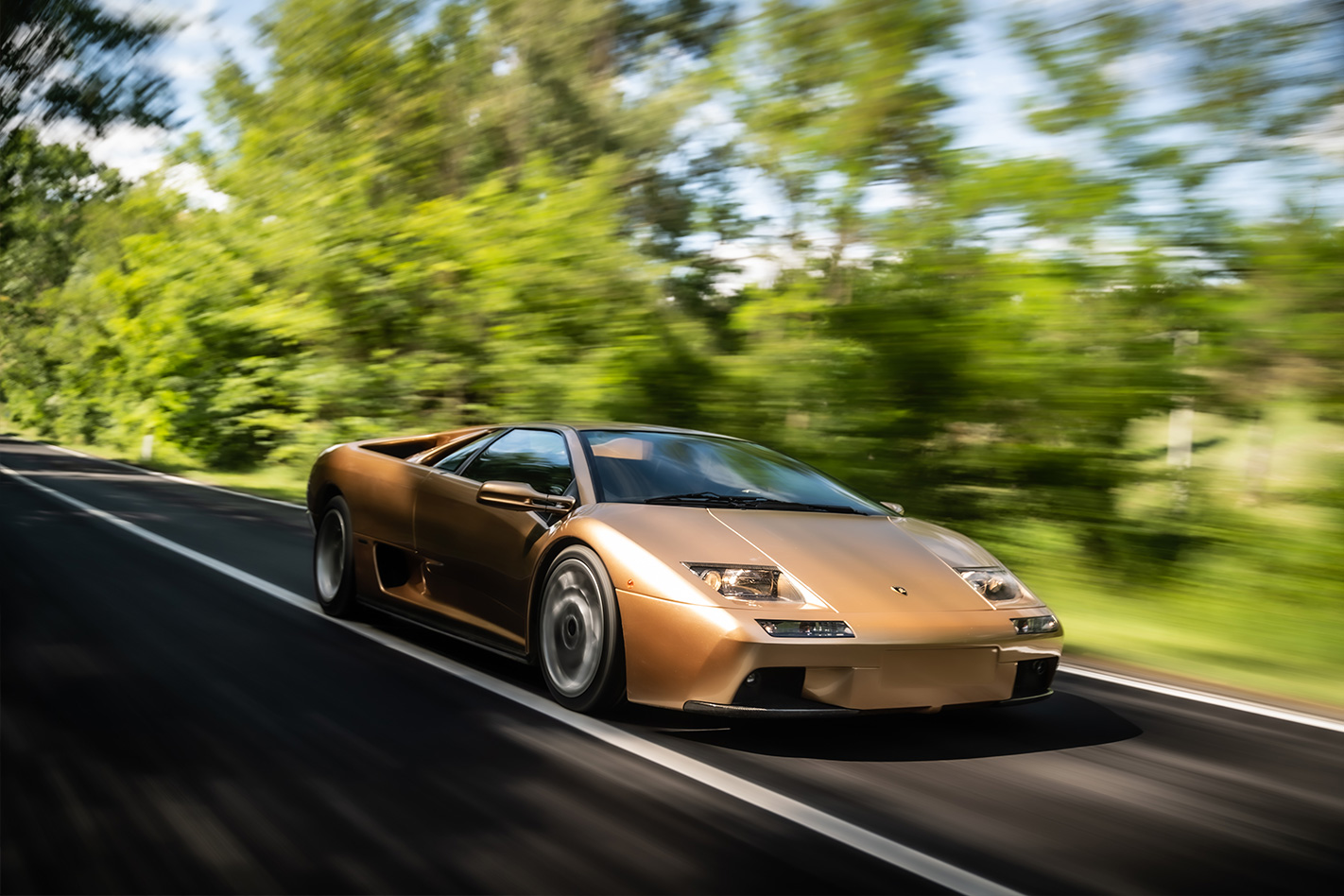
While it never quite measured up to the impact of the Countach, the Diablo was a pivotal vehicle for Lamborghini. It was born from adversity, yet its legacy was that of guaranteeing Lamborghini’s financial security through the company’s purchase by Audi.
Between 1998, when the Germans took over, and this year, production at Sant’Agata has ramped up by a factor of 32.
The Diablo might not have set many sales records of its own, but as an exemplar of what was possible, and the convenient genetics of its four-wheel drive bloodline with Audi’s, it could be argued that it’s at least as influential as the Countach.
The icon: 1974
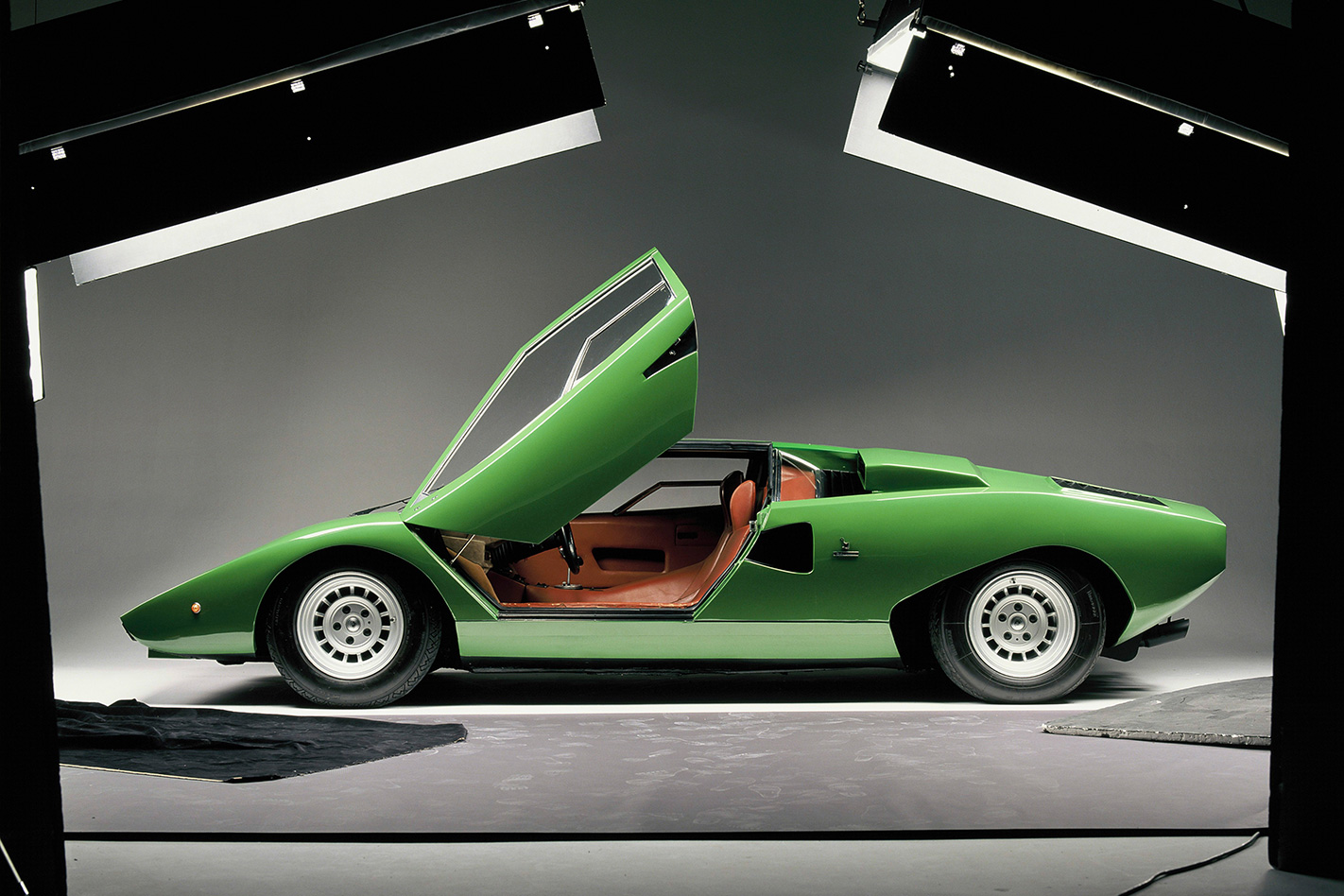
Beauty and the beast
The early LP400 (above) was an exercise in lean, sparse loveliness. The Countach was at its aggressive zenith with the 1985 LP5000 Quattrovalvole model, but by 1988, the 25th Anniversary model featured lame pastiches of the Testarossa’s strakes. Horacio Pagani, hang your head.
Three ways the Countach ruled the earth
1. Longitudinal mid-mounted V12 changes script. Everyone else plays catch up 2. QV was the world’s fastest production car. Sold a heck of lot of bedroom posters too 3. Lamborghini built a composite Evoluzione model in 1987, 397kg lighter than QV
%MCEPASTEBIN%
Take this as your official warning: if you see a Mercedes-AMG GLA 45 S or Audi RS Q3 lurking around the bottom of a twisting mountain road, do not try and outrun them unless you are packing a serious piece of equipment. No, your Porsche 997 911 Turbo, or HSV Clubsport GTS may not suffice. You will be harassed and taunted by these little SUVs until your brakes are steaming, and tyres wailing like a wild hog.
The days of SUVs being doggedly compromised, dynamically incompetent lightning rods for those that have given up on life, and joy, are long gone.
Both of the contenders you see before you are more powerful than a Ferrari 360, and the manufacturers claim 0-100km/h times in the mid-four-second bracket. These aren’t your Aunt Linda’s baby SUV. How we ended up in a situation where two small crossovers can embarrass the performance car benchmarks of old is a curious combination of marketing cynicism, never-say-die engineering, and demanding customers.
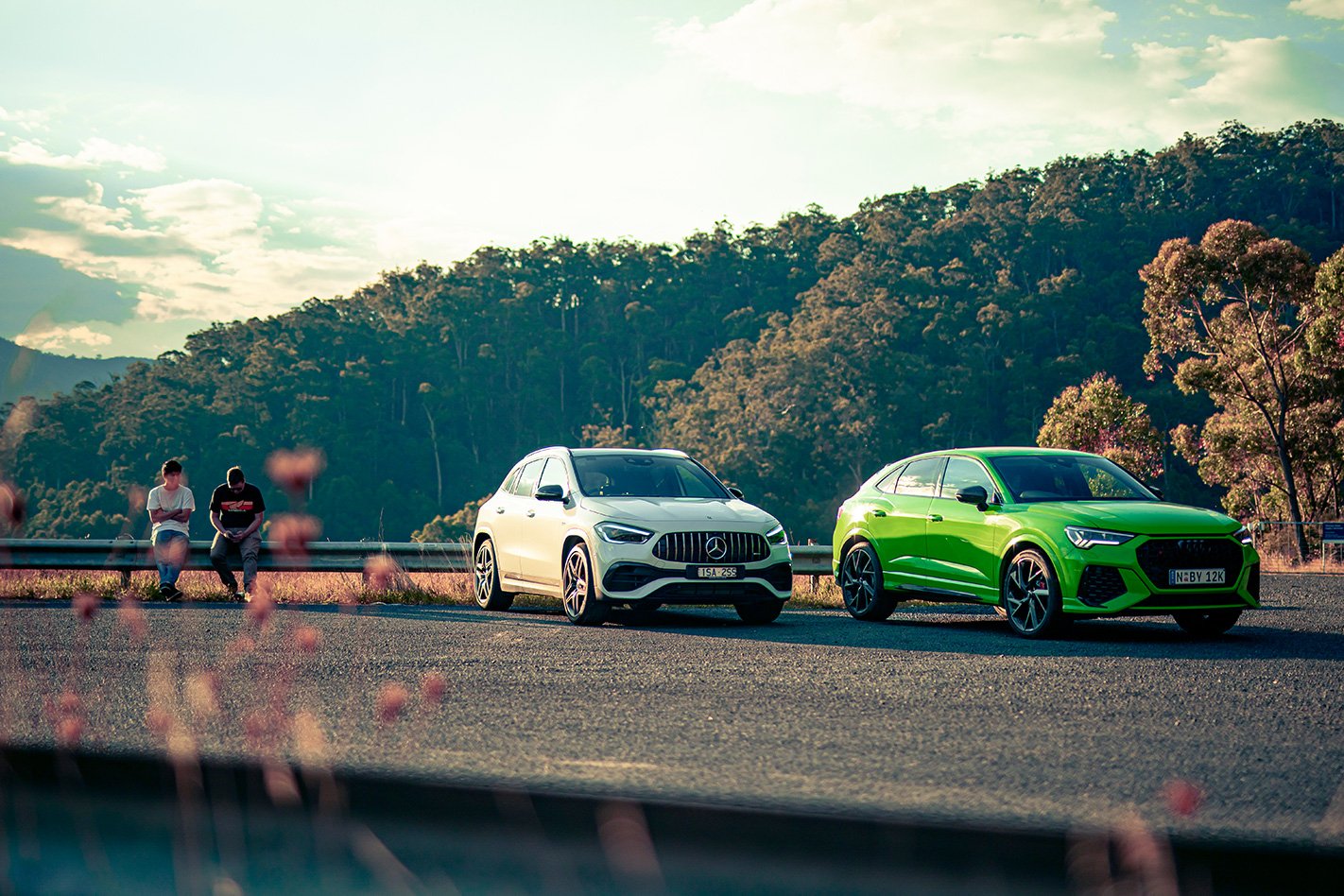
The Mercedes-AMG GLA 45 S and Audi RS Q3 weren’t created in a vacuum. A bunch of people in suits saw the popularity of the A45 S and RS3 hyper hatches, noted the relentless rise of the small SUV segment, and the inevitable happened. We have extremely talented development teams to thank for the fact the results aren’t a wallowing mess. Our job today is to answer two questions: how easy are these baby performance SUVs to justify against their hyper hatch equivalents, and do they possess the talents of a proper performance car?
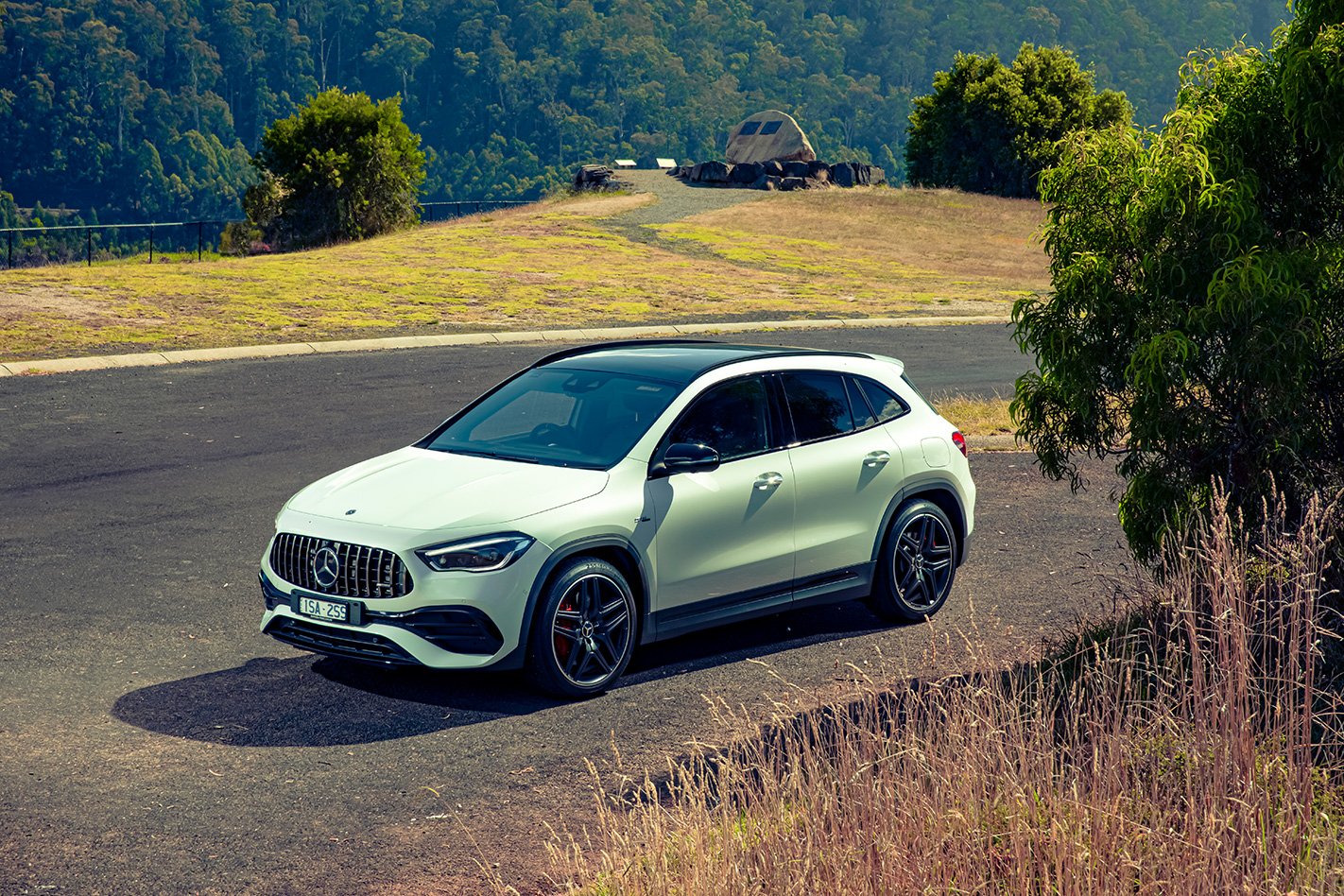
While both are relatively box-fresh, the AMG is the newer of the pair, being released earlier this year. The centrepiece is the M139 turbocharged four-cylinder engine, which produces identical outputs of 310kW and 500Nm to the A45 S which just scalped a podium spot at PCOTY 2021. You’ll need to pay for the privilege of moving to the SUV from the hatch though, with the GLA 45 S wearing a freshly increased sticker price of $108,100.
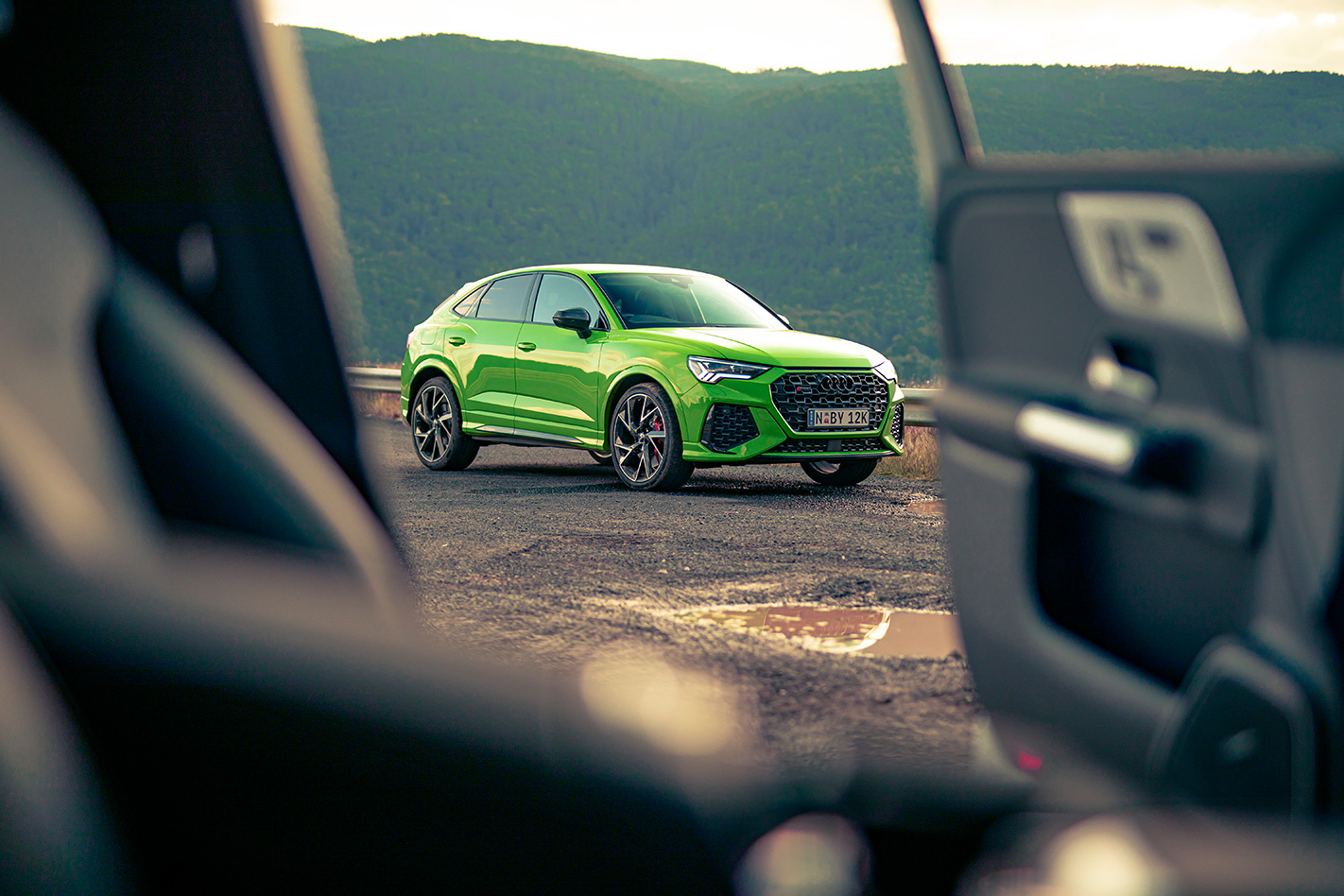
The Audi is only slightly older, being launched locally late last year, and it enters the fight as the pre-event underdog. Capacity is up compared to AMG (2.5-litres v 2.0), with an extra cylinder to boot, but the five-pot tops out at 294kW and 480Nm. This isn’t a game of power top trumps though, with the Audi being lighter and cheaper.
It also has four decades of legendary heritage in that quattro badge on the boot. In the rakish Sportback version of our test car, customers will need $92,900 to add one to their driveway. The only options fitted to NBY12K are cosmetic (black badging, interior carbon inlays, and carbon mirror housing), but the Kyalami Green Audi remains the more affordable vehicle at $95,750 all up. The non-Sportback version only widens that price difference with a $89,990 sticker, while also clawing back some extra practicality by ditching the swooping rear roofline.
Yes, the AMG is more expensive, but there are plenty of advantages in that, with powered front seats instead of manual, a panoramic sunroof and head-up display part of the spec sheet bonuses that make the GLA more pleasant day-to-day. Spend time in both and its easy to see that regular useability is more of a priority compared to their hatch equivalents, exemplified by the lack of such extrovert side bolstering on the lower portion of the seats, and a low-down power delivery that’s been dialled back a little by the software engineers.
With all the settings set to angry, but without activating launch control, neither the Merc nor Audi really leap off the line. Both gradually roll through the first couple thousand RPM like an old-school heavily turbocharged car. The GLA lights up first, coming alive from around 2500rpm and never relenting through the rev range.
In the wet it’ll spin all four tyres in the first couple of gears. Audi’s larger-capacity engine takes longer to wind up, only hitting its stride nearer 4000rpm. Even then, power delivery is calmer and more progressive. The ferocity of the A45 S and RS3 from a dig tells us that the issue for both contenders is artificially electronic, not lag related. Using customisable drive modes rectifies this issue somewhat, but there is no escaping the tamping down of power delivery designed to make these more palatable for everyday use. Perhaps that’s no bad thing.
But we aren’t about to get bogged down in everyday practicalities. This is about the pair’s performance credentials, and to answer why you should opt for one of our contenders over a traditional hatch we need something more than a great tarmac driving road. We need some dirt.
On the eastern side of Victoria’s Yarra Ranges National Park lays Thomson Dam. If you head north toward this body of water from Moe, you’ll pass a junction that regular driving enthusiasts ignore – marked as South Face Road. Most frequently traversed by logging trucks and trail bike riders, the almost entirely unsealed route ascends for 29 kilometres toward Mt Baw Baw Village, filled with groomed gravel and a combination of sweeping open bends, and tight, technical hairpins.
You could take an A45 S or RS3 onto this road, but it’d be a grimace-heavy experience. However, the extra millimetres of ride height and less focused rubber of these baby SUVs transform them into the gravel-spec equivalents of their Monaco Rally tarmac-ready hatch siblings. Wait for the loggers and truckies to knock off for the day, and South Face Road turns into the perfect playground to explore the GLA 45 S and RS Q3’s hidden merits.
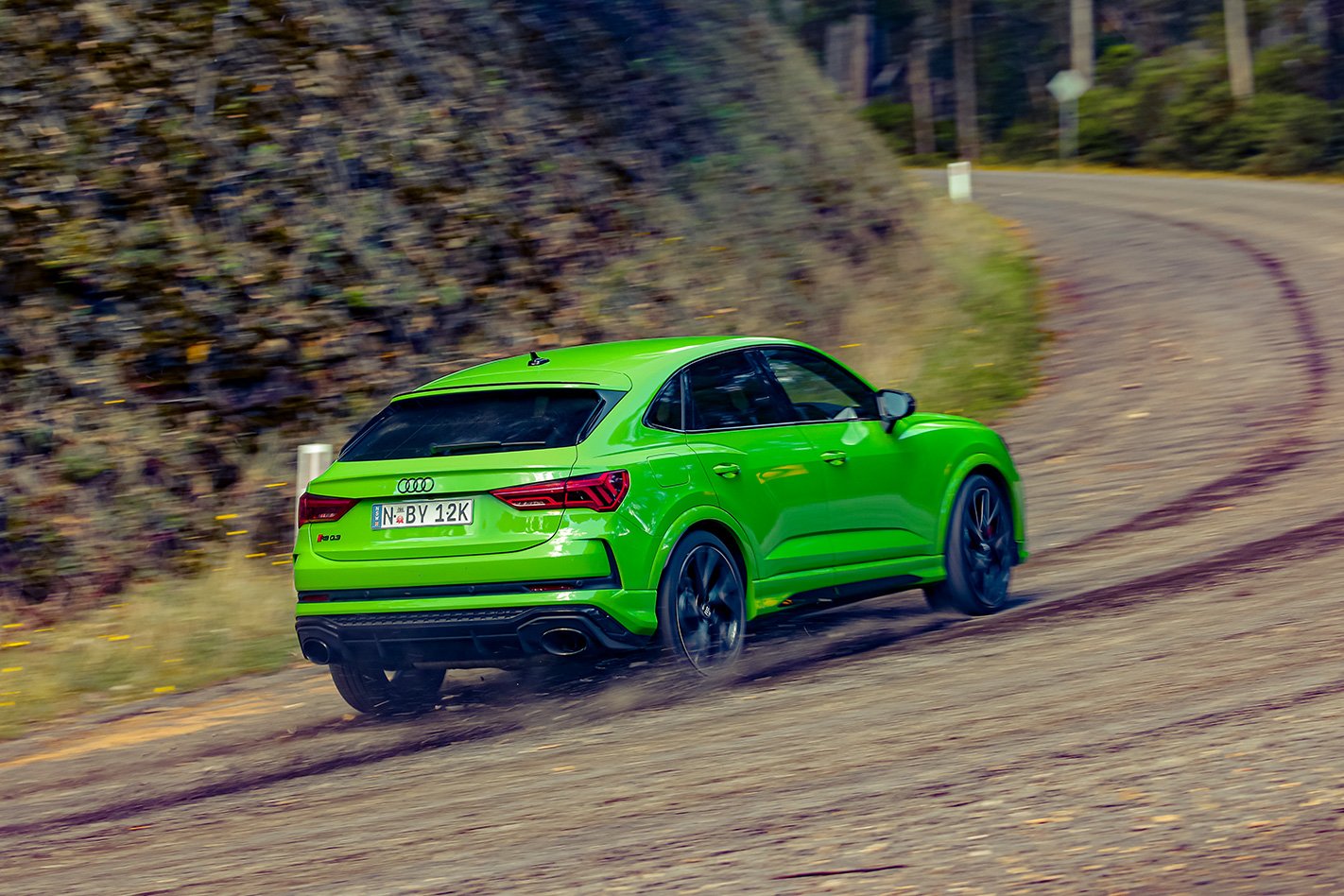
While both are a riot, there is a clear divergence in character between them on dirt. We decided to level the playing field by selecting an ESC Sport mode on both cars. The Audi feels at peace spitting gravel at our photographer. It rotates surprisingly eagerly on corner entry, happy to turn on its axis with a lift of the throttle, or a meandering Scandi-flick if you really want to grab it by the scruff.
The electrical nannies will allow some decent angles before interfering, but they’ll need reassuring that you’re dialling in the right amount of lock behind the wheel. Despite its heft (1775kg) and taller centre of gravity compared to a hatch, the RS Q3 transfers its weight with poise, allowing you to link bends more naturally.
This is in contrast to the AMG, which feels more planted and unwilling to become unstuck without aggressive weight transfer, the ESC keen to intervene and prevent any lift-off antics. The systems puts it trust in the driver on corner exit, deploying the M139’s power to great effect. It also lacks the poise of the Audi on transitions, keen to pull itself straight with any throttle application instead of flowing from side-to-side.
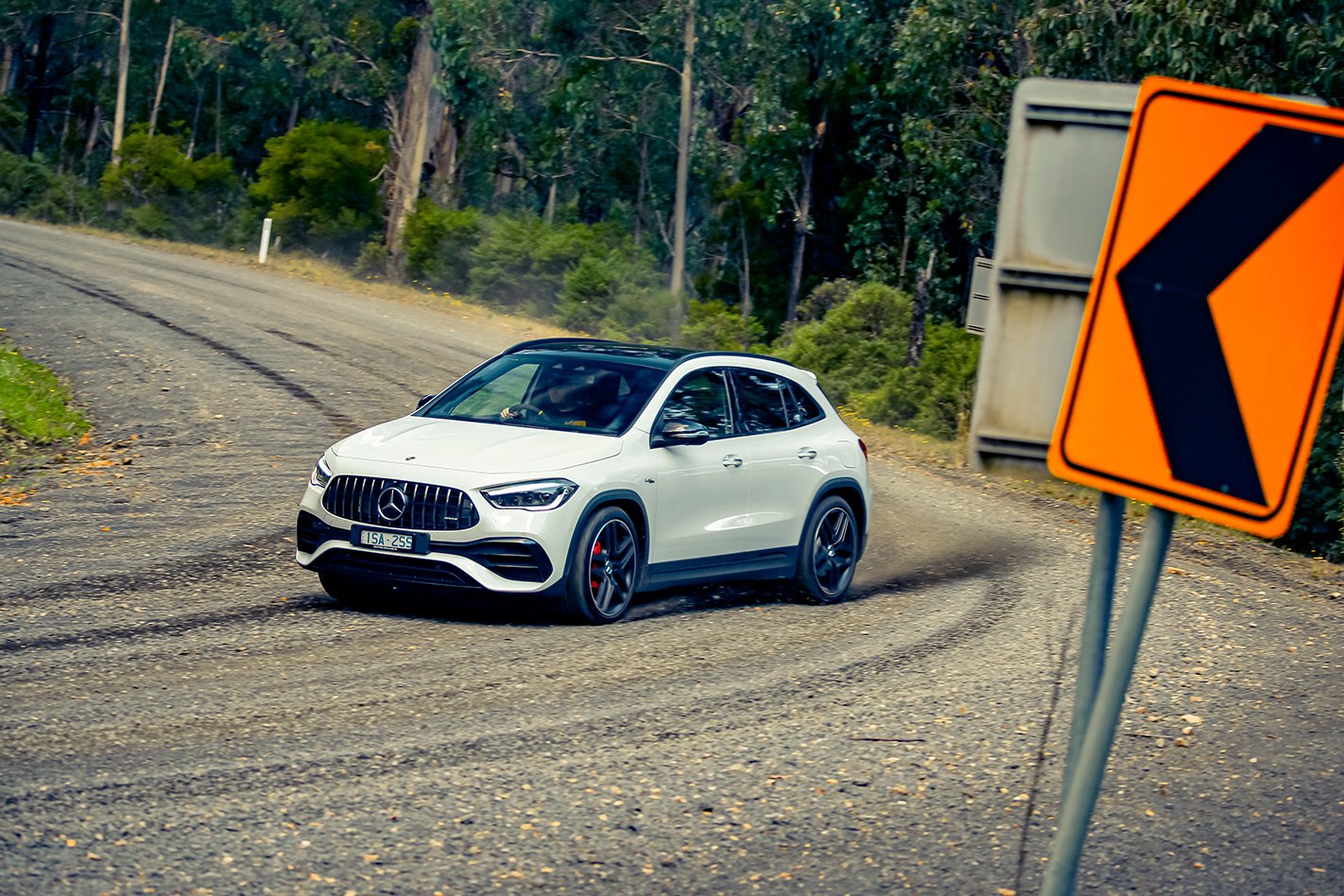
Once you’ve got it on its toes, the AMG is less frantic inside the cabin and the GLA 45 S will allow long four-wheel slides with barely any steering correction required. However, the RS Q3 lives up to its quattro heritage, possessing a character that is a little more unbuttoned and more at home with the concept of offering the keen driver options on a loose surface. Early advantage to the Audi, then.
Dusty shenanigans complete we travel back down South Face Road and complete our journey toward Thomson Dam, the road slowly transforming and tightening as it descends toward the dam wall. Being a barrel of laughs on a loose surface is easy, but can either of these baby SUVs thrill on a typically winding, bumpy, challenging Aussie B-road?
The steering in the Audi is quick, with the variable ration taking from 2.1 turns lock-to-lock, but avoids being too darty. Though it is on the lighter side – even in its most dynamic setting – it remains direct and accurate, with little to no dead zone. Neither the RS Q3 or GLA 45 S are the last word in steering feel and communication, but the lack of heft to the Audi’s rack can take longer to adjust to as it hides more subtle transmissions.
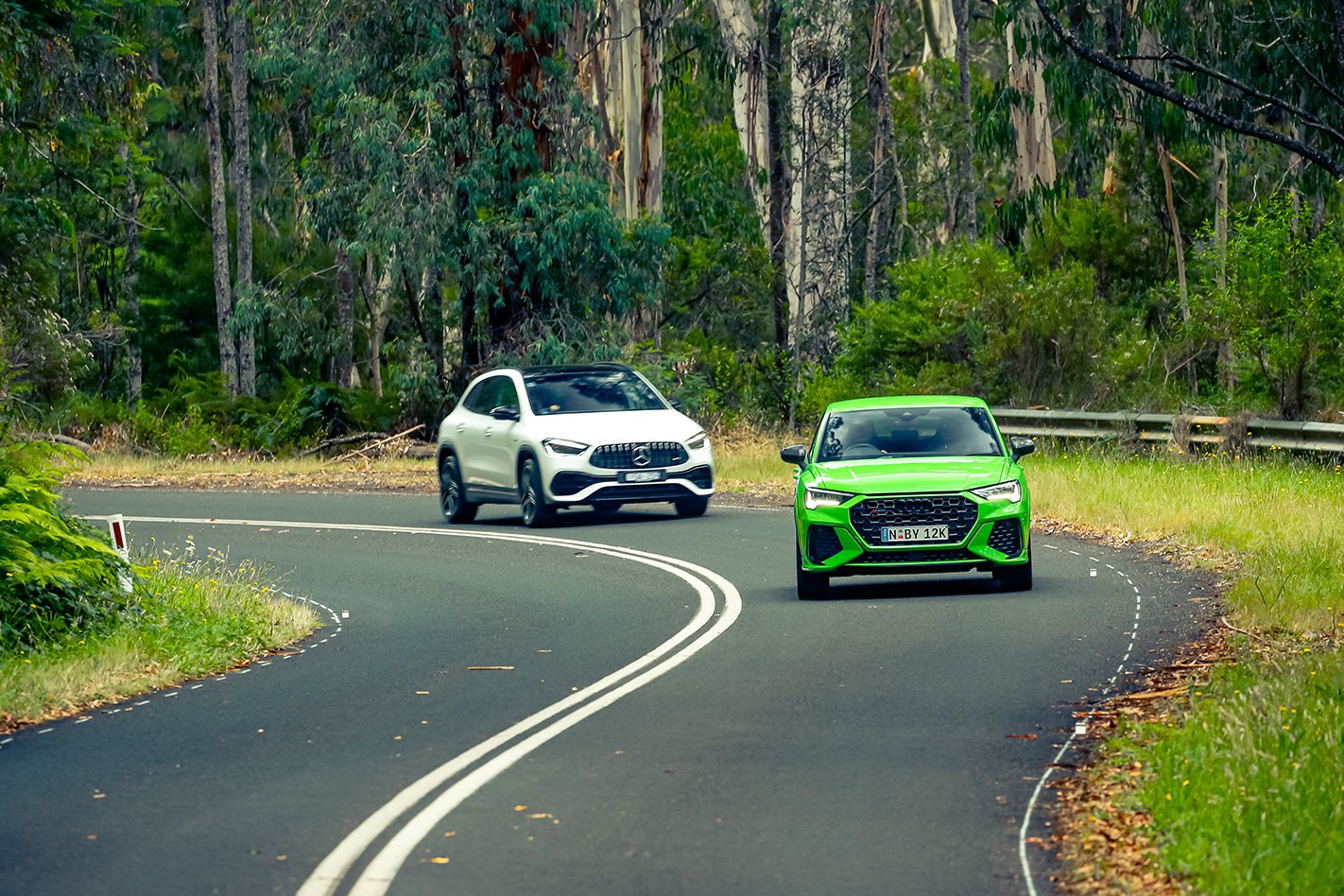
Though it disguises its weight adequately, the Audi’s body control can’t match the AMG’s, making its SUV nature more prominent than the GLA. Its primary ride is respectable for a tall car with this focus, swallowing mid-corner bumps skillfully.
When hustling the RS Q3 it becomes clear plenty of thought has been put into the chassis. It has a refined, neutral character, and if you are judicious with the speed of turn-in, the little SUV will happily carry impressive corner speed, flowing and dancing through the bends.
Praise needs to be heaped upon to the engineers at Neckarsulm who were able to slice 30kg of heft from the RS Q3 compared to the previous generation, with 26kg coming straight off the nose due to a new alloy crankcase design for the five-pot engine. Bends with a tightening radius do remain a challenge, however, with a delicate balance off throttle and light braking required to hook in without pushing the front wide.
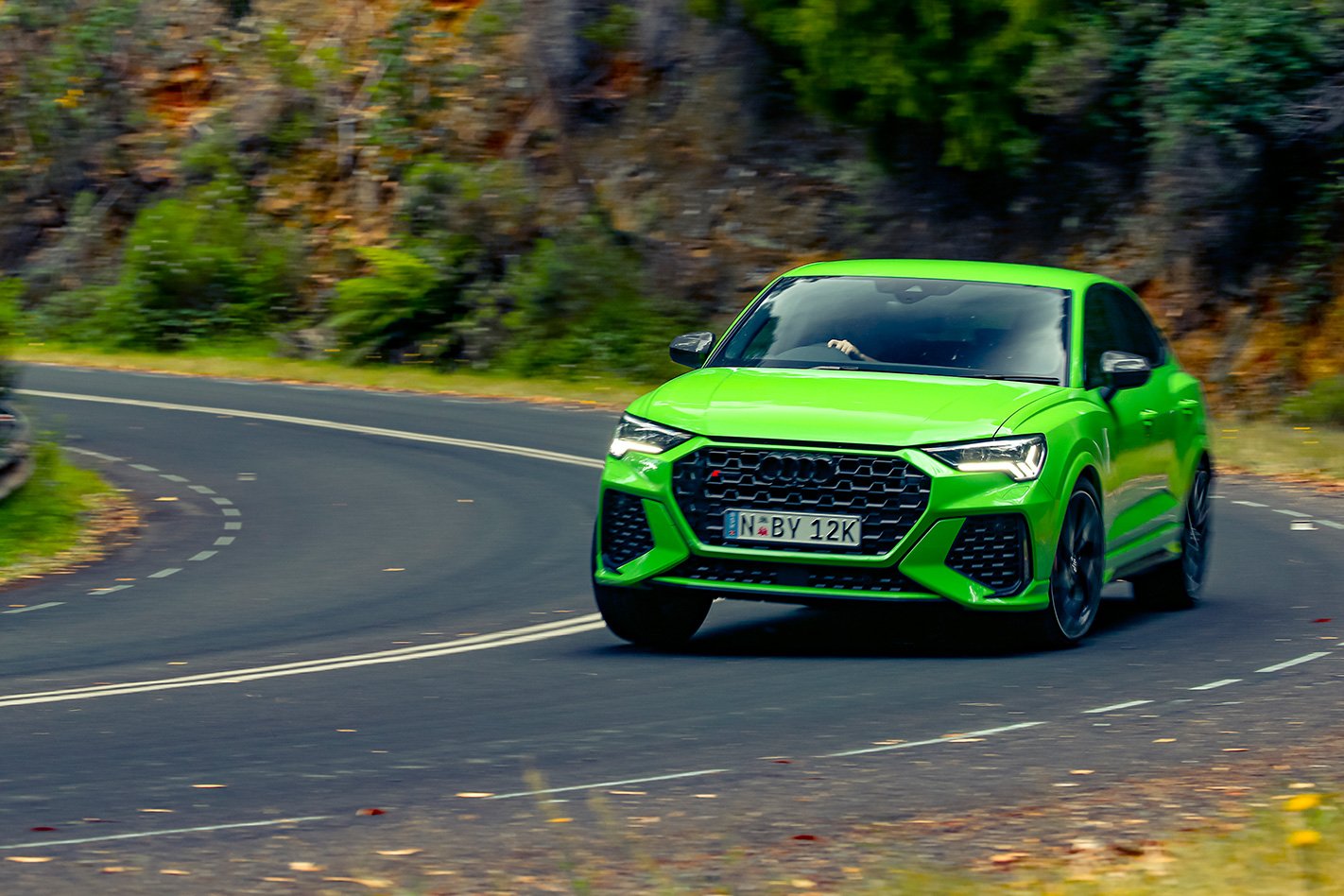
Now for the fall. The RS Q3’s Achilles heel is its gearbox, with the seven-speed dual-clutch transmission doing its utmost to take the edge off the driving experience at almost every turn. Even in its most aggressive dynamic setting it feels overwhelmed, with confounding gear choices and delayed shifts. Somehow it gets worse in manual mode, often refusing reasonable downshifts on corner entry, and then on upshift, suffering agonising delays between pulling the paddle and the next ratio being engaged.
Then there is the Mercedes, which opens with a gut punch and never relents. Driving the GLA 45 S fast is a brutal, theatrical display of chassis engineering. Where the RS Q3 is unable to hide its SUV nature, the GLA drives and performs like a slightly larger hot hatch. The meatier steering provides greater feel and you need it, as the AMG takes a dislike to remedial lock being added mid corner. The AMG’s suspension is stiffer than the Audi’s in its firmest setting, and its roll stiffness is beefier too.
However, you aren’t completely sacrificing bump absorption, with the pocket rocket maintaining composure – and pace – over nasty mid-corner bumps. Like the A45 S, it is fairly loud on a highway schlep though.
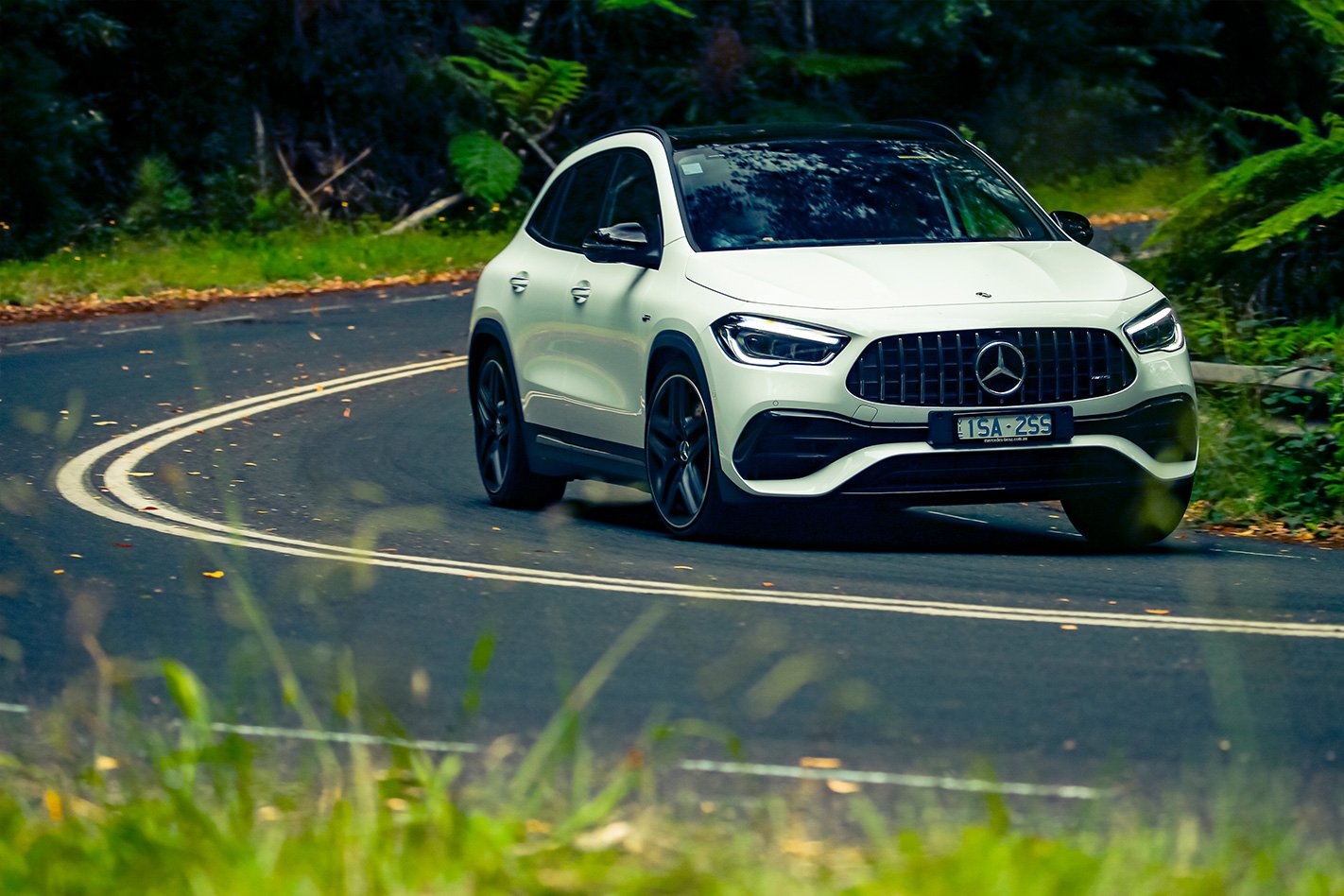
Despite ceding around half a litre in swept capacity to the Audi, the AMG’s power delivery is in another league. Any on-paper low-rpm torque deficit is blown into irrelevance on tarmac. Corner exits allow for nibbles of power oversteer in the most liberal ‘Master’ dynamic setting. We’ve said it before, and we’ll say it again – the M139 is one of the most impressive internal combustion engines ever built, regardless of cylinder count.
Where the Audi comes with a poorly calibrated transmission, the AMG excels. Mercedes’ eight-speed dual-clutch transmission is brilliant. Left to its own devices the automatic setting is intuitive, selecting the right ratio for the right moment almost instinctively.
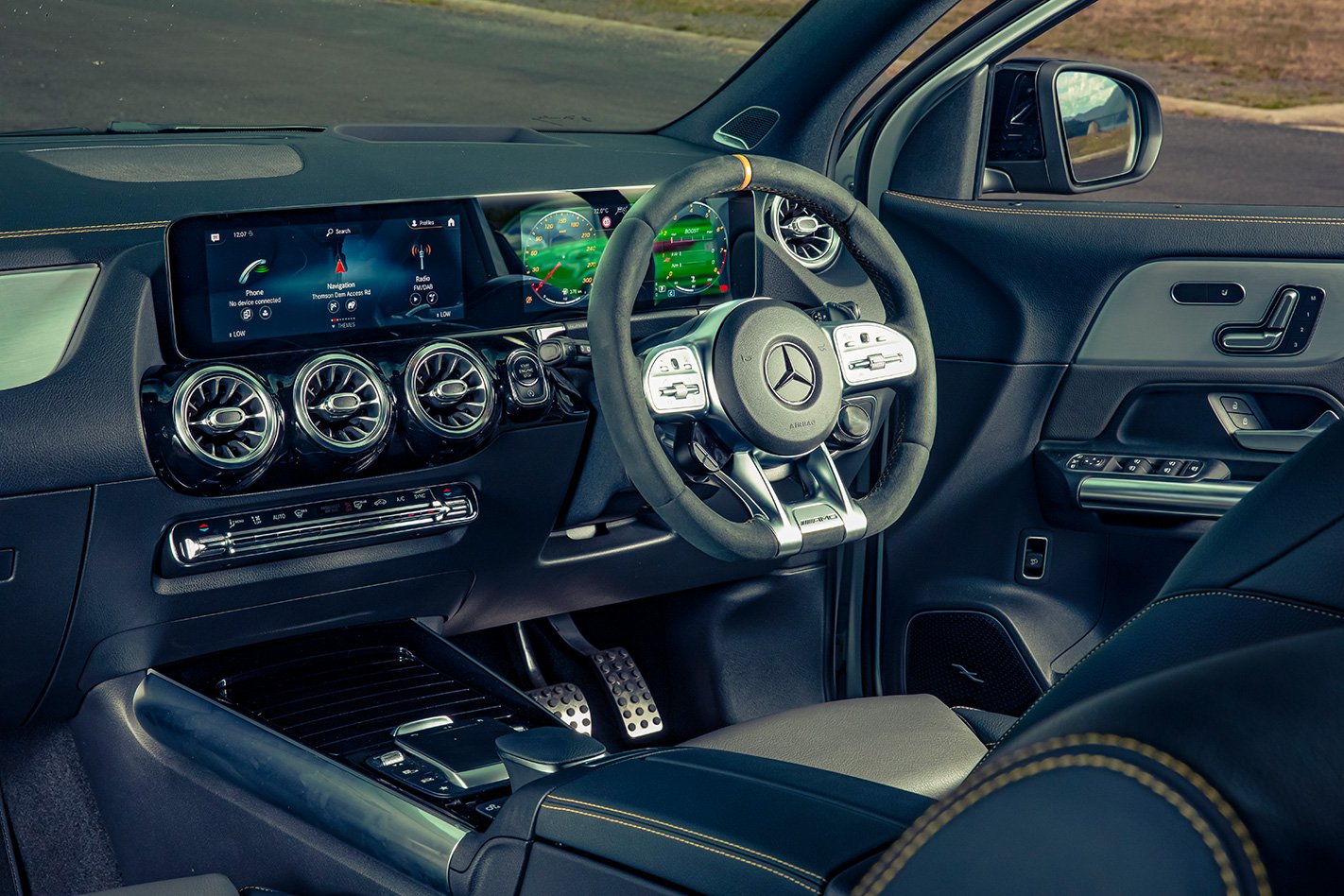
Switch to manual mode and it gets even better, with rapid shifts both up and down ratios handed out on command. The joy of the AMG’s system is that it will willingly serve you any ratio as long as it is capable – meaning it’ll provide you a downshift right onto redline. The benefit of the large, bright head-up display is also keenly felt, with shift lights displayed within your eyeline. You’ll initially need them too, as the engine rushes to its rev-cut with genuine ferocity.
The gear ratios are more closely stacked in the AMG and, on our test route at least, they seemed better judged. On this serpentine b-road, third gear does the lion’s share of the work, where the Audi has you constantly shifting between second and third at the same speeds. If you do need a gear change in the GLA, the shift is quick and crisp, and accompanied by a wonderful whip-like crack from the exhaust in sportier drive modes.
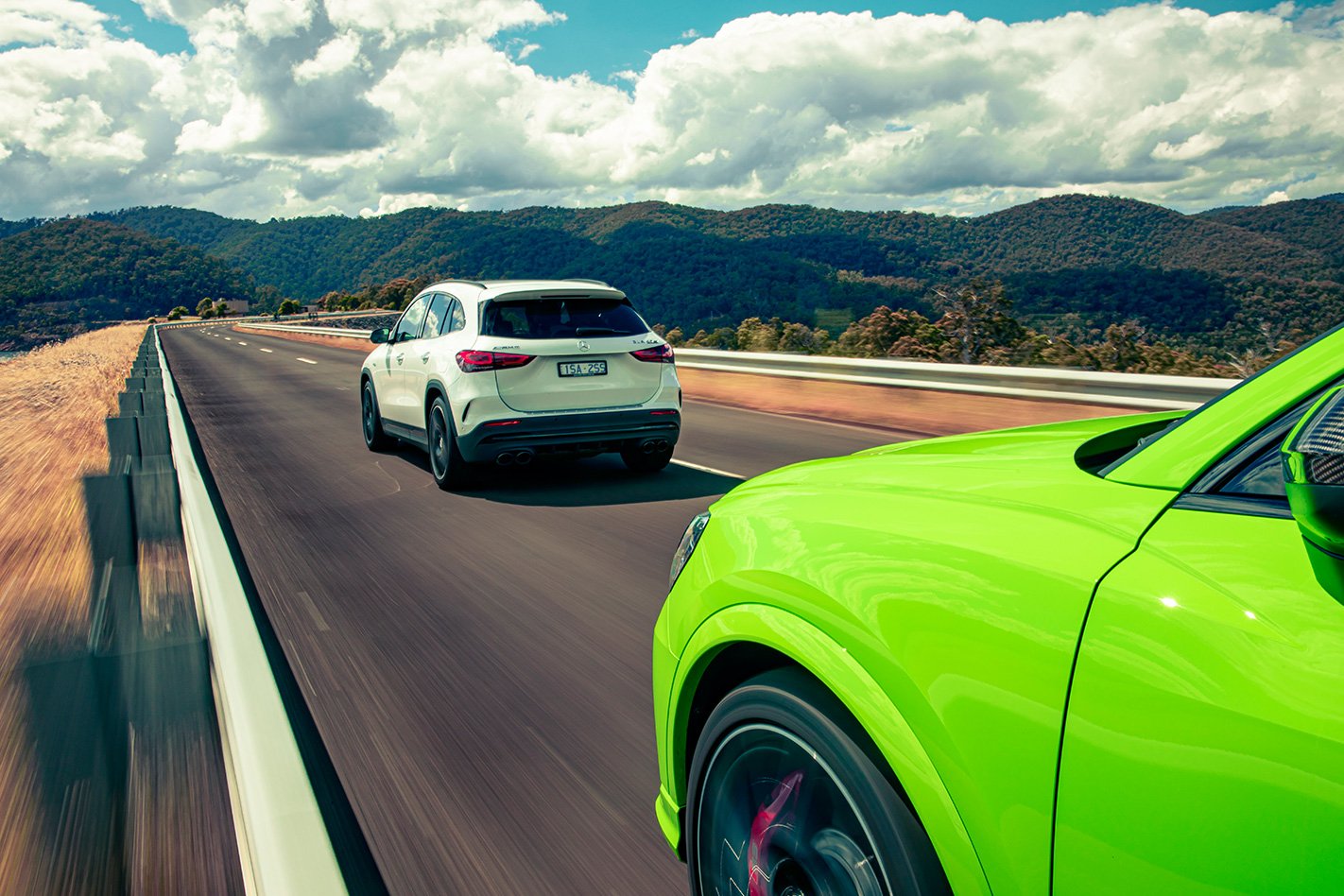
The shortcomings of Audi’s transmission also mean it fails to return serve in a straight line. While neither could quite match their claims on the day (AMG 4.3, Audi 4.5), the GLA was closest with a 4.5-second sprint to 100km/h while the RS Q3 took 5.0-seconds flat. The AMG’s ratios see it ripping through shifts noticeably swifter than the Audi. There is half a second between them at the end of the quarter mile, but after 400 metres the AMG has an almost 10km/h speed advantage. It is more potent, more often and you feel it behind the wheel.
That’s the deciding factor here. If you were a fiend for dirt, we’d recommend the RS Q3 every day, but the Audi’s advantage on loose surfaces isn’t enough to stop the AMG levering itself into a winning position on bitumen.
The GLA is simply more focused and capable, hiding its SUV design with hatch-like dynamic characteristics, capable of higher-highs than the RS Q3 on tarmac at every turn. AMG hasn’t completely lost the SUV benefits in the process either, with the baby Merc remaining good fun on dirt, refined and comfortable around town, but capable of haunting the thoughts of Porsche owners on a winding back road.
Best of both worlds? It’s right here.
Power Shuffle
AMG has fitted the GLA 45 S with the same 4Matic+ all-wheel drive system that is used on the A45 S, using a pair of multi-plate clutches on the rear axle to move power to whichever side needs it most. The system is also capable of sending up to 100 per cent of power to the rear wheels only.
Where Mercedes shuffles its grunt laterally using the drivetrain, Audi employs what it calls ‘wheel-selective torque control’ which is a braked torque-vectoring system. When moving power fore and aft a Haldex-based central multi-plate clutch is used, capable of shuffling up to 85 per cent of grunt to the rear. However, the system remains predominately front-biased in normal driving conditions.
A la mode
You can customise a slew of different drive settings in both cars, but they go about it in intriguingly different ways. Adjusting on the fly in the AMG is a breeze with a dial on the wheel allowing you to flick between the five ‘standard’ drive modes. To switch between the RS Q3’s four regular settings you have to use a button on the dash above the climate controls.
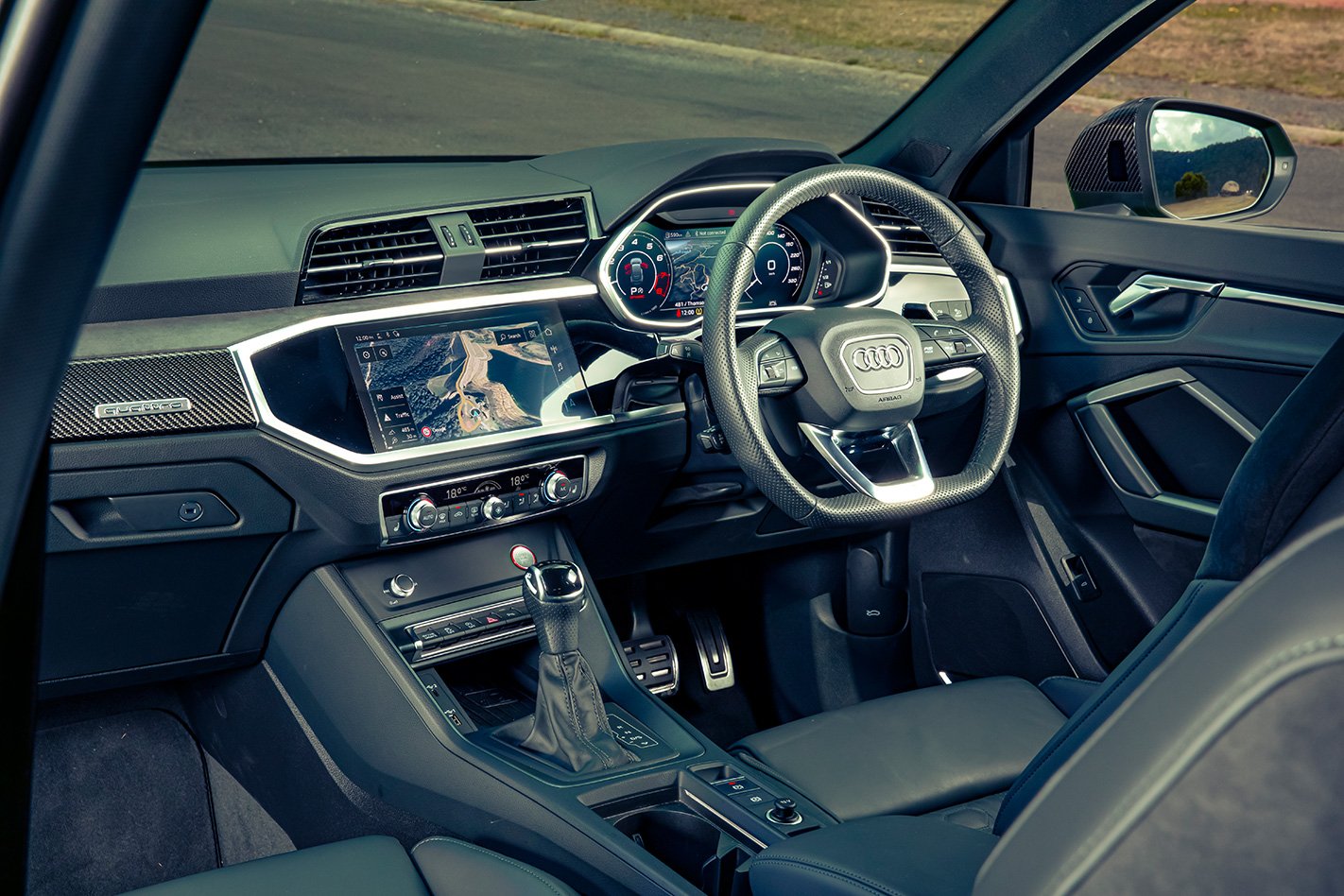
While engine and gearbox modes are linked in the AMG, the Audi will allow these to be mixed and matched. Additionally, the RS Q3 has two individualised settings to the AMG’s one. However, you must use the touch screen to activate them, where in the GLA simply pressing the wheel-mounted dial switches the car instantly to your preferred drive settings.
Technical Specs
Audi RS Q3
Body: 5-door, 5-seat SUV Drive: all-wheel Engine: 2480cc inline-5, DOHC, 20v, turbo Bore x Stroke: 82.5 x 92.8mm Compression: 10.0:1 Power: 294kW @ 5850-7000rpm Torque: 480Nm @ 1980-5850rpm Power/Weight: 166kW/tonne Transmission: 7-speed dual-clutch Weight: 1775kg Suspension: MacPherson strut, coil spring, anti-roll bar, adaptive dampers (f) multi-link, coil spring, anti-roll bar, adaptive dampers (r)
L/W/H: 4507/1851/1557mm Wheelbase: 2681mm Tracks: 1590/1583mm Steering: electrically assisted rack-and-pinion Brakes: 375mm ventilated discs, 6-piston fixed calipers (r), 310mm ventilated discs, single piston floating calipers (r)
Wheels: 21 x 8.5-inch (f/r) Tyres: 255/35/21 (f/r) Continental SportContact 6
Price: $92,900 ($95,750 as tested) Pros: Chassis balance; loose surface thrills Cons: Clumsy gearbox; light steering Rating: 3.5/5
Mercedes-AMG GLA 45 S
Body: 5-door, 5-seat SUV Drive: all-wheel Engine: 1991cc inline-4, DOHC, 16v, turbo Bore x Stroke: 83.0 x 92.0mm Compression: 9.0:1 Power: 310kW @ 6750rpm Torque: 500Nm @ 5000-5250rpm Power/Weight: 175kW/tonne Transmission: 8-speed dual-clutch Weight: 1807kg Suspension: MacPherson strut, coil spring, anti-roll bar, adaptive dampers (f) multi-link, coil spring, anti-roll bar, adaptive dampers (r)
L/W/H: 4438/1849/1581mm Wheelbase: 2729mm Tracks: 1605/1605mm Steering: electrically assisted rack-and-pinion Brakes: 360mm ventilated discs, 6-piston fixed calipers (r), 330mm ventilated discs, 4-piston fixed calipers (r)
Wheels: 20 x 8.5-inch (f/r) Tyres: 255/40/20 (f/r) Continental SportContact 6
Price: Price: $108,100 Pros: Relentless grunt; swift shifts; car-like ability Cons: Price premium; awkward weight transfer Rating: 4.0/5
%MCEPASTEBIN%
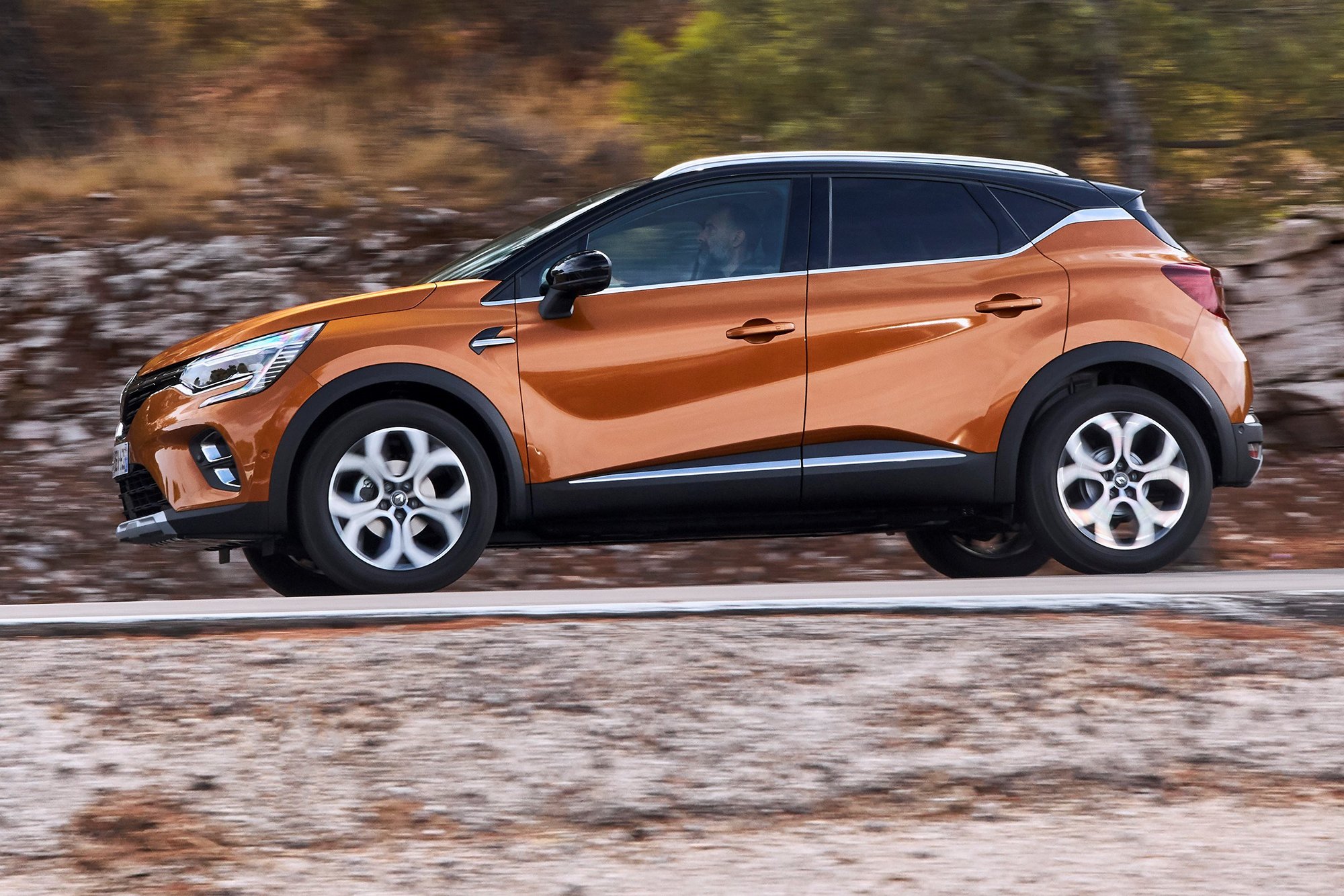
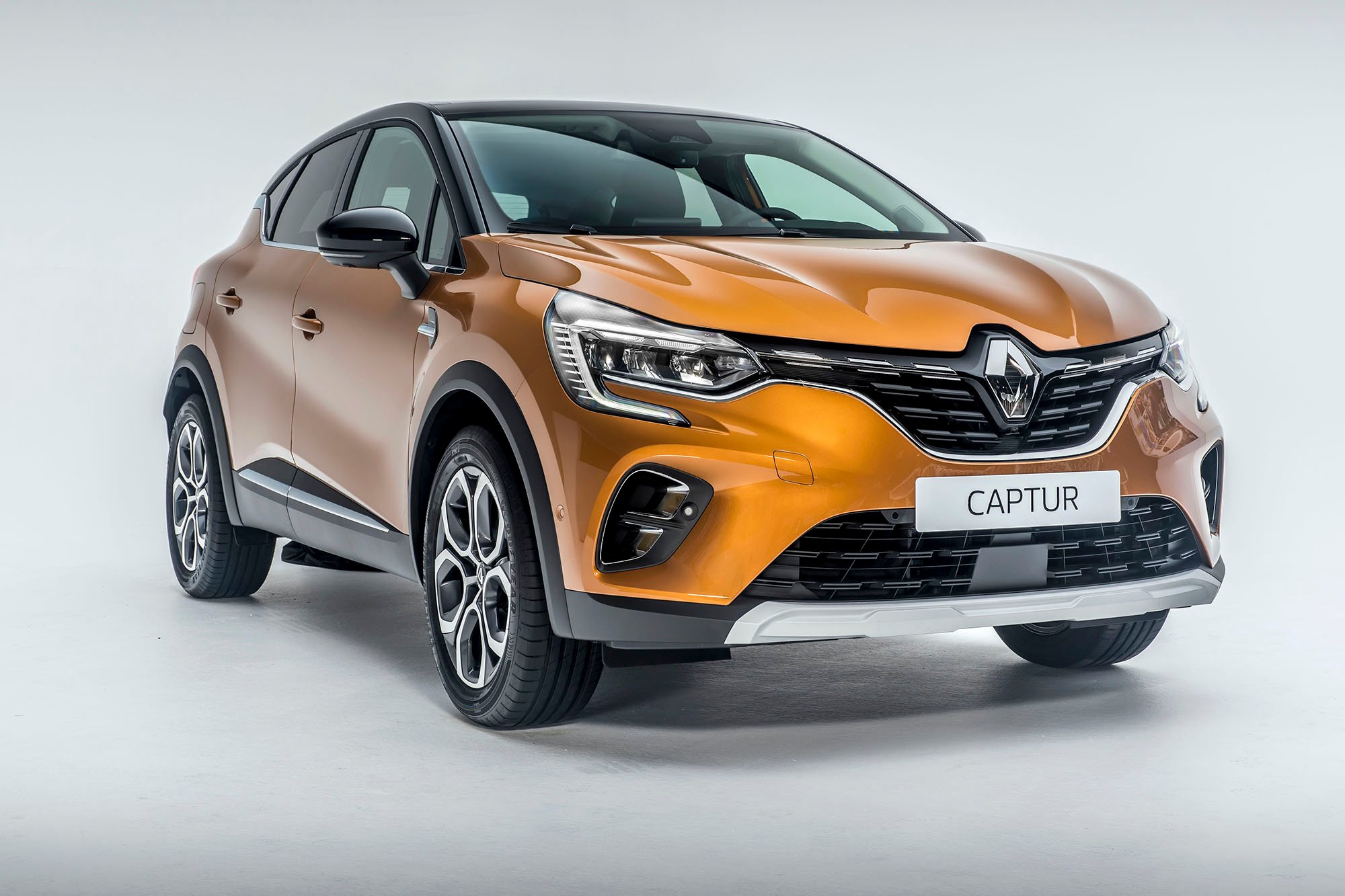
The 2021 Renault Captur will go on sale in Australia from March, bringing next-generation looks, technology and safety.
It will slot right into the hotly-contested small SUV segment that already hosts the likes of the Volkswagen T-Cross, Mitsubishi ASX, Ford Puma, Hyundai Kona, Nissan Qashqai and Toyota Yaris Cross.
The three-variant range will comprise the entry-level $28,190 Life, the mid-tier $30,790 Zen and the range-topping $35,790 Intens. All prices exclude on-road costs.
That represents an increase over the previous-generation Captur, by nearly $5000 on the top-level Intens grade.
However, more kit is included as standard than ever before.
Each variant in the range receives LED headlights as standard, a longer body for increased interior space, and a standard safety features list that includes lane departure warning, lane-keep assist, traffic sign recognition and autonomous emergency braking.
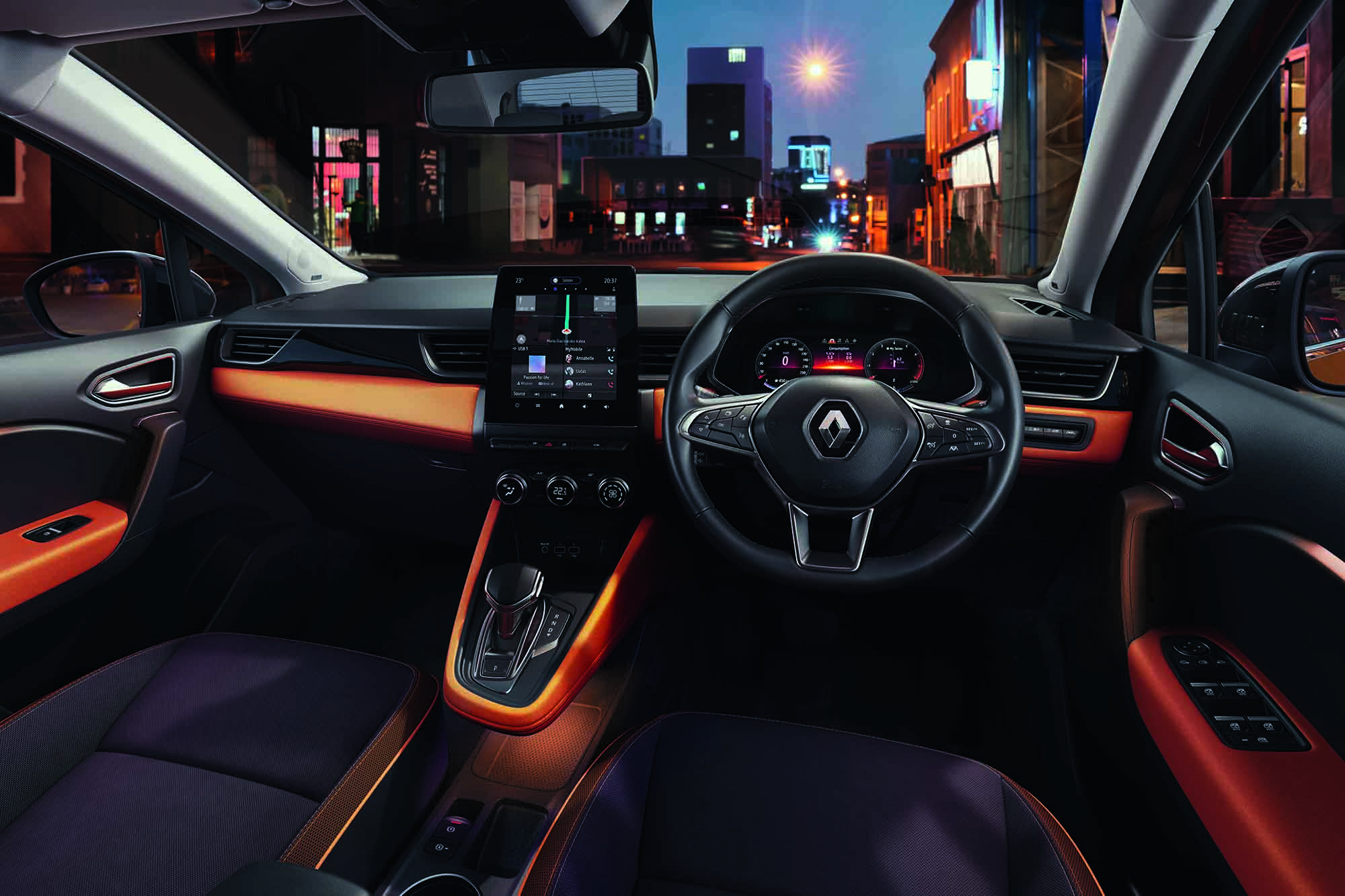
A 7.0-inch multimedia screen is standard on the entry-level Life and mid-grade Zen, while the Intens receives a larger portrait-oriented 9.3-inch screen. Both screen sizes display Apple CarPlay and Android Auto phone mirroring.
Only one engine is offered across the range, a 1.3-litre turbo petrol four-cylinder engine with 113kW/270Nm outputs.
That engine is mated exclusively to a seven-speed dual-clutch transmission which sends power to the front wheels only.
Renault says the new Captur will deliver a 6.6L/100km fuel consumption figure on the strict WLTP test cycle. Buyers should note that 95 RON petrol is required.
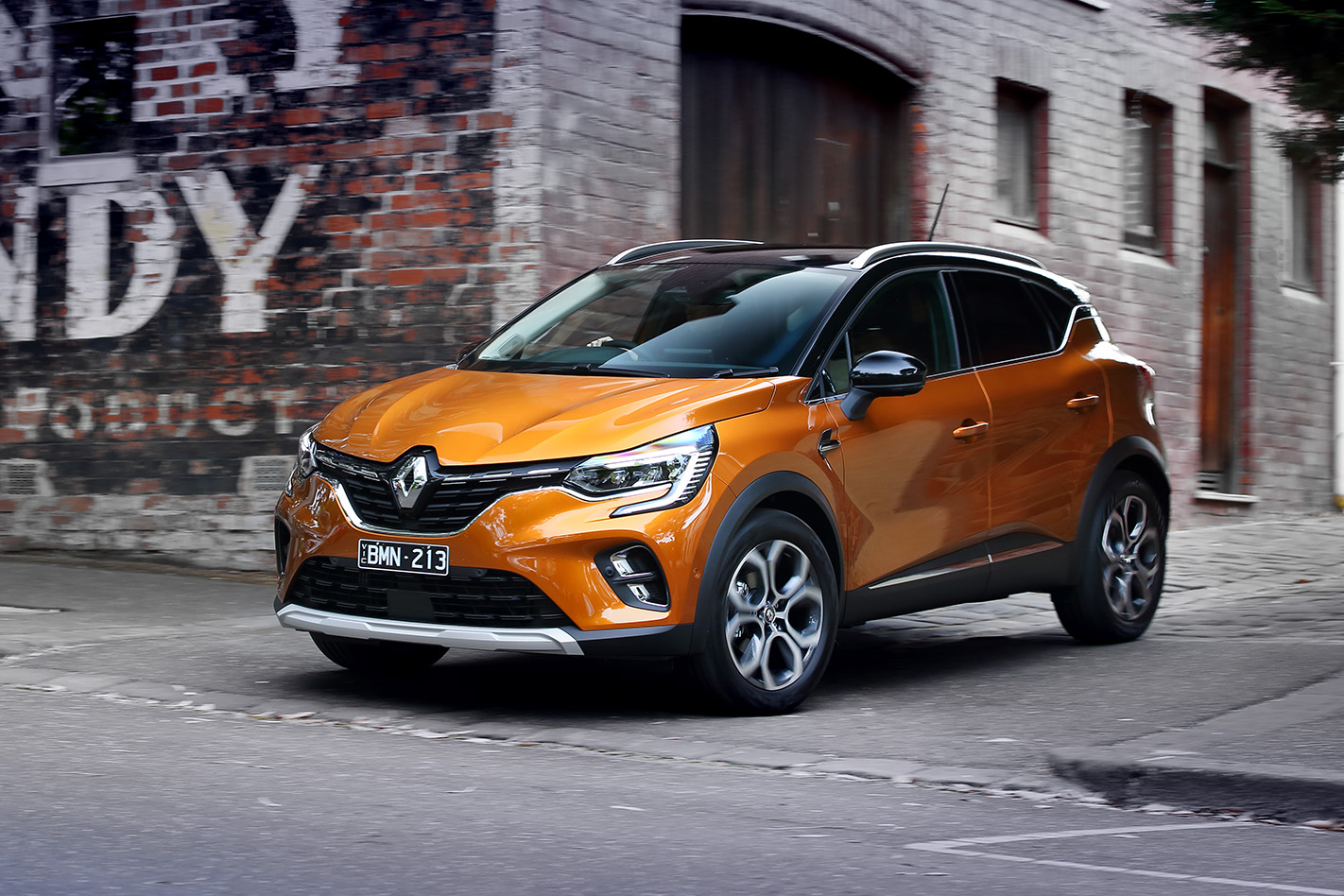
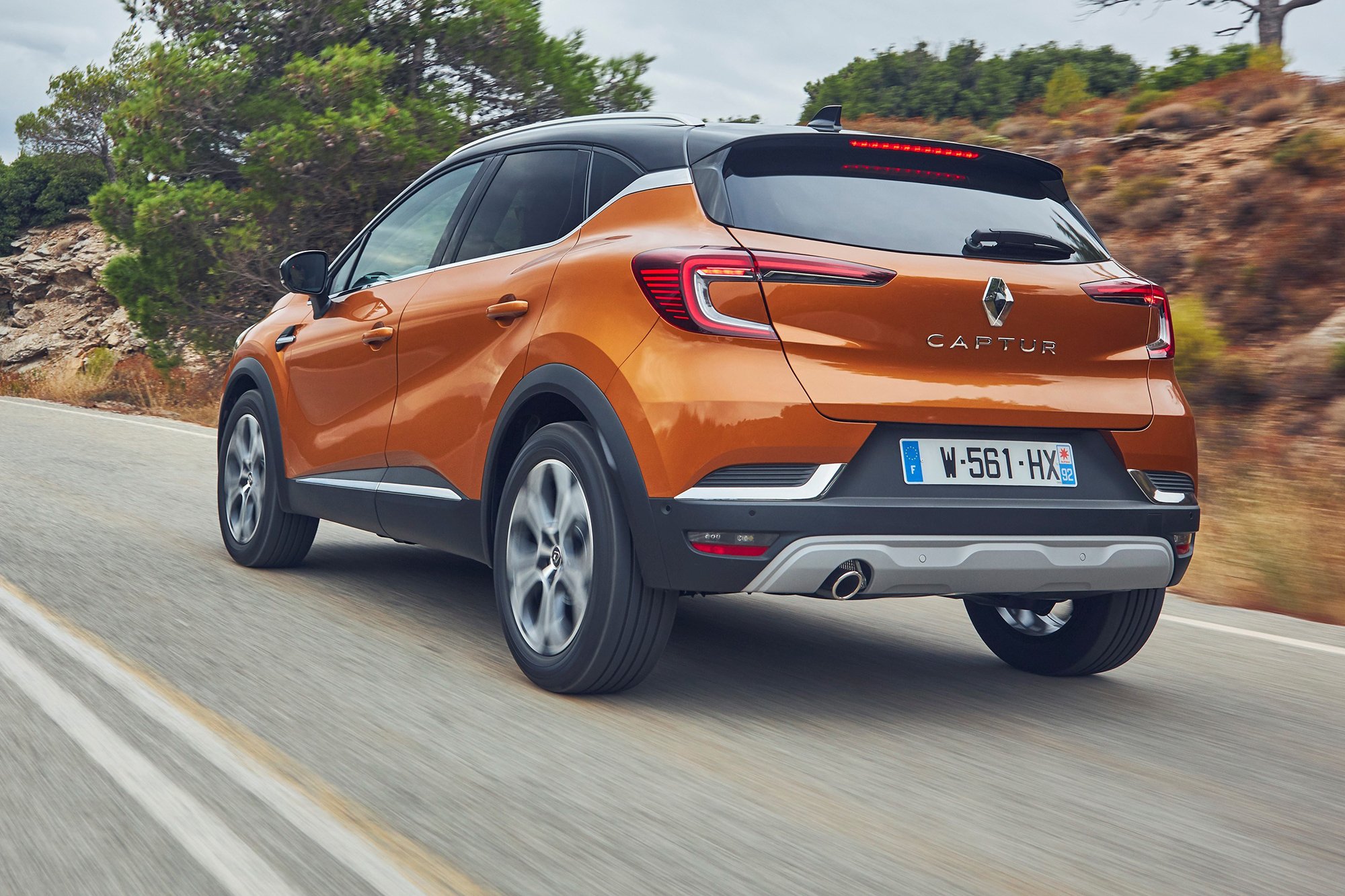
The new Captur is 4228mm long, 1797mm wide, 1566mm tall, and rides on a 2630mm wheelbase. These numbers make the compact SUV notably larger than its predecessor: 108mm longer, 19mm wider, has a 1mm lower roof, and a 24mm longer wheelbase.
Storage in the rear is listed at a total 536 litres with the rear seats upright, across a two-tiered floor. With the floor in place, boot space shrinks to 422 litres. Folding the rear seats increases rear storage to 1275 litres.
Feature highlights
The Captur Life kicks off the range with items such as fabric upholstery, 17-inch alloy wheels, automatic headlights, rearview camera, front and rear parking sensors and six-speaker Arkamys sound system.
Life variant buyers get the option to add some extra safety equipment including rear-cross traffic alert, blind-spot warning and auto folding mirrors for an extra $1000.
Next grade up Zen improves on the above by adding a heated leather steering wheel, climate-control air-conditioning, a hands-free keycard entry system, wireless smartphone charging and automatic fold door mirrors.
At the top of the range, the Intens receives black leather trim, Bose sound system, 18-inch dual-tone alloy wheels, satellite navigation, second-row USB charging ports, LED cabin lighting, electrically adjustable heated front seats and an auto-dimming rear mirror.
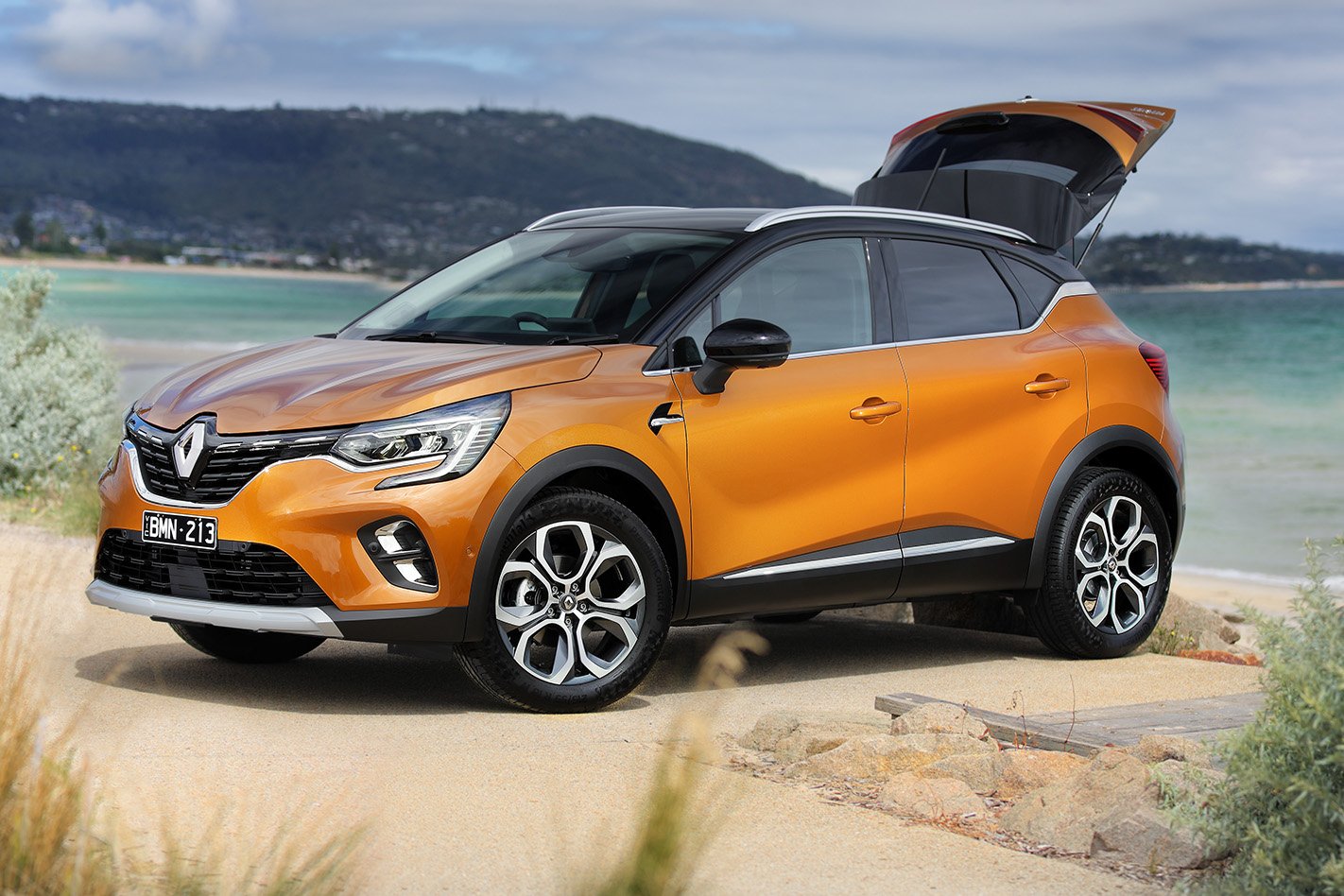
A 10.25-inch digital instrument cluster is available on the Intens variant as part of the $2000 Easy Life package which also brings automatic high-beam lights, side parking sensors and hands-free parking assist to the top-tier variant.
All variants of the new Captur come with a five-year, unlimited-kilometre warranty, along with five years of roadside assistance and five years or 150,000km of capped-price servicing.
The Captur also has a five-star ANCAP rating.
The new 2021 Renault Captur range is available to order now, with customer deliveries beginning to arrive in April.
2021 Renault Captur Australian pricing
- Captur Life – $28,190
- Captur Zen – $30,790
- Captur Intens – $35,790
Options
- Peace of Mind Package (Life) – $1000
- Adaptive cruise control (Zen and Intens) – $500
- Easy Life Package (Intens) – $2000
- Orange Signature Package (Intens) – $0
- One-tone metallic paint (all variants) – $650
- Two-tone solid paint (Life) – $450
- Two-tone metallic paint – $1000 (Life), $650 (Zen and Intens)
UPDATE, January 2023: Kia EV6 GT driven in Australia
“This isn’t even my final form”, chuckled the 239kW & 605Nm EV6 GT-Line last year. Now we understand… see our first drive review of the flagship EV6 GT, including a track test, at the link below.
The story to here
2022 Kia EV6 unveiled
Snapshot
- Over 510 kilometres of range from a single chargeu00a0
- 800V ultra-fast charging from 10 to 80 per cent in just 18 minutes
- 100 kilometres of range capable in less than 4.5 minutes of charging
- EV6 GT capable of accelerating from 0-100 km/h in 3.5 seconds
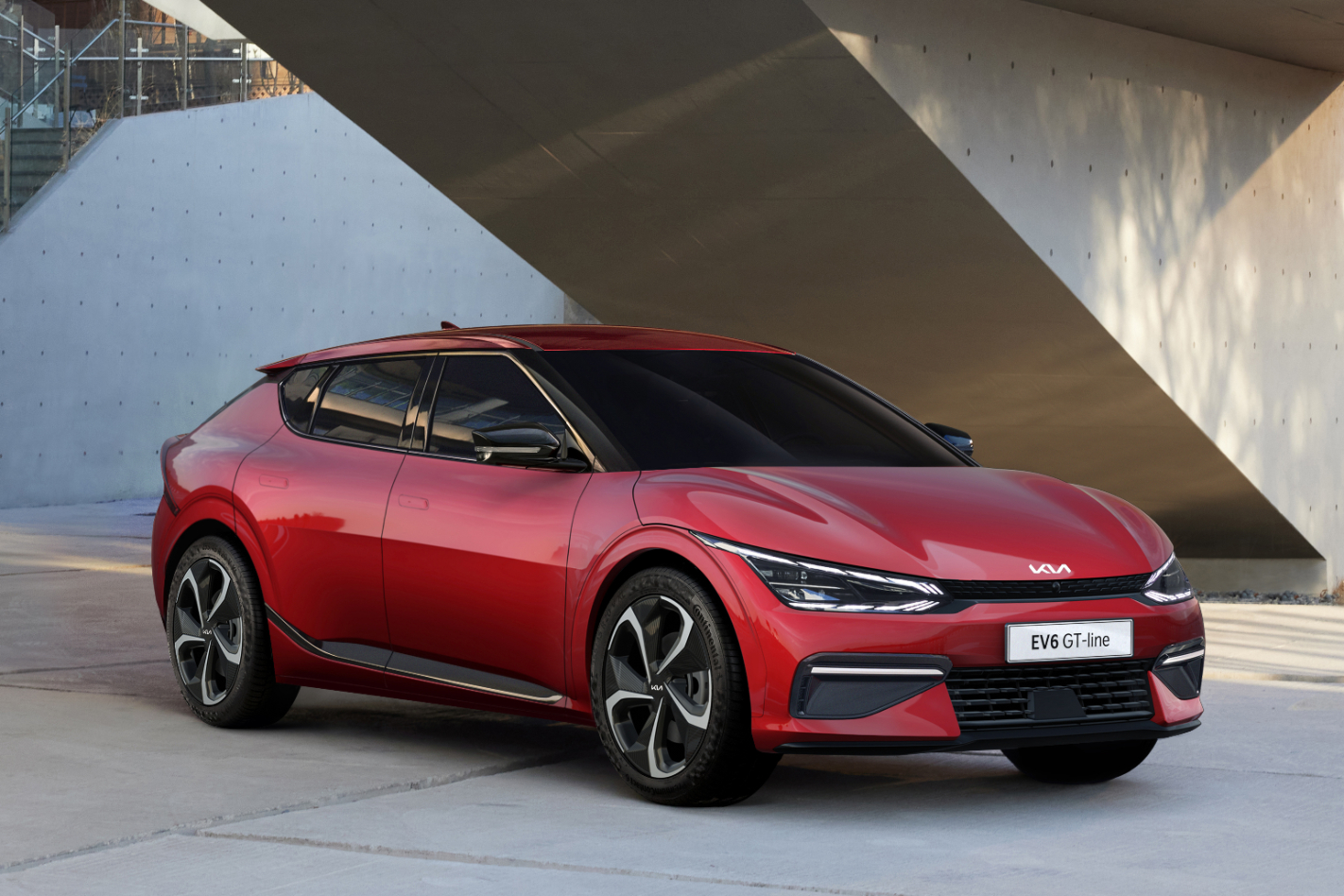
Kia has officially unveiled its first-ever battery-electric vehicle (BEV), the EV6, and it’s boasting some class-leading features that could upset the traditional players in the EV market.
Available from launch in three different models – EV6, EV6 GT-Line, and EV6 GT – the sleek-looking crossover is based on the Hyundai Motor Group’s E-GMP electric vehicle architecture, shared with Hyundai’s recently unveiled Ioniq 5.
Battery performance
The EV6 and EV6 GT-Line will be available with either a standard-range 58.0-kWh battery pack or a long-range 77.4-kWh battery pack, and can also be specified in either rear-wheel drive or all-wheel drive.
The 2WD 58.0-kWh battery pack will produce 125kW and 350Nm, while the AWD 58.0-kWh battery will churn out 173kW and 605Nm.
The 2WD variant of the longer-range 77.4-kWh battery pack is rated at 168kW and 350Nm, and the AWD version is capable of 239kW and 605Nm.
Models with the smaller battery bank and AWD will be capable of accelerating from 0-100km/h in 6.2 seconds, and models equipped with AWD using the larger battery pack will make the same sprint in 5.2 seconds.
Range will vary depending on the model, with the 2WD 77.4 kWh EV6 capable of travelling the farthest, rated at over 510 kilometres (316 miles) on a single charge on the WLTP combined cycle.
According to Kia, the EV6 will feature ‘the world’s fastest charging time’ of any electric vehicle on sale thanks to supporting both 400V and crucially 800V ‘ultra-fast’ charging.
Kia claims that all models, regardless of which battery is optioned, will be capable of charging from 10 to 80 per cent in just 18 minutes when using the 800V ultra-fast charger.
And, if the EV6 is specified with the 77.4 kWh battery pack and 2WD, owners will be able to add 100 kilometres of range to the EV in less than four and a half minutes, which Kia says is around the same amount of time it takes to refuel a conventional ICE-powered vehicle.
The charging system of the EV6 is also said to move the game on, utilising an Integrated Charging Control Unit (ICCU) that is capable of discharging the car batteries’ power to external devices through a vehicle-to-load (V2L) function.
This V2L function can supply up to 3.6 kW to devices such as a TV or air-conditioning unit, effectively acting as a generator.
As long as the battery pack has more than 35 per cent of charge, the EV6 is also capable of towing items weighing up to 1,600 kilograms, which should prove popular in the Australian market.
Kia will be offering a wall-mounted charging station similar to Tesla’s Wall Connector as an additional accessory to purchase with the EV6, and while there are no official plans for Kia/Hyundai to create local charging infrastructure, the automaker will continue to assess the issue into the future.
The Kia EV6 GT – The fastest Kia ever produced
The range-topping EV6 keeps the ‘GT’ badging we’ve seen on other high-performance Kia products like the Stinger GT, and the manufacturer promises the EV will more than live up to the performance pedigree that the designation already delivers.
With dual battery-powered motors driving the front and rear axle and a combined 430kW and 740Nm on tap, the EV6 GT will sprint from 0-100km/h in just 3.5 seconds and it won’t stop surging until it reaches a heady 260km/h top speed.
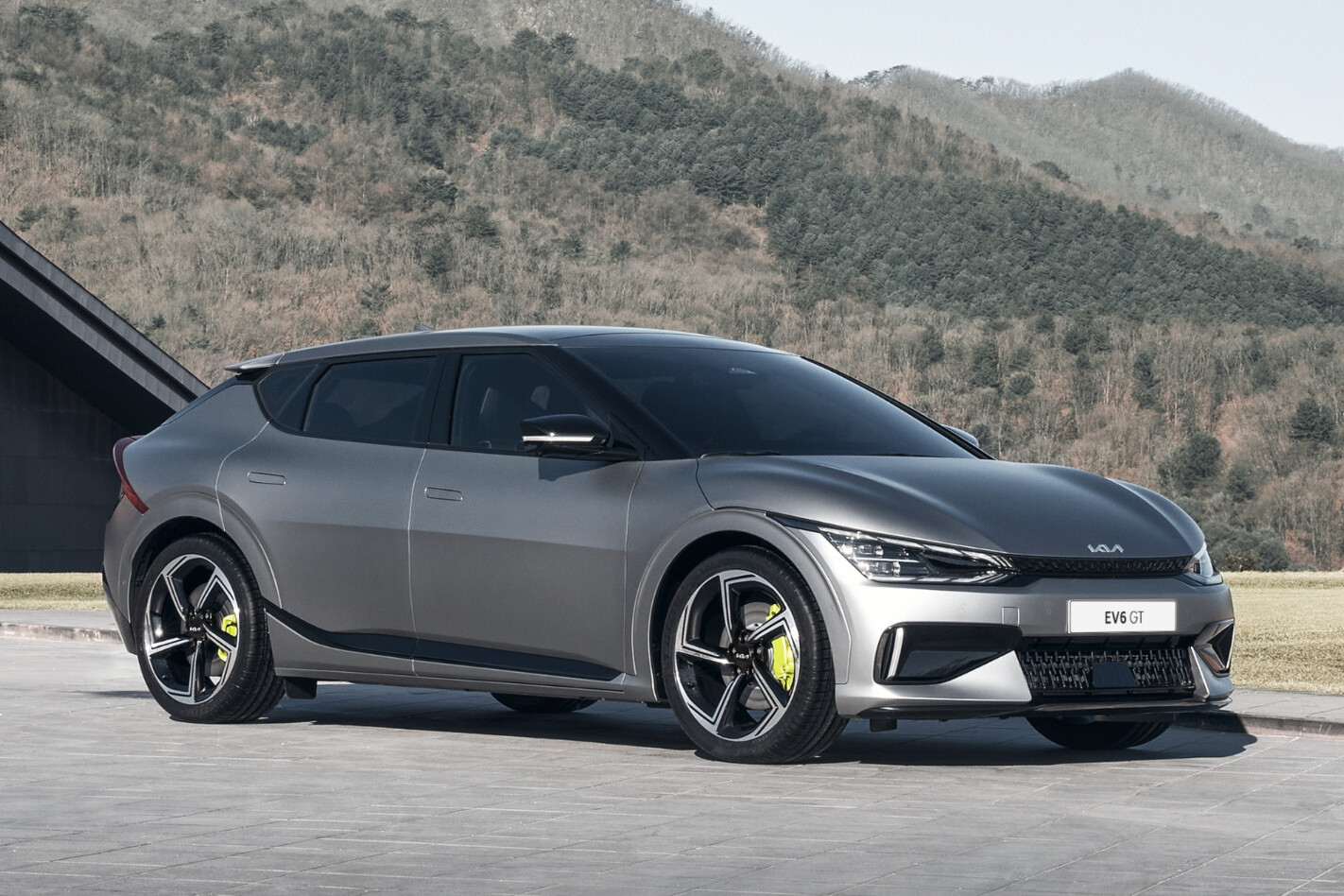
The EV6 GT will also score an electronically controlled limited-slip differential, which should also make for a dynamic driving experience when the going gets twisty.
These astounding performance figures and features mark the EV6 GT out as the fastest car Kia has ever produced, which is impressive considering its circa two tonne weight and family friendly crossover credentials.
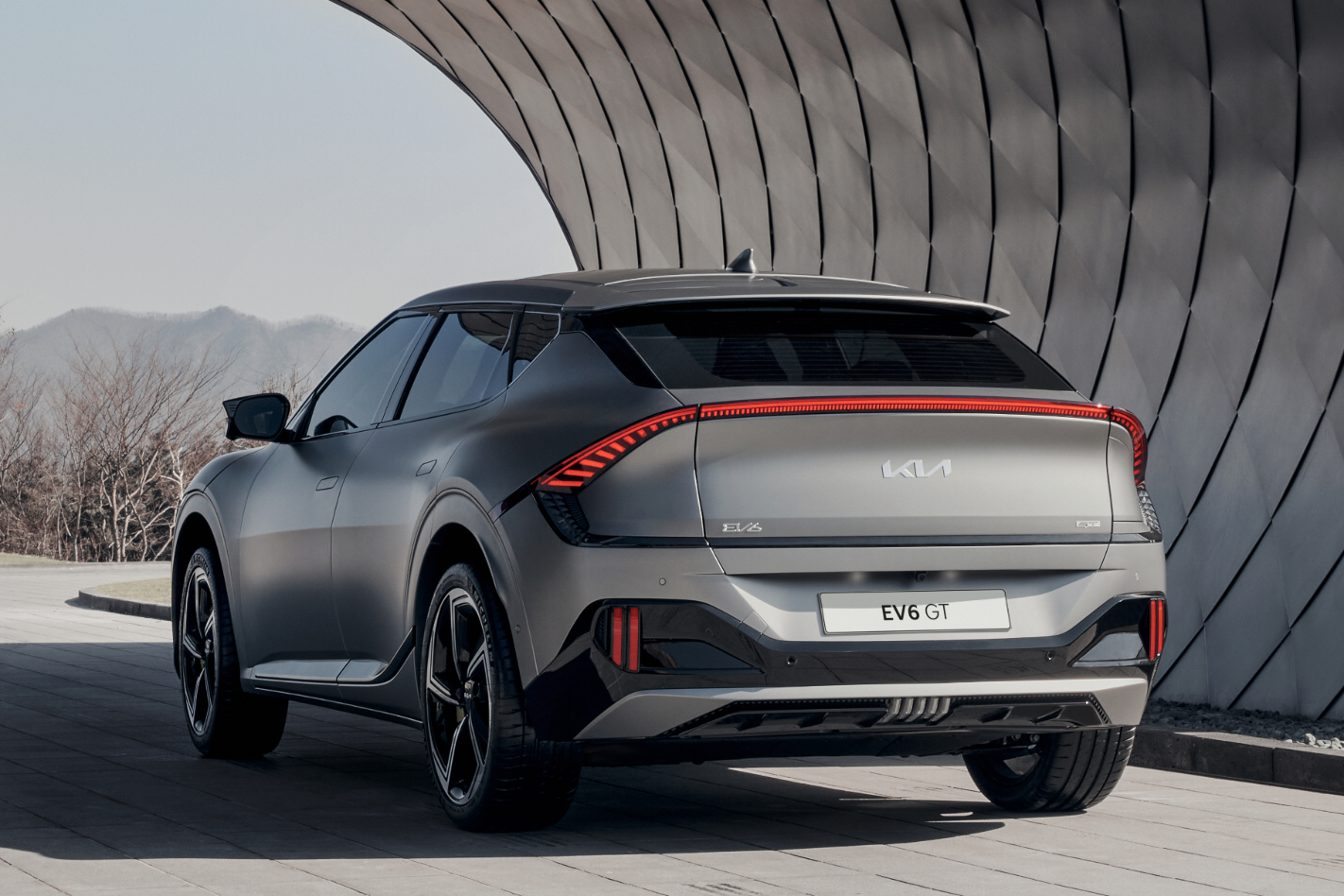
“The GT version of EV6 demonstrates our technological leadership through its combination of outstanding high-speed charging and acceleration performance like a super sports car,” said Albert Biermann, president and head of R&D division for Hyundai Motor Group.
“With our dedicated EV platform, there is no need for compromise between inspiring spaciousness and performance.”
Exterior
The EV6’s handsome exterior showcases Kia’s design language for its future EV models, evolving the quintessential tiger-nose into a new ‘Digital Tiger Face’ that incorporates svelte daytime running lights with a sequential dynamic light pattern and a low air intake that visually widens the front of the car.
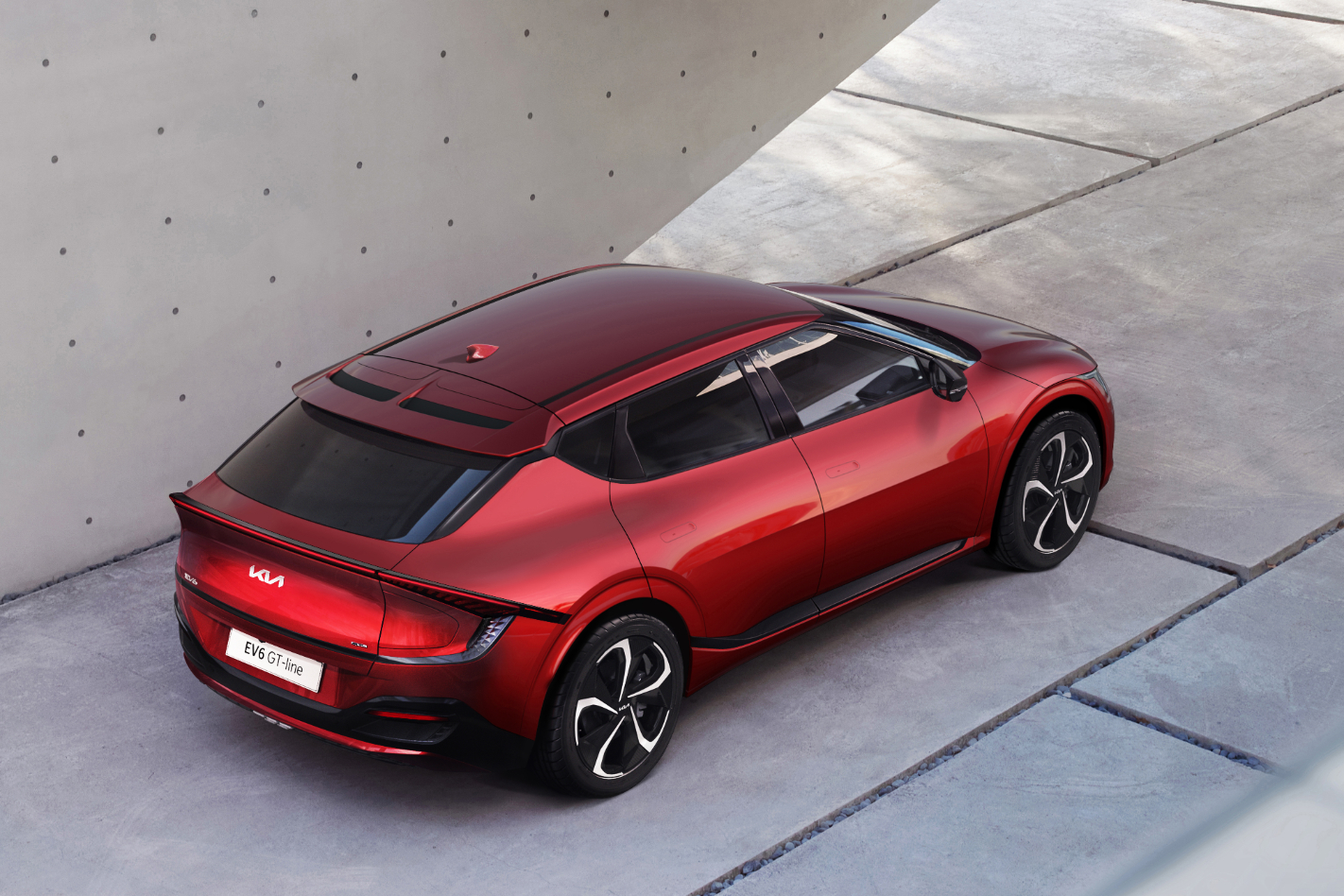
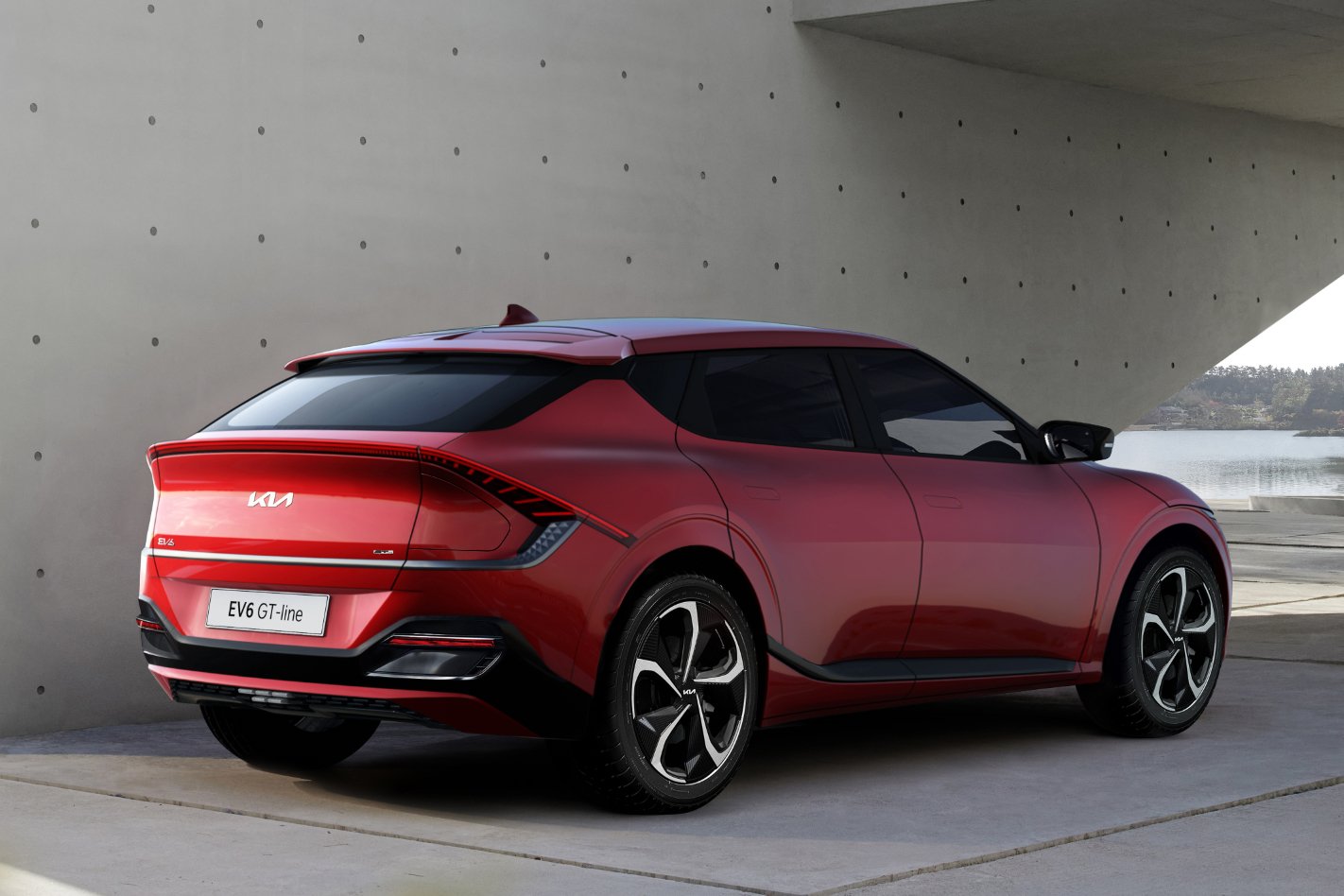
The rear of the EV is treated to a striking, continuous array of red LED lights that span the rear of the vehicle’s concaved tailgate.
Below it sits a blacked-out rear diffuser with vertical red reflector strips and black cutouts that add an additional layer of visual complexity to the rear bumper’s fussy but ultimately good-looking rear end.
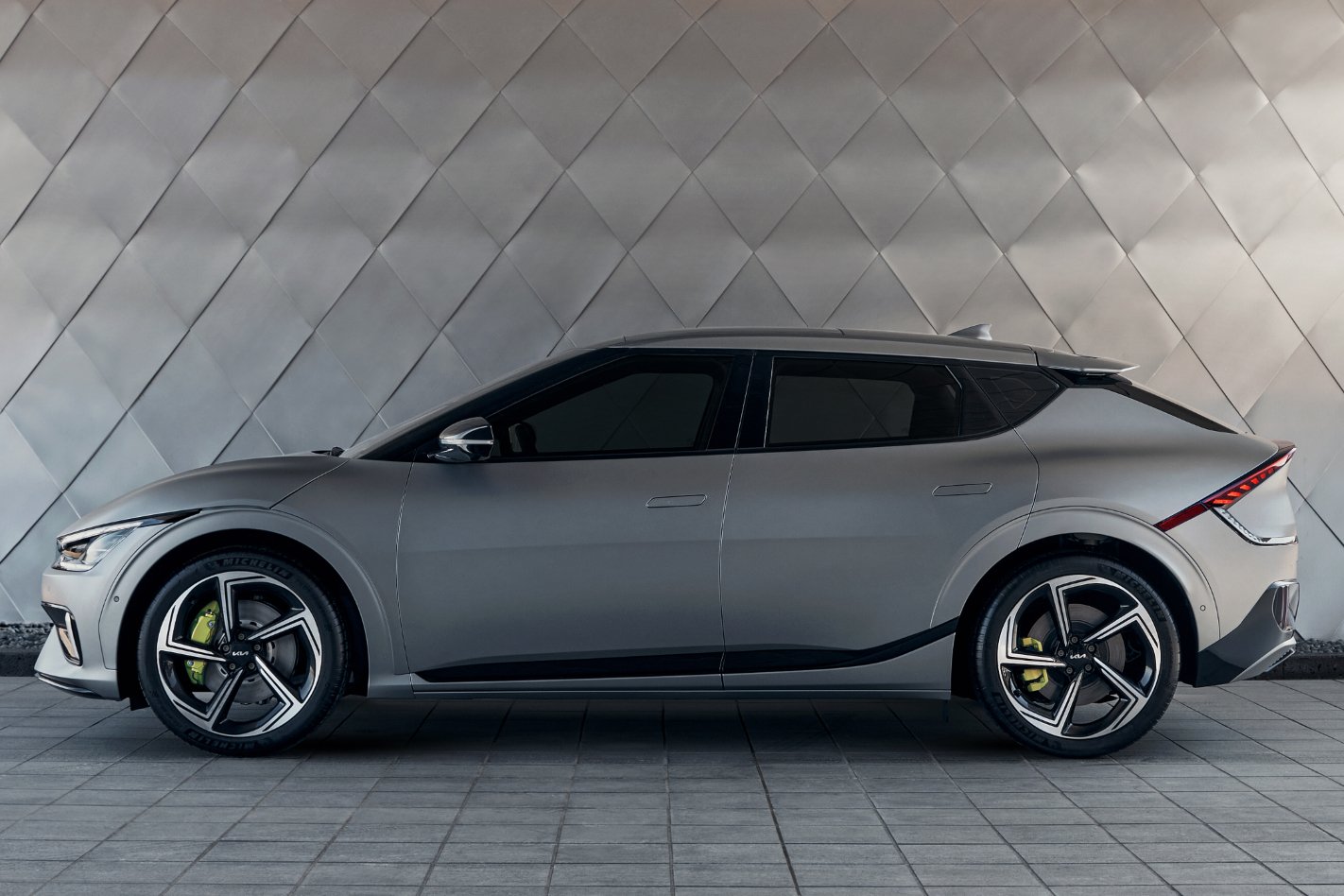
The car’s shooting-brake-like side profile accentuates its dynamic appearance, while short overhangs and both the front and rear of the car indicate another benefit of the E-GMP architecture – cabin space.
Kia claims that thanks to the EV6’s long wheelbase, which measures 2,900mm, and the flat-floor design that the EV’s architecture allows for, the result is an interior size similar to a medium to large size SUV.
As Jochen Paesen, vice president for interior design, explains: “People are first attracted by the exterior of cars, but they eventually fall in love with the interior – where they spend most of their time.
“So, designing an inspiring space for the EV6 was the most important thing for us. We believe EV6 can inspire customers by boosting their creativity.”
Interior
The interior of the EV6 is completely bespoke to the model and has several technical benefits that are new to Kia.
Dual 12-inch curved digital displays blend into one seamless strip across the car’s interior fascia, with one taking the place of a conventional dashboard and the other acting as a touchscreen interface for the infotainment system.
Kia’s ‘Kia Connect’ operating system, formerly known as UVO, comes as standard on the EV6 and allows owners to do things like finding locations for charging points, view the vehicle’s charging status, plan a smart charging schedule and check the vehicle’s range radius.
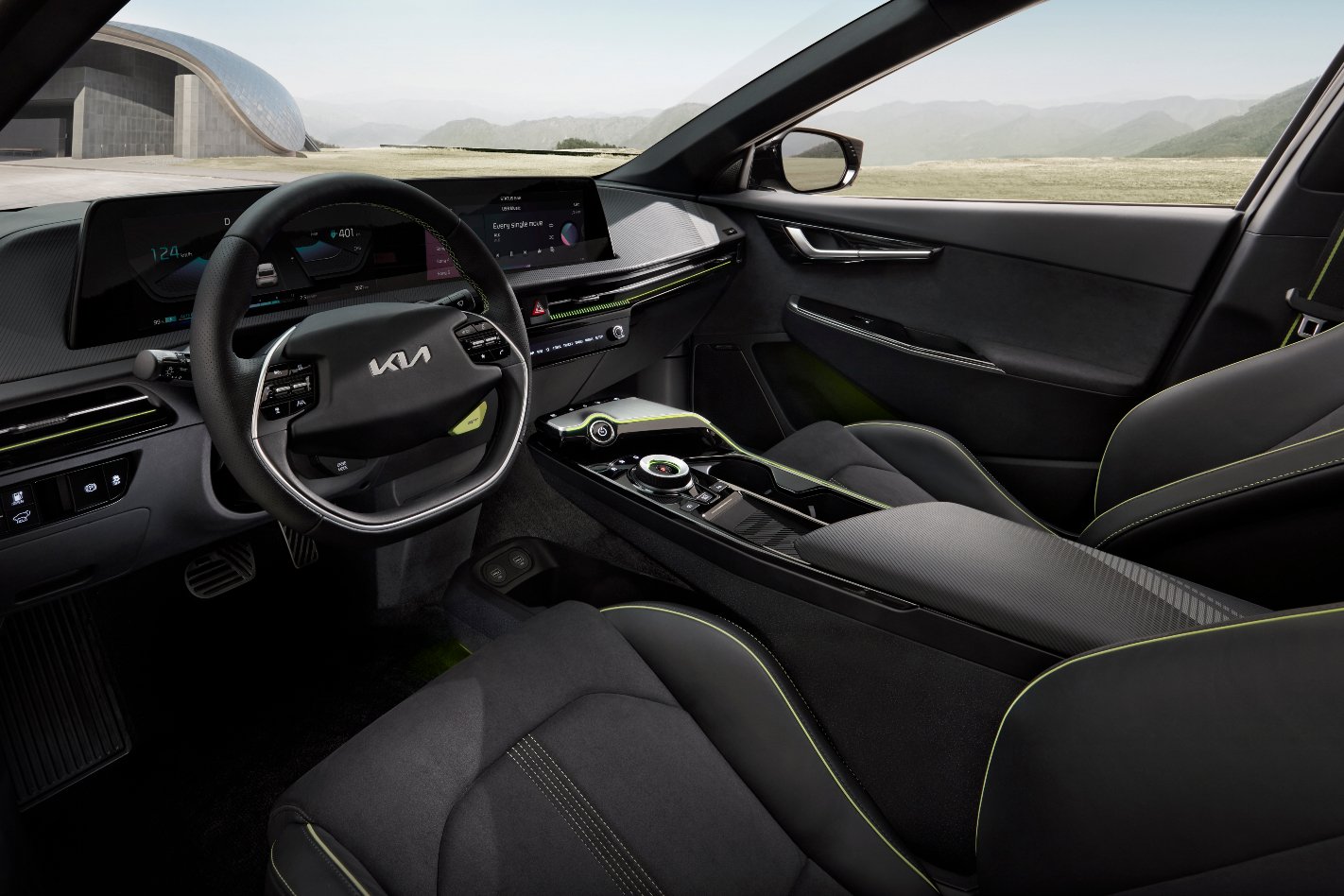
Other features such as Apple CarPlay, Android Auto, and wireless charging are also expected but have not been confirmed.
A 14-speaker Meridian surround audio system is also available, which Kia says will provide superlative audio quality.
The speaker system also gets Active Sound Design (ASD), which gives drivers audible feedback through the speakers, notifying them of the speed that the car is travelling, which can be managed through the user interface.
According to the automaker, the interior of the EV6 has been partially manufactured with recycled plastics equivalent to 111 plastic water bottles.
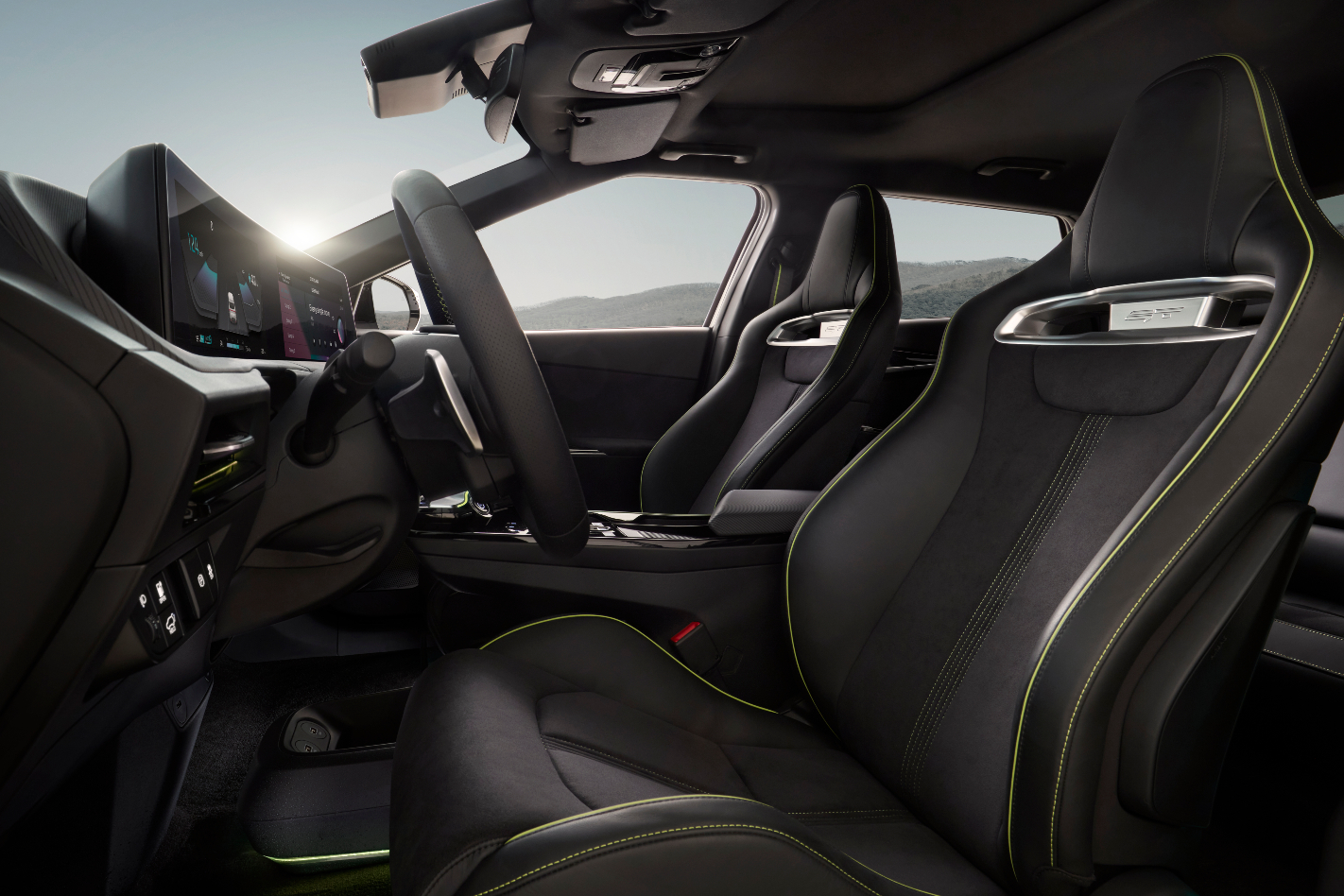
The EV6 also offers 520 litres (VDA) of boot space with second row seats in place and approximately 1,300 litres of storage with the second row seats folded down.
The car also scores a ‘frunk’ that provides up to 52 litres of storage space for 2WD models and 20 litres for AWD models.
Safety
An augmented reality head-up display system is also equipped, which displays driving information onto the windscreen’s base, ensuring it is legible for the driver.
The head-up unit can display notifications from the car’s Advanced Driver Assistance System, such as vehicle speed and navigational instructions.
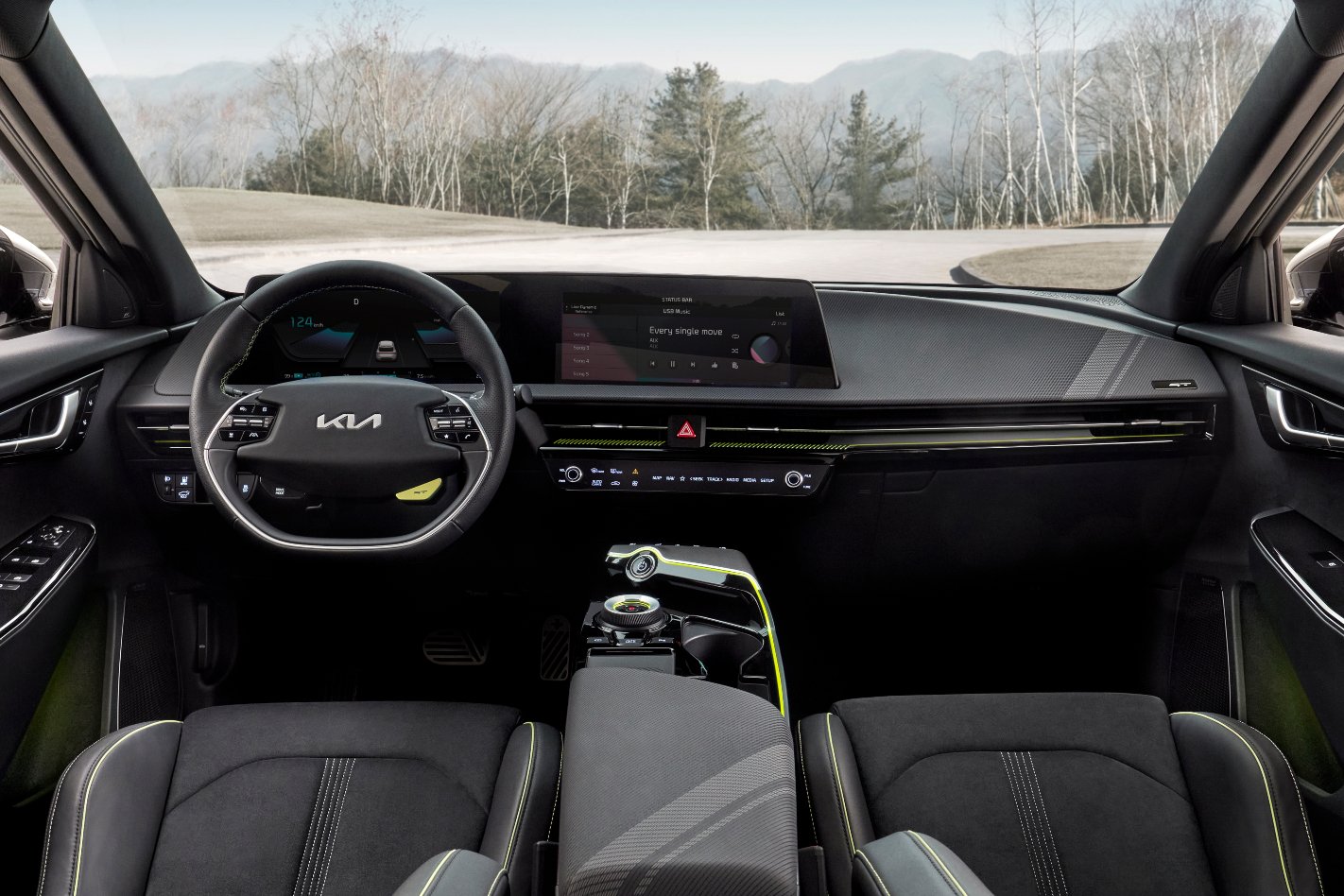
Kia says the EV6 will come with ‘Level 2’ autonomous driving functions and safety features such as Safe-Exit Assist (SEA), Lane-Following Assist (LFA), Highway Driving Assist 2 (HDA2), and Remote Smart Parking Assist (RSPA).
Sales and availability
The EV6 is projected to be a crucial car for Kia and its future EV direction, with the carmaker expecting to sell 100,000 units of the vehicle in total.
Of that 100,000, 30,000 units are expected to be sold in Kia’s domestic market, 40,000 units will be sold in the European market, 20,000 units will be sold in the North American market and other regions will make up the remaining 10,000 units to be sold.
Kia Australia has confirmed to WhichCar that Australia will be receiving the EV crossover, and production is due to begin in Q4 of this year.
However, we do not know when the EV6 will arrive Down Under, nor do we know how much it will cost.
Be sure to watch this space and circle back to WhichCar for all the latest on Kia’s EV6.
What is the Renault Captur Intens?
This is the range-topping variant of the second-generation model of Renault’s popular crossover. Okay, when I say popular I mean in Europe, where the Captur pioneered the light SUV segment in 2013 and has since dominated it with 1.5 million sales.
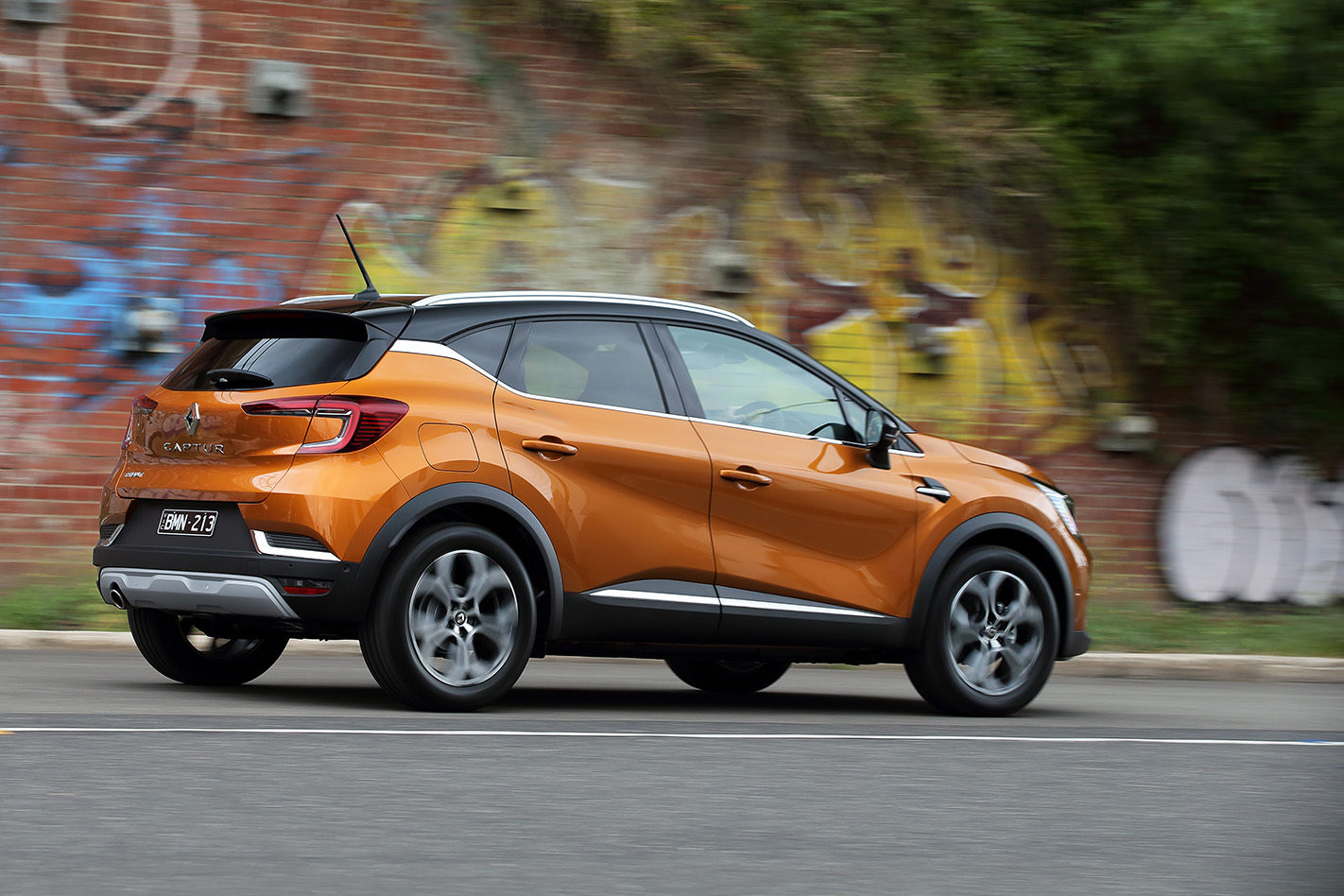
In Australia, it’s been a niche seller at best, but this new model brings additional space, power, refinement and a sharper-looking athletic design that should make it more attractive to local buyers.
Priced from $28,190 before on-roads, the Captur goes on sale here in April 2021 with three variants; Life, Zen ($30,790) and the Intens that’s priced from $35,790.
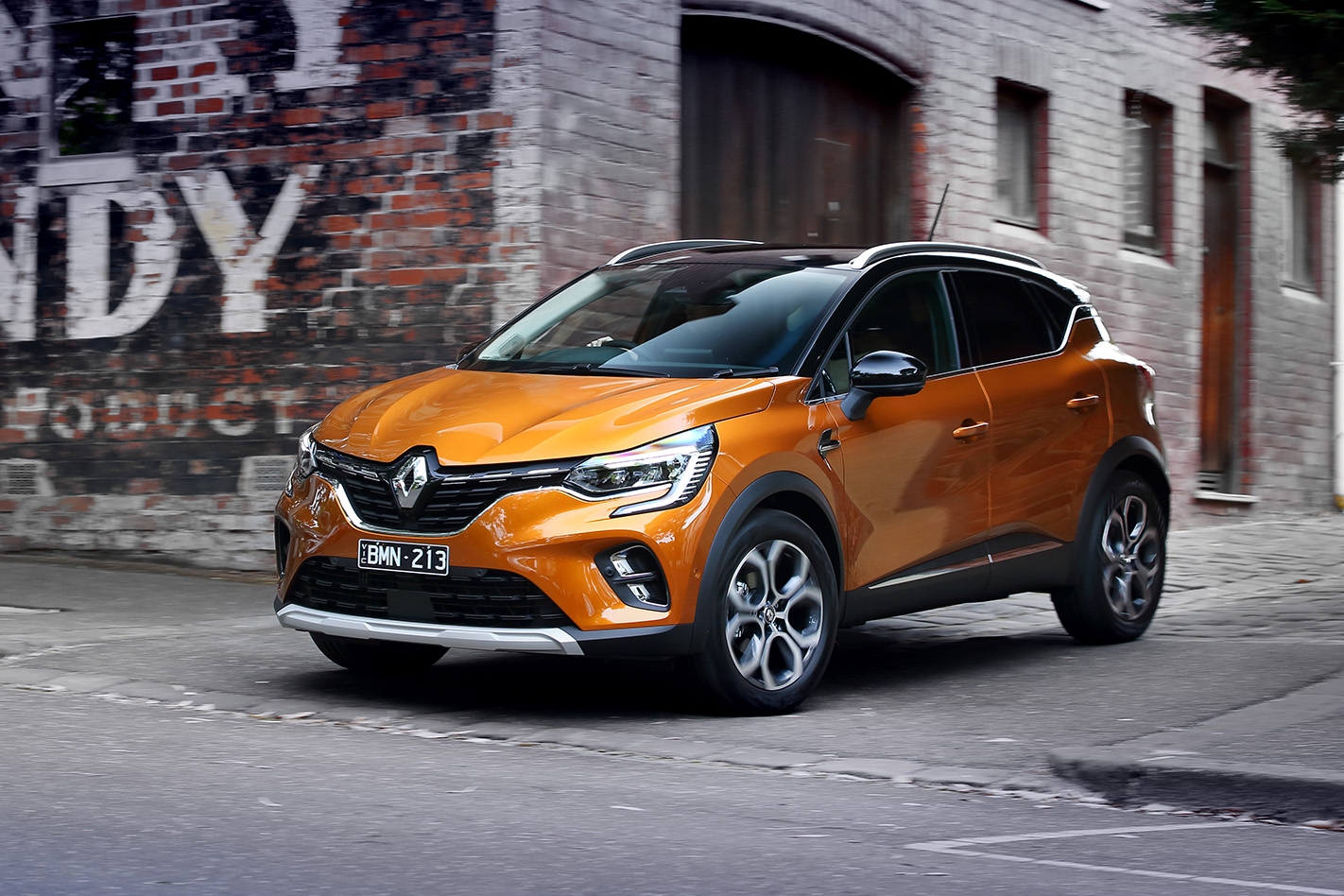
All come with 113kW/270Nm 1.3-litre four-cylinder turbocharged petrol engine, which gains 22kW/60Nm over the outgoing model to be one of the most powerful in a segment dominated by smaller three-cylinder turbos as per the Ford Puma, Nissan Juke, Kia Stonic GT-Line, Toyota Yaris Cross and Volkswagen T-Cross.
The Intens stands out in the Captur range with exclusive kit, including a new 9.3-inch portrait-orientated touchscreen, 360-degree parking camera, digital instrument display and a host of other extras which we’ll go into below.
What is the Renault Captur Intens like to live with?
The new Captur is 110mm longer than the previous model, resulting in a 36mm-longer wheelbase that brings an additional 17mm rear knee room and translates to one of the roomiest cabins in its class.
The Intens comes with leather front seats that are firm but comfortable and feature stylish curved headrests, side bolstering and good under-thigh support.
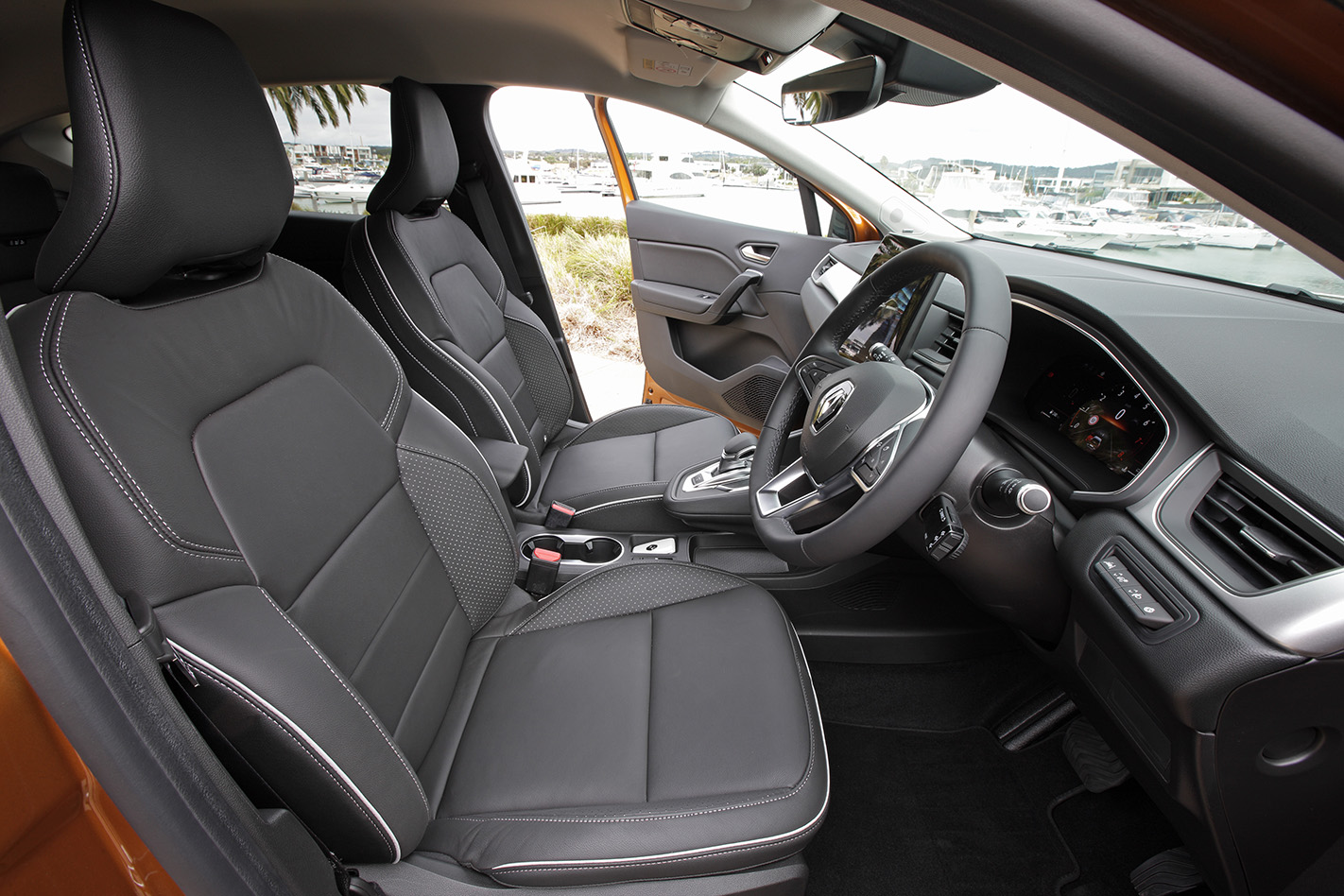
The driver’s seat has power adjustments and a manual lumbar support setting and both seats are heated, as is the leather steering wheel.
The Intens is also the only Captur variant to feature the ‘flying centre console’, which juts out from under the dash to house the gear shifter and a place to plug in your phone. It appears to float over a more conventional but low-lying central compartment with the obligatory cupholders, a place to put the Renault keycard and a small tub with a sliding armrest.
The rear seats, which comfortably seat two adults, also have good under-thigh support but the fixed backrest feels a little too upright.
Taller people will be happy with the knee-room behind an average-sized driver but will find headroom a bit of a squeeze. There is no fold-down centre armrest and the middle seat will accommodate a small child at best.
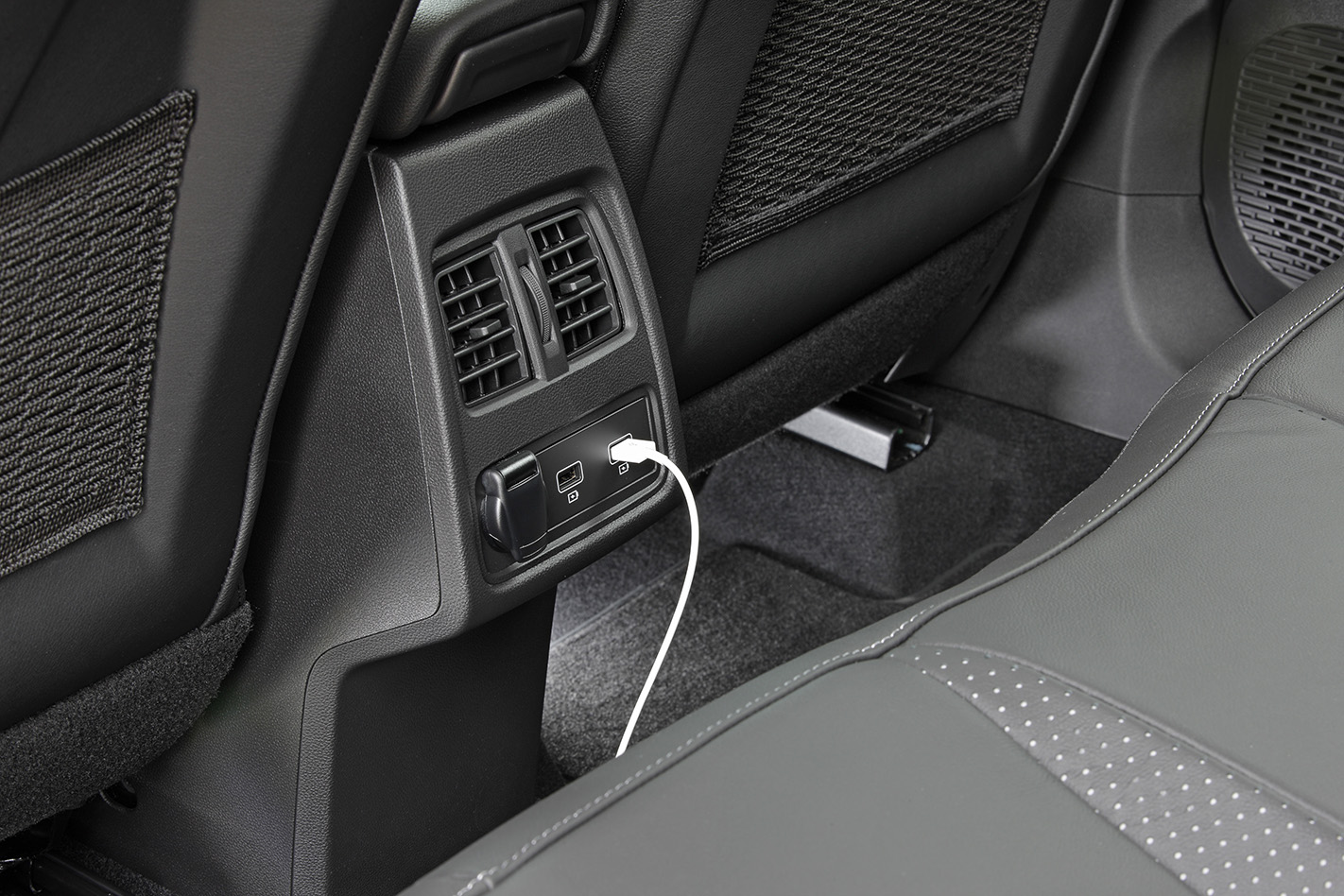
The Intens also has dedicated air vents located at the back of the centre console along with two USB ports and a 12v socket.
Side vision in the back seats is a little limited as the passenger’s head is in line with the C-pillar, but it’s okay when looking a little forward.
With a low rear overhang, the Captur also has one of the biggest boots in its class, which is able to fit up to 536 litres, up 81 litres from the previous model. This is mostly achieved by the forward-sliding rear seats that can increase load length by 110mm (at the expense of legroom). With the 60:40 split seats folded down, it can hold up to 1275 litres including objects up to 1.57m long.
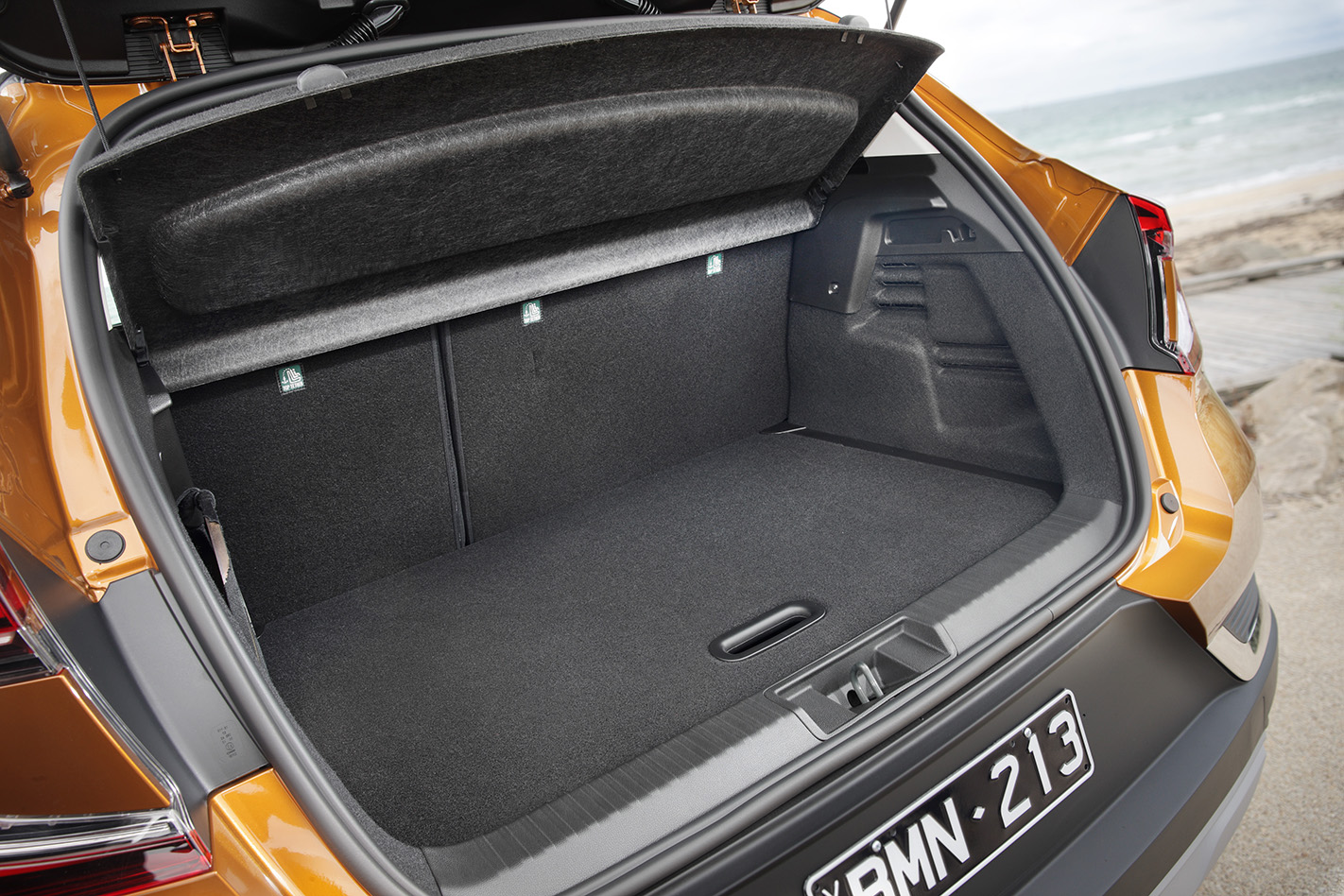
A false floor allows you to separate items and the entire cargo area sits above a space-saver spare wheel.
The Captur Intens also comes with a nine-speaker BOSE premium audio system that has a subwoofer mounted in the boot, though Renault points out this is located behind the boot wall and doesn’t take up any space.
If you need to carry more, the Captur has roof rails to install racks and has a 1200kg braked towing capacity (660kg unbraked).
The cabin is attractive and well put together with soft surfaces on the dashboard, doors and other touchpoints. With the black leather seats, things are a little monotone but you can option two-tone black and orange leather upholstery.
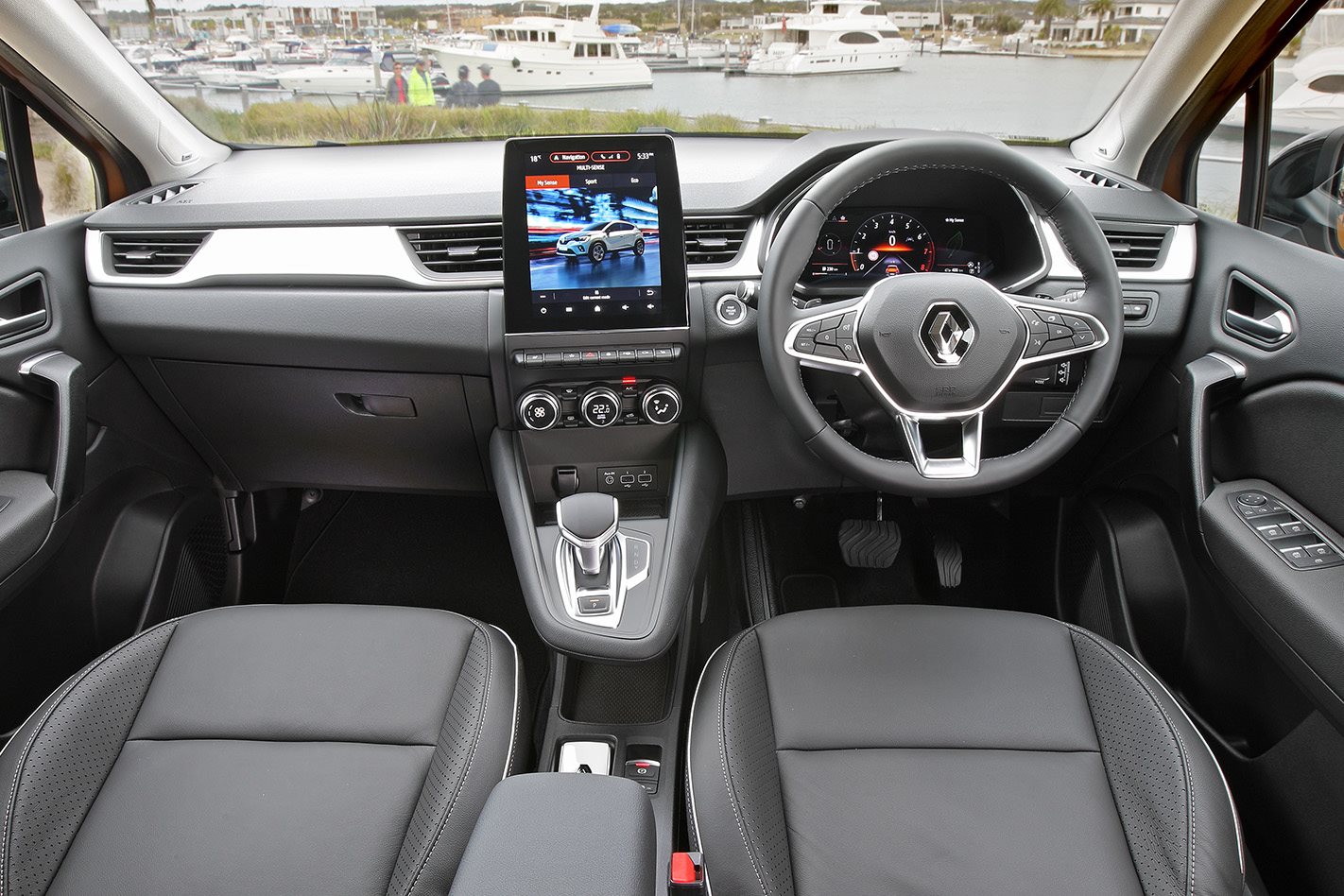
The dashboard itself is dominated by the 9.3-inch portrait orientated touchscreen that pokes up above a set of simple to operate climate control dials – the Life and Zen come with a 7.0-inch landscape-orientated touchscreen
The infotainment system is quite intuitive, though it pays to play around with it for a while before driving so you’re not distracted while trying to find things. Similar to a Volvo, the interface is based around three displays that you access by swiping across. These include the digital dashboard, ‘Multi-Sense’ driving settings and phone controls. There are also tabs at the top that easily allow you to select a main menu and switch between the default Renault display and Apple CarPlay or Android Auto. It also has a 360-degree parking monitor to help you avoid obstacles.
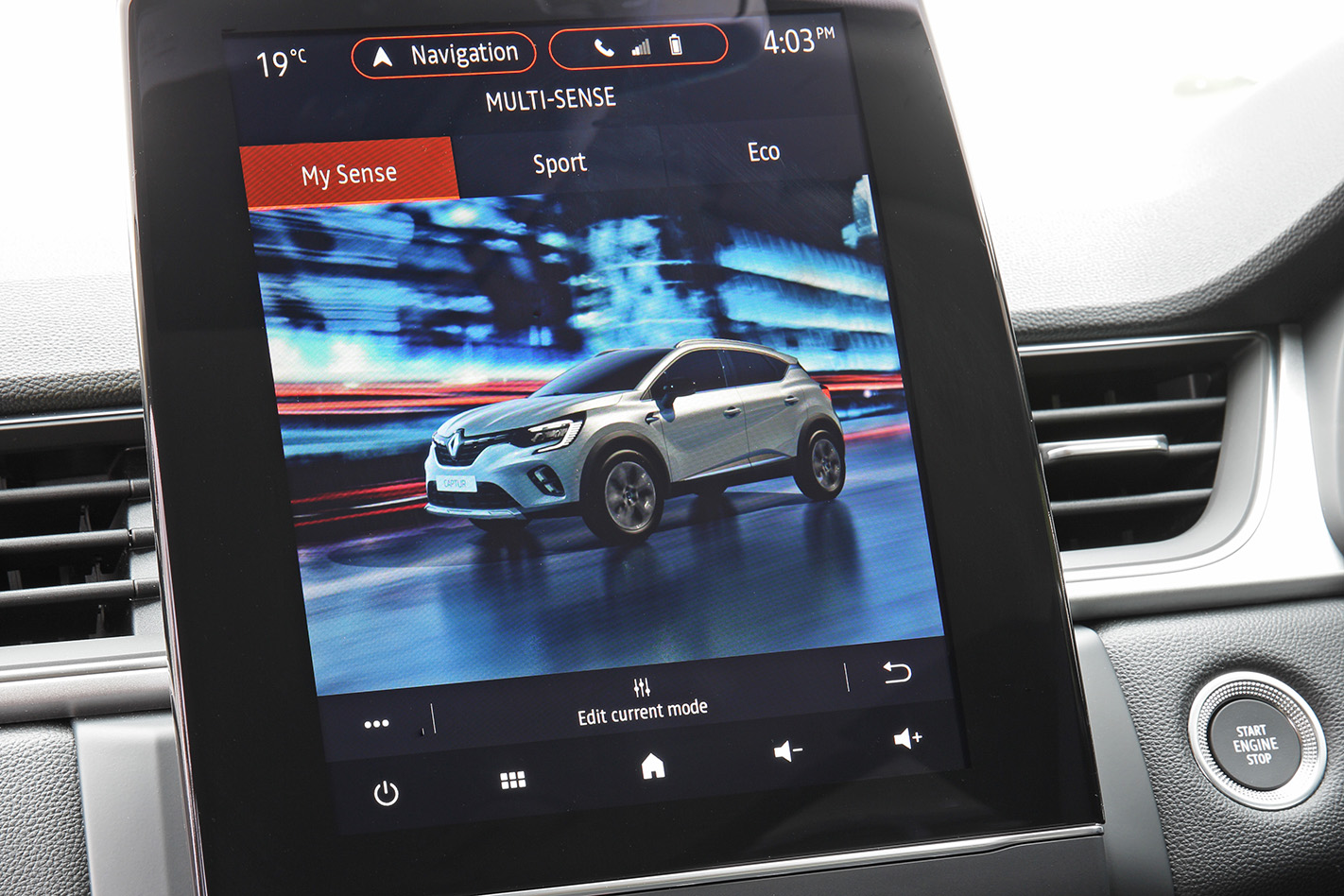
The Multi-Sense drive modes are also exclusive to the Intens spec, comprising Normal, Sport and Eco settings that alter the engine’s rev mapping and steering accordingly and also change the display in the optional 10.25-inch digital gauge cluster to suit. There is also a customisable My Sense mode that lets you change either feature independent of the others.
All exterior lighting is LED, with the Intens adding brighter headlights and tail-lights with a fancy animation sequence when you start the car at night.
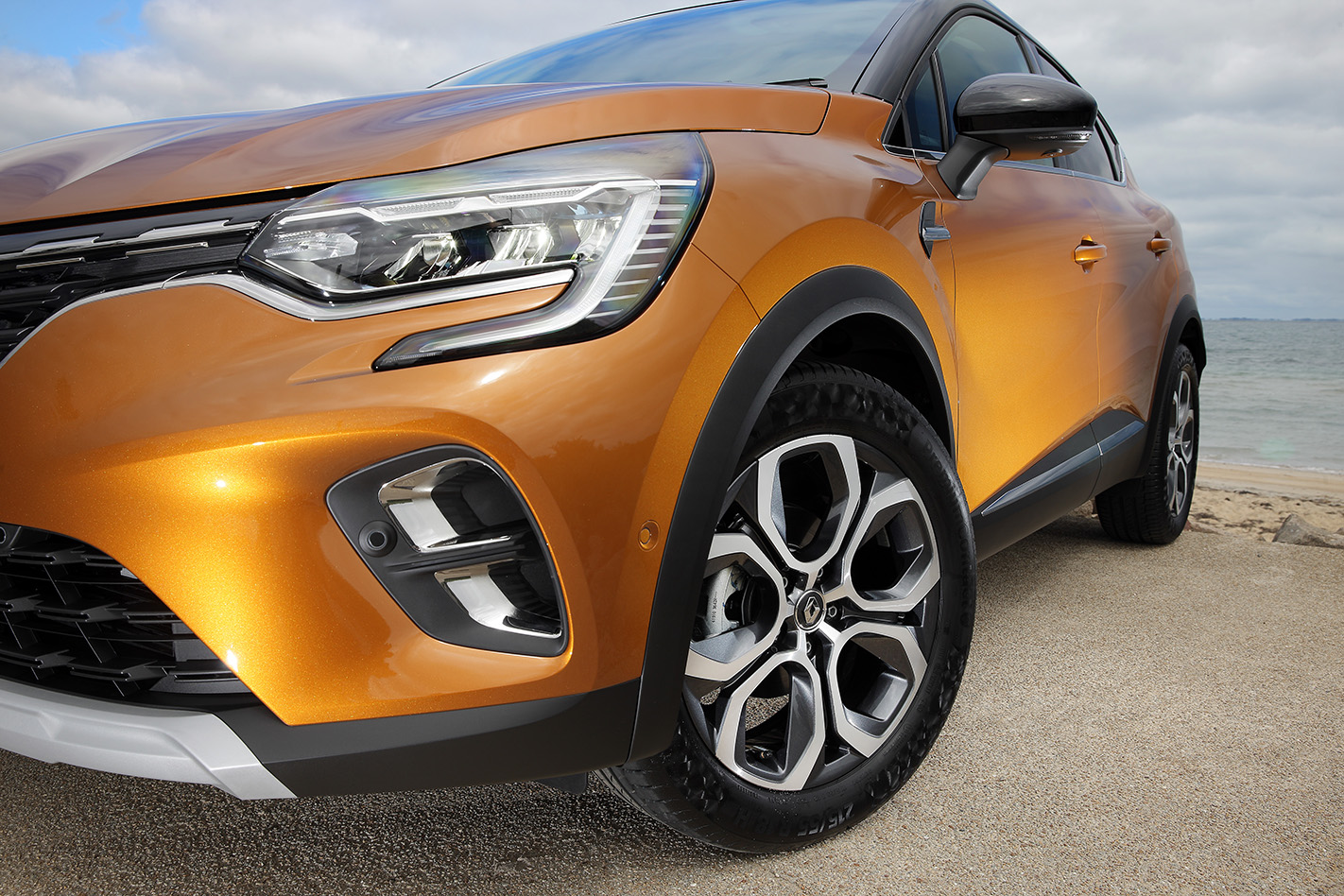
Other features exclusive to this priciest Captur include an auto-dimming rear-view mirror, satellite navigation, privacy glass, exterior chrome highlights, 18-inch alloy wheels over the standard 17s. One notable omission for the price is adaptive cruise control, which is a $500 extra and has a stop-and-go function for operating in heavy traffic.
The 10.25-inch digital driver’s display is also optional and only available if you spend an extra $2000 on the Easy Life Package that also brings hands-free parking, side parking sensors, automatic high-beam and a frameless auto-dimming rearview mirror.
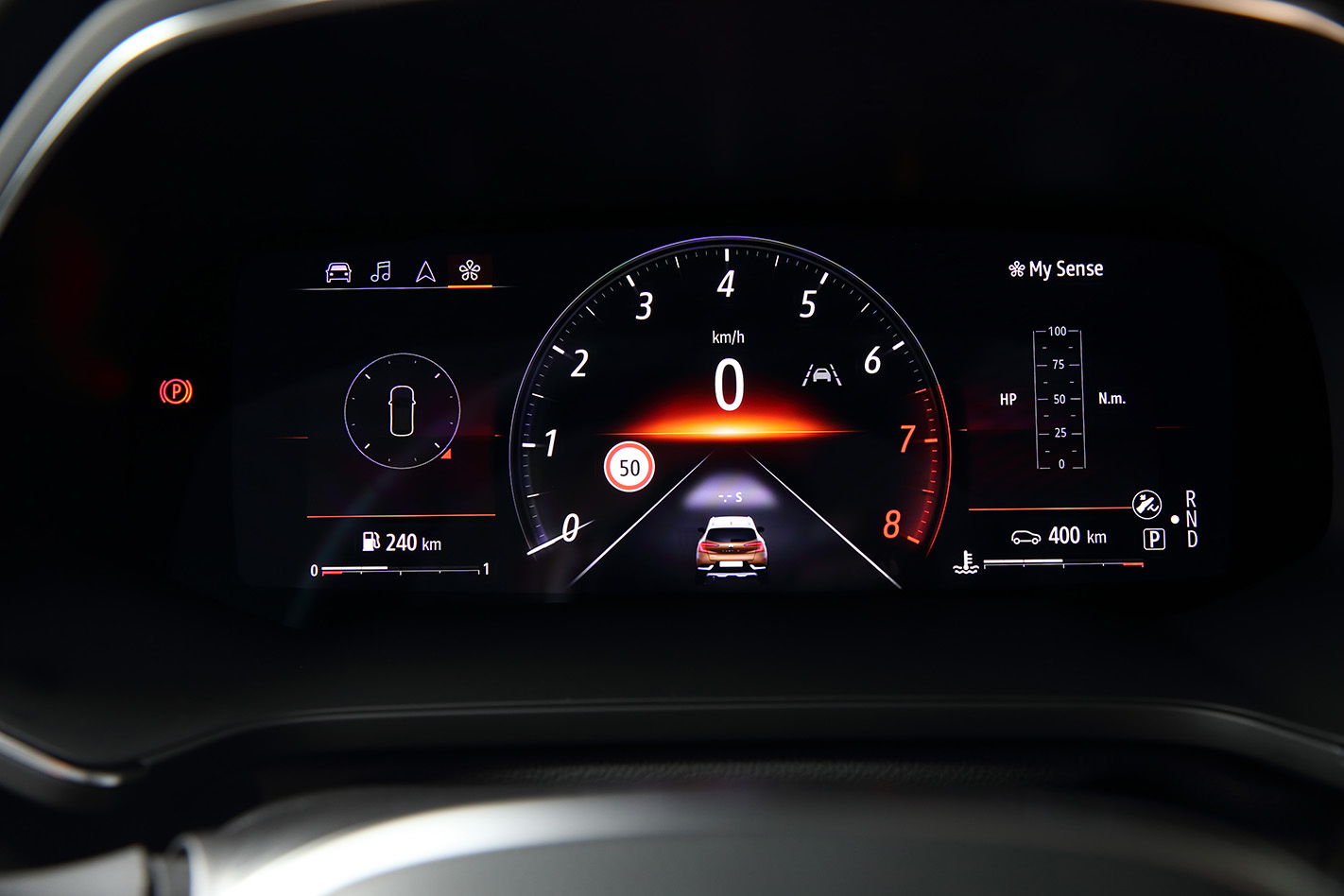
Along with the Atacama Orange metallic paint ($650) this pushed the retail price of our test vehicle to $38,440.
Operating costs after you’ve forked out that money are reasonable. The Captur has an official combined fuel economy of 6.6L/100km, which was about on par with my real-world driving, but it only drinks more expensive RON 95 or RON 98 premium unleaded.
Service intervals are 30,000km or 12 months, whichever comes first, with the first three scheduled services priced at $399, the fourth at $789 and the fifth at $399.
The Renault Captur is covered by a five-year, unlimited-kilometre warranty.
What is the Renault Captur Intens like to drive?
Small crossovers are coming into their own now, newer models being built on platforms designed with high-riding SUVs in mind. The Captur is no exception. Unlike the Koleos and the discontinued Kadjar that respectively share underpinnings with the outgoing Nissan X-Trail and Qashqai, the Captur is the first Renault SUV to be built on the new Common Module Family, B-Segment (CMF-B) platform that also underpins the latest Nissan Juke.
As well as providing additional space, the CMF-B is lighter and tauter than the old chassis, which, along with wider front and rear tracks, brings noticeable improvements to ride and handling.
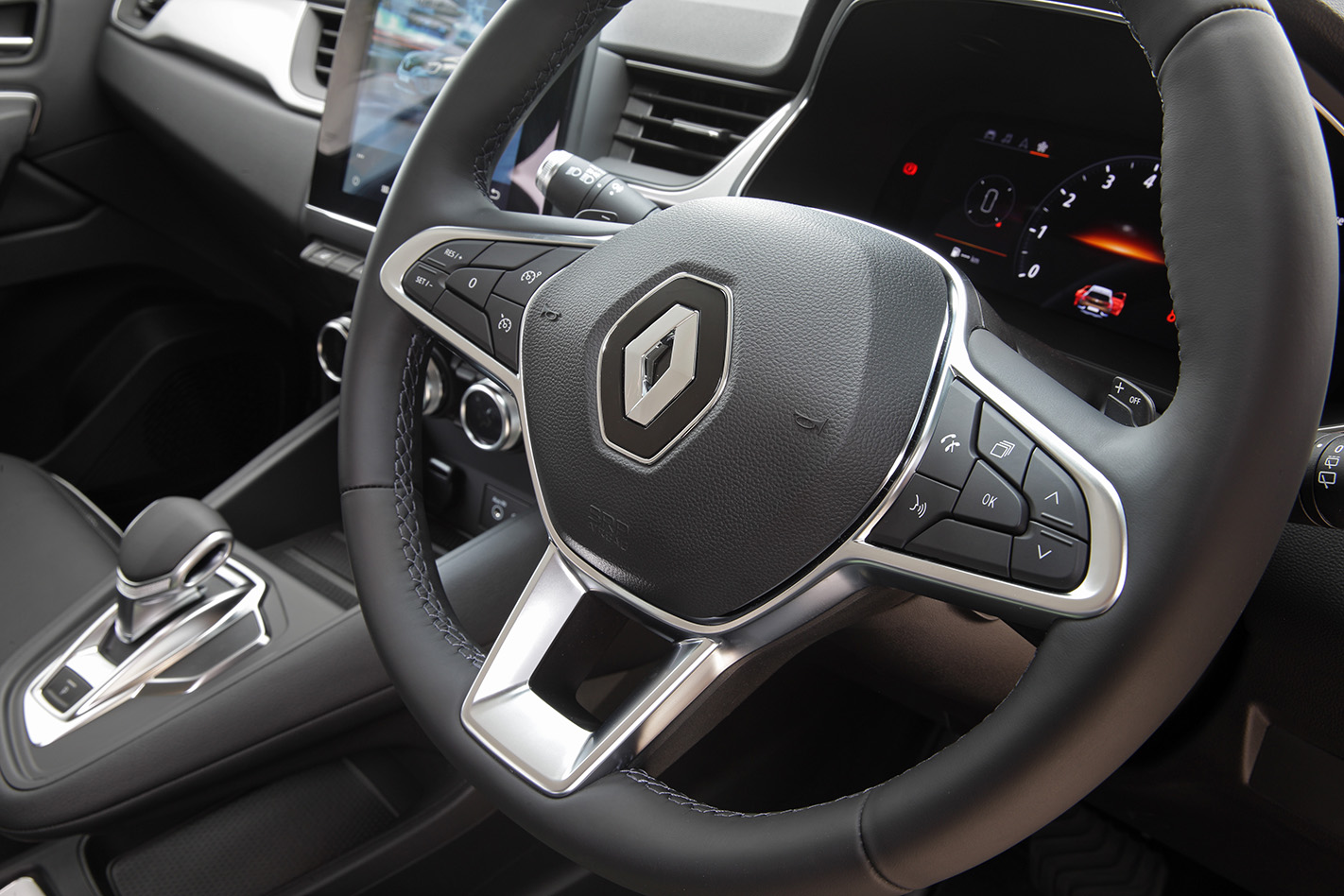
A chunky leather steering wheel feels well connected to the front wheels. It’s nice and light and stiffens a little when selecting the Sport driving mode.
The Captur is nimble around town and cruises nicely on freeways and felt surprisingly stable on rough country roads, including gravel, helped by the 18-inch Continental Premium Contact 6 tyres that feel grippy on all surfaces.
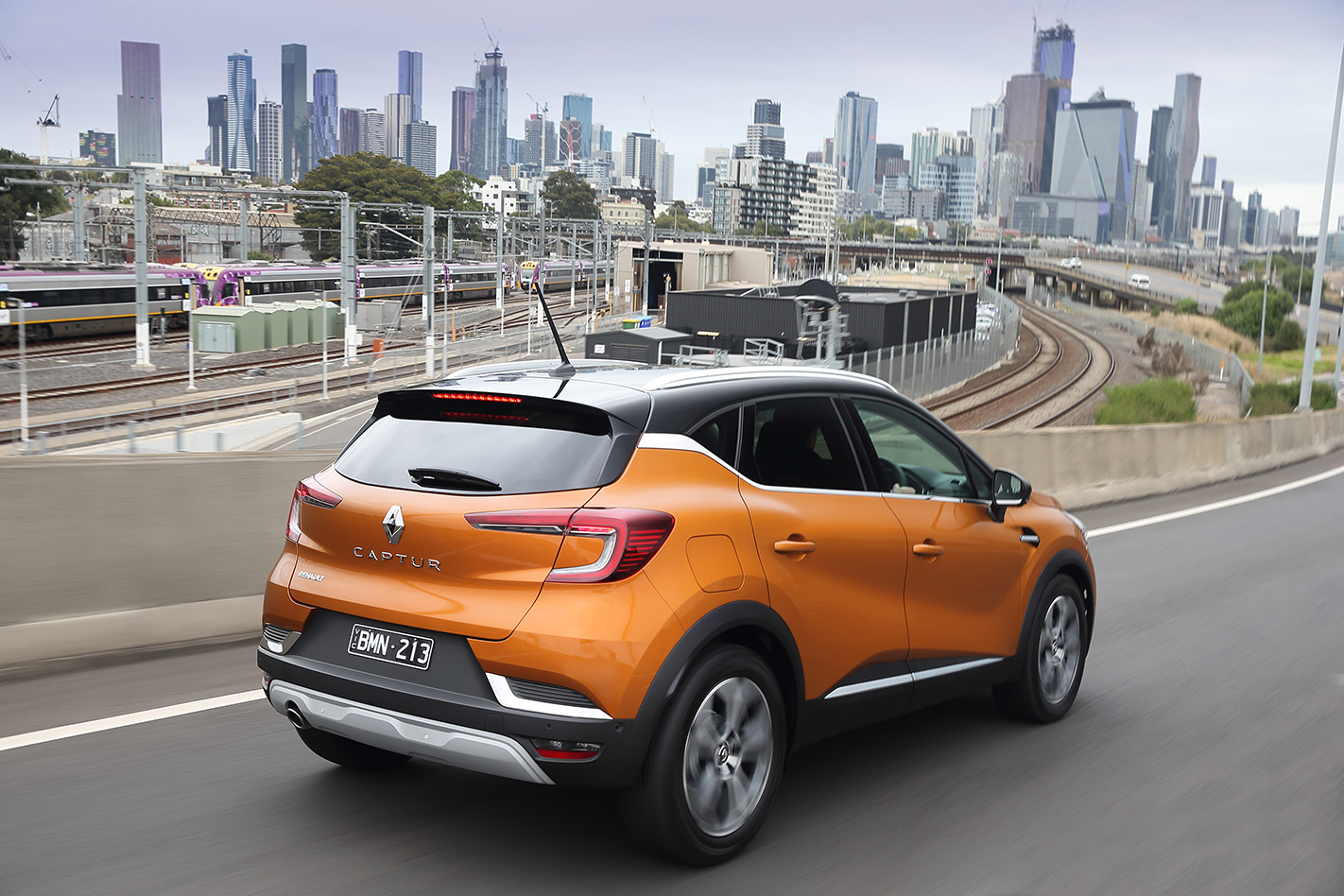
Its suspension provides a good compromise between ride and handling on most surfaces. While I didn’t seek to test the Captur as a country cruiser I actually enjoyed driving it in the bush, including on bendy roads where body roll was well contained.
The 113kW/270Nm 1.3-litre four-cylinder turbocharged TCe 155 engine, co-developed with Mercedes-Benz and found in the A-Class, is a gutsy little thing and cruises along effortlessly at higher speeds where there’s always a bit of additional power on tap.
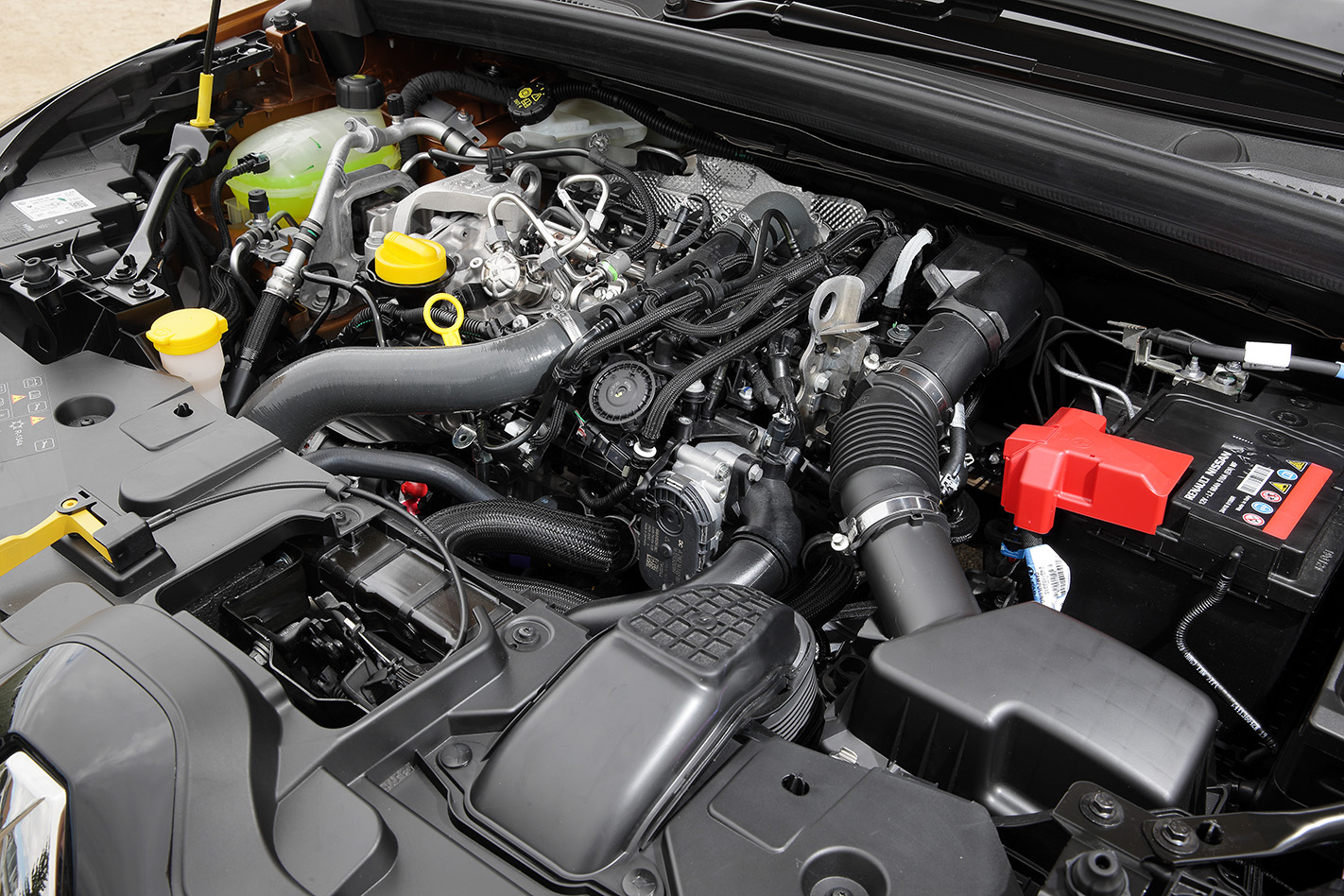
However, as with the Mercedes-Benz A180, it exhibits quite a bit of lag through the dual-clutch automatic transmission, which is evident across the rev range not least from a standing start.
This can be a little unnerving if, say, trying to beat another car through a roundabout. That lag is lessened a little in Sport mode, which lets you reach peak power and torque quicker.
That said, when the Newtons finally do kick in, the Captur is prone to a little torque steer, particularly if the front wheels aren’t pointing straight. If you’re not ready for it, it will want to lurch in the direction they are pointing and this can also make entering a roundabout interesting.
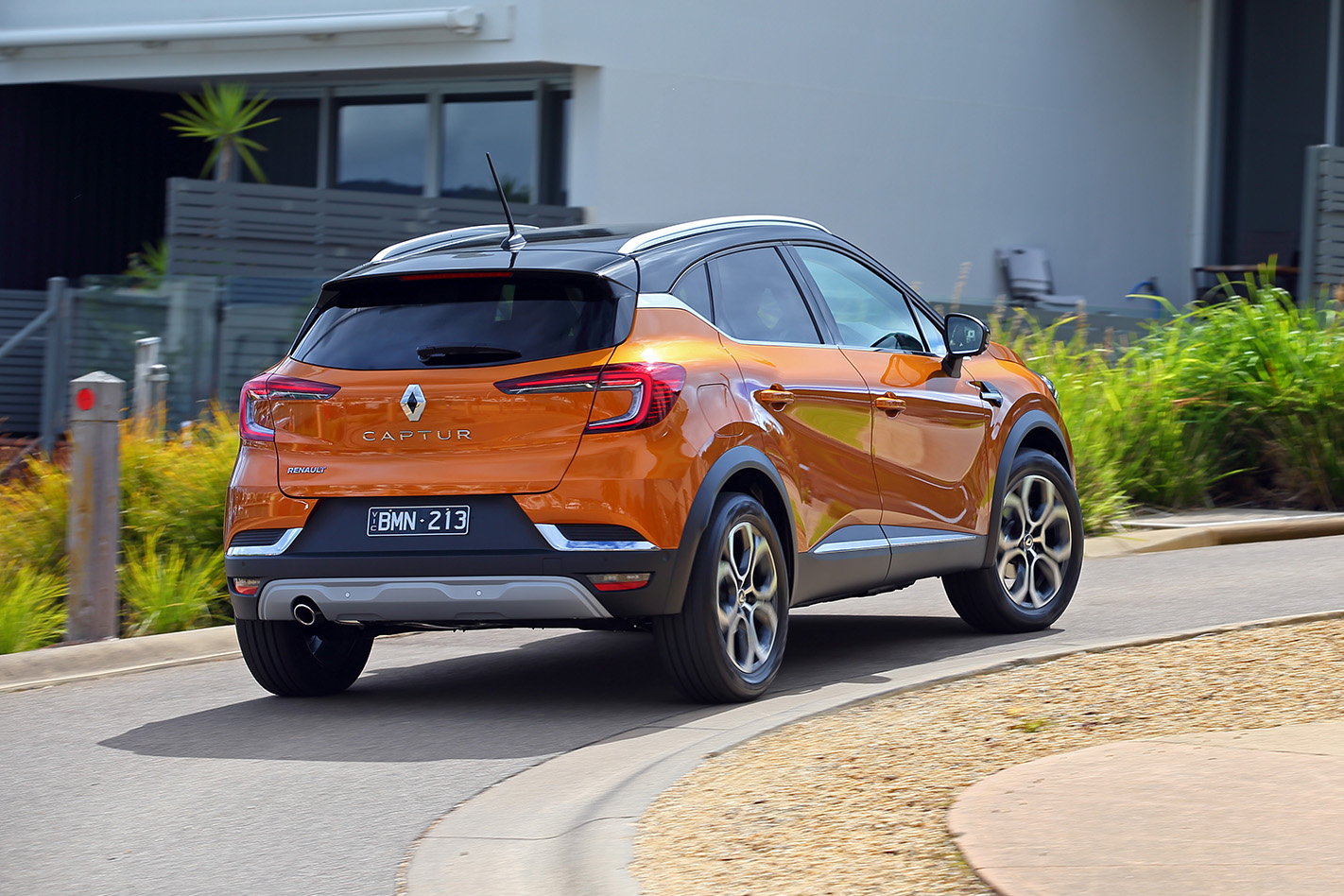
You do learn to manage all that though, and once you’re through the lag the engine always seems to have enough power on tap for over taking even at higher speeds. Here, the dual-clutch auto comes into its own on the move and shifts up and down the gears seamlessly.
The Captur is a reasonably quiet car, with cabin noise claimed to have reduced by 2dB compared to its predecessor, though tyre noise is a little high on coarser surfaces.
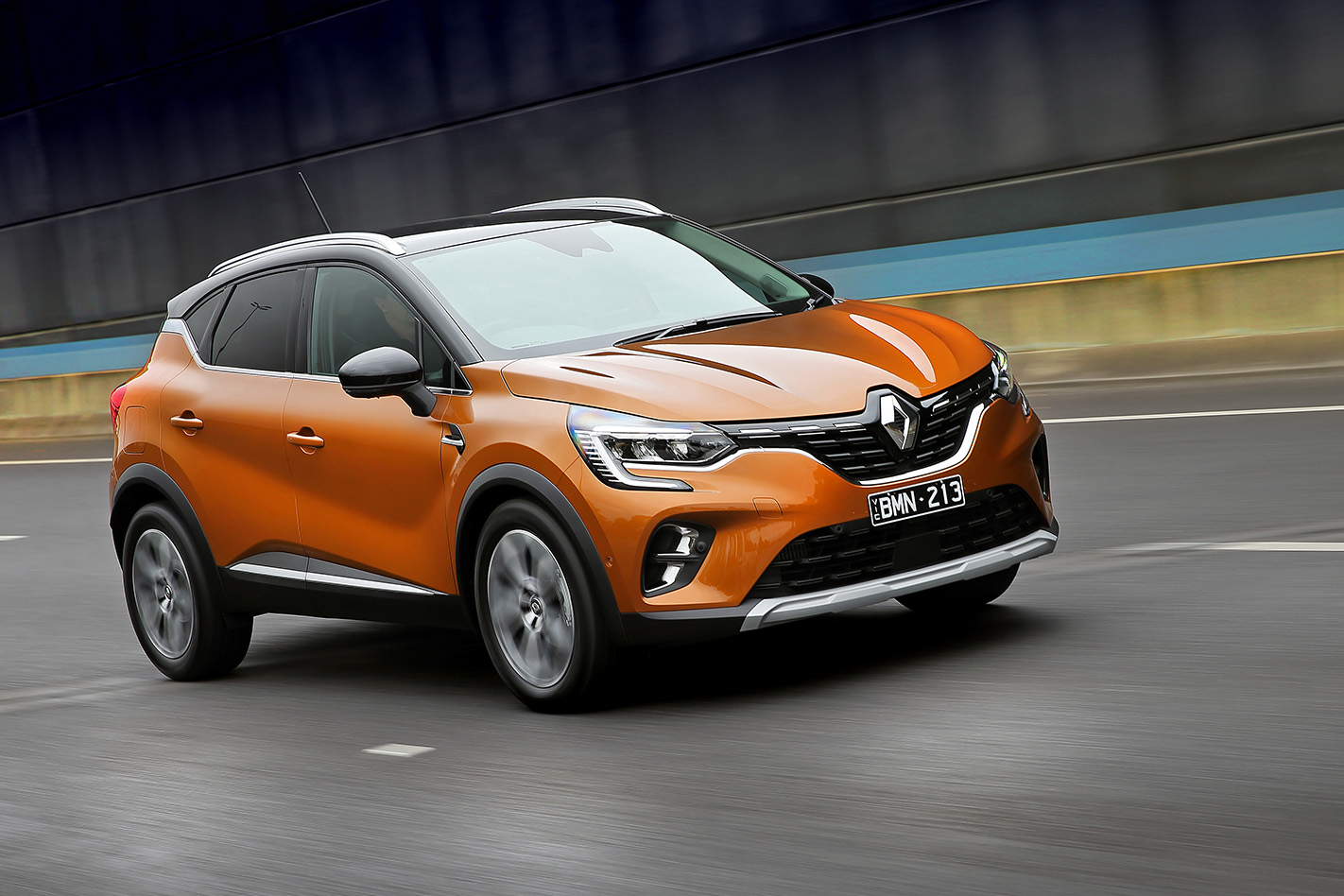
In short, the Captur offers an enjoyable and comfortable driving experience on all roads that and kind of makes up for Renault’s decision to virtually do away with its hatchbacks in Australia.
How safe is the Renault Captur Intens?
The Captur was awarded a five-star EuroNCAP in 2019, with testing used to gain a five-star ANCAP rating, due in part to its autonomous emergency braking with pedestrian and cyclist protection.
Other standard safety and driver-assist features include lane departure warning, lane keep assist and traffic sign recognition. The Zen and Intens versions also feature blind-spot warning and rear-cross traffic alert though, as mentioned above, adaptive cruise control is an extra cost option in the Intens and the mid-spec Zen. All versions come with standard cruise control including a speed limiter.
The Captur has six airbags; driver and passenger front, driver and passenger side and front and rear curtain inflators.
Rear outboard seats have ISOFIX child seat anchors and there are three tether points.
The Verdict
The Renault Captur is one of the more handsome light SUVs on the market, which will certainly add to its appeal along with its driveability.
If you like what you see and can afford to, I suggest going all the way with this Intens spec with the Easy Life package whose 10.25-inch digital driver display adds to the premium Euro feel that helps sets it apart from some of its rivals.
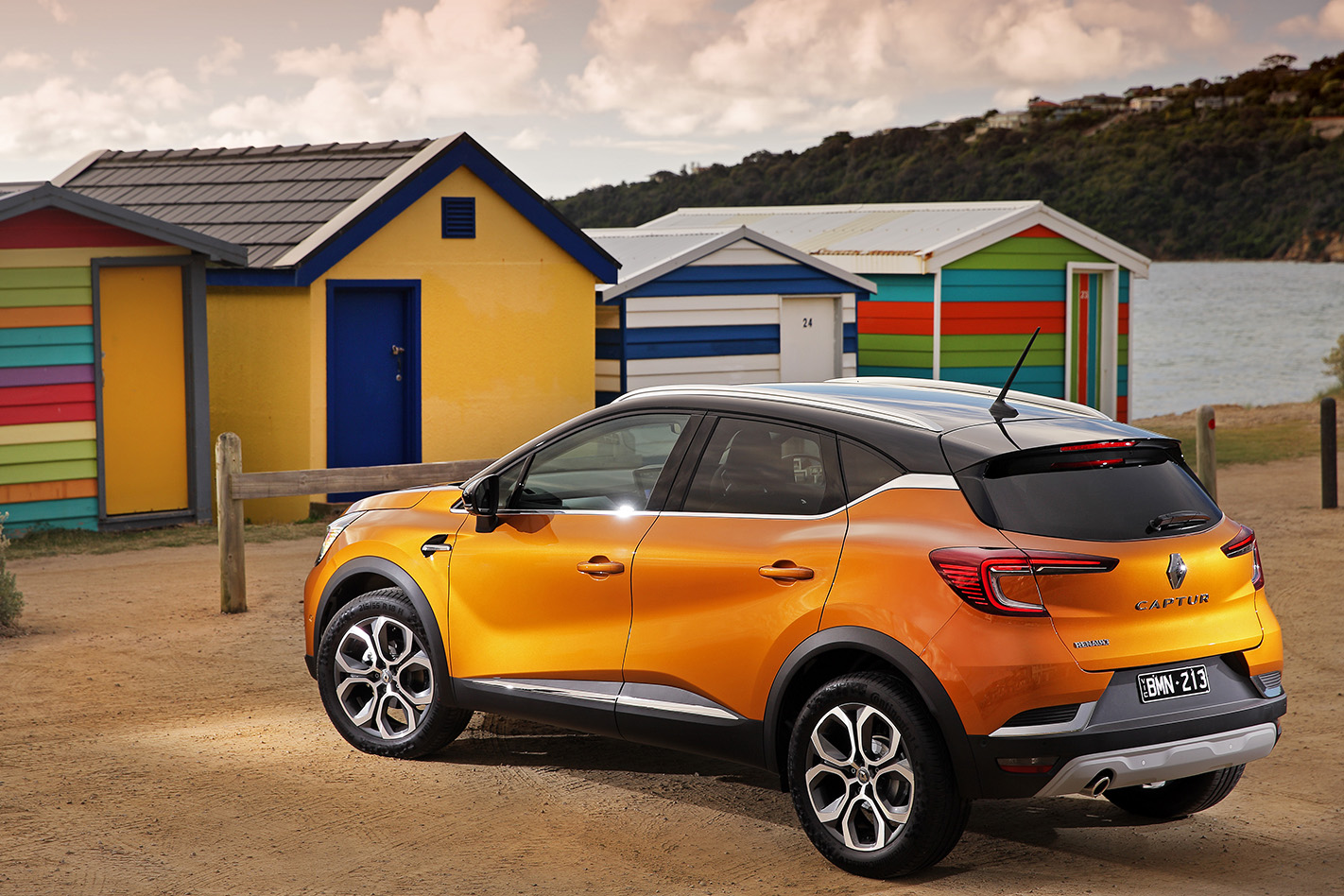
That said, some of those rivals such as the Ford Puma do come with more kit for the price while also being fun drives, but the top-flight Captur has all the important stuff including an excellent infotainment system while also being a little more practical.
I’d add that it also offers the chance to be a little unique, but I reckon you’ll be seeing a lot more of these on Australian roads than you did the first-generation model.
Score 7.5/10
Plus Looks great; efficient engine; space and comfort; infotainment system Minus Engine lag; lacks some standard features found in rivals
Renault Captur Intens specifications
Body: 5-door, 5-seat SUV Drive: FWD Engine: 1332cc 4-cyl, 16v turbo Power: 113kW @ 5500rpm Torque: 270Nm @ 1800rpm 0-100km/h: 8.6sec (claimed) Fuel consumption: 6.6L/100km (combined) Weight: 1381kg Power/weight: 89.3w/kg Transmission: 7-speed DCT Suspension: MacPherson strut/Torsion beam axle L/W/H: 4227/1797/1576mm Wheelbase: 2639mm Tracks: 1560/1547mm Brakes: Front vented discs (280mm) / Rear drums (229mm) Tyres: 215/55 R18 Continental Premium Contact 6 Price: From $35,790 ($38,440 as tested)
