
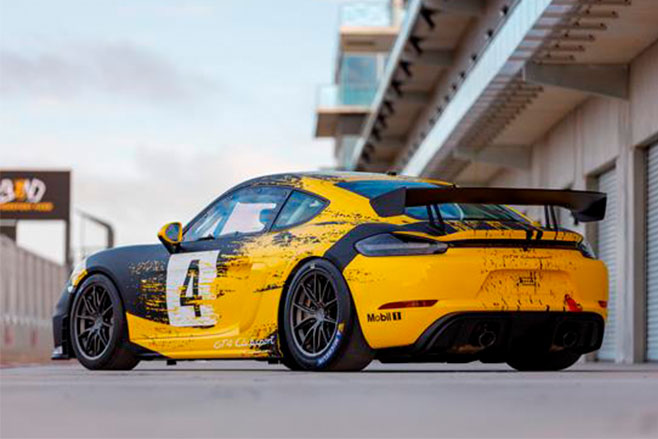
Porsche Australia has handed the keys over to the first Aussie owner of a new Porsche 718 Cayman GT4 Clubsport.
Its owner, Dr. Mansoor Parker, has already taken it to a couple of track days at Sydney Motorsport Park and sounds rather chuffed with it.
“I’ve driven it on a few occasions, and it is phenomenal, it really gives you a race-car like feel,” said Parker in a Porsche Australia press release.
Road car: Porsche 718 Cayman GT4 driven
Despite the fact his excitement comes to us via a Porsche-approved statement, we find it easy to believe Parker is pleased with his new 313kW flat-six track toy.
“It really is the best of both worlds, without driving something too intimidating or too expensive to maintain, you can literally take this to your local Porsche dealer to get serviced.
“I’m certainly having a lot of fun with it.”
The Cayman GT4 Clubsport joins a list of 15 other Porsches in Parker’s ownership history.
The GT4 Clubsport can be had in ‘Trackday’ or ‘Competition’ spec, set up for different levels of focus but both with the same 313kW 3.8-litre flat-six and six-speed dual-clutch.
Watch: Cayman GT4 Clubsport testing
A Trackday Clubsport features fixed shocks, “forgiving” ABS, TC, and ESC programming, which is killable, as well as A/C, an escape hatch in the roof, a handheld fire extinguisher, and an 80-litre fuel tank.
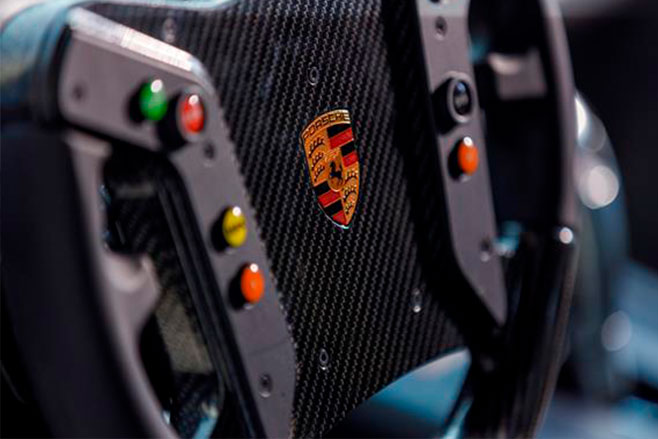
The Competition has three-way adjustable dampers, adjustable brake bias, an extra 35-litres of fuel tank, and has instead been built with an automatic extinguisher system.
First revealed in Australia a year ago, the demand for GT4 Clubsports has risen steadily, Porsche Australia says.
“We are receiving strong interest in the GT4 and have two further cars on order for new customers,” said Porsche Australia motorsport boss Troy Bundy.
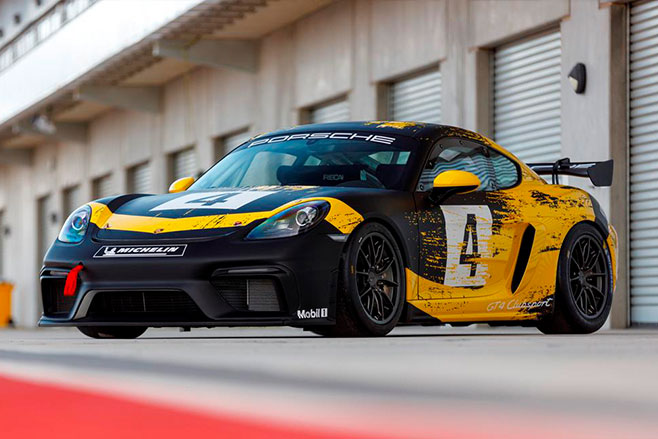
“While our Porsche Payce Carrera Cup and Porsche Michelin Sprint Challenge series remain our focus domestically, we also see a place in the market for the 718 Cayman GT4 Clubsport as a track day car and GT4 race car.
“The 718 Cayman GT4 Clubsport is an ideal track day car for graduates of Level 5 of our Porsche Track Experience, who may be keen to do more track days and state-based racing before moving up the Porsche Motorsport pyramid into Porsche Michelin Sprint Challenge.”
If you’ve ever seen photos or videos of a Peugeot 205 GTi with an almost-T16 Group B body kit, chances are it was the work of Dimma.
The company began in the 1980s creating more aggressive kits for 205 GTis, with the company saying Jean Todt, then the head of Peugeot Sport, now the head of the FIA, even driving one as his ‘work car’.
A UK branch was started, run by a man named Terry Pankhurst. Now, Pankhurst is back at it.
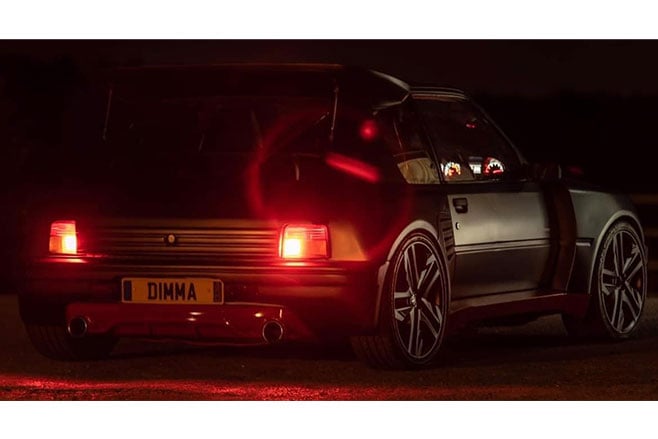
Revealed this week, Dimma UK is in the process of finalising a Peugeot 205 GTi Dimma body kit… but with mechanicals and running gear from the modern Peugeot 308 GTi.
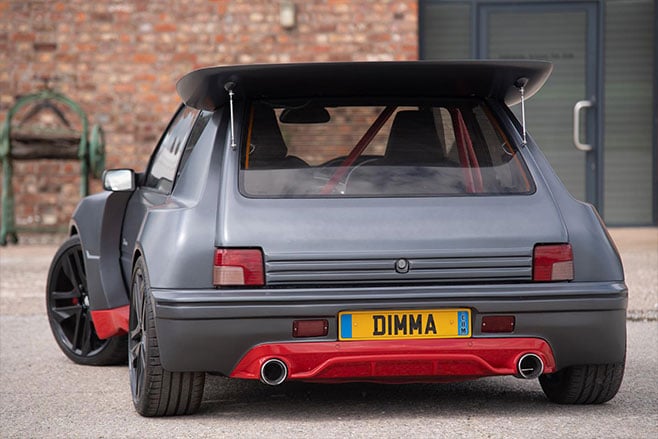
“The aim was to produce a brand-new version of the Classic Dimma 205,” Dimma says.
“Performance, handling and styling has moved on and the idea was to embrace new technology and apply it to retro cool. The new version is faster, wider and more aggressive looking than the original, but remains instantly recognisable.
“Back in the day, Dimma UK would buy new-crated 405 MI 16 engines from the factory and install them into the 205’s, why? Because it was better! This time we are going an awful lot further.”
Dimma has kept much of the 205’s body there physically, but replaced almost everything that affects driving with an updated 308’s version, even the interior. Its engine has also been given a tune, up from the 200kW it has stock to more than 220kW.
“It comes, brand new, from the current Peugeot 308 GTi and its all being fitted into an original 205 body. The track is wider, the direct injection 1.6 turbo engine is currently running 300bhp, it has a 6-speed gearbox, huge brakes and 19-inch wheels.
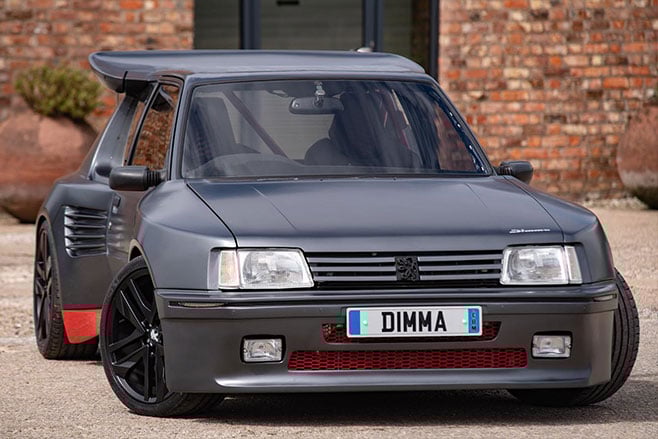
“The 308 GTi is a fantastic car, but this Dimma is around 400kg lighter so the all-round performance improvements are highly significant.”
Its lightweighting was achieved through the extensive use of carbon
Being 400kg lighter would, realistically put the Dimma 205/308 at around 900kg. Despite Peugeot’s claim the 308 GTi weighs 1205kg, MOTOR weighed a long-term 308 GTi test car in 2019 and found an extra 100kg of weight present.
“The 2020 Dimma 205 is aimed at being a road legal modern classic, with the ability to deliver stunning driveability and performance on the road or on a circuit track day.
205 GTi hillclimb car built by F1 engineers
“At this point the car we are showing is a drivable prototype, but the body panels have all been hand crafted by Terry and are literally sculpted from heavy solid materials.”
Dimma says the next step is to create moulds from the kit created so it’s able to produce further sets.
“Before we move to production, we need to assess customer interest, each car will have to be hand built to order and a minimum number of units would need to be pre-sold in order to make production viable.”
FERRARI HAS just confirmed that production of the four-seat GTC4Lusso has ended. No direct successor is planned and when that happens the unavoidable verdict is that the car in question was an idea whose time never really came.
Introduced initially as the FF in 2011, it was the first all-wheel drive Ferrari production car, but used a drive system so bizarre that everyone at the 2011 Geneva Show just stood there and wondered whether Maranello had been suffering a carbon monoxide leak.
It utilised a second gearbox, this one with just two forward speeds, that took power from the front of the engine. This constanty slipped Haldex-style clutches and could transmit, at most, 20 percent of the V12 engine’s 683Nm of torque. This system, dubbed 4RM, only worked in the first four gears, the front transmission’s first gear covering first and second in the rear ‘box, and second covering the main box’s third and fourth.
While it was of modest functionality, it was at least light, weighing around half as much as a typical all-wheel drive implementation. Equally divisive was the FF’s styling, which offered a variation on the shooting-brake and was, at that point, the biggest Ferrari ever built.
It didn’t last long though. Ferrari produced 2291 across a five-year period to 2016, or just over 450 per calendar year. Compare that to around 2500 Ferrari 458s sold per year and 1000 F12 Berlinetta models shifted per annum, it’s clear that the FF was a bit of an acquired taste.
Its successor in 2016, the GTC4Lusso ditched the trick all-wheel drive system in the V8 model, but retained it with the V12 flagship. It developed into a quite lovely GT car, with surprising practicality, a better Delphi-developed infotainment system and a cleverer 4RM-S system in the V12 with the additionof the spookily prescient Side Slip Control.
But now it’s gone and we probably won’t see its like for a very long time. When the last one rolled off the line in Maranello last week, it left a gap in the range for a proper four-seater Ferrari that the 2+2 Roma can’t ever fill. That role will be replaced with the introduction of the Purosangue SUV. While we’re intrigued as to what that will look like, it may well throw into even sharper focus that which we’ve lost.
The FF/GTC4Lusso was a weird outlier in Ferrari’s forensically researched product plan and, in the harshest light, was probably judged a sales failure, but we loved it. We adore Ferraris that aren’t predictable and which offer something that nobody else does. Whatever else you think of the FF/GTC4Lusso, it’s not going to be forgotten anytime soon.
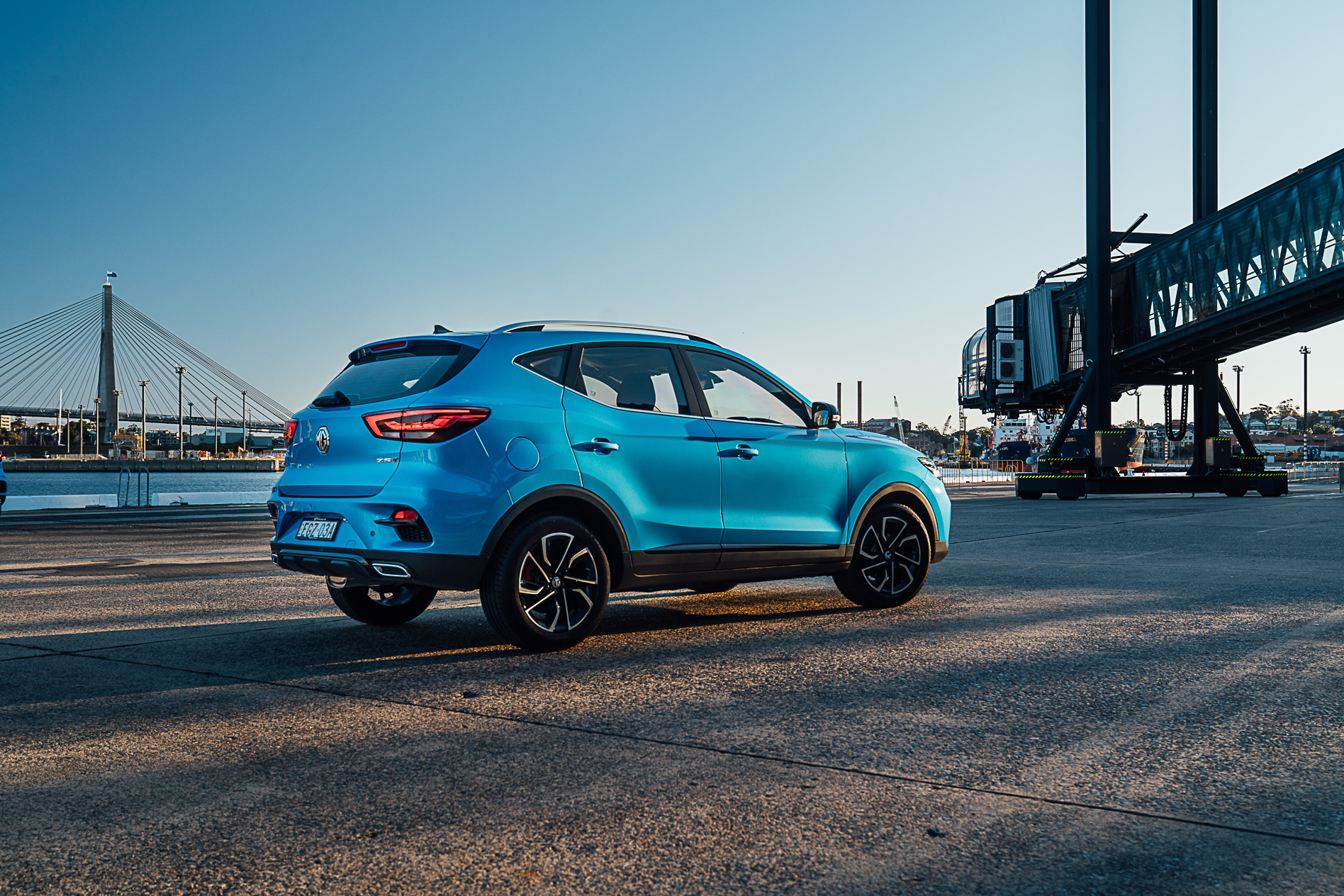
MG will split its sales strategy for its popular small ZS SUV, bringing in an updated, higher-spec, more expensive variant to run alongside a cheaper version of the current car.
Known as the ZST, the two new variants mark a sizable upgrade for the smallest of the company’s SUVs… on its side of the showroom, at least.
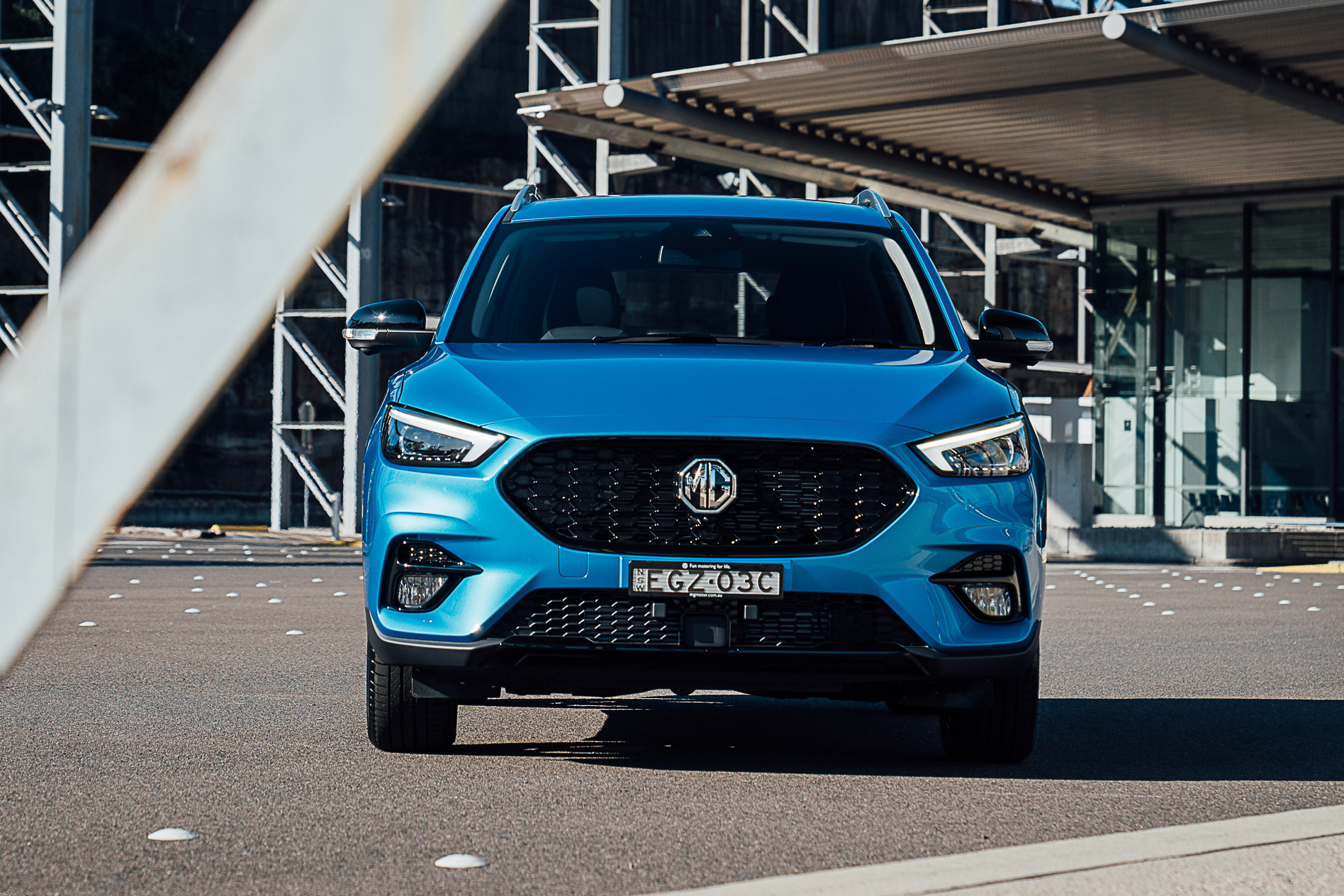
Packing an all-alloy 1.3-litre turbocharged four-cylinder turbocharged petrol engine under the bonnet, the 115kW/230Nm ZST boasts a 40 percent power increase over the naturally aspirated 1.5-litre engine in the ZS.
It’s reasonably frugal on the juice, too, with MG claiming that the Mazda CX-3 and Hyundai Kona competitor has a combined fuel economy figure of 7.1L/100km from the new engine.
It’s backed by a six-speed traditional automatic, which sends drive to the front wheels.
The ZST wears new bumpers and LED lighting front and rear, while the chassis itself has been upgraded compared to the ZS.
The small SUV also picks up a full suite of driver safety aids in a bundle known as MG Pilot.
Already featured on the company’s larger HS, it includes lane departure warning, AEB, adaptive cruise control with traffic jam assist, blind-spot detection, auto-dimming headlights and speed sign recognition that can automatically regulate the ZS’s speed.
MG claims that the ZST is the only small SUV to offer this much in the way of electronic safety.
Inside, there’s a large 10.1-inch touchscreen that eschews buttons, running Apple CarPlay and Android Auto.
Leatherette seating, five USB ports – two in the rear, two on the centre console and one up near the rearview mirror for dashcams – auto lights and wipers, keyless entry, stepped boot floor, 17-inch alloy wheels and more passenger and cargo room (thanks to more body length and height) are all standard.
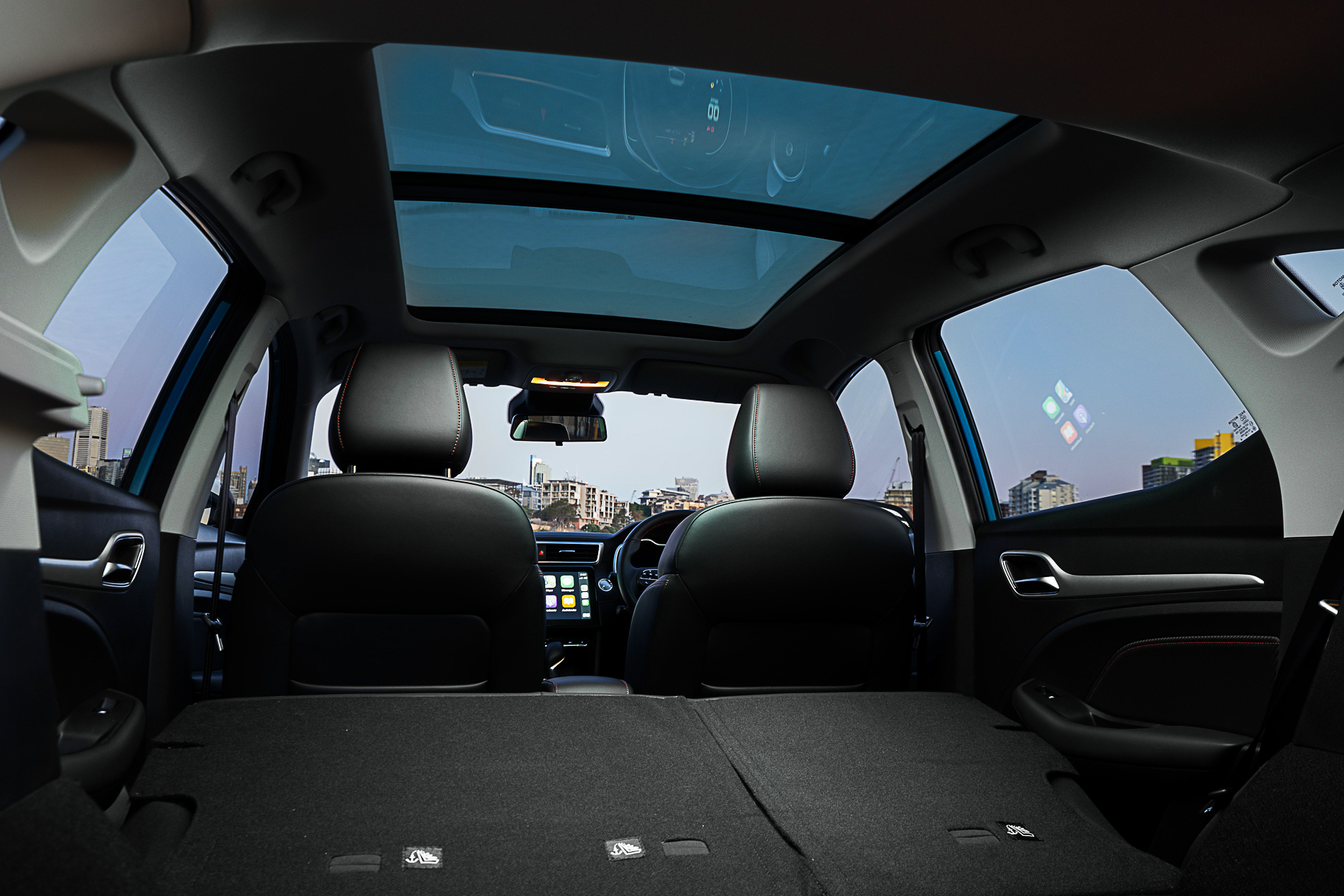
Cargo space has jumped 23 litres to 293 litres with the seats up and 1187L with the seats down. Rear seat room is genuinely impressive, particularly in the Excite model. There are two ISOFIX baby seat mounts in the rear, as well.
The new flat-bottom, leather-wrapped steering wheel helps to lift the cabin, but there’s no reach adjustment on the steering column to fine-tune the driving position.
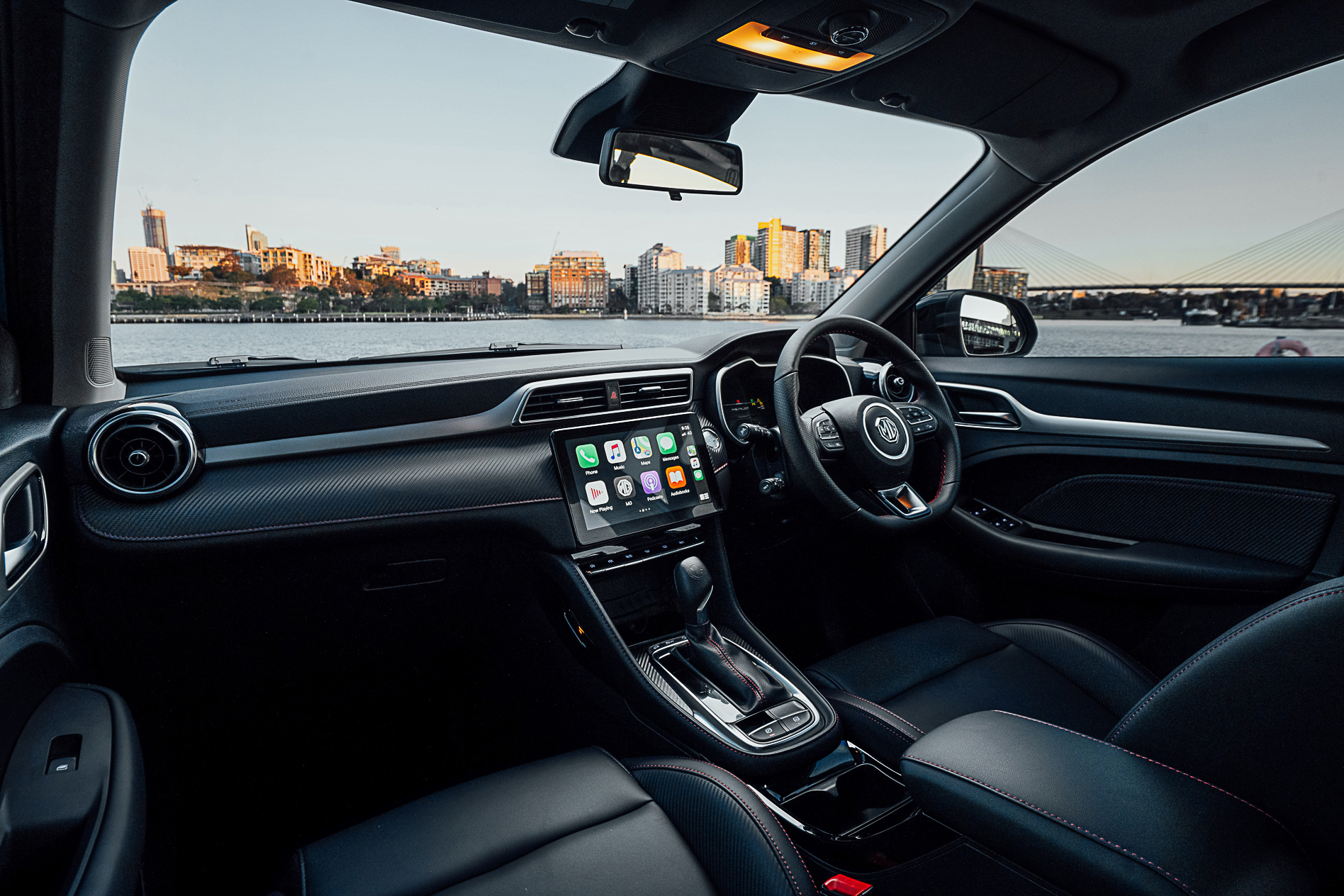
Two grades of ZST are available, with the entry-level Excite offering analogue dash instruments and a regular metal roof for $28,490 plus on-road costs, while the Essence adds a huge panoramic glass roof, with a translucent cover, a digital dash, 360-degree surround parking camera, powered driver’s seat and heating for driver and passenger seats for $3000 more.
The pricing includes seven years warranty with unlimited kilometres, along with roadside assistance support.
“It’s all about the one percenters,” said MG Australia’s director of marketing and products, Danny Lenartic. “‘We’re not mucking around. A car in this segment with this level of tech is unparalleled.”
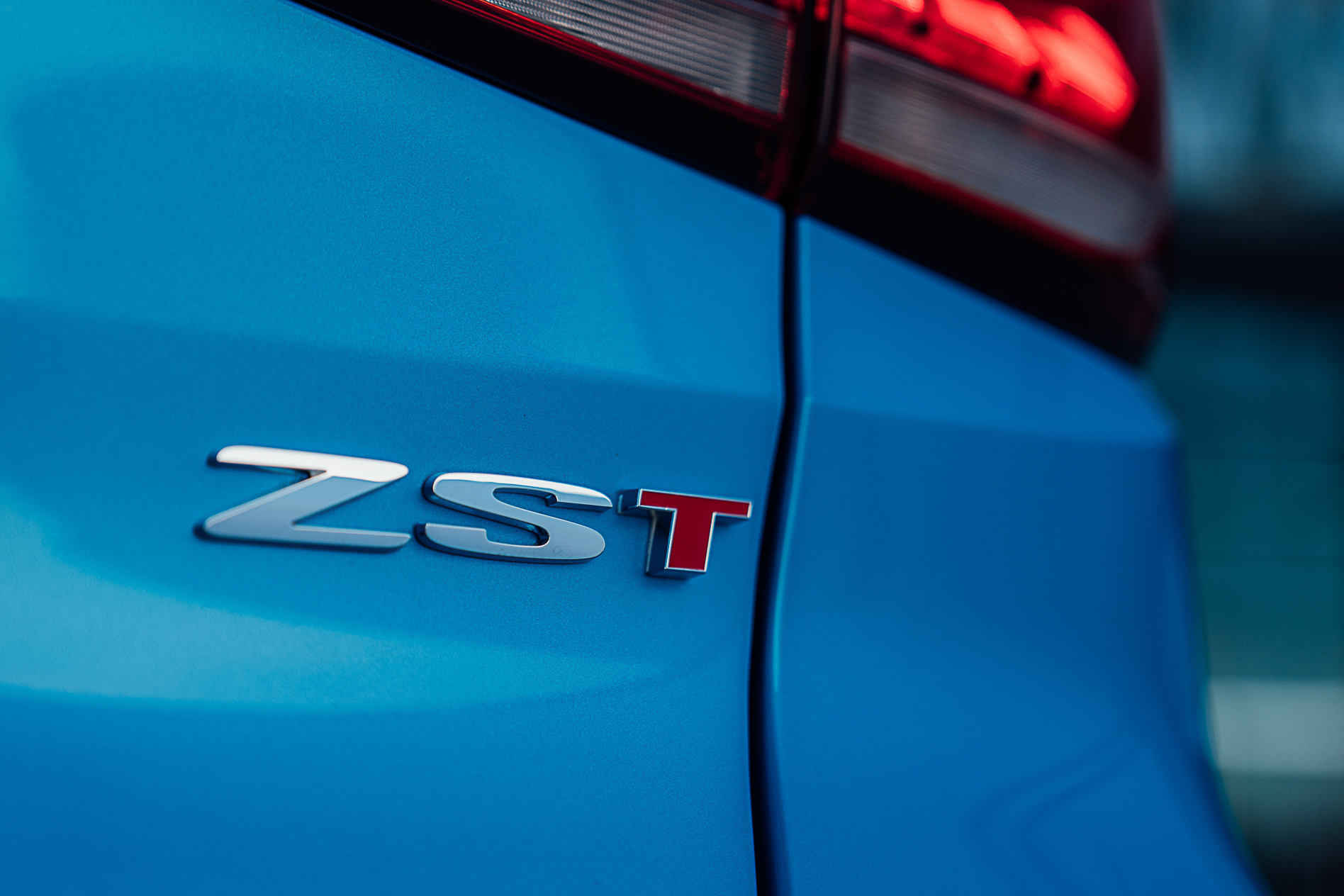
MG ZST Australian pricing
- MG ZST Excite – $28,490 before ORC
- MG ZST Essence – $31,490 before ORC
Hyundai has pulled the covers from the new-look 2021 Kona, revealing the funky small SUV’s first major update since arriving on the scene in late 2017.
As well as receiving a host of styling updates, the facelifted Kona will be the latest Hyundai model to gain a sporty N Line version.

Its fresh design, dominated by the shark-inspired nose, is in keeping with Hyundai’s Sensuous Sportiness global design language that includes a bolder grinning grille design as already seen on the 2020 Santa Fe large SUV and the 2021 i30 hatch and sedan.
The Kona’s characteristic high-mounted daytime running lights have been restyled along with the lower bumper and driving lights. Lower down, the main bumper fascia blends more seamlessly with the wheel-arch cladding to give the front end a chunkier, robust appearance.
Apart from the bonnet’s curved edges, the side body retains the muscular and sculpted shape of the previous Kona but an extra 40mm added to the length brings a sleeker silhouette.
Interior update
As well as the fresh look, the redesigned interior provides additional cargo capacity and rear-seat legroom.
The console area is disconnected from the instrument panel to emphasise the horizontal layout. The dashboard appears wide and airy to create a spacious atmosphere, while the console itself is less cluttered with the inclusion of an electric parking brake.
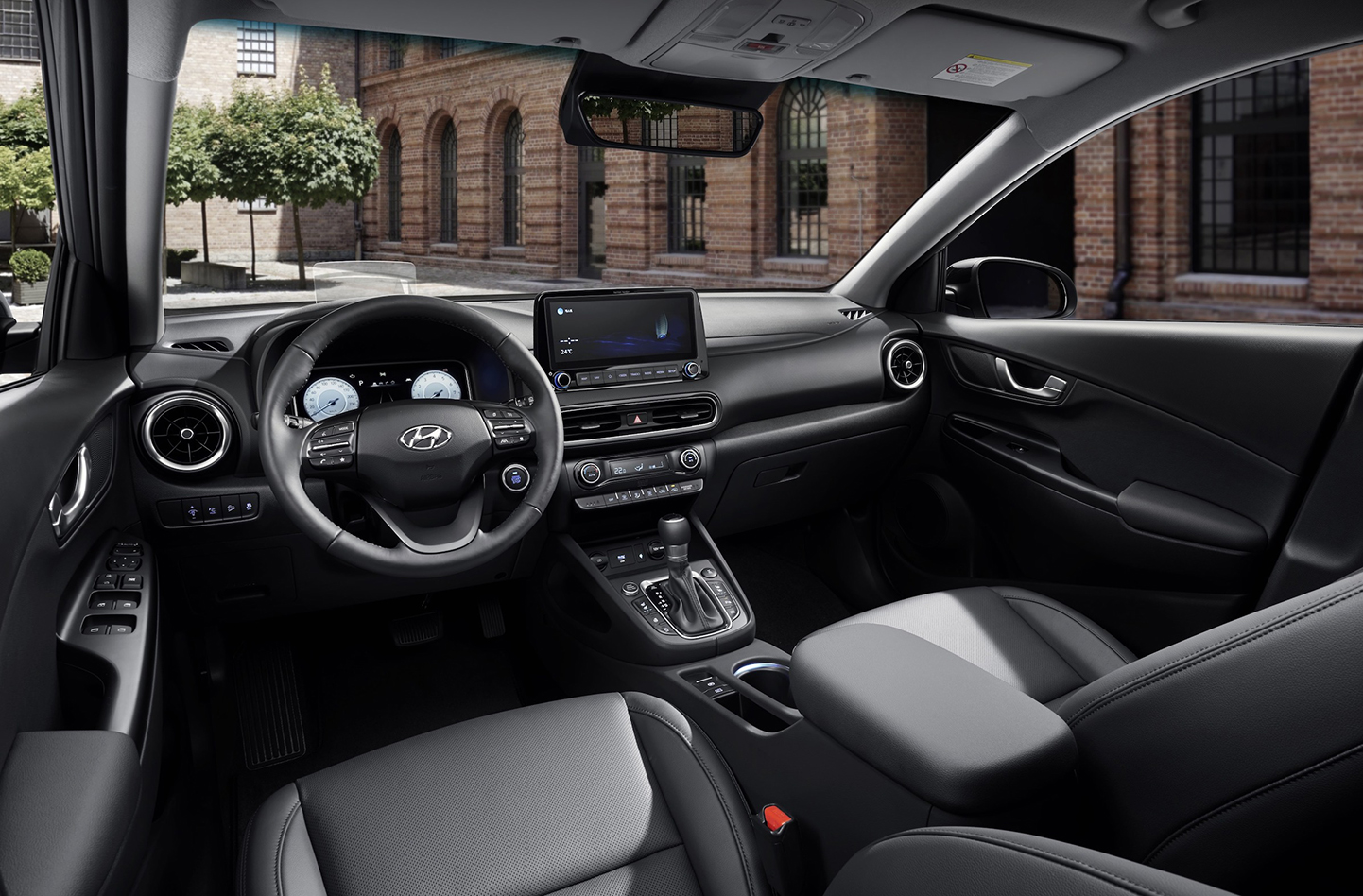
New to this model is a 10.25-inch digital cluster, first seen overseas in the all-new i20. In addition, there will be an optional 10.25-inch central infotainment screen over the standard 8.0-inch version. Digital DAB radio and wireless Android Auto and Apple CarPlay are standard.
Several new convenience features include second-row heated seats in upper-spec versions and a second-row USB port. The manually adjusted front seats in the more affordable variants have also been improved and passengers in the front row will be able to adjust their seat height.
Other interior enhancements include new ambient light technology that illuminates the centre cup holders as well as in the footwells, and new aluminium finish rings around the speakers and air vents.
New technology
More driver assistance features are available with new Kona including:
- Blind-Spot Collision-Avoidance Assist (BCA)
- Rear Cross-Traffic Collision-Avoidance Assist
- Smart Cruise Control (SCC) with stop and go
- Leading Vehicle Departure Alert (LVDA)
- Lane Following Assist (LFA)
- Intelligent Speed Limit Warning (ISLW)
- Safe Exit Warning (SEW)
- Rear Seat Alert (RSA)
- Forward Collision-Avoidance Assist (FCA) – now with optional cyclist detection
Kona N Line
The new Kona N Line exterior design will feature an enhanced aerodynamic design with low-set air intake and more aggressive front bumper, complemented by corner fins and lean crease lines.
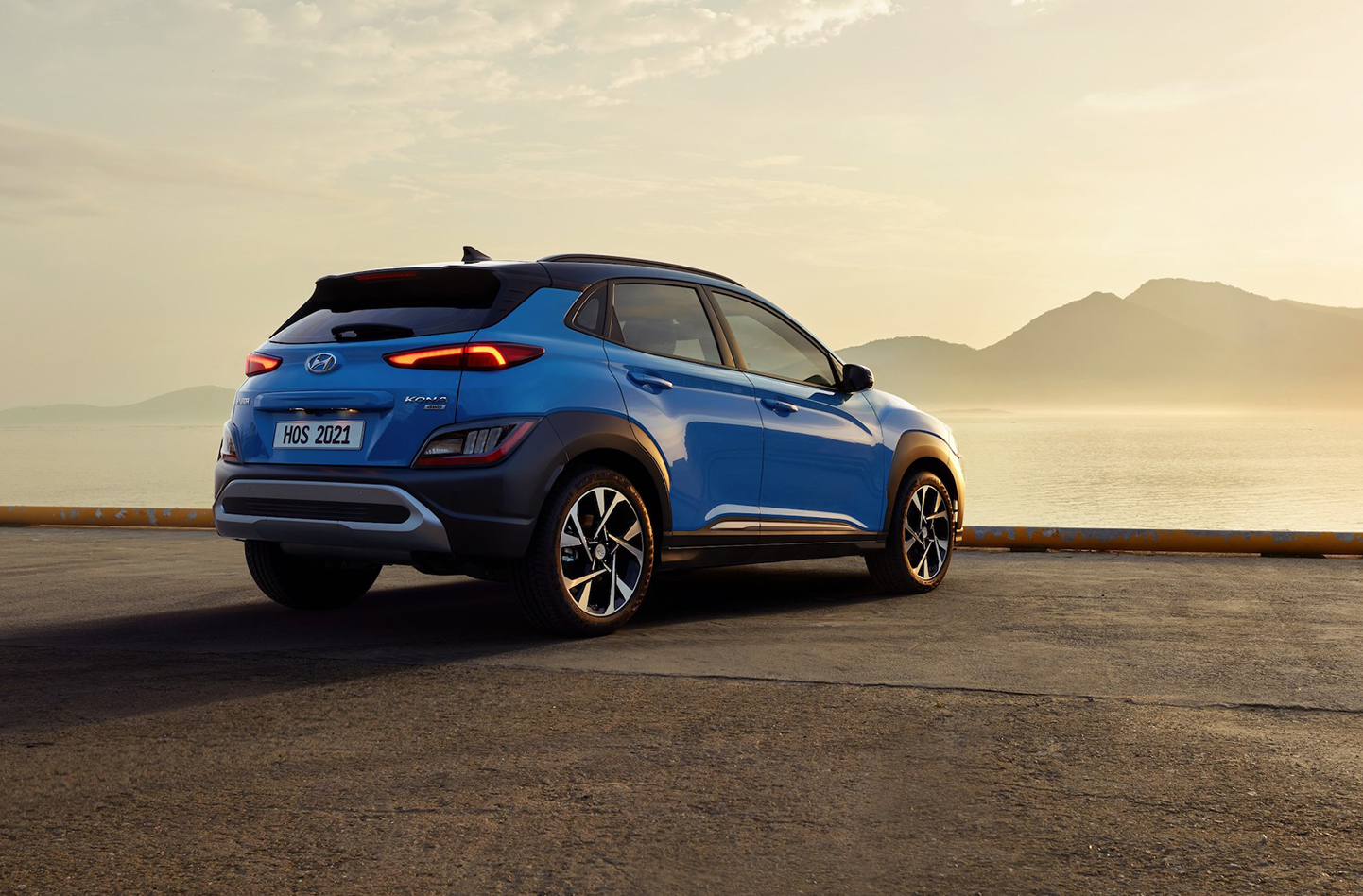
The side profile will also differ with body colour cladding and new rocker panels, complemented by the dedicated 18-inch alloy wheel design.
A revised rear bumper incorporates a large central aerodynamic diffuser in a contrast colour to the body as well as a one-side double muffler. The bumper fascia has sharply creased corners and N style fins for better airflow.
The interior has dedicated N Line colour package in one-tone black with cloth, leather or suede seats, distinctive red stitching, sporty metal pedals and N logo on the gear shift and seats.

The Kona N Line uses a version of Hyundai’s 1.6-litre turbocharged petrol engine and seven-speed dual-clutch auto, which will be slightly more powerful than the current version, up 15kW to 145kW.
Hybrid technology
The hybrid version, which has been available in overseas markets since last year continues on. It features the 1.6-litre petrol engine and electric motor with a combined output of 103kW, paired with a six-speed dual-clutch transmission and with two-wheel drive.
A 32kW electric motor draws its energy from a 1.7 kWh lithium-polymer battery. Hyundai Australia has previously said it would review the introduction of a Hybrid Kona here and has yet to confirm if it will be part of the 2021 line up.
Fuel-saving 48v mild-hybrid technology also features in the update, however, that will only be available with the diesel and 1.0-litre turbo petrol engines that are unlikely to be sold in Australia. The Kona Electric will continue in its current guise for now as a standalone model.
The updated Hyundai Kona and Kona N Line are expected to arrive in Australia in the first quarter of 2021, although the local model line-up and specification will be announced closer to launch.
This is a Honda Civic, but it’s so far from the Civic you know. It’s got a V6 and a five-speed manual from an Acura CL (otherwise known as a Honda Accord), which is mounted behind the driver, and powers the rear wheels.
A rear-drive, mid-mounted V6-powered hot hatch sound familiar? This thing is straight-up Group B nostalgia. And you can buy it.
The 1984, or Gen 3, Civic here was built by a US hot rodder who was inspired by the Renault R5 Turbo, and you can actually buy his creation.
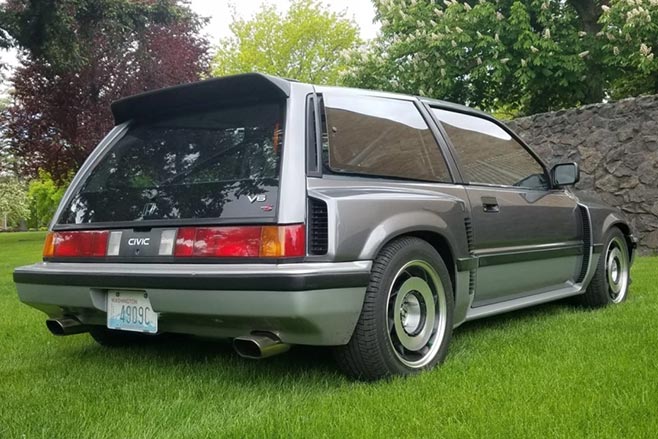
Andy Barcheck built this car in the late 1980s and early 1990s, before the car ended up being bought by its current custodian in 2008.
As the video at the top of this page reveals, the Honda J-series 3.2-litre V6 in the back isn’t the one Andy originally had in the car, but he’s seen it since the conversion and whole-heartedly approves.
In fact, he says it was built to handle more power and he’s glad it’s got it now.
GSX-R-powered Honda N600 becomes tiny Hoonitruck
Visually, the car is anything but standard. The Group-B-style widebody kit speaks to its mid-engine nature, while some updated elements like the lights give the car a less tired look.
Its turbine (salad-shooter, if you like) wheels are straight out of the 1980s in terms of styling, so suit the car well.
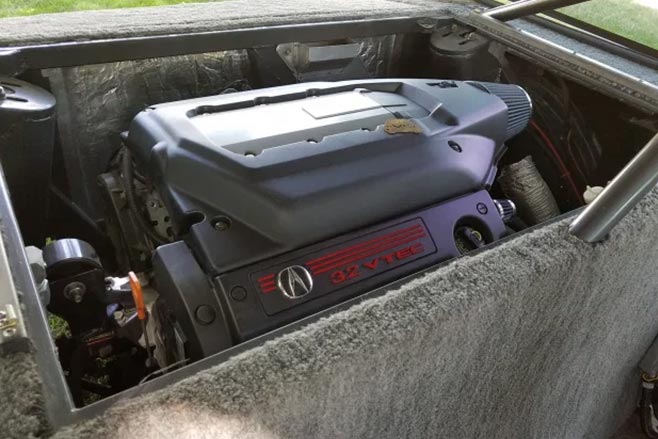
The brakes behind them are from a Chevrolet C4 Corvette, which is appropriate given the wheel style, while other modifications such as the fuel tank relocation and custom chassis are all due to the layout conversion.
Currently, the ‘Hondura’ V6 is up for sale on BringaTrailer, with four days to go in the auction.
Its current US$35,250 bid translates to around AU$47,600, though we suspect it’ll climb much higher than that.
Suzuki’s venerable Swift light hatch has received a mid-life Series II update that brings a new mid-grade variant, a fresh face and new safety features to upper-spec models.
New to the line-up, the Swift GL Navigator Plus brings additional safety features to the GL Navigator spec, including blind-spot monitoring, rear-cross traffic alert, heated door mirrors and reverse parking sensors.
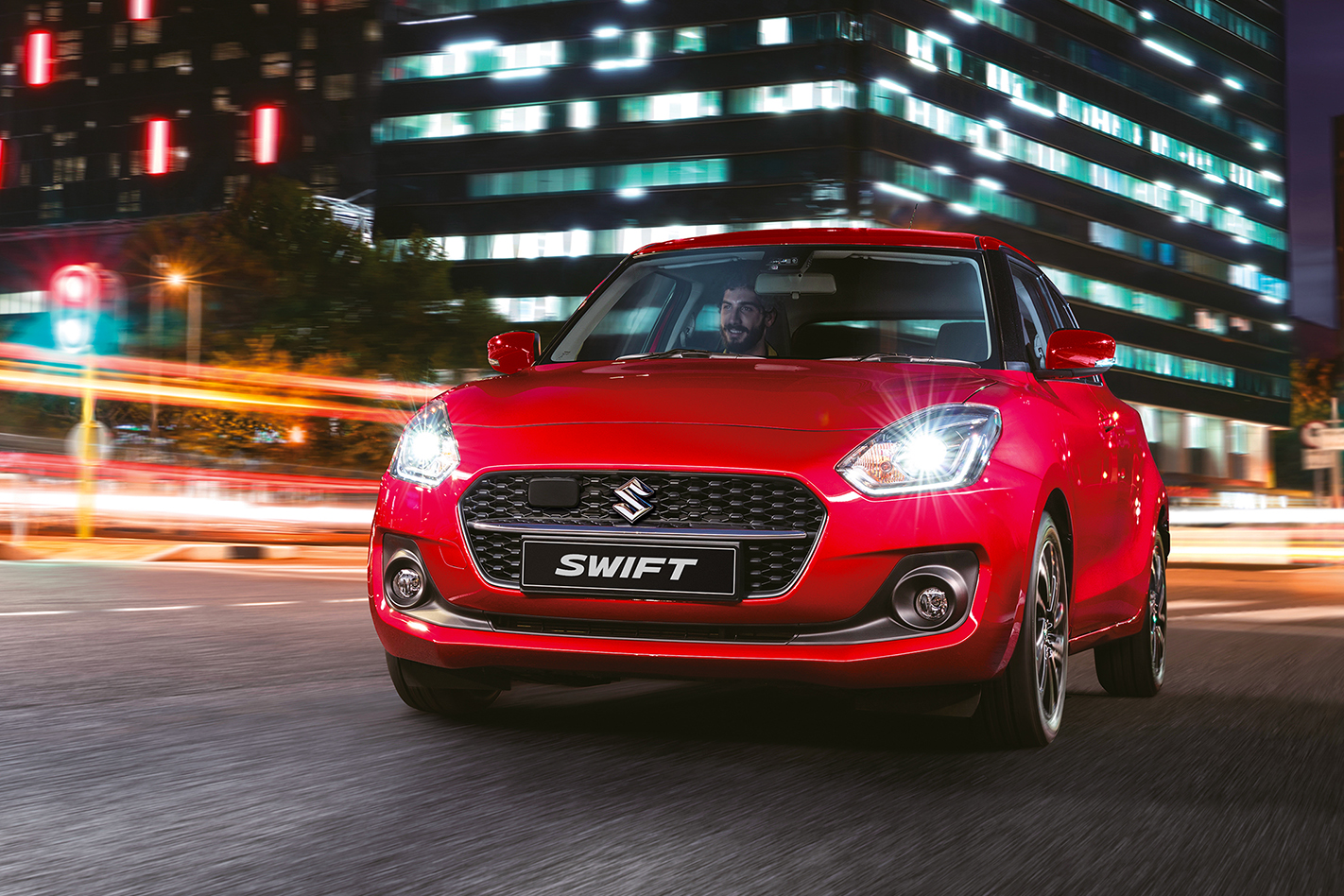
These features have also been added to the nifty Swift GLX Turbo.
Meanwhile, the standard kit gains a digital speedometer, auto-up windows and rear audio speakers.
Outside, the Swift has received a slight refresh that includes a tweaked front bumper and grille, and a new alloy wheel design.
The engine choices and specifications, which include the 1.2-litre four-cylinder petrol in the GL versions and the punchy 1.0-litre three-cylinder GLX Turbo, remain unchanged.
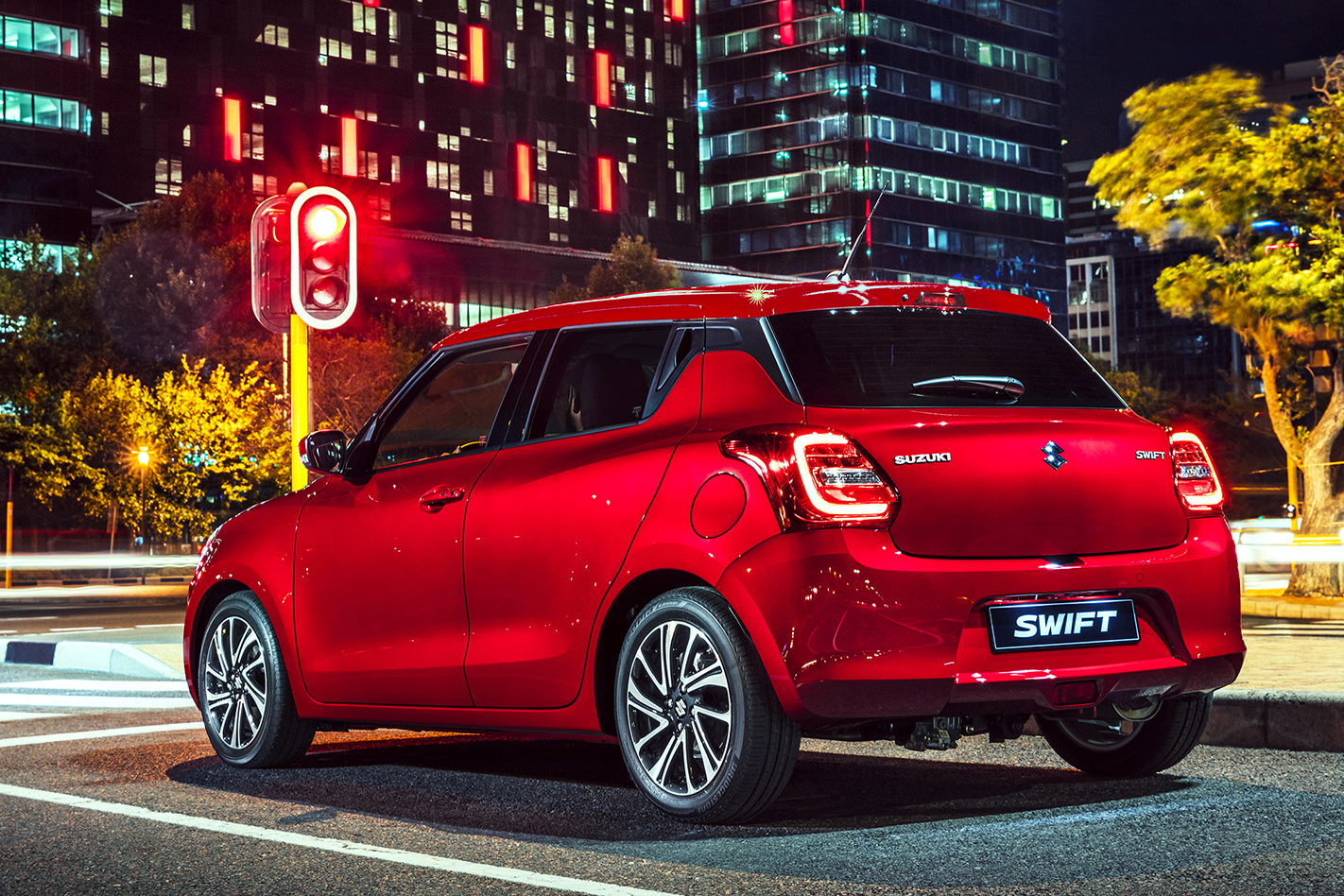
Paint options are mostly the same too, but for the two-tone grey, which has been replaced with a single-tone grey.
The changes bring the standard Swift variants in-line with the Swift Sport hot hatch that received its Series II update in May 2020.
The Swift is covered by Suzuki’s five-year unlimited-kilometre factory warranty and capped priced servicing with 12-month/15,000km intervals for the GL Navigator versions or 12-month/10,000km for the GLX Turbo.
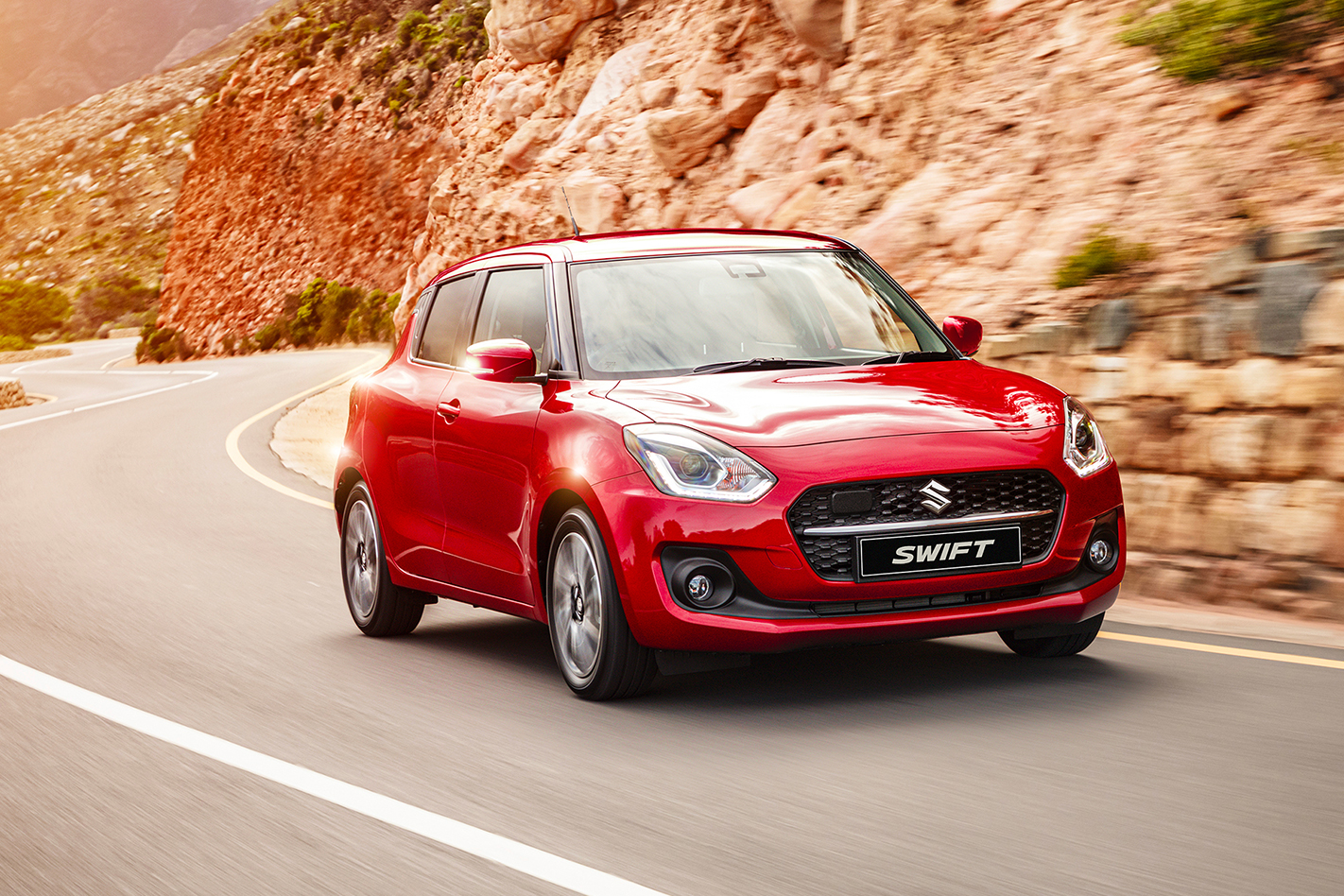
Available from $18,990, Swift Series II entry-level pricing is up $1300 to $18,990. However, Suzuki has an introductory offer for the Swift Series II that waives all on-road costs.
2020 Suzuki Swift Series II Australian pricing
- Swift GL Navigator manual: $18,990
- Swift GL Navigator auto: $19,990
- Swift GL Navigator Plus auto: $21,490
- Swift GLX Turbo auto: $25,290
- Swift Sport manual – $26,990
- Swift Sport auto – $28,990
Toyota Australia’s decision to increase the price of its fourth generation Yaris by such a big margin – up to 44 percent depending on model – is unprecedented in the local automotive market.
The new Yaris starts at $22,130 plus on-road costs for the entry level Ascent Sport with manual transmission, a huge rise from the $15,390 figure of its predecessor. Premium ZR models with alloy wheels, head-up display and roof spoiler, among other additions, now start at $30,100 plus on-roads, almost 33 percent more than the previous car’s $22,670 price tag. With dealer delivery, stamp duty and other costs factored in, Toyota customers will need to pay about $25,000 to get into an entry-level Yaris, while the range-topping hybrid model will be around $35,000 on the road.
So the obvious question is: what’s the reason for the huge hike?
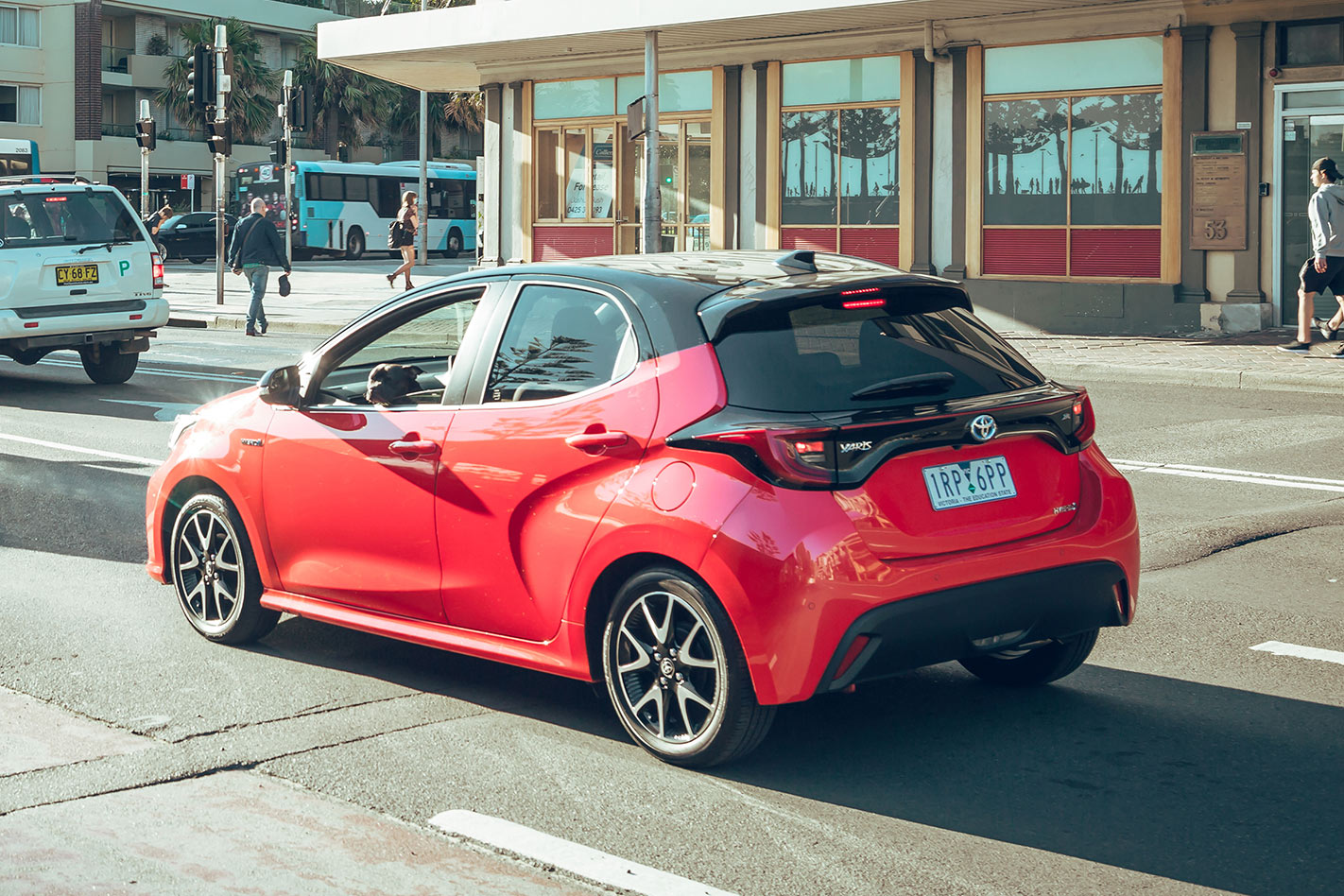
If you’re looking for an easy explanation, you won’t find it from Toyota.
Sean Hanley, Toyota Australia’s vice president for sales and marketing, simply told media, “This is the cost of bringing a car of this nature to market now”, referring to the high standard level of safety, assistance and convenience equipment fitted to the B-segment light car.
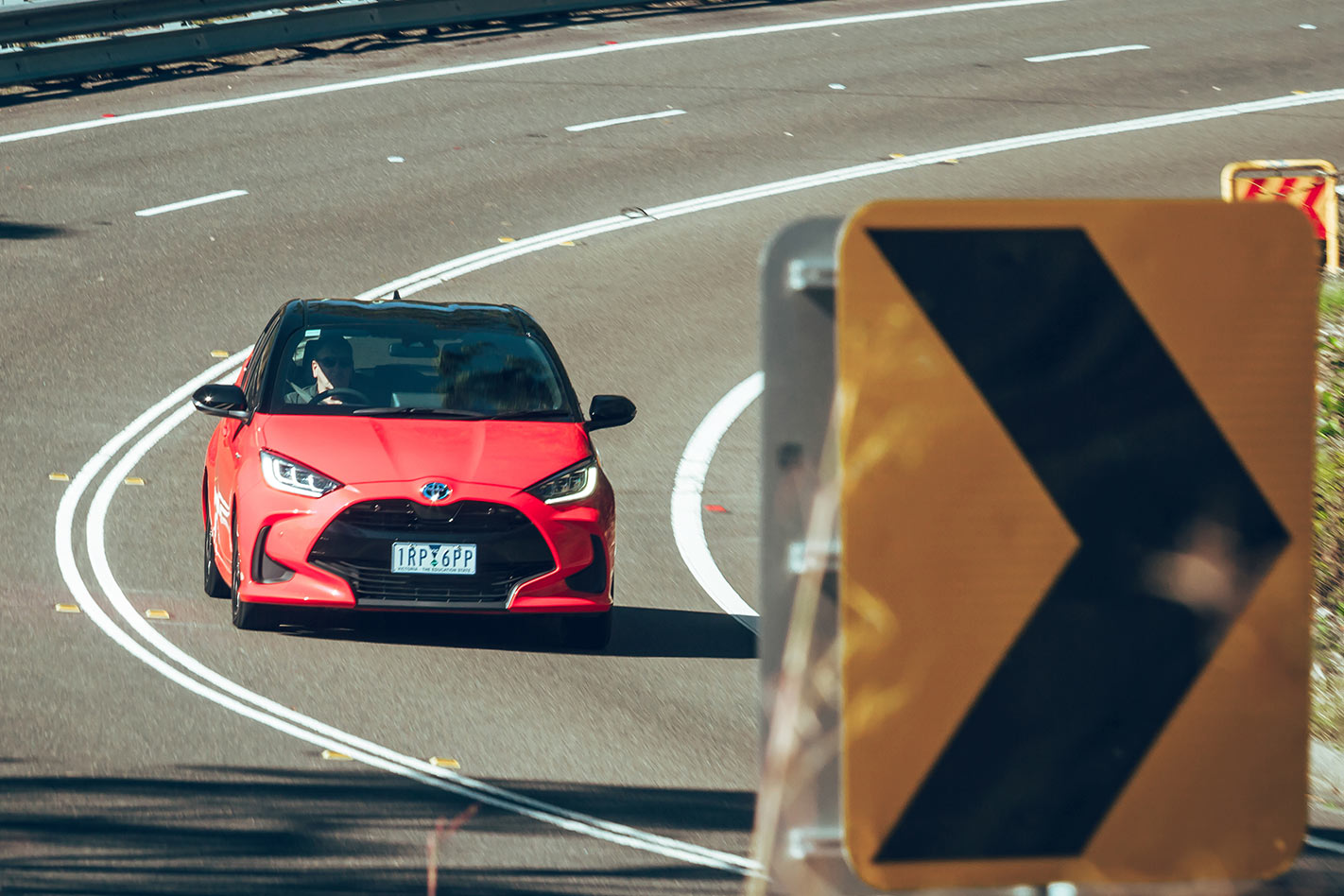
Hanley insisted that features such as a front centre airbag positioned between the driver and passenger, plus auto emergency braking with pedestrian detection, active cruise control, and lane-keeping assistance made the new Yaris the safest car in its class, and this contributed to the price position.
“Yaris is the first car for Toyota achieve five stars for 2020 ANCAP testing,” a spokesperson explained, and made mention of the technology fitted to the light car which is absent from Corolla in the segment above, including ‘intersection assist’ which enables the AEB to intervene when the car risks turning into a pedestrian or on-coming car, and AEB while reversing.
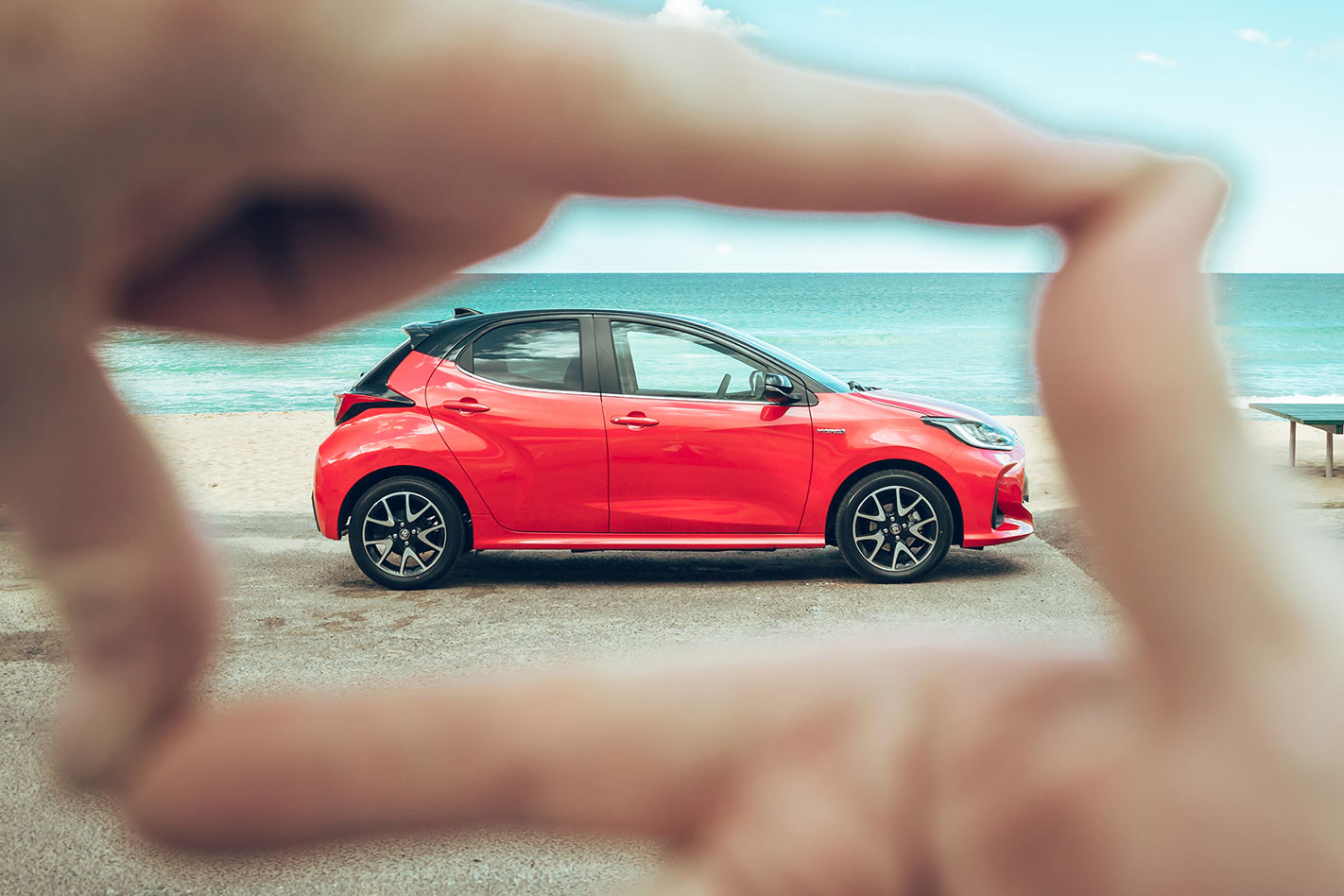
Toyota further defended its decision to push the Yaris more upmarket by saying it is built on a new platform, with fresh technology and more efficient three-cylinder engines. But hang on – don’t those factors apply to pretty much every new generation car on a new platform?
Anyway, Hanley was quick to make mention of the company’s strategy to offer lower cost alternatives.
“If in the event that someone can’t afford [Yaris], the credible alternative that we’re seeing is a Toyota certified pre-owned vehicle,” he said. “It’s a choice.”
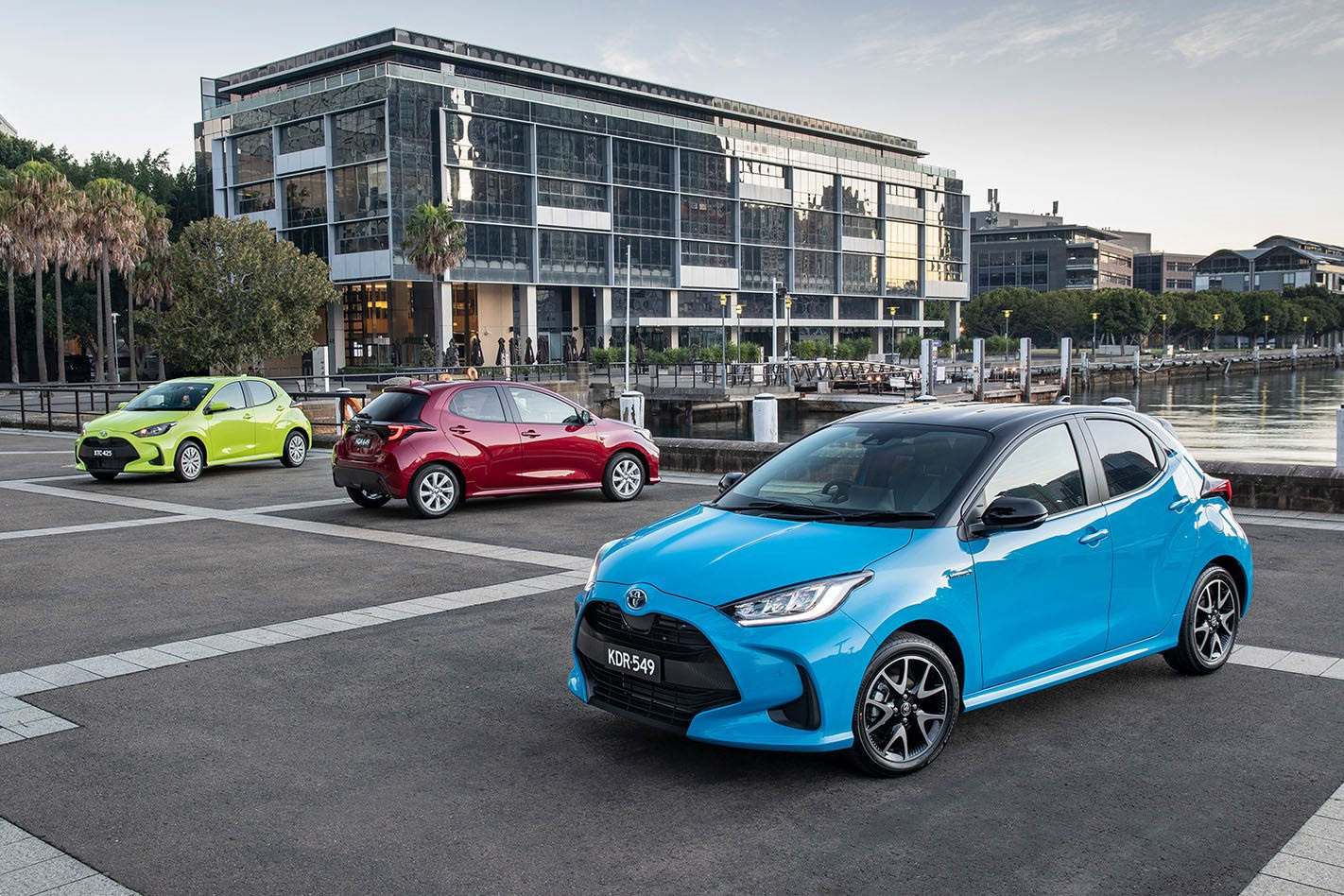
So it would seem the company is hopeful that any prospective customer deterred by the high price of the Yaris will consider an older, less well-equipped Toyota from the company’ second-hand fleet, rather than choosing an alternative, less expensive new car from a different manufacturer.
The other factor that can’t be ignored in all this is the weaker Australian dollar against the Yen. Toyota’s spokesperson admitted that exchange rates did play a part in the pricing of the new Yaris, but declined to be more specific.
Okay, but what about the premium attached to the Yaris Hybrid, which is 33 percent more than the cost of the petrol-electric drivetrain when speccing it for a Corolla?
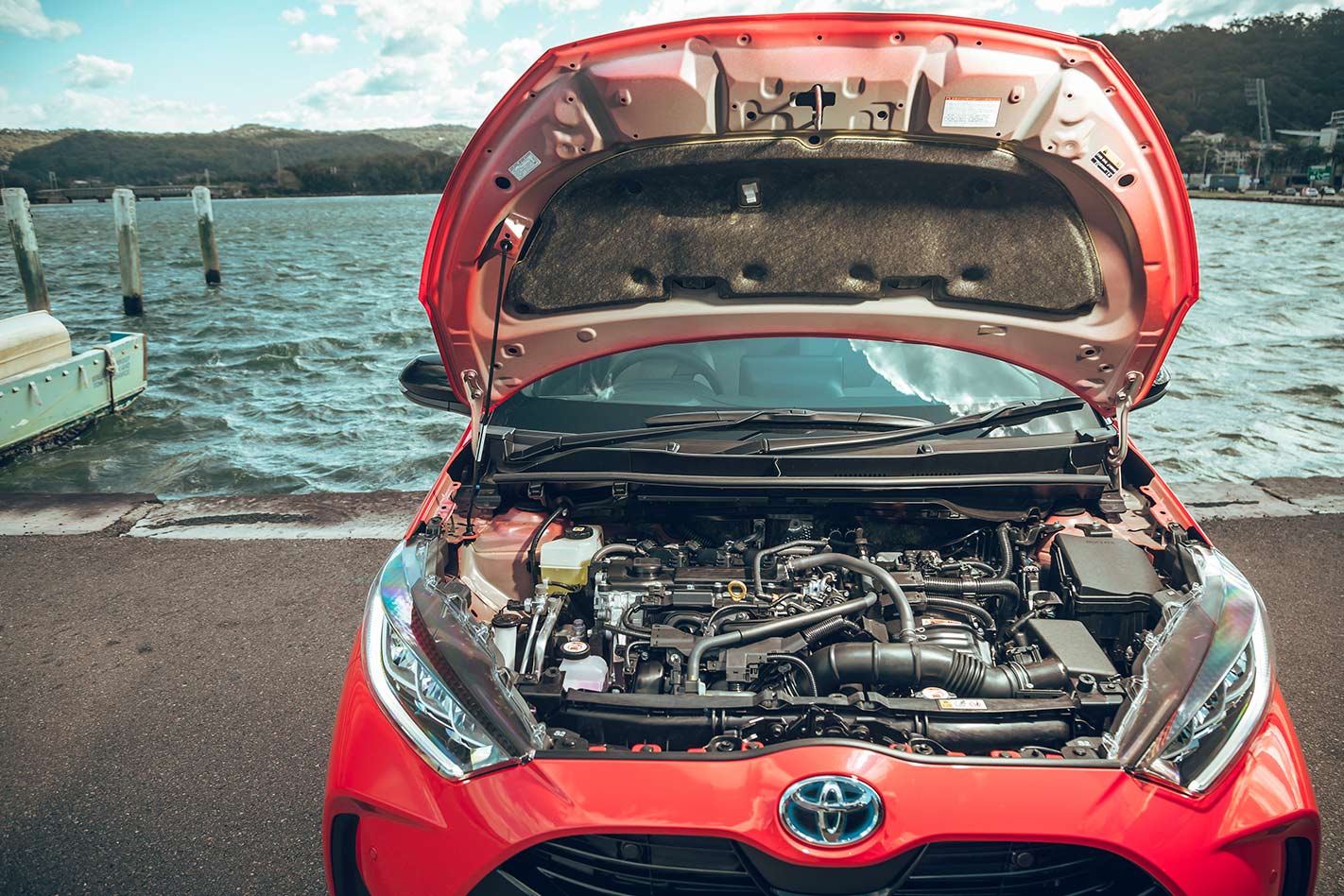
Hybrid models represented more than 40 percent of Toyota sales in July this year, with more than half of Corolla, RAV4 and Camry customers choosing the pricier but more frugal powertrain.
Opting for hybrid power (available on mid-spec SX and top-spec ZR) over the conventional 1.5-litre three-petrol petrol engine adds $2000 on the Yaris, as opposed to just $1500 on the Corolla.
At SX spec level, that leaves the Corolla Hybrid a mere $715 more expensive than the equivalent Yaris. The key difference we can find is that the Yaris Hybrid uses a lithium-ion battery, the same battery technology used across the entire automotive industry for hybrid and BEV vehicles. Toyota has been the only major EM that has insisted on sticking to nickel metal hydride cells since the first Prius was launched way back in 1997.
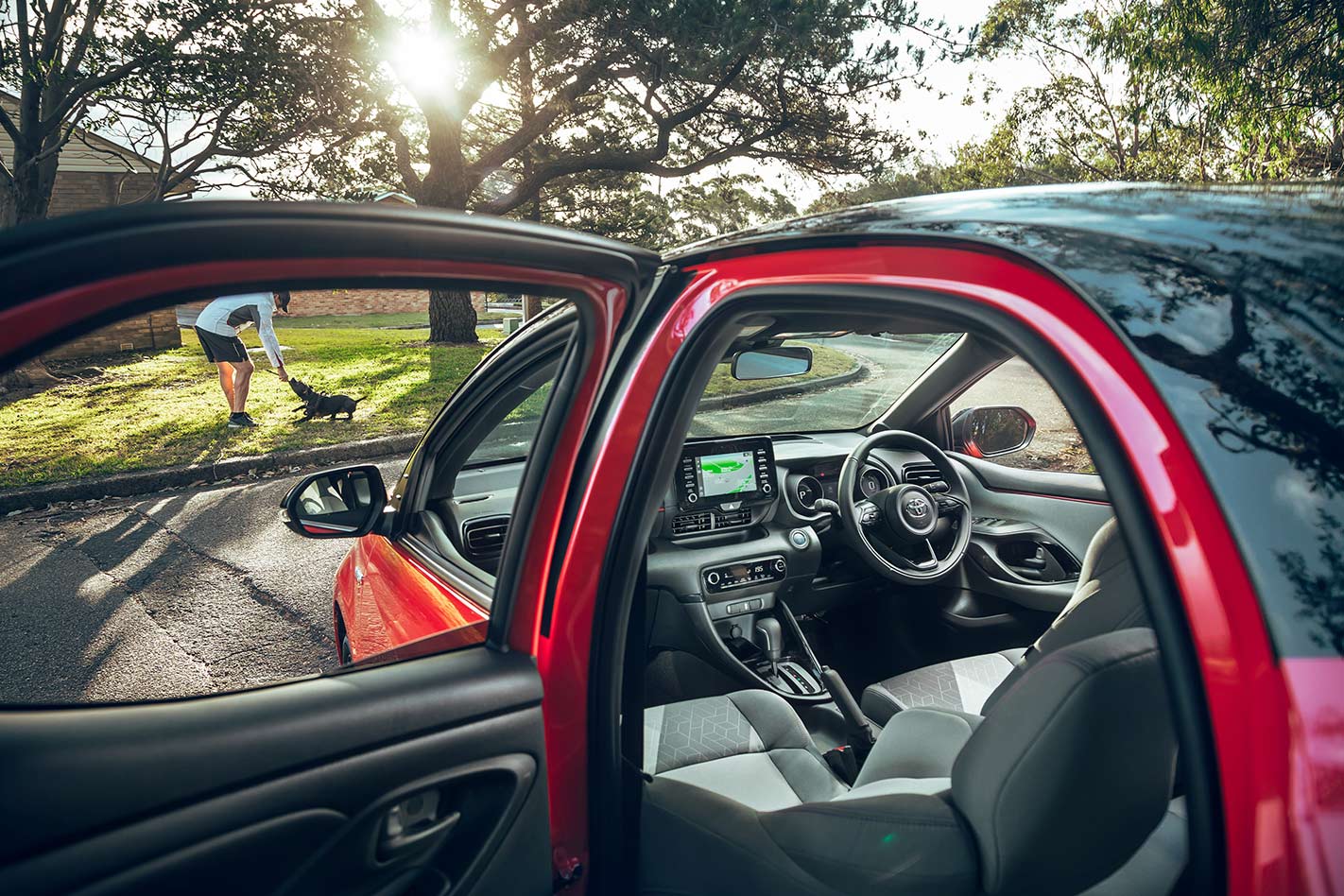
The Toyota spokesperson we contacted claimed the Yaris’s hybrid superiority went further than just the battery type, saying “there are hundreds of changes that make the hybrid system on the Yaris more compact and efficient than that on Corolla.”
So will buyers in the light-car class see value in the Yaris, and choose it ahead of the larger Corolla, or the multitude of similarly priced cars? That really is the $35,000 question…
Volkswagen has reinstated diesel power to its Tiguan Allspace SUV range after a brief hiatus knocked the two diesel options introduced at launch from the seven-seater line-up.
Loosening production restrictions have now allowed the most frugal 140TDI Highline to rejoin its three petrol-powered siblings in the Tiguan Allspace range for an almost unchanged price of $54,690 before on-road costs (+$200), which maintains the $1500 premium over the equivalent 162TSI Highline petrol.
The reintroduction of the 140TDI takes the Allspace line-up to four variants alongside the 110TSI, 132TSI and 162TSI petrols, but it returns alone and without the previous 110TDI that was available from 2018 launch.
With the return of the 140TDI, the Tiguan Allspace range has a new fuel economy and pulling power hero compared with its petrol-engined brethren.
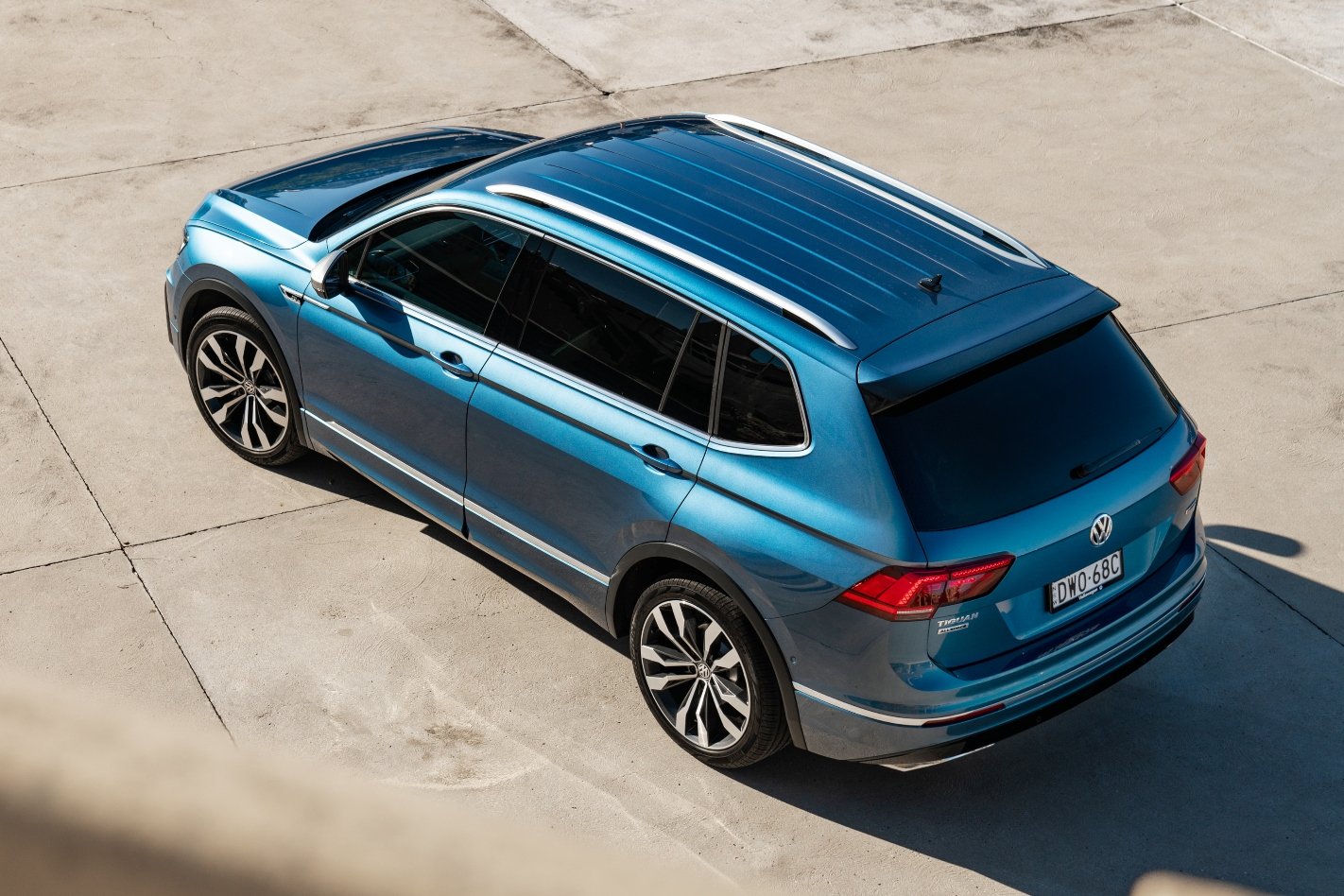
Rated at 400Nm, its 2.0-litre turbo four-cylinder produces more grunt for owners who need to tow, while its power figure of 140kW ranks a close second in the range behind the 2.0-litre turbo petrol 162TSI which, as the name suggests, has 162kW (and 350Nm).
Despite the freshly introduced variant’s solid engine output, the 140TDI is now the most frugal of the range and asks for just 6.0 litres of diesel per 100 kilometres on the combined cycle, compared with the next best 110TSI which manages a claimed 6.6L/100km.
While the three petrol Tiguan Allspace options have been resonating with more metropolis-dwelling owners, Volkswagen says customers looking to cover more extra-urban and rural miles will welcome the return of diesel power.
“Diesel remains an essential part of our model mix, and is a necessity for many of our customers,” said Volkswagen Australia customer experience and marketing director Jason Bradshaw.
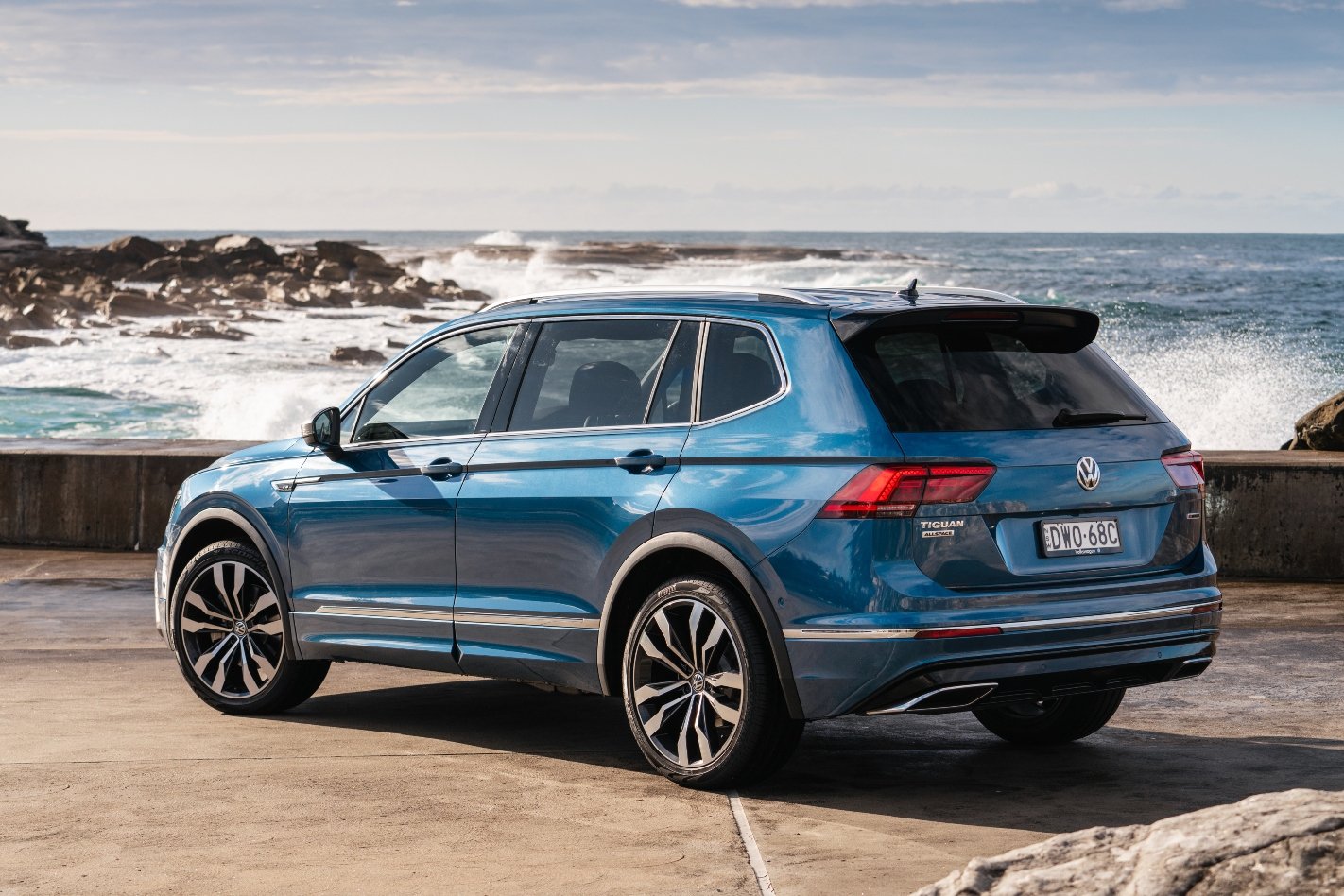
Only the entry level Tiguan Allspace has front wheel drive and a six-speed automatic transmission with all others, including the new 140TDI, equipped with a seven-speed dual-clutch auto that feeds power to all four wheels.
As before, the 140TDI’s Highline moniker denotes the same specification as the 162TSI Highline at the top of the Allspace pack with the most generous levels of standard equipment in the range.
Allspace Features
Given Australia’s demanding market, the Allspace is kit-heavy at all levels and, included in the price are some compelling features such as dynamic LED headlights, keyless entry and start, three-zone climate control, power tailgate, and a good level of driver assistance technology. The latter includes lane keeping assistance, parking sensors all round, AEB with pedestrian recognition, rear view camera and driver fatigue monitoring.
At the pointy end of the range, however, the Highline variants add to the standard gear with adaptive dampers for adjustable ride characteristics, 19-inch alloy wheels, heated seats in the first two rows, and upholstery in part leather.
The highest-spec versions also get the largest version of the central touchscreen and a 9.2-inch Discover Pro information and entertainment system as well as ambient interior illumination.
If that’s not enough luxury for an aspiring Allspace owner a series of options are on offer to boost the premium feel such as metallic paint for $800, a sound and vision pack boosts technology levels for $3000, an R-Line upgrade adds sporty details inside and out for the same cash, while a panoramic sunroof will add another $2000 to the bottom line.
The updated range now consists of four variants starting with the $40,490 110TSI Comfortline while the latest diesel 140TDI forms a new flagship for the Tiguan Allspace family.
The Tiguan Allspace 140TDI is available to order for October delivery for a small allocation of MY20 vehicles. The full allocation of MY21 vehicles will begin arriving from early November.
HSV, soon to be GMSV, will have a new general manager as long-time boss Tim Jackson is set to leave the business.
After a six-year tenure (after already having been in the business for some time) at the top of the Walkinshaw Automotive Group, making him the head of HSV, Jackson will vacate the position and be succeeded by former chief operating officer and past engineering boss Joel Stoddart.
It’s reported Stoddart will be considered the managing director of Walkinshaw Group, while GMSV will have its own specific manager.
Jackson has overseen the creation of many of HSV’s latest and greatest cars, including the Gen-F HSV models based on the VF Commodore, culminating in the ultimate HSV Commodore, the GTSR W1.
Jackson was also in charge for the transition away from Commodore-based products, and has essentially laid the foundations for what the company will become as GMSV.
“I’m immensely proud of the way in which the business accepted the challenge to transform into a multi-customer organisation following the end of Commodore production,” Jackson says.
“Over the past 6 years the team has developed and delivered some iconic Australian motoring programs like W1, and with our partners we have pioneered factory grade left to right hand re-engineering programs, including the full-size truck market which continues to go from strength to strength.

Walkinshaw and Jackson (l-r)
“I’m very proud of the team we’ve developed, and look forward to watching Joel and his team take the business forward into its new phase of growth”.
Ryan Walkinshaw, son of company founder Tom Walkinshaw and owner of the company, says Jackson has been instrumental in positioning the Walkinshaw Group for its future.
“On behalf of the Walkinshaw family, I’d like to thank Tim for his energy and commitment in leading the business through its transformation, including through dramatic changes in our operating environment,” says Walkinshaw.
“The business is now well positioned for growth as we complete the transition into our new world with our partners. I’ve personally enjoyed working with him and wish him well into the future.”
New boss Joel Stoddart is no stranger to HSV and the Walkinshaw Group, having spent more than two decades in the company and having led its engineering team through a significant portion of the last decade.
In 2019 he took up the position of COO, which he now swaps for the title of general manager.
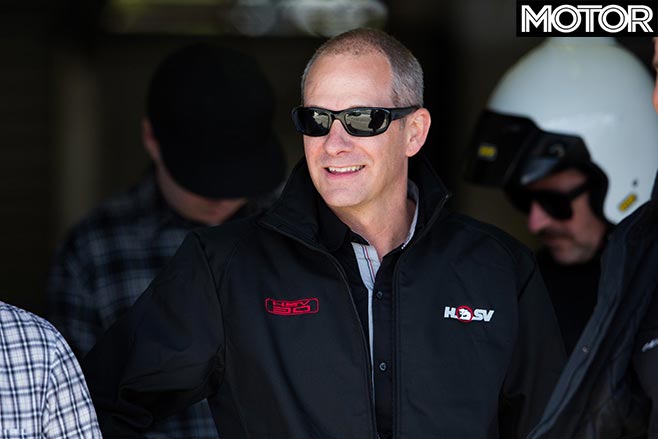
“Joel steps up from his previous role as Chief Operating Officer, and he has been with the business over 22 years,” Ryan Walkinshaw adds.
“I’m very confident that he and his leadership team can deliver our innovative and exciting roadmap and take the business into the next phase.
“We’re looking forward to sharing more about our exciting future shortly.”
MOTOR contacted Tim Jackson for further comment but has not received return communication as time of publish.
