
Some days just don’t go to plan. And this lady’s day definitely ended badly, after she drove her late-model Mitsubishi ASX over a train station overpass in Melbourne over the weekend, ending up wedged in between handrails on a train platform in Melbourne’s south-east.
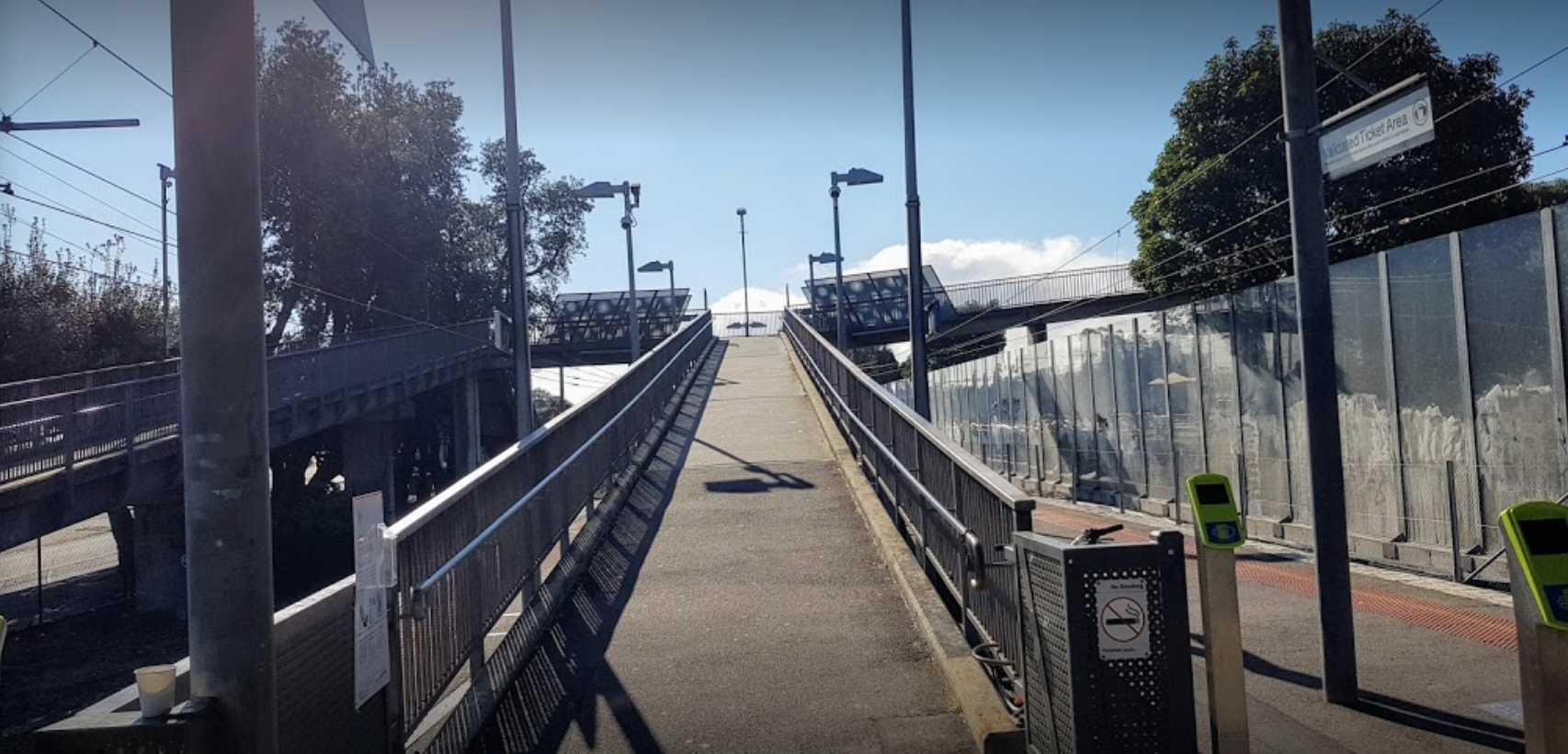
We can only opine what led the subject of our story to her unfortunate situation. Was she following her sat-nav instructions a little too closely? Was she getting a bum steer from her food delivery app? Was she late for a meeting?
The unnamed driver somehow steered her little SUV up a long pedestrian overpass ramp at Kananook Station, before allegedly coming to a stop and contemplating her next move.
Should she reverse down the path of least resistance? Should she hop out of the car and call for help? Should she make sure her travel card was at least topped up?
Nope… our heroine proceeded in a downwardly direction, driving her ASX down three flights of narrow stairs en route to make the 2.30am all-stops to Frankston.
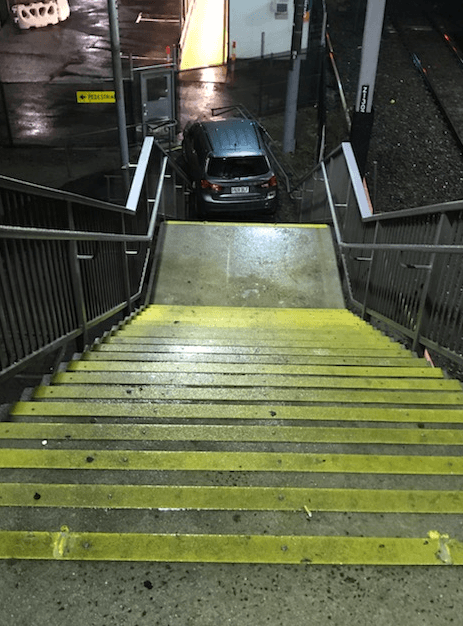
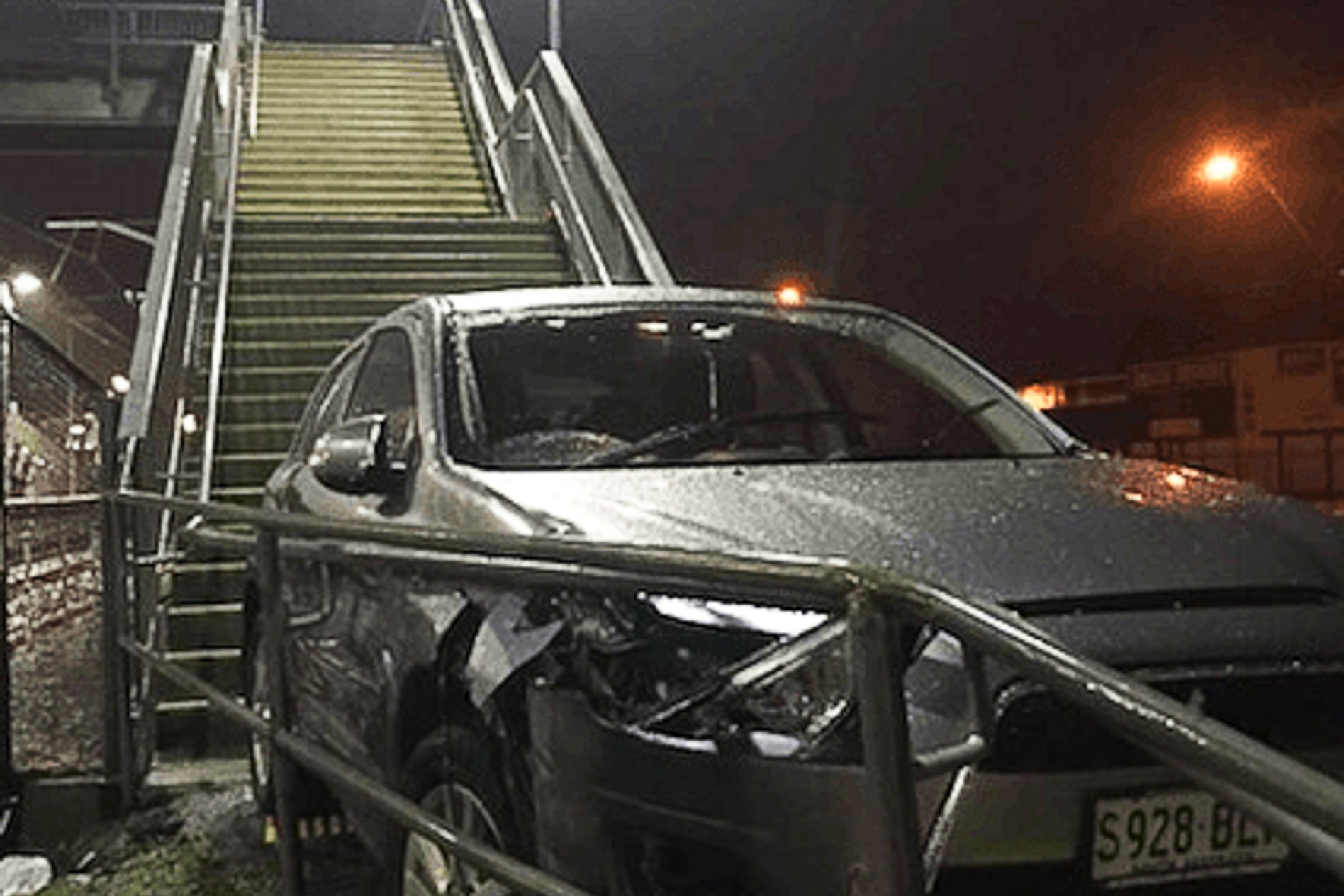
Her passage was halted only by the cheeky addition of steel handrails, which locked her hapless and hardy ASX into a point of no return.
In a marvellous piece of understatement, Victoria Police described the incident.
“Police attended the incident, which occurred just before 2am and breath-tested the woman, resulting in a reading of 0.158,” read a statement.
“The woman is also expected to be charged with careless driving.”
No mention of fare evasion, though…
The ASX was so firmly wedged it required the services of a State Emergency Service team – and a tow truck with a long cable, we suppose – to retrieve it from its inappropriate parking predicament.
We all know that the Falcon AU can do incredible things, but given the steepness of the stairs and the relatively unscathed state of the ASX, perhaps there’s a new contender for go-anywhere, do-anything automotive amazingness?
If we were to hazard a guess, our silly stunt driver will be negotiating those station stairs in a much more traditional manner, once a magistrate snaps her license in half.
There’s a lot to think about nowadays – but one thing you don’t have to worry about is Wheels!
Our May issue is on sale now, crammed full of news, features and high-quality reviews on the newest metal going round. And we’re already looking eagerly ahead to life after lockdown. Where will you be heading once iso is vanishing fast in the rear-view mirror?
With all this rubber hard at work, you’ll be thinking of tyres, and we’ve got you covered in our giant 2020 tyre test. Who’ll take the gong for the best boots in Oz?
We reckon those zany Swiss might have a few too many Schützengarten biers when they dreamt this Corvette ute up.
The wacky Chevrolet Corvette C5 in question has been turned into a single-cab utilitarian workhorse thanks to Neufeld’s Special Cars, a rental outfit and dealership in Zurich, Switzerland that specialises in US muscle cars and special interest classics.
There’s not a lot of information listed about our special Corvette ute, but we can note that the dealership in question will rent it out to you should you require a Corvette with a little extra load capacity and a two-tone sky blue and white paint job.
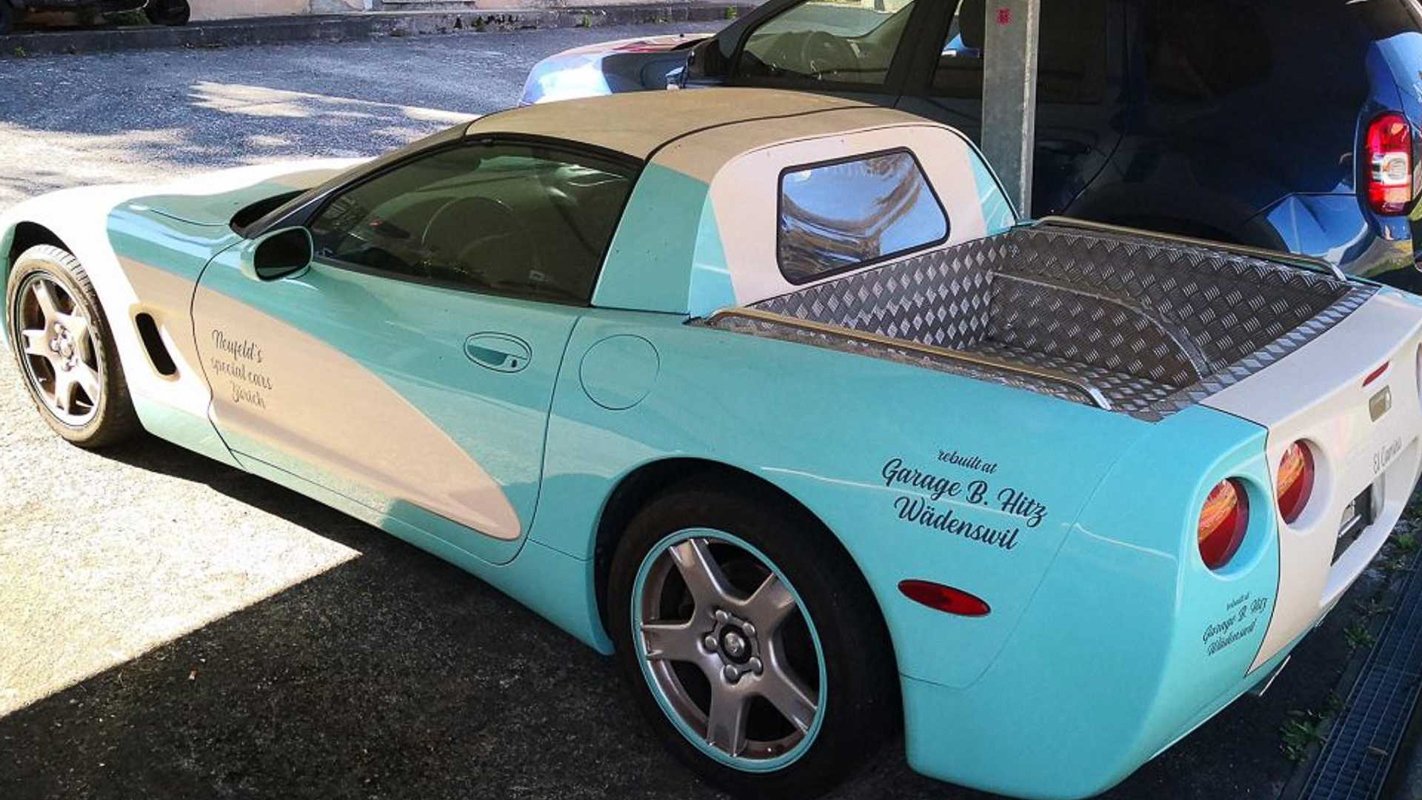
The rear section of the convertible ‘Vette has completely stripped away for an enclosed bed that’s ready to take the hedge clippings to your nearest tip.
It’s been lined with chequerplate panelling and even features a pair of tie-down rails so you can cover your load as required by law. You do, however, miss out on a tailgate, and we don’t reckon you’ll get a regulation pallet in this particular ute bed.
We’re sure it would be an – ahem – experience to drive, if nothing else, especially in Switzerland!
The Aussie origins of the Chevrolet Corvette C8
This rental is intended for film and TV purposes, but it’s not the only wacky Corvette the company has on the books at the moment.
Among a slew of relatively pedestrian classics like a Ford Mustang Boss 302, Pontiac Firebird, Dodge Charger and a Lamborghini Diablo sits a high-riding, off-road-ready Corvette Stingray (below).
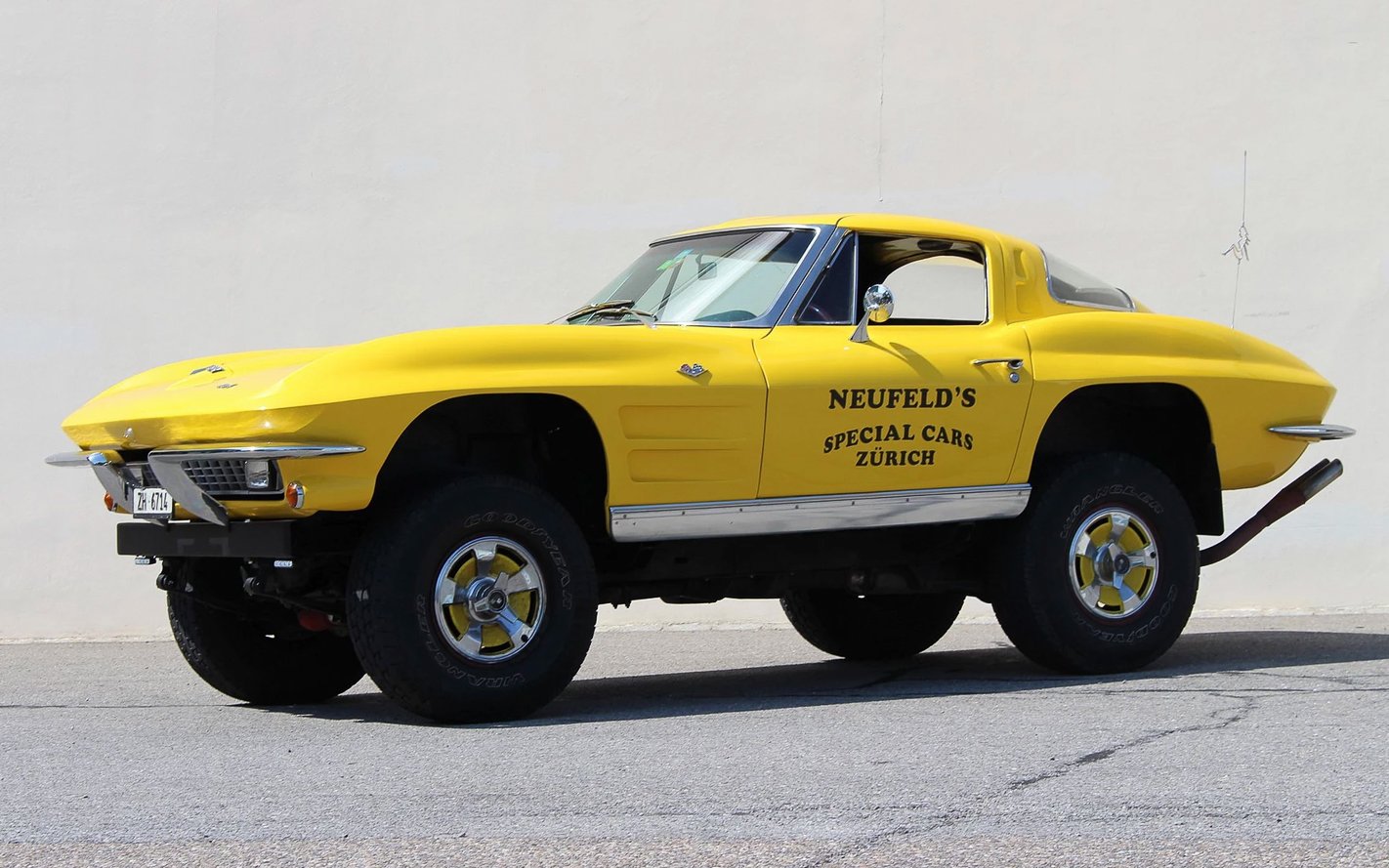
With a stance that’s closer to monster truck than dual-cab ute, this big-wheeled, two-door behemoth looks ready to enter the Thunderdome and eat the other cars for breakfast.
We can’t imagine any TV show having the need for a white-and-blue Corvette pick-up ute – nor a Corvette Stingray monster truck for that matter – but then again maybe we’re the ones missing out on some wild Corvette-laden TV shows out of the land-locked country.
Or maybe we need to head over there and drive it for WhichCar TV?
The C5 Corvette was never a particularly handsome design and as much as we love the idea of a Corvette ute, we’re not so sure on this conversion. What do you think?
This has been going on for quite a while now. Benz blams out another E-Class Weapon of Mass Distraction and within a few heartbeats, BMW has fired a new M5 back over the fence before the smoke has stopped wisping from the muzzle of the AMG cannon.
This feature was originally published in a previous issue of MOTOR
But it wasn’t really until the V8-power E39 M5 that the weapons on either side started to resemble each other so closely. Not only did the V8 M5 arrive in 1999, it did so within months of the W210 E55 turning up. Not only were both aimed at the same punter, they were also normally aspirated V8s within half a litre of each other.
That said, there were still differences; the Benz, for instance, had a conventional five-speed auto while the BMW stuck with a three-pedal layout. Even so, the end result was similar.
These days, however, there are fewer and fewer mechanical differences as both makers zero in on the wallet-nerve of cashed-up executive types with a need for five seats and rapid transit. And with the reduction of engineering diversity comes a corresponding homogenisation of abilities. Which is another way of saying this age-old comparison is getting harder to pick with each generation.
And yet there are still important differences. Differences including subtleties within the philosophy of each car, mainly, and therein lies the bullseye: One of these cars is decidedly more comfortable in its skin than the other. Both great cars, to be sure, but one of them might almost be accused of having a slight identity crisis.
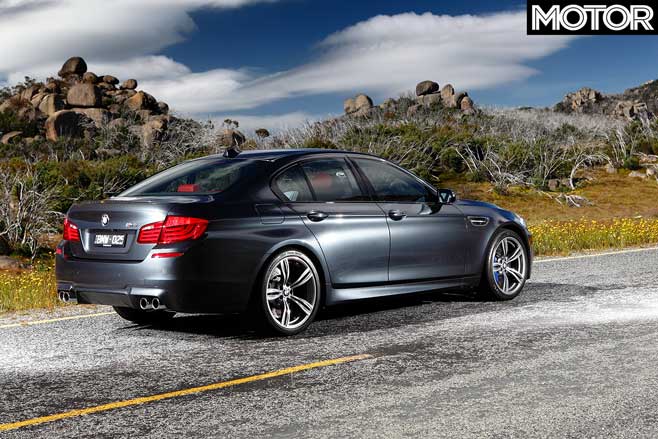
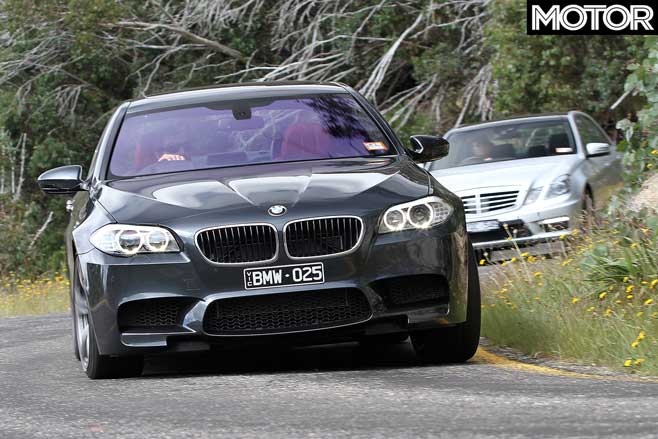
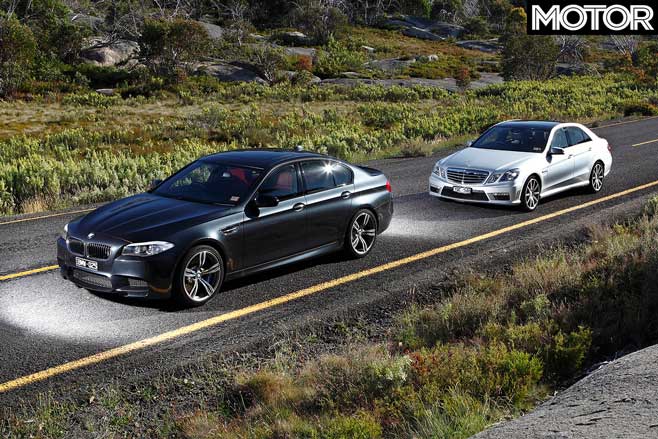
There is, however, zero ambiguity in how each of them presents to the world. The BMW is all short-back-and-sides with a slightly longer nose and more rearward cabin than ever before, while the AMG is all about leaving the competition bruised and, presumably, warned off.
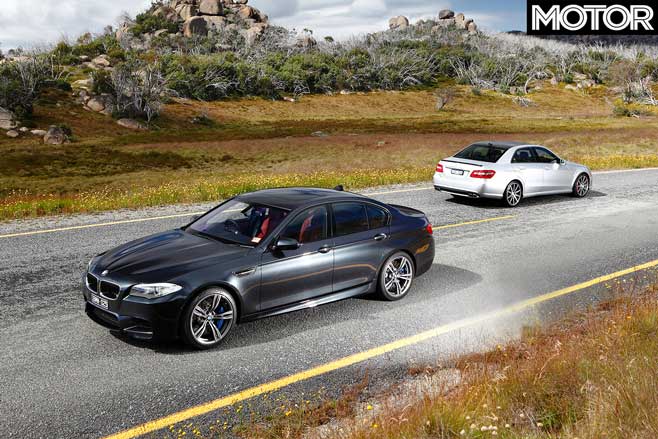
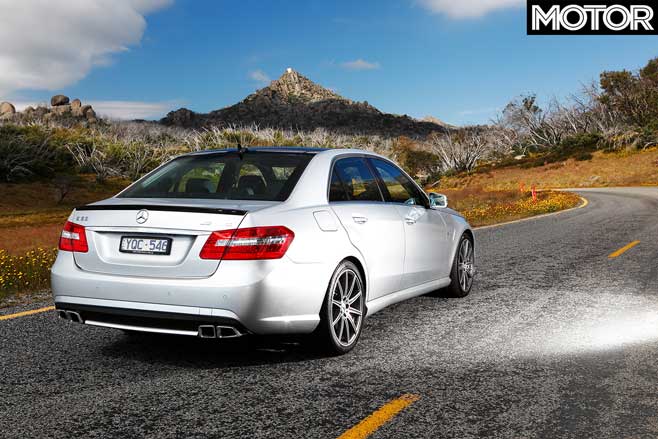
If the M5 is the inside trader, the E63 is the bloke who knocks on your door late at night with a not-so-cryptic message from your loan shark. Overall, we’d say the M5 is definitely the prettier of the two, but some of the detailing on the AMG is extremely well judged, too.
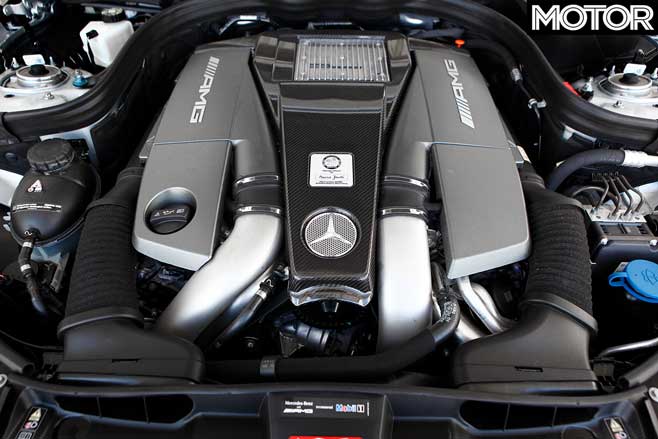
If the E63 looks a bit familiar, it should; the model has been around since 2009 in more or less this visual form. But hoist open that huge bonnet and there’s an all-new heart in there.
That fabulous 6.2-litre atmo V8 is now a memory, replaced by an all-new 5.5-litre V8 lump with twin turbochargers to peg power at 386kW, but bump torque from 630Nm to a full 700 of the buggers. And this one has even more: 410kW courtesy of an optional factory hot-up. With an all-new seven-speed auto on board as well, claimed fuel economy has fallen from 12.7 litres per 100 to just 10 litres.
No, it’s not as tuneful or, at least, as loud as the old atmo jobbie, but it still sounds like a V8 and it still has that AMG trick of allowing you to hear and feel the bass notes while staying free of any audible shrill notes or mechanical thrash.
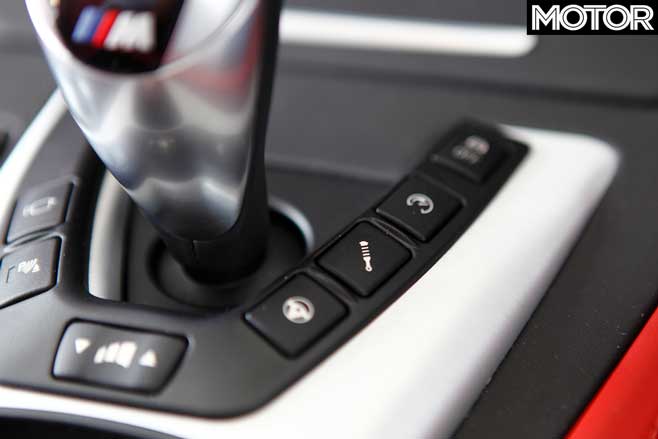
Bimbling around town with everything set for ‘comfort’, the gearbox harnesses all that part-throttle torque to short-shift and take up any slack in the converter. But switch to Sport or Sport Plus and it gets livelier in the gearbox department. Finally, you can switch the tranny to Manual but, just like many-a-conventional auto with a manual mode, it doesn’t necessarily follow your every command. Hustle it into a slower corner on a track, bang the paddle down three times and you might get two gears. Three, obviously, would have been nicer.
No such dramas in the M5 which, with its double-clutch DCT tranny (also with seven forward ratios) remains a more obedient gadget. And like all good, modern double-clutch boxes, the BMW’s shifts smoothly and swiftly and remains civilised, unlike everything else in the supermarket car park on pension day.
With two user-programmable M switches on the tiller, you can pretty much tailor the car to the spec you want it as a one-button job. But unlike the previous car, you don’t have to press either M button to extract the max welly from the engine.
Nope, if it’s running, there’s the full 412kW and 680Nm available from the twin-snail 4.4-litre V8. It’s an interesting mechanical layout, with the exhaust manifold and two turbochargers mounted within the vee of the engine and the induction set-up hanging off the side where the headers would be on a conventional V8.
But what I can’t figure out is why this car felt so different to the M5 I drove in Germany a few weeks ago. The big difference is not in the way it goes, but in the soundtrack. This Aussie car in this test still had the big blurty raspberry on the over-run at high speeds, but it didn’t have the same vocal range across the lower part of the tacho face. Significantly, it lacked entirely the huffing and puffing, fizzing and rasping induction noise of the German car.
Now, this is where things get a bit political. BMW has been a bit coy about this feature of the new M5, but it seems that in order to pass tough Euro noise standards AND give drivers the soundtrack they want, BMW has resorted to what it calls ‘Active Sound Design’, which effectively links the car’s on-board brain to the sound system.
Given that the ECU knows what revs the engine is holding, what load it’s under, the throttle position, what gear it’s in and God-knows-what-else, it can use that info to synthesise a twin-turbo V8 soundtrack and play it through the stereo.
What I’m thinking is that maybe the German car I drove had the Led Zeppelin engine-note chip while Aussie cars – thanks to different buyer profiles – get the Little River Band version. Technologically, it’s certainly possible to provide different levels of synthetic engine note and maybe even offer the same car with various stages of (switchable) ruckus.
BMW engineers shook their heads at this suggestion, however, but one local white-coat admitted that there had been some software changes around December last year. And that would mean that the German car and this car would differ to that extent.
Meanwhile, some people within BMW will tell you the Active Sound Design system is just an amplifier for the engine. My understanding is that it’s more than that; it actually manufactures the noises it thinks you want to hear from such a powerplant. To be honest, I’m not sure how I feel about this. Neither is the rest of the world.
It all depends on how you look at it, I guess. Like (and I’ll stay with the Top 40 metaphor here) were the Pet Shop Boys a red-hot dance act or just a pair of overtly cheerful boys with a drum machine?
Against the stopwatch, 412kW versus the 410 means it’s anybody’s. In the end, though, the AMG turned the standing quarter in 12.4 against the M5’s 12.7. The reason can be seen when you compare 0-100 times: The C63 got there in 4.5 and the M5 took 4.7. And that suggests it’s all in the launch.
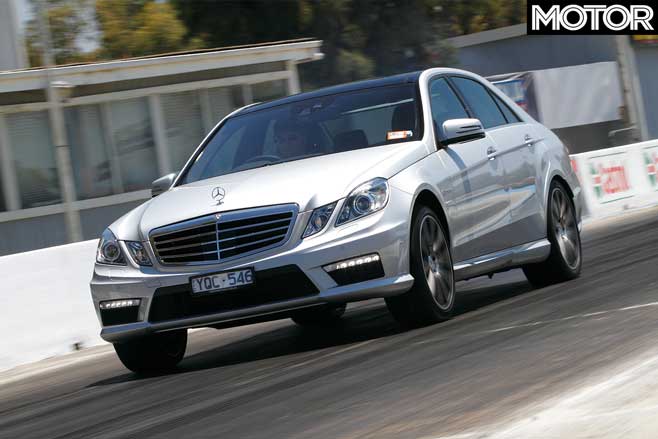
Specifically, the Benz simply has a better (on this day, on this track) launch control set-up. The M5’s launch program can be tailored by using the cruise control buttons to vary the launch revs up and down. The Benz’s is a simple launch-and-hang-on arrangement. Which I would have thought was more or less the point of launch control in the first place. If I need to experiment and fiddle about with launch revs, doesn’t that defeat the purpose of launch control?
That stuff aside, both cars felt incredibly muscular even at the very end of the 400m stretch. Both have enormous top-end thrust and sufficient lack of lag to haze the hides at will from a standing start.
Check the shots of the BMW doing what the backward-cap kiddies would call a power-skid. Actually, what the photo doesn’t show is how bloody hairy it was. As in, I’m still frying the tyres but I’m doing about 120km/h when I realise that if the brute suddenly hooks up, I’m going to be glove-box-deep in the cement wall before you can say ABS.
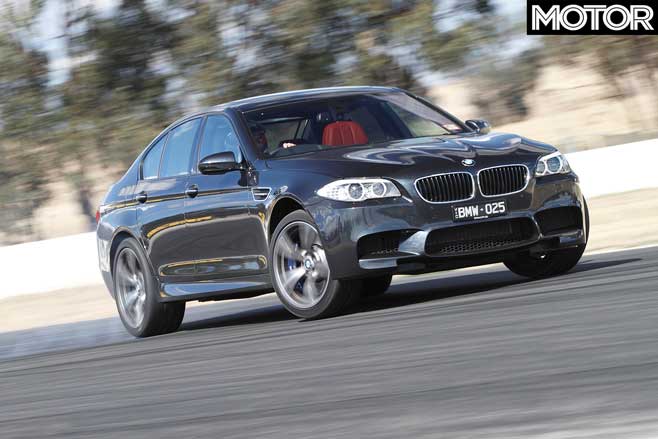
The other drama we had relates (I think) to the BMW’s windscreen that’s coated with something to allow the Head-Up Display to work. Basically, whatever that coating is, it prevented our DriftBox from finding and locking on to its requisite satellites. Fortunately, it has a sunroof with no coating.
Speaking of DriftBoxes and cement walls, things changed dramatically once we hit the Winton circuit in North Central Victoria. Okay, so the BMW was probably always going to be a shade quicker because it’s more track-oriented, but that doesn’t get the Benz off the hook for what happened next.
On a hot but not roasting day (about 32-degrees ambient) the Benz managed to get its engine oil so hot that it went into limp-home mode. Which is not that unusual, but the C63 hadn’t even completed its first hot lap when it all started to melt down.
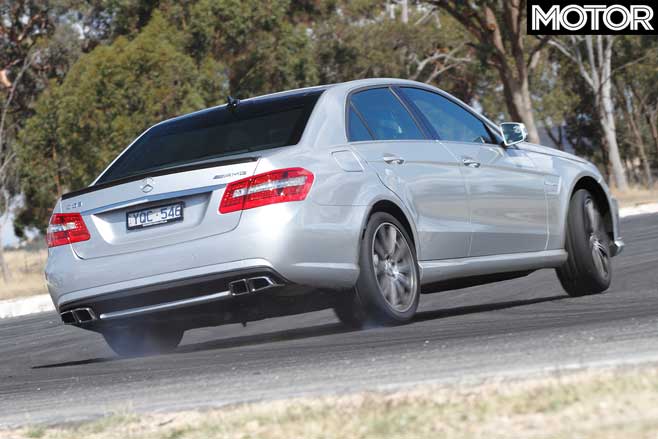
Obviously, a turbo motor will generate plenty of heat, but a single lap of Winton ain’t that far. And what happens on an autobahn in summer? Okay, so Germany doesn’t get as hot as Winton and there’d be more air going through the radiator and engine bay at 250km/h between Munich and Stuttgart, but even so…
To be fair, the M5 was starting to get warm, too, but only after at least a couple of laps at full noise (synthetic or otherwise). In the end, it recorded a 1.39:9. It’s hard to say exactly, but our figures suggest the C63 would still have been a full second adrift even if it hadn’t coughed and gone sulky on the last corner of the first lap.
The M5’s track superiority is down to a few things. The gearbox is the main one and the DCT’s ability to follow orders is not only endearingly Germanic, it also makes the car quicker because you can set it up into turns more accurately. Knowing that it’ll grab the right gear also makes for one less thing to think about when you have your hands this full.
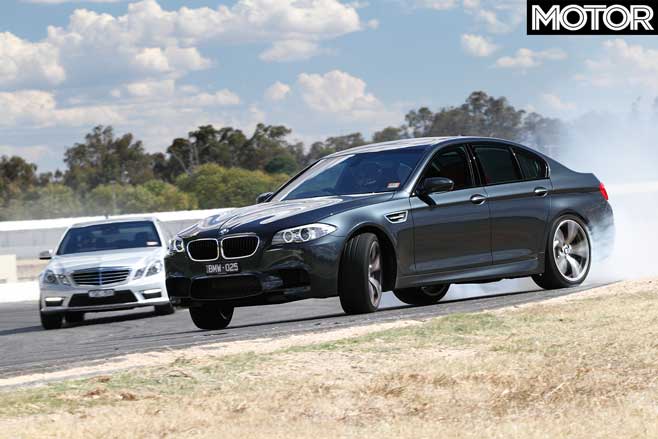
Engine and braking-wise there wasn’t much in it, but in grip terms, the M5 also surged ahead. It’s simply better balanced, less nose-heavy and grippier at both ends.
In normal use, there’s not a whole lot to complain about in either case.
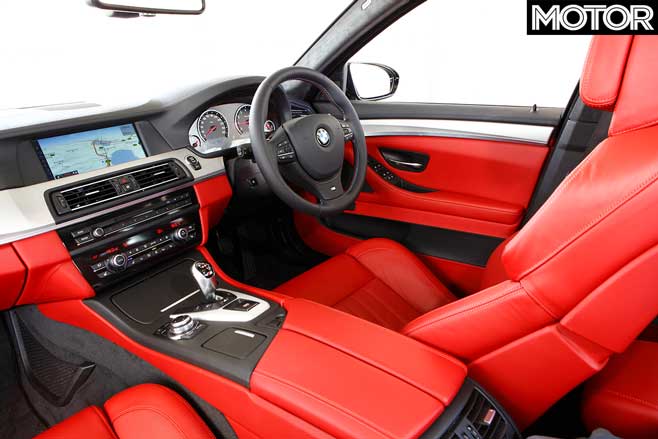
Personally, I find the AMG’s interior a bit more plush, starting with the seats. Benz pews have usually impressed me over the years and the ones in the C63 are no different and actually feel like they’re phased with the suspension. And while the three available settings for the dampers do alter the way the car rides, it isn’t enough to put the chairs off their mission.

The rest of the AMG interior is busy but classy and I’ll include the octagonal tiller in that. It might look like a Stop sign, but the suede bits you hang on to are truly lovely. Only the lack of headroom in the back seat spoils things a little, but it remains a valid observation in a car such as this.
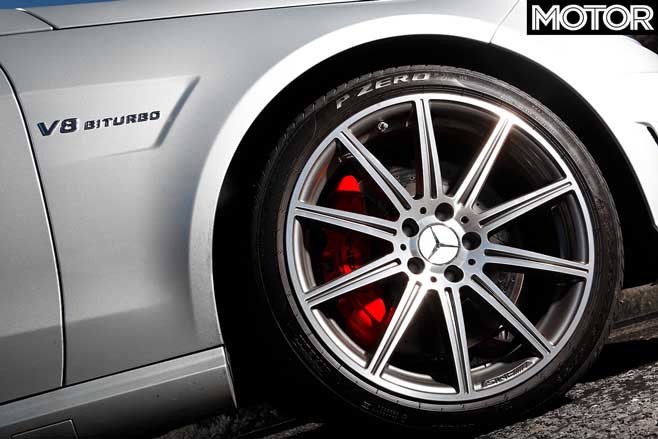
The Benz is the quieter of the two in terms of road noise and the BMW not only has a fraction more tyre roar from those 20s, there was a hint of gearbox whine at around 80km/h on a light throttle, too. For all that, however, the ride doesn’t suffer as badly as you’d imagine from a car riding on 20s as standard, probably thanks to the fact that Michelin doesn’t make Pilot Super Sports as a run-flat. (As it is, you get a can of goo and a pump while the Benz’s 19-inch Pirelli P Zeroes are backed up by a space-saver spare.)
Other bits of the M5 are inspired. The Head-Up Display is well worth the price of admission and the Eye-of-God reversing cameras in each mirror give a display that shows exactly what’s behind and to the side of the car with a processor that’s so fast it’s in true time.
But other stuff I liked less. Like the brake pedal that’s so far to the right it discourages left-foot braking. Why, when evolution has given me two feet, does BMW then supply me with a two-pedal car that must be operated via one foot?
Then there’s the steering feel. Look, I don’t want to make a federal case of this, but the M5’s steering feedback at speed is, without a shadow of a doubt, the most artificial feeling I’ve ever experienced. And don’t go thinking that’s because it’s an electronically-assisted set-up, because it’s not; M-cars still have hydraulic assistance. Either car needs a decent knock to get it off centre (I reckon that’s an autobahn thing) but even at small inputs, the M5’s wheel is abuzz.
So what gives? Beats me, but I’m here to tell you that it honestly feels like a PlayStation with that active-shock-feedback thingy that’s supposed to feel like a real car but absolutely doesn’t. The tiller almost fizzes in your hands but BMW tells me that the M5’s steering system is as unadulterated as Swedish muesli.
Beyond that, they can’t explain what’s happening. All I can come up with is that the rack bushes are made of granite and that off-centre stiffness (the autobahn thing again) loads up the front end until it feeds back through the column. Dunno. But I can say for certain, I’m not mad about the results. Lots of feedback is one thing, but when it’s the steering-feel equivalent of the canned laughter on an American sitcom, I’m not a fan.
But some people will forgive the M5 that much (and fair enough) but I keep coming back to that synthetic engine note. Like I said, I think one of these cars is having a bit of an identity crisis and by now, you’ve probably guessed it’s the BMW. And while I remain philosophically ambivalent about a synthesised soundtrack, equally I am pretty sure it’s not what the M-badge stands for.
Funny thing is, it’s still a better car than the AMG in some respects, most notably its track performance. But again, I’m left wondering if racetrack smarts is missing the point in a car like this. If you had the $231,370 (dice the soft-close door function and save $900) to buy the M5, wouldn’t you also be likely to have a track-dedicated car for weekend crazy-stuff?
And that’s where the AMG does it for me. It knows what it is, who’s buying it and what features and aspects of its performance will make those punters wrinkle up the corners of their mouths. Oh, and in some respects it kicks the M5’s butt anyway.
But here’s the catch; I’m not entirely sure that a standard C63 would put up such a good fight. See, the list price for the AMG is a substantial $240,985, but as tested, that blew out to a monster $284,130.
How? Well, by the time you add just the Performance Package and the Dynamic Handling Package (and there was plenty more on this car) you’ve added over $31,000 worth of extras. We’re not talking floor mats here, either. Those options (among other things) add the 24kW and 100Nm and the adjustable suspension, so it’s serious gear. And that’s before we even discuss whether an AMG should have handling and performance as options. Again, philosophically, I’m left wondering.
I don’t want to walk into a showroom, point at the most expensive, most potent E-Class in the joint and then be told I have to fork out an extra 40-large to bring it up to speed. But neither do I want to buy a leg-rooter of a V8 supercar only to get it home and discover that the engine note owes more to Stock, Aitken and Waterman than it does to exploding petrol.
And sure, I’m unlikely to be troubled by either scenario but only by financial circumstances. Which begs the question: Am I missing the point of these cars, or are they just not getting me?
And now I’m going to tell you that I actually admire – like, even – both of them. But a winner and a loser? Harder to call. I guess the only real loser is the punter who buys one without test driving the other. Like I said, this stuff is now harder to pick than ever.
Not surprisingly, Lamborghini’s foray into electrification is unconventional in the extreme. Rather than following its rivals down the battery-electric path, the Italian supercar maker’s first hybrid uses a supercapacitor to store electrical energy which is fed to a small electric motor.
Compared to even the most advanced batteries, supercapacitors both charge and release their energy much faster and can tolerate many more charge and discharge cycles without degradation.
For the Sian, a 25kW motor is built into the gearbox to provide either an e-boost to the 577kW 6.5-litre V12, or power the hyper coupe purely on electricity during low-speed manoeuvring.
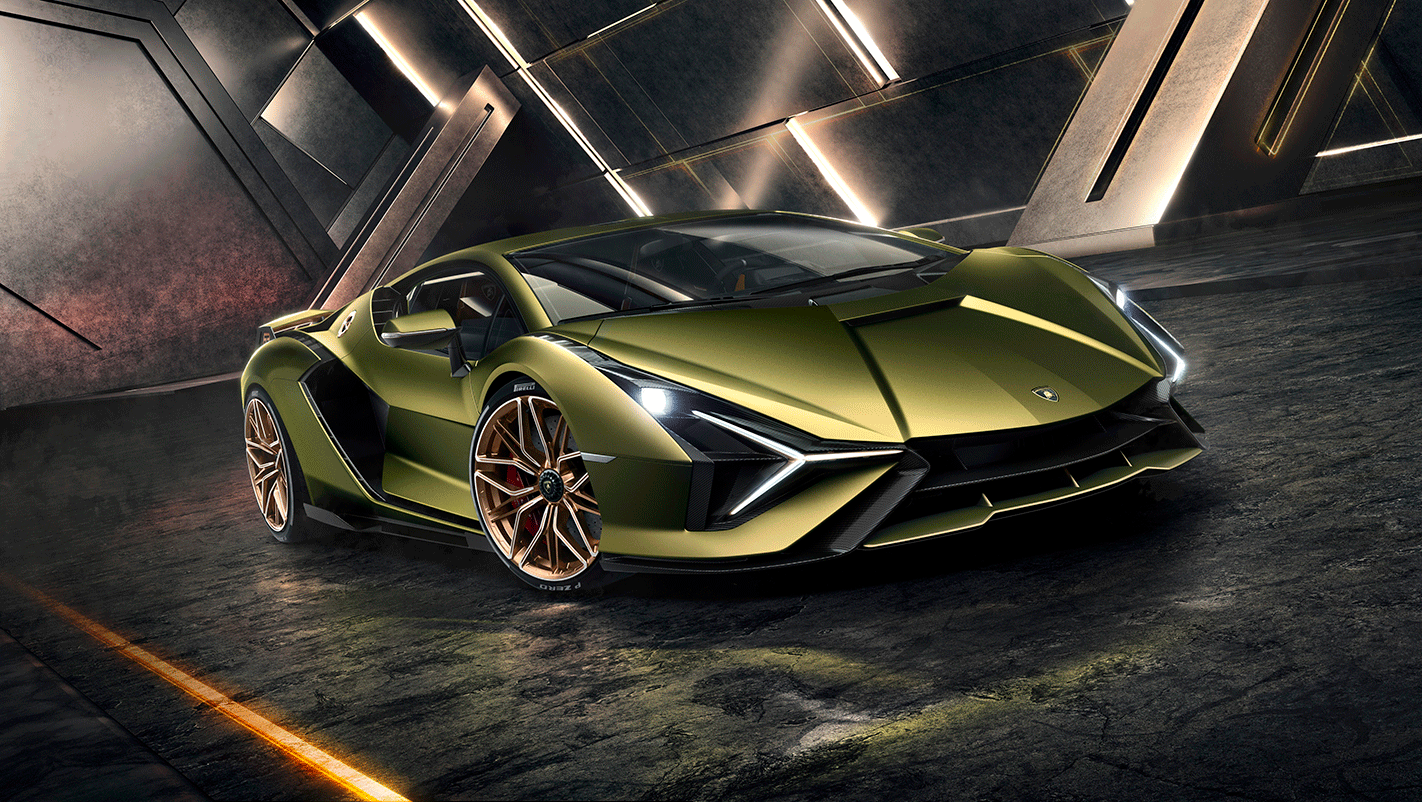
With such fast charging, the Sian doesn’t need to be plugged in to top up its supercapacitor. Instead, the full charge is achieved through regenerative braking each time the brake pedal is pressed, which also improves fuel consumption by recovering energy that would otherwise be wasted by conventional brakes.
The other key advantage to the capacitor approach is weight. With rapid power flow rates, the system can be much smaller while still delivering the punch of a large battery. As a result, the capacitor and motor add just 34kg to the overall weight, but top up the total power output to 602kW.
Done in a flash
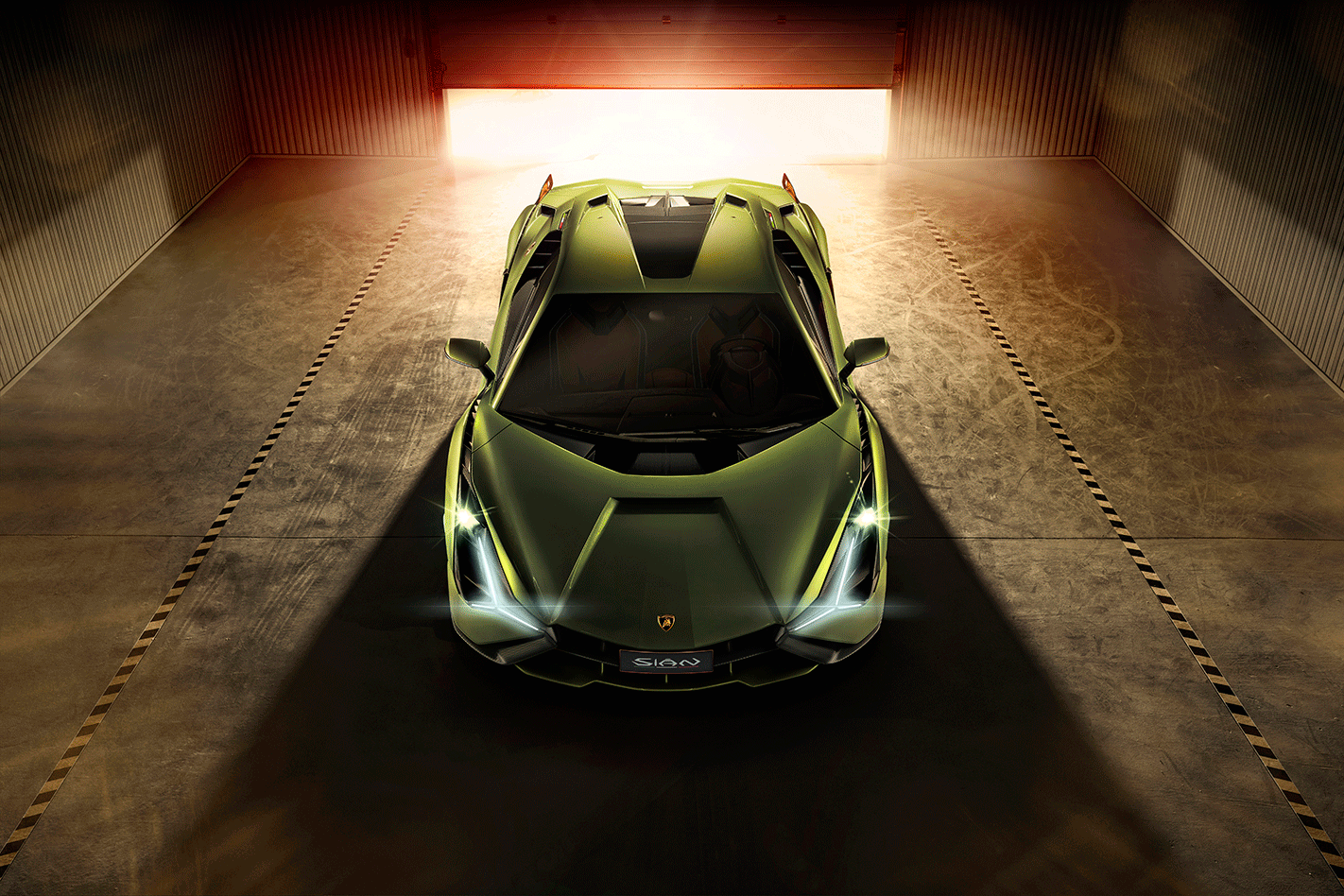
The flash of a camera is a very visual representation of a conventional capacitor discharging a large amount of power in just milliseconds. The Sian, however, is equipped with a supercapacitor, which multiplies the thump sent to its motor for serious performance.
Flat out
The downside to capacitors of any size is poor prolonged power storage, as the electricity contained within dissipates relatively quickly over time. Park your Sian for a week and there’ll be no pure EV power left when you come back.
Told you so
With low-voltage supercapacitor technology already in operation in the Aventador, and a partnership with MIT to design a supercapacitor system for the pure electric Terzo Millennio concept, it was only a matter of time before Lamborghini rolled out a full-fat production capacitor vehicle. Expect more to come.
Hyundai’s Kona EV offers enough range to make it a viable option for a one-car garage, but with a mid-$60K price tag, can it really battle with the like of the hybrid Lexus UX250H?
EQUIPMENT AND VALUE
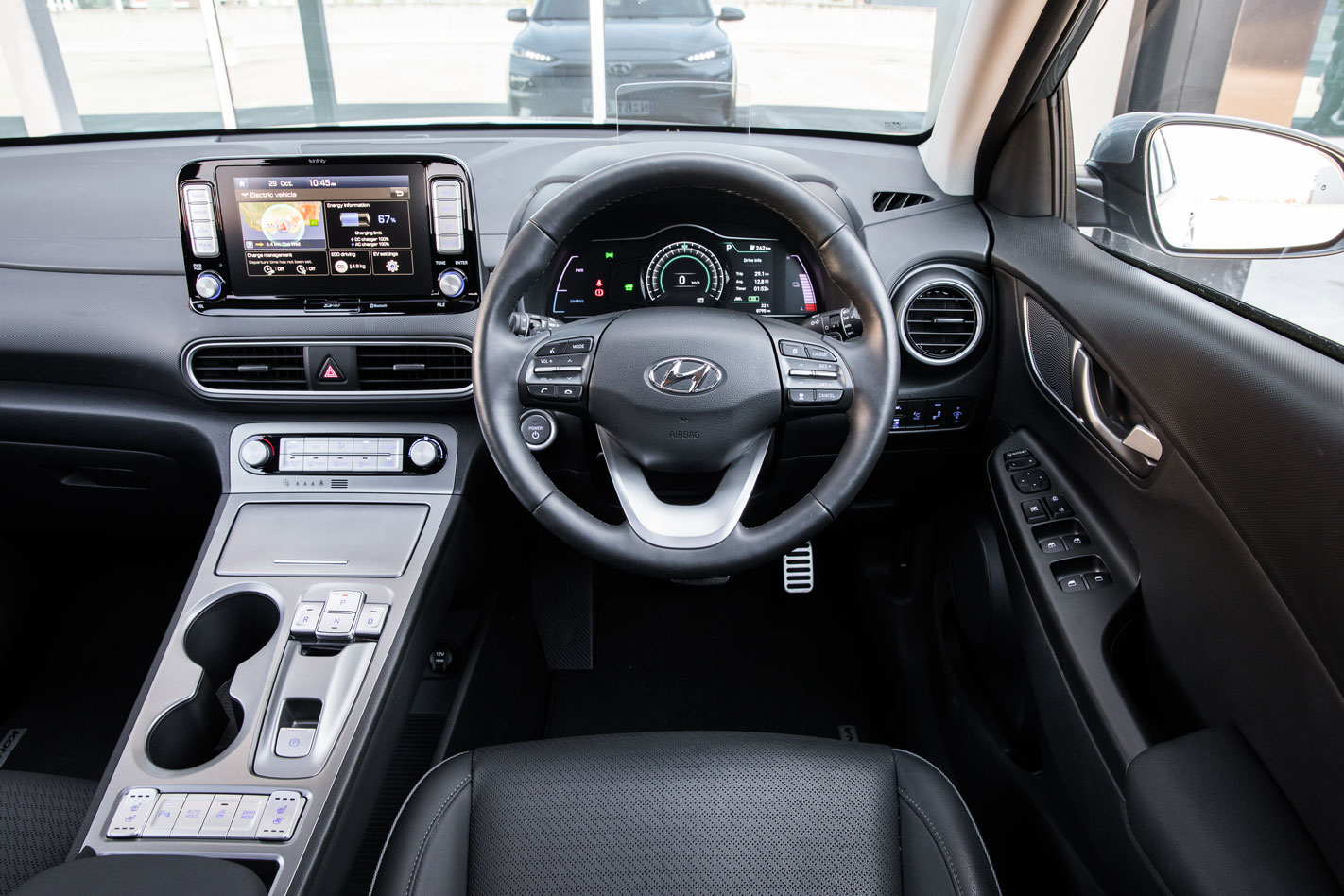
For the mid-$60K price point, the Kona Highlander EV comes packed with features to justify its high price. Key safety gear includes AEB, cruise control with city stop and go, blindspot warning, lane-keeping assist, rear-view camera and parking sensors all-round. Heated/ventilated seats and smartphone mirroring are also standard. The Kona EV comes with a five-year, unlimited-kilometre warranty and an eight-year/160,000km warranty on the lithium-ion battery.
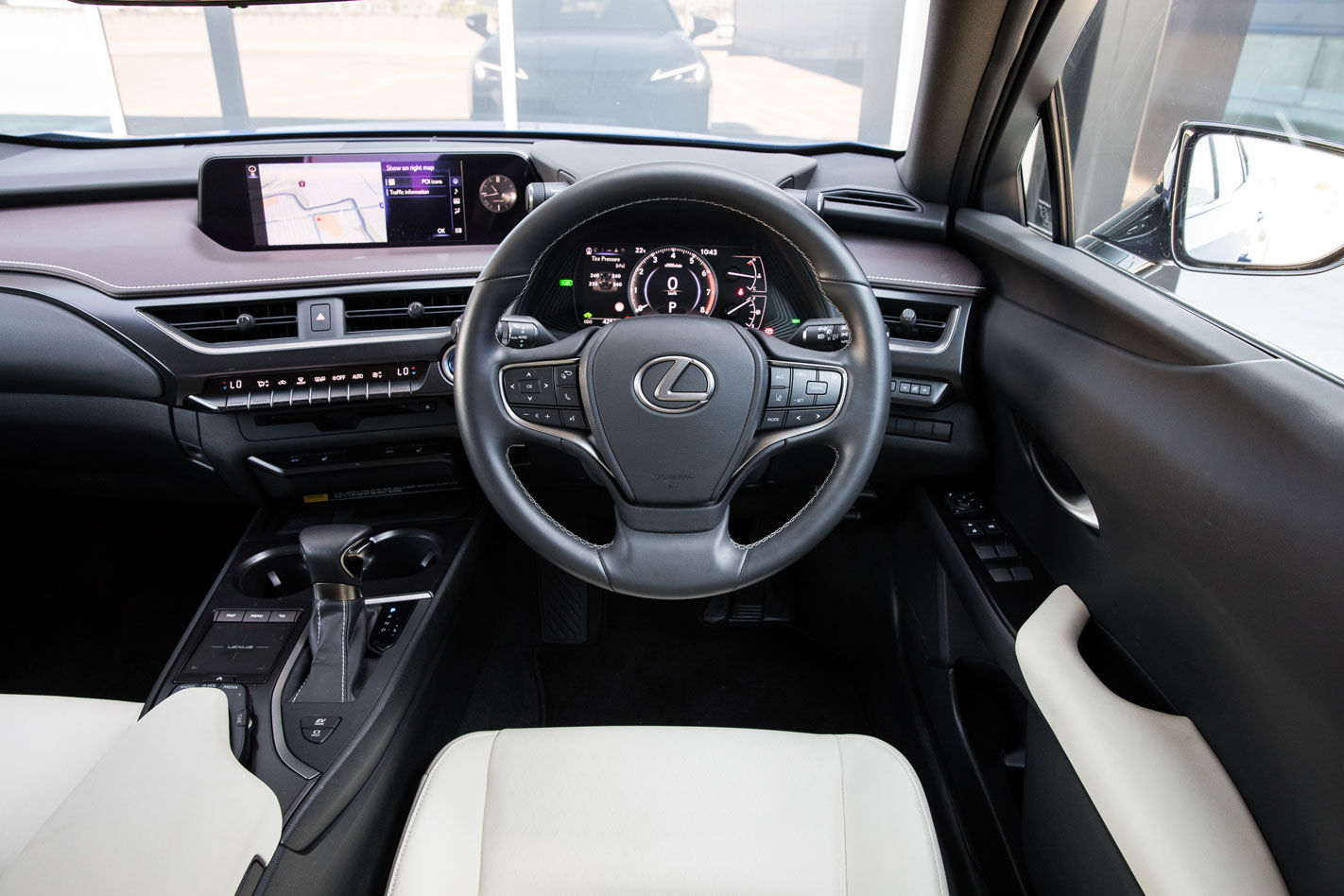
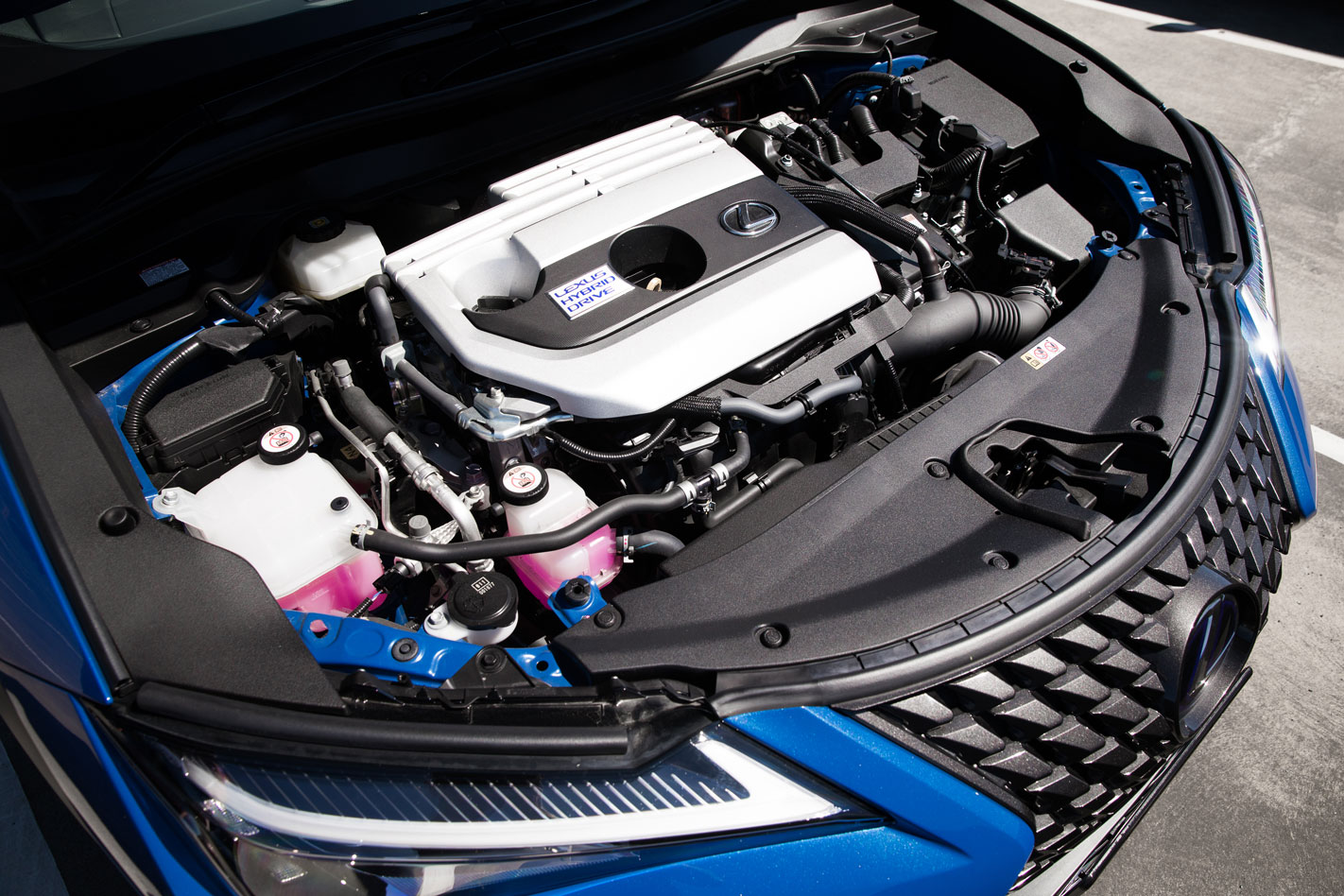
The Lexus UX 250h Sports Luxury 2WD (Luxury pictured) comes in at $56,500 and offers a luxurious feel tied in with a hybrid powertrain, as opposed to full EV. The UX also has AEB, radar-guided cruise control, blind-spot warning, lane-keeping assist, rear-view camera and parking sensors front-to-rear. Apple CarPlay and Android Auto are now also available in the UX, with a retrofit available if required. At four years or 100,000km, the UX has the lesser warranty.
WINNER: Lexus UX250H
SPACE AND COMFORT
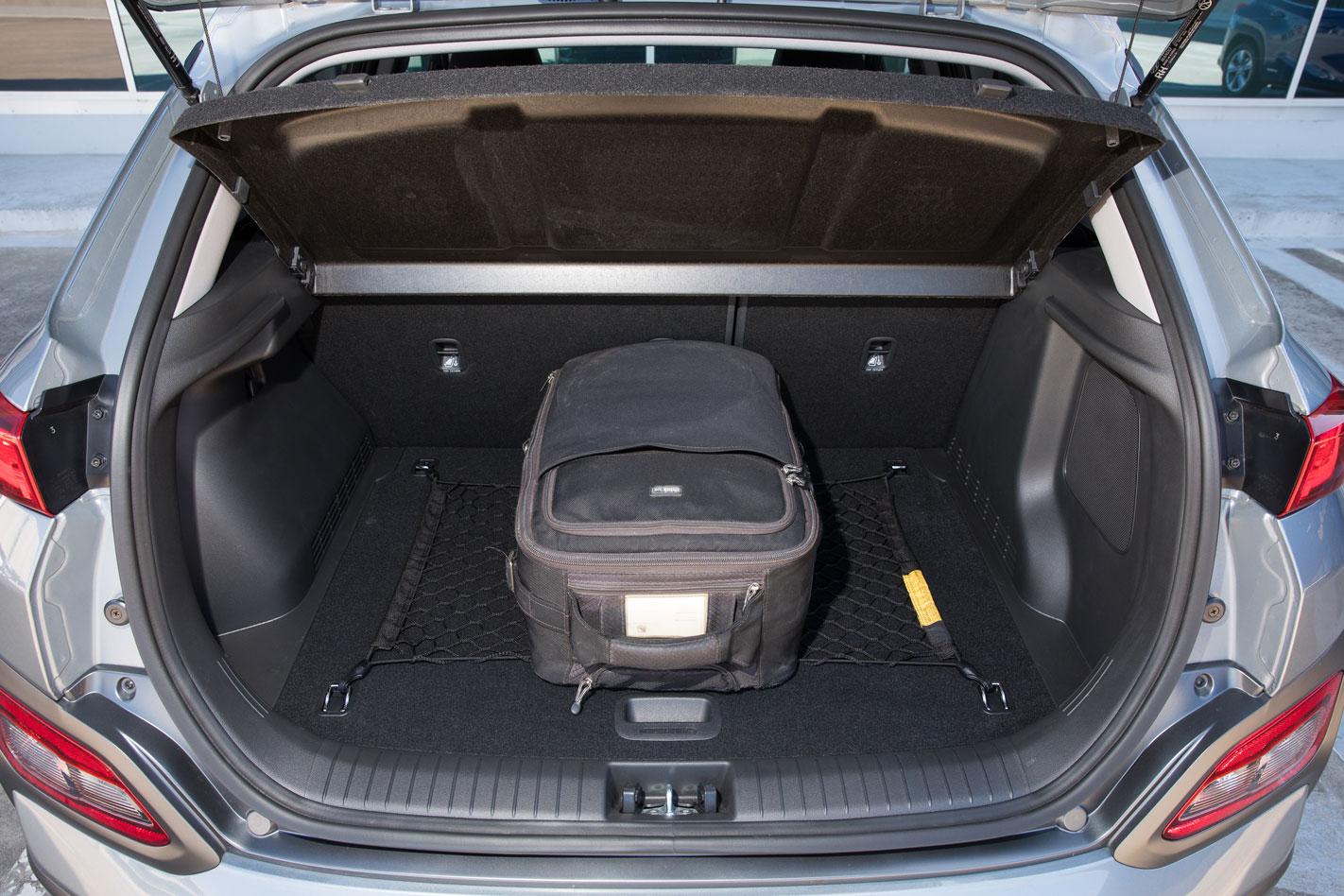
Inside is where the $64,490 ask is questionable. The quality and ambience isn’t at the level required for this kind of money. The floating centre console aids practicality while adding design flair, and the graphics used with the 8.0-inch infotainment screen appear modern. The cabin feels more airy than the Lexus, with comparable all-round space. Cargo capacity squeaks ahead at 332 litres, but it’s a shallow space with the charging cable stowed under the floor.
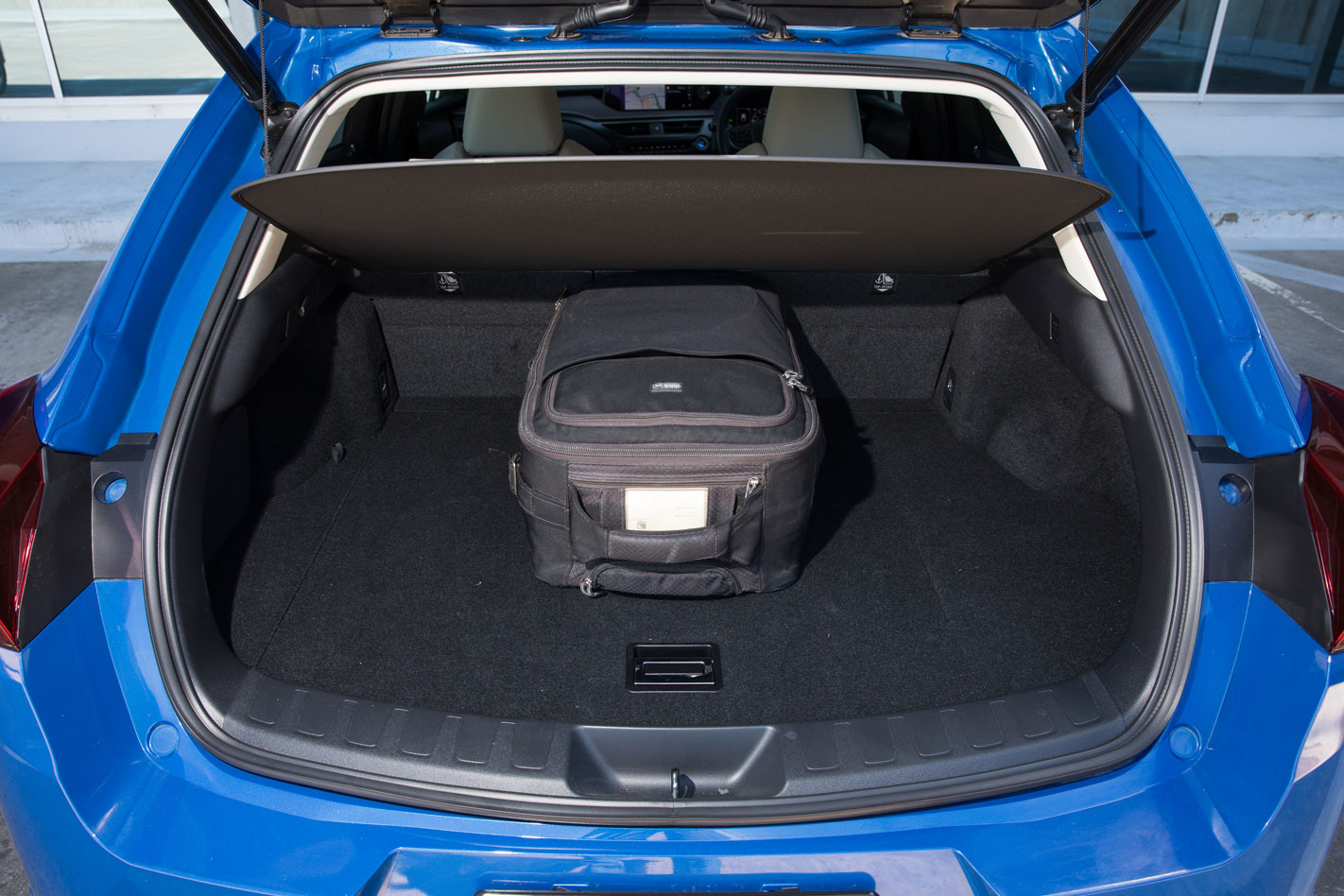
This is where the UX really claws back the points on the Kona. The Lexus looks and feels like the premium offering despite being the cheaper option. Soft and plush leather abounds, while the general build and materials quality are a step above the South Korean. Apart from the frustrating track pad (to control the infotainment) and the antiquated graphics, it’s a nice place to be. Like the Kona, the UX is snug inside, while the boot is smaller at 324 litres.
WINNER: Lexus UX250H
RIDE AND HANDLING
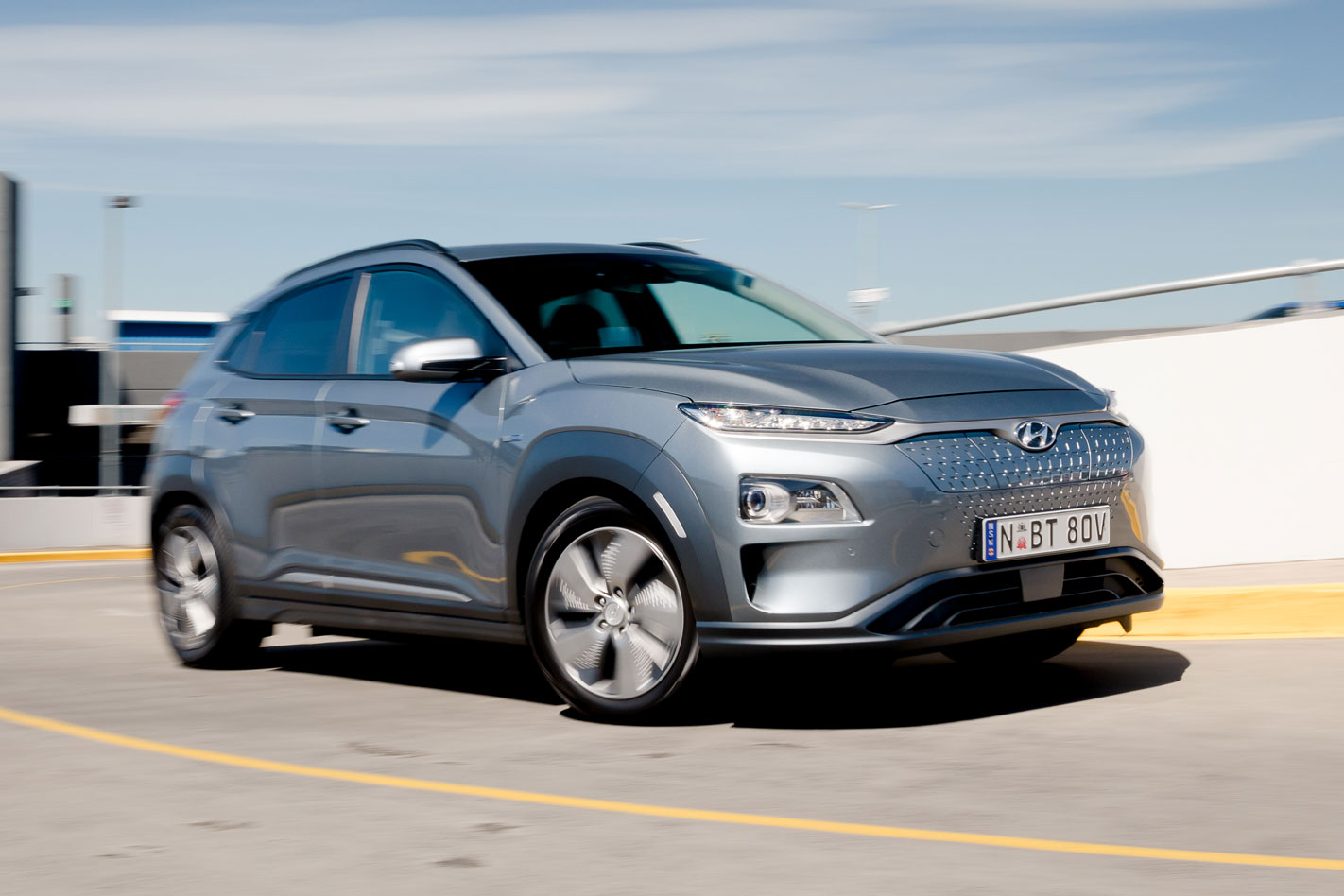
Adding 360kg compared to the Highlander FWD has a detrimental impact on dynamics, hence the EV can suffer from a bouncy ride. However, it does utilise multi-link rear suspension, which helps composure. With 395Nm going to the front wheels, and eco-focused tyres, the Kona can fry its fronts in any conditions. A gentle right foot is required for wet weather. Sans engine sound, tyre roar is noticeable on the highway, but it remains quiet in the CBD.
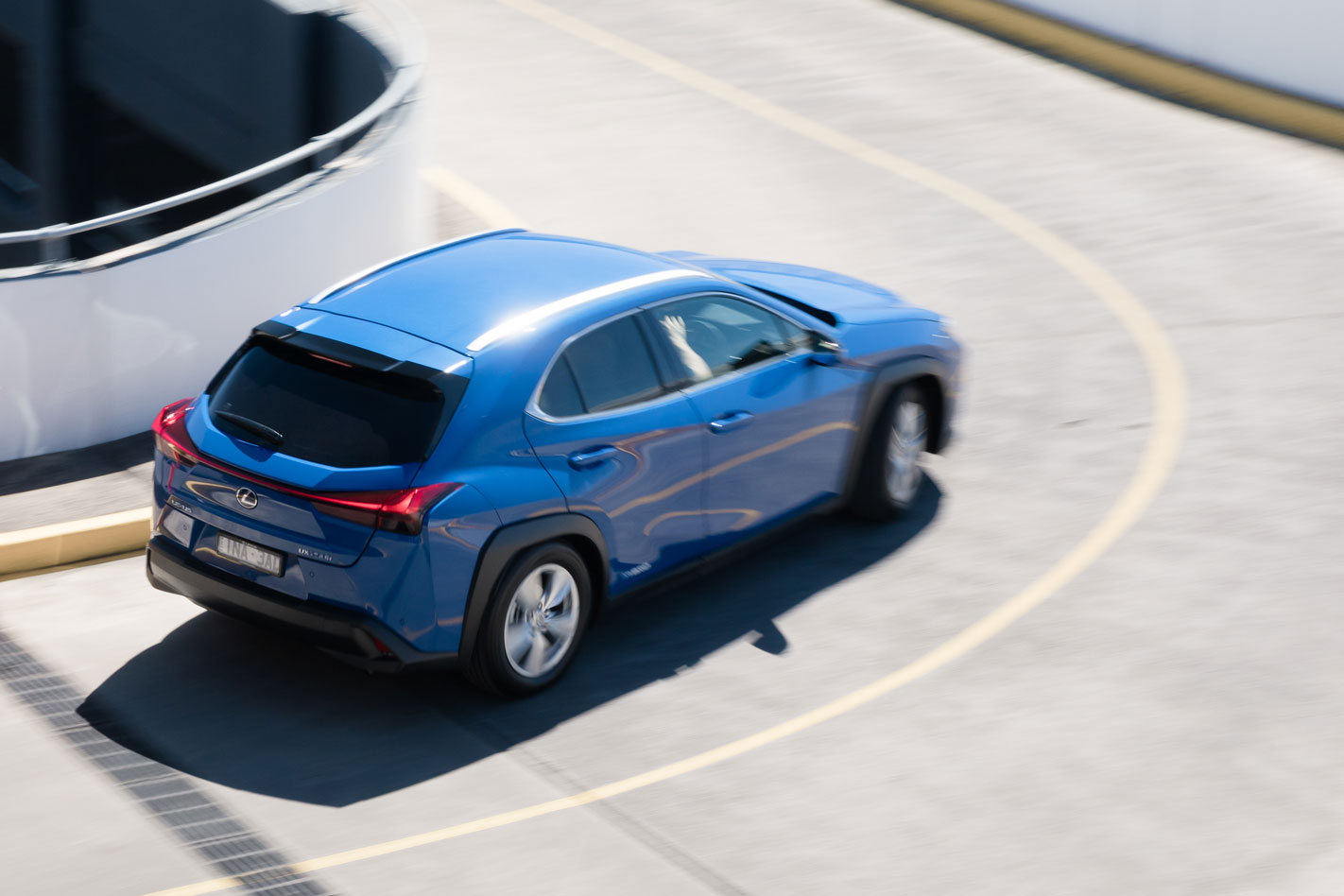
Using underpinnings borrowed from the Toyota C-HR, the UX is a surprisingly good steer, feeling much more planted and agile than the heavier Kona EV. The ride quality is aided by greater compliance and a more sophisticated damper arrangement, with the UX smoothing out the road nicely. NVH levels are also well suppressed. An issue is braking, which seems to get confused between regenerative and its conventional discs, making it hard to be progressive.
WINNER: Lexus UX250H
PERFORMANCE AND ECONOMY
With a WLTP range of 449km – and it’s a genuine figure that isn’t overtly affected by active in-car auxiliaries – the Kona EV largely dispells range anxiety. Drive normally, resisting the urge to utilise the substantial 150kW and 395Nm on offer, and the 16.0kWh/100km claim stacks up. The Kona’s 0-100km/h figure is 7.6 seconds. Charging the 64kWh battery pack takes 9hr35min from mains, dropping to 54min for a charge to 80 percent using a fast charger.
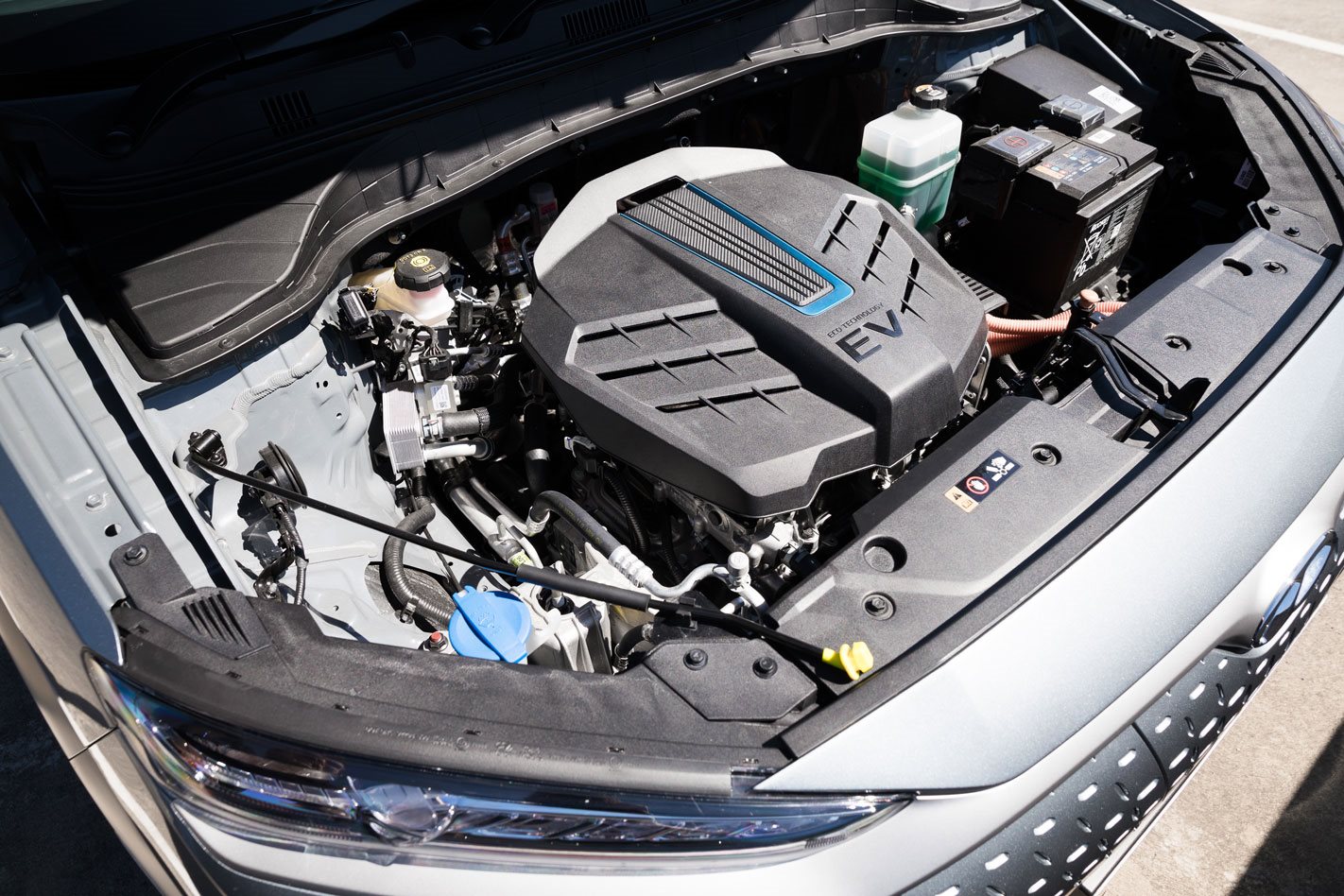
While the UX 250h doesn’t feel underpowered with combined outputs of 131kW/205Nm, it is put in the shade in terms of performance. You need servos, too, as it’ll use 4.5L/100km of petrol. The Atkinson-cycle 2.0-litre four-cylinder works in conjunction with an electric motor, and within certain parameters you can drive purely on electric power before the petrol unit kicks in seamlessly. The CVT ’box also ties in well with the powertrain for 0-100km/h in 8.5 seconds.
WINNER: Hyundai Kona Highlander EV
VERDICT: HYBRID’S ELECTRIC SHOCK
The Hyundai Kona Highlander EV is significantly more expensive, less fun to drive, and the quality of its interior is outclassed by its Japanese competitor. However, its superior electric drivetrain (over the hybrid system) makes the Kona EV viable as not only a second car, but as a primary one, too. Range anxiety is largely quelled thanks to a 400-plus kilometre range, and the battery can be zapped back to 80 percent with 100kW fast charging. Nor does the Kona lose out on practicality. The Lexus is more polished and poised, but the Kona EV feels like a car for the future… now.
The choice of hero car for Casino Royale was made in late 2005 when Aston boss Dr Ulrich Bez invited Bond producer Barbara Broccoli up to Gaydon to look at a new DB9-based model under development in the design studio. Broccoli loved the car and immediately cast it as the perfect transport for Daniel Craig’s leaner, meaner, slightly blonder Bond.
This feature was originally published in MOTOR’s March 2007 issue
This left Aston with a small problem. The new car, to be called the Aston Martin DBS, wasn’t due to be launched until 2007 and at that point it was just a styling buck still being finessed by design director Marek Reichman. No actual DBSs existed and it wasn’t going to be much of a starring role if all Bond did was lean casually on a clay model.
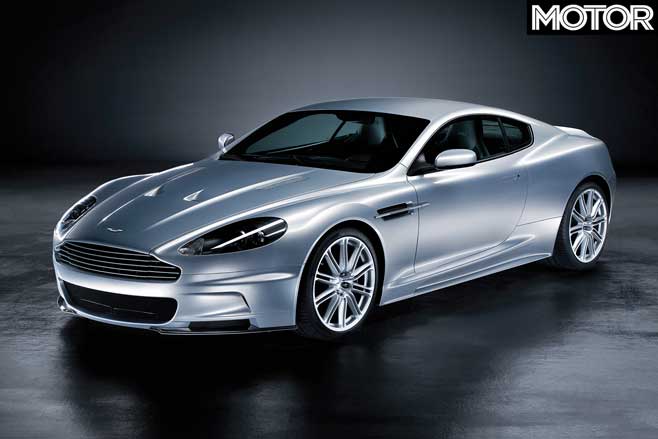
With principle photography due to start in January 2006, Aston’s prototype workshop pulled out all the extruded T aluminium stops to hand-build two identical DBS ‘hero’ cars that could be used for close-up shots and gentle driving. Externally these cars looked near-as-dammit like the proposed production DBS. Inside, the Aston design team were given a little more licence, installing a crash helmet cubby, gun holder, and other cheeky features unlikely to be seen on customers’ cars. The build team worked flat out and the cars were delivered to the Bond crew as promised in April 2006.
But Aston’s commitments didn’t end there. In the script, 007 discovers his love interest Vesper Lynd has been kidnapped and hammers his Aston along the twisting roads of Montenegro in hot pursuit.
Director Martin Campbell wanted the audience to think they were about to see a lengthy car chase and then surprise them when instead Bond encounters Lynd lying on the road ahead, swerves to avoid her and flips his car into a spectacular barrel-roll. Ripping stuff on screen, but a headache for the Gaydon workshop, which had to fulfil the film makers’ request for three cosmetically accurate DBS stunt cars.
Fortunately, Aston had a trio of redundant DB9 development hacks and drafted them into the prototype shop to be turned into DBS replicas. From the outside these sacrificial lambs looked identical to the fully formed ‘hero’ cars already working their stuff for the cameras. Inside, they were rather less polished, with tatty, rough-grained dashboards and stout roll-cages betraying their origins as pre-production workhorses.
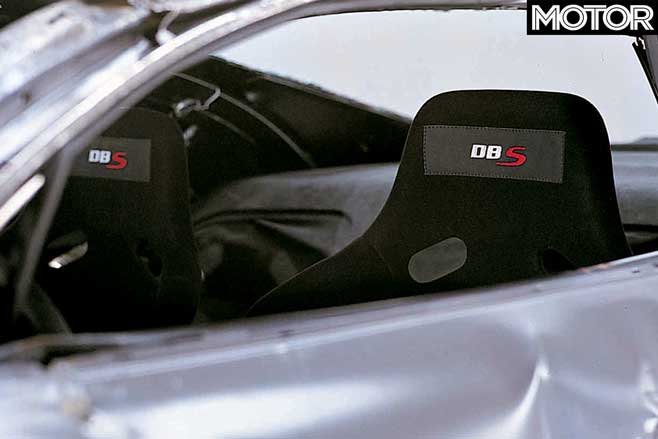
The tired matt-black vents and buttons on the dash were pretty far from the chrome-splashed versions in the show cars but, to avoid any risk of knackering continuity, the team came up with a cunning fix involving careful application of kitchen tin-foil.
Once again Aston met its deadline, delivering the three action cars to the Bond vehicle team along with the original DB9 manual prototype, looking scruffy and care-worn in its flaking white paintjob, so that the stunt drivers had a fourth car in which to practise.
Final planning for the stunt took place at Dunsfold Aerodrome near Guildford, familiar to TV viewers as home to the Top Gear test track, where the Casino Royale second unit was busy filming an explosive night-time sequence with kerosene tankers and an old 747. In the final movie you’d never guess the fiery chase around Miami International Airport was actually shot in rural Surrey, especially once a twinkling Floridian city-scape had been digitally added to the background during post-production.
On another part of the airfield the stunt team set up the eight-inch ramp they calculated would be enough to flip the DBS and brought in two battered E34 BMW 5-Series, chosen because they broadly replicated the size and weight of the Aston, for a couple of rehearsal rolls. Stunt co-ordinator Gary Powell had found a couple of dramatic rallycross crashes on the internet and was aiming for a similar multi-roll spectacular with the Aston.
Sure enough, when they hit the ramp at 105km/h, the Bee-Ems barrelled three or four times, in exactly the way Powell was looking for. Satisfied that the stunt would work, the Bond crew moved to the hill circuit at Millbrook proving ground in Bedfordshire and carried out some final trials with their DB9 practice car. Unfortunately, the Aston proved a lot more stable than those crusty 5-Series and, with only limited chances to get this right, the ramp was raised to 18 inches to make sure the Bond car turned turtle.
As it turned out, this still wasn’t enough. When stunt driver Adam Kirley charged the first DBS into the ramp at 110km/h it simply took off, levelled out and landed on all four wheels, clouting the dummy that stood in for the prone Vesper Lynd before mangling its front suspension as it slithered unimpressively across the damp grass. The Aston’s stiffer chassis and lower centre of gravity meant it wasn’t inclined to go belly-up like those BMWs at Dunsfold.
Fortunately, the Bond team had a backup plan involving another DBS fitted with a gas cannon that used pressurised nitrogen to punch a metal ram out of the bottom of the car and flip it onto its roof. It was up to Adam Kirley to hit the trigger at precisely the right moment, otherwise he’d risk being punted painfully into the trees by the roadside.
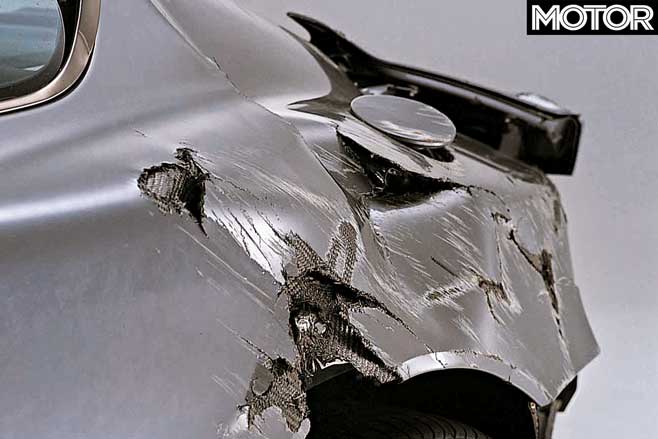
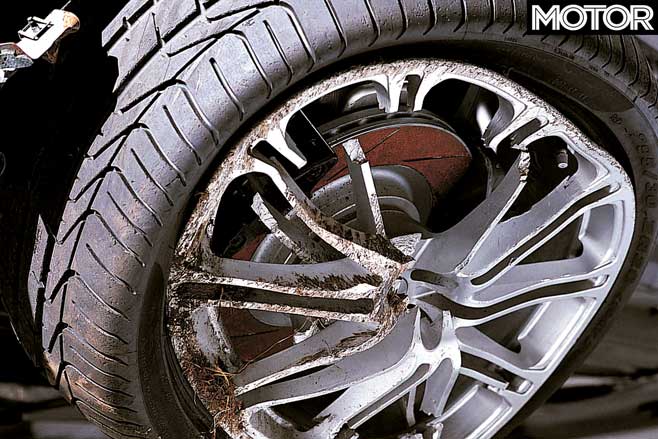
With everything in place and the cameras running, Kirley gunned the Aston up to 120km/h, came charging onto the wet tarmac of the beautifully lit filming area, swerved slightly to the left and fired the ram bang on cue. The result was even more spectacular than the stunt team had imagined. Once the Aston hit the grass, it dug in and just kept rolling, pieces of bodywork and a wheel flying off until it came to rest, right side up, lights still twinkling into the Millbrook undergrowth.
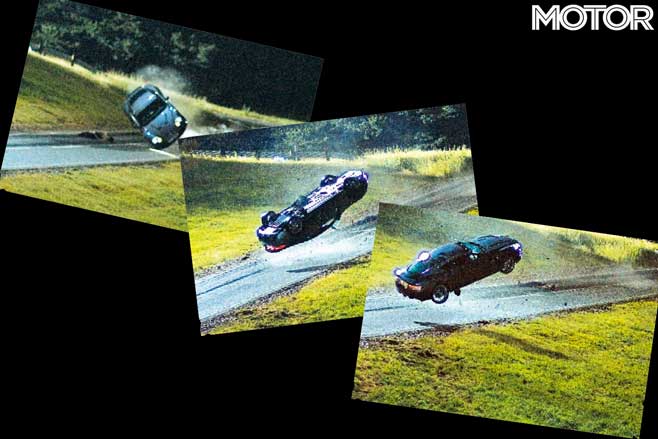
Kirley later described being in the car as “a fairly violent sort of ride” but, incredibly, he stepped from the mashed Aston unhurt. He didn’t know at the time that he’d just established a new Guinness World Record for most cannon rolls in a car, achieving an astonishing seven complete revolutions and stealing the record from Top Gear, who had previously set the benchmark using a rather less glamorous Ford Sierra wagon.
If the ramp had been used it would have been hidden under a pile of peat to make it look like the car had flipped off the grass verge. Since they’d successfully deployed the cannon instead, a new bridging shot was required to establish the start of the roll and two weeks later the team returned to Millbrook with the third DBS action car, packed on one side with counterweights.
When Kirley swerved around a flinching Vesper Lynd – actually stunt performer Nikki Berwick doubling for actress Eva Green – these weights were enough to pitch it onto its roof, making the first shot of the crash sequence you see in the movie. With this extra roll in the bag, that was it. Three Aston Martins successfully and spectacularly trashed.
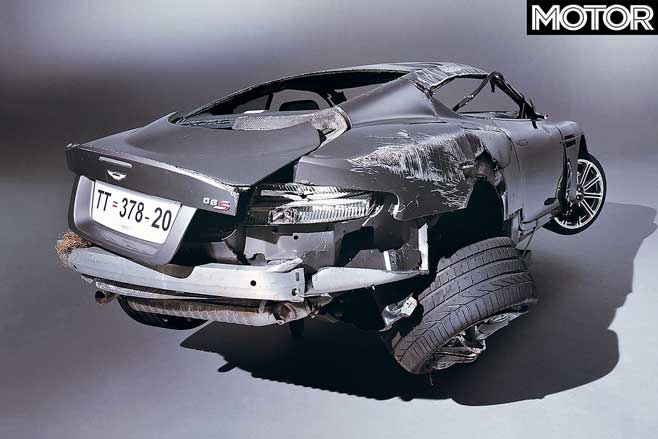
When filming wrapped, the wrecked DBS replicas were returned to Gaydon where, in line with standard practice for development cars, they were due to be crushed, allowing the company to reclaim the tax on their value and avoiding the risk of rogue prototype parts getting into the public domain. But from the mangled beauty you see here, you’ll notice it has so far escaped the wrecking yard. After its moment of record-breaking movie stardom, the chaps at Aston admit they’ve become quite attached to it.
From silver screen to blacktop
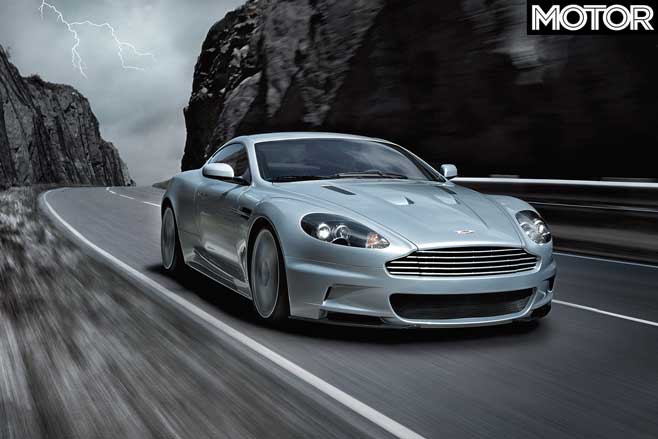
Bond may already have driven – and destroyed – his new Aston DBS, but the rest of us will have to wait a little longer. The best estimate for its arrival in Oz is December, 12 months after its big screen debut.
Precise details of the production spec are still sketchy, but a few choice bits of info have leaked out of Gaydon. For a start the car is going to be around 100kg lighter than a conventional DB9 (putting its kerb weight at around 1660kg) thanks to extensive use of carbon composite panels (including the vented bonnet and front wings), reduced sound-deadening material and the deletion of the rear seats within the otherwise relatively standard cabin.
The 6.0-litre V12 engine has been tweaked to deliver another 50bhp (37kW) over the standard DB9, breaking through the 500bhp (373kW) barrier that up until now has been the preserve of the Vanquish. That’s no accident, because the Vanquish is due to cease production later this year, effectively making the DBS Aston Martin’s new flagship when it goes on sale.
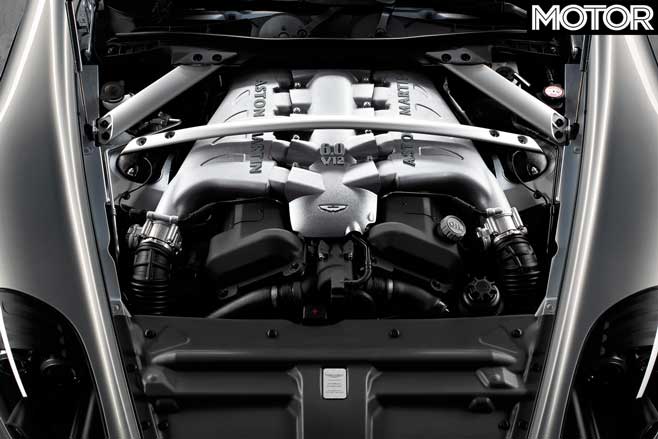
Aston wants the DBS to be seen as a serious drivers’ car, which is why it’ll come only with a manual gearbox and feature ceramic brakes as standard.
Along with the lighter stoppers, the wheels are special lightweight forgings that’ll help reduce the unsprung weight further. Performance-wise, expect a 0-100 of around four seconds and a top speed that could make the DBS a true 200mph (320km/h) Aston.
Another first for the company is the introduction of a keyless-go system, finally banishing AM’s usual cheapo Ford-sourced ignition key. Instead, the DBS uses a lump of crystal and aluminium that slots into a hole where the DB9’s starter button usually lives.
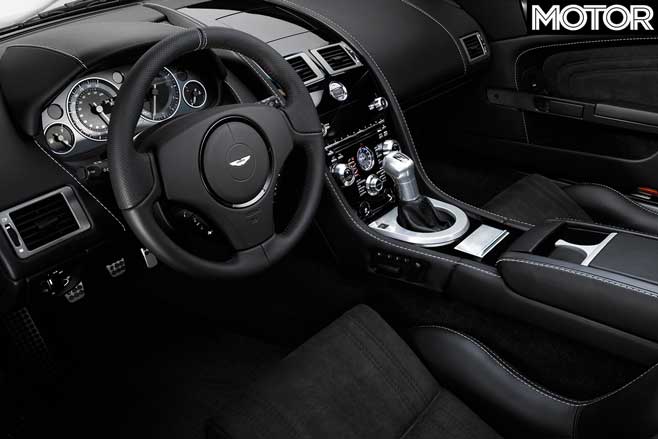
The new car will need special details like this to help justify its high price compared with a standard DB9 Sports Pack. It’s expected to cost in excess of $400,000 and very possibly as high as $450,000 if you let fly with the options.
Given what happened to Bond’s DBS in Casino Royale, he should count himself lucky he didn’t have to pay for it.
I had always imagined the 275 Trophy-R was the high point of the really hot Renault Mégane model series. I’m not sure why, but I remembered it as the high watermark. With its coupe-ish appearance and rock-rigid body, it seemed as modern as today’s Megane, but with less than 300 horsepower, it retained the delicacy of old hot hatchbacks.
It’s also the only one I drove at the Nürburgring, the track that has made this series of special Renault Sport Méganes famous, because each of the trio set a new lap record for a front-driven production car. That’s not any guarantee of greatness, of course, but it helped here, and I always felt that the 275 Trophy-R was the standout among a series of standout cars.
Today, though, will tell. We have the three cars in the series together in the same place at the same time. It’s a sequence that started in 2008 with a car called the R26R, or R26.R in Renault-speak of the sort that led to the Kia cee’d becoming the Ceed by the time it had passed via sensible sub-editors.
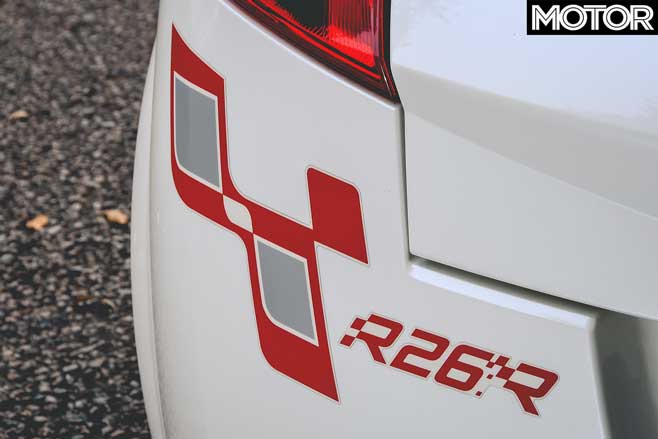
There had been hot Renaults before the R26R. The most bonkers Clio ever had a V6 installed in its middle – the ‘three-litre Clio’ – and even before that, there were Group B rally-homologated mid-engined Renault 5 specials. But the R26R had a different kind of competition mind and went about succeeding at it in a different way.
Renault wanted the Mégane to become the fastest front-wheel drive production car around the Nordschleife – a feat that, remember, doesn’t necessarily make for a great driver’s car – so set about throwing out 123kg from an already light hatchback, including ditching the rear seats and swapping the rear window and tailgate glass for plastic. Thus equipped and riding on optional Toyo track tyres, Renault’s tame test driver, Vincent Bayle, took the R26R around the Green Hell in just 8min 17sec.
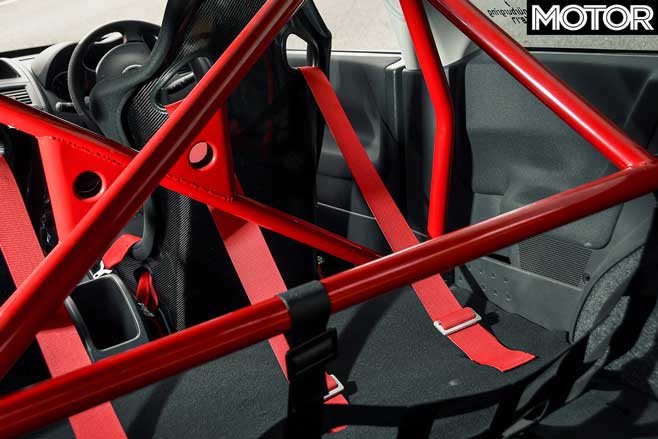
There were quite a few production examples of this car built at the old (and new) Alpine factory in Dieppe: 450, none of which came here. Renault UK was quite bullish about the prospects of selling them in Britain, opting to take 230.
It didn’t quite pan out like that. As with the earlier, if anything more special, Ford Racing Puma, the market baulked at the £23,815 (plus another £3000 for the track tyres, roll-cage and titanium exhaust that no R26R should be without) asked for a two-seat Renault – more than $50K in Oz money – so some of the allocation made its way onto Renault’s internal car scheme on favourable rates, while other examples were sold back in France.
Used values, at one point, dropped to half their price when new. Sigh. Yes, we probably should have. Now they will cost what they did when they were new, but even at that price, as when new, I think they’re worth every penny. To drive one today is to still find a hugely enjoyable hot hatch. Or perhaps ‘small coupe’ would do it more justice.
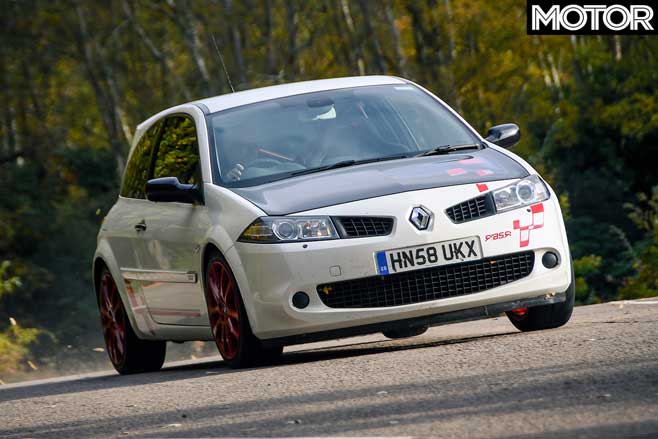
With the R26R, Renault set out (and this is a theme it continues) to do more with less. So the 169kW turbocharged 2.0-litre four-cylinder engine and six-speed manual gearbox came in unchanged from the standard Renault Sport Mégane, which was called the R26.
Acceleration increased (0-100km/h fell by half a second to 6.0sec) as a result of the weight loss, but the lap time came from extra poise, grip and braking.
Some old cars, even future classics, start to feel a bit tired as their bodies fatigue and their suspension bushes soften, but this evidently well looked-after R26R feels impeccably tight. So although the steering wheel is thin-rimmed and slow-geared by today’s standards, it’s still exceptionally precise and controls a chassis that generates brilliant grip and poise.
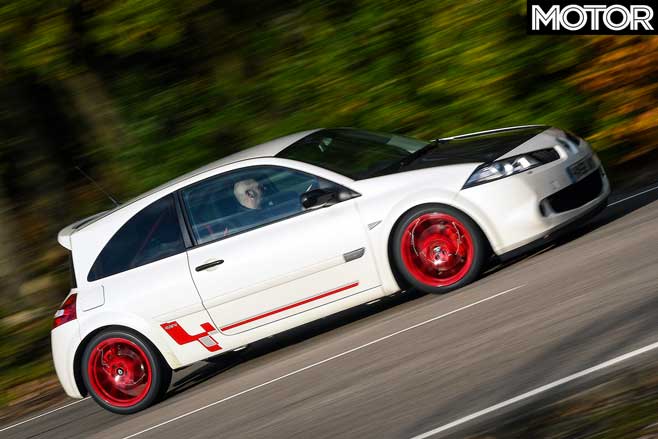
At a test track, it hangs on gamely and resists understeer, including under power, feeding back plenty of splendid road feel while it’s at it. That keen line is partly possible because it makes less power and torque (at 309Nm) than a truly modern hot hatch. But it also has an ability to damp road lumps, owing to 10 per cent softer springs than the standard R26 (lightness keeps on giving, as Renault recently demonstrated once again so deftly with the Alpine A110), while there’s a lovely throttle adjustability that subtly and predictably brings the rear wheels into play in faster cornering.
It’s three generations old, this car, but it feels every inch as rigid and competent now as I remember it was at the time.
That time, though, wasn’t quite so long ago, really. Renault used to launch its super-special version just as time was running out for the model that spawned it, so the R26R set its fast lap and failed to find buyers as recently as 2008 – the same year the Mk3 Mégane was launched.
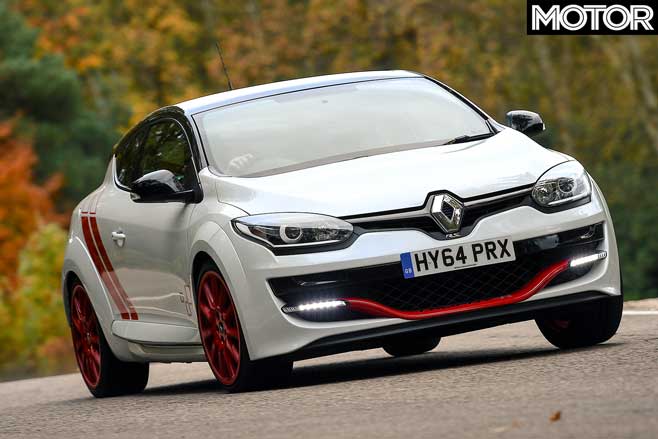
It took until 2015 for the German Ring Road Special edition of that variant to find its way onto the street in the form of the 275 Trophy-R. More than 80kg was removed from the standard 275’s kerb weight, but the measures weren’t quite so extreme as the first-time 101kg (maybe through fear that market forces would again shun it), so while there were no back seats, there were still glass windows and a strut-brace rather than a half roll-cage. And that meant you could tell your other half you were buying a small van.
The price went up to $67,490 driveaway, and Australia was allocated a generous 50 of the 250 production run (whereas the UK had to make do with just 30, perhaps because of the earlier over-order). The Nürburgring lap time, set by Laurent Hurgon, dropped to 7min 54.3sec.
I remember loving it dearly at the time, and while it’s no less impressive today, trying it and the R26R back to back reveals that they’re not night-and-day different in class in the way I had remembered. I thought I remembered the steering of the R26R being vaguer, but while it’s true that the 275 Trophy-R has a weightier, much quicker and more responsive rack, it’s actually no more accurate than its predecessor’s.
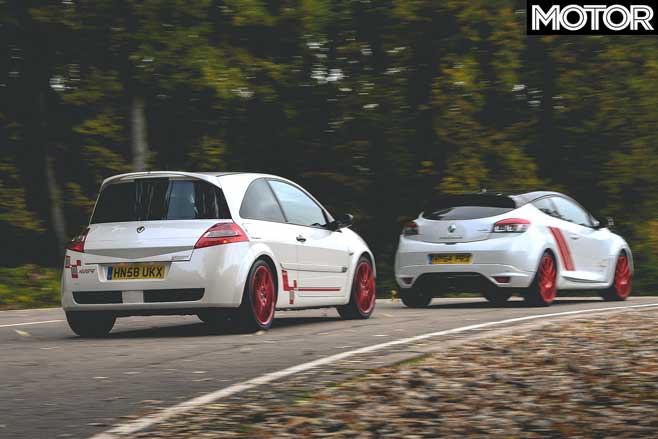
What it does simultaneously do is feel wider, heavier, taller of scuttle and firmer. A lot firmer. Quicker in a straight line too – unsurprisingly, given the 33kW power increase that came with it. But more noteworthy still is the on-or-off nature of the handling; you turn at a corner and the 275 Trophy-R really dives to the apex. Do the same with the throttle off, or if chance allows with the brakes trailed, and the rear wheels are exceptionally but predictably and controllably mobile. While the R26R is relatively delicate and mild-mannered, the 275 Trophy-R is much more brutish and physical.
To that end, it’s not unlike the cars in another test I did featuring a decade-old car: a Porsche 911 GT3 RS from 2010, which lined up alongside a recent 911 GT2 RS. There, as here, the newer car felt all of more rigid, heavier and larger and yet simultaneously more responsive, grippy and accelerative – if not necessarily any more enjoyable.
The 275 Trophy-R isn’t the same as a GT2 RS, obviously; there’s the small matter of 317kW between them. But there are similarities between the ultimate Renault Sport line and GT Porsches. And there’s no denying that, in the same way that the most powerful new car, the GT2 RS, is the most extreme model, the latest Mégane 300 Trophy-R is similarly the most ballistic and hardcore of all the Renaults.
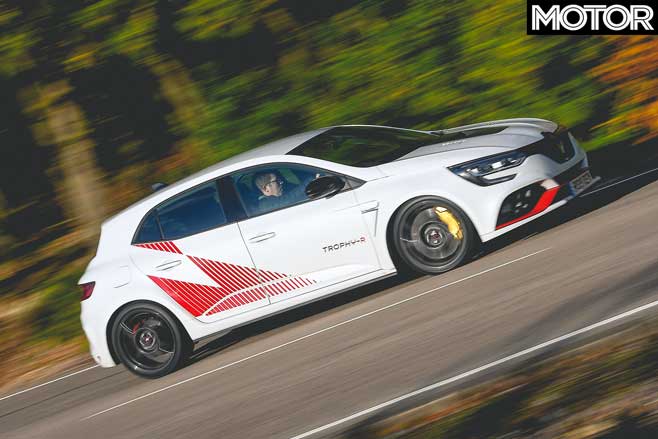
For the 300 Trophy-R’s concept, the same path as with the other two cars here is followed: there are no rear seats, so weight is reduced, and power hasn’t been increased. This time, the big weight loss comes from ditching the active rear steering mechanism that makes the standard 300 Trophy such an unpredictable drive, leaving you wondering just how much it will turn on each steering input and coursing bends like it’s outlining a 20-cent piece.
You would need a lot of those coins to get one, even if the 11 available in Australia weren’t already sold out. I wonder if Renault, buoyed by the relative commercial success of the 275 Trophy-R, has overstepped here. I love the 300 Trophy-R dearly – more than most of my colleagues – and, given the depth of engineering changes, I’m happy to explain away its asking price of $74,990.
Even rarer (just one in Australia) and considerably more expensive is the Record model – same spec as the Nürburgring record-breaking car – which comes with 19-inch carbonfibre wheels, carbon-ceramic brake discs and a straight-feed air intake. I like the regular 300 Trophy-R very much even without them, but nothing other than a back-to-back test on the same road would truly reveal what difference the wheels and brakes make. But the fact is that it won’t go as fast without them.
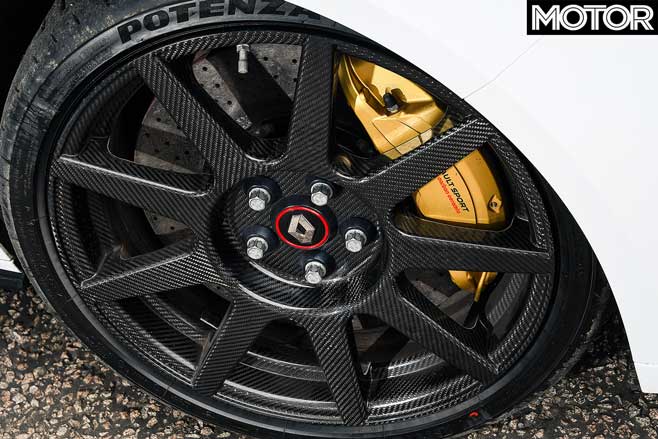
Either way, by gum it’s fast. The lap time has fallen to 7min 45sec, but in a straight line the gulf between the 275 and 300 feels as strong as between the R26R and the 275. It zaps to the redline with such ferocity that it feels like the clutch is slipping, and there’s a real breathiness to it, making more intake noise and less exhaust sound than the 275 – over which it also feels bigger and heavier again.
And, in rather sophisticated style, the 300 is exceptionally agile; if you turn in with no power on, it moves around predictably, quickly and controllably (who needs rear-steer?), with a steering system that, at 2.3 turns between locks, is pretty fast, but somewhat distilled like the rest of the car. It’s a sportscar with more front-end bite than the others, and that lets you lean on it much harder.
The 300 feels softer than the 275, but neither matches the delicacy of the R26R. In this company, that car almost feels an entire class smaller.
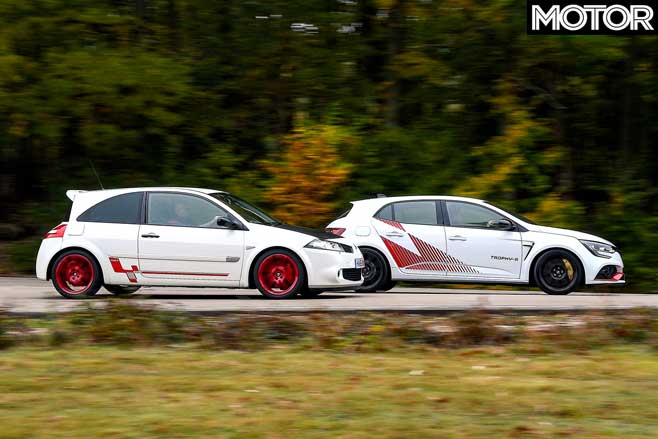
So, while each of the three cars in this series is today still in the category of ‘thoroughly enjoyable and a bit too quick for the road’, there is a fairly natural progression: each is bigger, faster, grippier and yet more responsive to its steering, in the same kind of way that a modern Range Rover leaves a 40-year-old one feeling like a creaky compact car.
Only the R26R isn’t that old. And, coming as it does with fixed-back seats, harnesses and a half roll-cage, it’s just as rigid as it was when it was new, which is still pretty rigid by today’s standards. So yes, there are faster Méganes and more expensive Méganes, but I don’t think there are such immersive, charming and fun Méganes as the original R26R.
Fast Facts
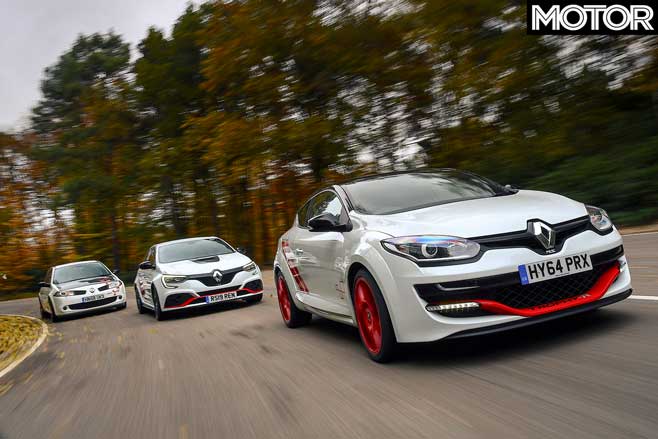
| u00a0 | 2008 Renault Mu00e9gane R26R | 2020 Renault Mu00e9gane RS Trophy-R | 2015 Renault Mu00e9gane RS275 Trophy-R |
| Body | 2-door, 2-seat hatch | 4-door, 2-seat hatch | 2-door, 2-seat hatch |
| Drive | front-wheel | ||
| Engine | 1998cc inline-4, DOHC, 16v, turbo | 1798cc inline-4, DOHC, 16v, turbo | 1998cc inline-4, DOHC, 16v, turbo |
| Power | 169kW @ 5500rpm | 220kW @ 6000rpm | 202kW @ 5500rpm |
| Torque | 310Nm @ 3000rpm | 400Nm @ 3200rpm | 359Nm @ 3000rpm |
| Power/Weight | 137kW/tonne | 172kW/tonne | 158kW/tonne |
| Transmission | 6-speed manual | ||
| Weight | 1230kg | 1281kg | 1280kg |
| Top Speed | 237km/h (claimed) | 262km/h (claimed) | 255km/h (claimed) |
| 0-100km/h | 6.0sec (claimed) | 5.4sec (claimed) | 5.8sec (claimed) |
| Rating | 4.5 out of 5 stars | 4 out of 5 stars | 4.5 out of 5 stars |
There’s no doubt about it: 2020 is another massive year for car manufacturers in Australia – despite the coronavirus interruption. We’ve done some digging and noted just some of the highlights you should be looking out for in 2020.
Stay tuned to WhichCar.com.au throughout the year to hear about all of these and more.
Aston Martin
DBX – mid 2020
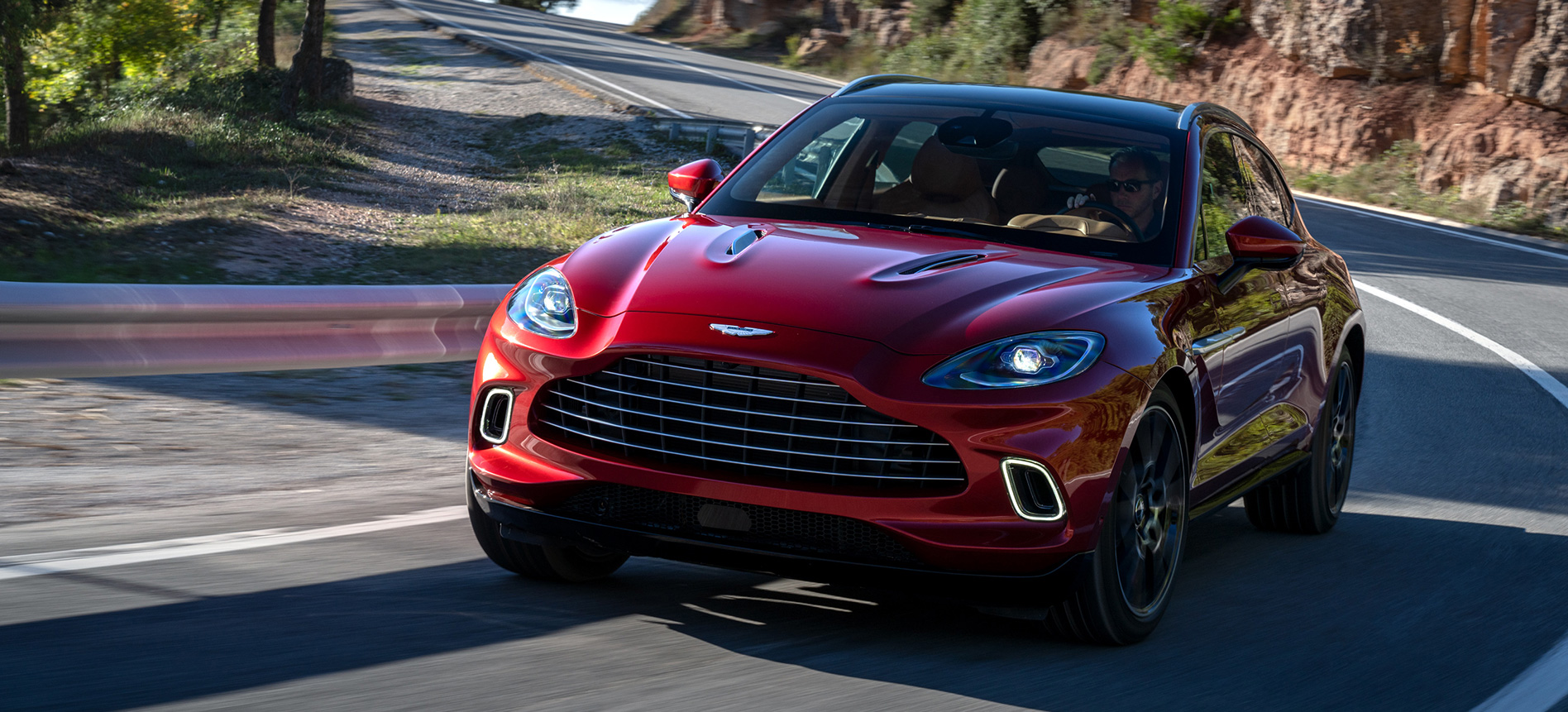
The Aston Martin DBX SUV is the marque’s wildest departure from sports cars yet, while still remaining true to the brand’s core values of performance and design.
Audi
Q3 Sportback – due Q1
That’s right, Audi’s baby SUV will spawn a ‘coupe’ iteration that sees it receive a heavily sloped roofline. Also ties in with Audi’s plan to have Sportback versions of all of its SUVs.
A6 Allroad – due Q2
2020 is shaping up to be a big one for the four-ringed brand, expect to see an off-road version of its business express A6 wagon from early 2020.
RS6/7 – due late Q2
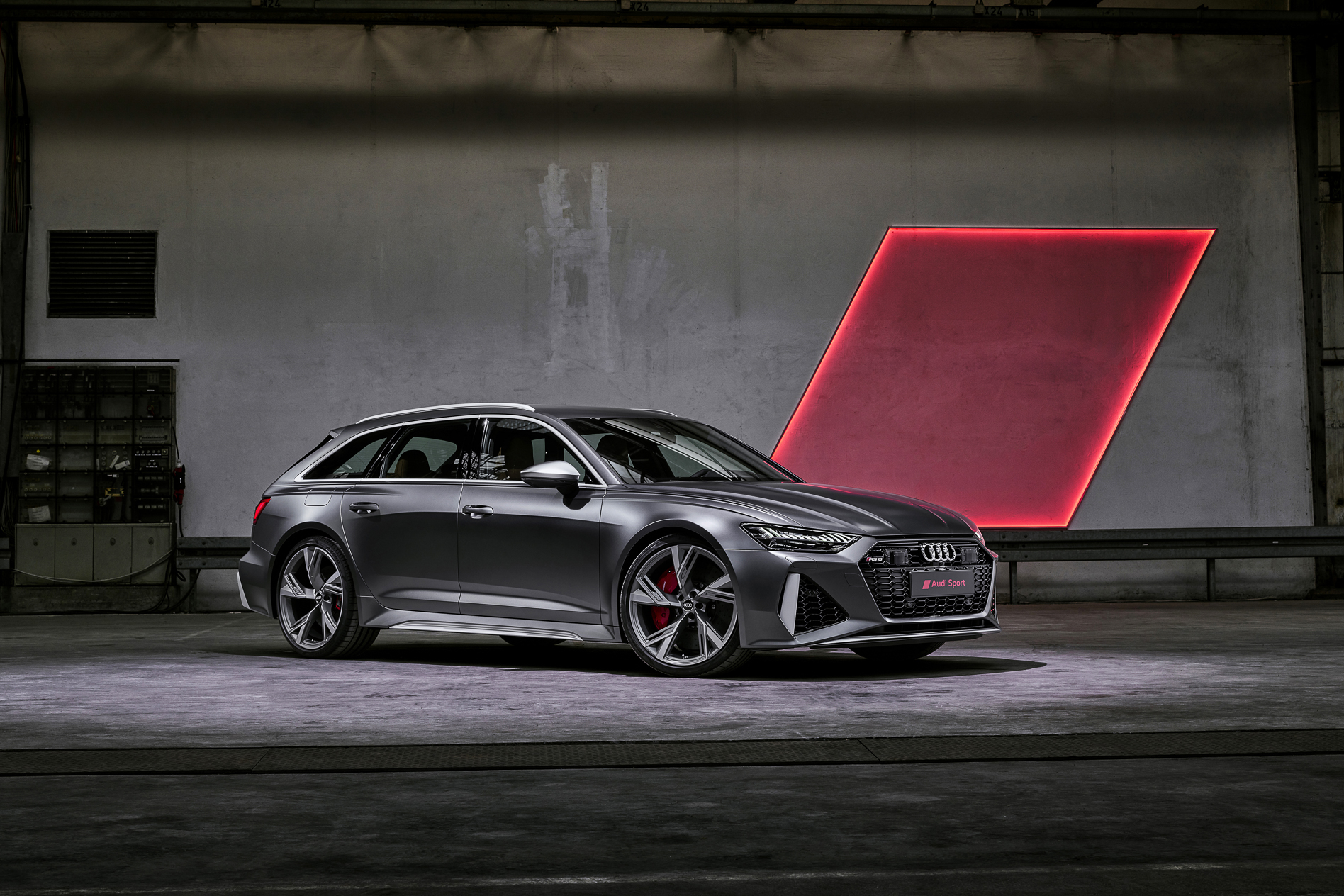
Audi Sport is in the midst of a product offensive that will yield a brace of new and updated RS product in the next 12 months, and the RS6 Avant is just one part of that.
Q7 facelift – mid 2020
Audi’s luxurious big SUV receives more tech and updated mild-hybrid engines.
A4/A5 facelift – due Q2
TTRS – due Q2
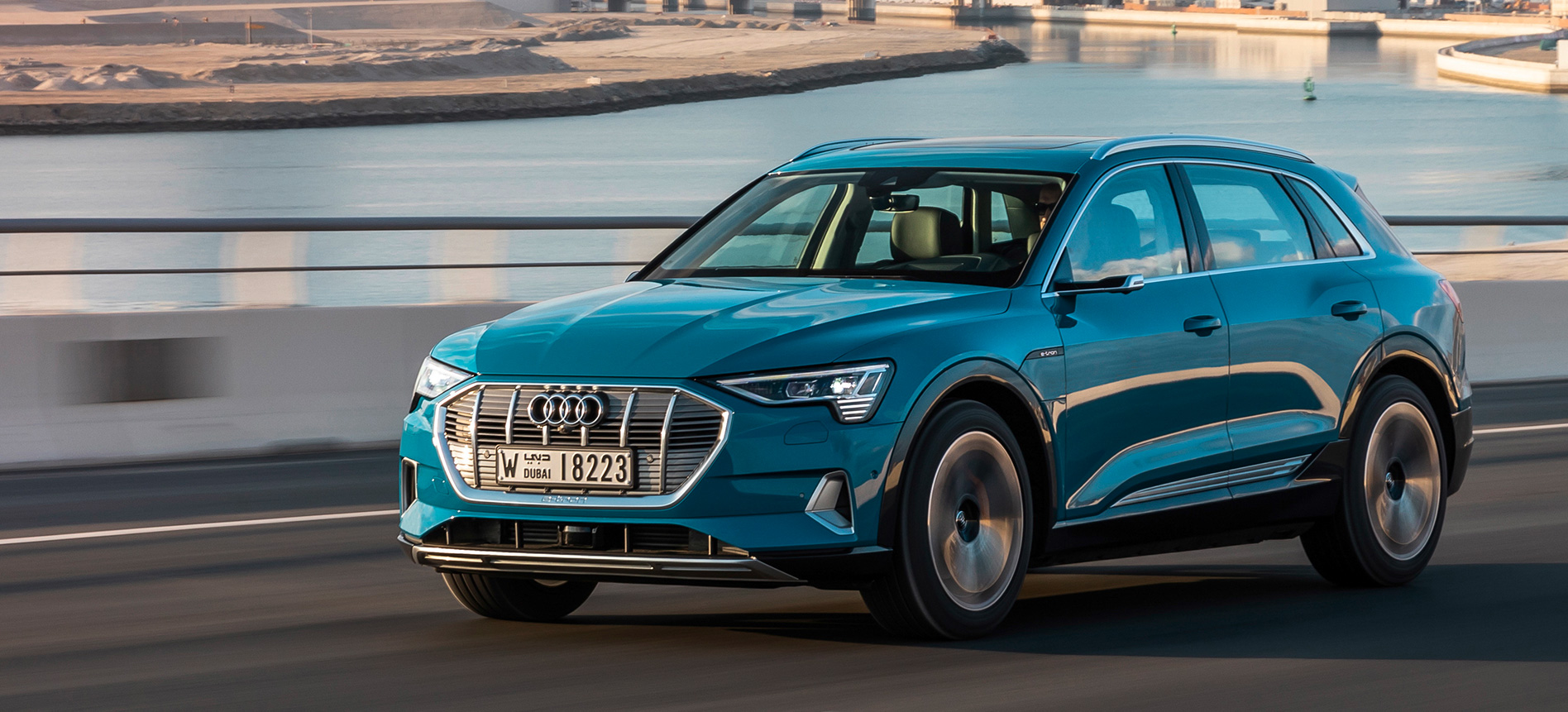
e-Tron – mid 2020
Audi’s first fully electric SUV, larger than the mid-size Q5, slightly smaller than the seven-seater Q7. It’s due in Australia around the middle of 2019.
RSQ8 – mid 2020
BMW
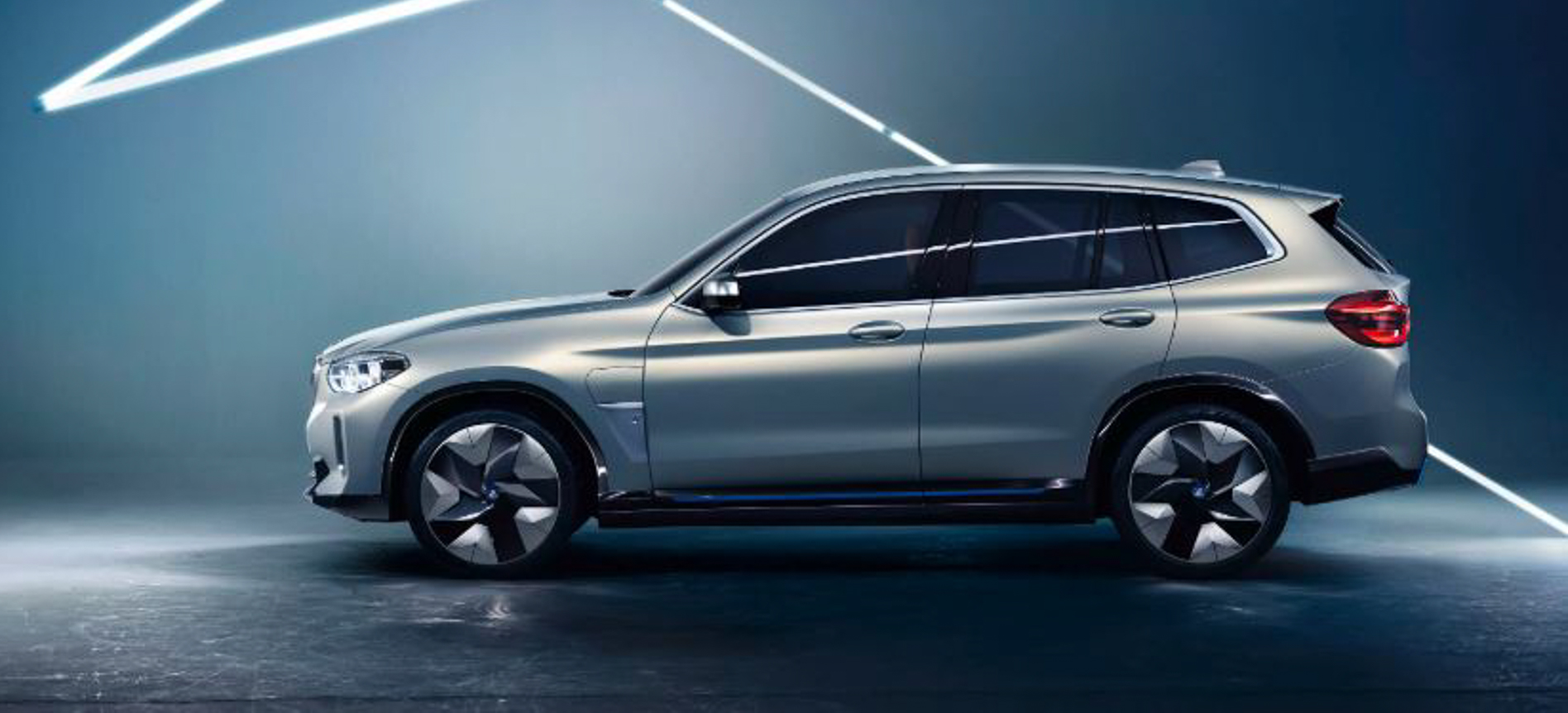
iX3 – due 2020
BMW’s X3 range will be the first to offer combustion, plug-in and pure EV powertrains from next year.
M8 Competition – due Q1
The 2020 BMW M8 Competition’s pricing for Australia has been confirmed, with the fastest production M car to fall just short of becoming the most expensive BMW on sale in Australia.
M2 CS – due 2020
Alpina B3 Sedan/Touring – due 2020
Ferrari
SF90 Stradale – due 2020
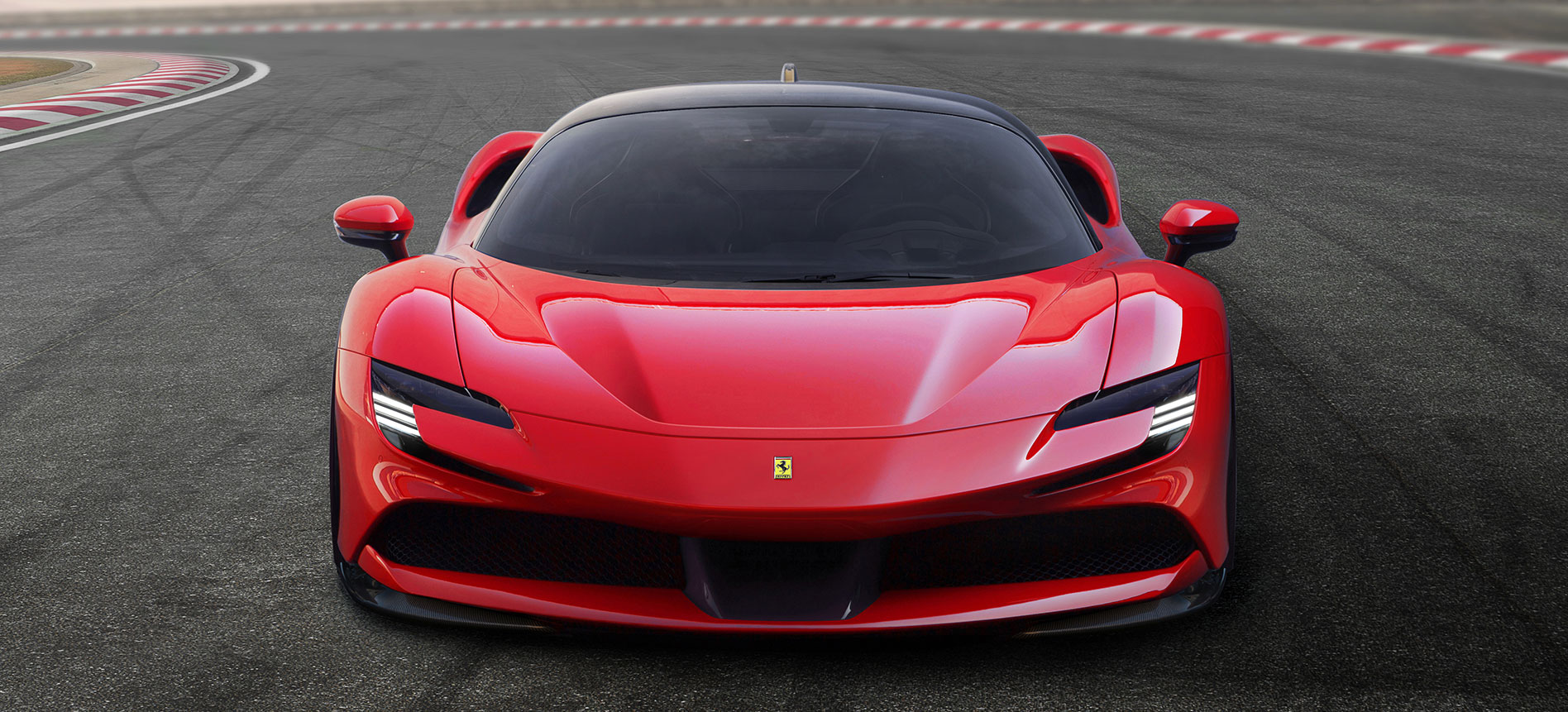
F8 Tributo – deliveries expected 2020
Ford
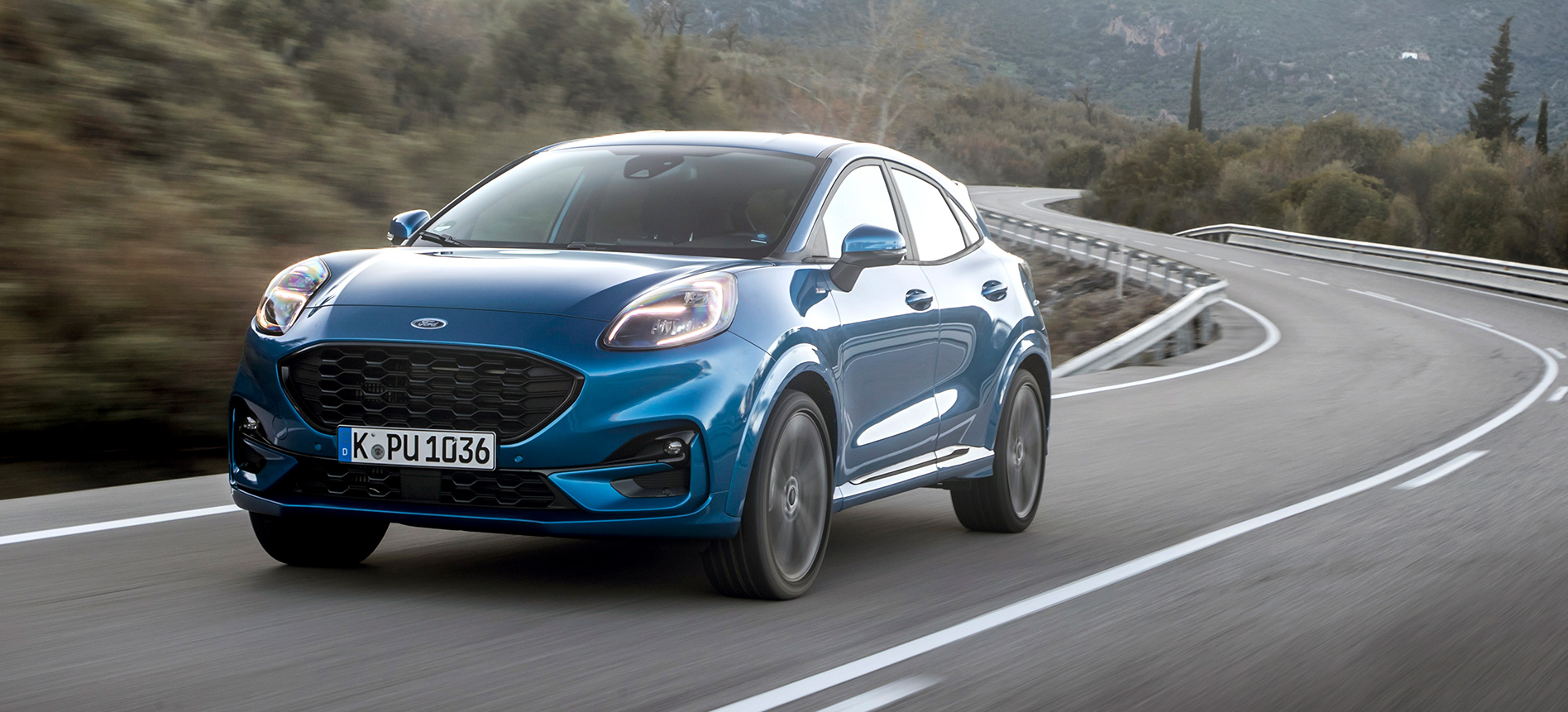
Puma – due second half of 2020
Ford’s Puma small SUV will join a burgeoning B-SUV segment which will see it join the Toyota Yaris Cross, Volkswagen T-Cross, Mazda CX-3 and the Mitsubishi ASX later in 2020.
Escape – due 2020
Ford has confirmed that the all-new Escape will touch down in Australia in 2020, complete with the company’s first plug-in hybrid for the Australian market.
Focus ST/Fiesta ST – due Q1
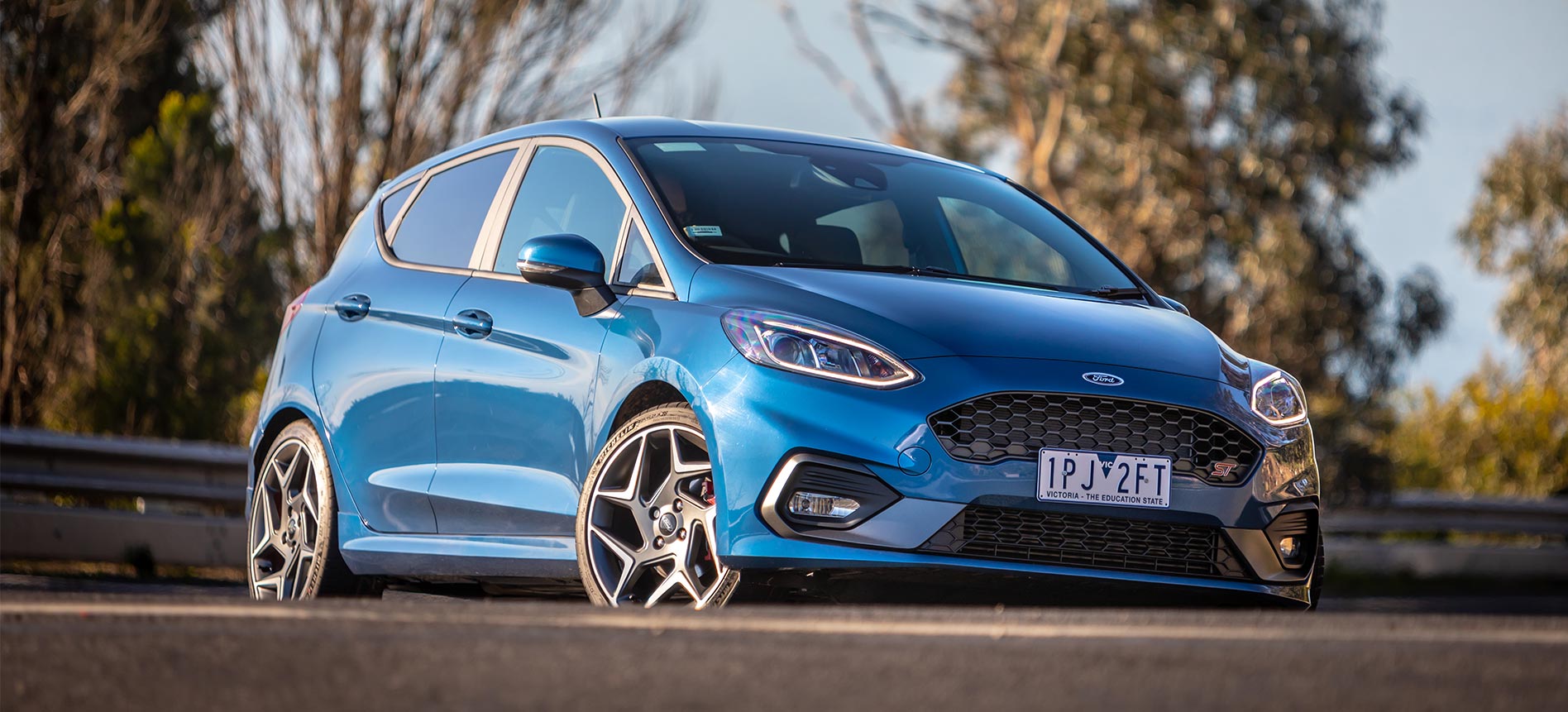
Pint-sized performance heroes arrive back in Australia from early 2020.
Isuzu Ute
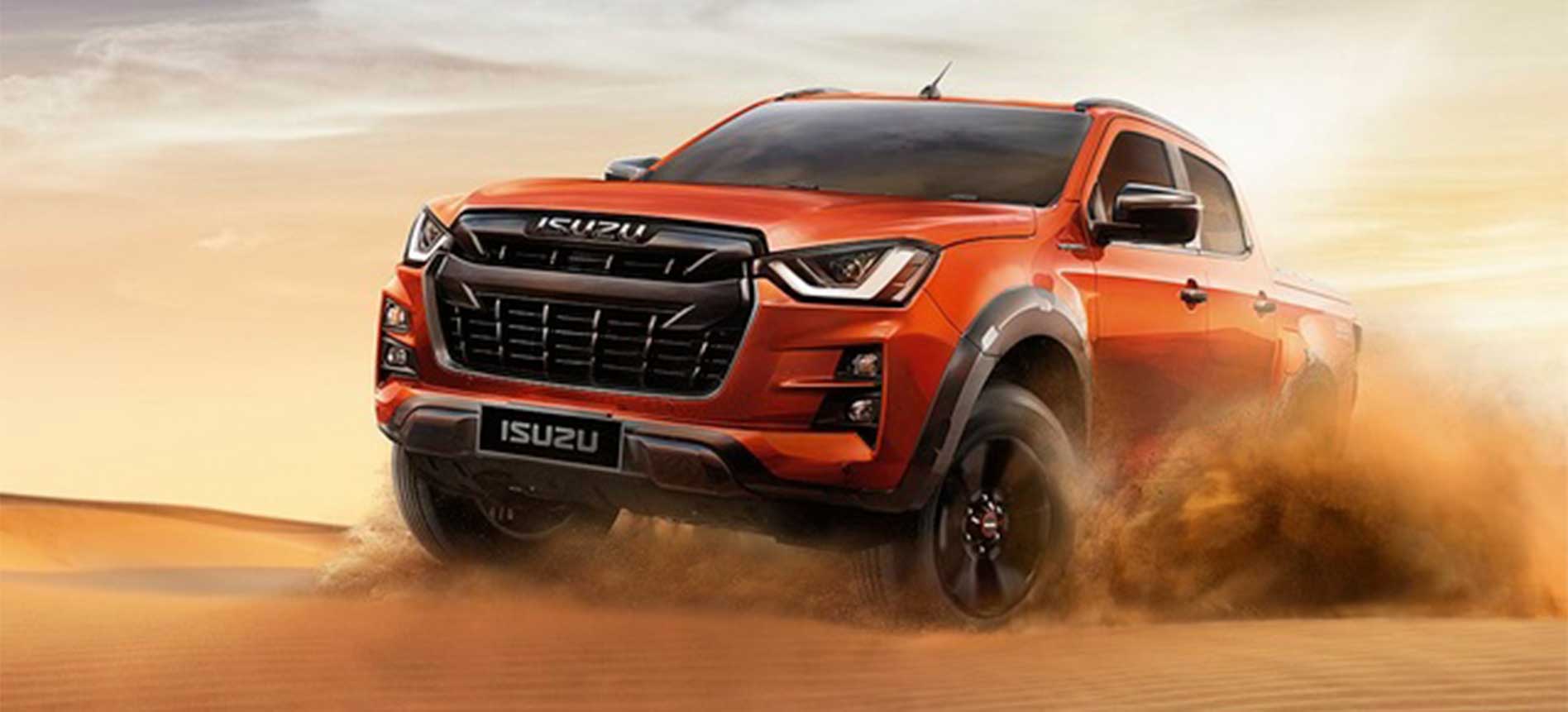
D-Max – due 2020
It’s the Japanese brand’s first full-model replacement for the D-Max pick-up since 2012, despite a few facelifts in-between (2015 and 2017). Expect big lifts in quality and equipment.
Jaguar
F-Type facelift – expected 2020
If ever there was a car that didn’t need a facelift, it’s the still-glamourous Jaguar F-Type.
Still, if you’re standing still in the rapidly moving automotive business you’re effectively moving backwards, so Jaguar has given its sports car a heavy refresh for 2020.
Kia
e-Niro – expected 2020
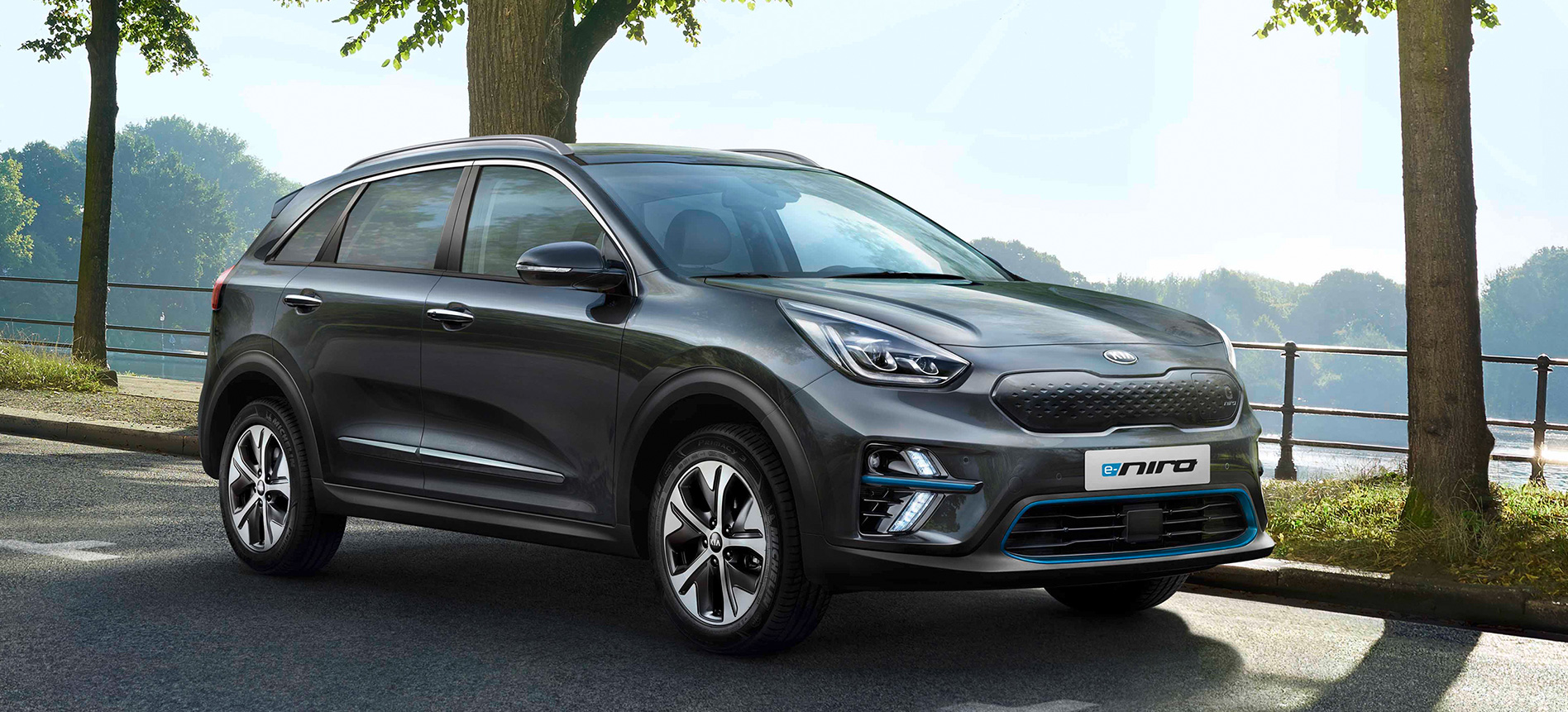
There’s still a question mark over the fate of the Kia e-Niro in Australia. It’s been around for some time in Europe but Kia has blamed a lack of government action on making electric cars a viable option for Australians through incentives. Watch this space.
Land Rover
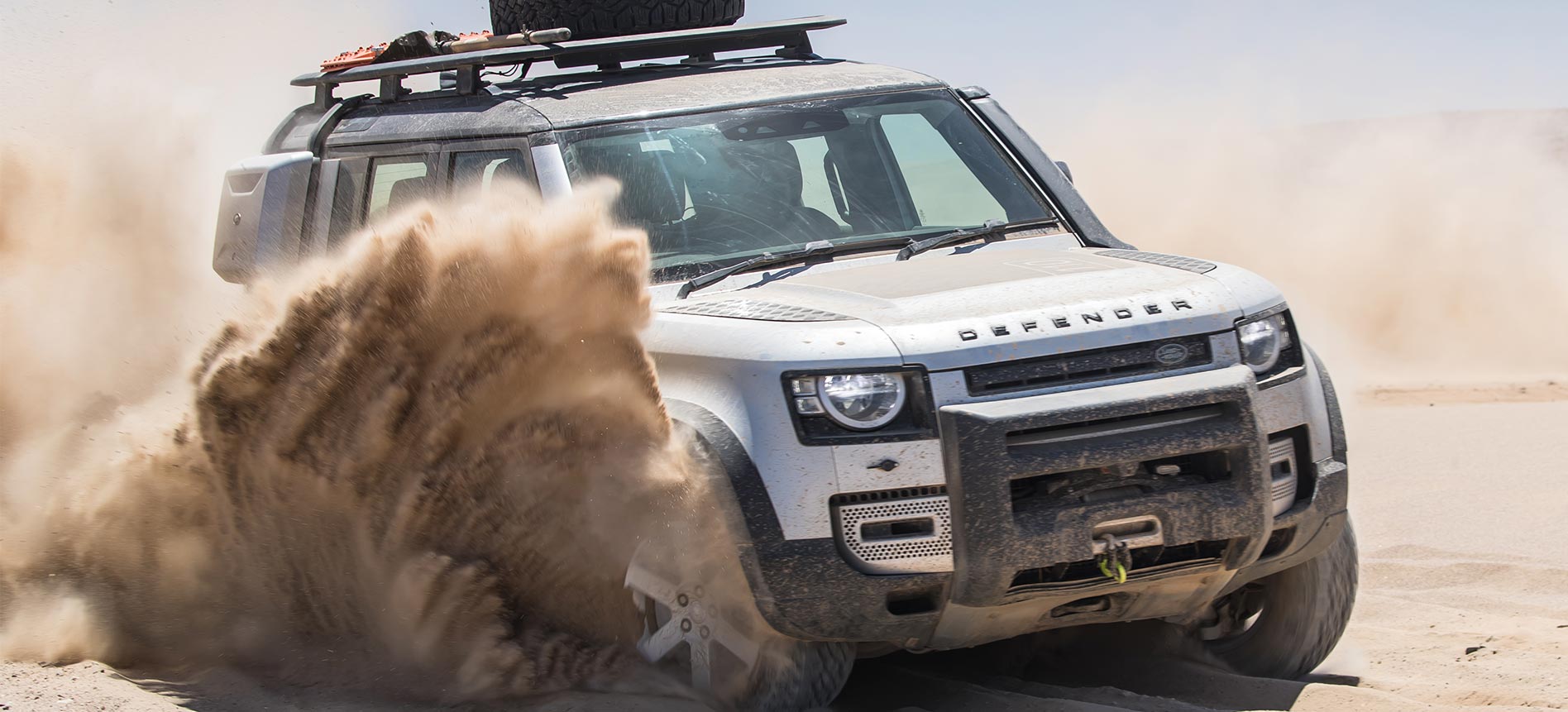
Defender – due mid 2020
Land Rover’s icon is back in 2020 after laying dormant for a few years. Expect to see in Aussie roads after June.
Mazda
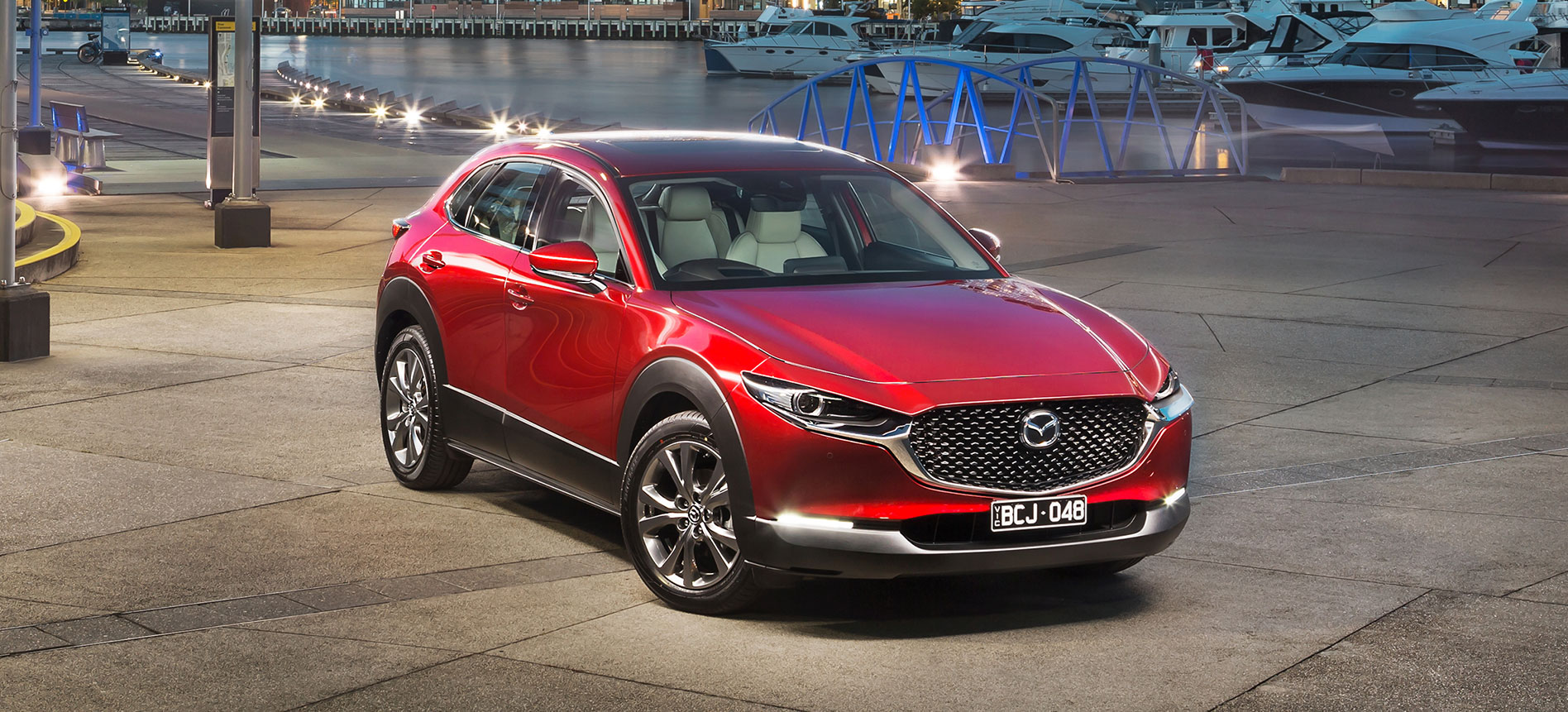
CX-30 – due Q1
Mazda will launch its all-new CX-30 SUV in Australia in 2020 with a strong line-up that is packed with features.
Mercedes-Benz
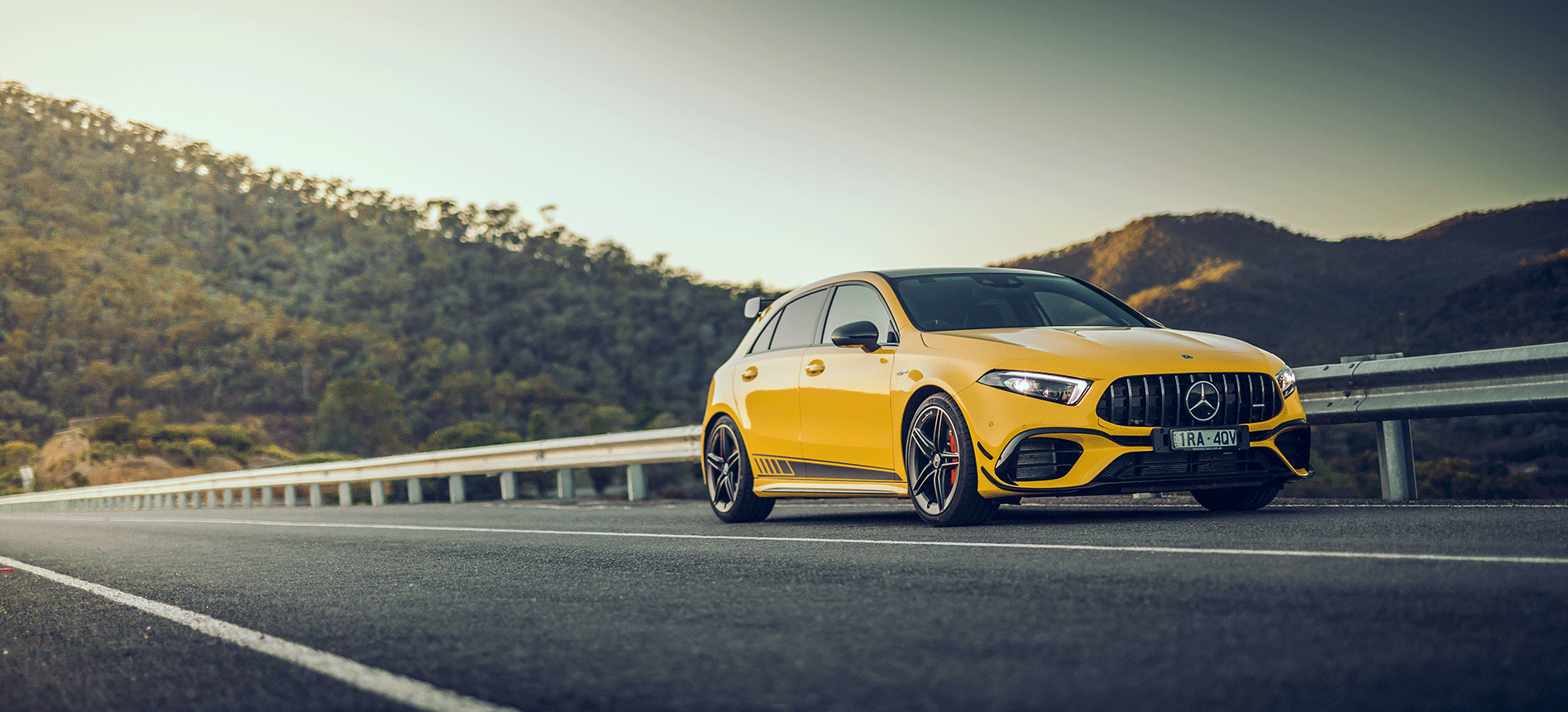
A45/CLA 45 AMG – due Q1 2020
Promising a much-refined ride and packing more punch than ever, the new A45 is now available as of April 2020.
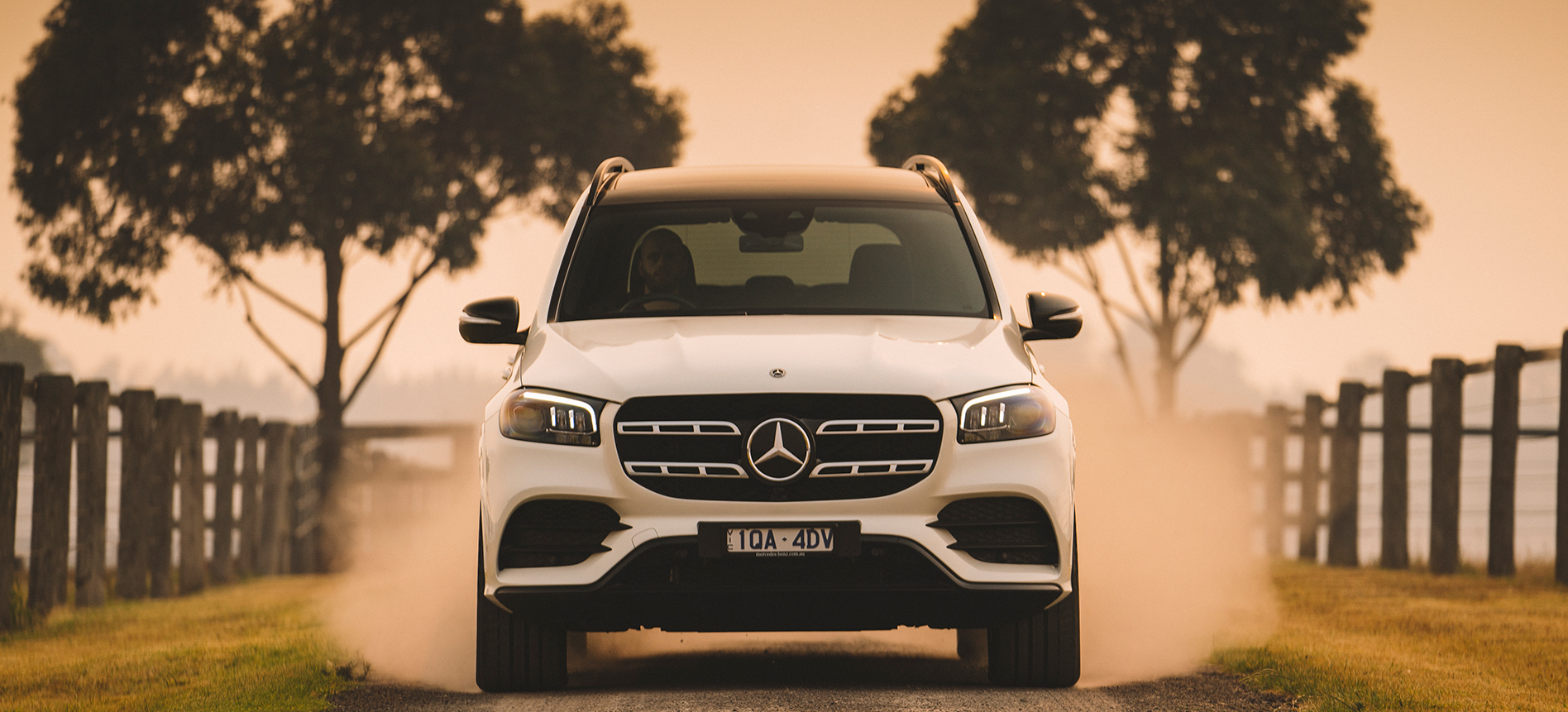
GLS – January 2020
The biggest Benz behemoth is due for an update in early 2020, bringing the new MBUX infotainment as well as several other upgrades.
Mitsubishi
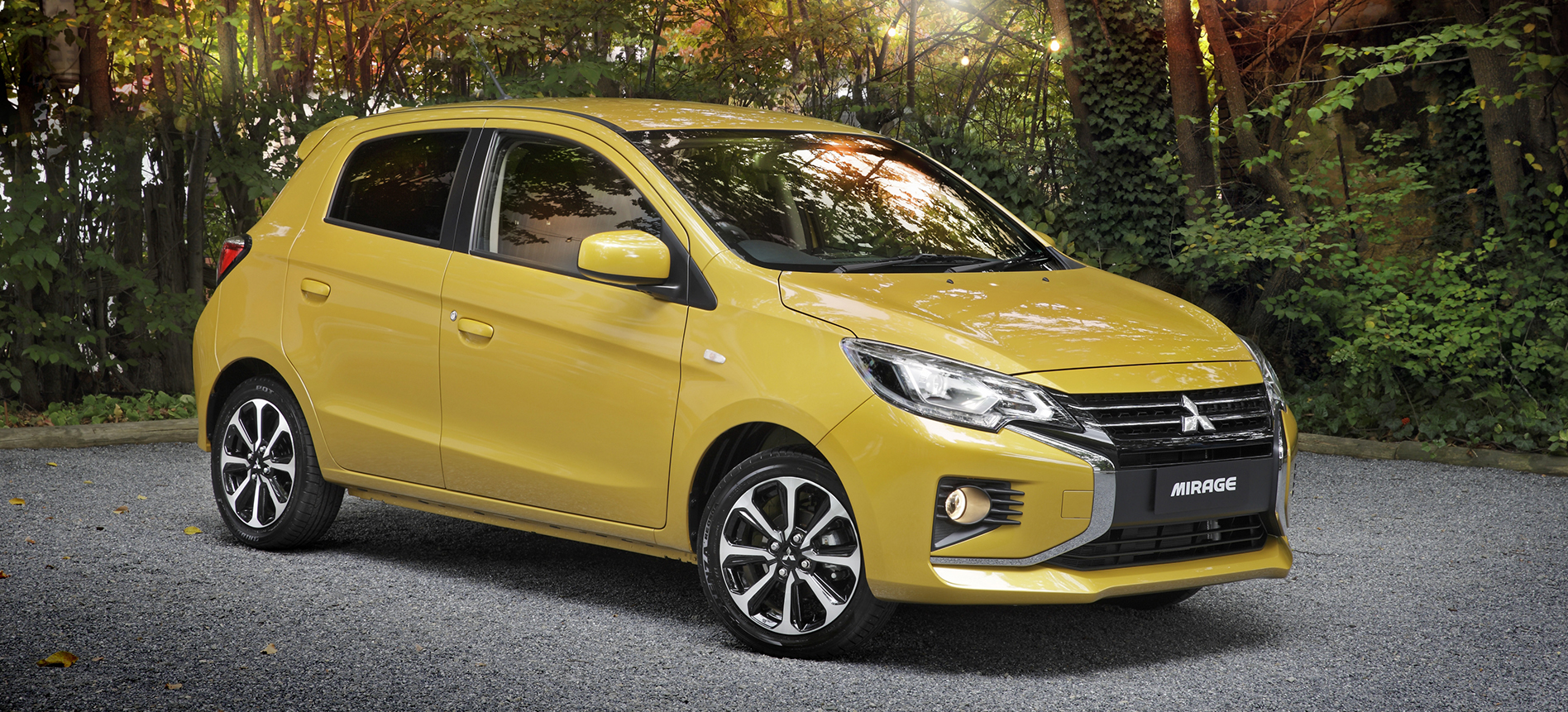
Mirage – April 2020
The Mirage small car will be updated with Mitsubishi’s current “Dynamic Shield” design language and is expected to get raft of updates in its interior and features list.
Pajero Sport – Early 2020
With the launch of the new Triton, the Pajero Sport has copped a more aggressive front treatment and less polarising rear, along with new instrumentation and interior features as well as new safety features.
Express – Mid 2020
Following the formation of the Renault-Nissan-Mitsubishi Alliance, Mitsubishi will be returning the Express commercial van to the market as a Mitsubishi-badged version of the Renault Trafic to take on the popular Toyota Hiace.
Porsche
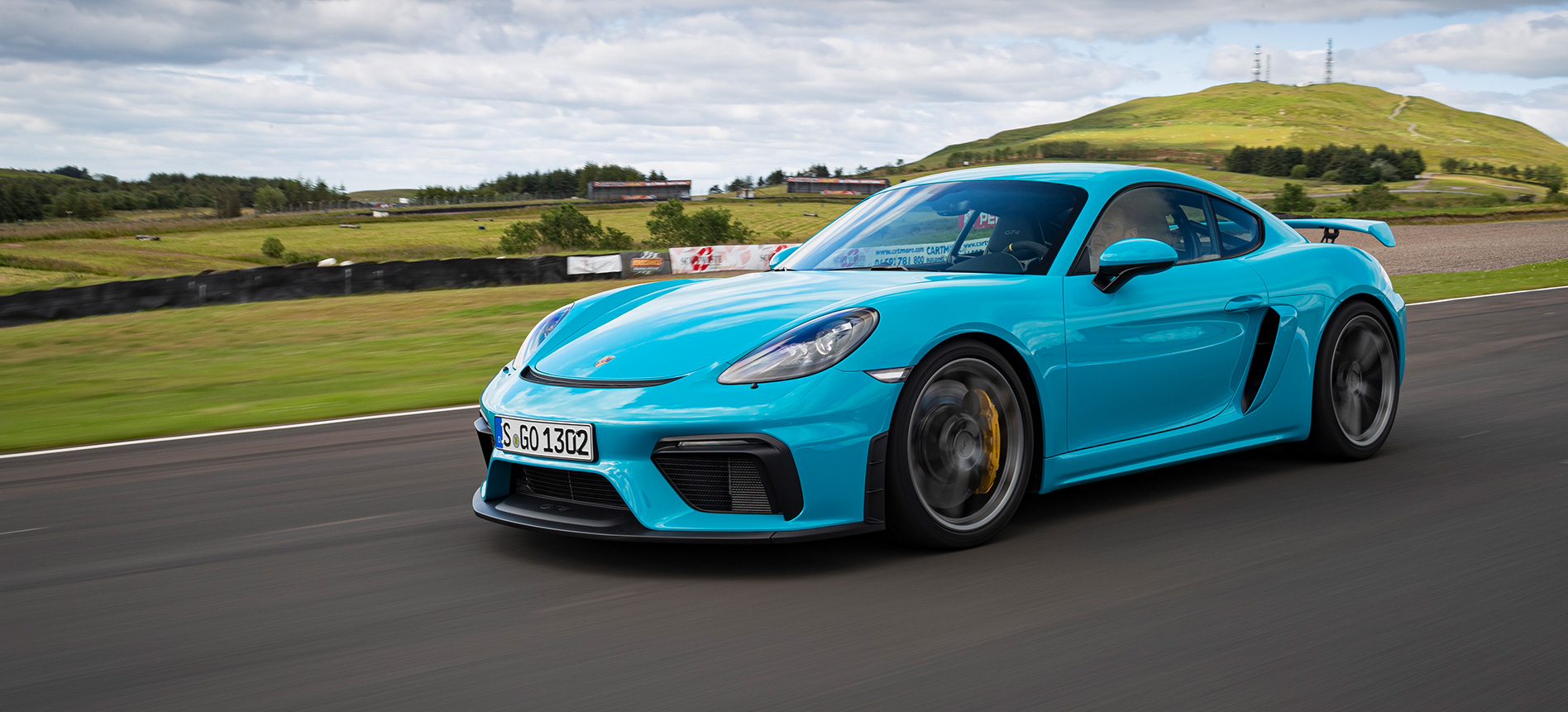
Cayman GT4 – March
New 4.0-litre free-breather arrives on scene to the joy of Porsche purists Australia-wide from January.
Renault
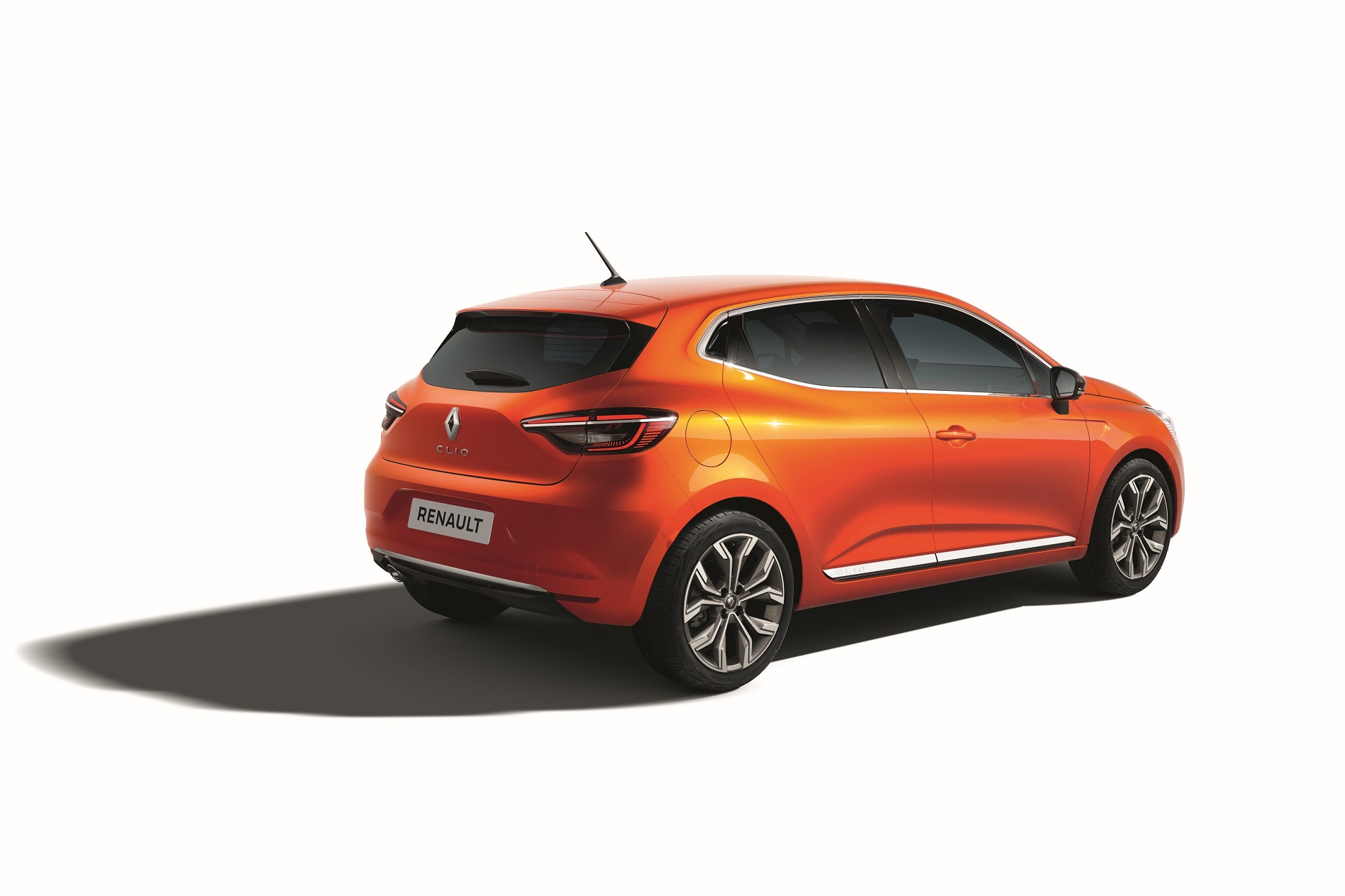
Clio – due 2020
Renault Australia has confirmed that we’ll see the new Clio – including a new variant called the RS Line – here in 2020.
Skoda
Superb – due Q1 2020
Fresh update for the Czech sedan sees it receive fresh styling, more tech and mild-hybrid engines.
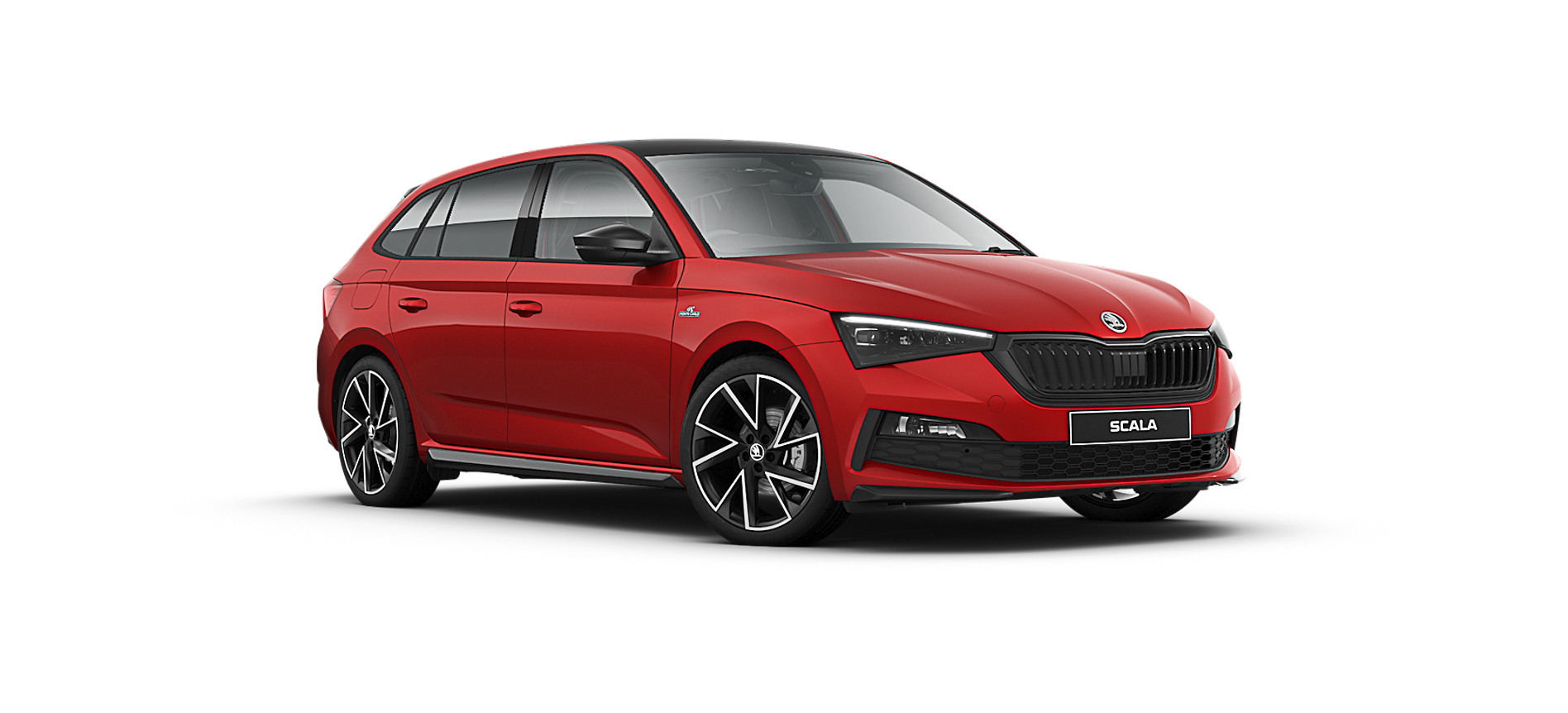
Scala– due Q2 2020
Despite the challenges of the time, Skoda has managed to push on with the launch of its vital new Scala hatchback. Expect to see luxurious interior inclusions at a hatchback level when the Scala drops in June 2020.
Subaru
Outback – due 2020
Subaru’s new Outback was announced in early 2019 but expect to see it from early 2020 showing off a leap in technology and even smarter packaging.
Toyota
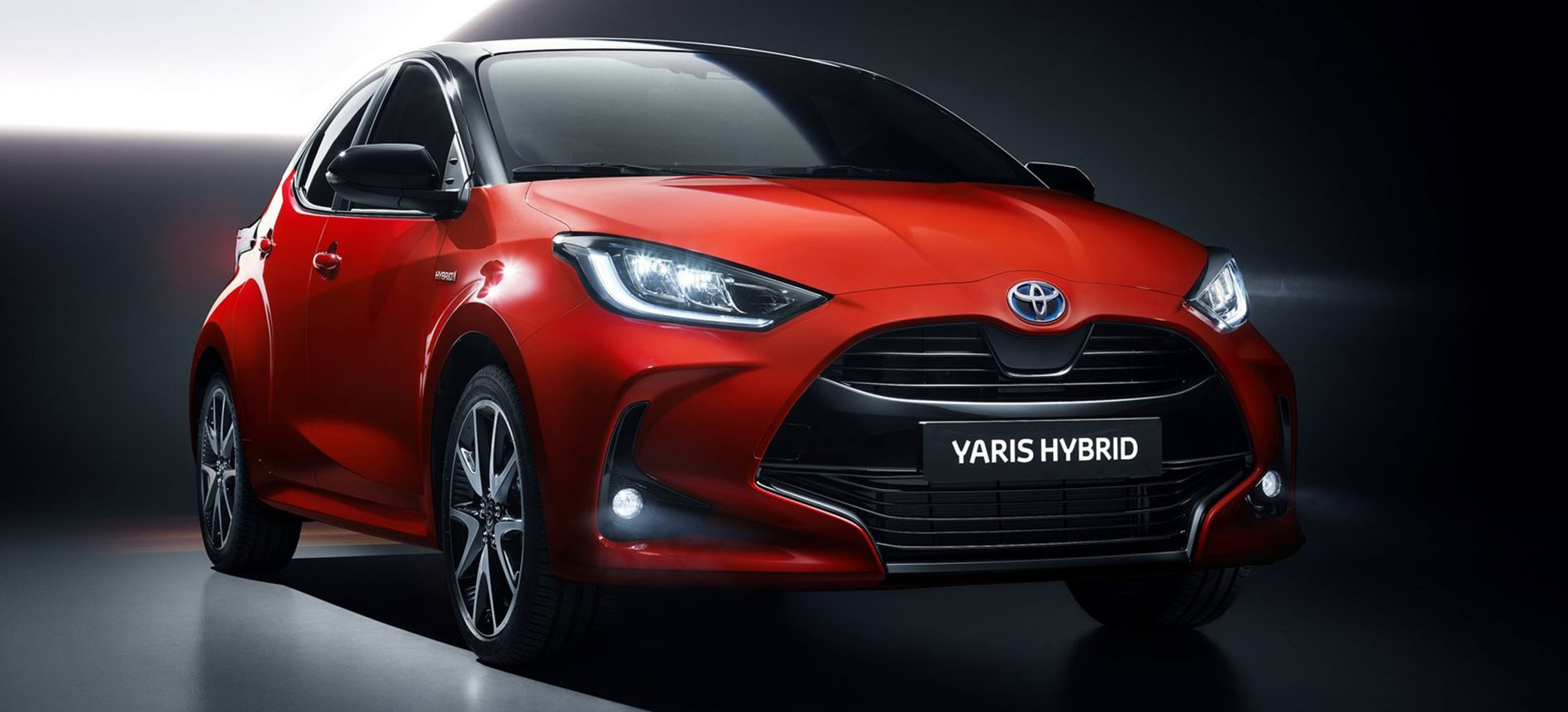
Yaris – due 2020
Next Toyota Yaris scores new engines and hybrid tech, along with more safety gear.
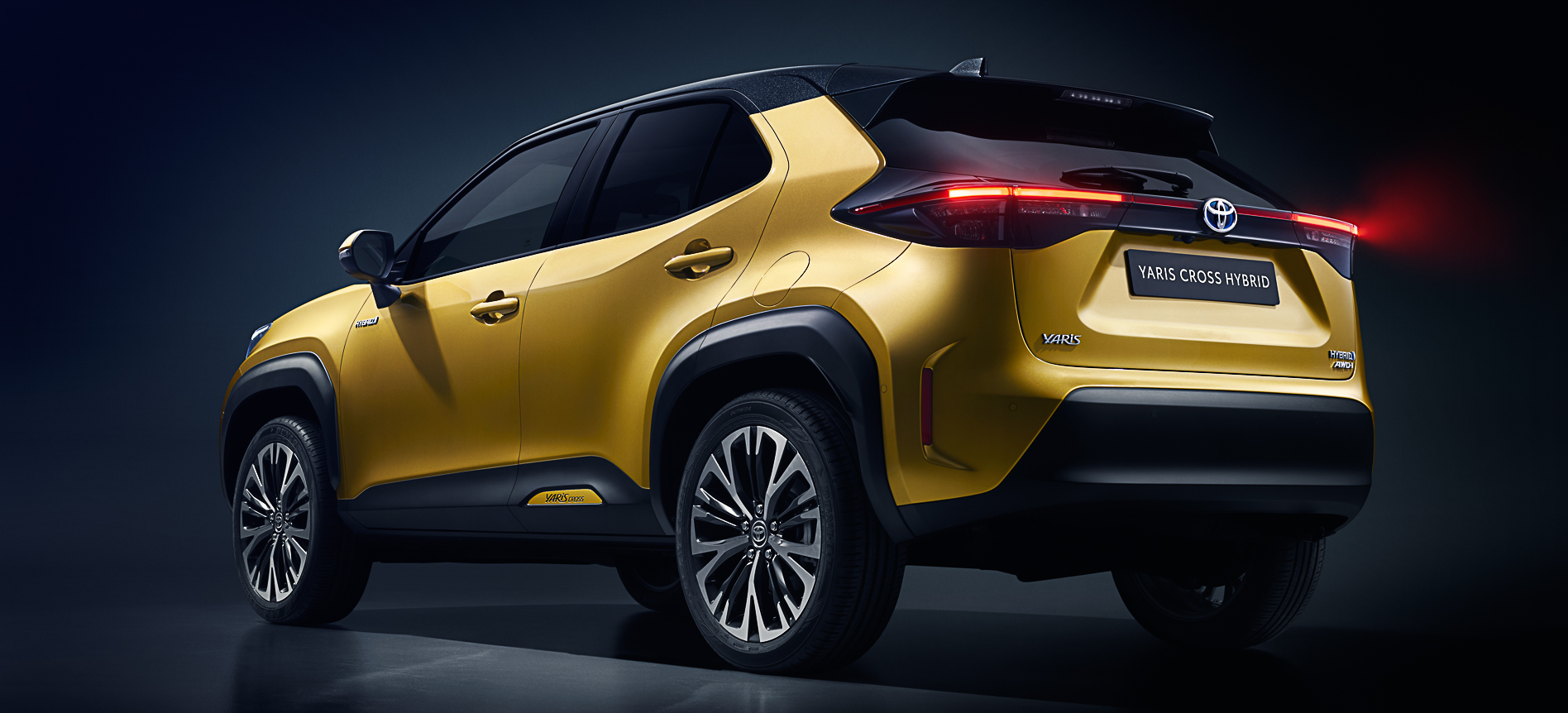
Yaris Cross – due late 2020
The Toyota Yaris above will spawn a high-riding stablemate later this year named the Yaris Cross. The Yaris Cross will slot in underneath the existing C-HR and be priced (hopefully) around $27,000.
Volkswagen
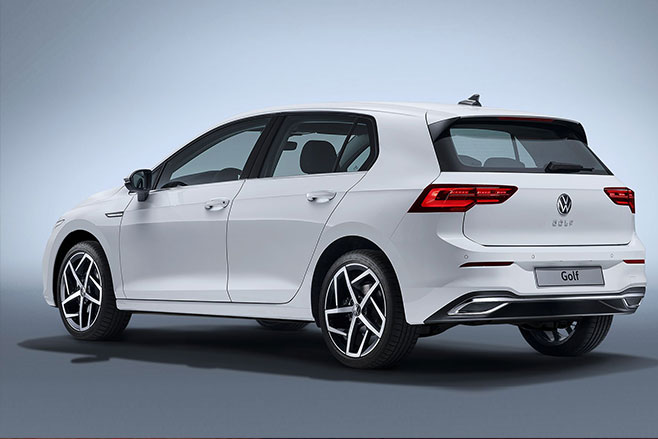
Golf – due late 2020
The new hatchback hero is here, and it’s due in Australian showrooms around October this year. Hopefully to be joined by the hot-hatch GTI version at the same time.
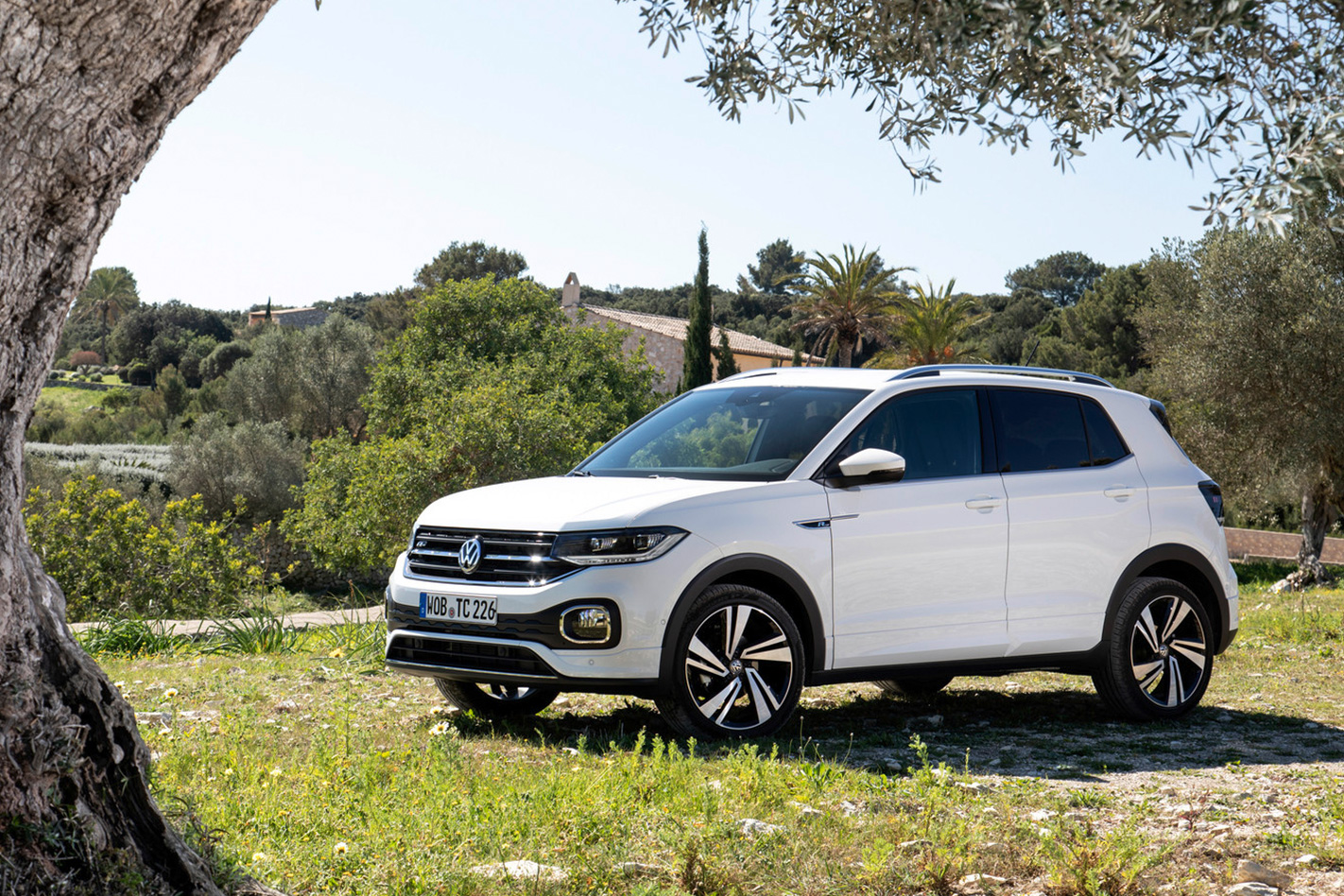
T-Cross/T-Roc – due Q1 2020
VW will fill its small SUV gap by offering the T-Cross from March 2020. It’ll be similar to the Polo, albeit with additional ride-height and will slot in neatly under $30k.
In our Fast Facts series, WhichCar delves deep into the history of automotive brands to bring you fascinating facts and intriguing information.
Here we focus on the Bavarian Motor Works – BMW – a company that has produced some of the world’s great sports sedans, roadsters and motorbikes since it was forced to abandon aircraft-engine manufacturing after World War I.
100 or 101?
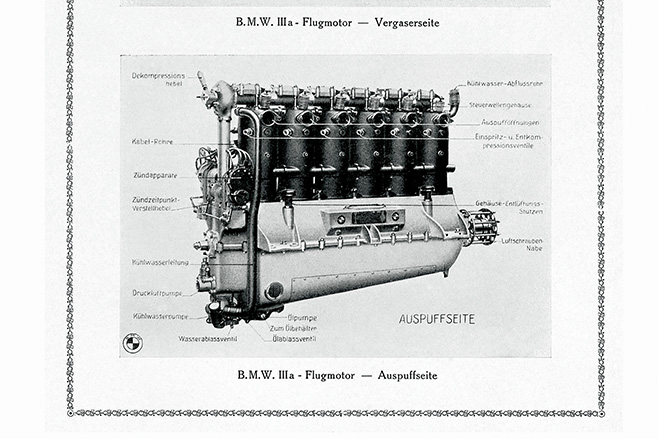
BMW celebrated its 100th anniversary in 2016, though it could be argued 2017 was more apt as the Bayerische Motoren Werke (Bavarian Motor Works) name first appeared in 1917 – changing from the Rapp Motorenwerke aircraft-engine company.
BMW bases the start of its history on the previous year, however, as in 1922 it transferred its engine construction operations to the Bayerische Flugzeug-Werke AG company run by Gustav Otto, son of petrol-engine pioneer Nikolaus Otto.
Spinning yarn
The blue and white centre of the BMW ‘roundel’ is often referred to as a spinning propeller owing to the company’s aero origins, and it’s easy to understand why this has passed into common lore.
In fact, the BMW badge was first introduced in 1917 with the blue/white combination representing the colours of the state of Bavaria – not the blue sky and clouds as many believe. It wasn’t until the late 1920s the company used the emblem as a rotating propeller in its advertising.
The company recently updated its iconic badge for a flatter design with a transparent outer ring “to radiate more openness and clarity”. It’s only the sixth time BMW has revamped its symbol in company history, with the previous redesign occurring in 1997.
World War 1 to two wheels
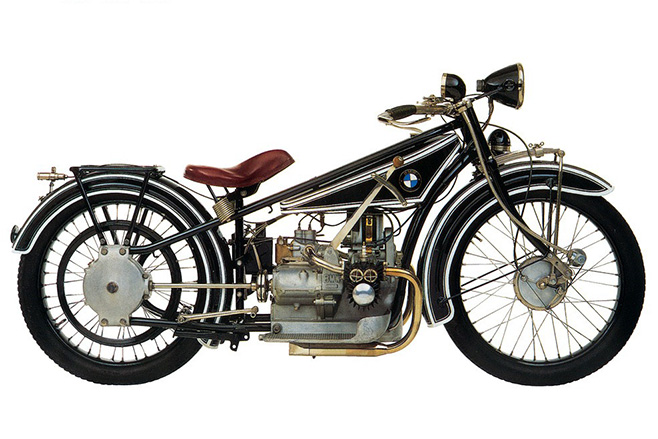
BMW’s transition into a manufacturer of wheeled transport can be attributed to Germany’s defeat in the First World War. After the company was banned from producing aircraft engines by the 1919 Treaty of Versailles, it caused a stir at the 1923 Paris Motorcycle Salon with its first motorcycle, the R32.
About half of the motorbikes offered today by BMW’s Motorrad division still feature the twin-cylinder boxer/shaft-driven layout of the R32.
Hit for six
BMW built its first car in 1929, though it was built under licence from Britain’s Austin. The 1934 303 was more notable for two reasons: its engine started what would be a long (and highly regarded) history of in-line six-cylinders. And its twin ‘kidney’ grille remains a design trademark on all BMWs to this very day.
In a way, the 303 could be called the company’s original BMW 3 series, as it was a compact sedan and there were successor models such as the 315, 319, 329.
Roadster lineage begins
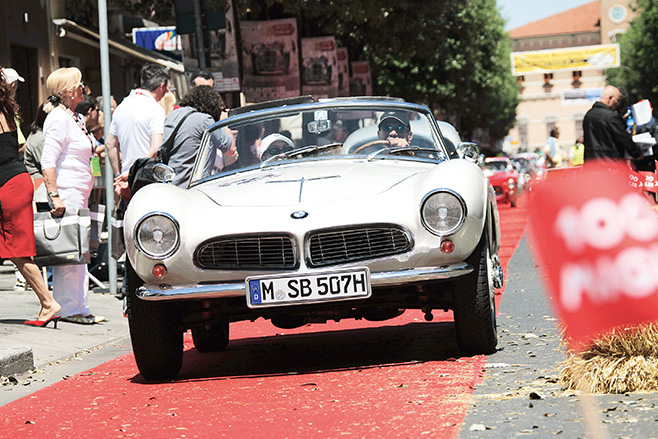
In 1936, the 328 began a famous lineage of roadsters that would go on to include the likes of the 507, Z8 and Z4. The 328 – yes, powered by a six-cylinder engine – would dominate sports car racing in the 30s, and would also inspire a famous Jaguar: the XK120.
Sales Bubble
Germany was one of several nations to adopt a microcar designed by Italian company Iso when BMW launched the Isetta. It fitted its ‘bubble’ car with a 1.0-litre motorcycle engine for benchmark fuel efficiency, and it would find a popularity – more than 160,000 produced – that eluded many of the company’s larger cars.
The 2002 of 1968
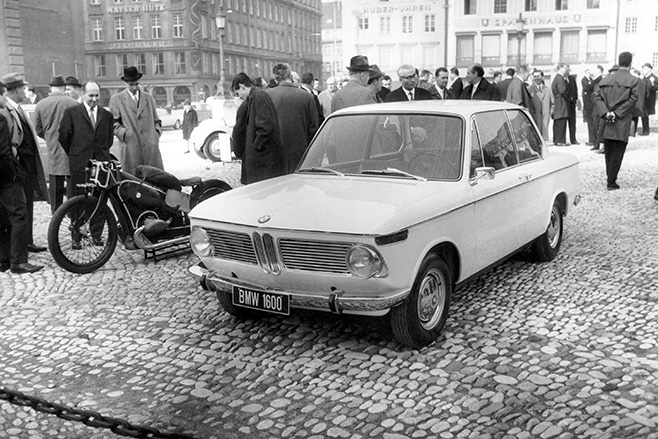
Passenger car success for a BMW-built car came in 1968, with a car that was much bigger than the Isetta yet still relatively compact. The 2002 heralded the birth of the sports sedan (though Jaguar’s brilliant, if larger, XJ6 did emerge the same year). It was immensely fun to drive yet also practical with its four doors and boot.
It was at its fastest in Turbo form, a variant that was sadly shortlived as the 1973 oil crisis panicked manufacturers and buyers alike. You might be familiar with the 2002’s successor: the 3 Series, which was released in 1975, retained the 2002’s spirited dynamics, and became BMW’s signature model.
Getting kinky
A new BMW design signature was introduced with the arrival of the 3200 CS and 1500 in 1961. Named after its creator and the design director of the time Wilhelm Hofmeister, the Hofmeister Kink is a forward bending angle at the base of the rearmost roof pillar.
It’s said to represent rear-wheel drive or at least a bias to rear-drive and while BMW has since adopted front-wheel drive in some applications, the kink still remains in almost all BMW models to this day.
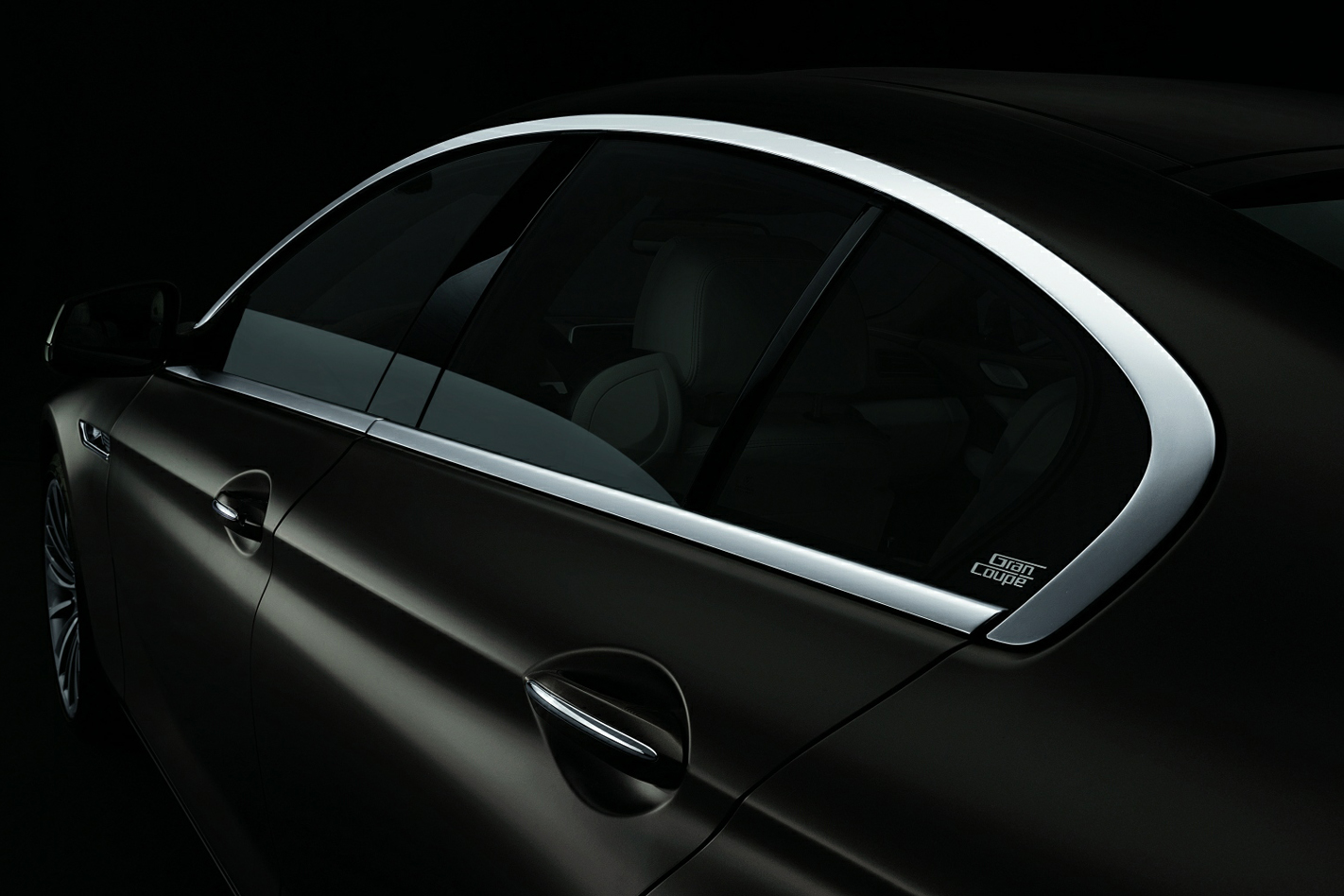
M for Motorsport
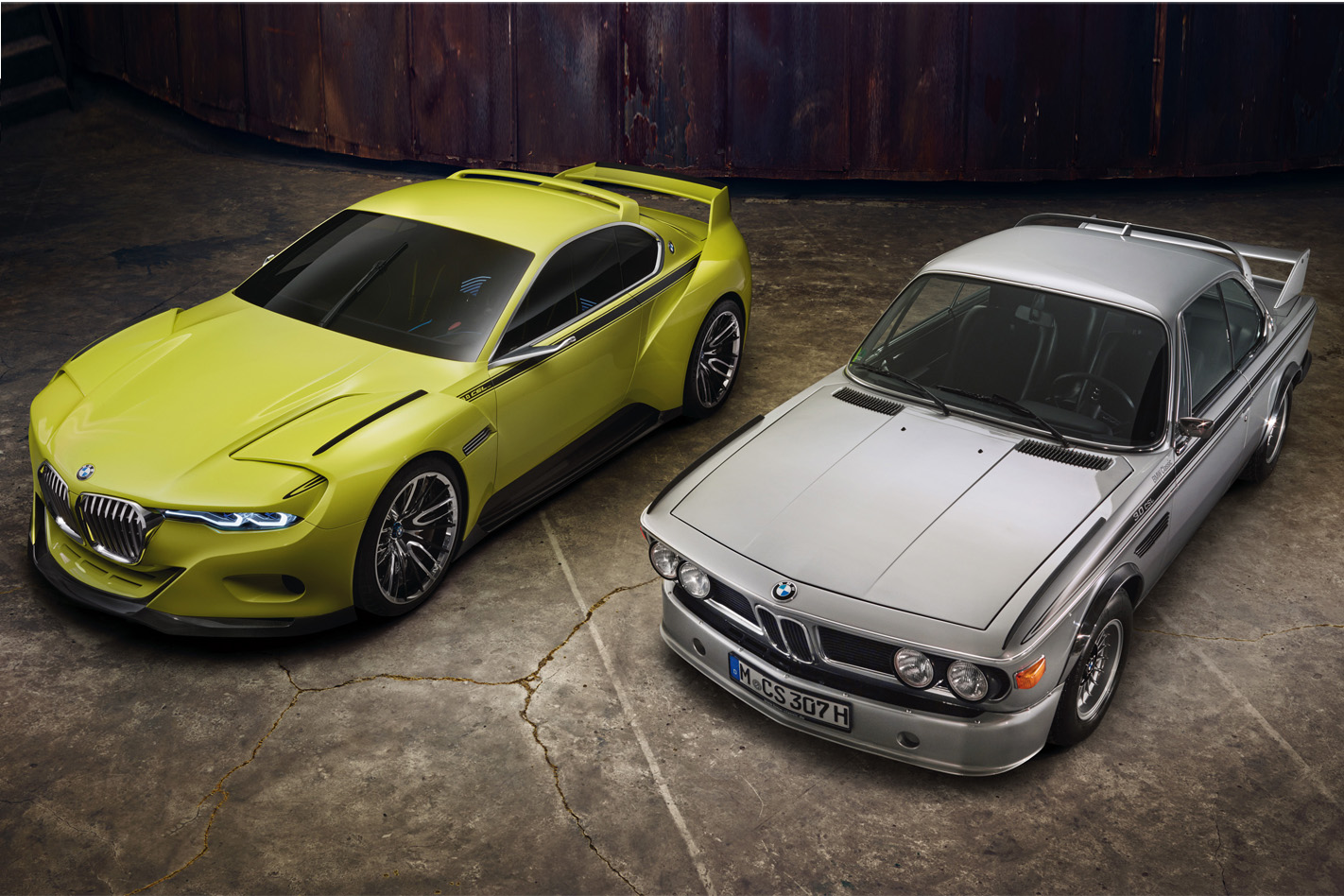
BMW didn’t set up a separate motor racing division until 1972 – and its now-famous tri-colour stripes first featured on the aforementioned 2002 Turbo two years later. Another famous model was the CSL homologation, which became nicknamed The Batmobile after its extravagant bodywork that included a deep chin spoiler, blistered wheel-arches and a prominent rear wing.
The light blue (Pantone Process Blue) that appears on the left of the M colours is lifted from the BMW badge, the red (Pantone Warm Red) represents the partnership with Texaco during the M Division’s early days, while the middle dark blue (Pantone 268) represents a blending of the two companies.
The M-cars
The first of the company’s M cars was the 1978 M1 – a mid-engined six-cylinder supercar intended to take on Porsche in motor racing, only to come obsolete two years later as the regulations for the Group 5 racing series it was built for changed. (Though it did feature in a one-make Procar series, famous for featuring F1 drivers of the time.)
Mid-engine specialists Lamborghini were originally approached to develop the car before their financial struggles forced BMW to resume control of the project.
Many regard the M division’s first modified road car to be the original M5 of 1984 which took the E28 5 Series as its basis, but there were actually two before it. In 1980, the company wheeled out the M535i which used the first E12 5 Series to create a powerful 3.5-litre high-performance sedan even if it didn’t have a true hand-built M Power engine.
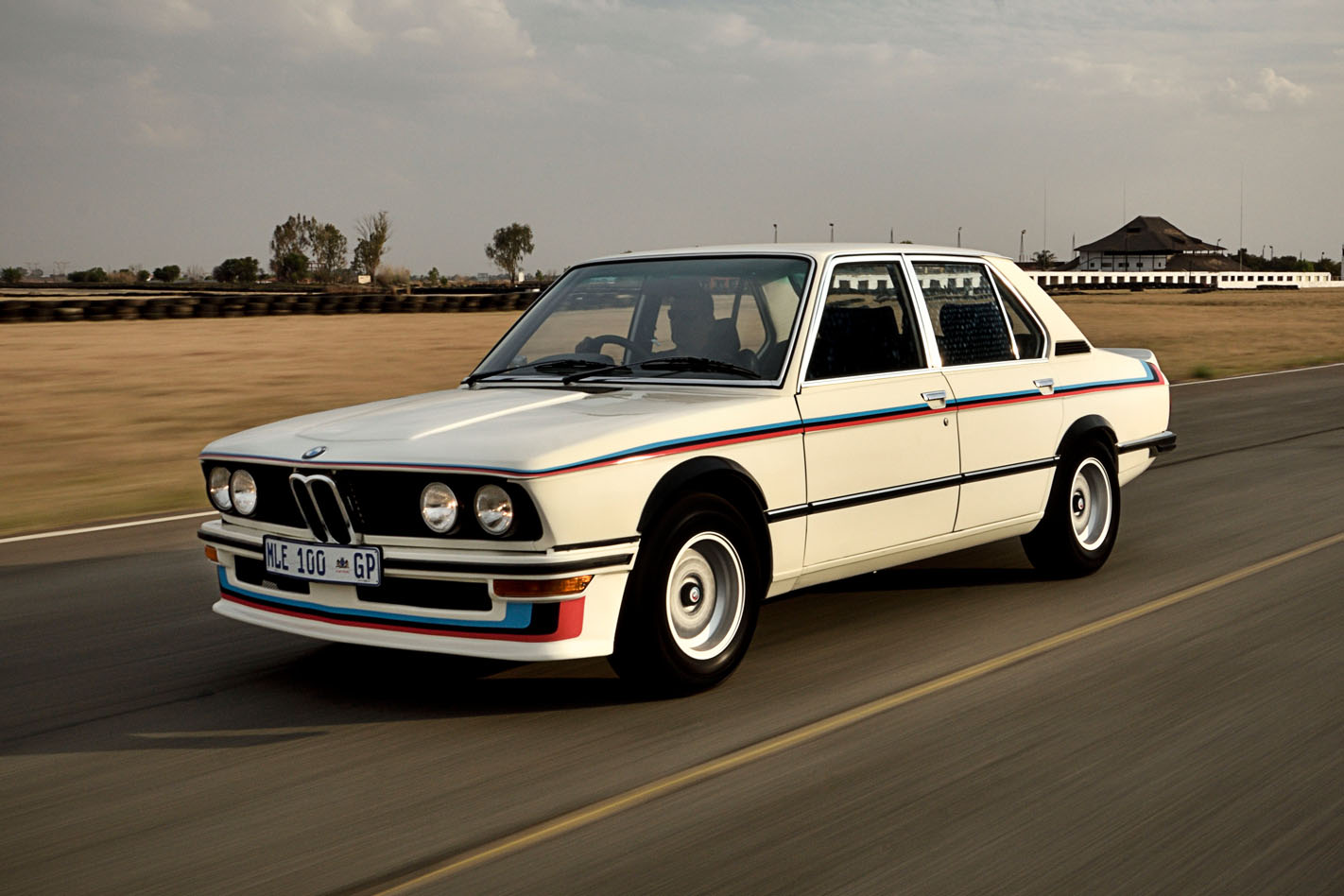
Before that though, the 530 MLE of 1976 – also E12 based – was the next car after the 2002 Turbo to wear the now fabled M colours and can be traced back as the true origin of the M family today.
In 1986 came another BMW icon. The M3 was essentially a homologation special built to validate its participation in motorsport – which it would dominate. Successive generations of both models.
F1
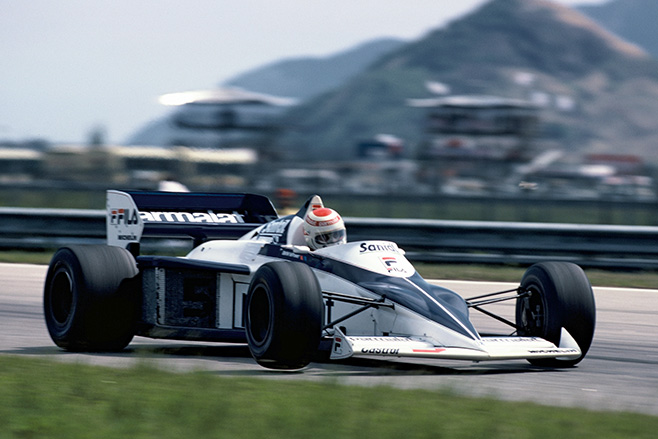
BMW provided the engine for the Brabham team in 1981, powering Brazilian Nelson Piquet to the driver’s title two years later. After a 12-year hiatus, it returned as engine supplier to the famous Williams team between 2000 and 2005 before buying the Swiss Sauber team the following year to become its own manufacturer team.
There was minimal success, however, and it left the sport in 2009 with just a single grand prix victory to its name.
Power for the world’s fastest car
Successful Formula One team McLaren announced in 1989 it would be the ultimate road car, the McLaren F1, and it sought out BMW Motorsport for the bespoke power unit: a 6.1-litre V12 with 468kW.
Just 100 were made, and from its production birth in 1992 and for much of a decade after the F1 was the world’s fastest production car – capable of acceleration from 0-97km/h in 3.2 seconds and reaching a staggering (and officially recorded) top speed of 372km/h.
British brands obsession
McLaren aside, BMW seems to have a penchant for British companies. It purchased the Rover Group in 1994, though it would sell it just six years later after struggling to manage its sizeable acquisition (the Land Rover part went to Ford).
BMW’s held onto the Mini brand, building a new-generation model in 2001 that would become hugely popular – and hugely profitable – with a premium pricing position that was the antithesis of the original’s.
And, while the Rover acquisition might have appeared like a waste of time and money on face value (the brand was sold to a consortium for just £10 ($15)), BMW’s shrewd business sense became apparent a short time later when it rolled out its first four-wheel drive.
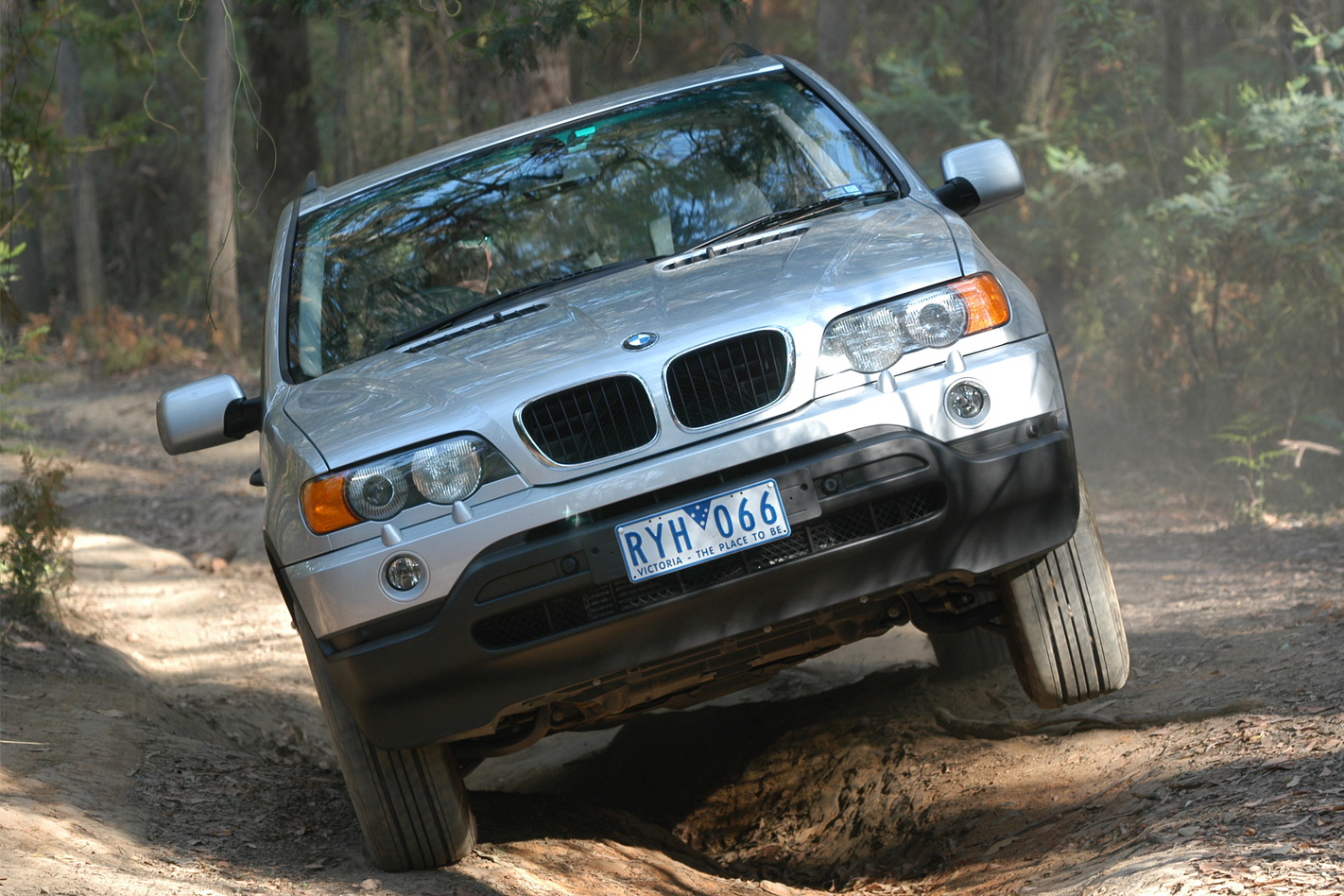
The accomplished X5 had a sophisticated off-road system that would have cost billions to develop … unless the company had gained a little head start from one of the best in the business.
