
McLaren Automotive has revealed a design rendering of an upcoming open-cockpit speedster model at the 2019 Pebble Beach Concours.
The yet-to-be-named speedster is set to join the Woking carmaker’s flagship Ultimate Series ensemble next year, with only 399 examples slated to be made.
While McLaren has yet to release the speedster’s performance figures, the carmaker claims that the upcoming model will be the “lightest car ever produced by McLaren Automotive”, and will be paired with a variant of the 588kW twin-turbo V8 engine used in the track-focused Senna.
Considering that “McLaren Automotive” is often used to refer to the 2010 revival of McLaren Cars, the speedster’s goal of being lighter than the car maker’s current featherweight champion, the relatively lightweight 1188kg Senna GTR, sounds ambitious.
With the Ultimate Series comprising of the P1, Senna, and Speedtail, McLaren says the speedster model will have a clear “singular purpose as a thrilling road car dedicated to the love of driving”, which complements the Senna’s uncompromising road-legal track car design brief and the Speedtail’s intent for high-speed capabilities and road-focused driver connection.

In addition to that, the speedster will be priced between the Senna and Speedtail, though considering that the two models are priced at £750,000 and £2.1 million respectively, it is a pricing gulf that is plenty big enough to comfortably fit another addition to the line-up.
According to McLaren, not all of the 399 speedster models have found paying customers, with the company taking expressions of interest from potential buyers at the Pebble Beach event.
Perhaps the best day I’ve ever had at Wheels is one I’ve never written about. It was at Sandown, years ago, and through some bizarre fluke of circumstance, I found myself with an empty circuit and two cars at my disposal – an electric blue Lexus LFA and a red Mercedes-AMG C63 507 wagon.
I’ve been thinking about that afternoon a lot this month, trying to understand why those few hours – spent mostly at 9000rpm in the Lexus and on the lock-stops in the deranged Benz – were so seminal. It was the engines, of course. For all the LFA’s and the AMG’s dynamic talent, it’s not the steering feel or the handling poise that comes back. It’s how they behaved under full load, how each donk dictated the character of the car and, most notably, their soundtracks – the fizzy, effervescent shriek of the LFA’s highly strung V10, complimented by the AMG’s deep, lazy baritone.
It’s these moments, these fleeting sensations, these flashes of analogue connection, that Wheels is celebrating this month with our cover story, with particular emphasis on the engine configuration that, arguably, is the greatest of them all: the V8.
Is there another arrangement of cylinders that resonates so strongly with enthusiasts? Or one with such a flexible blueprint and such a wide personality? Big, wet and lazy; cammy and throbby, they can also be tiny-capacity, high-revving screamers. I once stood in the tunnel at Monaco during qualifying for the GP and experienced such a barrage of noise and vibration and frequency from the 2.4-litre V8s that it felt as though I’d been punched in the sternum. And don’t get me started on my ears; I’m fairly sure they’re still recovering.
There are more exotic engines, of course. In the game of cylinder top trumps, the V10 and V12 have the humble V8 licked, and they have rarity on their side, too. Unless you own one, part of the allure of driving an LFA or an Aventador or an 812 Superfast is the underlying understanding that you might never get another chance to do so.
But where these cars are reserved only for the rich and the very lucky, the V8 is the everyman’s performance engine. It’s found all over the globe, in pick-up trucks, sedans, coupes, utes, in racing cars and in high-performance halos. And in almost every installation, it will feel unburstable. There’s something inherently satisfying about a V8’s ability to marry big-capacity low-end torque with genuine top-end muscle. And let’s not forget about the noise. For all the LFA’s dentist-drill intensity, my memory of the C63’s deeper soundtrack, as it boomed through the cabin, is just as powerful.
It’s difficult to explain why exactly, but there’s something about a V8 soundtrack that appeals to our base instincts in a way no other configuration seems to. Add more cylinders and the sound starts to blend together. Take cylinders away and the thrashing of the pistons is more obvious, more raucous, and less pleasing to the ear. Even at idle a V8 is dramatic, its unique configuration delivering that gentle, and strangely comforting, side-to-side motion.
There is, perhaps, another reason I’ve been pondering that day at Sandown. As former editor Stephen Corby mused only a few months ago, one can’t help but feel that the glory era of the V8 as we know it is waning.
In this transient age of EVs and autonomy, it seems we can’t discuss any piece of proven technology without questioning its future, though reassuringly, the news from the people who make the decisions about these things is bullish. Tobias Moers, who heads up AMG and is equal parts fuel-gurgling bogan and performance-car genius, is unequivocal that the V8 is here to stay. What’s likely to change is how it’s deployed. You only need to read our news piece on Ferrari’s new 736kW supercar to realise the V8’s future is likely to involve electricity in some way or another. But for now, it’s still possible to revel in the way things were, to appreciate the debauched uncouthness and bravado that’s so central to an old-school V8’s appeal. And that’s exactly what you should do.
Four hundred and seventy kilowatts. That’s a figure so formidable, mere numerals don’t do it justice. Here’s another worth spelling out: seven hundred and eighty Newton metres.
This review was originally published in MOTOR’s September 2008 issue
Who on Earth throws around such numbers? Massey Ferguson? Kenworth? The Royal Australian Air Force? Even for Lamborghini that’s impressive. But when they apply to a humble HSV VE Clubsport, you know you’re pushing the envelope like a coked-up postman.
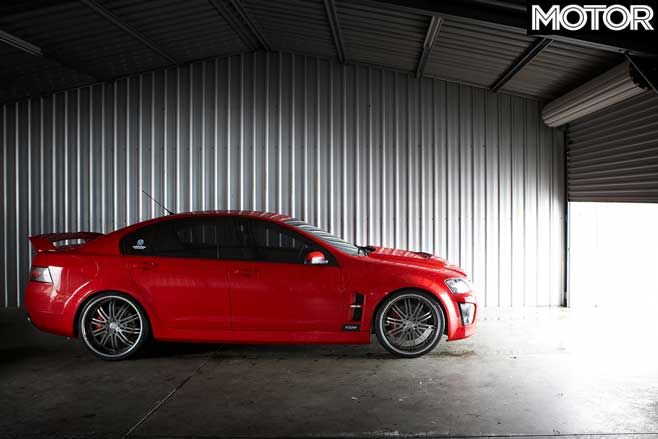
Most casual gawkers during our test presume it’s some new whiz-bang model in Clayton’s line-up. Nope. On day-release from Walkinshaw Performance’s Braeside headquarters, in Melbourne’s suburbia, this Clubby comes bellowing and screaming across the ever-changing Aussie muscle-car landscape like a red exclamation mark. Not just figuratively, but literally.
On a quiet morning, you can hear it coming long before you see it. And it’s not its guttural exhaust note — imagine a V8 Supercar engine gargling rocks — piercing the air, but the cat-in-a-blender shriek of a supercharger. It’s like motoring’s classic rock at full noise, and a sonic giveaway to anyone with a passing interest in horsepower hedonism.
“No, officer, it didn’t come like this from the factory.”
And yet, in many ways, it’s bloody close. WP is renowned for creating OE factory-style engineering and presentation. With WP and HSV kissing cousins under Tom Walkinshaw’s corporate umbrella, you’d expect as much, too.
No wonder punters get duped, despite WP’s effort in crafting a unique identity for its cars. HSV badges are removed, there’s no ‘470’ horsepower boast on the bootlid, and it’s littered with WP logos. As a one-off rolling demo of WP’s VE-ready aftermarket goodies — and not a turn-key showroom model — it has no name. Of course, ‘No Name’ looks ridiculous in print, so we’ll call it the ‘WP470’. No worries. You’re welcome.
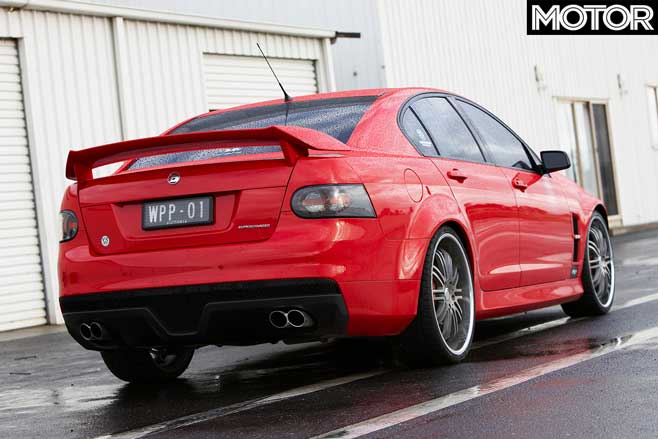
Yes, it’s a bit of politicking. HSV’s record-breaking 375kW, 640Nm, $155K W427 blockbuster’s arrived (see p.38) and any head-banging Über-Dore seen to undercut Mr Tall Poppy by 100kW and 130Nm can make things, er, awkward. Especially as the WP470, as tested, costs a smidge under 100 grand…
WP’s Gary Beer keenly downplays comparisons: “If you want cohesive, all-round OE greatness, the red Clubby can’t touch the W427. But if you want your head ripped off…”
Achieving the staggering 470kW and 770Nm figures was straightforward enough. WP applied its proven 6.0-litre LS2 supercharger tech — a potent 420kW/730Nm package to begin with — to HSV’s new 6.2-litre LS3.
A few things were revised, such as the nifty inlet manifold/water-to-air intercooler and exhaust system, and blower-specific ECU flash reprogramming. But the guts of it is that WP’s existing, and unique, Harrop-made ’charger was overdriven to match the deeper-breathing (bigger bores, freer-flowing heads, larger cam, et al) Chev V8.
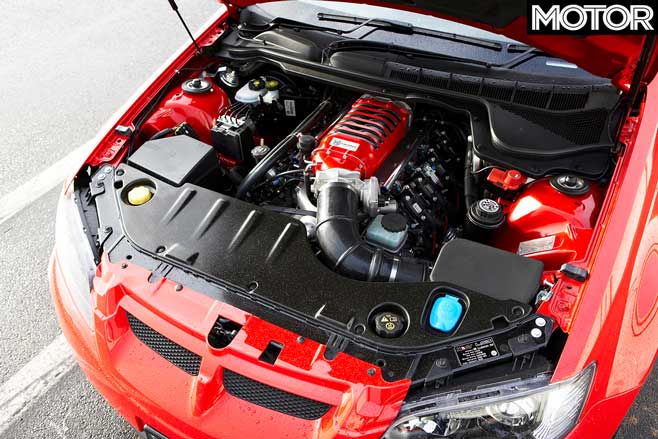
Thanks to its tricky bypass valving system, boost ramps upwards from zero pressure at idle to about 0.6bar (8.6psi) at redline. That’s a fair bit considering the LS3’s 10.7:1 compression, yet it feels like the engine isn’t breaking a sweat in churning out 40 percent more power.
The whole supercharger set-up ($15,500, plus $2100 for the exhaust) is simple, neat and compact – proof that when it comes to giving the LS3 hornet’s nest a proper smashing, belt-driven forced induction is hard to beat.
It adds little in the way of size, weight and complexity to the engine bay, and is very discrete. The cost of elaborate custom-made turbocharging isn’t nearly as practical if poking HSV’s all-alloy V8 bear is your idea of fun.
And, lord, it growls like a grizzly once you fire it up. No silken sheen here. It’s all animalistic brooding at idle, it’s gruff down low, and it pops and crackles on the overrun. But it’s the blower howl through the firewall that curdles your blood.
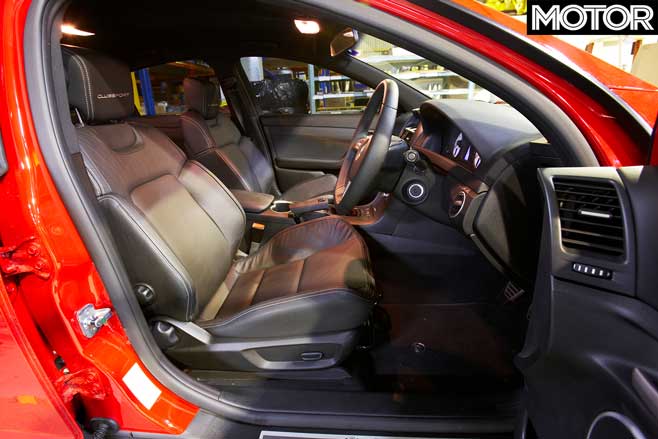
You reasonably expect tyre-shredding, light-switch dynamite. But instead, it carves a chunk of planet-shifting energy and places it, with instant and accurate control, under your right foot. It’s benignly flexible at low rpm and sort of masks the near-800Nm (nudge, wink) avalanche of torque on tap.
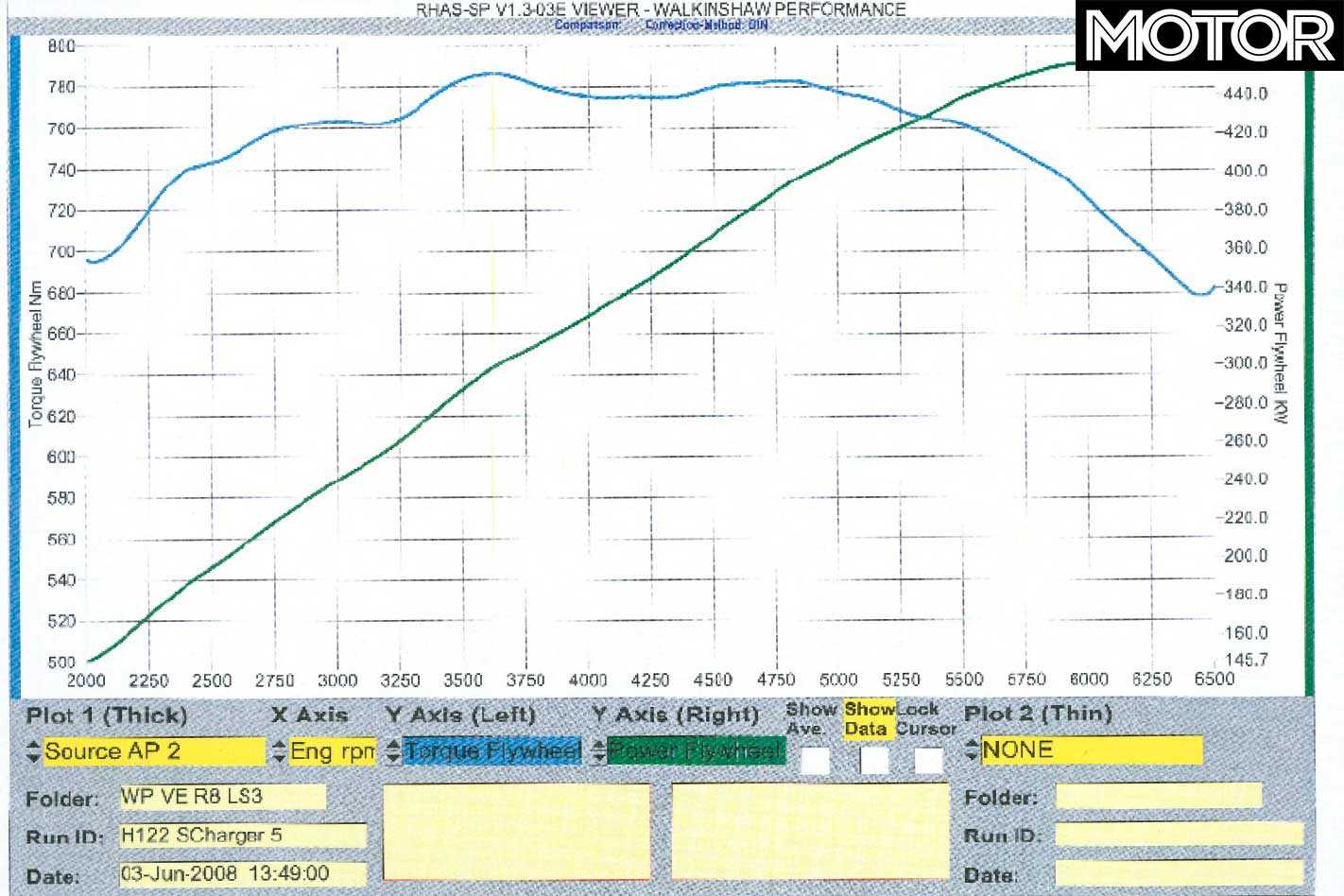
On paper, the torque curve is more BMX track than kitchen benchtop, but in practice it’s a smooth, tantrum-free warp drive that seems to magically shed half-a-tonne of the Clubby’s porky 1842kg mass.
You simply dial up the energy, using the loud pedal like the volume knob for a rock concert sound system. With over 760Nm available between 2750 and 5500rpm (the official peak is at 4500rpm), it’s just planted, histrionics-free acceleration until the redline looms and the rears threaten to paint strips on the hot mix.
In third gear. Or, if you’re keen, fourth. The last thing I drove that shimmies its bum with hard-pinning, full-grip theatrics is Porsche’s 911 GT2. It demands respect. Frying the rears in the top of fourth, in a four-door sedan road car, is a fairly new phenomena for mankind. What the tail end might do as a result is about as random as next week’s Lotto result. I’ve heard horror stories…
Another thing is reliability. ‘Standard’ pretty much sums up the rest of the driveline. There’s an LS7-spec single-plate-type clutch upgrade, which is light, progressive in take up and works like a dream. It’s mated to the regular Clubby six-cog manual — not the stronger TR6060 unit used in the Z06 ’Vette and HSV W427 — which is unusually slick-shifting and has clocked 5000 faultless kays behind the blown LS3 without drama.
And it’s not like WP’s demo-cum-development car has been mollycoddled with a Grandpa’s slipper treatment. Forget running an auto, though, unless you fancy blending the 6L80 six-speed’s innards into oily chow mein — it’s not rated to cop anywhere near this much torque, and won’t.
WP warns that all-round durability is largely down to the end user. It’s that kind of road car, and not a race car, and yet exploring its limits is sensibly best reserved for the race circuit.
While 470kW plus 770Nm makes for impressive maths, multiplying the result by a number slightly higher than zero — the grip available after a serious bucketing of rain — taunts some eye-opening physics.
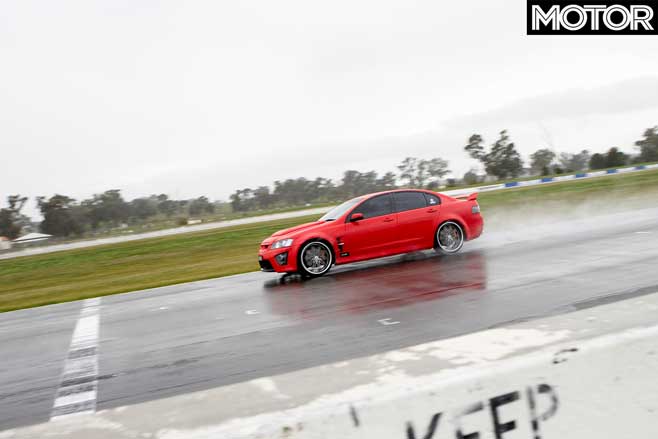
Needless to say, proceedings could go pear-shaped to a degree that’d keep the near-by Ardmona fruit factory in business for years. So forget meaningful lap times. And if the world needed another crappy reality TV show (it doesn’t), you could’ve filmed Survivor: Winton on the spot. Rest assured that there were helmets hung over some pretty grim faces.
An hour later, though, Amac, V8 Supercar driver Nathan Pretty and I were alive and all smiles in the soggy pitlane, like mates who’ve just exited an amusement-park ride. Each has given the beast a thorough workout, including an impromptu drift session to appease shooter Suesse. And no one had so much as spun the WP470.
While the standard Clubby lacks the sharpness of top-shelf V8 German rivals (C63 AMG, M3, et al), it’s a world-class stunner for mid-corner poise and balance. We’ve said so for ages, so no surprises there.
And it’s not until you pump really stupid output, such as WP470’s, through the rear that you realise how much of a pat on the back HSV — and Holden — engineers deserve. Bar obviously demanding more restraint on the loud pedal, the WP beast knuckles down and links the curves with the predictability and corner-exit drive of the regular Clubby. Power and handling meld together in a unison of easy-to-use linearity. Whether you’re massaging racing lines or dialling up hellacious powerslide angles, it’s child’s play.
Get impatient on the straights and it bangs against the rev-limiter in any gear, but there’s plenty of drive on tap — it’d kill the stock Clubby in wet (or dry, of course) rolling acceleration — and the rear remains tidy, never suddenly snapping sideways and sending you off for a rendezvous with concrete. And that’s the key. The WP470’s greatness is not how much power it makes, but how useable it is to the non-professional driver buying into the experience.
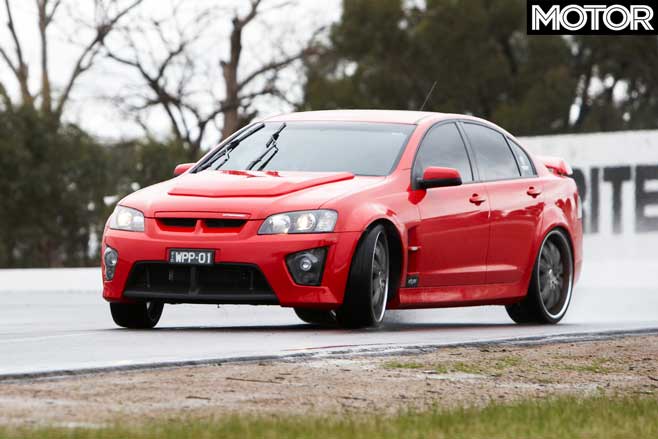
One curious side effect is that the extra torque seems to loosen the reins on the stability control; you get more wheelspin and an extra margin of oversteer angle before the electronic fun police shut the party down. All good, though. That you can milk some extra power-down in the corners without removing the safety net is a major plus.
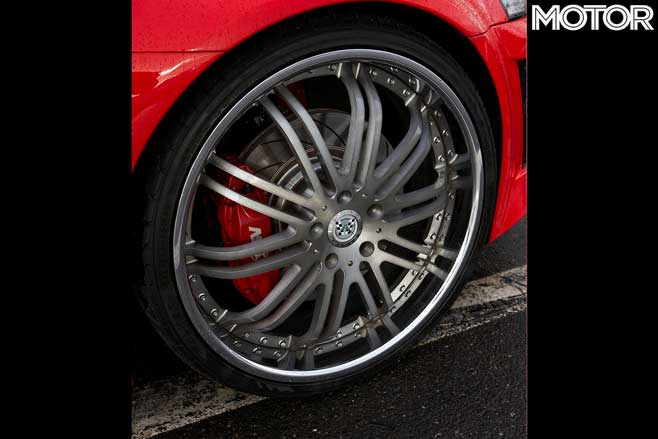
Letting the team down are those satellite dishes rolled through tar that WP call wheels and tyres. True, the 22-inch Vendetta rims look a million bucks — at $10,950, with tyres, they ain’t far off it — and might prompt a visit to your local roads authority outlet with a hockey mask and ice pick should one crash through a pot hole.
Given WP’s 30mm-lowered suspension kit ($690), the ride comfort is exceptionally compliant. And despite making HSV’s normally butch stopping package — which feels amply capable of compensating for the power hike — look puny, it’s a case of so-far, all-good.
But the painted-on Falken ZR rubber — 30-series fronts and ridiculous 25-series rears — offer no sideways flex or ‘give’ and don’t offer enough in the way of lateral grip. And it’s not just the rear dancing about like Todd McKenney after a night out. Despite some added steering sharpness, it just ploughs on with understeer when pushed.
While the Clubby’s mass seems to disappear along the straight stuff, it hasn’t in the curves. In the wet, the WP470 demands concentrated guidance, and once she gets away, it takes some effort to reel it back in. Hot tip: if you tick the box for the 22s, retain the stock 20-inch rim’n’rubber for the weekend warrior — they’re a far more capable combination.
Longitudinal grip, though, isn’t such an issue. Mother Nature stopped whizzing on the parade long enough for the 285mm rears to grip up, the WP470 rattling off a 4.24sec 0-100 stunner and a formidable 12.53sec 0-400m sprint.
Output and time-slip bragging rights is one thing. And a sizeable thing at that. But relating to the WP470 purely in terms of numbers is to miss much of the point of the vehicle. Or any car. And that’s self-expression.
You might think the rims are too ‘gangsta’, or that the non-functional $1850 bonnet blemish isn’t exactly tasteful (hey, don’t let my opinion stop you…), but the WP makeover does say that the car’s owner doesn’t lack for imagination.
It suggests that you love Aussie muscle and that you’re serious about horsepower, but you’re not the stereotypical hoon. It’s a bit ‘outside the box’ and somewhat under the radar — stigma-free petrolhead indulgence.
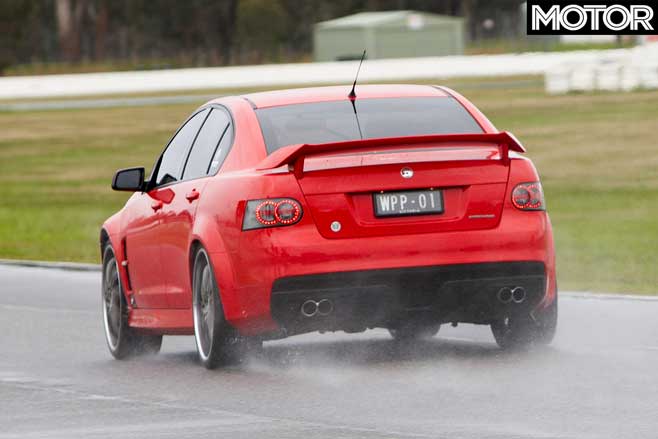
The WP470 might never officially qualify as “the quickest Aussie” of anything, but name anything from anywhere that can come close to offering 470kW and 770Nm for less than six figures ($97,610, to be exact)? Didn’t think so.
It’s ballsy without being ostentatious, and demands maturity and respect from the end user. There are a few hoops to jump through — warranty to name one — and, thus, it demands enthusiast-level commitment. In turn, it rewards with the sort of mettle and character you can’t buy off the shelf. It’s such a real car that, well, it’ll never be a real production car. But don’t let that stop you.
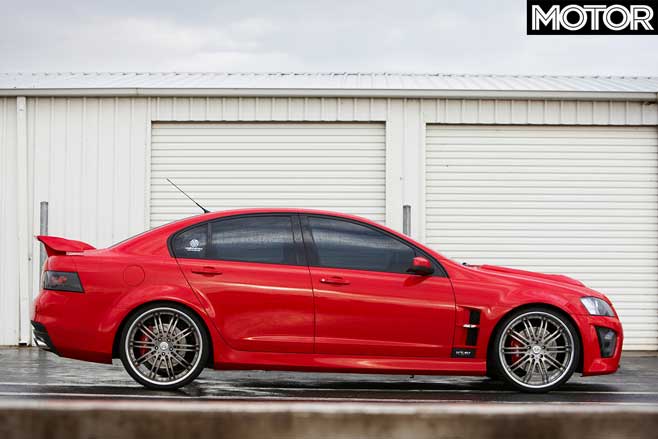
FAST FACTS 2008 Walkinshaw WP470 Clubsport R8 BODY: 4-door, 5-seat sedan DRIVE: rear-wheel ENGINE: 6162cc V8, OHV, 16v BORE/STROKE: 103.25 x 92.0mm COMPRESSION: 10.7:1 POWER: 470kW @ 6500rpm TORQUE: 770Nm @ 4500rpm WEIGHT: 1842kg POWER-TO- WEIGHT: 255kW/tonne TRANSMISSION: 6-speed manual SUSPENSION: struts, A-arms, anti-roll bar (f); multi-links, coil springs, anti-roll bar (r) L/W/h: 4943/1899/1468mm WHEELBASE: 2915mm TRACKS: 1592/1590mm (f/r) STEERING: power rack-and-pinion BRAKES: 365mm ventilated discs, four-piston calipers (f); 350mm ventilated discs, four-piston calipers (r) TYRES: Falken ZR22; 245/30R22 (f), 285/25R22 (r) PRICE: $97,160
PROS: Hilarious outputs at a bargain price, drivability, individuality CONS: 22s compromise ride and grip, noisy blower, no auto option RATING: 4 out of 5 stars
Walkinshaw’s price of power
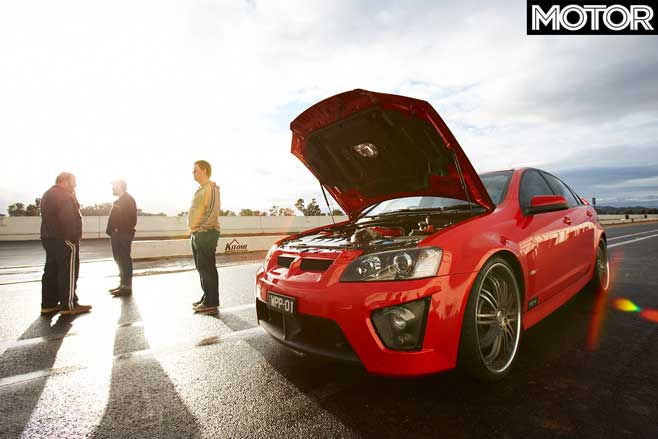
The WPP 122 Supercharger LS3 Kit ($15,500) is very compact, adding marginally more height (it clears the bonnet, just), mass (bugger all) and just one ancillary to the engine bay – a small coolant reservoir.
The inlet manifold is genius. The water-to-air intercooler cores are located inside the manifold and the reverse-mounted blower (snout towards the firewall) driveshaft threads through the manifold’s centre. Very neat, very cool.
With no structural modification required, it’s an easy conversion back to standard LS3-spec.
Add exhaust ($2100), LS7 clutch ($1200), R8-spec suspension ($690), wheels and tyres ($10,950), bonnet scoop ($1850), foggie covers ($160) and sill plates ($160) and the package, as tested, costs $32,610 including GST. It’s a five-day, drive-in and drive-out deal. Noice.
The Strip
| Walkinshaw WP470 Clubsport R8 | |
| 0-10km/h | 0.39sec |
| 0-20km/h | 0.81sec |
| 0-30km/h | 1.21sec |
| 0-40km/h | 1.61sec |
| 0-50km/h | 2.04sec |
| 0-60km/h | 2.41sec |
| 0-70km/h | 2.79sec |
| 0-80km/h | 3.45sec |
| 0-90km/h | 3.84sec |
| 0-100km/h | 4.24sec |
| 0-110km/h | 5.28sec |
| 0-120km/h | 5.95sec |
| 0-130km/h | 6.68sec |
| 0-140km/h | 7.33sec |
| 0-150km/h | 8.38sec |
| 0-160km/h | 9.30sec |
| 0-170km/h | 10.28sec |
| 0-180km/h | 11.24sec |
| 0-190km/h | 12.26sec |
| 0-400m | 12.53sec @ 192.71km/h |
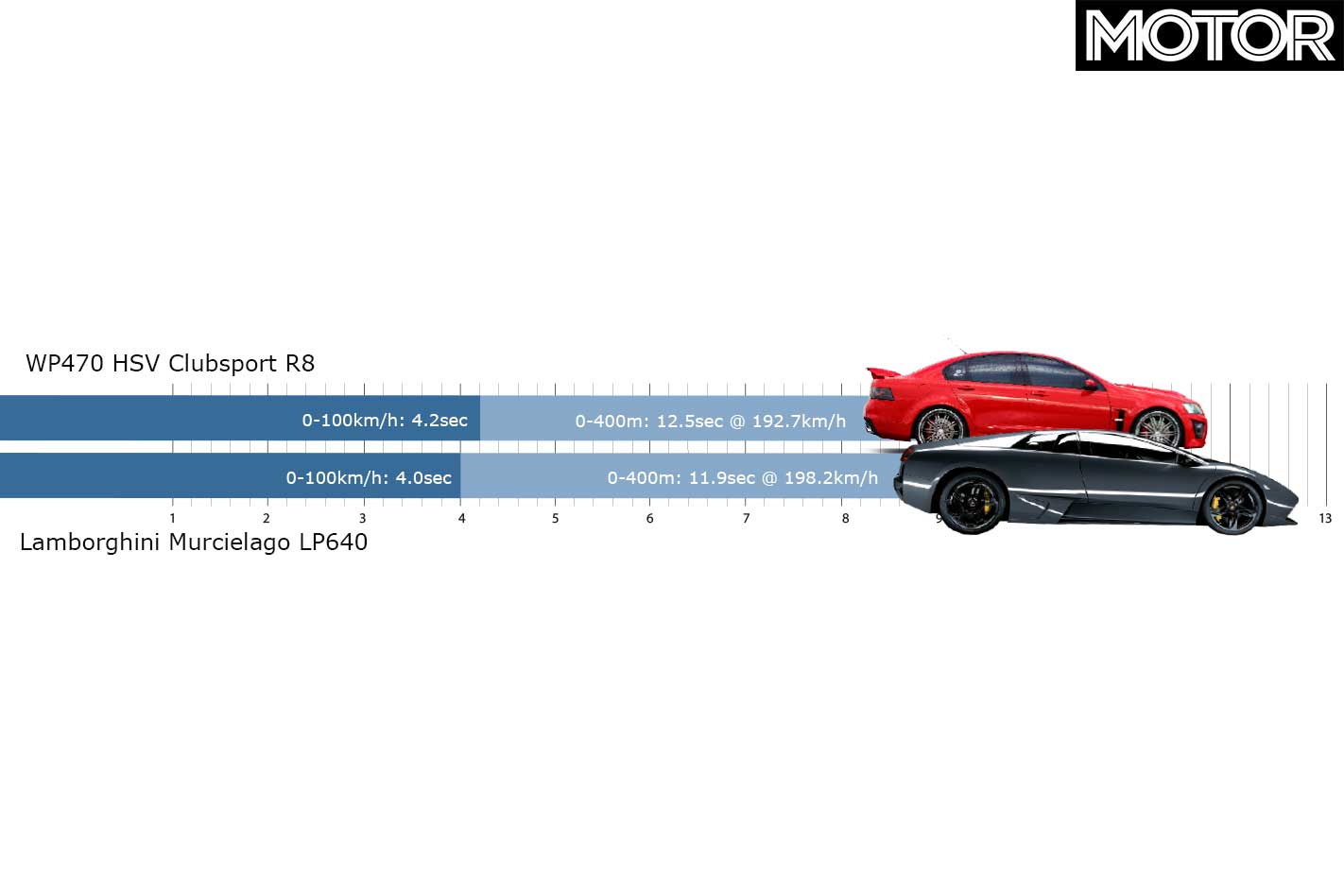
Walkinshaw WP470 vs Lamborghini Murcielago LP640
Which brand-spanking turn-key cars on offer in Oz has WP470-like stonk? The $476K CL65 AMG (450kW/1000Nm), $375K Bentley Continental GT (411kW/650Nm) or $595K Ferrari 599 GTB (456kW/608Nm) perhaps? They all come up a bit short. Laughable, innit? But how about a Lambo Murcielago LP640?
Here’s the theoretical shootout. The Lambo offers one extra kilowatt (471kW) from its 6.5-litre V12. But, with 660Nm, it’s shy by 110Nm. But the LP is lighter — 1665kg verses 1842kg — which suggests a bloody close-run race.
Sure enough, it is. During last year’s PCOTY Round Two, the all-paw Lambo nailed a 4.0sec 0-100 time and scorched to the 400m mark in 11.9sec. Meanwhile, the rear-drive WP470 is just 0.2sec slower to 100 kays and a mere 0.6sec shy for the quarter, their terminal speeds split by just 5.5km/h. Sobering?
There’s more. The Murcie demands $675,678, plus some frightening on-road costs. For that money you could buy a WP470 ($100K) and park a Gallardo ($415K) next to it, and have enough change to park an HSV W427 ($155K) in storage as a so-called ‘investment’ to help put the grandkids through uni.
Confession – I absolutely love Apple CarPlay. Like, absolutely love it. It’s not like I’m a massive Apple nerd, either – my trusty iPhone 6 S Plus predates Stonehenge, according to my 12-year-old.
My day job involves driving two, possibly three different cars a week, so having the ability to simply plug my phone in and have instant access to my music, maps, podcasts and messaging services is really important to me.
What’s more, the tech is now available in cars as affordable as the Kia Picanto, and it’s also made its way deeply into markets where smartphone connectivity hasn’t been as big a priority, like utes and commercial vehicles.
It also makes brands like Toyota and Nissan stand out even more because of its absence. And as for BMW charging for the privilege? Phhht. Get real, guys.
If you haven’t got it, though, don’t despair; there are ways and means to add Apple CarPlay to your car.
Replacing the head unit
Back in the day, it was all the rage to sub out a car’s standard radio for a cassette deck or (gasp) a CD player. I even installed a Sony MiniDisc player in my car in the early ’00s… but then I’ve never been that smart at following trends.
The art of head unit changing, though, has become more difficult, as manufacturers moved towards greater integration of multimedia systems into centre consoles, but there are still a lot of cars out there that use the simpler DIN style of installation, which allows a new head unit to simply slot into a pre-existing hole.
However, even if your car has a more integrated system, don’t despair; modern installers have worked out ways to retrofit a system that can run Apple CarPlay and make it look factory.
“It’s the most common job we do these days,” said Clinton Venaglia, who owns InCar Installations in the southern NSW city of Wollongong. “Some brands like Ford and Holden really headed down the integrated path a few years ago, but even so we can still install a system in most modern cars.”
Toyota, for example, makes things pretty simple, while Mazda is a little more difficult.
More on Apple CarPlay
- Apple CarPlay vs Android Auto
- Are you breaking the law using Apple CarPlay in the car?
- iPhone and Android smartphone mirroring explained
A new Apple CarPlay head unit uses a touch screen that’s built into the unit. It either remains in place permanently or folds away and retracts into the dash for greater security.
You then simply plug your phone in via an Apple Lightning cable, and you’re set to go.
Prices for head units vary wildly, from around $400 at the entry-level to more than $2000 at the top rung.
While there are plenty of people who would willingly give installation a go at home, we would heartily recommend that a professional installer does the work; it’s all too easy to leave off a crucial earthing strap or not have the correct module to make your new head unit work with your car.
As well, not all head units are compatible with all cars; you might, for example, lose the ability to control your stereo from your steering wheel controls. It will cost a bit more, sure, but a reputable installer will also look after you if something goes wrong down the track.
OEM retrofits
Some carmakers that have lagged behind Apple CarPlay integration are attacking the issue head-on by offering a retrofit kit to give owners the full Apple CarPlay experience.
Mazda, for example, is offering an Apple CarPlay upgrade kit for customers whose cars are equipped with its MZD Connect system for around $500.
The most recent update to the CX-9 was the first mainstream Mazda to get Apple CarPlay as standard; the BT-50 ute scored it slightly earlier by dint of its connection with the Ford Ranger.
“It will be available for all customers with an MZD Connect system that first went on sale with Mazda 3 in early 2014,” said a Mazda spokesperson last year.
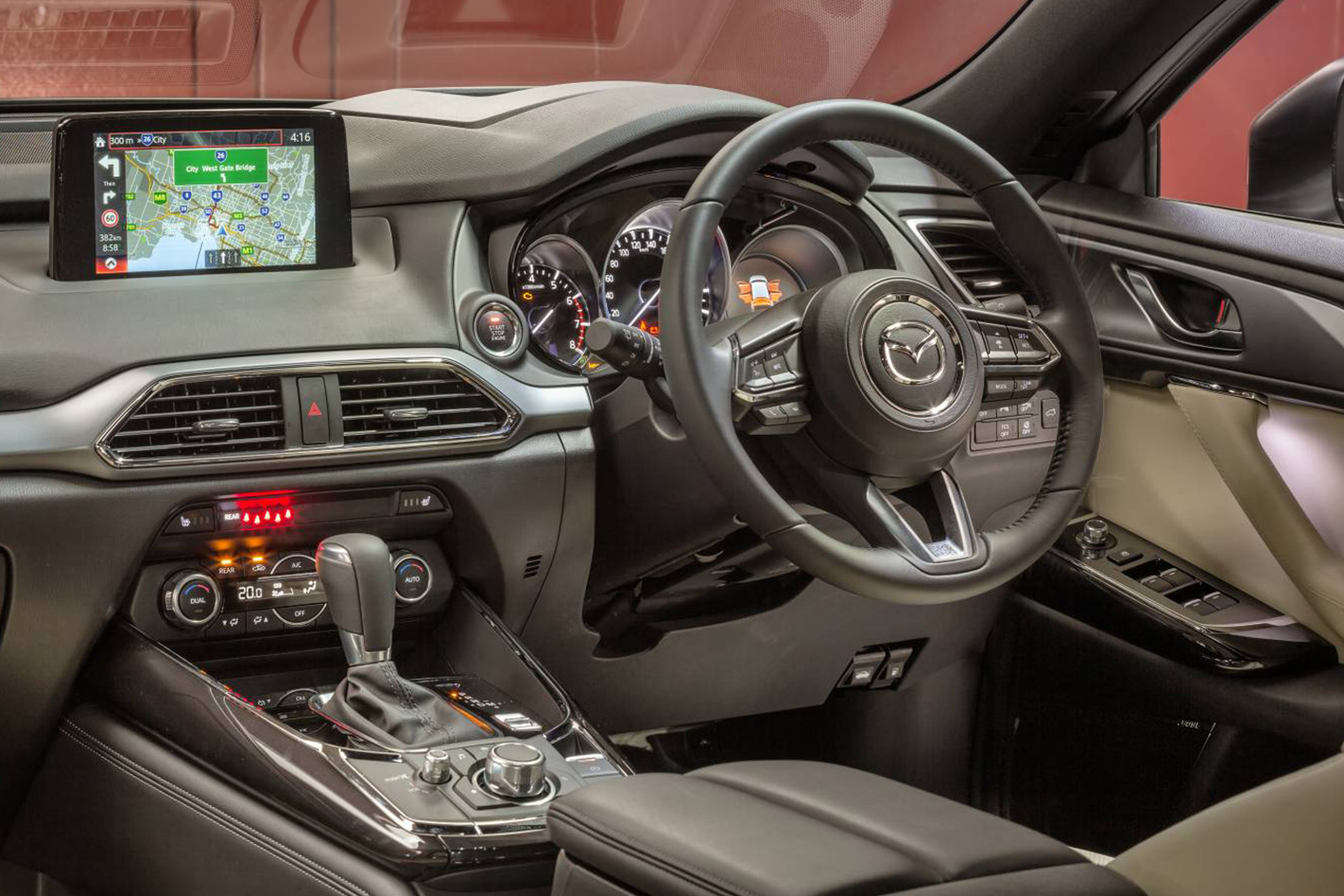
Hyundai, too, has offered software upgrades for owners of their cars in order for them to access both Apple CarPlay and Android Auto. However, it hasn’t been the smoothest of rollouts.
Hyundai i30s from 2015 were largely able to accept the upgrade, but conversely, owners of top-spec SUVs like the Santa Fe and Tuscon Highlander have been told that the in-built GPS system aboard their cars prevents the installation of the system.
There’s always Bluetooth…
If your car is simply too old to be retrofitted with Apple CarPlay, then Bluetooth connectivity will still allow you to stream music and podcasts through the car speakers. As well, map apps like Waze and Google Maps will send audible instructions over the sound system if you’re listening to streamed music.
And if that fails, consider a good old cable connection! A simple 3.5mm cable connection between your phone’s headphone jack and your head unit will give you sound.
However, more and more phones are being produced without the 3.5mm headphone jack, which means it’s Bluetooth, Apple CarPlay or nothing at all.
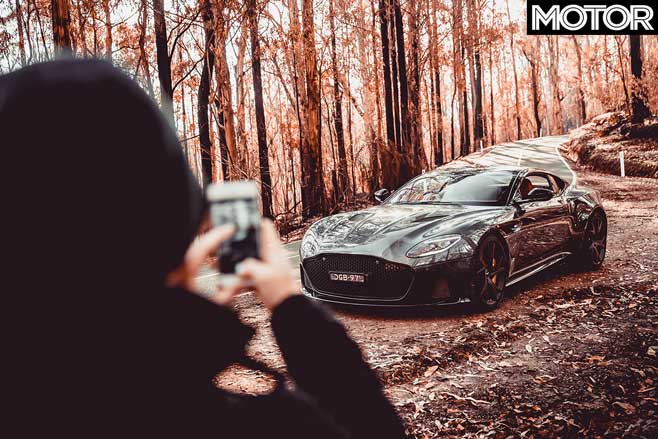
Victoria’s Reefton Spur road is looking very different. An epic conflagration has reduced it to an almost duo-chromatic scene – black/grey and the copper red of crunchy-dry leaves of ghostly eucalypts.
There is an eerie lack of bird calls and caws in this deathly quiet forest. Pulled over onto blackened dirt beside the road and with little other traffic on a weekday when we do our shoot, loud sounds – uninterrupted by the usual dense foliage – echo off the trees as if you’re in a large auditorium. It’s surreal.
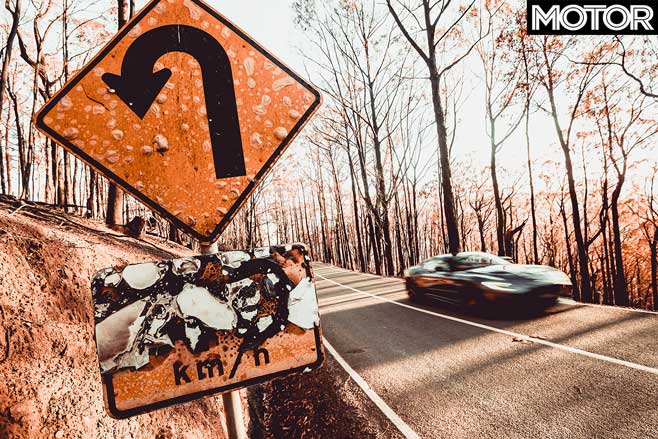
Following the hottest summer on record in Victoria, it was the hottest start to autumn in 30 years, and the inferno swept through here in early March, a fairly isolated bushfire incinerating a rectangular patch approximately 10km long and 5km wide, with Reefton Spur running roughly north-south up the middle. It is now newly reopened after post-fire repairs.
Reefton Spur is 100km, or about two hours, north-east of Melbourne at what is like the coccyx of the Great Dividing Range. Sixty snaking kilometres of bitumen connects Marysville to Warburton and there’s apparently one 18km stretch containing 165 bends.
For interstate readers, this old gold rush route could be called Victoria’s Putty Road, Gorge Road (maybe) or Mount Glorious. Far-flung and fond of motorcyclists who have left their brains in a drawer at home, in a car it’s undoubtedly one of the top 10 drives in Australia.
Never mind lightning strikes or arson (the two most common causes of bushfire), you could accuse us of having brought the Aston Martin DBS Superleggera here in early March and having started a fire with its styling alone.
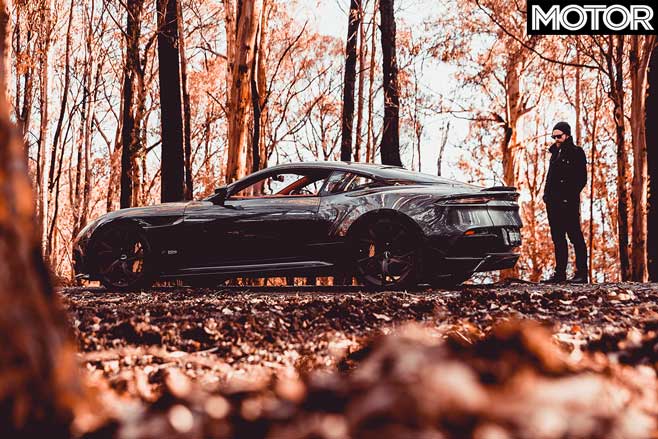
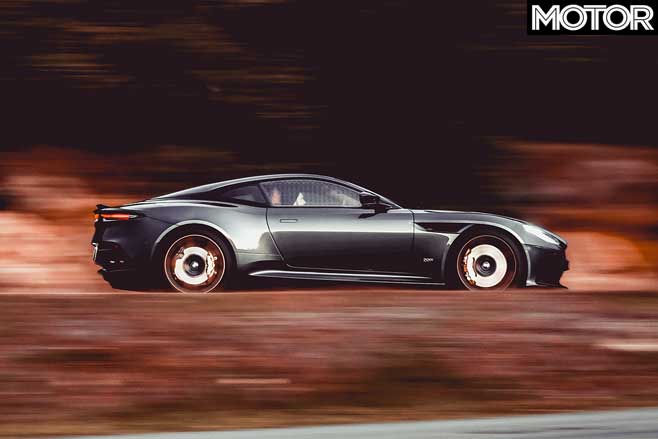
Swooped back as if designed by Anemoi, the Greek god of wind, the DBS Superleggera sucks in your attention like fire does oxygen. Wide, low and with scandalously short overhangs, each wheel dares to push as far outwards as possible, passively contained by bulging, creased, muscular guards and hips. Some cars draw styling inspiration from fighter jets or predatory animals – for the DBS Superleggera, it’s what you’d find in the pages of FHM.
Aston Martin’s halo model until the supernatural-sounding Valhalla and Valkyrie arrive, the DBS Superleggera is basically a restyled DB11 with more grunt. There’s stiffer suspension and wider tracks too, but it’s a totally restyled exterior that reduces drag and increases downforce, and makes extensive use of carbonfibre to save weight.
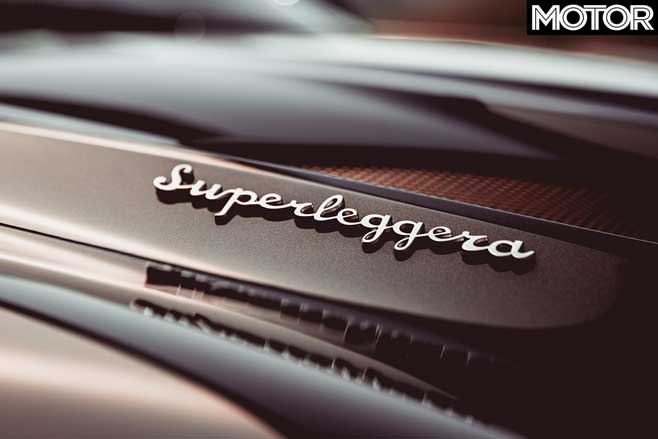
The car resurrects two famous names in Aston Martin history, those being DBS – a badge first seen in 1967 – and Superleggera, a nod to the historic ‘super-lightweight’ construction technology of the famous Italian coachbuilder of the same name. One that helped reduce weight and whose scripted badge adorned the bonnets of cars like DB4, DB5 and DB6 Mark 1.
Using the DB11’s still fairly new riveted and adhesive-bonded aluminium architecture that shifts the emphasis from extrusions (of the previous VH platform) to stampings, the Superleggera’s suspension is double-wishbone front and multi-link at the rear. Its new carbonfibre exterior panels help reduce weight by 72kg to 1693kg (dry).
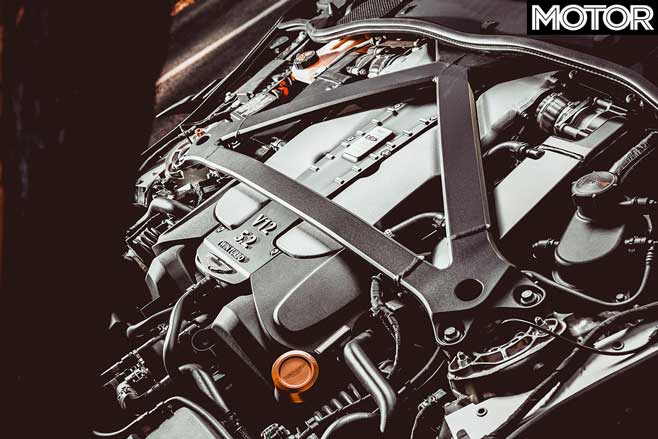
Under the enormous one-piece carbonfibre clamshell bonnet, the DBS utilises the same all-aluminium 5.2-litre Aston Martin-developed AE31 twin-turbo V12 first produced in 2016 and made in Aston’s own engine plant in Cologne, Germany.
Power has increased to an awesome 533kW and 900Nm, just through software and more boost (rather than bigger turbos or any other mechanical change). This is sent, gleefully, to the rear wheels only via a rear-mounted, brand-new eight-speed ZF torque-converter automatic transaxle and mechanical limited slip diff.
Forged 21-inch rear wheels measuring 11.5 inches wide, and with 305-section Pirelli P-Zeros, do their best to get the DBS Superleggera from rest to 100km/h in 3.4sec, 0-160km/h in 6.4sec, and on to a top speed of 339km/h. It’s at this v-max a double rear diffusor and ducted ‘Aeroblade II’ rear spoiler is said to produce 180kg of stability-enhancing downforce – the most of any production Aston Martin road car.
Hidden around its exterior are numerous, delightful aerodynamic details – fins, blades, channels, ducts and openings, all managing fast-moving air – that give you the impression the aerodynamicists carried a lot of clout in the styling meetings for this car.
It’s physically quite an imposing car, too. It’s nearly five metres long and more than two metres wide, though just 1280mm tall. As you pull on one of the thin, delicate, recessed doorhandles and open a long ‘swan wing’ door, the strongest whiff of leather hits your nose.

In this car, if it isn’t carpet or beautiful black ‘forged’ carbonfibre, it’s the highly processed skin of some unfortunate cow. In fact, there can’t be many other car interiors with as much leather as this one – and of the highest-feeling, handmade quality, so beautifully soft you can’t stop running your hands over it.
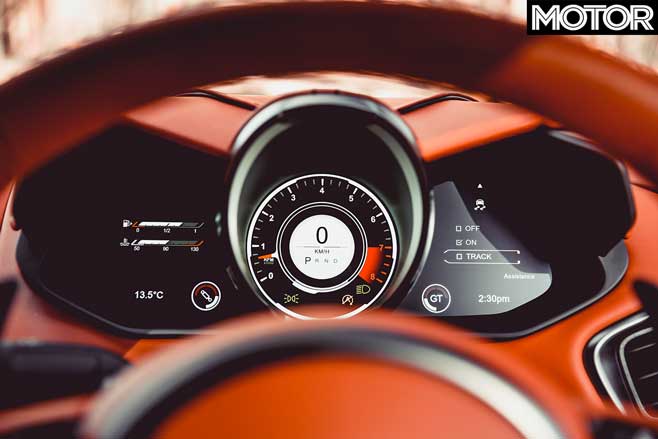
You sit low and rearward, looking over an expansive bonnet and at chiselled rear hips through antennae-like side mirrors almost above eye level (for me anyway). Familiar Mercedes switchgear is peppered throughout, but mostly you’re distracted by that curious squared-off steering wheel.
The crystal starter button right in the middle of the dash throbs red as you hit it, activating a high-pitched starter motor that sounds like it’s spinning at 1000rpm before that V12 growls meanly and loudly with revs like some predatory animal awakening in its lair.
It’s a sublimely comfortable car around town, the engine and transmission smooth, lazy and effortless, the ride supple and long-stroke over big bumps, if at times with a little edge from those low-profile tyres.
Catching your reflection in windows while driving the DBS Superleggera is a thrill that never gets old. Of course, its ability to turn heads and drop jaws is up there with the best of them – but compared to something like a gaudy, bright green Aventador, the DBS is a car in which you kind of want to be seen.
Not that there are many people or reflective surfaces out here. For 50 million years bushfires have influenced the evolution of flora in Australia to the point that we have a tree basically oozing highly flammable oil – one we export en-masse to places like Portugal and California – and plants that need to burn in order to bring forth their spawn.
Lighting the afterburners on the DBS Superleggera is one way to remove eyebrows if not careful. Of all its abilities, it’s the big Aston’s acceleration that leaves the greatest impression.
There’s not much top-end drama to the V12 – in fact, for noise and power, there’s little reason to go over 6000rpm to the 7000rpm redline. This engine is instead a torque factory, and the way it pins you and your startled passenger in the seats feels to be knocking on the door of the same accelerative league as Porsche 911 GT2 RS and McLaren 720S.
Pin the throttle and stunning turbocharged oomph arrives after a brief pause, thumping from low in the revs and motivating the DBS courtesy of strong traction, though wheelspin is very possible in the first three gears with the electronic nannies on leave.
It’s the outcome it delivers, rather than the engine itself, that you remember later. Relying on its turbochargers to supply most of the urge, the V12 lazily purrs and growls in the lower revs – with some hilariously theatrical overrun crackling – rather than howling towards some sky-scraping redline. The ZF eight-speed torque-converter auto, meanwhile, is a comfort-focused unit that’s fast up the gears if a little relaxed back down them. It does the job.
In the handling department, the DBS Superleggera has a lot of ability, if not anywhere near the magic of the best-handling sportscars, and it’s in this regard it surprises the most. On anything but a fast, flowing road, it just feels too big. There’s plenty of lateral grip from the bespoke Pirellis, inviting you to carry more and more speed into corners, and the damping is impressive even in Sport and Sport Plus modes.

But concentration is needed to place the wide front end as you step the commitment levels up, a task not helped by steering that feels overly darty, as if to artificially imbue the long-wheelbase DBS with an agility it kind of doesn’t have.
When needing to drive precisely, there’s a higher degree of guesswork than you’d like because there isn’t much steering feel either. It robs the big DBS Superleggera of some fun, and makes you want to wind things back a bit and simply enjoy the torque and noise of the V12 at a more relaxed pace. Perhaps Aston Martin should hit up its Mercedes-AMG colleagues for a rear-steering system.
At the end of the road, as you start to form the bigger picture, you are left with the impression the DBS Superleggera is the world’s most portable sculpture, a piece of automotive art timeless enough that people will still be ogling it in decades to come.
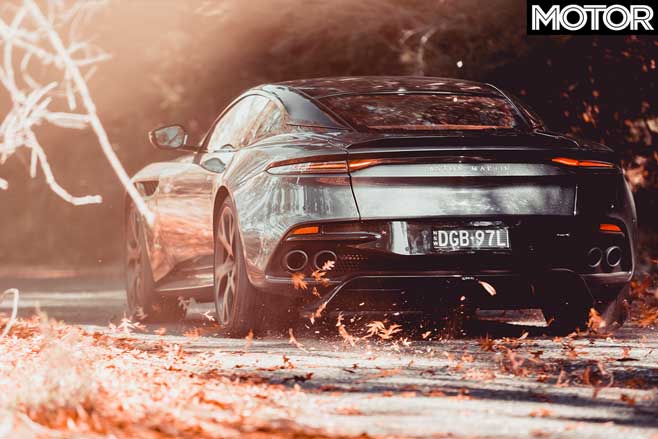
It has huge turbocharged torque, stunning long-distance ability and a V12 exhaust note smooth as honey – even if the handling feels as if it was the last thing they did on the car. A narrower DB11 AMR feels playful, light on its feet and athletic by comparison, more the driver’s choice. It also sounds better and louder, and it’s a fair bit cheaper.
But you wouldn’t have to seriously consider putting that car in a sealed section of your car magazine. Nor requesting an escort from the Country Fire Authority, as the DBS Superleggera threatens to bring new meaning to the term burning down your favourite road.
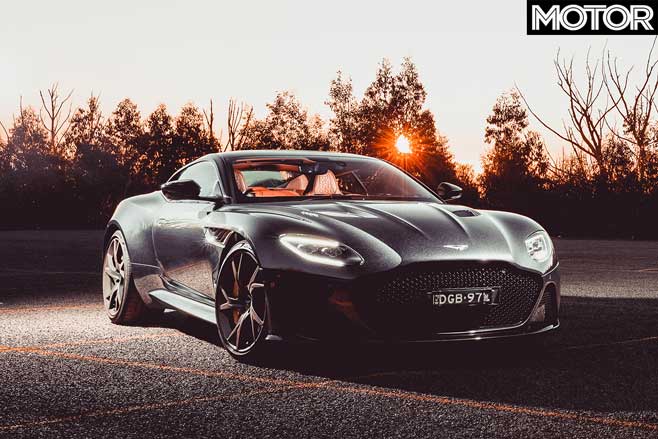
FAST FACTS 2019 Aston Martin DBS Superleggera BODY: 2-door, 2+2 seat coupe DRIVE: rear-wheel ENGINE: 5204cc V12, DOHC, 48v, twin-turbocharged BORE/STROKE: 89.0 x 69.7mm COMPRESSION: 9.3:1 POWER: 533kW @ 6500rpm TORQUE: 900Nm @ 1800-5000rpm WEIGHT: 1693kg (dry) POWER-TO- WEIGHT: 315kW/tonne TRANSMISSION: 8-speed automatic SUSPENSION: double A-arms, coil springs, adaptive dampers, anti-roll bar (f); multi-links, coil springs, adaptive dampers, anti-roll bar (r) L/W/h: 4712/2146/1280mm WHEELBASE: 2805mm TRACKS: 1665/1645mm (f/r) STEERING: electrically assisted rack-and-pinion BRAKES: 410mm carbon-ceramic discs, 6-piston calipers (f); 360mm carbon-ceramic discs, 4-piston calipers (r) WHEELS: 21.0 x 9.5-inch (f); 21.0 x 11.5-inch (r) TYRES: Pirelli P Zero A7; 265/35 ZR21 (f), 305/30 ZR21 (r) PRICE: $517,000
It’s hard to believe that Saab hasn’t developed an all-wheel-drive car before the Saab 9-3 Turbo X.
This review was originally published in MOTOR’s September 2008 issue
With two minor exceptions — the 9-2X (a badge-engineered Subaru WRX) and 9-7X (a Chevy Tahoe clone) — the brand has adhered strictly to front-drive for nearly 60 years. Thirty of those have included turbocharging, and we all know what happens when big-time boost is fed through the front. Which begs the question, why the delay?
You can’t really blame the Swedes. It’s only recently that GM has shown genuine interest in reviving this once-proud brand, and the first evidence of this is Saab’s new XWD (Cross-Wheel Drive) — developed by the engineers at Trollhattan using the latest fourth-generation Haldex system.
While XWD’s ability to transfer drive between front and rear wheels is nothing new, the rally-inspired active limited-slip rear differential certainly is. This ‘eLSD’ uses data from speed sensors in the rear wheels to transfer up to 50 percent of the drive torque between the driveshafts to the wheel with best grip.
Or if the wheel on one side slips on a low-friction surface (like ice on a roadside edge), up to 85 percent can be directed to the wheel with the most traction. According to Saab, this is eLSD’s first road-going application.
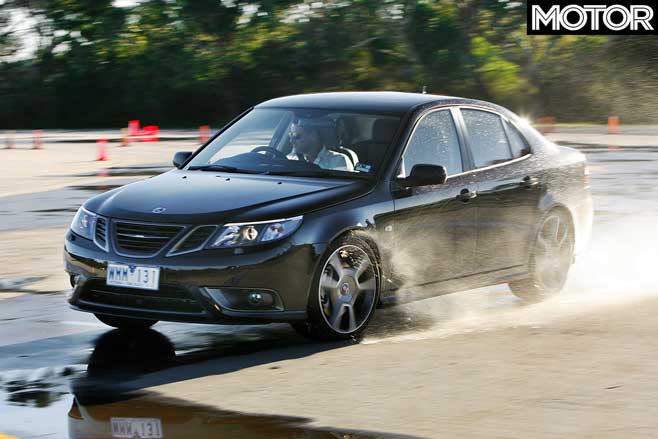
The tricky rear diff also measures roll and steering-angle data in order to proportion rear-wheel-driven torque to reduce both understeer and oversteer. And it works. Brilliantly.
Through a bitumen slalom set-up at Holden’s Lang Lang proving ground, the 9-3 Turbo X felt fast and very stable. It understeers, though not to a huge degree, but its back end simply refuses to budge in the dry — even with ESP switched off — and it feels virtually the same in the wet.
On dirt, the Turbo X’s purchase is superb. Because XWD transfers up to 100 percent of drive to the rear under full-throttle take off, and up to 80 percent exiting a bend under hard acceleration, the Turbo X feels resolutely planted.
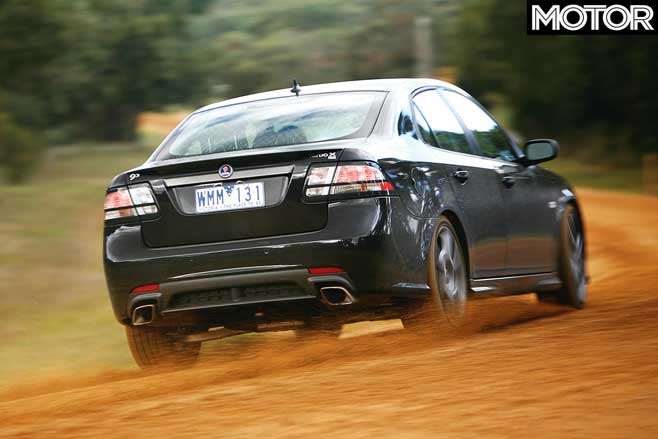
And the eLSD diff helps maintain very controllable balance, even during throttle lift-off in fast dirt corners. The Saab drifts its tail to keep its nose tucked in, but wastes minimal time playing with excessive oversteer theatrics.
Complementing this supreme grip and control is the Turbo X’s meatier, better-connected steering that is vastly improved, plus retuned springs, dampers and anti-roll bars, and a self-levelling rear end with a 50 percent increase in camber stiffness.
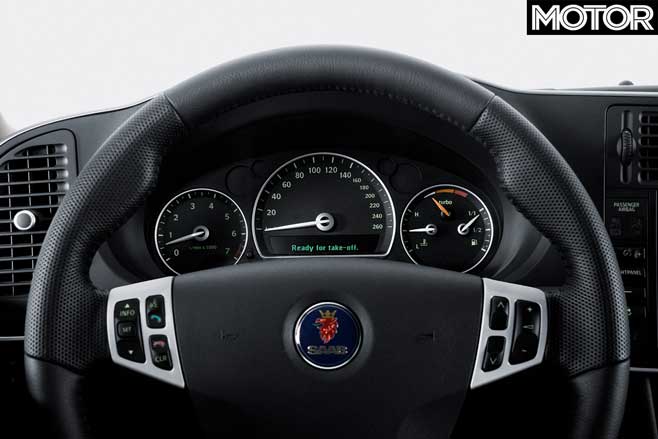
Indeed, the Turbo X feels tough and solid, which is exactly what it is — at 1741kg for the auto sedan, it’s heavy, so don’t expect the 206kW turbo V6 to feel particularly quick. Best stick with the manual, too (0-100 in 6.2).
Late this year, the limited-edition Turbo X’s vitals will transfer over to all 9-3 Aeros, which is a definite plus. But the excellent XWD system really deserves more power. And a new-generation Saab to go with it.
2008 SAAB 9-3 TURBO X SPECS Engine: 2792cc V6, DOHC, 24v, turbo Power: 206kW @ 5300rpm Torque: 400Nm @ 1900-4500rpm Weight: 1741kg 0-100km/h: 7.3sec (auto – claimed) Price: $93,800 (auto sedan, 19in wheels)
Like: Superb AWD system has masses of grip; Turbo X looks tough Dislike: Weight; recalcitrant auto; ageing design; needs more power
Sometimes you just have to be careful what you wish for, I thought to myself as we touched down at Brisbane Airport in late afternoon gloom. Months earlier I’d pitched the idea to editor Inwood of a road trip on Queensland’s so-called Electric Super Highway. Now the story had suddenly been galvanised into reality by the launch of Hyundai’s Kona Highlander EV.
Photographer Thomas Wielecki and I have teamed up on plenty of road-trip assignments, but this one promises to be a little different, since for the first time it’s fuelled not by the petroleum industry, but by green electricity.
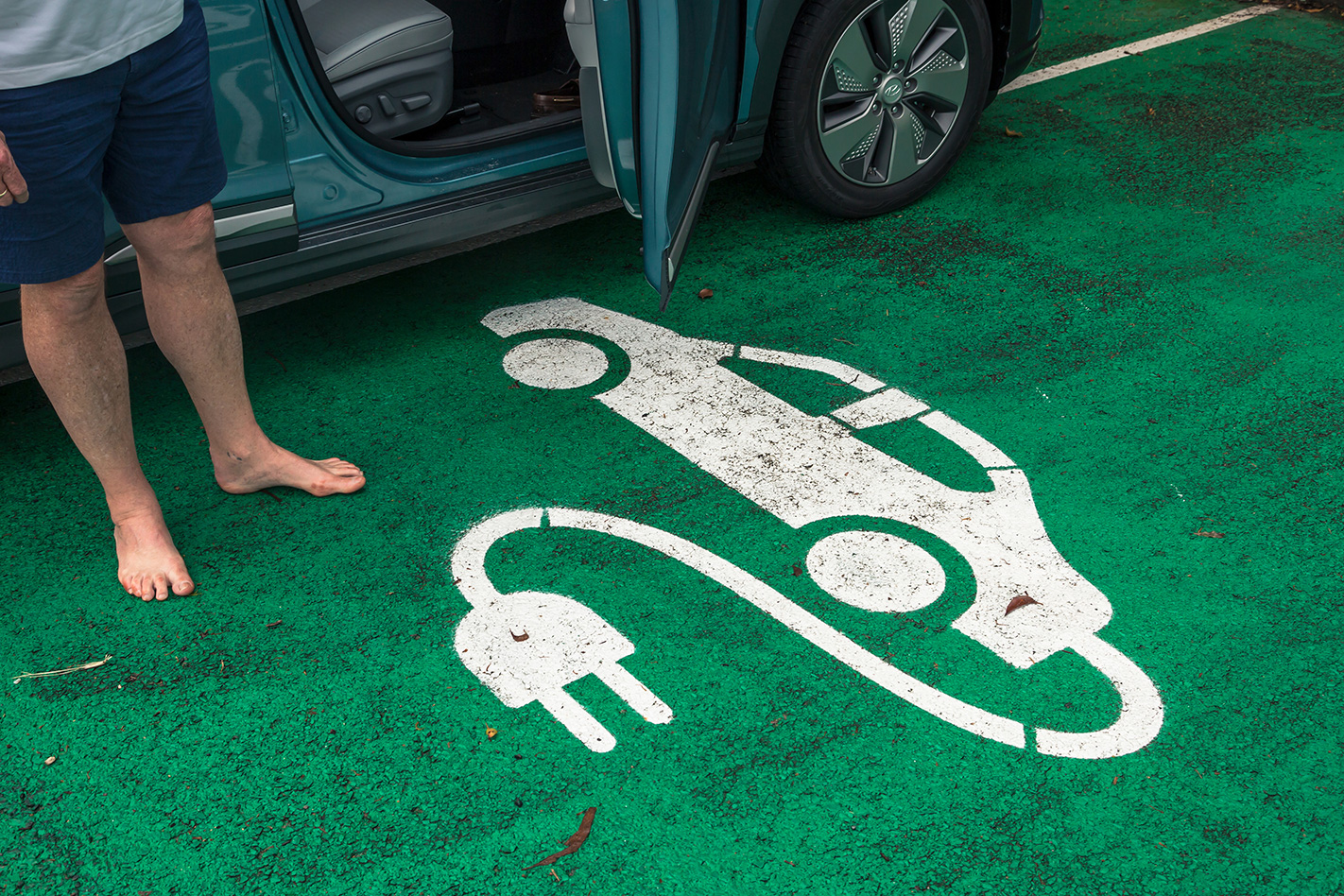
Queensland’s Labor Government stole a march on its southern rivals in 2018 when it announced the completion of a network of fast charging stations stretching from Coolangatta to Cairns, and inland from Brisbane to Toowoomba.
Such infrastructure initiatives are a crucial step in convincing motorists to take the leap from tried-and-proven fossil fuel into the less-certain world of electric power.
With the concept of EVs still so alien to most Australians, we need to be confident that these radical new cars won’t leave us stranded.
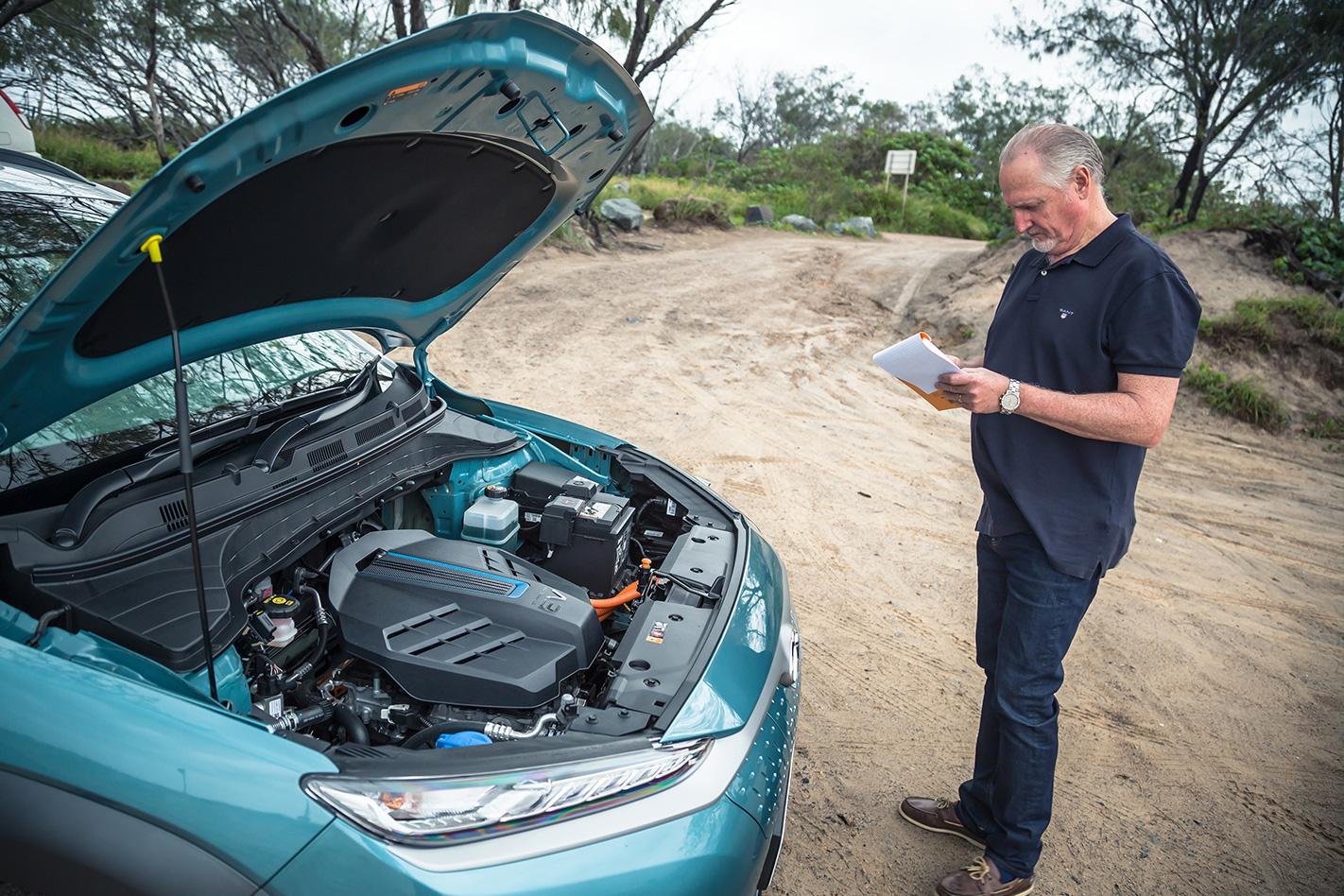
So, our plan is to use the network of 14 DC fast chargers dotted along an 1800km length of the state’s glittering coastline, to see if the Kona can be trusted to carry us across Australia’s vast distances in an efficient and reliable way.
The 50kW DC fast chargers are reportedly capable of recharging the Kona’s 64kWh lithium-ion polymer battery to 90 percent in 60 to 90 minutes and are designed and manufactured in Brisbane by local outfit Tritium.
The charging network is managed by Yurika, a green-energy offshoot of Energy Queensland, but the bit that really appealed to editor Inwood is the fact our trip won’t cost a dime, thanks to an extension of the State Government’s initial six-month free charging period.
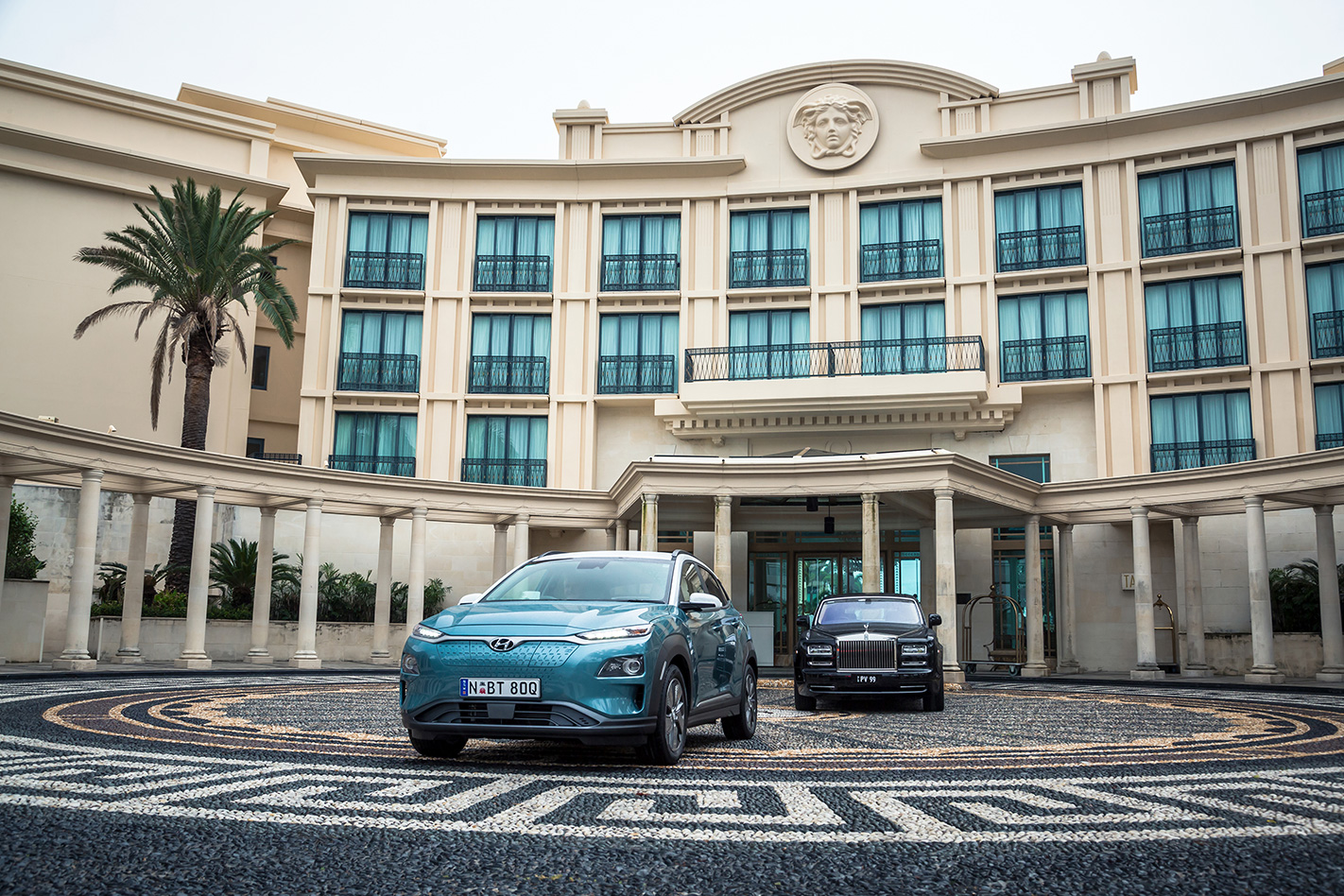
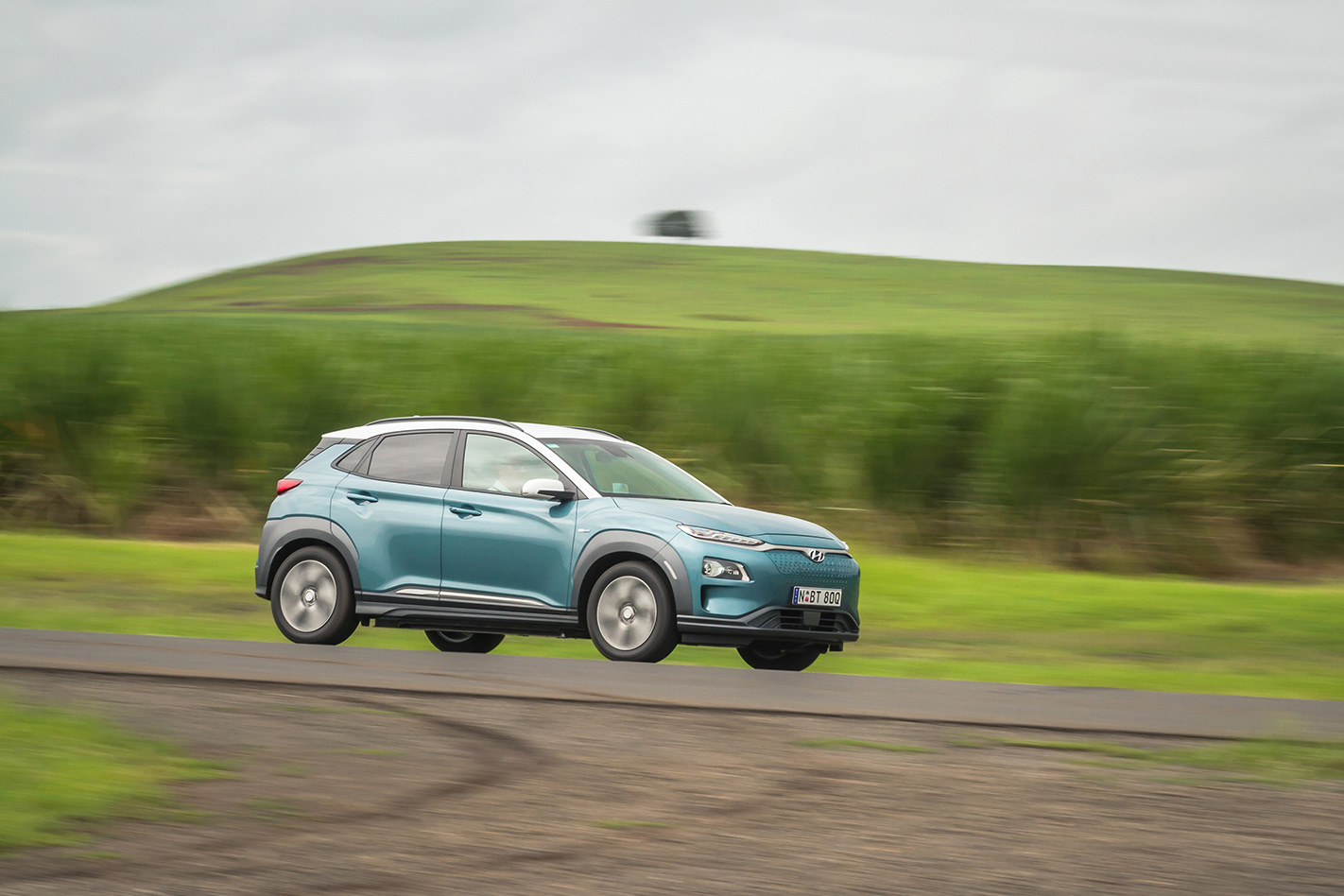
Sitting as arranged at Virgin Valet, the Kona is attractive but not overly radical looking. Unlike a Jaguar I-Pace, a Tesla or a Nissan Leaf, it’s an EV variant in a model range with multiple propulsion options.
The EV version is manufactured on the same line as its internal-combustion engine (ICE) siblings at Hyundai’s Ulsan plant in South Korea, so shares many of its body panels and other components. It’s significantly heavier, though, thanks to its large battery which tips the weight of this top-spec Highlander variant to a hefty 1743kg, compared with 1383kg for the equivalent 2.0-litre MPi model.
Despite having landed in Brisbane, we first need to head for Coolangatta, to ensure we capture the highway’s full length. The range indicator is showing a near-brimmed 406km, so the 130km freeway run won’t be an issue, given Hyundai’s claimed 400km highway, or 450km urban range.
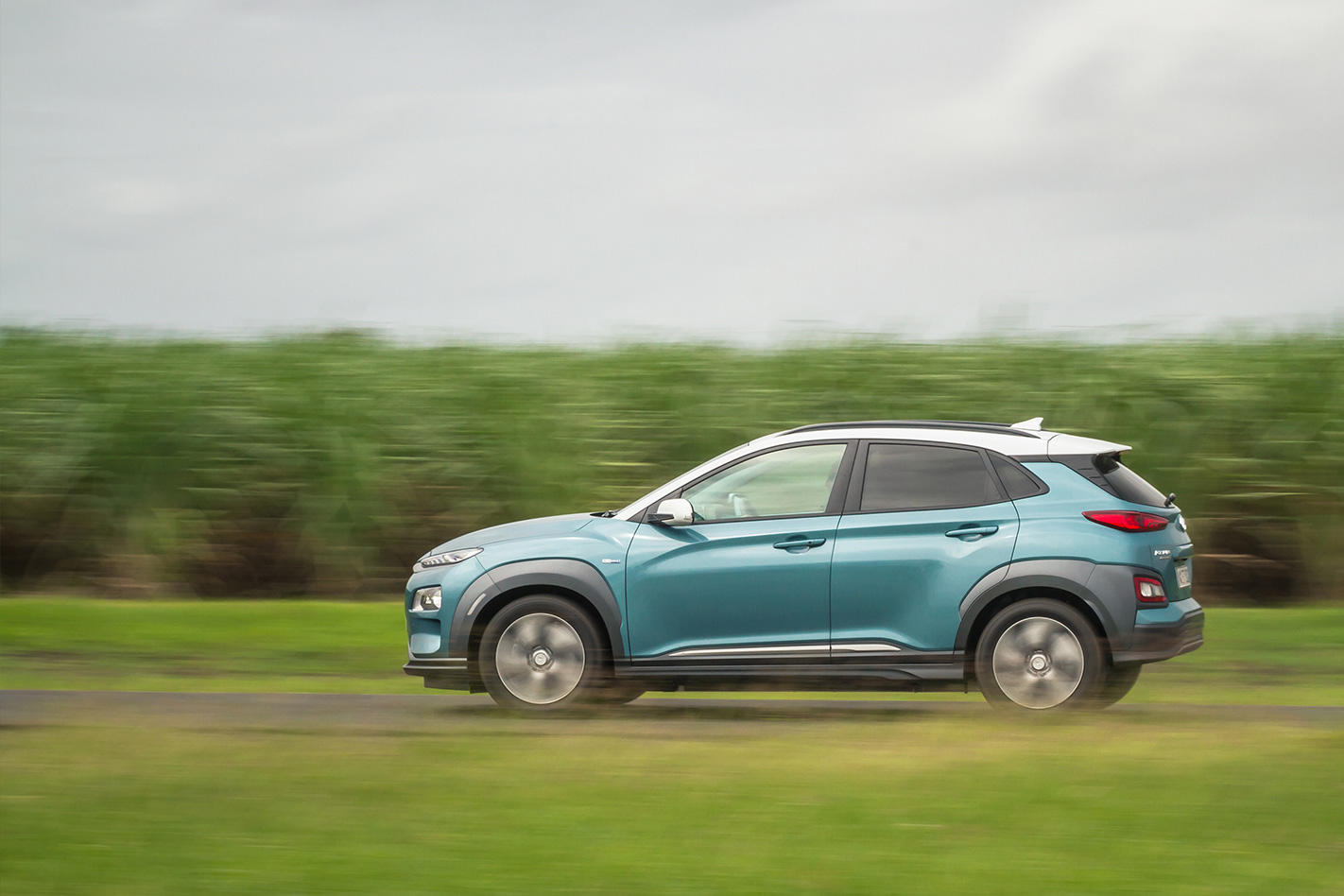
A jaunty little digital chime plays on start-up but the Kona is otherwise so quiet when running its engineers have installed a device that projects a low, harmonic sound at speeds below 30km/h to alert pedestrians.
“Is it going yet?” queries chief technician Wielecki as we glide silently out into the night, the lack of engine noise, the instant torque and rapid acceleration making an immediately positive impression.
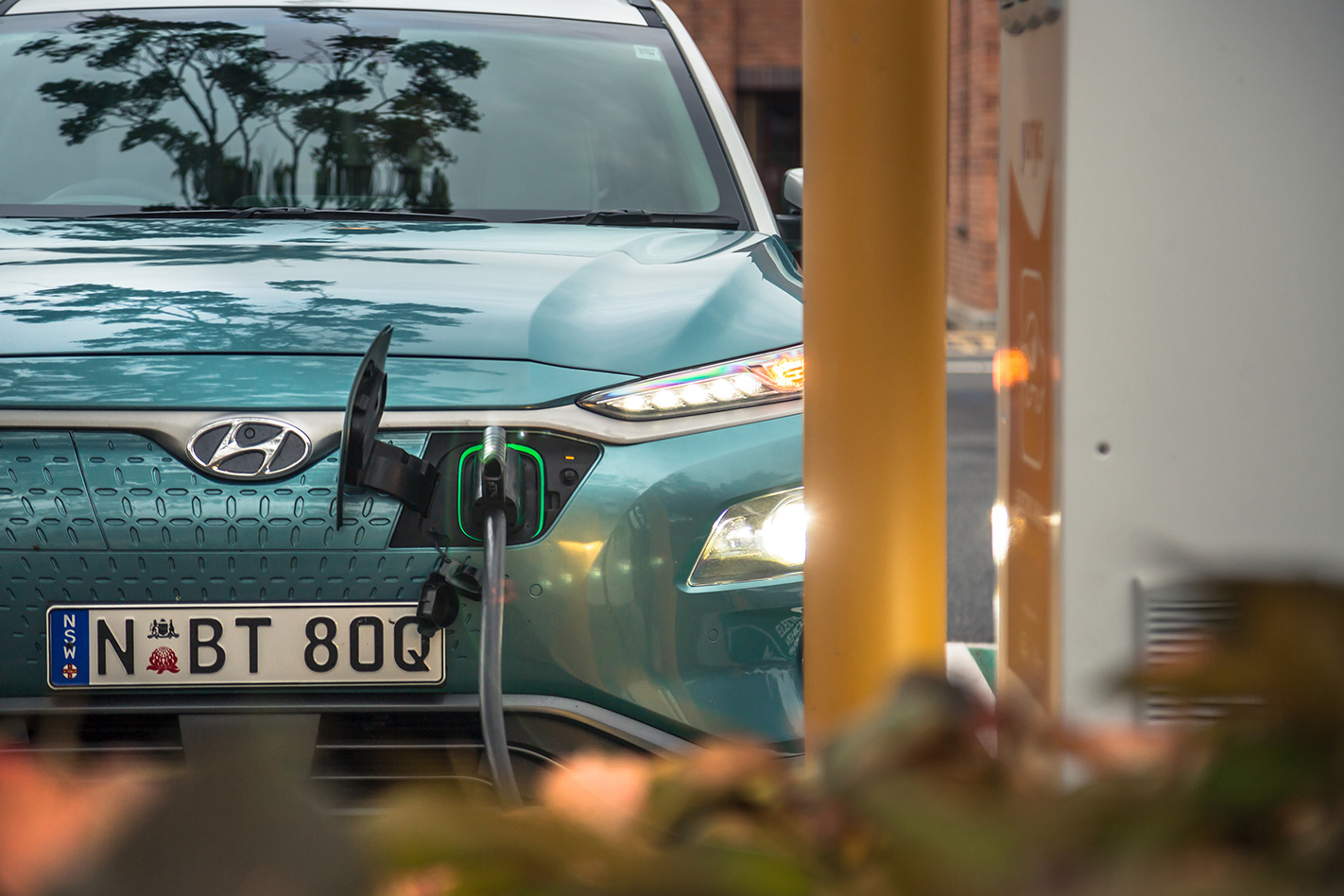
We’ve booked a motel close to a charge point in Coolangatta, but decide on arrival that we’ve plenty of range to get back to our first appointment in Brisbane in the morning, where a recharge is possible.
Over a steak dinner at the local surf club, Wielecki and I reassure each other about the missed charging opportunity: “She’ll be right, won’t she?”… “Ah, for sure … How far is Brisbane again?”
It’s an ear worm that’ll become all too familiar in the days ahead, along with furtive glances at the range predictor, the battery status and the distance to our next charging station.
The weather, too, is a bit of a worry as the tail of Cyclone Trevor is still wagging the next morning as we grind towards Brisbane in bumper-to-bumper traffic.
The Kona’s interior, like the exterior, is far from radical, characterised by a floating centre console and the use of light-coloured plastics and trim that create a fresh and airy vibe. Much of the layout and equipment is familiar Hyundai fare but there are some obvious differences, like the cross-shaped array of drive-by-wire buttons for selecting P-N-D-R and the sat-nav, with its range of EV-specific sub-menus.
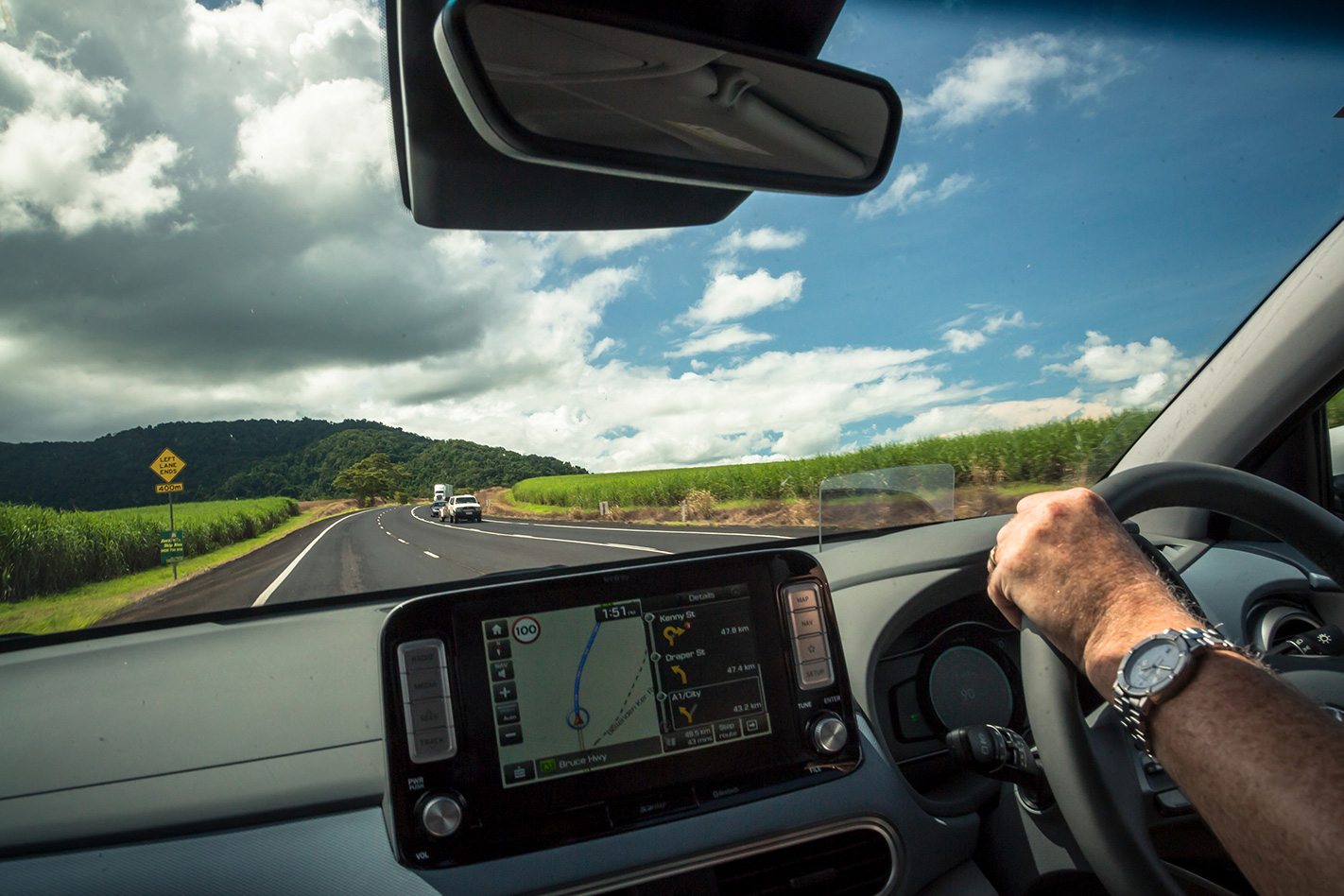
It does take a while to adjust to the aggressiveness of the regenerative braking, which, on its maximum setting, slows the car dramatically when you come off the throttle. Wheel-mounted shift paddles allow you to adjust the regenerative effect.
Recharged, we exit Brisbane with the battery showing 95 percent and the trip computer predicting a 430km range. Ahead are charge points in Cooroy (129km), Maryborough (262km), and Childers (322km), which looks about the limit of our ambition for the day.
Rain falls solidly as we head north towards the Sunshine Coast, half-blinded by the spray from 18-wheelers. I briefly experiment with the three selectable drive modes – Eco, Comfort and Sport – before settling on Comfort as providing the best balance of powertrain response.
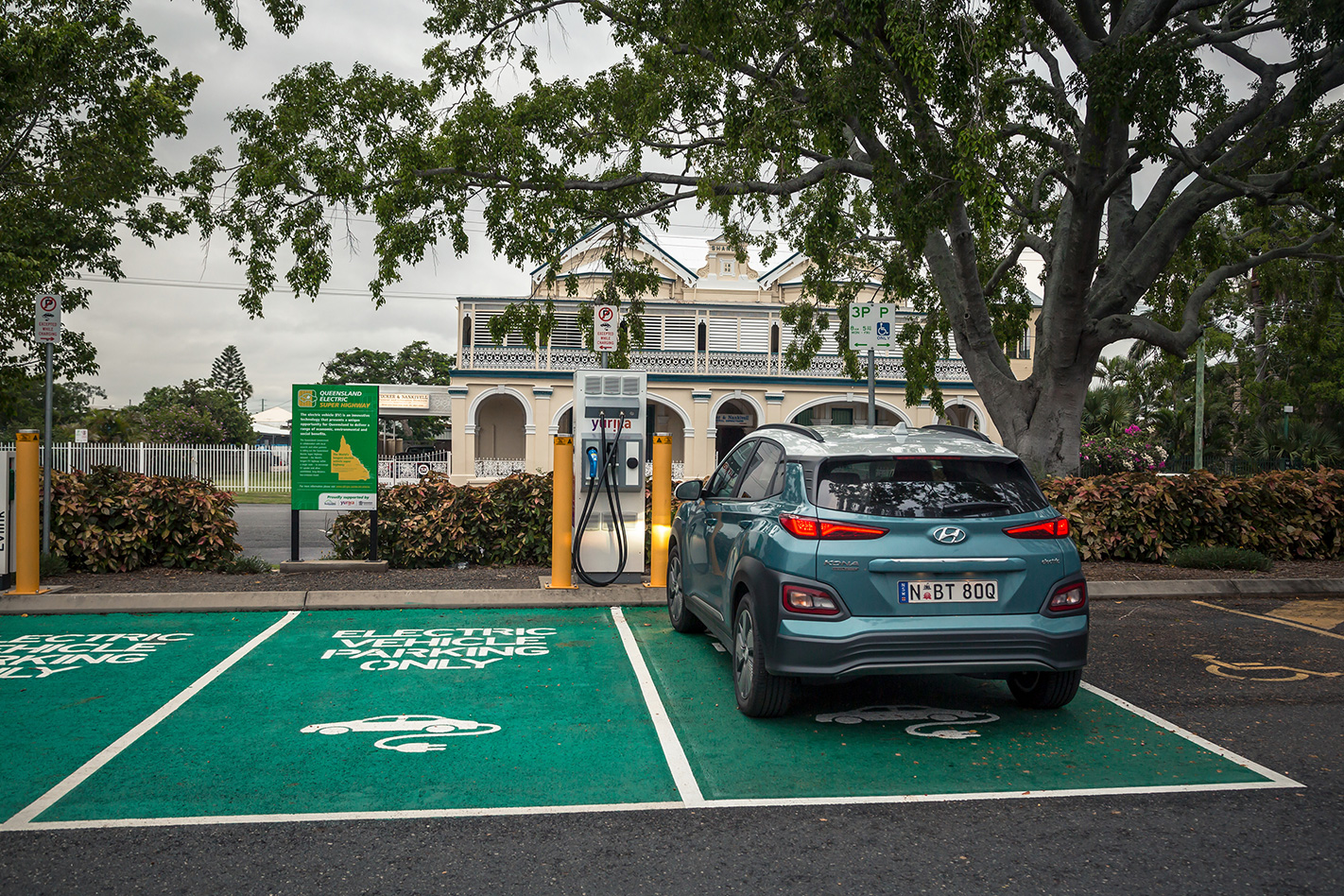
With 150kW and 395Nm on tap, the Kona cruises effortlessly at 115km/h with strong reserves for overtaking: put the foot down at this speed and it surges forward, the speedo effortlessly kissing 130km/h, with plenty more to come.
We eventually roll into Childers at 6:30pm with 73km of range and 19 percent charge remaining, only to dump our gear at a nondescript motel before heading back out to find the charging station. The Yurika-branded chargers are easy to locate in the darkened RV parking lot, thanks to twin LED lights that gleam like robotic eyes in the gloom.
I connect the charge cable via a flap on the Hyundai’s grille and we wander back through the drizzle to find some food. It occurs to me that enforced delays and wet shirts may well be the uncomfortable reality of life with an EV.
There are upsides, though, including an excellent meal at the Orchid Floral Thai restaurant, after which we head back out to find the Kona recharged to 94 percent and promising 418km of range.
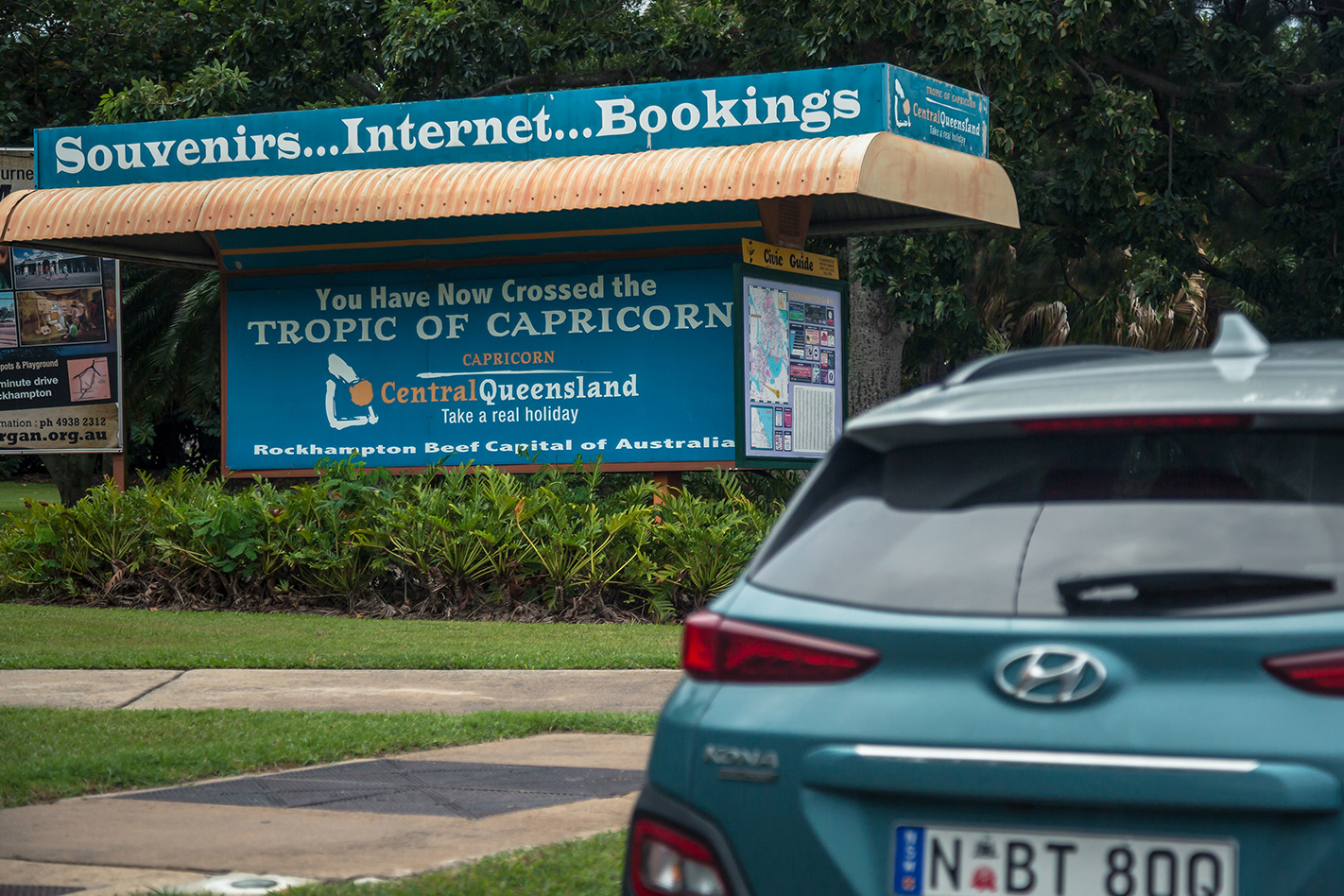
After our own fitful recharge, thanks to the motel’s complimentary surround-sound of thundering semis, we head out on the road again. Hours later, we find the next charge point in Rockhampton near the town’s imposing council chambers, and plug in. The trip computer tells us we’ve travelled 350km since Childers, with 13 percent charge and 49km remaining, lending credence to Hyundai’s claimed 400km highway range.
AS DAY THREE dawns it seems Queensland only knows one colour – slate grey. A phone call from my copper cousin further north warns that torrential rain overnight has closed the highway north of Ingham and we’re forced to contemplate where the story stands if we can’t make it to Cairns. We’re also soon aware of the impact that frequent photographic detours are having on the Kona’s range. Our planning hinges on the distance between charge points, but doesn’t allow for the off-piste excursions that are part of life on the road with Thomas.
Having left Rockhampton with plenty of range to make Mackay, the trip computer is now telling us we have barely enough juice. We cut the air-con and reduce speed to 100km/h, casting nervous glances at the dash, which at one point indicates 72km of range for a charge point distance of 69km. The low-battery warning comes on as we pass Sarina, showing just 7 percent.
I feather-foot it the final 36km to ‘Sugar City’, arriving with just 13km of available range and 4 percent battery charge, our lowest of the journey so far. We’ve covered 350km since our last charge at Rockhampton – admittedly much of it at 115km/h – but that’s still notably short of the claimed 400km highway range.
Keen to make up some kilometres, we unplug early and set off for Bowen, 192km up the highway. We recharge there without incident before embarking on the day’s final 200km leg to Townsville. The vast glittering nightscape of Queensland’s northern capital finally beckons at 8:30pm. Word on the wire is that the road north is still closed, but stars peek through the night sky and locals tell us the waters will recede quickly once the rain stops.
The Kona’s sat-nav leads us to a charge point in South Townsville, where we hit our first real charging snag of the trip: a diesel-sucking Prado sitting sulkily right where we need to be, blocking access. We find another option 20 minutes away but the whole palaver makes for a late finish.
Fortunately, the next day dawns bright and clear, with news from my cousin that the road is open again. Our predicted range after the previous night’s recharge was 382km, enough to make the 347km to Cairns, but with our early-morning photographic escapades in and around Townsville, I budget for a top-up in Tully, famously Australia’s wettest town.
All that rainwater seems to have frizzed Tully’s DC charger, though, and despite having a cable in the boot to connect to the AC charger alongside, at nine hours for a 0-to-100 percent charge, we don’t have the time it will take.
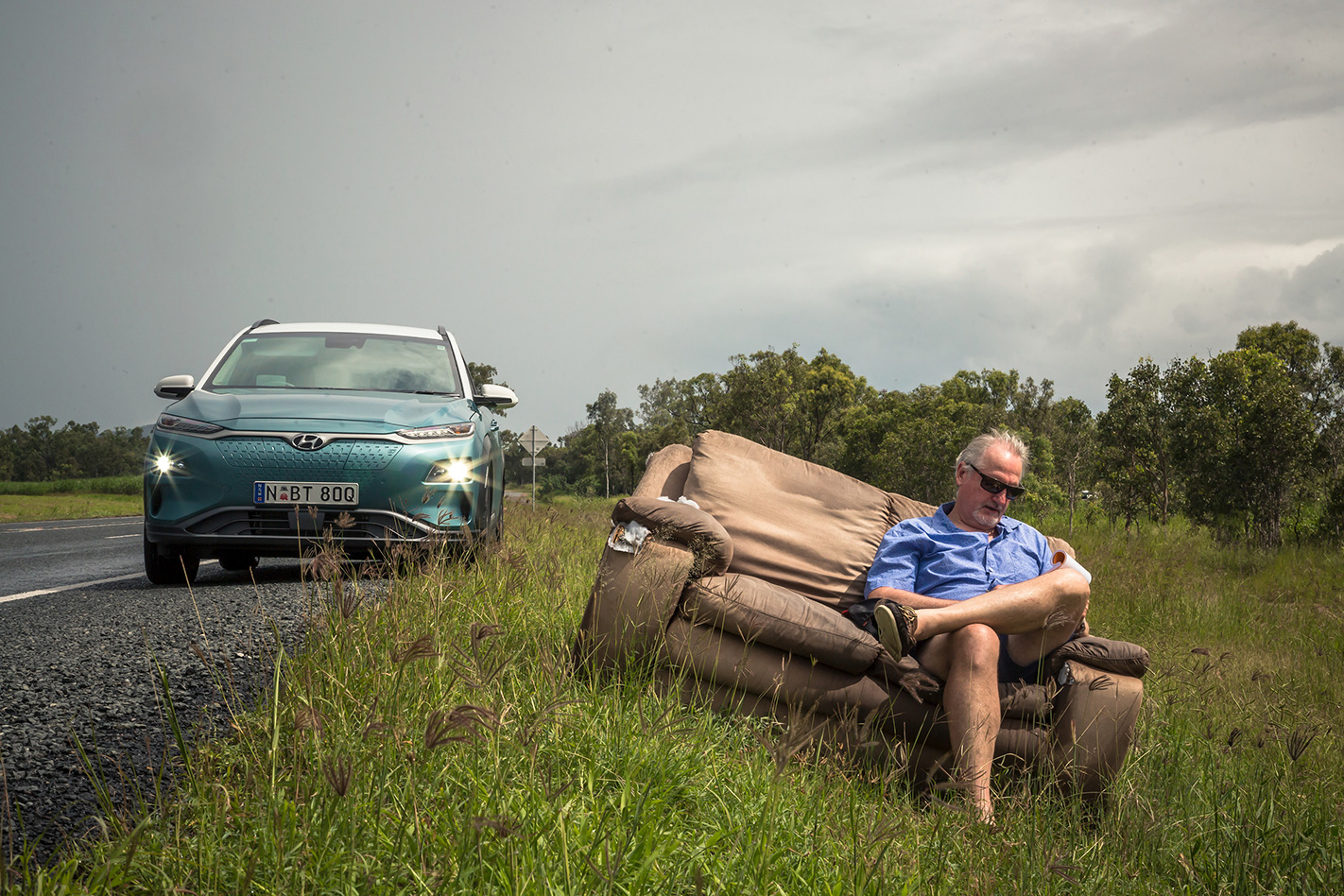
We need to get to Cairns with enough light to bag the final photography, but at 140km distant it’s right on the limit of the Kona’s available range. We agree to roll the dice, setting off with the trip computer warning against our folly.
I switch to Eco+ drive mode, which cuts air-con and other non-essentials and limits speed to 80km/h. The cabin is a funk of nerves and sweat as we creep along, with windows up to reduce drag and without air-con in the humid, 34-degree heat.
Remarkably, as we edge closer to Cairns, the Kona slowly hauls back the deficit via its regenerative braking and we make the charge point with 5 percent of battery and 15km in reserve.
We breathe a huge sigh of relief, at having avoided falling short of our goal in such ignominious circumstances, and plug in for the final time while Thomas sets off to bag ‘the’ shot to wrap up our adventure. The odometer confirms we’ve travelled 2122km in four-and-a-half days on five shots of green power, six if you include Cairns. Charging time has added roughly seven hours to our journey, although we haven’t tracked it fastidiously. We could have done the trip much quicker, undoubtedly, but that was never the point – not with Thomas and his Canons in tow.
For the eco-conscious EV buyer, and taking at face value Yurika Energy’s claim that its chargers are carbon-neutral, we’ve saved an estimated 288kg of CO2 compared with either of the ICE-powered Kona models. Were we paying for the recharges, using an approximate electricity price of $0.34/kWh and our trip average of 14.7kWh/100km, recharges would have cost in the vicinity of $105, compared to an estimated $240 in the ICE Highlanders.
However, at $65K the Highlander EV’s price tag will prove a substantial barrier for many motorists, and it’s difficult to see how the economic modelling for the car stacks up given it costs $25K-30K less to get into one of the petrol Kona Highlanders.
What we have shown, though, is that such a trip in an EV is perfectly feasible – on Queensland’s Bruce Highway at least. Elsewhere Australia has a long way to go before EVs can embark on such journeys as a matter of course. In a classic chicken-and-egg scenario, the charging infrastructure needs to develop to support the uptake of EVs, and the uptake of EVs is slow because of a lack of charging infrastructure.
But it will happen and, if our experience of the Kona is anything to go by, it will start to happen quickly, because the car is really very good. If you can get over the valid concerns about range, charge time and access to charge points, there’s nothing about the Kona EV that’s inferior to an ICE version; and in some areas, such as rolling acceleration, it’s vastly superior.
Our journey and interactions with people along the way also tell us that many Australians are genuinely excited and intrigued about the arrival of EVs. As the age-70-something couple out working up a sweat on the Bowen foreshore told us: “Seeing them [EVs] out in regional Australia, and seeing them at charging stations like this, makes them seem more real.”
It’s a sight set to be repeated across the country as this once fanciful form of transportation shifts into the mainstream, from the pages of sci-fi novels, to a garage near you.
This week’s look back at our biggest and best stories is brought to you by liars, cheats and thieves.
Let’s have a look first at the cheater – or more correctly the ingenious bloke who thought he’d hit upon a foolproof plan to avoid speeding fines forever, only for it to backfire hilariously… Points for trying at least!
Next, we turn our attention to the latest survey of Australia’s driving habits, and that vast chasm dividing our opinion of ourselves and our opinion of others’ driving habits. F’rinstance, only one in ten Aussies surveyed fessed up to using a phone while driving, which is a long way short of the nine in ten drivers proven to be dialling while driving in this 2018 US study.

Now I’m all for a bit of Aussie / US rivalry, but my own research conducted on this morning’s drive to work suggests there’s a lot more than 10 percent of us fiddling with phones behind the wheel.
Onto another topic and perhaps the biggest liar of them all is the Electric Vehicle Revolution? Controversial, I know, but before you throw your chai latte-filled keep-cup at your biodegradable laptop screen, read this damning report. I suppose we should be thankful we Aussies are so slow to get onboard the Electric Express to Tomorrowland.
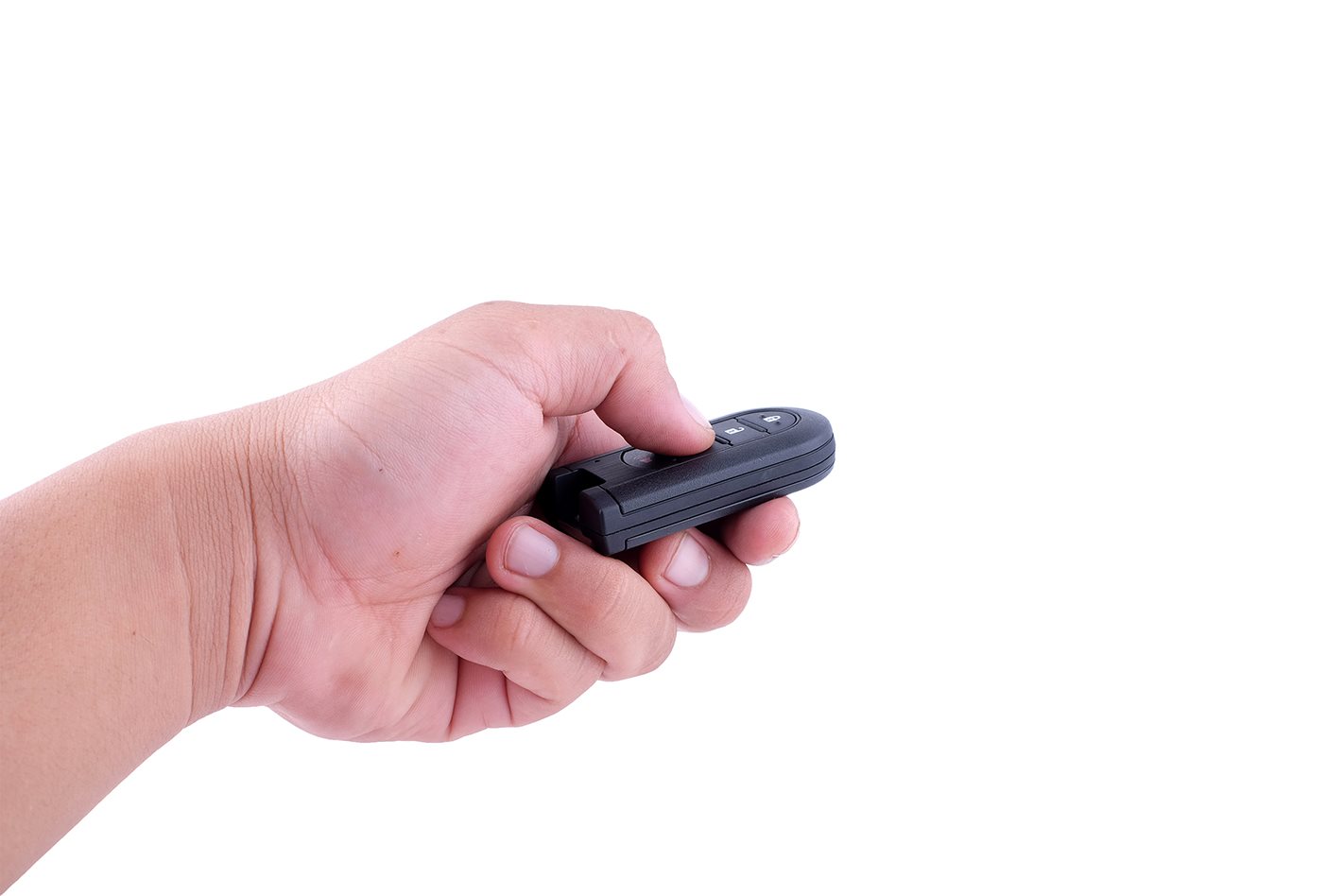
As for the thieves topic, did you know how ridiculously, stupidly easy it is for modern thieves to steal your new car – a new car with rolling codes and motion sensors and other gizmos James Bond never dreamed of? Neither did we…
Moving on from liars and cheats to explosions and crashes, Tesla spectacularly took care of the first when a new Model 3 small sedan went boom and then ka-BOOM on a freeway (video footage here) after a little rear-ender.
Nor was it a great week for the person who became the first civilian to crash the new Corvette. Hope it wasn’t down to the new Vette’s mid-engine layout… Well, somebody has to be first, and we’re glad it wasn’t us (touch wood).
On other GM matters, we spotted a spotty camouflaged new GM sports sedan with a fruity motor sneaking into Australia.
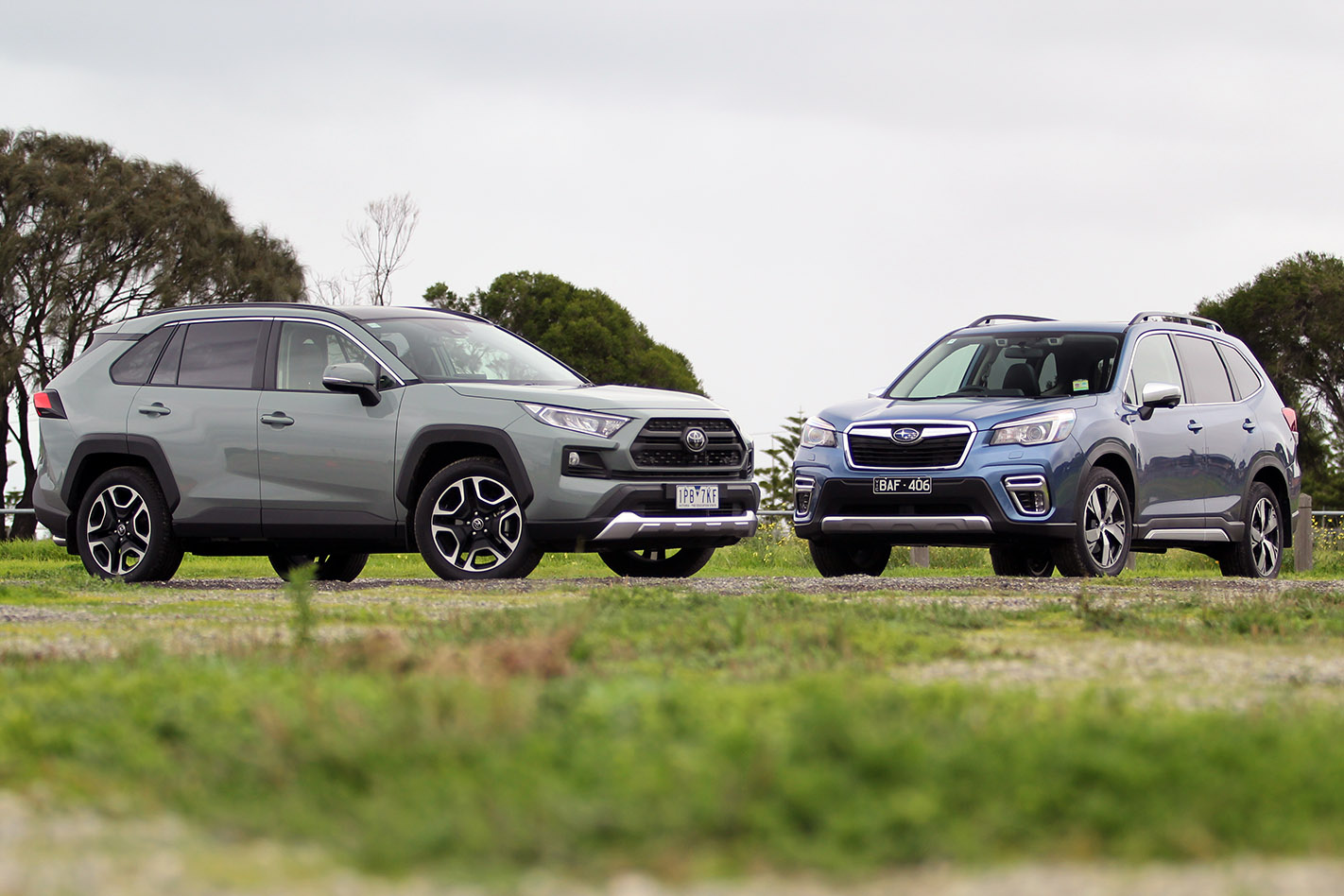
We named and shamed Australia’s five thirstiest gas guzzlers, and showed you how to pay less for fuel. We also helped one lady decide between a hybrid hatch and a turbodiesel SUV for country miles, and compared the new Toyota RAV4 SUV to its Subaru Forester rival. The winner? You.
On the 4X4 front, we revealed the best new 4WDs for bashing bush straight off the showroom floor, we adjudicated a red-dirt dust-up between the new Jeep Wrangler, Suzuki Jimny and Mercedes-Benz G-wagen, and we took a closer look at why some utes bend like a banana.
We also learned that the new MG Extender ute won’t be coming to Australia any time soon, and that Kia Australia really really wants a Ford Everest rival, stat!
Meanwhile, in America, sales of the Aussie developed Ford Ranger aren’t doing so well despite allegedly having 30,000 expressions of interest before our most popular ute launched there. Maybe these Aussie Ranger updates announced this week – or the the 2021 Ranger ute — will do better?
And we drooled over this insane Wrangler-based Rezvani Tank 4×4 – Comrade Putin, your bullet-proof, thermal-vision equipped apocalypse machine is ready!
Have a great weekend!
Like him or loathe him, renowned American movie director Quentin Tarantino’s eye for detail is truly incredible – and commercial successes with films like Pulp Fiction and Kill Bill means that he’s able to indulge that eye as he sees fit.
His ninth film, Once Upon A Time… In Hollywood is based in Los Angeles in 1969, and tells the story of the friendship between fading TV star Rick Dalton (Leonardo DiCaprio) and his longtime stunt double Cliff Booth (Brad Pitt).
The movie also ties in noted cult leader nutter Charles Manson, famed director Roman Polanski and his ultimately doomed wife Sharon Tate, who is played by Australian actor Margot Robbie.
For classic American car buffs, the movie is a real Aladdin’s Cave of collectable metal. It’s also notable for the fact that Tarantino was able to reconstruct four city blocks to recreate 1969 in real time, and the cars were a large part of the look.
The film’s picture car coordinator, Steven Butcher, told US film site The Wrap that he had to procure more than 2000 vehicles to produce the level of reality that Tarantino was looking to replicate.
And it wasn’t just cars. The film replicates daily life in Los Angeles, so buses, trucks, utility vehicles and passenger cars of different ages, makes and models were all sourced for use in the film.
A typical movie uses between 300 and 500 cars according to Butcher, but Once Upon A Time… In Hollywood needed four times that number to fill streets and parking spaces. Butcher, though, relished the challenge.
“I remember LA vividly. I knew what the streets were like. I’m passionate about cars,” Butcher said. “So this was a real fit for me.”
A lot of screen time is spent looking at lead character Dalton’s 1966 Cadillac DeVille… which also featured in Tarantino’s first feature, 1992’s Reservoir Dogs.
One of the movie’s stars, Michael Madsen, still owned the actual car used in Reservoir Dogs, so Butcher borrowed it (below), restored it and even built a replica for filming.
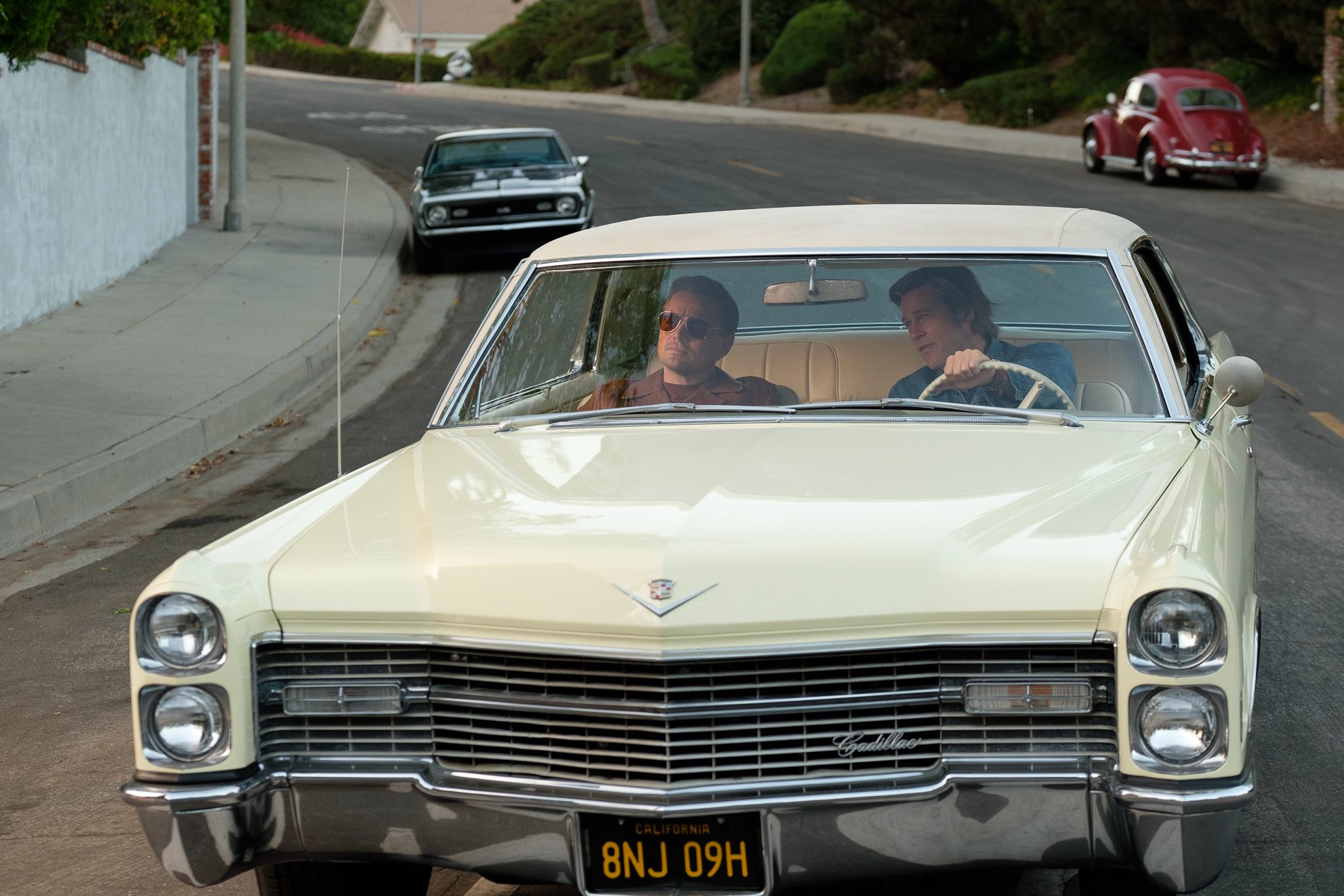
Tarantino originally wanted a 1959 Cadillac convertible for the hero car, says Butcher, but even famous directors have budget restraints; to find just one example would have cost in excess of A$150,000. As it turned out, the ’66 DeVille also fit the movie’s timeline more accurately.
More movie magic
Another car with a connection to an older Tarantino film is a powder blue, rough-looking 1962 Karmann Ghia (below), driven by Booth. The star of Kill Bill, Beatrix Kiddo (played by Uma Thurman) also drives a Ghia, but thereu2019s no connection between the two films, according to Tarantino.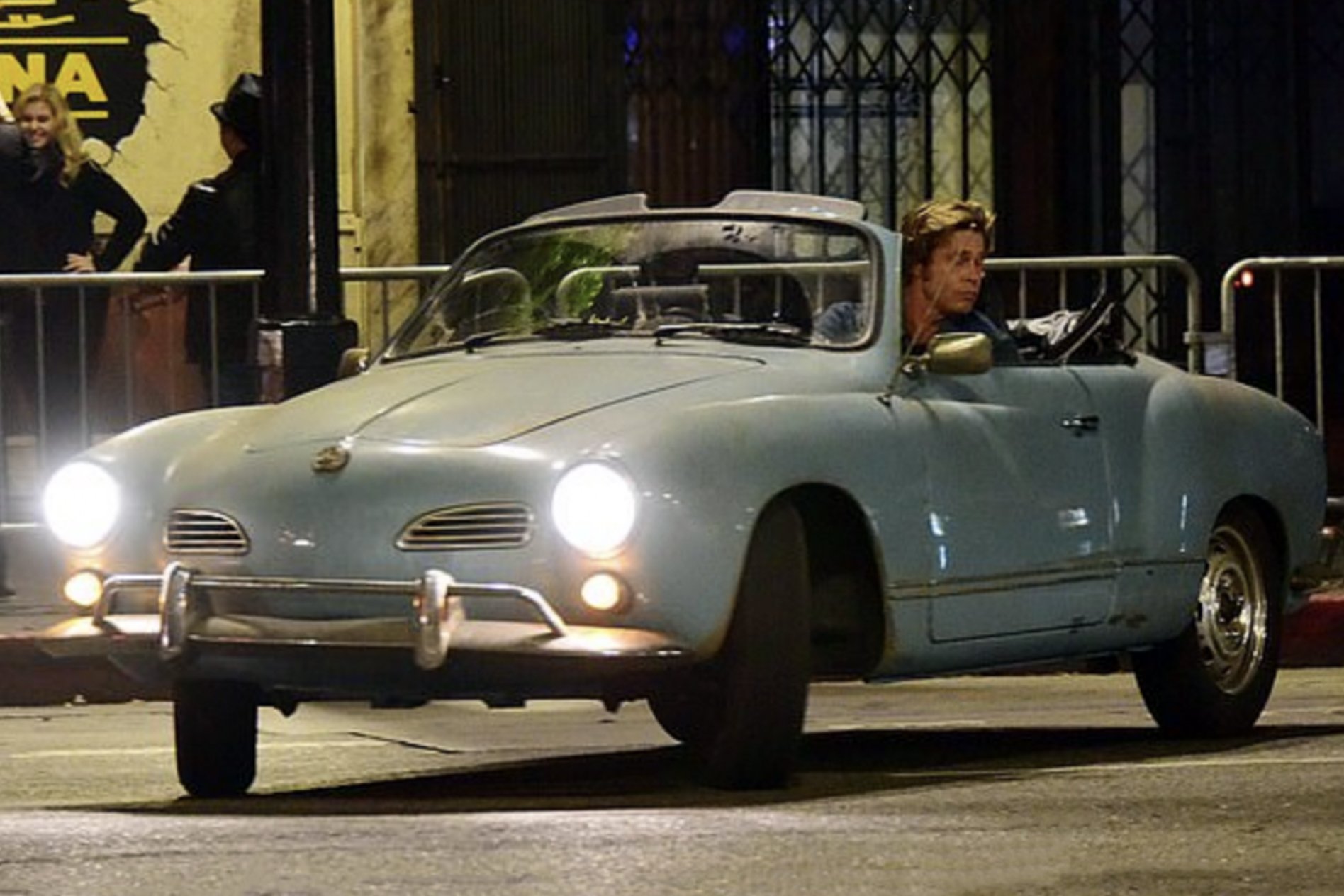
In fact, the director’s earliest memories of LA came from driving around with his grandfather in a Karmann.
The car itself was rebuilt for the movie with a Subaru boxer engine and automatic transmission “in case Brad didn’t drive stick [manual],” according to Butcher. “But he can.” A traditional flat-four powered Ghia was also used during filming.
There’s a genuine Aussie connection in the film, too; former Neighbours actor turned Hollywood megastar, Margot Robbie, plays the unfortunate Sharon Tate, the wife of noted film director Roman Polanski, who was murdered by Manson followers in her home in 1969.
Robbie’s character is shown in the flick driving a Porsche 911 (below), and a quick dig shows that the car in question is a 1969 911L Sportomatic, which used a four-speed semi-automatic gearbox.
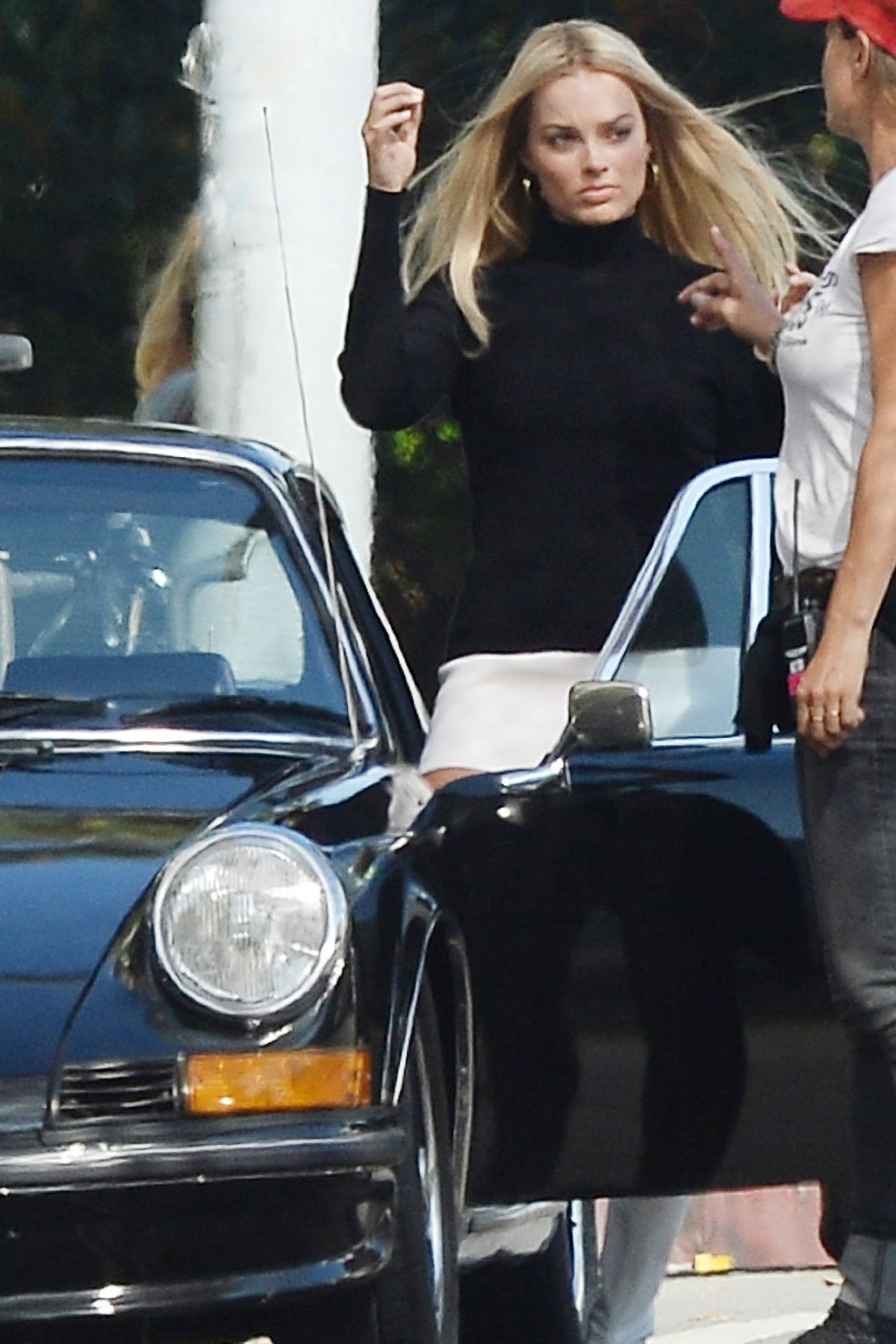
Robbie is also pictured in a 1952 MG TD, which was supposedly owned by Polanski. However, the MG was merely a loaner, as Tate had apparently bingled her husband’s Ferrari just before she was murdered.
Margot doesn’t just drive Porsches… she’s also a Nissan ambassador
However, there was one car where Tarantino decided that too much reality would be a bad thing. The Manson Family murderers used a shed-rough1959 Ford Galaxie Town Victoria as their getaway car.
The actual car still exists in the hands of a collector, and Tarantino discussed sourcing it for the movie with Butcher.
“But I had a meeting with Quentin, and we talked about it and thought that would be creepy to have the real car on set,” Butcher recalls.
More cars from Once Upon A Time… In Hollywood
1968 Chrysler Imperial
1969 Pontiac Firebird
1969 Lincoln Continental
1956 Ford Mainline
1964 Buick Riviera
1967 Plymouth Belvedere
1969 Chevrolet Camaro
1968 Chrysler Town & Country wagon
1962 Mercury Comet
1968 Volkswagen Beetle convertible
1968 Jaguar E-Type
1965 Volvo P1800S
Many, many Ford Mustangs…
Intimidation comes in many forms. Threats, blackmail, crowded shopping centres, the middle seat in economy, Mount Everest, an 800-horsepower Shelby Super Snake Mustang.
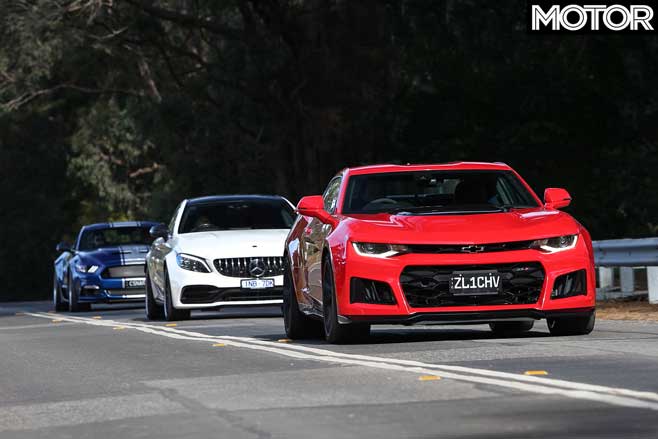
You could probably chuck a Chevrolet Camaro ZL1 in there too, because few people are going to feel instantly at ease with a seriously supercharged V8 sending shockwaves to its rear tyres, and it doesn’t make me any less of a man to admit it. If you had to name a muscle coupe destined to expand the testicular mass of anyone behind the wheel, it’s one of these Yank brutes.
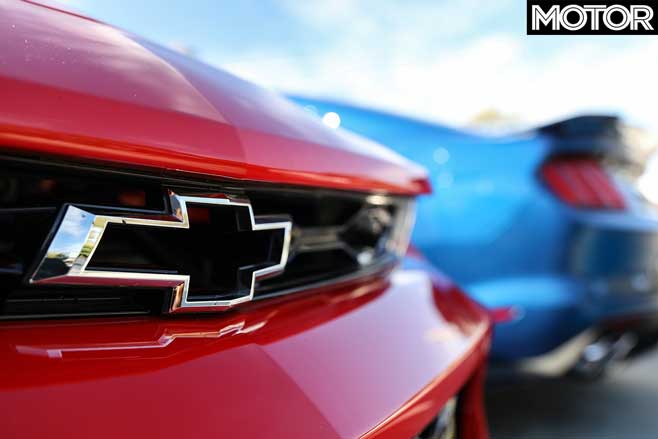
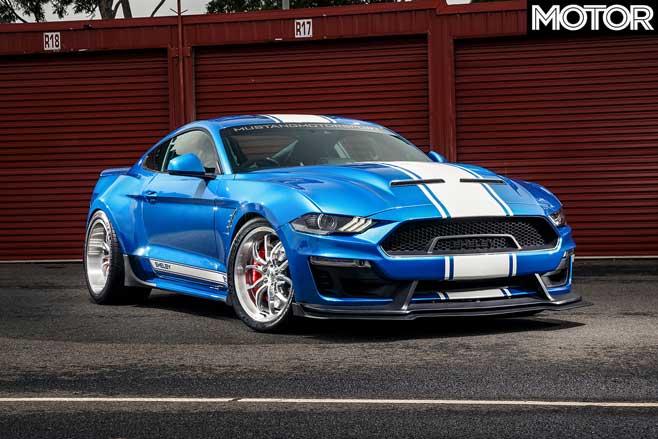
Punters keen on this type of testosterone boost must be chuffed you no longer need to head Stateside to feel the burn. Thanks to HSV’s converting talents, Chevrolet’s ultimate Camaro is now right-hook-ready and perfectly poised to pick up where the GTS-R W1 left off at a somewhat eyebrow-raising $159,990. And, thanks to the column-shifting expertise of Mustang Motorsport, the thrill of a Shelby-enhanced Mustang Super Snake is also ripe for the taking, even in completely bat-shit crazy ‘Wide-Body’ form.
Without the full plumping treatment, the Shelby Super Snake is already a formidable 169 big ones. But if you want the Wide-Body booty, that’s another $35K right there. And if 700hp (522kW) isn’t worth getting out of your recliner for, there’s an 800hp (596kW) alternative for $12,290 more, complete with additional wail courtesy of a Whipple supercharger.
And on our test car (the first of two – keep reading), let’s not forget painted pearl-white gloss stripes ($11K), a torsen differential with 3.73:1 ratio ($5K) and $1950 worth of leather and suede interior alterations that transform this Mustang into a virtual $239,930 caricature of itself – albeit a hugely intriguing one.
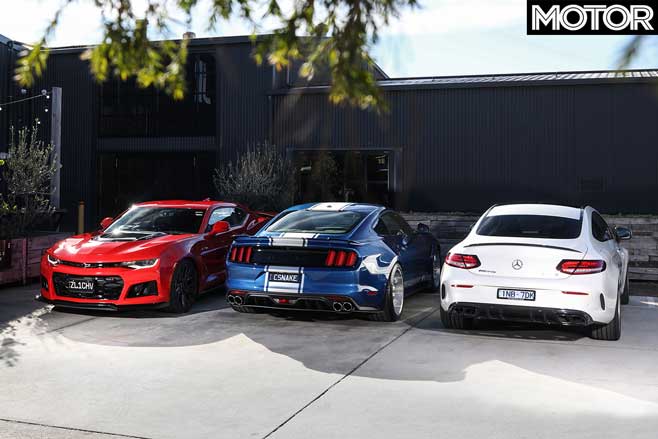
Alongside the berserk Camaro and bad-to-the-bone Mustang, Mercedes-AMG’s updated C63 S Coupe almost seems a bit girly, as well as a bit of a bargain at $165,900 stock, or $191K as you see here, yet it remains the global benchmark for mega-tough V8 performance coupes.
Such is the popularity of AMG’s bullish twin-turbo tearaway that it’s more ‘off the rack’ than its limited-volume American rivals, though what you lose in exclusivity you definitely gain in refinement and all-round polish – especially this latest version with its smoother personality. But is that enough to make your heart race and your sphincter tighten?
Having lived with a 2015 C63 S sedan for almost a year, it’s the politeness of AMG’s latest weapon that strikes me first on a dawn blast to the edge of Melbourne. The way the sedan used to buck and bitch-slap over concrete road joins had already been partially alleviated in the original C63 S Coupe, but this version is even less abrasive, and surprisingly supple when the dampers are set to Comfort.
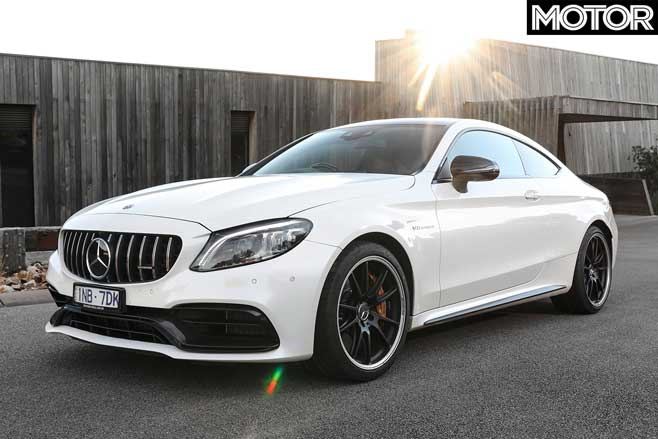
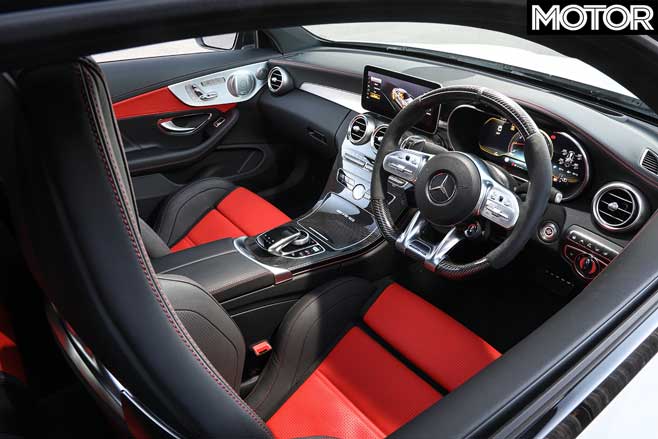
Apparently the 2019 C63 S also gets synthesised induction noise pumped through its Burmester stereo speakers, but I can barely notice it. What is abundantly clear is just how liveable and all-round glorious this AMG coupe has become in its older years.
It mixes bark with bite so damn well, and even though there’s still a tonne of coarse-surface road noise – “That’s how you know good tyres,” my old man used to say – it’s clear this is definitely the designer version of bad-arse.
Pulling up next to our red Camaro ZL1, the diamond-white AMG looks almost demure. At 4831mm long and 1905mm wide, the flagship Chevy is a vision-filler, and the ZL1’s aggressive cooling and aero package, garnished with guard-filling forged-alloy 20s in dark graphite make it appear almost Batman-esque. Where the C63’s rear end elegantly tapers, the ZL1’s swells right to the edge of its Coke-bottle hip line, its taillights doing a stellar interpretation of a ’68 Camaro’s.
And then there’s the Wide-Body Super Snake. With an extra 2.5 inches (63.5mm) of front track and a whopping four inches (101.6mm) at the back, Shelby’s burliest baby makes even the ZL1 look understated. It’s so frigging in-your-face it’s hard to believe the Wide-Body is even street legal (it is), and this car’s optional ‘800hp’ package means it packs the grunt to at least partly explain its unhinged appearance. But first, the ZL1.
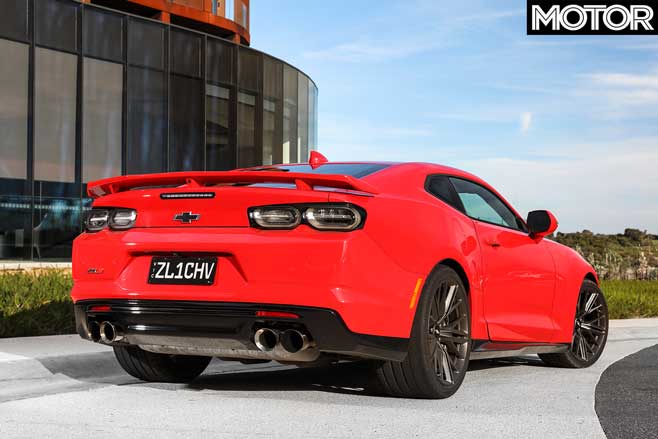
After the velvety sheen of the AMG, the Chevy immediately feels lumpier, chunkier and less forgiving. It similarly features adaptive damping, in this instance via magneheteorical units, and in standard Tour mode the ZL1 initially doesn’t feel completely sorted. Its steering seems a bit vague, as if it missed out on an early-morning caffeine hit, and its vast 285/30ZR20 front tyres tend to tramline over uneven surfaces.
Our test car is wearing optional dealer-fit Goodyear Eagle F1 Supercar 3s – not the regular Continental ContiSportContact 5Ps required to meet ADRs – and their grooved-slick appearance isn’t entirely suited to a foggy Victorian winter with an ambient temp not far above zero, so I spend the section up through Flowerdale playing with its suspension settings.
While Tour rides acceptably well in most circumstances, it lacks steering firmness in steady-state cornering. Sport feels more like a shot-putter’s tune, with noticeably meatier steering weight and a more Braille-like connection with surface imperfections. And then there’s Track, which is such a tough tune it’s almost like the power steering has been disconnected.
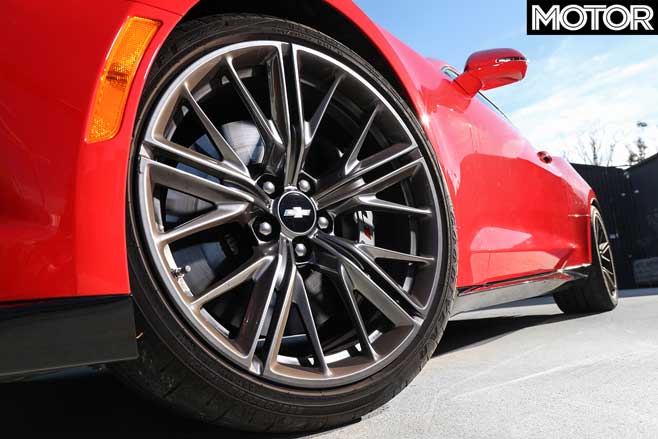
But its engine – a new direct-injection ‘LT4’ version of GM’s 6.2-litre all-alloy pushrod V8 – is stunningly driveable, and that isn’t a given when you’re mastering 881Nm of torque at 3600rpm through a 10-speed automatic! It’ll pull from barely above idle and feels beautifully progressive in its behaviour, yet packs a bassy undertone that increases in brashness the deeper you press the throttle. On these damp roads, knowing what’s lurking under my right foot is almost achingly irresistible, but the ZL1 needs a straight road to unleash all its fury.
After the sweeping hills and curves of the outer high country, I head for the Super Snake. Walking up to it, you can’t help grinning at the sheer audacity of its stockiness, and from behind the wheel, wincing at some of Shelby’s cabin ‘improvements’. The Super Snake’s interior might fulfil the brief for those who still love hanging Autometer gauges from A-pillars, but for everyone else it’s a textbook example of ‘less is more’.
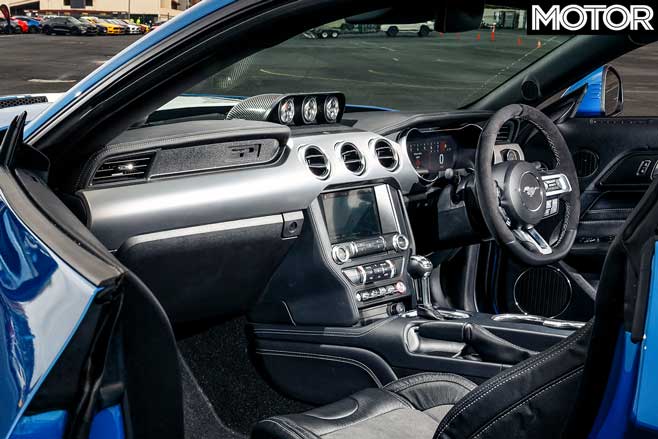
Alongside the Camaro’s acres of tactile suede, deeply supportive buckets and consistency of design – however low-rent it may look compared to the AMG – the Shelby’s ruched leather and over-plumped Recaros look and feel oddly aftermarket, with the electric seat base lacking enough under-thigh tilt and the lever-adjust backrest devoid of enough slots to achieve a perfect driving position.
But the Mustang’s all-suede dished steering wheel seems better connected to its, ahem, 305/30ZR20 Michelin Pilot Sport Cup 2 front tyres (yes, really), and there’s something charmingly unhinged about hearing all that supercharger whine infusing its bent-eight rumble. Again, you have to question why an engine producing a staggering 920Nm at 4500rpm needs 10 gear ratios – it doesn’t! – though there’s a degree of commonsense in the tuning of all this madness.
As we approach our back-to-back test road, I flick the Mustang’s drive mode to Sport Plus and let the transmission do the shifting. It’s too much. The 10-speeder is determined to keep the Shelby humming somewhere around 5500rpm, which might be fine for a racetrack, but on the road it seems to be avoiding the sweet spot of all that torque. So when I head out for a dedicated thrash, I chuck the Mustang’s MyMode thingy into Sport Plus chassis, Sport steering and Racetrack exhaust, and do much of the gear-shifting with the wheel paddles myself.
Incredibly, Shelby’s Wide-Body Frankenstein gels. On this narrow, undulating and challenging piece of road, the Mustang feels surprisingly tight and chuckable. Thanks to its massive 1731mm rear track and enormous 345/30ZR20 rear boots, there’s tremendous corner exit grip – more than all but the truly mad would be willing to explore on a public road like this – and you can cover ground at warp speed without going close to extracting all 596kW at 7400rpm.
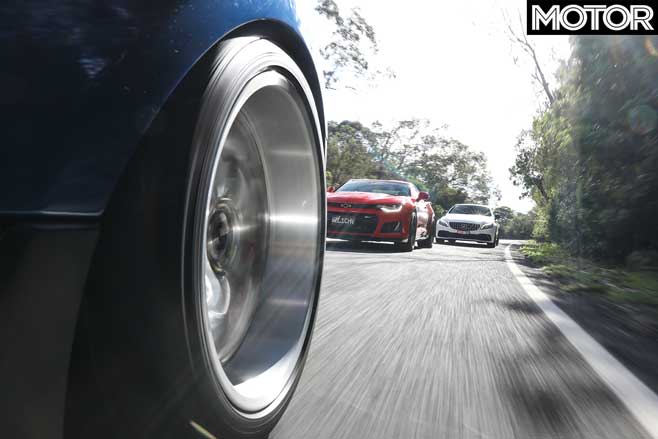
Gears three, four and five are all the Shelby needs to destroy most moderately tight corners with unexpected poise, and even though our test car’s fixed-rate suspension jiggles around on bumpier corners, it’s never enough to upset the car.
Mid throttle is enough to channel the vast depths of the blown V8’s beef, supported by the forcefulness of a serious braking package (405mm slotted front discs with six-piston calipers, 380mm slotted rears with four-pot calipers). But it’s only when the Shelby’s nose is pointing straight and you mash the right pedal that you truly understand what muscle is at stake here.
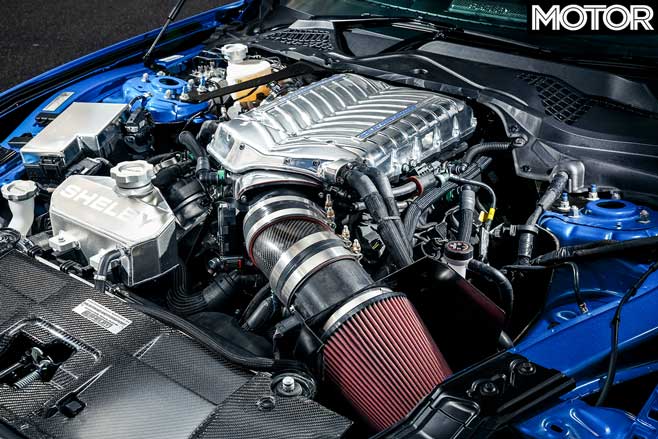
There’s a pause as the Whipple blower spools up, then an intense rush as the Shelby lifts its nose and tries to disappear into the distant scenery. It’s not what you’d call progressive, but it is exciting and that’s what buyers who go for the Whipple want. There’s also the excitement of the engine continuing to accelerate for a moment after you’ve lifted off, which is at its most heightened the first time you experience it!
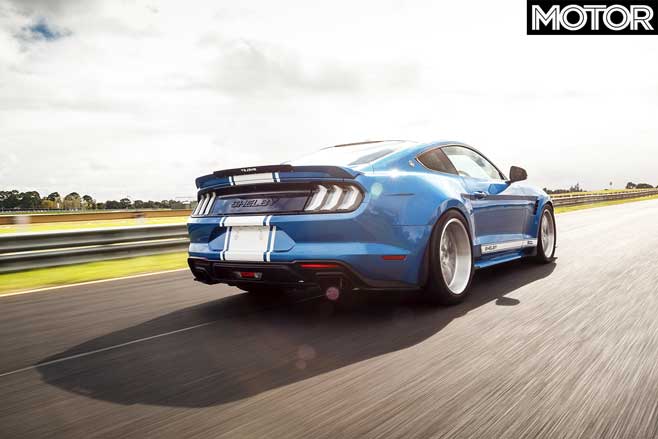
After the mild earlier disappointment of the Camaro ZL1 when trundling about, it’s almost revelatory to discover the dynamic depth in this 477kW beast. The ZL1 feels lighter and smaller than the Mustang, and its larger-capacity blown V8 has much more immediate throttle response than its pumped-up rival, as well as a fuller, richer sound.
Some might miss the LT4’s lack of accelerative drama because it doesn’t have that ‘here we go!’ moment of the mega-boosted Mustang, but I much prefer the fact that at any stage, and any rev point, this phenomenal engine always has enough jammed up its sleeve to titillate.
Thumbs locked onto its flat-faced steering wheel, the Camaro’s nose dives into corners with surprising energy, and even though its narrower 305/30ZR20 rear tyres suggest a comparative lack of purchase, it remains rooted to the road surface. I leave it in Sport, seeing that’s where the ZL1’s steering works best, and while it doesn’t seem to ride quite as well, or perhaps feel quite as visceral as the Wide-Body Mustang, there’s a suave cohesion to the Camaro that more than compensates.
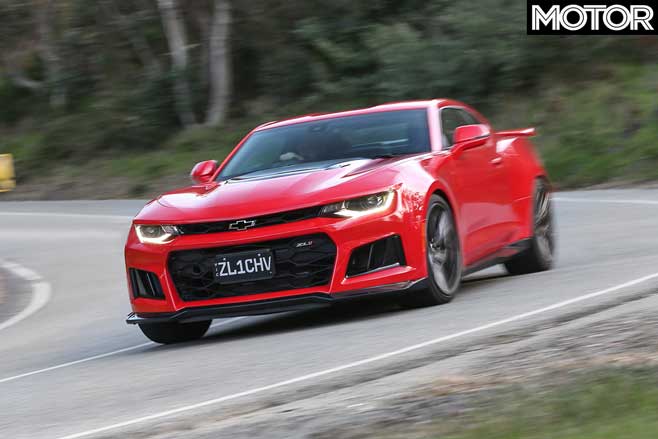
Covering the same ground in the C63 in Sport Plus mode, it’s surprising just how much lighter it feels than the Camaro and Mustang, particularly its steering. Compared to the other brutes, the AMG’s steering might actually be a little too light for some, but it’s really crisp, making it an easy car to place and an easier car to drive hard. And the fluency! The C63 almost glides between corners, lifting onto its toes and dancing with a level of poise that’s been polished to a silky sheen.
Neither of the Americans can match the deliciousness of the C63’s exhaust crackle. Whether you’re manually clacking away on the wheel paddles or letting the nine-speed auto do the shifting itself, the AMG’s gratuitous ignition-cut bark remains a stand-out among its many talents, though its 375kW/700Nm twin-turbo 4.0-litre doesn’t feel quite as muscular as the other pair, and it lacks the seductive graininess and outright brutality of the ZL1’s V8.
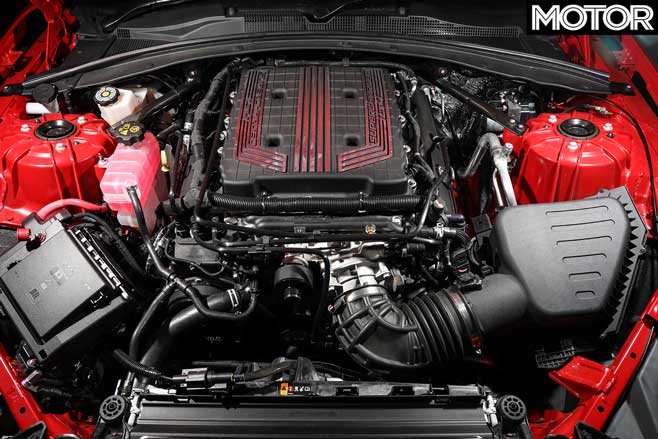
That impression plays out at the drag strip. The surface at Heathcote has never been particularly forgiving of big-power two-wheel drives, especially on cooler days, and even the AMG’s combination of well-calibrated launch control with neatly balanced power and torque outputs falls short of the 3.9sec-to-100km/h acceleration claim. It takes close to half a dozen runs to build up enough heat in its rear tyres for a super-clean run, and even then it’s only 4.4sec to triple digits and a 12.4sec quarter at 192.8km/h.
The ZL1 is much harder to launch, but jeez it’s quick! We don’t have the time to experiment with its multi-adjustable launch control, and don’t have the surface grip of Holden’s Lang Lang proving ground, or VHT, to make the most of what it has, even on cup tyres, but there’s no doubting the ZL1’s enormous thrust.
Despite our best efforts, and having TC in Race, as soon as first gear breaks traction the auto ’box short-shifts and grabs second – delivering a less-than-ideal 4.3sec to 100km/h. But from there on it slingshots ahead.
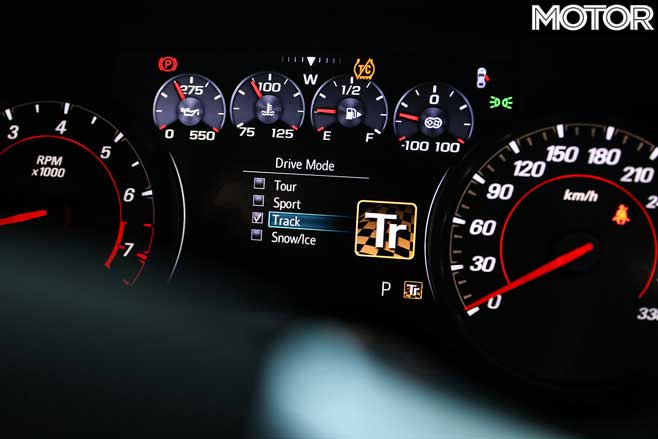
The ZL1 is so quick it shifts around unnervingly and follows surface irregularities, but its trap speed at the quarter mile is proof of its pace – 12.1sec at 201.4km/h. Likewise its rapid 80-120km/h time of 2.1sec, beating the AMG by 0.1, and its outstanding braking performance of just 31.3m to pull up from 100, twice in a row. Its picks may not have the pedal feel of the Mustang’s, but there’s no doubting their effectiveness.
The Super Snake isn’t quite so fortunate at the strip. Even its first run sees it coughing on the upshift from first to second and sending a puff of grey smoke out its rear pipes before gathering speed at the upper end in fearsome style. Once there’s heat in the tyres, it clocks a sole quarter-mile run of 12.6sec at, wait for it, 197.7km/h before its PCV valve fails under the extreme boost – sucking oil into the intake, fouling the plugs and sending plumes of grey smoke from the rear.
If you’re doing serious racetrack work, Mustang Motorsport recommends a catch-can, with a check valve to prevent the engine from ingesting oil. Unfortunately, our initial test car wasn’t so equipped and had to retire hurt.
If it were me doing the choosing, I’d avoid the slug of Terminator 2-style molten Whipple metal whining under the 800hp Mustang’s bonnet and stick with the much more factory 700hp version, though the real success here is the fact you have the choice between the two. Or a Camaro ZL1 or C63 S Coupe.
That said, for all its brawny bravado and in-your-face visuals, this mad-bastard Mustang doesn’t quite achieve what its price tag says it should deliver. From the outside, it’s the performance car equivalent of fitting every Nasco accessory to an HK Monaro, though I can see why many people love it. And from the inside, it’s a step or two beyond the taste and restraint of a regular Recaro-equipped Mustang.
Yet there’s a shitload of good going on with that widened chassis. On the right road at the right moment, it’s a frigging riot. But it falls well short of the cohesion of the ZL1 and C63.
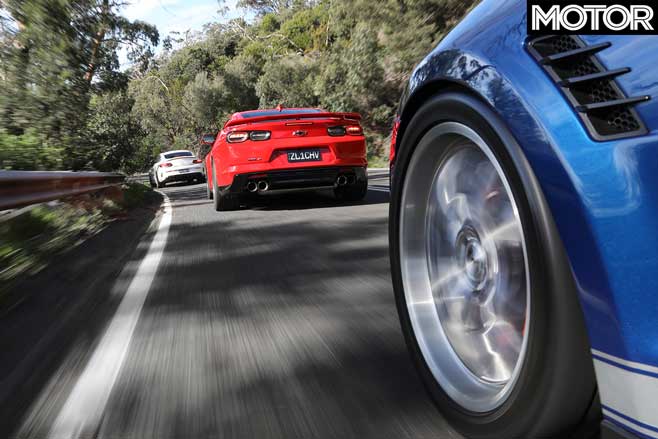
The Chevy and AMG are dramatically different in the way they drive, while delivering similarly thrilling outcomes. The ZL1 proves that a hugely overpowered blown V8 can have crisp throttle response and superb all-round driveability, as well as surprisingly agile dynamics, while the C63 S Coupe proves that the hot-rod gene is alive and well in Affalterbach, even though elements of that menace have been rounded off.
In purely rational terms, the C63 S Coupe has to win here. It’s far and away the best all-rounder, both in terms of what it can do – like seat four people and drink surprisingly little fuel on a highway cruise – and its accessibility from a driver’s point of view. Then there’s the excellence of its Burmester stereo (though the ZL1’s Bose system runs it close) and the seamlessness of its cutting-edge technology.
Still, the longer and harder you drive the Camaro ZL1, the greater the seduction, however twisted that lust may be. From the blare of its exhausts to the bite of its superbly engaging chassis, it’s a shit-tonne of intimidation wrapped up in a loin-aching design that’s so much friendlier than its murderous-bikie facade suggests. General Motors might be all at sea in 2019, but the Camaro ZL1 is GM at its finest.
Fast Facts
| u00a0 | Chevrolet Camaro ZL1 | Shelby Super Snake | Mercedes-AMG C63 S coupe |
| Body | 2-door, 4-seat coupe | ||
| Drive | rear-wheel | ||
| Engine | 6162cc V8, OHV, 16v, supercharged | 5038cc V8, DOHC, 32v, supercharged | 3982cc V8, DOHC, 32v, twin-turbocharged |
| Bore x Stroke | 103.3mm x 92.0mm | 93.0mm x 92.7mm | 83.0mm x 92.0mm |
| Compression | 10.0:1 | 12.0:1 | 10.5:1 |
| Power | 477kW @ 6400rpm | 600kW @ 7400rpm | 375kW @ 5500-6250rpm |
| Torque | 881Nm @ 3600rpm | 980Nm @ 5250rpm | 700Nm @ 2000-4500rpm |
| Power/Weight | 264kW/tonne | 357kW/tonne | 217kW/tonne |
| Transmission | 10-speed automatic | 9-speed automatic | |
| Weight | 1807kg | 1681kg | 1725kg |
| Suspension | struts, adaptive dampers, anti-roll bar (f); multi-link, adaptive dampers, anti-roll bar (r) | struts, dampers, anti-roll bar (f); multi-link, dampers, anti-roll bar (r) | struts, adaptive dampers, anti-roll bar (f); multi-link, adaptive dampers, anti-roll bar (r) |
| L/W/h | 4831/1905/1344mm | 4789/1916/1396mm | 4751/1877/1401mm |
| Wheelbase | 2811mm | 2720mm | 2840mm |
| Tracks | 1610mm (f);1575mm (r) | N/A | 1636mm (f); 1592mm (r) |
| Steering | electrically assisted rack-and-pinion | ||
| Brakes (f) | 390mm ventilated discs, 6-piston calipers | 380mm ventilated discs, 6-piston calipersu00a0 | 402mm ventilated discs, 6-piston calipers |
| Brakes (r) | 365mm ventilated discs, 4-piston calipers | 380mm solid discs, 4-piston calipers | 360mm ventilated discs, single-piston calipersu00a0 |
| Wheels | 20.0 x 10.0-inch (f); 20.0 x 11.0-inch (r) | 20.0 x 11.0-inch (f); 20.0 x 12.5-inch (r) | 19.0 x 9.0-inch (f); 19.0 x 10.5-inch (r) |
| Tyre Sizes | 285/30 ZR20 (f); 305/30 ZR20 (r) | 305/30 R20 (f); 345/30 R20 (r) | 245/35 R19 (f); 285/30 R19 (r) |
| Tyres | Goodyear Eagle F1 Supercar 3 | Michelin Pilot Sport 4S | Michelin Pilot Super Sport |
| Price | $163,100 | $239,930 (as tested) | $190,800 (as tested) |
| Pros | Murderously fast and all the right vibes | Turns heads like an Aventador; surprising poise | Crazy power; best noise; high-tech interior; handling |
| Cons | Could sound meaner; don’t look at US price | Rarity has its price; gaudy interior bits; basically a DNF | Transmission can be clunky; slightly under-tyred? |
| Rating | 4.5 out of 5 stars | 3.5 out of 5 stars | 4.5 out of 5 stars |
The Strip
| u00a0 | Shelby Super Snake | Mercedes-AMG C63 S coupe | Chevrolet Camaro ZL1 |
| 0-10km/h | 0.5sec | 0.4sec | 0.5sec |
| 0-20km/h | 1.0sec | 0.8sec | 1.0sec |
| 0-30km/h | 1.4sec | 1.3sec | 1.4sec |
| 0-40km/h | 1.9sec | 1.7sec | 1.8sec |
| 0-50km/h | 2.5sec | 2.1sec | 2.3sec |
| 0-60km/h | 3.0sec | 2.5sec | 2.6sec |
| 0-70km/h | 3.4sec | 2.9sec | 3.0sec |
| 0-80km/h | 3.8sec | 3.3sec | 3.4sec |
| 0-90km/h | 4.5sec | 3.8sec | 3.8sec |
| 0-100km/h | 5.0sec | 4.4sec | 4.3sec |
| 0-110km/h | 5.6sec | 5.0sec | 4.8sec |
| 0-120km/h | 6.2sec | 5.6sec | 5.4sec |
| 0-130km/h | 6.8sec | 6.3sec | 6.0sec |
| 0-140km/h | 7.4sec | 7.1sec | 6.6sec |
| 0-150km/h | 8.2sec | 7.9sec | 7.3sec |
| 0-160km/h | 8.9sec | 8.8sec | 8.1sec |
| 0-170km/h | 9.8sec | 9.8sec | 8.9sec |
| 0-180km/h | 10.7sec | 10.9sec | 9.7sec |
| 0-190km/h | 11.7sec | 12.1sec | 10.8sec |
| 0-200km/h | 12.9sec | 13.4sec | 11.9sec |
| 0-400m | 12.6sec @ 197.7km/h | 12.4sec @ 192.1km/h | 12.1sec @ 201.4km/h |
| 80-120km/h (Drive) | 2.4sec | 2.2sec | 2.1sec |
| 100-0km/h | N/A | 33.6m | 31.3m |
| Speed in Gears | |||
| 1st | 62km/h @ 7400rpm | 53km/h @ 7100rpm | 64km/h @ 6600rpm |
| 2nd | 98km/h @u00a07400rpm | 88km/h @ 7100rpm | 101km/h @ 6600rpm |
| 3rd | 136km/h @u00a07400rpm | 126km/h @ 7100rpm | 140km/h @ 6600rpm |
| 4th | 165km/h @u00a07400rpm | 174km/h @ 7100rpm | 168km/h @ 6600rpm |
| 5th | 192km/h @u00a07400rpm | 234km/h @ 7100rpm | 198km/h @ 6600rpm |
| 6th | 229km/h @ 7400rpm | 286km/h @ 7100rpm | 241km/h @ 6600rpm |
| 7th | 250km/h @ 6320rpm* | 290km/h @ 6275rpm* | 302km/h @ 6600rpm |
| 8th | 250km/h @ 5380rpm* | 290km/h @ 5195rpm* | 319km/h @ 5925rpm* |
| 9th | 250km/h @ 4360rpm* | 290km/h @ 4395rpm* | 319km/h @ 4810rpm* |
| 10th | 250km/h @ 4050rpm* | N/A | 319km/h @ 4465rpm* |
Heathcote Raceway, 17˚C, dry. Driver: Nathan Ponchard *Manufacturer’s claim Official timing supplier: www.vboxaustralia.com.au
