
I’ve been lucky enough to get my hands on every variant in the Cayenne range prior to taking delivery of my E-Hybrid long-term review car, including the S which I took for a blast through the rugged landscape of Crete in 2017.
Between them, the entry-level variant, Cayenne S, and Turbo have categorically demonstrated that Porsche’s large SUV is a force to be reckoned with. It’s refined and sophisticated, practical and athletic in varying degrees, but the newest option to join the line-up brings a whole additional set of likable features.
Here are five of my favourite that didn’t take long to stand out:
Pre-Climatisation
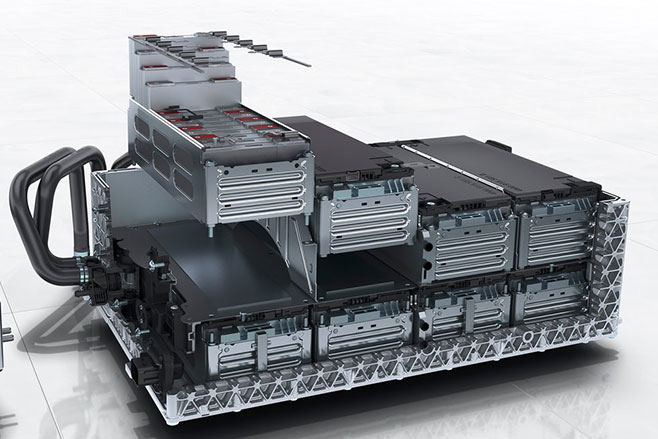
In hot or cold climates, the Cayenne’s cabin can be ‘preconditioned’ prior to boarding with the pre-climatisation feature. Unlike the more conventional variants, the E-Hybrid’s interior heating and cooling is operated electrically, avoiding the need to start the engine.
Once a predetermined time and temperature has been set, the E-Hybrid uses electrical power from its battery (or mains power if its charge cable is plugged in) to cool or heat its interior.
Pure electric driving
Up to 44km might not seem like a particularly long way for any vehicle to travel on electric-only power, but you might also be surprised to learn that the average Australian’s daily commute is less than that – about 20km each way.
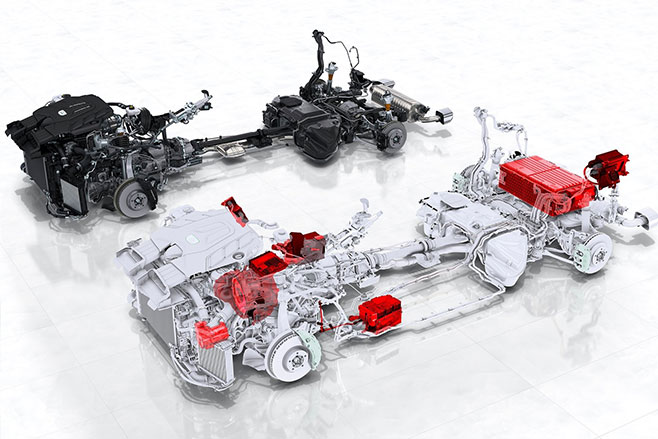
Plug the Porsche in at home and in the morning, it will be filled with enough electrons to get you to work and home again independently of fossil fuels. And by very rough approximation, the power it costs to charge it battery will cost you about half as much in petrol to cover the same distance.
Typical Porsche quality
Some Porsche purists may still need time to get used to the idea of a high-riding SUV from Stuttgart but the build quality and finish is every bit as good as the company’s coupes, convertibles and supercars.
Examples of restrained, classy design are everywhere from the centrally mounted compass on the dashboard with anti-glare coated glass, leather-upholstered pistol-grip grab handles for front occupants, and the machined-finish 21-inch RS Spyder wheels (optional).
The finest attention to detail combines for an immersive quality including even the indicator stalk’s satisfying click, prismed edge to the rear-view mirror and the electronically generated click from the central solid-state switch gear.
Performance and efficiency
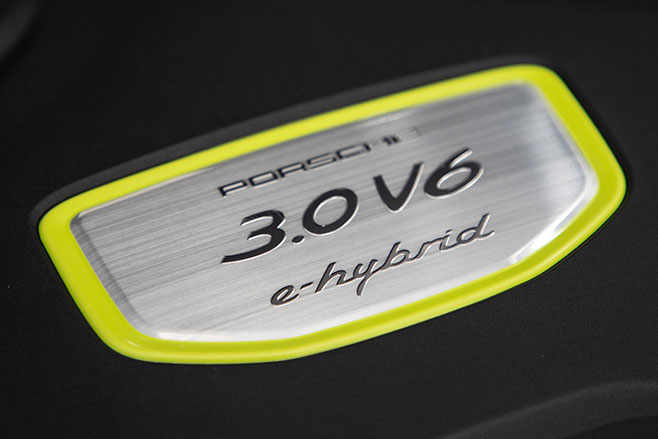
Adding an electric motor, battery and associated hardware to the entry-level Cayenne has dealt a significant weight penalty, but the added power and torque more than offsets extra mass in the performance stakes.
Pin the throttle from a standstill and the E-Hybrid will dispense with the benchmark 0-100km/h dash in just 5.0 seconds – the same as an Audi TT S. Need to scrub that speed off again? Mighty ten-piston brake calipers on the front axle grasp 360mm discs and hide bulk admirably.
Despite the prodigious weight, power and torque, the official combined (NEDC) fuel efficiency figure from Porsche is just 3.4 litres per 100km.
Acid Green highlights
What colour says electric to you? As the various mainstream brands pursue electrification, each company has set about branding their respective proprietary tech. For Porsche, hybridisation’s calling card is Acid Green and it’s everywhere.
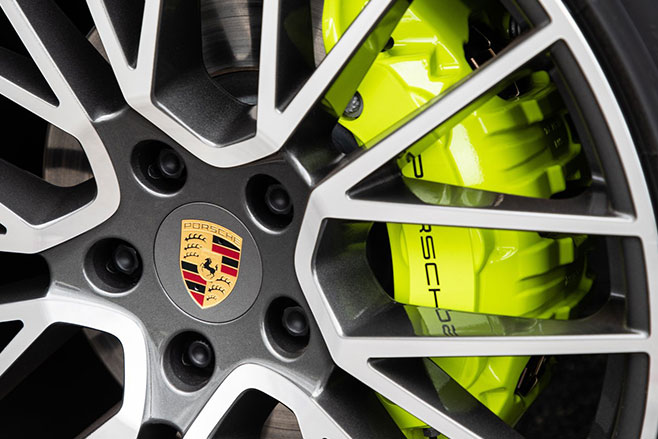
From the central Perspex tachometer needle, to the virtual gauges in the digital displays, exterior badging highlights and the brake calipers, the E-Hybrid calling card is both subtle and powerful.
Off the list
Not fitted to my car are the optional Surface Coated brake discs, which add boosted braking power as well as an awesome aesthetic touch.
With a super-hard coting of tungsten, the special Porsche-developed discs can take more punishment under hard braking, last longer than iron rotors and, after a few kilometres of use polish up to a beautiful mirror finish.
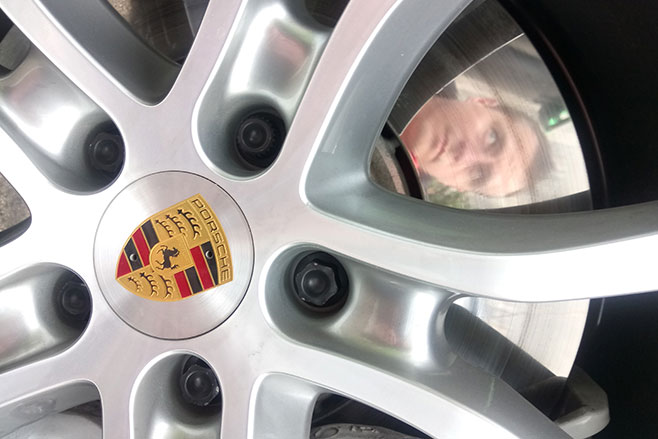
Arguably, a vehicle with regenerative braking like the E-Hybrid has less use for the more expensive items, but I would be tempted to splash the extra cash just for the visual impact.
For the first time, Porsche is also offering the hybrid the option of a noisier sport exhaust which was sadly omitted from the extras list on my car. The louder pipes further enhance the many-cars-in-one promise with an unmissable bark when the V6 takes over from pure electric power.
BMW is set to unleash the full potential of its M2 coupe with a powered-up, kitted-out CS model.
With the F80 M3 now retired and its F82 M4 sibling soon to follow, M Division has been given free rein to fully exploit the mechanicals installed with the introduction of the M2 Competition. That car came within a whisker of knocking off the Porsche 911 GT2 RS in last year’s MOTOR Performance Car of the Year contest.
As you’d expect, BMW is keeping quiet on any official confirmation for now, but well-connected sources have dished enough dirt for us to build up an accurate picture of what to expect from this tyre-shredding twin-turbo two-door.
According to our best information, the M2 CS will be revealed in late 2019 and be produced for around 12 months as a last hurrah for the current-generation F87 M2 before attention turns to the new 2 Series Coupe, tentatively scheduled to appear in 2022.
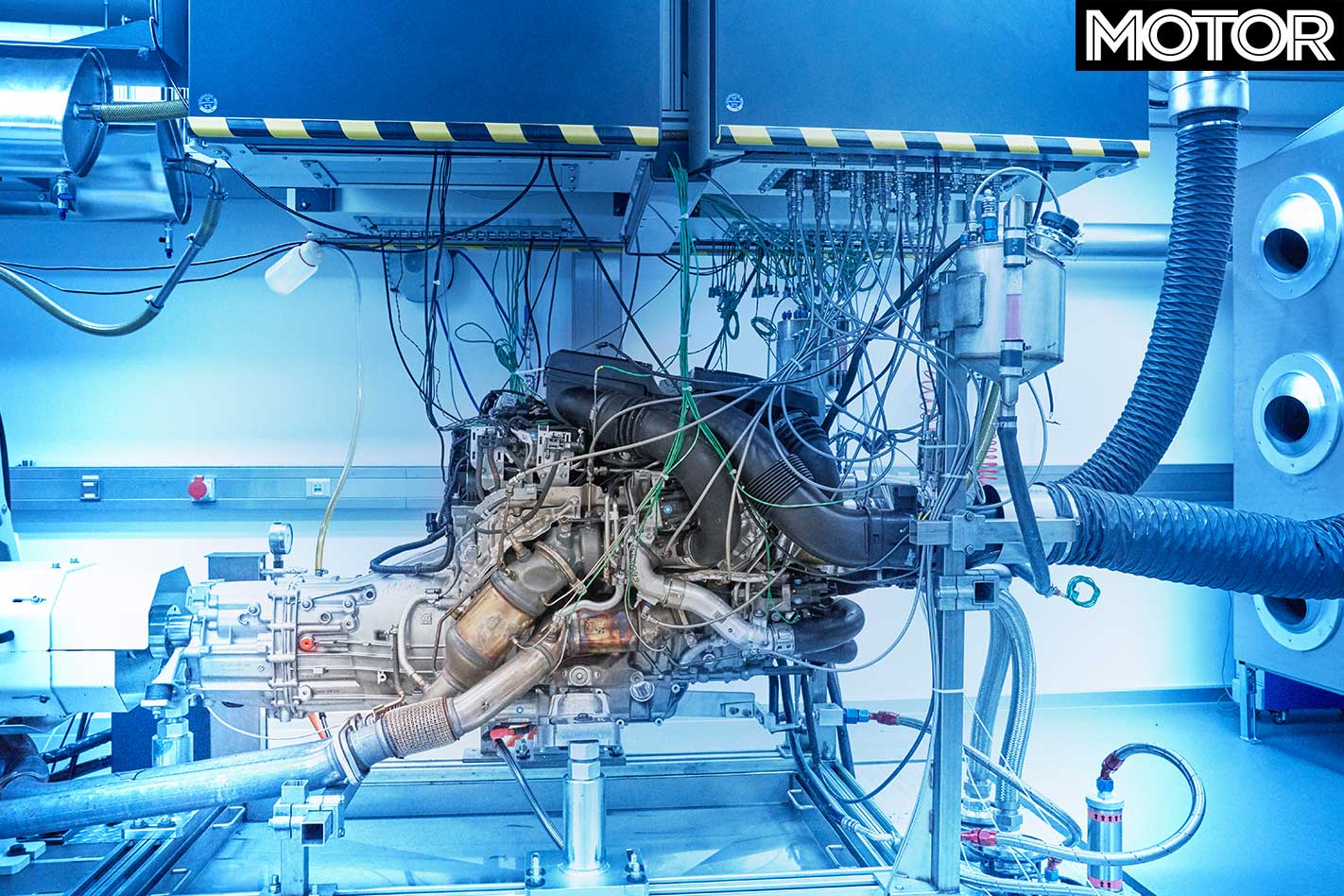
The specification of the M2 CS is familiar from the Competition, but the details differ. Under the bonnet is the S55 3.0-litre twin-turbo six, but outputs are expected to swell to an M4-matching 331kW from 5550-6500rpm and 550Nm from 2350-5500rpm.
Compared to the M2 Competition, power increases by 29kW and while maximum torque remains the same, the peak extends by another 300rpm. The M2 CS will be the final home for the S55, as future six-cylinder M cars, including the recently revealed X3/X4 M and next-generation M3/M4, will use the latest S58 engine.
In a coup for hardcore enthusiasts, a choice of seven-speed dual-clutch or six-speed manual will be offered, though whether BMW Australia sees fit to offer both transmissions remains to be seen. Expect the CS to shave a couple of tenths off the Competition’s 0-100km/h claims of 4.4sec (manual) and 4.2sec (dual-clutch) while top speed will be limited to 250km/h, with the potential for a 280km/h V-max if the M Driver’s Package is optioned.
No major chassis updates are required as the Competition scored most of the M3/M4’s juicy bits, including a massive carbon fibre engine bay strut brace, forged aluminium control arms and wheel carriers, ball joints replacing rubber bushings and a rigidly mounted five-link rear axle.
Nonetheless, the addition of adaptive dampers should both soothe the Competition’s restless ride while also allowing for greater body control and sharper responses with the sportier drive modes selected. Apportioning the power to the rear wheels will be an electronically controlled limited-slip differential, capable of adjusting between zero and 100 per cent lock-up in just 150 milliseconds.
Wheels are expected to stay at 19 by 9.0-inch front and 19 by 10.0-inch rear wearing rubber measuring 245/35 and 265/35 respectively. Presumably these are the widest sizes that can be accommodated by the M2 platform without serious modification. The tyres themselves, however, will become sticky Michelin Pilot Sport Cup 2s, enhancing every aspect of the CS’s capabilities.
Stopping power in particular will be improved thanks to the option of carbon-ceramic brakes for the first time on an M2. With monster 400mm rotors and six-piston calipers up front, supported by 380mm rear rotors and four-piston calipers, it apes the specs of the Competition’s impressive optional M-Sport brakes but adds the heat resistance of carbon composite and reduces unsprung weight.
Further weight will possibly be shed by adopting a carbon-fibre roof. Prototypes have been spotted with and without, which suggests it may not be standard. If it does make the cut it will save around 6kg (based on M4 figure) and slightly lower the centre of gravity.
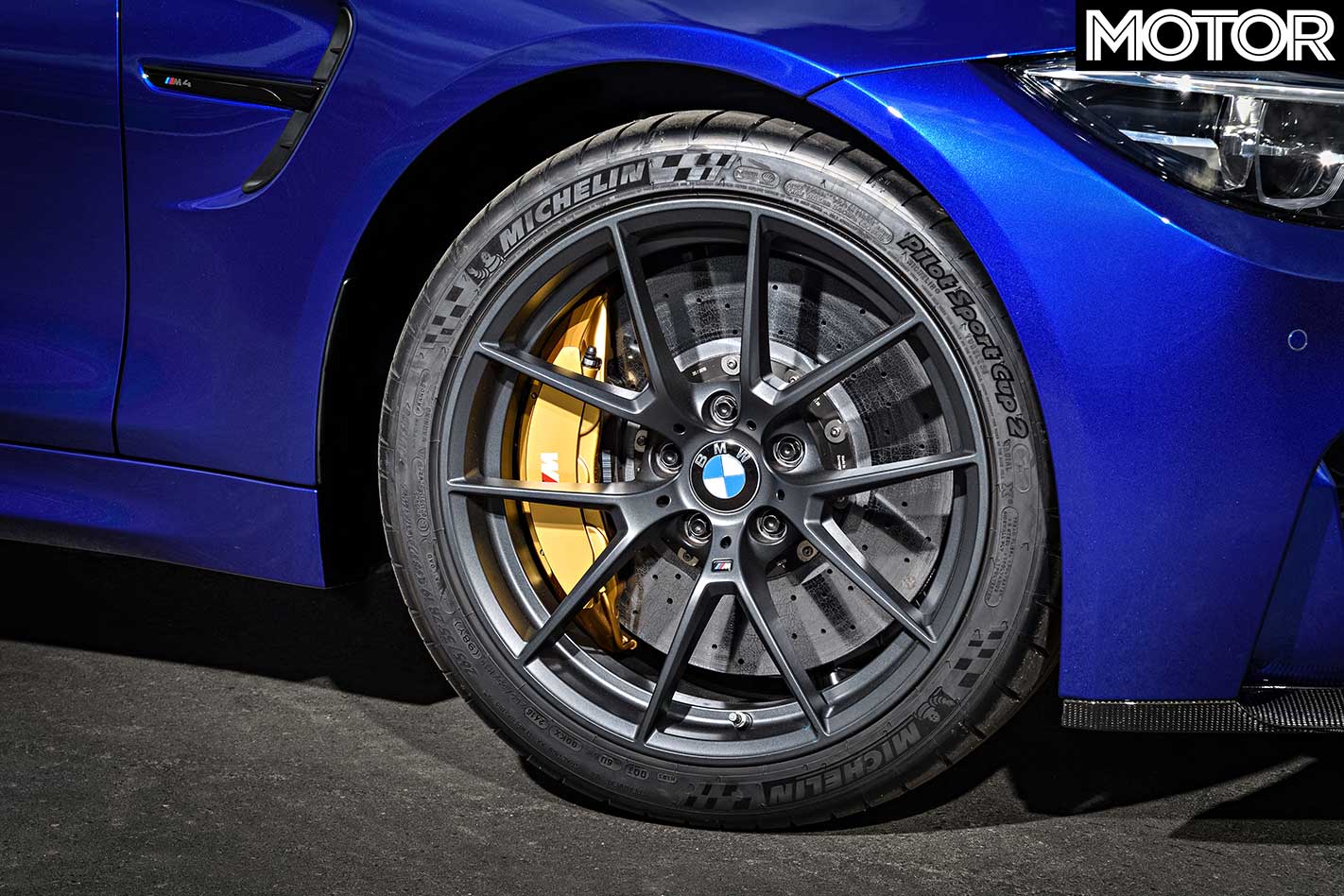
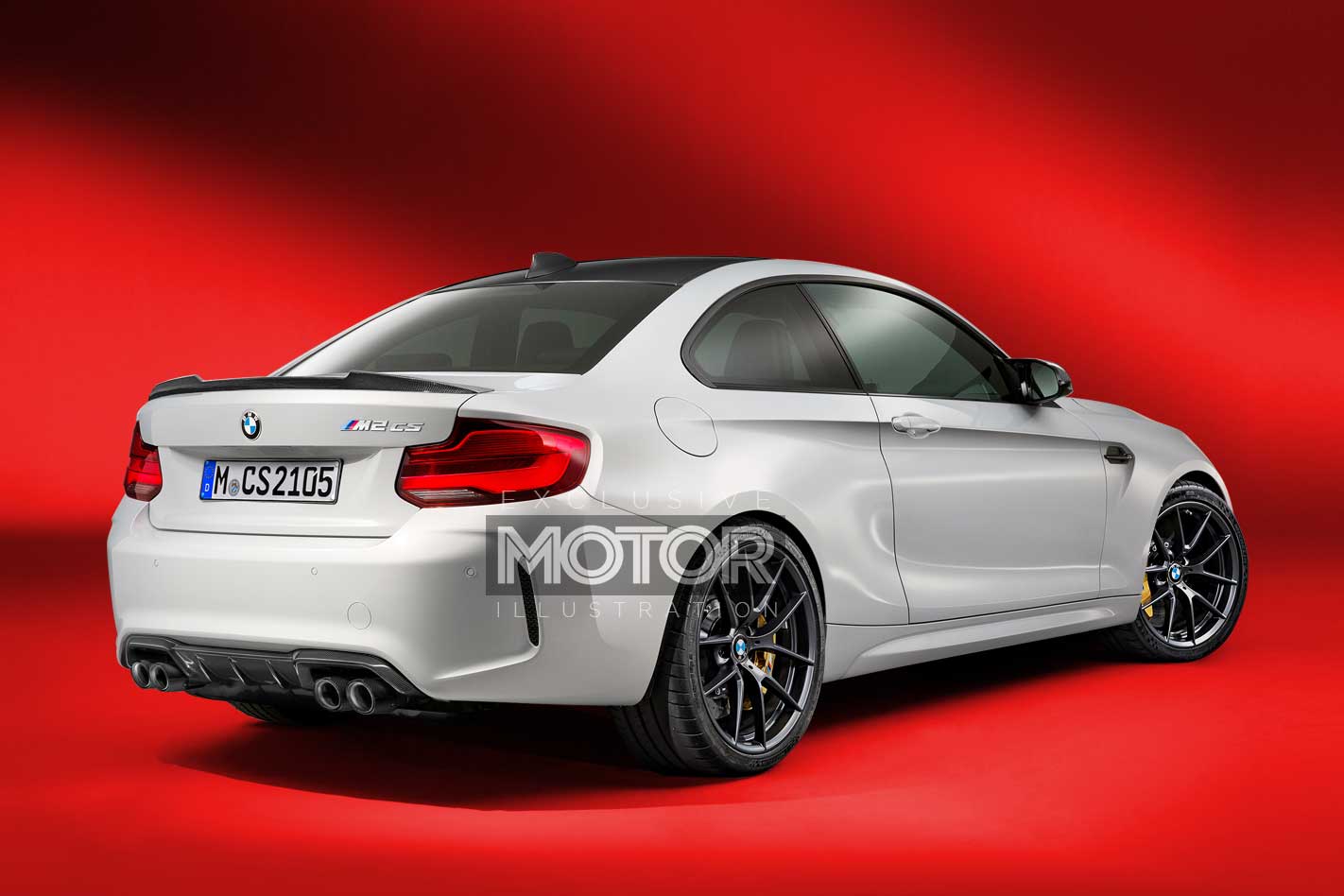
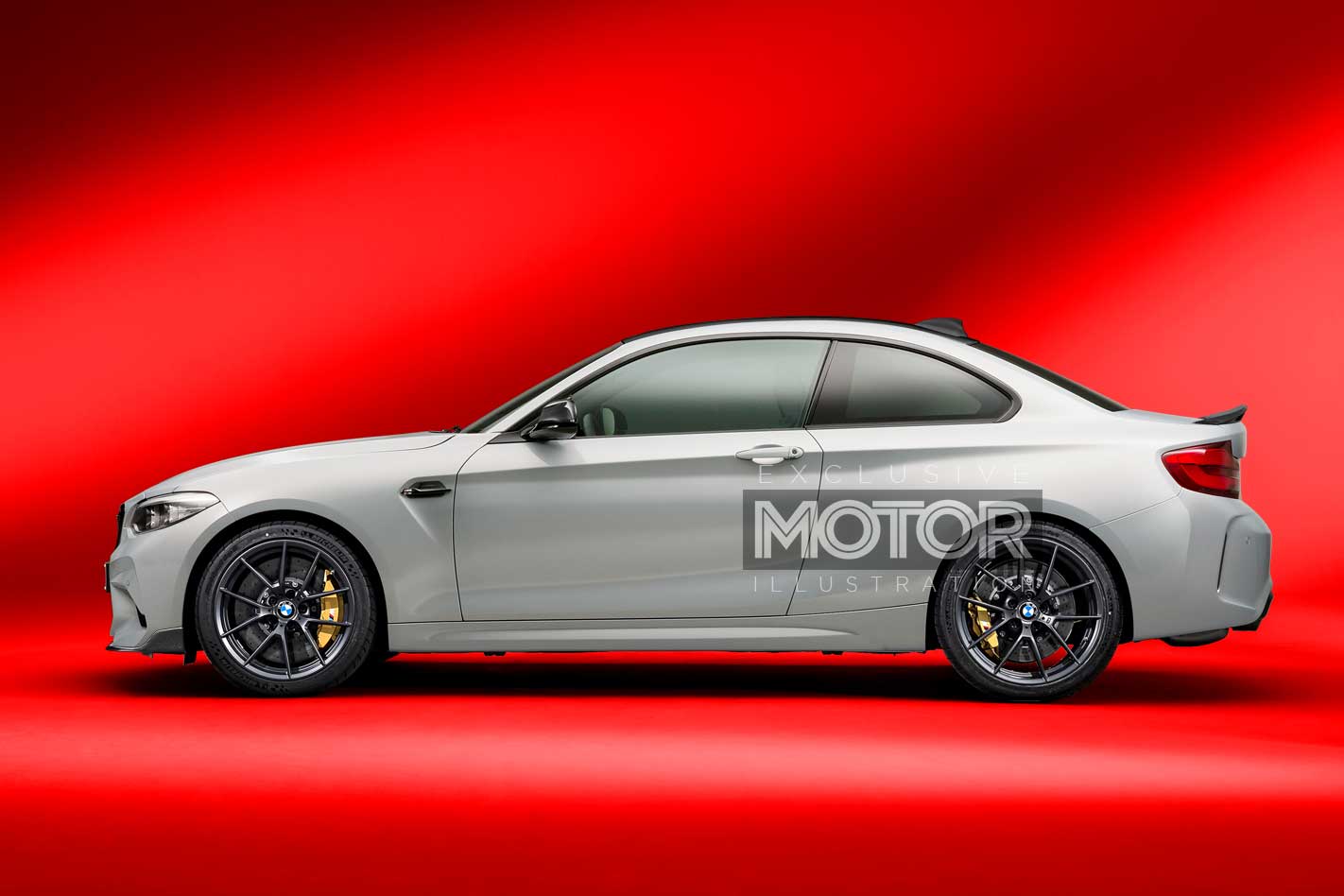
As can be seen in our exclusive computer-generated images, other exterior enhancements include a jutting front splitter, mini ducktail rear spoiler and heavily sculpted bonnet with power bulge, all of which look extremely similar to the parts already offered via the M Performance Parts catalogue.
While subtle, the upgrades give the M2 CS a bit of much-needed visual clout to go with its undoubted performance. A number of different wheel designs have been spotted on prototypes, but word is the production car will wear 763 M forged Y-spokes that have become something of a CS signature.
Another controversial CS signature has been the lightweight interior, consisting of a Spartan ‘lightweight’ centre console, single-zone climate control and, in the M4 CS, natural fibre door trims that eliminate virtually all storage space.
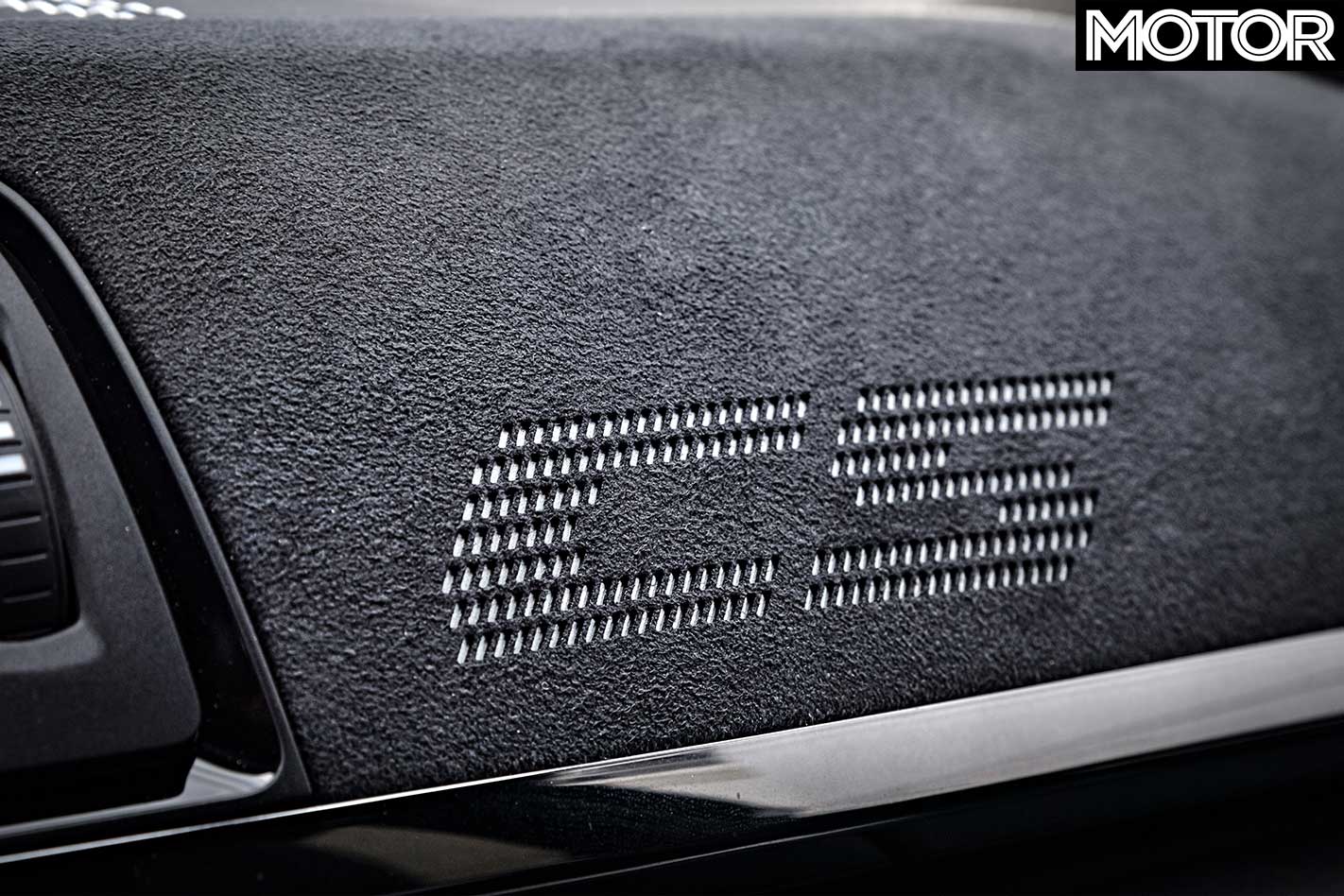
Current information suggests that the M2 CS will have unique interior trim, but all prototypes spotted have had standard M2 interiors, so it may be that any differentiation will be cosmetic in the form of Alcantara trim panels.
The biggest unknown, of course, is the price. The M3 and M4 CS carry a price premium of exactly $50,000 over their respective Pure variants, putting the M2 CS at $149,900. This would put BMW’s baby hottie smack bang in the middle of the M4 Pure ($139,529) and M4 Competition ($156,529) variants, so we’d expect to see the M2 CS occupy the space left by the departure of the M3 at around $125,000-$130,000, though this is pure speculation.
Nevertheless, the M2 Competition has been a revelation, elevating the already excellent M2 to the verge of greatness, offering a mix of performance and pure fun many thought BMW had forgotten how to offer. With more power, greater grip, a more flexible suspension setup and angrier looks, the M2 CS has the potential to be one of the most exciting performance cars of its era.
Where ‘2’ from here?
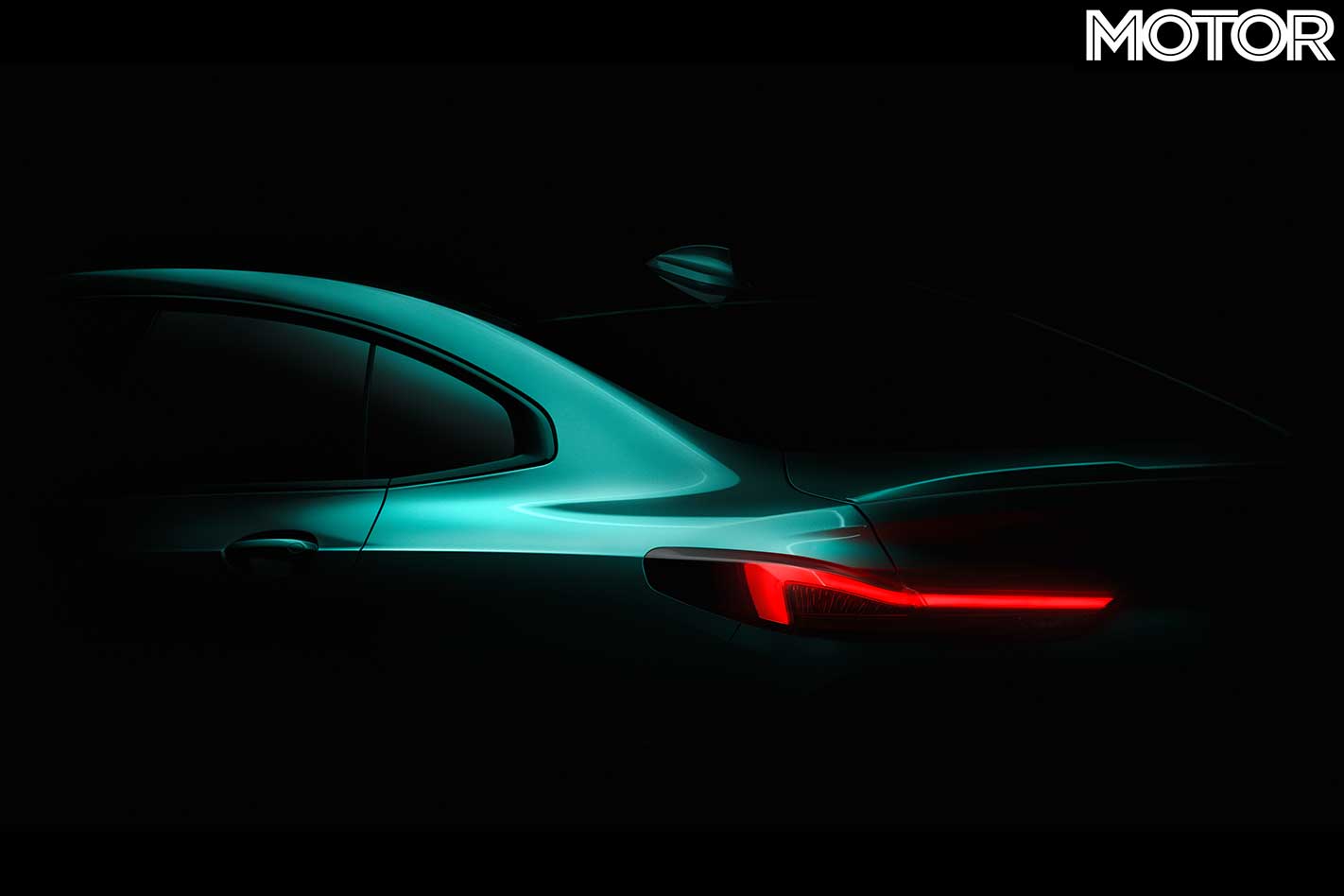
The BMW 2 Series line-up is about to get quite complicated. It was all planned: the next-generation G42 2 Series would share the FAAR platform with the upcoming F40 (yes, really) 1 Series. For the majority of models, that will indeed be the case, with the 2 Series Gran Coupe using three and four-cylinder engines in various states of tune to power either the front or all four wheels.
However, that would leave a sizeable rear-driven gap where the current 2 Series resides. Our best information is that a new rear-drive M2 will appear in late 2022, but whether it will use a new platform or a version of that used by the Z4 and Supra is still unclear.
Introduction
The SsangYong Musso XLV is the long-wheelbase version of the Musso dual-cab, released last year, with this stretched variant measuring a touch over 5.4 metres in length, with that additional size allowing the XLV to boast a longer rear tray and the ute segment’s highest payload capacity (1025kg in ELX with leaf-spring rear) as a result.
The SsangYong XLV is available in three model trims – ELX, Ultimate and Ultimate Plus – all powered by a EU6-compliant 2.2-litre four-cylinder turbo-diesel engine that pushes out 133kW of power at 4000rpm and 420Nm of torque (1600-2600rpm), backed by the choice of either a six-speed manual or six-speed auto gearbox.
SsangYong is predicting the XLV to end up accounting for up to 60 per cent of Musso sales.
Style
The XLV hides its increased overall length reasonably well, with a side profile that is slightly wedge-shaped from front to back.
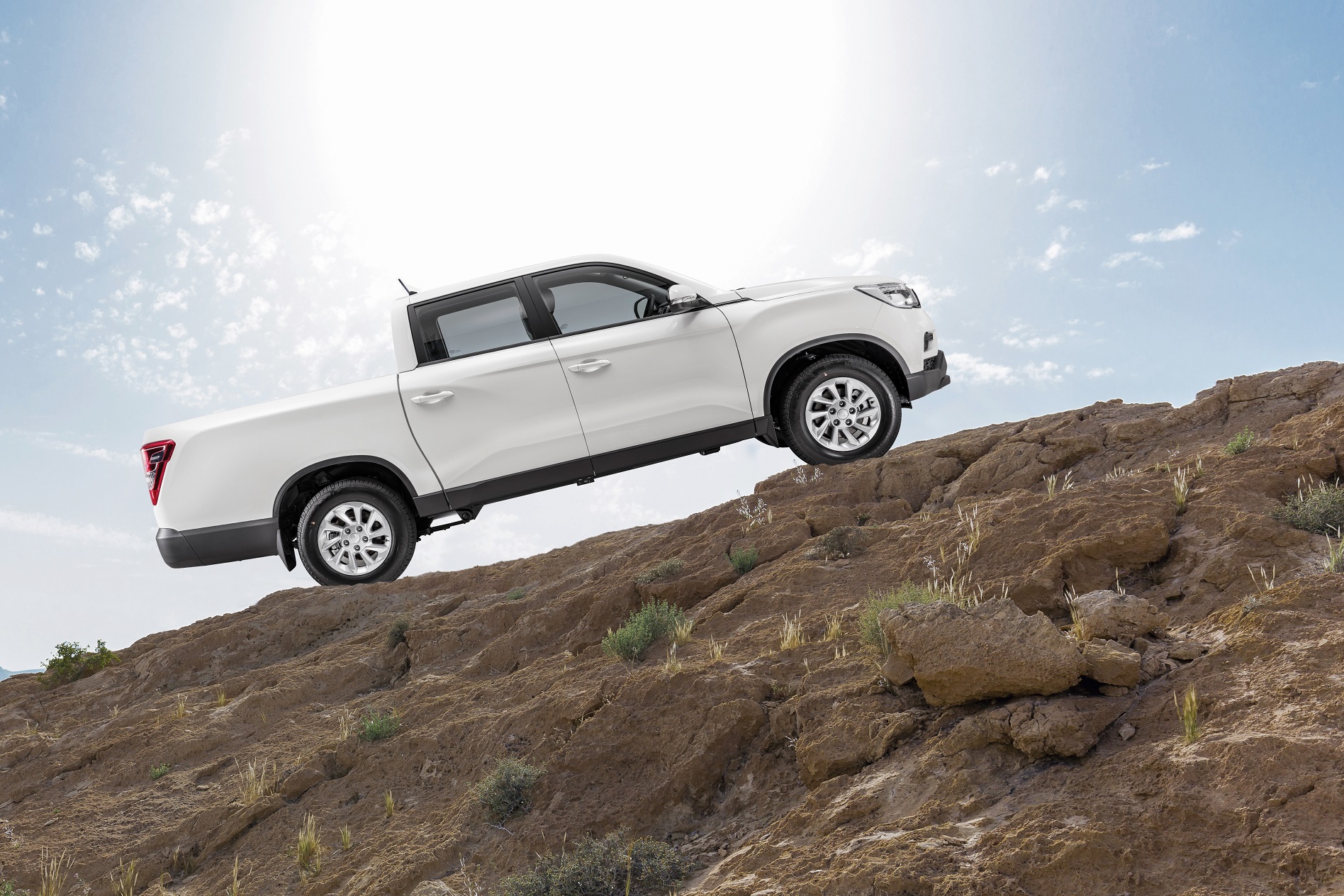
The sheer bulk of the high sided rear tray does dominate the standard wheelset, regardless of whether it’s the 17-inch alloy wheel equipped ELX, or the Ultimate Plus sitting on its stock 18s (or optional 20s), making them look a tad inadequate.
The long, wide-opening doors are the first indication of the additional length, with the wheelbase extended by 110mm allowing additional legroom in the rear as well as easier ingress to the vehicle.
It’s the monstrous rear load tray that really stands out style-wise, though, as it is not only long – at 1610mm, it’s 310mm longer than the SWB Musso – but it’s also deep. The rear tray includes four low-set sturdy tie-down points, as well as a 12V outlet.
The interior impresses with a grey and black palette matched to a mix of hard and soft-touch surfaces. The range-wide 8.0-inch multimedia screen (Apple CarPlay, Android Auto standard on Ultimate and Ultimate Plus variants and Bluetooth across all models) sits front and centre and is easily accessed by the driver or passenger and intuitive in use.
Seating is fabric for the ELX, ‘Endure-Lite’ for Ultimate (these are also heated and cooled), while Ultimate Plus owners score powered leather.
WhichCar tested both an ELX and the Ultimate Plus variants and found both vehicles’ seats firm but supportive and comfortable. Rear seating is also comfortable for adults, with sufficient legroom for a 180cm tall adult to sit comfortably.
All switchgear (indicators, lights, windows, mirror-adjust, and 4WD settings) is easy to hand and very easy to operate. Fit and finish is surprisingly good, with tight gaps on panels and a reassuring thud when the doors close.
Price and value
The XLV is highly specced across the range, with standard kit including a Limited Slip Diff, 8.0-inch multi-media system, six airbags, reverse camera, six-speed manual gearbox, Autonomous Emergency Braking and Lane Departure Warning all standard kit across the range. The six-speed auto gearbox is a $2k option.
To that aforementioned list, the base-spec ELX adds leaf spring suspension, a fabric interior, 3500kg towing capacity and SsangYong’s industry-leading seven-year/unlimited kilometre warranty. Driveaway price for the ELX is $33,990.
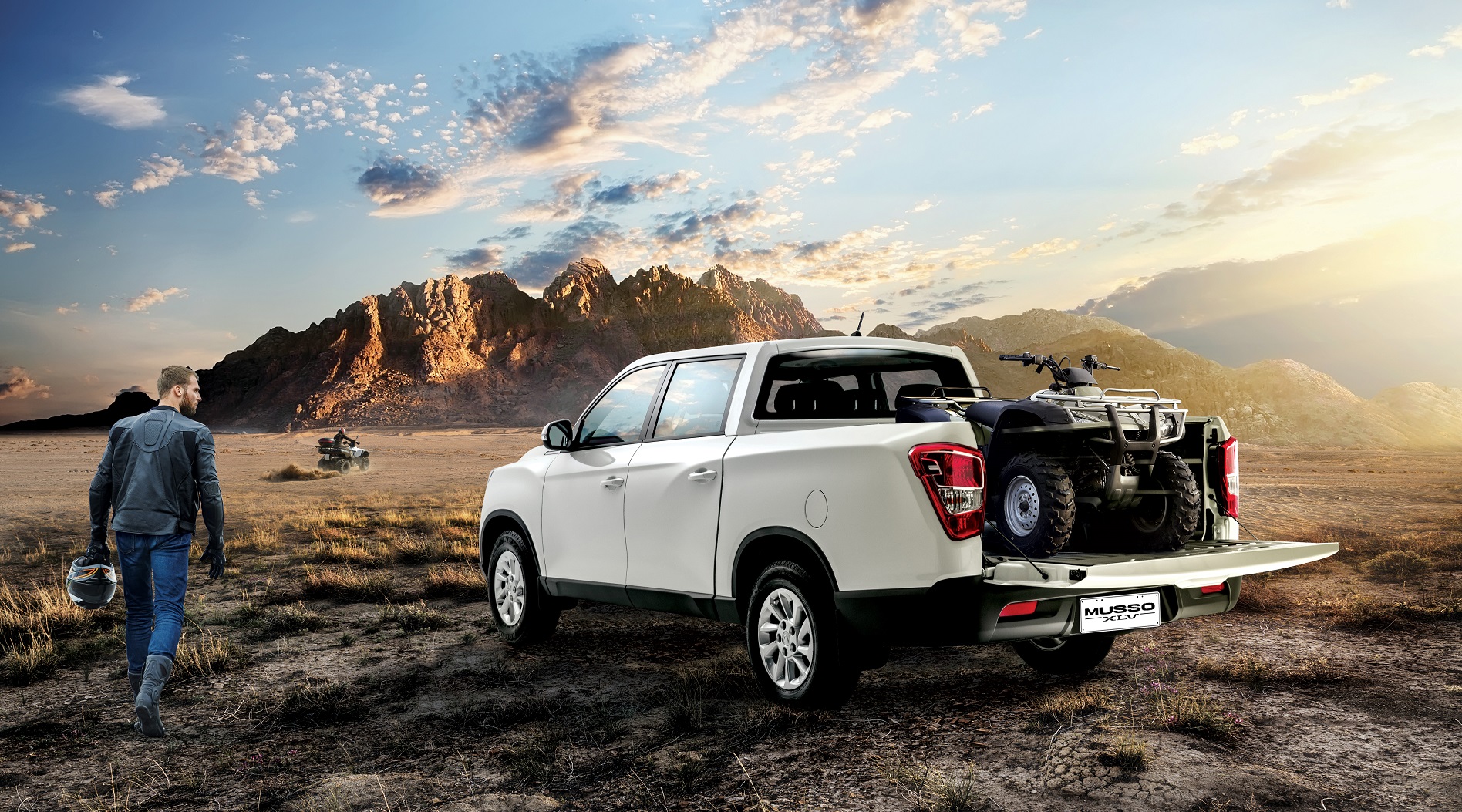
The Ultimate will set you back $39,990 and swaps the leaf spring rear for the multi-link coil setup, adds 18-inch alloys, Lane Change Assist, Daylight Run Lights (DRL), a larger instrument cluster, Front/Rear Park Assist, Blind Spot Detection, Rear Cross Traffic Alert, heated and cooled Enduro-Lite seats and a leather steering wheel.
For the Musso Ultimate Plus ($43,990), you cop speed-sensitive steering, the leather heated/cooled and powered seats, 360-degree camera and HID lights. SsangYong does offer 20-inch alloys as an option, as well as a sunroof.
Compared to other models in the ute segment, the XLV represents excellent value for money, considering its high levels of modern safety tech and driver-aid tech, plus that lengthy warranty and the impressive levels of fit and finish.
Safety
The SsangYong Musso XLV includes plenty of passenger safety technology right across the model range, with six airbags, Autonomous Emergency Braking, Front Vehicle Start Alert, reverse camera and Lane Departure Warning across the three spec levels.
Add in Lane Change Assist, Blind Spot Detection and Rear Cross Traffic Alert on the top two models and you’ve got a comprehensive safety suite – far more so than a number of other competitors in the ute market, such as Isuzu D-Max and Nissan Navara, both of which are more expensive to boot.
Warranty and running costs
If you consider SsangYong’s ‘Triple 7’ of seven-year/unlimited kilometre warranty, seven-year capped servicing and seven years of roadside assist, you can see why SsangYong believes the Musso XLV has the potential to be a big seller.
The 2.2-litre turbo-diesel is claimed to use 8.2L/100km in the combined cycle with the six-speed manual, and 8.9L/100km when backed by the six-speed auto. Combined with a 75-litre tank, it makes for a reasonable – but not great – touring range.
Servicing is getting easier and more convenient too, thanks to the growing dealer network. Currently, there are 40 dealers, and SsangYong claims there will be 50 by the end of the year. Impressive indeed when you consider the company started with 22 only in January of this year.
On the road
SsangYong engineers have done a lot of work to ensure the Musso XLV is comfortable on Aussie roads both sealed and unsealed, with the XLV suspension an evolution of that on the Musso short-wheelbase.
The company is also currently in the final moments of finalising a local suspension tune (and, further down the line, an OE accessory lift kit, using the same tune). Even now, without this new tune, the on-road handling impresses.
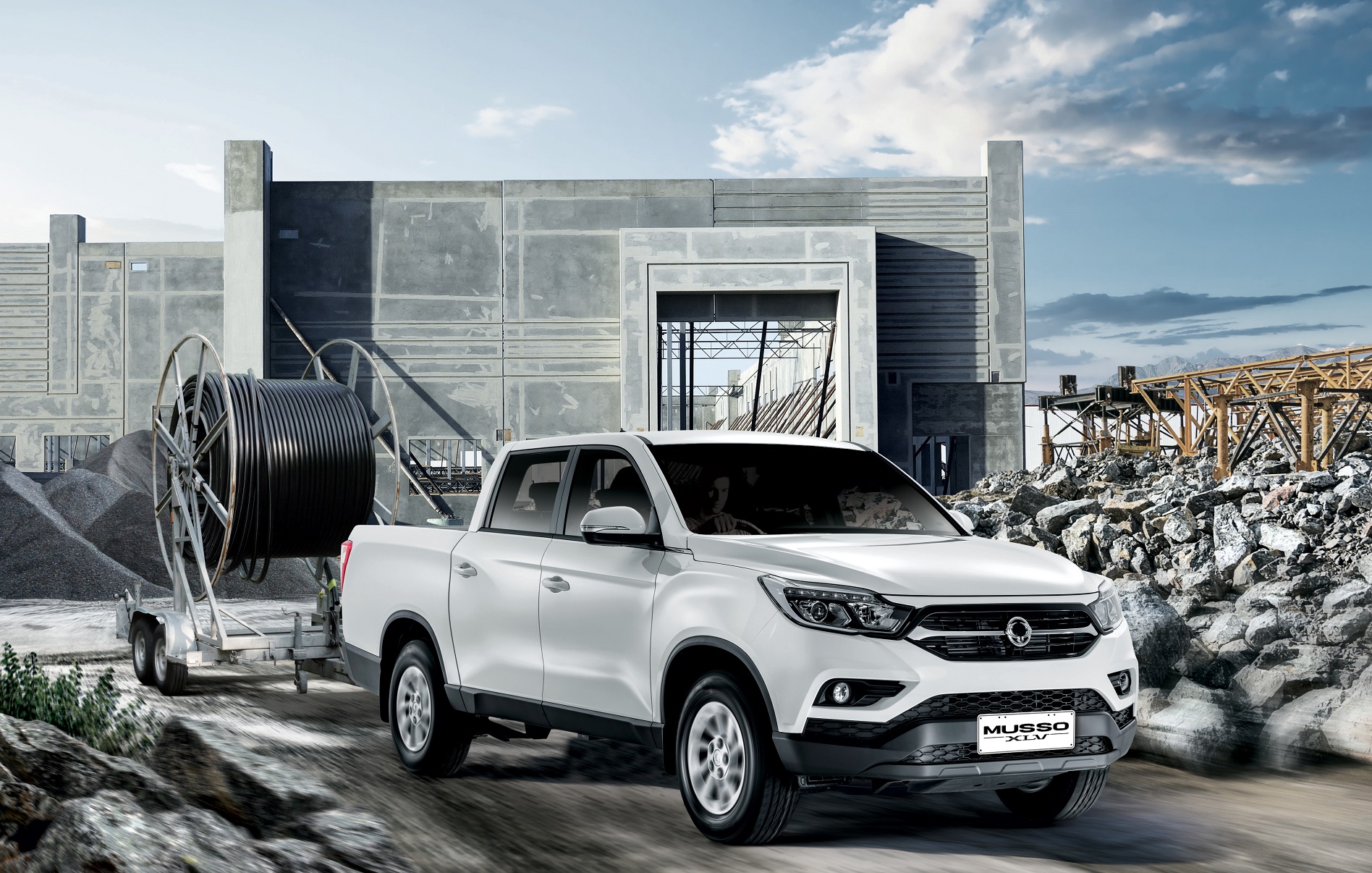
Surprisingly, it is the leaf-sprung ELV that is the better-handling vehicle on bitumen. The ride is firmer than the coil-sprung Ultimate Plus, but it feels more planted and connected to the road surface. The coil-spring variants feel a little more nervous on-road, while the steering on the Ultimate Plus transmits more road vibration back through the steering wheel.
The 2.2-litre TD feels a mite underpowered on the road, with acceleration from a standing start nothing exciting but offset by the more dynamic rolling-speed performance.
And speaking of performance; even when under acceleration, the vehicle is astonishingly quiet. The cabin, in fact, would rate as one of the quietest in the dual-cab ute market, with very little road or engine noise audible from inside.
Off the road
There’s no getting around the fact the Musso XLV is long, and one of the negatives of this is a low ramp-over angle when driving off-road; that long belly looks, at first appearance, to be way too low to traverse even slight lumps on the tracks.
The XLV belies its long and low appearance, however, and on our sometimes-challenging 4×4 test track, didn’t scrape its underbelly once. We still think a two-inch lift would be a welcome modification, however; the ute tray’s long overhang is quite vulnerable to steep drop-offs.
The 4WD system in the XLV is straightforward in use and quite effective; a simple twist of the console-mounted bezel selects either 2WD, 4WD High or 4WD Low, with the Low setting called into action for some particularly steep and slippery Victorian High Country trails during the test drive.
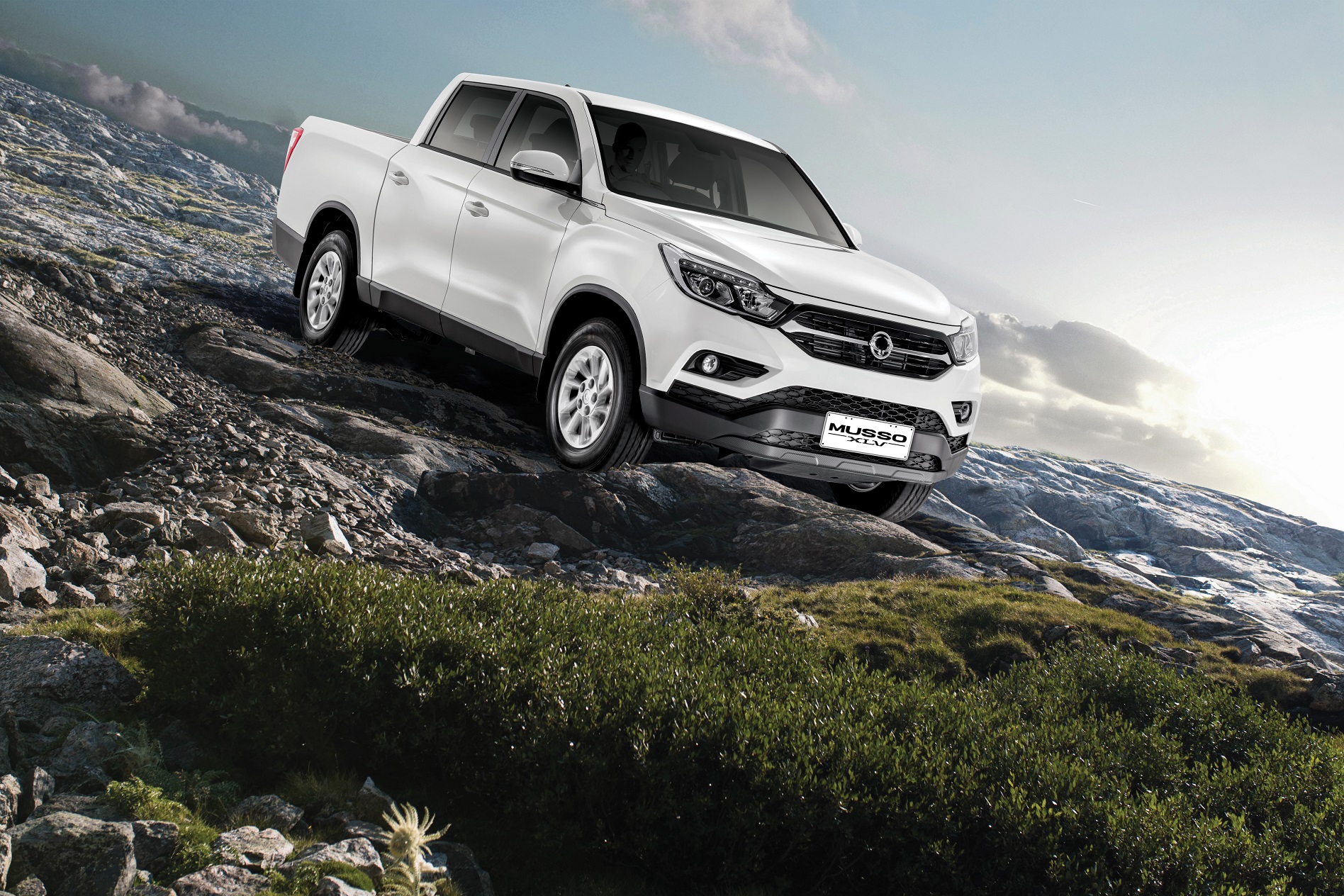
The XLV’s Hill Descent Control is relatively effective, although we’d like to see the minimum speed set to 1 or 2km/h, rather than 4km/h. In very steep, slippery terrain, being able to rely on a very low speed significantly improves the ability to negotiate challenging terrain.
Verdict
Ssangyong is very confident that the Musso XLV has what it takes to be a genuine competitor in the 4×4 dual-cab ute market. With its very keen pricing and high spec levels – not to mention the surprisingly adept on- and off-road performance, the XLV definitely sits above a number of other models in the ute market.
But, the problem will be actually getting buyers to consider the model, or indeed the brand. With its chequered history Down Under, SsangYong knows it has a hard job ahead to convince prospective buyers to have another look at its many models.
With strong enthusiasm from SsangYong Australia’s team, headed by managing director Tim Smith, and with vehicles such as this Musso XLV, it might just be the perfect combo to make it happen.
Model: SsangYong Musso XLV
Engine: 2157cc 4-cyl turbo-diesel
Max power: 133kw @ 4000rpm
Max torque: 420Nm @ 160-2600rpm
Transmission: 6-speed manual/6-speed auto
Weight: 2160kg (leaf) 2170kg (coil)
Economy: 8.2L/100km (manual); 8.9L/100km (auto)
Price: from $33,990
Cadillac has introduced two new models to its V-Series performance brand, the 2020 Cadillac CT4-V and CT5-V.
Powered by a twin-turbo V6 pumping out 265kW/542Nm, the CT5-V (below) comes rear-drive as standard, with an electronic LSD, magnetic dampers, and a chassis tuned for the V-Series range specifically.

The CT-4 (below), however, runs with a 2.7-litre turbo four putting out 239kW/500Nm and features the same LSD, damping, and chassis features as the CT5-V.
Both are yet to be passed through SAE certification, so Cadillac says the power figures are estimates, but they’re both specific enough that it’s unlikely they’ll change.

Both models are also the first to wear their respective badges.
GM president Mark Reuss says there’s still more to come for the V-Series, even going as far as to mention the ‘R word’ – racetrack.
“The new lineup expands the V-Series ethos, drawing more customers into the Cadillac Performance family, and the newest Vs are focused on elevated athleticism and luxurious refinement for customers wanting a dynamic daily drive.”
“And this is only the beginning of the V family. Cadillac’s passion for performance shines on a racetrack. Stay tuned.”

Cadillac executive chief engineer Brandon Vivian agrees that the new models should appeal to “even more customers” and expand the appeal of the V-Series range.
“We are inviting even more customers into the V-Series family by adding a new level of elevated performance between our Sport models and the ultimate, high-performance track capability that the V-Series has grown to represent.”
As for Australia, Holden has repeatedly told MOTOR not to expect Cadillac to land locally aside from LHD test cars which are Lang Lang-bound.
We’re sure the V-Series would be welcomed with open arms.
This week we saw a new era of partisanship begin in Canberra led by two blokes named ScoMo and Albo, who sound a bit like an FM breakfast show duo but with less credibility.
The former said his government will burn for Australians. We’re not sure if he meant as in pants on fire or if he’s taking a leaf from everyone at the WhichCar Network who have been absolutely sizzling this week in bringing you all the latest in motoring news, reviews and advice.
Unfortunately, it wasn’t all good news with ANCAP announcing it was following Europe’s lead in awarding the long-waited Jeep Wrangler a pitiful one-star safety record, though that didn’t stop 4X4 Australia’s Justin Walker trying it out in Tasmania to pen his Wrangler first-drive review.
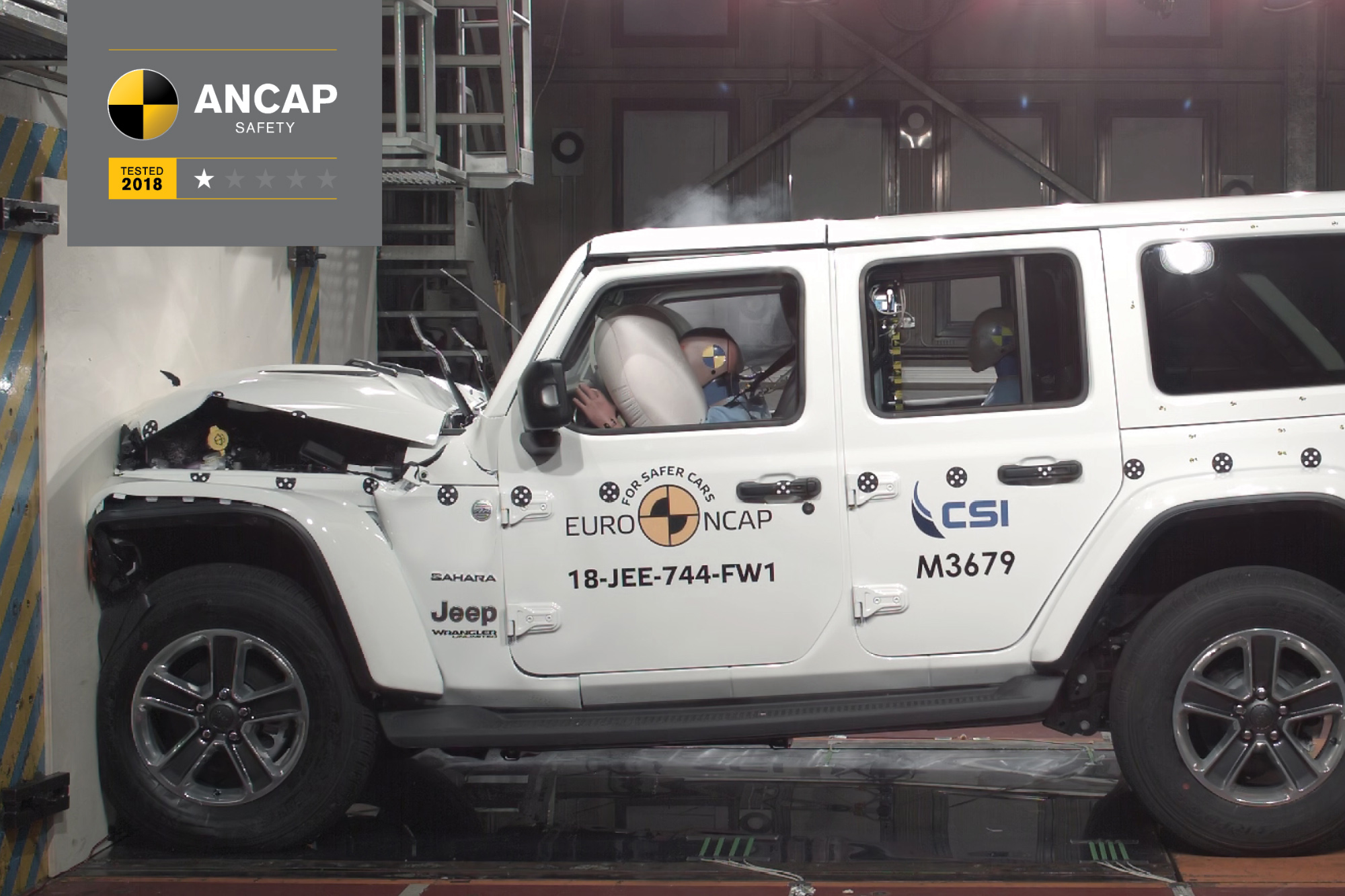
Ouch!
Speaking of safety, most people are probably using baby car seats in a potentially dangerous manner, and drug testing of drivers is facing a legal challenge.
The Wrangler’s woes didn’t seem to have hampered FCA’s overtures to Renault for a 50/50 merger. The French carmaker seems quite keen to swipe right, but what will that mean for its other dalliance with Nissan and Mitsubishi?
There was mixed news for early-adopting Aussies who handed down a deposit a Tesla Model 3 back in 2016. Government documents confirm at least two Tesla Model 3 variants are coming to Australia possibly by the end of the year, but that’s if Elon’s company can stay afloat as its mainstream rivals play EV catch up – at least enough to resume buying toilet paper for its staff.

The motoring circle of life was plain to see with Mazda ditching the excellent twin-turbo diesel from the Mazda 6 range and Audi confirming it’s killing the TT. Conversely, we welcomed the new BMW 1 Series, BMW X1, Volkswagen Polo Style, and learned Aussie pricing for the new Volvo S60/V60 mid-sizers.
Our hardworking video team can almost take a breather with the penultimate episode of Season 1 of WhichCar TV airing on Channel 10 this Sunday – you can also catch the last four episodes at a time that suits you by heading to TenPlay.
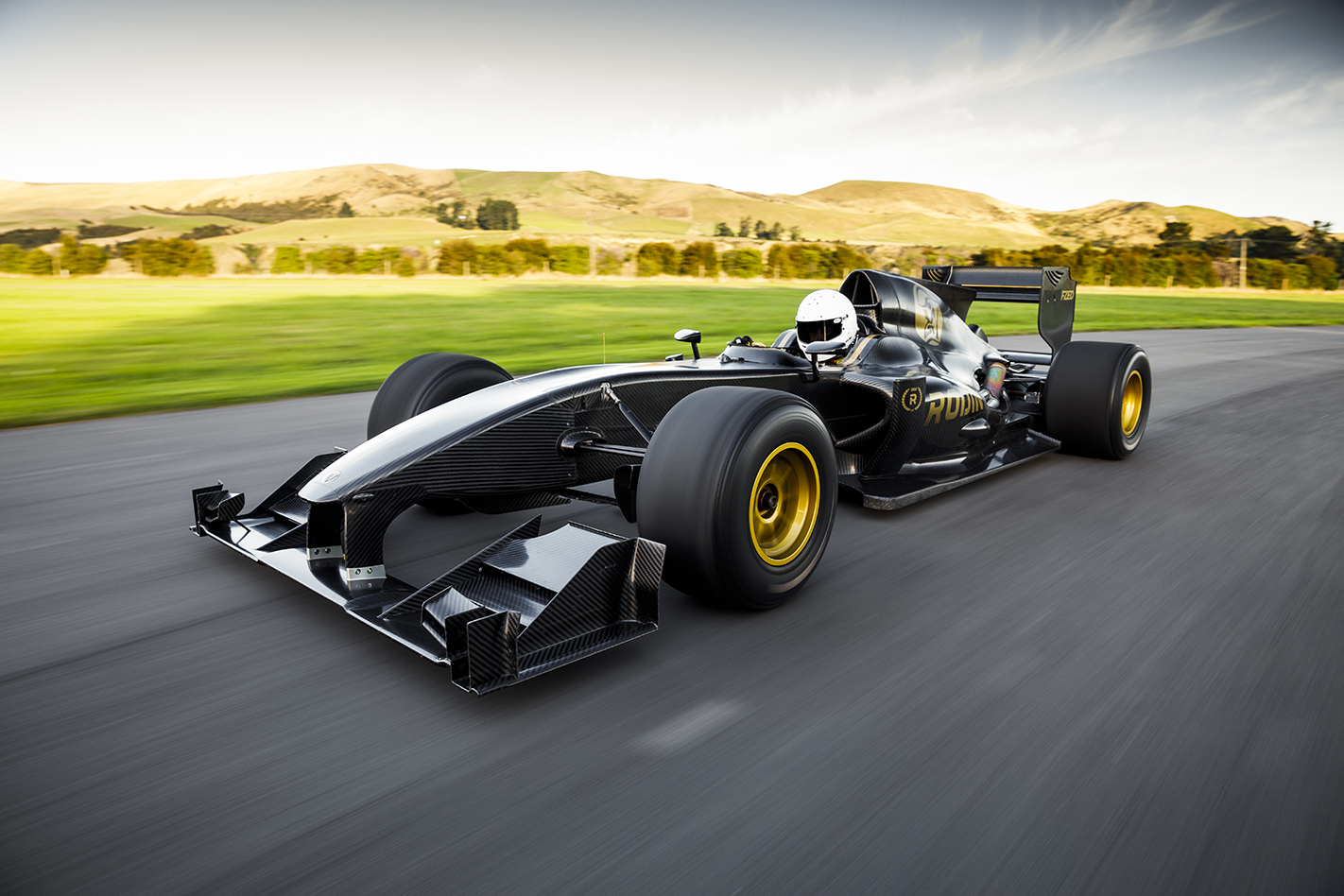
This week on WhichCar TV …
Completing our multi-media onslaught is Episode 21 of the WhichCar Weekly Podcast.
See what we mean by being on fire? But wait, there’s more with the WhichCar team finding time to review the 2019 BMW 3 Series range, Subaru BRZ Premium, and our long-term Porsche Cayenne E-Hybrid, Nissan X-Trail, Hyundai Ioniq, and, for the final time, our Volkswagen Tiguan Allspace – see ya big fella.
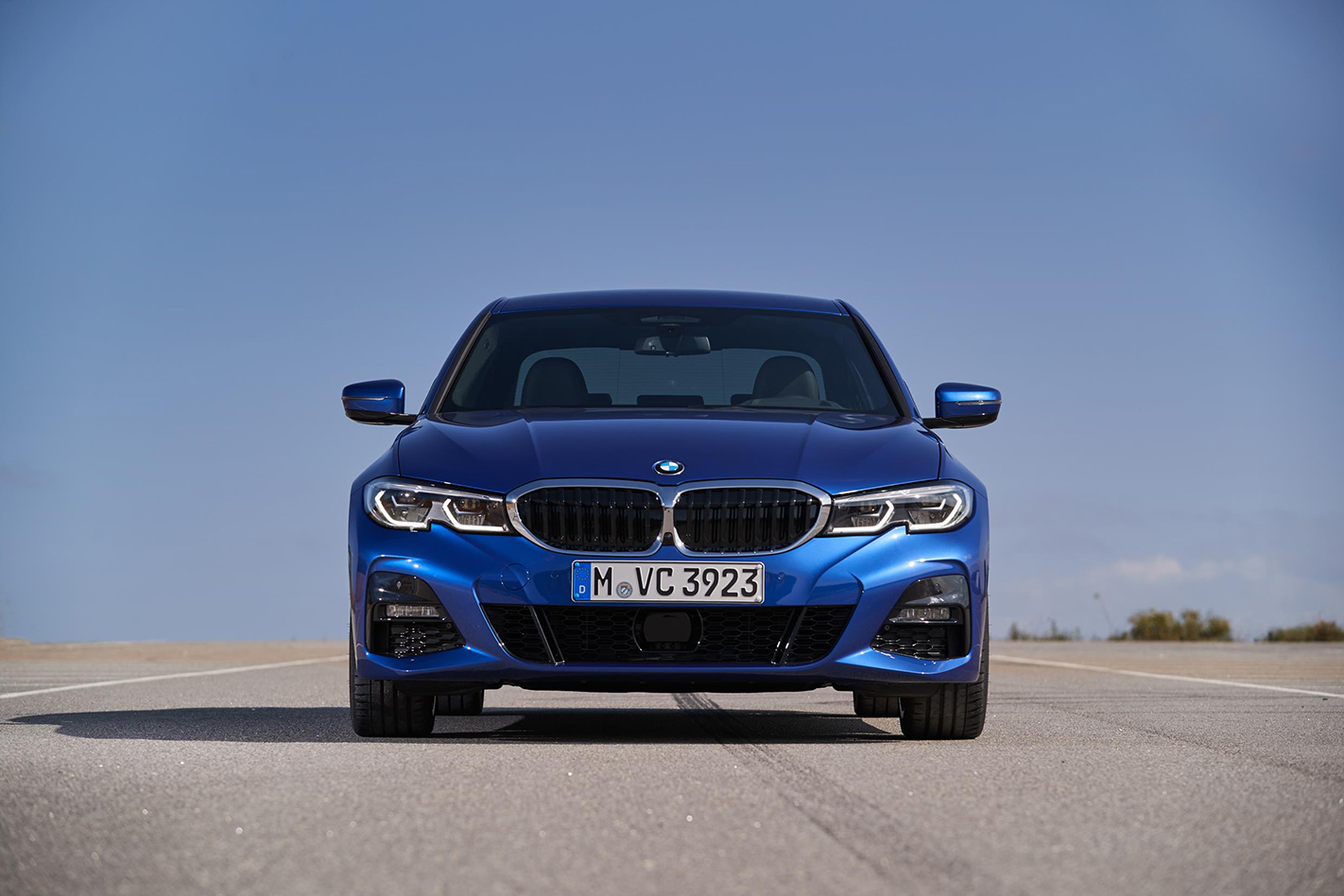
Have a great weekend. Oh, if you’re anywhere near Sydney Motorsport Park on Sunday, be sure to come to Unique Car’s first-ever ‘Rolling 30’ cars and coffee event.
SsangYong has revealed pricing and specifications for its Musso XLV, the latest addition to the South Korean brand’s renewed Australian line-up.
Priced from $33,990 before on-road costs, the new Musso XLV is arguably the biggest and best-value 4×4 dual-cab ute on sale in Australia.
Not only will the brand offer one of the most affordable dual-cabs in Oz, but class-leading tray length and a seven-year warranty to match in what the brand hopes will grow the SsangYong name in Australia.
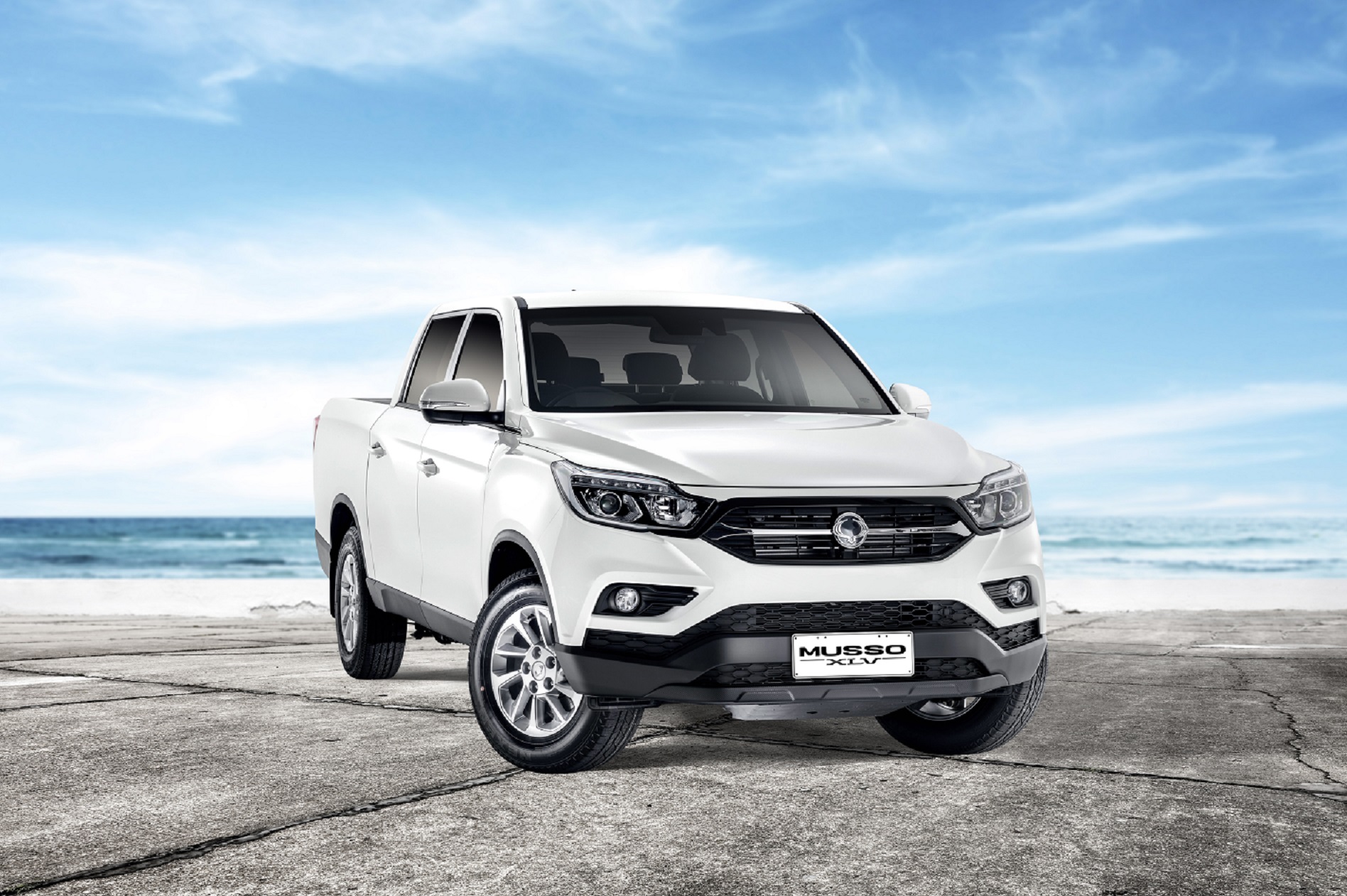
The XLV will share the same engine as the short-wheelbase Musso, a 2.2-litre four-cylinder turbo-diesel engine good for 133kW of power and 420Nm of torque (20Nm more than SWB Musso), paired with either a six-speed manual or six-speed automatic, both with a selectable four-wheel drive system.
Thanks to its long-wheelbase, the XLV gains an extra 310mm of tray space, giving it a total length of 5.4 metres and the segment’s highest payload capacity of 1020kg (in ELX with leaf-spring rear). SsangYong says the rear tray can hold up to 1262 litres of cargo volume and comes fitted with 12V and 120W power outlets and tie-down points.
Customers can choose from three trim levels. The base ELX, which is priced from $33,990 (plus ORCs), mid-spec Ultimate starting at $39,990 (plus ORCs) and the range-topping Ultimate Plus model which starts at $43,990 (plus ORCs).
Brands like Mahindra (Pik-Up S6 dual cab at $29,990) and LDV (T60 Pro at $30,516) offer more affordable utes, but come with far less spec as standard.
Comparing the Musso to the Mitsubishi Triton GLX+ dual-cab 4×4 at $39,990, the Toyota HiLux Workmate 2.4 dual-cab at $43,990 and the Ford Ranger XL at $47,590, the SsangYong certainly has sticker appeal. All prices are before on-road costs.
The base model ELX will come with a leaf-spring rear end which allows for more than 1000kg of payload, while a multi-link rear suspension set-up, 18-inch alloy wheels and an 800kg payload are exclusive to Ultimate and Ultimate Plus variants.
Inside, entry-level ELX variants get fabric seats, while upgrading to the Ultimate gets you ‘Endure-Lite’ seating with heating and cooling and top-spec models get heated and cooled electrically-adjustable leather seats.
Across the range, each Musso XLV gets an 8.0-inch infotainment unit fitted with Apple CarPlay and Android Auto, as well as a decent level of safety equipment including autonomous emergency braking (AEB), forward collision warning and lane departure warning.
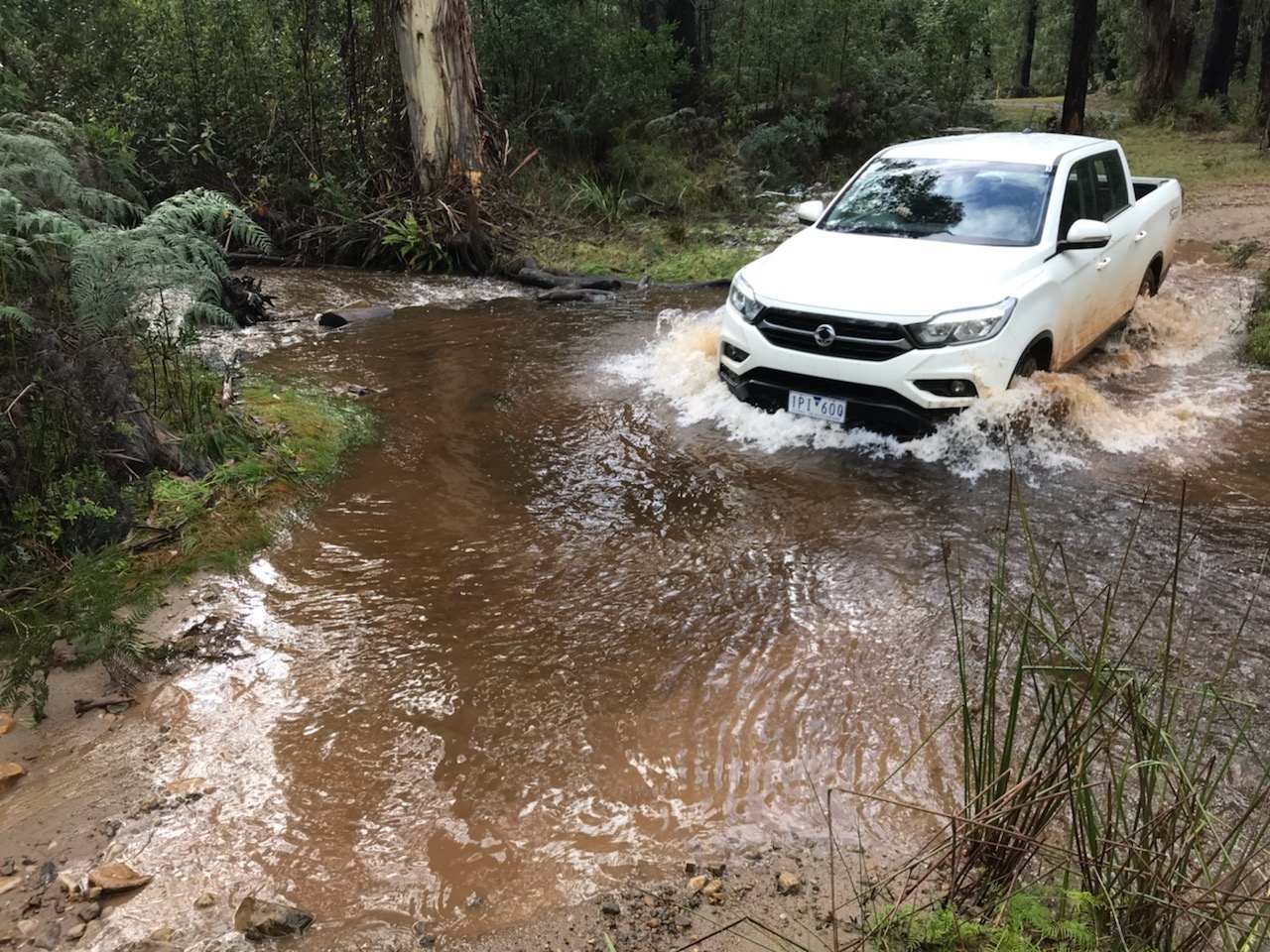
Ultimate and Ultimate Plus variants get added safety extras such as blind-spot monitoring and rear cross traffic alert, as well as HID headlights and a 360-degree camera. Metallic paint and a sunroof can also be optioned on both models.
Eight exterior colours options include Silky White Pearl, Grand White, Fine Silver, Space Black, Marble Grey, Indian Red, Atlantic Blue and Maroon Brown.
The brand also offers a seven-year warranty for the new Musso, two years more than established dual-cab players like the Ford Ranger and Toyota Hilux get as standard.
Making bold statements isn’t a new concept for car companies. And in terms of trying to save a certain model from the tuning world, history is against General Motors.
Nissan emphatically stated upon release of the R35 GT-R that it would be a no-go zone for tuners, claiming that any modifications would detract from the overall package. Hindsight unequivocally disproves the original theory.
However, General Motors is giving it another crack with the upcoming eighth-generation Corvette, with inside sources telling Muscle Cars & Trucks that GM is branding its Electronic Control Unit (ECU) ‘untunable’.
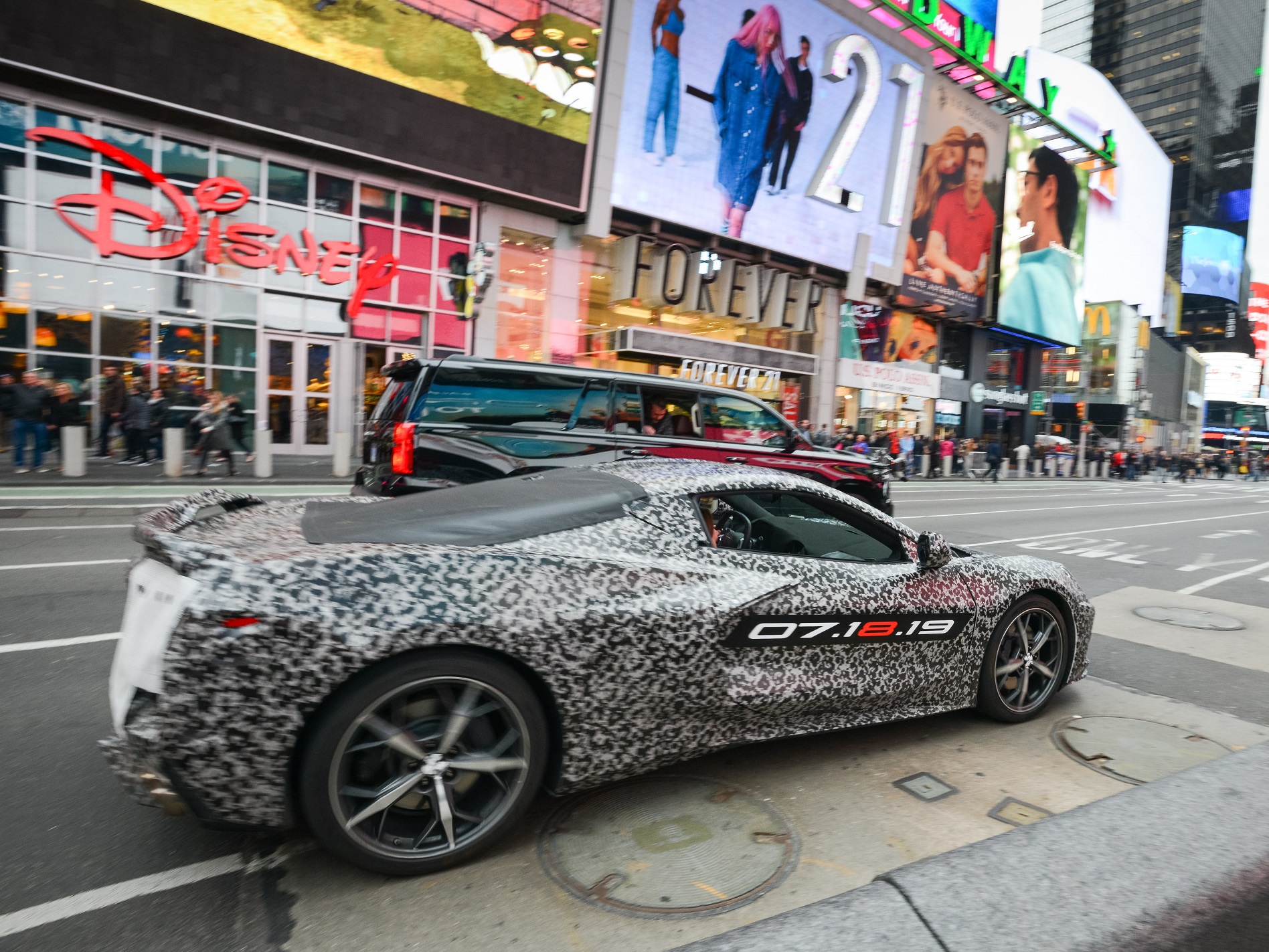
Said to be using a complex, secure and encrypted ECU (which isn’t uncommon in the industry), the extra security will supposedly stave off the ability to replace the unit – or even read or write to it. If the sources are correct, even merely reading the ECU’s code will be fraught with danger.
While that sounds like waving a red flag in front of the tuning bull, get it wrong and its rumoured to trigger a ‘recovery mode’, essentially crippling the car with the computer needing to be rebooted to eradicate the unauthorised code.
Ultimately, like the iconic R35 GT-R, this approach is unlikely to hamper the efforts of tuners; where there’s a will, there’s a way. Given the popularity of aftermarket, go-faster kits for the current C7 Corvette, it seems unlikely that the C8 won’t be tinkered with.
The upcoming model is already a massive departure from the front-engine, rear-wheel drive Corvette formula, with Chevrolet confirming its mid-engine layout.
As reported by Wheels in April, the C8 could receive a 6.2-litre naturally aspirated V8 (renamed LT2) with around 370kW initially, with room for higher-spec units with forced induction in the future. A seven-speed dual-clutch is also supposedly on the menu.
Official confirmation of the C8 Corvette’s specifications will be revealed at the launch in California on July 18.
It was inevitable. A new AMG model means only a few months until Brabus releases a ludicrous, much faster and louder version. Of course, the 2019 Brabus 800 GT is that to its AMG GT63 S donor.
AMG’s 4.0-litre twin-turbo V8 has been given the Brabus treatment. With 588kW and a frankly bananas 1000Nm of torque, the 800 GT is claimed to be able to hit 100km/h in an almost-911 GT2 RS-rivalling 2.9 seconds.
AMG’s 9-speed Speedshift transmission and ‘4Matic+’ all-wheel drive systems remain in place, providing the traction and sharp shifts required for that acceleration. If that’s a concern given the extra power, Brabus’ confidence in the standard drivetrain (even with its power incease) is such that it offers a three-year or 100,000km warranty.
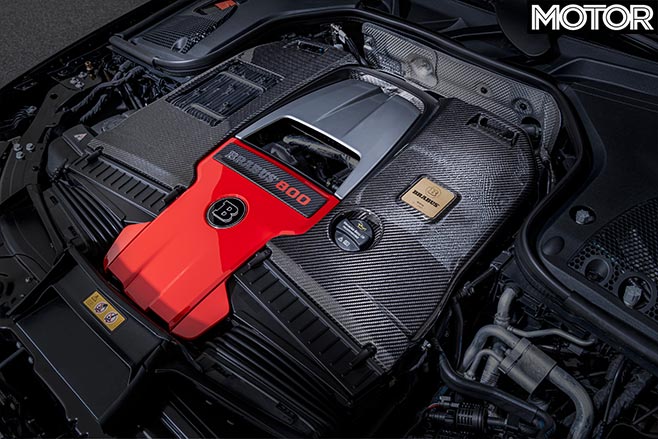
The changes Brabus has made, however, are focused on the engine. What Brabus calls the ‘PowerXtra B40S-800 performance upgrade’ is a modification to the turbos, with new Brabus turbochargers designed for more boost compression – up to 1.6 bar or 23.2psi.
Brabus has its way with the AMG GLC63
“Recalibrating the boost-pressure control and further optimizing the power delivery without impairing the durability required reprogramming the mapping of the electronic engine control unit.
“To this end, Brabus conducted extensive testing on stationary engine test benches of the latest generation. At the same time, road testing was conducted on racetracks and in traffic.”
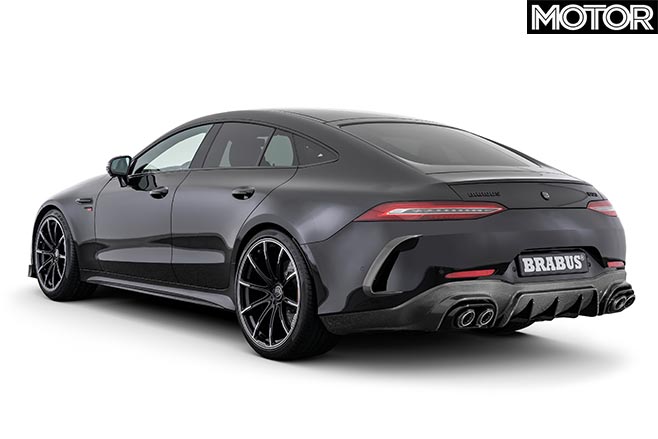
But it can’t be a Brabus without looking like the devil himself might consider buying one. Black everywhere, of course, with hints of carbon on what Brabus says are working aerodynamic modifications.
Ever wanted a Brabus Smart Fourtwo?
With a top speed of 315km/h aero is important, so Brabus has included its own front spoiler to “reduce front-axle lift at high speeds”, a larger set of intakes, and a new rear diffuser in carbon, surrounding the tailpipes.
Brabus also developed new wheels for the 800 GT, 21-inch and 22 at the front and rear respectively, in 10-spoke design forged to reduce unsprung mass without sacrificing strength. The tyres wrapped around these wheels (from Continental, Pirelli or Yokohama) are 275/35 at the front, and very wide 335/25 rubber at the rear.
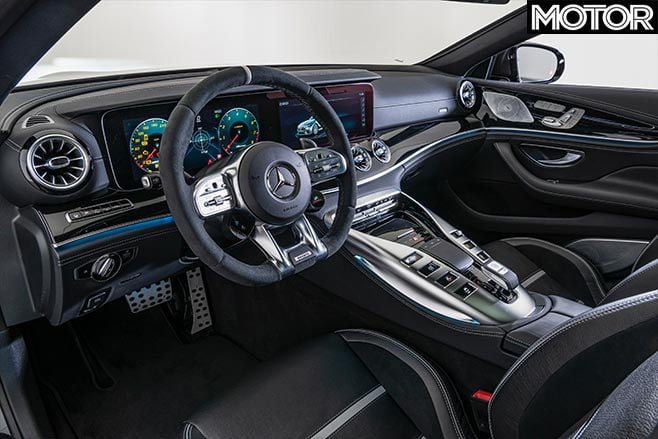
Of course, the interior is refitted with Brabus’ leather seats, dark colour scheme, scuff plates, aluminum door pins and pedals, wood or carbon inlays, and plenty of Brabus badging.
Check out the gallery of gorgeous details at the top of this page!
In an unplanned 1000 brake horsepower special, Andy, Dan and Scott get together once again in the Bauer bunker to discuss their highlights of the motoring week.
Kicking off the chat this week – BMW’s reborn 8 Series. Andy and Dan regale their experiences behind the wheel of the original E31 8 Series, before Scotty weighs in with his tuppence worth and whether the new version is the true spiritual successor or unrecognisably evolved.
Later, the chat turns to Ferrari’s pivotal new model – the SF90 Stradale. The manic mid-engined model marks a long list of firsts for the prancing horse, including plug-in power and numerous technological advances, but are they accessible gains in a world where tightening regulations and rules loom ominously?
And, fresh from a first encounter with the Chevrolet Camaro ZL1, Andy is bound and gagged for first impressions until next week, but it gives us an idea. In an age of sophisticated electronics and mandatory safety systems, can you still buy a truly unhinged horsepower hero?
If you’re on the go, you can find WhichCar Weekly on all manner of podcast apps including iTunes and Podbean, please rate, subscribe and leave a review! You can also follow the day-to-day happenings of the WhichCar team on Facebook, Twitter and Instagram @whichcarau.
Listened to the show? Help us out:
- Leave a note in the comment section below.
- Leave a review on Apple Podcasts/iTunes
- Subscribe to our podcast
We’ve taken some of the more popular sedans and liftbacks on sale today and compared their backsides to see which has the biggest booty in each class.
How boots are measured
Boot space unfortunately is not measured in by length and width; it’s either litres, or the cubic-foot measurement equivalent of a litre. This does not provide a quick sense of size if you need to fit an Ikea flatpack or a large pram, and also does not take into account a narrower space, wheel arches eating in to the cargo area, or how high one can stack one’s stuff.
So when car-hunting, be aware of what you will be carrying, and have a tape measure handy to ensure the boot accommodates your needs.
Light/small sedans
Mazda 2 | 410 litres
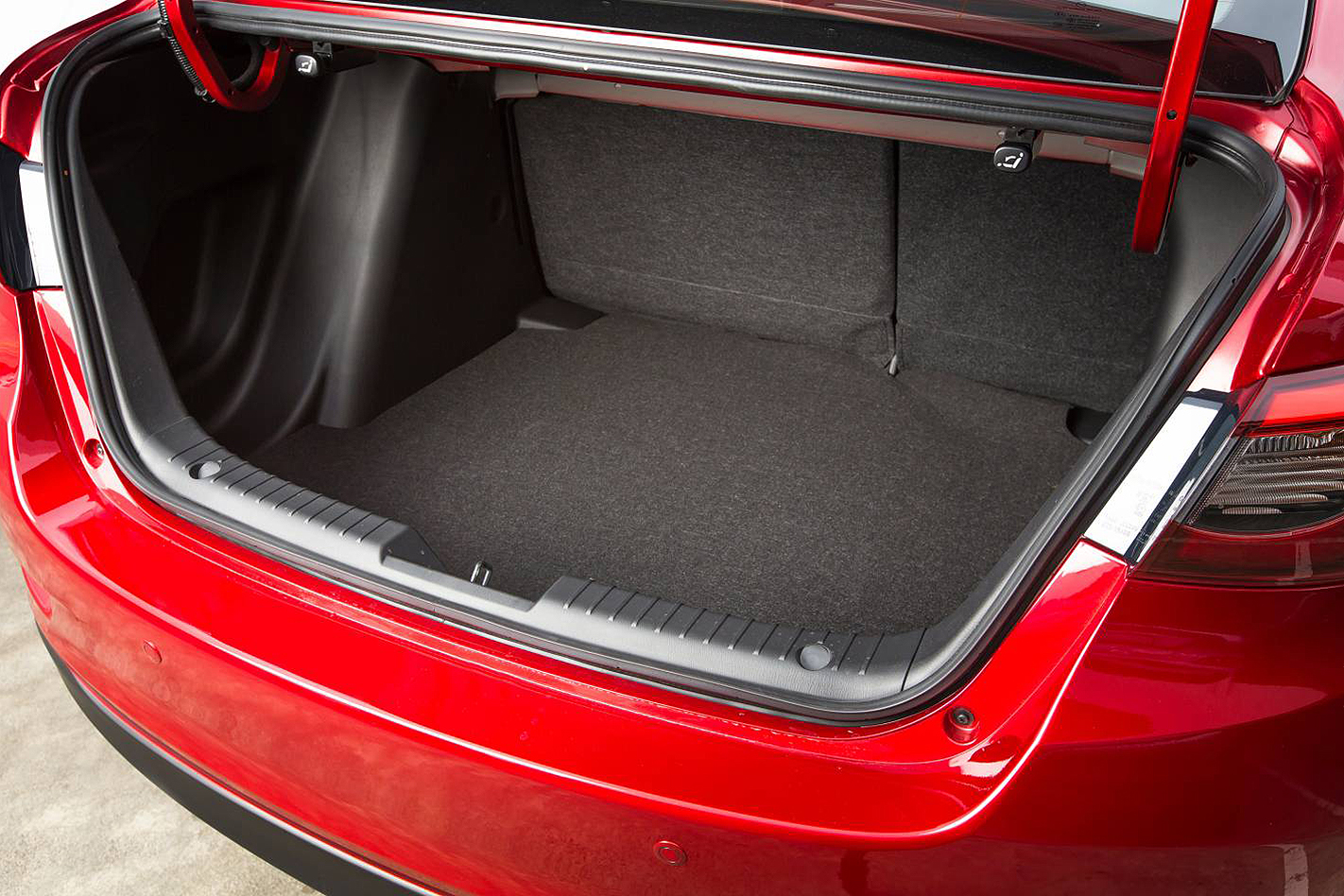
The little Mazda 2 sedan’s boot is a more practical option than the hatch’s 250-litre hold. Like the hatch it has 60:40 split-folding rear seats.
Mazda 3 | 444 litres
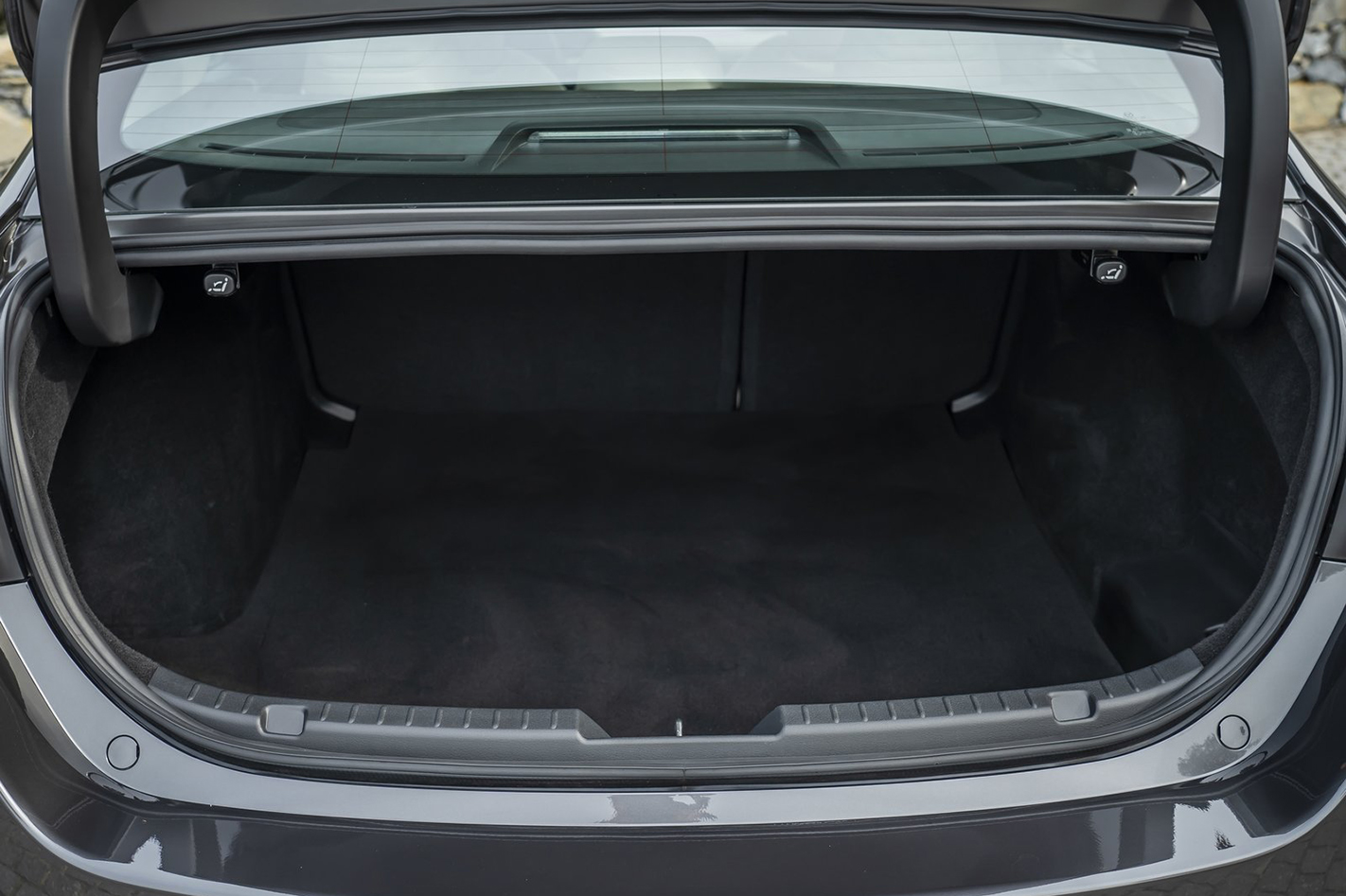
The new Mazda 3 sedan holds 444 litres which is 36 litres more than the previous model sedan, and 149 litres more than the new hatch. The 60:40 split rear seats fold down to accommodate longer objects.
Hyundai Elantra | 458 litres
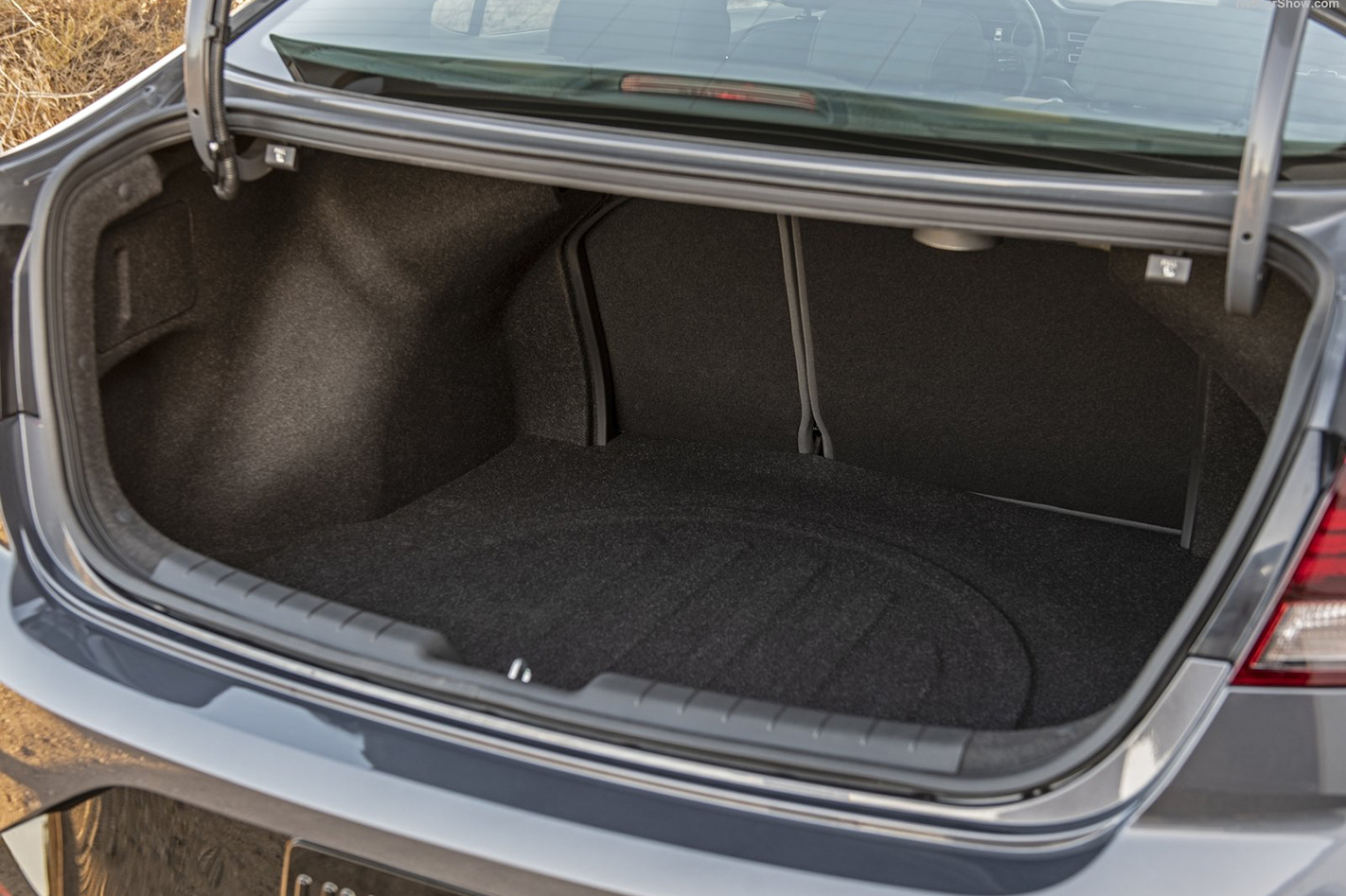
From the outside the Hyundai Elantra’s boot looks quite small, but pop the lid and there’s a deep, broad space that’s relatively short but has room for a couple of big suitcases. There’s a 60:40 split-folding rear seat, allowing long items to protrude into the cabin.
Hyundai Accent Sport | 465 litres
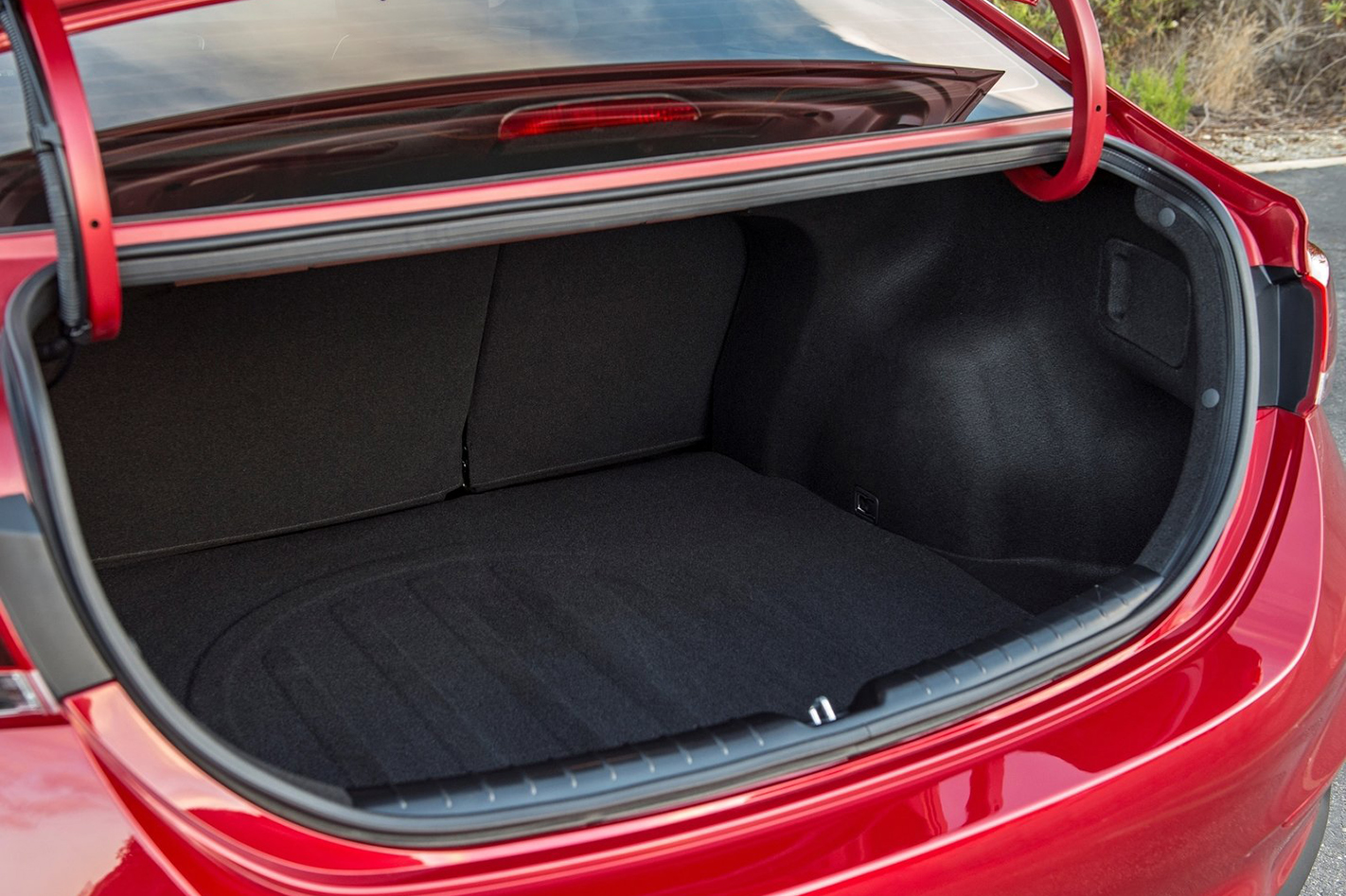
One of the smallest sedans on the market, the Hyundai Accent Sport has a decent 465 litre boot even with a full-size spare wheel under the floor. The boot lid opens wide to help fit bulky items and the rear seats fold down to accommodate longer objects including a bicycle.
Toyota Corolla | 470 litres
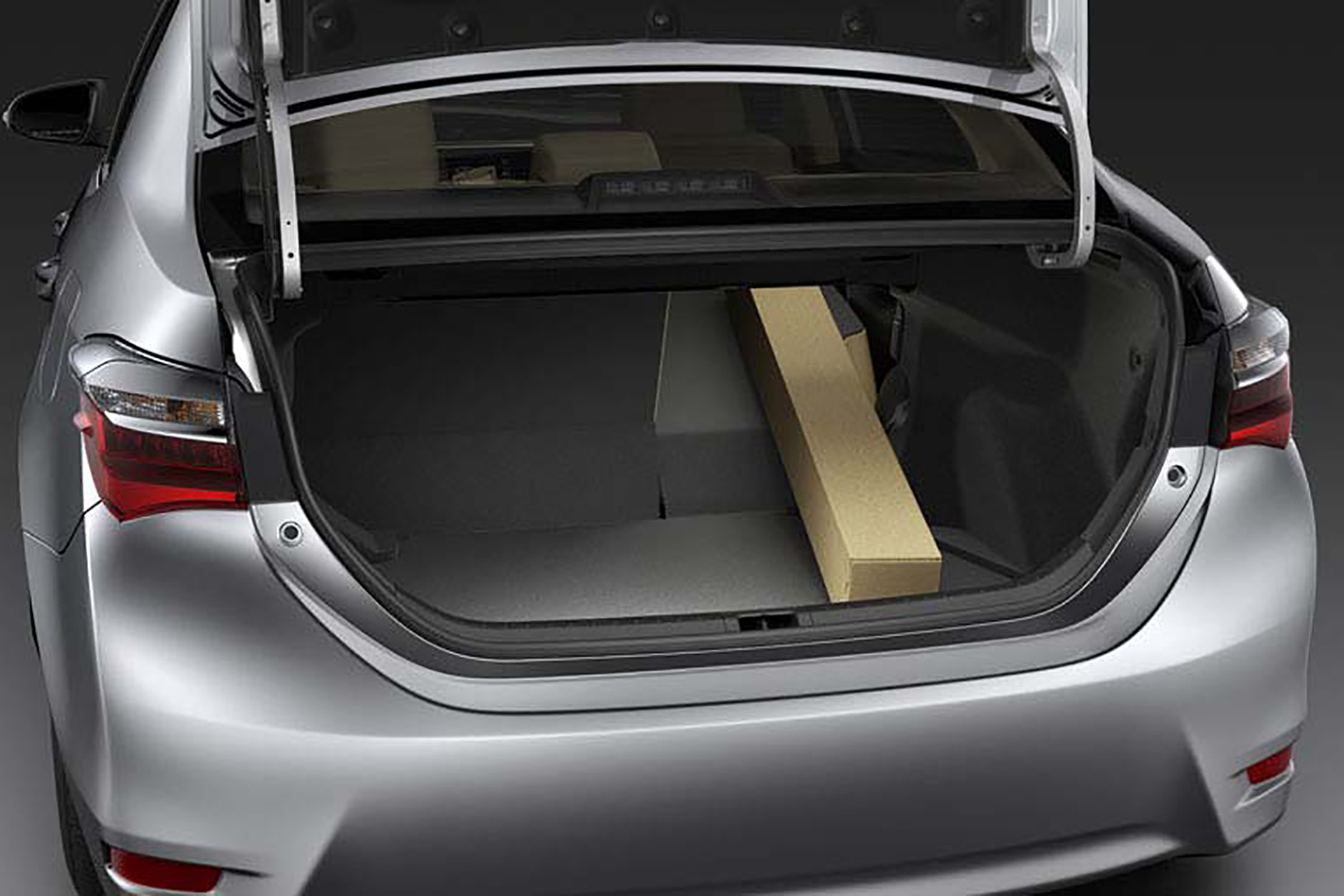
With the new-generation Corolla sedan yet to join the hatchback, Toyota is still selling the older model which has a big 470-litre boot and split folding rear seats.
Honda Civic | 519 litres
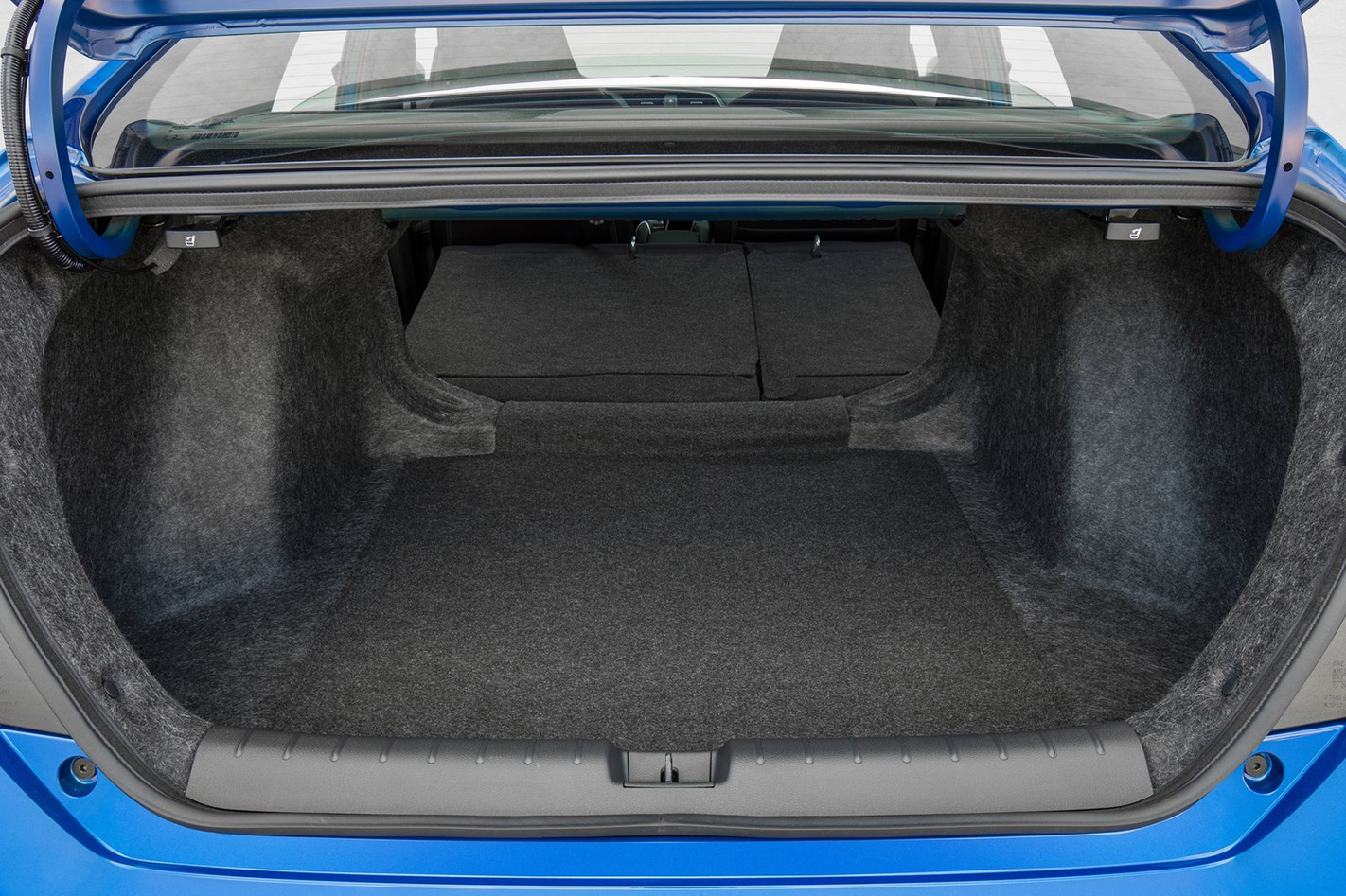
At 519 litres with the 60/40 split-fold rear seat backs upright, the Honda Civic sedan’s boot shames sedans that are two size classes above, and the loading aperture is quite large and low.
Honda City | 536 litres
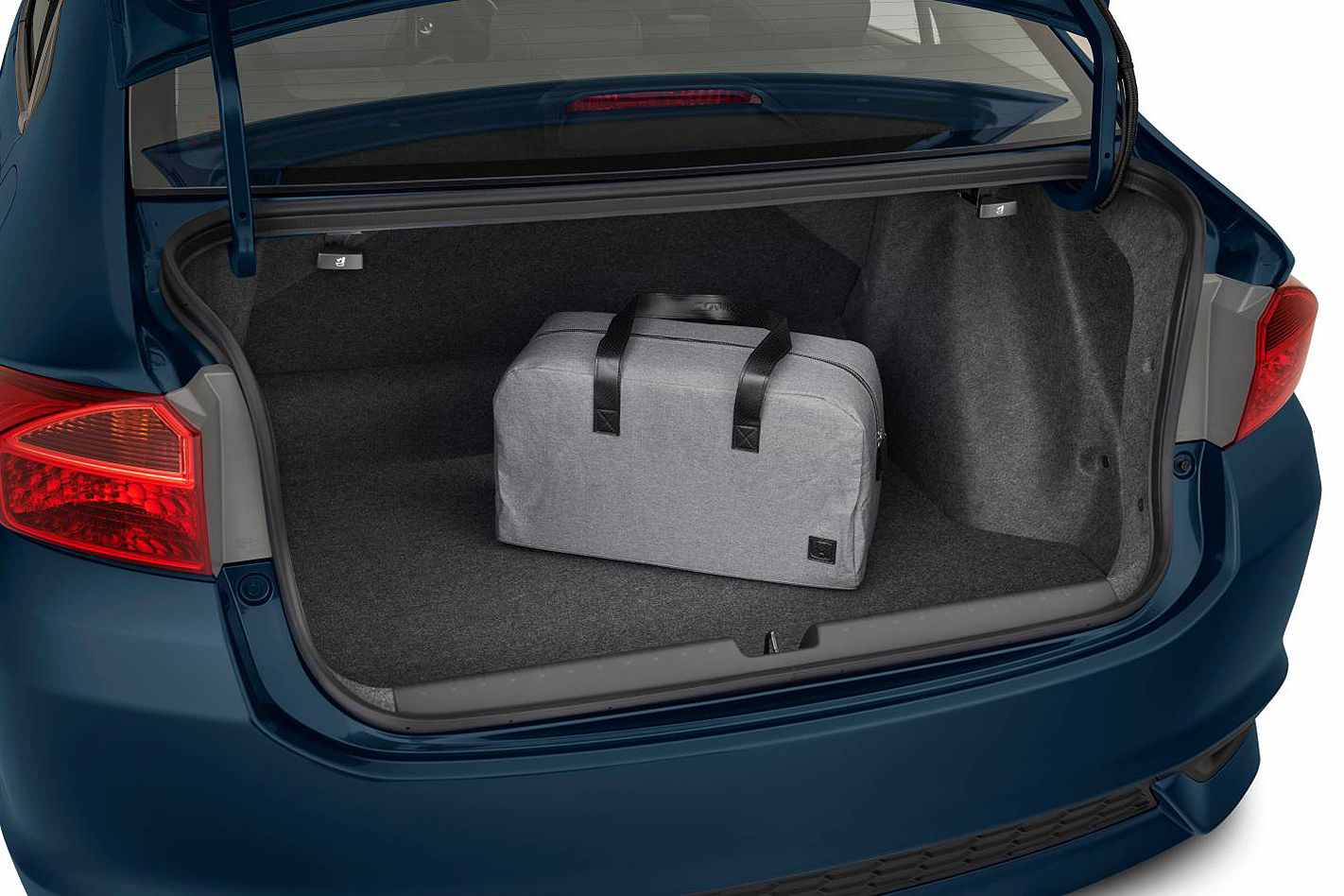
The Honda City is one of the most practical little sedans there is. Boot space is a cavernous 536-litres, which is bigger than its Civic big brother and a lot of other larger vehicles including SUVs. The low boot lid makes loading easy and the rear seats fold down with a 60:40 split to take longer loads.
Other small sedans
Audi A3 | 425 litres
Mitsubishi Lancer | 400 litres
Holden Astra | 445 litres
Kia Cerato | 502 litres
Renault Megane | 503 litres
Medium sedans
Ford Mondeo | 458 litres
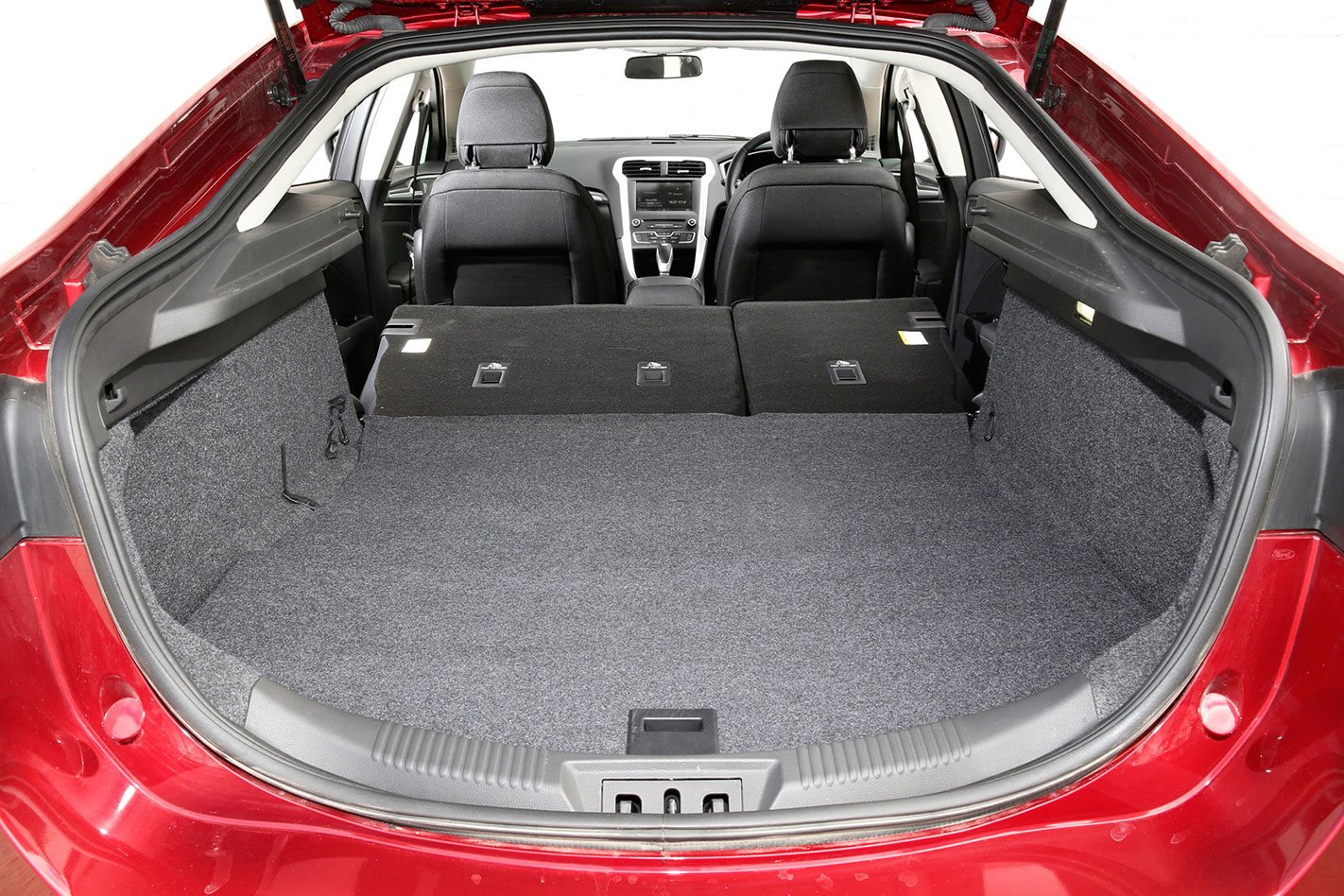
With a full-size spare tyre under the floor the lift-back Mondeo accommodates 458 litres up to seat height and 557 litres to the roof. With the 60:40 rear seats folded flat, it can swallow up to 1356 litres of luggage.
Subaru Impreza | 460 litres
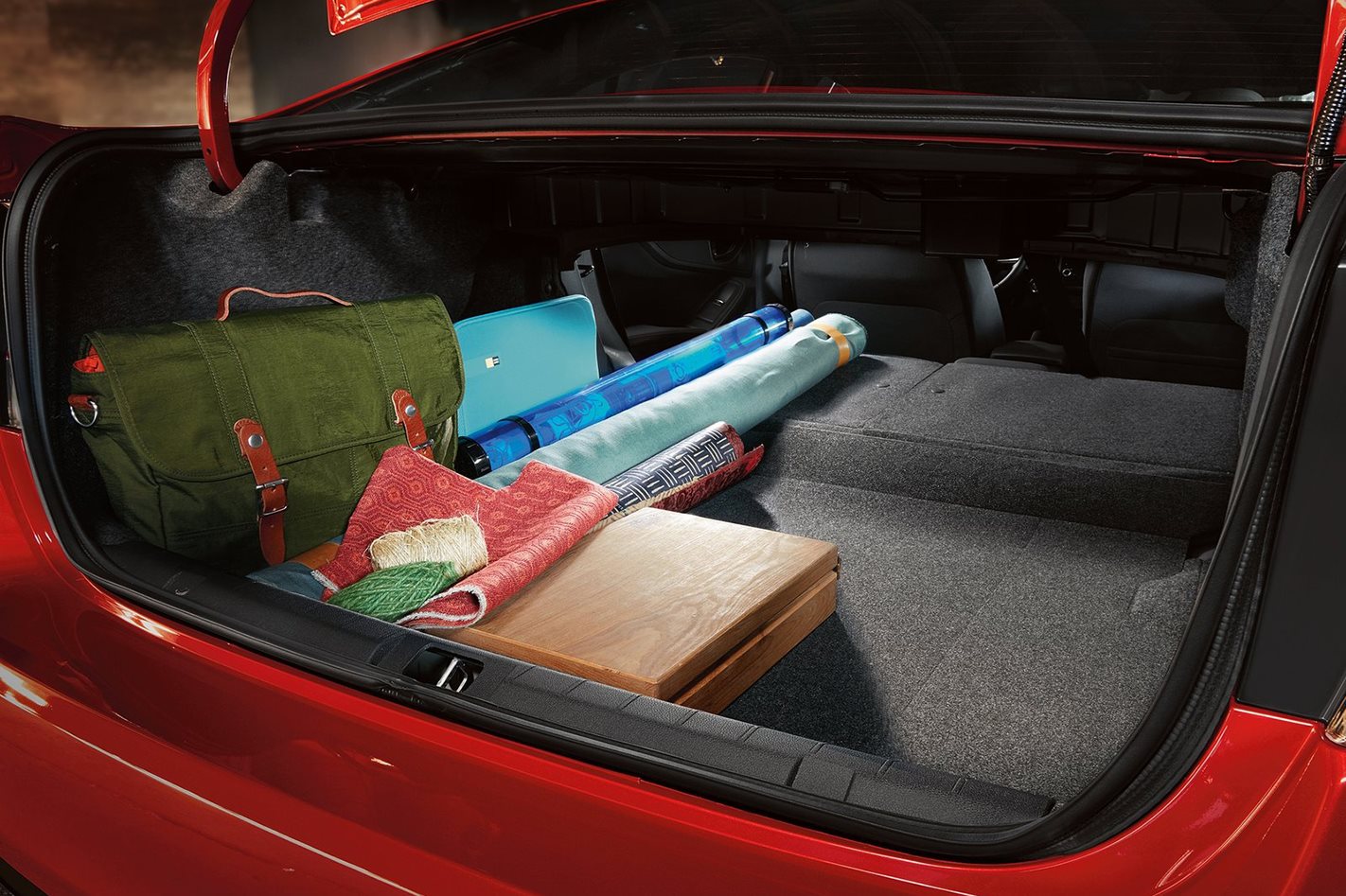
The Subaru Impreza has a roomy 460 litre boot with split-fold 60:40 rear seat backs for extending the load space.
BMW 3 Series | 480 litres
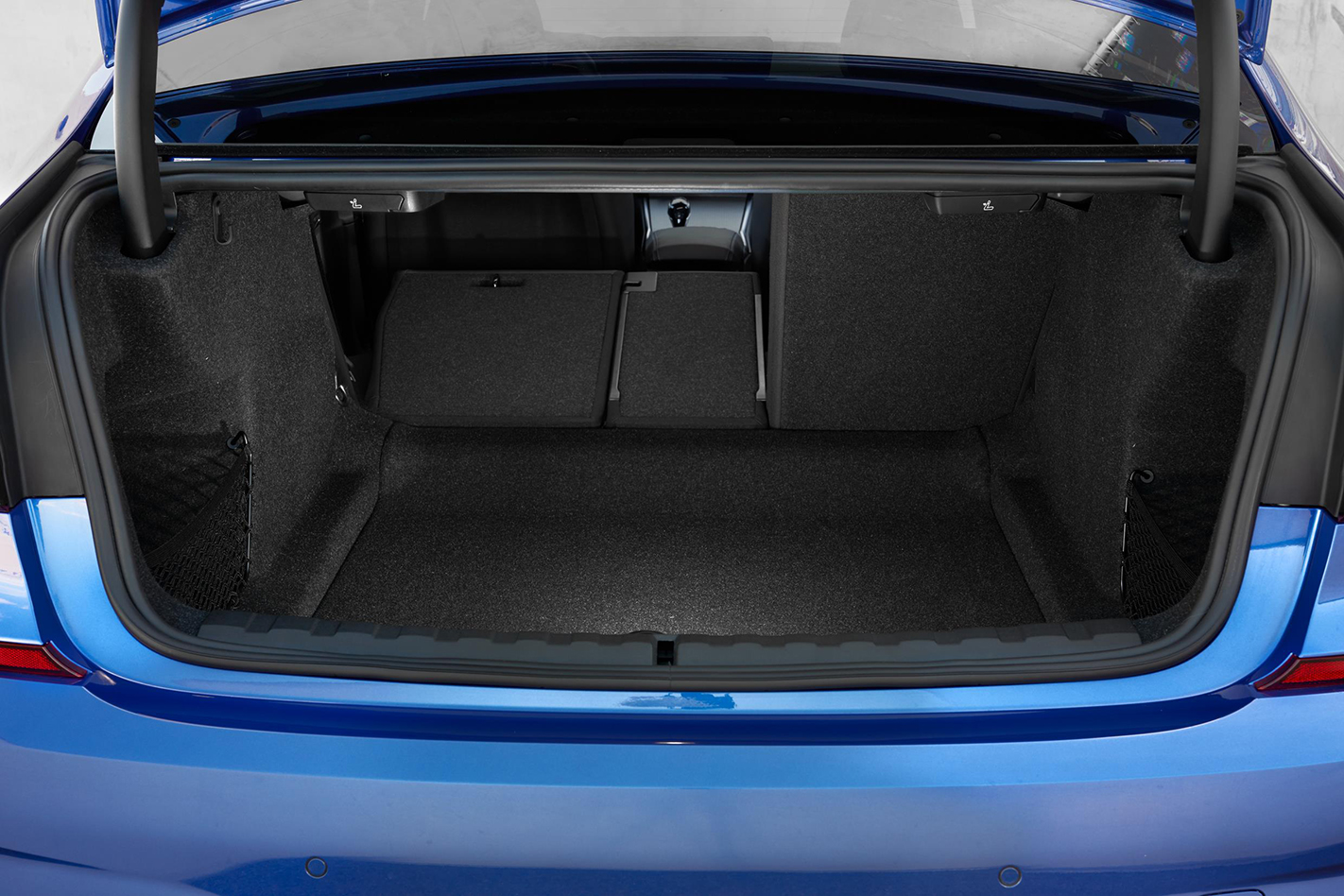
The G20 BMW 3 Series sedan has a 480-litre boot, which happens to be the same size as the previous model. This seems to be a magic number for mid-sized premium sedans, with the Alfa-Romeo Giulia, Audi A4 and Mercedes-Benz C Class all having the same space under their boot lids.
Mazda 6 | 474 litres
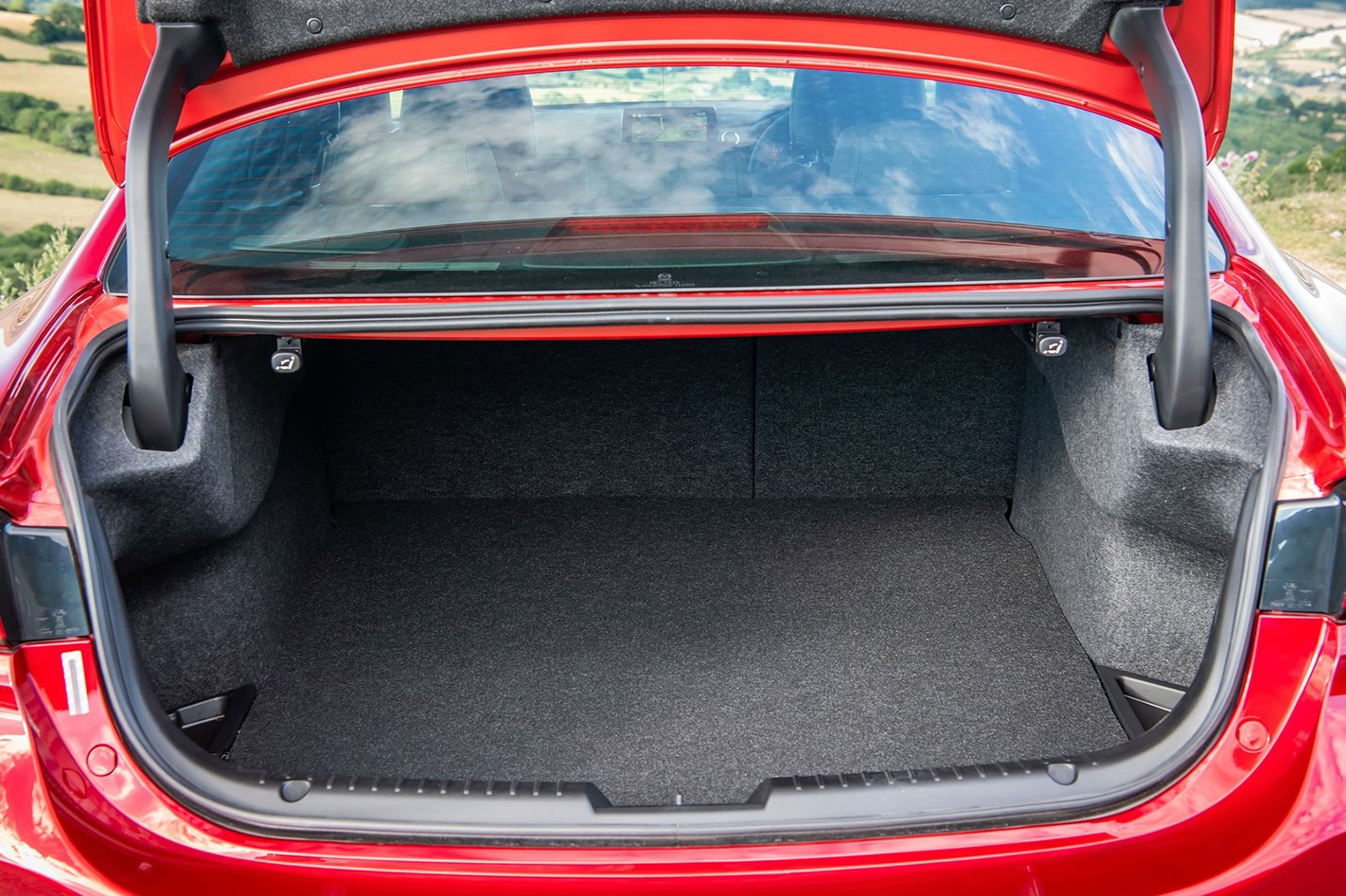
The Mazda 6 sedan has a 474-litre boot. It is not the biggest in a medium car, but it can swallow a lot of luggage.
Toyota Camry | 524 litres
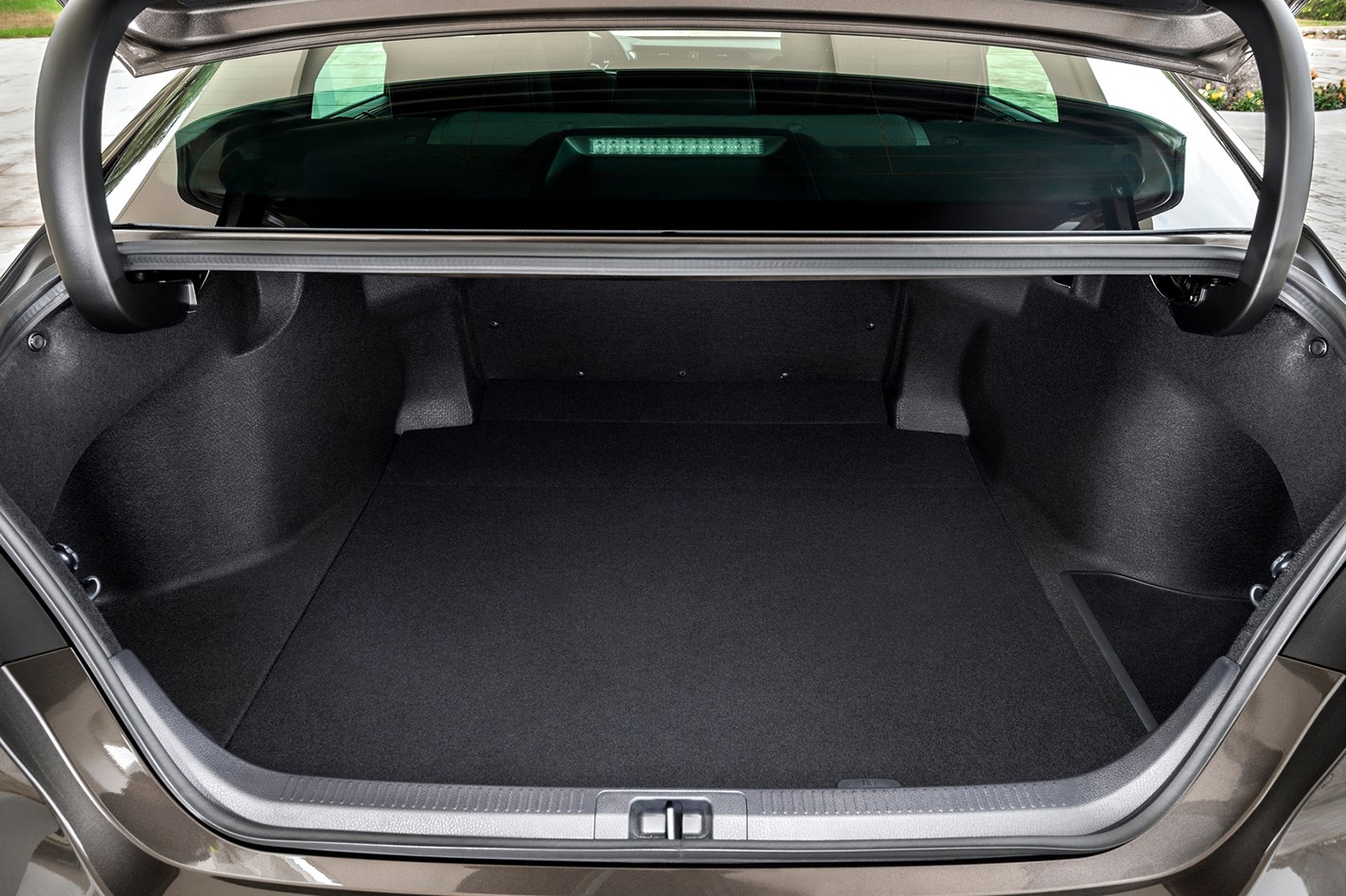
Boot space is a voluminous 524 litres in all Toyota Camrys except the Ascent petrol, which makes do with 493-litres because of the full-sized spare tyre.
Skoda Octavia | 568 litres
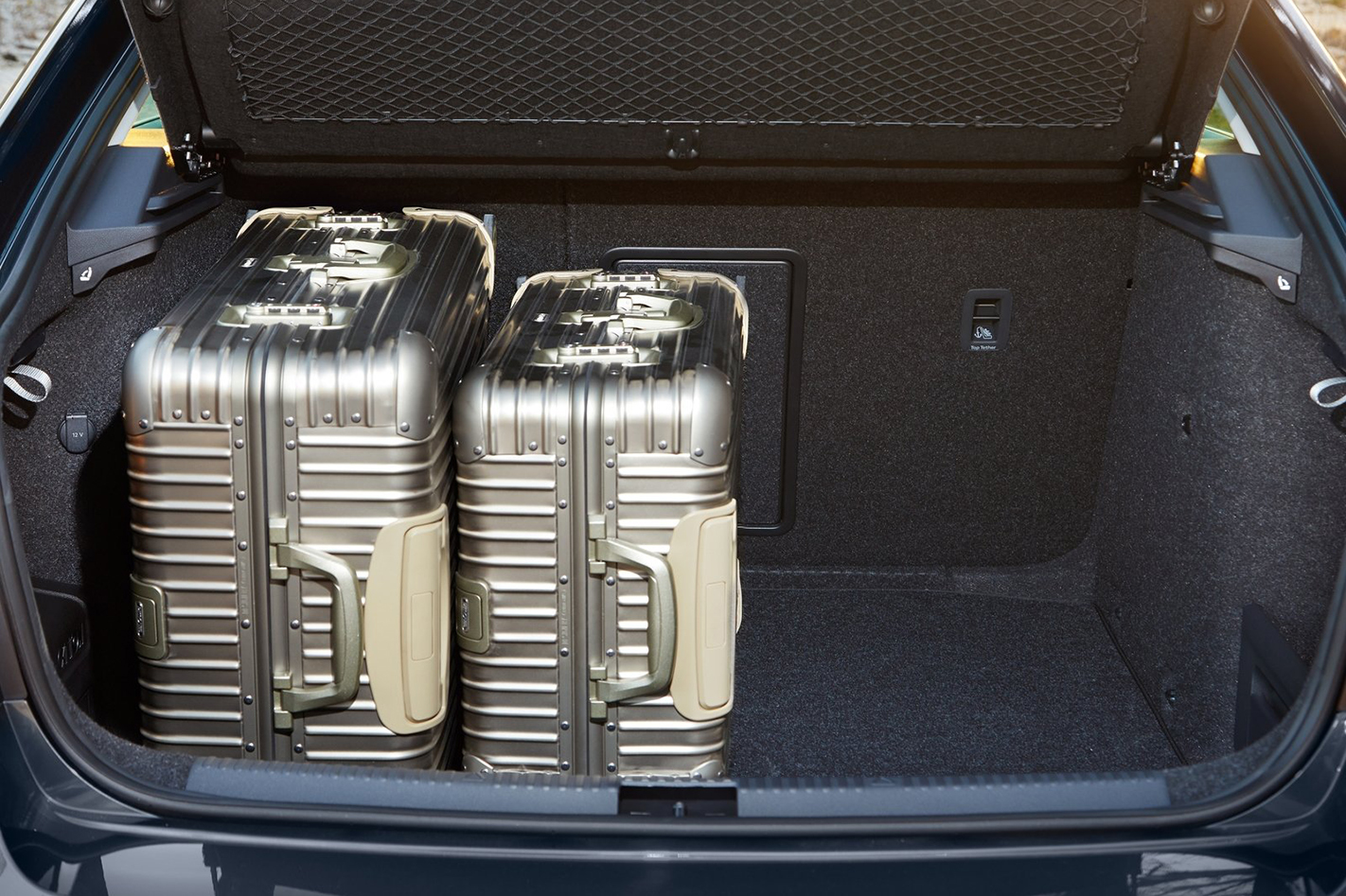
The Octavia sedan’s boot is a huge 568 litres, and it’s accessed via a hatch-back rather than a normal boot lid, which makes loading enviably easy. With the 60-40 split rear seatbacks folded the Octavia can swallow 1558 litres of stuff.
Other medium sedans
Honda Accord | 457 litres
Kia Optima | 510 litres
Hyundai Sonata | 510 litres
Subaru Liberty | 493 litres
Volkswagen Passat | 586 litres
Large sedans
Kia Stinger | 406 litres
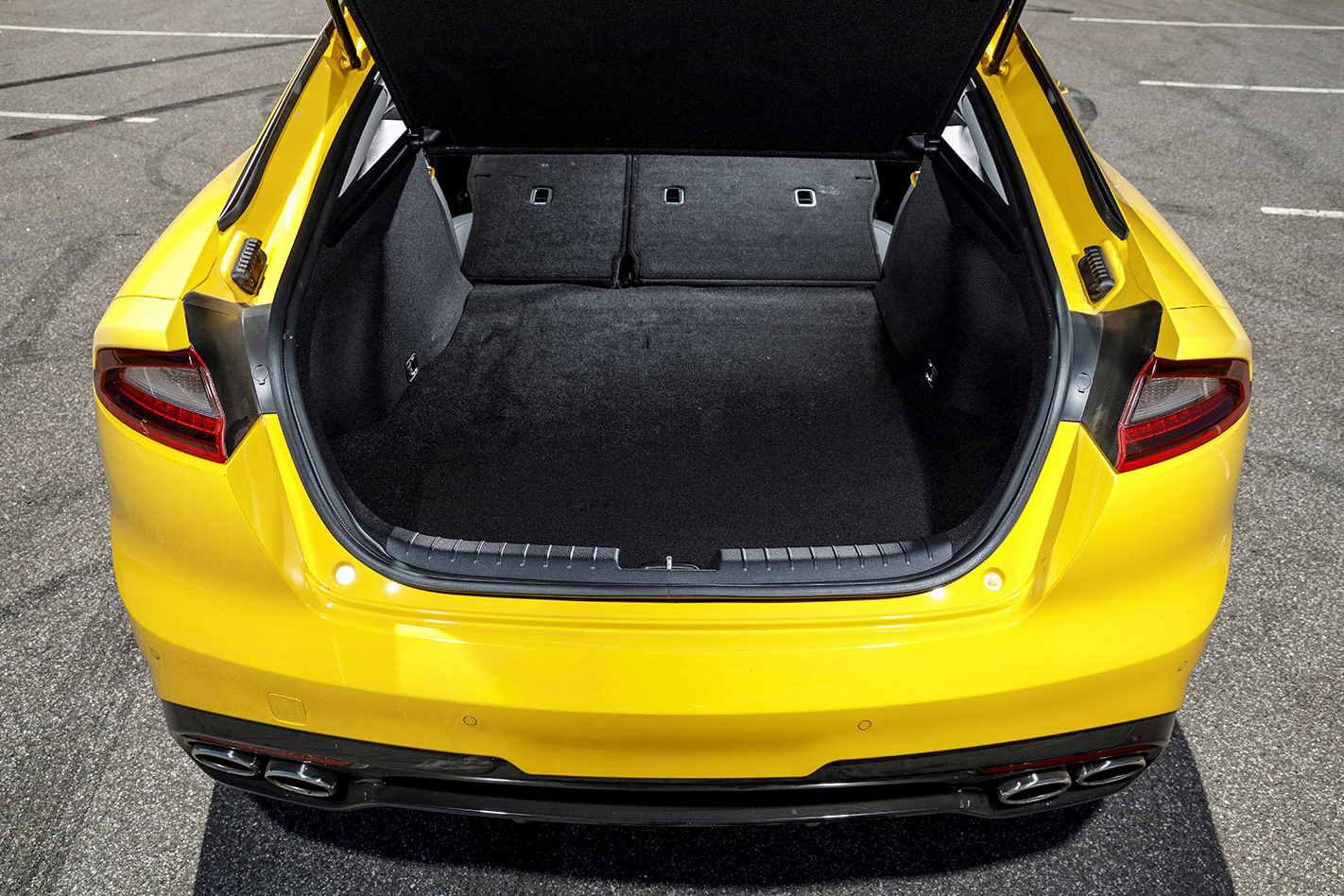
The Stinger’s 406-litre boot is a little tight for a large car. For more space, the rear seat has a 60-40 split fold which extends the load area to 1114 litres.
Holden Commodore | 490 litres
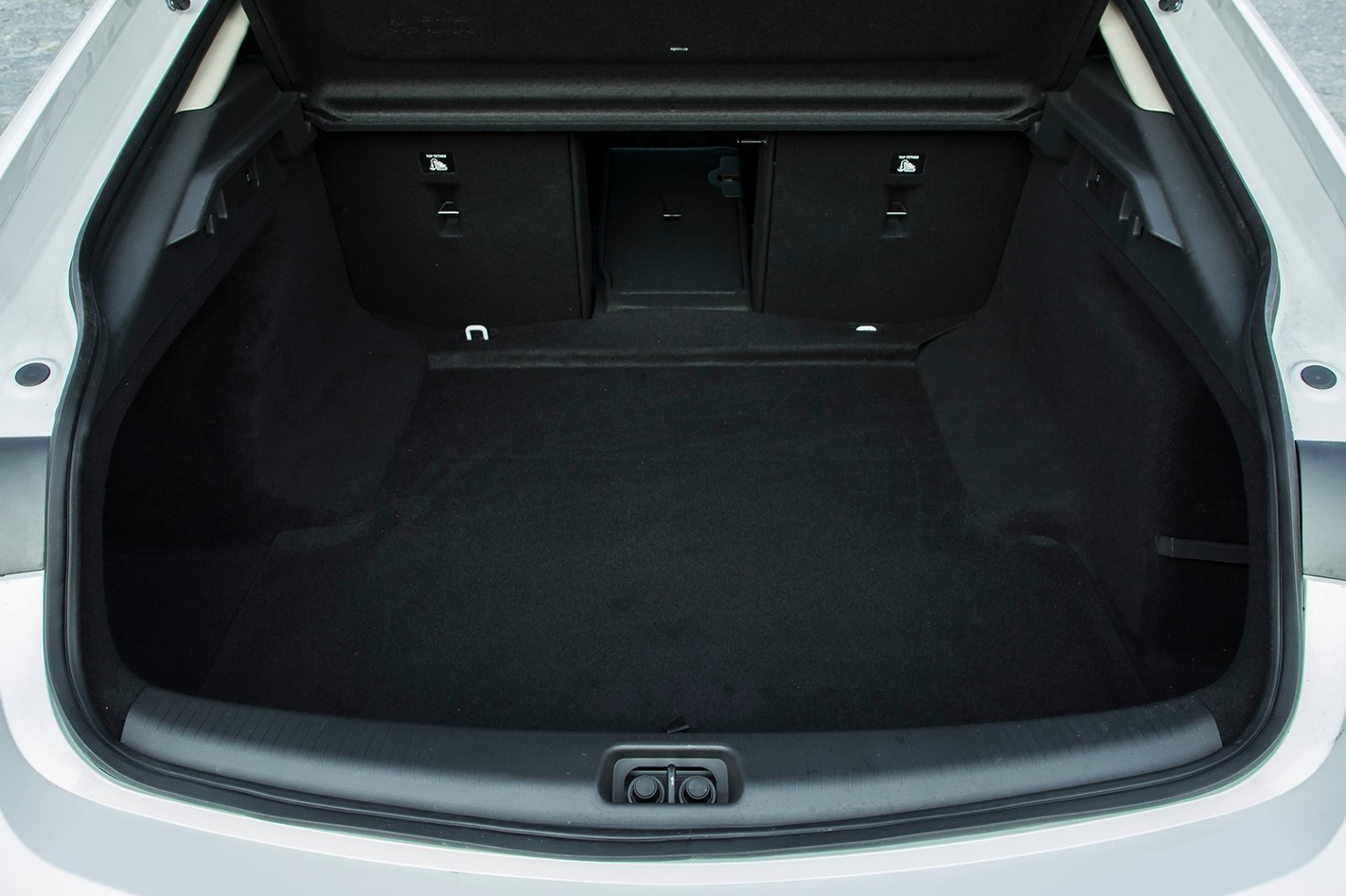
The Commodore liftback sedan holds 490 litres to the top of the seats, or 552-litres if you need to stack things up to the roof. That’s a little less than the previous-generation VF Commodore, but the boot floor has a bigger area which allows for more flexible loading.
Skoda Superb | 625 litres
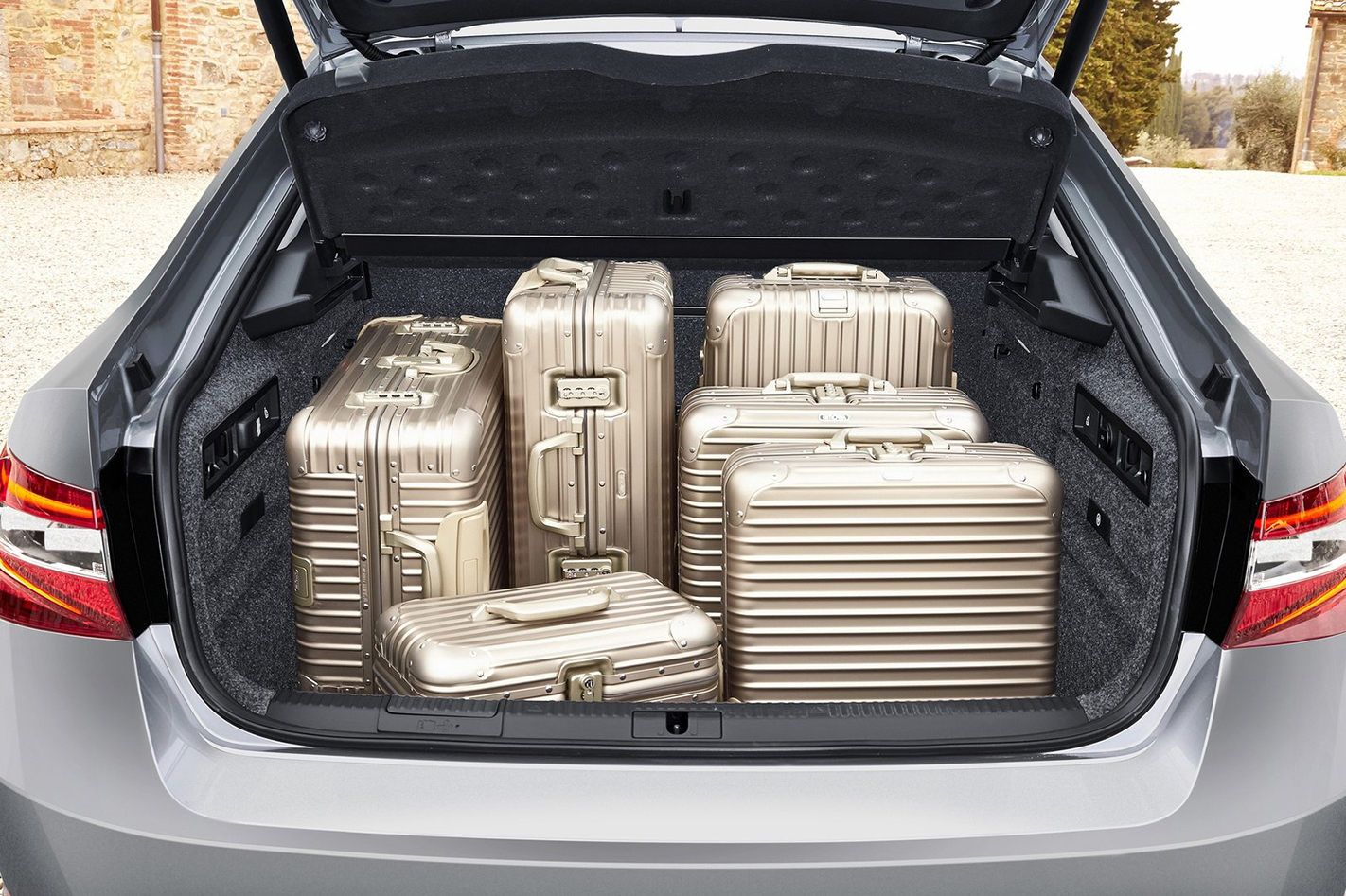
Skoda claims a cavernous luggage capacity of 625 litres for the boot in its Superb liftback sedan (with a 16-inch space-saver spare wheel beneath) and a gargantuan 1760 litres with the rear backrests folded
Other large sedans
Chrysler 300 | 462 litres
Volkswagen Arteon | 563 litres
