
THE war on hoons has claimed a high-profile scalp, after NASCAR legend Robby Gordon was filmed doing burnouts in the Darwin CBD late Saturday night.
Footage emerged on social media of a stadium super truck (from the eponymous series created and run by Gordon) performing smoky doughnuts on public roads.
It was reported the race truck was transported to Darwin CBD on the back of a flatbed around 8pm, before being unloaded.
Gordon faced court today, where he was fined $4150 by Judge Richard Coates, according to NT News.
“Yes you knew what you’re doing behind the wheel but you’re not supposed to be doing that kind of thing in a public place,” the newspaper reported Coates as saying.
“I wish it was within my capacity to take away your professional drivers license because I think you should be punished by the organisation which permits you to drive on a racetrack”.
Gordon defended himself, stating nearby security guards had given him the all clear for the late-night donuts.
“I asked [the security guards] ‘hey, think I can whip a couple of doughies?’, and they said ‘hey, I don’t care’,” he told the NT News.
“I spun two doughnuts and put it on the trailer.”
“I have to be honest, I’ve done stuff like this probably 200 or 300 times over my career, some cities promote it but unfortunately here in the Northern Territory they frown on it.”
“If we come back next year obviously no doughnuts on Mitchell St.”
When asked if he should be reprimanded by race organisers, Gordon is reported as replying: “Well, I own the series, I make the rules.”
The Stadium Super Trucks were competing at Hidden Valley raceway as a support race for the Supercars series.
Watch the 9 News report below:
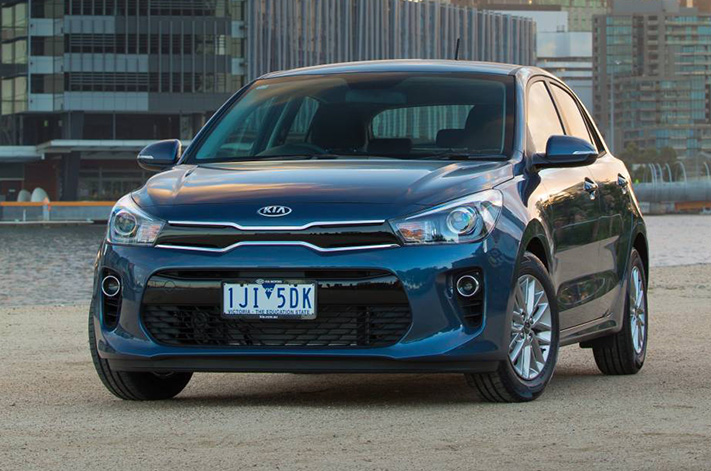
The Kia Rio has come a long way since it first arrived, and the new mid-spec Rio Si is a smart choice in a very competitive segment.
WHAT IS IT?
I honestly think there are very few cars on the market today that are truly, irredeemably awful; cars that I simply wouldn’t recommend to friends or family. This car, the Kia Rio, is not one of them.
In fact, it’s actually one of the better choices in the light hatch segment.
ON PAPER
The Rio range is available in three grades, and the car we’re driving here, the Si, sits right in the middle.
Priced at $21,490 and coming standard with an automatic transmission, it’s not the cheapest light hatch around. In a segment where similarly-sized cars typically cost under $20,000, it’s handicapped when it comes to price.

Only one engine and transmission combination is available in the Rio Si – a 1.4-litre naturally-aspirated petrol four-cylinder with 74kW and 133Nm, paired with a four-speed automatic.
WHY IS IT IMPORTANT?
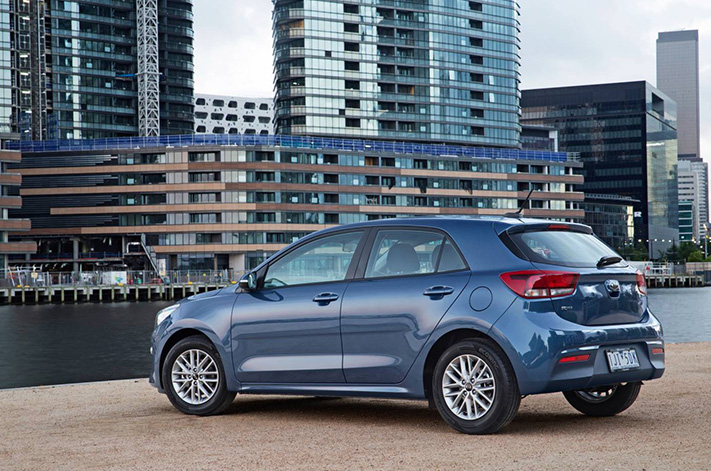
The Rio badge has been around since the turn of the century, but it’s come a long way since then. Starting as a fairly frumpy, budget-oriented offering, the Rio has slowly morphed into something with a bit more verve and emotional appeal.
The last-generation Rio was a fairly smart-looking car, but the all-new model goes a step further. Pitched as a higher-end mainstream offering – and with pricing to match – the Rio is a clear sign that Kia is aspiring to shed its bargain-bin image and aim upmarket.
FIRST THINGS YOU NOTICE
Immediately, there’s a sense the new Rio is cut from slightly fancier cloth than most light hatches.
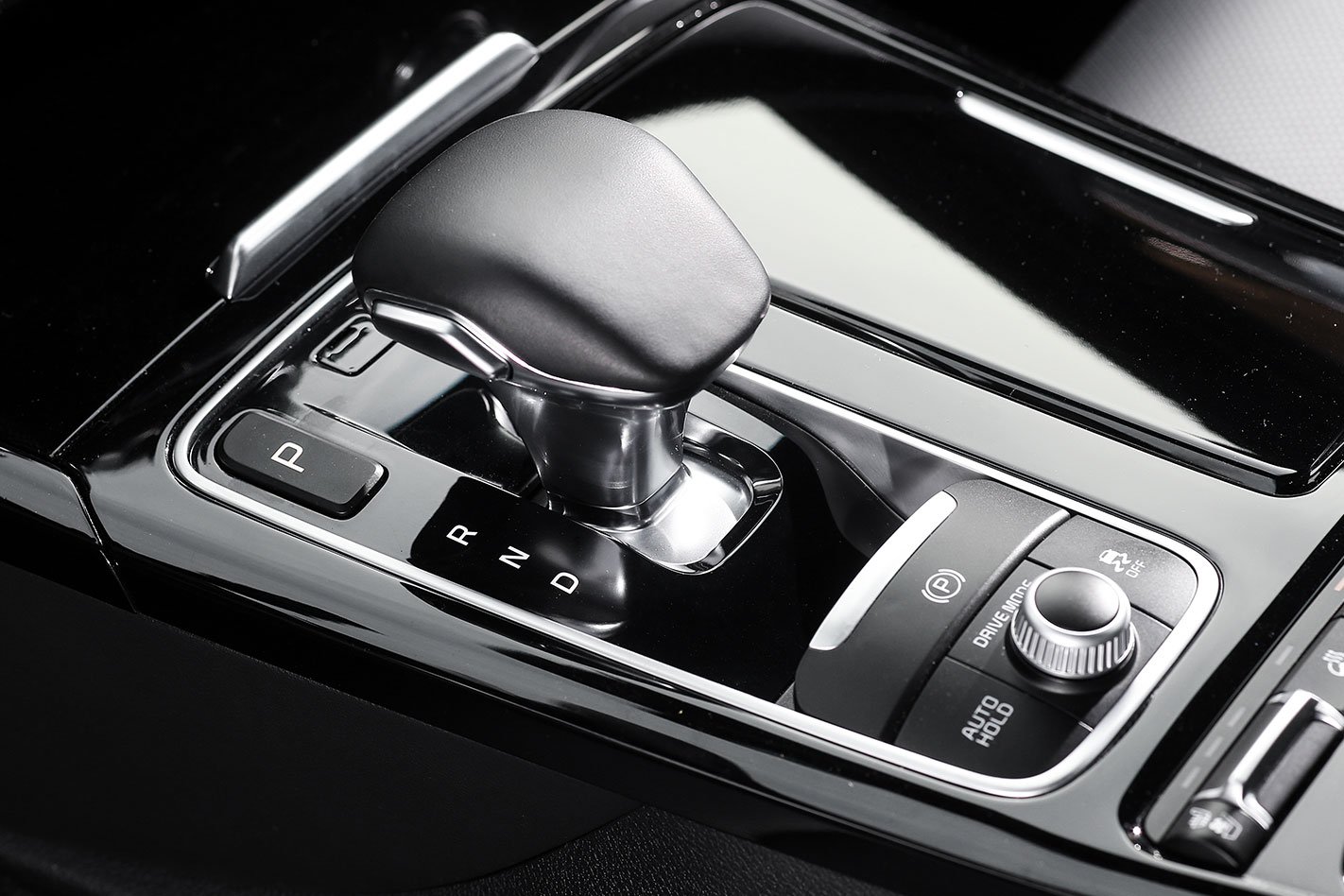
Design is undoubtedly a highlight, and though there’s heaps of hard black plastic around this interior, the presentation of it verges on high-end. This leather-wrapped steering wheel feels especially nice, the T-bar shifter moves slickly from Park to Drive and the switchgear is impressively smooth and lacks the plasticky feel that’s so common in this segment.
The only suggestions I’d make to Kia would be to dress up these featureless door cards, and maybe add some padding to the armrest. The centre console lid’s padded top also doesn’t feel as nice as the leather on the steering wheel, so there’s some inconsistency of finish there.
PLUS AND MINUS
Cabin ergonomics are good. The buttons on the centre stack are well laid-out and easily navigated by feel, and the driving position has enough adjustment to accommodate a variety of body types.
A 10mm longer wheelbase on the new Rio also liberates more back seat space, and the rear bench in the Rio will comfortably take a couple of adults. Meanwhile, practical design features like the little shelf down here for your phone are definitely appreciated, as are the two door-mounted bottle holders in the back and a 12-volt outlet for your rear passengers.
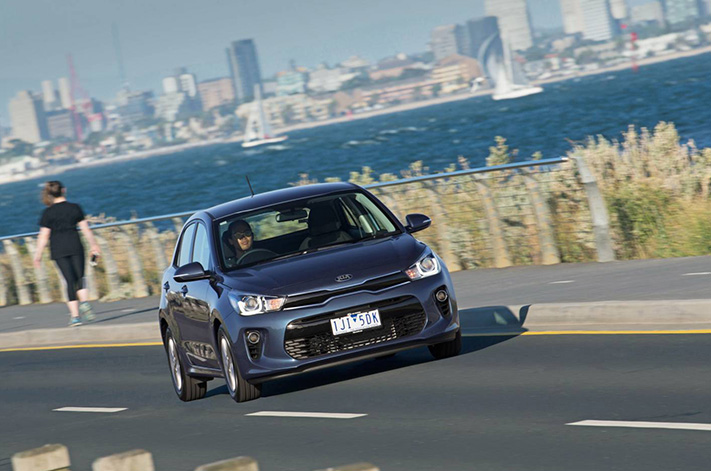
And while there’s plenty of equipment here to keep most motorists happy, there’s still some opportunity to improve. Autonomous emergency braking is slowly becoming a fixture in the light car segment, but it’s not yet available in the Rio. The Rio’s key rival, the Mazda 2, also comes with fancier gear like a head-up display, blind-spot monitoring and a more powerful 1.5-litre engine.
Ride and handling is at least above par. It’s comfortable and controllable on rough roads, while feeling buttoned-down and reasonably agile around corners. It’s no hot hatch, but it feels safe and secure on streets and highways.
VERDICT
Kia has succeeded in transforming the Rio from drab to fab, but the Korean automaker could still stand to strengthen the Rio offering. Autonomous emergency braking, a six-speed automatic and some cabin material improvements would be at the top of our wishlist. As it stands though, the mid-spec Rio Si is still a smart choice in a very competitive segment.
Hyundai is hoping a new app will help Hyundai i30 owners become better drivers.
Standard with every new i30 variant, the app (dubbed Hyundai Auto Link) connects the car’s computer with the owner’s smart phone via Bluetooth.
The app keeps track of the car’s performance, and provides insight and analytics from its driving history, to help owners perform better behind the wheel.
There are real-time diagnostics of things such as the vehicles tyre pressure, and it even has a vehicle ‘health-check’ status to help owners discover any issues before they become serious.
For the anoraks, there is also driving history statistics, parking management, service scheduling, and automatic access to roadside assistance.
Australia is the first country in the world to receive the app, with all owners of the latest model having access to the technology.

“Hyundai Auto Link offers i30 drivers deeper ownership involvement with their car as well as with their driving,” Hyundai Australia’s Sales Academy and Training Manager, Glenn Forster, said.
“Auto Link uses real-time driving history statistics to monitor and analyse bad driving habits, including rapid acceleration, hard braking and so much more.
“Using that information, owners are able to adjust their driving style for smoother, more fuel-efficient driving and, importantly, less wear and tear on their car.”
The app collates the information from each vehicle, and ranks you against fellow i30 owners.
“Apart from offering so many useful functions to everyday i30 drivers, we believe Hyundai Auto Link will become invaluable to fleet companies and the like,” Forster added.
“It’s even feasible that we can offer owners cheaper insurance by better understanding how they use their cars.”
While only currently available on the i30, Hyundai is looking to roll the technology out across the company’s entire range.
Kia confirmed a V8 would fit in the Stinger GT but that we were unlikely to see anything more than a one-off — and that an even hotter V6 Stinger model was not yet in development.
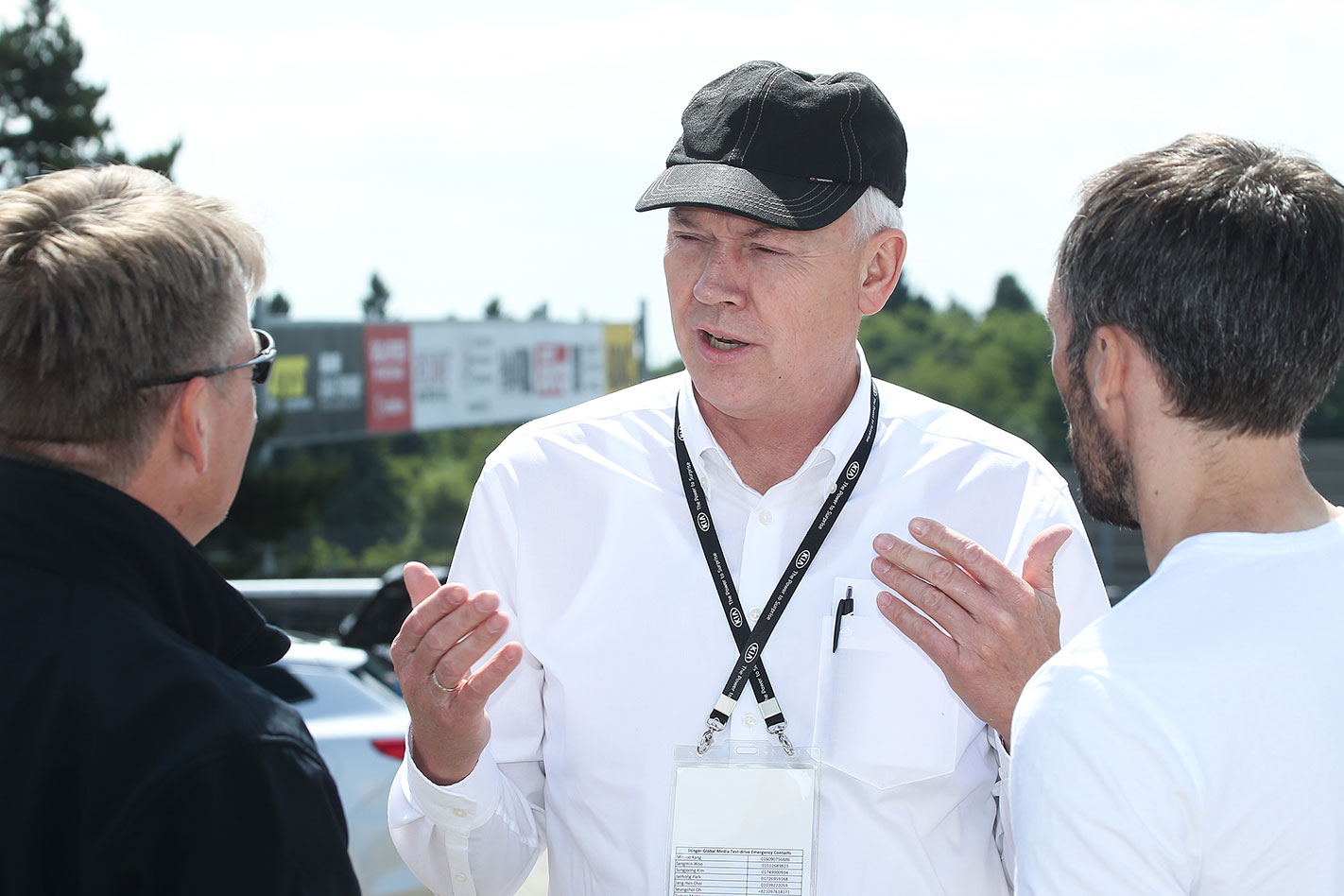
The brand new 272kW/510Nm rear-drive Stinger GT, on-sale in Australia in September, could handle more grunt, said chief engineer Albert Biermann, but that it must be a sales success before Kia could consider building something to rival an HSV Clubsport.
“It could handle more power, definitely, but there is not any plan,” Biermann told MOTOR.
“I think this is good now to get the Stinger out to demonstrate some kind of different Kia, the driving experience, and depending on what kind of enthusiasts we can establish with this car, if they raise their voice intensely and the media, then of course we can always do something.”
“We can watch how is the market developing, what kind of customers do we get into the Stinger, and then we could move on and do more.”
“We’ve never thought about it but it probably would,” he grinned. “But the V8 we have right now, the standard V8, I don’t think would be significantly more powerful, it would need a special treatment!”
2018 Kia Stinger GT winter testing
The German engineer, who until recently headed up the technical side of BMW’s M Division, said the only V8-powered, manual Stinger we might see anytime soon would have to be a one-off concept-style car cooked up in his engineers’ spare time.
“That would probably be a very entertaining car,” he laughed.
“Maybe I make one with my junior engineers for some crazy Stinger enthusiast event or something, make a drift car or something! Maybe, let’s see. We’re so busy with so many cars! There are so many things we could do if we had more time.”
“I think for the power level of the V6, I don’t think we would have a suitable manual gearbox,” he said.
“For example, for the 2.0 turbo, we would have a manual transmission … [and] personally, I would love to see one in the Stinger but right now nobody is requesting it.
“It would be very nice configuration to have the 2.0 turbo and then also you can save some weight by putting the manual gearbox in there and definitely a car that I would personally love. But right now there’s no idea.”
2018 Kia Stinger GT claims 4.9sec 0-100km/h
“I don’t think it’s necessary,” he said of the performance sub-brand. “I think the Kia GT needs some time to grow strong, and I think with the Stinger GT there will be a big step up for the GT sub-brand of the Kia cars, and for now that’s good enough for Kias.
“At some later stage when we attract more people into GTs, they might ask for more, and then it’s a matter to decide, okay, let’s make a high performance car for Kia, and from my point of view, no problem, we are ready to do it. It would be fun.”
THE KIA Stinger GT could be hiding in some bushes on a freeway near you if chosen by Australian police forces as their next highway patrol car.
Kia says its new 272kW/510Nm twin-turbo V6 hero car has attracted interest from every state and territory bar the NT, with some police having already put a prototype car through its paces in secret testing.
“We are starting to loan them to the police now,” said Kia Motors Australia’s Kevin Hepworth. “They’ve had people in-house looking at the car, getting all the tech details on it, and now they’re starting to get an opportunity to test drive.”
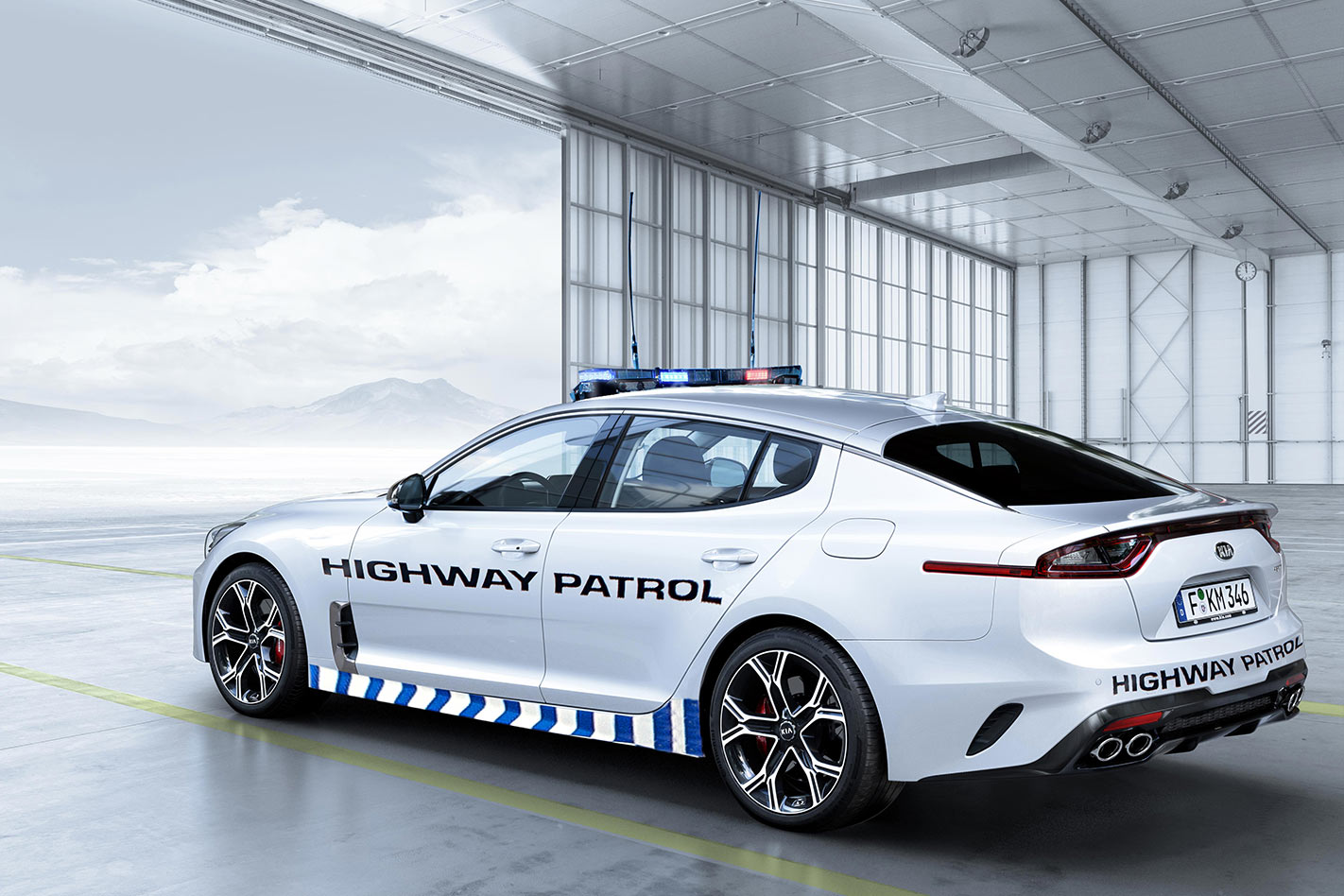
The Stinger GT was also well positioned to meet police criteria for value, resale, boot space and the ability to easily fit a second battery.
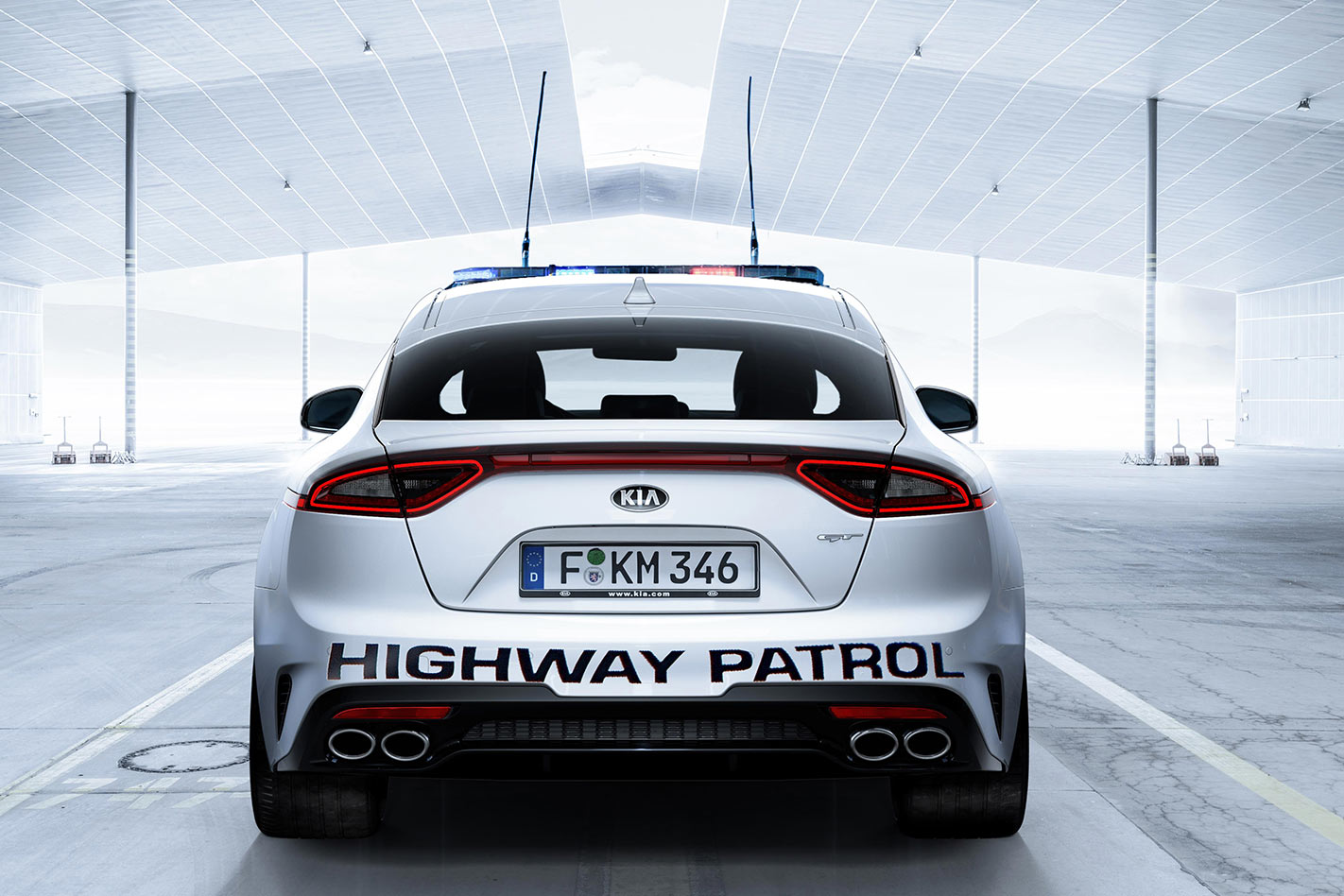
The news comes as police forces around the country continue to weigh-up replacements for the Falcon and Commodore, other cars considered for highway patrol use including the Ford Mustang and Chrysler 300 SRT.
The Kia Stinger GT is officially on-sale in Australia from September with pricing still to-be-announced.
The next Polo is also the biggest yet, with a wider and longer wheelbase. And it gets a bigger engine…
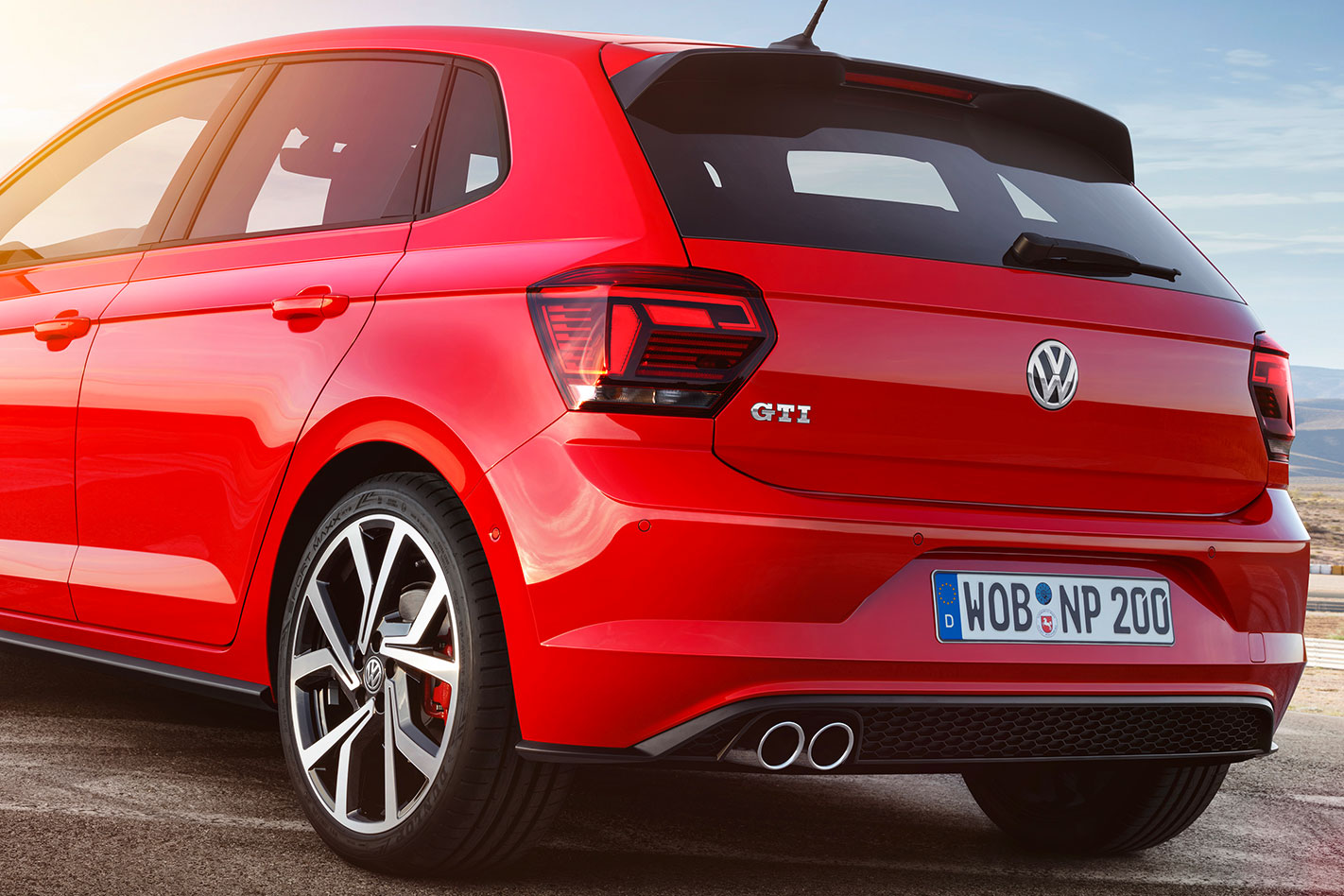
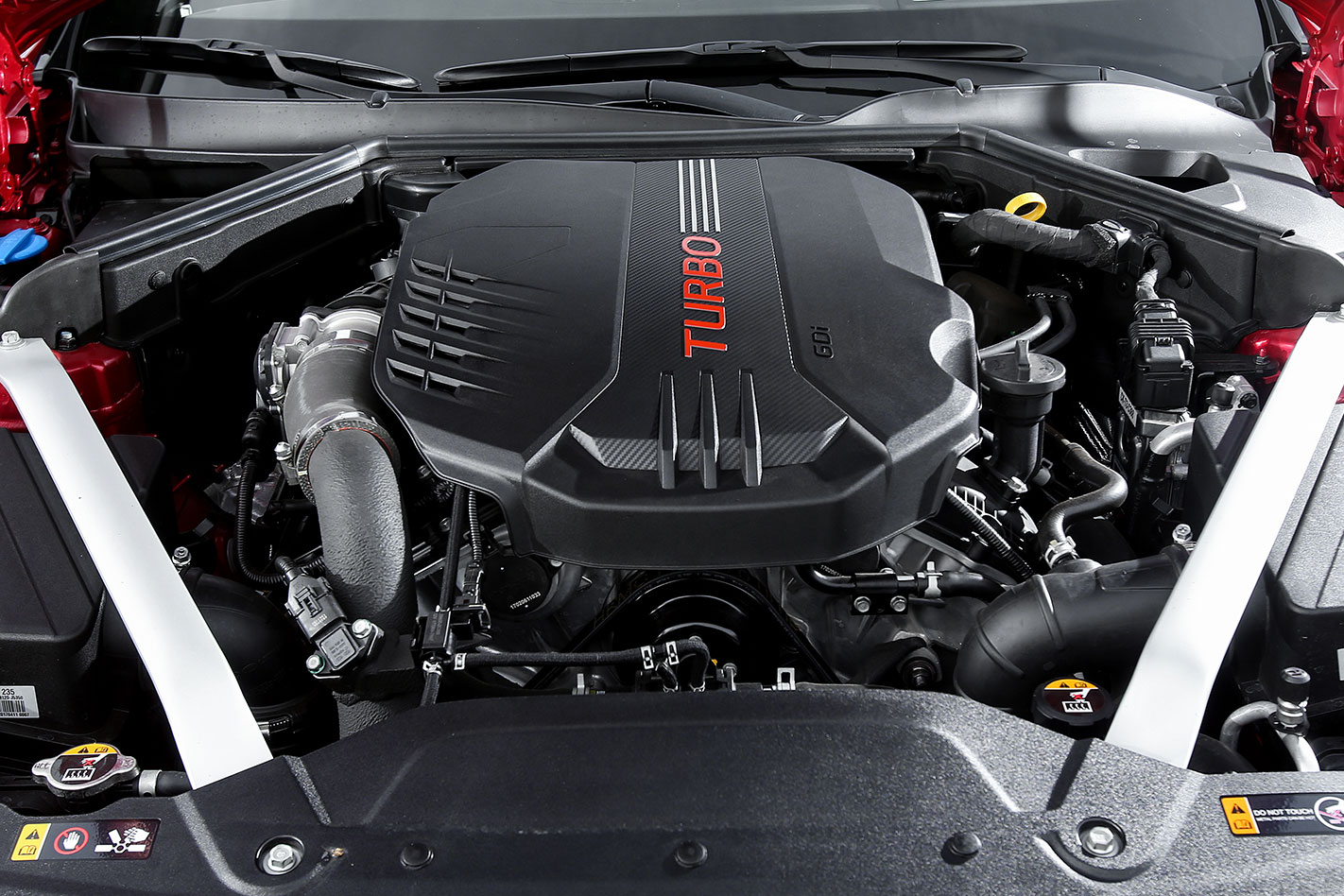
VW’s bargain compact hot hatch will now be powered by a 2.0-litre TSI engine, which results in a 147kW power output, a modest 6kW increase over the previous 1.8.
Volkswagen Up GTI concept revealed
It’ll need the extra few kilowatts, however, as larger dimensions will probably mean a heavier car.
With a wider and longer wheelbase, plus the Volkswagen Polo GTI’s standard ‘sport’ chassis and optional ‘Sport Select’ chassis, the slightly bigger car shouldn’t lose any of its hot hatch credential.
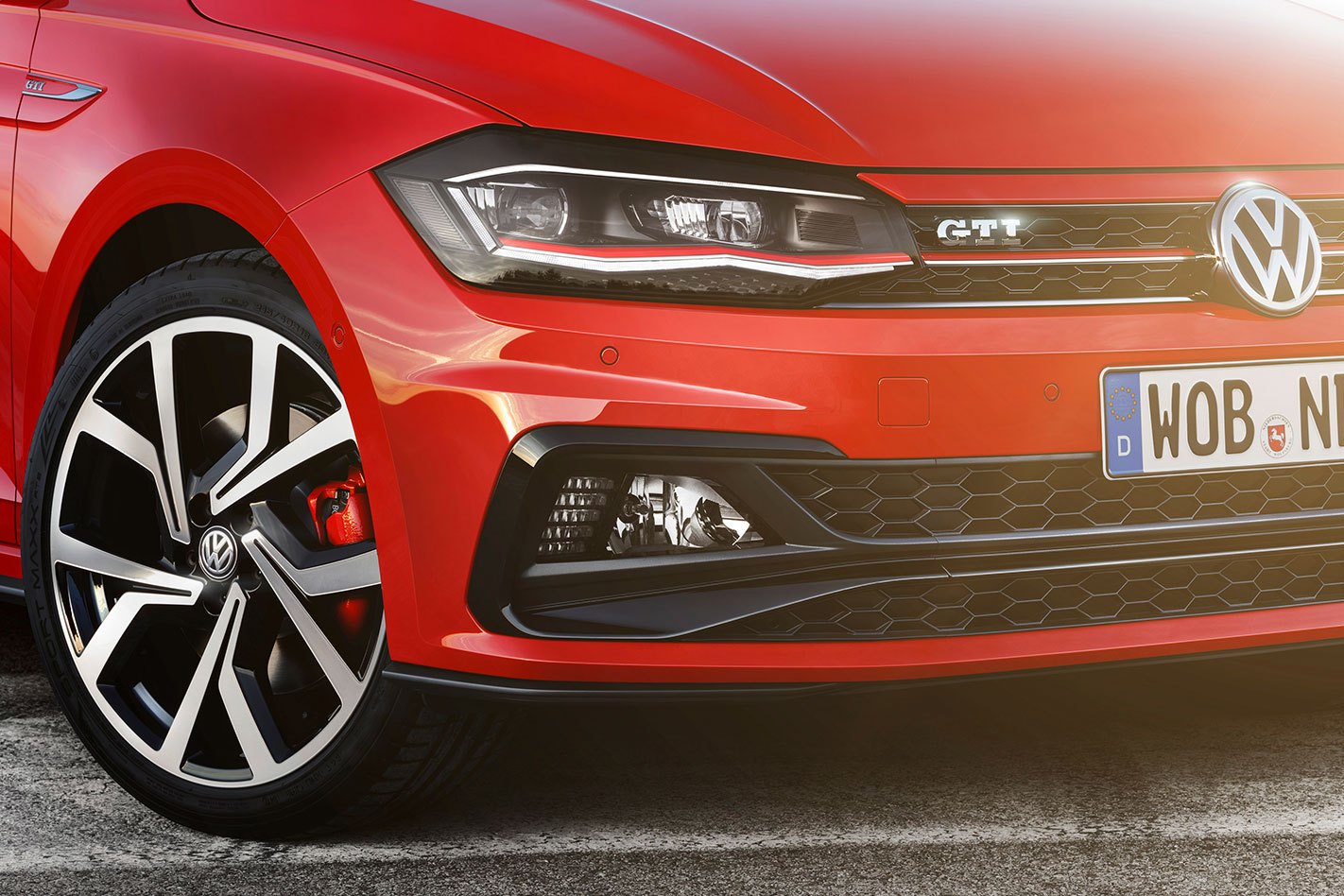
Also optional are LED headlights which feature a red stripe to extend the grille accent line through to the sides for the car.
2017 VW Polo World RX revealed
It seems to have achieved the brief set by VW Design boss Klaus Bischoff: “All Polo models should be made more sporty, more powerful, fresher, more masculine and more charismatic”.
Volkswagen Golf GTI pricing revealed
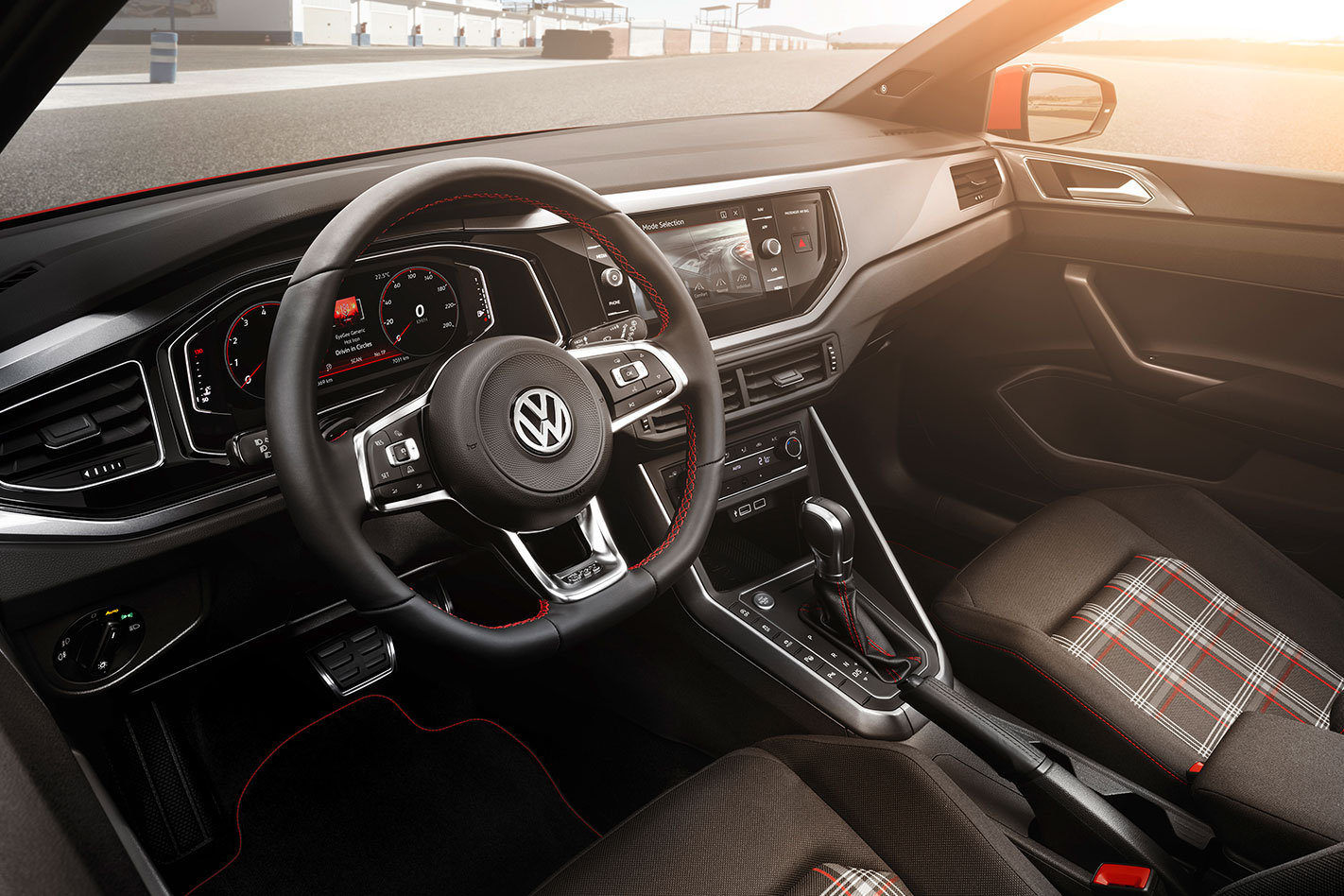
The steering wheel is wrapped in leather, the roof and pillars are lined in black, and the gearshift is GTI-specific.
The gearbox the shifter is connected to can be either a 6-speed manual or a 7-speed DSG.
Kia Australia was so disappointed with the ’s sound that it’s called in HSV’s exhaust experts to develop an Aussie-only bi-modal system.
Tests on a prototype car are underway in Melbourne to sign-off the final growl of the Aussie-only exhaust, which will be “rear of the main silencer” and developed by the same company that HSV contracts to give its V8s their signature sound.
2018 Kia Stinger GT winter testing
The system, which will be fully warranted and ADR compliant, will be offered as an option, although the price is yet to be confirmed for both this and the car itself.
Kia Motors Australia’s Kevin Hepworth said a local solution to the Kia Stinger GT’s otherwise underwhelming sound was needed if the brand’s 272kW rear-drive hero car was to win over a particular kind of customer.
“We’re saying we want this to be in the SS Commodore consideration set,” said Hepworth. “It’s got to go like one, it’s got to look as good as one and it’s got to sound as good as one.”
“The Stinger GT is built initially for refinement,” he added. “That’s what the Europeans wanted, and the Americans wanted, and the development in Korea, they don’t have the same market set to meet as we do.”
Hepworth said meeting ADRs was top priority during the Australian-only development program: “It’s a very expensive exercise. It’s difficult to get authorisation to do this sort of thing.”
Kia Cerato ‘GT’ under development
The exhaust won’t be the only Australian-specific modification, Kia Oz getting its suspension expert Graeme Gambold to give Aussie Stinger GTs a more performance-focused tune. The overseas cars currently err more towards ‘grand tourer’ in the suspension and handling department.
The Kia Stinger GT is officially on-sale in Australia from September with pricing still to-be-announced.
SHELL V-Power Racing Ford Falcon drivers Fabian Coulthard and Scott McLaughlin shared the spoils in the Darwin round of the Supercars Championship at the weekend, although there was a promising lift in the pace of the rival Holden factory team title contenders Jamie Whincup, Shane van Gisbergen and Craig Lowndes.
After the two tough races in the Territory heat, Coulthard continues to lead the championship, with his team-mate McLaughlin now within 10 points of his fellow New Zealander.
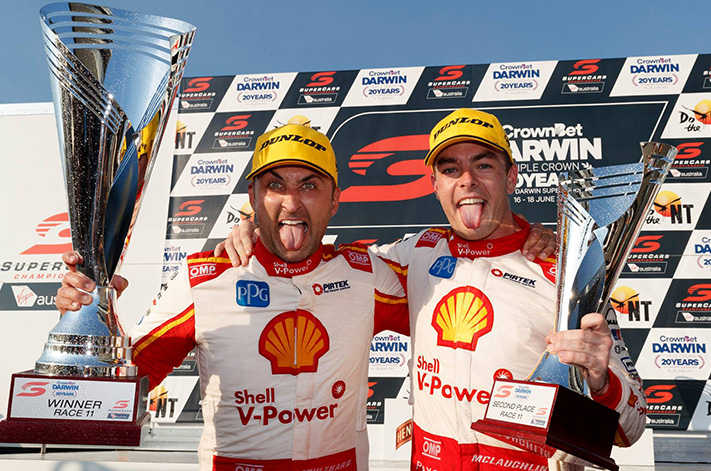
Coulthard and McLaughlin claimed their third one-two of the season in Saturday’s steamy 42-lapper which brought some carnage and misfortune to others. Showing hearty signs of good mid-season pace, Brad Jones Racing’s Nick Percat grabbed third ahead of Whincup, and Prodrive pair Chaz Mostert and Cameron Waters.
The DJR-Team Penske double act worked the strategy well but also had pacy Falcons to enhance their fight.
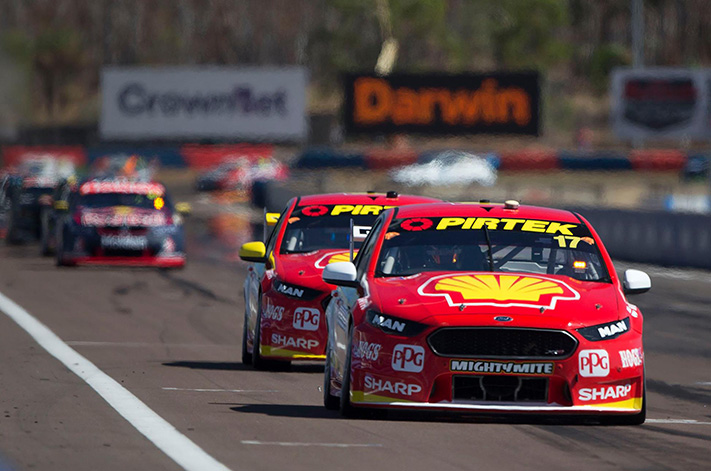
Still kicking himself for stuffing up a day earlier, McLaughlin set himself up for a strong run in Sunday’s longer 70-lap race, taking pole from Whincup, surprise packet James Moffat in a GRM Holden and Coulthard.
Whincup made a perfect start and was the early pacesetter from McLaughlin, Coulthard and van Gisbergen. Then different compulsory pit stop moves and the usual tyre degradation mixed things up. Some drivers also suffered power losses from the heat soak of cars ahead.
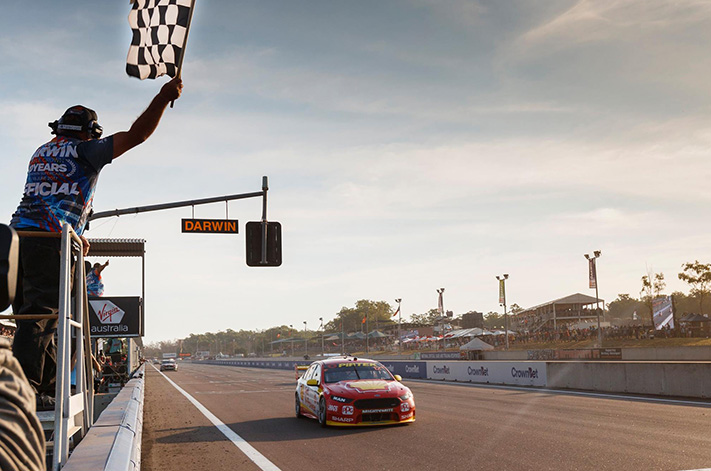
McLaughlin successfully undercut Whincup in the pits and then managed his buffer easily to take a comfortable two-second win over the six-times champion in a contest free of safety cars.
Twenty four hours after smashing his rivals (and team-mate), Couthard couldn’t find the winning formula on Sunday, struggling a little in his drive to fourth but fighting determinedly as the laps ran down to keep the persistent Tim Slade (BJR Freightliner Holden), Lowndes, David Reynolds (Erebus Holden, a quick Scott Pye who made up eight places in his Mobil HSV Holden, and Waters
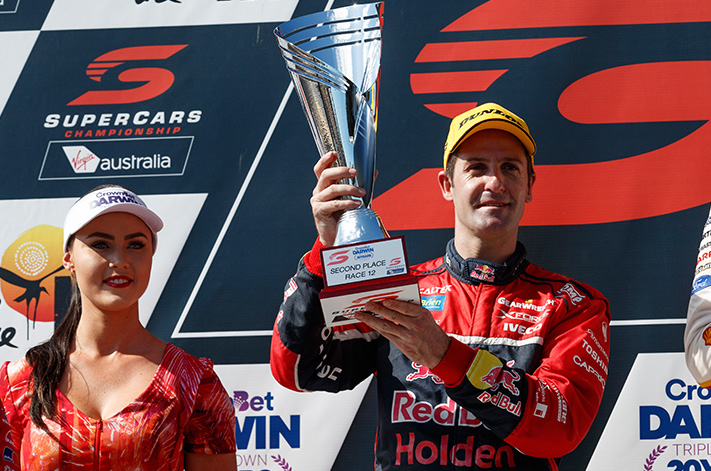
Whincup, looking as cool as a cucumber despite the searing heat, reported that second wasn’t too bad. “The car was good. We got a good start but didn’t quite have the tyre life of car #17 today,” he explained. “But we made some improvements on the car this weekend that we’ll take away and be happy with.”
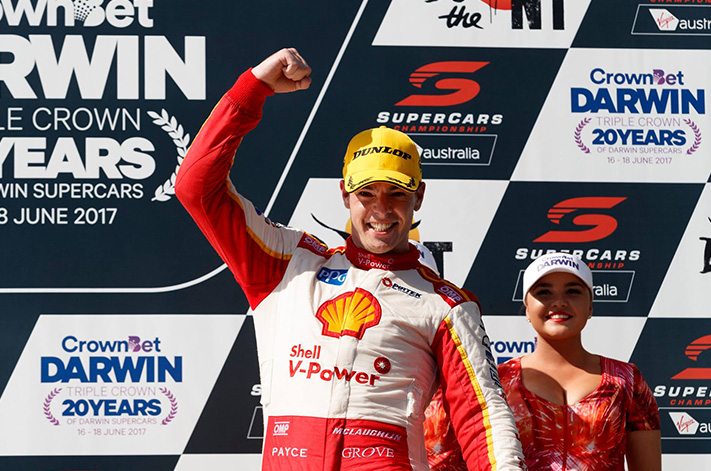
The only other championship race winner (and lone Aussie success) so far is Mostert at Phillip Island.
The championship now moves to another hot spot, Townsville on July 7-9.
Mawson bounces back at Hungaroring Euro F3
Australian Joey Mawson has taken away points-scoring fourth, a seventh and an eighth place finishes from his weekend in tight and competitive European Formula 3 Championship at the Hungaroring.
It was a solid bounce back after a horror previous round in Pau.
In Hungary, Mawson was second to Prema’s Maximilian Gunther in the wet qualifying for the first of the weekend’s races.
But Mawson started fifth after copping a carryover penalty of three grid spots after hitting the car ahead at the previous round at Pau.
Mawson held his position off the line, managed a clean pass on Prema’s Callum Ilott to claim fourth but couldn’t progress further in a race won by pole man Gunther.
It was his best result of the weekend.
Mawson qualified eighth on the grid for race two, one second covering all but one car in the field. He improved one place when one rival stalled, and then spent the rest of the race in seventh.
Mawson started eighth again for the final race, but on a track that doesn’t encourage overtaking there were no changes of position in the top 10 after the first corner. Mawson took eighth place in the middle of a train of cars.
During the course of a new vehicle development program, prototype models visit many regions of the world, sometimes including Australia.
In the depths of the northern hemisphere winter, Sweden is often used as a location to test cars on well-maintained roads but in some savage cold, windy and icy conditions, while at the other end of the year, the United Arab Emirates can offer some of the hottest and driest conditions on earth, as well as the added complication of dust.
The research and development conducted in hot and dry, cold and wet regions can benefit a vehicle’s durability in virtually any global region that endures a similar climate, but there are some regional differences that are more specific.
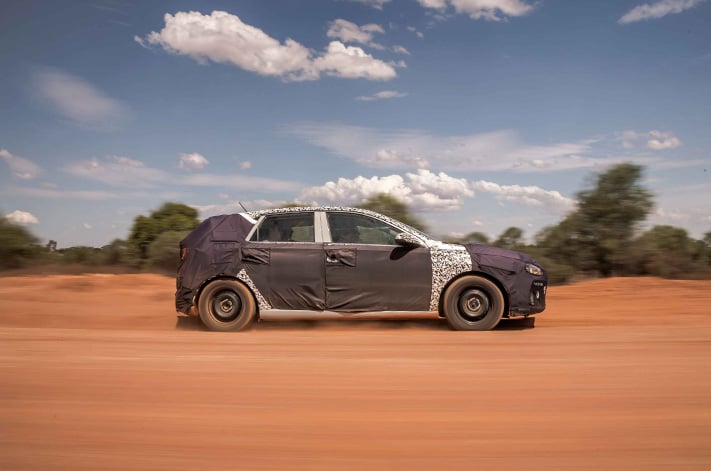
Drive from Melbourne to Darwin and, in addition to the many different types of weather, you are likely to encounter just about every type of road surface as well, including well-maintained sealed asphalt roads, deteriorating concrete and tarmac, unsealed hard-pack and corrugated country trails.
That infinite variation has prompted some car companies to develop a specific suspension tune explicitly for Australia. While Ford, Holden and Toyota have formulated chassis set ups for a number of vehicles over the years, South Korean brands Kia and Hyundai tailor every model sold on red dirt to ride better on it.
Hyundai product engineer Hee-Loong explained to WhichCar the challenges involved in the process and why it is so important for its range of cars, starting with the nature of Australian motoring.
“There is no such thing as a German road or a European tune or an Australian tune,” he said. “No matter where you go, a road is a road. The gravity in Europe is the same in Australia and a 50mm bump is a 50mm bump.
But while Loong said that the same physics apply to a chassis tune anywhere in the world, a number of local features make a big difference and used the example of the Blue Mountains roads in New South Wales, where large trucks generate unique waves in the surface as they round bends.
“You have to have a car that is able to cope with the force produced by those roads,” he said and listed a number of other conditions such as loose asphalt and degraded surfaces.
While European cars are often engineered with a firmer ride that works well with generally smooth surfaces, Loong said that vehicles work better Down Under if they can cope with all conditions.
“Everyone assumes the ideal condition is the autobahn or the Nurburgring. If you tune to that condition everyone will say your car is damn good but come to Australia, oops it’s different. You’ll never find mid-corner pot hole on the Nurburgring.
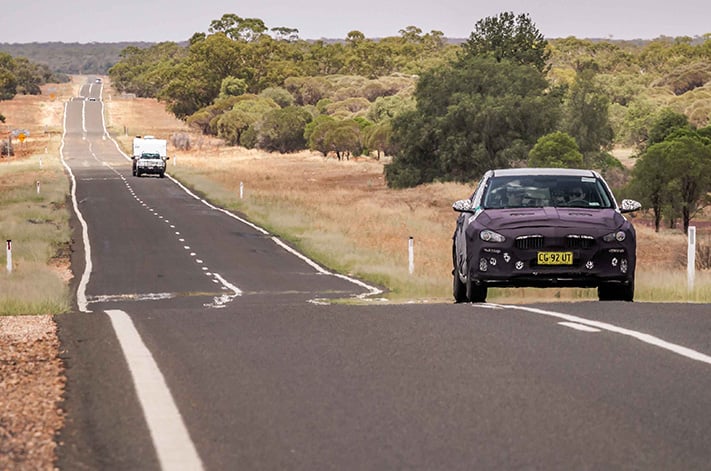
“There is no such thing as tuned for Australia, we say tuned for all conditions.”
In addition to the changing and varied surfaces found around such a large nation, Australia driving habits are also somewhat unique and require chassis tuning to match Aussie drivers.
According to Loong, a visiting Korean development team observed how local drivers tended to “hover around” the 100km/h speed limit regardless of the road course, and that they attempted to accelerate to the limit as quickly as possible.
These factors all contribute to crafting the perfect balance, says Loong.
“When we tune a vehicle suspension, the first thing we put for Australian priority is body control, then ride comfort. Australians want to be in control of the vehicle because they never want to slow down below the speed limit.”
With this valuable information in mind, Loong and his team then create a virtual prototype for a new car using “simulations, estimations and calculations” before a nuts-and-bolts vehicle hits the road.
Thanks to an intimate knowledge of Australian conditions, Loong says the virtual work rarely needs much tinkering in real-world testing with the trial of different components, but a huge range of springs, stabiliser bars and dampers are at the team’s disposal for development projects.
Rather than a stab-in-the-dark process of fitting a range of parts, Loong said the art of tuning a suspension system was about finding a correct recipe of all the variables rather than trial and error.
It’s like serving you a dish and saying “if you want it more tasty I’ll put in more salt for you”. You need the right balance of everything. It’s a complete package.
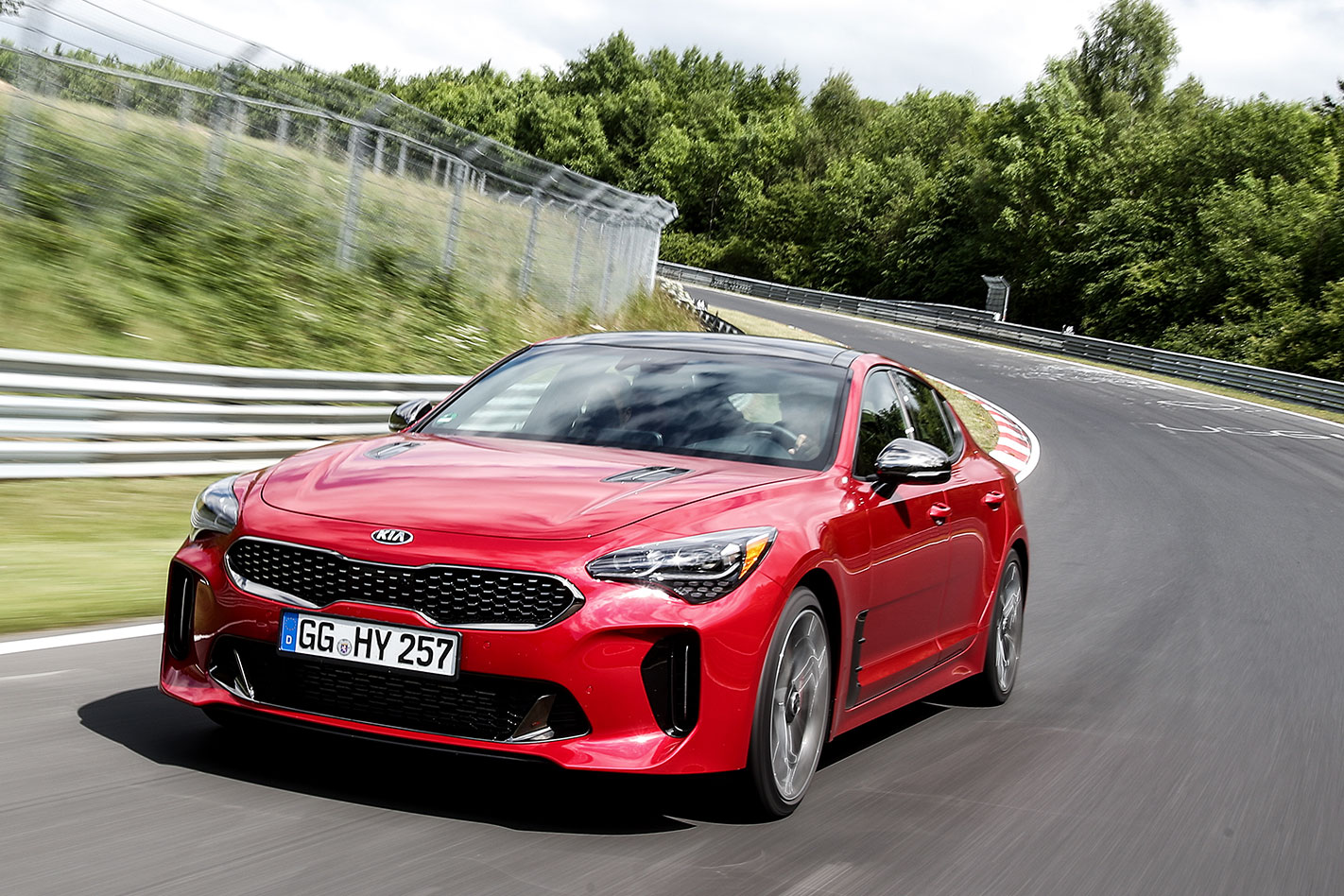
The Kia Stinger GT is properly quick and has a big rear-drive personality, but the overseas specification we drove almost felt more like a fast grand tourer than a performance car, lacked a little emotion and was somewhat unsatisfying in the noise department.
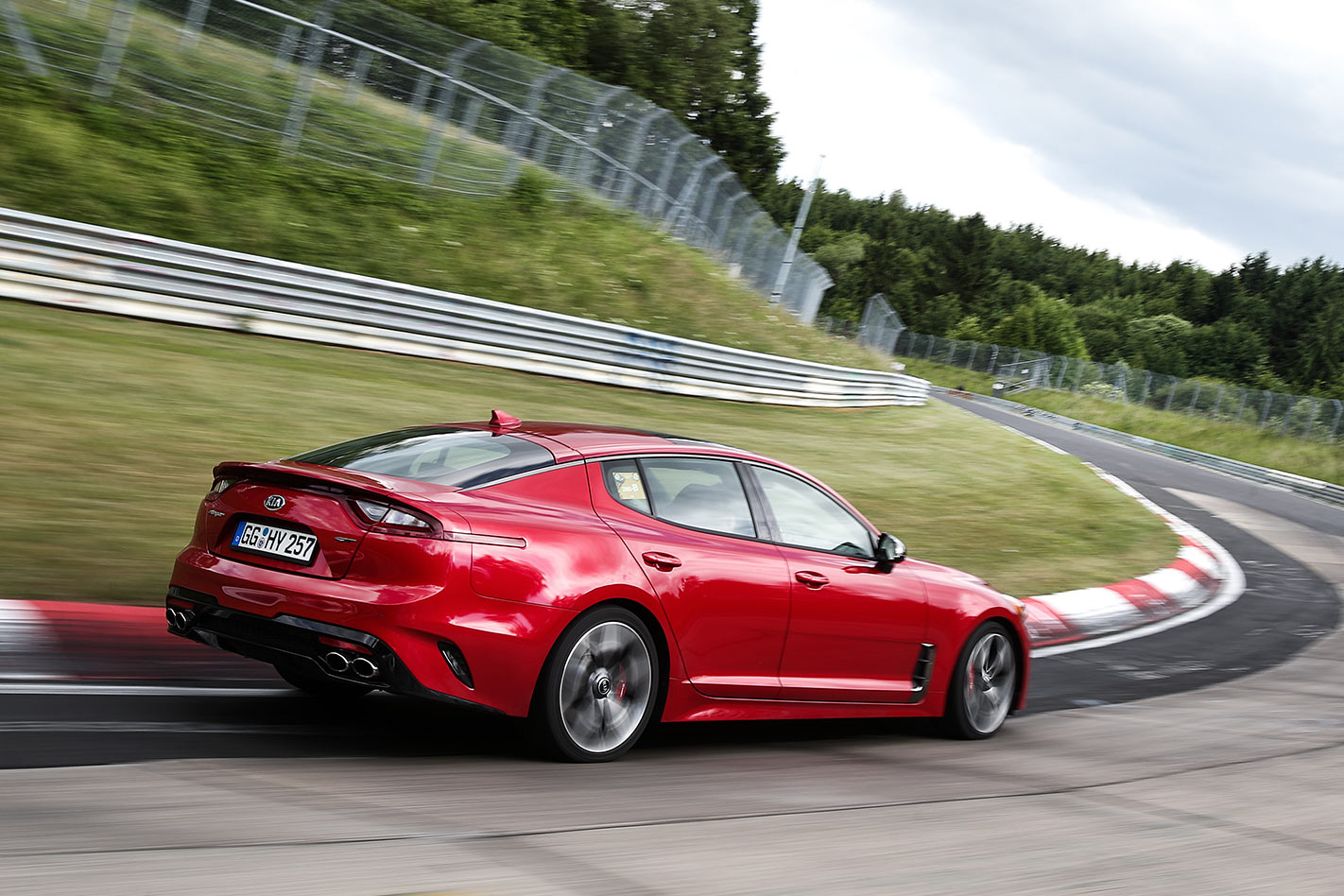
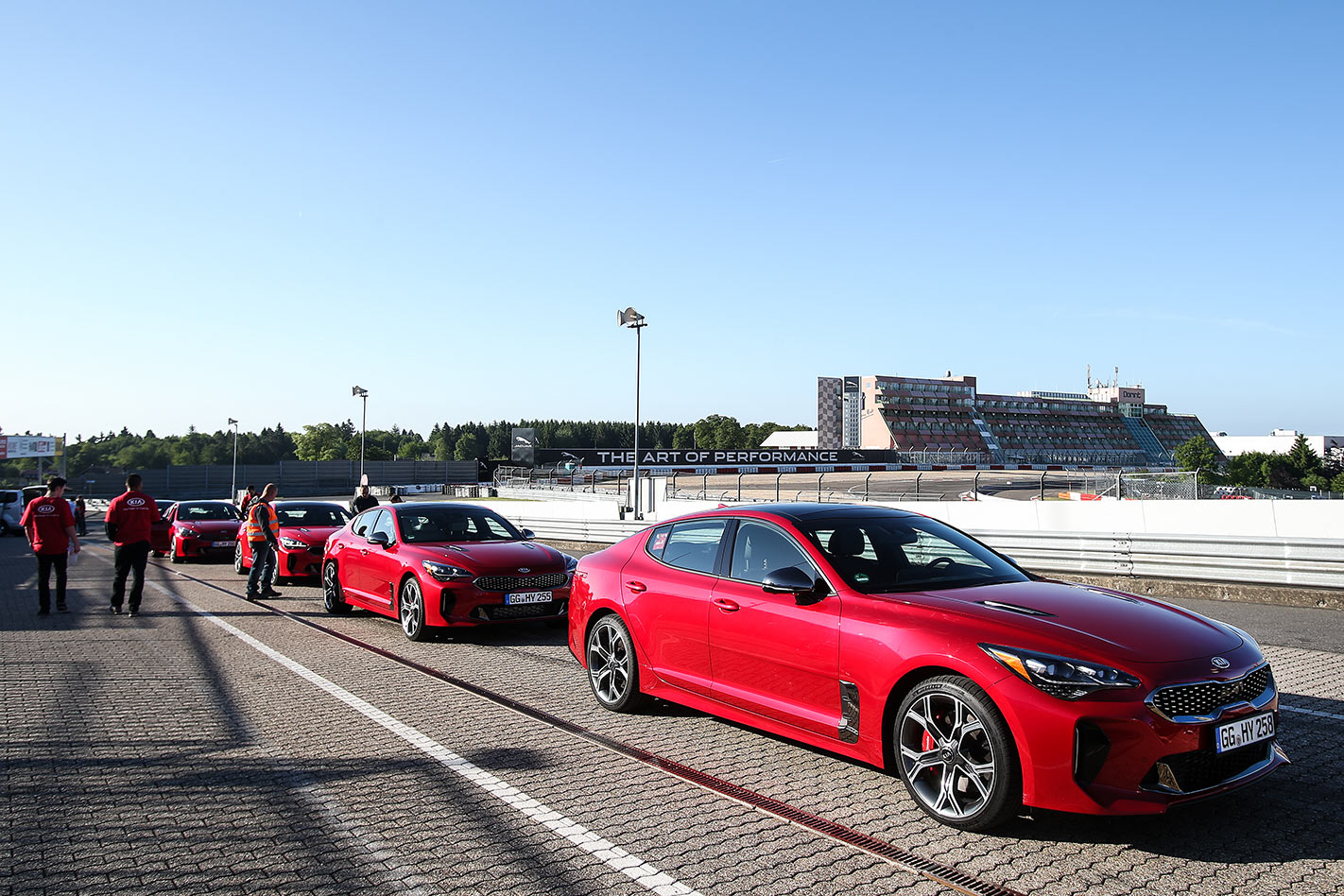
But over and over again, during our first drive of Kia’s much-hyped 272kW rear-drive hero, on the Nurburgring Nordschleife no less, we had to keep reminding ourselves we were driving a Kia.
A spacious, four-door Kia sedan that will power oversteer. A Kia with a nicer interior than most Volkswagens. A Kia that doesn’t turn into a smoking wreck after half a dozen corners on a racetrack, a Kia you might actually want to take for a drive.
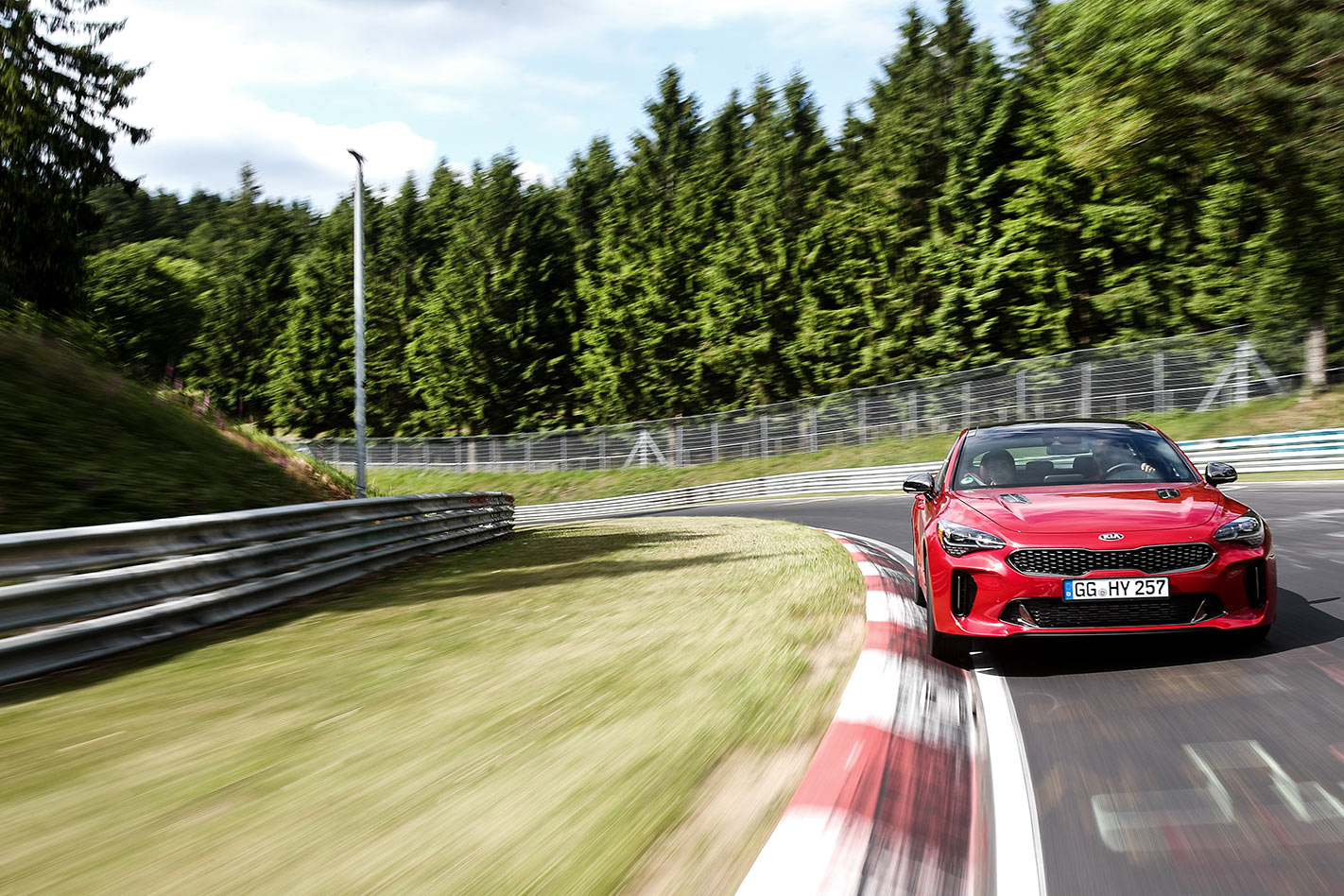
While our time in the Stinger GT was frustratingly brief (just one lap, and no on-road driving) it was enough to notice that this Kia is fast and powerful enough that you’d think twice about leaving it in inexperienced hands on a rainy day, with the electronics off at least.
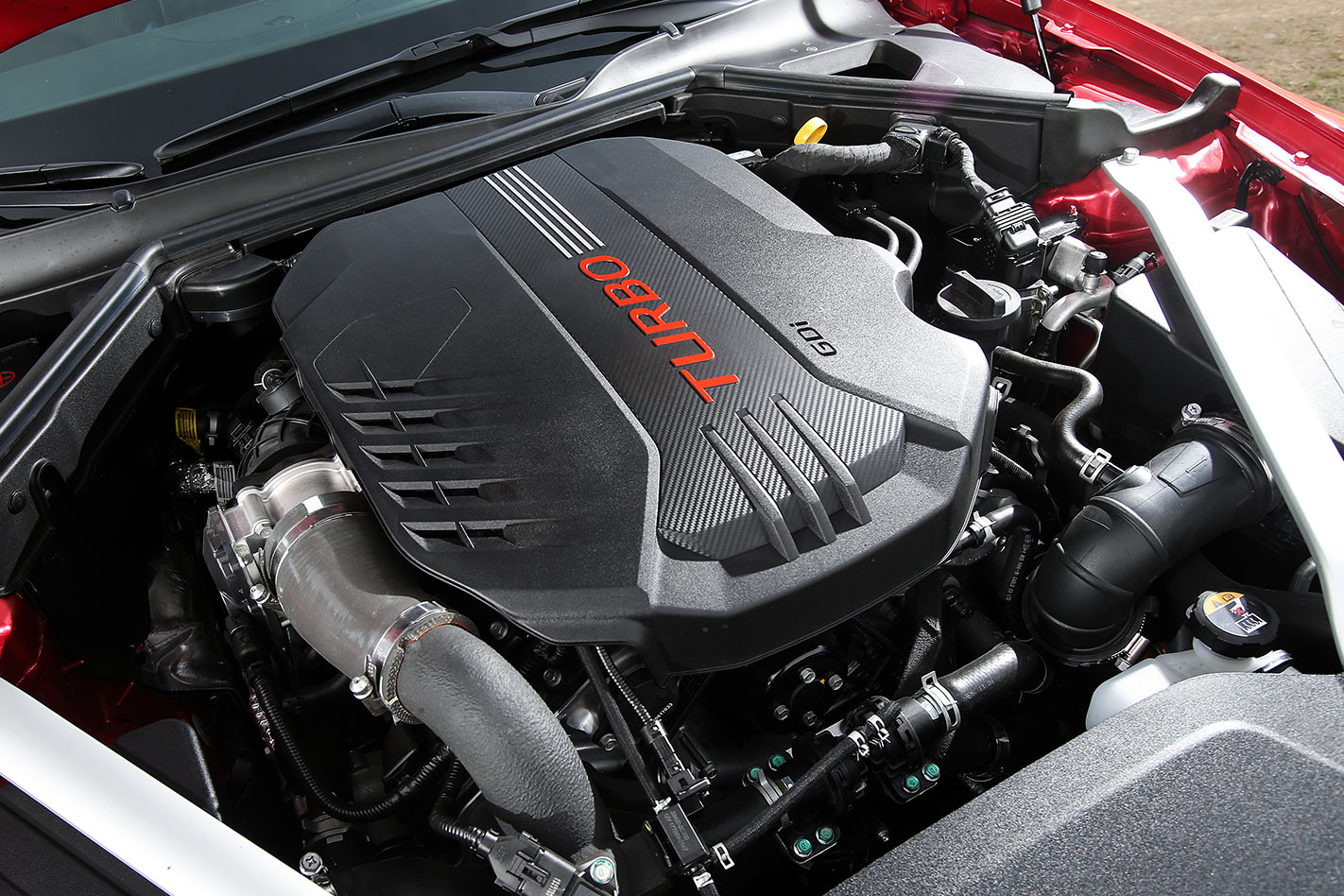
It is fast. Kia claims 0-100km/h in 4.9 seconds with launch control, its 3.3-litre twin-turbo V6 sending power through an eight-speed torque converter auto and big, wide, 255-section rear Continental ContiSportContact 5 tyres.
It squats hard off from a standstill and pushes you back into the seat with impressive traction. Kia claims the Stinger GT will do 270km/h. We saw 250km/h down the Nordschleife’s famed 2.5km-long Dottinger Hohe straight which in the Stinger GT felt effortless, stable and calm.
Kia Stinger GT Nurburgring
Yet while we didn’t have time to try for ourselves, this is also a car that would wheelspin through first gear and probably into second. “With the DSC off it’s a great drifter,” grinned the Stinger GT’s creator Albert Biermann, the German and ex-BMW M Division chief engineer.
Indeed, if you like your powerful rear-drive cars, you will like the Kia Stinger GT, which also has cutting-edge chassis electronics that very much work with the car’s power and rear-drive layout, rather than against it. Which means more fun. And the Stinger GT is a fun car to drive fast.
There’s an ‘interesting’ V6 growl, in the interior at least, although it’s an artificial note coming through the speakers and stereo system (rather than a mechanical symposer plumbed from the engine bay). And even though it does sound a little fake, the Stinger GT needs it, because the overseas specification car we drove sounded like a base model V6 from the outside, thrashy and dull.
This is not a car you rev for your mates. “Does it sound good?” We asked, stepping from the Stinger GT having just revved it for a video for some of our journalistic colleagues. “No,” was the reply in unison and without hesitation.
Kia Stinger GT start-up and revving
Although there’s a twist to all this: Kia Australia agrees that the overseas Stinger GT lacks aural sizzle and so Australia is getting its own homegrown bi-modal exhaust system.
Yes, that’s right, built and engineered by the same outfit that does HSV’s exhausts, the Australian Stinger GT will be offered with an optional sports cat-back to up the tailpipe titillation. And we will be very interested to hear what this sounds like when we drive the Aussie car late August.
We’ll also be interested to drive the Aussie Stinger GT because it’ll have its own unique Australian suspension tune. The suspension of the car we tested overseas, while feeling very German and far more sophisticated than anything we’ve driven in an Australian car, had an obvious ‘grand tourer’ tune.
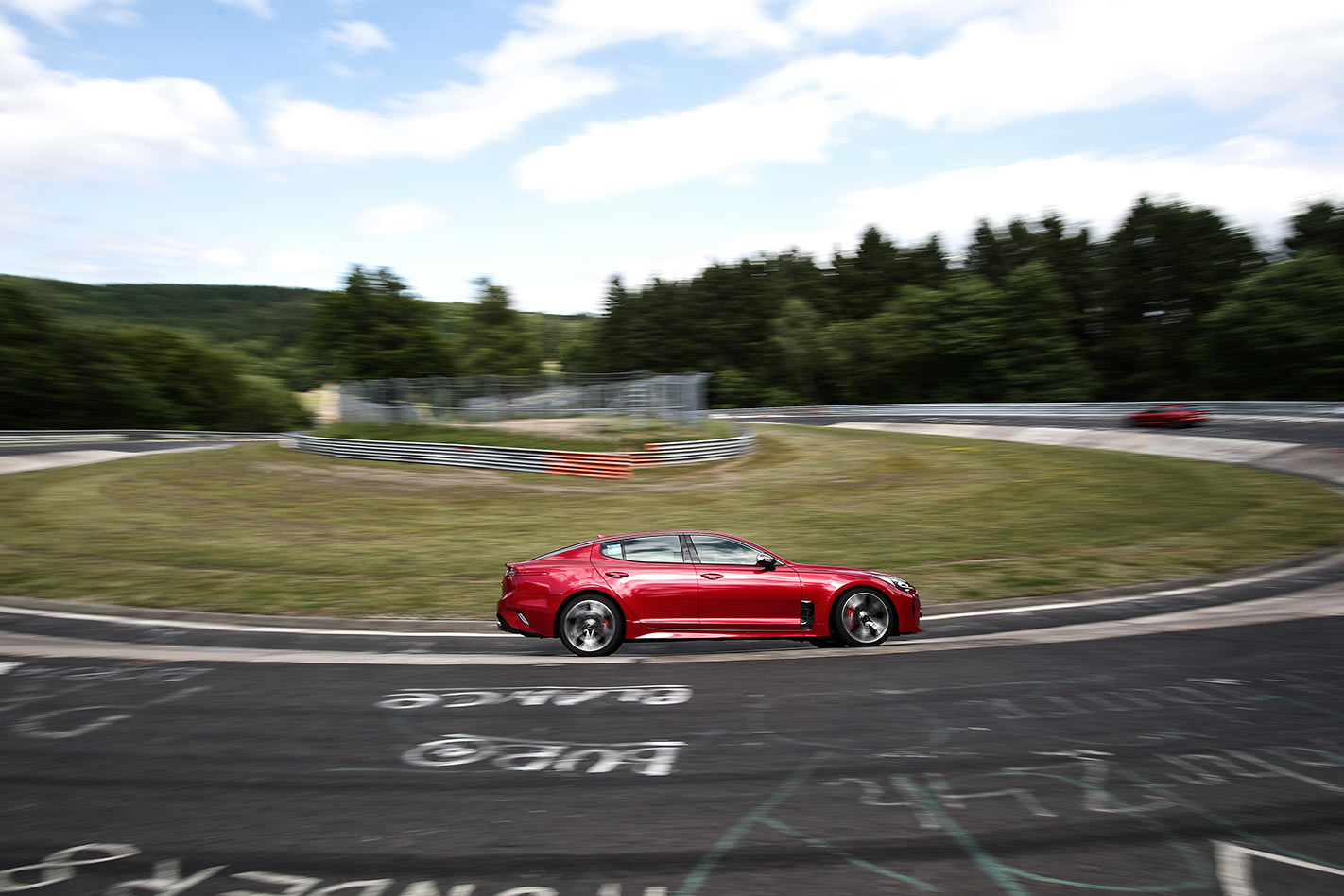
Kia Australia, however, wants to shift its local Stinger GT further towards the performance end of the comfort-handling spectrum, making it more of a corner-carver than a long-distance cruiser. Its local suspension expert Graeme Gambold has been busy working on prototype cars in Oz, giving them a more performance-focused suspension tune.
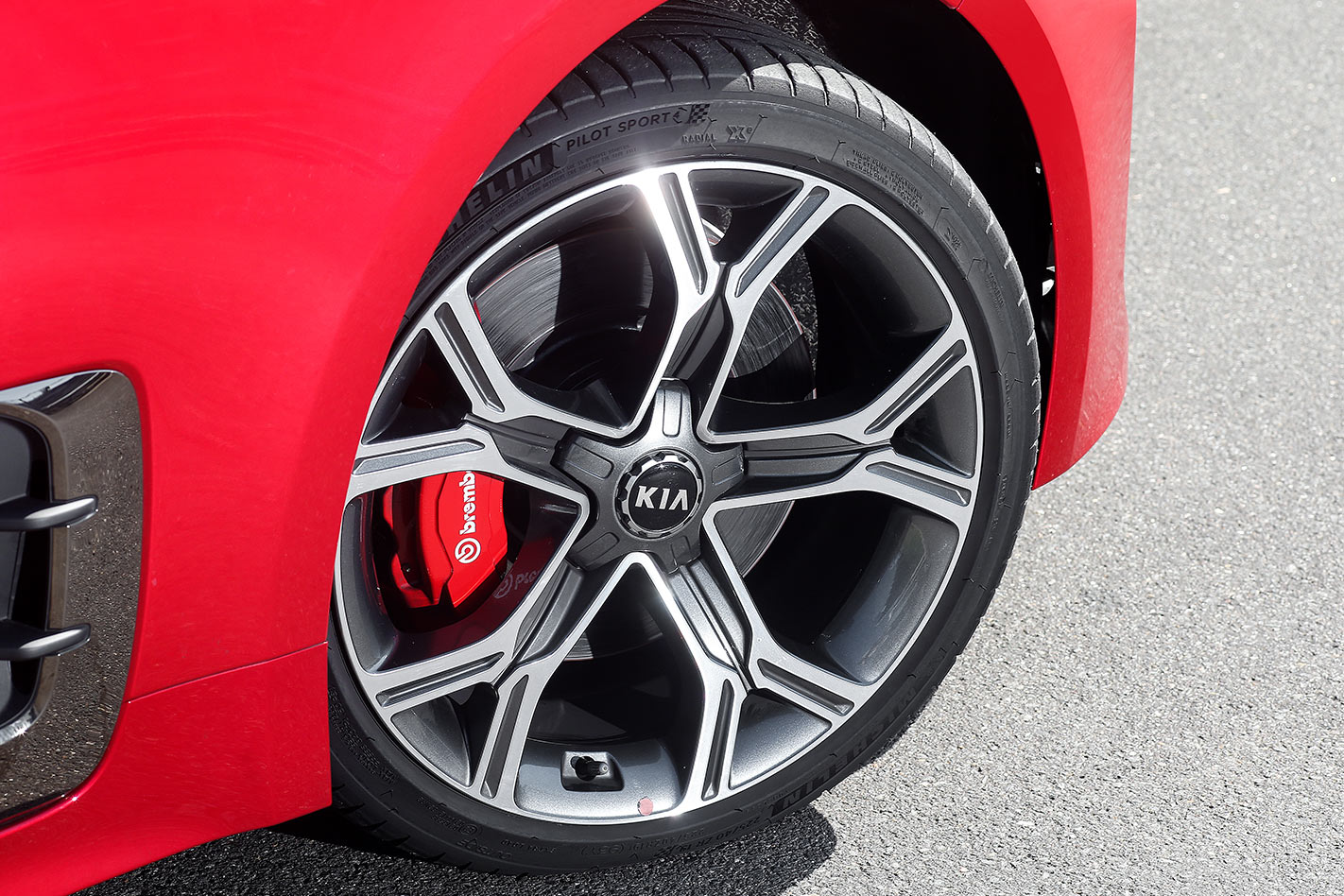
This could turn the Stinger GT into more of a twin-turbo V6 SS Commodore as currently it’s somewhat of a Korean Calais. You wouldn’t think it, looking at the spec sheet, with that power, those big, 350mm four-pot Brembo front brakes, the 19-inch wheels and wide tyres, but that’s how it drives.
The big, 1750kg Stinger GT still works its tyres hard and Aussie owners might do well to fit their Stingers with ContiSportContact 5Ps, rather than the OE-fitted 5, when they’re up for their first set of tyres.
And unfortunately, while the Brembos are strong and give you confidence to brake hard and late, that same confidence eked away as the brakes started to run out towards the end of our Nurburgring lap.
While we tested it at a track, and it held up impressively well, the Stinger GT is not really a car you’d pine to take to a track day.
The transmission, too, while eight speeds, and very responsive, is more like a six-speed with two overdriven top gears, not having a ratio for every corner like you might hope. In fact, often under brakes you’re frustratingly denied the downchange you intuitively felt was available. There is also no hardcore manual-only mode. The Stinger GT is auto only.
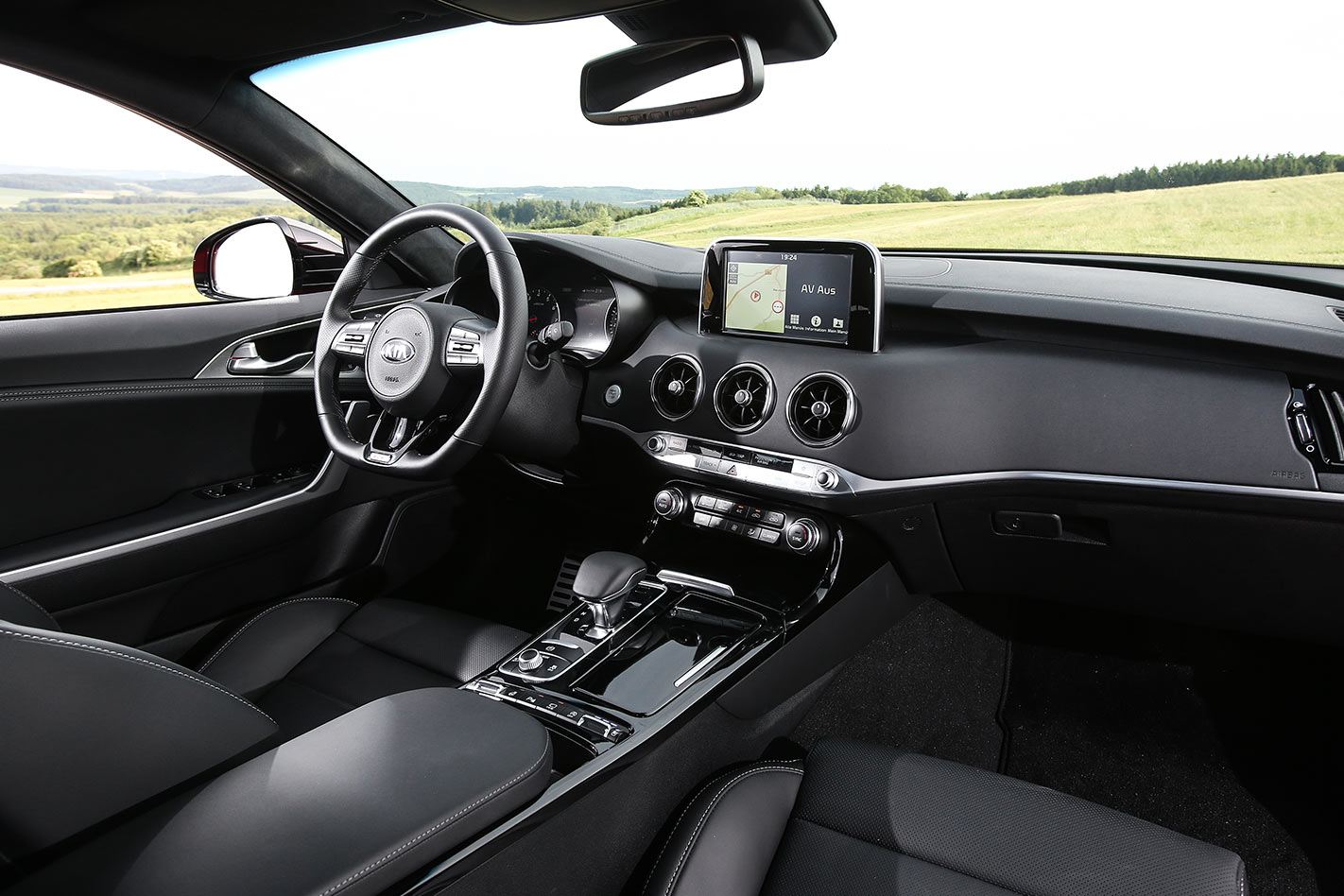
The interior also strangely doesn’t match the boldness and attitude of the exterior. This is an aggressive yet handsomely-styled car in the metal, showing off intent with big 19-inch wheels, bonnet vents, quad exhaust pipes, assertive front bar and that fastback roofline. Yet the interior is mature and even conservative by comparison.
It’s spacious and more German than Korean. But there’s only one GT badge on the steering wheel and that’s it. Even the seats and dials miss out on some GT branding and keep the excitement to a minimum.
This is a smart, well-appointed interior, yet somehow too sensible compared to the car’s daring exterior and performance. It’s like a 40-year-old did the exterior and engineering and their father did the interior. Having said all that, some people will like the interior for its classy restraint.
Kia Stinger GT walkaround
The seats, too, could be a source of disappointment when the car gets to Australia. Kia Oz might be able to give it the suspension tune and exhaust note to match the hardcore hardware like the big Brembos, grunt and limited slip diff, but the seats are made for grand touring, not performance driving. They’re comfortable yet despite adjustable side bolsters, lack support when the red mist descends, as it inevitably will in the Stinger.
That all said, we are now entering the nit-picking realm and one must come back to the reality in that this is a well-appointed, 272kW rear-drive four-door sedan that will cost about $55K when it goes on-sale in Australia in September. And you’ve still every right to be excited.
Of course, while for these people the Stinger GT will feel familiar in a strange way, it will still have a very new, foreign flavour that will take some getting used to. And while the Stinger GT isn’t perfect – and you should wait for our review from the Australian launch, with the local suspension and exhaust, given that so far we’ve only driven it for one lap around the racetrack it was engineered for, and not the road – we can’t understate how happy and glad we are that it exists.
It will be a genuine option for those anguishing over the end of our beloved powerful rear-drive Aussie cars, and it’s an impressive new player in this very Australian segment. And not just for a Kia, though there is that.
4 out of 5 stars
KIA STINGER GT Engine: 3342cc V6, twin-turbo, DOHC, 24v Drivetrain: 8-speed automatic, rear-drive, mechanical limited-slip differential Power: 276kW @ 6000rpm Torque: 510Nm @ 1300rpm-4500rpm Weight: 1750kg (estimate) 0-100km/h: 4.9sec (claimed) Top speed: 270km/h (claimed) Price: $55,000 (estimate)
