
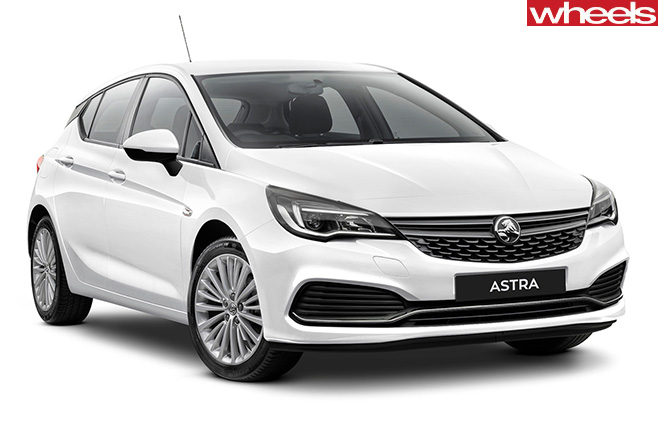
THE model expected to be the most popular in the new generation Holden Astra range is the latest car to fall foul of the differing regulations that cover Euro and Australasian NCAP independent crash test processes.
While the upper specification RS and RS-V models get the full five-star rating here, the entry-level R is unrated because it does not get some high-tech driver aids such as autonomous emergency braking (AEB) standard.
But the R is structurally the same as its two stablemates, is fitted with the same level of passive safety equipment and Holden is confident it would achieve five stars if crash tested locally.
However, because the Astra is developed and built by Opel in Europe, Holden elected to take the far cheaper course of submitting Euro NCAP results to achieve an ANCAP rating.
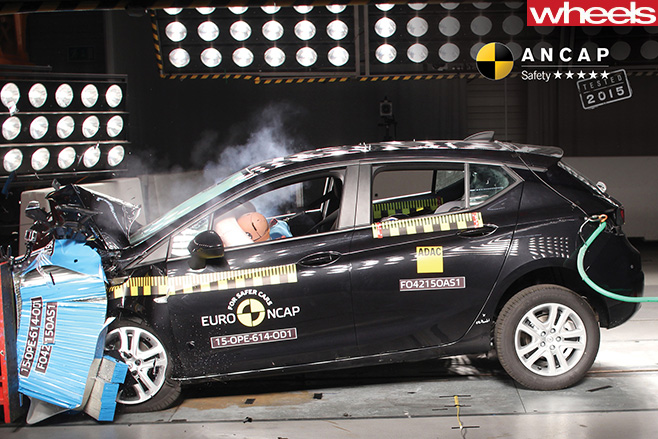
“Because the Euro cars tested had the features and content of the RS and the RS-V the result that we get we can only apply to the RS and RS-V,” Holden director of vehicle performance Ian Butler explained.
“The way Euro NCAP worked when they did the Astra is that if you are offering that content at more than 50 per cent of [sales] penetration you would get a single rating for the car.
“That was the data we had to work with, so being rigorous ANCAP has obviously applied that to the cars that match spec-wise.”
Astra ANCAP ratings were announced this morning. Sales officially commence December 1. In the release announcing the rating, ANCAP chief executive James Goodwin urged buyers to opt for the more expensive RS and RS-V over the R.
Holden isn’t alone in striking issues with NCAP ratings. For instance, the Ford Focus RS is unrated in Australia because it comes without side airbags and the blue oval has elected not to re-crash test it here. In Europe it gets five stars because the Recaro seats that delete side airbags are optional not standard.
Holden sales executive director Peter Keley predicted the issue of safety ratings applying to only selected models in vehicle ranges will become more common.
“This is going to become a challenge for all brands because in the future you are not going to have every car in a range with a rating,” he said.
“There are already cars out there that are in this situation and it is going to be a bigger challenge going forward and it just depends where you are in the launch cycle as to whether you are one of the first with a mainstream car or if you are launching in a year or two and the issue won’t be seen as an issue.”
FOR less than the cost of a brand-new Honda NSX, BMW Australia will sell you its largest, fastest and most powerful luxury sedan ever – the $419,000 M760Li xDrive.
While not quite the M7 you may have been hoping for, the M760Li is based on the long-wheelbase BMW 7 Series and is the largest member of BMW’s M Performance family. It’s big under the bonnet, too, with a twin-turbocharged 6.6-litre V12 – shared with Rolls-Royce – supplying a gargantuan 448kW and 800Nm.
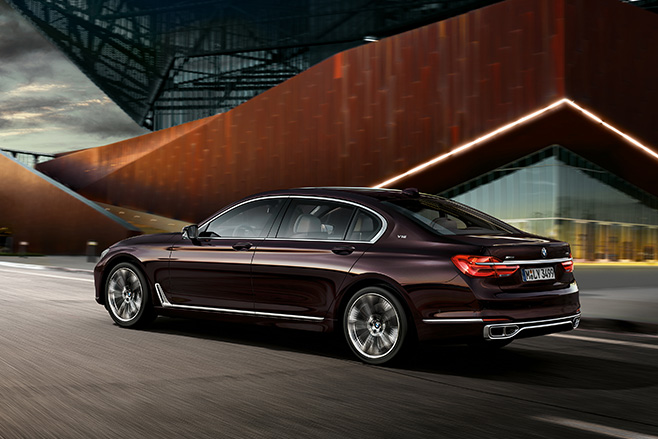
And while a BMW M4 Competition will sprint to 100km/h in four seconds flat, the mammoth M760Li pips it to the post with a 0-100km/h of 3.7 seconds. How? Besides its M4-shaming power and torque outputs, the M760Li takes power to all four wheels rather than just the rear axle. Traction off the line is substantial as a result, and a variable torque split endows the M760Li with more than a modicum of dynamic prowess.
It’s also the first time BMW has offered all-wheel drive on a non-SUV product in Australia.
An eight-speed automatic with paddle shifters sits between the engine and the AWD underpinnings, and features an M Performance-specific calibration to make the best use of the V12’s power. Meanwhile, an M Sports exhaust plays a sportier tune through quad tailpipes. Fuel economy is a respectable (considering the power and weight of the M760Li) 12.6L/100km.
A sports-tuned active air suspension works to contain body movements while also delivering the cossetting ride that’s expected of a 7 Series, with damper valving varying from soft to firm depending on the drive mode selected. Braking hardware hasn’t been neglected by M Performance, either, with 19-inch rotors pinched by M Sport brake calipers. Lightweight 20-inch alloys are unique to the model, and feature staggered widths with 245-section tyres and the front and 275-section rubber at the rear.
Externally, the M760Li differs from the V8-powered 750Li through its M aerodynamic bodykit, blue-painted calipers, exhaust outlets, V12 badging and Cerium Grey exterior trim.
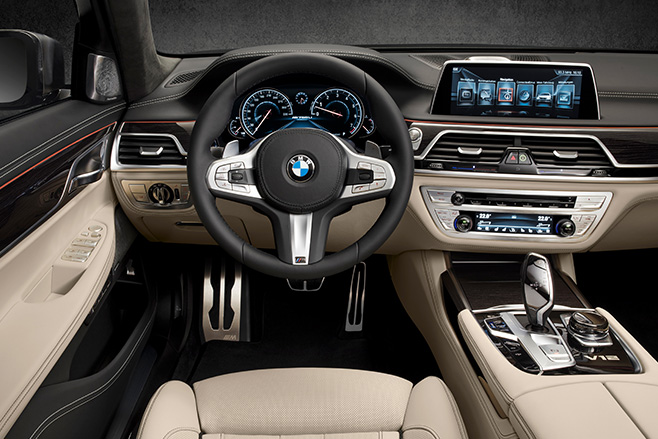
Luxuries such as soft-close doors, a head-up display, four-zone climate control, a panoramic glass sunroof, laser headlamps, two rear entertainment screens and BMW’s lastest iDrive infotainment package are standard, and BMW Individual Merino leather upholstery is accompanied by high-pile carpet, black wood trim and an anthracite headliner..
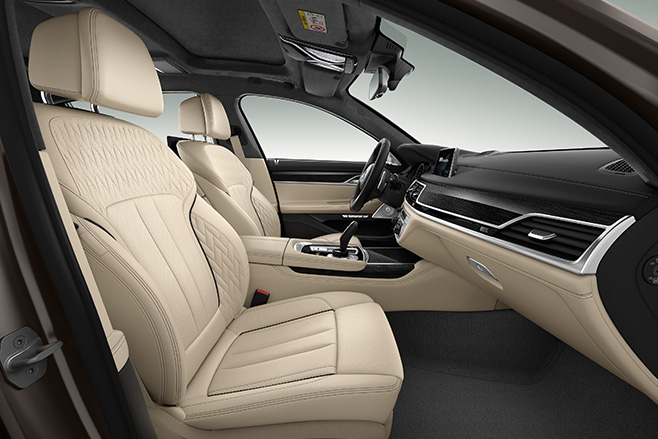
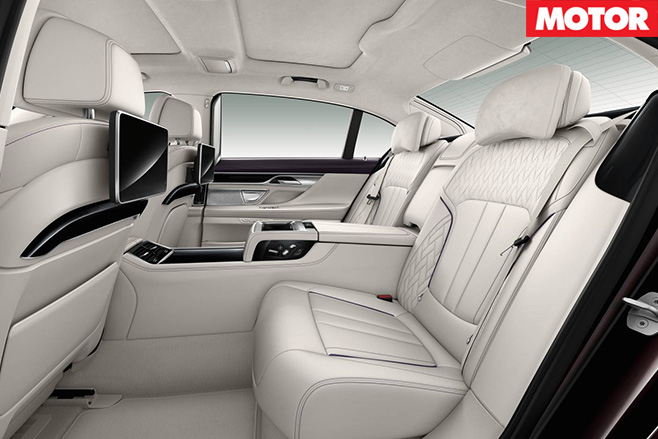
Heated and cooled massage front seats are fitted up front, and the M760Li xDrive gets the Executive Rear Seating package as standard. That package deletes the conventional three-seater rear bench in favour of two individual electrically adjustable seats, with heating, cooling and massage functions included. The front passenger seat can also be folded forward to make a footrest for the rear left passenger which, in conjunction with the full-length centre console, transforms the inside of the M760Li into a business-class cabin.
Want a more first-class experience? The M760Li xDrive can be had in “Model V12 Excellence” trim at no extra cost, which brings polished 20-inch alloy wheels, a unique front and rear bumper, black brake calipers, chrome trim, more wood throughout the cabin, and extra thick floor mats.
Priced from $419,000 before on-road costs, it’s the most expensive BMW money can buy. Want one? It will be available for sale here from about May.
Audi’s Cabriolet models will reach Australia in late 2017, following the coupe and Sportback variants that arrive in the first half and middle of the year, respectively.
The A5 drop-top gains 47mm in length, though sheds up to 40kg in weight to be one of the lightest in a class that also features key rivals including the BMW 4 Series Convertible and Mercedes-Benz C-Class Cabriolet, and the Infiniti Q60 Convertible.
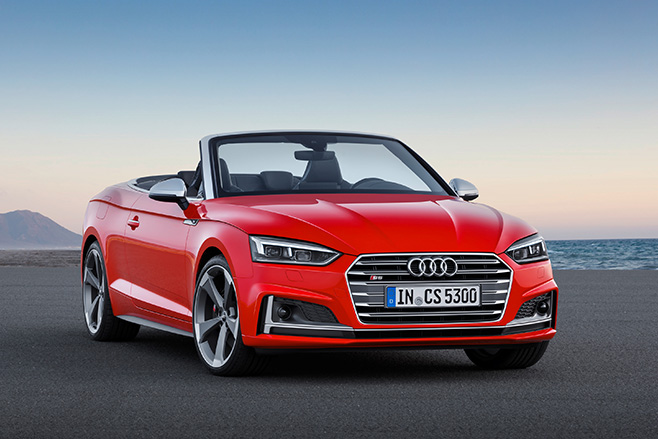
Audi claims the A5 has the stiffest body in its class, with its construction, reinforced sills and extra struts in the body increasing rigidity by 40 per cent over the previous Cabriolet.
The stronger body will assist ride and handling, as should a revised suspension that replaces the old model’s rear trapezoidal set-up with a more sophisticated multi-link arrangement to match the front end.
A fabric roof is employed again, opening in 15 seconds and closing in 18 seconds automatically via a one-touch operation. It matches the C-Class’s ability to operate at up to 50km/h, where the 4 Series with its folding metal roof is limited to 18km/h.
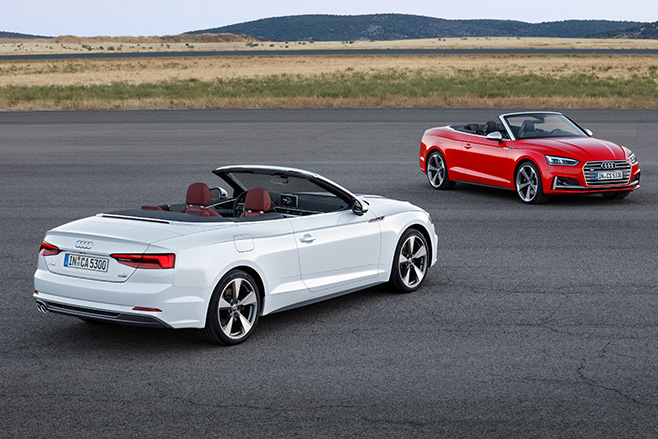
Boot space is 380 litres when the roof is raised – 100 litres down on the most practical A5 variant, the five-door Sportback. The rear seat is divided into two foldable sections, and the boot opens electrically (or via a kick if the gesture control option is ticked).
Audi says there’s more space up front, with shoulder room increased by 26mm and knee space by 18mm.
The Audi A5 Cabriolet borrows seatbelt microphones from the latest Audi TT Roadster to improve phone conversations with the roof down – while an Audi ‘phone box’ pairs smartphones to the car’s on-board antenna to improve reception.
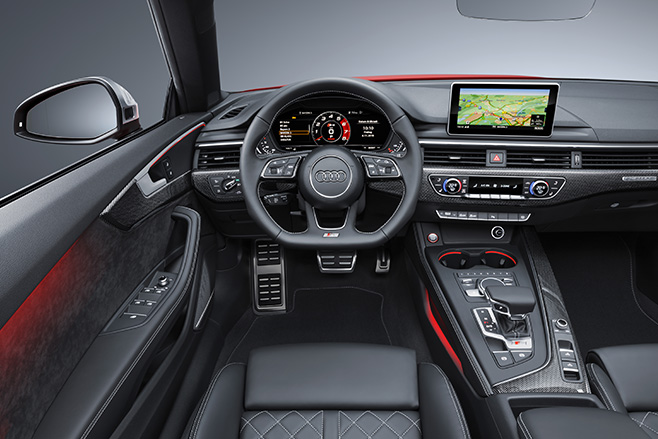
Multiple options will include Audi’s clever, 12.3-inch Virtual Cockpit digital instrument display and head-up display.
Petrol engines will eventually comprise 140kW and 185kW 2.0-litre turbo four-cylinders, plus the 260kW 3.0-litre turbo six-cylinder powering the sportier S5 Cabriolet. It has a quoted 0-100km/h acceleration time of 5.1 seconds, four-tenths slower than the S5 coupe and Sportback.
On the diesel front there will a 2.0-litre four-cylinder with 140kW and two 3.0 TDI models with either 160kW or 210kW. The more powerful turbo diesel is the only engine to be mated as standard with Audi’s quattro all-wheel-drive system, where it’s an optional alternative on the front-wheel-drive models.
The current Audi A5 Cabriolet range is priced from $81,155.
Already winner of the Indianapolis 500 on 16 occasions, Team Penske will for the first time ever field five cars at the 2017 running of “The Greatest Spectacle in Racing.”
Though he wasn’t offered a full-time drive with Penske next season, veteran Juan Pablo Montoya has been offered a one-off for the 2017 Indianapolis 500, team president Tim Cindric has confirmed.
The Indy 500 is at this stage the only IndyCar Series race that Montoya is scheduled to drive in the 2017 season.
The Colombian, a twice winner of the Indy 500, joins the four full-time drivers at the Brickyard.

Team Penske has already won the Indy 500 a whopping 15 times.
Now a free agent except for his Indy 500 commitments, Montoya has won 15 Indy car races in 91 career starts over five seasons, with stints in Formula One and NASCAR mixed in too.
He won the CART championship in 1999 and the Indianapolis 500 in 2000 and 2015 (the year he finished runner-up in the championship). Montoya was eighth in the standings last year, and Penske elected to instead sign Newgarden.

“Also this will give me more time to work with Sebastian [son] in karting.”
It is unclear if the 41-year-old will compete full-time in another championship, although he has previously tested a Porsche 919 LMP1 car.
Despite his age, Montoya is still rated very highly as a skilled, fast, and safe pair of hands.
Meet one of the fastest* Nissan GT-Rs in the world – a heavily tuned example that clocked a crushing 7.168 second quarter mile.
An R35 Nissan GT-R tuned by EKanooRacing leapt off the line at the Bahrain Drag Racing Championship (BRDC) to hit 18 metres (60 feet) in 1.208sec, covering an Olympic-sized swimming pool (50m or one-eighth of a mile) in 4.795sec at 262km/h and 400m in 7.168sec at a staggering 336km/h (209mph).
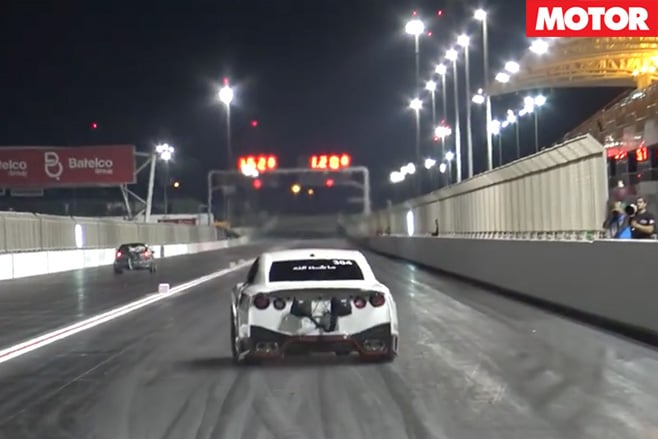
EKanooRacing is no stranger to mightily wound-up drag racers. An absurd Toyota 86 Pro Import clocked a 5.85sec quarter at 394km/h – definitely not with the standard 2.0-litre atmo four, then.
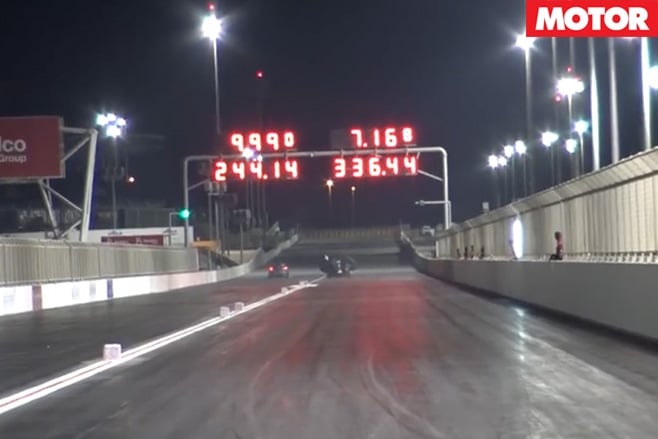
*When run the pass made Ekanoo Racing builders of the fastest GT-R in the world. However, a rivalry for that title has quickly emerged from America’s AMS Performance and its Alpha-G GT-R – which has since pinched the title with a 7.14sec pass. Story to come.
Talk about hiding your light under a bushel. In the year since Suzuki u2018launchedu2019 the all-new Celerio (if doing nothing more than issuing a press release on a news media website qualifies as such), weu2019ve found ourselves constantly justifying our approval for this $12,990-driveaway runabout.Replacing the Alto, which was built by Maruti of India, the LF-series four-seat five-door baby that comes to us from Thailand may seem like a retrograde step styling-wise, trading its predecessor’s chic design for something that looks somewhat like Chicken Little on wheels. But along the way Australia’s cheapest new car gains a whole lot more beauty elsewhere, thanks to far better packaging, functionality, quality, refinement, safety and – not least – driveability.
Even a brief spin reveals just how far Suzuki’s base hatch has come.
The Celerio – the name combines ‘celestial’ and ‘river’ in Spanish, but we know not why – is 3.6m long by 1.6m wide and an unusually high 1.5m tall, while the 2425mm wheelbase is just 5mm short of the current Suzuki Swift’s. It therefore transcends its class with more than enough space for four adults and a very reasonable 254-litre cargo capacity.
As well as being relatively spacious, the Celerio’s pleasingly presented and finished cabin also offers clear instruments and controls, heaps of storage and even a couple of unexpected items such as Bluetooth audio streaming with track info and steering wheel-mounted phone buttons.
Its vital statistics also include six airbags, stability control, air-con, remote central locking, power windows, height-only steering column adjustment and space-saver spare.
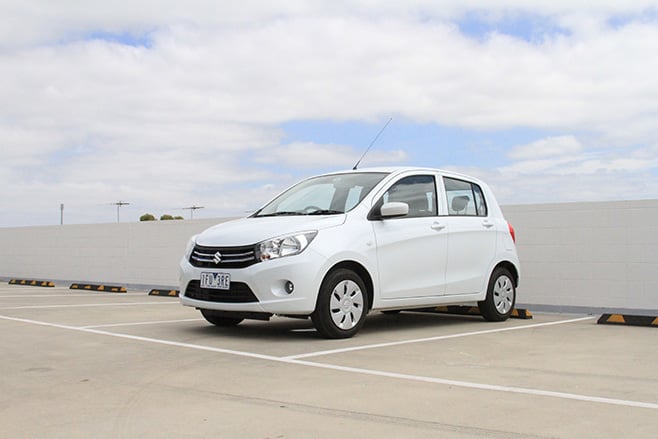
More vitally, a commanding seating position and deep windows make manoeuvring in tight spots simple, the steering is light when parking but firms up reassuringly at higher speeds, and as zesty as the spirited 50kW/90Nm 998cc three-pot is, the chassis feels planted enough to cry out for more power, yet still delivers an outstandingly supple ride.
Obviously, there has been some clever suspension tuning going on. Over its four-year gestation, Suzuki says benchmarks have included the Volkswagen Up, Fiat Panda and Hyundai i10. All are at the pointy end of the sub-B segment in Europe, though none are currently available in Oz, sadly.
So it’s hardly a shock that, considering its price point, the Celerio went on to surprise the hardened judges at COTY, becoming one of the more charming contenders despite its humble station in life. People just assume this is a shitbox until they slip behind the wheel. Just watching their faces light up when they do is rather satisfying.
Indeed, it was during the recent Wheels Car of the Year examination that sub-B fan-boy and Wheels road-test editor Nathan Ponchard agreed to put the Suzuki under the long-termer microscope. We decided to find out if our admiration is a case of just an ordinary car far exceeding initial expectations, or is there still enough substance to see us through living with it for a few months?
We chose the manual because, despite the (completely adequate) CVT version costing just $1000 more, the five-speeder keeps the price at rock-bottom level.
That’s also why we dismissed the $475 metallic paint option, though the Cerulean Blue and Sunshine Yellow really do liven up the palette nicely.
The only option we did ask for – cruise control – is not even available. Nor, for that matter, is Autonomous Emergency Braking. It’s not surprising, therefore, that the Celerio scores only a four-star ANCAP rating, though that’s partly due to poor pedestrian pelvis protection on impact.
The car’s arrival is a timely one because Kia will attempt to shake up the so-called Micro class with the European-engineered Picanto from about April, while a Holden insider has admitted that the Celerio was one of the yardsticks employed for the MP-series Holden Spark that will soon replace the lamentable Barina Spark. A baby battle royale looms…
UPDATE 1
The plan was to take a break from driving new cars…
The holiday season is usually all about minimising family interaction and maximising tinkering time with my long-neglected classics. With an Alfasud recently joining the fold, hands (and credit card) would certainly be kept busy.
Except this time around three friends needed new cars, and pronto. Without warning, Mel’s 2006 Suzuki SX4 met its end in a ditch, Vic’s 2002 Renault Scenic’s electricals expired, and Viv’s decrepit 1992 Camry finally called it a day. Three emergency missions, one plucky Celerio, and no time to lose.
Varying requirements and a vast choice of cars to consider meant a couple of days with each, visiting many different dealerships across the length and breadth of Melbourne. With the air-con cranked up and often all four seats occupied, the Suzuki soon came under the microscope.
First impressions? Everybody commented on how easy it is to get in and out of something so small. All appreciated the light and breezy ambience that the deep side windows so helpfully provide. And nobody complained about the seat cushions, despite initial concerns about them possibly being too flat. In fact, there weren’t any grumbles or gripes at all.
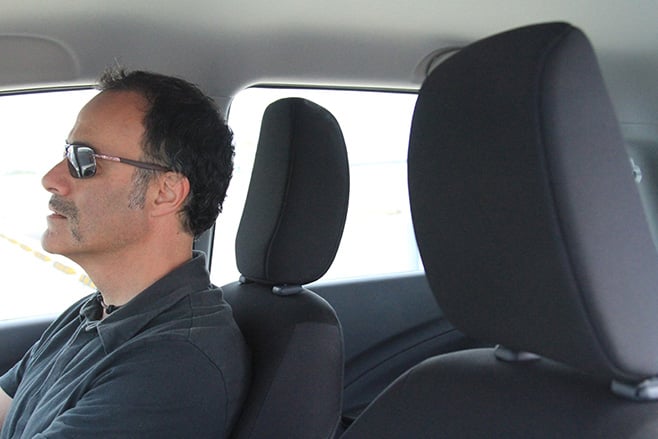
At some stage I had asked each friend how much they thought the Suzuki Celerio cost. All said $15,000. All couldn’t believe it retails for $12,990 driveaway. And one even wondered why she shouldn’t just buy “this little cutie” instead – until she learned it’s only a four-seat city car with limited luggage space.
During this time my already healthy regard for the Celerio kept growing. Even on regular unleaded and with four bodies on board, there was very little noticeable performance drop-off. The steering remained satisfyingly weighted and amply responsive, and the suspension’s ability to absorb bumps and isolate noise is in a higher league than most rivals.
Regardless of all the driving, my sanity prevailed. And that’s telling because shopping for new cars can be stressful and fatiguing. At one point I thought, “This is far closer to a Swift than the Alto it replaced”.
That the Suzuki still felt good even after Mel, Vic and Viv signed away for their respective Skoda Yeti, Volkswagen Golf and Mazda 2 only highlights the pleasing amount of engineering integrity in what is still Australia’s cheapest new car.
Come to think of it, the Celerio is probably a more relaxing holiday proposition than trying to fix non-working tail-lights on an ’82 Alfasud. I ought to be very grateful for my friends.
CLASS OF 91
My previous long-termer, the Peugeot 308 Active 1.2 turbo, was run almost entirely on 98 RON super-premium unleaded, and it consistently returned lower consumption figures as a result. For the Celerio, however, its status as Australia’s cheapest new car dictates that only the least expensive petrol be used – regular 91 RON. That decision was made after the first few tankfuls featured 95 RON premium unleaded. Since then we’ve seen the Suzuki’s average edge up from 5.3 to 5.7L/100km.
UPDATE 2
Byron draws the short straw for a long trip to the ACT. Is the tiny Suzuki Celerio city car up to the cross country challenge?
IT WASN’T much of a vacation at all, not least for the littlest Suzuki, when my geologist partner needed to make a trip to look at, umm, rocks – a 1300km return run to the ACT.
The Suzuki Celerio was not our first choice of chariot, unsurprisingly. After all, it’s not like this little city car is meant for the many rigours of the open-road joust, which often include strong winds and meandering semis driven spare by stupefyingly low speed limits. The tiny Suzi doesn’t even have cruise control as an option.
We need not have worried.
Heaving with geological paraphernalia – tools, flasks, weather-proof (and fashion-proof) clothing, boots and camping gear for two – 1FU-3RE hit the blacktop with quite a burden. Yet the Thai-made tearaway was still strong enough to pull away stoutly from traffic lights, and spirited enough to squirt past slower vehicles as long as there was sufficiently empty road ahead and the driver wasn’t afraid to explore the 6000rpm redline.
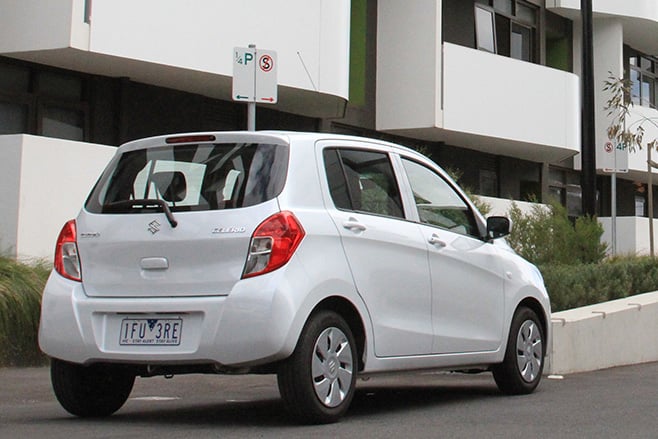
At an indicated 110km/h (actual 103km/h) in fifth, the tacho sat at 3200rpm, yet the 50kW/90Nm atmo triple beavered away with a soothing resilience. While it wasn’t exactly quiet, there was less wind noise than expected, even in quite blowy conditions, while the Celerio was remarkably planted for a car weighing just 830kg unladen; and the ride that has so impressed us around town continued to do so away from the urban limits.
Only two breaks punctuated the run up Highway 31 to Canberra, underlining the fact that the lack of cruise control didn’t bring on right-foot fatigue. And the front seats – even the one occupied by a 200cm human – proved quite resilient in terms of thigh support, dismissing fears that they might be too flat and bum-numbing over longer distances.
Could we drive one of these around Australia? Quite possibly, though the vast glass area probably contributes to the air-con’s reluctance to fully cool the cabin on really hot days, while the clammy plastic steering wheel, more than anything else inside the car, betrays the Suzuki’s bottom-end pecking order.
Furthermore, returning home in heavy rain exposed a lack of sound-deadening; the wheel wells and underbody magnified the wet-road hissing heading south again, which became very tiring after a while.
Still, the Suzuki never raised a sweat during its interstate vacation. While you’d never call it a grand tourer, there’s nothing to lampoon here either. It might even take on a Chevy chase.
THE BRUNSWICK JOB
In its first three months, our Celerio’s appetite for unleaded has varied between 5.3L/100km (with plenty of highway cruising) and 6.5L/100km, which included heavy urban commuting with at least two additional occupants, and the air-con blasting away constantly. These are some way off the official 4.7L/100km, but the fizzy triple, light gearshift, tight steering and taut yet supple chassis tune encourages enthusiasm. It’s like weaving through Turin in The Italian Job (the 1969 original, of course).
UPDATE 3
We bid farewell to our long-term the Suzuki Celerio, a brilliant value city car that works well in its intended environment.
Seventeen weeks, seven thousand clicks, and across three states in record Aussie summer heat… Is that any way to treat an 830kg four-seat urban runabout?
We did so anyway, and it’s with a heavy heart we bid bye-bye to our $13K-driveaway Suzuki Celerio. For few cars this cheap would still feel cheerful after so much time.
From the post-COTY judging curiosity that sparked us to include the Thai-built sub-B supermini in Garage, through the holiday season, then into the first few months of the year, 1FU-3RE never erred. Unlike the pretty but flawed Suzuki Alto, few corners have been cut to keep the price low.
The Celerio certainly works well in its intended environment. For starters, thanks to some very utilitarian boxiness combined with a substantial 1.5m-high roof, entry and egress is easy.
Once inside, deep side windows, thin pillars and lofty seats help lift the ambience, aided by some unexpected attention to detail. For example, there’s the dotty upholstery, metallic brightwork, elementary Bluetooth set-up with decent audio streaming and wheel-mounted phone buttons, and very ’80s Alfa-style eyeball air-vents.
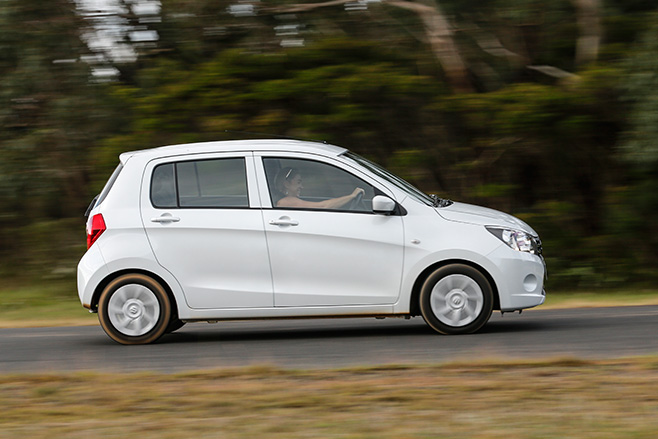
Speaking of ventilation, it is ample, though all that glass does tax the air-con on sweltering days. And a suitable driving position is not difficult to find despite no telescopic steering adjustability, the seats are comfy (they only look flat), the classy if basic instruments are the very definition of clarity, and there’s storage galore.
Importantly, thoughtful packaging equals ample space for four adults, while the sizeable (2425mm) wheelbase also results in a better-than-average 254-litre boot. In fact, the Celerio’s size makes it feel like a car from the class above.
It drives like one, too.
Lusty yet still quite subdued, the 50kW/90Nm atmo triple is quick off the mark, and an intelligently geared five-speed manual transmission makes the most of the 998cc engine’s limited power. The fact it pulls so energetically through the ratios – even when laden for a long highway drive – is testimony to the Japanese brand’s expertise at building such strong and seemingly unburstable engines.
Our Celerio also proved frugal, with the long-term average of 5.6L/100km taking in heavy inner-urban commuting as well as open-road touring. And remember, the air-con was blasting constantly and often there were two people on board.
But the biggest shock came with the Suzuki’s dynamic consistency. While not pin-sharp, the steering feels pleasingly weighted and well connected; the handling is predictable and linear, and it will hang on gamely when pushed despite a tendency to understeer; and the ride is astonishingly absorbent, smoothing out surfaces that agitate most rivals.
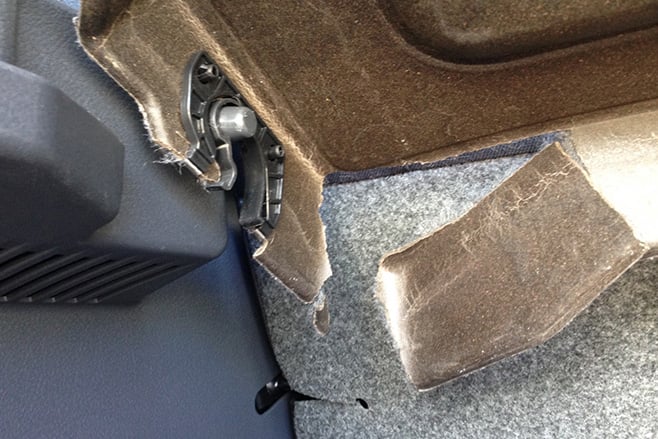
Down points? The flimsy cardboard cargo cover tore, so that’s rubbish. The front headrests push too far forward (facing them backwards is the solution). And highway driving in the rain revealed the lack of sound-deadening in the rear underside.
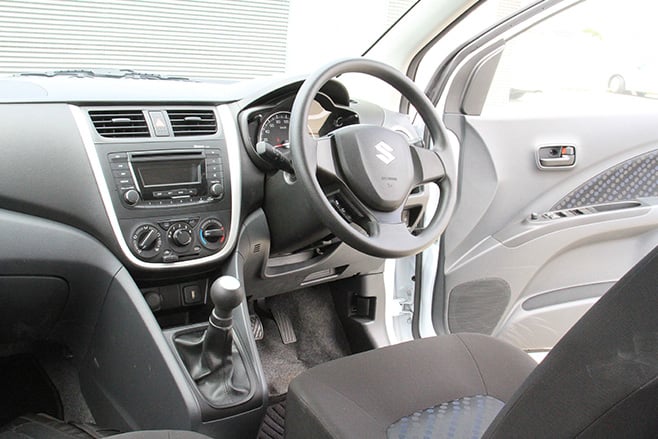
We’d also like to see AEB (even as an option), along with cruise control, but otherwise it lacked nothing significant.
In addition to the mandatory stability control and anti-lock brakes, that sub-$13K driveaway price includes six airbags, air-con, remote central locking, power windows, Bluetooth phone and audio streaming, a height-adjustable-only steering column, space-saver spare and a three-year/100,000km warranty. There are no glaring spec shortfalls.
This neatly sums up the littlest Suzuki after a little more than four months. It may look dowdy to the point of dumpy (especially post-Alto), but the function that trumps that slightly forlorn-looking form is formidable as well as friendly. And the styling definitely improves with exposure.
Even outside its urban comfort zone, the Celerio is a classic case of being more than the sum of its parts.
GET IT INDIA
In emerging markets like India where the roads and environment are challenging, the Celerio is often the sole family car, which necessitates more rear-seat space, greater ground clearance and a beefy torsion-beam rear suspension. Translated to Aussie conditions, these might help explain why the Suzuki takes to our open-road blacktop with surprising ease; this month we tallied 2700km of effortless mostly highway driving in 1FU-3RE without fuss, though we did miss cruise control.
CELERIO VS USED
At the bottom end of the market, a new-car warranty could be the only thing separating the Suzuki from, say, a perfectly functional 2013 Toyota Yaris YR with 60,000km on the odo for similar money. Despite the second-hand alternatives often being slightly larger, with the practicality of five rather than four seats and a more powerful engine, in important ways such as space utilisation, running costs, ride comfort and that intangible joie de vivre, the Celerio puts forward a compelling case.
TELL ME ABOUT THIS CAR
The Evoque Convertible is a bit of an unusual proposition. As a mid-sized luxury convertible SUV, it straddles a multitude of segments and is, in effect, the only vehicle of its type on sale in Australia. Convertible SUVs have been done before overseas, but the Evoque is the first time we’ve seen one in local showrooms.
Unlike regular SUVs, its primary function isn’t to be practical or to take its owners far off the beaten track, it’s to turn heads – and the Evoque Convertible does so with incredible ease. While the concept of a drop-top luxury SUV may divide opinion, virtually everyone wants to have a look. If you crave the attention of others, the Evoque delivers exactly that.
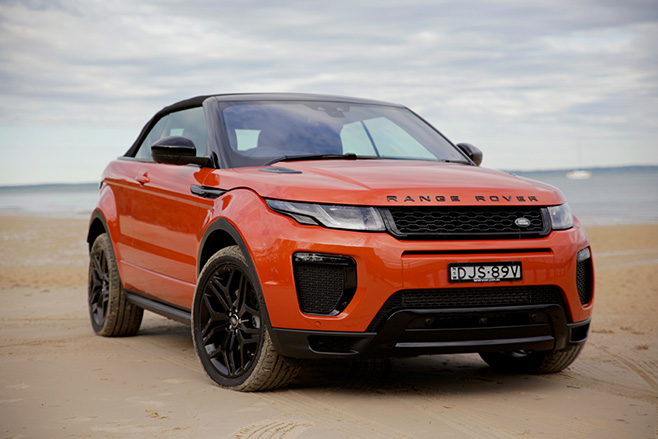
But does it lose anything in the transition from tintop to ragtop? Read on.
STRENGTHS
- The Evoque Convertible’s styling is its strong suit, and for an SUV that not only rejects a traditional wagon bodystyle but a fixed roof altogether, it actually looks fairly handsome with the roof lowered. The soft top’s silhouette when raised has a slightly awkward rake to the rear screen that makes it look like an overgrown hatchback, but for something that treads so far outside of the norm it’s actually a decent piece of design.
- And speaking of the roof, it folds away in 18 seconds and raises in 21 seconds, with either operation able to be carried out at speeds up to 50km/h – quite a high speed threshold in convertible terms. With an acoustic lining, the Evoque Convertible’s black fabric top also does a reasonable job of isolating wind noise.
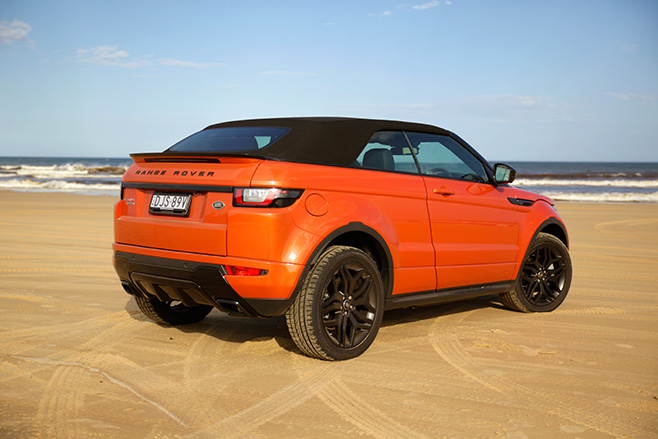
- The Evoque Convertible is available with two engines – a petrol 2.0 turbo or a 2.0-litre turbo diesel. The diesel – which is a member of Land Rover’s all-new Ingenium engine family – is particularly impressive in terms of its refinement, with noise and vibration suppressed to an almost petrol-like level.
- Though it’s pitched at fashion-conscious city slickers, the Evoque Convertible still has the ability to get its hands dirty off-road. All Convertible variants are equipped with a reactive all-wheel drive system with multiple terrain modes to help it clamber over rocks, mud or sand, and the standard nine-speed transmission is geared low enough to make the absence of a dual-range gearbox a moot point.
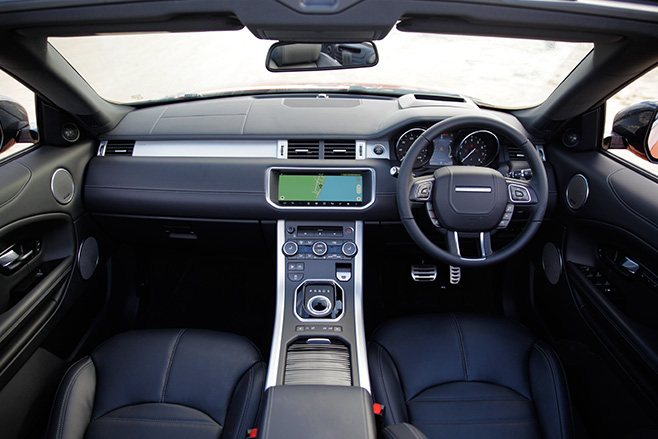
- You might not have expected it, but the Evoque Convertible’s back seats are plenty comfortable for adults. Knee room and foot room are a tad on the tight side, but no worse than any other similarly-sized four-seat convertible. Getting in and out is also made easier thanks to the electric slide button on the front seat ‘shoulders’, and the back seats don’t feel all that claustrophobic when the roof is up. There are even face-level air vents back there!
WEAKNESSES
- The Evoque Convertible’s top-hinged tailgate is an ergonomic faux pas. Because it swings out and upward – rather than out and downward – it limits your view of what’s inside the boot. You’ll need to stoop to see what’s in there, and loading big items isn’t as easy as it could be.
- Speaking of the boot, the Evoque Convertible’s luggage space measures a tiny 251 litres. Having the roof up or down makes no difference to boot capacity, but countering that is the fact Range Rover stings you extra for something as basic as a ski port so you can load long items.
- As you’d expect for such a sizable convertible, there’s a touch of scuttle shake – that tell-tale shimmy of the steering wheel in your hands – when out on the open road. It’s the result of the loss in torsional rigidity that occurs when a roof is no longer part of a car’s structure, and it does make the Evoque Convertible feel a little wobblier than its regular-roofed counterparts
There are no other choices when it comes to luxury SUV convertibles, so the Evoque Convertible sits all by its lonesome in a niche of its own creation.
However if you look at convertibles of other types, similarly-priced options include the BMW 4 Series Convertible and Mercedes-Benz C-Class Cabriolet.
Elvis Presley, Jean Harlow and Clint Eastwood all owned Cadillacs. Rita Hayworth had a Lincoln Continental and Zsa Zsa Gabor drove a Mercedes Benz SL, while Jack Nicholson was captured behind the wheel of a cream convertible Volkswagen Beetle.
But just because cameras are no longer limited to black-and-white photos, and driving-hats are a thing of the past, it doesn’t mean we can’t still have a little touch of old Hollywood in our modern-day cars.
We take a look at some modern cars that channel Old Hollywood glamour.
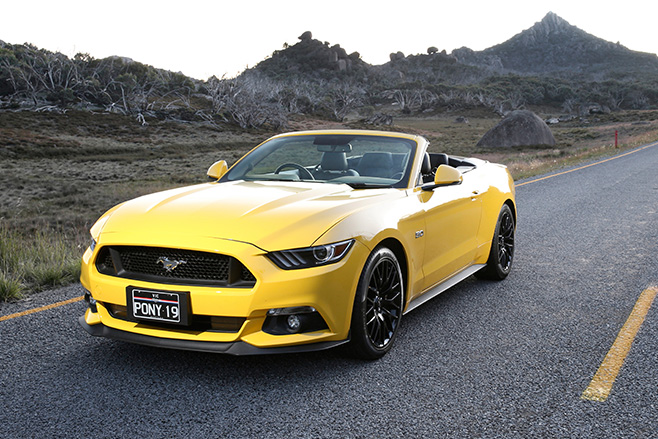
FORD MUSTANG GT
In its 2016 guise, the Ford Mustang has continued its iconic legacy. Most notably, this American icon in its 1968 model-year was featured in a car chase scene in Steve McQueen’s 1968 thriller, Bullitt.
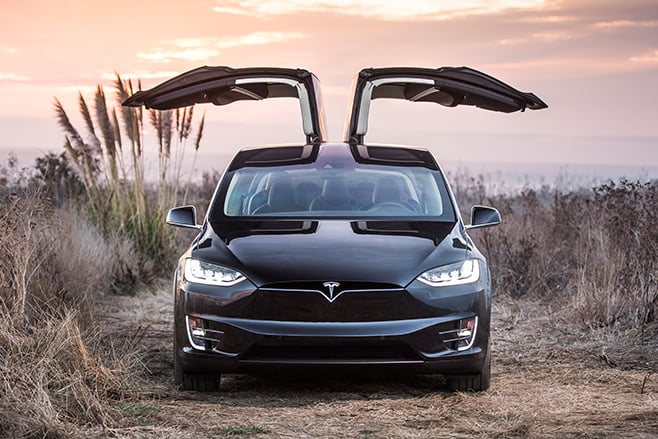
TESLA MODEL X
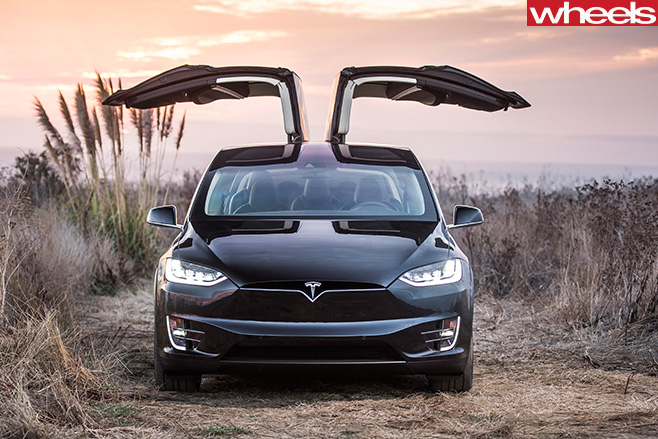
This modern, futuristic, entrepreneurial Tesla can be compared to its historical cutting-edge counterpart, the DeLorean. Most are likely to remember the gull-winged car from the Back to the Future series, but it was also famously driven by Sammy Davis Jr who posed next to the car mimicking its gull-wing doors.
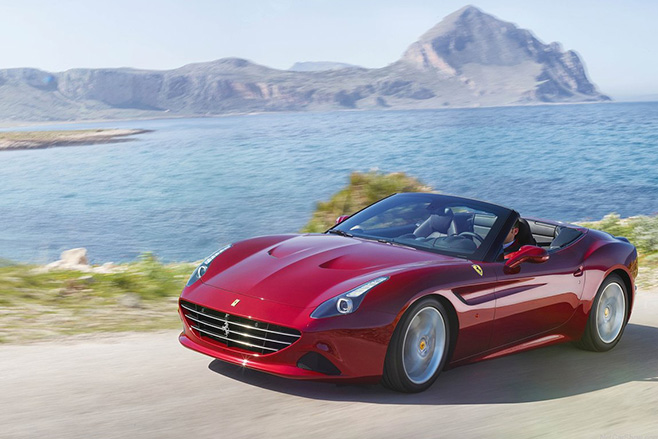
FERRARI CALIFORNIA T
Ok, it might set you back around $425,638 but you can’t put a price on style, right? And who is a more stylish muse than the one and only, Audrey Hepburn. When married to her husband Mel Ferrer, Audrey was featured in several photos alongside her Ferrari 250PF.
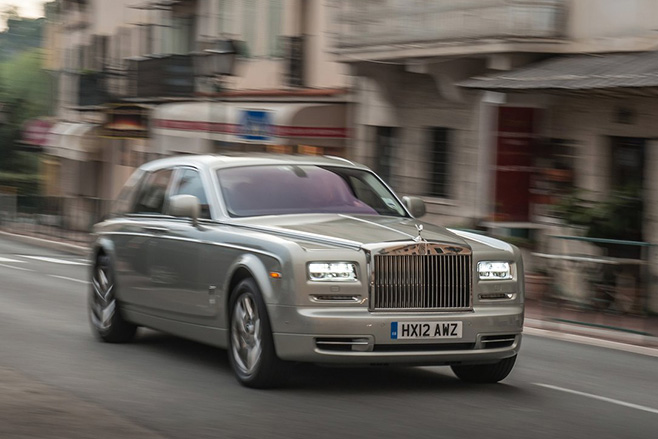
ROLLS-ROYCE PHANTOM
In comparison to a Rolls-Royce Phantom, $400k for a Ferrari seems like pocket money. Checking in close to $1 million, we’ve no doubt that if you’ve got the kind of money to splash, then you might already know the one-and-only Tom Jones, who featured a Phantom in his garage, alongside his navy blue Bentley. If Tom Jones liked it, you know it’s got swag.
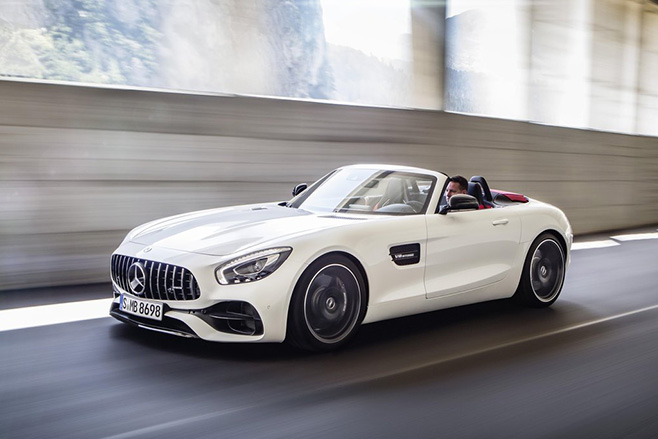
MERCEDES-AMG GT C ROADSTER
Much like Audrey, if you follow in the footsteps of Sophia Loren, you’re bound to know the difference between chic and tactless. So while the Italian-bombshell turned the key of a 1955 Mercedes-Benz 300SL, given to her by her husband Carlo Ponti, you have the chance to drive the flashy Mercedes-AMG GT C Roadster. Fun fact: Sophia Loren was a collector of classic cars, also owning an Alfa Romeo Giulietta, Ferrari 275 GTS, Daytona, Rolls Royce Silver Cloud and Mercedes-Benz 280SL and 450SEL.
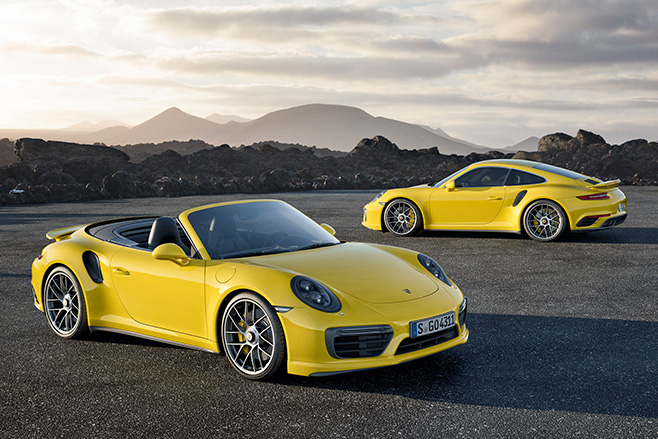
PORSCHE 911 TURBO S CABRIOLET
One cannot talk about Hollywood classics without throwing in a Porsche, which of course warrants a referral to the speed-lover James Dean. Aside from his infamous fatal crash in a Porsche 550 Spyder (also known as Little Bastard), the Hollywood heart-throb first owned a 1955 Porsche Speedster, which was the very car that got him into racing. Today’s equivalent is a Porsche 911 Turbo S, which may not have the same classic look about it, but it’s still a dream car for so many people.
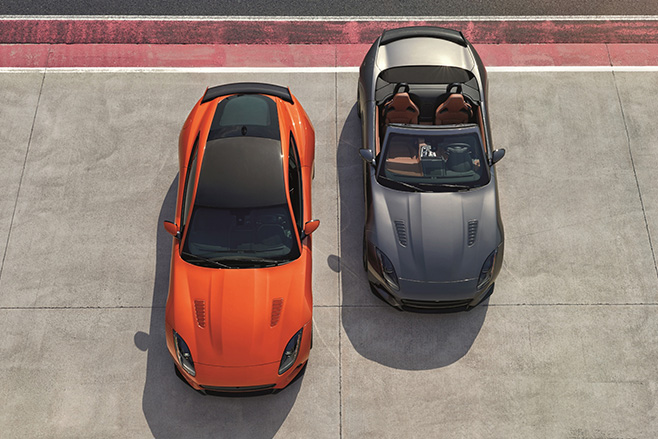
JAGUAR F-TYPE
What’s a discussion about Hollywood cars without a bit of James Bond action? The man who was James Bond for seven instalments of the popular movie series, Roger Moore, may have owned some cool cars during his time as a British Spy, but in his down-time he drove around in a Jaguar XK 150. If you can’t get hold of an old XK 150 you might fancy a Jaguar F-Type, which is based on the classic car.
Wrestle over Rolls-Royce and move aside Mercedes-Maybach – the BMW M760Li xDrive is coming Down Under complete with a mighty 6.6-litre twin-turbocharged V12 engine.
Priced from $419,900 and due here in the second quarter of 2017, BMW’s M Performance wand has been waved over the latest 7 Series limousine and its Munich masters have clearly resisted any form of replacement for displacement.
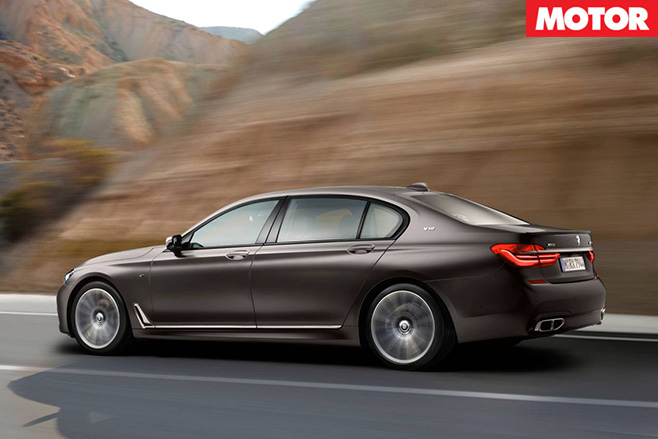
It leaves this hi-po limo with a faster performance claim than proper M-car sedans, the BMW M3 Competition (4.0sec) and M5 (4.2sec), while humbling price-point rivals.
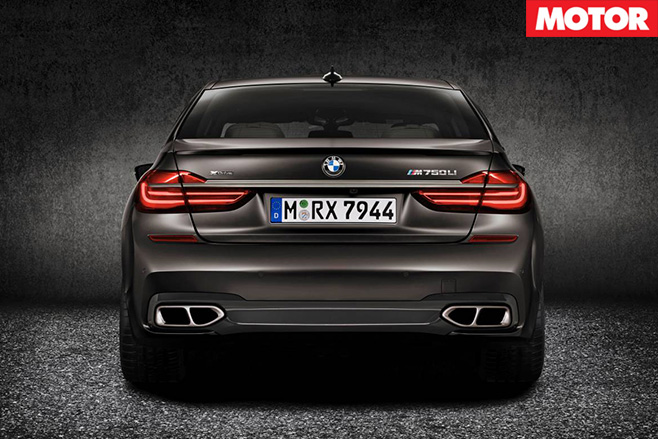
BMW insists this isn’t just a laid-back limo. The xDrive variable all-wheel drive system is “rear biased” and the auto features a sports shift pattern that uses navigation topography information to adjust its gear selection for the road ahead.
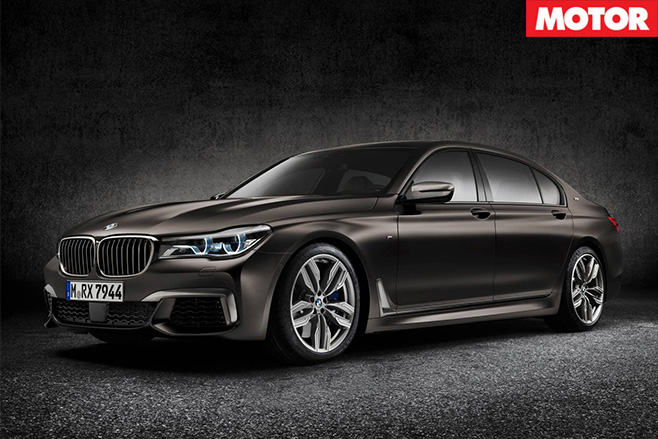
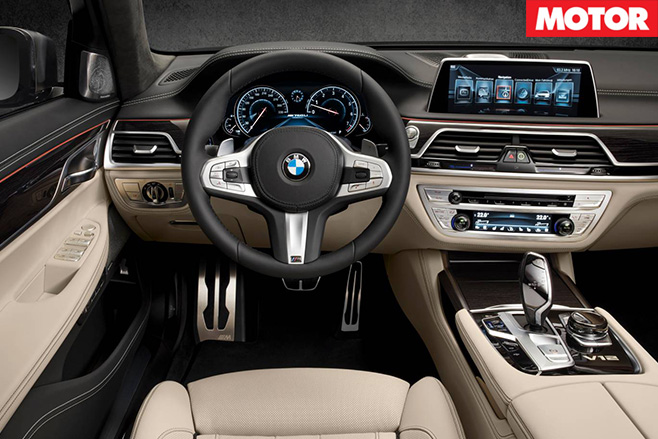
An ‘Excellence’ package is also available at no extra cost, which replaces M-Sport styling accents with a chrome-and-woodgrain treatment. For a maximum stealth setting, however, there are no sports-subtracting changes under-skin. That does sound excellent to us…
TESLA’S enigmatic CEO has hinted at an upcoming performance boost for the Tesla Model S P100D and Model X P100D
Communicating via Twitter, Tesla Motors CEO Elon Musk revealed that an Easter Egg hidden in a future software update for P100D models will “uncork the full performance” of Tesla’s fastest vehicles.
Both P100D models are already Tesla’s top-tier offerings when it comes to sheer performance stats, with the Model S P100D claimed to hit 100km/h in a supercar-shaming 2.7 seconds. The larger Model X P100D isn’t far behind, with a 0-100km/h time of 3.1 seconds.
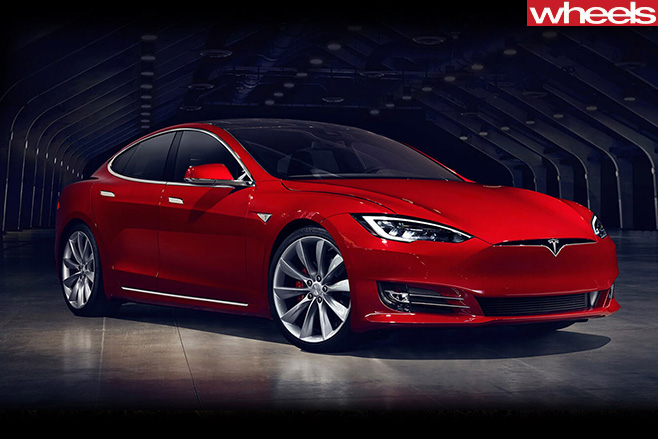
Timing for the update has yet to be confirmed too. As for how to enable its performance-enhancing effects, well, that’s for Tesla to know and you to find out.
Previous Tesla Easter eggs have mostly concentrated on cute display animations and pop culture references, such as the Autopilot Rainbow Road easter egg that recalled the classic Nintendo game Mario Kart, or the Star Wars hyperspace easter egg that was hidden on vehicles equipped with the Ludicrous Speed upgrade.
Including Luxury Car Tax the Model S P100D retails in Australia for $241,762, putting it in the same league as the Mercedes-AMG CLS63, Audi RS7 Sportback and BMW M5 Competition. The Tesla Model X P100D is slightly cheaper at $238,772.
