
The FIA has revealed the existence of a new biofuel it hopes will kickstart F1 into a more sustainable future. The first barrels of the biofuel were recently delivered to the sport’s power unit manufacturers, and the move continues F1’s pledge to go carbon neutral from 2021 and net zero by 2030.
For the last few years, F1 has existed in an ever-shrinking no man’s land. Formula E has been labelled the cleanest, most future-centric sport while F1’s hybrid halfway house has resulted in the drawbacks of both petrol and electric powertrains: emissions and spiralling costs. While an engine freeze would stop the latter, there’s been very little progress on the former issue until now.
“FIA takes its responsibility in leading motor sport and mobility into a low carbon future to reduce the environmental impacts of our activities and contribute to a greener planet,” said FIA president Jean Todt.
Does driving more slowly save fuel?
By developing fuel made from bio waste that can power Formula 1, we are taking a new step forward. With the support of the world’s leading energy companies, we can combine the best technological and environmental performance.”
The fuel was developed by the FIA’s own technical department, and has been designed specifically to power the complex V6 units of F1 cars without any ill effects. The FIA is calling it a proof of concept; the governing body won’t become a fuel supplier, instead the idea is to coax OEMs and their fuel suppliers to work on their own sustainable biofuels.
Aussie company makes diesel from old tyres
F1 fuel already contains 5.75% biofuel, and that’s going to be ramped up to 10% next year – but 100% will be the target further down the line.
“Our top sustainability priority now is building a roadmap for the hybrid engine that reduces emissions and has a real-world benefit for road cars,” added F1’s managing director of motorsports and former team boss, Ross Brawn.
“We believe we have the opportunity to do that with a next generation engine that combines hybrid technology with sustainable fuels.”
Biofuel may have just become motorsport’s ‘get out of jail free’ card. Not only is it totally sustainable life raft for internal combustion engines, it’s also another much-needed link to possible road car technology. This announcement comes just days after Porsche’s decision to develop its own synthetic eFuel by 2022, as well as its intention to re-join Le Mans in 2023.
This article first appeared on Car UK
LIGHT / CITY CARS
The tiddlers of Australian roads are a dying breed, many creeping past the $20K mark that has long been an unofficial barrier for buyers.
But there are still terrific options around, including some that charge you more to get behind the wheel but save you money once you’re there.
The light/city cars we evaluated are from Asian and European brands creating a diverse blend of circa-$20K machines.
Compromises are often glaring at this end of the market, where $1000 can sway buyers to one model or another, so the focus on cost is intense. But there are some great deals.
While there are self-shifting manuals, we’ve only looked at autos because that’s what 95 per cent of buyers choose.
As you’ll see from the numbers, the cheapest car isn’t always the cheapest to own. Fuel prices and depreciation can hit the bottom end of the market hard.
GOLD – Suzuki Swift GL Navigator
The Suzuki Swift isn’t the cheapest in its class (the MG3 for example comfortably beats it) nor likely to hold its value as well as others (the Honda Jazz wins there).
But it is a very solid all-rounder that does little wrong and leverages the strengths of a brand known for small cars.
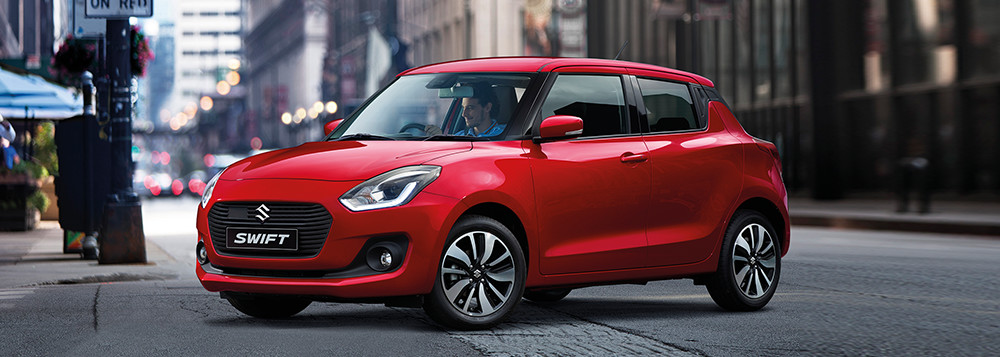
At $19,990 the Swift GL maintains an attractive price point against many competitors that have surged in recent years. It’s also an in-demand car on the used-car market, helping cement a solid 61 percent Redbook predicted resale value figure, in turn minimising what you’ll lose during those first five years of ownership.
It’s also among the most affordable to service of its peers, averaging less than $300 annually. Throw in miserly fuel consumption and the Swift emerges victorious.
Part of the Swift’s cost-saving magic is achieved with its size. It’s small by city car standards, especially with boot space. But for a single or couple looking for easy-to-live-with transport there is plenty to like.
The Swift is agile and fun, be it zipping around town or on the open road. It’s not the quietest, but it is among the more competent city hatches. The compact, lightweight body adds to its litheness, something that is a big contributor to how it drives.
The 1.2-litre four-cylinder is less convincing and requires a heavy foot for even respectable performance, although it is helped by a CVT auto that taps into the best the engine has to offer.
There’s just 66kW to play with, and most of its (limited) enthusiasm is high in the rev range. But, hey, it doesn’t mind some spirited work, adding to the likeable nature of what is a car that screams value.
Speaking of which, even with the bargain price tag the Swift get satellite navigation standard, as well as Apple CarPlay and Android Auto.
There are airbags for crash protection but the Swift lacks the active safety systems becoming commonplace, partially explaining its tempting sticker price.
SILVER – Suzuki Baleno GL
Reinforcing the Japanese car maker’s expertise in delivering compact hatchback goodness is the lesser-known Baleno backing up its Swift sibling to dominate value for this category.
While it’s slightly longer and wider than the Swift, the Baleno is more affordable, priced from $16,990 as an automatic.
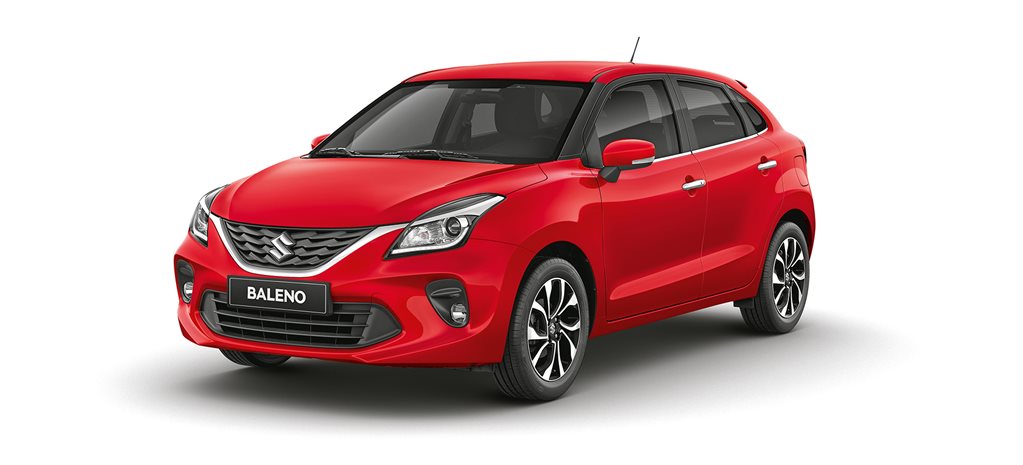
The price difference comes from minor differences in equipment as well as an old school four-speed auto.
Whereas the Swift gets alloy wheels, the Baleno gets steelies with plastic covers. The Baleno also misses out on Android Auto, although it still gets satnav.
As with the Swift, it’s underdone for active safety gear.
But as a value proposition, the Baleno mounts a convincing case. Resale expectations are excellent, fuel use low and servicing only marginally more than the Swift (yet still highly competitive).
There’s a 1.4-litre four-cylinder that’s very modest in its outputs – 68kW and 130Nm – so, again, you have to keep your right foot down to keep things moving.
The four-speed auto makes it trickier to extract what modest outputs the engine has to offer, although it’s less of an issue around town.
Our expert judges also determined the Baleno isn’t as convincing on the road, something that pulled its score back.
BRONZE – Toyota Yaris Ascent Sport
New for 2020, the Toyota Yaris hatch represented a big step up in price over the model it replaced, in some ways indicative of the additional safety gear that is among the best mainstream models on the road (centre front airbag, speed sign recognition and autonomous emergency braking heading the list).
But crunch the numbers and Toyota’s most affordable car – now starting at $23,630 as an auto – starts to stack up.
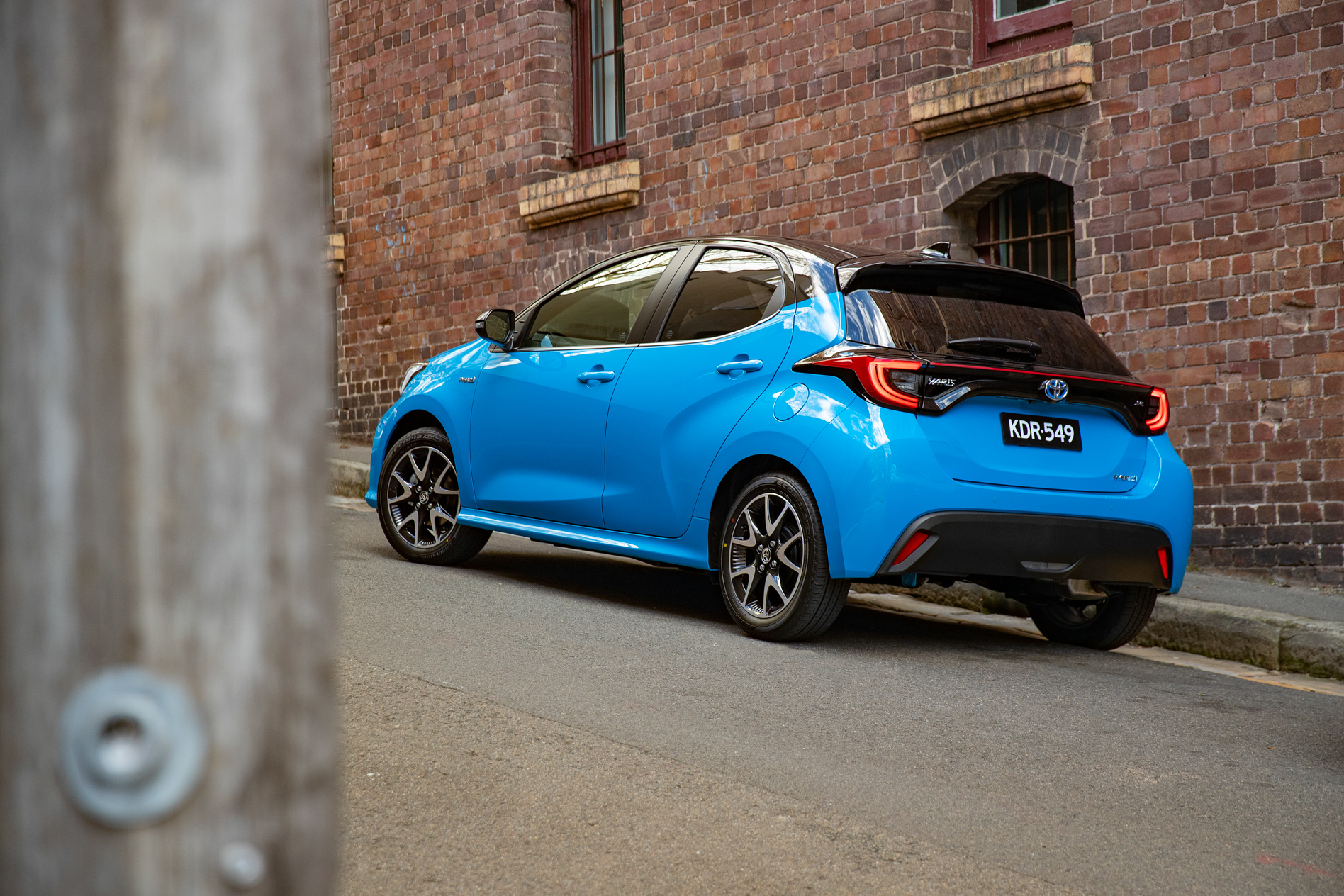
Solid resale values make for a great start and the $195 annual services for the first five years or 75,000km cement its low running costs.
We may have expected the Yaris Hybrid to perform better but it’s not available in the entry-level Ascent Sport trim, instead costing $29,020 and consequently blowing the numbers out, even with its welcome fuel savings.
So it’s down to the regular car’s 88kW three-cylinder engine to provide perky around-town acceleration.
Jump to
- How we rate Australia’s Best Value Car
- Small Cars
- Budget luxury cars
- Family Cars
- Small SUVs
- Five-seat SUVs
- Seven-seat SUVs
- Premium SUVs
- Prestige cars
- Kid Carriers
- Dual-Cab 4x4s
- Off-Road 4x4s
There are thousands of individual vehicle models on sale in Australia and determining which one represents the best value for your money is not easy.
That’s where we come in. Australia’s Best Value Cars crunched all the data then fed the results through the crucible of our exacting road test program to come up with the best value cars in every category.
Cars we recommend. Cars we would buy if we balance what the heart wants with what the head needs.
We’ve divided the field into 14 different vehicle categories, highlighting the top three vehicles in each based on purchase price, value, ownership costs, insurance and servicing costs, fuel economy, resale value and more.
We have also included our road testing scores, to weed out the driving duds from the studs. And we’ve included the data so if your priorities differ from ours you can reach your own conclusion.

It’s a mammoth job, all done to reveal the best value cars in Australia.
Jump to
- Light/City Cars
- Small Cars
- Budget luxury cars
- Family Cars
- Small SUVs
- Five-seat SUVs
- Seven-seat SUVs
- Premium SUVs
- Prestige cars
- Kid Carriers
- Dual-Cab 4x4s
- Off-Road 4x4s
How Australia’s Best Value Cars Works
Our exhaustive analysis starts with working out which models fit into which category and then establishing which variant of that model’s range will fare best.
Typically it’s the more affordable variants, but hybrids can overturn that assumption; cheaper running costs and stronger predicted resale value can make them better value overall, as our results reveal.
THE BASICS
The intensive assessment starts with the basics of each car, including how much it costs. For simplicity and to better represent consumer tastes we’ve chosen auto transmissions where available, given they are the preference for the vast majority of buyers (affordable sports cars are a rare exception, with manuals still popular).
We then turned to industry expert Redbook for an estimate of what each car would be worth after five years of ownership.
Expressed as a percentage, that residual estimate gives us an idea of how much less that car will be worth after an average period of ownership. It’s an important and very influential figure; that lost value is the single biggest cost of owning a new car.
COSTS
From there we look at running costs calculated over five years and 75,000km, assuming an average 15,000km travelled each year.
Fuel costs account for cars running on more expensive premium unleaded; $1.44 per litre versus $1.25 for regular; diesel was calculated at $1.14/litre at the time of publication. We’ve even included electric cars, assuming a kilowatt-hour rate of 29c.
Insurance costs were calculated using Budget Direct’s online tool for a 35-year-old rating one driver living in Chatswood, Sydney.
However, the company doesn’t cover all cars, so in some cases we leant on NRMA to ensure we had an apples-for-apples comparison within individual categories.
Servicing costs were determined using online calculators for the first five years or 75,000km, mostly covering capped price servicing. We also consulted individual brands for more detailed estimations where online figures weren’t published. For those without clear indications of service pricing we used high-end estimates for genuine parts and labour.
As for warranty, it wasn’t factored into these calculations, at least not directly. Cars with a warranty that exceeds the five years we performed these calculations over will be rewarded with superior resale values.
All prices and data correct as of December 1, 2020
Jump to
- Light/City Cars
- Small Cars
- Budget luxury cars
- Family Cars
- Small SUVs
- Five-seat SUVs
- Seven-seat SUVs
- Premium SUVs
- Prestige cars
- Kid Carriers
- Dual-Cab 4x4s
- Off-Road 4x4s
In a cramped, unglamorous attic space, Daniel Craig is sitting on the floor, casual as you like. You can’t help but notice that he’s handsome but – no offence – not quite as smouldering as his big-screen persona; his face is covered in what resembles a grim, female-repelling case of teenage acne. To his credit though, he cracks a joke about it.
He’s down-to-earth, relaxed, and not the Daniel Craig we expected; not the guy who, a few years back, threw a high-profile celebrity strop, swearing blind he’d rather slit his wrists than make another Bond movie.
There’s a good reason for his hang-loose demeanour. This isn’t the Daniel Craig, simply a version of him, the next best thing.
Mark Higgins is a 48-year-old British rally champion turned full-time stunt driver, a job that now includes drifting, doughnuting and body-doubling on behalf of the world’s most famous fictional spy. And that hideous skin affliction? The spots are known in the trade as ‘motion capture’, a digital-dot system placed onto a stunt driver’s face during filming, allowing the actor’s mug to be grafted on later by the CGI team.
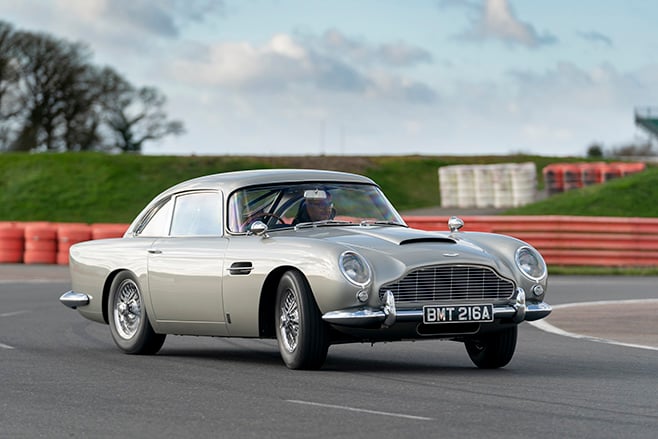
“We did use face masks in previous Bonds but they’re hard to get rid of digitally,” says Higgins.
It’s a blisteringly hot morning in the ancient, sandstone-washed city of Matera, southern Italy, back in September 2019. We’re on the set of the forthcoming Bond movie, No Time to Die, having been given super-rare, one-day-only permission to watch how 007 car stunts are stitched together.
Today’s scene, from which Higgins has taken a few minutes away to talk to Wheels, is being shot in a picture-postcard Italian piazza, albeit at a pace that would make some glaciers feel sprightly. It’s a segment that may or may not form part of the franchise’s now-signature, high-octane opening sequence (the production overlords are vague about plot details).
Bond and his iconic 1960s silver birch Aston Martin DB5 have just been chased through the skinny, decidedly car-unfriendly cobbled streets, and are now trapped in the square. The bad guys, one group emerging from an ’80s Range Rover Classic, the others a moody Jaguar XF sedan, are pummelling the Aston’s bodywork with machine-gun fire.
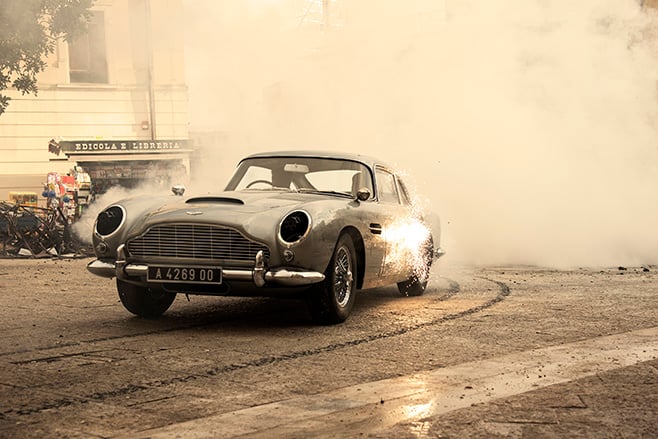
“It’s quite scary when people are coming at you with guns,” says Higgins, now on his fifth Bond outing. “Quite eerie when the bullets are bashing on the windscreen.”
Fortunately for him, and connoisseurs of sacred collectibles the world over, the Aston is 100 percent bulletproof. That’s because the DB5 currently being filmed is no ordinary model. It’s one of eight visually identical replica DB5s commissioned especially for No Time to Die. Built by Aston Martin’s special projects division in conjunction with the movie’s head of stunt cars, Neil Layton, each comes with carbonfibre bodywork and a steel spaceframe chassis. Modern rally suspension, transmission, and modern straight-six 268kW engine are standard, too; proper Q-cars, then.
The Aston rep, however, refuses to reveal the origin of said powerplant, and probably wouldn’t even if one of Bond’s foes put a gun to his head.
To withstand the various rigours of being a Bond stunt car, every replica is individually tweaked to suit a different scene: a car expected to perform a slide, for instance, will be specced differently to one involved in a high-speed chase. “The challenge here in Matera is you’ve got five or six different road surfaces that you’re adjusting the cars to all the time,” says Layton, who’s responsible for not just the DB5s, but 140-plus vehicles used in No Time to Die.
Mention Matera’s roads to Higgins and you’ll be met with a raised eyebrow and a wry smile worthy of any hammy Bond quip. On top of the contrasting surfaces, and all the problems that raises for stunt driving, the city’s streets and pavements are covered in a thin layer of dust, which is about as slippery as ice. The solution? Pour thousands of litres of Coca-Cola onto the roads to increase traction. “We spent about £70,000 [around A$135,000] on the stuff,” laughs Higgins. “The difference it makes is amazing, increasing grip levels by about 70 percent.”
A few multi-packs may be required this afternoon. Driving a stunt DB5, Higgins and his motion-control spots are scheduled to careen along a tiny street, and then drift into the piazza at high speed. The sequence is one of the juicy carrots the production company and Aston Martin used to lure Wheels to Italy. But one thing quickly learned about film sets is best-laid plans are often brutally laid to waste, even with a whispered production budget of around $2 million per day; even with 250 worker-bee crew members buzzing around.
As ominous black storm clouds gather over Matera’s rooftops, the crew are trying to record a scene in which Bond performs a doughnut in the DB5 while spraying his adversaries with bullets from headlight-concealed Gatling guns. In keeping with the general level of movie hocus-pocus, the DB5 – now straddled with scaffold poles – is being pushed through 360 degrees by four crew members to mimic the doughnut; there’s a hulking IMAX camera attached to the car’s flank, and even someone as deft as Higgins can’t be trusted to pull off the manoeuvre without killing a million-dollar piece of filming equipment.
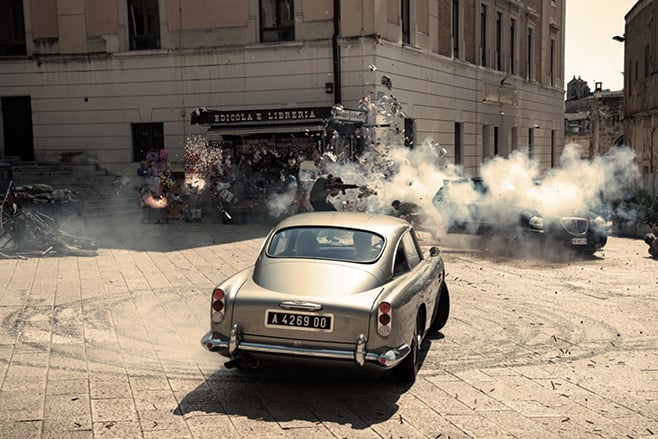
But some of the men are falling down on Matera’s notoriously slippery surfaces. Then the Gatling guns malfunction, dribbling bullets onto the piazza. Then rain stops play. The skies darken. The light levels are too poor to continue filming. We’re told we won’t get to see the drifting scene. Boo, hiss. We feel like throwing popcorn at someone.
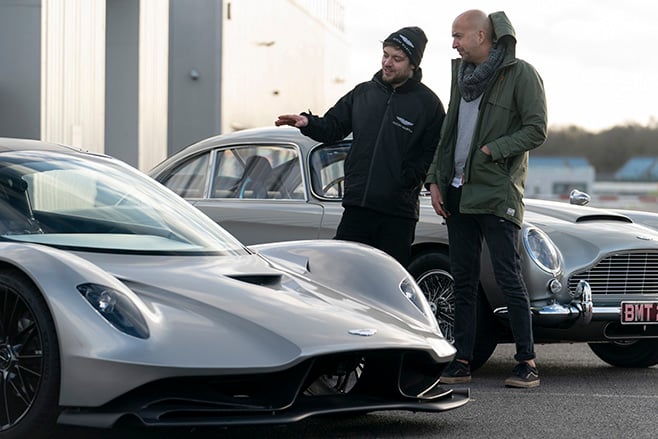
We thought this is where the curtain would come down on our Bond adventure. Then, a few months later, an email popped into the Wheels inbox, inviting us to another one-off event; this time driving one of the stunt DB5s used in No Time to Die, along with an original model, plus an ’80s Aston Martin V8, the latest DBS Superleggera and a $1.9 million Valhalla hypercar – not due for release until 2021 – thrown in for good measure (although the latter is strictly look don’t drive). All of which are set to feature in No Time To Die when it hits cinemas around the world.
The UK’s Silverstone track during a Northern Hemisphere winter feels several reincarnated lifetimes away from summer in Matera. It’s bone-shakingly cold on the morning we arrive, just above freezing. The landscape is exposed and bleak. Its only redeeming feature is Aston Martin’s Test and Development Centre, which sits alongside Silverstone’s smaller Stowe circuit, where future Aston projects are put through their paces dynamically.
If 007 is the character around which the Bond series orbits, then Aston Martin is the marque at the centre of its universe – give or take a few hit-and-miss flirtations with Ford and BMW. And spiritually, the DB5 is the car that best captures the James Bond character; timeless, elegant, with a dab of upper-class ruffian. It was first driven by Sean Connery in 1964’s Goldfinger, followed by Thunderball in 1965, but then the 4.0-litre straight-six grand tourer mysteriously dropped out of favour – only to be resurrected in more recent years, most memorably in GoldenEye (1995), Casino Royale (2006) and then Skyfall (2012).
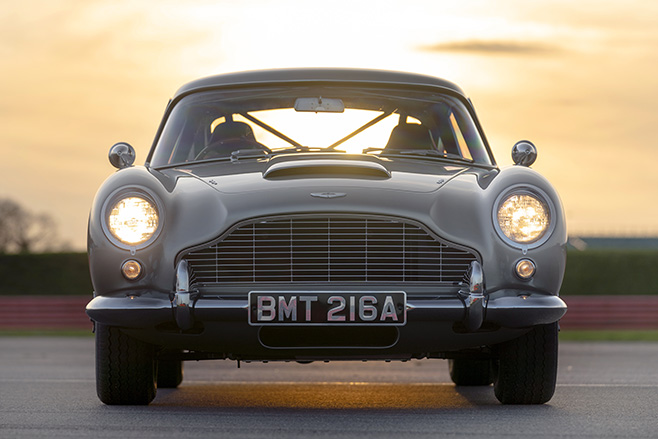
Last August, a DB5 used to promote Thunderball sold for $10.2 million at auction; a real-world example in Australia would fetch north of $1 million, but expect to see the letters POA on most for-sale ads. This isn’t the kind of information anyone needs floating around their head before escorting such a valuable slice of automotive history onto an icy English track…
We head into the Stowe circuit’s first corner in the DB5 too quickly, forgetting it’s a fiftysomething grand dame without the luxury of power steering, ABS brakes, or any of the other modern technology that fools the average man into thinking he’s got skills. Like all venerable older ladies, she demands to be treated with respect.
The gorgeous DB5 is clearly suited to theatrical arrivals outside St Tropez casinos, not track work; the seat is too close to the large, boat-like wooden steering wheel; the floor-hinged pedals are positioned at an awkward angle; bodyroll can be alarming at times. But making allowances for its age, and the level of technology available to Aston in that era, the DB5 remains a classy piece of engineering.
The 290kW, naturally aspirated straight-six produces a lovely rorty note when pushed along Stowe’s straights. And although the DB5 is no slouch – its 8.1 seconds from 0-100km/h made it one of the fastest production cars in the world in its time – this is a grand tourer designed to be driven at sensible speeds, a reminder of the days when life itself moved at a more refined pace.
The same cannot be said of its stunt-car cousin. Side by side, it’s virtually impossible to tell the difference between the replica and the original, save for the roll cage visible through the windows. But that’s where the DNA strands are snipped.
We’re strapped into the race harness, sink into the bucket seats, then blast onto the track, revelling in the stiffer spaceframe structure, the Ohlins rally suspension, the 500kg that’s been shaved from the original’s 1500kg weight. With its Herculean front-end grip, corners are now welcomed, not feared. There’s a huge hydraulic handbrake, which we’ve been warned not to touch, but the temptation is strong; almost worth an Aston life ban. It’s a deflating moment when we’re flagged into Stowe’s pit, a gentle reminder that other people want to play, too.
In the afternoon, as the weak winter sun dips towards the horizon, we jump into the two remaining Bond movie cars; the imposing Aston Martin V8, and the surprisingly chuckable DBS Superleggera. But when the time comes for the handful of assembled journalists to pick a favourite, it’s a simple two-way contest between the DB5s. What a pair of cars. What a day.
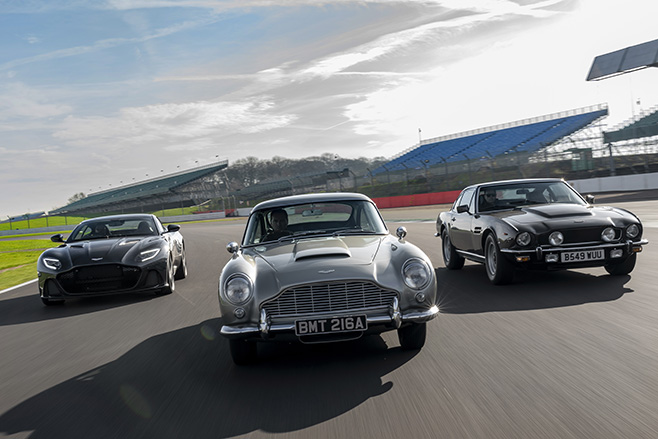
Just when we think it’s all over, a familiar face walks into the Aston test centre. His skin is a few tones pastier and now free of spots. We didn’t get to see him drift into an Italian piazza, but Mark Higgins is about to do something perhaps more thrilling: treat us to a hot lap in the DB5 stunt car.
Higgins, like all great driving artisans, approaches corners at ludicrous speeds, braking about a fortnight later than most would dare. He drifts around the first 180-degree turn in a perfect arc, no discernible break in momentum. Over the next whirlwind minute, he squeezes every last drop of performance from a car he’s got to know intimately over the previous months on the Bond set. At no time do you feel terror, only pure uncut exhilaration. The real Daniel Craig is in safe hands.
How to build a stunt car:
No fewer than eight replica DB5s were built for No Time to Die by Aston Martin’s Special Operations team.
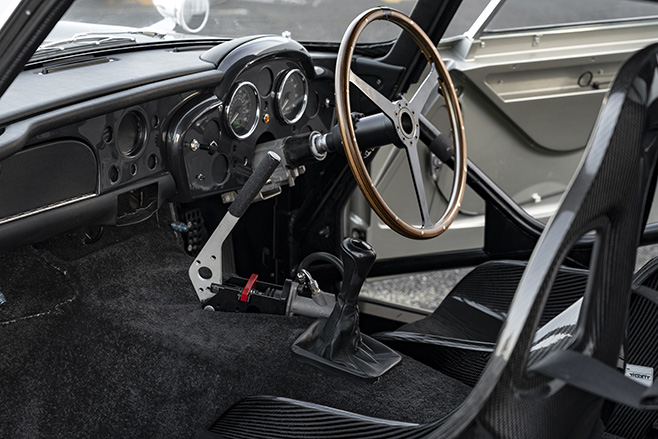
Given that Aston is working on its own six-cylinder engine, it was reticent to mention that the engine powering the stunt cars was the S54 straight-six normally found in the BMW E46 M3. The stunt DB5 also features the M3’s transmission with all that power being directed to skinny Avon racing rubber. No wonder driver Mark Higgins looked happy.
WE’VE all been there. We’ve gone to choose a Christmas tree and have become a little overexcited when selecting, envisioning a magnificent centrepiece to your lounge, festooned with baubles, tinsel and migraine-inducing LEDs.
Then you try to cram the thing into the back of the car and it doesn’t fit.
You can’t heave it up onto the roof of your CX-5, so you end up stopping at a servo and buying a plastic dwarf tree that’s about as convincing as a Christmas turkey made of tofu.
As demonstrated here, it doesn’t have to be this way.
All you need is a $20 million McLaren F1 GTR that once competed in the Japanese GT Championship.
Instagrammer Andy74b wisely left his Land Rover Defender at home and took the Big Mac tree shopping, casually strapping the chosen item to the roof and supporting rear wing of the car that once lived in Melbourne.
The video’s worth watching right to the end to see what else is in his garage. We can’t decide whether we love or hate the guy as a result.
If you can’t stretch to a multimillion-dollar McLaren, then you could always take the budget option and use your Lamborghini Huracan Performante.
A black example was spotted in Boston coming home with the tree and, being a Performante owner, we can’t help but think he has a more nuanced understanding of aerodynamics than Mr 74b.
He’s mounted the tree stump forward in this instance, which we reckon would smooth the airflow over the roof.
Anyway, we’ll leave it to you to decide who’s pulled off the better look.
UPDATED The Australian Competition and Consumer Commission (ACCC) has ratified Mitsubishi’s 10-year warranty policy, after the car company filed an exclusive dealing notification with the consumer watchdog.
Exclusive dealing, according to the ACCC, occurs when one person trading with another imposes some restrictions on the other’s freedom to choose with whom, in what, or where they deal.
Exclusive dealing is against the law only when it substantially lessens competition.
Part of the deal with the second five years of the warranty is that all servicing needs to be carried out at a Mitsubishi dealer.
“The ACCC carefully considered a variety of factors in its decision, including a large number of submissions from independent mechanics, aftermarket parts suppliers, members of the public and associations,” ACCC Commissioner Stephen Ridgeway said in a statement.
“While a number of consumers will no doubt value a longer warranty, we recognise the concerns that the requirement to use Mitsubishi dealers and service centres may have an impact on independent mechanics’ ability to provide competition.”
“The ACCC has allowed this notification to stand based on current information. There is no basis at present to conclude that the notified conduct has the purpose, effect or likely effect of substantially lessening competition,” Mr Ridgeway said.
However, the ACCC is able to revoke the notification at a later date if the relevant circumstances and available information change.
Mitsubishi Australia introduced a new option for customers with a 10-year/200,000km warranty under its Diamond Advantage program, but there’s more to the story than just that.
Owners who wish to receive the benefits of a 10-year warranty from Mitsubishi must also undergo their regular servicing through Mitsubishi dealerships for the full decade.
If owners take their vehicle outside the dealer network for servicing, the warranty is halved to what is now: Mitsubishi’s standard five-year/100,000km warranty. The exclusion to this is plug-in hybrid vehicles, which are covered by an eight-year/160,000km warranty separately.
Prior to this, Mitsubishi offered a seven-year/150,000km warranty for many of its popular models.
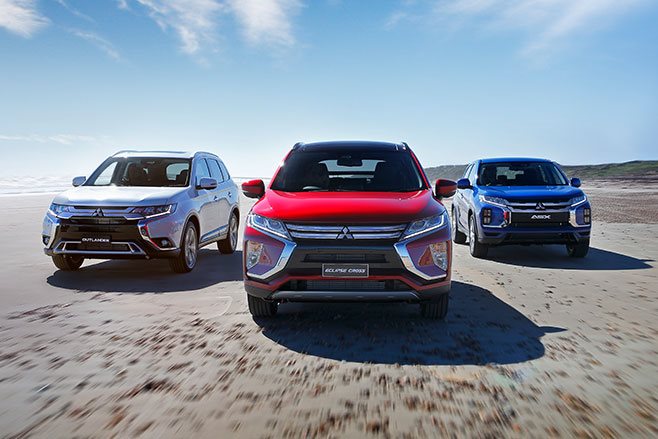
Mitsubishi says the new system of five- and 10-year warranties is to “put owners in control”. This comes with a 10-year/150,000km capped-price servicing plan, though astute readers will notice this is 50,000km short of the full Diamond Advantage 10-year warranty.
After the first 150,000km, owners will need to pay full servicing prices to maintain their 10-year warranty.
Mitsubishi announces Outlander replacement
However, Mitsubishi does provide prospective buyers with a full table of the specific prices for each service.
A span of four years of roadside assistance is also covered by Mitsubishi for owners that continue to service within the brand’s dealer network.
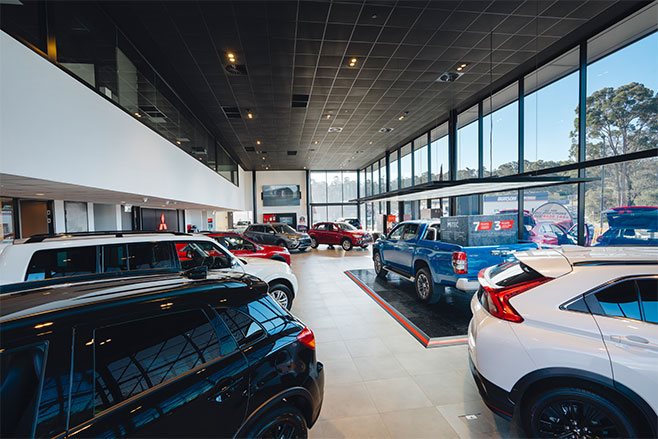
Small businesses with fewer than five vehicles can also access the warranty, though for many vehicles it’s likely the 200,000km limit will be reached well before the 10-year end of warranty.
Though it’s not a standard warranty, the 10-year period offered by Mitsubishi now eclipses the 7-year warranties offered by Kia and MG, not to mention the five- and three-year warranties most other manufacturers offer.
Mitsubishi has outlined the costs for each of the ten annual (or 15,000km increment) services. The Mitsubishi Mirage and Eclipse Cross work out the cheapest at $3,790 each for the span of the decade, while the off-roading but outgoing Mitsubishi Pajero is the most expensive to service with its $7,390 total.
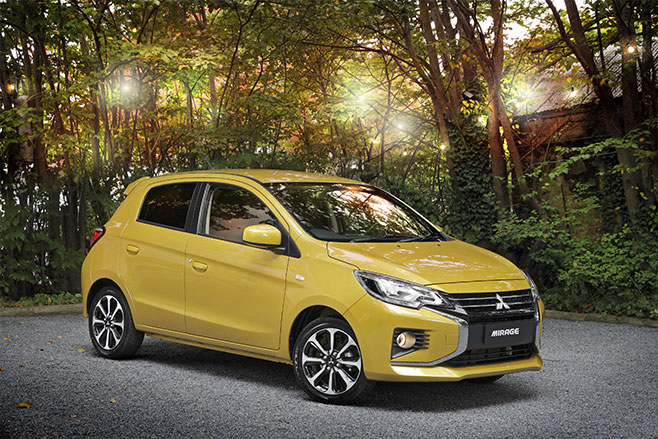
Many of the Pajero’s capped price services nudge $1000.
MG has shuffled the deck on its HS mid-size SUV lineup, adding a sub-$30,000 Core at the bottom end.
It’s stacked, too, with a dual-clutch transmission, MG’s Pilot active safety suite, 17-inch alloys and Apple CarPlay/Android Auto all fitted as standard, along with a seven-year warranty.
The $29,990 Core slots in at the bottom of the five-seat, five-door HS line, bringing the total number of variants to five.
It’s pushed the previous entry-level Vibe up by $1000 to $31,990, with the Excite ($34,990), Essence ($38,990) and the limited edition Essence Anfield ($40,690) sitting over it. All prices are drive-away.
White is the standard paint colour, and metallics are a $700 uptick.
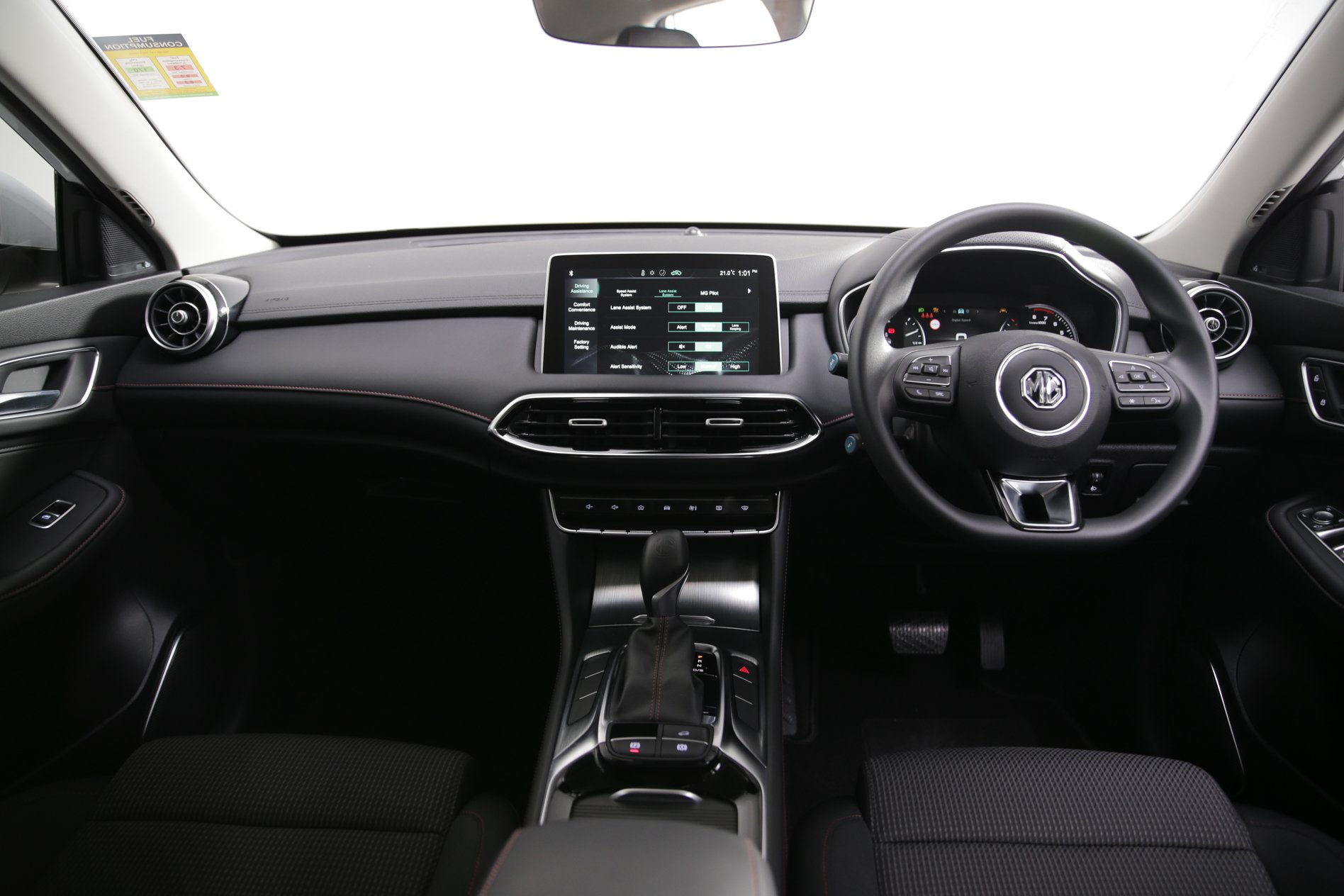
The Core loses a few bits and pieces; front fog lamps and roof rails have been deleted, for example, while it also gets a four-speaker stereo instead of six, it loses its leather-wrapped steering wheel in exchange for a polyurethane version and its powered side mirrors lose their heating function.
It also drops back to fabric seat covers, something that that company says comes from customer feedback.
“The MG HS Core provides an even more affordable mid-sized SUV option for Australian families, at $29,990, while still offering our driver safety technology, MG Pilot, for added peace of mind,” said CEO Peter Ciao in a statement.
“We wanted to make sure that the HS Core still met the high standards that people expect of our flagship model line-up. We’re extremely proud to be able to offer such a comprehensive, safe vehicle that aligns with our company mission of offering value, both in the form of features and pricing, to every single MG owner.”
The Core retains keyless entry and start, automatic headlights, USB points in both front and rear, halogen headlights and LED taillights, a 10.1-inch colour touchscreen and rear vents.
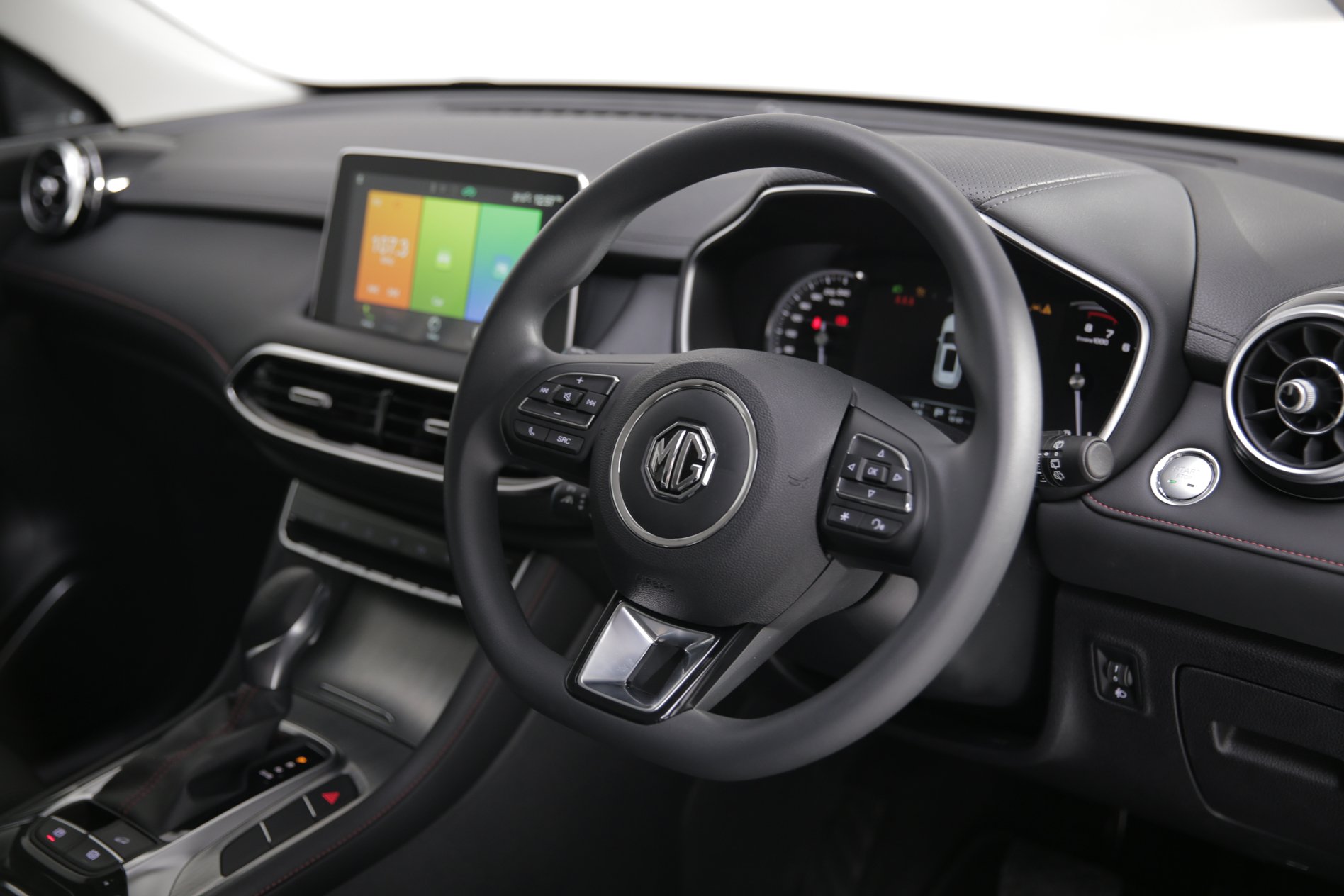
MG’s Pilot system includes city-speed autonomous emergency braking, adaptive cruise control, traffic jam assist, blind-spot detection, rear-cross traffic alert, lane keep assist, lane-change assist and intelligent speed assist that alerts you if you’re breaking the current speed limit.
A 119kW 1.5-litre turbocharged four-cylinder engine is standard across the HS line-up, with the seven-speed DCT sending power to the front end.
MG claims the HS offers a combined fuel economy of 7.3L/100km.
The HS has a decent boot capacity of 463L, but it can’t tow much (750kg braked or unbraked).
The Core should drop into MG dealers early in 2021.
Big, heavy, luxurious and fast, Aston’s first SUV has some formidable rivals to face. We pit the performance benchmark, Lamborghini’s Urus, and the Bentley’s luxury yardstick, the facelifted Bentayga to see where Aston’s DBX sits.
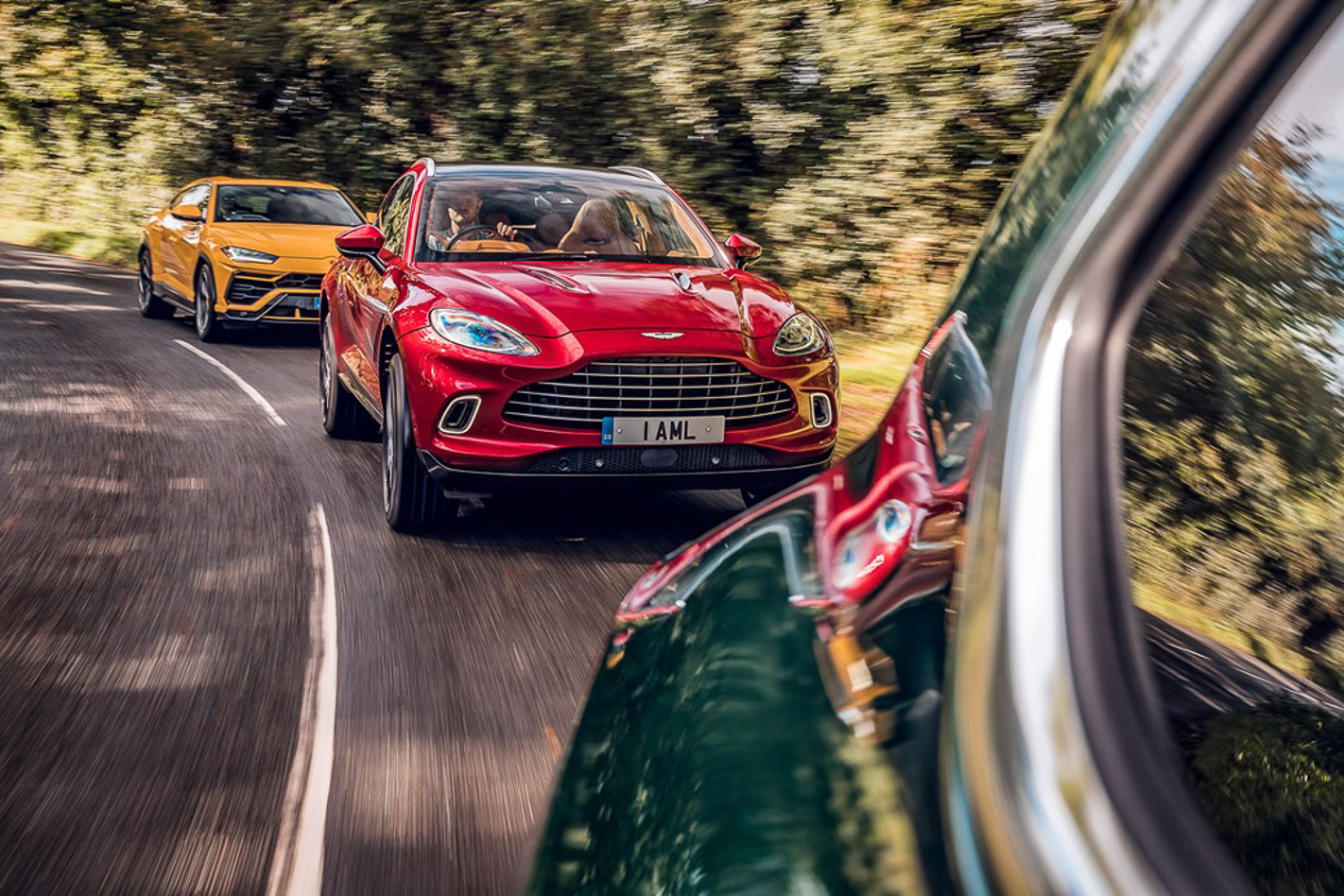
Aston Martin DBX: pre-flight briefing
Why is it here?
Aston’s late arrival on the SUV bandwagon needs to be a hit if the company is to climb out of debt.
Any clever stuff?
The engine is from AMG, but everything else is new and bespoke, built around bonded aluminium architecture. Triple-chamber air springs are governed by a 48-volt anti-roll control system to quash any roly-poly body movements, while also allowing tiptoe off-roading height, easy-access loading mode and a low-slung sports setting for improved aero at speed.
An Aston for all seasons
Above all else, this is an Aston Martin. If you’ve put 357 big ones down you surely care more than a little about driving, so you’ll be itching to prod the glowing starter button. The 404kW twin-turbo 4.0-litre V8 wakes with a rumble, and the moment you set off you appreciate the absorbent ride quality and fluent steering. The DBX breathes down the road with a pliancy and flow the others cannot match. Aston’s chunky steering wheel design leaves much to be desired, but the feel it imparts is surprisingly delicate and accurate for such a large car.
The bandwidth of Aston’s SUV is perhaps its greatest achievement: in GT mode it’ll saunter and change up to an epically tall ninth gear, shutting down one bank of cylinders at a leisurely cruise, yet the AMG engine barks orders if you stab the throttle or slide into Sport or Sport+ mode, forcing the active exhaust baffles open. The rear-biased torque distribution can catch you out in the wet, especially on the performance-biased Pirelli P Zero tyres. It’s not quite as comfortable and quiet as the serene Bentley but the DBX’s Venn diagram spreads wide across relaxed Bentayga and athletic Urus qualities, even if it can’t match either extreme.
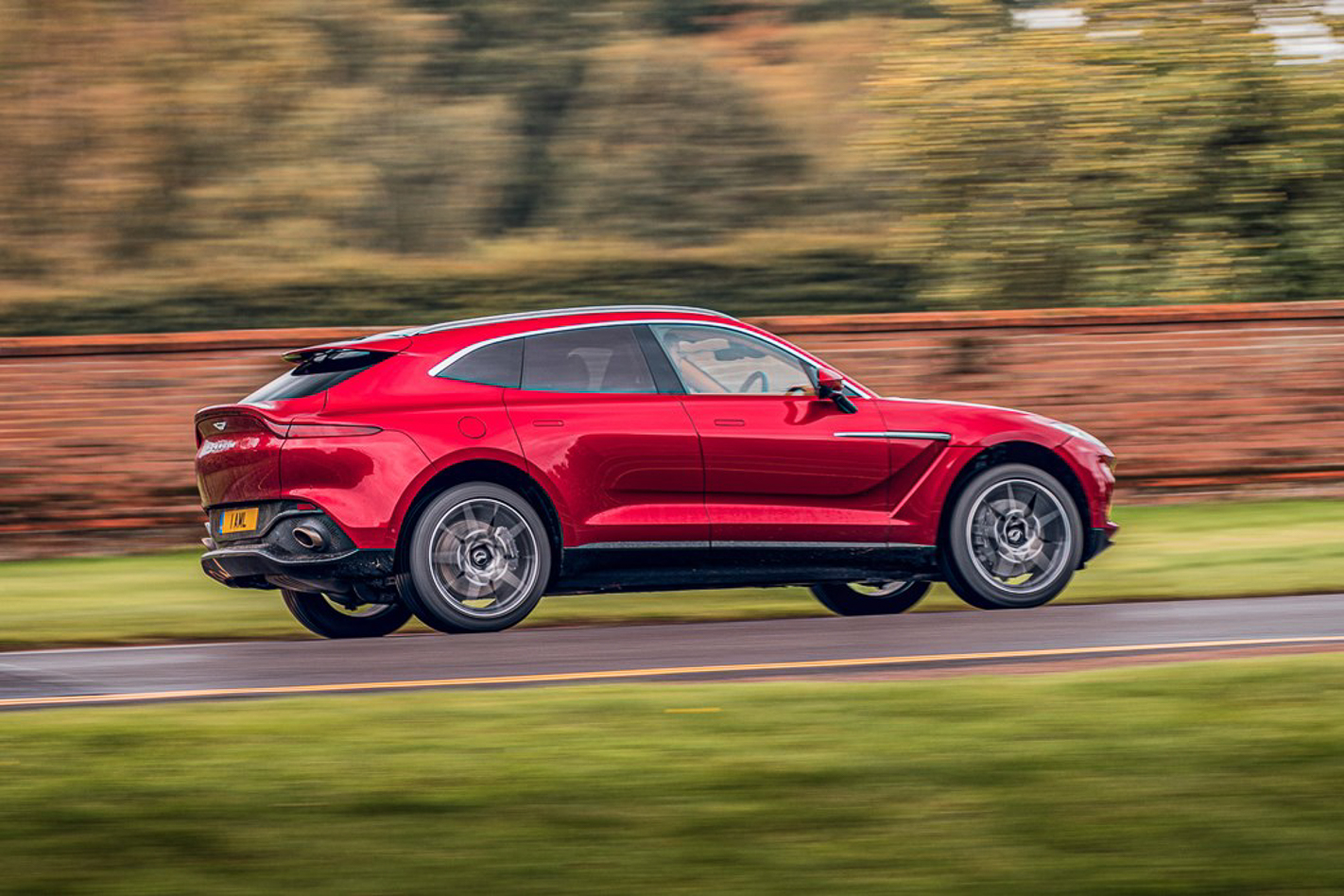
So yes, it’s very much an Aston Martin, and a very good one, but it also has to succeed against the long-established criteria of the premium SUV category – living the high life on four high-rise wheels. Aston has succumbed nearly two decades after Porsche first set the cat among the pigeons with the 2002 Cayenne. But where Zuffenhausen took a 911 blueprint and set the photocopier to 140%, Gaydon has come up with a fresh, more original design.
The DBX is clearly an Aston, especially seen from the front, but this is the most practical model ever to wear the winged badge. If earlier Rapides and Lagondas were born to transport executives in corporate style – and the bastard Cygnet to fulfil urban hopabout duties – the company’s first SUV is designed for everyday family life with children and dogs, bikes and skis in tow. It’s truly an Aston for all seasons and situations.
It’s a whisker over five metres in length, yet this is the best-looking SUV of our trio by a country mile, that elegant borderline Kamm tail shimmering in lustrous Hyper Red paintwork so ripe you may want to lick it. The fast tailgate angle masks a decent 632-litre boot that’s the widest here, with a flat floor and a spacesaver spare wheel nestling beneath; buttons in the boot raise or lower the air suspension to make it easier to lug luggage in or the dog out.
It seems strange to mark an Aston for practicality over performance, but this car’s purpose demands it. You enter via those beautiful-yet-fiddly pop-out slivers of aluminium that double as door handles and slide across non-existent sills straight into brilliantly quilted, supportive seats that never quite drop low enough. The cabin is upholstered extravagantly in wall-to-wall leather – ours so orange and bright it’s quite off-putting at first – and there’s no denying the opulence: broguing worthy of a Northampton shoe maker, leather pleats on the dashboard, and soft suede grab handles that wouldn’t look out of place in a boudoir.
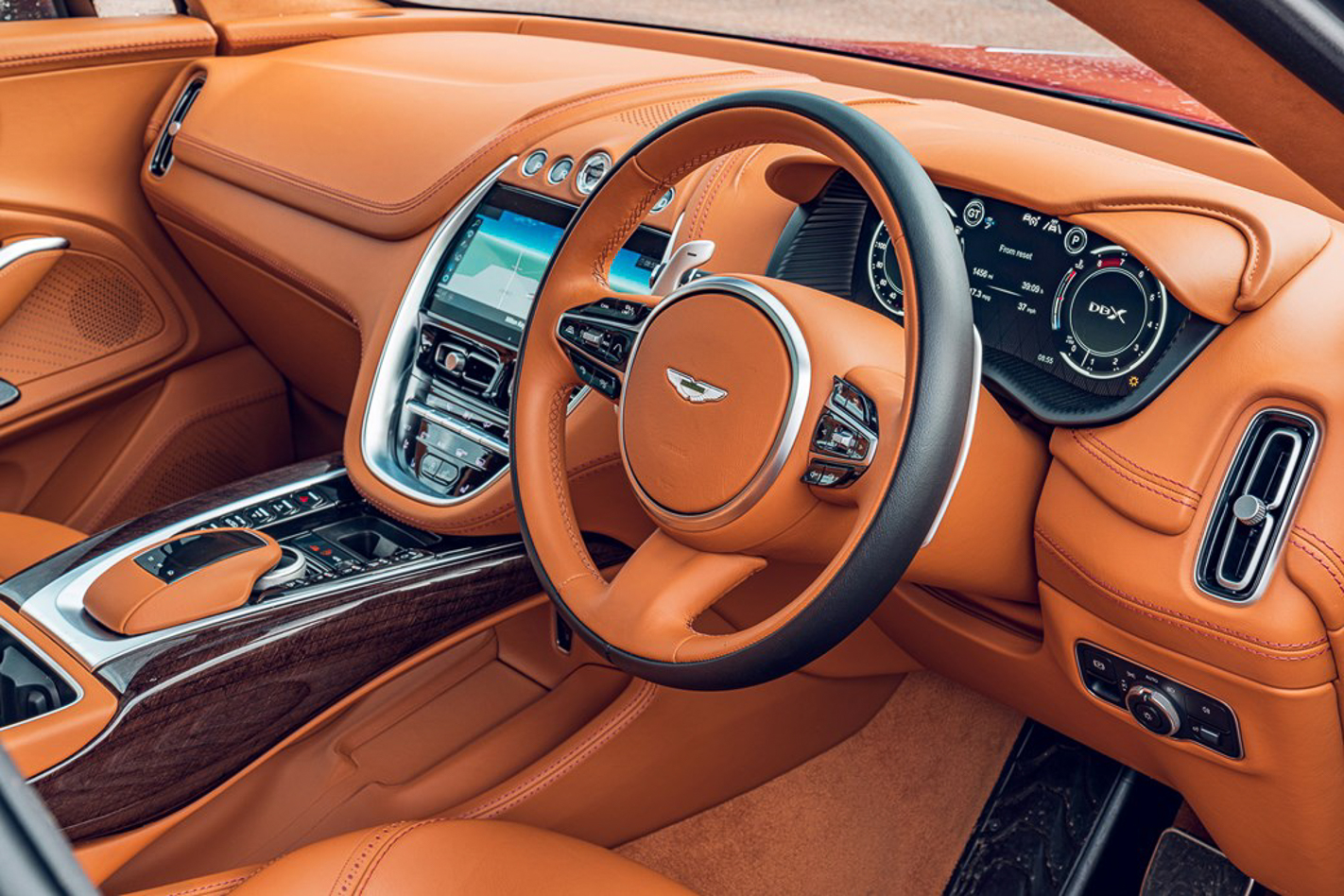
The choice of materials might be indulgent (and we challenge you to find a better metal paddleshift), but a few ergonomic flaws let the side down. Taller drivers can’t see the top of the dials, while the glow of the instrument binnacle reflects annoyingly in the windscreen at night. The bootlid is curiously thick, making it easy to bang your head on the chunky latch, and the old-generation Mercedes Comand rotary controller is so close to the handrest that it’s tricky to operate. The infotainment itself is fundamentally okay and an improvement on what you’ll find in a DB11, but the lack of a touchscreen may be a hindrance to some.
People bemoan the weight and stodginess of large SUVs, but the DBX shrinks around you. It’s a lot of fun, spiriting a 2.2-tonne 4×4 to 100km/h in just 4.5sec, yet accompanied by excellent chassis poise and sector-best rear headroom. The only concern is that our test car has to be repatriated after an electrical gremlin – and then the replacement has a rapid-flashing indicator as if a bulb had blown, yet all turn signals are behaving normally. Can you really afford such ‘bespoke concerns’ at this price? Or would a VW Group super-SUV be a safer bet?
Lamborghini Urus: pre-flight briefing
Why is it here?
The most extreme of them all: Lamborghini prides itself on offering the most focused product in any segment, so it should provide a stern test of the DBX’s sporting intent.
Any clever stuff?
It was, until recently, the fastest SUV in the world (the pre-facelift Bentayga Speed is 1km/h faster) storming to 100km/h in 3.6sec and on to twice that in just 12.8sec.
Under that wild body: wildness
What a startling sight. Three years after its launch, the Lamborghini Urus is still a remarkable car in so many ways. Even without our test car’s many optional extras and its Giallo Auge paint, it’s quite unlike any other SUV you’ll ever clap eyes on. It makes try-hard SVRs, M-badged SUVs and hot AMGs look feeble by comparison, and the aggressive styling channels its inner LM002 with steely abandon.
But how much substance backs up the brutish looks? It is, after all, just another offspring of the mighty VW Group. No matter how much you wrap it up, the Urus is fundamentally based on the same MLB platform as the British Bentayga and German Cayenne before it’s sent to the Sant’Agata finishing school.
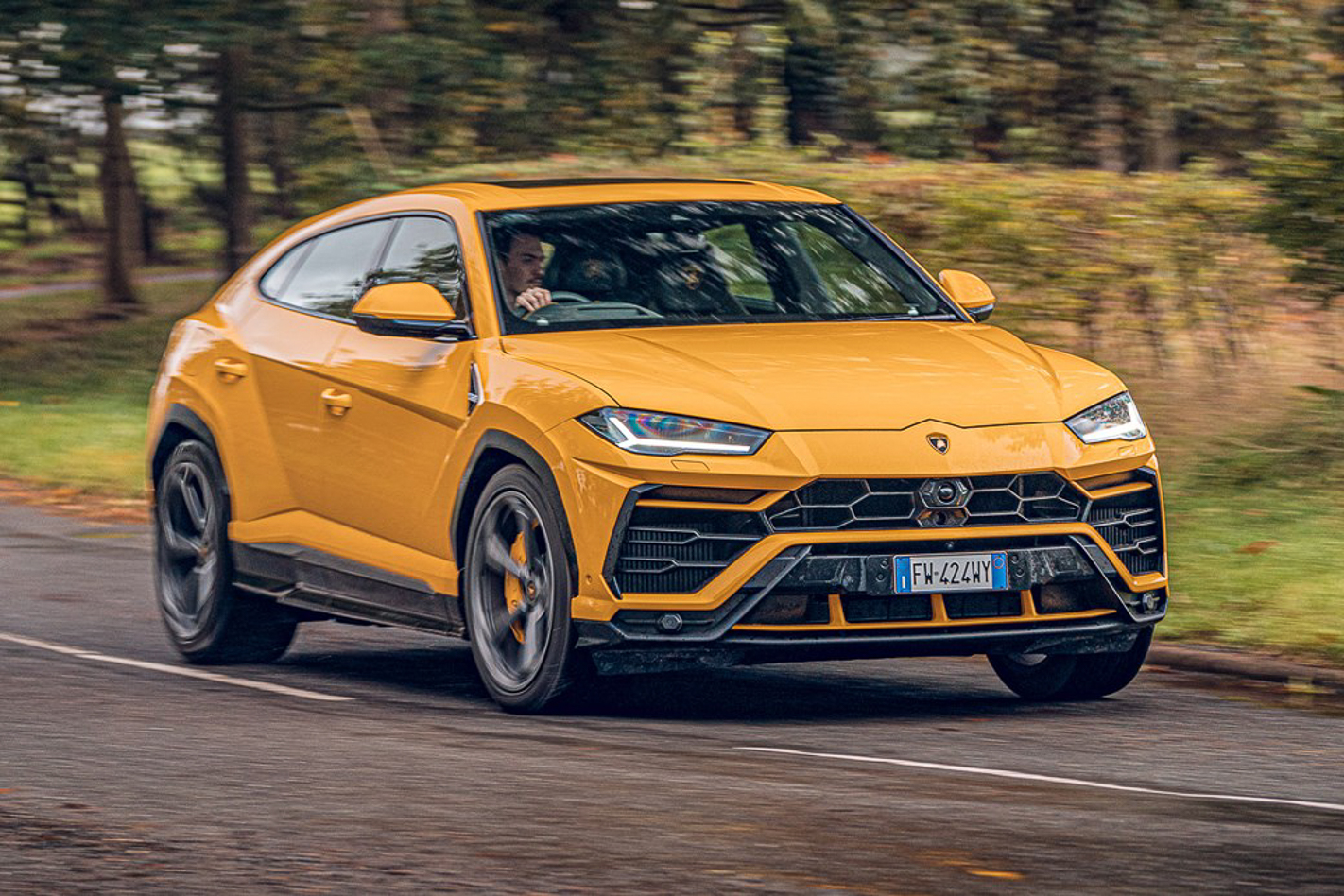
Is it really anything more than a gussied-up Audi Q7?
On this evidence, it very much is. The Rambo Lambo has an angular, sharply creased style all of its own, outside and in, where the obviously Audi-sourced haptic touchscreens are cleverly integrated into the centre console’s wall of carbonfibre and the cabin is peppered with enough Italian touches to feel distinctly different. Not necessarily better, but definitely different – and it’s all pleasingly well built.
Take the Anima and Ego driving mode selectors and gearlever: they’re striking and unusual – like a fighter jet’s throttles for selecting afterburners – but they’re actually a pain to use, making you cycle through every setting before you can go back to Strada once you realise that anything more sporting is excessive for pockmarked British roads. The tip-up missile-firing cover on the starter button is pure (primary school) theatre and the novelty quickly wears off, although your mates will giggle the first time they see it.
As with the Bentayga, questions arise over the digital dials; you sense that a department in Wolfsburg plays with graphics and fonts to make identical instrument displays more British, Italian or German, more luxurious or outrageous, to match the price point and marketing intent. Is today’s luxury transport really reduced to such hard-to-read aggressive typefaces in the name of product differentiation?
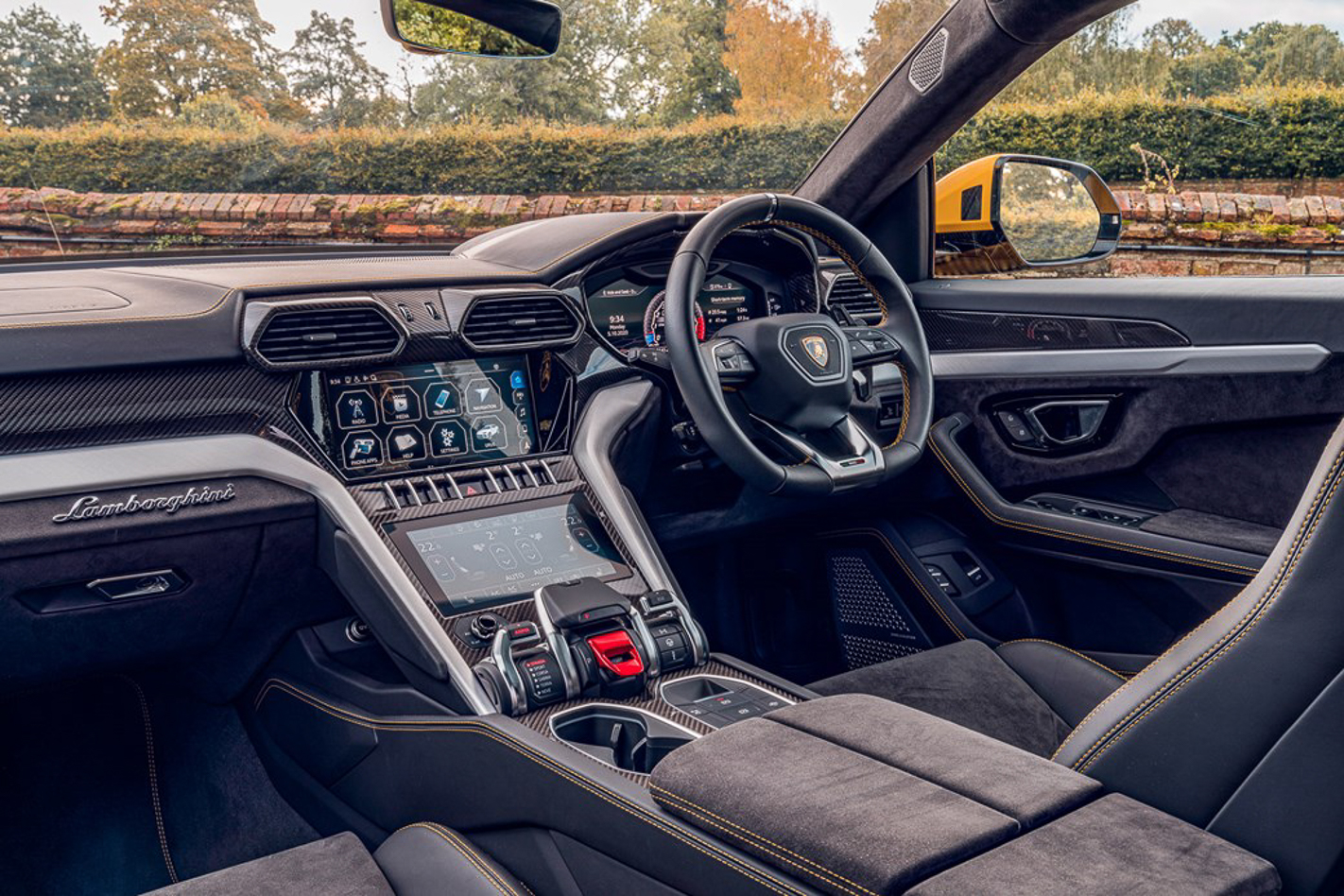
But we nitpick. This is a surprisingly practical and well-appointed cockpit and there’s plenty of space for family life – and when could we ever say that about a Lamborghini? The rear seats are supremely spacious, although that plunging roofline robs 5cm of headroom compared with the roomiest DBX. The Lambo’s boot is the narrowest here, but all three cars have practically shaped and sized loadbays that won’t disappoint, although the Urus is the only one with a small lip to carry bags over.
Climb in as the door shuts the final inches of its own accord, engage that missile-fire starter button and the Urus erupts with a howl. Considering the Bentayga and Urus share fundamentally the same 3996cc twin-turbocharged V8, you’ve got to marvel at the Italian tuning team’s poetic licence. The Urus develops an extra 73kW and it feels every bit as fast as those numbers suggest, with a sharper response than either rival can muster.
The quoted 0-100km/h time of 3.6sec is absurd for a 2.2-tonne SUV and it’s deeply impressive how easily the Lamborghini transfers that thrust to the road with unstickable traction. Special praise should go to the standard-fit ceramic brake discs that haul off speed with abandon, time and time again.
Thank a fruity Akrapovic exhaust for the aural histrionics and the sledgehammer 850Nm torque mountain for the endless, horizon-reeling thrust. That’s a full 136Nm over the already-fast DBX, and the pulling power is available from just 2250rpm. No wonder this car is so unrelentingly fast. It’s the most focused SUV of this trio and its ride is correspondingly the stiffest; not unacceptably so, but it patters and rarely settles, busier than either the smooth Aston or cushy Bentley.
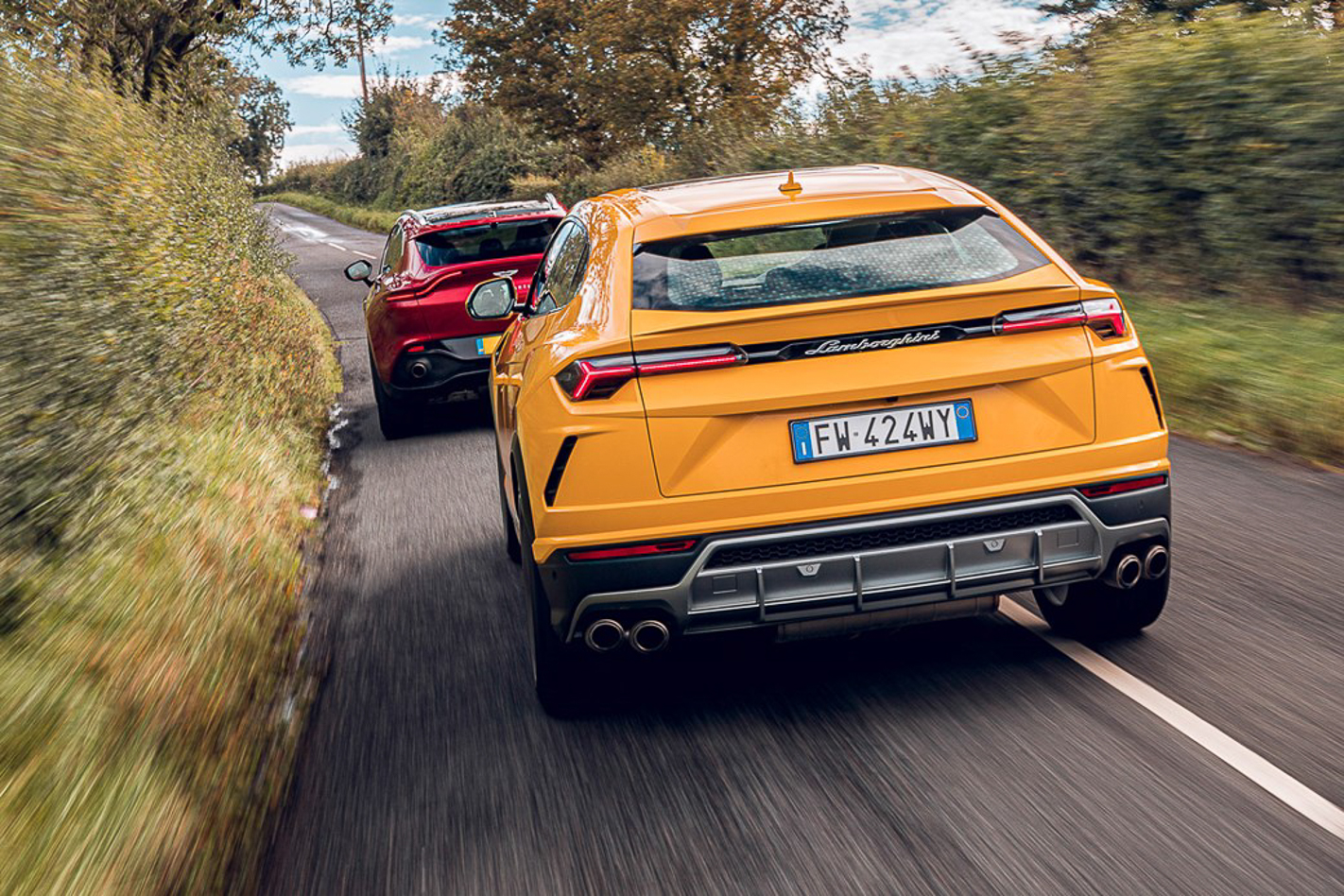
While some of the car’s fundamentals don’t disguise their blood relationship with the Audi RS Q8, once you start exploring the Urus’s extremes you realise just how different the Italian car is. Flick into Sport mode, never mind track-focused Corsa, and the exhaust note takes on a hard timbre, the percussion section promoted to the front of the orchestra pit, as the V8 pops and bangs extravagantly, the eight-speed automatic clinging to low gears. It’s all terrifically exciting in the playground, but more retiring types may feel a tad embarrassed.
Which kind of sums up the vibe of the Urus. All three of these cars are ridiculously fast and remarkably accomplished, yet the Urus feels akin to attaching running spikes to wellington boots, spawning some weirdly aggressive crossbreed. We love its barminess, but it cuts a rather absurd figure on the school run
Bentley Bentayga V8: pre-flight briefing
Why is it here?
The Bentayga’s been refreshed just in time for the arrival of the DBX, which is aiming (among other things) to steal Bentley sales.
Any clever stuff?
There’s a nip ‘n’ tuck externally, but the biggest changes are inside, where there are new seats, the latest generation of infotainment, and wireless Apple CarPlay and Android Auto as standard.
The 290km/h drawing room
If the DBX is the new kid on the block, the Bentley has already become a familiar sight in Britain’s smarter postal districts. It can’t be coincidence that Crewe’s ushered along a facelift just in time to greet its new British rival. The Bentayga has always impressed and repelled in equal measure, with luxury overload, dynamic ability and family practicality in spades, but also an appearance that many find offputting.
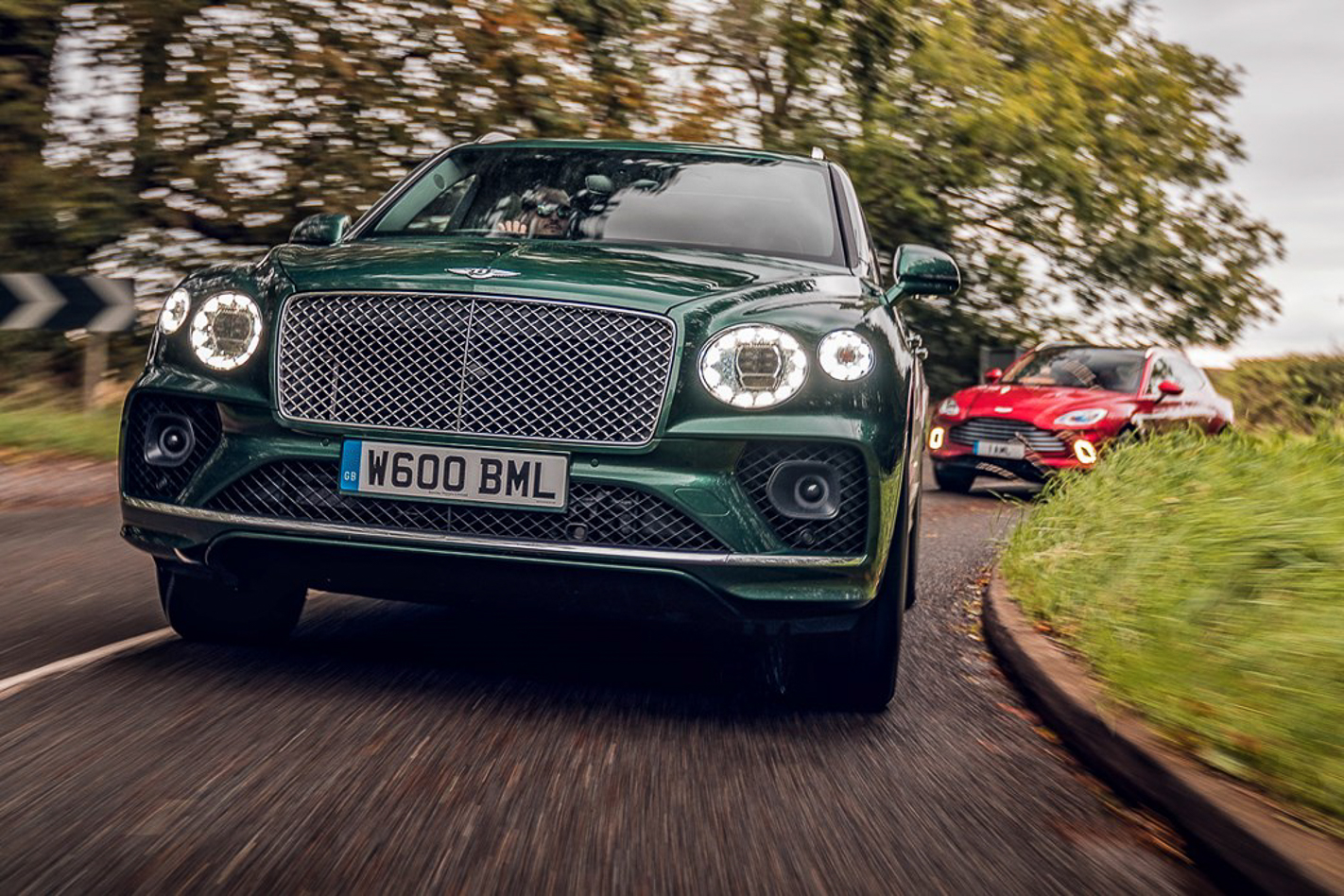
The 2020 refresh brings a modest redesign, including Conti GT-style rear lights. Ours is resplendent in Verdant paintwork, a zingier, lighter British Racing Green, and it’s vast, easily the biggest car of this trio in every dimension. It feels it on the road, where you breathe in through tighter gaps and it bulges out of regular parking spaces. The upside? The Bentley has the deepest boot and a cabin so echoingly roomy that I’d challenge anyone not to get comfy in any seat (it’s the only car here with the option of a third row of pop-up seats, too).+
‘the first of every Bentley to electrify’
You climb up into an exquisitely engineered cabin and there’s a reassuring heft to everything from the switchgear and traditional Bentley organ-stop air vents to the quality of leather and wood. Purists may decry the Audi fundamentals, yet most buyers will neither know nor care. Instead, marvel at the contactless phone charger, night vision, extraordinary Naim stereo, full-length, double-row smoked-glass sunroof and substantially improved infotainment system (though we’re less convinced by the overwrought virtual dials, digitally upgraded like the Lambo’s). We also can’t quite believe that they’ve snuck the fan speed selector into the touchscreen. Surely that’s not the kind of Blower that Bentley customers want?
If family duties are a top buying requirement, the Bentayga makes a strong case for itself. Its 589-litre boot is huge and stretches further back than any rival, with no impediment to access and convenient buttons to lower the air springs (like on the Aston) and to conjure a pop-out towbar for lugging your pony/powerboat at the weekend. Our test car came equipped with a space-saver spare wheel and loadbay locking rails to hold luggage in place. It feels brilliantly engineered and tough; we’d be less worried about reliability here than in the unproven Aston.
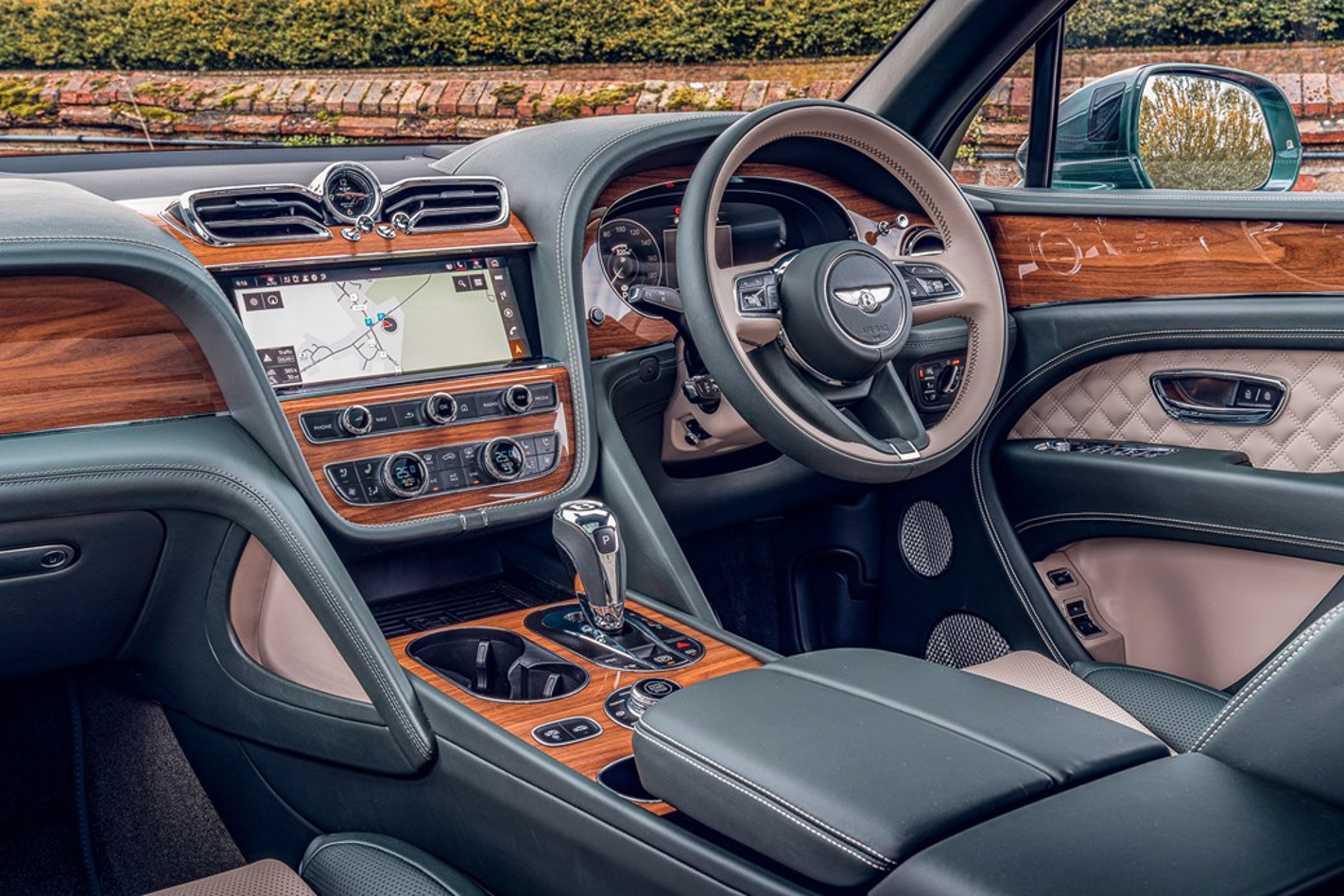
Slide into those magnificent massaging, electro-everything seats, stab the start button and you’ll just about make out the distant V8 hum. The Bentley is markedly more refined than either of these rivals, its default mode providing a hushed cruise as it wafts along in eerie near-silence. Only in the lairier Sport mode at full throttle is the engine uncorked, a gentleman’s cough clearing the throat before a melodious V8 throb emerges when you rev it hard, but even then it’s significantly quieter than the DBX and, especially, the ostentatious Urus.
This calmness defines the Bentayga’s character. It’s demure, happiest at six-tenths or below, where you’ll lap up the plump ride, the eight-speed automatic transmission slurring through gearchanges with imperceptible polish, relaxed steering inputs nudging the prow. Just watch out for the wretched lane-keep assist system, which must be disabled to prevent the car constantly nibbling away at your inputs.
It’s hard to reconcile those enormous 22-inch wheels with the compliant ride quality; select Comfort and the Bentley floats over crests, yet there is little thud and it’s generally cosseting and quiet.
Turn up the wick, flick the car into all-rounder ‘Bentley’ mode (our preferred choice) or Sport, and it never quite shakes off the penalty of that extra bulk. The Bentayga is the porkiest car here at 2.4 tonnes and it feels every one of those killer-grammes, yet the 48-volt anti-roll system – versions are fitted to all three of these cars – works wonders to stop the body listing like a dilapidated country mansion if you hurl it into a corner, and you’ll never tire of the way it deploys all 770Nm and 404kW in a secure fashion.
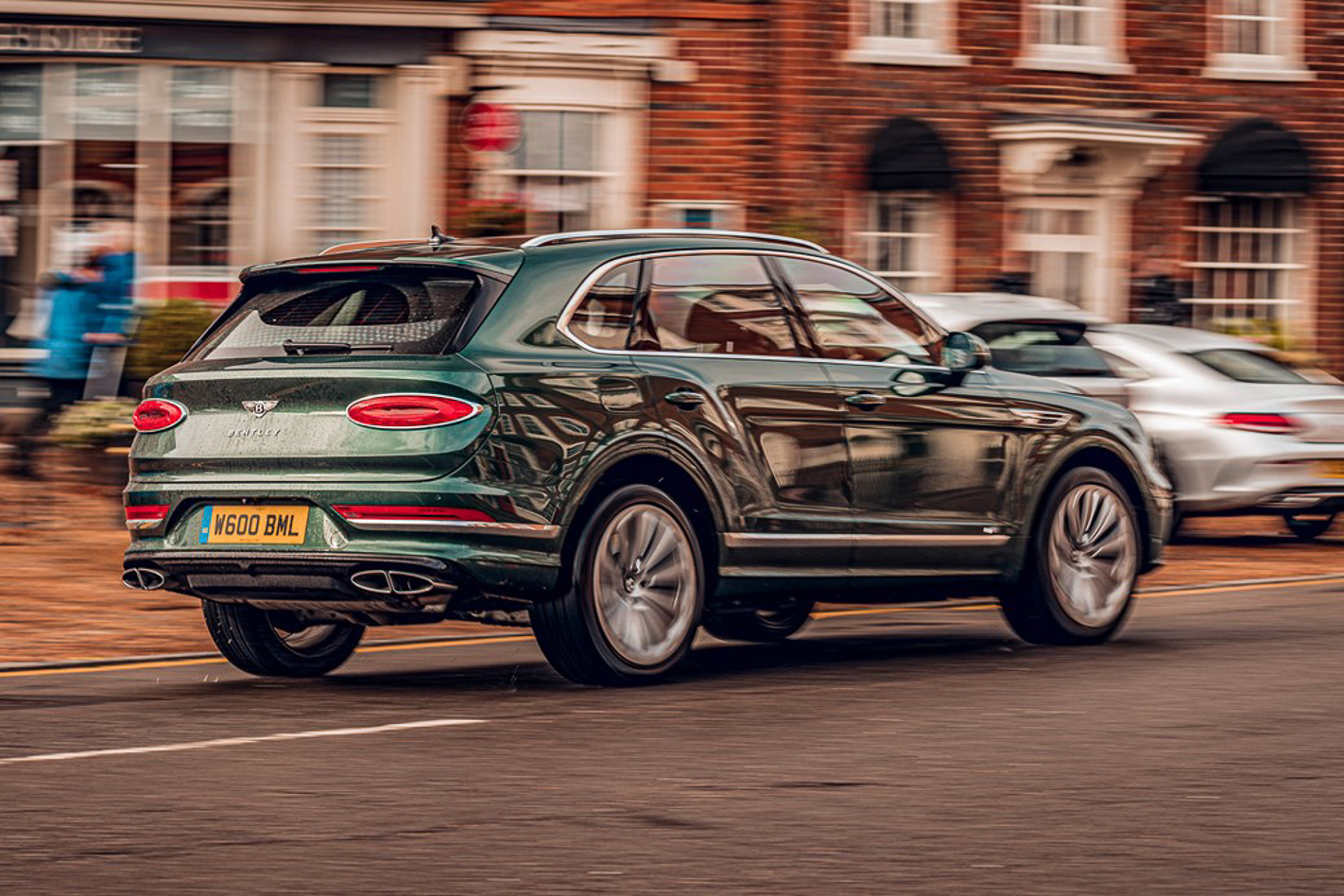
Where the DBX broke traction surprisingly often, feeling as tail-happy as one of Aston’s sports cars, the Bentayga is more effective at transferring every single pony to the tarmac. Nail the throttle, the turbos spool up and it simply slingshots up the road on its way to 100km/h in just 4.5sec. The brakes are reassuringly powerful when you drop anchor.
They’ve done a neat job updating the Bentayga. It marks its card as the sensible choice here: the one if you want relatively unobtrusive family transport with lashings of British charm and quality, yet the ability to get a wiggle on as you peg it down for a weekend at your getaway.
The final reckoning
This is a rarefied breed of car – a genre of SUVs for those who have tired of a Range Rover and want a little more luxury, a degree more rarity and a sackload of extra performance to boot. You may decry the values these cars espouse (between them, they weigh nearly seven tonnes and cost over half a million quid), but to drive them is to be sucked down a rabbit hole and transported into a new world of lofty driving positions, extravagant luxury and the kind of light-speed acceleration that would make mincemeat of a Porsche 718.
Picking a winner is all about defining your intent. If you want the ultimate in performance, look no further than the Lamborghini, one of the world’s fastest and most extreme SUVs. It’s become the bestselling bull of all, and if you can live with its image it’ll do a very fine job indeed of playing family chariot by day and devilish cruise missile by night. It’s a surprisingly visceral experience once you’ve mastered the driving modes, yet you always feel it’s trying a little too hard to transpose some Aventador spirit into a huge hulking family 4×4. It’s an acquired taste.
The Bentley is the pick for those who want a safer option – an SUV that can do it all, but with a more restrained polish than the outré Lamborghini. This is a huge car, the most practical, and the quality of build and craftsmanship is staggering – with a proven reliability record and a decent turn of speed when required. It couldn’t be more different from the Urus, despite the fact the two cars share much DNA.
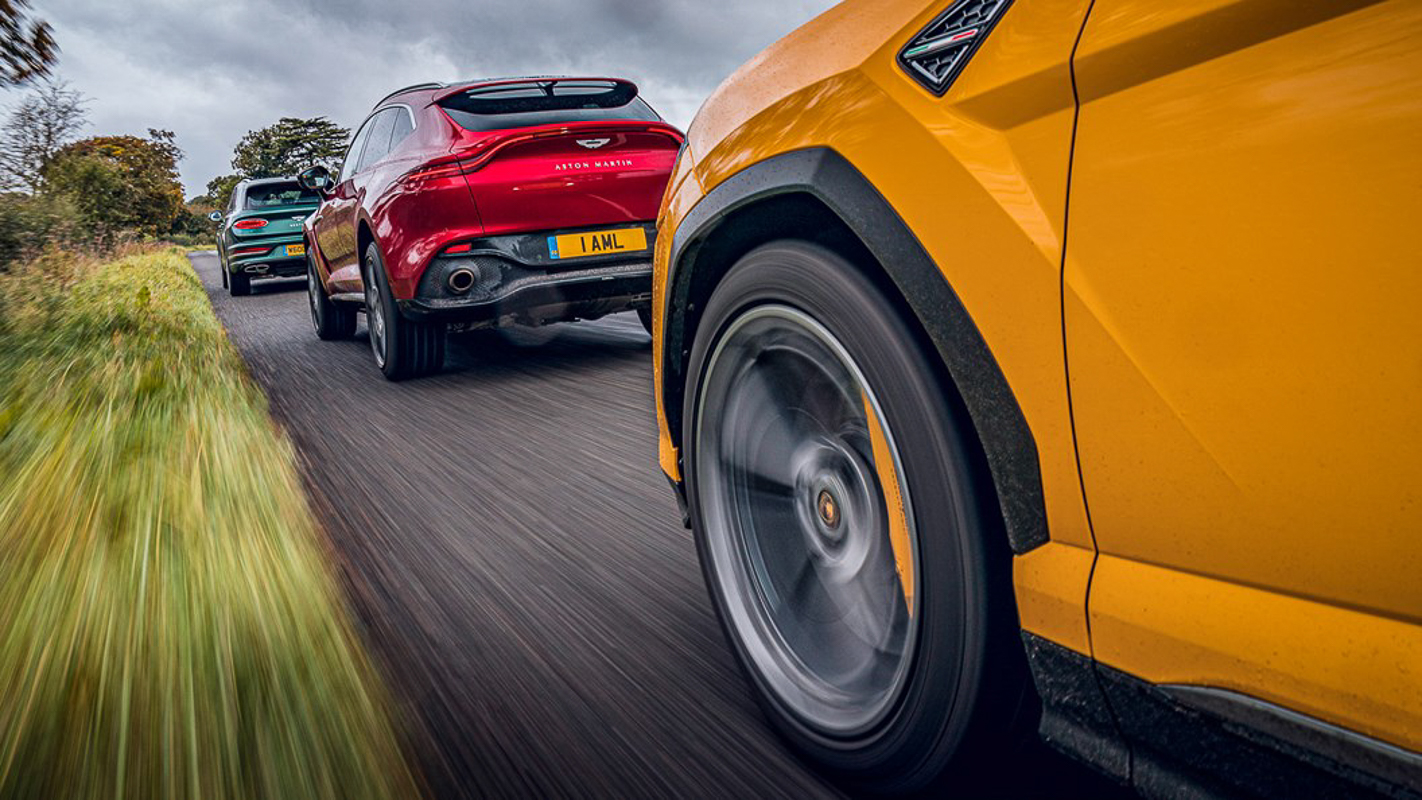
Which leaves the Aston Martin, the company’s first SUV in its 108-year history. It has a huge weight on its shoulders, and if successful might just be the car to rescue the company’s fortunes. This clean-sheet focus explains why the DBX aces it – they’ve gone and made an SUV that can do it all, from everyday family duties to thrilling on the long way home, and all wrapped up in a stylish, glamorous package.
It delivers 90 per cent of the Lamborghini’s punch and 90 per cent of the Bentley’s comfort, striking a rare balance that lets it climb to the top of the pile. We’ll overlook the electrical gremlins on our test cars and declare it our favourite super-SUV of 2020. When you want this style, this versatility and this performance, and you have cash to burn, DBX does indeed mark the sweet spot.
This comparison was originally published at carmagazine.co.uk
The Ford Falcon AU has proved capable of yet another incredible thing, after pictures of a stretch limo version from Japan have surfaced online.
Facebook group Aussie Cars Overseas offered the trip down memory lane to its followers, publishing images that reveal how the AU targeted the Bentley, Rolls-Royce and Mercedes-Benz Maybachs of the world as a six-door limo with business class chairs inside.
That might be why Amuza, the Australian-based Japanese company behind the creation, named it the Grand Chauffeur.
Clearly, it was set for a class beyond the realms of a Fairmount Ghia. And it wasn’t even being ironic!
The page says the 10-metre-long stretch limo “became immensely popular” in Singapore and Japan during its day, and was even exhibited at the 2003 Tokyo Auto Salon.
That Japan also created the Mitsuoka Orichi explains why the Grand Chauffeur might have caught on over there.
The AU Falcon has garnered cult legend for its, erm, unique look and the Grand Chauffeur obviously did little to remedy the AU’s visual flaws.
As we can see, it remodelled the front bumper with extra light burrows to complement a pointed grille, gifting the Chauffeur all the visual grace of a steam iron.
Portholes adorn its sides while the rear-end looked – somewhat unfortunately – to have been untouched.
The Grand Chauffeur is another feather in the cap of the sedan that enjoys internet fame for featuring in wild and ridiculous builds, situations or memes.
If you’re up for a bit more fun, Street Machine has had a go at compiling the best ones HERE.
As the list proves, the Grand Chauffeur is not the only time someone had a crack at turning the AU into a limo, with someone whacking on a Rolls-Royce front-end on an AU that made its way to the UK.
The Ford AU Falcon was first launched back in 1988 to controversial press given its looks, but underneath it offered a sturdy rear-wheel-drive sedan platform and decent six-cylinder powertrain.
REAN NEXT The AU Falcon a Supercars team practice pit stops with
Picture source: allcarindex.com
Update One – Electric dreams
After driving the plug-in hybrid Mercedes-Benz GLC300e for a few weeks and having issues keeping it charged due to my lack of off-street parking and no nearby charging stations, I jumped into Hyundai’s Kona Electric small SUV with a bit of trepidation.
As I wrote in my ‘living-with’ review of the GLC300e, I had issues just keeping the battery topped-up to exploit its ability to drive emissions-free for about 43km… but at least I had a safety net in the form of a 2.0-litre petrol engine.
But after picking up the Kona it soon became apparent that it’s actually quite easy to manage an EV with a theoretical 449-plus kilometre driving range (one of the best in the business).
Given the propensity for car companies to… let’s say, present things in the best light, the real figure is more likely to be 420km in real-world driving especially if you’re running the air-conditioner.
Even so, that’s enough kays for pretty much anyone to negotiate an average week.
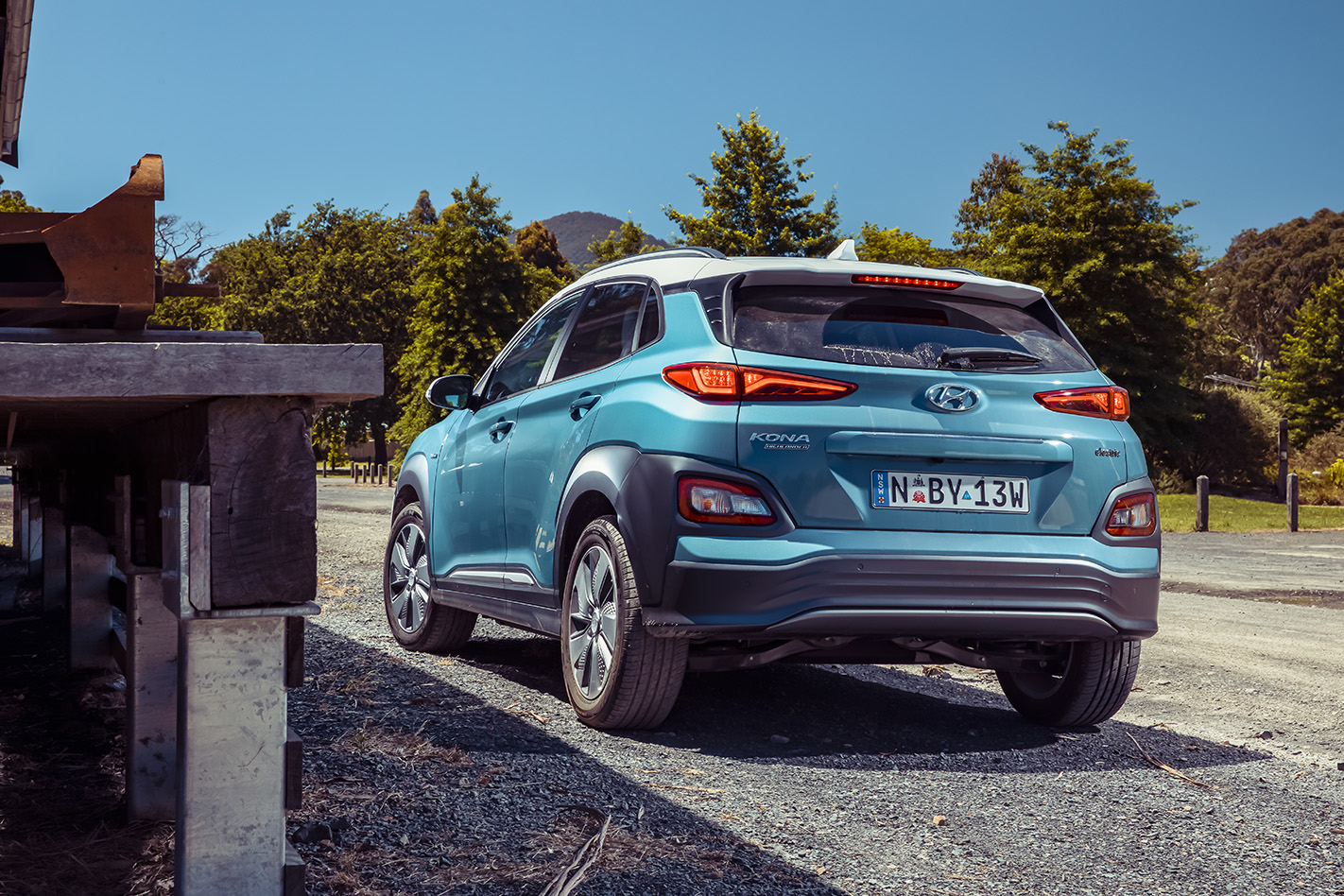
And when it comes time to give it a whack of wattage, I use a charging station at a shopping centre, so I have something to do while the electrons are flowing.
I only had the Kona two days before I decided to take it for a longish trip to Euroa, 160km from Melbourne, to attend a friend’s book launch.
One good thing about the north-east Victorian regional town is that it has a Charge Fox DC charging station at the big Shell service centre on the Hume Freeway.
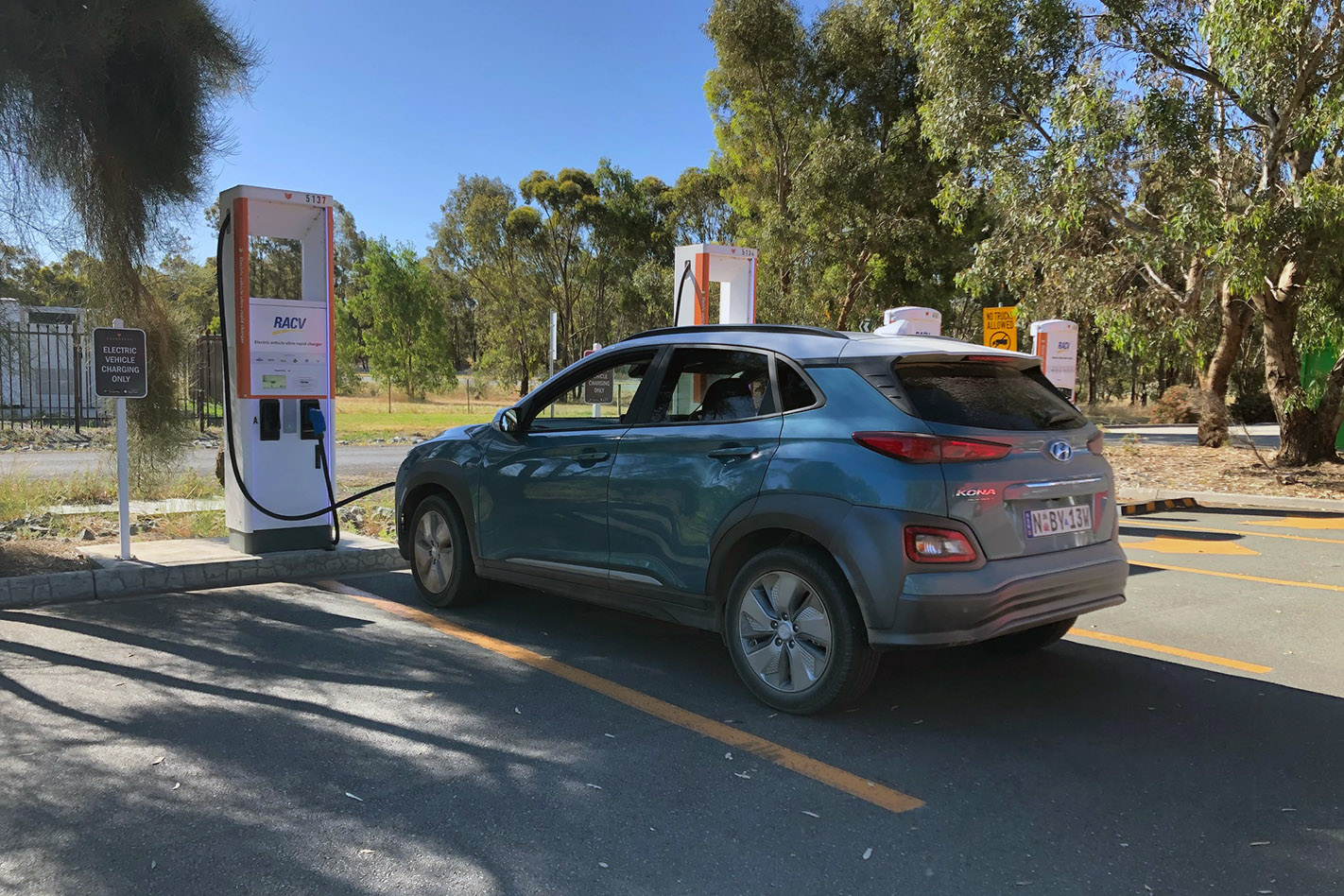
You can find out how it fared up north in my separate travel story, though I managed to do quite a bit of driving around the nearby Strathbogie Ranges, with just one battery top-up.
I returned home to Melbourne with 160km range left, too. Economy for the entire trip was 13.8kWh, which is better than the 14.7kWh official economy rating, and a lot better than something like a Jaguar I-Pace could manage.
Kona Electric first impressions
Jumping in the $65,290 Kona EV Highlander isn’t too different to jumping in the petrol 1.6-litre turbocharged petrol version which costs $40,200.
The two share most features including a head-up display, power-adjusted leather-trimmed seats, heated and ventilated front seats, 10.5-inch touchscreen, dual-zone air-conditioning, LED lights all around, a wireless charging pad for your phone and sportier 18-inch wheels.
The Electric version does miss out on the panoramic sunroof.
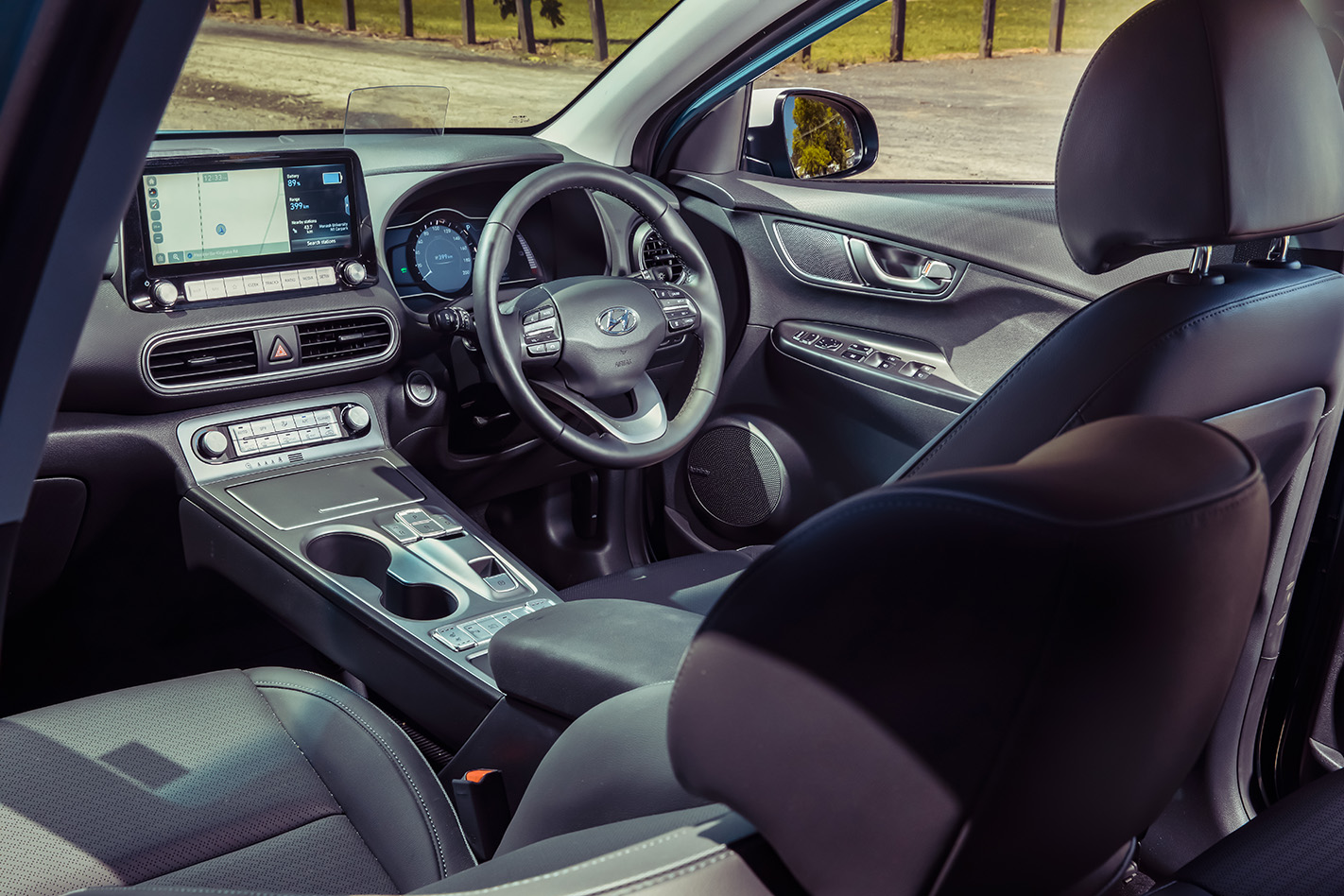
Another difference is the gear shifter – for want of a better word – which, like the Hyundai Ioniq, features buttons to engage drive, reverse, neutral and park.
Like all EVs it glides rather than drives away, with that sensation heightened by futuristic noise, which Hyundai calls its virtual engine sound system (VESS), so you can’t scare the wits out of pedestrians.
It sounds quite cool and attracts plenty of attention – so job done, I guess!
The Kona is more powerful than the Ioniq Electric sedan and has good oomph off the line even in Comfort mode.
It has a Sport mode that offers head-jerking starts, but it produces too much torque too quickly for the stock Nexen tyres which are primarily designed to limit road noise and rolling resistance rather than to grip
If you’re not judicious, you even end up chirping tyres when you take off, especially if the road is a little wet.
Apart from the ‘hey watch this’ value when you have EV newbies as passengers, I’m yet to see the point of selecting Sport mode.
There’s also an ECO mode which is good in traffic, and you can increase or decrease the regenerative braking strength between zero and three using the steering wheel paddles.
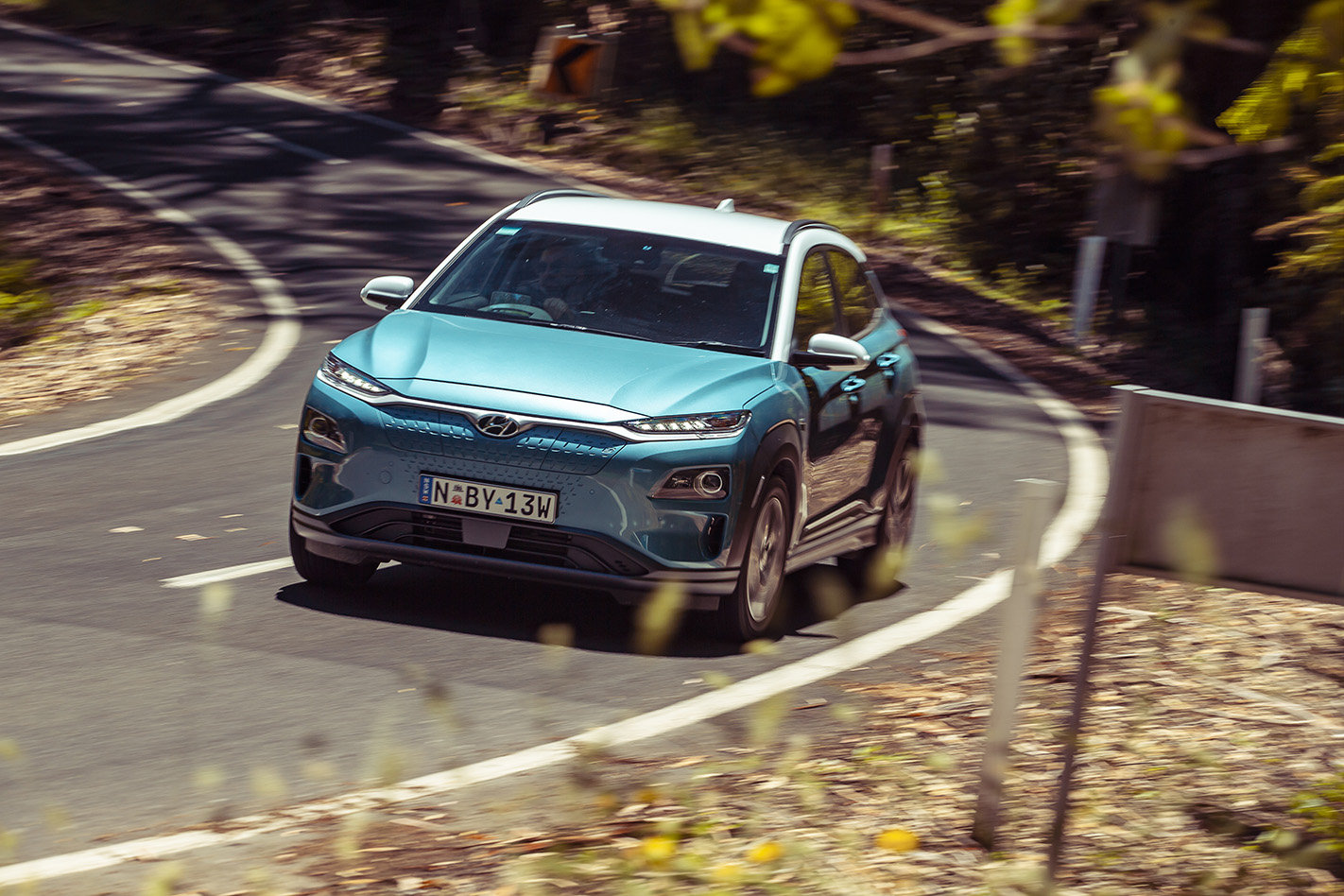
The Kona Electric handles nicely and on twisty roads; the regenerative braking offers enough slowing power when needed, so you rarely have to apply the actual brakes even on downhills.
My one gripe, however, is the rear suspension. It has a soft ride that’s obviously been tuned for smooth urban roads where the ride can be quite serene.
But this is Australia, and you don’t have to drive too far to find road imperfections where the ride gets very choppy.
For some reason, it’s much more composed on gravel roads.
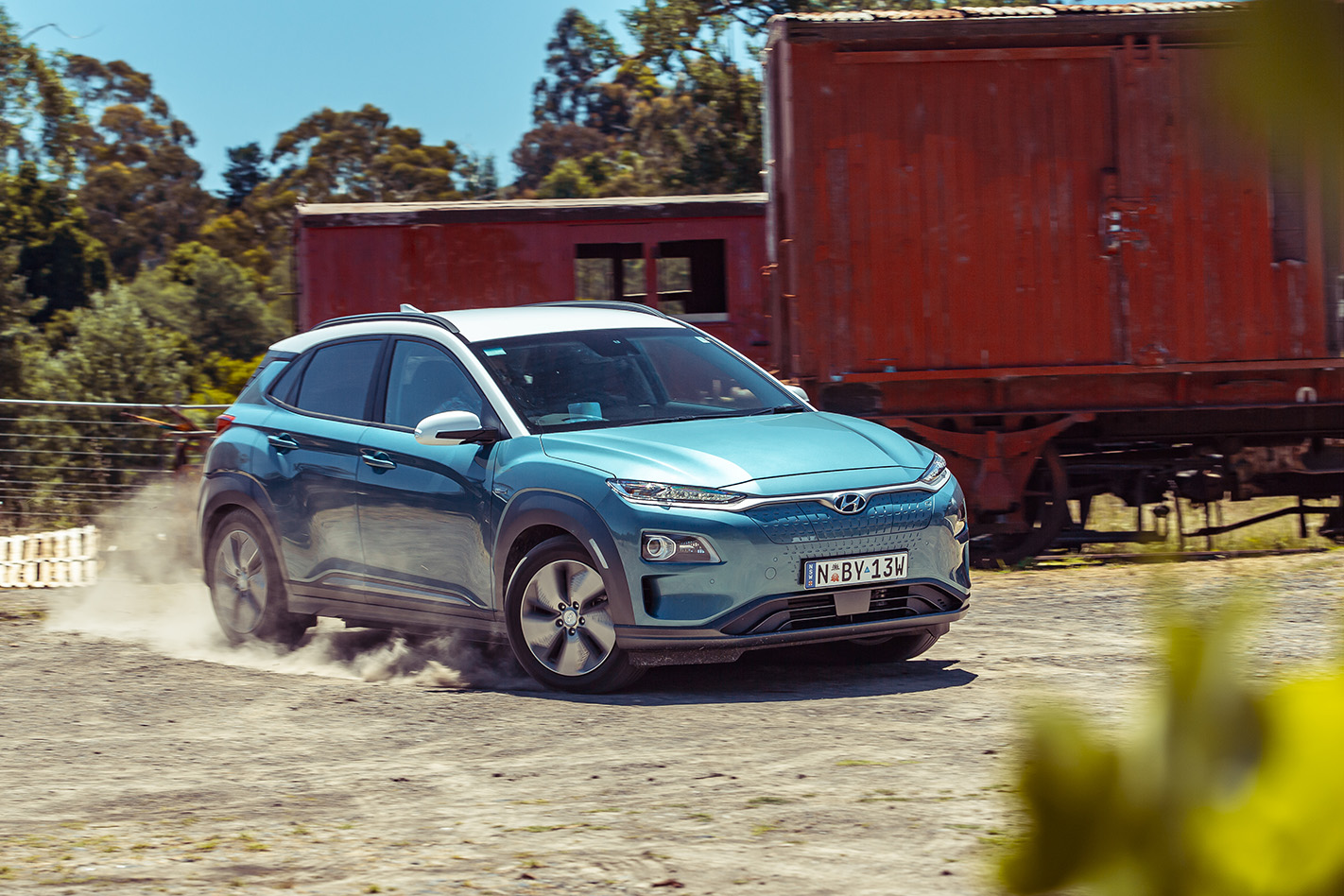
I should point out that this is also an issue with the petrol-powered Kona, whose suspension tune leans too much toward sporty driving. This is unusual for Hyundai vehicles as they’re usually well-balanced for Aussie conditions.
That aside, I’m already enjoying this car a lot and appreciate the attraction of battery-electric vehicles.
Speaking of which, I’ll discuss the Kona’s electrics and charging in more detail in the next update.
ODO: 2904 Kilometres travelled: 590 Efficiency: 13.8kW
Hyundai Kona Electric Specifications
Price: $65,290 Motor: Permanent magnet synchronous Max power: 150kW Max torque: 395Nm Transmission: Single speed reduction gear Battery: 65kWh Charging socket: CCS2 Weight: 1743kg Economy: 14.7kWh/100km (claimed)
Update 2: Hey charger
What makes the Kona Electric so easy to manage is that its substantial range comes with not-so-big 65kWh battery than can be plugged into a rapid charger and juiced up to 80 per cent from about 15 per cent battery charge in around 30 minutes.
That gives you around 380km, or 365km if you’re running the air-conditioner.
This is a good time to explain why EV manufacturers go on about charging to 80 per cent instead of 100 per cent. It’s all about charging time.
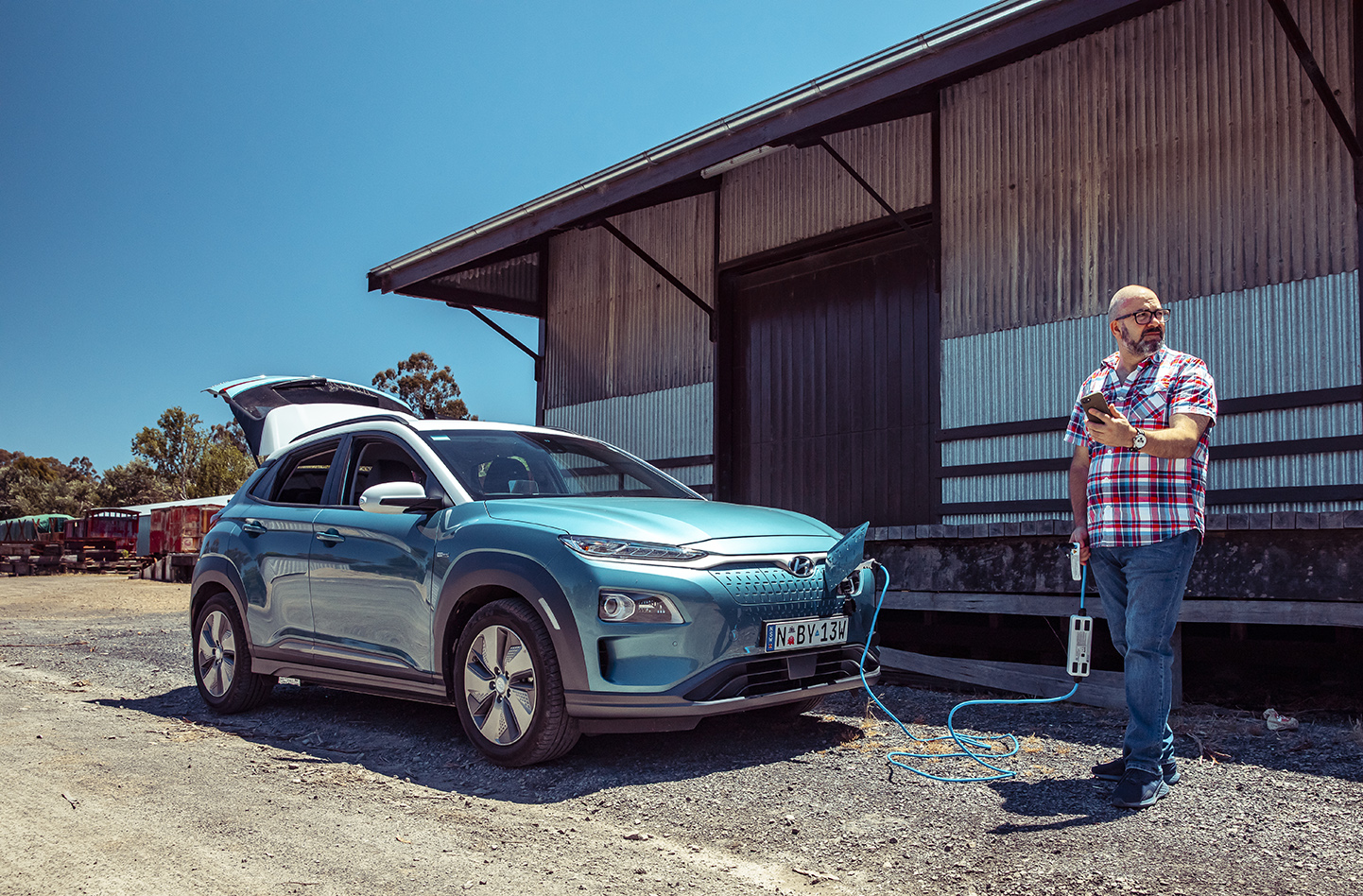
Just say you have a 50kWh battery and charge it on a 50kW charger. In theory that should take one hour to charge from empty.
However, DC chargers slow down the charging rate after the battery reaches 80 per cent capacity to prevent it from overheating.
So while you’ll get from 0 to 80 per cent in 40 minutes, that final 20 per cent could take another 30 minutes or longer. Which is why, when you’re on the move, the range your EV provides with 80 per cent battery capacity is important.
While charging, the Kona will let you know how much time it will take to get both 80 and 100 per cent, which is handy if you want to do something else during that period.
Enter ‘destination charging’, which refers to topping up your car while engaging in other activities shopping, having dinner or visiting a tourist attraction, so you’re not just waiting around.
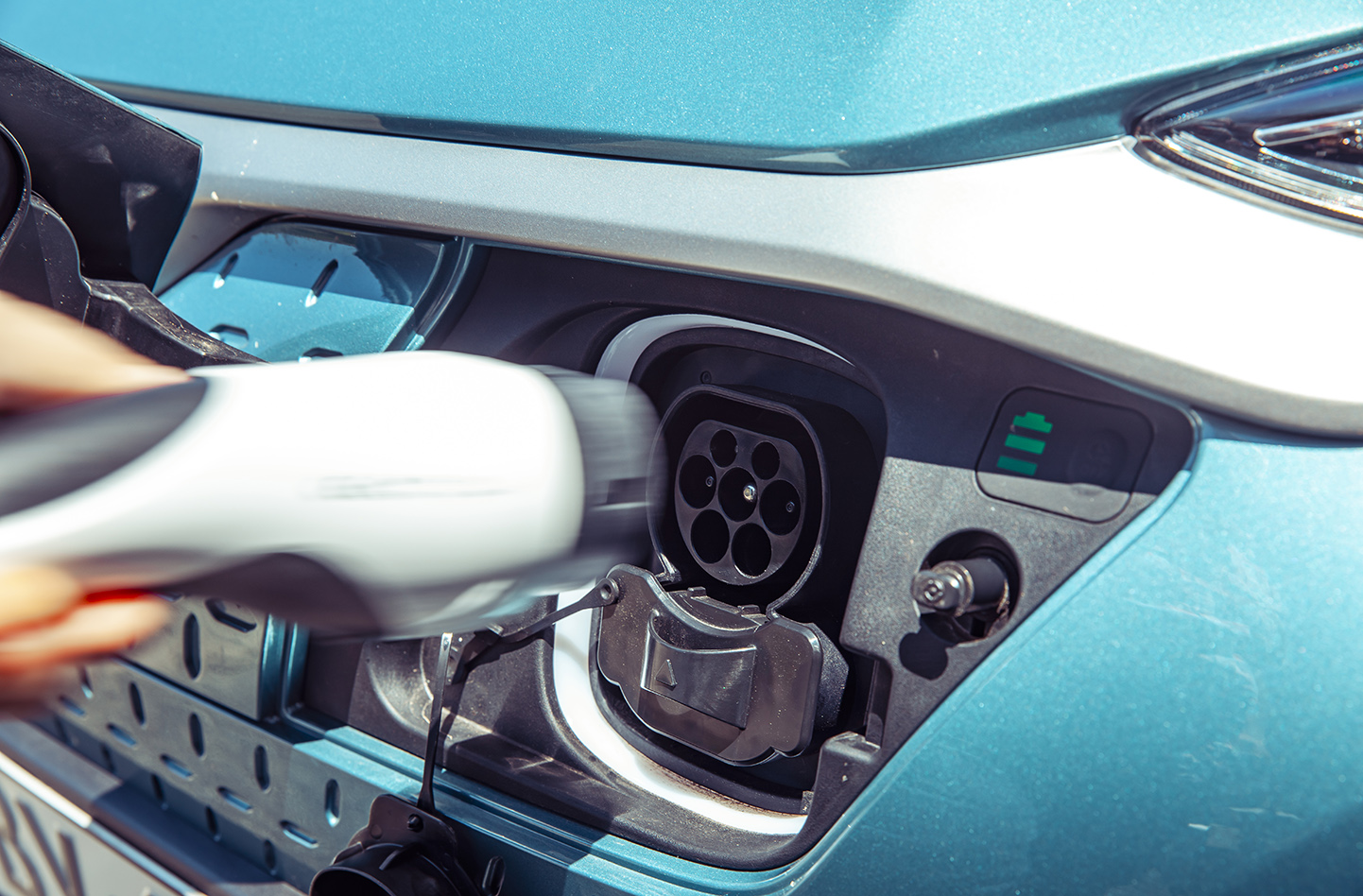
For example there are DC fast chargers at a Westfield shopping centre about 15 minutes where I live, so I decided to charge the car from 12 per cent while I did some Christmas shopping.
By the time I returned to the car 44 minutes later it was charged to 82 per cent, giving me about 400km of range.
The other key to quick charging is to top up whenever possible, whether it’s at home or wherever there’s a charging station handy – just like you do with your phone.
Charging costs
You’re probably wondering what it costs to charge an EV. Charge Fox charges 40c per kWh which meant the 44.1kWh of electricity the Kona accepted while I shopped cost $17.76 including GST.
There is another Charge Fox DC charging station I use in Brunswick while I shop or grab a bite to eat that is subsidised by the local council meaning you can charge your car absolutely free.
