
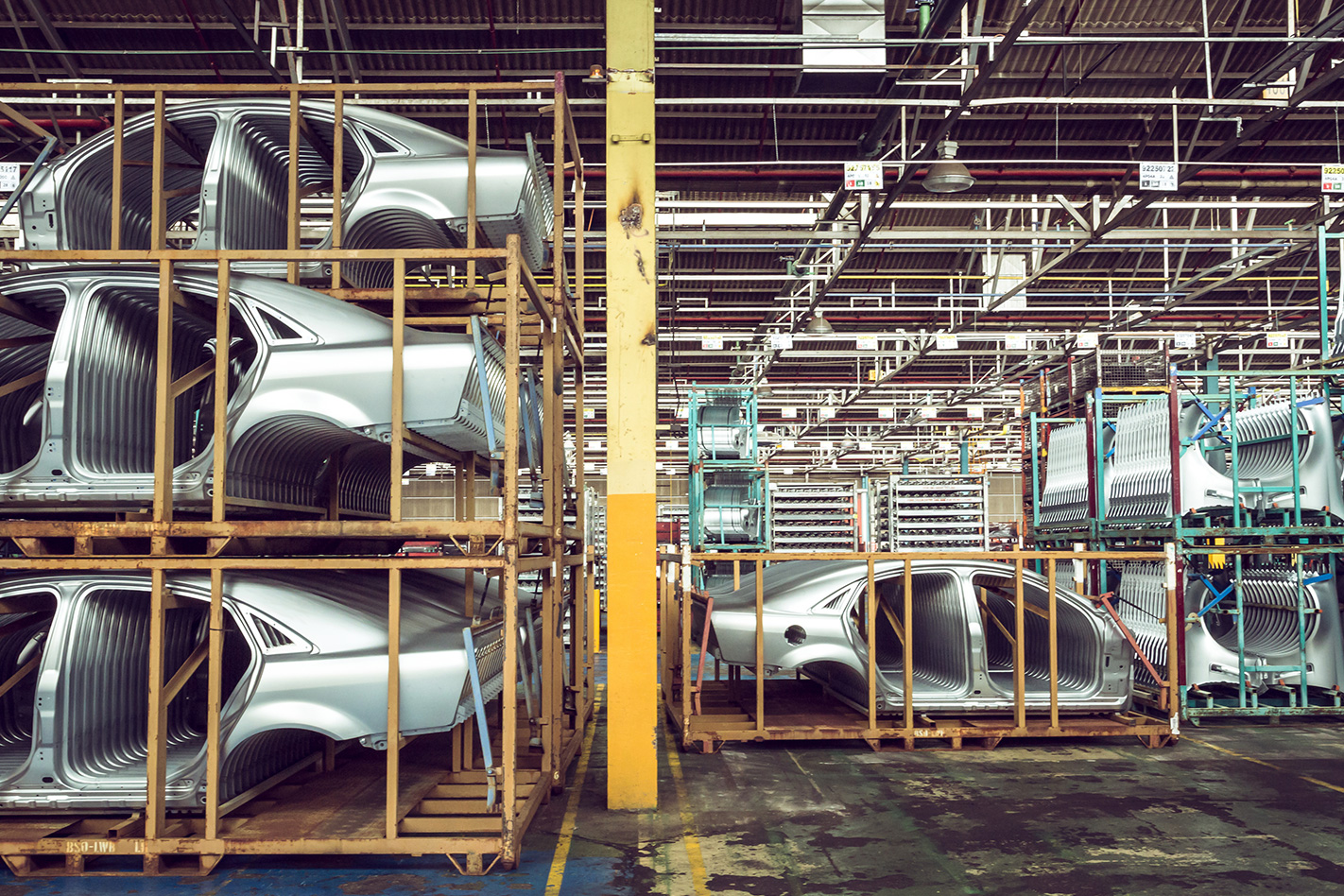
Today marks three years since Holden officially closed its Elizabeth plant, bringing Australia’s new car manufacturing industry to a grinding halt. This article was first published in Wheels’ November 2017 issue.
“We have worked for the last four and a half years to make Holden a company that will last for decades,” said Peter Hanenberger, Holden Ltd chairman and managing director, back in July 2003.
“We have the right people in place and we are financially very sound. So, it makes my departure fairly easy from the point of view of people. The team is in place, the products are in place and the things that are to come are in place.”
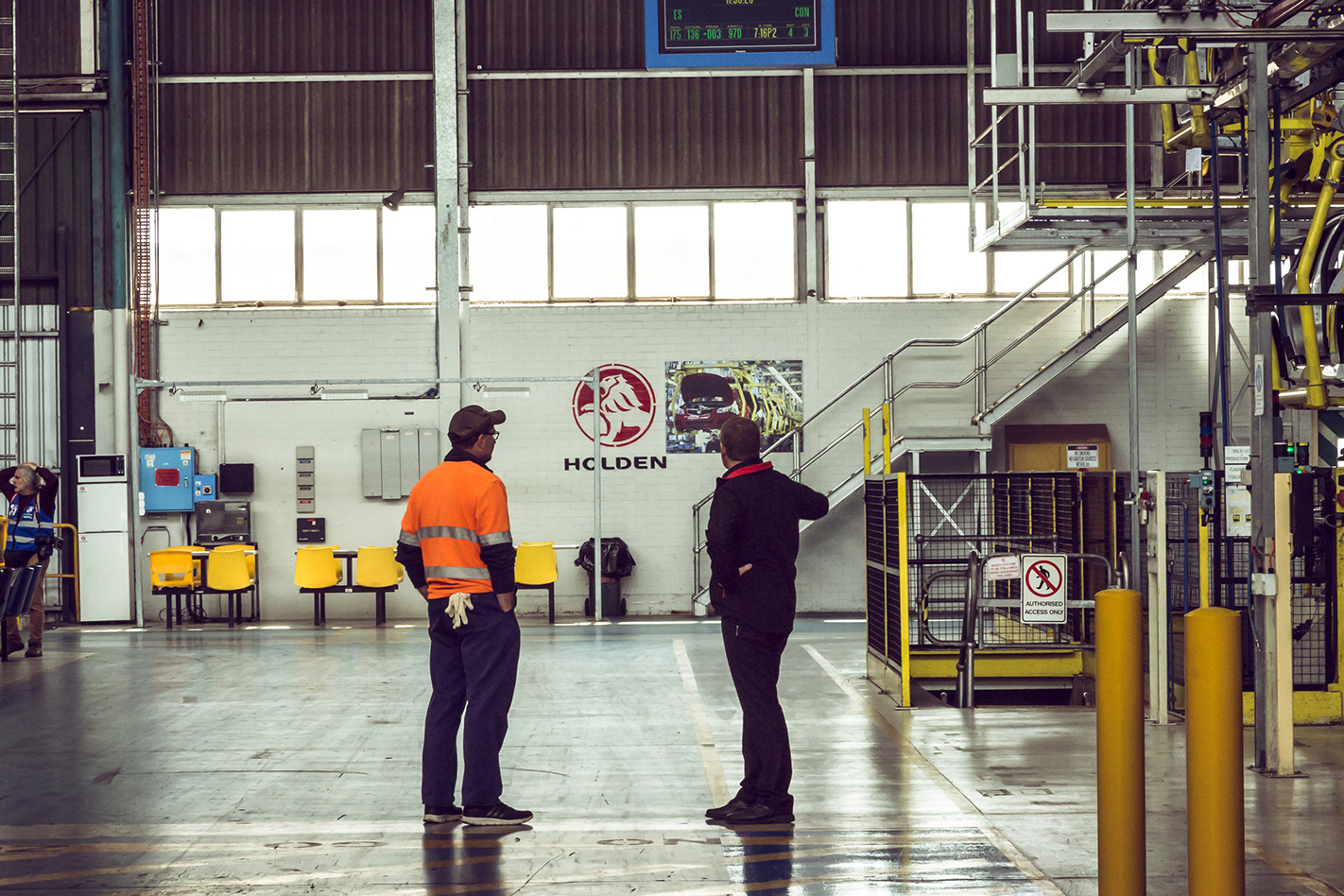
A little more than 17 years since one of Holden’s greatest leaders uttered those optimistic words, Holden joins Ford and Toyota in abandoning the Australian car- building business.
We despair about all three, but Holden especially so. When General Motors won the right from the Australian government to build Australia’s car, its relationship with us changed. Even if we didn’t own a Holden, even if Holden was owned by a US giant, we felt proprietary because of Holden’s local name, its ancestry, the 48-215 and the many cars that came after.
Holden was the market leader for decades, rode on the back of its Australian-ness and promoted its true-blue patriotism at every turn. But that special relationship couldn’t save Holden from ending manufacturing and killing off the locally developed Commodore. As protection fell, Asia rose, tastes changed, more brands launched into a small and already congested market, the Global Financial Crisis bit and finally, the federal government turned its back, the sums didn’t add up, the end came and the tears fell.
Much of what happened was outside the control of Holden and General Motors. But the rapid plunge in fortunes also means the relationship between parent and child deserves scrutiny. Since 2000 the job of running Holden has been a revolving door. Nine men have held the role of chairman and managing director. Four of them are key to where the company finds itself now.
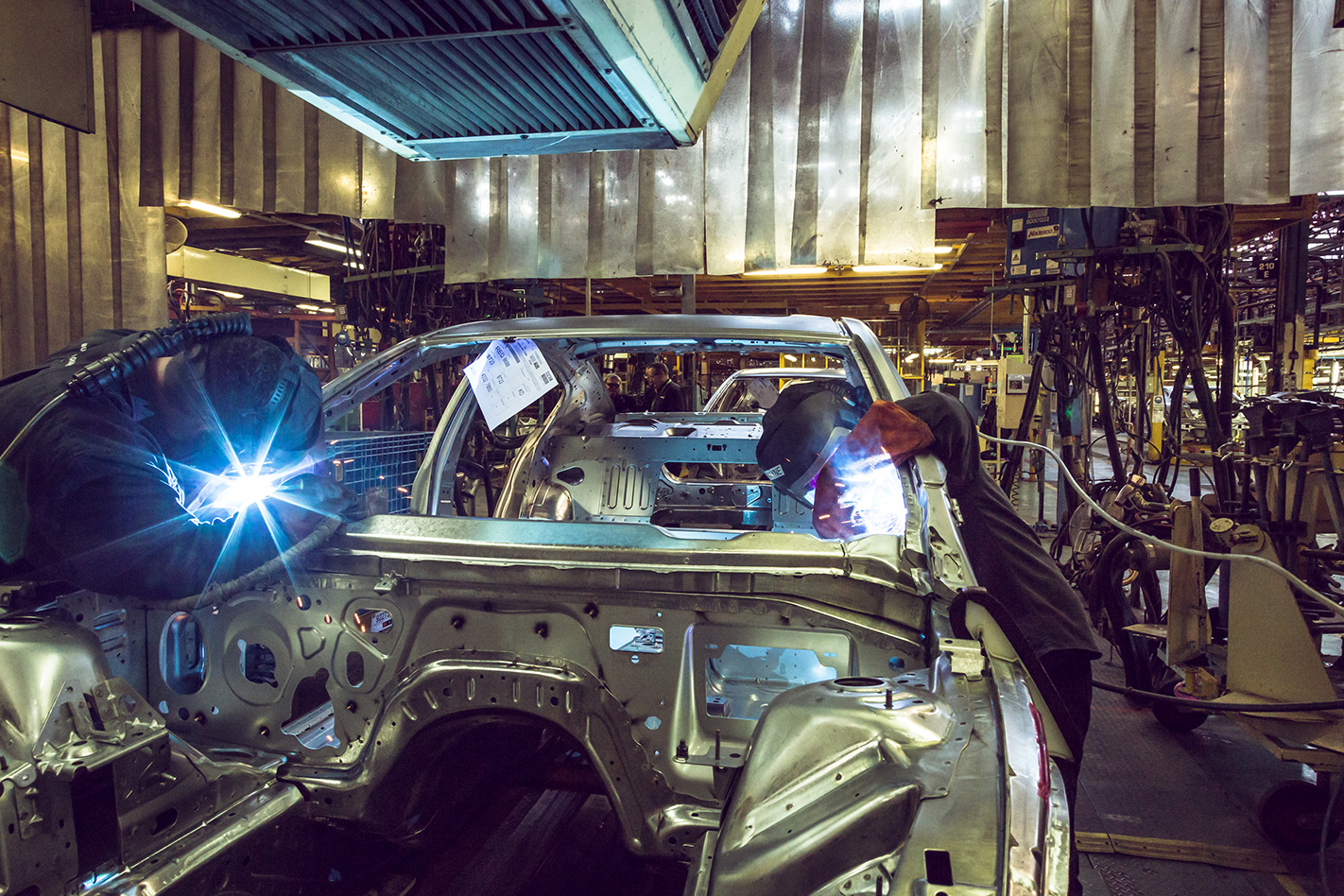
When Hanenberger spoke in 2003 soon after his retirement was announced, his optimism was not only feasible but entirely understandable. Holden had led the market with a 21.4 percent share in 2002, sold more than 88,000 Commodores and reported a $265.6 million profit.
Those numbers made GM happy and delivered Hanenberger an important level of independence.
Hindsight enables us to see he was the last Holden boss with the combination of seniority, capability, character traits, experience, confidence and freedom to run the company as he saw fit. The place was dubbed Fortress Holden under his command.
“I was very independent,” he told Wheels. “I couldn’t give a shit what they thought in America. I was working for Australia and Holden.”
Hanenberger wasn’t blind to the coming challenges. He understood Holden’s continuing place in a changing automotive world relied on its ability to carve out its own unique niche. As he saw it, the best defence Holden could mount was offence.
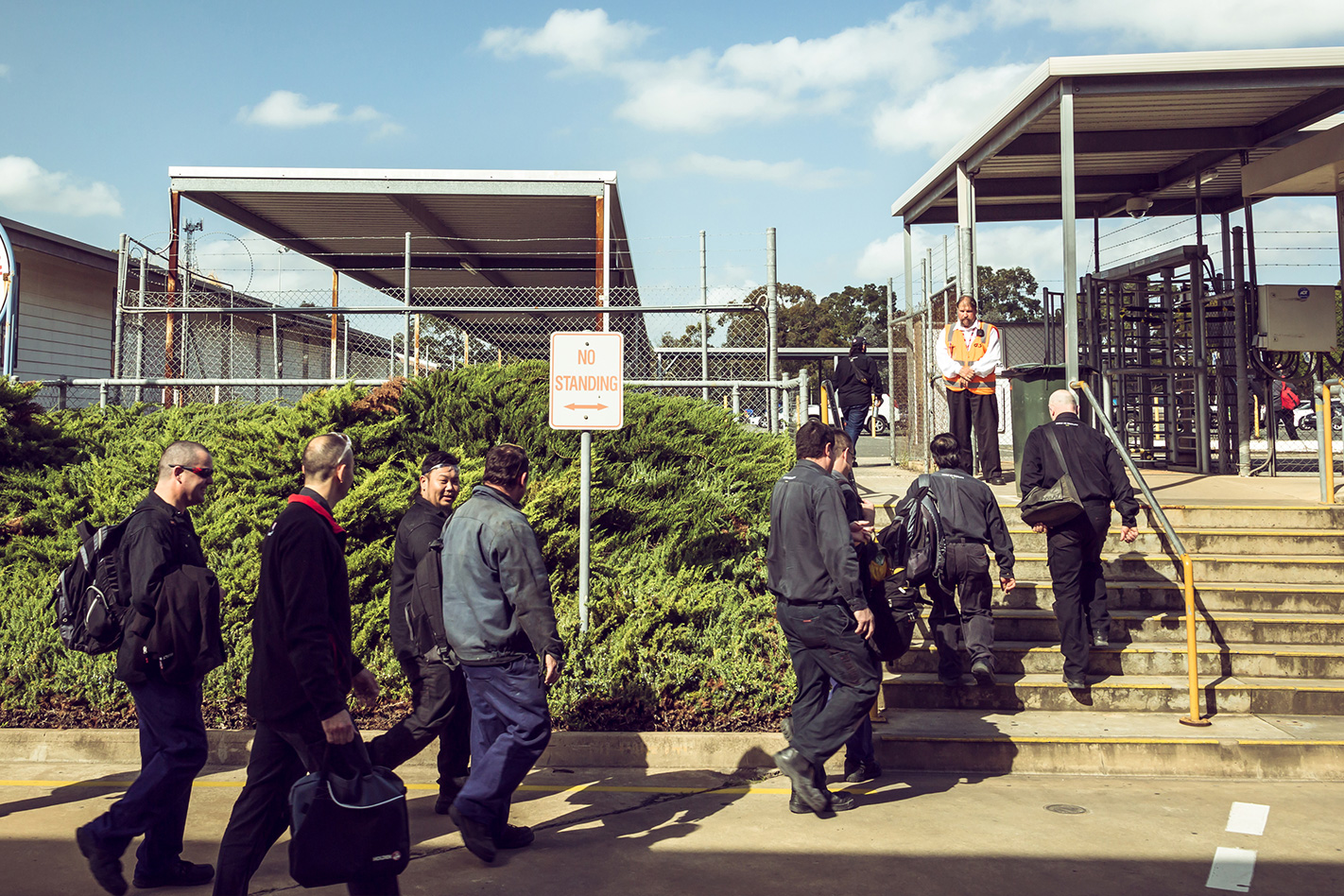
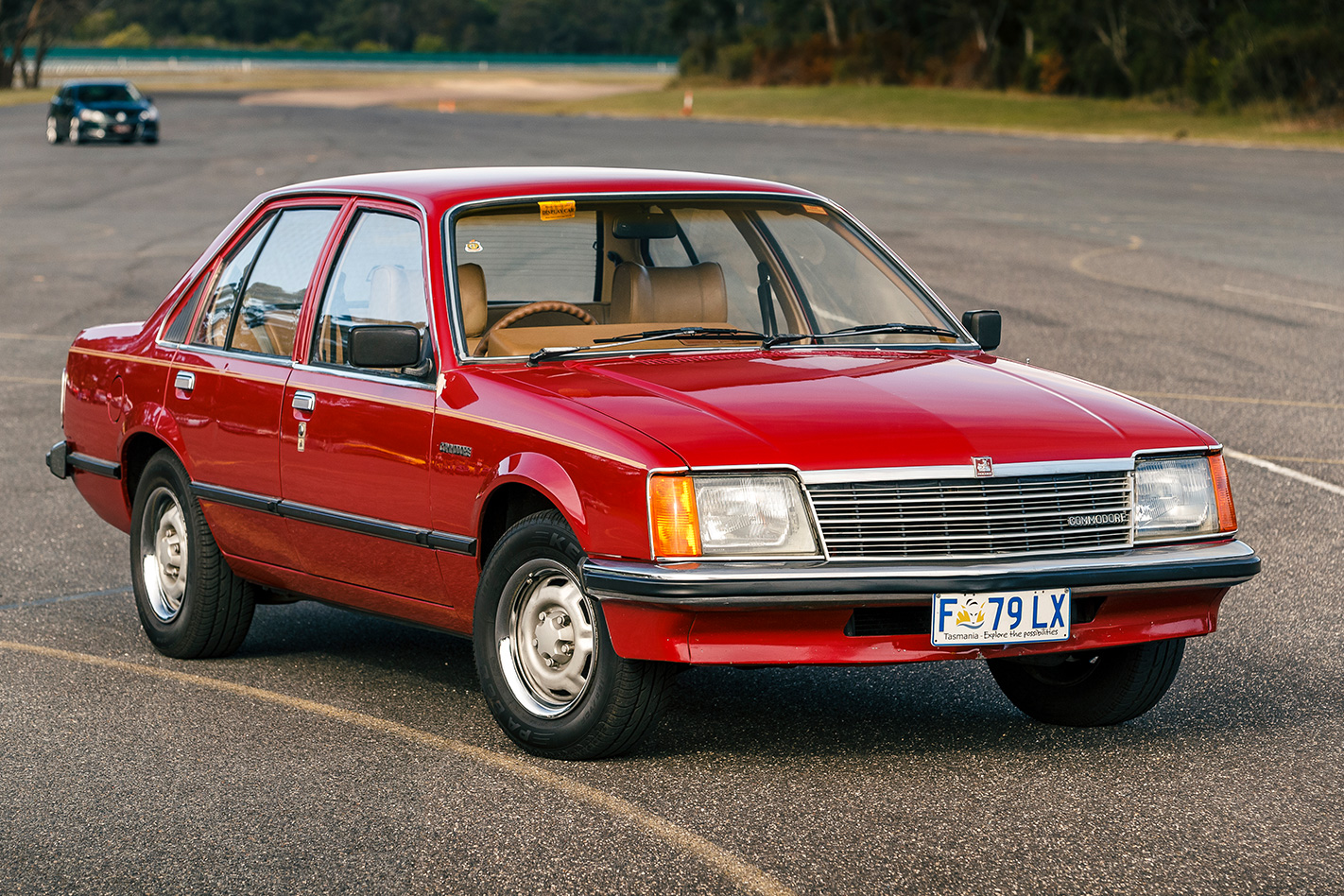
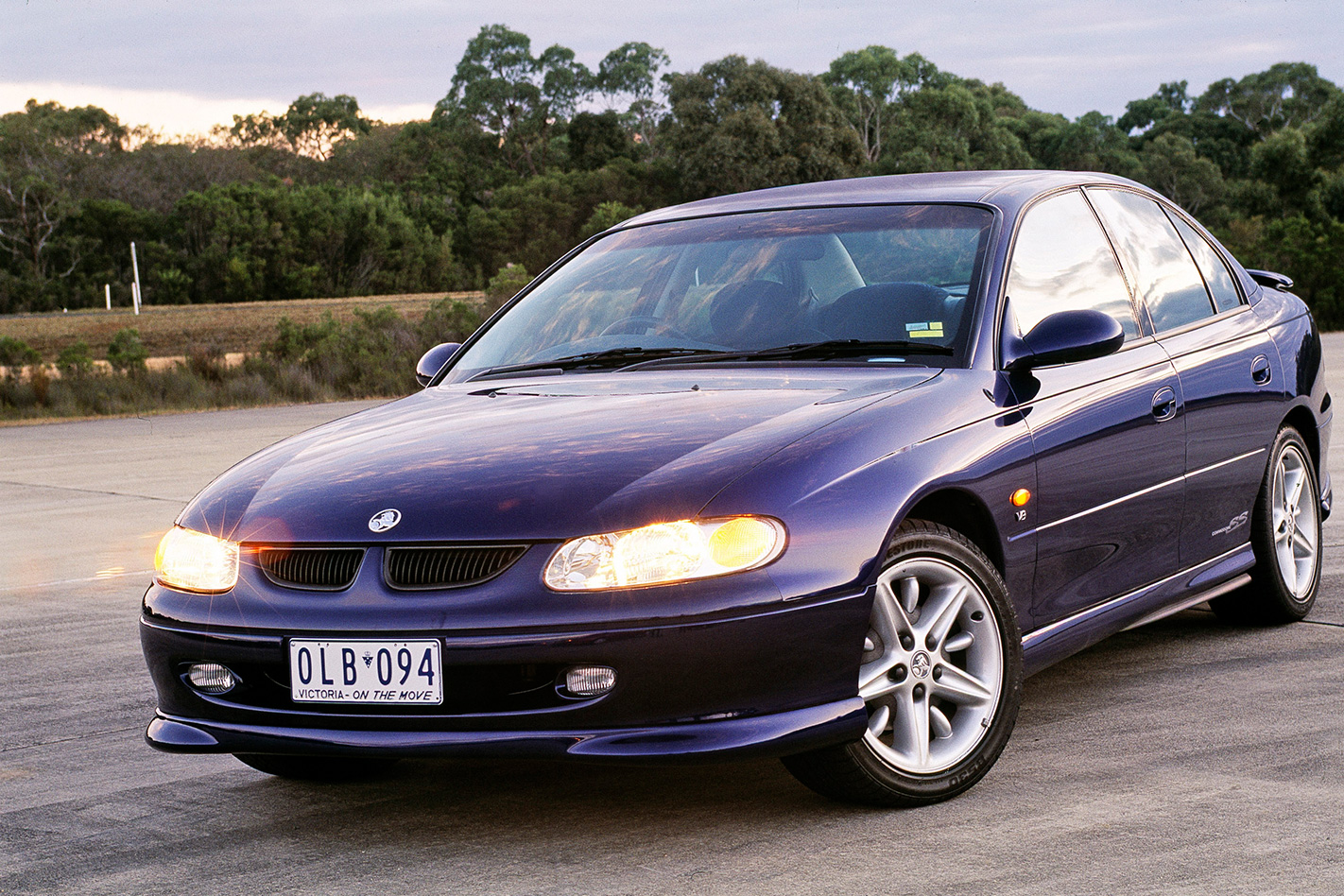
Intrinsic to his tenure was a 10-year strategic plan developed soon after he took over at Holden in 1999. It was a document of blue-sky ambition, calling for production at a vastly expanded Elizabeth to hit 300,000 in 2010. The plant would pump out a wide range of locally developed and manufactured models on Zeta architecture including all-wheel drives and a smaller rear-drive BMW 3 Series rival based on a shrunken version of Zeta.
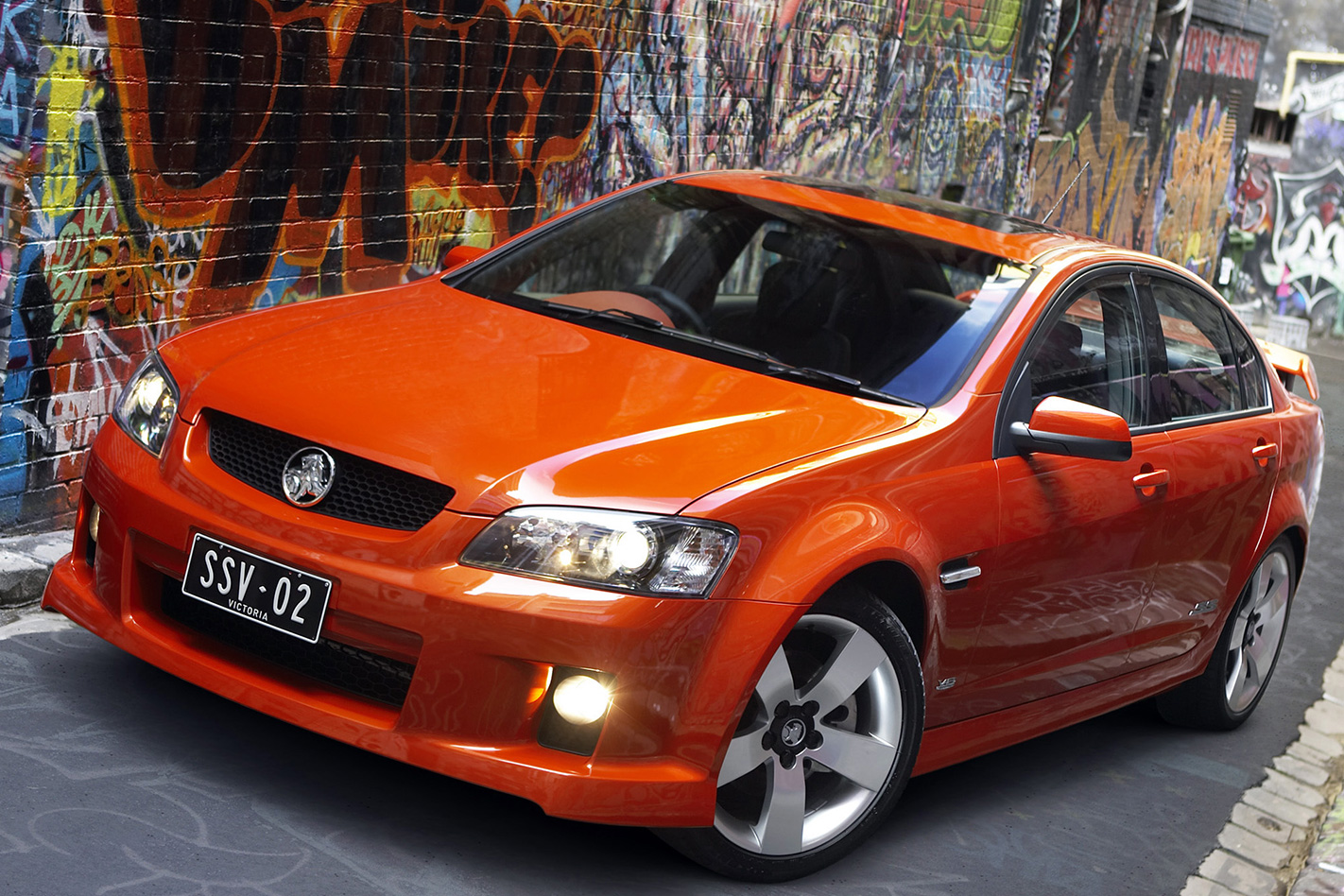
As GM’s ‘homeroom’ for affordable rear-wheel-drive development, Holden would ship Zeta technology to the world, as well as completely built-up cars to selected markets such as the Middle East and North America for export. The plan also called for a strong promotion of halo models. Today’s fabulous Commodore SS V Redline is a direct descendant of that thinking.
The pace at Hanenberger’s Holden was frantic. The Crewman and Adventra were spun off the V-Car platforms, the plant added a third shift, the Monaro became a Pontiac GTO with GM product guru Bob Lutz’s support, exports boomed and a new V6 engine plant was built at Port Melbourne. In 2003 Holden reported a $285.6 million profit and in 2004 it made a heady $300.8 million.
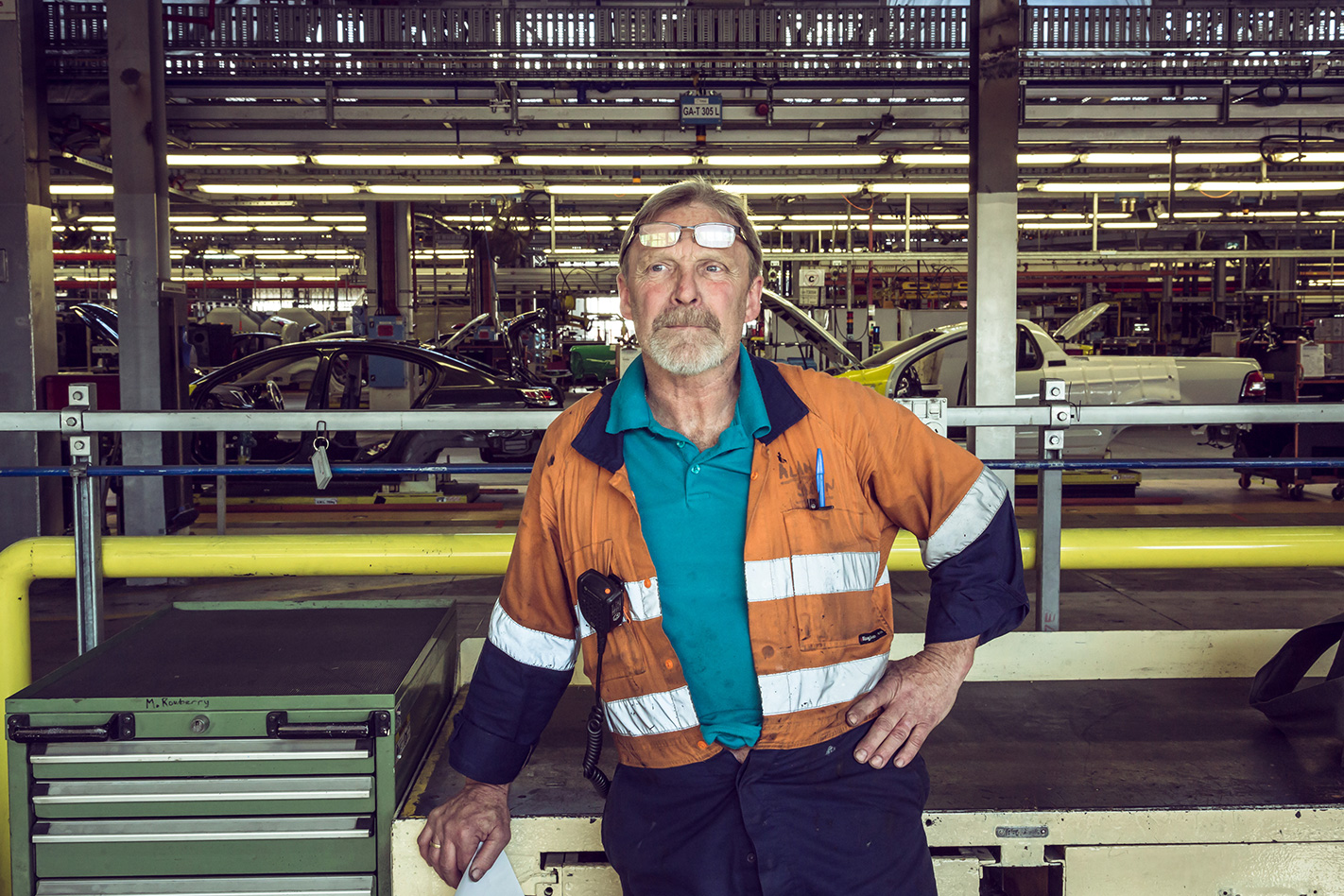
As is typical of such driven men, Hanenberger had his flaws. He over-reached as a matter of course, routinely made autocratic decisions and placed huge expectation and strains on his management team that included legendary sales and marketing chief Ross McKenzie, droll engineering director Tony Hyde and thoughtful planning boss Ian McCleave.
“It was Peter’s car company and his vision,” says Hyde. “He had a vision and he charged us with delivering the vision and we were quite happy to, because his vision made sense.
“Peter had lot of visions, actually,” Hyde adds dryly. “Not quite sure we could have afforded them all.”
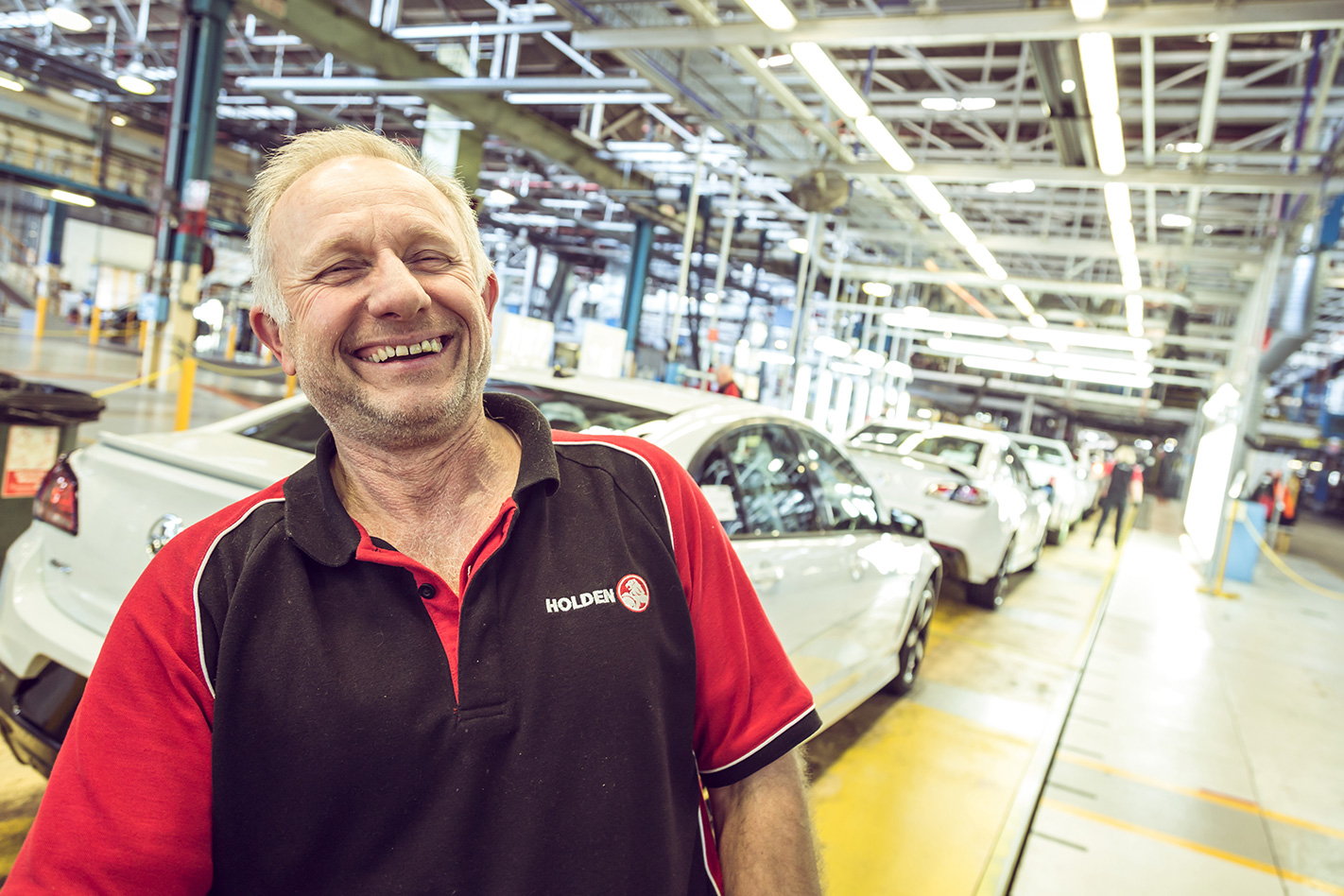
Hanenberger’s most outlandish vision was taking the Holden brand-name international. It was an idea that got short shrift at GM. There was logic behind the breathtaking audacity, though. Hanenberger saw it as a way to guarantee export volume against unexpected reversals … like GM’s decision years later to close Pontiac and end G8 (Commodore V8) exports.
“There is no reason you couldn’t sell that car right around the world,” says Hyde. “People were saying it’s too wide or it’s got a V6 engine in it; well, an E-Class Mercedes is wide and it’s got big engines in it yet they sell them right around the world in left- and right-hand drive. Hyundai has released a Genesis with a 3.6-litre and it’s around the world. The Kia Stinger is about to go on sale around the world too.”
Even though GM global boss Rick Wagoner lauded Holden as a “case study to GM operations around the world of how to succeed with intelligence and creativity”, there’s no doubt Hanenberger’s maverick behaviour drove Detroit batty. His retirement was the chance for GM to rein in its southern outpost. That dovetailed with the corporation’s continuing efforts to streamline and globalise. It desperately needed to improve economies of scale as it fought to stem multi-billion-dollar losses.
Hanenberger’s choice of successor – a globally experienced Australian he still refuses to name publicly – was rejected and instead Denny Mooney, an engineer who had spent much of his career at the Warren Technical Centre, was sent to Holden. It was his first general management role.
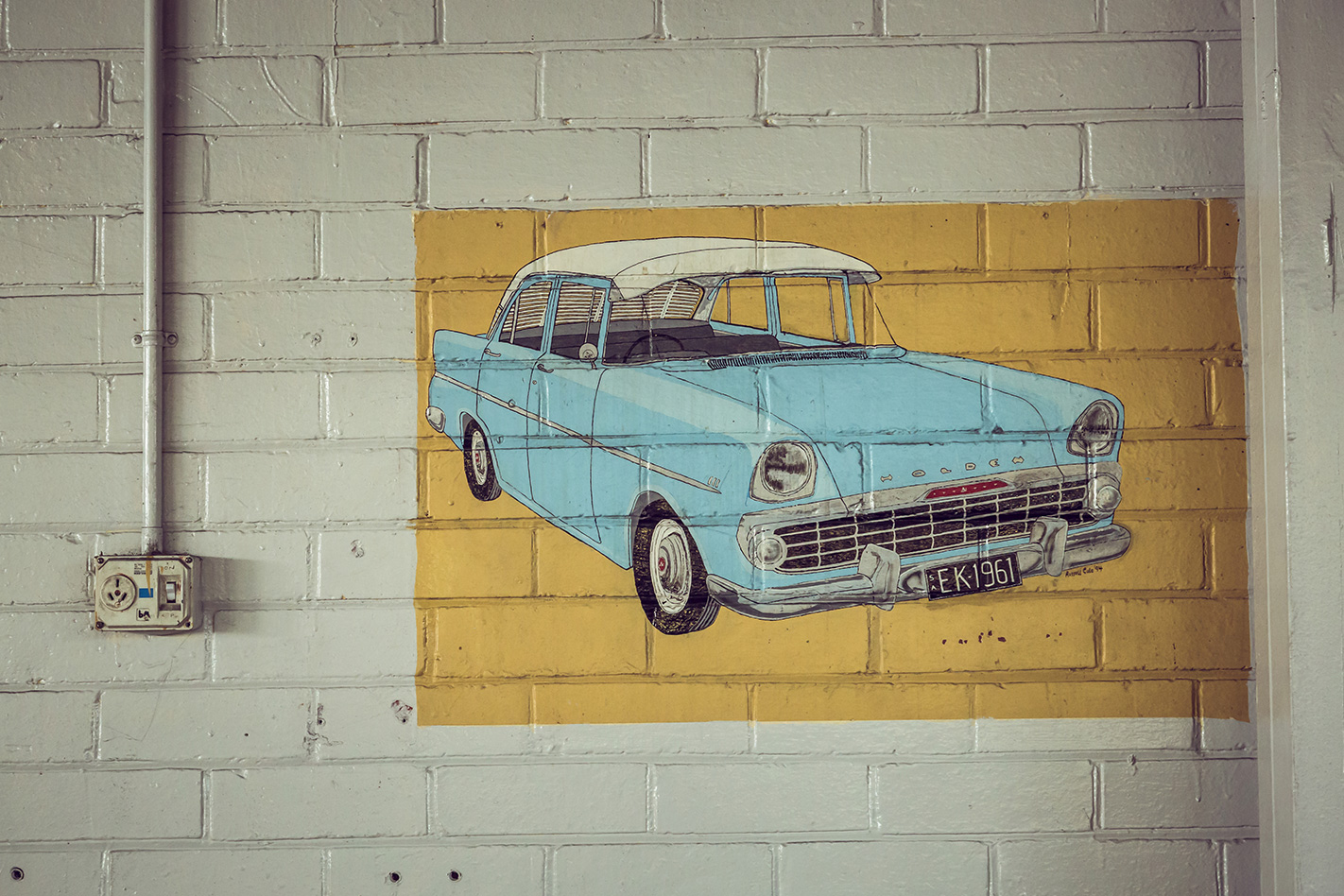
“It was clear there were people in Detroit frustrated with Holden’s independence under Hanenberger,” says McCleave. “Not only was the business going sour but it didn’t fit with GM’s push towards managing products and manufacturing globally. Overnight my title changed from ‘Business Strategy and Planning’ to ‘Planning and Program Management’. I got the message.”
Mooney’s appointment made sense in those terms and because of Holden’s role as the Zeta global homeroom and the process of bringing VE Commodore to market. But handling the economic challenges that struck during his tenure were arguably not in his wheelhouse.
Skyrocketing exchange rates lowered exports and increased the cost of engineering, the local market continued to open as tariffs fell and so-called free-trade agreements proliferated. The traditional market for large cars – even as VE launched – was being reduced by the rise of novated leasing.
Hanenberger’s strategic plan was largely ignored, the V-Car niche models ended and plans for Zeta replacements never got off the drawing board. The smaller Zeta sedan only made it as far as the Torana show car, the third shift ground to a halt, production of the Family II four-cylinder engine ended, exports dwindled. Then there was the fateful bottom-line driven decision to swap from Opel to Daewoo for small passenger cars was made at the behest of GM.
“At a time when much of the market growth was in these segments the timing couldn’t have been worse,” says McCleave. “It’s only now, more than 10 years later, that Holden appears to have learned from that lesson and has now reverted to European sourcing.”
At the same time as Commodore sales were shrinking and four-cylinder sourcing was being swapped to Korea, Holden was struggling to add the imported models it wanted to its line-up. Getting GM to build North American models such as its trucks and SUVs in right-hand drive was long a bugbear at Holden.
“We went into the Middle East for $20 million including [left-hand-drive] tooling and engineering and they never seemed to be able to do it,” notes Hyde. “It frustrated the hell out of us.”
Ironically, Holden as an importer will introduce the Equinox and Acadia SUVs over the next couple of years – both right-hand-drive exports from North America – to replace the ancient Korean Captiva. The big utes like the Chevy Silverado remain off-limits, though.
Mooney simply rejects the importance of Hanenberger’s 10-year plan and the Torana to the company’s future health: “I don’t recall a strategic plan as defined as what you’ve just outlined,” he tells Wheels. “I don’t recall ever getting that serious about [Torana]. Put it this way; we had other priorities.”
All the decisions made under Mooney’s reign were justifiable, but they were defensive measures. Money was being lost as the cost of bringing VE Commodore to market mounted up to more than $1 billion. Mooney, who left GM in 2009 and is now the engineering chief of Navistar trucks based in Chicago, insists there was no alternative course or alternative eventual outcome.
“The tariff going down and exchange rate going up like they did … I don’t know how you survive,” he told Wheels. “Looking back on it now and knowing the global economics going down and the dollar going up; it just became unsustainable.”
By the time Mooney left Holden to return to Warren in mid-2007, the Australian outpost was well and truly tethered to the GM mothership. The trouble was the mothership was about to go flaming into bankruptcy as the GFC wreaked fiscal carnage across the globe.
The US government bailout meant a fresh start but harsh decisions for General Motors. The Pontiac brand was killed off and with it went Holden’s cornerstone G8 export program for the Commodore. The axing of global Zeta was another huge blow driven by GM’s budget paucity, as well as tightening US fuel-economy standards. This was a program that had up to 15 models planned for GM’s family of brands including Chevrolet, Buick, Cadillac and drove Holden’s engineer head count beyond 1000.
There’s an irony here that Bob Lutz’s enthusiasm for Holden and his determination to draw it into the global product development structure ended up adding to the company’s challenges.
The American Mark Reuss, a second-generation GM executive and truly passionate ‘car guy’, and his management team got to pick up the pieces. Holden, which hadn’t made a profit since 2004, could have been swept away like Saab, Hummer and Pontiac as part of the old bankrupt GM.
Instead, Reuss and co worked with the federal Labor government industry minister Kim Carr, a tireless supporter of local car manufacturing, and Prime Minister Kevin Rudd to save Holden by securing Cruze local production.
“I’m extremely lucky to have people in Government here who understand what the business is, what it means to the country, what it means to the families that work for it, the wage basis that goes back into the economy, and all of the flow-down effects for the supplier base, and everything else,” Reuss said at the time.
Australian Mark Bernhard was Reuss’s chief financial officer in those dark days. Now he runs Holden.
“Did I walk into the office in those days knowing we were in for some tough times? Yes. Did I ever come in thinking we were about to turn the lights off? No.”
But if Cruze presented a lifeline for Holden, then the death of Pontiac and the end of G8 exports was a huge setback. Elizabeth Zeta production was 50 percent export and the G8 made up a big chunk of that. Other exports like the PPV police car and the Chevrolet SS never made up the shortfall.
“The export business around Pontiac did have an impact on the business and we did have to probably regain our focus on the local market and be much more specific around where we needed to concentrate and make money,” admits Bernhard. “But that should have always been our first priority – the Australia and New Zealand market.”
Reuss, who is still highly regarded at Holden, now runs GM global product development. He wasn’t willing to be interviewed for this story.
“Mark is a product guy and very quickly gained a lot of passion for the Holden brand,” Bernhard says. “He led us through one of our most difficult periods. I loved working with Mark and still do.”
Charismatic Canadian Mike Devereux was in charge when the decision was finally made in December 2013 to shut down manufacturing at Elizabeth.
He draws both praise and venom from those who knew him during his Australian tenure. He is now EVP of a huge GM joint-venture with SAIC in China, so implementing the hard decision clearly hasn’t damaged his career. Like Reuss, he declined to be interviewed for this article.
Some see Devereux as a heroic battler who was finally overwhelmed by the odds. Certainly then Australian Treasurer Joe Hockey helps swing that argument his way. But others familiar with his time at Holden aren’t convinced.
“A lot of the decisions which led to closure were made by bean counters and HR people and fourth-level powerpoint generators and analysts,” a Holden source tells Wheels. “Absent emotion; the data reigns supreme. The difference right at the end would have been an MD fighting his heart out to save the place, but you could also argue the die was cast before he got there.”
But however you view Devereux, it’s clear he alone isn’t responsible. There are many other heroes and villains in this story of hope and decline, some whose responsibilities may never be known publicly. The reality is by the time he sat in the corner office at Fishermans Bend, the fight was becoming an unbalanced one. Not only were those external factors becoming more oppressive, but post-bankruptcy GM was a different organisation too.
Holden’s automotive manufacturing capability was simply one line item in a long list of GM amputations. The decision to close the Elizabeth plant, so long fought against in Australia, was in the end made quite dispassionately in Detroit.
“A lot of people in GM in Detroit don’t get Holden,” explains a GM insider. “In many ways, Holden for GM people became the thing that should not be. They loved our spirit and ingenuity but we confused them. If Pontiac had to go, why should Holden stay? If GM Thailand were to be shut down, why keep Australia with its expensive labour?”
So is there anything that could have saved Holden as a manufacturer? If the Hanenberger offensive battle plan had been retained and evolved. If GM had invested in Holden as its regional tech centre rather than bought Daewoo. If Holden had been allowed to export its rear-wheel drive models unfettered to places like California where they would have been well received. If GM had elected to sell Holden when it was worth something. If GM hadn’t collapsed into bankruptcy.
But that’s pipedream stuff. The reality is the structure of the Australian economy, the tyranny of distance, the cost of labour, the openness of the local car market and the escalating cost of vehicle development all counted it out.
Oh, and – very importantly – the Abbott government’s determination to prosecute its neo-liberal agenda. After all, if you want a car industry you need a concerted, unilaterally supported car-industry plan. “It’s hard to imagine a situation where Holden could have survived as a local manufacturer in a country where the government has decided that the future for large enterprises lies in construction, mining or agribusiness,” says McCleave.
“History tells us that high-volume manufacturing has only thrived when supported by protection through tariffs or import restrictions.”
So the factory doors are shut. Shorn of the underpinnings that have supported it since 1948, the next survival battle is for the Holden name itself.
Recent word from VW has confirmed the 2021 Volkswagen Mk8 Golf R is set for a global official reveal on November 4, after months of small morsels being uncovered through spy shots, specs leaks, and the usual internet theories.
With some officially confirmed information set in stone, including for us here in Australia, we can start piecing together the Mk8 Golf R story.
https://www.instagram.com/p/CGVA83zH8hN/?utm_source=ig_embed&utm_campaign=loading
2021 VW Golf R engine and power figures
First, the likely specs for the new Volkswagen Golf R were leaked at the beginning of 2020, with the entire Mk8 Golf performance lineup being compromised in a screenshot from an internal Volkswagen video.
The next Golf R is listed as having a peak of 245kW, while the next GTI TCR takes on the likes of the Honda Civic Type R or Renault Megane Trophy with its 221kW, the same as the overseas Golf R Mk7.5.
The Mk7.5 Golf R currently outputs 213kW here in Australia, which means there’s a strong chance the new GTI TCR will have 213kW… and that the R’s EA888 2.0-litre petrol engine is potentially likely to cop a power decrease as well.
We say ‘potentially’, though, because sister brand Skoda recently managed to convince VW HQ that its recent Kodiaq RS SUV didn’t need a power-sapping ‘hot-weather’ tune for its 2.0-litre turbo diesel engine, a fate that has befallen a raft of VW Group products across the spectrum.
There’s also no chance that the Golf R will, as has been speculated, score the five-cylinder engine from Audi, despite test mules being spotted in the wild.
But the good thing is that it will arrive here. Volkswagen says the VW ‘Golf R 8’ (not R8, Audi) will definitely come to Australia, as will the majority of the eighth-generation Golf’s performance variants, save the diesel-powered Golf GTD.
The details of its Australian arrival are still to be confirmed, both in terms of the specifications and the price and timing, but VW says it’s guaranteed, and only a matter of when, not if.
Source: @wilcoblok / Instagram
VW Golf R Mk8 exterior
Of course, the world will officially see the next Golf R in a couple of weeks from now, but the car itself hasn’t exactly been hiding.
Car spotters have taken notice of the Golf R testing, particularly at the Nurburgring, where the car has been lapping essentially undisguised.
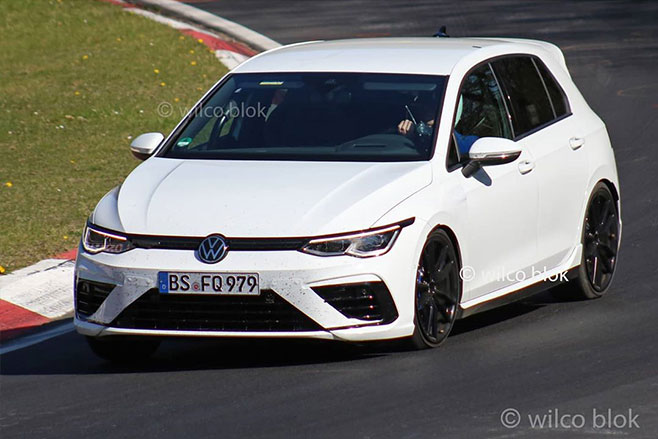
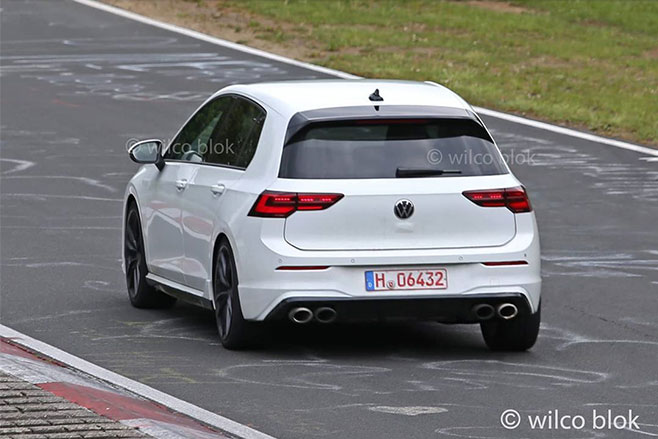
Spotters like @automotive_mike and @wilcoblok have essentially given us a complete look at the exterior of the car (directly above and below).
Source: @wilcoblok / Instagram
It’s able to be pinpointed due to its twin dual-exit pipes, with the front looking more subtle than that of the front-drive GTI, as has been an unofficial tradition.
Is more a case of evolution over revolution for the Golf Mk8, with the five-door hatchback silhouette looking very similar to that of the Mk7.5 it replaces.
There’s a more aggressive bonnet treatment, narrower headlight band and smaller taillights in evidence, along with a larger yet more subtle roof spoiler.
Volkswagen Golf R Mk8 interior
Spy shots of the Volkswagen Golf R Mk8 interior have already revealed a digital dash with a bespoke R-type design for the driver, along with the potential for much larger and more stylised shifting paddles to replace the underwhelming items in the current car.
Australia’s love of performance cars will ensure that the Golf R Mk8 will be well-specced when it comes to standard inclusions. Expect items like wireless Apple Car Play, Android Auto, inductive phone chargers, seat heaters and a wide array of active safety aids.
These will likely include high-spec AEB, lane-departure assist, cross-traffic assist, adaptive cruise control with stop/start function and more.
Now, we wait for more details to be confirmed upon the official reveal of the VW Mk8 Golf R on November 4.
NOW CHECK OUT The 2021 Volkswagen Golf GTI ClubSport Mk8
Volkswagen has confirmed the GTI Clubsport badge for its new Golf GTI, powering up the anticipated eighth-generation hot hatch with enough muscle and poise to worry Honda’s Civic Type R.
From basic output perspective, The new Golf GTI Clubsport picks up where the old one left off, which made its debut about five years ago with 221kW and 400Nm from its tweaked 2.0-litre turbocharged inline-four cylinder – otherwise known as the EA888 Evo4, but the new version is expected to make better use of those respectable figures.
Familiar Clubsport styling amps up the Mk8’s new design. The front bumper is a particular highlight, with a honeycomb grille across the entire lower section aiding cooling, while spoilers at either end work to increase downforce, Volkswagen says.
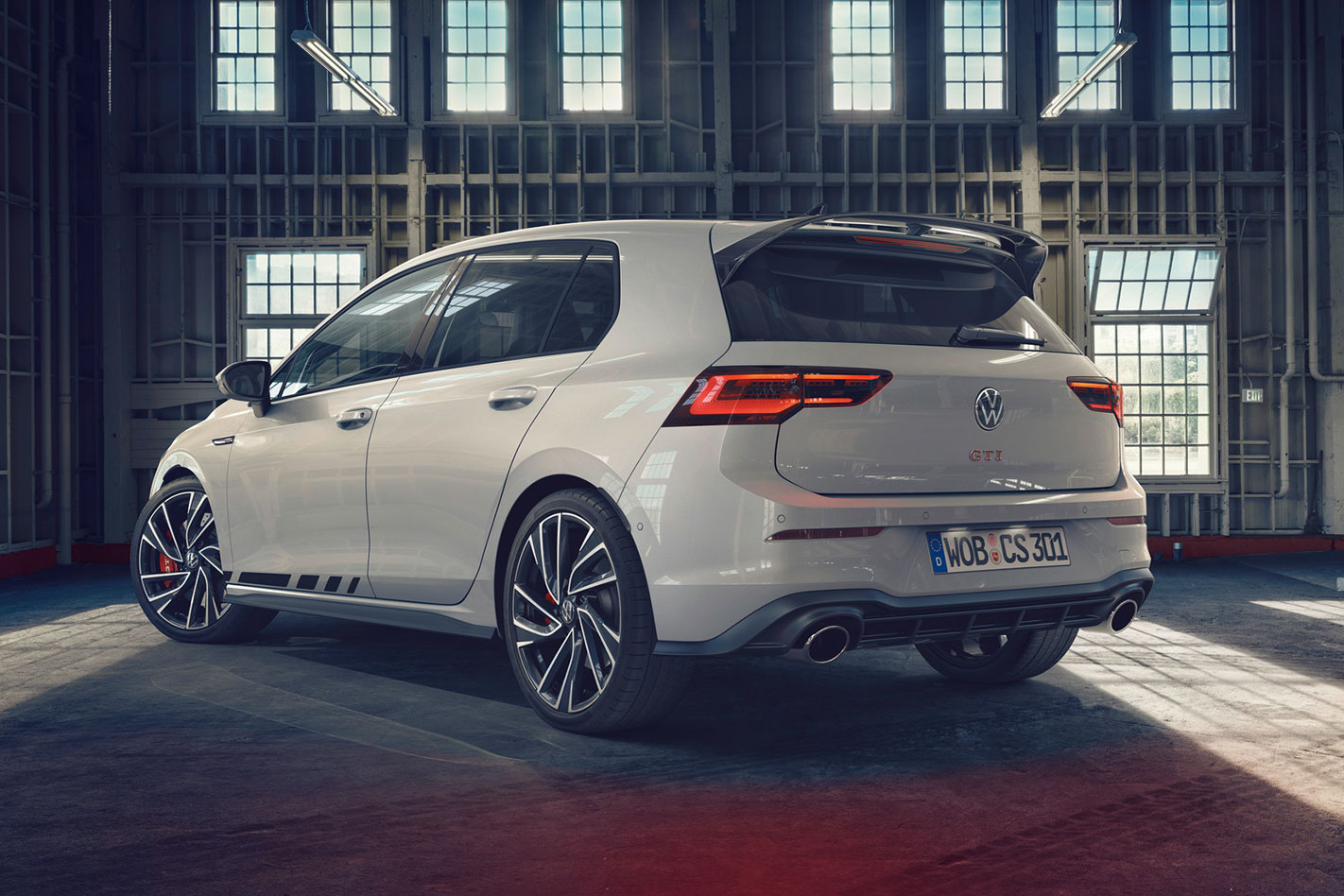
Chassis-wise, new suspension lowers the car by 10mm, while new 18-inch wheels complement red calipers on larger brake rotors that are cross-drilled.
VW also reintroduces the front Haldex-type locking differential that’s missing from the eighth-generation base GTI, combining with ABS-based torque vectoring to bolster traction and reinforce the car’s track-aimed credentials. This includes a Nurburgring driving mode.
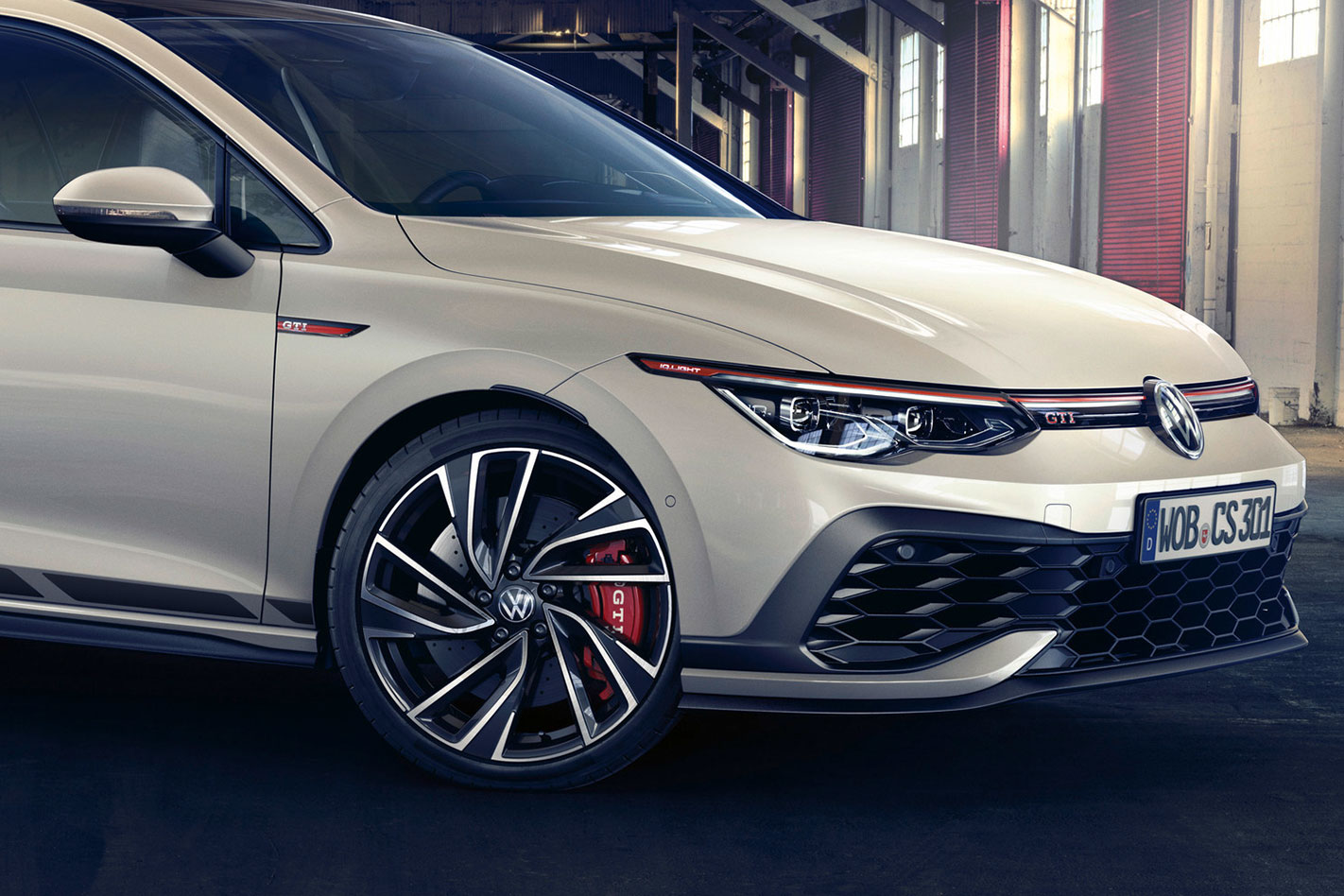
That original Nurburgring driving mode slackened dampers for more compliance without sacrificing body control, encouraging test driver Benjamin Leuchter to bounce the Mk7 off the ’Ring’s kerbs.
It’s not yet clear what time it’s capable of this time around, but you can bet that it’ll be working with the Mk8 GTI’s new Vehicle Dynamics Manager – the hive-mind behind the new car’s chassis technology. Adaptive damping, VW says, is optional.
The inclusion of the Nurburgring mode certainly suggests VW is planning an assault on the production front-wheel drive lap record, if it hasn’t already.
“For the legendary Nordschleife track, we have programmed a new Nurburgring profile, which specifically adapts the running gear components in the new Golf GTI Clubsport to this race track,” said VW’s chief dynamics engineer Karsten Schebsdat.
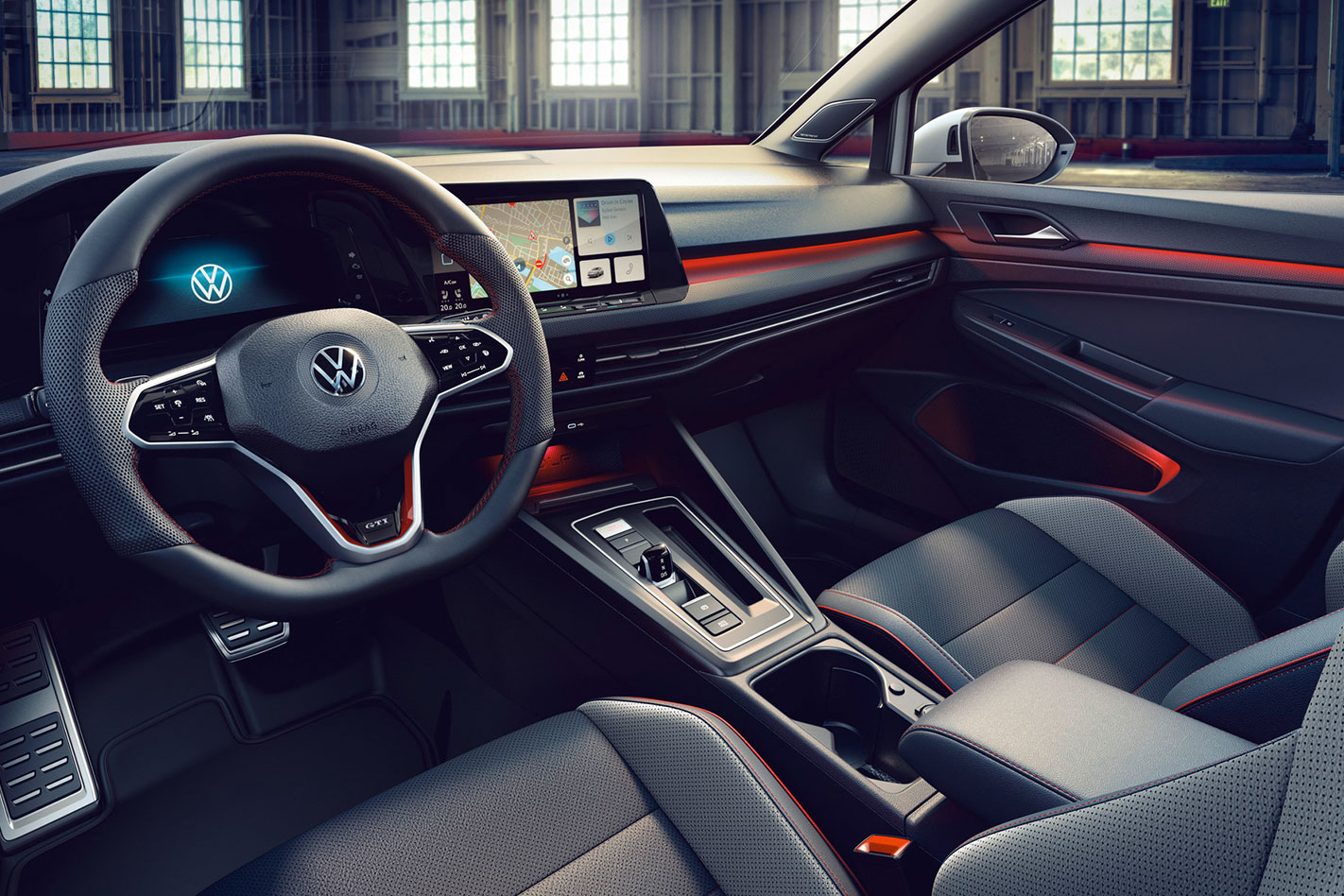
Right now, VW Oz has no comment on whether the new Mk8 GTI Clubsport will be sold in Australia, offering that most local GTI special editions – GTI 40 Years, GTI Original and Golf R Special Edition – have been carefully specified by VW Oz for the local market.
We’ll have to wait and see what comes after the less exclusive but still eagerly anticipated Mk8 GTI arrives locally in the second quarter of next year.
What is the Ford Puma?
Here’s a home truth… if it weren’t for the Ranger, Ford Australia really would be in a world of trouble right now.
If not for its ever-widening range of Thai-made commercial pick-ups, in fact, it would very likely join Holden in the ranks of benched car companies in Australia. Sobering, but true.
A quick glance at its current roster provides plenty of supporting evidence. Just over 700 Ford-badged SUVs sold in September 2020, in a market that snapped up more than 32,000 of them.
Even Holden sold more Acadias in September than Ford sold Enduras, for example.
In short, Ford needs another hitmaker on the books – and it needs it quickly.
So, then, there’s a lot riding on the car we’re testing today, the Puma.
Price and value
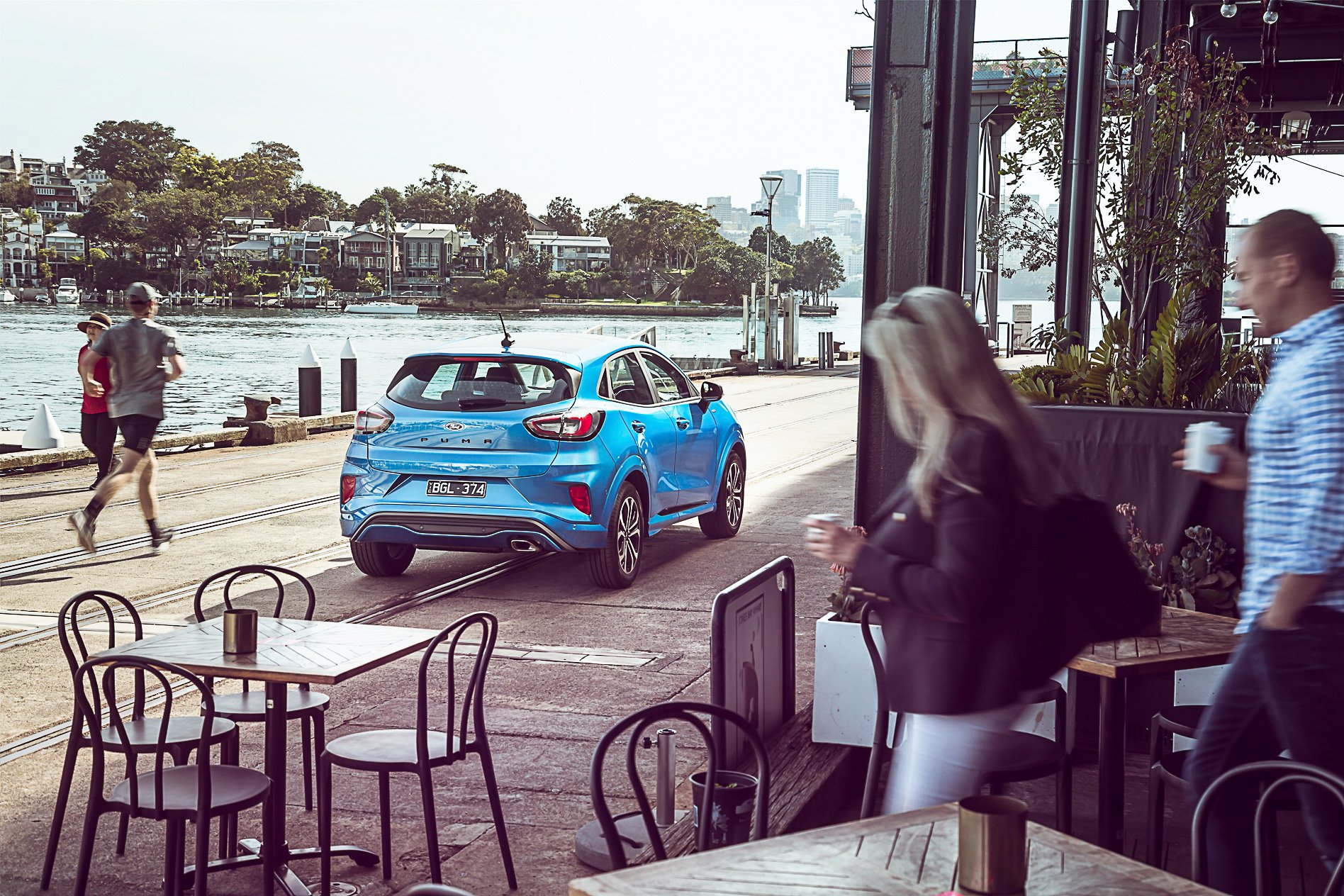
Based on the latest Fiesta, the Puma is a five-door, five-seat light SUV that breaks few conventions. An entry-level car simply named Puma starts at $31,990 driveaway, before stepping up to the ST-Line as tested here for $33,990 driveaway.
Capping off the three-strong range is the ST-Line V that costs $36,990 driveaway.
Our ST Line tester wears $650 of Lucid Red paint and a Parking Pack that, at $1500, includes adaptive cruise control with stop/go start, evasive steer assistance and lane centring, active park assist, front parking sensors and blind-spot monitoring, for a total ticket of $36,140 driveaway.
Ford says that the driveaway pricing would be offered until the end of 2020.
The Puma will really need to set itself apart from the Mazda CX-3 and the Nissan Juke in a space where price isn’t necessarily the last word.
In such a fiercely contested space, there is absolutely no room for error.
Living with the Ford Puma
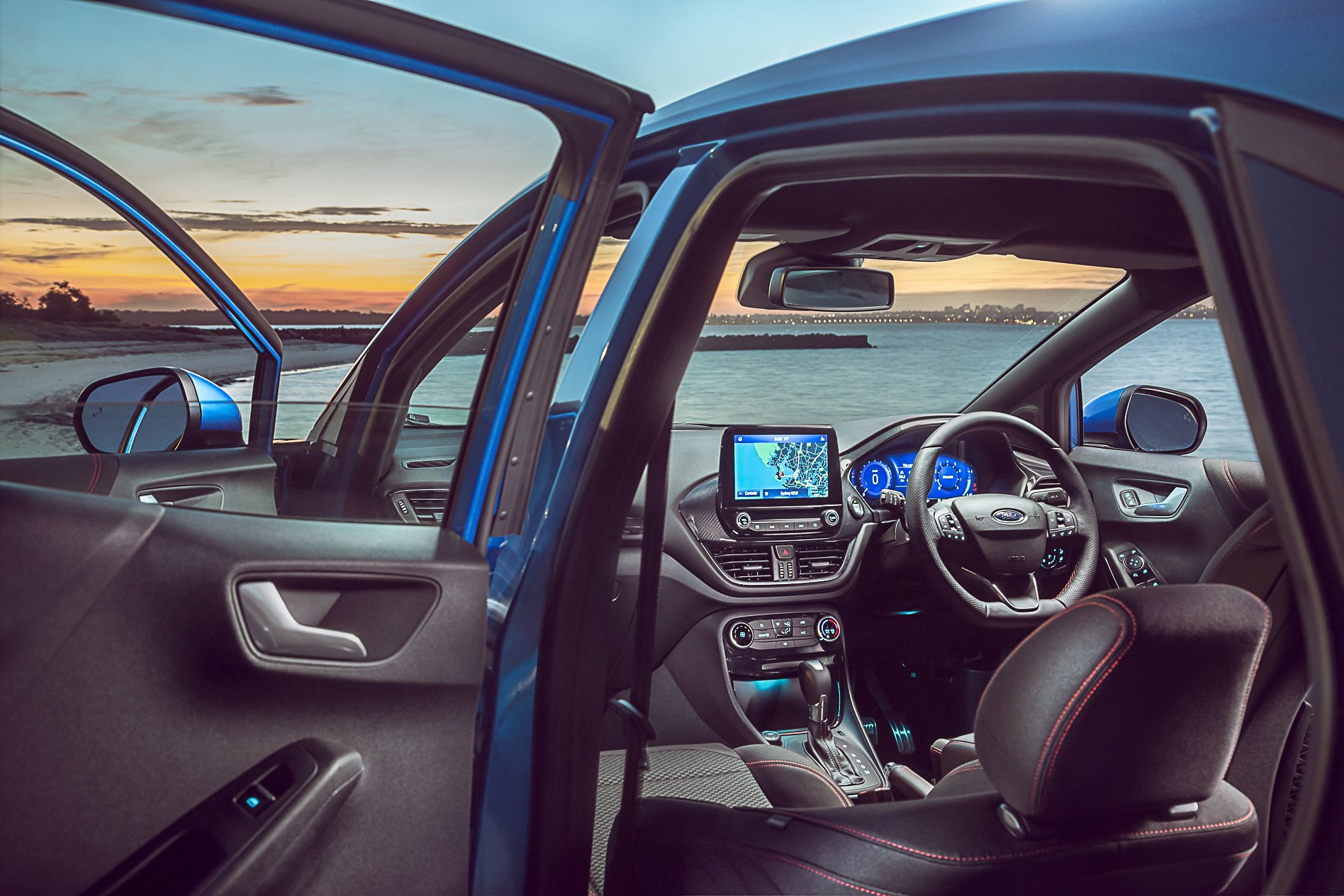
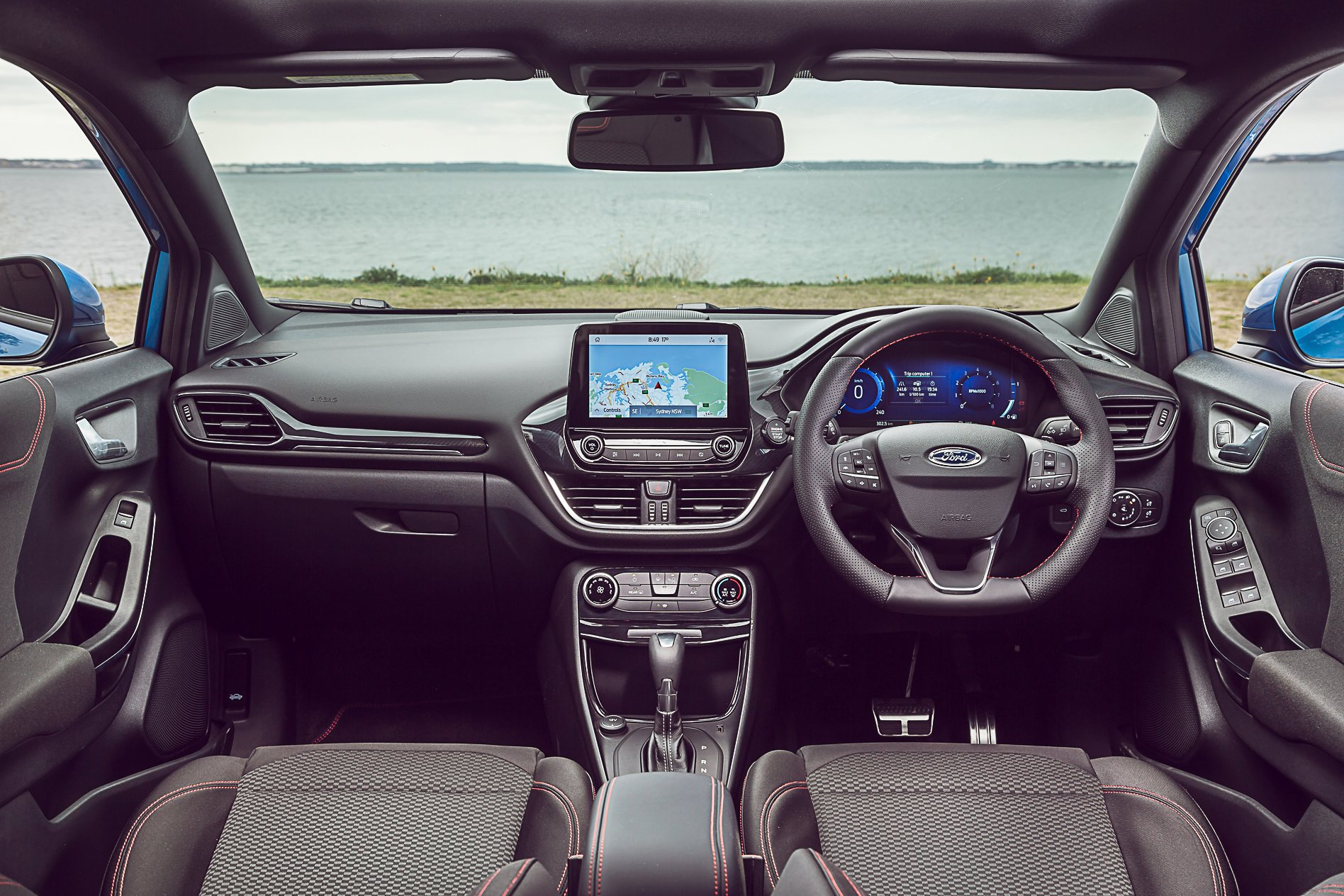
A flat-bottomed steering wheel – adjustable for rake and reach – is generously proportioned and well-equipped with multimedia and adaptive cruise control buttons, while a 12.3-inch digital dash comes standard on this mid-grade ST Line, and is easy to access.
A big tick, too, for having the indicator stalk on the right side of the steering column.
There are, however, some spec oddities. For example, it offers a pushbutton start system but doesn’t allow for keyless entry. The lack of climate control air conditioning is also noticeable by its absence, but an abundance of charging options for devices – including an inductive charging pad, a 12 V socket, and two USB points – goes some way towards making up for this.
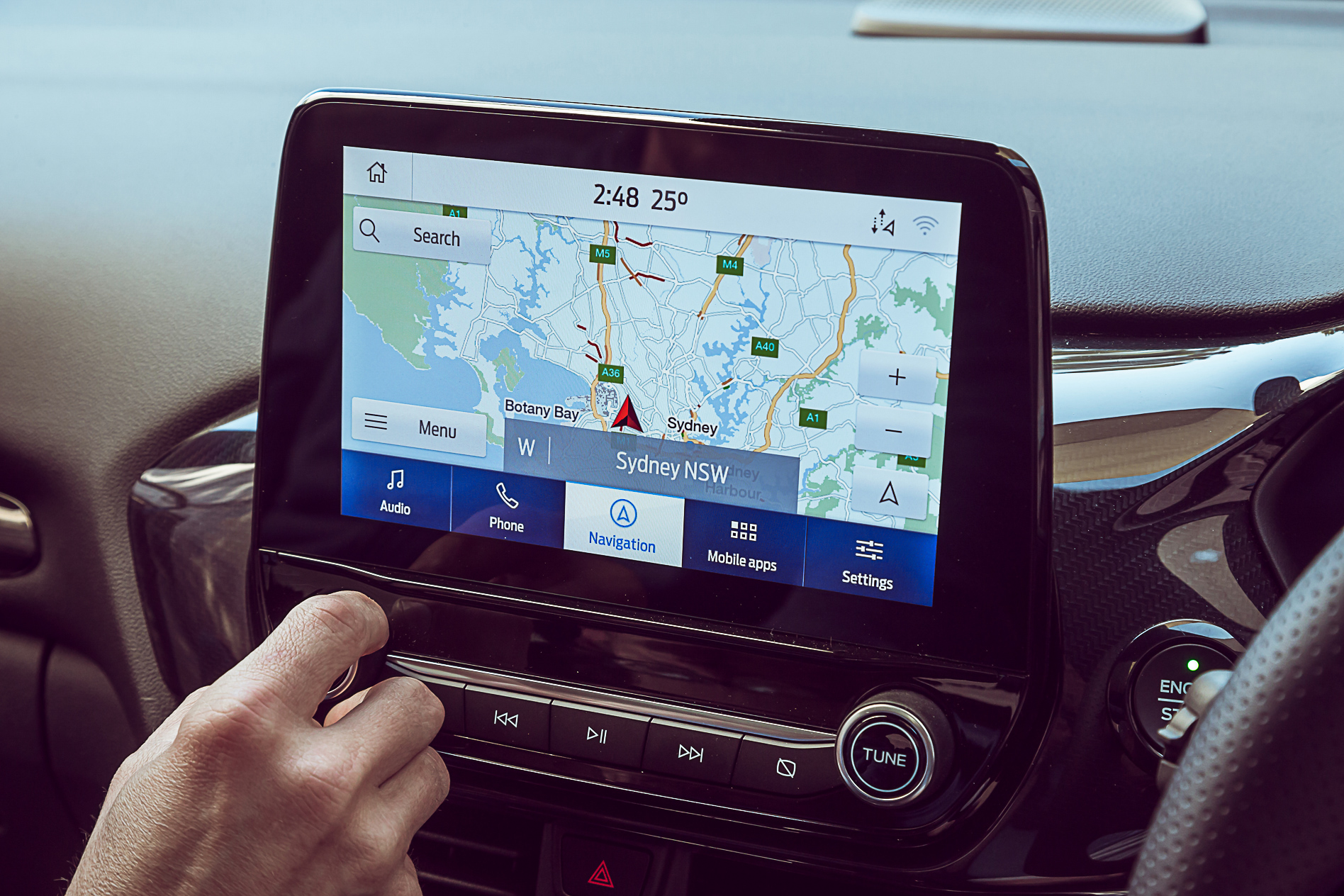
Hard-wired Apple CarPlay and Android Auto connectivity form part of the SYNC3 multimedia system that runs through an 8.0-inch touchscreen that sits proud of the dash.
One of those variables will include design and appearance – and it’s safe to say that the Puma will polarise opinion.
It’s actually a rare case where the photos do the car a favour; in the metal, the front guards appear to be much more arched and pronounced, the 17-inch wheels fade away into the wheel wells and there’s an inherent imbalance between width and height that cause people to wonder if it’s actually nothing more than a regular hatchback.
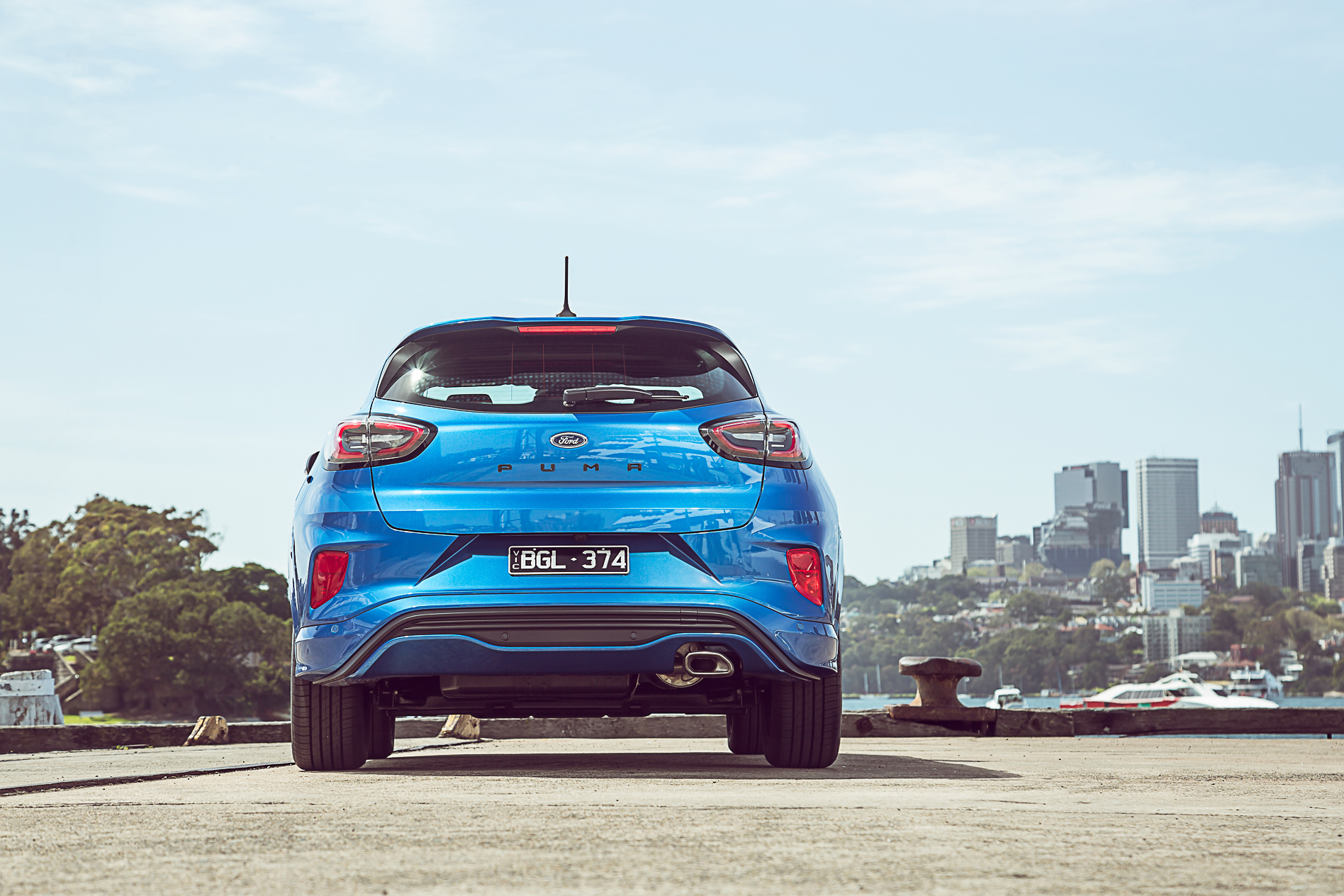
The glasshouse is reasonably generous, with good visibility from the driver’s seat, even in the dreaded rear three-quarter view, thanks to a porthole window in the C-pillar.
There is plenty of headroom up front for even the tallest of driver and passenger, thanks to a deeply sculpted headlining, while contact points like the armrests, centre console bin lid and tops of the door cards are adequately padded.
That front room, though, comes at the expense of rear space, though it’s better than the CX-3 from that standpoint. Its well-thought-out cargo area, too, earns it genuine brownie points, with a deep 80-litre removable wet tub under the floor complete with its own drain hole.
At 410 litres, it’s 60 litres to the better over the CX-3, let down a little by a tailgate handle that stretches the reach of our more diminutive testers when it comes to closing it.
However, from here things go downhill. For example, there is no left-foot rest, and the driver’s calf ends up leaning uncomfortably against the transmission tunnel.
The seat itself feels a size too small for the average Aussie male, too. It feels too narrow across the thighs, too short in the squab and too thin across the backrest.
It also sits about 50mm too high at the front to be comfortable under-thigh, which only exacerbates the missing footrest.
Even the angle of the throttle pedal puts the driver’s ankle in an unnatural position.
Driving the Ford Puma
The driving experience is also a bit of a mixed bag. The 1.0-litre three-cylinder turbocharged engine – good for a hale 92kW and a hearty 170Nm – and seven-speed dual-clutch gearbox do actually work very well together, providing more than adequate urge around town and enough nip on intra-city freeways.
There’s a typical three-cylinder gruffness about the engine’s note, which may offend some but I reckon gives the Puma more of a presence. A growl, if you will…
Throttle response is excellent, too, with the merest brush providing adequate get-up and go. The same can’t be said for the brake pedal, though, which feels very wooden and hard to modulate at low speeds.
The Puma’s steering feel has also been plucked from that same pile of lumber. There’s weight underhand but there’s little correlation to where the front wheels are located.
Its primary ride is just on the right side of firm on smooth surfaces and offers decent roll control, but it quickly comes undone.
Square-edged bumps crash through the chassis like a touring car smashing a kerb, and it happens at both ends of the car, creating a jostly, bouncy ride over typically broken urban roads.
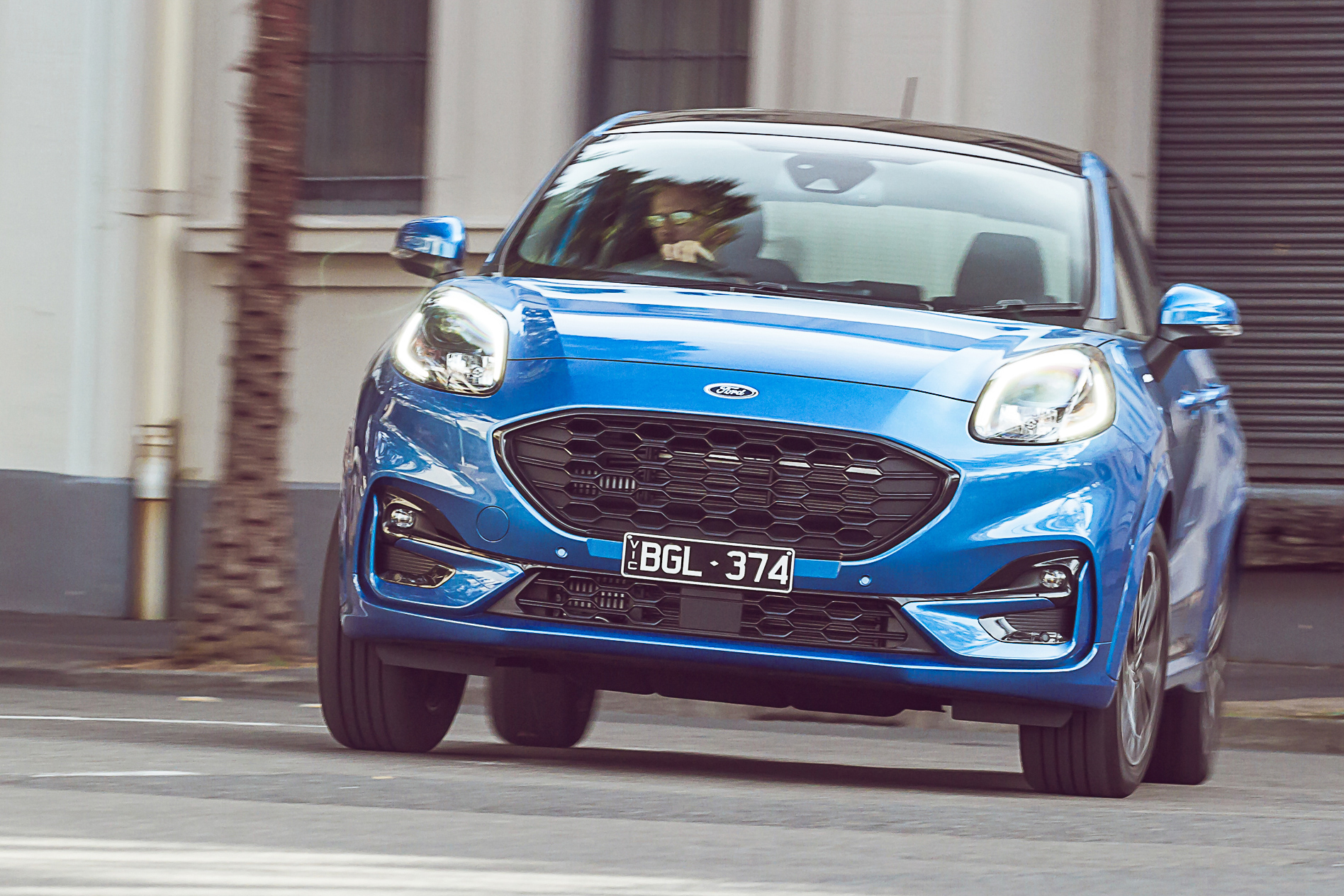
Such was the jarring ride that we dropped the tyre pressures to the lowest side of placard pressure that we could, but the improvement was marginal at best.
Even though the Puma rides about 40mm higher than its donor Fiesta, it simply doesn’t feel like there’s any more suspension travel available.
Safety
The 2020 Ford Puma has a five-star ANCAP safety rating, based on Euro NCAP data scored in December 2019.
While it misses out on the most up-to-date safety features like centre airbags, the Puma’s pedestrian and cyclist-detecting AEB and its lane-keep assist are highly rated.
Six airbags, a rear-view camera and speed-sign detection are standard across the Puma range.
How much does it cost to run the Ford Puma?
As one would reasonably expect, fuel economy is pretty good aboard the three-cylinder Puma, with our best score hovering around 6.4L per 100km against a combined fuel economy claim of 5.3L/100km, edging towards 6.8 around town.
With its 42-litre fuel tank, it should cost about $50-60 to fill, and it has a theoretical range of about 790km between refills.
There’s a five-year/unlimited-kilometre warranty on the Puma, with service intervals suggested at 12-monthly or 15,000km intervals.
Its first four services are capped at $299 each through Ford’s Service Benefits plan.
Verdict
The Puma has the job ahead of it, then, to hunt down and capture the likes of the CX-3s and Jukes of the world.
It’s a sound proposition with decent interior space and appointments and a lovely driveline, but it’s let down by a less-than resolved chassis tune and pricing that may favour its competitors in the argy-bargy of showroom showdowns.
Rating 3.5/5
What you will like
Zippy, frugal engine, good-sized boot
What you won’t
Sharp-edged ride on urban streets
Holden has capped off its 52-year stint at Australia’s greatest motor race with an amazing win at the 2020 Bathurst 1000 in Holden’s last event with a factory squad.
Holden Red Bull driver Shane van Gisbergen claimed his maiden win at Mt Panorama, farewelling Holden’s factory involvement with an amazing drive in the second half of the race.
Van Gisbergen (below) played himself into the race after a brief rain shower and a brilliant afternoon stint from co-driver Garth Tander, steeling himself to fend off a rampaging Supercars pack twice after two late-race safety car periods compressed the field.
The 31-year-old New Zealander fought off a determined rear-guard action from pole-sitter Cameron Waters, who drove a brilliant race in his Tickford Ford Mustang.
Van Gisbergen capped off the day by pinching a fan’s flag from the side of the iconic track, sending off the Holden Lion in fitting style.
“Those last three stints were just qualifying laps, so just awesome,” said van Gisbergen
“It was a real track position race, super hard to pass and when that rain came I was a bit slow at the start but then got going.
“That got us to the front and we never left it. Awesome day.”
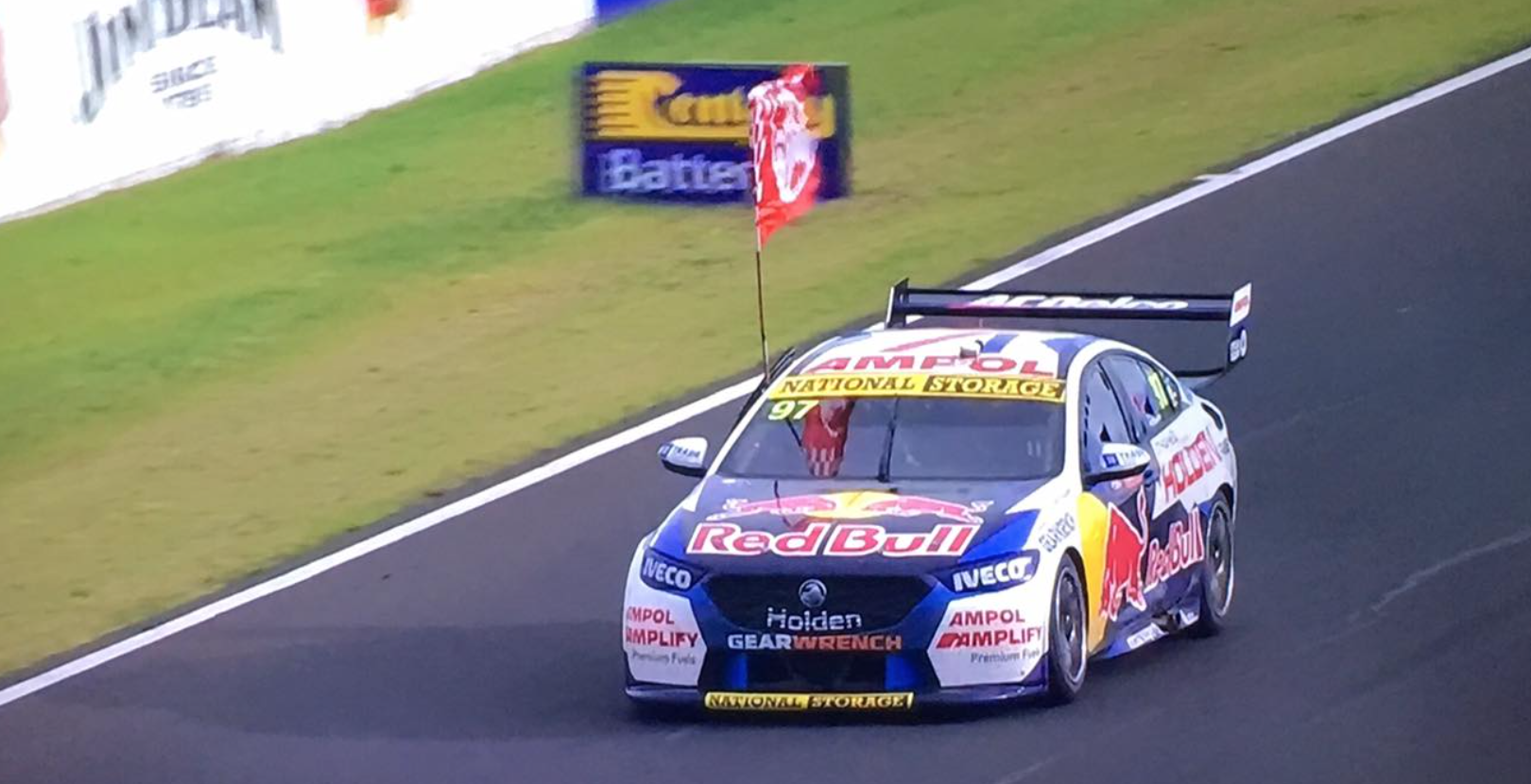
“It’s pretty significant for Holden to farewell them as a factory team and the official race team,” he added. “When I joined Holden I remember how welcoming they were; you felt like family and like a Holden driver. It’s been pretty cool to be part of.
“Then becoming part of the factory team two or three years ago, having that weight on your shoulders and representing them like that is pretty special, and to win on the last one in a Holden is pretty cool.”
“Bathurst means a lot to Holden people,” said co-driver Garth Tander, who claimed his fourth Bathurst crown – the only driver to do so under both iterations of the factory Holden team.
“One of the fondest memories of my career is when we took the trophy into head office after 2011 with Nick [Percat, his co-driver] in Fishermen’s Bend and how excited everyone was to have that Bathurst success.
Going over to the manufacturing plant in Elizabeth and doing the same thing there, and seeing the line workers getting a photo with the trophy, was very, very special.
“I feel incredibly honoured. It’s a very sad end for a fantastic brand, and I’m glad we were able to shed some light in these final moments.”
MOTOR magazine test pilot Warren Luff also enjoyed a strong outing with Chaz Mostert in the Walkinshaw Andretti United Commodore to finish in third – which, by the way, was raced after selling at auction on the Friday of the event.
Jamie Whincup crashes out of Bathurst
It was a different picture on the other side of the Red Bull Racing garage, though.
It’s a rare sight to see Jamie Whincup make a mistake in a Supercar – but that’s exactly what happened at the 2020 Bathurst 1000, with the seven-time series champion ending his day in the fence.
What makes it more painful is the fact that the race marked not just the final event of a truncated 2020 season where Whincup failed to halt the charge of three-time champion Scott McLaughlin, but the final time Holden would be represented on The Mountain in a factory capacity after year.
Whincup was embroiled in a battle for position with Penrite Racing driver Brodie Kostecki on lap 33 when he ran wide at turn four, clouting the outside wall at The Cutting and retiring on the spot.
More Mt Panorama moments
- Holden’s top Bathurst moments
- Chevrolet Camaro to join Supercars in 2022
- Supercars’ bold plans to reinvent itself
“I was pushing hard to get through and to try to get up the road and on reflection, I think I smoked the rears pretty heavily out of The Chase trying to get through and I probably underestimated the surface temp going into The Cutting.”
The Red Bull Commodores have played second fiddle to the Ford Mustangs from Tickford Racing all weekend, but brave strategy and a changing track were bringing Whincup and co-driver, Craig Lowndes, into the game.
“In hindsight, I should have just waited another lap, I probably would have got him back down at Conrod on the next lap,” admitted a crestfallen Whincup, whose four wins at The Mountain have also been accompanied by a number of very public failures.
“I’m disappointed for everyone. I’m fine but obviously, everyone has put in a lot of effort here in this garage and engineers in particular, they deserve better.”
The lack of crowd at the event sullied any real chance of a proper farewell to the Holden brand, while the cancellation of the Bathurst International in November has wrecked another opportunity to say goodbye to the Lion at a place it has claimed 34 wins to Ford’s 20, and 570 in the Supercars series.
NEXT GMSV urges Holden dealers to refund customer Corvette deposits
I went into a drive-through Bunnings for the first time the other day.
For those who haven’t experienced the sheer delight of it, you bypass the parking lot and drive straight into the lumber department, so you can load planks straight into your car, then just drive away, while the staff run behind you shouting about “paying for it”, or something. I dunno, I had the stereo up pretty loud.
My only regret is that it’s only for the lumber department, and that you can’t drive through the rest of the aisles.
Because not only would that be fun, but I’d finally get to see what’s in aisle 300, since there’s no way to make it the entire length of a Bunnings without a team of Iditarod sled dogs leashed to your trolley.
But it did get me thinking about how the ultimate solution to our social-distancing problems isn’t face masks or personal responsibility. It’s driving. Everywhere. All the time. No mask can match the hermetic seal of a modern car, and even the smallest subcompact exceeds the 1.5m distancing requirements.
What we need is drive-through supermarkets.
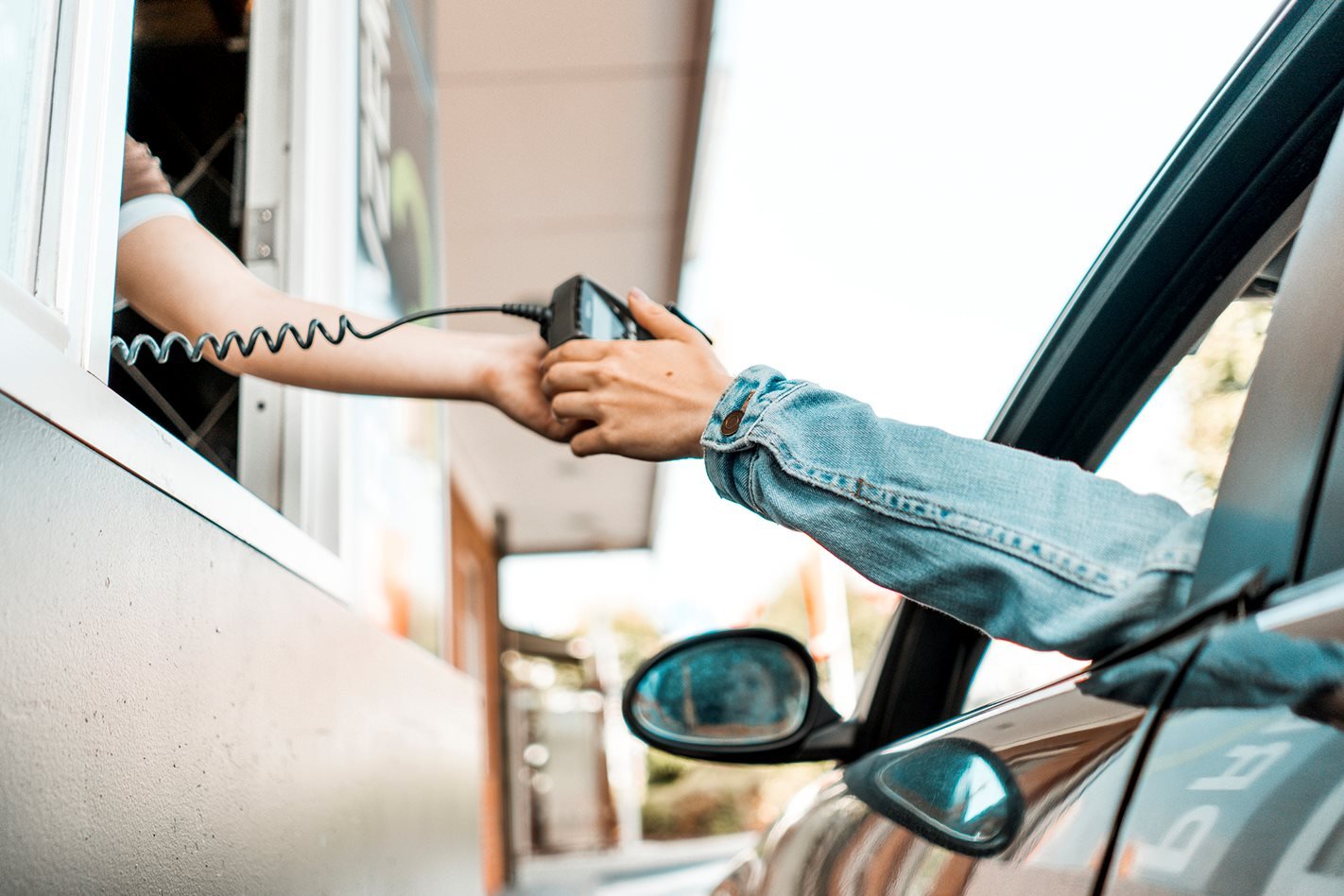
Not the “order online, pick up in your car” type, but an actual drive-in supermarket. The supermarkets are already doing special shopping times for people with particular needs, like early-morning sessions just for oldies, and times when they keep the lights turned down and the music off for people with autism.
Very sensible. Good job, supermarket people.
But what about a drive-through hour? The aisles are already wide enough – I reckon I could get a Kia Picanto or a Fiat 500 through my local eggs-and-milk emporium without much difficulty. And it’d definitely be more fun than steering a trolley around.
They could have a “your car must be THIS small” gate at the entrance. And if you can fit through, you can gun straight past the baskets and start loading stuff right into your car.
It’s a winner for the supermarket too, because people would probably buy even more stuff if they didn’t have to carry it to their cars afterwards. Then, when the hour’s up, you just send round a Zamboni machine like they have at the ice rink, but modified for cleaning up tyre scuffs.
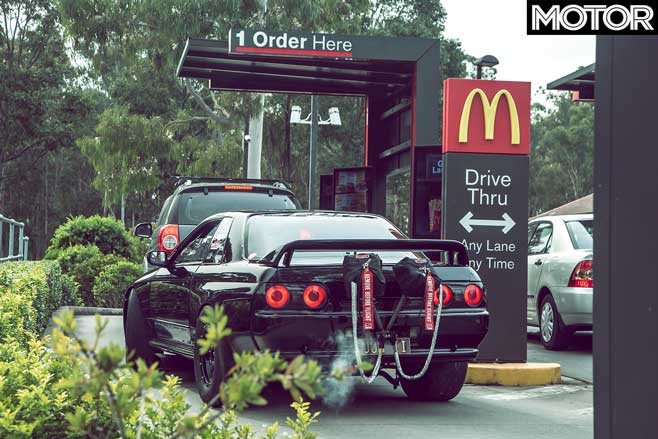
And why stop at supermarkets?
In America they have drive-in churches, big warehouse-sized churches where you can receive the word of God without having to trudge from car to pew like some darn-tootin’ Communist.
Well, we all know what the equivalent of that would be in Australia: drive-in pubs. The law is clear: you can’t drink while driving, and you can’t drive with a BAC over 0.05.
But there’s no law against parking your Polo GTI next to the bar and buying a pot or two through the window, as long as you finish your beer before you back up to the TAB window.
Well, actually there is a law against that in WA and Queensland, but anywhere else in the country, the drive-in pub is the answer to our prayers.
Drive-in cafes. Drive-in football stadiums. Drive-in universities. Drive-in everything.
You know it makes sense.
Imagine a world where you never leave your car, for any reason, ever.
You know what it would be? It would be Pixar’s Cars.
People assumed that was a movie about how self-driving cars will colonise the planet after they go the full Skynet and kill all the hapless meatbags that created them. But did you notice they never show the interior of the cars?
I think it’s because inside every car is a sweaty, hairy, unwashed person, covered in bedsores and food crumbs, living through their automotive avatars until the viral plague swirling through the atmosphere outside is finally defeated by permanent 24-7 in-car social distancing.
It’s basically a dystopian prophesy of the near-future, just 14 years ahead of its time.
This column appeared in MOTOR magazine – grab it now by subscribing at a great rate right here!
It is the biggest weekend on the Australian motorsport calendar and the WhichCar Weekly team assemble to discuss the legend of Mount Panorama.
But rather than dig deep into the complex and often unpredictable science of racing, Chris, Dan and Scott turn their attention to the peripherals.
First up, Scott has been taking time to get to know the latest and most monstrous version of Ford’s popular Mustang.
But while this particular car has been mastered by Herrod Performance, it was with the oversight of Supercar ace Scott McLaughlin. Tune in to find out what our own race ace thought of it.
Next up, Chris has been following an online car auction like few others. Amazingly, Chaz Mostert’s Holden Supercar is already up for sale and, at the time of writing, up to about $160,000. Yes that’s right – the car he will race in anger for 1000km this weekend.
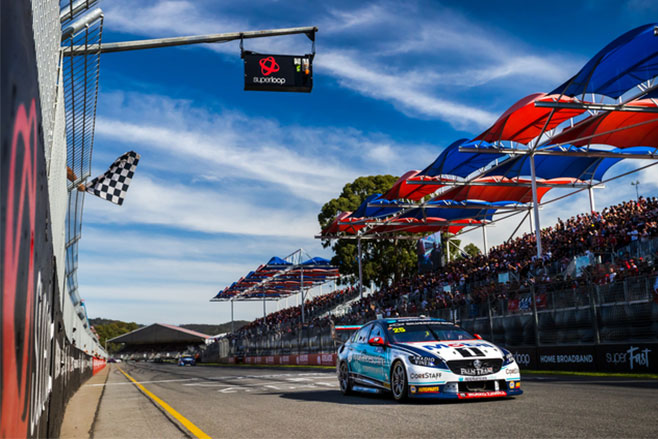
It’s a fascinating idea to sell a car you’re not yet done with but it has the potential to dramatically affect the car’s value. If it ends up with a podium finish or even winning, the new owner could potentially have a historically significant machine in their collection.
If it goes the other way, they could have a very expensive block of metal to make a coffee table out of.
But beneath the celebrations and fun of Bathurst weekend, this year’s race is tinged with sadness and the final race for a factory backed Holden.
While the Lion will continue to roar in motorsport forever, this weekend’s race for the mountain marks the sad end of an incredible era of Ford vs Holden.
You can find WhichCar Weekly on all manner of podcast apps including iTunes and Podbean. Please rate, subscribe, and leave a review.
If you want yet more WhichCar action whether it be behind the scenes insights or the very latest from the automotive front line, follow the day-to-day happenings of the WhichCar team on Facebook, Twitter and Instagram.
And if you really want to get involved, send us a question or auto anecdote of your own. We endeavour to answer all your messages.
Listened to or watched the WhichCar Weekly podcast? Help us out!
- Leave a note in the comment section below
- Leave a review on Apple Podcasts/iTunes
- Subscribe to our podcast
Before we bombard you with the numbers – and there are many large ones – take another look at the image above. The Mercedes-AMG GT Black Series. Wild looking, isn’t it? Every AMG GT is low, wide and intimidating but this one? This is unhinged.
This story was first published in July 2020 for Wheels Magazine and has since been updated to include local details
And there’s more to it than just a big wing and some extra vents and ducts. Notice that strip of black carbon beneath the number plate? The one practically kissing the tarmac? That’s a new manually adjustable front splitter. And see that lowered section in the centre of the roof? And the way the swollen sideskirts form one gigantic strip of carbonfibre that runs down the entire length of the car?
More than the headline stats, it’s these details that speak to the depth of engineering at play here.
Before we dive right in to the numbers and intricacies of the AMG GT Black, we should address one of the questions on your mind. Yes, it is coming to Australia. But there are a couple of obstacles between AMG GT Black Series desire and ownership.
The first is availability. Mercedes Australia says just 28 AMG GT Black Series will be sold in Australia, “all of which are already allocated to local customers.”
Essentially, you’ve got to find and convince a current placeholder to relinquish their spot as a GT Black buyer.
The second obstacle? Money. A huge amount of it. The AMG GT Black Series pricing starts at $796,900 in Australia, which means on road costs and any options will bring the car’s effective price, in most cases, to about seven figures.
The AMG GT Black is essentially a million dollar car. Local buyers will get the Track Package as standard on their car, though, which adds a titanium-tube cage and four-point seatbelts for both driver and passenger.
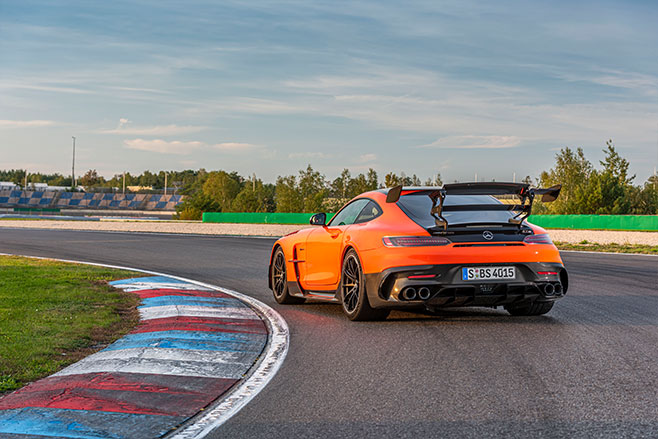
Anyway yes, back to the numbers…
This is the first Black Series model in eight years (the last was 2012’s SLS Black) and it produces 537kW at 6700-6900rpm and 800Nm between 2000-6000rpm. AMG diehards will know those figures represent an eye-opening 107kW/100Nm increase over the previous GT R flagship, and perhaps more importantly, that they’re also 15kW/50Nm more than you get from a Porsche 911 GT2 RS. That’s right, this car is going toe-to-toe with The Widowmaker.
The source of this potent power increase is a heavily reworked version of AMG’s venerable 4.0-litre twin-turbo V8, known internally as M178 BS. We’d been warned to “expect something different” with this engine by AMG’s former boss, Tobias Moers, and that AMG had “never done something like this with an engine before.” We now know what he was referring to.
Central to the changes is the move to a flat-plane crankshaft, which isn’t only lighter and more responsive, but allows the Black’s donk to rev harder. The redline figure is now 7200rpm (up from 7000rpm), while max power is now made 500rpm higher than the GT R. The compression ratio has been altered and there are also new twin-scroll turbos with ball bearings for greater response and reliability, and to allow for a substantial increase in boost.
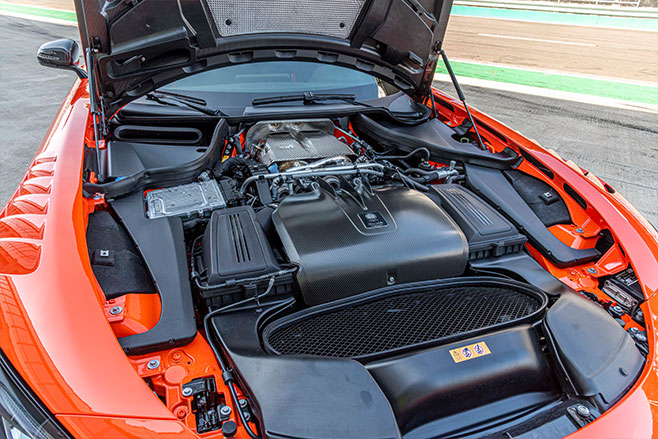
Where a regular GT runs 1.2bar and a GT R has 1.35, the Black Series winds up the boost the 1.7bar. New camshafts and exhaust manifolds round out the most significant engine alterations. The issue, we imagine, will be transferring all of this performance to the road.
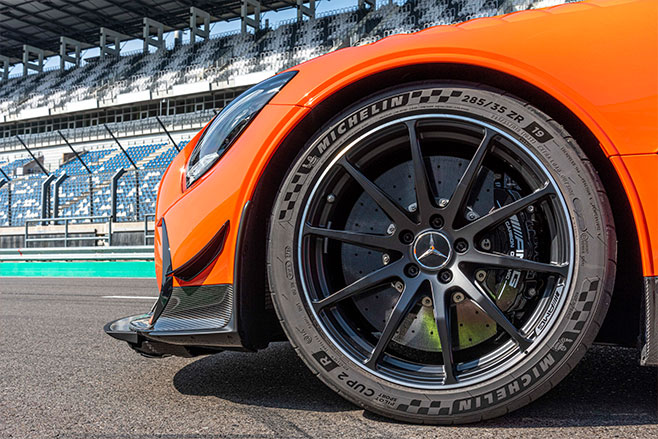
Helping the cause is wider and more aggressive rubber at both ends. Tyres are ultra-sticky Michelin Pilot Sport Cup 2 R and measure 285/35 R19 up front and a massive 335/30 R20 at the rear. Still, we wouldn’t race a GT2 RS at the lights. Where the Porsche hits 0-100km/h in 2.8sec, the AMG’s claimed sprint is 3.2sec.
AMG’s pursuit of lightness has verged on excessive and is seemingly matched only by a desire to use as much carbonfibre as possible. Honestly, it’s everywhere. Every hanging panel except the doors is made from carbon: the bonnet, the front splitter, the quarter panels, the roof, the tailgate, the rear wing (both the blades and the specially shaped supports), and the chunky new rear diffuser are all made of carbon.
Thinner glass is used in the rear window to save valuable grams, the interior door pulls are now made from strips of fabric, and the all-new, dual-flow exhaust system is fashioned from ultra-thin stainless steel rather than titanium like you get in the GT R. The Black also ditches the GT R’s four-wheel-steering system, which aids in saving weight. All up, the Black is 35kg lighter than the GT R at 1540kg. Need some context? That gives it a power-to-weight figure of 348kW per tonne, which is pretty much identical to a GT2 RS.
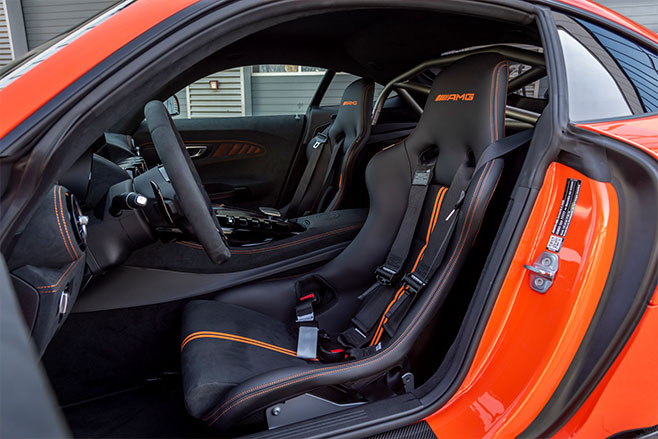
Aero is central to the Black’s performance. The enormous rear wing is the most obvious nod to amping up downforce and both horizontal blades are manually adjustable to alter the downforce/drag equation.
There’s active aero trickery afoot, too. The central section of the top wing is able to be raised or lowered by 15 degrees electronically by pressing a button inside the cabin. Combine this with the extendable front splitter (manually adjustable through two settings: Street and Race) and a largely flat underbody that uses longitudinal fins to reduce negative pressure and channel air to the beefier rear diffuser, and drivers should benefit from a considerable spike in grip through faster corners.
Much of the suspension is nicked from the track-focused AMG GT R Pro, including its adjustable carbonfibre front anti-roll bar, though spring rates are stiffer and the two-way adjustable dampers use a unique calibration. Should you feel confident with the spanners, the front and rear camber is also able to be manually adjusted.
Carbon-ceramic brakes are standard and while they’re the same size as the optional set-up on the GT R, AMG says the front pads and discs are new. The calipers are also painted black, not yellow or red like other GTs.
The result of all this is a package that should be an absolute event to drive. We’ve never stepped out of an AMG GT R and thought “Hm, I wish it had more grunt”, so we can only imagine what this will be like to drive hard. Intense, is our guess.
Which brings us to the elephant in the room: the Nurburgring lap time. Right now there isn’t one, though it’s almost guaranteed AMG will be gunning to reclaim its crown from the GT2 RS. 6:47.3s is the marker.
FIVE STEPS TO GIVING A REGULAR GT A BLACK HEART
- Twin-blade rear wing has an adjustable centre section which can be altered by 15 degrees.
- Cup 2 R rubber is wider and “adapted for dry conditions”. Will be a handful in the wet.
- Find the silver paint a little dour? A new ‘Magmabeam’ orange is optional. Dr Evil approves.
- Adjustable front splitter needs to be manually wound back in for road use. Don’t forget! Crunch…
- Heavily reworked V8 now has flat-plane crank and new firing order (1-8-2-7-4-5-3-6).
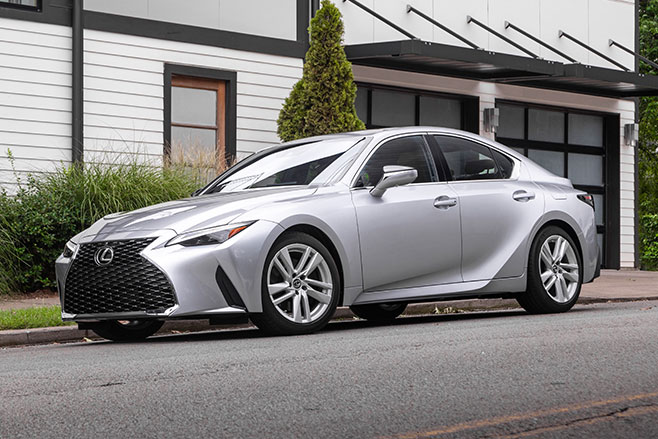
Australian pricing for the 2021 Lexus IS sedan has been confirmed, revealing a new entry price point for the updated model. It’s available to pre-order now ahead of a November 6 arrival.
Starting at $61,500 for the entry grade Lexus IS300 Luxury, which is powered by a turbocharged 2.0-litre inline four-cylinder engine(180kW/350Nm), the range extends all the way to the naturally aspirated V6-powered (232kW/380Nm) Lexus IS350 F Sport for $75,000, with an enhancement pack costing an extra $3100.
In between the 300 and 350 is the Lexus IS300h, with a 2.5-litre four-cylinder engine (with 221Nm) and an electric motor (300Nm) to help things along (total 164kW).
The IS300h retails from $64,500, though can cost up to $76,100 if optioned in F Sport specification with an Enhancement Pack.
The aforementioned F Sport spec, alongside the Luxury spec, are both available on either 300 or 300h, though the 350 is an F Sport-only proposition.
As you’d expect, the Luxury grade is fitted out with comfort-focussed features such as a new swing-valve shock absorber design to improve ride, or design elements to exhibit a touch of class.
The F Sport variants are, as the name suggests, more focussed on aggro styling and dynamic driving, with adaptive suspension dampers and five drive modes from Eco to Sport+.
Being the higher of the two grades, the F Sport also gets features like driver-seat memory settings, ventilated front seats, and an 8.0-inch TFT instrument screen like the one in the Lexus LFA supercar.
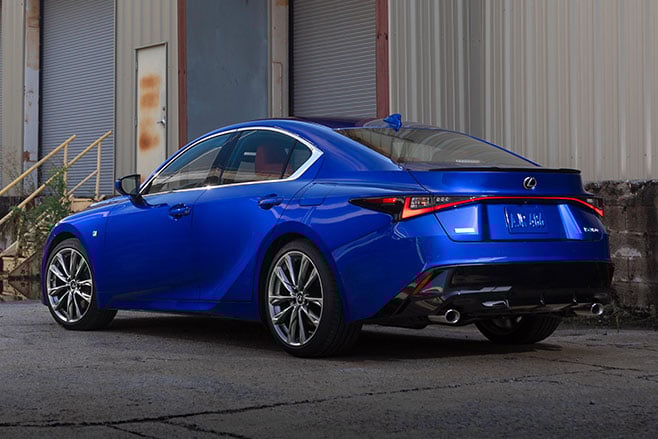
The focus on ‘sport’ in the new Lexus IS, which was revealed globally in mid-2020, comes down to a planned symbiosis with Lexus’ other, more executive or luxurious models, says Lexus Australia boss Scott Thompson.
“An intense focus on evocative design, imaginative technology and leading driving dynamics will help ensure a new generation of Lexus customers are welcomed into IS sports sedan ownership,” Thompson says.
“The sports focus of the new IS, alongside the luxurious ES, together deliver two distinct personalities for Lexus customers to select from in this segment.”
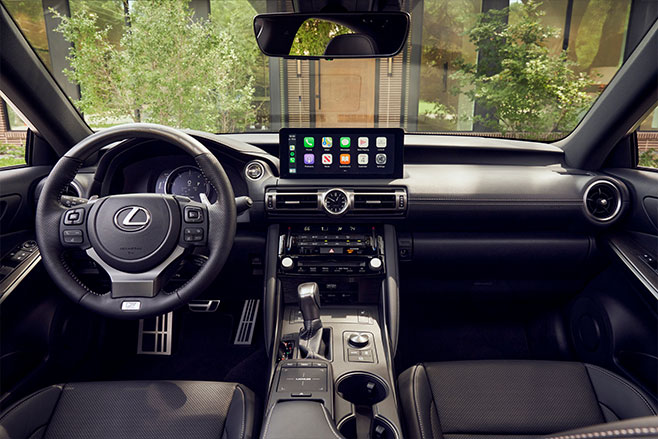
In terms of cosmetics, the IS F Sport models also boast 19-inch alloy wheels as standard, plus a specific body kit and spoiler, F Sport scuff plates and badging, as well as LED headlamps.
Standard across the entire 2021 IS range, however, are five ‘firsts’ for Lexus models in Australia. Intersection turning assist, emergency steering assist, automated collision notification, SOS call, and stolen vehicle tracking are all now included for more assistance in situations where things could go wrong, or already have.
Finally, something previous Lexus owners may find comforting is the standardisation of a 10.3-inch touch screen with Apple CarPlay and Android Auto, replacing the old system that required a Bluetooth connection and use of a decidedly odd trackpad.
UPDATE: This weekend’s Bathurst 1000 will be Holden’s last ever race as a brand, with the former manufacturer currently in the final stages of being shutdown by General Motors.
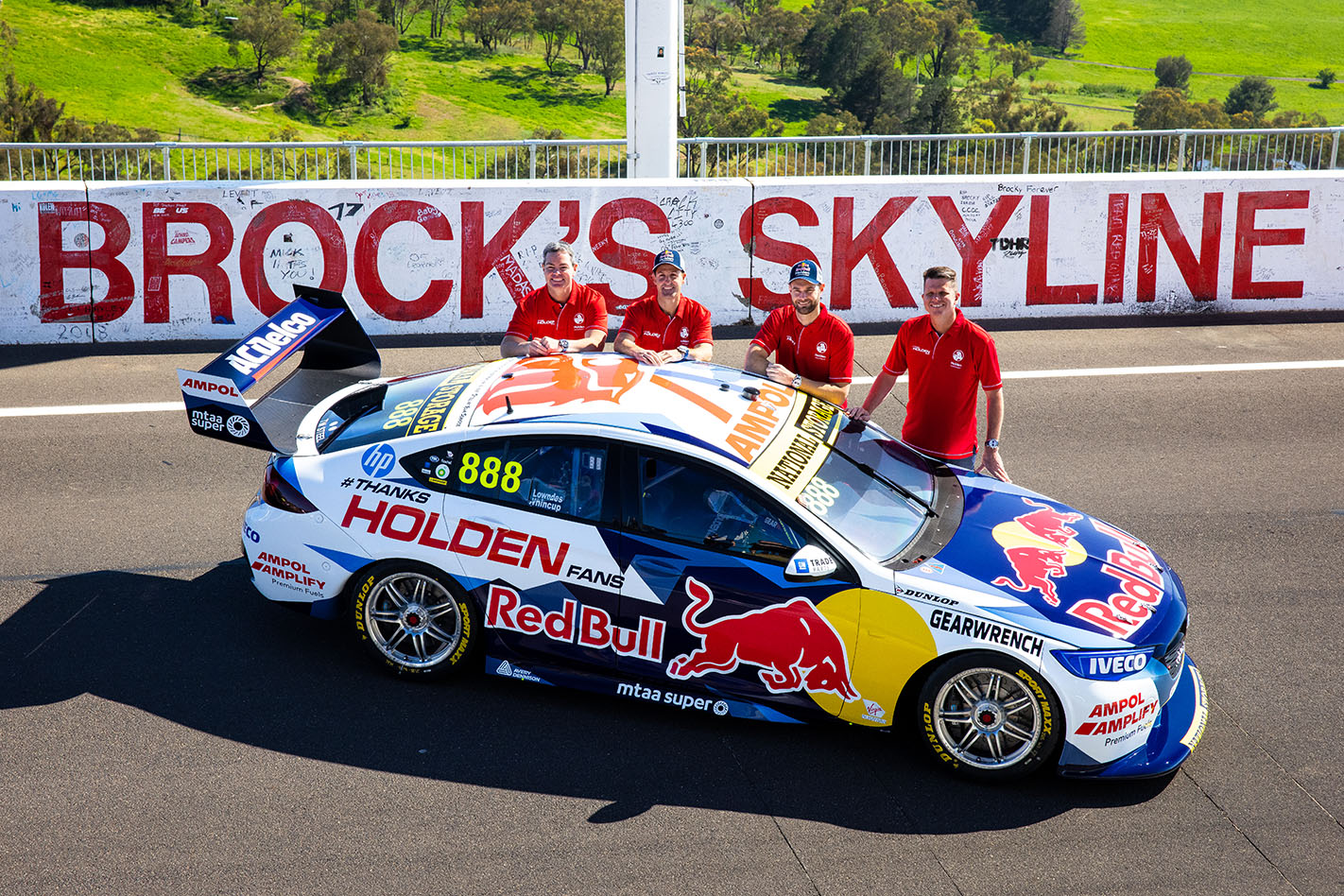
To mark the occasion, the factory Red Bull Holden Racing Team have a special thank you note dedicated to Holden racing fans on the squad’s pair of ZB Commodores.
While the Holden Commodore will continue to feature on the Supercars grid in 2021, it will no longer receive factory support, and is set to be replaced by the Chevrolet Camaro in 2022 as new ‘Gen3’ rules are introduced.
To celebrate Holden’s final race as a brand, we’ve decided to look back at its greatest racing achievements.
This article was first published in the Wheels November 2017 issue.
So often, over the course of its history, Holden and its heroes delivered where it really mattered, in the results of the Australian Touring Car (and V8 Supercars) Championship and The Great Race.
These treasured moments came thanks to a varied cast that included Norm Beechey, Bob Jane, John Harvey, John Fitzpatrick, Allan Grice, Larry Perkins, Win Percy, Bob Morris, Colin Bond, Jim Richards, Greg Murphy, Mark Skaife, Jamie Whincup, Craig Lowndes, Will Davison, Shane van Gisbergen, and even Allan Moffat…
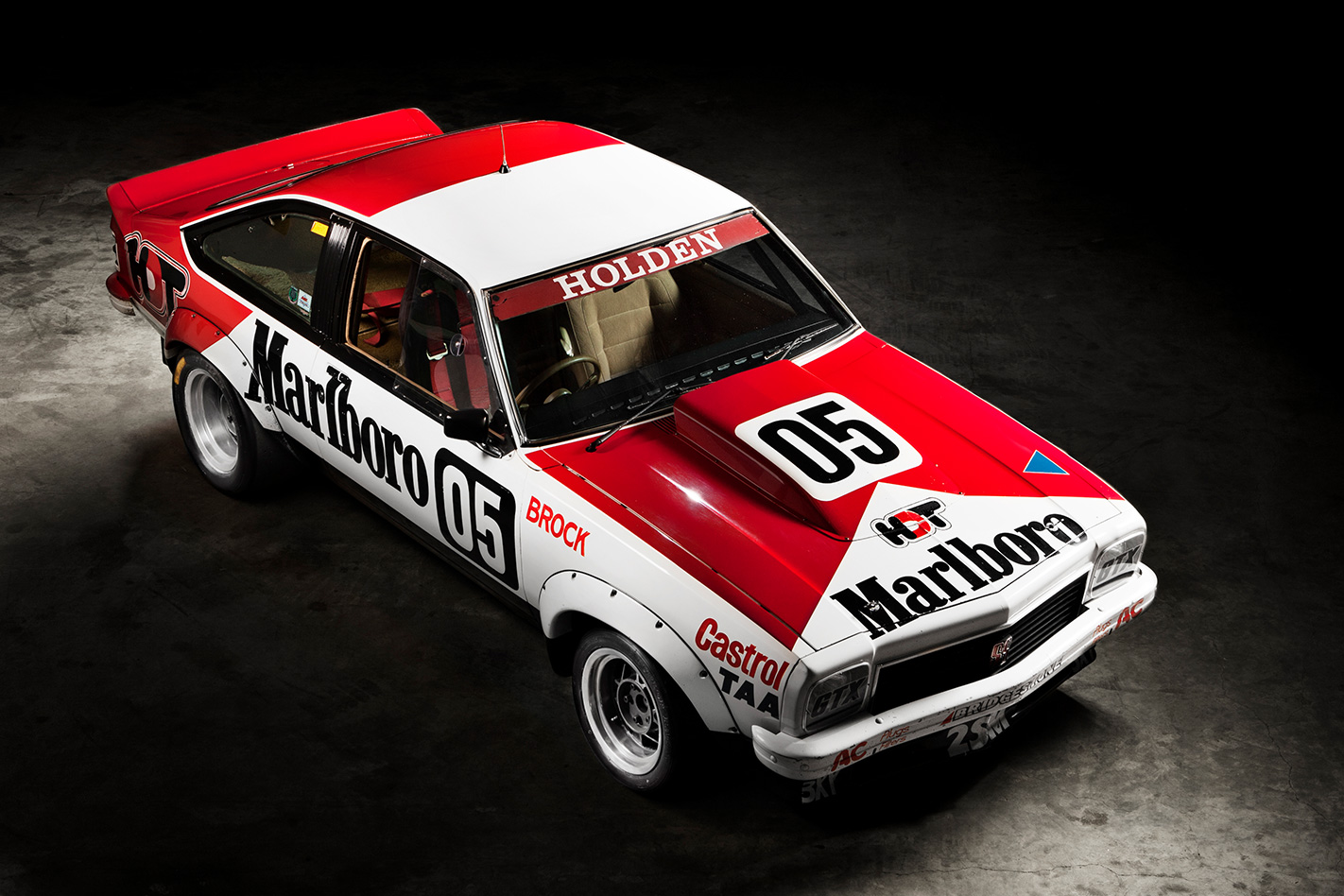
Yet any examination of the standout Holden moments in motorsport will rightly be dominated by the lasting deeds of Peter Brock; not just a member of Australian motor racing royalty but the King himself, who is still revered 14 years after his death.
The workshop boffins and spanner-men toiling behind the scenes deserve to be recognised, too. Among them Harry Firth, John Sheppard, Neill Burns, Les Small, Ron Missen, Peter Molloy, Bruce Richardson, George Shepheard, Ian Tate, Wally Storey, Rob Benson, Ron Harrop, Ludo Lacroix, Mark Dutton, and David Cauchi.
So too the little-known yet clever money shufflers at Fishermans Bend who frequently found ways to fund track campaigns – both official and unofficial.
In the early days, there were Humpy Holdens, and FC/FE victories; the EH had its moments. Then the V8 Monaro won Holden’s first ATCC in 1970.
The floodgates opened and stunning successes followed thanks to a brace of Toranas (XU-1s and A9Xs), and from 1980, the Commodore.
Now, with Holden pulling the shutters down on seven decades of local manufacturing, we’ve taken the opportunity to cherry-pick our Top 10 of The Lion’s more memorable – and occasionally bizarre – triumphs. The stuff we reminisce about when we come together with a drink in hand.
10. Moffat and Harvey win the 1987 World Touring Car Championship opener at Monza in a Brock car
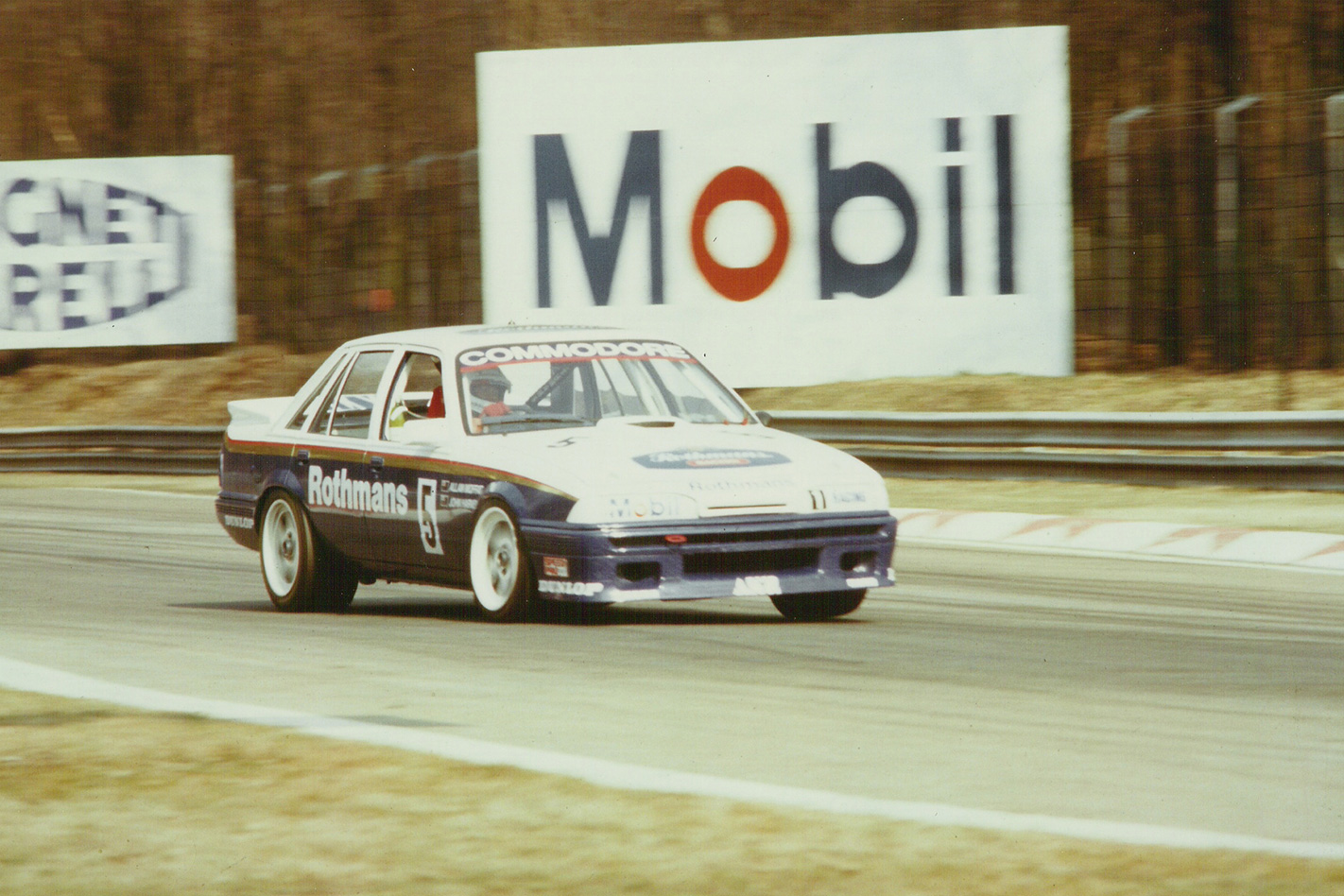
This is a strange story of how Allan Moffat, former Ford hero, entered a brand-new Peter Brock VL Commodore in the opening round of the inaugural 1987 World Touring Car Championship (WTCC) at Monza, Italy.
Due to be Brock’s 05 race car that season, the Commodore was put up for sale by the desperate-for-cash race ace in the aftermath of the Director and Energy Polarizer fiascos.
Using a front man, Moffat, an HDT driver the previous year, bought the car.
He had an audacious, perhaps deeply flawed, plan to get funding from loyal sponsors, ship the Commodore to Europe, find some mechanics and crew and, with his mate John Harvey, race in the opening round of the inaugural WTCC.
Despite an awkward time frame and an almighty rush, the VL made it to Monza with no spare engine and minimal spares. What was Moffat thinking?
Yet, the team with no visible means of support qualified ninth behind the pole-winning Ford Cosworth Sierras of Andy Rouse and a flotilla of new factory BMW M3s.
M3s dominated the race, filling the first six positions, with Moffat and Harvey taking a remarkable-in-the-circumstances seventh after a solid day out. And no real issues.
But in moves repeated months later at Bathurst, not everyone was happy with the outcome. A privateer BMW racer protested the six leading M3s for running lightweight panels, and the Aussies learned the following morning that disqualifications had elevated their Commodore to first place.
Subsequent races in the WTCC didn’t go so well for Moffat and Harvey until the Spa 24 Hours, where the pair bagged a gallant fourth.
Winning the first-ever race in the WTCC stands as a massive achievement, even with help from that disgruntled BMW privateer.
9. Davison does a ‘Bradbury’ after Whincup, Tander and McLaughlin tangle in the 2016 Bathurst 1000
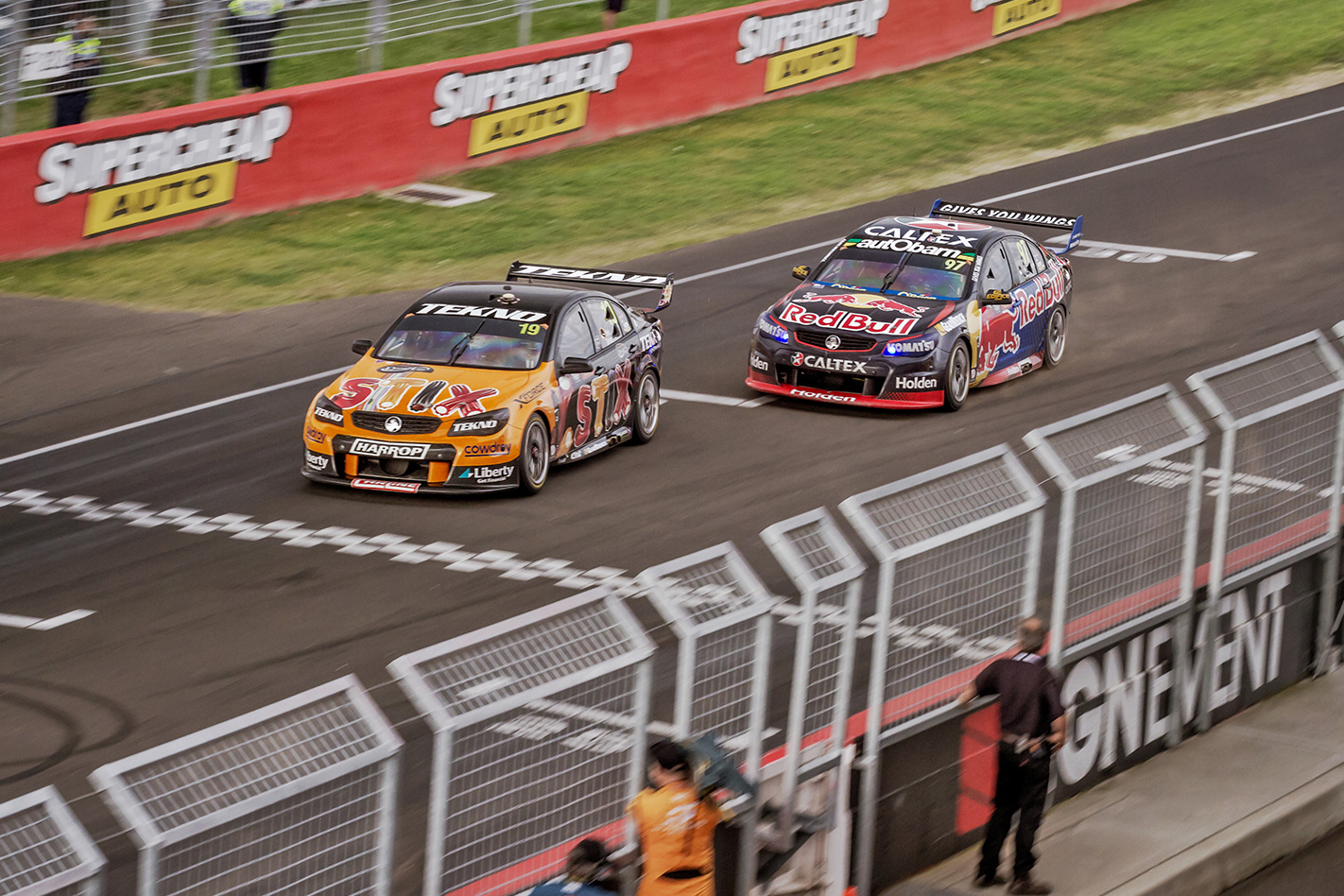
Much of this Bathurst 1000 was a bit of a snooze. Red Bull Holden’s Jamie Whincup and Paul Dumbrell had dominated from the start.
Pitting for the final time on lap 135 for fuel, tyres and fresh brake pads, Whincup relinquished the lead but had car pace and laps on his side in his chase to the flag.
He ruthlessly caught and passed Garth Tander’s HRT Commodore and set off after Scott McLaughlin’s Volvo. The six-time champ looked unstoppable.
Then came The Moment.
Into the Chase on lap 150, Whincup fired down the inside of McLaughlin who defensively edged left. Side by side, they banged together firmly, the Volvo ricocheting onto the outfield.
Whincup slowed in what looked like an attempt to redress, and Tander, still close, didn’t need a second invitation. The West Aussie looked to re-take the decelerating Whincup at the precise moment that McLaughlin returned to the track from his tour of the grass with a throttle full of right hoof. All three slammed together, Tander and McLaughlin cannoning off into a barrier. Whincup continued, but the time bomb in the control tower was ticking.
Whincup was hit with a 15-second penalty to be applied after the finish.
In the few laps remaining, he was no chance to gap Davison and the rest by 15 seconds.
The effective leader Davison, running short of fuel, was on an uncomfortable economy run ahead of Red Bull Racing’s relentless Shane van Gisbergen, looming large.
Davison held on for his second Bathurst 1000 win and the first for Webb and his small one-car Tekno Autosports outfit.
Said Davison: “That was so stressful. I knew if I lifted to save any more fuel that Shane was going to get me. It coughed coming into the last corner and I ran out of fuel while crossing the line.’’
It tossed up the closest finish in the history of The Great Race – 0.14sec.
8. Gallant Whincup holds off a relentless Reynolds in an epic 2012 Bathurst duel
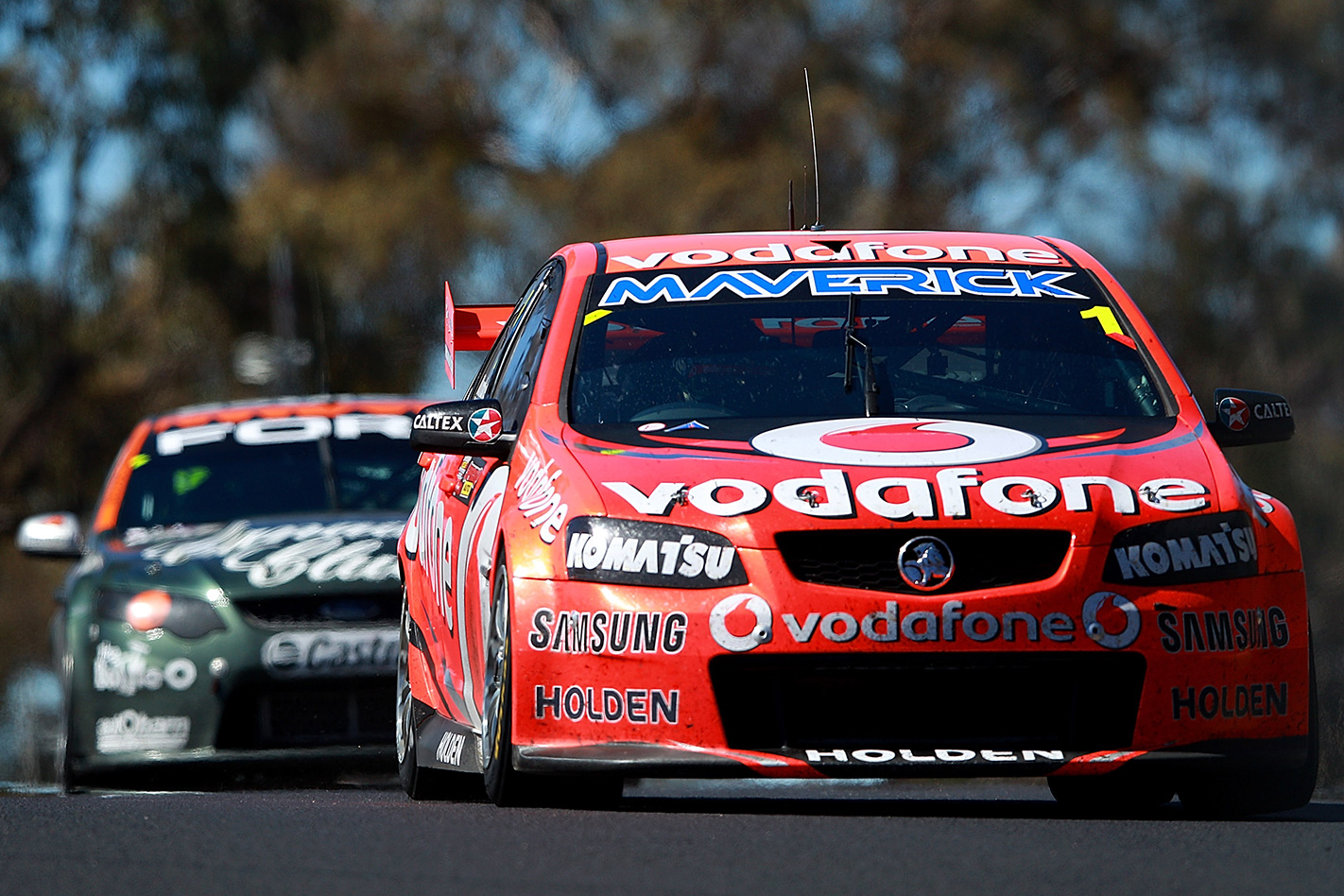
Vividly remembered for the almost-unbearable tension and sheer purity of the contest between Holden’s Jamie Whincup and Ford’s David Reynolds, the epic duel in the closing laps of the 2012 Bathurst 1000 had the crowd roaring like spectators at the Colosseum.
It was a classic fight between two drivers who for lap after lap were right on the limit whilst always respecting their opponent, the rising star against the established champion, Holden versus Ford.
Triple Eight’s Whincup and co-driver Paul Dumbrell had led for much of the 161 laps, while Rod Nash Racing/FPR’s Reynolds and team-mate Dean Canto had run in the top five all day.
But the race became a duel after the pair’s final pit stops, Reynolds closing on Whincup, who had been warned by his crew to save fuel when possible.
With four laps to run, Whincup led Reynolds by just 0.4sec. Going into lap 160, Reynolds was close, glued to the rear bumper of the Commodore and probing, looking for a way past. Whincup, juggling issues from overheating tyres to a dislodged window was also getting regular demands from engineer Mark Dutton to “conserve” while all the time staving off Reynolds, who had no such fuel concerns.
Reynolds was being urged in his earpiece to attack. A big slide out of the Dipper suggested he was already on the edge.
The crowd noise was deafening as the pair, separated by mere centimetres at times, headed into the last two laps.
Vulnerable on Conrod and Mountain straights, Whincup worked hard while respecting fuel economy to build enough of a margin before Forrest’s Elbow and Hell Corner.
Reynolds never gave up. In doubt to the final corner, the memorable, unpredictable 2012 Bathurst enduro went to Whincup and Dumbrell by 0.3sec. There was just 0.1 of a litre of fuel left in the Commodore’s tank.
7. A Grieving Whincup steals the win from his former flatmate in a 2012 Clipsal thriller
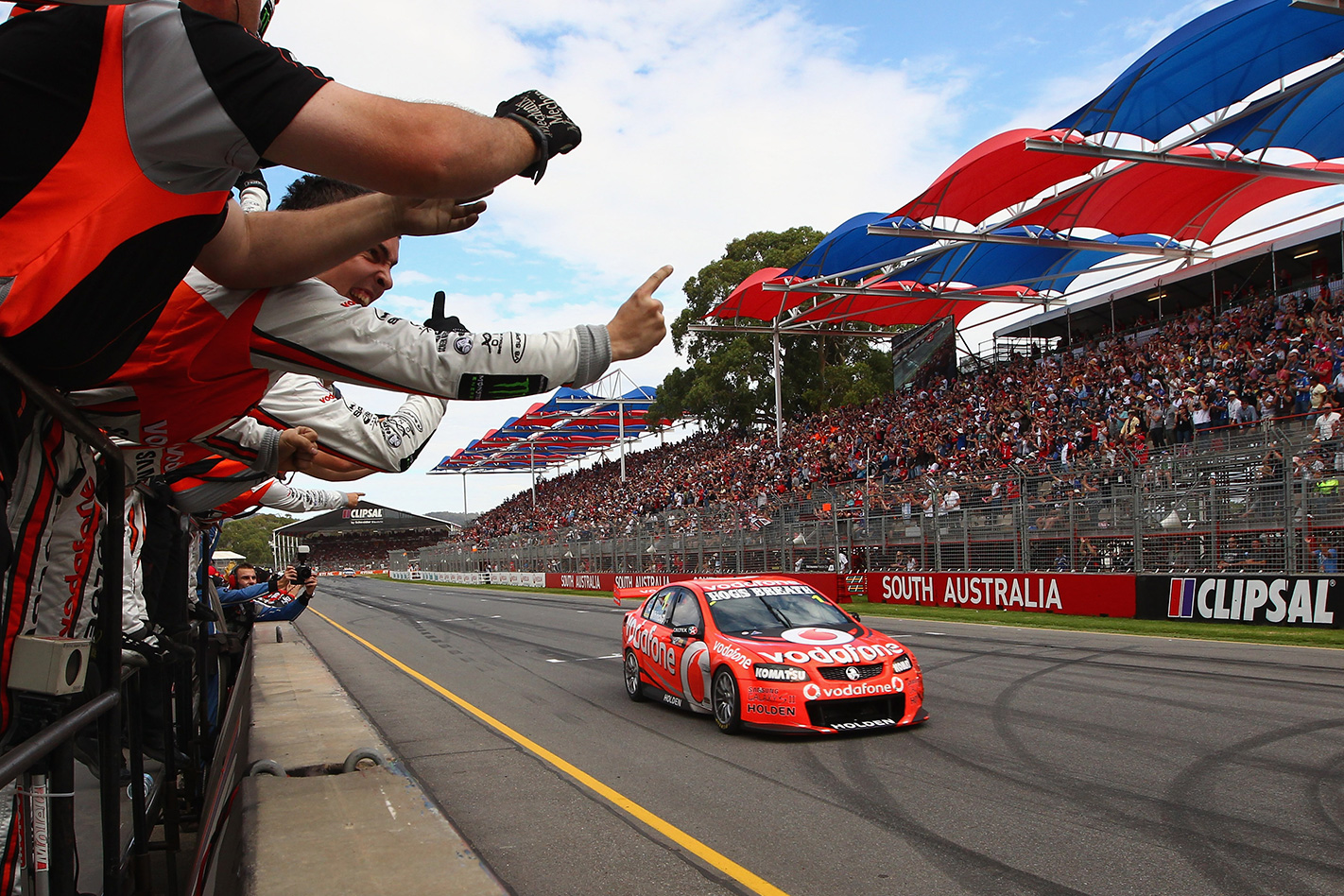
JAMIE Whincup has won more than 100 races in his stunning driving career.
Yet the memory Whincup treasures over all the other countless wonderful moments is the Saturday 250km leg of the 2012 Clipsal 500, the opening salvo of the V8 Supercars Championship of that year. He went on to win the golden double in 2012 – the championship and the Bathurst 1000.
The remarkable victory in the opening leg in Adelaide set up his standout year.
But first, some context…
Six days earlier, Whincup’s father David had passed away. David had been a long-time supporter of his son’s motor racing. Father and son were very close. Whincup called his dad “my best mate”.
Though he’d started on the front row of the grid at every Clipsal race since 2007, an understandably distracted Whincup could manage only fifth-fastest in qualifying for Saturday’s race.
Big crashes at Turn Eight had the effect of eliminating some rivals but also turning the 78-lap race into a tactical lottery.
Ford driver Will Davison took over up front as his close mate Whincup looked threatening, slamming out record laps in pursuit.
Into the final laps of the race, alternate strategies left the two at opposite ends of the spectrum, Davison painfully conserving fuel and Whincup maxxed out to make up the deficit of making a third pit stop. On fresh tyres and gassed up, Whincup zeroed in on sitting duck Davison, whose fuel-starved engine began spluttering half a lap from the chequer.
Whincup flew past his old flatmate at the hairpin on the final lap to land a very special win.
“I believe that’s the best race I’ve ever been involved in,” Whincup said later. As for his emotions, he added that “I pride myself on not bringing my personal issues to work”.
After many more wins since, he still cherishes that race as his finest memory.
6. Perkins and Ingall charge from Last to First in 1995 Bathurst
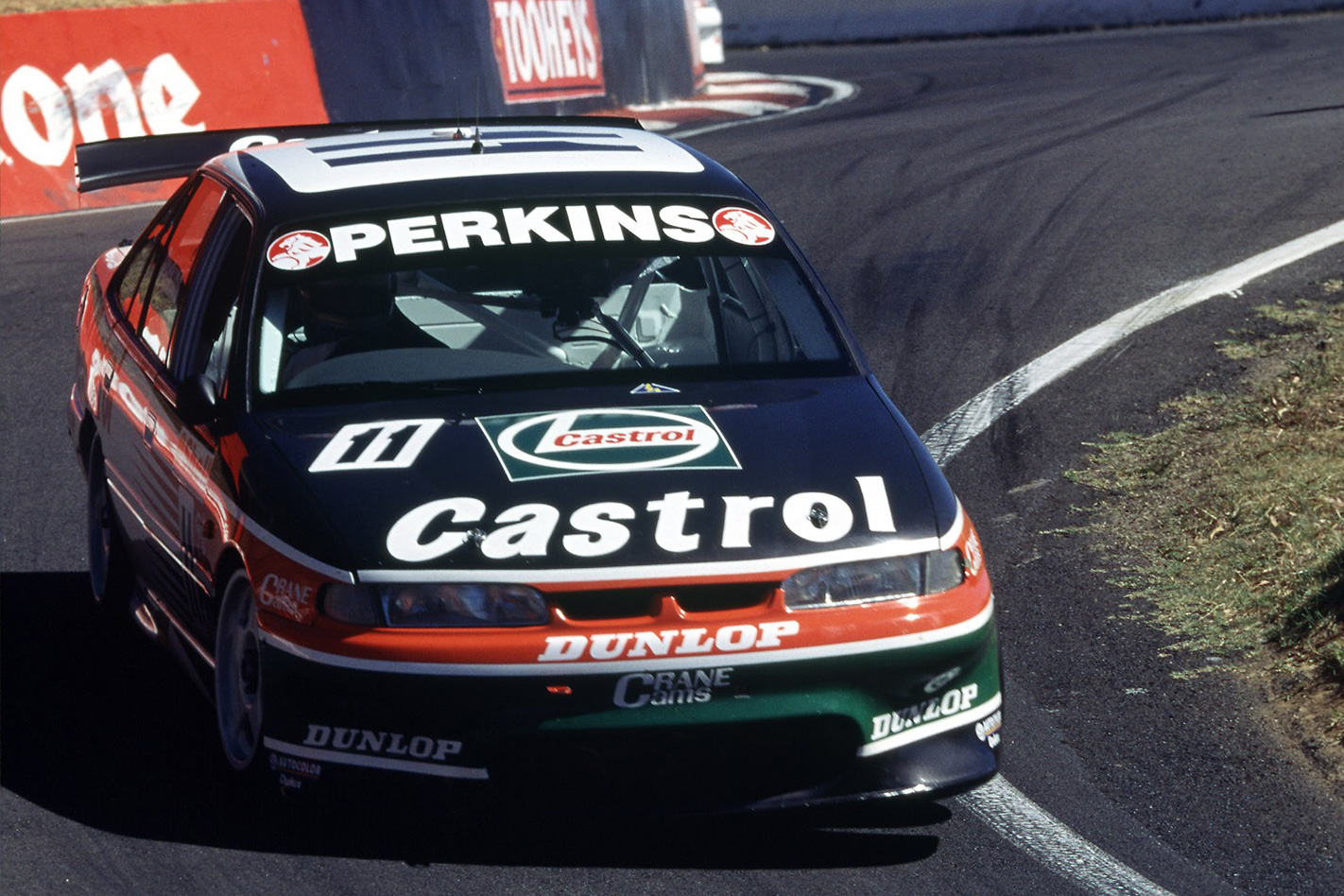
Hard-headed racer/engineer Larry Perkins won a six-pack of Bathurst 1000s but the best remembered of these accomplishments is his remarkable last-to-first in the 1995 race with co-driver Russell Ingall.
Chaz Mostert and Paul Morris managed the same trick for Ford in the 2014 Bathurst 1000, surging from 25th and dead last on the grid to snatch a fairytale victory.
But Perkins and Ingall did it for Holden 19 years earlier, among a bigger field of 32 cars.
This was the first Bathurst 1000 to be contested by a single class, which became V8 Supercars in 1997. Heading into turn one off the start line, third-on-the-grid Perkins’s VR Commodore banged fenders with the slow-starting HRT car of pole-sitter Craig Lowndes.
This tore the valve out of a tyre and reduced Perkins to a crawl. He slipped from third to last by the end of a very slow first lap, when he pitted to change the wheel/tyre.
A lap down already, it looked all over for one of the faves.
Steadily, Perkins and Ingall began to climb up the order. Safety car periods helped too, including one that gifted them some positive track position gains right after they had unlapped themselves.
With 20 laps left to run, Perkins/Ingall had edged back inside the top five.
At the wheel for the money stint, Perkins, sniffing a chance, charged towards a podium spot, overtaking Neil Crompton’s Commodore and the Falcon of Alan Jones to move into second place.
Up the road about seven seconds ahead, Glenn Seton’s Falcon looked uncatchable.
But this race habitually dealt a rough hand to Seton. With nine laps remaining, the Falcon’s engine dropped a valve, slowed dramatically and Seton retired.
Perkins went on to bag a famous victory, a win that appeared so unlikely on lap one of 161.
It was Bathurst win number four for Perkins; the first for Ingall, and time to shake that champagne till it popped.
5. John Fitzpatrick’s Lame Torana SL/R L34 limps to 1976 Bathurst 1000 glory
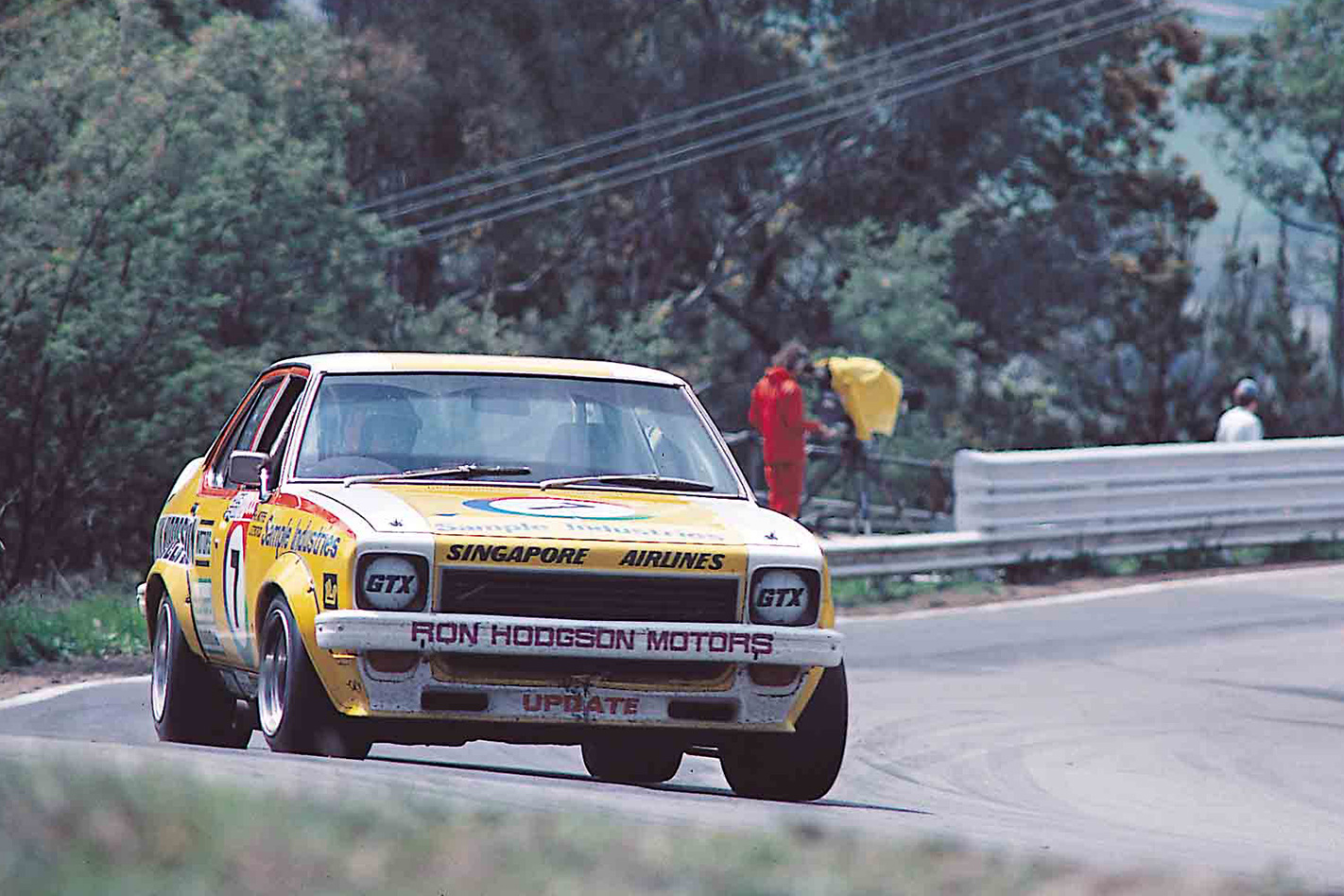
It’s the final laps of the most important race in the nation. Against the likes of the pole-winning Allan Moffat’s Ford Dealer Team, plus two Holden Dealer Team cars, Bill Patterson’s Team Brock, and the well-backed Craven Mild Racing, Bob Morris and British endurance star John Fitzpatrick have fought their way to the lead in their yellow Ron Hodgson-backed Torana SL/R 5000 L34.
They’re more than two minutes ahead of the Colin Bond HDT car.
At the wheel to bring it home is Fitzpatrick, the affable yet steely Briton with a reputation for being fast yet easy on the equipment. In the pits, his work done, was Morris, only in his early 20s but regarded as one of the fastest drivers in the game. He had never won a Bathurst classic. Could this be it?
Then, with four laps remaining, the leading Torana slows suddenly. Smoke pours from the car. Hearts sink in the Hodgson pit as Morris and the team contemplate the awfulness of it all.
The smoke gets worse. Television commentators, unsure of the problem, muse whether the car can finish, let alone stay out in front.
Peter Brock in his Bill Patterson-backed L34 charges into third and sets after Bond who is rushing closer to Fitzpatrick, as he deals with a blown gearbox seal that’s dropping oil on the clutch, causing it to slip badly.
Morris’s freckled face pales. Always an emotional type, he starts pacing up and down, fingers crossed. The TV cameras are loving the growing edginess. Chief mechanic Bruce Richardson bursts into tears.
Hardly daring to breathe, Fitzpatrick uses all his guile and experience to keep the ailing Torana moving.
Into the final lap, the tension is unbearable. Morris can barely look as Fitzpatrick coaxes their car up the hill one last time. Downhill is easier. He can coast home.
Champagne mixes with tears of joy…
4. Polarized Brock hijacks team car to win 1987 Bathurst 1000 … in 1988
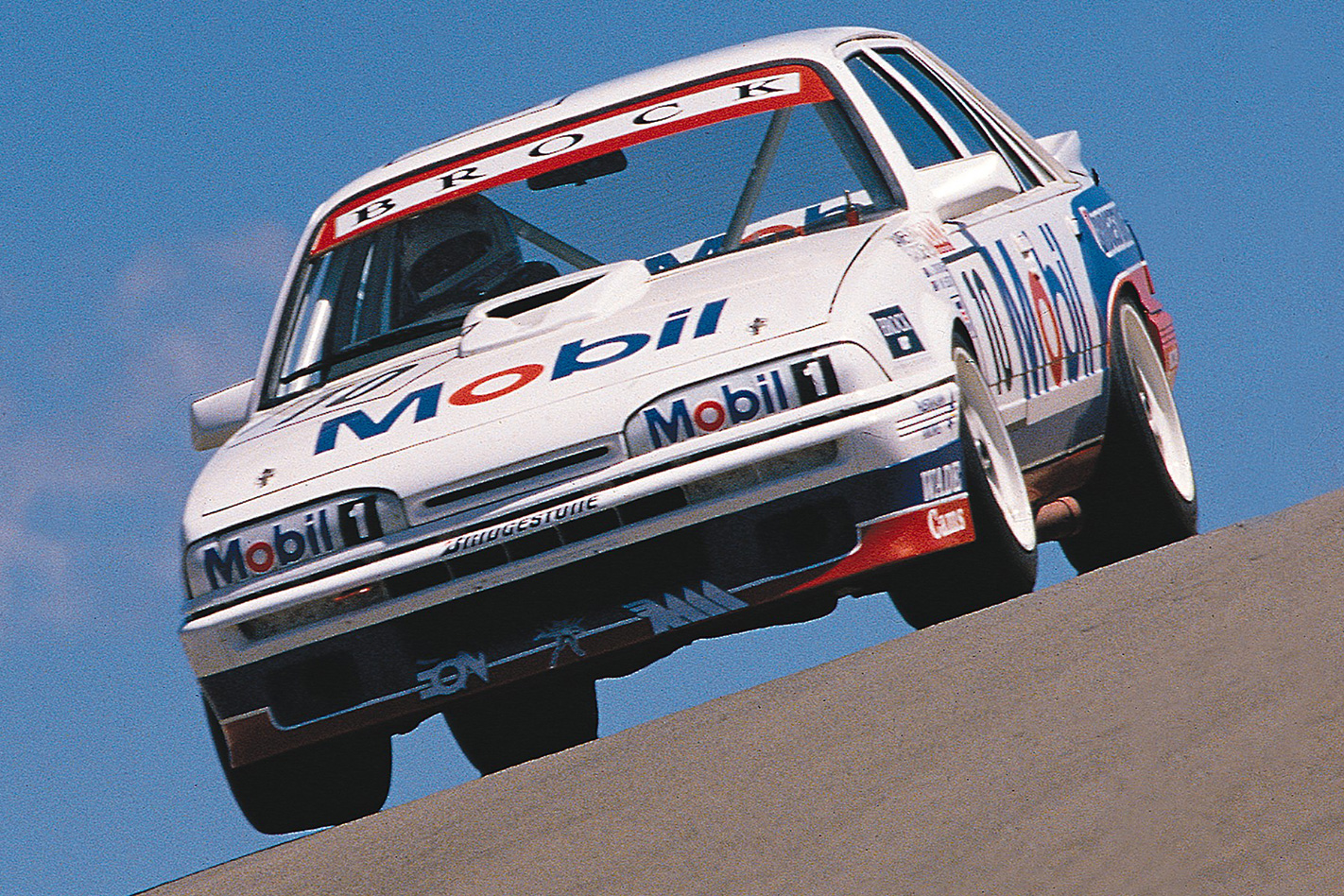
For the first time (and only time), the 1987 Bathurst 1000 was a round of the World Touring Car Championship for Group A cars. A big deal.
The entries were loaded with European teams and gun drivers aboard the favoured Ford Sierra RS500s and BMW M3s. Aussie hopes were the Sierras entered by Dick Johnson and Allan Moffat.
The only Australian cars in the field were a bunch of VK and VL Commodores, but seemingly lacking their past potency in this international Group A guise.
Emerging shakily yet defiantly from an awful split with Holden over his belief in the mystical powers of the Energy Polarizer, Peter Brock – now a cash-strapped privateer – entered two VLs.
Giving lie to the myth that you had to be a Bathurst regular to go fast on The Mountain, European-based Sierra drivers Klaus Ludwig, Andy Rouse, Steve Soper, and Klaus Niedzwiedz took the four fastest spots in the Hardies Heroes Shootout. Brock couldn’t even qualify in the top 10.
Cheating allegations began flying with protests and counter-protests targeting illegal bodywork, tyres, and rocket fuel. It was like the Euros worked within a different set of rules.
Brock’s 05 Commodore failed on lap 34 but under cross-entry rules, he and David Parsons commandeered the second Mobil HDT entry from Peter McLeod.
As the laps ran down, Brock (and Nissan’s Glenn Seton), moved into third and fourth behind two Eggenberger Sierras, the locals spectacularly power-sliding on a drenched track.
And after 161 laps, Brock crossed the line in third place, the dramas of a turbulent year behind him.
But it wasn’t over. Protests left the race results in doubt until well into the following year when the two Eggenberger Sierras were ultimately rubbed out. Their crime: illegally modified wheel arches, which allowed larger wheels and tyres to be fitted to the cars.
Brock (and Parsons and McLeod) were declared winners of the 1987 Bathurst 1000, the ninth and final win for the King of the Mountain.
3. Beechey’s Monaro GTS 350 takes Holden’s first touring car championship in 1970
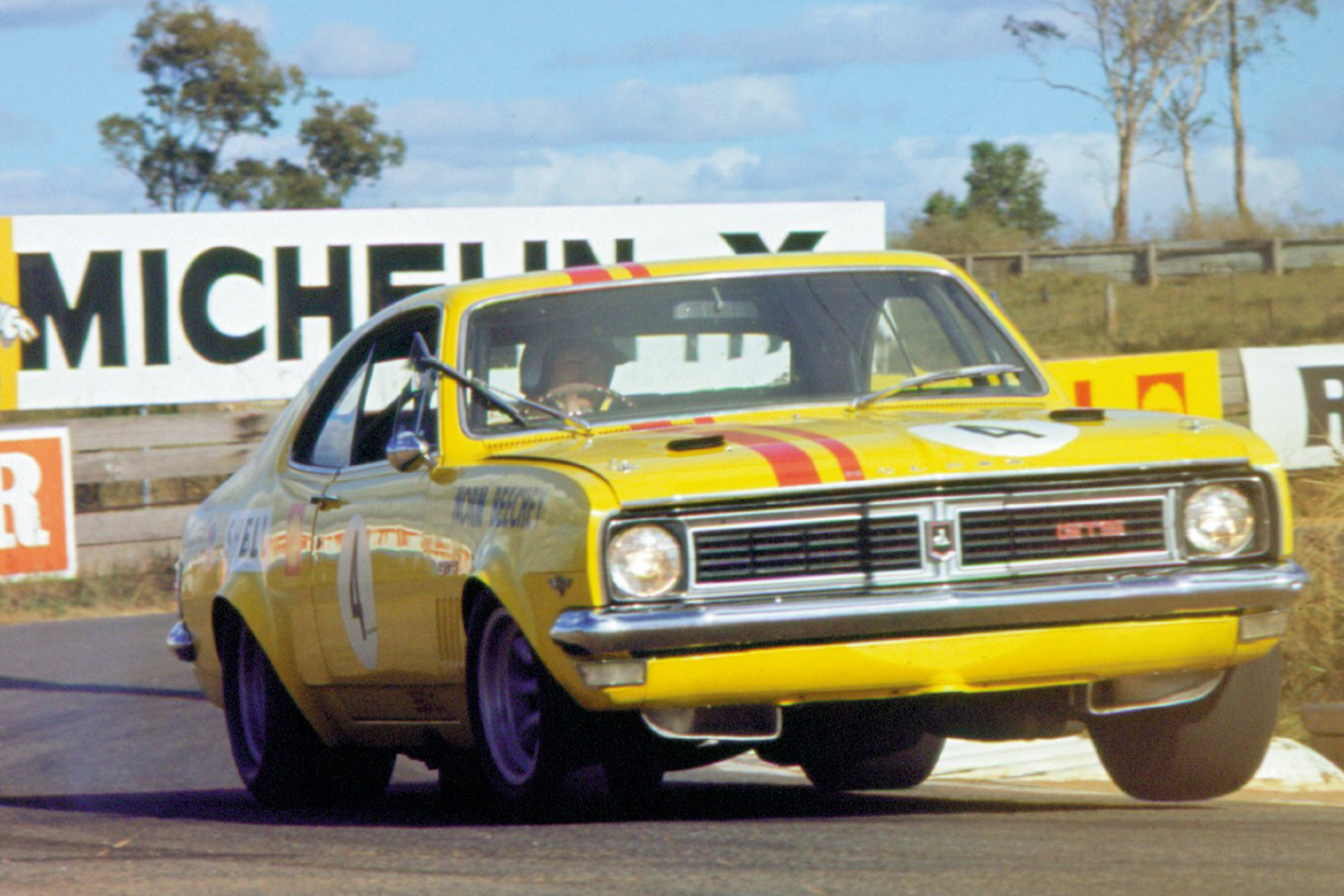
Since its 1960 inception and right through that decade, the Australian Touring Car Championship had been owned by imported cars – a string of four Jaguars initially, before a Ford Cortina preceded dominance by five rambunctious Ford Mustangs.
Norm Beechey had been one of the title winners (in 1965) in a Mustang but was obsessed with the challenge of creating an Australian car to take on the latest Trans-Am factory racers from the US.
The Brylcreemed Beechey’s flamboyant tyre-smoking, tail-out style had made him a fan favourite so Holden wisely signed him.
After unsuccessfully chasing the title with a 327 Holden Monaro in 1969, Beechey and his small engineering team stepped up to an HT GTS 350 Monaro Group C Improved Production Touring car to take on the big-buck US imports.
Built on a fraction of the budget that the American Ford and GM Trans-Am factory teams enjoyed, the yellow Shell Race Team HT took on and blitzed the Mustangs, Camaros and nimble Porsche 911s across the seven rounds of the 1970 championship.
Holden VT Commodore goes on a European vacation
After starting the campaign quietly with an eighth at Calder Park, a round won by Allan Moffat in his Mustang – the first for a non-Australian-born driver – three wins, at Bathurst, Sandown and Lakeside, and a second at Mallala followed for Stormin’ Norman, sealing the championship against the best rockets from the US and Europe, including team-mate and runner-up Jim McKeown’s 911S.
It was the first Australian title win for an Australian car, and the first championship title of 20 to date for Holden. Many adherents insist the yellow Monaro 350ci is the greatest Holden muscle racer ever created.
It was Beechey’s grandest, proudest moment in motorsport. “The Holden project was immense. Somebody claimed in print it cost us a six-figure sum to develop the car. Well, it wasn’t that high. We could have run a team of cars for that amount. But it did take up a hell of a lot of time and money,” Beechey told Sports Car World, before walking away from the limelight forever.
2. VB Commodore crushes the punishing 1979 Repco Trial – one, two, three
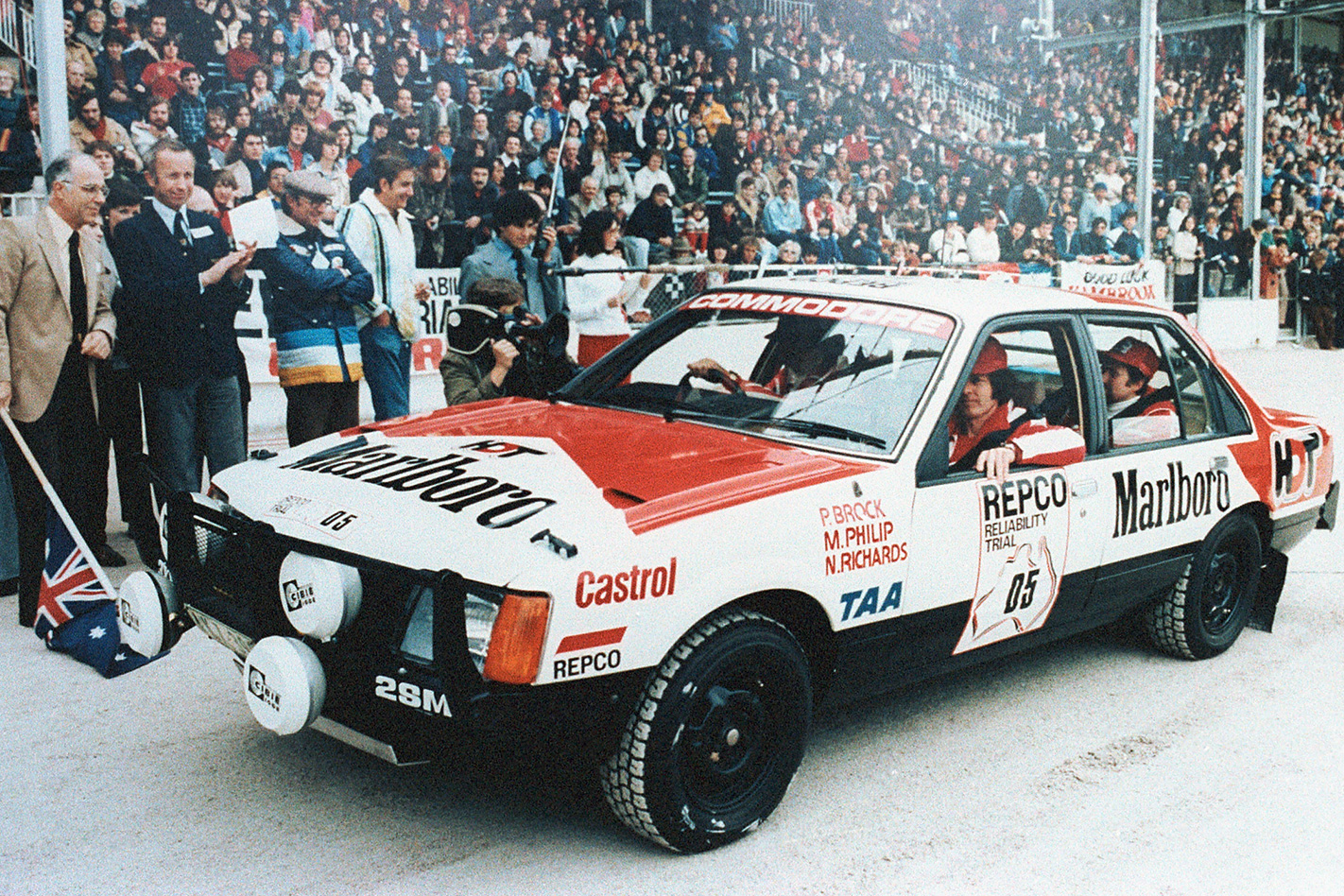
The1950s and 1960s outback round-Australia trials had captured the imagination of the car-loving public.
So the announcement of the last great trial; the longest, maddest and toughest of all – the 20,000km 1979 Repco Round Australia Reliability Trial – created massive interest in an era when family sedans were still king.
Peter Brock and George Shepheard convinced Holden it should tackle the Repco Trial, to show the consumers the toughness of the new VB Commodore.
Brock was rewarded with a drive of one of the three cars while Shepheard, vastly experienced in rallying as a navigator, engineer and organiser, was handed the herculean task of prepping the cars for the brutal torture test and then managing the whole effort.
Cars and competitors came from Germany and the UK and US. There were works-supported Ford Cortinas and Volvo Dealer Team 244s, but most of the 200-plus entries were a mix of clever rally privateers like Andrew Cowan and Geoff Portman, wily backyarders like Larry Perkins, and naive and wide-eyed wannabes about to get more than they anticipated.
The trial threw everything at the competitors along a route of largely unmade, rough tracks. It was almost inhumane. Cars crashed or fell apart. Two competitors died when their Peugeot rolled.
Portman’s Datsun and then Colin Bond’s Cortina led early but then Shepheard’s meticulous car preparation and clever back-up planning including air support paid dividends.
Brock forged to the lead of a Commodore one-two-three in the car-breaking, sleep deprived run up the west coast to Darwin.
Shepheard’s toughest task was controlling his star drivers. The head-strong Brock was reluctant to accept orders to slow down, while the local and overseas rally specialists were most keen not to be upstaged by an Aussie circuit racer.
Brock/Matt Philip/Noel Richards went on to a remarkable win, from Barry Ferguson/Wayne Bell/Dave Boddy in second and Rauno Aaltonen/Shekhar Mehta/Barry Lake third. A Commodore clean sweep. Joy for Holden.
1. Brock/Richards in an HDT Torana A9X Hatchback win 1979 Bathurst by six laps
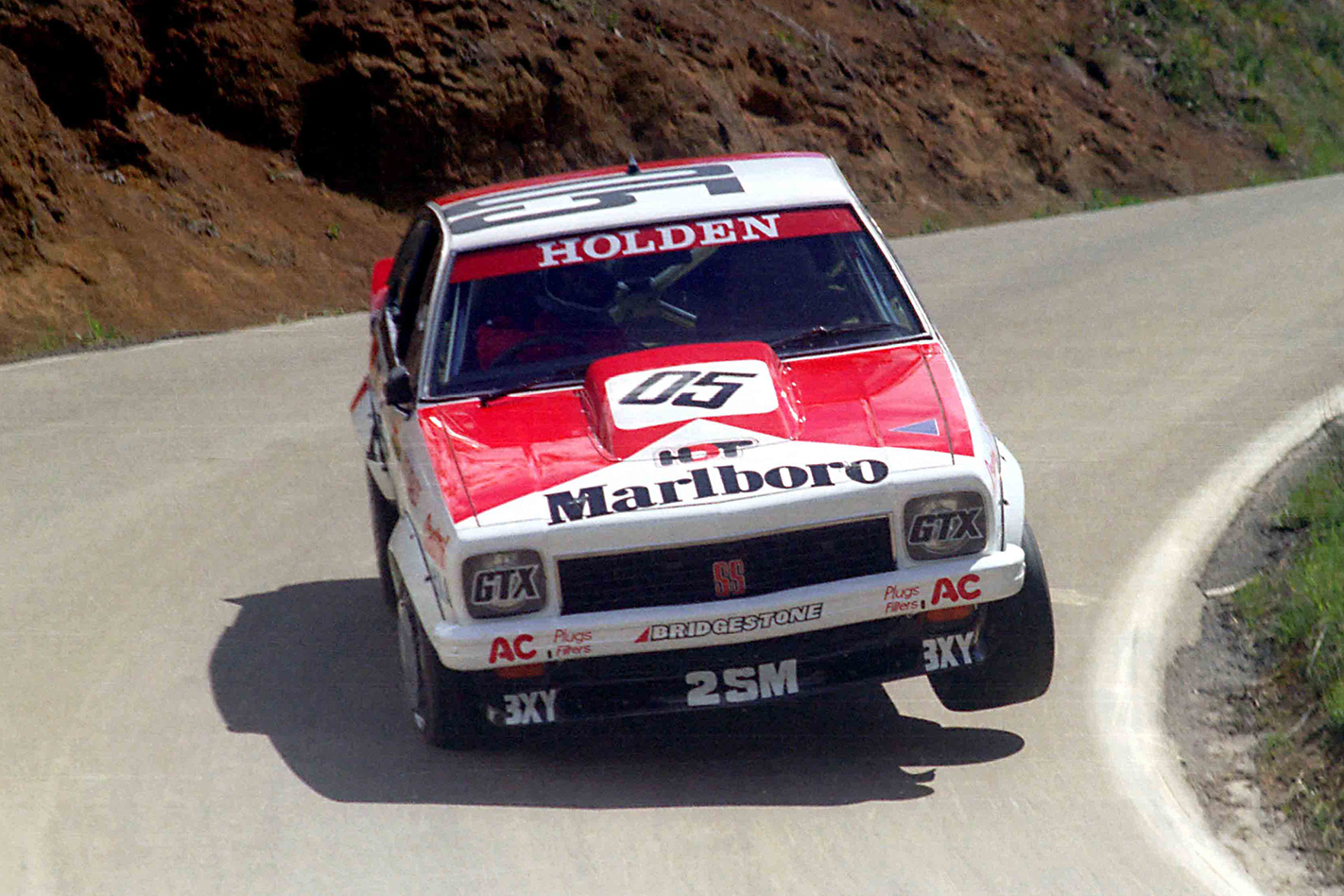
One month after winning the Repco Trial and washing the dust out of his coiffe, Peter Brock was back doing what he did so brilliantly: driving a touring car at Mount Panorama in the Hardie-Ferodo 1000.
It was touted as another classic contest between the Brock-led Holden horde of LX Toranas and the big Ford Falcons headed by the XC GS500 Hardtop of Allan Moffat. Ultimately, though, it was a no contest and a horror day for the Blue Oval.
Sharing a 308ci V8 Holden Dealer Team Torana A9X Hatchback with Jim Richards, Peter Perfect won the one-lap shootout for pole position and then on Sunday the pair led every lap in front of rapturous Holden fans, winning by six laps.
As was his way, Brock took the glory stints, the opener and the closer, and then to put the seal on a wonderful day at the track, smashed the lap record on the final circuit, arm on the window sill, nonchalantly waving to the appreciative crowd.
In an embarrassing thrashing of Ford, Toranas filled the first eight places. Moffat, John Goss, Colin Bond, Dick Johnson and Murray Carter all failed to last the distance. The best-placed Falcon was a dismal 14th.
It was a stellar sporting moment, huge in Holden’s motor racing history and vivid in the memories of those who watched trackside or at home via Channel Seven’s live coverage.
This was an era when motorsport enthusiasts appreciated the talent rather than the confected modern cookie-cutter parity show with compulsory pit stops.
Perhaps more than any other race, this epic Bathurst 1000 performance cemented Brock’s reputation as a peerless touring car racer. It was his fourth Mountain victory. Brock was to accumulate a further five in the coming years.
Not to take anything away from the Torana A9X and Brock’s talented Kiwi co-driver but, in 1979, you got the impression Perfect Pete could have done it single-handedly, in an LX Sunbird.
