
Renault is following in the footsteps of its alliance partners Nissan and Mitsubishi in becoming a virtual SUV-only brand, announcing the departure of the Clio small hatch and the electric Zoe from its local range.
The shrinking small passenger car segment and tiny electric vehicle market in Australia led to the discontinuation of both model lines, according to the company.
Despite growing its brand on the back of small cars here in Australia, the Clio has come off the boil, with just 22 cars sold so far in 2020.
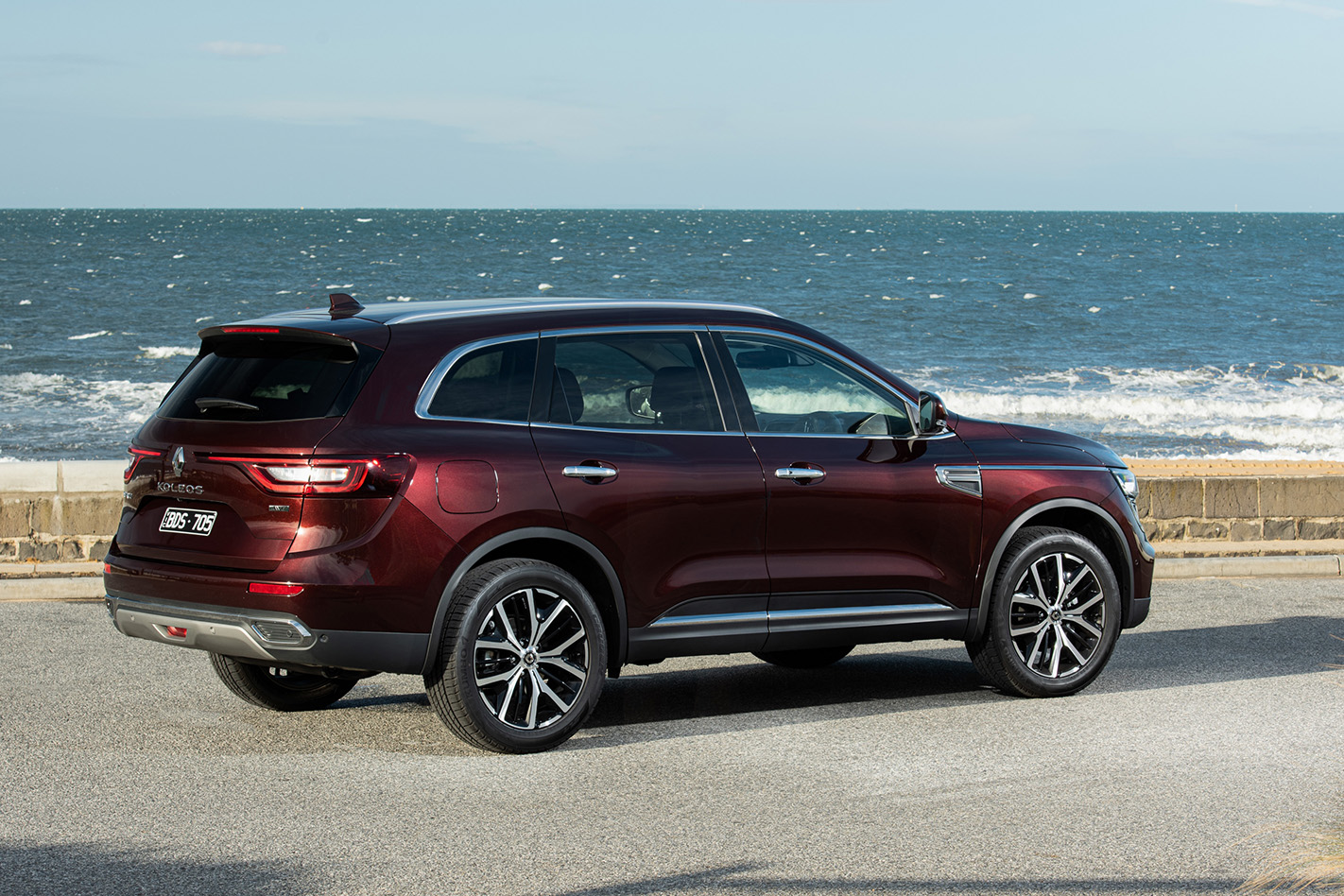
Renault sold 814 Clios in 2019, compared with more than 2500 Koleos SUVs.
The fact that there’s no government incentive for customers to buy EVs (in the case of Zoe) doesn’t help its cause… though with only two sales this year thus far and five for the entirety of 2019, it is obvious that demand was not there.
“[Renault Australia] has far greater volume ambitions than Zoe and Clio could offer,” said corporate communications manager Andrew Ellis.
Additionally, the small number of electric vehicle sales “was a hard sell to Renault head office”.
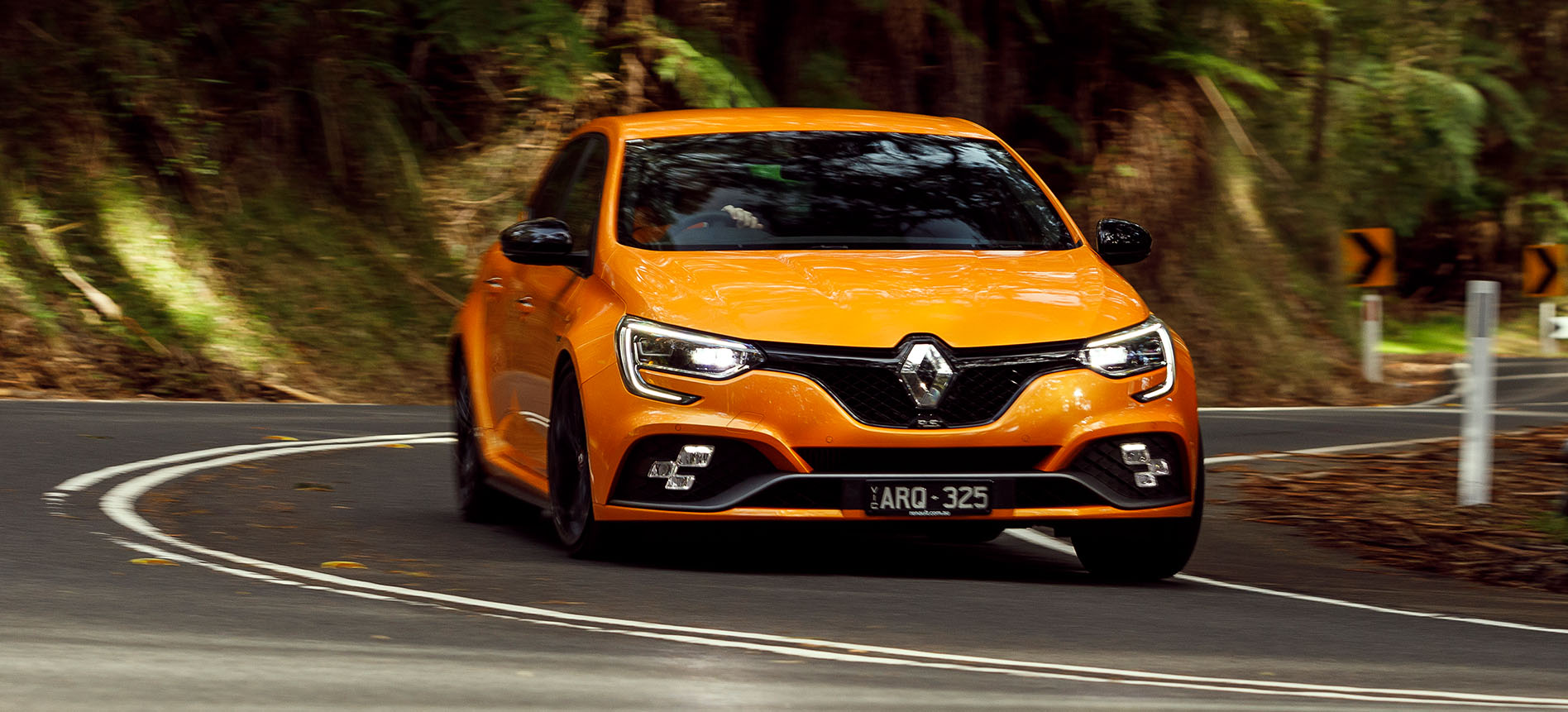
That now means the only non-SUVs the French brand will sell is the performance-focused Megane RS, and the commercial Master, Trafic and Kangoo van line-up.
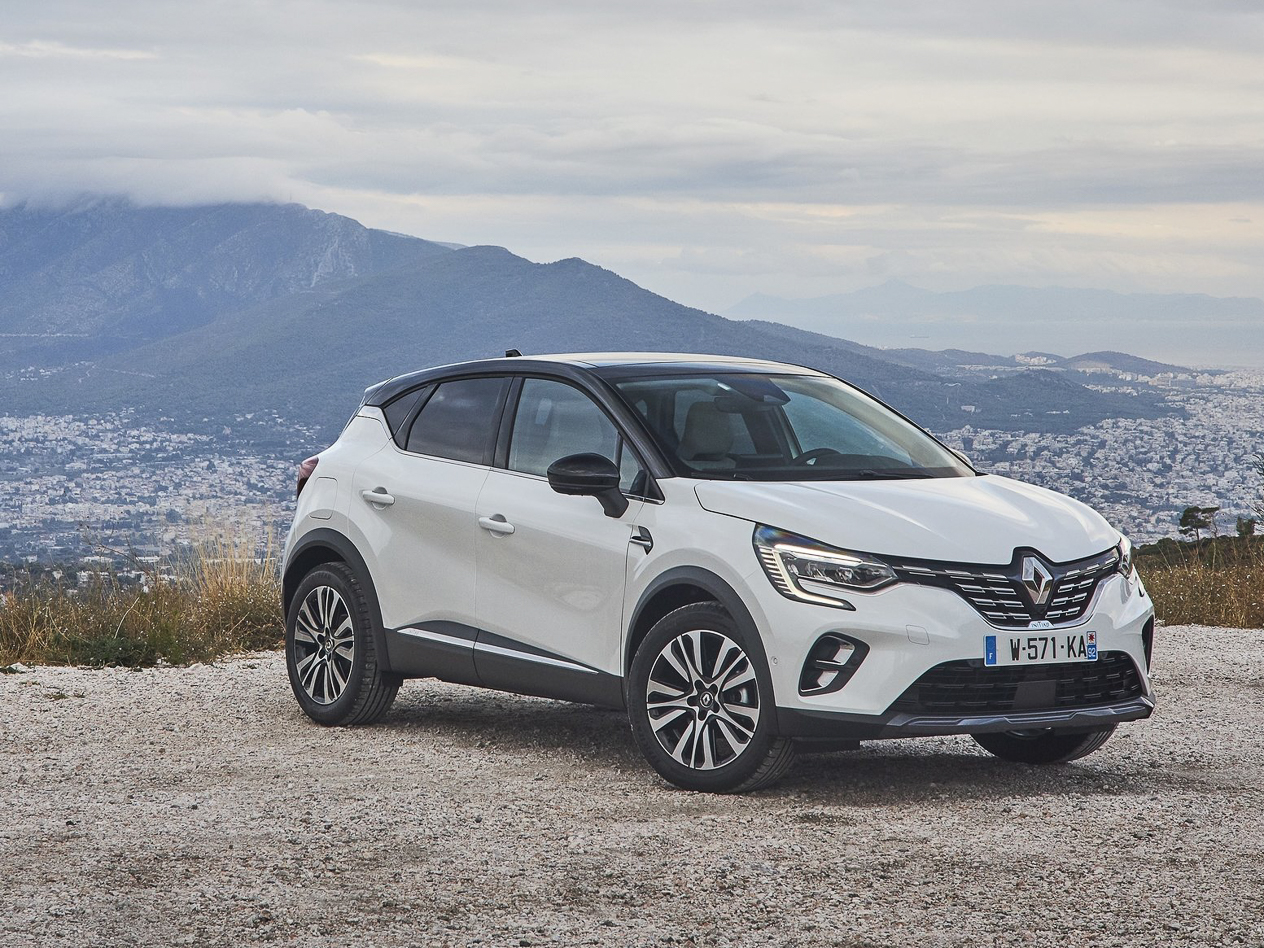
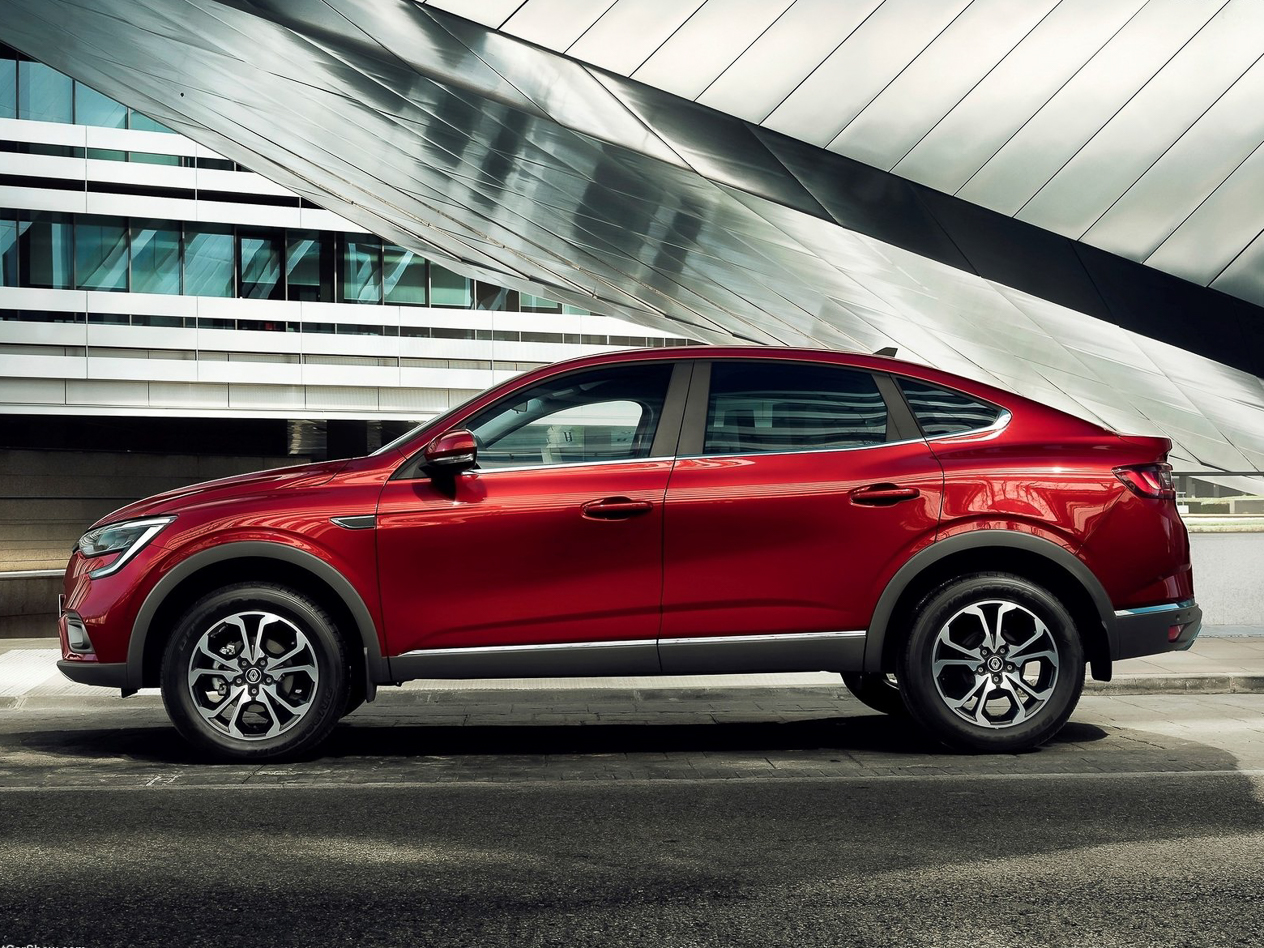
Looking forward, the streamlined Renault range will consist of the new-look Captur small SUV, Arkana SUV, Koleos medium SUV, Megane RS and the commercial range comprised of Master, Trafic and Kangoo.
The keen-eyed would have noticed the omission of the Kadjar SUV which has been subbed out for the all-new Arkana, bringing a coupe-look style to the small SUV segment.
The Arkana will arrive in the latter half of 2021, underpinned by an all-new platform brimming with new technology for the Renault range.
Further product updates include a slightly refreshed Koleos and Megane RS which are said to arrive in the first half of next year.
The first cab off the rank for the new Renault line-up will be the Captur small SUV which will touch down in Australia at the start of 2021.
It will mimic other models in the Renault SUV range by being offered in entry-level Life, Zen and Intens specifications, and Renault hopes to offer the Life variant at a sub $30,000 price point including driveaway costs.
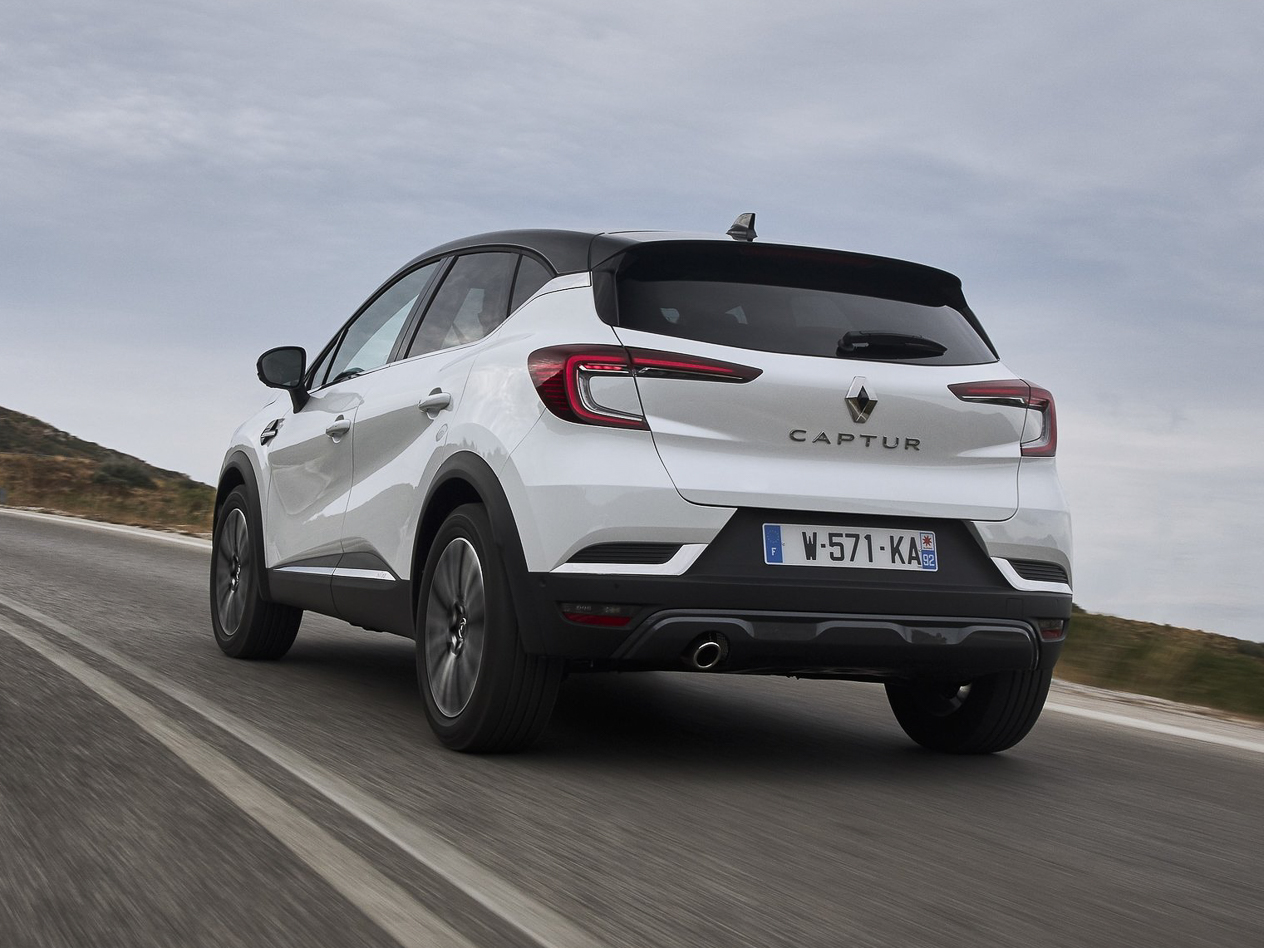
More details around the Captur (above) will be announced in December ahead of the Australian launch.
The retention of the Megane RS is a good sign for fans of sporty Renaults, though the loss of the Clio RS is a blow to performance car buyers on a budget.
Speaking of sports cars and despite much conjecture, the tiny Alpine brand will remain in Australia as a Renault sub-brand, while an announcement is coming soon in terms of product, thought to be the high-performance A110S.
While the South American-built Alaskan dual-cab ute remains unviable for the Australian market, Renault is open to presenting a business case for its successor which will be based on product sourced from within the Renault Nissan Mitsubishi Alliance.
Renault says it remains committed to the Australian market despite the significant market-wide COVID-19 rough patch, and nothing is set to change in terms of its 60 dealerships or sales models.
While other brands are contemplating an ‘agency sales’ model rather than the traditional dealership-based set-up, Renault is content with its current network.
“The Australian motoring landscape has changed dramatically in the past 12 months, but Renault is here for the long haul,” said Renault Australia managing director Anouk Poelmann.
Renault has sold some 2600 cars in Australia to the end of June, which is 33 percent fewer than for the same period in 2019.
Nissan’s decision to build a car that would challenge Porsche’s fast car hegemony reverberated throughout the entire performance car world.
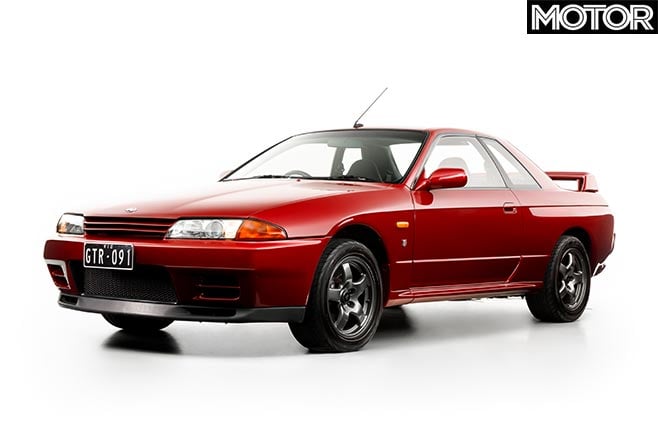
Locally, however, the Nissan BNR32 (‘R32’) Skyline GT-R didn’t prove quite as successful in showrooms as it did the racetracks of the Australian Touring Car Championship. Australian-complied GT-Rs arrived in 1991 priced at $110,000. Despite tricky economic times and with the cheapest Porsche 911 costing $55,000 more, the GT-R looked to be a bargain.
Nissan built Australia’s first batch of R32 GT-Rs at Murayama, Japan, in May and June 1991. The second run of 50 cars came down the same production line in August. They were then shipped to Melbourne where 50 extra hours per car were allocated to fit local compliance items including child-seat restraints, a fuel-filler restrictor and high-mount stop-light.
History of the Nissan R32 Skyline GT-R
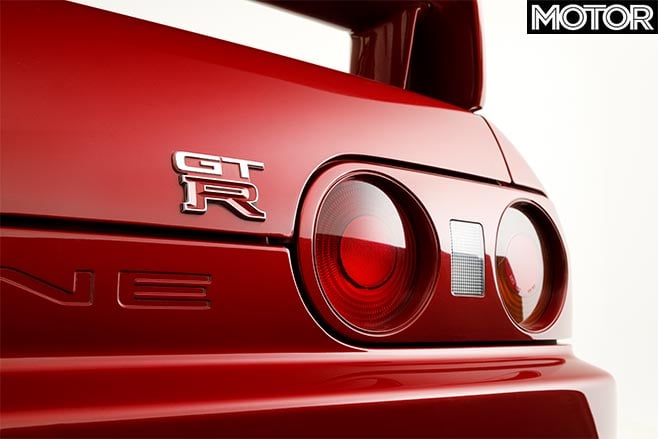
Of the 100 cars that arrived as ‘official’ imports, 26 were painted Black Pearl Metallic with a further 37 of each in Jet Silver and Red Pearl Metallic. Reportedly just 63 of the available cars had found owners.
GT-R face-off! R32 vs R33 vs R34 vs R35
With a decent proportion sold to local Nissan execs and senior dealership types, just a few dozen remained for private buyers, but even those seemed impossible to move. Today, demand for R32 GT-Rs, Australian-delivered examples especially, couldn’t be stronger.
MARKET REVIEW
With almost 44,000 R32 GT-Rs built between 1989 and 1994, many have been imported privately into Australia from Japan. Lots of these cars are available and represent the bottom of the R32 GT-R ‘pile’. Too many cars in an ambivalent market (with many of them in sub-standard condition) drag down the prospects of better examples to appreciate.
Above the basic variants sits the R32 ‘V Spec’ which was sold in two editions totalling 2756 cars. Nismo and GT-R N1 versions add a combined 788 but there are just 100 in Australian specification, making locally complied cars the most collectible R32s of all.
BODY & CHASSIS
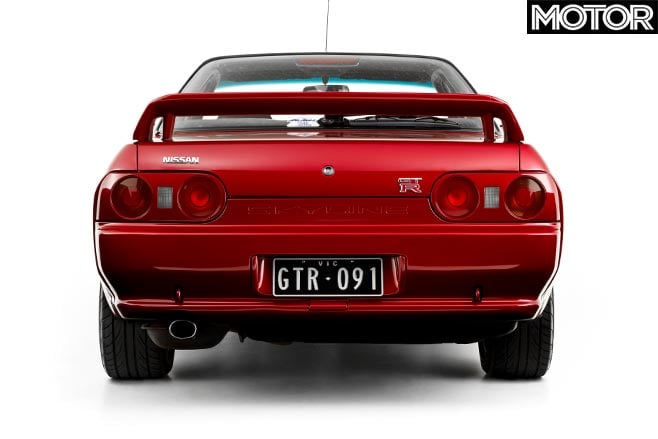
Rust should not be apparent in Australian-delivered cars, the majority of which haven’t seen enough rain to go rusty. Caution is essential with those that started life in Japan risking exposure to icy conditions. They need to be lifted and closely inspected for any corrosion or repairs. Crash damage is an issue with all GT-Rs so look for kinks to the front chassis rails, partial repaints and mismatched front or rear lenses. The extra weight of that hefty rear wing can weaken boot-lid supports and water can leak through mounting holes.
ENGINE & TRANSMISSION
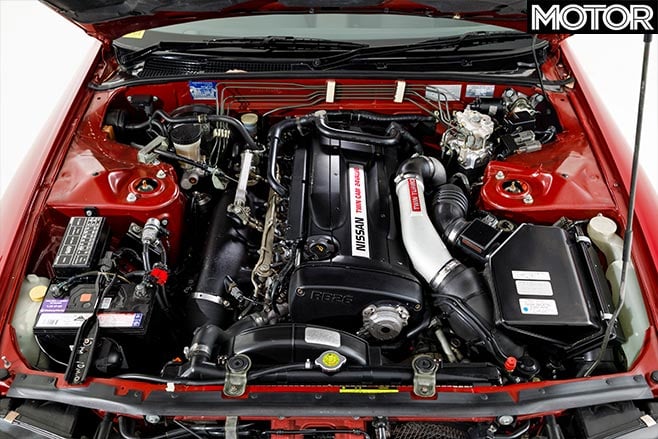
The GT-R with its twin turbochargers and aging components is not something the home mechanic can ‘fix up’ on weekends. Avoiding big repair bills is best achieved by choosing a car – local or used import – that comes with recent service history. If the turbochargers haven’t been replaced or there’s no evidence of servicing at least every 5000 kilometres, assume major work will shortly be needed, and pay accordingly. White exhaust smoke indicates oil being burned in the turbochargers. Check under-bonnet hoses and plastic components for perishing and heat damage and the cylinder head for oil leaks. Rapid standing starts hurt the clutch which costs more than $1500 to replace. Listen for clunks from rear drive-shafts or the differential.
SUSPENSION & BRAKES
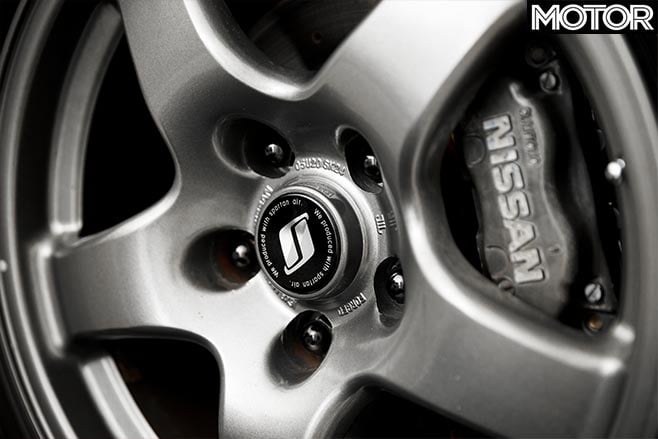
Check that the HICAS four-wheel steering and ABS are still operating. Many GT-Rs travel minimal distances but shock absorbers, bushes and brake components still deteriorate due to age alone. Re-kitting wheel cylinders and the booster, changing hoses and standard pads will cost more than $1500. Standard brakes fitted to GT-Rs weren’t really up to the cars’ potential and a lot will have later, larger rotors and calipers. Rotors warp due to excessive heat and pulse through the pedal. When new these cars sat high with at least a hand-depth of clearance between the tyre and wheel-arch. A car that sits noticeably nose-down or unevenly may have had its springs shortened.
INTERIOR & ELECTRICS
The GT-R interior is basic but trimmed in quality materials so a well-kept car should be on its original seats with minimal deterioration to the cabin plastics. Cars that began their working lives overseas can show wear to the seat bolsters but avoid any car that shows low kilometres and a trashed interior. The odometer will have been ‘fiddled’ or replaced. Age can afflict electrical components as well, so a full check of every switch and gauge is recommended. The air-conditioning should activate with an audible click and send a stream of cold air through the vents within 20 seconds.
IMPROVING THE BREED
Save yourself a small fortune by buying a heavily modified R32 GT-R from the get-go if you’re interested in tuning one. Modified examples outnumber stock ones by a big margin just because a whole universe of modification exists – a topic that could easily fill an entire magazine (and has), with it being so easy and relatively cheap to extract more performance from the R32 GT-R.
Nissan Skyline GT-R (R32) Body 2-door, 4-seat coupe Engine 2568cc inline-6, DOHC, 24v, twin-turbo Power 206kW @ 6800rpm Torque 355Nm @ 4400rpm Transmission 5-speed manual Used Range $40,000-$150,000
Other options you may consider
1. Mitsubishi 3000GT VR4 Turbo Doesn’t drive as well but less money, rarer and weirder. A 3.0-litre east-west twin-turbo V6 sent 210kW through an all-wheel drive system and there was all-wheel steering, adaptive dampers and even active aero. 117 officially sold in Oz.
2. Porsche 911 Turbo (996) As we wrote this, a mint ADM R32 GT-R was for sale at Dutton Garage, Melbourne, for $150K. If you’re spending that much, you must consider Porsche’s early-2000s 309kW twin-turbo flat-six rocket. Clean manual examples for around $100K.
3. Nissan 200SX (S15) Not as special, but same compact, Nissan 1990s-ish turbocharged sports car feel, and yet newer, safer, lighter and possibly more fun. Rear-drive, turbo 2.0-litre inline-4, 147kW and easily tuned (although don’t you dare). These days $30K for a clean example.
We’ve all been there. Trying to make a bad idea good is something most of us experience every day. It never starts out as a dumb idea, of course, but as we learn more, the seed of doubt is planted. From there, we create ever more tenuous justifications before finally admitting defeat. It’s tempting to think of the original Hyundai Veloster as that bad idea. It was a lukewarm front-drive coupe with two doors on one side and one on the other and, to be honest, was never a particularly great car.
Here’s the odd thing, though. As mundane as the Veloster’s execution sounds, it was hugely successful. Its biggest market was the US where it sold a total of 169,411 units between 2011 and 2017. By contrast, in the same market for an equivalent duration from launch, the Toyota 86 found 72,762 homes. Add the Subaru BRZ and Scion FR-S versions and the total creeps up to 106,580. The Mazda MX-5 shifted 51,854. Therefore, it goes without saying that in terms of cash through the front door, the second-generation Veloster has a lot to live up to.
Given the fact that Hyundai now has one of the best vehicle dynamics teams in the business, responsible for developing the impressive N-badged sports models, it’s fair to say that our expectations of this latest Veloster had been ratcheted up a bit. Not through the roof, though, as we don’t get the full-on Veloster N here in Oz given it’s left-hand drive only. That car has proven such a hit in the US that it walked away with Road & Track magazine’s prestigious 2020 Performance Car of the Year award, beating the likes of the BMW M2 Comp, Lamborghini Huracan Evo and Porsche 911 Carrera S. You can’t do that with mediocre underpinnings.
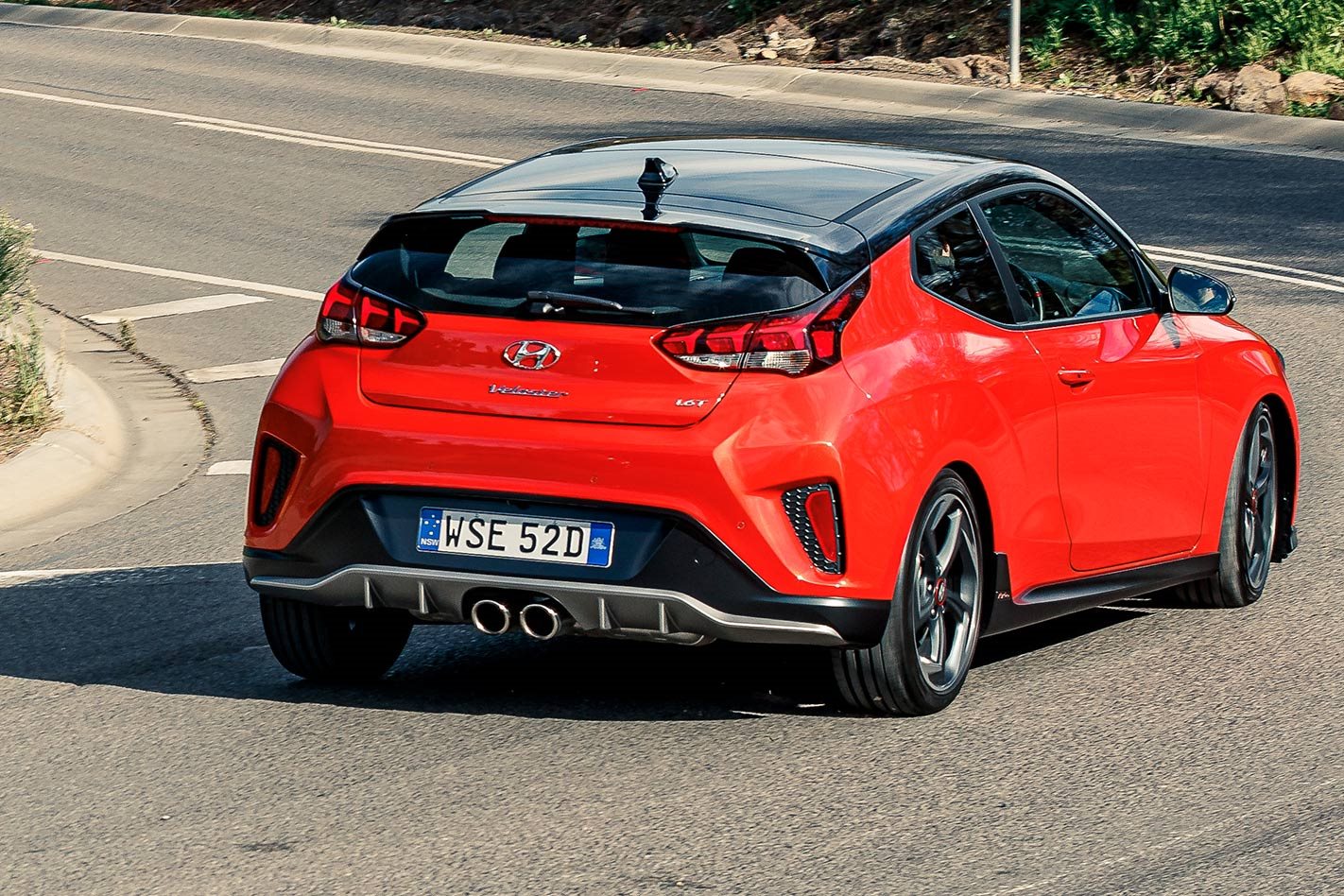
We’ve plucked the model that now sits at the top of the Veloster range, the $42,410 Turbo Premium, fitted with a seven-speed dual-clutch transmission and justifying its three grand premium over the regular Turbo with the addition of 18in machine finished alloy wheels, leather seats, rain-sensing wipers, a heated steering wheel, a wireless phone charging pad, a glass sunroof, heated and ventilated front seats and the option of a contrast colour roof.
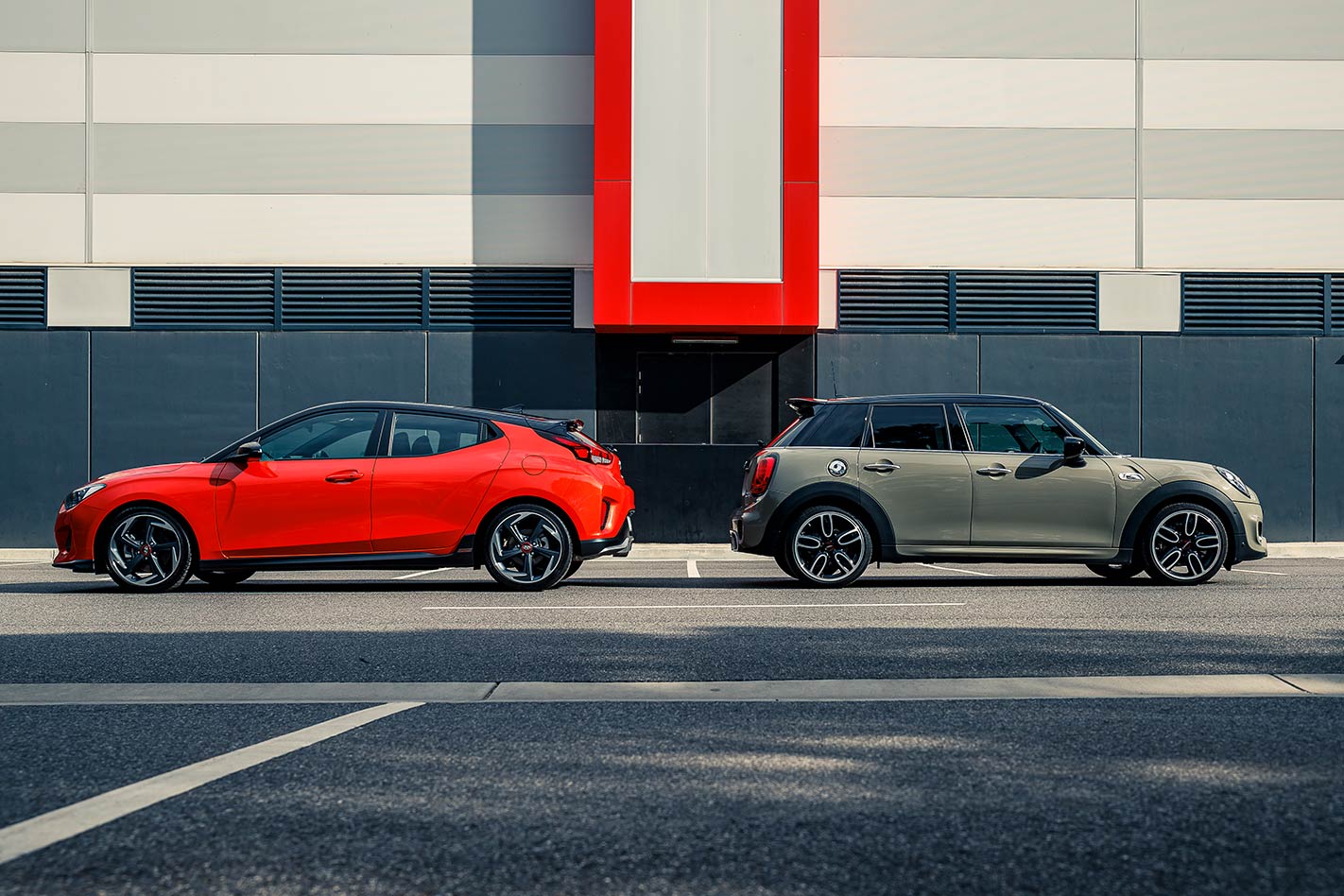
There’s little doubt that in this Tangerine Comet paint finish and Phantom Black roof the Veloster looks striking, but is it really $12,370 more desirable than the mechanically identical i30 N-Line, which fronts up with the same 150kW/265Nm 1.6-litre turbo and DCT gearbox combo? That’s a tough one to wrap your head around.
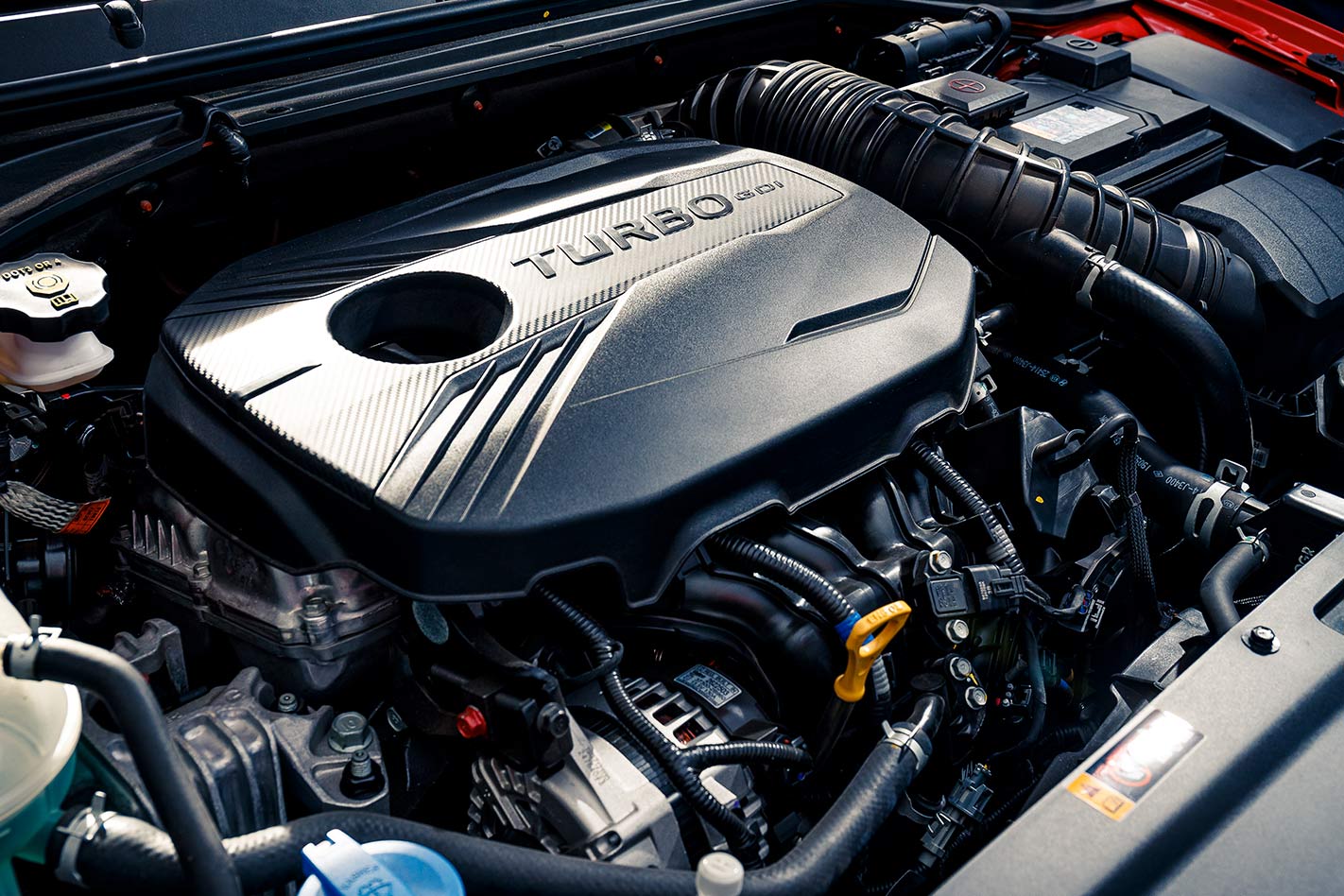
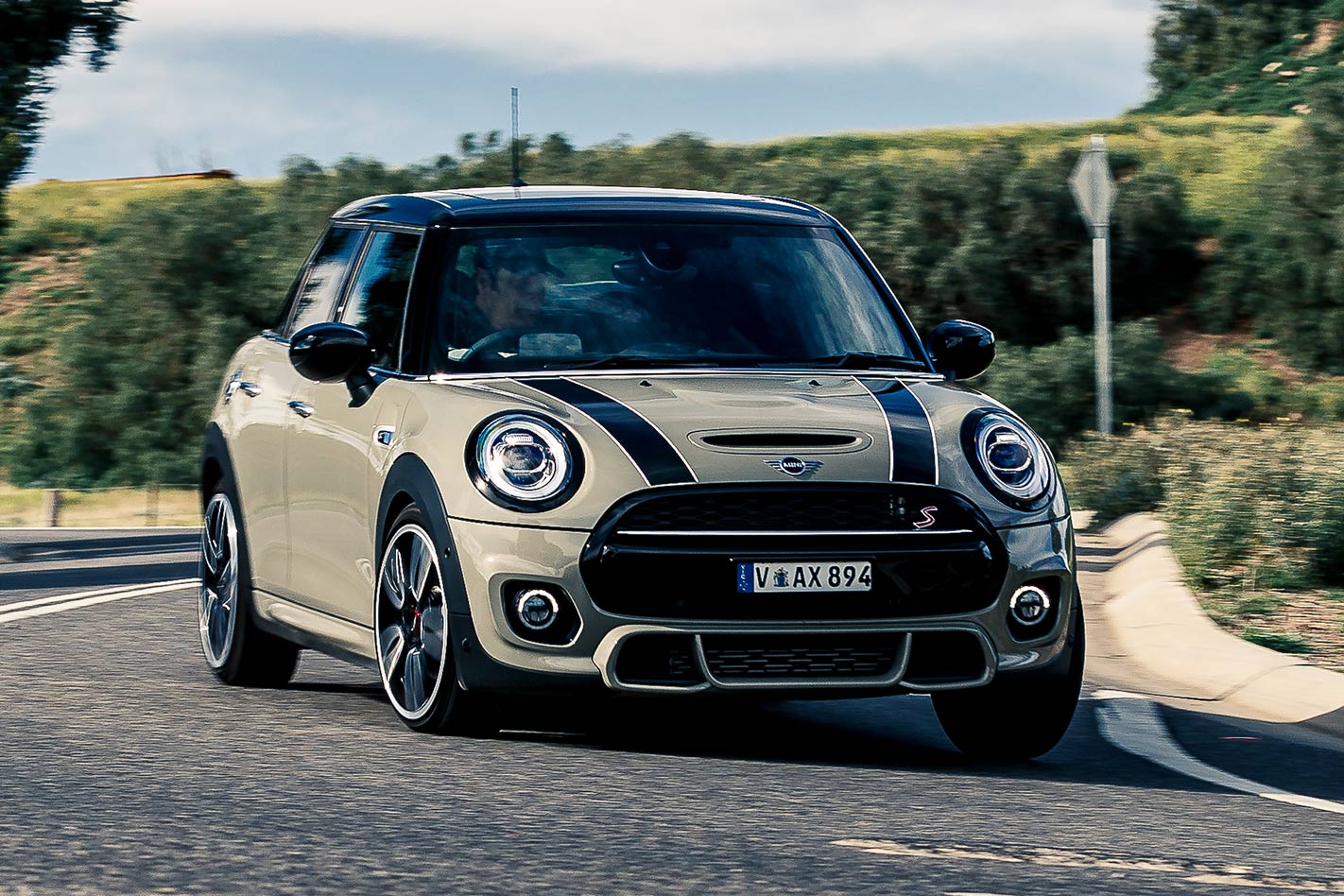
There’s also the thorny issue of a rival, given that the Veloster operates in a class of one. Easing the belt buckle out a little in terms of definition, we settled on another style-driven choice, that’ll also appeal to those who fancy a sharp steer – the $45,250 Mini Cooper S five-door. Despite packing a bigger 2.0-litre engine, it’s down on the Veloster’s power output at 141kW, although it makes amends with 280Nm arriving at just 1250rpm. And that torque figure also steps up to 300Nm with a transient overboost facility. The Veloster’s 1.6T-GDi turbo lump does overboost to 275Nm, but you’ll need to be at 4500rpm to feel the full benefit. In short, cubes count when it comes to torque. Advantage Mini.
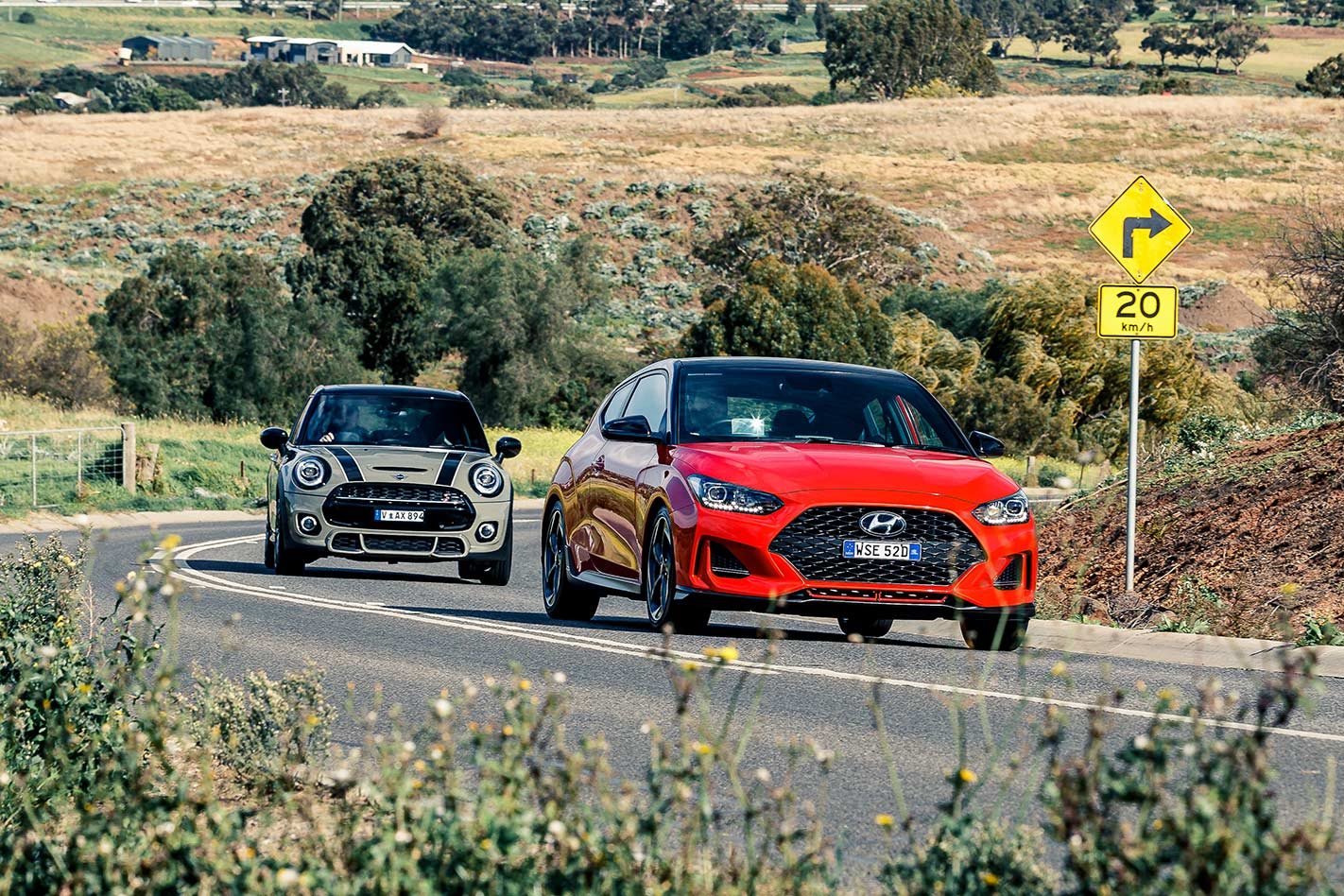
That instant impression of muscle translates to the feel as soon as you start the Cooper S. The engine note is surprisingly deep, the steering is ultra-alert and the throttle mapping in Sport mode makes the Mini feel immediate and vivacious. There’s heft in the steering, the brake pedal feels reassuringly punchy and despite its wheelbase being an extra 72mm longer than its three-door sibling, it retains that kart-like point and squirt ability.
The Hyundai feels a little more measured in its low-speed composure. The steering’s slower, but it feels accurate and more consistent in its weighting. The throttle is smooth in Normal mode, but there’s an unpleasant low-rev hunting in Sport, as if the calibration of the map is stepped in units of ten rather than single digits. There’s also an odd acoustic signature below 3000rpm, where the engine makes an almost electrical whine.
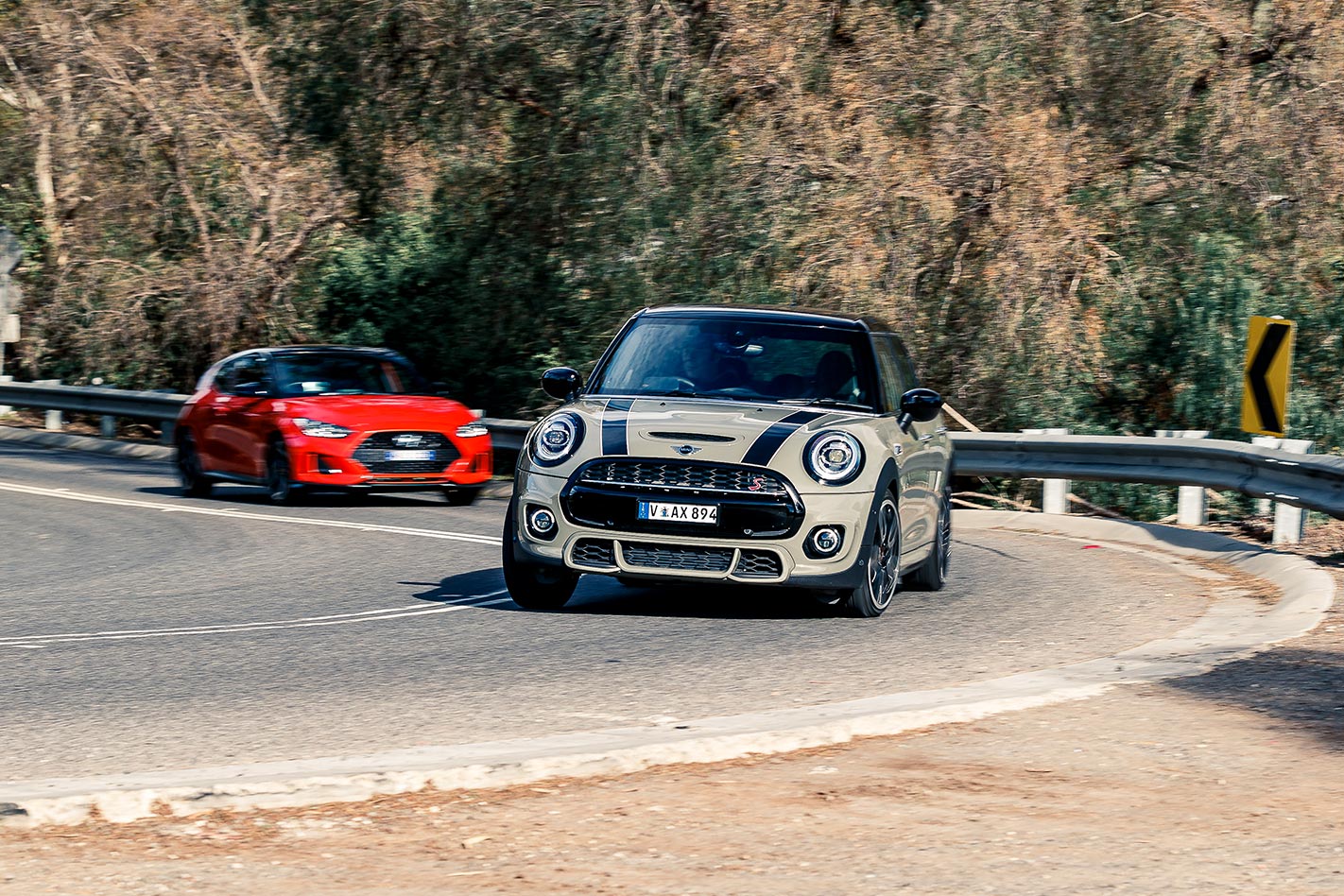
Find a decent road and the Mini’s early wins evaporate. The 205/40 R18 Pirelli Cinturato P7 tyre is in no way a match for the bigger and better 225/40 ZR18 Michelin Pilot Sport 4 on the Hyundai, and the Veloster offers a far crisper, grippier front end, which is exactly what you’re after in hottish front-wheel drive hatches. The Mini, by contrast, lapses disappointingly early into scrappy understeer, with inconsistent steering weighting doing it no favours mid-corner. In essence, the Cooper S feels the sharper car up to about six- or seven-tenths, after which the Hyundai’s chassis shows its colours. And they’re excellent.
Really lean into a corner and there’s bags of grip on offer, and only by pouring on everything the four-pot has got mid-corner can you elicit a sniff of torque steer. Understeer? At typical road speeds, it’s noticeable by its absence and even on challenging roads common sense usually intervenes well before the stability control does. Switch out the electronic guardians and the rear can be teased into mobility like a previous-gen Megane Renaultsport.
The brakes, which feel sharply overservoed at first, are enormously reassuringly when called upon to perform from high speed, momentary squeals from the front hoops letting you know how close to threshold the ABS is keeping things.
Tyre noise is the dominant sound when cruising, and the firmish suspension doesn’t transmit too much bump and thump into the cabin. It’s an easy car to drive by ear using the small plastic wheel-mounted paddles. There’s not much point revving it to over 6000rpm, but in the upper reaches there’s a delicious mechanical vibe through the brake pedal. It feels alive.
The Mini, thanks largely to its cheaper tyres, has something a little moribund about it when pushed. It’s a dogged understeerer that never particularly enjoys a throttle lift to tighten the line neatly. The brakes feel strong and the pedal is beautifully calibrated, with easy modulation. Mid-corner bumps can spur the ESC into some fairly clumsy stabs to keep things in shape, and the seven-speed dual-clutch transmission is a bit bossy, often taking over even when in manual mode if it feels you ought to perform an up or downshift. It’s a bit of a shame that a car that wears the Cooper badge and is laden with Cooper S Works options still feels superficial in its dynamics, but much could be fixed with the simple spec of more focused rubber.
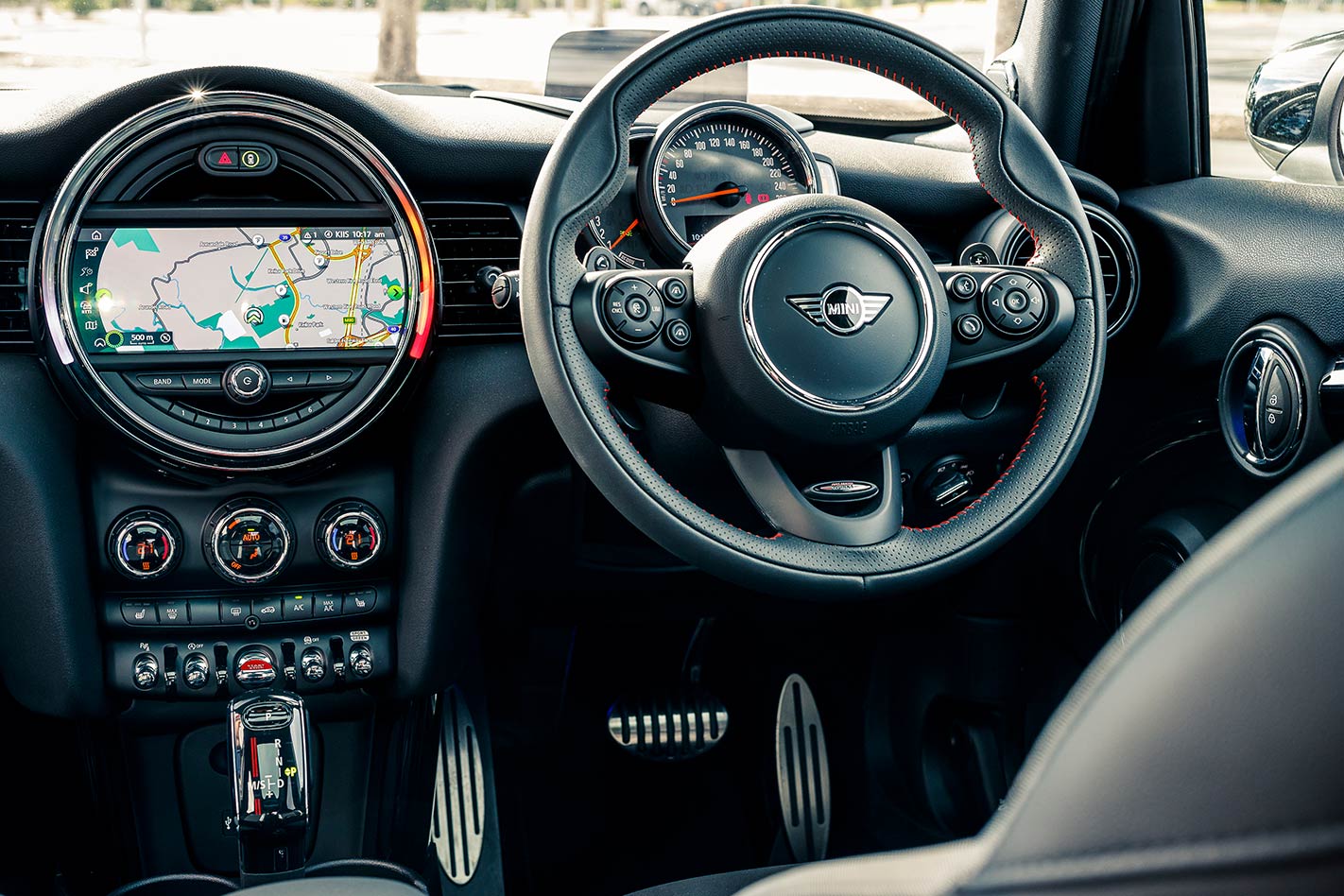
Where the Cooper S scores a decisive victory over the Hyundai is in its interior execution. It feels like a $40K+ car, whereas the Veloster’s hard plastics and slow touchscreen feel a good deal cheaper. Neither the low-set passenger seat nor the seatbelt reel are height adjustable and shorter passengers won’t enjoy the way the Veloster’s belt chafes on their necks.
This is a boutique sector and Mini seems to understand this a whole lot better than Hyundai. In reality, the Hyundai’s controls and screens are easier to use than the Mini’s cluttered array of toggle switches, rotary dials and buttons, but the materials quality inside the Cooper S is leagues better.
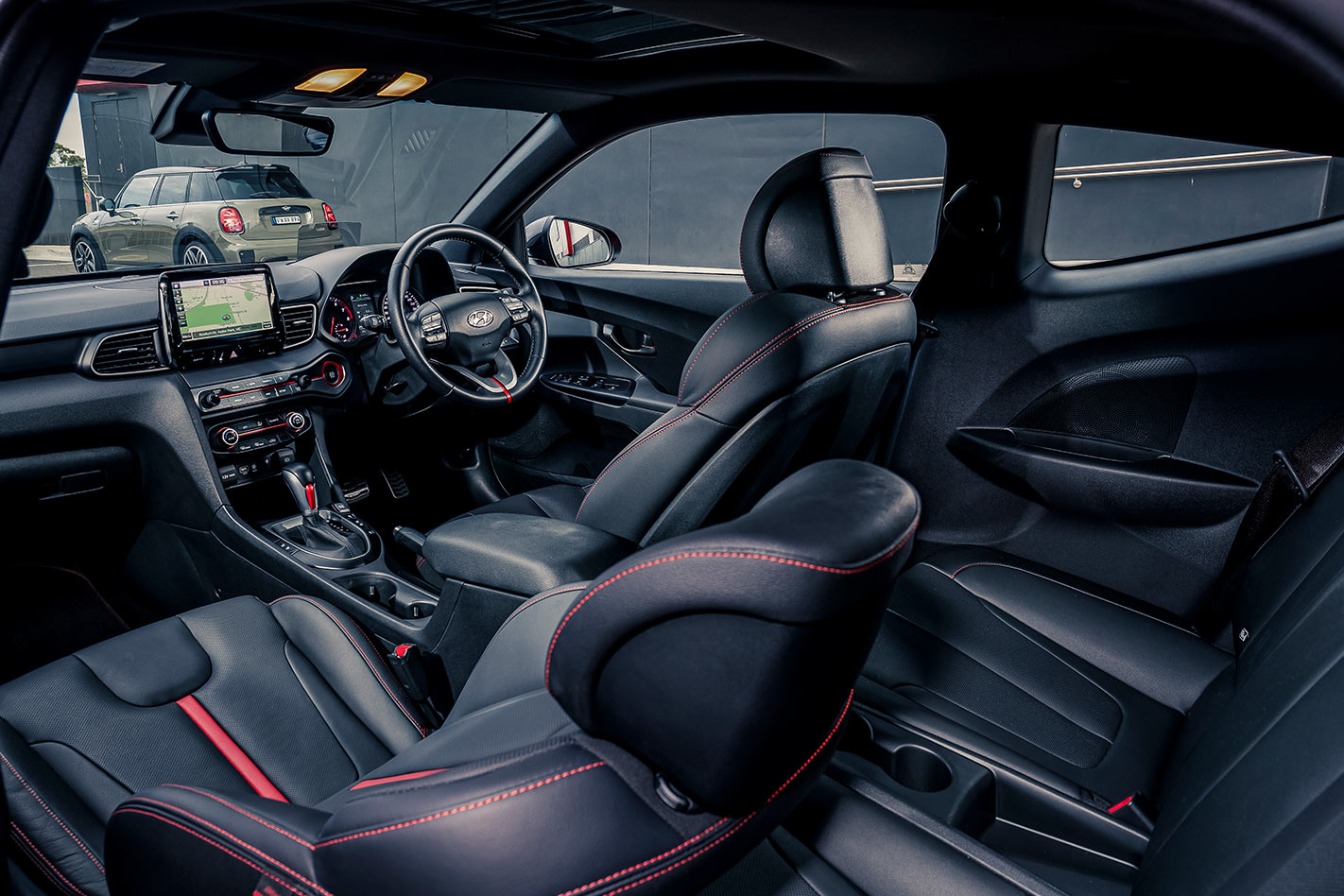
Some of that is down to options spend, but the head-up display is better in the Mini, the Alcantara and technical materials of the JCW seats are beautifully done and the rear view camera system is far better resolved.
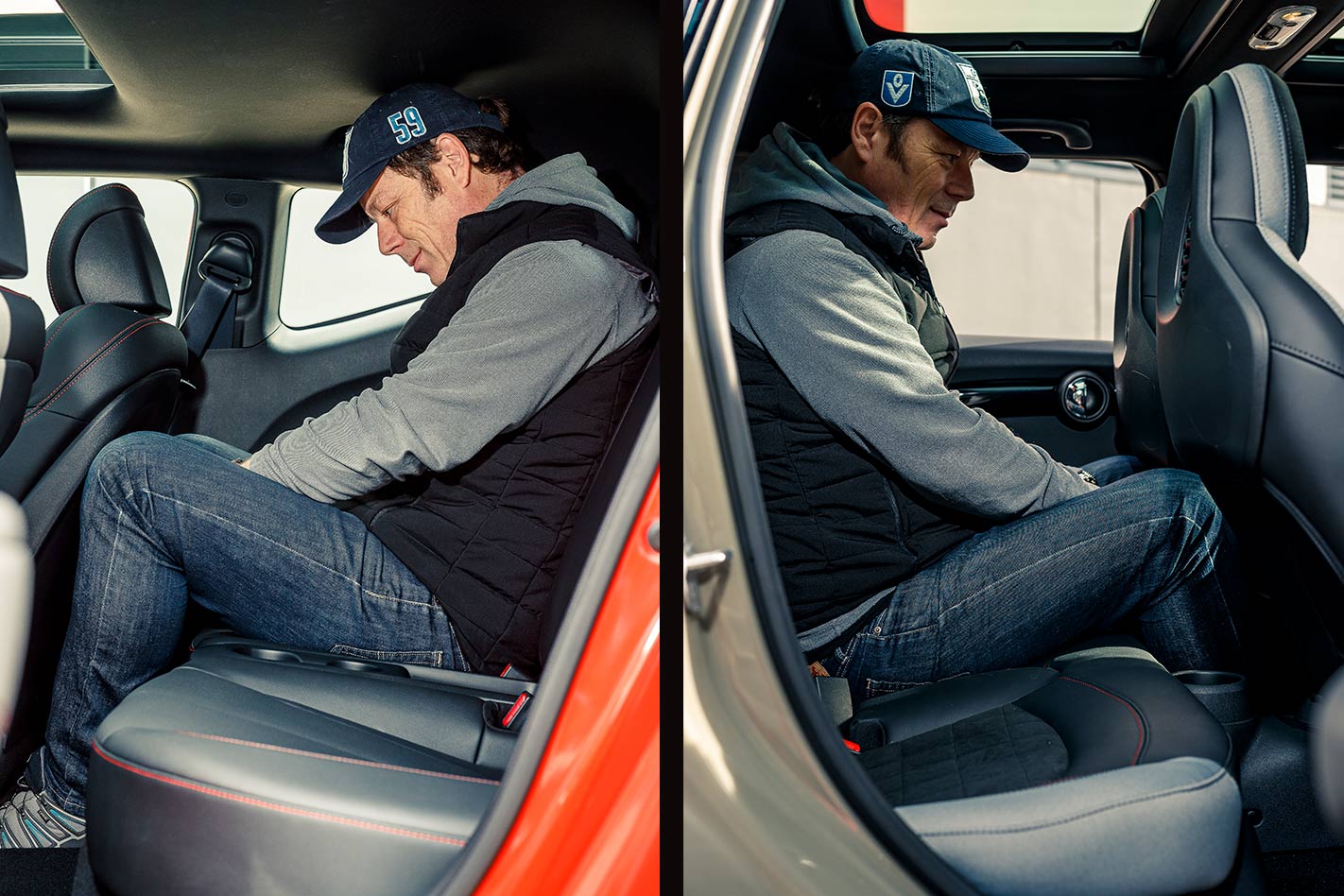
It’s better in the back of the Mini, too. Aside from the fact that you can access the rear seats from both sides of the vehicle, there’s more head- and legroom in the Mini, although the trailing edge of the rear sunroof in our test car couldn’t have been more inconveniently positioned. The Hyundai is a good deal more claustrophobic in the back, with a rising windowline, a low-mounted bench which only seats two compared to the Mini’s three, and – like the Mini – there are no air vents or USB ports.
As a driver’s car, the Veloster is a revelation. It makes 150kW feel like all you’d ever need on the road to have fun. In that respect, it scores a decisive victory over the Mini. To this eye, it also looks a good deal more purposeful than the slightly ill-proportioned Brit.
But the Hyundai also feels as if it’s struggling to justify its price tag. For much the same price, you could buy the Hyundai i30 N, a car that’s superior in a whole host of regards. The Veloster will doubtless succeed, but this range-topper feels as if it has exhausted its brand equity somewhat at $42,410.
Mini, on the other hand, retains a laser-like focus on both the demands of its customers and, perhaps more crucially, their willingness to pay. They want a car that feels alive and cheeky in town, appears a genuinely chic, premium proposition inside, and has that feel-good factor of BMW’s badge behind it. That’s why it gets the win here, by the narrowest of margins. Ultimately, the quicker, more economical, more spacious, better-finished car squeaks the decision. But should you care to look past the Mini’s design-led artfulness, the Veloster has finally delivered the dynamic substance it so sorely lacked before.
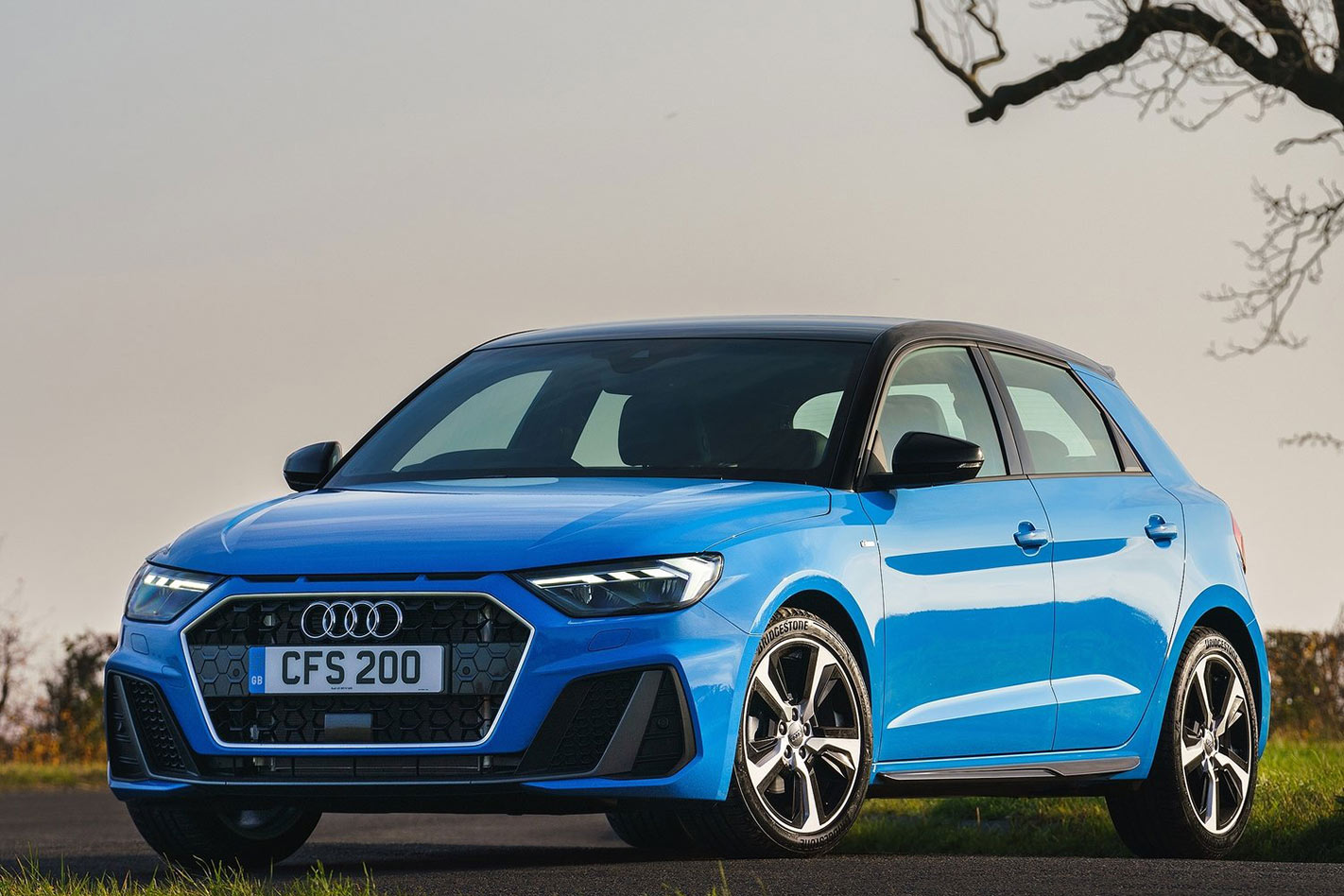
THE RIVAL: AUDI A1 40 TFSI ($46,450)
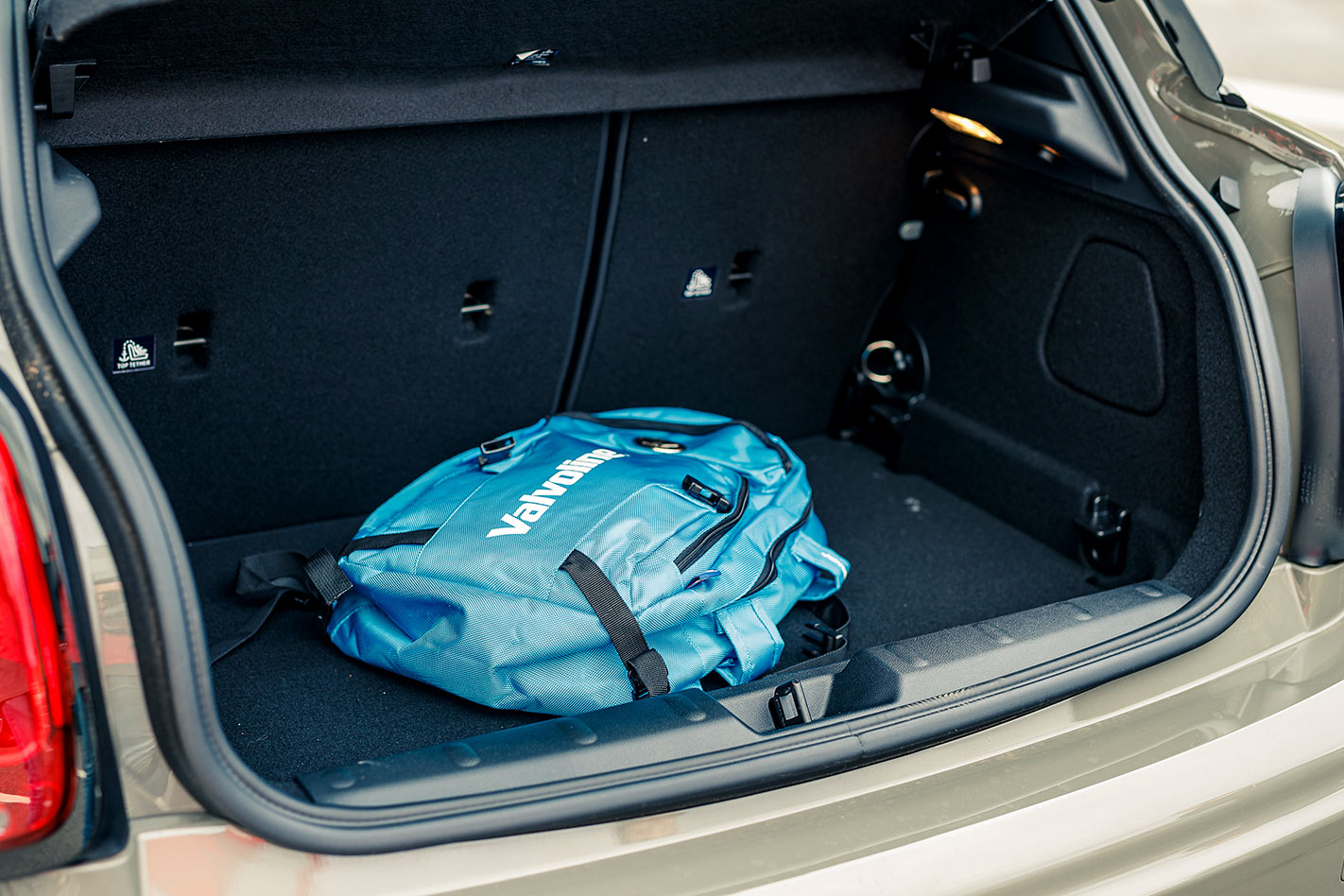
So you have around $45K burning a hole in your pocket and want something chic, a bit sharp to drive and which offers more than just a faint waft at practicality? Truth be told, the market’s not chockers with alternatives. Audi’s baby brawler, the A1 40 TFSI is one to consider, though. It sticks 147kW into a pared-back package with crisp styling, a 6.5-second 0-100 sprint, and a 335-litre boot. That’s better than the Veloster’s 303 litres or the Mini’s 278. Its three-year residuals of 61 percent are hard to ignore, too. By contrast the Mini retains 50 per cent and the Veloster 54 per cent.
MINI COOPER S 5-DOOR HATCH SPECS
Engine: 1998cc 4cyl, dohc, 16v, turbo
Max power: 141kW @ 5000rpm
Max torque: 280Nm @ 1250-4750rpm
Transmission: 7-speed dual-clutch
L/W/H/WB: 4005/1727/1425/2567mm
Weight: 1240kg
0-100km/h: 6.8sec (claimed)
Economy: 6.4L/100km
Price: $45,250
On sale: Now
HYUNDAI VELOSTER TURBO PREMIUM SPECS
Engine: 1591cc 4cyl, dohc, 16v, turbo
Max power: 150kW @ 6000rpm
Max torque: 265Nm @ 1500-4500rpm
Transmission: 7-speed dual-clutch
L/W/H/WB: 4240/1800/1399/2650mm
Weight: 1350kg
0-100km/h: 7.1sec (claimed)
Economy: 6.9L/100km
Price: $42,410
On sale: Now
Someone bought a 1988 BMW E30 M3 for AU$350,000… over the internet.
In the USA, where the car was sold, that’s a quarter of a million US dollars. Granted, the car only has 8000 miles showing, but it’s still a lot for a boxy ‘80s coupe, iconic as it is.
But in general, it seems that the COVID world of distancing and lockdowns has caused a shift in the premium and classic car market.
1986 BMW E30 M3: Legend Series

A particularly telling example is the online auction site Bring a Trailer, which has always been an interesting market for oddball or affordable classics. But it’s never really been quite like it is now.
Where a highlight of the front page used to be something like a tidy, single-owner 911 or a time-capsule 1970s muscle car selling for six-figures, the list as we write is far more than that.
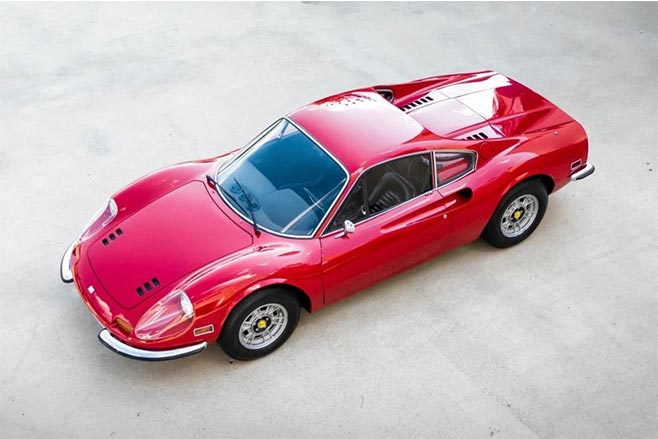
Just as a few examples: a 1972 Ferrari Dino 246 GT currently for US$235k; a ’72 BMW 3.0 CSL 3.5-litre asking $115k; a 2014 SLS AMG GT roadster for $110k; a 2019 Aston DBS Superleggera; a US-delivered ’88 Carrera Club Sport; a single-owner ’05 NSX; a 2006 Ford GT with 160 miles showing; a Testarossa with 18k miles… the list goes on.
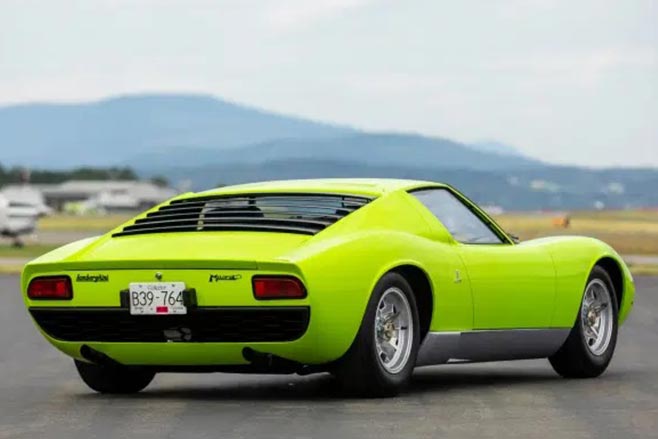
If that’s not enough, we recently saw the sale of a Lamborghini Miura, one of the all-time great supercars and not one to purchase on a whim, for just shy of US$1 million. It sold for AU$1.38m in our money.
A quick query to some colleagues, including our classified-hunting friends at Unique Cars, suggests the rise in premium sales happening over the web has indeed kicked off significantly due to lockdowns globally and the subsequent lack of live auction events.
We’ll certainly be keeping an eye on future auctions to see what the market does next.
Get your free weekly MOTOR report!
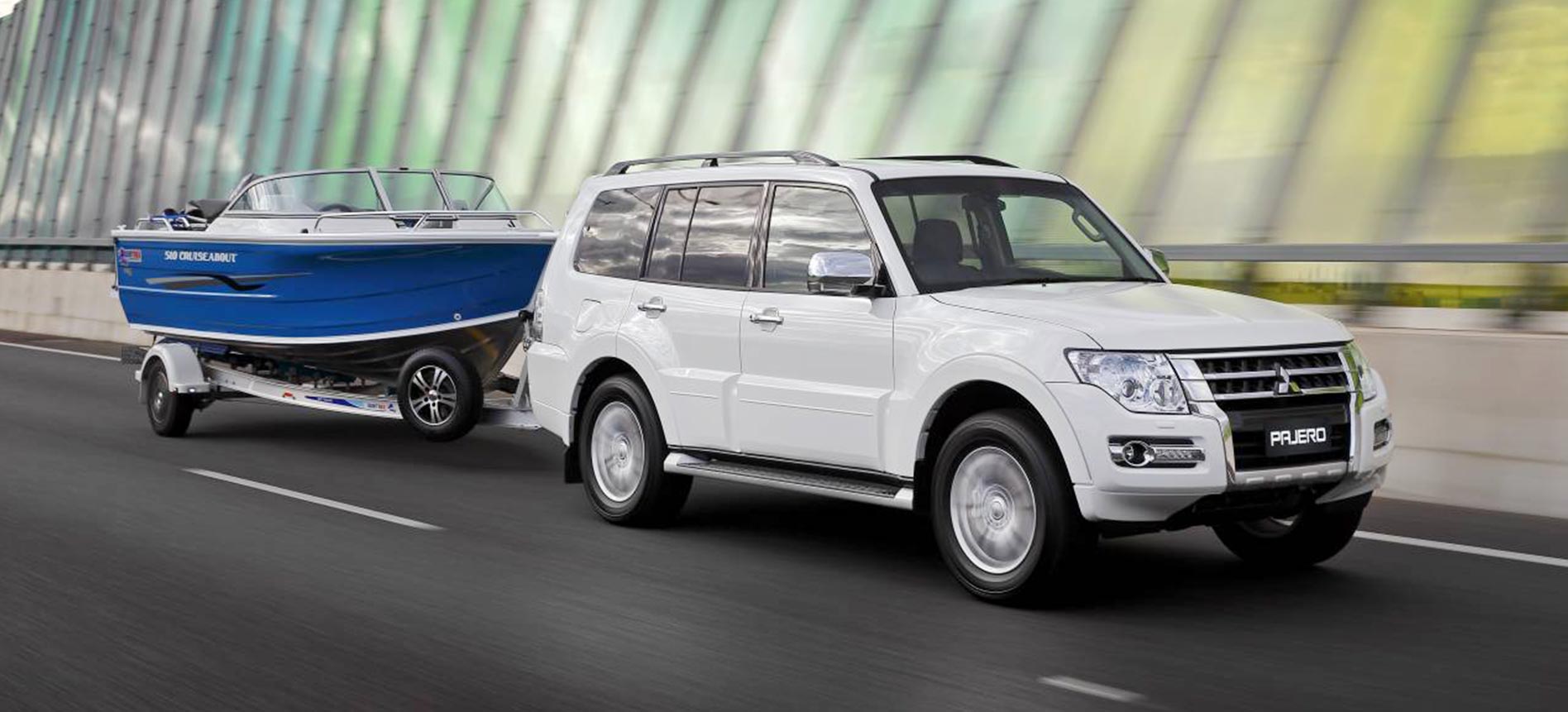
It’s one of the oldest cars in an old line-up, but the Mitsubishi Pajero’s luck has finally run out.
The large 4×4 – long a mainstay of the company’s local arm, has finally reached the end of the road after Mitsubishi announced it will close the plant that builds it early next year.
The company announced in 2018 that the Mitsubishi Pajero – also known as the Shogun in other countries – would leave the Japanese market that it had served for so long, but exports would continue.
However, as Mitsubishi cuts costs across its portfolio, economic reality has finally won the day.
A board meeting resolved to close the Sakahogi plant in Japan, where some 63,000 cars were built last year.
Other Mitsubishi products made in the plant – including the Outlander – will be moved to a newer facility in Okazaki, but mooted plans to replace the Pajero with a unibody large SUV in partnership with the next-generation Nissan Pathfinder from 2021 have been scrapped.
Mitsubishi – which announced that it would also withdraw from European markets – will now look to the Triton-based Pajero Sport as its offroad wagon.
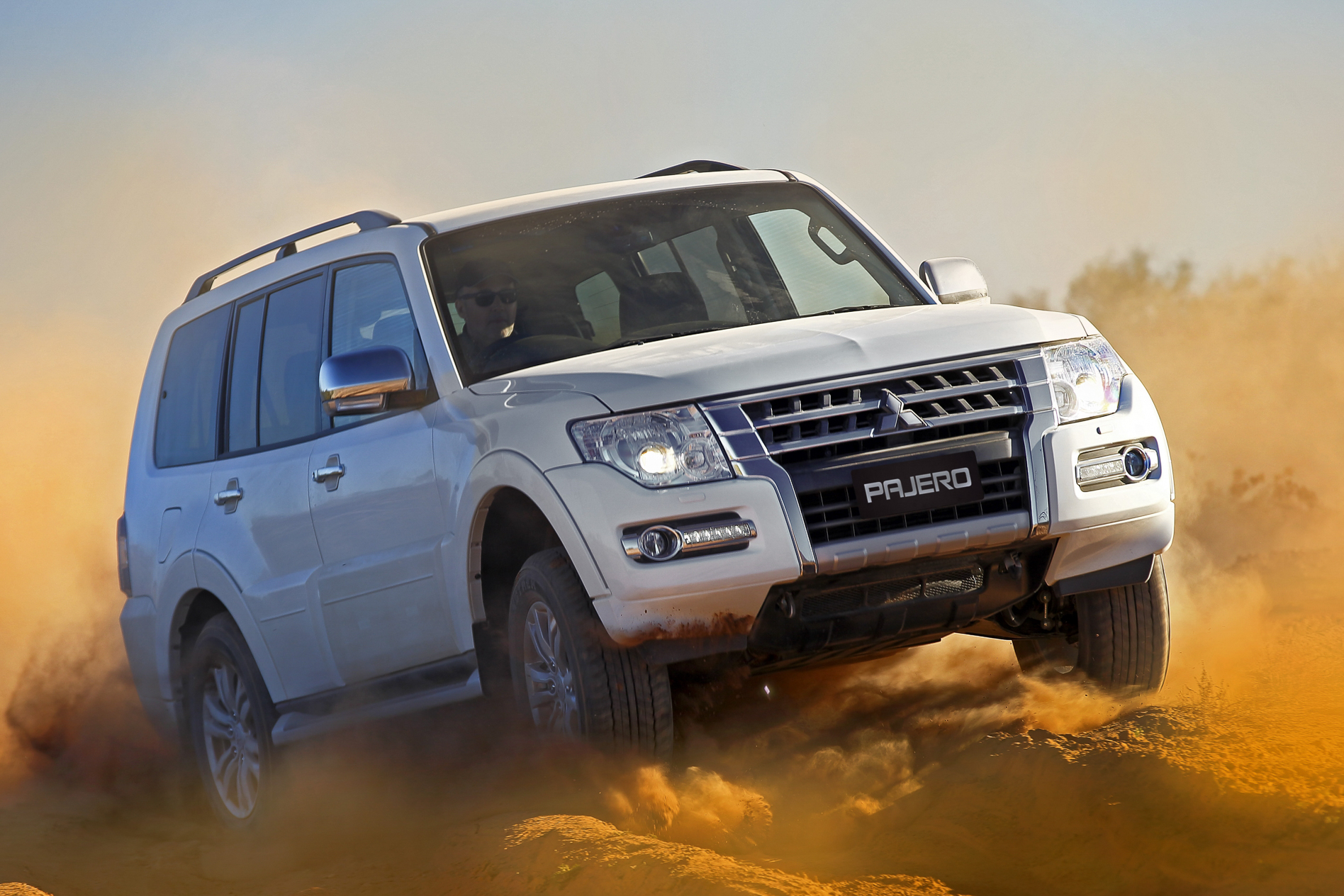
The Pajero was given an update for Australia for 2020, with a simplified 2020 line-up now comprising of the base-model GLX at $53,990 and the upper-spec GLS at $59,490, the latter getting a Rockford Fosgate 12-speaker premium audio system.
Other tweaks as part of this update include the addition of an auto high-beam function, HID headlamps with auto-levelling and headlamp washers as standard to the GLX model.
It sells less than half of the tally of its smaller stablemate, the Pajero Sport, but it’s almost outselling the much more modern Ford Everest.
Locally, Mitsubishi is in no rush to see the Pajero disappear from local showrooms; in fact, the company makes a lot of hay here with its fleet of older cars that include the popular ASX and Outlander SUVs.
A Mitsubishi spokesperson told WhichCar that the Pajero has a lot of fans in Australia.
“We understand the factory will continue to make cars until the end of the Japanese financial year, and we’ll continue to sell the Pajero as long as people want it,” the spokesperson said.
The brand celebrates its fortieth birthday in Australia in October, and the Pajero has been part of the company’s fleet in one form or another since the beginning.
The Pajero bid sayonara to its home market via a Final Edition model, which was limited to 700 units. The spokesperson wouldn’t be drawn on whether a similar Final Edition would be offered locally.
The current Pajero can trace its lineage back to 2000, with the last major update coming in 2006.
While a plan for a new Pajero to partner with Nissan’s similarly laid-out Patrol was mooted as far back as 2016, it has evaporated in the face of softening sales for both the brands and large 4x4s in general, as safety and emissions regulations become more onerous.
The Pajero’s current platform, for example, doesn’t support the addition of items like AEB and adaptive cruise control, for example, while mild hybrid systems – like in the brand’s Outlander PHEV – also need to be factored into future platform plans.
As well, continued unrest within the Nissan-Renault-Mitsubishi Alliance has put paid to a number of platform-sharing projects.
Audi’s sharper-looking, larger new A3 sedan has been detailed, with an Australian arrival slated for mid- 2021.
However, it will initially ship with older-technology engines carried over from the current car, according to Audi.
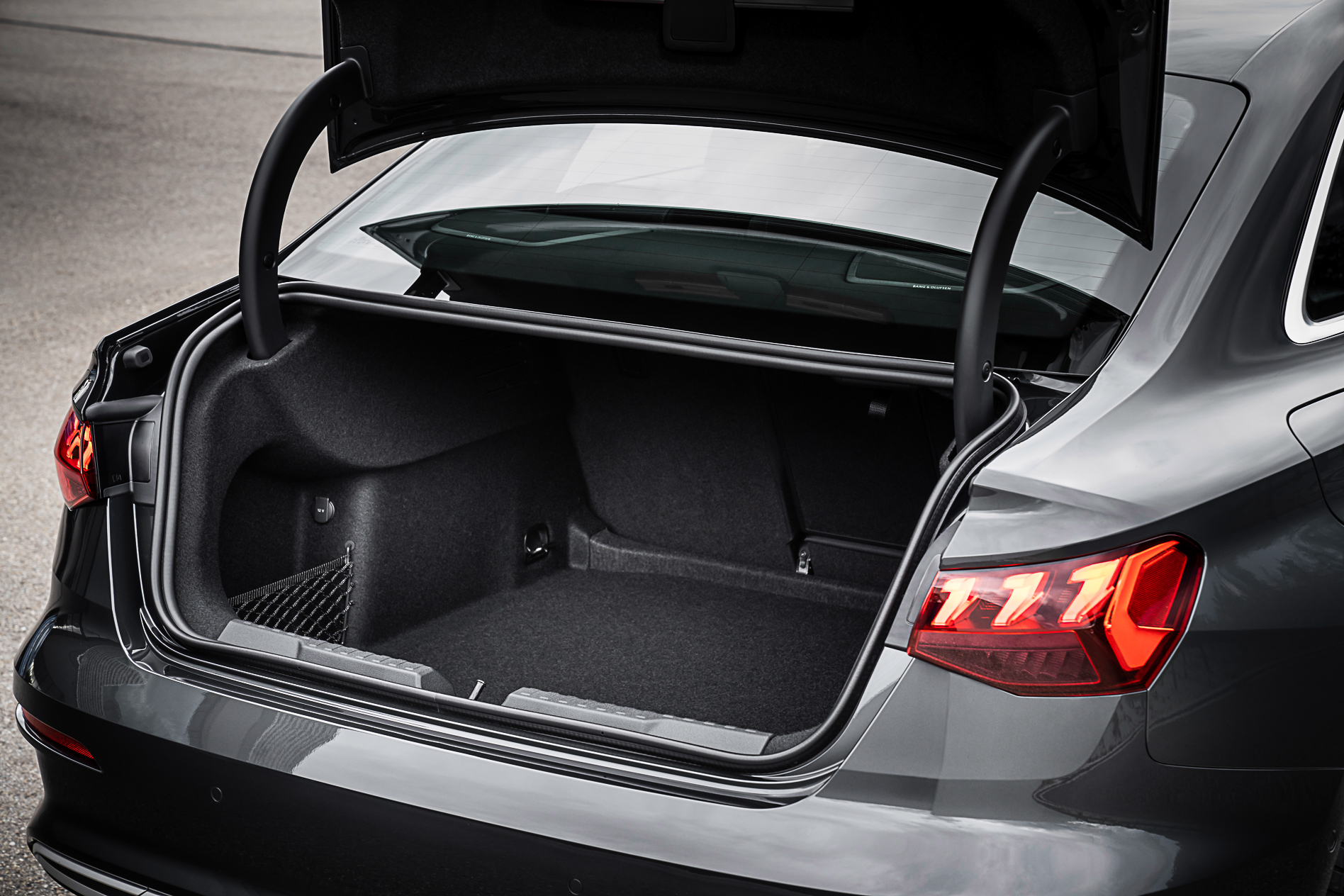
At 4500mm long, the A3 sedan is 40mm longer than its predecessor, 24mm higher and some 14mm wider. Its boot size hasn’t grown, though, still offering 425 litres.
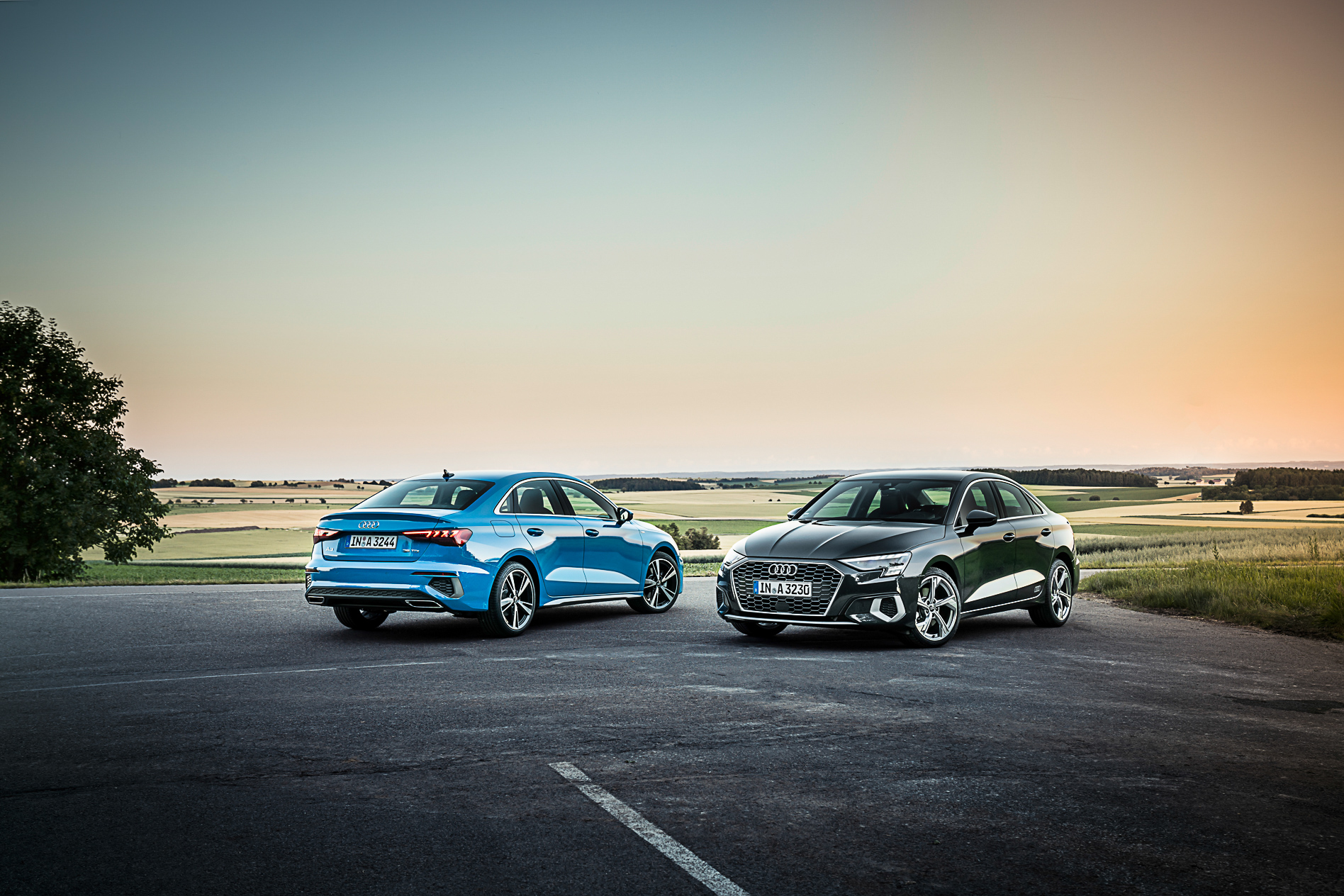
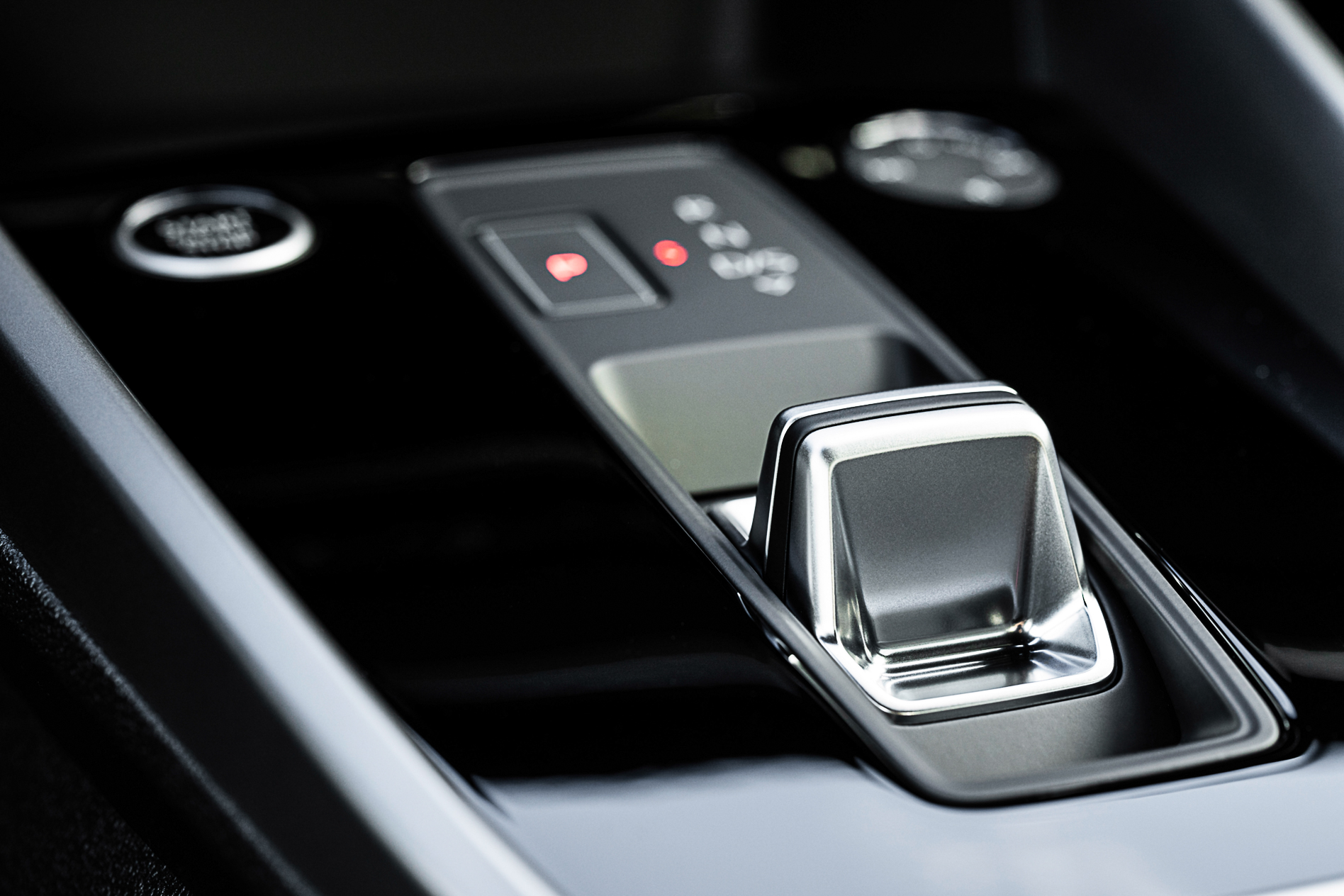
Not surprisingly, the A3 sedan mirrors the recently updated hatchback and Sportback, and will adopt the same technologies, like its 10.1-inch digital dash and adaptive cruise control assist with side recognition and stop/start function, rear-cross traffic alert and a more powerful infotainment system based around a 12.3-inch screen.
Outside, there are LED headlights and taillights, while there will be an option for 19-inch rims and larger brakes as part as a sport option.
The Audi’s MQB chassis – “it’s not just a Golf platform,” said Audi A3 project manager Juergen Kornprobst – will offer multilink rear suspension and the option of active dampers with a wider spread between active and sport tunes, and there’s a progressive steering rack up front.
All-wheel-drive versions will also score Audi’s new modular dynamic handling control system, which ties together inputs from the adaptive dampers, stability control systems and the quattro drive based on steering inputs to tweak the handling to a finer degree.
The A3 sedan will come – initially at least – with the same 110kW 1.4-litre four-cylinder turbocharged petrol engine as the most recent car.
Audi A3 project manager Juergen Kornprobst confirmed that the A3 will score a 1.5-litre version that comes equipped with the brand’s 48-volt hybrid system as well as cylinder deactivation technology that complies with Euro 6 emission standards. Australia, however, is still at Euro 5 standards.
“It’s a market-specific tune,” confirmed Kornprobst.
On sale in July in Europe, the A3 sedan is expected to arrive in Australia halfway through 2021.
A significant battery innovation is promising to shrink electric vehicle charging times to the most rapid yet achieved by any manufacturer, with a new Extra Fast Charge (EFC) battery revealed by Magnis Energy Technologies.
As a bonus, not only will a production version of the battery allow a significant step forward for EV ease of use and versatility, the new game-changing battery could have a made-in-Australia kangaroo stamped on it.
In collaboration with New York-based battery designer 4CV, Magnis has developed prototype lithium-ion cell that is far more durable and tolerant to charge cycling, allowing aggressive fast charging without the typical degradation experienced by most EV batteries.
While the very fastest EV charging times allow an 80 percent top-up in about 15 to 20 minutes, Magnis says its newest technology will allow up to 85 percent in just six minutes – not much longer than it takes to fill a petrol or diesel car.
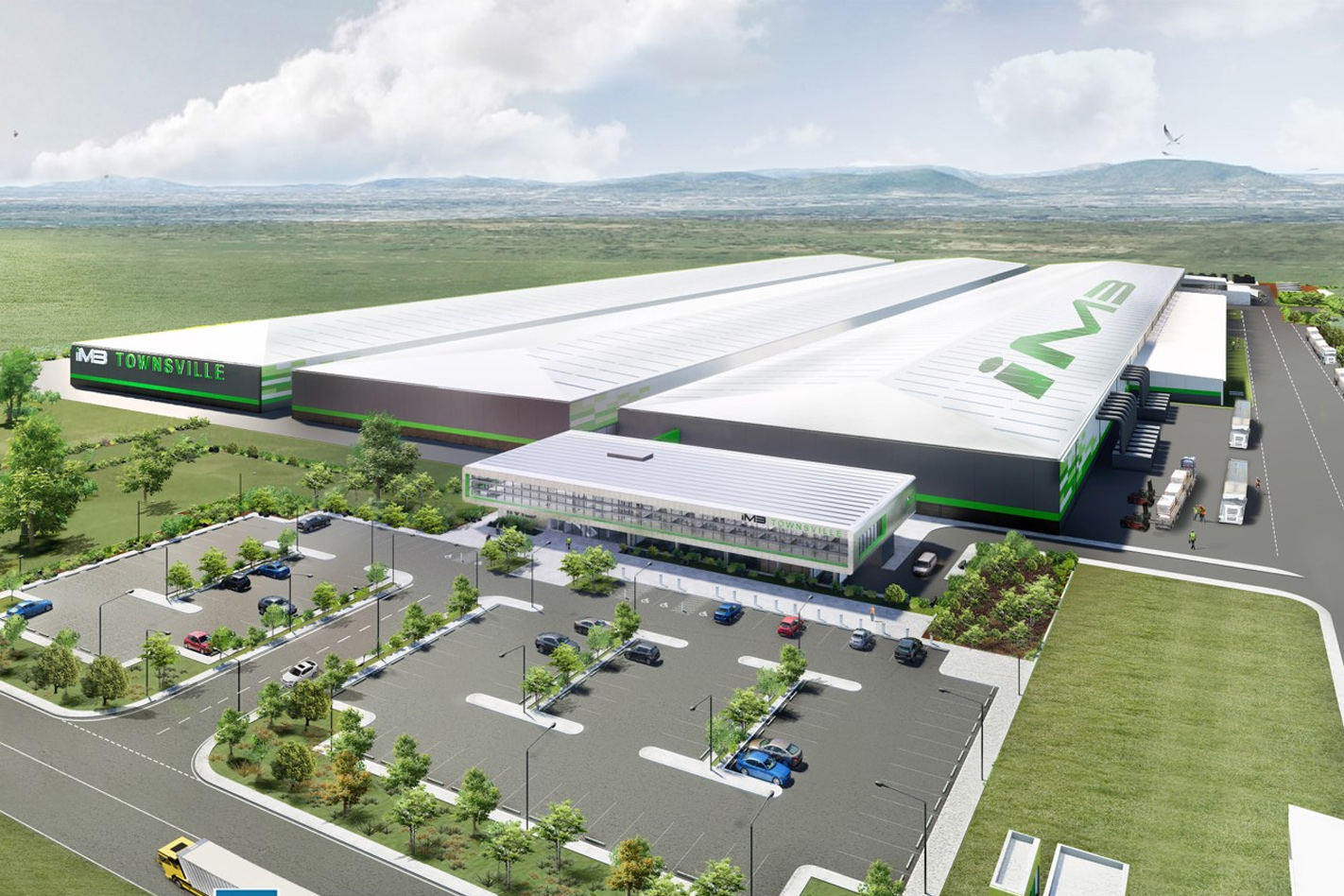
The plant is expected to cost more than $3 billion to build, and has, according to the company, the capacity to create 1150 direct jobs.
Exact technicalities of Magnis’ technological revolution are yet to be detailed but the material at is core reads like an anti-ageing serum, with bio-mineralised lithium mixed-metal phosphate used to produce cell anode and cathodes – BM-LMP for short.
Testing of the new more durable technology is currently focusing on individual cell performance and so-called ‘unoptimised’ batteries, but will be geared-up to full ‘optimised’ battery scale and a unit that can power an EV mule ‘in the coming months’.
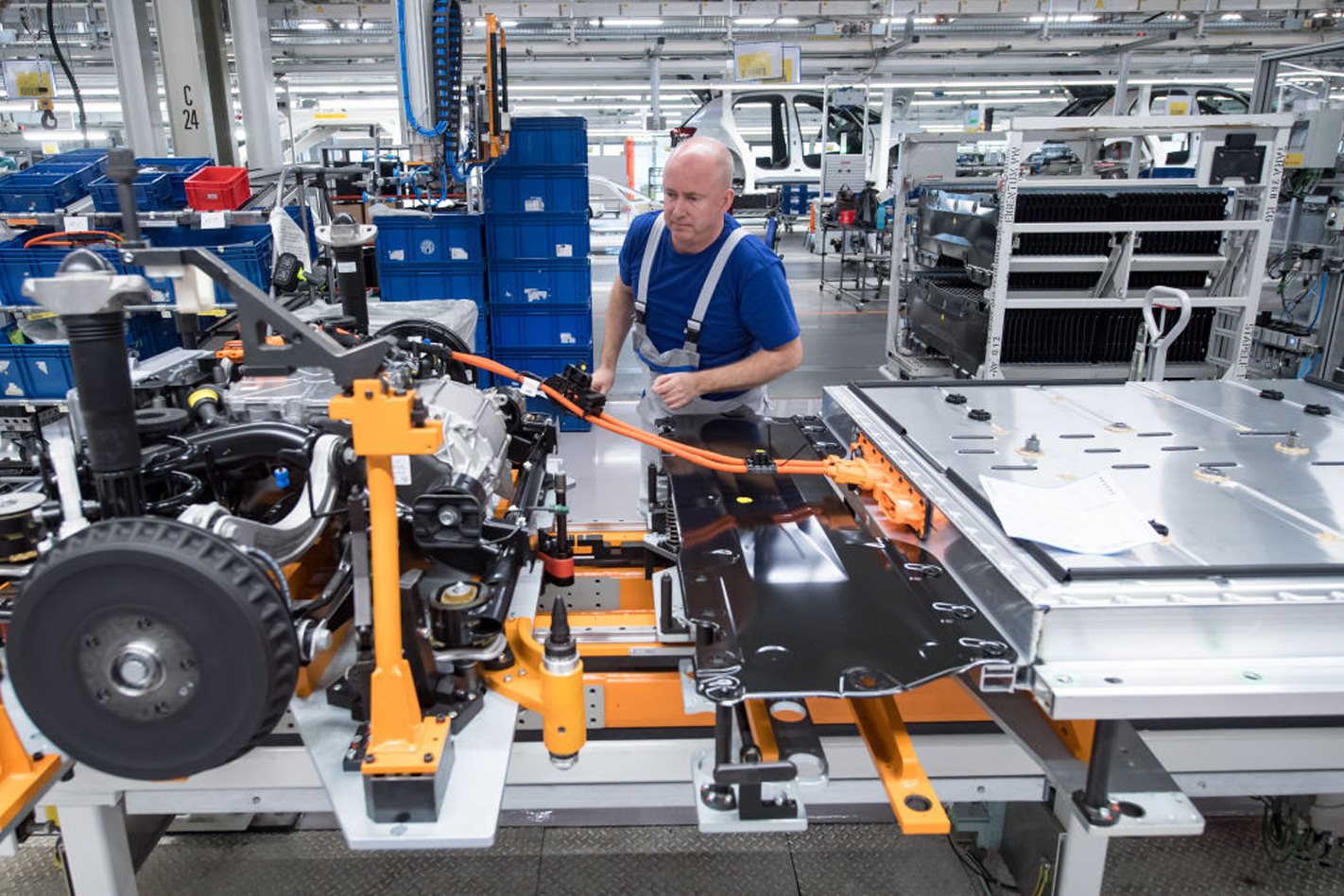
The key difference will be in the potential charging time and, if Magnis’ claims are proved, drivers of future battery electric vehicles will be able to refuel them largely as they do with today’s petrol and diesel models.
It’s the latest battery and EV power innovation in the constant advancement of EV technology. In May, Samsung revealed its own lithium-ion evolution that could potentially push single-charge range beyond 1000km, carbon capacitor technology is gaining momentum as a battery alternative, while other ventures continue to drive the cost of batteries down.
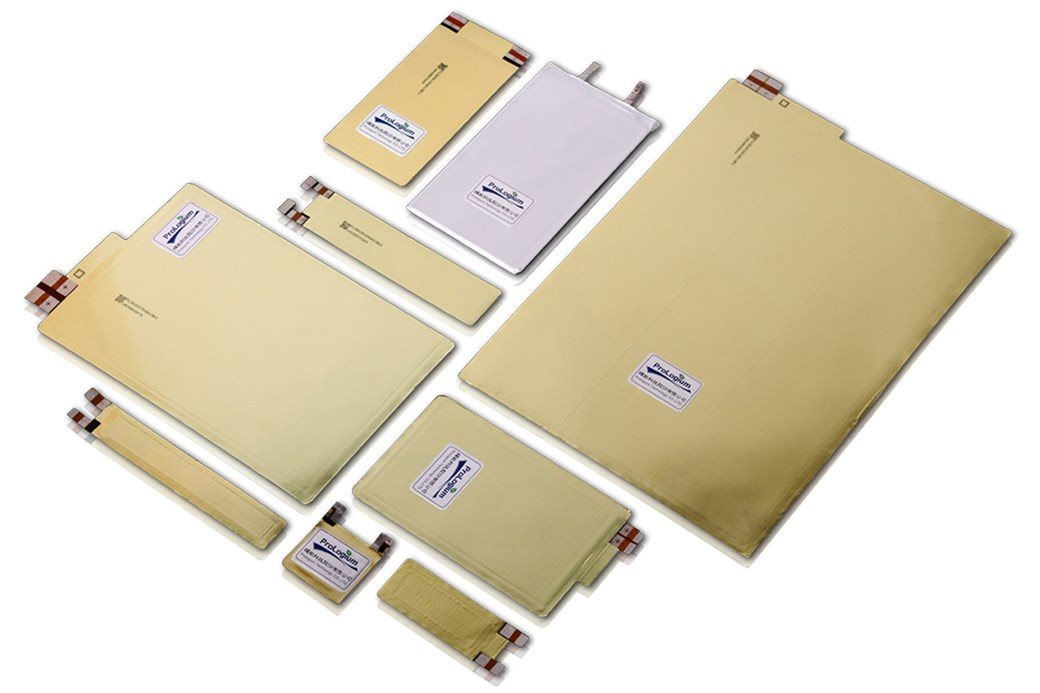
The latest revelation brings the feasibility and accessibility of electric vehicles closer and builds the case for appealing and affordable zero-emissions vehicles.Not only will Magnis’ solution allow an 85 percent charge in less than half the time the best batteries can offer on the current market, but the special anode and cathode design will also extend the battery life compared with existing lithium-ion technology.
The company is also investing in the development of sustainable lithium-ion batteries including raw material sourcing, environmentally sensitive production and ethical community cooperation.
Australia has significant lithium deposits with among the richest in Western Australia about 250km from Perth.
“This news is highly encouraging for the global battery industry and every EV manufacturer,” said Magnis chairman Frank Poullas. “To be able to charge batteries within six minutes would be a game-changer and it’s comforting to know that Magnis and 4CV are at the forefront of this and other battery technologies”.
“Ah yes, the Ford Mondeo,” nodded the industry observer with a sad smile. “Another excellent car that Ford Australia failed to market correctly. It was practically invisible!”
Think about it. When was the last time you noticed a billboard promoting a new Mondeo? Or watched a television commercial, glanced at a Google ad, or flicked past a print promotion spruiking the Mondeo’s greatness?
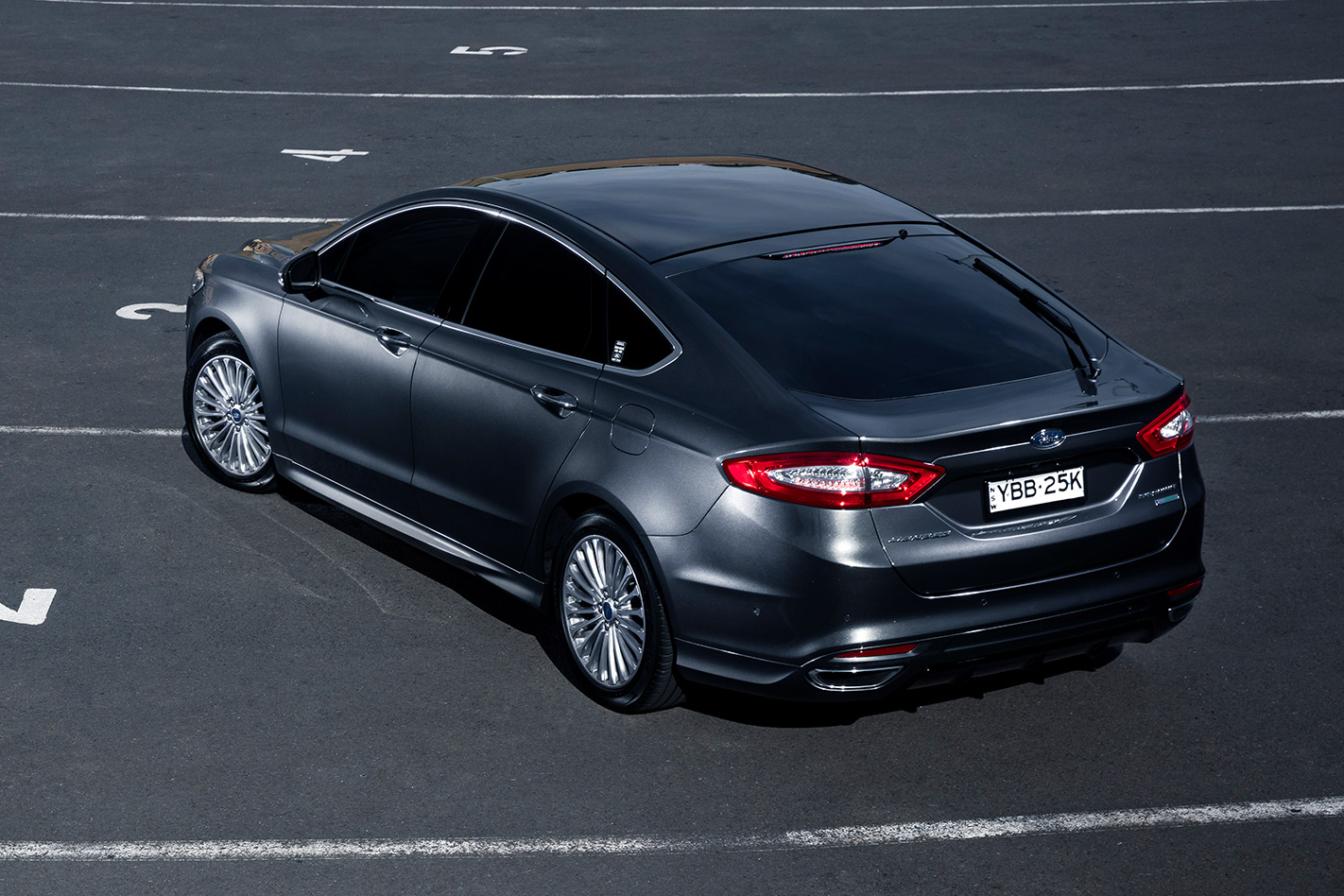
Well, now you never will. Yep, Ford’s venerable mid-sizer is about to cop a bullet and once remaining stock disappears, it will be no more in Australia. It’s too simplistic to blame a lack of marketing spend for the Mondeo’s demise, of course. Like the Holden Commodore, Mazda 6 and Toyota Camry, the Mondeo has fallen victim to a shift in buyer tastes towards SUVs.
Plus, there’s the Falcon factor to consider. Unlike its rivals, the Mondeo faced stiff competition from inside its own model-range in the form of Ford’s other (and larger) family car which drew most of the attention from advertisers and magazines like this one. Bursting free from that long shadow was always a tough ask.
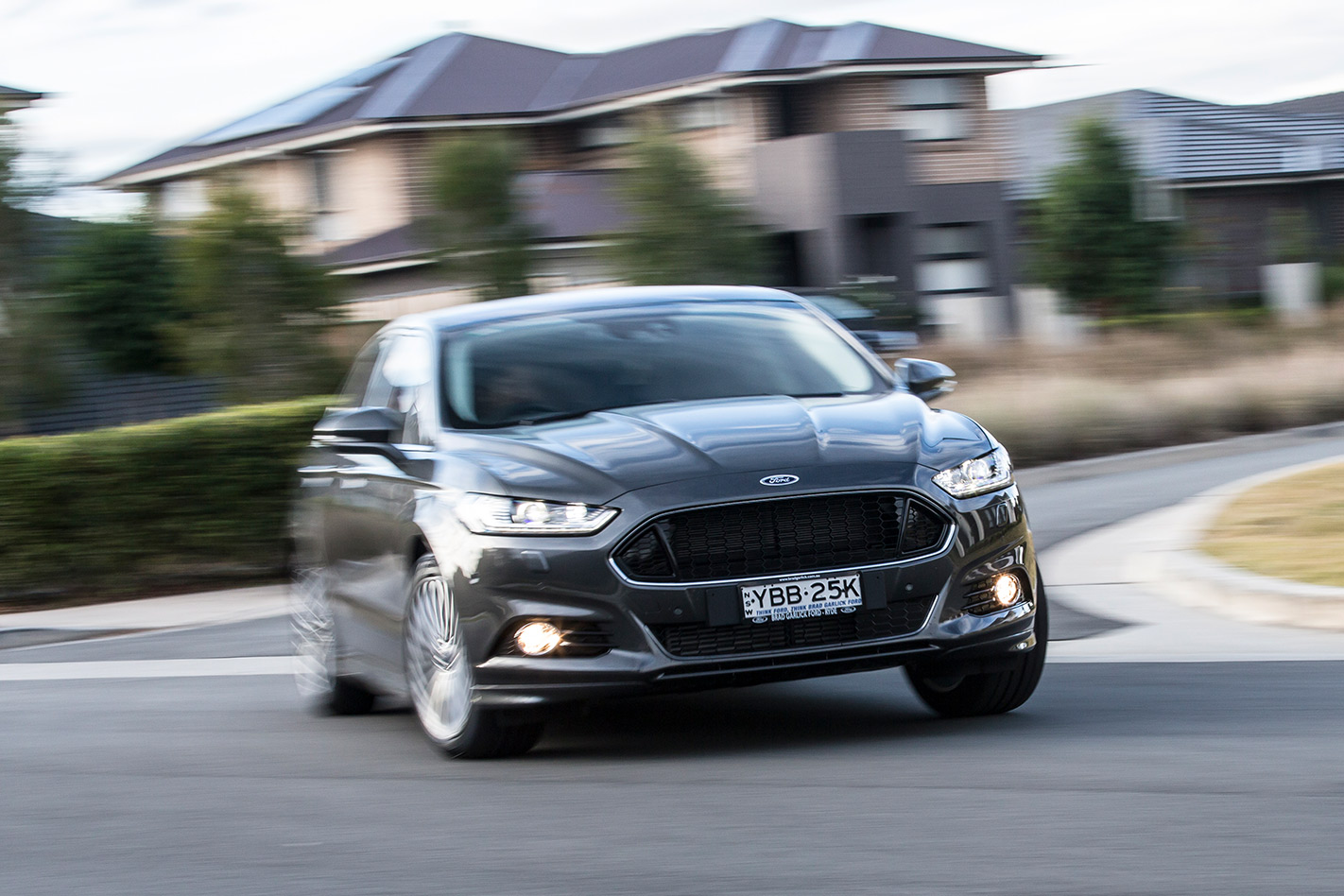
The harsh reality is the mid-size segment has contracted shockingly. From the heady days of 2011 when Ford was moving 6000+ Mondeos a year, sales now sit at just 10 percent of what they were less than a decade ago.
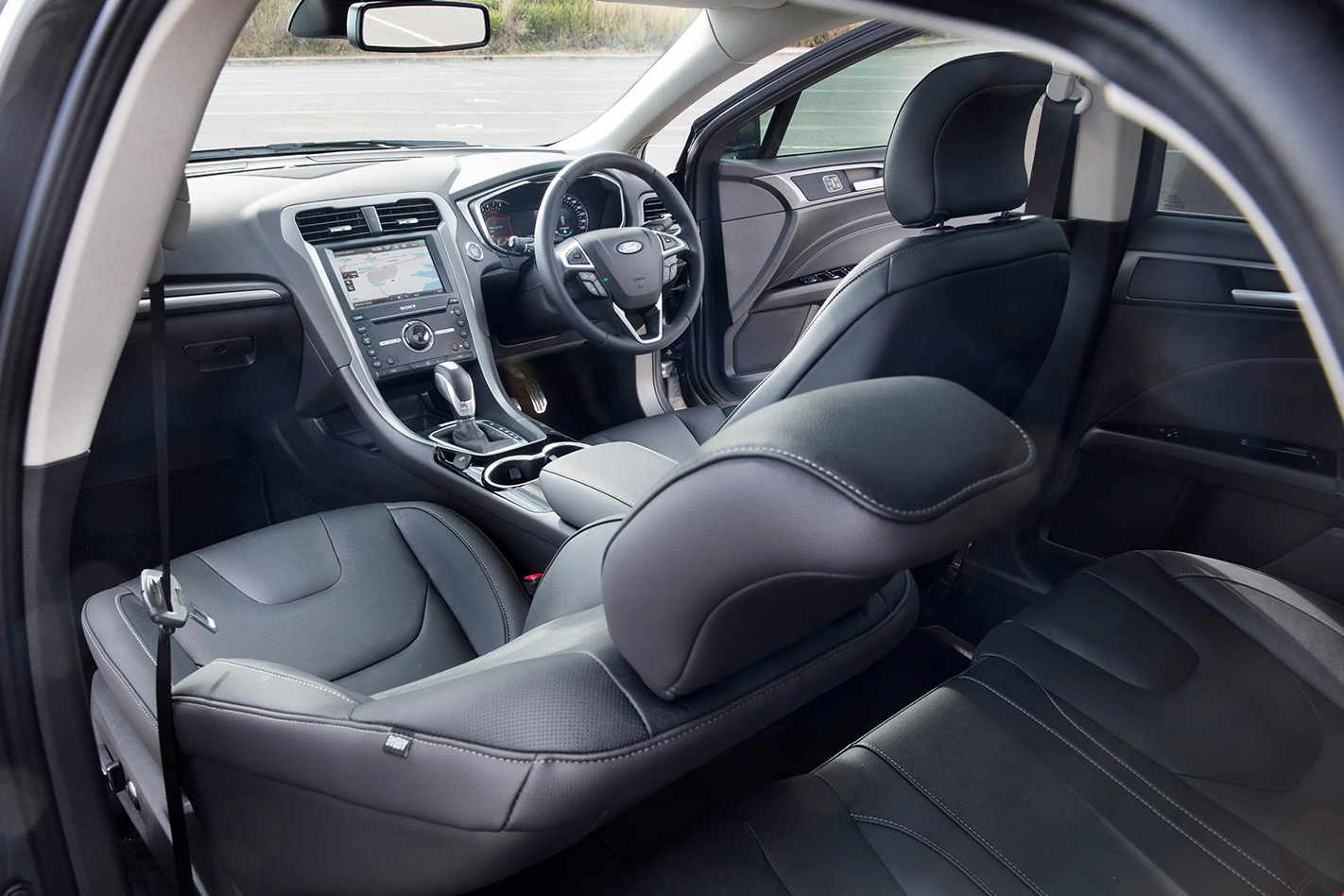
And that’s sad because despite its relative anonymity, the Mondeo is an excellent car. Aussies mightn’t have embraced the Mondeo as strongly as the British – over there sales were so strong and the nameplate so omnipresent that it managed to encapsulate an entire political subclass known as the Mondeo Man – but it has consistently rated highly in Wheels comparos and has been lauded for its well-considered chassis tune, fine steering, and ultra-roomy packaging.
There have been hot versions, too. Australia missed out on the UK market ST220, though we did enjoy a high watermark in the form of 2008’s XR5 Turbo, which boasted a 162kW/320Nm Volvo-sourced five-cylinder. Perhaps the biggest missed opportunity, however, is the 2014 decision not to offer a Mondeo hybrid Down Under to rival the (now) strong-selling Camry hybrid.
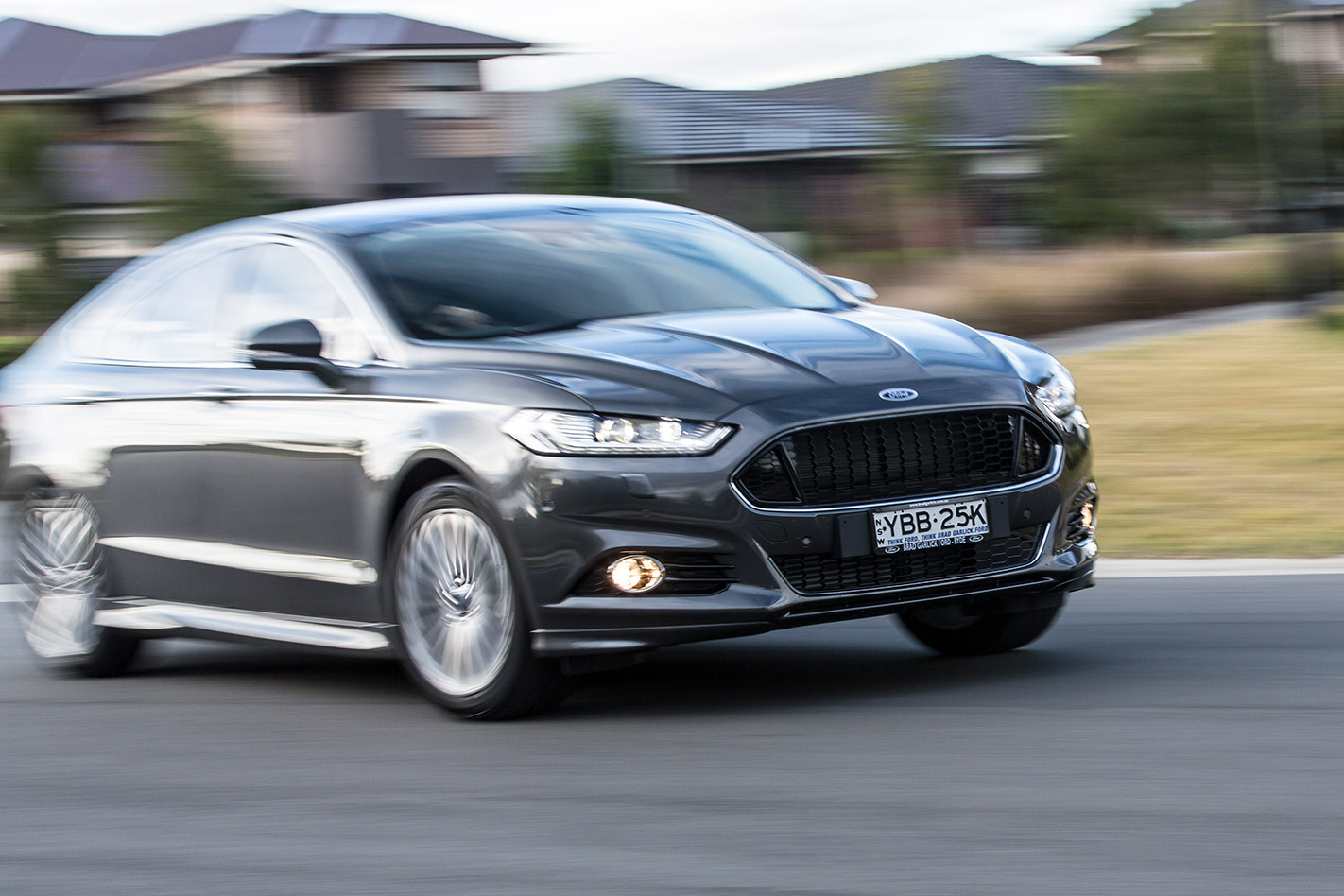
Ford Oz isn’t the only one swinging the guillotine. Tellingly, Ford North America isn’t replacing its version of the Mondeo (dubbed Fusion), though don’t fret this spells the end of theMondeo story globally. An all-new model is planned for 2021, however leaked documents suggest it could morph into a drastically different proposition.
Should you feel glum that the Mondeo will soon be no more? We do. It seems the time for conventional mid-size wagons and hatches, invisible or not, has passed.
THE WORLD’S FASTEST MONDEO MEN
A 12-year stint in NASCAR and eight seasons as a factory squad in the BTCC helped cement the Mondeo’s reputation as a tidy handler. The British touring cars were mental, especially for the 2000 season. Built by Prodrive at a rumoured cost of £1 million each, they paired a 2.0L V6 with front-wheel drive and finished 1-2-3 in the drivers’ championship. One of the cars sold for £83,250 in 2016.
A DECADE OF AUSTRALIAN SALES DECLINE

2010 – 4575
2011 – 6626
2012 – 5203
2013 – 3089
2014 – 3051
2015 – 2120
2016 – 3122
2017 – 2959
2018 – 1914
2019 – 646
2020 – 79
The Audi RS6 Avant sits, or more accurately squats in the small Hunter Valley town of Denham, its cartoonishly huge rims already shaded with the efforts of numerous hard stops.
Its paint is battle scarred with the internal bits of a thousand insects. Its barely existent tyre sidewalls are caked in that curious ochre of dust and road grime. And yet, I am head over heels in love.
My first glimpse of Audi’s brand new uber wagon was in an abandoned Munich railway shed, polished to within an inch of its life and detailed to complete excess by its proud engineering team. But, here on a greying day in rural New South Wales, battle-grimed and primed for more, I don’t think I could love a car any more than I love the RS Avant at this moment.
I’m a modest man. My idea of being rich is to be able to use a brand new razor cartridge every time I shave. I’ve also never really gotten in with the notion of having a garage full of cars for various occasions. Hey, sure, if the world’s biggest lottery ball dropped on my yard, I’d be as flush with hot metal for every day of the week as any of you would be.
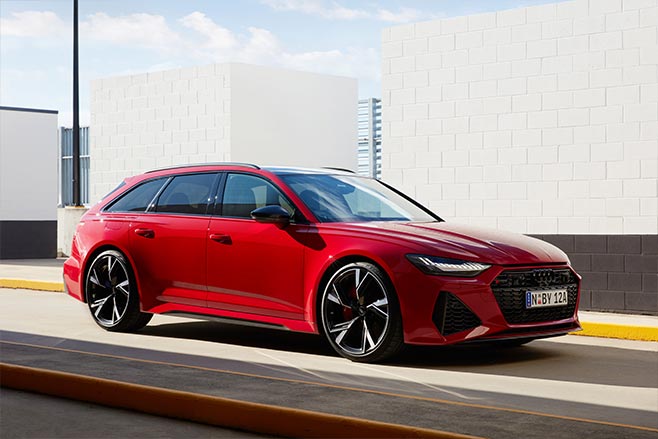
But if I found a small pocket of lithium in my backyard, and I was able to buy just one car, the RS6 Avant has always been quite near the top of the list.
Let’s check off its basics in terms of desirability. Number one: just look at the damn thing. The design language with which it’s been imbued wraps up so many elements, yet uses so few. It looks like a homologation special, yet can hold its own in the driveway of any fancy winery. It’s got muscles for days, and yet there’s also elegance and a subtlety to its finer detail.
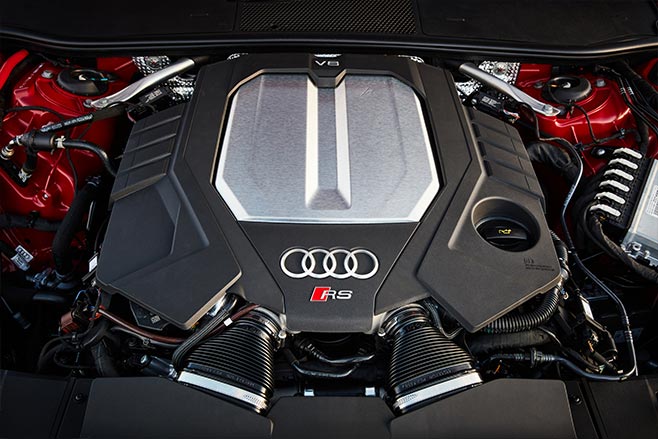
Then we get to the mechanicals. I pine for the days when a fast Audi like the S6 was equipped with a howling V10, but, as we’ve all found in the era of the turbo, there’s no substitute for a wall of torque, and the 446kW twin turbocharged 4.0-litre V8 certainly obliges. Power is sent to all four wheels – of course – via a Torsen limited slip centre differential, distributed in normal circumstances 40:60 front-to-rear, but able to send 85 per cent torque to the rear only when the situation demands.
There is so much engineering prowess in this most unhumble package that it almost defies belief. And, the fact that Audi can pluck the very best from the Volkswagen group bins and apply them in such a clever and dedicated fashion is a credit to all of them. Those 10-piston brake calipers up front for example, are plucked from the Lamborghini Urus, while there isn’t a racecar on the planet that has bigger front brake rotors.
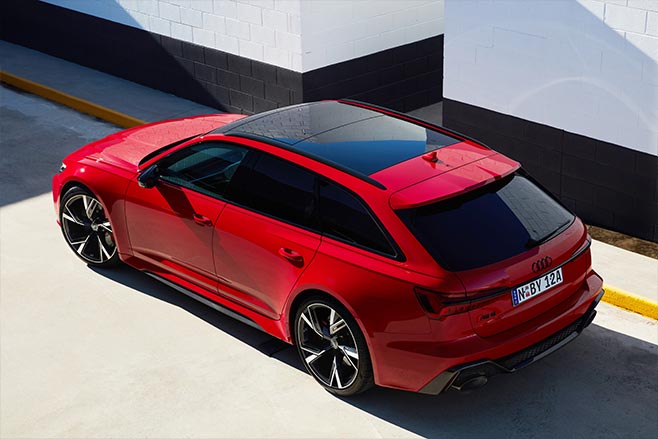
I love, too, that the RS6 can be configured in pretty much any way you like. If your mission is comfort and touring, then sir/madam may like the air-spring equipped version of the car. Should a sharper, more dynamic feel be required, then steel springs are also on the table.
Inside, the low-slung quilted leather seats are almost infinitely adjustable, and are – just – slung deep enough into the floorpan. Audi’s fit/finish and use of materials has been exemplary over the last few years, and the RS6 displays this talent everywhere you look.
Sure, some options cost as much as a secondhand A1, but to run your thumb across the raised carbon fibre inlay on the door card tells you instantly why you fell in love with this car.
That same carbon inlay extends across the centreline of the car, framed with metalwork that exudes richness and depth. No painted-on finishes aboard the RS6; it’s all the real deal.
I’m not married to the piano lacquer across the centre console, and I would opt for something that didn’t shine so brightly on summer days, but it’s a minor quibble in a truly gorgeous place to be.
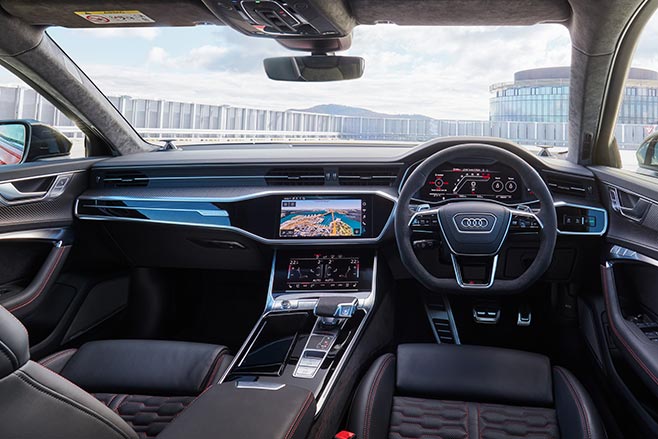
My RS6 wouldn’t have a sunroof, either; I don’t see the point with an extra 18-odd kilos perched on my head, but again, quibbles. The Alcantara steering wheel too, is a real joy and a thing of beauty to both behold and to use. Its diameter is millimetre perfect, its thumb concaves moulded just so. And it’s another reminder of just what you’ve bought.
The new MMI operating system takes a bit of getting used to, but once you’ve settled on your favourite screen displays, you really shouldn’t have to play with it too much more.
It’s a station wagon, too. Need to take the dog to the vet? Want to put a couple of pot plants in the boot? Or you might even need to tow some sort of… I don’t know, boat or something. The RS6 is more than capable of doing it all. And, what’s more, patina will suit it. The scars of day to day life will only add to this car’s portent and intent.
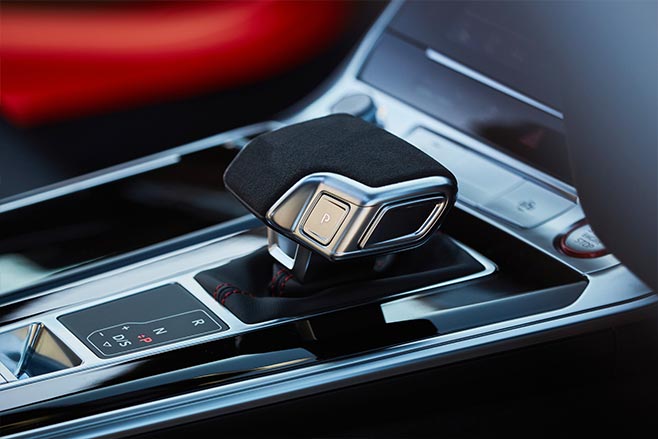
When you start the RS6, there’s a natural expectation of fire and brimstone given its hard-as-nails exterior visage. Index finger on the cold metal of the start button and the V8 snaps into life, but there’s no theatrics as you’d find in something like an R8. Sneak the gaming-style T bar into D and the RS6 moves off as docile as an A3. In fact, it’s quite deceptive; right from the outset, the RS6 cossets rather than corrupts, inviting you to be part of the experience and not disdainfully looking down its nose from afar as it does its truly spectacular thing.
? February 2024: RS6 GT revealed as C8 swan song
Hey, it’s Wheels phoning from the future. Audi has revealed a fitting finale for its C8 RS6, dubbed RS6 GT. Read about it at the featured story link below.
Story continues…
There’s very little tyre noise intrusion from those huge 22-inch tyres, and the engine remains muted. That is, until you want to hear it.
How? The RS mode button on the right spoke of the steering wheel provides two distinct setting parameters that can be tuned to your preference. My favourite? Everything, except the dampers, turned all the way up to 11. A new, purposeful heads-up display appears in the window. The throttle is instantly much, much sharper, and the exhaust, while still relatively muted, makes its presence felt.
Knock the shifter over to the left to engage manual mode and the new polished, machined-alloy shifter paddles are a joy to use, and once more, a sign that you’ve done the right thing by splashing out on the RS6.
It’s wrong to call the RS6 a big car, but equally it’s no shrinking violet. It doesn’t contract around the driver; rather, it has the feel of something with substance, with gravitas, something that needs to be respected.
Snap open the throttle and the RS6 takes merely a moment to gather its thoughts before flinging you bodily at a future that includes the loss of your driver’s licence. The pace is absolutely relentless as you surge past 4000rpm and does not give up until it’s whamming into the 7250rpm redline.
You pull a paddle and again, you are catapulted at the horizon. Audi claims the gearing set aboard the RS6 means you can see 330km/h should you so desire, and I have no doubt that the RS6 could nail that every day of the week.
The chassis tune is interesting. There’s no semblance of kidney-belting stiffness; rather, there’s compliance and a sophistication that aids the cause of speed, rather than holding you back. The rear end squats hard under the burden of 800Nm of torque but the balance remains neutral, and there is a surprising amount of steering feel under your fingers as the 285mm wide tyres hunt for grip.
The Dynamic pack brings steel springs and diagonally linked dampers, tied in with all-wheel steering that adds point and surprising delicacy to the front end. The reduced mass of a V8 over the C6 version’s twin-turbo V10 makes more sense, and the RS6 has the handling chops to match its sky-high outputs. With those 10 pistons clamping each 420mm front brake rotor, you’re never shy of stopping power.
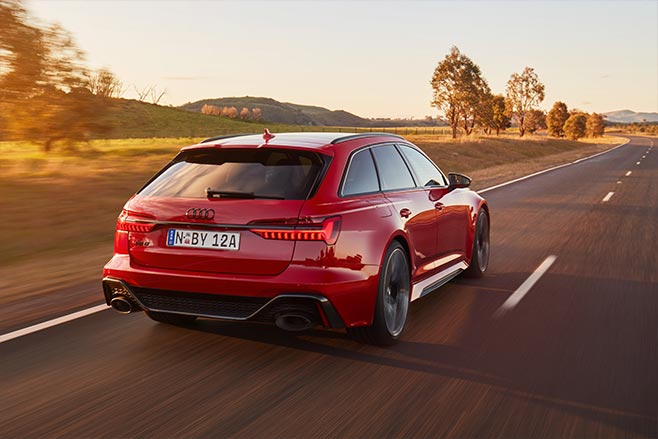
Despite its $216,000 price-tag, I want this car in my garage, and no others… well, with a registration plate anyway. It can tow, it can lug stuff, it can devour the gaps between towns, and it can slay back roads. It lacks the final dynamic thrills of something like an R8, but equally you can barely put a bottle of water in Audi’s V10 supercar.
There’s very little that the RS6 Avant can’t do, and when you look at it under that light, it’s almost a bargain.
Pros: Saturn V-rivalling acceleration; comfort; usability Cons: Two tonnes and 5m length can only hide for so long
4.5 stars out of 5
2020 Audi RS6 Avant specs Body 5-door, 5-seat wagon Drive all-wheel Engine3996cc V8, DOHC, 32v, twin-turbo Bore x stroke 86.0 x 86.0mm Compression 10.0:1 Power 441kW @ 6000-6250rpm Torque 800Nm @ 2050-4500rpm Power/weight 212kW/tonne Transmission 8-speed automatic Weight 2075kg Suspension Multi-links, air springs, adaptive dampers (f/r) L/W/H 4995/1951/1487mm Wheelbase 2930mm Tracks 1668/1650mm (f/r) Steering Electrically assisted rack-and-pinion; rear steering Brakes 420mm ventilated/drilled discs, 10-piston calipers (f); 370mm ventilated/drilled discs, single-piston calipers (r) Wheels 22.0 x 10.5-inch (f/r) Tyres 285/30 R22 101Y (f/r); Pirelli P-Zero Price $216,000
Audi RS6 Avant: MOTOR’s first international drive
MARK TISSAW | FEB 2 2020
The Audi RS6 has always felt like the Audi Sport flagship. The RS6’s bonkers past most famously includes a V10 engine and has amusingly mixed supercar-baiting performance with practicality over four generations now.
You’ll recognise plenty about this new RS6 from its RS7 sibling, and we’ve come to the US to test it because, surprisingly, it’s the first time the RS6 has been sold here.
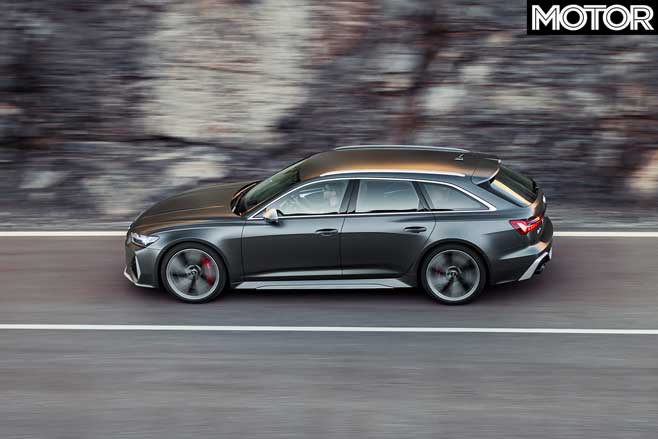
Even by Californian standards, the styling is no shrinking violet and quite a change over the classy A6 Avant. Only the roof, front doors and tailgate are carried over, with every part sculpted to look more aggressive, most notably the flared wheelarches (housing wider tracks and bigger alloys), bonnet, rear spoiler, and front and rear bumpers. It looks more like a GT3 car than an estate with some of the addenda – and, to these eyes, it’s brilliant.
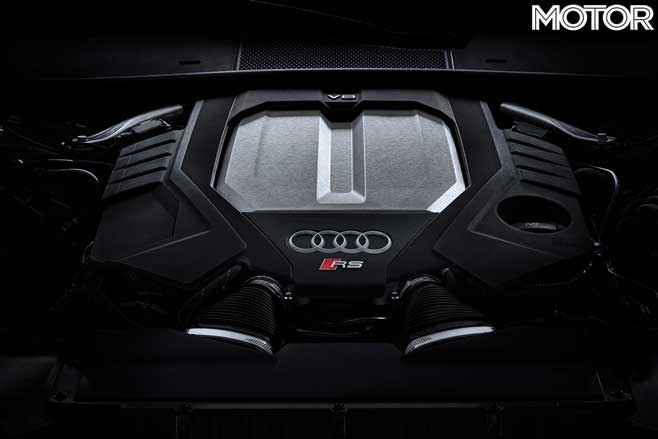
Whereas the RS4 has switched to a V6, a V8 is retained in the RS6 – and significantly upgraded with a larger turbo and increased boost pressure. The twin-turbo 4.0-litre produces a colossal 441kW at 6000rpm and 800Nm from 2050-4500rpm and is hooked up to an eight-speed tiptronic auto and a proper Torsen differential-based permanent four-wheel drive. There’s also a torque-vectoring diff at the rear.
The engine itself is now a mild hybrid, mated to a 48V system to boost energy recuperation. It works for efficiency reasons only rather than performance, not that the RS6 is wanting in the performance stakes: 0-100km/h takes a claimed 3.6sec, traction off the line aided by a new launch control system.
Height-adjustable adaptive air suspension is standard, the car sitting 20mm lower than the A6 Avant. Steel coils with an interconnected hydraulic damping system is included on the range-topping version. Active all-wheel steering from the RS7 features, as does the option of ceramic brakes.
There are fewer changes inside, and less added aggression. The seats (very comfortable and supportive) are new, as is the steering wheel, which has larger shift paddles, but the capaciousness of the standard A6 Avant remains. Fido should be kept happy by the 565-litre boot, rising to 1680 litres with the 40/20/40 split rear seats folded flat.
Two customisable driving modes (RS1 and RS2) allow you to pick out the best bits of the standard Comfort, Auto, Dynamic and Efficiency modes that tweak all major dynamic components. In the RS2 mode, you can also now turn off the electronic chassis control systems for the first time in an Audi RS model.
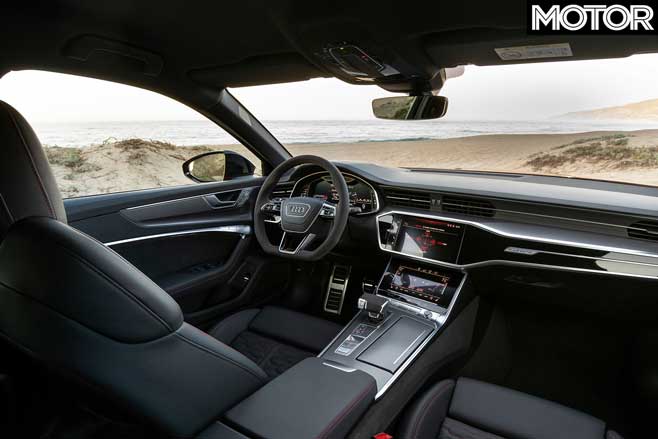
With such an extensive and complex specification – there are more than 40 ECUs talking to one another – it’s surprising that it is so relaxing, comfortable and easygoing as you roll down the road for the first time. You’re almost left wondering if you’re driving the same aggressive-looking car you stepped into, such is its refined manner, which leans more towards comfort than sporty.
On air suspension, the ride is reasonably quiet and cushioned, and even with large 22in alloys it manages all but the largest road scars and abrasions well, those firmer abrasions causing the body to rock.
The sports exhaust, even in the Dynamic mode, is fairly quiet and certainly doesn’t scream 600 horsepower – until you really squeeze the throttle and the RS6’s considerable straight-line pace is revealed. It’s not sledgehammer in its delivery in the way that a Mercedes-AMG is, nor raucous in the way of an Italian or British V8, but it’s supremely fast nonetheless.
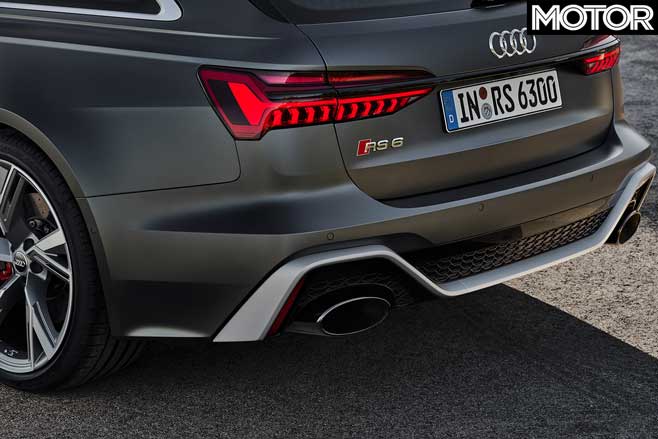
The refinement at low speeds isn’t lost when you push on either. The engine is extremely flexible and happy to be revved all the way to the redline, and on a wide-open throttle finally exhibits aural charm, albeit not at the levels of an AMG V8. It’s your eyes rather than your ears that let you know how brisk your progress really is.
On tighter roads, you can happily use just second and third gear, such is the wide spread of torque and drivability, but gearshifts, whether manual or automatically controlled, aren’t the event they could be, even in the crispest shift mode. The quiet, efficient shift is a good metaphor for the drivetrain as a whole: the RS6 is a machine that likes to make progress in a rapid but ultimately fuss-free way.
It’s much the same for the chassis, which is improved over the previous RS6. It turns in more keenly and feels a good deal nimbler, the four-wheel steering at work here. Yet its sheer size and weight mean it never feels fully at home in slow corners and twisty roads in the way it does in faster, flowing ones. Nor does it ever really exhibit much feel through your hands or backside.
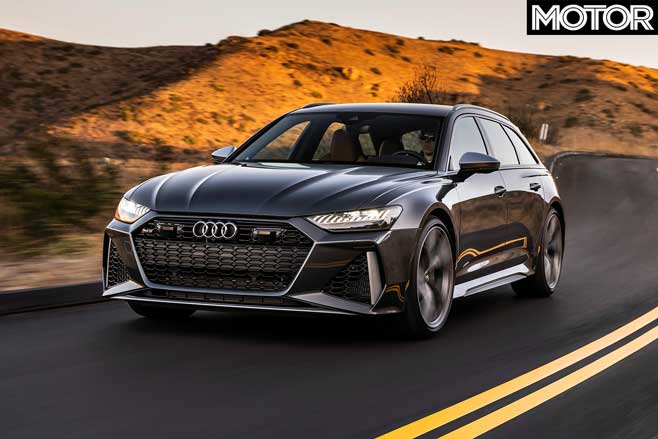
That sense of feel is improved with steel coils, but lacked the air’s suppleness and ride comfort. Whatever the version, there’s a lingering doubt that the RS6 may just be just too big and too complex to get anywhere near the limit of its abilities.
Still, the RS6 is probably the most usable all-round performance car on the market, especially when it’s wet and cold. There aren’t many things with this much power that you’d rather use in those conditions.
When you floor the throttle midway through a corner towards the exit, the diff tucks the rear end in, which adds to the confidence and trust you feel to get on the power early and for the car to find traction, albeit without that involvement. You’d have to be really pushing it to see the RS6’s playful side and even then it’s not a car that eggs you on to do so or really involves you in the process.
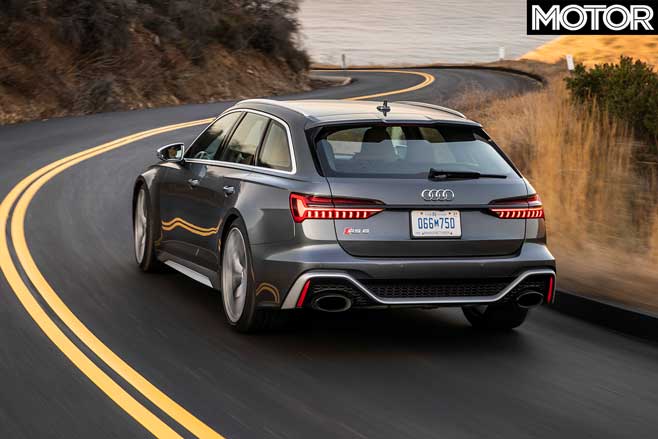
The RS6 is a car that impresses rather than excites you, and its key calling card is its sheer breadth of abilities, not just performance ones. Remember, this is a vast wagon that weighs more than two tonnes but has mighty yet undramatic straight-line and point-to-point pace, as well as space for all your stuff and brilliant, relaxed road manners for the 95 per cent of drives when you just want to blend in and get where you’re going.
Direct rivals – like the BMW M5, Mercedes-AMG E63 Estate and Porsche Panamera Turbo Sport Turismo – feel more engaging and have greater driver appeal, yet the RS6 feels more usable for more of the time and as such arguably makes for the more compelling ownership proposition. Which Audi would probably take, not only for the RS6 but also for all the new era of Audi Sport models to follow.
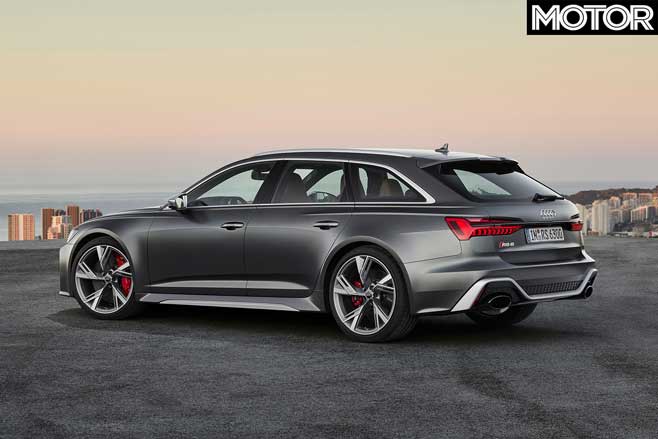
The Nemesis
Mercedes-AMG E63 S Estate 4.0-litre twin-turbo V8, RWD, 375kW/700Nm, 0-100km/h 4.0sec, 1725kg, $163,070
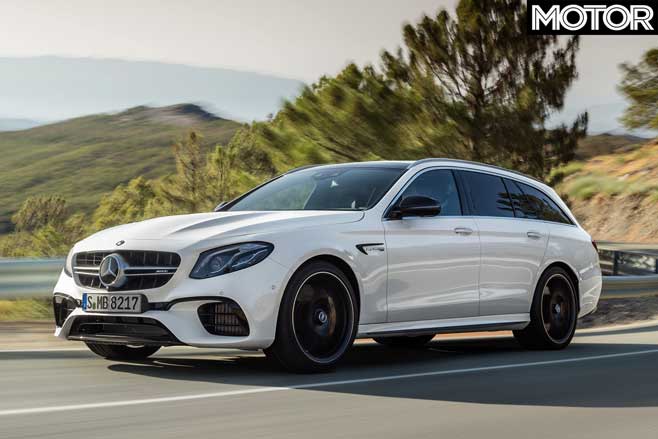
Gives away some useability points with its smaller cargo area, but remains the choice for those wanting to carry a load without compromising performance.
Victoria and Queensland are the two latest states to begin using mobile phone detection cameras in an attempt to cut down on distracted drivers.
Trials of the mobile phone detection cameras will begin this week and will run for three months in the case of Victoria, while the Queensland trial will run until the end of the year.
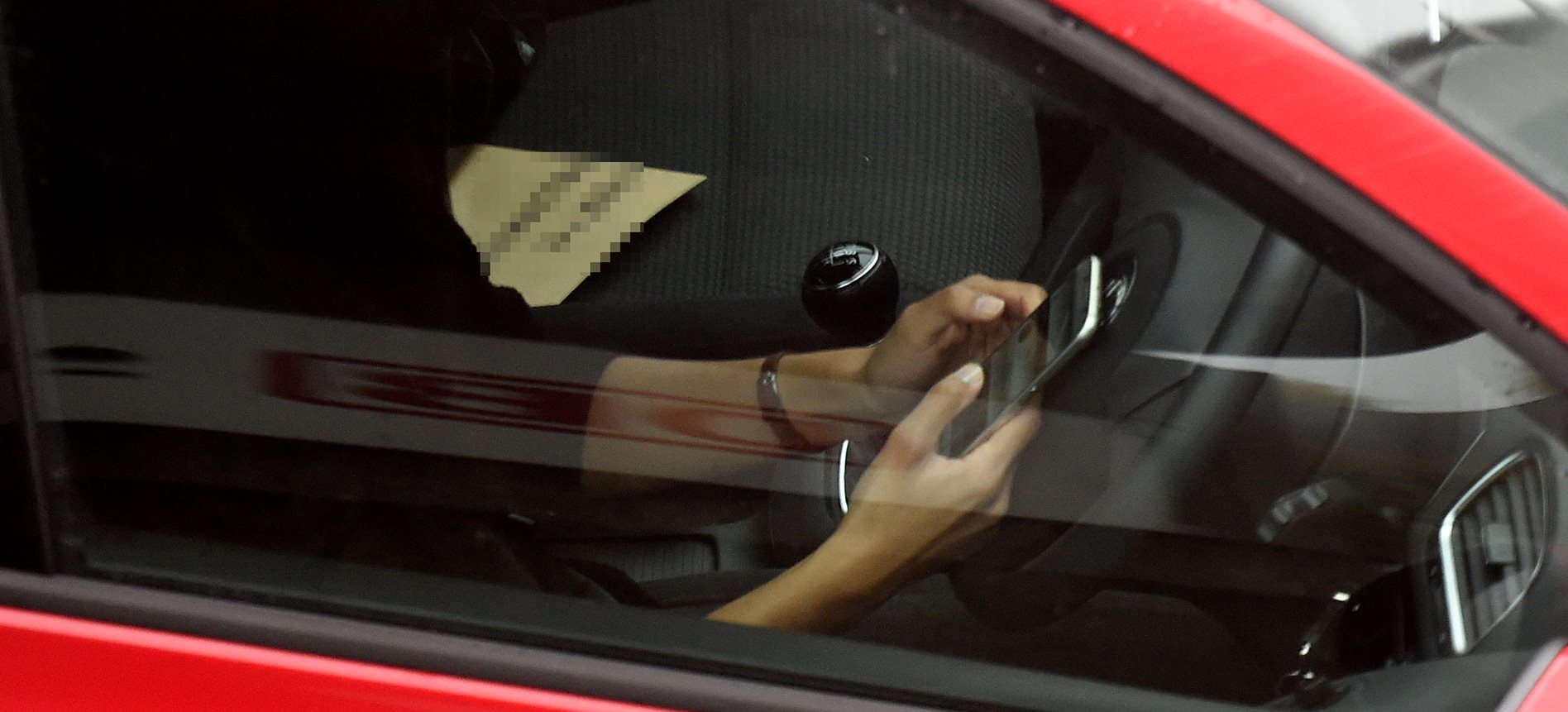
In the trials, motorists who are caught will be let off with a warning and will not receive a photograph of them committing the illegal behaviour.
It is expected that, once completed, both of these trial periods will result in a wider network of mobile phone detection cameras, with fines and demerit points handed out to infringing motorists.
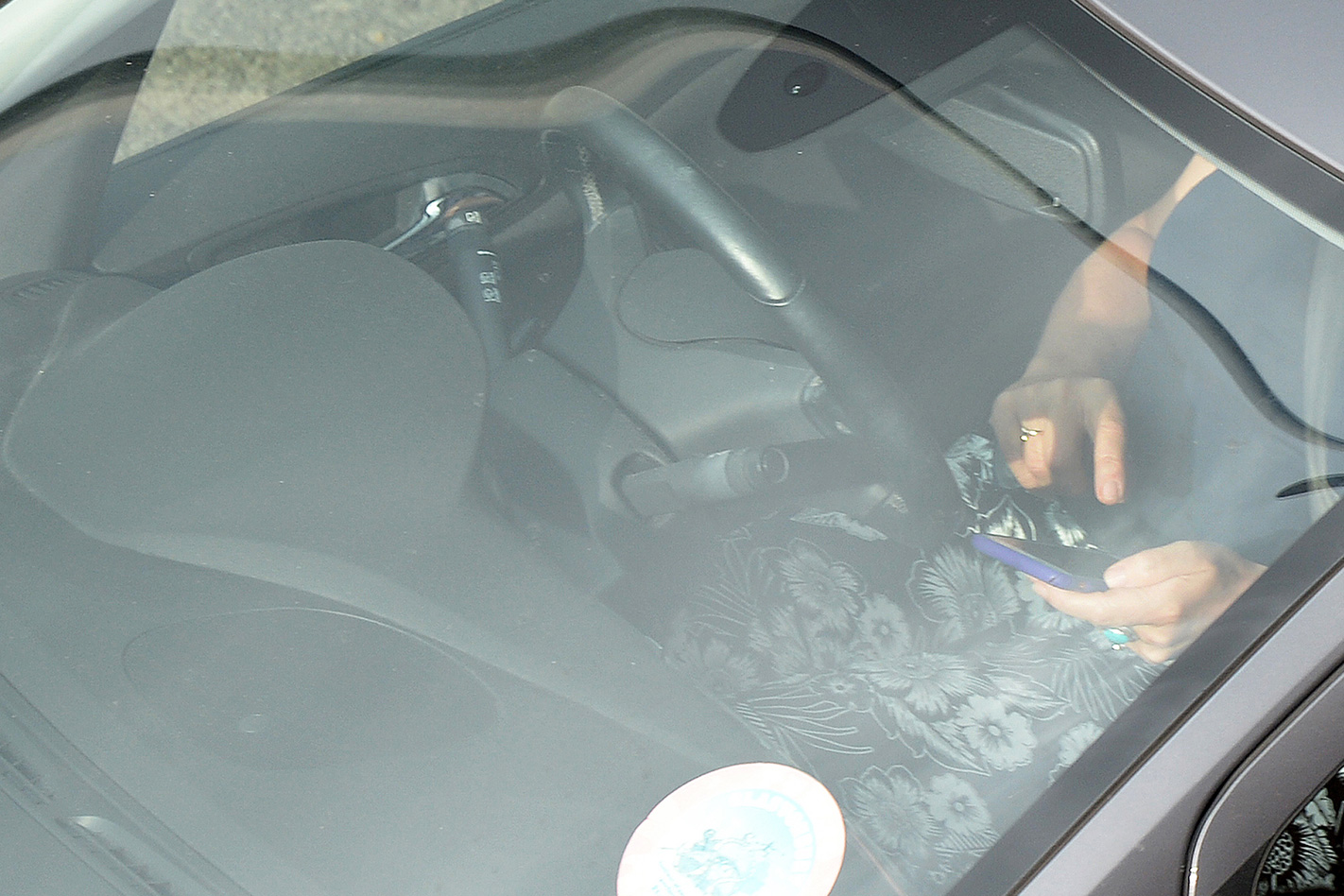
That will mean a whopping $1000 fine and four demerit points for Queenslanders (the largest mobile phone fine in Australia) and $496 and four demerit points for Victorians.
Queensland Transport and Main Roads minister Mark Bailey makes no apology for cracking down hard on distracted drivers who flout the law in this manner.
“The message is direct and very simple: just put your phone away,” Bailey said. “Using your mobile phone when you’re behind the wheel is as dangerous as drunk and drug driving.

“Thirty-three Queensland lives were confirmed to have been lost in 2018 alone due to driver distraction, while another 1,359 people were hospitalised.”
Similar sentiments are reiterated by Victoria’s minister for Roads and Road Safety Ben Caroll.
“We know how dangerous it is to use your phone while driving – that’s why we’re trialling this new technology to help stamp out this irresponsible behaviour,” he said.
Mobile phone detection cameras have worked very well for the NSW government, netting in more than $7 million in just the first two months, which represents a 1500 percent increase in fines compared to a similar period before the cameras were introduced.
The high-tech detection cameras can be attached to underpasses, to the back of road signs or simply operate from roadside trailers.
They can also detect vehicle occupants who are not wearing a seatbelt, though whether that will become an infringeable offence from the cameras remains to be seen.
