
FORD’S Australian order books for the forthcoming Ranger Raptor are already bulging, despite some initial grumbles from local Ford diehards about the modest 157kW diesel engine under the bonnet.
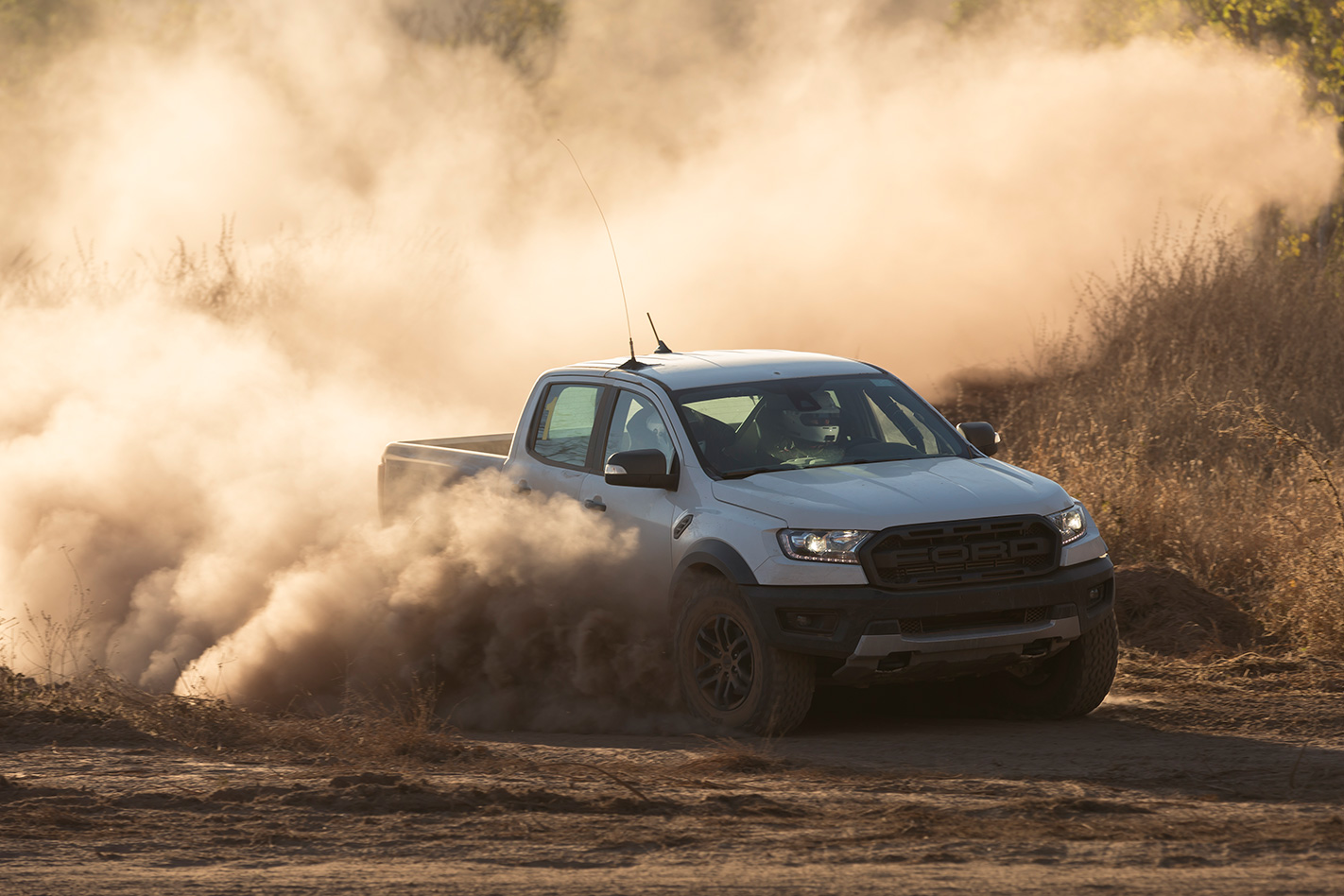
While there’s little that can be done about this for the time being, that may well change as the desert racer Ranger extends beyond its home markets. An Asia-Pacific vehicle built in Thailand, its key territories are, initially at least, overwhelmingly diesel-oriented.
Ford has the option to broaden the Raptor’s appeal by fitting it with a petrol engine, something that many Aussie enthusiasts have called for. With US market Rangers being engineered for the 2.3-litre EcoBoost engine seen in Ford Mustang and Focus RS, there’s a possibility that once these costs are sunk, right-hand drive markets could also get this engine.
Speaking at the launch of the Ranger Raptor, Nick Allen, of Ford’s Core Vehicle Integration – Off Road Capability and Trailer Tow division, batted back a couple of suggestions but flatly refused to deny the possibility of the what Ford calls the GTDi unit in future Ranger Raptors.
“The GTDi is our most commonly built engine. It just makes sense for Ranger in the US,” he said. “We have to look at what each market needs. The US Ranger gets a sliding rear window and it gets metal bumpers. We have to respond to customer demand.”
Asked whether Ford would respond to Australian customer demand, he smiled and said, “One thing I’ve learned at Ford is that the company is always listening. If we can make a solid business case for the car and it makes money for the business, then why not?”
The prospect of a Focus RS-spec 257kW/440Nm Ranger Raptor is undoubtedly a tantalising one and would do a great deal to address the on-road performance shortcomings of the current vehicle. Ford has a rolling update schedule with Raptor. If the demand exists, it looks as if Ford will build it.
The Mercedes-AMG C63 S has had a mid-life facelift. On the surface, the tweaked styling and identical engine outputs (375kW/700Nm) suggest little has changed, but dig deeper and it’s actually a very different beast. Here are the highlights you need to know.
1 – More cogs in a new box
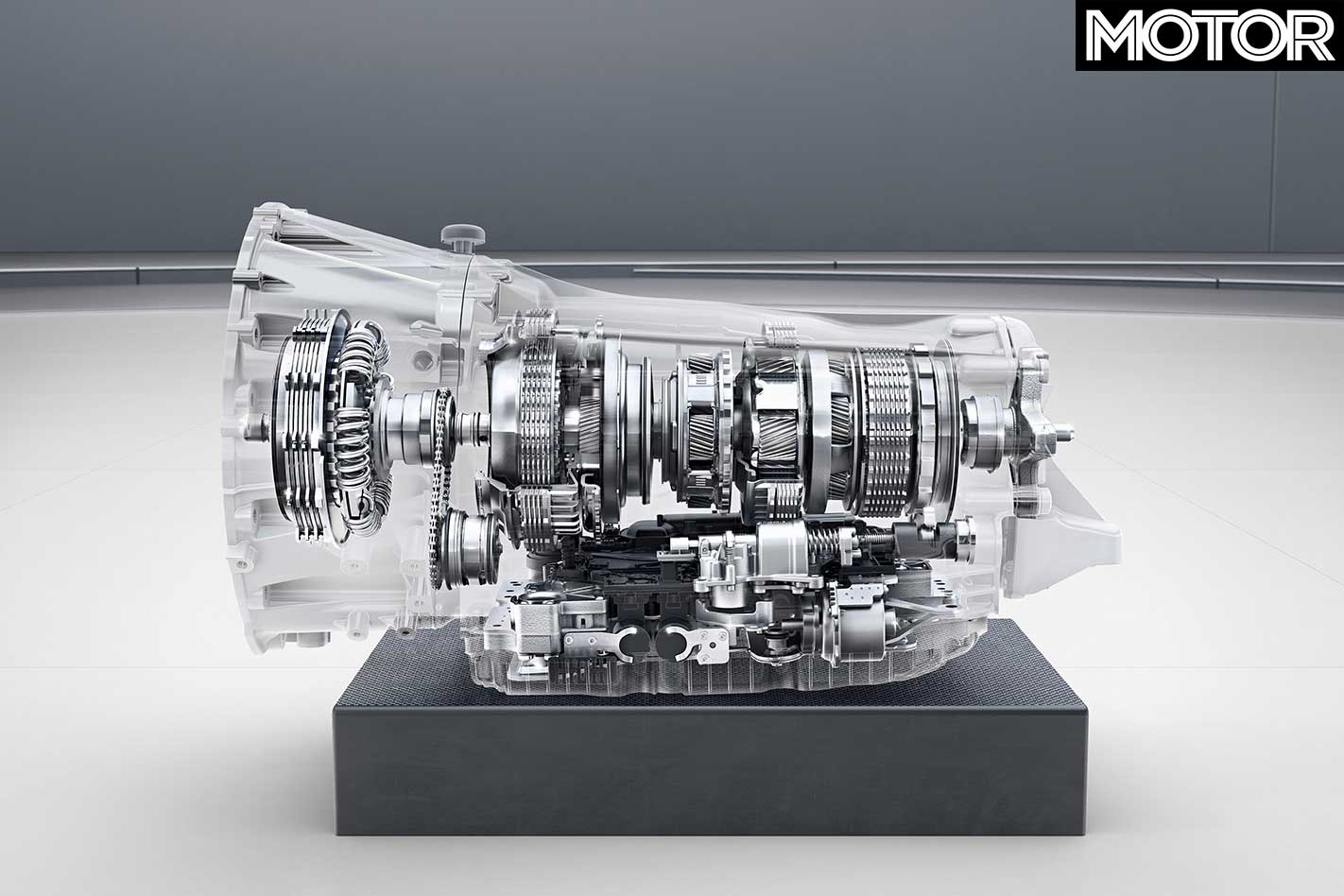
The gearbox now has nine speeds. It’s the latest version of AMG’s MCT automatic, which replaces the torque converter with a series of wet clutches. It promises quicker response and faster shift times.
2 – Now with Slippery Mode
There’s a new driving mode. In addition to the existing Comfort, Sport, Sport+, Race and Individual, there’s now Slippery mode, which reduces engine power and dulls throttle response to ensure safe passage in tricky conditions.
3 – Quicker on its feet
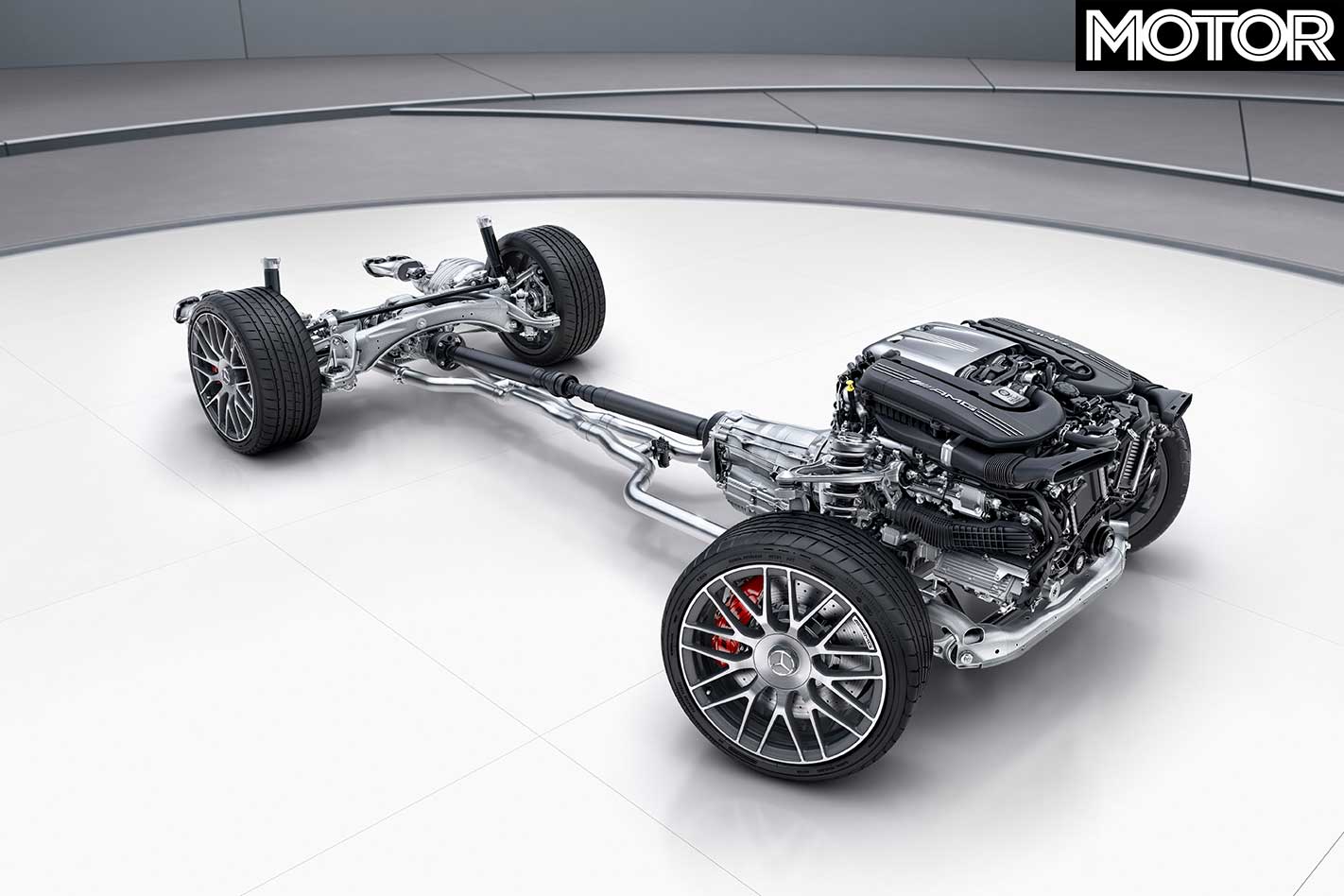
Arguably the biggest change to the new C63 is its electronics; specifically, its stability program. AMG Dynamics is claimed to be able to predict vehicle behaviour by examining driver input and sensor data. It has four modes: Basic (Slippery, Comfort); Advanced (Sport), Pro (Sport+) and Master (Race).
4 – Having the GT R’s nine lives
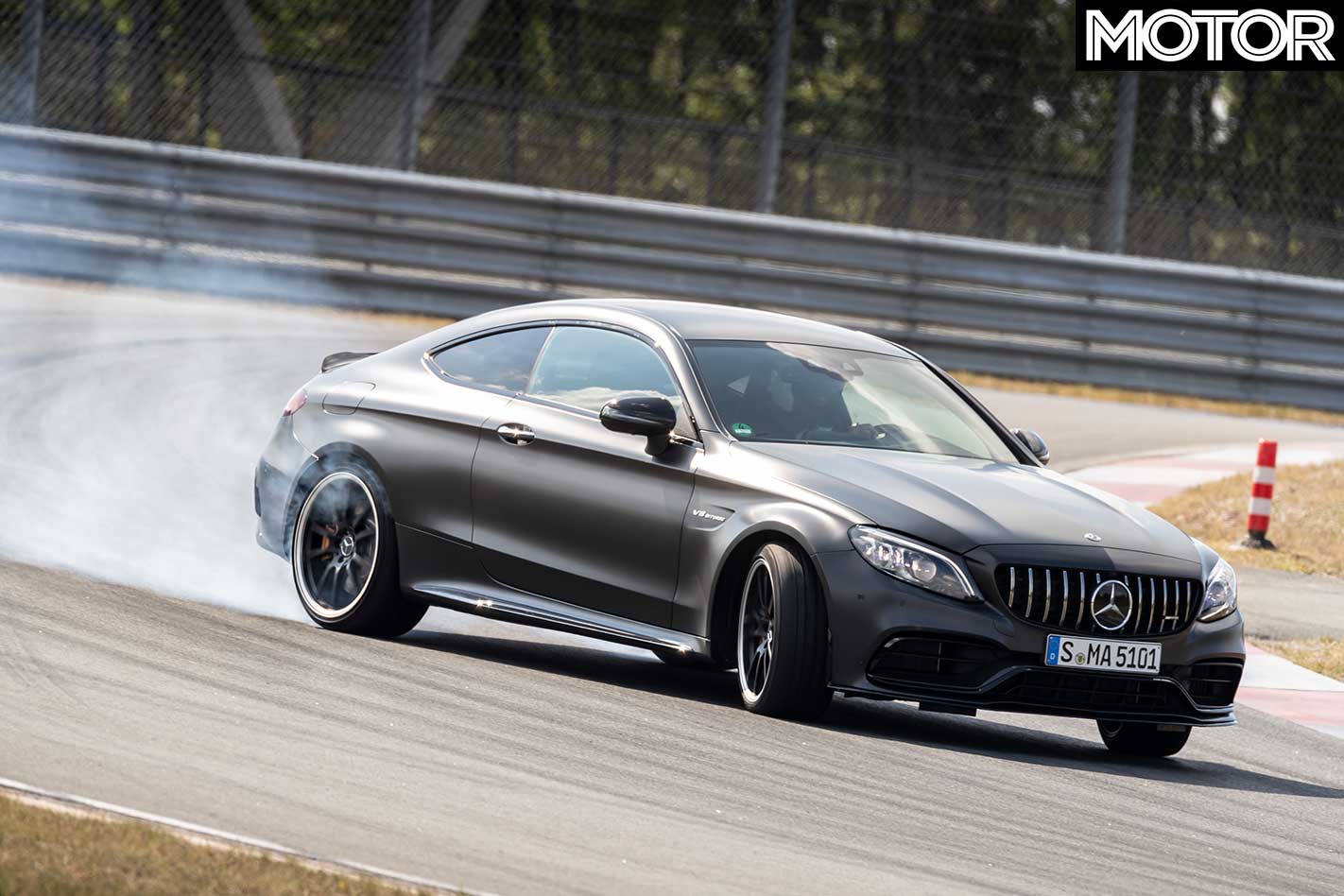
The C63 now has AMG’s nine-stage traction control, lifted from the GT R. Once the ESP is switched off, drivers can select from nine stages of traction control, with level 1 being intended for wet weather driving and level 9 permitting maximum slip.
5 – A touch of (S-)Class
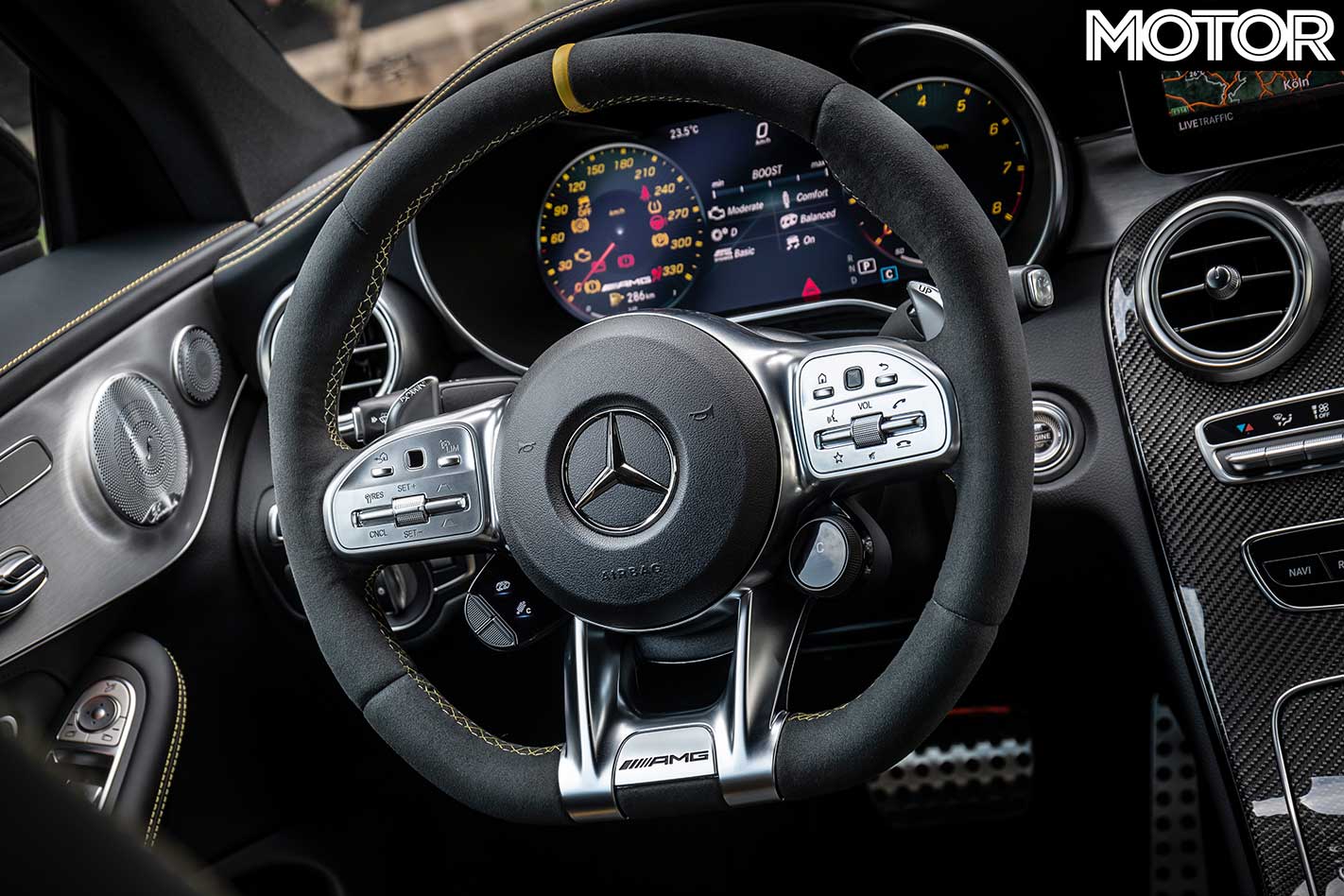
A new steering wheel incorporates Touch Control from the S-Class, which allows the driver to control the infotainment and instrument cluster with a swipe of the finger or thumb. It also includes a controller similar to Ferrari’s Manettino which allows adjustment of the Drive Select functions.
6 – Digital style
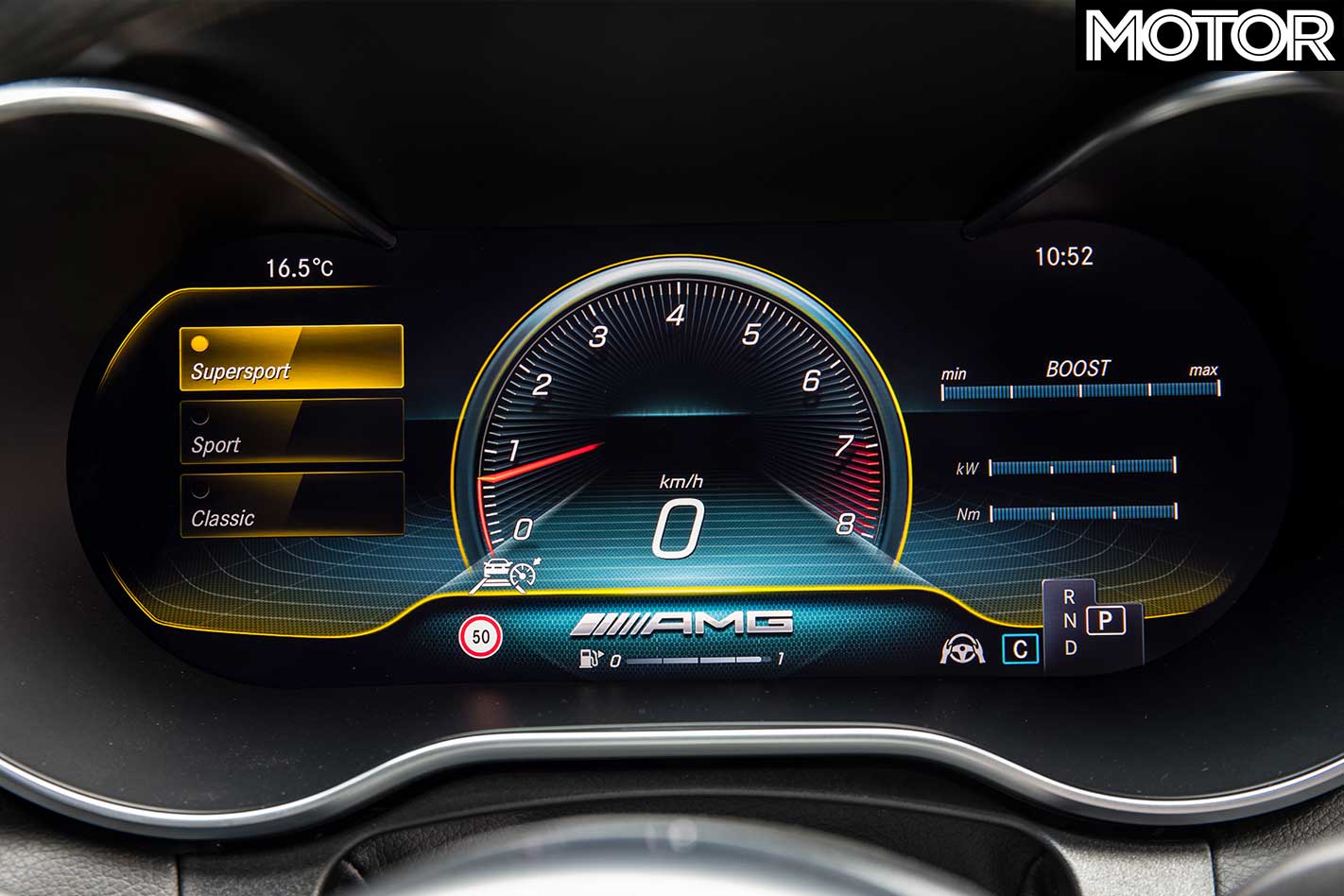
The instruments are now fully digital, replacing the traditional dials with a 12.3-inch configurable display screen.
7 – Spot the difference
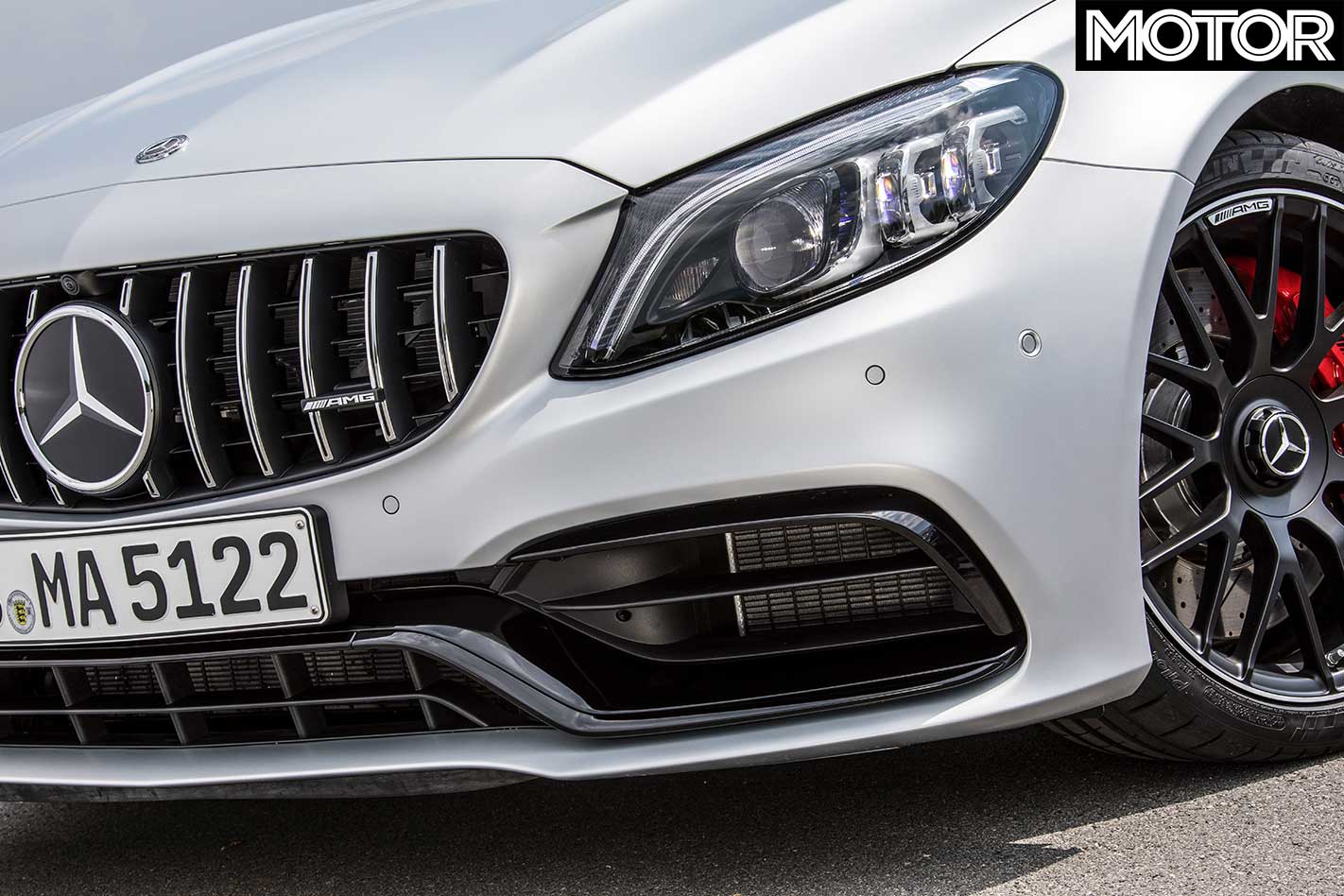
Spotting a new C63 should be easily thanks to the vertical chrome louvres in the grille. In addition, there are redesigned outer air inlets and new headlights, while at the rear there’s a giant diffuser and revised exhausts.
The new Mercedes-AMG C63 will land Down Under in Sedan, Estate, Coupe and Cabriolet guises in September 2018. Pricing has not yet been announced, but don’t expect it to budge too much from current levels.
- Wheels first drive review
- Wheels Spin: Should we buy it?
- 4×4 Australia first drive review
- 4×4 Australia road trip feature review
Wheels first drive review
WHAT IS IT
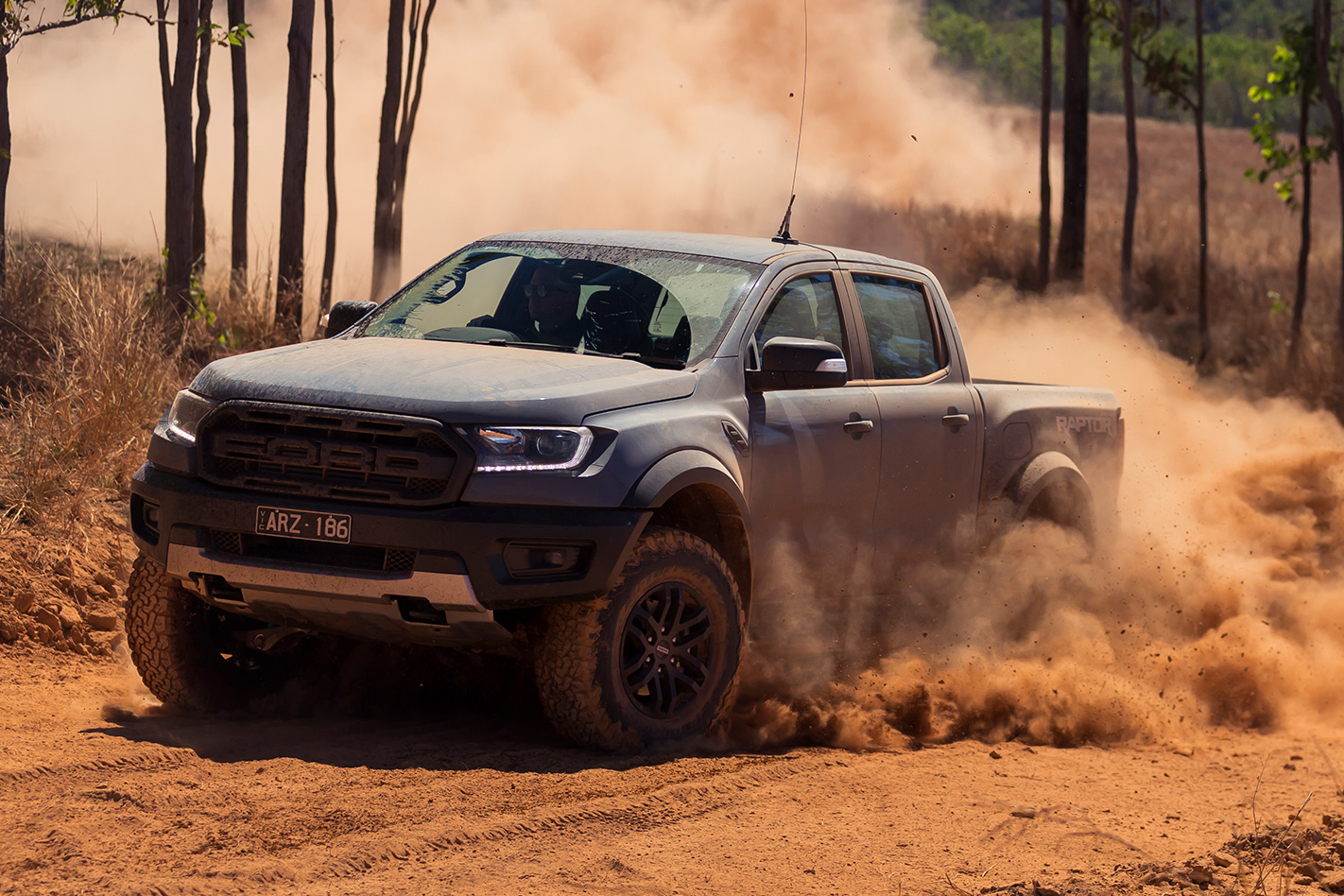
The Raptor mines a new vein in the gold rush that is the Australian dual-cab ute market, namely that of the Baja-style desert racer. With a 157kW/500Nm 2.0-litre four-cylinder turbo-diesel under the bonnet and long-travel Fox Racing suspension, it’s built to be bulletproof where the bitumen ends.
WHY WE’RE TESTING IT
It’s one of the most controversial/hotly anticipated (delete as applicable) vehicles of 2018, so we jumped at the chance of giving the Ford Ranger Raptor a solid battering in the uncompromising NT. Some big questions needed answering, the most obvious being whether a dinky 2.0-litre diesel was enough engine for a ute with such hardcore pretensions.
MAIN RIVALS
Holden Colorado SportsCat+ by HSV; Mercedes-Benz X350; Volkswagen Amarok V6
THE WHEELS VERDICT
The Ford Ranger Raptor offers a whole heap of fun and capability for $75K, but makes most sense if you have the off-road acreage upon which to unleash it. The 2.0-litre lump can feel a little underdone on bitumen, although the fantastic Fox Racing dampers delivers supreme ride quality whatever the surface. It’s probably more ‘specialist interest’ than its order books might suggest, but it’s nevertheless both endearing and engaging.
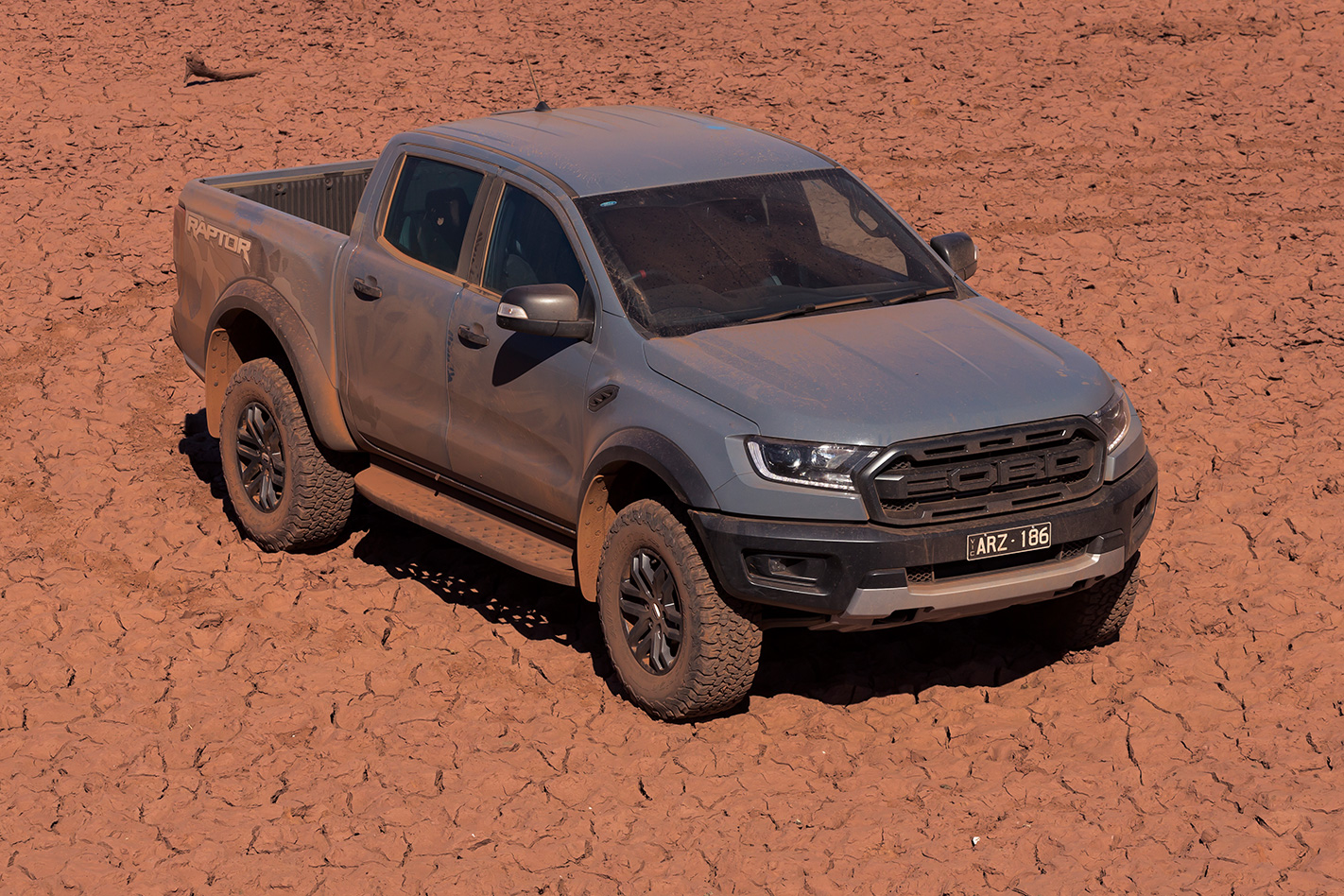
PLUS: Class-leading suspension; butch styling; clever off-road electronics; decent transmission MINUS: Not particularly quick; no AEB; peaky torque delivery
THE WHEELS REVIEW
BY NOW, you’ll probably know all the basics of Ford’s Ranger Raptor, so we don’t need to go over them in too much detail. In summary, you get a Ranger that’s been substantially re-engineered with Baja-style Fox long-travel suspension, a toughened chassis, a ten-speed automatic and, up front, a 2.0-litre turbo-diesel lump good for 157kW and 500Nm. Read the marketing spiel and you’d be forgiven for thinking that this is the most hairy-chested thing to sport a four-pot this side of a Porsche 919.
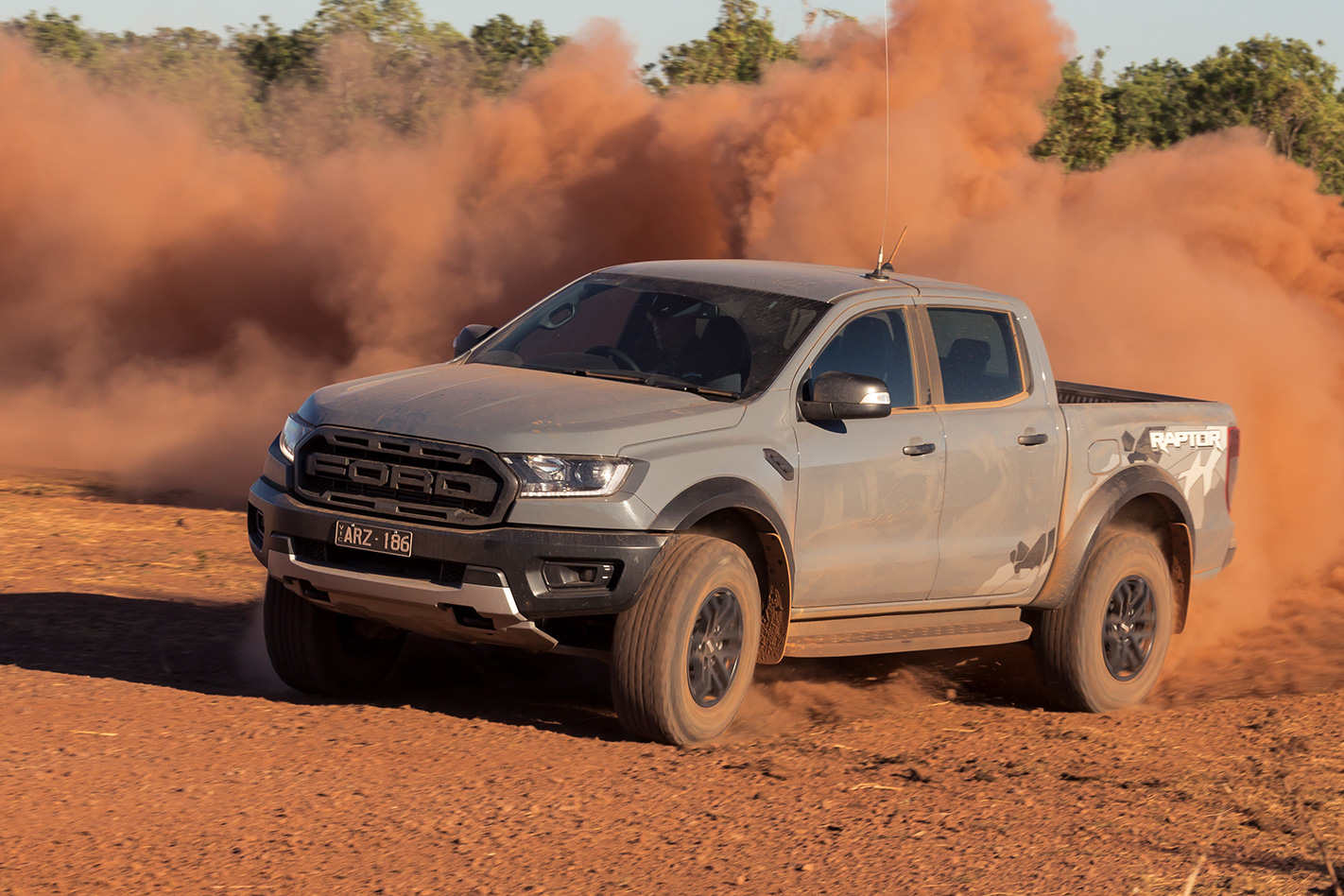
As intrigued as we were at the prospect of this vehicle, it raised three fairly fundamental issues. Does it have enough engine, can it live up to its hype off-road and, finally, is it worth the $75,000 asking price? We took the opportunity to give the Raptor a fairly unrestricted leathering in a 4000km2 cattle station in the Northern Territory in order to answer these questions.
The easiest to answer is whether it can cut the mustard off-road. The key to its competence is the combination of the Fox dampers and the 285/70R17 BF Goodrich KO2 tyre which in concert deliver a long-travel plushness to the ride and decent lateral grip on loose surfaces. The tyre is particularly interesting, having been developed specifically for the car with an S (180km/h) rating and the ability to find purchase on the loose without imposing too much of a noise penalty on bitumen. The pillow-top ride quality on road is teamed with relaxed but well-judged pitch and roll resistance.
Raptor’s Fox shocks went through 42 prototype iterations at the front and 74 at the rear before the final valve and shim combination was decided upon
Off-road, the rebound damping is particularly impressive, the Raptor able to be launched over small yumps, whoops and drop-offs without the suspension crashing. Even when driven hard into compressions that would fold a garden variety Ranger in half, the Raptor swallows horrific hits without troubling its bump stops. It’s uncanny. “The shocks act much like a soft-close drawer,” says Simon Johnson, vehicle dynamics lead on the Raptor programme. “No matter how hard you slam the drawer, it’ll always slow and catch it.”
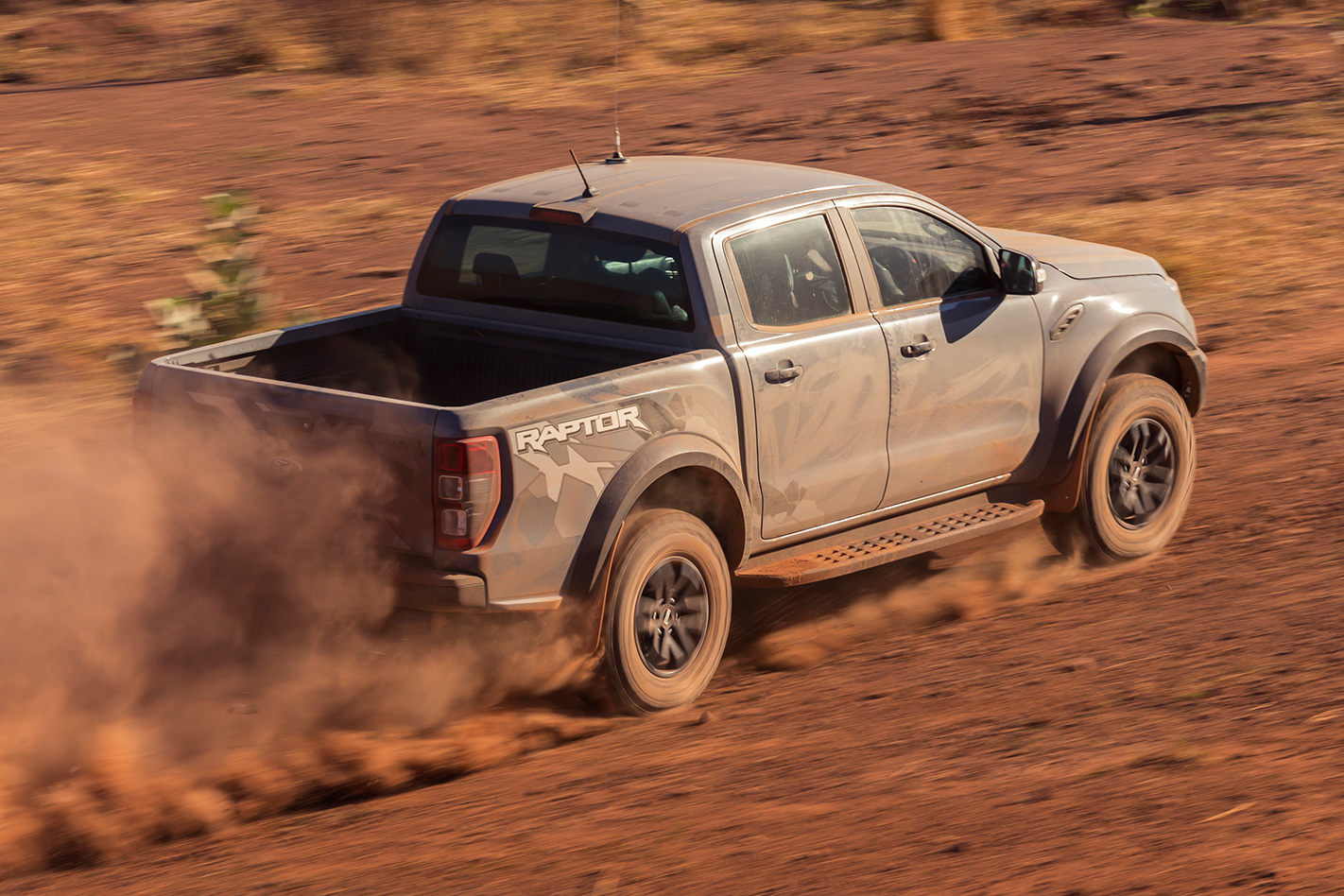
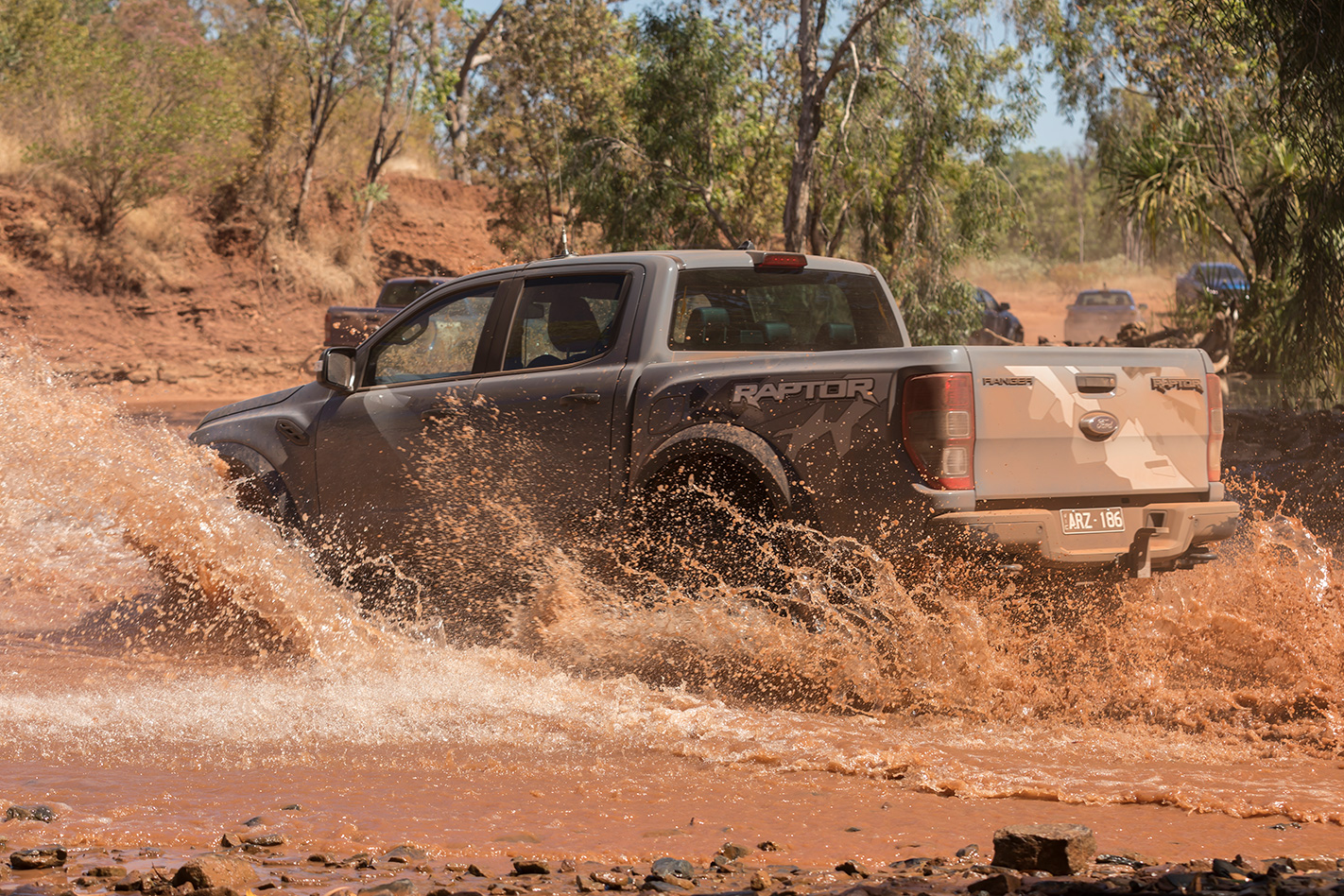
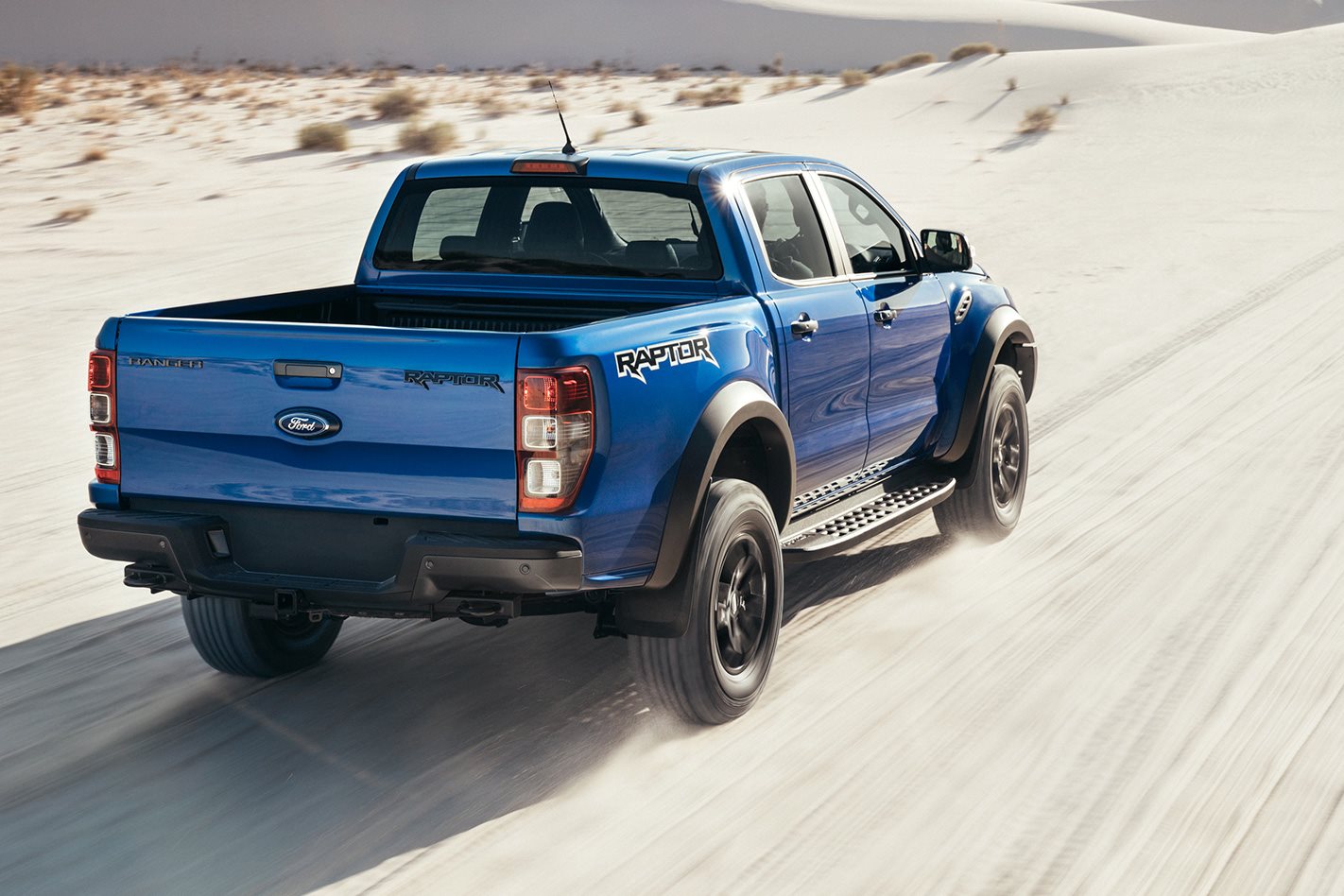
Other off-road features include hill descent control that is tuneable for speed either by the cruise control buttons or via the throttle or brake pedal. The raised ride height of 283mm – up 50mm on the standard Ranger – and a track widened by 150mm give the Raptor a beefy, foursquare stance with approach, breakover and departure angles of 32.5, 24 and 24 degrees respectively. A low range transfer case and a centre diff lock means you’ll have to try pretty hard to get one of these stuck. Should you excel yourself, 3.8-tonne rated tow hooks front and rear will help you out of a spot. It’s worth considering that while other Rangers get the option of autonomous emergency braking, the Raptor doesn’t; at least until next year. A senior Ford source told us that this was due to technical issues with sensor positioning and the occurrence of unwanted AEB interventions when running on broken terrain off road. For the first wave of vehicles, AEB will not be available, but later in 2019, Ford will have an autonomous braking solution ready to ship.
Aussie Raptors are Euro5 compliant rather than the 6.1 spec cars that Euro markets get. At least that means we don’t have to bother with AdBlue top-ups
What’s perhaps most impressive about the Raptor’s off-road chops is the Terrain Management System’s Baja mode, which allows 20 degrees or so of yaw with ESC on, giving the off-road driver the option of oversteering the Ranger into a corner on the brakes to get the nose pointed in vaguely the right direction whilst still retaining the safety net of some stability control should you really get a bit ambitious. Available in both front and rear drive settings, Baja mode does particularly interesting things to the electrically-assisted steering, damping the response slightly which would be undesirable on bitumen, but on the loose allows you to wind on lock without making the front end nervous or pointy-feeling. Likewise, it softens the throttle pedal mapping slightly so as not to tip the vehicle into unwanted traction control interventions and holds onto gears for a bit longer.
So while the Raptor lives up to its engineering claims off-road, on blacktop it’s not quite such an unblemished scorecard. There’s no real way of sugar-coating the fact that this is a $75K Ford Performance product that has a power to weight ratio of 65kW per tonne. That’s only a gnat’s better than an entry-level VW Polo 70TSI. Little wonder that 100km/h comes and goes in a stately 10.5 seconds. In other words, don’t try to challenge a V6 Amarok or X-Class away from the lights.
Raptor’s tray measures 1560mm x 1743mm and towing capacity is rated at 2500kg
Drive it solely off-road and you’ll find it more than adequate. On road, it can feel a little anaemic, although the 10-speed automatic transmission does try to wring the best of it out. The fact that peak torque is maintained across a mere 250rpm between 1750 and 2000rpm coupled with shift paddles that seem to deny downshifts a little too censoriously means that the ‘box is best left in ‘D’ to get on with things. The steering is crisply weighted and the brakes beefed up to cope with the Raptor’s considerable extra weight over a garden-variety Ranger XLT, but that weight further blunts the grunt that is on tap. There’s never that effortless surge of torque you want and expect. We tested a Ranger XLT at 10.1 seconds to 100km/h last month, so the Raptor could well be outdragged by a sibling that’s $18K cheaper. It also proved slower than the Triton Exceed, Amarok, Mercedes X250d, Colorado LTZ and the Navara ST-X we tested in July’s issue of the magazine.
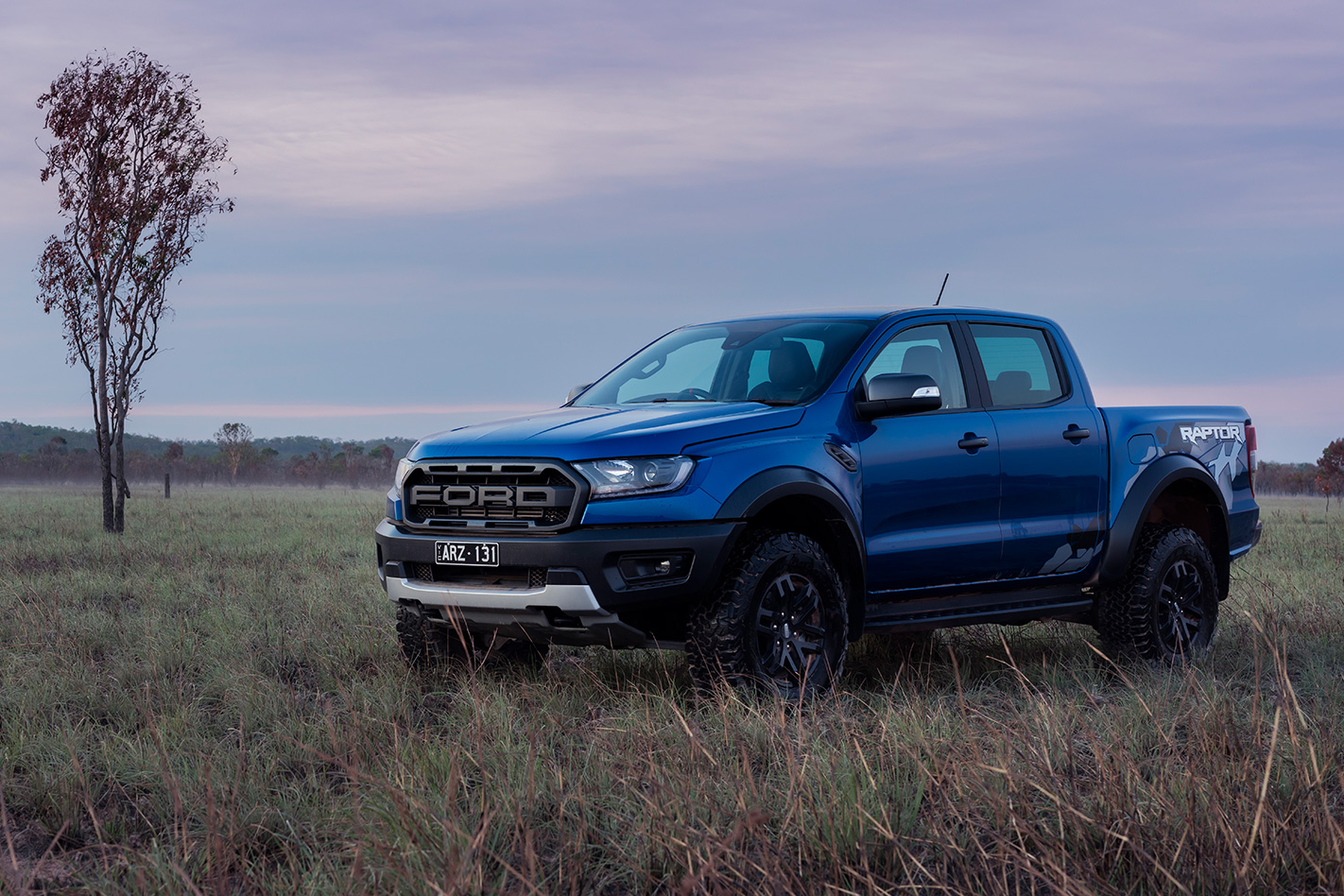
And therein lies the Raptor’s rub. Viewed through the narrow lens of pure function, the engine is fine for its high-speed off-road remit. It’s gutsy enough, wields a 900km+ theoretical range and weighs around 70kg less than the doughty 3.2-litre five. But in focusing almost exclusively on fitness for a largely esoteric purpose, Ford’s engineers have compromised the Raptor for what it will actually be used for. Most Aussie buyers will never experience their vehicle at high speed on dirt or sand, much less launch it off a yump. Those filling Ford’s order bank will get a great looking, sweet riding and benign handling dual-cab that’s one of a kind, but which can appear skewed on the mouth/trousers ratio. Vacation on a cattle station and it’ll all make sense.
SPECS
Model: Ford Ranger Raptor Engine: 1996cc inline 4cyl, 16v, dohc, turbo diesel Max power: 157kW @ 3750rpm Max torque: 500Nm @ 1750-2000rpm Transmission: 10-speed automatic Weight: 2404kg 0-100km/h: 10.5 sec (claimed) Economy: 8.2L/100km (combined) Price: $74,990 On sale: September 2018
MORE: Ford Ranger Range Review MORE: Ford Ranger Specs, Range & Price
Wheels Spin: Should we buy it?
Short, sharp and to the point, Wheels spin is the quick read you need to get to know a car.
What’s in the garage?
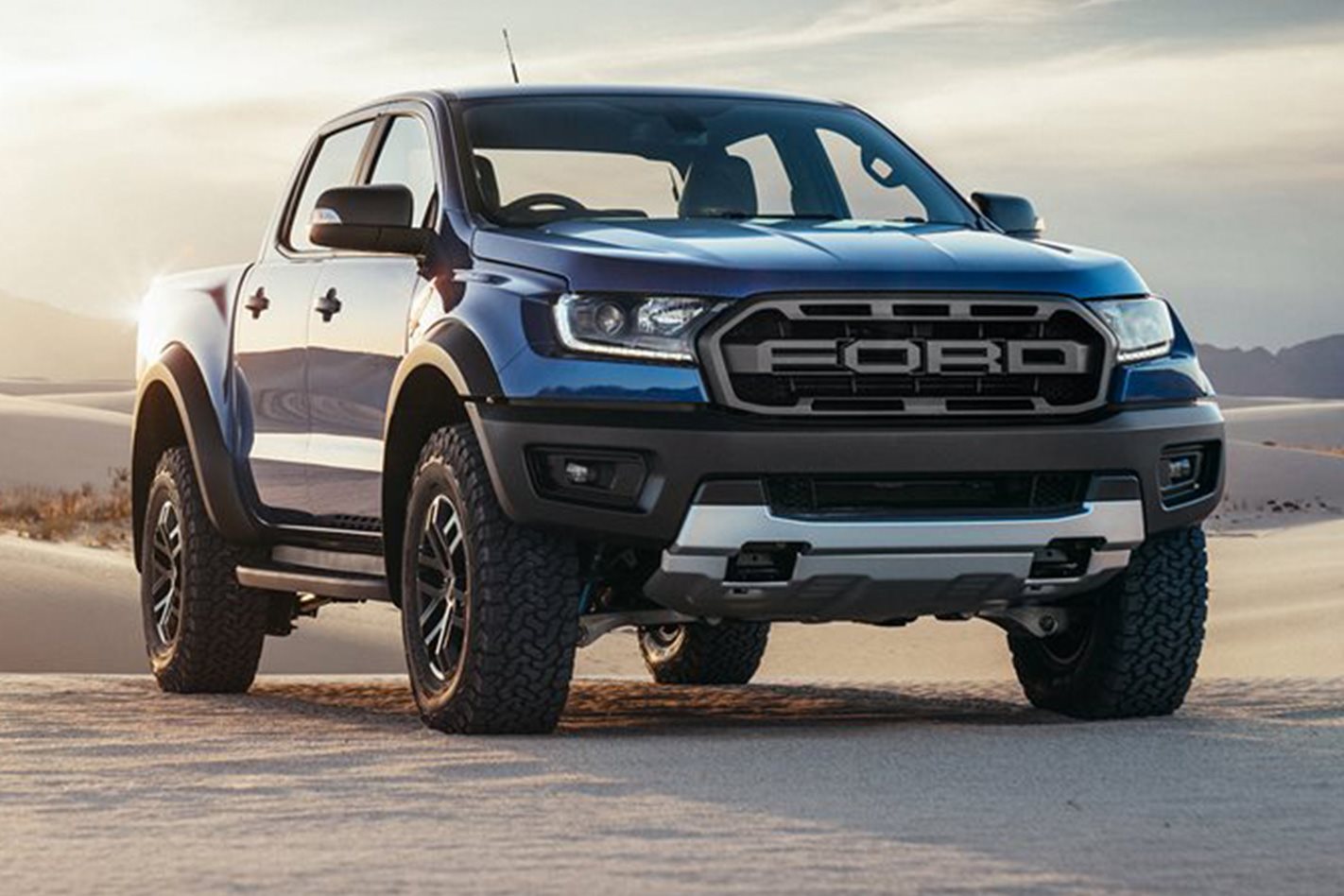
In terms of driveway goals and tradie one-upmanship, the Blue Oval’s Ranger Raptor is high on the ‘want’ list. However, Ford’s offering isn’t merely a sticker pack and a jacked-up price. Genuine off-road cred materialises in the form of Fox 2.5-inch bypass shock absorbers and 285/70 R17 BFGoodrich tyres with bush-bashing tread to fill the pumped guards. There’s 150mm more track front to rear, an extra 46mm of ground clearance and 30 percent more suspension travel to fulfil your stadium-truck dreams. The sticking point at launch was the lack of an EcoBoost V6 powertrain – a quoted 0-100km/h time of 10.5 seconds isn’t earth shattering. However, the 2.0-litre bi-turbo diesel four-cylinder offers 157kW and a substantial 500Nm of pulling power. Tied to Ford’s new 10-speed automatic (with paddle shifters) and a trick driving mode branded Baja, the Raptor has the gear to back up its dominating presence. If you want one, you’ll need to stump up $74,990.
What we reckon

Cameron Kirby
Staff Journalist
Why should you pay the extra cash for a Raptor over a Wildtrak I hear you ask? Simply, it is all about that suspension, which is a revolution for those who daily drive a dual-cab in an urban environment. While the marketing people would have you believe that this ute is all about off-road antics, its secret weapon is how liveable it is in the inner-city. The 2.0-litre unit is one of the more refined engines in the segment, the 10-speed smooth and well-calibrated, while the beefed-up suspension is beautifully compliant on road, and banishes the unladen jiggle that haunts all other dual-cabs.

Trent Giunco
Staff Journalist
If you dream of something that’s actually capable and will make you smile, the Ranger Raptor is the ‘truck’ of choice. Thanks to the Fox hardware underneath, the ride quality surpasses other dual cabs and you can launch it at any urban-jungle speedbump at pace, which spices up the daily commute. The BFGoodrich hoops don’t offer much grip in the wet (especially in two-wheel drive) and the auto can go in search of power that isn’t there, but overall the Raptor is as polished as it needs to be. I doubt any buyer will be disappointed.

Alex Rae
Online Editor
The ride and handling of the Raptor is supreme in the dual-cab market, both on and off the road. Even if you were to buy a Ranger XLT, or a rival, and throw thousands at changing the factory-tuned suspension you still wouldn’t match the ride compliance found here. It’s utterly impressive off-road, where it unravels bumps and lumps from unsettling the chassis at speed and gives a huge ground-clearance with lots of grip for tackling serious four-wheel-drive tracks. It’s also easy to live with around town, and the diesel donk, though I was initially sceptical, is effortless and refined with the 10-speed auto behind it. If I had the money for a ute, this would be the one.
Review
Power and performance:
If you’re expecting the Ranger Raptor to match its outward menace in straight-line pace you’ll be largely disappointed. Just like its competition, Ford’s offering is all about torque over outright performance. And it delivers that in spades. The new, downsized 2.0-litre four-cylinder bi-turbo unit is a more refined unit over the outgoing single turbo five-pot, behaving much more like a passenger-vehicle-spec diesel over a commercial unit. With 500Nm of grunt, there’s certainly no shortage of torque to pull you out of trouble or to cruise in higher gears with the largely slick 10-speed auto. If towing is a high priority, opting for the ‘old’ 3.2-litre, six-speed auto combo would be a better bet. It’s also a shame we don’t have the option of the 2.3-litre EcoBoost petrol four-cylinder that’s standard in the US. Still, despite the fact there’s no boosted V6 nestled within the engine bay, the 2.0-litre oiler is an impressive engine that endows the Raptor with enough bite to get stuck in off-road.
Ride and handling:
Sitting on Ford’s T6 modular chassis, designed to allow for different wheelbases and suspension setups, the rugged Ranger has been extensively modified for extra stability. In terms of ride quality, the Raptor is a revelation – both on- and off-road. Ford has spent money on expensive Fox Racing dampers, and they work wonders for city potholes and any obstacle you might encounter out of urban gridlock. Its ability to absorb and control rebound movement is truly staggering. The regular coils at the back have also been replaced with a Watts linkage, adding genuine long-haul ability to the Ranger. Six driving modes are offered, with the key one aptly-named ‘Baja’, which sharpens the auto’s actions and allows a little more freedom from the electronic aids to have some fun in the dirt. It’s still a hardcore 4×4, meaning a dual-range transfer case is fitted, the wading depth is 850mm and there’s 283mm of ground clearance to play with. The Raptor will conquer just about anything, but watch out for wet tarmac as the BFGoodrich tyres don’t offer optimal grip – especially in two-wheel drive mode.
Interior and Comfort:
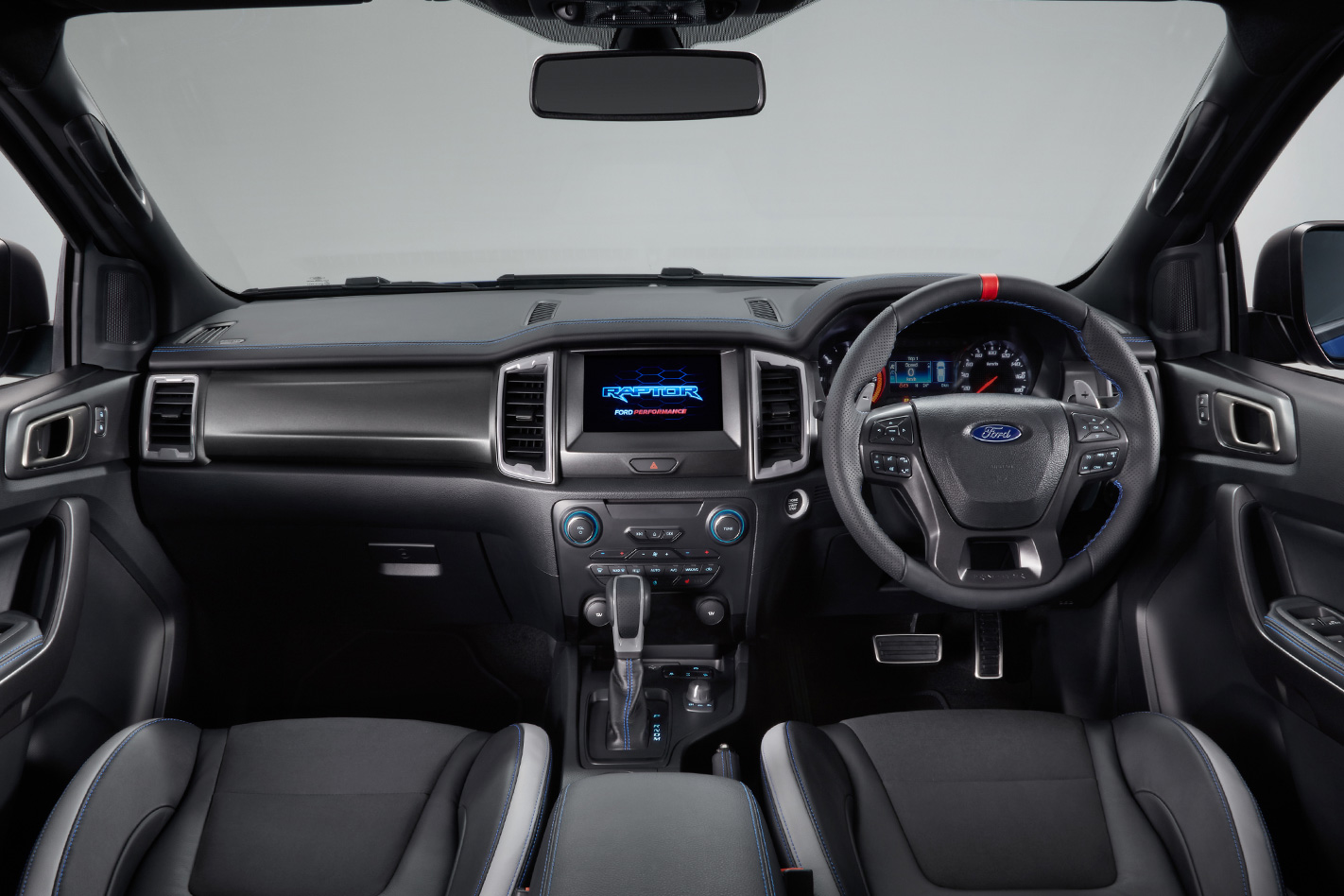
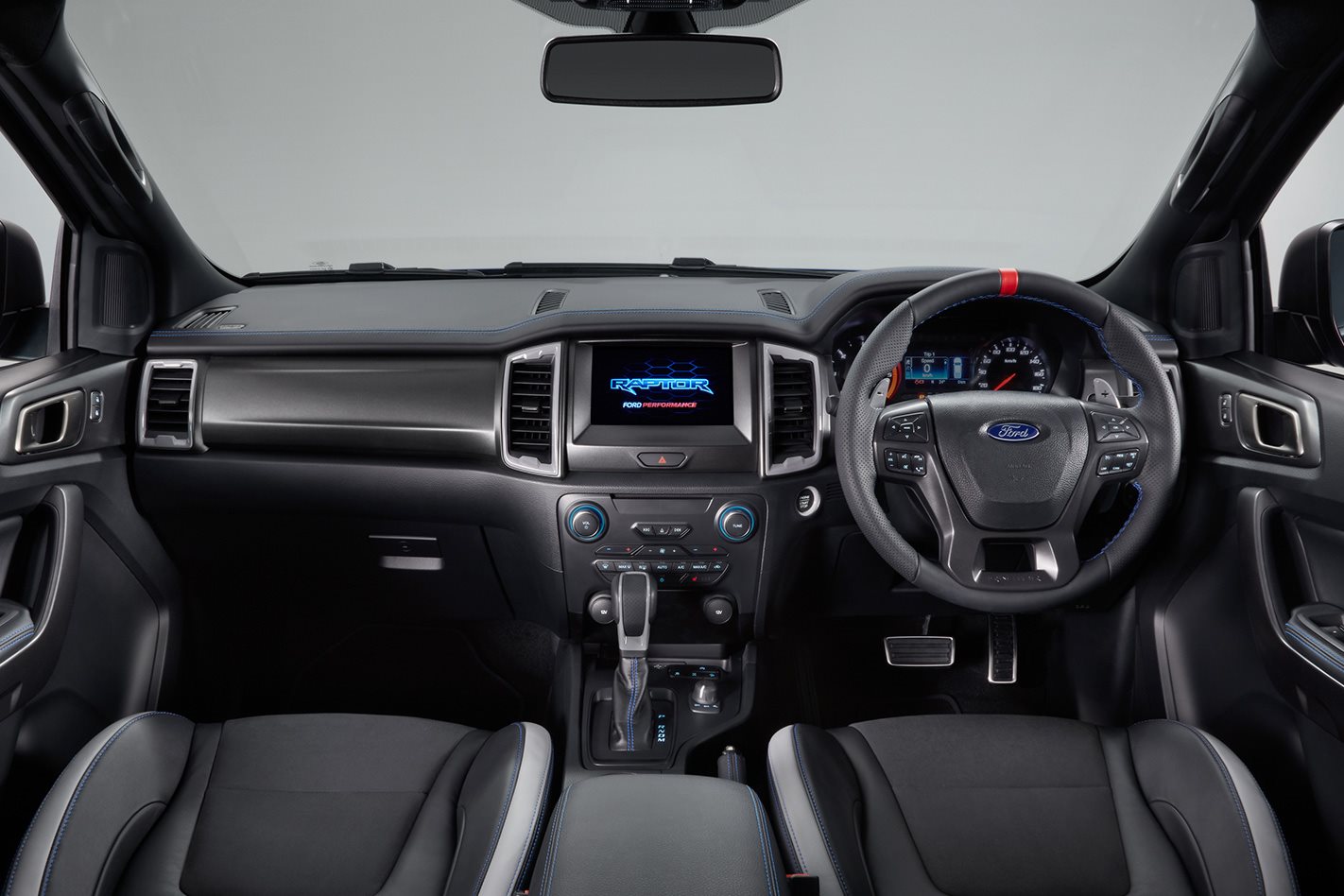
It’s a Ranger… and despite its halo-status, it looks like one inside, too. Yes, you get some Ford Performance badging, steering wheel-mounted paddle shifters, a leather-wrapped steering wheel, gear shifter and handbrake and well as unique seat trim, but it’s not too dissimilar from the rest of the higher model grades. Infotainment is covered off with Ford’s SYNC 3 system as well as the capacity to provide Apple CarPlay and Android Auto functionality via the central 8.0-inch touchscreen. The Raptor also scores AEB, lane keeping and departure warning, trailer sway control and all-round sensors as some of the standard safety tech. The dimensions of the cargo tub are the same as the garden-variety Raptor, so all the usual accessories will fit. However, the overall towing capacity is down 1 tonne to 2500kg and the payload is reduced to 758kg.
Verdict
If you’re in the market for a dual cab that’s genuinely capable and looks the part, then the Ranger Raptor isn’t going to be a disappointment. At $74,990 it’s a premium product, but you have to factor in the expensive hardware underneath helping the Raptor be as skilled as it is. And you can’t discount the fact that the Raptor is as competent as it is fun.
Second opinion: 4×4 Australia first drive review
4X4: Australia’s guide to the off-road adventure lifestyle.
Mixing in-depth vehicle reviews with off-the-beaten-track adventures and gear tests, 4X4 is all about enjoying Australia’s great outdoors.
Ford applied the Raptor treatment to the Ranger pick-up, but does it deliver the performance buyers want? By: Matt Raudonikis
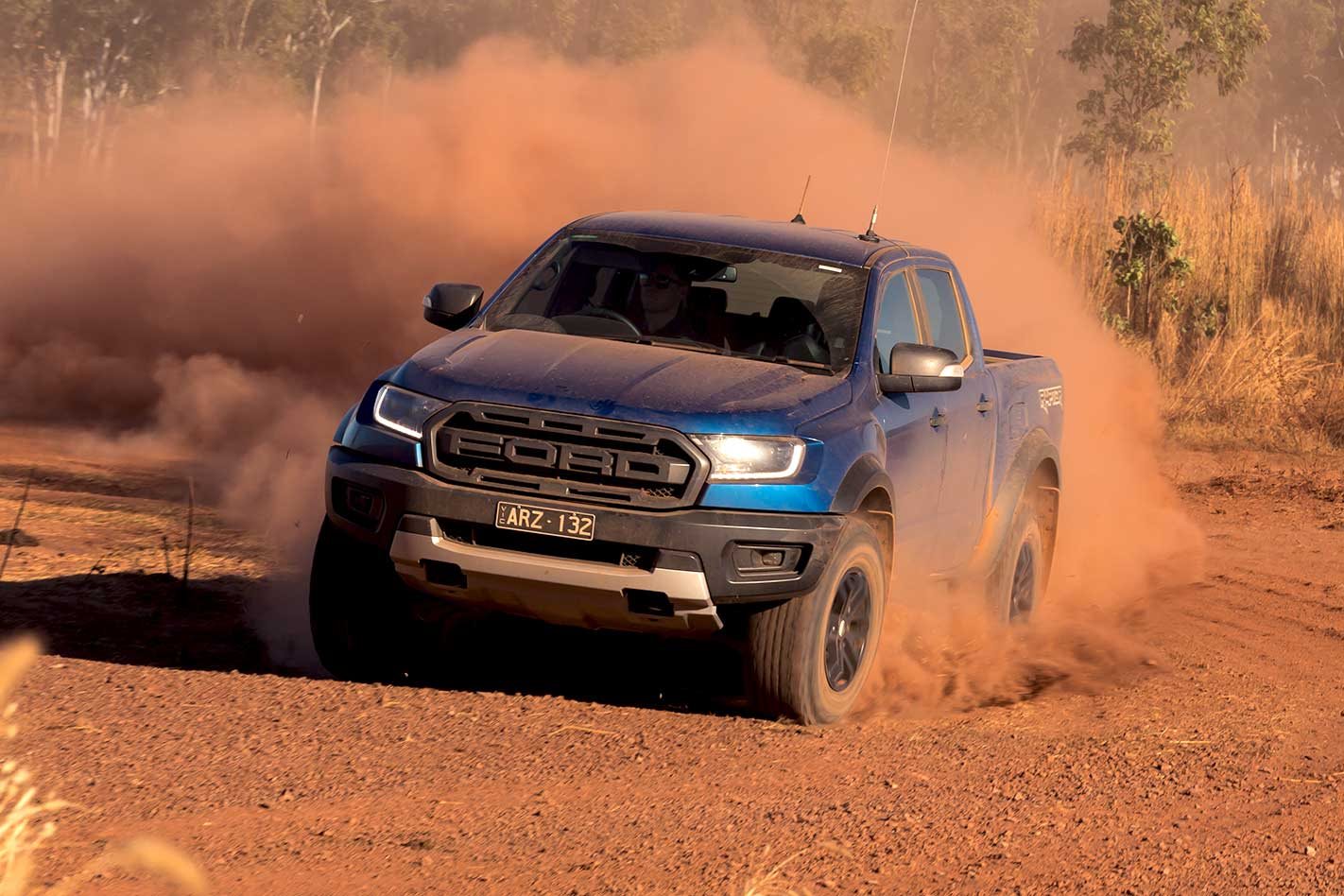
THE modern dual-cab ute is designed to fulfill so many roles, yet it never really masters any of them. It needs to be a work truck, family transporter, a touring explorer, a tow tug and an off-road adventure machine, but by trying to meet all of these demands it is always compromised.
As 4×4 enthusiasts we modify and customise our vehicles to better meet our intended uses. Tyres, suspension, bar work and custom trays are just some of the many things we change to make the vehicle more focused on what we want out of it.
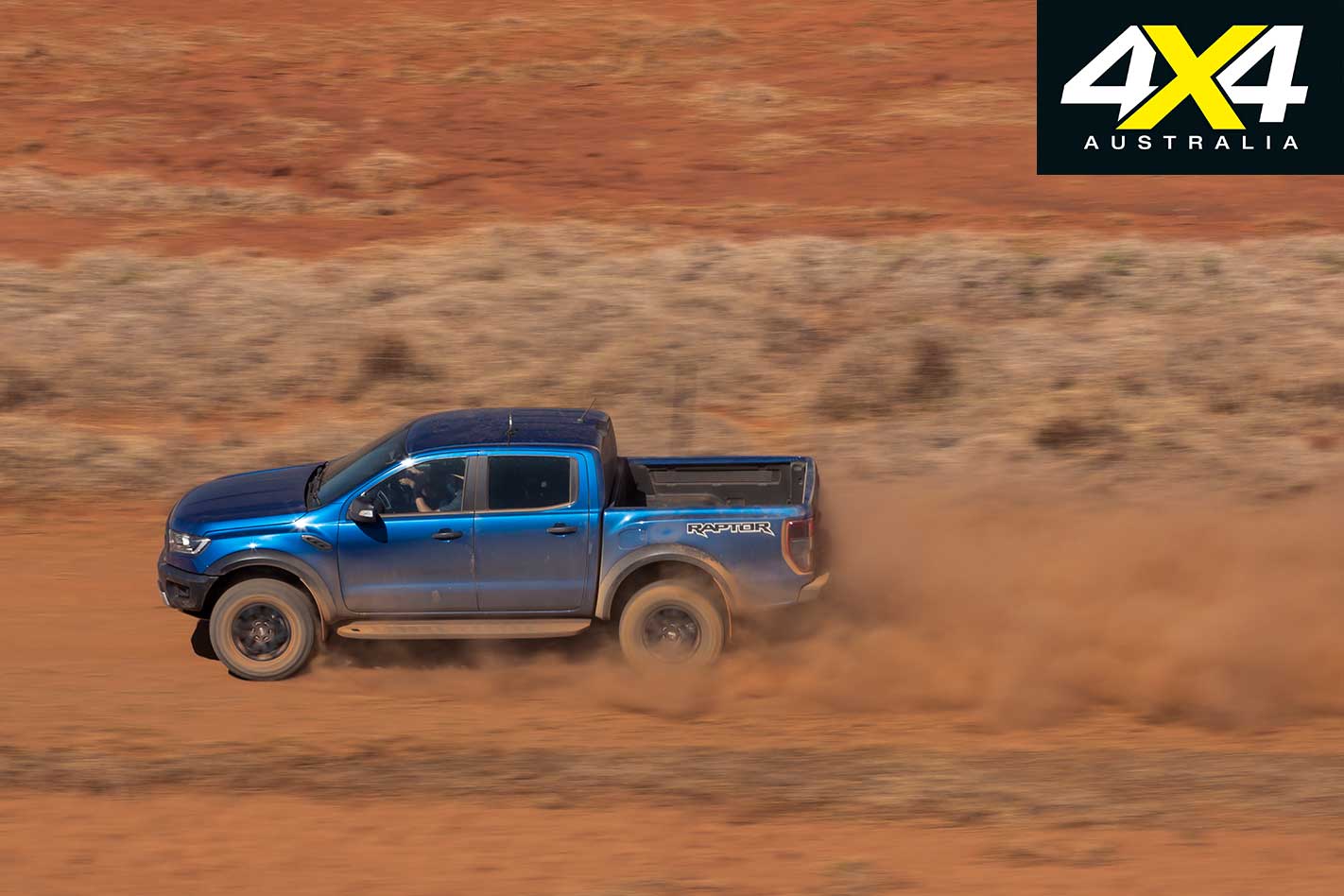
More and more often we hear the term ‘sports ute’ bandied around, and with its F-150 Raptor pick-up in the USA Ford Performance created the ultimate production off-road performance truck.
However, Ford doesn’t offer the F-150 in right-hand drive, so we don’t officially get it in Australia in any form. Our most popular 4×4 pick-up is the Australian designed and developed Ford Ranger, a truck that is a size smaller than the F-Truck yet similarly serves many purposes.
Ford saw the potential of a performance version of its Ranger, and the Australian team has worked with Ford Performance globally to create the Ranger Raptor. A little brother to the F-150 Raptor, the Ranger Raptor carries the same DNA that makes the F-150 so popular but on a smaller scale.
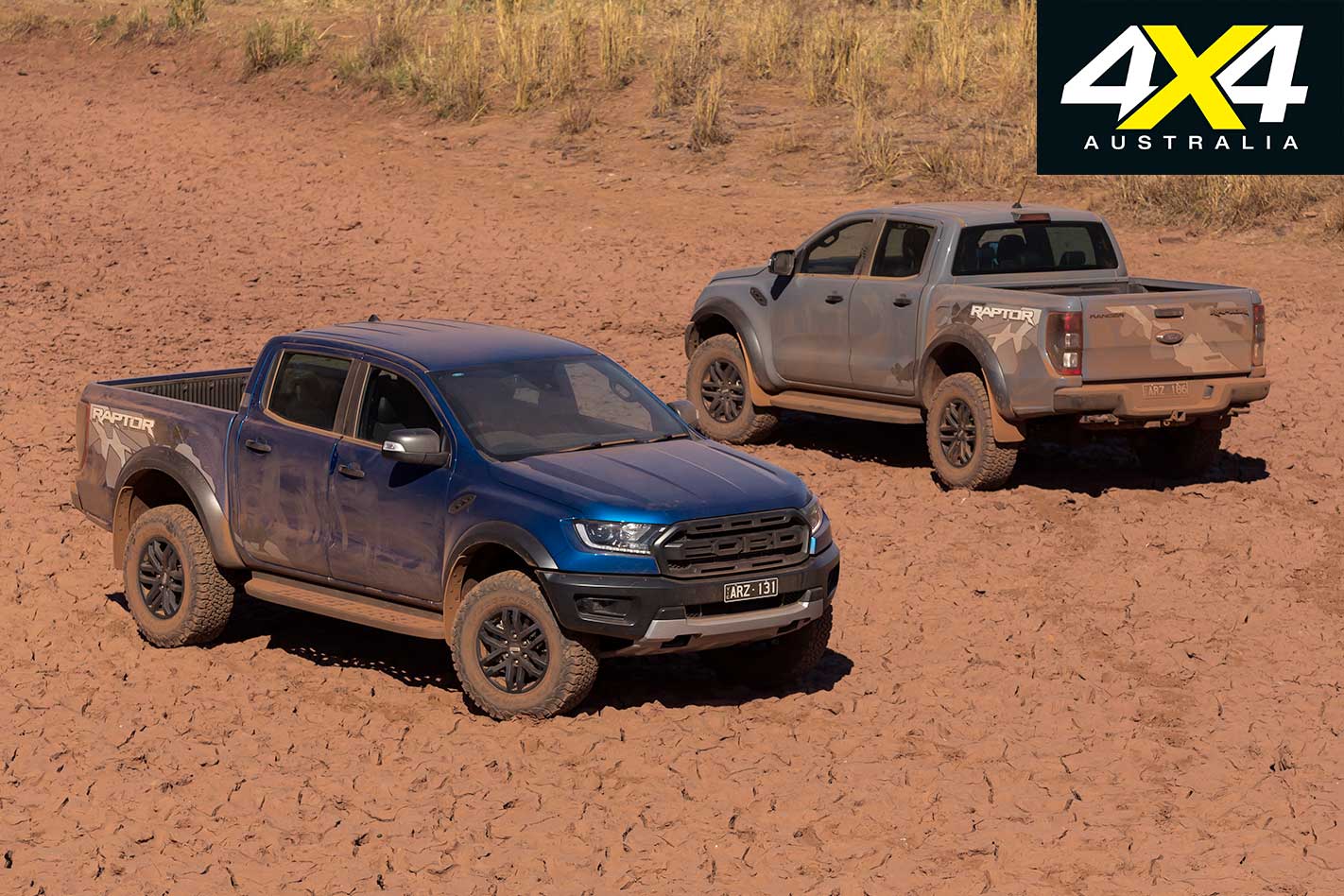
When Ford Performance talks about a ‘performance’ pick up, it’s not just about straight-line grunt. Despite its menacing looks, there’s no stonking, great V8 engine in its Ranger Raptor – or in the F-150 Raptor either, for that matter – it’s more about a total performance package, from the tyres to the bespoke bodywork and sports seats.
Raptor takes its design brief from the pre-runner vehicles used to reconnoiter off-road races such as the famous Baja 1000 in Mexico. For these vehicles, outright pace isn’t the ultimate goal; it’s more about covering the most demanding terrain swiftly, relatively comfortably and safely. Try and do this in any regular truck and it will fall apart around you as you bounce about inside the cabin.
The key components are high-quality suspension and tyres, and the Raptor uses some of the best in the business. While the off-road racers and pre-runners use suspension costing upwards of $5000 per corner from companies like Fox Racing, the production Raptors – Ranger and F-150 – use Fox products.
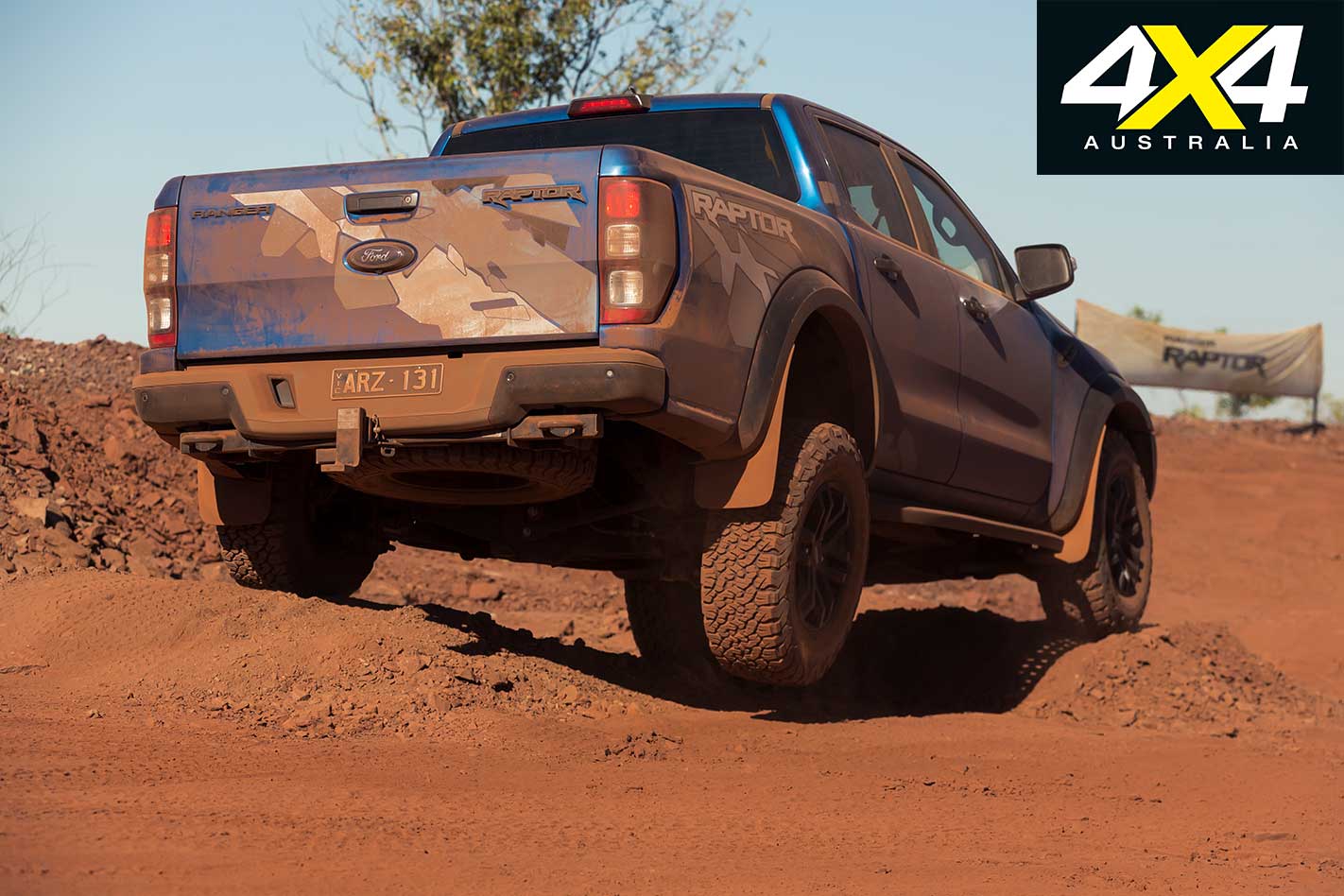
There are designed to be as long-lasting and durable as an OE product, maintain OE standards and ride quality, and still tackle the toughest tracks at speed.
The 2.5-inch bypass shock absorbers used in the Ranger Raptor use race technology and design but are fitted in the smaller package to run in the stock locations. Put simply, a bypass shock has different characteristics in the one unit, depending on the amount of travel.
When the shock is operating in its regular compression area it is able to give a soft and compliant ride, but as the piston inside it moves down, more oil inside the shocks passes through the piston to make it stiffer and able to handle bigger, faster bumps and jumps.
That’s in the simplest of terms, but the Fox shocks and spring package that was specifically developed for the Ranger Raptor allows it to ride over bumps like no other off-the-showroom-floor 4×4.
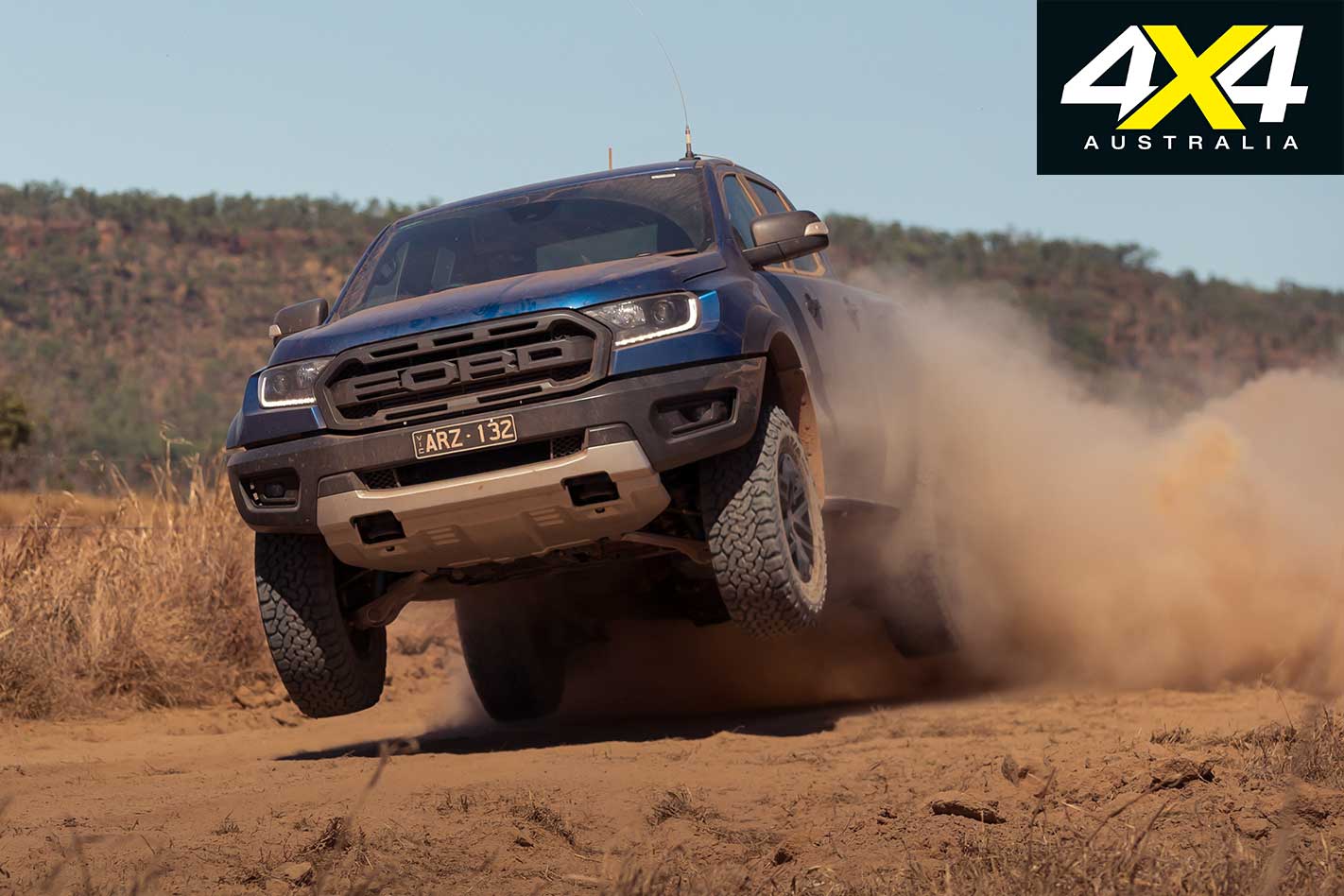
The Fox components bolt into a suspension that increases the Raptor’s wheel track by 150mm over that of a standard Ranger ute, and this added width adds to the vehicle’s stability.
To achieve the extra width, bespoke aluminium A-arms are used on the independent front suspension; while at the rear of the chassis the leaf-sprung live axle of the regular Ranger is replaced by coils with a Watts linkage for lateral support, derived from that on the Ford Everest. It differs from the Everest rear end in that the Fox dampers are mounted farther outboard, again to improve vehicle stability and control.
The chassis is a unique mix of Ranger and Everest parts – call it a Ranger with an Everest rear end or a stretched Everest chassis – but the Ford engineers have made the T6 chassis modular to accommodate a range of different suspension configurations and wheelbases.
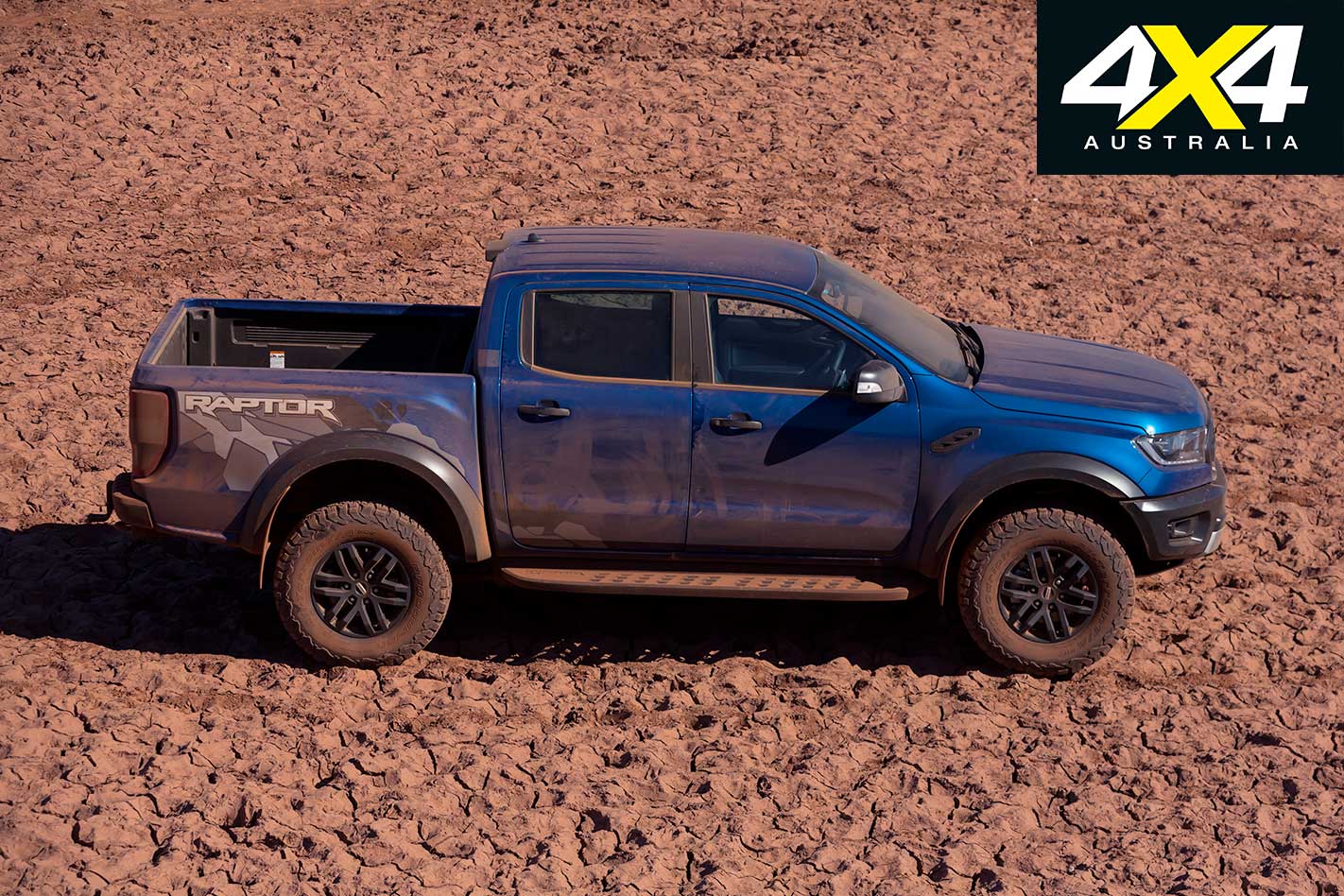
With the 2020 Ford Bronco coming off the T6 platform, as well as the existing Ranger and Everest, there will be at least three different wheelbases for this chassis and as many different rear suspension designs.
The rearmost part of the Raptor chassis also differs from Everest and Ranger in that it is modified to carry the bigger 285/70 spare BFG tyre, and the rearmost cross-member is an integrated tow bar with large recovery points at either end.
The Ford Performance Chassis Dynamics team worked closely with tyre manufacturer BFGoodrich to develop a specific version of its acclaimed KO2 All Terrain tyre for the Raptor.
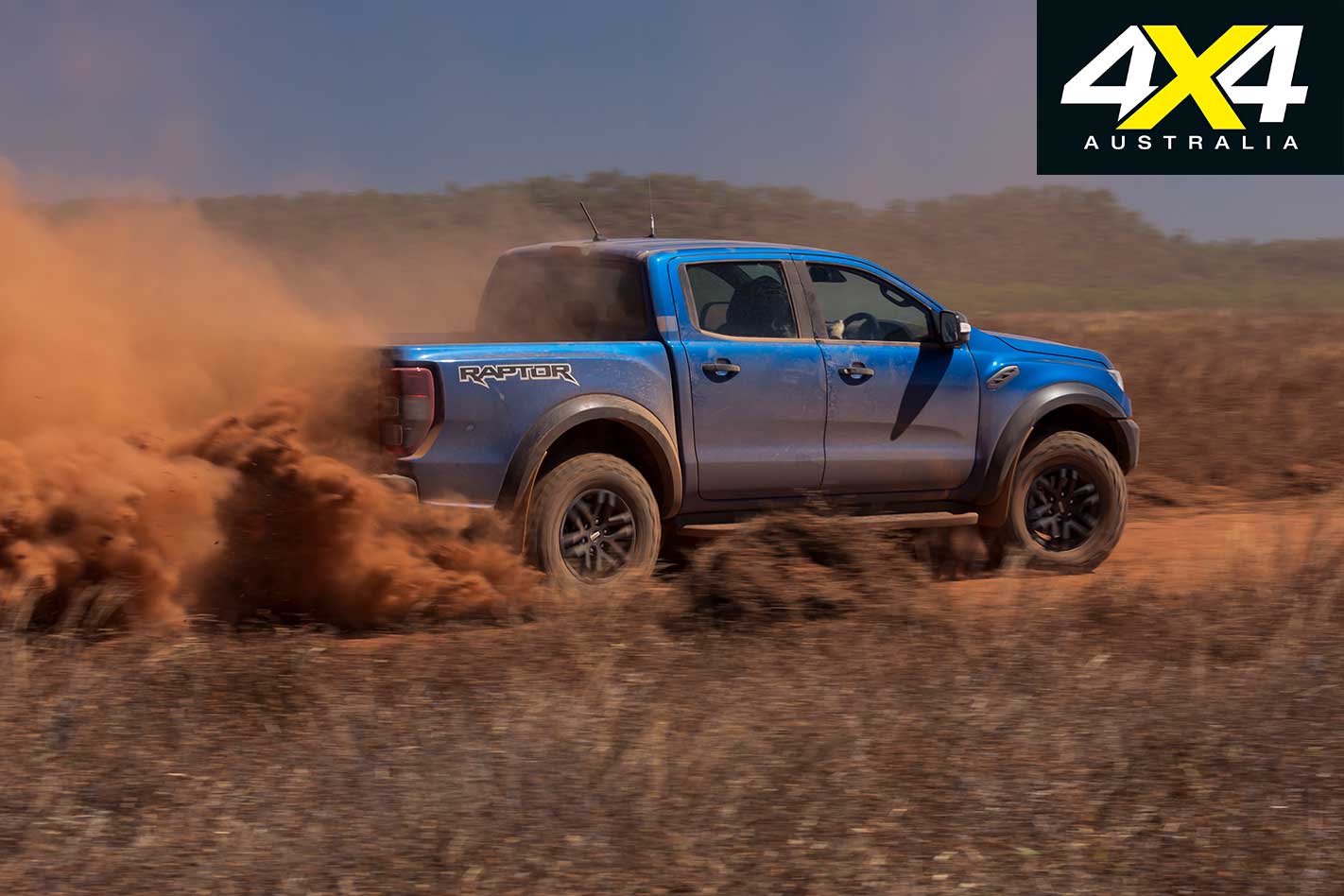
Engineers from both companies tested various tyre compounds and suspension settings to come up with a complementary package to achieve the desired traits. The LT285/70-R17 KO2 used on Raptor might look like any other BFG KO2, but it has a unique rubber compound and its own part number.
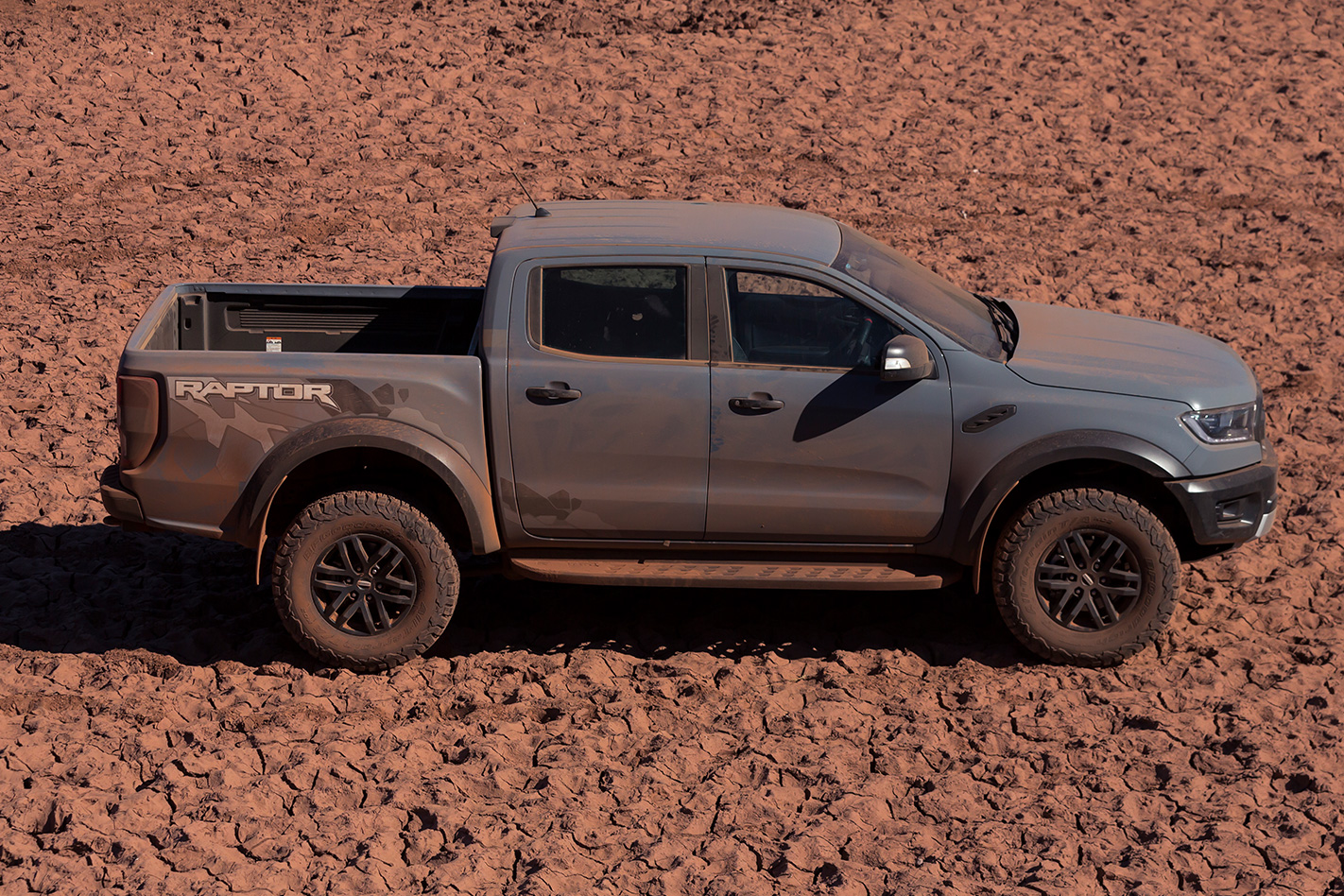
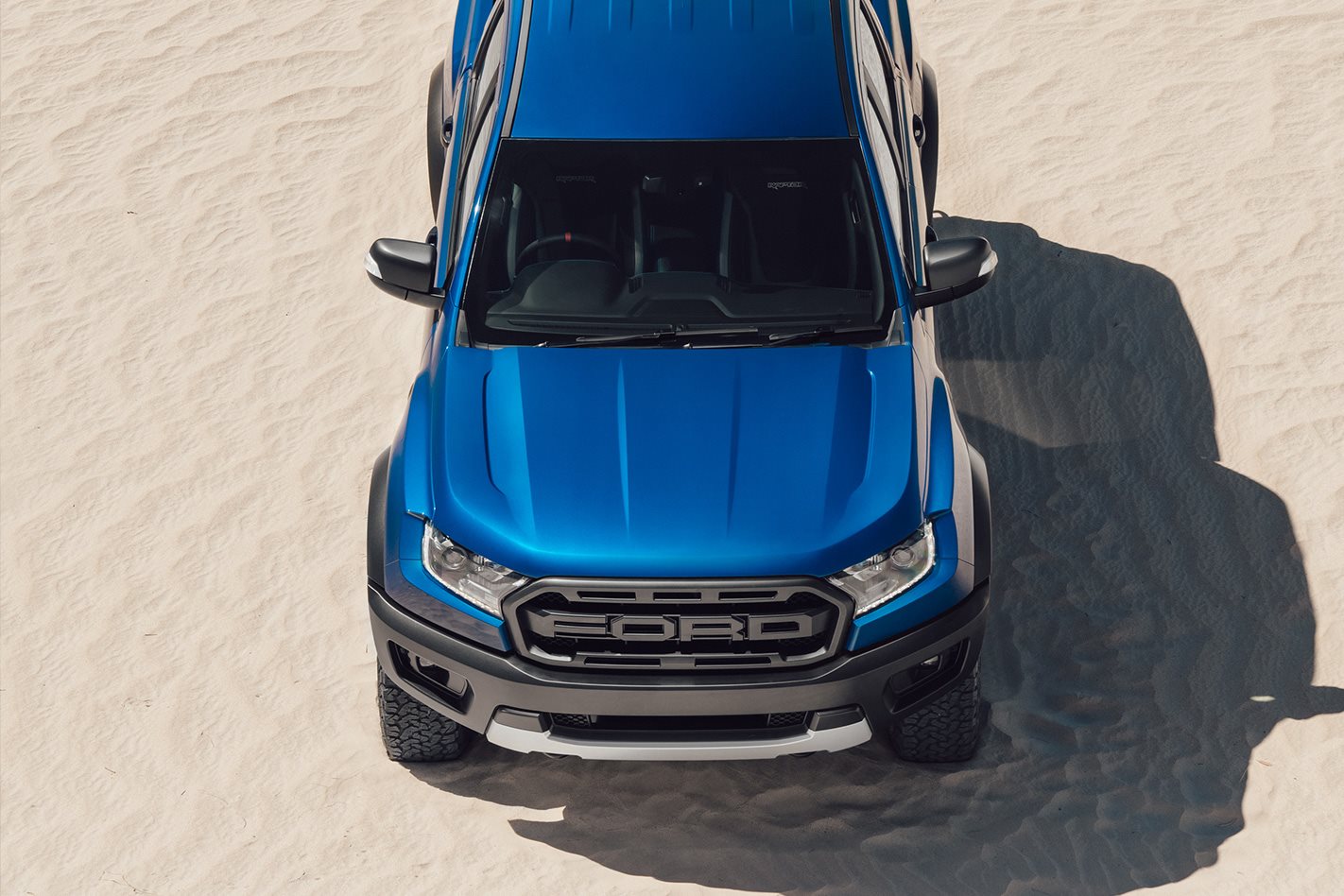
The bigger tyres and wider wheel track necessitated wider ’guards to cover them, and the Raptor has bulging front ’guards flanking either side of the signature black F-O-R-D Raptor grille. There’s also a unique slim-line bumper beneath it, dropping away to the underbody protection plates.
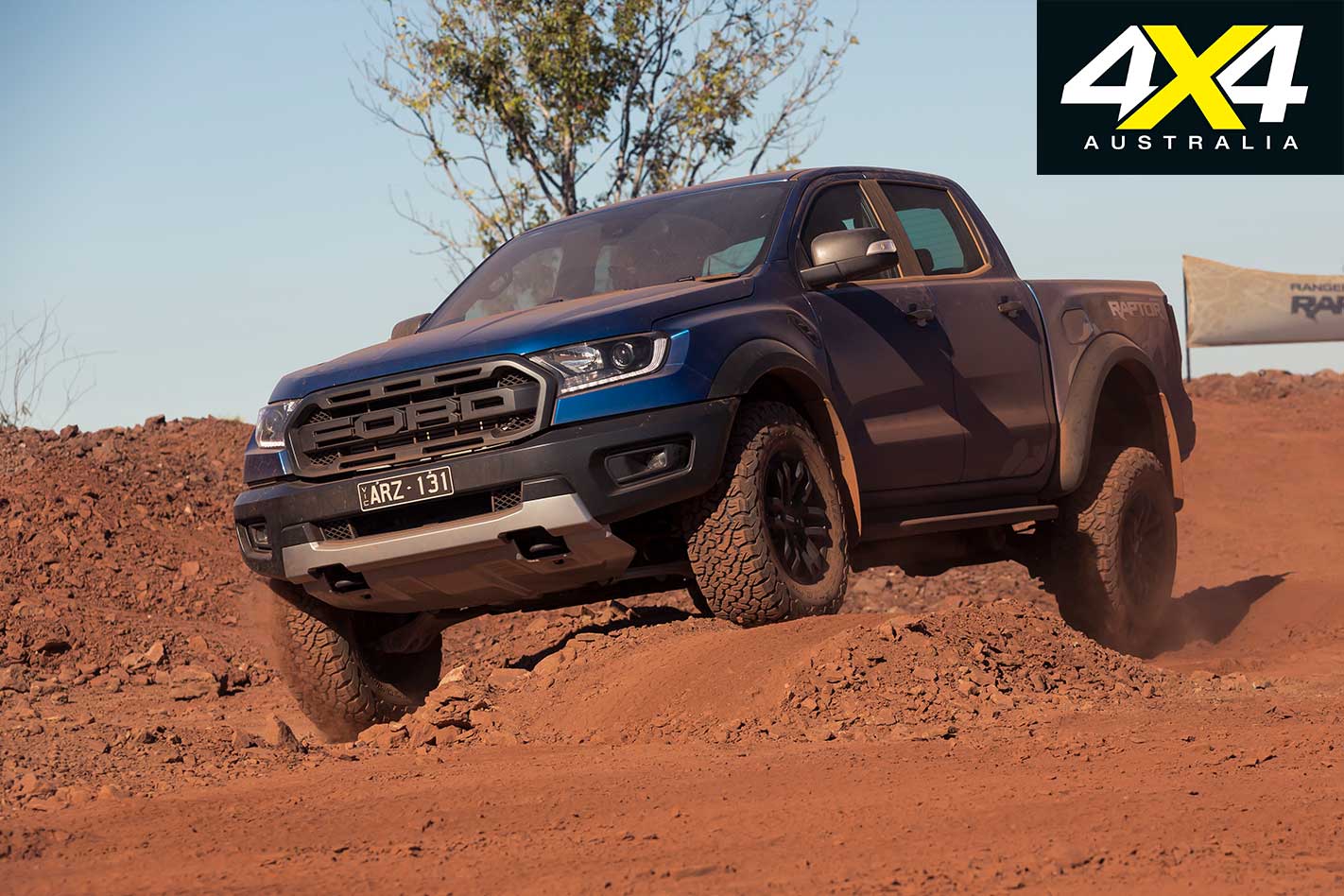
The front end is matched by a similarly bulging cargo box that, while externally wider, retains the same internal dimensions as a regular Ranger tub, meaning the existing tub liners, roller covers and other accessories will still fit this vehicle.
The bold, aggressive look of the Raptor reflects its built-for-purpose chassis and suspension package that are made to tame challenging tracks and terrain. What it doesn’t match is the Raptor’s powertrain which, let’s be honest, isn’t the highlight of the vehicle.
Don’t get us wrong, the new bi-turbo-diesel engine and 10-speed automatic transmission is a nice and refined combination, but it doesn’t live up to the Raptor’s aggressive good looks and potential.
The 2.0-litre, four-cylinder, bi-turbo-diesel engine makes 157kW at 3750rpm and 500Nm in between 1750 and 2000rpm, so it makes more grunt than the bigger five-cylinder diesel.
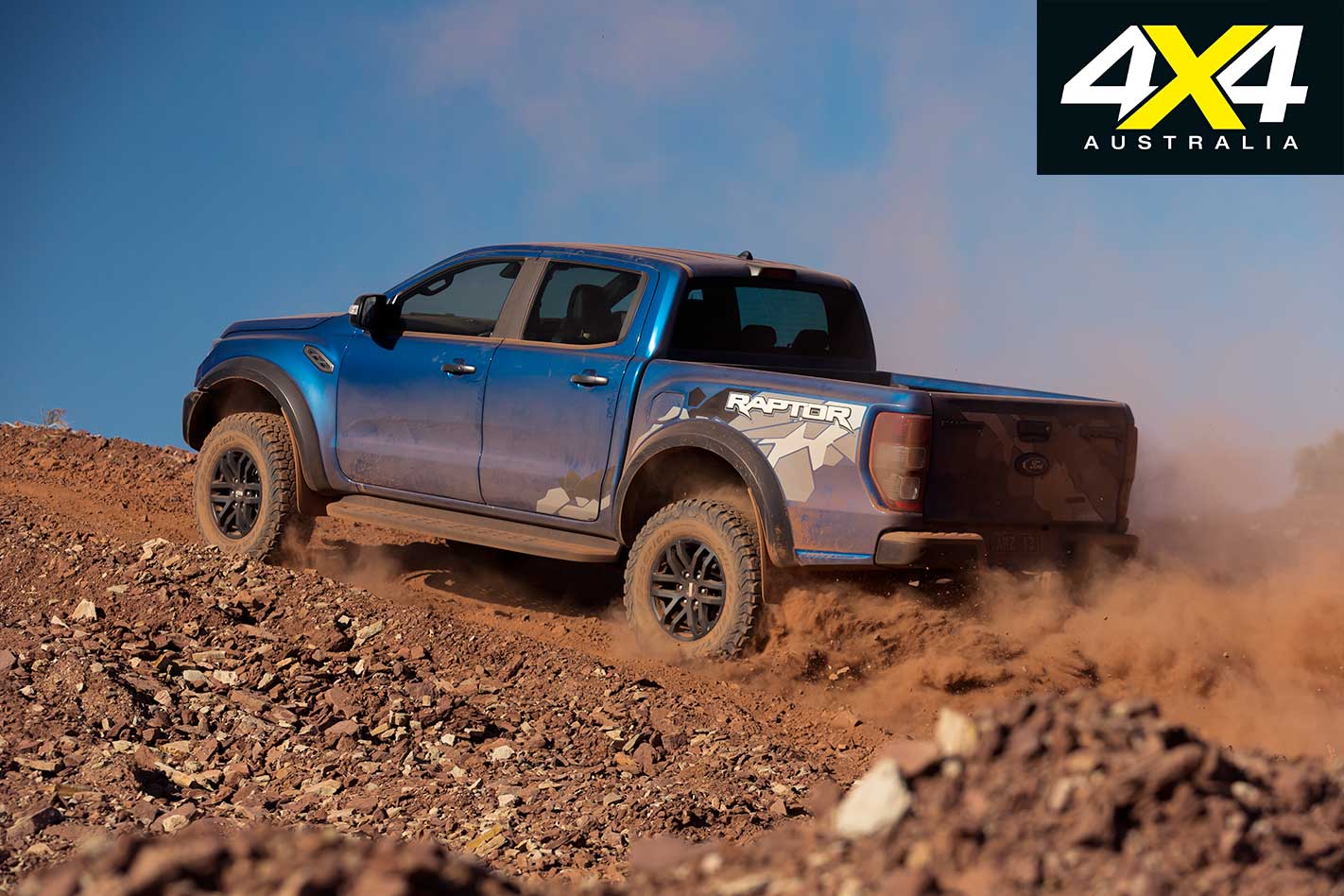
Despite being some 200kg heavier than a Ranger, the Raptor is around half a second quicker in the zero to 100km/h dash than a Ranger, and we verified that by putting it up against a Ranger Wildtrak, which was left behind by the Raptor as we matched Ford’s 10.5-second 0-100km/h claim.
But it doesn’t feel fast and, in reality, it’s not – this is still a diesel-fueled pick-up truck and not a road racer. The new engine and transmission combination, which will also find its way in to Ranger and Everest before year’s end, has more grunt and is quieter and more refined than the old 3.2-litre and six-speeder, but that refinement masks the modest performance on offer, which isn’t what many buyers will want from a monster truck like the Raptor.
Before you ask, no, there is no other engine currently planned for Australian-delivered Ranger Raptors in the foreseeable future … diesel, petrol or otherwise.
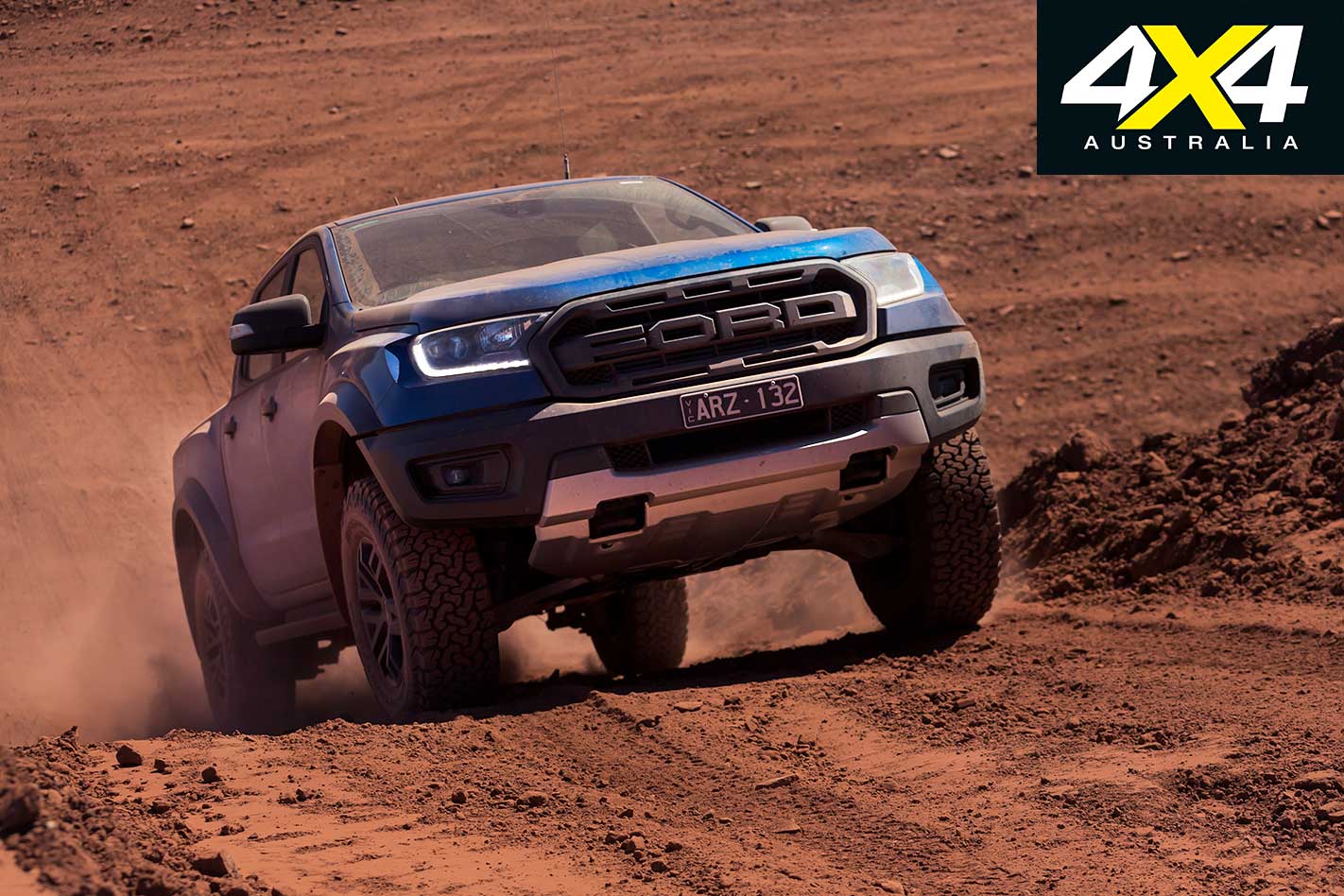
That begs the question: who is going to buy the $76,000 Ranger Raptor? With a reduced payload (700kg) and towing capacity (2500kg) the Raptor isn’t going to be on the shopping list of the touring 4WDer who is already battling with payloads and GVMs (3090kg). The unique front end will also limit what’s available in terms of frontal protection equipment, so outback touring in a Raptor presents new challenges.
Despite its pretenses the Raptor is not a racecar. It’s never going to take on something like the Finke Desert Race; although, it would form the nice basis for a safari-type racer. It would also be a fun ‘off-road Motorkhana’ type car. The Raptor is more like an HSV Commodore or FPV Falcon; it has the looks and improved performance to make it a fun vehicle to drive, but it’s not a serious racecar in standard form, nor is it meant to be.
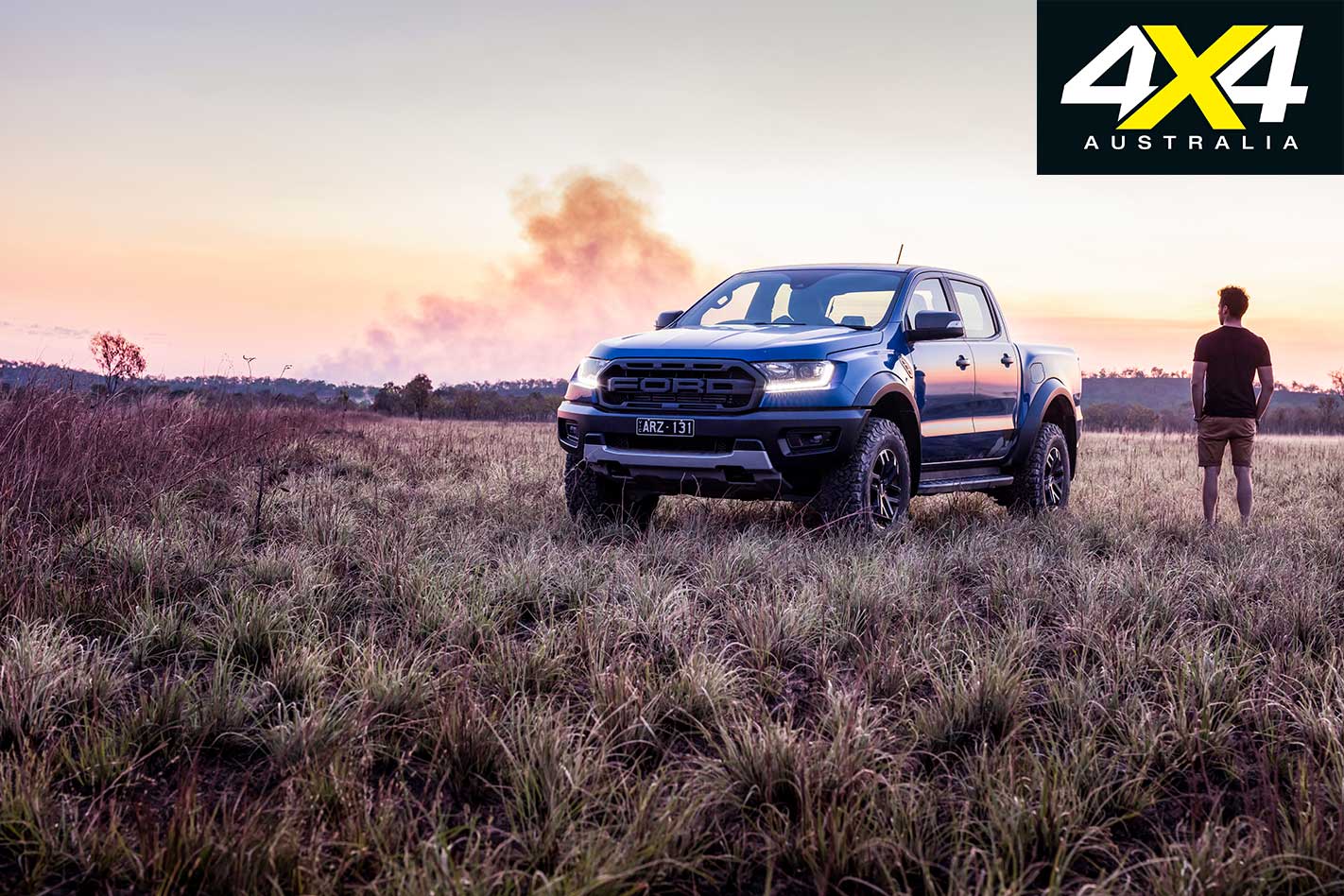
We reckon you’ll see a few Ranger Raptors getting around with a jet-ski or dirt bikes in tow, and couples who like to go weekend camping in something a bit more special than the regular work ute would also like the Raptor. Cruising down the beach or taking on 4×4 parks would also be on the list.
The market for the Raptor is limited, but that is always the case for a halo-type product. That said, the initial order of 1000 Raptors for 2018 has sold out and if you order one today you won’t get it until early next year, unless you can score a cancelled order. Those 2018 vehicles will be delivered during September and October this year.
The Drive
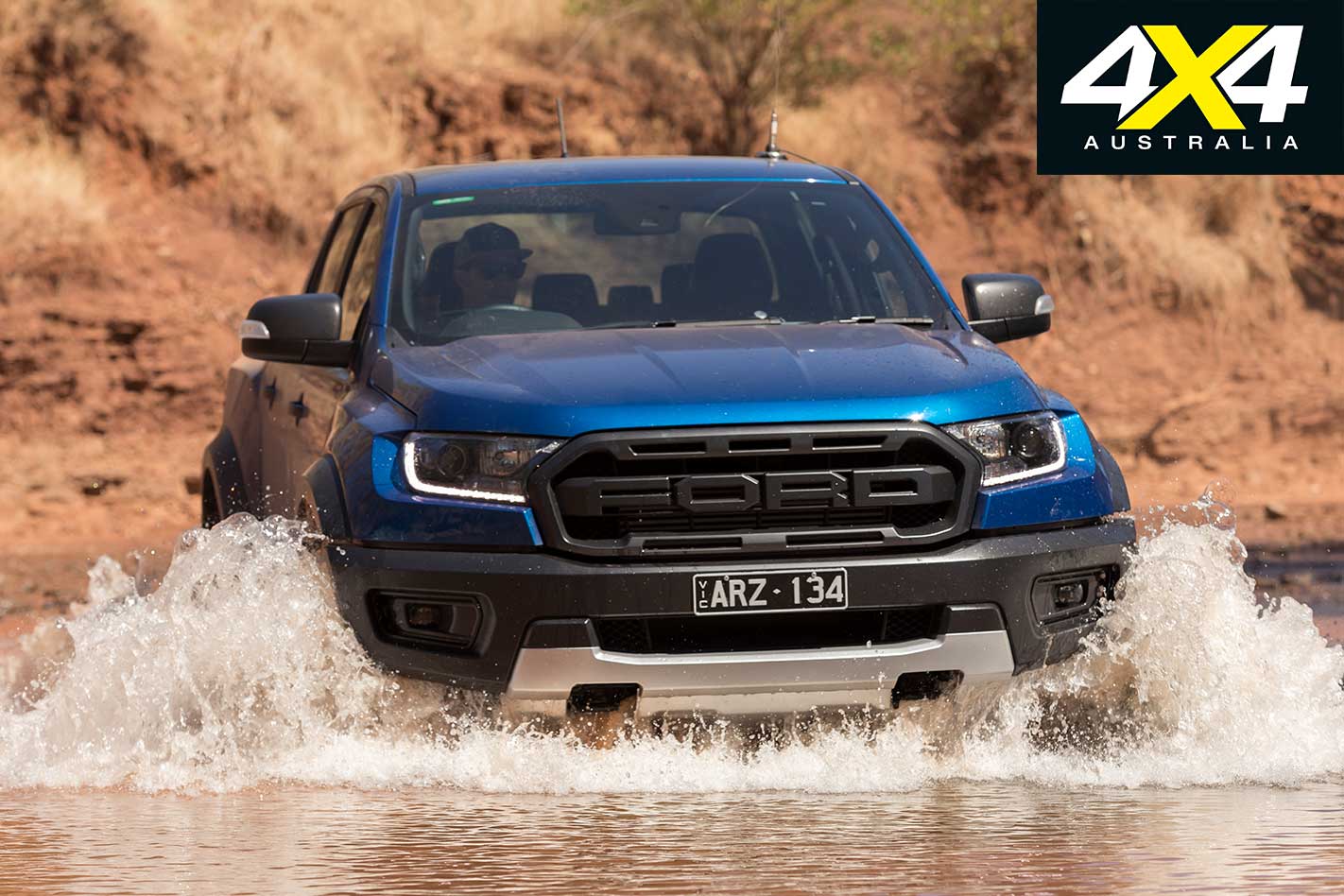
WITH its Ford Performance-engineered chassis and suspension package, the Ranger Raptor shows its best form travelling quickly over rough terrain. The outback test track Ford engineered to showcase it did that well, as it ate up whoops, bumps and bulldust like a Baja racer, instilling driver confidence and encouraging you to push harder.
The direction and stability offered by the BFGoodrich tyres in the heavy bulldust and loose rock was astounding. It goes where you point it and its slides are well-controlled, making the Raptor a lot of fun to drive.
The Baja mode in the Multi Terrain Selector frees up stability and traction control and sharpens up both the throttle response and shifting in the 10-speed auto, so it rewards the keen driver.
The Fox suspension smooths out bumps and washouts, allowing you to take them at speeds you could never handle with conventional OE suspension. Again, this instills confidence and allows you to wind up the fun dial to maximum.
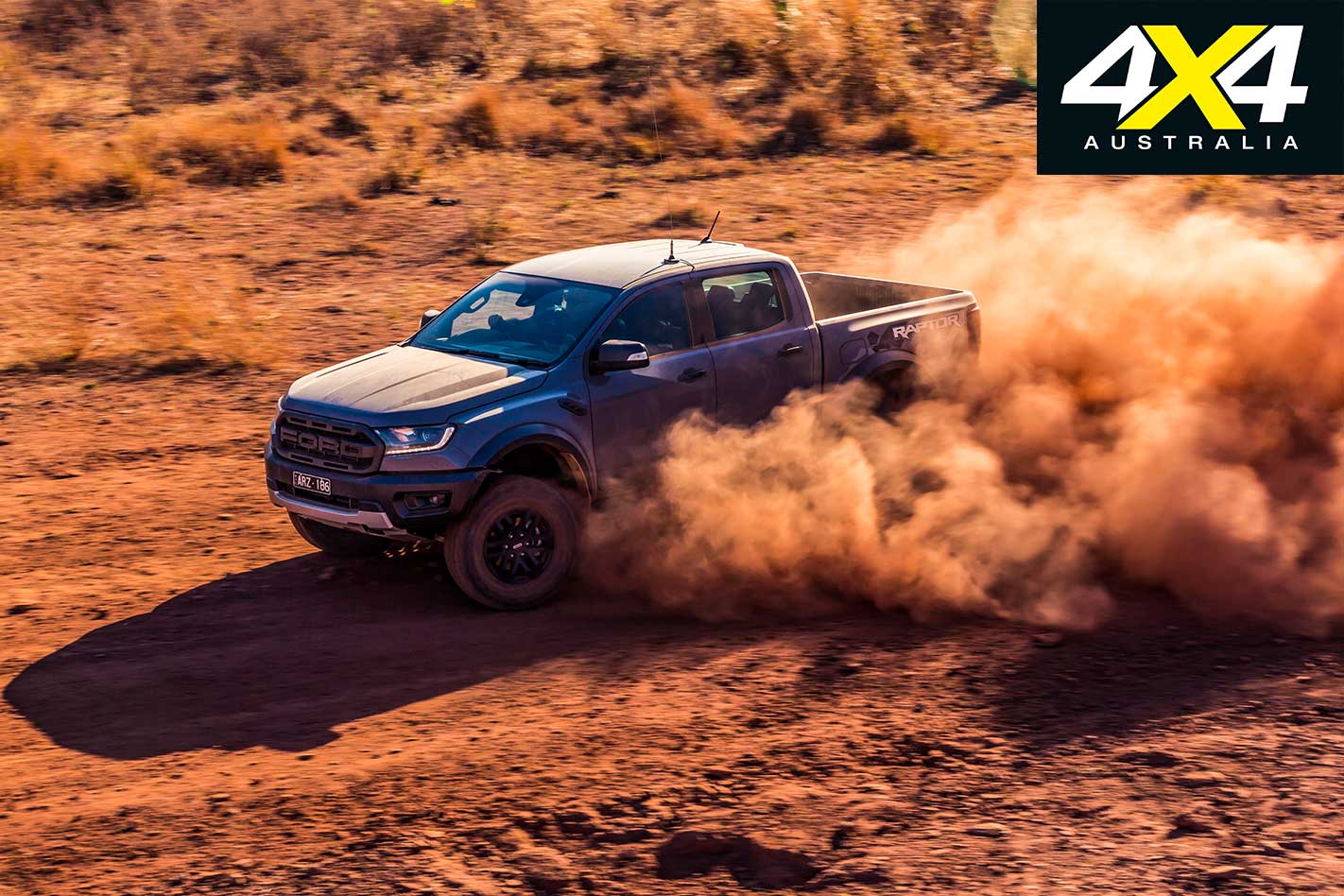
However, fanging around a test track isn’t something anyone does too often, and the Raptor’s amazing chassis package delivers on rough roads as well.
The chassis is well-controlled over rough ground, again giving confidence in the vehicle and knowing that it is capable of taking on the terrain. It also makes the ride more comfortable, so driving long distances in a Raptor will keep a driver relaxed and more on the ball. Knowing the All-Terrain tyres are less prone to puncture than regular passenger car tyres typically found on OE cars is also reassuring.
On the highway and backroads, that same suspension delivers a softer and more compliant ride than the leaf springs on any other ute. The refinement of the engine and transmission also contributes to improved on-road driving, and the truck-like rattle of the old 3.2-litre engine is gone due in part to the smooth and swift 10-speed auto. The Raptor is the most un-truck-like truck on the market!
It’s only when overtaking at highways speeds (130km/h here in the Territory) that the engine is found wanting, as it doesn’t pull like you want it to and the acceleration is not what you expect from a vehicle built under the Ford Performance banner.
Second opinion: 4×4 Australia road trip feature review
We took our 4x4OTY-winning Ranger Raptor to the hills, to see how it performs in the steep stuff. By: Matt Raudonikis | Photos: Alastair Brook
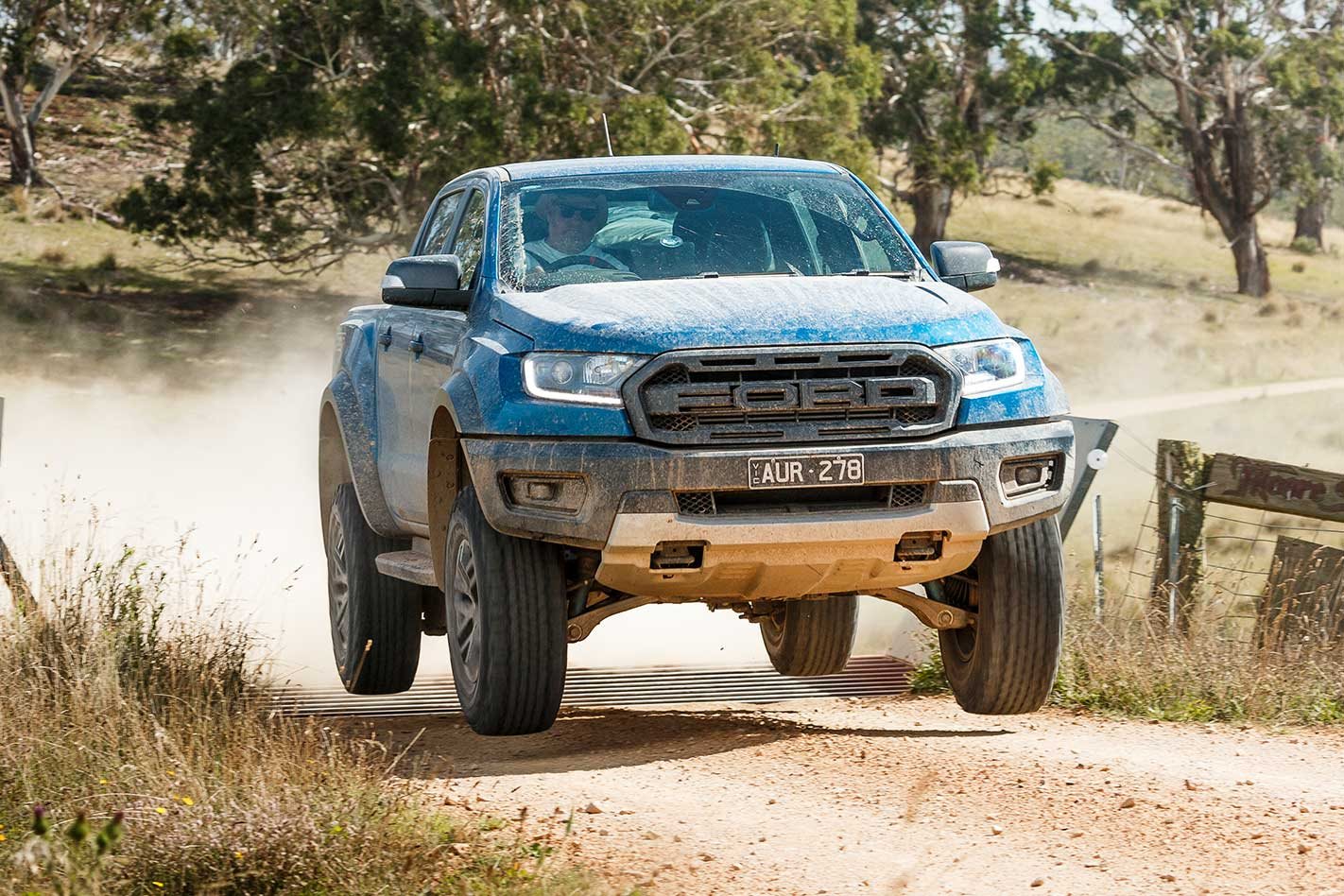
A LOT has been said about Ford Australia’s 2019 Ford Ranger Raptor, much of it negative about the 2.0-litre diesel engine and reduced load and towing capacity, but plenty of positives regarding its amazing suspension, off-road performance, and improved ride and handling.
We weighed up the positives against the negatives and gave the Raptor our 4×4 of the Year accolade, and that was as good an excuse as any to take it out for another run.
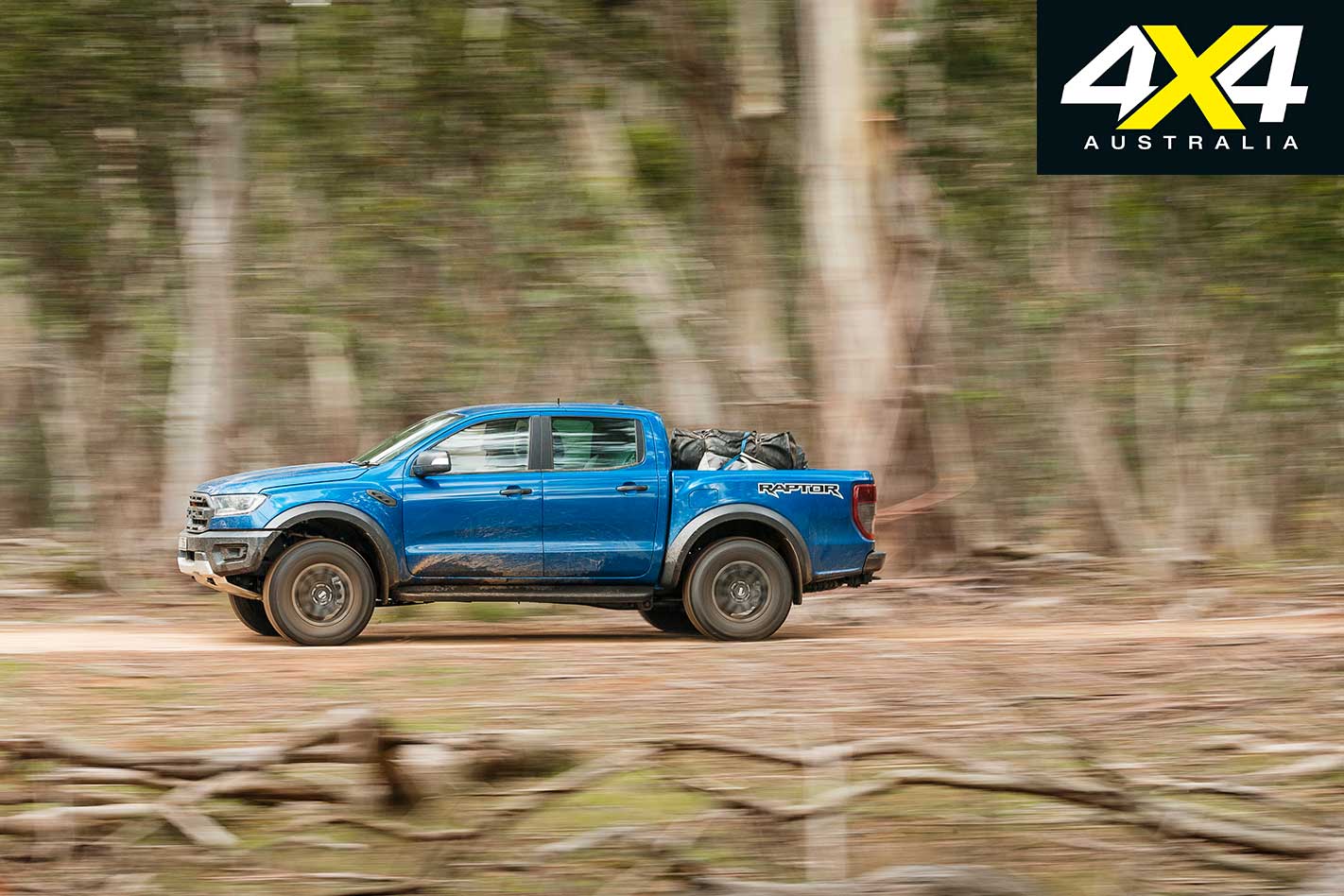
Most of the positive talk about the Raptor centres on its desert racing-bred Fox Racing suspension and high-speed ability over rough terrain, but we wanted to test it in the hills doing lower speed off-road driving on steep terrain. More like the stuff many Aussies enjoy in places like the Victorian High Country.
The Ranger Raptor’s off-road credentials are impressive. It sits 50mm taller than a regular Ranger, resulting in a wading depth of 850mm and ground clearance of 283mm. Approach, rampover and departure figures measure 32.5-, 24-, and 24-degress respectively, to further improve clearance, while sturdy underbody protection and beefy magnesium side-steps shield from the inevitable bumps and grinds.
The Raptor rides on a wheel track which is 150mm wider than that of a regular PX Ranger, to give it a wider stance and improved stability. To achieve the extra width, bespoke aluminium A-arms are used on the independent front suspension; while at the rear the leaf-sprung live axle of the regular Ranger is replaced by coil springs with a Watts linkage for lateral support, derived from that on the Ford Everest wagon.
It differs from the Everest rear end in that the remote-canister Fox coil-over dampers are mounted farther outboard, again to improve vehicle stability and control. The revised rear axle even has disc brakes as opposed to a Ranger’s drum stoppers. The suspension changes result in a 32 per cent improvement in front-end travel (to 236mm in total) and a 22 per cent improvement at the rear (to 290mm in total).
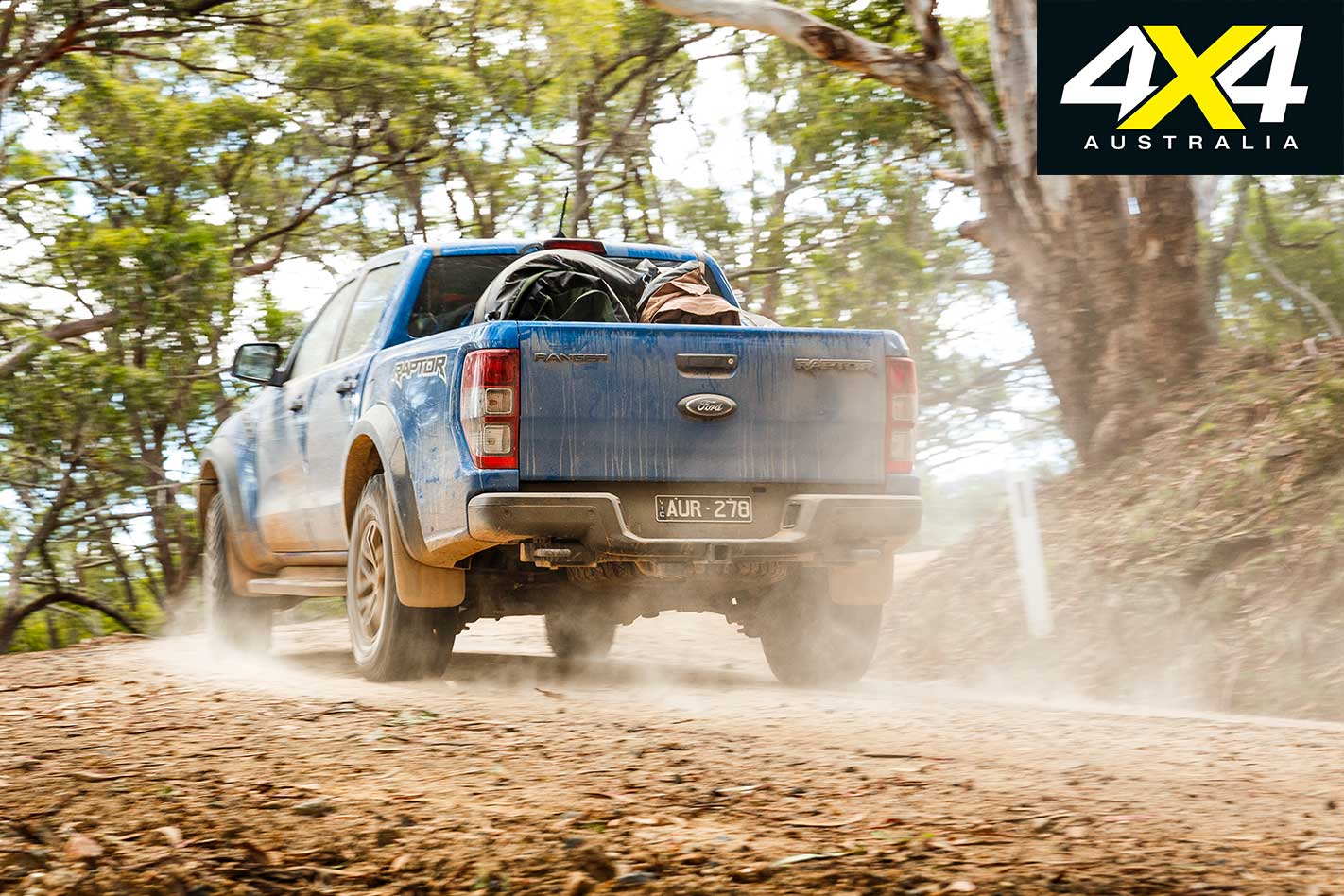
The Fox coil-overs used at the front and rear are specifically designed 2.5-inch twin-tube units, which were a collaboration between Fox Racing, Ford Performance and the Ford Australia engineers who put the package together.
Likewise, the BFGoodrich All Terrain KO2 tyres are a specific tyre bred for this vehicle by BFG and Ford. They might look like a regular 285/70-17 KO2, but they utilise a unique rubber compound and have an ‘F’ in the part number to mark this difference.
When you consider quality suspension and tougher tyres are the first things to fit when equipping a 4×4 for off-road use, Ford Performance has you covered with the Raptor. All of this top-shelf hardware, development and engineering add up to an off-road package that is superior to any other one-tonne 4×4 ute off the showroom floor, and it performs better than most aftermarket setups as well.
Off-Road
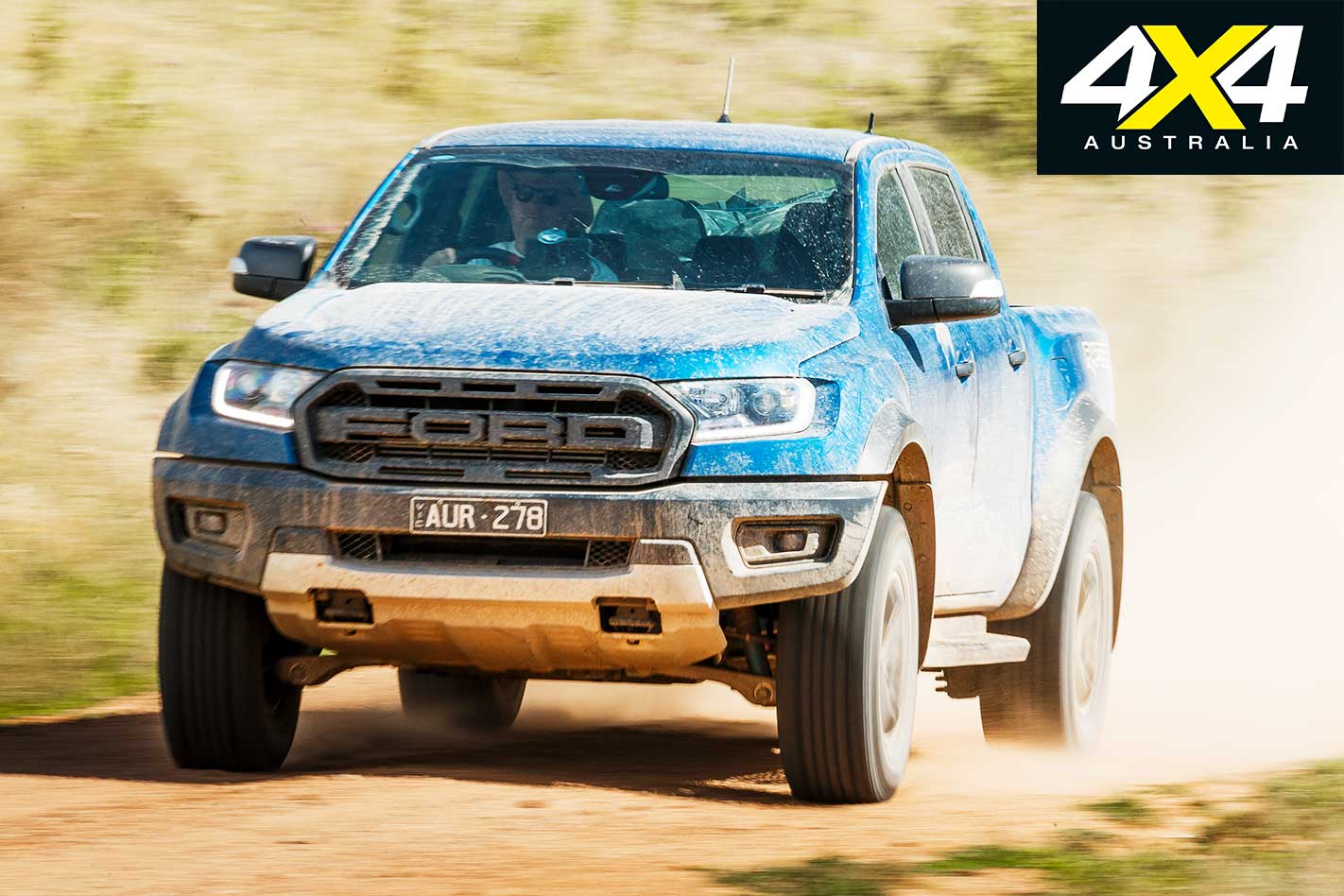
WE’VE tested the Ranger Raptor in the outback a few times already, but we wanted to see what it’s like in the mountain regions of the east coast. For this, we ventured further than our regular Vic High Country haunts to explore the hinterland behind the far south coast of New South Wales, where we found plenty of steep and slippery tracks.
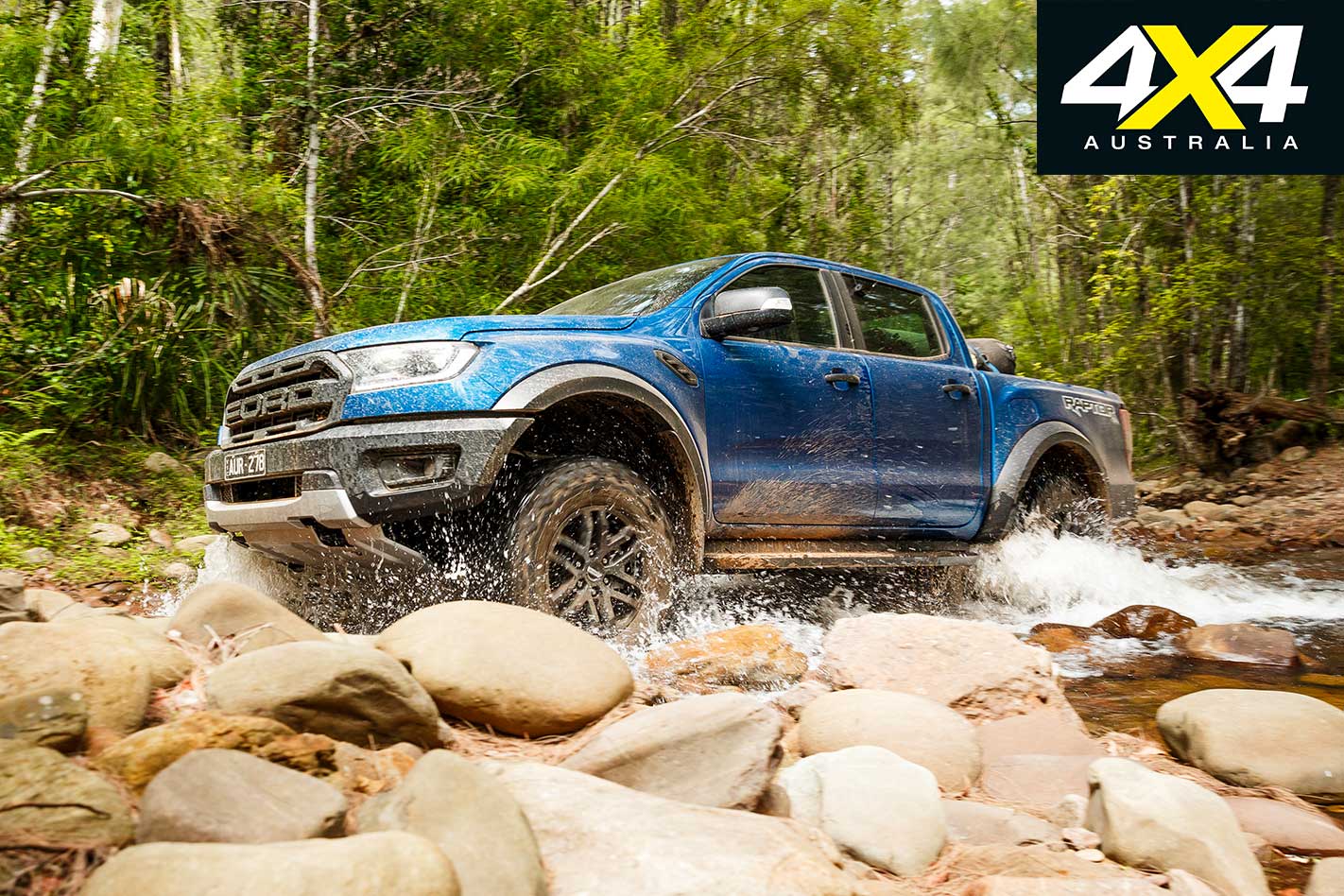
Just as the wheel travel and ground clearance offered by the Raptor’s suspension package work well at speed in the outback, they are also the key to slow-speed track performance over rocky steps and fallen logs.
The extended wheel travel keeps the BFG tyres in touch with the track surface to maintain traction, which means the Raptor relies less on its electronic traction control and rear differential lock; but they are still very handy if and when needed.
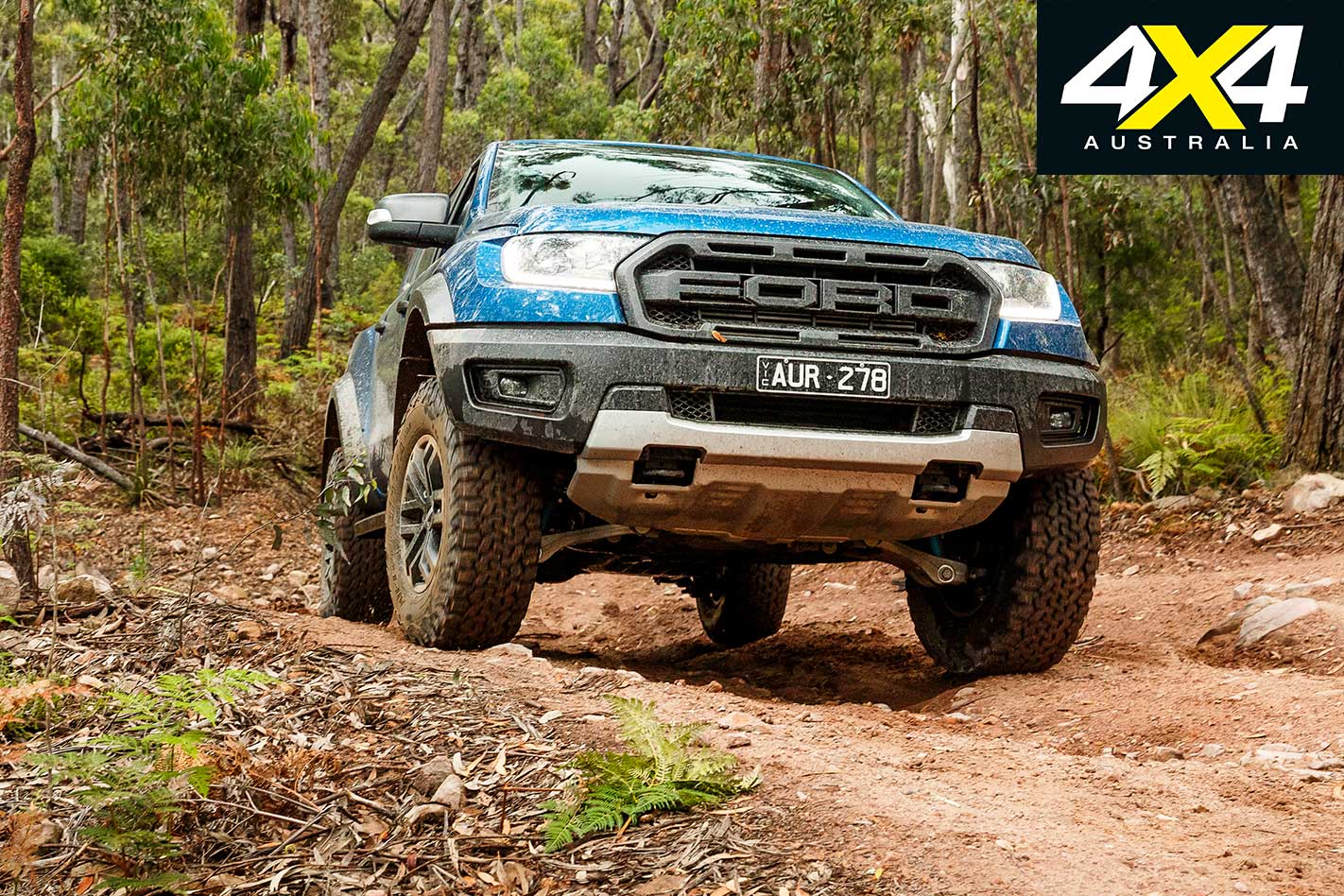
The Raptor is still a proper 4×4 with a dual-range transfer case, so making the steep climbs and descents in low range was never an issue. However, the 10-speed auto transmission was overly keen to shift back when descending and it was sometimes confused in low range; it worked better when in manual mode, using the steering wheel-mounted paddles.
The performance of the 2.0-litre bi-turbo diesel engine might feel wanting for flat-out, high-speed blasting, but its 500Nm provides plenty of grunt for low-range hill-climbing and trail driving. The 10-speeder works well here, too, whether you choose to let it do its own magic or shift it manually.
The more refined drivetrain (over the 3.2-litre and six-speed), more supple suspension and luxury cabin features also work to make the Raptor a more comfortable touring vehicle. You feel the softness of the suspension every time you drive it on any surface, and there’s none of that harsh, jittery ride that comes with most leaf-sprung 4×4 utes. The Raptor’s front seats are real winners, adding comfort to the drive and making long days behind the wheel a pleasure.
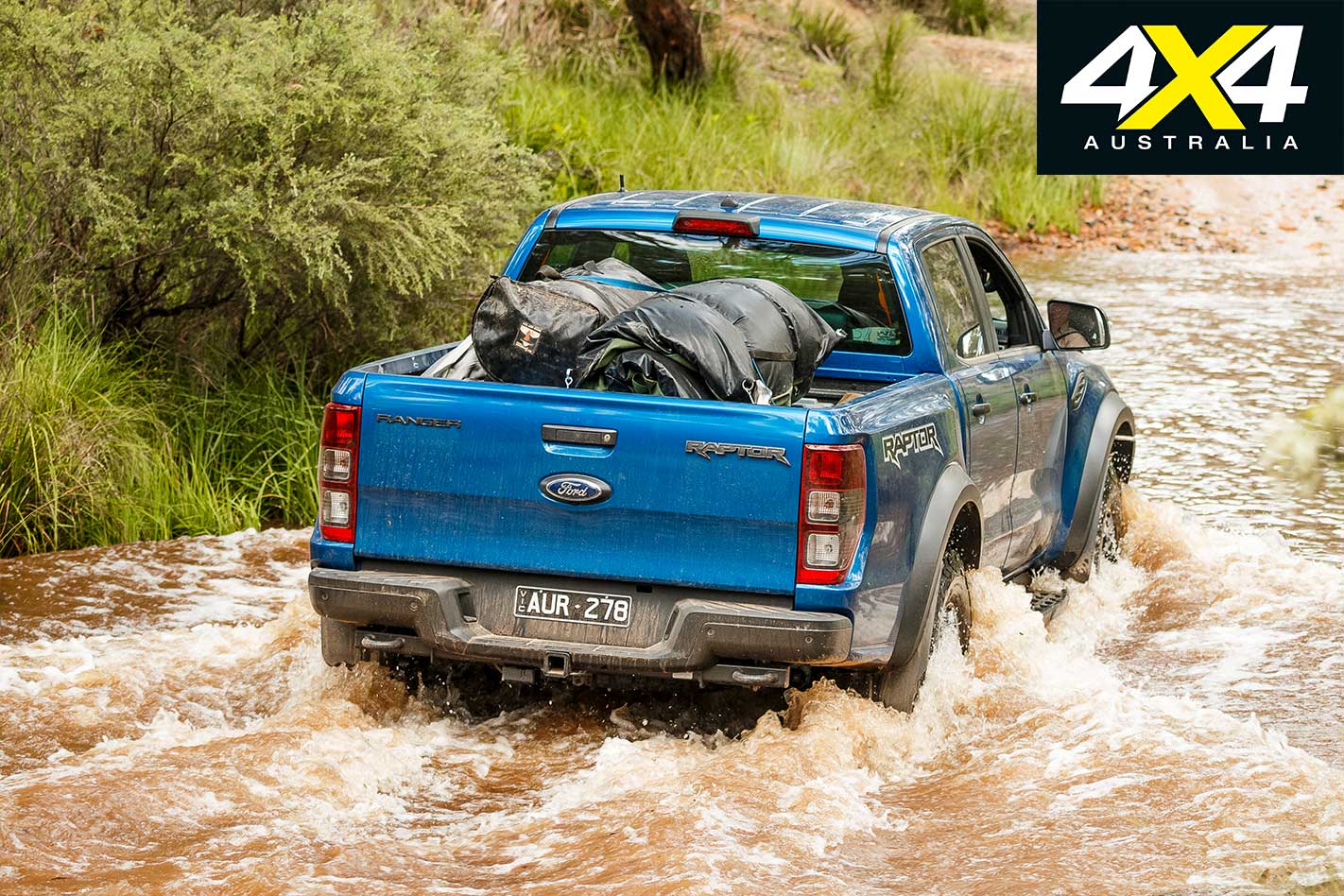
Adding to the ease of touring, the internal dimensions of the cargo tub are the same as a regular Raptor, so accessories such as tub racks, hard lids, tonneau covers and canopies will still fit. For this trip we utilised the four tie-down hooks to secure our gear, and the in-tub 12-volt outlet to power an ARB Elements fridge.
Many ute buyers dislike the Ranger Raptor’s reduced carrying capacity compared to a regular Ranger: the towing capacity is cut from 3500kg to 2500kg; while payload weight is 758kg, down from 900kg of a Ranger XLT. We didn’t do any towing on this trip, but we did test the payload to its limits on the return highway drive.
Loaded up with three blokes, all their camping gear, a 50-litre stainless steel ARB fridge and a Space Case full of supplies, the rear end felt the extra weight. While it wasn’t bottoming out, the suspension felt spongy and towards the end of its compression on the winding and often bumpy roads. You certainly wouldn’t want to be off-roading a Raptor with this sort of a load onboard. Buyers will have to settle for a regular Ranger for heavy towing and hauling duties.
So the Ranger Raptor has proven itself to be just as competent as a mountain-trail tourer as it is a desert-track blaster. If the lower payload and towing capacity of the Raptor over a regular Ranger aren’t a concern, then the Raptor makes a great starting point for a long-distance traveller.
Before you complain about the cost of the Raptor, the $11K it costs over a Ranger XLT 2.0L wouldn’t even cover the costs of the bespoke wheels, tyres and suspension package, even if you could buy them separately. Then there’s the updated interior kit and that killer wide-body design that turns heads wherever you drive it, which make the Raptor a unique proposition.
2019 FORD RANGER RAPTOR SPECS: Engine: 2.0-litre 4-cyl bi-turbo diesel Max power: 157kW at 3750rpm Max torque: 500Nm at 1750-2000rpm Transmission: 10-speed auto 4×4 system: Dual-range part-time Kerb weight: 2332kg GVM: 3090kg Payload: 758kg Towing capacity: 2500kg GCM: 5350kg Wheel/Tyre: LT285/70R17 116/113S Fuel tank capacity: 80 litres ADR fuel consumption: 8.2L/100km Test fuel consumption: 12.7L/100km Price: $74,990 (as tested with ORC)
WHAT IS IT
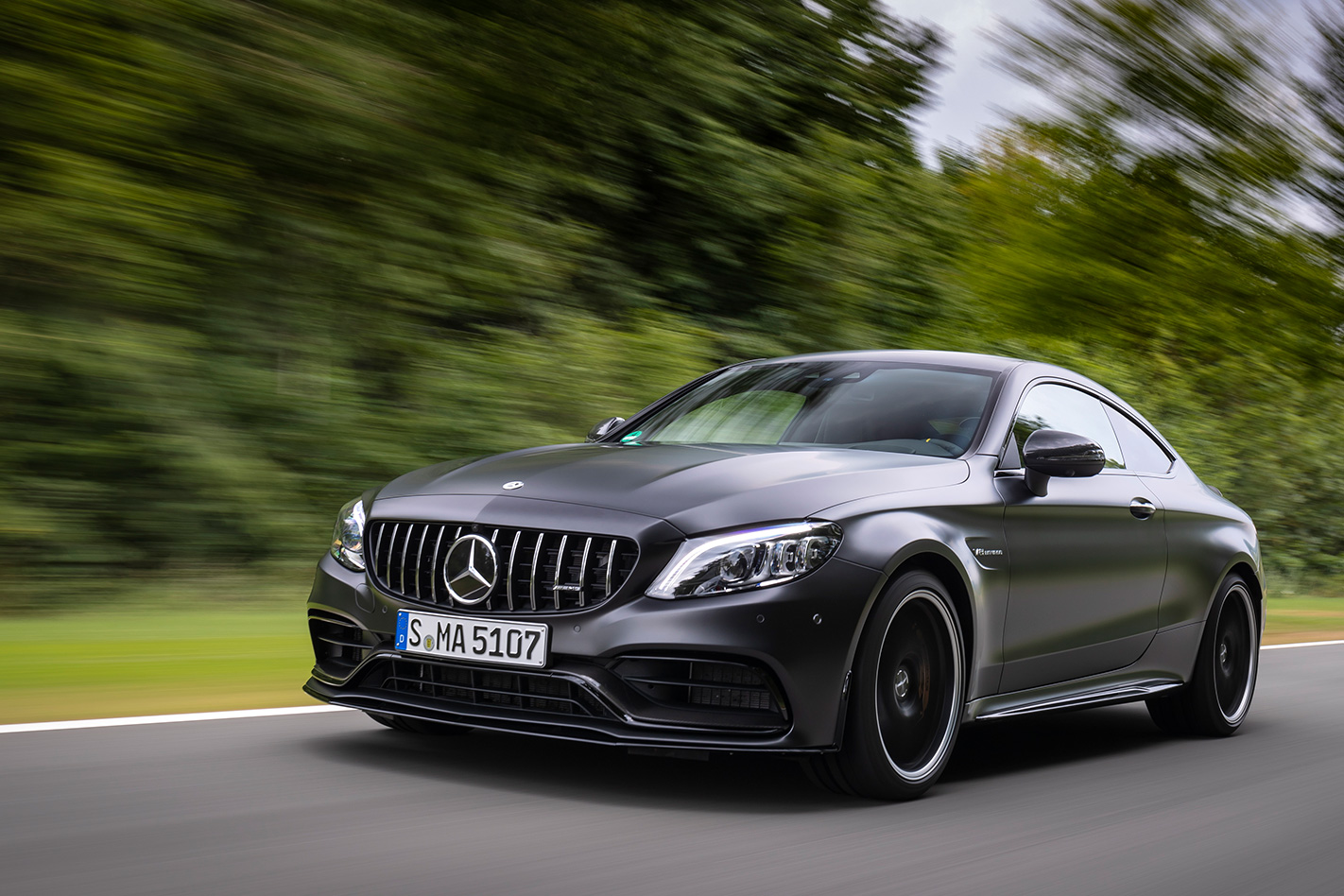
Power is nothing without control and while the 375kW power output of the C63 S remains unchanged, the fitment of a trick nine-speed transmission, a clever nine-stage traction control system and the intriguing AMG Dynamics electronics pack adds bandwidth to this car’s tried and trusted shock and awe. An interior refresh and some well-judged styling changes don’t go amiss either.
WHY WE’RE TESTING IT
The choices are slim and getting slimmer if you want a barnstorming V8 coupe that can fulfil duties as your daily driver. The old C63 S could be a little truculent. AMG is promising both more liveability and greater agility from the latest car so we flew to Germany to see if the company could make good on its claims.
MAIN RIVALS
Audi RS5; BMW M4 CS; Nissan GT-R Premium; Porsche 911 Carrera
THE WHEELS VERDICT
The previous C63 S undoubtedly delivered an industrial dose of drama, which was great when you were in the mood for it, but occasionally tiresome when you weren’t. This 2018 update is a good deal more tolerable at sensible speeds and is an even bigger hoot when you get it up on its toes. Mission accomplished, in other words. It’s not perfect, but the reasons for shopping at one of the other premium German marques just got that bit sketchier.
PLUS: V8 charisma; benign handling balance; clever control systems; interior glitz; classy styling updates MINUS: Still hardly the acme of discretion; fuel thirst; weight; options pricing
THE WHEELS REVIEW
IF YOU didn’t know it was there, you’d never spot Bilster Berg Drive Resort. There’s a tiny sign off an unprepossessing German country road that leads to a narrow track that wends through forest. An unmarked gate is manned by a bored-looking guy in a booth who doesn’t look up as we approach. The boom gate lifts, we roll in, past a couple of nondescript glass office buildings on immaculate lawns and then you see it.
The Mausefalle (Mousetrap) is the very first part of the track you clap eyes on and it looks like something from Luna Park rendered in bitumen, dropping off-camber into a bend and compression and then ramping back skywards into the stepped Steilwand (Steep Face) before disappearing over a crest at the next bend. We’re here to drive a 375kW car on this manic circuit. My mouth goes a little dry at that prospect. I feel like Chief Brody from Jaws. We’re gonna need a bigger track.
Mercedes-AMG insists that we won’t. Its latest C63 S coupe might be the only V8 in its class, capable of rattling off the sprint to 100km/h in a mere 3.9 seconds but the Affalterbachers insist that this latest version is so minutely tailorable to your own skill level that it’s a car that can seem as benign as you need or as angry as you can handle. Of course, those familiar with the Dunning-Kruger effect will appreciate that we’re often not very good at recognising our own ineptitude. With that in mind, I start the first session on track with all the electronics dialled up to Maximum Nanny.
Before we get too far into the physics of falling off Bilster Berg, a quick primer on where we are with this car. This C205 generation coupe debuted in 2014 so, in AMG’s planning schedules, it’s due for a mid-life refresh that will take it through to its replacement with a six-cylinder hot hybrid, due in 2020. So, if you feel that there’s no substitute for a V8, you’ll need to fling an order in smartish. The 4.0-litre ‘hot-vee’ twin-turbocharged V8 continues as before, but it’s now mated to a clever MCT-9G nine-speed transmission that’s neither a traditional auto, a twin-clutch nor even (strictly speaking) a sequential, as it’s capable of block downshifts. It uses a wet start-up clutch to finesse gearchanges to almost twin-clutch smoothness, and the software is so good that it’s rarely to be found hunting between gears.
Two very clever control systems also feature on this generation C63 S. AMG has also had a good, long think about how keen drivers interact with the car during limit-driving and the result of that process is the development of AMG Dynamics and AMG Traction Control. Before we get to those, a quick word on the driving mode selector. This now adds a torque-limiting slippery road mode to the usual Comfort, Sport, Sport+, Individual and Race settings. From there, AMG Dynamics introduces smarter, predictive control for both ESP and the torque-vectoring rear diff, with four modes; Basic is assigned to the Slippery and Comfort drive programs, and prioritises stability, Advanced is activated with Sport and targets the sort of handling neutrality you’d want on a country road, Pro switches in during Sport+ mode and reduces the steering’s servo assistance and ups the rear diff’s aggression while Master is linked to the Race mode and introduces more oversteer, even feistier steering while plugging into a spiky throttle map.
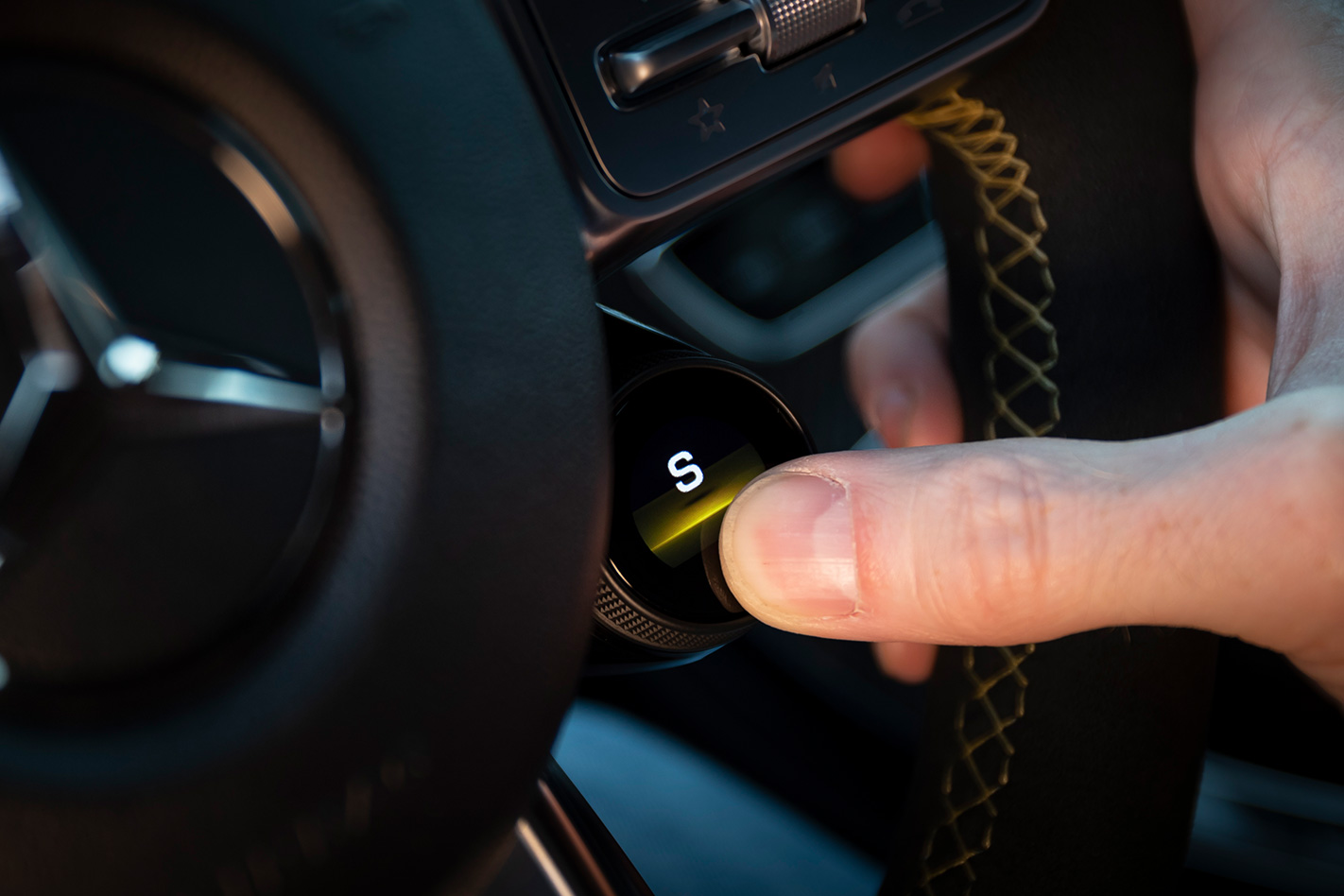
With ESP disabled, the C63’s nine-stage traction control can be activated. This cycles through nine slip levels from 1 (wet roads, little slip) to 9 which really lets you light up the rears. Control is via a Porsche-style rotary controller underslung from the right spoke of the steering wheel. Think of it to traction control what the Focus RS’s Drift Control is to stability control and you’ll get to grips with it. With it set to 3 on track, it would allow a half hand of oversteer out of tighter corners. Set it to 5 and it’ll allow you to hold a respectable slide. Dial it out a bit more and you can easily punt the car fundament-first into a wall, as one foreign journalist charitably demonstrated.
Unenthused at the prospect of replicating this manoeuvre, I keep it at the recommended Level 5, and it’s worth remembering that when activating the traction control that the usual stability control safety net is completely dialled out under braking. Bilster Berg is a track that can make a Caterham feel clumsy and if you get greedy with the throttle on the way into a braking zone, you need to be quite handy with corrective lock on the way into and out of the corner. In other words, you need to know what you’re doing if you want to get the best from the traction control settings, and with typical C63 S coupe pricing with options hovering at around $180K, there are some pretty serious consequences should you get a bit ahead of yourself.
If anything, this circuit still feels a bit unrelenting for the C63 S. It rewards a flowing track where you can manage the weight shifts elegantly and sight a line through no-consequence corners. Harrying it through rowdy cambers, blind apexes, over crests and into curving braking zones makes it feel all of its 1745kg. Of course, you’d never drive the car like this on road. Even on some of the most challenging roads we can think of, at vaguely legal speeds the C63 S would feel as if it was merely getting started.
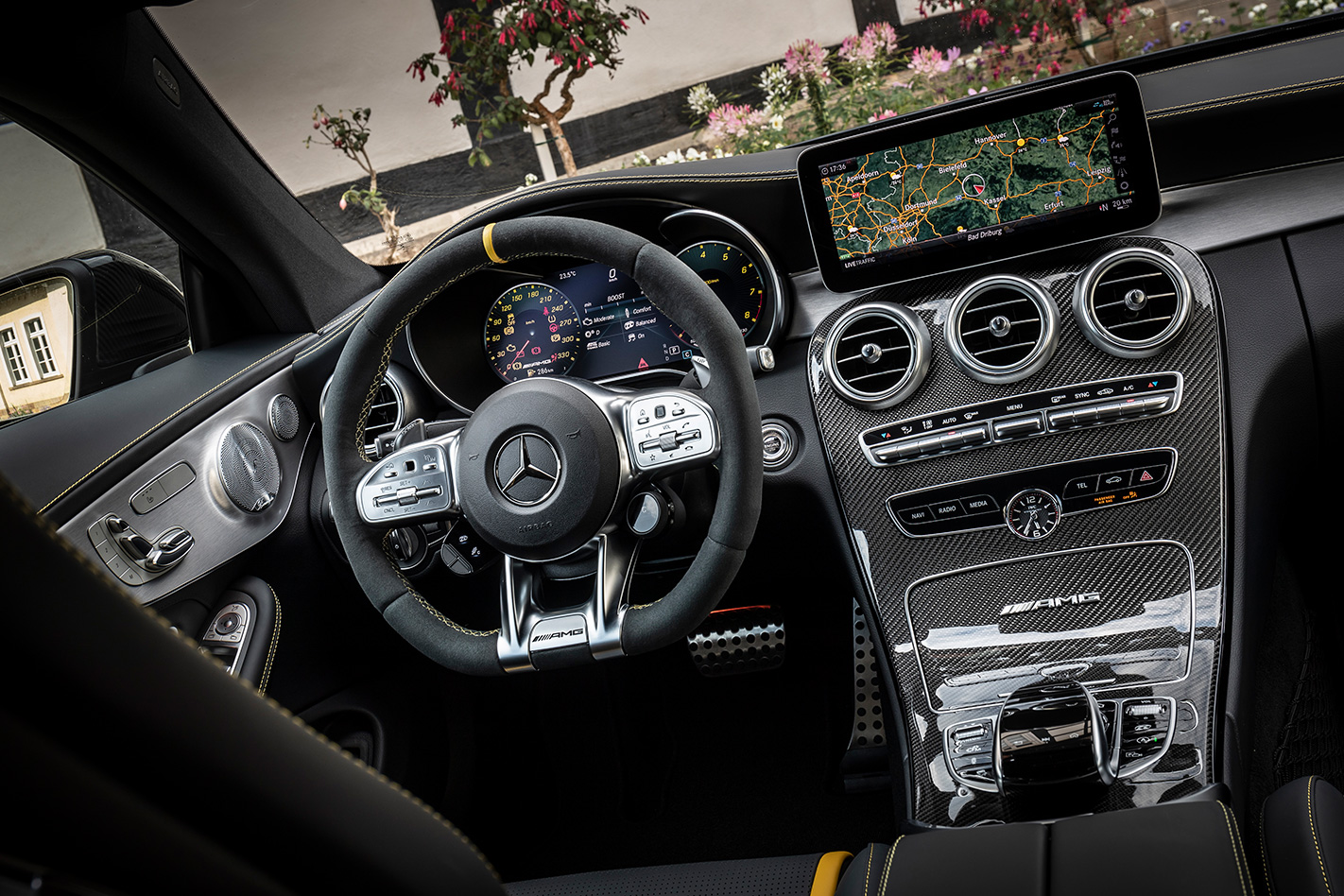
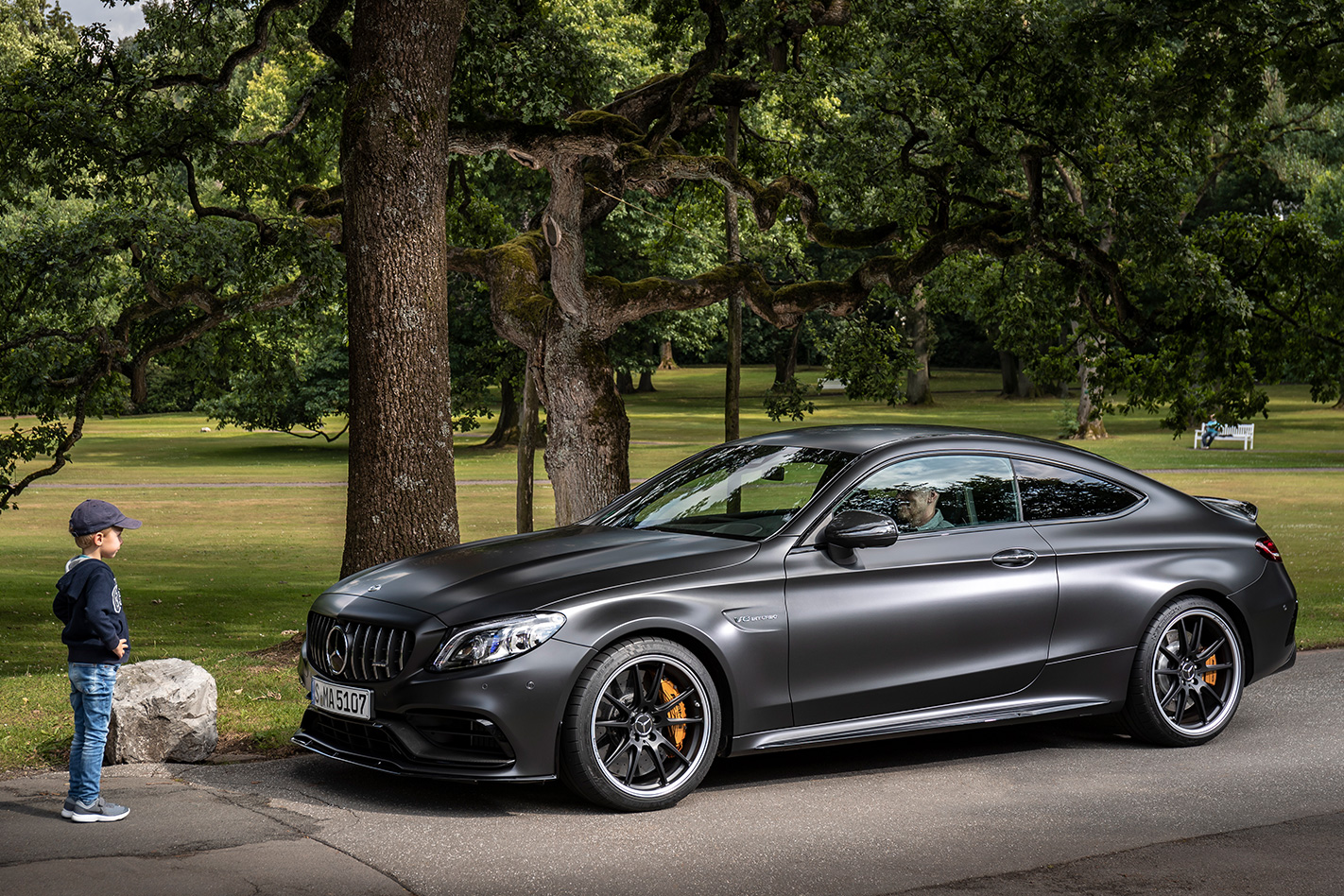
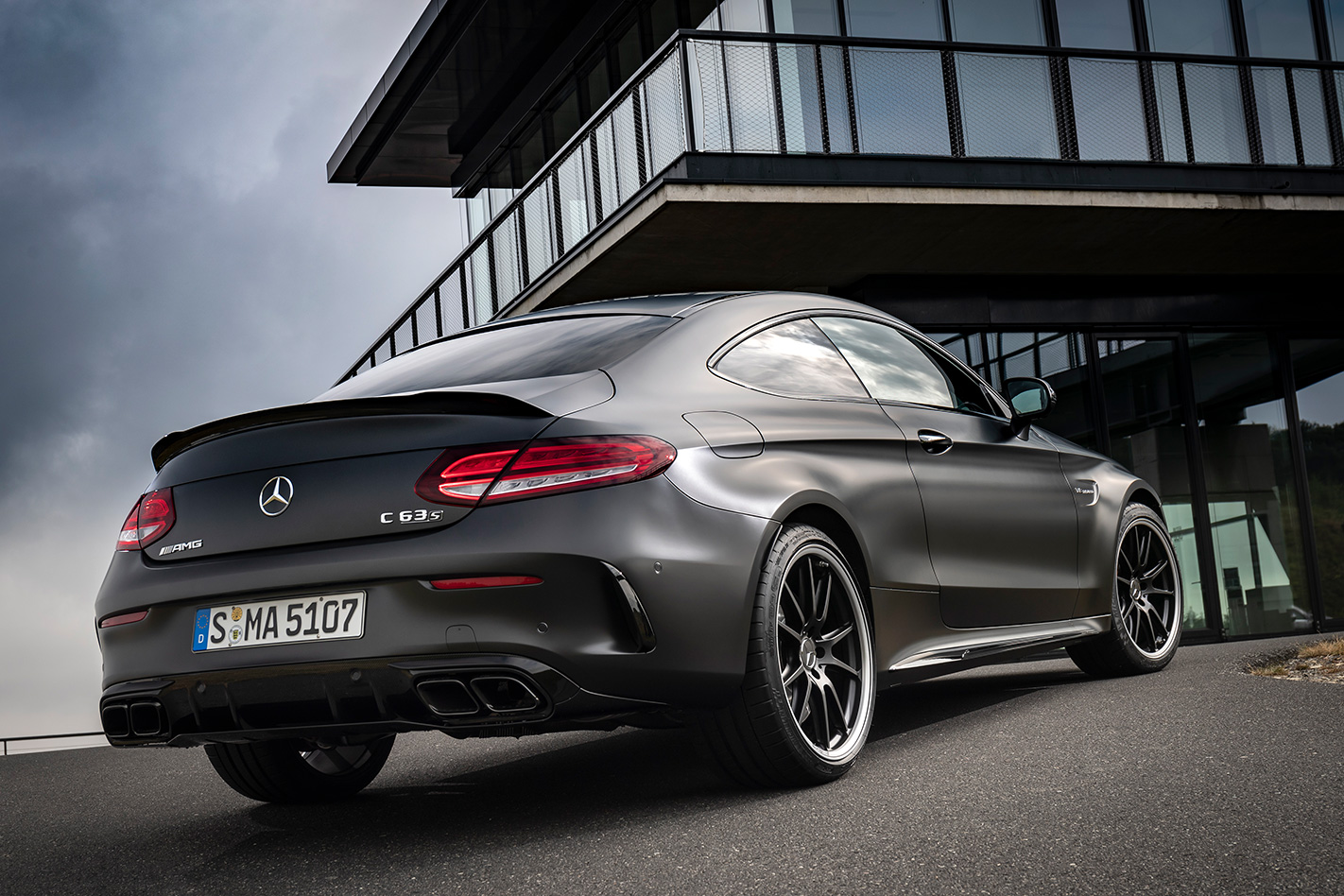
What’s refreshing about this update is that it probably didn’t need to go anywhere like this far. Orders for the C63 S are already stacked up, and the latest styling revisions that bring the new Panamericana grille, finned front air intakes, a beefier rear diffuser and redesigned headlights would probably have been enough to keep most buyers interested. As indeed would the interior updates that now include a fully digital centre binnacle and a massive 31cm widescreen display for Aussie customers who like their AMGs packed to the gunwales with kit.
Instead AMG hasn’t been satisfied with being able to scratch a superficial itch; all loud noise and shiny detailing. It has engineered genuine substance into the latest C63 S. When we drove it last year, we gave it the nod over the Audi RS5 and the BMW M4 because it took you on the greatest departure from the prosaic. That still stands, but now the C63 S can do many of the things that made the RS5 such an appealing everyday proposition. So yes, the gulf between the AMG and the next best has probably eked that little bit wider. And if you’re the sort of driver who thought the old car was a bit of a one-trick pony; it’s time to reconsider.
SPECS
Model: Mercedes-AMG C63 S Coupe Engine: 3982cc twin-turbo V8, dohc, 32v Max power: 375kW @ 5500-6250rpm Max torque: 700Nm @ 2000-4500rpm Transmission: 9-speed automatic Weight: 1745kg 0-100km/h: 3.9 sec Economy: 10.1L/100km Price: $165,000 (est) On sale: September 2018
The Mercedes-AMG C63 S has taken another step closer to muscle car perfection thanks to improved ride comfort, a higher tech interior and a game-changing traction control system.
Thanks to a softer spring and damper set-up, dodging pot-holes is a thing of the past in the new C63. And while outputs from the twin-turbo 4.0-litre V8 are unchanged – 375kW/700Nm in Aussie S-only guise – there’s an advanced, impressive new ESP/TC system that offers a setting for seemingly every driver.
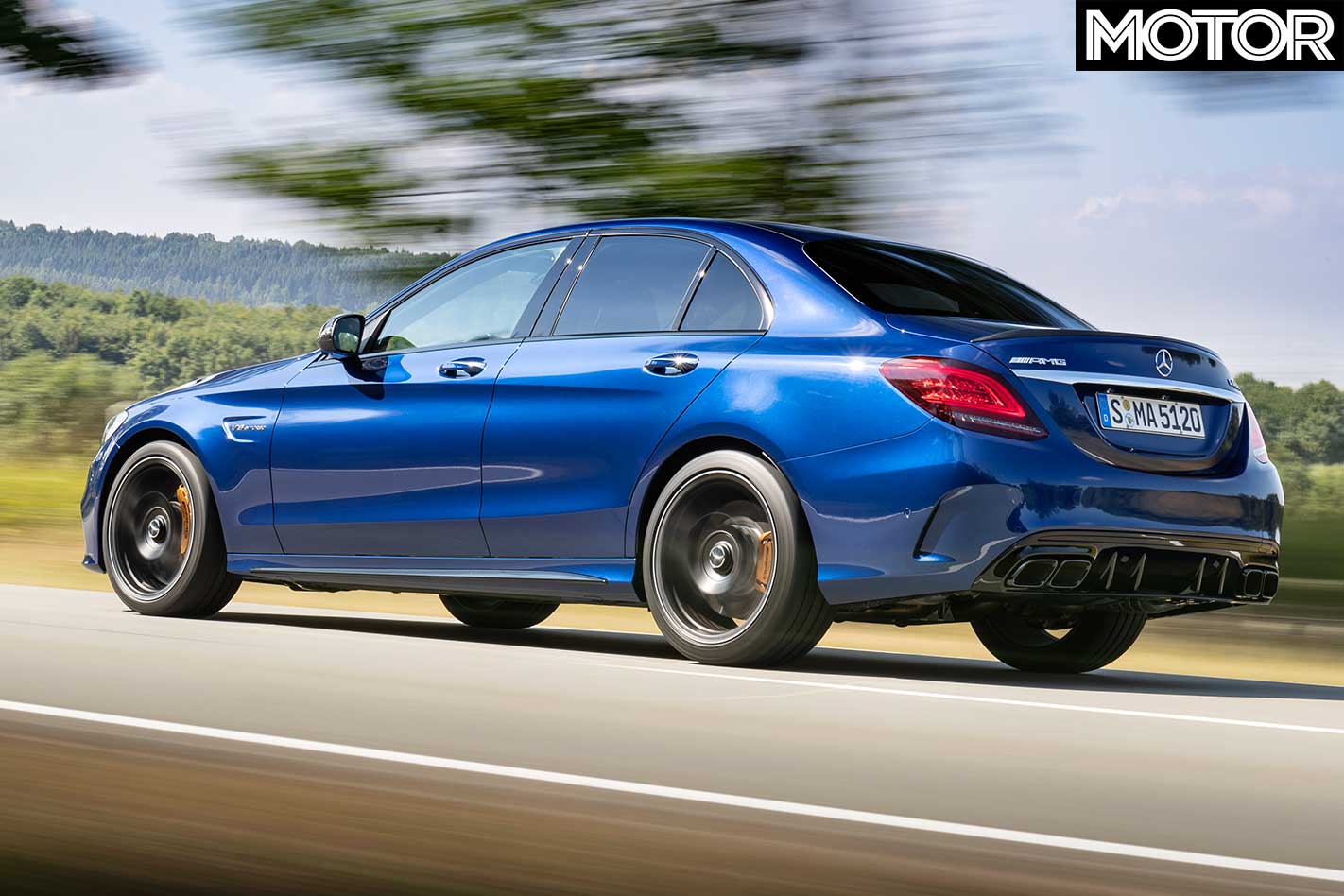
The changes to the C63 are very much under the skin, exterior styling tweaks limited to newly chromed, bold vertical fins in the front grille; and new rear diffusor and tail-pipe trims. There is also no change to 0-100km/h performance, remaining 4.0 seconds, shorter ratios of a new nine-speed wet-clutch automatic perhaps offset by a 25kg weight increase on the spec sheet. Top speed remains an irrelevant-in-Australia 290km/h.
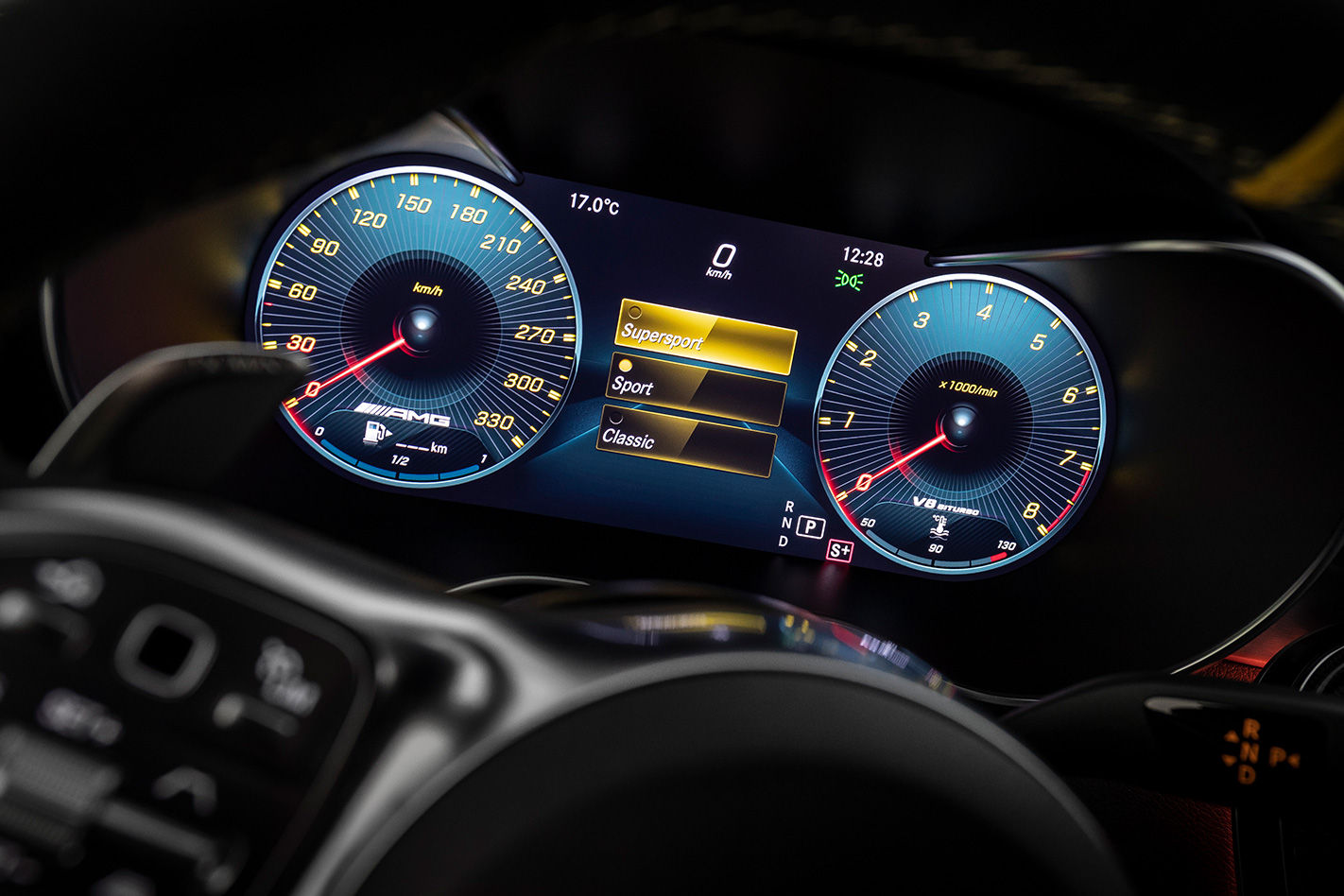
It’s the interior that’s taken a step up in ambience thanks to a new 12.3-inch digital instrument cluster replacing the old analogue dials; and the fitment of the attractive, new generation AMG steering wheel. Together with the fresh, more modern graphics of the screens themselves, the C63’s cabin vibe has gone from 2009 to 2020 in seemingly one leap.
In the driver’s seat, it’s the steering wheel that invites your hands and eyes, flat bottomed and beautifully combining Dinamica microsuede, Nappa leather and brushed aluminium. It even has two of its own little LCD screens, one below each spoke to control functions like active exhaust, adaptive dampers and drive modes.
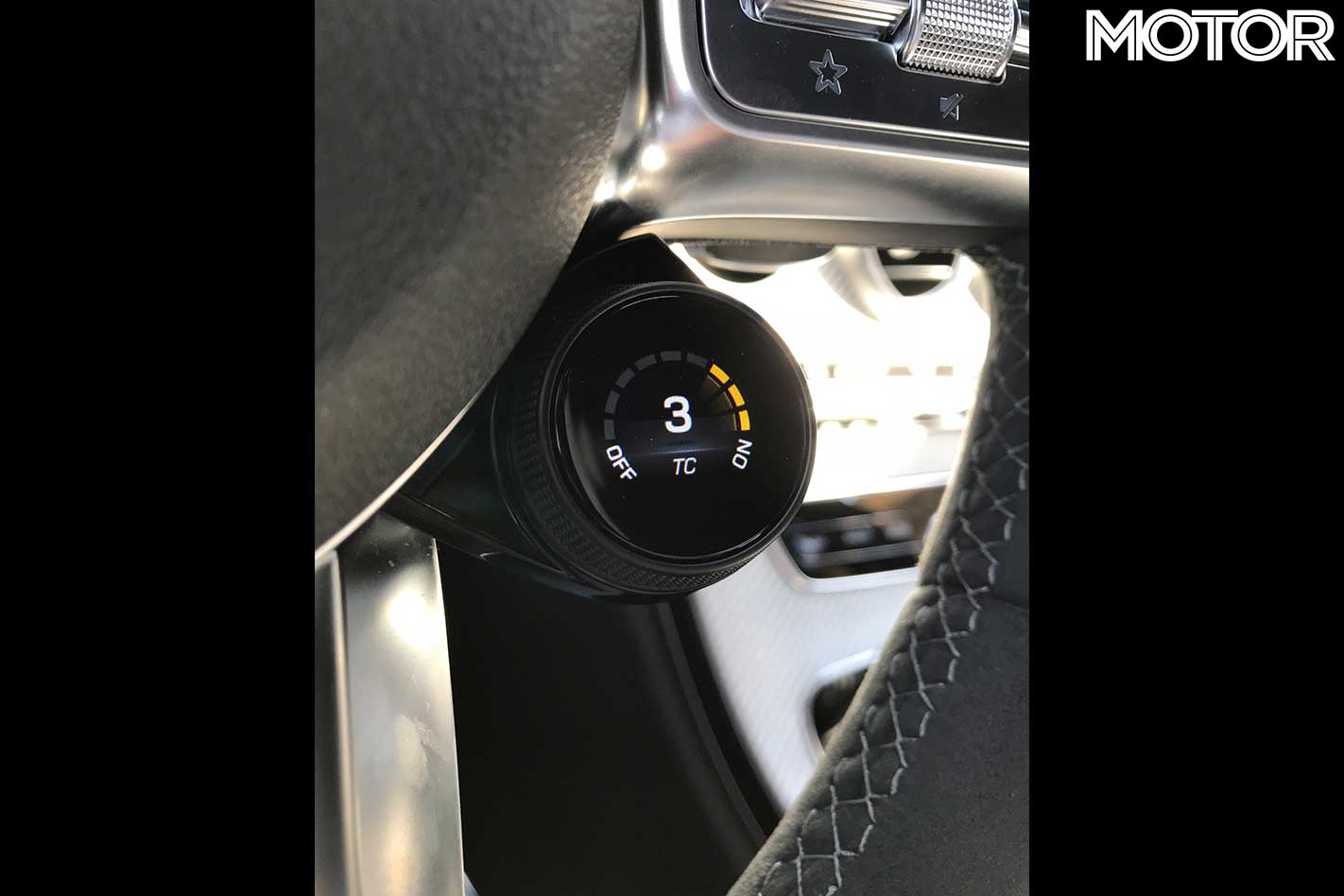
The rotary drive mode controller, below the right spoke, transforms into the dial for the new nine-stage traction control, a concept first seen on the AMG GT R, and one that will be standard on all updated C63s when it arrives in Australia in September.
There are now so many electronic modes that it’s initially a little overwhelming. Separate to the ESP with its three settings, there are now another four modes available in a new Mercedes-AMG Dynamics menu – named Basic, Advanced, Pro and Master – gradually slackening off the ESP and TC and tweaking the torque vectoring of the electronically locking rear differential.
Between the bi-modal exhaust, transmission, steering, adaptive dampers, ESP, nine-stage TC and AMG Dynamics, it’d take more time than we had at the international launch to count up all the possible combinations of electronics. Perhaps one “Individual” mode is no longer enough.
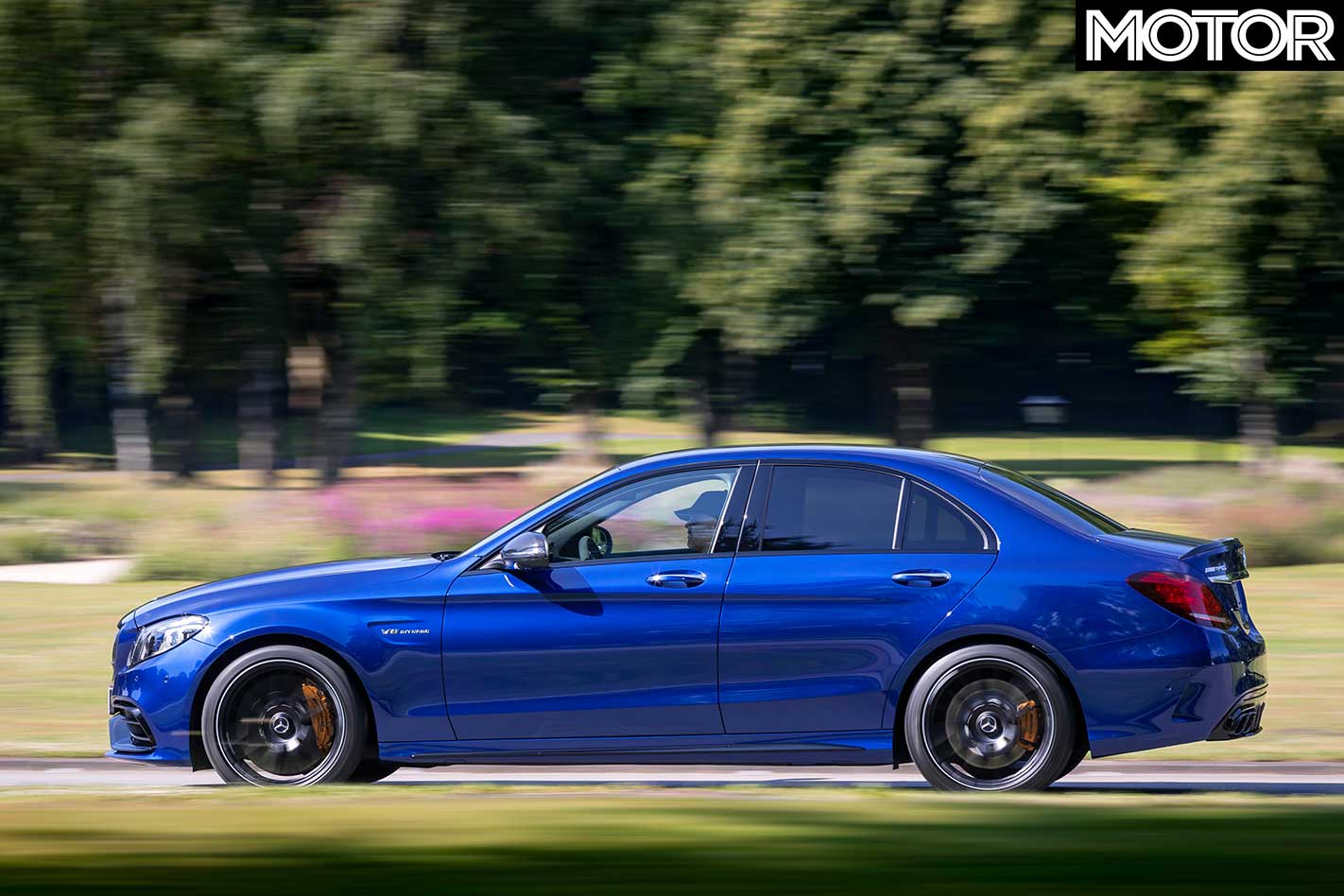
To drive, Mercedes-AMG has just generally made the updated C63 a nicer car. Aside from the smarter interior, the ride is the biggest improvement, followed by even faster upchanges from the new nine-speed transmission. All in all, the C63 remains a tyre-frying, brilliant Euro-muscle car with proper handling ability.
The V8, which idles with a loud, menacing burble, thrusts you forward from low in the revs with a wallop of turbocharged torque, pulling hard all the way to its 7000rpm redline as the digital instrument cluster frantically flashes red at you to grab another gear.
Mercedes-AMG has cheekily added a synthesised induction note to the C63 as part of this update, but far from sounding obviously fake, it improves the overall noise with an exhilarating upper-rpm snarl complimenting the fat, bassy V8 tailpipe bellow.
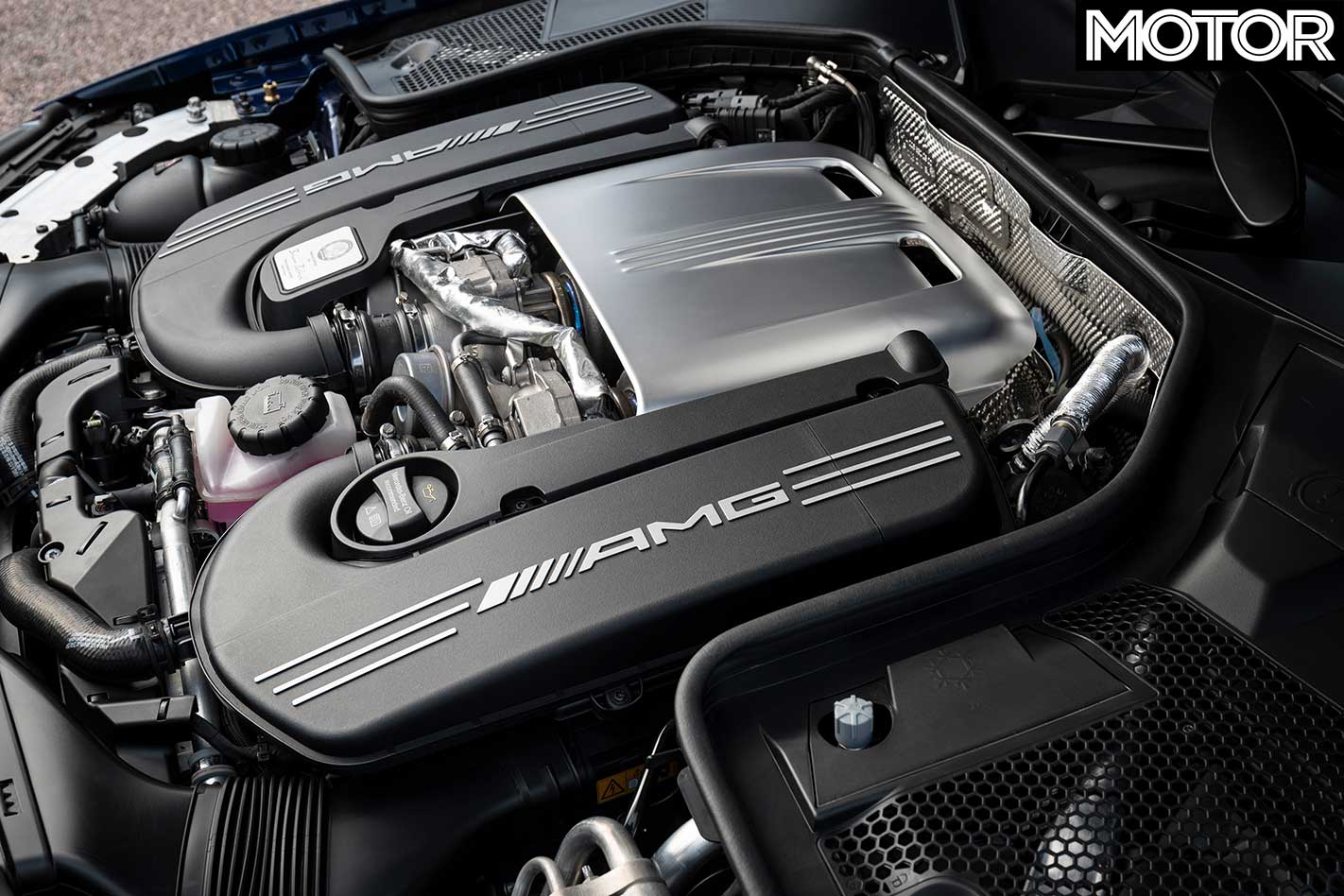
Indeed, it’s more or less the same noise you’ll hear in the new E63 – one of the best in the business, basically. Windows will absolutely be going down in tunnels.
Carving along fast back roads with the suspension in Comfort and the powertrain in its fastest setting, happily surfing the turbocharged torque, is a brand new experience in the C63 – and a very enjoyable one at that. And part of owning a new C63 will now be finding the mix of chassis electronic modes that best fits your own driving comfort zone.
Perhaps never in performance car history has a 375kW rear-drive car been so friendly or manageable. More experienced drivers can dial the electronics right back, and will delight in playing with the nine-stage traction control, the tail stepping out more and more as you wind the nannies back.
For some people, the best mode will still be off, and in the C63 off means 100 per cent off.
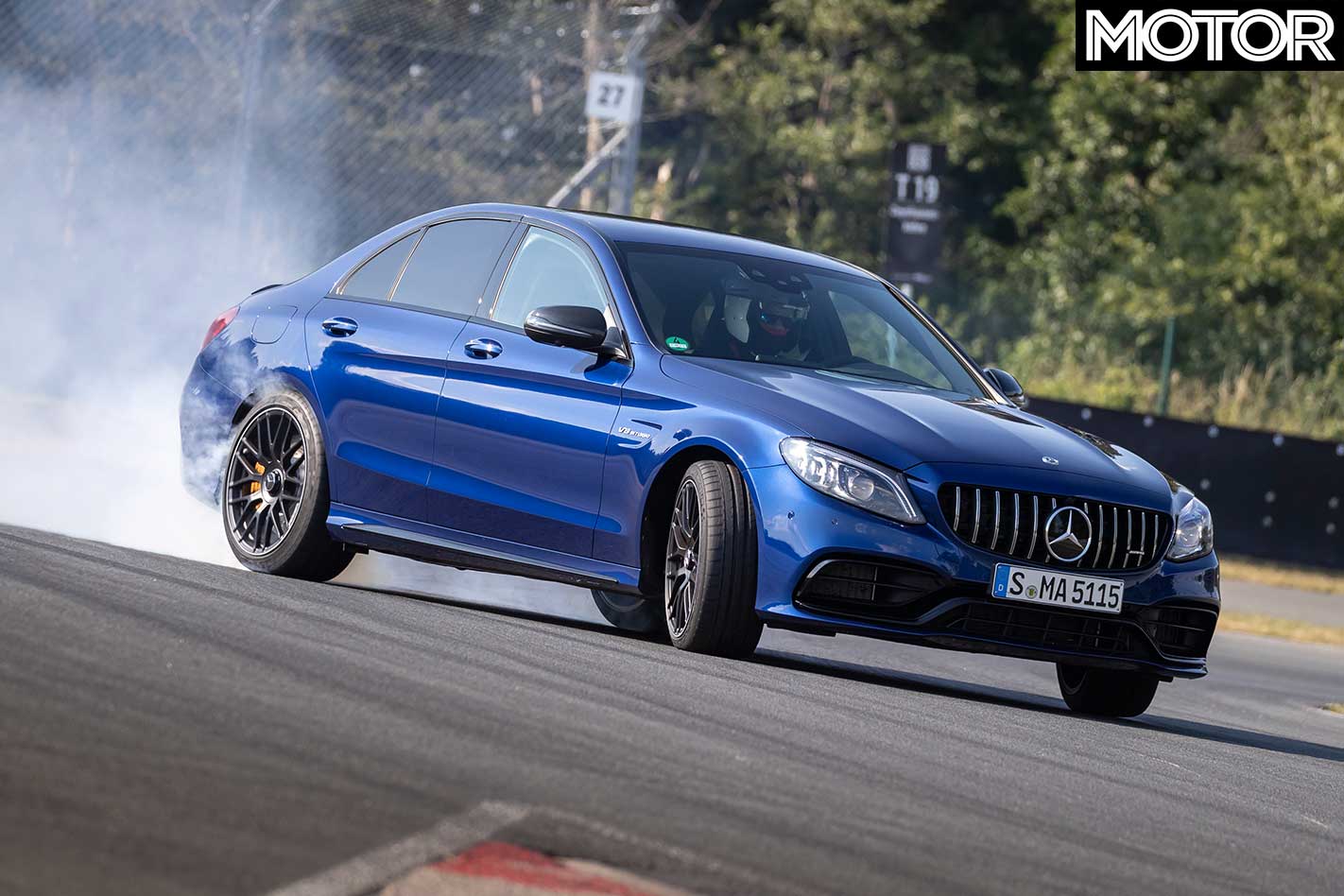
Meanwhile the price one pays for the nicer ride is more body roll, the C63’s not inconsiderable mass more noticeable, more often, than it was before. Previously, you went searching for the adaptive damper button to try and find ride comfort on the road; in the updated C63, you seek out this button to find body control on the track.
But it’s a trade-off we’re only too happy to make as this ride/handling balance is perhaps what the W205 C63 should have had from the get-go. As another nod towards comfort, Mercedes-Benz Australia will also now offer its C63 S with the base, more plush seats from the European models. The focused AMG performance seats, previously standard, will now be a cost option.
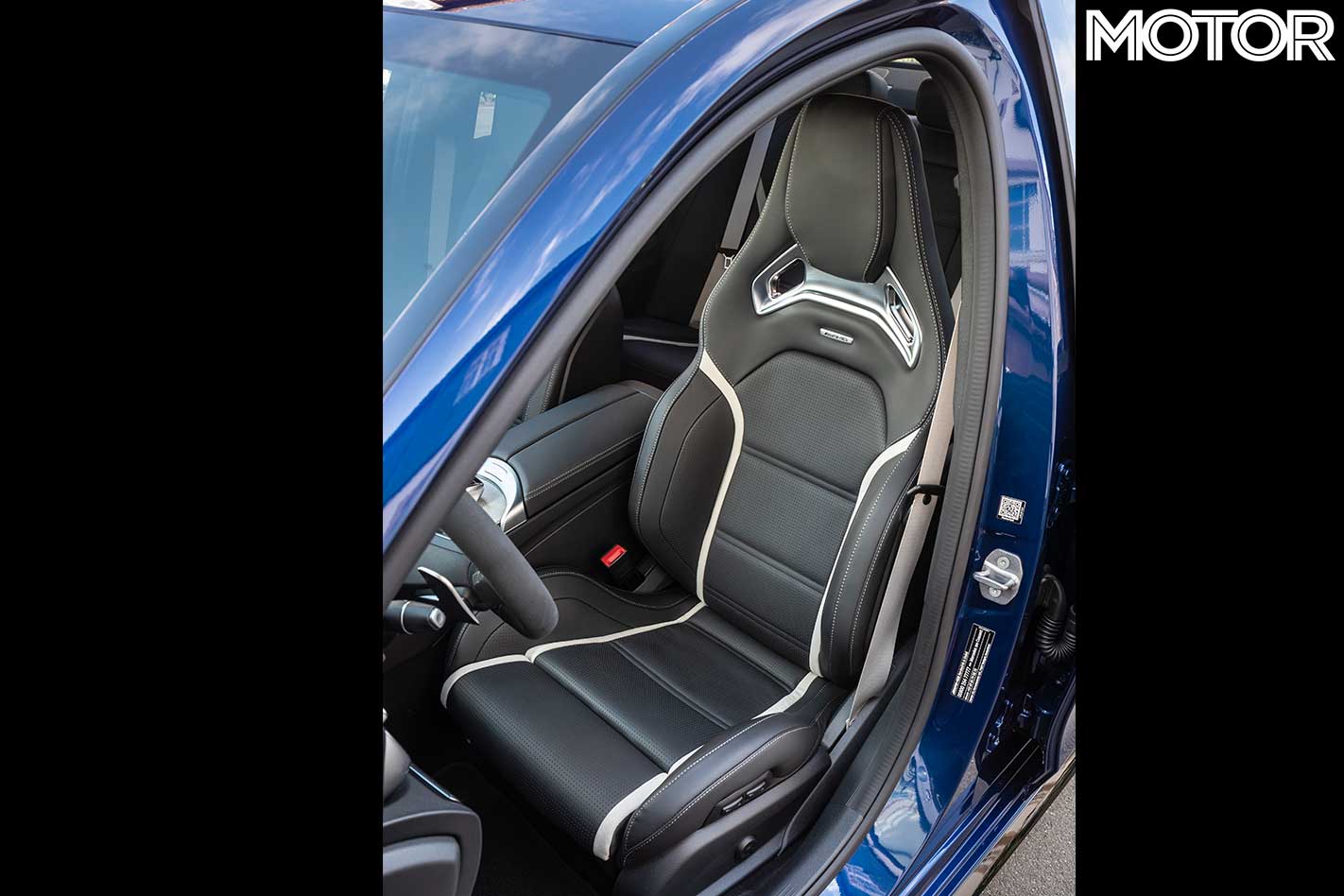
Bolting up the cogs, the new nine-speed transmission is properly impressive, gear changes swift and the power delivery uninterrupted as the hard-squatting C63 maniacally accelerates far beyond the speed limit. The transmission is also smooth at urban speeds, although give it a confusing sequence of inputs and you’ll still get a cranky clunk.
Sadly, when using the paddles and manual mode, down-changes still require patience, the transmission not as responsive to paddle commands down the gears as it is up, even in its fastest Race mode setting.
But leave the transmission to decide for itself in automatic mode and the frustration disappears during hard driving, lower gears engaged with a clean burst of engine-matching revs, and by muscle car standards, the transmission is well-matched to the engine.
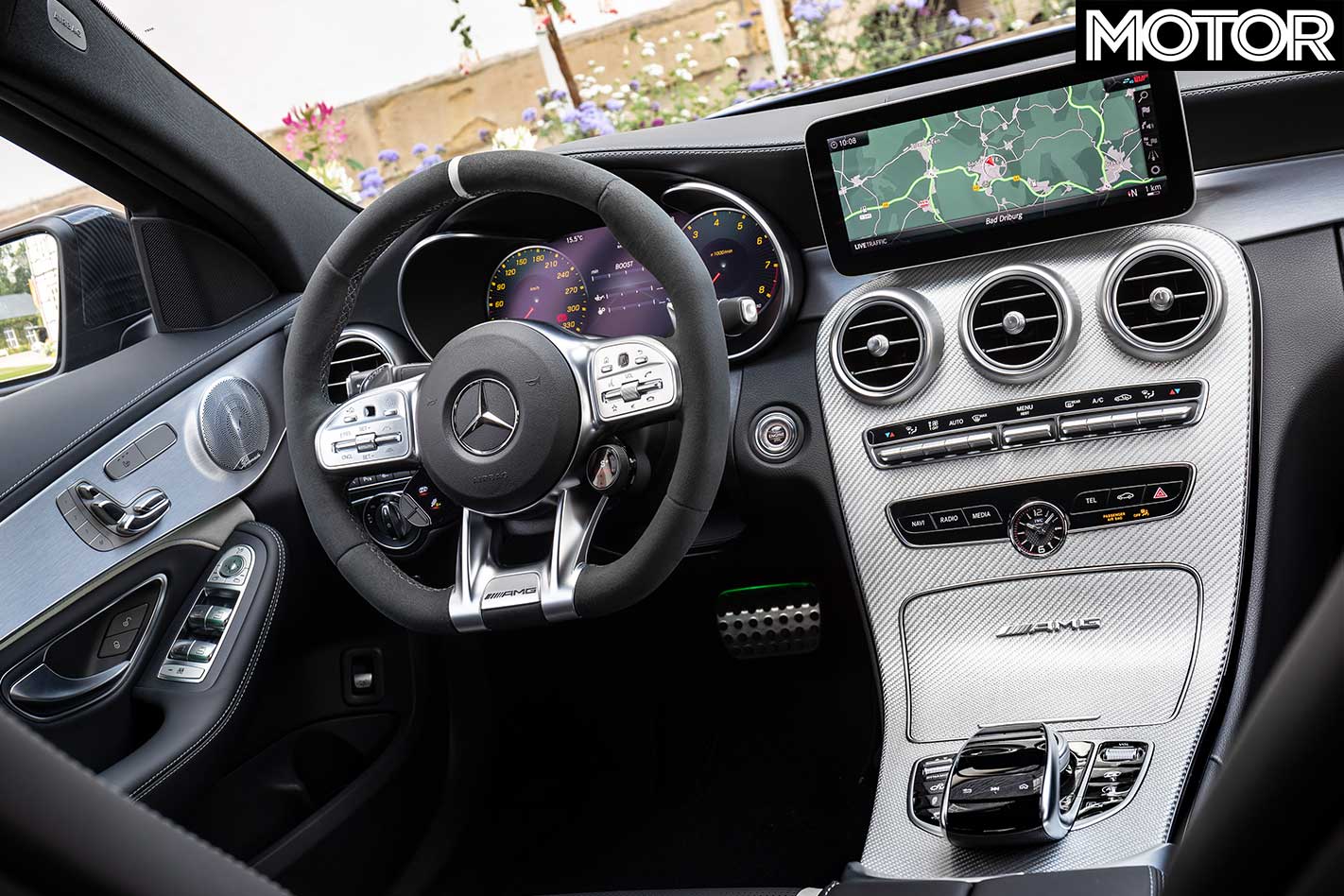
In this update, Mercedes-AMG has improved what needed to be improved and made a much better car of the C63. It’s more liveable, but remains a staggeringly potent vehicle, wheel-spinning through first gear like a lunatic and making the rudest, most addictive V8 noise in the process. The cabin, with its new high-tech feel and smattering of quality materials, would upstage an S-Class of only a generation ago.
It will take a while for a new owner to find the mix of electronic modes that they like best, but any excuse to drive the C63 again, you’ll gladly take. In this updated form, it is absolutely brilliant.
2018 MERCEDES-AMG C63 S SEDAN SPECS: Engine: 3982cc twin-turbocharged V8, DOHC, 32v Transmission: nine-speed wet clutch automatic, computer-controlled electronically locking limited slip differential Power: 375kW @ 5500-6250rpm Torque: 700Nm @ 2000-4500rpm Weight: 1680kg 0-100km/h: 4.0 seconds (claimed) Price: TBC
Rating: 4.5 out of 5 stars
CHRIS SVENSSON, the man who headed up Ford’s local design team during development of the final Aussie Falcon, has passed away aged 53.
Svensson was born and raised in England and joined Ford in 1992, holding a number of key positions within the company in the UK, Europe, North America, as well as Australia.
From 2010 to 2014, Svensson was the design director of Ford Asia Pacific and Africa, where he oversaw the Asia Pacific Design Centre in Melbourne. It was during that time when Ford launched the final Australian-built and engineered Falcon, the FG X.
A Ford Australia spokesman told Wheels that while the company traditionally doesn’t attribute vehicles to specific designers, Svensson “certainly played a role” in penning the final Aussie falcon.
“Chris considered his time at Ford Australia as one of the highlights of his career,” Todd Willing, the current Ford Asia Pacific Design Director said in a statement.
“I had the pleasure of working for Chris in Europe, Australia and the US where his passion for design, drive for excellence and good taste was always shining through. Chris was a great influence on everyone and will be greatly missed.”
While Svensson was the design director for Ford locally, his team also penned the 2015 Ranger update and Everest SUV.
“We are sad to learn of the passing of Ford Design Director Chris Svensson,” the company said in a statement.
“Chris was a talented designer, an inspiring leader and a friend to many people. He made countless contributions to Ford during his 26-year career and he will be greatly missed. Our thoughts and prayers go out to his family.”
Svensson most recently worked as part of the team which developed Ford’s GT supercar. He is survived by his wife, Sonia, and daughters Hannah and Ella.
ELECTRIFICATION is unlocking previously unheard-of levels of performance, but Ferrari is aiming to take electron-enhanced hardware to new heights with an electric turbo that’s like nothing else we’ve seen before.
Ferrari’s system seems, in short, fairly genius. The patent application for a “Method to control an electrically-operated turbocharger in a supercharged internal combustion engine” is as dry as you’d imagine, but picking apart the patent’s description of the device reveals some fairly game-changing stuff.
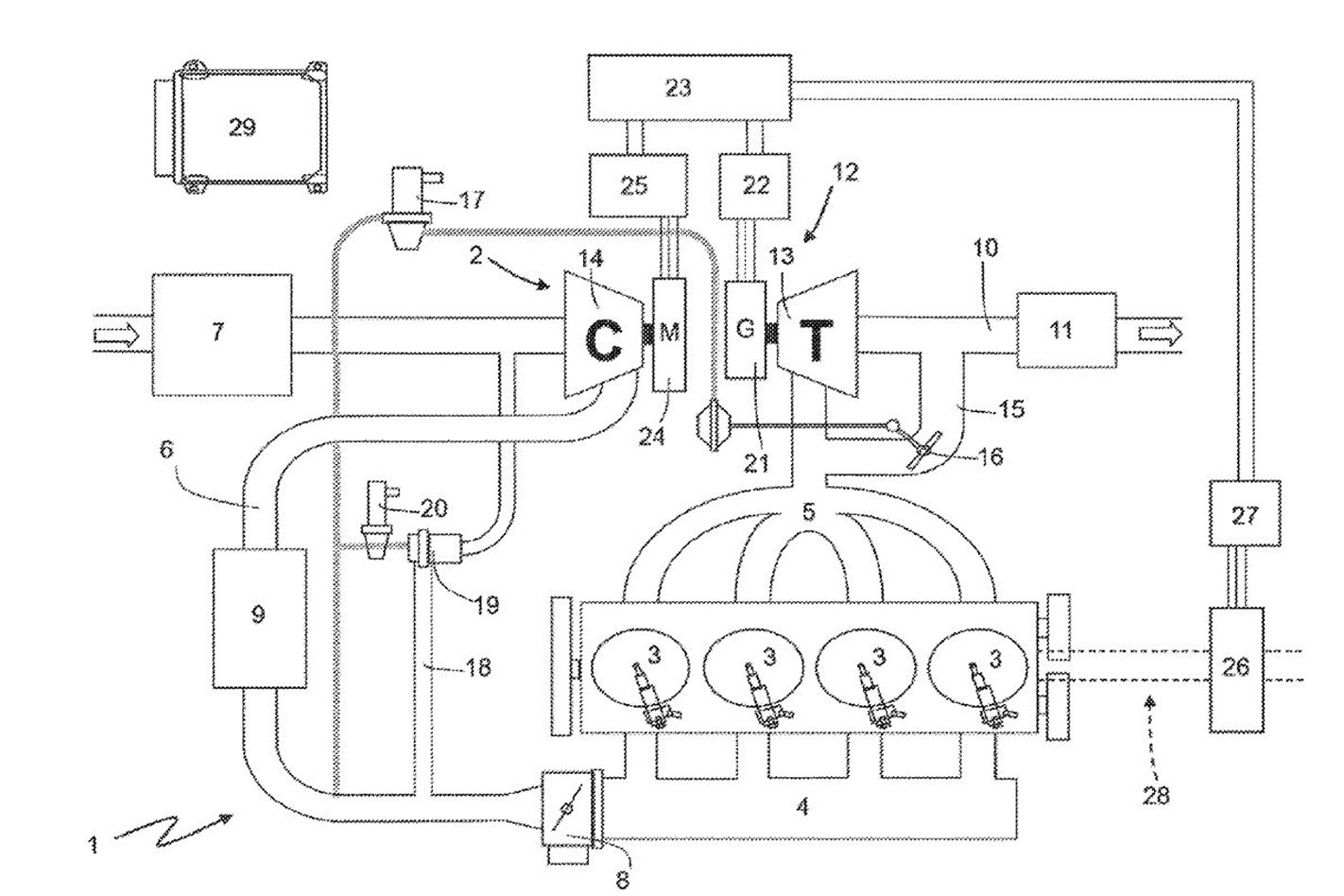
Ever since their invention, turbochargers have adhered to a basic formula. A compressor wheel on one side (the cold side) stuffs fresh air into the engine, driven by a turbine on the other end (the hot side) that’s spun by the rush of exhaust gas exiting the cylinders. A shaft linking it solidly to the compressor passes through a central housing. If the turbine is spinning at 10,000rpm, then the compressor is too.
Ferrari has used electric turbocharging in Formula 1 for years now, but that tech sandwiches an electric motor between the turbine and compressor housings – the turbine and impeller remain mechanically linked. This patent shows something quite different. The compressor is physically divorced from the turbine, and is instead powered by an electric motor – much like the electric superchargers in the Bentley Bentayga, Audi SQ7 and AMG CLS53. The turbine remains bolted to the exhaust manifold, but it now drives a generator that sends charge to a battery, which can either store the energy recouped by the turbine or send it to the compressor’s motor to create boost. Make sense so far?
The beauty of Ferrari’s system is that it results in a turbocharger setup that behaves like no other turbo. Even if there’s not enough exhaust gas flow to spool up the turbine – like at low engine speeds – the stored energy in the battery can be sent to the compressor to spin it up and start producing boost pressure, without having to also spin the turbine as well. Turbo lag would be a thing of the past.
And the ability to store energy from the spinning turbine when boost isn’t needed is a genuine innovation, as are the packaging possibilities unlocked by the clever arrangement. While the turbine still needs to remain as close as possible to the exhaust ports, the compressor unit can be placed anywhere in the engine bay. Inlet plumbing can thus be shortened as air no longer needs to go down into the bowels of the engine bay to be compressed, resulting in a further improvement in throttle response, not to mention reduced weight.
Another important supercar consideration concerns the crucial emotional role of sound. The patent goes out of its way to describe methods for improving the engine’s exhaust note – a commonly-cited criticism of high-performance turbo engines – by diverting more exhaust through the wastegate under certain conditions or varying the speed of the turbine to either manipulate the tone or volume (or both) of the engine’s report.
The patent also reveals that the electrical energy recovered by the turbine’s generator during light-throttle cruising would be greater than that consumed by the turbocharger’s motor, meaning energy that would normally be wasted by a conventional turbo can instead be used to top-up the battery without putting any additional load on the engine. That energy can also be directed to a drive motor connected to the transmission, indicating the system will likely be rolled out on a petrol-electric model first. Expect stellar fuel economy figures.
While some corners of the internet noted the presence of just four cylinders in the patent imagery as evidence that Ferrari is planning a four-pot performance car, that’s not likely to be the case. It’s more plausible that the four-cylinder head shown is merely indicative (and could even just represent half of the intended engine). Indeed there’s no mention of exactly what kind of vehicle this technology is intended for, but it’s clear that Ferrari isn’t planning on following the crowd as it prepares for a more turbo-heavy and electrified future.
Like them or not, performance SUVs are growing in popularity.
And not to let any clip of sales get away from it, BMW will be the next manufacturer to enter the fast compact SUV market with a red-hot performance version of its X4.
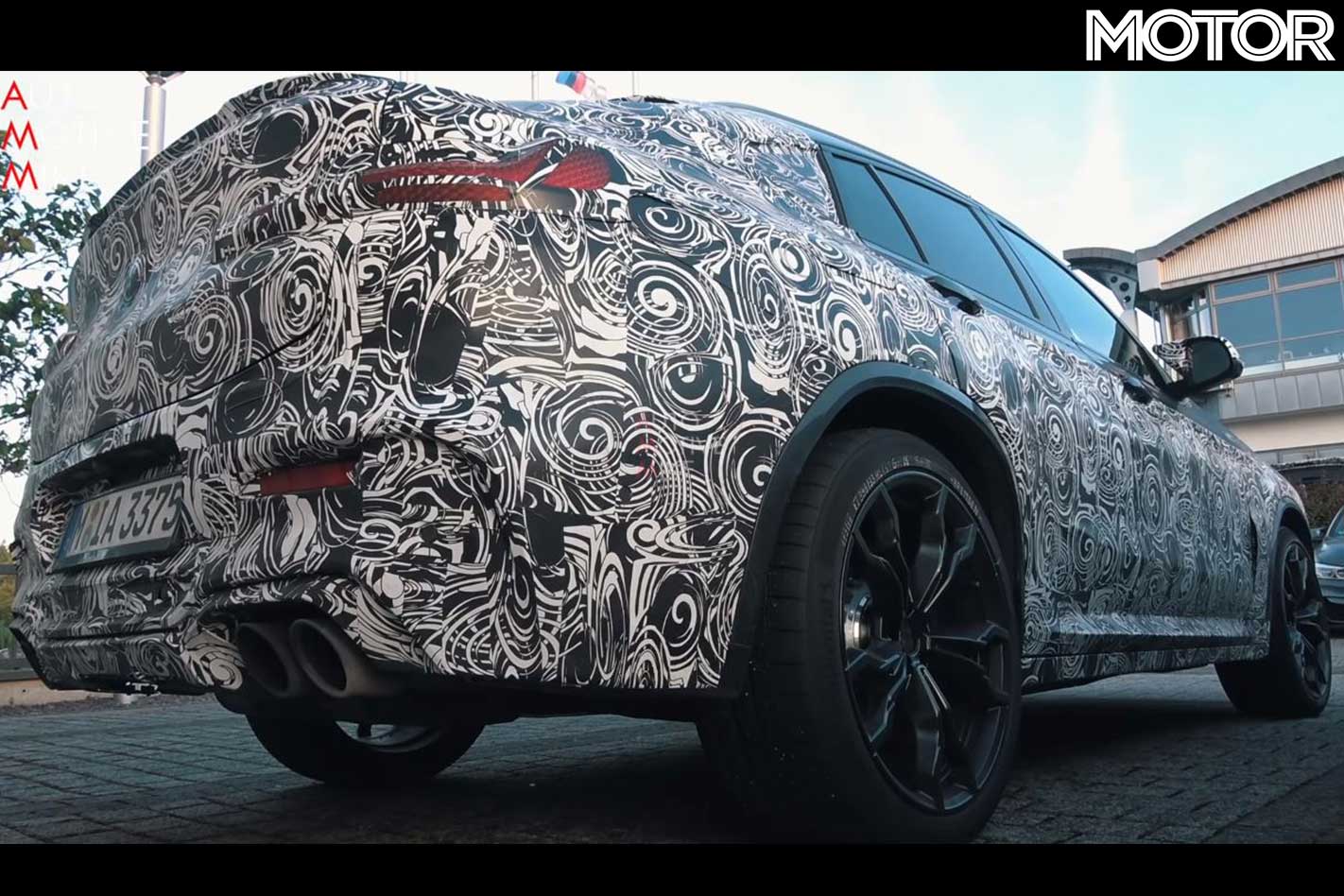
It won’t be warmed over with simple go-fast parts, M Performance style, either. How do we know? Clues come from leaked pictures on Autocosmos.com, who snapped the swoopy SUV in what looks like production-spec during a visit to BMW’s American Spartanburg factory.
While an X3 tuned by M Performance wears the badge “M40i” to separate it from the ilk of Munich’s finely crafted performance machines that feature racetrack-bred drivetrains and suspension, this X4 had “M” slapped on its rump next to its model name, just like the bonkers X5 M and X6 M.
The picture clarifies what we’ve seen running around Germany’s Nürburgring Nordschleife recently, too. Videos have shown an X4 heavily clad in camouflage charging at apexes, tyres squealing, and exhausting blaring with a note that sounds suspiciously similar to one produced by the M3’s inline-six.
To draw similarities between that car and the one pictured here, both use identical exhaust tip arrangements. Nosing out from the spied ‘X4 M’s’ rear bumper are four large exhaust pipes, just like all of BMW’s M cars.
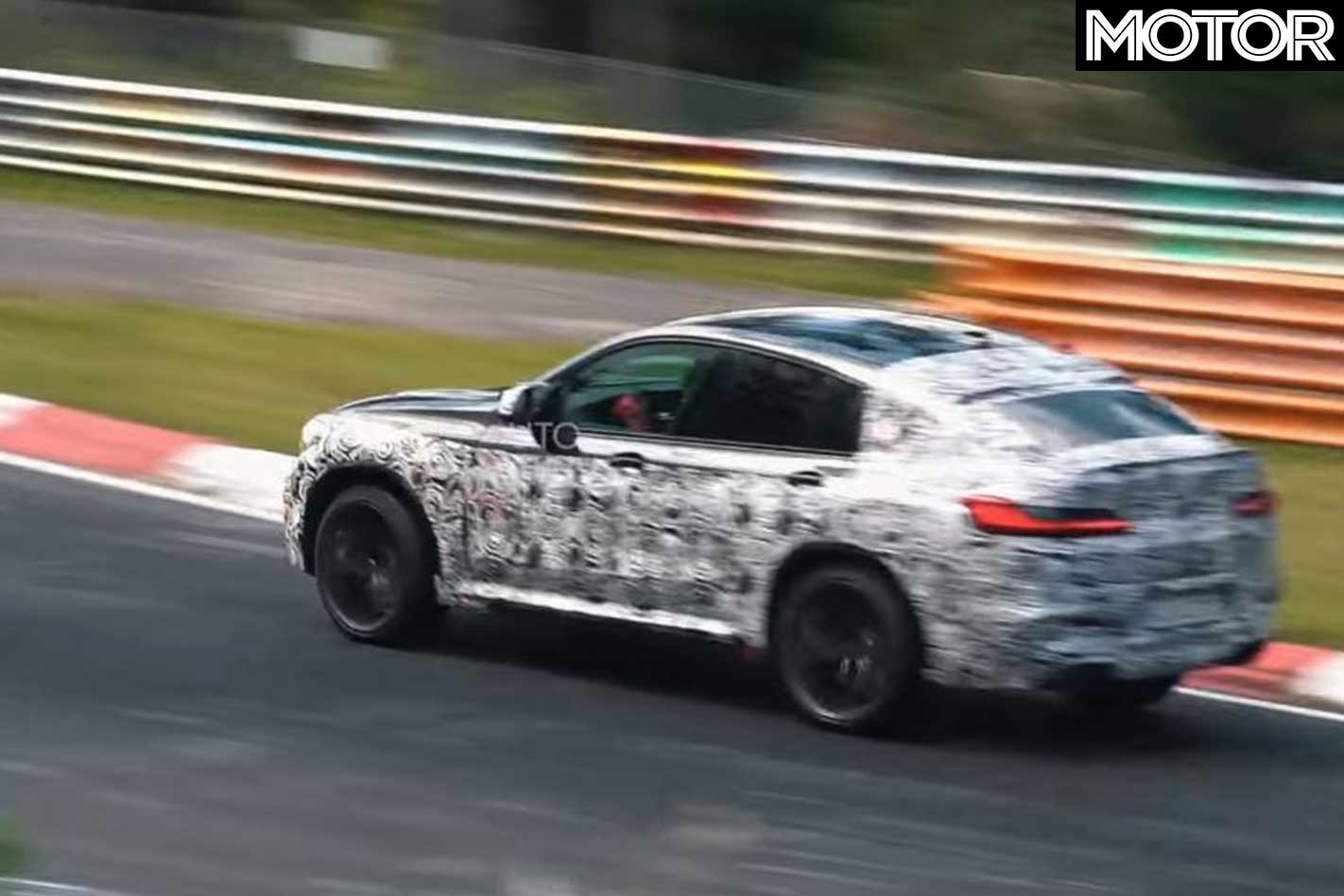
The fact BMW’s Spartanburg factory in North Carolina exclusively builds the brand’s SUVs lessens the chance this is some one-off knock up creation, as well. This is the heartland of X4 production.
Other from the unique body treatments to the front guards, rear bumper and roof that we can see, we don’t know much else at the moment in the way of specs and figures. It’s rumoured that the X4 M will adopt the next turbocharged inline-six to power later versions of the M3/M4.
It’s also believed that it’ll come matched to an eight-speed auto, as it’s reported that a dual-clutch won’t adapt to a transfer case for all-wheel drive.
One thing we can be certain about is it’ll have to flog the X3 M40i on performance figures, which are pegged at 265kW and 500Nm. Fans of its more upright sibling will be glad to know an X3 M equivalent is also planned to help the X4 take the fight to Mercedes-AMGs compact brawlers on stilts. They’ll be joined by Audi’s updated RS Q3 in 2020.
The X3 and X4 M are reported to be unveiled within the next year. Meanwhile, the regular new X4 is reported to be launch in the third quarter of 2018.
Image source: Autocosmos
When the Honda Civic Type R’s 2018 Performance Car of the Year title was announced, our inboxes clogged with enough emotion-charged emails that month to almost crash our web servers.
This track review was carried out in conjunction with MOTOR’s Bang For Your Bucks 2018
Some people offered a congratulatory comment, or an ambivalent one, but many were so disbelieving a front-wheel drive car could beat everything from a Porsche to an HSV, they reasoned it was only because it arrived with gold bullions hiding in its boot.
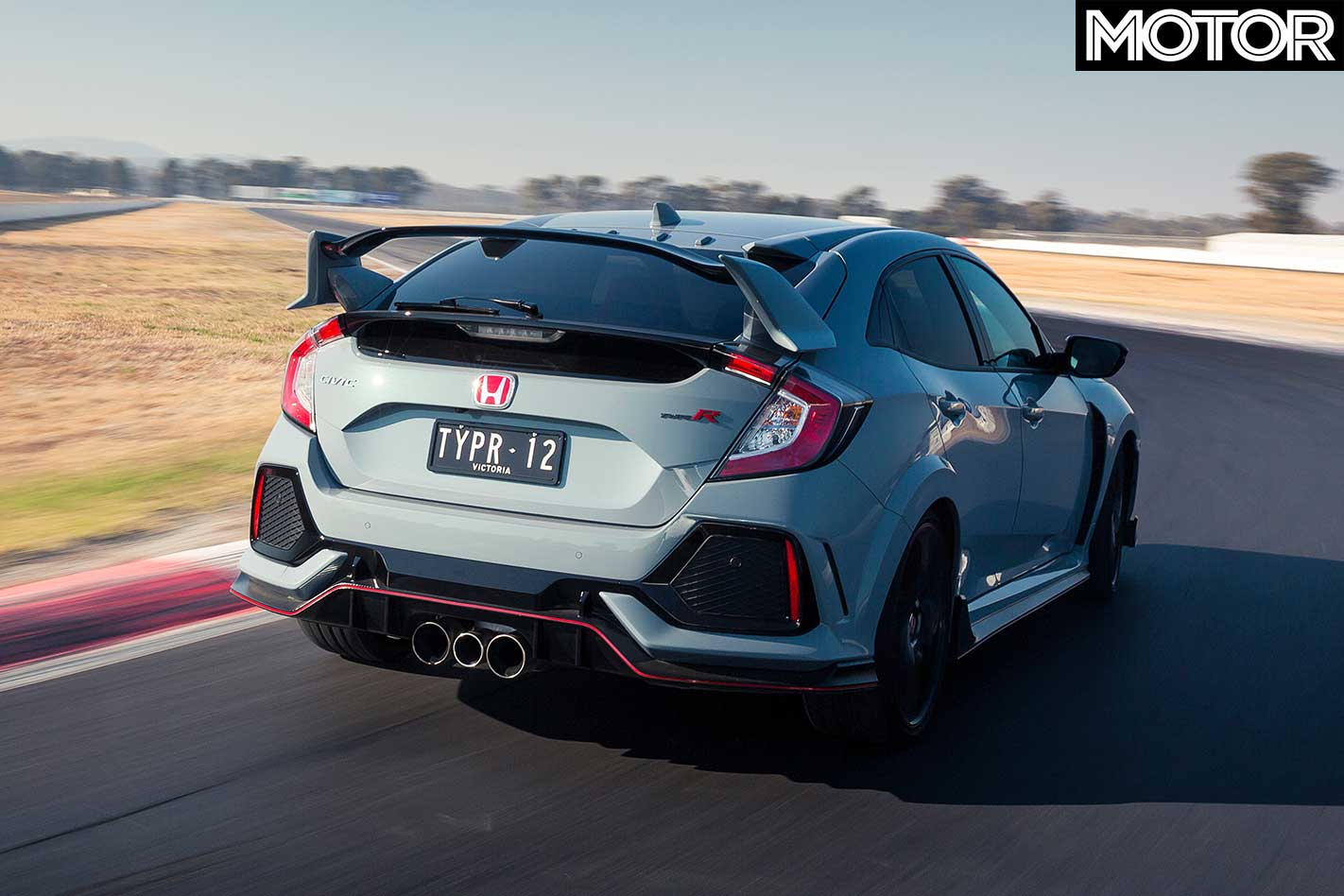
It dominated the braking discipline, showed ferocious pace around a racetrack, and excelled on the drag strip where a front-wheel drive car usually has no right to. And before you beat the conspiracy drum again about its clean sweep atop the judges’ rankings, its price and performance data was so convincing on the spreadsheet, each judge would have had to place the Civic eighth or lower to dethrone it from top spot. And that’s a situation we’d find truly unbelievable.
The Civic Type R is so bewitching to drive on road or track that it’d convince anyone that the Type R brand is back – better than ever. From the way it grasps you in its G-force-proof front seats, or how the gearshift is almost level with yours hands on the steering wheel, there are classic Type R cues strewn throughout it.
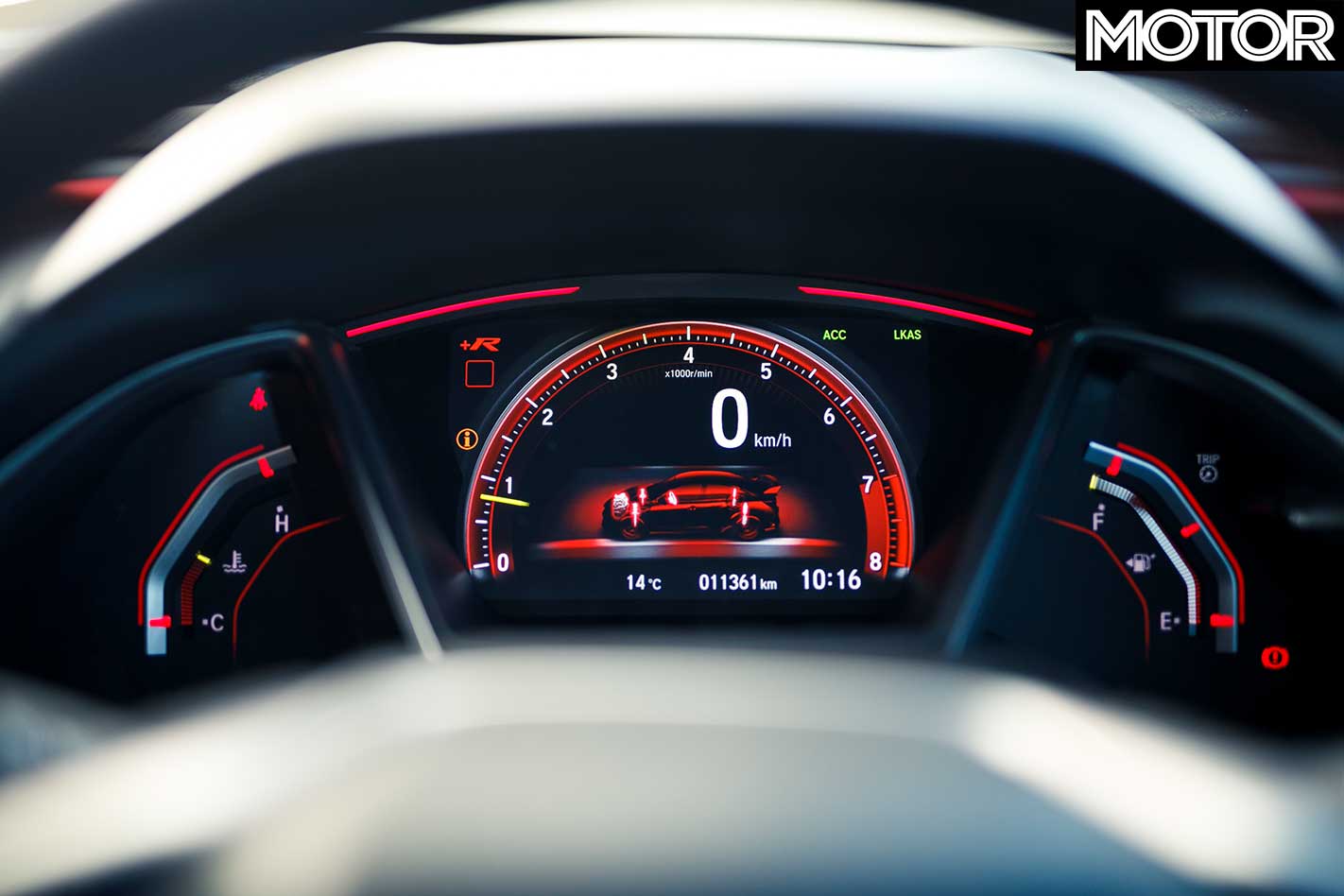
The digital cluster thrusts an arc-shaped rev gauge into view like an S2000, while the gear knob’s cool titanium touch honours the original Integra Type R or NSX-R.
What the new Civic Type R brings to the table, besides a long-awaited return to form, is a new approach to brilliance. That turbocharger lurking under its bonnet means there’s no more frenetic redline-chasing drama or explosion of noise as VTEC bumps its camshafts onto its big lobes.
The slightly oversquare engine still likes to spin and uses variable valve lift, but it now surges to redline from earlier in the rev range. It’s smoother than the other turbo four cylinders here and delivers a better top-end, too, feeling threatened only by the Focus RS’s 2.3-litre for torque.
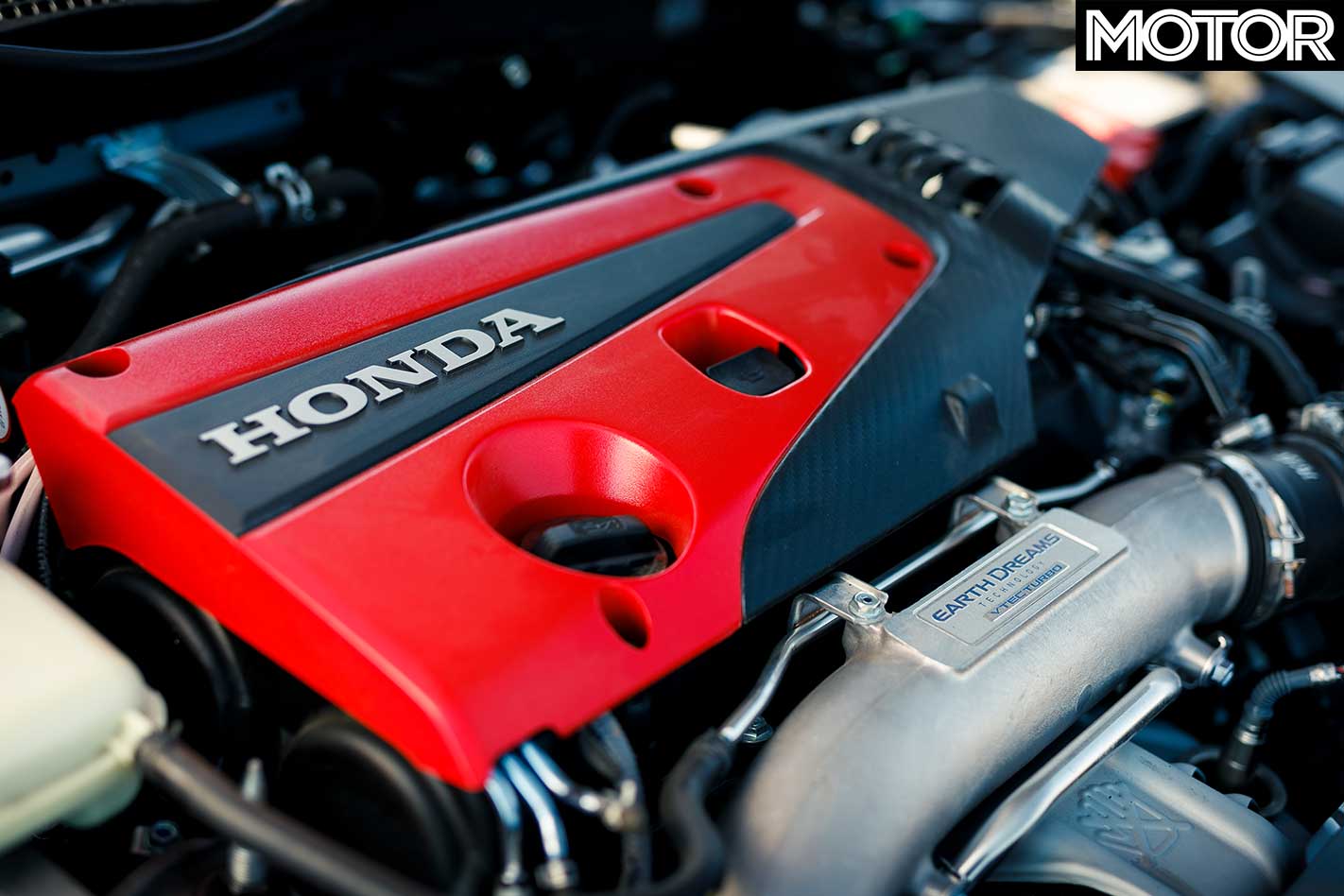
Lack of all-wheel drive traction means the Civic lags behind others from a standing start. There’s a fair chunk of wheel spin through first gear and the car’s shortly stacked six-speed ratios, separated by BFYB 2018’s slickest and most satisfying shift (although not as buttery as Honda’s greatest), means you’ll need to nudge into third at 99km/h, penalising its 0-100km/h time.
However, it’s still leagues ahead of anything else front-drive and once on a roll it’ll decimate its all-wheel drive rivals, proving Honda knew what it was doing by selecting a lighter, simpler front-drive layout.
Where the Civic Type R shines brighter is in the braking zone. Its relatively humble steel brakes are tremendous, arresting it from 100km/h in 32.95m and with so much bite, stop after stop, you’d swear Honda had snuck big-dollar carbon ceramics into its wheel guards.
The Honda continues to wage war in the data’s average cornering speeds. The 370Z Nismo might have pipped it in first place by an ant’s footprint, but when you realise the Nissan presses 80mm more tyre width into the road under a more inherently balanced rear-drive layout, the 0.01km/h gap dividing them fades into a moral victory for the Civic Type R.
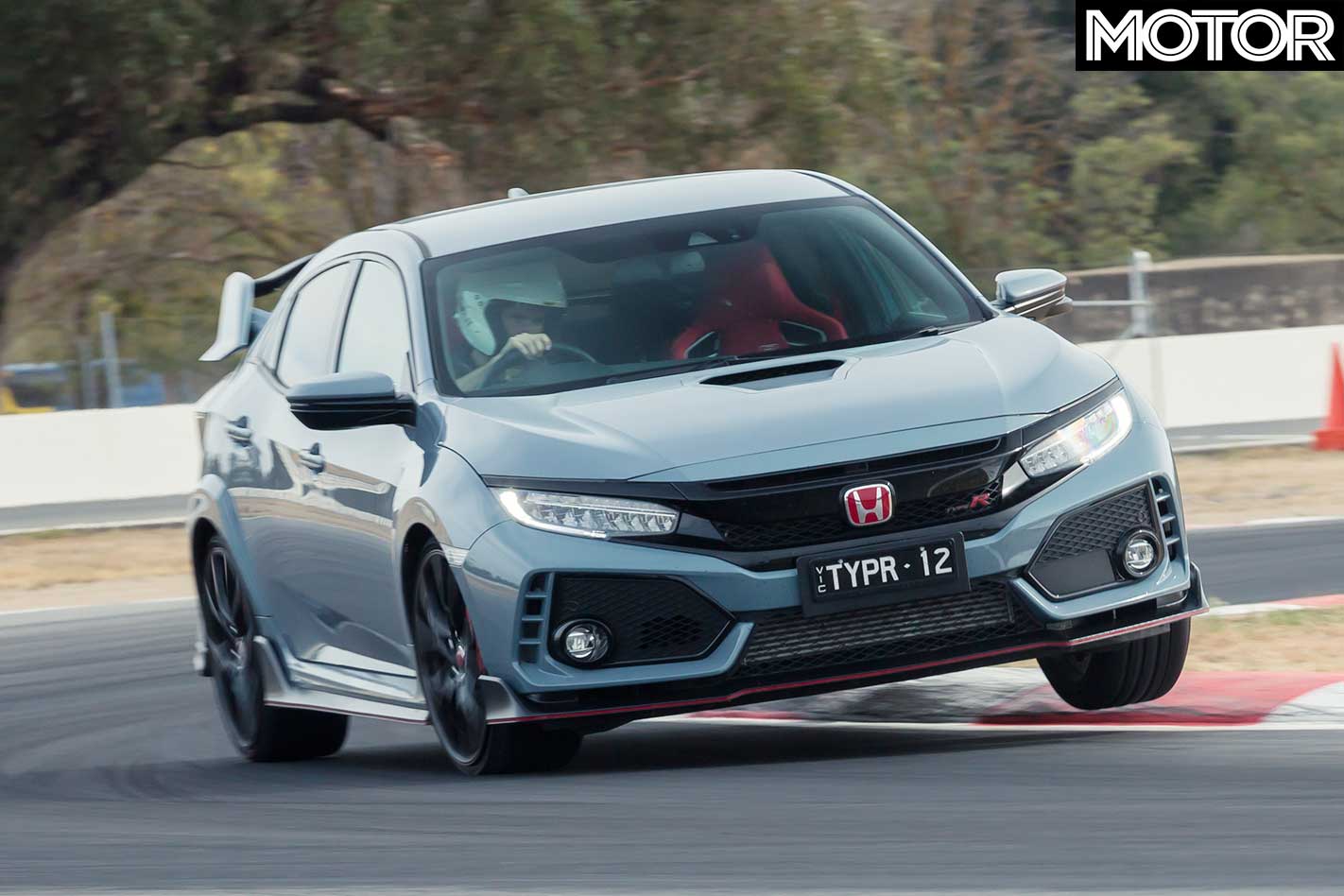
It’s all thanks to some serious engineering underneath. Like that helical LSD bolted between dual-axis front struts, bridged by a stiffer bodyshell to revised rear-suspension arms. Grippy 245mm-wide Continentals are the last touch, unlocking brilliant drive, neutrality, and precision for a front-driver with this much power.
People were spending so long out on track, smashing the brakes harder and leaning into its wall of grip with more commitment as the laps went on, we almost needed a crowbar to pry them from the driver’s seat.
It packs varying levels of ESP intervention in its drive modes, including full off, and the switchable rev-match is doofus-proof. If the Type R was a politician it would transform into Barack Obama – unflappable, infectious, approachable by novices and professionals alike.
In Luffy’s hands the Civic slices Winton Raceway in 1min 35.9sec, the fastest lap time on the day and comfortably burying previous efforts in any production front-drive car. To share that time with the Ford Focus RS LE might sour its achievement a little, but consolation lies in the fact the Ford’s tyres could satisfy a GT3 car’s grip requirements.
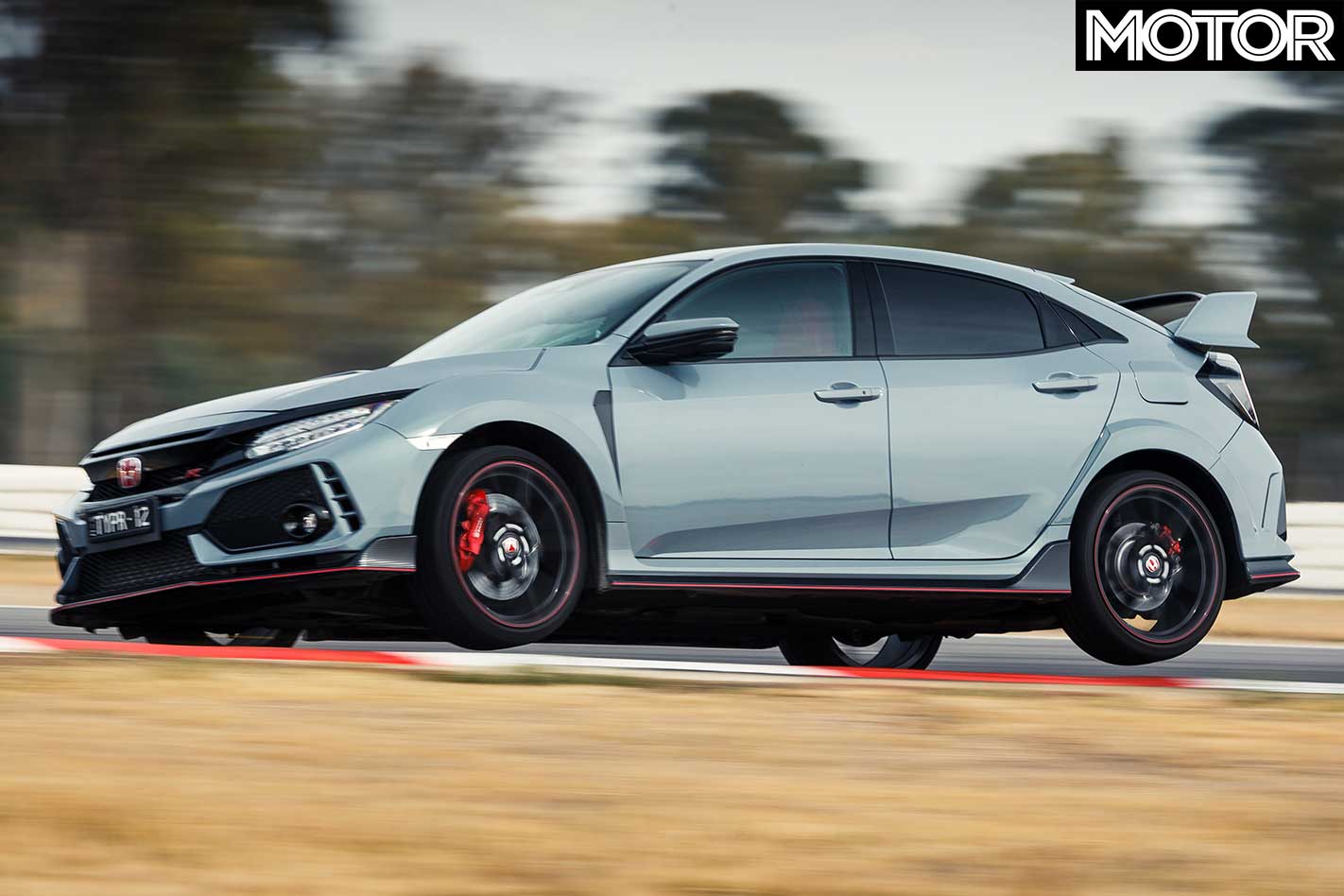
It’s not all roses, though, as a few chinks lurk in its armour. Honda hasn’t aced the electric steering, which can be a touch vague just off-centre, Luffy sniffed out some wheelspin in tight corners, and that engine could use some singing lessons under the Hyundai i30 N’s tutelage.
Most of its engine noise is muffled by the gases rushing through the turbocharger. Also, its looks, and interior, are sure to fuel a lot of arguments at your local pub.
But let’s not lose sight of the bigger picture. While an Infiniti Q50 Red Sport’s blistering speed is bolstered by crappy brakes, or a Toyota 86’s crisp steering is contrasted by little grip, the Honda Civic Type R’s elements complement each other, and that’s why it logs the second highest lap V-max – even though it’s far from being the second most powerful car.
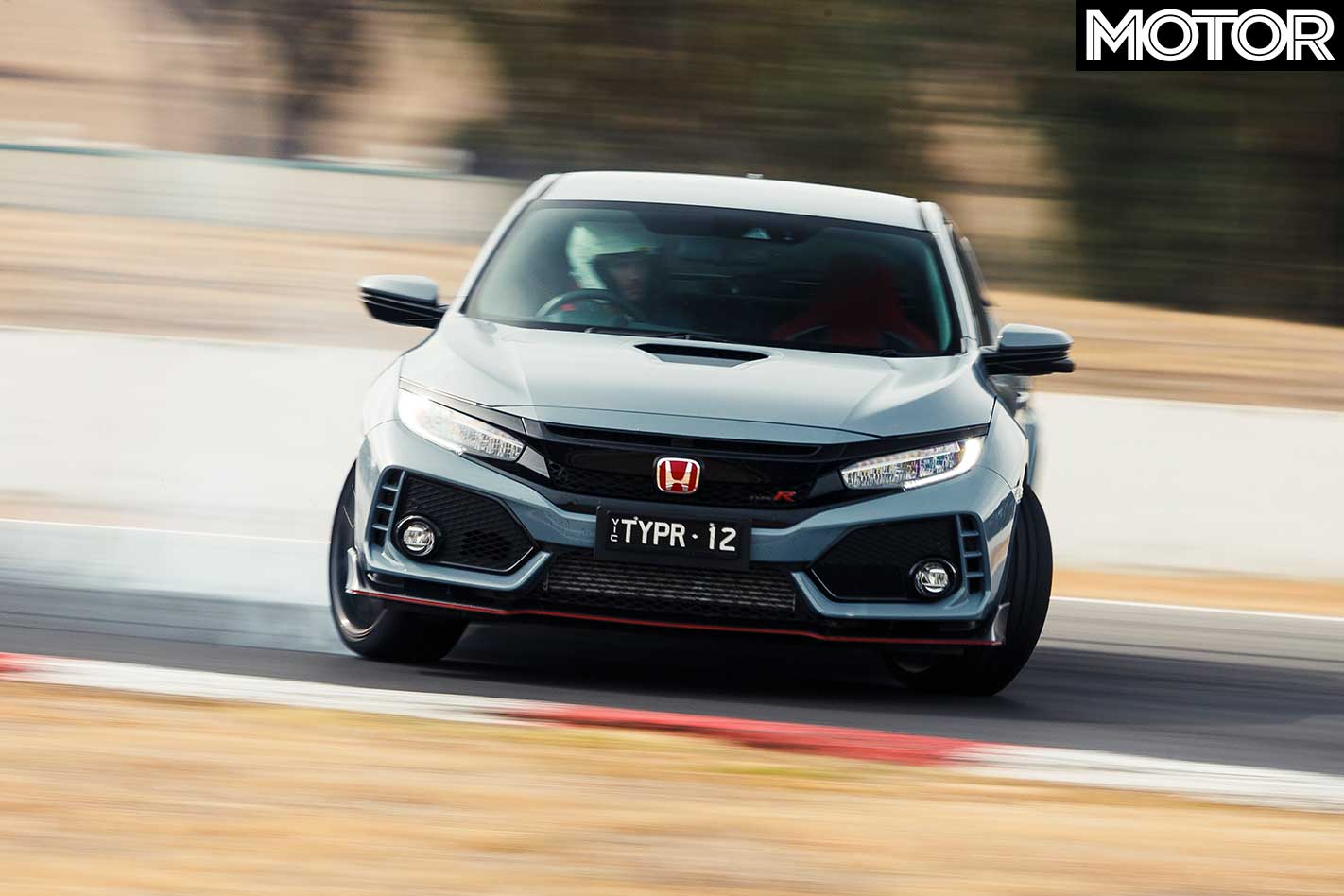
The BFYB formula favours the Honda’s performance figures so much that you would have to heap another $13K on the Civic Type R’s $51,990 price tag to knock it down to second place.
It’s this all-round brilliance that injects the Honda not only into an elite BFYB winner’s circle, but lifts it into another echelon of fame altogether. Only Nissan and BMW have bagged both PCOTY and BFYB before, yet needed multiple years and variants (an S14 200SX/S15 200SX and E36 328i/E36 M3) to achieve the feat, leaving the Honda Civic Type R as the force behind the most dominant award season in MOTOR history. All hail our scorching-hot BFYB king.
Putting the money where its performance is on Bang For Your Bucks 2018
Honda Civic Type R BFYB 2018 Results – WINNER
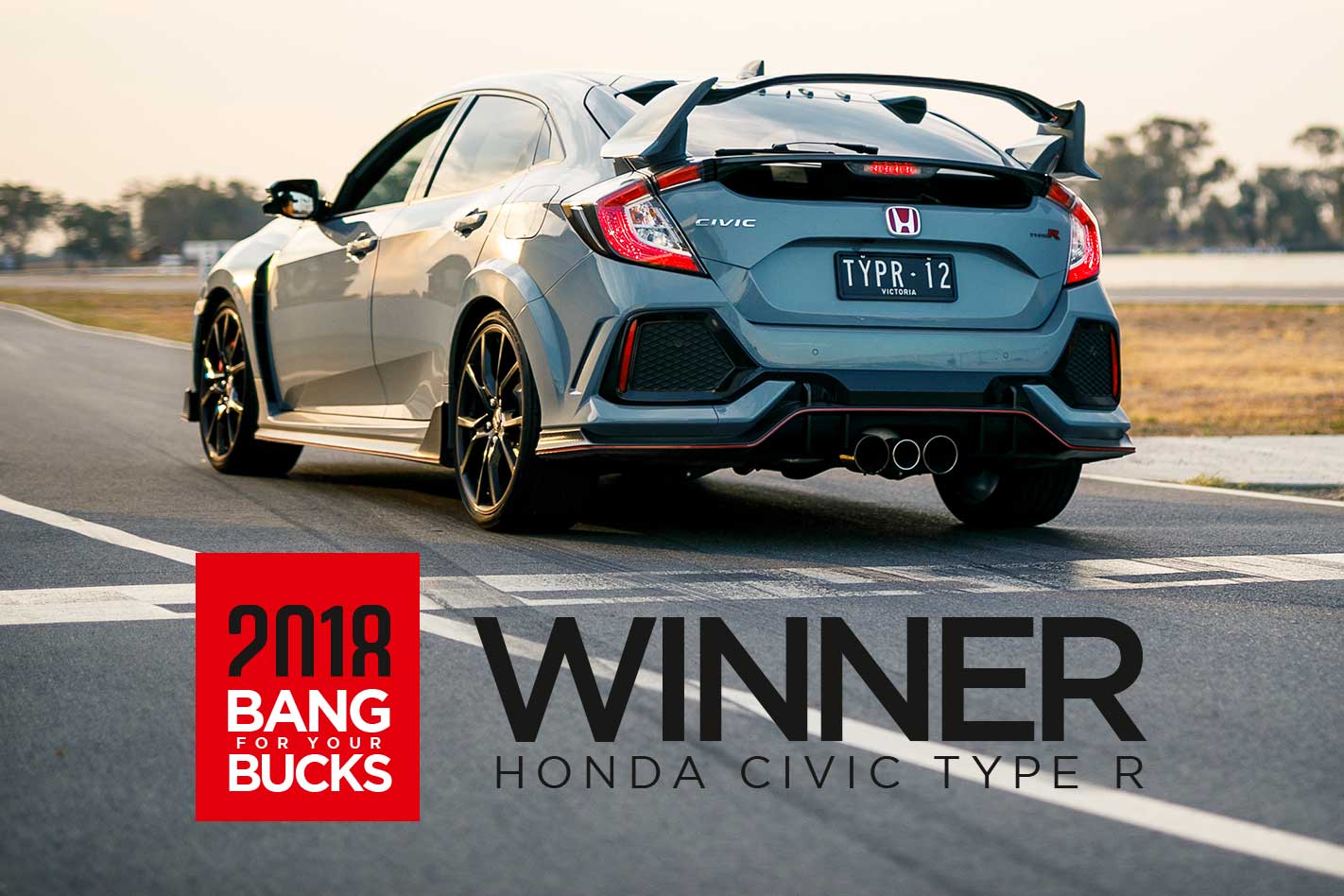
0-100km/h: 5.81sec (7th) 0-400m: 13.79sec @ 173.12km/h (7th) Lap Time: 1:35.90sec (=1st) Price: $51,990 Bang Index: 195.7 Bucks Index: 96.6 BFYB Index: 151.1
Judges’ Comments
Warren Luff – 1st “The Civic Type R is really fun to drive on the limit. It’s very neutral in its chassis balance and it’s only once you come out of the tight corners in second gear that you actually realise it’s front-wheel drive because you do get a little bit of wheel spin. Overall it’s a confidence-inspiring car for the driver as it does everything so well. There’s excellent front-end grip with great driver comfort and feedback. All in all it’s definitely worthy of the Type R name tag.”
David Morley – 1st “Still my favourite front-driver ever.”
Dylan Campbell – 1st “Drive it as hard as you can. It shouldn’t be as good as it is”
Scott Newman – 1st “A hero. Just does everything you want it to.”
Louis Cordony – 1st “Instant hot-hatch royalty that doesn’t cost a kingdom”
CATEGORY KINGS
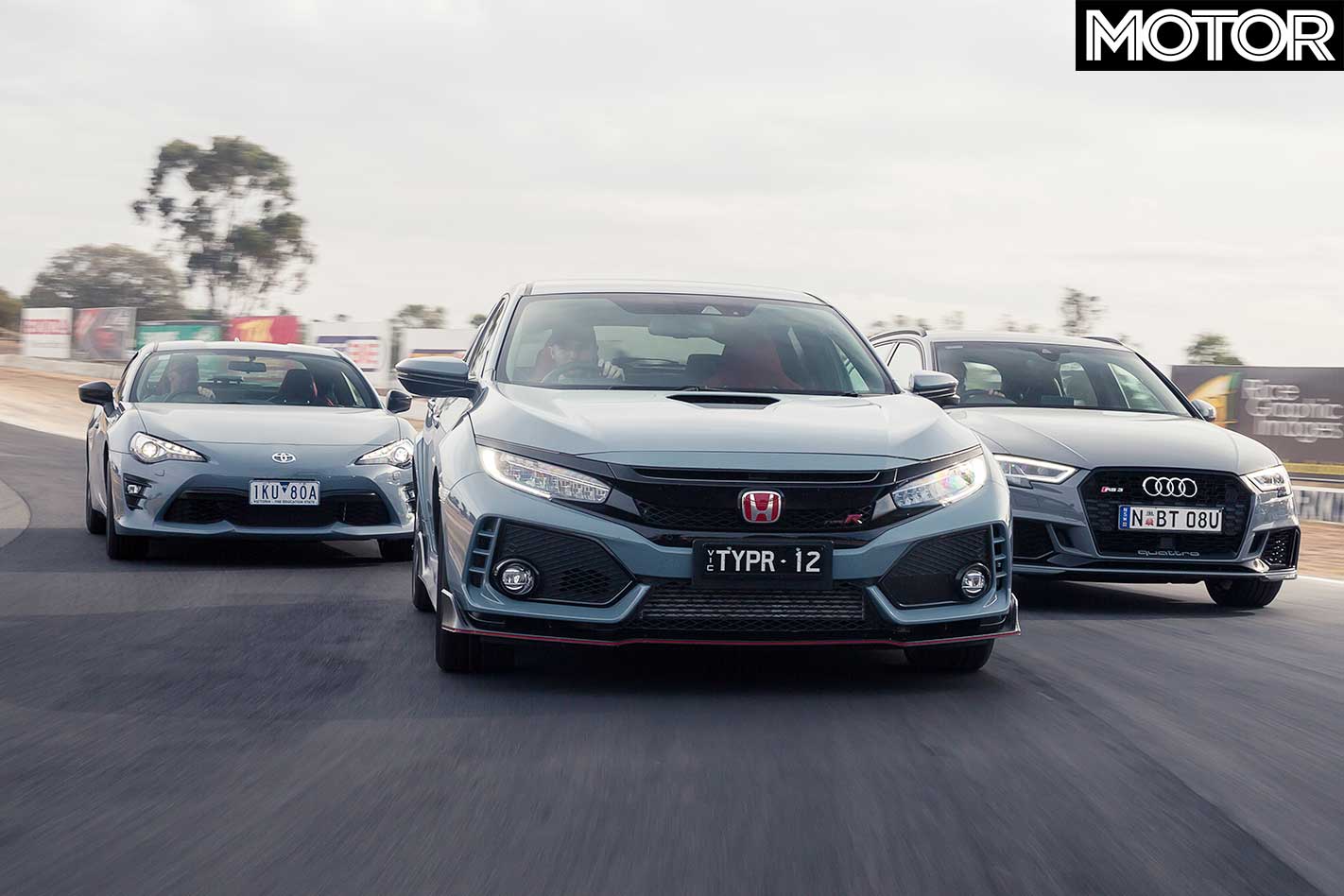
Below $50,000 1st – Volkswagen Golf R Grid Edition 2nd – Hyundai i30 N 3rd – Volkswagen Golf GTI Original
$50,000 to $100,000 1st – Honda Civic Type R 2nd – Ford Focus RS Limited Edition 3rd – Audi RS3 Sportback
ROLLS OF HONOUR
1994 – Mitsubishi Lancer GSR 1995 – Nissan 200SX 1996 – BMW 328i 1998 – Subaru Impreza WRX 1999 – Subaru Impreza WRX 2000 – HSV Clubsport R8 2001 – Renault Sport Clio 2002 – Subaru Impreza WRX STI 2003 – Holden Astra SRi Turbo 2004 – Mitsubishi Lancer EVO VIII 2005 – Subaru Impreza WRX STI 2006 – Holden Commodore SS 2007 – Holden Commodore SS 2008 – Ford Falcon XR6 Turbo Ute 2009 – Subaru Impreza WRX 2010 – VW Golf GTI 2011 – VW Polo GTI 2012 – VW Polo GTI 2013 – Mini JCW GP 2014 – Ford Fiesta ST 2015 – Ford Fiesta ST 2016 – VW Polo GTI 2017 – Ford Focus RS
FAST FACTS 2018 HONDA CIVIC TYPE R
BODY: 5-door, 4-seat hatch DRIVE: front-wheel ENGINE: 1998cc inline-4, DOHC, 16v, turbo BORE/STROKE: 86.0mm x 85.9mm COMPRESSION RATIO: 9.8:1 POWER: 228kW @ 6500rpm TORQUE: 400Nm @ 2500-4500rpm WEIGHT: 1380kg POWER-TO-WEIGHT: 165kW/tonne TRANSMISSION: 6-speed manual SUSPENSION: struts, coil springs, adaptive dampers (f); multi-links, coil springs, adaptive dampers, anti-roll bar (r) BRAKES: 350mm ventilated discs, 4-piston calipers (f); 305mm ventilated discs, single-piston calipers (r) WHEELS: 20.0 x 8.5-inch (f/r) TYRES: Continental SportContact6; 245/35 R20 (f/r) PRICE: $51,990
Bang For Your Bucks 2018
 The Contenders, Judges & Criteria
15 of the hottest new fast cars under $100K roll up to take on our famous formula. Which will be number 1?
Despite currently being embroiled in a trademark dispute with Hyundai over the name, Nissan today revealed a trio of N-Sport special editions which will go on sale next month.
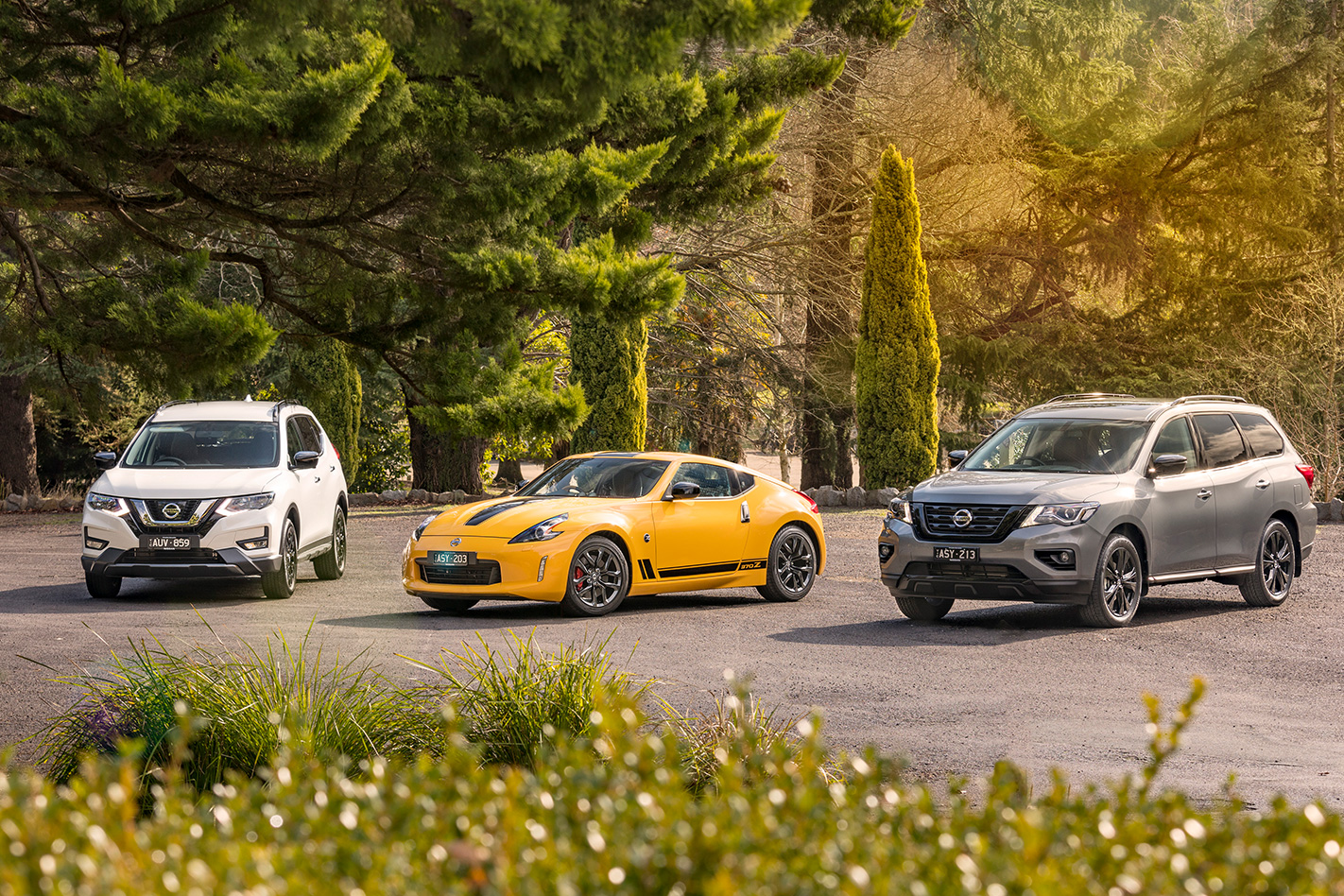
The Nissan 370Z, Pathfinder, and X-Trail have all been given the N-Sport treatment, following the success of the limited-run N-Sport Navara released last year.
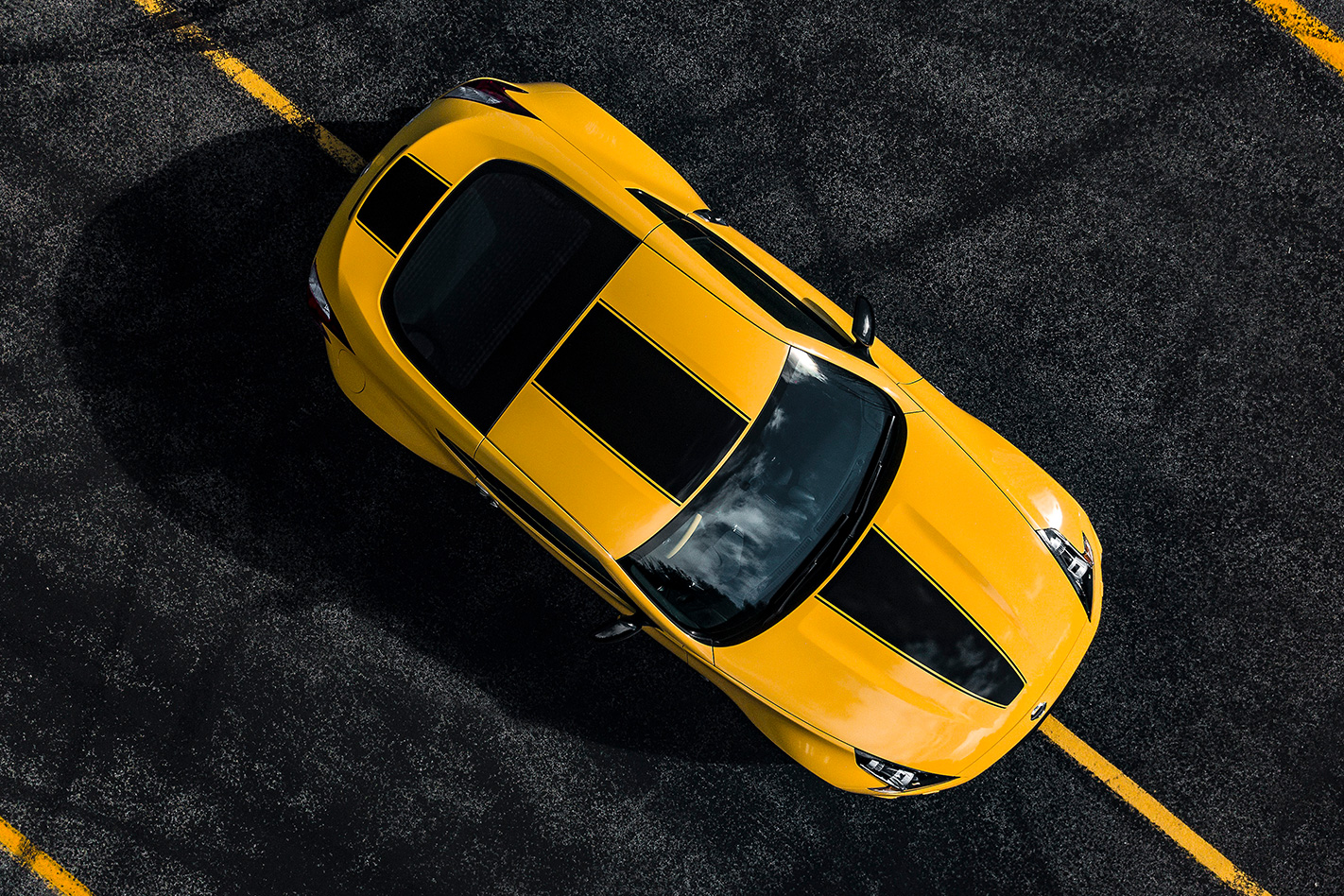
Inspired by the “Black Gold” special edition of the Datsun 280ZX of 1980, Nissan’s 370Z N-Sport features GT-inspired exterior graphics, 18-inch alloy wheels, and gloss black side mirrors.
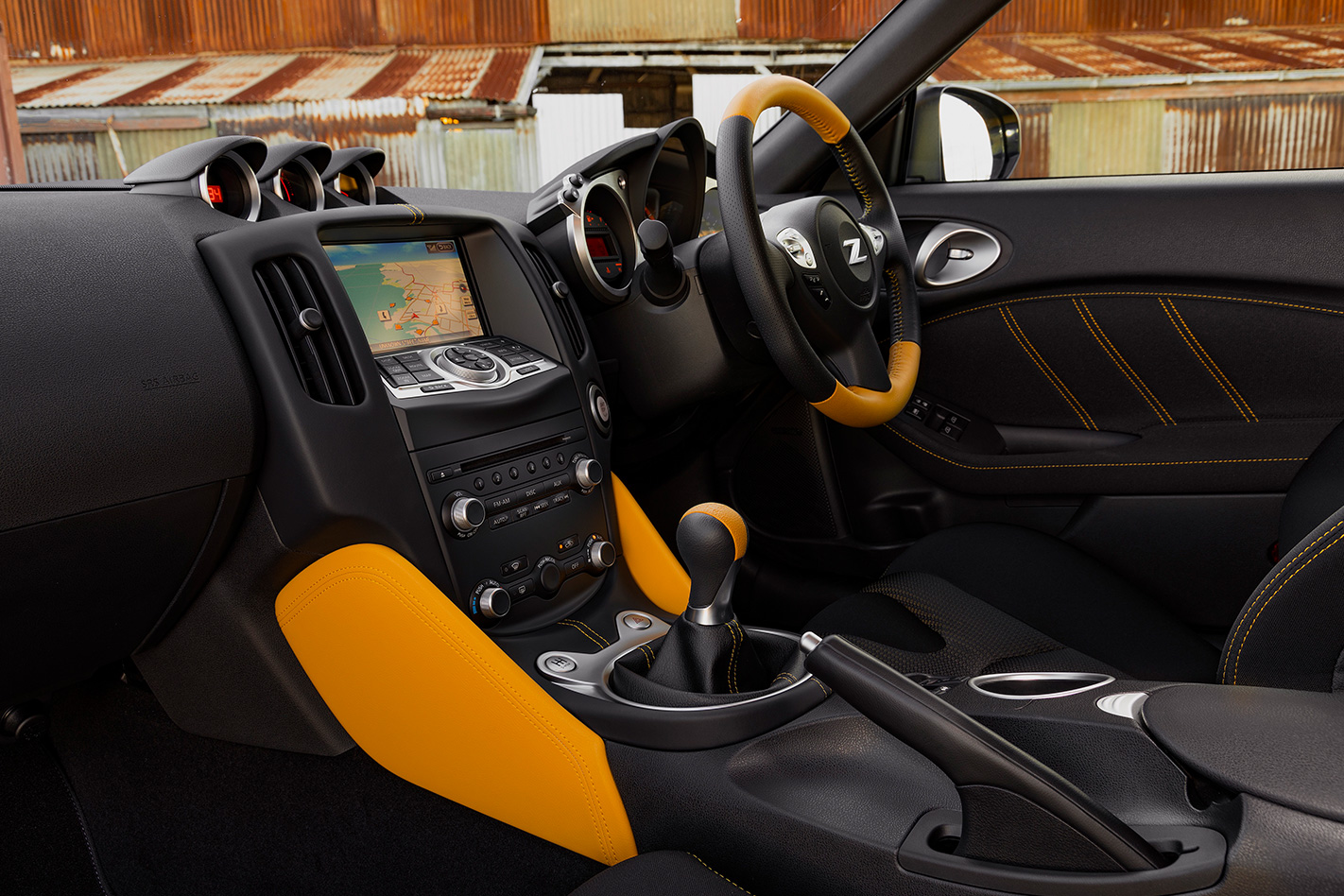
Inside, Nissan has added yellow accents to the 370Z’s door trims, steering wheel, shift knob, knee pads, and dash, while black cloth seats have bespoke yellow embroidery.
A new Chicane Yellow premium paint is also available for the N-Sport Zed. Just 50 370Z N-Sports will be available in total, starting at $48,490 for the six-speed manual. That’s a $1500 discount against the vanilla 370Z manual, making the N-Sport an extra-compelling deal for sports car shoppers.
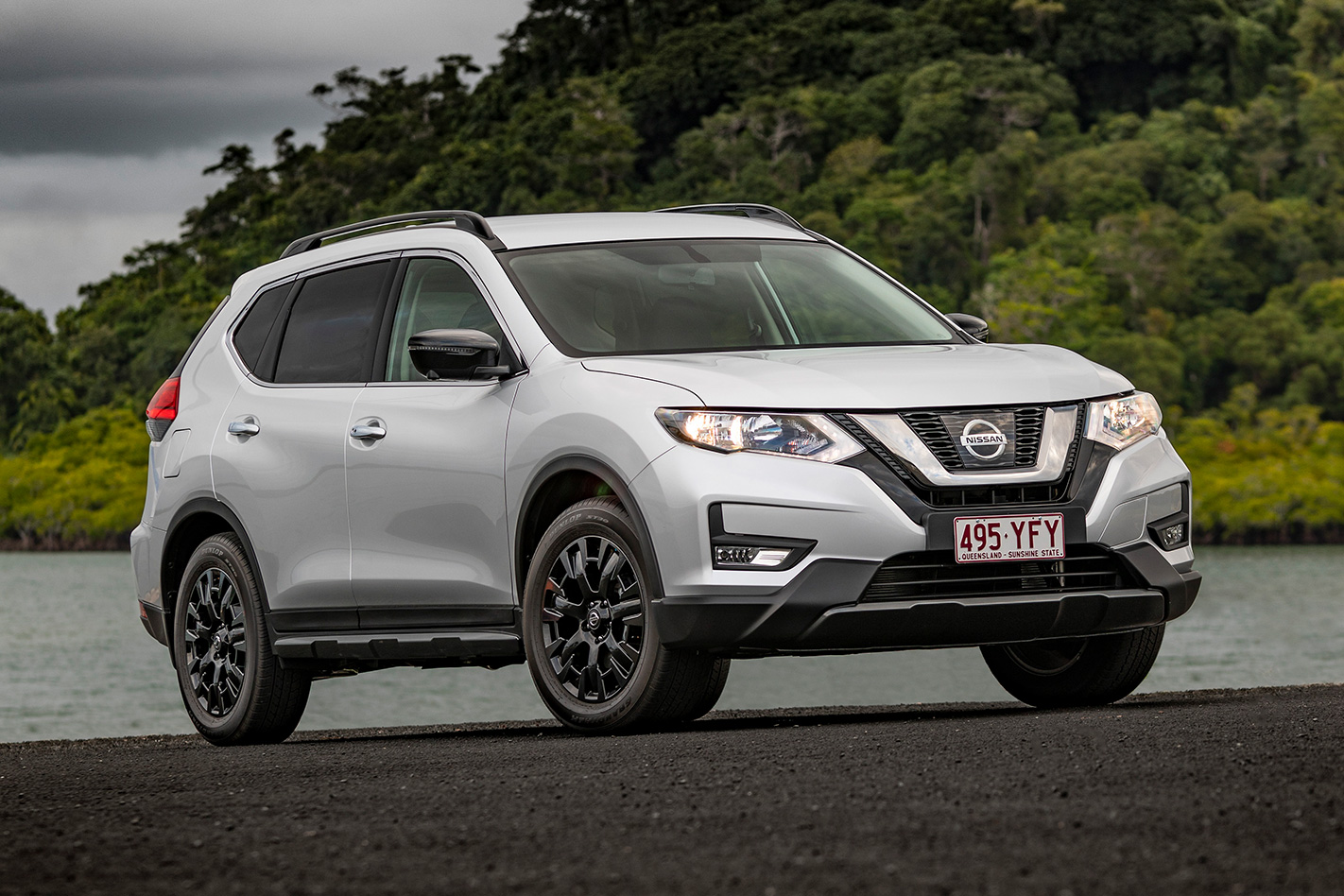
Customers wanting something with a little more utility can opt for the X-Trail N-Sport, which should stands out from the 10,000-plus regular X-Trails which have been sold this year.
Starting under $40,000 in 2WD form, the X-Trail N-Sport starts life as an ST-L variant, before gaining 18-inch black alloy wheels, gloss black mirror caps, dark metallic front and rear bumper finishes, black side sills, a dark chrome front grille and black roof rails. Production will be limited to just 600 units.
250 Pathfinder N-Sport models will be offered alongside the X-Trail and 370Z specials, and are fitted with 20-inch alloys, black mirror caps, black front grilles, and black roof rails.
“The Nissan N-Sport series has been popular with buyers in the past, so we have listened to a market that wants more, and offered N-Sport editions on a wider range of Nissan nameplates,” said Nissan Australia managing director, Stephen Lester.
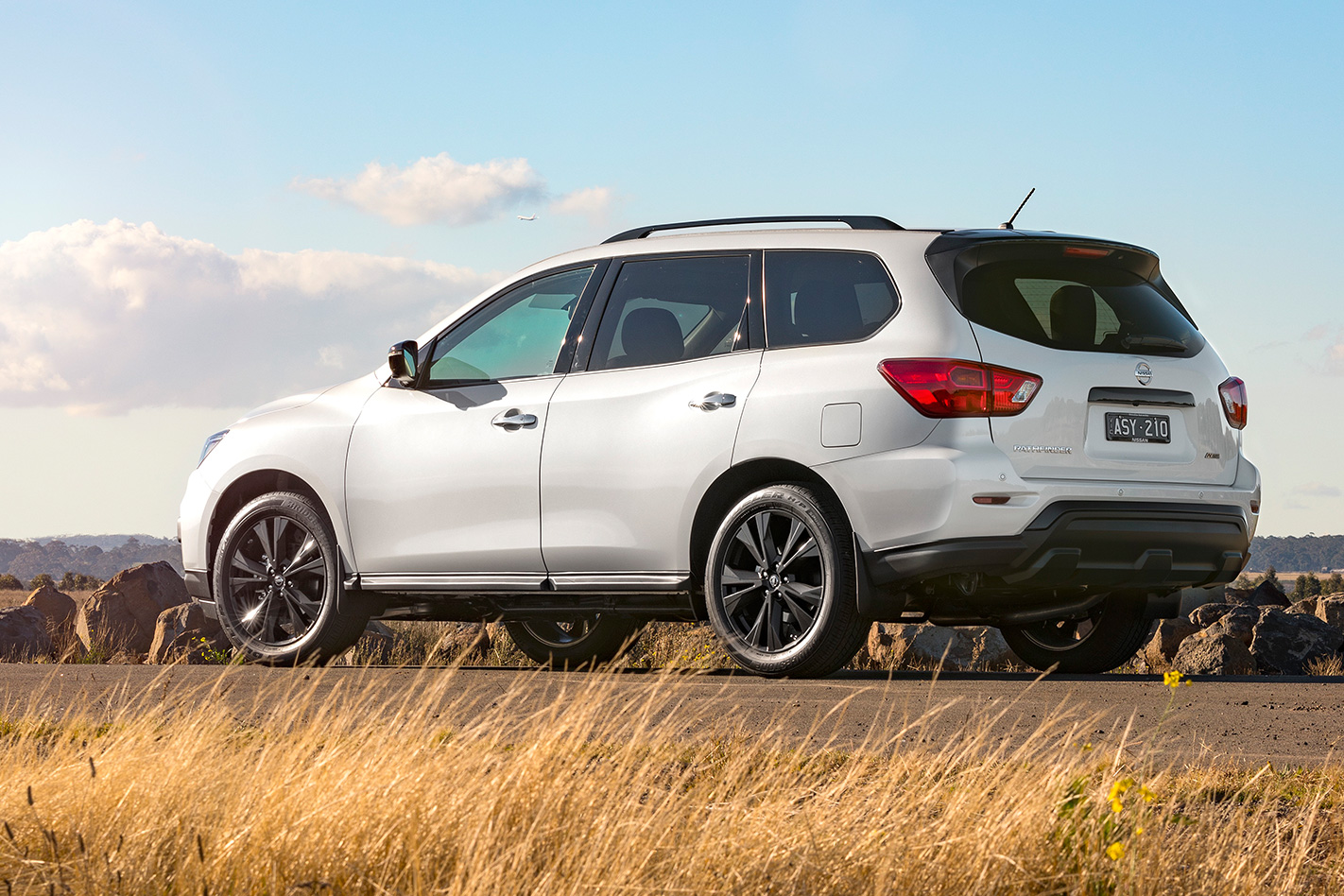
“The Navara N-Sport was a strong seller, we think the N-Sport treatment on 370Z, Pathfinder and X-TRAIL will also be popular.”
All Nissan N-Sport models will be on sale from August 1, and available with Diamond Black, Gun Metallic, and Ivory Pearl paint. Premium colours such as Diamond Black and Shiro White will cost an extra $550.
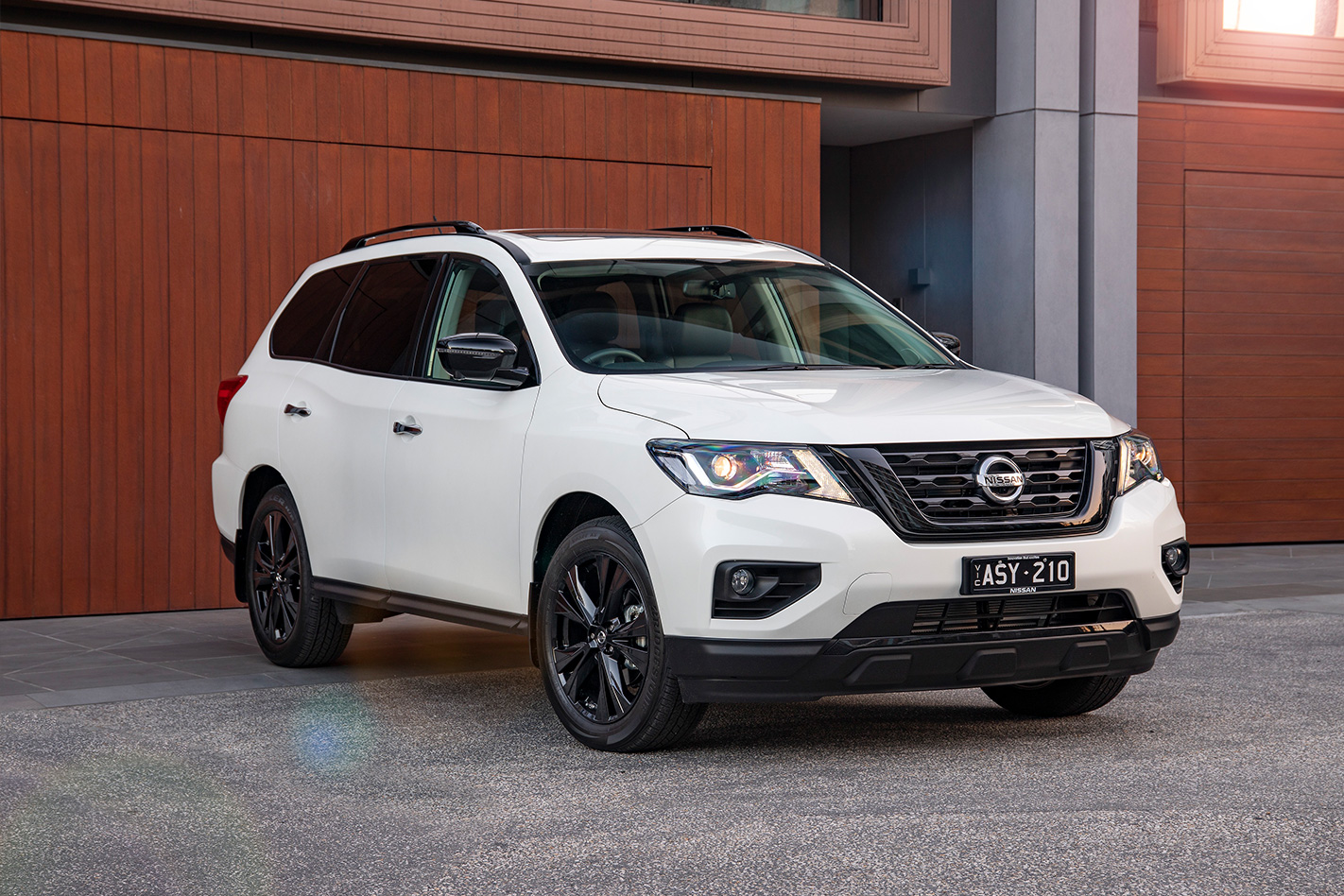
N-Sport range pricing:
- Nissan 370Z N-Sport (manual) – $48,490
- Nissan 370Z N-Sport (automatic) – $50,990
- Nissan X-Trail ST-L N-Sport 2WD – $39,250
- Nissan X-Trail ST-L N-Sport 4WD – $41,250
- Nissan Pathfinder ST-L N-Sport – $56,425
