
Sometimes you get the feeling the world has an alternate plan, as if things just aren’t meant to be.
On-paper promise doesn’t always come to fruition. Such melancholy juxtaposes what’s in front of me, a pre-production Ferrari 488 Pista – the lighter, faster and more focused version of the 488 GTB.
Yet, the spiritual successor to the 458 Speciale isn’t donning the traditional Rosso Corsa hue. Instead it’s dressed in a sea of disguising shrink wrap despite already being revealed at the 2018 Geneva Motor Show. What’s worse is that inclement weather has descended on Fiorano, drenching the lowlands and sugar-coating the surrounding hills with confidence-eroding precipitation.
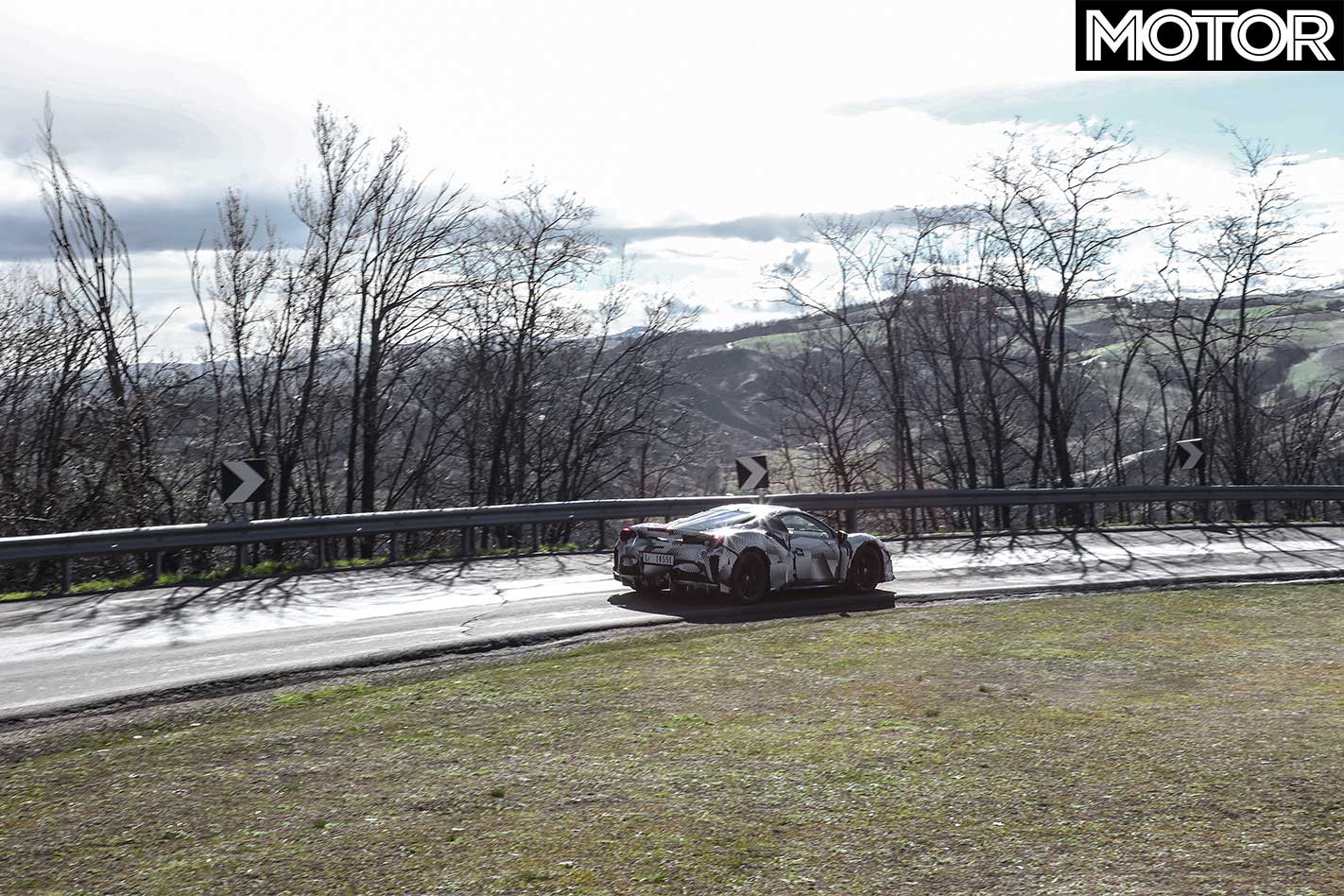
However, the changes don’t stop there as weight is down 90kg overall (including 18kg taken out of the revised engine) thanks to a stripped cabin, optional carbon-fibre wheels and a smaller battery.
In addition to the amazing forward thrust, the Pista comes with an extra helping of Ferrari flair in the shape of additional fairings, diffusers, splitters, ducts and spoilers. Yours for $645,000 – driveaway, mind you.
Facts and figures aside, this must be the first Ferrari drive where the object of affection is forced off sticky tyres. Due to the less-than-balmy conditions, Pirelli SottoZeros are called to action.
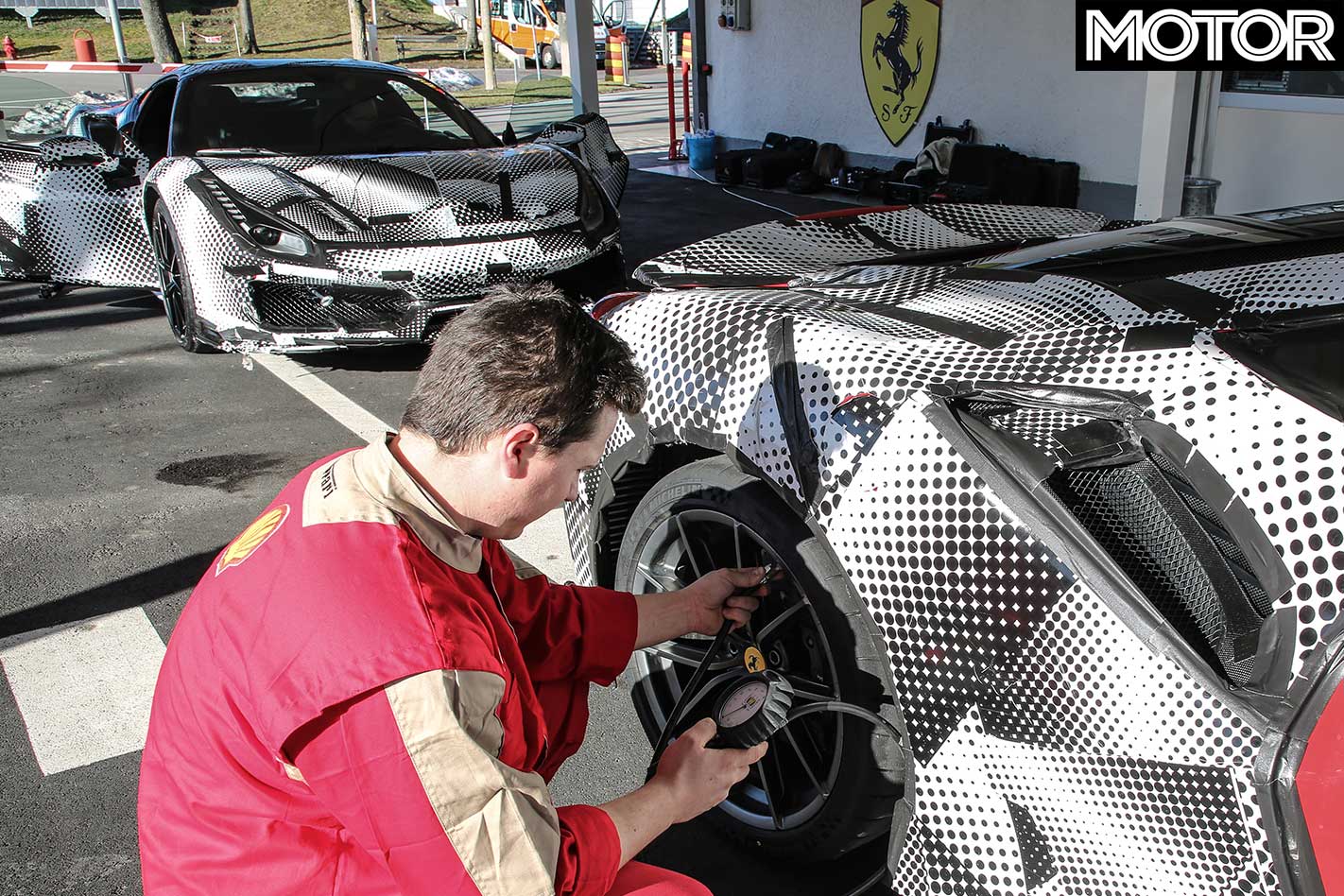
Assembled in the three-room pit garage, warming their hands while still shaking with cold, Ferrari personnel are sticking their heads together for a rather long time. Using all the radar apps everyone can muster, one member of the group ascertains that the sun may soon make an appearance. Another receives a message stating that the Autostrada is backing up near Bologna and that we’re running out of time.
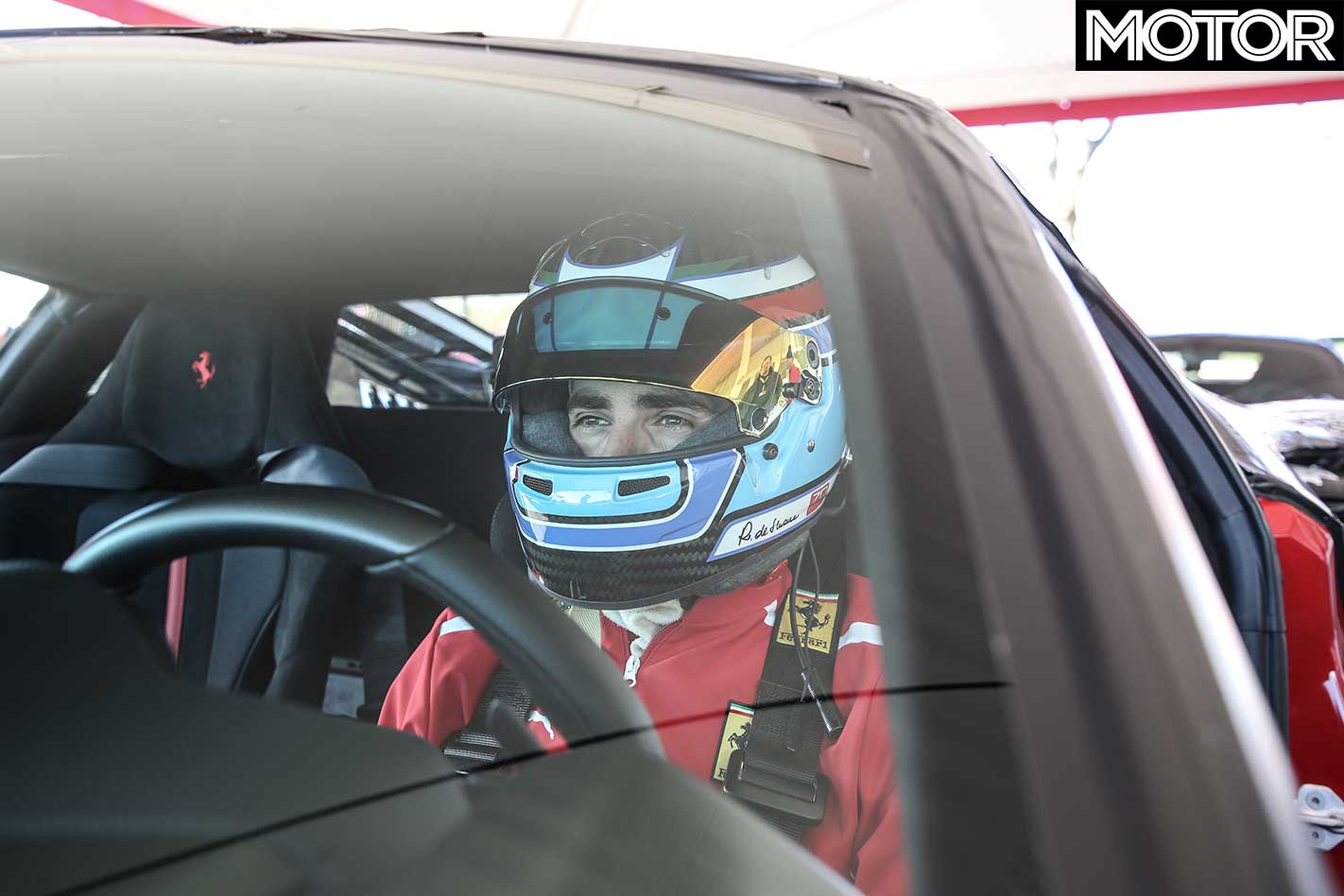
“Vai provare” (go try), says chief test driver Raffaele de Simone before heading towards the Pista, which sits ticking away on idle. With brooding, low-hanging black clouds swarming, the man everyone calls Raffa gingerly takes to Circuito di Fiorano.
It’s just as well, because when you follow the speckled 488 on the numerous overhead monitors lined up in the command centre, the track looks more like a lake than a proving ground.
Recurrent obstacles include large puddles of standing water with the odd river crossing the circuit and ripple strips as slippery as ice. Raffa is constantly short-shifting to keep the revs low and quell wheelspin. The pace increases a notch or two for the second lap, and soon the man who calls the Nordschleife his second home is comfortable behind the wheel.
“It’s okay, we can stay here.” Off comes the helmet and out comes the index finger. “You can go first, Georg.”
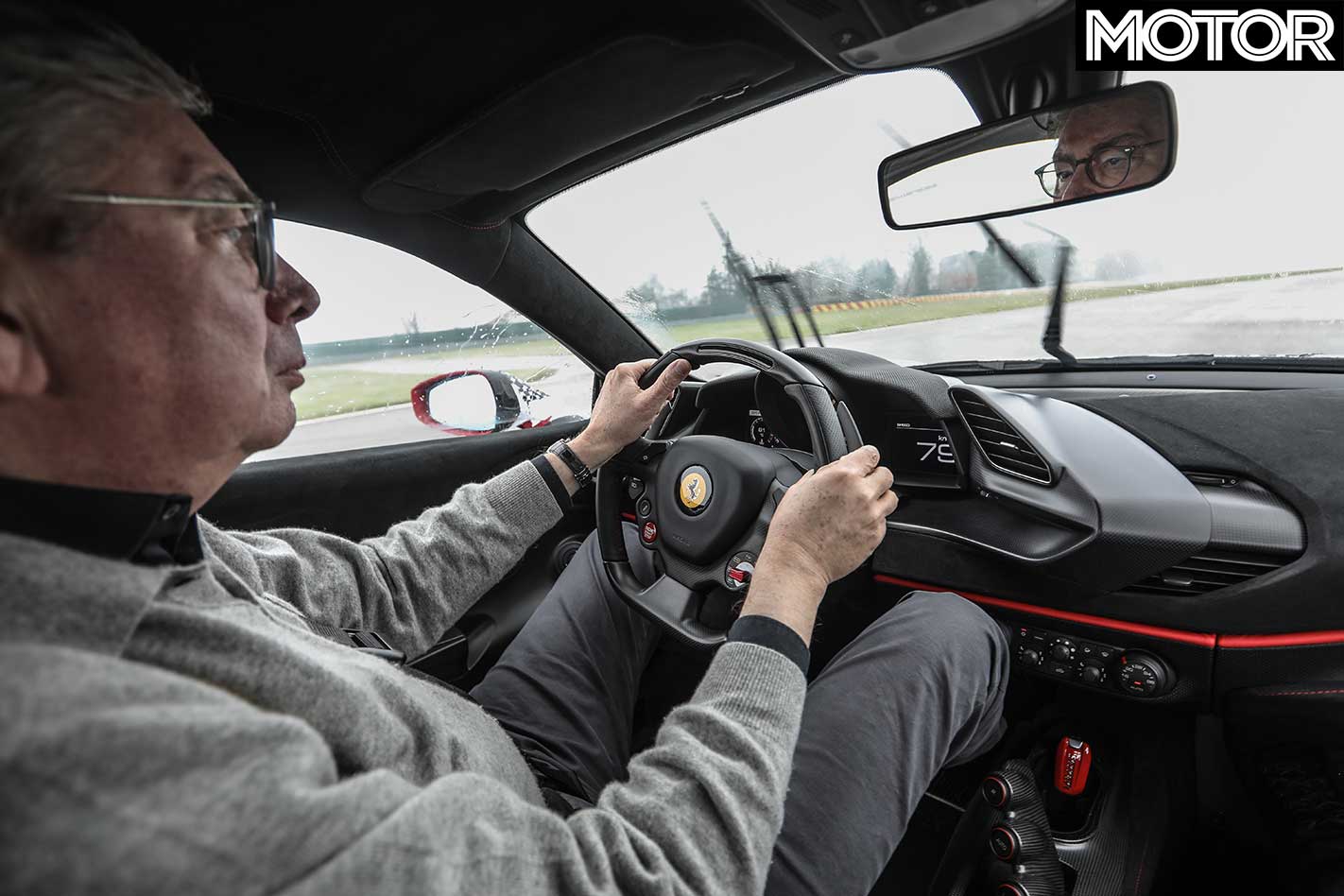
In that moment there’s no better way to kick the heart rate to redline. The XL bucket seat must have shrunk since my last visit to Maranello (at least that’s my story), and the four-point harness almost runs out of belt material before being pulled tight. Strapped in, it makes reaching for the much-needed demister switch an effort.
The Pista’s cockpit looks familiar, but it’s actually quite different. The glovebox has gone, the widespread Alcantara dash barely stops short of the windscreen and there are plenty of red accents to remind everyone of its status within the range.
While the key rests in its own recess below the climate controls, you must still press the steering wheel-mounted red starter button to uncage the 3.9-litre, twin-turbo V8.

Like the professional before me, I decide that caution is the better part of valour – especially with 530kW sitting directly behind the sculpted pews. Lap one is simply a recce run with upshifts carried out at 4500rpm. The Manettino dial is firmly locked in Sport, while a conservative line and early braking seems the right plan of attack in this $645,000 future classic.
The rain is unrelenting, but after a few more circulations the worst aquaplaning spots are computed to the memory bank. Staying off slippery kerbs is also, understandably, paramount.
Despite the inclement conditions, the need to experience 8000rpm and Race mode is too great to ignore. However, that’s not going to be engaged just yet, because there’s too much sliding initially, and not enough poise and precision.
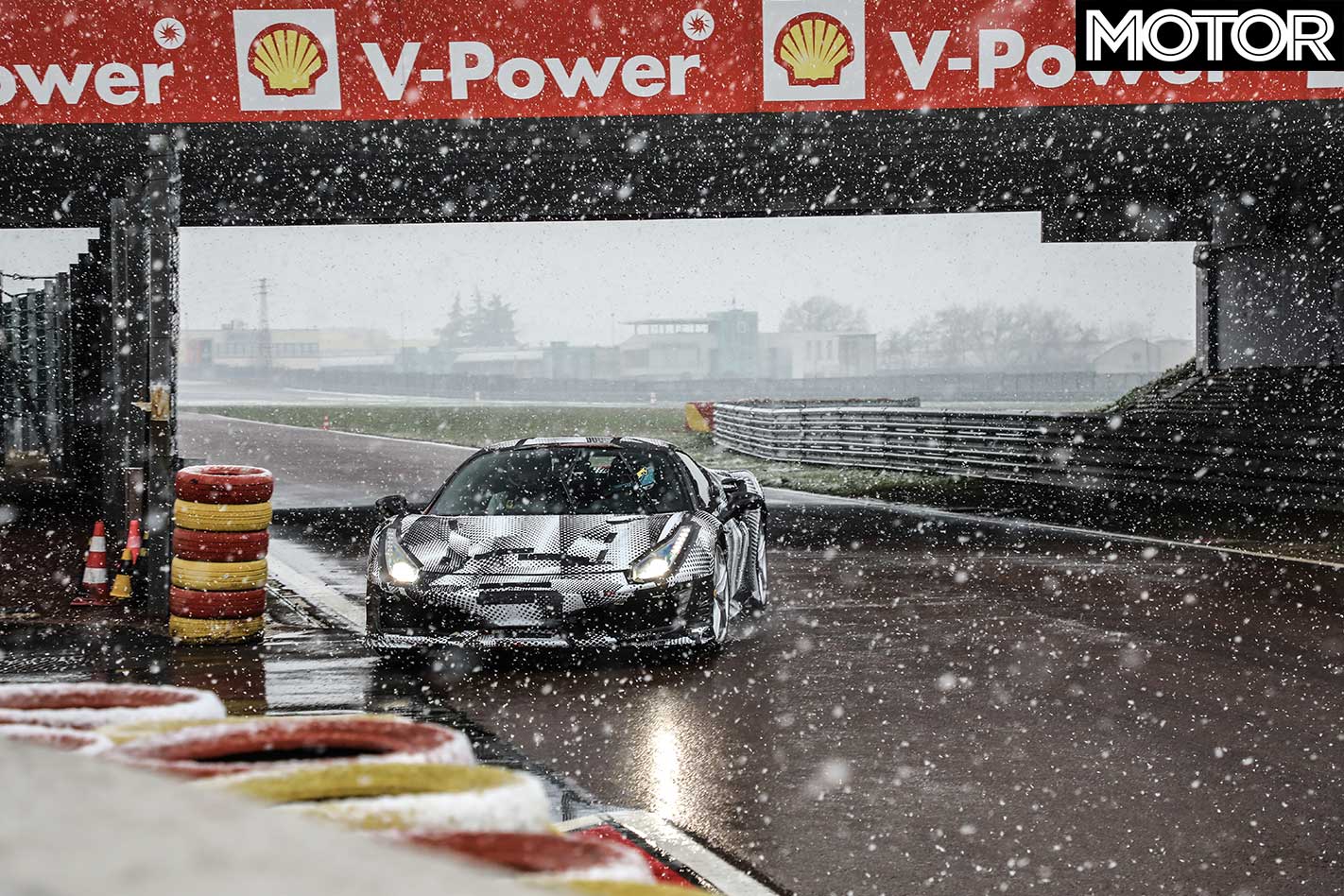
A switch in mindset is needed, and deciding to work with the Pirellis, rather than fighting against them, promptly changes the balance from latent snap oversteer to something more controllable. Yet, it’s still hard to decipher real dynamic characteristics with the winter tyres and soaked tarmac.
It’s time for a break, which means another chat and another coffee – we’re in Italy after all. Myriad hand gestures and two espressos later, we finally receive the okay to take the Pista out onto public roads.
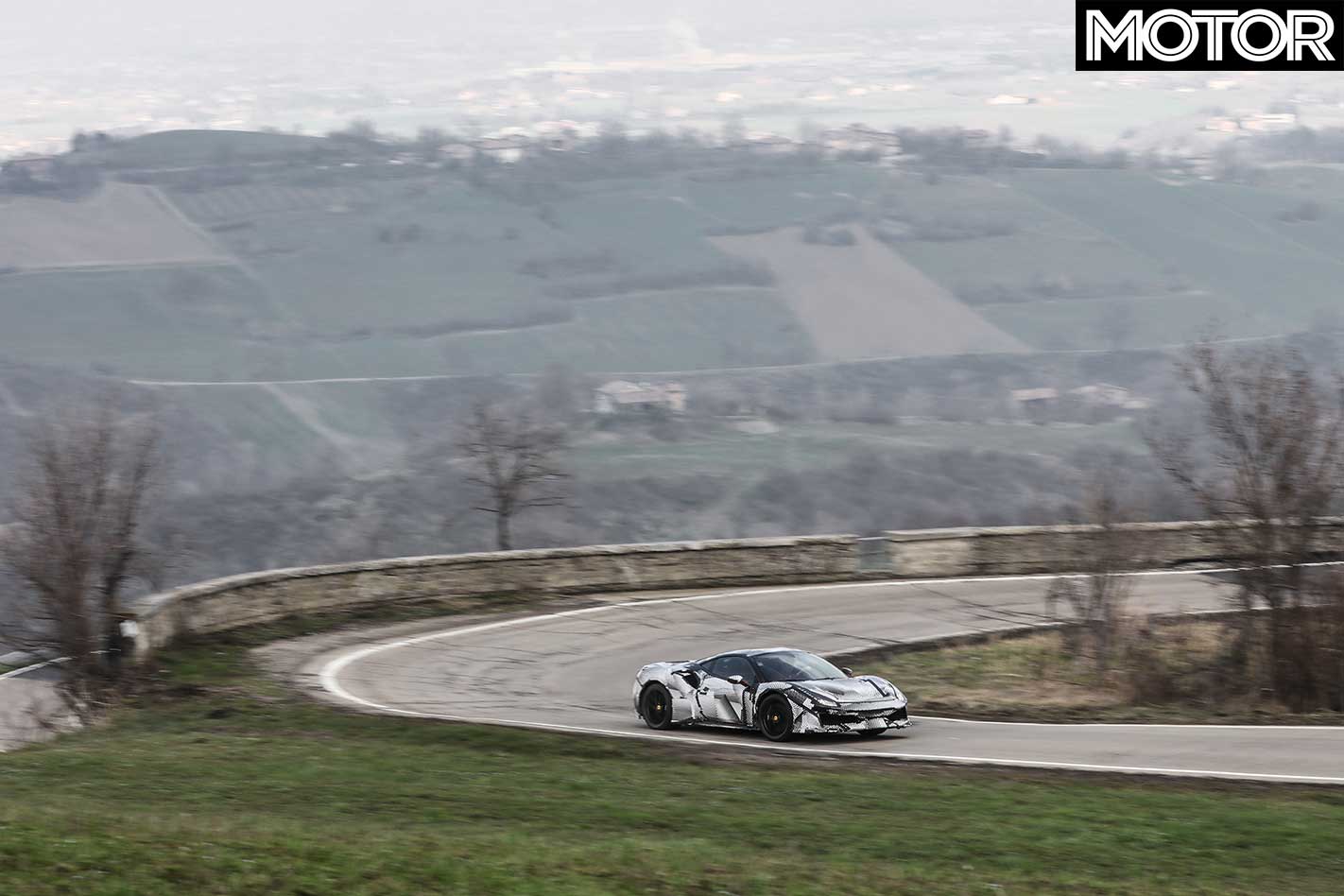
“We only have these two mules” is a stern reminder of the rarity about to be experienced. It’s also a warning to be very careful, especially when assimilating with the chaotic Italian traffic that seems to swallow the camouflaged Ferrari. Even in these conditions, the claimed fuel consumption of 9.6L/100km seems fancifully unrealistic.
Ultimately it’s a case of fighting a losing battle. One filled with sludge, snow and crushing congestion. Even the snow plough barely pulls through; a clear sign that cutting losses is the ultimate gain. The red ensemble is understandably relieved when their pride and joy returns unscathed to the garage. Deep breaths… can we go back on track now, please?
On this seemingly bewitched Monday, Fiorano is our only hope. At this point you, the reader, may be as frustrated as yours truly. However, there is a silver lining.
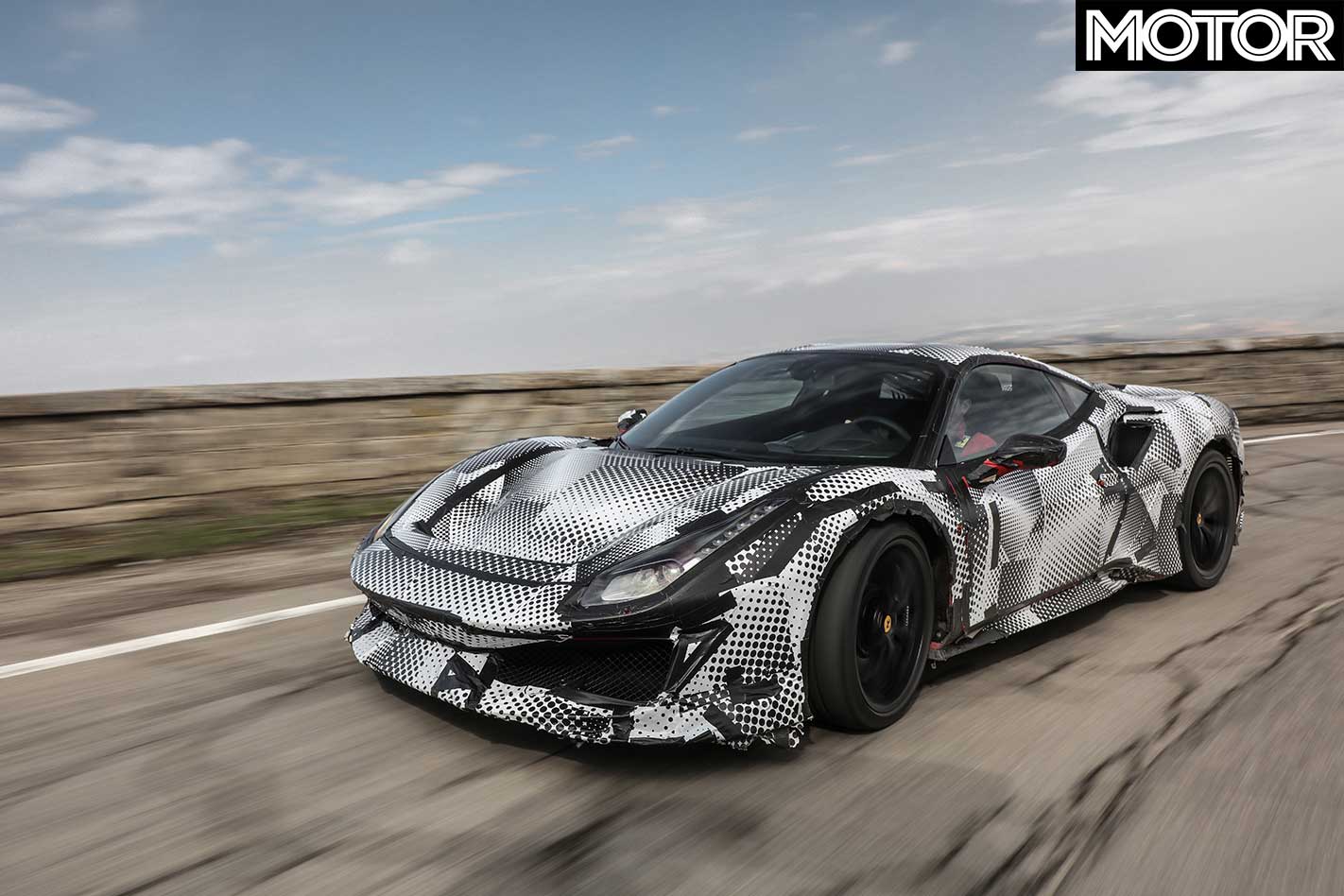
Like ripping off a Band-Aid, the outlook appears more optimistic when given room to breathe – or when you unleash the devil inside. Moments later the Pista’s tail is hanging out for three or four seconds.
And that’s in Race mode without even needing to switch to CT-OFF. It’s like the heavy mist of the day has been lifted from both car and driver by one lurid slide. Thankfully there’s still flamboyance woven into the Pista’s precision.
This thing is mega, which is a horribly unsophisticated way to explain an overly sophisticated product.
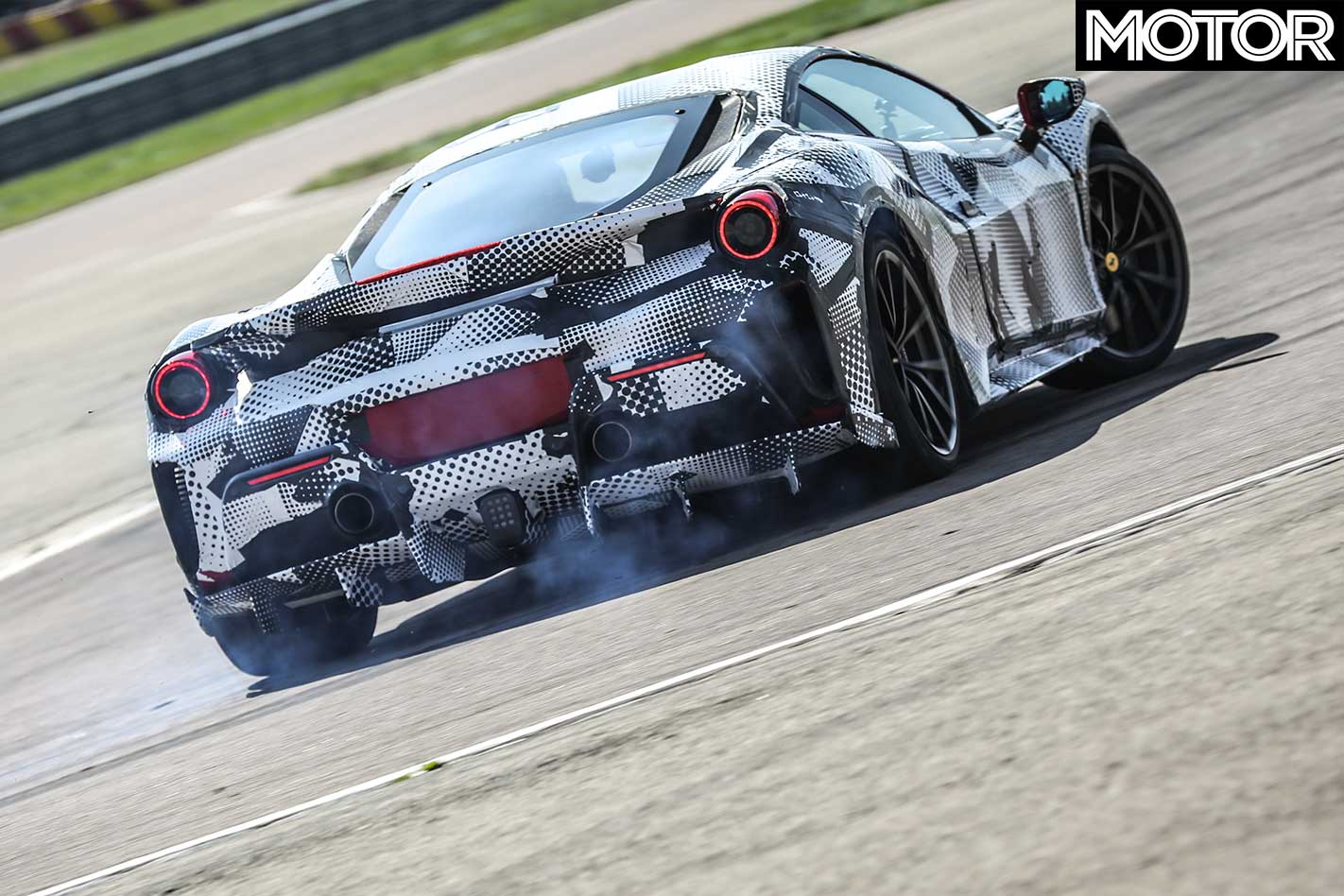
The heavily revised twin-turbo V8 has shed 18kg in weight and responds even more promptly to throttle inputs (even if the naturally aspirated 458 still comes to the point fractionally faster). With the seven-speed DCT in top gear, the 530kW engine floods the differential with the full 770Nm of torque.
Why only in the higher gears? Because like all boosted Ferrari engines, this one staggers its twist in accordance to the transmission ratio. Torque is dished out in smaller doses to manage traction in lower gears.
In reality, the rear-wheel drive coupe feels like a jet plane just before take-off. So much so that when you’re really on it, there’s a seemingly endless supply of muscle from 3000rpm. Matched with the glorious soundtrack it results in Toblerone-sized goosebumps.
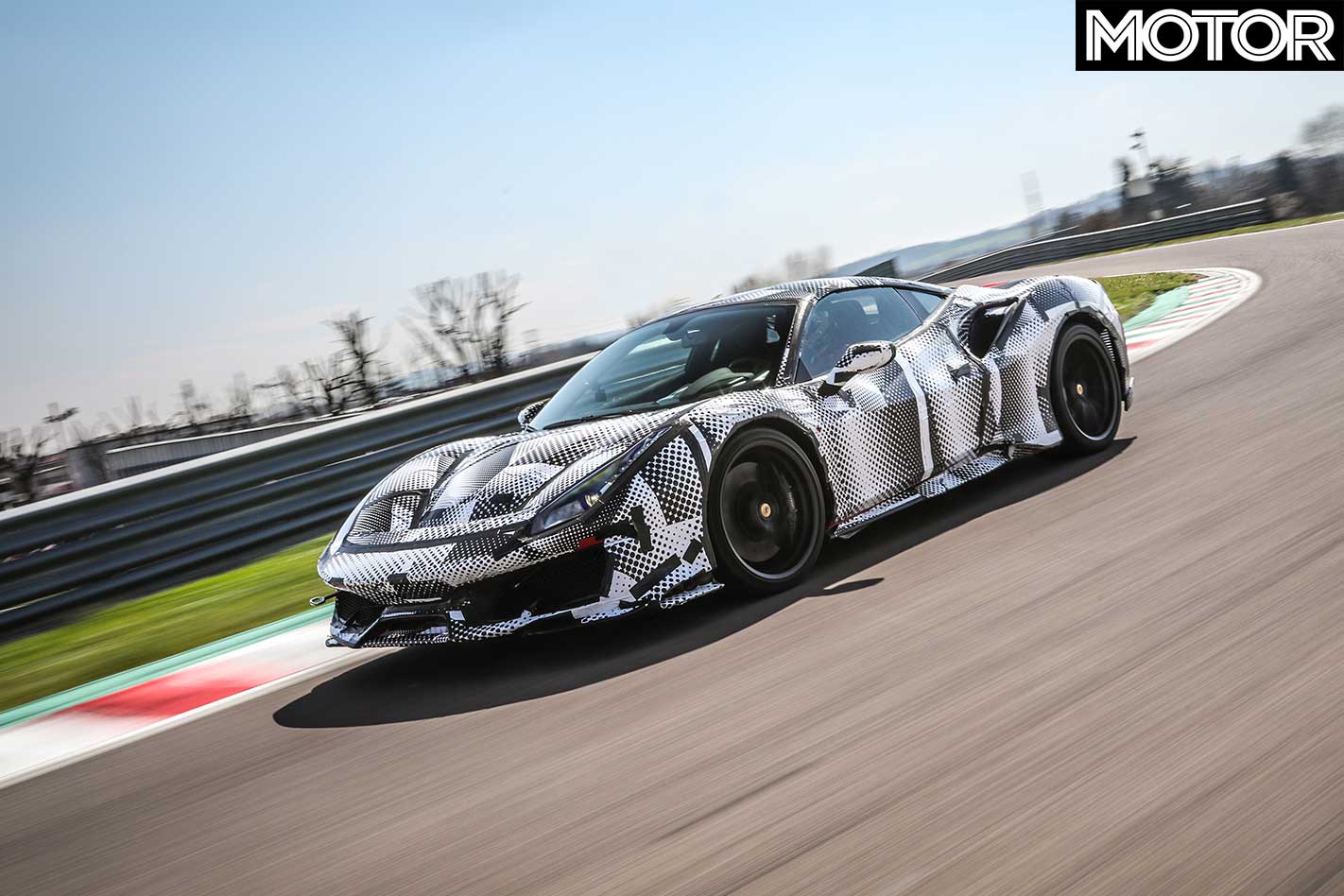
It’s almost lunchtime and the heavy rain has, at last, turned to drizzle. Against all odds, it seems there might be a ray of sunshine ahead. My heart skips a beat with excitement and my internal cheer could silence the Tifosi. It’s the last session of the day and I want to see, hear and experience 8000rpm in third gear as I blast down the start-finish straight.
Like a hungry cobra pouncing out of its basket, the Pista launches out of the final left hander. Already in third with a right foot welded to the F40-style carbon-fibre floorpan, now is the time to give it some stick.
In what seems like a blink of an eye later, everyone looks up from their monitors like meerkats assessing the surroundings. They watch the Pista fly past in awe. Reckon there’s no difference between the 488 and the Pista? Oh my, quite the contrary.
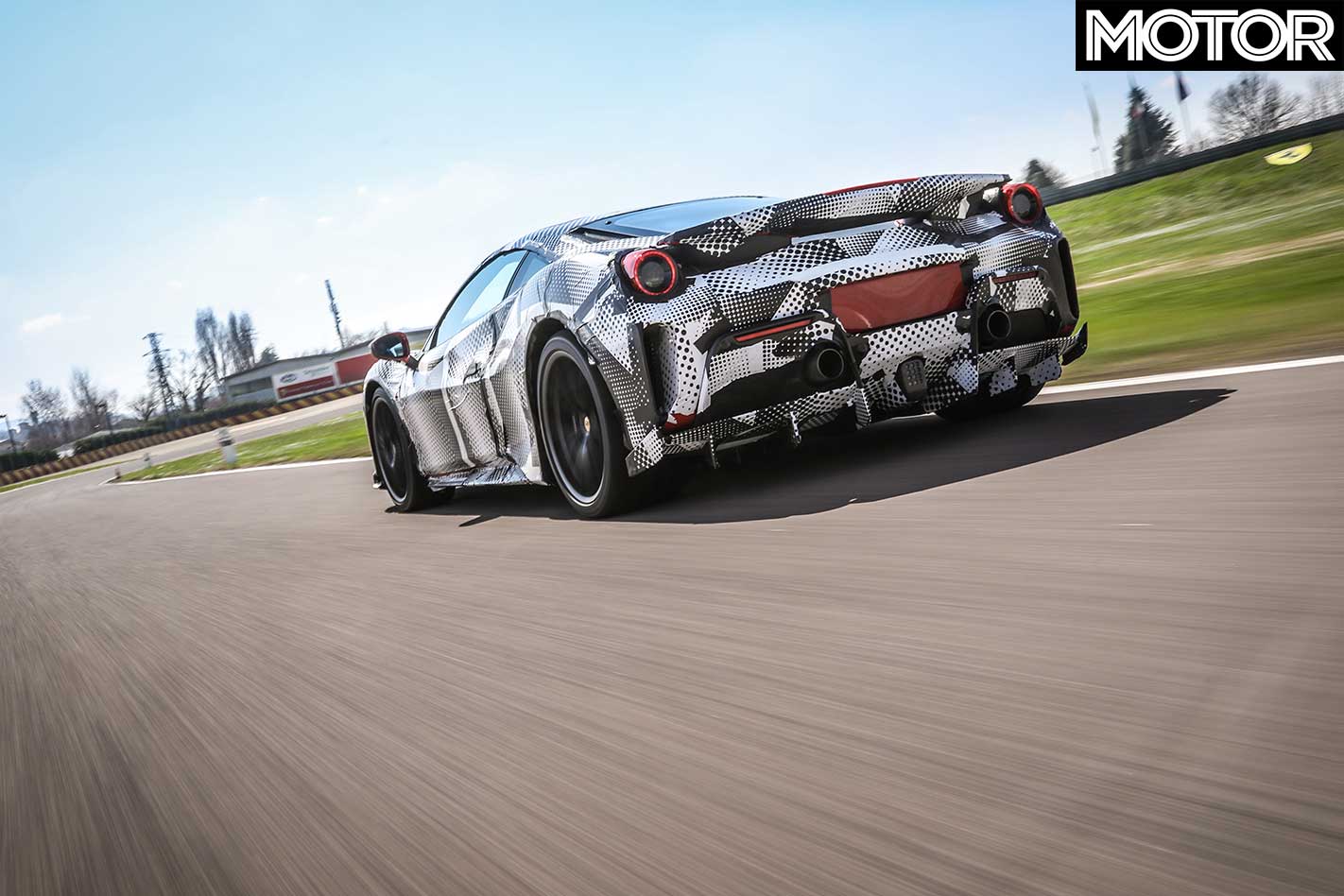
The dam walls don’t break until you’re surging past 6000rpm, but at that point, the imaginary afterburners set in with vengeance. They’re pushing its four camshafts, eight cylinders and 32 valves hard to create the kind of automotive cinema an Oscar-winning drama would struggle to match.
In the Pista, flat-out upshifts are an eye-watering kick-and-rush adventure. The dual-clutch ’box whets the gears through the gates without missing a beat. Rapid downshifts feel even more physical. Keep the respective paddle pulled and the cogs will count down the ratios hiccup-free – from seventh to first if need be. What makes all the difference compared to the standard model is the torque overboost, which maximises acceleration like a very strong headwind.
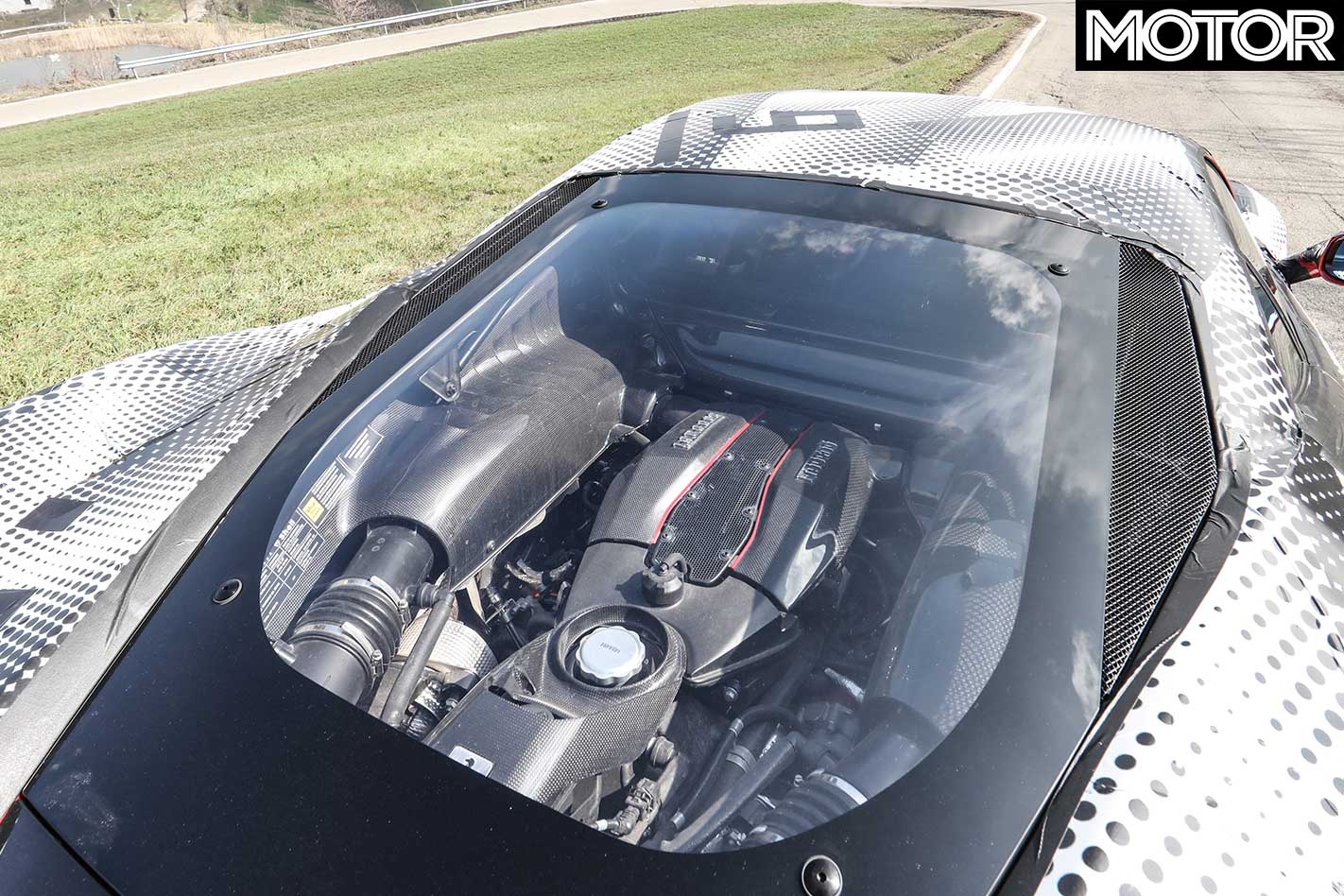
Only a bungee jump airs the pit of the stomach as thoroughly as the 2.85sec 0-100km/h acceleration figure. Only a video game makes the head spin as viciously as the blaring V8 hammering the 1385kg Pista to 200km/h in just 7.5sec from rest. Only an excursion to virtual reality conveys the full force of the in-your-face stopping power of the carbon-ceramic brakes, which need merely 31 metres to reel the car in from 100km/h.
You don’t have to push the Pista to the limit to relish its motorsport genes. Even at seven-tenths it feels more nimble, crisper and peppier than almost any other mid-engined Ferrari.
To everyone’s surprise, the track mercifully dries (almost fully) as the special-edition 488 begins to really unfurl its fruits. You have to appreciate moments and cars like these. It’s all about the positively magnetic roadholding and handling that requires sharp reflexes.
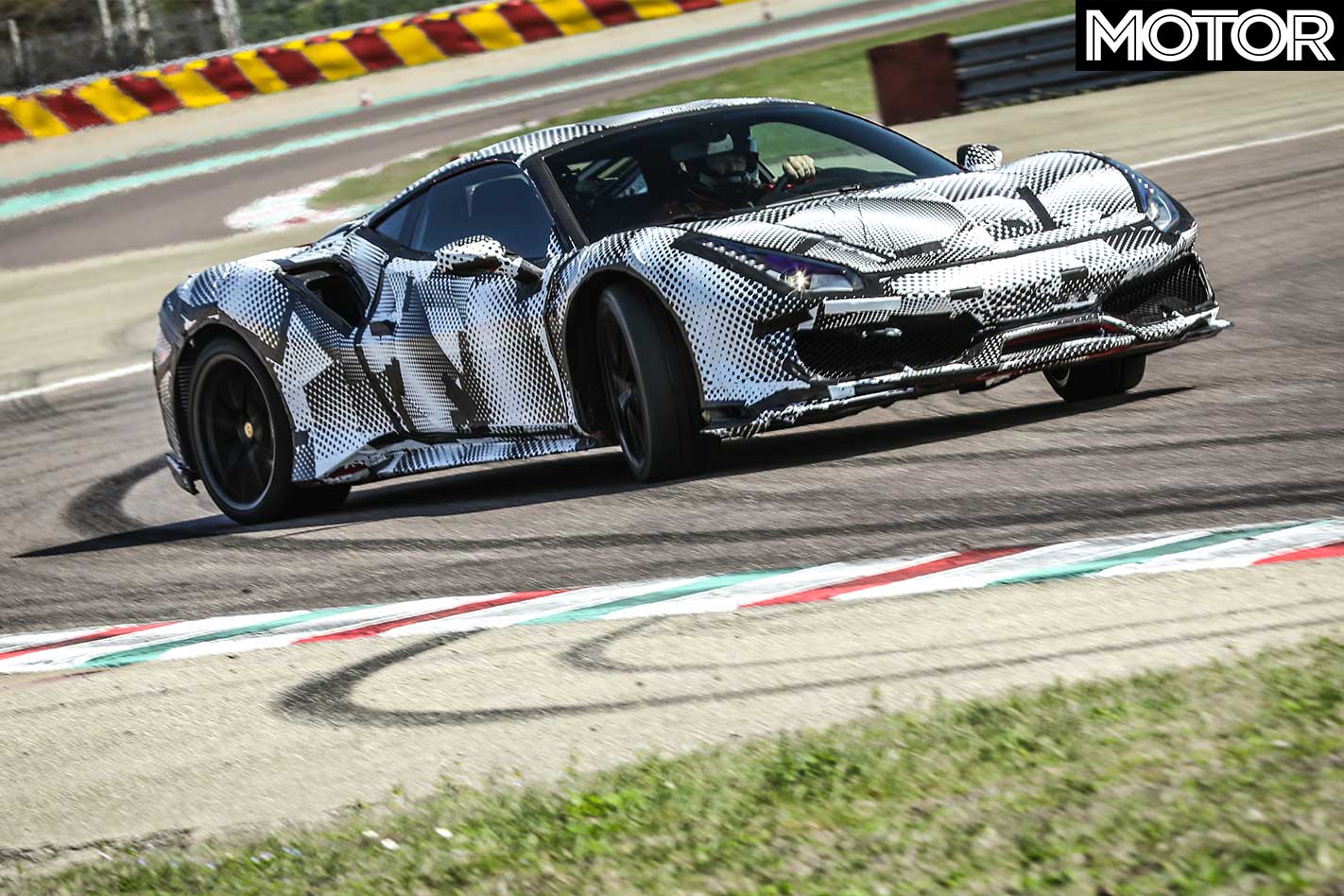
Matched with the soundtrack, it’s hard to find a more engrossing bit of kit. Rev it hard in manual mode and the V8 is as explosive and blatantly loud as such a sophisticated, high-revving turbocharged engine should be. However, when you stick the transmission in Drive, it can be as courteous and obliging as one of the high-output fours Mama Fiat has under her wings.
Grumbling about anything seems facetious, but you could argue that its DNA is ageing. The complex ergonomics are, for instance, second rate. The ho-hum connectivity can be hit with bouts of amnesia and the screens aren’t as endowed as others found in rivals. Buyers won’t care, but some might rue the fact that there’s no all-wheel drive traction or rear-wheel steer. However, that’s just nit-picking for the sake of it.
In total, Ferrari will build around 3500 Pista units. All of them have been pre-sold. Not to common millionaires, but to collectors with a stable full of limited-edition Modenese specials.
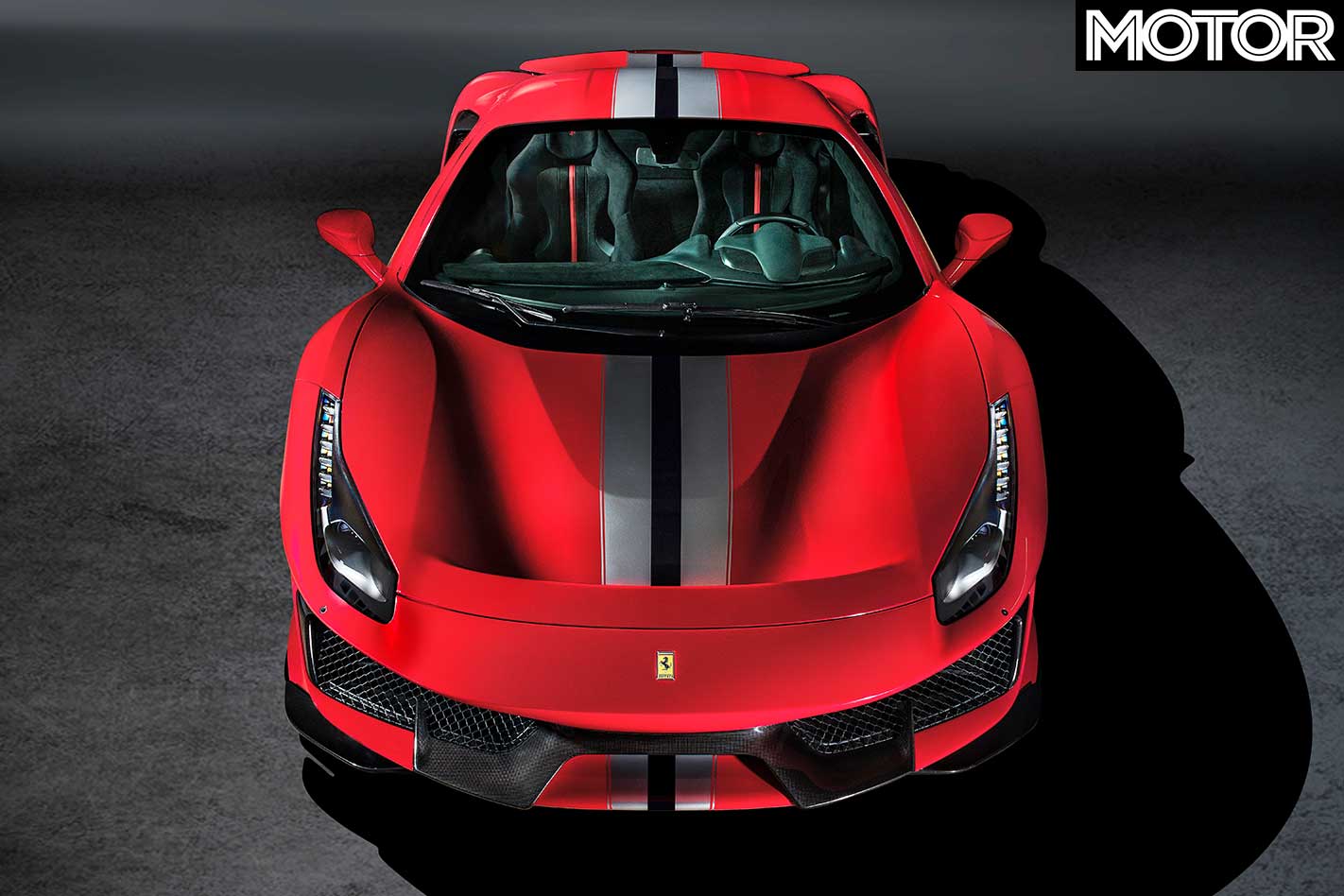
Unless you are best buddies with Sergio Marchionne, the 488 Pista is out of reach of mere mortals – scusi, ragazzi. But, of course, if you have deep pockets, you can afford to pay the premium that independent retailers will undoubtedly charge. Or, you can join the waiting list of sun-seeking Prancing Horse fans awaiting the release of the 488 Pista Spider, which is due next year.
Ultimately, this is a first taste of a car that needs more time behind the wheel. However, it’s clear to see that the Pista is not simply a 488 GTB with more boost. It’s a surprisingly accessible, cohesive and forgiving supercar that’s utterly spellbinding and altogether complete.
The world had other ideas for today, but it didn’t plan on a very special Ferrari expunging all of its ills.
FAST FACTS Ferrari 488 Pista
BODY: 2-door, 2-seat coupe DRIVE: rear-wheel ENGINE: 3902cc V8, DOHC, 32v, twin-turbo BORE/STROKE: 86.5 x 83.0mm COMPRESSION RATIO: 9.6:1 POWER: 530kW @ 8000rpm TORQUE: 770Nm @ 3000rpm WEIGHT: 1280kg (dry) POWER-TO-WEIGHT: 414kW/tonne TRANSMISSION: seven-speed dual-clutch automatic SUSPENSION: double A-arms, adaptive dampers, anti-roll bar (f); multi-links, adaptive dampers, anti-roll bar (r) L/W/H: 4605/1975/1206mm WHEELBASE: 2650mm TRACKS: 1679/1649mm (f/r) STEERING: hydraulically-assisted rack-and-pinion BRAKES: 398mm ventilated carbon-ceramic discs, 6-piston calipers (f); 380mm ventilated carbon-ceramic discs, 6-piston calipers (r) WHEELS: 20.0 x 9.0-inch (f); 20.0 x 11.0-inch (r) TYRES: Michelin Pilot Sport Cup 2; 245/35 ZR20 (f); 305/30 ZR20 (r) PRICE: $645,000LIKE: An already incredible car turned up to 11 DISLIKE: Finding one to buy; we don’t own one RATING: 5 out of 5 stars
In what should be concerning news for parents, only one child seat out of 22 tested by the NSW government’s Crashlab program achieved a full five-star safety rating.
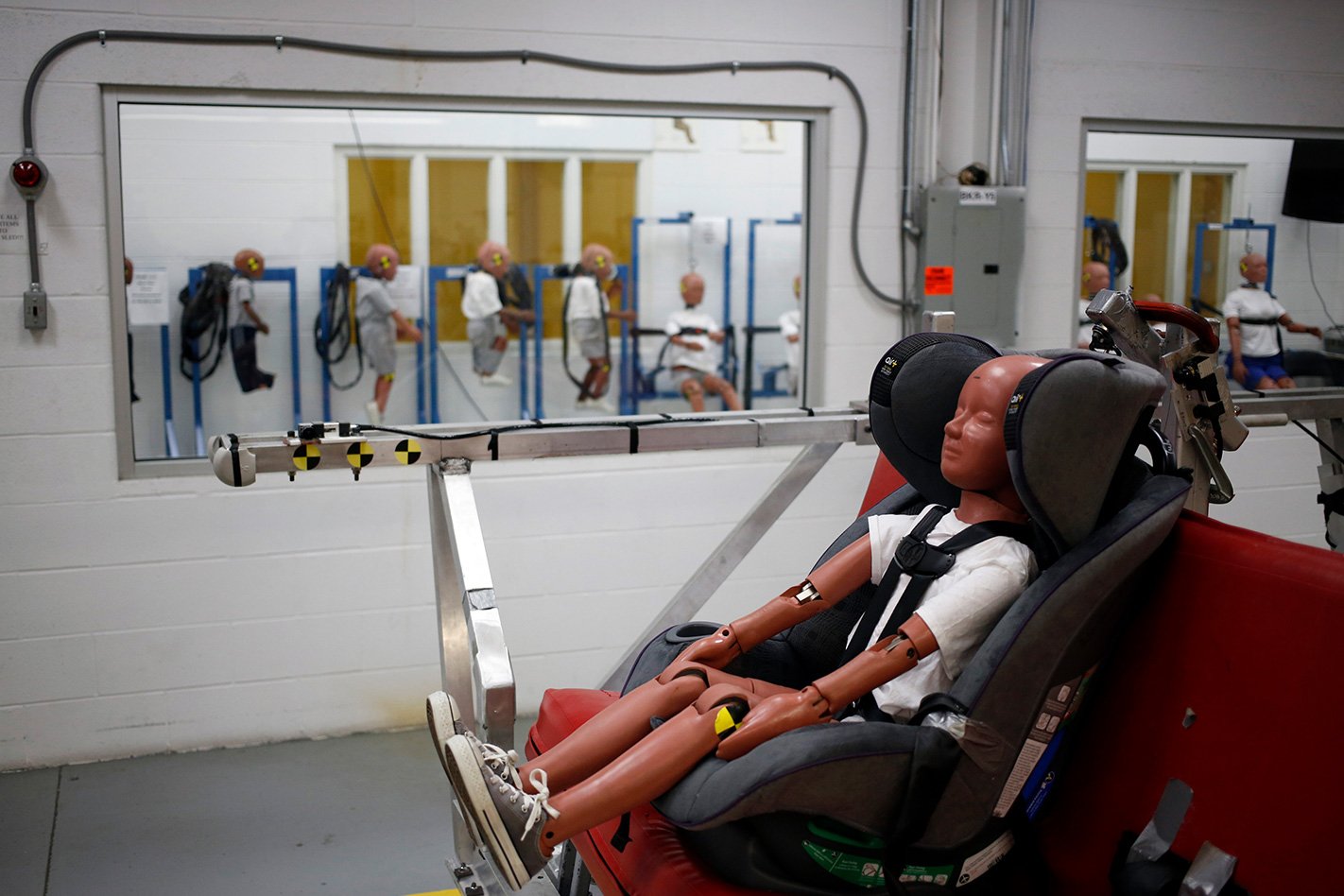
The top-rated seat, the rear-facing Nuna Kilk, was the sole seat able to provide full protection against head, neck and torso trauma during a 60km/h frontal collision.
Meanwhile, just four other seats received a four-star protection rating – the Safe-N-Sound Kid Guard Pro, Safety 1st Summit AP, Infa-Secure Luxi II and Babylove Taurus 2. These seats all used a variety of configurations, with one rear facing, one forward facing and two being booster seats.
Only two scored three stars, meaning the bulk of the field received either two stars (nine seats) or a paltry one star (six seats).
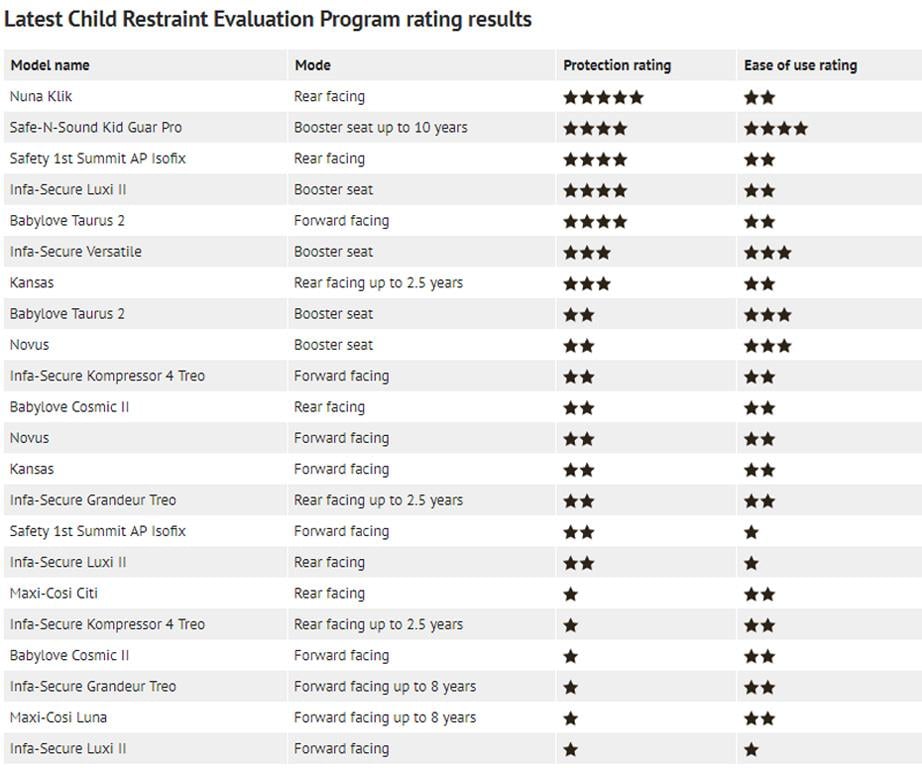
When it came to ease of use – a crucial factor considering seat safety depends on parents/carers being able to install it correctly – there were no five-star scores. The top rated seat for ease of use was the Safe-N-Sound Kid Guard Pro, while three other seats achieved a three-star rating (Infa-Secure Versatile, Babylove Taurus 2 and Novus Booster). The rest of the seats tested received mostly two-star ease of use scores, with three one-star scores.
And while Infa-Secure had one seat achieve a decent four-star protection rating, the company was also the only one to have a seat receive a single-star result for both protection and ease of use – the Infa-Secure Luxi II. It appears brand is no guarantee of safety in the world of child seats.
Curious to know more details about the test results, or compare your own child seats against the rest? Parents can look up scores on childcarseats.com.au, a collaborative resource which has compiled results from tests performed by the NSW and Victorian transport authorities, the Transport Accident Commission, NRMA, RACV and Kidsafe Australia.
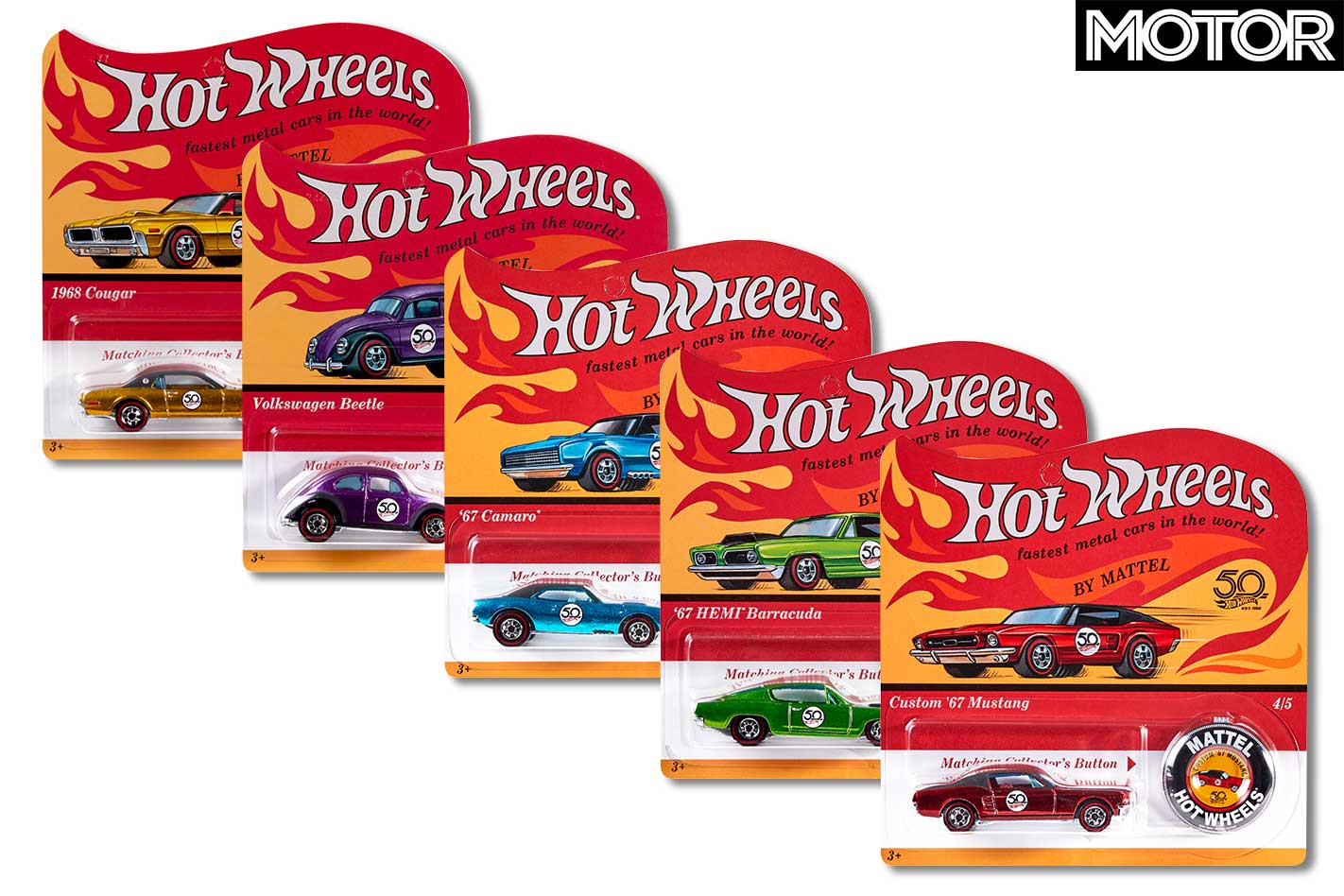
Mattel’s tiny toy cars have been around for a half-century, with Hot Wheels having been an early influencer for many car fanatics.
To celebrate, Mattel has revealed a ‘Throwback’ collection which brings back some classic Hot Wheels icons from the late 1960s.
The series is modelled on the ‘Original 16’ cars, which consisted of several ‘Custom’ versions of popular real cars of the time, as well as a few more conceptual cars.
Former General Motors designer Harry Bentley Bradley was one of the first to lend work to the way each car looked, though he left Mattel shortly after the Hot Wheels brand started up.
Since then, thousands of different Hot Wheels designs and – the company says around 20,000 variations have been produced – with collectors having amassed huge assortments of the small vehicles.
One such collector, Bruce Pascal, is often said to have the world’s largest collection of Hot Wheels, with over USD$1M worth of cars.
Similarly, some Hot Wheels cars have become incredibly valuable in the eyes of collectors, especially early and rare models.
One of the rarer, called “the holy grail of Hot Wheels” by an Antiques Roadshow appraiser, is a prototype for the Kombi-inspired Beach Bomb.
With a surfboard slotted through the back window – as opposed to on the side as production version had – this specific model of prototype has been valued at up to USD$150,000.
IT MIGHT seem like there’s a dark, sooty cloud hanging over the future of diesel powertrains right now, but at least one man is bullish on the longevity of oil-burners.

That man is Andreas Bovensiepen, the head of BMW tuning house Alpina and son of the company’s founder. Ask him whether the negativity surrounding diesels is weighing heavy on his mind, and the answer is surprisingly upbeat.
For Alpina, a brand whose product strategy has long given equal attention to diesel powertrains as well as petrol, there’s a sizable commercial risk should diesel fall out of favour. However Bovensiepen says new measures to ensure the cleanliness of diesels give him the confidence to keep oil-burners in the Alpina portfolio.
“Finally now with build technique and the high level of technology that BMW [has] with catalytic converters and AdBlue, a lot of tests have proven that diesel is really clean now concerning NOx – it’s very very low,” Bovensiepen said.
“In Europe we now get RDE – which is Real Driving Emissions, where we have to prove, on the roads, that your car in every occasion is clean – not only on a test dyno.
“This means now that diesel is getting really clean – and it has to be, otherwise you cannot offer this kind of car. So I think diesel will have a good future, especially in cars with two-litres or more capacity.”
And Alpina is banking heavily on diesel right now. Its first concerted assault on the SUV segment is underway with the X3-based XD3 and X4-based XD4, both of which are diesel-only and powered by a quad-turbo 286kW/900Nm version of BMW’s 3.0-litre turbo-diesel inline six. As the brand’s first SUV offerings, they’re expected to drive sales well beyond the firm’s current circa-1700 car annual total.
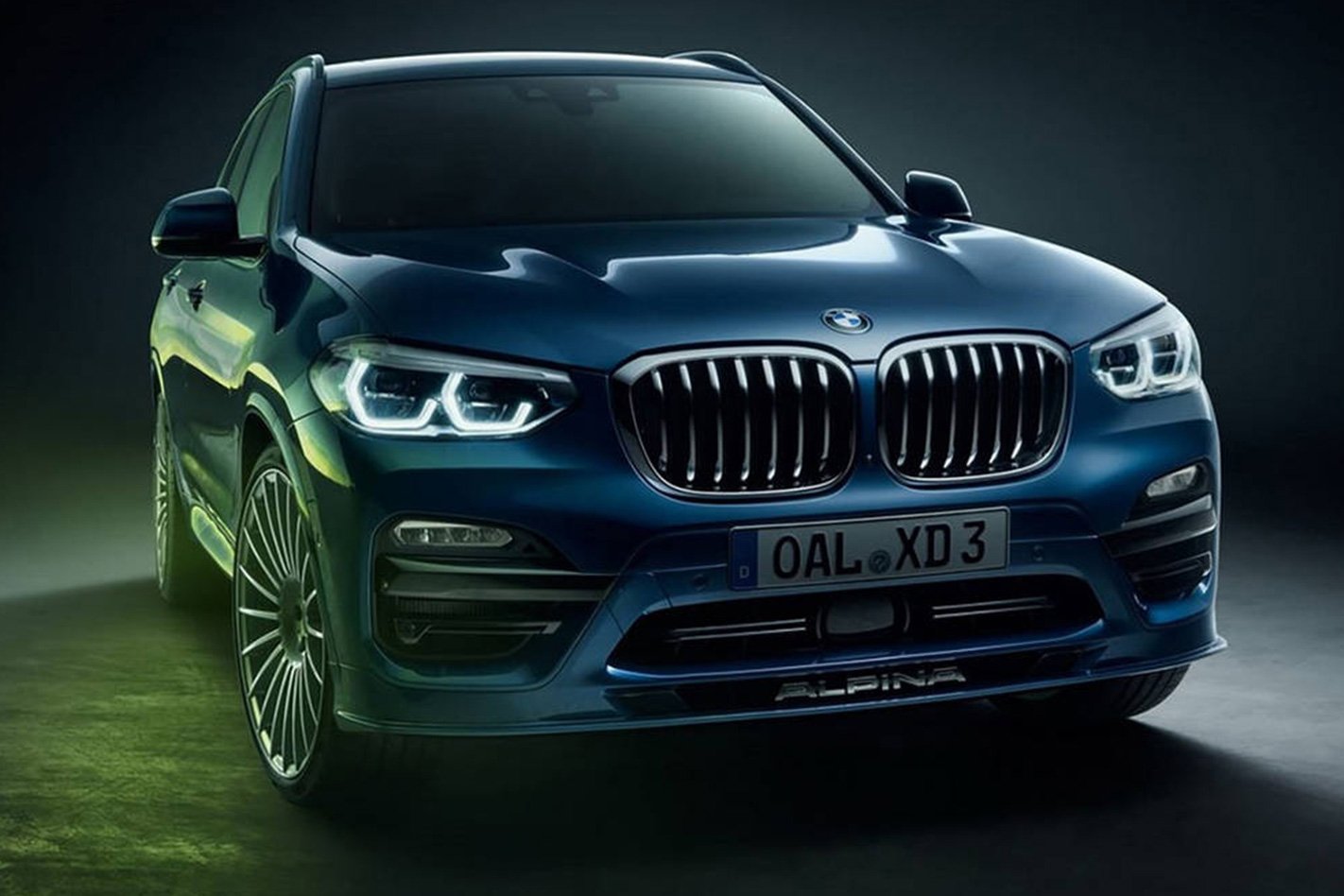
Sadly for Aussies, only the XD3 is coming our way and with just two turbochargers under its bonnet due to right-hand drive packaging constraints. Expected to land locally toward the end of 2018 or in early 2019, Alpina’s local arm anticipates the XD3 should prove more popular than its existing range of sedans, coupes and wagons.
Beyond the XD3 and XD4, Alpina is also planning to turn its hand to the plus-sized X7. The X5, however, is not in its product plan – the company made a “strategic decision” to stay away from it, to keep from treading on the toes of BMW’s X5M and X5 M50d.
And as long as diesels remain viable – and BMW’s hybrid portfolio is built around four-cylinder power – Alpina is in no rush to dip its toes into the realm of electrification either.
“I can imagine [we will] in the mid to long-term, but our customer expects a six-cylinder inline engine. Currently as you know the BMW hybrid strategy is focused on four-cylinder, which is not our target group.”
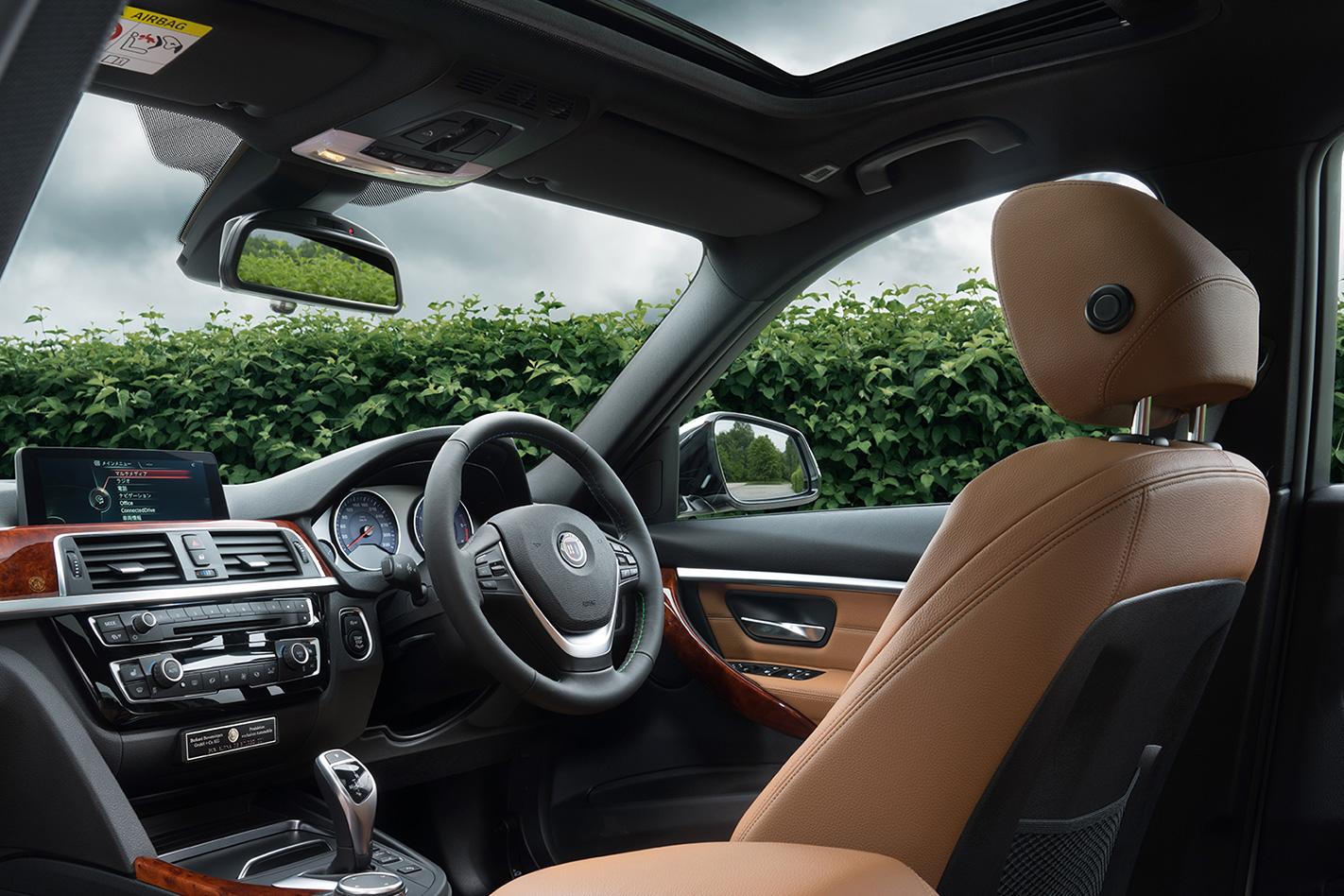
Another key concern beyond mere cylinder count is weight. According to Bovensiepen, present-day hybrid and EV tech is simply too heavy for cars that are designed around sporty appeal.
“As with new technology, you have to learn in the first and second generation and then you get better batteries, this electric stuff gets made smaller,” he said.
“In the beginning everything is huge, big, heavy and that’s difficult for a sporty car – probably as difficult for M as for us. If you have a second engine in the car and a battery, it gets quite heavy.
“So I think the time currently is not right for us, but in some years it could be quite interesting.”
With a time of 2:01.51, the 2018 Honda Civic Type R has set a new front-wheel drive lap record around the GP Circuit.
Over 4.4km, Honda World Touring Car Cup driver Esteban Guerrieri pushed the 228kW/400Nm hot hatch to beat the FK2-gen Civic Type R’s reported (according to fastestlaps.com) lap time of 2:06.44.
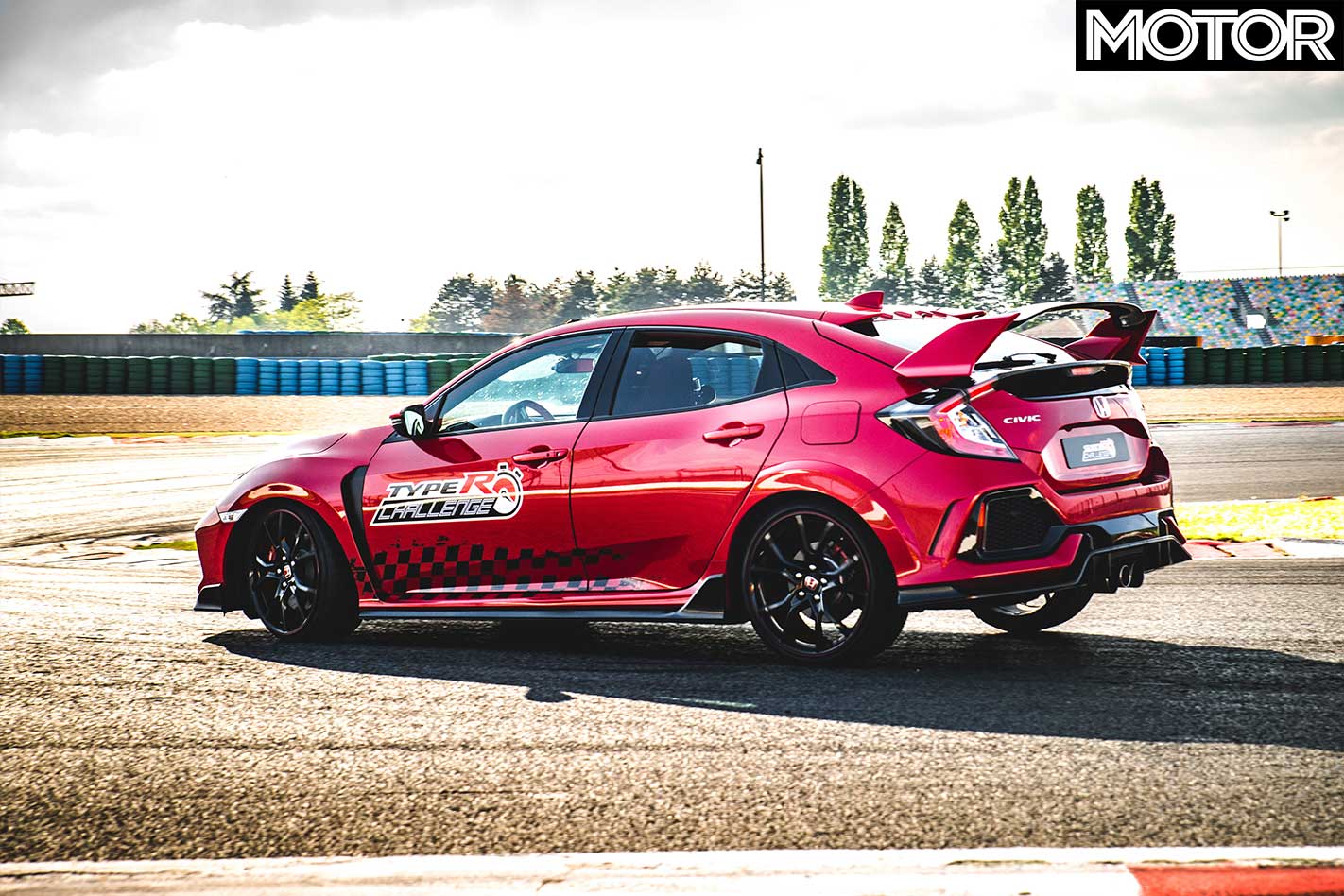
The previous Type R also set records at Estoril, Hungaroring, Silverstone and Spa-Francorchamps. Honda plans to continue its lap record attempts “at a range of legendary European racetracks” with the new Type R.
“The best thing about the Type R is that it gives you confidence,” Guerrieri said after the lap. “It’s very responsive and gives you good feedback.
“People call the Type R the ultimate performance hot hatch and we proved today that it really is; the car continues to push the boundaries of what’s possible from front wheel drive.”
“The beauty is we could use ‘+R mode on track but then switch to Comfort mode and drive home.”
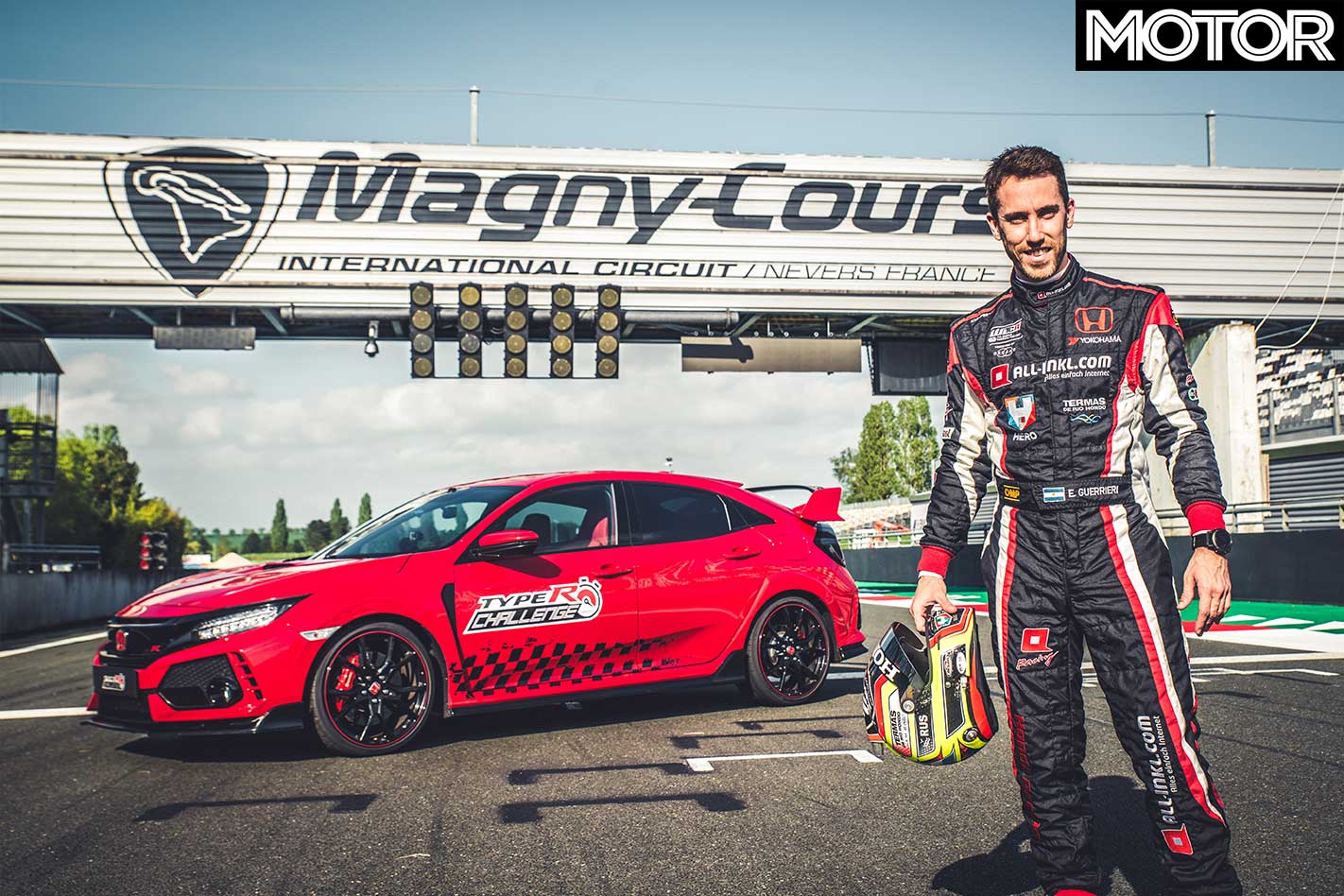
The track in Central France previously played host to the Formula 1 French GP but was dropped due to low attendance and a lack of passing opportunities. Magny-Cours still remains host to the Superbike World Championship.
Driving at other tracks during Honda’s ‘Type R Challenge 2018’ will be Jenson Button, WTCR driver Tiago Monteiro, NSX Super GT driver Bertrand Baguette, and BTCC racer Matt Neal.
Where the 7:43.8 lap record set at the Nürburgring used a development-spec Type R, Honda says the rest of its laps will use a production-spec car, as was used at Magny-Cours.
If the i30 N were a rock band, it would be 2003’s breakthrough group Jet. From nowhere to global smash in a matter of moments, named after the engine that thrust aviation into the future, it’s the speed of impact that parallels with Hyundai’s i30 N.
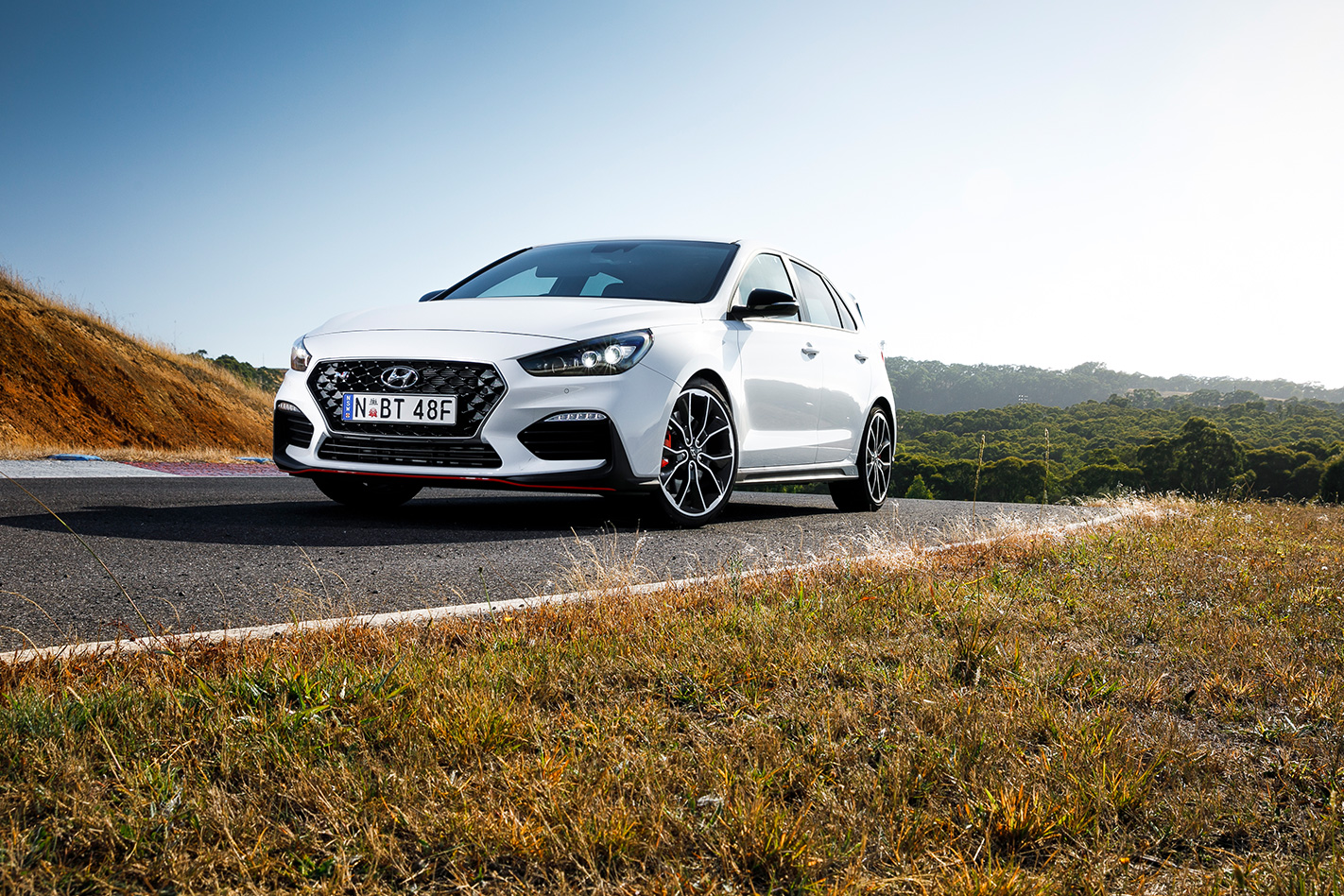
When drilled down to its fundamentals, there isn’t one area where the i30 N truly sets a new hot-hatch benchmark, however it’s so strong across the board, and so harmonious in its combination of abilities, that you can tell it was developed by a unified team with a clear mission. For a first attempt, it’s stunning.
In fact, there is one area where the i30 N blows all-comers out of the water – price. It’s a Golf R competitor with Golf R equipment (if not interior quality) for less than 40 grand, yet it’s the N’s favourable comparisons with the Civic Type R that truly cement its value proposition. This slightly understated, beautifully balanced hot hatch can do almost everything the Civic does, yet it’s a massive $11,000 cheaper.
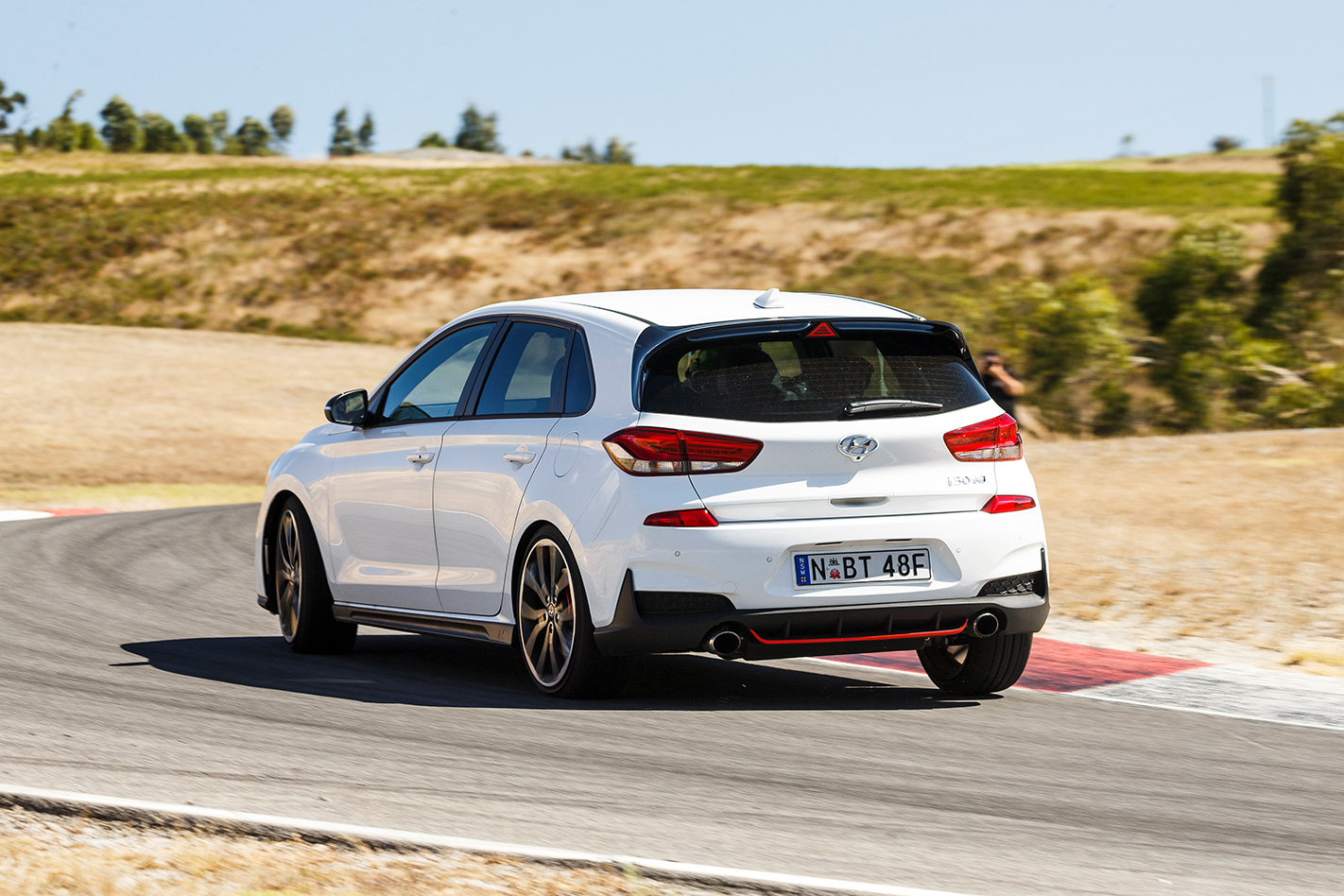
And it has five seats!
From the moment you depress the N’s starter button and move off, the Hyundai conveys an immediate sense of connection. It’s one of those rare cars that barely 50m down the road makes you think “jeez this thing is good”. You can feel it instantly. And it keeps getting better.
No one could’ve expected the Hyundai to claim the lap-time gold at Haunted Hills (by a whisker), though the tight and challenging course definitely played to the i30 N’s strengths. “What an awesome little car”, exclaimed Renato. “I thought I’d jumped into a WRC car with that noise coming out of it. Mid-corner speed felt a lot faster [than the Type R], and it had a lot more initial turn-in. Every time [the exhaust] had a little crackle, I had a bit of a smile.”
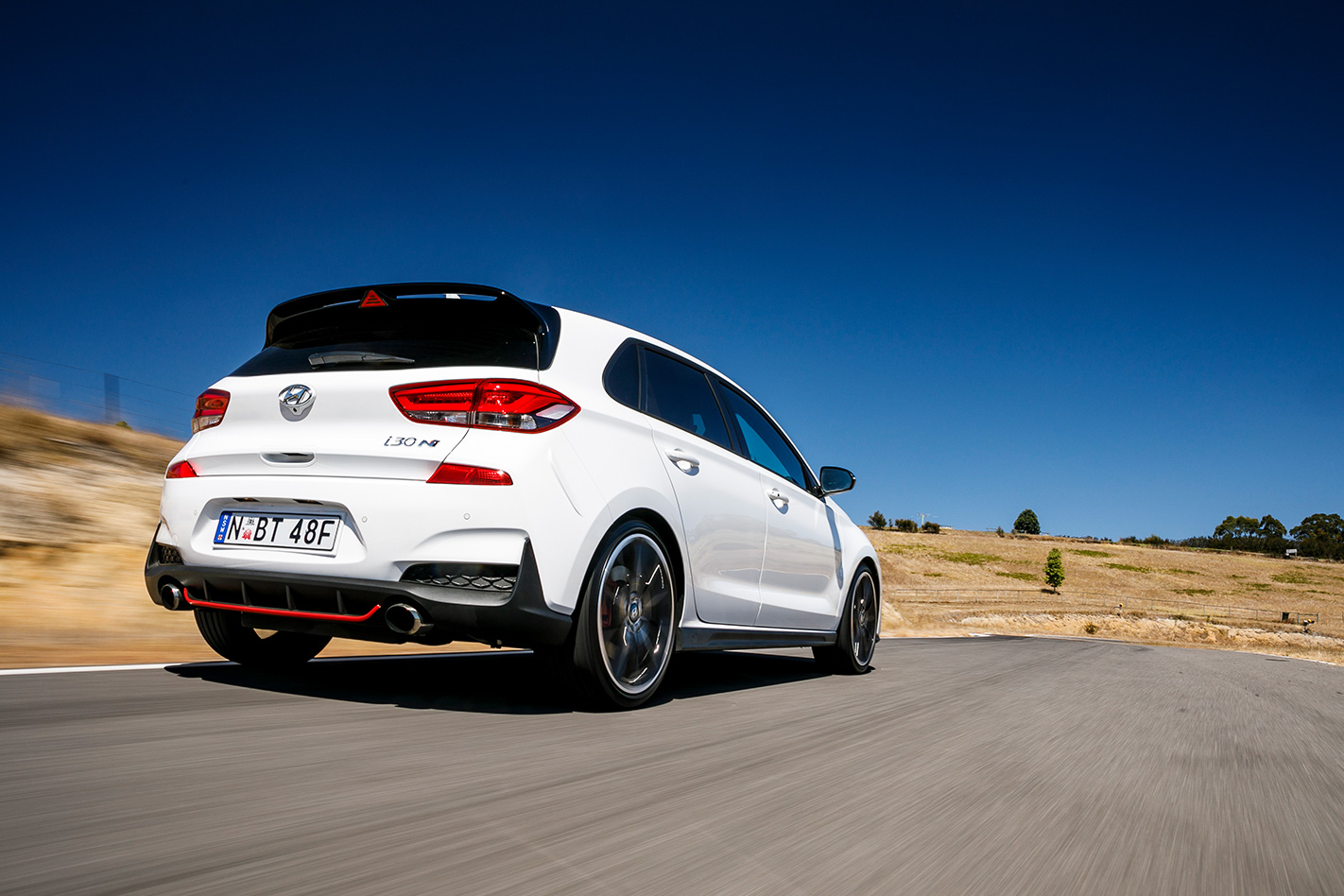
And that’s what the i30 N does – makes you smile. Only at a track like Phillip Island would the i30 N get blown away by the Type R’s Porsche GT3-like bandwidth. And while the Honda’s supernatural speed and suction through one particular 55km/h-posted left hander on our road loop was mind-blowing – reinforcing our observations that it’s almost like a front-drive Porsche – the i30 N was still awesome.
A hugely effective mechanical LSD sucks the Hyundai towards apexes even with the throttle mashed, and its power-down prowess is brilliant. It annihilated our test road with nuanced, involving, towering effectiveness, brakes included.
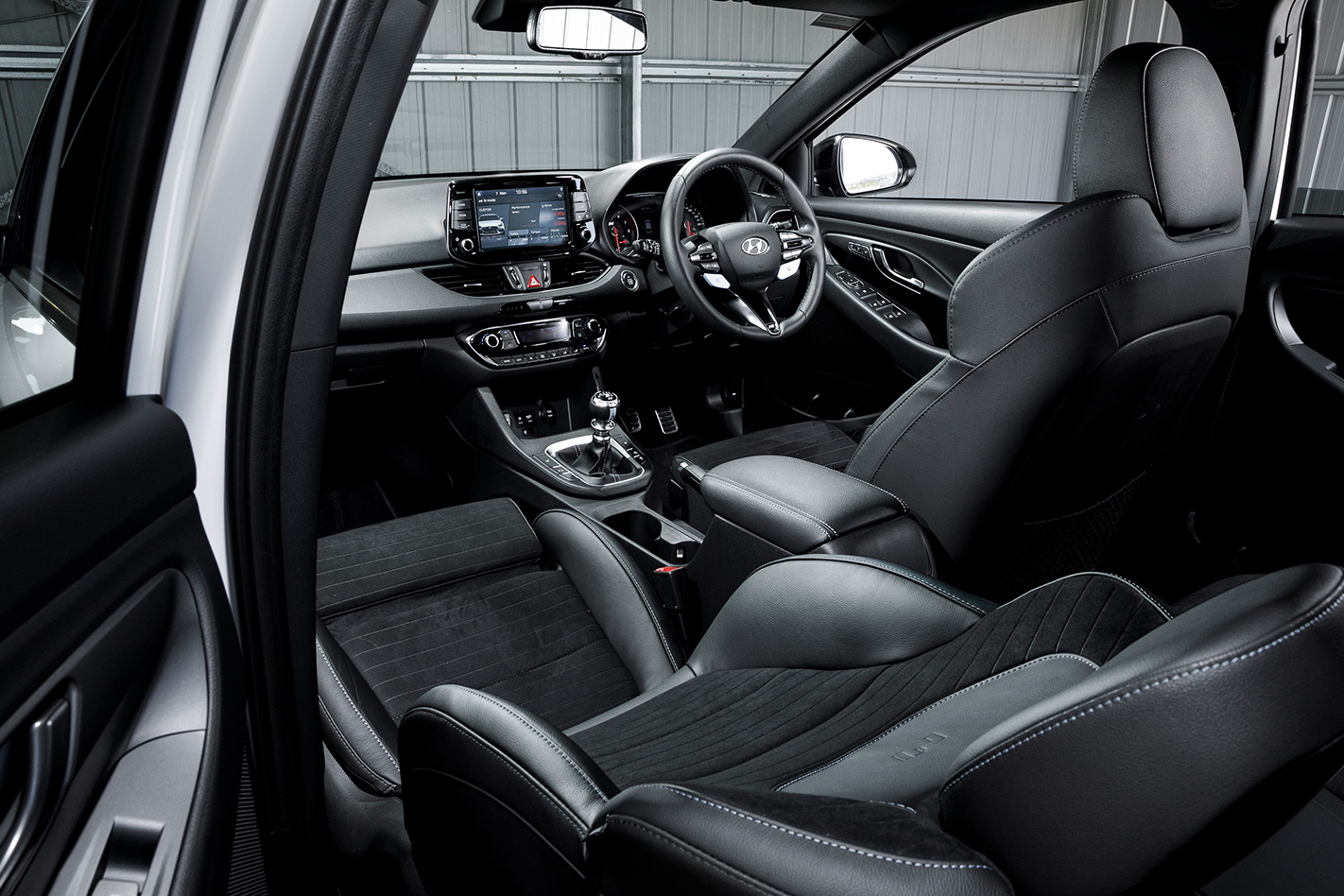
The information fed through the N’s perfectly sized steering wheel is crisp, uncorrupted and immediately on its game, much like the mechanical weight of the N’s luscious gearchange, and all the touch points are absolutely spot-on, including Hyundai’s excellent front buckets (with electric operation an option).
Pity the same can’t be said for the i30’s pedal placement, which isn’t ideal for heel-and-toe downshifts (though the N does include in-built rev-matching). Or the interior’s rental-car ambience and lack of ornamentation. Too much hard plastic – why isn’t there a trim insert across the centre section of the dashboard to alleviate the swathes of dull, hollow greyness? – and a scattered control layout do undermine the i30 N slightly, but that is not what this car is about. Not for that red-hot price.
What no one ever expected this hot Hyundai to deliver is layers. It has so many elements to its personality – from a relatively composed ride in Normal damping mode (and even Sport), backed by an incredibly tractable engine that pulls effortlessly from just 1400rpm right to 6800 – that you can play under-the-radar stealth or barking-mad theatrics at the press of a steering-wheel button.
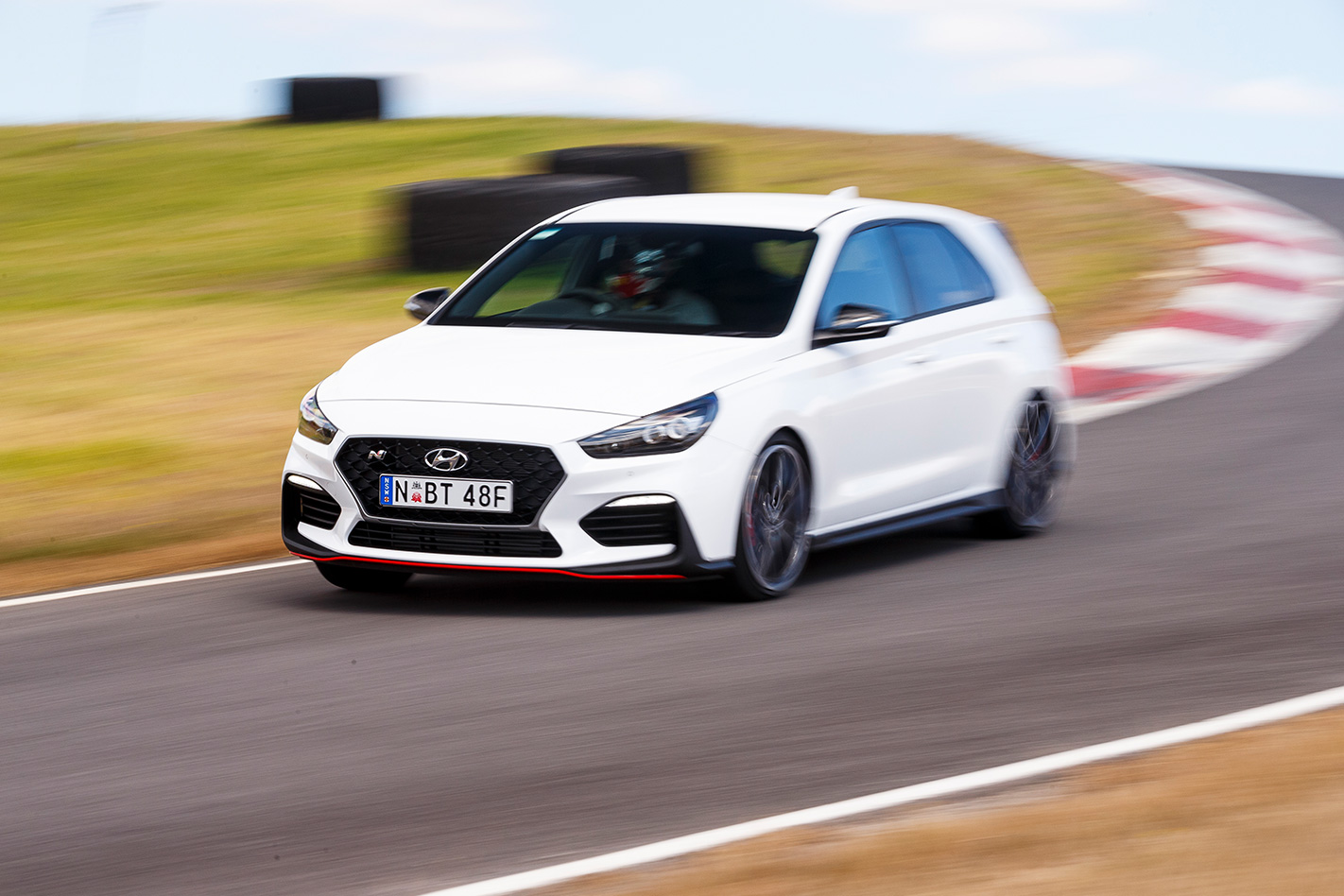
The i30 N doesn’t quite achieve the incredible highs of the Civic Type R, yet there’s definite genius in its all-round excellence. It may not smash the class wide open, but the N definitely has its handsome face peering out from the very top of the hot-hatch tree.
It represents a tremendous effort by Hyundai – both for where it’s come from and what it does – and the result is a superb driver’s car for an amazing price.
Hyundai i30 N LAP TIME: 1:03.9sec SCORE: 9/10
Engine: 1998cc 4cyl, dohc, 16v, turbo Power: 202kW @ 6000rpm Torque: 363Nm @ 1450-4700rpm Transmission: 6-speed manual Weight: 1429kg Tyres: Pirelli P Zero 235/35ZR19 91Y Fuel consumption: 16.7L/100km (tested) Power to weight: 141kW per tonne 0-100km/h: 6.2sec (claimed) Price: $39,990
Hot Hatch Megatest Contenders
12th, Score 6/10: Mini Cooper S JCW
11th, Score 6.5/10: BMW 125i
10th, Score 6.5/10: Subaru WRX Premium
9th, Score 7/10: Subaru WRX STI
8th, Score 7/10: Skoda Octavia RS245
7th, Score: 7.5/10: Ford Focus ST
6th, Score: 7.5/10: Renault Clio RS220 Trophy
5th, Score: 8/10: Volkswagen Golf GTI Original
4th, Score: 8.5/10: Volkswagen Golf R Grid
3rd, Score: 8.5/10: Peugeot 308 GTi 270
2nd, Score: 9/10: Honda Civic Type R
Winner, Score: 9/10: Hyundai i30 N
An American muscle car legend, the 1967 Ford Shelby GT500 Super Snake, is back.
Shelby announced it will build 10 more units of the Super Snake using 1967 Mustangs as donor cars, and complete with factory VINs and original titles.

A Shelby ‘427’ (7.0-litre) V8 good for more than 410kW will be its powerplant, available as either aluminum or cast-iron blocks, which are hooked up to a 4-speed manual transmission.
The donor cars are stripped completely back for their transition into Super Snakes, with customers able to opt for an original period Shelby fastback for transformation into a Super Snake.
Shelby American president Gary Patterson says the project finishes the goal originally set by Carroll Shelby and employee Don McCain to build a limited run of the cars in the late ‘60s.
“We’re fulfilling the dream of Carroll Shelby and Don McCain,” says Patterson.

“Shelby built an engineering study dubbed the ‘Super Snake’ for high-speed tire testing by Goodyear in 1967.
“When that successful test ended, Shelby American offered it to Mel Burns Ford in So Cal to retail to the public.
“Former Shelby American employee Don McCain approached Shelby about doing a limited run of cars.
“They carefully studied the idea but sadly, the timing did not work because the car was too expensive.
“The program never came to fruition, until now.”
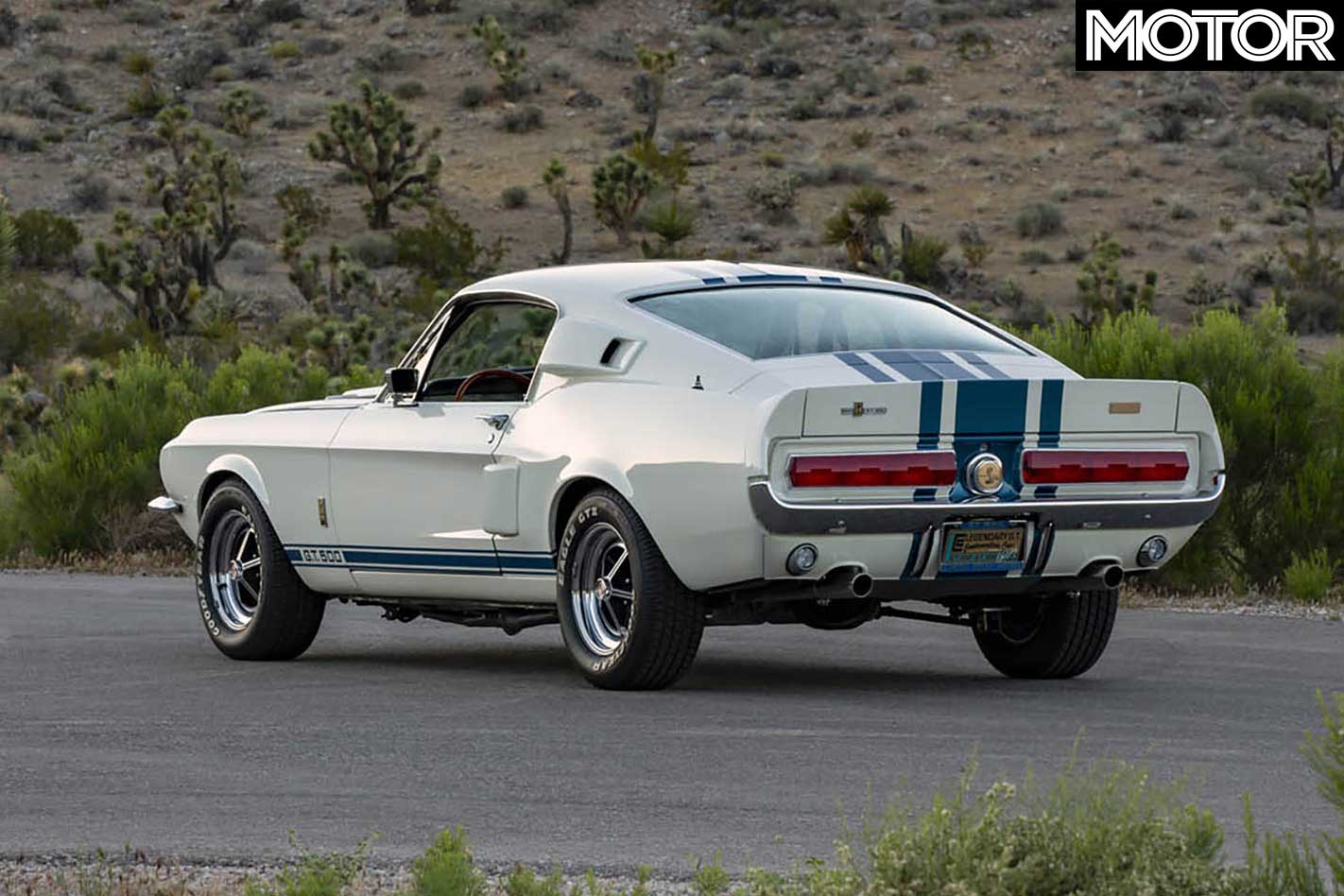
With only one original car built, its value has been tremendous at auctions, with Shelby stating it recently fetched over $1.3 million.
The return of the Super Snake comes after Shelby reintroduced the 1968 Shelby GT500KR (KR – King of the Road) in January, with 10 fastbacks and 10 convertibles of KR to be built.
Shelby says the 10 Super Snakes will be priced starting from US$249,995.
NEARLY 20 years ago, road testers around the globe proclaimed the original Integra Type R as one of the best handling front-wheel drive cars ever.
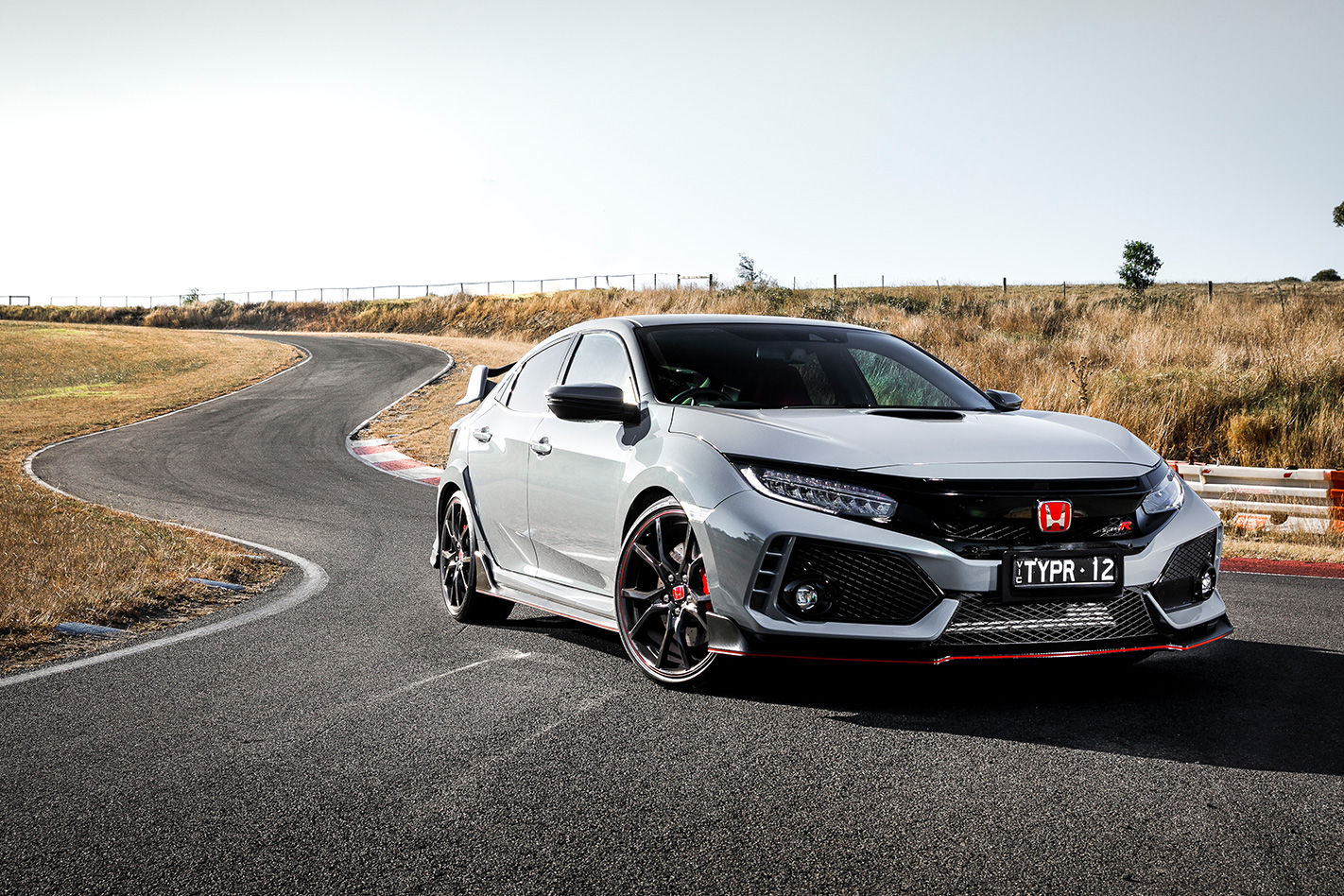
Today the spirit of that incredibly raw Japanese coupe is infused in the Civic Type R, the fifth and most laser-focused since the series surfaced back in 1997. Yet it’s so much more than that.
In a nutshell, more than one tester declared this a cut-price Porsche 911 GT3, so exhilaratingly hungry for corners is its brilliant front end. Just like in that Integra, the Type R’s handling and body control are in an orbit all their own.
The way 400Nm of low-down grunt is channelled through to the pointy end via a gorgeously mechanical six-speed manual so instantaneously and without corruption is a triumph of engineering, resulting in a hyper hatch that is supreme in reeling in the scenery quicker than anything else this Megatest could muster. If an explosively quick point-to-point experience is your bag, look no further.
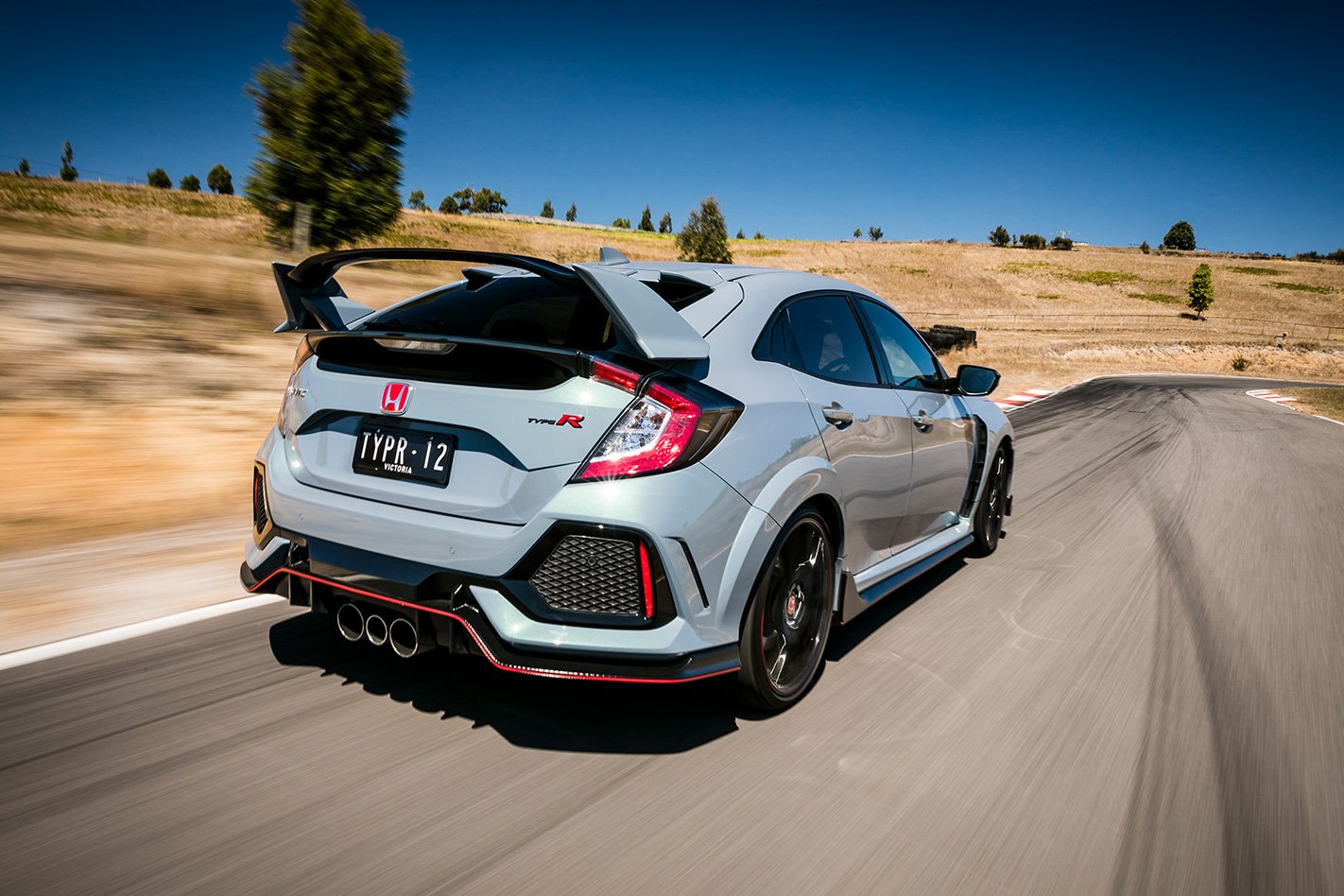
In fact, the harder you drive the Honda, the more it gives, and there’s still more in store, as that rousing triple exhaust alludes to. The Type R hasn’t so much been bred as genetically mutated and enhanced to annihilate the Nordschleife. And, yet, that it can also land from the UK and so effortlessly devour some random mountain pass in rural Victoria with such utter insouciance demonstrates immense adaptability.
Though taller gearing in second would probably have improved its track time at Haunted Hills, Renato revelled in how the Honda lights up no matter where the tacho needle is pointing; how the chassis “…is so hooked up in the rear”; and finally, how planted and non-floaty it feels for a front-driver.
He’s definitely a fan.
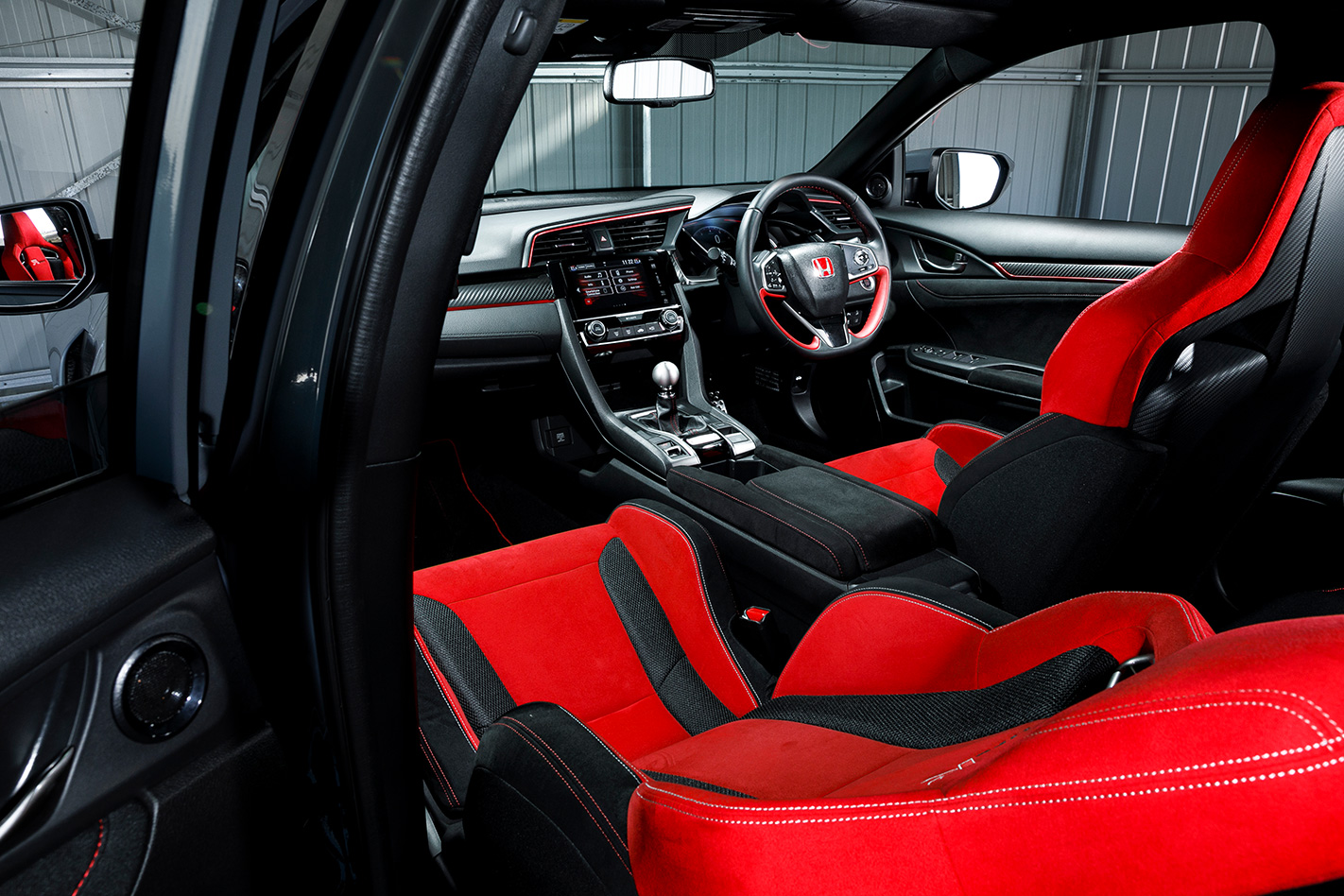
Flexibility, then, is the key to the Type R’s incredible showing; she ain’t no one-trick pony.
While trick tug-quelling dual-axis front struts and dual-pinion variable-ratio steering help turn even the most ham-fisted driver into Lewis Hamilton, conversely those same three-way driving modes (modifying dampers, throttle and steering) will also cushion the boniest tush, whether pottering around town or streaking across the countryside like it’s your own private Shinkansen. Pretty astounding for a Nurburgring record-holder on 20-inch alloys.
That said, if the dynamics have to be criticised, it’s just how mundanely Civic VTi-esque the steering feels when the driver isn’t caning it like they nicked it, displaying a curious patchy inconsistency and lack of crispness. It’s as if helm the has been designed to excite at 10-tenths only.
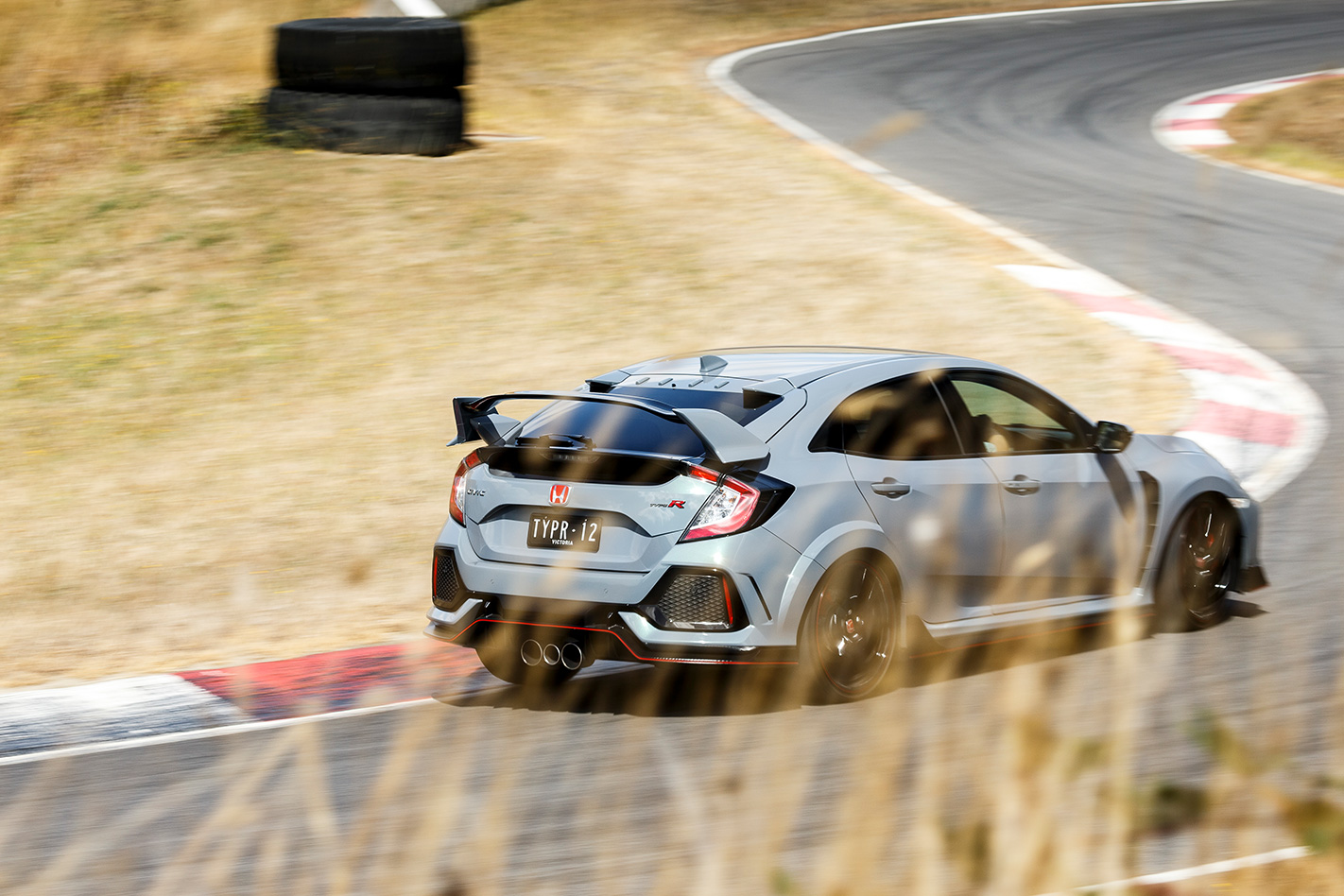
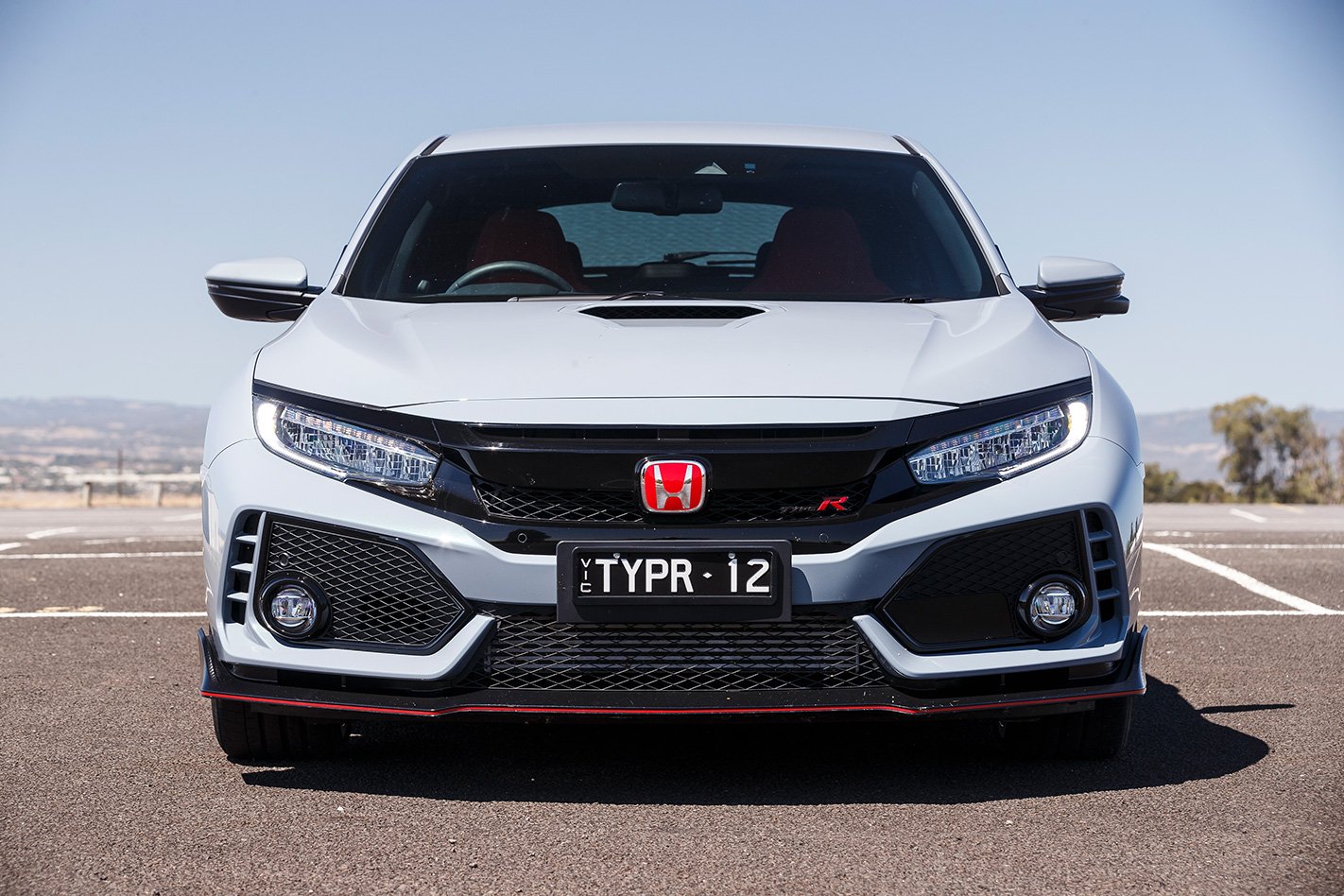
Speaking of design, there’s a bizarre beauty to the Type R that will polarise until the end of days. One tester called it a frilled-neck lizard in full fright mode. Either way, a wallflower this isn’t.
What might really scare buyers away though is the two-seatbelt-only rear bench – sheer madness since there’s actually acres of space (including segment-leading width) back there, and that’s on top of the aforementioned comfy ride. What was Honda thinking? The group’s best front seats, an excellent driving position and a smartly laid out (if overly plasticky) dash are further Civic highs.
What we’re left with, then, is a practical four-seater performance car fixated on ferociously fast cornering speeds and blade-like handling finesse. If you have the space and courage to explore the Type R’s limits, the experience that awaits will thrill.
So, good on you, Honda. The Type R is already a fierce modern-day scion of the classic old Integra. But there’s still one hot hatch remaining that, while not quite reaching such seismic highs, rewards with rapacious consistency across the spectrum.
Honda Civic Type R LAP TIME: 1:04.0sec SCORE: 9/10
Engine: 1996cc 4cyl, dohc, 16v, turbo Power: 228kW @ 6600rpm Torque: 400Nm @ 2500-4500rpm Transmission: 6-speed manual Weight: 1393kg Tyres: Continental Conti Sport Contact 6 245/30R20 Fuel consumption: 16.7L/100km (tested) Power to weight: 164kW per tonne 0-100km/h: 5.7sec (claimed) Price: $50,990
Hot Hatch Megatest Contenders
12th, Score 6/10: Mini Cooper S JCW
11th, Score 6.5/10: BMW 125i
10th, Score 6.5/10: Subaru WRX Premium
9th, Score 7/10: Subaru WRX STI
8th, Score 7/10: Skoda Octavia RS245
7th, Score: 7.5/10: Ford Focus ST
6th, Score: 7.5/10: Renault Clio RS220 Trophy
5th, Score: 8/10: Volkswagen Golf GTI Original
4th, Score: 8.5/10: Volkswagen Golf R Grid
3rd, Score: 8.5/10: Peugeot 308 GTi 270
2nd, Score: 9/10: Honda Civic Type R
Winner, Score: 9/10: Hyundai i30 N
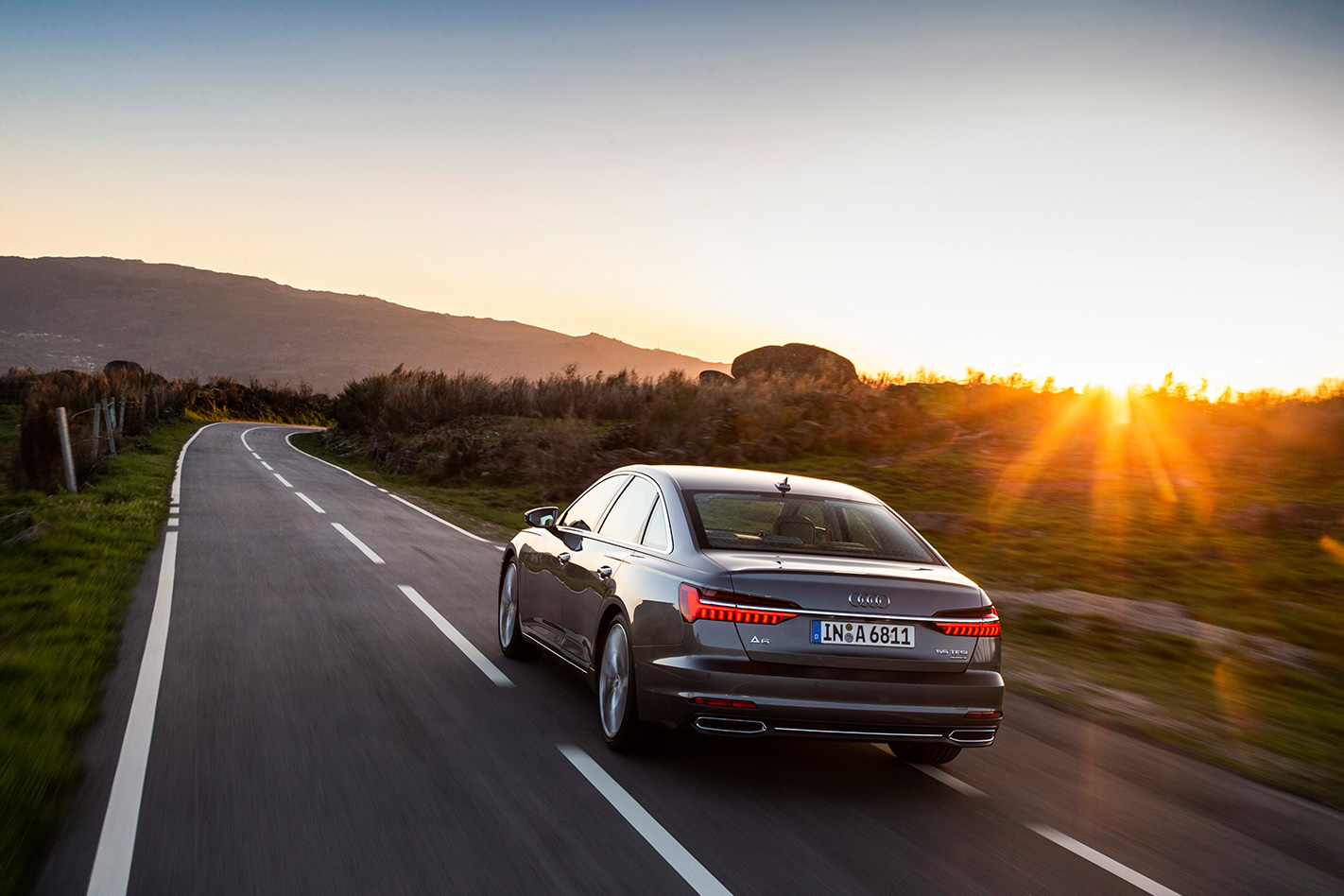
AUDI has worked on the aesthetics, brain, brawn, and athleticism of its A6 sedan to bring it closer to its natural rivals.
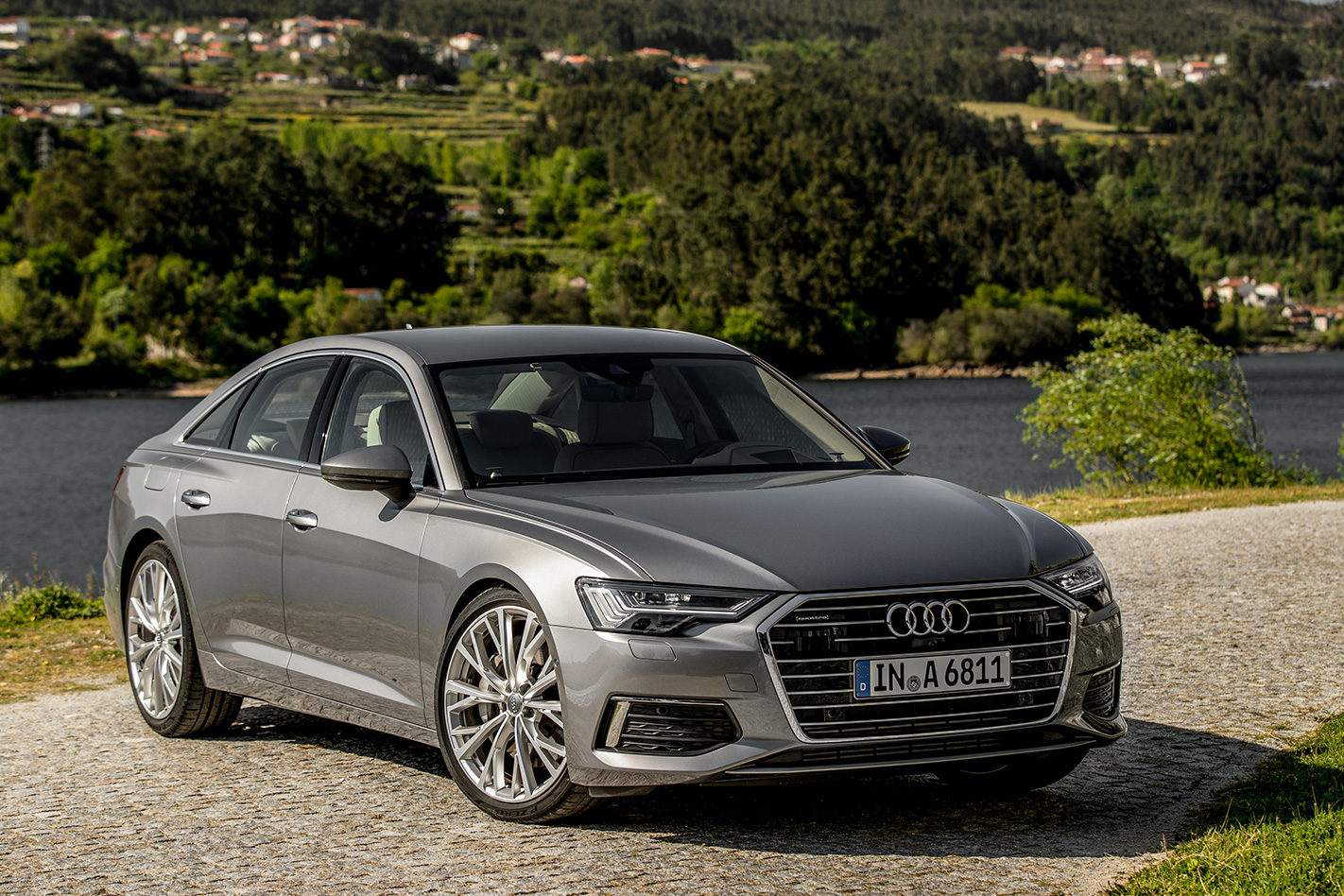
WHAT IS IT?
The first new Audi A6 since 2011, this fifth-generation model brings greater cabin space and a diesel-heavy engine line-up. Audi’s attempting to stand out from the crowd with the A6 by adding a mild hybrid system across the range and an all-wheel steering to the equation.
WHY WE’RE TESTING IT
Wheels took the opportunity for a first taste of the C8 generation Audi A6 at its international launch in Portugal. Audi has been playing catch-up with its German rivals, BMW and Mercedes-Benz, and holds hopes the new A6 will be the ace up its sleeve in the large luxury sedan segment.
MAIN RIVALS
The BMW 5 Series and Mercedes-Benz E-Class are the A6’s core competitors. Euro luxe offerings such as the Jaguar XF and Volvo S90 are in the frame too.
THE WHEELS VERDICT
Audi has built an A6 that is just as comfortable crushing kilometres as it is carving mountain roads. Gone is the old A6 quattro’s front-drive-esque experience, replaced with an athleticism that belies the car’s almost five-metre length. The addition of all-wheel steering adds depth to the A6’s dynamic character. The engine line-up isn’t particularly headline-grabbing, but for the most part the turbo petrol and diesel units are capable and refined, leaving headroom for performance halo versions.
PLUS: Spacious and tech-laden cabin; plush ride on air suspension; dynamics, particularly in all-wheel-steer spec MINUS: Limited petrol engine range; dual-clutch transmission calibration lacks low-speed polish
THE WHEELS REVIEW
TECHNOLOGY has advanced more rapidly over the last five years than in any previous five-year period in the history of the car, so the fact Audi’s C8-generation A6 represents what is arguably the model’s biggest advance yet is no surprise.
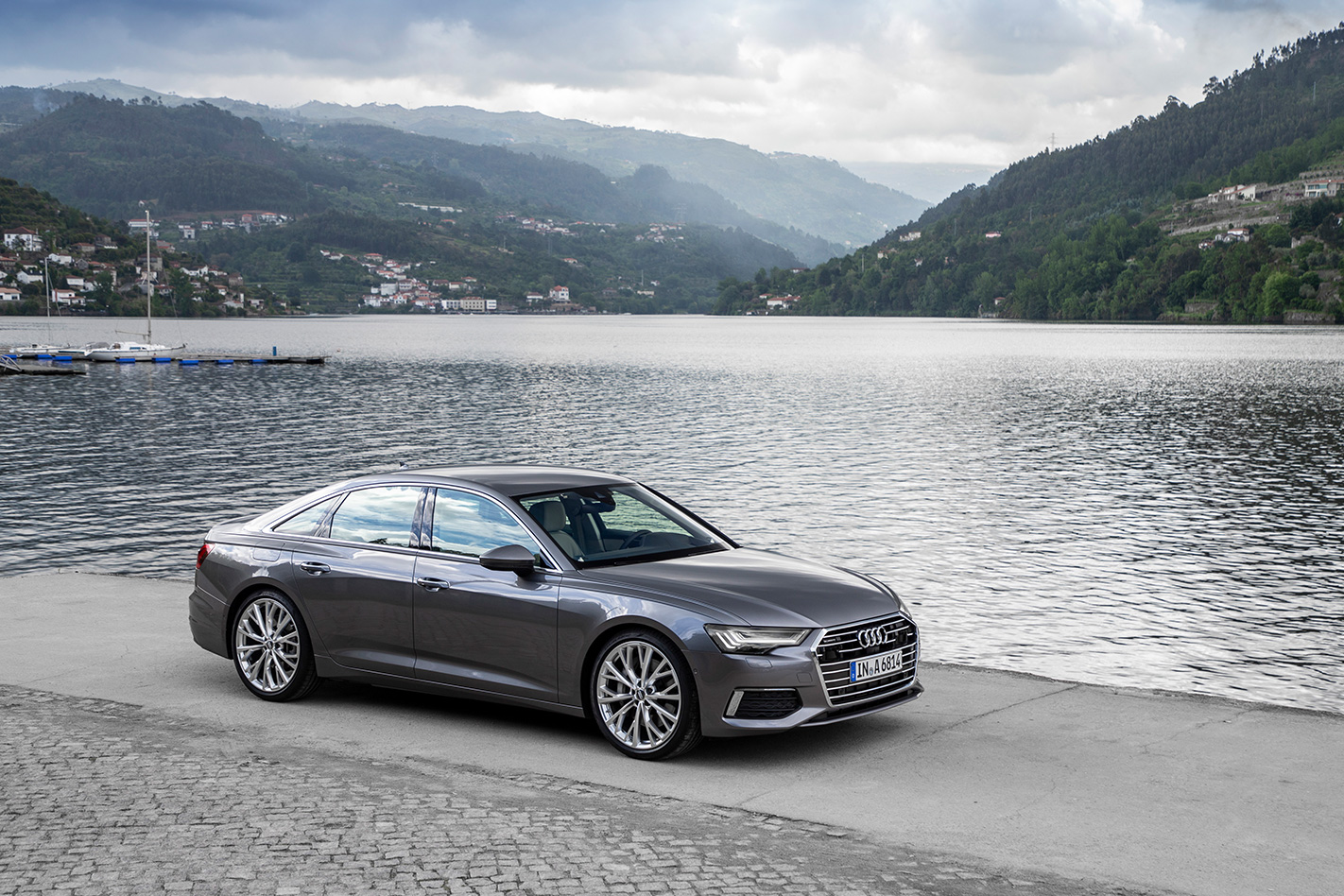
Now, it seems the A6 has caught up and is ready to play ball with traditional rivals, the BMW 5 Series and Mercedes-Benz E-Class, which both underwent generational leaps in the past two years.
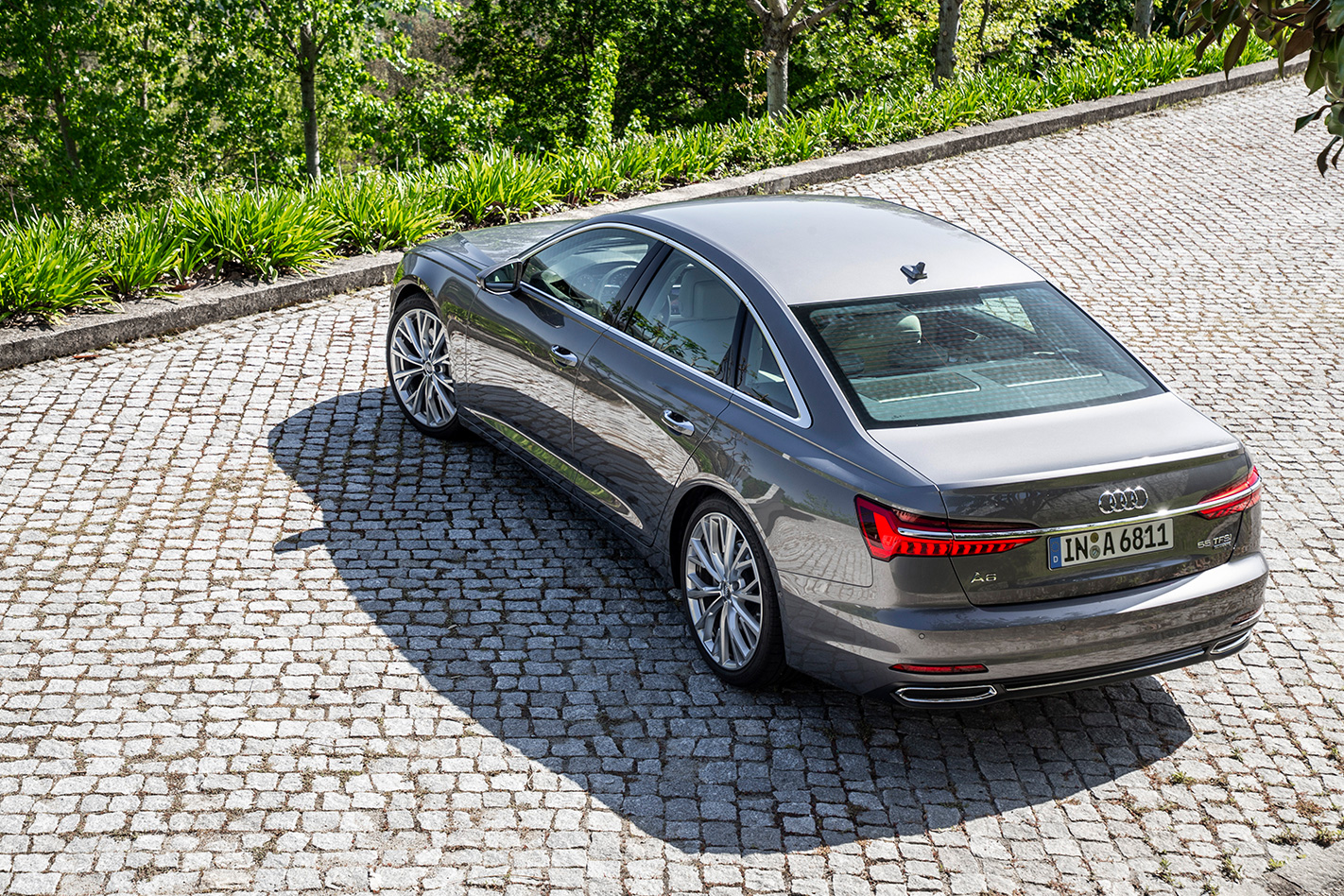
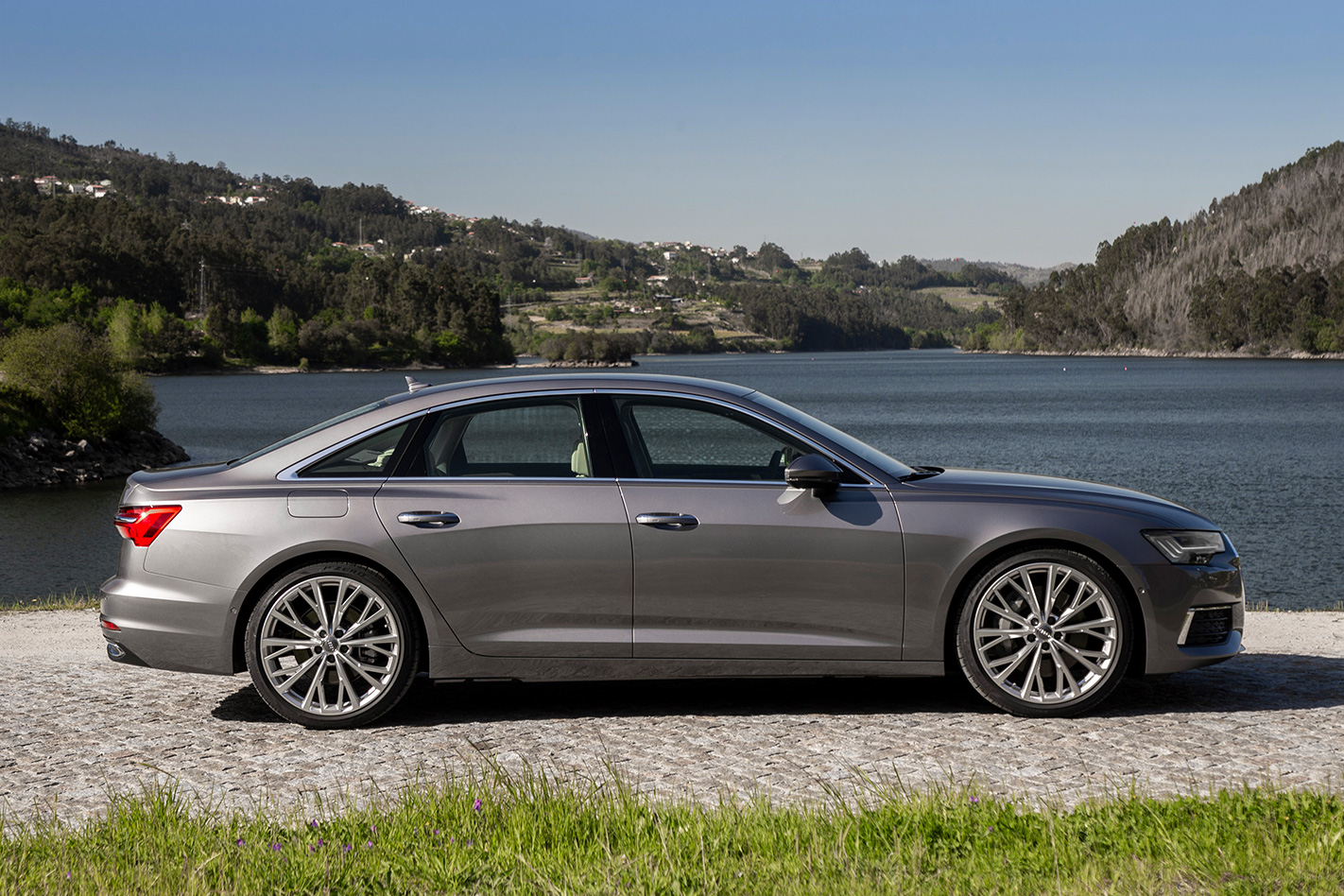
Underpinning the A6 is a revised version of the previous chassis, built using the same MLB Evo modular matrix. Growth was kept to a minimum, with the 2018 A6 measuring just 7mm longer (4939mm), 12mm wider (1886mm), and 2mm taller (1457mm) than the previous generation. There is a more significant expansion inside, with 21mm added to the overall cabin length, 12mm of which is added to rear legroom. Head and shoulder room increase for all occupants.
As well as significantly improved dynamics, an influx of new infotainment and safety technologies catapult the new A6 up to date.
In Europe and North America, where BMW offers its xDrive all-wheel-drive system in mainstream 5 Series, and Mercedes its 4Matic system in the E-Class, Audi’s quattro no longer gives it a USP. Yet in Australia the availability of all-paw mid-range versions should still give Audi an ace.
The A6 introduces “Dynamic All-Wheel Steering”, a four-wheel steer system similar to that offered by BMW in the 5 Series.
At speeds up to 60km/h the rear wheels turn in the opposite direction to the fronts by up to five degrees, decreasing the turning circle by a metre to 11.1m and improving low-speed manoeuvrability. Above 60km/h the rear wheels now turn in phase with the fronts, by up to two degrees for increased highway stability.
Even without the all-wheel-steer system, the A6 is a dynamically engaging car that rewards drivers prepared to hustle the big sedan. And while the Audi may continue to struggle to match the rear-drive dynamic flavour of its rivals, it’s a much closer fight now, with the front-drive-esque feel of previous A6 quattros banished. The car feels taut and eager to turn in.
A6s without the all-wheel steering get a direct-ratio electric rack, which is smooth and well-weighted, providing a good sense of how the front tyres are behaving while keeping kickback at arm’s length. Tick the all-wheel-steer box, and you get variable ratio steering that attempts to optimise weight and response based on speed and steering angle.
The driving position is surprisingly low and sporty, with front passengers seemingly pushed outboard in the cabin. It’s easy to establish a real sense of connection with the A6. There’s a sensation that the chassis is pivoting somewhere under your knees, so quick and keen is the turn-in. A bonnet that slopes out of sight from the driver provides the uninterrupted view needed to get into maximum attack mode, despite the car’s substantial proportions and the very narrow Portuguese roads on the launch.
There are four suspension tunes available for the A6; three on steel springs, and one with an air set-up. The entry-level tune of steel springs without adaptive dampers wasn’t available at launch, nor was the “sport” steel set-up, leaving us with the steel-sprung, adaptive damper combo, and the air suspension.
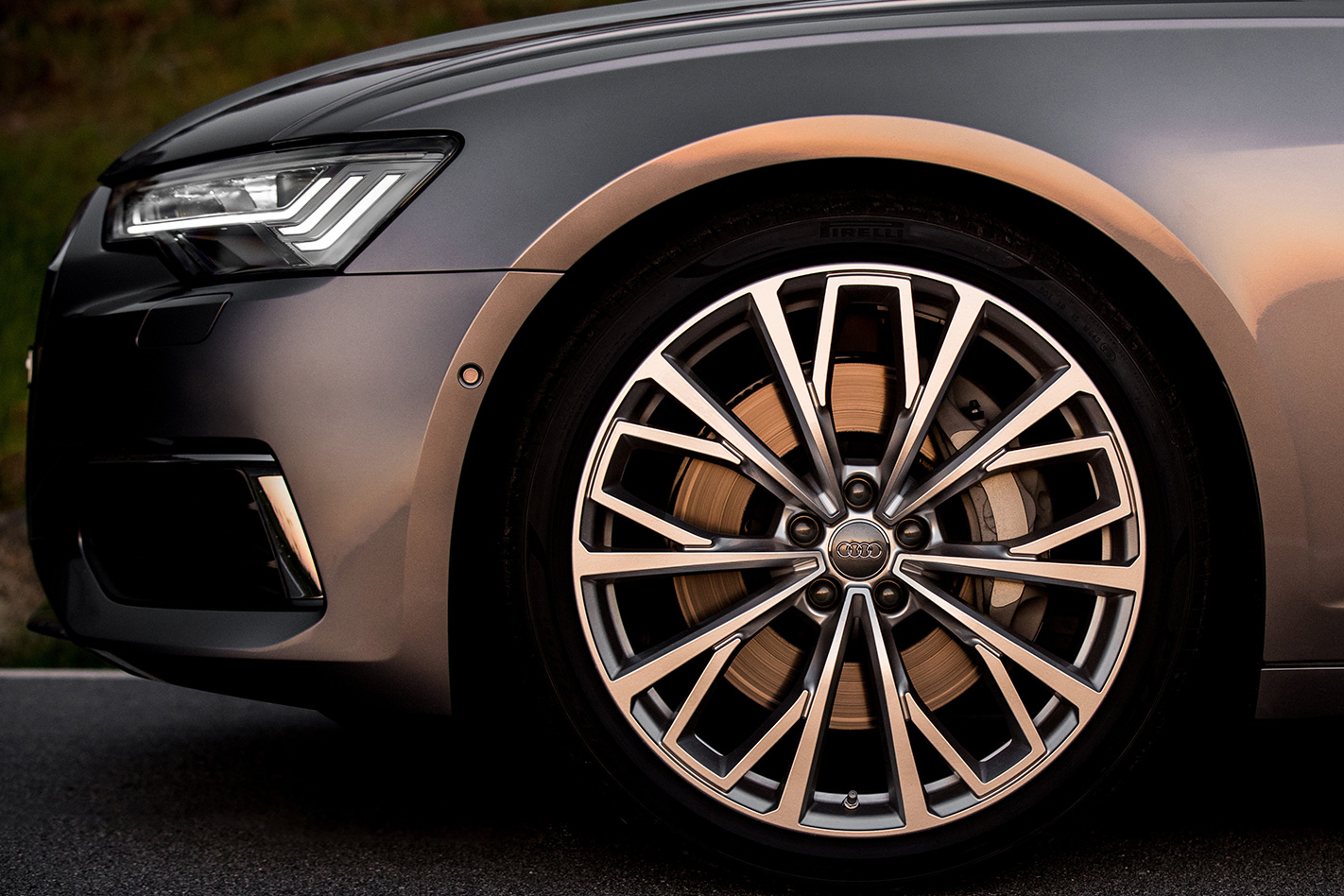
Riding on 19-inch rims, the steel-sprung A6 delivers ride suppleness, yet without the lateral lean you would associate with a soft suspension calibration. However, increasing the rim diameter on this suspension eats away at the A6’s ability to iron out a bumpy surface.
With the air suspension, even on 20s, the ride was at its most impressive. The level of absorbency felt similar in comfort and dynamic modes, the difference being a reduction in body roll in the sportier setting. However, on the largest 21-inch wheels, in dynamic mode, the air suspension can’t entirely mitigate the slim sidewalls.
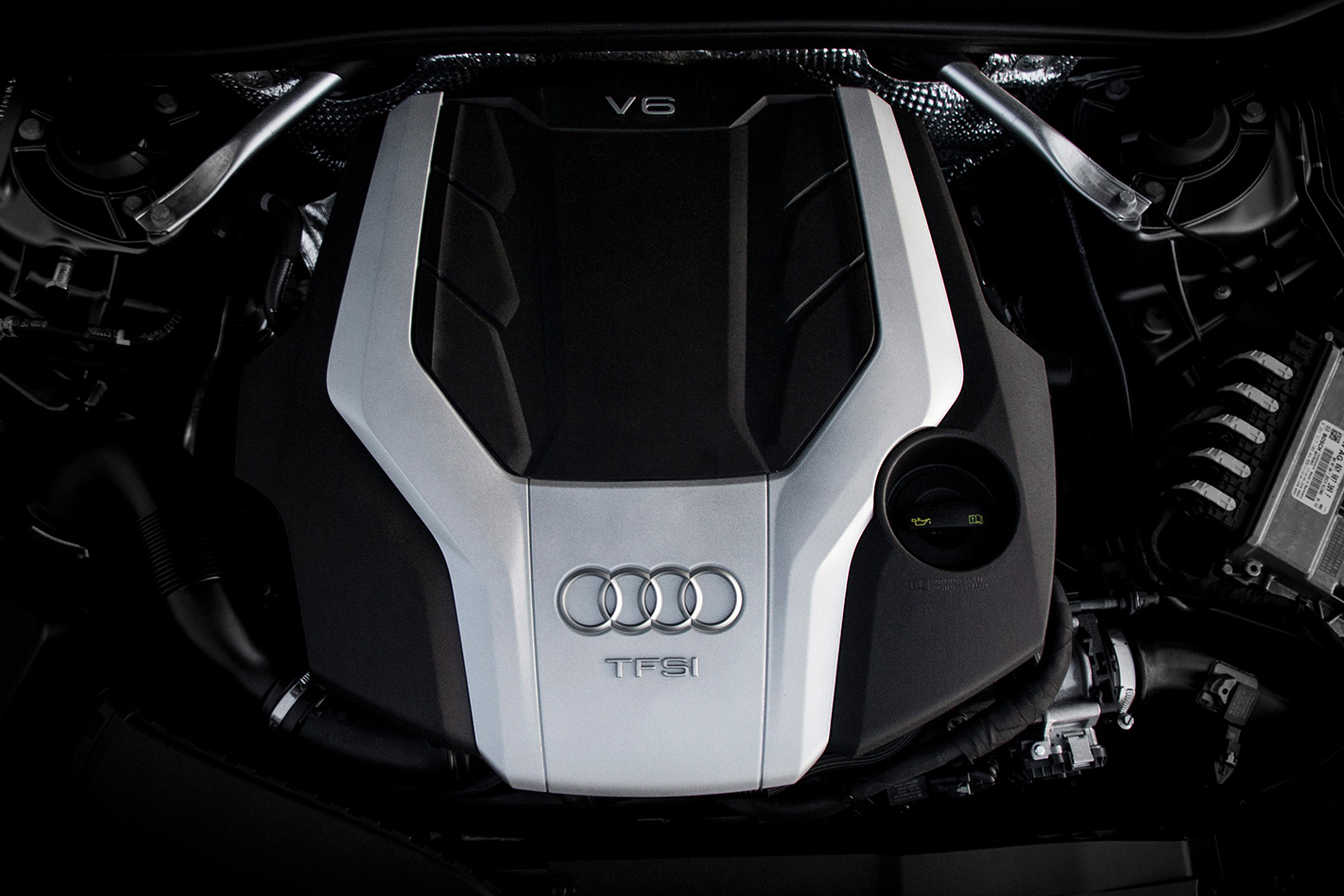
The most powerful engine at launch is the 55 TFSI 3.0-litre turbo petrol V6, with 250kW and 500Nm, mated to a seven-speed dual-clutch transmission.
At 210kW, the 3.0-litre turbo-diesel V6 50 TDI is less powerful than the petrol one, but ups torque to 620Nm. This engine is also available in 45 TDI tune, producing 170kW and 500Nm. Both are mated to an eight-speed automatic.
Sitting at the entry level is the 2.0-litre turbo-diesel 40 TDI four, with 150kW/400Nm, paired with a seven-speed dual-clutch.
Audi Australian has not yet confirmed the local engine line-up, though it has said the diesel engines are a high priority, and that the 55 TFSI petrol may not make our shores. If that is the case, anticipation will be high for the eventual arrival of a (likely twin-turbo) S6. (Audi employees stubbornly refused to confirm or entertain the notion of such a variant, despite its two decade-plus history.)
Of the engines at launch, the 50 TDI was the sweet spot. While the 55 TFSI makes 40kW more than the diesel, that advantage isn’t as noticeable as the extra 120Nm in the oil-burner’s pocket. Both V6 engines are refined, their synthesised throaty note surprisingly pleasing.
Despite Audi saying the 2.0-litre’s aluminium crankcase helps minimise the engine’s noise (and saves 20kg in the process), the smallest capacity engine is the most intrusive. The turbocharger is rather vocal throughout most of the rev range, and the classic diesel rattle is more prominent compared with the V6 units.
Audi Australia is still working on local specification for the A6, with Australian A6s likely to be generously specified compared with Euro-market cars. Likewise, it wouldn’t be drawn on local pricing but did confirm that the A6, originally expected in Q4, won’t be arriving until 2019.
Every car at launch had Audi’s quattro all-wheel-drive system, with an electronic centre diff. Christian König, project manager for the A6, told Australian media the lower-spec 2.0-litre four-cylinder would be available in front-drive form in certain markets, just as the current A6 is on the local market.
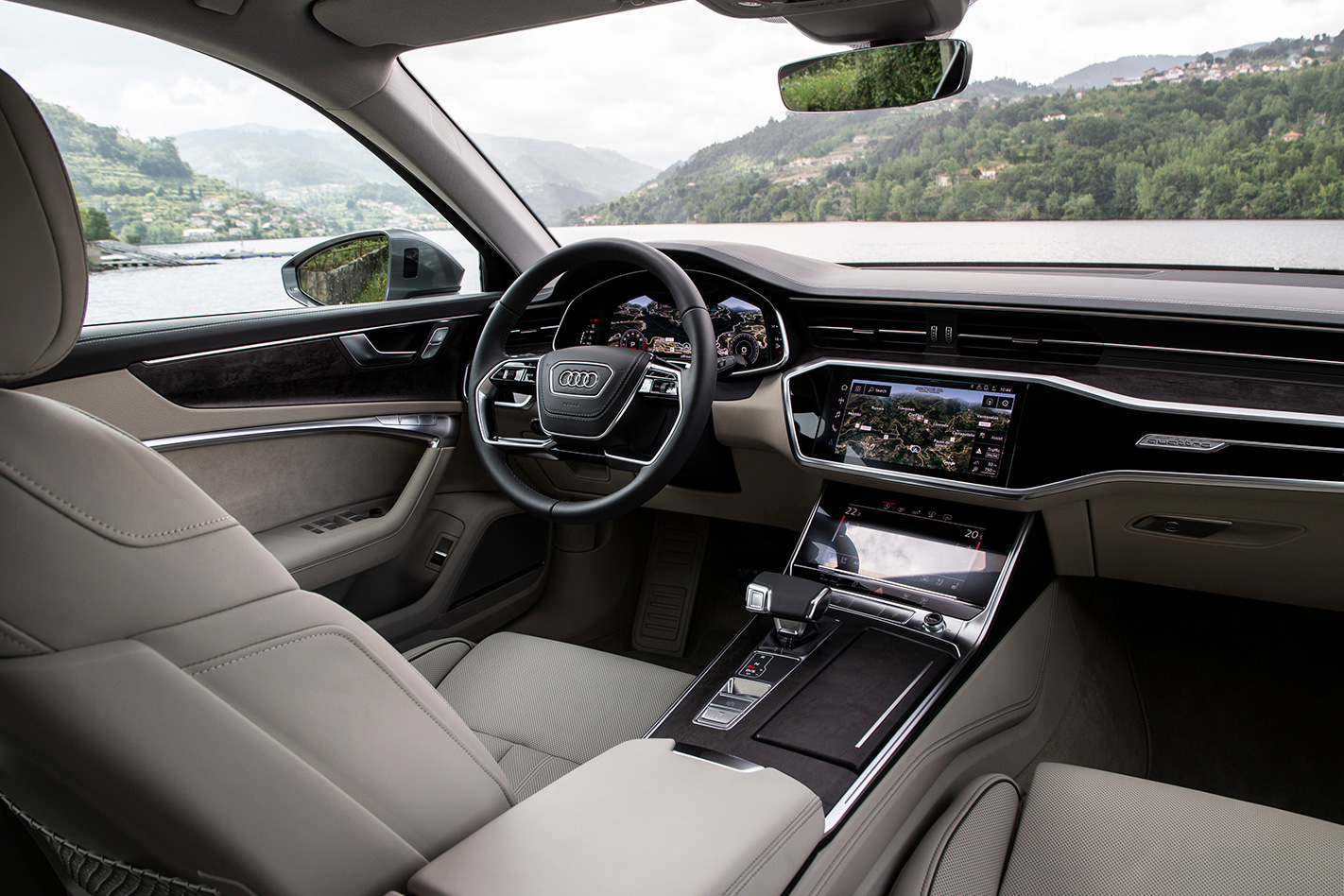
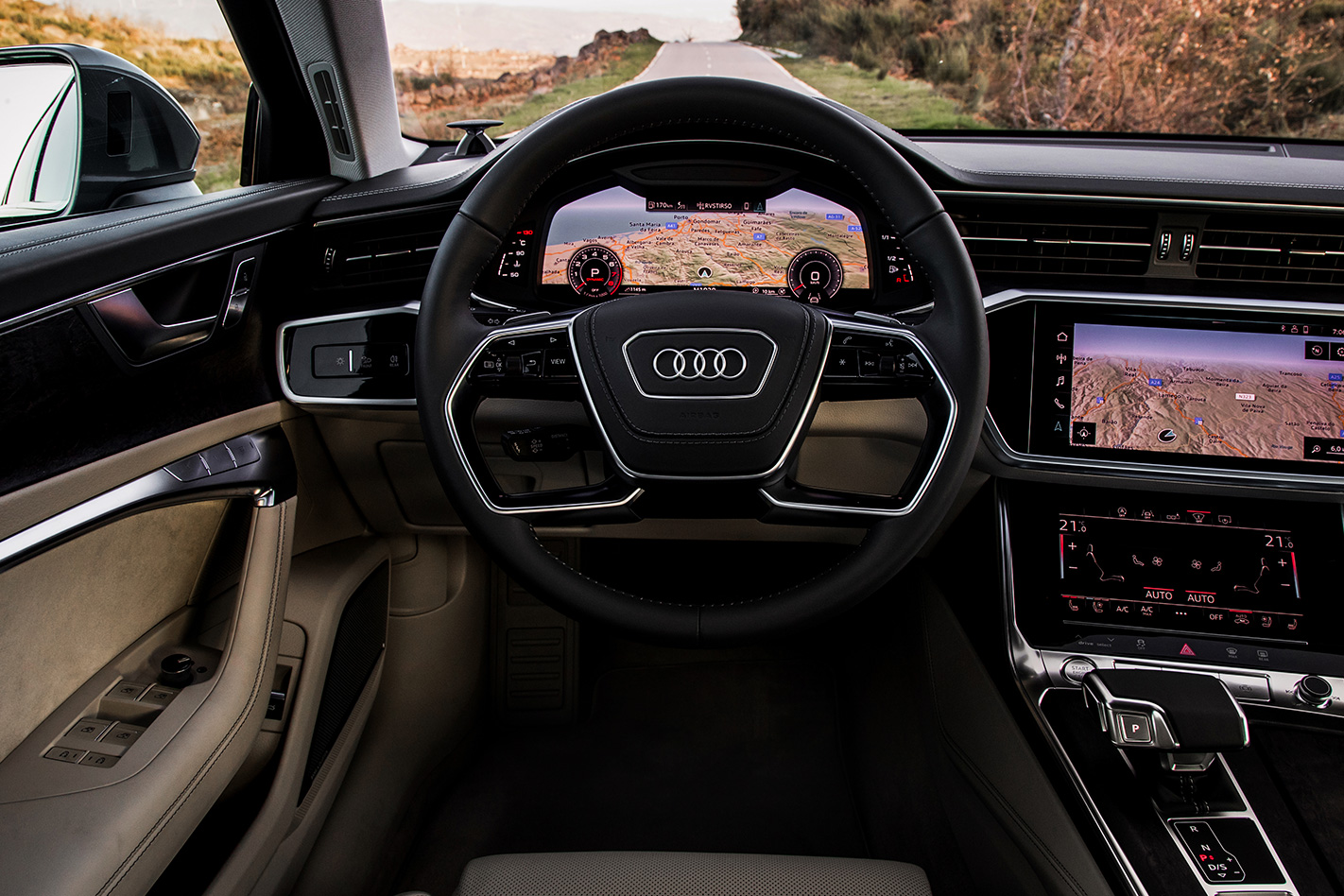
Inside, the cabin is generously trimmed in leather and suede and finished with brushed metal. But the real centrepieces are the digital touchscreen displays – the two centrally mounted screens are a tech delight. Up top is a 10.1-inch unit for all your infotainment, navigation and phone-pairing needs, while the main duties of the 8.6-inch unit in the lower console are climate control adjustment and providing a keyboard for text inputs. A 12.3-inch LCD display with an updated version of Audi’s virtual cockpit system replaces analogue instruments.
It’s here where information for Audi’s new Predictive Efficiency Assist system is displayed – essentially a more advanced adaptive cruise control which utilises “car-to-X” communications technology. The system uses the car’s cameras and sat-nav information to read road signs, adjusting cruise control speeds accordingly, as well as lowering speeds appropriately for corners.
Audiophiles will be pleased to hear that Bang & Olufsen has continued its partnership with Audi, fitting the A6 with a chest-thumping 1820-watt, 19-speaker sound system.
Every variant supplements its internal combustion engine with a mild hybrid system. On the four-cylinder this is a 12-volt system, and for the diesel and petrol V6s a 48-volt system.
The mild-hybrid is essentially a heavy-duty stop-start system that can supplement engine torque to propel the car (above 22km/h), and the A6 also gains the ability to coast off-throttle for up to 40 seconds between 55km/h and 160km/h. Audi claims that combined, this can improve fuel economy by as much as 0.7L/100km.
With advances in efficiency, technology and dynamics, garnished with Ingolstadt’s signature interior class, this new model represents a significant step, positioning the A6 to properly turn the heat up on its rivals.
2018 Audi A6 specifications
Model: Audi A6 55 TFSI Engine: 2995cc V6, dohc, 24v, turbo Max power: 250kW @ 5000-6400rpm Max torque: 500Nm @ 1370-4500rpm Transmission: 7-speed dual-clutch L/W/H: 4939/1886/1457mm Wheelbase: 2924mm Weight: 1835kg 0-100km/h: 5.2sec (claimed) Economy: 7.0L/100km Price: $138,000 (estimated) On sale: Q1 2019
I can tell you that the 2005 Chevrolet Corvette generates 1.21 lateral Gs in a corner. I know this, because it just momentarily flashed up on its Head-Up display.
This review was originally published in MOTOR’s October 2004 issue
We’re belting around the tight, new GM Milford Proving Ground in Detroit and every corner has turned into a test of how much lateral grip the sticky Goodyear run-flats can produce. The sweepers seem to offer the best chance, with a smooth turn-in which allows grip to build and avoid a slide.
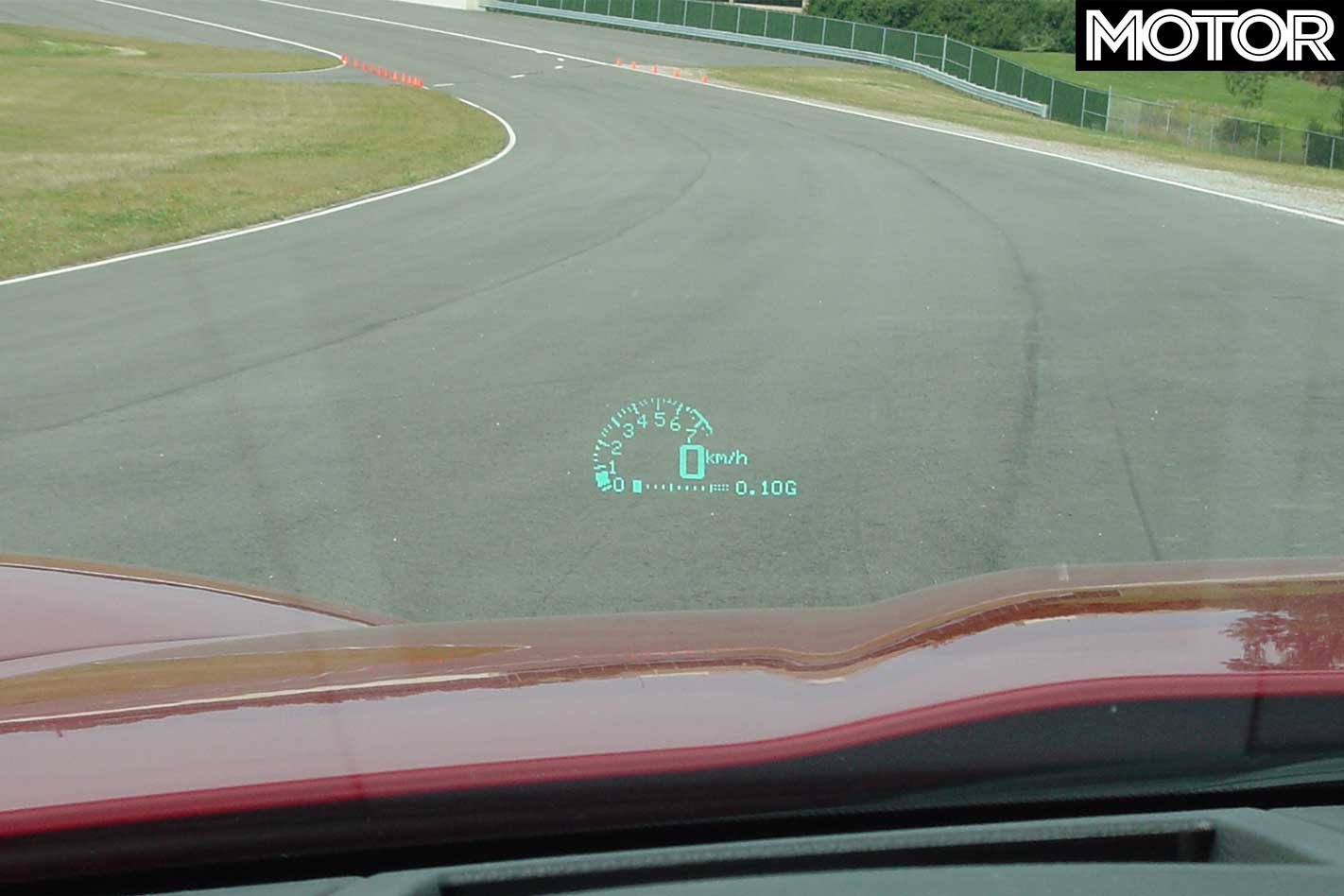
Switched onto the second track display mode (there are two track and one street modes), the green LED Head-Up Display projects onto the base of the windscreen just a circular tacho, an instantaneous lateral bar graph and the momentary max G meter that peak-holds for a few seconds after every corner. Very trick.
There are more goodies: like three stages of traction control including a ‘competitive driving’ mode that raises the safety net that allows for enough fun without the fear, although it’s still a tad intrusive under power.
But for Americans at least, the good news is that the C6 is a harder, more focused Corvette. It’s smaller, lighter, and at US$44,245, is even cheaper than the outgoing C5. It handles better, we discovered, thanks to GM supplying two C5s for comparison.
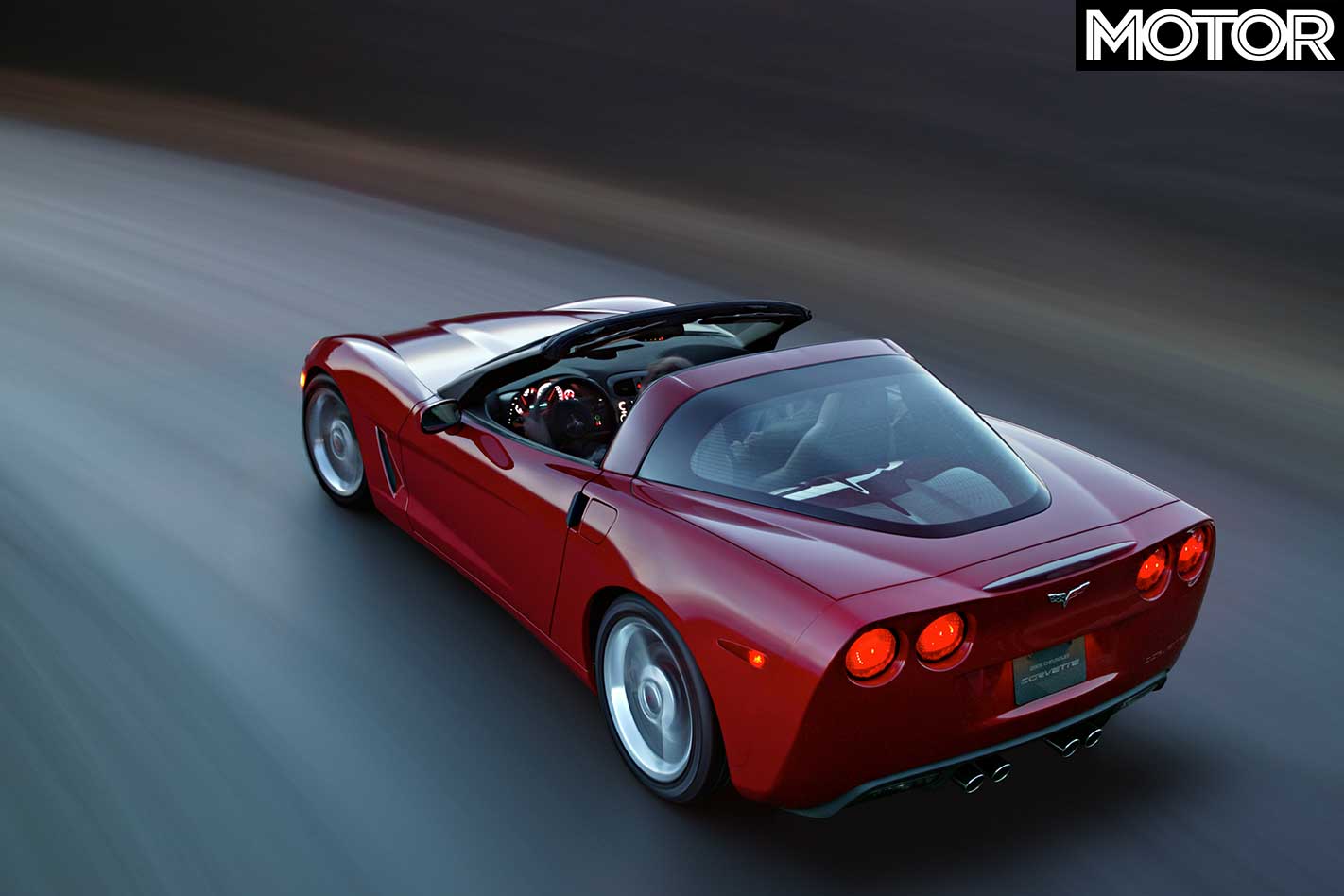
Then we drove the Z51 performance pack version, with closer first, second and third gears that gets it to 100km/h in 4.1 seconds, and uses larger cross-drilled brakes and single-minded suspension that dispenses with the regular version’s sport and touring switch.
Both Vettes will trip the quarter-mile in 12.6 seconds at 183km/h, making it faster than a Gallardo! Yep, the new Corvette is a serious performance car.
Now, here’s the catch: there is no plan for right-hand drive nor Australian export. Well not the entire car, anyway. Underbonnet is a different matter, and the C6 Corvette beats away with the all-new GM LS2 Gen IV 6.0-litre V8 that’s Australia-bound! Yep, the long overdue update to the Gen III is coming to a Holden and HSV dealer soon, and the news is good.
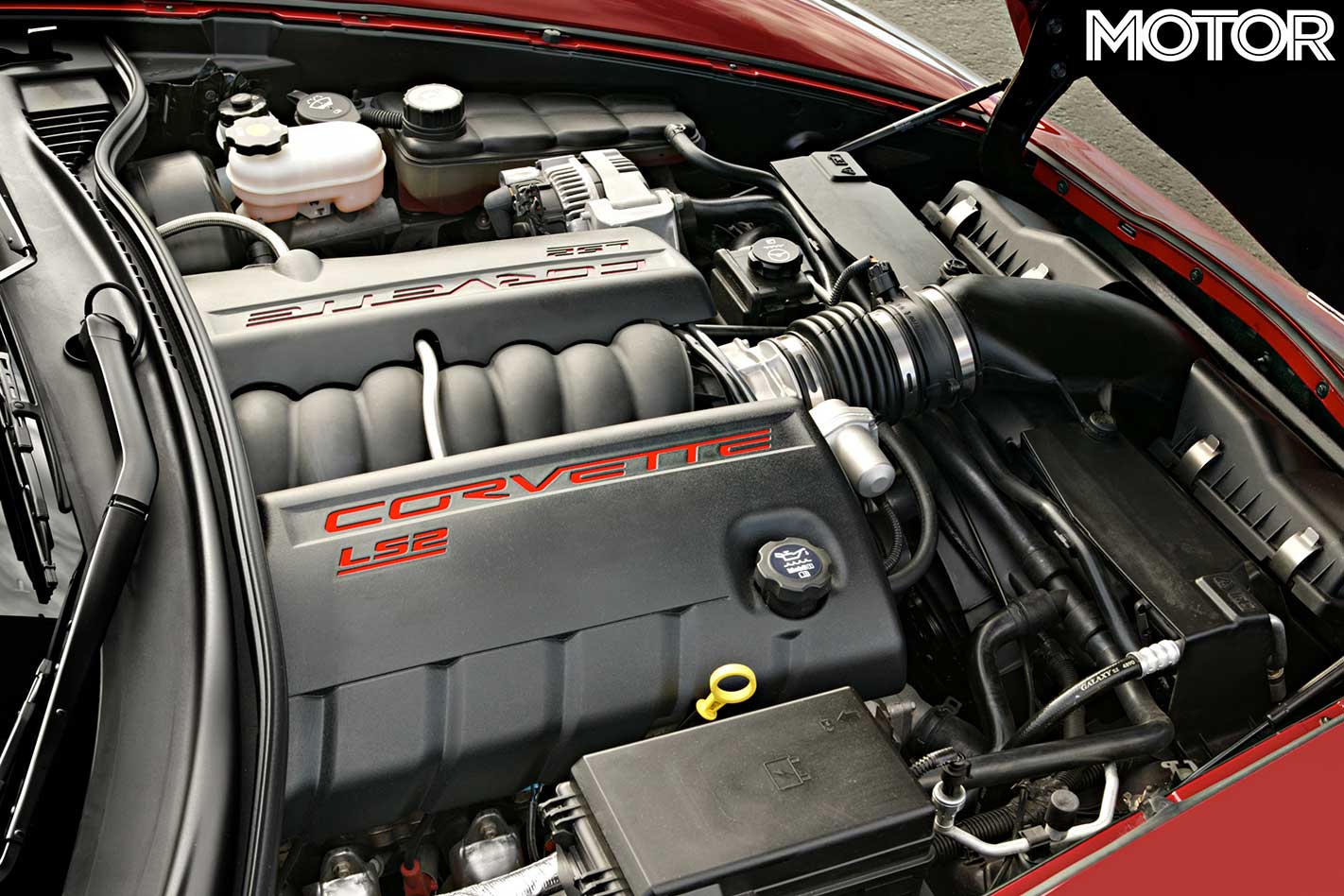
The LS2 not only bumps capacity from 5.7-litres to 6.0, but runs a whole load of minor tweaks and improvements over the LS1. The result is a stronger, beefier engine from floor to ceiling. It spits out 48kW more over the latest VZ SS LS1 incarnation, but needs just 400rpm more to do it. And it grunts out 15 percent more torque, with increases across the rev range. And they’re just the figures.
Yes, LS2 does seemingly yank a lot harder in a 1442kg Corvette than the LS1 in the 1654kg SS, no surprises there, but it’s the power curve that broadens, pulling harder low down, bulging with more mid-range and expanding its powerband to well into the mid-six grand range. It has a similar feel to a top-line HSV, such as a ClubSport or GTS, but its rumble is deeper, with a more purposeful throb, like a Gen III with a dash of Audi V8.
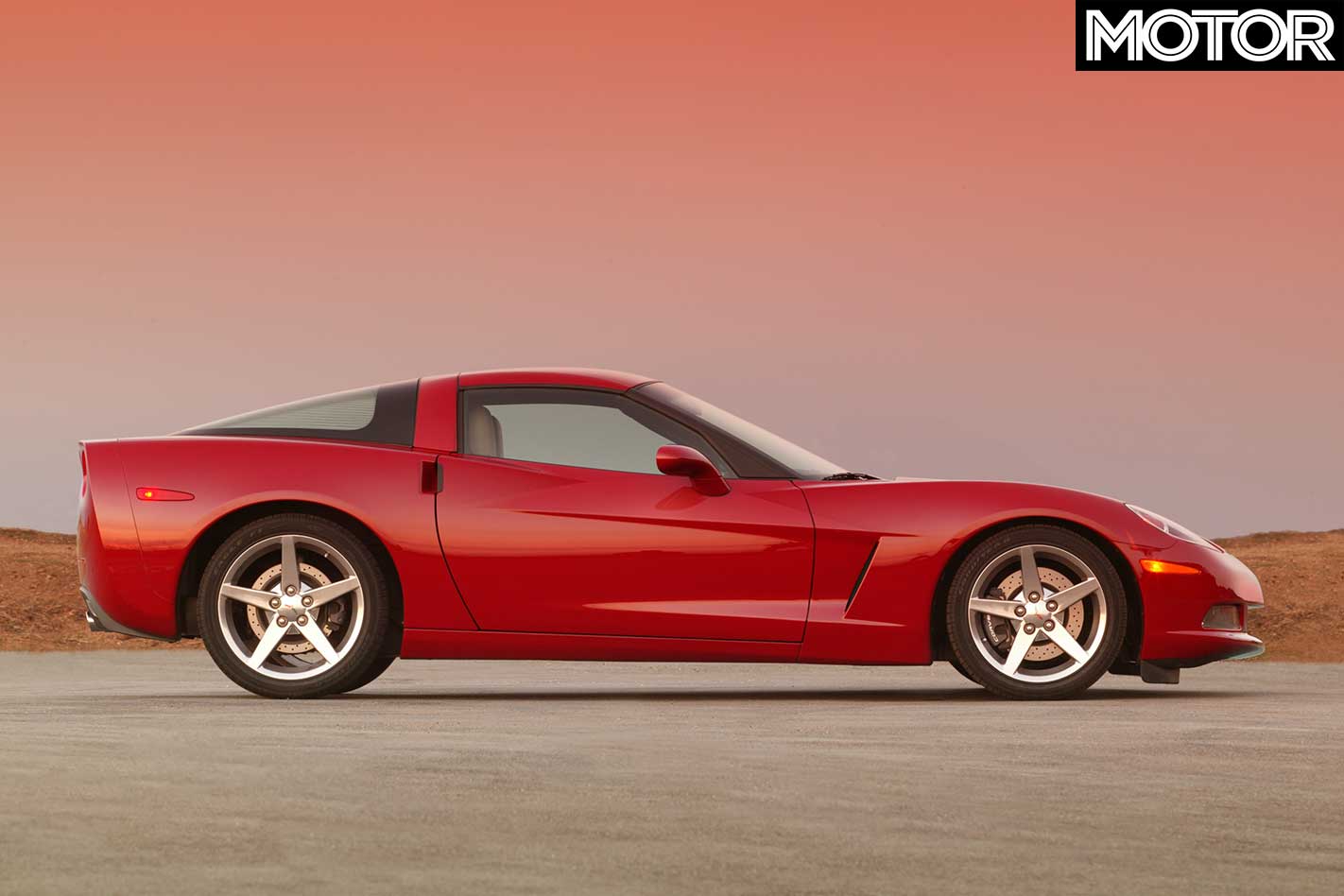
All of which is good news for Australia, because the LS2 will form the base for Holden and/or HSV V8 products in the coming years, with 300kW in ‘base’ trim, and more to come in specialised versions such as the high-performance LS7 and larger capacities like 6.2 litres.
It’ll allow the Australian divisions more freedoms to pick and choose the specific sporting models it sees fit and most appropriate to benefit from the 6.0 V8, with Monaro and SS right in the firing line, plus, of course, HSV.
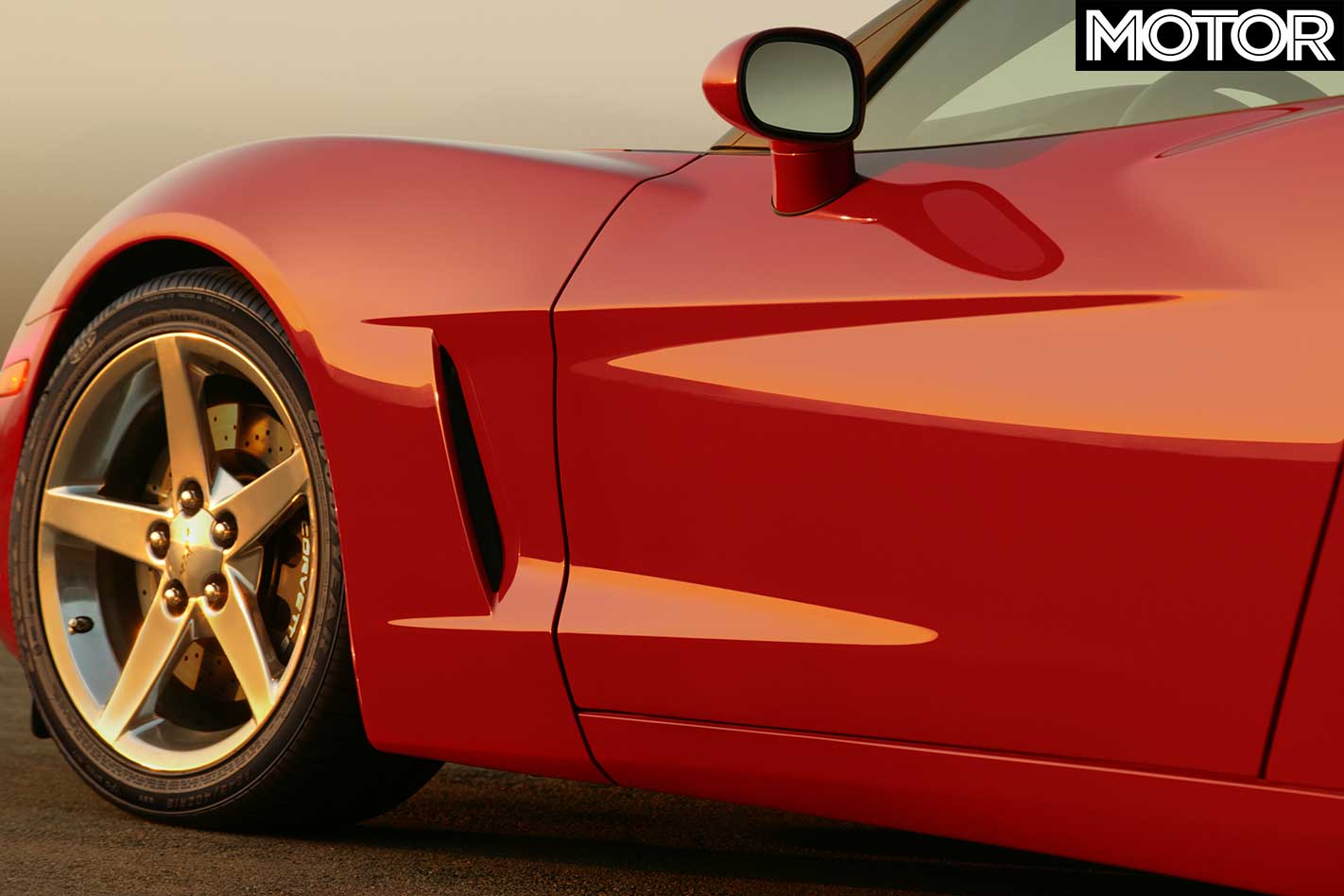
For now, there is no talk of the Corvette C6 heading our way, nor even being converted to right-hand drive, but with Cadillac building right-hook cars and talk of its imminent arrival, there may be a Corvette on the Australian menu a few years down the track.
Until then, we can look forward to a little piece of Corvette’s heart and soul in an Aussie performance V8 soon.
The C to Z Files
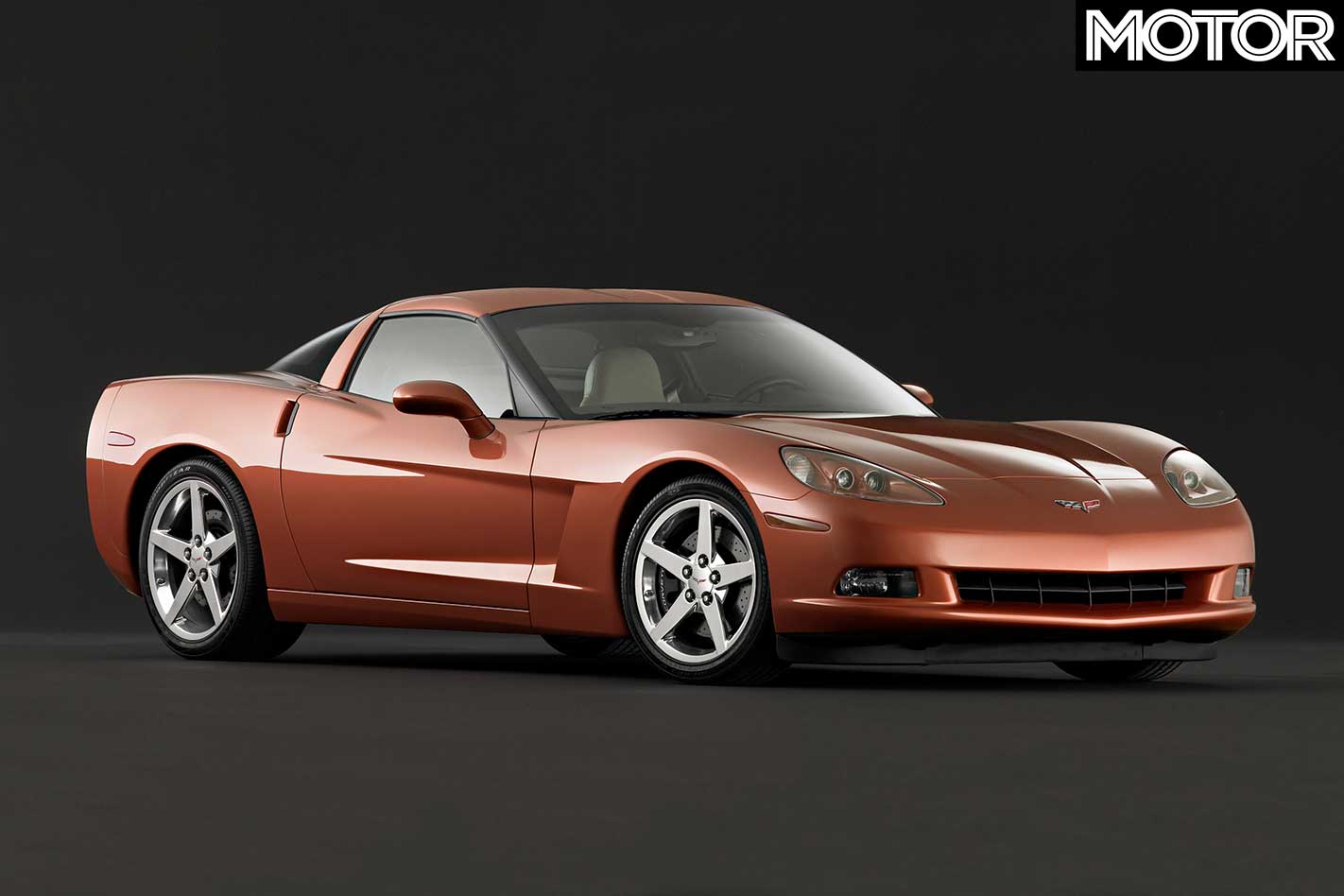
C6, Z06, Z51? Don’t worry, for non-Corvette spods, it’s easy to get confused.
C6 means the sixth generation of the Corvette, a history that spans back to 1953. Z51 is the ‘performance pack’ version, which includes shorter, more accelerative ratios for the first three gears and a one-tenth quicker 0-100km/h, at 4.1 seconds.
Although lacking external badging, the Z51 is spotted by its larger cross-drilled brakes. Finally, the Z06 is the high-performance version much like an HSV or FPV, to be powered by an LS7 when it arrives late 2005.
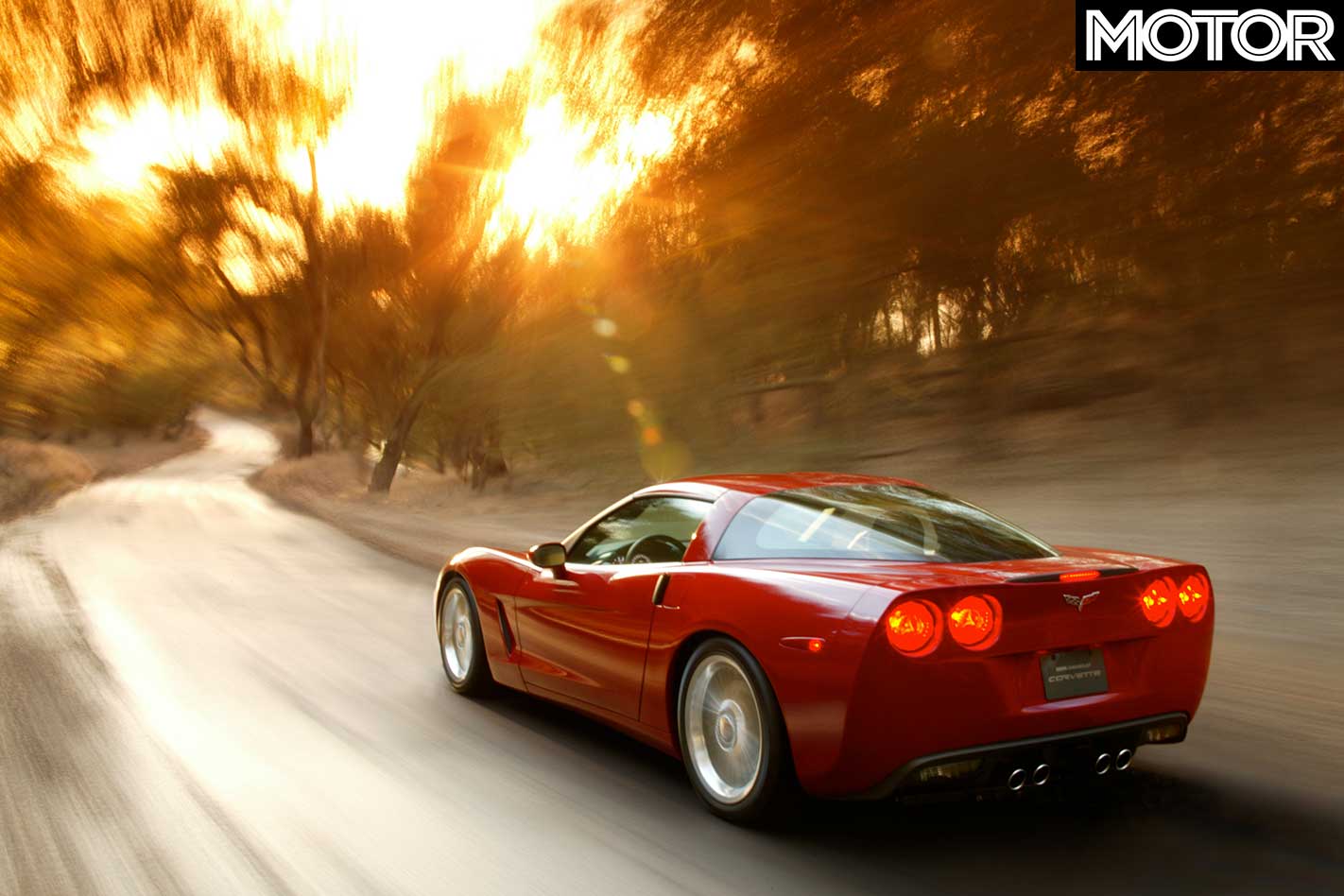
Six C6 Picks – Electric convertible roof last seen in 1962 – Same for fixed headlights – C6 is the first production Corvette to top 300km/h – It’s five inches shorter, one inch slimmer than C5 – Uses ‘proximity’ keyless unlocking and starting – Front end was styled on C5 Le Mans racer
FAST FACTS 2004 Chevrolet Corvette coupe Engine: 6.0-litre OHV 16-valve V8 Power: 298kW Weight: 1442kg Drive: rear-wheel Price: US$44,245
THE LS2 – 10 THINGS THAT MAKE IT NEW
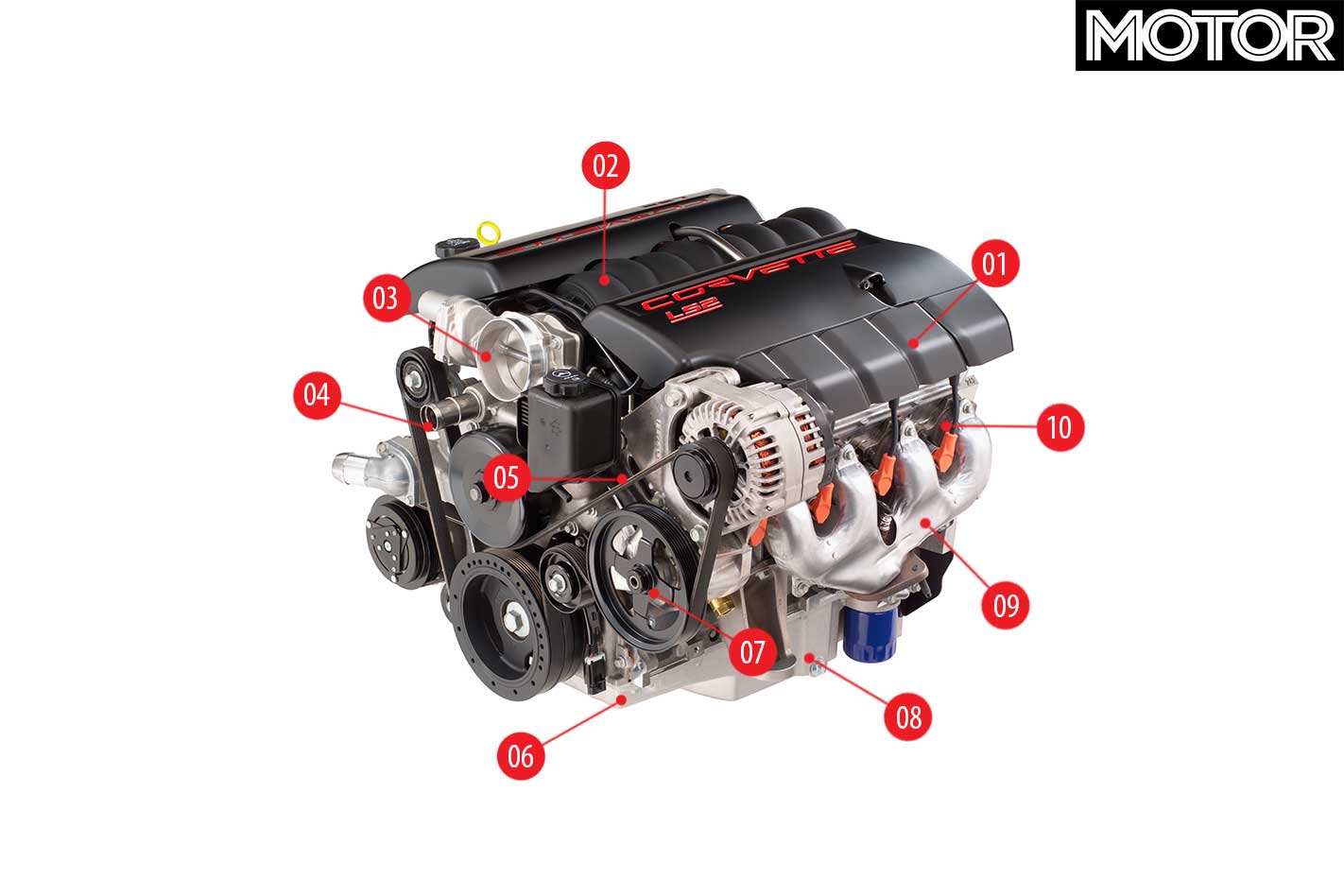
1. Boosted from 5.7 to 6.0 litres with larger 101.6mm bore pistons (vs 99mm). Potential for up to 6.4 litres 2. Better port design and flat-top pistons allow for higher 10.9:1 CR, on just 93 RON ULP 3. Larger 90mm throttle body, up 15mm over LS1, with electronic throttle control 4. Compact, lighter water pump is not only smaller, but flows more 5. Higher-lift cam plus stronger springs for 500rpm more 6. All new block – in fact, only carry-over parts from LS1 are valves, rockers and pushrods 7. Revised power steering and serpentine belt to deal with 500rpm higher limit 8. New oil pan design allows for all-wheel drive 9. Lighter, thinner, more compact exhaust manifolds flow more, but design allows for further power tuning 10. New cylinder heads and reshaped combustion chambers for better flow in and out
3 Things you may not know
1. Though block and head design is new for LS2, they’re interchangeable with LS1 2. Capacity up 5 percent, power up 19 percent, torque up 15 percent compared to VZ SS LS1 3. Both 101.6mm bore centres and 90-degree Vee have been around since 1950s
| u00a0 | LS2 (C6 Corvette) | LS1 (VZ SS) |
| Capacity | 5970cc 90-degree V8 | 5665cc 90-degree V8 |
| Bore x Stroke | 101.6mm x 92mm | 99mm x 92mm |
| Compression | 10.9:1 | 10.0:1 |
| Power | 298kW @ 6000rpm | 250kW @ 5600rpm |
| Torque | 542Nm @ 4400rpm | 470Nm @ 4800rpm |
