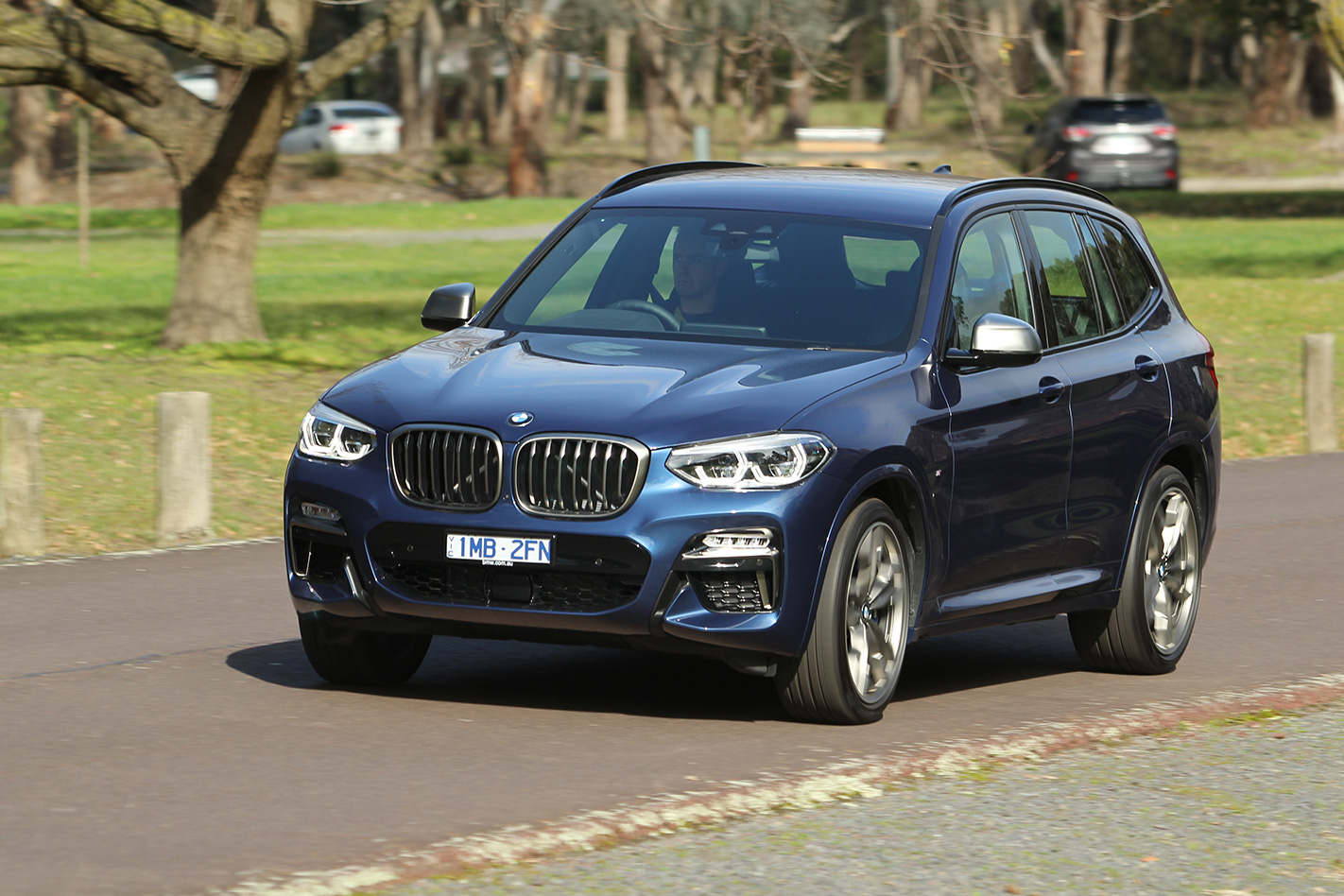
Since it was first introduced in 2014, the third-generation Toyota Kluger has led the large soft-roader SUV market, despite its market share being cannibalised by its LandCruiser Prado stablemate.
The Kluger has so far managed to see off fresher competition – including the excellent Mazda CX-9 – in the sales race, but as it nears the end of its model life, a new rival has arrived to threaten its dominance.
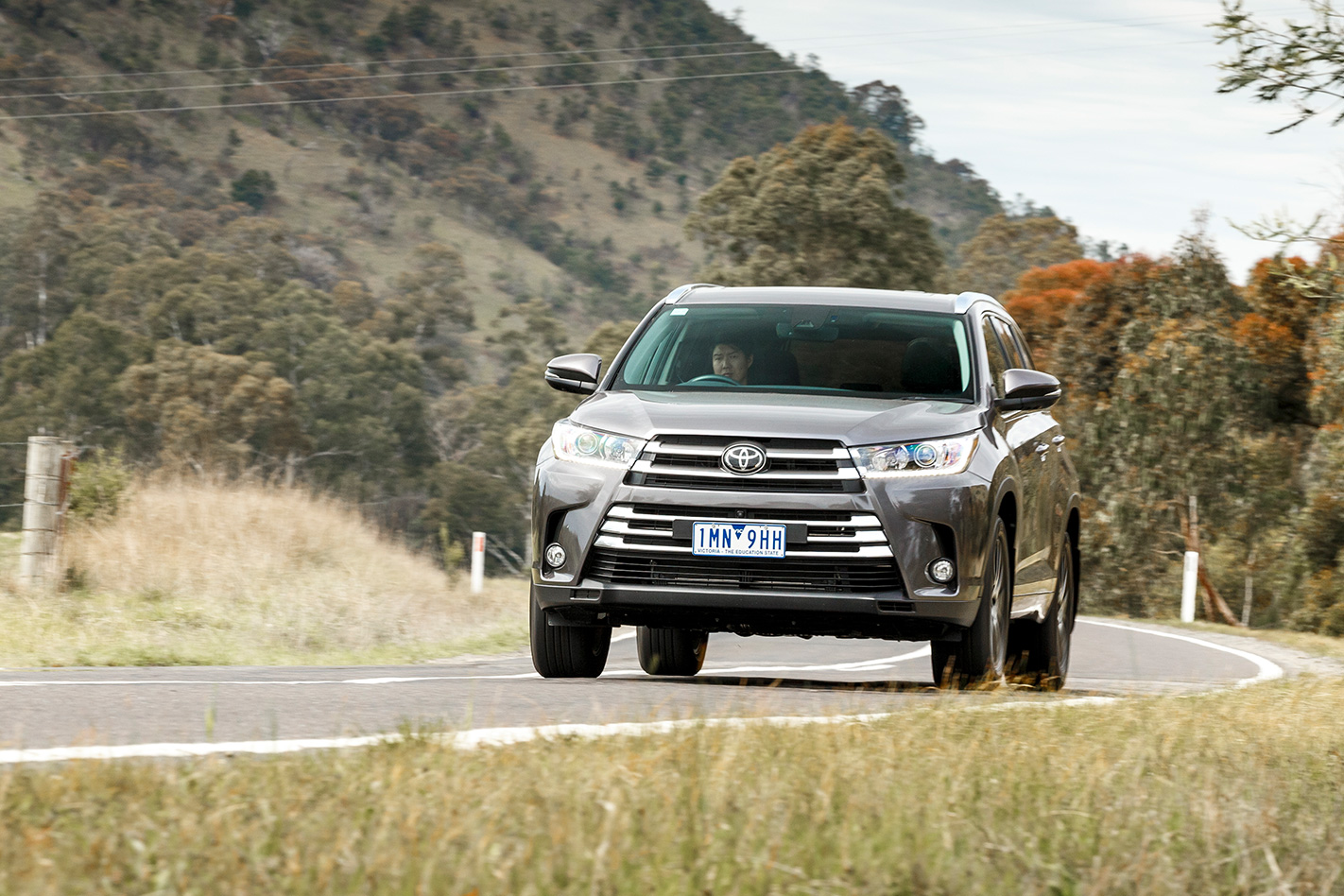
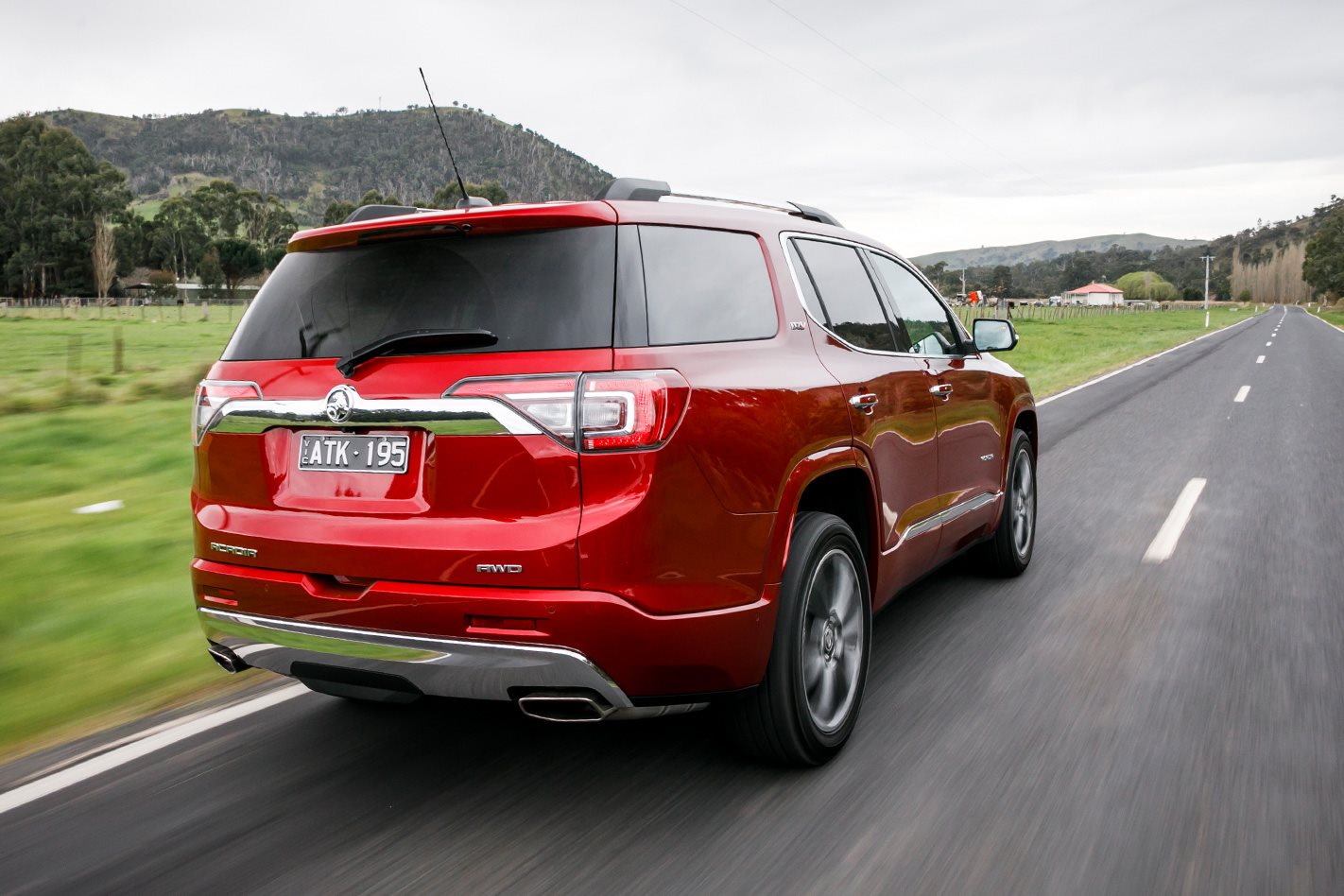
Like the Kluger, the Holden Acadia is primarily designed for the US market, with big brash lines and plenty of space that also appeals to Australian families. But is the Holden that replaced the Captiva 7 good enough to truly compete with Toyota in Australia’s rampant SUV market?
VALUE
The Acadia LTZ-V AWD retails for $67,490 and, excluding limited edition variants, is currently the most expensive vehicle to wear a Holden badge.
The LTZ-V is also available with 2WD for $4000 less, with both versions costing $20,000 more than their entry-level LT counterpart. 2019 Acadia pricing is as follows:
- Acadia LT 2WD – $43,490
- Acadia LT AWD – $47,490
- Acadia LTZ 2WD – $53,490
- Acadia LTZ AWD – $57,490
- Acadia LTZ-V 2WD – $63,490
- Acadia LTZ-V AWD – $67,490
For a limited time Holden is offering keen drive-away pricing on all Acadia variants offering the LTZ-V for $67,990 including on-road costs. Almost everything is included in the price with options confined to accessories, and prestige paint which attracts a $550 premium.
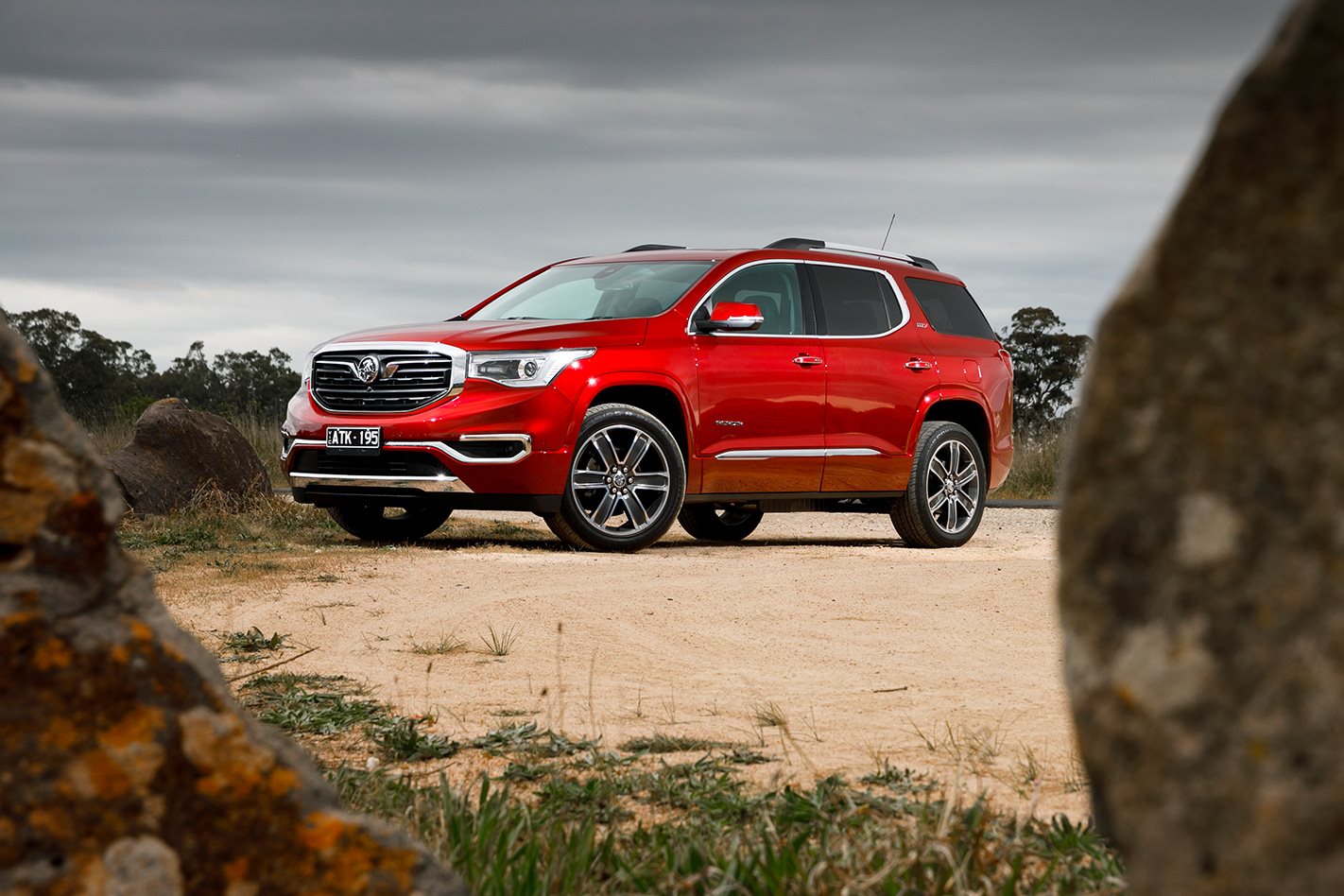
All Acadias are powered by a 3.6-litre V6 engine with nine-speed automatic transmission that, with AWD, drinks regular unleaded petrol at a rate of 9.3L/100km.
The Acadia also benefits from fixed priced scheduled servicing with 12-month or 12,000km intervals, and is covered by Holden’s five-year unlimited kilometre warranty.
The Kluger comes in three model grades, GX, GXL and Grande that are each available with front- or all-wheel-drive, with the latter attracting a $4000 premium. 2018 Toyota Kluger pricing is as follows:
- Kluger GX FWD – $44,500
- Kluger GX AWD – $48,500
- Kluger GXL FWD – $52,990
- Kluger GXL AWD – $54,990
- Kluger Grande FWD – $65,646
- Kluger Grande AWD – $69,617
The Grande does come with the full enchilada though, including active safety features that are optional in the GX and GXL grades meaning, apart from accessories such as floor mats and roof racks, the only extra you’ll pay is about $480 for premium paint should the standard Eclipse Black hue not be your thing.
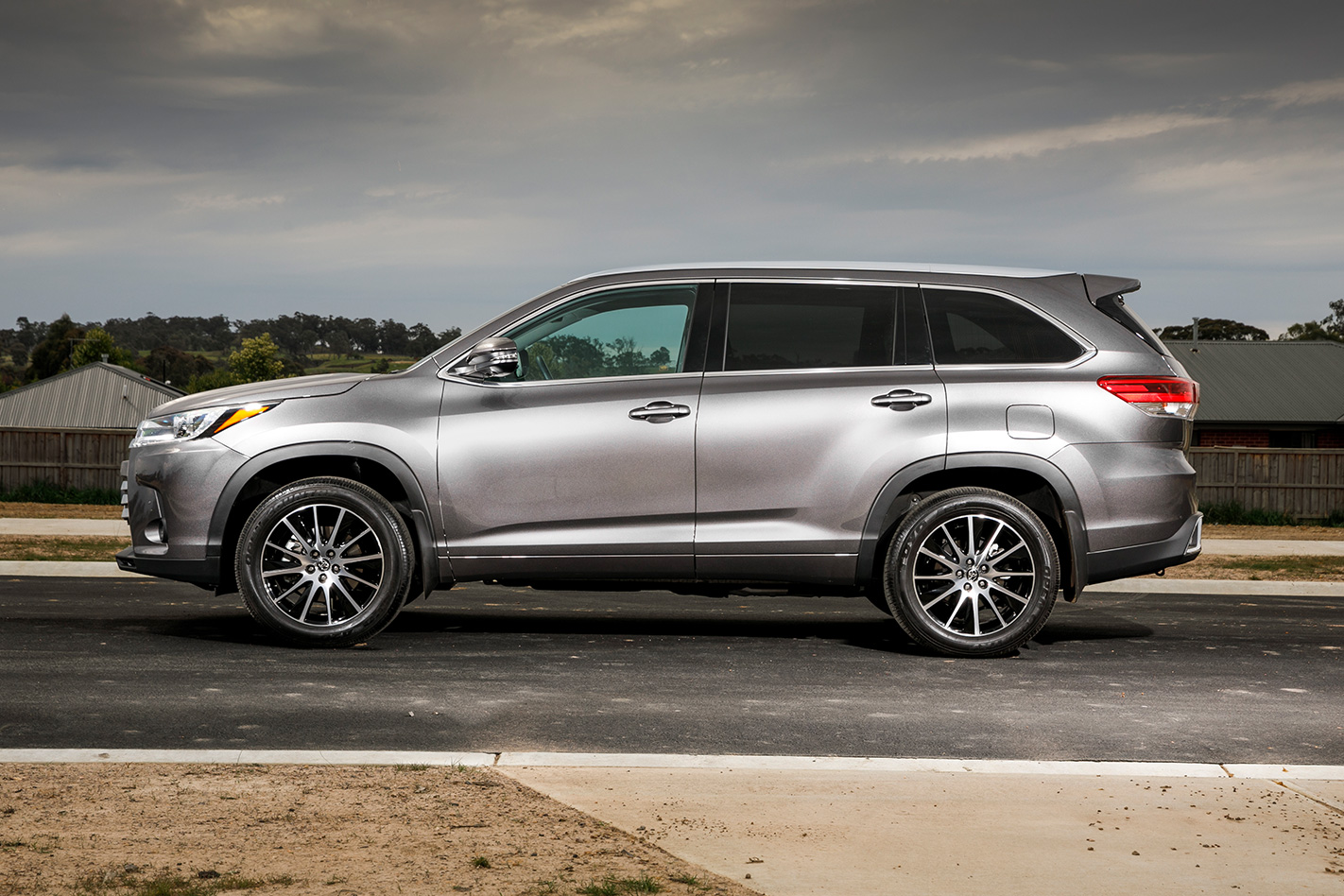
In all-wheel-drive guise the Kluger’s 3.5-litre V6 engine consumes regular unleaded petrol at an official combined rate of 9.5L/100km.
The Kluger requires servicing every 10,000km or six months, which is a higher frequency than most, though Toyota’s capped priced servicing means you’ll pay just $180 for the first six services during the first three years or 60,000km.
The Kluger is still covered by Toyota’s three-year/100,000km warranty, which seems a little stingy considering most of its rivals have at least five years/unlimited kilometre coverage.
STANDARD FEATURES
The Acadia LTZ-V is brimming with comfort and safety features starting with the standard equipment across the range that includes:
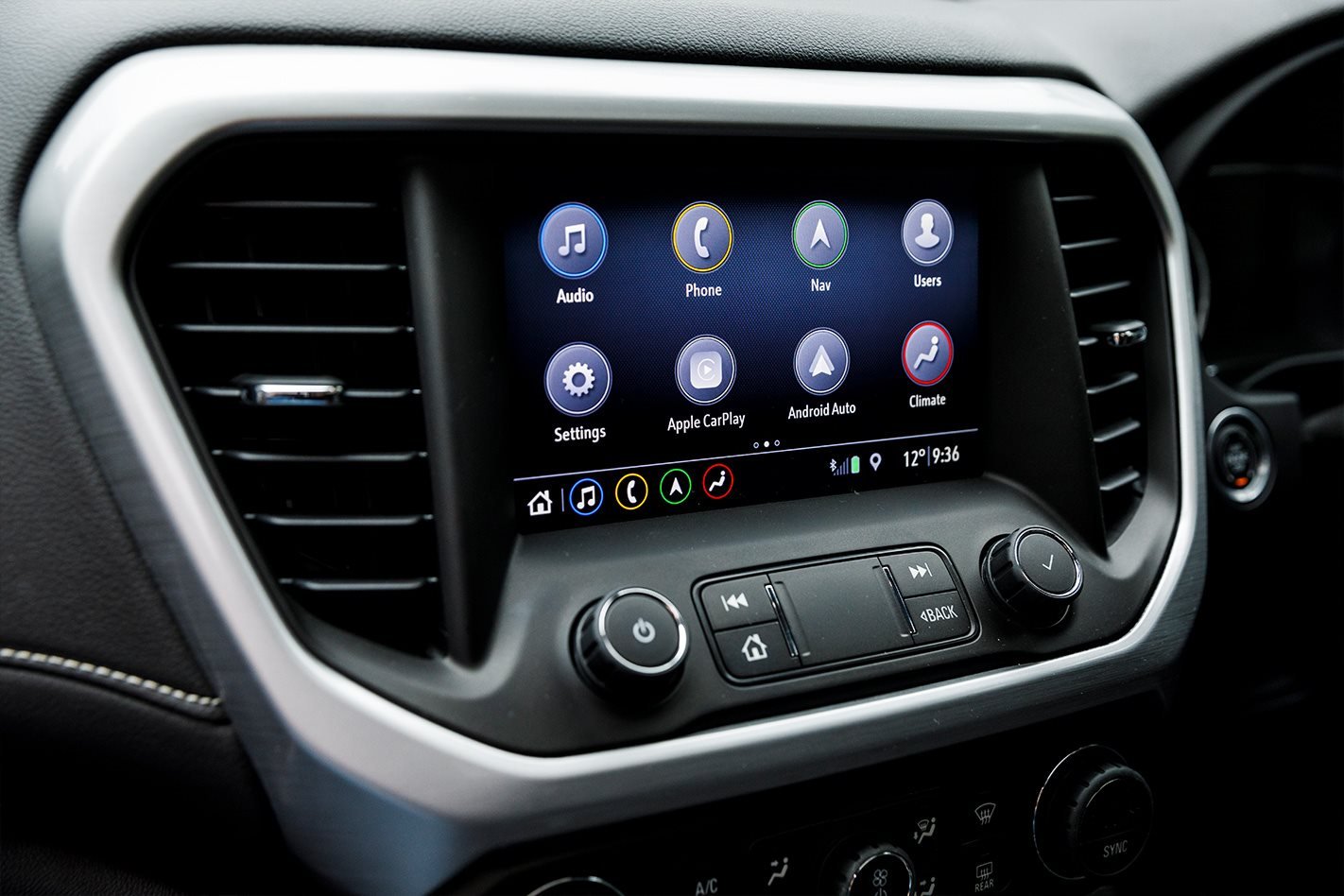
- The latest generation MyLink infotainment viewed via an 8.0-inch touchscreen
- Android Auto/Apple Carplay
- Satellite navigation
- Rear Park Assist
- Rear View Camera
- Traffic sign recognition with intelligent speed assist
- Hitch View System
- Towing package (accessory ball mount & tow ball required)
- Keyless entry/push-button start
- Tri zone climate control
- Alloy Wheels
- LED Daytime Running Lamps
- Autonomous emergency braking with bicycle and pedestrian detection
- Forward collision alert with head-up warning
- Blind spot monitoring
- Lateral impact avoidance
- Rear cross traffic alert
- Lane departure warning
- Lane keep assist
- Following Distance Indicator
- Driver Mode Control
- Leather-appointed trim
- 10-way power adjustable driver’s seat
- 8-way power adjustable front passenger seat
- Heated front seats
- Auto-dimming interior mirror
- Chrome door handles
- Front fog lamps
- Rain sensing wipers
- Wireless phone charging (compatible devices)
- Hands-free power tailgate
- Front Park Assist
- Advanced Park Assist
- 10-way power adjustable front passenger seat
- Driver’s seat memory
- Ventilated front seats
- 20-inch alloy wheels
- Dual-panel sunroof
- Bi function HID headlamps
- ‘FlexRide’ adaptive suspension
- Adaptive cruise control with stop & go
- All-speed autonomous emergency braking
- 360-degree camera
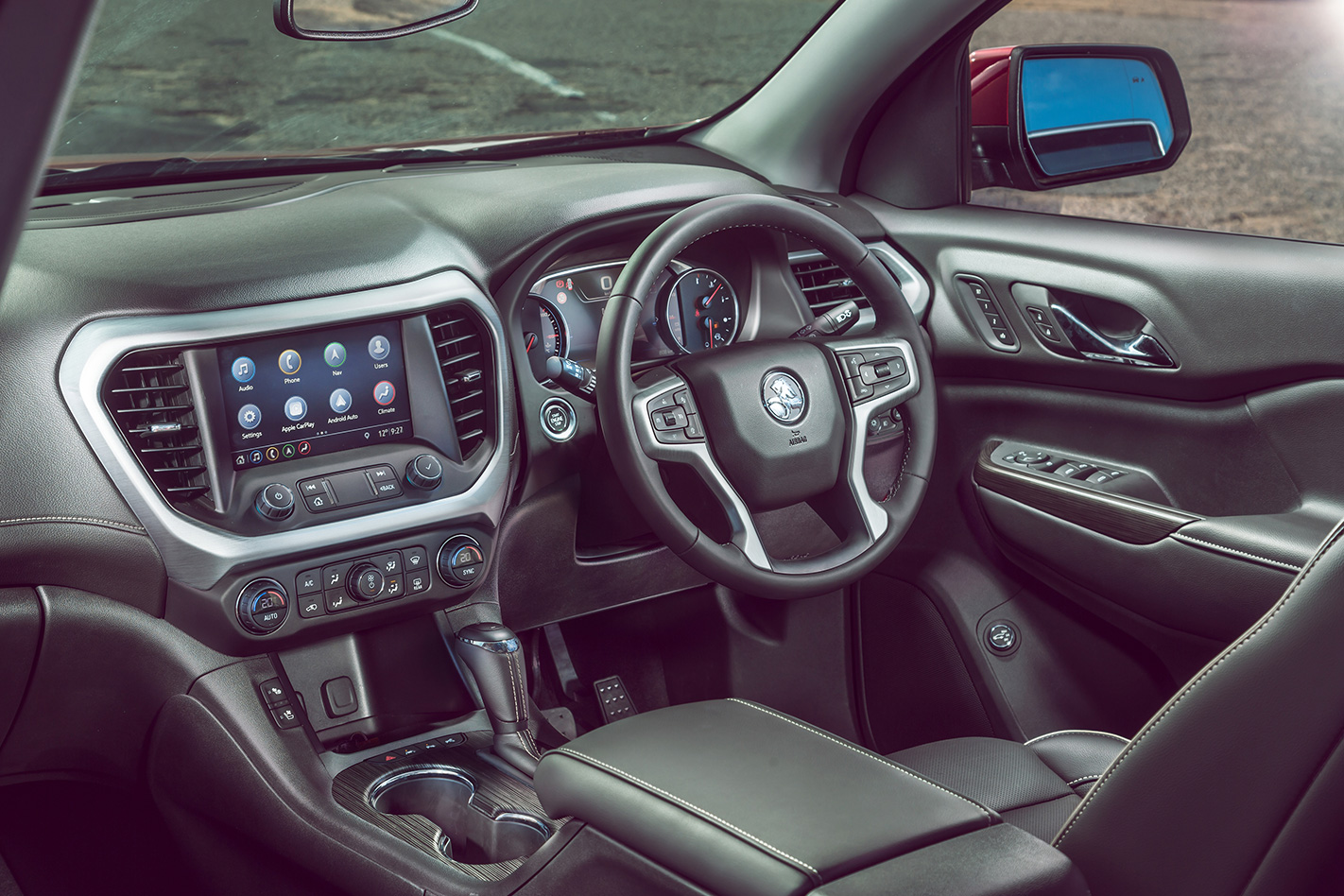
- Digital dashboard display
- 8-Speaker Bose Premium Audio with amplifier and subwoofer.
The Kluger Grande AWD brings additional safety and luxury features over and above the standard features list and brings for its $67,490 retail price tag:
- Part leather upholstery
- Three-zone air-conditioning
- Keyless entry
- Power-operated tailgate
- Heated and ventilated front seats
- Power adjusted front seats, with driver’s seat memory
- Sunroof
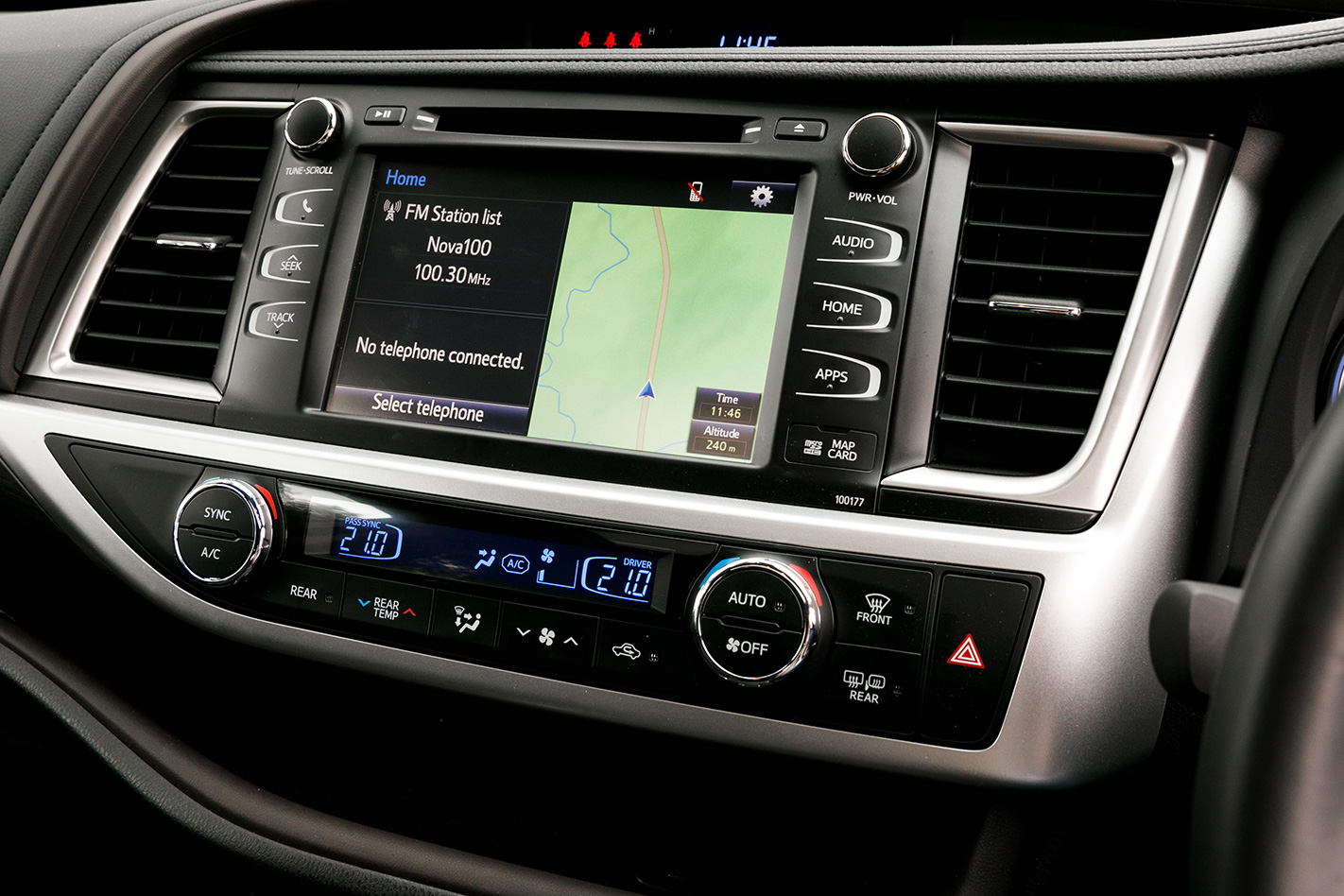
- 8.0-inch touchscreen
- Digital radio
- Satellite navigation
- Autonomous emergency braking
- Lane keeping assist
- Adaptive cruise control
- Rain-sensing windscreen wipers
- Reverse parking sensors
- Rear-cross traffic alert
- Blind-spot monitor
- Rear-cross traffic alert
- Auto-dipping dusk-sensing headlights
- Daytime running lights
- 19-inch alloy wheels
SIZE
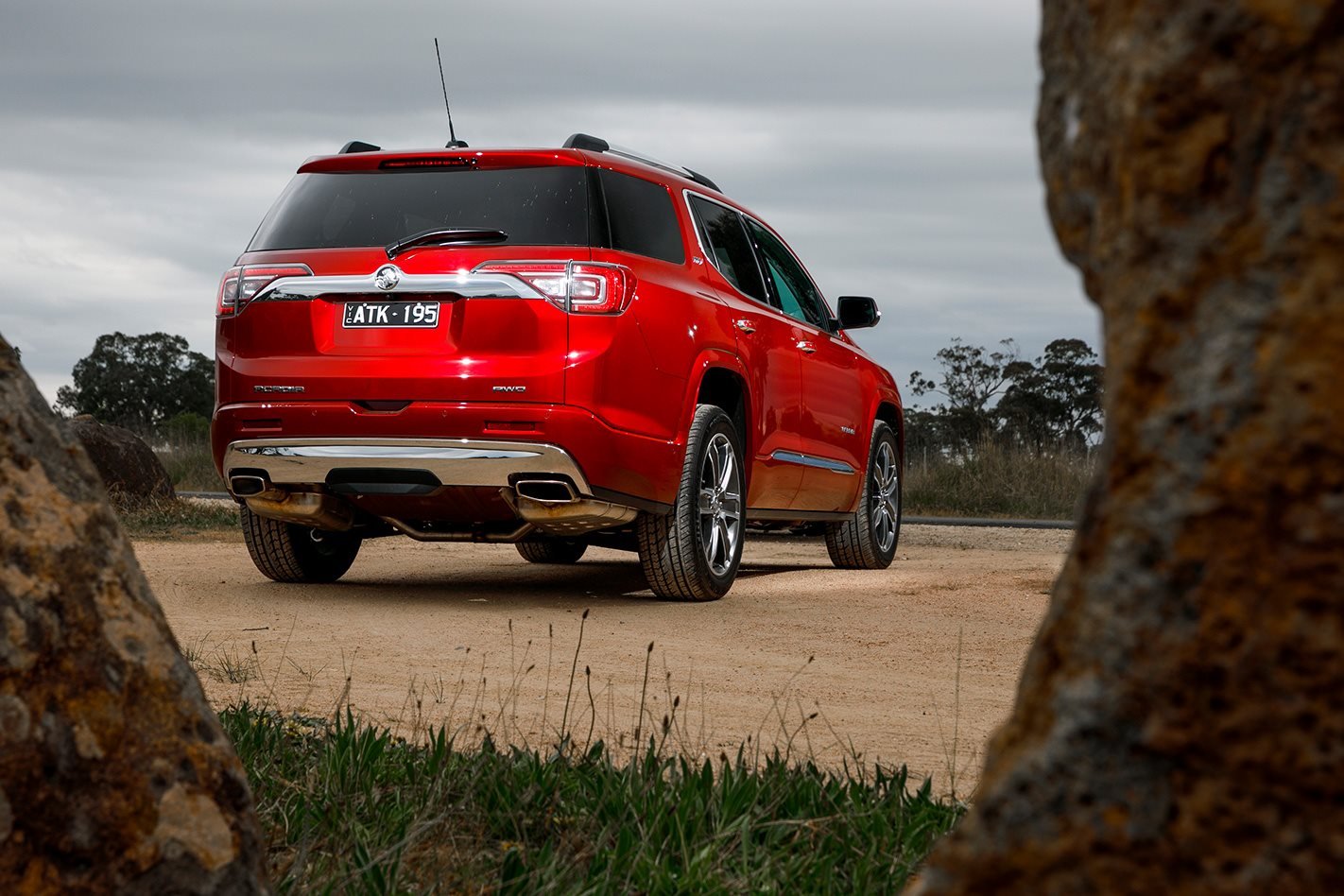
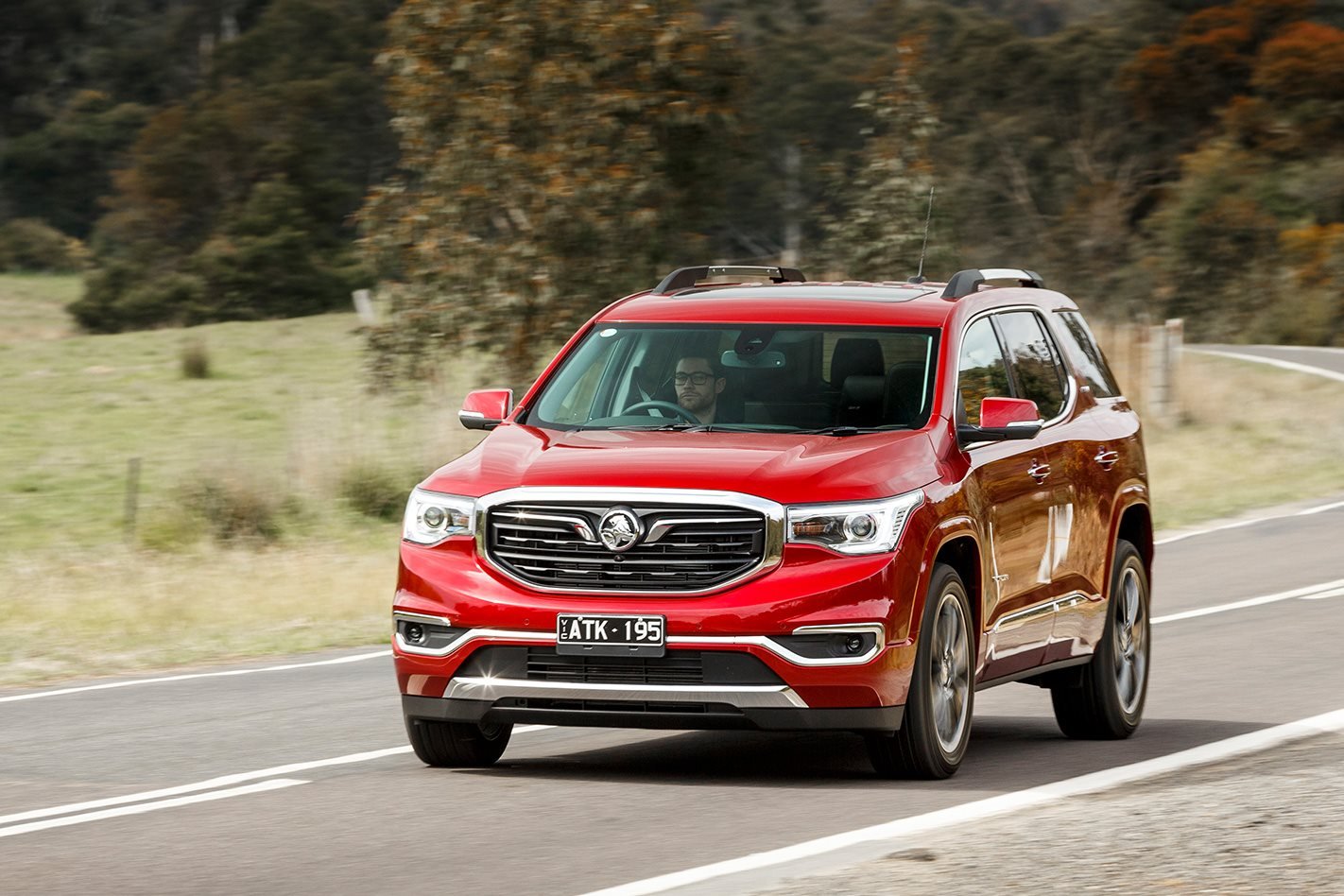
The Acadia’s 4.98m length, 1.92m width and sizable 2.86m wheelbase translates to genuine three-row accommodation for up to seven adults. The middle row seats slide back and forth to provide good legroom in the third row without compromising anyone else’s comfort.
The Acadia LTZ-V stands at 1.77m high, which means good headroom in all three rows even with the panoramic sunroof.
With all seats in place the boot holds 292 litres, which expands to a capacious 1042 litres. Fold down both the third and second rows and you can store up to 2102 litres behind the front seats.
The US-built Kluger is 4.89 metres long and 1.93m wide with the main cabin sitting above its 2.8m wheelbase. One reason for its popularity is that while it comfortably accommodates a family of seven, its size isn’t a hindrance when it comes to parking or negotiating city streets.
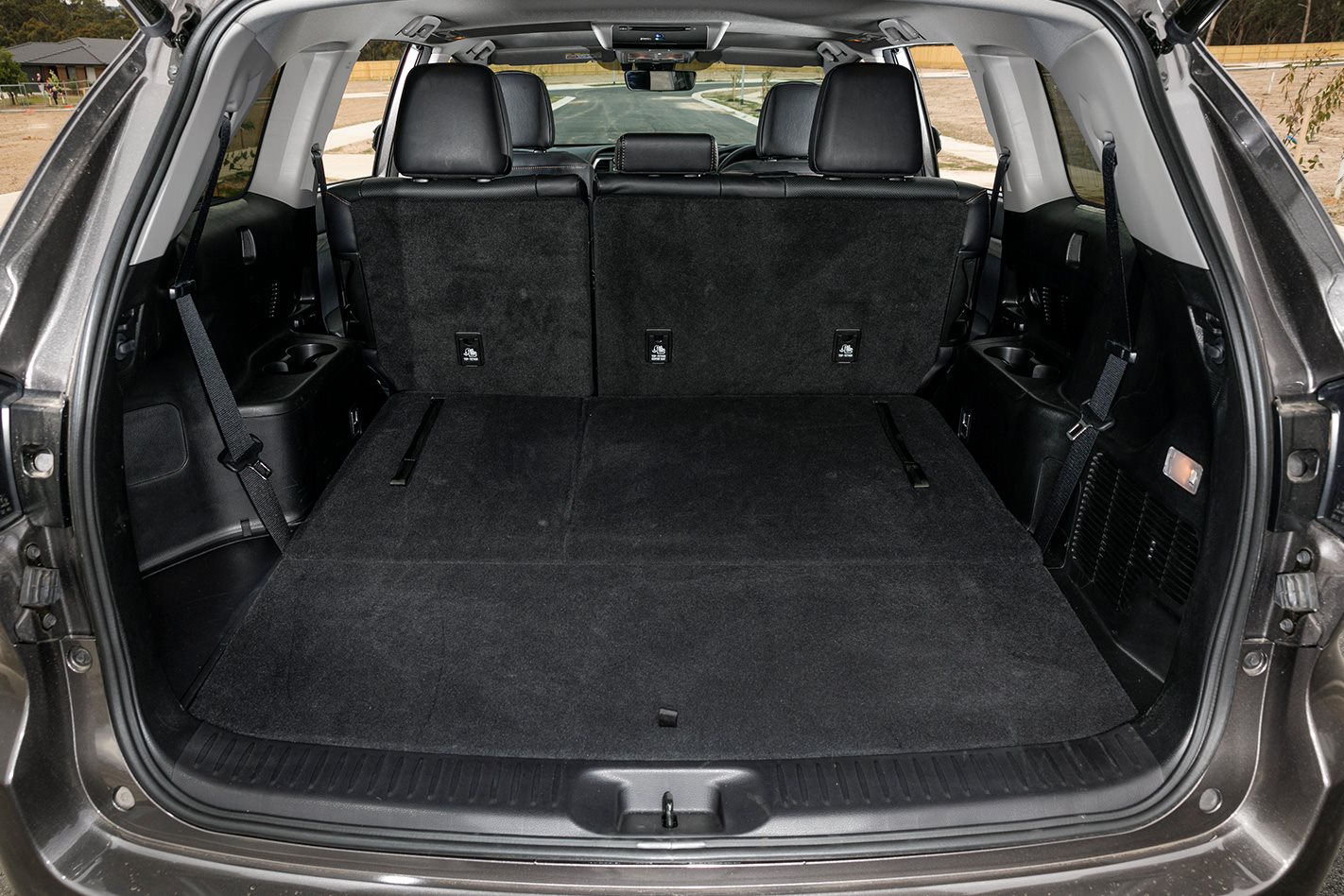
Head and legroom is excellent in the first two rows, but get a little tight in row three that’s best suited for kids.
SAFETY
The Acadia takes safety features introduced to the ZB Commodore a step further with active safety and driver assistance tech designed to protect vehicle occupants as well as other motorists, cyclists and pedestrians.
This includes traffic sign recognition that can work with the speed limiter to automatically govern your speed to the limit when you enter a new speed zone. The system was developed by Holden engineers who tested it around Australia so the system could recognise the dozens of different speed signs posted throughout the country.
The Acadia’s autonomous emergency braking recognises cars, cyclists and pedestrians, and in the LTZ-V, works at highway and city speeds.
The LTZ-V is the only Acadia to feature adaptive cruise control, which also functions in traffic jams.
Other key safety features include rear-cross traffic alert, lane-keeping assist, blind spot monitor, and lateral collision avoidance that steers the Acadia to the side to avoid a vehicle beside it, if it begins to stray from its lane.
The Acadia also has seatbelt alerts and a passenger reminder that warns you to double check that you haven’t forgotten any sleeping kids, pets or valuables before you leave the vehicle.
Crash protection includes seven airbags including driver’s knee and full-length side curtain protection that extends to the third row.
The second row has two ISOFIX child seat anchor points and there are five conventional child restraint anchors including two in the third row.
The Holden Acadia is yet to receive an ANCAP crash rating.
The Kluger Grande comes with the full suite of available active safety features, including radar-based autonomous emergency braking that works at city and highway speeds – part of what Toyota calls its Pre-Collision Safety system. This is backed up by lane-keeping assist, blind-spot warning and rear-cross traffic alert.
The Kluger is also equipped with seven airbags, including driver knee bag and side curtain protection for all three rows, and it has three child-seat anchor points for the middle row of seats but none for the back row.
The Kluger scored the maximum five-star ANCAP safety rating in April 2017.
COMFORT
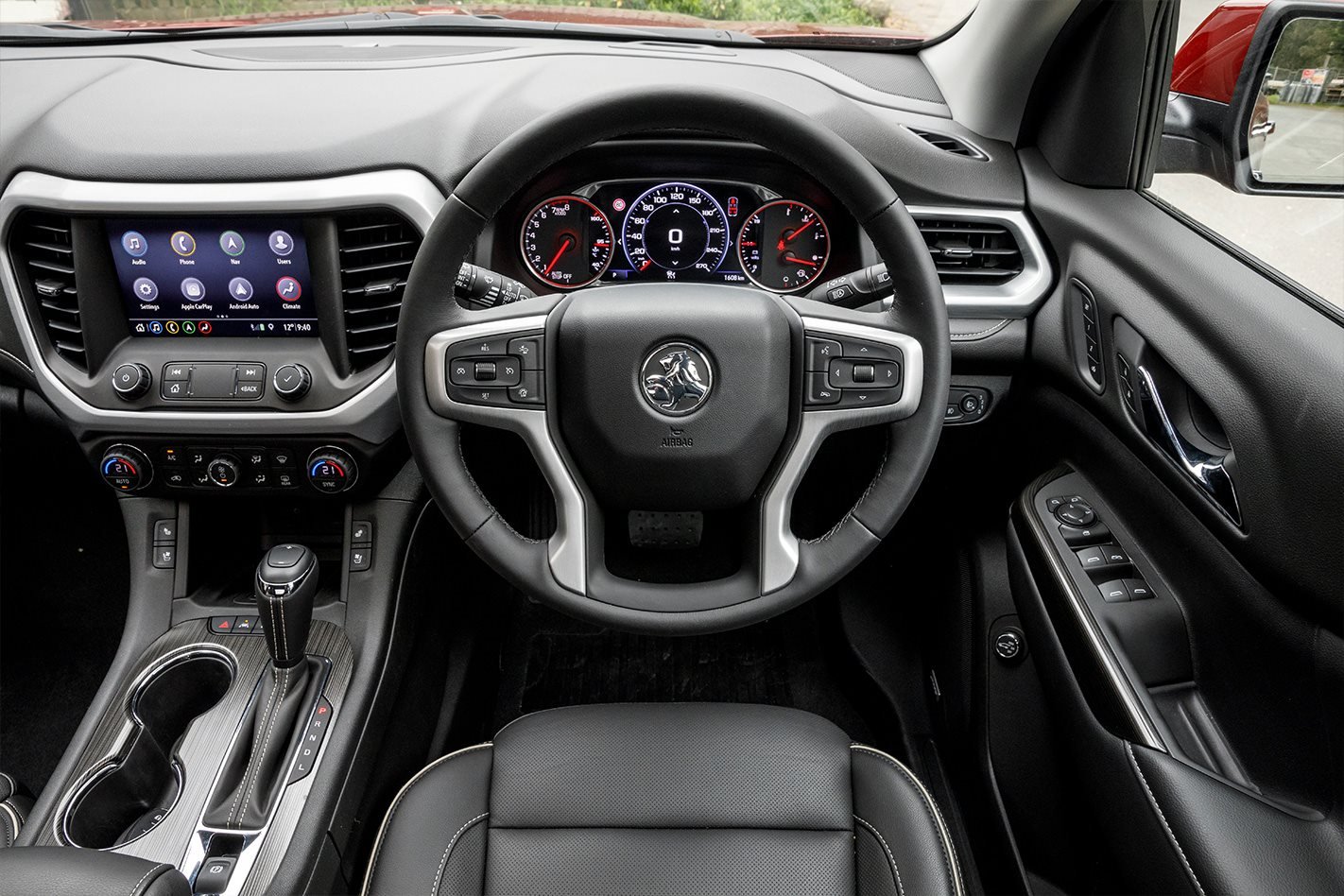
The Acadia LTZ-V’s interior is full of premium features but suffers from a lack of finesse – a common trait in many American-built cars. Apart from the leather upholstery and extra buttons it doesn’t look too different from the entry-level LT, though that can be taken as a compliment toward the LT that’s very well equipped for the price.
That said, soft-touch surfaces abound and the leather seats are very comfortable. The heated and ventilated front seats support you from each side making you feel like you could drive all day, and even the middle and third row benches feel plush.
Second row passengers get their own climate control settings with air vents in the ceiling, reading lights, a deep drawer that slides out from under the centre console and two USB sockets – all USB sockets in the Acadia are rated at 2.1 amps to allow for fast charging of larger devices such as tabletThe third row is among the roomiest of all seven-seat SUVs and is even on par with the Kia Carnival people mover. It seats two adults with enough legroom so they’re not looking at their knees. Third row passengers also get a USB socket, reading lights and ceiling mounted air vents.
Getting in to the third row is helped by being able to slide the second-row forward, but the door opening is a little narrow meaning entry and egress can become a rather ungraceful exercise.
Storage options are extensive throughout the cabin and include door bins with a separate nook under the arm rests, and under-floor tubs in front of the second row seats.
At the time of launch the Aussie developed multi-media system was the most advanced of any GM vehicle worldwide. It’s intuitive, with sharp graphics including the reversing/360-degree camera display, and you can sync two phones at a time via Apple Carplay or Android Auto.
The LTZ-V also has a digital gauge display that looks good, but it simply displays analogue-like gauges and a multi-function display with no alternative functions as with systems such as Volkswagen’s Digital Cockpit.
Road noise is well contained and the ride comfort feels silky even on the 20-inch wheels, thanks to the adaptive dampers.
Speaking of wheels, our one major bugbear with the Acadia is access to the spare wheel, which is hidden under the boot floor and another layer which makes it difficult to find, let alone remove even after you’ve removed all your cargo and folded away the third row seats.
The Kluger Grande’s stylish cabin looks well put together and you can choose between dark black and tan trim with neither costing extra. That said it doesn’t feel like a $70,000 car.
Cabin storage abounds, starting with huge centre console bin, and broad storage tray above the glovebox that is good for holding phones. Big door pockets and a deep centre console provide ample space for bottles, handbags and the like.
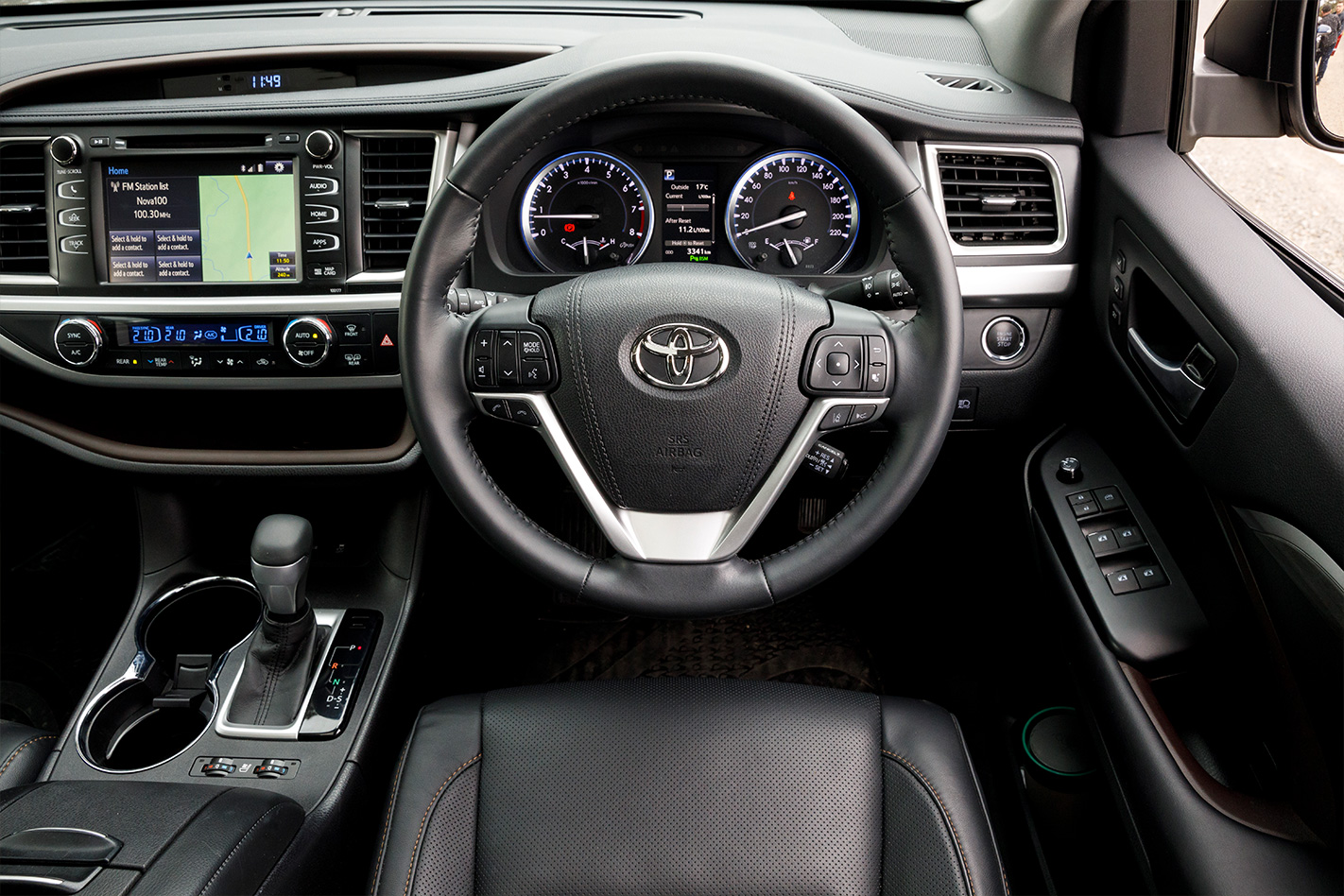
First and second-row seats are plush and supportive, for good long distance comfort. The third row seats are reasonably comfortable, but pretty tight for bigger people for anything more than short trips, though legroom is helped by being able to fit your feet under the second row seats.
Ventilation controls are big and easy to operate, and there is a separate control unit for rear passengers mounted on the ceiling that blows airs through vents located in the third and second rows. There are also retractable blinds in which slide up and down to cover the rear-door windows and protect children from the direct sun.
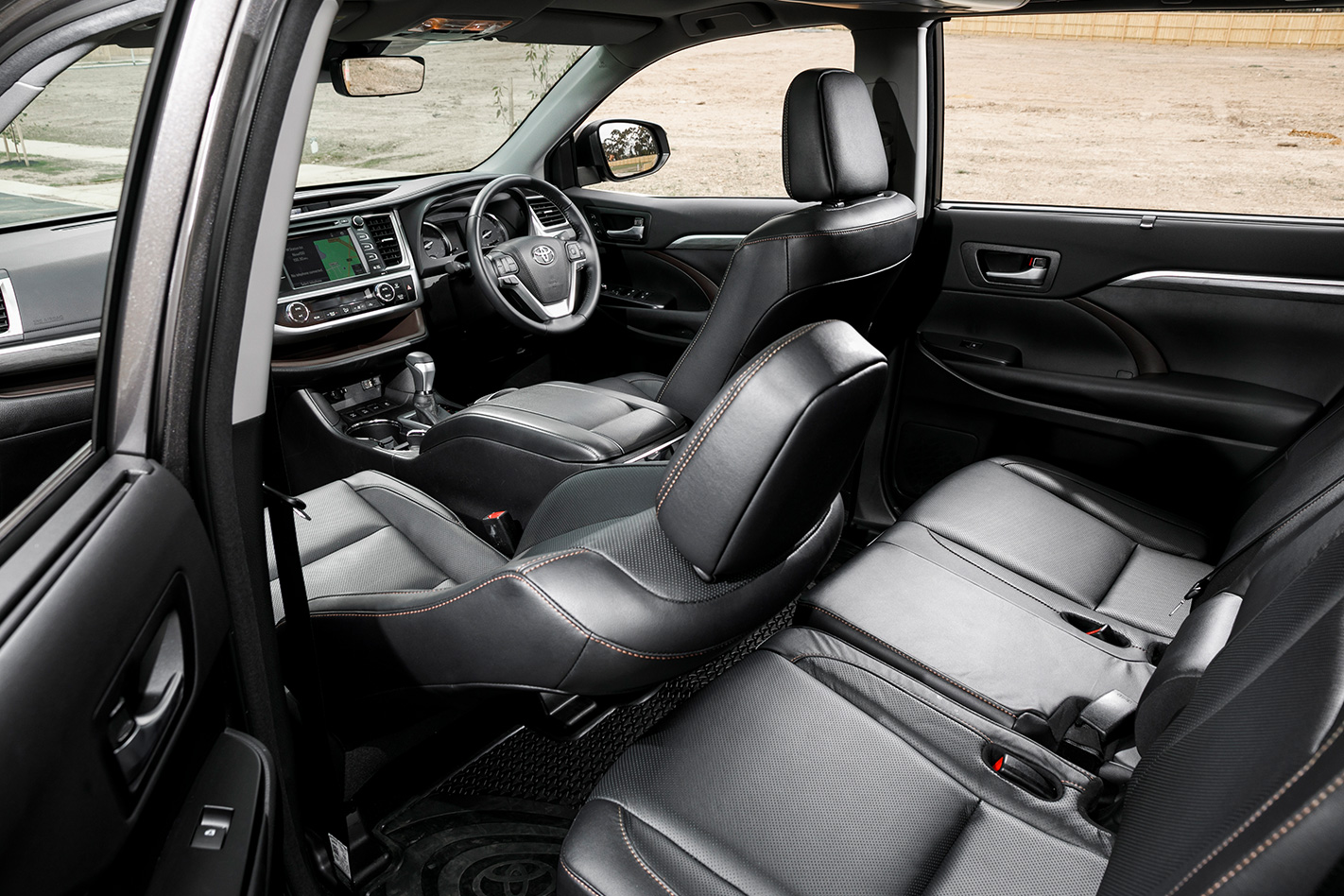
On a country road or freeway, the Kluger is impressively quiet inside and rides comfortably. The cabin filters out road noise, but the wind can be loud around the big door mirrors.
ON THE ROAD
Despite its American truck looks and 2032kg kerb weight, the Acadia LTZ-V has car-like handling that benefits from its ‘Flexride’ adaptive suspension and an extensive local tuning program to make it more comparable with Aussie roads.
One of Holden’s engineers told WhichCar he reckons they’ve got the LTZ-V to feel like the VF Holden Caprice luxury sedan and once behind the wheel we realised he was actually serious.
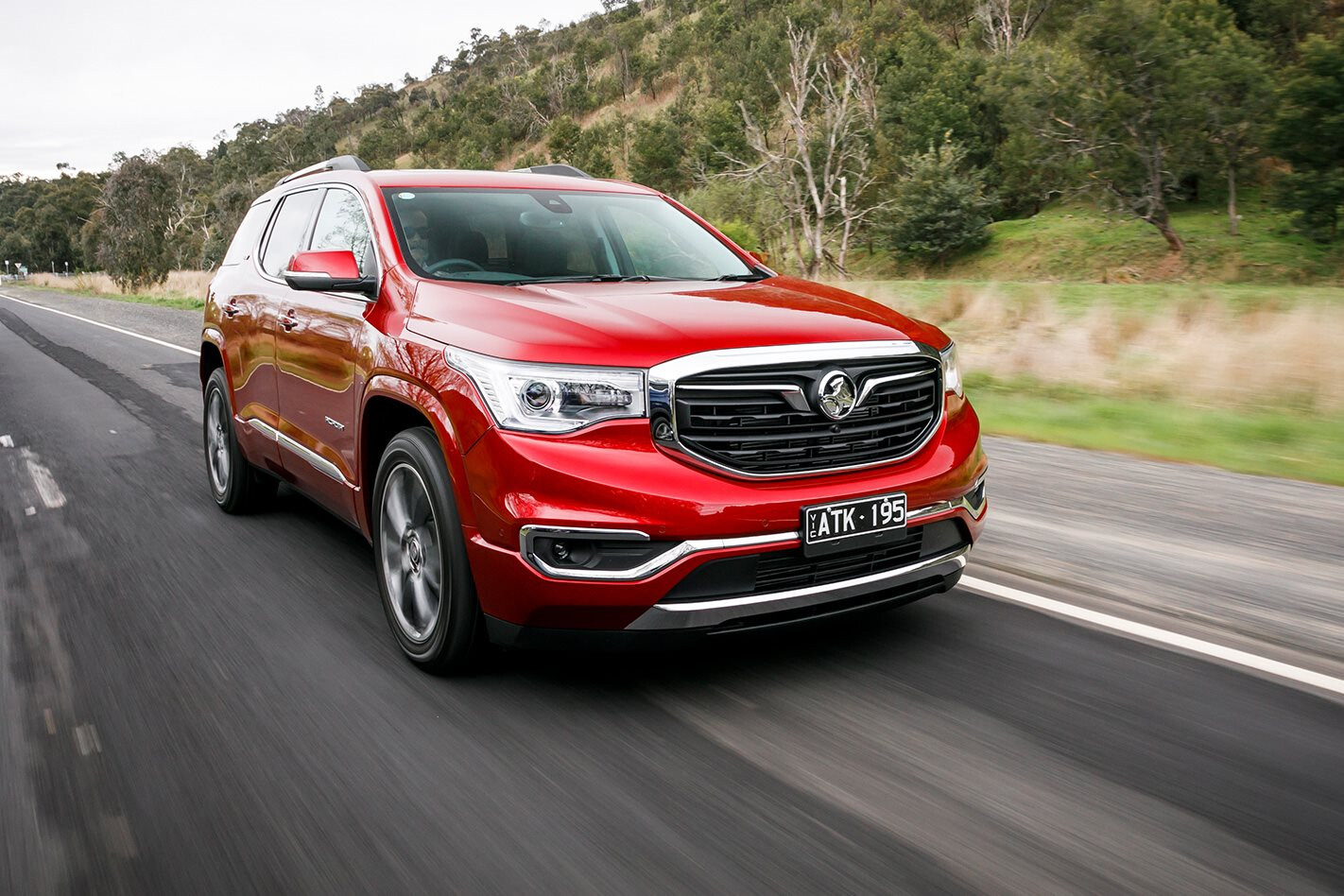
The Acadia’s ride feels soft and loping, but well composed, while switching the Sport driving mode stiffens the adaptive dampers, as well as adapting the gear ratios, steering and traction, resulting in precise and composed cornering with surprisingly little body roll even when sitting in the third row.
The AWD system comes with five selectable drive modes: 2×4 to help save fuel, 4×4, Sport, Off-Road and Trailer/Tow, but unfortunately there is no Custom mode to allow you to mix and match sport and comfort settings.
The Acadia shares the same 3.6-litre V6 engine and nine-speed automatic transmission as the Commodore, though in a slightly less powerful tune that offers up to 231kW and 367Nm. With all the extra gear, the LTZ-V AWD is the only Acadia variant to exceed two tonnes, but that doesn’t seem to bother the V6, which hauls the heft well and offers a nice rumbling sound to go with its macho American looks.
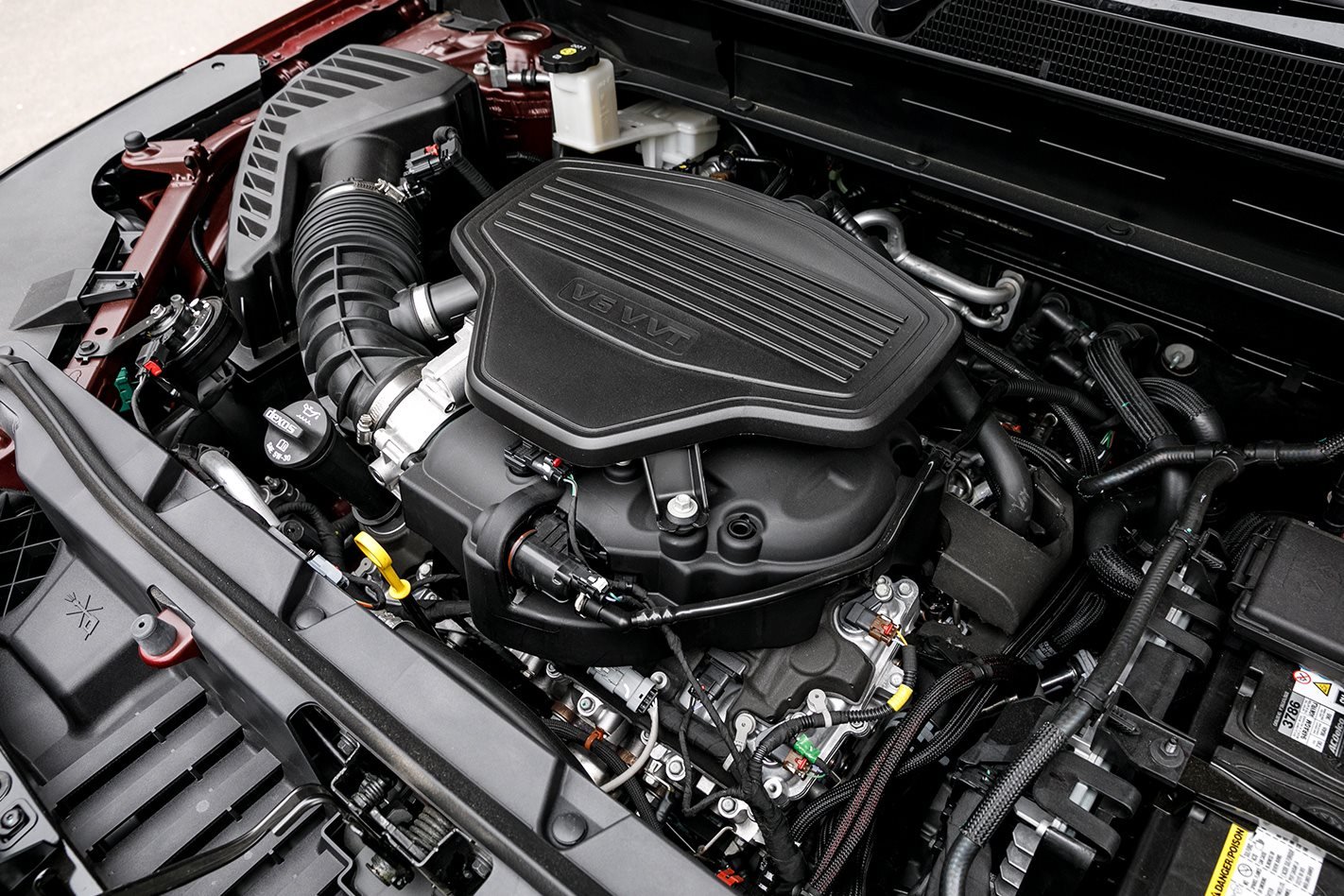
It’s enjoyable to drive, but there’s no opportunity to engage more with no manual shifting option via the gear shifter or steering wheel paddles, though there is toggle switch that lets you select lower gears when towing.
The Acadia will tow up to 2000kg and the Trailer/Tow drive setting changes the auto transmission’s shift patterns to provide more torque or traction when needed. All Acadia’s also come standard with a tow bar to attach a tow ball mount, and there’s also a hitch view system that lets you line up the tow ball and trailer via the reversing camera display.
The Kluger is pleasant to drive with a comfortable seating position and good forward vision. It feels planted to the road and the 218kW/350Nm 3.5-litre V6 engine runs smoothly and quickly responds to your right foot via the eight-speed automatic transmission.
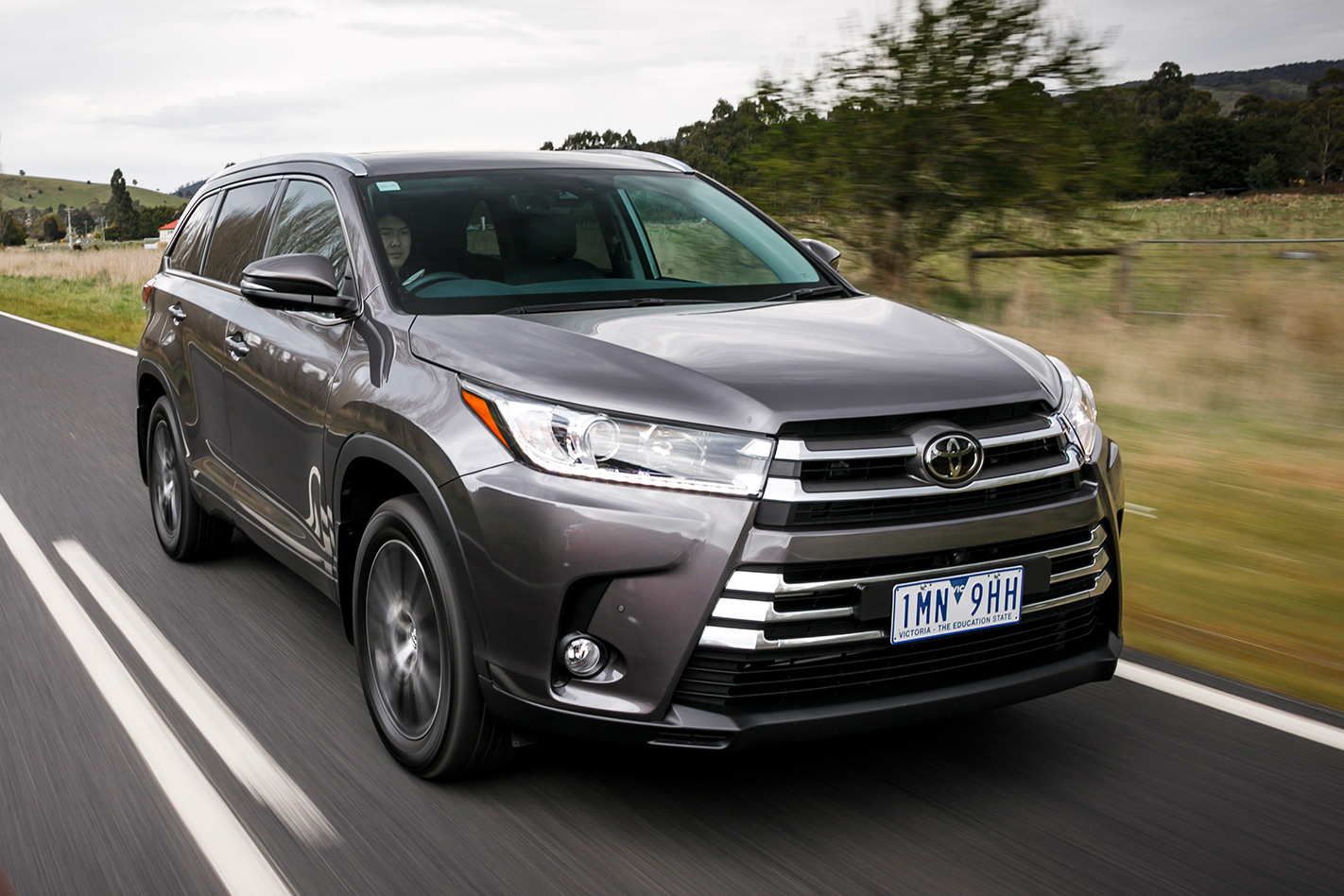
The ride is smooth, even on the bigger 19-inch wheels. It recovers well when riding over big bumps, but does tend to vibrate when passing over smaller road imperfections.
At 2100kg, it’s not exactly designed for hard cornering, but it does feel stable through bends. The steering has a little play in it, though you do get more response from the 19-inch wheels than with the 18s under the GL and GLX.
While not a true off-roader like its Landcruiser Prado stablemate, the Kluger’s all-wheel-drive system instils confidence during off-bitumen driving on gravel, dirt or snow-covered roads, and farm tracks. A snow button near the gear selector reduces the chance of wheelspin on slippery surfaces.
OUR OPINION
The Acadia feels a generation ahead of the Kluger, especially at the generously-equipped range-topping level.
Both carry out the luxury family hauler mission well, but the Acadia LTZ-V manages to tick all the boxes ahead of the Kluger Grande including space, efficiency, driveability, active safety and infotainment. The only thing Acadia hasn’t got going for it is a Toyota badge on the tailgate.
MORE: Toyota Kluger Range Review MORE: Toyota Kluger Range, Price & Specs MORE: Holden Acadia Range Review MORE: Holden Acadia Range, Price & Specs
Melbourne has become the first city in Australia to allow hydrogen cars to operate on public streets.
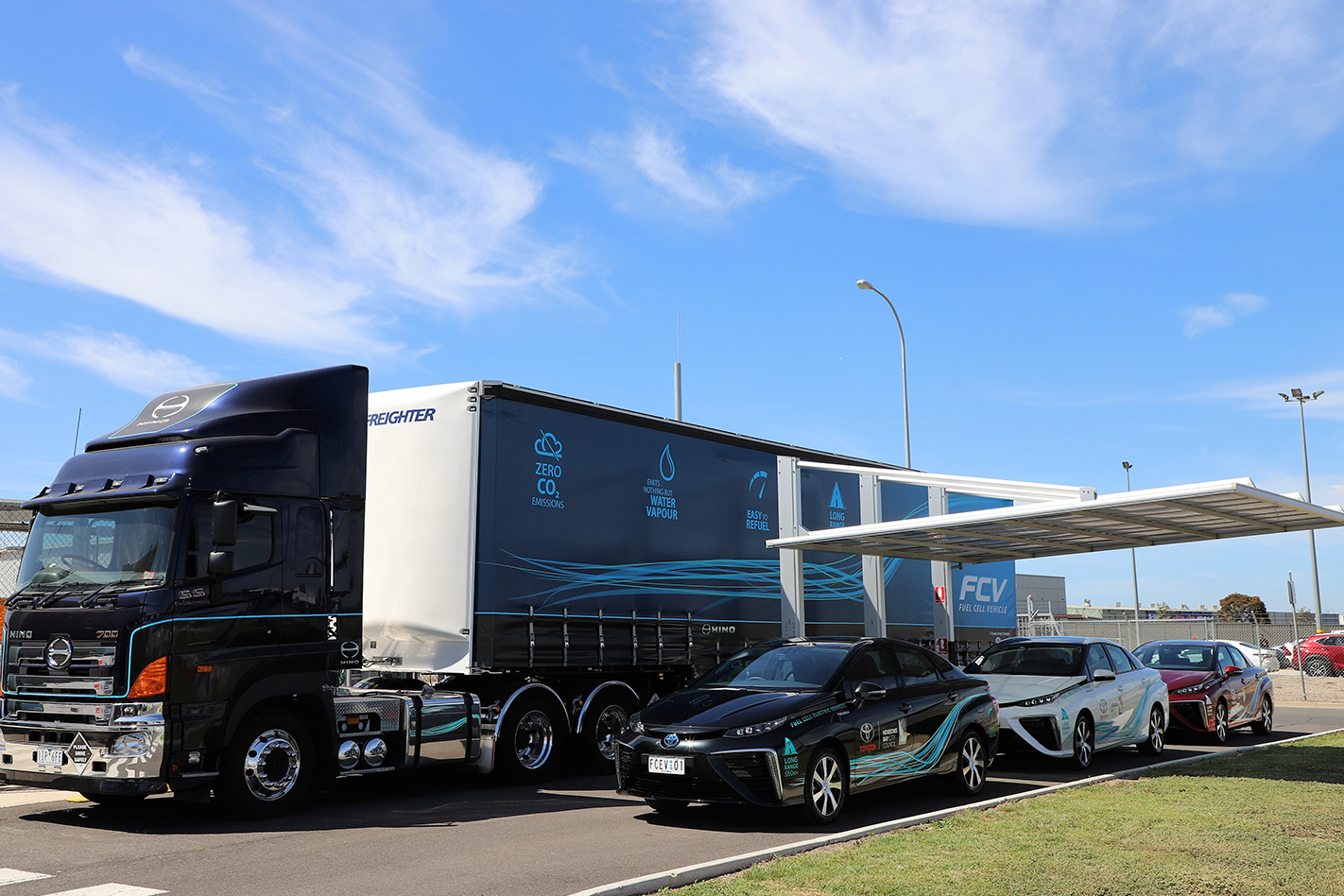
The Toyota Mirai Fuel Cell Electric Vehicle (FCEV) is being tested in Australia under real-world conditions, as part of a 12-week trial held in conjunction with a Melbourne local council.
Toyota is providing three of the zero CO2-emitting hydrogen-electric vehicles to Hobsons Bay Council in Melbourne’s west.
The two have had a long association, with the now-closed Altona Toyota Factory located in the City of Hobsons Bay, which skirts the inner-western side of Port Phillip Bay.
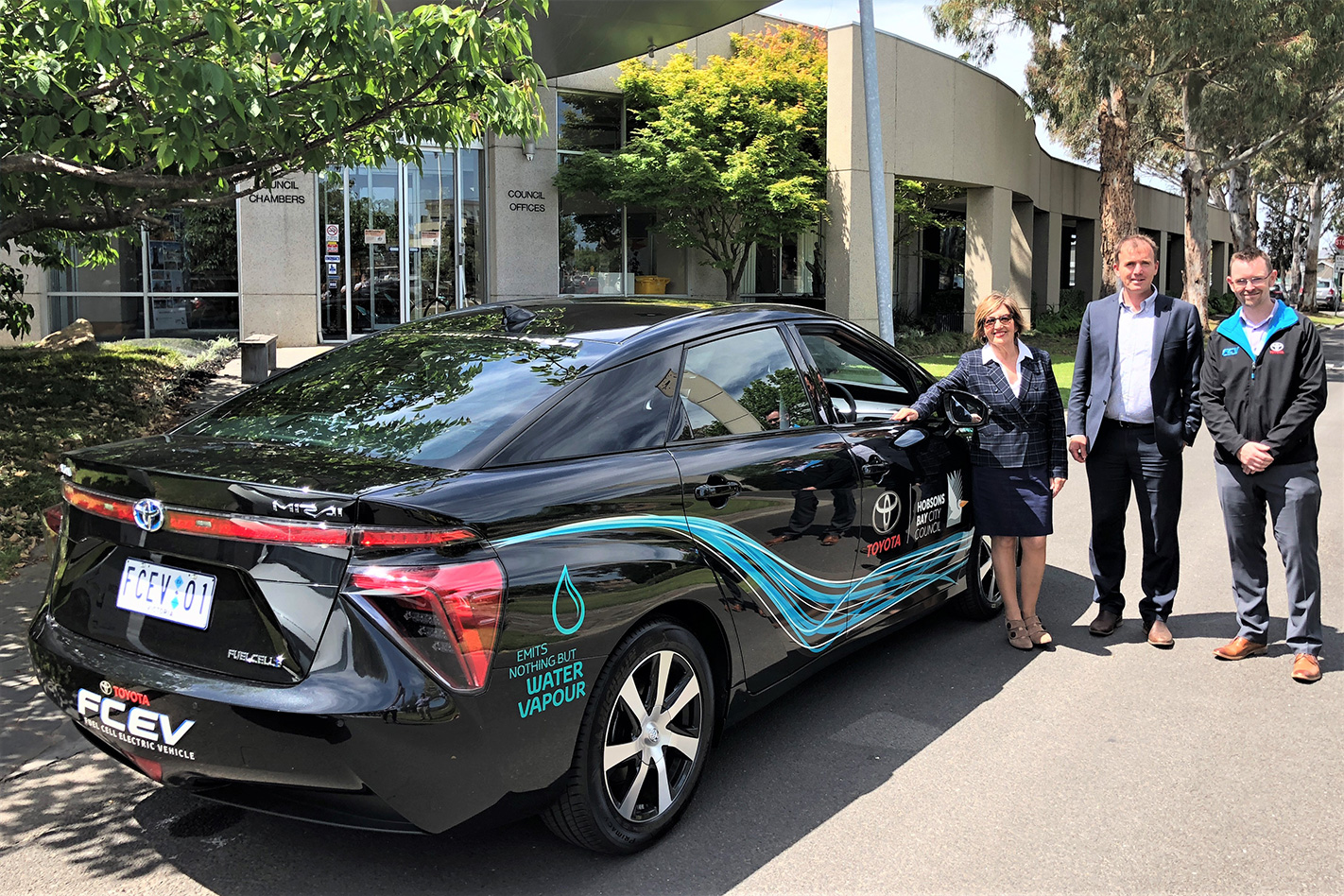
While hydrogen cars such as the Mirai (Japanese for ‘future’) and Hyundai Nexo have been tested on Australian roads before, this will be the first time they’ll be entrusted to everyday drivers.
Council staff will use the futuristic coupes under a range of conditions and at different times of the day, just like any other vehicle.
Toyota Australia’s Manager of Advanced Technology Vehicles and Site Development, Matt MacLeod, said the trial will go a long way to normalising the new technology.
“It’s a great opportunity to highlight the fact that these cars drive just like any other vehicle, except they don’t make any engine noise and emit nothing but water vapour,” he said.
“Like most hydrogen powered vehicles, the Mirai isn’t currently available for sale in Australia, mainly because there isn’t existing hydrogen refuelling infrastructure to support it.”
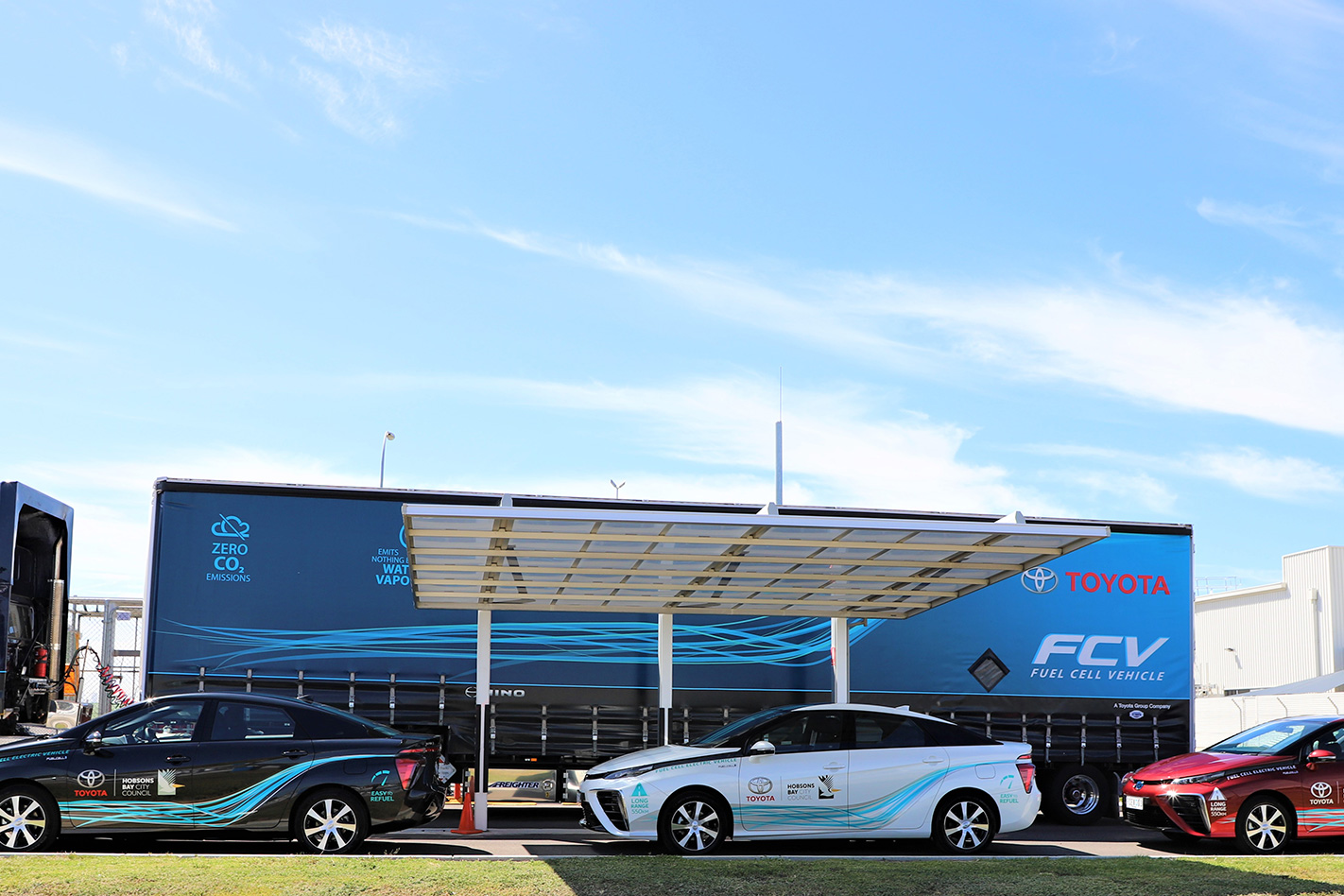
In fact, there is just a single permanent fuel-cell refuelling facility in Australia, somewhat ironically located at Hyundai Australia’s head office in Sydney.
MORE Hydrogen cars to be cheaper than EVs by 2030, says Hyundai
The trial FCEVs will be refuelled at a mobile hydrogen refueller based at Toyota’s Altona facility, which is also operating two Toyota fuel cell forklifts.
The Mirai debuted at the 2014 Los Angeles Motor Show, and more than 5,500 have been sold around the world.
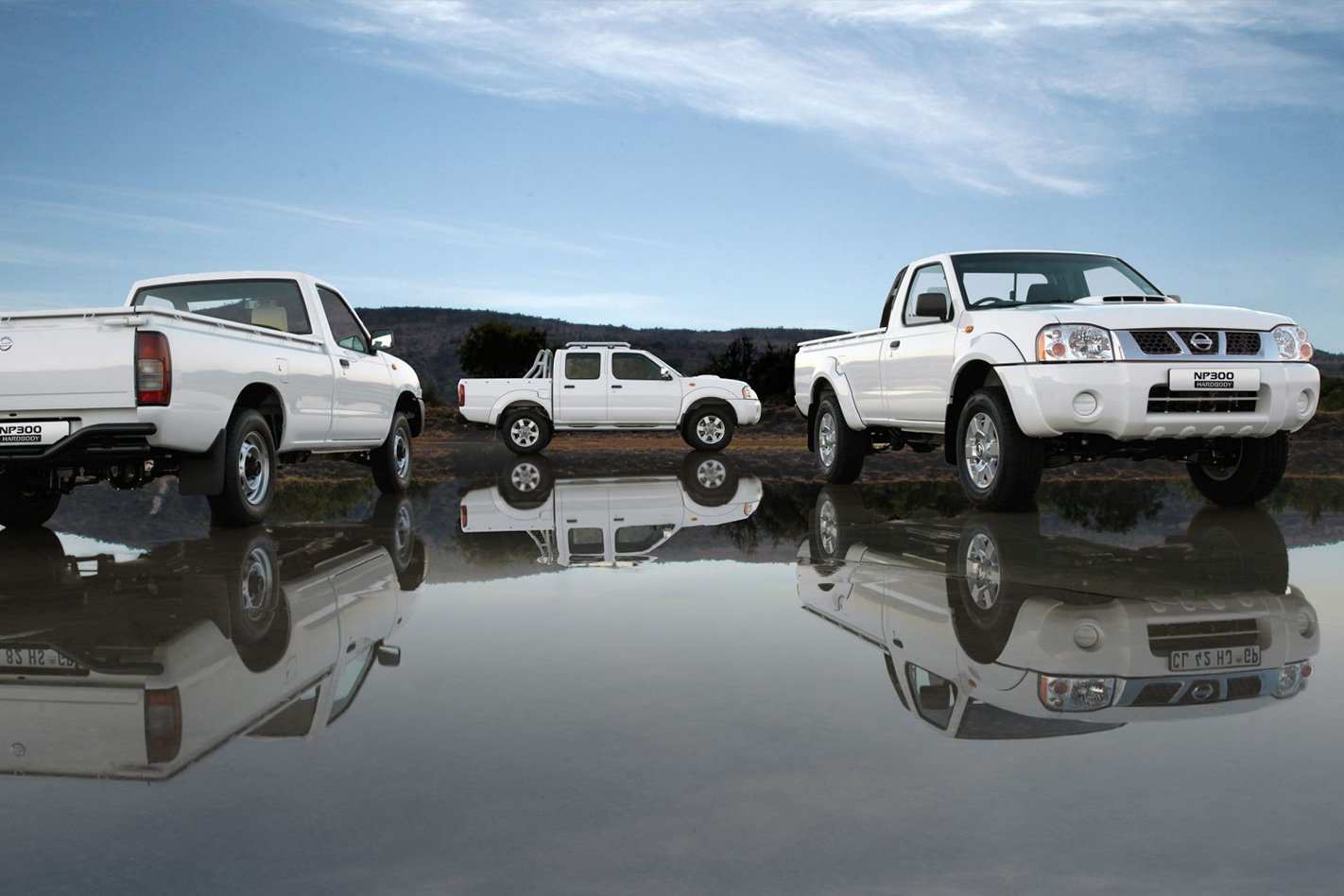
Nissan’s self-proclaimed ‘king of African pick-ups’, known as the NP300 Hardbody, has posted a shocking zero-star safety score, after testing by Global NCAP as part of an initiative to improve road safety in South Africa.
The NP300 Hardbody was the fourth best-selling vehicle in South Africa last month, behind the Toyota HiLux, Ford Ranger and Volkswagen’s tiny Polo Vivo hatchback.
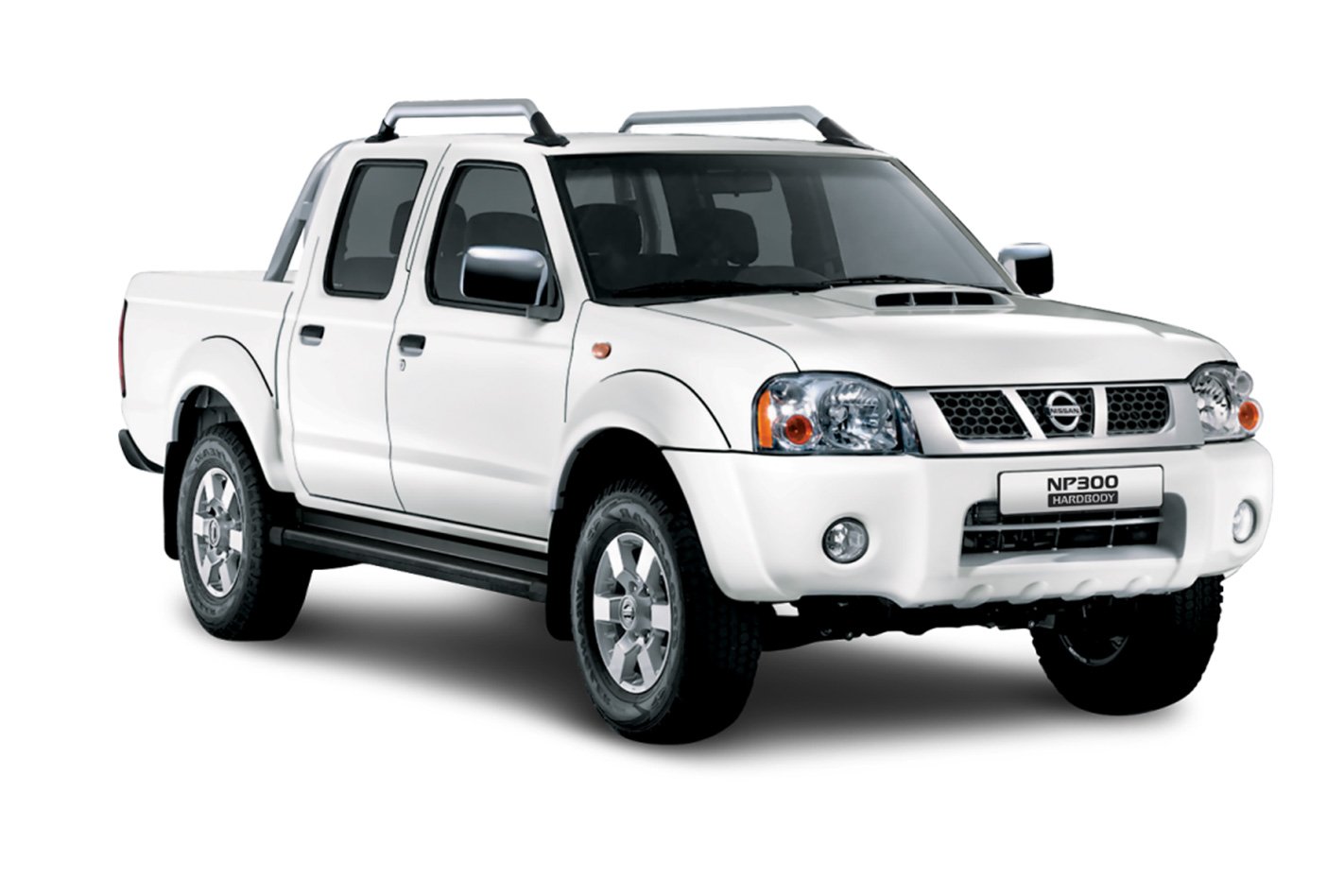
The secretary general of Global NCAP, David Ward, was scathing in his assessment, declaring the zero star score for the Nissan NP300 as “shockingly bad”.
“The NP300 Hardbody is ridiculously misnamed as its body shell has collapsed,” he said in a statement. “Nissan also claim the car benefits from a so called ‘safety shield’, but this is grossly misleading. Our test shows that the occupant compartment completely fails to absorb the energy of the crash resulting in a high risk of fatality or serious injury.”
The vehicle in question is based on the previous generation D22 pick-up that was sold here as a Nissan Navara between 1998 and 2014. A D22 4×2 cab-chassis tested by Australian NCAP in 2008 scored three stars.
The current model in Australia is known as the D23 Navara, and has been awarded a five-star ANCAP rating.
Concerns over South Africa’s incredibly high road toll has pushed the country’s Automobile Association to take action, targeting entry-level models from Hyundai, Kia and Toyota.
More than 14,000 people died on South African roads in 2017, compared to 1224 in Australia for the same period. There are 56 million people in South Africa.
As the frightening video shows, the NP300 Hardbody ute – colloquially known as a ‘bakkie’ in South Africa – comprehensively failed to prevent life-threatening injures to the front-seat occupants.
The car’s cabin was branded as ‘unstable’ after it collapsed after impacting an offset crash barrier at 64km/h, while the supposedly collapsible steering column also failed, inflicting severe ‘injuries’ to the dummy’s head and chest.
The crash test data concluded that there was a “high probability” of life-threatening injuries to front-seat passengers.
“It is astonishing that a global company like Nissan can produce a car today as poorly engineered as this,” said Mr Ward.
A car company is only required to build cars to the standards and laws required by each market they trade in – but companies often build down to a price, rather than up to highest safety standards, in markets with more lax safety laws.
India’s government, for example, enacted federal laws compelling car companies to install basics safety device like airbags only this year, in response to a road toll that kills 40 people a day.
Our monthly picks of the coolest gear we’ve found in October
Lego Technic Bugatti Chrion, $600
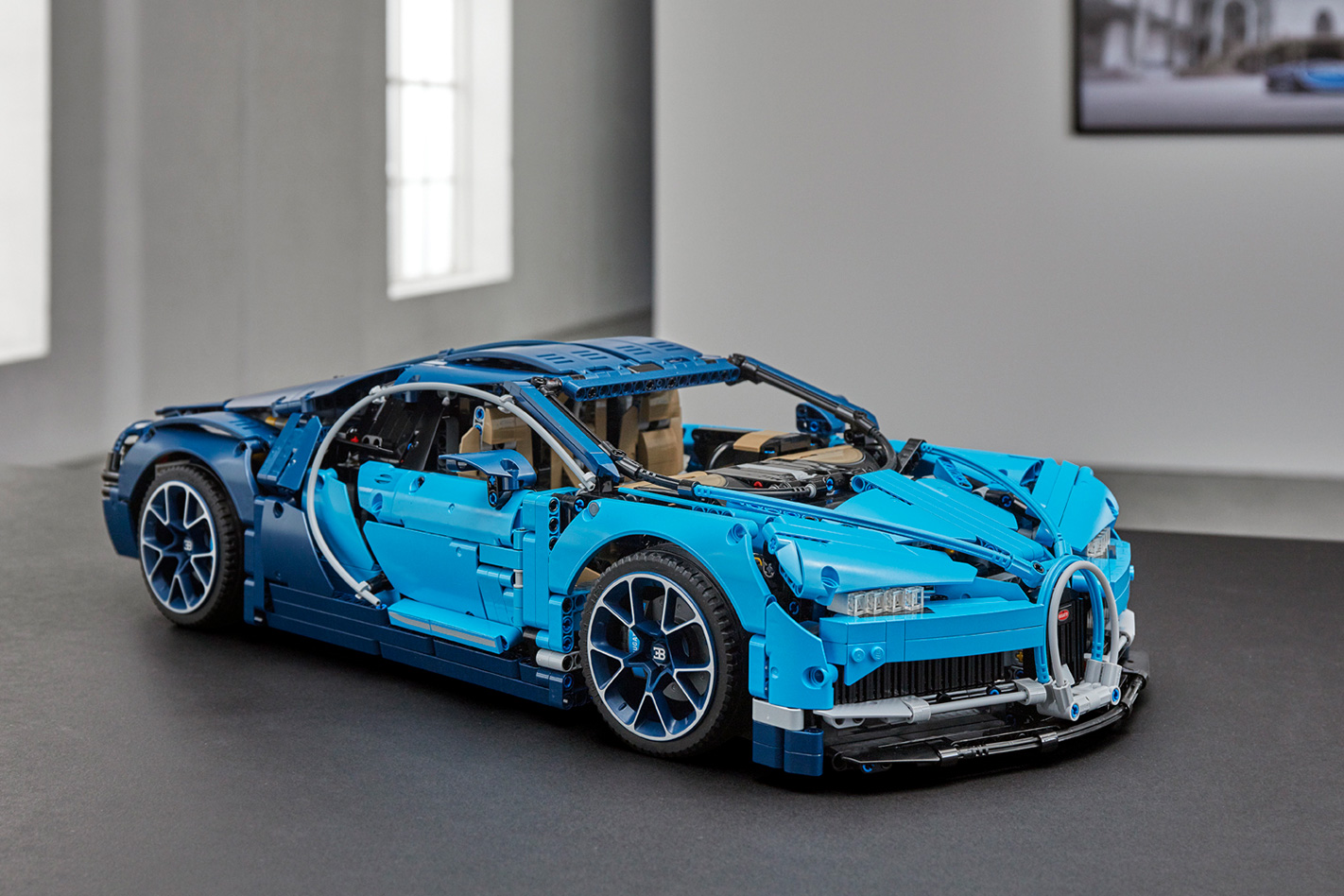
There’s possibly only one engineering feat in the automotive world more impressive than Bugatti’s unfathomable Chiron. The monstrous quad-turbo, 16-cylinder coupe might be able to get from zero to 400km/h and back again in 42 seconds but that kind of pales when you realise someone in a darkened room in Denmark worked out how to recreate the Chiron in 1:8 scale using nothing but Lego bricks. Assemble the 3599 pieces in the correct way and you’ll end up with an eight-speed gearbox clipped to an engine with moving pistons. And you can even move the active aero into the top-speed position using the special key, just like the real thing. Six jolly green giants is a lot of cash for a Lego set but it’s still about 6000 times cheaper than the version that gets built for you. shop.lego.com
X1 Everest glass pool table, $131,000
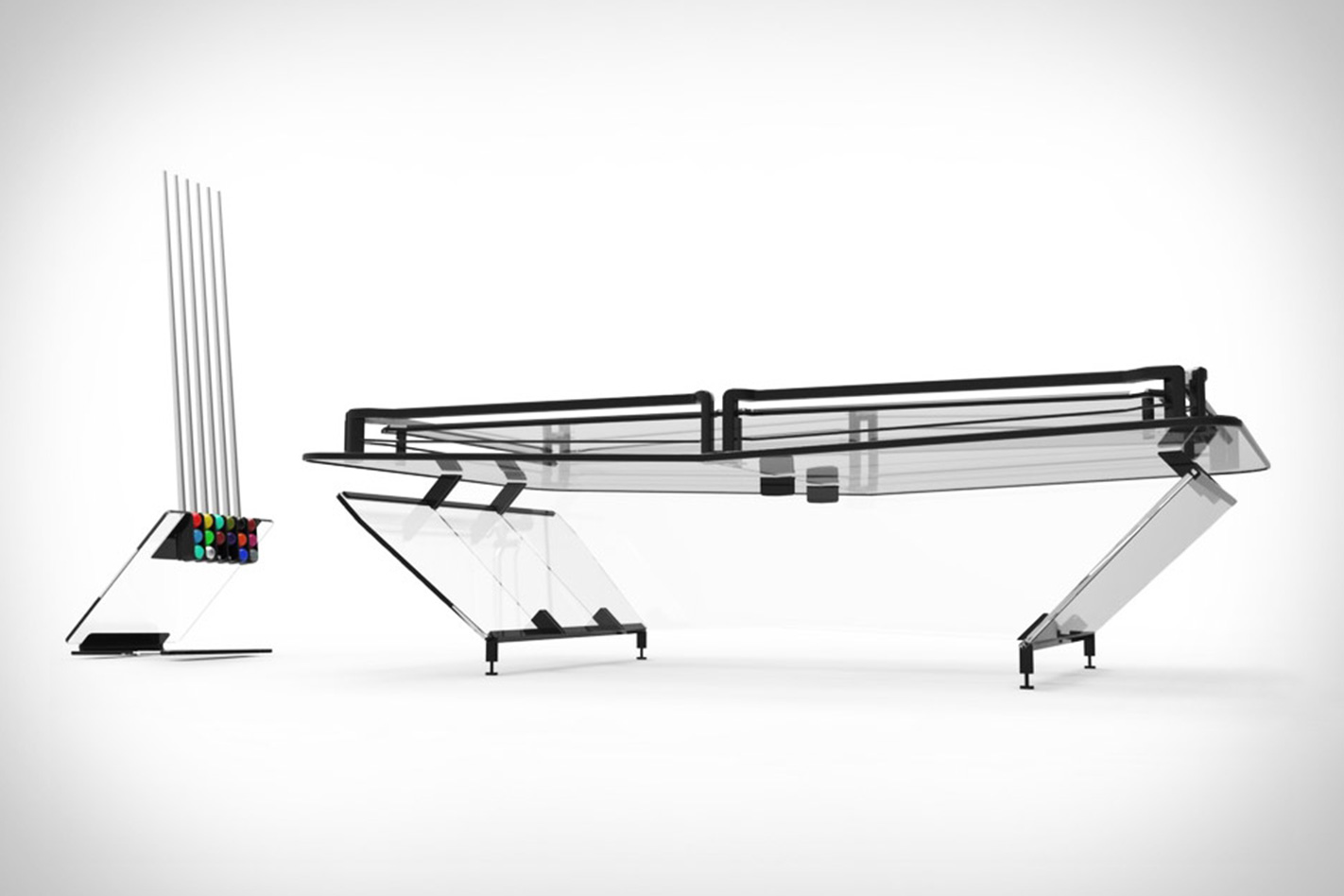
Elite Innovations is singlehandedly ruining the ancient art of hide and seek. Sliding under a few hundred kilos of slate and oak used to guarantee safe concealment from even the most experienced seeker, but the X1 Everest pool table changes everything. Built using only CNC machining, 3D printing and laser cutting, this glass pool table is more transparent than a politician’s promises. A special rubber-like Levian layer above the 1-inch thick glass top and ultra-slim K-66 bumpers allow the supplied aramid balls to behave exactly as they would on cloth minus the intolerable problem of not being able to see your feet underneath. Let’s hope they don’t design a matching closet or the game of sardines is ruined as well. eliteinnovations.com.au
Audi Driving Experience, from $999
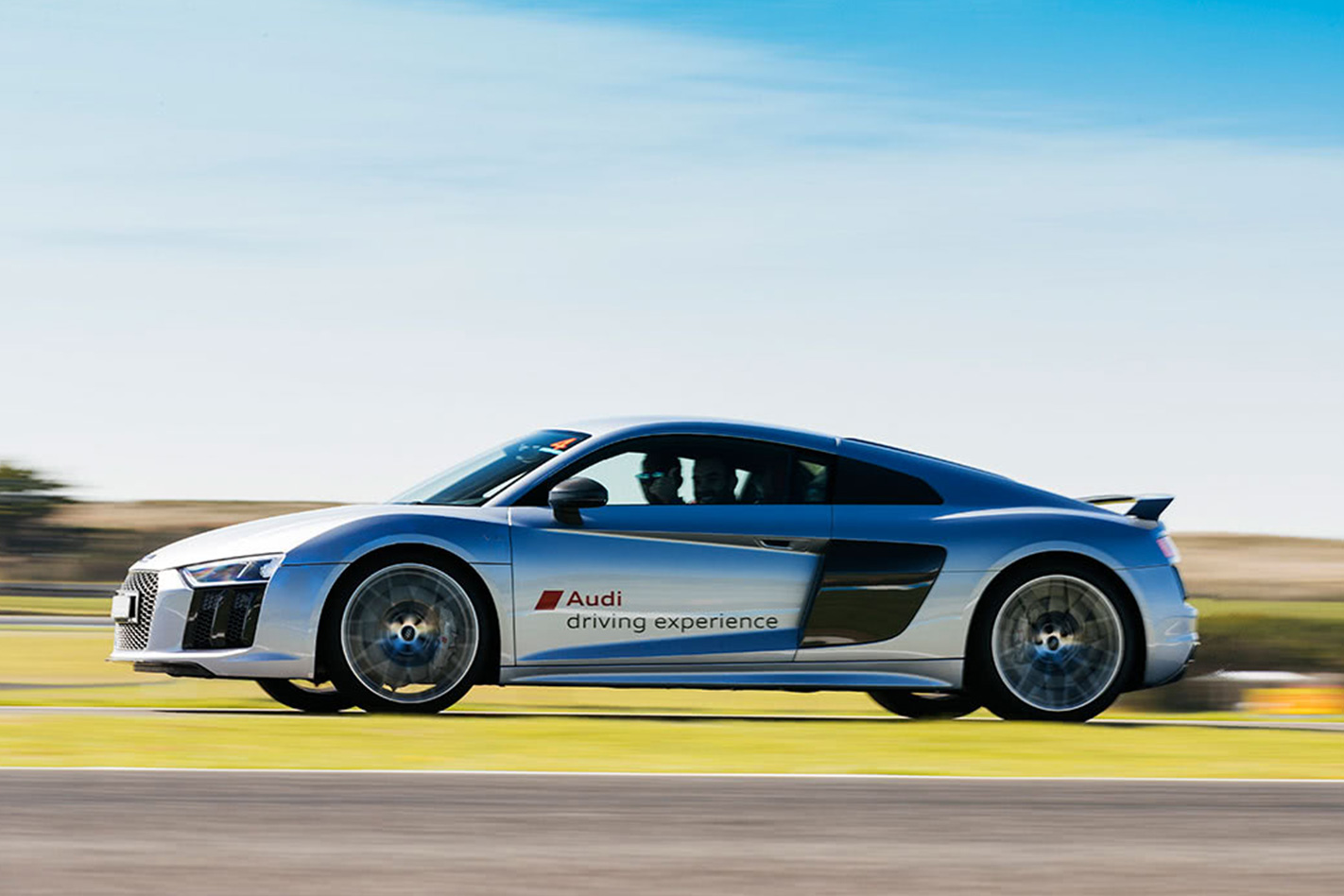
Don’t risk binning your shiny new Audi finding the limits on public roads and without the expert guidance of professional driving instructors; sign up for one of the four-ring Driving Experience courses and brush up on your skills the right way. Even at the entry level you’ll hop behind the wheel of high-performance S models but you can work your way up to more advanced modules in mad RS and R8 hardware, or even take a trip to Austria for a spot of snow driving. Keep everything out of the kitty litter and the final race experience instalment will slot you into a full-blown R8 LMS race car. We guarantee taking the wheel of a V10-powered race car on a track carries a little more kudos than a few laps of your favourite back roads. audidrivingexperience.com.au
Hot Wheels 50th Originals, $15
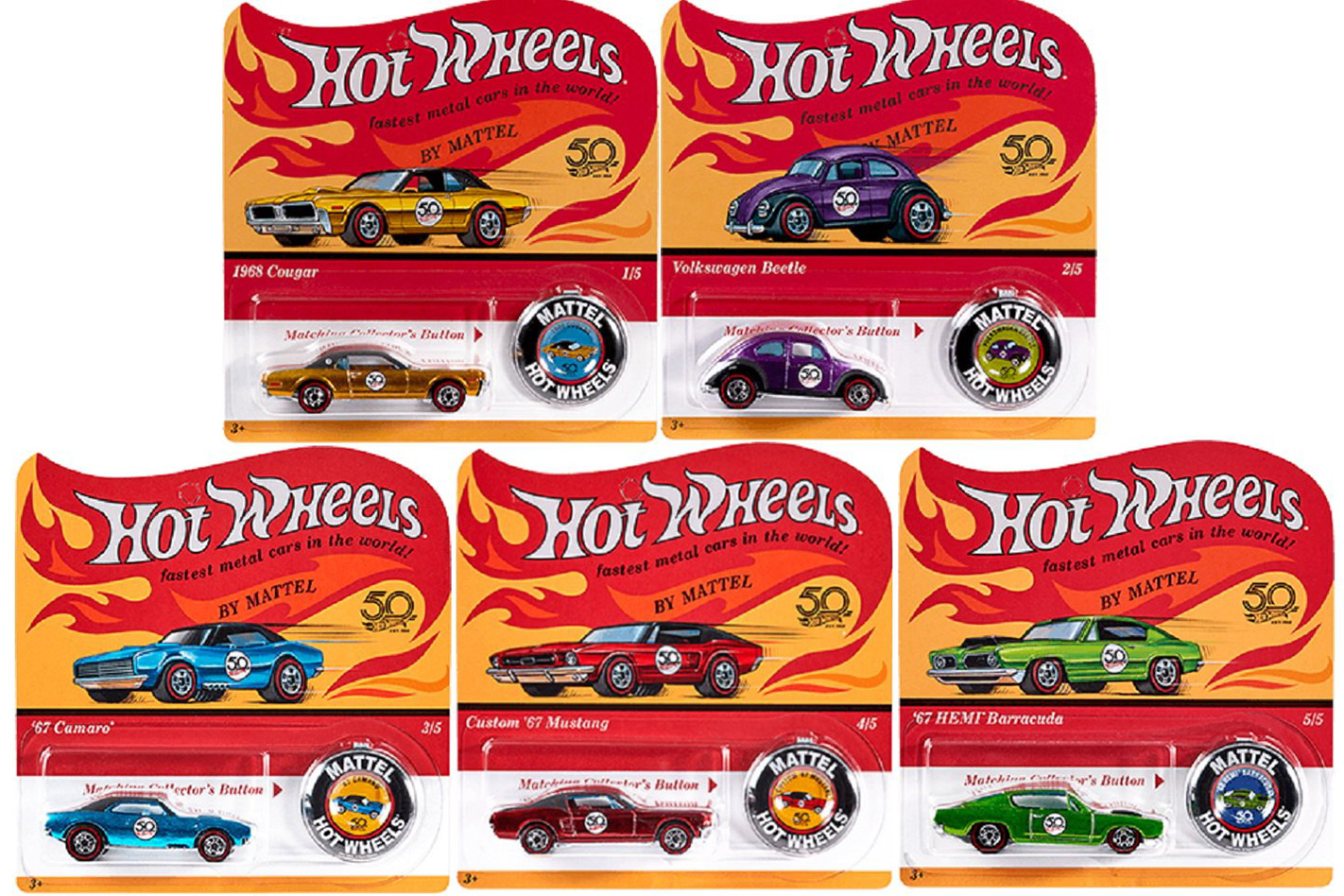
It might have been the year that Boeing introduced its 747 Jumbo Jet, and Naru declared independence from Australia, but 1968 is surely most fondly remembered for the birth of Hot Wheels. In celebration of 50 years of the iconic toys, the brand has released a range of Originals that recast some of the very first models, presented in the same ultra-cool retro packaging. Choose from the Volkswagen Beetle, Chevy Camaro, Ford Mustang, Mercury Cougar or Plymouth Barracuda, each supplied with its own collectable button. Five decades is a long time and, coincidentally, equates to about one year for each of the Hot Wheels cars you’ll find scattered about the Wheels office. hotwheels.mattel.com
Watches
Certina DS PH200M, $1000
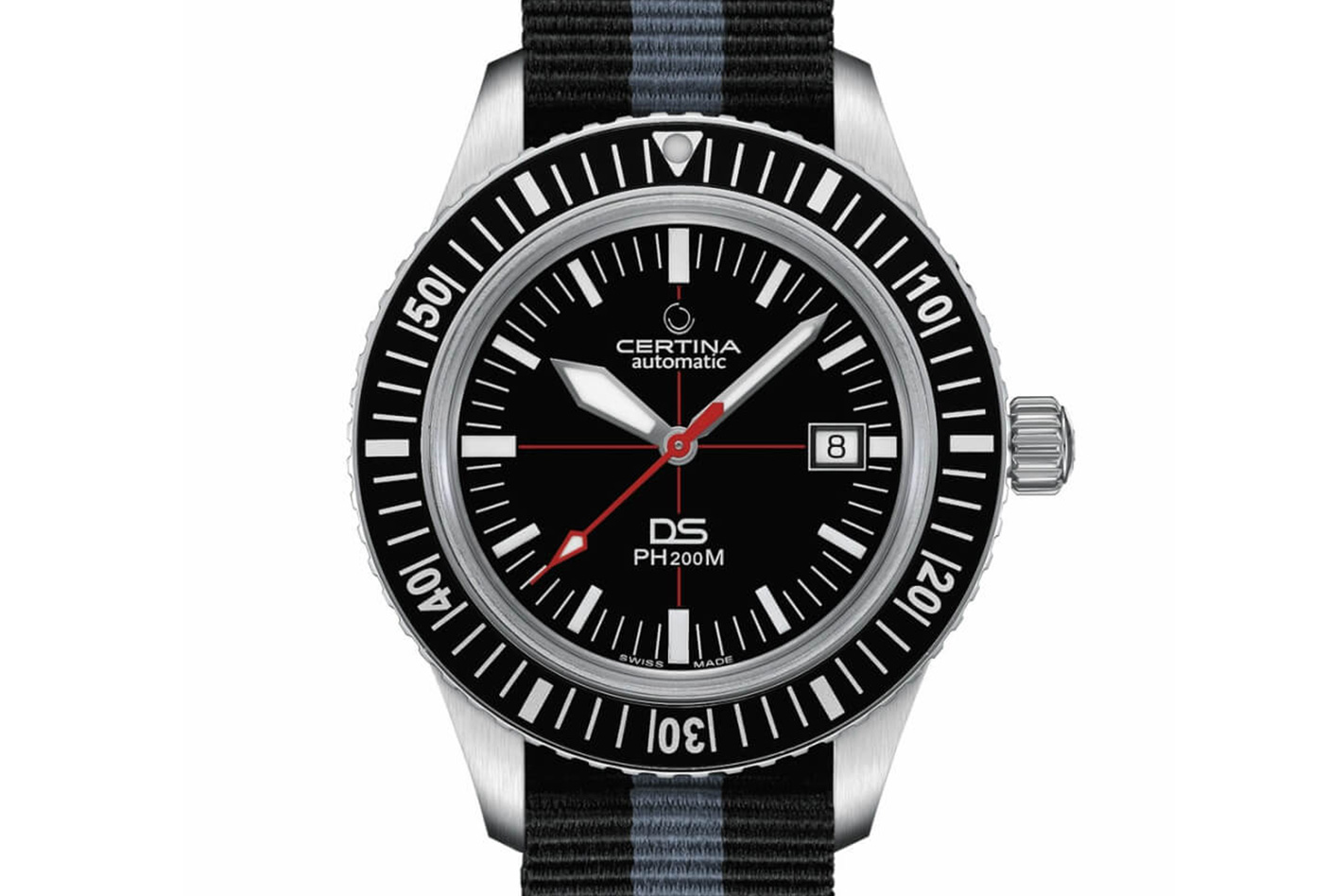
Go on, tick the boxes: here’s a handsome, Swiss-made mechanical watch, from a known brand, without an outrageous price tag. Certina is celebrating its 130th anniversary this year, and has reissued this 1960s model as part of its current Heritage Collection. The company, which is now part of the Swatch group, has a unique local connection as former supplier of dive watches to the Royal Australian Navy. While the look and feel of this piece is a like-for-like reprise (albeit slightly scaled up) of the original, its ETA automatic movement is entirely modern. The 200m water resistant case measures 42.8mm and it comes on a well-matched NATO strap. certina.com
Pulsar PZ6003X, $299
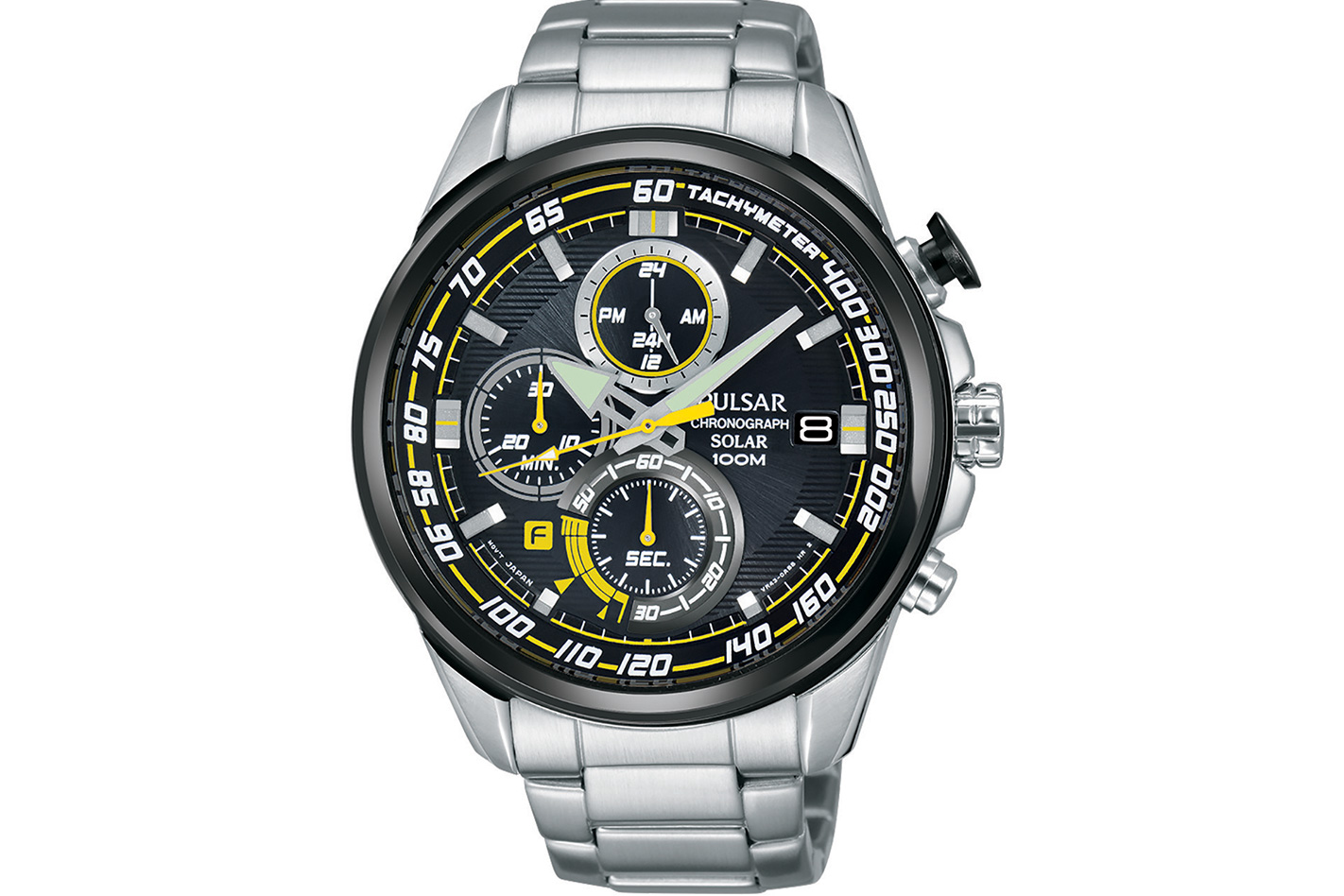
Pulsar brought electronic digital watches to the world back in 1972, and offered the first watch with an inbuilt calculator after Seiko’s takeover in the 1980s. Today, it produces timepieces in a variety of different styles including a range of chronographs off the back of its partnership with the Supercars championship. Some wear more overt Supercars branding for die-hard fans, but there are other offerings, including this particular solar-powered model. Its large (44mm) stainless-steel case is water resistant to 100m and houses a quartz movement. pulsarwatches.com.au
TAG Heuer Monaco Bamford, $10,600
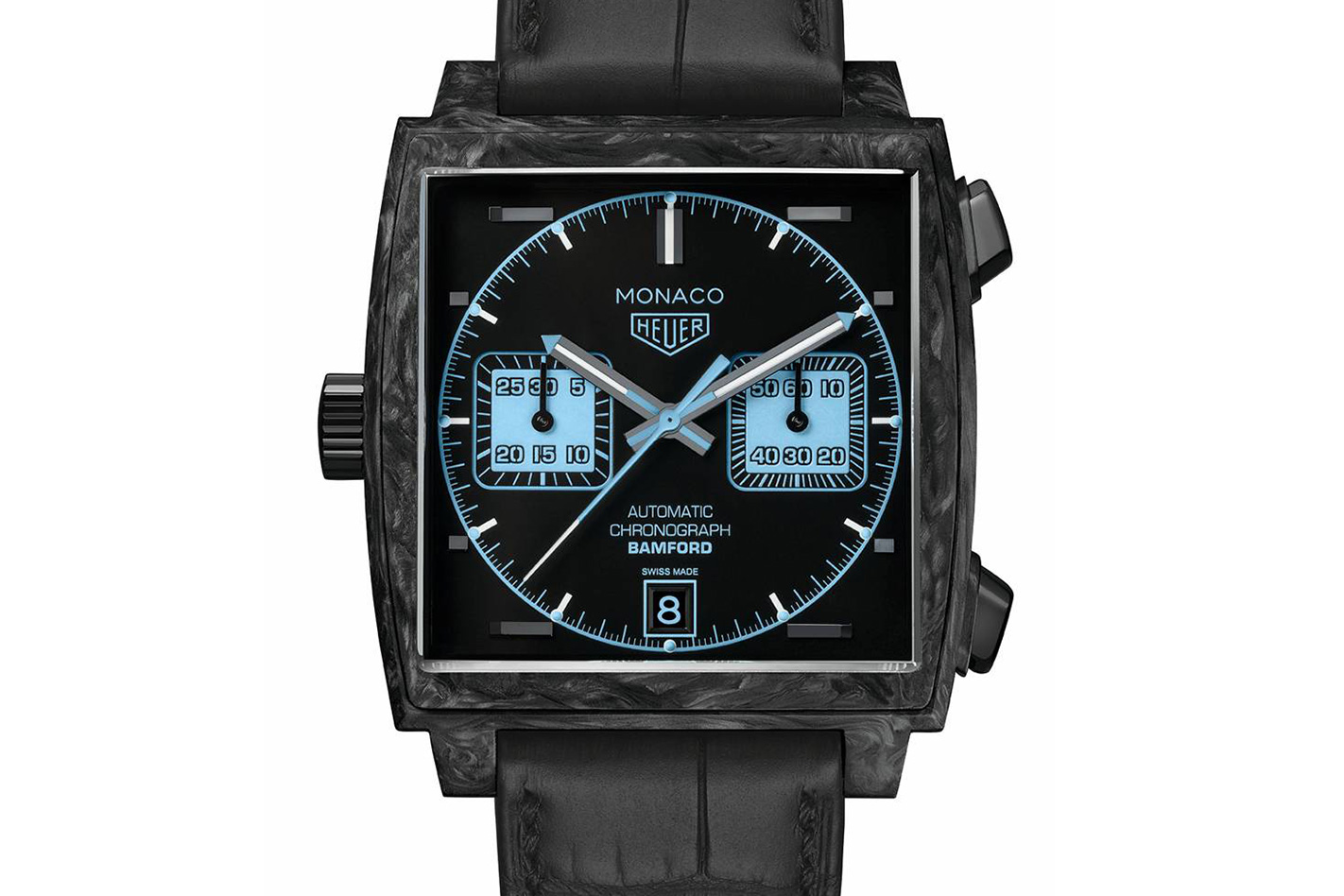
Steadfast purists be warned, you may find it hard to cope with this TAG Heuer Monaco. George Bamford is a leading voice in the custom watchmaking sphere, and while some traditionalists shun the modification of high-end timepieces that Bamford Watch Department does, TAG has now teamed up for an official, co-designed collaboration. Limited to 500 units, it uses a forged carbon case and actually costs less than a one-off Bamford Monaco made of regular steel. The distinct full black dial and aqua blue combo is unlike any other off-the-shelf version. tagheuer.com
Our new long term BMW Z4 3.0 is up against it this month. You can read all about it’s welcome to the family on the December 2004 issue, but right here right now, the flame-surfaced Z4’s got bigger problems to deal with than having to live with MOTOR for the next few months. For one, the new SLK 350 from Mercedes-Benz has it firmly fixed in its crosshairs.
This feature was originally published in MOTOR’s December 2004 issue
Quickfanged in the November 2004 issue in seven-speed auto guise, we’ve nabbed the six-speed manual version of the SLK to go up against our resident six-speed Z4. The auto is a delete option on the Merc and drops the asking price from $112,900 to $109,400, but it’s still a big step up from the $92,000 Bimmer drop-top.
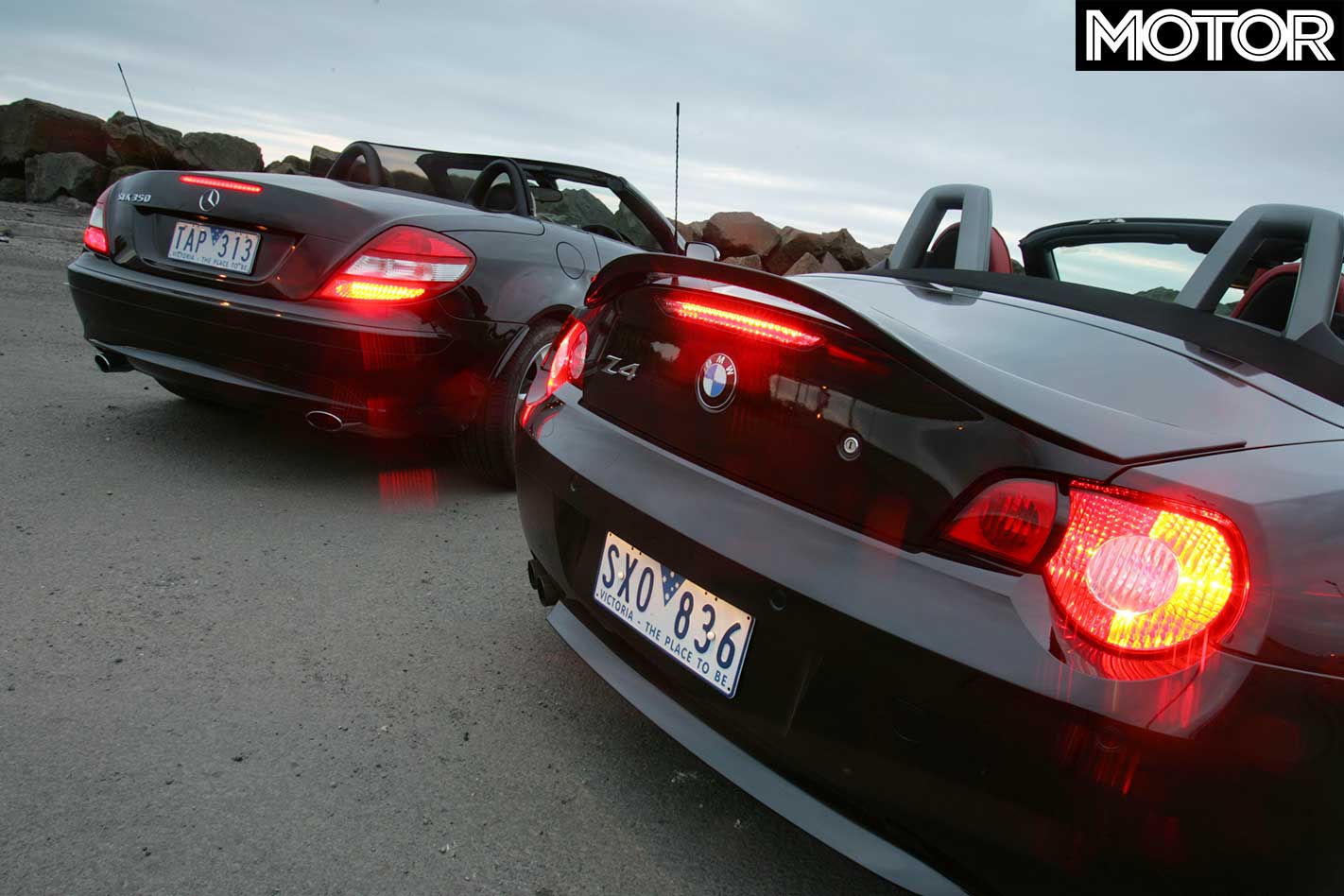
So, on paper the Benz has already got this race run, right? Not so fast, Cletus. While the $86,900 SLK 200 is a better match to the Z4 on price alone, its supercharged four-potter musters a piddling 120kW and is a closer real world sparring partner to the 2.5-litre BMW Z4.
But factor in the Z4 3.0’s lighter weighbridge ticket (1290kg to the SLK 350’s portly 1465kg) and you’re looking at weight-to-power ratios in the same seven-point-something bracket. Game on, then.
The new Merc roadster comes from a position of sales strength with more than 308,000 of the previous generation sold since its 1996 launch. But despite drawing from the same gene pool and wearing the familiar nameplate, the new SLK brings with it a paradigm shift in design philosophy.
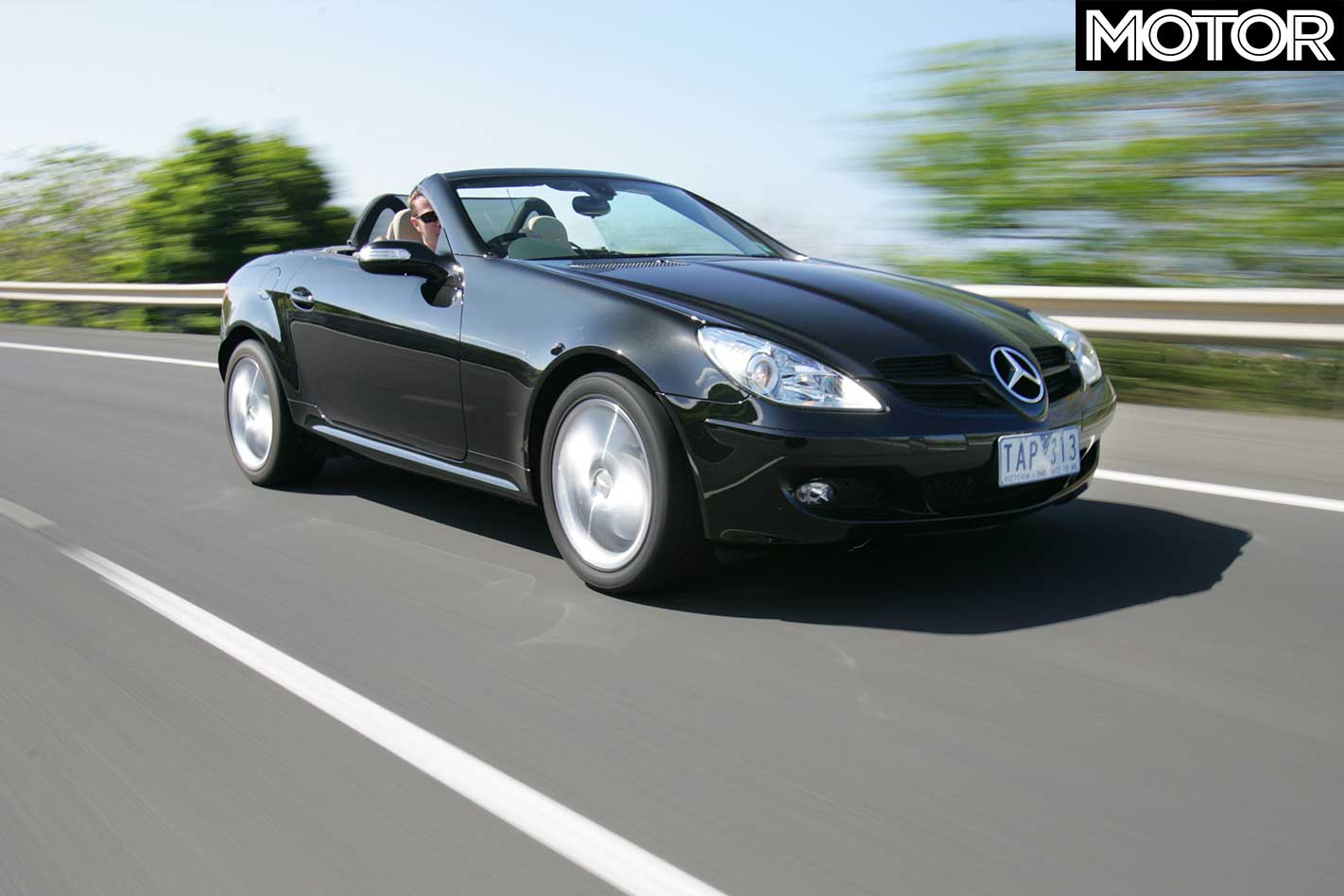
It is a far more masculine design, with cues taken from both the McLaren F1 racecar and the SLR McLaren supercar. In fact, the SLK has been accurately described as a mini-SLR.
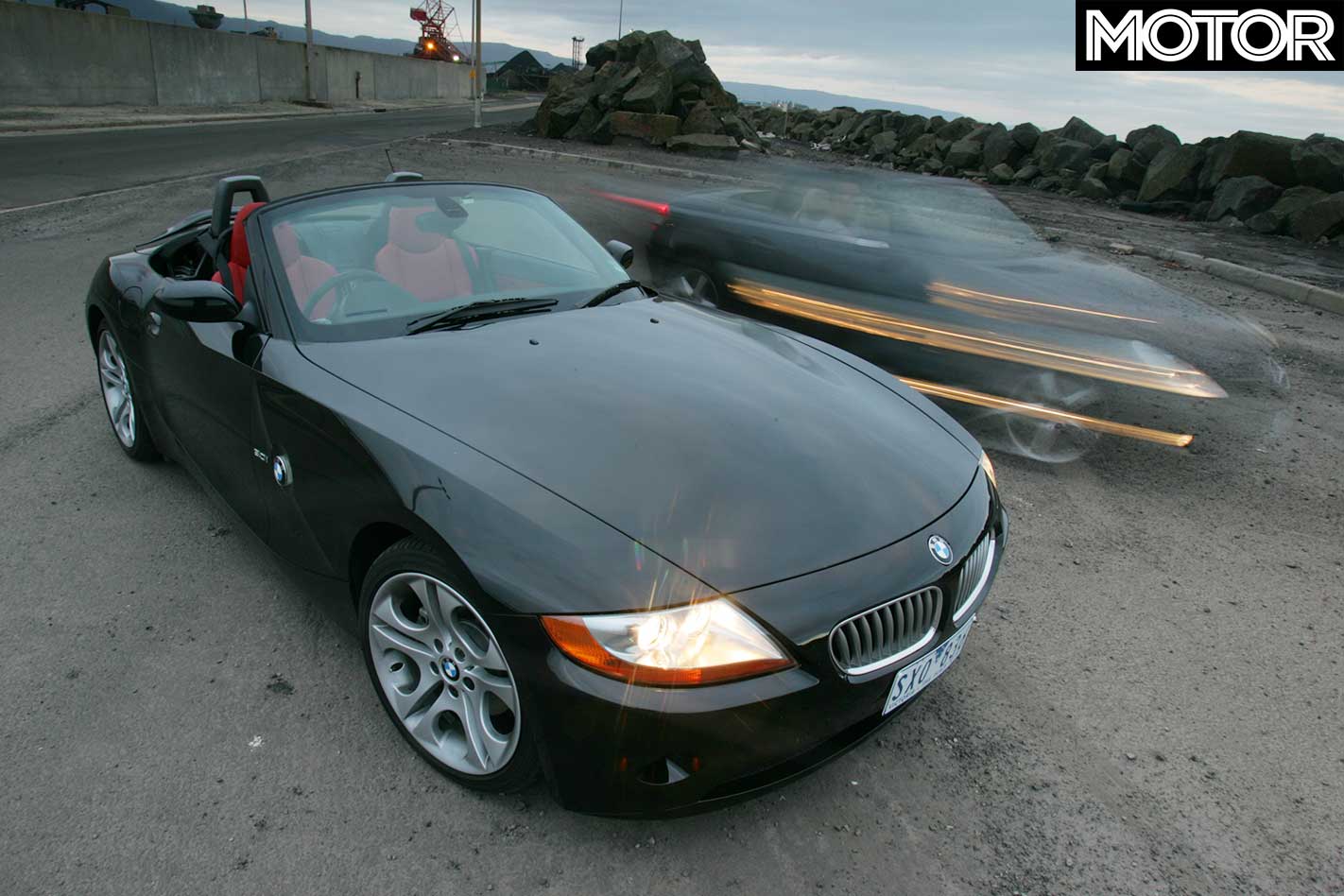
The Benz does a good job of polarising opinions, but nothing can touch the Z4’s design for love-it-or-loathe-it reactions. After initially cocking an eyebrow, we’ve grown used to the design, and some of us really dig it. There are still question marks over the nose treatment and some of us will never get the Zorro slash down the flank, but the Z4 has those classic roadster traits of a long bonnet and a short bobtail.
The Benz feels big and luxurious on the inside and the SLK represents a huge leap in interior design for Mercedes – it almost feels Audi-like in quality and detail. The interior detailing of the Mercedes highlights, better than any other area, the price gap between the two cars.
There’s more buttons to poke and gadgets to play with (not that everyone agreed that was a good thing), and include Merc’s debut of Airscarf. What? Aside from seat heaters, the SLK’s pews feature a nozzle in the base of the headrest which directs a jet of warm air around your neck and scone. Perfect for those topless winter nights.
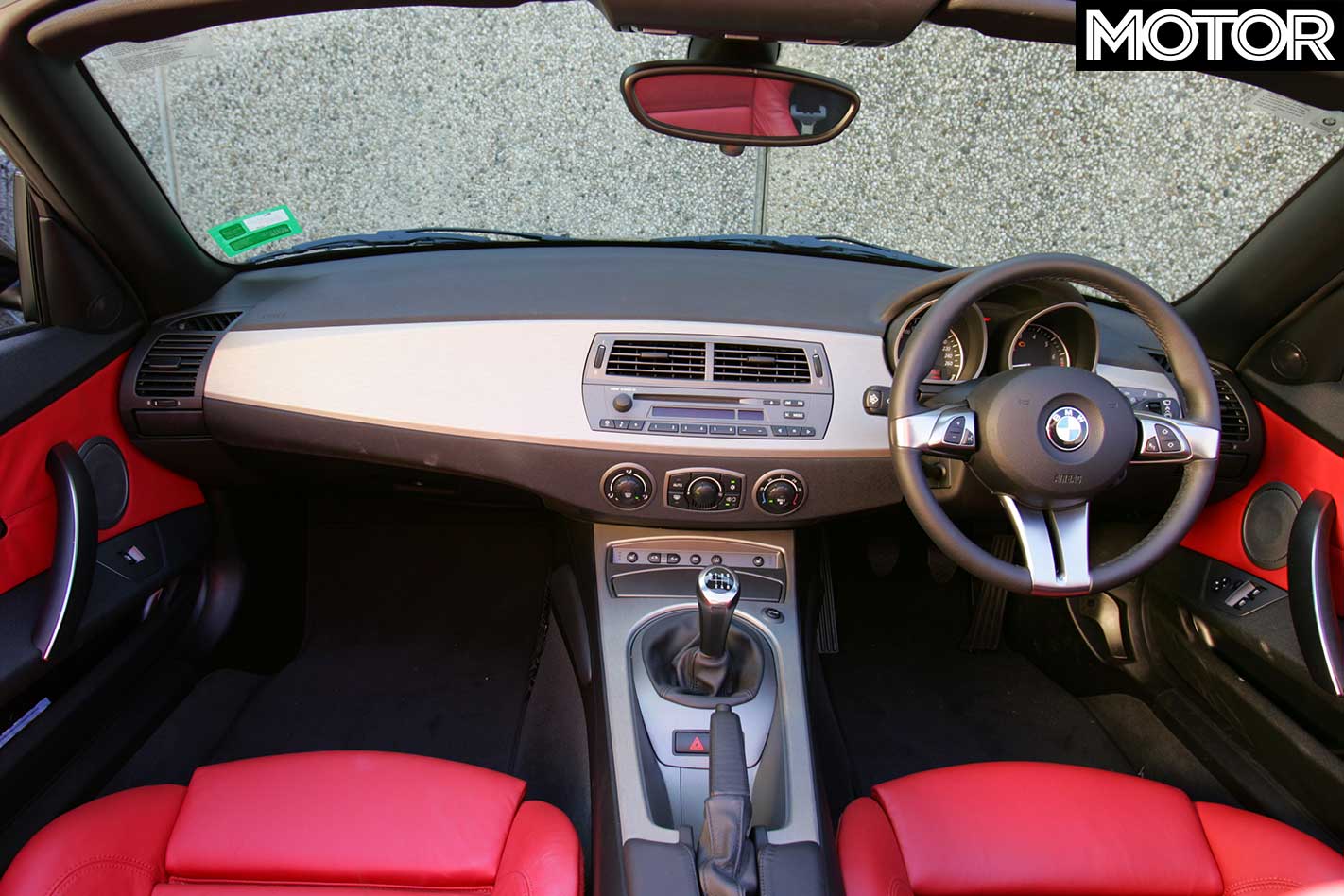
The Z4’s cabin, while still featuring all the good gear (satnav, CD, seat heaters) and leather trim, is a more basic affair. It does feature the better seats, though. Proper ones you sit in and not on.
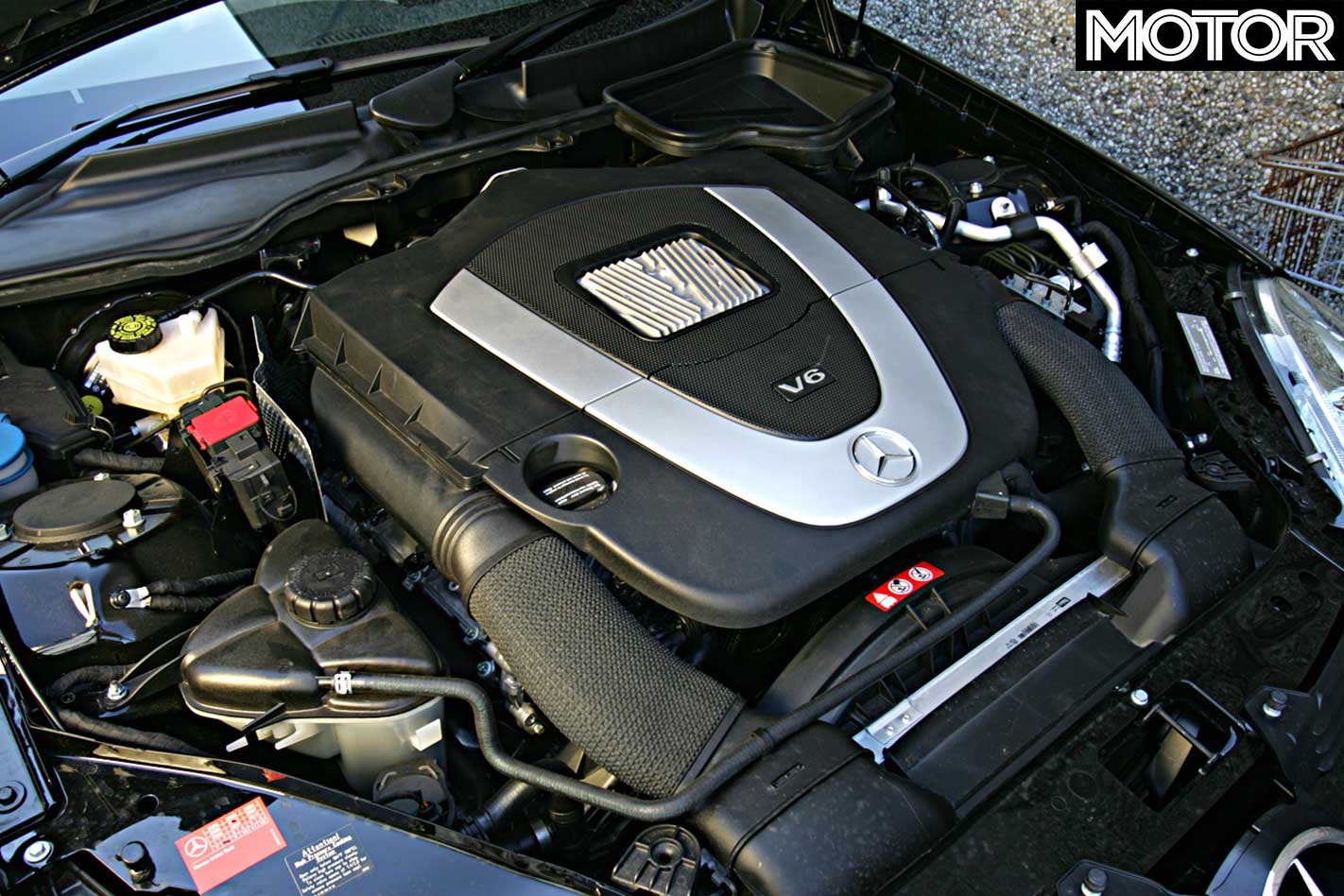
Aside from the muscular looks, Mercedes-Benz endowed the SLK 350 with some serious mechanical heft. The new DOHC V6 is 200cc smaller than the 3.7-litre SOHC unit found in various Benz’s, including the vastly more expensive SL 350, but matches it on peak power and torque, but with a bigger and smoother spread of revs. It is also surprisingly close in spec and feel to the V6 engine in our Nissan 350Z longtermer.
Both V6s displace 3.5-litres and produce similar on-paper numbers – 200kW at 6000rpm and 350Nm between 2400-5000 revs for the SLK, with the Nissan’s mill turning 206kW at 6200rpm and a fitter 363Nm at 4800. Both engines prefer to grunt out their power rather than rev to the rafters, although the Mercedes V6 sounds awesome under load.
The Merc’s six-speed gearbox is heavily sprung toward the centre plane which means lazy one-two shifts can easily become lumbering one-four mis-shifts, and attempts at four-to-five can worryingly go four-three. This is the first manual Mercedes, I’ve driven in recent memory and while the stick-shifter keeps you in the game the smooth seven-speed auto better suits the personality of the Merc.
The Z4’s the complete opposite, with a delicate but direct shift and six tightly-packed ratios keeping the 3.0-litre straight six on the boil. The clutch, too, is a lighter and more precise match than the SLK’s. But with a smaller capacity engine you will need to row the gearbox more often.
Neither car hits a home run with its steering. The SLK’s is heavy but consistently weighted and linear but it lacks any real feedback. That said, the increased weighting is an improvement over most Mercs and the nose grips well under the direction of the heavy tiller. The Bimmer’s electronically-assisted steering is numb and weirdly weighted and takes plenty of familiarisation miles to get up to speed with it.
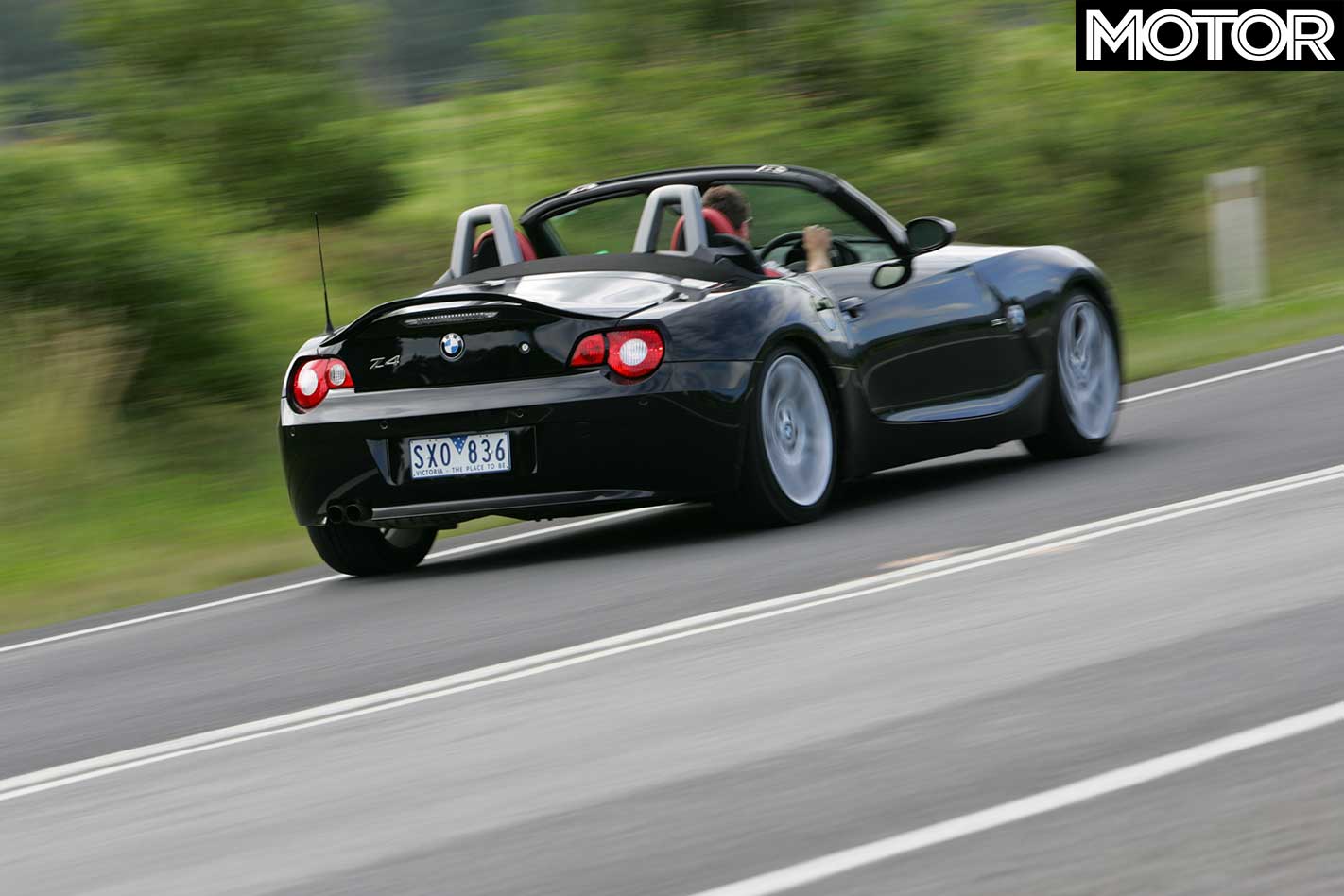
Overall, though, it’s lightness makes it feel livelier than the Benz, and you’re more willing to throw it around. Sitting so far back in the chassis, however, does exaggerate any flicks of oversteer. At Bang For Your Bucks back in 2003, the Z4 lapped Wakefield Park just a tenth of a second slower than the M3 SMG – seriously impressive stuff given it’s shy 82kW.
It’s during moments like this, or on smooth flowing public roads, that the suspension firmness fades from memory and you appreciate the Z4’s body control and inherent balance. The Bimmer lets you dance up to the limit and even allows you to dangle a couple of toes over the edge, all the while reminding you how much talent is left in the bag.
While the SLK doesn’t have that kind of reputation-bruising squirt around a track, it can still keep the BMW honest on a winding road and take chunks out of the Z4’s lead on the straights. You can use the torque advantage of the V6 – remember, it’s 50Nm fitter in the twist department – and shift earlier or hang on to a higher gear in places where the BMW has you fishing for the right ratio.
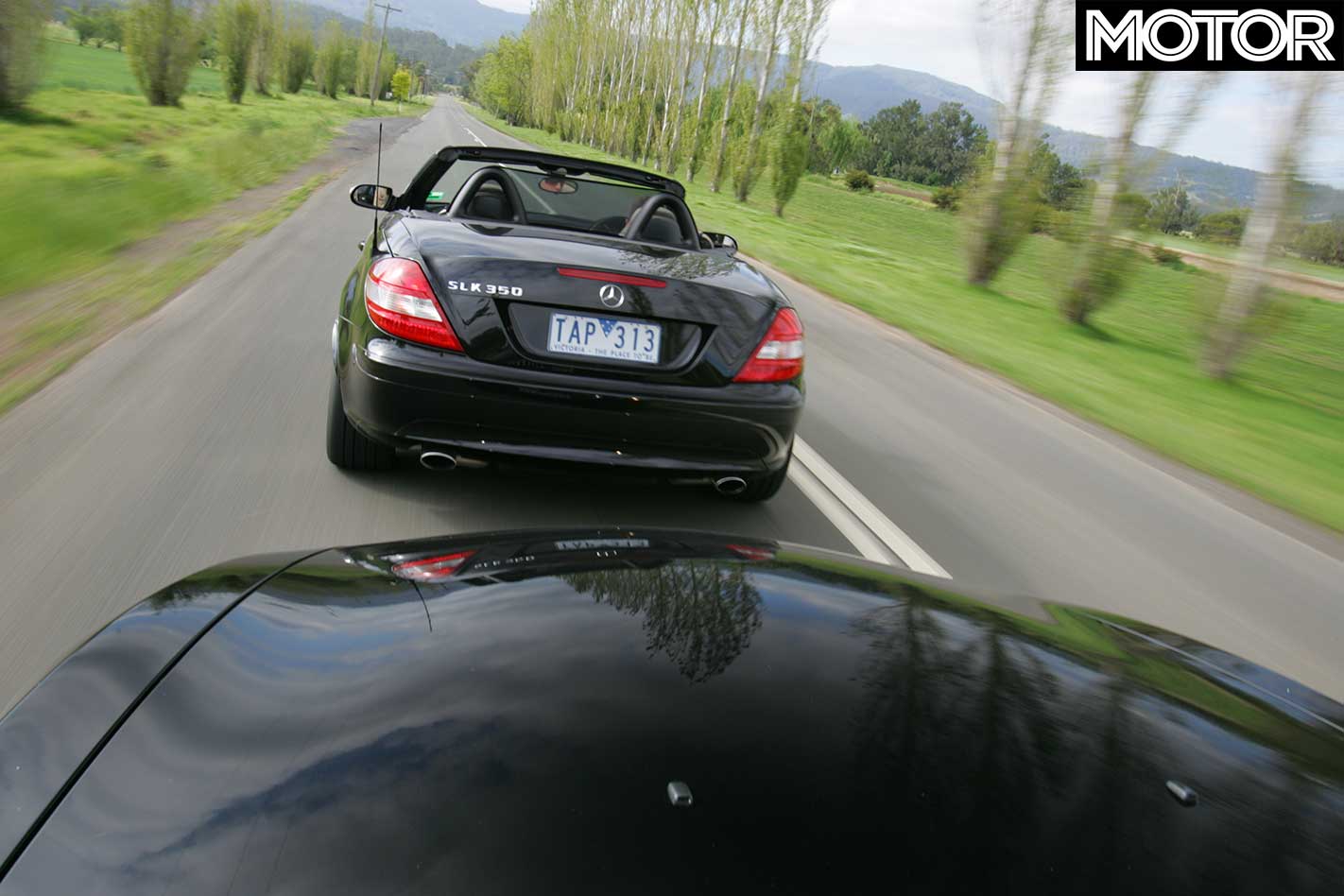
Over the same mix of roads the first thing that strikes you is the Merc’s compliance. It’s still firm over broken ground, but the Z4 is seriously stiff, especially in the rear. With the lids closed, the hard top SLK feels stiffer in the body, but drop the tops and it’s hard to split the difference.
Before we hand out the gong on this comparo though, it would be remiss of us not to mention the other great German roadster. We were tempted to throw a current model Porsche Boxster into this mix, but we’ve got a drive of the 2005 model.
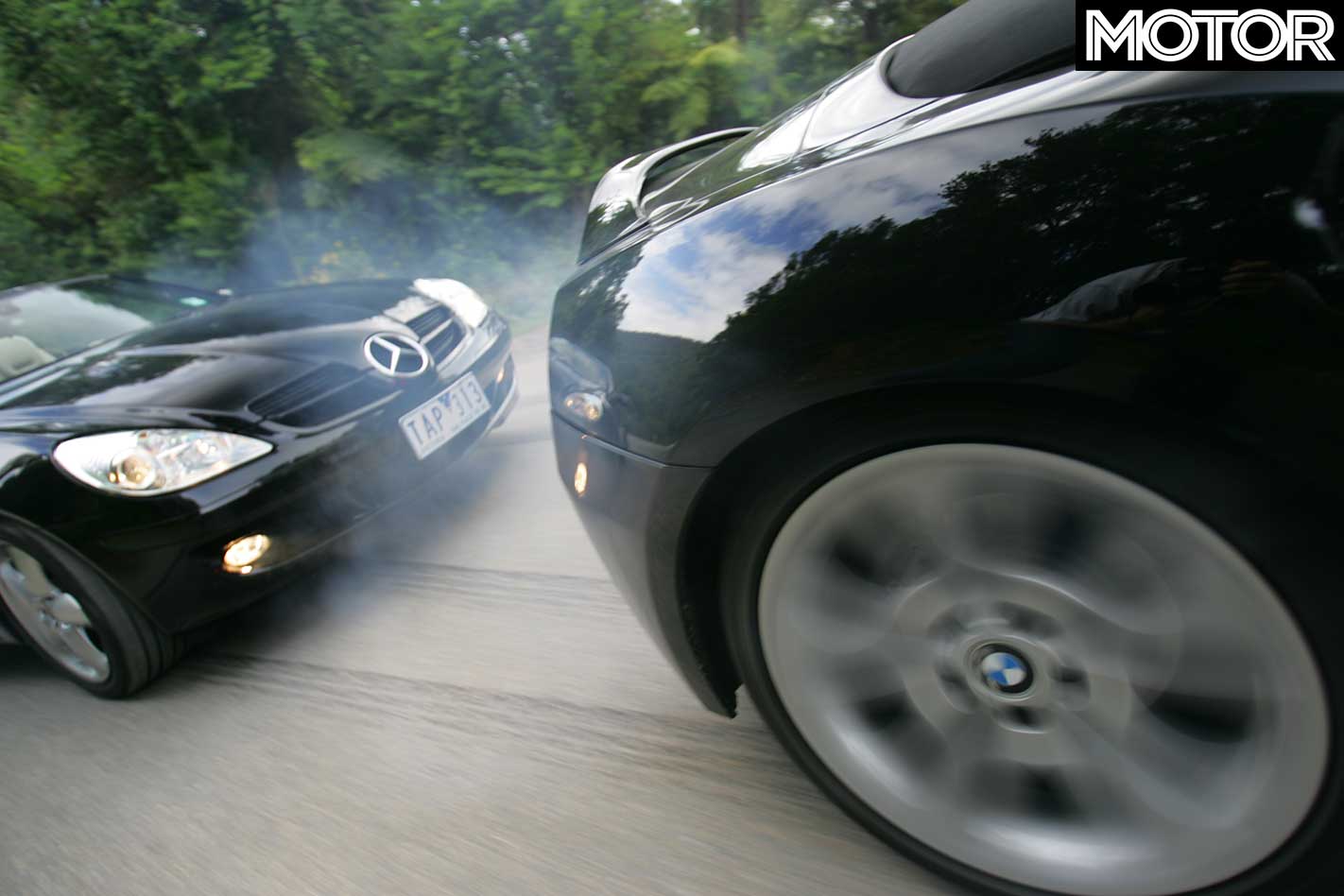
It’s hard to ignore the price gulf between the two, but the Mercedes does negate some of that difference with higher equipment levels, a bigger engine and the folding hardtop. With the auto, the SLK is seriously impressive, but either way, it represents a better bang than the previous model. The fact it wears a three-pointed star on its nose will be the deciding factor for plenty of buyers and no amount of BMW magic will sway them.
Still, the Bimmer is $18k cheaper and more fun despite the lack of power. And for out and out dynamics, the Bimmer has the SLK cold. Perhaps the Z4’s biggest accomplishment is not that it bested the SLK here, but that it has banished forever, the bad taste left by the undercooked Z3.
We’ll answer the question of the Boxster early next year.
Fast Facts
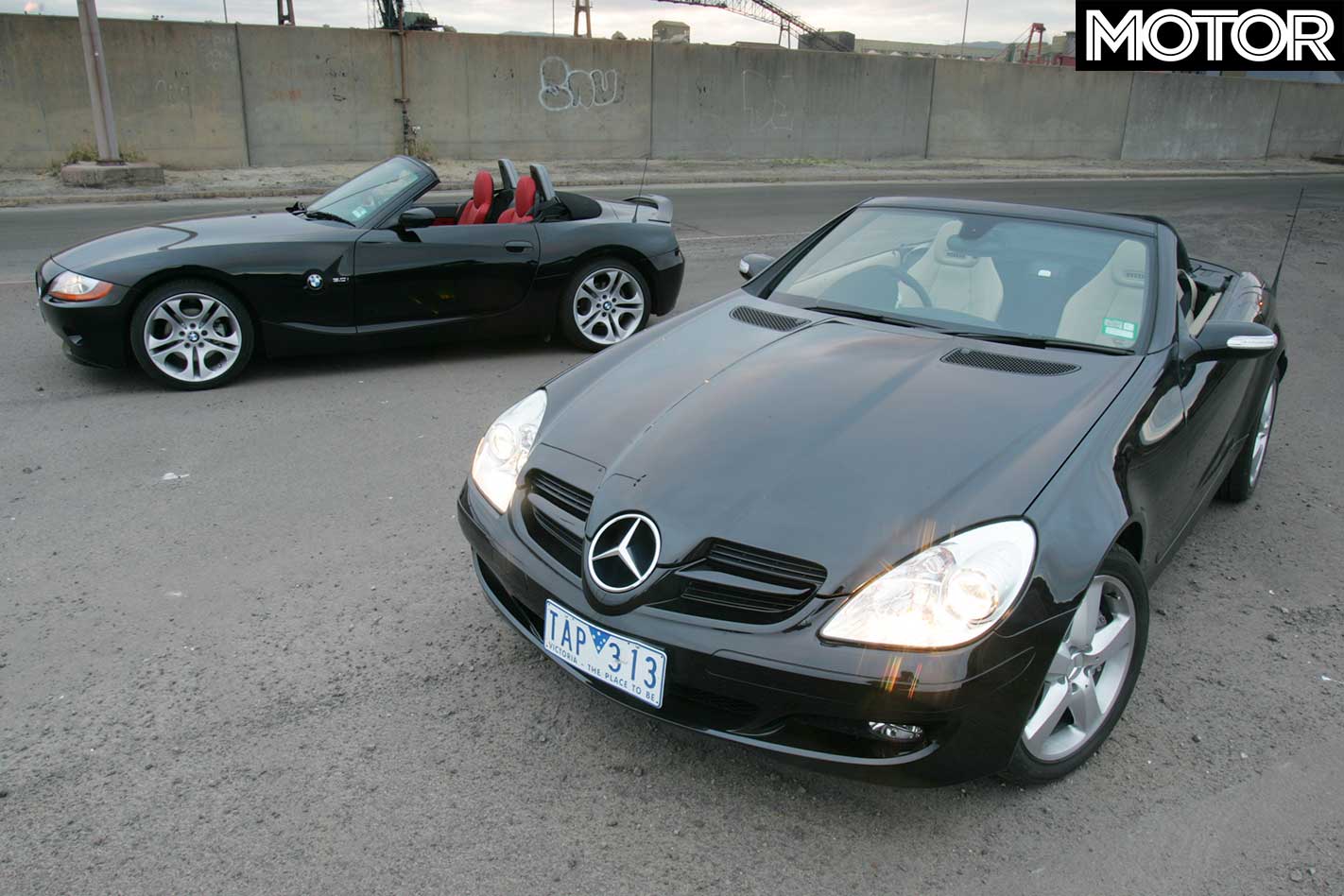
| u00a0 | BMW Z4 3.0 | Mercedes-Benz SLK350 |
| Body | two-door roadster | |
| Drive | rear-wheel | |
| Engine | u00a03.0-litre, DOHC 24-valve inline six | 3.5-litre, DOHC 24-valve V6 |
| Bore x Stroke | 84.0mm x 89.6mm | 92.9mm x 86.0mm |
| Compression | 10.2:1 | 10.7:1 |
| Power | 170kW @ 5900rpm | 200kW @ 6000rpm |
| Torque | 300Nm @ 3500rpm | 350Nm @ 2400-5000rpm |
| Transmission | six-speed manual | |
| Weight | 1290kgu00a0 | 1465kg |
| Power/Weight | 132kW/tonne | 137kW/tonne |
| Suspension | MacPherson struts, coil springs, anti-roll bar (f),u00a0 multi-link, coil springs, anti-roll bar (r) | |
| L/W/h | 4091/1781/1299mm | 4082/1788/1298mm |
| Wheelbase | 2495mm | 2430mm |
| Tracks | 1473mm (f); 1523mm (r) | 1526mm (f); 1549mm (r) |
| Brakes (f) | 300mm ventilated discs, single-piston calipers | 330mm cross-drilled & ventilated discs, two-piston calipers |
| Brakes (r) | 294mm ventilated discs, single-piston calipers | 290mm cross-drilled & ventilated discs, single-piston calipers |
| Wheels | 18 x 8.0-inch (f & r), alloy | 17 x 7.5-inch (f), 17 x 8.5-inch (r); alloy |
| Tyres | Michelin Pilot Sport; 225/40 ZR18 (f), 255/35 ZR18 (r) | Bridgestone Potenza; 225/45 ZR18 (f), 245/40 ZR18 (r) |
| Fuel | 55 litres, PULP | 70 litres, PULP |
| Price | $92,000 | $109,400 |
Two cents worth
“Through the twisty stuff, the Z4 has the Merc covered. Feeling hunkered down it seems to have an endless supply of grip, turning in quickly, settling and then steaming out of a corner. On the other hand, the SLK 350 tends to lean into corners, particularly on long flowing corners where it loads up. But what ground it loses to the Z4 through the twists and turns it makes up for on the straight, able to race away from the Bimmer with ease. But for its on-road dynamics and more involving nature, the Z4 gets my money (if I had $92k, that is). Sure it’s quick, but the Merc just doesn’t have the finesse.” – Isaac Bober
Little brother worth the bother?
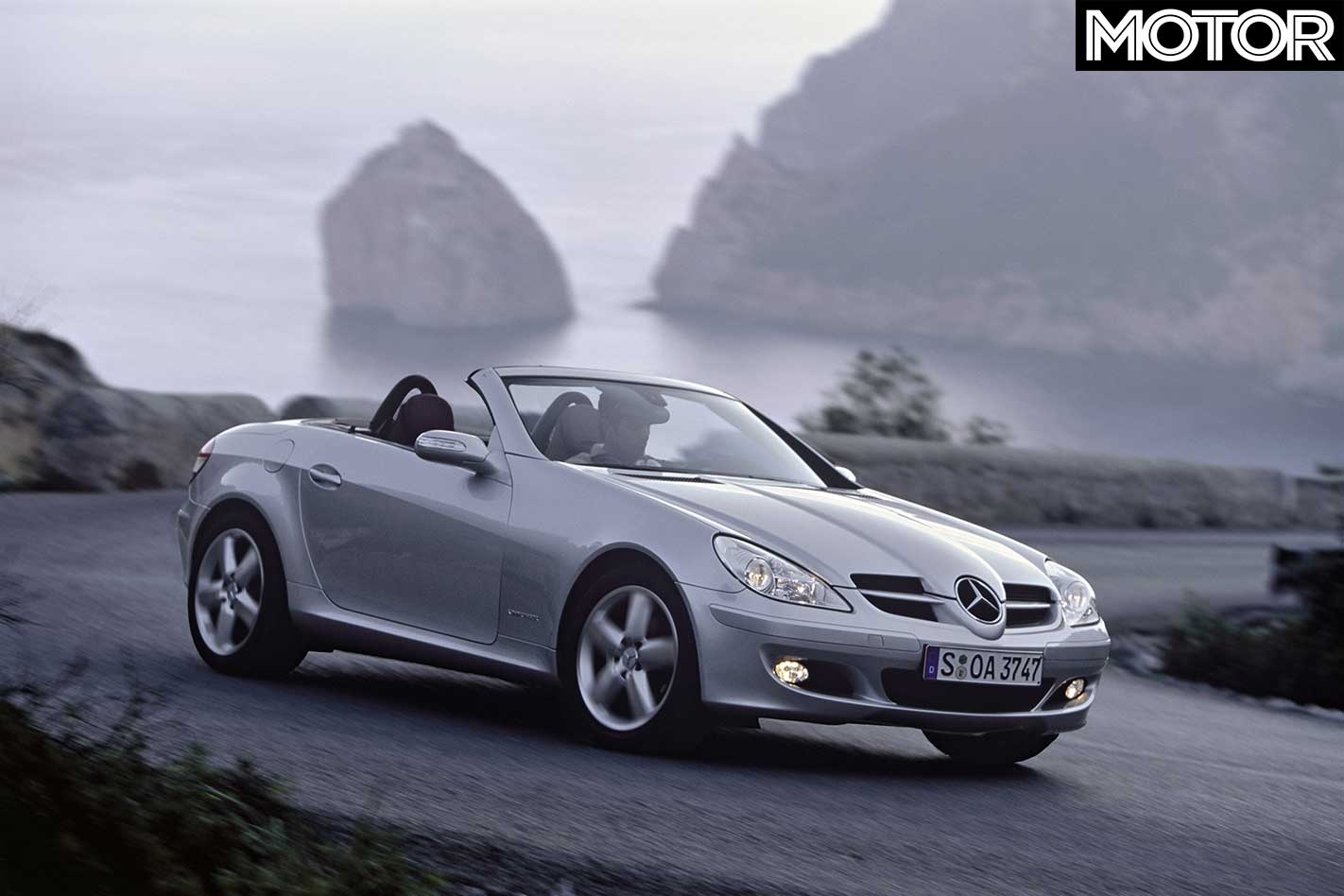
If you can’t quite stretch the budget to the $100k-plus ask of the SLK 350, but still want a drop-top roadster with that pointy badge on the key fob? Well, the bean-counters at Mercedes have you covered with the $86,900 SLK 200. The new SLK 200 packs a 120kW, and 240Nm punch from a 1.8-litre four-potter with supercharger.
You get a choice of a five-speed manual or a five-cog auto to stir it along. The torque-laden nature of the supercharged engine is a great complement to the slush ’box, so that’s the pick.
But if you’re a Bimmer fan and can’t shell out 92 large on the 3.0-litre Z4, there’s always the $78,500 Z4 2.5. The lower rung Z4 runs a 2.5-litre straight six for 141kW at 6000rpm and 245Nm on song from 3250rpm. Like the bigger engine, the 2.5-litre is a real smoothy and loves to rev – if anything, even more so than the 3.0-litre.
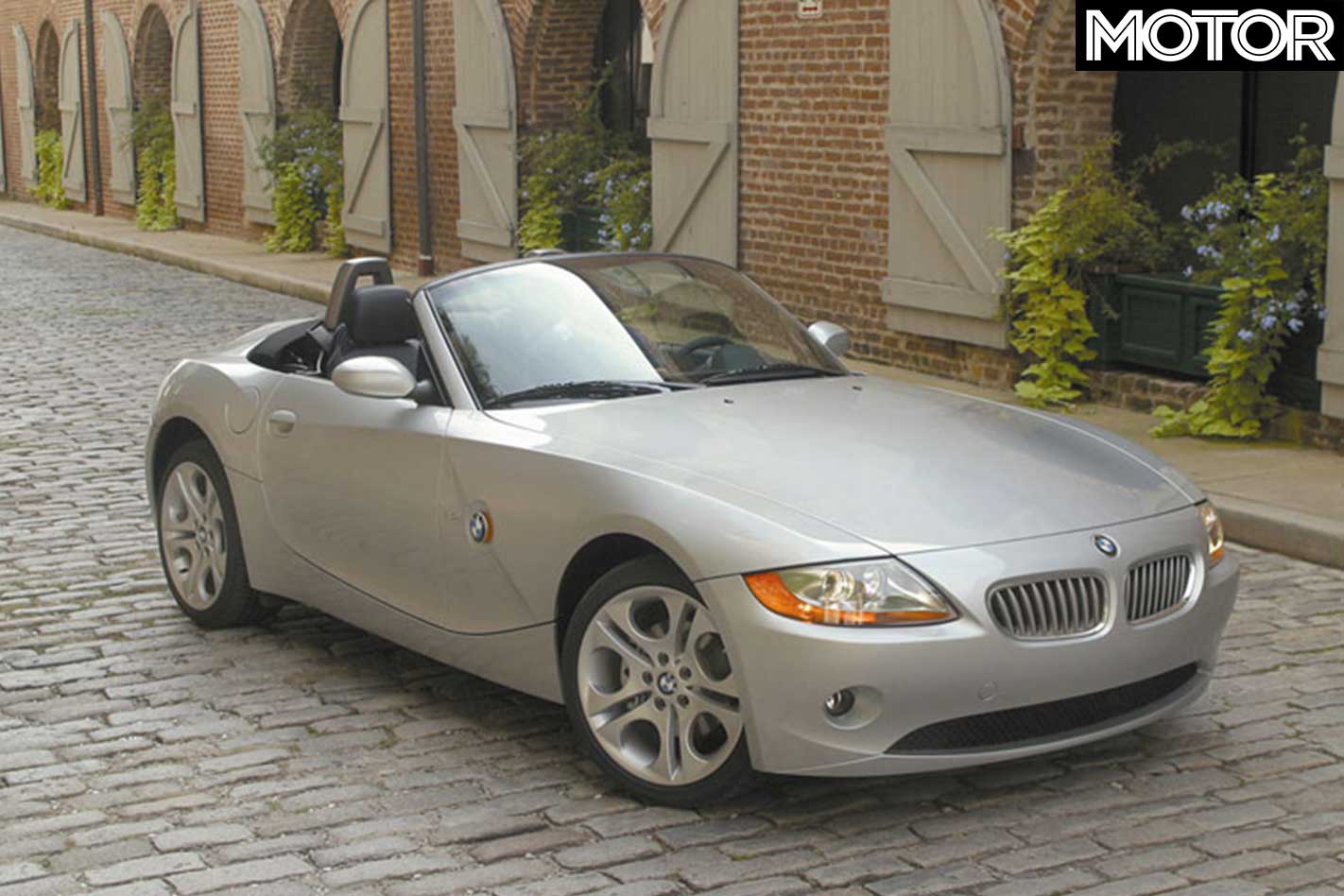
Matched to the engine is a choice of a five-speed manual or a slick-shifting five-speed auto, but the manual is the way to go if you have any quick driving in mind.
This match-up is somewhat similar to the main story, as the Mercedes is the torque king (though the peak number drops 5Nm to the propeller head, it flat-lines from 3000-4000rpm) and the Z4 boasts all the handling party tricks.
Again, it’s horses for courses, but like the main event, the price advantage is to the BMW making it hard to beat. Again, though, that advantage is somewhat offset by the longer list of standard equipment in the Mercedes.
It’s been following me for some time, but with a steep rock wall now hugging the side of the road it feels closer than ever. Only when I lower the window, however, does the shocking intensity of the noise emitted by the Lotus Evora GT430 really hit home.
There isn’t a lot of sound deadening in a GT430, but there’s enough to muffle the lightweight titanium exhaust. It’s like standing outside a stadium listening to the concert within – you sense there’s greater enjoyment to be had, if only you could get closer to the action.
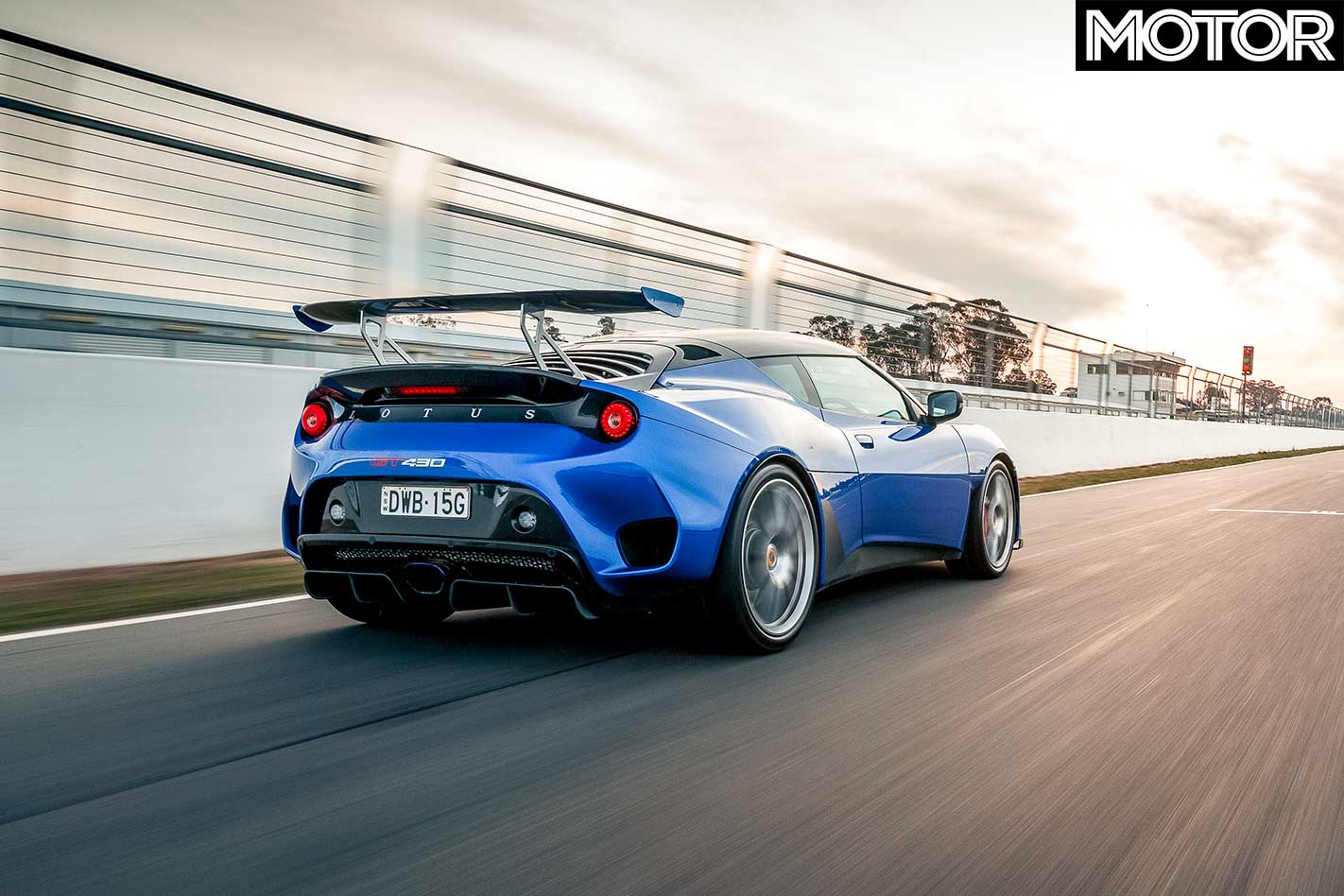
It’s probably not what Lotus was aiming for, but it reminds me of a race-spec Torana GTR XU-1. The Evora is smoother and not as gravelly in note, but has a similarly raucous six-cylinder rasp.
It’s been quite a Cinderella story for the 2GR-FE 3.5-litre V6. Initially found powering the Toyota Aurion, Lotus adapted the basic 206kW/350Nm unit to the Evora’s mid-engine, rear-drive layout and then added supercharging for the 257kW/400Nm Evora S.
Since those early days Lotus has kept fiddling, a revised supercharger and water-to-air intercooler lifting outputs to 298kW/410Nm. This ultimate GT430 enjoys a further 33kW/30Nm (40Nm in automatic guise) thanks to recalibrated ignition, fuel and camshaft mapping.
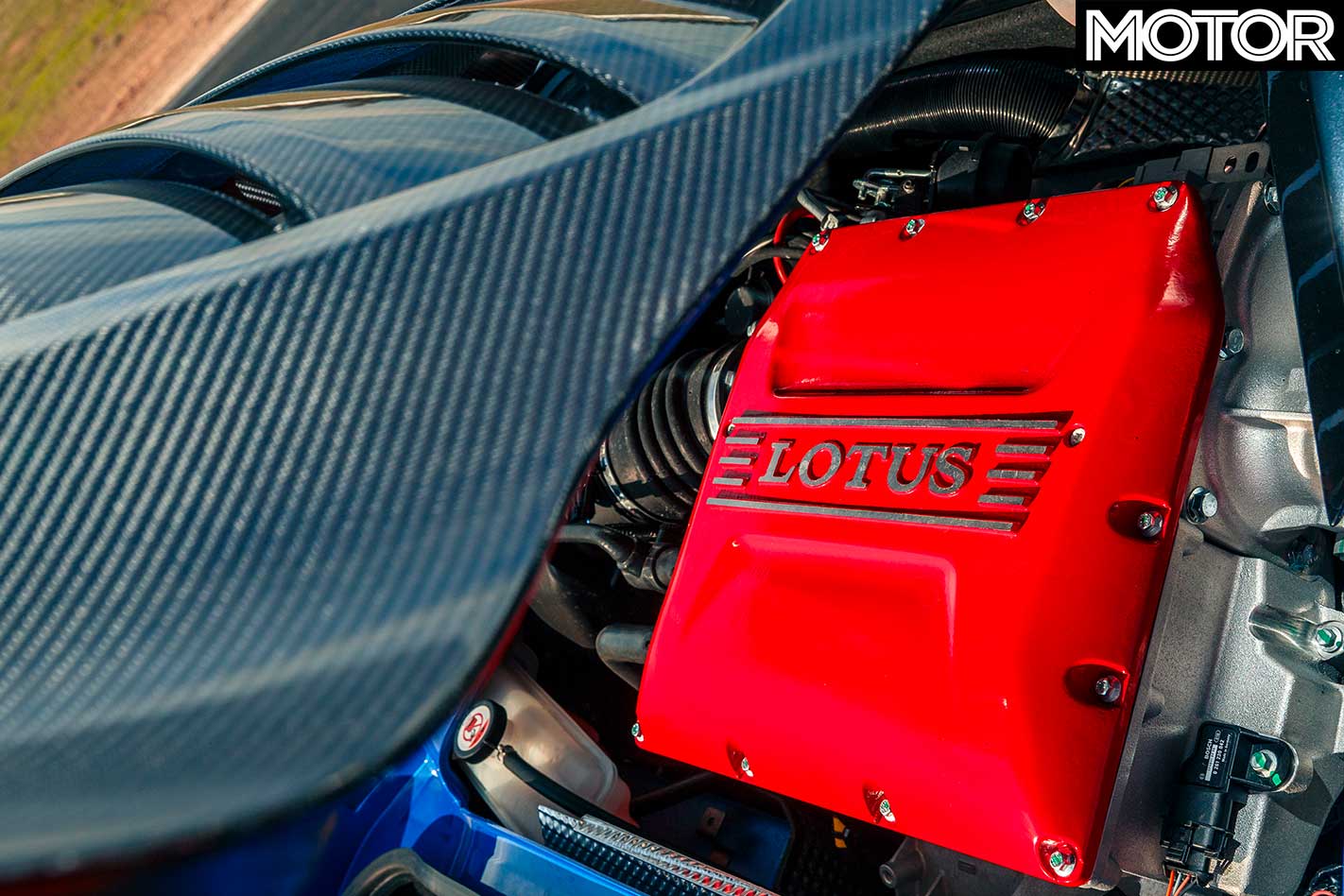
If you weren’t aware, you’d never guess the engine’s ordinary origins from behind the wheel. Supercharged engines are great. The linear nature of the power delivery makes it deceptively quick. A short stab of throttle instantly adds 15-20km/h and you’re often accelerating quicker than expected. It pulls cleanly from low revs, yet power builds right to the 7000rpm cutout.
Another reason to chase the redline is the bi-modal exhaust valves only open above 4500rpm; it’d be great if they were open permanently, but I suspect the ADR microphone would melt.
Lotus claims this upgraded powerplant makes the Evora GT430 its quickest road car ever. The wingless Sport variant manages an impressive 316km/h, but even with wing and splitter fitted it’s capable of 306km/h, while Lotus claims 0-100km/h takes just 3.8sec, or 3.7sec as an automatic. Lotus is either very optimistic, or it has some incredible test drivers.
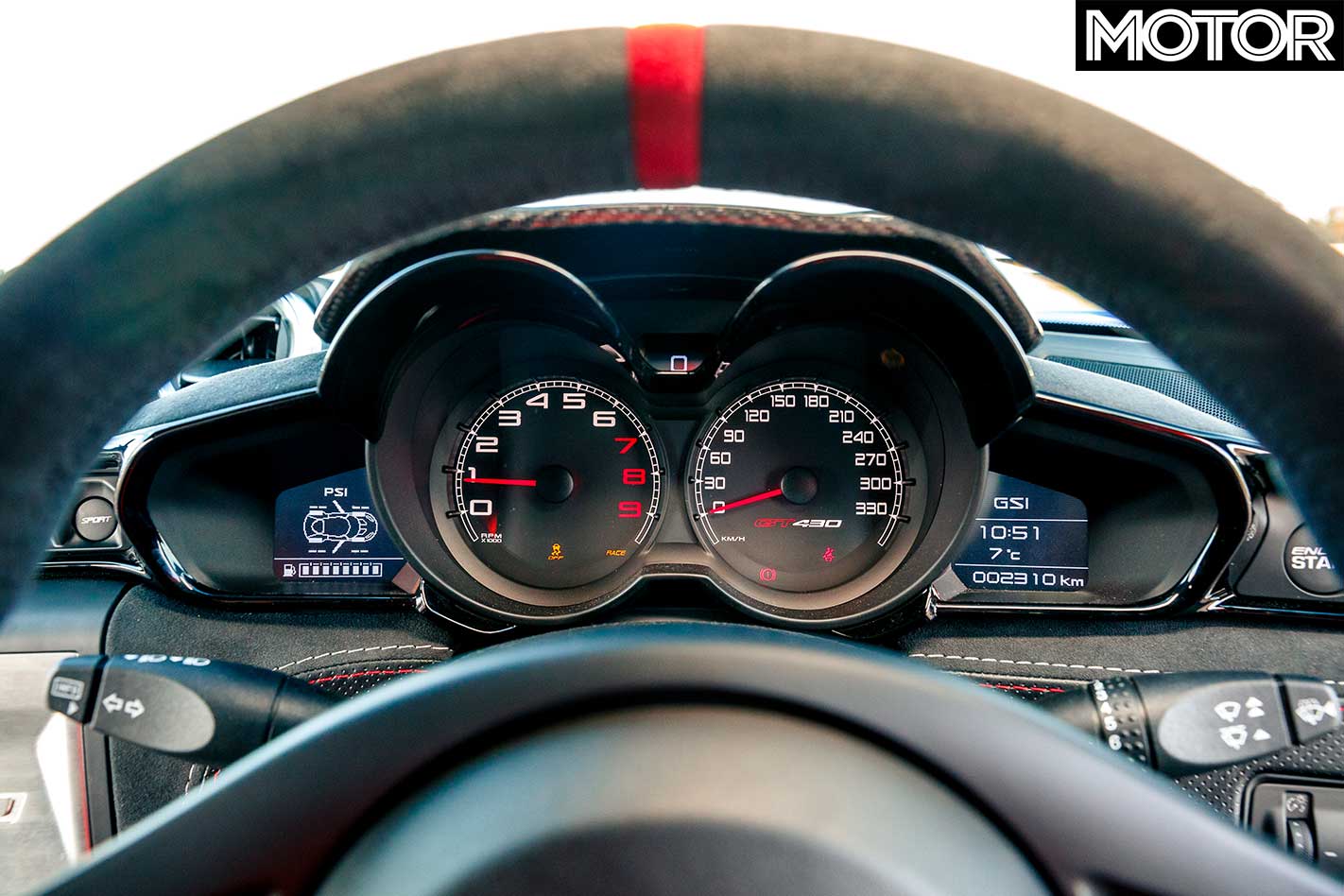
Perhaps there is some magic trick we’re not aware of, but launching the Evora in the traditional rear-drive manner – not too many revs and a hint of wheelslip – yields bests of 4.59sec to 100km/h and 0-400m in 12.64sec at 182.96km/h.
There’s always another tenth or so to be found, but the figures feel about right. The Evora GT430 is plenty quick, but doesn’t have the punch usually associated with sub-4.0sec machines. Adding further challenge to the task is a gearbox that really doesn’t like to be rushed.
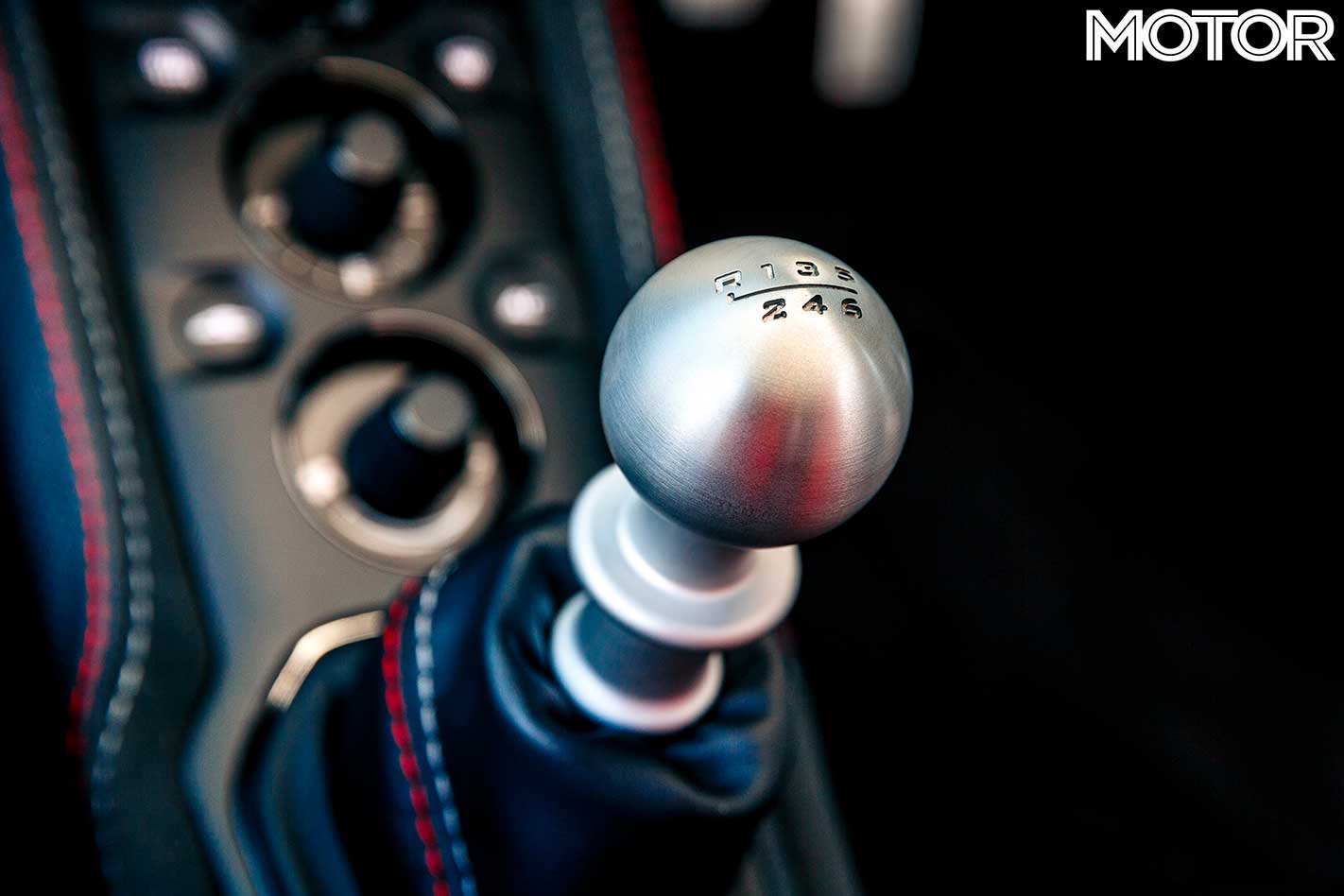
Early Evoras used the manual from a Corolla diesel; it was the only ’box capable of linking to the engine and handling the torque. As with the engine, Lotus has done an enormous amount of improvement since then, but a degree of patience is still required to complete clean shifts. It’s no chore to drive in traffic, but on the continual twists and turns of the epic Mansfield-Whitfield Road, I end up leaving it in third and using the engine’s torque.
As you’d hope, the Evora comes alive in the bends. The GT430 benefits from lessons learned by racing the Evora GT4, most notably in its use of aerodynamics and 96kg weight loss over the standard Evora 400.
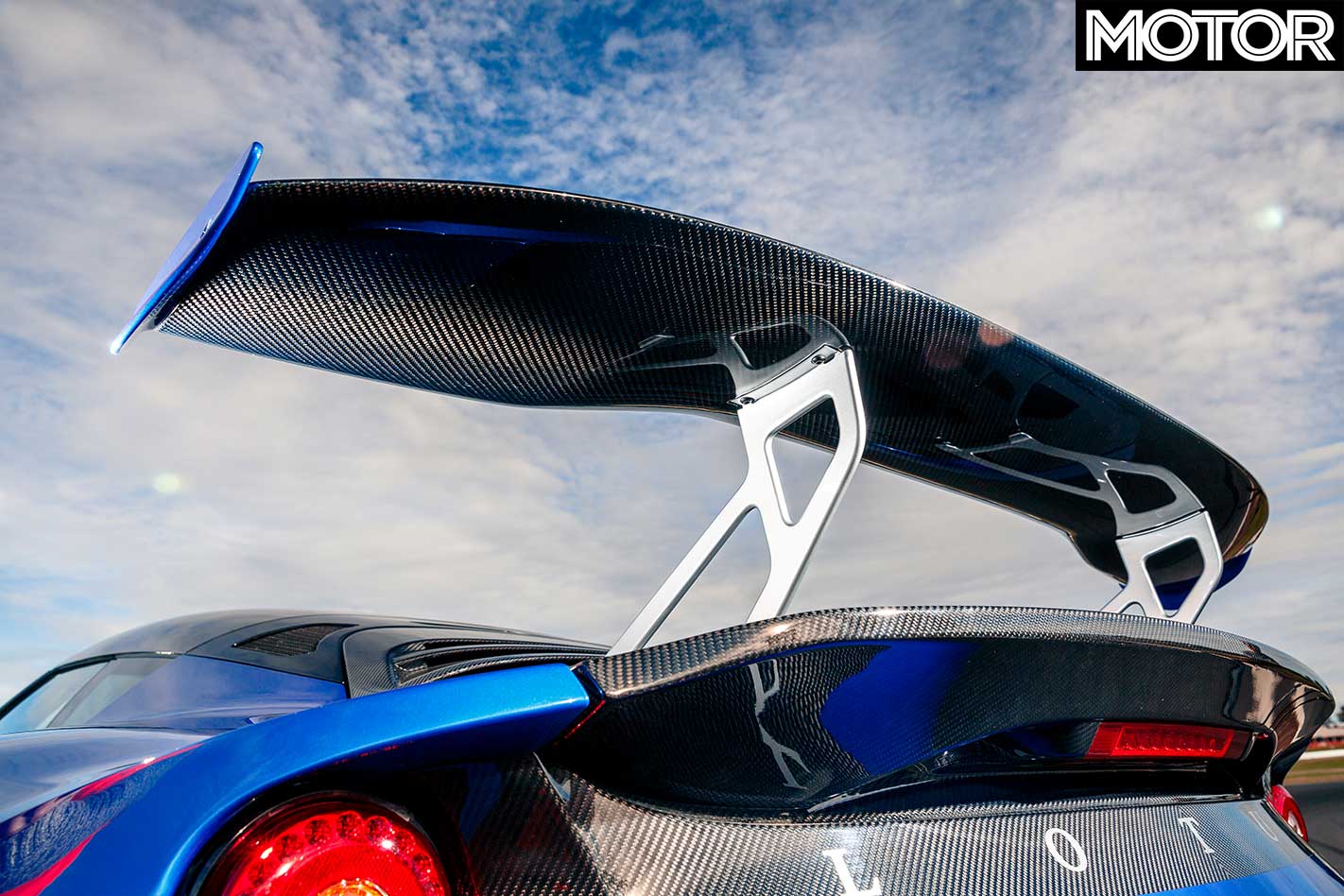
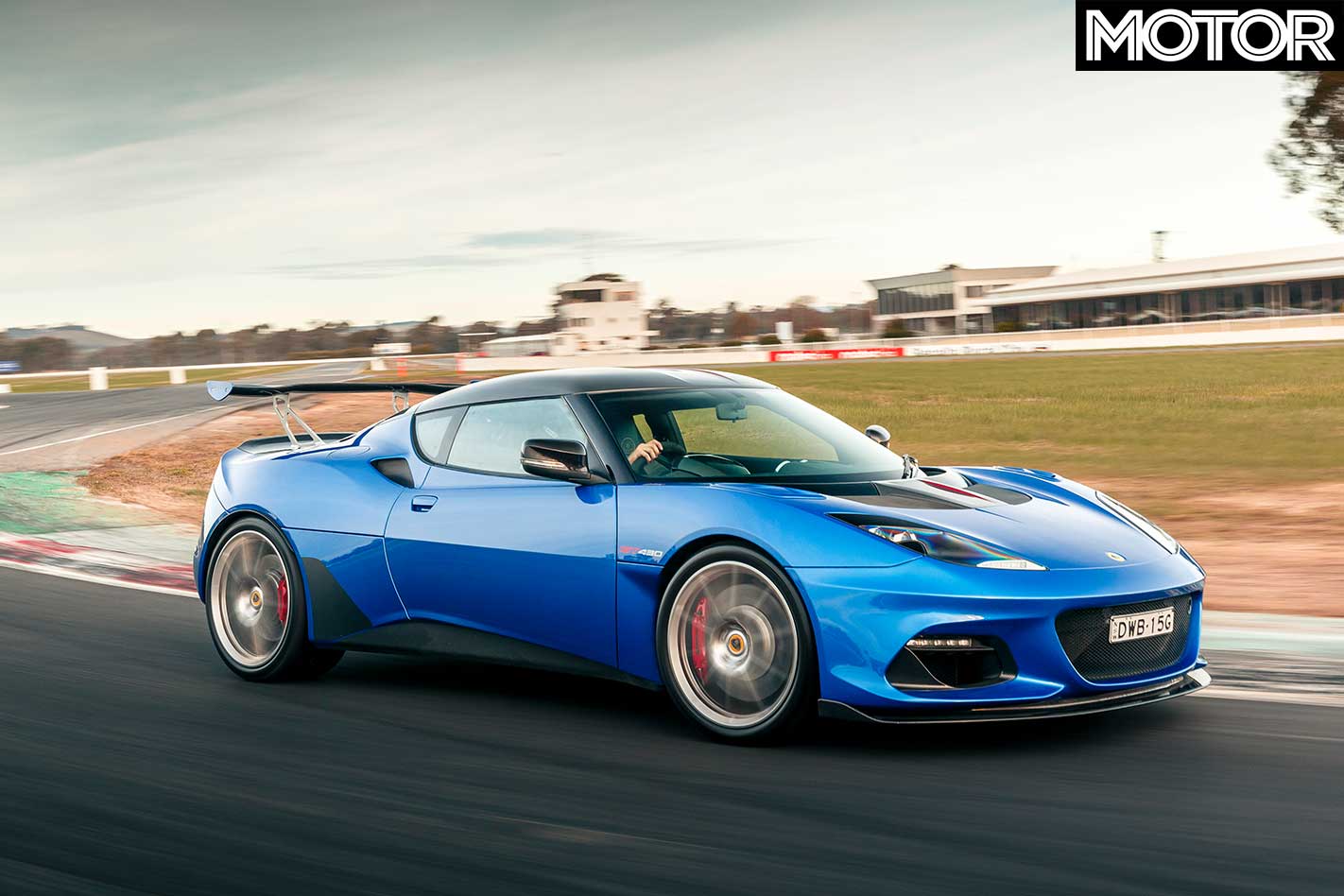
The reshaped edges of the front guards, which also have GT3 RS-style vents carved in the top, exit ports behind the rear wheels and that massive wing combine to create 250kg of downforce at top speed.
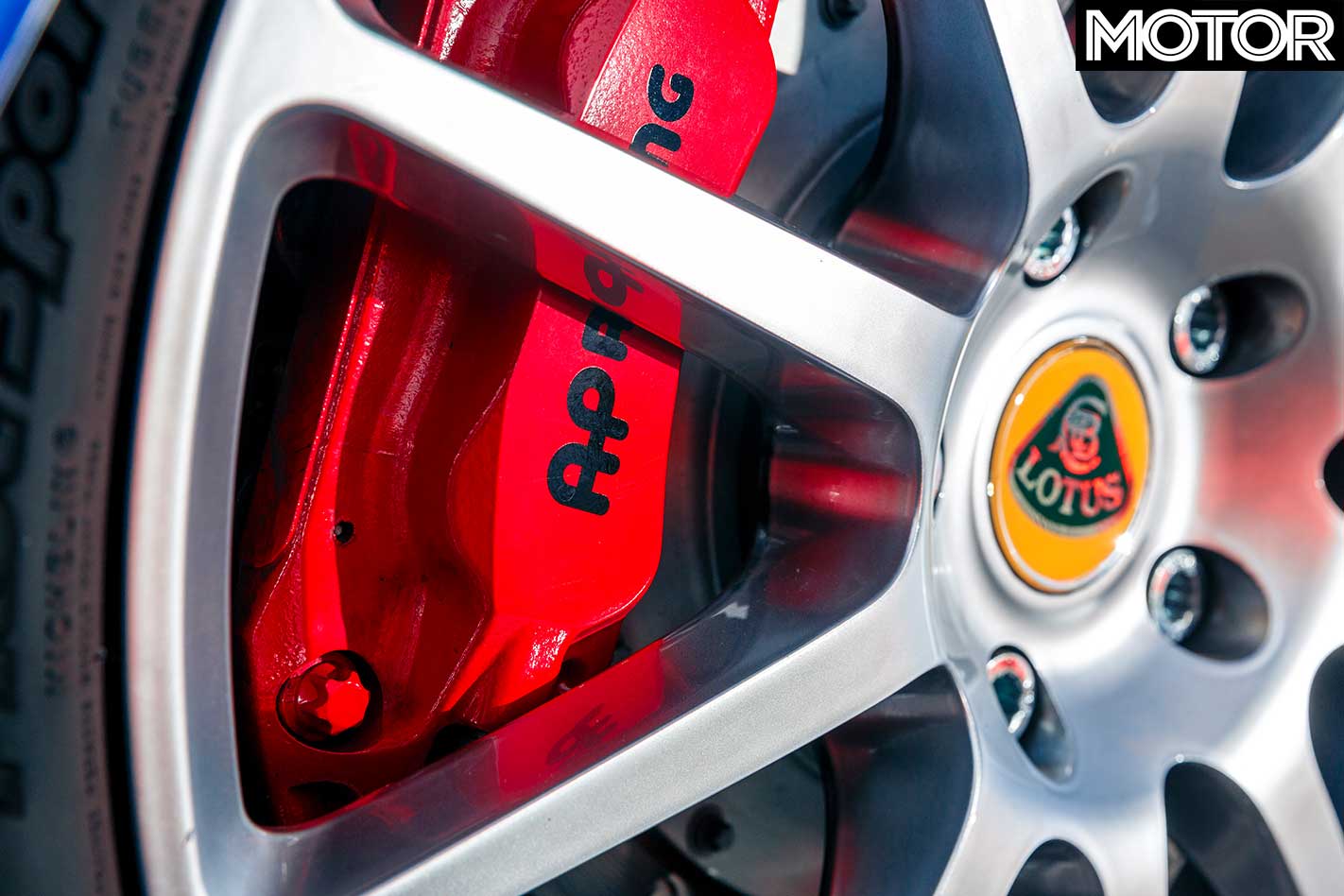
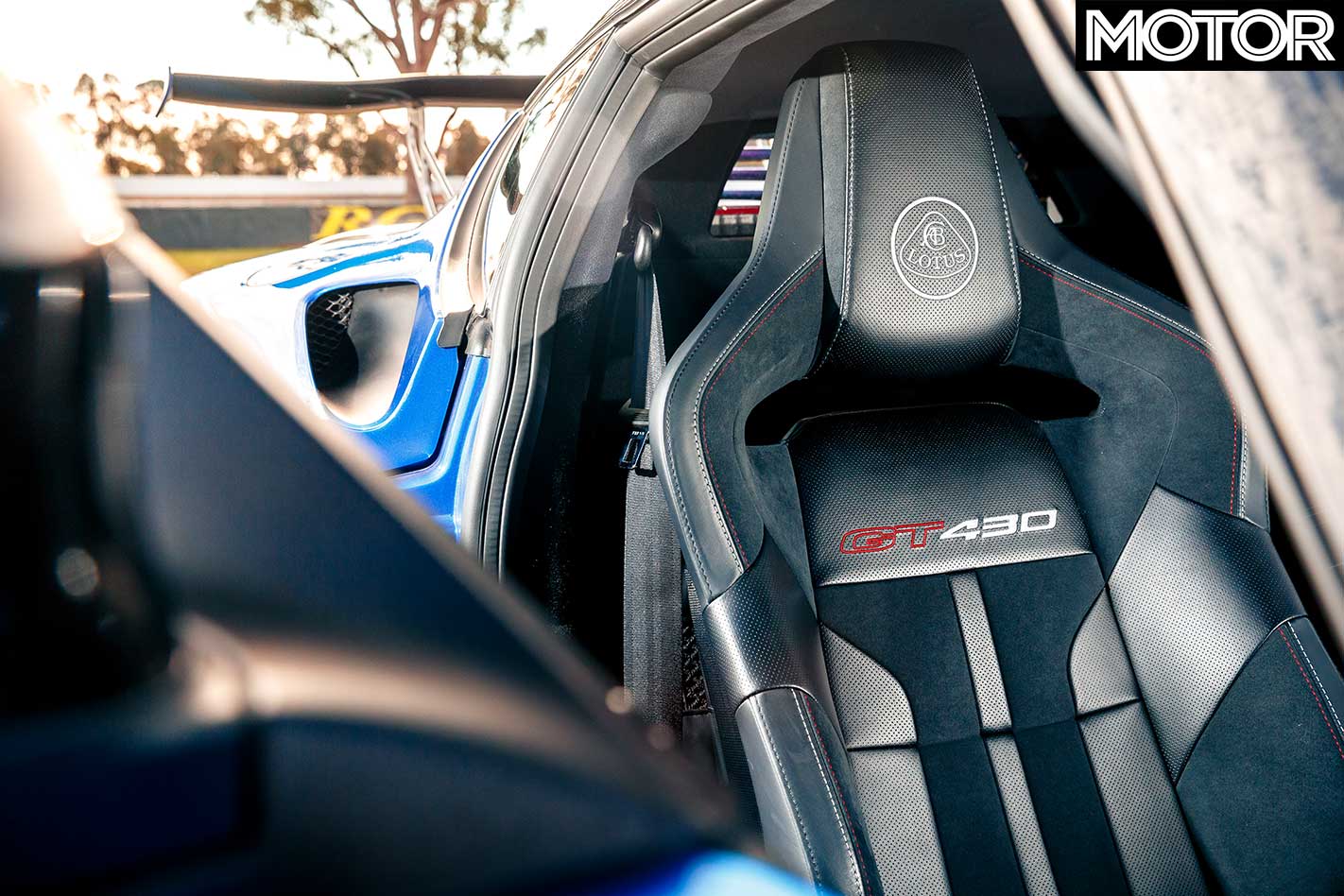
Everywhere you look there’s carbon fibre, the roof, front splitter, rear wing, engine cover, front air ducts, rear aero ducts, seats, side sills and monster rear diffuser all making use of the sexy black weave. The titanium exhaust sheds 10kg, the Ohlins two-way adjustable dampers save another 13kg and our test car doesn’t even have a stereo.
Those trick dampers have 20 clicks of compression and rebound adjustment to make the most of the grip offered by Michelin Pilot Sport Cup 2 tyres measuring 245/35 R19 front and 295/30 R20 rear.
With so much rubber and so little weight, the GT430’s lateral adhesion is absurd; it’ll double corner speed advisory signs without breaking a sweat, in some cases triple them. There’s so much grip that the limiting factor becomes your hold on the steering wheel; relax your arms and you realise that what you think is the limit is actually the tension in your muscles.
Barrelling in with overt enthusiasm will eventually instigate understeer, but in most corners the GT430 allows you to clear the brake, turn in and almost immediately get back hard on the throttle. With temperature in the tyres traction is not an issue, though the softness of the brake pedal occasionally is.
The pedal setup is such that heel-toe downshifts under heavy braking require some ankle contortions. A firmer brake pedal – surely appropriate in something this focused? – would improve confidence.
What’s truly impressive about the GT430, though, is that its cornering prowess doesn’t come with a teeth-chattering, skateboard ride, at least not with the dampers set to Lotus’s recommended road settings. Spring rates are increased massively over even the Evora 410 (47 per cent front, 20 per cent rear) but it’s no less comfortable than some hot hatches and never, ever relinquishes its body control.
There’s no crashing – in fact, the complete absence of any squeaks or rattles suggests Lotus’s recent focus on build quality hasn’t been in vain. There are some very cheap plastics inside, but enough carbon, leather and Alcantara to make the cabin feel special.
Although somewhere to put a phone, wallet, keys, a drink (anything!) would be nice. Conversely, storage space is relatively generous, the rear seats replaced by a flat bench in addition to the boot located behind the engine.
There’s certainly enough room for a helmet and an overnight bag, vital equipment for a trip to Winton. The Evora GT430 works better on the road that you’d imagine, but if it’s to justify its enormous $259,990 ($275,867 as-tested) price tag – a $50K premium over the 410 Sport – it’s going to want to shine on track. At this price point it’s perilously close to serious machinery like the Porsche 911 GT3 and Nissan GT-R Nismo.
That the GT430 is the fastest production Lotus around the company’s Hethel test track (essentially Fiorano with tea and scones instead of coffee and pasta) bodes well. Unfortunately, we couldn’t rope a pro driver in to set a lap time, but if I can manage a 1min33.5sec circuit of Winton in just five laps (none of them particularly clean) it seems likely there’s a couple of seconds to be found by more capable hands.
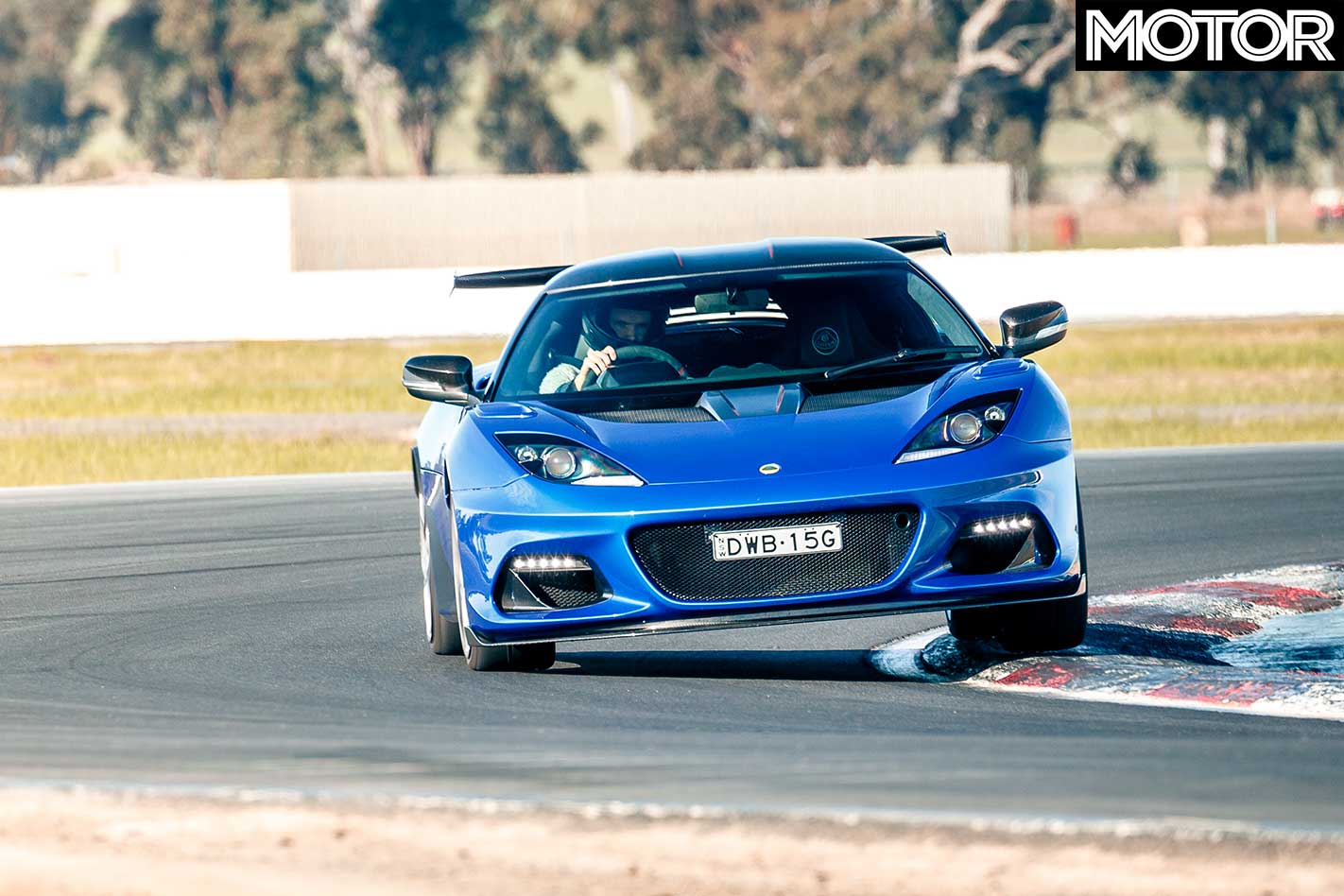
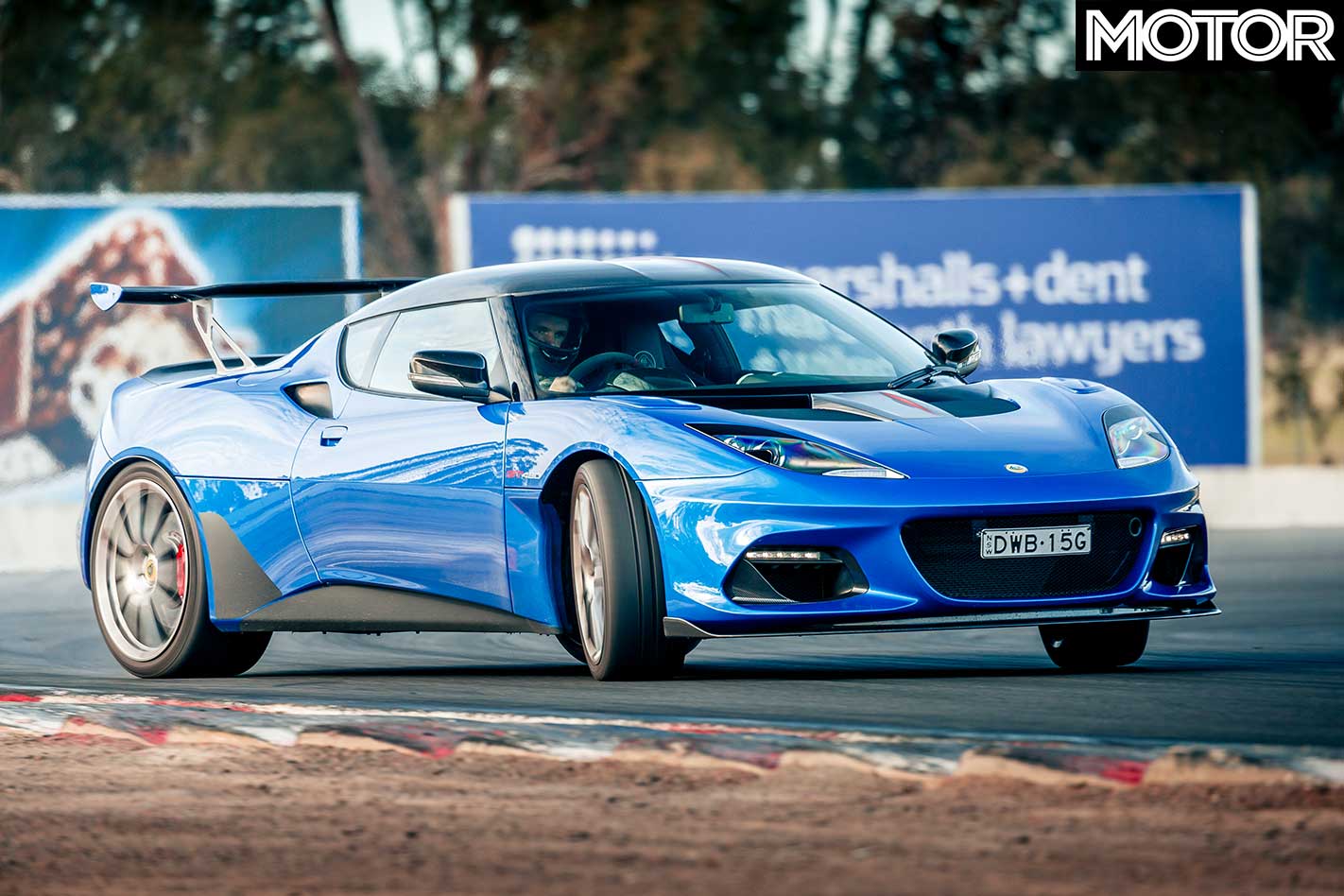
Track work exacerbates the Evora’s on-road attributes, good and bad. Its grip remains stupendous; as you’d hope, its average apex speed would have topped the list at our recent Bang For Your Bucks test, but to out-corner a Civic Type R is no mean feat.
Its 83.16km/h average would be higher, but the understeer that only appeared occasionally on the road becomes persistent on track. It’s mild and no doubt easily dialled out via the dampers, but delays how quickly the throttle can be re-applied in almost every corner.
Drive to the available front grip and there’s the feeling that there is time to be gained if you could get on the gas earlier. There’s certainly sense in providing an understeer bias for this road setup, but on the track more front bite would pay dividends in enjoyment and lap time.
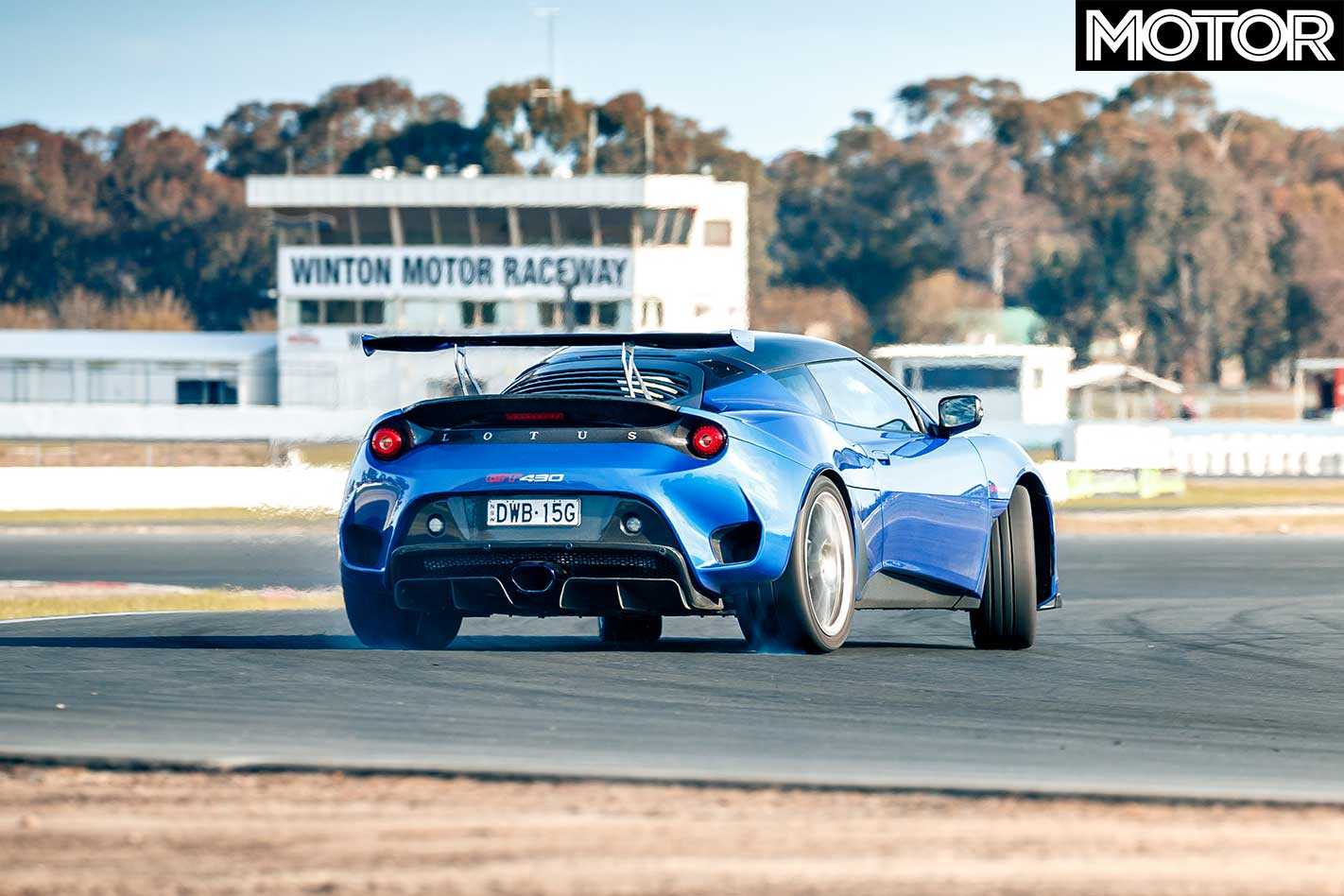
At the limit Lotus’s race-spec six-stage traction control comes into its own. To be honest, the ESP calibration in Race mode is so good, so lenient and unobtrusive in its intervention, that in the dry there’s no need to turn ESP off.
Nonetheless, from there Lotus gives you the option to gradually reduce the traction control intervention and allow greater levels of wheelslip, from 1 per cent to a maximum of 12 per cent, with the sixth stage being completely off.
Be sure of yourself before taking that last step. The Evora has an immense amount of grip, but when it runs out immediate action is required; the first attempt at a cheeky low-speed slide results in a 360-degree spin before you could say “opposite lock”. The GT430 can certainly hold a mean powerslide, but needs serious provocation to do so – it would rather just keep setting lap times.
Suspension setup aside, the greatest barrier to lowering lap times is the gearbox. Just as on the road, the ’box wants to operate at its own pace and a number of laps end early after a mis-shift. Precious tenths disappear on upshifts and the GT430’s super-short braking distances make the quick downchanges required a lottery. It’s enough of an annoyance to make the optional six-speed automatic well worth considering.
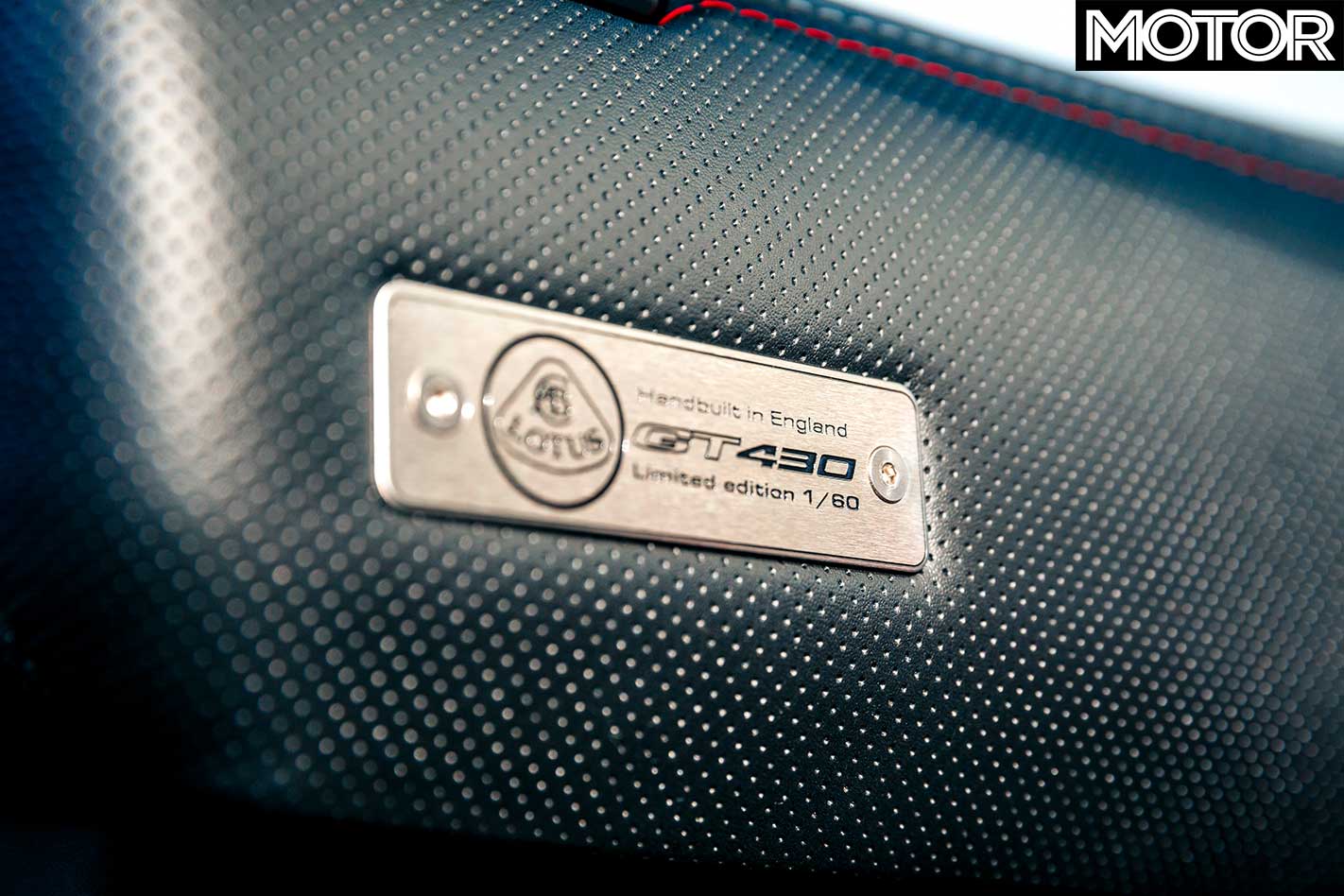
If you are considering an Evora GT430, then you’d better be quick. Lotus is making just 60 each of it and the Sport and just four of the winged warriors are coming to Oz. Three are already sold. At which point objective assessment becomes slightly irrelevant.
It’s all too easy to say it’s not as good as a 911 GT3, but I suspect for those three buyers the fact the Evora is not a GT3 was a very good reason to purchase one. The GT430 looks awesome, sounds incredible, is great to drive, extremely rare and refreshingly different.
Nonetheless, if you’re a track junkie your needs might be better met by the lighter, quicker, sharper Exige Cup 430. If road use with the occasional track foray is more your thing, the Evora GT410 Sport offers most of the performance and, crucially, all of the noise of the GT430 with a few more creature comforts.
Then again, if you’re a Lotus fan with a carbon fetish who places a premium on exclusivity, there is literally only one car for you. Act fast.
FAST FACTS 2018 Lotus Evora GT430
BODY: 2-door, 2-seat coupe DRIVE: rear-wheel ENGINE: 3456cc V6, DOHC, 24v, supercharger BORE/STROKE: 94.0mm x 83.0mm COMPRESSION: 10.8:1 POWER: 321kW @ 7000rpm TORQUE: 440Nm @ 4500rpm WEIGHT: 1299kg POWER-TO-WEIGHT: 247kW/tonne TRANSMISSION: 6-speed manual SUSPENSION: double wishbones, coil springs, anti-roll bar (f/r) L/W/h: 4394/1845/1240mm WHEELBASE: 2575mm TRACKS: 1564/1575mm (f/r) STEERING: hydraulically-assisted rack-and-pinion BRAKES: 370mm ventilated/grooved discs, 4-piston calipers (f); 350mm ventilated/grooved discs, 4-piston calipers (r) WHEELS: 19.0 x 8.0-inch (f); 20 x 10.5-inch (r) TYRES: Michelin Pilot Sport Cup 2; 245/35 R19 (f), 295/30 R 20 (r) PRICE: $259,990 ($275,687 as tested)
PROS: Grip; exclusivity; noise; clever traction control CONS: Rivals much quicker; gearshift; price RATING: 3.5 out of 5 stars
The Strip
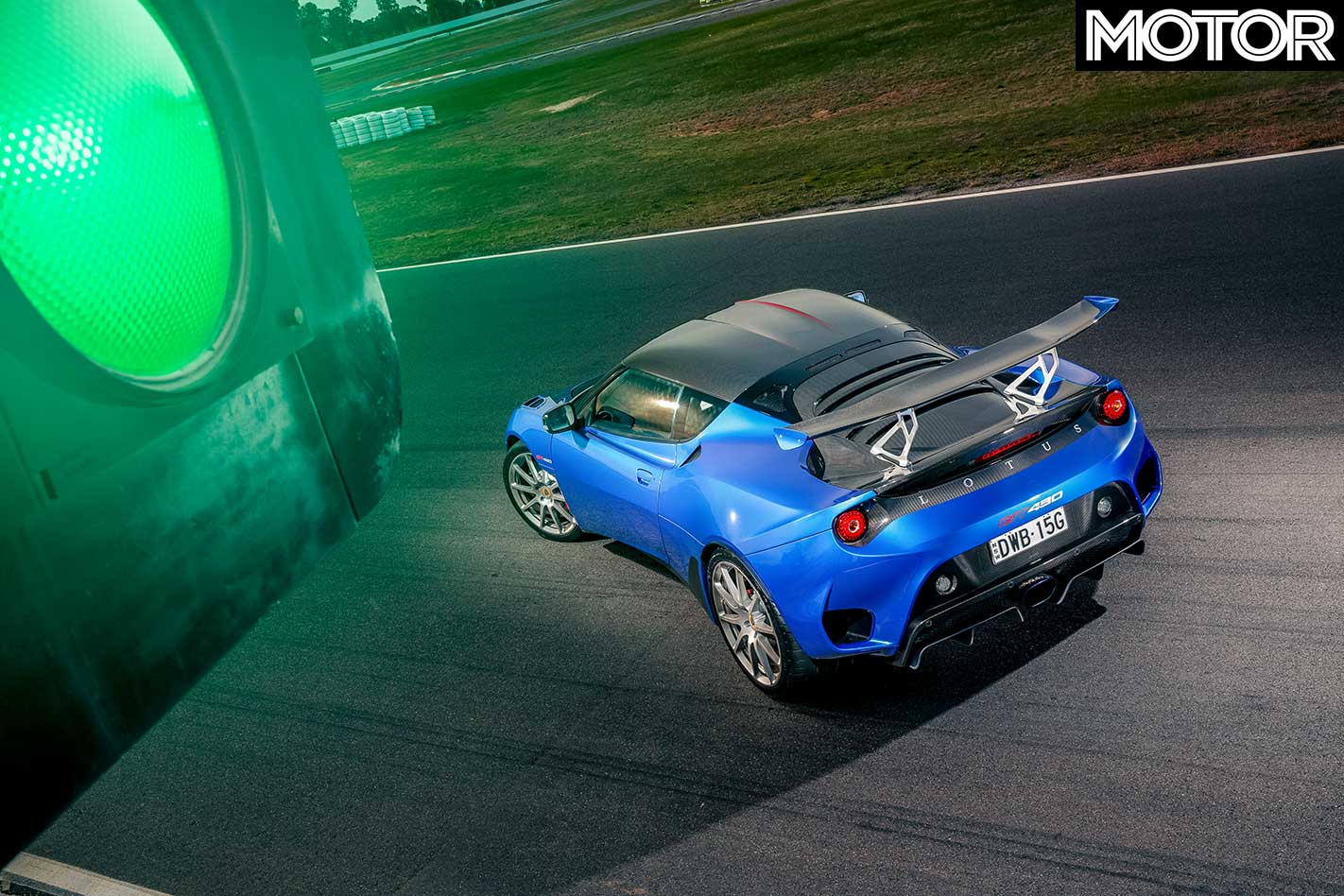
| Lotus Evora GT430 | |
| 0-10km/h | 0.40sec |
| 0-20km/h | 0.79sec |
| 0-30km/h | 1.13sec |
| 0-40km/h | 1.43sec |
| 0-50km/h | 1.79sec |
| 0-60km/h | 2.18sec |
| 0-70km/h | 2.91sec |
| 0-80km/h | 3.45sec |
| 0-90km/h | 4.01sec |
| 0-100km/h | 4.59sec |
| 0-110km/h | 5.17sec |
| 0-120km/h | 6.06sec |
| 0-130km/h | 6.91sec |
| 0-140km/h | 7.72sec |
| 0-150km/h | 8.57sec |
| 0-160km/h | 9.43sec |
| 0-170km/h | 10.94sec |
| 0-180km/h | 12.24sec |
| 0-400m | 12.64sec @ 182.96km/h |
| 100-0km/h | 33.13m |
| Lap time | 1min 33.5sec |
| Speed in gears | |
| 1st | 68km/h @ 7000rpm |
| 2nd | 125km/h @ 7000rpm |
| 3rd | 170km/h @ 7000rpm |
| 4th | 219km/h @ 7000rpm |
| 5th | 288km/h @ 7000rpm |
| 6th | 306km/h @ 6600rpm* |
Winton Raceway, 12˚C, dry Driver: Scott Newman *Manufacturer’s claim
The electric vehicle evolution may still be a little while away, but the first steps towards an Australia-wide high-speed charging network have taken place.
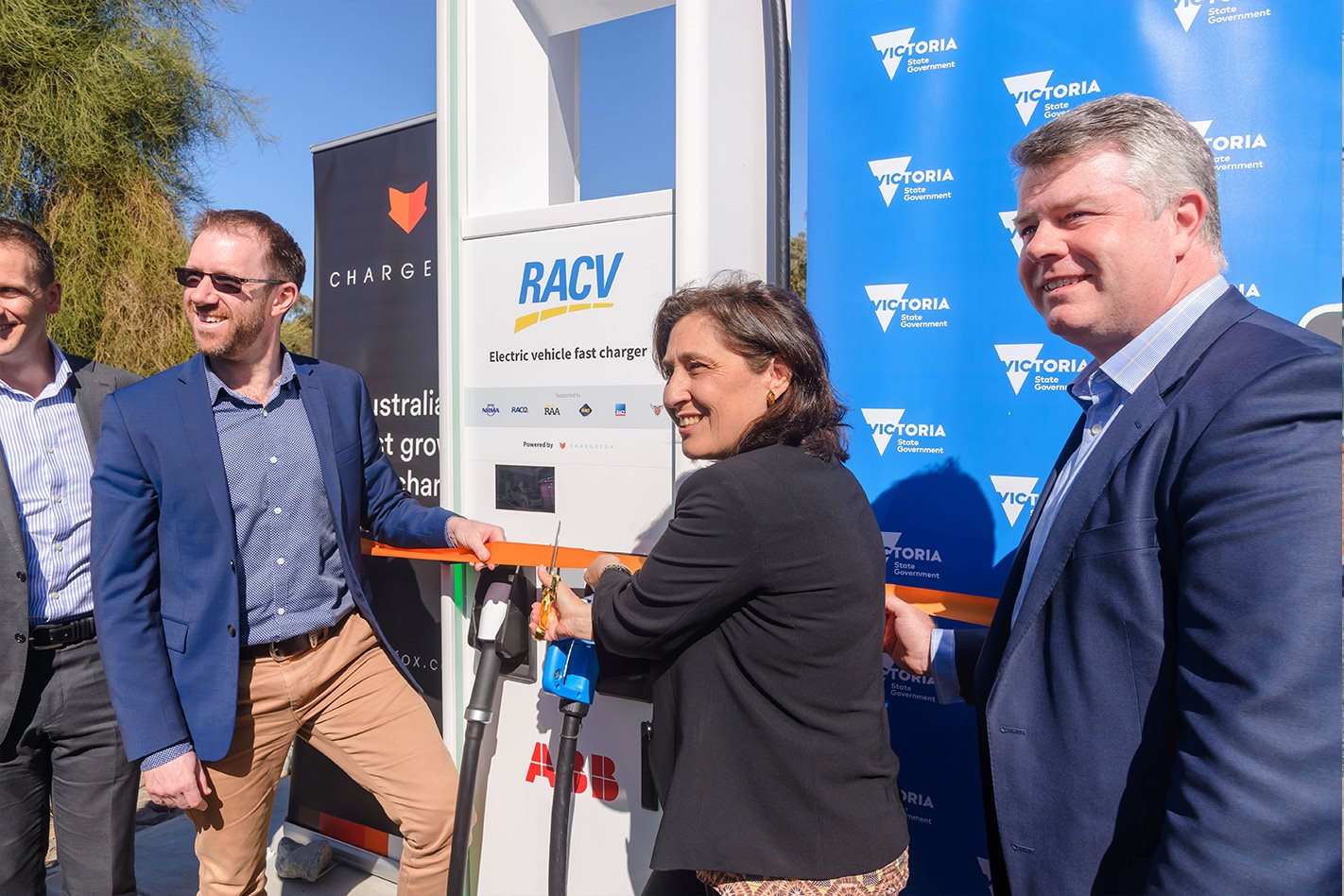
In a ceremony in Victoria last week, the ribbon was cut on the first of 21 high-power electric charging bays that will populate the east coast of Australia.
It’s the work of new start-up ChargeFox, which is part of the worldwide JetCharge group. The initial group of stations – all powered by renewable electricity – will be funded with a $15 million capital raising via Australia’s motoring clubs, transformer company Wilson, and Carsales founder Greg Roebuck.
Grants from the Victorian state government and the Australian Renewable Energy Agency were also accessed.
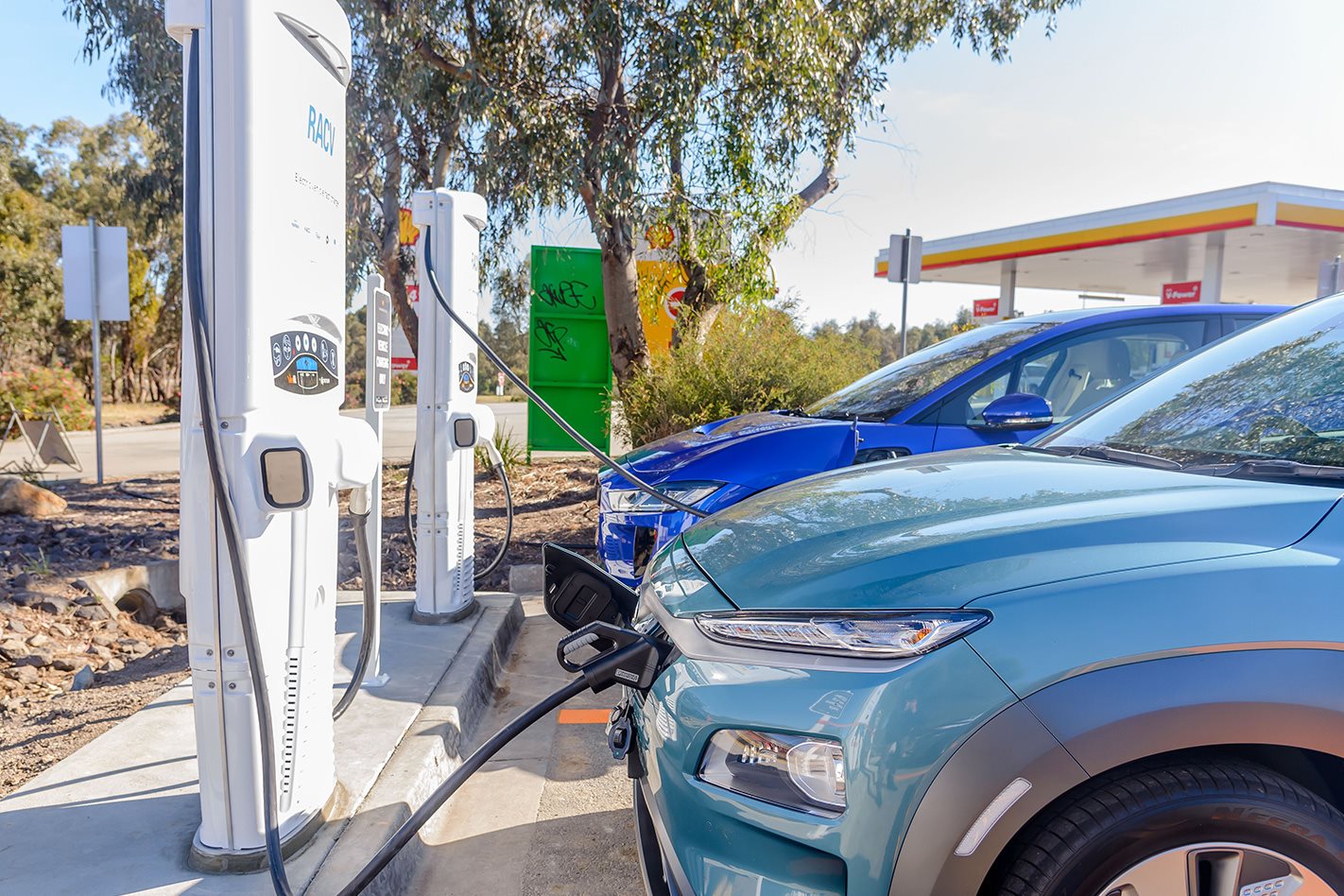
On hand at the ribbon-cutting ceremony were representatives from car companies with a stake in the EV game – with the notable exception of Tesla.
Audi, Hyundai, Jaguar and Mercedes-Benz spokespeople lauded the world-first 350kW charging station technology, which can add 400km of range to an EV in as little as 15 minutes, as well as store power on-site from its solar array.
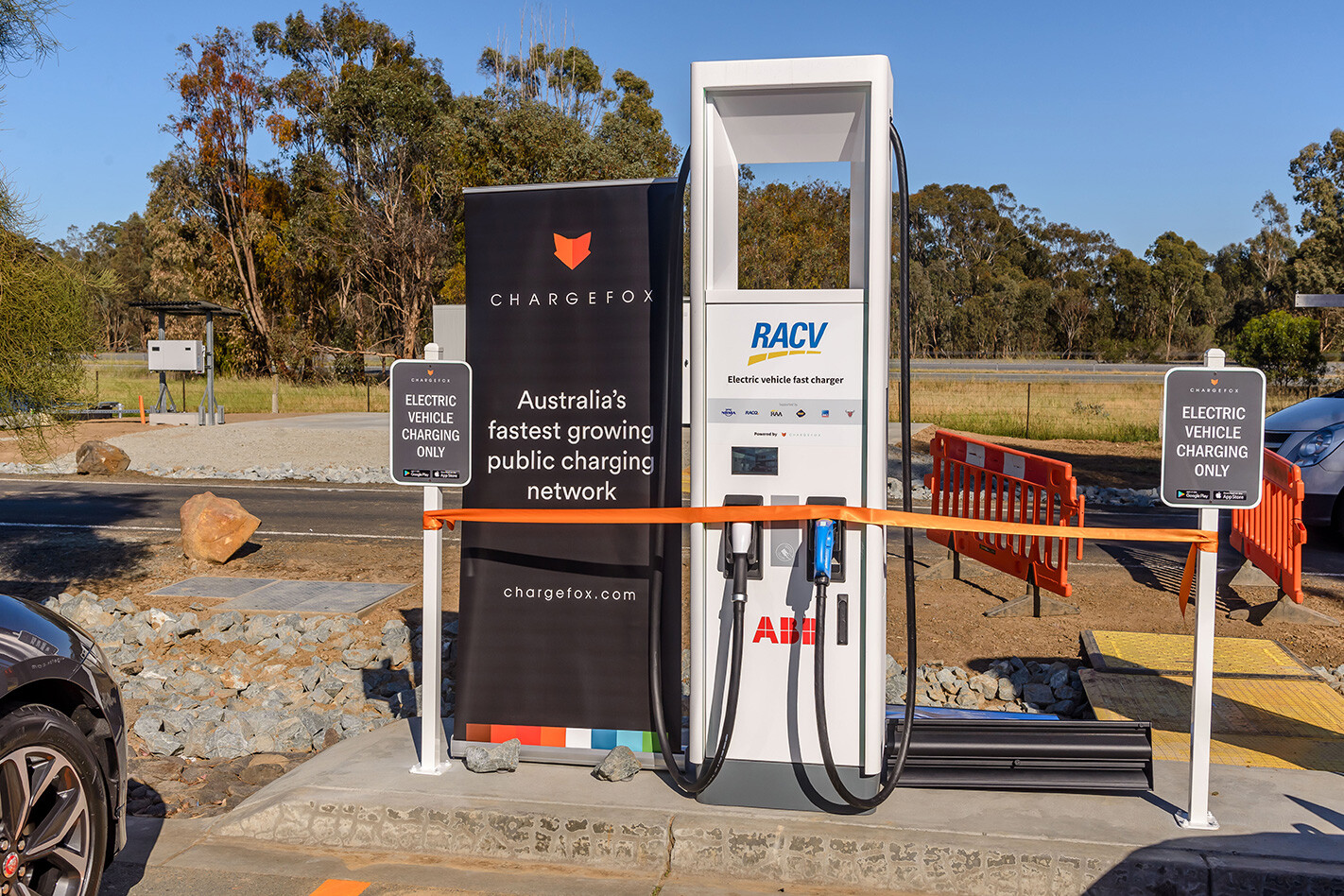
“These foundation partnerships with the world’s leading automobile manufacturers demonstrate Australia’s steadfast commitment to innovative, electric-focussed, sustainable solutions within the automobile industry,” said Marty Andrews, the CEO of Chargefox, at the event.
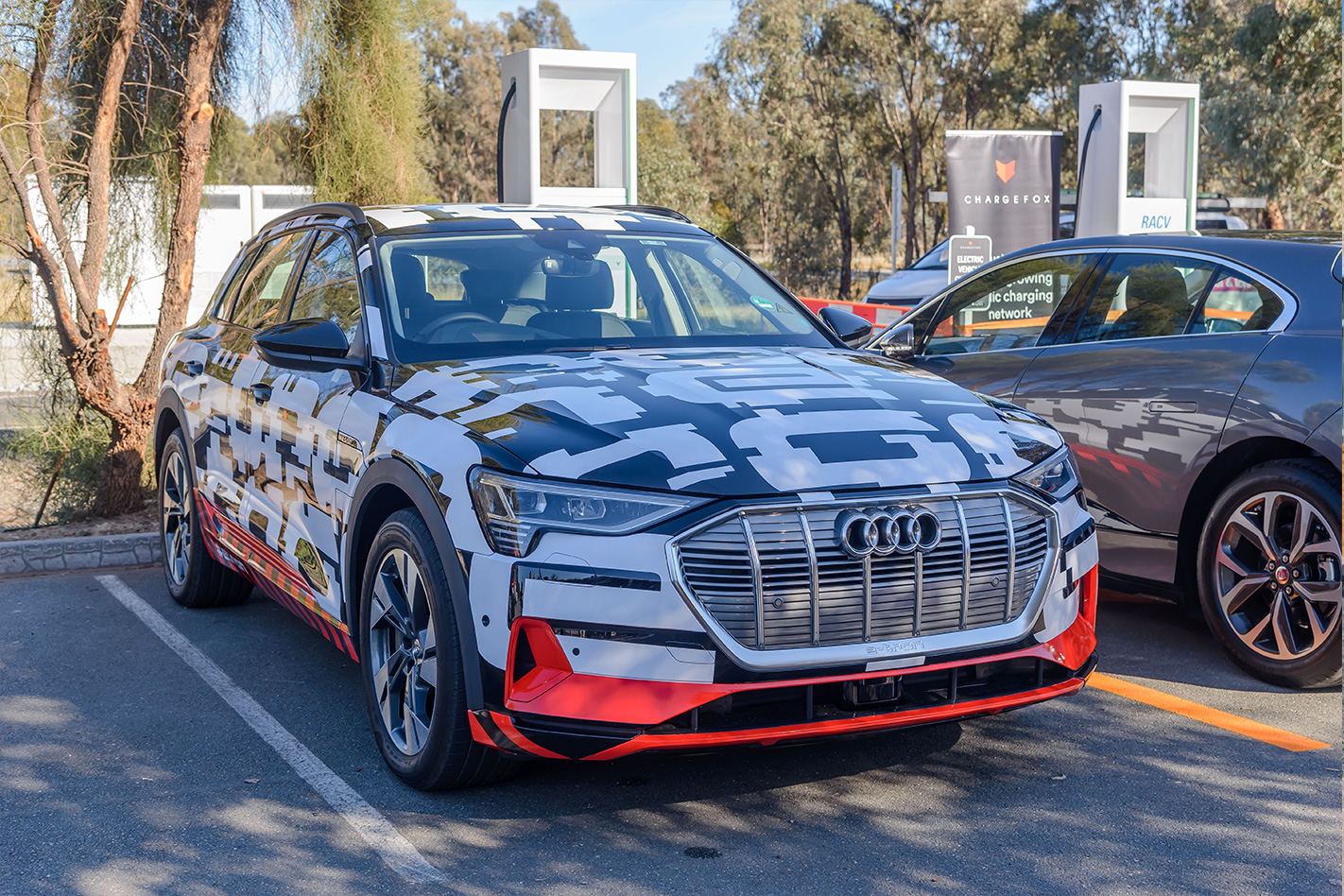
Audi also used the event to showcase an Audi e-tron prototype almost a year before the Australian launch of the production model. The e-tron has 150kW charing capability, and a claimed range of 400km.
“It’s dependent on fast-charging infrastructure like the Chargefox network, and so we are pleased to be one of the network’s founding partners,” said Audi Australia’s product planning director Shawn Ticehurst. “Its success will be critical to our customers’ enjoyment of the all-new Audi e-tron when it arrives in the second half of 2019.”
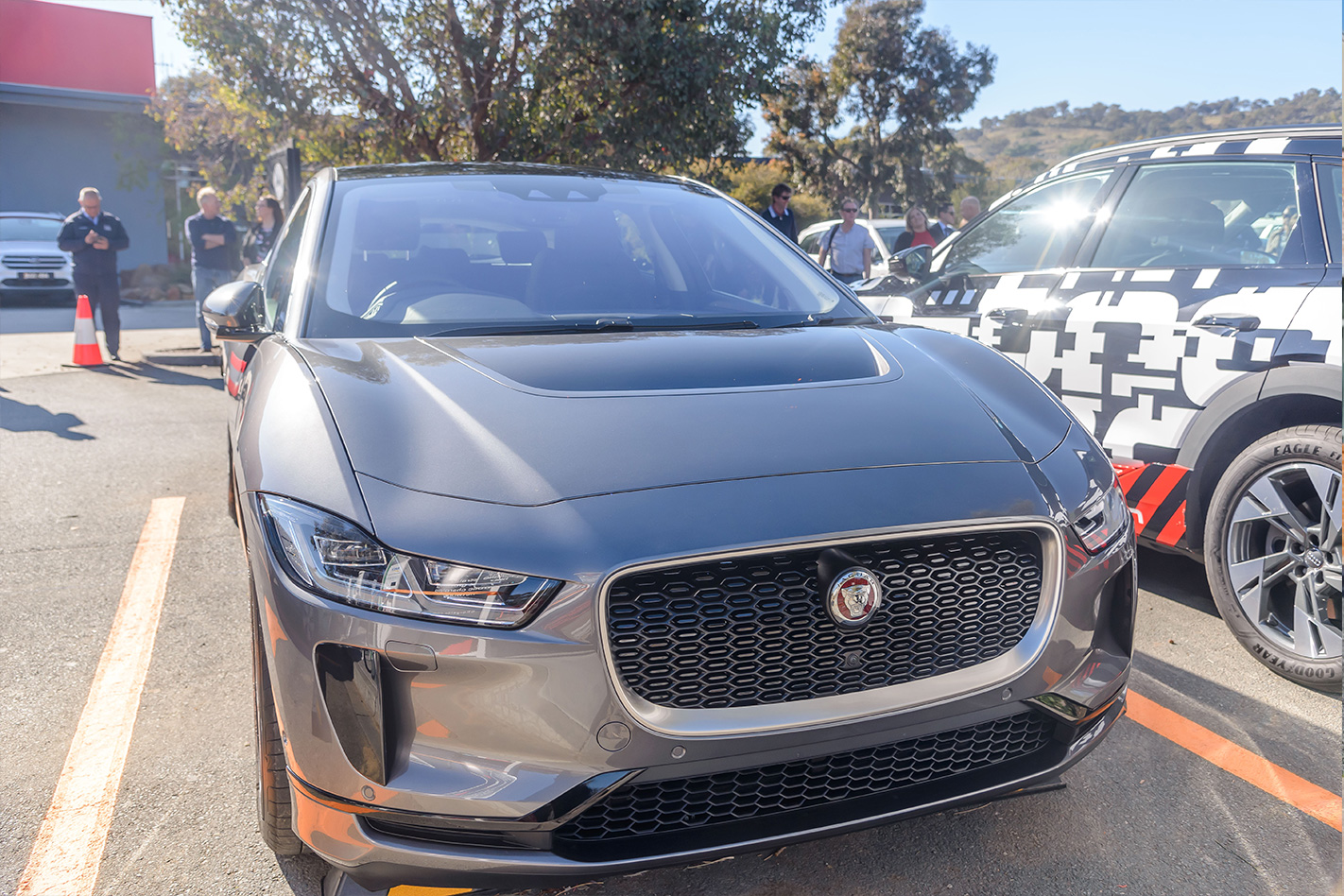
The stations will be able to be accessed via tap-and-pay tech, and can be used by all present and future EVs – including Teslas.
Tesla has invested in its own high-speed charging network that covers the commute between Sydney and Brisbane, but its chargers are electronically restricted to recognise and charge only Tesla vehicles.
By the end of the 1980s, only Nissan could have imagined the once-proud Zed name-plate still had anything going for it. For the rest of us, the badge was more or less reduced to joke status, plastered as it had been on some of the most ludicrous, pipe-and-slippers cars ever to leave a showroom.
This feature was originally published in MOTOR’s December 2004 issue
Oh sure, the whole Zed thing started with a bang with the 240Z of the rip-roaring 1970s, but after that point, she went a-sliding downhill on her increasingly fat ass.
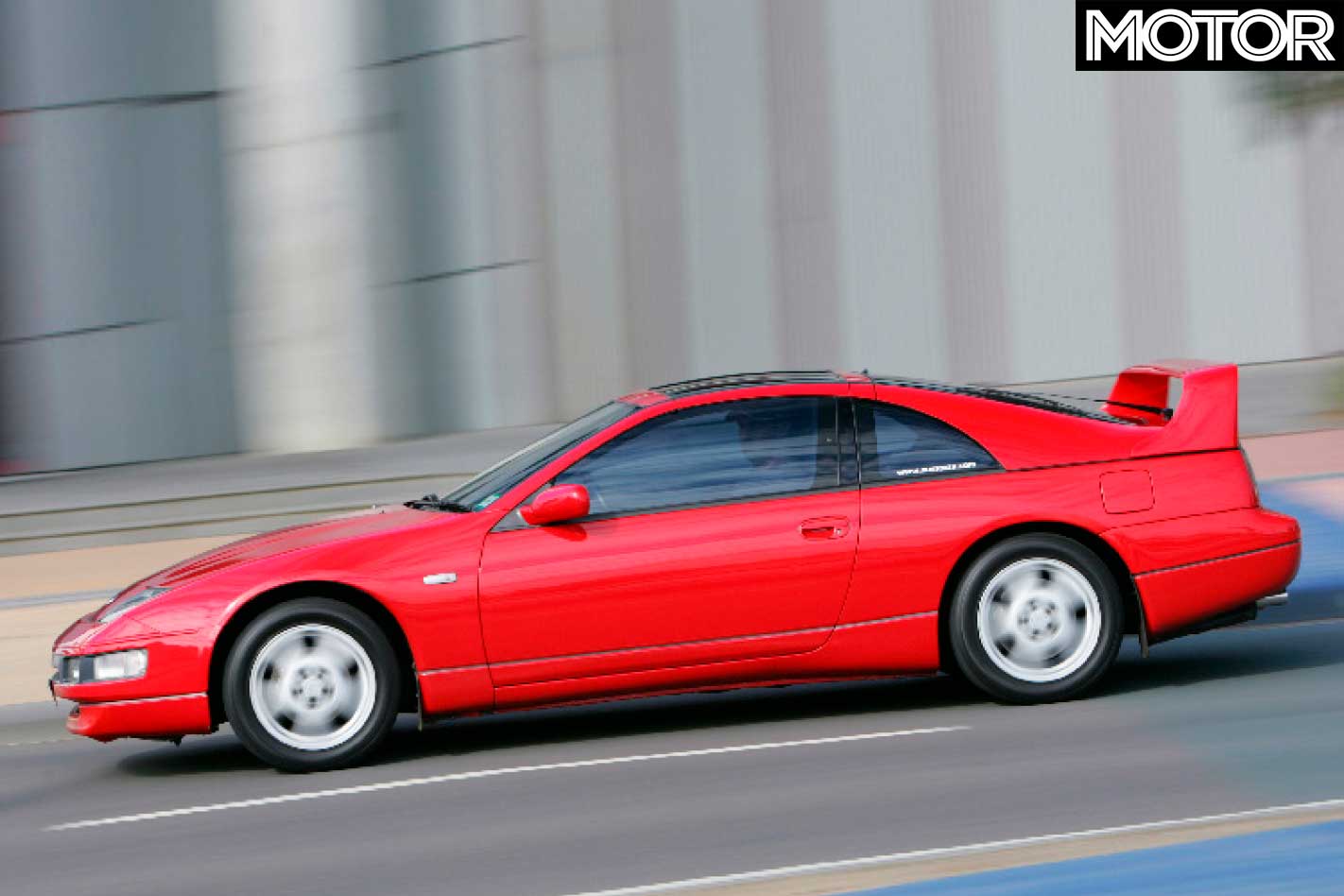
A turbocharger in 1986 should have helped the car turn the corner (figuratively, if not actually) but all it really did was put back some of the performance that ULP took away.
A lot of car-makers would have taken this lot on board and dumped the badge, rather than risk tainting an all-new model with the same daft brush. But not Nissan. No siree, when it finally unveiled its new two-seat coupe, it hoped to ride out the public flogging and called it the – wait for it – 300ZX. Our breath was baited.
As it turned out, of course, the new car was about as much a real 300ZX (slack motor, goofy looks, blancmange suspension) as a fart in church is a real disaster. The new mill was sharper than ever before (apart from the rorty in-line six of the original 240 perhaps), it combined a decent ride with competent handling, and it looked a million bucks.
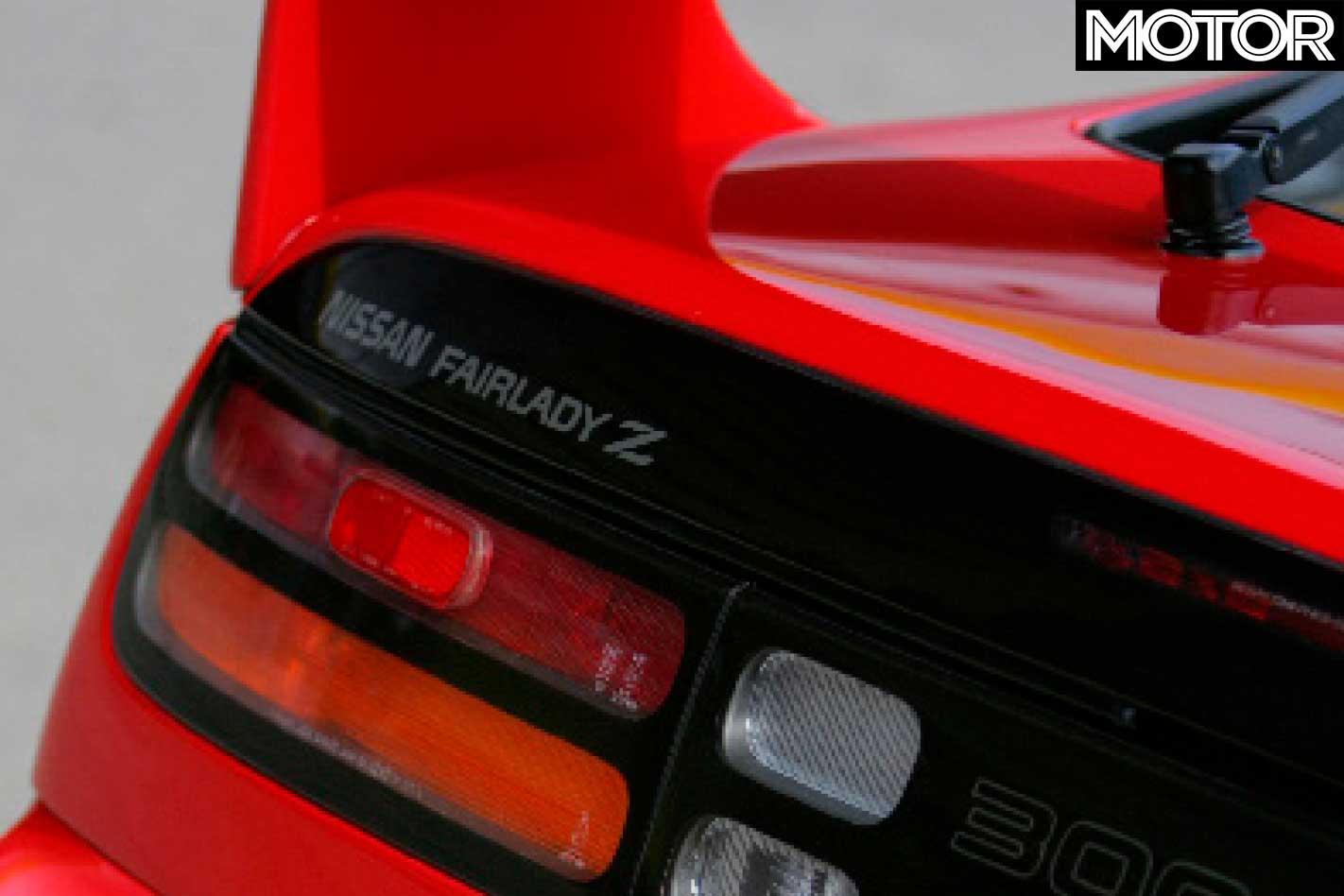
Indeed, it set a new benchmark in Japanese sports car design. At the time of its release, the Zed’s designers said they’d opted for the new look, but kept the old name in order to return to a pure sports car concept. They added that they felt the Zed brand had been softened – no duh.
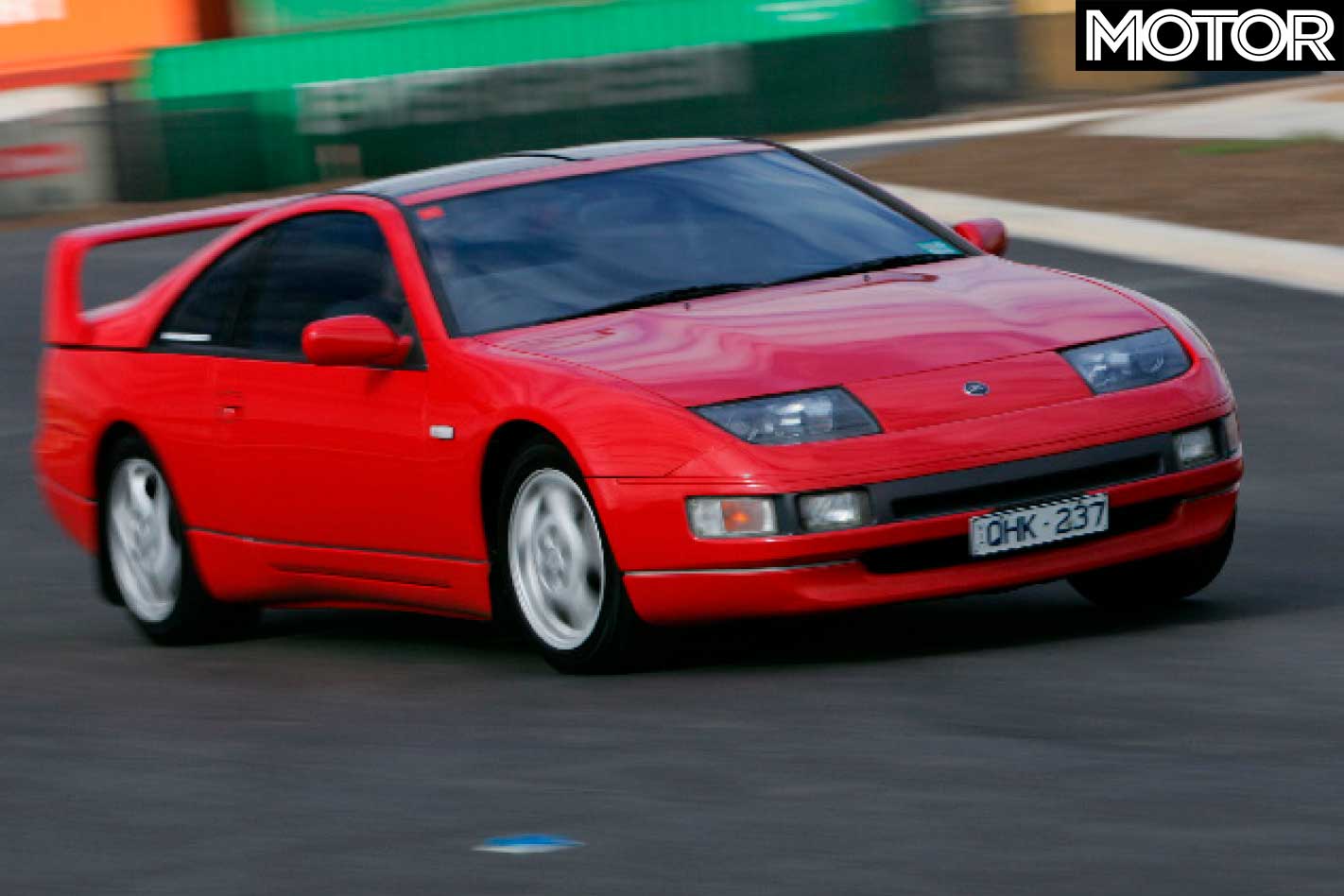
In light of current model Audis and the New Beetle – and a bunch of other new metal bearing a roofline profile similar to the Harbour Bridge – the Zed was well and truly ahead of its time. It was big and wide and low, but it was the sweep of the window that really smacked you between the eyes.
The flush headlights and rounded bumpers were nice and aggressive and while it all looks a bit dated now, it can still look pretty sharp in the right colour (which isn’t black).
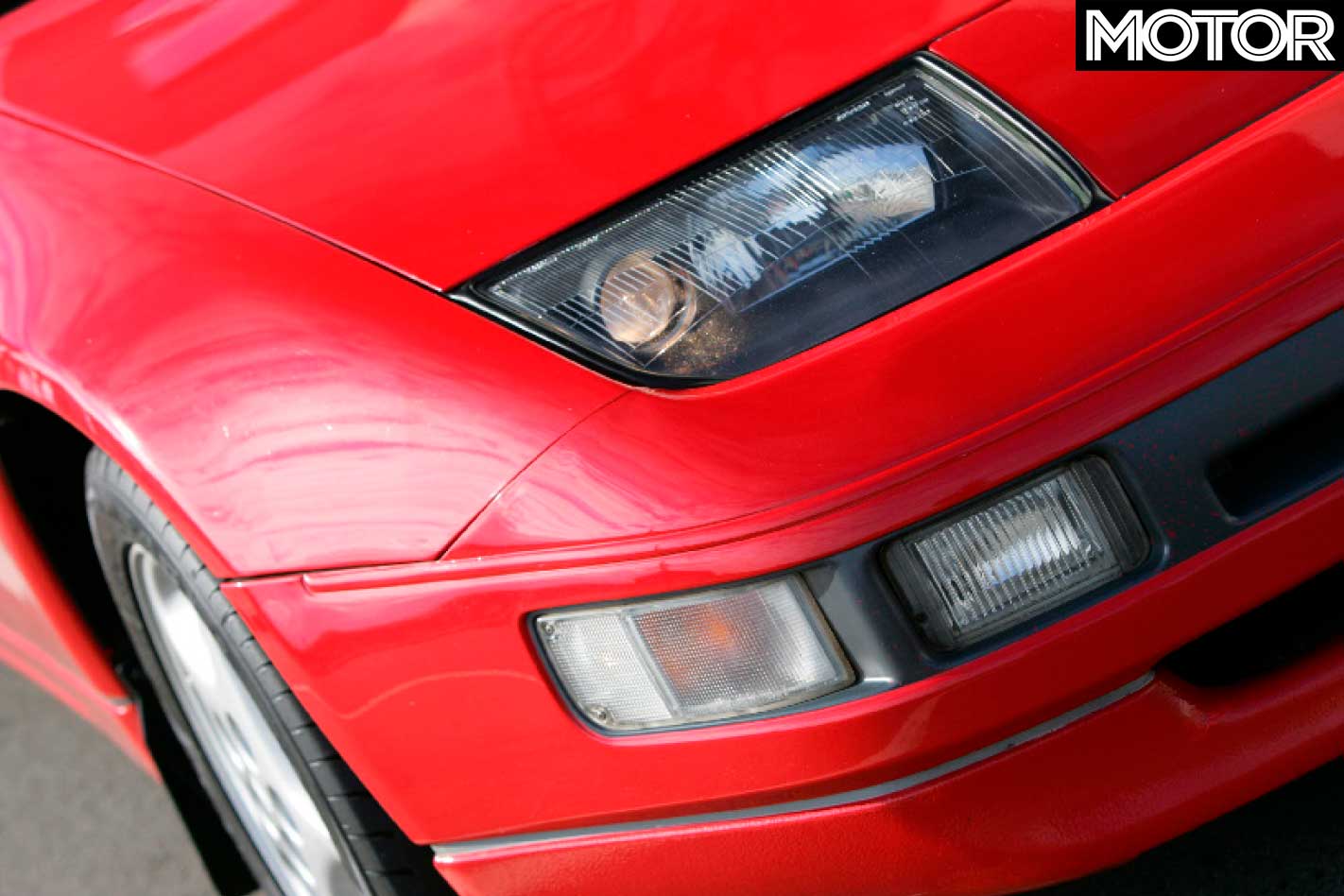
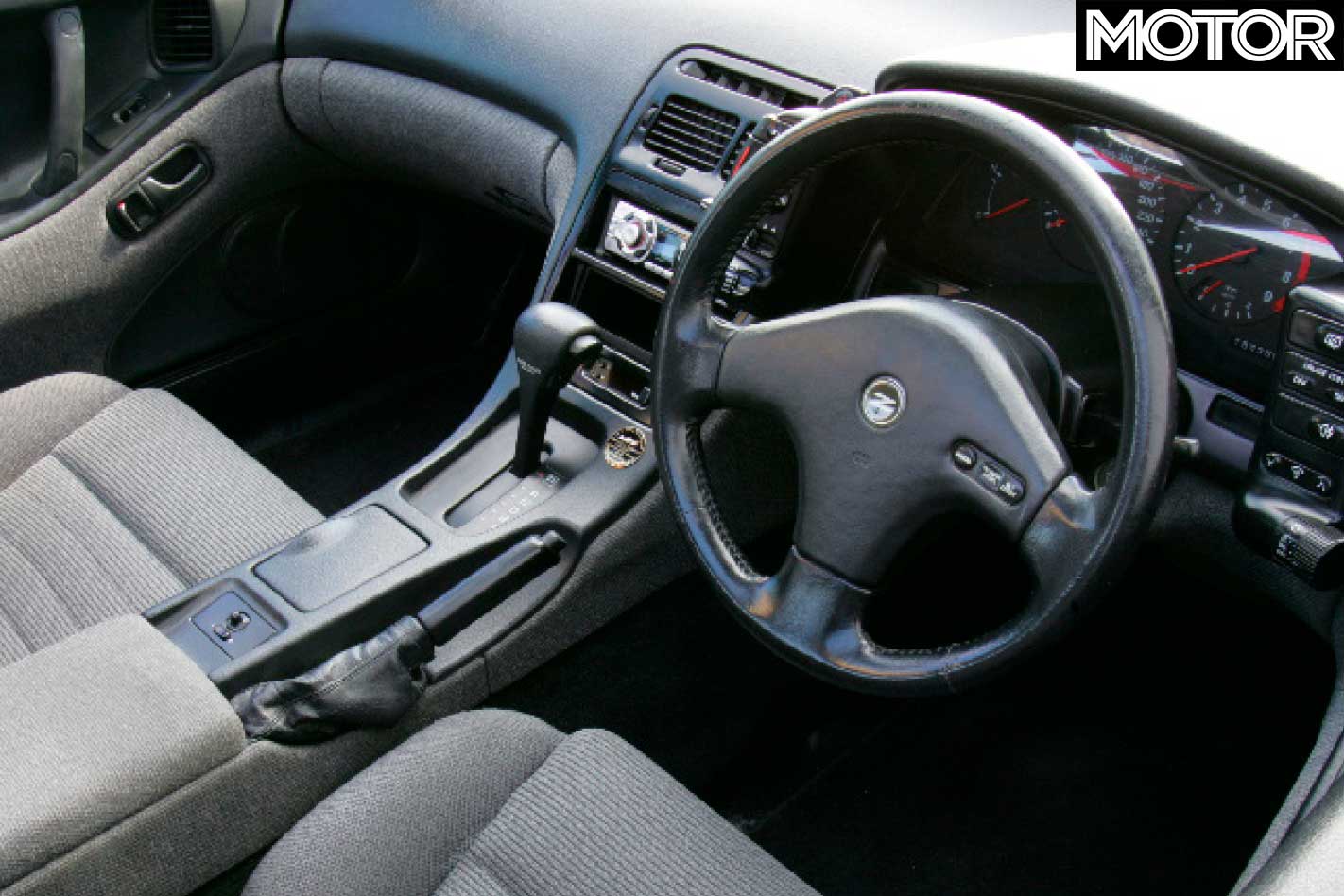
Like the exterior, there was a single knockout element to the interior, and that was the tweed trim that covered the transmission tunnel and half the door trims. It was, for many folks, either a master-stroke or a complete balls-up. We’re inclined to go with the former.
Personally? I didn’t hate it then and I don’t hate it now, although 15 years and gawd-knows-how-many kays later, it’s possibly going to be looking a tad second-hand.
The rest of the insides were pretty generic Nissan late 1980s fare, with clear instruments and decent standard equipment for the time. The seats weren’t too shabby either, grippy enough to support enthusiastic drivers, they are six-way adjustable. You can also count on air-con, cruise, central locking (no remote, though) full electrics and even a leather-clad steering wheel.
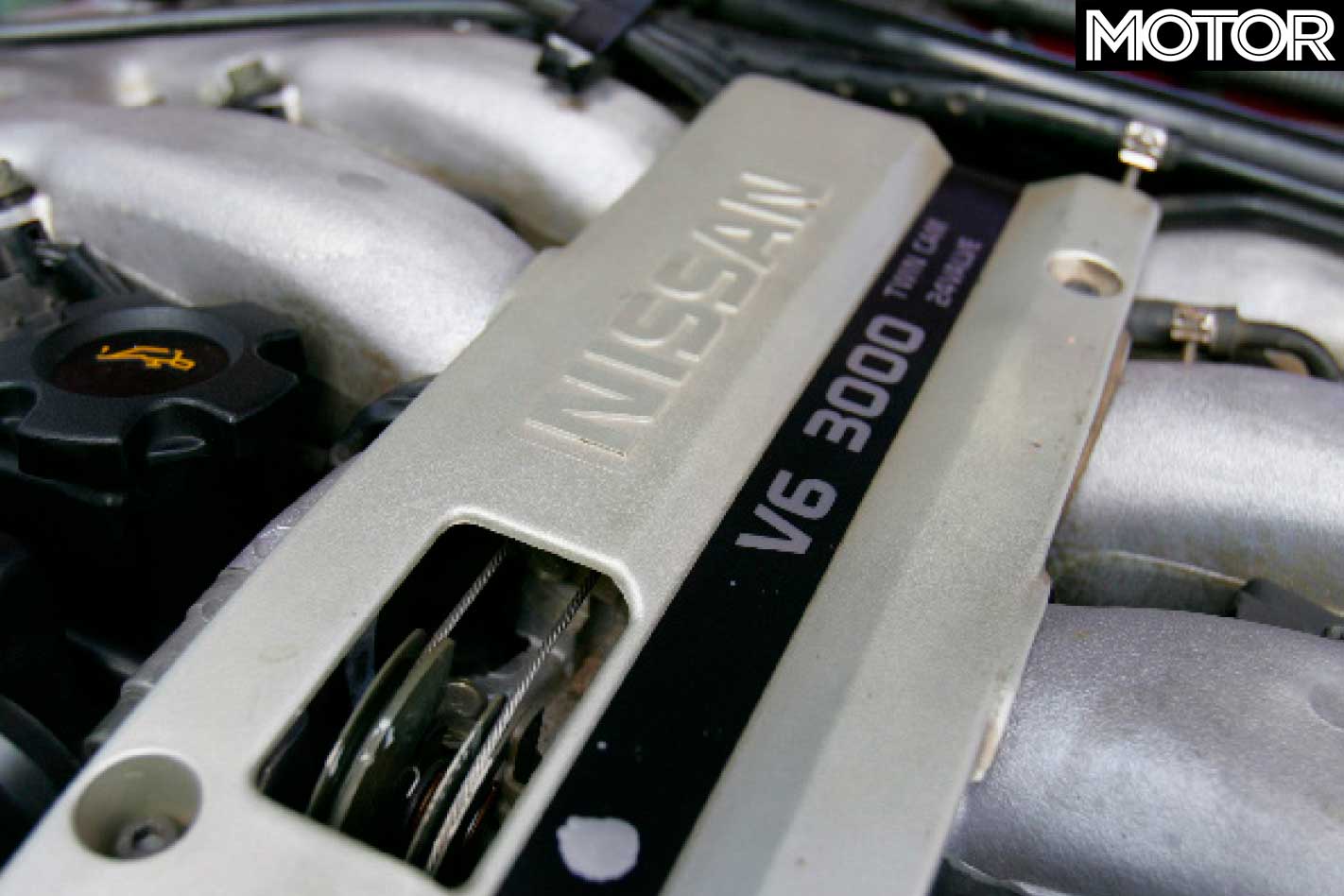
It might have looked pretty exotic, but under the skin, the ZX was a conventionally laid out piece of gear. The engine was in the front and drove the rear wheels via a gearbox in the usual place. The V6, while nothing to write home about now, was a bit of a Bobby-dazzler in its day. Better yet, it owed almost nothing to the yawn-inducing Zed cars of yore.
You need to remember that a V6 was still a bit special back in ’89, so when you add a 3.0-litre displacement, including twin overhead cams per bank, four valves per cylinder and electronic injection, you suddenly had a pretty marketable piece of iron on your hands. Ooh-er, we all went.
Compared with the previous version of the same engine, with its single cams per bank and turbocharger, the new mill made a fraction more power but a fair bit less torque. In the wash up, the new car made 166kW (155kW for the old turbo) and 269Nm (319Nm), which was enough to make it feel pretty good in a smooth, flowing kind of way.
What it wasn’t, however, was a real head-banger, thanks to the relatively hefty body shell it was toting around (1490kg to be exact) and the fact that it was tuned a bit on the mild side.
It could be very quick point-to-point, provided you kept the motor spinning, used the gearbox and got used to the feeling of being in a very wide car. Through the twisty stuff the big Zed displayed an impressive level of grip, although when pedalling hard it had a tendency to understeer.
The right foot would generally see it bring the nose in, though, and because of its weight it was never that twitchy in the rear. It had a pretty good ride for something this sporty and, overall, it was more grand tourer than ram-raider.
Buying a 300ZX these days is less of a lottery than it might be for other alleged sporty cars of the same age. Like a lot of Nissans over the years, the motor seems to be fairly bulletproof, although you need to be very wary of anything that doesn’t have some kind of a service record.
Manifold studs can crack over time, injectors have been known to fail on a random basis and the coil packs can give trouble in the longer term. None of those things are the end of the world, although drilling out a broken manifold stud is time consuming and labour intensive.
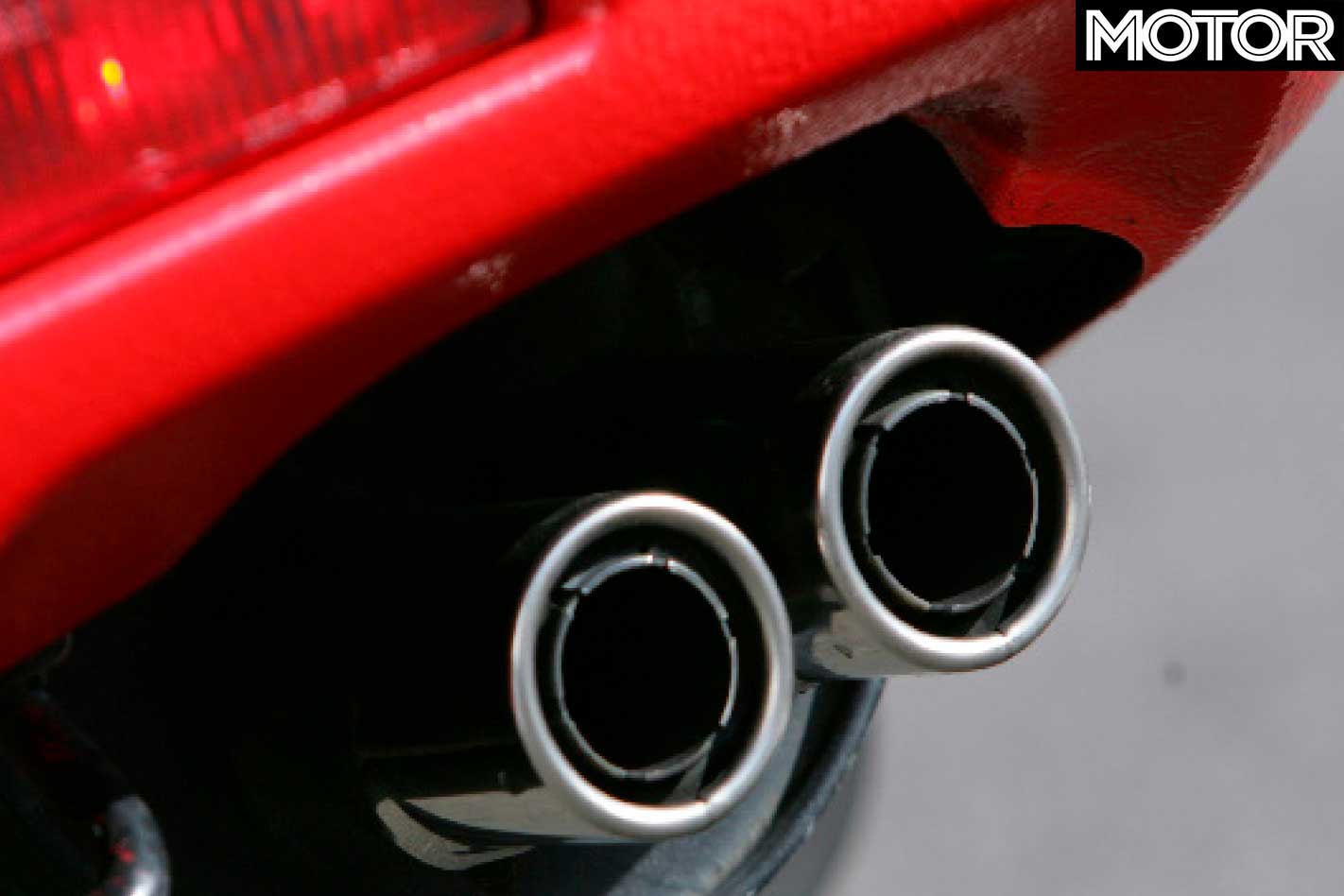
Other than that, watch out for any of the usual suspects when it comes to second-hand performance cars. You know the sort of stuff: warped rotors, hammered synchros, tired diffs and, of course, crash damage. Check inside the engine bay and make sure you lift all the carpets in your search for wrinkly metal that suggests a history involving a shunt or two.
Check the paint carefully, too, because some colours (whites and reds) had a fair bit of pearl in them and will be a bitch to match. The other thing to watch out for is a grey import.
Australian-delivered cars were only ever fitted with the 3.0-litre, atmospheric V6, so anything with the three-litre V6 twin turbo that was available in other markets is a grey import. But it’s not even that simple, because we’ve seen plenty of atmo 3.0-litres getting around that are also grey imports, so check the compliance plate to see whether it’s an Oz-delivered vehicle or not.
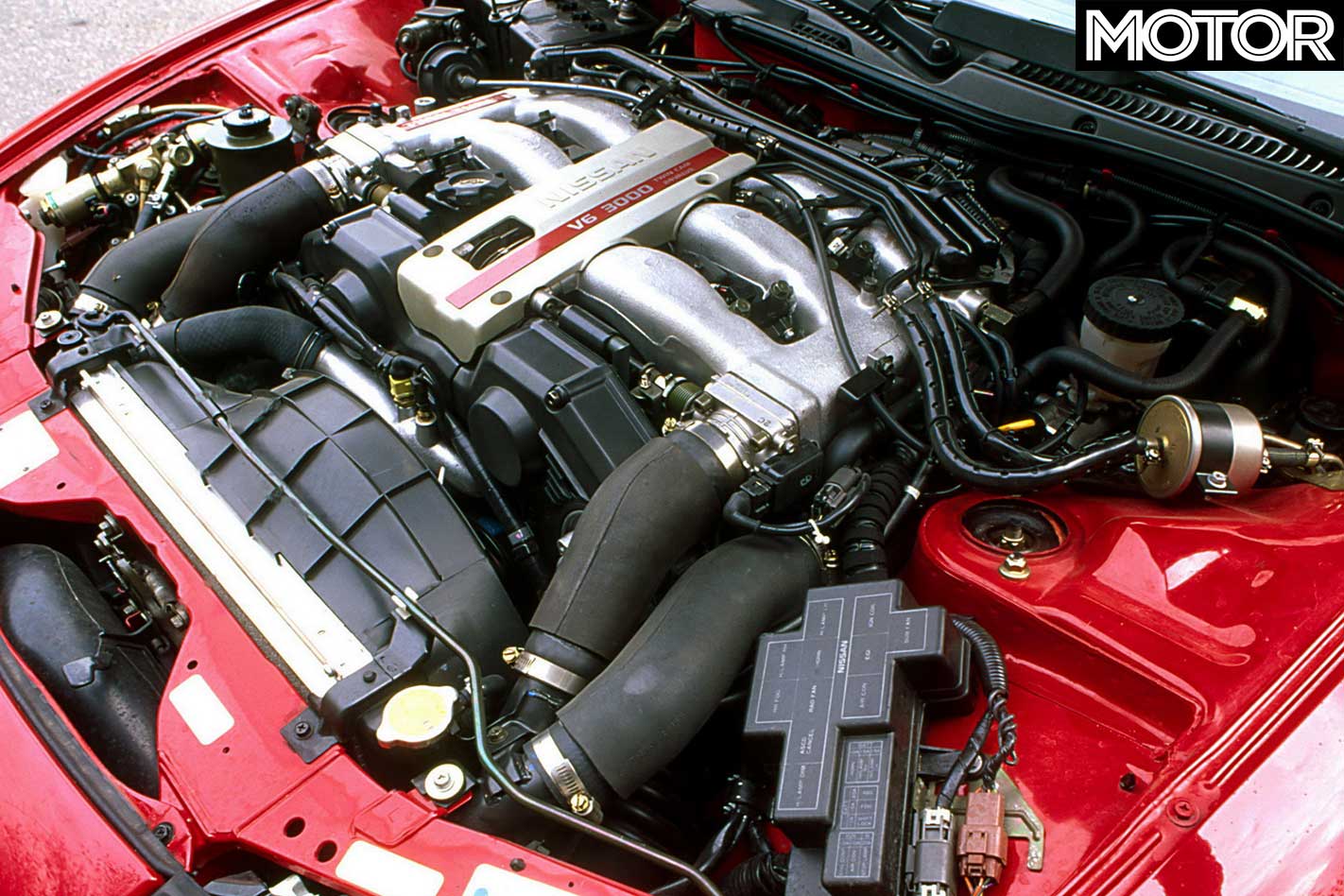
We wouldn’t dismiss a grey out of hand, but you need to be aware that they’re worth a bit less on the open market, so paying a non-grey price for a grey is, obviously, a hiding to nowhere.
On the other hand, prices don’t vary as much between grey and non-grey ZXs as they do, for instance, with 200SXs, but that could be because the Zed is worth peanuts these days anyway. A turbo 3.0-litre is likely to be ready for a set of turbo bearings by now, and check for a smoky or rattly engine that indicates it’s on its last legs.
When the 300ZX was released back in 1989, it cost the better part of $65k, these days it goes for a lot less and represents excellent value for money.
FAST FACTS 1990 Nissan 300ZX
BODY: 2-door coupe DRIVE: rear-wheel ENGINE: 3.0-litre V6, 24-valve DOHC POWER: 166kW @ 6400rpm TORQUE: 269Nm @ 4800rpm COMPRESSION: 10.5:1 BORE/STROKE: 87.0mm x 83.0mm WEIGHT: 1490kg POWER-TO-WEIGHT: 111kW/tonne TRANSMISSION: five-speed manual SUSPENSION: independent by unequal length upper and lower arms with coil springs and anti-roll bar (f); independent by multi-link with coil springs and anti-roll bar (r) L/W/h: 4525/1800/1255mm WHEELBASE: 2570mm TRACK: 1495mm (f); 1535mm (r) BRAKES: 280mm ventilated discs (f); 297mm ventilated discs (r) WHEELS: 16 x 7.0-inch (f & r), alloy TYRES: Dunlop D40 M2; 225/50 VR16 (f & r) FUEL: 72 litres, ULP PRICE: $62,950 (February 1990)
What we said?
“The new 300ZX has just enough of the old look about it to link it to its forebears. It has an impressively high level of adhesion and the new Zed’s speed-sensitive, power-assisted rack and pinion steering is sharp and precise. The 300ZX represents the latest in Japanese big sports car design. Its smoothly integrated design sets a new target for other makers to aim for.” James Cleary, February 1990
Well this is the new Toyota Supra. What can I tell you? More like: what am I still unable to tell you?
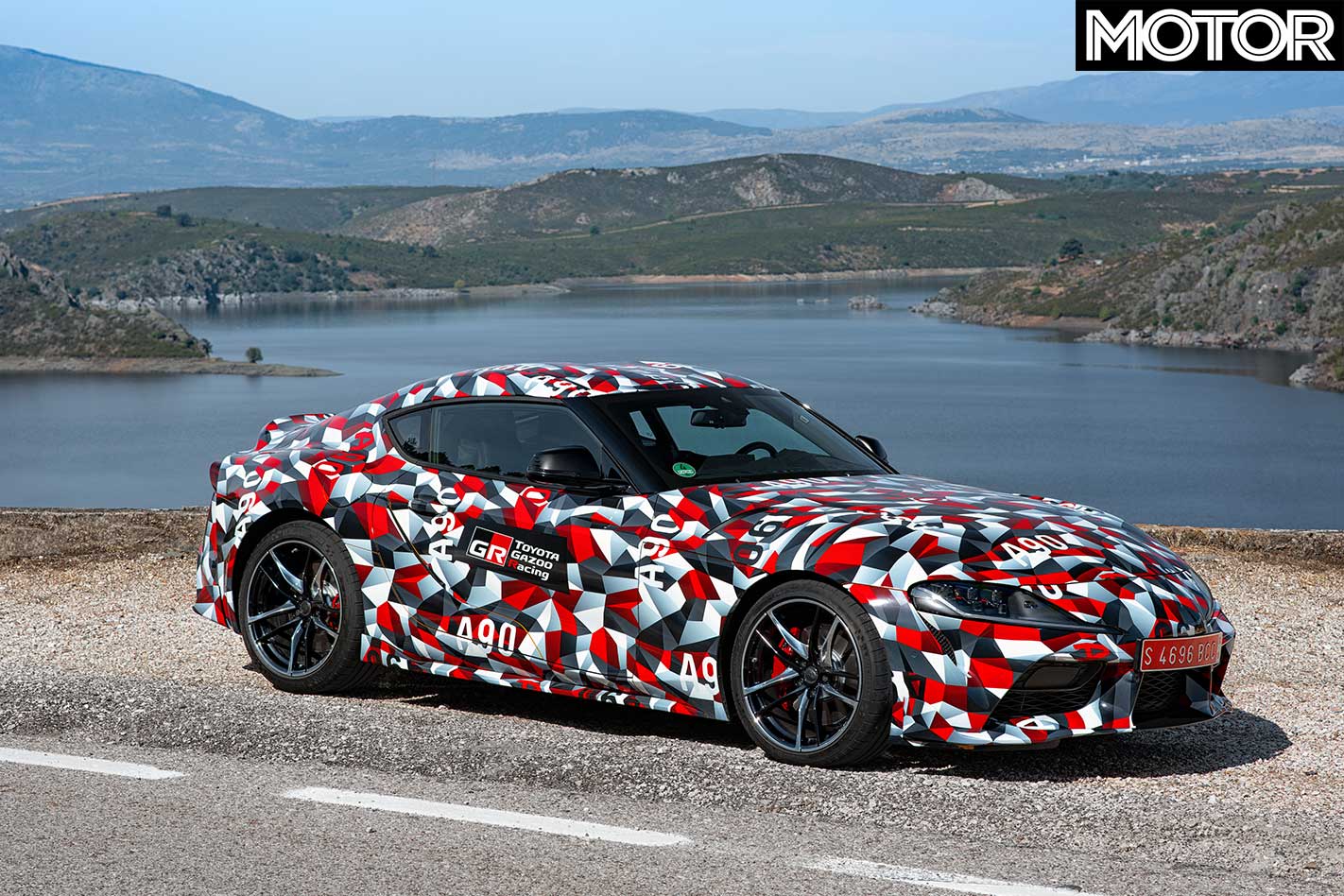
It’s still dazzle-camouflaged outside. Inside it’s carpeted like someone’s skinned Skippy and draped him over the dashboard. It’s still eight months away from production and therefore still in prototype form. I’m accompanied by a minder whenever I go near it. And they’ll barely tell me a single flipping specification.
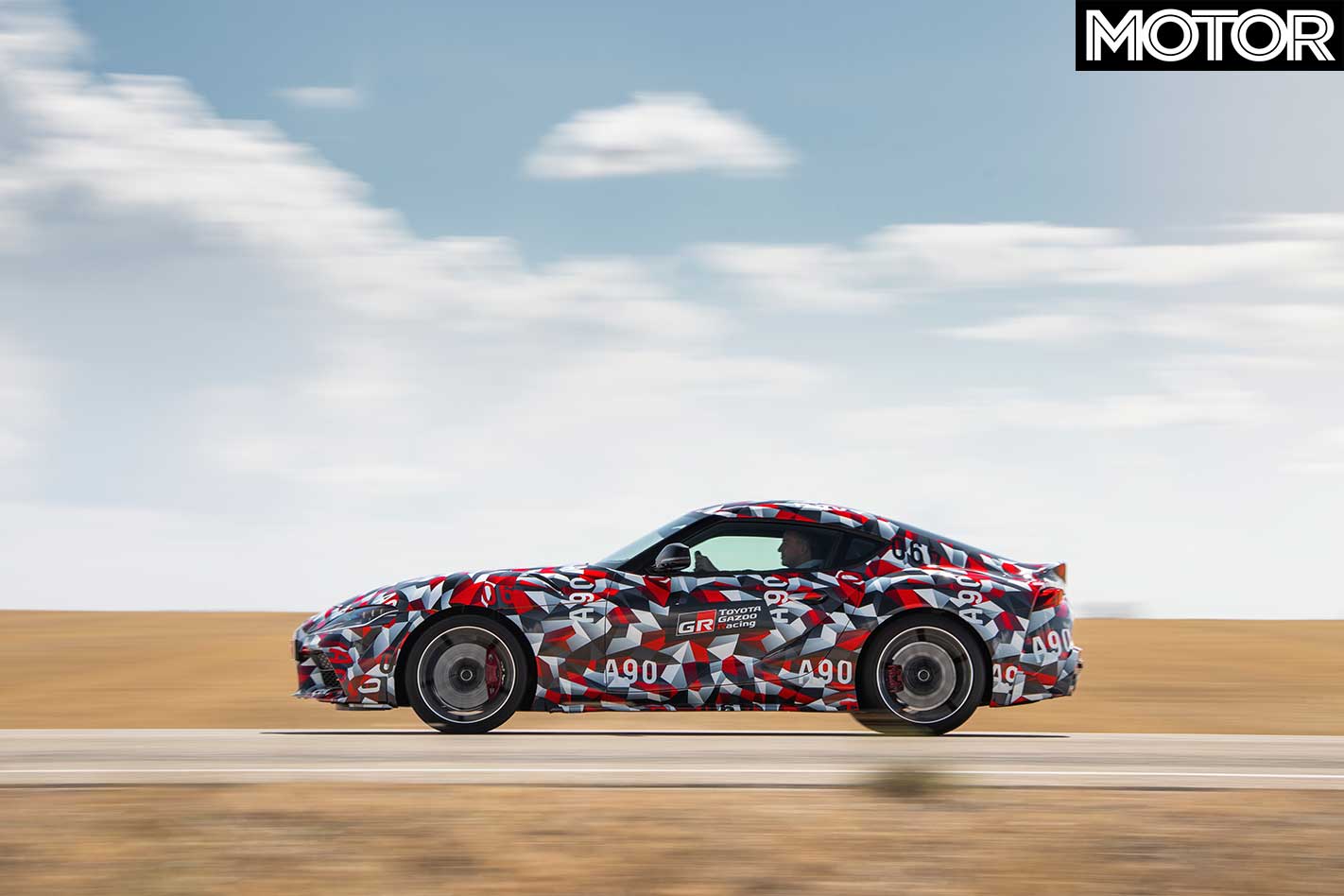
They insist the numbers don’t matter. (Which begs the question: why not just tell us, if they’re so unimportant?) What only matters at the moment, they say, is the way it drives, the way it makes you feel. And this, I’m thrilled to report, I can tell you.
I drove it, quite a lot and quite fast by the standards of events that only have four prototype cars available. It’s yet another painful plink in the agonising drip-feed of Supra information that, let’s not forget, began in 2012 when BMW and Toyota announced they were going to work together. Does Toyota really need seven years to build a car?
Only this much is confirmed of what we know: the Supra has a lower centre of gravity than an 86, despite having a 3.0-litre straight-six engine, driving the rear wheels through an eight-speed automatic gearbox (BMW/ZF respectively); while a BMW M Active limited-slip differential sits at the back axle. As with BMW’s Z4, the weight distribution will be 50:50.
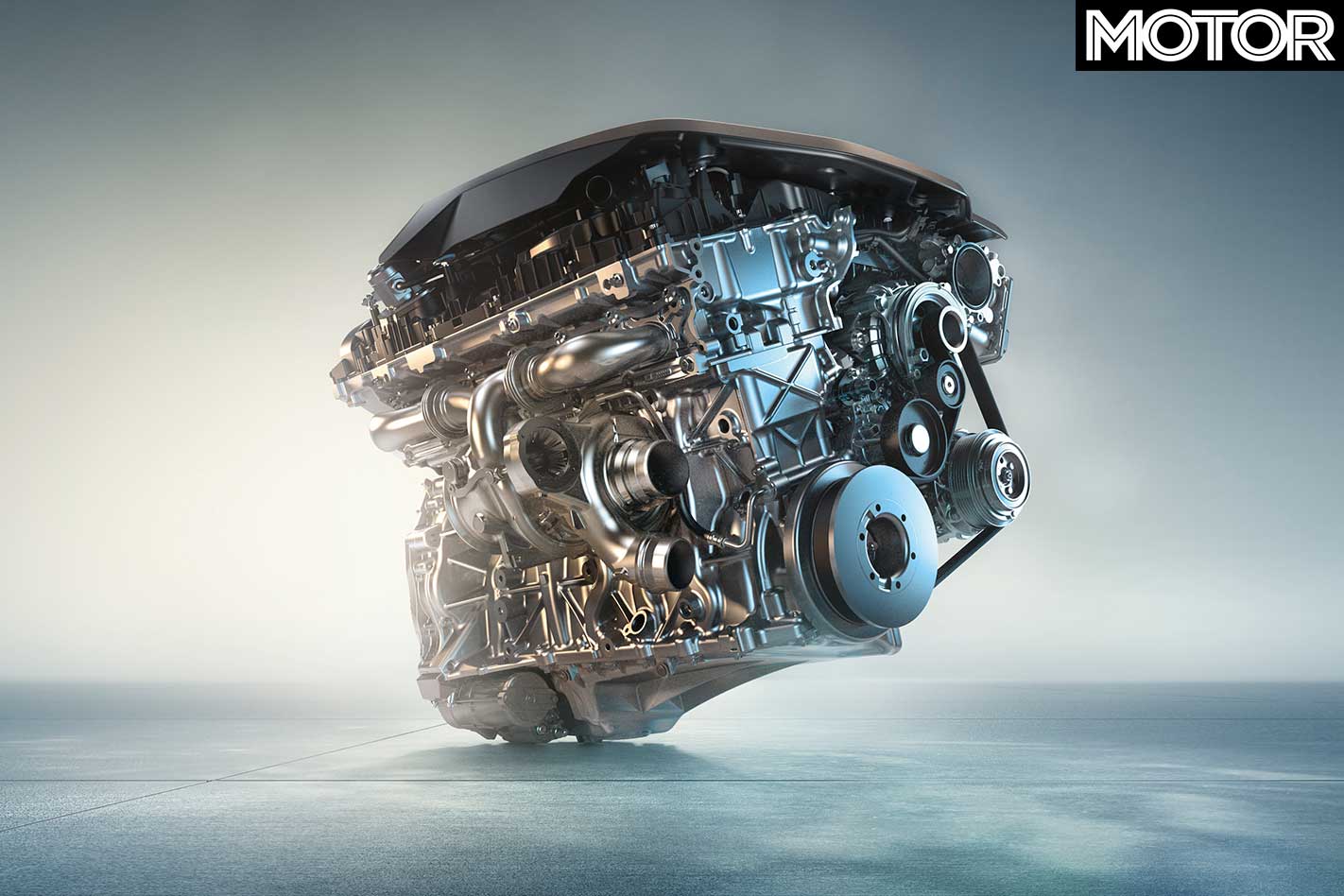
I still can’t tell you the exact power, but 250kW sounds about right, 475Nm too, and the kerbweight is likely 1500kg. The body rigidity, despite being a blend of steel and aluminium, is as stiff as a Lexus LFA’s carbon one. The wheelbase is around 2440mm and the tracks approximately 1600mm.
There will be faster and, I suspect, slower versions of this car later, to make the sums add up for Toyota, so the slow release of info will go on even after it goes into production in May. You’ll see the final car, shorn of disguise, at Detroit motor show time in January.
Another thing to add to what we know: it’s good to drive.
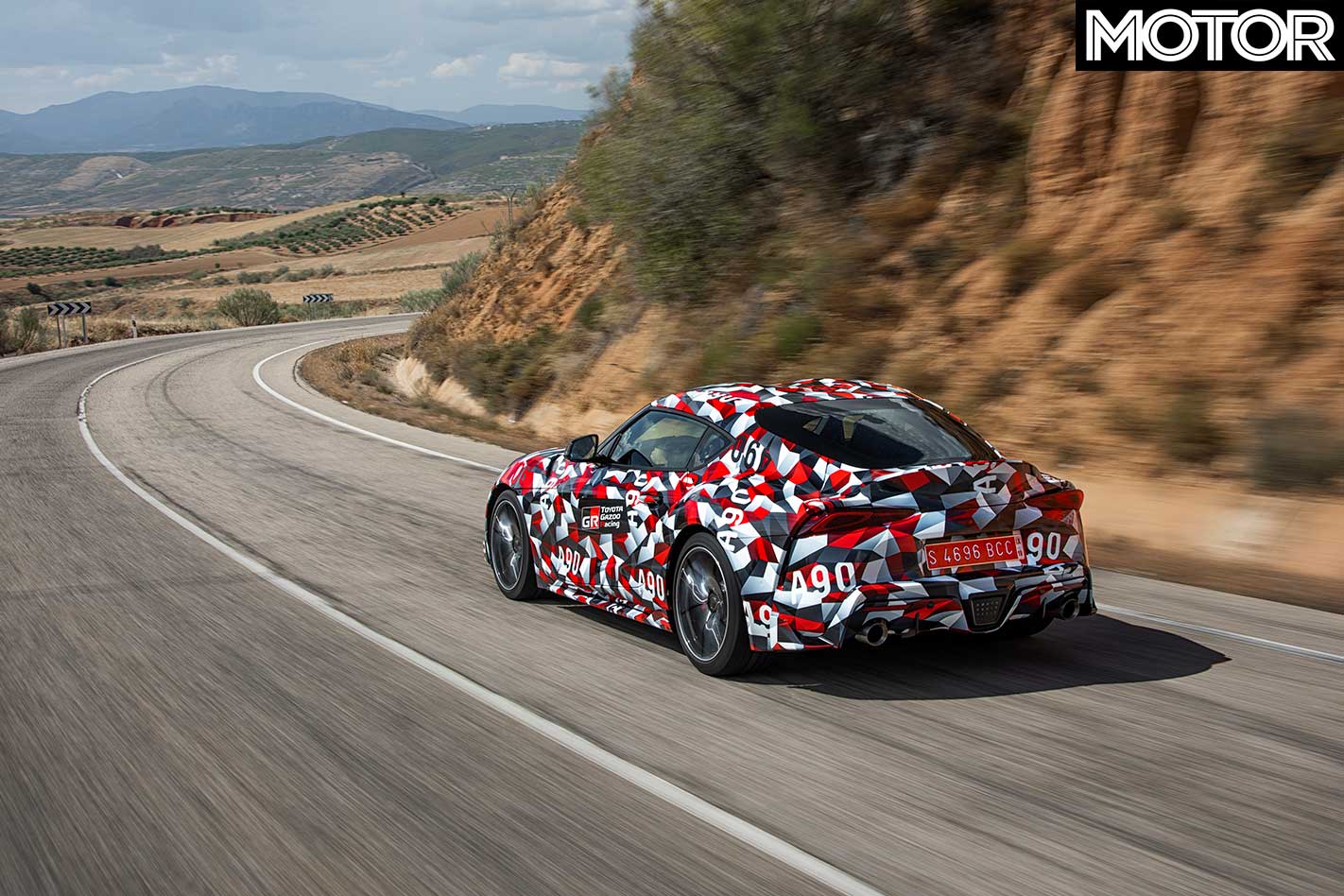
Our route is a two-hour loop from the outskirts of Madrid, so is partly in the city, partly on the motorway, partly on country roads, and then – goody gumdrops – arrives at a racetrack.
Because I’m sharing the drive with a colleague from another magazine, even though I’m contractually obliged to pretend there is no such thing, and because there’s always a minder in the Supra, sometimes one of us is following in an 86 while the other drives the Supra, which I mention for reasons I’ll come back to.
First, then, getting into the Supra. Despite the drapery inside you can sense it has is a BMW-centric interior. The switchgear is BMW, the driving position is long and straight, the gearstick is BMW’s. Does that matter? I doubt it.
The iDrive multimedia system is better than Toyota’s alternative and there’ll surely be a Toyota face on that anyway, as there is on the instrument binnacle, while the steering wheel is thinner of rim than BMW uses, and round. Praise be on both of those counts.
You sit low, peering through a letterbox windscreen, with a high window line and the curved bonnet spearing off into the distance. No idea whether it is (it probably is), but it immediately feels bigger than, say, a Porsche 718 Cayman, whose corners are easier to place, owing to the visibility. You are aware, at once, where the Supra’s engine is.
It’s a refined engine and drivetrain, though. If there’s work to still be done on the calibration, it’d be news to me. A six is always smooth, but a BMW six, turbocharged here, is incredibly so.
Step-off is almost imperceptible and the Supra, even in standard drive mode, is unencumbered by the response modern autos sometimes give, where they feel like they’re trying to lug things out from too low revs. The stop-start system wasn’t functioning, which probably helps, mind.
Push a sport button and the throttle and gearbox response sharpens, but there are gearshift paddles, so if you want a quicker response, it’s probably more rewarding to take control yourself. There’s no word on a manual ’box yet; but Toyota would like one.
The Supra rides well, too, better than a BMW M4 while on the same size tyres: bespoke Michelin Pilot Super Sport rubber of 255/35 R19 at the front and 275/35 R19 at the rear. Passive dampers will be standard, but adaptive dampers were fitted to the cars we tried.
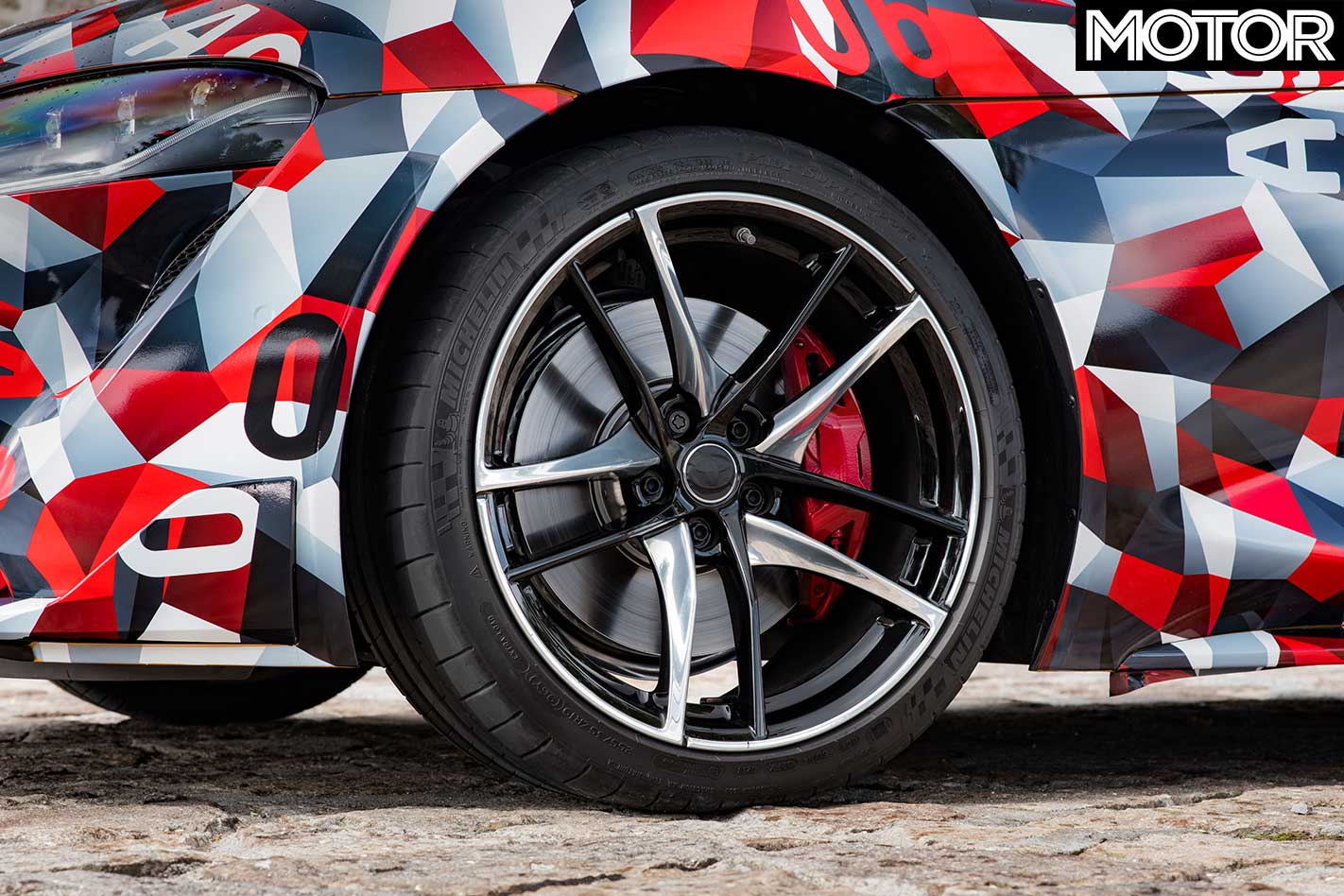
These, too, firm up via the sport button, as does the steering weight, though in regular daily driving there’s no need: the underlying compliance is welcome, but there’s no sense that the body weight is getting away from it.
The Supra feels like a stable, well-rounded sports coupe. Its engineers say they did 90 per cent of its development work on the road, and I think it shows. In town, on the motorway, it’s mature in a way that, say, a BMW M2 Competition or Alpine A110, perhaps even a Cayman, are not.
It’s only when you get onto a country road, then, that you start to push the boundaries of the standard suspension setting’s limits. The steering is smooth, progressive, sharper off of straight-ahead than some front-engined coupes. Presumably it is to give an extra sense of agility that, compared to a 718, the Supra simply can’t have.
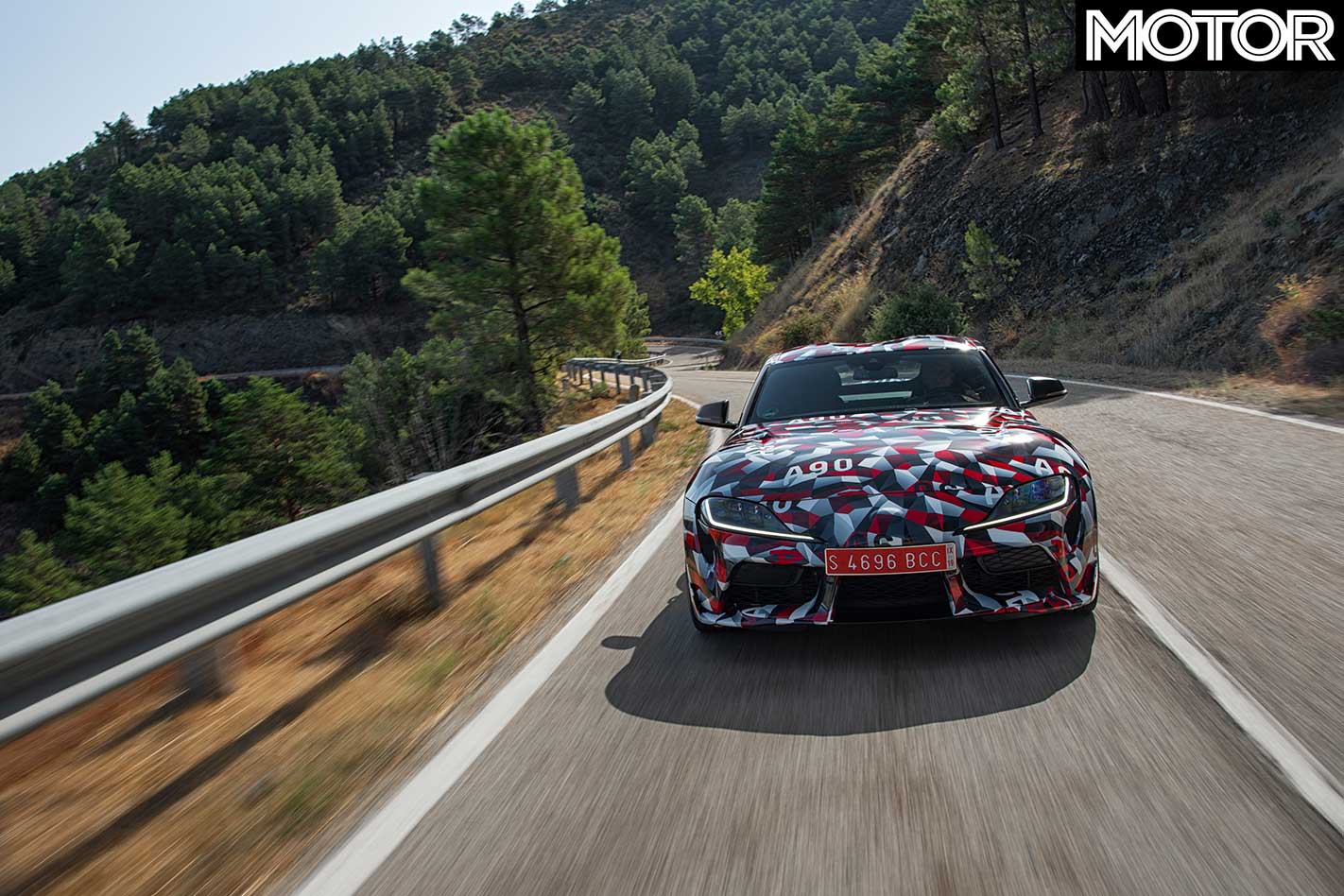
Body roll builds progressively, but this is where you want the dampers firmed. Without them like that, as you get back on the throttle and the differential begins to worry about acceleration, you feel the body’s mass shifting in a way you don’t think you would in a Cayman.
With dampers tightened that much is alleviated, with not too much loss in compliance, and there’s a pleasing, reassuring balance. Hints of understeer on the way in, likewise oversteer on the way out, not unlike, say, an Aston Martin Vantage only a bit lighter. A BMW M2 with both more compliance and control (or an M2 Competition with more compliance).
Swapping into and following in an 86, though, you’re reminded of the advantages that minimal mass gives you. Sure, the 86’s engine is wheezy, but working it hard you can carry speed and enjoy delicate fingertip steering responses denied in the bigger car. It’s a reminder of how exceptional the 86’s chassis is; which I suspect wasn’t the objective of the exercise.
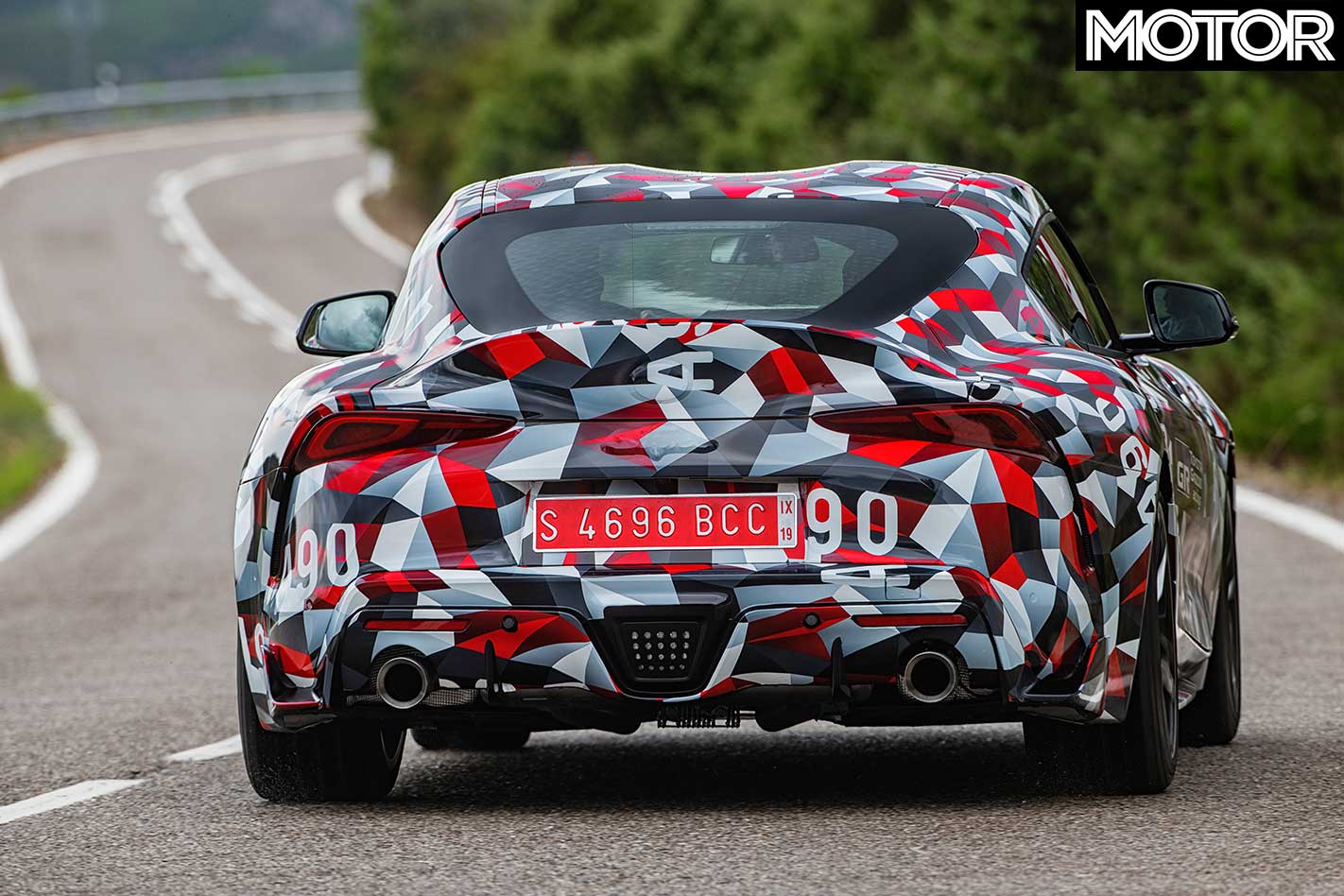
But still, there are other things a Supra can do. The engine’s extremely sweet, smooth, broadly responsive but happy revving. In Sport mode a flap opens in the exhaust and Toyota says there’s more work to do on the induction noise, probably via sound tubes off the engine – so real, rather than fake noise. But unlike a Cayman you’re happy to let it rev and sing, or sit at high revs pre-overtake.
And it’s clearly a chassis that can handle more power. Nowhere is that more evident than on a circuit where, Sport mode engaged, the Supra displays the same balance as on the road, only enhanced.
The suspension maintains good control but with serious compliance over bumps or kerbs; where those would thump through in an M2 Competition, the Supra glides across, as a Cayman might. It doesn’t rotate as willingly as a Cayman or, from my limited experience, an Alpine A110, but that’s not surprising given where the engine is.
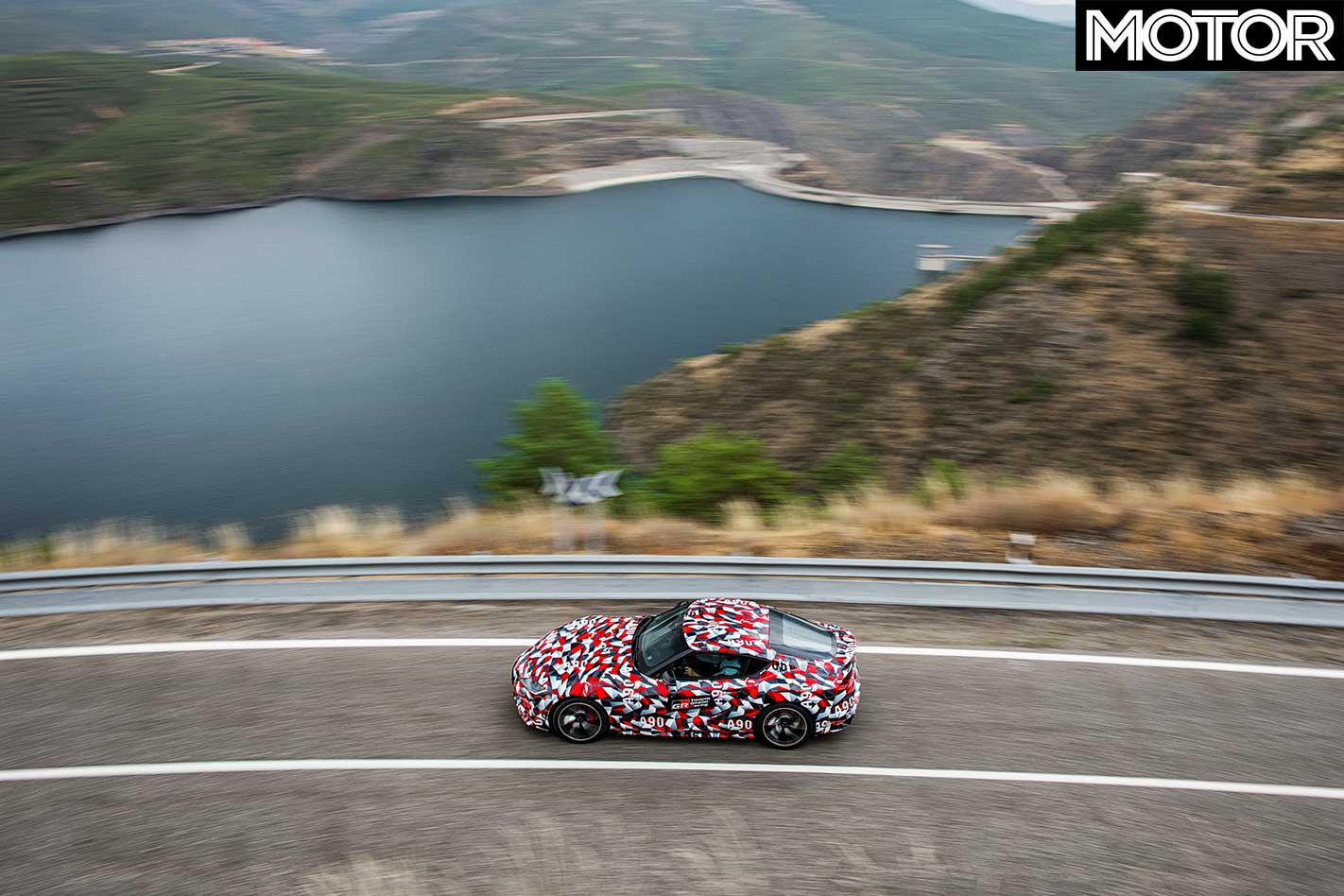
With stability control set to ‘have a little slip’ but not ‘off’, (the minder still alongside, see), you get to feel the balance: steering that’s smooth if not laden with feel, a hint of entry understeer, a hint of exit oversteer with the knowledge that you could have a lot more if given the opportunity. Some of my favourite-handling cars – an Aston V12 Vantage S, that 86 – have the kind of balance the Supra displays, albeit usually with more rawness.
But that’s fine. It is, in this spec, 90 per cent a road car and yet still happy on a hot circuit, being pushed hard without overheating its steel discs, offering more handling balance and playfulness, more reward, the more you push it.
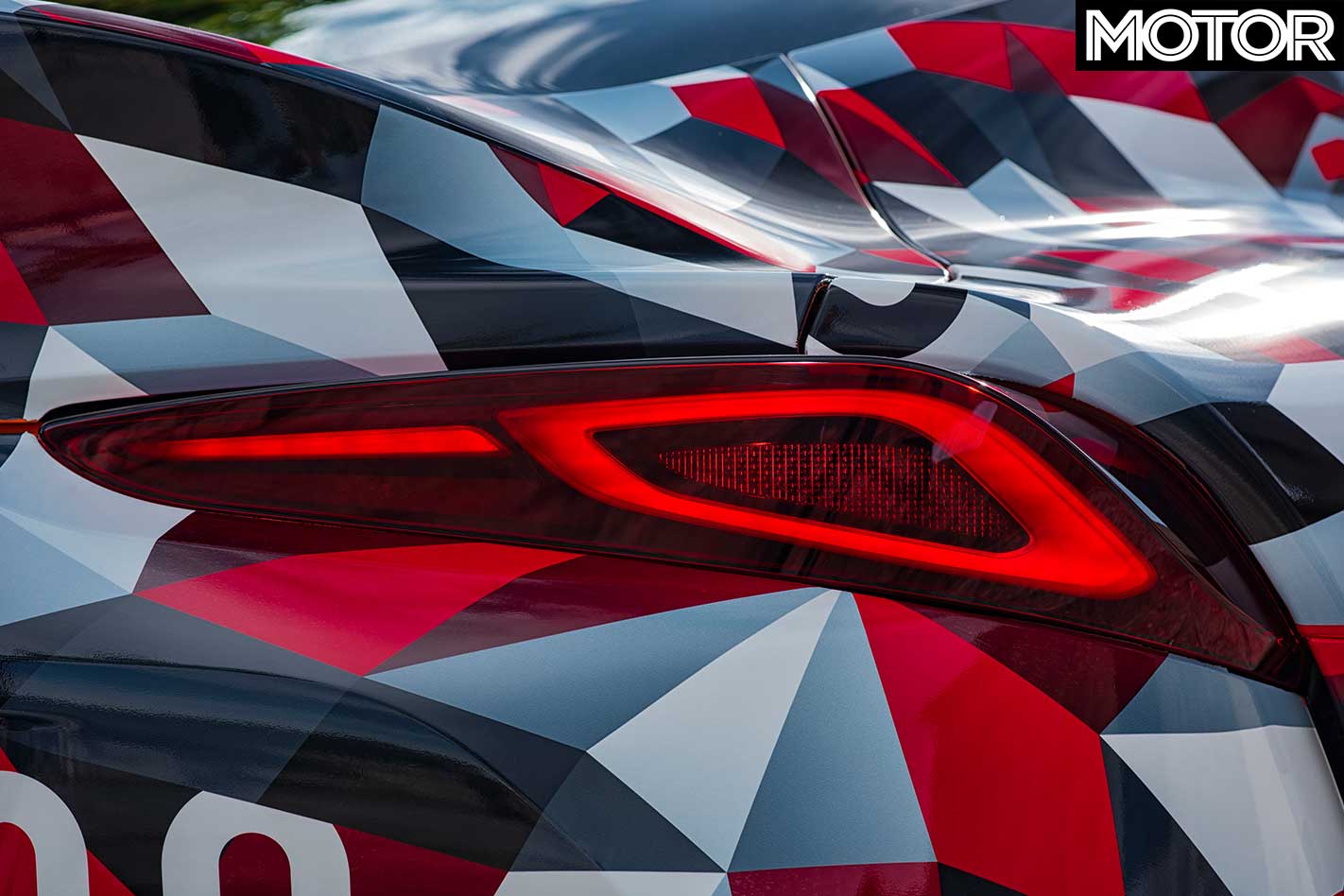
Toyota has taken a delicate path with the Supra; a road car that gives more when you ask for more and where an A110 or M2 Competition might give you more all the time, that’s no bad thing. In terms of daily maturity it’s closest, then, to a 718 Cayman. Curious. A few years ago a Cayman would have been seen as unbeatable. Now everybody wants a crack at it.
On this showing, Toyota is getting as close as anyone.
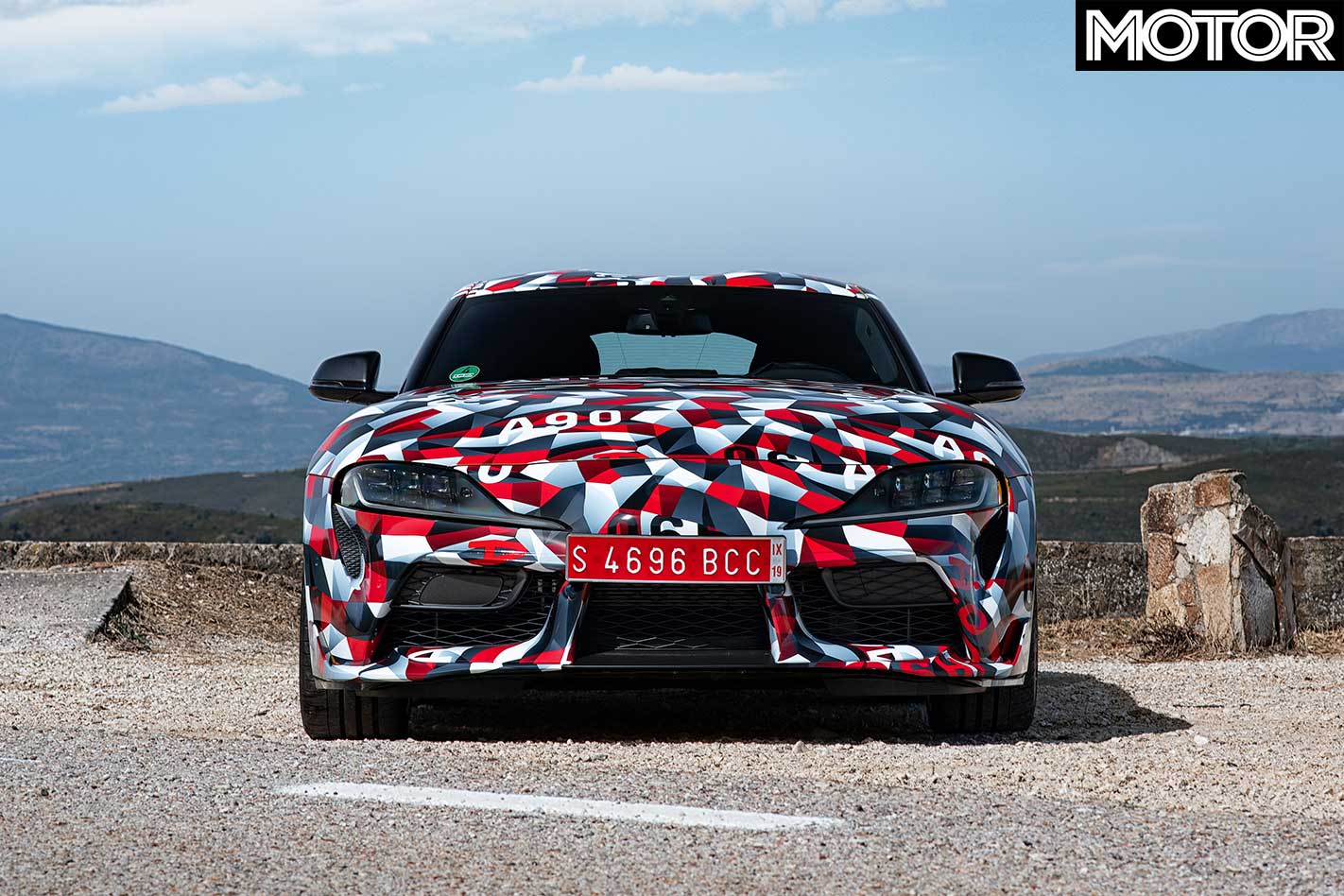
FAST FACTS 2019 Toyota Supra prototype
BODY: 2-door, 2-seat coupe DRIVE: rear-wheel ENGINE: 2998cc inline-6, DOHC, 24v, turbo POWER: 250kW (estimate) TORQUE: 475Nm (estimate) WEIGHT: 1500kg (estimate) TRANSMISSION: 8-speed automatic WHEELBASE: 2440mm (estimate) TYRES: Michelin Pilot Super Sport, 255/35 R19 (f); 275/35 R19 (r)
RATING: 4.5 out of 5 stars
Five reasons the B58 is the next great inline six
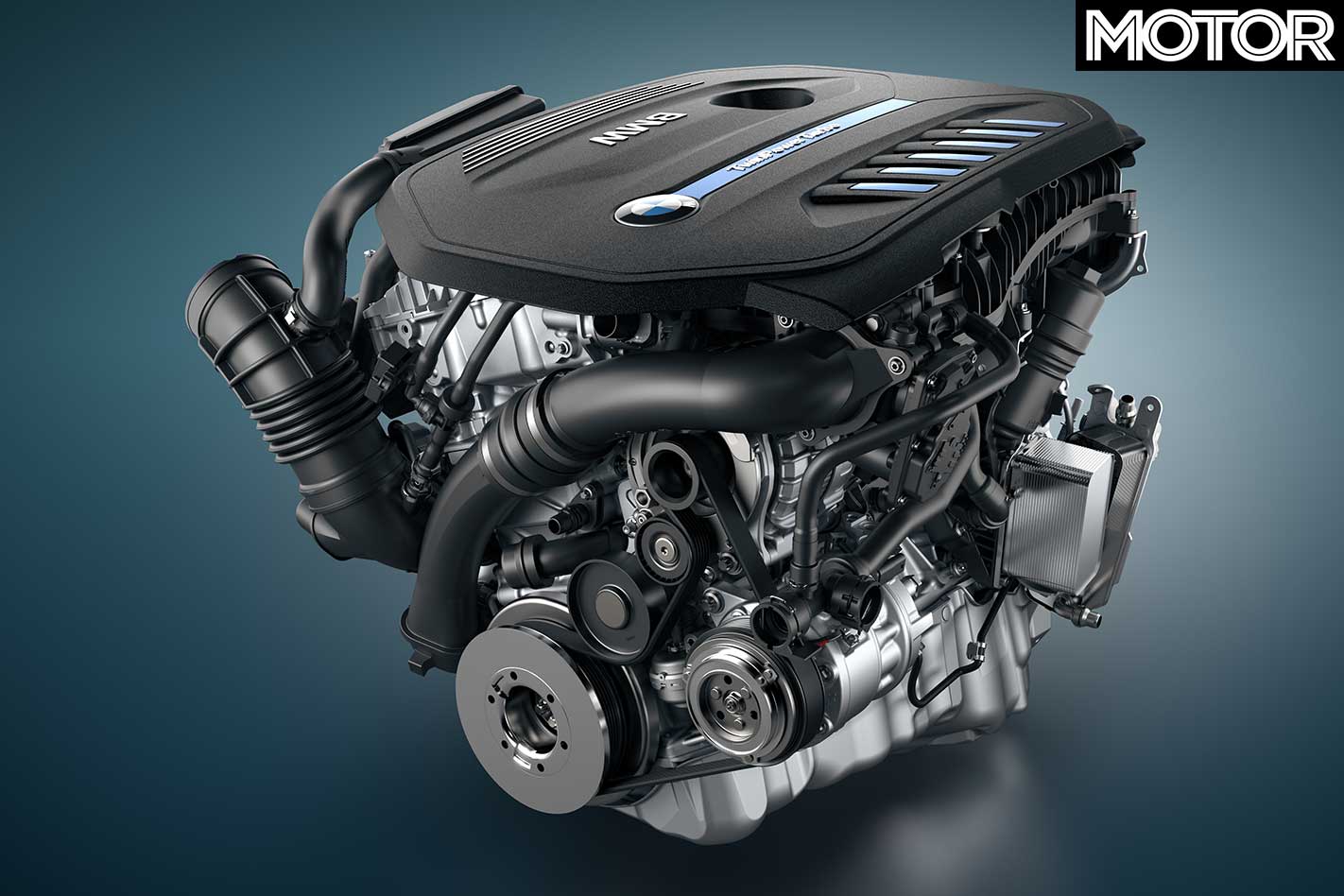
1 – The modular architecture with BMW’s three- and four-pot engines increases economies of scale, parts availability and value 2 – Its crankcase is stiffened and the crankshaft better balanced 3 – Its bores are plasma coated, which should strengthen the block for big power applications 4 – The turbo’s electronic wastegate helps spool times and overall throttle response 5 – The B58’s twin-scroll turbo is larger than the succeeded N55’s, increasing power while keeping good response
Price and Equipment
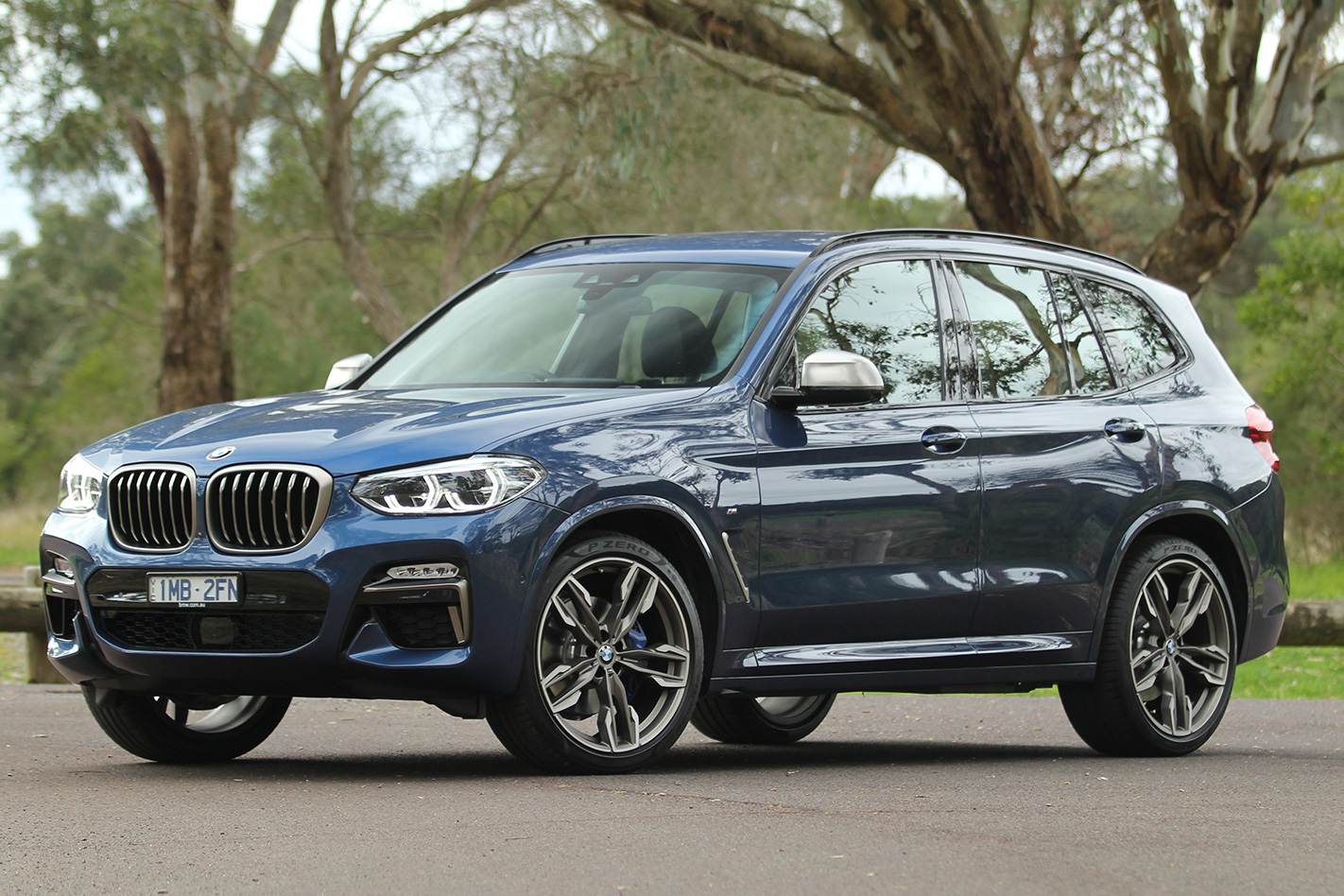
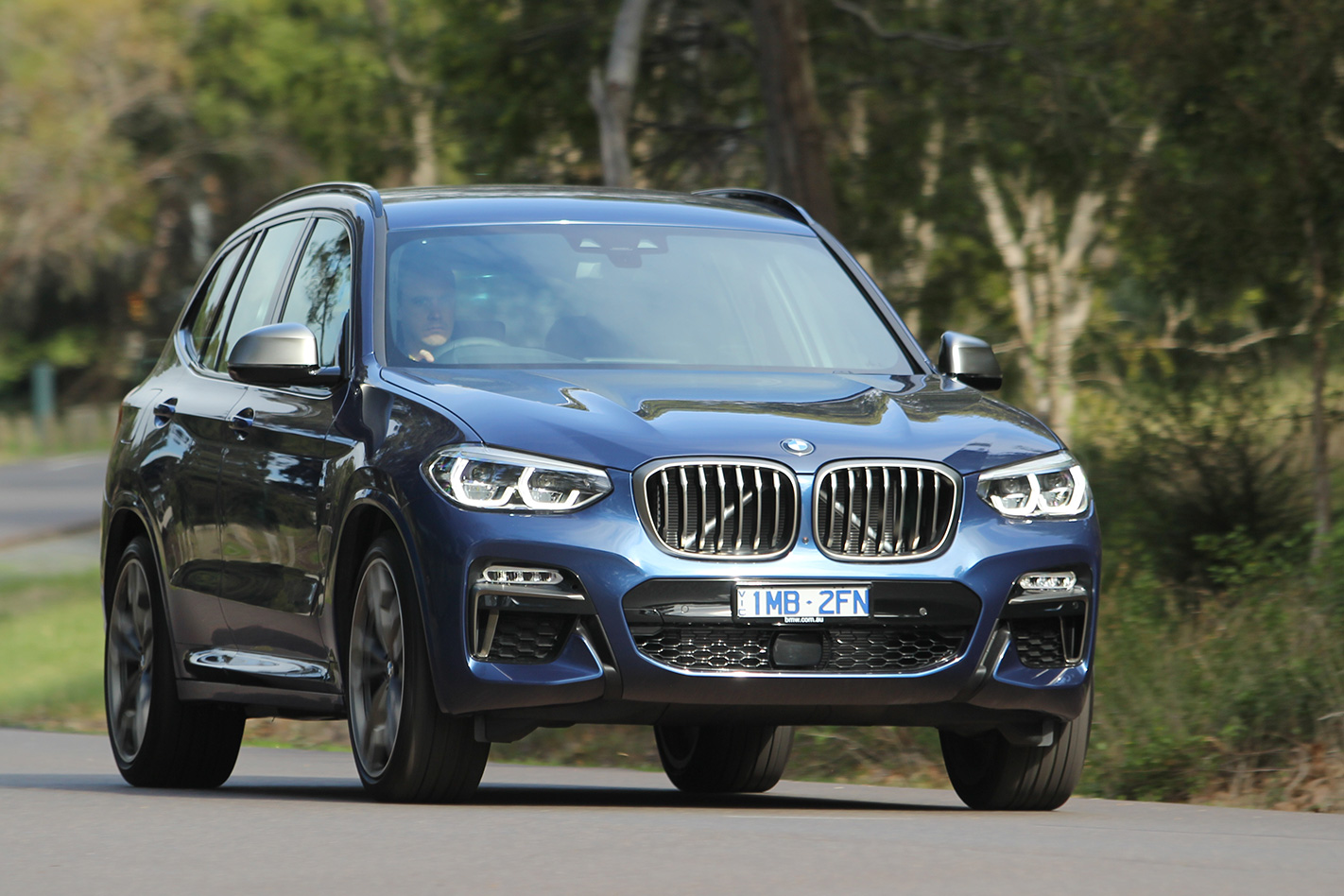
BMW takes a different approach to Jaguar, stacking the X3 M40i full of equipment like a head-up display, a premium Harman/kardon sound system, adaptive headlamps, power tailgate and heated seats all as standard. It certainly wants for little, and its spec list absolutely reinforces the M40i’s flagship status. All that, and the top-dog X3 still manages to retail for less than $100,000.
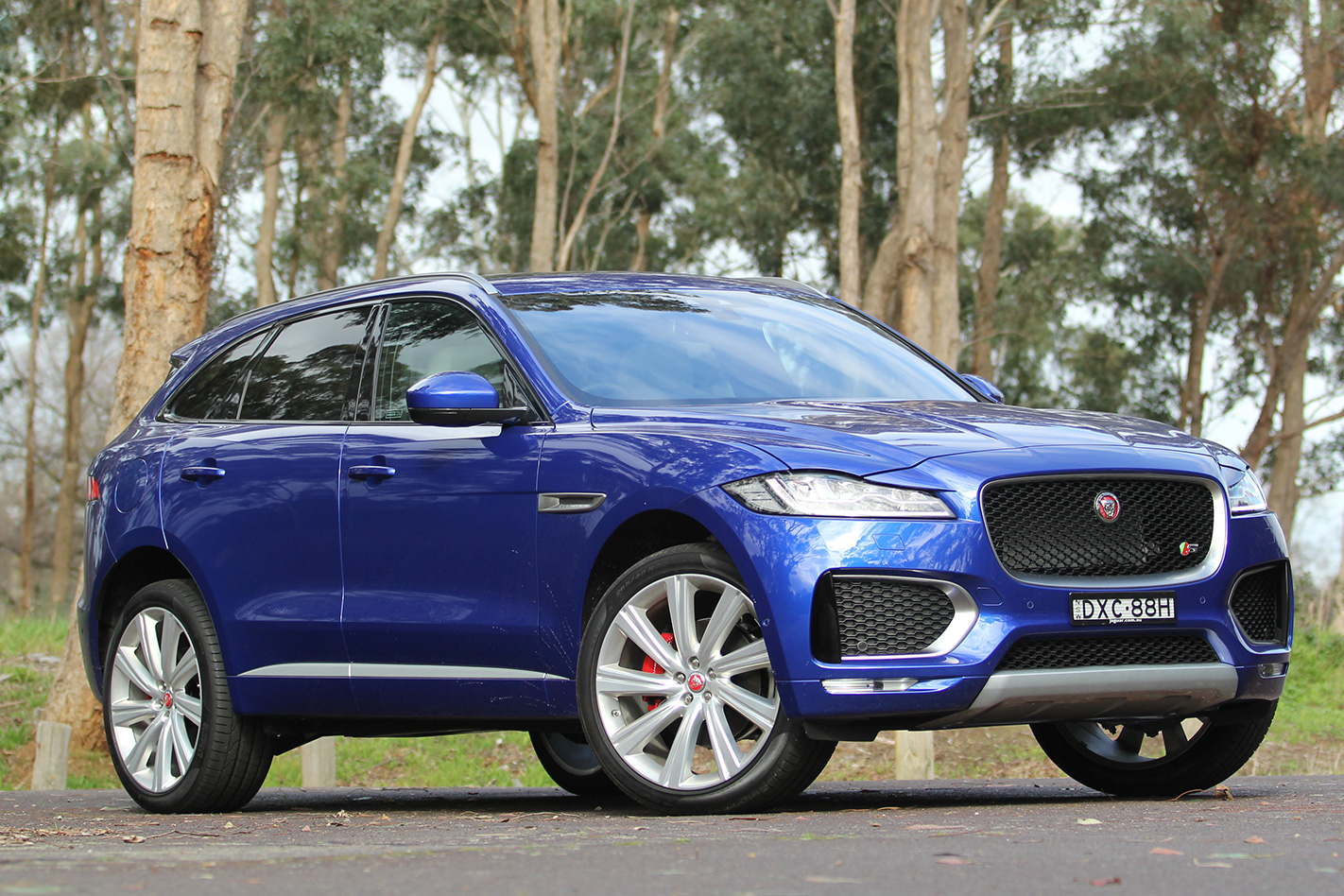
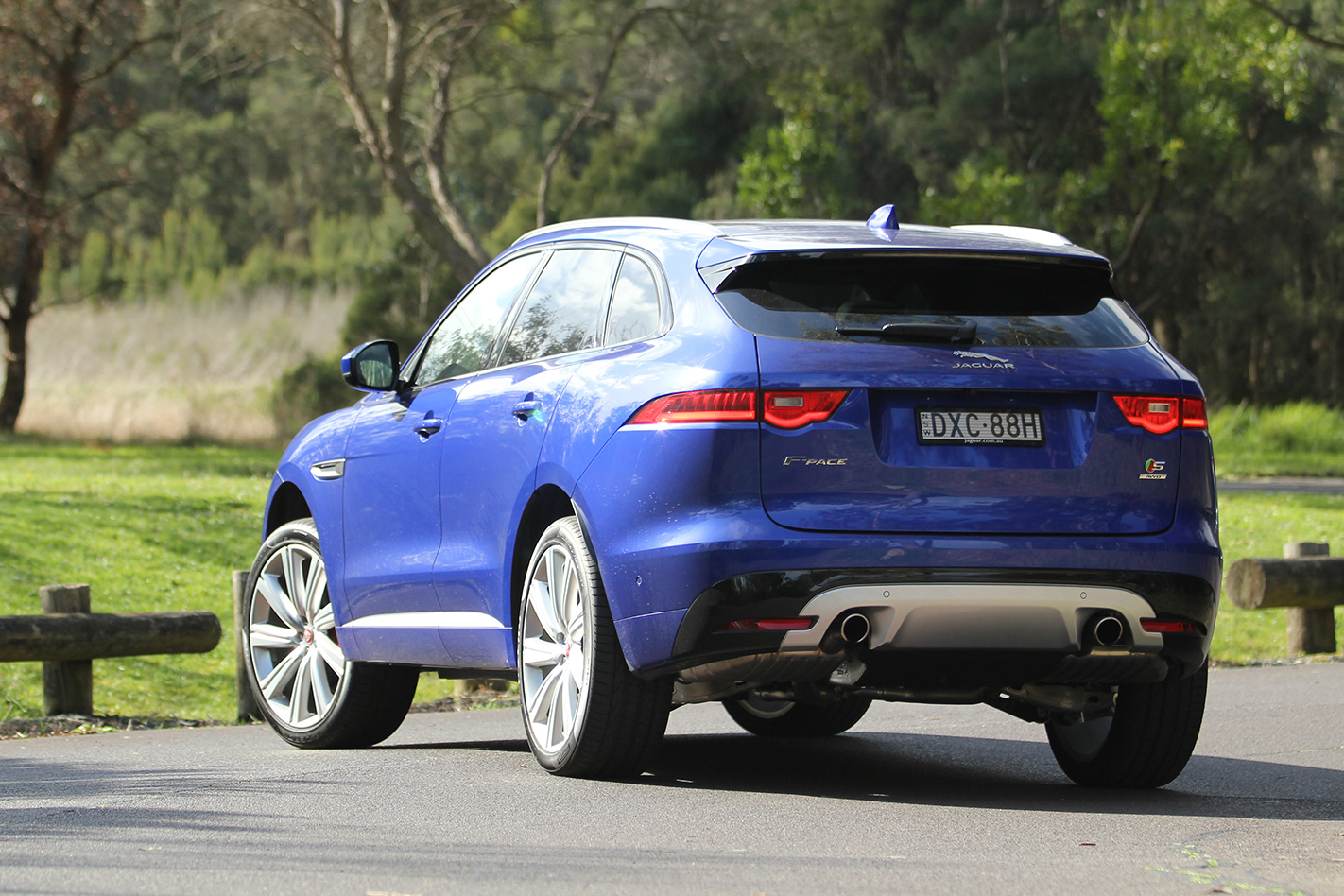
The fast Jag has the disadvantage of having a six-figure sticker that’s made worse by a standard spec that leaves off items that we’d expect to be standard at its price point. The basics are there, but what about a powered tailgate or Jag’s high-end infotainment suite? They’re reserved for the options list, and our tester’s $141K as-tested price shows just how expensive speccing up the F-Pace can get.
Interior and Connectivity
BMW X3:
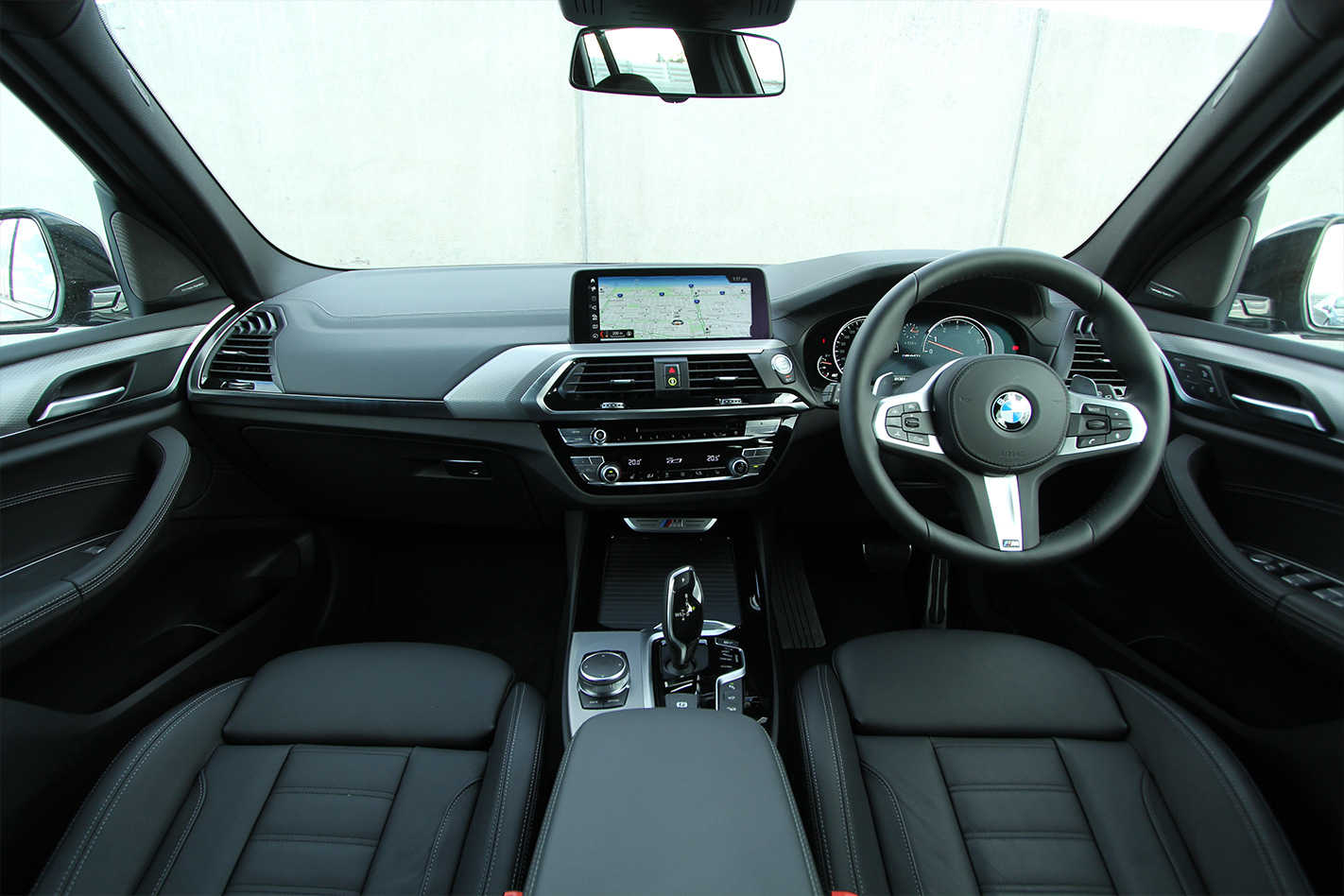
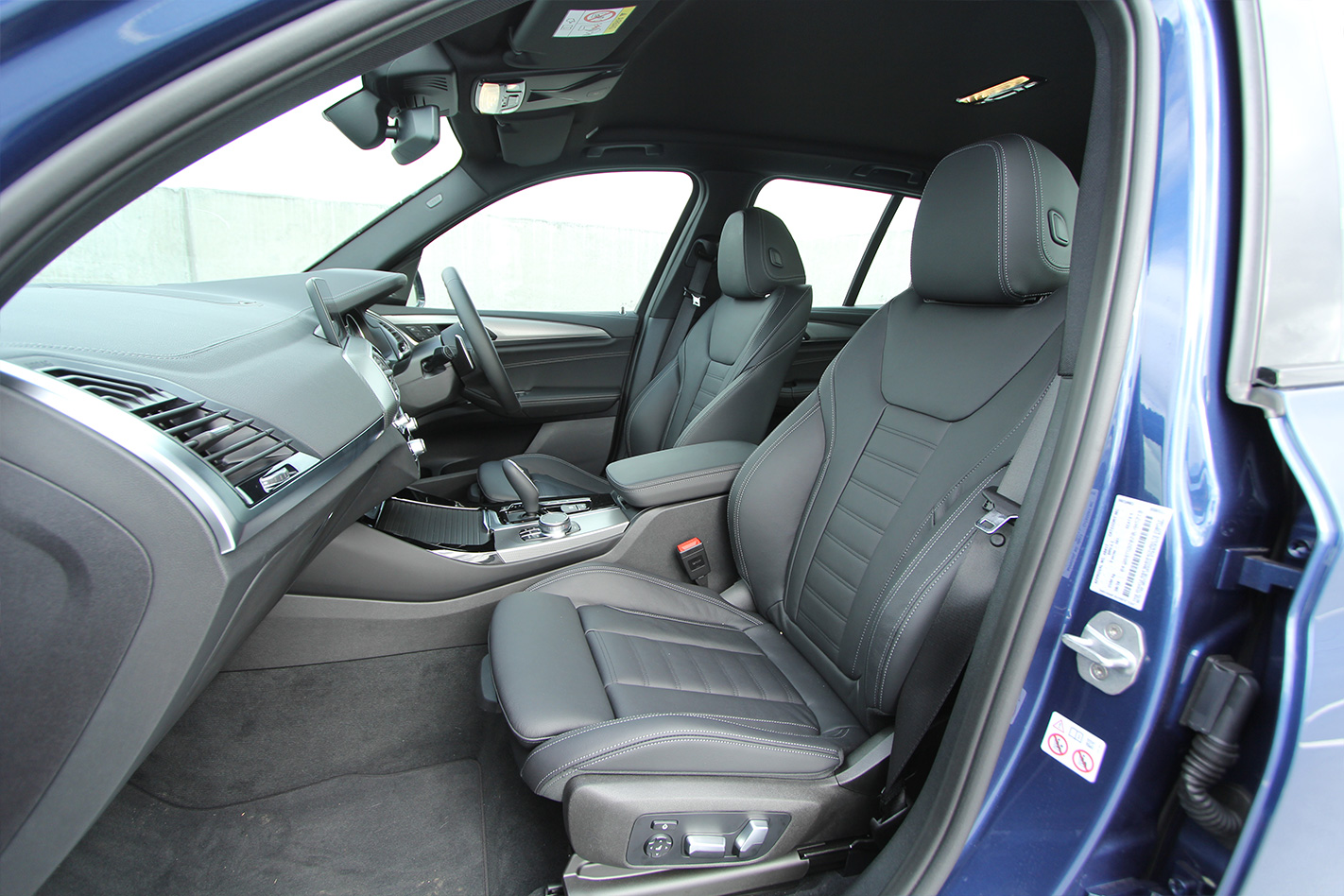
It’s a dark cabin, but one that looks premium and feels sporty thanks to classy design and superb seats. More wagon-shaped than the sleeker Jaguar, the X3 also boasts commendable space and practicality – not to mention mod-cons. Speaking of which, the high-set infotainment screen and BMW’s iDrive controller remain segment-leading for ease of use and feature-count.
Jaguar F-Pace:
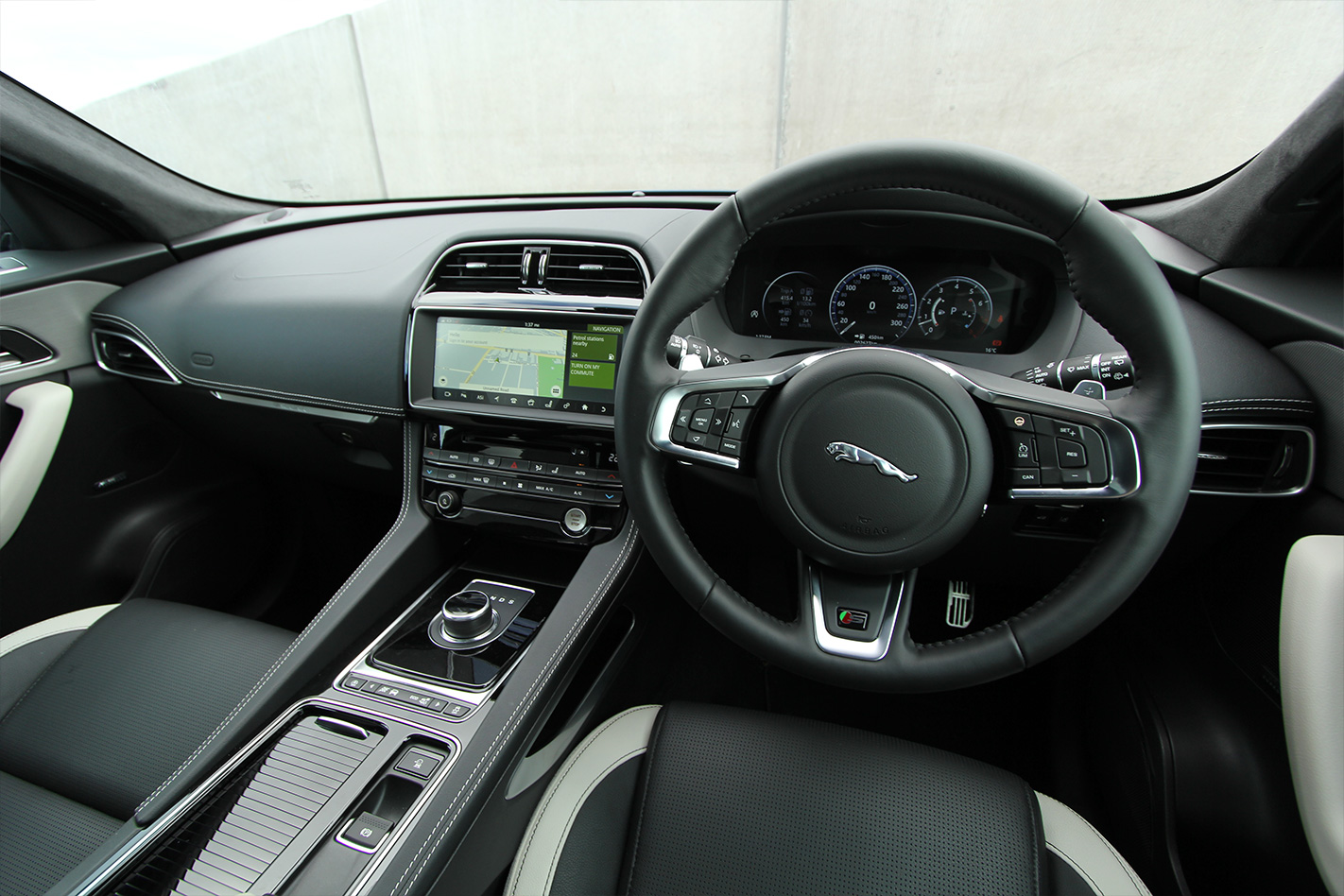
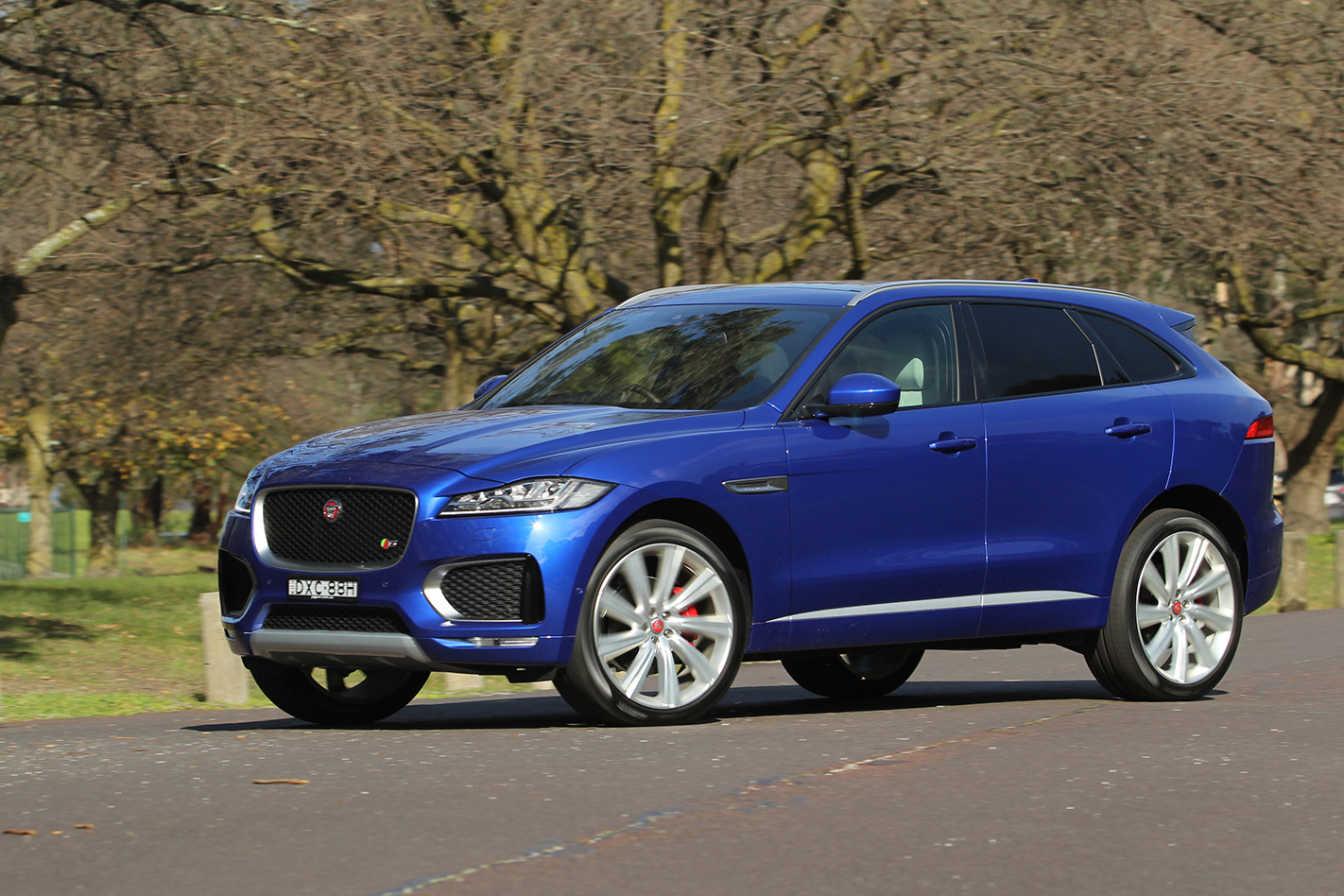
Even in top-shelf guise the F-Pace’s interior is more about restrained elegance than overt luxury, with design that’s uncluttered but lacking in the flair you’d expect of a premium SUV. Meanwhile, though our car was fitted with Jaguar’s higher-end 10.2-inch Touch Pro Navigation system, the interface needs refinement to make it intuitive and maximise all of that screen real estate.
Ride and Handling
BMW X3:
The X3 M40i is more focused when dialled to Sport Plus, yet remains plush for daily duty in Comfort mode. Want to have fun? The M40i responds with a taut chassis and weighty steering. Just dropping off the kids? The dampers slacken to ensure junior’s breakfast stays down. It’s versatile and ably covers the performance/practicality criteria that’s the raison d’etre of hi-po SUVs.
Jaguar F-Pace:
It’s clear Jaguar has reserved the properly dynamic chassis settings for the F-Pace SVR, because though the 35t is clearly an adept handler, it has a softness to its suspension that positions it more as a powerful cruiser rather than a properly performance-oriented F-Pace option. Even so, its rear-biased AWD system and torque vectoring means it can corner like a cut cat if you ask it to.
Performance and Economy
BMW X3:
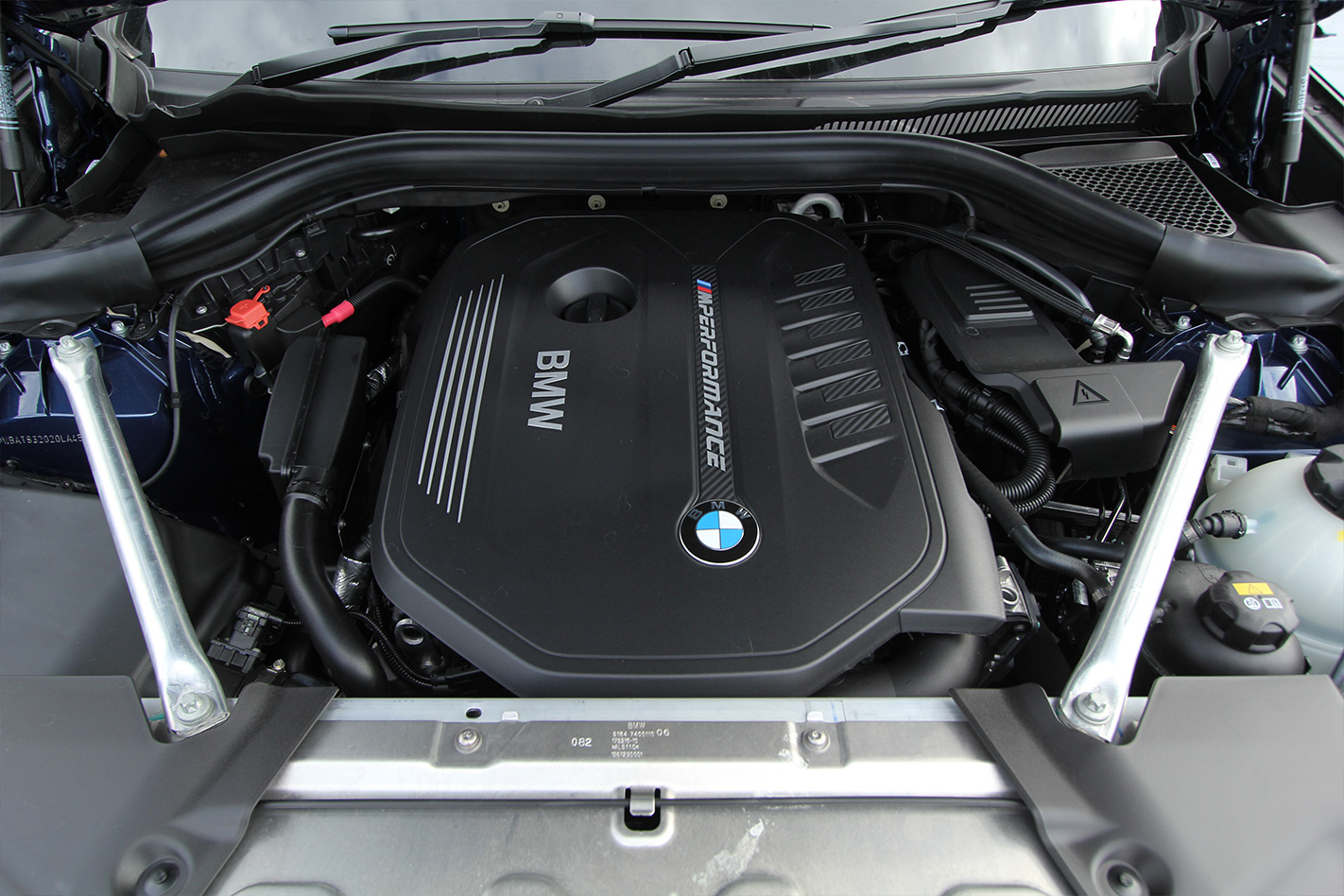
BMW’s turbo inline six might not feel as alert – nor as powerful – as the Jag’s engine, but its strength lies in its 50Nm peak torque advantage and massive reserves of low-rpm thrust. Its 4.8-second 0-100km/h sprint is also 0.7s ahead of the Jag so it’s a straight-line winner, while it’s all backed up by a booming exhaust soundtrack plus an intelligent (and fast-shifting) eight-speed auto.
Jaguar F-Pace:
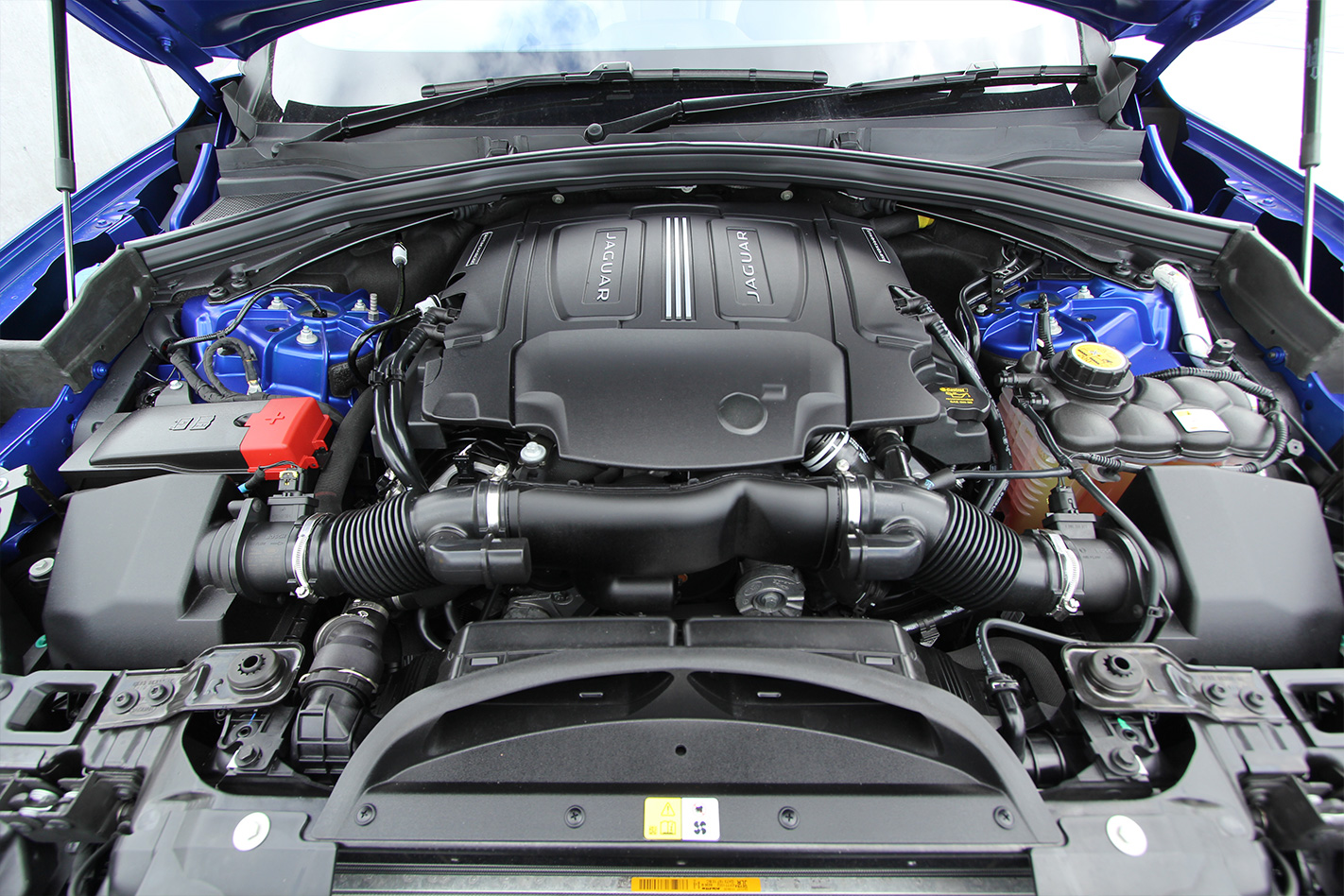
Jaguar opts for a supercharger instead of a turbo to augment the F-Pace’s 3.0-litre V6, resulting in an engine with a very different feel to the BMW. It’s ultra-responsive with a wonderfully linear power delivery, while the exhaust note has a sports-car raspiness to it that’s more musical than the BMW’s tone. Eight-speed auto is great in Drive, but not especially crisp in manual mode.
Warranty and Servicing
BMW X3:
BMW’s standard factory warranty runs to three years and has no distance limitation, and while maintenance intervals vary according to usage, a range of fixed-price servicing packages take a lot of uncertainty out of the X3 M40i’s running costs. The basic pack costs $1800 and covers five years/80,000km of ownership, while a package covering brake components and wipers costs $4400.
Jaguar F-Pace:
Jaguar provides three years and 100,000km of warranty coverage, which is at the low end of the scale these days, however the company offers a servicing plan for the F-Pace that covers scheduled maintenance for the first five years or 130,000km of ownership for a fixed price of $1800 – provided you take your car to a Jaguar dealership to have the work done.
Winner:
BMW X3 M40i