
This isn’t a punch line, fake news, or April fools. Hyundai has built a hot hatch.
It promises to exorcise memories of the Excel. And to do that, four years ago Hyundai lured BMW’s Albert Biermann from retirement and into its N division. The target was Wolfsburg’s ever-green Golf. And the i30 was the weapon.
We recently fanged the final result across Europe, learning the i30 N will swoop into Australia next year with a standard and shamelessly named ‘Performance Pack’ version. Save your yawns, though, because the i30 N is a belter.
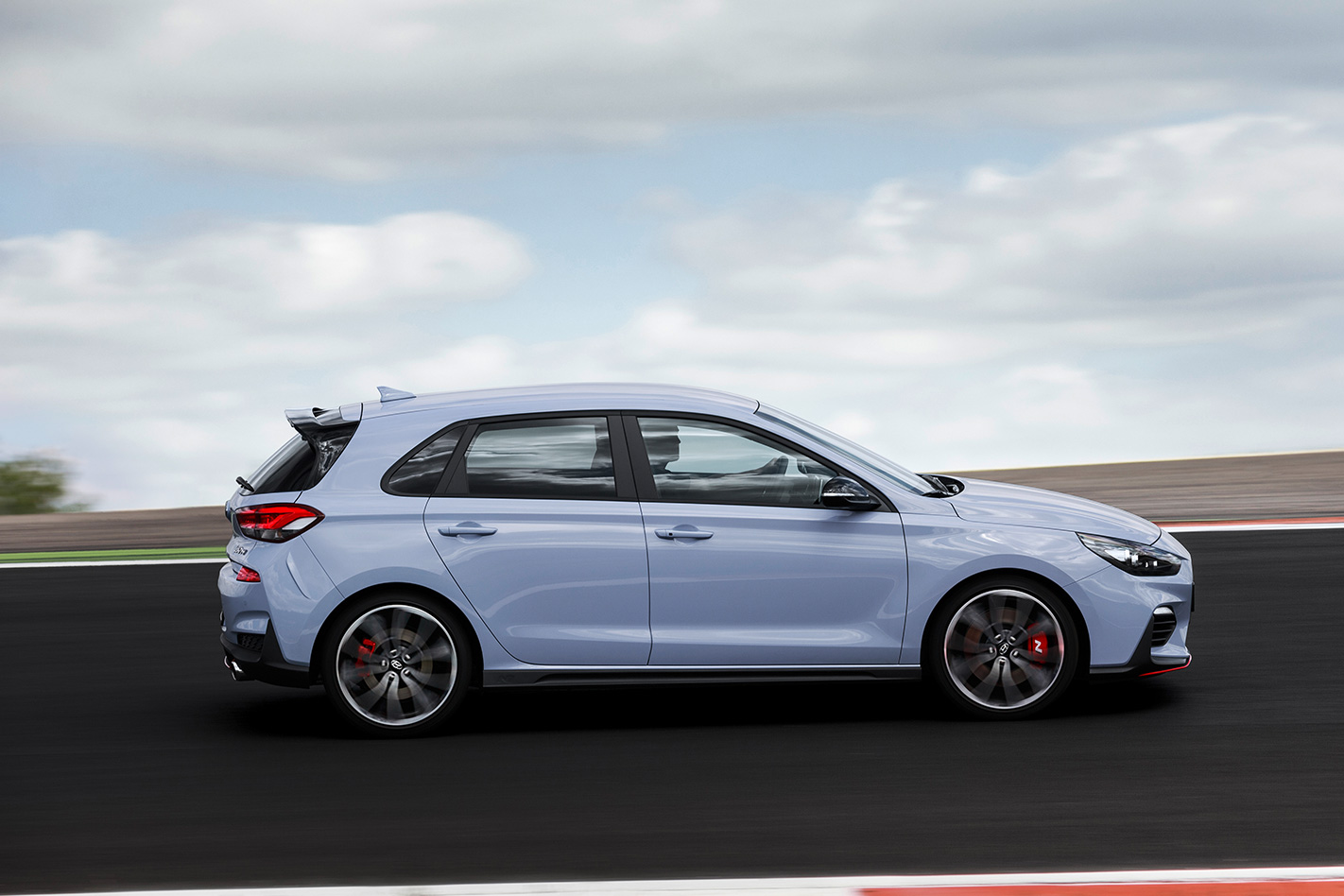
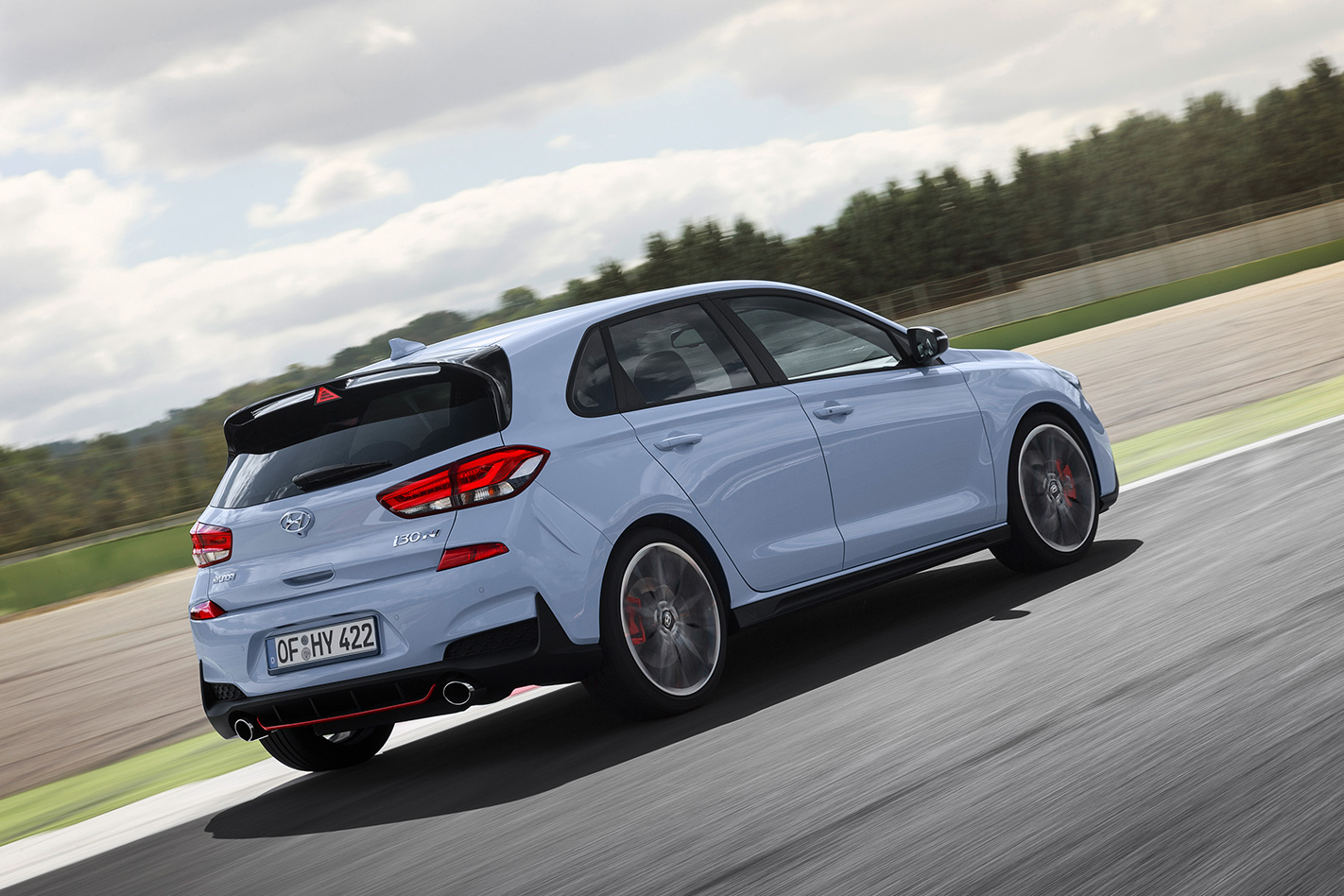
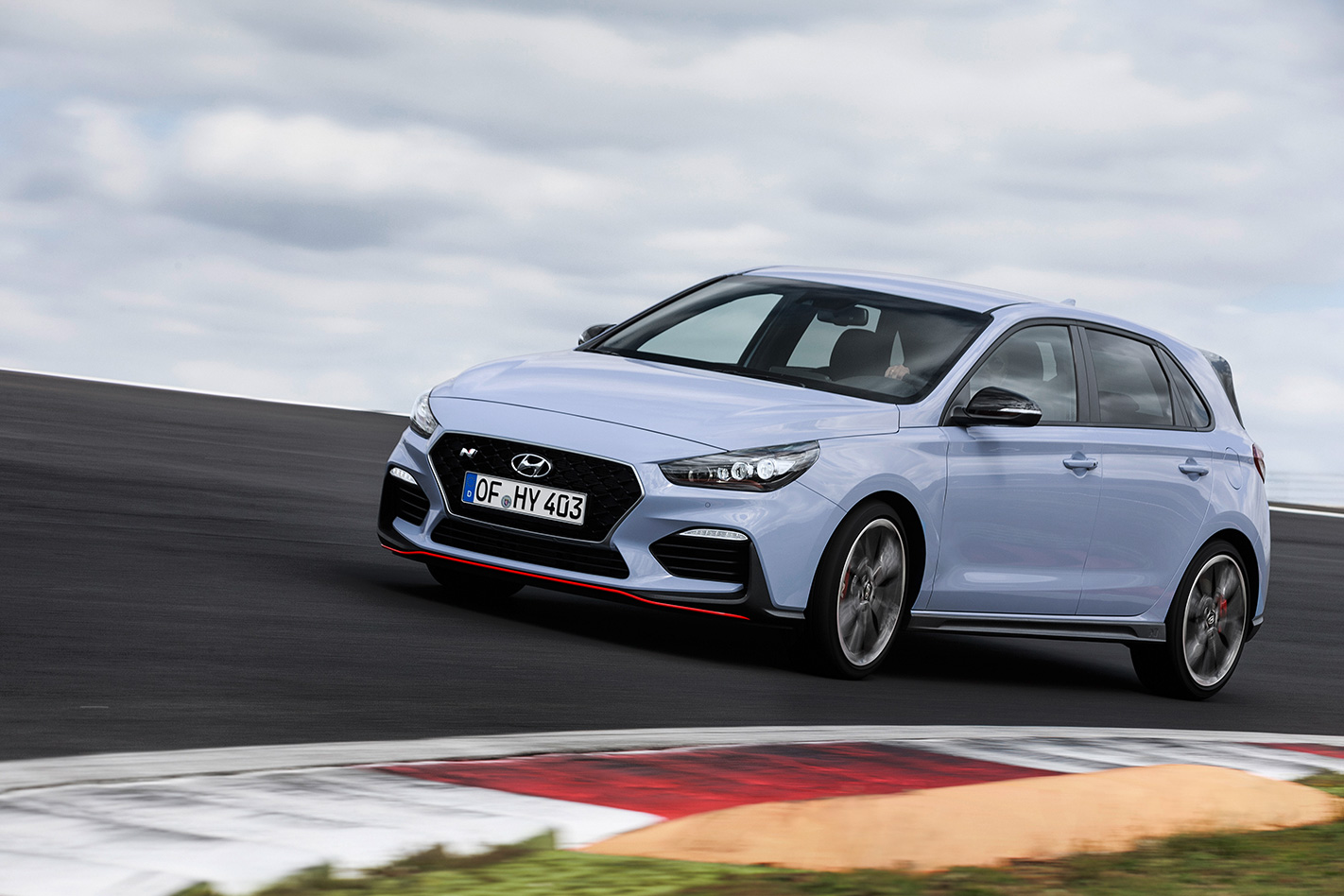
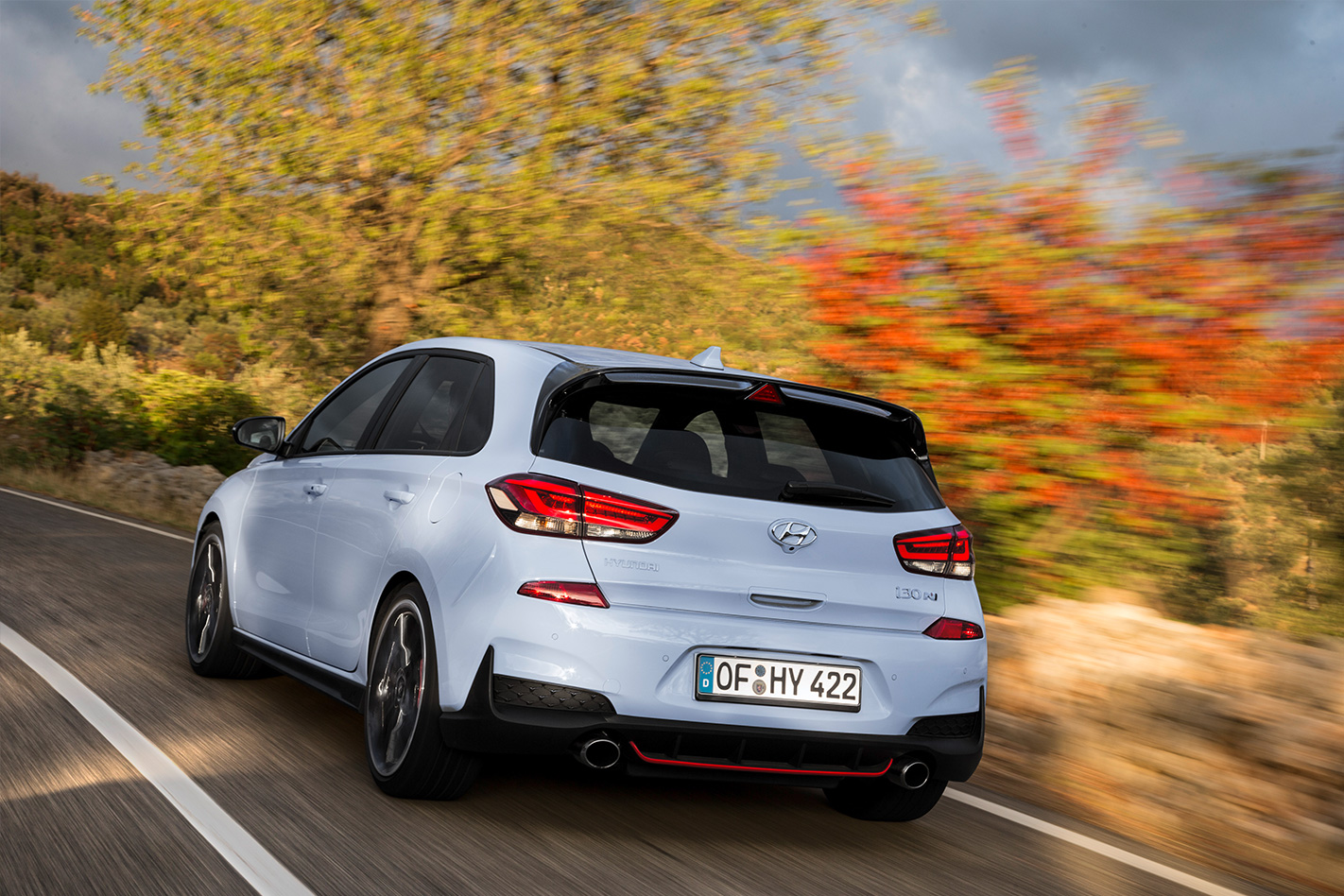
Outside, they wear N-specific bumpers, side sills, and a shared rear spoiler. Meanwhile curtains, splitters, and a smooth underside apparently produce overall downforce.
We’ll let you decide on the looks. But the real theatrics are underneath the sheetmetal, where engineers save the 2.0-litre engine from a life of school runs and Uber duties in a Sonata.
It’s then given a new twin-scroll turbo, redesigned manifolds and an upgraded cooling system. The result isn’t dramatic on paper. It’s only 3kW and 3Nm healthier in the standard car with 183kW/353Nm.
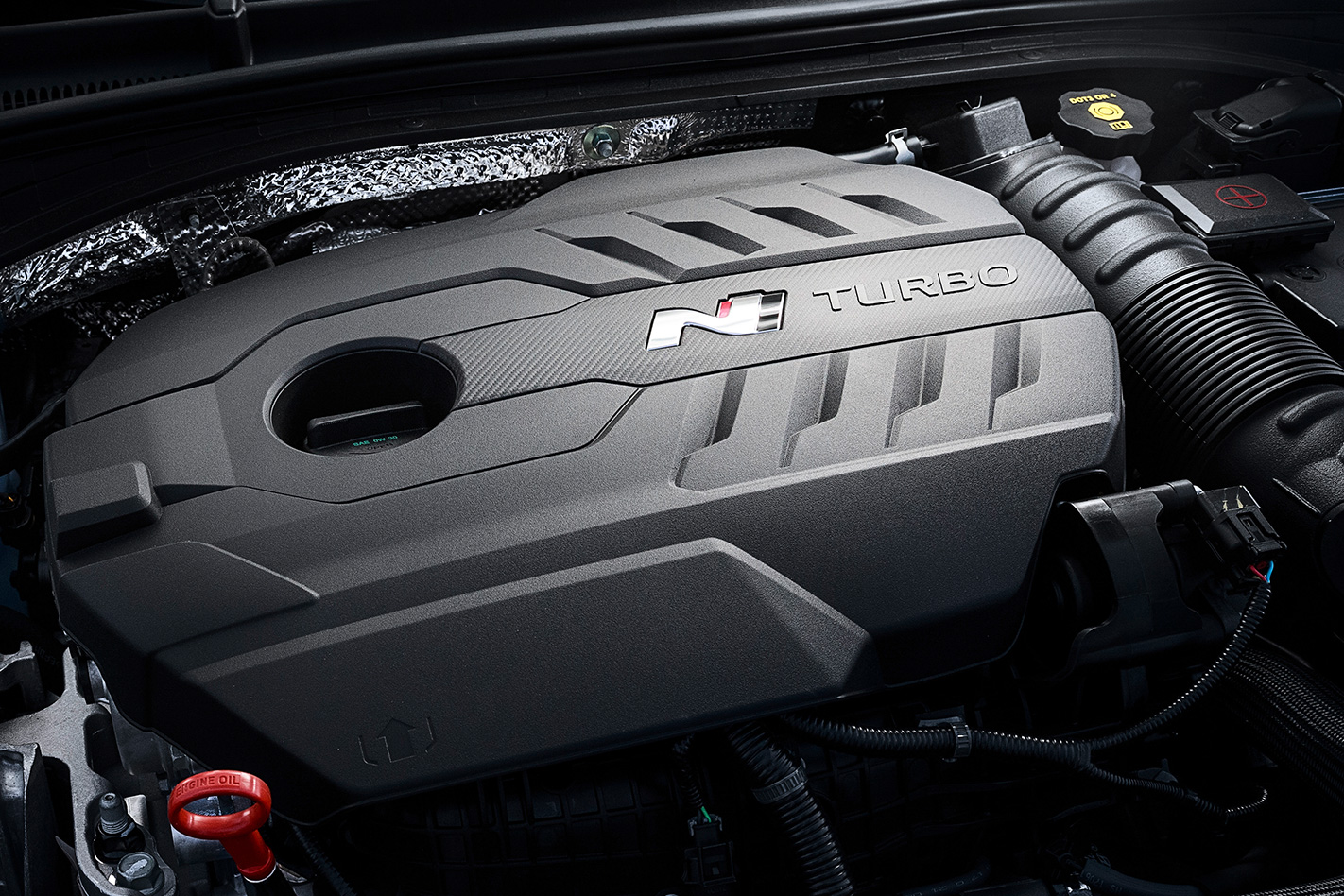
The engine is incredibly tractable in Sport for a 2.0-litre. Peak twist arrives as soon as 1400rpm, and then hairy-chested overboost appears at 1700. As a result it’s happy to stay in higher gears, pulling hard from down low until it runs out of breath near its 6000rpm power peak.
Performance Pack cars score a 202kW engine tune, produced at the same rpm, slashing the car’s 0-100km/h sprint in 6.4sec to a launch control assisted 6.1. For reference, VW’s Golf GTI Performance turns 180kW/380Nm into a 6.2 second sprint.
Handling the grunt is a six-speed manual, with a wet dual-clutcher in the works for 2019. Beefed up synchros and a stronger clutch help it cope. While a fuel-cut function means it will happily bounce off its 6700rpm redline.
You can switch it off. And mess with other things like the torque map, dampers, exhaust, ESP, rev-match system, steering, and sound enhancement through the drive mode menu.
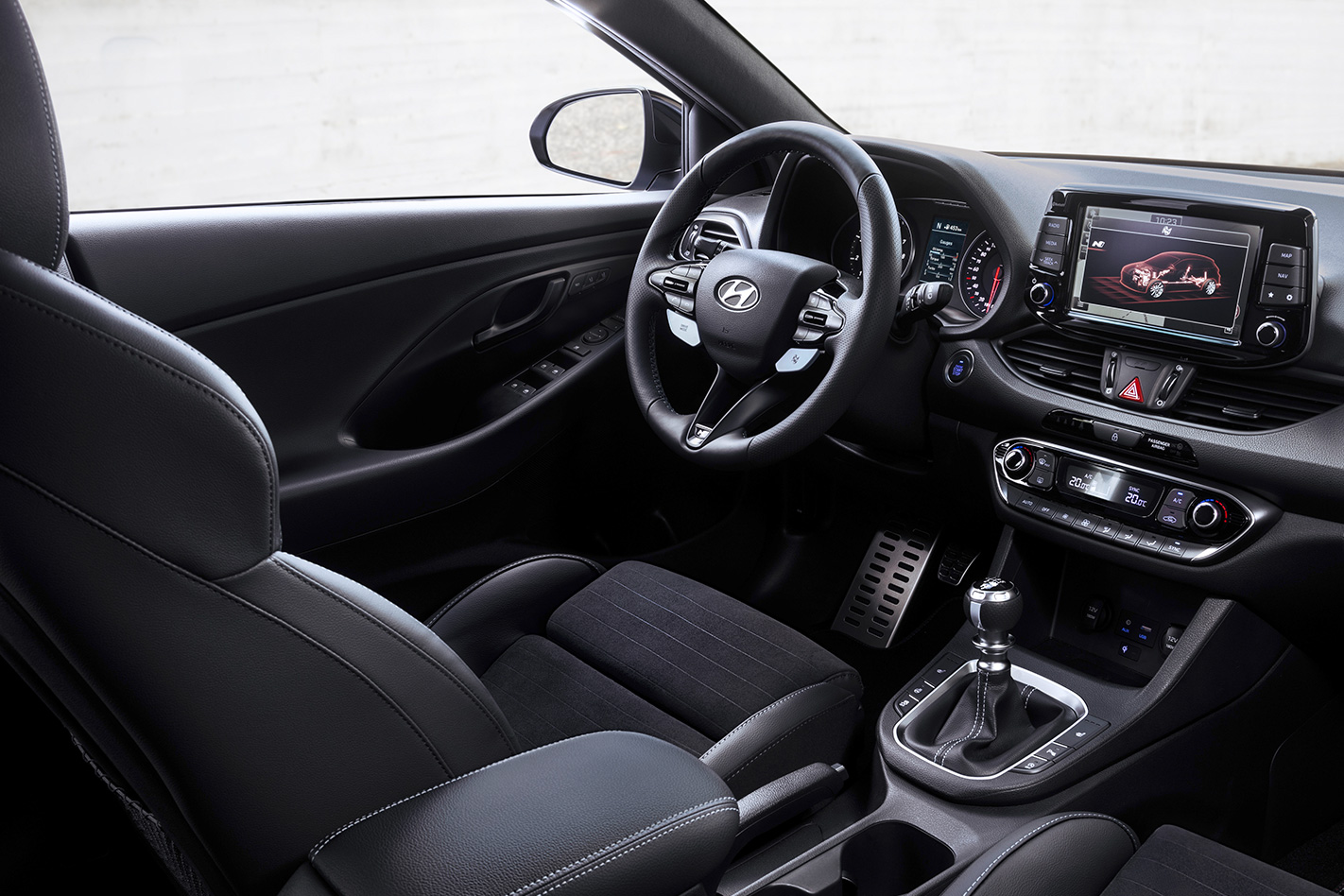
Or, if you’re lazy, an ‘N’ button on the steering wheel will switch everything to kill. Or press it twice and you can customise all features to your liking, just like an M3. We preferred the dampers in their softest setting, and all else in their sharpest.
Another button toggles through the regular Eco, Sport, and Normal drive modes. There’s no one-touch for the exhaust like there is for the rev-matching system. But we must say the noise is spot-on when set to ‘disturb the peace’. And not just for a Hyundai.
Performance Packs also score a brand new front-differential that uses an electronically controlled clutch-pack to vary lock. Matched to Pirelli rubber (10mm wider than standard at 235/35) it’s claimed to corner five per cent faster than the standard car.
Yes, the Performance Pack launches out of corners cleaner and feels a touch sharper on its 19s. And besides a little steering numbness under full power, torque steer is almost banished. The strut-front suspension still tramlines, however, and it won’t shake its tail like a Megane RS without a big dab of brake and dampers their softest.
Still, adaptive dampers, soft springs, and a stiff body structure have allowed engineers to strike a fantastic ride/handling balance which will make the i30 N a demon on our back roads. Over hundreds of road kilometres, including Rome’s worst, the i30 N relays enough about surface and grip levels for you to push hard, but not too much that it becomes tiring or uncomfortable.
However, it still lacks the feedback and on-limit sharpness found in Volkswagen or Ford stables. Oh, and the turning circle’s rather big. Inside, the interior feels solidly built. Both the touch screen and LCD dash display are clear and concise. Meanwhile the touch points are spot-on for placement, access, and tactility.
Search hard enough, however, and you’ll find a rough edge or two on hidden plastics. Hyundai aims to offer both cars in a boggo and luxury spec. Adding things like a sunroof, heated steering wheel, and other trinkets at a higher price.
We’d appreciate more seat bolster for track stuff, but as we’ve reported, you might be able to fix that yourself with some hardcore optional extras in future. When it lands in February next year, Australia is expected to become the second biggest market for the i30 N outside of Europe.
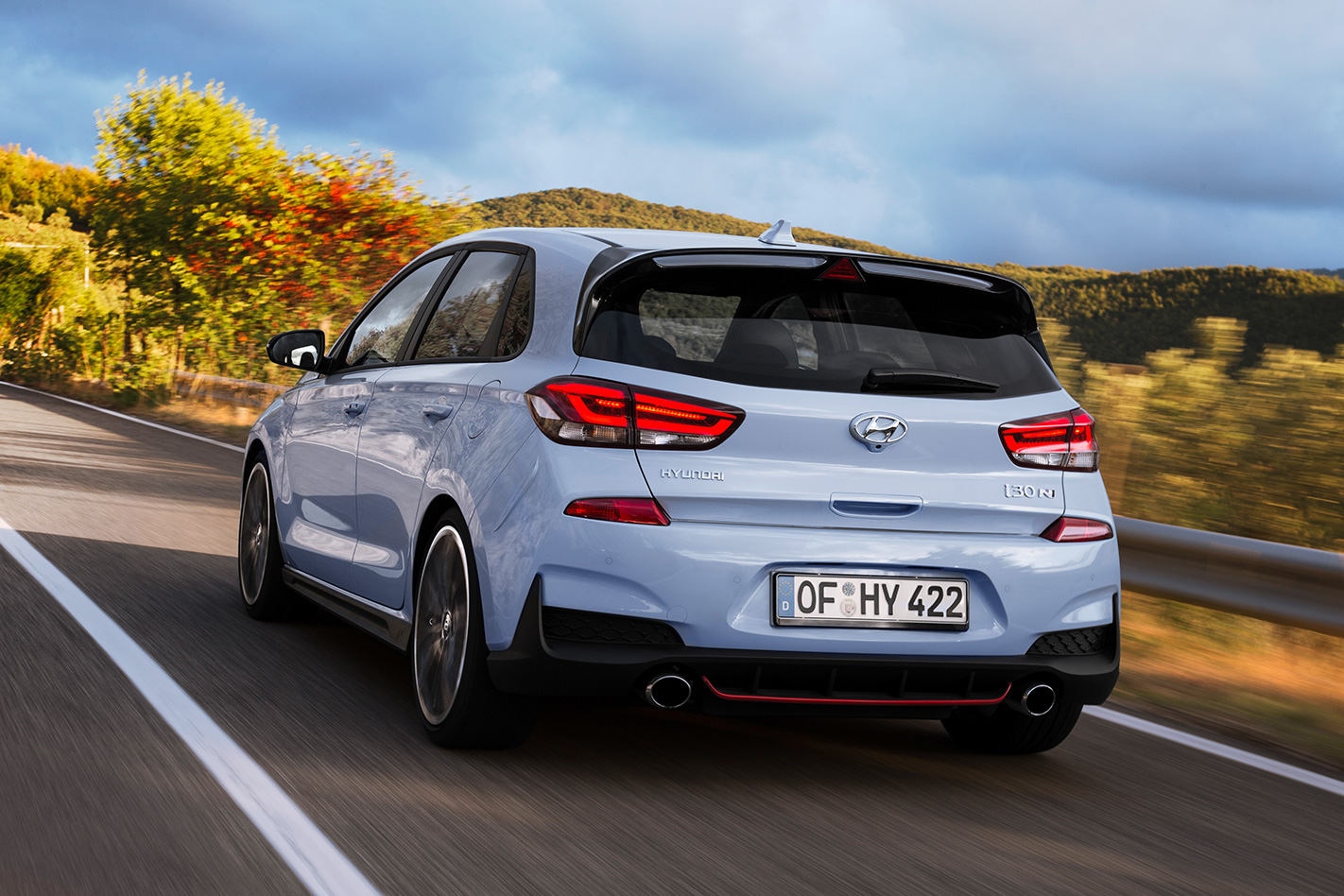
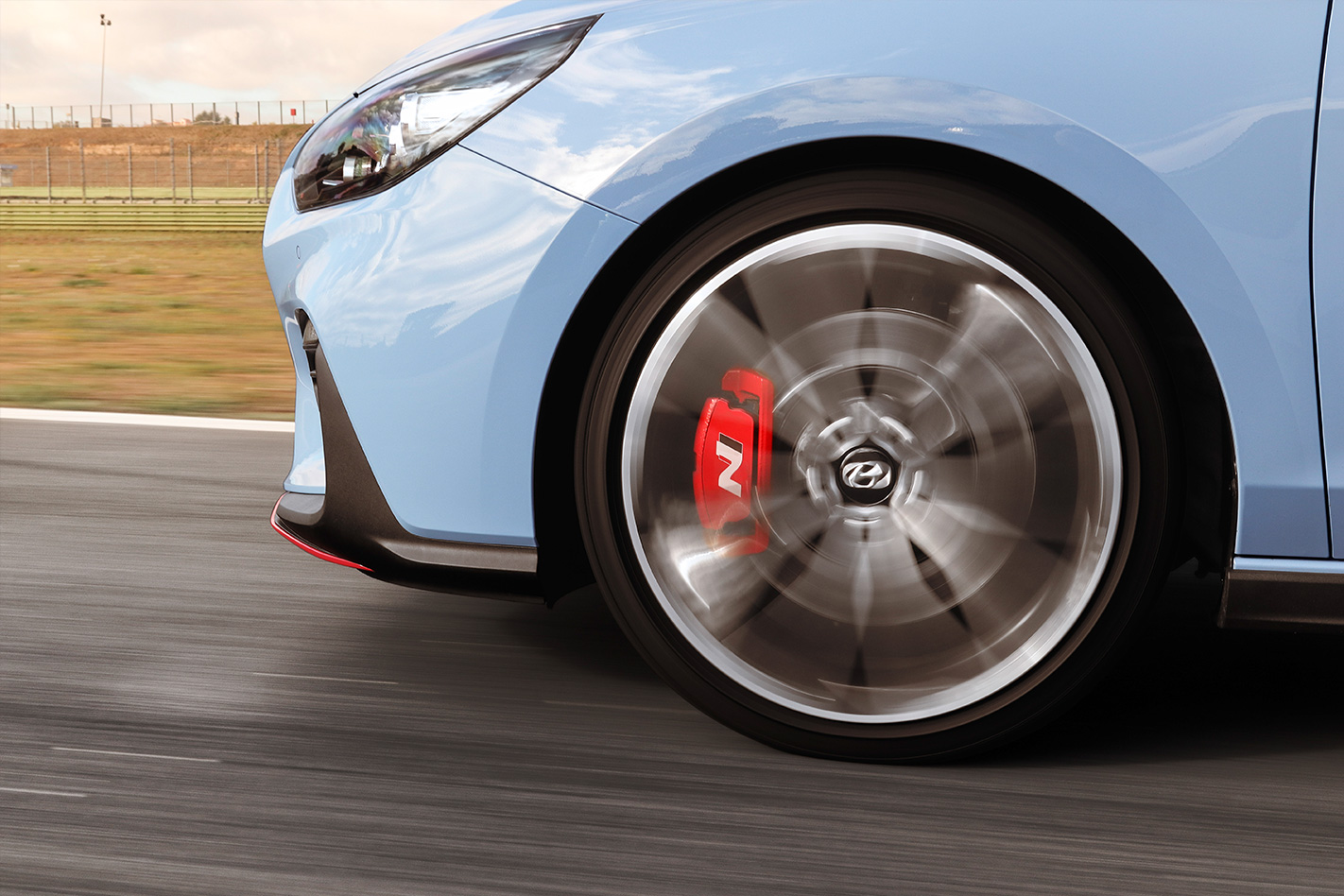
Of course, the zestier outputs, bigger brakes, and tricky diff in the Performance Pack make it the real pick. The latter two features adding an extra layer of control and finesse when really hooking in. There’s no automatic until 2019. But the flip-side is, Volkswagen doesn’t currently offer a manual Golf GTI Performance in Oz.
If Hyundai can price the i30 N south enough of the GTI, especially in Performance guise, we might have a genuine winner on our hands. Until then, it’s a wait for the punchline.
4.0 stars out of 5 Likes: Grunt, character, practicality Dislikes: No auto… yet; steering refinement
Hyundai i30 N Performance Package specifications Drive: front Engine: 1998cc 4-cyl, DOHC, 16v, turbocharged Bore/stroke: 86.0 x 86.0mm Compression: 9.5:1 Power: 202kW @ 6000rpm Torque: 353Nm @ 1450-4700rpm (378Nm with overboost) Power/weight: 144kW/tonne Transmission: six-speed manual Weight: 1429kg Suspension (f): Struts, adaptive dampers, anti-roll bar Suspension(r): Multi-link, adaptive dampers, anti-roll bar Dimensions: 4335mm(L)/ 1795mm (W)/ 1451mm (H) Wheelbase: 2650mm Tracks: N/A Steering: electrically-assisted rack-and-pinion Brakes (F): 345mm ventilated discs, single-piston calipers Brakes (R): ventilated discs, single-piston calipers Wheels: 19 x 8.0-inch (f/r) Tyre sizes: 235/35 R19 (f/r) Tyre: Pirelli P-Zero Price as tested: N/A
HYUNDAI has pitched itself into the hot hatch segment with a significantly hardened version of the i30 hatch that sends up to 202kW through the front wheels.
WHAT IS IT?
The debut car from Hyundai’s high-performance N division, and a rival for hot-hatch stalwart the VW Golf GTI. This is Hyundai showing it demands to be taken seriously as a brand that can deliver thrills for driving enthusiasts, not just sound, functional cars for value enthusiasts.
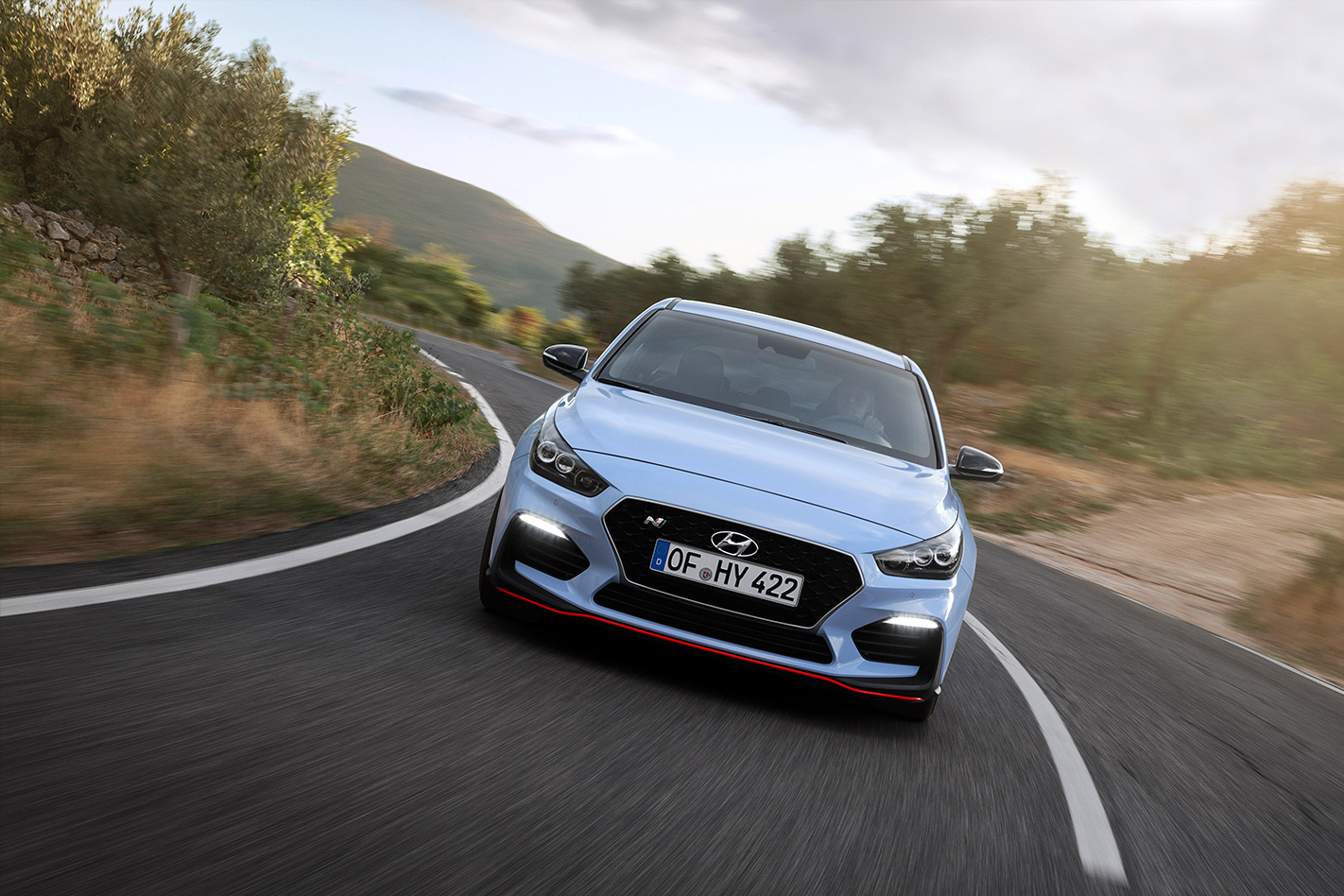
Refer to point one. In terms of a brand perception-shifter, this car is the most important thing Hyundai has done since it launched the Genesis luxury arm. Plus Rome is nice at this time of year, and the Vallelunga circuit on the ancient city’s outskirts, and the roads in the hills above, provided an excellent test of the Hyundai i30 N’s abilities.
MAIN RIVALS
Golf GTI, Honda Civic Type R, Renault Megane RS
THE WHEELS VERDICT
A landmark car for Korea. Hyundai recruited the best in the business when they poached M Division guru Albert Biermann from BMW in the hope he could deliver a transformative car for the company and spearhead a new performance arm. This is the pay-off. The i30 N exudes a sense of engineering depth and sensible usability that almost defies the solid but unremarkable dynamic attributes of the donor car. Plus – crucially – it’s a ball of fun to drive hard.
THE WHEELS REVIEW
Okay, let’s not get carried away here. A first drive of Hyundai’s i30 N is not the automotive equivalent of a manned lunar landing (er, if we all agree that actually did happen.) Nor is it like being the first person to light up the rear tyres on a true game-changer like an E30 M3 BMW or an R32 Nissan GT-R, for example.
I doubt my grandkids will stand aghast if I try to regale them in 2037 with a story about Korea’s debut hot hatch from a newly launched high-performance sub-brand.
And yet… this still feels pretty special. As I ease out the sweetly weighted clutch on Hyundai’s first-ever N model, and let the eager, throaty little engine chase its 6000rpm redline, I feel I’m experiencing something of a milestone. But also an odd juxtaposition. In one sense, this feels like a true turning point for Hyundai, and a little slice of automotive history being made. But equally, it feels like a moment the (at times justified) sweeping generalisations of negativity and dismissiveness toward Korean cars gets stuffed down the automotive rubbish chute.
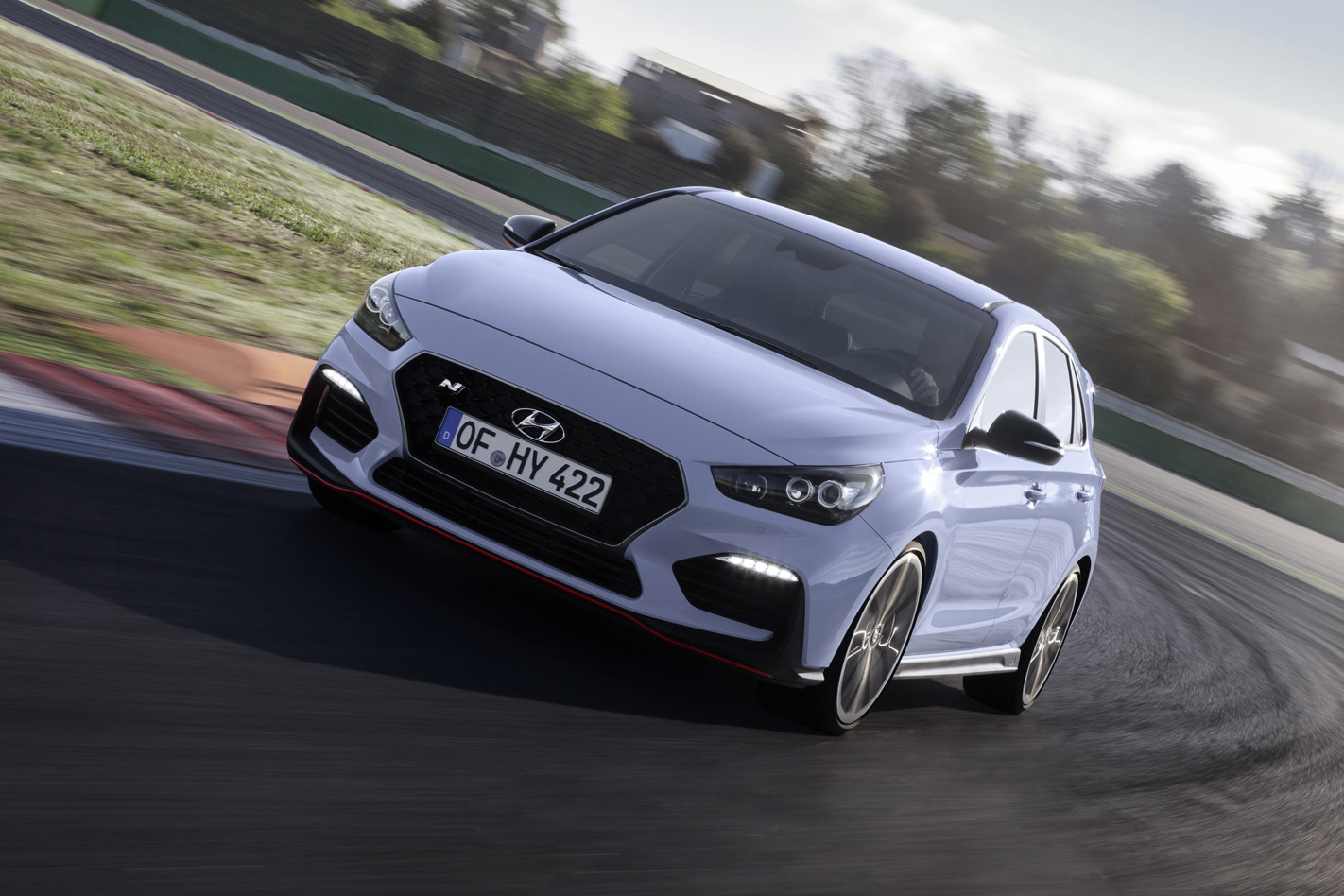
Hear that low, whooshing, sucking sound? That’s not the i30 N’s turbocharger, that’s the open rubbish chute, and there goes at least a chunk of that anti-Korean-car sentiment.
If you’re tight for time, here’s the abridged back-story: in 2015, Hyundai wrote an open cheque and dangled it in front of the best automotive engineer in the business: then BMW’s M Division boss, Albert Biermann. His brief was overarching – make all Hyundais and Kias steer nicely, ride well and handle appropriately for their respective segments. But also establish a high-performance sub-brand with real credibility, develop the cars at the Nurburgring, link the sub-brand to a motorsport program, and start by delivering a credible competitor to the established hot-hatch hierarchy headed by the Golf GTI.
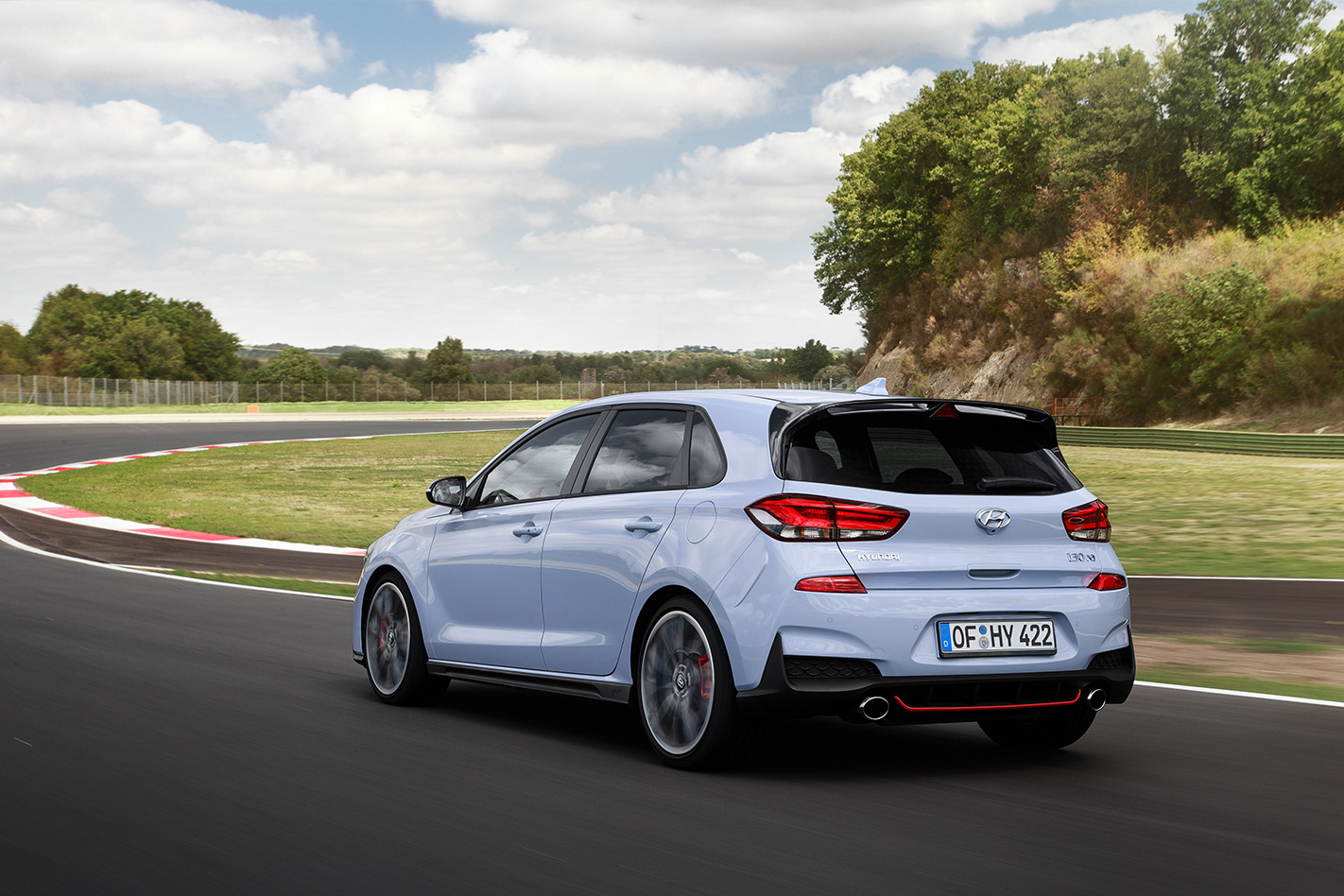
Let’s start with the engine, which benefits from three throttle maps and two exhaust modes. In Sport + it feels zingy, eager and elastic. The peak power figure of 202kW for the Performance Pack car (the standard i30 N has 184kW) is nothing too special compared to what the (more expensive) Civic Type R delivers from the same capacity, but it tops the Golf GTI, and there’s a sense that the kilowatt count has been kept to a sensible level so as to not compromise the linearity of the delivery and daily driving effectiveness.
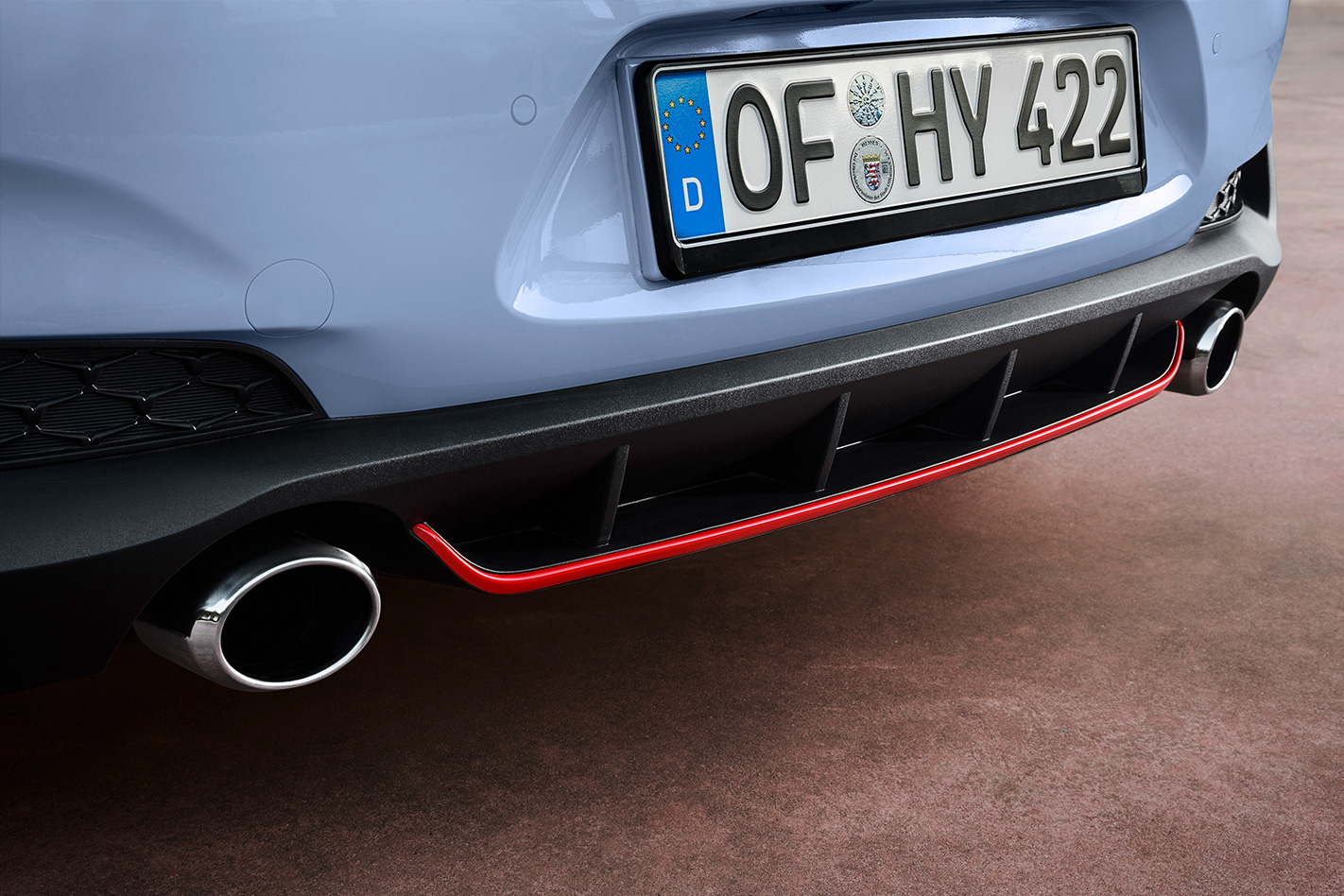
So, the Performance Pack car doesn’t just deliver a more satisfying sonic repertoire and a bit of extra top-end punch over the base model, it also has a clear dynamic advantage thanks to the electronically controlled (but hydraulically actuated) limited slip differential, leaving the regular 184kW model to make do with torque vectoring by brake to control front-end traction under a heavy throttle. Trust us, you want the e-LSD. It makes a big difference to the way the car powers down and exits a turn when driving hard, and also keeps the steering free of a slight layer of torque steer and corruption that can affect the base car when you’re spanking it or the roads are wet.
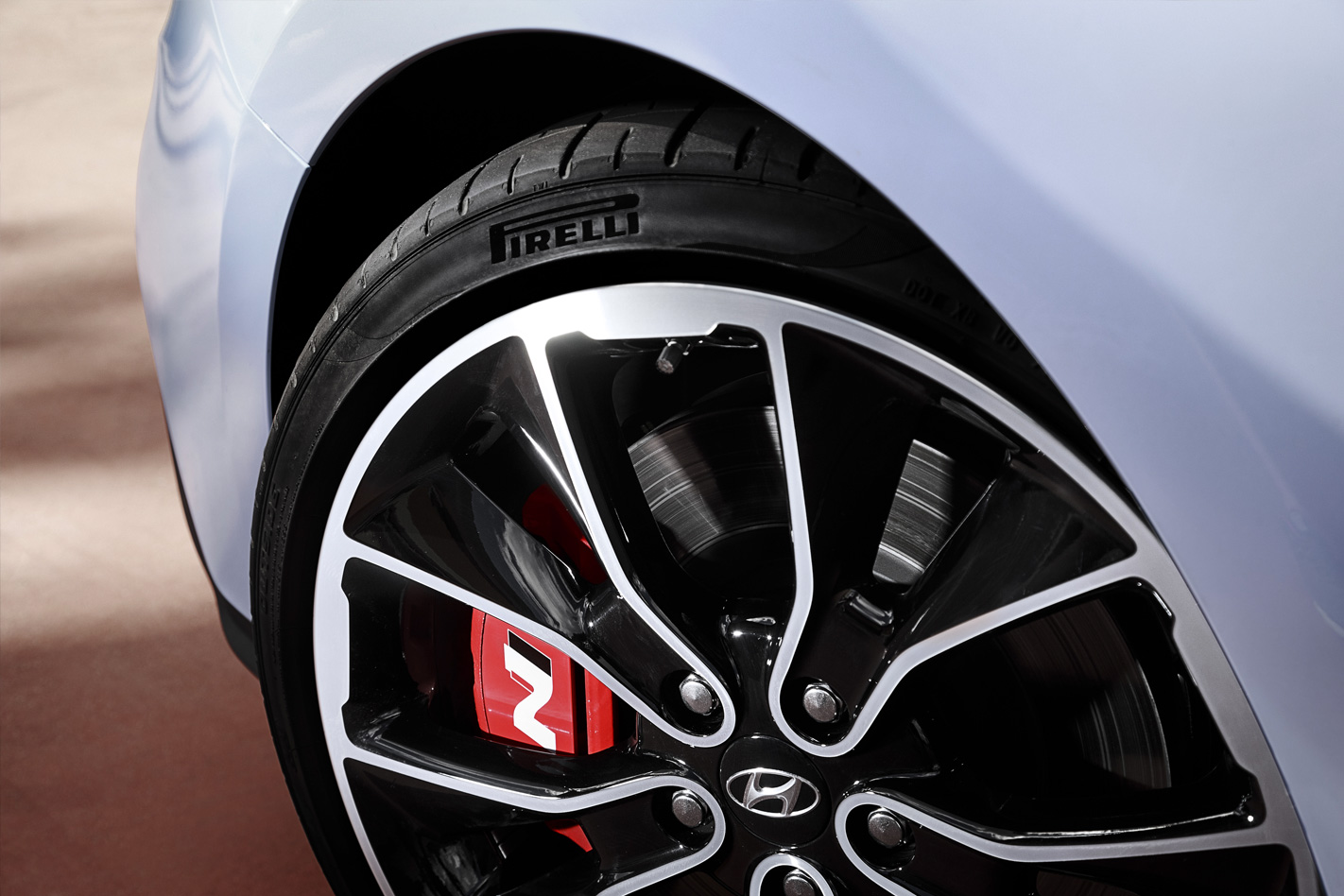
Our track time on the Vallelunga circuit outside of Rome was a chance to stick the Performance Pack version in its N-mode, which sets all the driver-adjustable parameters – throttle mapping, steering weight, damper stiffness, ESC setting, diff calibration and exhaust – to their most aggressive and performance focused. (And yes, all these can be individually configured into your own custom setting.) First impression are that the steering has real deftness just off centre, allowing you intuitive turn-in, and a confident connection with the tyres in fast, open bends. In the tighter stuff, there is throttle adjustability to a degree, but the set-up feels very neutral – maybe a bit too neutral for keen steerers who like a front-drive car with a really engaged rear end that will swing around a bit on a lifted throttle when the front end runs out of grip. But overall, the car’s stability under brakes, and the way it shares the load between front and rear contact patches in response to your throttle inputs, is all hard to fault. Power-down ability, as touched on earlier, is also properly sorted with the E-diff. The moment you’re post-apex, those front treads can just about always take full beans.
It’s early days to be making a call, but after several laps I was left feeling the i30 N hangs on more manfully in hard driving than a regular Golf GTI does, which can wilt when really punished on a track.
Again, it’s that sense of engineering depth, and Biermann’s stamp extends past what the showroom eye can see. The engine bay, for example, does not house a strut-tower brace. One was tried, but the gains in torsion stiffness were negligible. Instead, there are three lightweight braces connecting the front subframe to the centre of the car that are less costly, more effective, and mean one less thing for your mechanic to remove to access the engine.
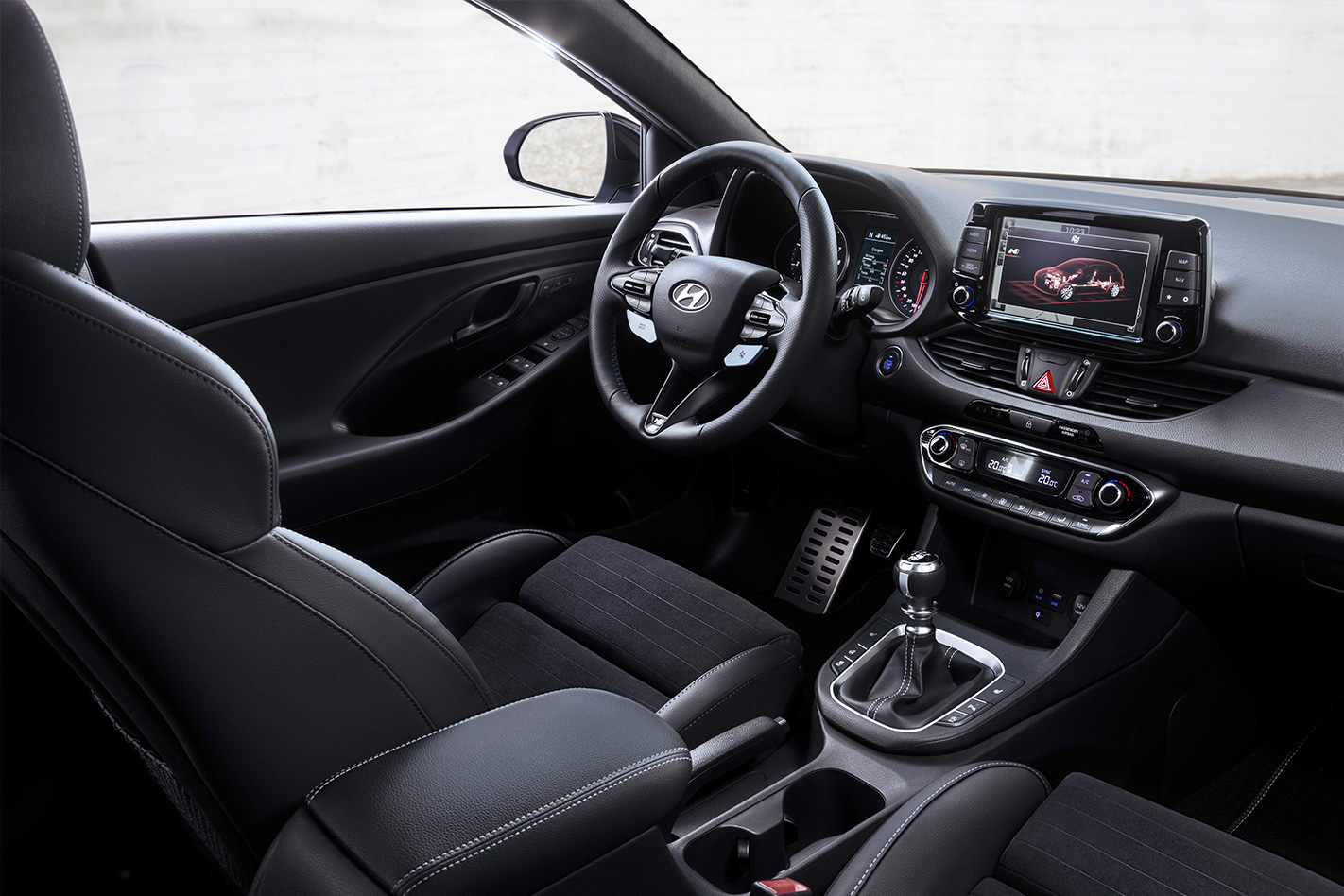
The only slight disappointment with the i30 N comes with the interior. Not its functionality or comfort, both of which are excellent. The seats are well shaped and have extendable under-thigh support, the wheel feels good, the touchscreen works well, and the single button to active N mode is a nice touch. The let-down comes in the fact the cabin doesn’t feel sufficiently different to a regular i30. Final spec of Aussie cars is not yet settled but the cars we drove had too much bland hard plastics and no real visual feel-good factor. It’s like Hyundai spent up on Biermann for the engineering, then let the guy who services the office photocopiers do the interior design. The i30 N needs someone from the Genesis side of the business to lend a hand to add a little aesthetic pizazz via some nicer materials and finishes.
In hindsight, with Hyundai’s commitment to the cause and via the experience we gleaned from our prototype drive earlier this year perhaps the abilities of the i30 N were never really in any doubt. Korean-car haters, the troll-fest is over.
SPECS
Model: Hyundai i30 N Performance Package Engine: 1998cc 4cyl, dohc, 16v turbo Max power: 202kW @ 6000rpm Max torque: 353Nm (378Nm overboost) @ 1450-4700rpm Transmission: 6-speed manual Weight: 1509kg 0-100km/h: 6.1sec (claimed) Economy: 7.1L/100km Price: $44,000 (estimated) On sale: Q1 2018
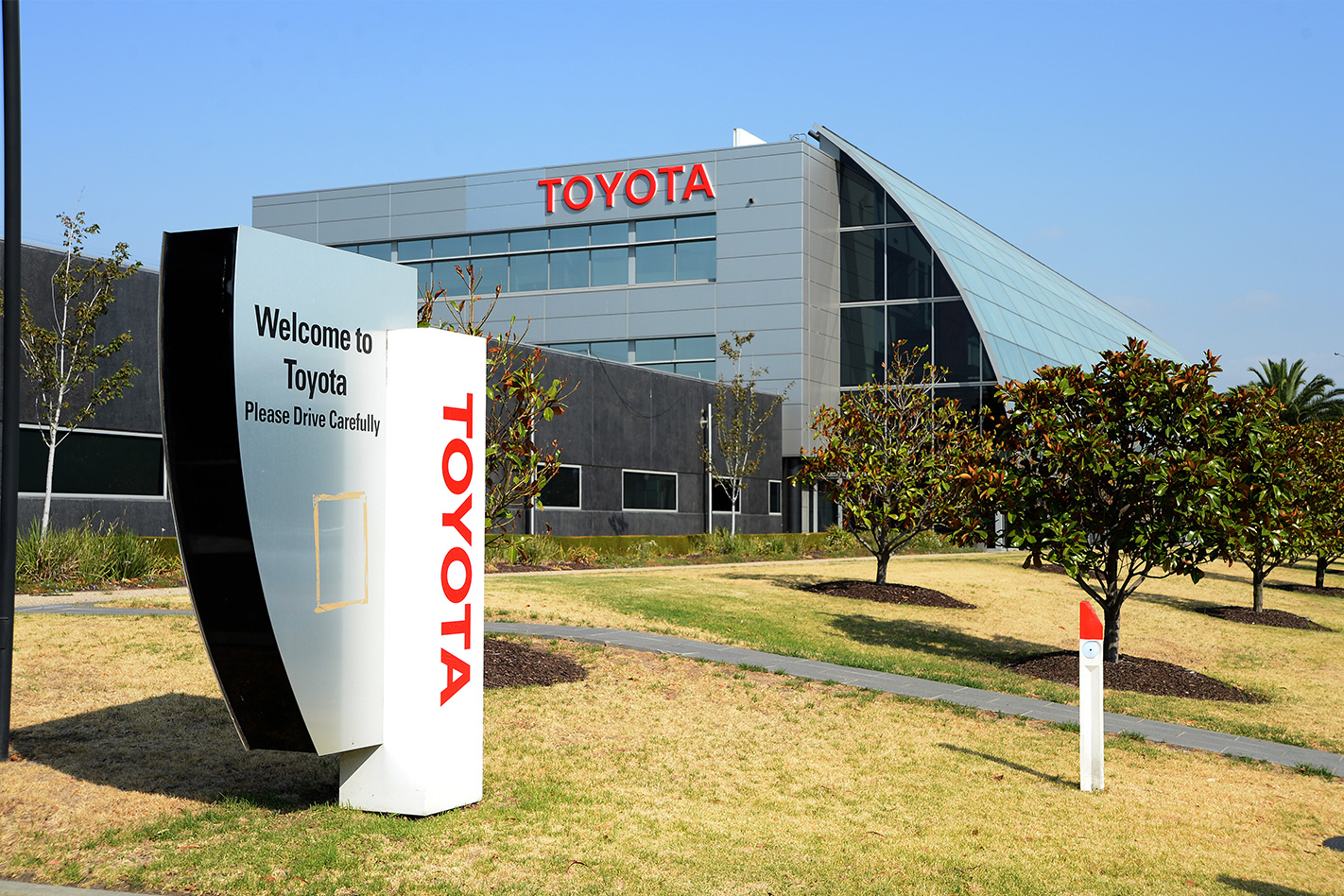
THE sun shone on Toyota’s last day as an Australian manufacturer.
Clear and bright, it added just one more reason why the 3000 Altona factory workers, retirees, and a mix of management and staff from the Port Melbourne office should wear their commemorative black caps handed out as they registered for the event.
Toyota’s closure started normally, at 7am for the day shift, with no afternoon shift rostered on for the first time in who knows how long? Little happened until 11am, when those attending were shown a parade of Toyota cars, ranging from the 1963 Toyopet Tiara ute that led the parade, right through to the last Camry off the line – a graphite grey SX.
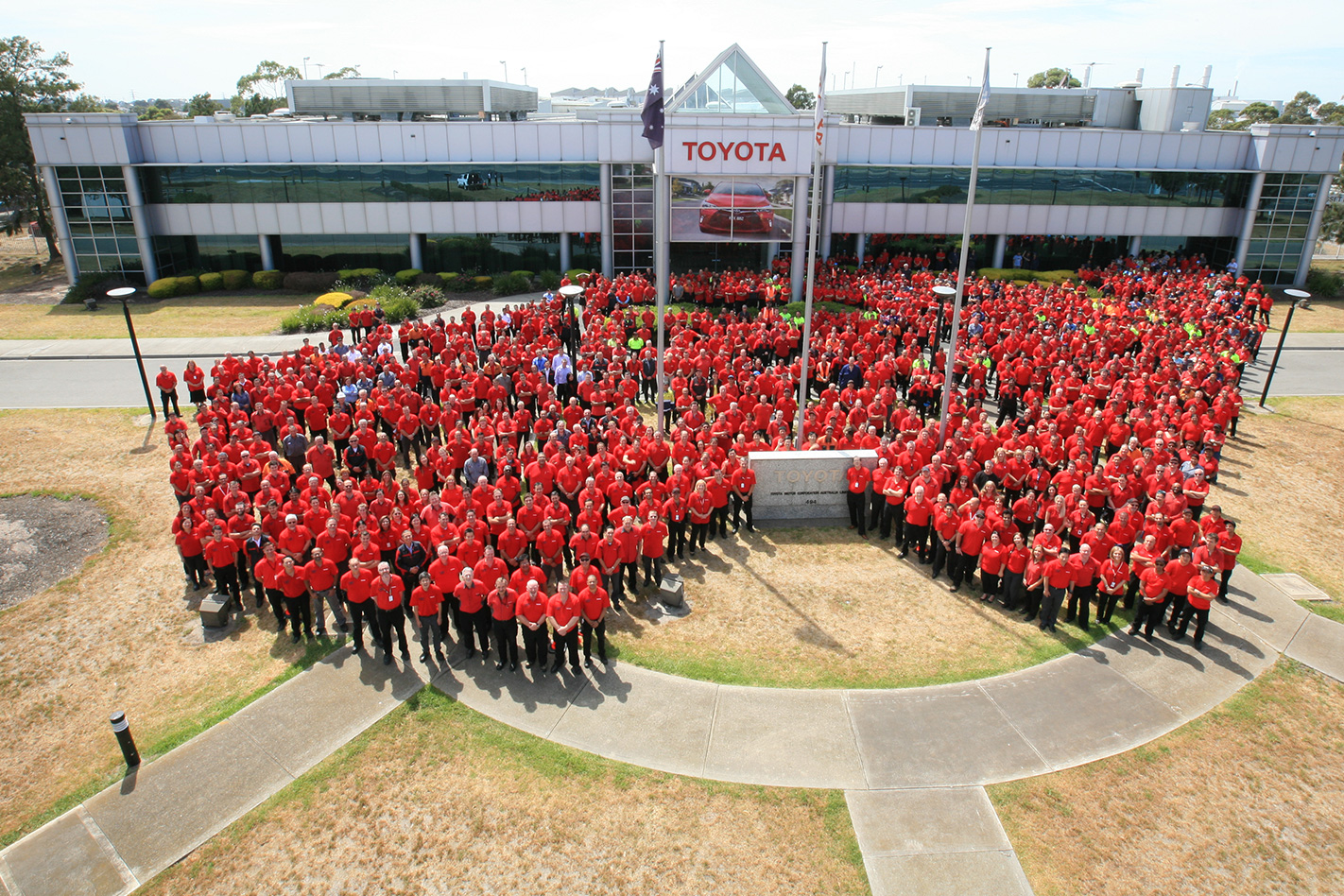
After the parade, everyone shuffled in past the roller doors to the enormous Altona assembly line building, leaving the streets of the complex completely deserted. Inside, Toyota’s global chief, Akio Toyoda, thanked everyone via video link, while current president David Buttner talked up the legacy of the car maker’s five-decade-long run of locally made and assembled models.
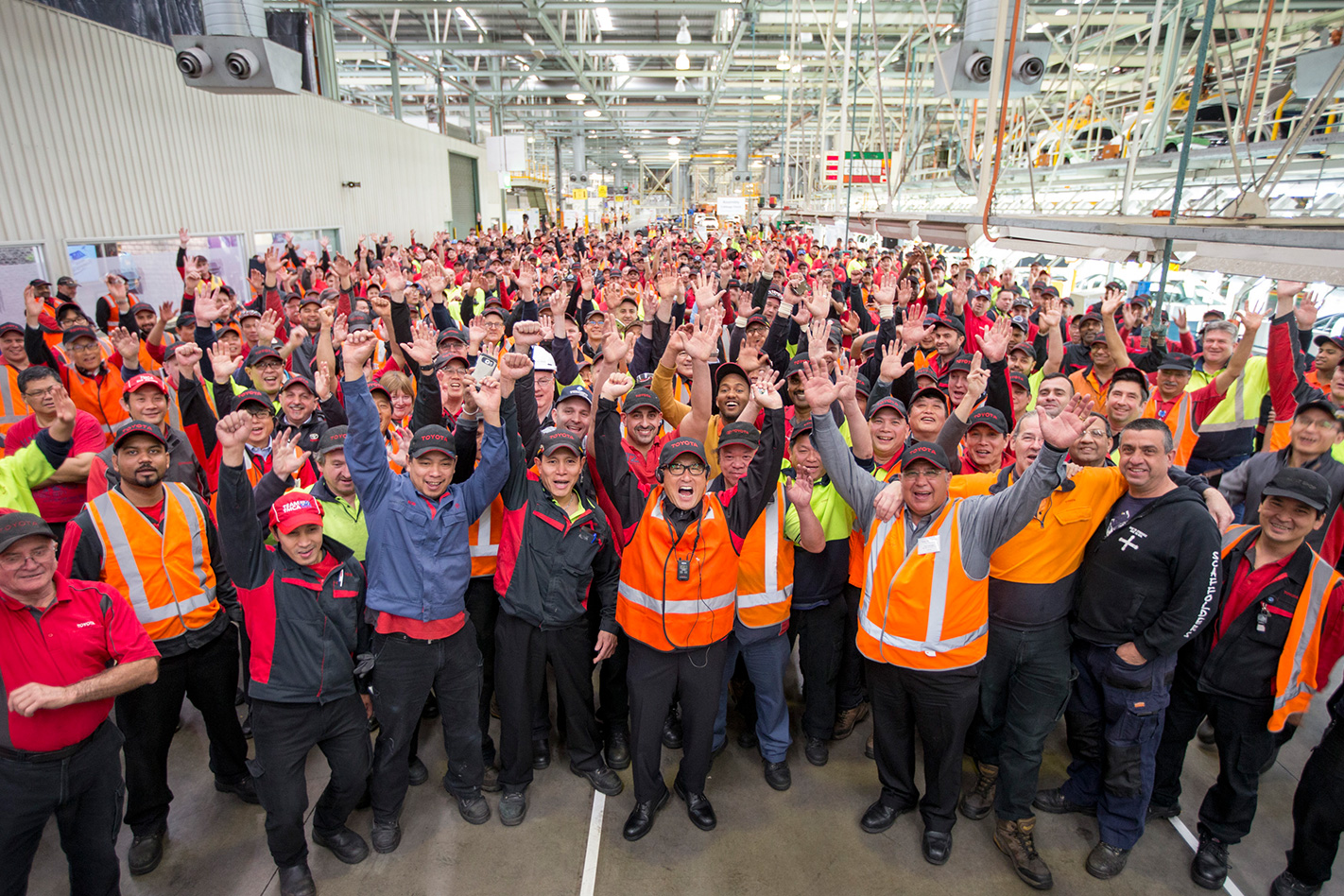
Then, just like that, it was over. Workers started streaming out, passing through the security gates carrying their personal belongings in whatever bags they had handy. In the car park, they jumped behind the wheels of Toyota-badged cars that some had bought using generous company discounts extended to workers, for one last trip home from the factory. All the ones we spoke to as they filed out had no idea what would happen next; an extended break seemed to be the most common answer when asked about life after Toyota.
In contrast, the grey marble sign outside Toyota’s factory stood alone, framed only as a backdrop for the small number of media assembled to file yet another report of the demise of a once great, proud Australian industry to the editing suite. Ford’s send-off attracted a media scrum; the best Toyota could manage was the media equivalent of a temperate tea party.
In just over two weeks’ time, we do it all again with Holden. Unlike Toyota, this one is definitely going to tug at the heartstrings.
Australia is set to receive a new lineup of Range Rover Sport models, with engines starting at the 2.0-litre SD4 and topping off with the supercharged 5.0-litre SVR V8.
Also coming to Australia is Jaguar Land Rover’s first plug-in hybrid electric vehicle, the Range Rover Sport PHEV.
The 297kW/640Nm hybrid has two drive modes, parallel hybrid for a combination of petrol and electric, or EV mode which has a 51km electric-only range.
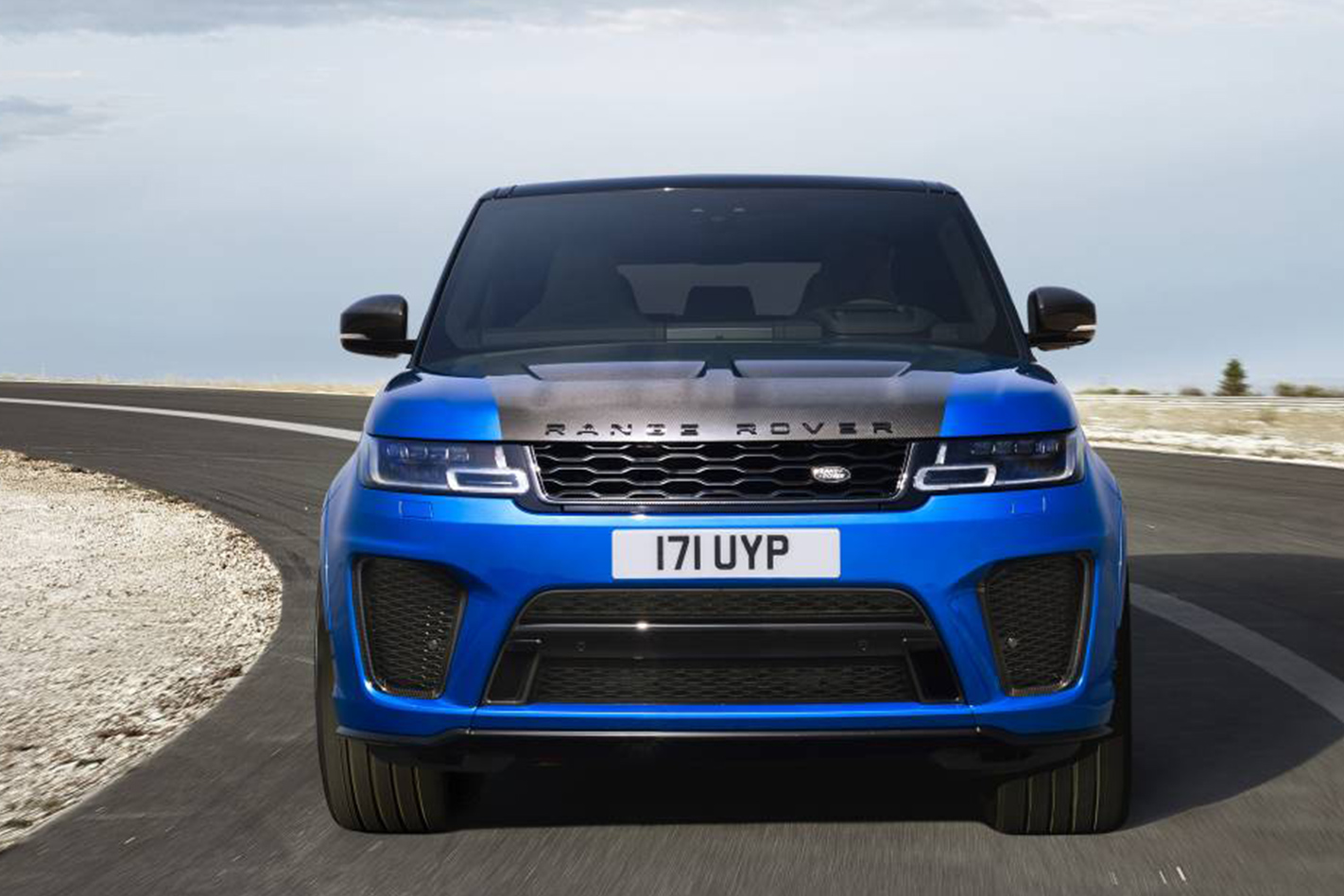
Jaguar Land Rover says this means the Range Rover Sport SVR will sprint to 100km/h in just 4.5 seconds.
Also, a more extensive employment of carbon fibre makes the SVR “more dramatic, faster and more agile than before.”
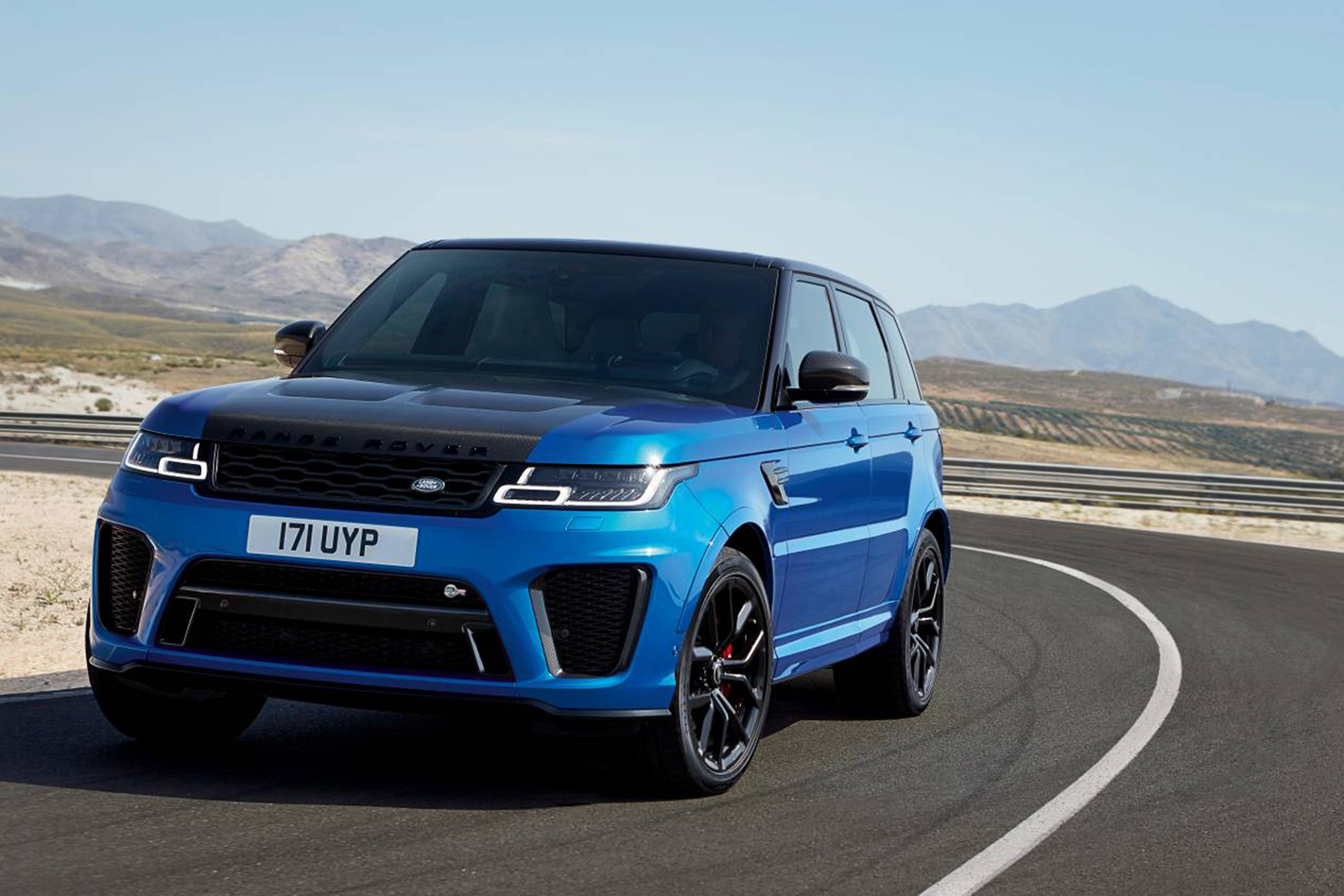
The 2018 Range Rover Sport range will start from $95,100 (plus on-roads) in SD4 S guise, but expect the bonkers SVR to top the $230K mark.
Managing director of Jaguar Land Rover Australia Matthew Wiesner says the addition of the
VOLKSWAGEN’S most expensive versions of its trade ute are proving to be its most popular.
The 3.0-litre V6-engined turbodiesel Volkswagen Amarok has become the brand’s best-selling version of the South American-built, German-badged workhorse, accounting for three out of every four Australian sales last month alone. And when it comes to digging deep, most of those 165kW/550Nm V6 sales are for either the $59,990 Highline or the $67,990 Ultimate, Volkswagen spokesman Paul Pottinger said, and not the cheaper $55,490 Sportline (below).
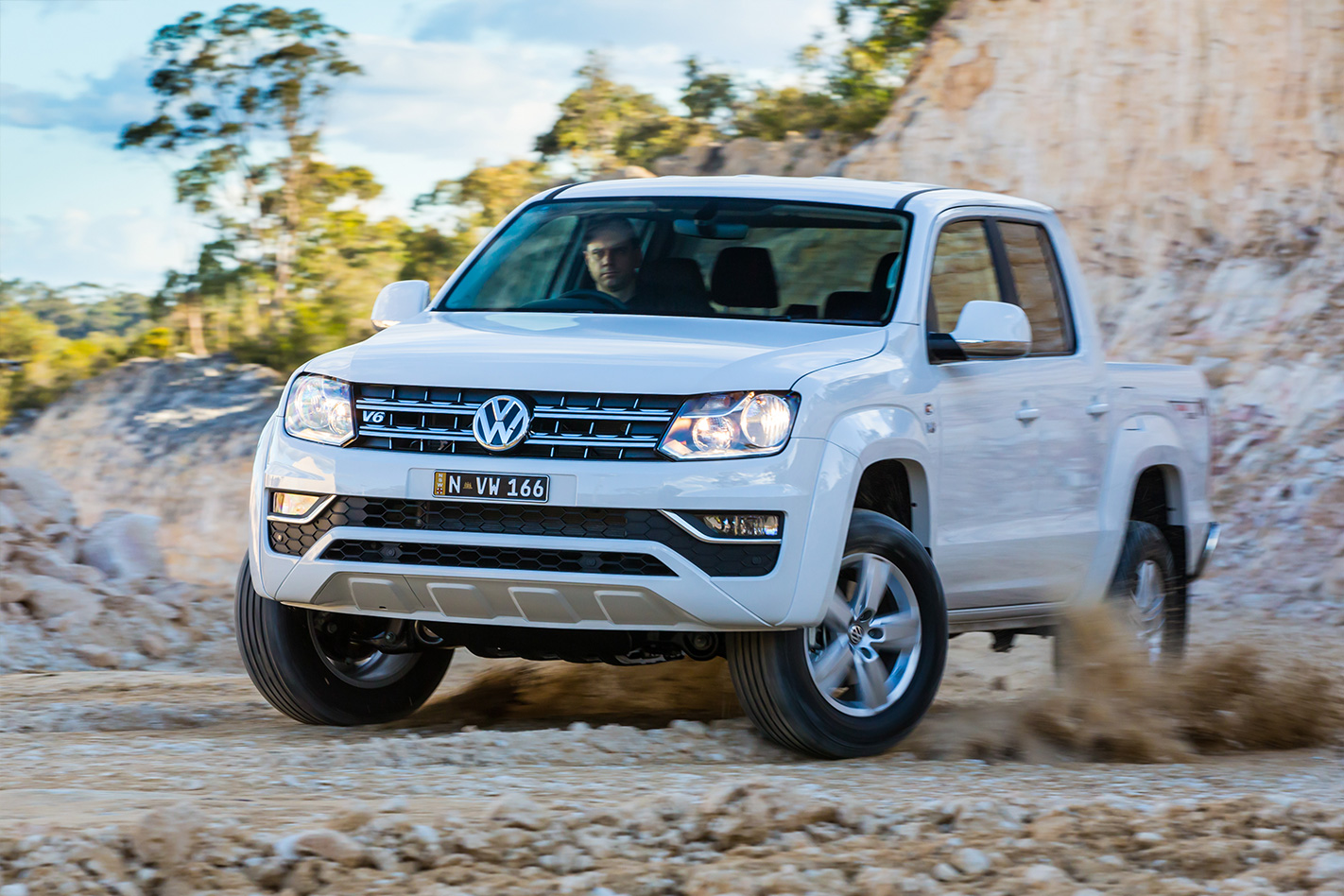
“People are just going to the top end,” Pottinger told WhichCar. “You just look at V6 Amarok with 74 percent of Amarok sales last month. And most of those were not the Sportline, but the higher-end, the two higher versions.”
The V6-engined version of the Amarok is currently the most powerful trade ute on the Australian market, although the brand does offer a twin-turbocharged four-cylinder 2.0-litre engine as an option. The V6 was introduced to the range late in the Amarok’s life – the ute originally launched here in 2012 – because the 2.0-litre diesel was unable to meet tightening European emissions standards, while the V6 could.
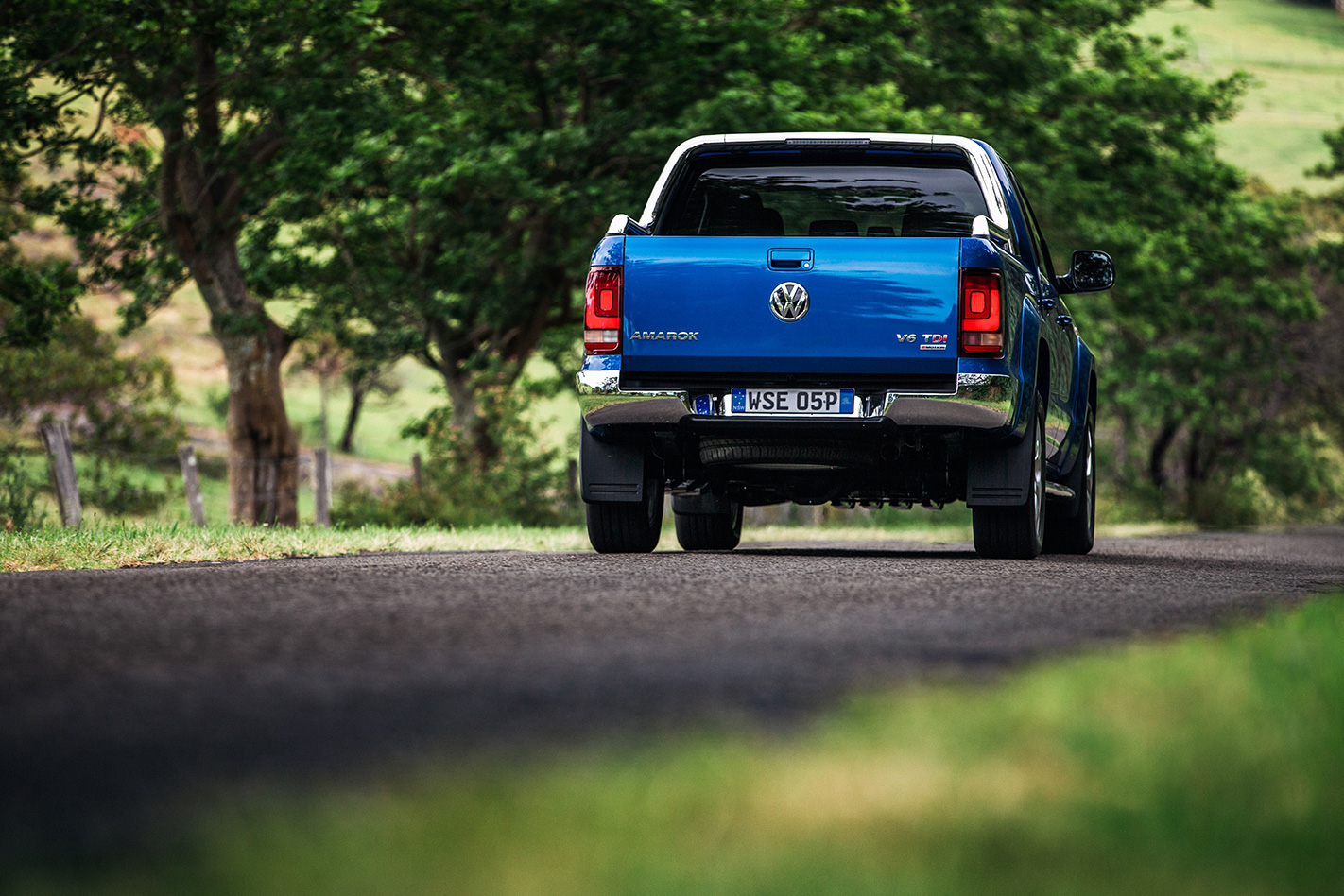
The success of the V6-engined Amarok won’t go unnoticed by rivals, including Ford, which plans to launch a Raptor-badged version of the Ranger trade ute featuring what is believed to be a twin-turbo four-cylinder diesel engine, and Mercedes-Benz with its upcoming X-Class, the luxury brand’s first entry into the premium trade ute battlefield. It will also feature a turbodiesel V6 under its bonnet. Both are due on sale in Australia sometime next year. While the Raptor will focus on explosive bursts of speed and sharp handling, like the Amarok the X-Class is expected to align itself as a caravan-friendly alternative to parking an SUV in the driveway – the Amarok will soon match its rivals with a 3.5-tonne towing capacity.
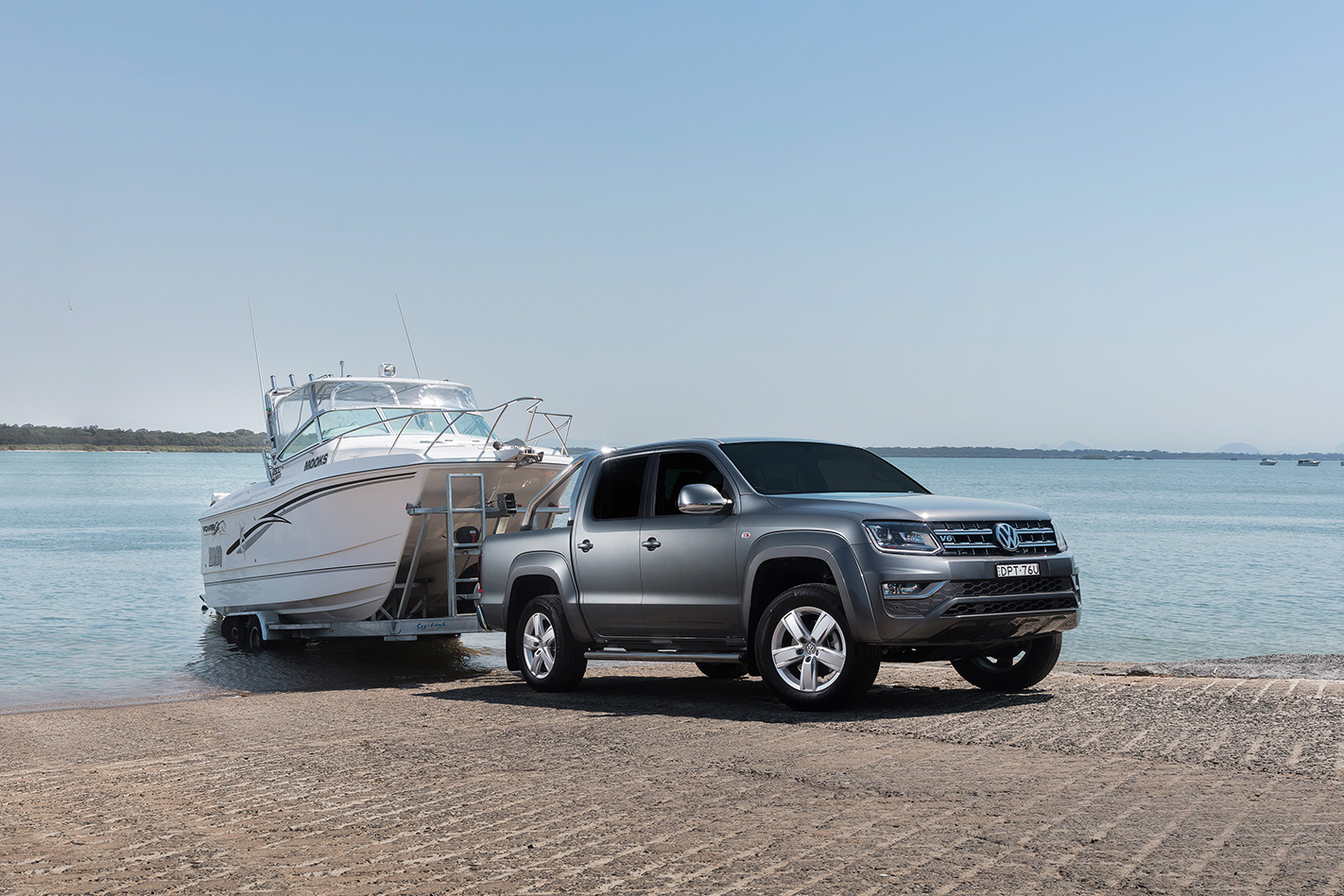
Trade utes are huge business in Australia. In September, the Ford Ranger outsold the Toyota Hilux to become Australia’s best-selling vehicle for the month. The light commercial segment in Australia – the corner of the market where the trade utes’ sales numbers are measured – shows that almost one in five of all vehicles sold are likely to have a cab up front and a tray out the back.
When it comes to 4×4 trade utes – the versions that private buyers are more likely to own – between them the Ford Ranger and Toyota Hilux command two out of every five sales. Other strong sellers in the market include the price-driven Mitsubishi Triton, the Holden Colorado, the Nissan Navara and the Isuzu D-Max.
CITROEN’S C3 small hatchback will return to Australian showrooms later this year priced from $22,990, bringing a little of the C4 Cactus’ unorthodox styling but bundled in a smaller – and more affordable – package.
It ends a two-year hiatus and boosts the French carmaker’s local offering to five models, sitting alongside the C4 larger hatchback, C4 Cactus crossover and a pair of C4 Picasso people movers.
Just one level of specification will be on offer dubbed ‘Shine’, powered by a 1.2-litre 81kW Puretech three-cylinder petrol engine, which is bolted to a six-speed automatic transmission. Performance is on the less potent side with the zero to 100km/h dash done in 10.9 seconds, but with an advantage to economy. According to Citroen, the C3 uses just 4.9 litres of fuel per 100km.
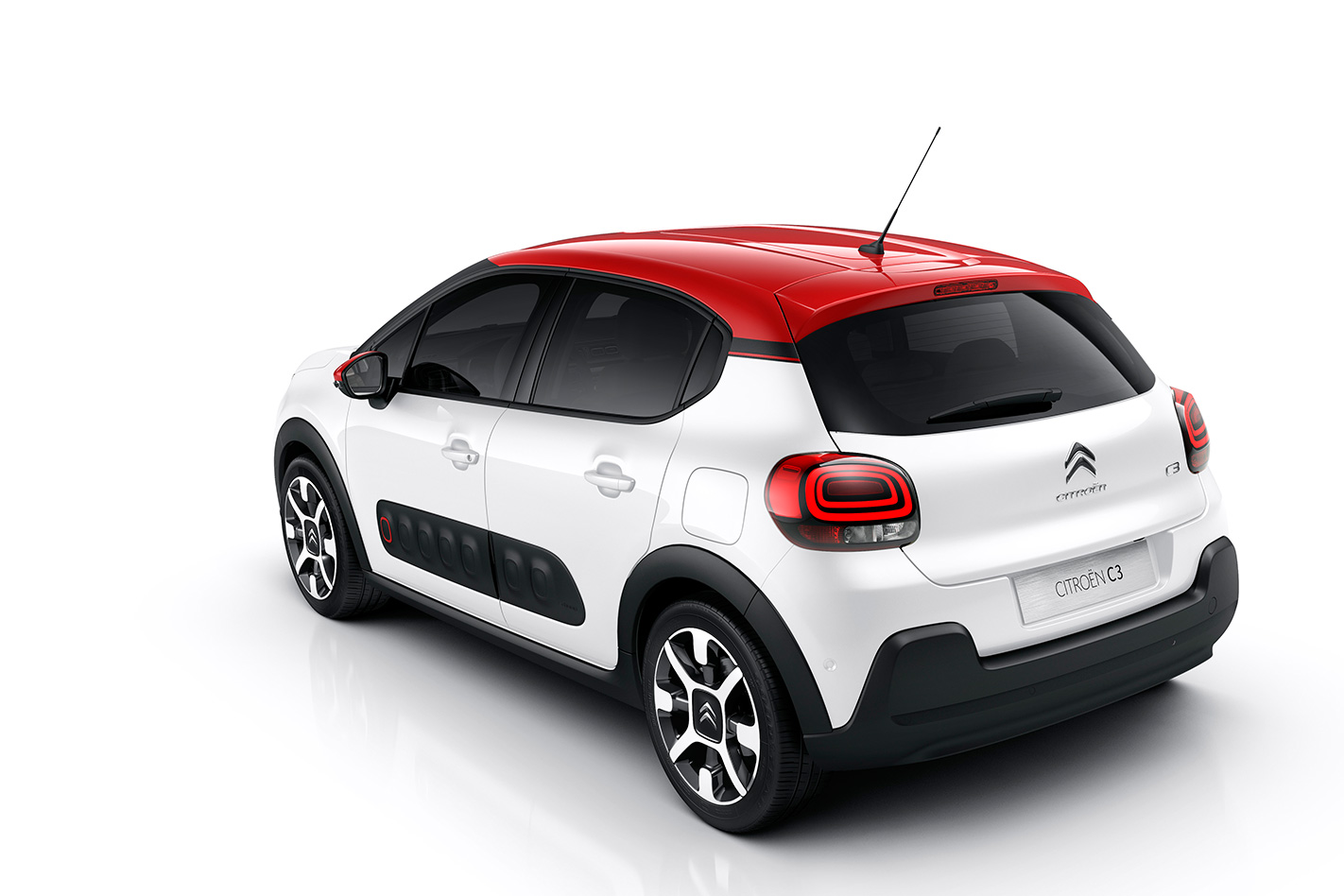
Despite the C3’s all-terrain looks, it has been designed as a more suburban proposition with front wheel drive and a range of customisation options. Nine body colour options can be paired with a choice of three contrasting roof colours with matching exterior details, while 17-inch ‘cross’ alloy wheels are standard.
Four interior themes are on offer for more individualisation options, with a standard or “Metropolitan Grey” version for more neutral colours, an Urban Red theme bringing more contrasting colours with red stitching, while the Hype Colorado option adds higher-quality materials including leather.
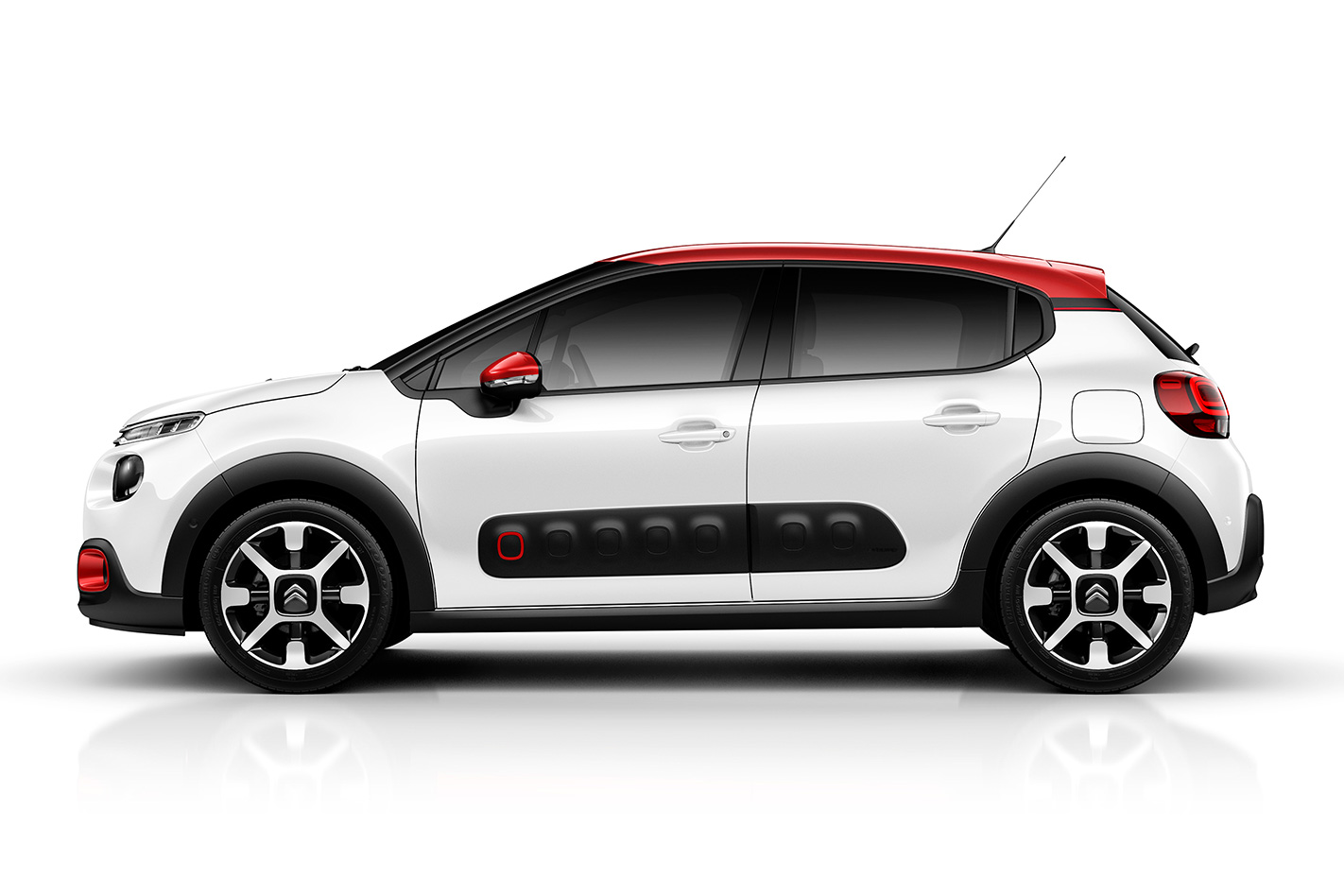
Before it was discontinued in 2015 the second-gen C3 was on offer for $19,990, but the new version is having a fresh try at the Australian market with its conspicuous styling, more generous equipment and a new distributor – Inchcape Australia.
Standard specification includes a seven-inch central touchscreen with ‘mirror screen technology’ for duplicating a smartphone display, real-time traffic and accident information, navigation, reversing camera, lane-departure warning, blind-spot monitoring and LED daytime running lamps.
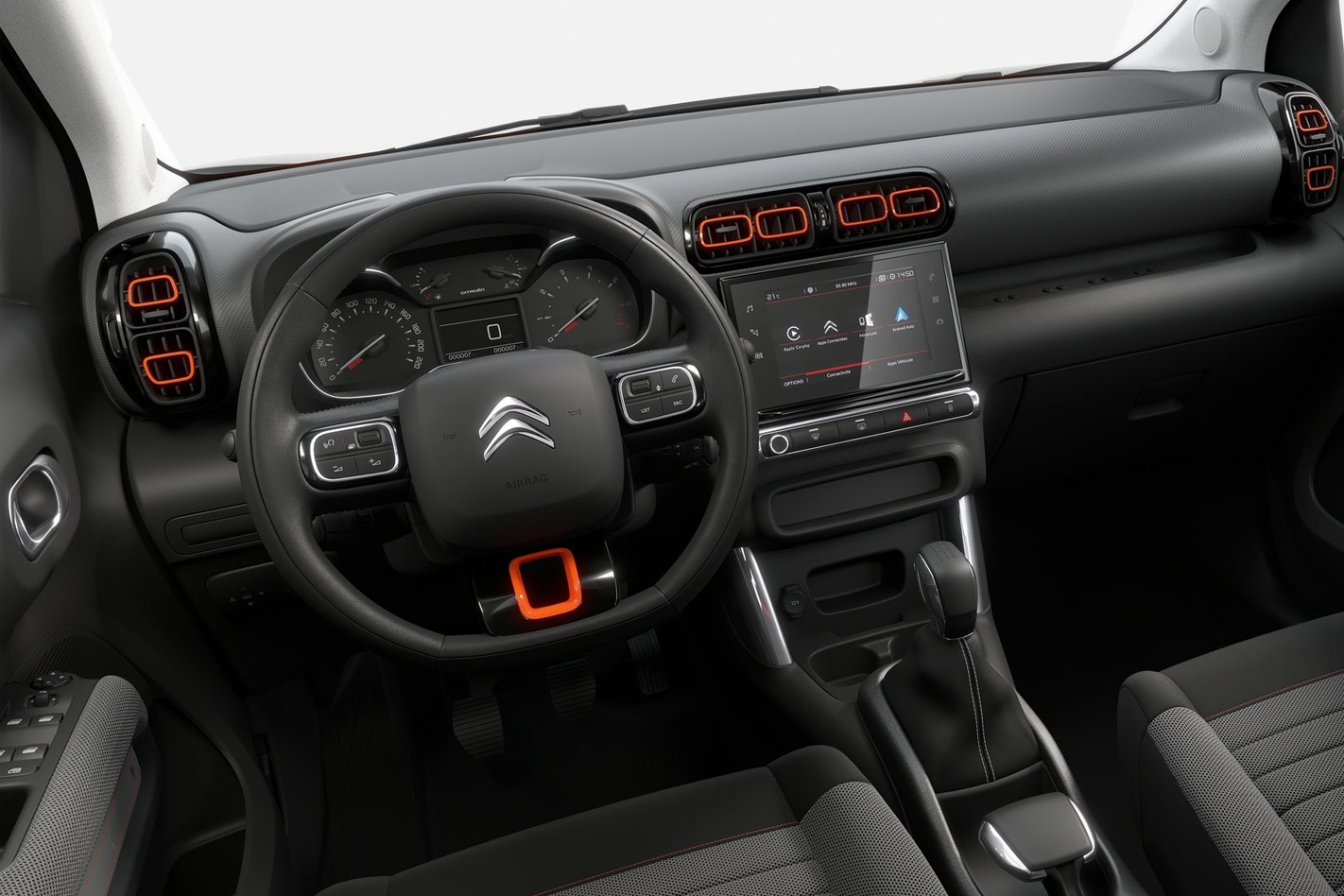
for the same cash, which is positioned behind the rear-view mirror and can record the journey in HD for capturing both enjoyable and not-so-pleasant motoring incidents.
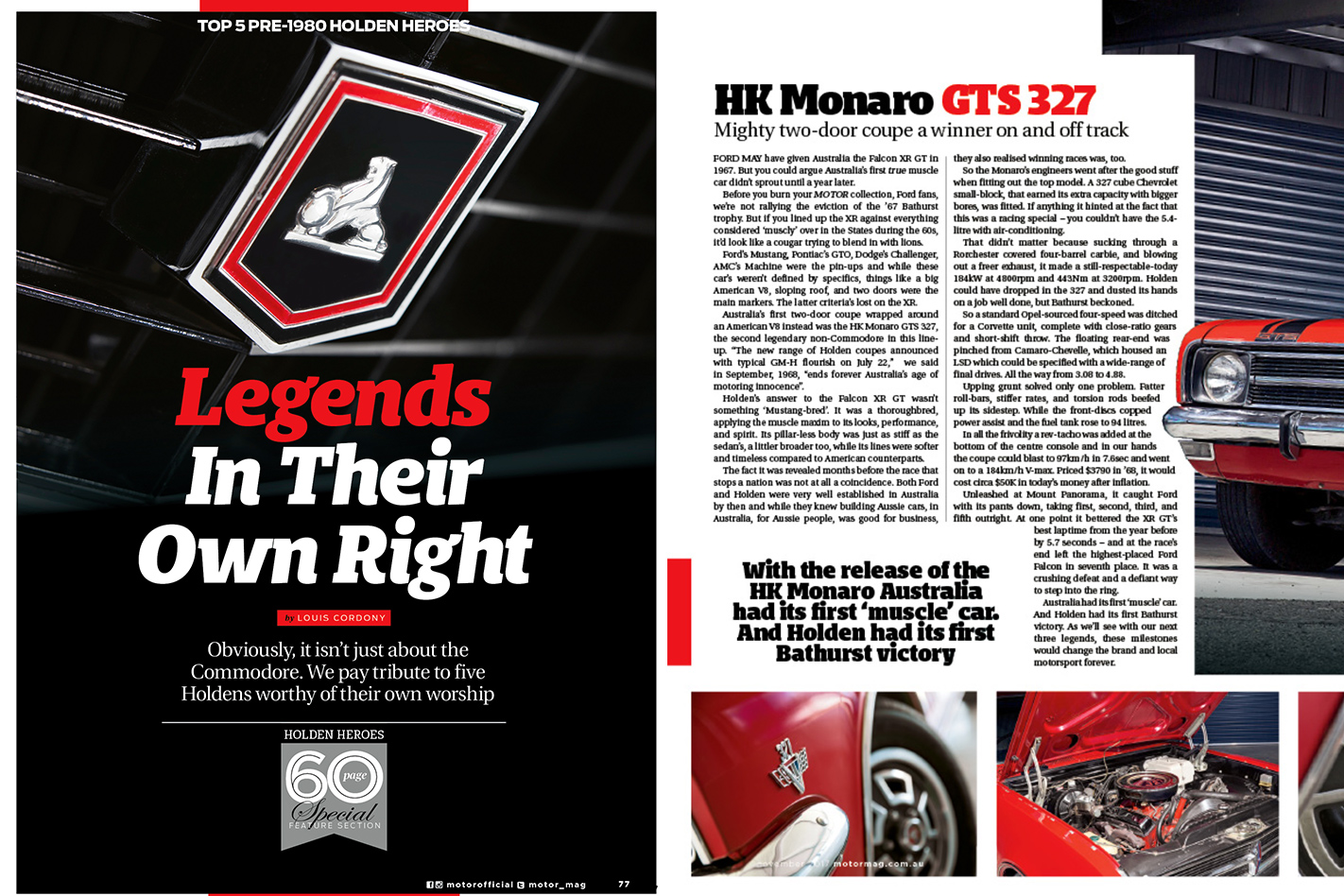
MOTOR is proud, but sad, to present our ‘goodbye to the Commodore’ issue, as we’ve worked hard to bring you 60 extra pages of Aussie Holden content.
It’s hard to do justice to 69 years of Holden manufacturing some of the best cars Australia has produced, but we reckon our look back is a good way to farewell the Aussie car.
So, without delay, here’s your look at our November issue.
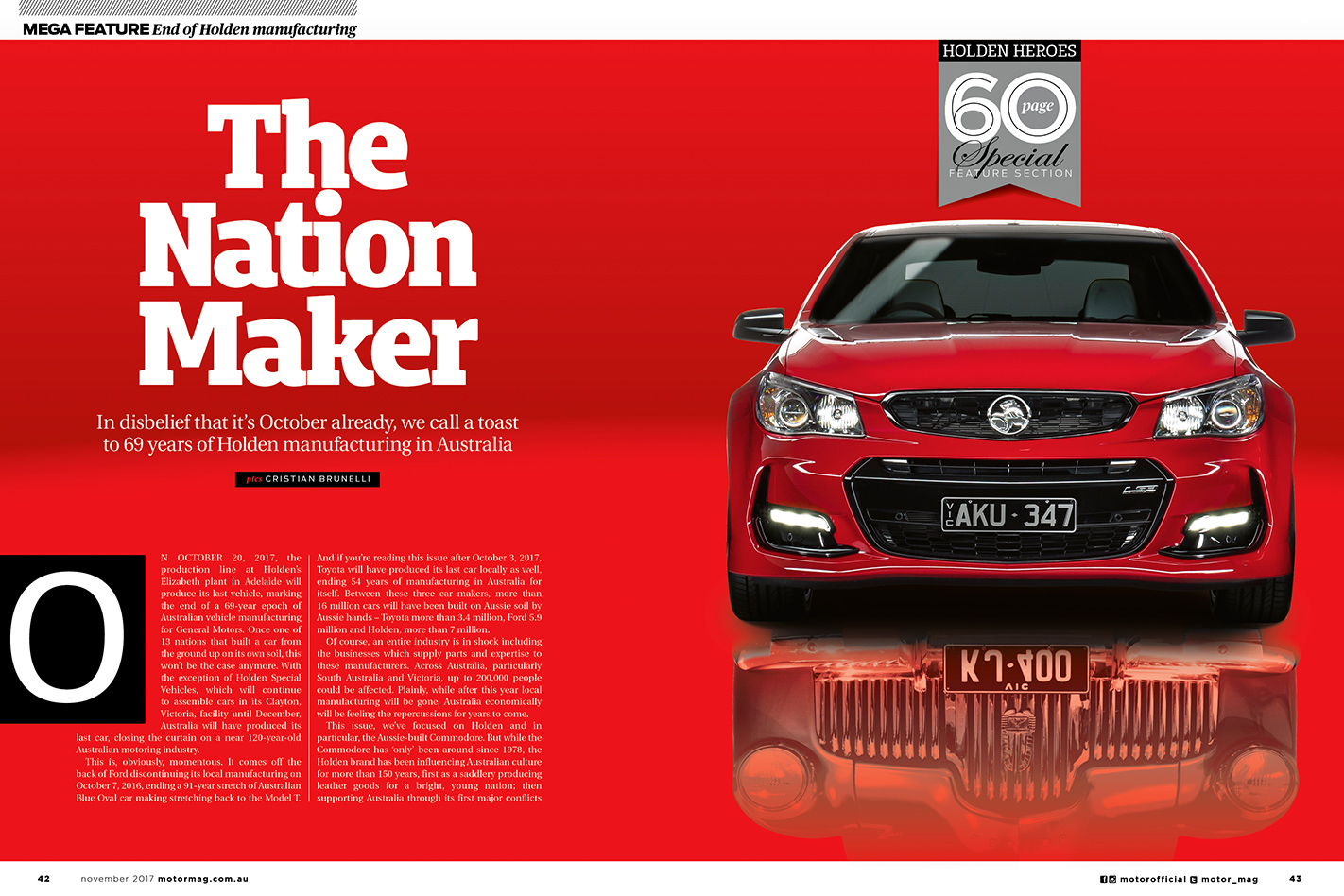
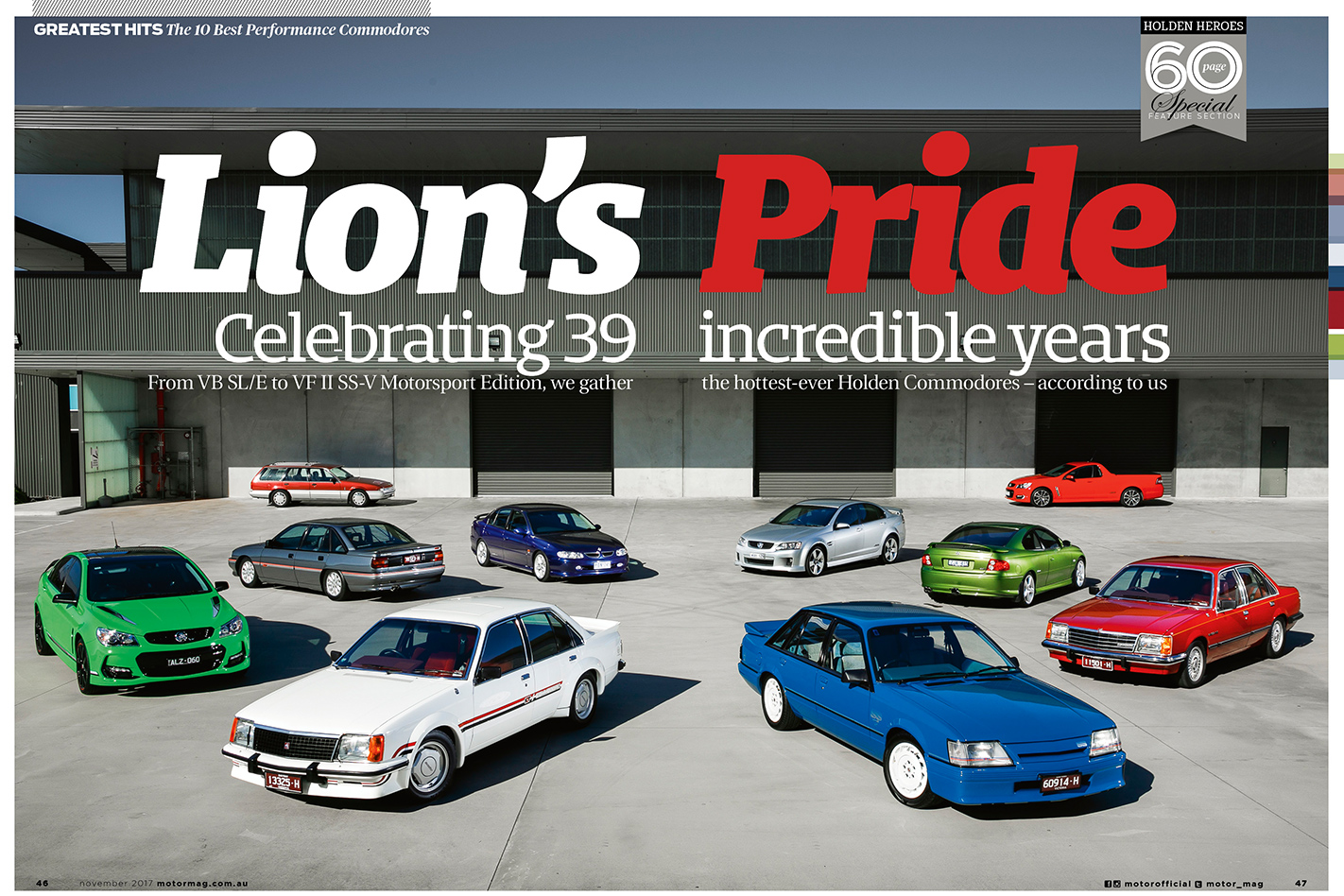
LION KING – THE END OF AUSSIE HOLDENS: It’s the end of an era as we celebrate the Aussie Commodore.
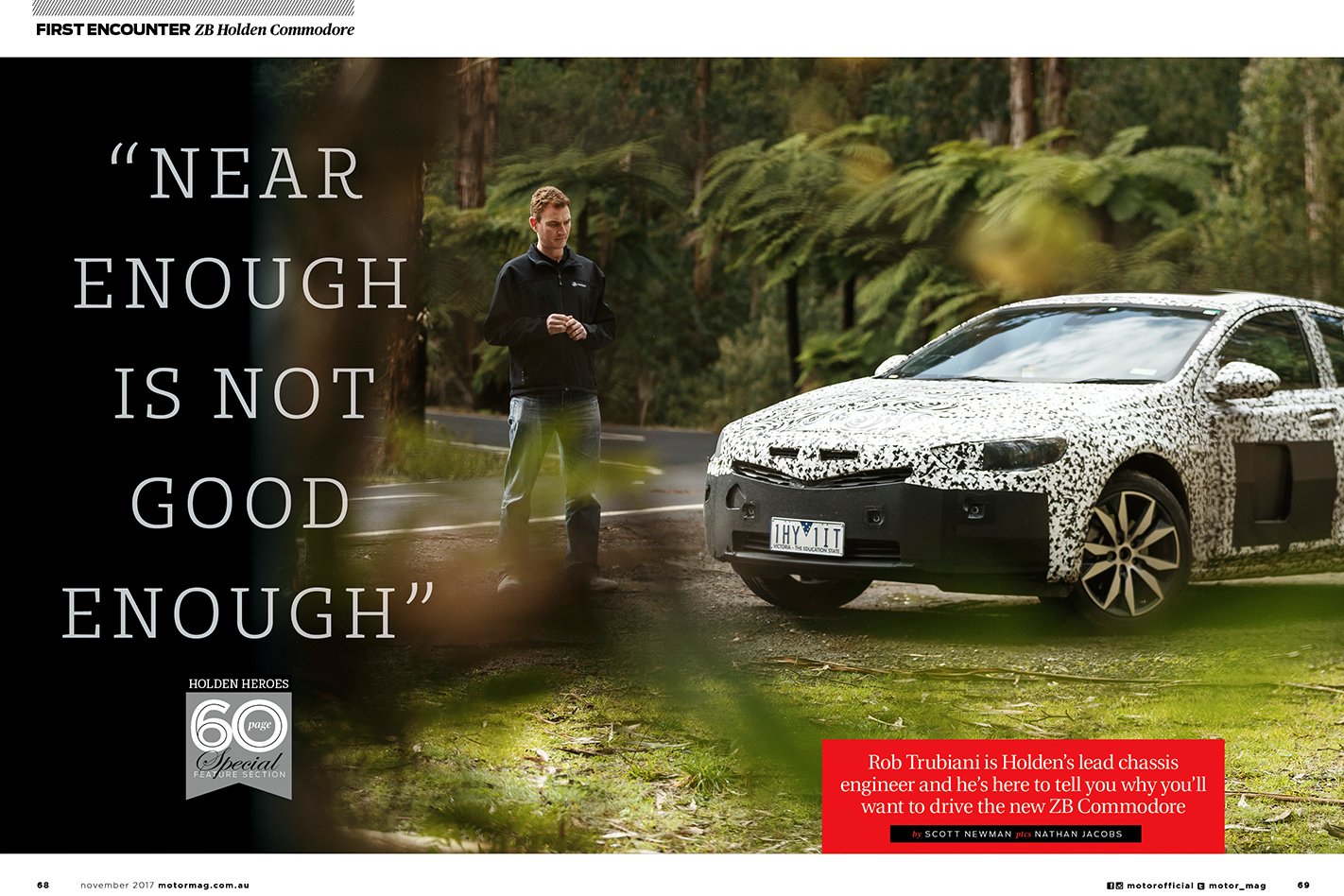
MEET MR. COMMODORE – ROB TRUBIANI AND THE ZB COMMODORE: Holden’s lead dynamics engineer, Rob Trubiani, explains why you’ll want to drive the new ZB Commodore. Then we have a turn.
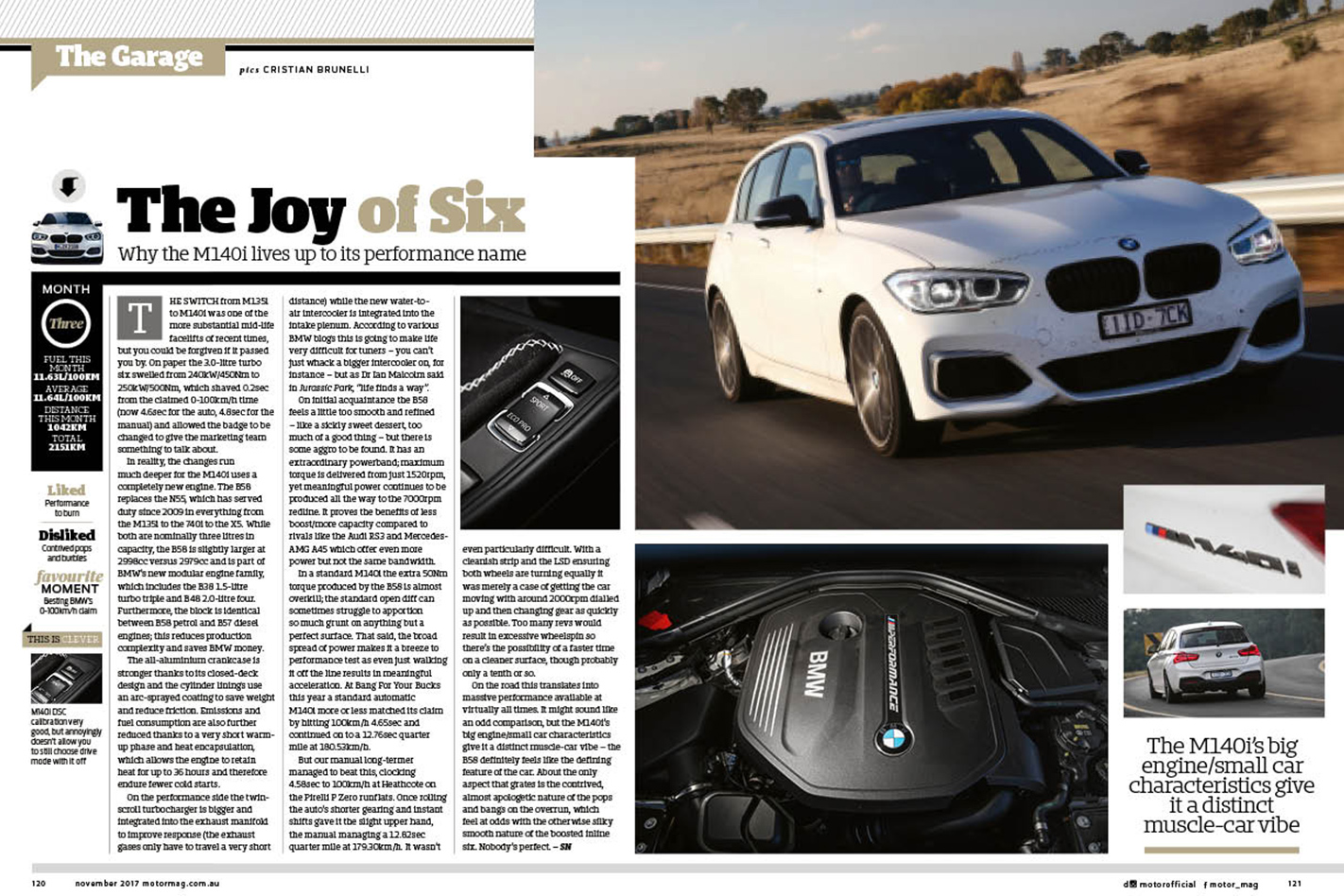
AND MUCH MORE – GARAGE UPDATES, REVIEWS, AND TECH TALK: We keep you up to date with the latest news, the nitty-gritty of living with our long-term Toyota 86 and our M140i, plus get into a Trackhawk, a GTSR, and Nissan’s new(ish) 370Z NISMO.
lt’s about to get a whole lot tougher for Holden. Confronting a fiercely competitive Ford Falcon for the first time in years, the boys from Fishermans Bend have worked hard on a defence strategy. They’re not going to give up best-seller status without a damn good fight. Here’s what they’ve done to prepare for the coming conflict…
RIGHT now, Holden is indisputably the hottest act in the Australian car business. The lion-badge brand is more popular than at any time in its long history (Holden’s all-time sales record of 1973 is certain to be beaten this year) and Commodore is utterly dominant in the segment with a share nearing 50 percent.
What you don’t do is every bit as important as what you do, he begins. Here’s what Holden avoids …
‘We do not and will not build boring, bland cars.” Take that Toyota.
“And we don’t do taxis.” Cop that Ford.
Here are the key points: steering-system hardware has been retuned, front suspension compression damping has been refined, the body structure in the front floor and rocker region has been beefed up, front passenger airbags and seatbelt load limiters have been made standard across the range, the V6’s sump has been enlarged (allowing Holden to match Falcon’s 15,000km oil-change interval), and a new exhaust for the Gen III liberates an additional 10kW, as well as some welcome decibels of V8 bellow.
In the language of General Motors, the VY is an MCE-mid-cycle enhancement – not a facelift. And enhancement is what the VY is all about.
Holden design boss Mike Simcoe knew he had to make VY visually different, so owners could feel good about parking alongside the myriad of other Commodores out there. He succeeded.
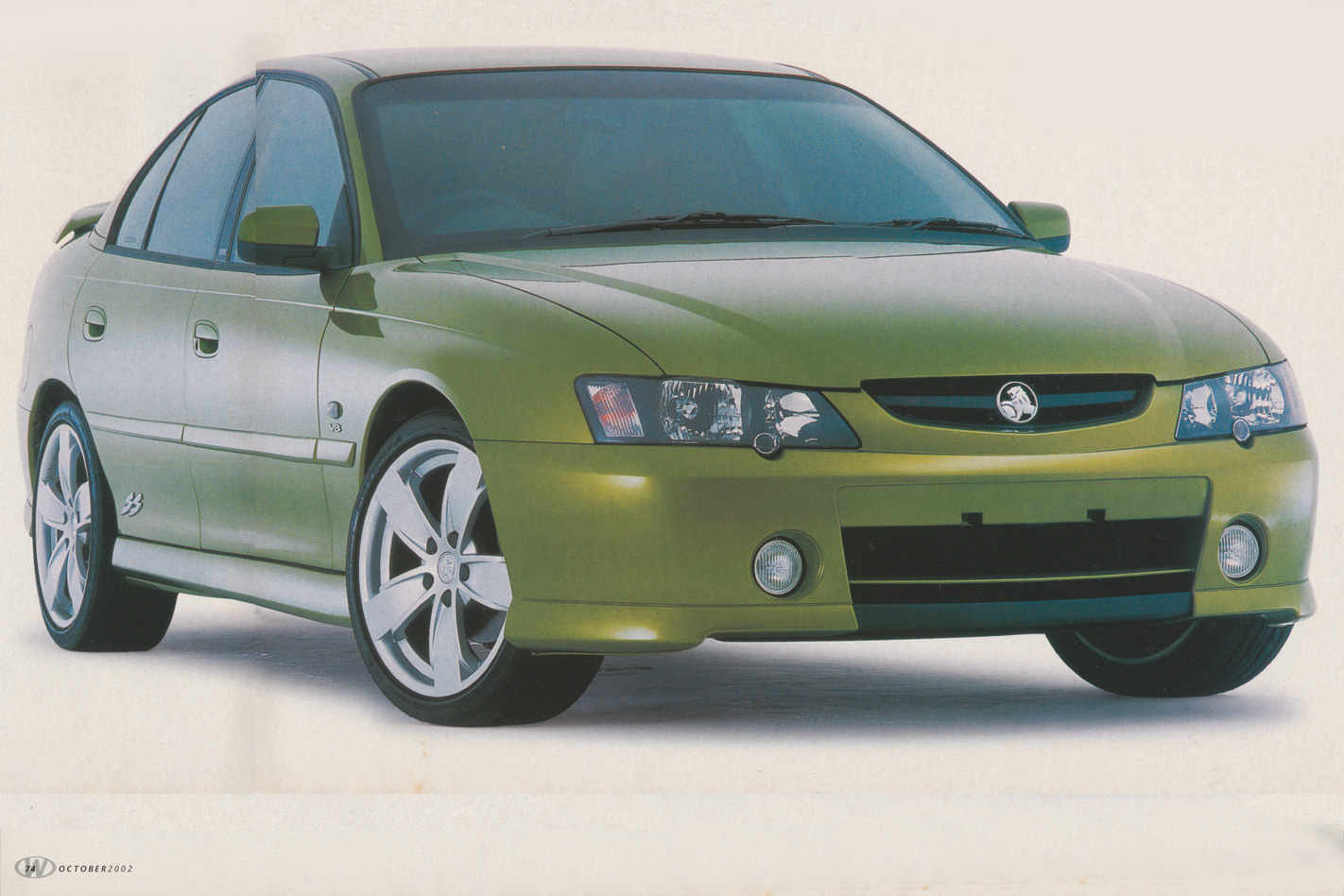
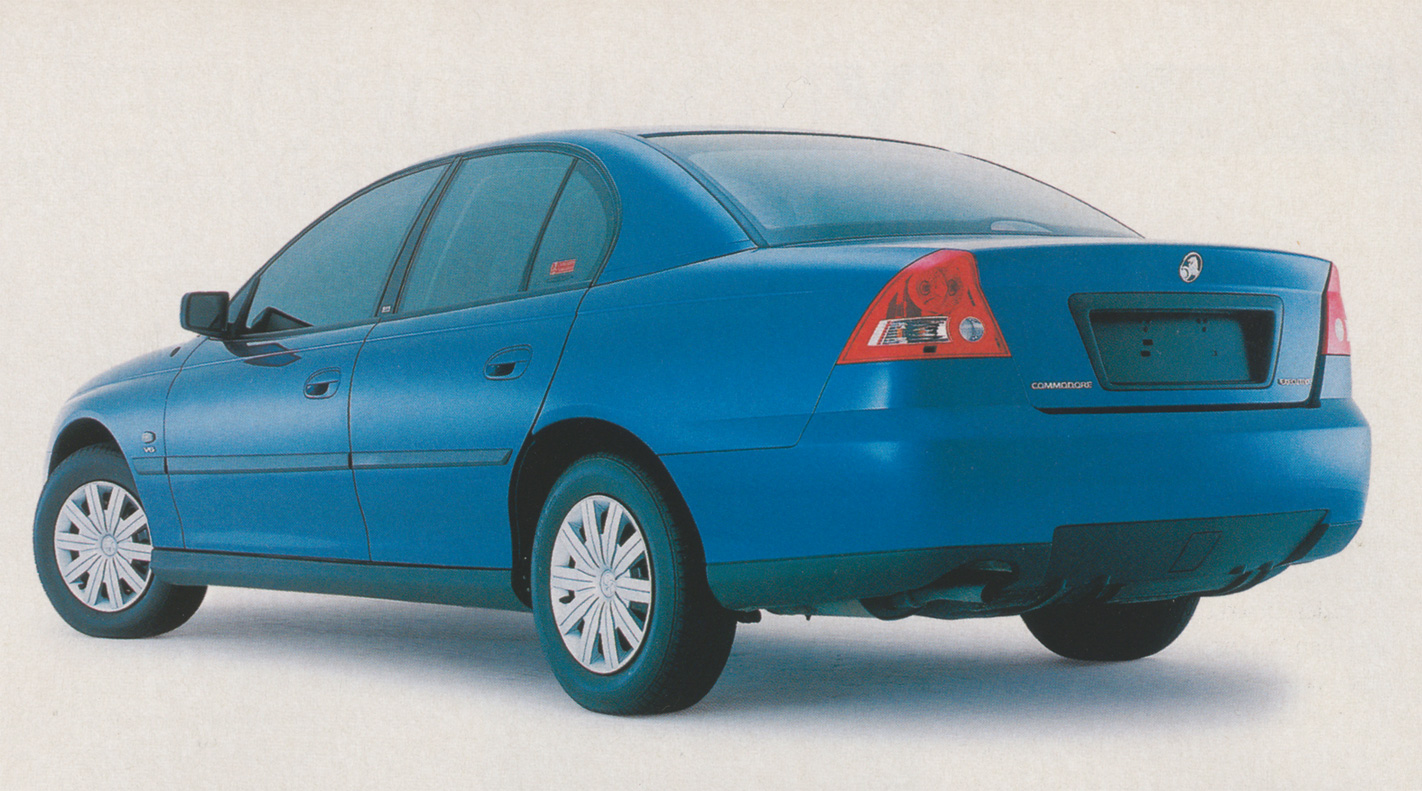
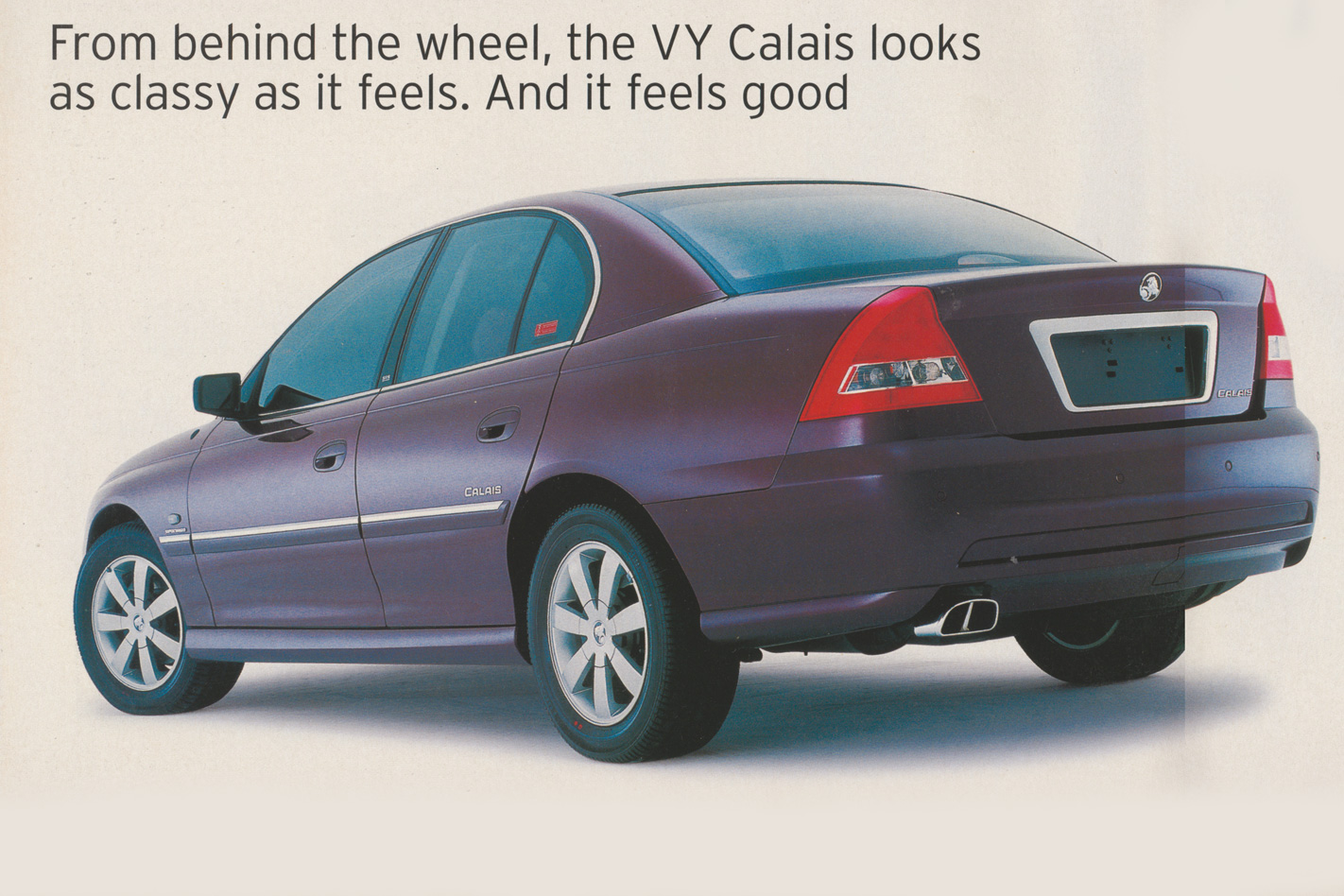
The mid-life facelift stops short of costly changes to doors, door apertures and roofline, so the profile is still recognisably Commodore, but the edgy new front and rear pressings – combined with different combinations of headlight, taillight and bumper treatments – makes VY a very different looking Holden.
As with the VX Commodore, the various spec levels are differentiated from each other by subtle tweaks to exterior components, but this time around the design team has pushed even harder in this area. In all there are three sets of bumpers, four grilles, two sets of headlights and two of taillights to provide unprecedented differentiation.
High and low-series cars get new-look headlights, with different bezel details – blacked out for SS and SV8, chrome for Executive, Acclaim and S – while high-series cars feature an integrated Monaro-style projector lamp. At the rear, low-series taillights are smaller and more detailed than high series, with Executive and Acclaim featuring chrome background and bezels, where SV8 and SS have a more sinister black.
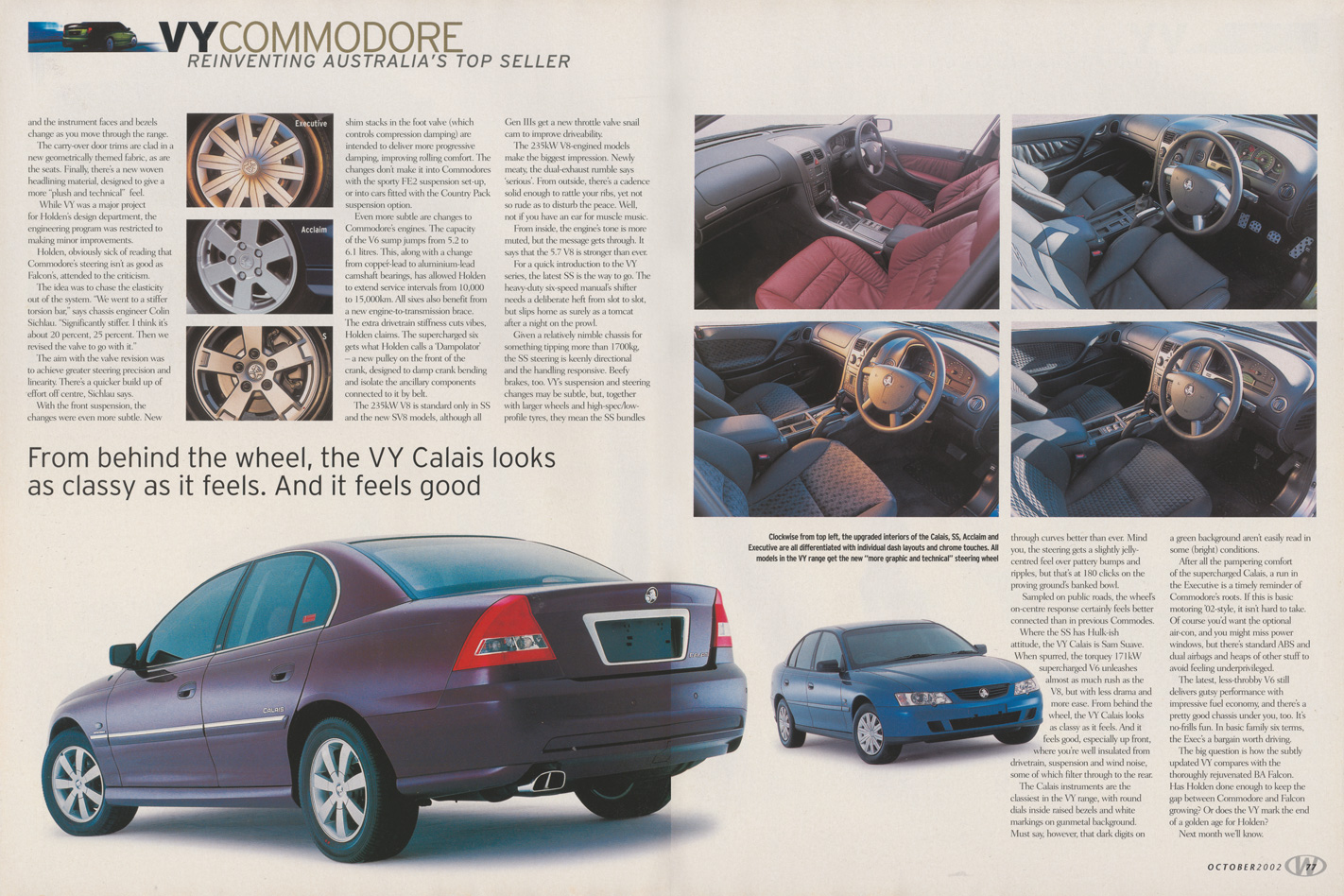
For the first time, Commodore’s interior treatments mirror the exterior differentiations. There’s an all-new dash and the stylists have made extensive use of different finishes to emphasise the luxury, base or sporting levels.
Simcoe describes the new interior as “contemporary European” in feel, saying the majority of the design effort went into the centre stack and the instrument cluster. There’s also a new steering wheel, which he says adds a “more graphic and technical element than the old one”.
Finishes aside, interiors across the range use the same core components, with the exception of audio and HVAC systems. The latter changes from manual rotary controls to push-button electronics on upmarket models.
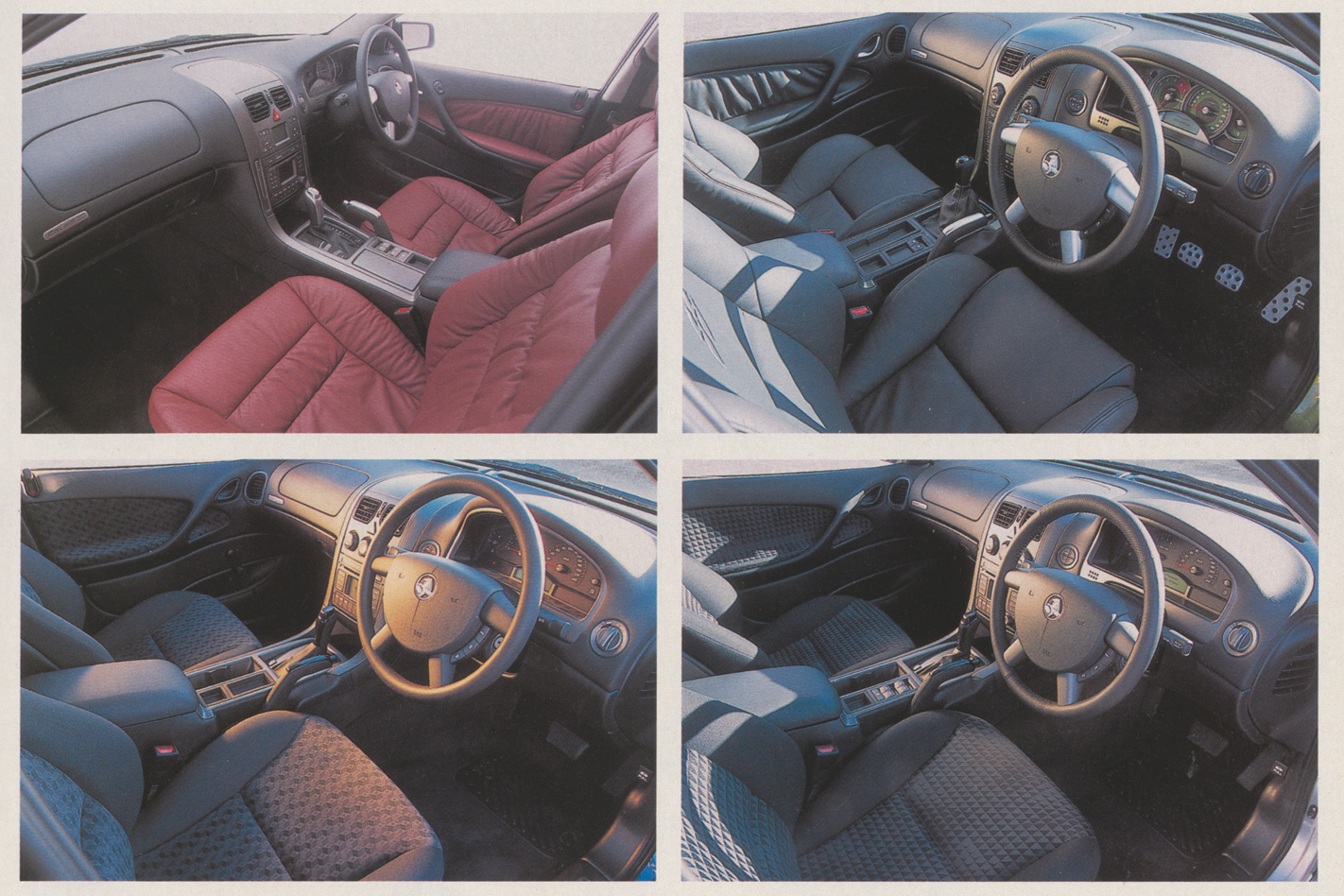
The carry-over door trims are clad in a new geometrically themed fabric, as are the seats. Finally, there’s a new woven headlining material, designed to give a more “plush and technical” feel.
While VY was a major project for Holden’s design department, the engineering program was restricted to making minor improvements.
Holden, obviously sick of reading that Commodore’s steering isn’t as good as Falcon’s, attended to the criticism. The idea was to chase the elasticity out of the system. ‘We went to a stiffer torsion bar,” says chassis engineer Colin Sichlau. “Significantly stiffer. I think it’s about 20 percent, 25 percent. Then we revised the valve to go with it.”
With the front suspension, the changes were even more subtle. New shim stacks in the foot valve (which controls compression damping) are intended to deliver more progressive damping, improving rolling comfort. The changes don’t make it into Commodores with the sporty FE2 suspension set-up, or into cars fitted with the Country Pack suspension option.
Even more subtle are changes to Commodore’s engines. The capacity of the V6 sump jumps from 5.2 to 6.1 litres. This, along with a change from copper-lead to aluminium-lead camshaft bearings, has allowed Holden to extend service intervals from 10,000 to 15,000km. All sixes also benefit from a new engine-to-transmission brace.
The extra drivetrain stiffness cuts vibes, Holden claims. The supercharged six gets what Holden calls a ‘Dampolator’ – a new pulley on the front of the crank, designed to damp crank bending and isolate the ancillary components connected to it by belt.
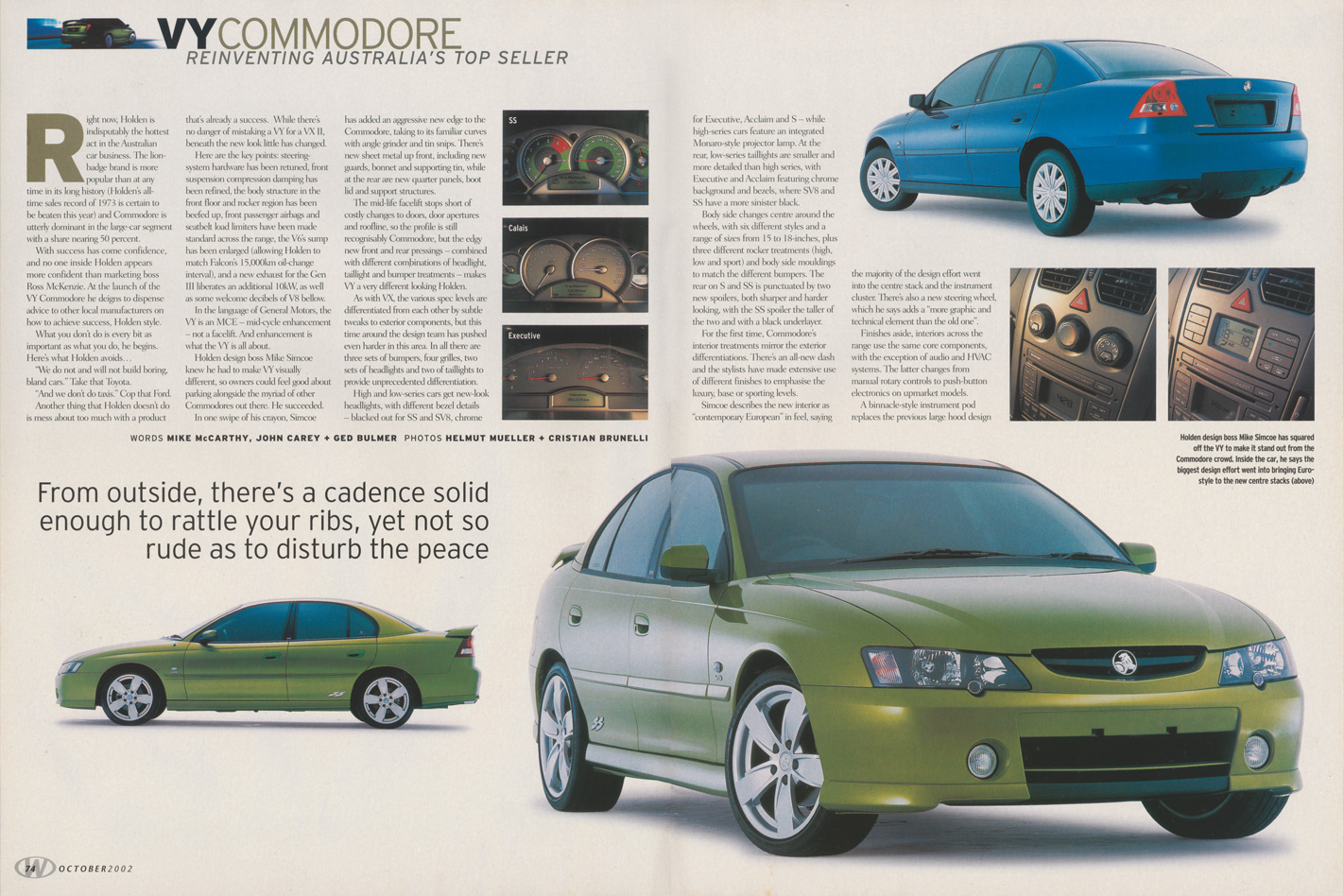
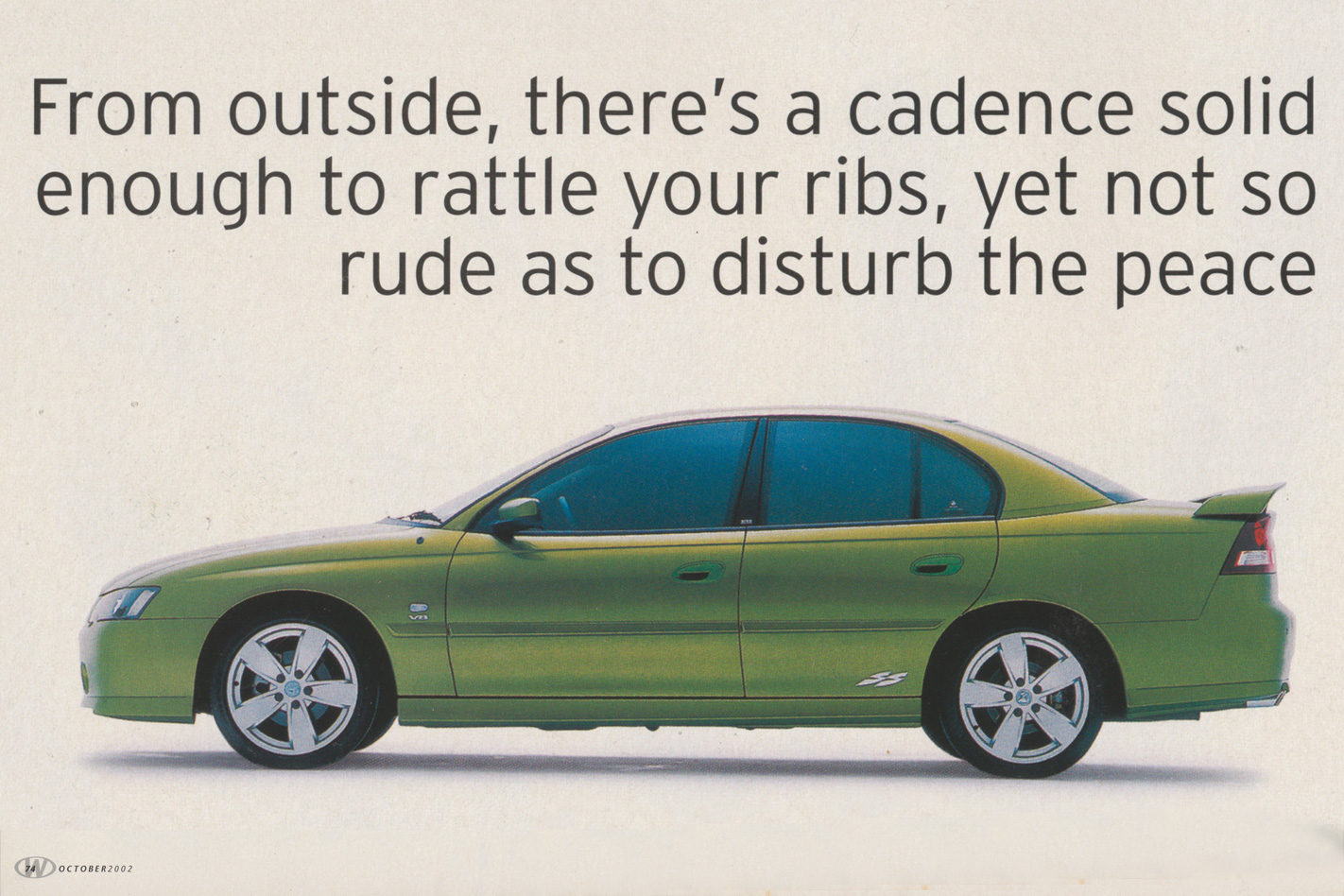
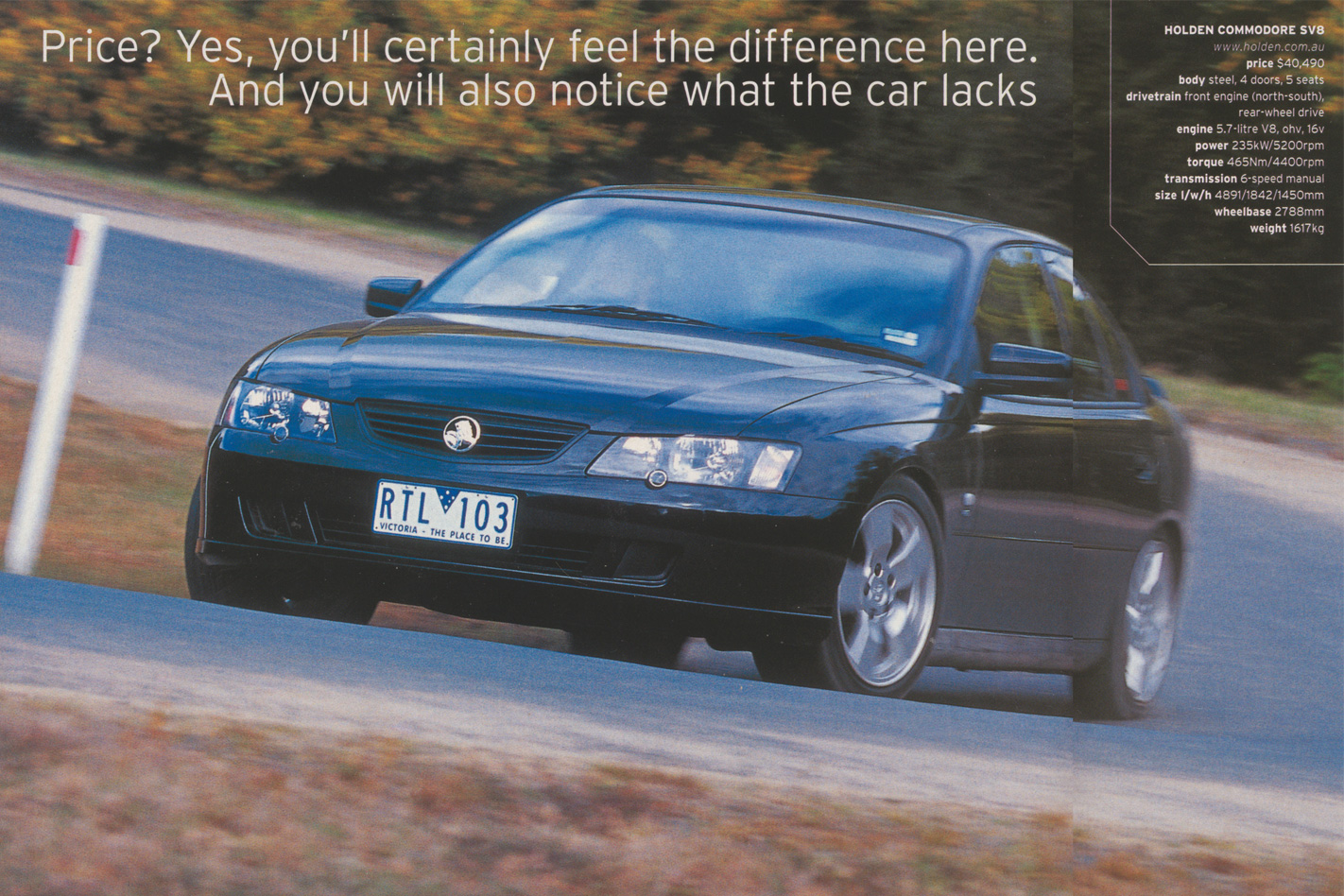
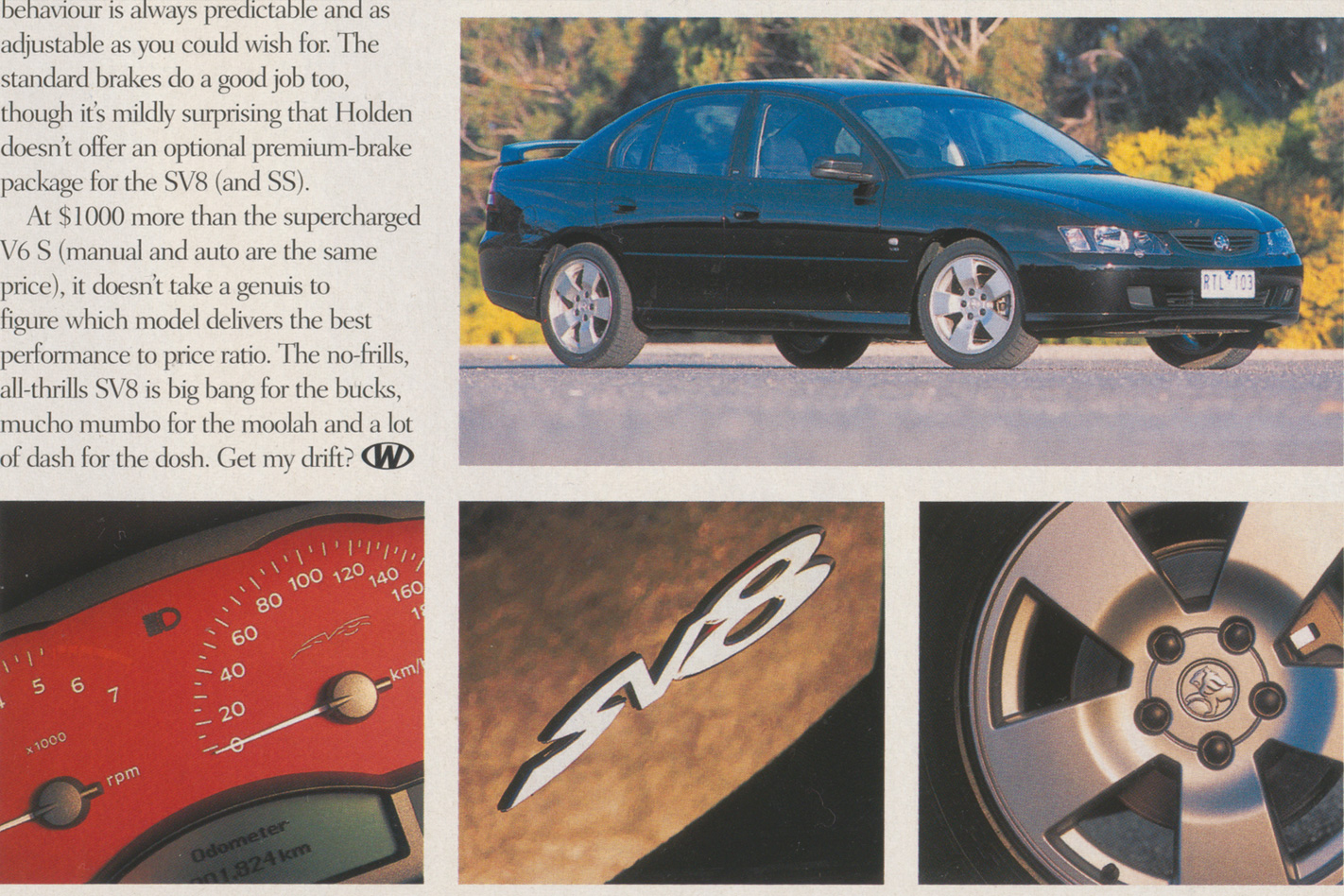
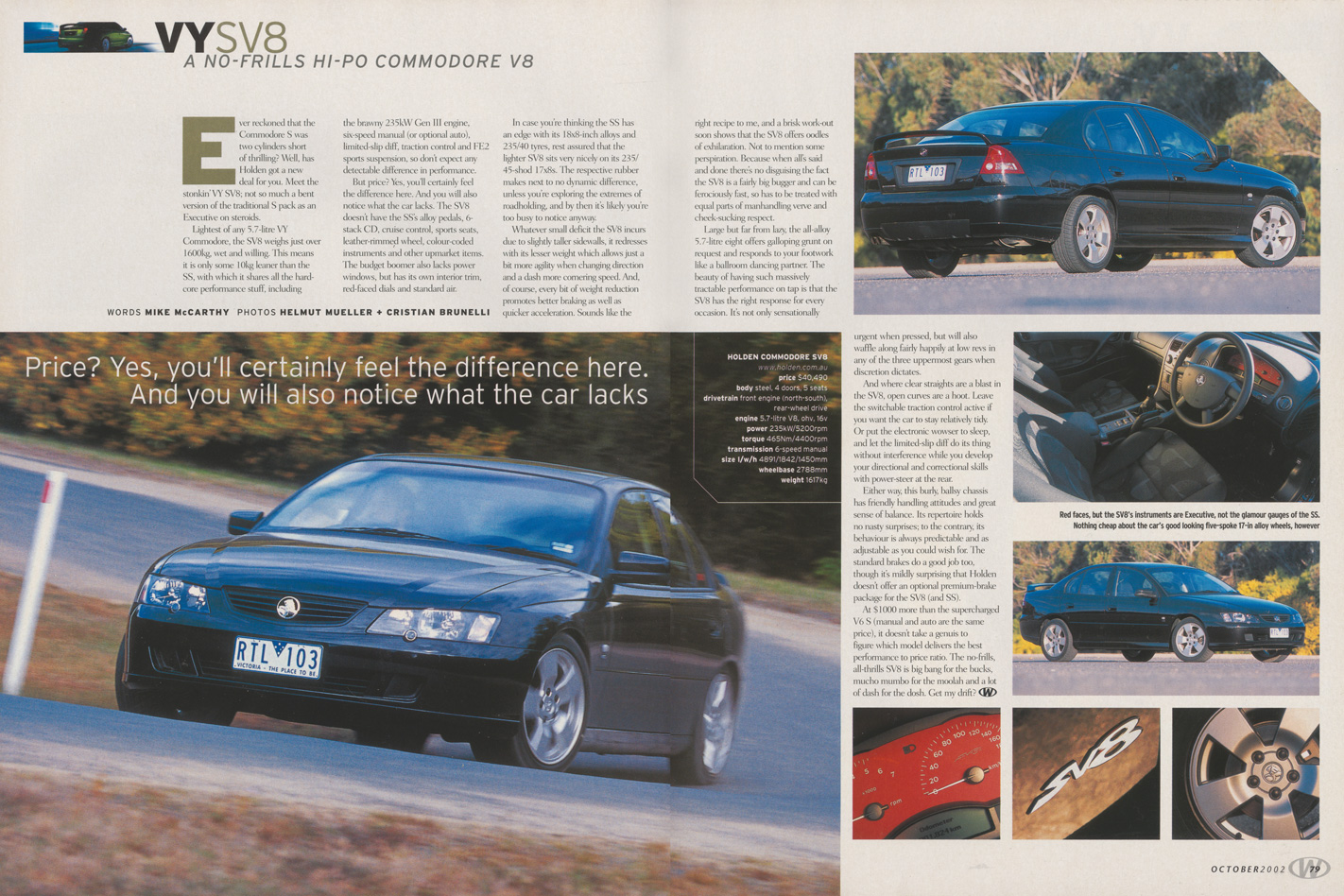
The 235kW V8-engined models make the biggest impression. Newly meaty, the dual-exhaust rumble says ‘serious’. From outside, there’s a cadence solid enough to rattle your ribs, yet not so rude as to disturb the peace. Well, not if you have an ear for muscle music.
From inside, the engine’s tone is more muted, but the message gets through. It says that the 5. 7 V8 is stronger than ever. For a quick introduction to the VY series, the latest SS is the way to go. The heavy-duty six-speed manual’s shifter needs a deliberate heft from slot to slot, but slips home as surely as a tomcat after a night on the prowl.
Given a relatively nimble chassis for something tipping more than 1700kg, the SS steering is keenly directional and the handling responsive. Beefy brakes, too. VY’s suspension and steering changes may be subtle, but, together with larger wheels and high-spec, low-profile tyres, they mean the SS bundles through curves better than ever. Mind you, the steering gets a slightly jelly-centred feel over pattery bumps and ripples, but that’s at 180 clicks on the proving ground’s banked bowl.
When spurred, the torquey 171kW supercharged V6 unleashes almost as much rush as the V8, but with less drama and more ease. From behind the wheel, the VY Calais looks as classy as it feels. And it feels good, especially up front, where you’re well insulated from drivetrain, suspension and wind noise, some of which filter through to the rear.
The Calais instruments are the classiest in the VY range, with round dials inside raised bezels and white markings on gunmetal background. Must say, however, that dark digits on a green background aren’t easily read in some (bright) conditions.
After all the pampering comfort of the supercharged Calais, a run in the Executive is a timely reminder of Commodore’s roots. If this is basic motoring ’02-style, it isn’t hard to take.
The latest, less-throbby V6 still delivers gutsy performance with impressive fuel economy, and there’s a pretty good chassis under you, too. It’s no-frills fun. In basic family six terms, the Exec’s a bargain worth driving.
The big question is how the subtly updated VY compares with the thoroughly rejuvenated BA Falcon.
Has Holden done enough to keep the gap between Commodore and Falcon growing? Or does the VY mark the end of a golden age for Holden?
Next month we’ll know.
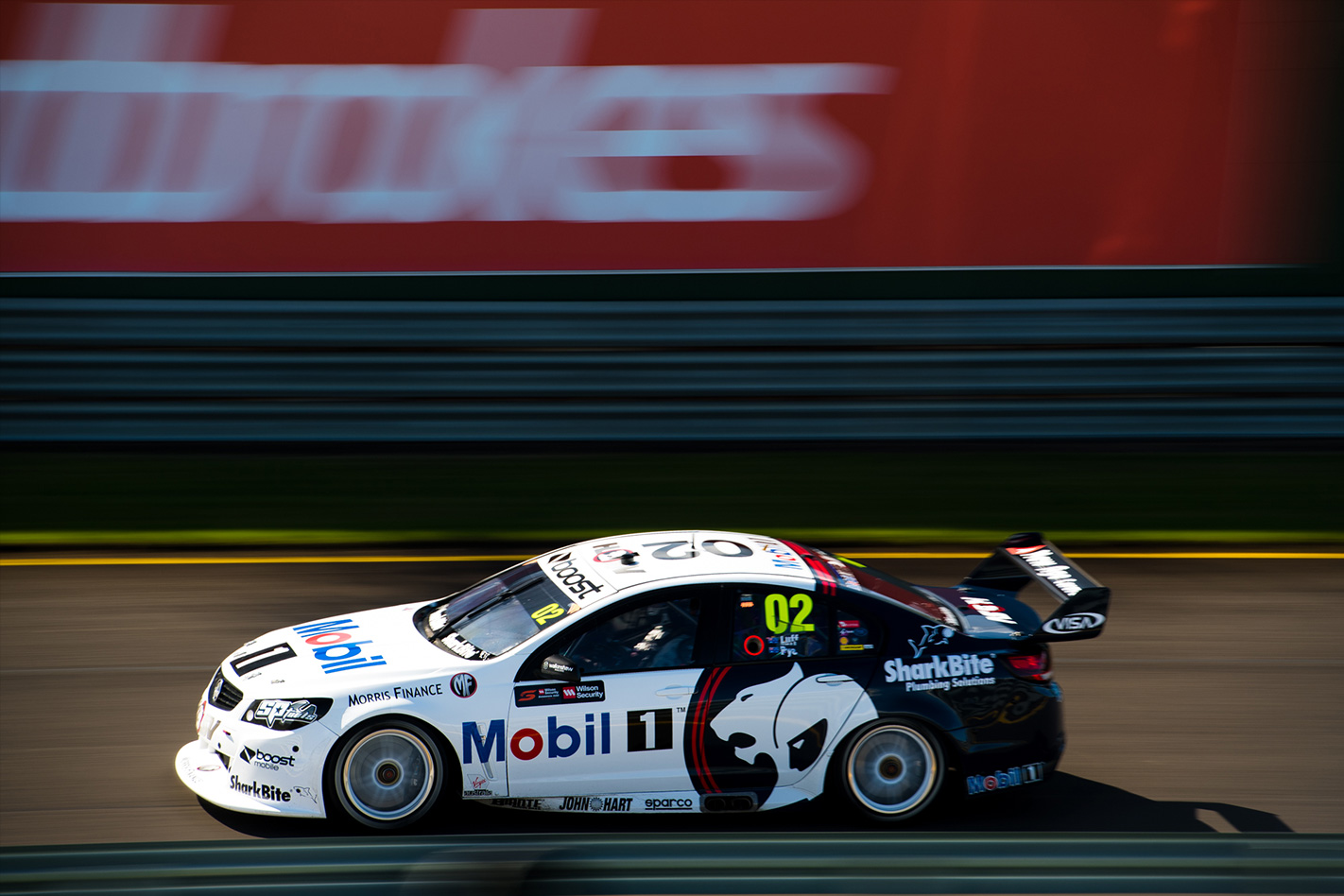
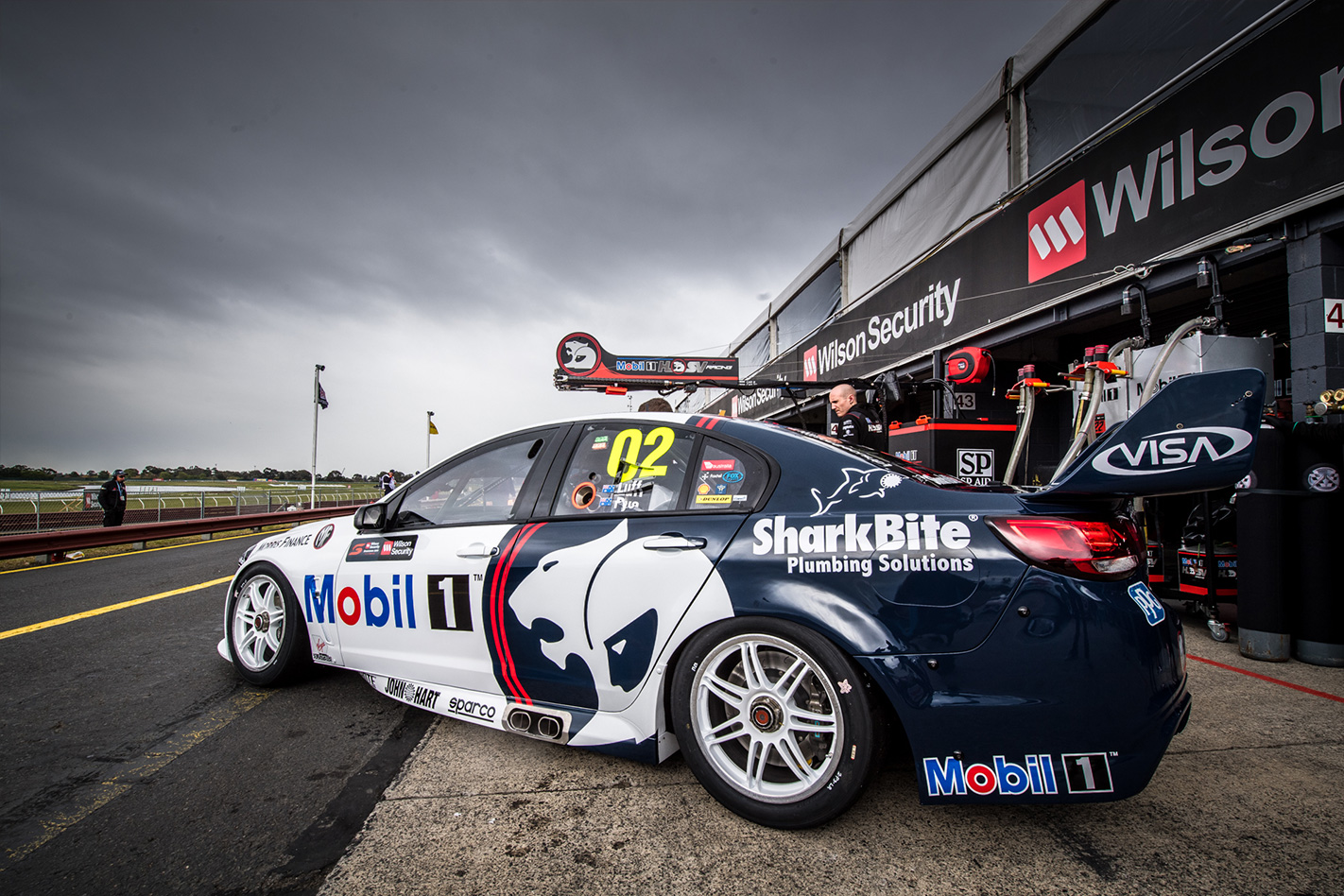
WALKINSHAW, the owners of Holden Special Vehicles, is poised to announce two international parties will buy out a portion of the Supercars race team.
US giant Andretti Autosport and European outfit United Autosport – owned by McLaren boss Zak Brown – are believed to be banding together to buy part of the Walkinshaw racing squad.
Wheels believes the former Holden Racing Team, this year competing as HSV Racing, will be renamed Walkinshaw Andretti United as of January 1 next year.
HSV was contacted for comment, while managing director Tim Jackson declined to comment.
Rumours of a potential buyout for Walkinshaw’s racing team have swirled for the last month, with initial speculation that United Autosport could go as far as taking complete ownership of the team.
It is understood an official release detailing the new ownership split is imminent.
The HSV Racing Team currently fields two cars in the Supercars championship, and will take part in the Bathurst 1000 this weekend.
The Clayton team has struggled for consistent form in recent years, with sporadic success at races highlighted by a victory at last year’s Sandown 500.
During its time in Supercars, dating back to 1990, Walkinshaw Racing has won six drivers’ championships, 179 races, and scored 93 pole positions.
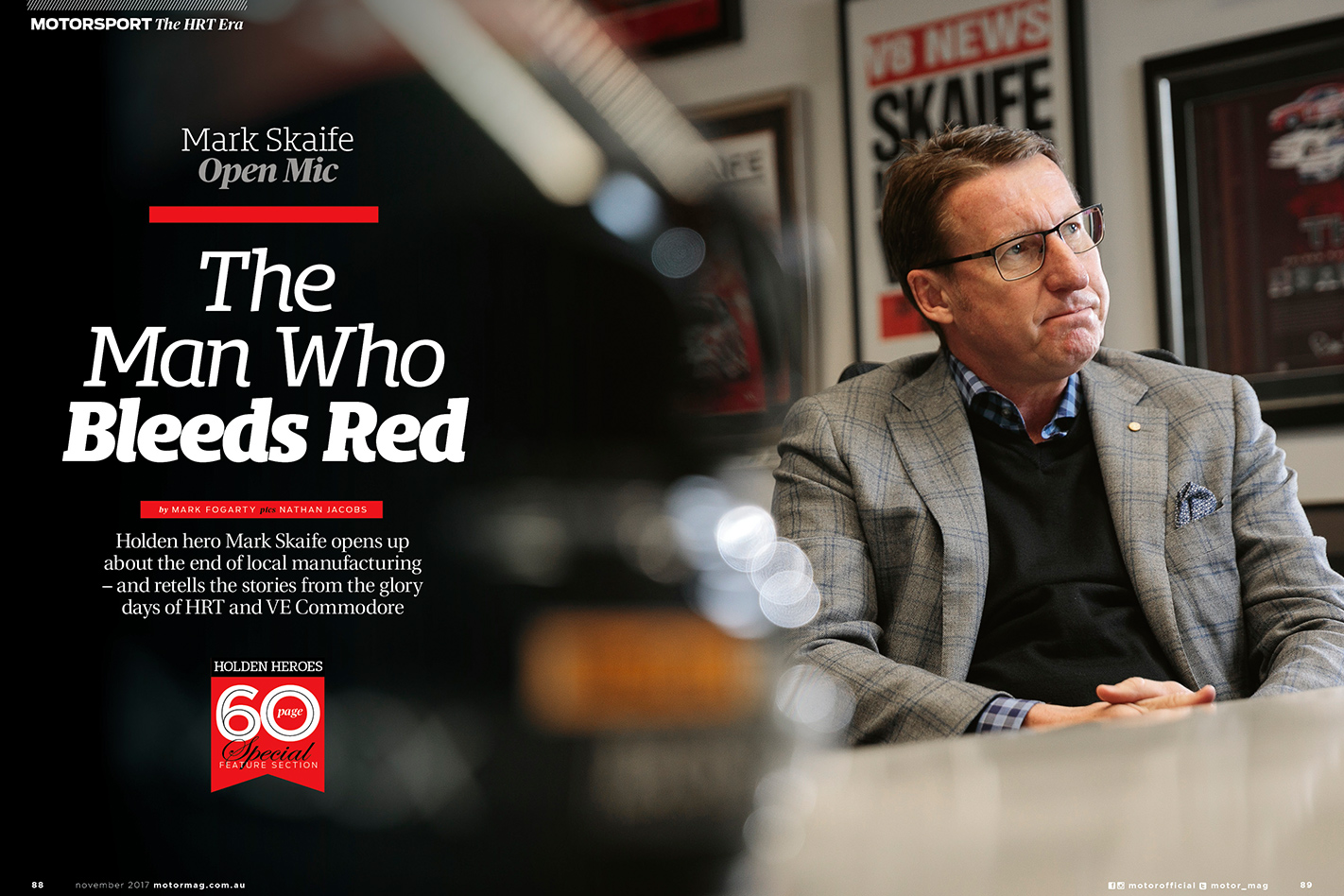
The latest major ownership shakeup occurred in 2007 when a dispute involving Mark Skaife and the then Supercars governing body, TEGA, revealed the former racing driver had ownership and control of the team, not Tom Walkinshaw. Skaife sold his shares in the outfit in December 2008, giving Walkinshaw sole ownership.
Tom’s son Ryan is currently in charge of the team. Long-time team manager Adrian Burgess was let go from the squad earlier this year.
IS SKODA getting too big for its cheap, generous-sized boots? Its owner, Volkswagen Group, thinks so, and is about to make a move to rein in the cheap Czech brand so that it doesn’t steal sales from other group members.
Quoting unnamed sources, Reuters reported overnight that VW was considering introducing punitive measures against the cut-price car maker, which has enjoyed a run of discounted German-developed tech and cost benefits derived from one of Europe’s cheapest workforces.
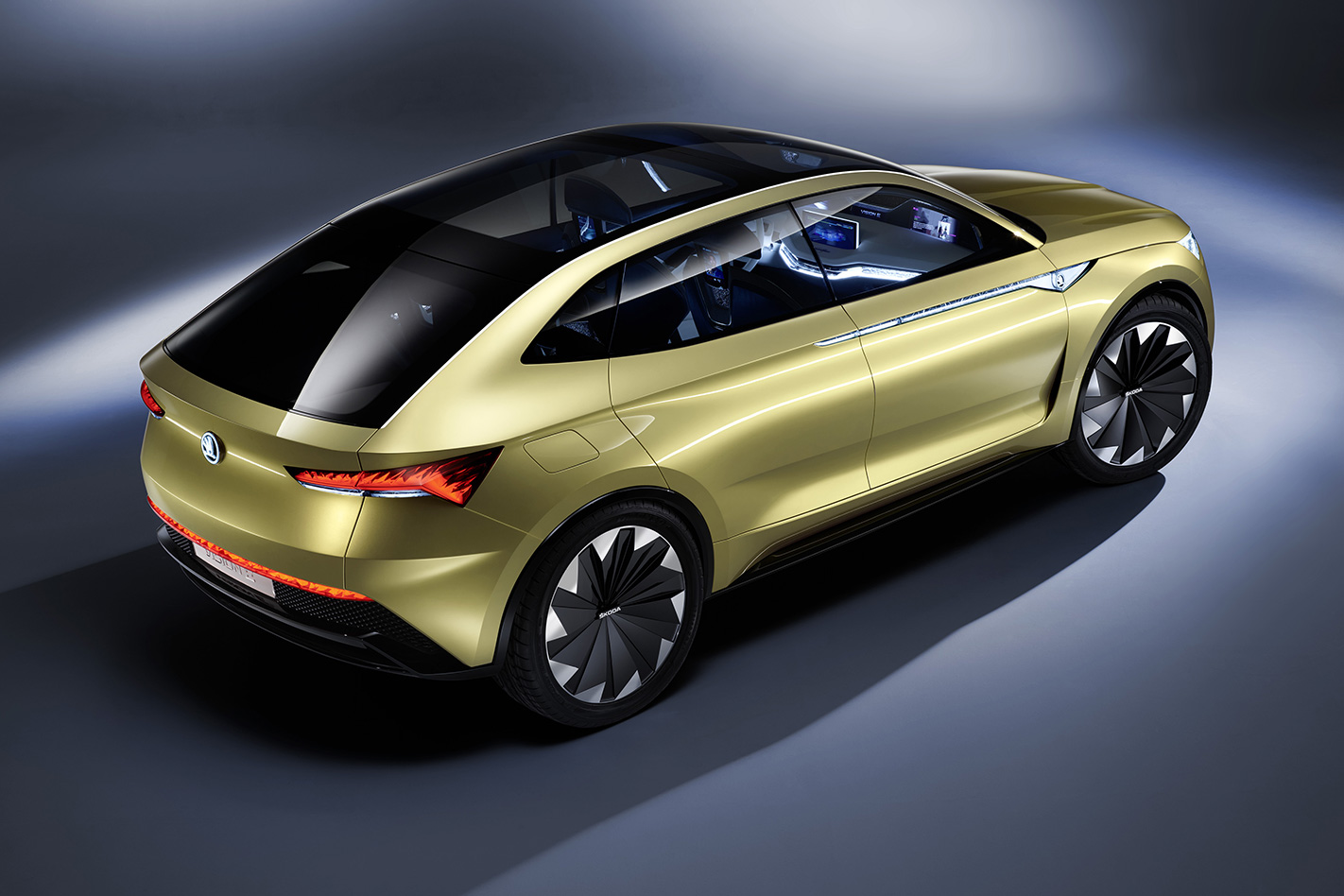
Sparking the move? Apparently it’s Skoda’s bold Vision E concept unveiled at the recent Frankfurt Motor Show. It takes the Volkswagen-developed MEB (Modular Electric Drive) and puts a Skoda twist on it to reveal the Czech brand has battery-powered ambitions as lofty as its parent group, which wants to have 50 electric cars on the world market by 2025. The first, a Volkswagen Golf-sized hatchback but wearing an “ID” badge to denote the car maker’s electric sub-brand, is due in 2020.
According to Reuters, VW plans charging more for the technology it hands down to Skoda, and may even move production of some of Skoda’s vehicles to Germany in response to union demands and slowing sales of the Volkswagen Passat midsize car and facelifted Golf as they prepare for new model introductions.
Volkswagen Group’s supervisory board is expected to weigh up what it will do with Skoda at a November 17 meeting that will set the budgets for each of the group’s brands, which also includes luxury and performance marques Audi, Lamborghini and Porsche, and mainstream European brand Seat.
What that means for Australia, where Skoda positions itself as a semi-premium Euro brand than lifting its Eurocentric reputation as a cheap and cheerful seller of discount cars. In mid-2016 Skoda Australia effectively removed the entry-level version of the Octavia from its showroom because no one was buying it. At the opposite end of the scale, most of the Superb liftback sedans and wagons leaving the Skoda showroom are high-end variants with optional packages, showing buyers are happy to drive away with their Czech cars fully loaded.
The sharp-looking, coupe-styled Skoda Vision E SUV is the Czech brand’s first battery-powered car. It’s designed to be a Level 3 autonomous car, which means the production car that will one day spin out of the Vision E will still need a driver behind the wheel, but can handle more of the mundane tasks itself such as nosing along in heavy traffic. Skoda says it will have a range of about 500km when it arrives around 2020.
Skoda is slowly building momentum in Australia after relaunching here in 2007. It’s currently having its best-ever year in terms of sales, with almost 4000 booked in the first three quarters of this year alone, an almost 17 percent gain on last year’s result for the same period, but lagging the passenger car sales of its main Euro rival, Renault.
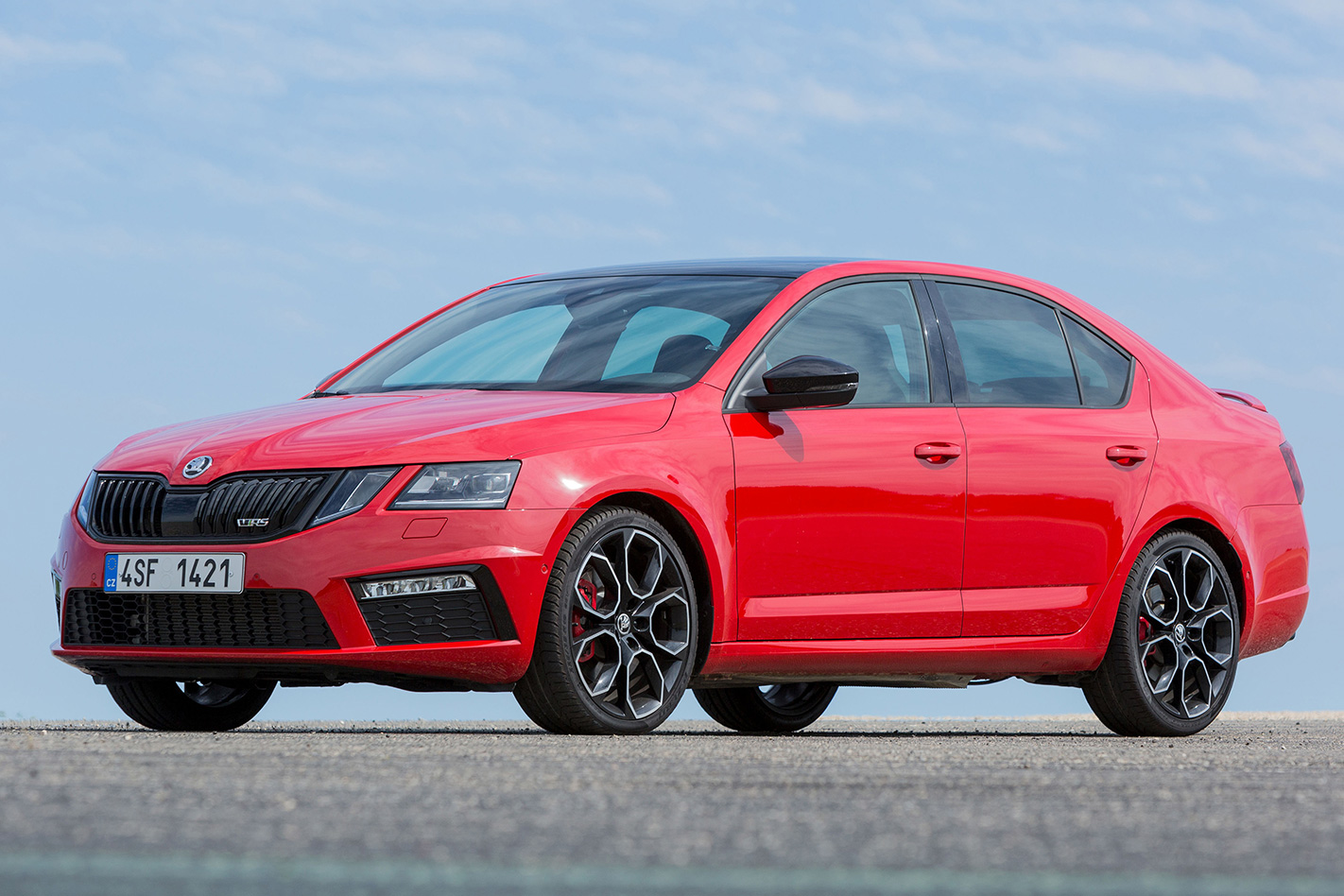
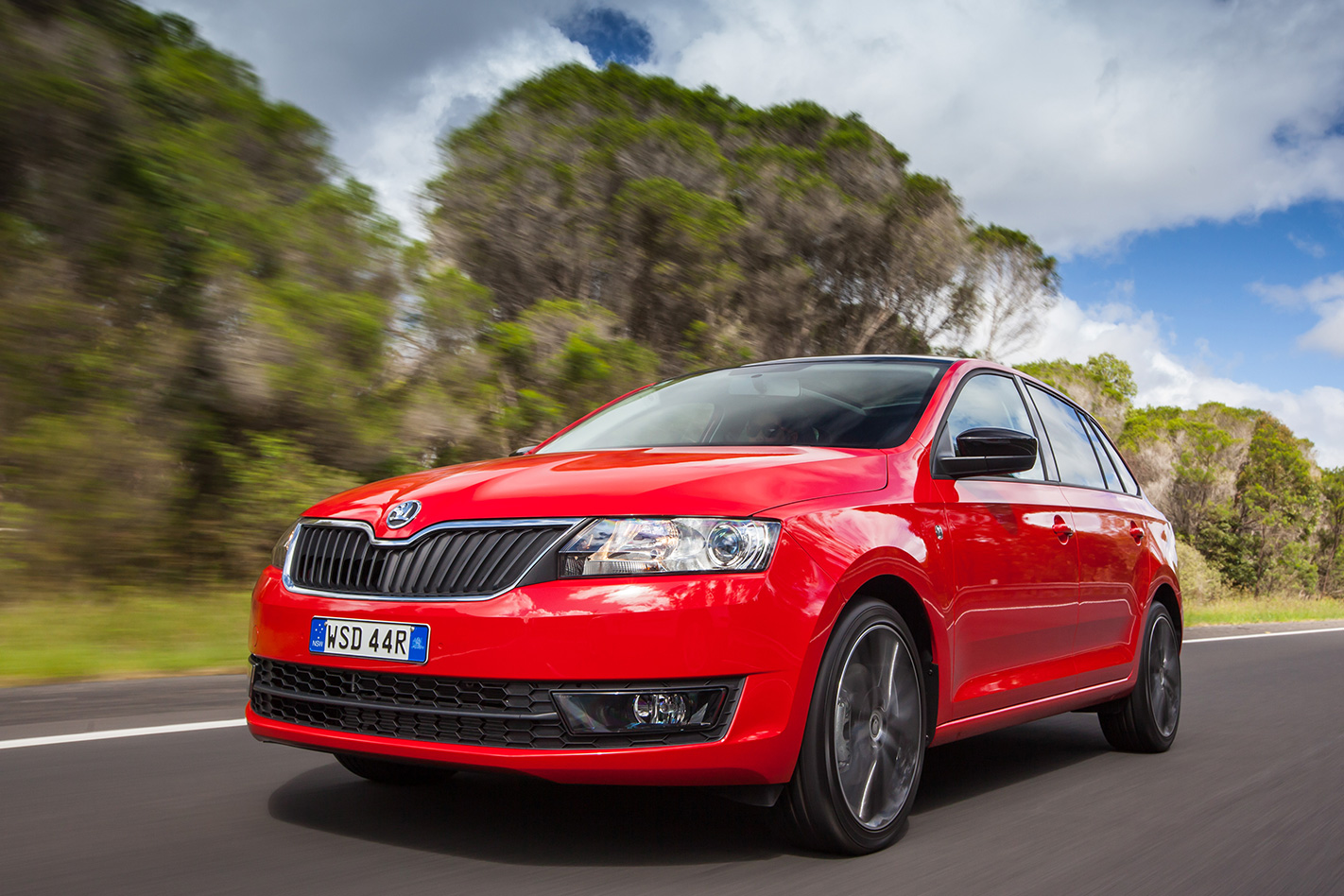
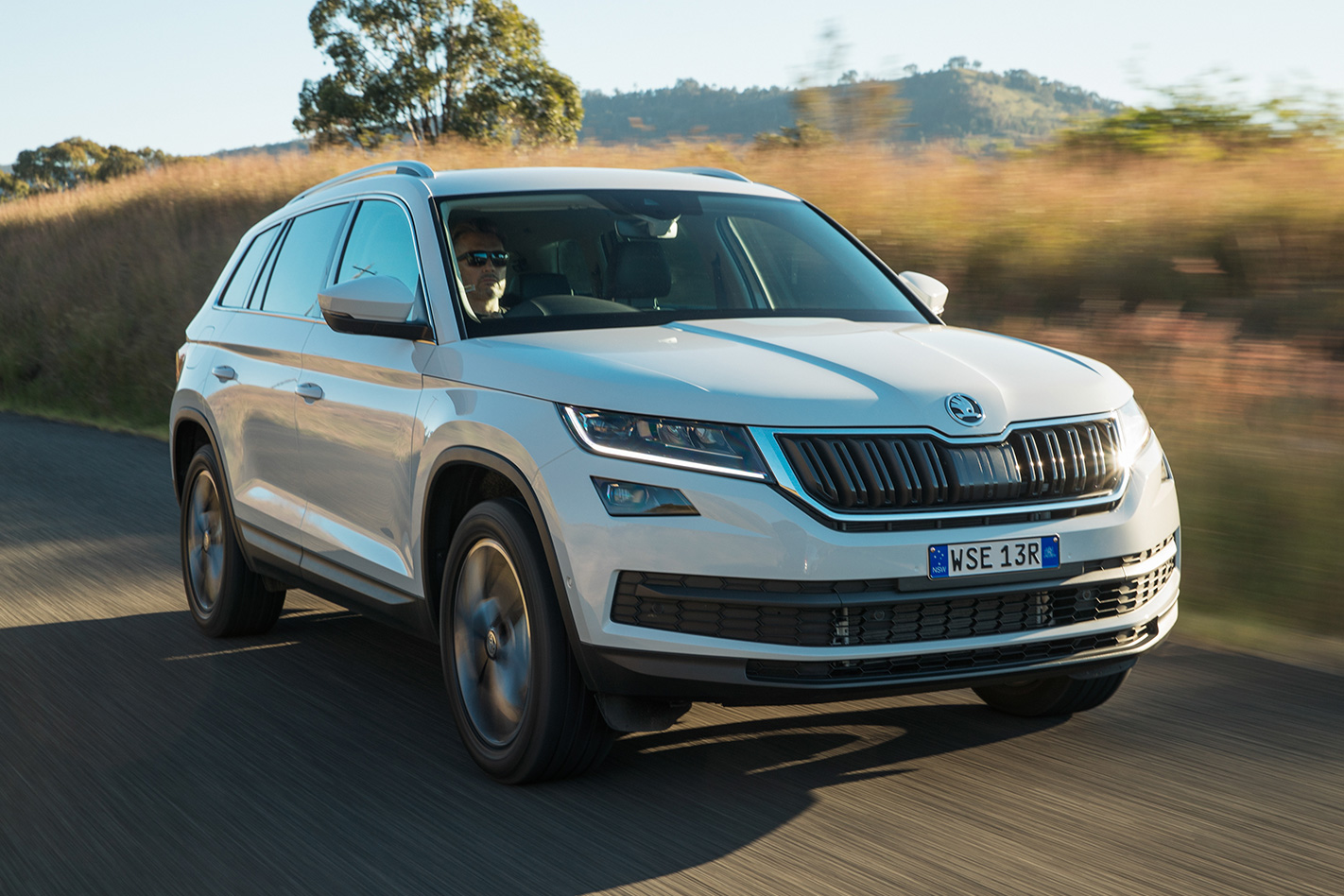
Its Australian line-up includes the Skoda Fabia hatchback and Rapid hatch, the Octavia mid-size liftback and wagon, the Superb large liftback and wagon that will go head-to-head with Holden’s first-ever fully imported Commodore from early next year, and its SUV line-up that includes the odd-looking Yeti and the brand’s biggest sales success so far this year, the Kodiaq seven-seater.
The Octavia is Skoda Australia’s best-selling model, and the fifth-biggest selling model in the medium car class where it takes on the likes of the Toyota Camry – which has ended local production ahead of the arrival of an all-new imported model that’s likely to cost more – the Ford Mondeo, and the Mazda 6.
The Fabia and the Superb – the latter has one of the best rear-seat spaces in the large-car class – also sell strongly in their segments.
The Kodiaq, available as a seven-seat rival to the likes of the almost sold-out Ford Territory, the Toyota Kluger and the Holden Trailblazer, was introduced to the Australian market midway through this year, and is yet to make a significant impact in the large SUV segment.
Skoda plans to launch seven new models over the next three years, including a potential RS-badged performance version of the Karoq in what could become something of a beer-budget Mercedes-AMG CL-Class rival. Midway through next year, it will add the Karoq midsize SUV, replacing the Yeti with a more traditionally styled SUV shape.
There’s also a plug-in hybrid-engined version of the Superb in the works, likely to be a petrol-electric model that can run for about 30 kilometres on electric power alone – a similar plug-in system is also being developed for the Kodiaq.
Skoda is also expected to plug a significant gap in its showroom, which is currently missing a small SUV. That is likely to be a jacked-up version of the Rapid, due in 2019 and borrowing some of the styling from the T-Roc that will fill a similar role for Volkswagen.
