
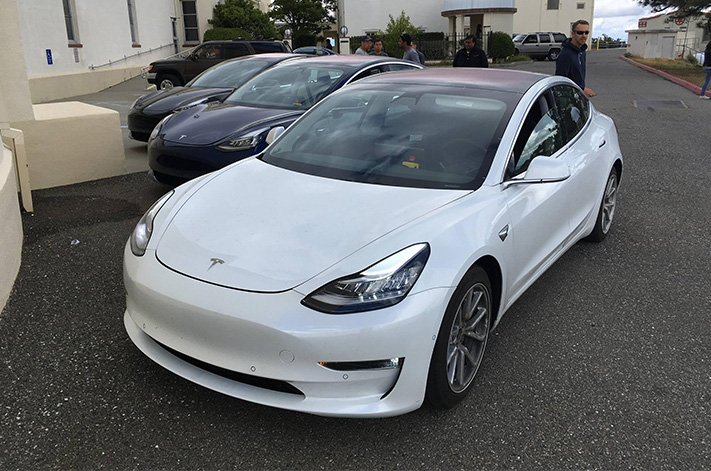
TESLA either hasn’t heard of camouflage or doesn’t mind the publicity that comes with leaked images, though the apparent ease with which one Reddit user was able to snap pics of the Model 3’s previously unseen interior makes us suspect the latter.
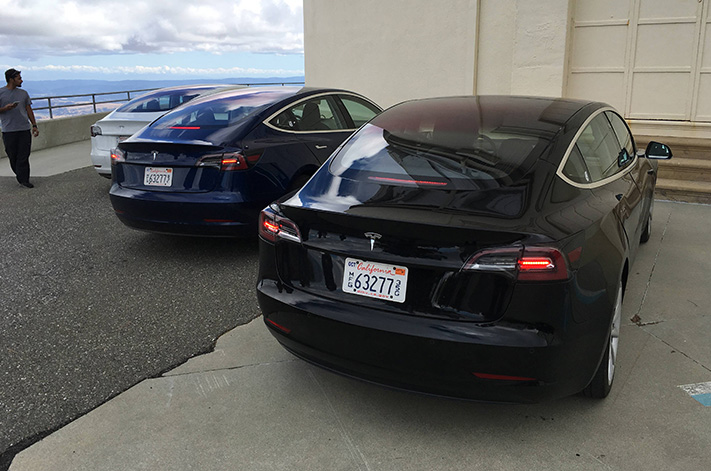
The 29 images, posted by Reddit user inamachineshop, show three of the new mid-sized, ‘affordable’ EVs that appear close to production-ready, judging by panel gaps tighter than earlier prototypes.
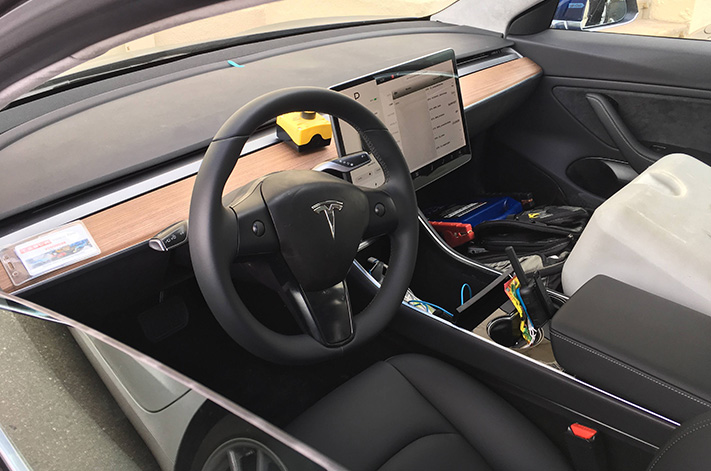
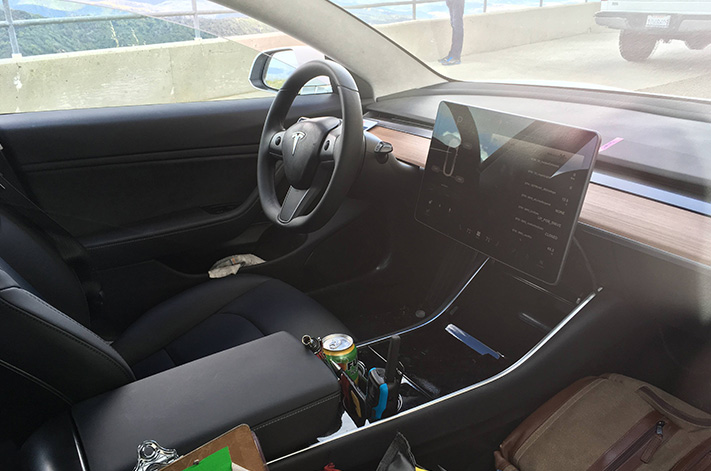
Like the Tesla Model S, the smaller car’s dashboard is void of buttons. However, a large 17-inch touchscreen in the centre is landscape-orientated rather that portrait. Also, there is no gauge cluster or a visible head-up-display meaning driver has to look sideways at the screen to read their speed, though it’s not known if this will be the case with the production models.
Another feature unique to the Model 3 is the lack of a separate stalk to control the autopilot function, which appears to be controlled by a stylish gear lever on the steering wheel.
Images posted by another Reddit user show the rear seats will fold to provide more cargo space to the relatively small 400-litre boot, which is hampered by the mass of lithium-ion batteries along the floor.
According to Tesla, its most affordable model yet will have a 346km range, is “designed to attain the highest safety ratings in every category” and will accelerate from 0-100km/h in less than 6.0 seconds.
Tesla is accepting a reserve deposits of $1500 for Australian Model 3 orders, which people have gladly paid despite the prospect of minimum 12-month wait.
WE’VE lost count of how many times Aston Martin has applied a bit of slap and lippie to its Vantage sports coupe and convertible as part of yet another special edition.
But the latest, and possibly final, version seems worthy of more attention.
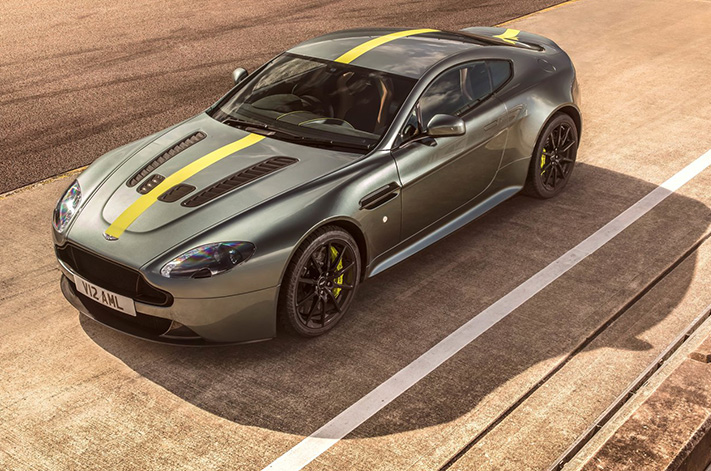
Following the bonkers Vantage AMR Pro that made its debut at the Geneva Motor Show earlier this year, the Vantage AMR V12 and V8 confirm that the special branch will focus its resources on producing two distinct lines of vehicles – one for the road and the other a strictly track-only proposition.
What’s next in line for the AMR treatment is not yet confirmed, but a flashier version of the DB11 would be an obvious choice. Until then, the AMR flag will be flown by the Vantage, which is available in both coupe and cabriolet, and with the AMR upgrades.
For the V8 version, its 4.7-litre naturally aspirated engine gets a tune-up to 321kW, while the 6.0-litre V12 under the heavily vented bonnet of its big sister is pumped up to a meaty 444kW – the most power possessed by any Vantage to date.
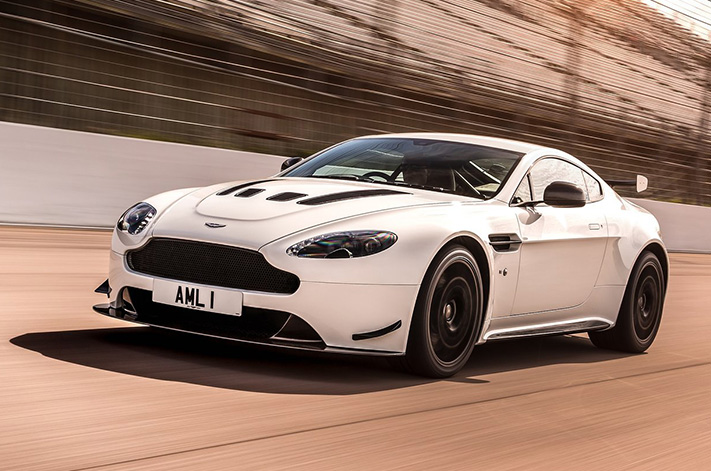
Identifying an AMR-fettled Vantage from one of the countless specials won’t be difficult with a range of four unique exterior themes and two styling packages. The Halo Pack substitutes one of the four two-tone colour schemes for a Stirling Green paint job, complemented by Lime Green accents.
With a little more cash to splash, you can add an aero kit that brings a little of the AMR Pro madness with carbonfibre components including a massive fixed rear wing, while the titanium exhaust sounds like a must-have item for its 14kg weight advantage and “sensational” sound.
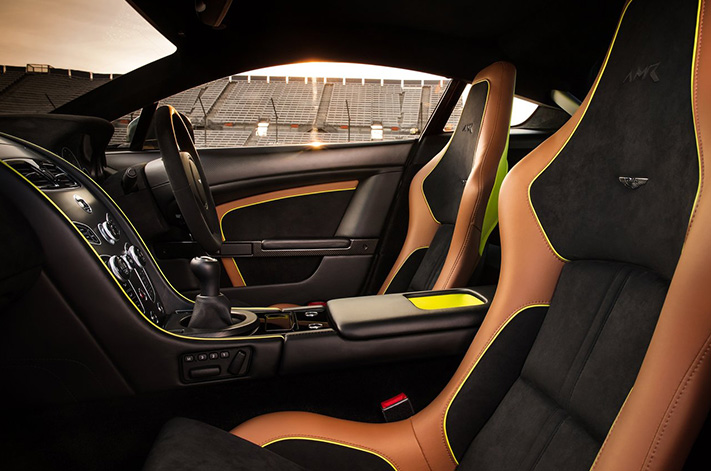
The AMR fettling continues on the inside with interiors to match the exterior theme. Lightweight carbonfibre seats are upholstered in a mix of leather and Alcantara in the coupes, while the convertible is an all-leather affair.
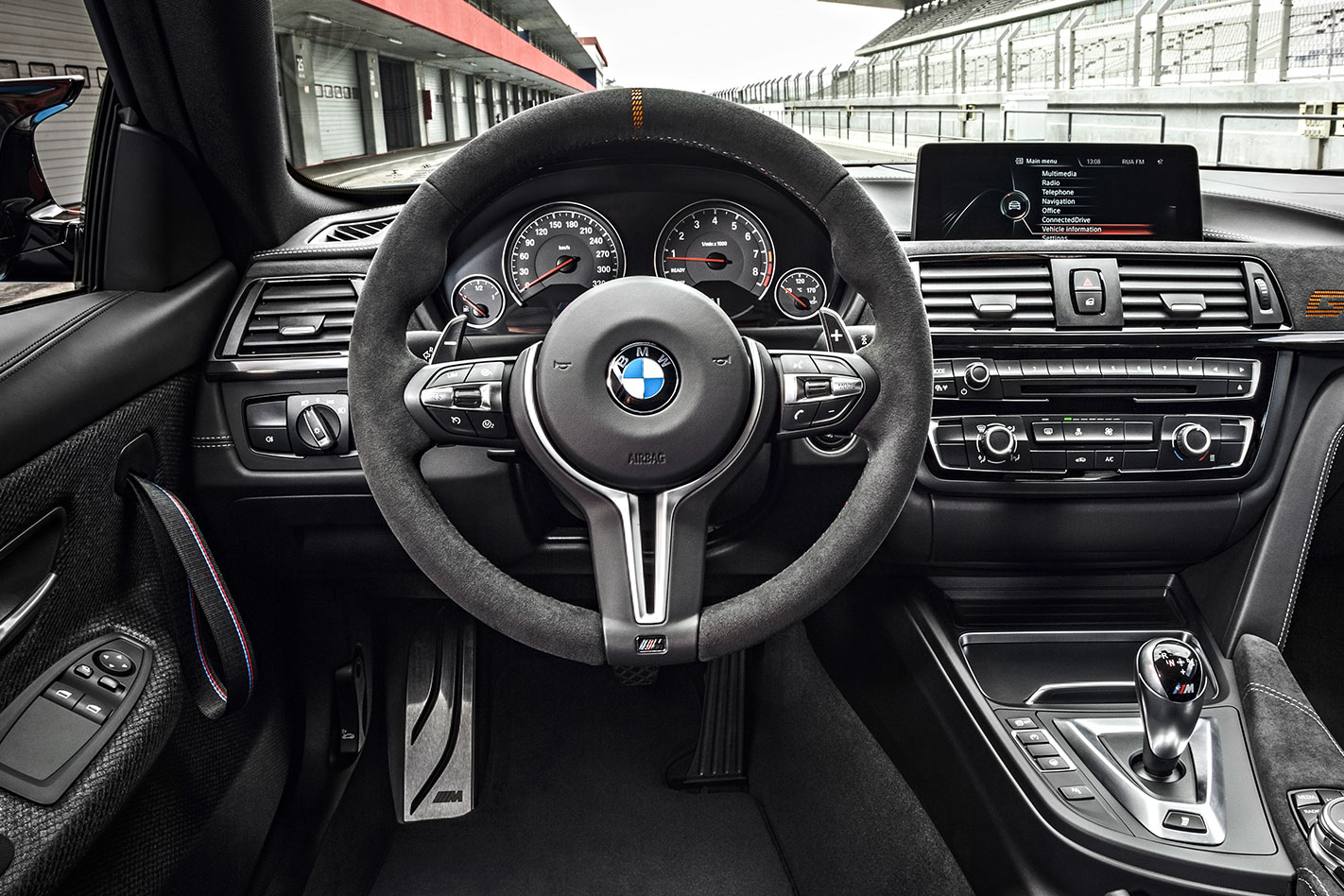
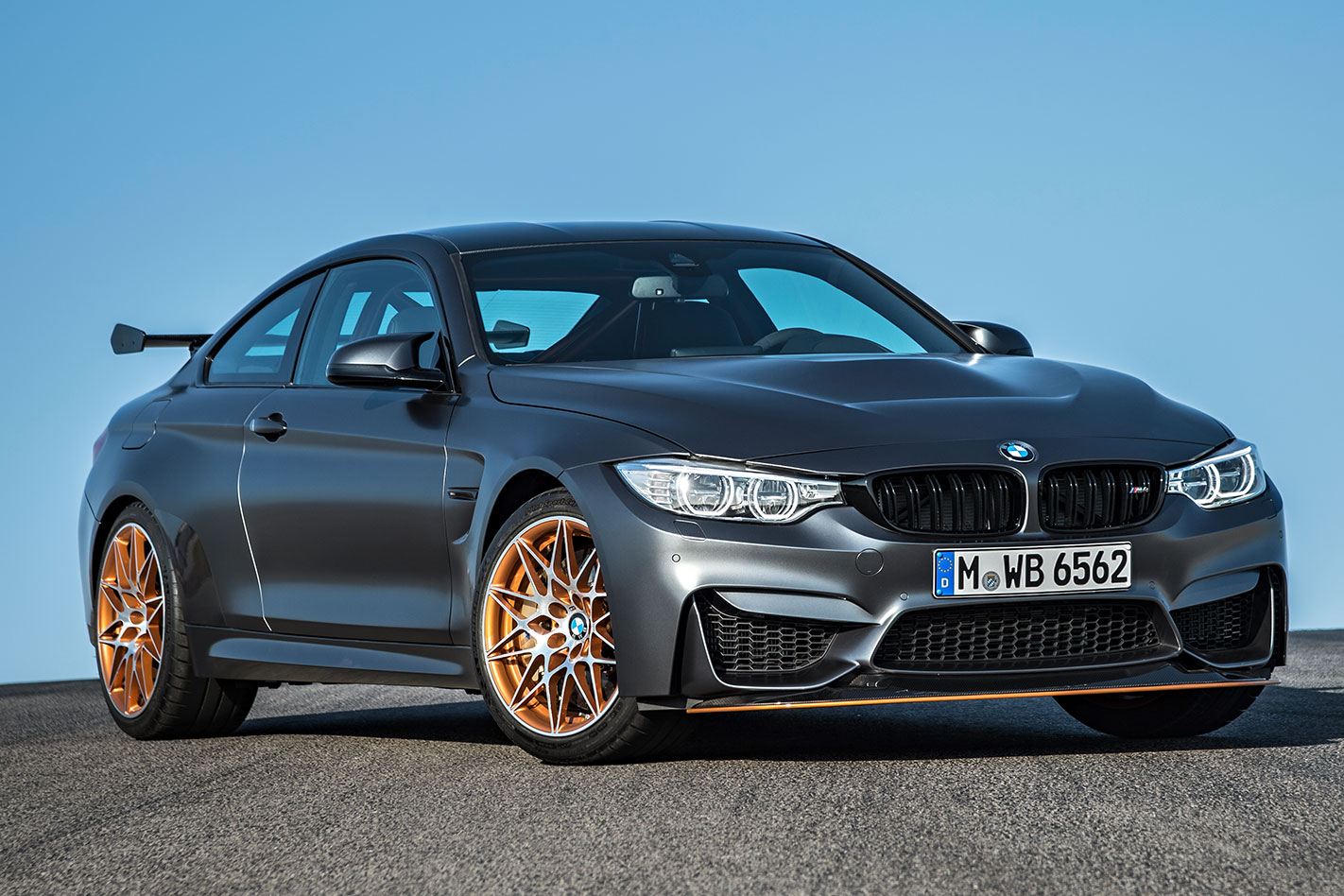
Yes, we’re aware that the BMW M4 GTS is, in fact, not an M3.
And while the M3, M3 Competition and M3 30 Jahre are all lovely things, the M4 GTS turns things just that extra click up to 11.
If you’re going to go turbo, go all out.
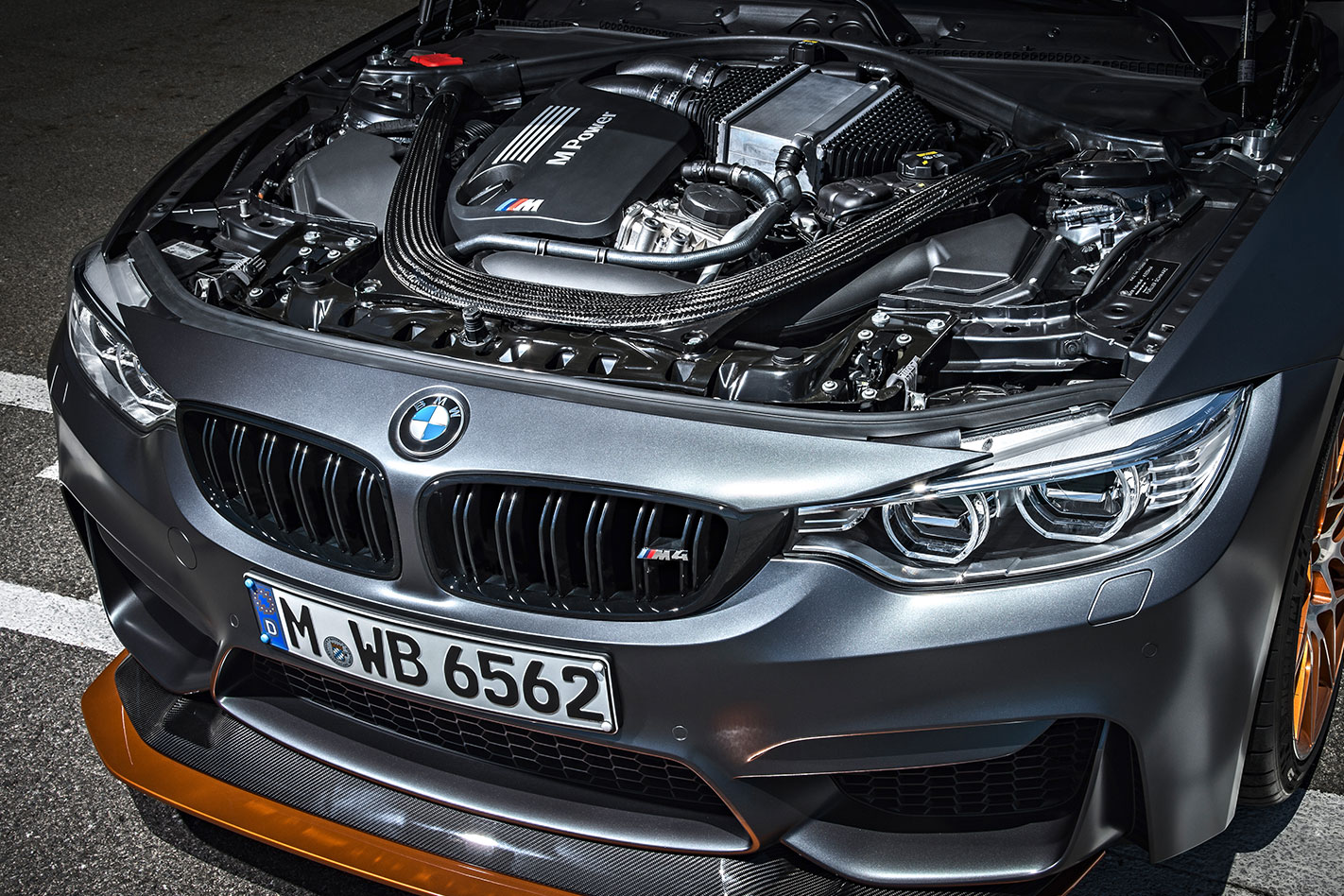
And with 600Nm of torque, 50 more than the M3 Comp, you can imagine how well it gets that power to the ground.
It’s also 10kg lighter, which means it has 16kW more power per tonne than the Competition.
Does your brain hurt yet?
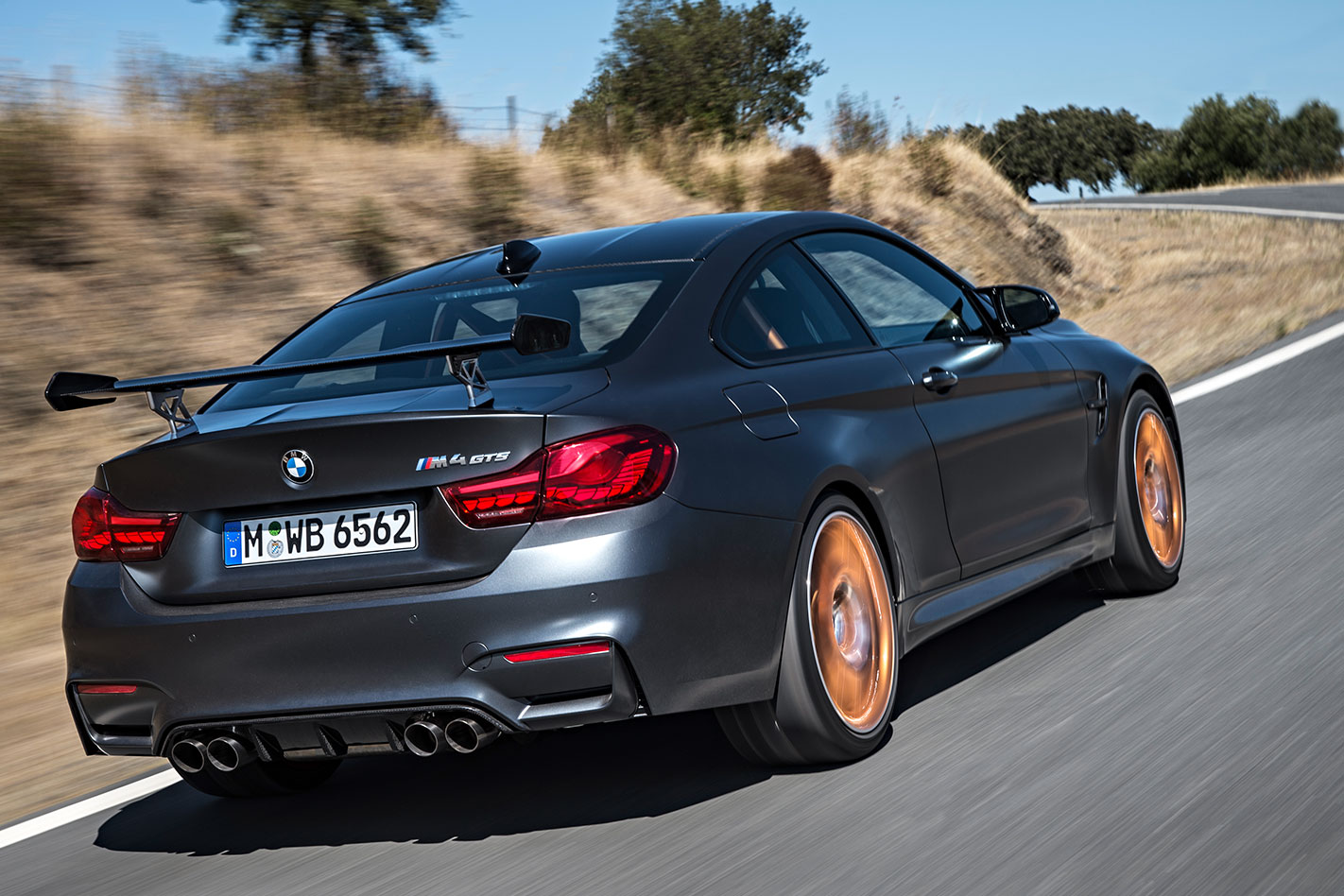
The M3 Competition claims 4.2 seconds, the M4 GTS claims 3.8.
The kicker? A GTS would have set you back a whopping $150K more than the Comp… but there were only 25 brought to Australia, and they were all snapped up quick-smart.
More BMW M2s allocated for Australia…again
With two turbos and a load of torque, you can keep the revs around 5500 and still extract everything you’ll need from the Bavarian beast.
A SHARP-EYED Wheels reader has captured video of the French-owned, next-generation Holden Commodore wagon cruising the streets of Melbourne.
Philip Clark sprung one of Holden’s development cars, wearing light disguise around its headlights, tailgate and tail-lamps, as it cut through the streets of inner Melbourne recently.
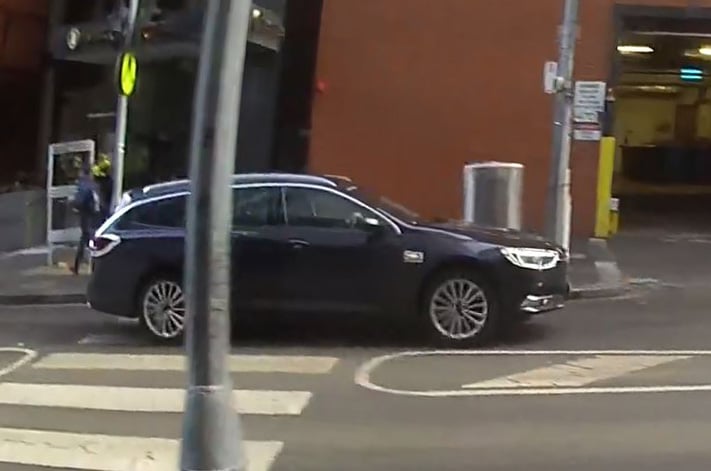
It shows that the Eurodore, still missing its rear badge, is expected to feature many of the same styling details that have appeared on international versions of the car, right down to the chrome strip running right along the edge of the glasshouse down to the LED tail-lights.
The Sportwagon – called the Sports Tourer in other markets, but remaining faithful to Holden’s nomenclature here – is one of three Commodore variants expected to roll out here. These include the Commodore liftback sedan – a feature spotted by Wheels early in the new mid-sizer’s development cycle – and a higher-riding soft-roader.
Engine choices for the new Commodore range are still up in the air, although Holden has confirmed the choice of either a 230kW/370Nm 3.6-litre V6 – the largest engine capacity given there’s no room for a V8 – and a choice of four-cylinder turbocharged petrol and diesel units for more mainstream models.

If the recently confirmed Astra Sportwagon is any guide, Holden may limit the engine choices available to the Commodore Sportwagon to just the base four-pots, although a V6 would help the car keep some of its reputation as a caravan-hauling grand tourer.
The new “NG” Commodore is due on sale early next year.
Holden will expand its Astra range in the last quarter of this year, with the Astra Sportwagon joining the Astra hatch that arrived in late 2016, and the Astra sedan that launches this week.
Built at Vauxhall’s British plant, the Sportwagon variant will boast the same styling language and interior as the existing Polish-built five-door – albeit in an ultra-pragmatic six-window wagon bodystyle.
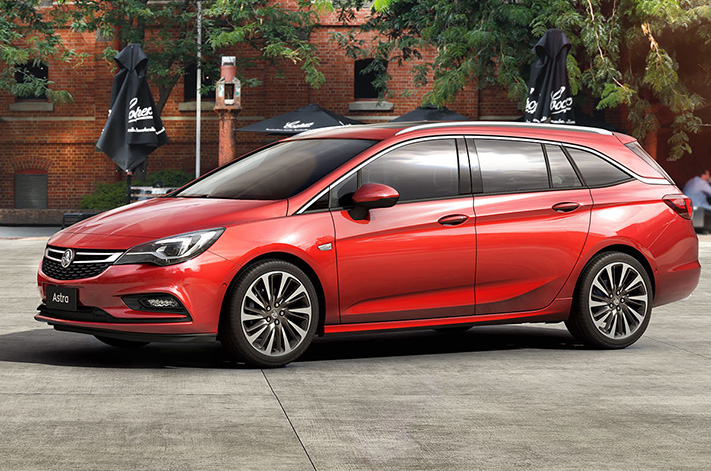
But while its design will echo that of the Euro-built hatch, the Astra Sportwagon’s equipment list will be more closely aligned with that of the Cruze-based, South Korean-built Astra sedan. The hatch’s torquey 1.6-litre turbo won’t be available; the Sportwagon will only come with a 110kW/240Nm 1.4-litre turbo four and six-speed automatic.
The wagon will get autonomous emergency braking, a powered tailgate and keyless entry/ignition as standard. Apple CarPlay and Android Auto smartphone mirroring will also be standard, as will lane keep assist, a reversing camera and forward collision alert.
It will also boast a generous 1600-litre boot capacity with the rear seats folded down – an attribute Holden hopes will attract those looking for large-car carrying capacity in a small-car form factor.
“The hatch occupies a very sporty niche, but the sedan and wagon are more pragmatic and a little bit more utilitarian,” Holden communications director Sean Poppitt told WhichCar.

However, Poppitt conceded that the wagon isn’t expected to boost Astra sales by a significant number.
“It’s not about volume,” he said. “It’s about providing a more utilitarian option. If you look at the established players it’s really [Volkswagen] Golf that does it best, but even for them it’s not huge volumes – but it gives another option.”
Pricing and full specifications for the Astra Sportwagon will be announced closer to its local launch late this year, though given its specification level we’d anticipate a starting price around the mid-$20K mark.
VOLKSWAGEN’S rival to the Ford Fiesta will be officially unveiled in Germany on Friday.
The 2017 Polo will be revealed as part of a YouTube livestream, starting at 9:00am GMT on June 16.
The sixth-generation Polo is expected to move the concentrate on in-car tech rather than revolutionary styling changes.
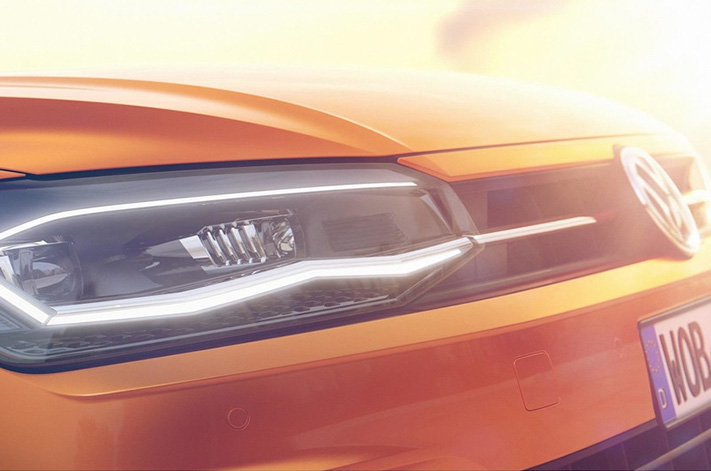
It’s likely that VW engineers and designers have followed the trend started with the latest Golf, with subtle updates to the Polo’s lines. However, expect fresh bumper, headlamps and grille for the small hatchback.
The Polo is built atop the AO platform, a spin-off of the MQB architecture that the Golf rides on.
Speculation suggests the next-gen Polo will come with either a 1.0-litre three-cylinder naturally-aspirated petrol engine with around 56kW, a 1.5-litreTSI petrol or a similar capacity TDI diesel.
Buyers won’t be short of transmission choices, with five-speed and six-speed manuals on offer, along with a seven-speed dual-clutch auto.
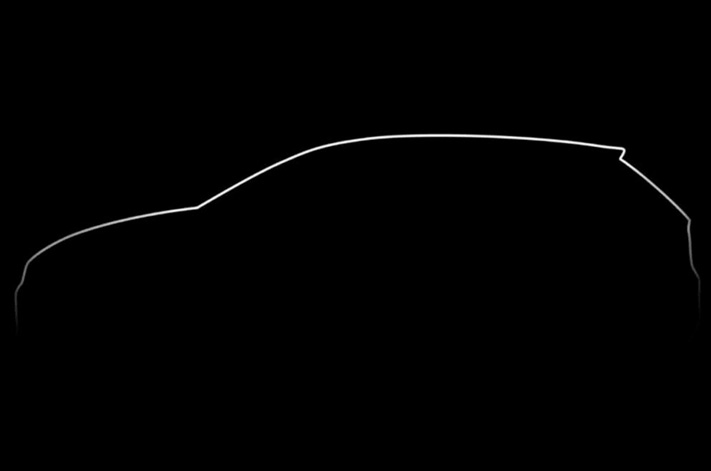
As before, the Polo GTi is set to be the flagship, with this car getting a shot in the arm, stepping up from the current 1.8-litre turbo four-cylinder to a 2.0-litre turbo unit from the Golf GTi. This should result in power figures of around 150kW, which compares favourably with rivals like the 134kW Fiesta ST and the 147kW Clio RS200.
The car is expected to be launched in Europe before the end of the year, with Australian customers having to wait until the car makes landfall in early 2018.
Currently, only a silhouette of the VW has been revealed, hinting at a somewhat more squared off profile.
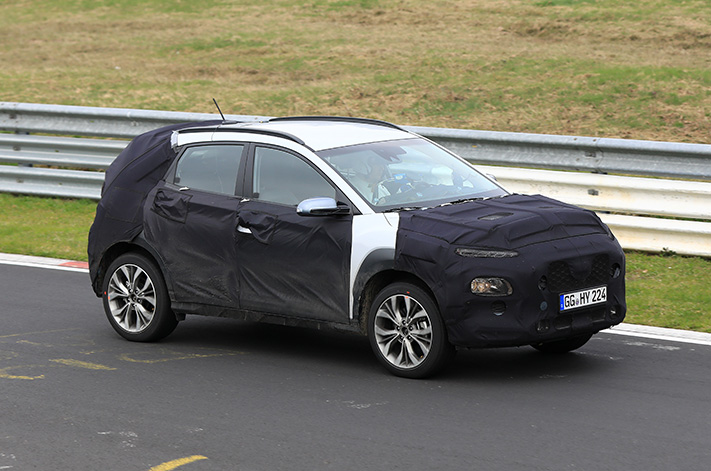
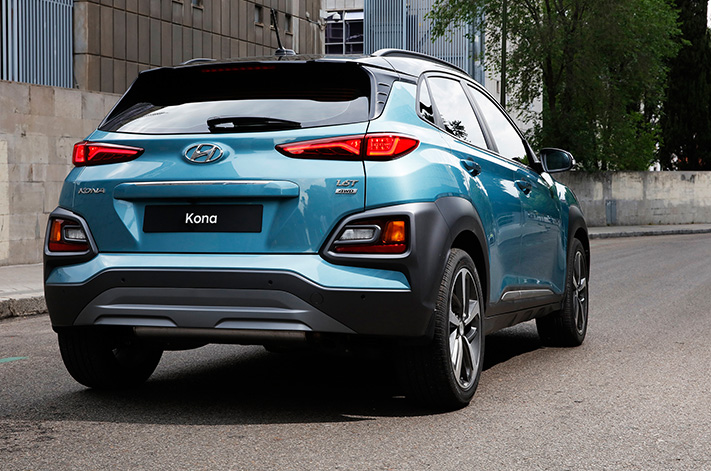
HYUNDAI will introduce a battery-powered version of the Kona in 2018, with an electric-only range of 390km.
The announcement was made following the global reveal of the regular Kona SUV at a media event in Seoul, South Korea, yesterday.
“I’m very excited by that,” said Hyundai Australia chief operating officer Scott Grant. “Would we put our hand up for it? Absolutely,” he said.
“It proves that the company has the ability to develop the latest technology, which gives great confidence about where we’re positioned.
The Ioniq range [Hyundai’s hybrid, plug-in hybrid and fully electric hatchback] is a here-and-now version of that, so to expand into Kona and then potentially other products over time seems to makes sense.”
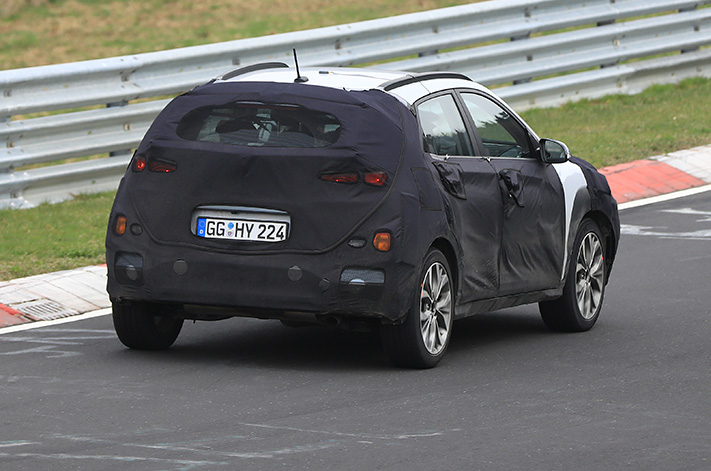
The electric Kona and hydrogen SUV will be two of 31 new Hyundai SUV variants promised by 2020, including a smaller, A-segment SUV to sit below Kona.
Local acceptance of alternative drivetrains in Australia remains extremely low, though Grant said he believed that was about to change.
“I think the Australian market is going to move that way. If you talk about EV in Kona, you’re talking about a conventional application of some of the latest technologies.
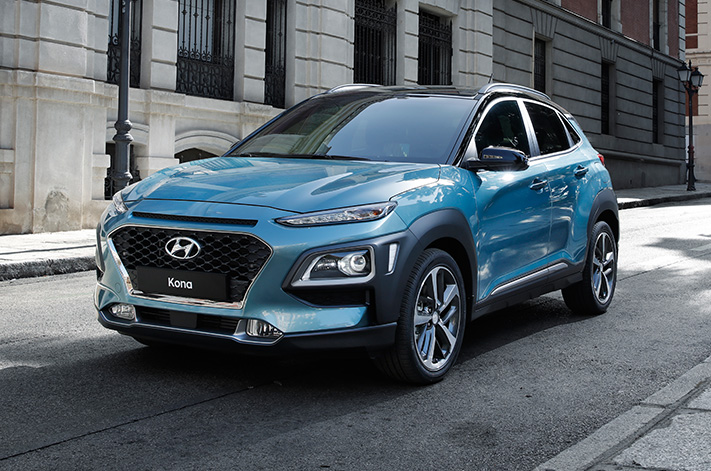
“We’re ready to go when the market reaches that tipping point. There’s an opportunity and we’re in the game, that’s the important thing.”
Going green is still an expensive proposition in Australia, with eco-friendly vehicles attracting more expensive price tags relative to their petrol and diesel counterparts – an exception being BMW’s recently launched plug-in 5 Series that’s priced the same as its petrol equivalent. A lack of incentives is often cited by car companies in Australia as a key barrier to the sales success of green cars.
“I would like to see governments a bit more aligned and maybe a little more policy certainty around infrastructure,” Grant said. “We’re doing our part with the product development I think it’s fair to say, and government needs to think about how it can support it.”
THE LIGHT car segment used to be the bargain basement class.
Buying into the category won you a daily driver replete with hard plastics, rudimentary technology and billy-cart handling primarily pitched at value-seeking younger people who supposedly didn’t care too much about driveability – despite the fact they were drivers like everyone else.
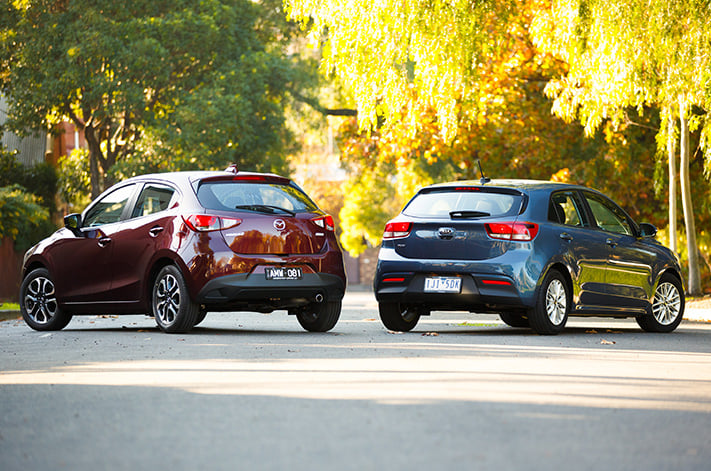
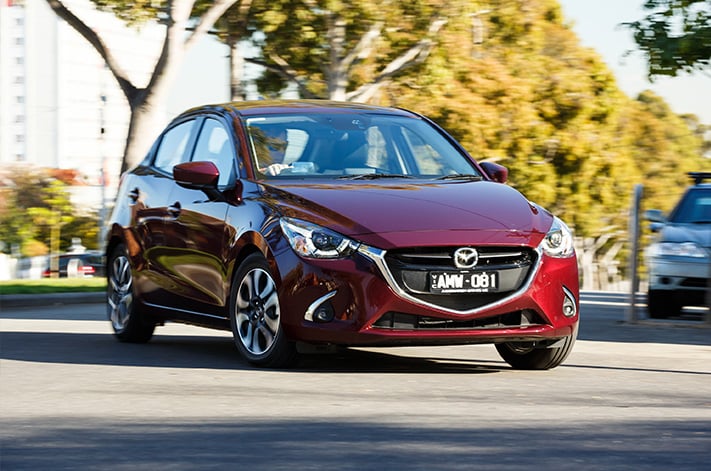
Mazda was one of the first to provide this, with the current generation Mazda 2 that has steadily improved with a series of evolutionary upgrades since first launching in 2014. So content is Mazda with its baby hatch/sedan that a recent ‘facelift’ offered little by way of aesthetic and performance changes, and instead concentrated on new technology such torque vectoring and automatic emergency braking.
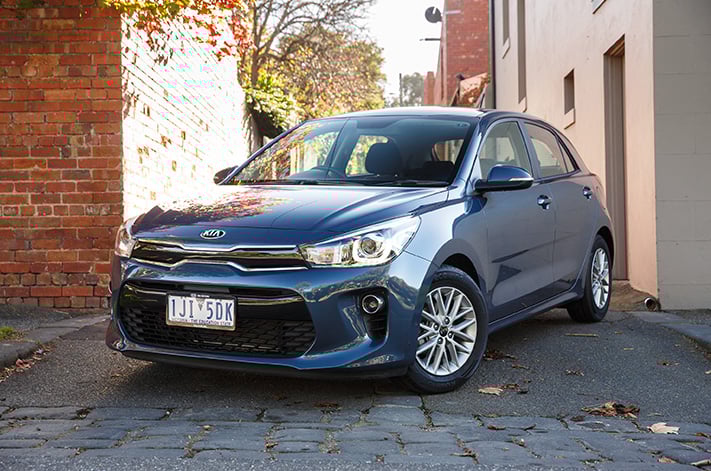
But how does it stack up against the Mazda 2, which has done enough to be held up as its class benchmark?
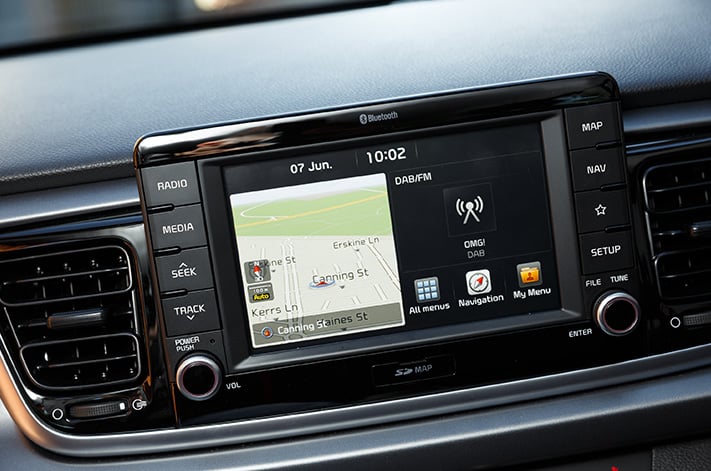
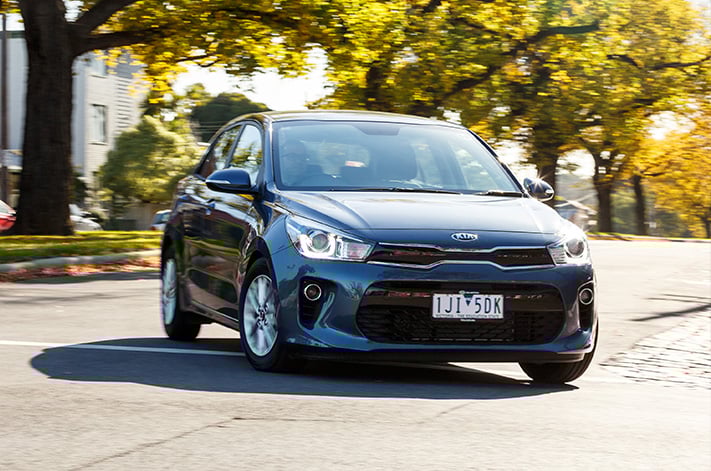
For this head-to-head we chose the mid-level, and arguably best value Kia Rio variant, the 1.4-litre Si, which retails at $21,490 and comes with additional equipment over the entry-level Rio S including cruise control, satellite navigation, digital radio, LED daytime running lights and 15-inch alloy wheels.
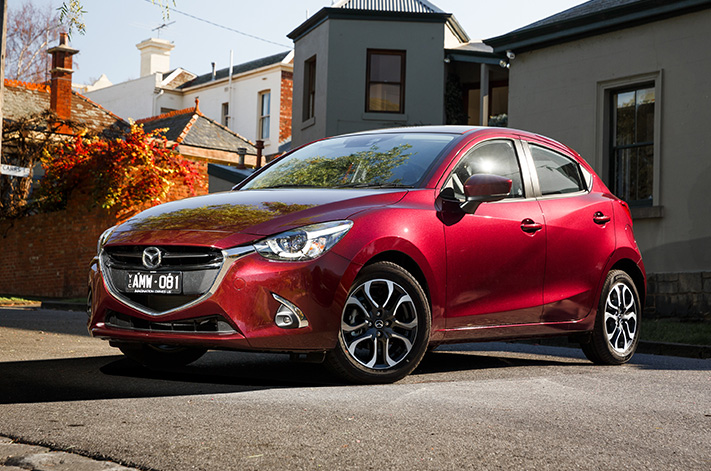
The similarly priced 2017 Mazda 2 Genki hatch, starting from $22,690 with six-speed auto, is $1200 more than the Kia. However, it’s a fair comparison spec-wise when you consider the Genki with a six-speed manual retails at $20,690.
First released in 2014, the fourth-generation Mazda 2’s look has more in common with the previous-generation Rio with rounded lines and short rear overhang. The new Rio, on the other hand, has adopted more conservative straight lines to broaden its appeal.
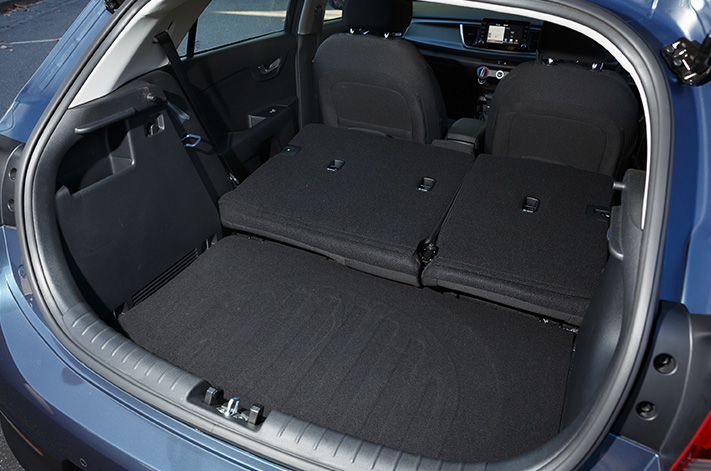
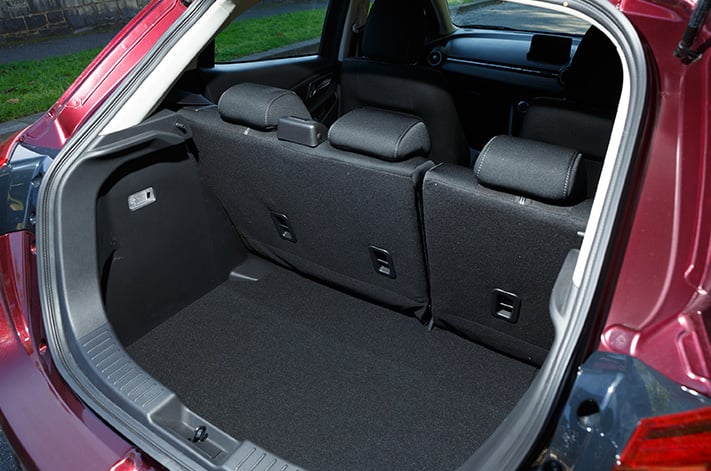
Both are attractive in their own way, but the Rio’s design gives it a more practical edge including a substantial 325-litre boot space compared to the Mazda hatch’s 250-litres – the Japanese sedan has a gaping 440-litre boot though that shape isn’t available in this Genki spec.
The Rio’s 2580mm wheelbase is 10mm longer than the Mazda’s as evident by slightly extra legroom despite a deeper rear seat that provides better lower back and under-thigh support. This and the 30mm extra width [1725mm compared to 1695mm] helps accommodate more cabin storage than the Mazda including a centre console bin with padded lid/armrest, cupholders and tray for phone and keys in front of the gear stick, and bins and cupholders in all four doors.
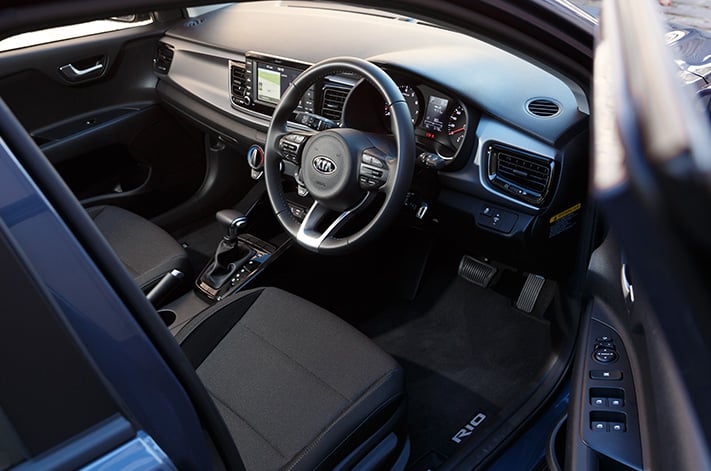
Each car has comfortable front seats that allow for a low driving position, through the Mazda’s have slightly better lateral support.
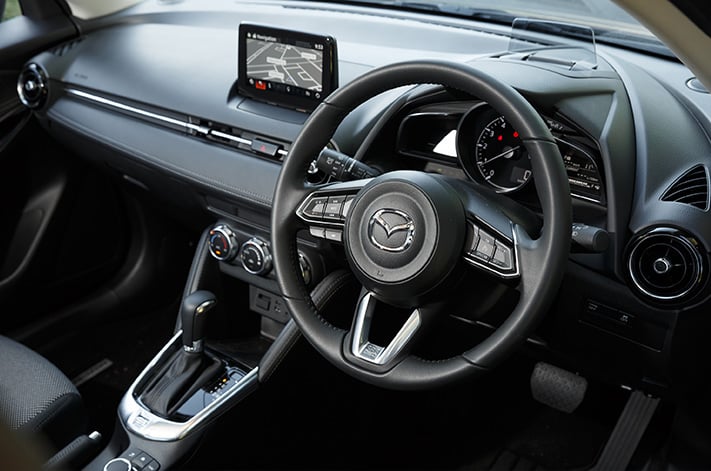
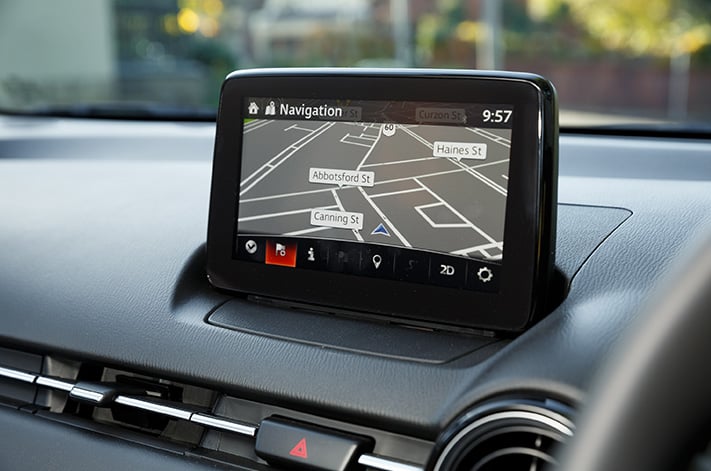
The Mazda 2’s interior echoes the rest of the Mazda range in terms of materials and layout including the floating infotainment screen with rotary controller on the centre console. Infotainment functions are intuitive, though Mazda is yet to embrace Apple Carplay or Android Auto.
Where the Rio maintains the status quo from the previous generation is performance, with the 1.4-litre engine/four-speed auto powertrain carried over.
One way around this was to use the manual mode, which provides a nod to driving enthusiasts with a forward downshift/backward upshift movement and quick engine response.
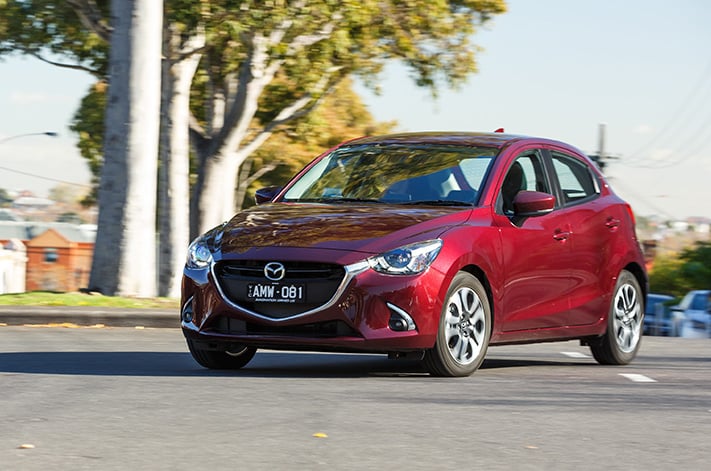
Fuel economy on test, around Melbourne’s north-west suburbs and out to the Western Plains saw both maintain a fuel economy rating of 7.2 litres. To be fair to the Mazda, a lot of this was in high-revving sport or manual mode and probably would have been higher if not for the “i-Stop” idle-stop function, which you barely notice.
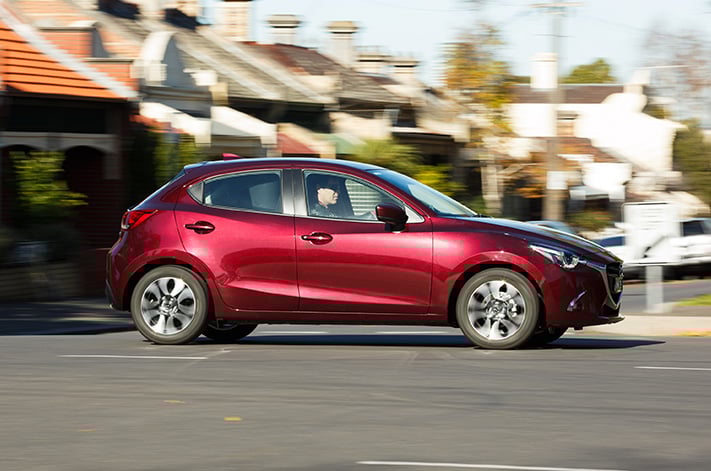
The Mazda’s ride can be a little stiff on rougher roads, partly due to its 16-inch alloy wheels, but the dampers absorb bumps well with little bounce back. Vibration and road noise is far less an issue than it was with previous versions.
Steering also feels nicely weighted though there’s a little bit of play when driving in a straight line, necessitating minute corrections to stay in control.
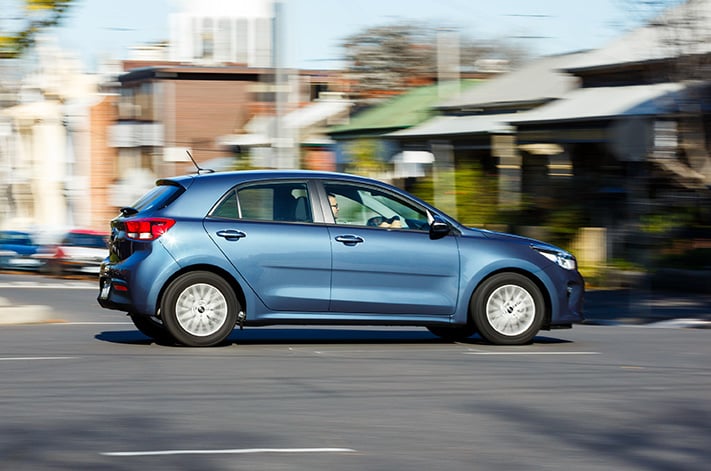
The Rio is a good car, but the Korean car maker is still an aspiring brand and has worked hard to make this a more sophisticated and capable car with well executed design changes. But it also took the easy route to attract people to showrooms by upping its size and spruiking practicality and few new bells and whistles without doing the hard work, such as improving performance and active safety.
Mazda has achieved this without compromising affordability, and putting the two side by side the $1200 premium on the Japanese car is something of a bargain.
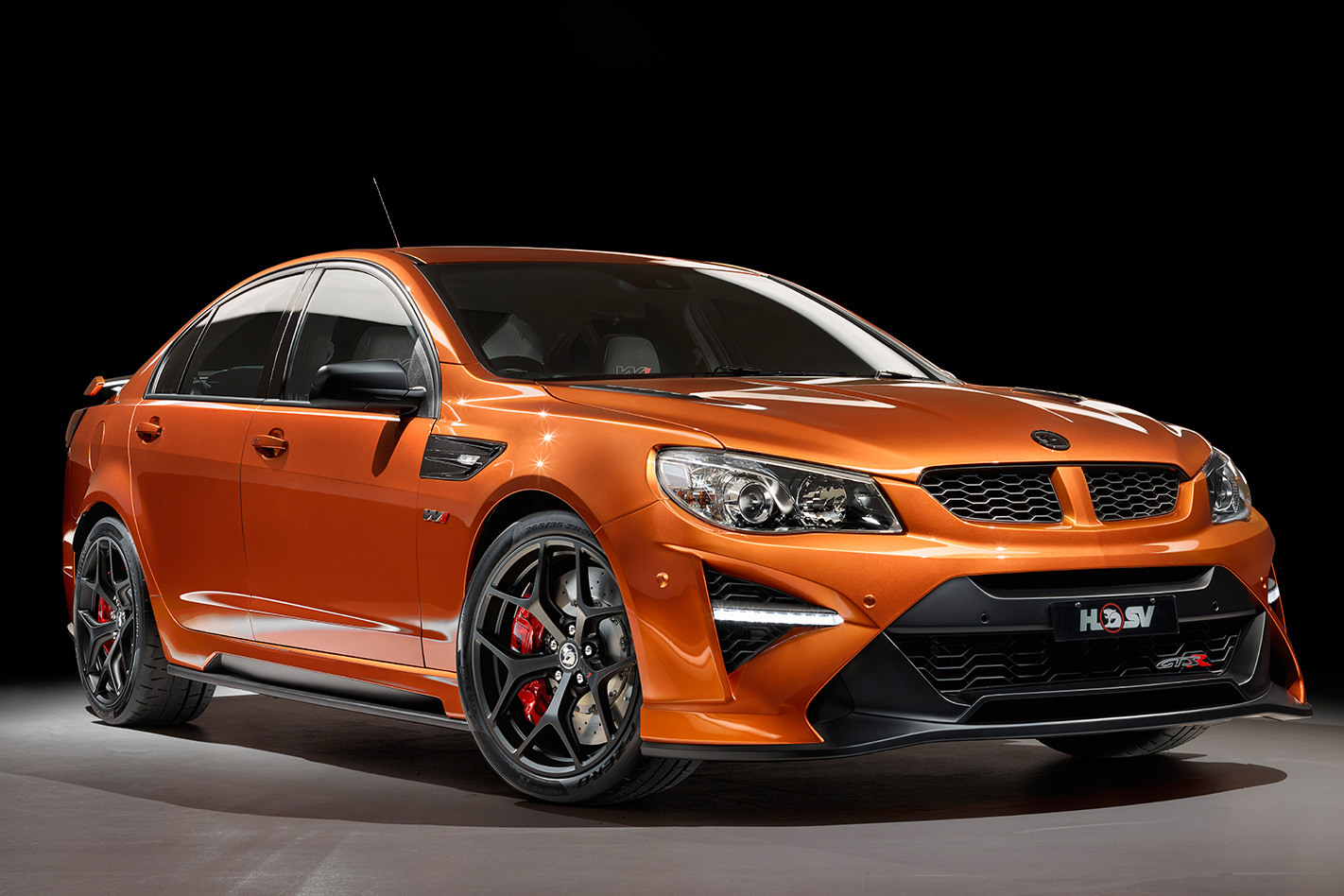
Oil starvation sucks. Poor pick-up is bad news for critical engine components, such as bearings, which desperately need lots of the black gold to reduce friction and dissipate heat to avoid going kaput.
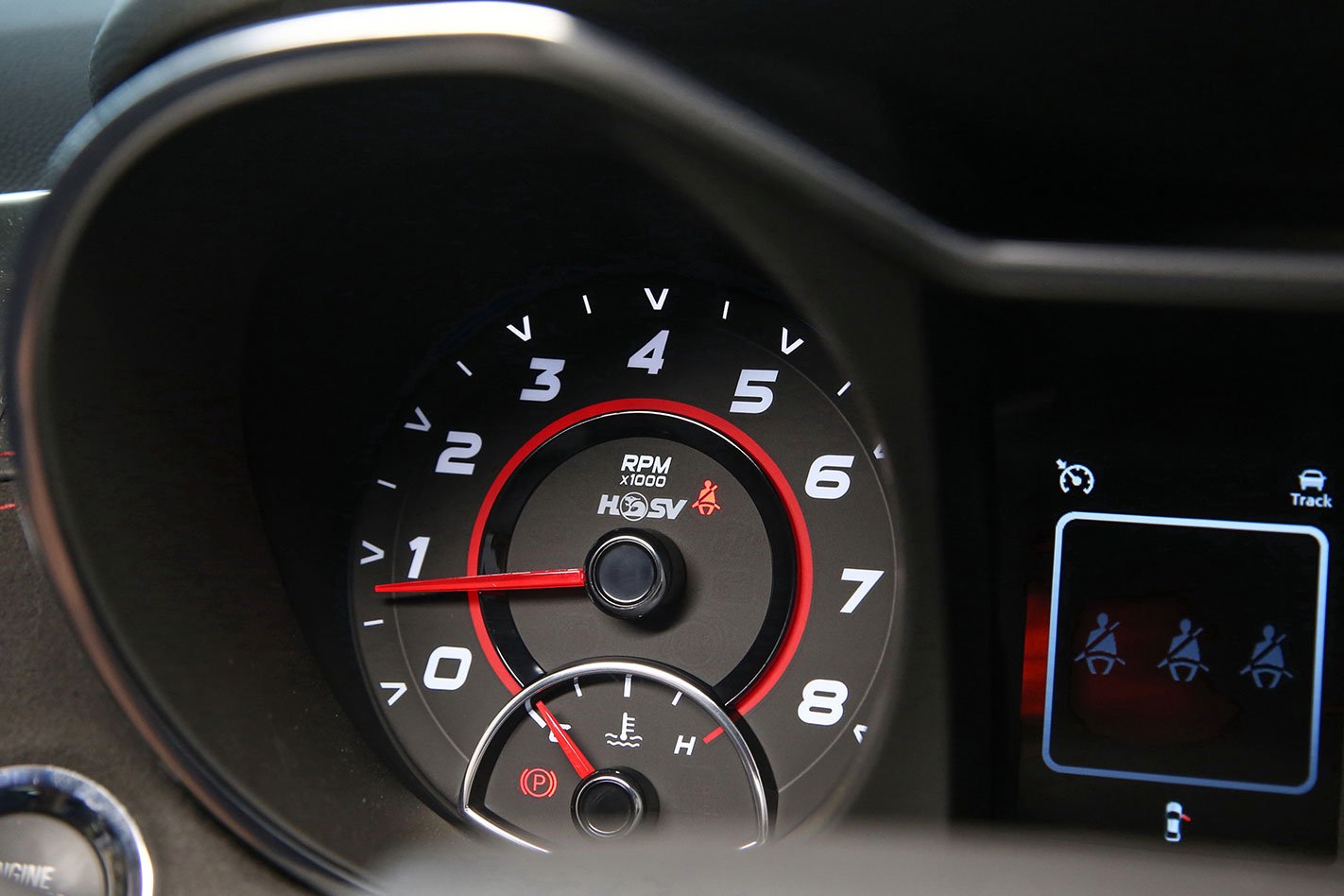
It’s why a dry-sump engine has for decades been employed by some of world’s fastest, nimblest vehicles – ranging from a World War II Spitfire to Formula 1 cars, supercars … and HSV’s new W1 muscle car.
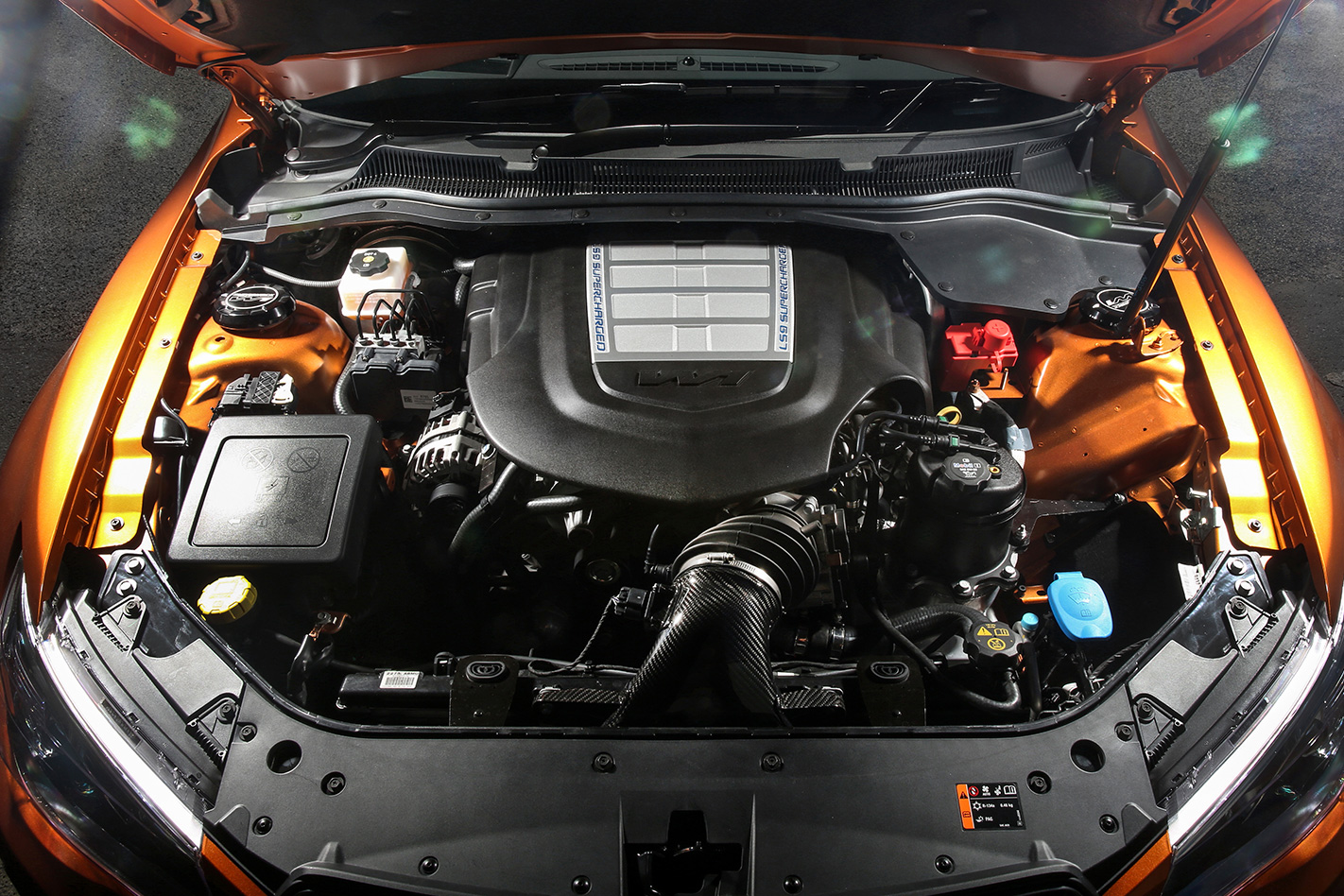
The W1 follows the HSV W427 in borrowing such an advanced lubrication system from Chevrolet’s fastest Corvette – ZR1 this time, after Z06 – to aid dynamic driving.
To avoid this, dry sumps employ a separate oil tank and multiple pumps in a multi-stage lubrication process.
The deeper tank’s ability to store greater quantities of oil is also handy for high-performance cars. It helps the oil perform better for longer – essential when oil degrades more quickly the under higher an engine revloads.
Benefits don’t stop there. A shallower oil pan – not completely dry, of course – allows lower displacement positioning of the engine for improved centre of gravity, while it’s possible for some extra power to be liberated by lowered crankcase pressure, thanks to the combination of the lower oil level and scavenger pumps helping to remove air.
That includes the original 911, though its sump was more of a wet/dry hybrid – especially compared to today’s GT3 variant, which features no less than seven scavenger pumps to aggressively feed oil back to its separate reservoir. (The W1 features just one.)
Mercedes-AMG’s GT also employs a dry sump, linking it to the 300SL Gullwing – fortunately without being quite as problematic. The huge oil capacity of Benz’s 1950s race-car-turned-road-car was so effective at cooling the engine that you had to drive it like you stole it to ensure proper combustion and unfouled spark plugs.
There are several reasons dry sumps aren’t ubiquitous in the industry. The additional components and plumbing adds complexity, increases the weight of the engine, and costs a few hundred dollars more than a wet system.
The Germans have (in no particular order) AMG, M and Audi Sport. The Japanese have Nismo and Ralliart.
Over in South Korea, the letter N is shaping up and here in Australia for the last 30 years, we’ve had HSV. Holden Special Vehicles has been the dominant in-house performance brand in this country for those three decades and while Ford has tried Tickford, FPV and now Tickford again, it has never achieved the same cut-through, nor anything like the loyalty that the HSV brand has managed to engender.
Like many good yarns, the HSV story starts with a train-wreck. When Peter Brock pulled the United Nations flag off his Holden VL Director in February 1987, the world of Aussie performance changed forever. Within hours, Holden had torn up Brock’s contract and it seemed like nobody was playing nice.
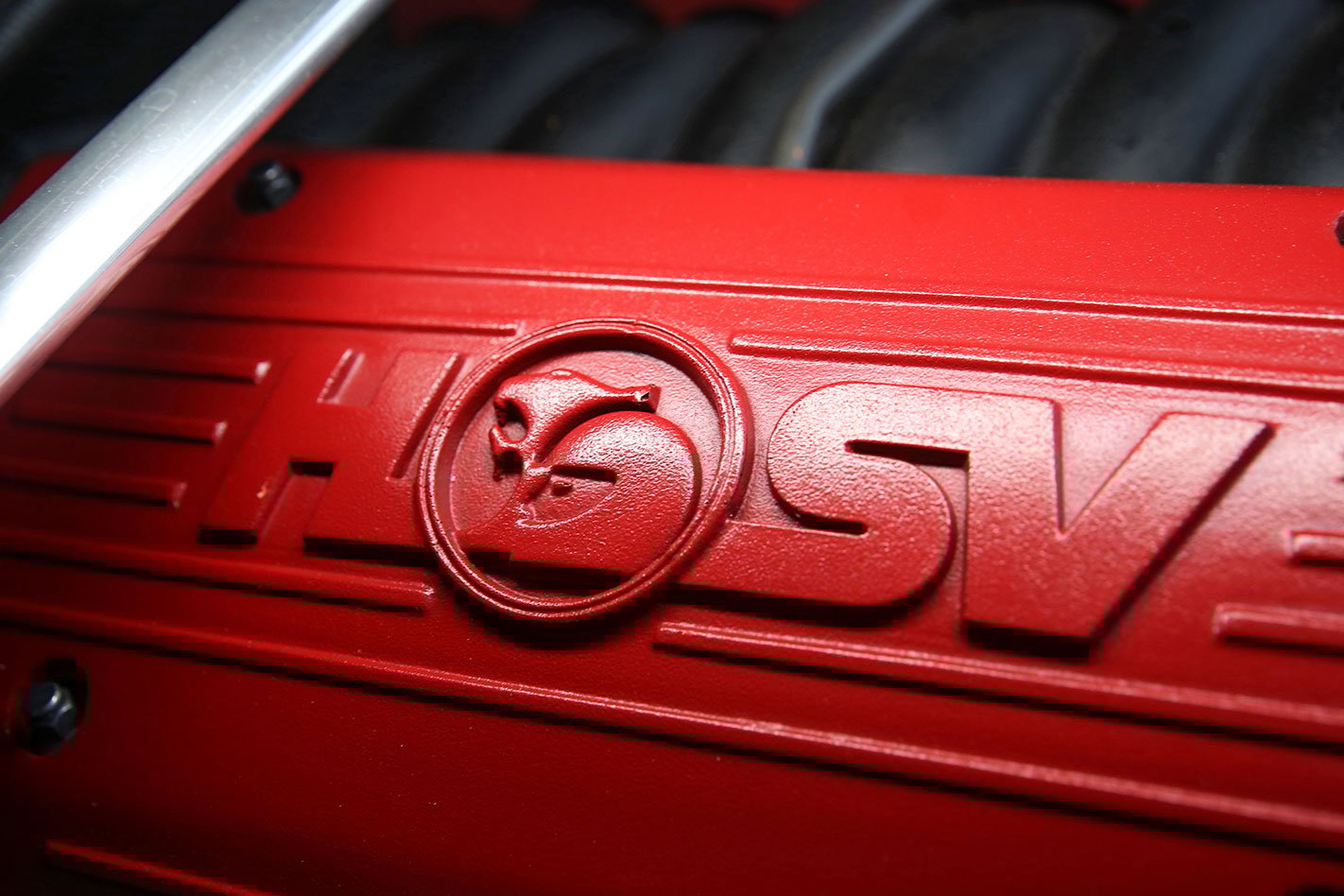
In the longer term, of course, the demise of the Brock HDT car-building empire gave Holden a headache. But it also proved to be a giant opportunity. The brain-pain was all about missing out on the profits from a premium product line. The opportunity was the chance to have a crack at it from a new angle. Teaming up with Tom Walkinshaw’s TWR Group, Holden established HSV in 1987.
The aim was simple: Produce a range of high-end Holden-based road cars. And, as you lot know only too well, that’s pretty much what happened.
Tom Walkinshaw’s presence was very much a back-room one while HSV’s front men in the early days were the towering John Crennan (who had moved across from the role of marketing manager at Holden) and Bathurst-winning nice-guy John Harvey who, emotionally challenged by the Brock implosion, found fronting HSV to be a true tonic.
In 1987, the fledgling outfit moved into a brand-new glass and chrome facility on Ferntree Gully Road in Melbourne’s Notting Hill, but within a handful of years had outgrown that and moved into a large corner of the old Nissan plant (which had been then-recently redeveloped by Lindsay Fox) just a few streets away in Clayton. Within three years, the operation had built its five-thousandth car.
Dunstan has since moved on to consultancy work (among other things) but his DNA is all over those early cars. (Lord, that sounds wrong.)
Big Brad was replaced by the almost-as-physically-imposing John Clarke who was probably one of the most enthusiastic car-guys I’ve ever met. A big, toothy grin and a mind like a steel-trap, Clarkie (as he is known to all) lived and breathed HSV cars while he was in the chair and often told me things he probably shouldn’t have.
Not too surprisingly, he found that working out where the sink goes in a four-berth pop-top couldn’t compete with building supercharged V8 road cars, and he soon found his way back to Clayton and his old desk.
Over the years, HSV methodically worked its way through each generation of Commodore and Statesman, adapting each to the wants and needs of its customers. But equally, thanks to its relatively small size (by car-making standards) and the flexibility that comes with that, it was also able to actually come up with stuff that Holden never could have. Things like the stroked Holden V8 and later supercharged versions of the LS3, all exist because HSV made them happen.
Holden VF II Commodore debuts LS3 V8
So much for the past. And while HSV is keeping its cards close to its corporate chest when it comes to what it will be offering in a post-rear-drive-Commodore world, the powers that be are adamant the brand isn’t going anywhere. There are suggestions that the Colorado ute might be in for the HSV treatment and SUVs haven’t been ruled out.
In fact, a general broadening of the HSV church seems like a good bet. Maybe HSV can hit a few winners and plonk itself into another purple patch. Or maybe the golden years have passed.
Read more
