
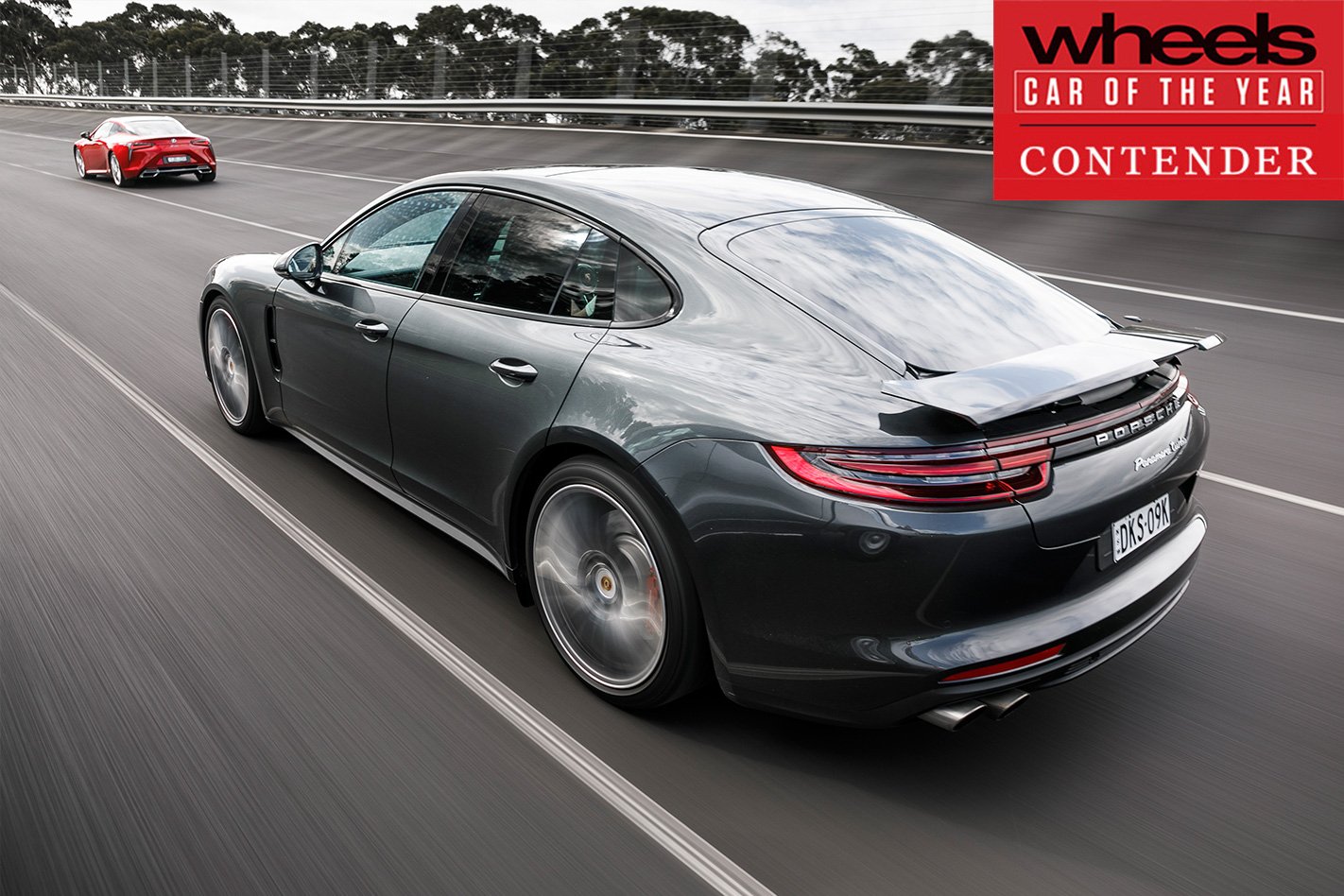
PART limousine, part sports car infused with a dusting of Porsche 911. Nothing has changed with the premise of the Porsche Panamera.
But Panamera 2.0 is vastly improved, from the new-generation V6 powerplants to the lighter, more agile platform, all of which ensured it started strongly when measured against COTY criteria.
Ticking the function box is a wheelbase that’s stretched 30mm, in turn bringing more room for leg-stretching. Combined with luscious bucket seats, it makes for a rock-star travel experience.
Judges were also impressed with the efforts inside to blend tech with tradition. Displays and touchscreens replace most controls and instruments, with the exception of the analogue tacho. Even those in the rear get a 7.0-inch touchscreen. The vast touchpad incorporating major controls around the gear selector looks clean and benefits from haptic feedback, which reinforces when a button has been pressed.
But engineers have pushed the technology injection a step too far with the central air vents, which need to be adjusted via a fiddly sub-menu within that main central 12.3-inch touchscreen.
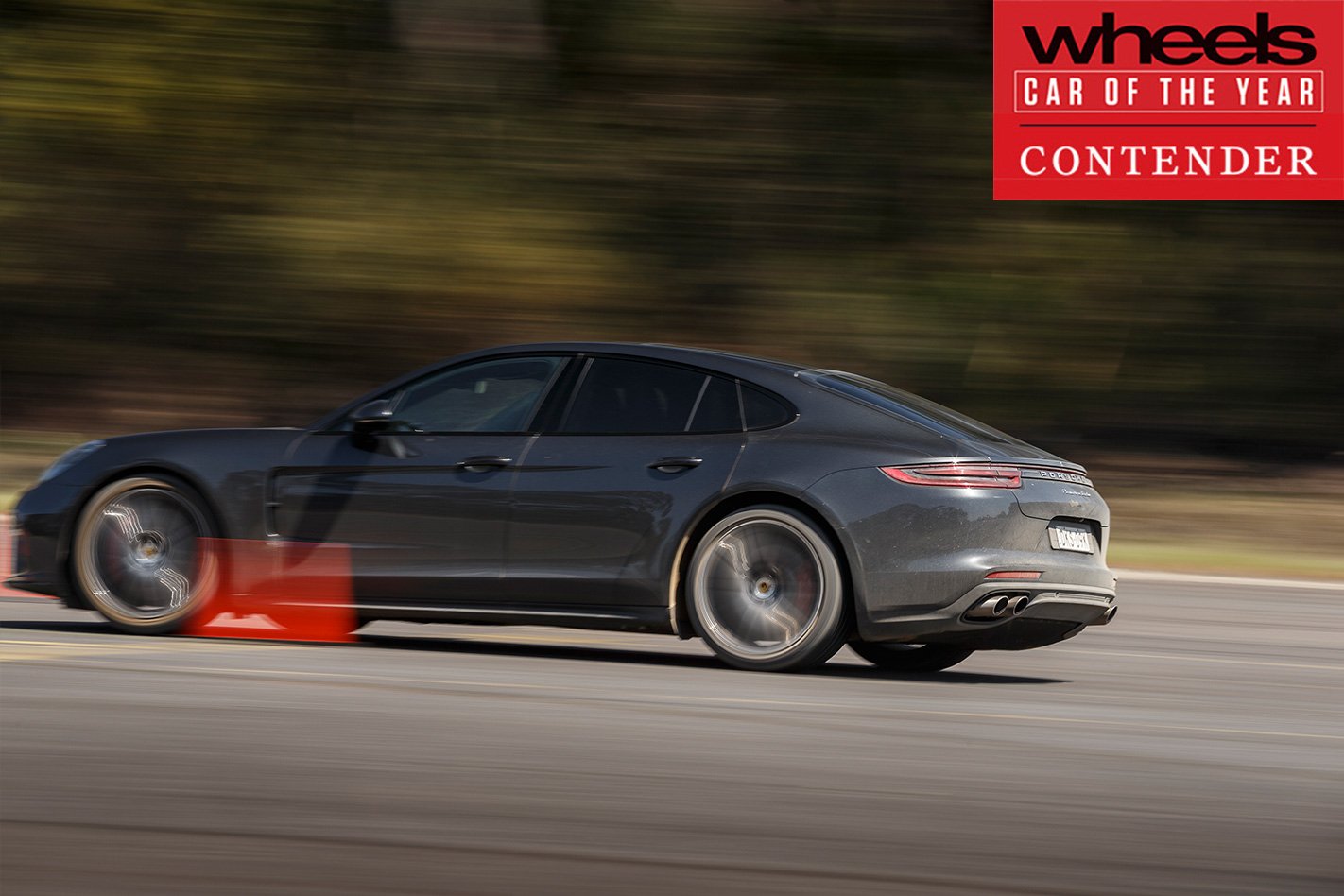
That the Panamera does all of that with a ride approaching the suppleness of an S-Class or Audi A8 is testament to the efforts that have gone into the new three-chamber air-suspension set-up. While things stiffen up in Sport+, the Comfort setting is genuinely cosseting, underscoring the Porsche’s cross-continental GT credentials.
Enormous (and effective) brakes complete the potent dynamic package.
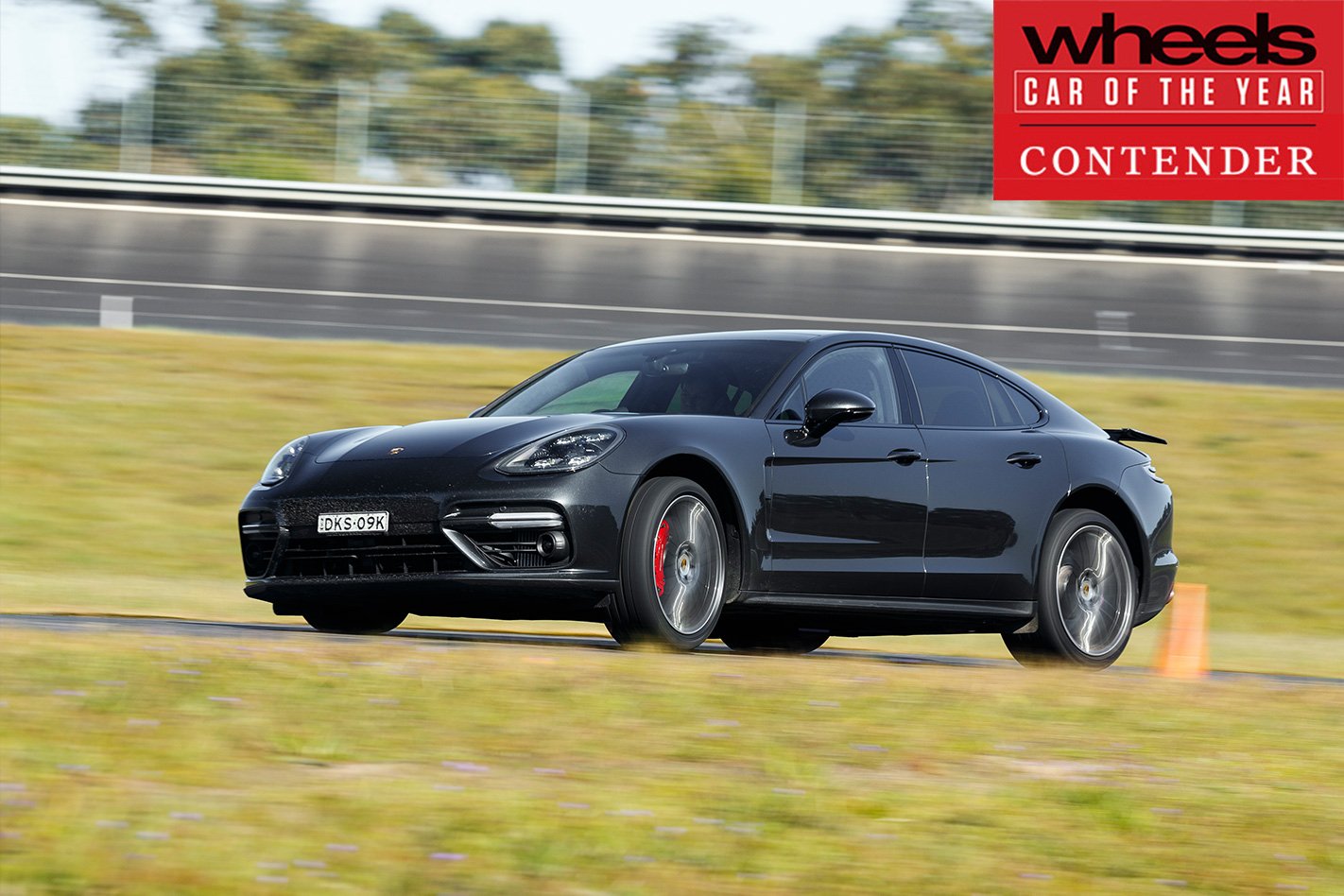
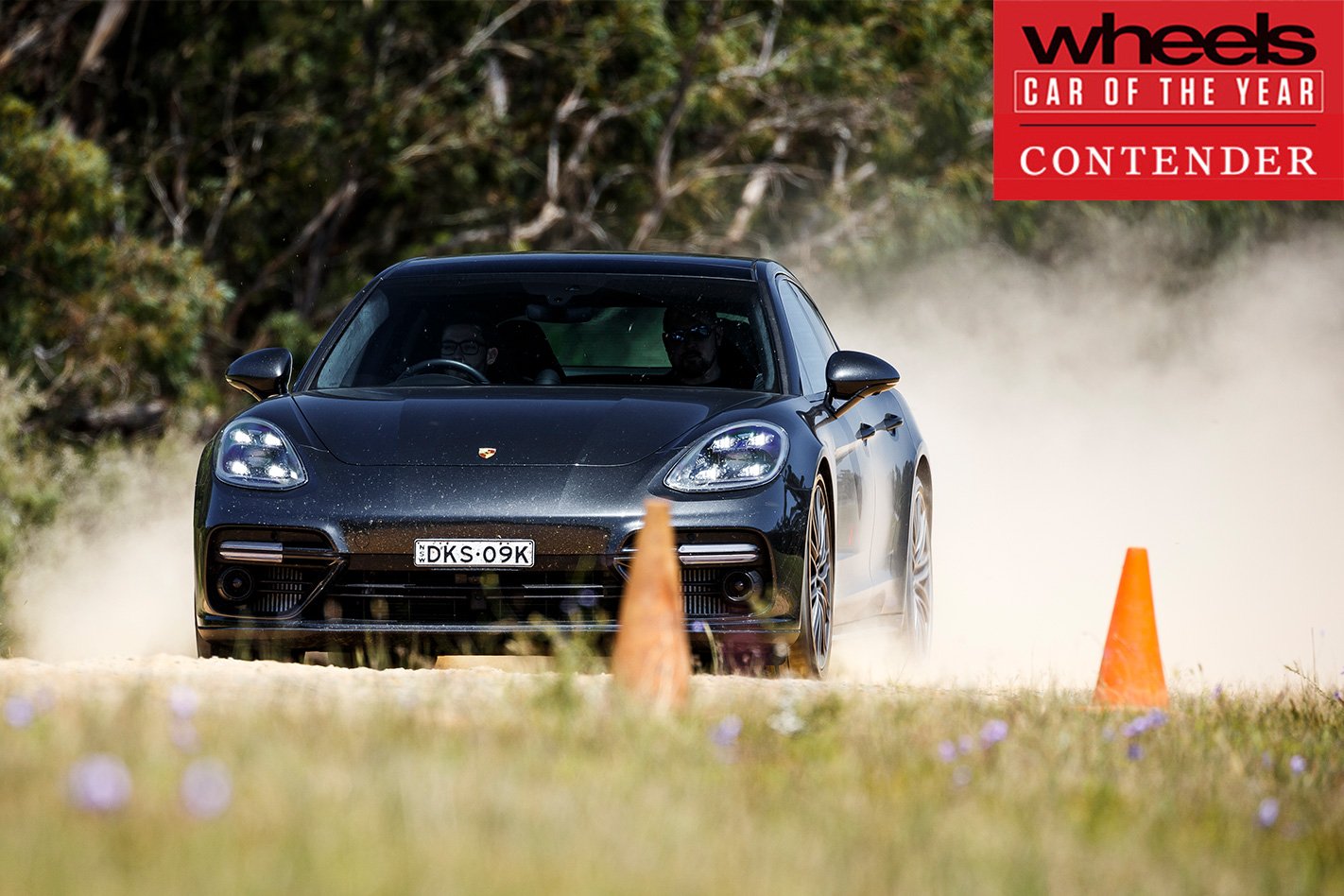
But there are compromises. The 404kW Turbo we tested is a mighty device, able to annihilate blacktop with supreme ease. It teams beautifully with an eight-speed dual-clutch ’box for blistering take-offs, while the turbo goodness is maintained across a broad, free-revving range. But the V6 E-Hybrid is less convincing, adding weight and losing aural and accelerative drama. The V8 hybrid Turbo S didn’t make it here in time for testing.
Predictably, it’s value that stopped Panamera’s COTY charge as effectively as its carbon ceramic stoppers. The split personality comes at a $214,800-plus price – or $460K for the Turbo S E-Hybrid.
Assault via the battery
Hybrid variants are usually the economy-focused alternative from most car manufactures, but Porsche does things differently.
The German manufacturer first showcased its ‘hybrid high-performance’ credentials with the 918 supercar; now it says that each of its model lines will eventually be crowned with a range-topping petrol-electric variant, including the seminal 911.
Just look for the lime-green brake calipers.
What stands out?
The third=generation BMW X3 is a sporty medium SUV with enthusiastic, fuel-efficient diesel and petrol engines, a slick eight-speed automatic gearbox, and all-wheel drive. Its five-seat cabin offers generous passenger and cargo space, and its attractive exterior was penned by Aussie-born automotive designer Calvin Luk.
What might bug me?
Hanging on to stop you sliding sideways when negotiating sharp bends. The X3’s seats are quite flat with not enough leg bolstering to keep you in place.Having the ambience shattered by wind noise around the large door mirrors. And if you have a panoramic roof you won’t want to open it because of the irritating wind buffering even at lower speeds.
What body styles are there?
Five-door, five-seat SUV-style wagon only. The BMW X3 drives all four wheels, and it is classed as a medium SUV, higher priced.
What features do all BMW X3s have?
Cruise control with speed limiter, and three-zone climate-control, which lets you set different temperatures for each side of the cabin.Infotainment screen, digital radio (DAB+), inbuilt satellite navigation, voice control, six-speaker sound system, and wireless charging pad for compatible mobile phones.BMW ConnectedDrive, with real-time traffic information and Intelligent Emergency Call, which alerts emergency services if you have an accident. Automatic emergency braking, approach control warning (which warns of a pending collision), lane departure warning, and blind-spot warningReversing camera and Parking Assistance, which helps manoeuvre the X3 into a suitable parking spot.Head-up display, which shows speed, satellite navigation and speed-limit information at eye level on the windscreen.Dusk-sensing LED headlights with cornering lights, LED daytime running lights, and rain-sensing automatic windscreen wipersAuto start-stop, which stops the engine while you’re idling to save fuel.Leather multi-function sports steering wheel, and aluminium alloy wheels.Automatic tailgate, and 40:20:40 second-row split rear seats for flexible cargo configurations.The X3 also has seven airbags, and electronic stability control, which can help you control a skidding car. All new cars must have this featureEvery BMW X3 carries a three-year, unlimited kilometre warranty.
Which engine uses least fuel, and why wouldn’t I choose it?
There are currently three engines in the X3 range: two turbocharged diesels and turbocharged petrol. As is common BMW practice, each X3 model is named for the engine that propels it.Both diesels use less fuel than the petrol, and it is the 2.0-litre four-cylinder in the xDrive20d that uses least of all, consuming 5.7 litres/100km on the official test (city and country combined).The main reason you might not choose this effortless diesel is that you would like your X3 to be genuinely quick rather than moderately powerful. The bigger, 3.0-litre, six-cylinder diesel in the more expensive xDrive30d transforms the X3, with about 40 per cent more shove available. Yet is still very economical, using 6.0 litres/100km on the official test.Of the petrol engines, the 2.0-litre four-cylinder in the xDrive30i offers similar performance to the 3.0 diesel, and delivers it more smoothly, while using about 25 percent more fuel (7.6 litres/100km).Another petrol engine will soon join the range in the sDrive20i, which will be the least costly X3 when it arrives early in 2018. It shares its 2.0 litres and four cylinders with the 30i’s engine but it less powerful. It will also be the only X3 with front-wheel-drive, unlike the other models which have all-wheel-drive.At the other end of the scale will be the performance orientated X3 M40i, which will have a powerful 3.0-litre inline six-cylinder turbo engine, which will be capable of sprinting from a standing start to 100km.h in under 5.0 seconds. Fuel economy is yet to be confirmed, but it’s fair to say this won’t be a huge priority for anyone willing to pay more than $100,000 for a fast SUV.Each X3 engine is coupled with an eight-speed conventional (torque converter) automatic gearbox, and features automatic stop-start system, which saves fuel in urban driving. It shuts down the engine when you stop, and starts it again when you take your foot off the brake pedal to drive away.
What key features do I get if I spend more?
The cheapest X3, the sDrive20i (which arrives in March 2018) comes with front-wheel-drive and 2.0-litre petrol engine and has the features common to all X3s. Seats are trimmed in a synthetic material BMW calls Sensatec, and the multimedia system has a 6.5-inch touchscreen display. The wheel diameter is 19 inches.The xDrive 20d is identical to the sDrive20i in terms of features and trim, but adds a gutsier diesel powertrain and ‘xDrive’ all-wheel-drive .Spending more for an xDrive30i or 30d gets you the more powerful petrol or diesel engine, with paddle shifters on the steering wheel for when you want to control gear changes.The interior gains ‘Vernasca’ leather trim on the seats. The multimedia screen is bigger, at 10.25 inches and displays a surround-view monitor, showing a simulated 360 degree view of the car from above (this makes manoeuvres in confined spaces easier). And there is better satellite navigation and you get 20GB hard drive memory to store audio files.Wheels on the more expensive cars are an inch bigger at 20 inches, with lower profile tyres that sharpen the steering a bit.You can enter the X3 xDrive30i and xDrive30d without having to take your keys out of your pocket or handbag. And the tailgate operates hands free by waving your foot under the rear bumper, which is handy when you have your hands full with stuff like shopping bags.Driver assistance is expanded to include adaptive cruise control with a ‘Stop&Go’ function for heavy traffic, lane keeping assist and side collision warning, which senses if a car is coming from either direction.Optional extrasA large number of convenience, luxury, aesthetic and safety options are available at extra cost on all X3s. They include adaptive suspension (which provides a more comfortable ride), and variable steering (which optimises the steering feel for different driving conditions), and alternative wheel designs. Among other options are heaters for the front and rear seats, a premium sound system, and a large power-operated sunroof.There are also option packages which bring a number of features for less than if you added them separately. These include the M-Sport package which includes the adaptive suspension and a number of internal and external enhancements to give the X3 a more sporty appearance. This adds around $4500 to the 20i and 20d price and about $3800 to the 30i and 30d.
Does any upgrade have a down side?
The 20-inch wheels on the X3 xDrive30i and 30d reduce ride smoothness a bit, compared with the 19-inch wheels and tyres worn by an xDrive20i or 20d. The lower profile tyres on the bigger wheels have less rubber and air cushioning you from the road.Of 11 colours available on a BMW X3, only two – black and white – are non-metallic and come at no extra cost. Other colours cost about $1900 extra.
How comfortable is the BMW X3?
The BMW X3’s interior represents a significant improvement over the previous model, in terms of design, materials and ambience.The cabin quality is excellent even before you start ticking option boxes. Buttons and controls are intuitively placed, easy to use and pleasant to touch thanks to their metallic coating.Only the lower plastics, such as the kickpanels and doorbins, look a bit utilitarian; elsewhere the sense of premium is mostly persuasive.It’s roomier than the previous model too, with a 54mm longer wheelbase which actually makes it bigger than the first-generation BMW X5 large SUV. There’s a heap of elbow room up front and the rear seats offer plentiful legroom and a wide enough bench for three adults.The driving position is good, and the instrument panel is neat and clearly presented as is the head-up display. The iDrive multimedia navigation system operates as your intuition expects. X3 cabin feel takes a step up in xDrive30i and 30d versions, thanks to their leather seat trim and extra equipment that includes a bigger, better multimedia screen.The ride in the X3 is taut to the point of being jarring on all but newly laid roads, especially on the 30i and 30d’s bigger 20-inch tyres. The optional adaptive suspension – BMW calls it Dynamic Damper Control – makes a big difference to comfort in the X3. It takes the edge off sharp bumps, and controls and smooths the vertical motion of the body. Paying extra for it brings your X3 ride quality that approaches that of the best alternative premium SUVs.
What about safety in a BMW X3?
Electronic stability control, a reversing camera, and front and rear parking sensors are solid safety fundamentals in all BMW X3s.BMW’s Driving Assistant is now standard in the X3, and includes a camera-based autonomous emergency braking. If it detects an obstacle in front – typically a sharply slowing car – it will warn you and if necessary will initiate braking automatically. There is also a lane-departure warning, which alerts you if you have begun to drift out of your lane (a sign of fatigue), and lane-change warning (otherwise known as blind spot warning), which alerts you to vehicles alongside in a blind spot, via a light on the exterior mirror and a vibration through the steering wheel.The more expensive package, Driving Assistant Plus, is camera-and-radar based, and it works over a longer range and at highway speeds. To the features of Driving Assistant it adds active cruise control, which will maintain a safe distance to vehicles in front, lane keeping assist and side collision warning.The BMW X3 has seven airbags: two directly in front of the driver and passenger; one on the outer side of each front occupant to protect the upper body; driver’s knee airbag, and two airbags on each side to protect the heads and chests of front and outer-rear occupants.The Australasian New Car Assessment Program (ANCAP) awarded the BMW X3 five stars for safety, its maximum, in November 2017.
I like driving – will I enjoy this car?
The BMW X3’s dynamic focus gives it adroit handling and the engines are eager – and in the 30i and 30d, potent. If you can live with the ride comfort compromise that results from the X3’s fixation on sportiness, you’ll enjoy driving it.The happy, effective and economical pairing of each engine and the eight-speed automatic gearbox makes the BMW smooth, agreeable and easy to drive in the city, and effervescent on country roads, where gearchanges are swift.The 30i and 30d have muscle, which is terrific for sporty driving and for effortless overtaking and hill climbing, but the steering feels a little remote.In contrast the least costly X3, the 20i, (due in March 2018) will have enough accessible grunt for easy urban and highway driving, and the power reserves to keep up with most traffic when asked to climb hills. Unlike the other three models it is front-wheel-drive only.The 20d sits in between, offering some of the 30i and 30d’s effortless feel, but not their ultimate oomph, or the high-speed enthusiasm of the 30i.The BMW X3 is an above average off-roader among compact SUVs, with effective all-wheel-drive and a hill-descent control system standard in the 20d, 30i and 30d. Nevertheless, this breed of high-riding wagon won’t get you much further down the beaten track than an all-wheel-drive passenger car.Keen drivers might want to wait until later in 2018, when the BMW M40i arrives, with a 3.0-litre turbocharged 265kW/500Nm straight-six petrol engine under the bonnet. It will be capable of reaching 100km/h from a standing start in 4.8-seconds, thanks to its launch control system, making it quicker than its Audi SQ5 and Mercedes-AMG GLC 43 rivals.The M40i’s will also have sportscar-like handling with Adaptive M Suspension, M Sport exhaust system and brakes, an M Sport differential and 21-inch alloy wheels as standard.
How is life in the rear seats?
The X3’s rear compartment offers good leg, head and elbow room and the bench is wide enough to comfortably seat three adults.Rear seat passengers have their own air-conditioning controls and a 12-volt socket to charge their devices.
How is it for carrying stuff?
The X3 is great for carrying stuff. It has a generous loading aperture that leads to a cargo bay that’s bigger than those of most of the alternatives. It can swallow 550 litres of luggage behind the back seats, which is the same as the previous model.A 40:20:40 split-folding backrest gives the X3 excellent flexibility for carrying rear occupants and large or long luggage items. With all three backrest sections folded the X3’s carrying capacity opens up to 1600 litres.Tie-down points on a pair of runners on the cargo floor provide the means to secure luggage.The powered tailgate, which is standard in the 30i and 30d, becomes very useful with the addition of a contactless opening function, which comes with proximity key entry in the optional Comfort Access pack. It lets you open the tailgate by swiping your foot below the rear bumper, which is handy when you’re loading the car with both hands full.The X3 comes with roof rails that make it easy to attach rooftop luggage devices.
Where does BMW make the X3?
The BMW X3 is built in the United States.
What might I miss that similar cars have?
Not much, if you consider all the extra-cost options. This third-generation X3 has considerable improvements over its predecessor to make the choice more difficult between it and its main rivals, the Audi A5 and Mercedes-Benz GLC.Some cars of about this size offer a third row of seats, for carrying up to seven passengers – notably the Land Rover Discovery Sport among premium alternatives.Perhaps a longer warranty: the Lexus NX SUV is covered for four years, and the less-costly Hyundai Tucson and Kia Sportage for five and seven years respectively.Possibly a petrol-electric hybrid powertrain, for better energy-efficiency around town, which you can have in a Lexus NX and Volvo XC60.Among other cars worth considering are the Jaguar F-Pace, Porsche Macan and Range Rover Velar.
I like this car, but I can’t choose which version. Can you help?
The third-generation BMW X3 arrived at the end of 2017, with three models, the xDrive20d, xDrive30i and xDrive30d. No upgrades are planned, however two new models will be arriving to bookend the range.These include, the two-wheel-drive petrol sDrive20I, which will arrive in March and will be the cheapest X3.The M40i, the first ever BMW X3 to wear a sporty BMW M badge and the most powerful X3 yet, will arrive later in the year and will take its place at the top of the range.
When did BMW update the X3?
The third-generation BMW X3 arrived at the end of 2017, with three models, the xDrive20d, xDrive30i and xDrive30d.No upgrades are planned, however two new models will be arriving to bookend the range. These include, the two-wheel-drive petrol sDrive20i, which will arrive in March and will be the cheapest X3.The X3 M40i, the first ever BMW X3 to wear a sporty BMW M badge and the most powerful X3 yet, will arrive later in the year and will take its place at the top of the range.
IT’S BEEN almost seven years since Land Rover last introduced a fresh model line, with 2011’s Range Rover Evoque.
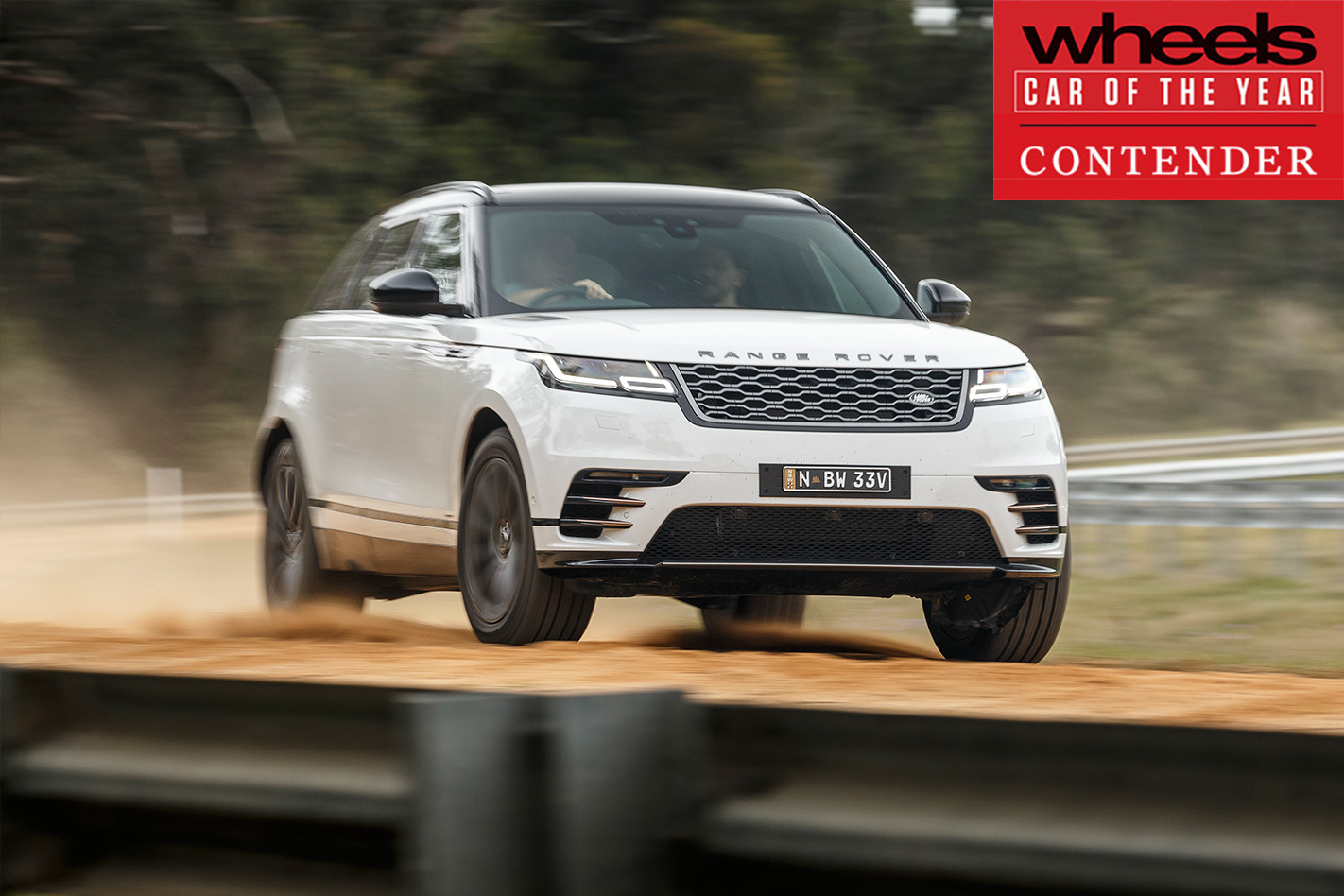
And much like that fashion-forward trendsetter, the arrival of the Range Rover Velar, which sits elegantly above the Evoque and below the iconic Range Rover Sport, ushers in a new era of glamour to the JLR line-up.
The Velar smugly side-eyes the BMW X3, Mercedes-Benz GLC and Jaguar F-Pace (while sitting on the latter’s aluminium-intensive D7A platform, and even sharing its wheelbase) and, wow, does this Brit do it with style.
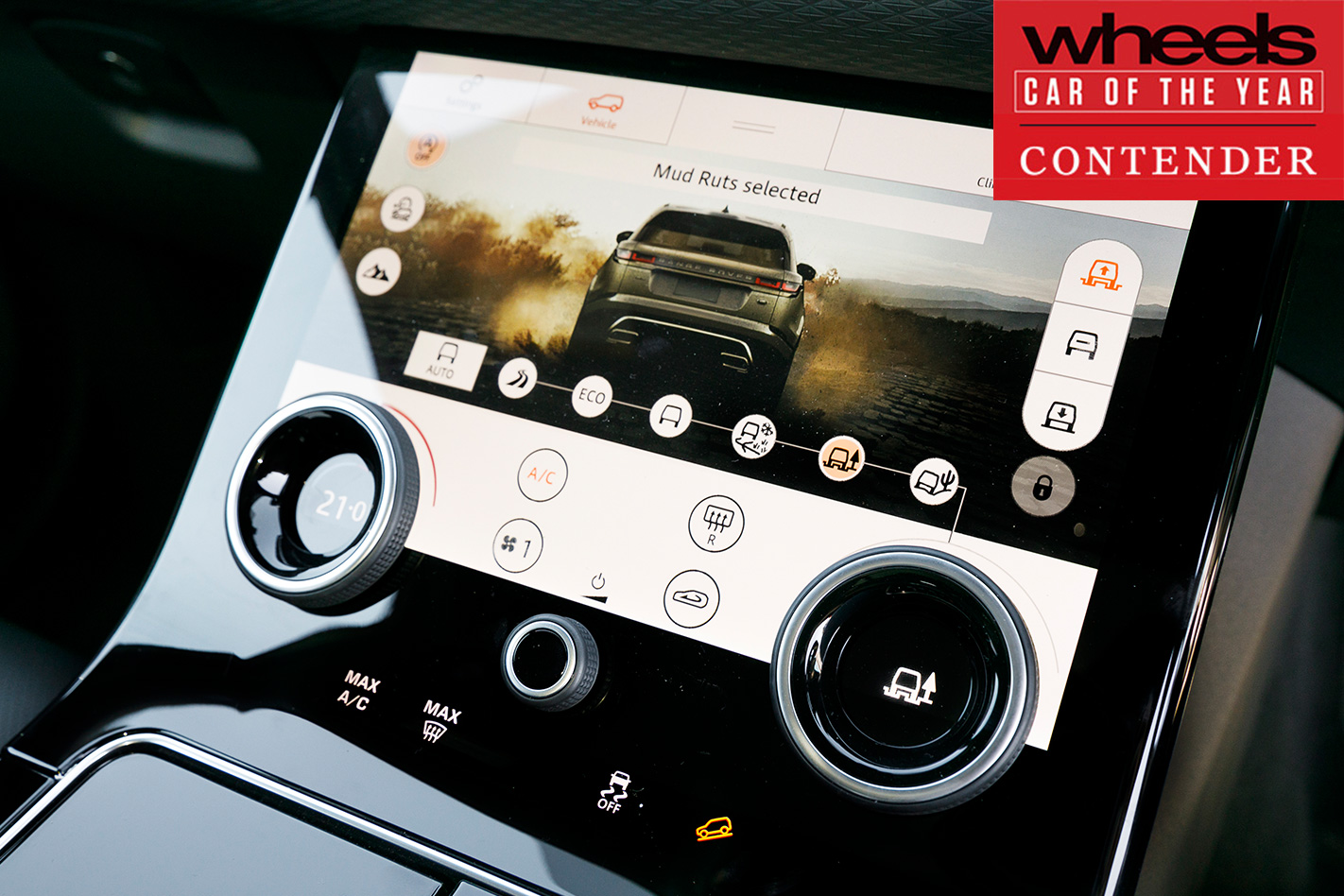
But dig deeper, beneath the interior’s layers of leather and sparkling piano-black, and some dinky plastics await. This isn’t the holistic level of quality detail of a certain winning Swedish SUV.
The Velar’s back seats are roomy, can be flipped to turn it into a capacious cargo-hauler and it boasts the largest boot in its class, yet it hides its size well. But the question kept emerging: is the Velar’s splendour merely skin deep?
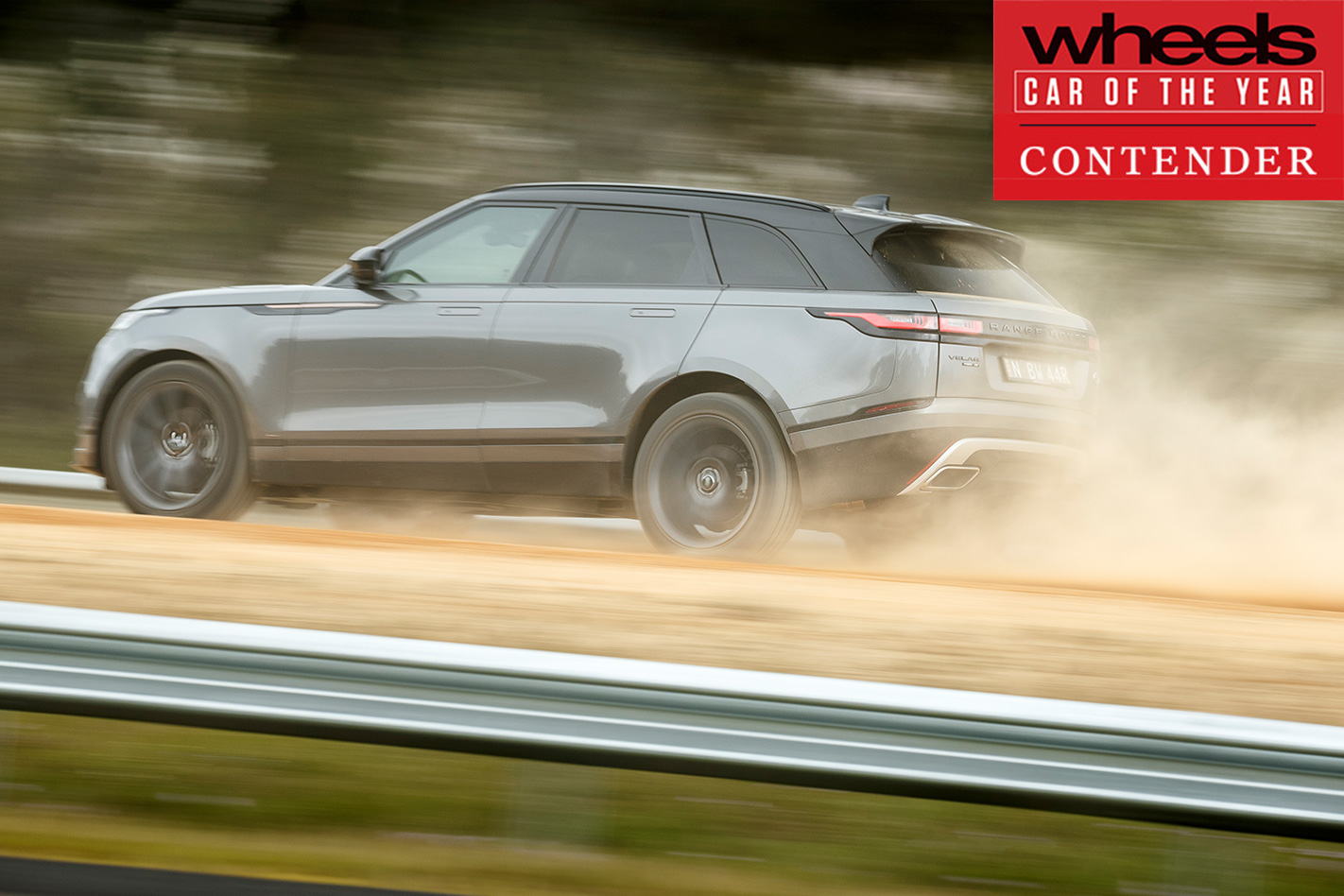
When whipped around the challenging Lang Lang course, the Velar and its intuitive eight-speed automatic soared effortlessly; sailing over the cattle grid with poise, flexing its ability to deliver a well-controlled ride on standard adaptive dampers and air suspension (V6 versions) while performing capably in the emergency braking disciplines. But the Velar’s weight was exposed in the lane-change exercise as it was often unable to make the second turn without clipping cones, removing some sheen.
Starting with a bunch of core variants – base Velar, Velar S, SE and HSE – the line-up then forks into either sports or luxe lines, before expanding again with six drivetrain choices. Confused? Strap in. The base Velar starts at $70,662 and then begins burrowing into your wallet, depending on the options you desire. Ultimately, despite the admirable democracy in offering the blown V6 in entry-level spec, Land Rover’s beauty queen rejected COTY’s fine-toothed value comb – at least in comparison with Volvo’s rival XC60.
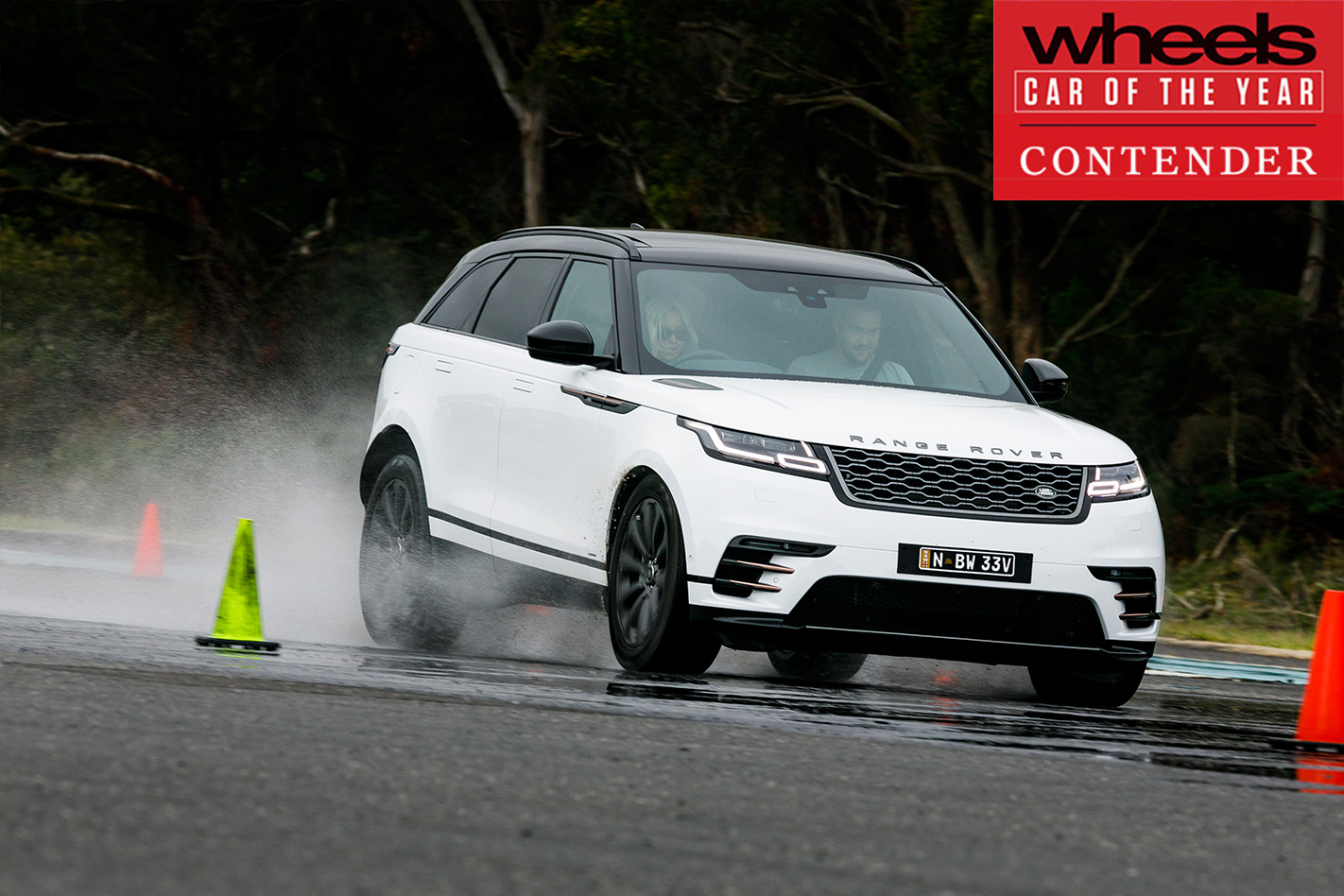
The showroom X-factor of the Velar is out of this world, as is the power-boat driver appeal of both the supercharged P380 and the P300 diesel. There’s no doubt this new stunner is a glamorous, dynamic performer, but the glitzy aesthetic sheen can only keep the conversation away from its opportunist pricing for so long.
That fat bottom line proved enough to curtail the Velar’s COTY quest.
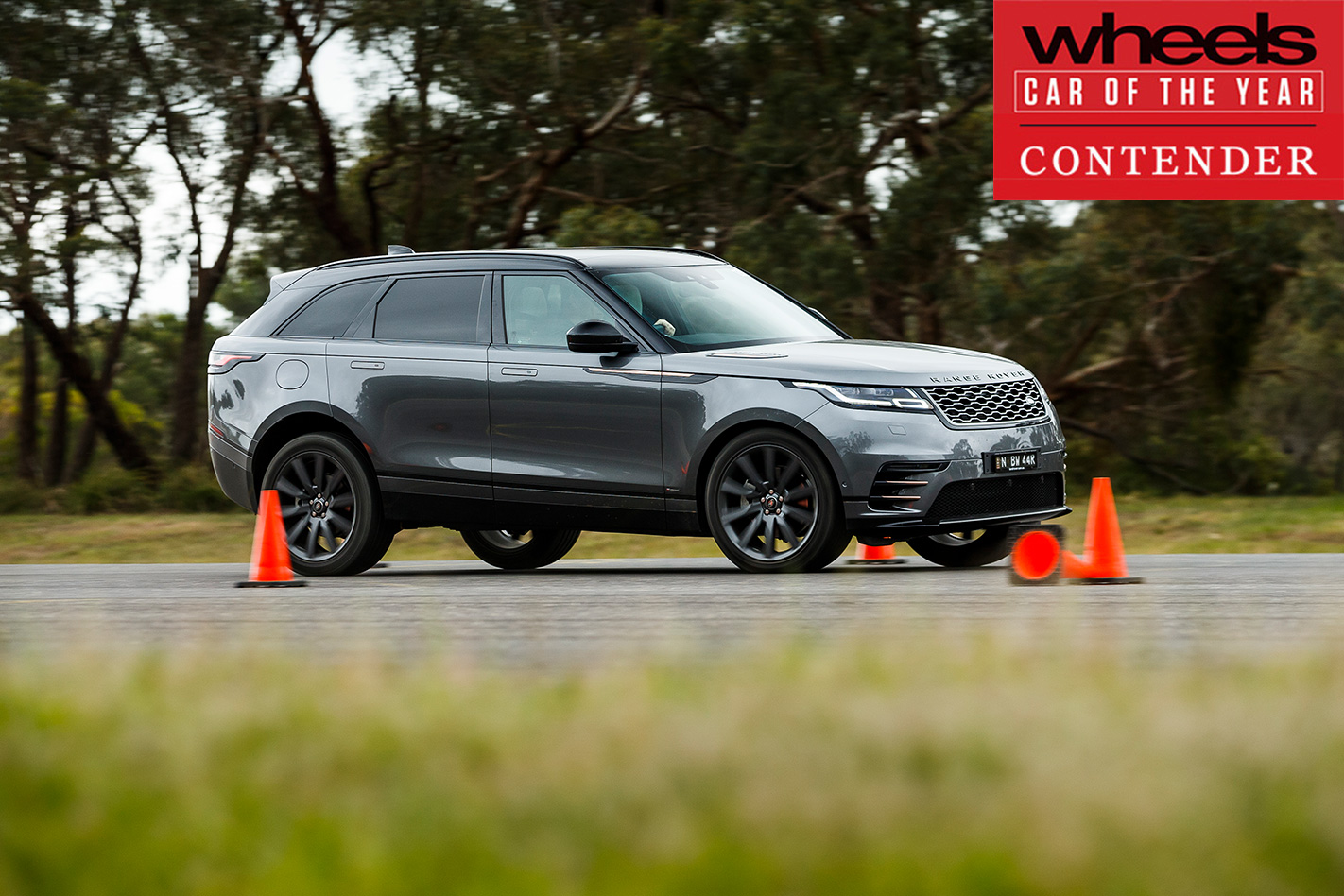
The Velar’s off-road credentials are essential, regardless of the fact that few buyers will ever test them, according to Land Rover design director Gerry McGovern.
The 61-year-old Brit likens it to a high-end waterproof watch.
“My phone tells the time perfectly,” McGovern explains. “But I still love wearing a watch that is waterproof to a depth of 200 metres. I’m never going to swim deeper than a metre or two, but the fact that it can do that is part of its credentials. It’s its story.”
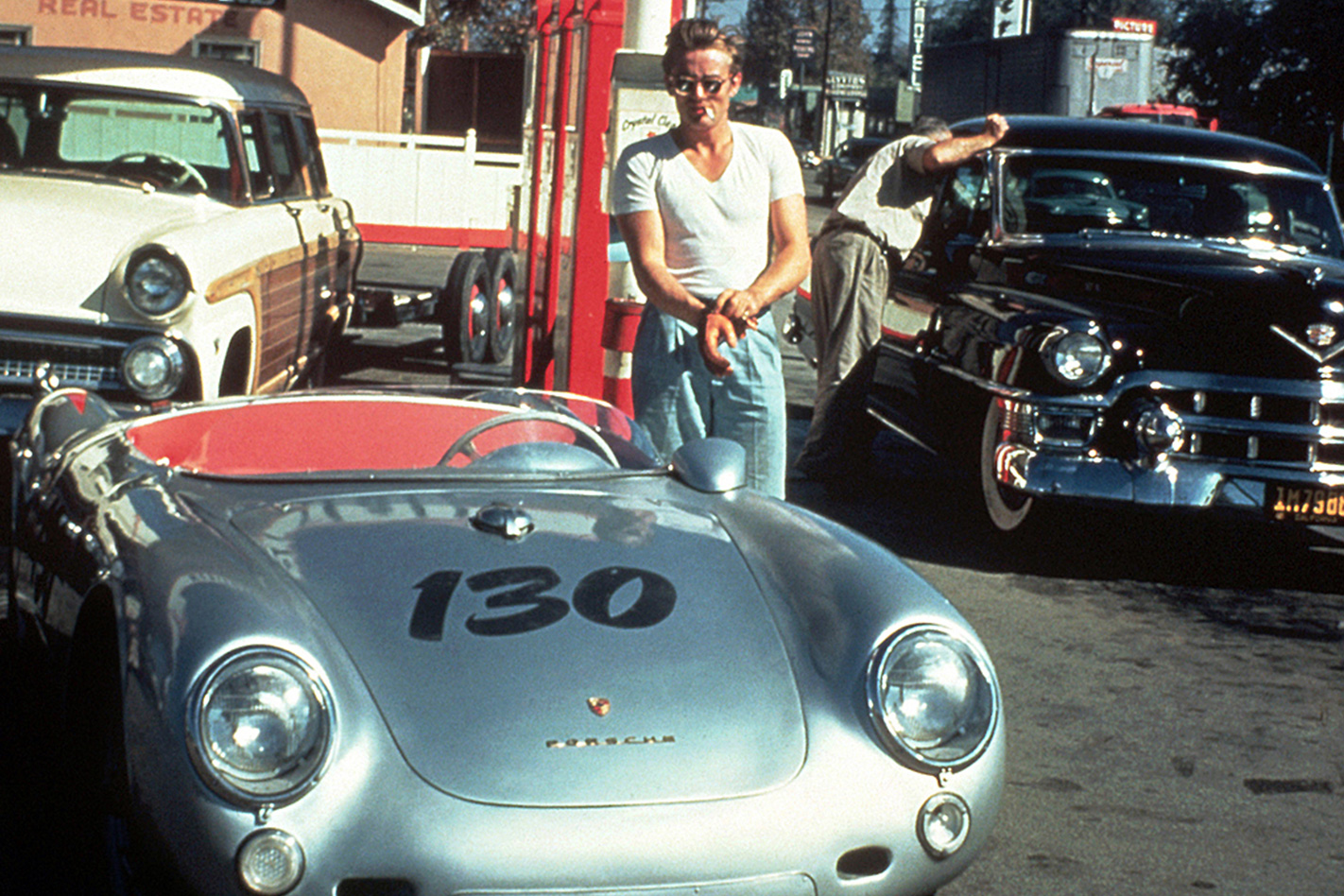
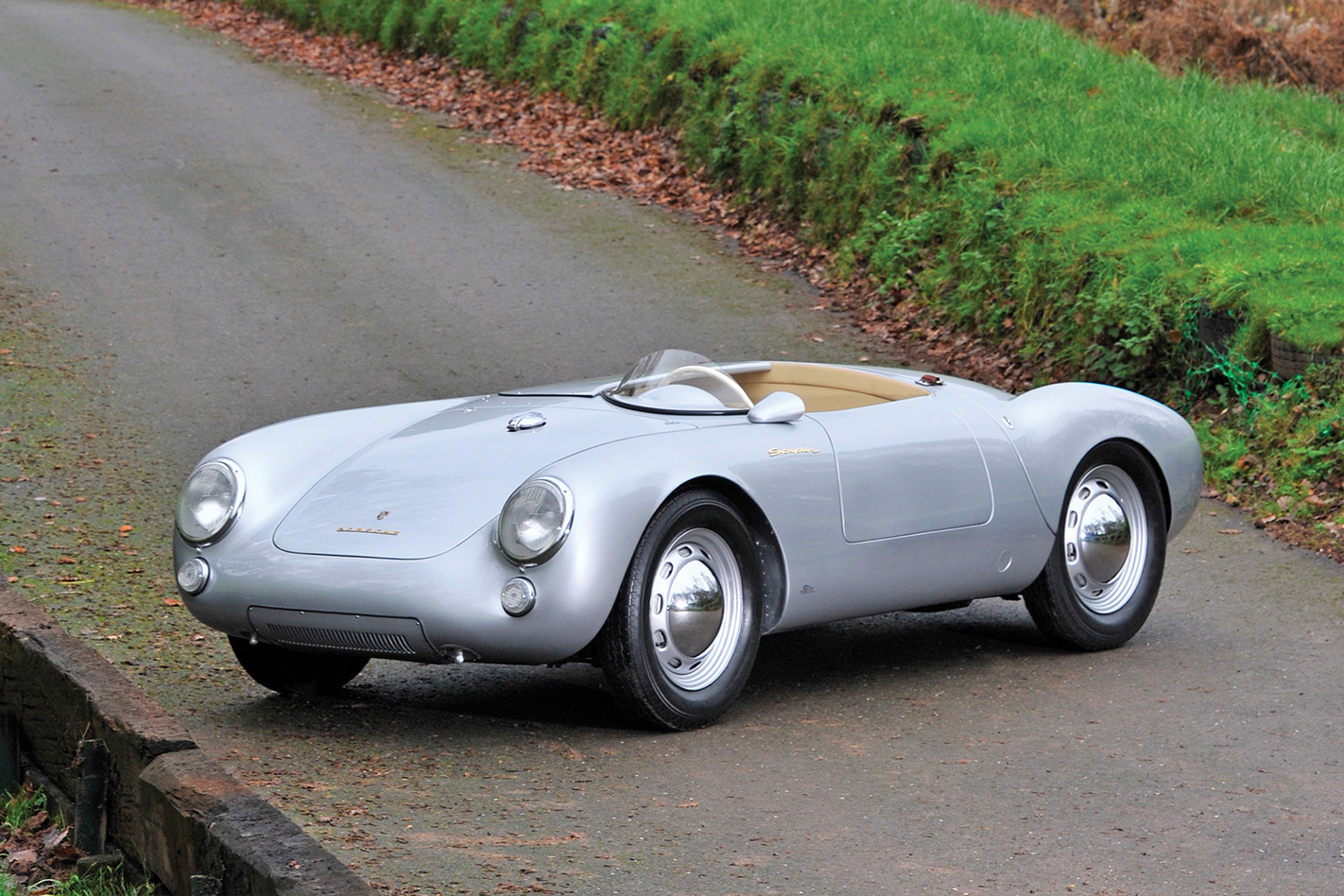
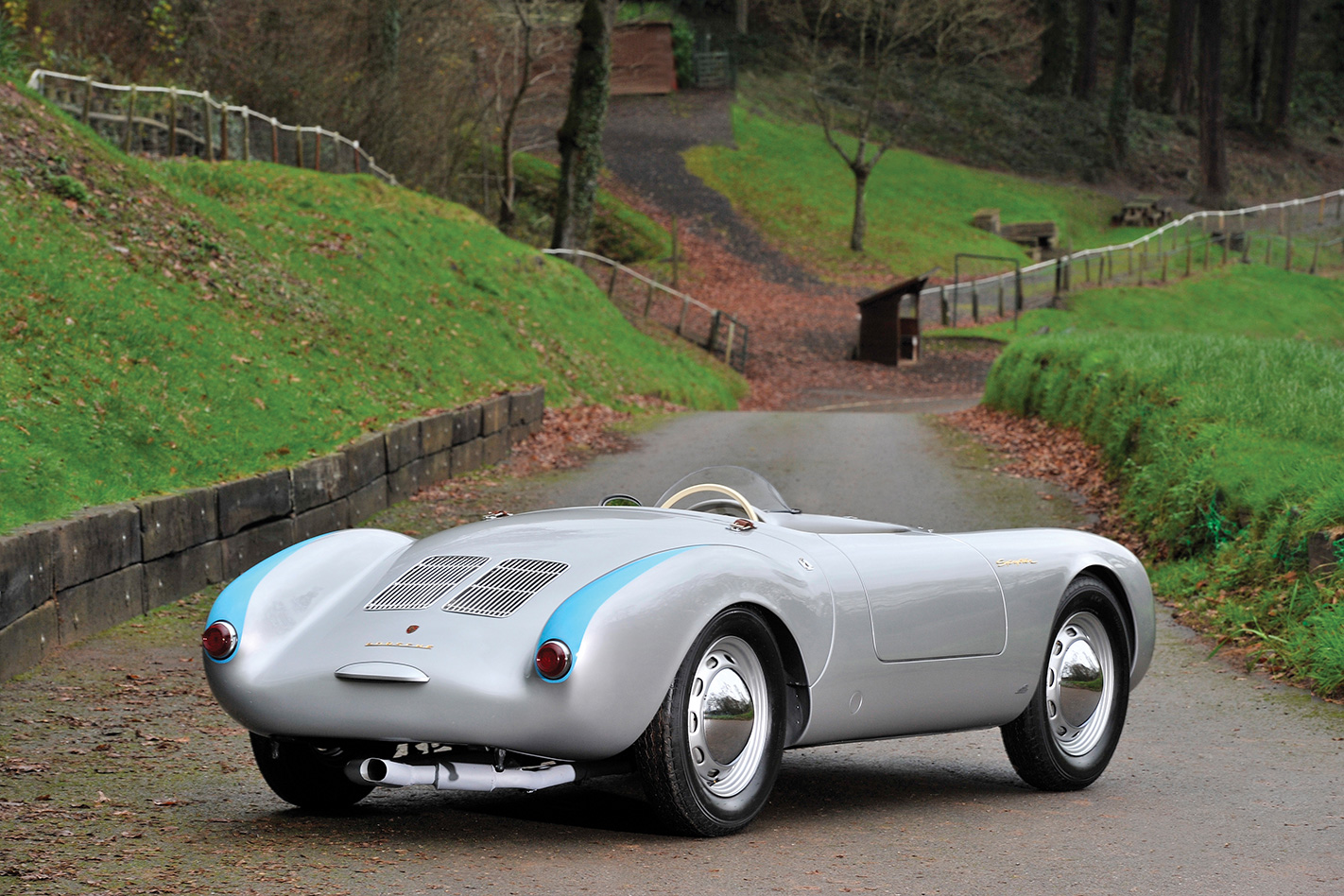
Porsche’s 550 Spyder was a car of many firsts, and not only in terms of its dominance of class endurance racing in the mid-1950s.
Ferry Porsche’s car-making company was less than five years old when, spurred by maiden class victories with modified 356 coupes in the 1951 Le Mans 24 Hour and the Liège-Rome-Liège race, it produced the Type 550 as its first purpose-built racing model.
For all its firsts, the 550 would be best known for one infamous ‘last’: chassis 550-0055, delivered on 21 September 1955, would be the last car of actor James Dean, who owned it for just 10 days.
For the 550, Porsche similarly created a ladder-type chassis with the 58kW ‘1500 Super’ engine and gearbox ahead of the rear axle. The rear suspension, aft of the axle, became a leading-arm. The wheelbase was kept the same as the 356’s, at 2100mm.
The 550 debuted in May 1953 at the Nurburgring with a class win, then scored a class 1-2 at Le Mans, with aero hardtops fitted. In August, the first two pushrod-engined/leading-arm cars were superseded by the much-refined 550/1500RS, with a modified ladder chassis, trailing-arm rear suspension (with the torsion bars ahead of the engine) and pontoon-finned rear bodywork that hinged rearward as a clamshell – an industry first.
More important was the 1.5-litre Type 547 engine. With its complex, bevel gear-driven double overhead camshaft per bank, it produced 82kW at 6200rpm.
At the tragic 1955 Le Mans, 550s swept to 1-2-3 in the 1.5-litre class and a 1.1-litre version also won its class. Later in ’55 came a five-speed gearbox, followed by a substantially revised 550A/1500RS, with a full spaceframe chassis and further suspension changes. More victories followed at the 1956 Le Mans, Sebring and the Targa Florio.
But the 550’s giant-killing dominance was nearing an end, and its eventual replacement – the 718 – was already being tested at the Le Mans 24-hour of 1956. Porsche had built a total of 90 550s, including the first 15 prototypes.
Drive, arrive, race
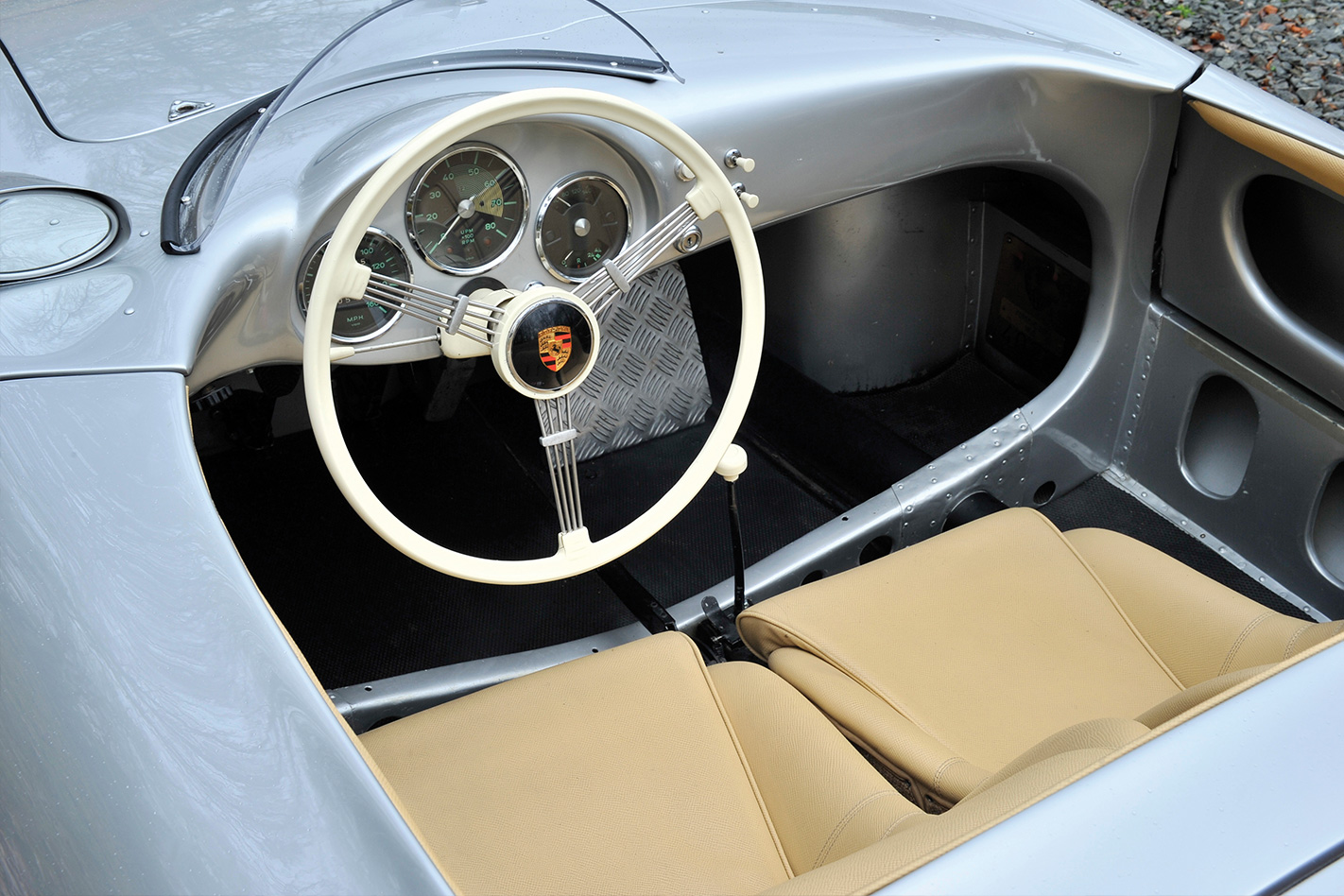
Porsche built chassis 004 and 005 for display at the Brussels and Paris motor shows, 04 with unusual, aerodynamic ‘humpback’ bodywork. Their full-width windscreens, wipers, two upholstered seats, decent instrumentation and folding hardtops marked the beginning of Porsches as daily-drive racing cars.
A very tidy flat
Porsche’s 1498cc, flat-four Type 547 engine was like a Swiss watch. Notably over-square (85 x 66mm), it initially made 82kW, rising to 100kW at 7200rpm by 1956. A bevel gear on the crank drove a shaft to each exhaust camshaft, in turn driving a shaft to the inlet camshaft, each cam driving only two valves per cylinder. Hemi heads featured dual ignition. Fed by Solex (later Weber) carbs.
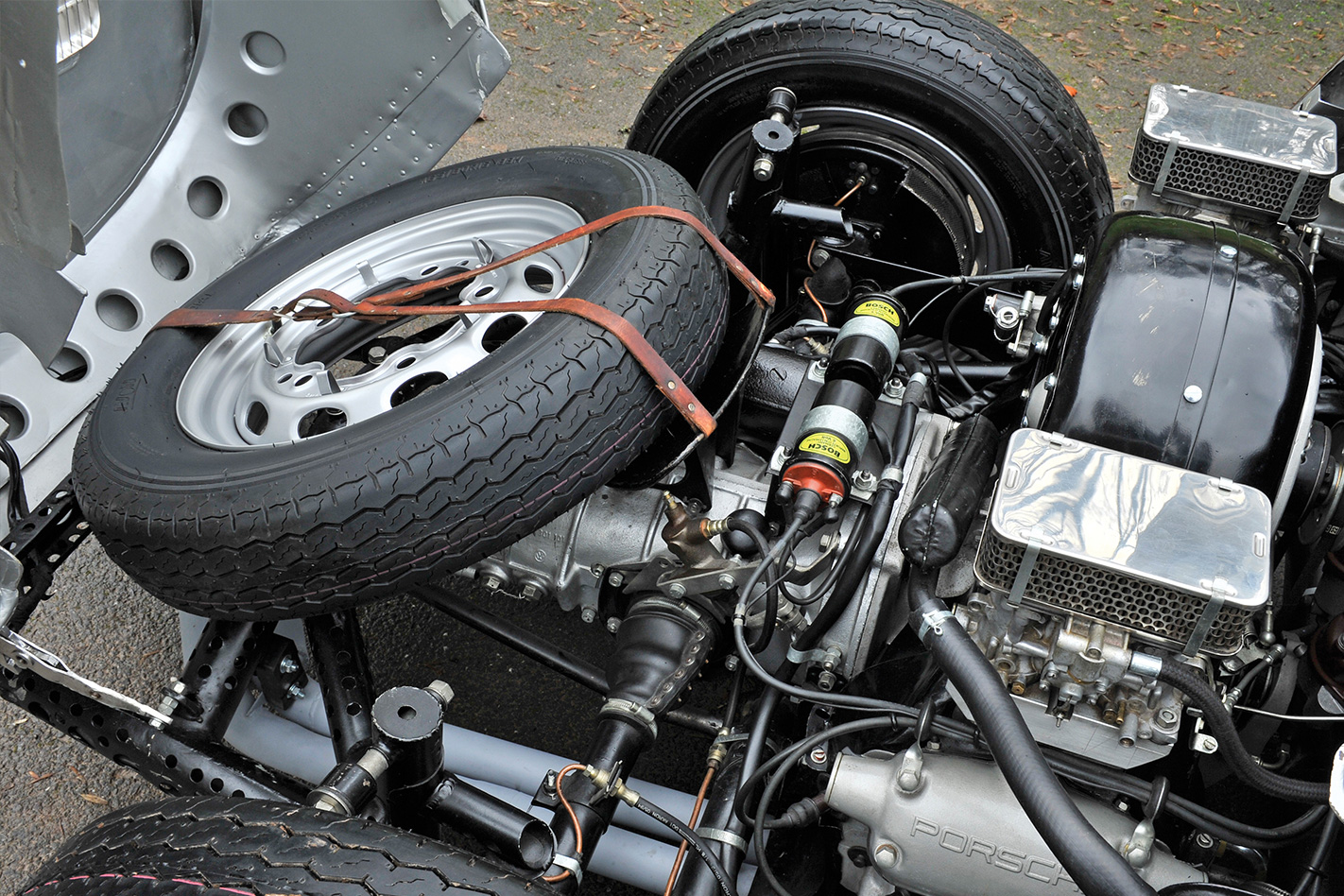
The 550 Spyder’s chassis initially comprised large main tubes in ladder configuration, with a reinforcing lattice.
It was superseded in late-’55 by the full-spaceframe 550A/1500RS. The front suspension was by VW-style torsion bars; the rear (after chassis -01 and -02) placed the torsion bars ahead of the engine, with long (600mm) trailing arms. Brakes were drums, behind 16-inch wheels. Weight was a trifling 530kg.
FIVE years ago Australians were ready to write Peugeot off. Irrelevant. Uncompetitive. Compromised. Expensive.
The 130-year-old carmaker had not only lost its way but seemingly also its mind. Then came the all-new second-gen Peugeot 308 in 2014, nearly scooping COTY with its high levels of efficiency, refinement and involvement.
Sadly, continuing slow sales simply reflect the damage that the 2000s cars inflicted on the brand. However, in SUV-obsessed Oz, the Peugeot 3008 should drive Peugeot’s consumer renaissance, even if its walrus-like predecessor’s name carries through.
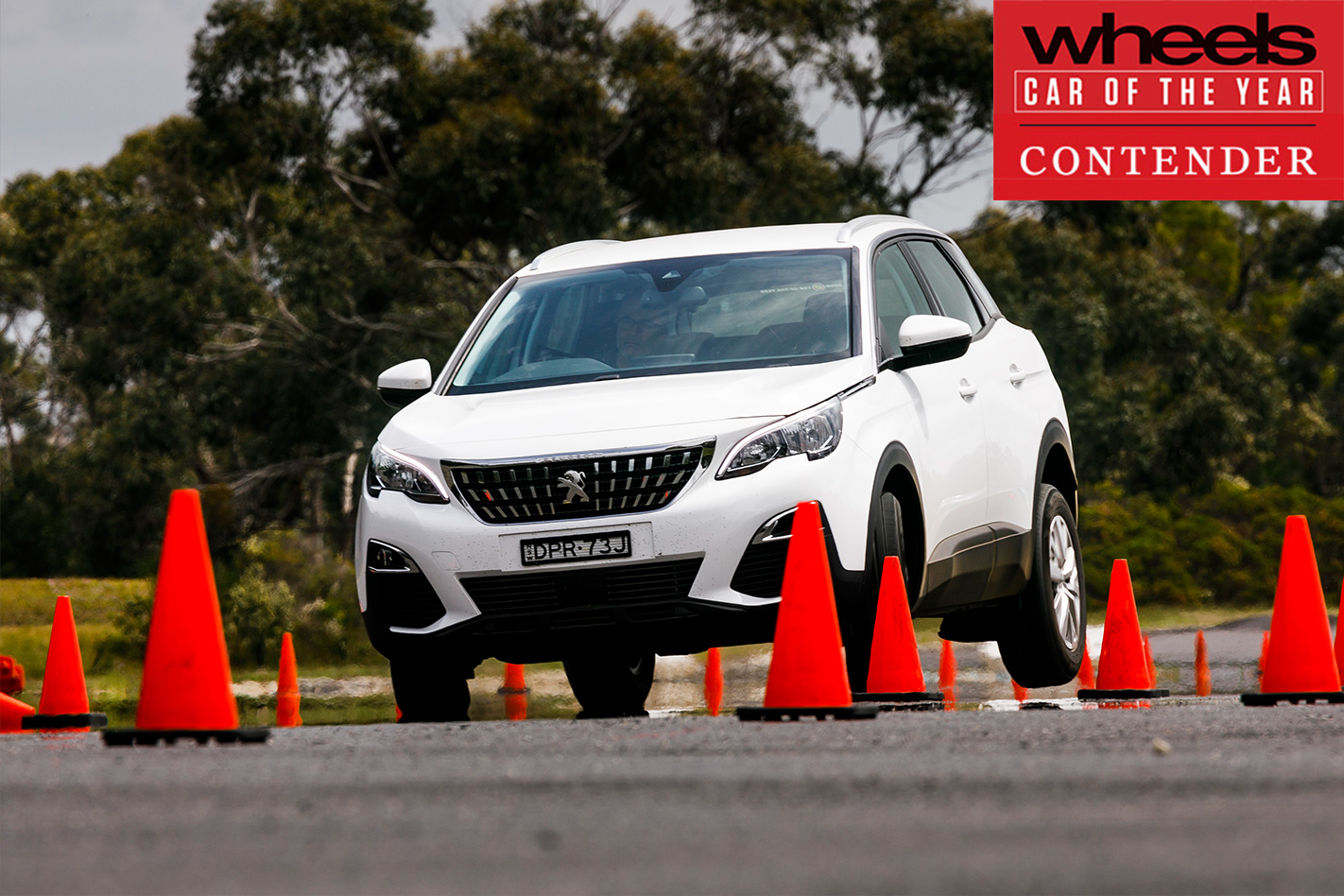
But never mind how it stacks up against the latter; the ambitious Frenchy possesses a charisma the BMW X3 – another COTY challenger – would kill for.
While families are more likely to appreciate the 3008 cabin’s airy spaciousness (offering room for adults out back as well as a sizeable luggage area behind), well-padded seats, plentiful storage and Millennial-friendly multimedia access, it’s the exquisite detailing that might make buyers think twice about a Range Rover Evoque.
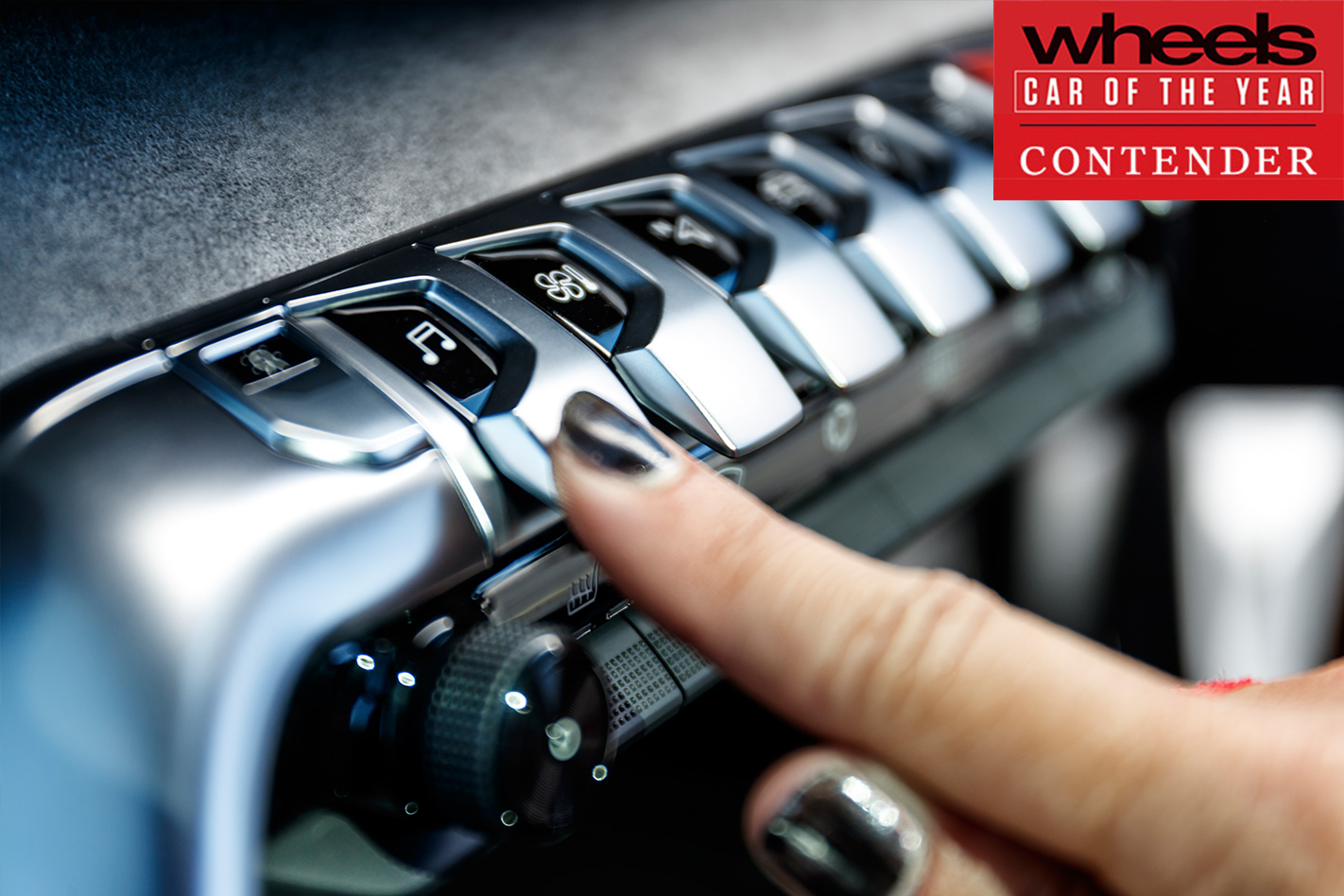
Speaking of having your cake and eating it, the 3008’s charm offensive steps up from behind the controversially low-set steering wheel – the key is to take a few moments to familiarise yourself with the layout; then it becomes second-nature. Prod the (annoyingly stubborn) starter button and the 1.6-litre turbo-petrol four fires into action, offering turbine smoothness to match its unexpectedly athletic performance.
We’ve said it before; Peugeot’s Toyota-supplied six-speeder is the greatest auto ever fitted to a French vehicle, providing seamless point-to-point operation.
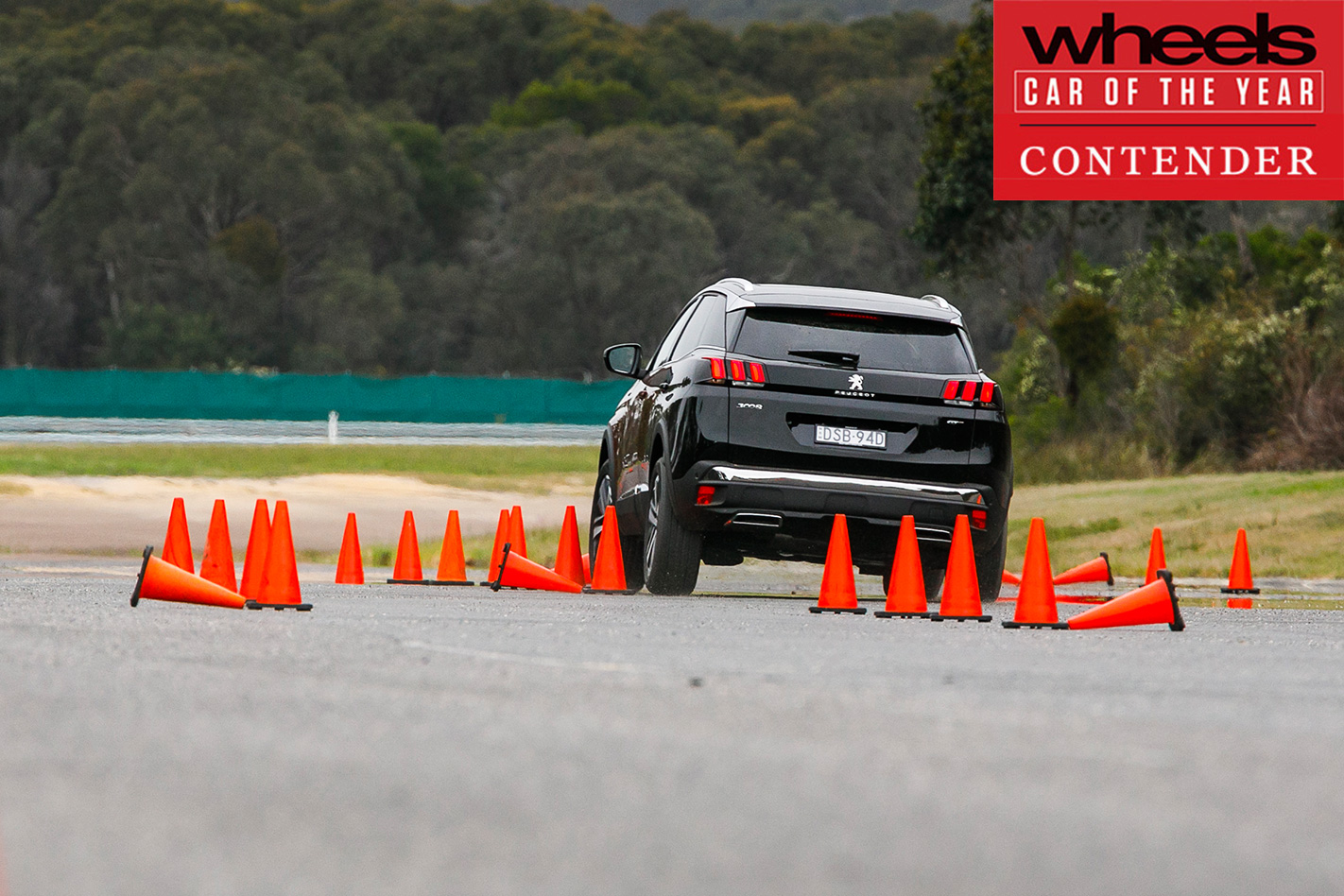
Whether you become a fan of the Peugeot’s quick and eager steering depends how much Sport you seek in your Utility Vehicle. But as this is Wheels, we found the helm marvellously interactive and its contribution to agility outstanding. A more car-like SUV for the cash simply doesn’t exist. Plus, despite tipping the scales some 180kg below the equivalent (if larger) Mazda CX-5, the lightweight chassis (on 308-derived EMP2 architecture) remains composed, serving up impressively supple and isolated ride comfort.
The the 3008 barely puts a wheel wrong on bitumen. Reservations may exist with just how much play the Peugeot permits on gravel, not helped by a late-acting (and rather severe) ESC/traction-control tune. Again, the bantamweight crossover’s sheer zeal and controllability means that there is nothing too alarming here, but the initial looseness might spook the unwary.
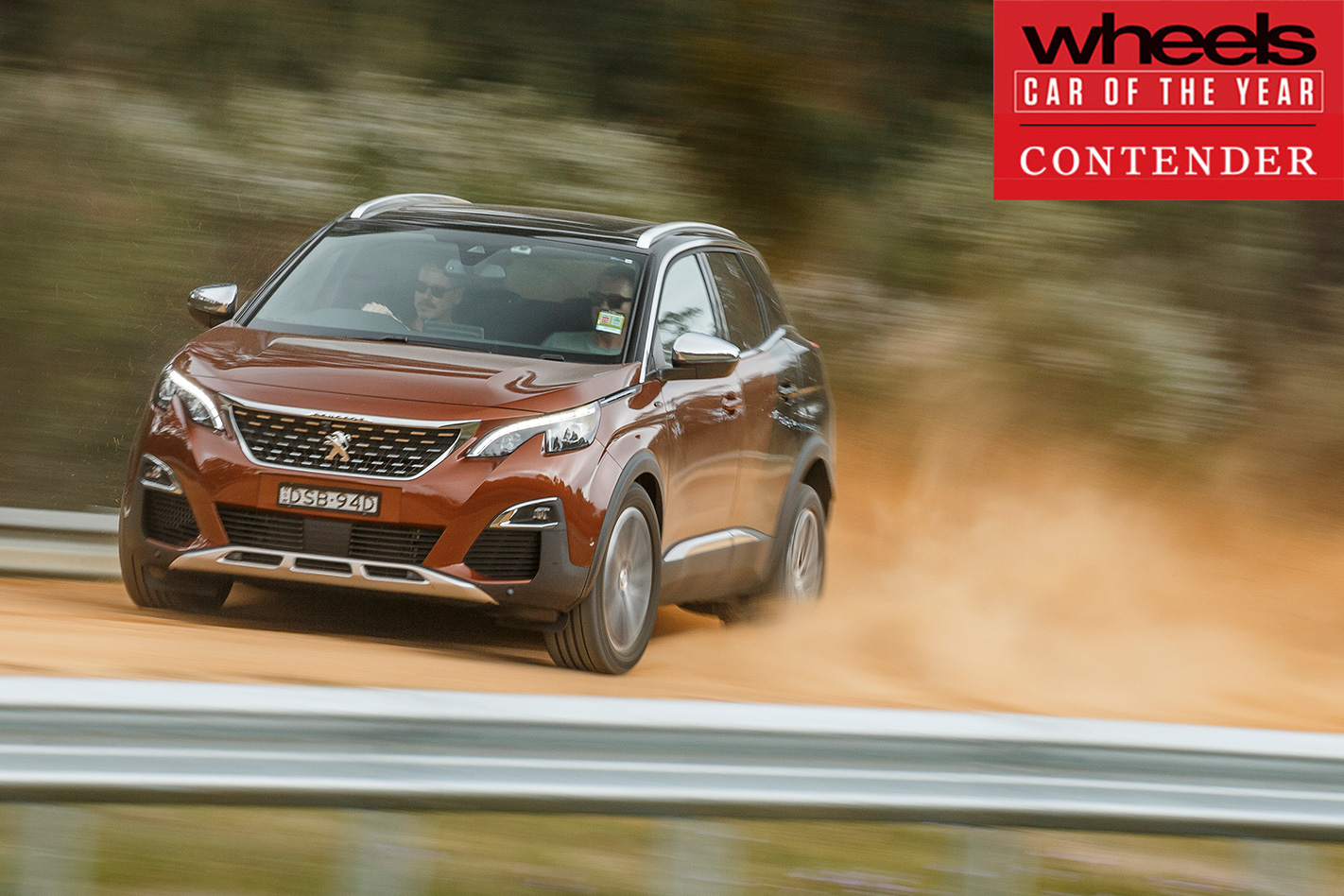
These, along with a few iffy build-quality quirks and equipment shortfalls, clip the wings somewhat of a model that otherwise defines Peugeot’s incredible resurrection. Yet we remain incredibly fond of the wonderfully textured 3008.
An electrifying proposition
We lament the decision to sidestep the 96kW/230Nm 1.2-litre three-pot turbo petrol offered in Europe, which would have provided a whole new level of efficiency and dynamic alacrity.
However, another intriguing powertrain under evaluation for Oz is the coming plug-in hybrid variant, employing the 1.6-litre turbo-petrol and a pair of motors on the rear axle, simultaneously creating an AWD version. A total output around 220kW gives it a rapid claimed 0-100km/h of 6.0sec.
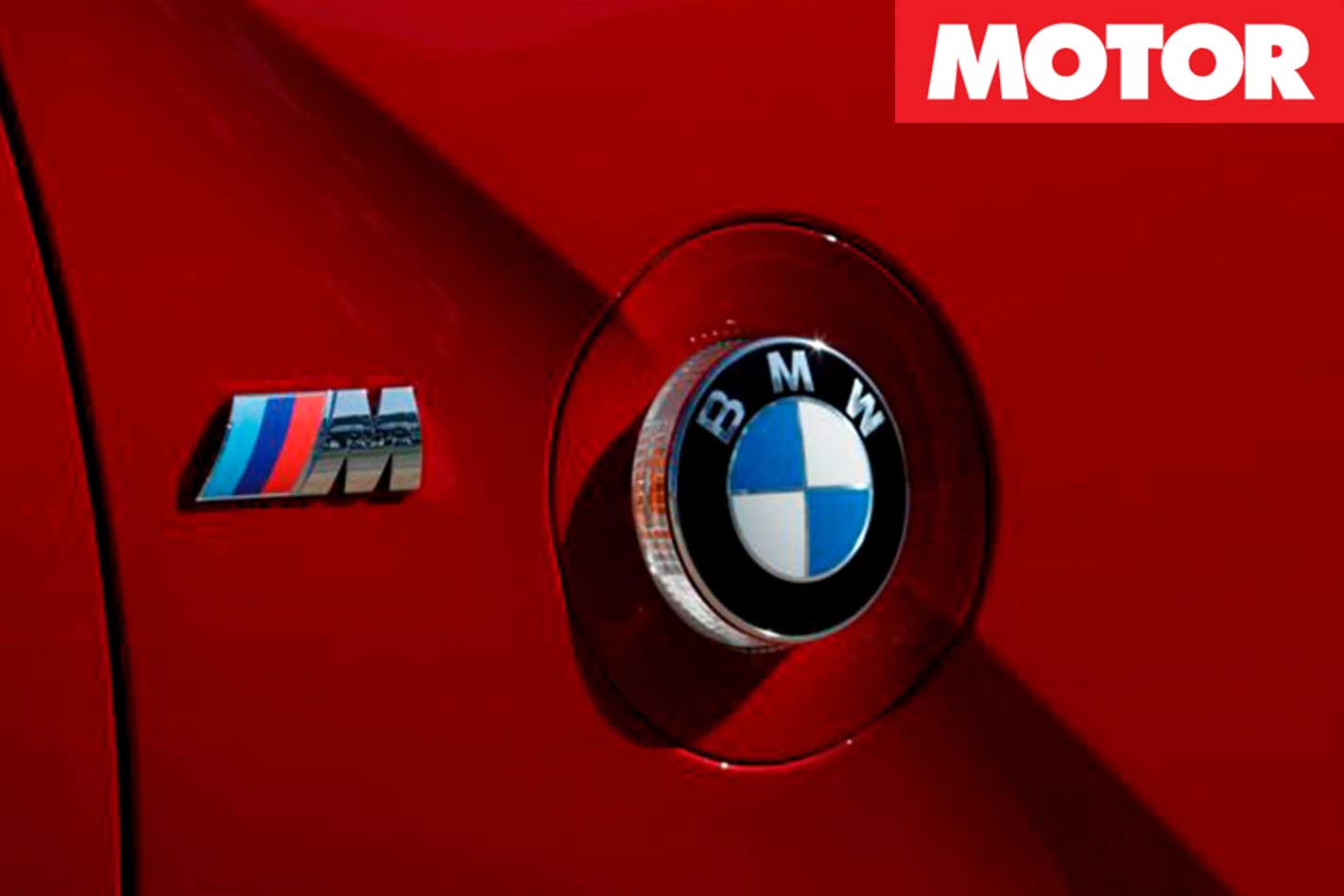
It’s a bit of a shame, really. The new BMW Z4 M Roadster is, in all honesty, an absolute ripper of a car, so more’s the pity that you’ll more than likely never give it a start in your list of cars you must own before shuffling off this mortal coil.
This article was first published in MOTOR’s June 2006 issue.
Why all the negativity? Well, at the same time as BMW foist upon us this most lovely of playthings, it’s busily putting the final touches on a pair of cars that will, according to Those That Know, position the bar just that little bit higher; the V8 M3 and the Z4-based M Coupe. And while the bread-and butter 3.0-litre Z4 is, as a basic tool, far better than the Z3, it hasn’t exactly ignited blazes of pure unadulterated lust amongst guys like you and I, has it?
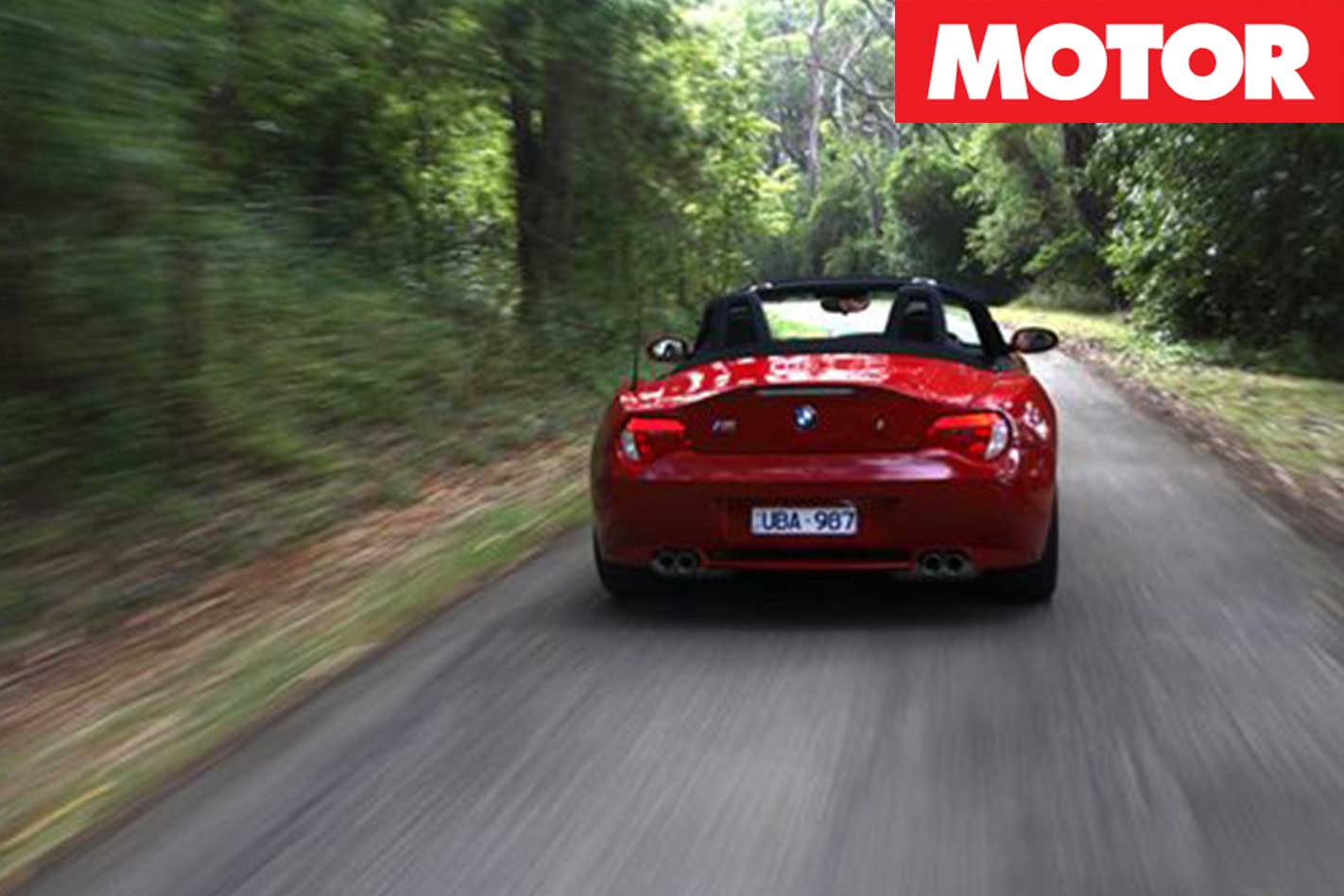
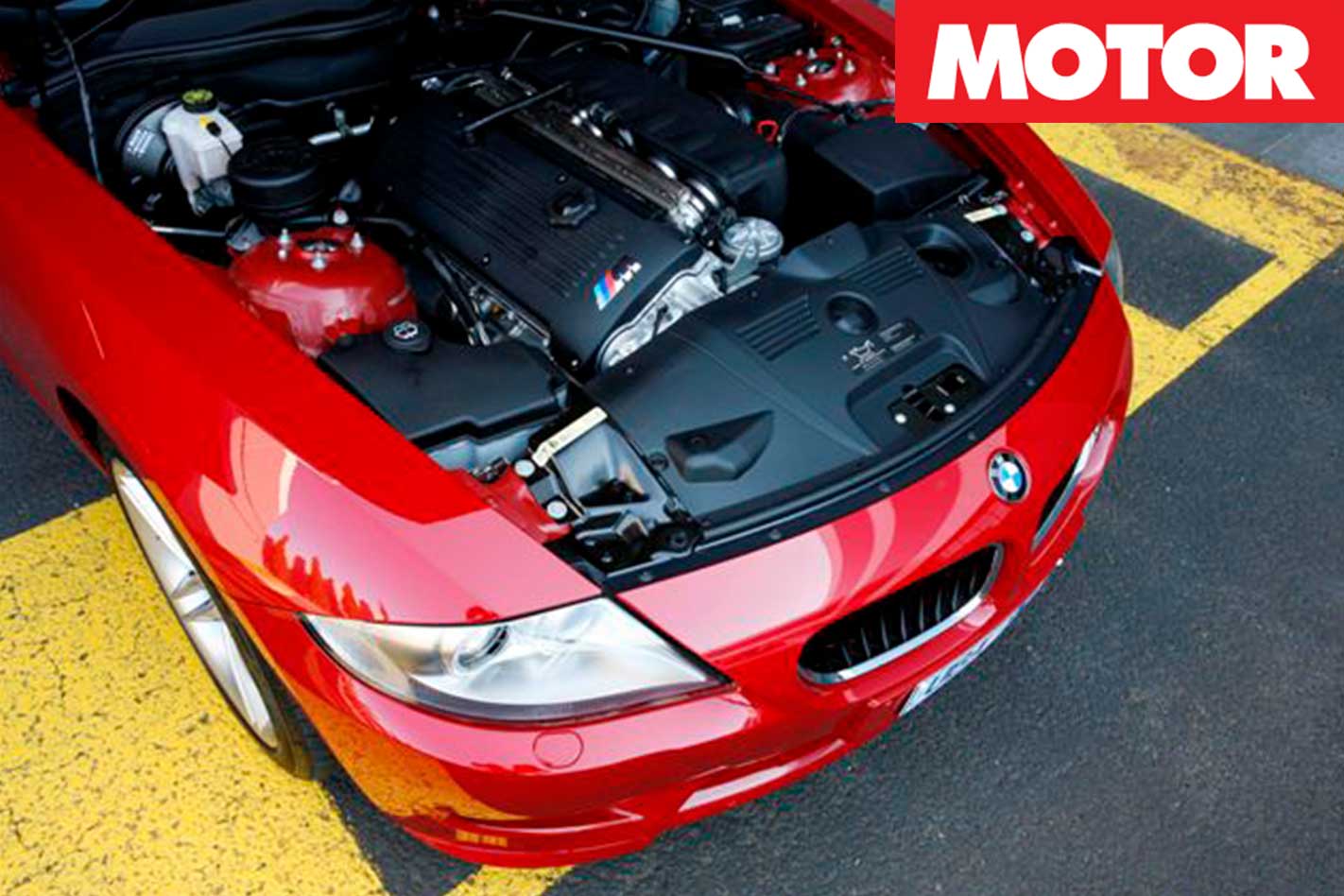
It’s not just an engine bolt-up job, either. With the upcoming Coupe in mind, the Roadster sports completely revised front and rear suspension, M3 CS-spec brakes and a subtle yet highly functional body makeover. This includes incorporating a trick reprofiled underbody to clean up airflow under the car and to direct cooling air to the M Diff, as well as a more aggressive front valance, complete with brake cooling ducts.

It sports a pretty handsome set of figures, too, with BMW claiming a 5.0-second pass to 100km/h, thanks to 252kW (at 7,900rpm) from the 3.2-litre straight six pushing a mere 1485kg around. Its 365Nm of torque comes on thick and strong from around the 2000rpm mark before peaking at 4900rpm. It’s electronically hobbled at 250km/h, though its final drive of 3.626:1 gives it longer legs than this.
With the Sport button switched on, throttle response is as sharp as Cockburn’s specially cellared Stilton, and it’s a do-before-death experience to roost hard in second gear with the roof off.
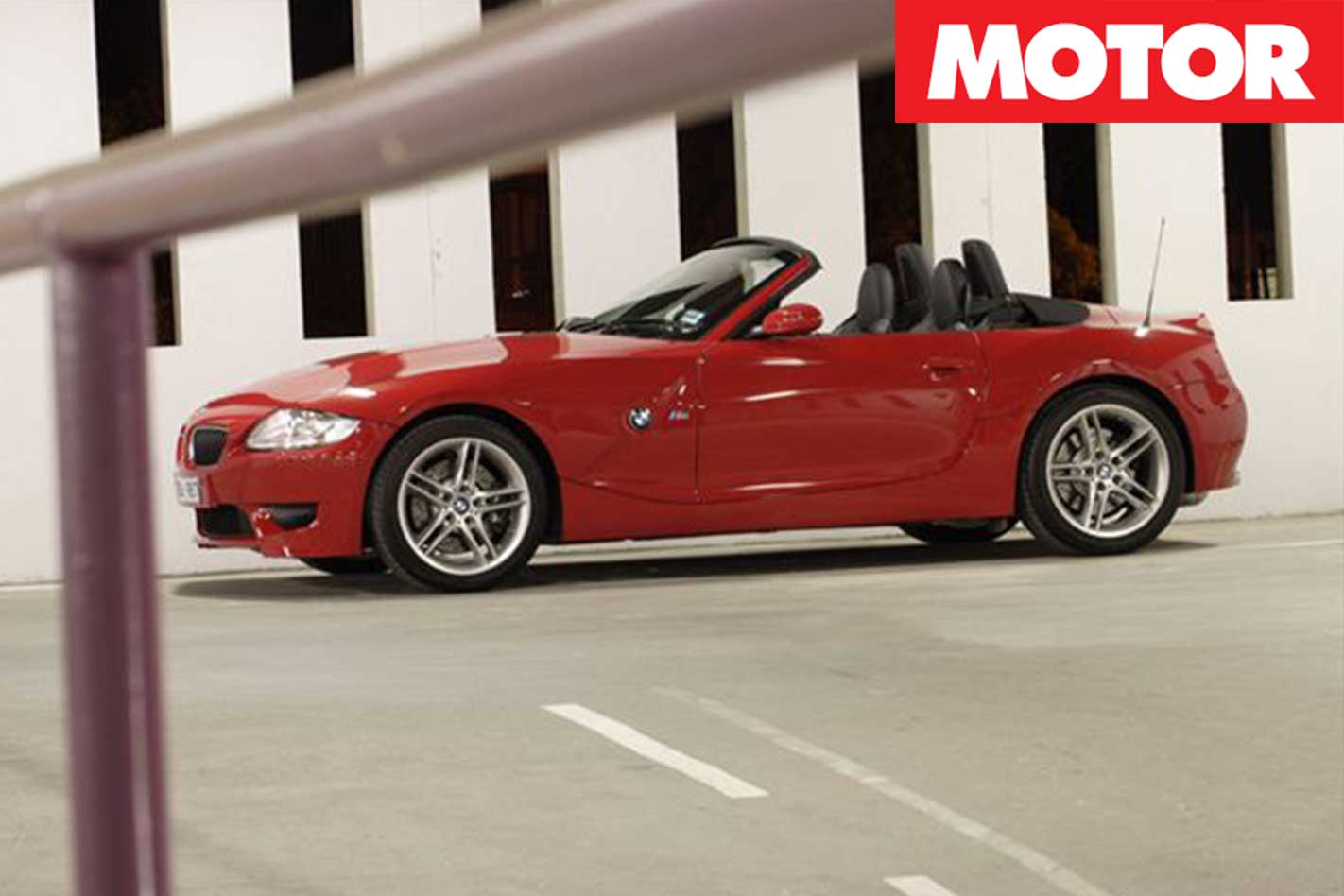
The interior is a bit of a halfway house between E46 and E90, and with no iDrive wheel in sight, the centre console-mounted switchgear seems to work just fine… The M Sport seats are ultra comfortable for long hauls and are adequately supportive, but miss out on the side bolster-inflation devices of the 130i and 330i.
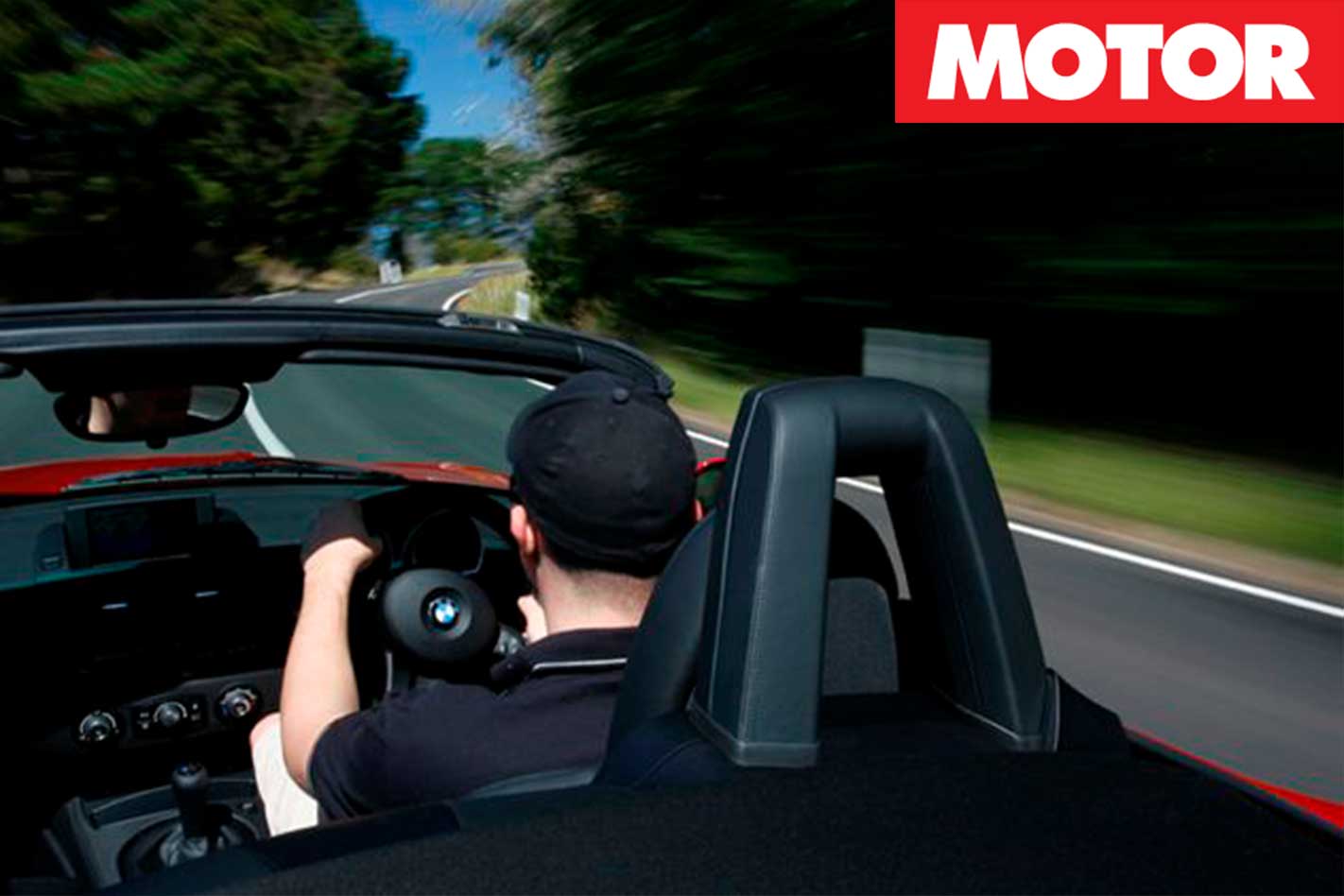
Yummy.
The M Roadster is lively, eager and a damn good giggle on tight, chopped up bitumen. It’s a little hesitant to take its set unless initial inputs are firm and decisive, and it’s a tough step to take to trust a short-tail roadster, but it’s worth the committment in this case. There’s plenty of mechanical grip on offer at both ends from the ‘regular spec’ tyres, BMW choosing not to equip any of its sportys with run-flat tyres. Coincidence? The car’s fitted with a low-pressure warning system and the rims will hold a deflating tyre firmly until the driver gets it sorted.
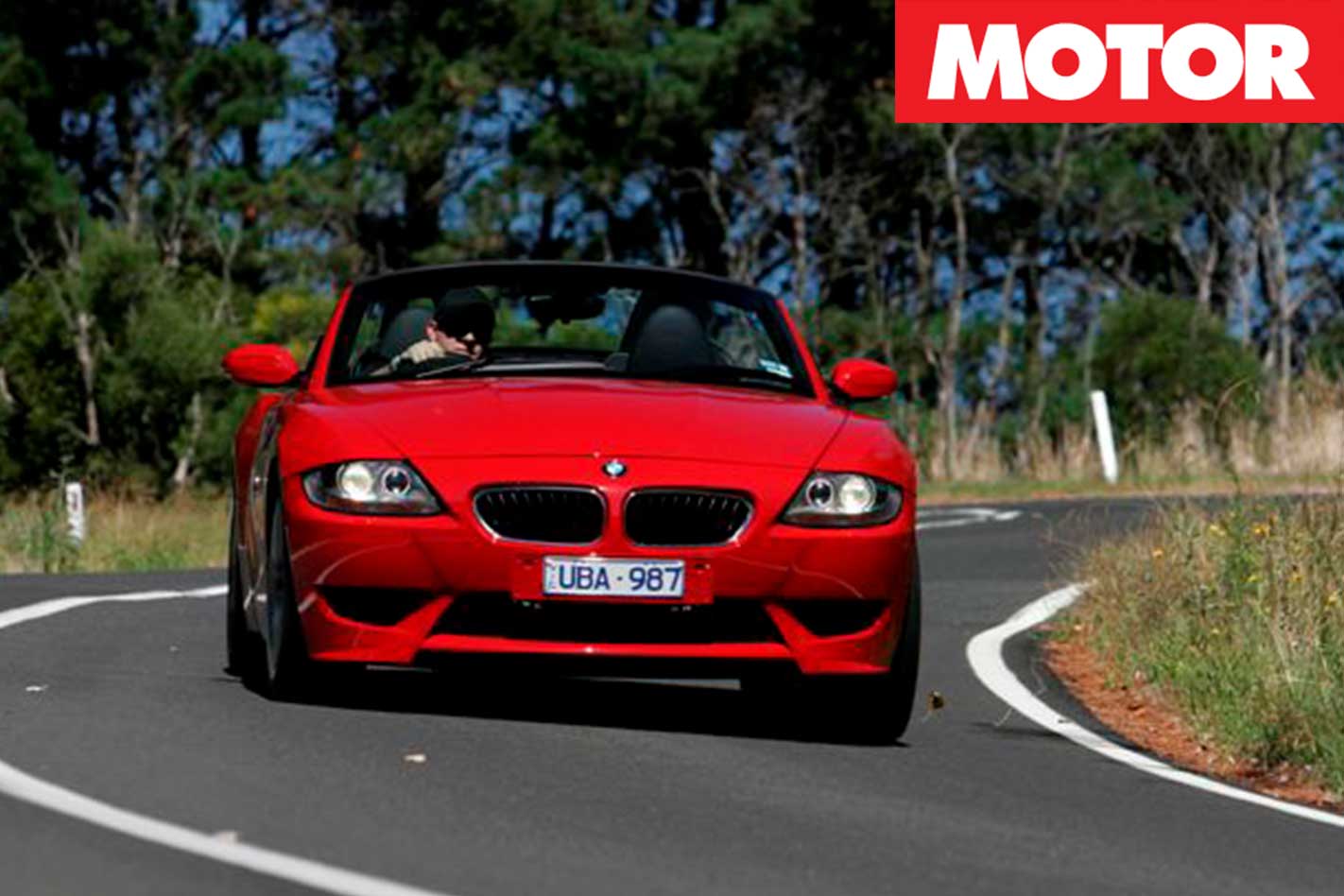
As with all M cars, the Roadster does away with the electric steering setup of the lower end cars and adapts a quicker-geared hydraulic rack and pinion assembly. It’s not a class leader in steering feel, but it’s not bad by any means, with plenty of bite, sufficient if hazy feel and feedback and reasonable weighting.
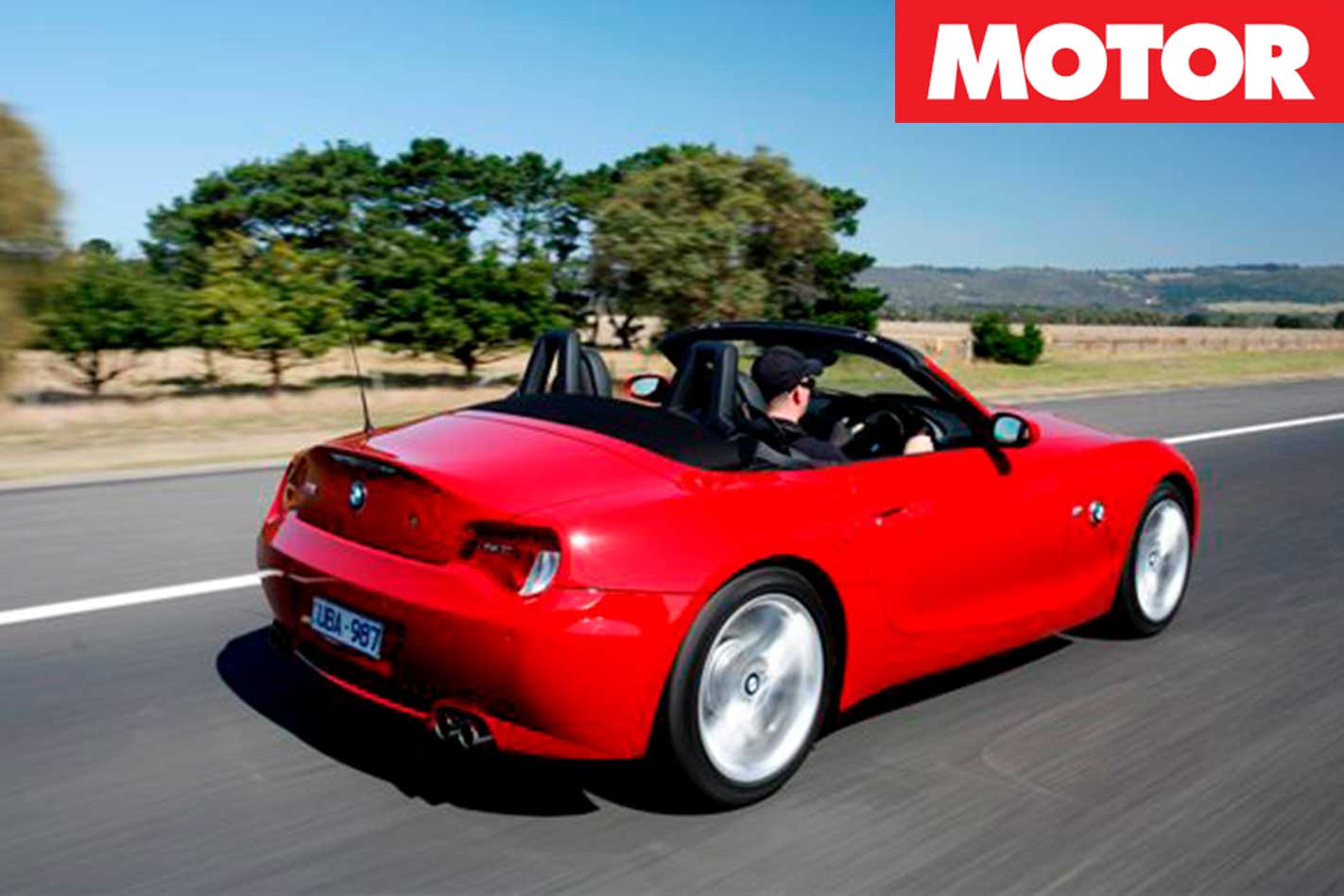
The viscous fluid-driven M diff is the secret spice in the pie, its clever combo of shear pumps and a multi-plate clutch maximising the potential of the robust chassis tune.
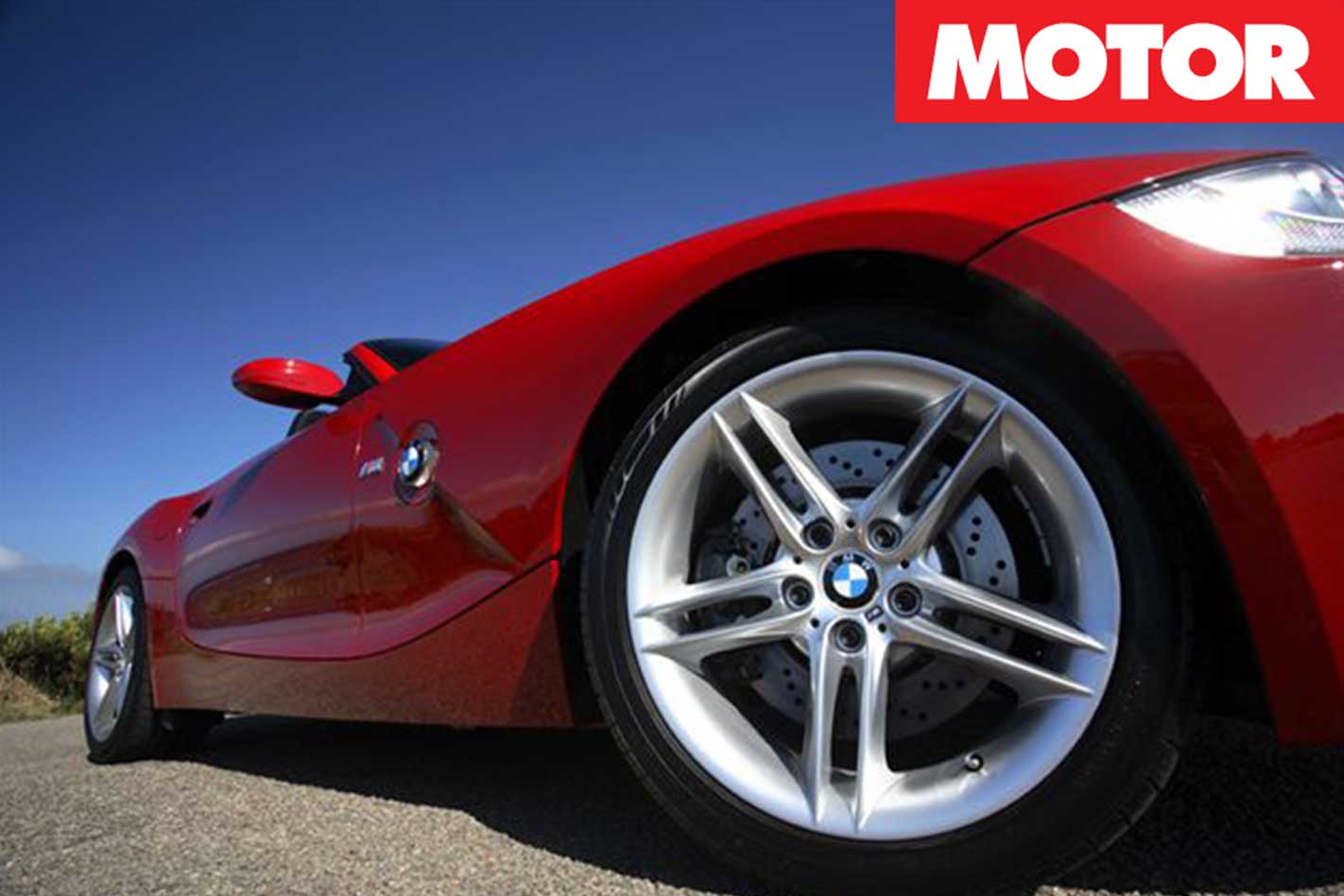
It’s eminently more emotive than the iconic two-door – it’s the most emotionally involving BMW of recent years, yet it’s nothing like hard work. Want the best six-banger in the world in a chassis package that’s truly worthy of it? Don’t overlook the M Roadster.
As you’ll have hopefully discovered by the time you read this, you don’t need a king’s ransom to drive home in the 2018 Performance Car of the Year.
But if you find the Civic Type R’s looks a little too ‘backwards cap brigade’ (and we wouldn’t blame you) you might be wondering what that budget will get you on the second-hand market.
The BMW E34 M5 predates PCOTY, but it undoubtedly would’ve given the award a real shake, as both E36 and E46 M3s lifted the trophy in years to come. Nowadays, neat examples of BMW’s super sedan not only occupy a similar price point to the Civic Type R in the market, but are also remarkably similar in size and performance.
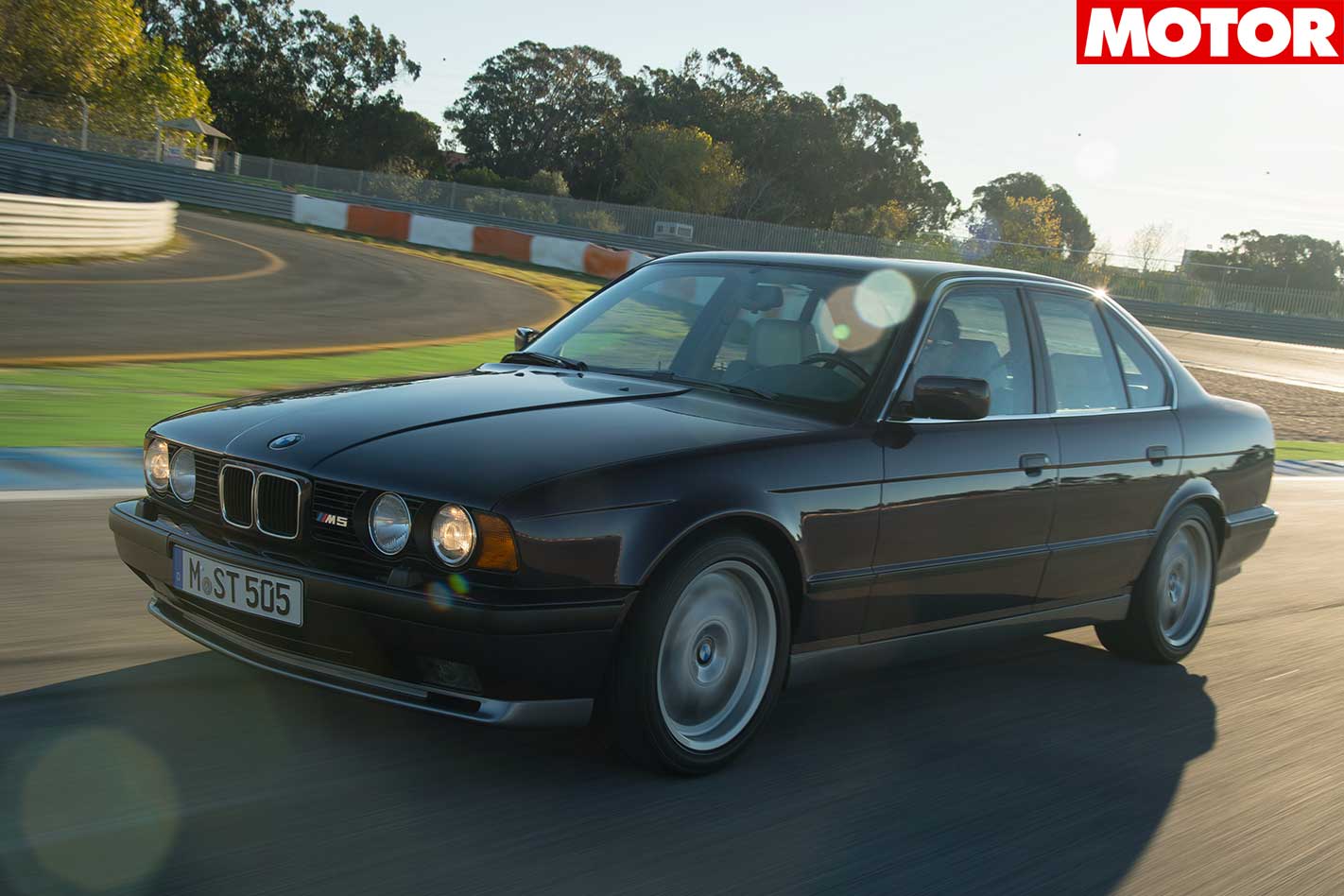
Under the bonnet its 3.6-litre inline-6cyl produces 232kW/360Nm, later rising to 250kW/400Nm with the introduction of the larger 3.8-litre engine in 1991, numbers in the same ballpark as the Civic’s 228kW/400Nm, though its 2.0-litre turbo four has a much greater spread of torque.
Combine this artificial aspiration with a 350kg weight advantage and it’s the hot hatch that will be the faster car in a straight line.
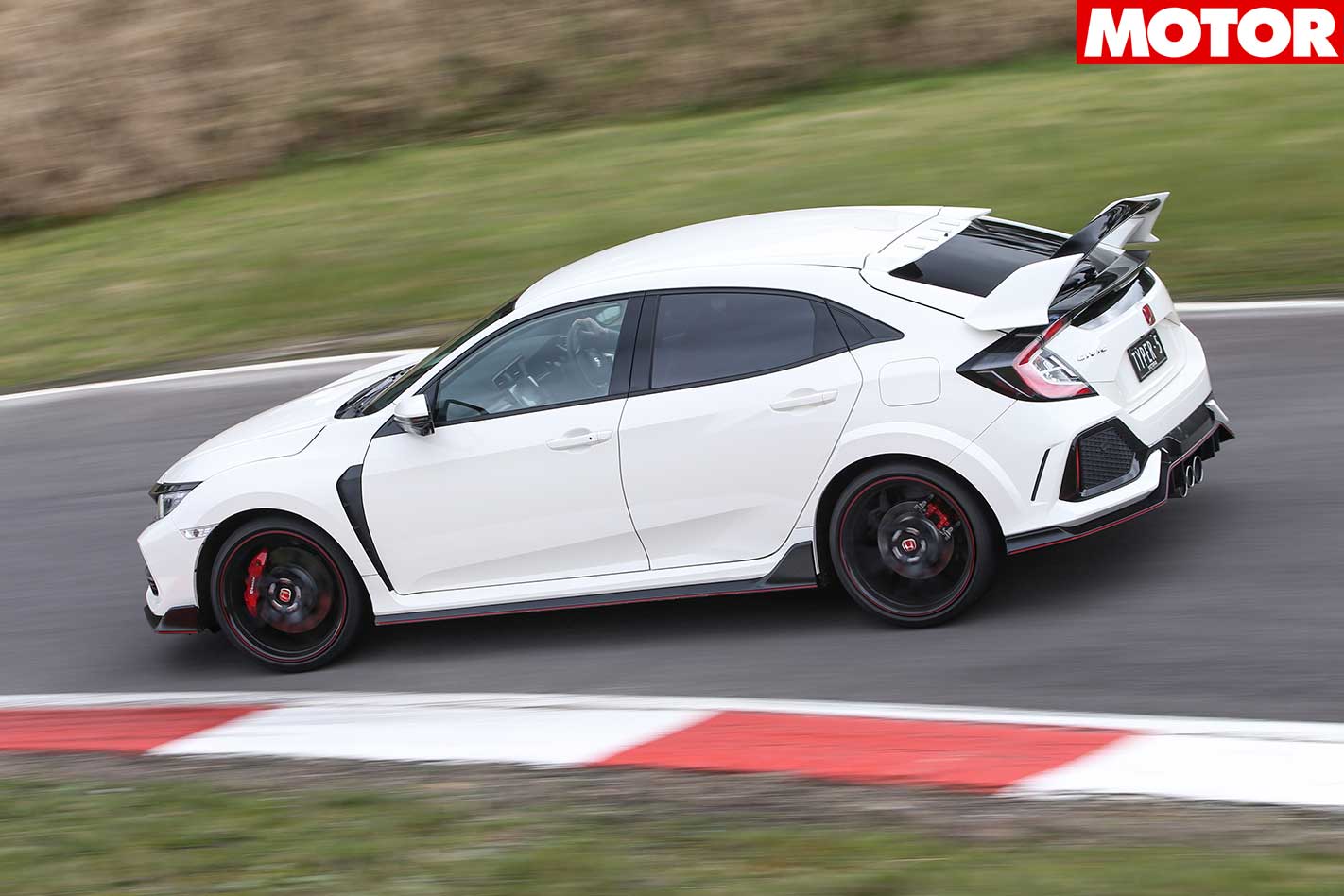
However, the later, more powerful updated E34 M5 would run it close off the line, its 5.9sec 0-100km/h claim trailing the Honda by just 0.2sec.
In the corners the M5 wouldn’t see which way the Civic went, but the old-timer has a few tricks of its own, including one of the greatest six-cylinder engines and a rear-drive chassis balance that led many to believe it remains the purest M5 built to this day. So pure, in fact, that we plan on getting behind the wheel of one very soon.
| u00a0 | 2018 Honda Civic Type R | 1989 BMW E34 M5 |
| ENGINE | 1998cc inline-4, DOHC, 16v, turbo | 3535cc inline-6, DOHC, 24v |
| POWER | 228kW @ 6500rpm | 232kW @ 6900rpm |
| TORQUE | 400Nm @ 2500-4500rpm | 360Nm @ 4750rpm |
| WEIGHT | 1382kg | 1733kg |
| 0-100KM/H | 5.7sec (claimed) | 6.2sec (est) |
| PRICE | $50,990 | $168,900 (new) |
Here’s one we found on Trade Unique Cars
1991 BMW E34 M5 – $45,000, Oz-delivered, 190,000km
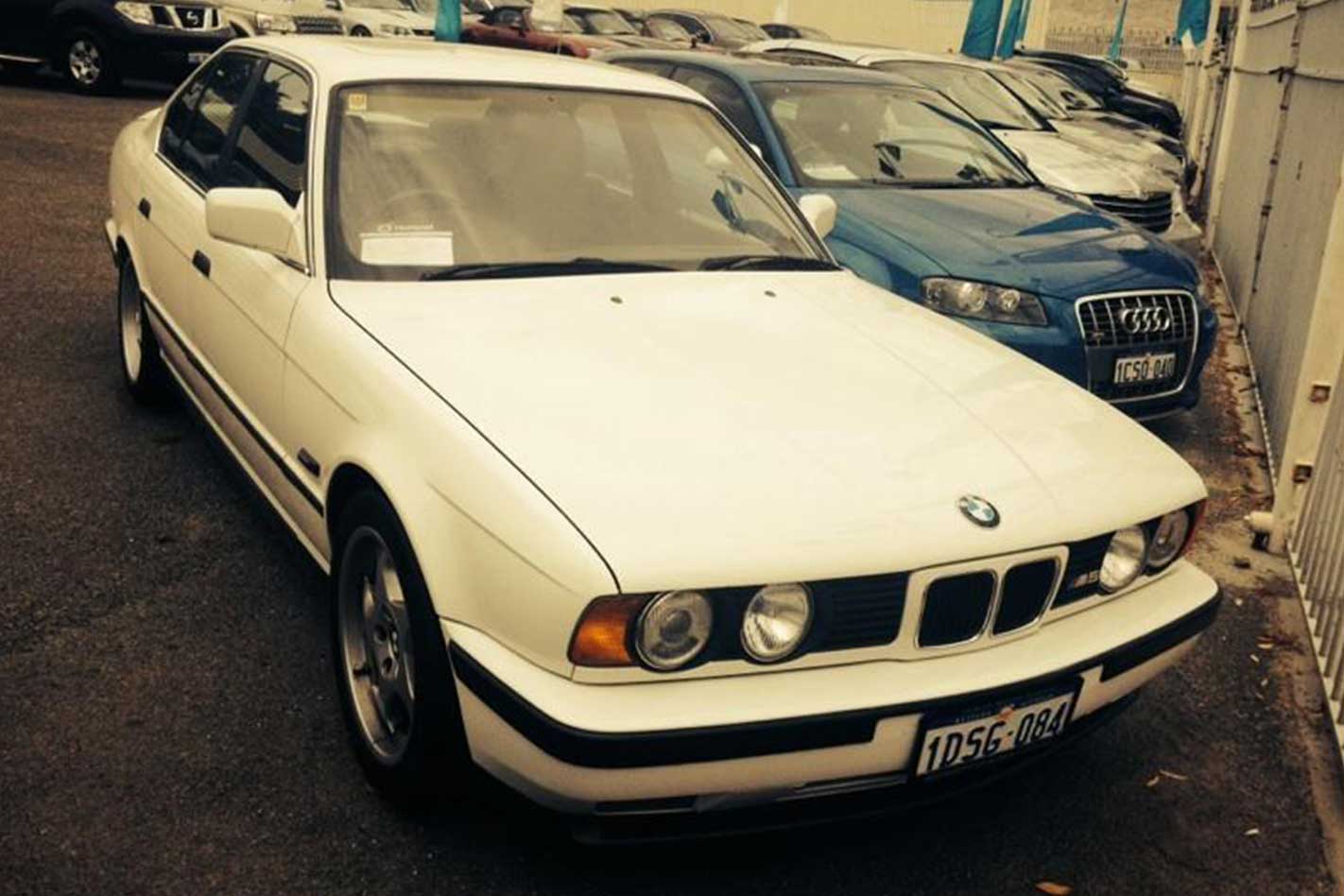
Delivered new to Sydney in 1991, this E34 is one of 90 that officially made their way to Aussie shores, of which just 14 were Alpine White. It’s currently located in Western Australia and looks to be in particularly good condition.
2018 has gotten off to a scorching start with some hot new metal arriving this February, and some already available as of last month.
Below is a list of all new cars arriving to market by the end of this month, and we’ll shine a spotlight on a couple of standouts.
- BMW 3 series facelift
- BMW 6 series GT
- BMW i3s
- Citroen C3 hatch
- Holden ZB Commodore/Calais
- Jaguar XF Sportbrake
- Land Rover Discovery Sport update
- Land Rover Evoque update
- Mercedes-Benz S-class facelift
- Mazda MX-5 update
- Mazda MX-5 limited edition
- Mitsubishi Eclipse Cross
- Nissan Navara update
- Suzuki Swift Sport
- Volkswagen Golf GTI Original three-door
Holden ZB Commodore/Calais – Arriving: February
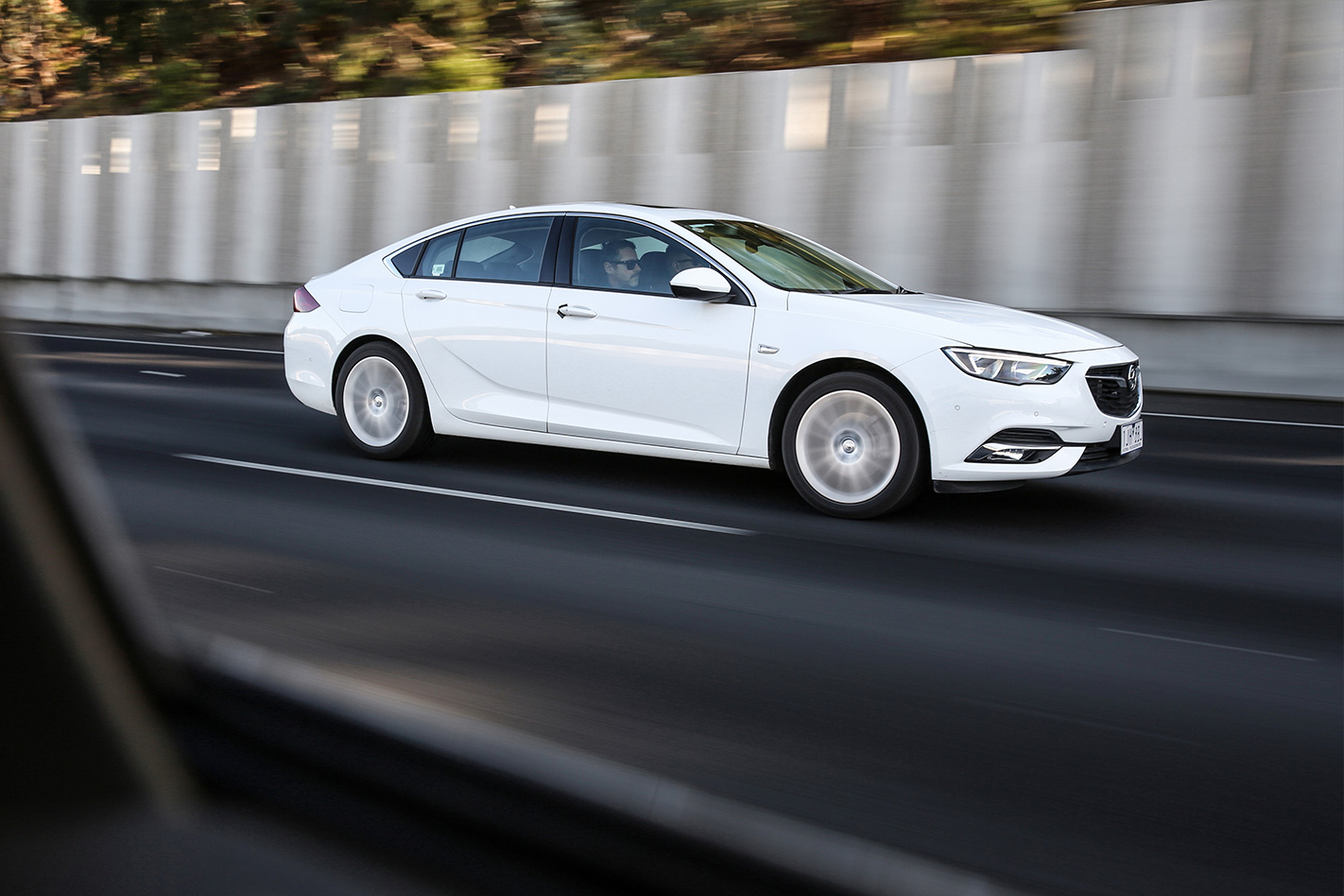
Hitting Holden showrooms late in February, the German-built ZB Commodore and Calais range will attempt to offer something for everyone (besides a V8 engine…).
Starting at $33,690 for the Commodore LT 2.0-litre front-drive ‘liftback’ and stretching to $56K for the V6 AWD Commodore VXR (also a ‘liftback’ sedan), if you include front-drive 2.0-litre turbo-diesel variants (base LT liftback and Sportwagon, and Calais liftback), the range will span 15 different models, including two high-riding Calais Tourer AWD wagon variants.
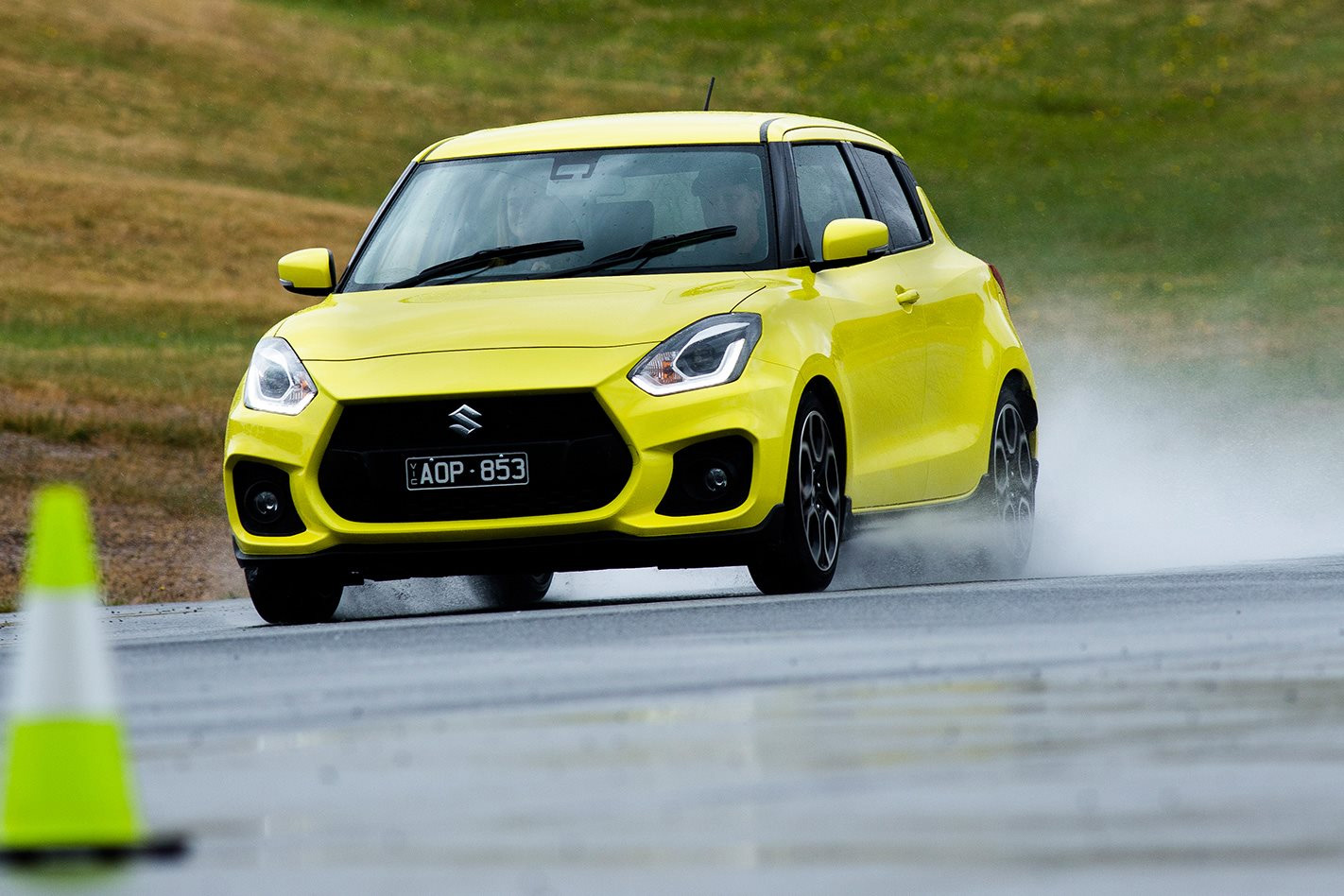
Suzuki Swift Sport – Arriving: February
Based on the excellent new-gen Swift hatchback, the feisty Sport version will inherit Suzuki’s syrupy 1.4-litre ‘Boosterjet’ turbo-petrol four that also stars (in auto-only form) in the Vitara and S-Cross.
The new Swift Sport, however, will cover all bases thanks to both six-speed manual and, for the first time in Sport guise, six-speed auto availability.
Packing 103kW/230Nm into a lithe 970kg body, the Sport promises a spicy driving experience, garnished with winged-back front buckets, a perforated-leather rim with red stitching for the superb steering wheel, and a newfound level of sophistication.
GREAT ROADS come in various guises.
They’re not always the photogenic mountain roads that lay draped like discarded spaghetti across Instagram-perfect peaks. You may have your own personal favourites that you know like the back of your hand, that are your go-to routes when you need to blow off some steam.
But keep those local gems to yourself. They’re your hard-earned secrets and you don’t want the likes of us clogging them up. Instead join us for a virtual tour of the globe in search of ten of the greatest driving roads in the world.
10 – Mount Iwaki Access Road, Japan
Do you like hairpins? Try 69 of them in metronomic, rhythmic lockstep. That’s the promise of the Mount Iwaki Access Road, in Aomori Prefecture in the northern tip of Honshu, Japan. What’s more it packs those 69 power-oversteer opportunities into just 10 kilometres, which means you’ll need hands faster than an overcaffeinated cup-stacker. The road starts at the base of the hill and ascends to the 1247m peak, whereupon a chairlift takes you higher.

Best car to drive it in: We’d be more than happy with a Toyota 86 here. You’ll need tactility and no great amount of torque.
9 – Sani Pass – South Africa/Lesotho
If you prefer your roads a bit more adventurous, the Sani Pass isn’t about to disappoint. Known to locals as ‘The Roof of Africa’, this dirt road starts in South Africa and ascends up to the Lesotho border. While the South Africans insist that you take a rugged 4×4, the Lesotho guards will let you take anything down the hill, and you can spot the remains of vehicles that weren’t so lucky. With 1 in 3 sections near the top and mud, ice and snow possible year round, it’s a heck of a challenge. With waterfall crossings and frequent wildlife incursions, it’s a real adventure drive. You’ll need to get in quick, because next year a project starts by Chinese contractors to completely tarmac the thing.
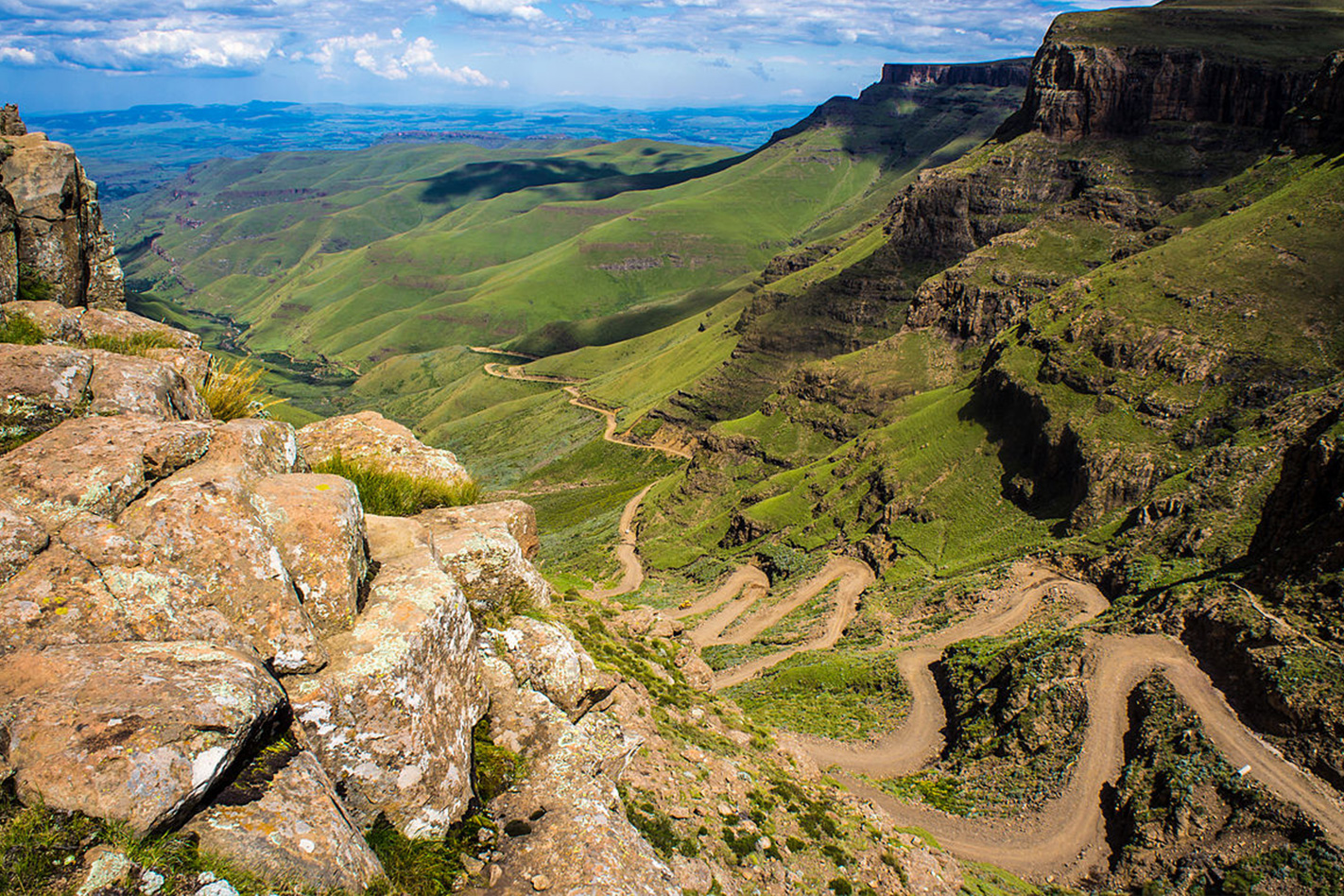
Best car to drive it in: You need something fast and rugged which can also withstand a baboon impact or two. We’d plump for a well-used Mitsubishi Pajero Evolution.
8 – Pico de Veleta, Spain
The cool thing about the Veleta road is that you can ascend from sea level to the highest motorable point in Western Europe in just over an hour: an ascent of 3369m. You’ll need to pull a few strings to do so, because there’s a barrier across the road 2600m up that only permits certain traffic. The tarmac to here is an excellent set of wide open sweepers but not for those with a fear of heights. Beyond the barrier it’s far scabbier and the last few kilometres require something with a bit of suspension travel. It’s worth it though, because on a sunny day you can enjoy a cold drink in the snow and see the African coastline.

Best car to drive it in: Ford’s Ranger Raptor would be pretty much unstoppable when the route got gnarly.
7 – Ronda Road, Spain
This route has long been a press-launch staple of European manufacturers who are confident of their car’s handling abilities. The road snakes from the outskirts of San Pedro de Alcantara on the coast up to the historic town of Ronda. It’s over 50km of unalloyed, beautifully-surfaced fun that climbs from the golf courses of the Costa del Sol, up past the millionaire’s gated community of La Zagaleta before turning seriously gnarly. The higher the road climbs, the more spectacular the scenery becomes, with a blend of technical turns and fast sweepers on the open plateaus up top. Watch out for locals in souped-up SEATs who know the road intimately. Reward yourself with a coffee in Ronda, one of Spain’s prettiest towns, and maybe a side trip to the nearby private member’s racetrack, Circuito de Ascari.
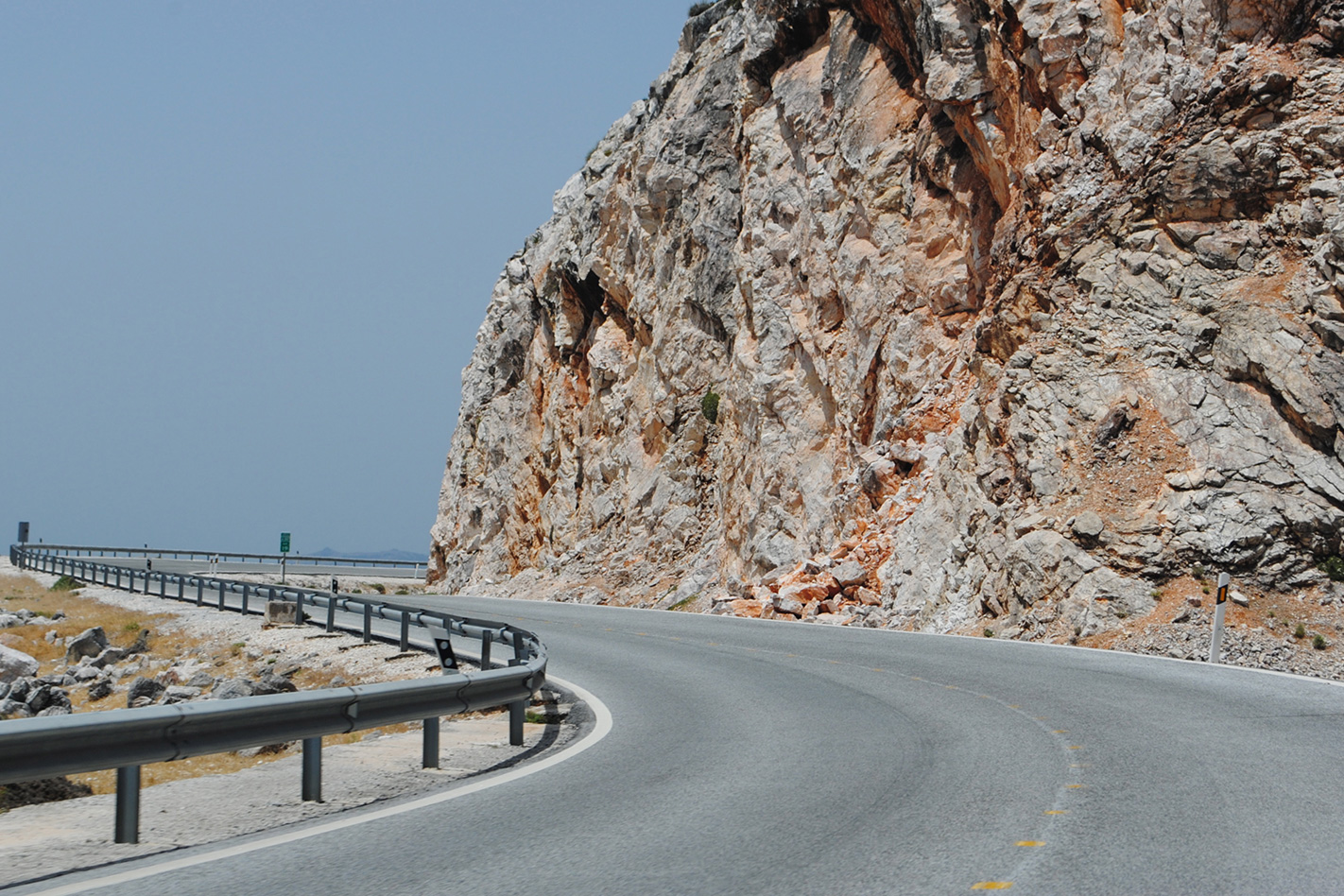
Best car to drive it in: A Porsche 911 GT3 would be nigh-on unbeatable here. There are also plenty of cliffed-in sections where you’d just want to wind the windows down and crank the thing up to its 9000rpm redline.
6 – Dades Gorge, Morocco
The R704 is known as the Road of a Thousand Kasbahs, but it’s more like the Road of a Thousand Corners. It just never lets up and you’ll have twisted blood after the 160km between Ouarzazate and Tineghir. The scenery is breathtaking and so is the driving from some of the locals, who will think nothing of bearing down on you in the middle of the road in a Mercedes W123 that’s little more than a series of components flying in loose formation. Geologists will have a field day here, with the road cut deep into the side of a gorge which overhangs in places. The surface is pretty touch and go, so you’ll need something beefy to have fun.
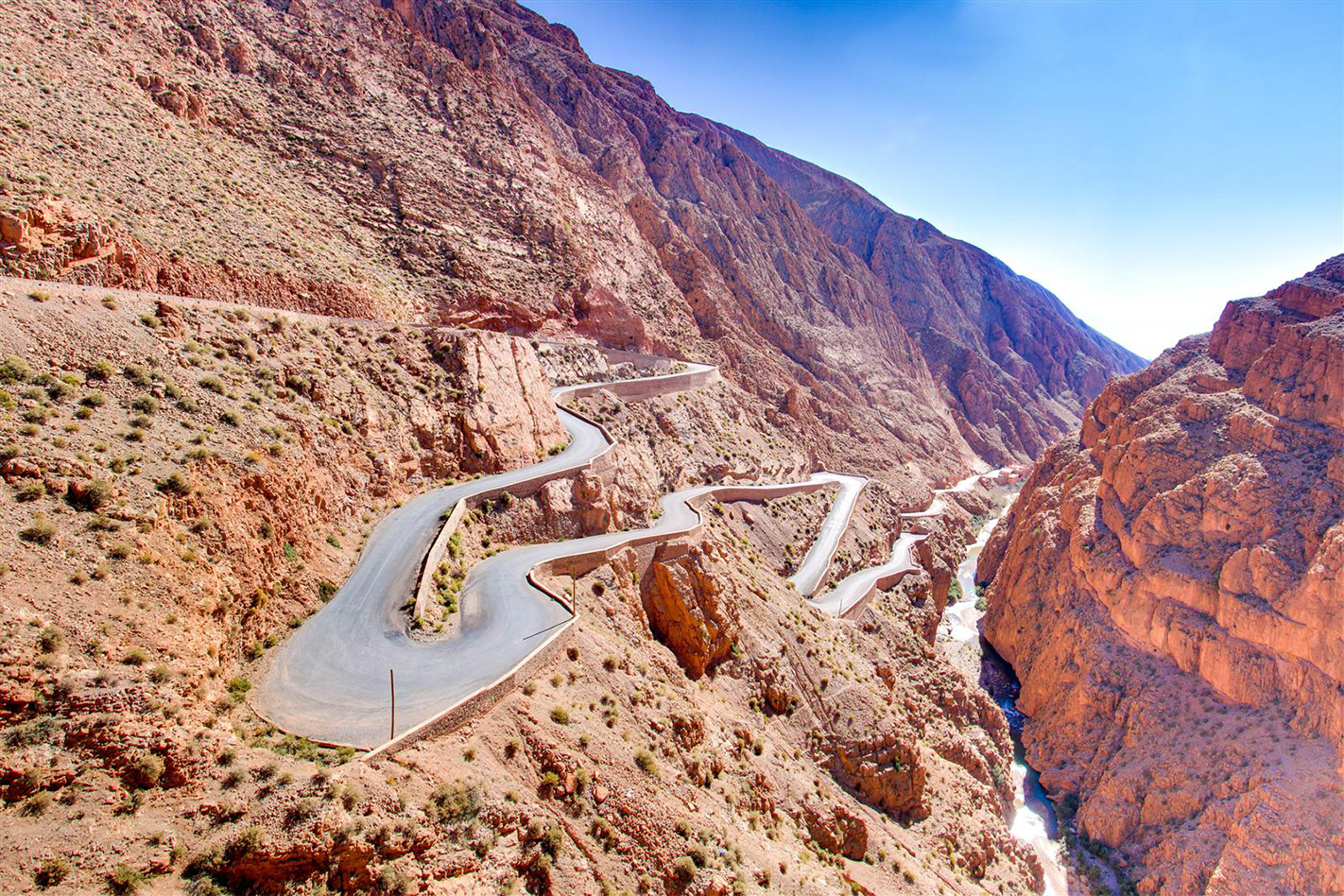
Best car to drive it in: You don’t want anything too flash given local driving standards and road conditions. We’d rent a beater Suzuki Alto from Marrakesh airport and have at it.
5 – Cuesta de Lipán, Argentina

Best car to drive it in: You’d need a combination of great handling,abit of ground clearance and all-wheel drive. We can’t think of much that would top a Porsche Macan Turbo here.
4 – Three-Level ZigZag Road, India
Tucked away in East Sikkim on the old Silk Road is a road that packs 100 hairpins into 30 kilometres. The Three-Level ZigZag road is asphalted all the way to its 3414m summit at Thambi and while you will need to arrange a permit to visit, it’s well worth it for the views of the Himalayan foothills and the challenge of this scarred and pockmarked road.
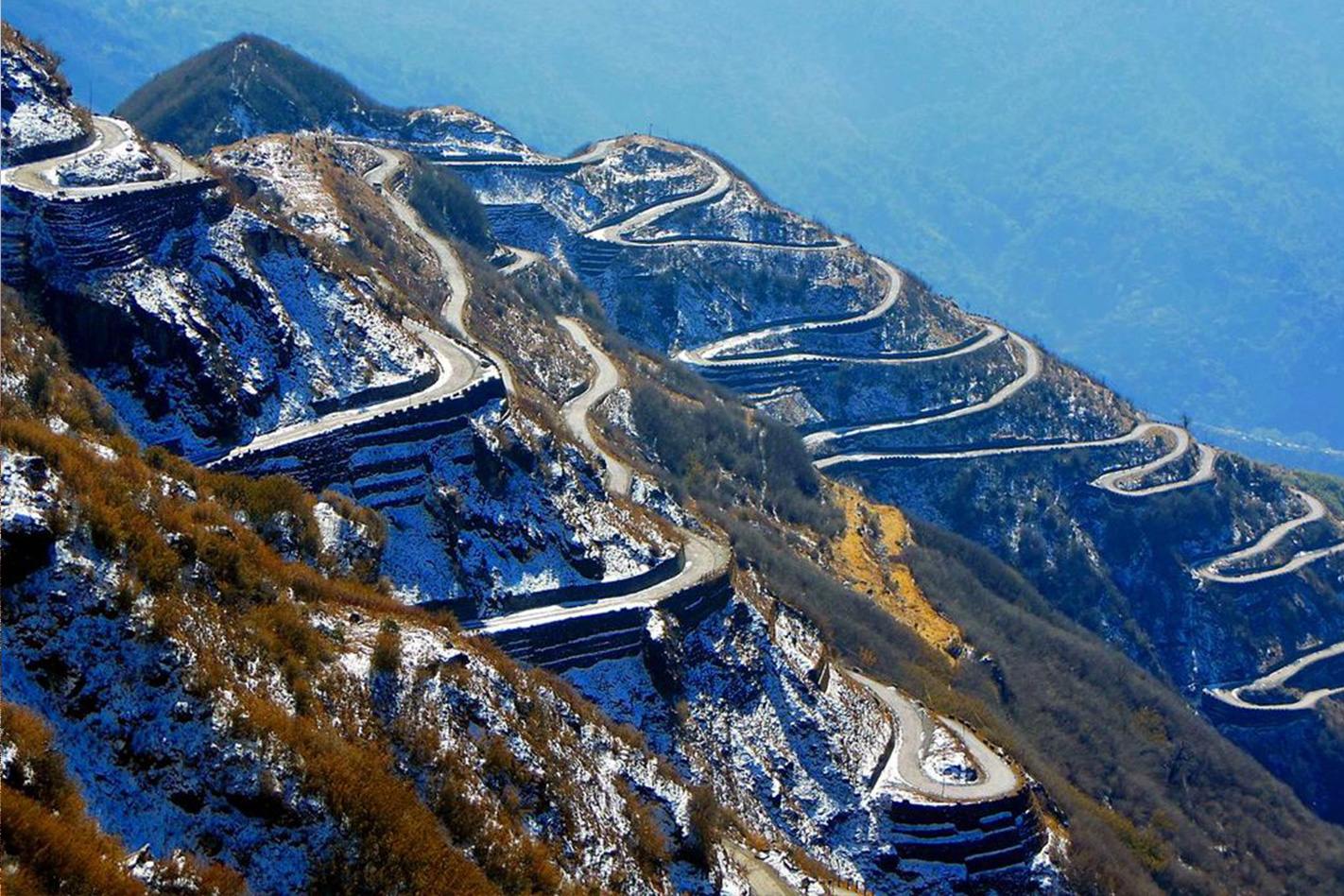
Best car to drive it in: We’d try for shoulder season and use a Focus RS on Goodyear Ultragrip 9 snow tyres.
3 – Karakoram Highway, Pakistan/China
Known as the Ninth Wonder of the World, the Karakoram Highway (known as the KKH) is the highest paved road on Earth, peaking at 4693m. It’s also not something you’ll undertake lightly. Apart from the mountains of red tape you’ll need to unwind to travel between Pakistan and China, the route is also 1300km long. China owns 413km of it and Pakistan the remaining 887km. It’s proper expedition-strength stuff, so you’ll need spare tyres, fuel, radio, medical knowledge and so on. The Chinese are preparing to widen their section of the road from 10m to 30m, making that an easier proposition when completed. The Pakistani side is the one with the killer views of K2 though, so that would be our destination.
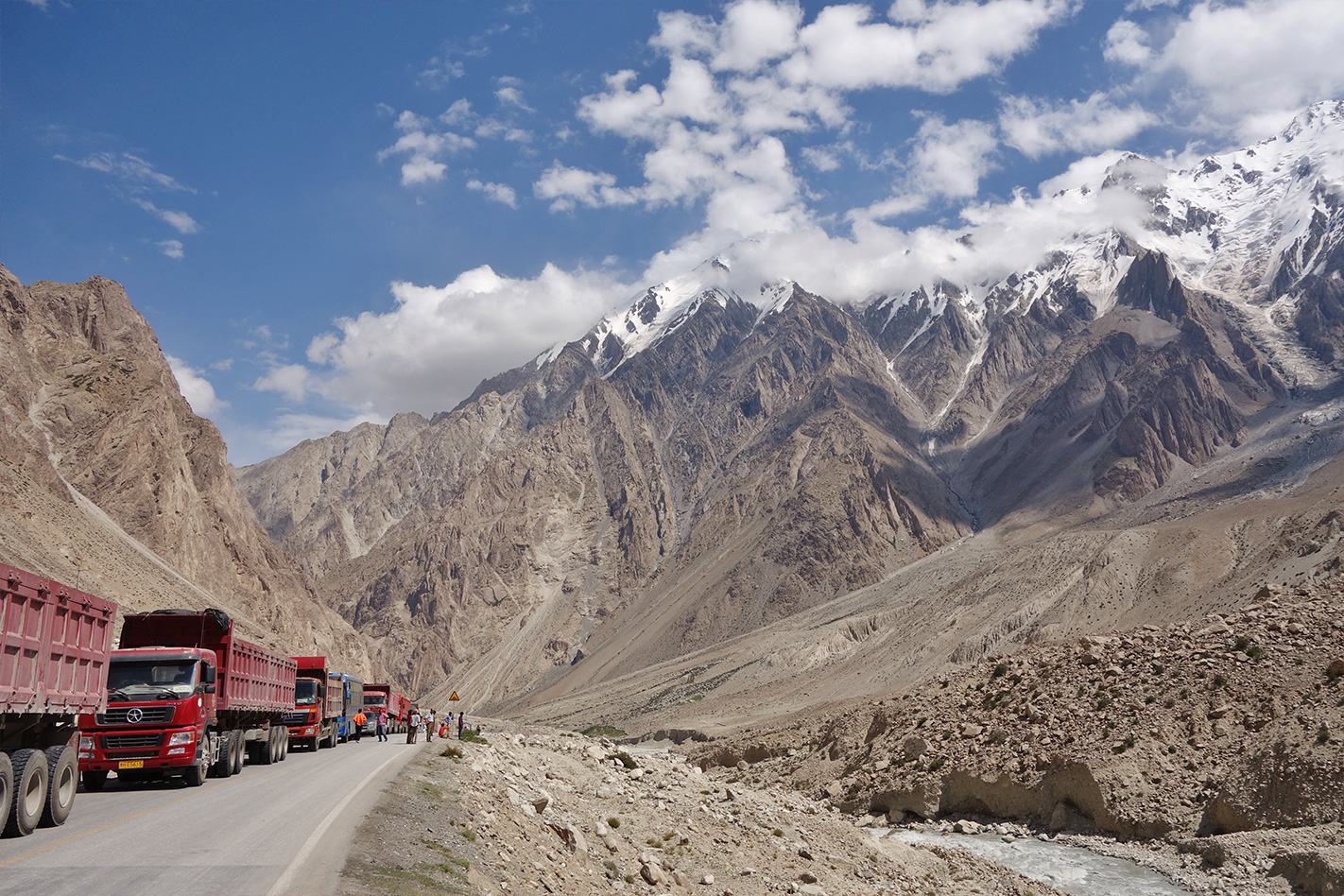
Best car to drive it in: A Toyota Landcruiser. Accept no substitute.
2 – Lyell Highway, Tasmania
Yep, you don’t even need a passport to drive on of the very best roads on the globe. Just put your car on the Spirit of Tasmania, unload in Devonport and warm up with a run down past Cradle Mountain or, well, anywhere really. You can’t go worng in Tassie, but make sure you end up in Strahan and start pedalling along the west coast to Queenstown, then east back through the Cradle Mountain Lake St Clair National Park to Derwent Bridge and Tarraleah on the A10. Keep an eye open for animals on the road (at some points it looks like the aftermath of a wallaby serial killer on the loose) but otherwise just enjoy some of the most beautiful and wild roads anywhere.
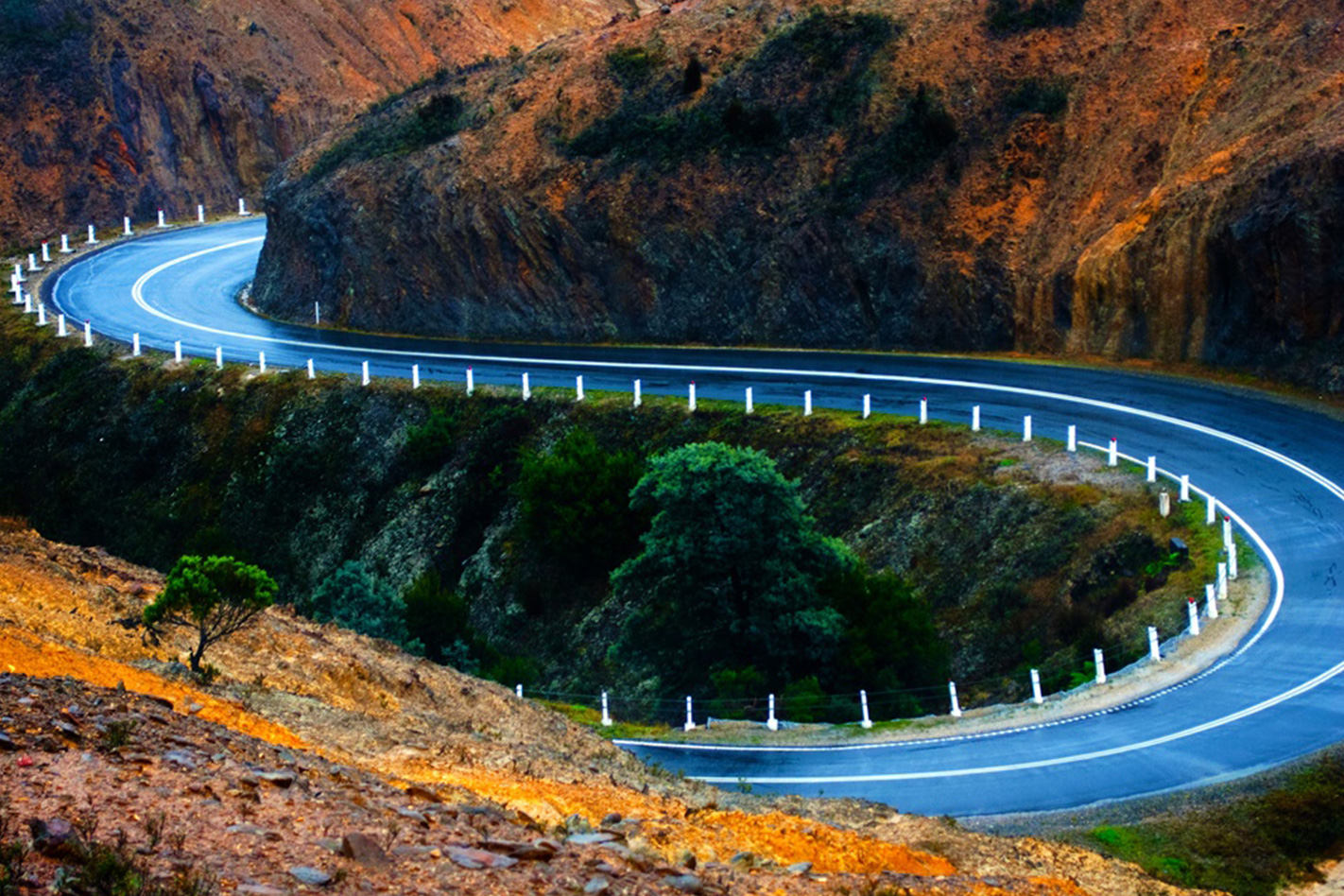
Best car to drive it in: A BMW M2 is about the perfect size and packs a sweet power-to-weight ratio for Tassie’s winding roads.
1 – Transalpina, Romania
Top Gear nearly got it but blew it at the last when they named the Transfagarasan as the best road in the world. That road is 90km long but only the northern section really challenges. The 148km Transalpina is longer, higher and wilder, earning its nickname of The Devil’s Path. It was only fully asphalted in 2009, with the full length opened to traffic in 2012. Linkings Novaci, south of Parâng Mountains and Sebeş in the north, the Transalpina was originally built in 1938, rebuilt by German troops during WWII and then, in 2007, work started in renovating the dirt route.
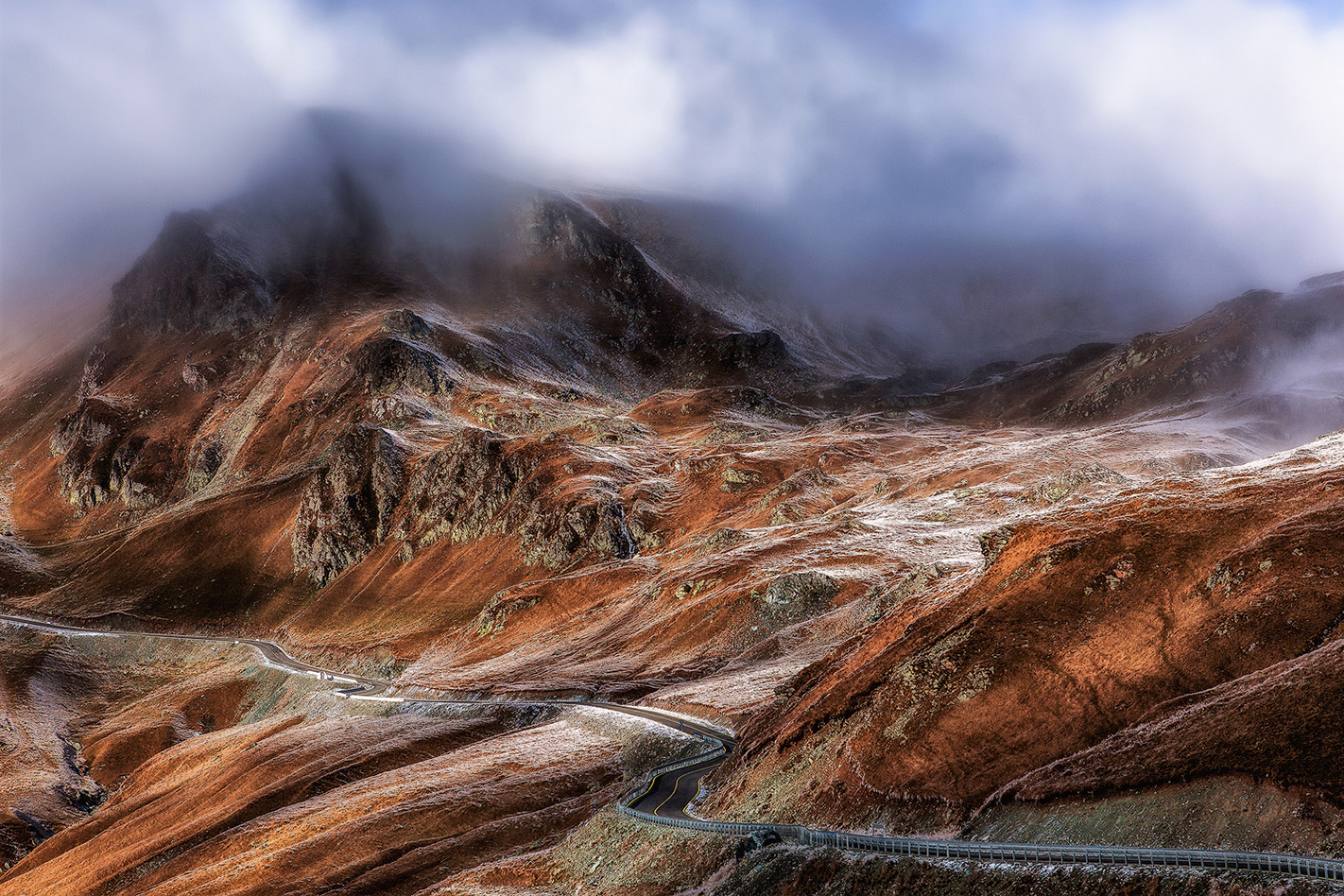
Best car to drive it in: You’d want something nimble but leggy and with a decent ride quality. An Alfa Romeo Giulia Quadrifoglio would be right on the money.
THERE’S a reason the LC coupe looks the way it does: for Lexus, it’s a seduction project.
Legend has it, after a visit to the Pebble Beach Concours d’Elegance and noticing a major lack of L badges on the greens, Toyota president Akio Toyoda realised that to Westerners, Lexus was perceived as snoozy and emotionless, and has made it his mission to sex up the brand.
Less than half a year later, a voluptuous coupe concept known as LF-LC premiered at the 2012 Detroit show, designed in Toyota’s California-based studio. Five years later, via the supreme Motomachi master artisans or Takumi, the production Lexus LC arrived, with hardly a conceptual curve out of place. Was it enough to wake up the brand?
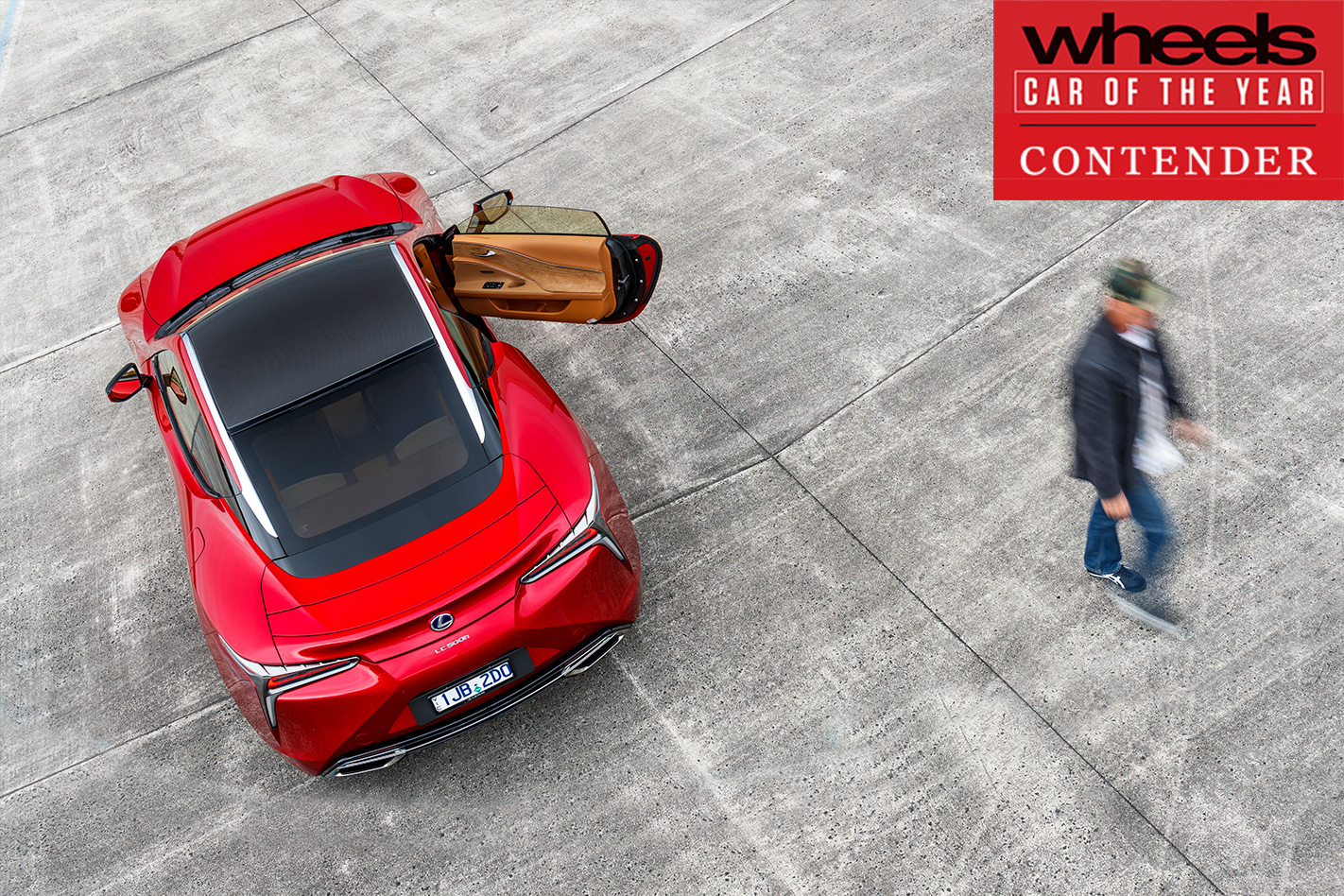
A sense of surprise at the fact it exists hovers around the Lexus LC, and it brought many a smile to Lang Lang. Of course, in a field with more than its share of raised wagons, it’s not hard to crack a grin when you pour yourself into a plush, low-slung, naturally aspirated V8-powered rear-driver.
Especially one that looks like an intergalactic luxury hotel, growls like a beast, and pumps out 351kW/540Nm via a rev-devouring and racy, tightly stacked 10-speed automatic that delivers flamboyant, rev-matched downshifts. And more so when you suddenly remember the badge stamped on its backside. Really, Lexus created this?
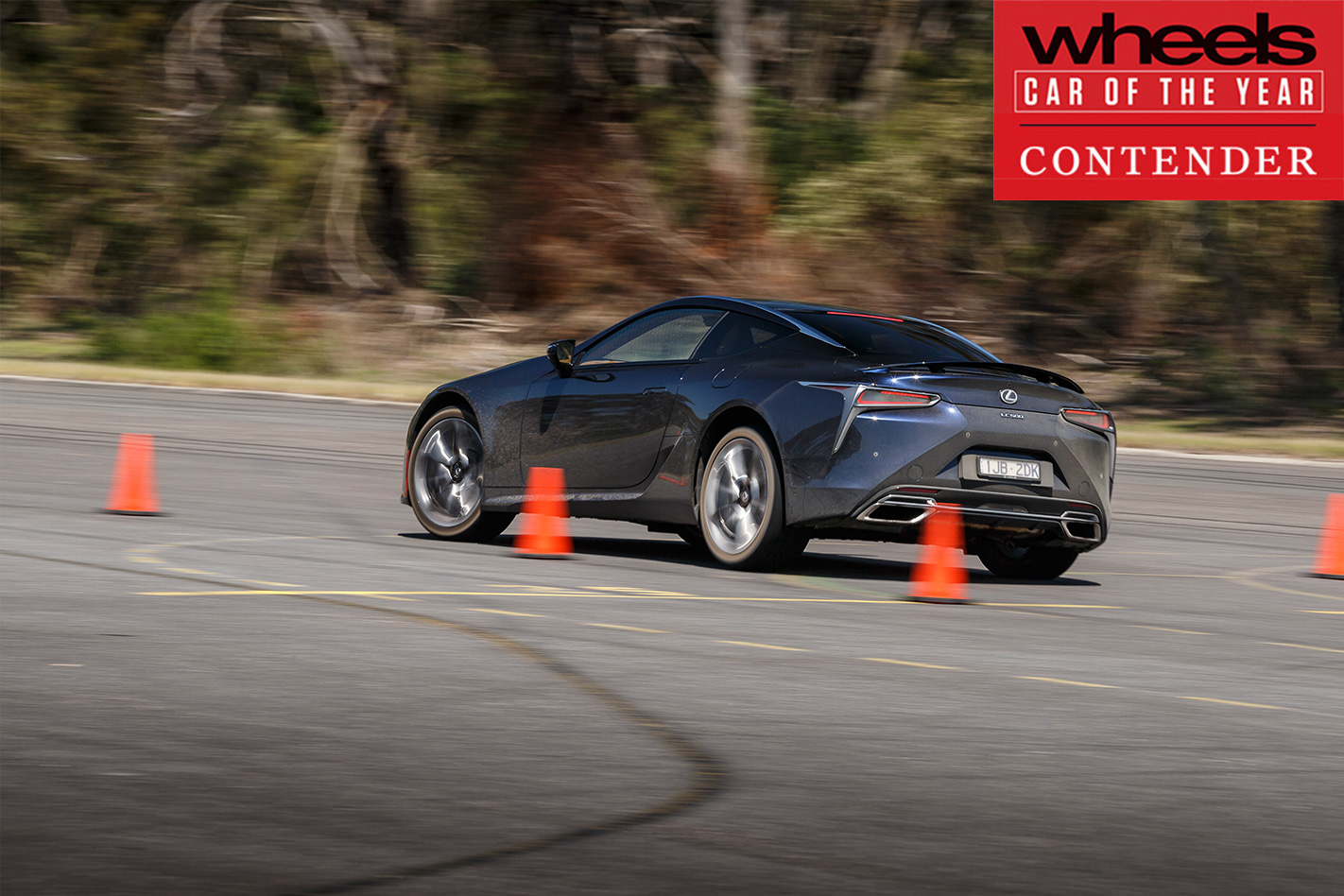
At a portly 1935kg (LC500) and 1985kg (LC500h), thanks to a mostly steel body, the Lexus is heavy and on Lang Lang’s handling circuit, it felt it. The LC is more boulevard cruiser than apex hunter, though body roll is well-contained, grip levels are high and the stability system is fantastically calibrated. That broad nose and a grille that looks like it could devour a small child gives the LC menace, yet its friendly dynamics encourage you to fling it into corners.
Our test cars had the $15K enhancement pack with four-wheel steering, which divided judges. Sharp and pointy, yet feeling quite natural, it’s noticed most in low-speed manoeuvres, but does it really make enough dynamic difference?
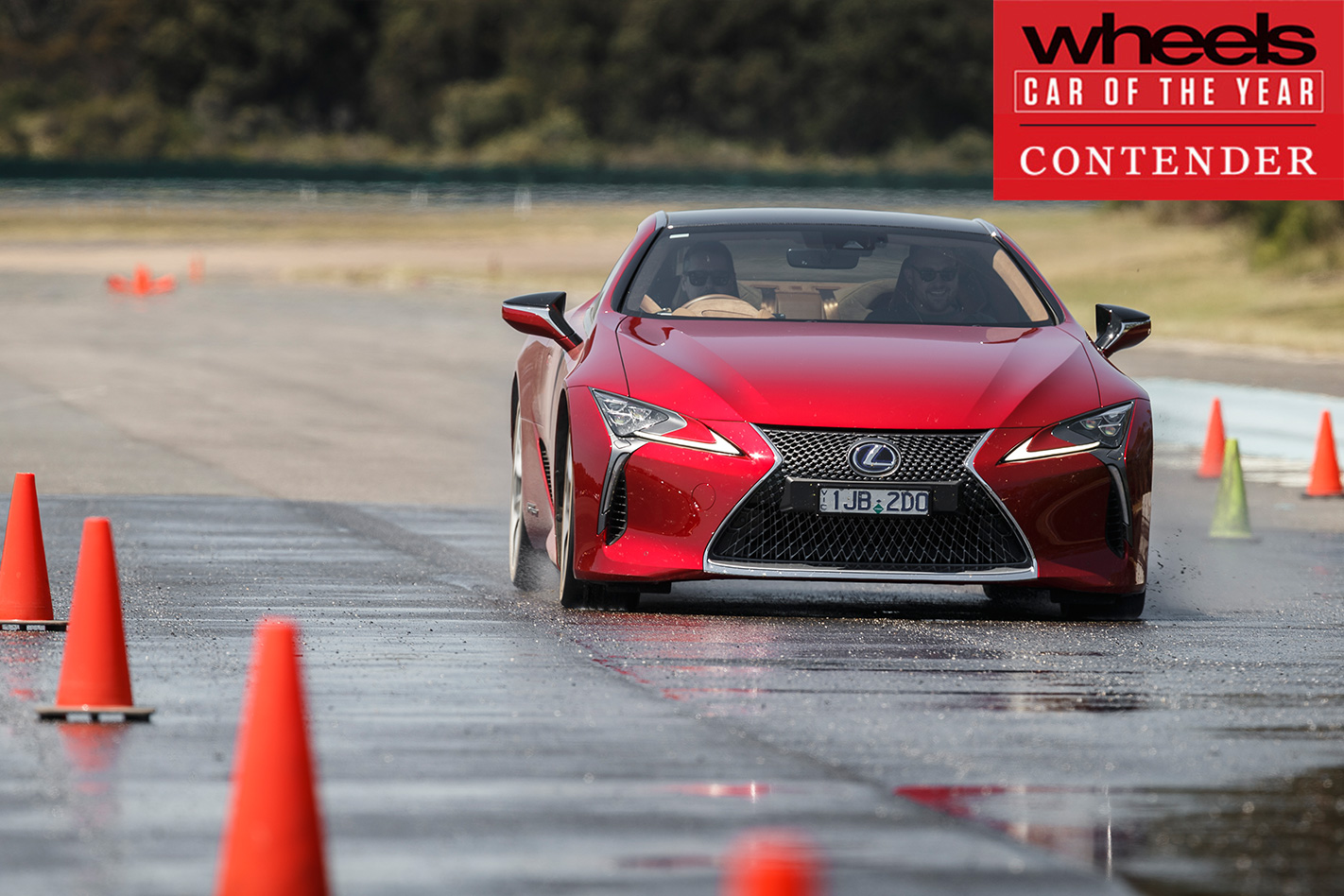
It also garners a lot of attention, and so it should: it’s an incredible achievement in design-meets-engineering at a price that seems reasonable for the technology, equipment and fundamental quality it buys you.
And details like the multi-dimensional tail-lights, the exquisite leather and suede that wraps the entire cabin, and the mind-blowing 918-watt, 13-speaker Mark Levinson sound system ensure the LC stuns. It’s a highly alluring grand tourer, provided you can live with its shallow, surprisingly small boot.
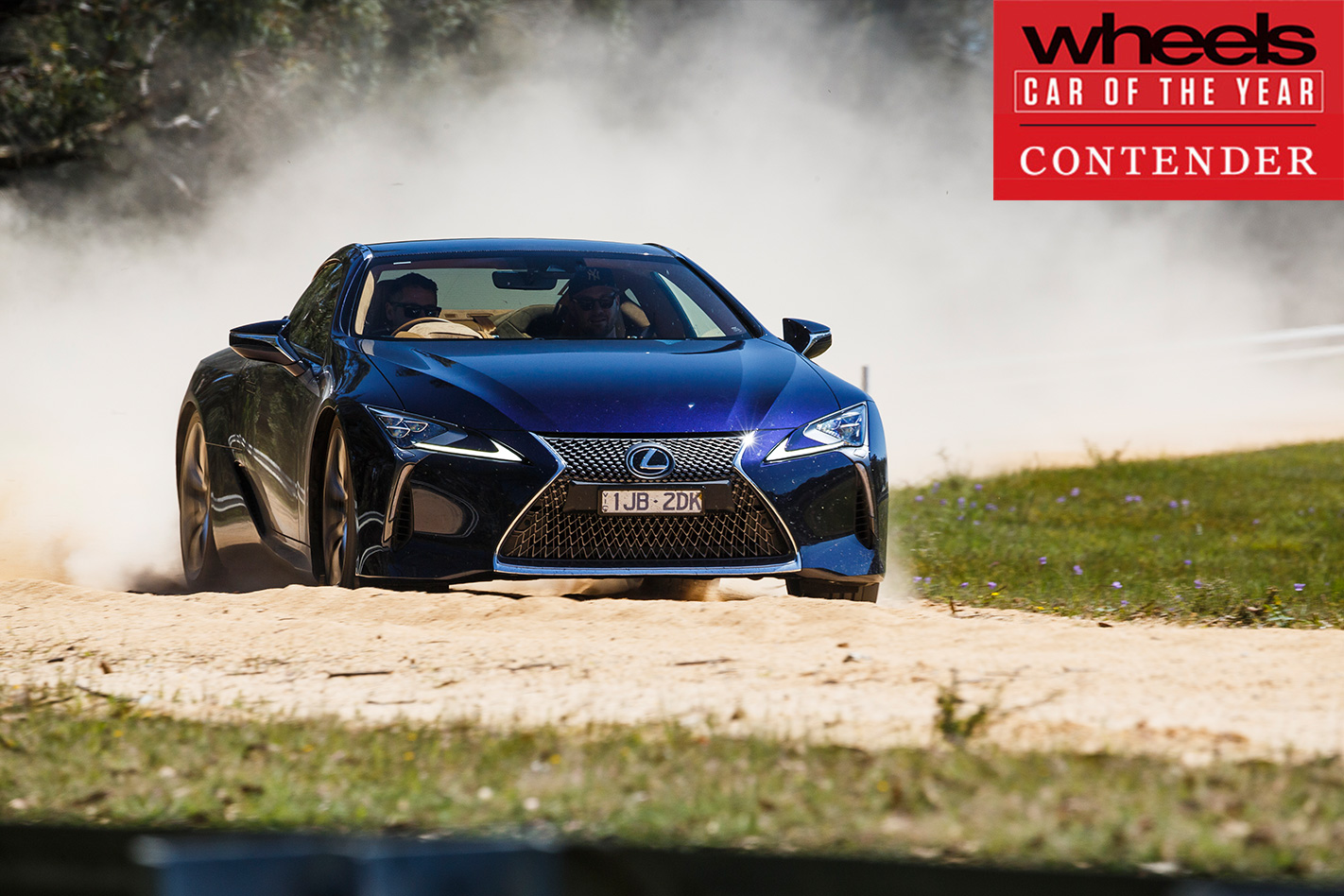
Not mucking around
The Lexus LC V8 is studded with serious performance-car bona fides such as an engine that sits fully aft of the front-axle centreline, an active rear spoiler and carbonfibre roof (part of the $15K enhancement package that also adds rear-wheel steering), carbonfibre inner-door panels and a composite boot floor.
The bumper beams, front suspension-mount reinforcements and most of the suspension links are aluminium, as are the door skins. A rear-mounted battery helps limit the nose’s weight load to 52 percent.
