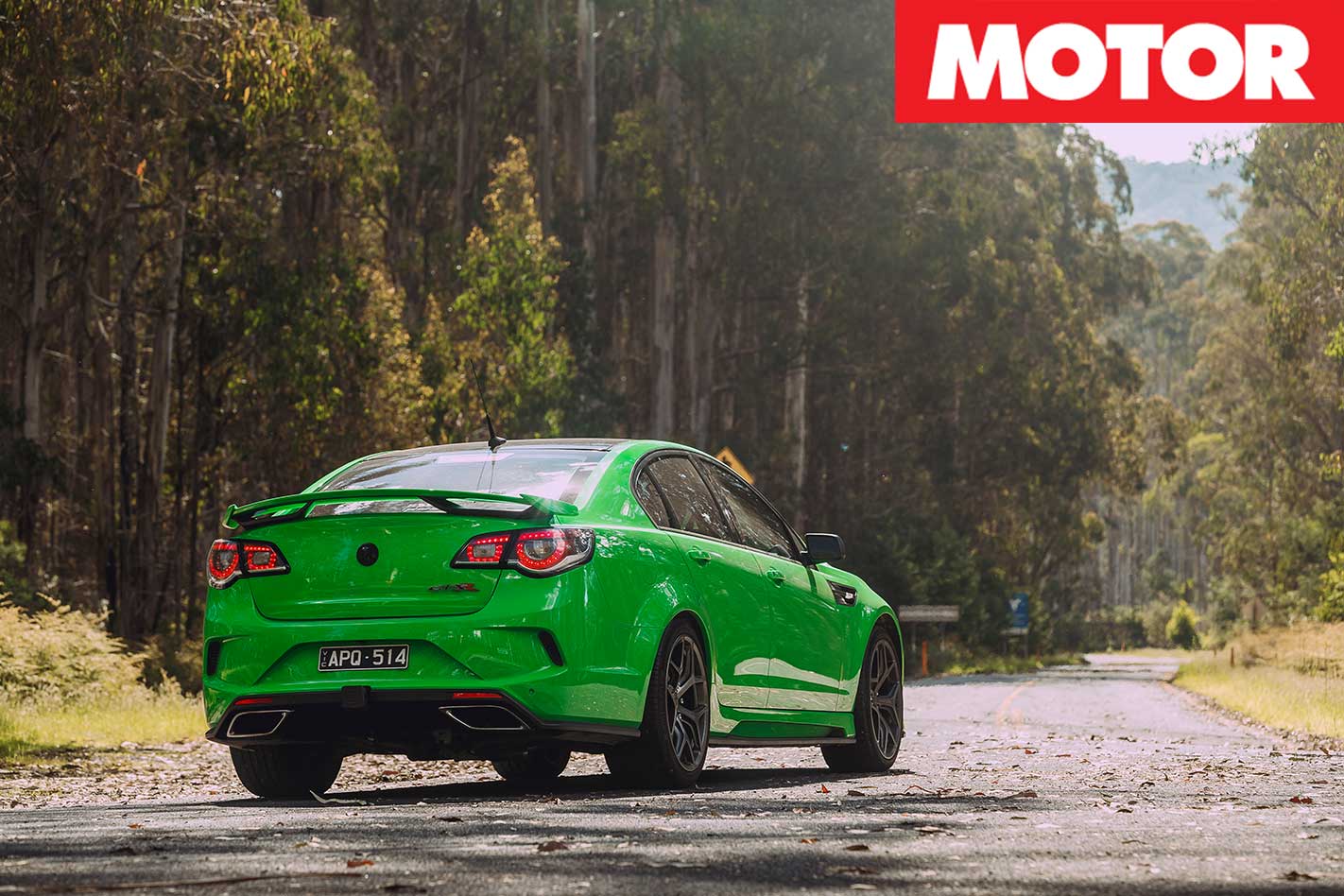
Records fell and traditions were challenged in 2017.
Of the record 1.189 million new vehicles sold last year, SUV models soared by 5.6 per cent to 465,646 sales and they ousted passenger cars – down 7.5 per cent to 450,012 – for the first time. Medium SUVs alone recorded a mammoth 13.6 per cent gain to 195,655 sales, while the best-selling small car segment was stagnant at 220,146 units.
Dual-cab utes also increased by 12.8 per cent to 165,797 sales, replacing large SUVs as the third most popular segment in the country. It bodes well for this year’s Ford Ranger Raptor and Colorado SportsCat by HSV that each hope to seize upon our love for load luggers with added sportiness.
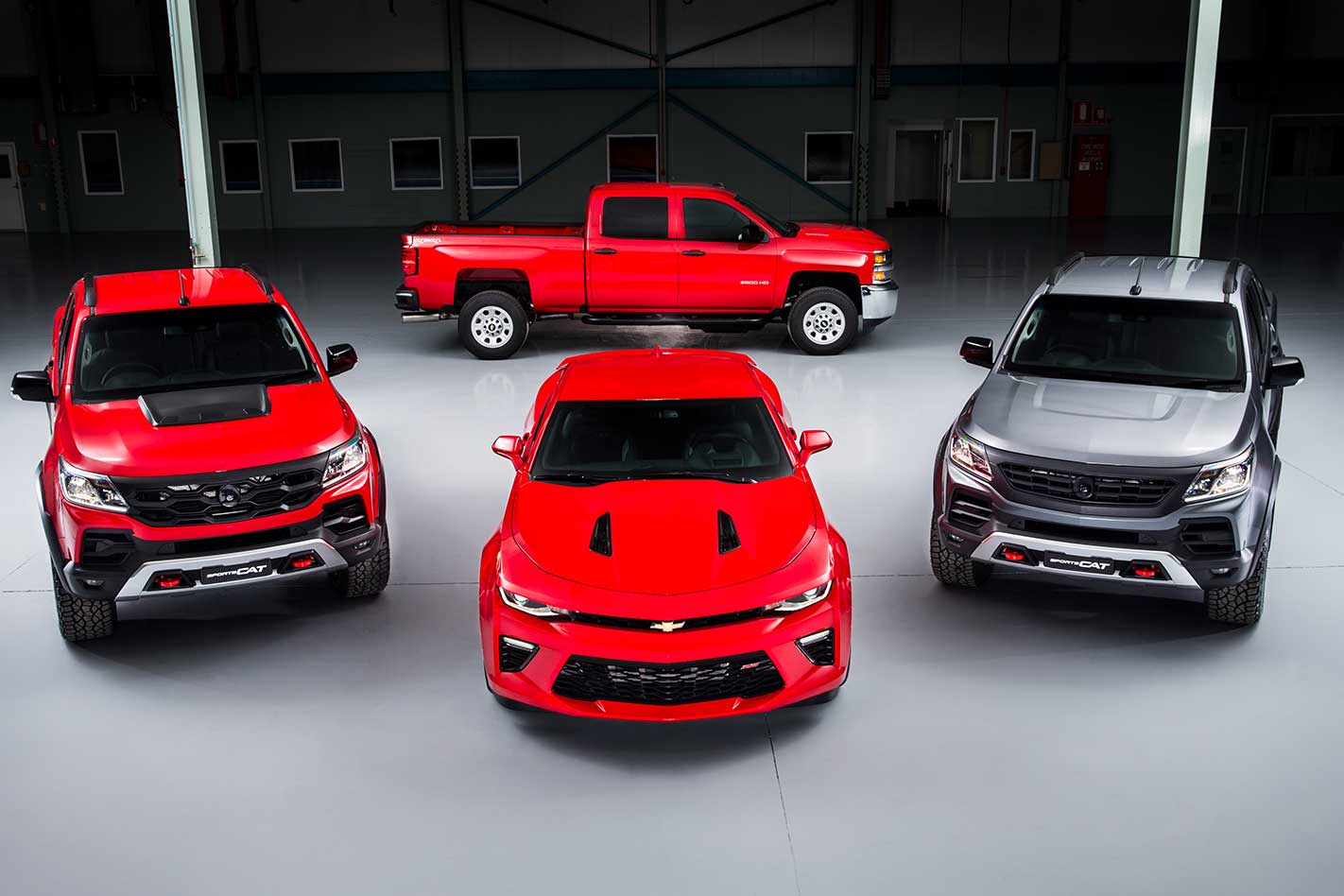
Worryingly for Holden, though, it fell by 4002 units or 4.2 per cent to 90,306 sales even with the local Commodore still holding a dominant 23,676 slice, but falling 8.4 per cent. Given the admission that the ZB Commo import won’t sell as well, how will the Lion recover volume in 2018?
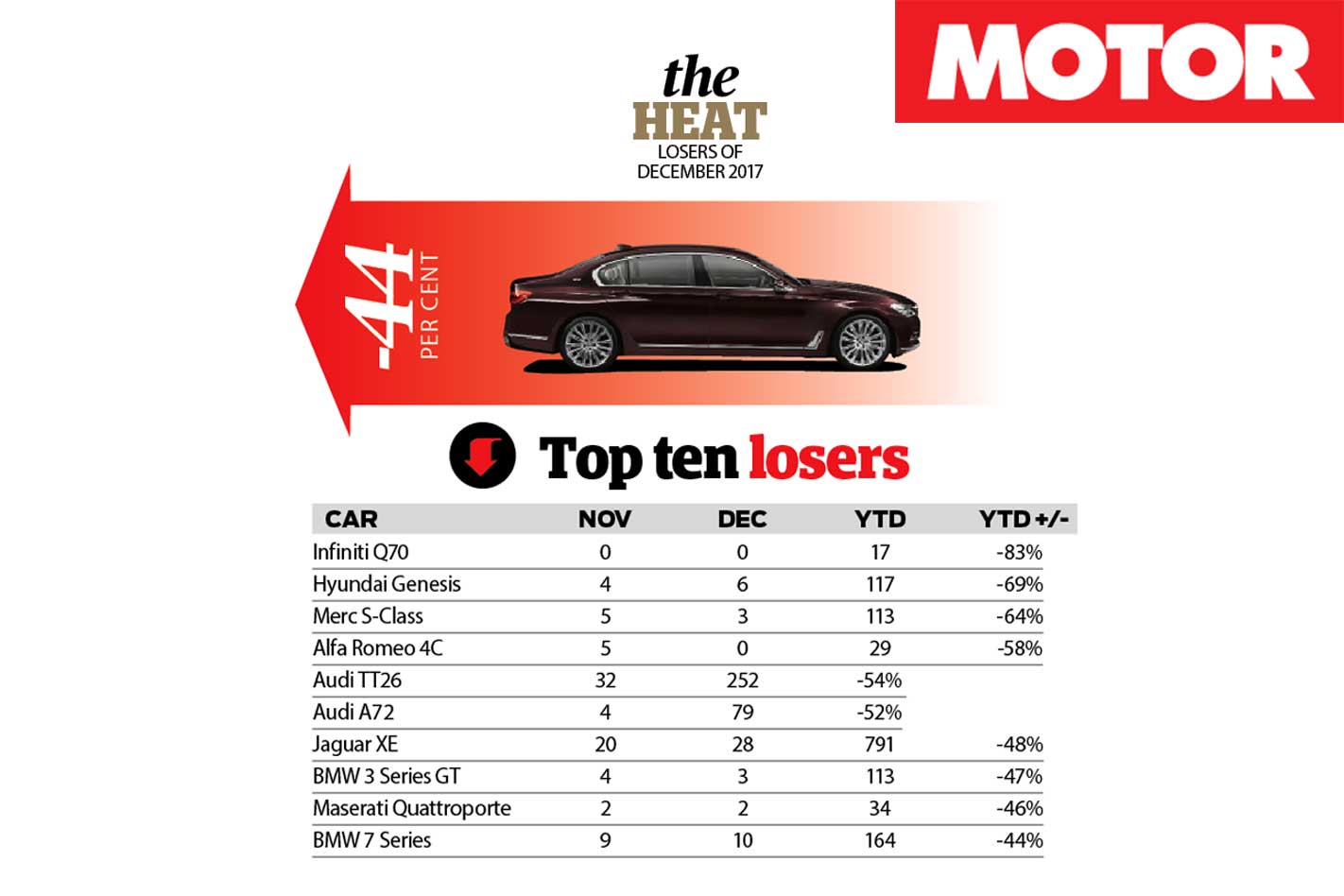
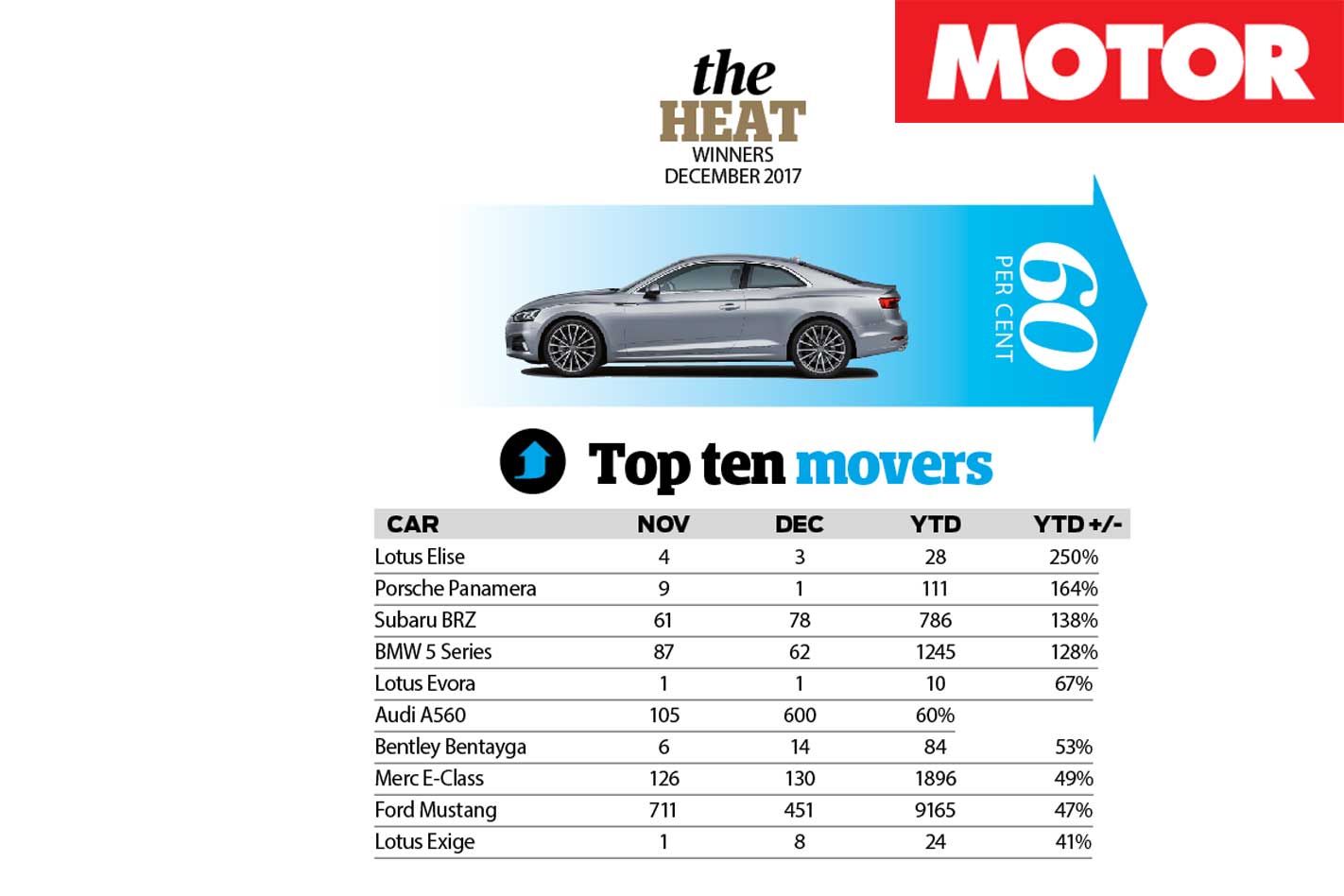
Other big gongs go to little players, such as Alfa Romeo’s 48.7 per cent boost to 1057 thanks to Giulia’s 639 solid debut, Maserati’s 53.2 per cent increase to 740 owing to Levante’s 492 haul, and Aston Martin and McLaren up by a quarter to 144 and 116 sales respectively. Meanwhile Benz and Porsche were steady, while Audi and BMW fell slightly.
I was watching the cricket the other day, my body immobilised in the kind of holiday-induced coma that only a prolonged diet of Christmas ham and too much beer seems to create, when my brain managed a moment of coherent thought.
As I watched the Aussie attack tear through the English top order, I wondered, “could I give that a go?” A quick and rather brutal assessment of my meagre skill with bat and ball concluded that no, I couldn’t.
Nor could I beat Novak Djokovic at tennis, nor Rob Cross at darts.
Why then, if presented the opportunity to drive a Formula 1 car, or even a V8 Supercar, would most of us instantly think, “I could do that!”
Reading this magazine suggests you enjoy the thrill of driving and, like me, probably consider yourself to be above average behind the wheel. Yet when was the last time you actively worked on improving your driving ability? As in, consciously zeroed in on the skills required to drive quickly and safely: braking, throttle and steering inputs, vision, etc. It’s an interesting thought to ponder given how 2018 has kicked off.

Speed, the infamous poster child of the ‘Towards Zero’ campaign, is of course cast as a primary villain, but the government’s Black Spot program and mobile phone use have also come under the microscope.
The witch-hunt has even seen tourists feel the wrath of politicians, despite the lack of data to support the argument that foreign drivers are over-represented in fatal accidents.

Yet I’d argue a key issue at the root of Australia’s road toll problem is being largely ignored: driver training and education.
Like cricket, driving is a skill that requires practice and ideally, regular professional instruction, yet the only training on the CV of most Aussie drivers comes from their parents.
One possible saviour lurking on the horizon is autonomous cars, with many experts predicting their combination of cameras, sensors and millimetre-perfect GPS systems will eventually be much safer and more reliable than humans as the technology improves.
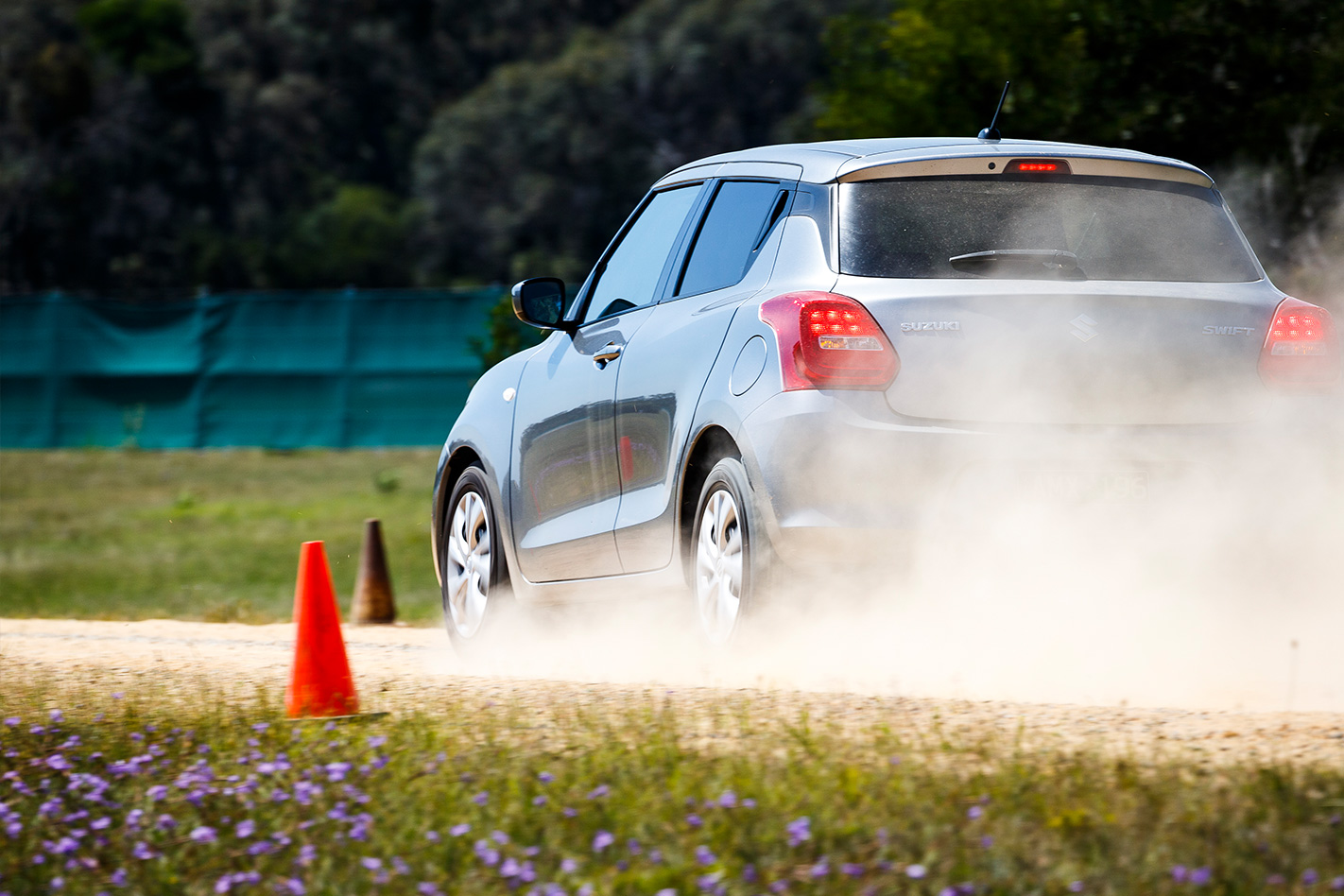
While systems that support the driver and help to reduce fatigue on long journeys are undoubtedly a good thing, the risk is that drivers will gradually and subconsciously disengage from the act of driving, further eroding their skill and ability when the time comes for them to actually assert control.
Of course, the multi-faceted nature of the road toll problem means it’s too complex to pin on a single culprit, but surely offering greater incentives for driver training, or making it mandatory for all Aussies to attend a defensive driving course every time they renew their licence, makes more sense than erecting more speed cameras or fining motorists for being a few kays over. Or blaming tourists.
IN the 20 years since it was first revealed, the Mercedes-Benz A-Class has evolved from the somewhat frumpy first-gen model which infamously overturned during the Elk Test, into a hatch with striking design, a segment leading interior, and the kind of tech which would make a Silicon Valley native weak at the knees.
It’s that technology which Mercedes-Benz was keen to highlight at the fourth-generation car’s reveal in Amsterdam. Discussions surrounding suspension tunes, engine efficiency, and chassis torsional rigidity took a backseat, as the new ‘MBUX’ system was thrust into the spotlight.
In simple terms, the ‘MBUX’ infotainment system is like an inbuilt virtual assistant, able to control almost all functions of the car through vocal prompts. Think along the lines of smartphone features like Siri, or Ok Google, but for your car.
A statement of ‘Hey Mercedes, I’m cold’ would see the car’s temperature raise by a couple of degrees, all the while the computer’s artificial intelligence system learning how to better understand your speech and preferences.
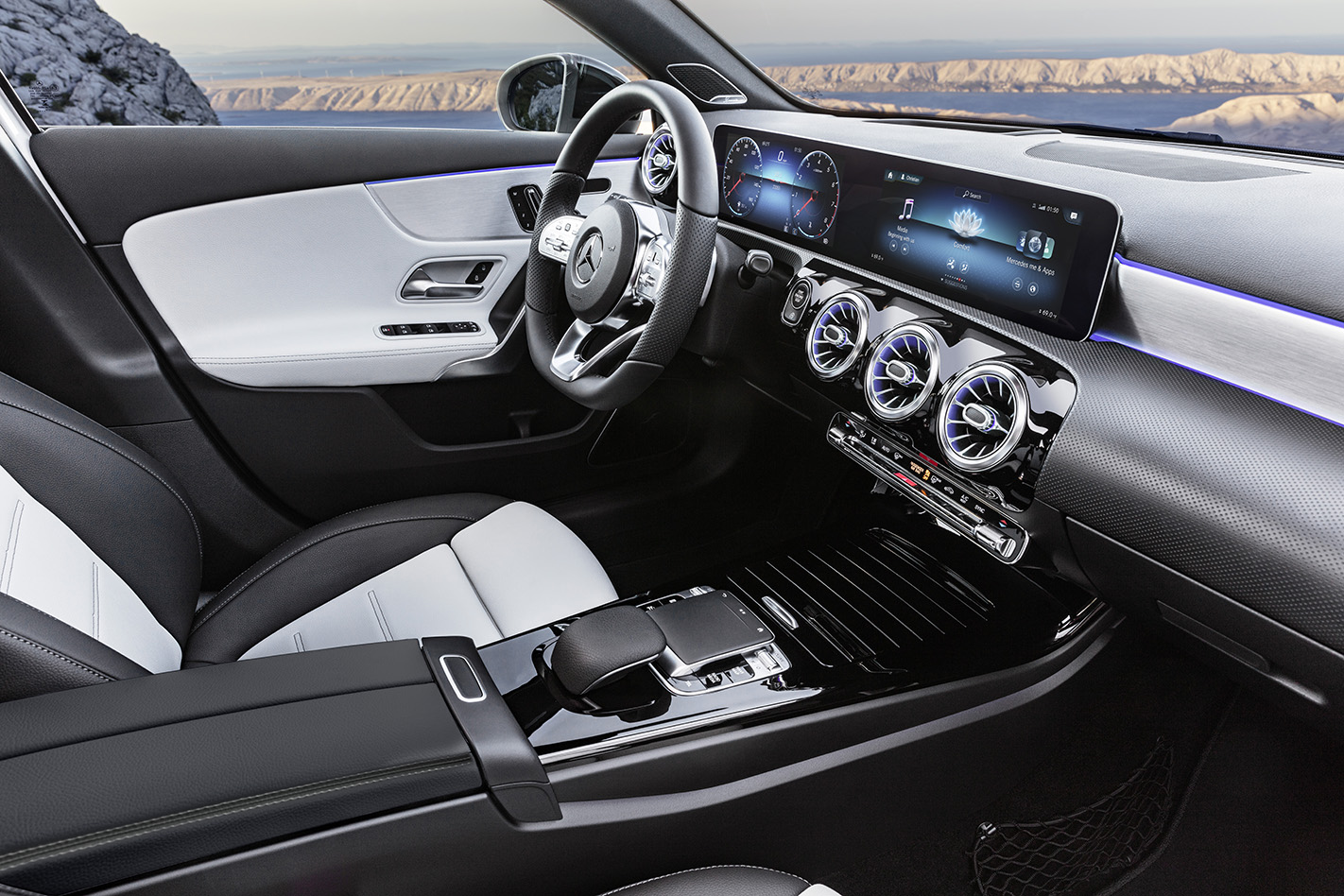
The interior of the fourth-gen A-Class is dominated by dual 10.5-inch touchscreens (the biggest of the class). Located in front of the driver, and stretching to the centre of the dash, the units can be configured to personal tastes, with Mercedes engineers and designers working to develop an intuitive menu system to minimise distraction from driving.
It was confirmed to Australian media that wireless Apple CarPlay will be available on all models in an effort to take on national rival BMW.
During its evolution, the A-Class has put on a few pounds, and this fourth-gen car is the largest yet, with a larger wheelbase and wider front track. The majority of the extra length has gone into increasing boot size – up 29 litres to 370 litres with the rear seats up.
However, there has also been work done to improve cabin space with more shoulder room (+9/+22 mm front/rear), elbow room (+35/+36 mm) and headroom (+7/+8 mm).
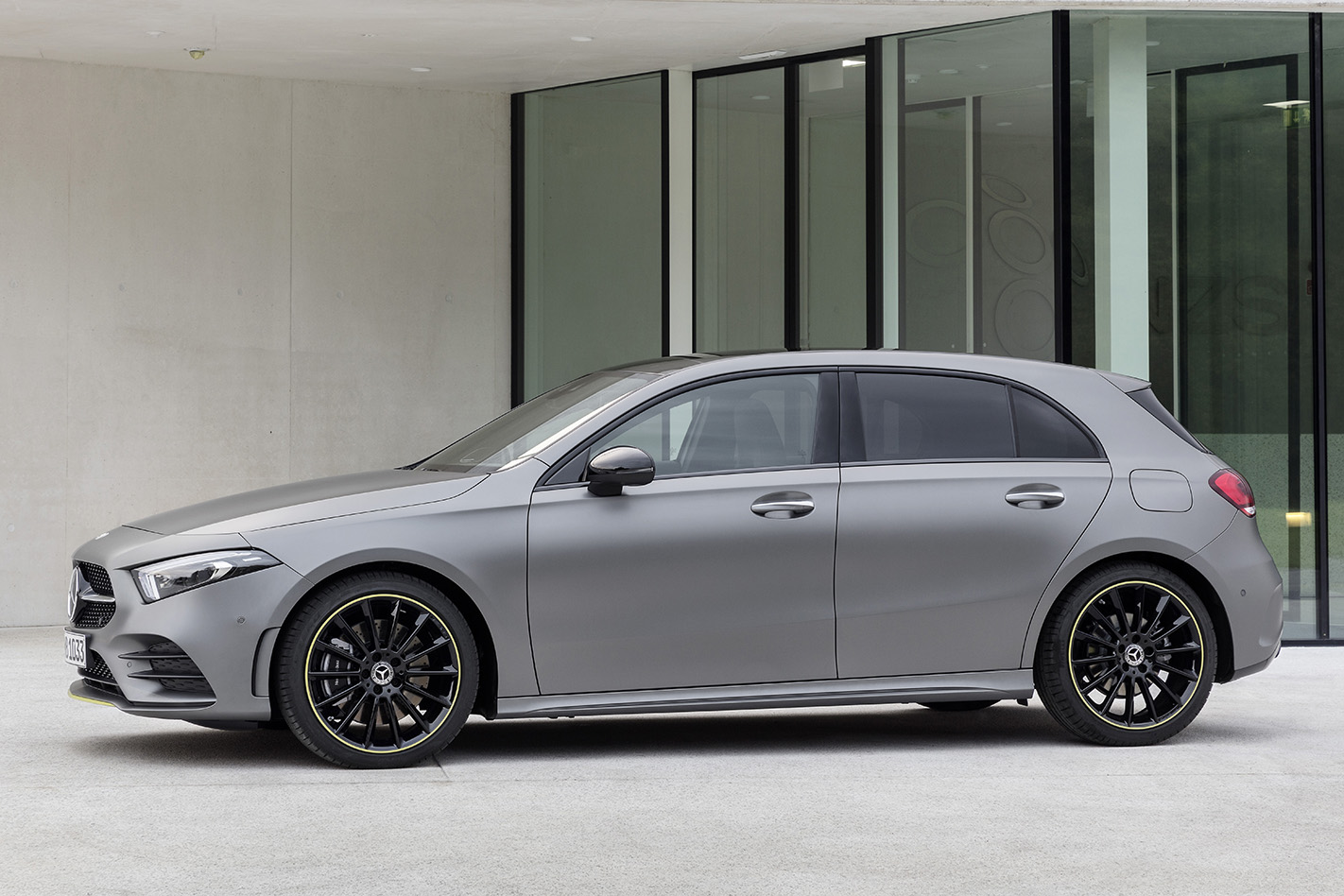
There are three different engines available at launch, the carryover 2.0-litre turbo four-cylinder petrol engine producing 165kW and 350Nm, an all-new 1.4-litre four-cylinder turbo petrol developed with Renault making 120kW and 250Nm, and a 1.5-litre turbo-diesel four-cylinder putting out 85kW and 260Nm.
Each will be sold in varying states of tune depending on the badge.
While a six-speed manual gearbox will be offered in overseas markets, every Australian A-Class will be fitted with a seven-speed dual-clutch transmission, sending power to either the front, or all four wheels.
Why? Because we don’t buy enough three-pedal vehicles to justify the cost of bringing the manual Down Under.
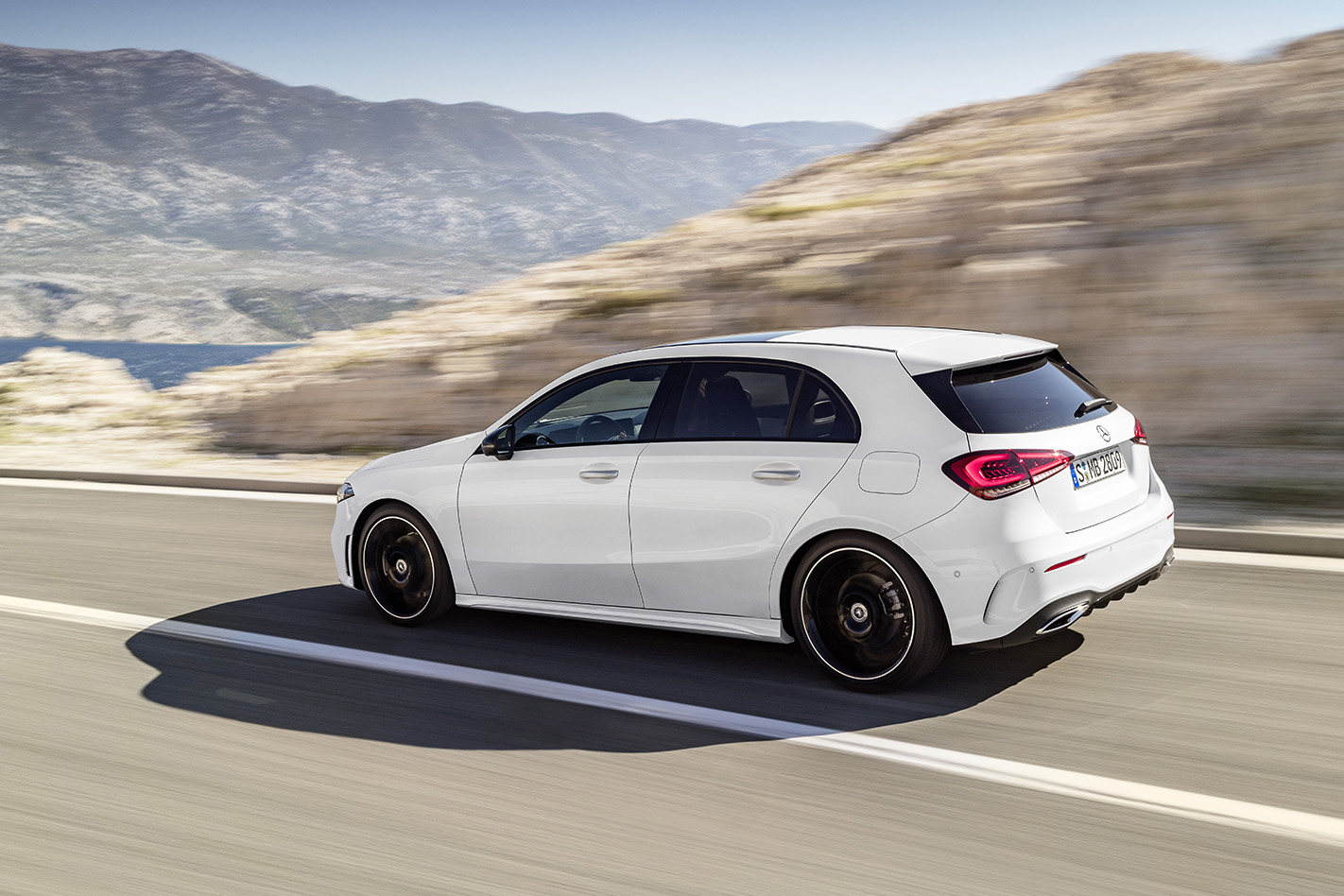
A Mercedes-Benz Australia spokesperson was unable to confirm details regarding the full A-Class line-up in Australia.
However, Wheels understands the A200 will be the first model to launch locally, likely fitted with the 1.4-litre petrol engine, and will be due in the third quarter of 2018.
Final details on engine range and tunes are yet to be confirmed.
A new A45 AMG hot hatch isn’t due until next year, and will be joined by the slightly milder A35 AMG, which will sit between the rip-snorting flagship, and A250 4Matic in terms of power and sportiness. It was hinted to Wheels that the new AMG developed hot hatch version of the A-Class will come packing power levels not yet seen in the segment.
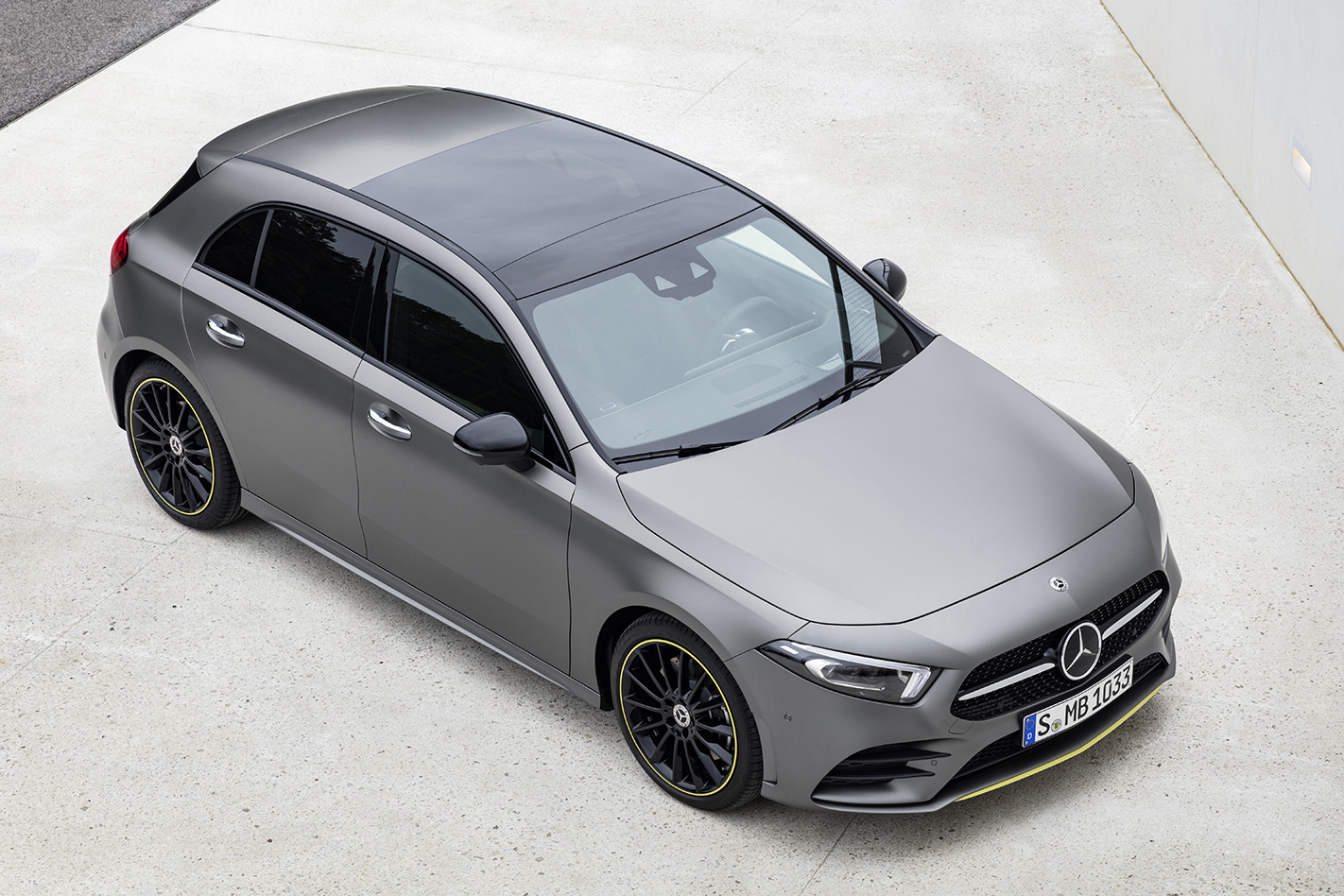
Underpinning the A-Class is an all-new front axle, with two different suspension set-ups at the rear. For front-drive models, and those with smaller engines, a torsion-beam is retained. However, the all-wheel drive models will come fitted with a new multi-link suspension system.
A visual resemblance to the large CLS sedan which was revealed last year is no coincidence, with the car’s designer Gordan Wagner telling Australian media the ‘predator face’ which the two share earmarks the duo as Mercedes’ most progressive stylistic offerings.
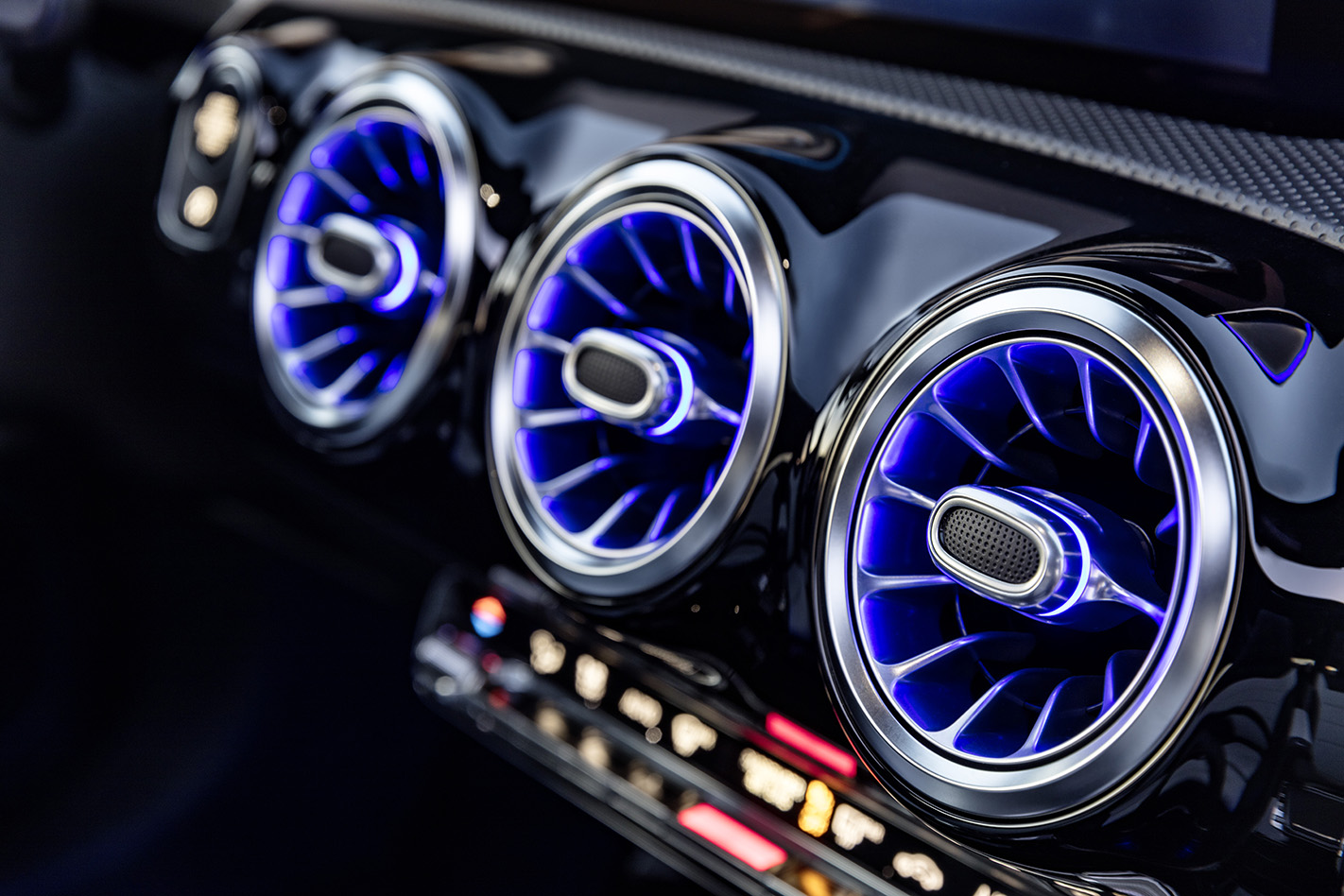
Wagner confirmed a further eight variants will be spun off the new A-Class architecture, which he stated would all look unique – denying any suggestion the hatch’s striking design could seep into other models in the Mercedes-Benz line-up.
Oh, and about that poor Elk Test result of the first-gen car – Mercedes-Benz wasn’t shy about pointing out how far the A-Class has come, with an entire elk-themed room and large sculpture incorporated into the reveal of the fourth-generation hatch.
What’s the cliché about Germans and a sense of humour?
Alfa Romeo’s wilderness years seem to be drawing to an end.
The first hint of a renaissance was the Giulia sedan – the ripping 375kW QV is a BMW M3 beater. And now, in the new Stelvio Q, Alfa has delivered the fastest production SUV you can buy. That’s the claim, anyway. Alfa bases its bold claim on the Stelvio QV’s eye-opening 7:51.7sec Nurburgring lap time, which is an SUV record.
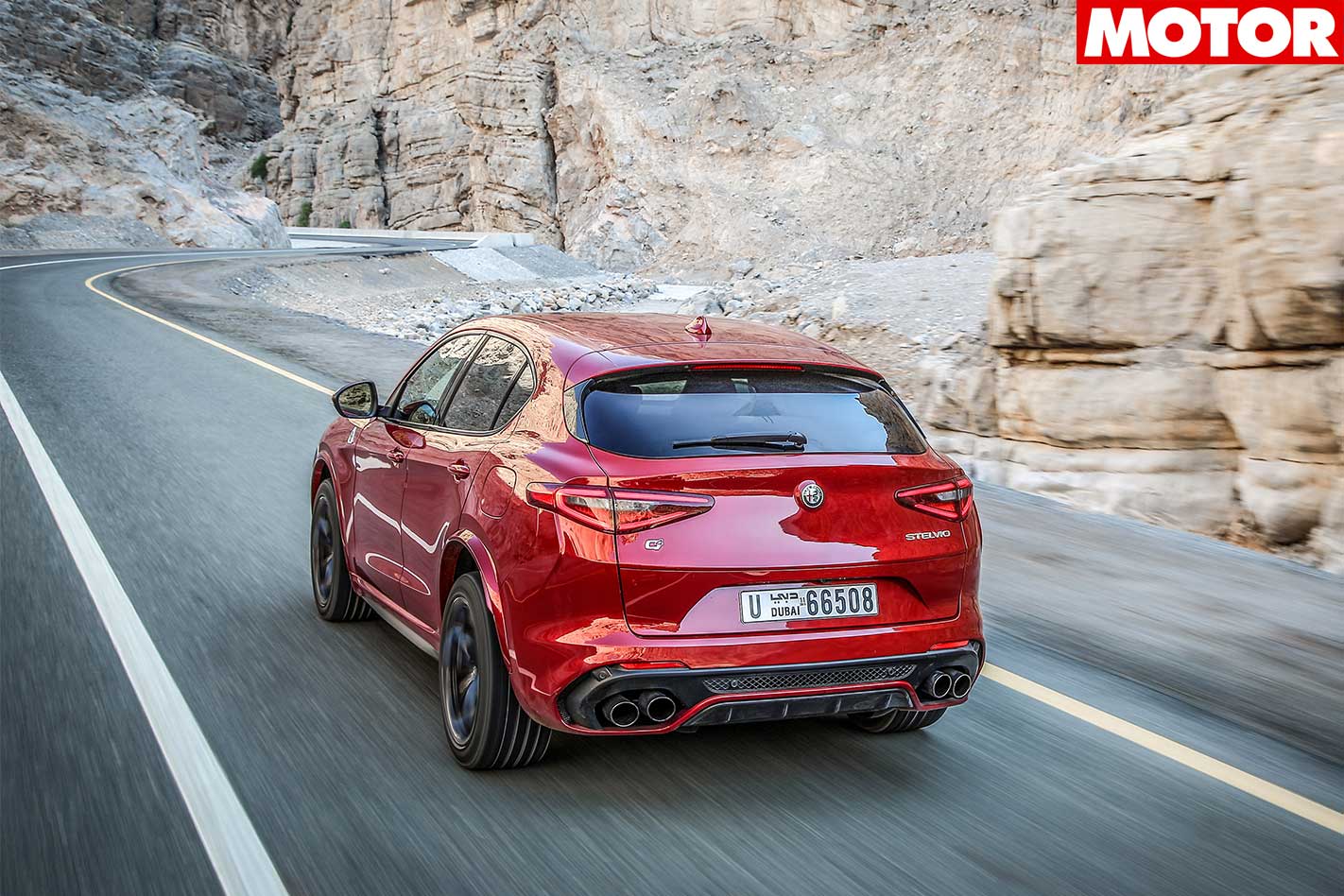
Designed and developed by the same team that brought us the class-leading Giulia QV, the high-performance Stelvio is dripping with genuine sports-car hardware. The 2.9-litre twin-turbo V6 and eight-speed automatic gearbox are borrowed from the Giulia – with specific calibration and ratios – but here drive is sent to the road by Alfa Romeo’s Q4 all-wheel-drive system.
In normal driving, 100 per cent of the torque is sent to the rear wheels and only when they begin to slip is drive shunted forwards. Even then, only 50 per cent can be diverted to the front axle, so it’s a very rear-biased system.
The car is suspended by double wishbones at the front and a multi-link set-up at the rear, with adaptive damping. The engine is mounted mostly behind the front axle line to aid weight distribution, and the use of carbon fibre and aluminium panels keeps weight to a minimum. Still, at 1830kg, the Stelvio Q is no featherweight.
There are various drive modes, including Eco that reduces fuel consumption by shutting off three cylinders – although this can also happen in Normal – and Dynamic that sharpens throttle response, reduces gearshift times, tightens up the dampers and adds weight to the steering. Race mode turns everything up another notch while standing down the stability control system and, notably, it is possible to switch the dampers back into an intermediate setting in Race.
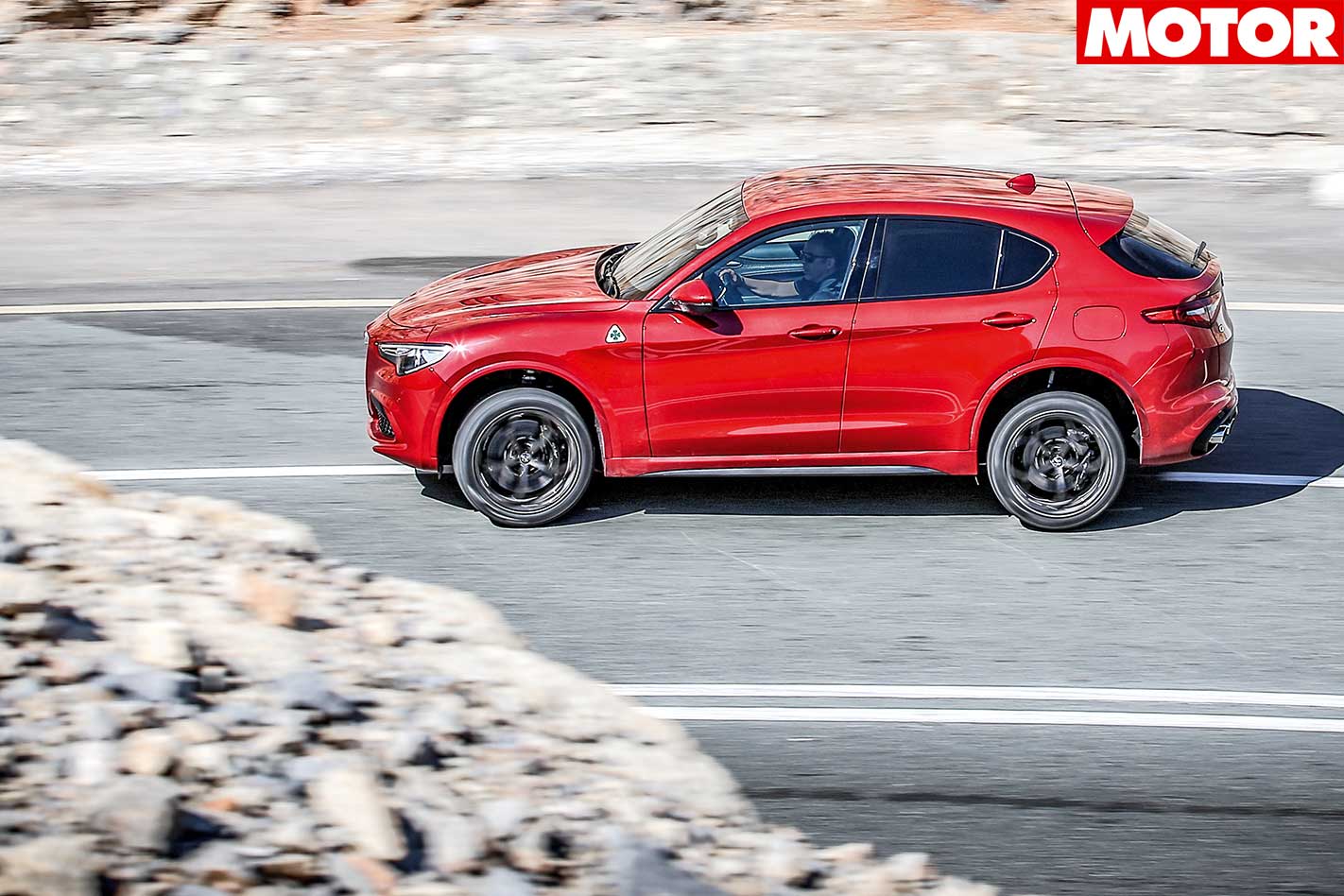
There are several very powerful SUVs on the market that are colossally fast in a straight line and just about composed enough in bends, but there aren’t many that are genuinely entertaining to drive. The Stelvio Q is undoubtedly one of the few.
Inevitably, its high ride height, chunky kerb weight and lofty centre of gravity mean it’s nowhere near as planted or as responsive as the Giulia, but there is a remarkable level of precision and body control here. The steering is direct, quick and very intuitive, and the front end finds reasonable turn-in bite. The car will understeer when you really chase it, but there’s enough front-end grip to carry proper sports-car-rivalling pace on a winding road.
The four-wheel-drive system makes light work of transferring all that power and torque to the road. If you’re really clumsy with the throttle you’ll upset the car, but with a little care all four tyres hook up perfectly and slingshot the car away from the apex.
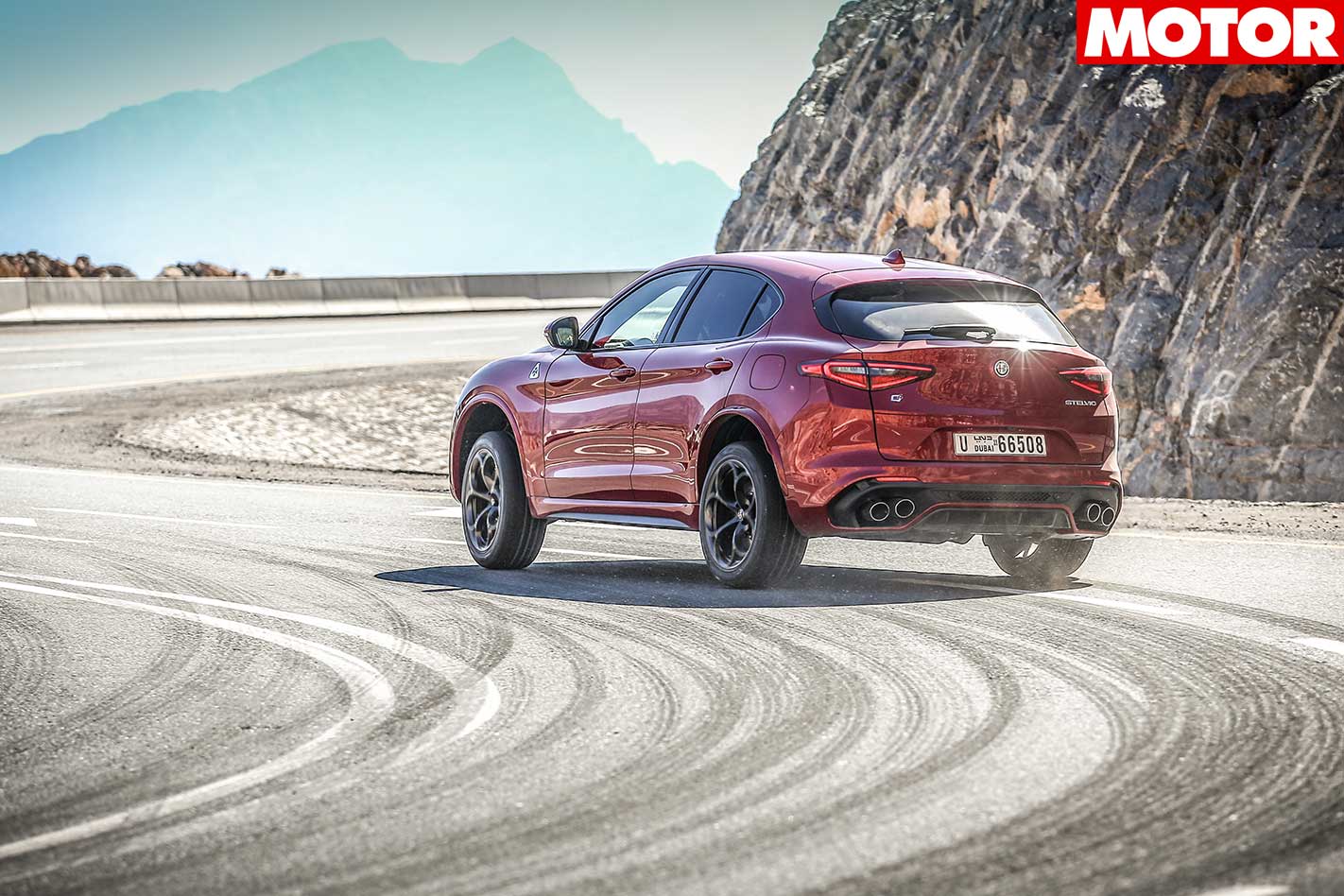
On very smooth Emirati roads, where we drove it, the Alfa’s ride was settled and composed, but we’ll have to wait and see how well this car deals with typical Aussie tarmac.
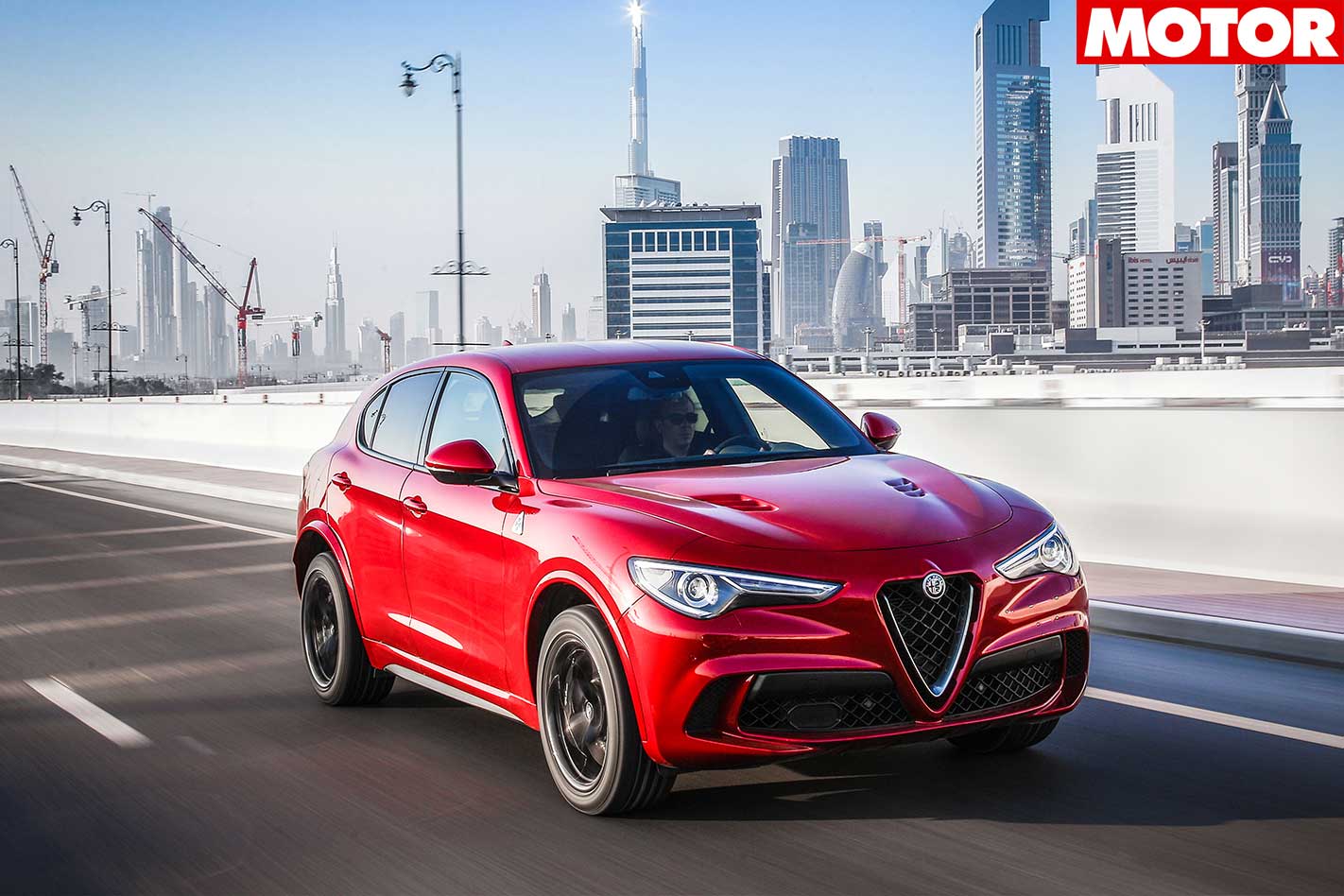
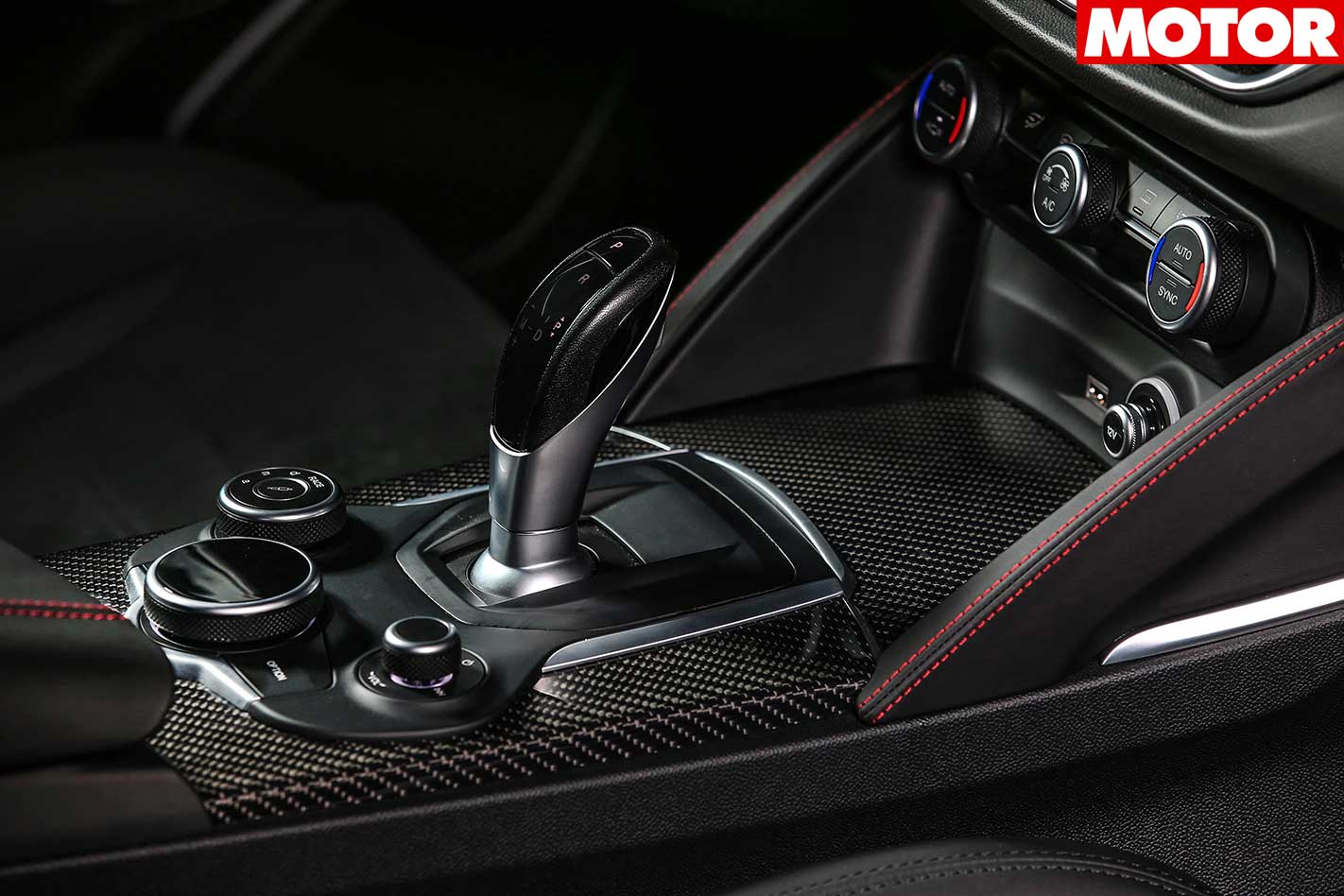
Where the Stelvio falls short of its competition is within the cabin. Some of the plastics are a touch brittle and the switchgear looks and feels mainstream rather than premium, but there’s nothing offensive about it. The seating position is very good, though.
2018 ALFA ROMEO STELVIO QUADRIFOGLIO SPECS: Engine: 2891cc V6, dohc, 24v, twin-turbo Power: 375kW @ 6500rpm Torque: 600Nm @ 2500rpm Weight: 1830kg 0-100km/h: 3.8sec (claimed) Price: $160,000 (estimated)
Like: Straight line and cornering performance; enticing sound Dislike: Cheap cabin; Giulia QV remains the driver’s choice Star Rating: 4 out of 5 stars
“Same taste, different bottle,” read the tomato sauce label. Have we reached peak tomato sauce, where the only improvements that can be made are to the bottle it comes in? Maybe.
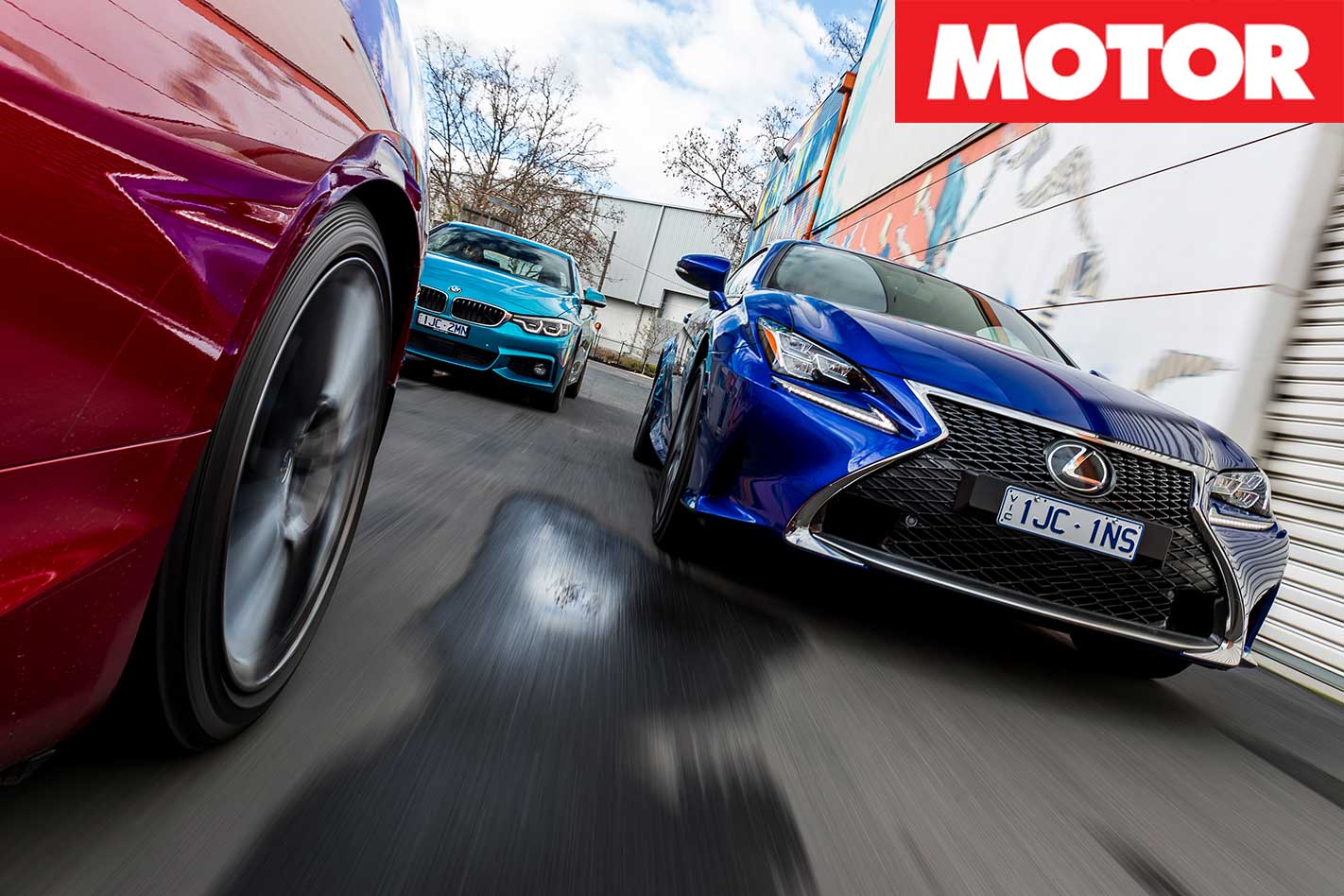
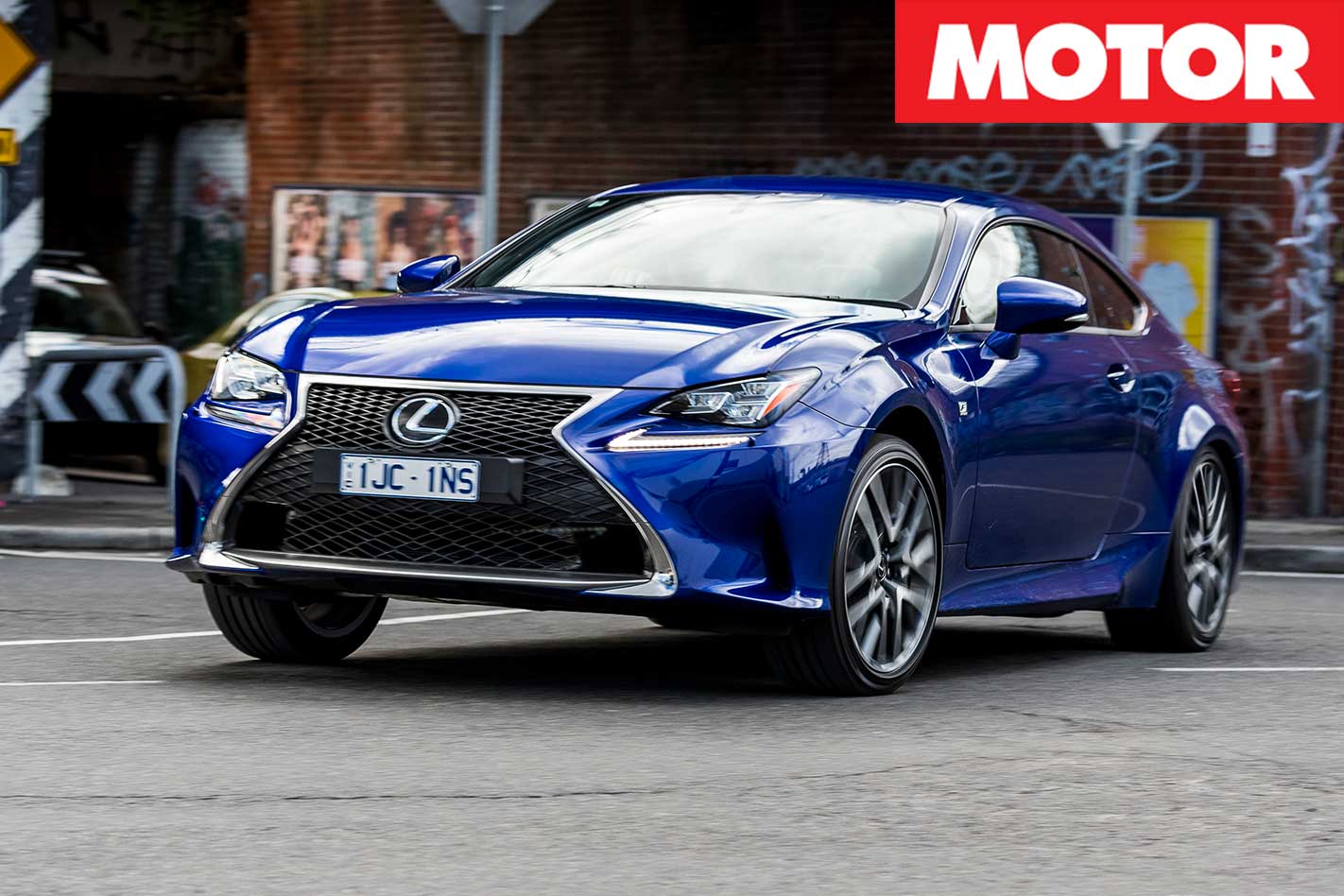
Japanese upstarts Lexus and Infiniti reckon it’s the same when it comes to cars. Both think that a cheaper thing down the aisle can be just as good, if not better. With eyes now fixed on the six-cylinder luxury coupe, they’ve lopped two doors off their mid-size sedans and promised Tonkatsu tastes just as fine as Germany’s best pork schnitzel.
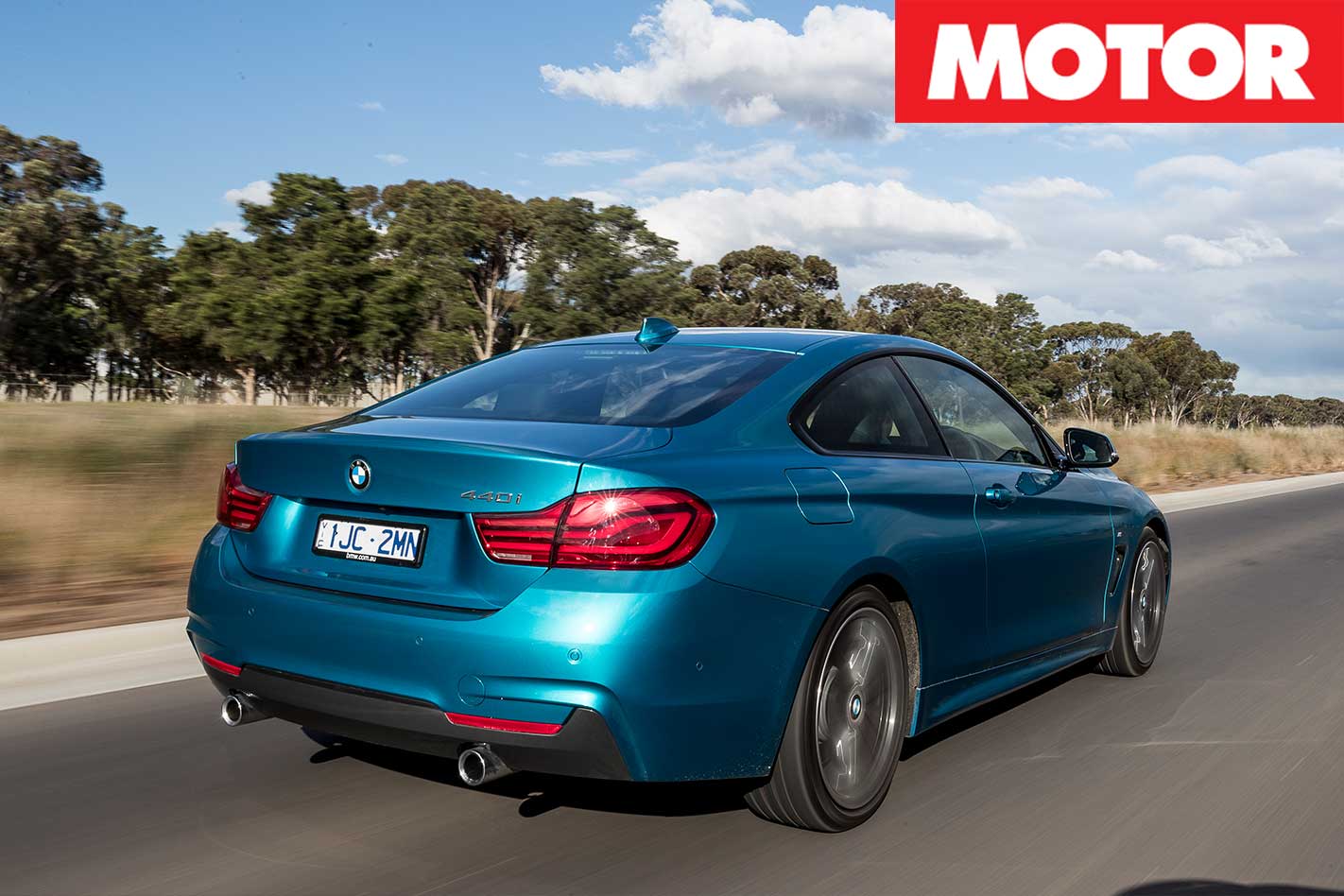
Going into bat for the status-quo is the BMW 440i. As our benchmark, it also needs to redeem a recent thumping the 340i took from its home continent rivals. Fresh from a mid-cycle update, retuned adaptive suspension in this car’s M Sport Pack teams with the brawny B58 inline-six, which upgrades the old N-series unit with more boost and a sturdier block.
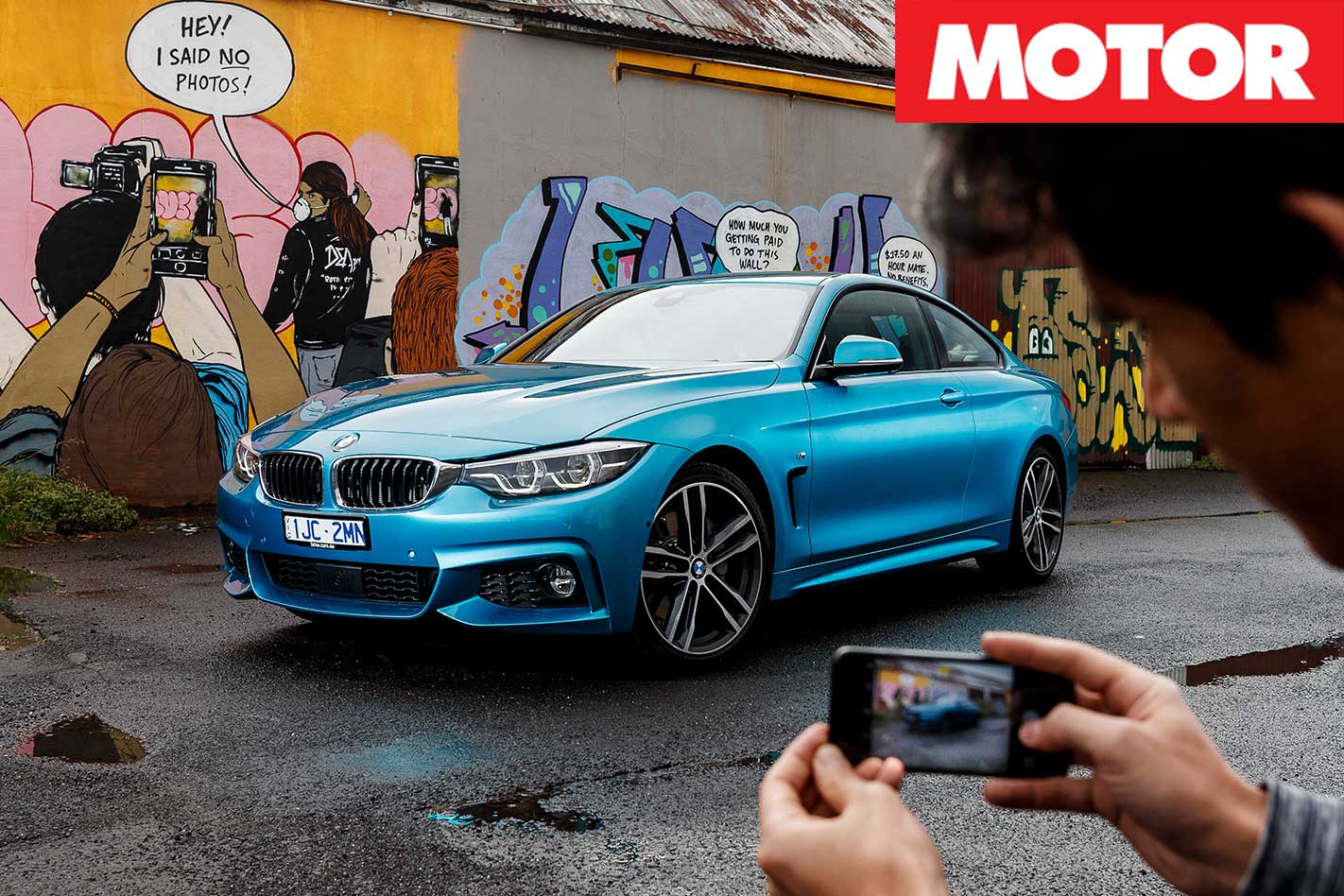
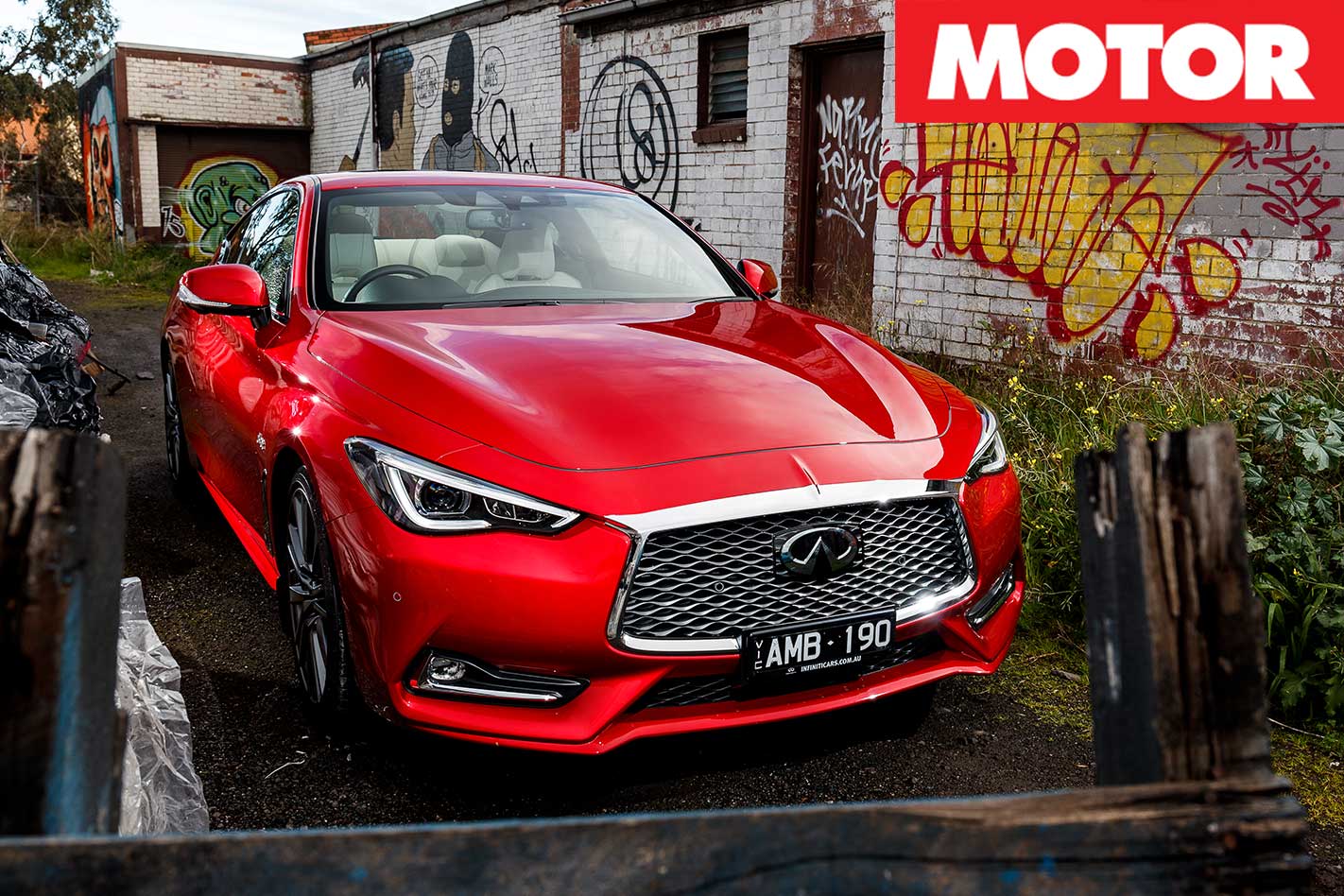
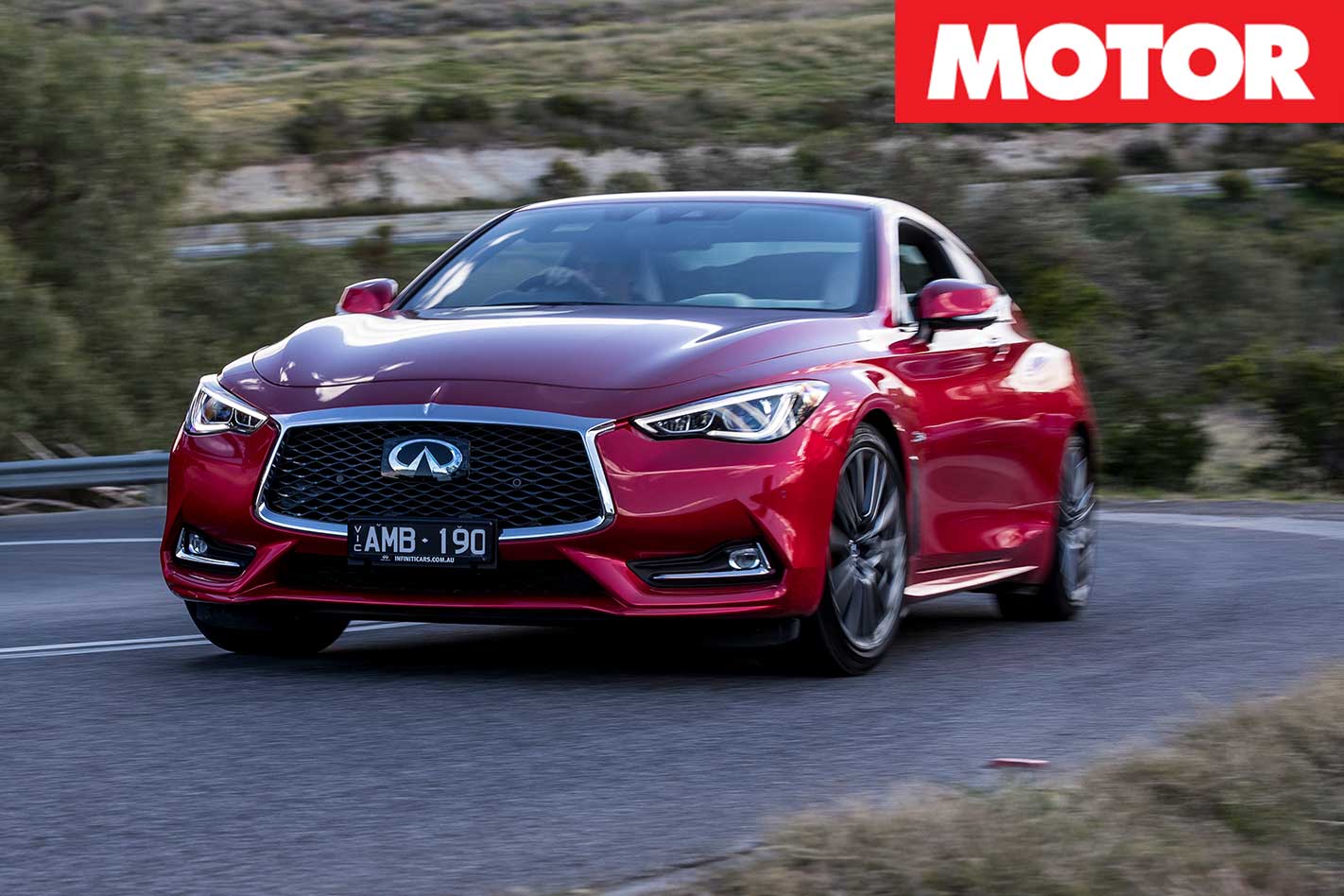
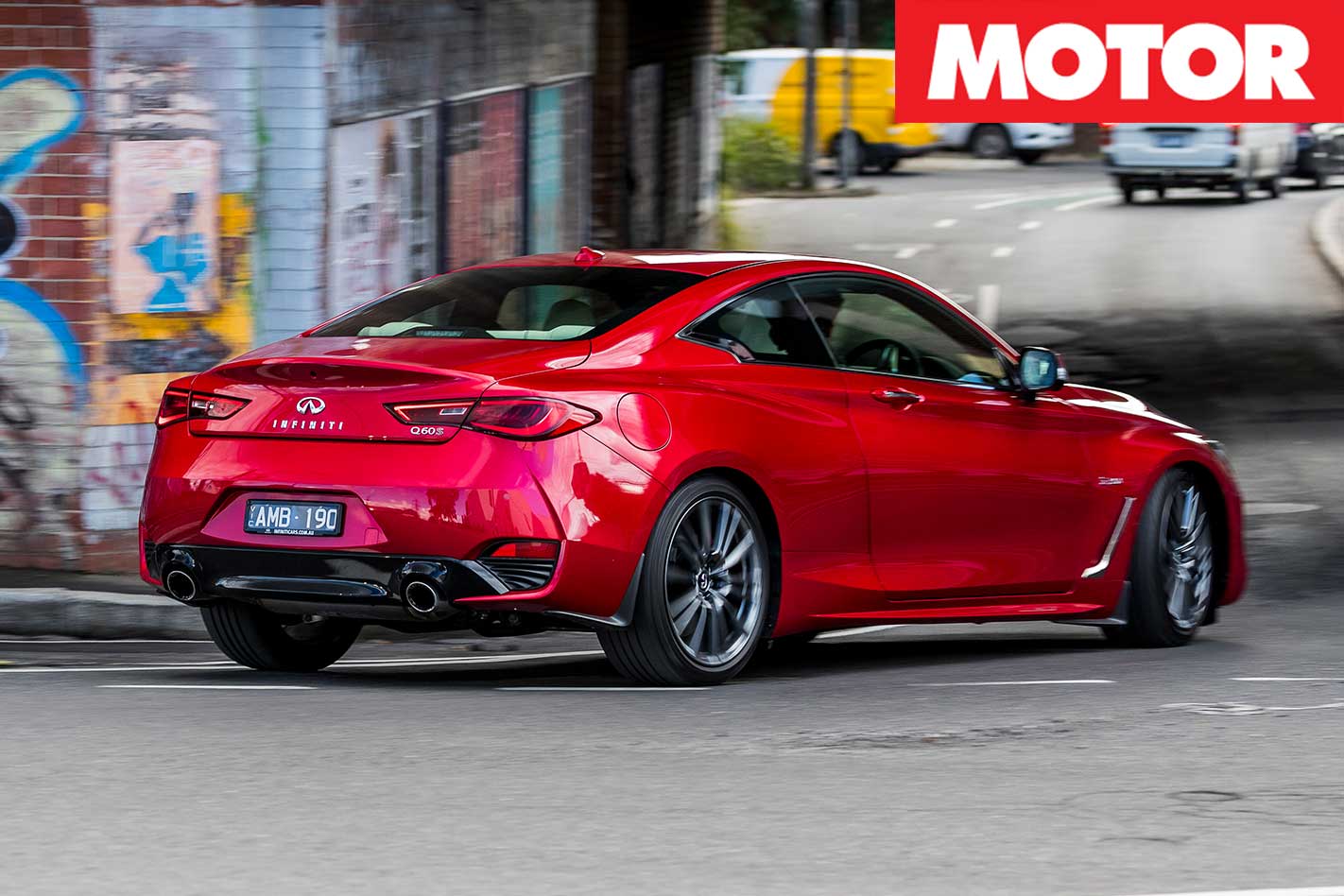
It’s the same at Infiniti, who gouge you $9K for the two-door equivalent of the Q50 Red Sport. The seductive coupe from Nissan’s Hong-Kong based luxury arm came wrapped in a fresh exterior last year, but don’t be fooled into thinking the Q60 is an ‘all-new’ car. It’s grown in length, width and the tracks are slightly wider. But that 2850mm-long wheelbase hints at Nissan’s FM platform which, after featuring in the 350Z, is due for a pension card.
At 1784kg the Red Sport’s steel-heavy structure and standard options list mean it’s 20kg heavier than a GT-R and the portliest here. Thankfully, this is countered by a plasma-sprayed, twin-turbocharged, direct injected 3.0-litre V6 seething with 298kW and 475Nm.
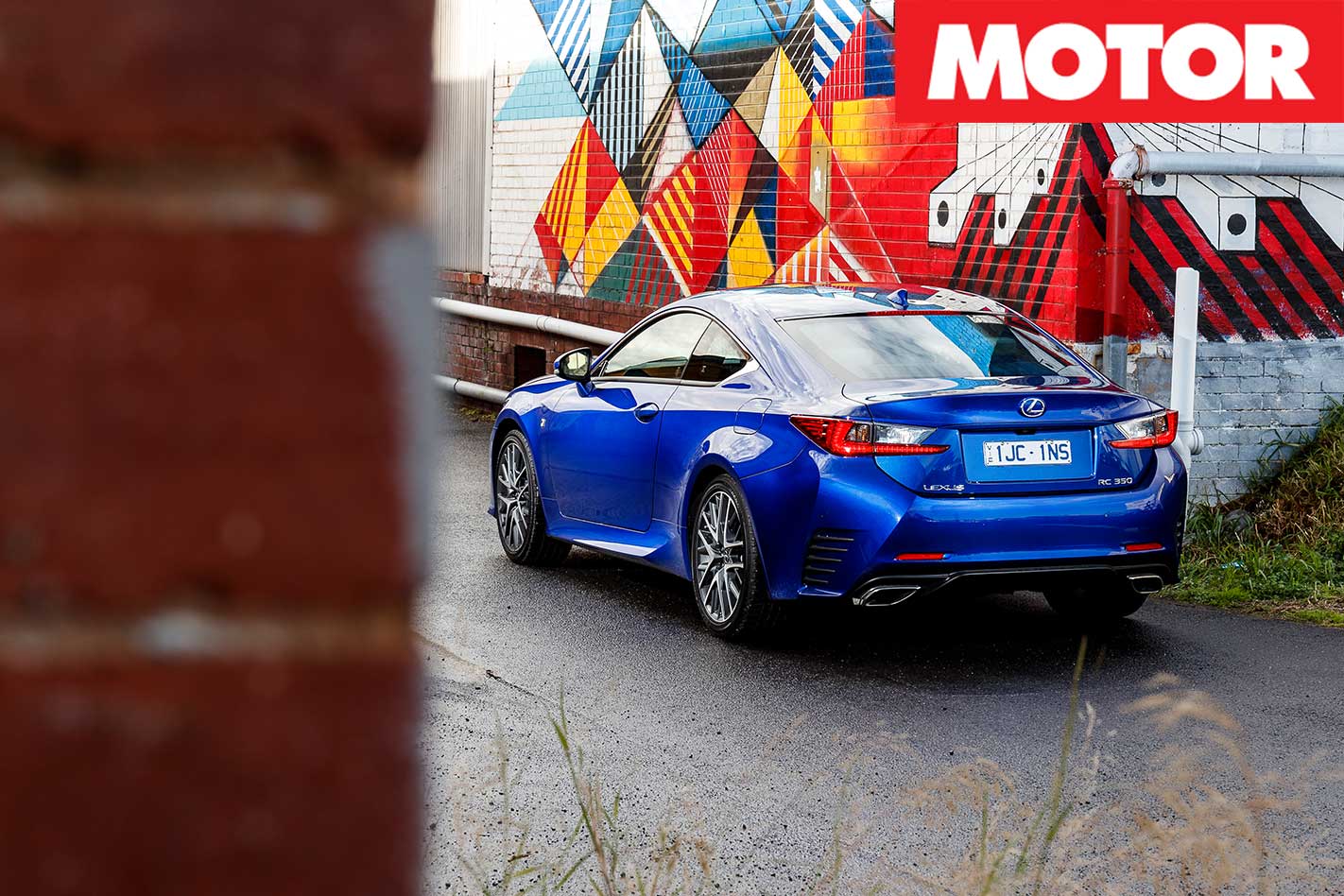
The Lexus plays the outcast again at the drag strip. While the Infiniti and BMW pack V8-worthy twist, the F Sport’s torque-to-weight ratio of a regular hot hatch equals a 6.4-second sprint to 100km/h and the slowest quarter mile. It’ll break traction, but the 350 doesn’t get moving until 4000rpm. Besides this, what’s more frustrating is how little the RC revs for such an oversquare engine. Its 6600rpm redline is well short of its turbo competition, and the eight-speed auto won’t let you reach it, upshifting at 6200rpm – even in manual mode.
Speaking of, the 440i is the only car to near its claimed time. Conjuring launch control requires sports mode and a 2500rpm two-step, good enough for a 5.1sec sprint to 100km/h. It’s grippy enough to do the times without traction control, but an LSD would help. The eight-speed also rushes its first few shifts to relish the engine’s low-down torque, but the six loves to spin past the indicated 7000rpm redline in higher ratios.
Infiniti says the steering’s been upgraded and while it’s more accurate, it’s frightening to drive fast in wet conditions on Dunlop run-flats. Rubbery steering weight and numbed feedback make it sometimes impossible to judge how much lock is needed.
Then there’s the rear axle, which has to deal with 475 newtons without any sort of torque vectoring technology. Even small throttle inputs make the stability light strobe like a disco. It has some grip, but a lack of composure. And after a crack, you bail out of the Infiniti exhausted, confused and disappointed.
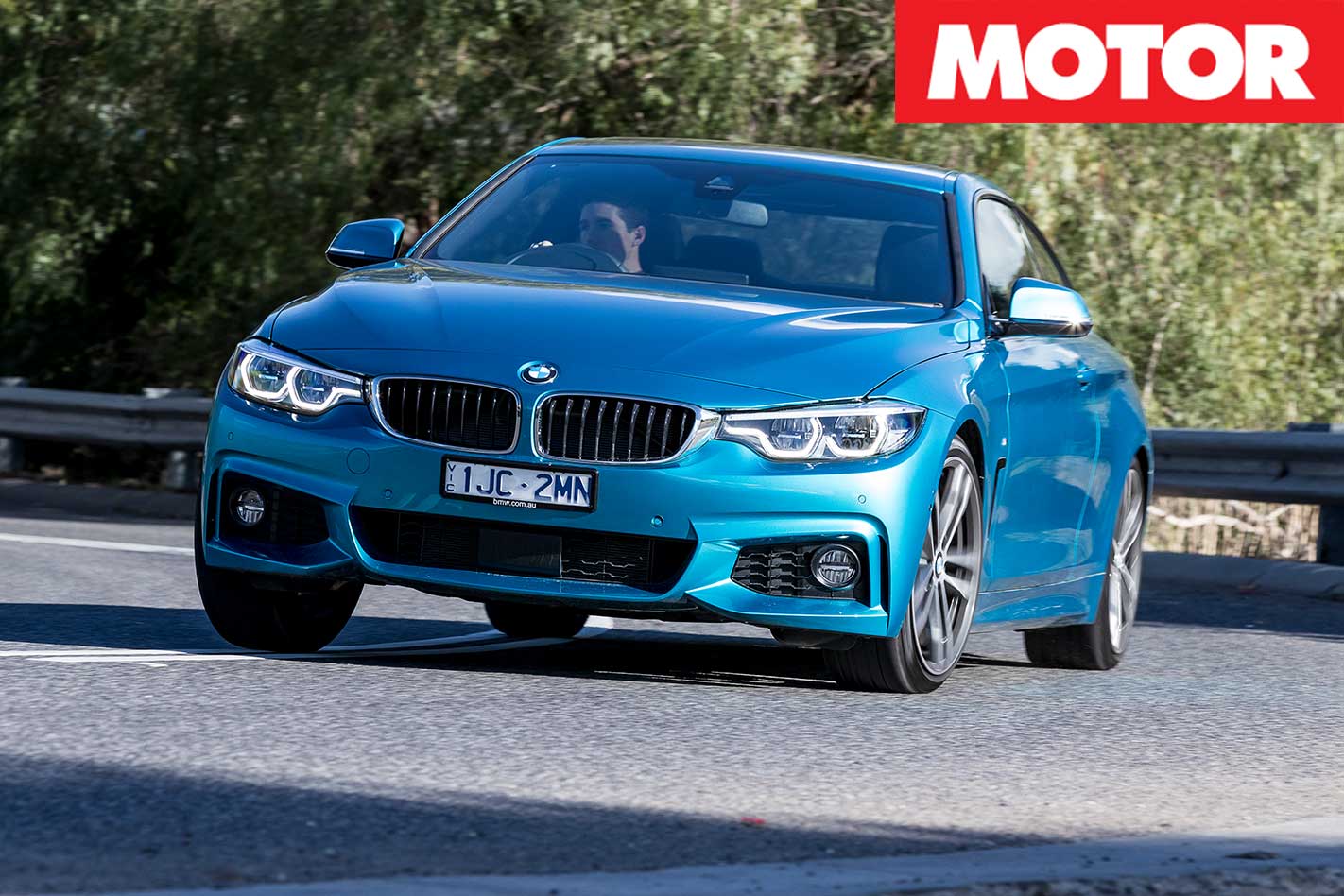
Variable-gear steering at both ends means it slices tighter corners with only a little lock. It doesn’t ride perfectly on its thinly padded 19s, even on adaptive suspension, and no matter what mode you pick (there are four to choose from) it struggles to settle after striking mid-corner bumps. But healthy damper travel and body roll are there to help extract more grip.
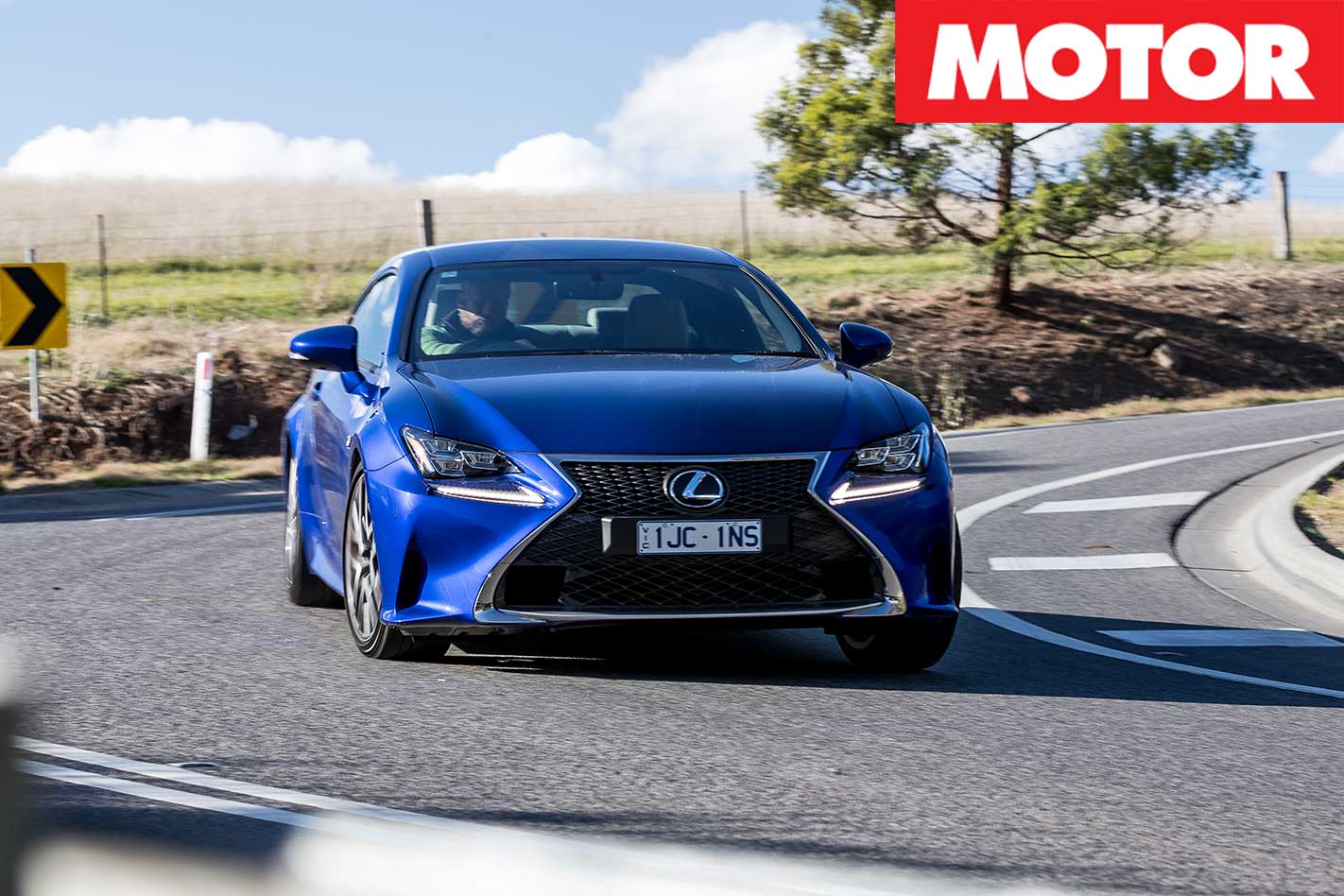
The adaptive setup rides fine, and absorbs initial impacts well, even in Sport mode. However, it lets the car bob a little over bigger stuff. And with so much grunt so soon, the multi-link rear axle calls on the stability system often. But it’s at least worth trusting.
The variable steering rack isn’t the sharpest, and suffers from a typical lack of feedback under load, however, it’s geared well and feels more natural than the Lexus. This, combined with lush suspension compliance, make the 4 Series the easiest to snake through urban environments, too, with crisp throttle response and that silky ZF auto at the core of its driveability.
The Infiniti’s the complete opposite, riding the V6’s tidal-like thrust the moment its turbos hit positive pressure. It’s laughable that the Q60 comes fitted with an ‘eco’ pedal, designed to push back against any throttle travel that might quench its thirst with more juice than needed. It would be like trying to cork the Snowy Hydro.
The upside to this is fearsome rolling performance, shooting the Infiniti from 80km/h to 120km/h in 2.8 seconds. You still nervously engage full power, even at speed, though. Max clog in the Lexus is a different event. Its relatively puny torque figure is delivered so high it never threatens the rear 265mm tyres once you’re moving, but adds 1.2 seconds to the same 80-120 sprint. Meanwhile, the BMW can’t use its healthy weight advantage to pip the more powerful Infiniti, its smaller twin-scroll turbine simply no match for the gut-turning acceleration offered by the Red Sport’s twin blowers.
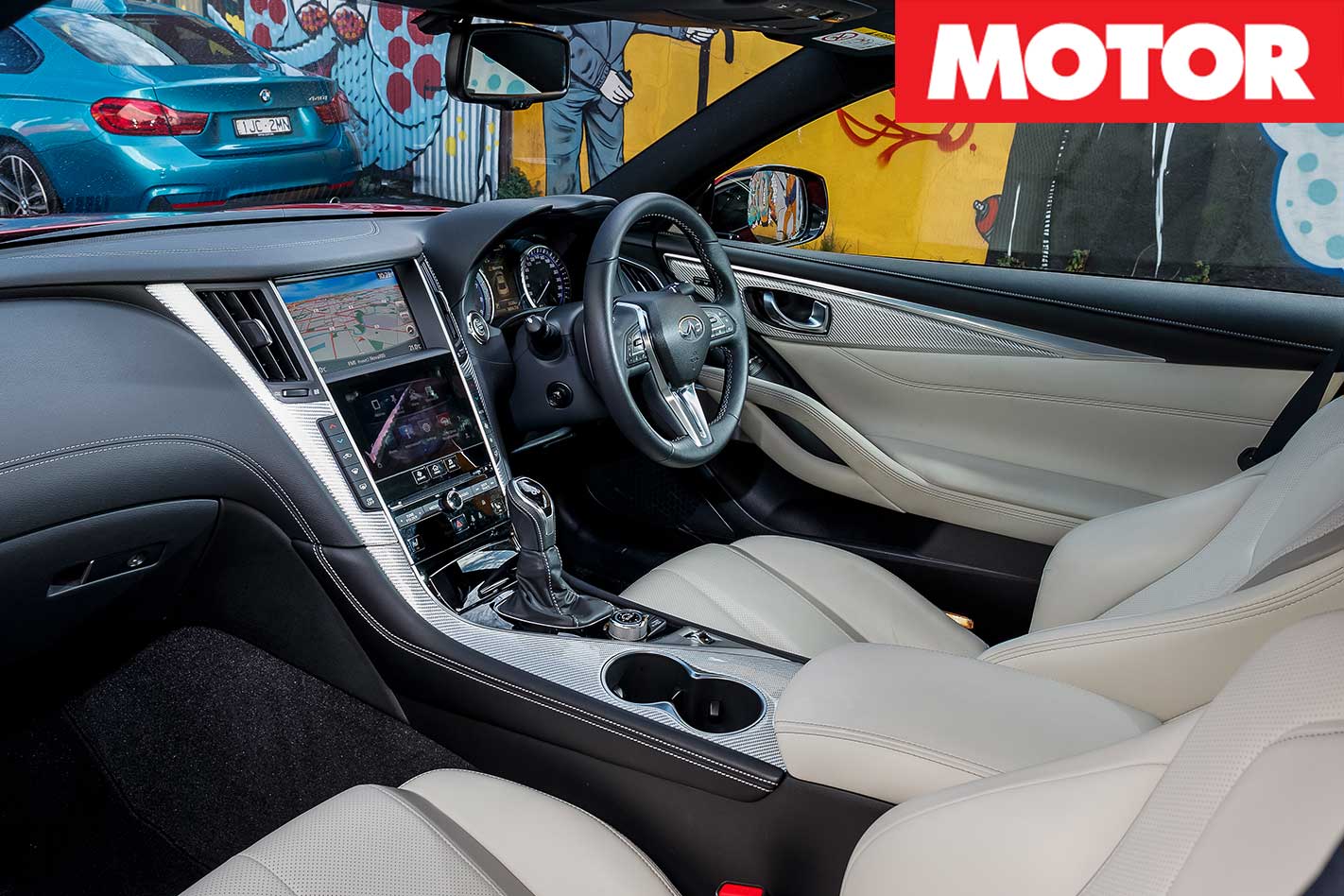
And on the inside? The Infiniti revels in glamour. Sparkling faux carbon-fibre runs down the centre stack arches, touchpoints feature traces of aluminium, and the seats are wrapped in semi-aniline leather. The thing’s nicely designed if you ignore the fact two digital screens are plonked on top of one another.
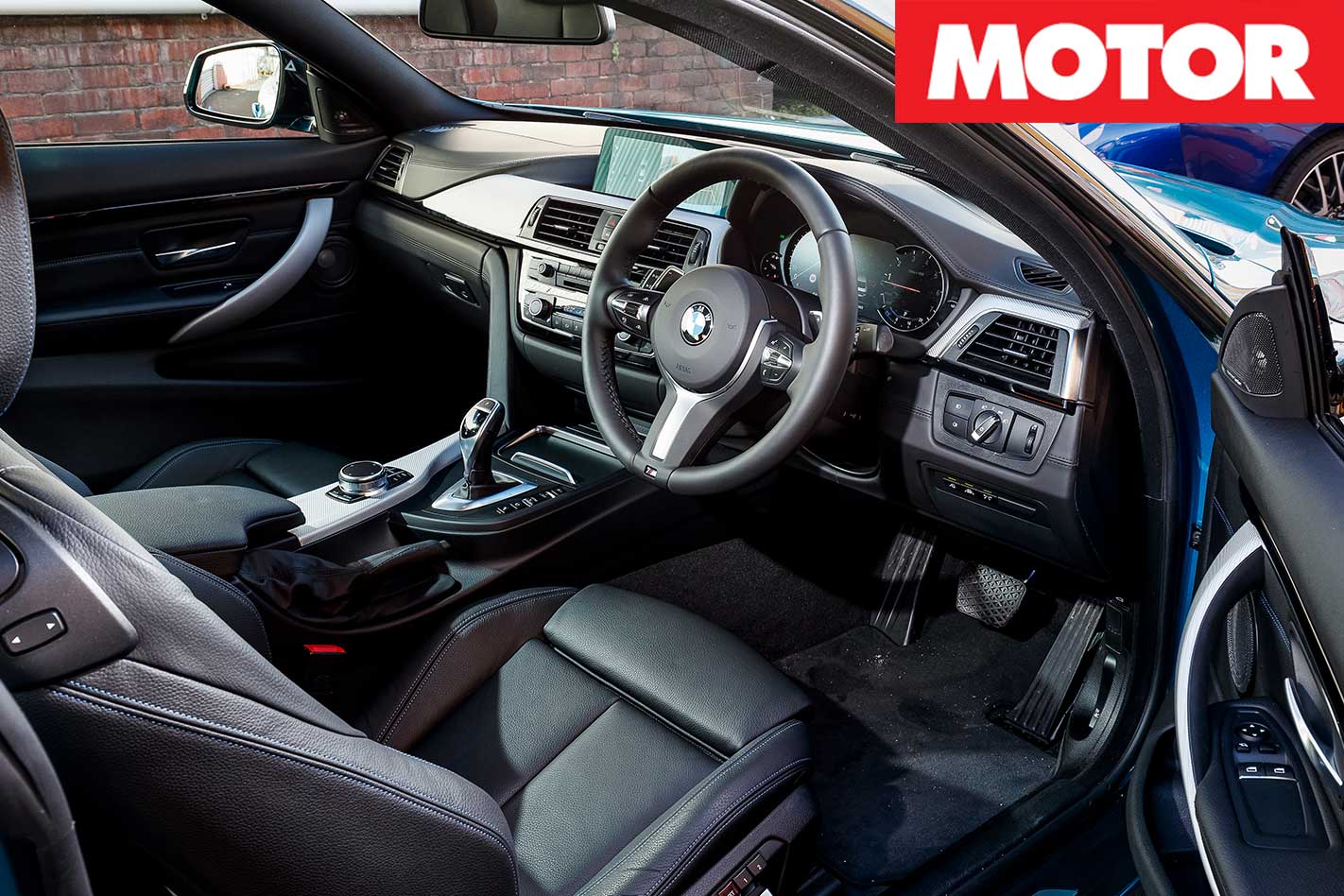
Slide into the BMW and it feels like you’ve sat down in an architect’s studio. It’s a bit bland at first; the pedals are rubber, and it’s covered in black and silver. However, its appeal grows with time. The important things – handbrake, seat switches, gear lever – are exactly where you want them. And the steering wheel is the best looking and the nicest to hold.
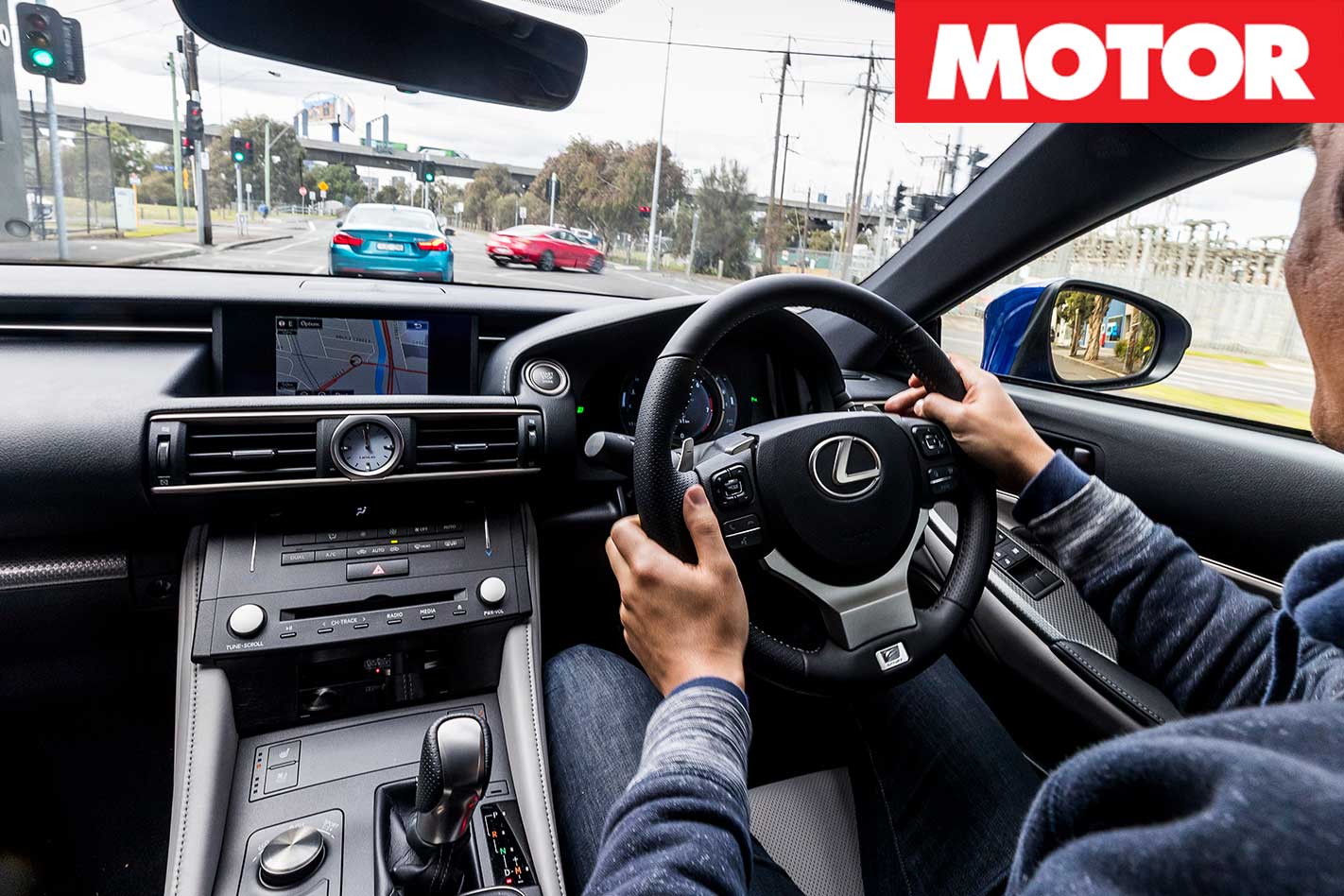
The Lexus, meanwhile, mimics a Ridley Scott film set. You stumble upon whorled stitching, falling buttresses, and a furled fascia. The carpet is thick, the pedals and paddles are metal, and everything turns or clicks with a solid, measured weight. The seats, which are heated, ventilated, and aggressively bolstered, would feel at home in something twice as expensive. Its refinement gives away nothing to BMW.
Functionality, however, is a different story. Buttons, knobs, pads, are everywhere. The dreaded track-pad remains frustrating, and linked to a dim-witted infotainment system. There’s a sneaking Toyota-ness about it, too, while fat body pillars eat into the glass house, making it more cab-forward than it should be.
So have the Japanese proved differences between these three merely lie in a badge? Well, not in the Infiniti’s case. While it might seem like the real deal, with more features crammed in here than the latest iPhone X – seriously, the only options are paint colours – and an alluring look, the Q60 Red Sport proves to be all style, little substance.
You could swap the Lexus and Infiniti’s price tags and no-one would notice. That chassis might not sparkle with feel, but it has more dynamic talent than most 1700kg-odd rigs. There’s loads of grip at its limits, and you’d enjoy cutting track laps from morning ’til night. The interior feels lavish, and the noise from inside is enchanting. But the RC’s approach lacks clear thinking. We couldn’t master the throttle and steering’s ultra-lightness during commuting, no matter how much time we spent in it. And if only the F Sport’s engine could bite with the same anger as its bark.
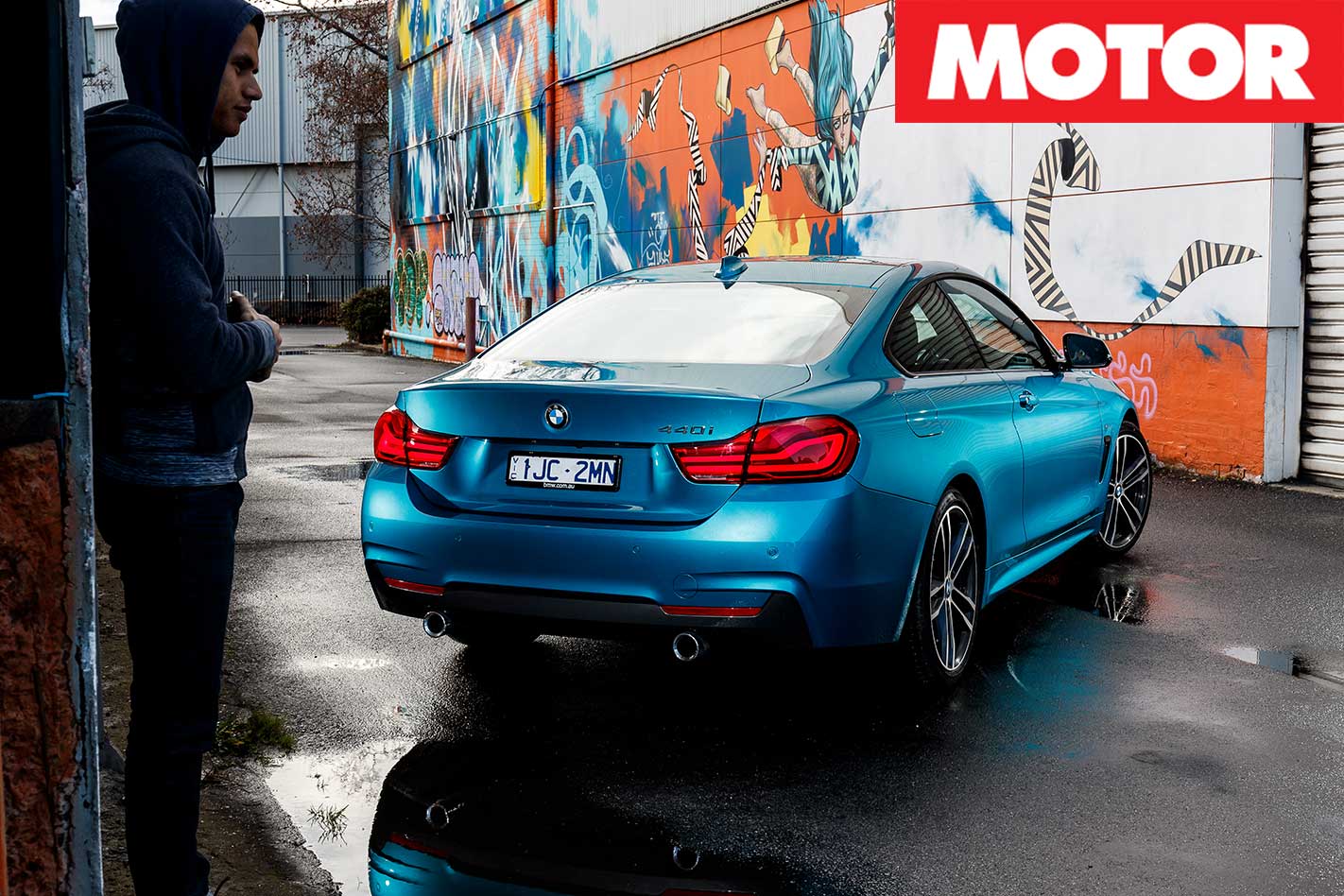
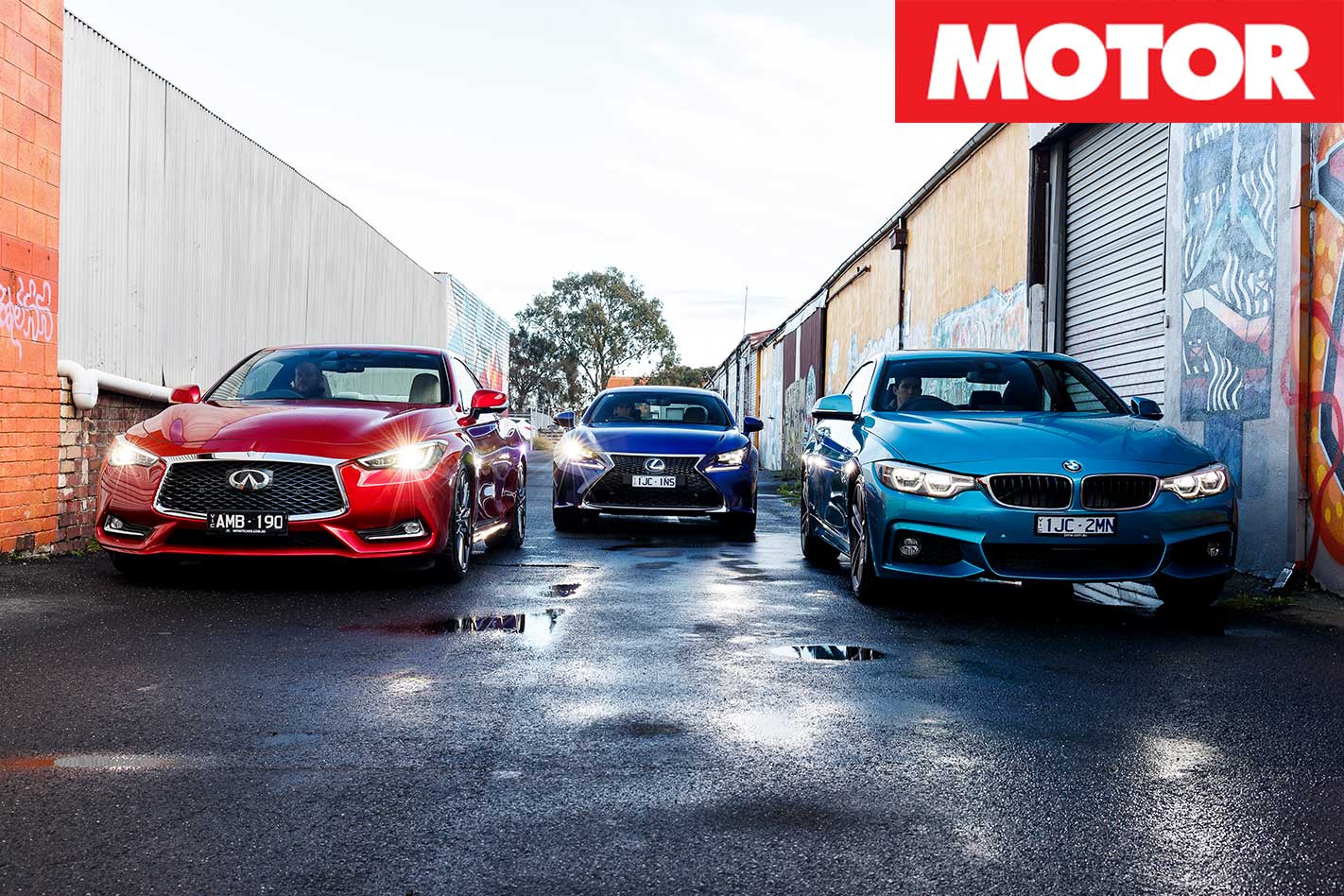
| u00a0 | 2018 Infiniti Q60 Red Sport | 2018 Lexus RC350 F-Sport | 2018 BMW 440i |
| BODY | 2-door, 4-seat coupe | 2-door, 4-seat coupe | 2-door, 4-seat coupe |
| DRIVE | rear-wheel | rear-wheel | rear-wheel |
| ENGINE | 2997cc V6, DOHC, 24v, twin-turbo | 3456cc V6, DOHC, 24v | 2998cc inline-six, DOHC, 24v, turbo |
| BORE/STROKE | 86.0 x 86.0mm | 94.0 x 83.0mm | 82.0 x 94.6mm |
| COMPRESSION | 10.3:1 | 11.8:1 | 11.0:1 |
| POWER | 298kW @ 6400rpm | 233kW @ 6400rpm | 240kW @ 5500rpm |
| TORQUE | 475Nm @ 1600rpm | 378Nm @ 4800rpm | 450Nm @ 1380rpm |
| POWER/WEIGHT | 167kW/tonne | 139kW/tonne | 154kW/tonne |
| TRANSMISSION | 7-speed automatic | 8-speed automatic | 8-speed automatic |
| WEIGHT | 1784kg | 1680kg | 1555kg |
| SUSPENSION (front) | A-arms, adaptive dampers, anti-roll bar | A-arms, adaptive dampers, anti-roll bar | Struts, adaptive dampers, anti-roll bar |
| SUSPENSION (rear) | Multi-links, adaptive dampers, anti-roll bar | Multi-links, adaptive dampers, anti-roll bar | Multi-links, adaptive dampers, anti-roll bar |
| L/W/H | 4685/2052/1395mm | 4695/1840/1395mm | 4640/1825/1377mm |
| WHEELBASE | 2850mm | 2730mm | 2810mm |
| TRACKS | 1599/1580mm (f/r) | 1580/1570mm (f/r) | 1547/1593mm (f/r) |
| STEERING | electrically assisted | electrically assisted rack-and-pinion | electrically assisted rack-and-pinion |
| BRAKES (front) | 355mm ventilated discs, 4-piston calipers | 357mm ventilated discs, 4-piston calipers | 340mm ventilated discs, two-piston calipers |
| BRAKES (rear) | 350mm discs, 2-piston calipers | 310mm ventilated discs, single-piston calipers | 330mm ventilated discs, single-piston calipers |
| WHEELS | 19.0 x 9.0-inch (f/r) | 19.0 x 8.0-inch (f); 19.0 x 9.0-inch (r) | 19.0 x 8.0-inch (f); 19.0 x 8.5-inch (r) |
| TYRE SIZES | 245/40 R19 94W (f/r) | 235/40 R19 (f); 265/35 R19 (r) | 225/40 R19 (f); 255/35 R19 (r) |
| TYRE | Dunlop SP Sport Maxx 050 DSST CTT | Bridgestone RE050 | Pirelli P Zero |
| PRICE | $88,900 | $78,451 | $105,380 |
| PROS | Grunt, everywhere; feelsome brakes | Sonorous six; bargain price; quite agile | Turbo punch; balanced handling; good looks |
| CONS | Terrible ride; distant steering; spooky handling | Feels digital, underpowered and overweight | Price; silly options |
| RATING | 3 out of 5 stars | 3.5 out of 5 stars | 3.5 out of 5 stars |
THE NUMBERS
Boost wins; Lexus not fast enough
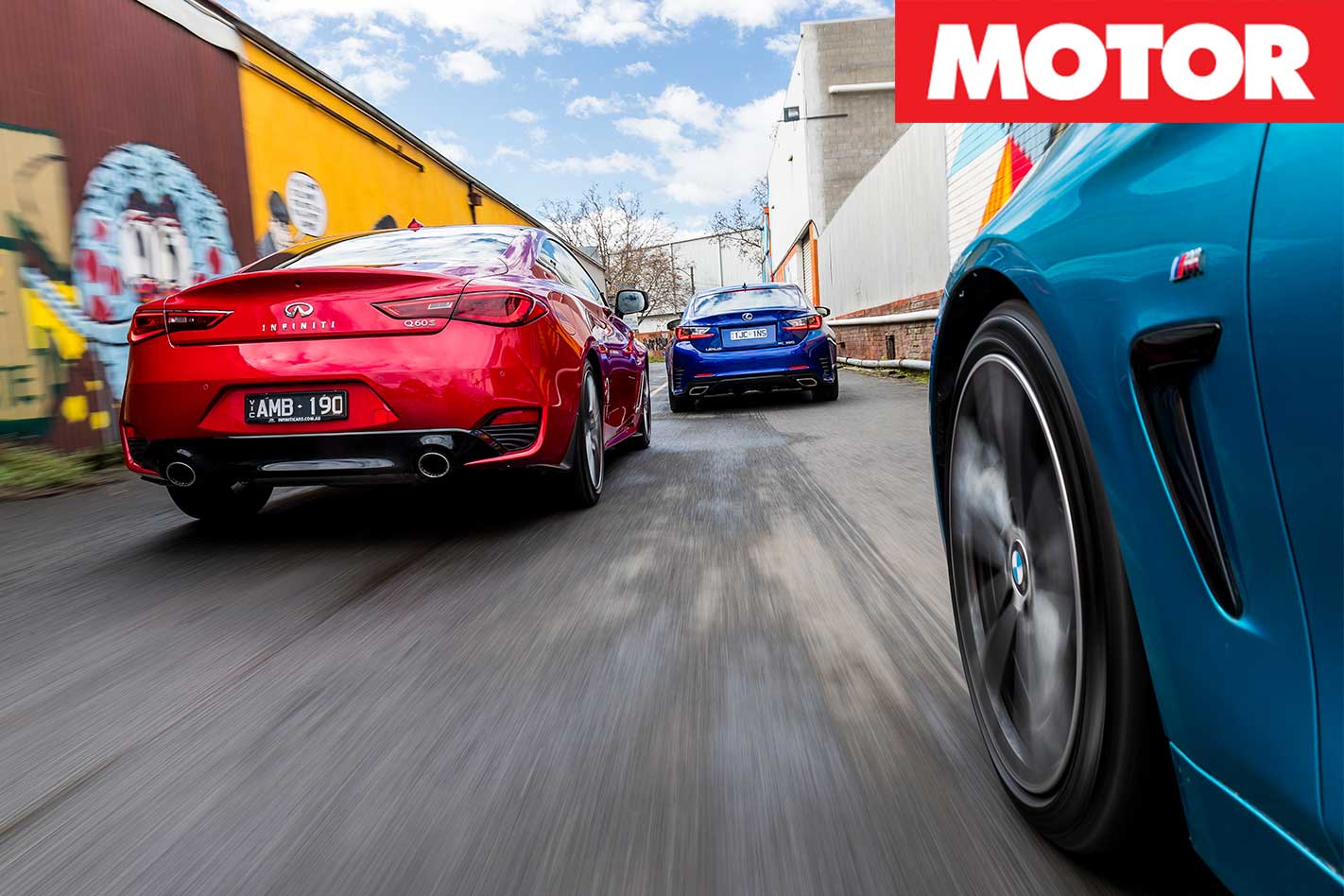
| u00a0 | Infiniti Q60 Red Sport | Lexus RC350 F-Sport | BMW 440i |
| 0-10km/h (sec) | 0.54 | 0.42 | 0.46 |
| 0-20km/h (sec) | 1.02 | 0.87 | 0.87 |
| 0-30km/h (sec) | 1.46 | 1.43 | 1.30 |
| 0-40km/h (sec) | 1.98 | 1.96 | 1.70 |
| 0-50km/h (sec) | 2.51 | 2.48 | 2.10 |
| 0-60km/h (sec) | 3.03 | 3.11 | 2.60 |
| 0-70km/h (sec) | 3.56 | 3.82 | 3.14 |
| 0-80km/h (sec) | 4.20 | 4.55 | 3.70 |
| 0-90km/h (sec) | 4.84 | 5.34 | 4.33 |
| 0-100km/h (sec) | 5.49 | 6.42 | 5.14 |
| 0-110km/h (sec) | 6.20 | 7.49 | 5.89 |
| 0-120km/h (sec) | 7.01 | 8.54 | 6.74 |
| 0-130km/h (sec) | 7.97 | 9.67 | 7.68 |
| 0-140km/h (sec) | 8.97 | 10.99 | 8.77 |
| 0-150km/h (sec) | 10.02 | 12.51 | 9.94 |
| 0-160km/h (sec) | 11.14 | 14.1 | 11.22 |
| 0-170km/h (sec) | 12.36 | N/A | 12.59 |
| 0-400m | 13.5sec @ 178.3km/h | 14.41sec @ 161.75km/h | 13.27sec @ 173.86km/h |
| 80-120km/h | 2.81sec | 3.95sec | 2.98sec |
| 100-0km/h | 37.24m | 38.15m | 37.17m |
| SPEED IN GEARS | u00a0 | u00a0 | u00a0 |
| 1st | 60km/h @ 7000rpm | 54km/h @ 6200rpm | 62km/h @ 7000rpm |
| 2nd | 92km/h @ 7000rpm | 91km/h @ 6200rpm | 97km/h @ 7000rpm |
| 3rd | 144km/h @ 7000rpm | 132km/h @ 6200rpm | 145km/h @ 7000rpm |
| 4th | 209km/h @ 7000rpm | 168km/h @ 6200rpm | 180km/h @ 7000rpm |
| 5th | 250km/h @ 6125rpm* | 200km/h @ 6200rpm | 236km/h @ 5700rpm* |
| 6th | 250km/h @ 5315rpm* | 230km/h @ 5775rpm* | 250km/h @ 5250rpm* |
| 7th | 250km/h @ 4780rpm* | 230km/h @ 4755rpm* | 250km/h @ 4645rpm* |
| 8th | N/A | 230km/h @ 3955rpm* | 250km/h @ 3610rpm* |
As tested by MOTOR: Heathcote Dragway, 4:23pm, 15 degrees, dry. Driver: Louis Cordony. *Manufacturer’s claim
IF Iu2019M GOING to commit to a long-term relationship, I prefer to have practised a little try-before-you-buy.I first met Hyundai’s i30 SR in the biting South Korean winter at its international launch earlier this year. I returned home concerned that the gleaming impression it left may have been partly attributed to the country’s stunning snow-covered scenery, sensational roads, and endless kimchi – the classic holiday romance.
But I needn’t have worried because it impressed again when we were reacquainted, this time on Australian turf as part of a four-car comparison test in our September issue.
Against some strong opposition, the i30 SR carried itself confidently and offered a compelling package of performance and quality for a price that’s hard to fault.
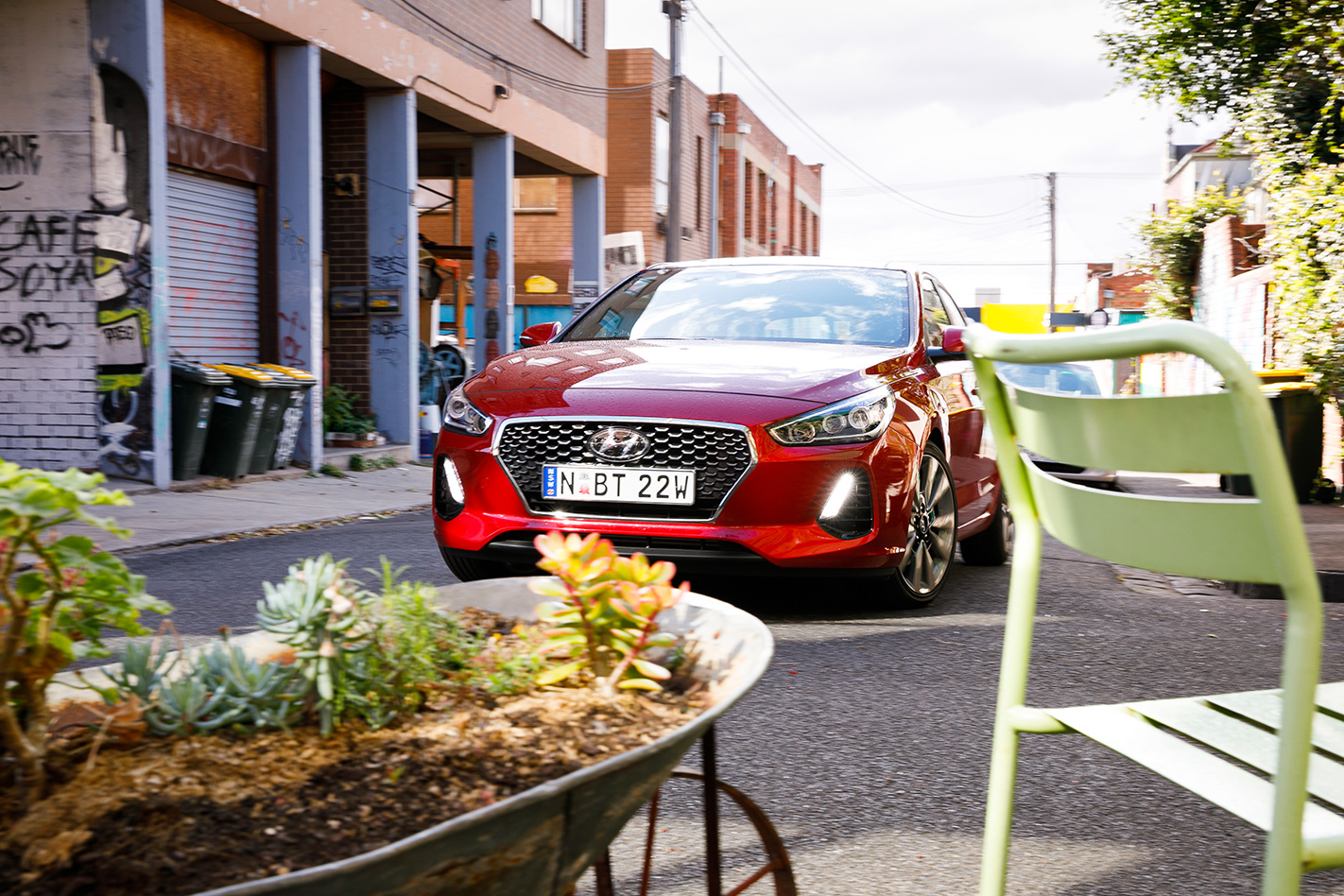
Understandably, I’m looking forward to a longer, more meaningful relationship. Relatively speaking though, our union is still in its early days and there could be any number of realisations in the coming months, like the automotive equivalent of finding out your new housemate has a collection of edged weapons and opts for a weekly wash.
There is a bigger battle than just my own personal persuasions playing out here. As part of a global line-up, the Hyundai i30 comes charged with a significant task.
The South Koreans hold ambitions to be the most popular Asian brand in Europe by 2020, with the new i30 predicted to be a sizeable contributor to that goal. But can the new model continue to satisfy Australian buyers when it’s a package that has been so carefully tailored for a German, Italian, French, and British audience? That’s what the next few months are really about.
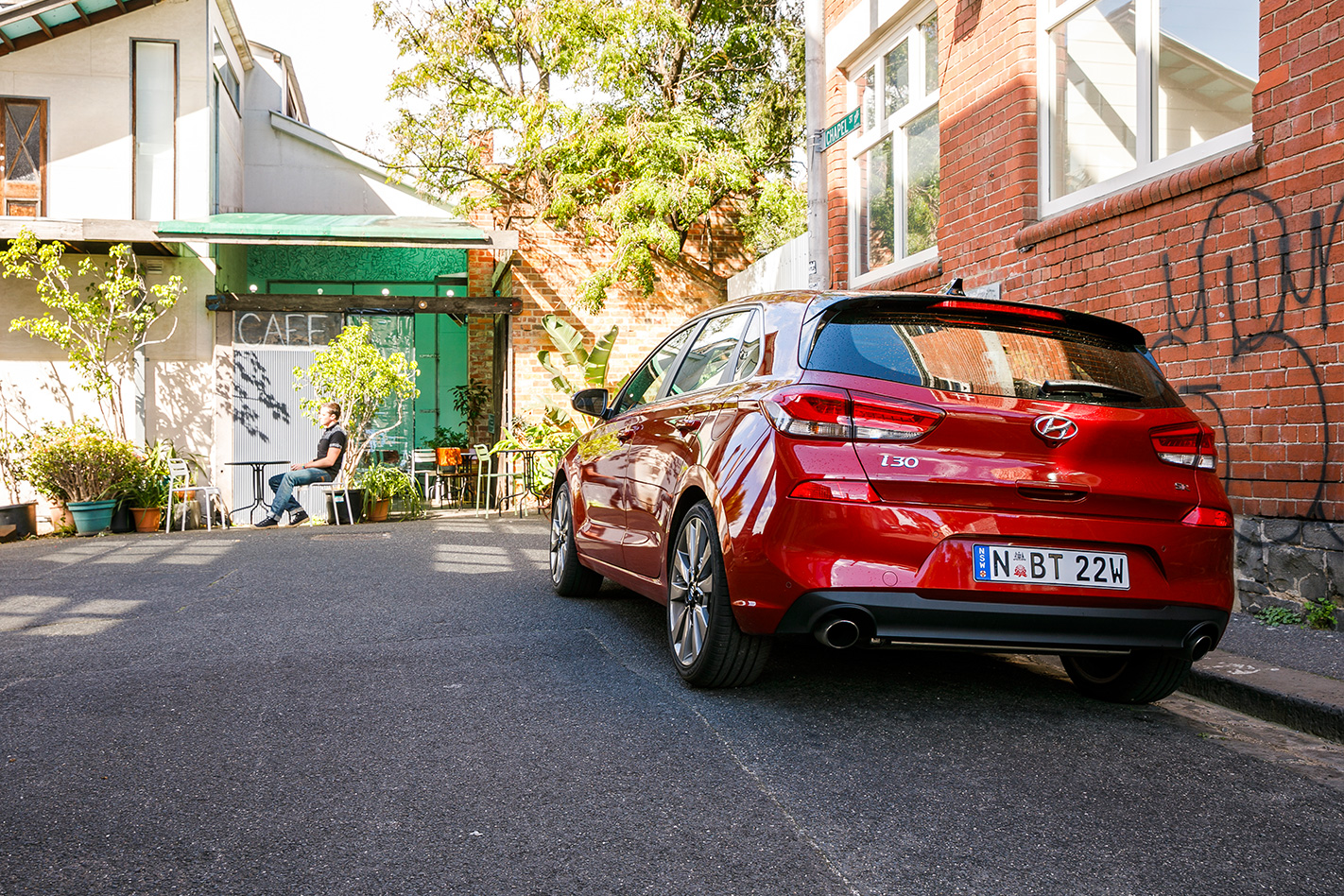
The early signs are positive, and even if I had not been provided the luxury of those several earlier drives, the Hyundai looks like a good match on paper alone.
Launched in May this year, the range kicks off with the $20,950 i30 Active but, contrary to what my careers teacher had predicted, I’ve jumped to the top of the pack and behind the wheel of the flagship SR Premium, which carries a $33,950 price tag.
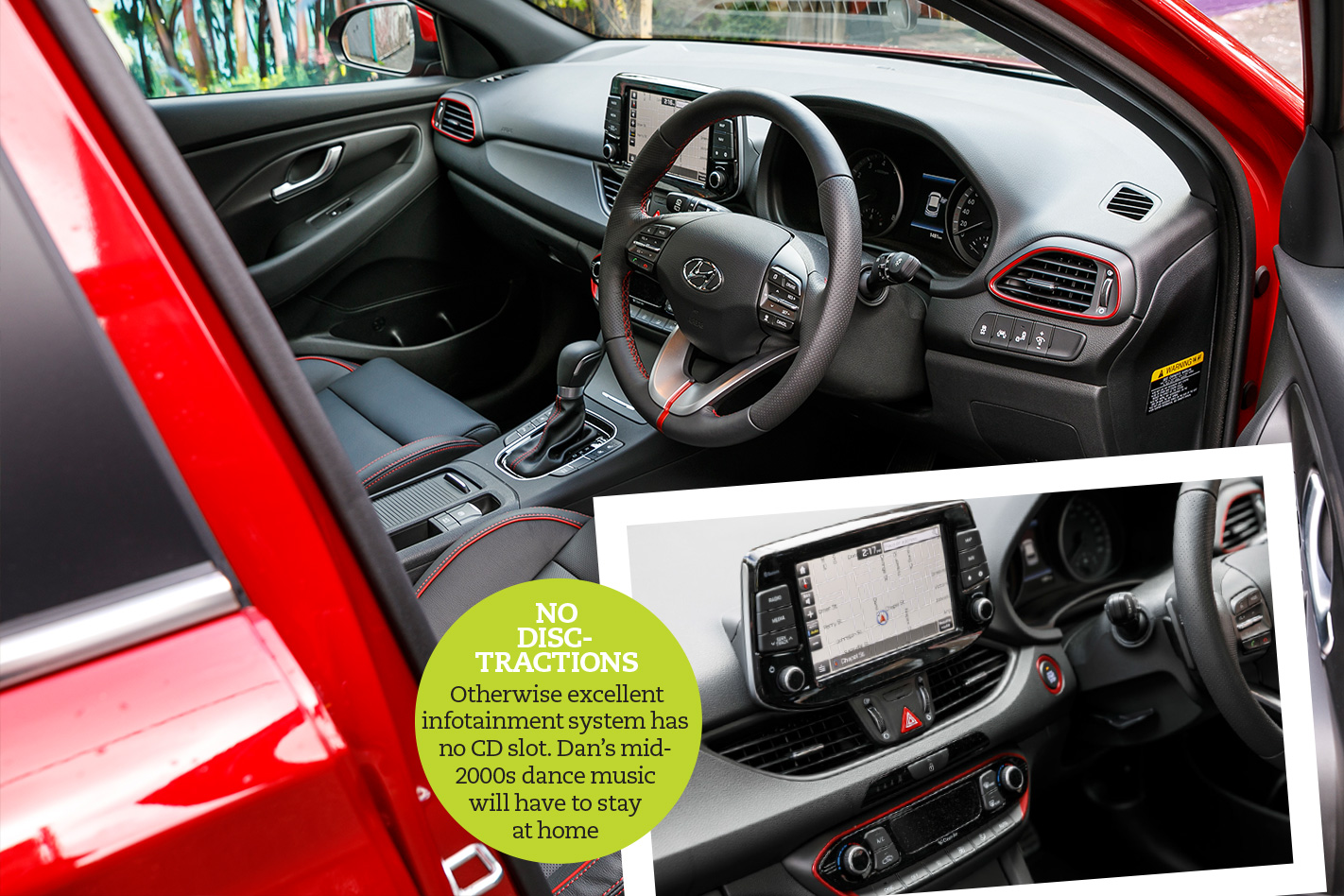
For a start, the SR Premium’s cabin is trimmed with what is only partly real cow, but looks and feels convincing. It also gets more bovine wrapping on the steering wheel, seat heating and cooling, a vast panoramic sunroof, sporty black roof lining, a generous 8.0-inch touchscreen with navigation (common to all variants), and keyless entry and ignition to name a few spec highlights.
Letting the neighbours know I brought home the looker of the i30 range are 18-inch alloy wheels, a subtle but pleasing bodykit, twin exhausts, and a warm copper-red metallic paint tone (an extra $495).
A key difference between this and the previous SR, however, lies under its pert bonnet where a 1.6-litre turbo-petrol resides in place of the superseded naturally aspirated 2.0-litre, and the difference is immediately appreciated behind the wheel.
While the SR would certainly lose a drag race with its imminent i30 N hot-hatch sibling, it doesn’t entirely deserve the ‘warm hatch’ title some have given it.
The 150kW/265Nm SR’s performance is properly brisk. And let’s not forget that the 2007 Civic Type-R was considered a hi-po hatch, yet it’s considerably slower than the Hyundai. In straight-line, cog-clicking acceleration, the seven-speed dual-clutch transmission is snappy and engaging, but I can already tell I’ll have more to say about it and the all-too-common shortfalls of DCTs in low-speed manoeuvring.
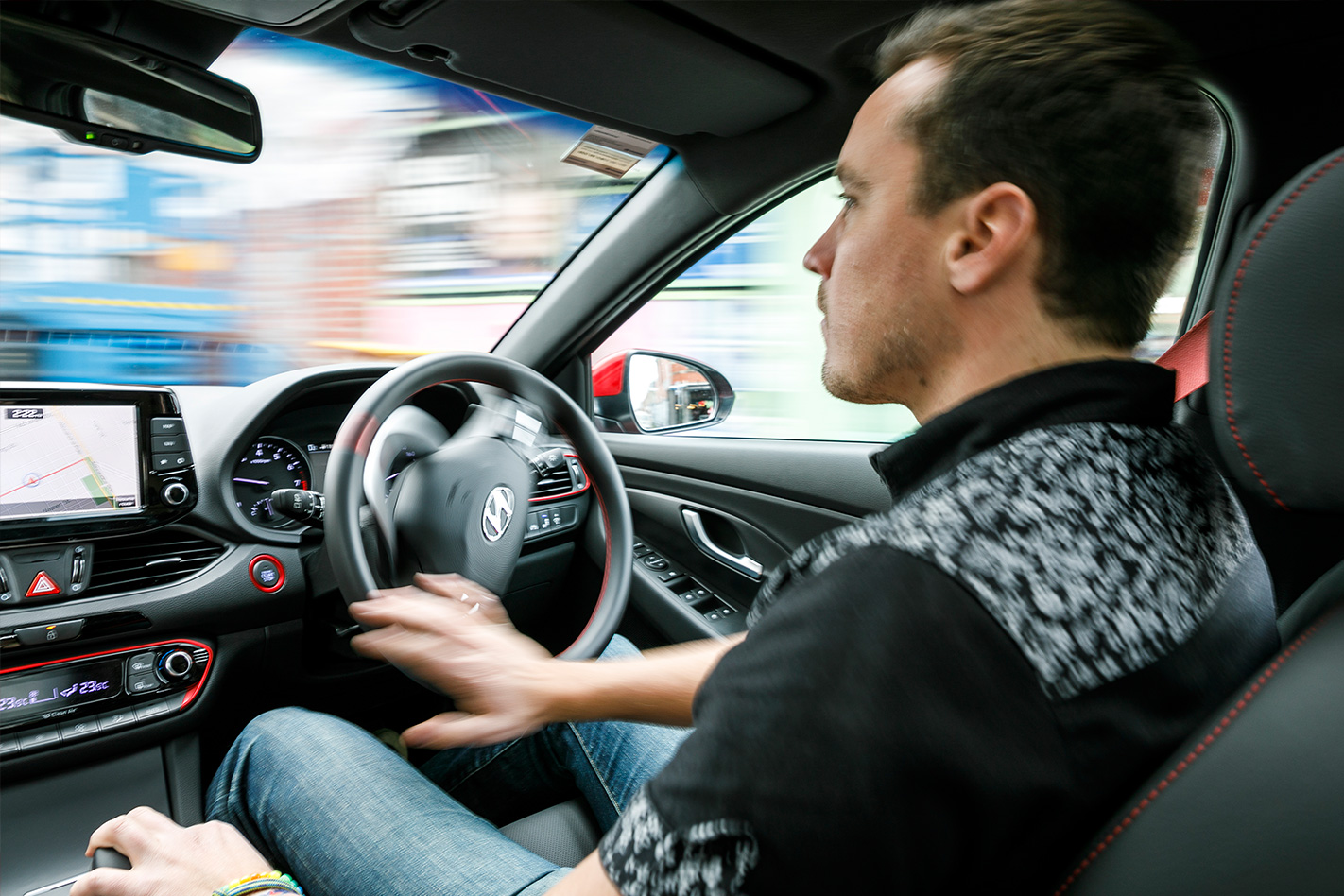
Interestingly, only the SR gets an independent multi-link rear suspension set-up, with all other variants having to rely on a more hatchback-traditional torsion beam. Its sophisticated tail is proving easy to live with, complementing the i30’s sweet steering without wrecking my vertebrae.
At this point, the SR Premium and I might have only just finished speed-dating and enjoyed our first dinner and a movie together, but I’m already looking forward to showing off this rather hot Hyundai to my friends.
Update #2
AS MELBOURNE’S insufferable winter gives way to a glimmer of spring hope, I’m looking at the Hyundai i30 SR Premium less as a refuge from the stinging cold that I occupy mostly after dark, and increasingly as a space in which to spend quality time as the mercury creeps north.
Instead of automatically reaching for the heated seat switch and gas mark 12, the balmier weather has prompted the use of effective front seat coolers, while the large panoramic roof has made its debut coming out from behind the full-length blind like the welcome sun from behind Victoria’s cloud.
The longer days and drier roads have beckoned and I couldn’t resist getting lost in the rolling hills north east of Melbourne’s sprawl, where the thinning suburbs turn into a labyrinth of mountain ash-lined roads – perfect for a hottish hatch that has only just scrubbed off its new-tyre whiskers.
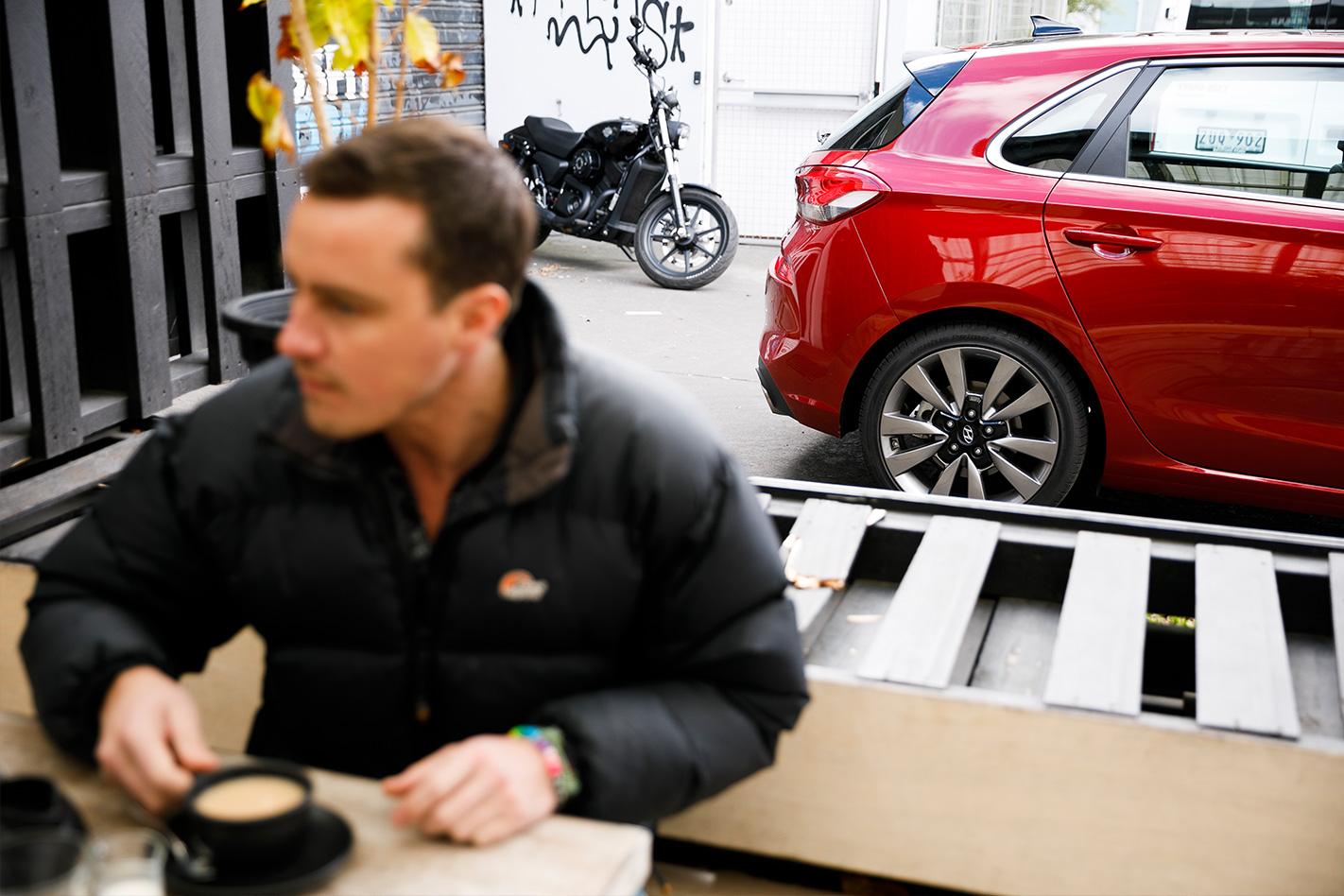
I really like the eagerness of the Hyundai i30 and how its pointy front end coupled to a lively rear suspension set-up goads you to drive enthusiastically even at low speeds, and when away from the shackles of urban cruising the Hyundai thanks you for giving in to its advances.
Unlike a Volkswagen Golf, which has more rear-end grip than at the front wheels, the i30’s tune is tail happy and more involving in the twisty bits. Tighter corners provoke a little more roll than I was expecting but that’s completely absent in longer sweeping bends.
Power and braking performance are the perfect match for its chassis and only some strange smells after the fun was over indicated this steed had never before been pushed to the edge of its performance envelope.
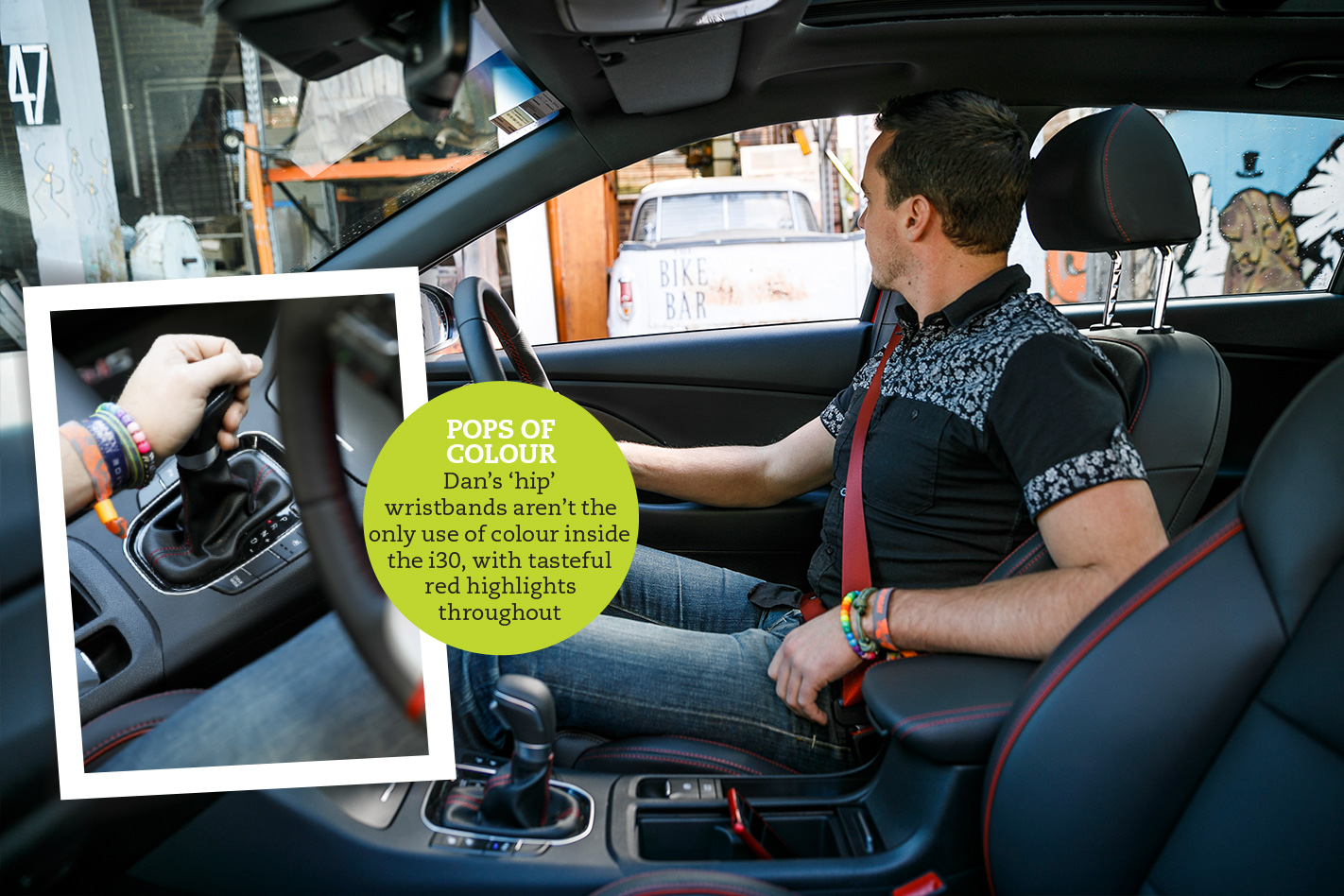
After some nine-tenths driving, the cruise home necessitated some contrasting freeway kilometres and a chance to flick on the adaptive cruise control and let the i30 take a more commanding role.
The sticky tyres that had provided a welcome insurance policy along tree-lined roads are a little noisy on coarse chipped, high-speed asphalt but that’s about the only thing that detracts from the i30’s otherwise excellent road manners.
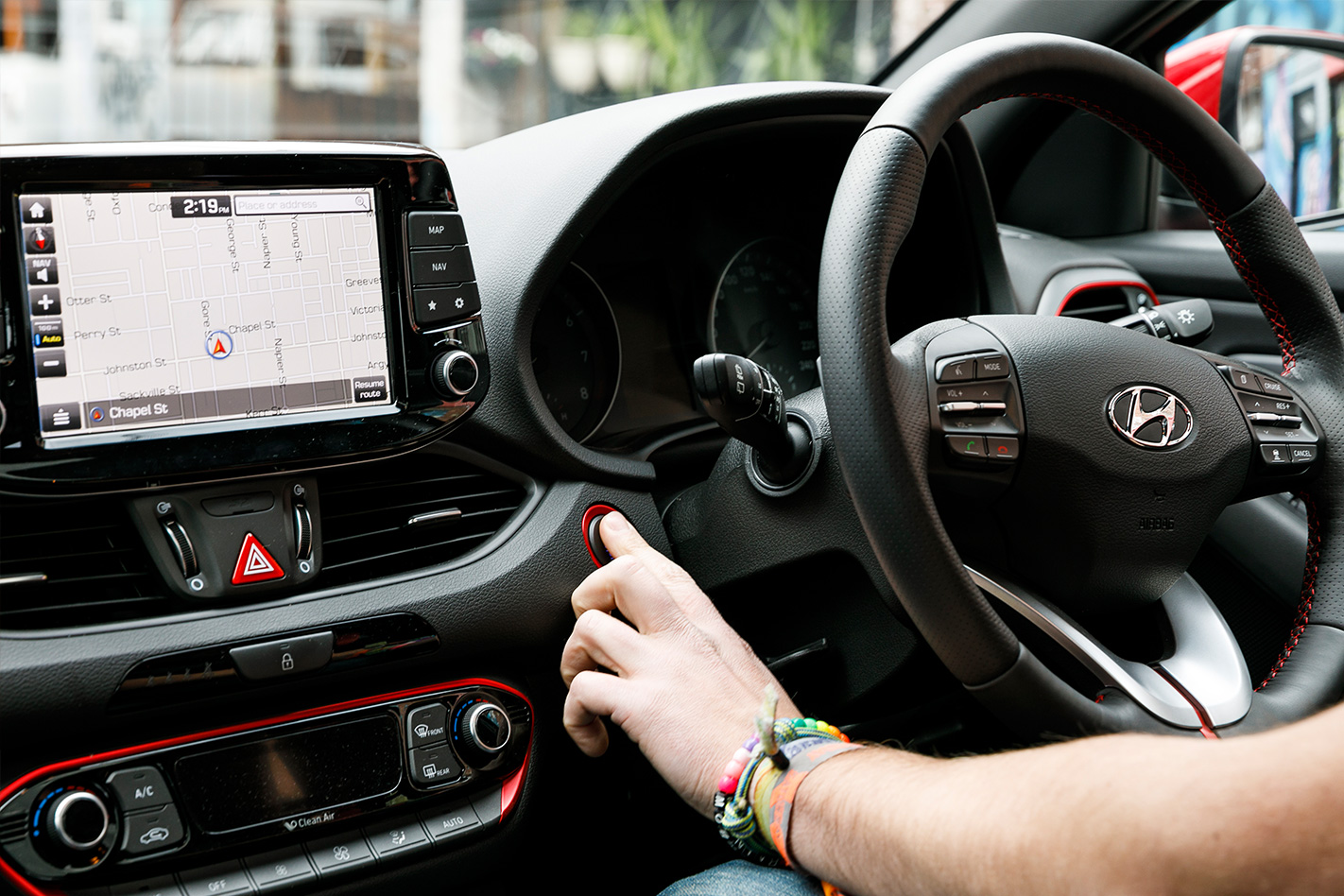
I’ve also been really enjoying the excellent information and entertainment system which is intuitive and logical with easy to understand graphics and some genuinely useful features. Automatic guidance to a fuel station when the reserve light comes on and spoken speed-limit warnings as you approach an enforcement camera have each saved my dignity more than once.
I can’t wait for another summery weekend to do it all again, next time with company.
Update #3
SINCE the Hyundai i30 SR joined the long-term Wheels fleet in August, it has been unanimously winning fans.
Every time the keys are returned to me after the Hyundai has had a stint on someone else’s driveway, they are accompanied by compliments and praise. The feedback ranges from a mention of its eager and efficient engine, the compliant but involving ride and the pointy handling and obedient front end, but the general consensus seems to focus on its sense of familiarity. Right from the first steer, the Hyundai feels like a car you have been driving for months.
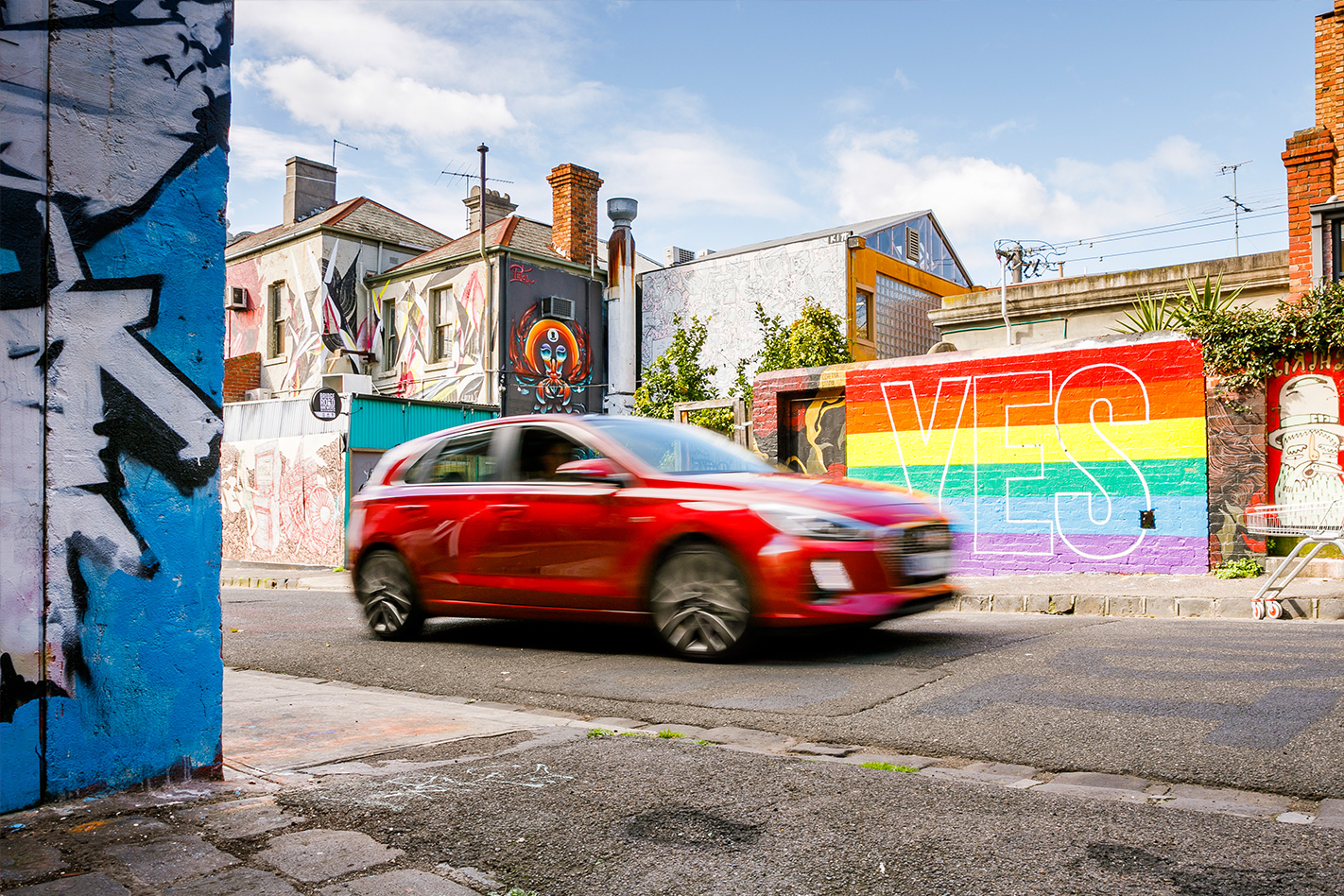
But it’s not just occupants of the driver’s seat that the i30 SR has been impressing. Three other seats have recently been filled on a more regular basis and the praise keeps coming. In the front passenger spot, companions have loved the range of comfort features including the cooled seats and vast sunroof, while second-row occupants have remarked on the generous space and comfortable ride thanks in part to the independent rear suspension.
My gripe of the month, however, predictably concerns the dual-clutch transmission. While the snappy ’box has been a strong performer while hunting perfect back-roads with slick, fast cog swaps, smoothly applying power to creep at low speed is virtually impossible.
The result is an awkward stop-start performance that makes me want to get out and push. I’ve had a driver’s licence for nearly 20 years but slowly reversing into a parking spot in the i30 makes me look like I should still have P-plates.
The Hyundai gearbox is by no means the only dual-clutch guilty of low speed problems, but the all-or-nothing power delivery remains frustrating irrespective of the boot badge.
The navigation has also been a source of annoyance. While most systems predict the place name as you are typing in an address, the Hyundai wants the full spelling and insists on a street name and number before searching for your destination.
The option to simply navigate to a general suburb or town would be a welcome feature but doesn’t appear to be possible. A small matter, though, in a generally intuitive and functional system that all occupants seem to be enjoying.
And despite the positive reviews from other Wheels writers and a warm reception from whoever hops behind its leather-wrapped steering wheel, I’m still the i30’s biggest fan and already lamenting the day I have to hand back the keys.
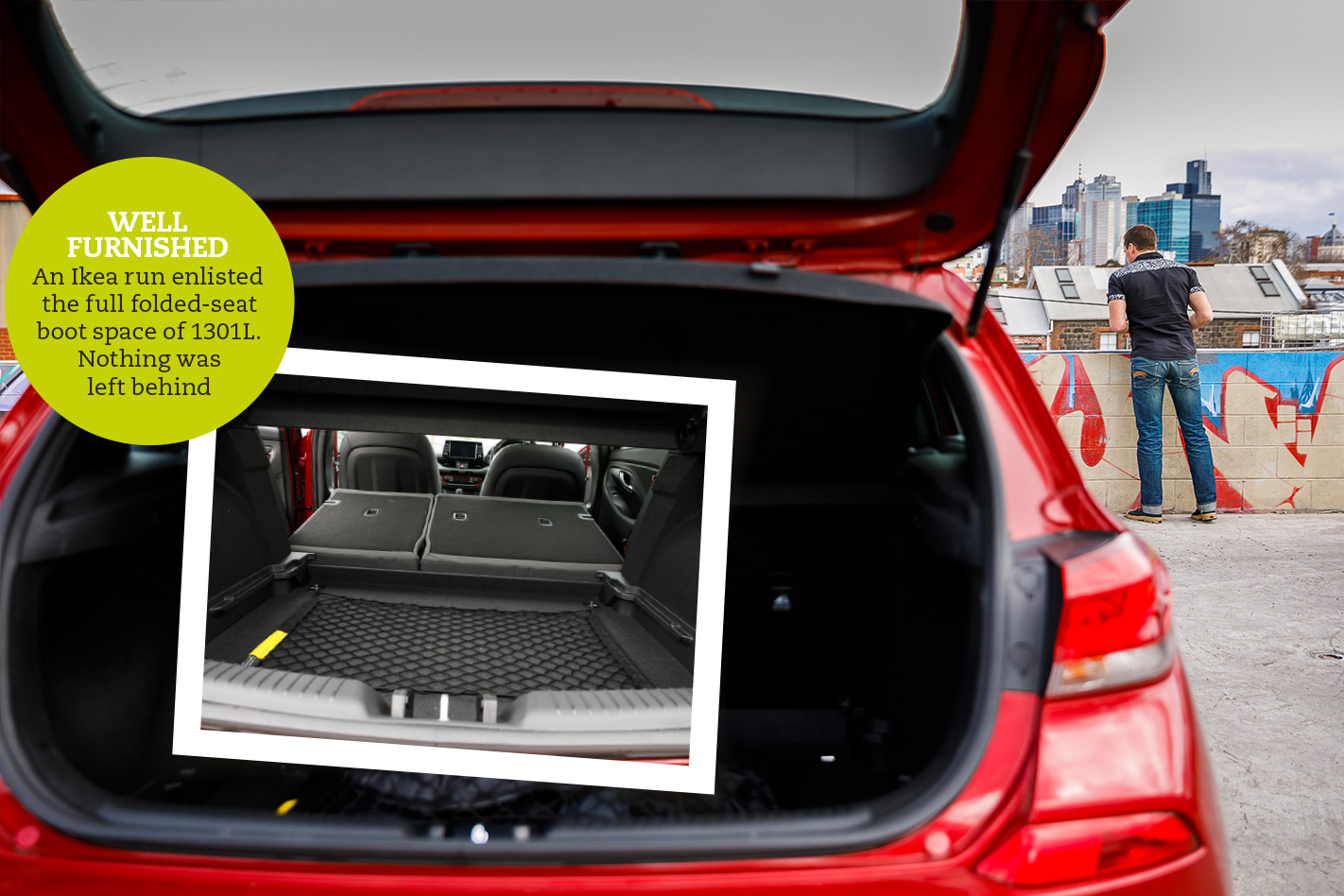
On the pipe, it’s a sipper
This month’s average fuel consumption has fallen to a new frugal low which is a surprise given how many lead-footed petrol-heads have had a spin in the i30. That figure could be even smaller however, had Hyundai equipped the i30 SR with idle-stop technology. Finding a small car without this fuel-saving trickery is becoming increasingly uncommon. Yet those who find the tech annoying might figure that its absence is worth the extra sip.
Farewell
WHAT started out as a brief and exciting overseas fling on the freezing streets of Hyundai’s native South Korea way back in February, and became a blossoming long-term relationship with the i30 SR Premium, has all too quickly come to an end.
It wasn’t just the fact that I continued to see other cars, spending time intimately handling their interior parts, or the fact the Hyundai spent many happy hours getting to know other Wheels staffers, including the odd weekend away enjoying the company of strangers.
The keys always came back to my bowl.
Some relationships simply run their course and when it’s time to go your own way it’s best to do it with maturity and dignity.
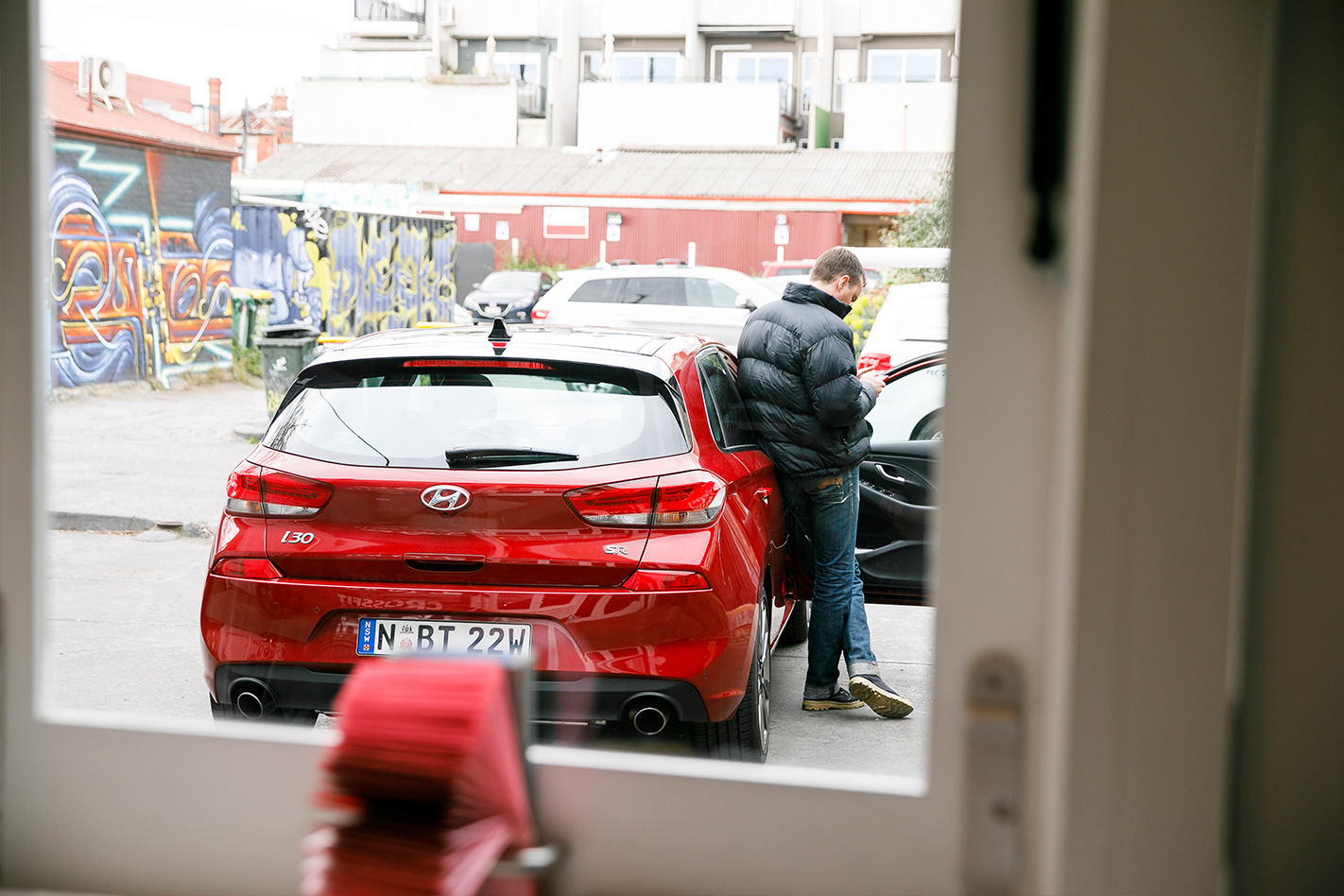
But the truth is the i30 SR and I got along famously. Over the last four months, I have found far more positive words to say about Hyundai’s i30 flagship variant than negatives.
So it’s no secret I have enjoyed the engaging performance of its taut chassis tune and surprisingly powerful 1.6-litre turbo engine, and always looked forward to spending time in its well-appointed cabin, whether the trip was for official reasons or no reason at all. But what are we to look for as a barometer of the Hyundai’s broader nationwide reception?
With a small sample size, a majority of the people I have introduced to the i30 have been complimentary but you’ve probably never told someone their newborn is fantastically ugly right? Perhaps they were just being kind. What Australians really think of the i30 ultimately remains to be confirmed by long- term sales figures, but a final trip away in the SR cemented my opinion that it’s a brilliant all-rounder.
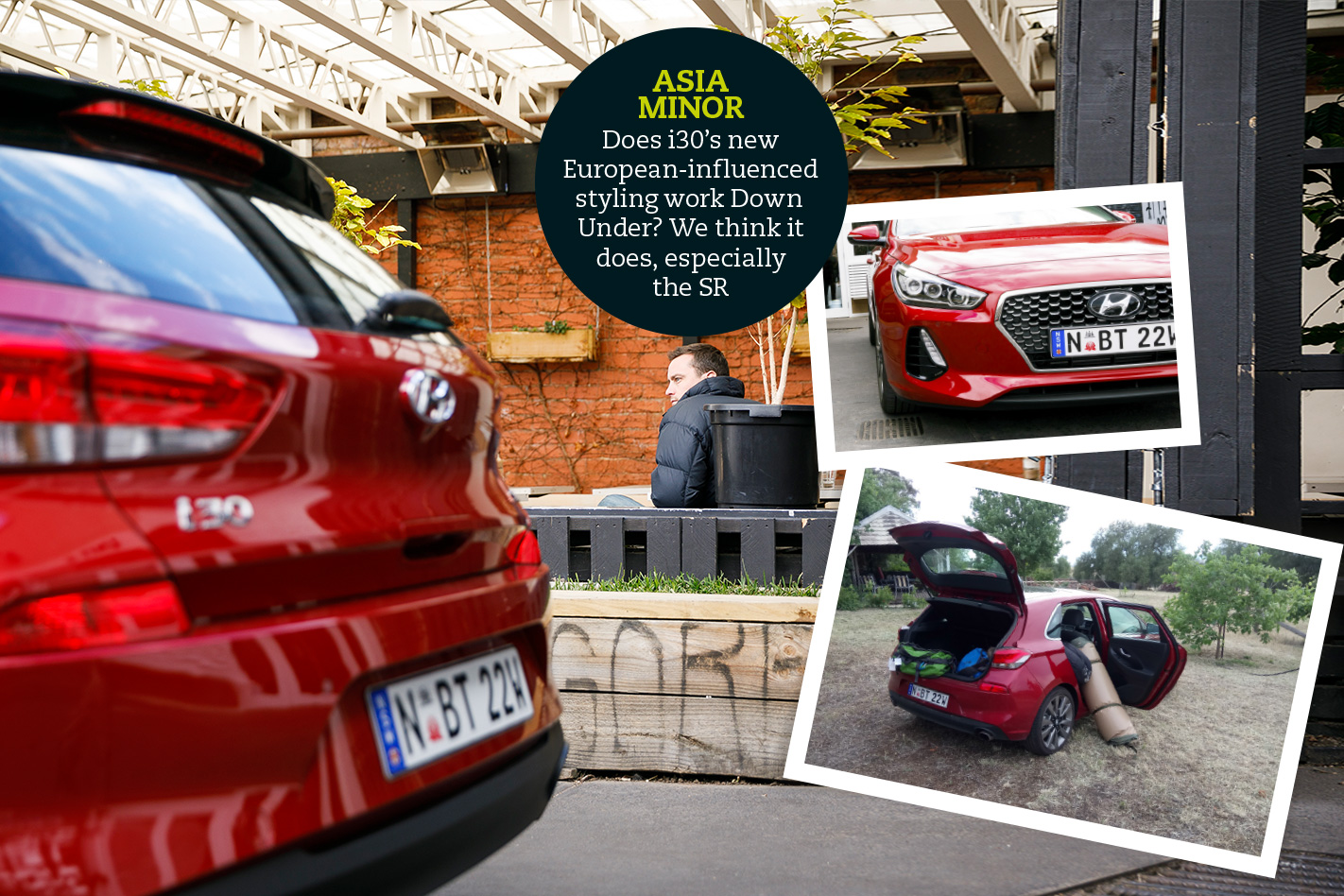
As I loaded up the boot with my swag, some decent booze and all of the paraphernalia necessary for a bush party just down the road from the Heathcote Dragstrip (where we performance-test cars), it drove the point home that the i30 competes with the best for small-hatch practicality.
With a crew of just one on board and a couple of podcasts plugged into the USB port, I was again reminded how effortlessly the SR devours uninspiring freeway cruises. It also left me time to ponder the comprehensiveness of the SR Premium package and just what Hyundai offers for the money.
There had been times the combination of excellent handling and tractable power had made me instinctively reach for a manual gear selector, but the three-pedal option doesn’t exist in range-topping Premium trim.
It’s a shame as a shift-it-yourself gearbox would enhance driver involvement while eliminating the qualms I’ve had with the DCT’s sluggish low-speed behaviour. Before I knew it, the rolling hills of central Victoria were all around.
Friends and frequent visitors to the little riverside oasis in Redesdale are used to a different car accompanying me to each party, but despite the less exotic badging, the little Hyundai continued to draw praise.
In a vineyard full of mid-sized SUVs and mock-roaders, it seems you can still pique some interest with a well-rounded, practical and wholly liveable warm hatchback. It’s a little perplexing to observe the rise of SUVs in the Australian automotive landscape, when there are some excellent passenger vehicles that make infinitely more sense for the majority of day-to-day motoring.
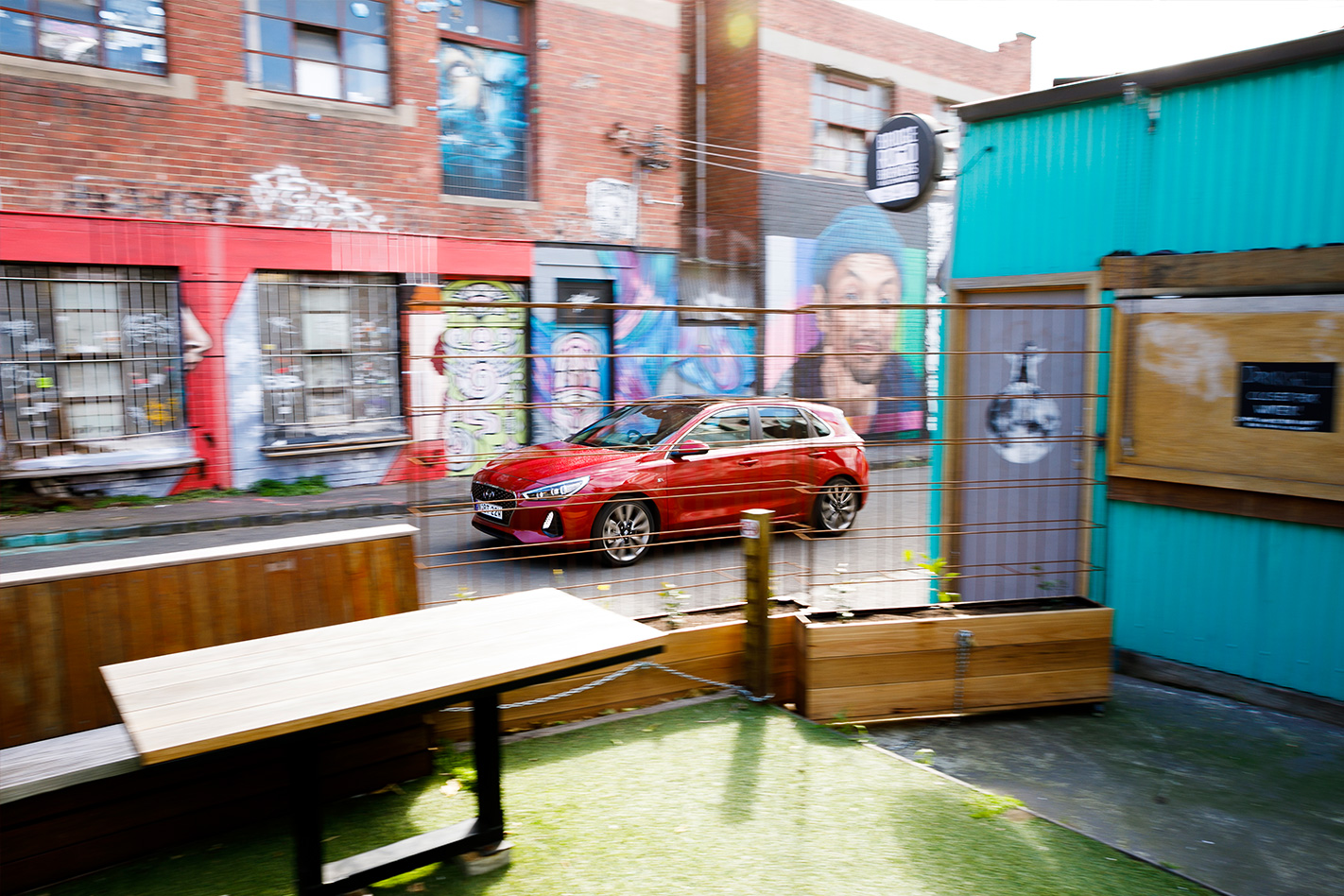
If you need an example of exactly that and how much car you get for $35,000, you needn’t look any further than the current i30 range-topper.
From a first meeting in a frozen far-off land, to one last balmy night of fun, I can confidently say I know the i30 SR Premium intimately. I’m already hoping for a platonic reunion somewhere down the road.
Skoda has revealed sketches of its latest concept; a hybrid crossover that previews the Czech brand’s planned entry into the crossover market as early as next year.
Smaller than the carmaker’s all-electric Vision E Concept, the Vision X also looks closer to production ready. Its front end resembles the new Karoq medium SUV, but with separate daytime running lights and headlights that look like they’ve been lifted from the Hyundai Kona.
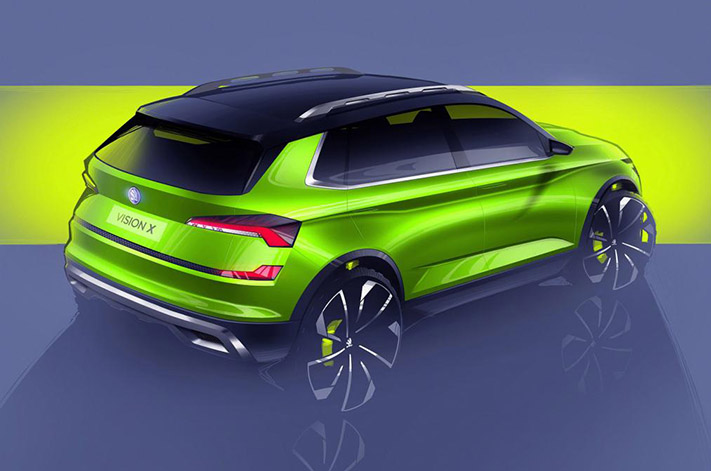
With sharp lines, bold bumpers and dominant side sills, the Skoda Vision X’s interior displays the brand’s new design language. It looks sporty too, with its contrasting anthracite-coloured roof the features a panoramic sunroof, flashy Flexgreen paint, and big 20-inch wheels that are unlikely to make their way to the production version.
Inside, the wide, ergonomically contoured dashboard flows around a freestanding colour display with “infotainment and connectivity services accessed quickly and intuitively” while ambient lighting shines through elements made of cut crystal glass.
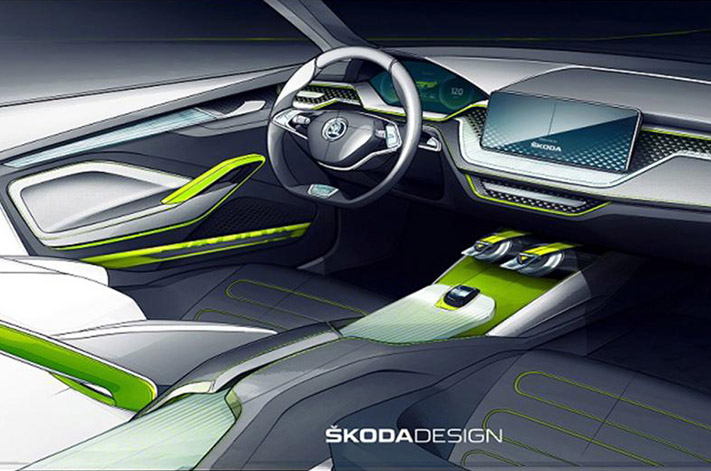
While the production version of the Vision X won’t rely solely on a hybrid powertrain, a batteries-included version will be a key plank in Skoda’s plans for one-in-four of the vehicles it sells to be electrified by the time we welcome in 2025.
The Skoda Vision X concept will make its debut at the Geneva Motor Show, which begins on March 8.
BACK in 1982 Nissan sold a car with voice recognition, and nobody in the English-speaking world seems to have noticed it.
Imagine our surprise (and disbelief) when we discovered a 36-year-old spec sheet with the sci-fi for the time feature clearly listed.
That’s no typo either, 1982. The year Argentina invaded the Falkland Islands and Survivor’s legendary “Eye of the Tiger” hit the airwaves. Marble-wash denim had yet to be invented. It was a long time ago.
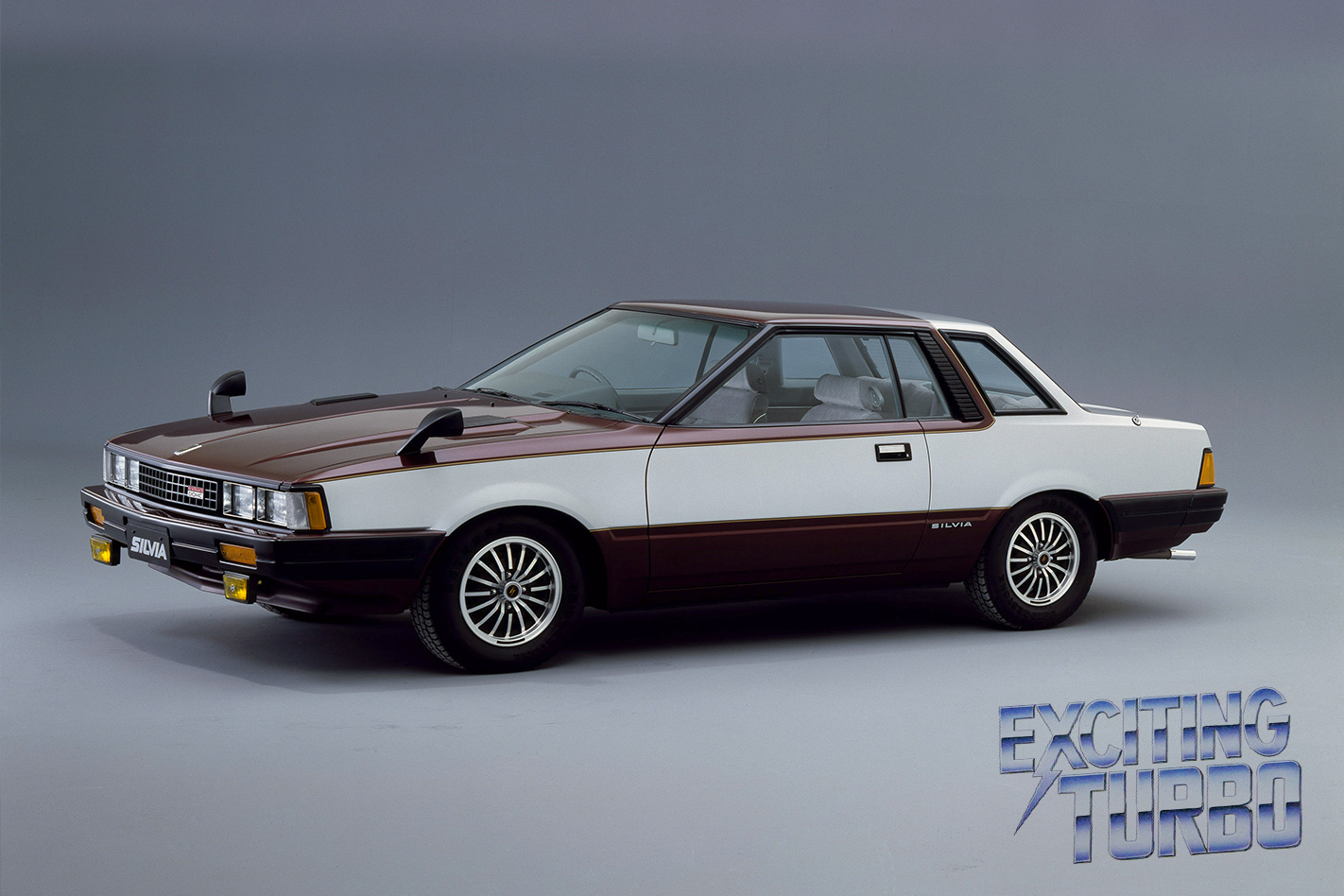
But the system inside the Japanese-market Nissan S110 Silvia (also marketed as the Gazelle) was not exactly voice recognition as we know it today. It was scream recognition.
We’re not kidding. We asked Nissan to explain what the S110 Silvia’s “Speech Recognition Microphone” (which was standard on the top-dog Silvia RS Extra) actually did, and the answer from Nissan’s Japan HQ raised our collective eyebrows: it was designed to detect cries of pain.
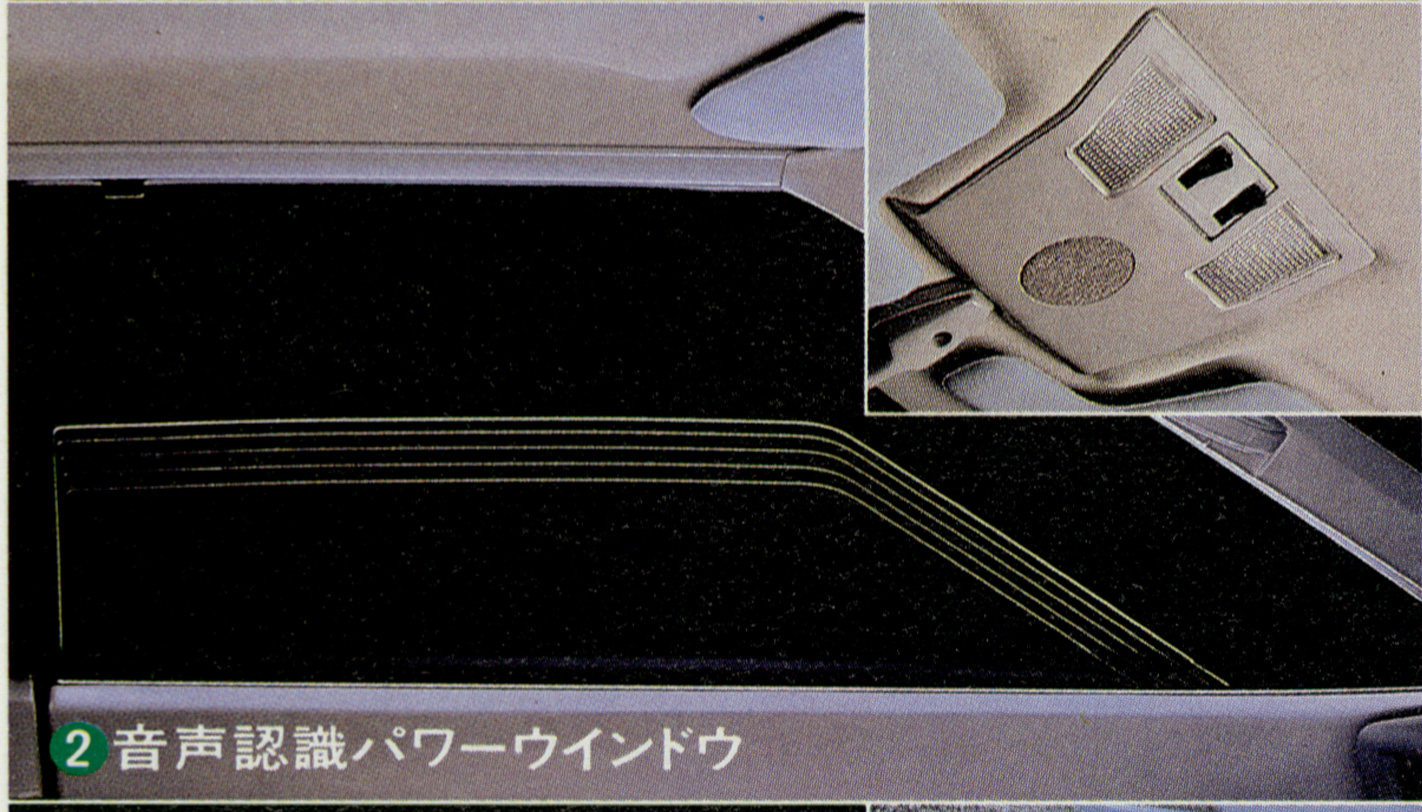
“The main objective of this feature was safety. It was to prevent driver or passenger from choking the neck by the closing (lifting) power window glass. When the driver or passenger cries out loud, the system recognizes the “voice” through the microphone, then stops to operate the power window automatically.”
So yeah, scream recognition. Throttle response of a different type.
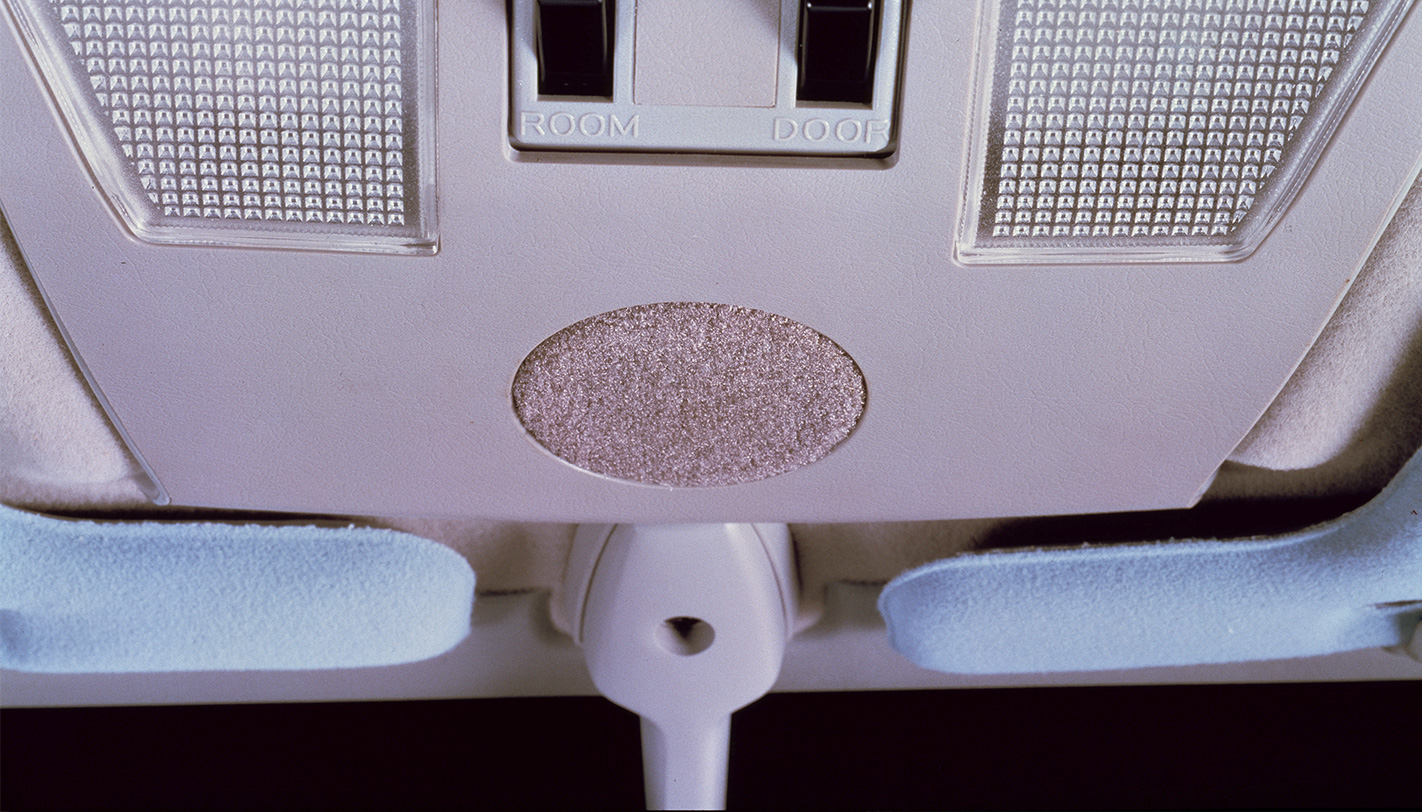
And it served a noble function. Power windows were still relatively uncommon back then, and there are more than a few accounts of people – usually children – actually dying by inadvertently resting a part of their body on a power window rocker switch while poking their head outside and being slowly strangled.
Nissan had the solution – and it was a ground-breaking, perhaps needlessly complex, electronic device. The development of which probably required a team of Nissan engineers to methodically choke each other in front of a microphone and analyse the resulting waveforms.
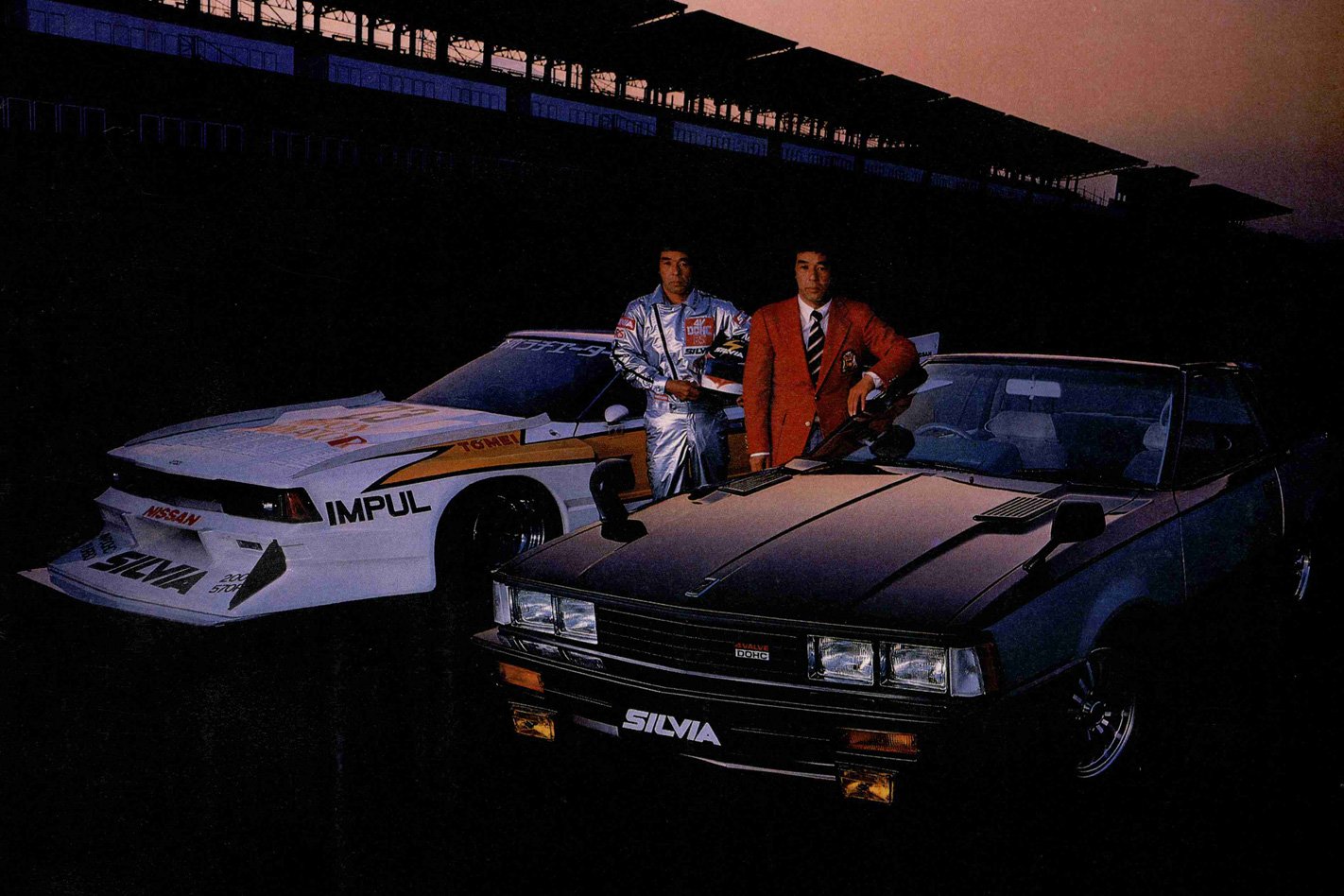
They were true pioneers, however, as voice recognition wouldn’t become commonplace in cars until roughly three decades later. If you’ve ever reached the point of total frustration with a car’s voice recognition and just ended up shouting at it, calm yourself by appreciating that it’s come a long way from the days of the S110 Silvia. Talk about a spirit of innovation.
What has 340kW, 700Nm, does 0-100km/h in 4.7 seconds, but could get you to work and back without the engine even turning over? The Porsche Panamera 4 E-Hybrid.
It’s not as sexy, powerful or as desirable as its Turbo bigger sibling, but even with an as-tested price of $264,120 it’s an almost $120K cheaper way of getting into one of the nicest car interiors on sale today. Well insulated from tyre and wind noise, and with an amazing ride on its three-way air suspension, this is a very comfortable car.

On a twisty road, this is also an engaging and very polished handler with agility that somewhat defies its not inconsiderable size, also with strong traction thanks to its all-wheel drive system.
If not in the mood for such things, the 4 E-Hybrid delivers up to 50km of plug-in electric range, taking 5.8 hours to fully charge, or 3.6 with an optional charger. Porsche has done a great job to ensure seamless switching between electric and petrol power under acceleration, although we were disappointed with a wooden and inconsistent brake pedal feel at stuck-in-traffic speeds.

Of course, being more interested in the latter, we could justify the extra cost for the brilliant V8 Turbo.
2018 PORSCHE PANAMERA 4 E HYBRID SPECS: Engine: 2.9-litre v6, twin-turbo Power: 340kW Torque: 700Nm Weight: 2170kg 0-100km/h: 4.7sec Price: $248,500
One of the most difficult decisions anyone must make is when to retire.
Whether you’re an elite sportsperson facing the prospect of ever declining skills and athleticism or John or Jane Smith simply working out how long you need to keep toiling in order to make the finances last, knowing the right time to call it quits is a tricky balancing act.
Of course, not everyone has the luxury of choosing their own terms. Just as many workers in the Australian automotive industry have been required to transition their skills into other areas or face irrelevance, HSV has been forced into a similar upheaval.
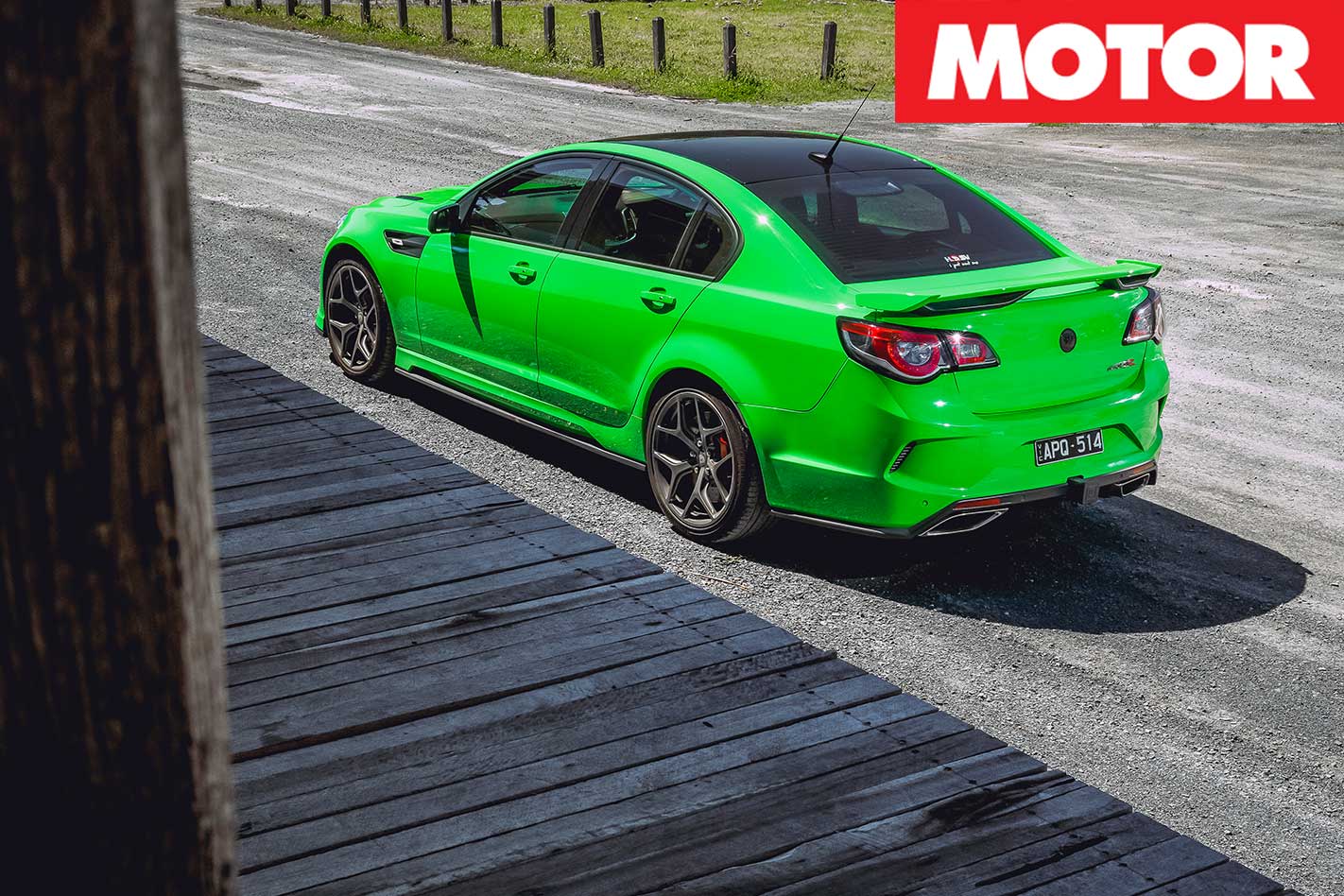
So much of the press and coverage regarding HSV’s final offering has been centred on the W1 and deservedly so, for as an engineering project it’s one of the biggest the company has ever undertaken. But in all the hoopla surrounding the 474kW LS9-engined monster the regular GTSR has been somewhat forgotten, which is a shame.
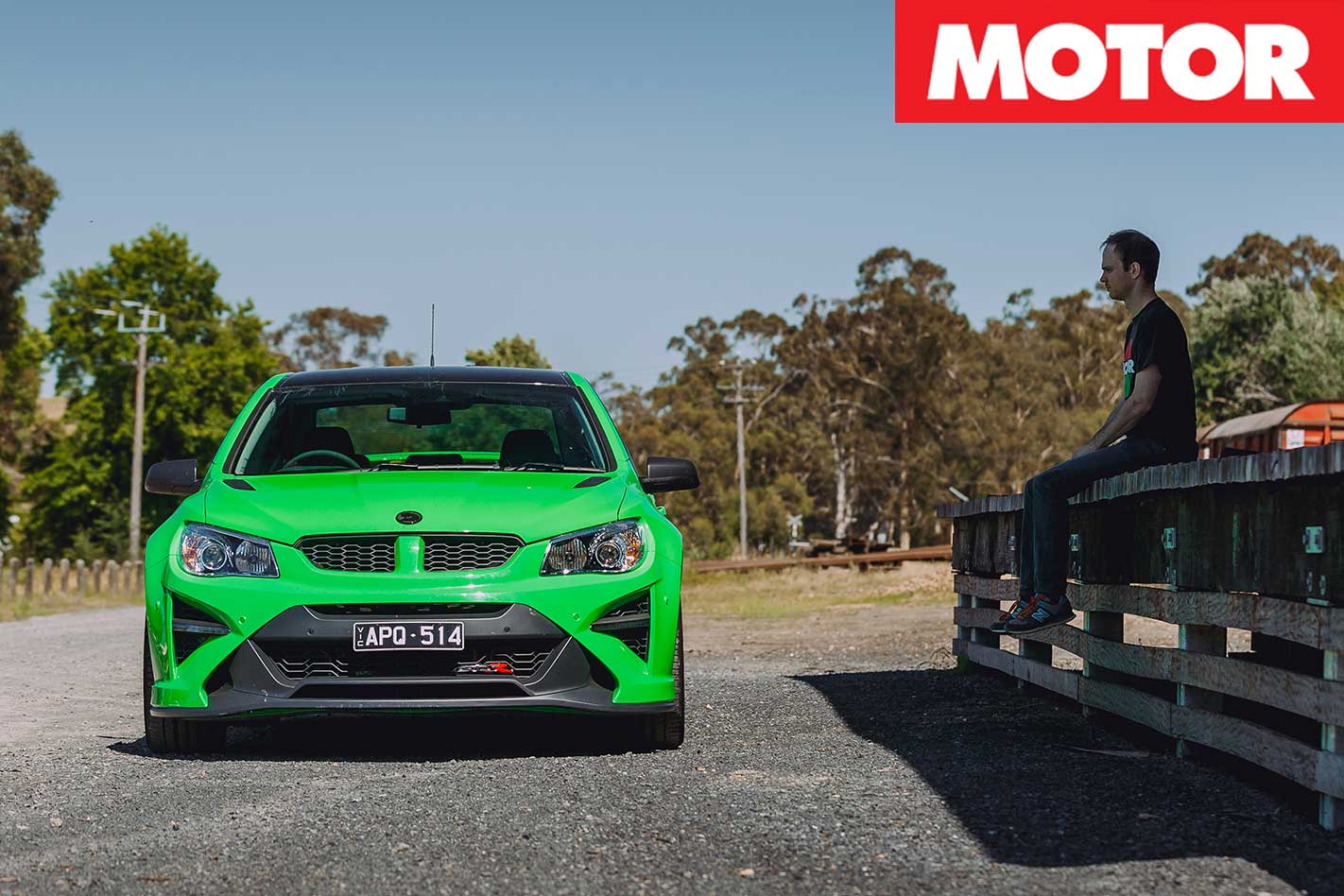
This tale starts at the racetrack. It’s an appropriate venue to begin as not only is the HSV story inexorably intertwined with racing, it’s also where it began. It may not have been badged as such, but the VL SS Group A Walkinshaw was the first product from Holden’s new hot-shop following the bitter and public split with Peter Brock.
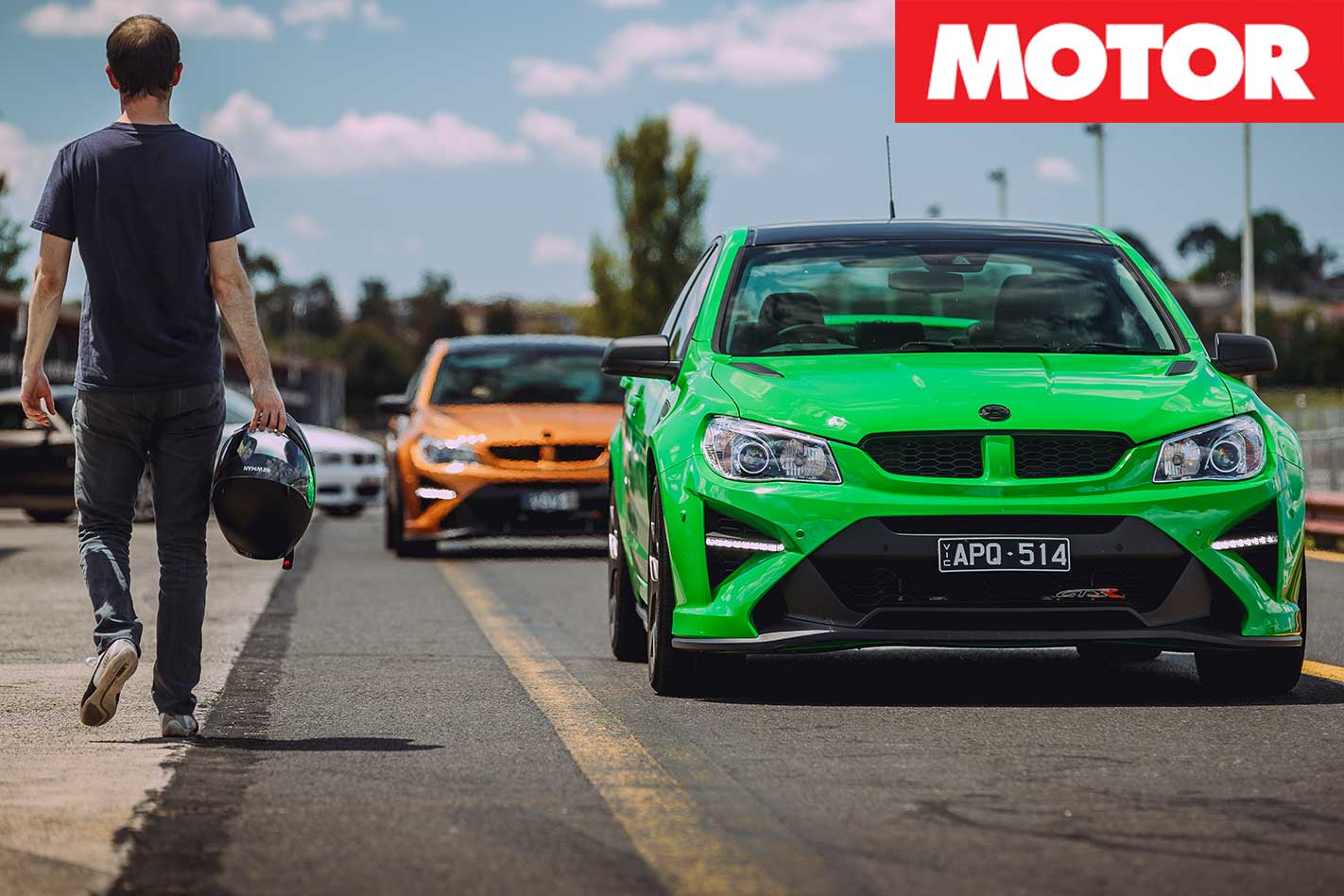
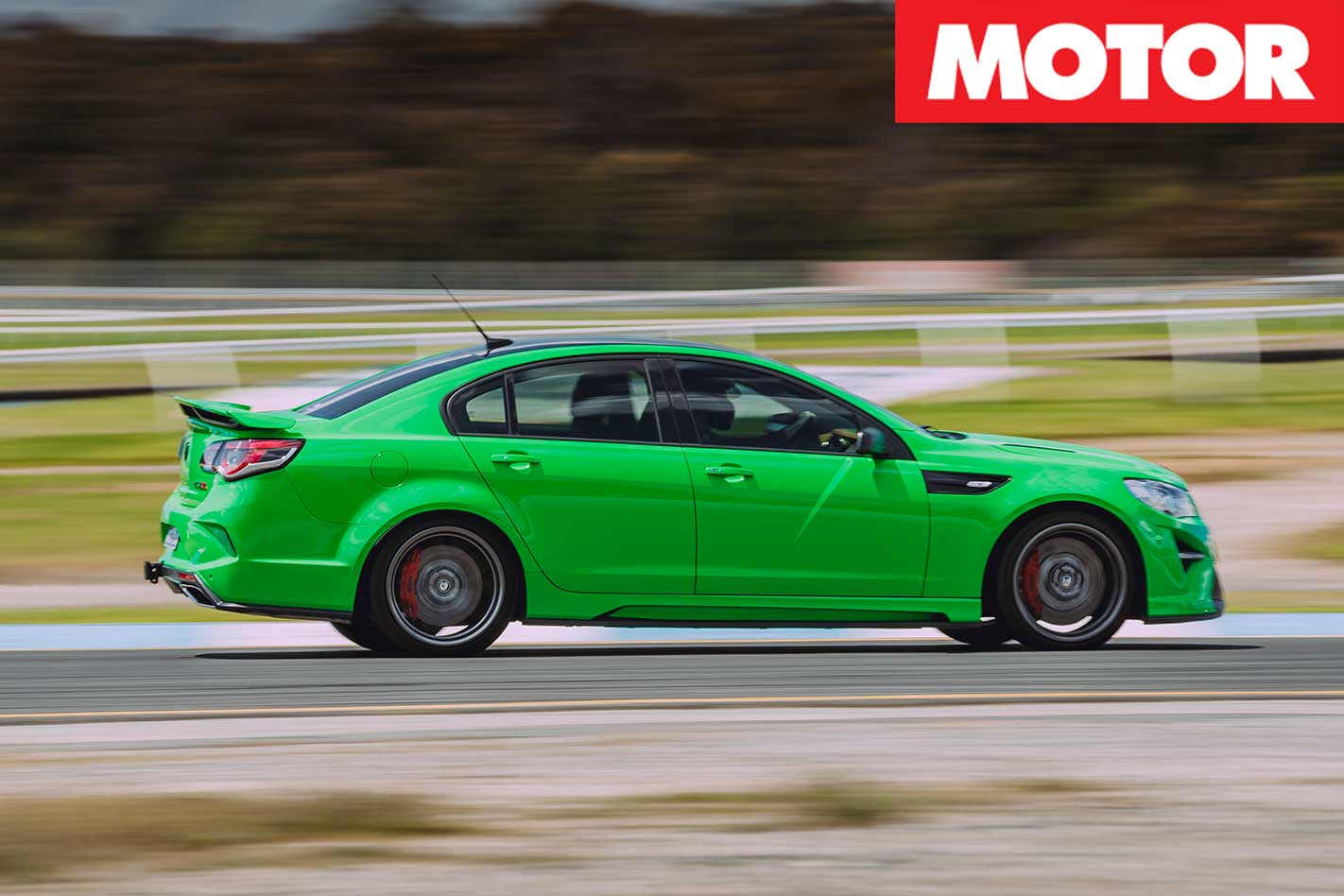
Sandown Raceway was a relatively happy hunting ground for the Walkinshaw, Larry Perkins scoring a brace of second places in 1988 and 1989 before breaking through with victory in 1992 and the GTSR feels equally at home. Unkindly, but accurately, described by some as “two drag strips connected by a couple of squiggles”, Sandown plays to the big HSV’s strengths – big power and big brakes.
There may only be a token 5kW bump in power, but 435kW/740Nm are still very large numbers and the 6.2-litre supercharged LSA V8 is unrelenting in its urge, propelling two tonnes (with fuel and driver) well north of 200km/h on both straights with nonchalant ease.
Once again AP Racing supplied the hardware and HSV engineering boss Joel Stoddart explains the appeal: “We’ve got a really good working relationship with [AP Racing]. We’ve got a steady engineering base and they’ve got a fairly steady engineering base, so those guys have been working together a long time and understand our requirements. The size of the company is right in the sweet spot in terms of volumes and levels of performance; if you went to a major OEM supplier our volumes don’t support that”.
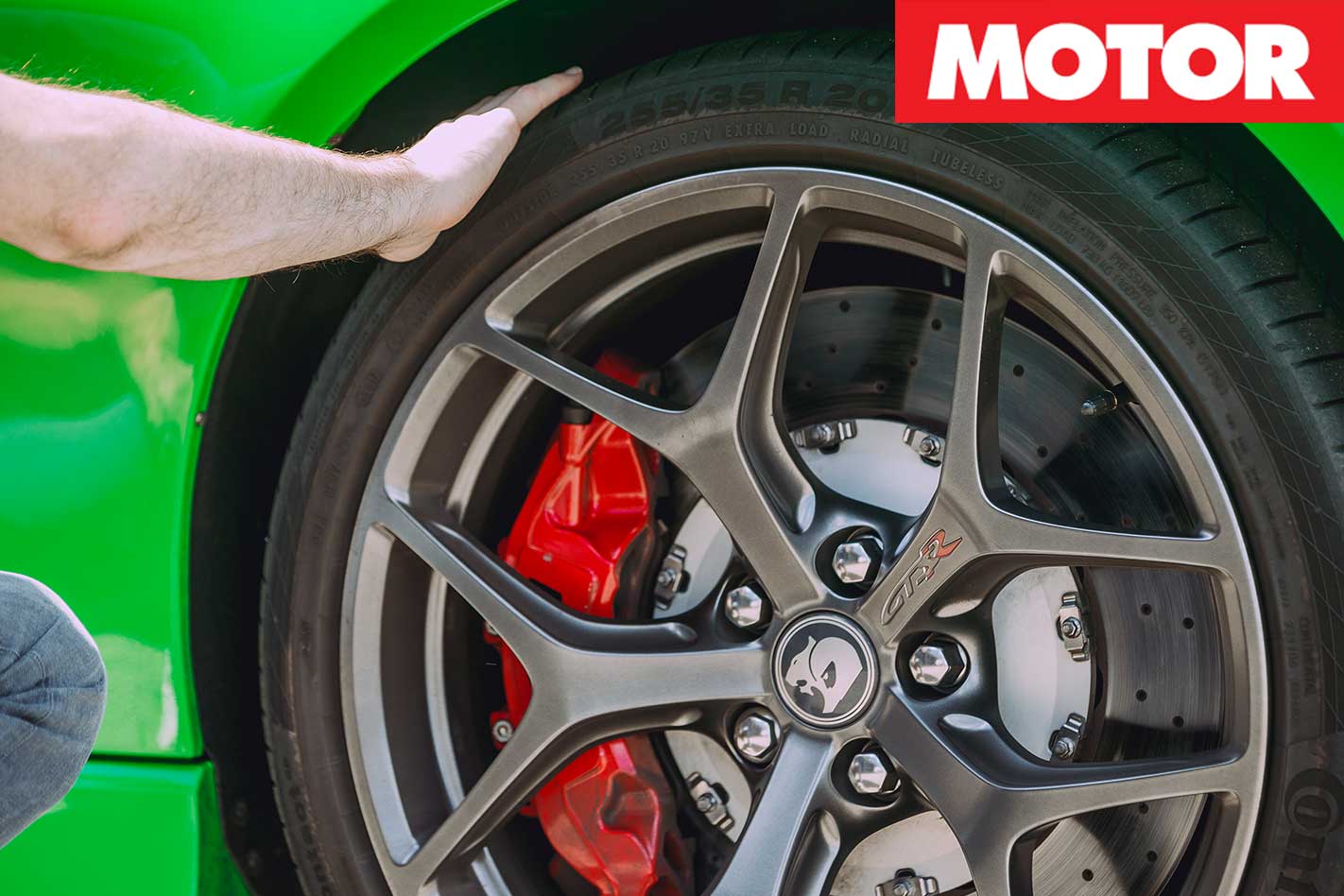
Continental has been HSV’s tyre partner for the entire Gen-F run (bar the W1) and while the ContiSportContact 5Ps are brilliant in the wet and offer great grip and progression in the dry (it’s not our 2017 Tyre Test champion for nothing!) the wear rate can be very high, especially when you’re dealing with a heavy, powerful car, a racetrack and temperatures in excess of 30C.
Under heavy braking it’s not hard to trigger the ABS, circumspection is needed on turn-in to prevent the heavy LSA dragging the nose wide and patience required on the throttle to ensure as many of those 435kW are transferred to the tarmac as possible.
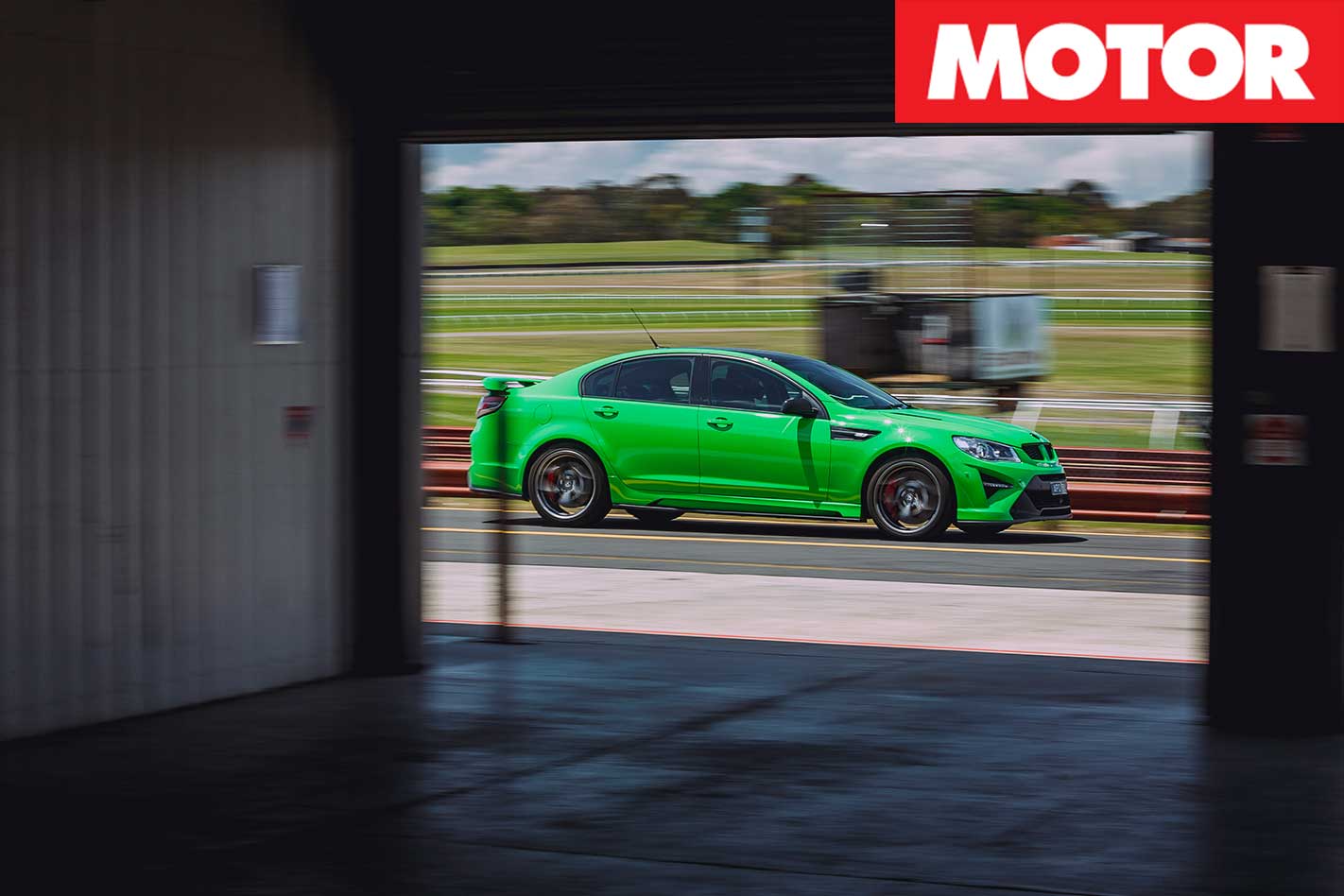
This is no slight on the Continental, it’s not intended to be a track-biased tyre, merely a comment that if you’re planning on tracking your GTSR – and you should, like the bloke exercising his W1 during our time at Sandown – it might pay dividends to have a dedicated set of rims and tyres. Our test car has been taken from one of HSV’s executives, the press fleet having long been re-allocated, and as a result we’ve been asked to limit laps, so we reluctantly depart Sandown for greener pastures.
Our chosen route is a well-worn one – east from Melbourne to Healesville, through the Black Spur and on to Marysville, climbing towards Lake Mountain before descending back down Reefton Spur, a 250km loop that incorporates virtually every type of corner and road surface.
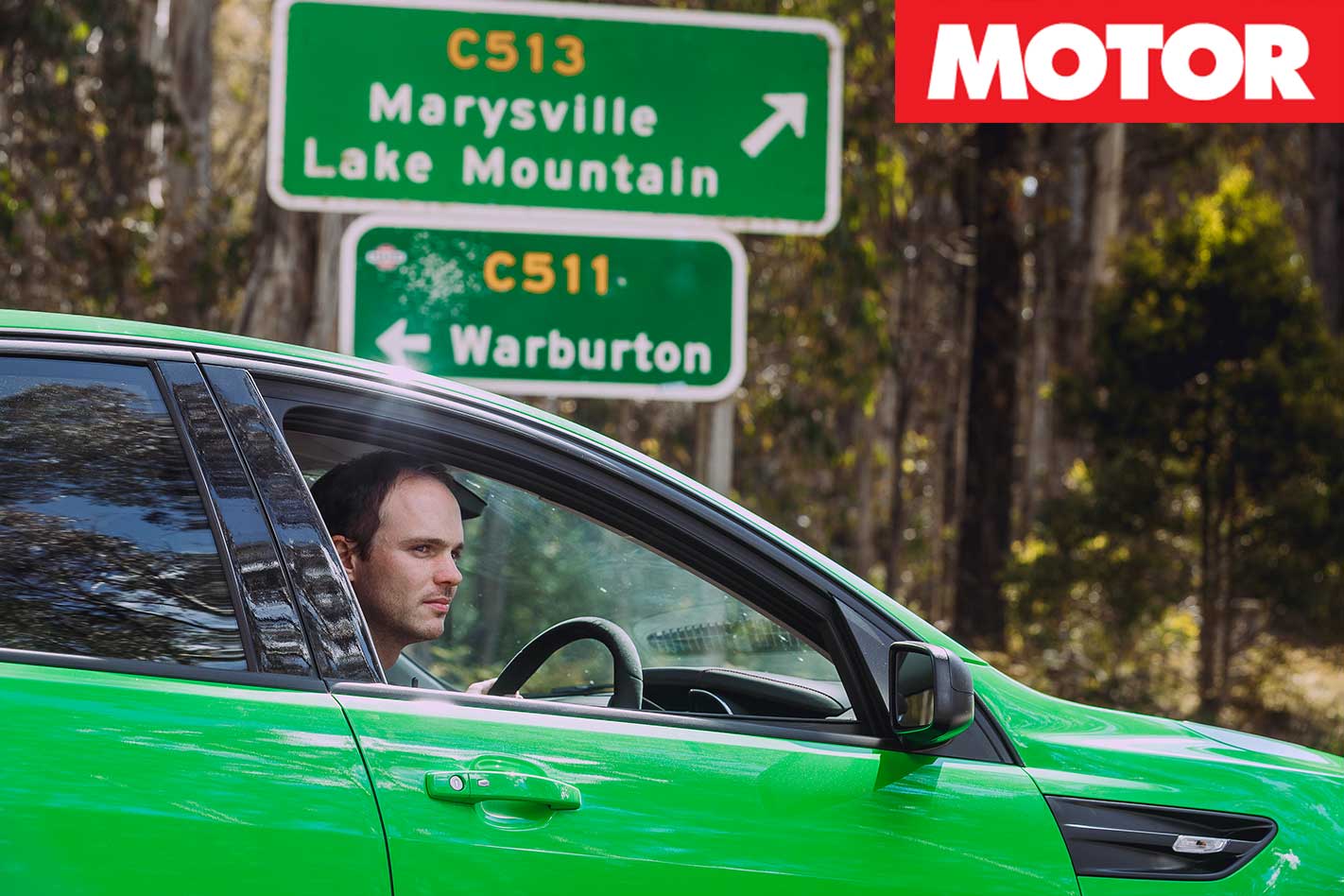
HSVs have always managed a reasonable compromise between handling agility and touring comfort, but the addition of adaptive suspension allowed a greater breadth of ability than ever before.
It took a little while for HSV to really nail the setup – that first E-Series GTS came 18th in the 20-strong PCOTY 2006 field – however, certainly by the time the Gen-F rolled around the trick dampers were a crucial part of being able to soak up the worst Aussie roads could throw up while also harnessing 430kW/740Nm on a track.
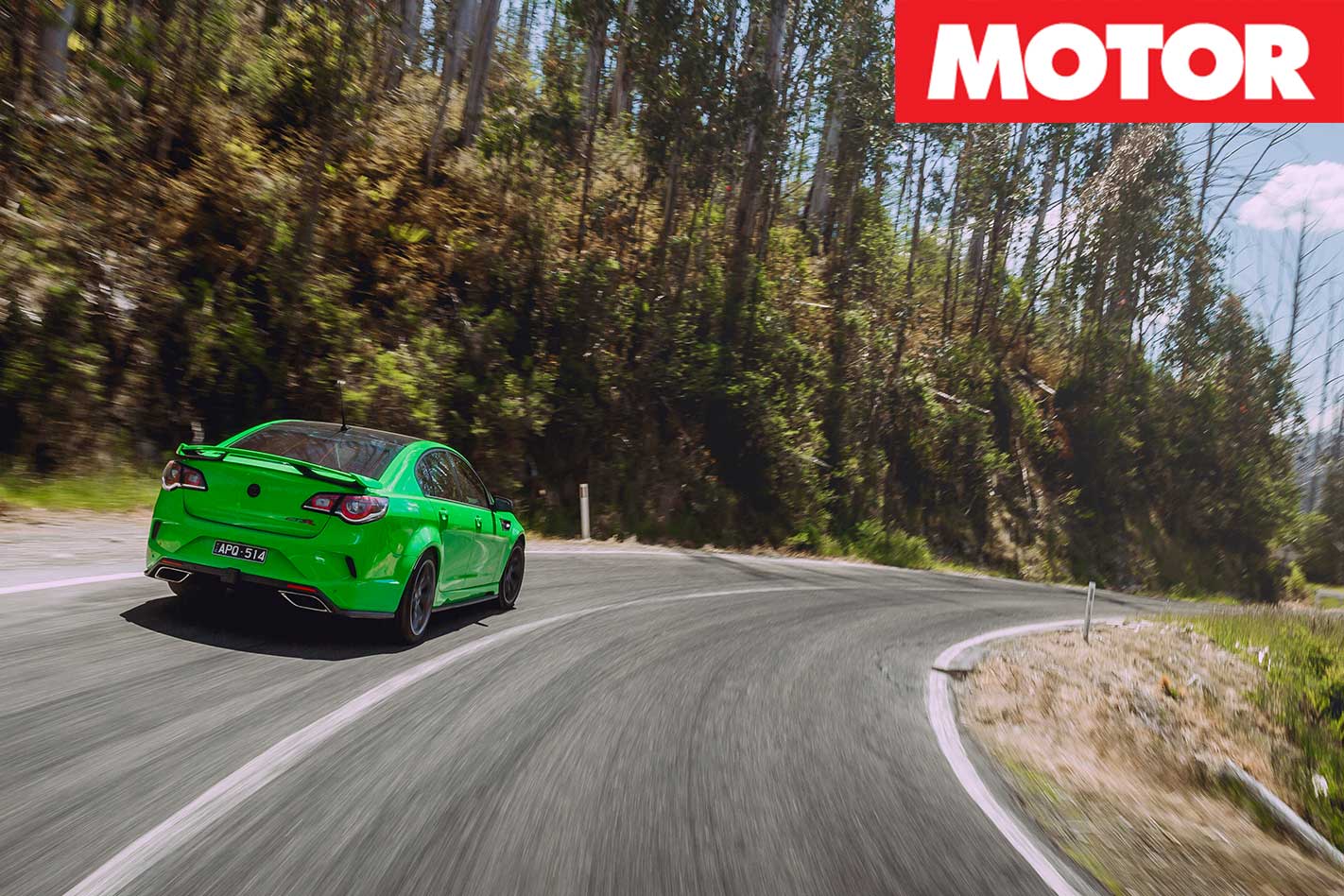
The GTSR doesn’t possess the same Al Bundy levels of relaxation as previous GTSs, but it’s still more than comfortable enough to operate as everyday family transport, not something that could be said of the super-focused W1 (though at least you’d be unlikely to hear the kids’ complains over the roar of the LS9).
Sport also lightens the steering and muffles the exhaust, at least until a big prod of the accelerator opens the bi-modal exhaust valves with a chooff.
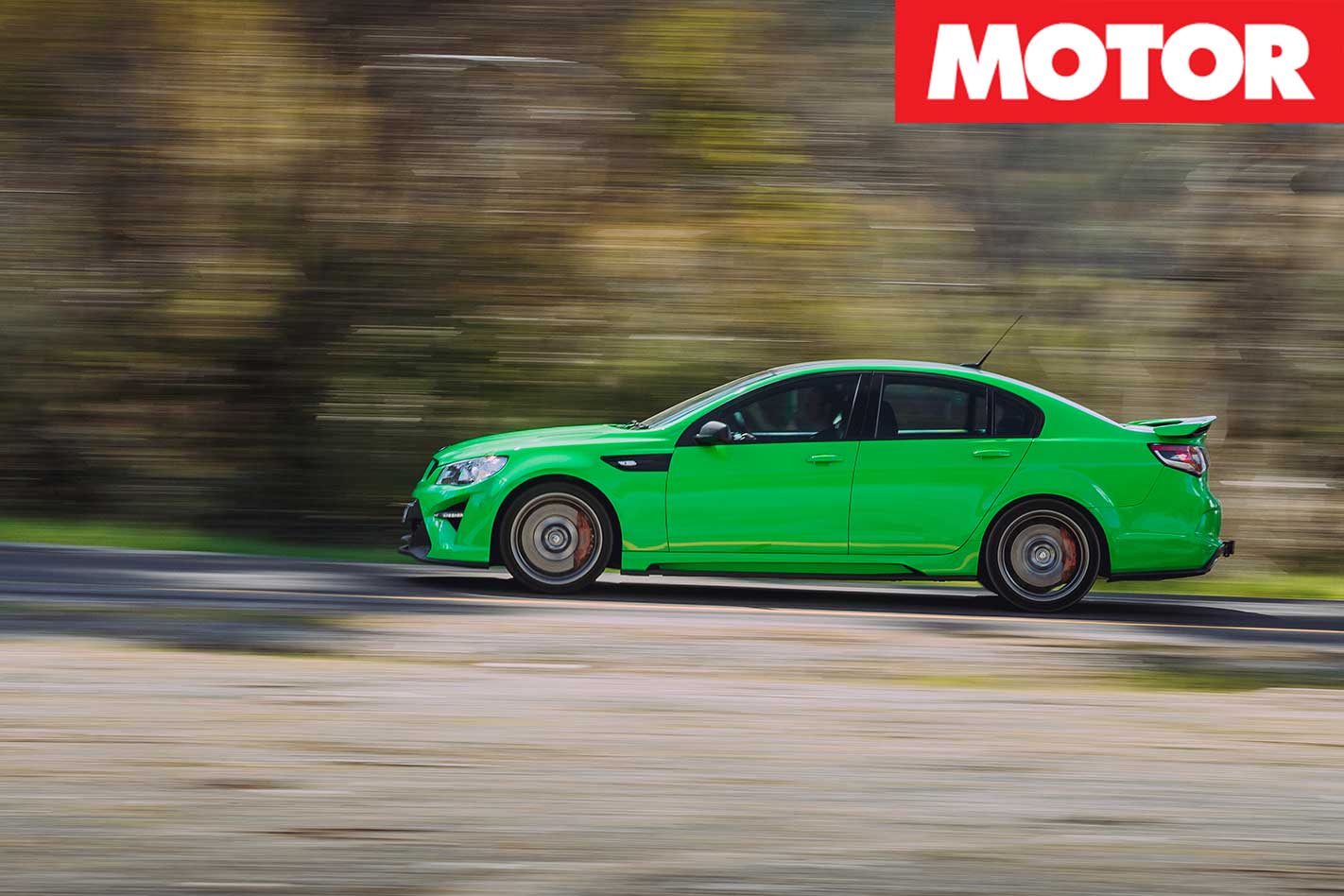
The 6L90E six-speed automatic isn’t exactly cutting edge in this age of ever-decreasing shift times and ever-increasing ratio counts but it still performs well in this application. Its Performance shift logic is impressively intuitive and if you take control with the paddles requests are usually answered fairly promptly. Manual or auto? Flip a coin, really, depending on how you’ll use the car. The manual has longer initial ratios, but closer overall gearing, so it’s probably the pick if you’re going to drive hard regularly.
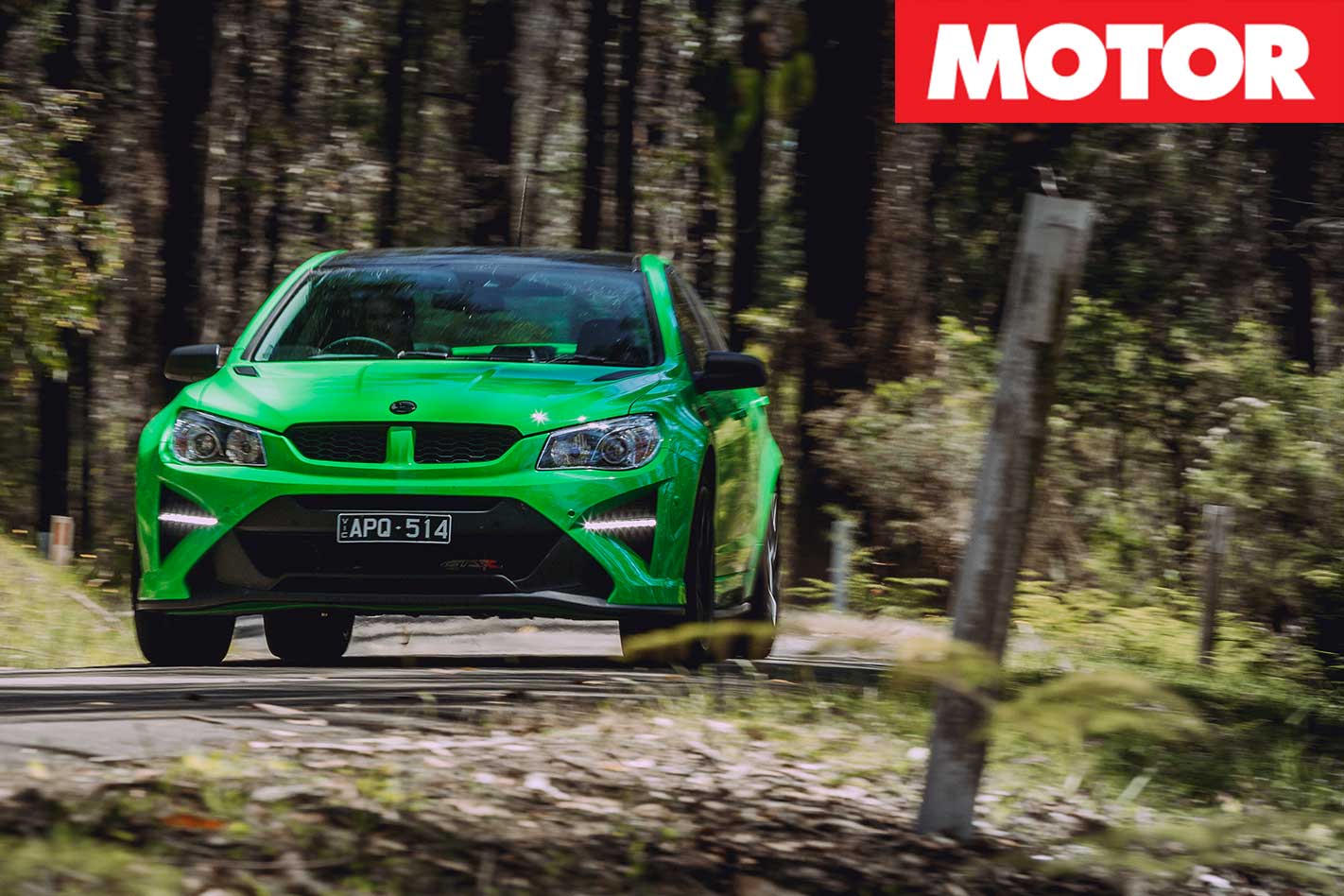
The GTSR chassis is more or less identical to the regular GTS bar one small, but important tweak. Wheel width is increased by a half-inch at both ends and a 6mm increase in front track led to a decrease in offset from 36mm to 33mm. It also necessitated a move to wider plastic front guards, again lifted from the W1 program to help amortise development costs across more than 300 cars.
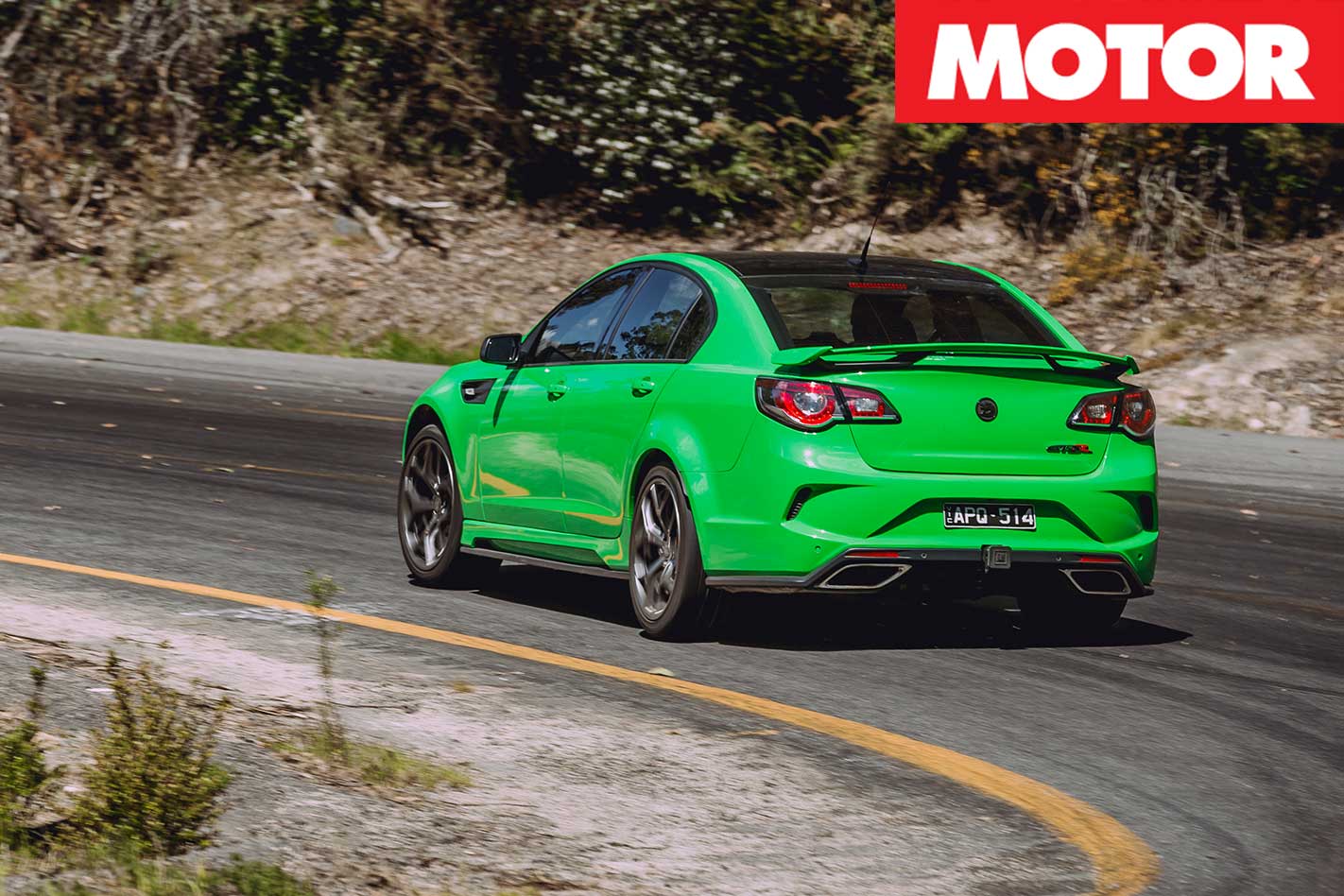
The revised steering is the final piece in a finely-honed dynamic puzzle and, in the context of a four-door Aussie muscle car, leaves you scratching your head as to how it could be bettered. Sure, the interior can’t match the German premium opposition (though the diamond-quilted Podium seats are ace), but it’s way less than half the price. Some will baulk at an Aussie car wearing a $110,000 price tag, but given the mechanical revisions and updated styling, not to mention its last-of-the-line status, it feels worth the $10K premium over a regular GTS.
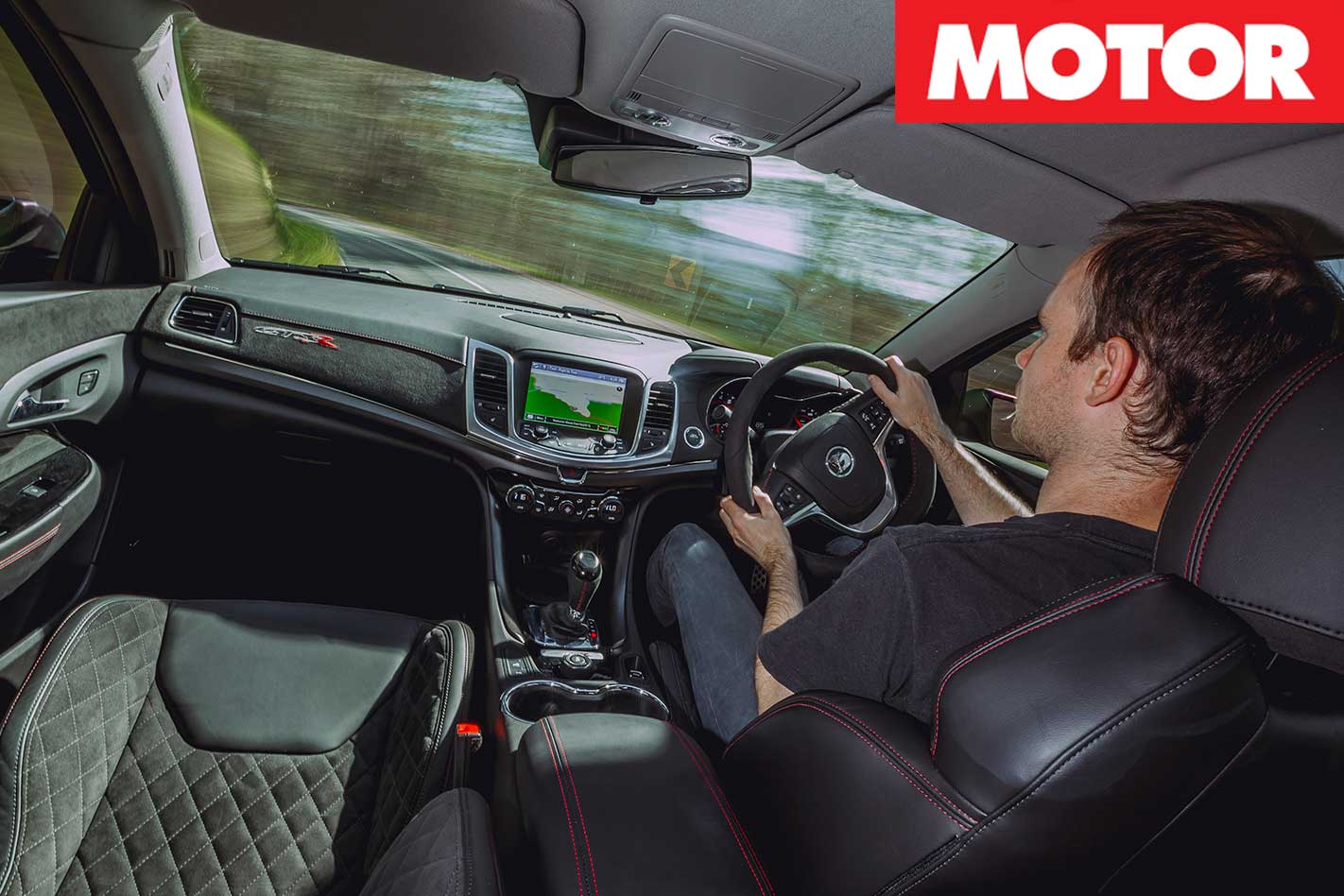
As such, HSV’s Commodore-based products are retiring at the perfect time. HSV has stretched the Zeta platform, introduced in 2006, to its very limits, finessing it to the nth degree. Without major engineering revisions it’s difficult to see how it could be improved further.
Consider this: in 2006 the VE GTS produced 307kW/550Nm and recorded 0-100km/h and 0-400m sprints of 5.5sec and 13.7sec respectively. The GTSR, using essentially the same platform, packs 435kW/740Nm and knocks 1.5sec off both those benchmarks. Around Winton, even accounting for track improvements the difference would be at least five seconds – probably more.
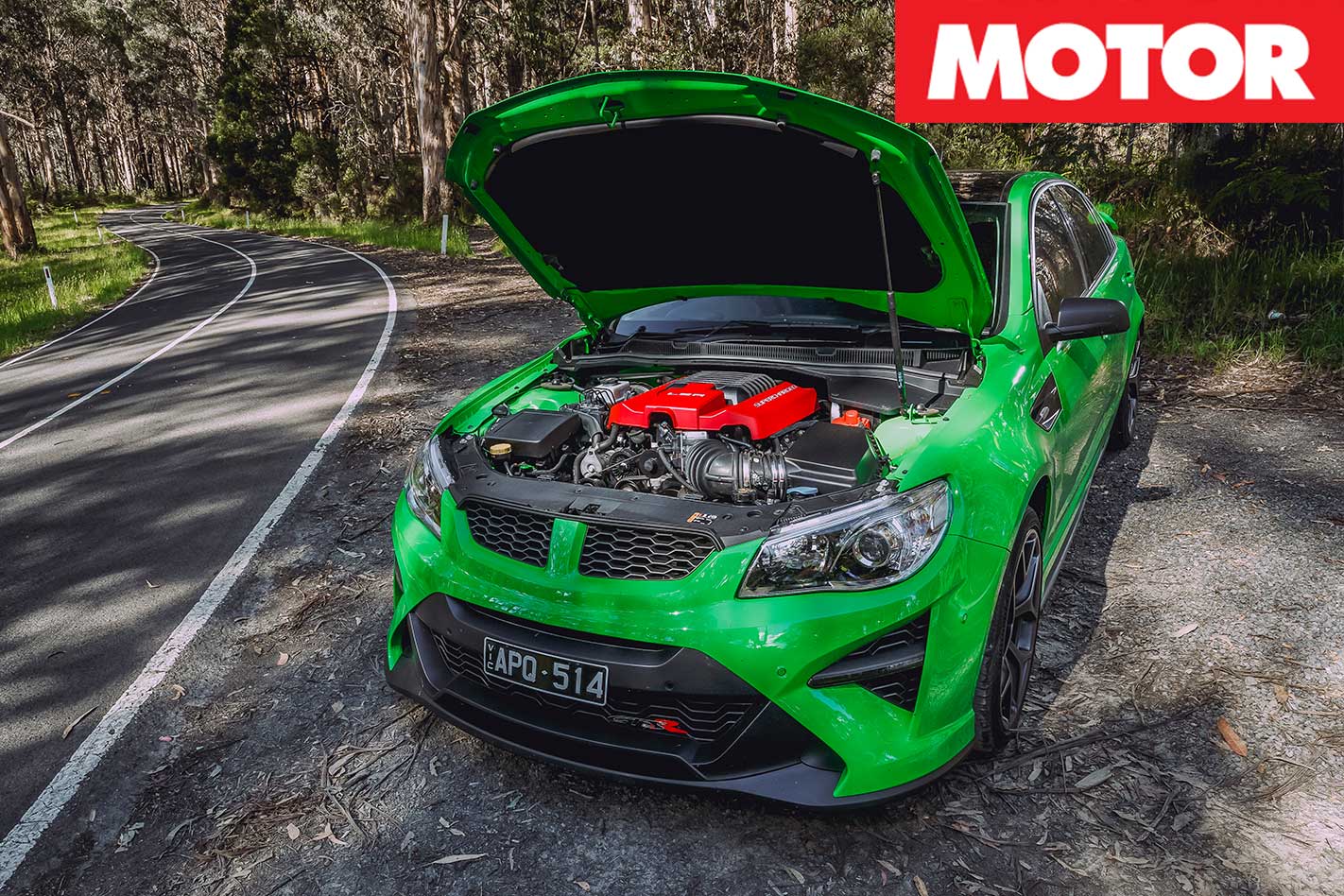
Congratulations on one hell of a career.