
Lamborghini has signed off its track development program for the SCV12 and revealed fresh details on the track-only hypercar ahead of its imminent launch.
Hailing from the firm’s Squadra Corse motorsport outfit and Centro Stile design gurus, the SCV12 takes the brand’s reputation to a new level by extracting more than 619kW (!) from what it says is the brand’s most powerful V12 to date. Remember, the ‘regular’ Aventador SVJ, which smashed the Nurburgring Nordschleife record lap time, only makes 552kW. And the video above proves it’ll make an almighty sound.
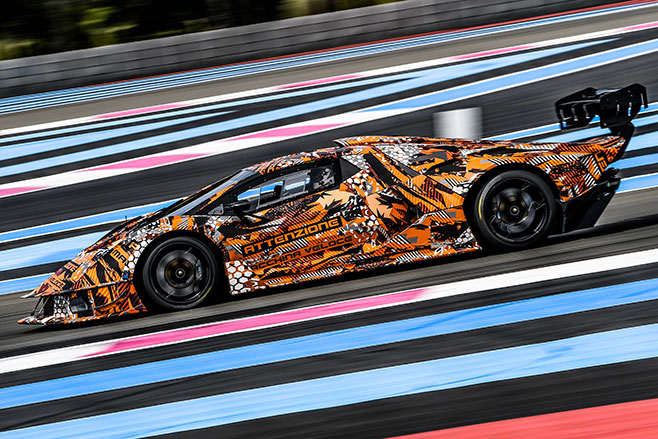
Keeping to its lightweight theme, Lambo’s ditched front drive shafts and put drive through rear 20-inch magnesium wheels fitted with slick tyres. The front wheels are made from the same material but sized 19-inches.
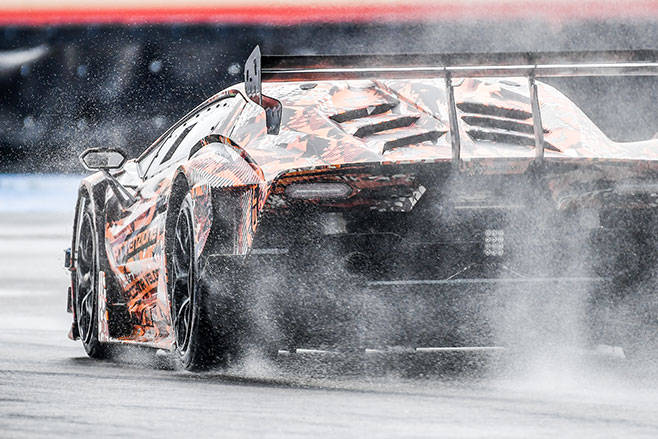
The aero’s so clever Lamborghini claims it’s partly why the car can produce so much power. It says the bonnet’s central rib guides air into its roof scoop, ramming air down into the V12’s throat to “increase static pressure in the engine’s intake manifold”.
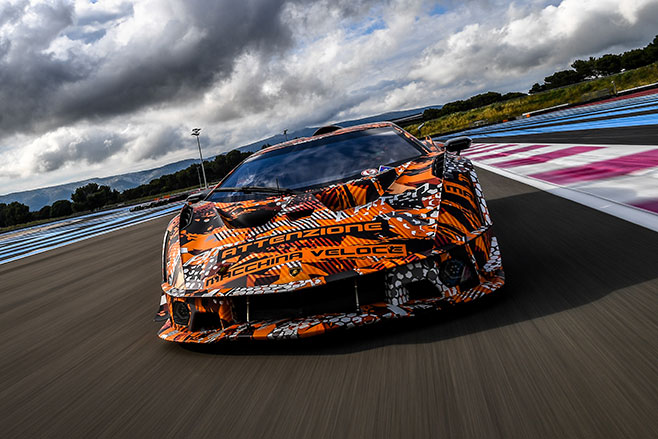
Stay tuned for more news over the next couple months.
*This article incorrectly stated the SCV12 would shun hybrid technology. It has been updated for accuracy.
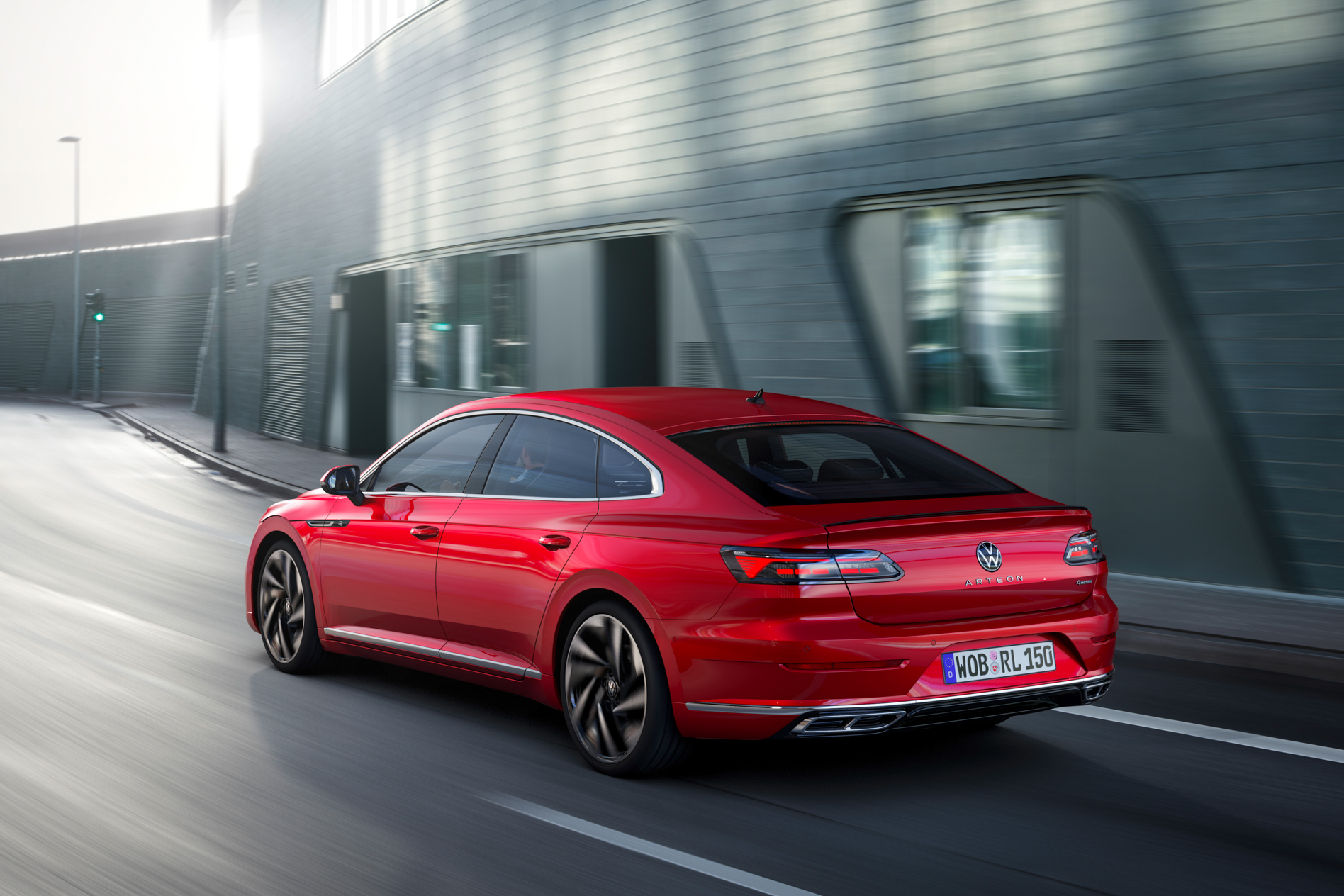
Volkswagen will relaunch the stylish Arteon four-door coupe in Australia next year, and it could be joined by a very good looking friend.
Dropped from the local roster after supply delays caused by the company’s switch to the new WLTP emissions testing regime, the Arteon will return to Australian showrooms in 2021.
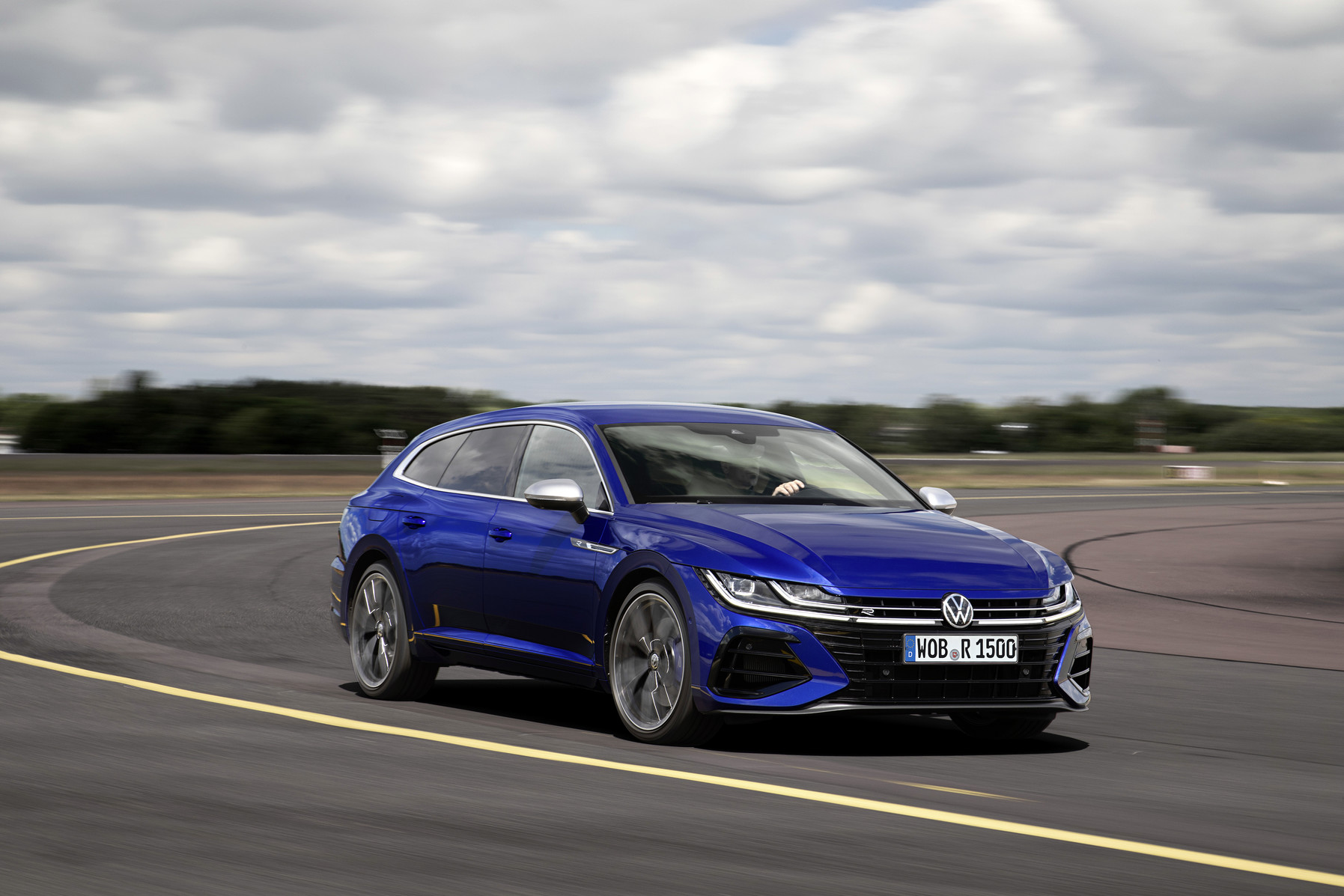
What’s more, it could be joined by a wagon variant and perhaps even a hot R version, if the cards fall the right way.
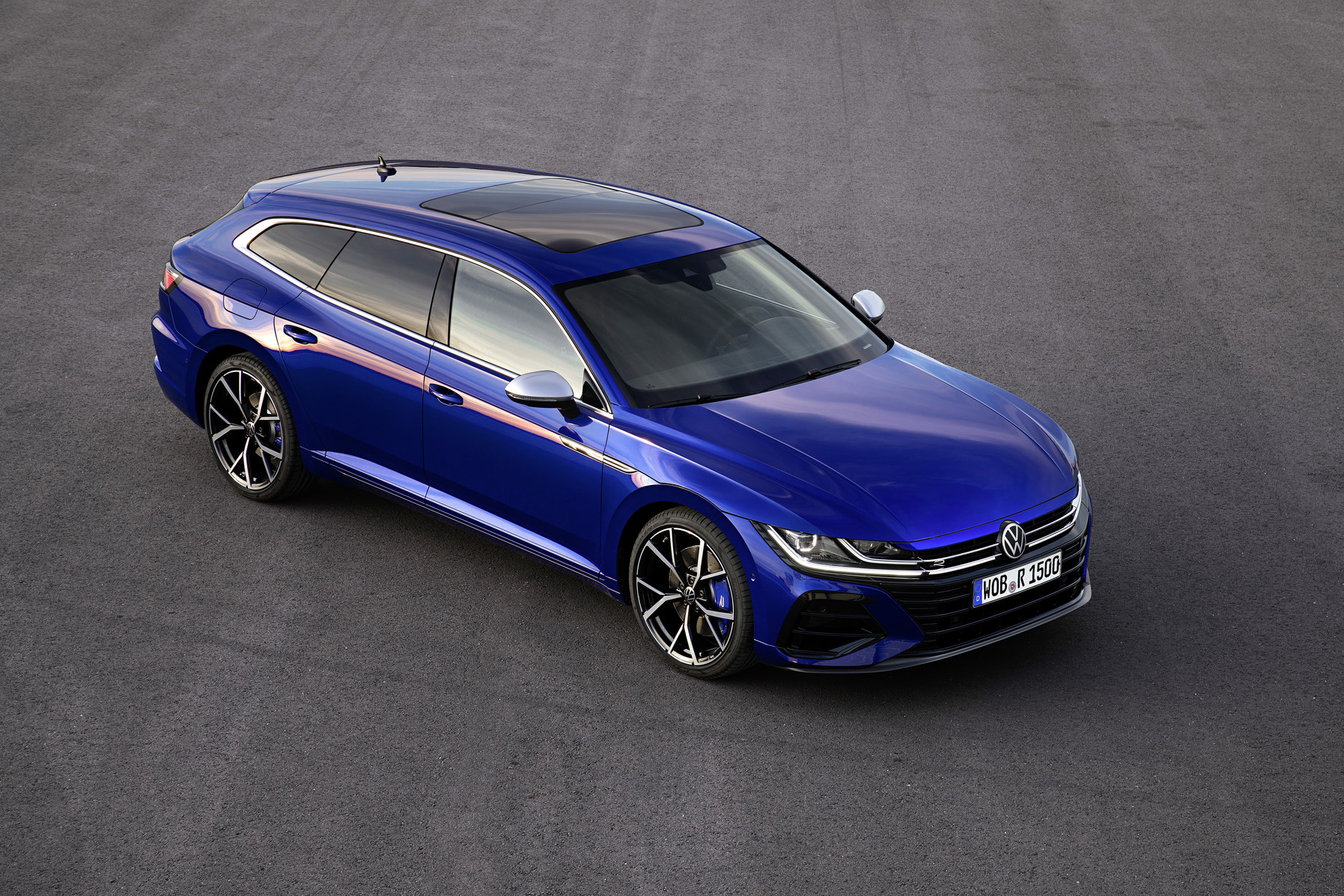
“We’re open to the idea of the wagon and the R, depending on availability and price,” said Volkswagen Australia’s general manager of corporate communications, Paul Pottinger, adding that we’re unlikely to see the hybrid version of the car which was also previewed.
The shooting brake model would complement the similarly sized Passat wagon in the local range. Interestingly, the wagon only offers two litres more boot space than the sedan when the seats are up, though the wagon will yield 1632 litres of space with the seats down, a win of 75 litres over the sedan.
The R version offered in Europe boasts of a 235kW engine tune, likely the same as the EA888 found under the bonnet of the current Golf R. Its AWD prowess will also be improved with the addition of torque vectoring to complement an electronically-controlled front diff.
As an aside, Volkswagen has a history of bringing in hot wagons, most recently in the form of the Golf R and in years gone by the Passat R36.
The 2021 Arteon will incorporate the changes wrought to the car seen in news overnight from VW HQ, which also officially revealed the existence of the Arteon wagon, or shooting brake as it’s known.
These changes include a revised front end that uses LED lighting to supplement chrome brightwork and updated daytime running lamps front and rear.
Inside, the Arteon will underline its top-dog status by incorporating VW’s latest multimedia system, a bespoke harman/kardon audio system and triple-zone climate control.
Released in Australia in 2018 in 206TSI guise, the Arteon will return to Australia early in 2021 with the same 206kW/350Nm 2.0-litre turbocharged engine and all-wheel-drive powertrain.
If you’ve been holding out for the new 2020 Audi R8, your wait is almost over.
Set to be available in Australia from July 24 with pricing now confirmed for the Coupe and Spyder versions of both V10 Performance quattro and V10 RWD models, the new R8 is potentially the last of its kind with rumours a new generation could be without a combustion engine.
For now, the 2020 Audi R8 V10 Performanceis available with its 449kW/560Nm naturally aspirated engine, starting at $395,000 for the Coupe and $416,500 for the Spyder.
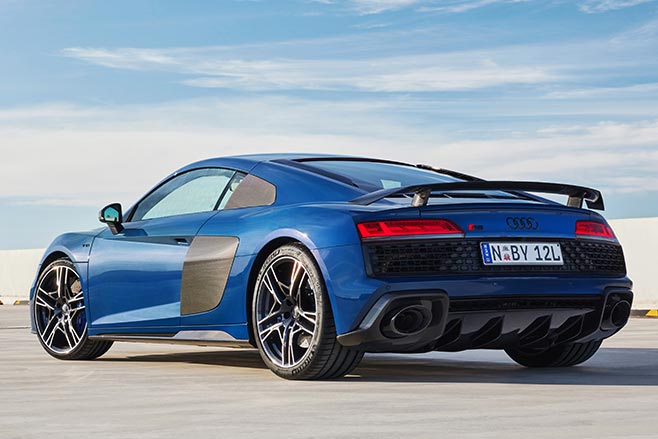
These quattro models feature a few more goodies (like ceramic brakes and styling extras as standard) over the RWD models, and the Coupe interestingly weighs the same 1595kg as its rear-drive counterpart.
The two Audi R8 V10 RWD models can be had from a more affordable $295,000 as a Coupe, or $316,500 for the Spyder. These are both equipped with 397kW/540Nm V10s, just like the limited-edition R8 RWS of 2018.
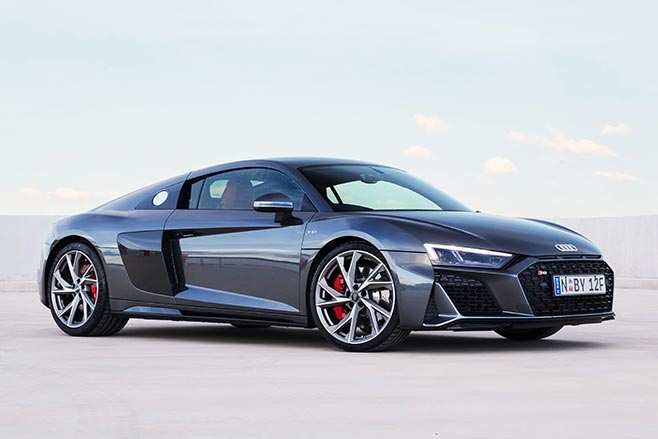
Audi’s 7-speed S tronic dual-clutch gearbox is present in all V10 versions of the R8.
Mechanically, and in terms of performance figures, the R8 is largely unchanged from the recent iteration. The 100km/h mark still arrives in 3.2 seconds for the V10 quattro Coupe, for example, although Audi says its dual-oval sports exhaust is new to this generation.
If you wanted to buy a new dual-cab ute, we wouldn’t blame you. The market is booming at the moment, and filled with plenty of strong options.
However, if you have the patience and ability to hold off for 12 months or more, you could be handsomely rewarded. There are a number of important new models coming to the segment in the near future, and they could be well worth the wait.
So let’s run through some of the best 4×4 dual-cab utes coming soon.
Ford Ranger
Yup, 10 years after the ‘T6’ Ranger was released, a new model is finally on the way.
The current Ford Ranger is incredibly popular with private buyers, for good reason, so there is plenty to be excited about with this new version.
Wheels expects the 2021 Ford Ranger will be revealed in North America later this year, before going on sale in Australia.
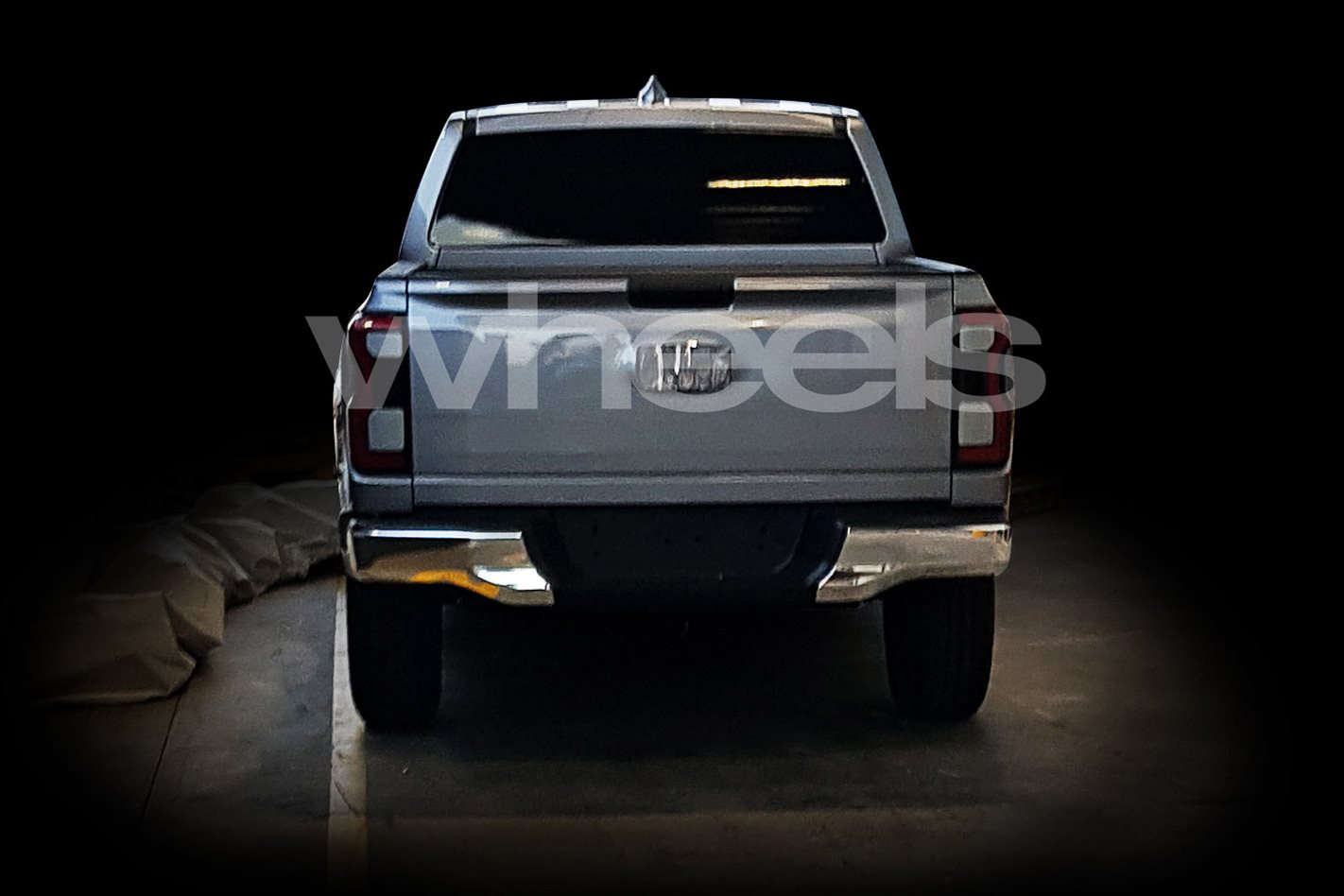
We already have a good idea of what the next-gen dual-cab will look like since we scooped a design mule early last year. Some tweaks may have been made in the time since, but it’s likely the 2021 Ranger’s design will remain largely unchanged since it was spied.
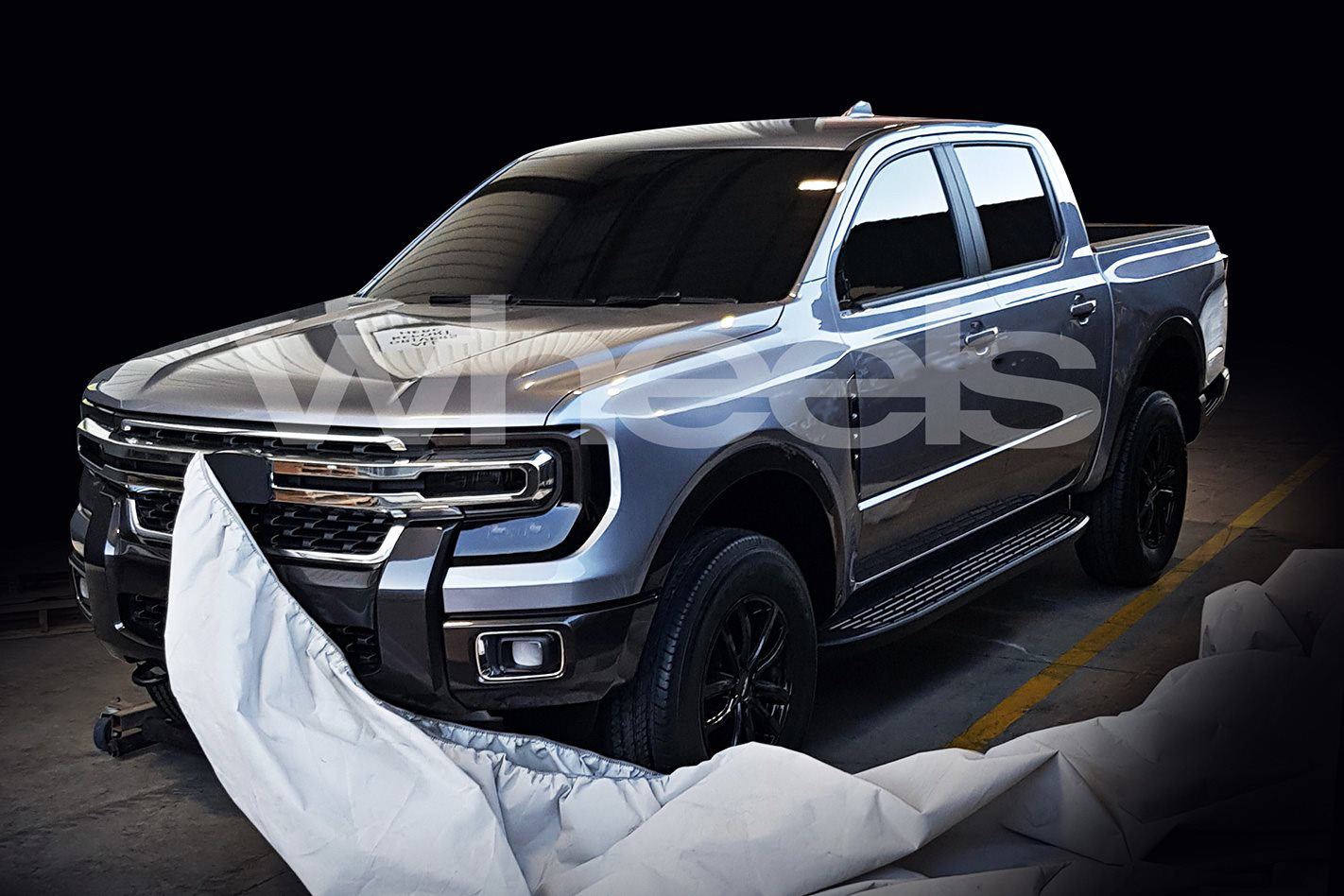
This could be the one to wait for if you are particularly patriotic, as, it is likely this new model will be the last Ranger designed and engineered fully in Australia. Underpinning the 2021 Ranger will be an evolution of the T6 platform that has helped make the current model so popular.
Outside of the bodywork, the biggest change for the 2021 Ford Ranger will be under the bonnet, with a pair of turbocharged V6 engines added to the line-up.
Wheels first revealed the engines were undergoing testing and evaluation in Australia last year, with a 242kW/542Nm 2.7-litre petrol twin-turbo unit, and 187kW/597Nm 3.0-litre single-turbo diesel option being worked on.
To say we are excited about this new model is an understatement, and those willing to wait for the new models arrival should be justly rewarded.
Volkswagen Amarok
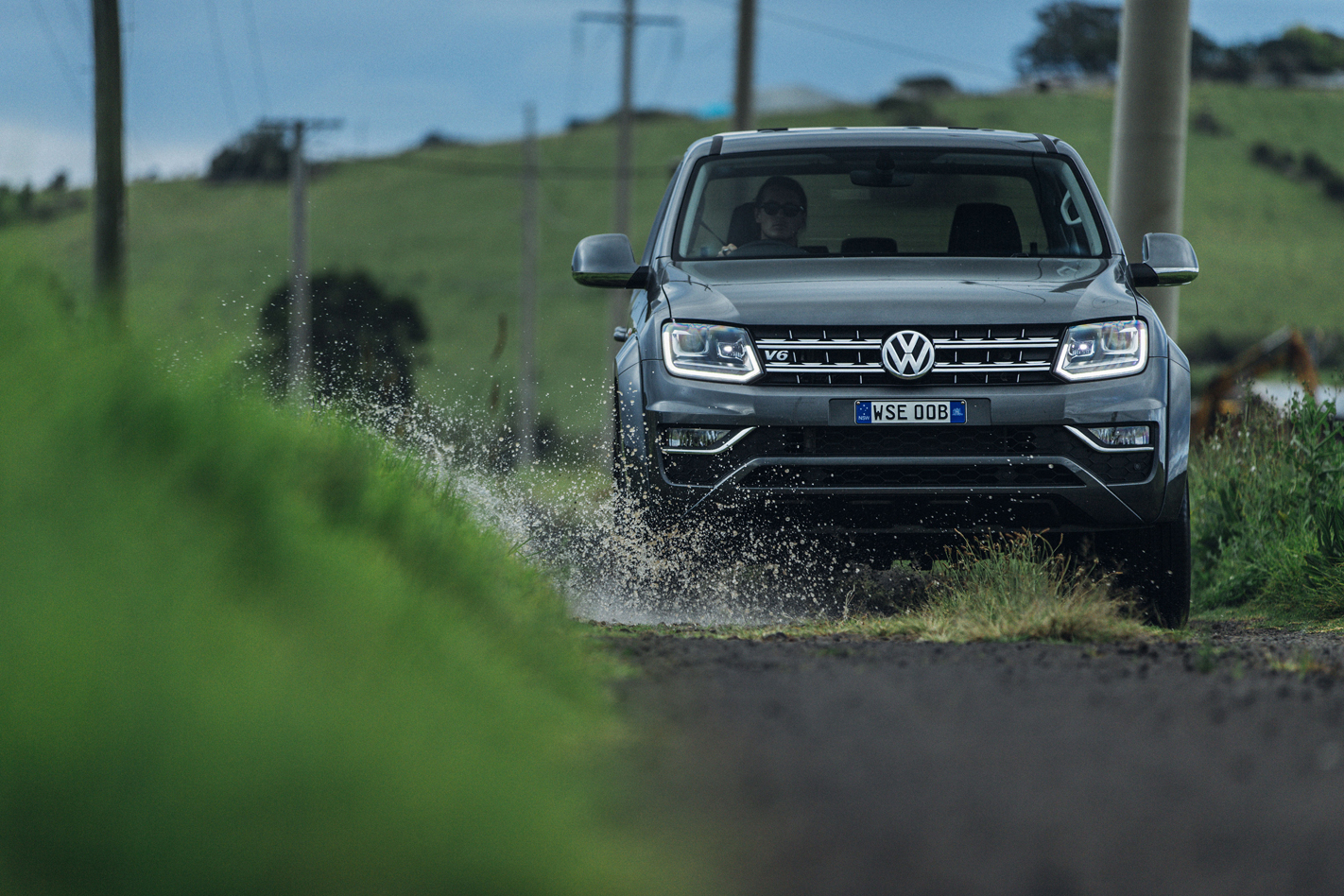
Coming on the heels of the 2021 Ranger will be a replacement for the class-leading, but ageing, Volkswagen Amarok.
Developed in conjunction with Ford, the next-gen Amarok will share the same platform (and maybe even the same engines) as the new Blue Oval product.
Timing remains fluid at the moment, but we expect the next-gen Amarok should be revealed and go on sale in 2022.
Here at Wheels HQ, we are fans of the Amarok, rating it as the best dual-cab ute you can buy in our most recent 4×4 megatest. Add Australian engineering and know-how from Ford to the mix, and the second-generation model could be a winner.
Mazda BT-50
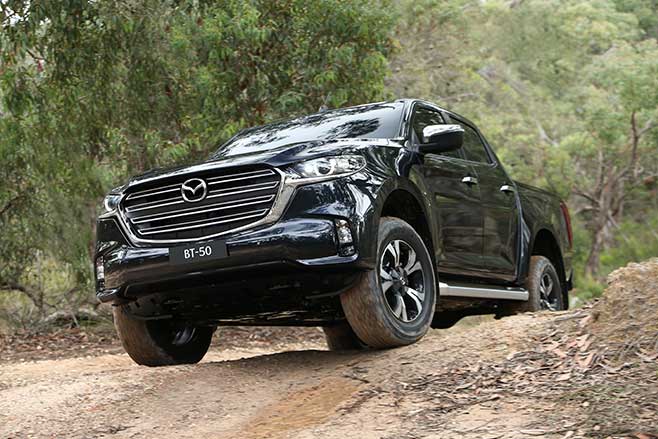
An all-new Mazda BT-50 has been revealed, and is set to go on sale in Australia late this year.
Previously based on the Ford Ranger, the next-gen BT-50 is the result of a tie-up between Mazda and Isuzu. If there is one thing Isuzu knows, it is how to build a truck.
This is going to be a great benefit for Mazda, whose main business is engineering, building, and selling passenger cars and SUVs (to great success).
The next-gen Isuzu D-Max that the new BT-50 will share its platform with has been revealed overseas, and is due in the country this year also.
However, those that wait for the Mazda could benefit, with the Japanese brand continuing its push upmarket – this means it will be underpinned by Isuzu’s bulletproof mechanicals but offer a more luxurious cabin compared to its cousin. Sounds like a winner.
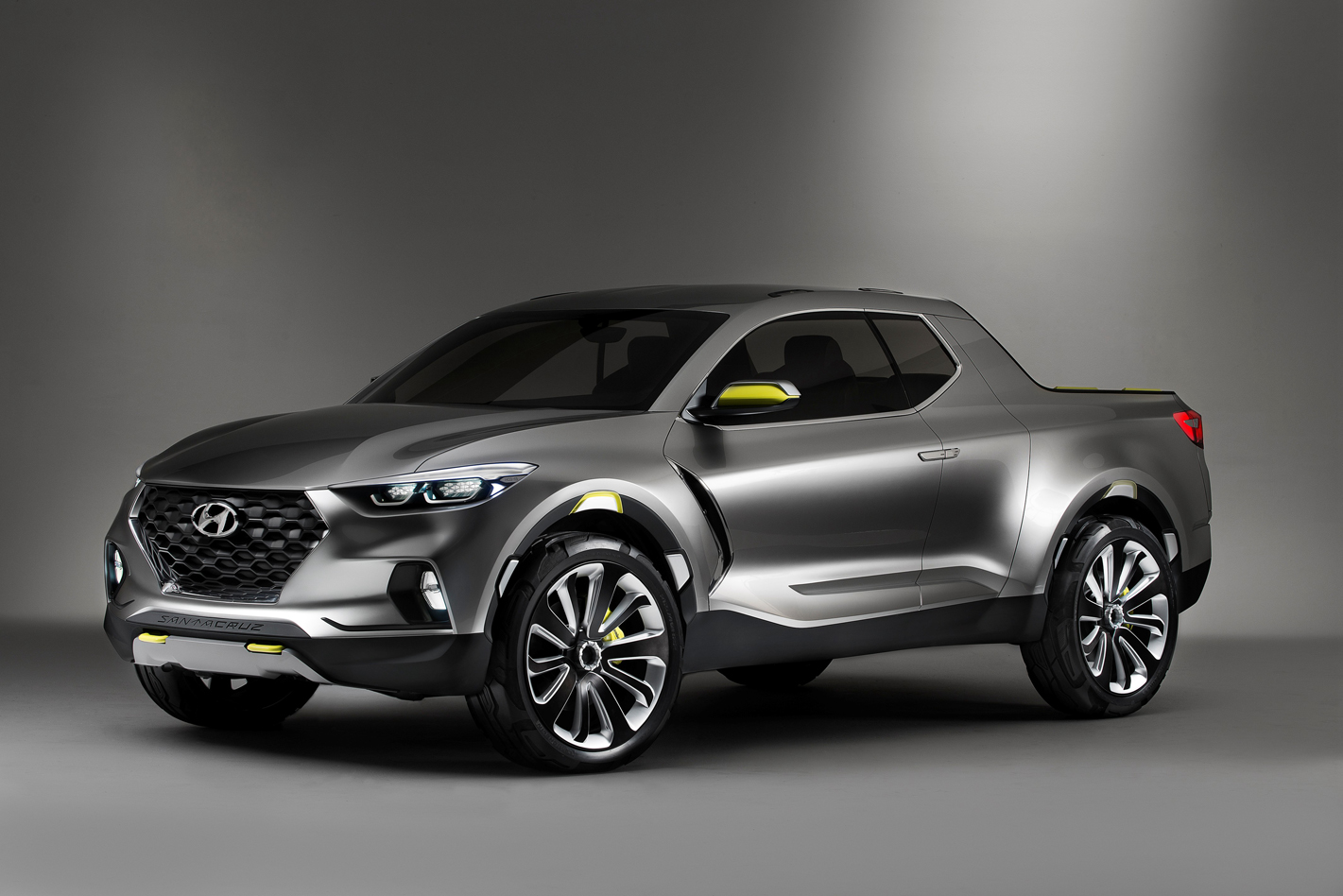
Hyundai Santa-Cruz
Hyundai’s dual-cab ute seems to have been in the works for an eon, but it is now finally nearing the end of its gestation period.
Due to go into production at Hyundai’s Montgomery, Alabama plant in 2021, the ute – likely named Santa Cruz – has already had its exterior design signed off.
The Santa Cruz will differ from other dual-cab utes as it will be built with a monocoque chassis, instead of a ladder-frame design.
Unfortunately, this particular Korean pick-up is expected to be for the US market only.
However, if you are looking for a more rugged ute, Hyundai have another project in the works, with executives confirming last year a traditional ladder-frame light commercial vehicle is in development.
Costs are shared with sister company Kia, with some of the work likely to take place in Australia throughout the program.
This yet-unnamed model is expected to land in Australia in 2022-23.
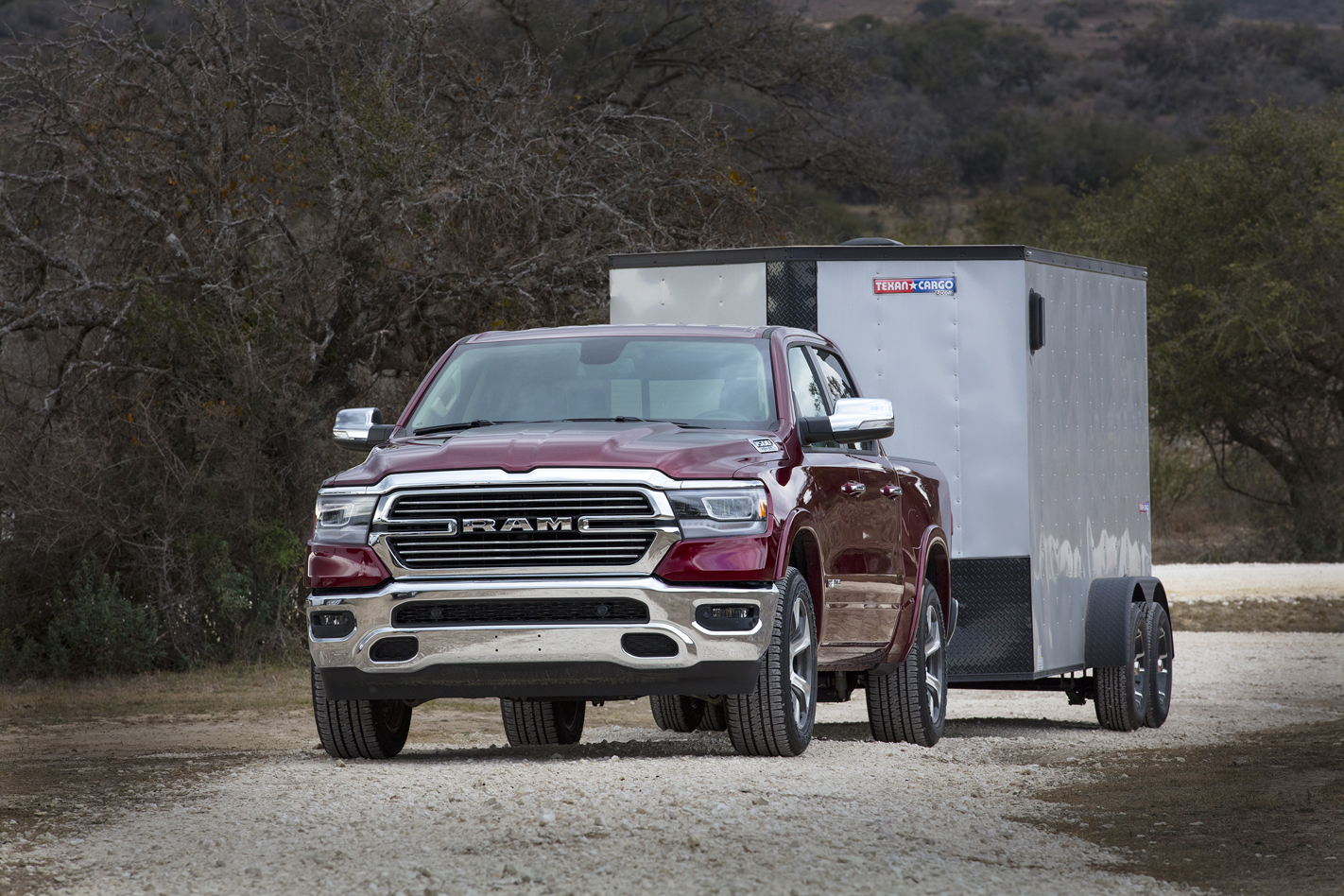
RAM 1500
Australians just can’t seem to get enough of the Ram 1500. Sales for the locally-converted big Yank pick-ups increased nearly 300 percent in 2019.
Those sales figures become all the more impressive when you remember that it’s technically the ‘older’ DS generation model that has been on sale.
The all-new DT 1500s are expected to go on sale locally early next year, converted for right-hand drive in Clayton by the Walkinshaw Group for local distributor Ateco.
The new DT model will retain the same 5.7-litre petrol V8 engine, but could gain the mild-hybrid system that adds up to 12kW and 176Nm that is offered in North America. US Rams are also equipped with a new eight-speed automatic transmission.
Ram could also have a new 522kW flagship model in the works, and if it goes into production you can be assured Ateco will have its hand up to bring it Down Under.
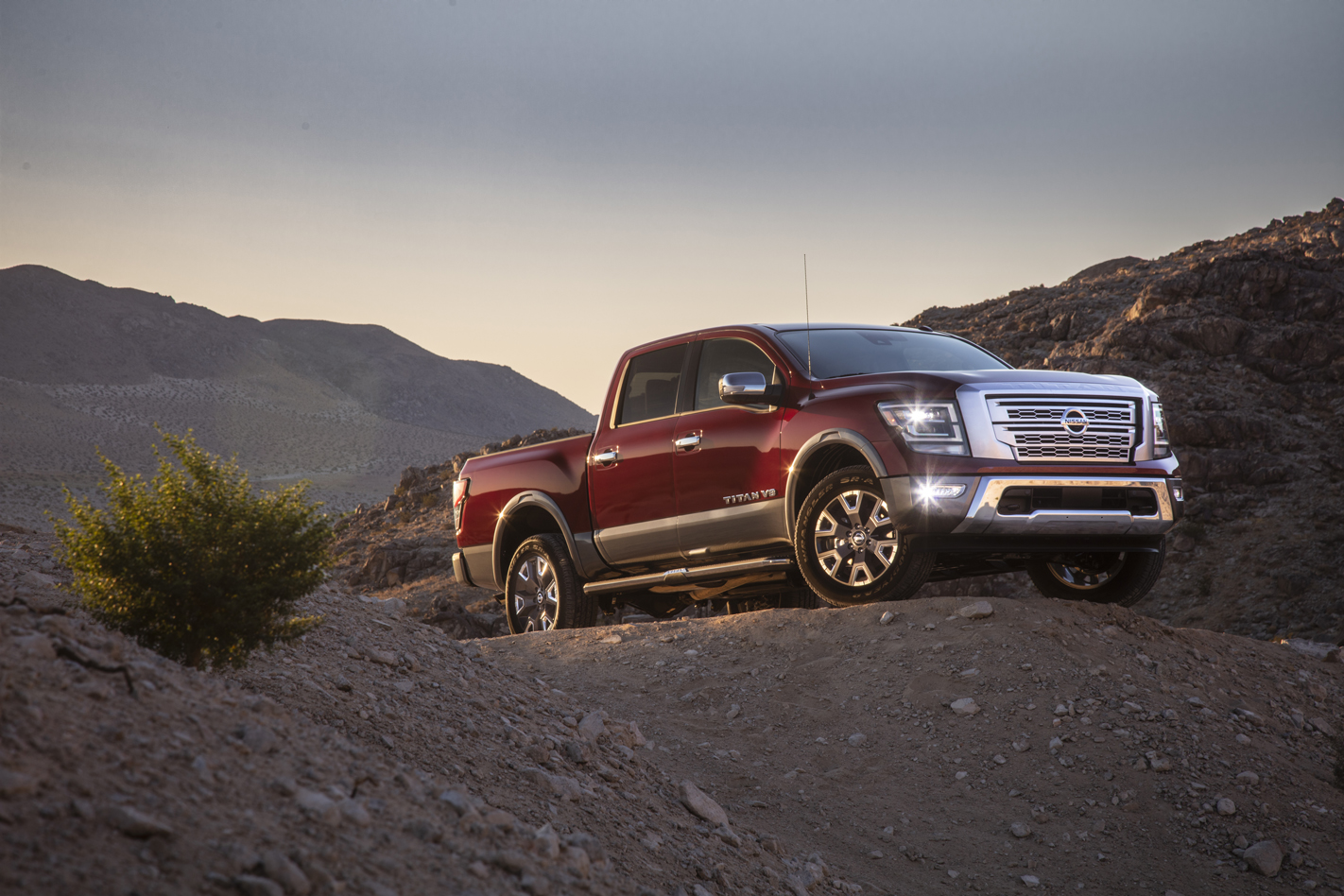
Nissan Titan
While yet to get the official green light, Nissan has been vocal about its desire to have the large Titan pick-up imported and converted in Australia.
Nissan Australia MD Stephen Lester has gone on the record as stating “[I] believe a vehicle like Titan would make perfect sense for Australia. We’ve been hard at it with the global team to push for this, and we’ll stay hard at it, because I don’t see that changing anytime soon.”
It’s likely Nissan Australia would partner with Premcar Engineering, the company which beefed up the Navara for the N-Trek Warrior special edition.
Premcar are forging a reputation as one of the most savvy automotive engineering firms in the country, and well equipped for this type of project.
While Nissan Australia negotiates the finer terms of any deal with head office, start saving those pennies and you could potentially have a large V8-powered pick-up in your driveway by the end of 2021.
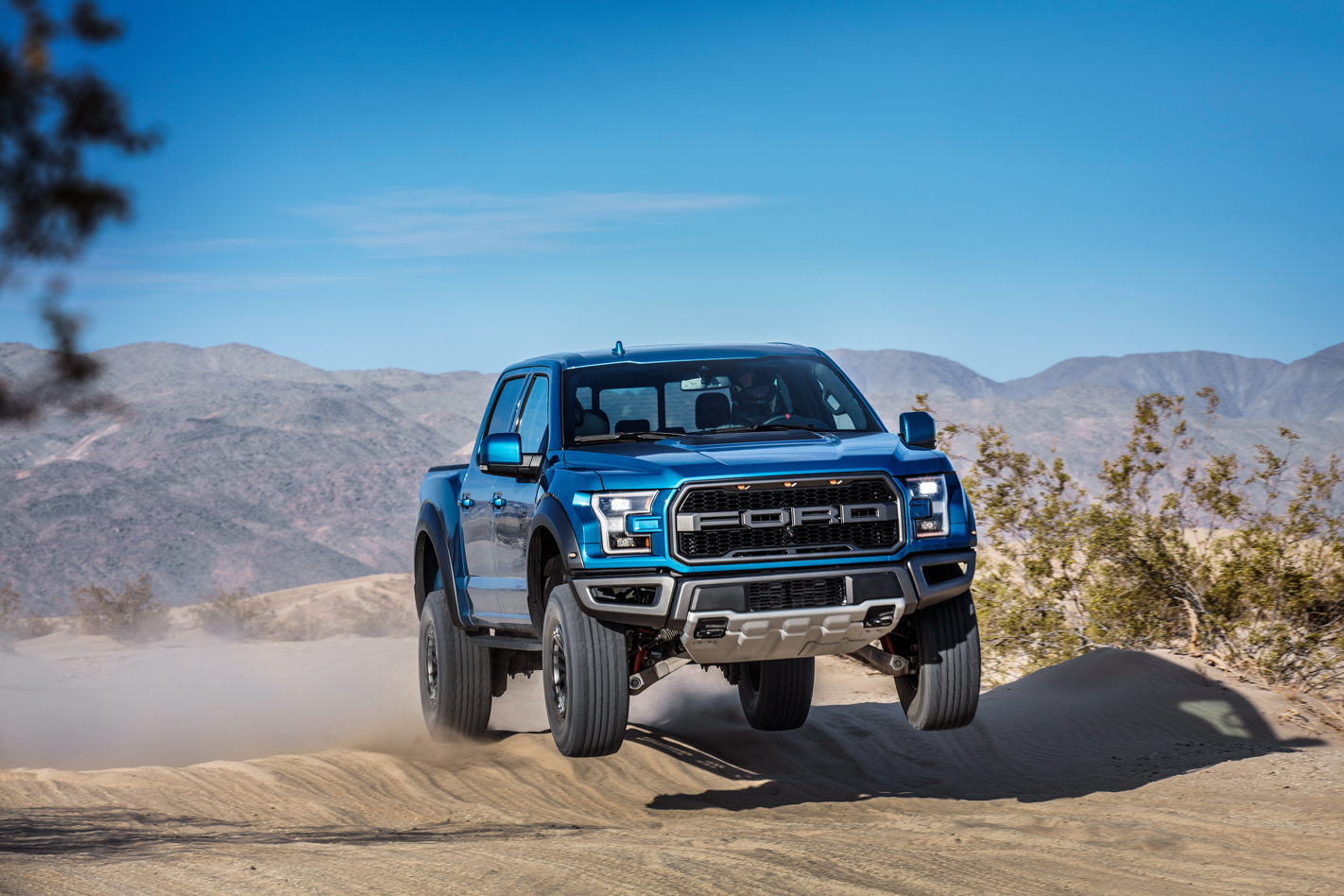
Ford F-150
This is the one option that could have you waiting the longest, with no guarantee of payoff.
However, with the F-150 being America’s most popular vehicle, and a huge demand locally, we thought it worthy of inclusion – particularly when there has been some positive news surface recently.
An all-new F-150 is about to be revealed in North America, and there could be some very exciting news for Australian customers.
Ford plans to move all its trucks and utes onto a global platform designed to accommodate left- and right-hand drive markets, and with traditional rivals Ram and Chevrolet already in Australia with locally converted models, a business case for factory-delivered right-hook F Trucks shouldn’t be too hard to justify.
Sign-up here to get the weekly Wheels highlights
Wanneroo Raceway is set for a massive expansion, which will see the Western Australian motorsport venue upgraded and expanded with the intention of international recognition.
Known to most as Barbagallo Raceway, even though its name changed recently to reflect the city in which it’s located, the plan is up for public comment August 2 2020. Its expected cost is north of $225 million. Funding has not yet been secured or finalised, though the plan outlines options from private partnerships through to public investment.
“The expansion of the raceway will allow the City [of Wanneroo] to increase its international reputation as a place to visit and enjoy state-of-the-art motor sport infrastructure,” A statement from the City of Wanneroo says.
“The master plan will increase the capacity for attracting tourism to the city.”
Wanneroo but not The Bend appearing on 2020 Supercars calendar
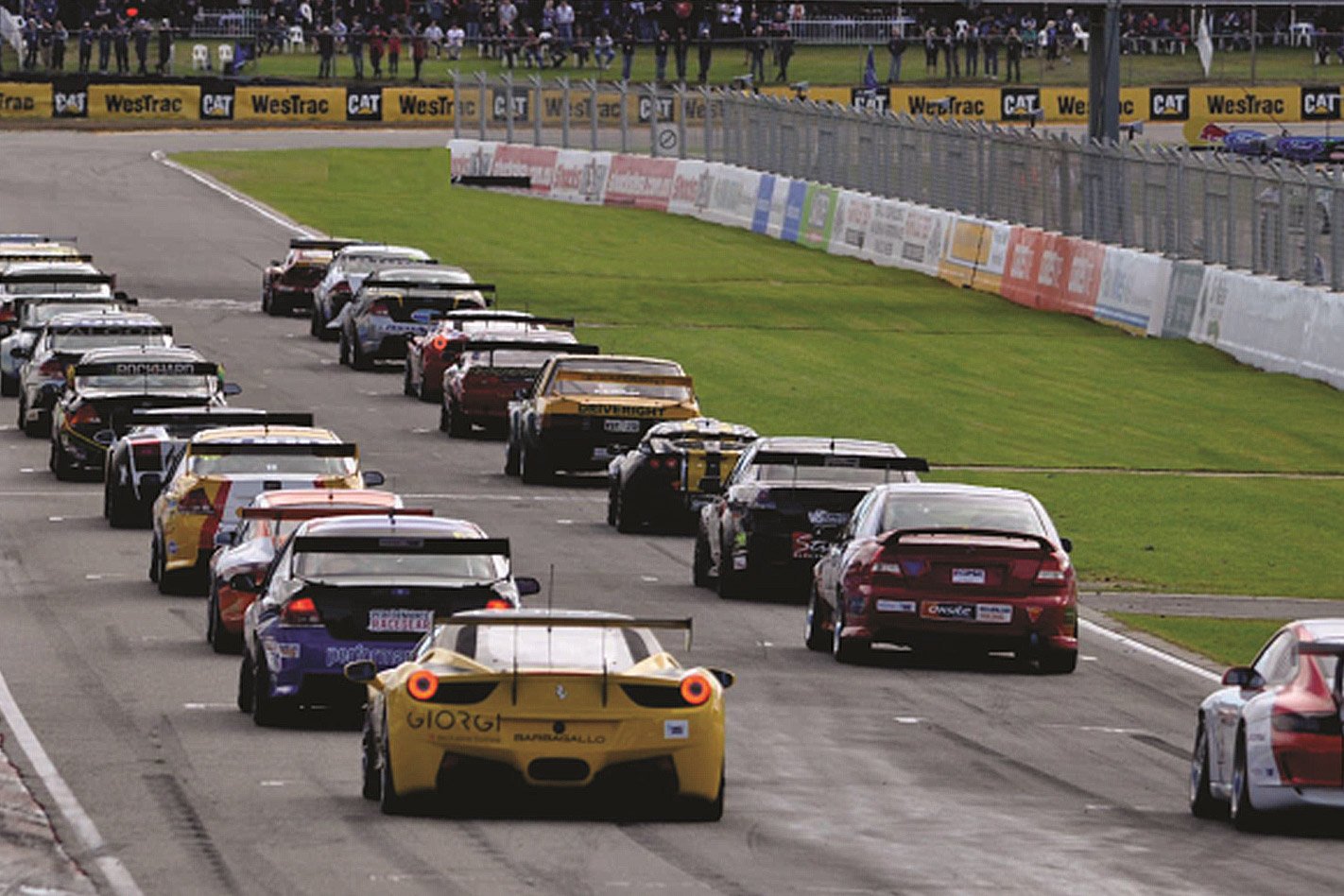
The proposed circuit upgrades, penned by leading firm Apex Circuit Design, will see the current 2.41km circuit upgraded, seen left on the image below, while a new 4.27km FIA-grade circuit will be constructed in the spirit of South Australia’s The Bend Motorsport Park, with the ability to split the track into shorter 2.6km or 1.7km circuits.
A 750m section of the straight will also be specified for ‘informal drag racing’.
The proposal specifically mentions The Bend in a document, with benchmarks borrowed from a few tracks around the country.
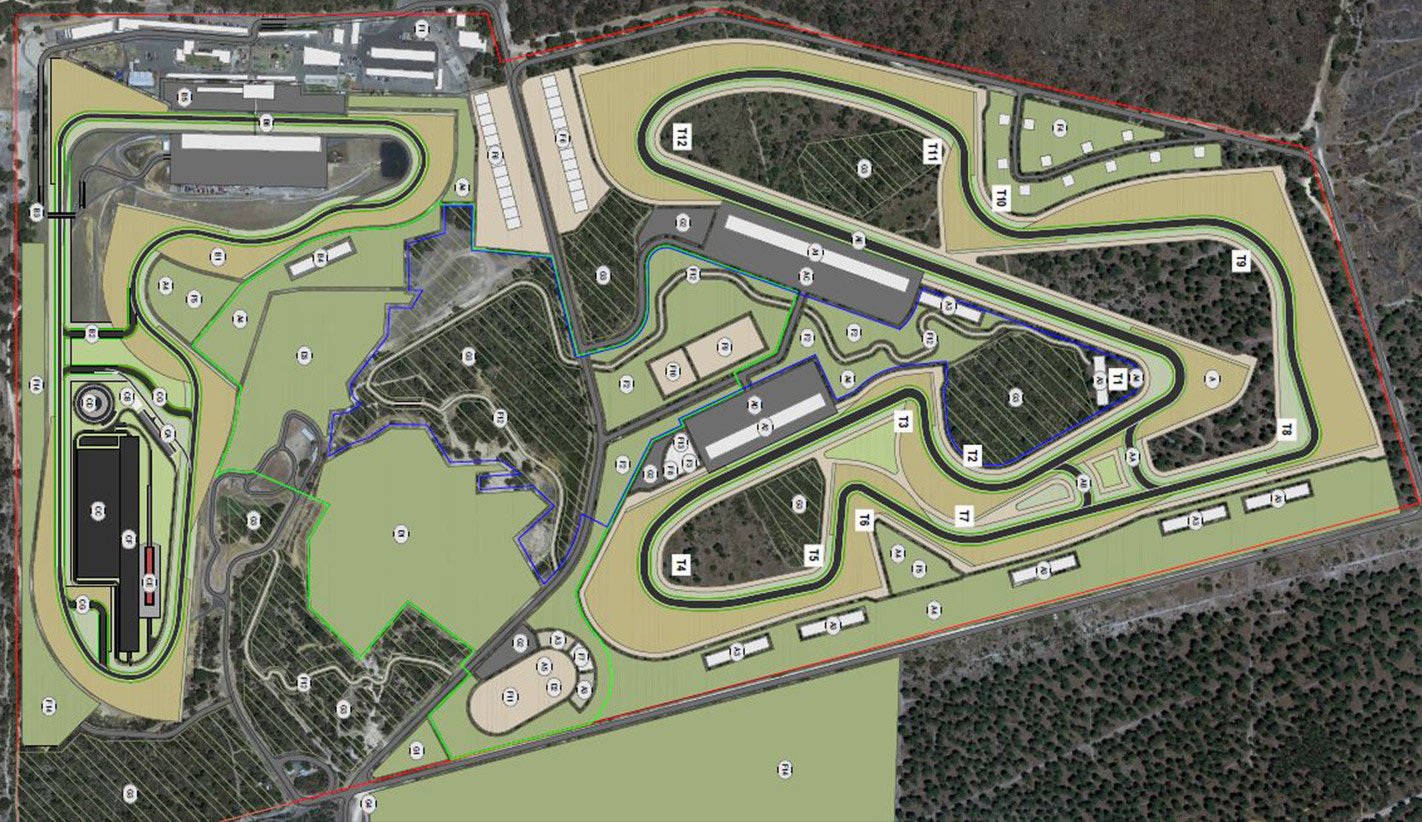
“In addition to the general trends associated with existing circuits, the recently-opened Tailem Bend circuit in South Australia provides the most relevant and up to date event centre business model which is highlighted as industry leading.”
Though it’s promising, initial plans set a timeframe for the ‘practical works’ to be completed by 2029, meaning the new circuit won’t be up and running for quite some time.
As anti-theft technology in the modern car improves, criminals are also getting wiser, learning how to circumvent features designed to keep your car in your driveway.
While most in-built new car technology is effective at preventing all but the most determined and sophisticated thieves, there are a number of measures that give an extra edge if unsavoury characters are eyeing your pride and joy.
Steering or wheel lock
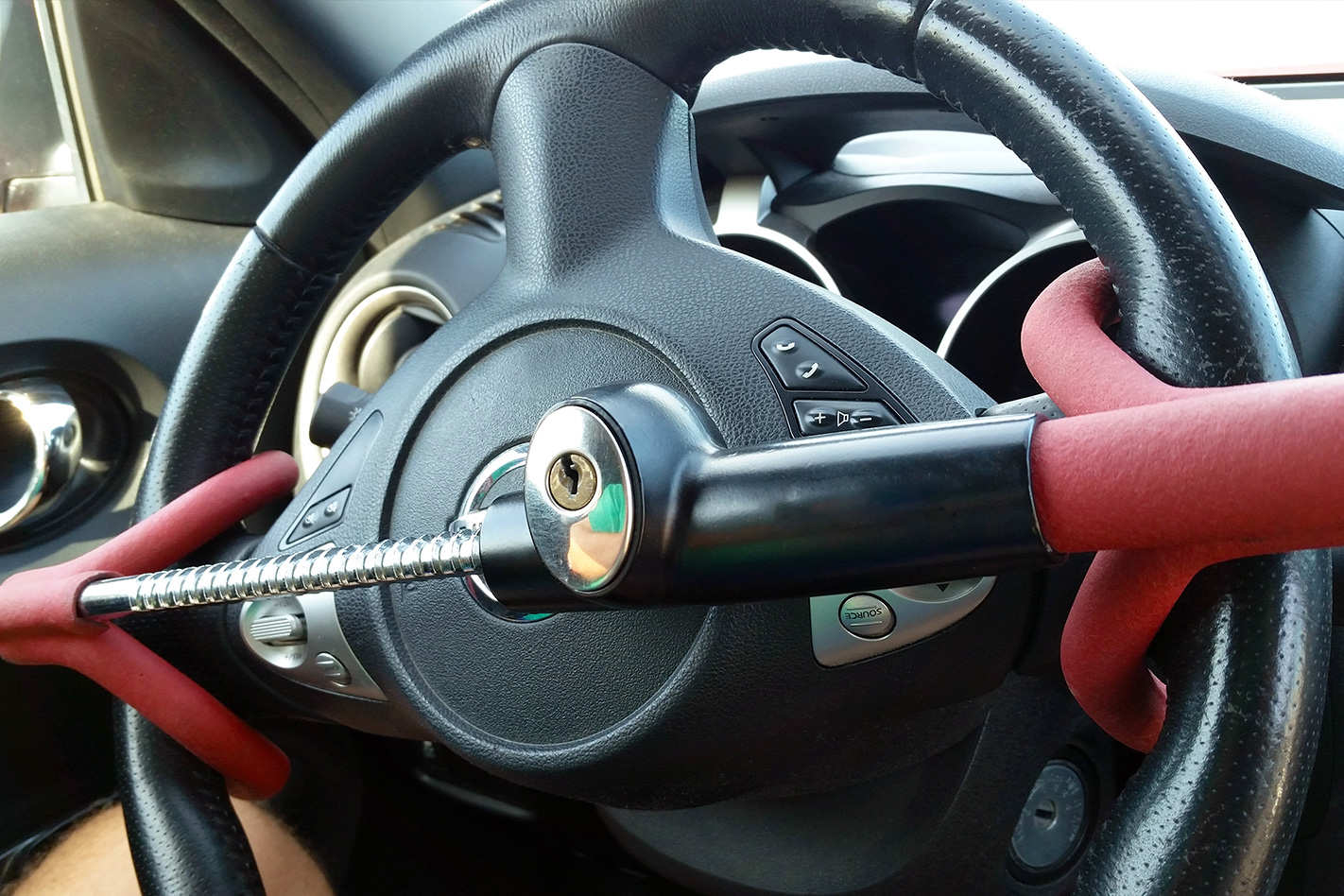
In an era of advanced electronic security systems, simple mechanical solutions still have a place in preventing car theft.
A simple steering wheel lock or wheel lock might not look flash but that’s the point. Any would-be car thief that spots a mechanical lock knows your car is going to take extra effort to get away with and that’s a powerful visual deterrent.
Downsides include having to carry the cumbersome kit around in your car when not in use, and the process of installing devices when you leave the car, but prevention is better than cure and this relatively inexpensive option is a powerful deterrent.
Alarm and immobiliser
Many cars are equipped with factory-fitted alarms from new but if your car isn’t you might be able to have one retrofitted.
Very few systems are impenetrable but in most cases they will add to the time a thief needs to get into and start your car, which increases the chances of them being scared off or not even attempting a break in at all.
| Australia’s most stolen cars revealed
Unlike mechanical locks, electronic systems leave the appearance of your car largely unaltered and are simple to operate, but range widely in price depending on the functions, security level and quality.
Engine immobilisers are required by law on all new passenger cars sold in Australia. Some car makers offer their vehicles with more feature-rich immobilisers that can even prevent it from being towed, or even taken for a joyride by a valet parking service.

Kill switch
Similar to an immobiliser, a kill switch is an electrical switch installed somewhere in the car to cut a vital part of the engine electronics. With the switch active, the engine will not start.
The principle is a simple one but requires an experienced automotive electrician to select the location for the switch and safely wire it to the existing vehicle systems.
The essence of a kill switch’s effectiveness is in its unique installation for each vehicle. If all switches were in the same place, thieves would know exactly where to look so a little creativity and inventiveness can turn a simple device into a very effective tool for deterring and defeating car theft.
Tracker
All the options explored so far prioritise preventing the vehicle being removed from its rightful owner, but if the thief has been successful, tracking technology has proven to be very effective in tracing the car and returning it to its owner.
The technology is activated if the vehicle is moved without authorisation. It sends a signal via GPS or mobile phone networks that pinpoints its position. The system requires the assistance of police to locate and seize the vehicle.
| Victoria leading state in vehicle theft
Most tracker packages include the hardware and installation, and also a subscription fee. The systems can be pricey, but if theft cannot be prevented, there are few other more effective strategies for recovering your car.
Most thieves would not realise a car has the technology fitted and are unaware they are being followed. The tracker also minimises the risk of a criminal maliciously damaging or destroying the car to hide evidence, with most cars returned to their owners unscathed.
Basic care and common sense
In most cases and applications, anti-theft technology fitted to modern cars including dead-locks, central locking, alarms, immobilisers and steering locks is adequate to deter most unwelcome car enthusiasts. However, it is worth remembering that most cars are stolen either using the original key or by opportunists.
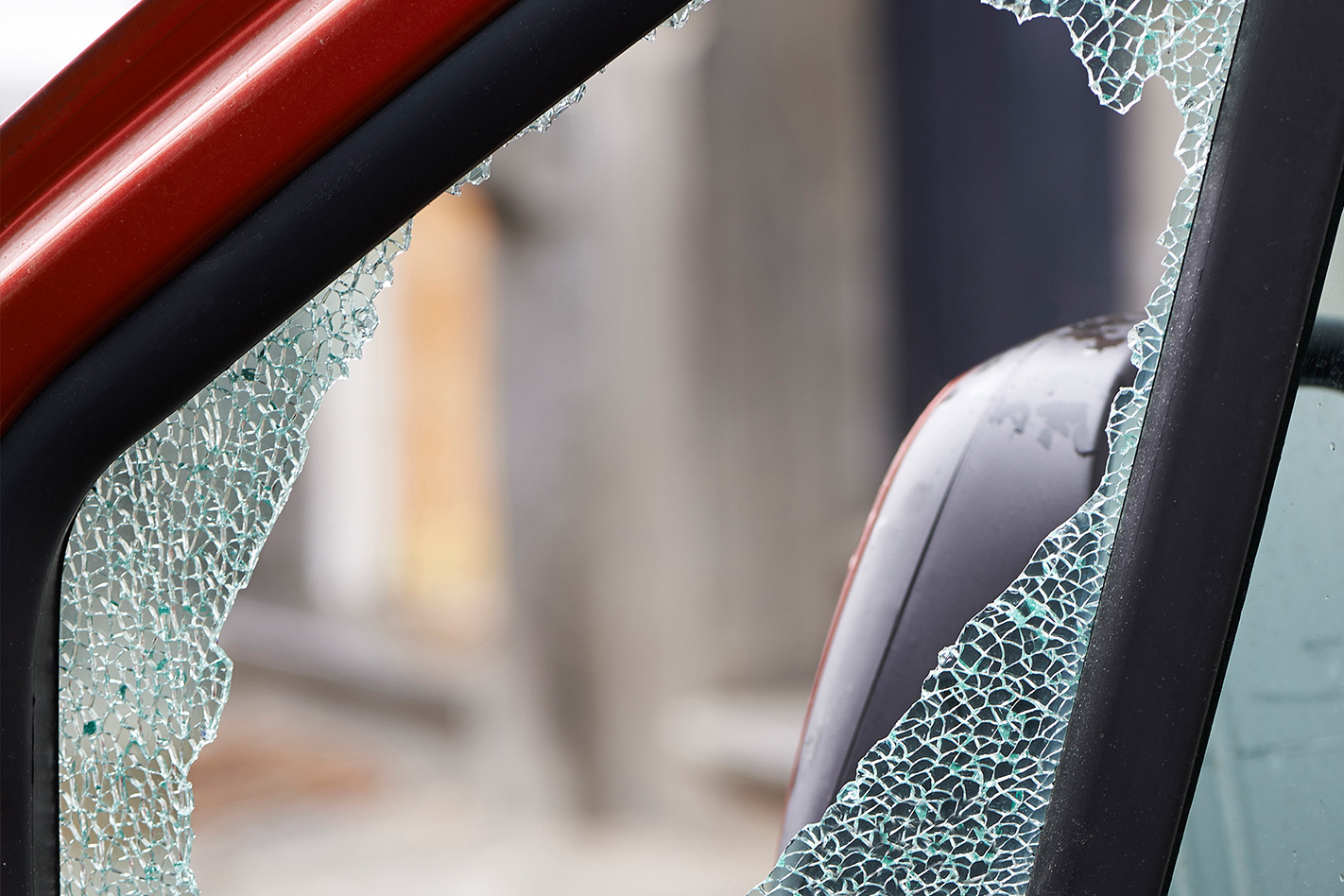
Following some simple common sense steps can avoid giving thieves the easy ride.
- Keep keys away from the front door or windows where criminals can reach in through letterboxes or break in easily.
- Do not keep spare keys in the glove box. Even the ‘wallet’ or ‘valet’ key can be used to steal a vehicle and these slim, sometimes plastic keys can be overlooked by an owner.
- Don’t leave anything on display in the car, even if you think it is worthless to a thief. Anything that draws attention to your interior increases the chance of someone breaking a window for a closer look or even making off with the car.
- Be vigilant in securing your car. It may sound obvious, but ensuring windows, sunroof and doors are closed and locked each time you leave your car reduces the chance of an opportunist taking advantage.
- It’s the same for choosing where you leave your car. Well-lit and busy areas minimise the time thieves have to concentrate on your car without drawing attention to themselves.
Apple wants its latest iPhone to replace your car key. Announced at the company’s Worldwide Developer’s Conference with a litany of other new iPhone updates, the new CarKey function will allow users to unlock, start the engine and drive off without the need for a traditional car key.
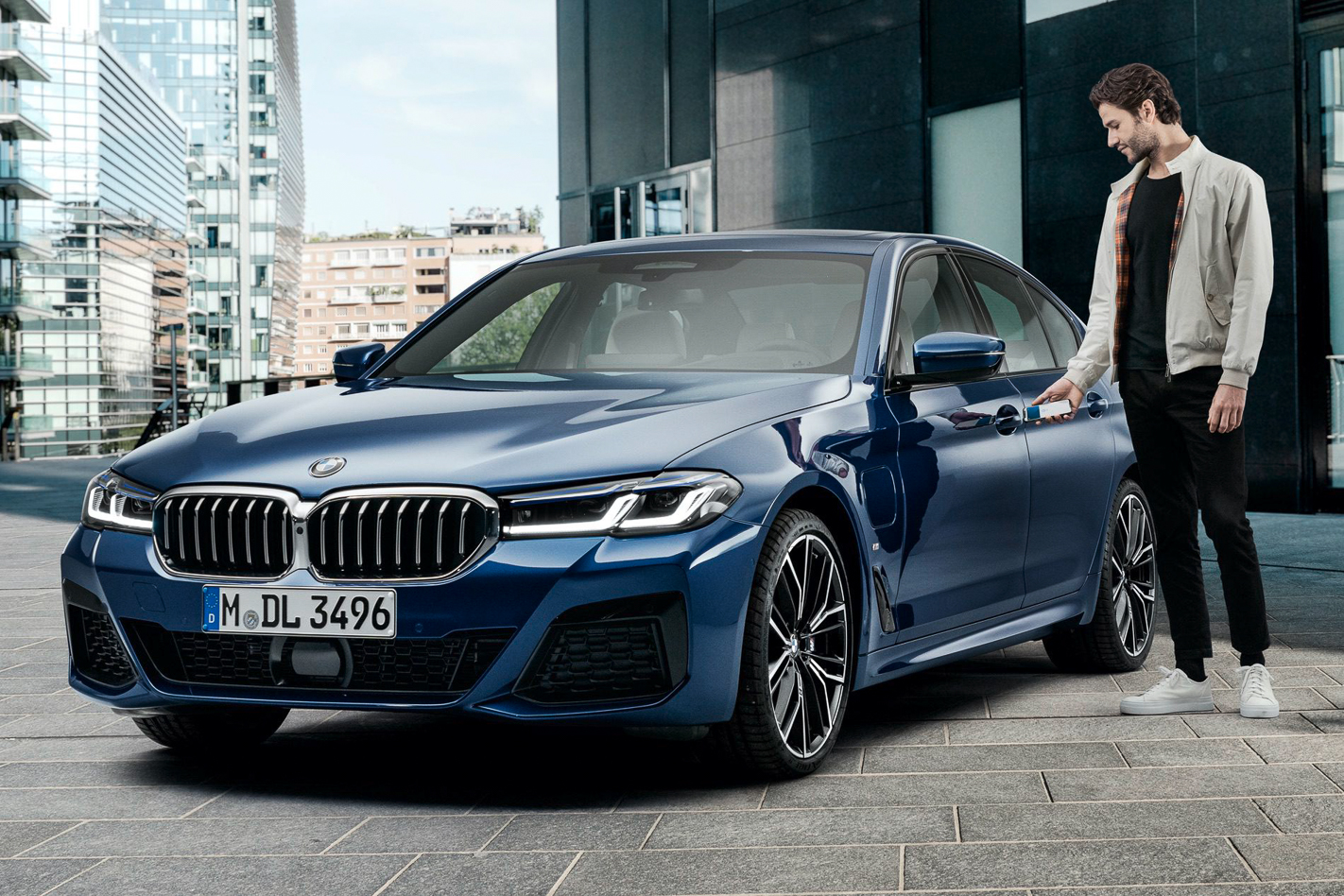
The tech giant has partnered with BMW to introduce the CarKey feature with its new 5 Series, inviting users to simply download the digital key app and pair the phone to the car.
To unlock the car, the phone is touched to the door handle and the Near Field Communication (NFC) network – which wirelessly sends data across devices in close proximity to one another – talks to the vehicle’s security system and allows access once authorised.
Users can then jump inside, keep the phone in a pocket and start the car using the starter button, just as they would using a conventional ‘keyless’ technology.

Digital key access is able to be shared with up to five trusted family members or friends, all sent via a simple iMessage. The application can also be used to place restrictions such as how much time a user is allowed to drive the car.
Apple is currently working with industry groups to expand the technology and offer it in partnership with other brands, and is developing ultra-wideband tech to allow unlocking and locking the car from further away.
CarKey is supported in the latest iOS 14 software and can be enabled on iOS 13 devices through an update.
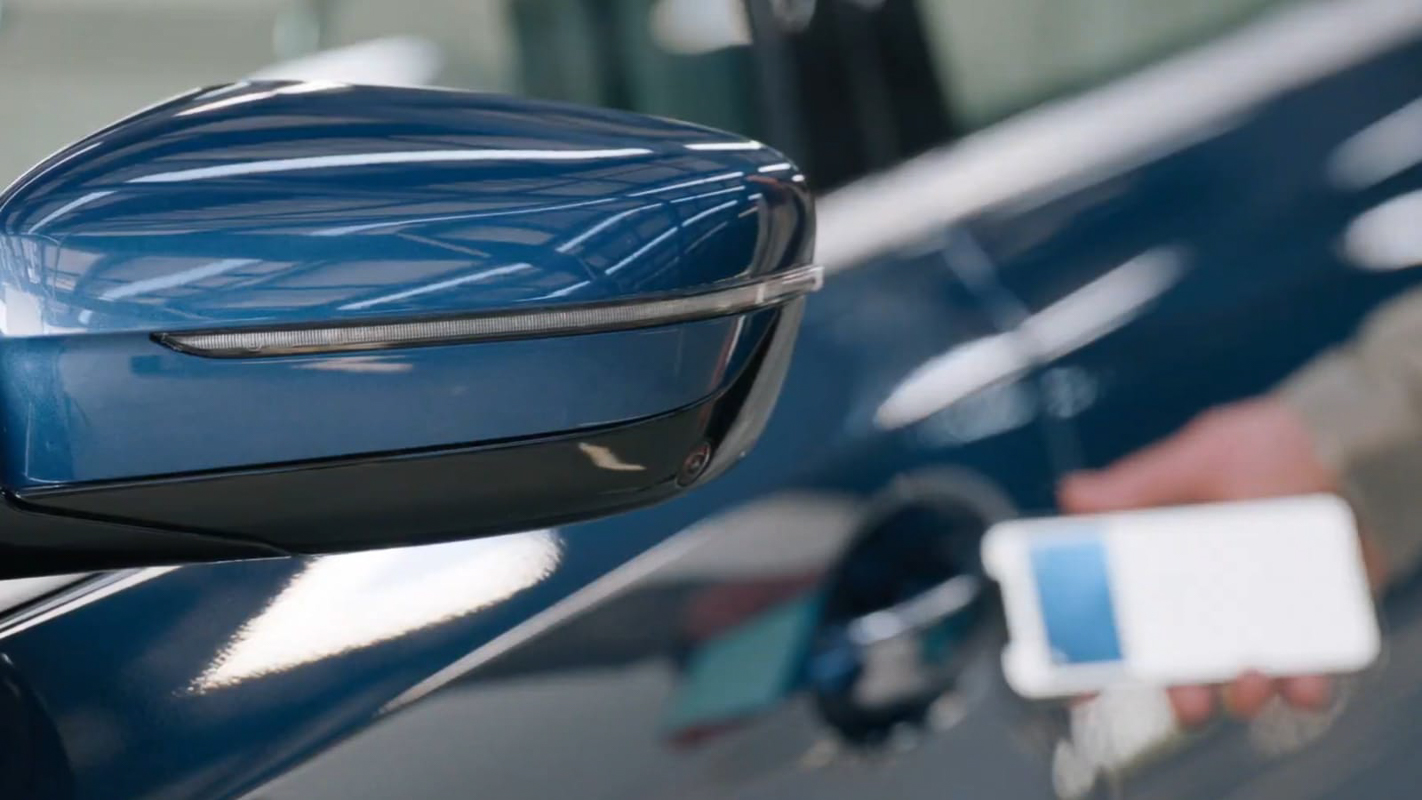
The technology has been around for some time, and brands including Volvo and Tesla have similar systems in place, but none has quite the same reach or potential as Apple, which could feasibly make the phone-as-a-key idea commonplace across the wider automotive industry.
BMW is the first manufacturer to partner with Apple for CarKey and the technology will be functional from July. There are plans for the feature to be rolled out to other manufacturers in the future.
Good design is thorough down to the last detail. Nothing must be arbitrary or left to chance. Care and accuracy in the design process show respect towards the user.” You may know this as one of Dieter Rams’ 10 principles of good design. Rams, one of the 20th Century’s great thinkers on industrial design, formulated these tenets in the 1980s but they’re as valuable today as they ever were, all underpinned by one central commandment: “Weniger, aber besser” which translates to “Less, but better.”
You can probably think of many cars that embody the polar opposite of this theme. “More, but worse” could apply to the wares of any number of mass-market manufacturers. Pile it high and sell it cheap. The inevitable consequence of this is a race to the bottom of ever-tightening margins. Premium manufacturers realised a long time ago that customers are willing to pay handsomely for good design, and those margins have been eyed enviously by the mainstream brands. Take these three small SUVs as prime examples. Mazda, Toyota and Kia all have certain limits to their brand equity, how far you can stretch upmarket, and yet the C-HR, CX-30 and Seltos models assembled here sit at or very near the top of their respective ranges.
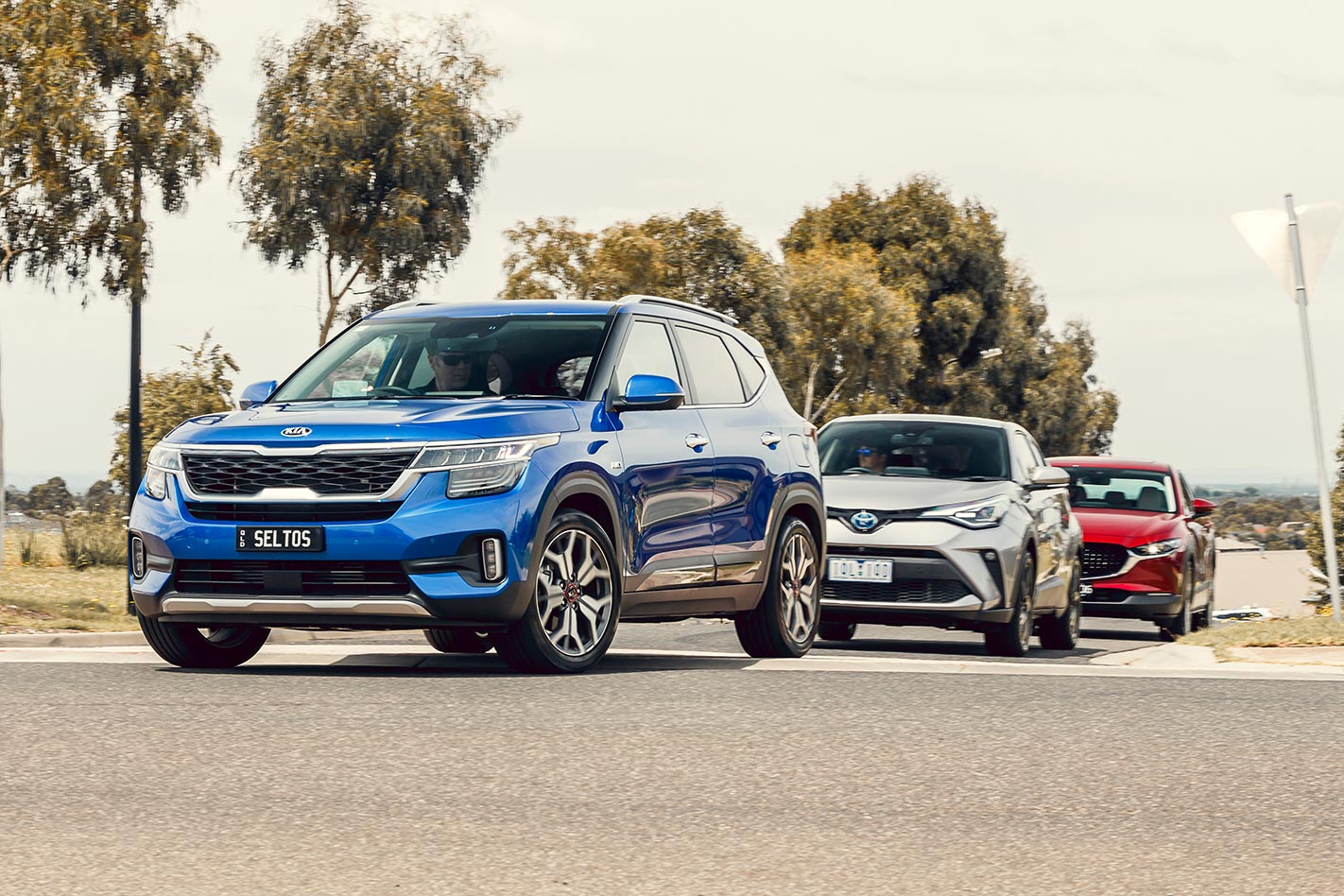
The target customer in the circa-$40K bracket could certainly run to a bigger RAV4, a CX-5 or a Sorento but chooses not to. These downsizers embrace the notion of less but better, but which of the three best delivers that rare result of a small car that delivers big-car feel-good factor?
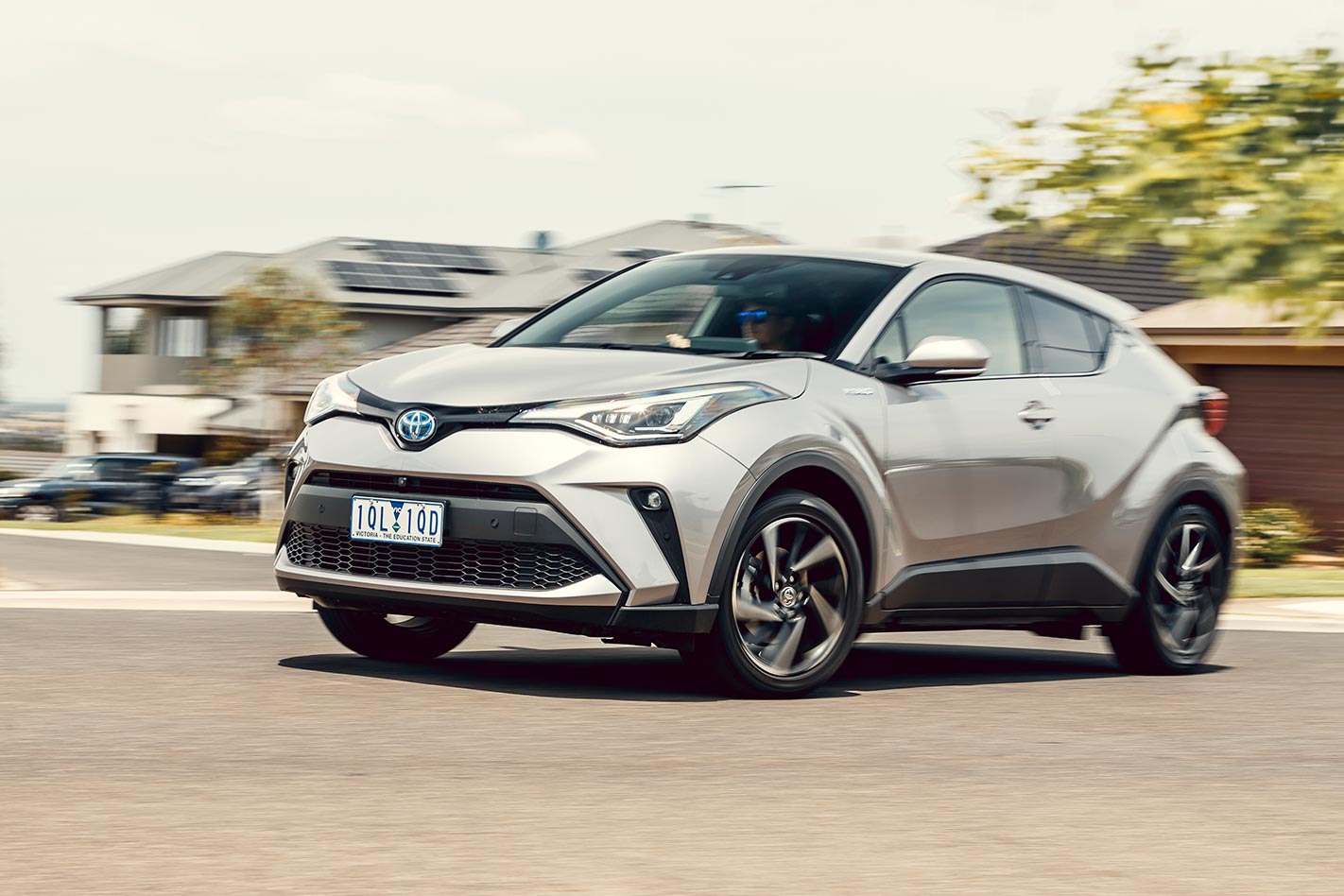
You’re probably most familiar with the Toyota C-HR. It’s been with us since 2014 but has recently been treated to a do-over. The big news is that a 90kW/142Nm 1.8-litre petrol-electric hybrid powertrain now sits atop the line-up, offering a more mature feel to the attention-deficit 1.2-litre fizzer that was the C-HR’s sole choice of powerplant. Some additional interior spit and polish hasn’t gone amiss either, most evident in this range-topping $36,440 front-wheel-drive Koba model. The other two cars represent a gentle step up in price, exacerbated by the fact that we don’t get the Euro-spec 137kW 2.0-litre C-HR hybrid. The long-awaited Mazda CX-30 is tested here in $41,490 front-drive G25 Astina guise and powered by a punchy 2.5-litre atmo engine good for 139kW/252Nm. Is this beginning to look like a mismatch to you? Then keep reading.
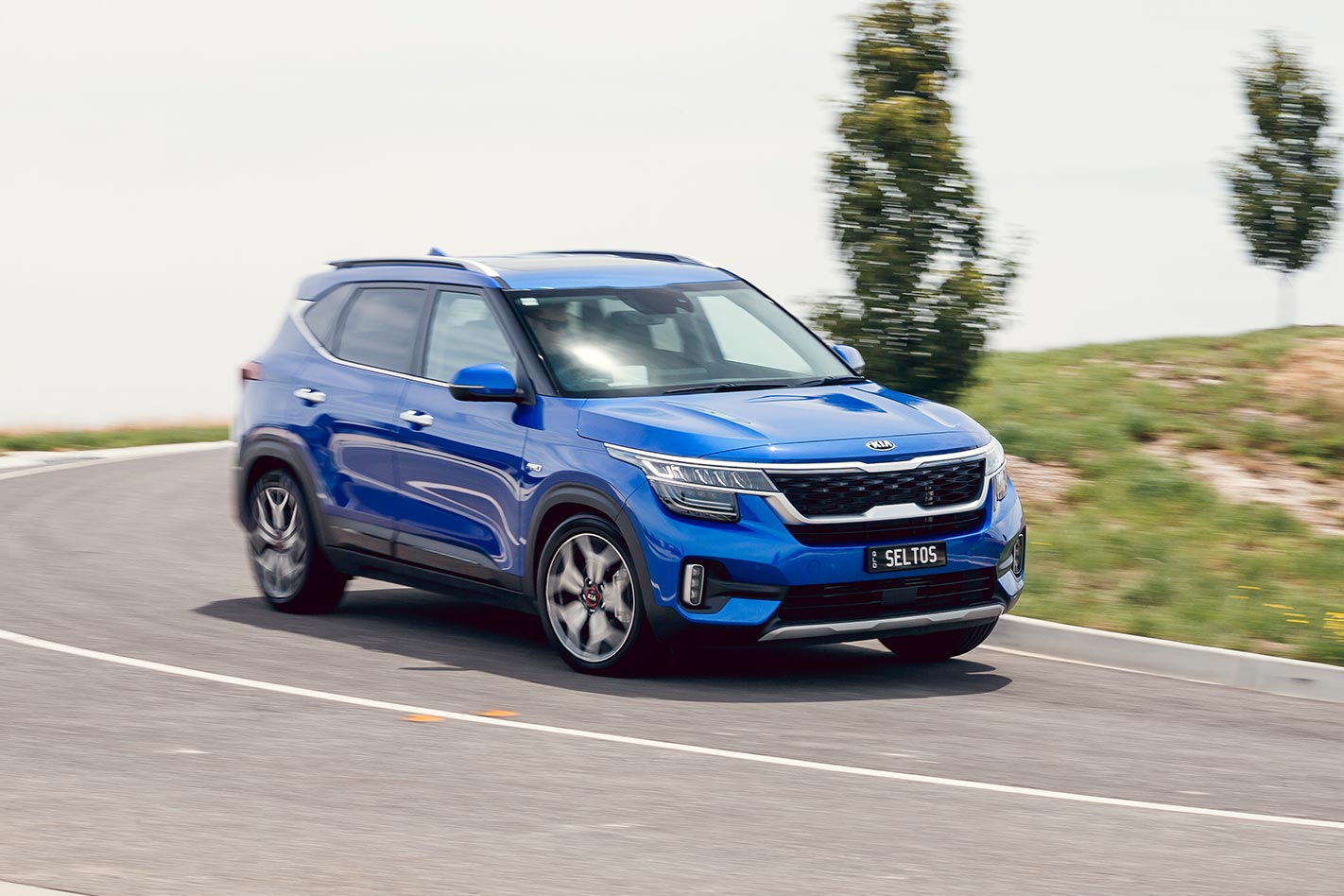
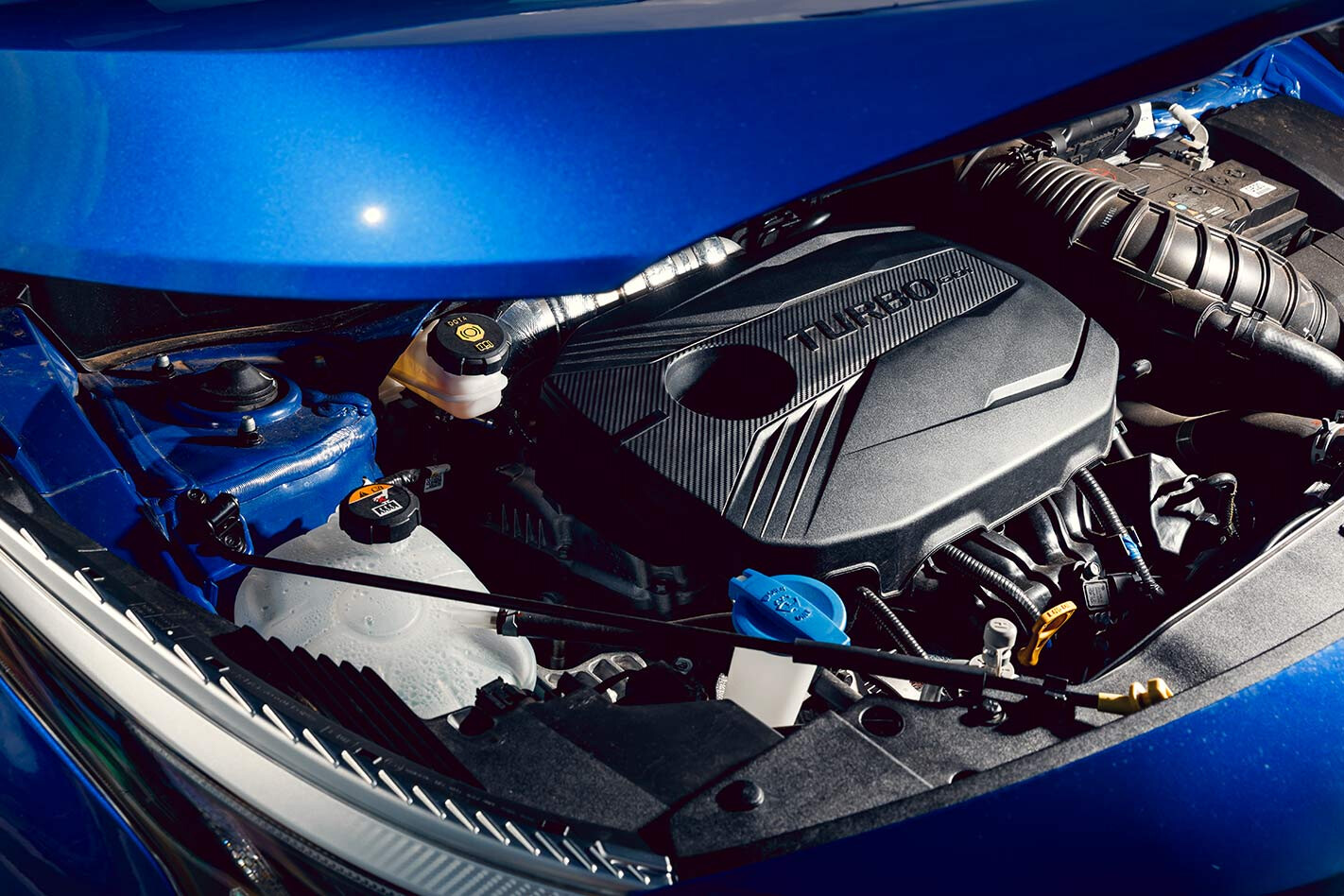
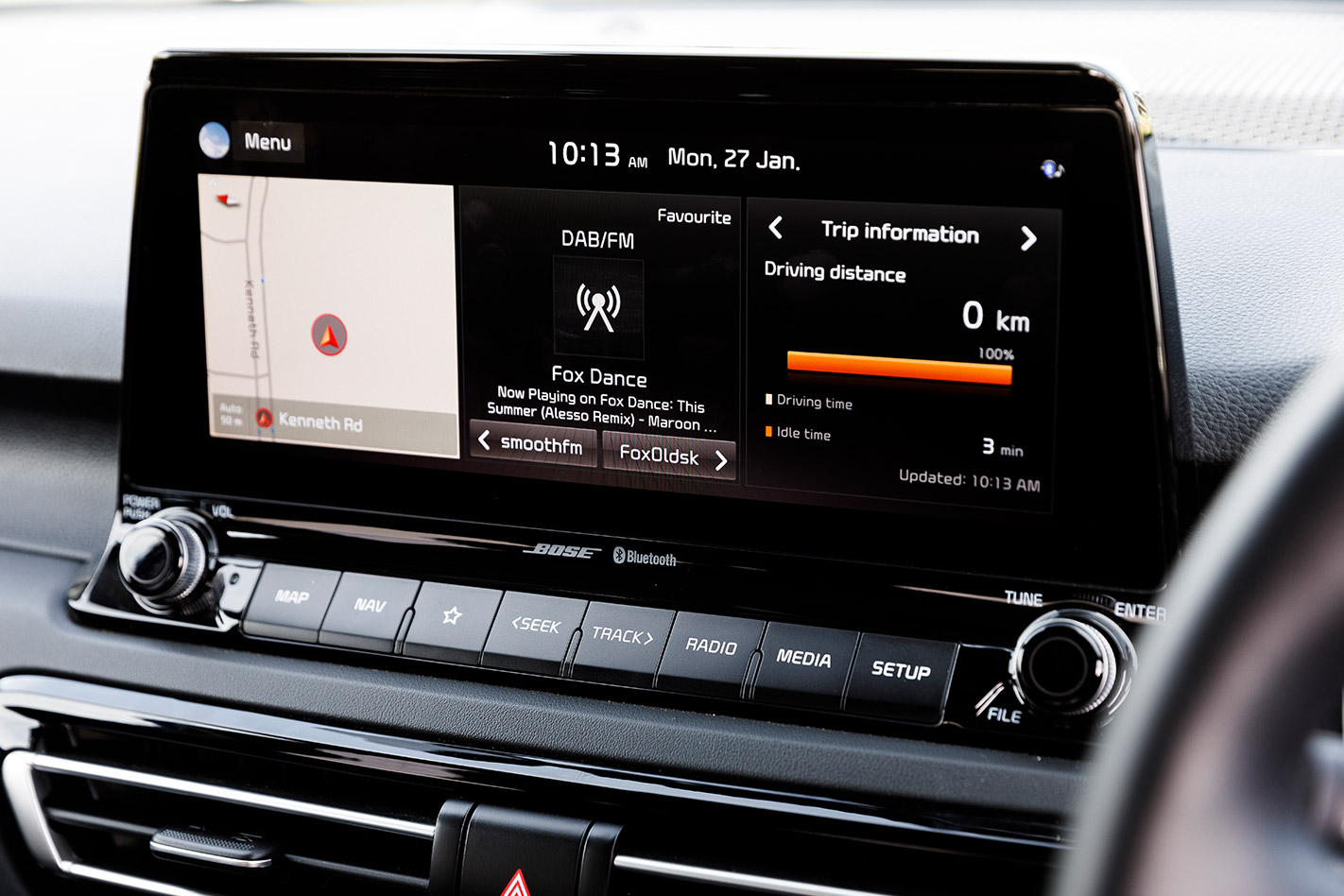
Rounding out this upwardly mobile triumvirate is the Kia Seltos GT-Line. At $41,990 (driveaway), the 130kW/265Nm Korean is the biggest vehicle here, and the only one to sport a turbocharger and all-wheel drive. It’s also notably the best equipped. None of the others have a Qi wireless charging pad, electric adjustment on both front seats, heated and cooled front seats or roof rails as standard. Jump in the back and it feels half a class bigger, with 70cm of rear passenger legroom versus 65cm for the Mazda and 62cm for the Toyota. Those positions are reflected in height from the rear seat cushion to the roof, whereby you get 98cm in the Seltos, 94cm in the CX-30 and 90cm in the C-HR, its nickel-metal hydride battery housed beneath the rear bench.
In almost every dimension that matters, the Kia is bigger. You sit higher too, the hip height of the front seat at its lowest setting being 65cm, compared to the 58cm of the C-HR and the 56cm of the Mazda. Therefore, it’s surprising to learn that it runs on a wheelbase 10mm shorter than the Toyota and fully 25mm shorter than the Mazda.
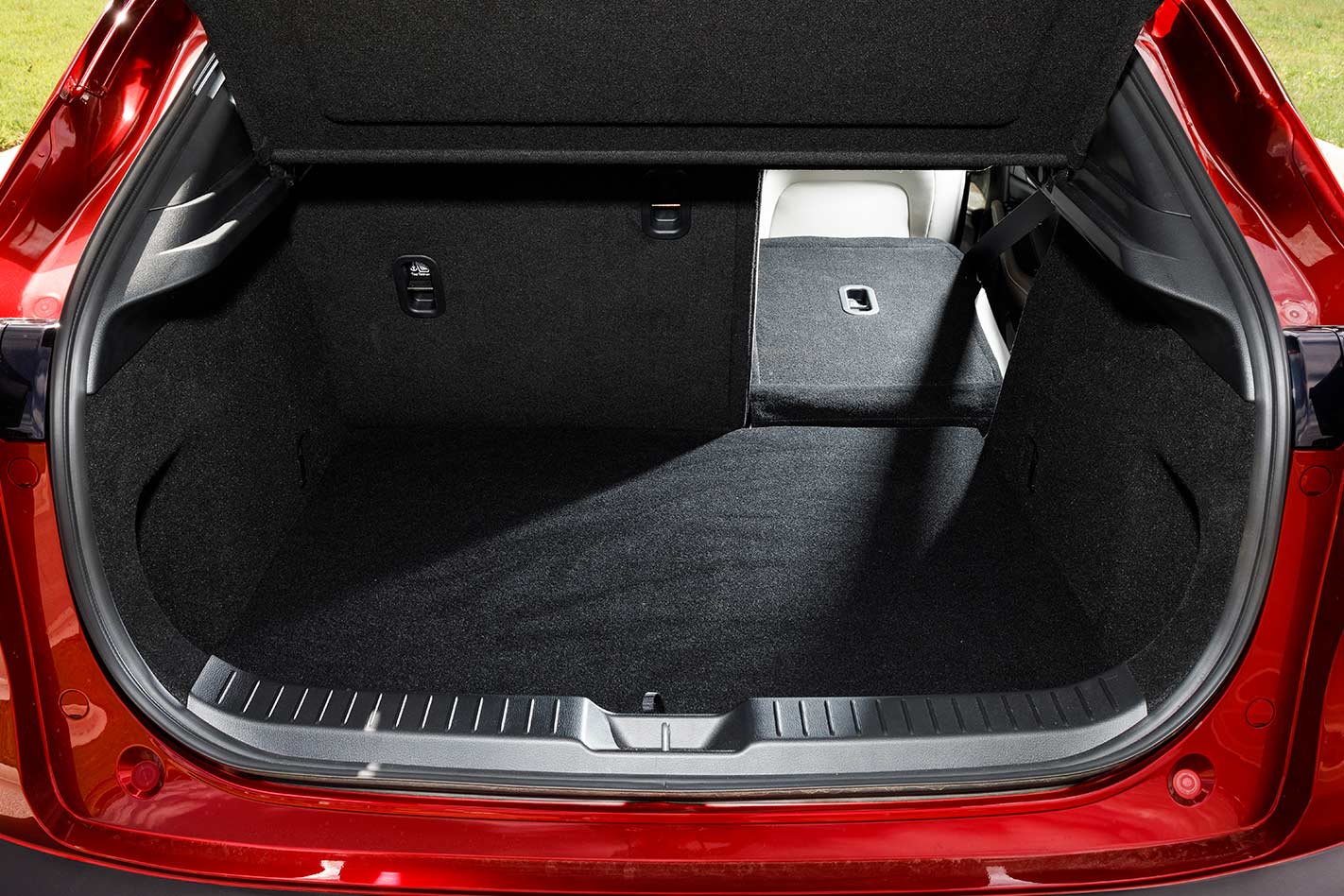
Flip open the tailgate and it’s advantage Kia again. The Seltos’s 498-litre boot aces the paltry 317 litres of the Mazda and the Toyota’s 318 litres. For family buyers, this comparison may be over at this point. Both the Seltos and the CX-30 feature electric tailgates, while it’s good old biceps power for the Toyota.
Numbers only tell you so much, though. The C-HR counters by being the sharpest steer of the bunch. The old C-HR was good, but the hybrid drive system just adds an element of polish that makes the Toyota feel more slickly engineered. The CVT transmission means that it’s hardly possessed of the most rewarding acoustics, but body control is excellent, the steering is crisp and its high-frequency bump absorption seems head-scratchingly good. In fact, so good is the ride and handling that it leaves you crying out for more power. Gazoo Racing, do the right thing and give us something with at least 150kW.The brakes, however, can feel awkward to modulate at crawling speeds, setting up a gentle nodding head action.
The CX-30 sits you low and hunkered, behind a near-perfect steering wheel; round, not too thick of rim, unobtrusive controls on its face and furnished with neat shift paddles. Power take-up is glossy and unfussed, the six-speed auto being the only torque-converter system here, and it shows in the way it easily slurs gears.
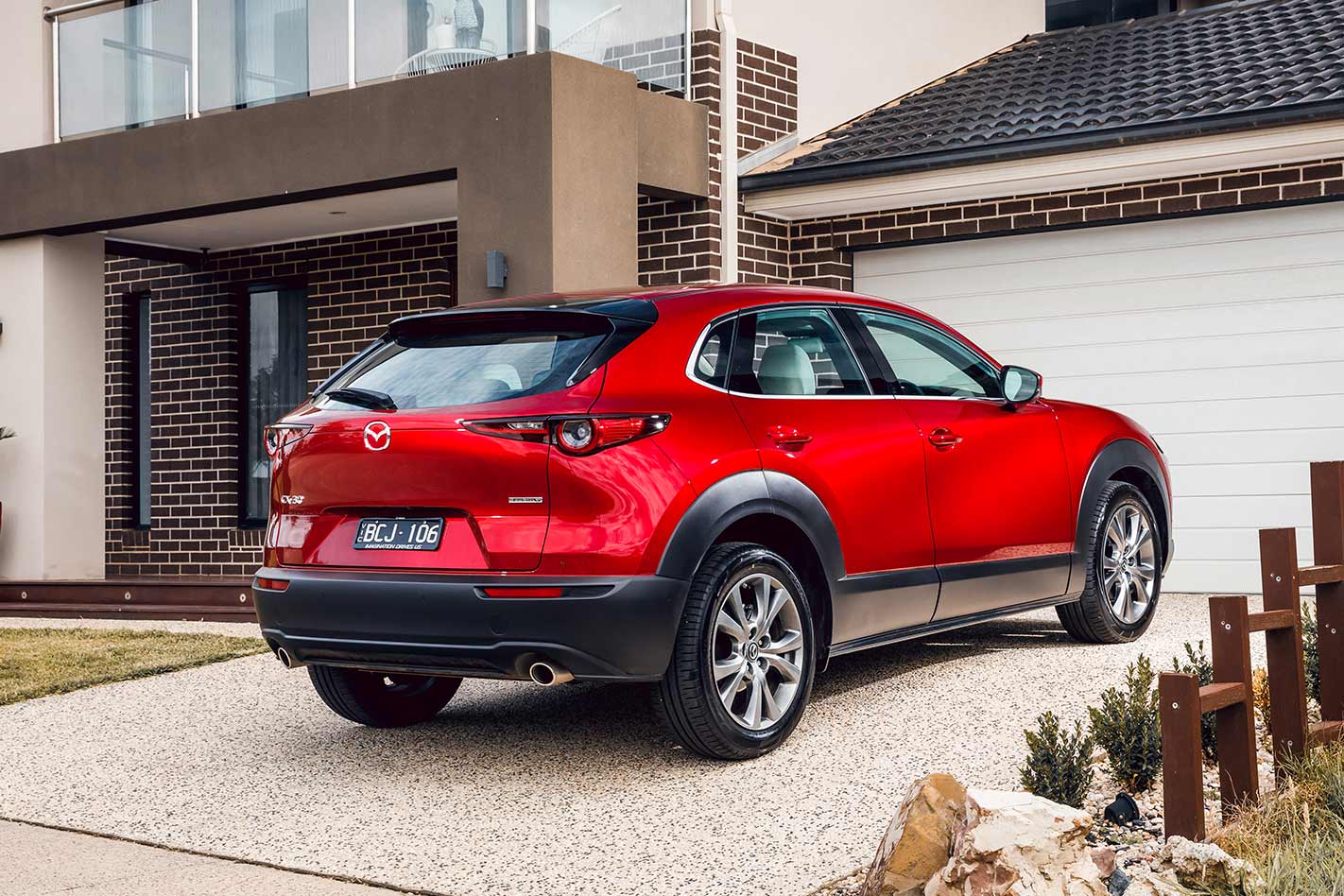
All of this lulls you into thinking that all aspects of the CX-30’s dynamics are similarly burnished, but that’s not always the case. The ride can be terse, with some suspension bump and thump entering the passenger cell and the front end is the vaguest of the three cars here on turn-in. It could perhaps benefit from a marginally heavier gauge anti-roll bar up front to prevent the feel of it leaning so heavily onto its outside tyre on corner entry. What’s more, the Sport mode holds a gear for a very long time and the 2.5-litre engine can be vocal. Without the aid of forced induction, you will occasionally need to give the SkyActiv-G lump a good prod to hustle it along and it’ll let you know it’s there.
By contrast, the Seltos’s turbocharged torque advantage means that at 1500rpm it’s making its full complement of 265Nm whereas the Mazda CX-30 is, with the same number of revs on the board, generating around 200Nm, or 20 percent less. Small wonder that the Seltos feels so unflappable at everyday speeds. The seven-speed dual-clutch transmission is a sweet shifter, responding crisply when switching the drive modes between Eco, Normal and Sport, but up the pace and the Seltos’s relaxed ride quality nevertheless conceals a pleasantly chuckable chassis.
It’s the quickest of the bunch against the clock, just pipping the Mazda and easily gapping the relatively puny Toyota. That’s despite the fact that trying to get it off the line cleanly is a frustrating exercise, the dual-clutch ’box feeling flaccid and doughy upon initial engagement. Once into its stride the Seltos pulls cleanly, but there’s an inverse relationship between pace and fuel economy, the Kia drinking more than 50 percent more juice than the tardy but frugal Toyota on test.
The Seltos is the most practical and best equipped, while the Toyota is the most spirited through corners, the most adventurously styled, and easily the most economical. That leaves the Mazda CX-30, a car that could easily be dismissed as something of a compromise between these two extremes.
In truth, the Mazda does something neither of the others can quite carry off. It’s the only one of the three that feels comfortable in its own skin at $40,000. The Kia feels like a $30,000 vehicle with a lot of toys. The Toyota, despite its interior modernisation and slick hybrid drivetrain, still doesn’t possess a cabin that looks or feels some way removed from the norm. Both offerings run out of breath at around $35,000 and you shouldn’t be tempted to pay much more.
The CX-30 embodies another of Rams’ principles: Good design is aesthetic. The aesthetic quality of a product is integral to its usefulness. But only well-executed objects can be beautiful.
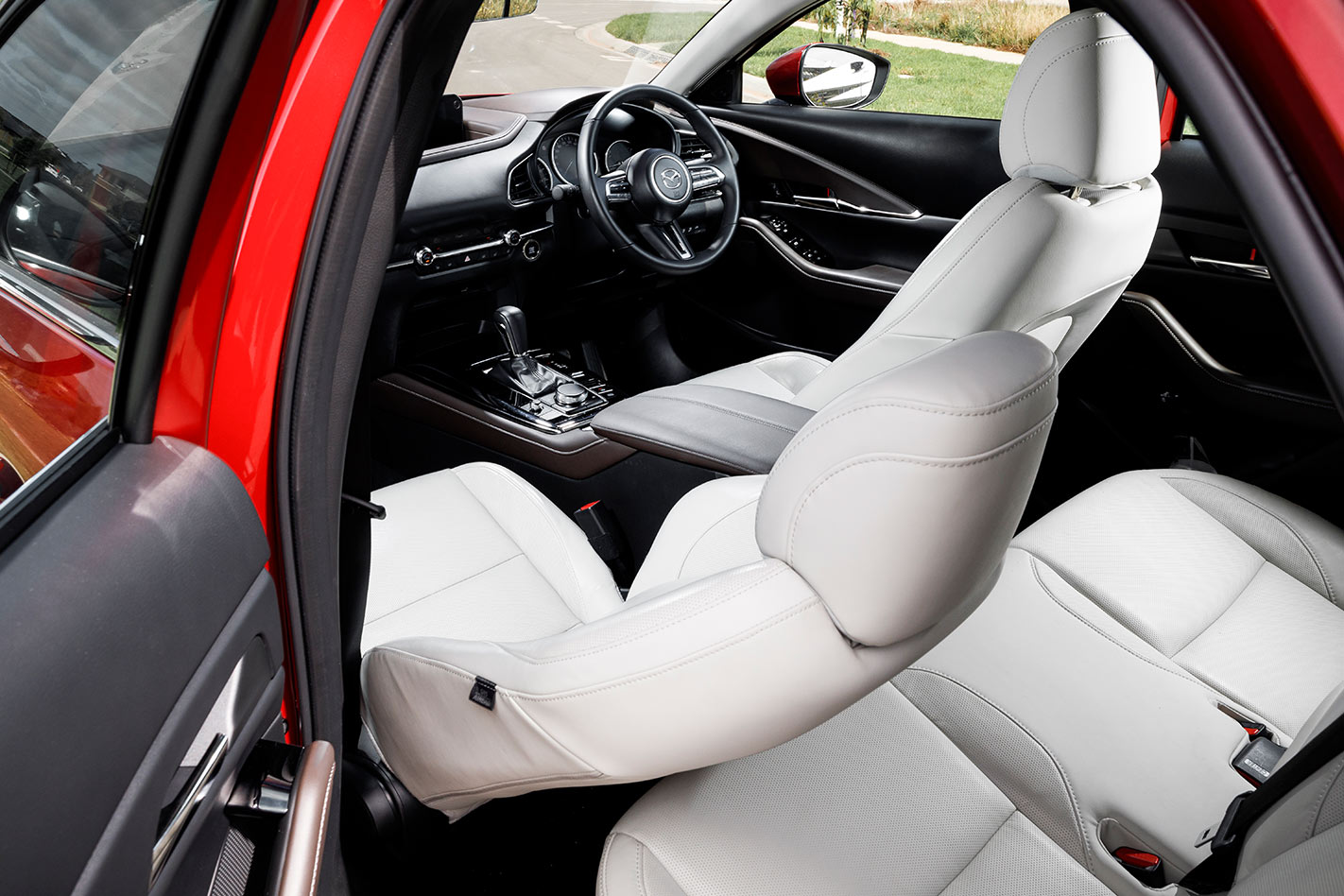
No other manufacturer in the industry can surface a vehicle with the skill of Mazda. The way the light plays on the CX-30’s flanks is a world apart from its rivals here and the black cladding on its body has the effect of lengthening and removing bulk from the painted sheetmetal.
The cabin execution is also leagues beyond its immediate rivals and the attention to detail isn’t just meticulous. It’s borderline obsessive and evidenced in the quality of materials, of stitching, of understanding why keen drivers want to push the shifter forward to downshift, of positioning the pelvis in the seat to allow the spine to act as a natural shock absorber, and a thousand other things.
It’s floating the head-up display nebulously on the windscreen with neither too much nor too little information, where the Seltos has you peering at a vibrating plastic shard virtually on the same visual plane as the main dials. Behind it are the visual clutter of wipers and bonnet swage lines. Mazda understands that a HUD shouldn’t require you to refocus your eyes to take in the information.
Kia doesn’t understand this, and there are many other examples where Mazda understands the use-case instances in this specific market sector better. For instance? The CX-30 feels comfortably the most luxurious of the three but tips the scales the lightest while delivering the most power. We like that combination.
It’s not going to appeal to everyone, though. The Seltos’s superior space, generous kit list, turbocharged grunt and the not inconsiderable factor of a seven-year warranty will make it a no-brainer for those comparing spec for spec against both the Japanese cars here. It’s a well-rounded, fire-and-forget sort of proposition. What it’s not is a car to find any great sensory delight in. Does that matter here? We’d argue that it does, and more acutely at the top end of the range than when doing the maths at the entry level.
Ultimately, you’re buying a car in this class because you want something of a manageable size but without small-car compromises on quality. While there’s a lot to be said for both the Kia and the Toyota, the vehicle here that best fulfils that brief is the Mazda CX-30. There’s a delightful clarity in the way it understands its task. Less but better, if you like.
COOL RUNNINGS
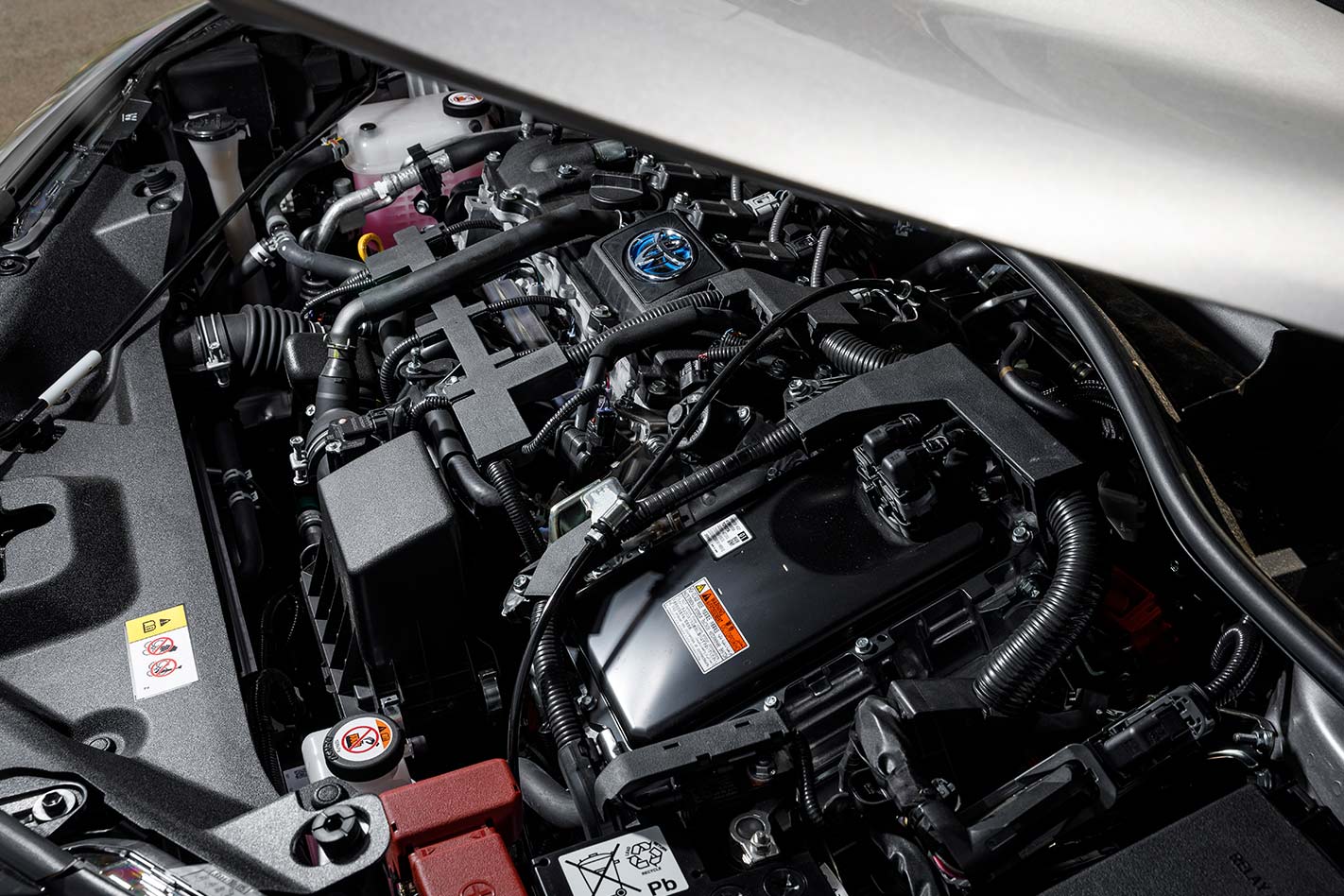
Toyota claims the greatest thermal efficiency of any mass-produced petrol engine for the C-HR hybrid. Due to the large-volume exhaust-gas recirculation system, improvements in combustion efficiency and innovative ways of managing heat and reducing friction, the 1.8 hybrid lump registers a maximum 40 percent thermal efficiency. That betters the 37 percent of the first Prius’s 1.5-litre unit and the 38.5 percent level of the 1.8-litre engine in the third-gen Prius.
DIFFERENT STROKES
You don’t need a long memory to recall a decent finish for the Seltos in January’s compact SUV megatest. That car had a 2.0-litre atmo engine, front-drive, a torsion-beam rear end and a CVT transmission. The one showcased here features a turbo 1.6, all-wheel drive, multi-link rear suspension and a dual-clutch gearbox. Although the sheetmetal looks similar, they’re chalk and cheese.
THE VERDICT
1st Mazda CX-30 G25 Astina – 8.5/10
2nd Kia Seltos 1.6 T-GDI GT-Line – 8.5/10
3rd Toyota C-HR Hybrid Koba – 8.0/10
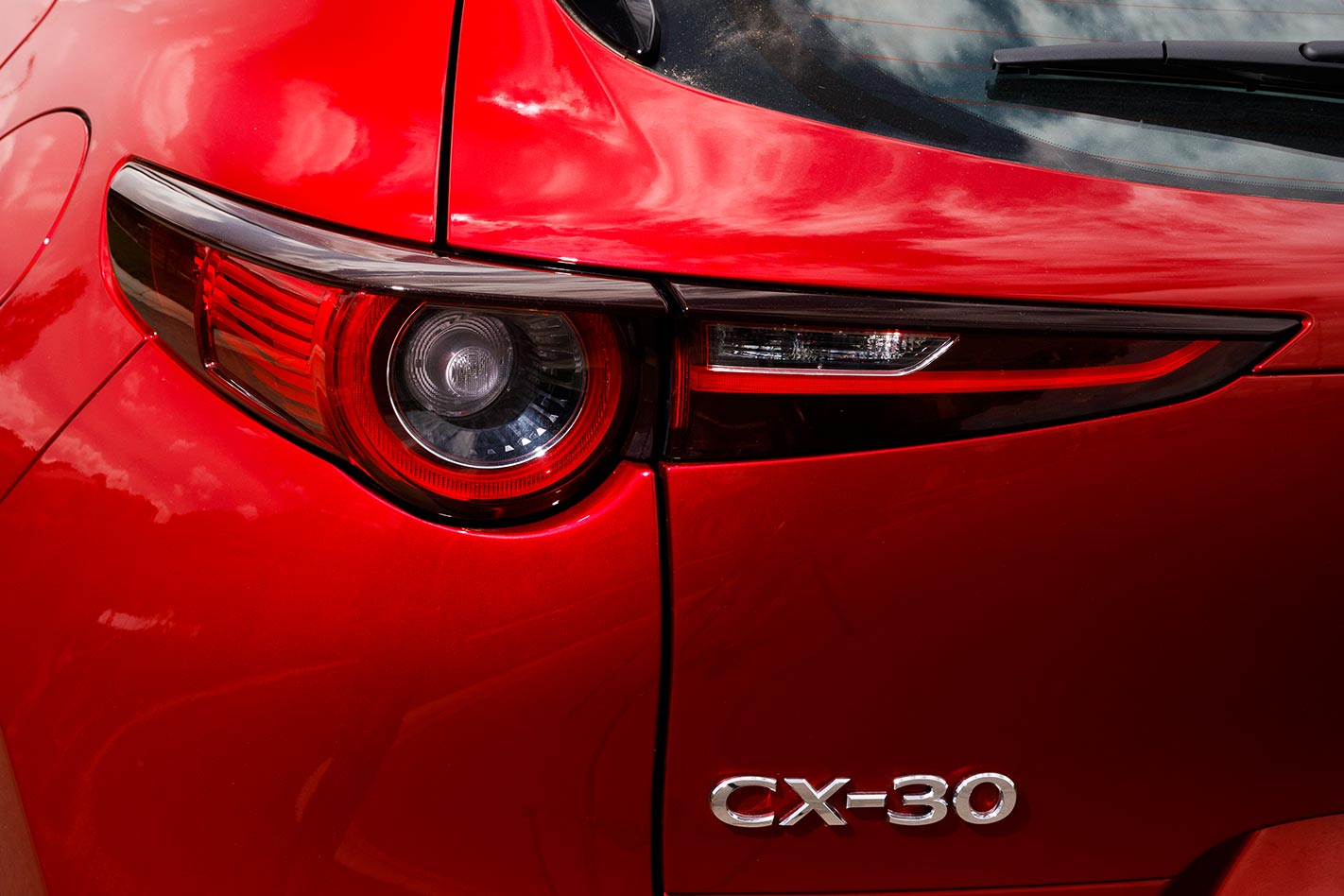
MAZDA CX-30 G25 ASTINA SPECS
Price: $41,490/Tested $42,180*
Engine: in-line 4cyl, dohc, 16v
Layout: front engine (east-west), front drive
Capacity: 2488cc
Power: 139kW @ 6000rpm
Torque: 252Nm @ 4000rpm
Transmission: 6-speed automatic
Body: steel, 5 doors, 5 seats
L/W/H/W-B: 4395/1795/1540/2655mm
Track (F/R): 1565/1565mm
Weight: 1442kg
Boot: 317 litres
Fuel/tank: 91 octane/48 litres
Economy: 7.5L/100km (test average)
Front suspension: struts, A-arms, anti-roll bar
Rear suspension: torsion beam, coil springs, anti-roll bar
Steering: electric rack and pinion
Turning circle: 10.6m (2.8 turns lock-to-lock)
Front brakes: ventilated discs (295mm)
Rear brakes: solid discs (265mm)
Tyres: Dunlop Sportmaxx 050
Tyre size: 215/55R18 95H
Safety: 5 stars (ANCAP)
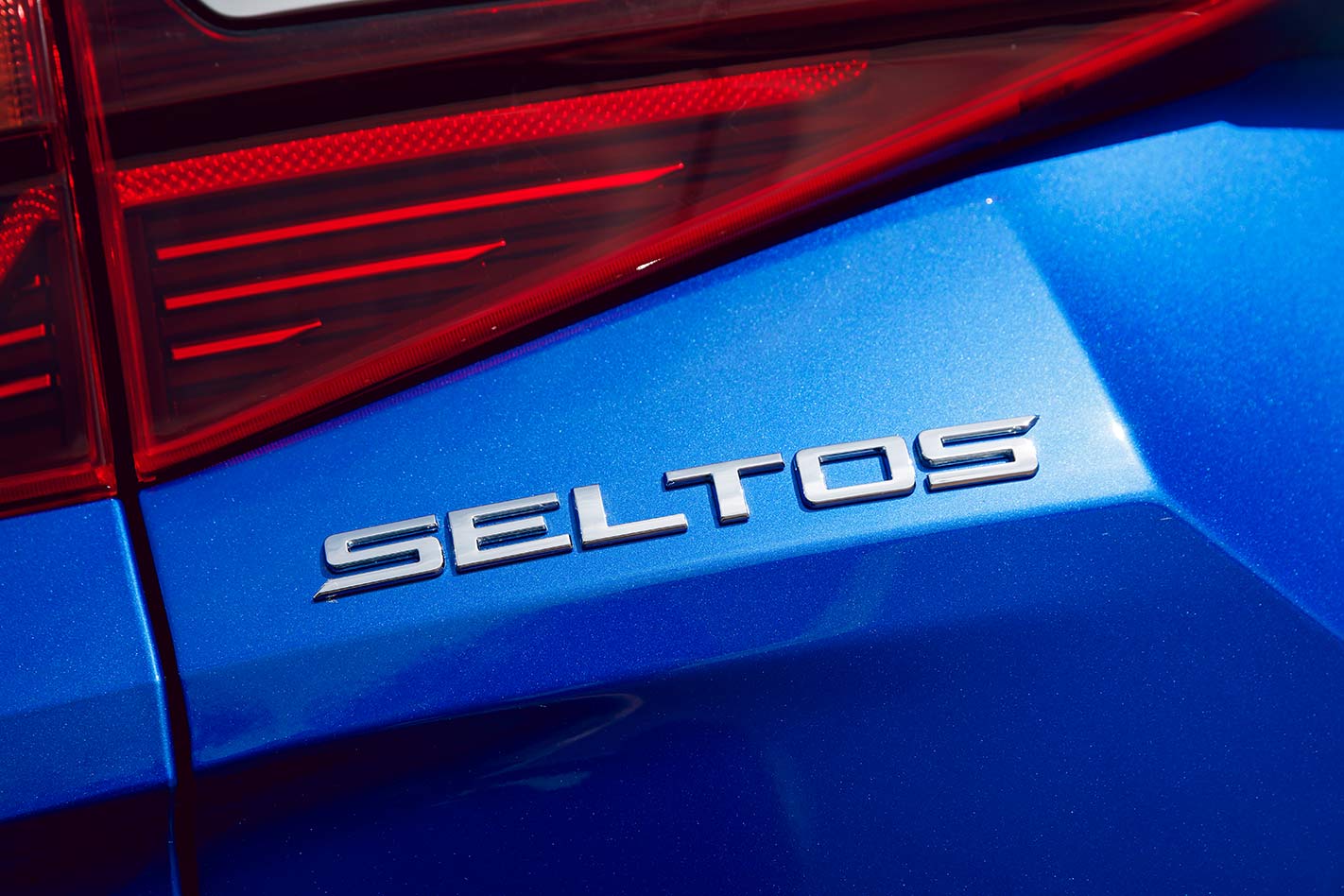
KIA SELTOS 1.6 T-GDI GT-LINE SPECS
Price: $41,990/Tested $42,510*
Engine: in-line 4cyl, dohc, 16v, turbo
Layout: front engine (east-west), AWD
Capacity: 1591cc
Power: 130kW @ 6000rpm
Torque: 265Nm @ 1500-4500rpm
Transmission: 7-speed dual-clutch
Body: steel, 5 doors, 5 seats
L/W/H/W-B: 4370/1800/1615/2630mm
Track (F/R): 1560/1568mm
Weight: 1500kg
Boot: 498 litres
Fuel/tank: 91 octane/50 litres
Economy: 9.1L/100km (test average)
Front suspension: struts, coil springs, anti-roll bar
Rear suspension: multi-link, coil springs, anti-roll bar
Steering: electric rack and pinion
Turning circle: 10.6m (2.5 turns lock-to-lock)
Front brakes: ventilated discs (305mm)
Rear brakes: solid discs (284mm)
Tyres: Kumho Ecsta HS51
Tyre size: 235/45R18 94V
Safety: 5 stars (ANCAP)
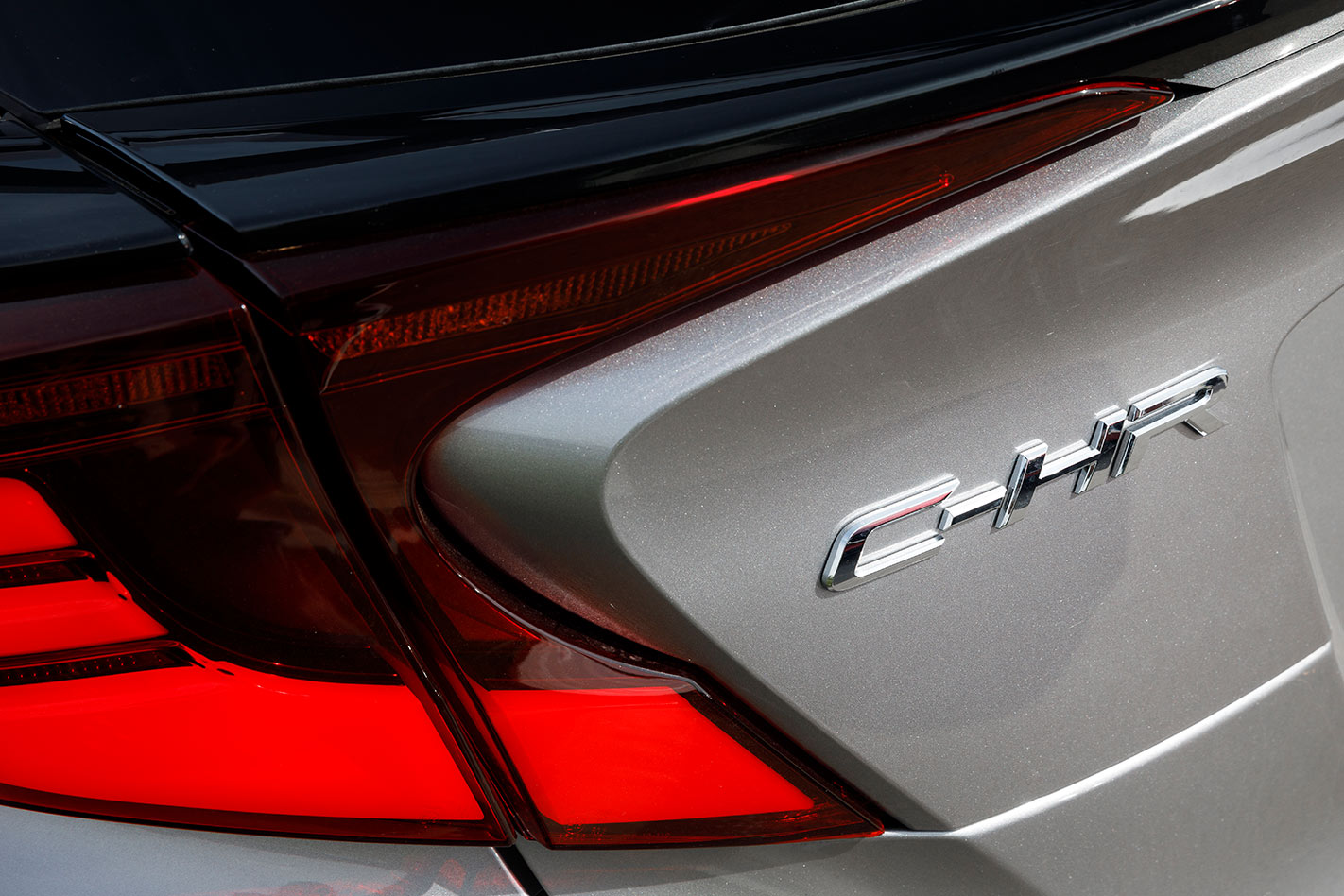
TOYOTA C-HR HYBRID KOBA SPECS
Price: $36,940/Tested $36,940
Engine: in-line 4cyl, dohc, 16v, hybrid
Layout: front engine (east-west), front drive
Capacity: 1798cc
Power: 90kW @ 5200rpm
Torque: 142Nm @ 3600rpm
Transmission: CVT
Body: steel, 5 doors, 5 seats
L/W/H/W-B: 4390/1795/1555/2640mm
Track (F/R): 1550/1540mm
Weight: 1460kg
Boot: 318 litres
Fuel/tank: 91 octane/43 litres
Economy: 5.9L/100km (test average)
Front suspension: struts, coil springs, anti-roll bar
Rear suspension: double A-arms, coil springs, anti-roll bar
Steering: electric rack and pinion
Turning circle: 10.4m (2.7 turns lock-to-lock)
Front brakes: ventilated discs (298.5mm)
Rear brakes: solid discs (281mm)
Tyres: Bridgestone Potenza RE050A
Tyre size: 225/50R18 95V
Safety: 5 stars (ANCAP)
With a combination of German engineering influence through Volkswagen Group ownership, left field but likeable styling, and delightfully clever functionality, Skoda is steadily building a following in Australia.
But the line up of passenger and SUV models is still has some gaps that, when looking at rival’s ranges, have been plugged long ago.
In response to stiff competition from more mature brands, the Czech marque is working hard to identify the holes in its armour and continue filling the range with more compelling offerings. And the Karoq mid-sized SUV has been somewhat of a work in progress, until now.
UPDATE, May 26 2022: The Karoq has had a styling update for 2022, which you can read about at the linke below. The rest of this story remains unchanged, but our latest reviews are also linked below.
What is the Skoda Karoq?
Skoda’s first mid-sized SUV is not completely new to Australia and first arrived in 2018 as just one 110TSI variant with a choice of manual or automatic transmissions, but the company always intended to withdraw the six-speed manual and bolster the line-up with more choice later.
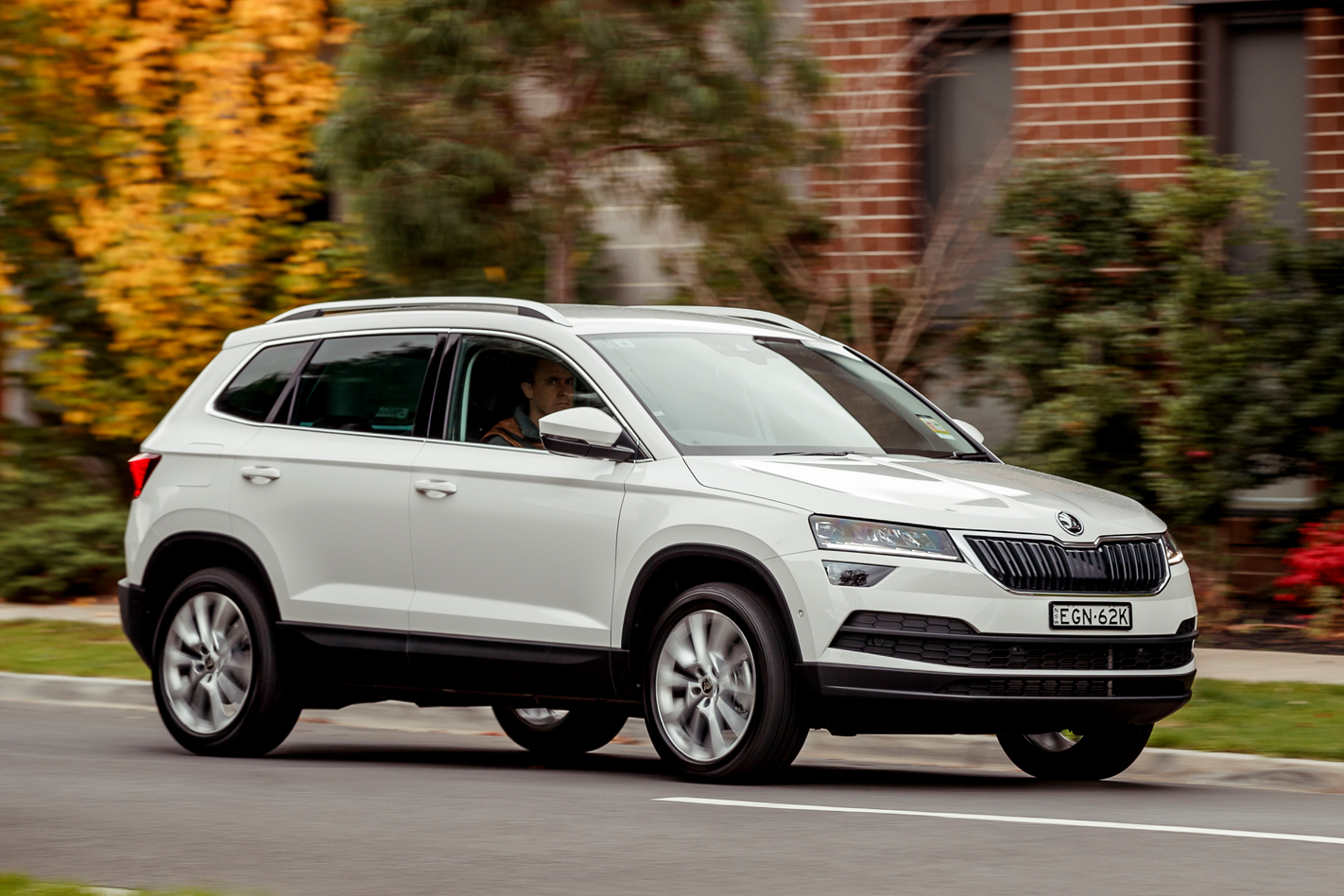
That extra choice has now arrived in the form of an updated 110TSI automatic alongside a more premium and sporty 140TSI Sportline.
The former targets a customer that prioritises practicality, economy and perhaps a more urban environment, while the new offering focuses on the driving enthusiast looking to get away from the urban jungle and into the real one.
What is the Skoda Karoq like to drive?
Skoda has done an excellent job of offering a pair of Karoqs that exist at polar opposite ends of the spectrum and do very different jobs. Neither are in any danger of cutting each others grass or standing on each other’s toes.
110TSI
At one end you have the 110TSI – a variant that bumps in with a small 1.4-litre turbo petrol engine, front-wheel drive and a ‘conventional’ automatic gearbox, while the 140TSI has 2.0-litre turbo petrol, all-wheel drive and a dual-clutch auto.
As you might imagine then, both offer a very different driving experience.
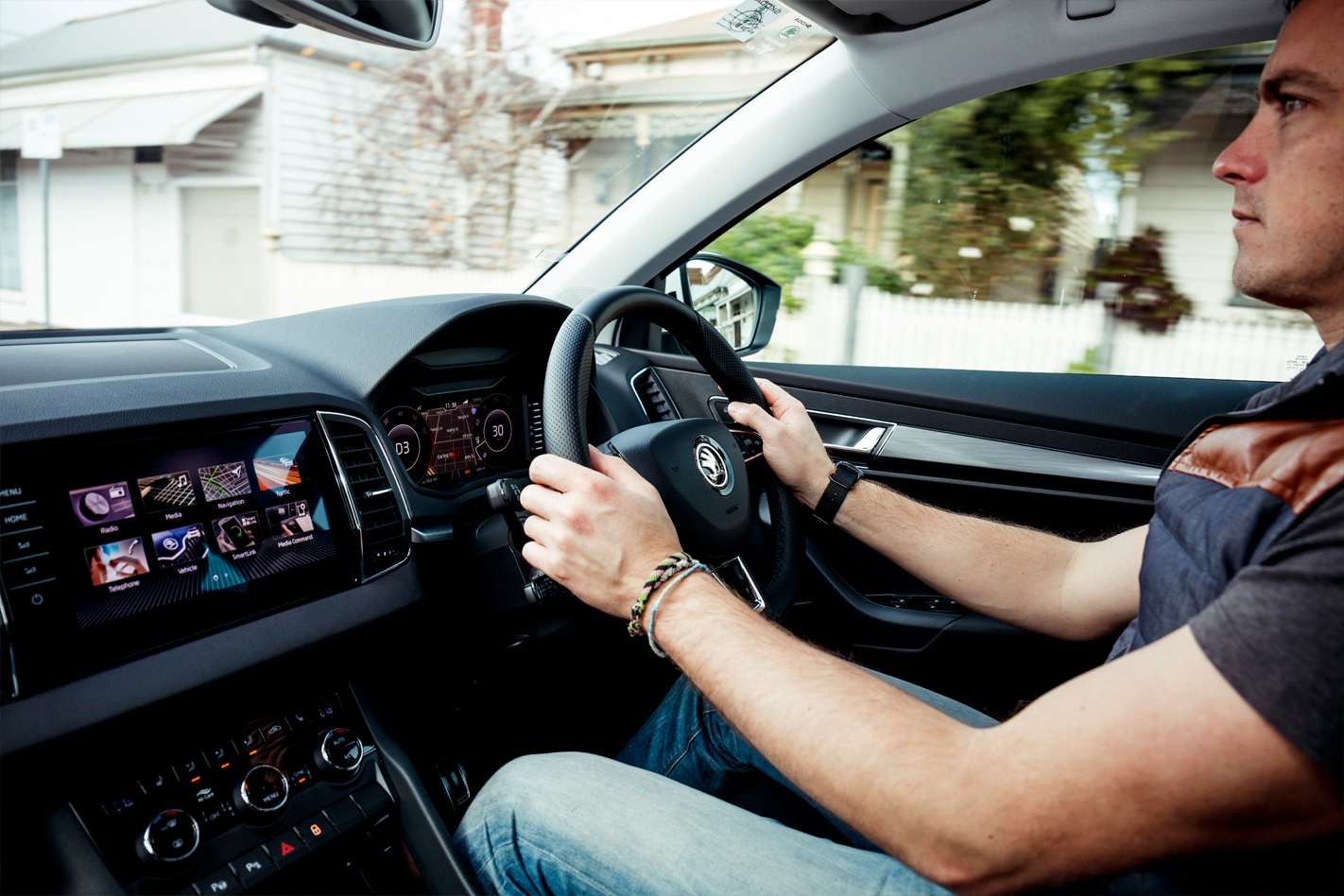
For the 2020 update, the Karoq 110TSI has had an engine downsize from 1.5-litres but its eagerness and impressive torque prompted a look at the user manual to make sure we hadn’t accidentally picked up the wrong version.
110kW and 250Nm doesn’t sound like a lot but the Karoq makes it feel like a lot more with surprisingly brisk acceleration from a standstill and it doesn’t even start to show weakness when it comes to freeway slip roads, blasting up to the national limit as strongly. Only the odd overtaking dash found a slight drop off in otherwise impressive power for such a tiny engine under the bonnet of a decent sized SUV.
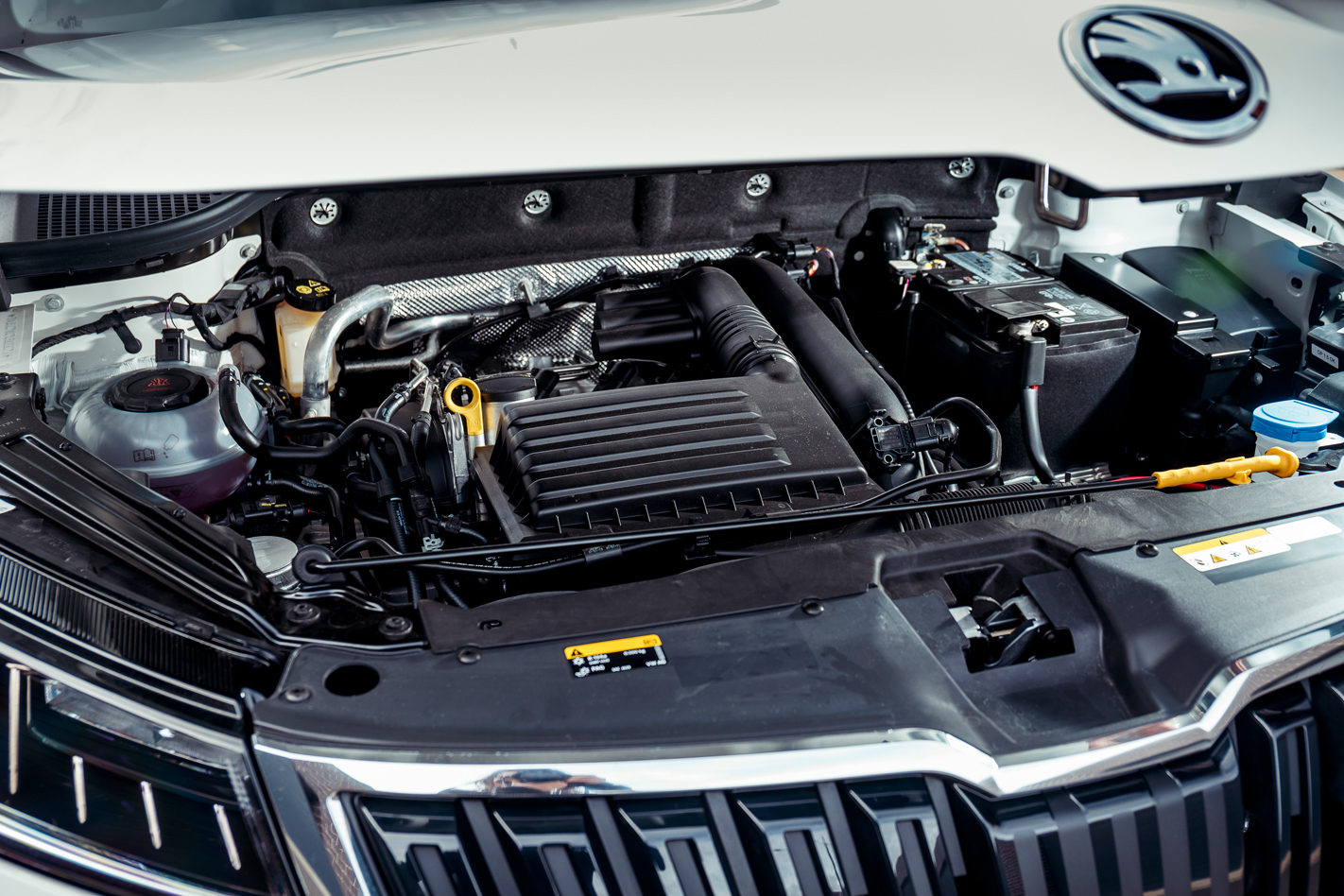
And the sophisticated power plant is not let down by its gearbox pairing either. Once again, the snappiness and aggressive uptake of torque had us reaching for the spec sheet to check this particular Skoda hadn’t been fitted with a dual-clutch transmission.
Its eight speeds are carefully placed for optimum smoothness and even the lack of paddle shifters on the steering wheel wasn’t an annoyance with the transmission program doing everything we wished automatically.
Chuck the 110 into a corner and there’s a little roll and the tyres will squash around to remind you that this is definitely not intended to be a track car but that doesn’t mean it isn’t fun. Light weight front-drive only and carefully tuned suspension have resulted in a variant that’s nimble and enjoyable with surprising performance.
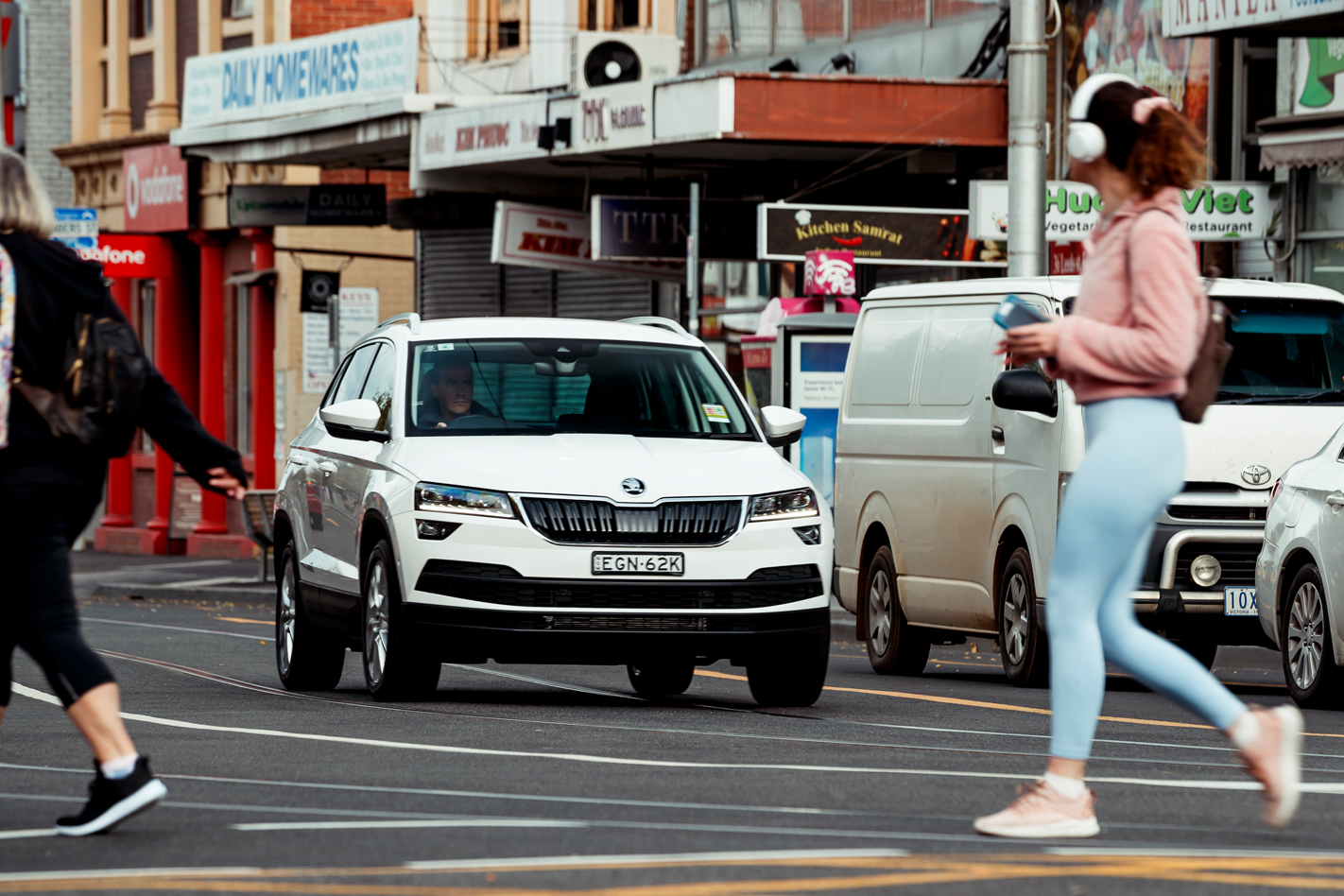
And those good manners continue on less enjoyable roads thanks to an engine and transmission combination that manages to be silent and efficient in traffic for less appealing commute driving.
140 TSI Sportline
But where the 110TSI delivered far more performance than expected, perhaps our expectations were a little too high for its 140TSI sibling. With a 2.0-litre turbo engine that, in other states of tune delivers proper firecracker performance, the sportiest Karoq didn’t have quite the bang we had hoped for.
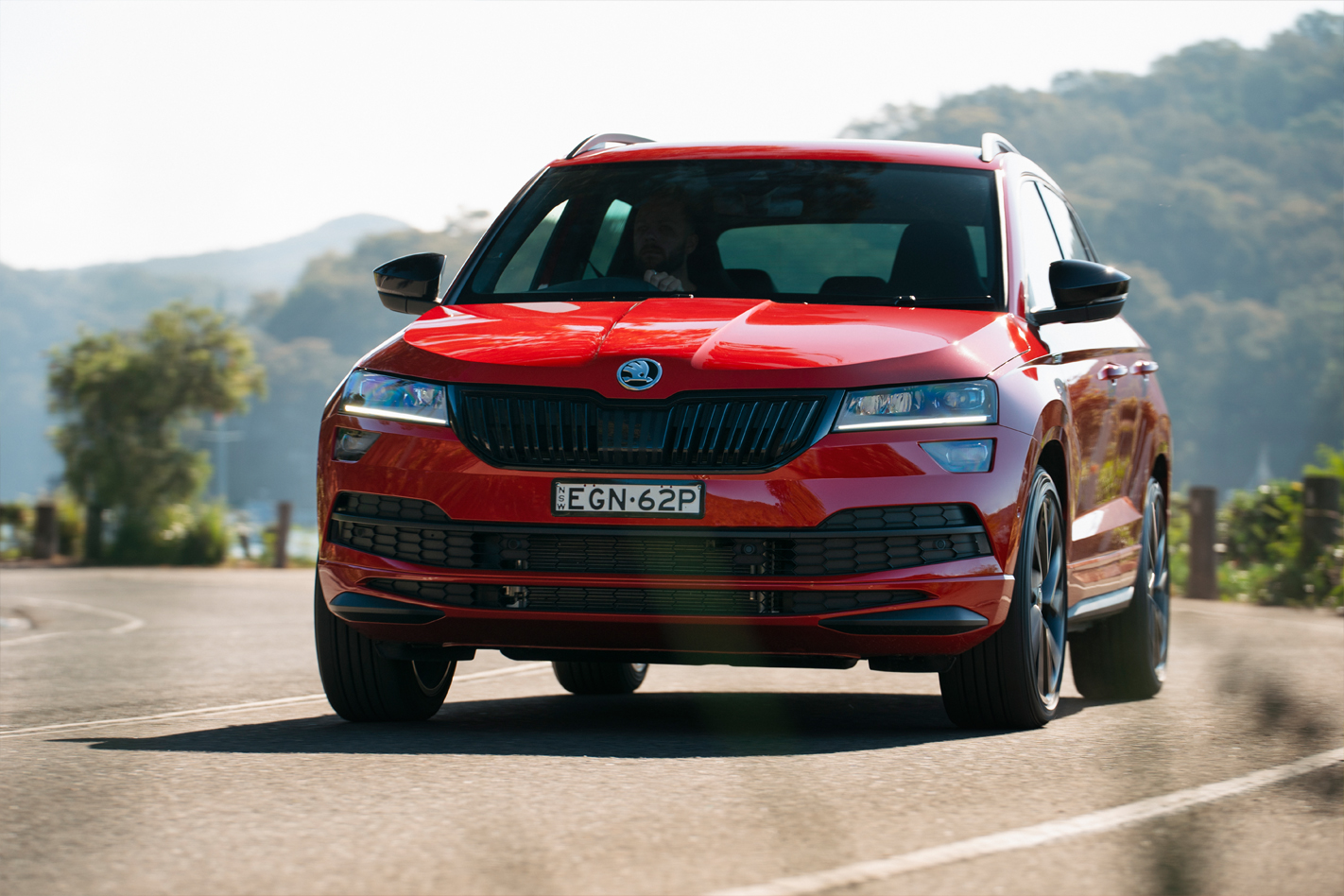
Ironically, its DCT automatic transmission with seven speeds didn’t have quite the urgency off the mark either. To an extent, the Sportline redeems itself on the open road where it can stretch its legs and demonstrate the 320Nm it has to offer.
Its more dynamically leaning chassis is a treat through corners and has enormous grip in combination with the handsome 19-inch alloy wheels. Flick its driving mode to Sport and the added steering weight enhances the experience, while ride hardens noticeably – for the better.
You also get more noise though its Sound Generator which sounds like someone has placed a microphone directly in the four-cylinder engine’s induction system, which is effectively what the system does. The piped-in engine noise is rich and authentic.
In other Volkswagen Group vehicles, the EA888 engine is capable of making up to 228kW, which is perhaps why the 140TSI (140kW) version feels a little detuned, but tantalisingly, this leaves room in the Karoq line-up for a flagship RS version, which is a very exciting proposition if confirmed.
What is the Skoda Karoq like to live with?
110TSI
In the case of the 110TSI, the Karoq is nothing short of a delight to have parked on the driveway. Its engine and transmission is always eager to impress regardless of how you chose to drive it, but its practicality proposition is just as compelling.
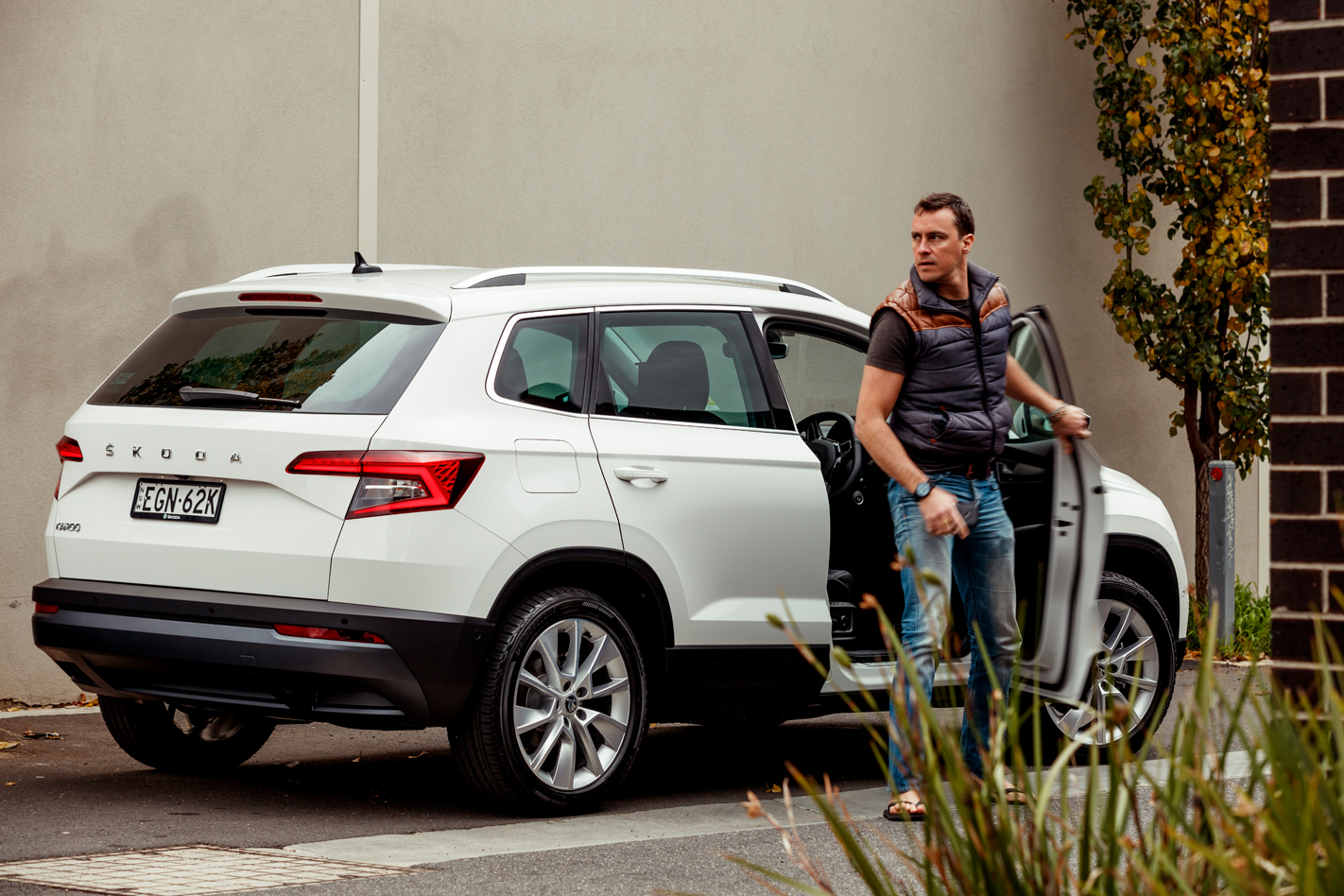
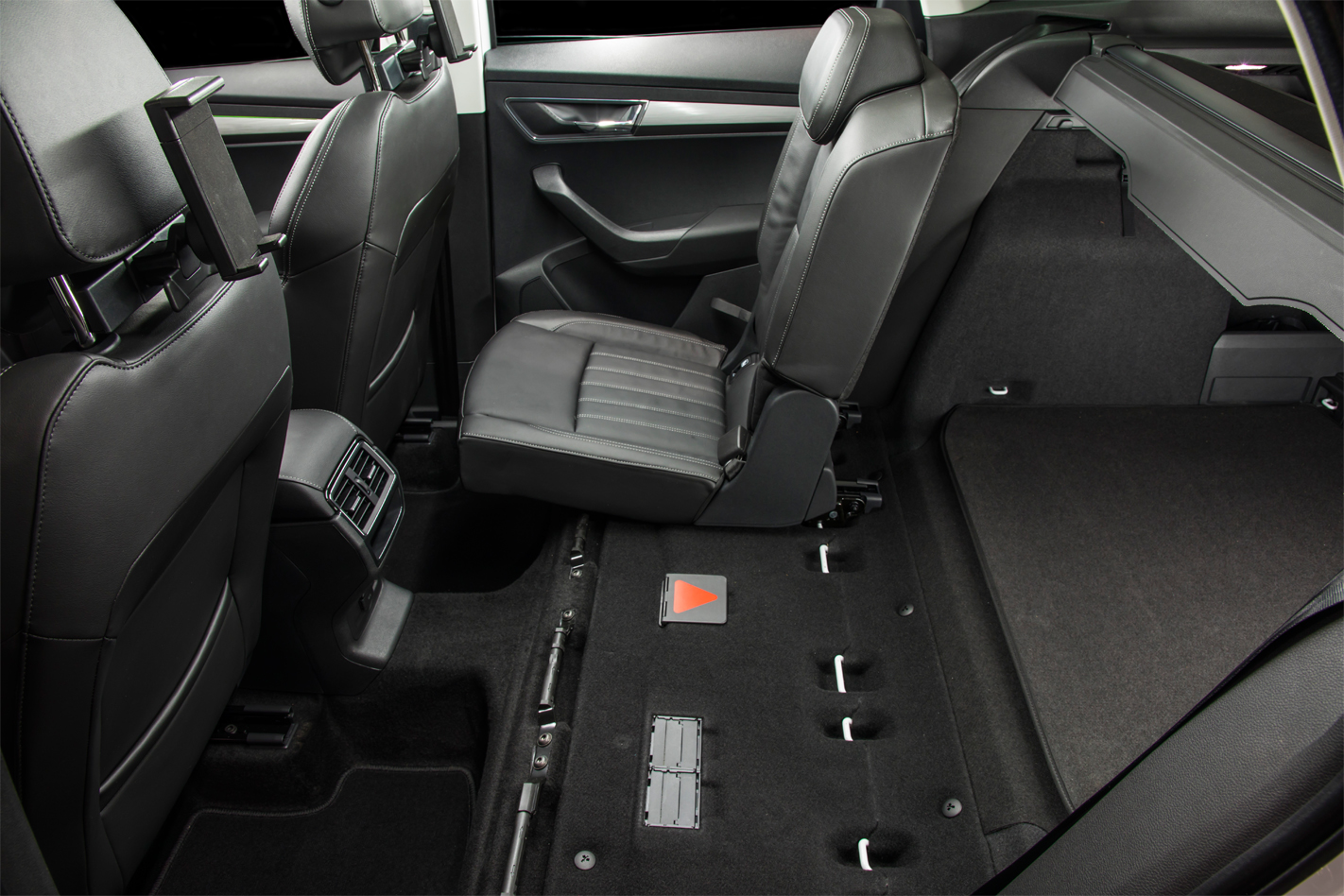
The cabin is generous no matter which part you look at. In the front row, occupants are treated to tons of headroom with a generous view of the surroundings, its the same story in the second row albeit a little narrower – three abreast would be cosy but doable, and it continues to the back where you’ll find one of the most flexible load areas since Honda’s magic seats.
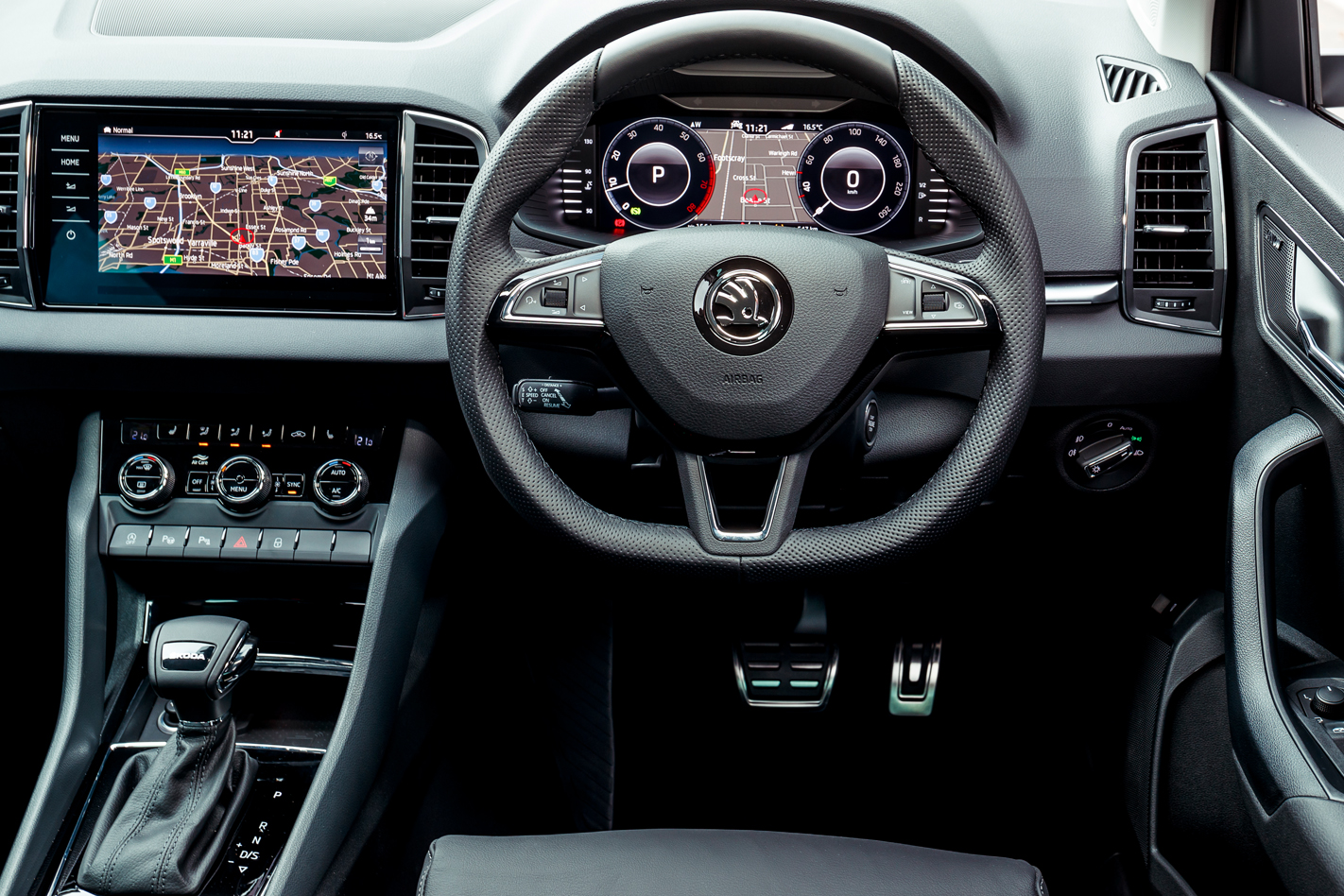
Then there are the technological enhancements for the 2020 version which are exemplified by vast digital displays. Not only can the beautifully sharp central screen be enlarged optionally to 9.2-inches, the fully digital instrument cluster complements it as another surprising standard feature.
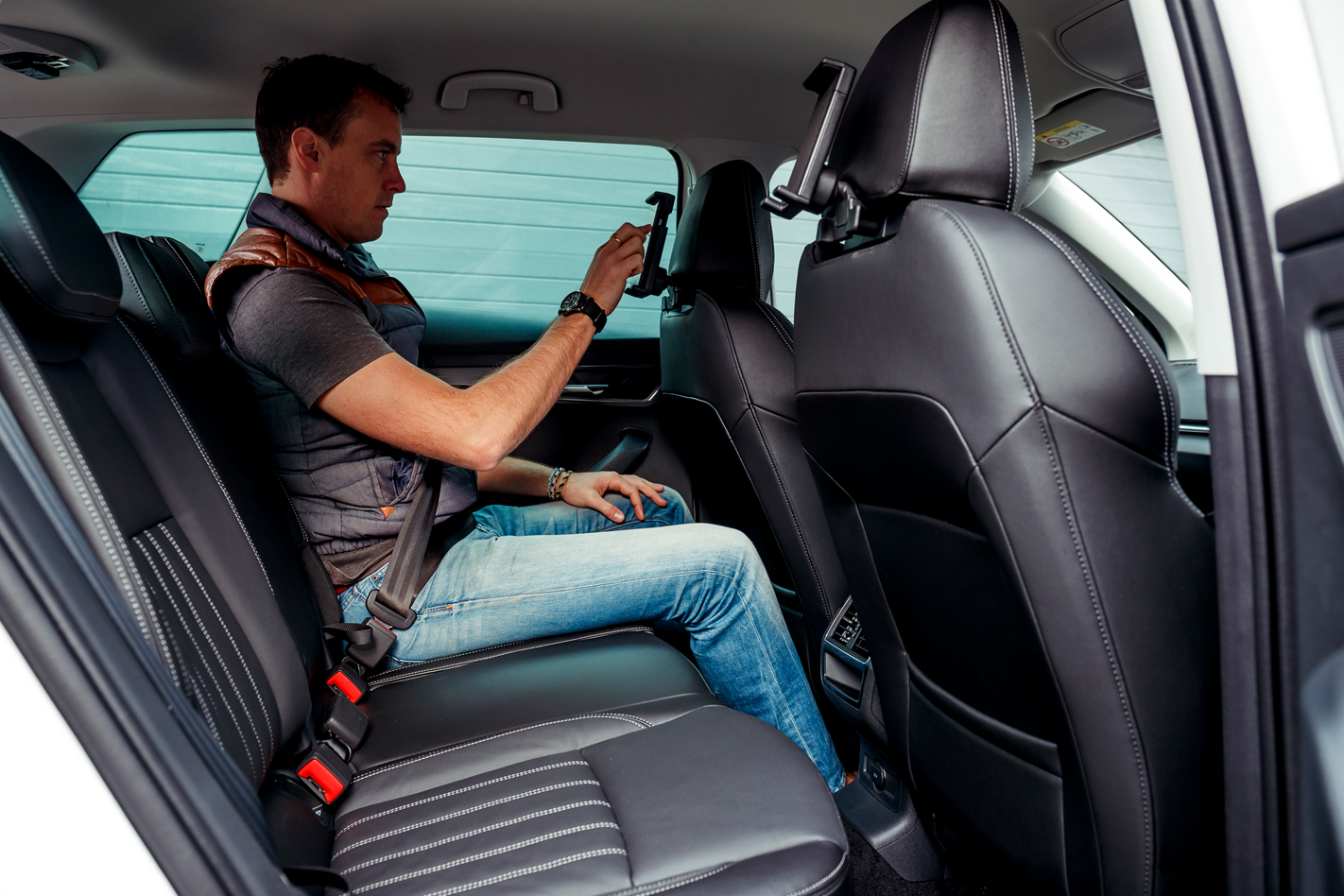
Through normal use, the Karoq is constantly revealing brilliant but simple practicality features that we can’t believe haven’t been done already. A removable boot light that doubles as rechargeable torch, umbrella hidden under the passenger seat, smartphone/tablet holders for rear occupants, clever and smart storage cubbies everywhere all combine for to make the Karoq feel like you know something everyone else doesn’t.
Add to that, other previously high-end-only features including LED headlights, power tailgate with hands-free operation (requires a foot though), navigation, ambient lighting, keyless entry and start, and you’ll be checking the price in disbelief as often as we were consulting the user manual.
140TSI Sportline
The 140TSI however, demands more in the way of sacrifice to live with its performance-focused advantages.
For a start, there’s the sports seats that are included as standard. When the road gets twisty, the beautiful fabric-upholstered front seats provide excellent side support with deep bolsters that add to the look and sporty cabin. Unfortunately a lack of tilt adjust made it difficult to find exactly the right driving position, while the absence of headrest adjustment and lumbar support became uncomfortable during a longer cruise.
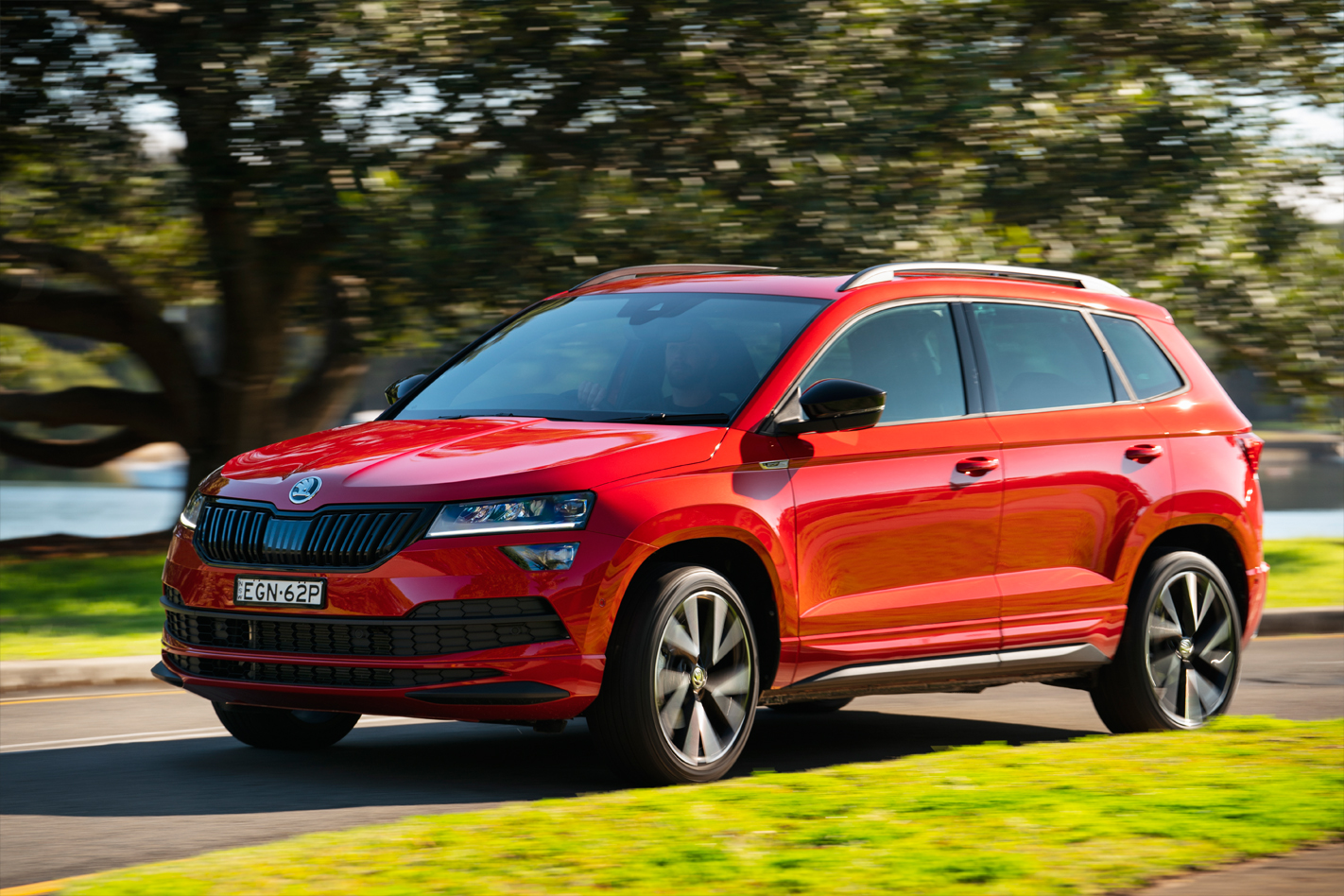
Fixed and partially-fixed sports seats are often as subjective as each driver’s preference and body dimensions differ greatly, so it’s definitely a case of try (and pay particular attention to) before you buy.
With large alloy wheels on both variants, there was surprisingly little road noise or wind noise from either but the shell had a tendency to ‘boom’ over rough surfaces much like a van, which disappointingly detracts from the otherwise excellent build quality and finish.
While the 110TSI has the clever VarioFlex seats, the 140TSI’s Sportline seats do not pull the same trick – another style-over-practicality sacrifice. The boot still accommodated a decent load of gym equipment despite lacking the maximum volume.
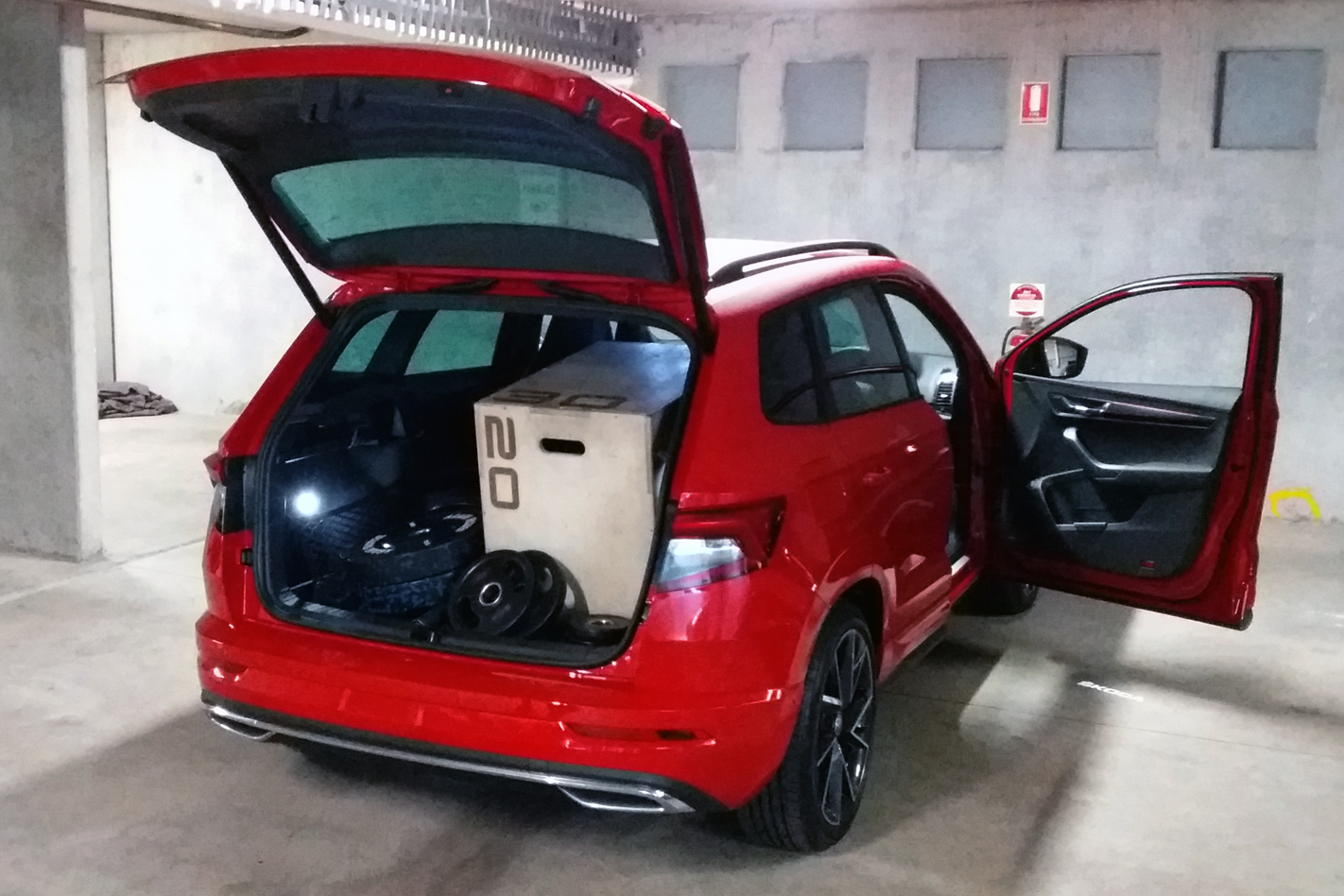
But there is still lots to like. For example, the standard active lane-departure system is one of the most effective but least intrusive. Instead of a patronising tug at the wheel, the Karoq subtly and almost imperceptibly keeps the vehicle in lane and we didn’t once reach for the ‘off’ button as so many other models have prompted us to do before.
You also get all-wheel drive which we didn’t test off-road although Skoda says the system imparts genuine all-terrain ability, while the steering-wheel paddle gear shifters make more sense matched to its dual-clutch gearbox. We definitely got stuck into these in the 140TSI.
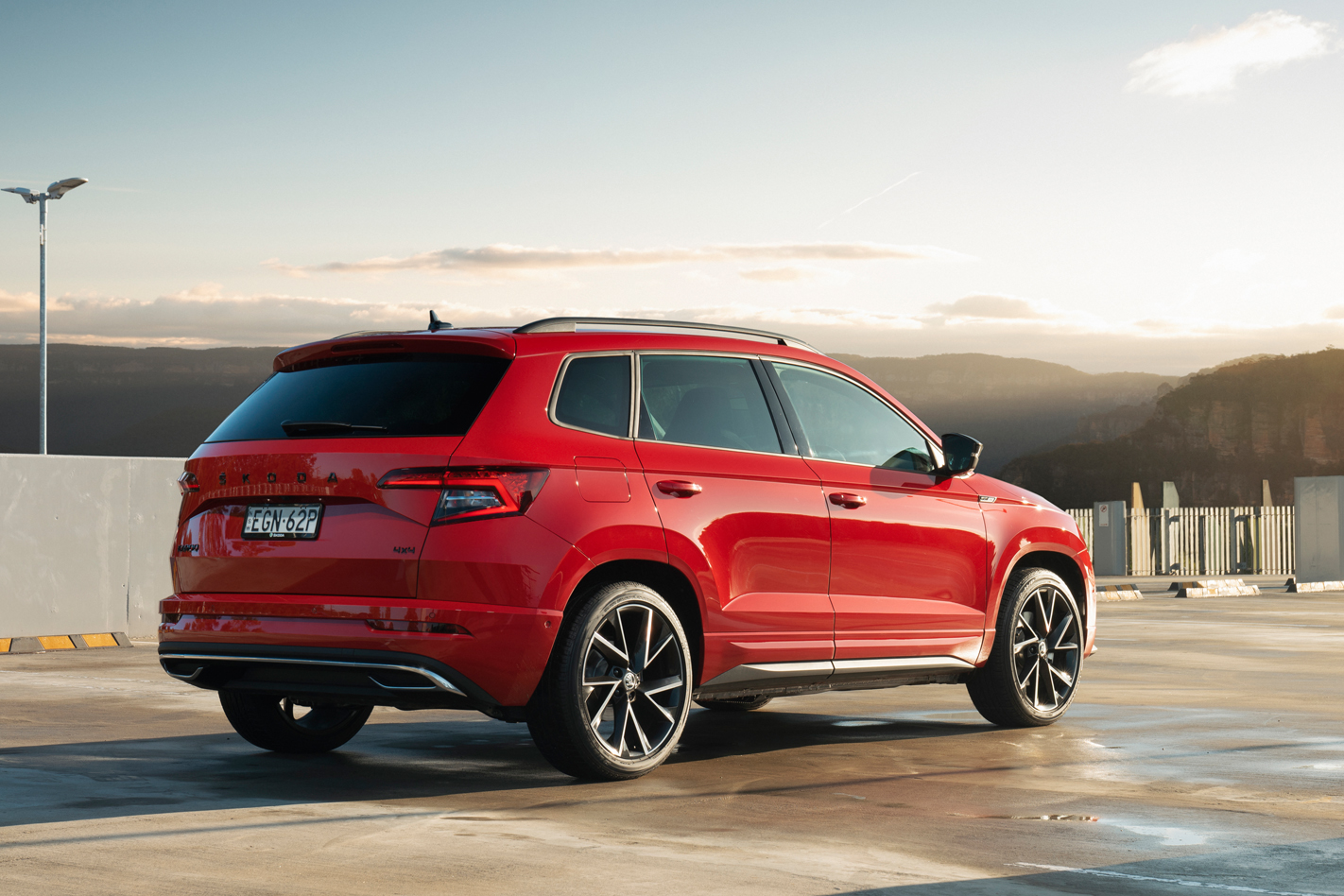
And the 140TSI’s party piece is absolutely the way it looks. Like the equally handsome, Kodiaq Sportline, you’ll be proud to park the Karoq flagship anywhere and walk away looking at it over your shoulder.
Is the Skoda Karoq worth the money?
110TSI
Priced from $29,990, the new entry point for the Karoq range appears to be competitive for the brand and this segment. There aren’t many other European mid-sized SUVs that fit a sub-$30k budget.
But the generous standard kit list and an engine and transmission combination that clicks so perfectly elevates the Karoq 110TSI to an even more irresistible level. Frankly, it’s a bargain.
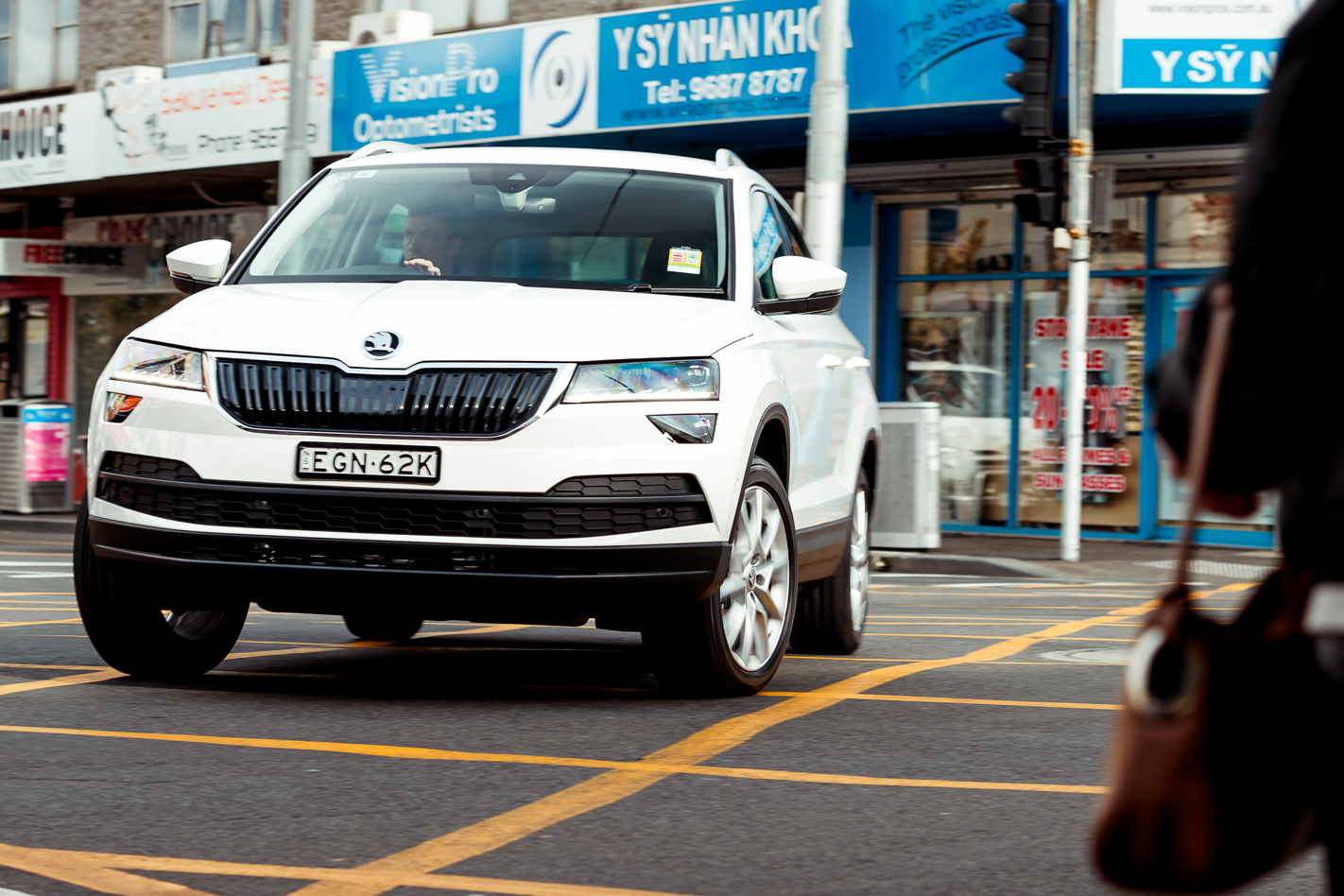
It’s harder to make the figures balance when it comes to the 140TSI Sportline although we doubt too many Australians will have the same problem in our typically premium look and feel-favouring market.
The step up of about $7000 on paper at least seems fair for a corresponding boost to performance and specification, but in practice, the entry level 110TSI is so strong in its performance and standard equipment, the gap between them in reality feels narrower.
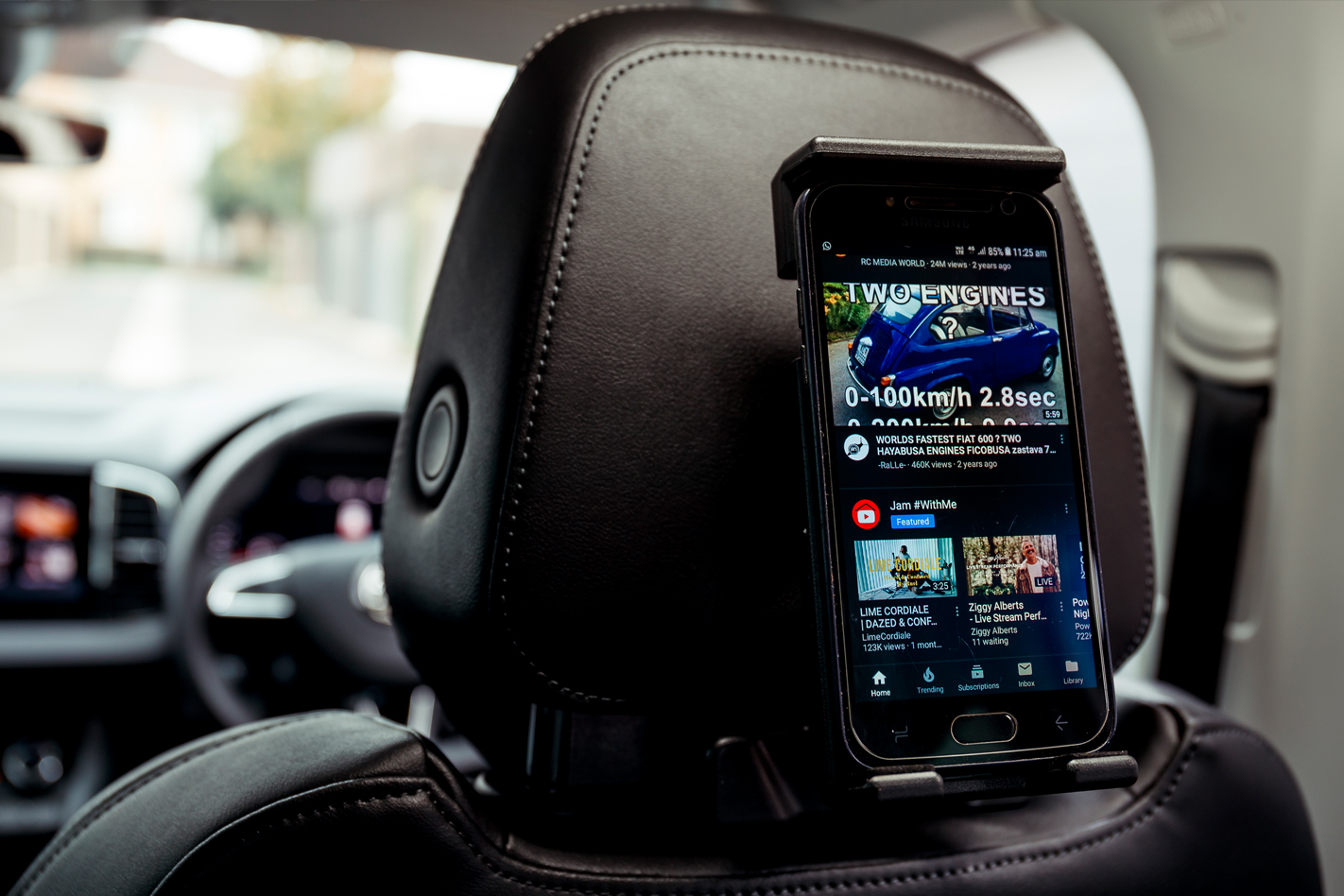
Both however, are cheap to run with fuel economy figures coming in from our test drives remarkably close to the claimed efficiency of 6.6 litres per 100km for the 110TSI and 6.9L/100km for the Sportline.
Skoda’s Karoq siblings still have very different personalities and unique target audiences, but the smart money is definitely on the 110TSI if you can ever look at a handsome Sportline and not lust after its looks.
SUMMARY
With a 2020 relaunch, the Karoq range has never been more attractive from both a value and styling perspective, but it might have been more effective in drawing a greater number of curious customers to this latest, most alluring double tap in its first outing.
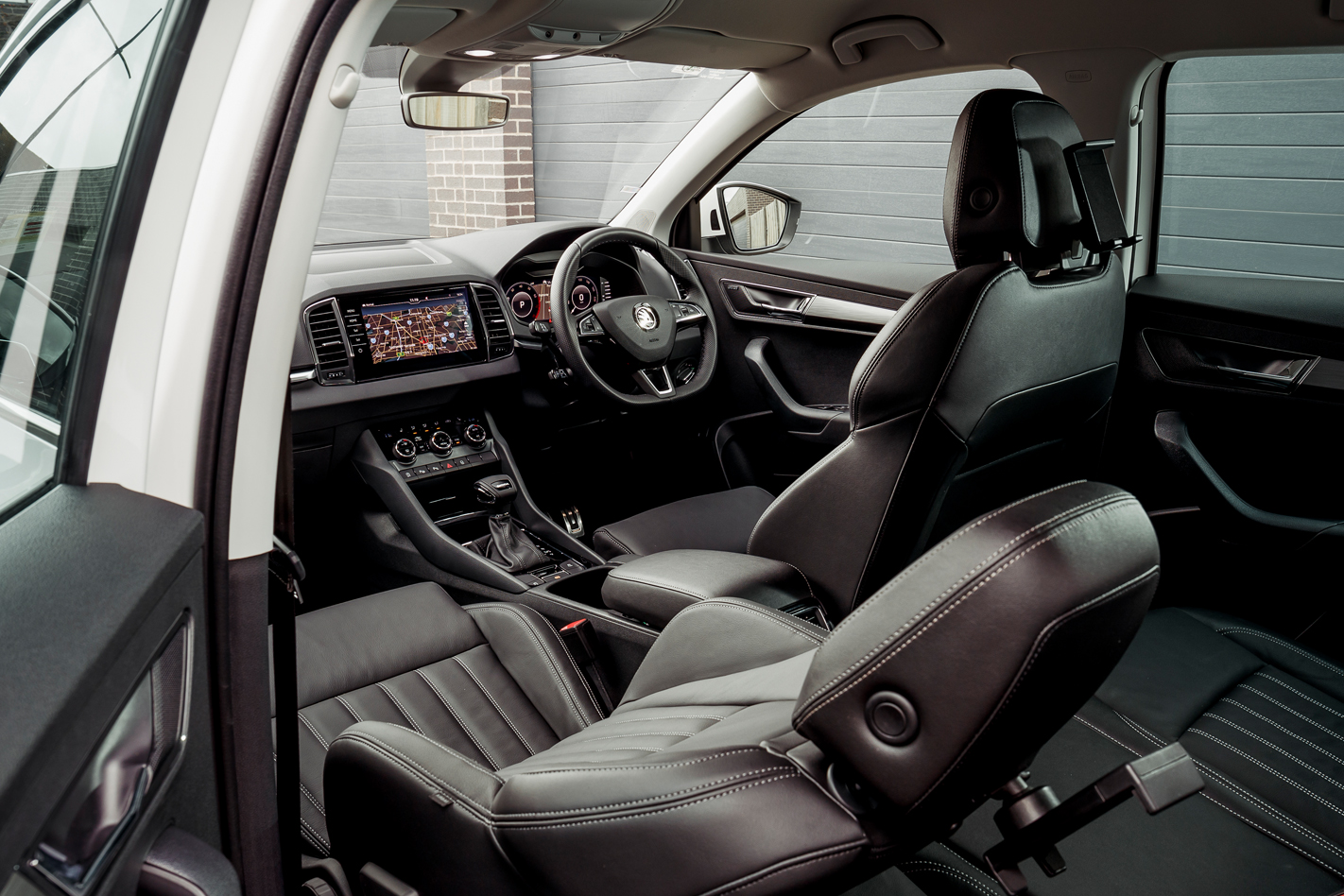
Nonetheless, with an even stronger mid-sized Karoq offering now available in Australia, Skoda’s line up is building momentum and attention by the day. And when its baby Kamiq SUV arrives there will be even fewer reasons to stroll past the Skoda showroom and into a Volkswagen (or Kia, Hyundai, Honda, Mitsubishi) dealership.
It should come as no surprise just how important correct tyre pressures are. Not only will a vehicle rolling on well-maintained tyres turn, stop and accelerate safely and more comfortably, it will also return the optimum fuel economy, so it should be top of the list of weekly jobs you can take care of yourself.
Wrong pressure
With insufficient air pressure inside the tyre, the sidewall will deform and flex more than it is designed to, which increases rolling resistance and temperature. With too much air in the tyre, the tread can balloon out, reducing its contact with the road, which can reduce grip and impact the tyre’s wear.
Riding around with under inflated tyres will increase fuel consumption and besides the safety implications, won’t feel as enjoyable as your car can at its best, but some motorists find the range of inflators found on service station forecourts confusing.
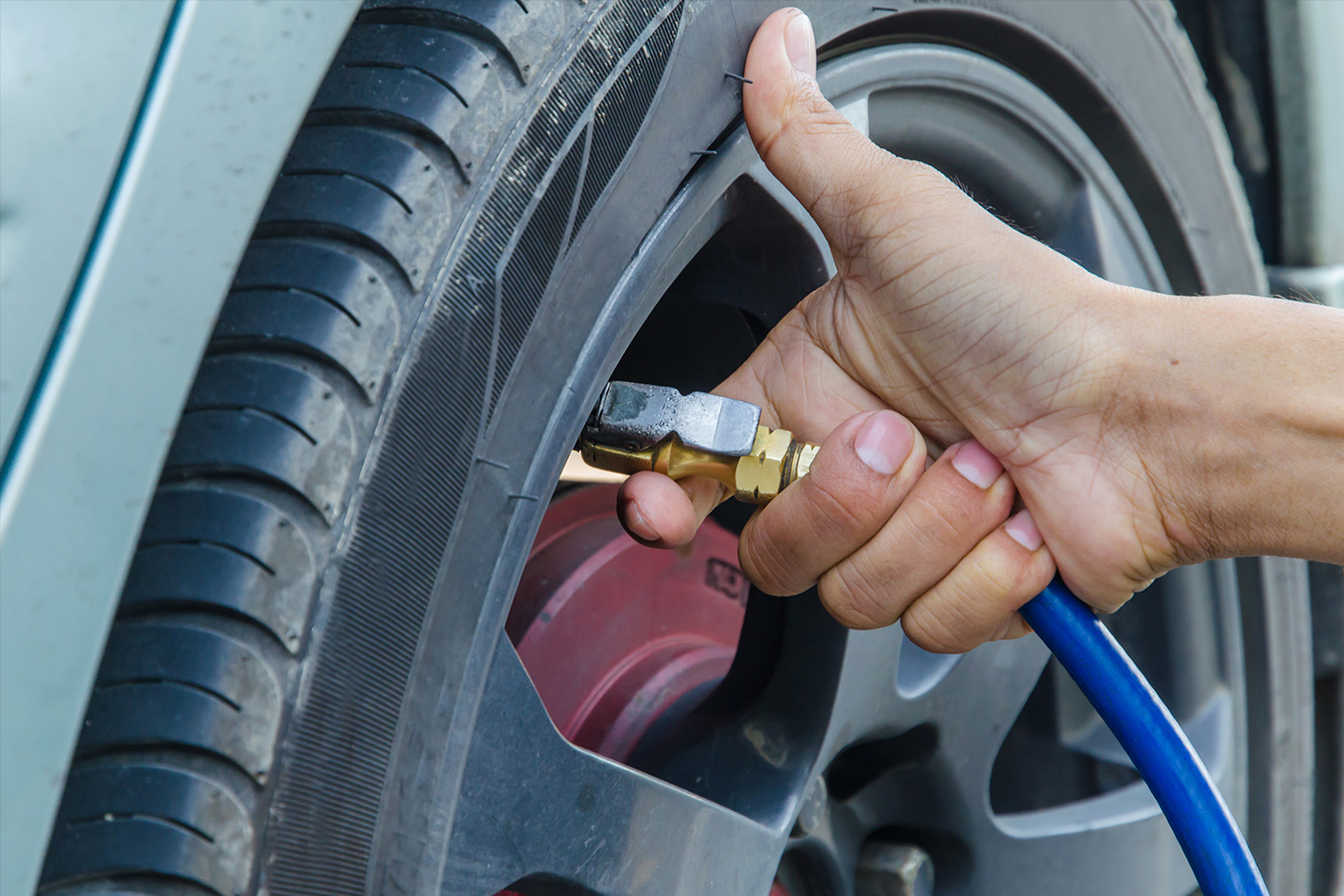
The good news is that checking and ensuring the correct tyre pressure is a simple job, made easier by automatic systems that only require you to pre-set the pressure and connect the hose.
What should my tyre pressure be?
The inflation pressure of tyres varies significantly depending on the size and weight of the car, as well as the type of tyre fitted to the wheel so there’s no one pressure that fits all.
Small lightweight cars with relatively tall profile tyres such as Fiat’s 500 compact hatchback require about 32psi or 2.2bar for normal operation. With larger, lower-profile wheels and tyres and higher performance demands, Audi’s S3 hot hatch needs about 42psi.
A 4WD tyre inflation pressure is generally high due to the weight of the vehicle and the heavy loads it can carry, although these tyre pressures can also be reduced significantly when extra traction is required at low speeds on loose surfaces. Anywhere from 40psi down to 11psi when tackling something like soft sand.
For context though, a heavy goods truck can have tyre pressures as high as 120psi, while the largest airliners have about 200psi in their highly specialised tyres.
Read the correct pressure from your tyre placard, which can be found inside the door jamb, behind the fuel filler cap or in the owner’s manual. There is often a table with a few possibilities, which allows you to select the correct pressure even if you are carrying a full load of passengers with luggage, and for each tyre size fitted as standard. Check the sidewall of the tyre and match it to the information on the placard to find the pressure you need.
The pressure will be stated either in bar or PSI which you will need to select on the inflator with the simple press of a button. With a few more prods of the up or down buttons you can set the required figure.
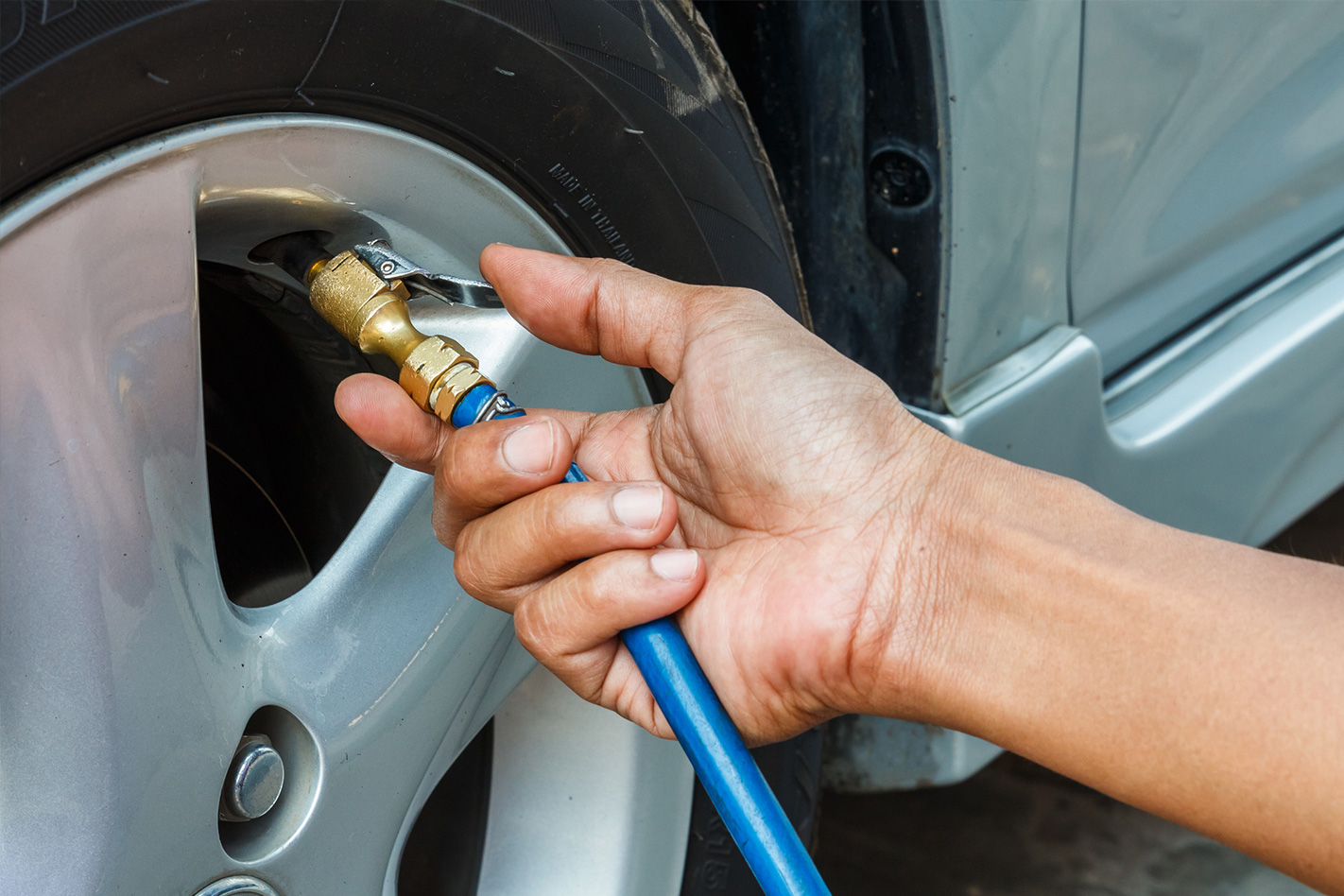
Then remove the dust caps and attach the air hose by squeezing the tab and releasing once the fitting is pressed onto the tyre valve. You won’t need to hold the hose in place as long as the locking tab is working correctly.
Watch next: How to change a tyre
You don’t need to watch the display but it is a good idea to observe the pressure before correction to see if your tyres are holding air with a good seal. If one particular tyre is dropping more pressure than the others it may indicate it has a slow leak or puncture.
When the machine beeps, it has set the pressure. Replace the dust caps to finger tight and you are good to go. Some early tyre pressure monitoring systems require a reset before moving off. You can find out how to do this in the user manual.
If the service station has a more traditional inflator with gauge the process is only a little more complicated.
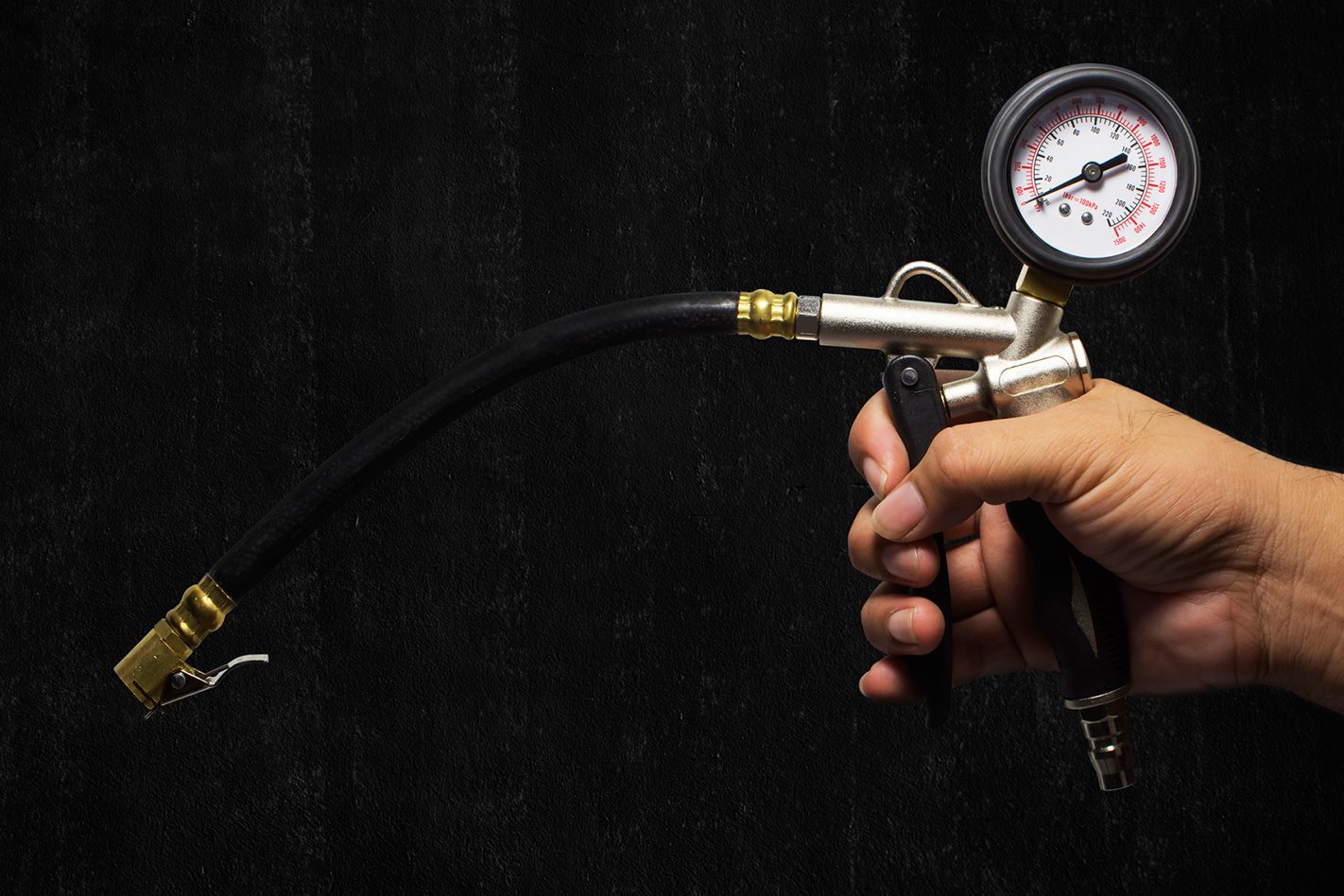
Simply attach the hose in the same way you would the fully automatic version and watch the sliding bar or rotating needle gauge. The inflator can add air to the tyre by squeezing the trigger all the way but can also allow air back out again by partly depressing it, if you have accidentally over inflated. Others have a small separate button for releasing excess pressure.
Remember that a manual inflator will only give you an accurate reading after adding air so if you have to remove a little pressure, be sure to give the trigger a quick full press before reading again.
An accurate reading is also only possible if the inflator is in good condition. If you suspect the equipment is not up to scratch it’s a good idea to have your own pressure gauge that can be stored in the glove box out of harm’s way and can be used to give one final check once you think you are done.
Tyre pressure should be checked each week, which might sound a little too regularly, but slow punctures won’t be detected until it’s too late if you leave it too long between inspections.
Always try to check the pressures when the tyre is cold as a long journey or hard driving will increase the temperature and cause pressure increases. The same will happen in hot weather or if the tyre has been in direct sunlight.
When you are up close and personal with your tyres, you can also use it as an opportunity to check the general condition. Any perishing rubber, splits, bulges or other damage should be inspected by a good mechanic or tyre shop. If the tread is worn out, it’s time to replace them.
If there are signs of uneven wear the cause should be investigated, incorrect pressures might be to blame or you may need a wheel alignment among other possibilities.
