
I remember the time I drove an F10 BMW M5 in the wet. This was a car that somehow felt offended to have you driving it and did everything it could, mostly by way of its power delivery, to scare you from ever sitting in the driver’s seat ever again.
In 30 Jahre spec, the two rear-driven wheels struggled to transmit the full 441kW to the tarmac and in damp conditions, in the reduced-DSC MDM Mode, would burst into wheelspin in all the wrong gears at all the wrong times. You were just as likely to get out of the car looking pale, as you were grinning.
So for this road-tester, it was with curiosity to be climbing into the newly all-wheel drive F90 BMW M5 for the first time, for MOTOR’s first drive on Aussie soil.
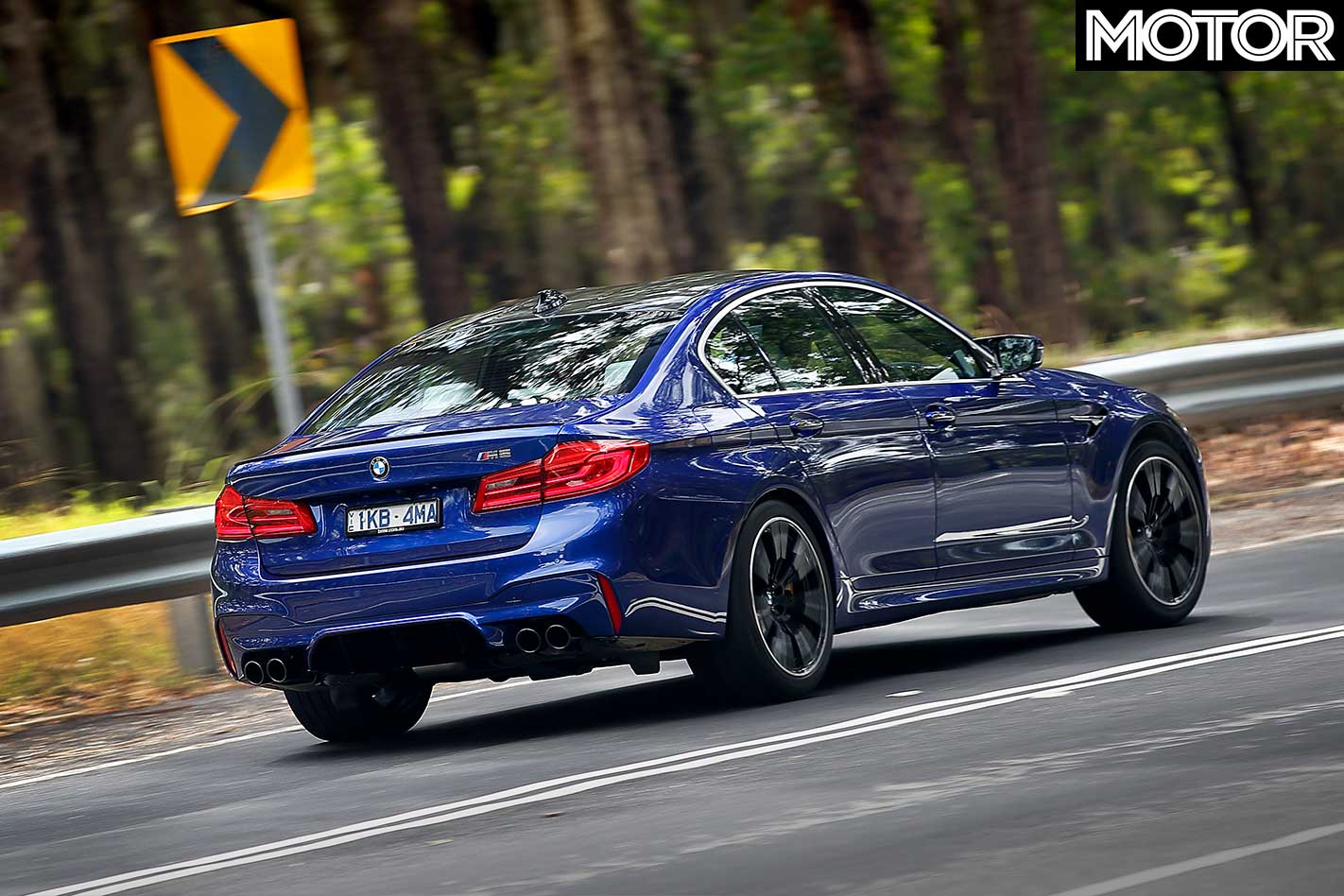
By way of refresher, this is a brand-new car on a new, seventh-generation 5 Series platform. Thanks to increased use of aluminium in its construction, M Division has been able to offset the weight increase of the new all-wheel drive system. Actually, it’s been able to reduce weight entirely, for an overall saving of 15kg compared to the outgoing F10, 1855kg versus 1870kg.
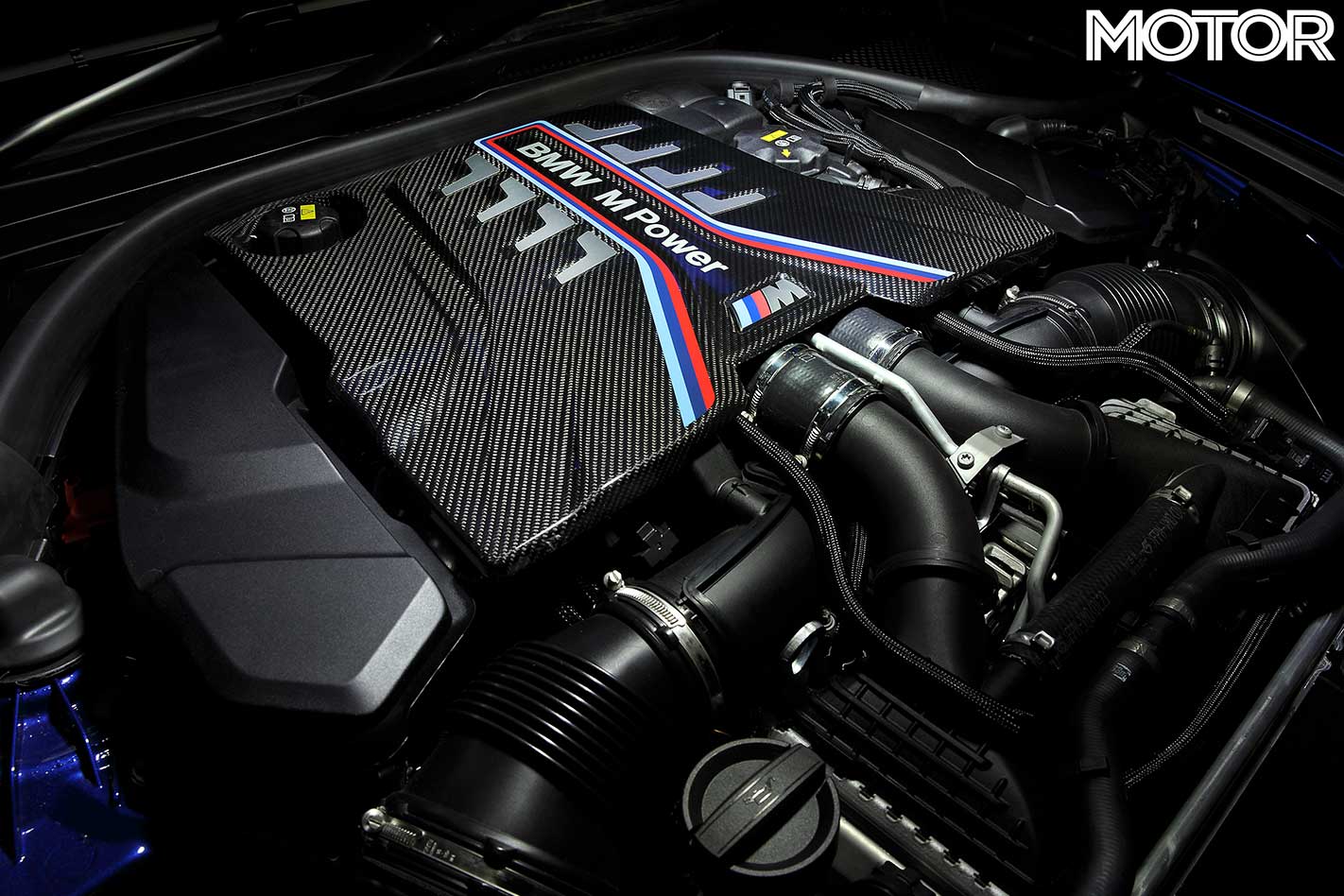
Engine-wise, the F90 M5 uses an evolution of the S63 V8 from the previous car. DCT is out – a new eight-speed torque converter auto is in. You’re looking at 0-100km/h in 3.4 launch-control-assisted seconds.
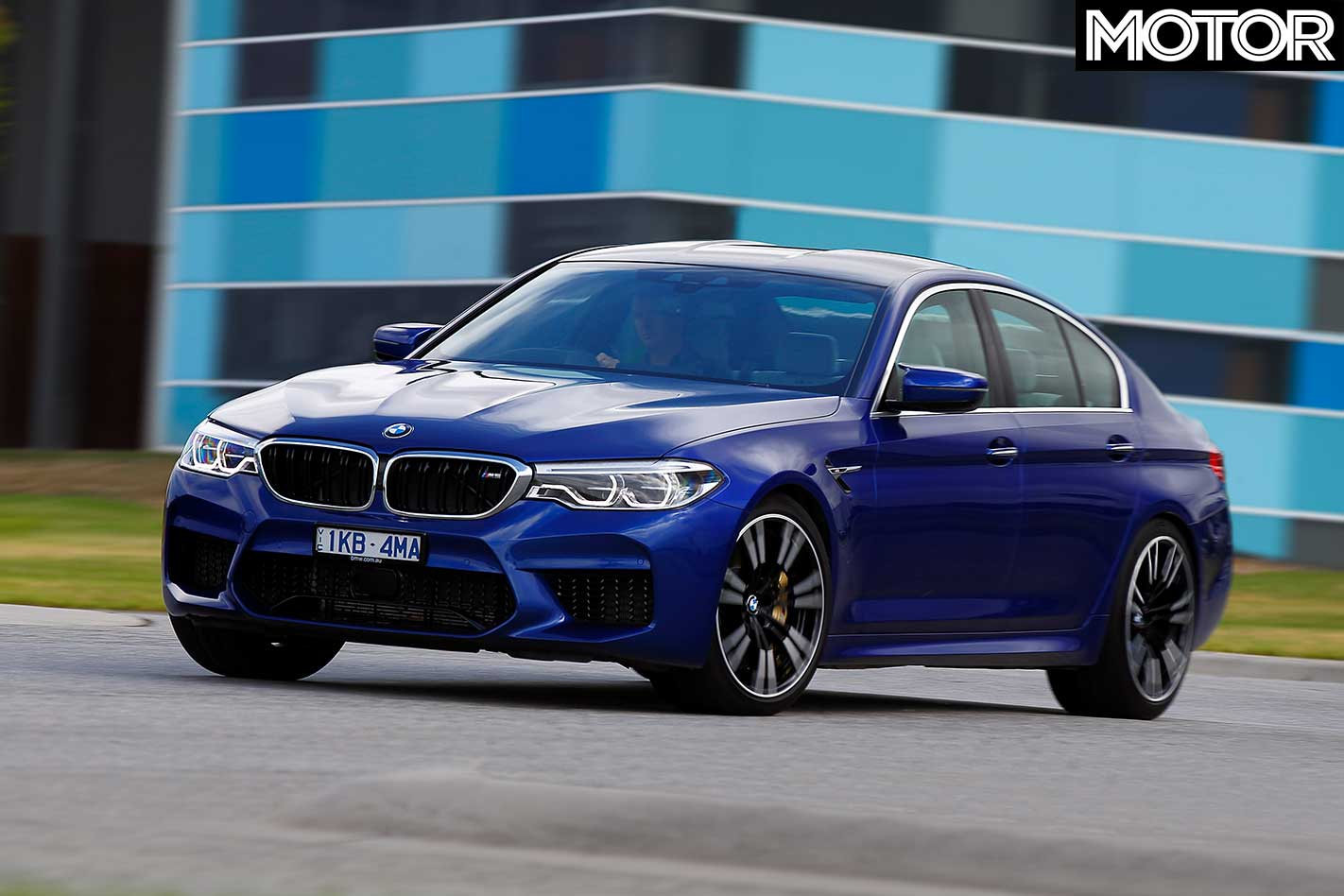
While it’s all-wheel drive, a “two-wheel drive” mode is available, turning the new M5 back into a rear-drive sedan again. And perhaps never in the history of performance cars has such an almighty machine looked so unassuming – or so many things to so many people.
Us? The new M5 is a navy blue powersuit to the Mercedes-AMG E63 S’s leather jacket.
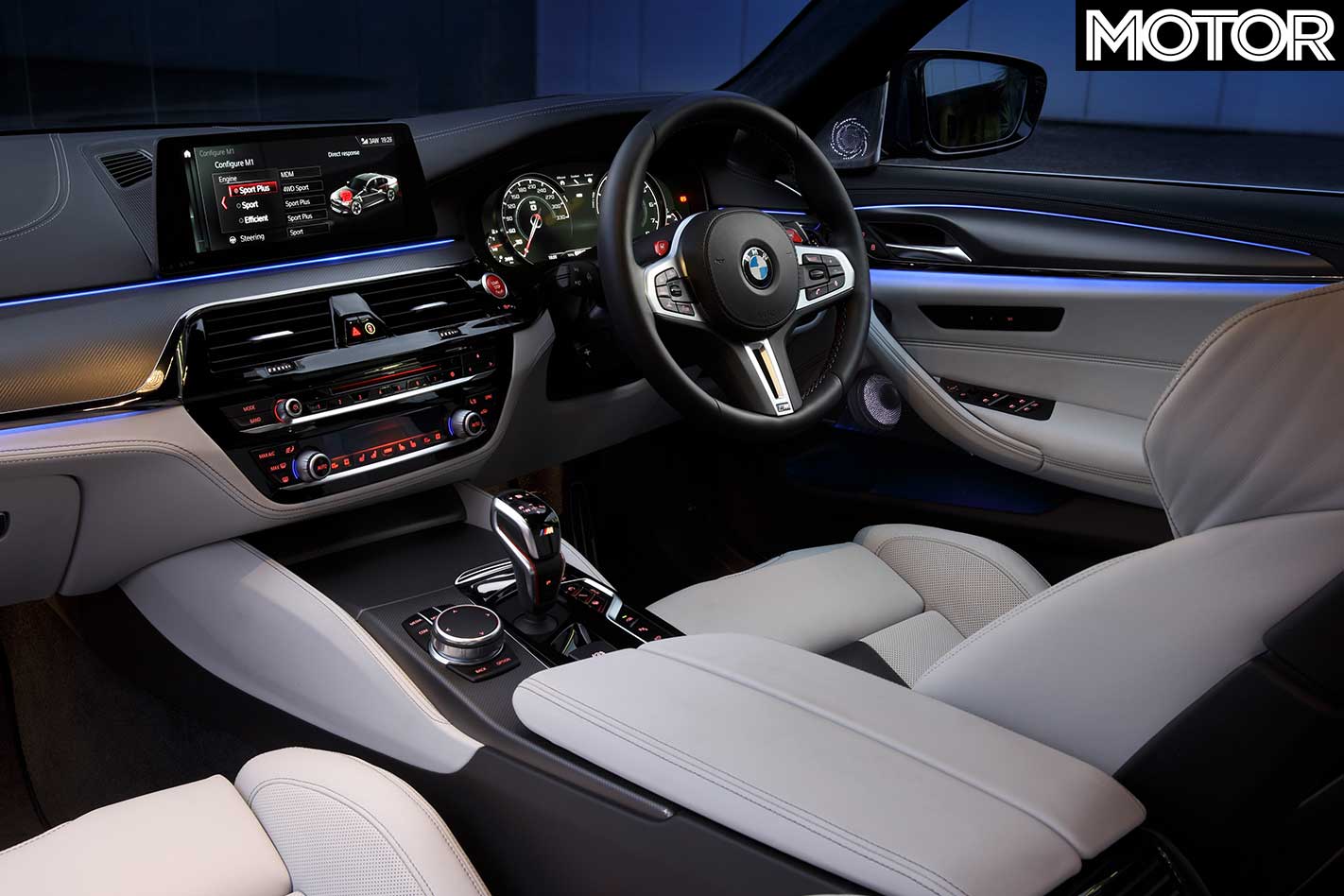
Sitting in the pit lane at Sandown for the Australian launch, the interior, too, channels similar levels of modesty. It’s a classy, luxurious place to sit, beautiful soft leathers in abundance, with piano blacks and TFT screens, with only a few small M badges scattered about.
The power is so breathtaking that you have to carefully plan all excursions into full-throttle territory. It is an eye-wateringly fast machine with a new explosive ability in first and second gears. Beyond that, there are supercar levels of torque-rich turbocharged acceleration.
But hit a few corners, drive the new M5 up to about seven tenths and you might wonder what all the hype is about. Particularly as the V8 note is quite behaved – suiting the demure presentation of the car – but in contrast to something like the sinful, naughty V8 burble of an E63 S. It’s not until you push beyond seven or eight tenths that the M5 begins to really strut its stuff.
In Sport Plus, a satisfying snarl develops about its higher rpm. The M5 revels as you push it harder, revealing proper handling talent. Accurate steering guides an eager front end, with prodigious grunt, powerful traction off corners and – this is important – the suspension performance to match the mighty engine.
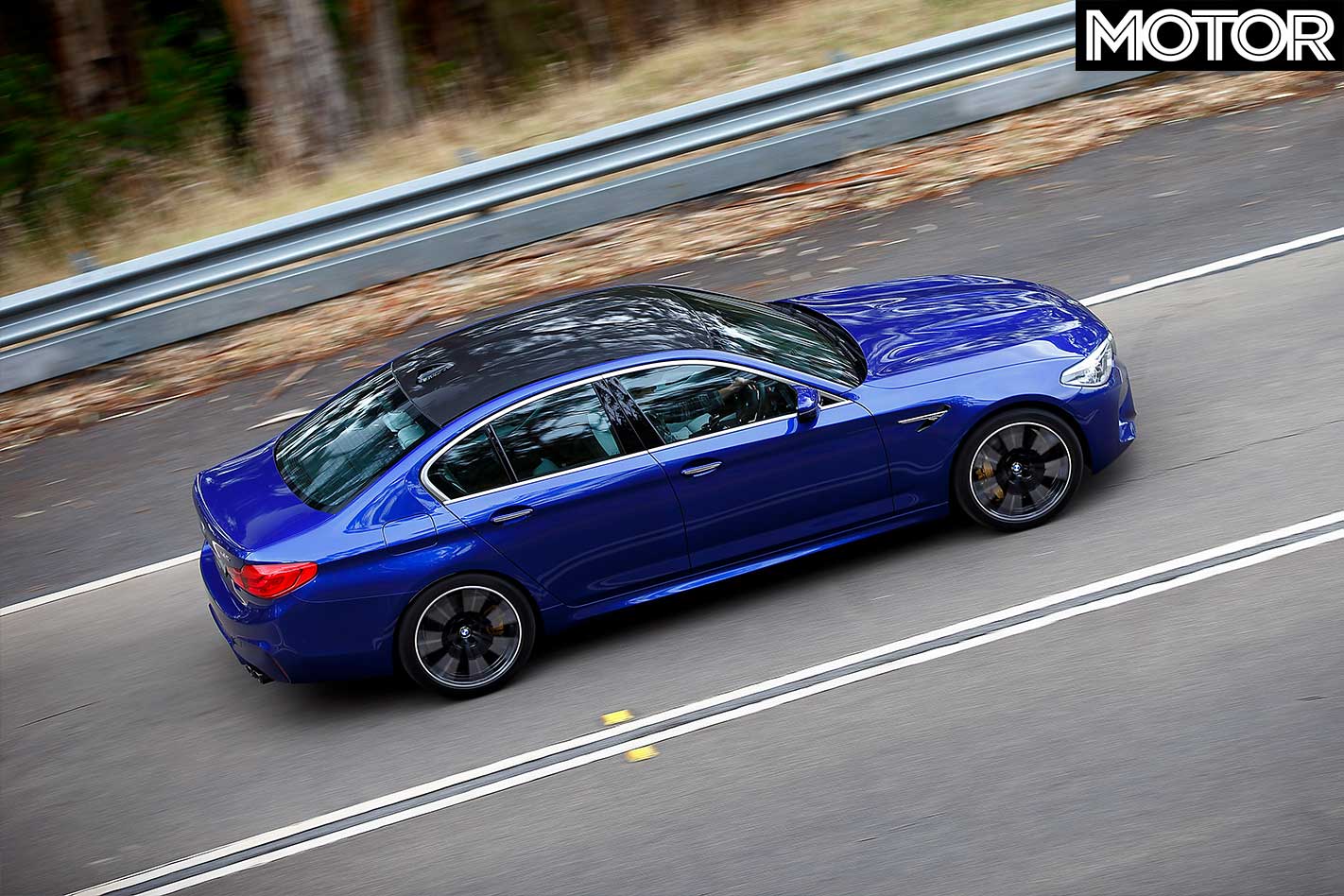
Is it fun? Absolutely – this is a satisfying car in which to attack a twisty road. It wants you to get stuck in. It’s agile; it forgets its size and weight. The all-wheel drive system and electronics, in the right modes, permit small, addictive, controlled powerslides from the apex to exit.
And although we drove the M5 on track at Sandown – where, humorously, we had to lift on the straights so as to not drill the back of Steven Richards in the pace car M4 GTS, and he was going as hard as he could – it was more fun on the road. It felt a bit soft, heavy and unhappy at Sandown, although in fairness we didn’t get much time to learn what it wanted.
On the topic of modes, there are lots and lots of them. Within the steering wheel spokes, left and right, red M1 and M2 tabs give you two custom combinations of all the settings. Programming them will be one of the most fun exercises you will ever have in your new F90.
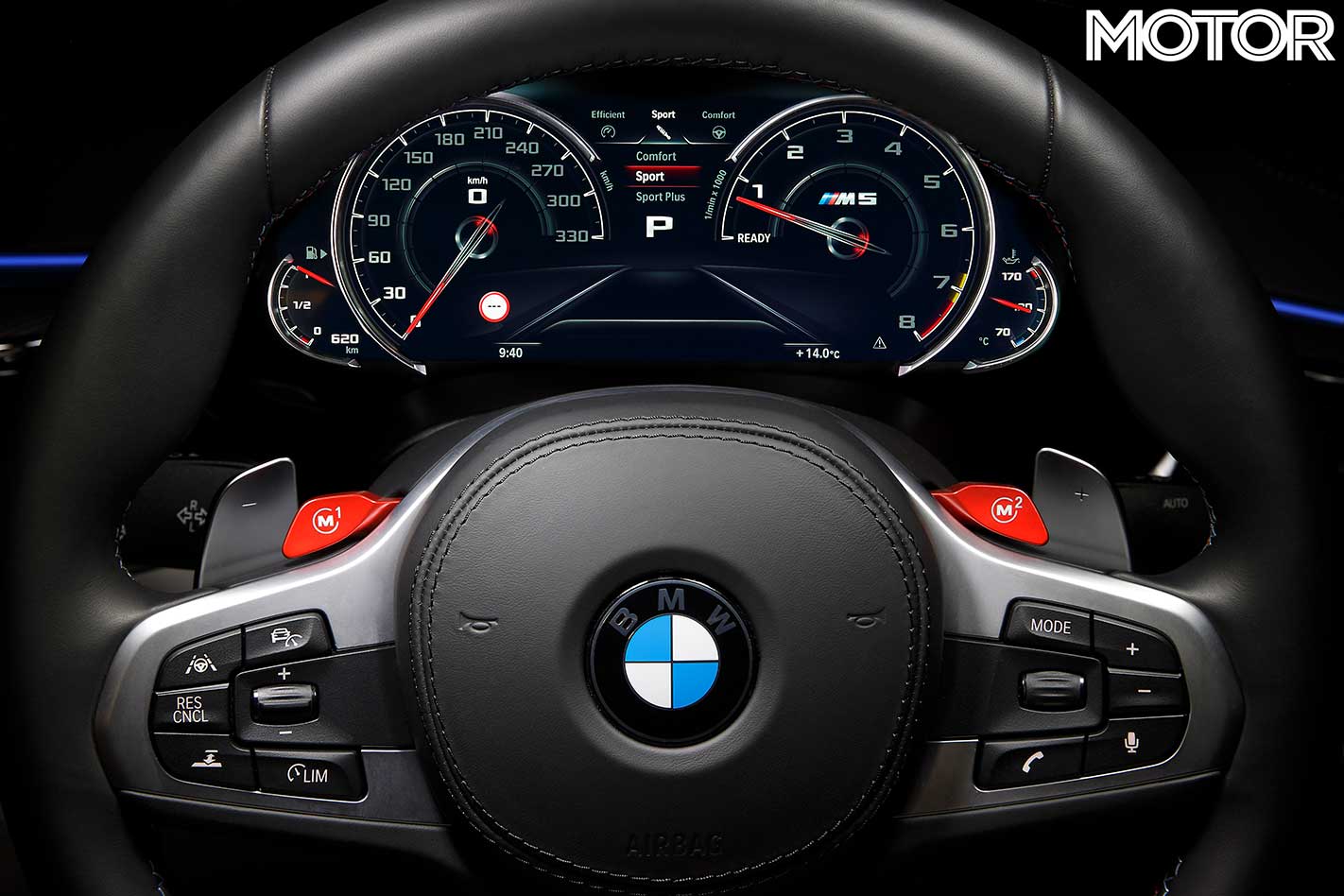
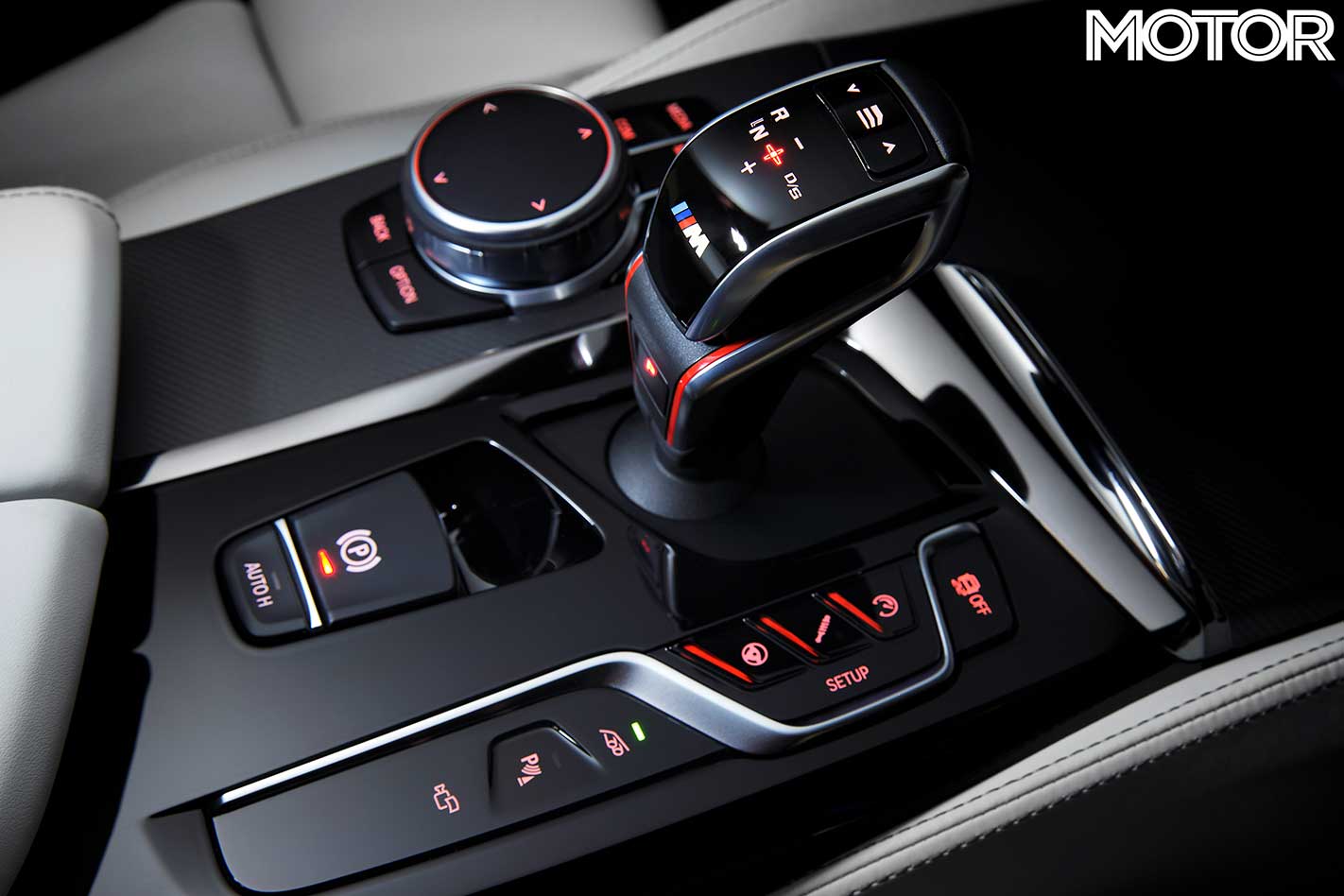
Then there are three settings each, mild to wild, for the engine, chassis (dampers) and steering, as well as another setting for shift speed and aggressiveness. Oh, and also two settings for the bi-modal exhaust. There is the potential to completely change the car depending on how you configure your modes.
We didn’t drive the M5 long enough to play with all of them, but for a blat, our experimenting would begin with MDM, 4WD Sport, Sport Plus engine, comfort dampers, Sport steering, open exhaust, manual mode and maximum shift aggro. Phew.
M Division has never been afraid to revisit its own DNA in the name of progress; the M5 has had six, eight and 10 cylinders at different points in its life, whatever has been most appropriate for its time. And for the M5, it was time to move on from rear-wheel drive.
Rating: 4.5 out of 5 stars Like: Supercar acceleration, handling talent, traction, luxurious interior, relative value Dislike: Executive styling not to everyone’s tastes, could sound better at lower rpm
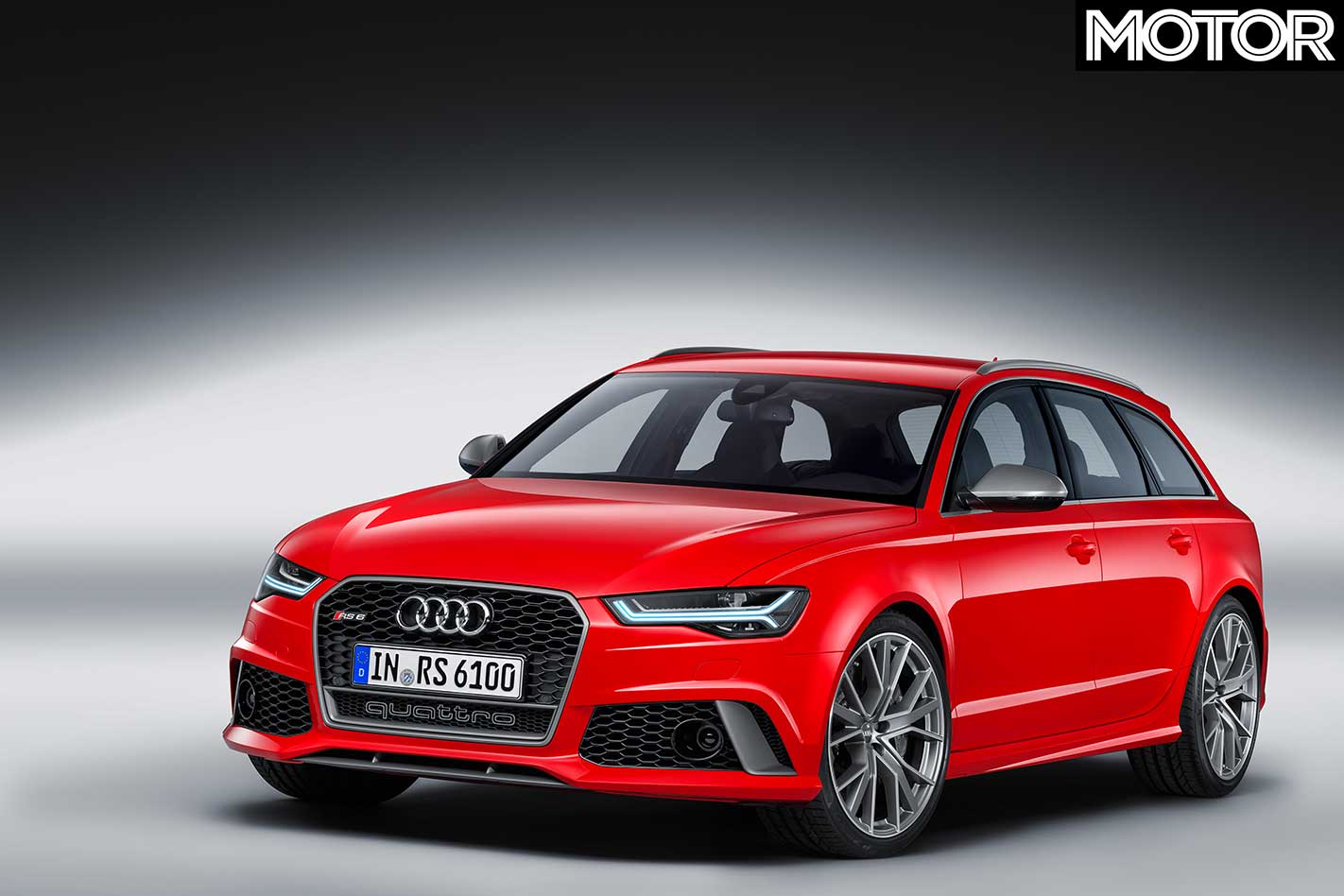
The Nemesis – Audi RS6 445kW/700Nm, 4.0-litre twin-turbo V8, all-wheel drive, 0-100km/h 3.7sec, $244,827
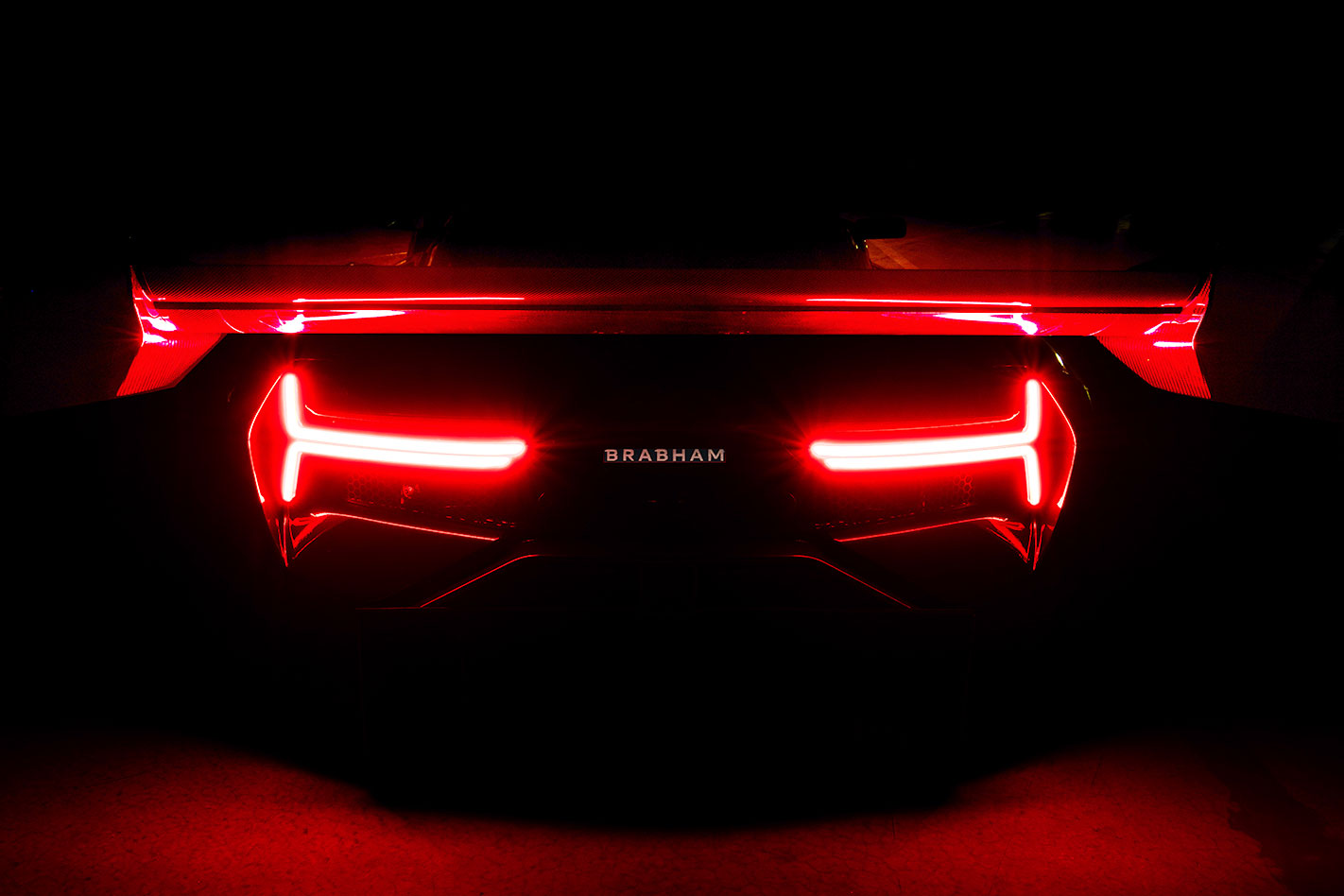
THE reborn Brabham BT62 will weigh just 972kg dry, produce 522kW from its naturally aspirated 5.4-litre V8 – and look like this as it disappears in front of you in the dark.
Brabham Automotive overnight teased more details of its potentially LMP1-inspired BT62 ahead of next month’s full reveal, announcing that the low-slung and wide supercar – we can tell that from the wide-set tail lights illuminating what appears to be a huge GT3-proportioned split rear wing and massively deep split rear diffusers that hint at a central exhaust – would make 730ps, or 537kW, per tonne from its Brabham-branded powerplant. Don’t forget, we’ve already heard what this engine will sound like …
“With its performance-optimised body and aggressive aerodynamic package, the Brabham BT62 delivers over 1200kg of downforce. Saving additional weight and with additive performance, the BT62’s brakes are carbon/carbon – a current Formula 1 technology that was first introduced to the sport by Brabham in 1976 – featuring six pistons front and rear.”
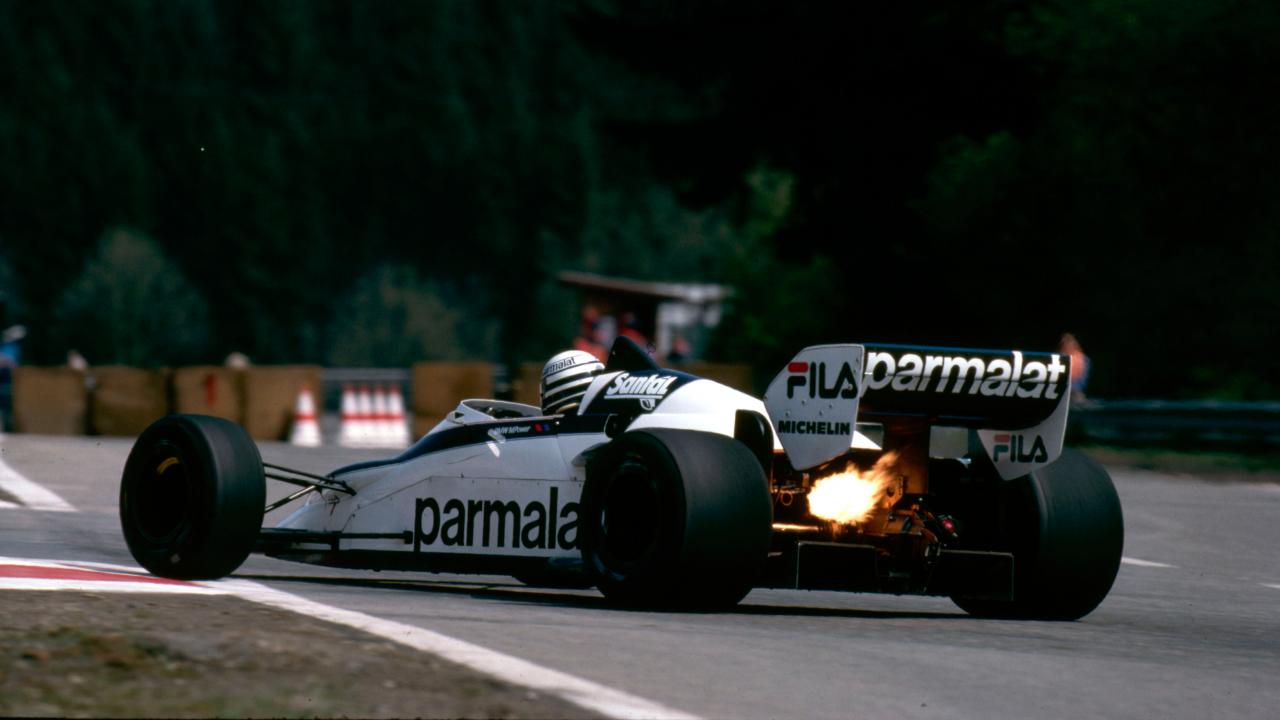
Overall, the Brabham BT62’s proportions remind us a but of the low and wide profile of the rear of the BT52, pictured below.
Brabham Automotive is a car-making company set up by Formula 1 racer and Le Mans winner David Brabham, who is the son of three-time Australian F1 world champion Sir Jack Brabham. David will reveal the BT62, surrounded by other historic Brabham-badged race cars, at a yet-to-be-announced location in London next month.
The images, and the sniff of serious performance, hint that the Brabham will be a direct competitor to the McLaren Senna, which only generates around 1000kg of downforce from its lairy, equally big-winged aerodynamic form. We can probably also make comparisons over cost; Senna will come with a $AUD1.3 million price tag, suggesting the Brabham’s sticker could bounce around the same level.
Let’s compare a bit more. The Senna will weigh just less than 1120kg, and its twin-turbo 4.0-litre V8 will produce 588kW. That’s about the same giddy level of performance as the Ferrari LaFerrari, which can dispatch the 0-100km/h benchmark in around 2.5 seconds, and keep going to a top speed of 330km/h.
A few more details have leaked out about the Brabham. Buyers will gain automatic inclusion in a Brabham-led driver development program that will hone their skills on a track, and the first deliveries are expected late this year.
Little else is known about what form the finished car will take. For that, we’ll potentially have to wait until the official May 3 reveal.
Spruced up Hiluxes designed and developed in Australia hit the road and rocks in Flinders Ranges to prove their worth
WHAT IS IT?
A trio of Hilux variants aimed at delivering great urban utility and style (Rogue), or improved off-road durability and functionality (Rugged and Rugged X)
WHY WE’RE DRIVING THEM
When dual-cab utes command a market share as huge as they do in Australia, and Hilux tops the sales charts, these additions can’t be ignored.
MAIN RIVALS
Ford Ranger, Volkswagen Amarok, Mazda BT-50, Mitsubishi Triton, Isuzu D-Max, Mercedes-Benz X-Class
THE WHEELS VERDICT
If you’re considering a Hilux, and you want it to function more easily as a family friendly SUV, or you have plans for a big off-road adventure, then the three new models demand a close look.
PLUS: All three variants deliver on the goals of improving utility, urban functionality, or off-road capability and durability. Naturally they come infused with the Hilux reputation for reliability, and are seriously useful in rugged terrain. MINUS: No addition of AEB; still drum rear brakes on 2.2-tonne vehicles; most of the practical advantages of the extra equipment can be achieved independently for less money
THE WHEELS REVIEW
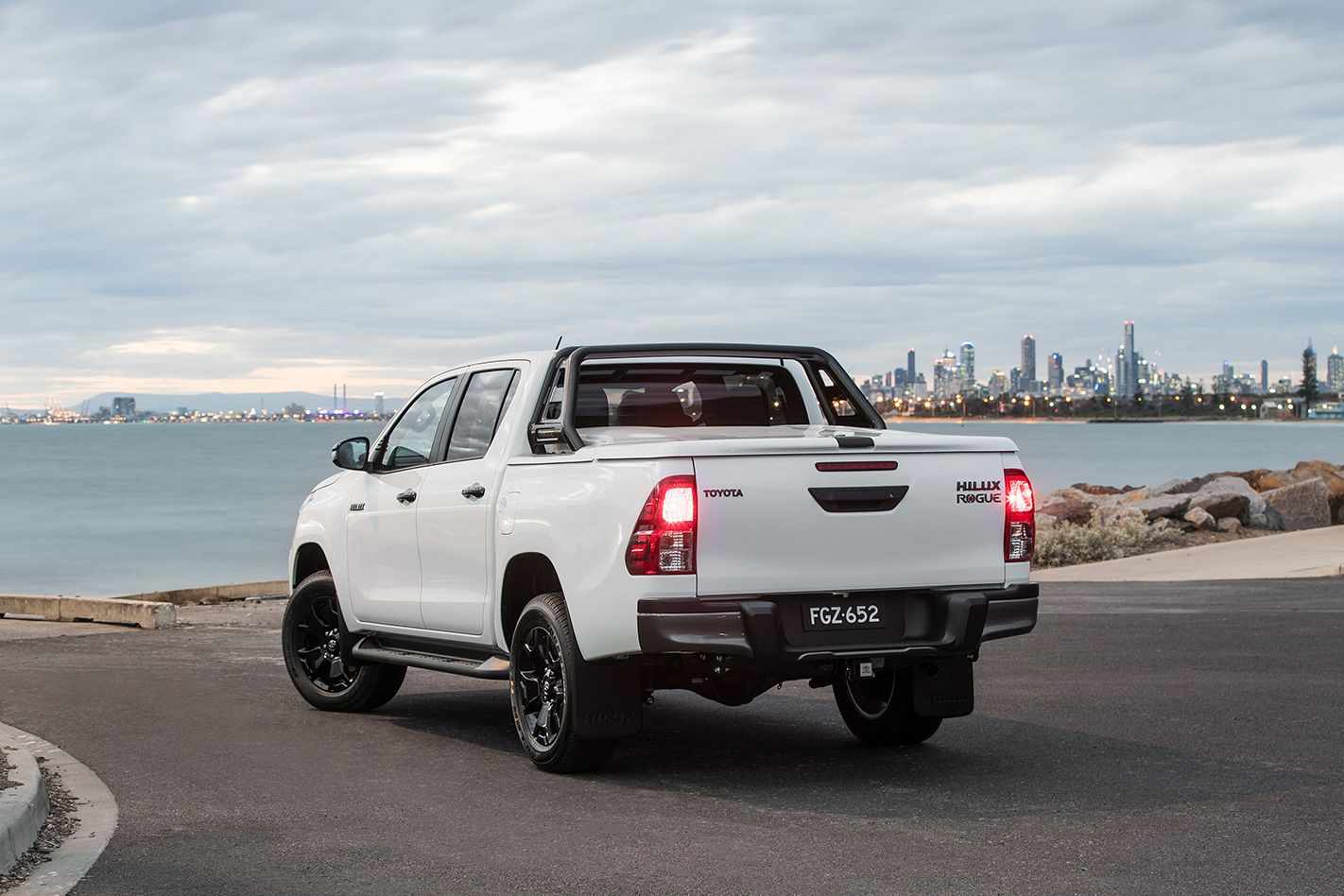
Instead, the new arrivals – called Rogue, Rugged, and Rugged X – are aimed at delivering greater urban utility and style (Rogue), or improved off-road durability and functionality (Rugged and Rugged X).
Equally significant is the fact that all three were designed, engineered and developed by Toyota Australia, all helping cement the division’s status as TMC’s (Toyota Motor Corporation) centre of excellence for off-road vehicles.
So while the new Hilux models are flag-wavers for Toyota Australia’s 150-strong design and engineering teams, they are also a welcome shot in the arm for the four local suppliers who provide the key equipment.
The Rogue, which we’ll cover first, is now a global model in its own right, albeit with different names for different markets. It’s based on the Hilux SR5 model (as is the Rugged X), but fitted with a much tougher, bluffer snout, fog lights integrated into the lower section of the revised front fascia, and a new design of (same size as SR5) 18-inch wheels.
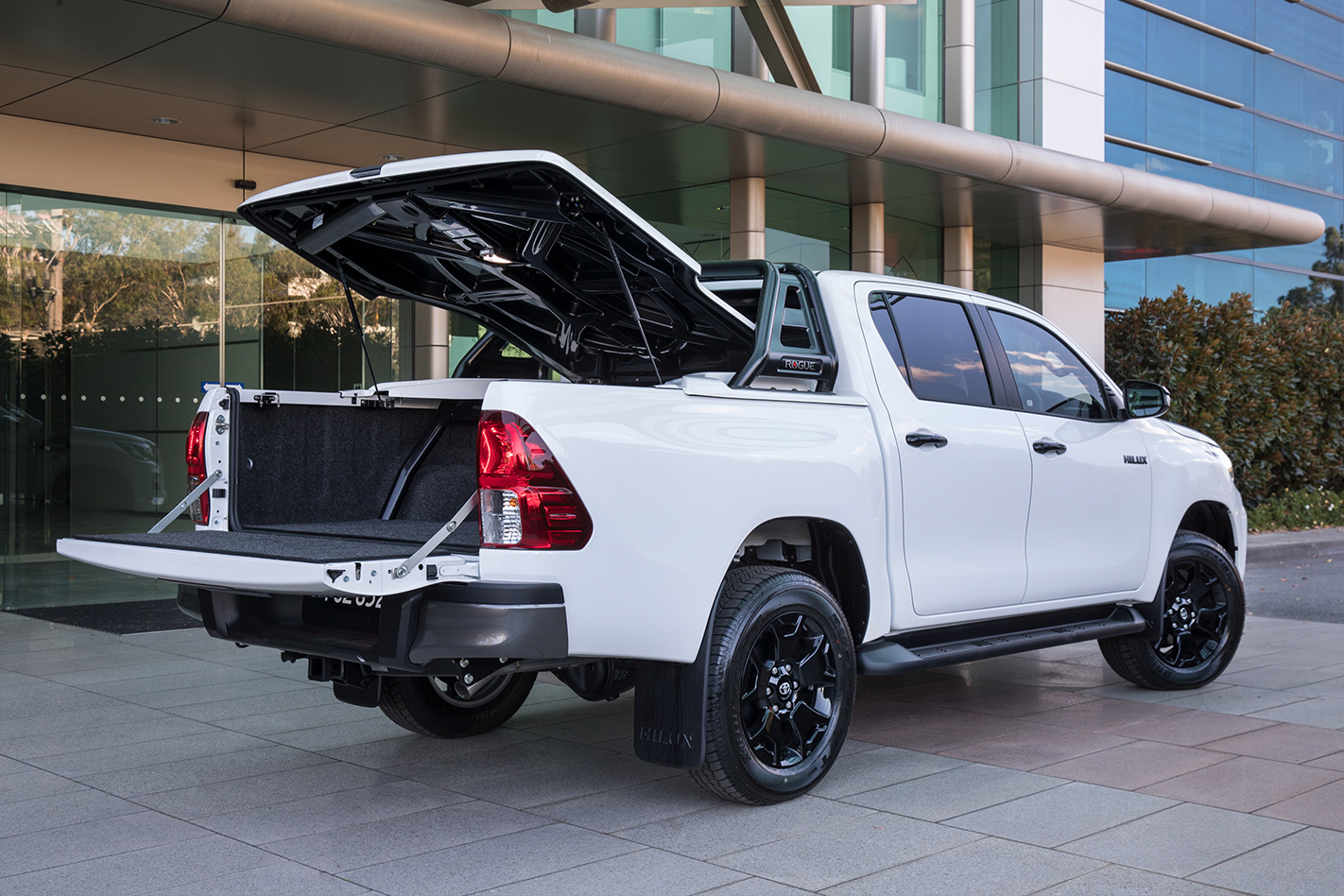
The tub is now lined with marine-grade carpet to improve the appearance and cut down rattle noise, and additional dust seals are fitted, giving reasonably effective dust reduction based on our off-road drive on dry and dusty tracks in South Australia’s Flinders Rangers.
Inside, the Rogue gains perforated leather front seats with heating, and power adjustment for the driver, as well as new white with orange instrument graphics, dark headliner, and new dark-plastic interior trim infills. Rogue is offered with six-speed auto only for $61,690.
Moving to the Rugged X, also based on SR5, sees a model pitched at buyers who would otherwise spend thousands adding aftermarket accessories to make their vehicle better prepared for that big outback getaway, or who tackle properly testing bush terrain.
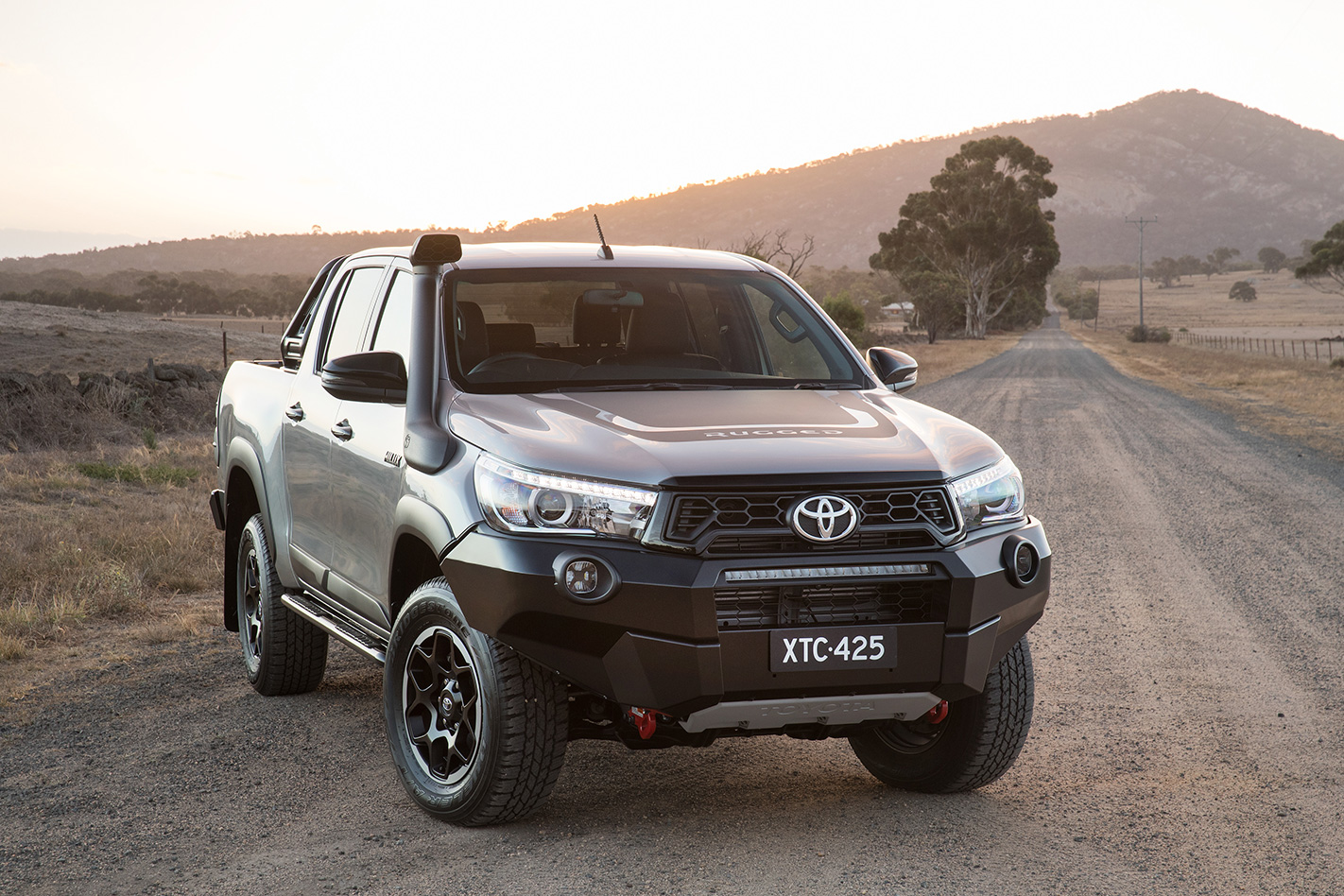
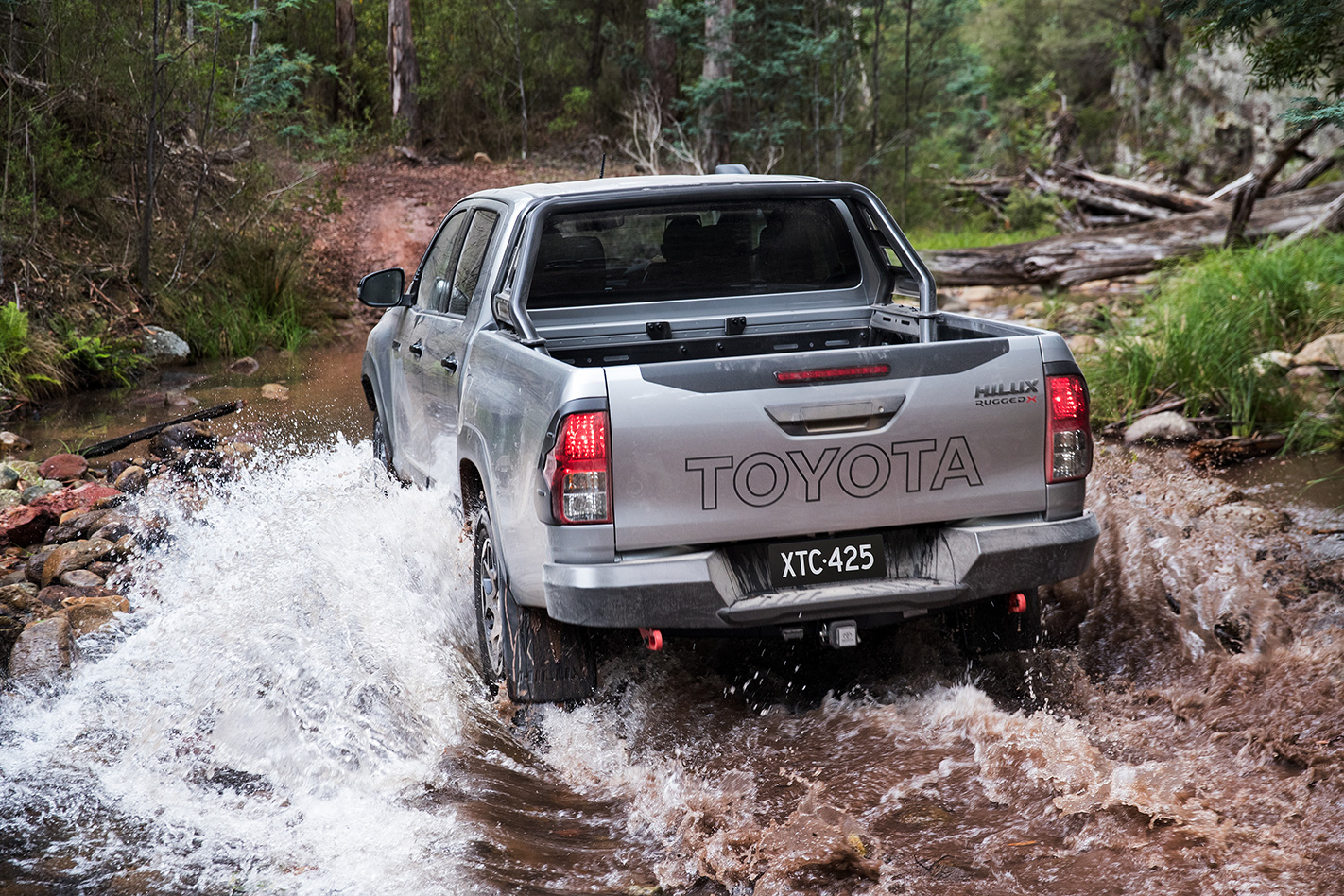
Along the flanks are side steps that link to under-vehicle rock rails intended to provide chassis protection. Our drive included a dry river-bed crossing that required the negotiation of a high, rocky outcrop that saw the hardware properly tested. Yes, there were plenty of ugly graunching noises, but given Toyota’s claim that each rail can support the entire weight of a fully loaded vehicle, it’s no surprise we pushed through without an issue.
Like the Rogue, the Rugged X also runs the sports bar above the rear of the cabin, while a steel bumper adds extra protection and the (standard) tow-bar mounting also provides recovery hooks. The air snorkel running up the driver’s side A-pillar is also an essential accessory for owners planning on tackling deep river crossings.
Inside, as with the Rogue, the Rugged X gets perforated leather front seats with heating, and power adjustment for the driver, as well as the revised instrument graphics.
The 2.8-litre turbo-diesel four remains a gruff but agreeable slogger in the lower part of its range, but quickly turns loud and breathless above 3800rpm.
The constant reactiveness and inherent jiggliness of the chassis tune is just something you have to learn to live with; the rear damping has a rebound kick like an irate mule because the leaf-sprung live axle is designed to bear payloads greater than an Australian cricket fan’s shame and sorrow. But the on-road compromises are clearly quite tolerable for hundreds of thousands of Aussies, as evidenced by Hilux’s top-seller status.
Those same compromises are also easier to accept once you’ve experienced the near-unstoppable off-road ability; especially Rugged X and Rugged models. The combination of ground clearance, approach and departure angles, traction, and low-range crawling ability means that you’re extremely unlikely to be prevented from making it to anywhere worth getting to.
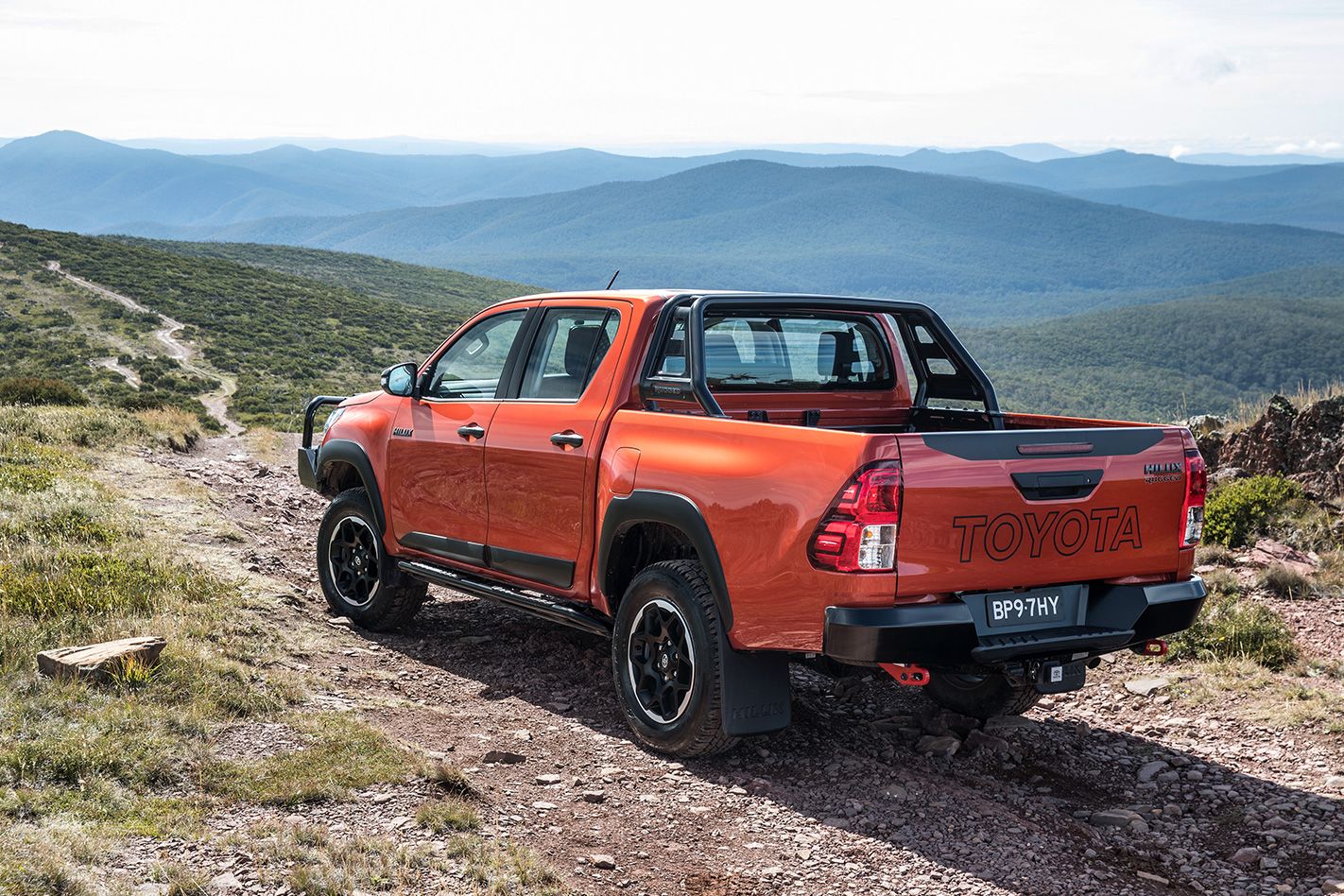
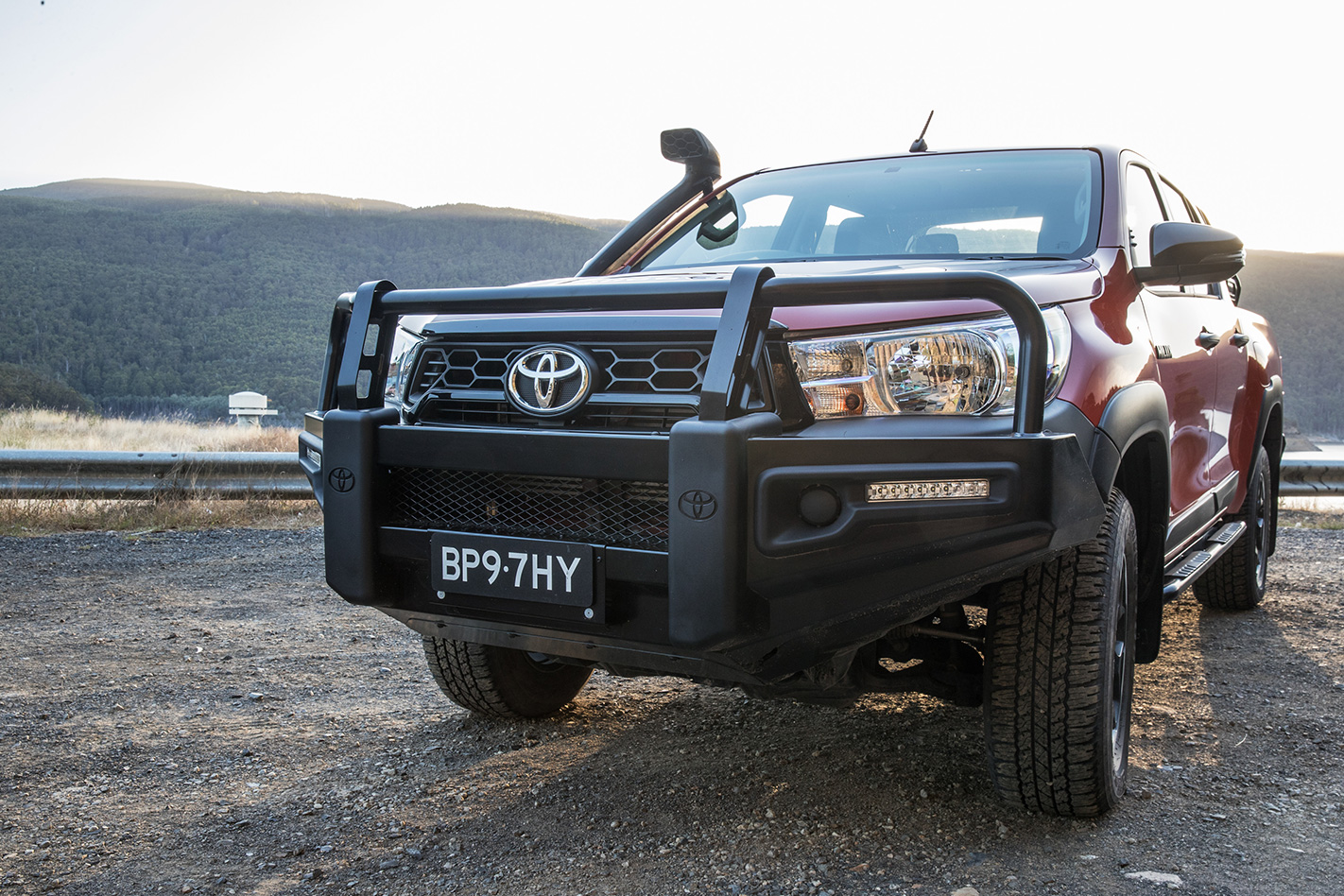
It’s essentially the same package of additions as the Rugged X, but the starting point is SR-spec, not SR5. The most notable hardware change is at the front, where the bullbar protection rises over the damage-prone area of grille and headlights, to better protect you from that nocturnal slam-dance with Skippy on mosh-pit road. Oh, and DAB and sat-nav are now fitted; useful tech additions to the more rudimentary, fabric-trimmed interior. Rugged is priced at $54,990 for the manual, or another $2000 (to $56,990) for the automatic.
So, back to the value question. This is blurred to some extent by the fact that the SR5 model is currently offered as a driveaway deal, with on-road costs included. This is not the case with the three new models, so any legitimate comparison requires calculation of on-roads, which vary from state to state.
A Double Cab SR5 4×4 Pickup can be yours on the road for $56,440, so the Rogue wears a $5250 premium before its on-roads are factored in. The Rugged X pushes that to a $7250 difference, again before on-roads.
All three new Hilux models hit showrooms on Thursday April 26th.
- Model: Toyota Hi Lux Rugged X automatic
- Engine: 2755cc 4cyl, dohc, 16v, turbo-diesel
- Max power: 130kW @ 3400rpm
- Max torque: 450Nm @ 1600-2400rpm
- Transmission: 6-speed automatic
- Weight: 2252kg
- 0-100km/h: 11sec (estimated )
- Economy: 8.6L/100km
- Price: $63,690
- On sale: Now
Just because they’re listed here, doesn’t mean we think you should buy them.
Good, now that the disclaimer’s out of the way, let’s kick on with our picks from the listings on Tradeuniquecars.com.au this week.
2015 Ferrari 458 Italia Speciale – $1.5 million
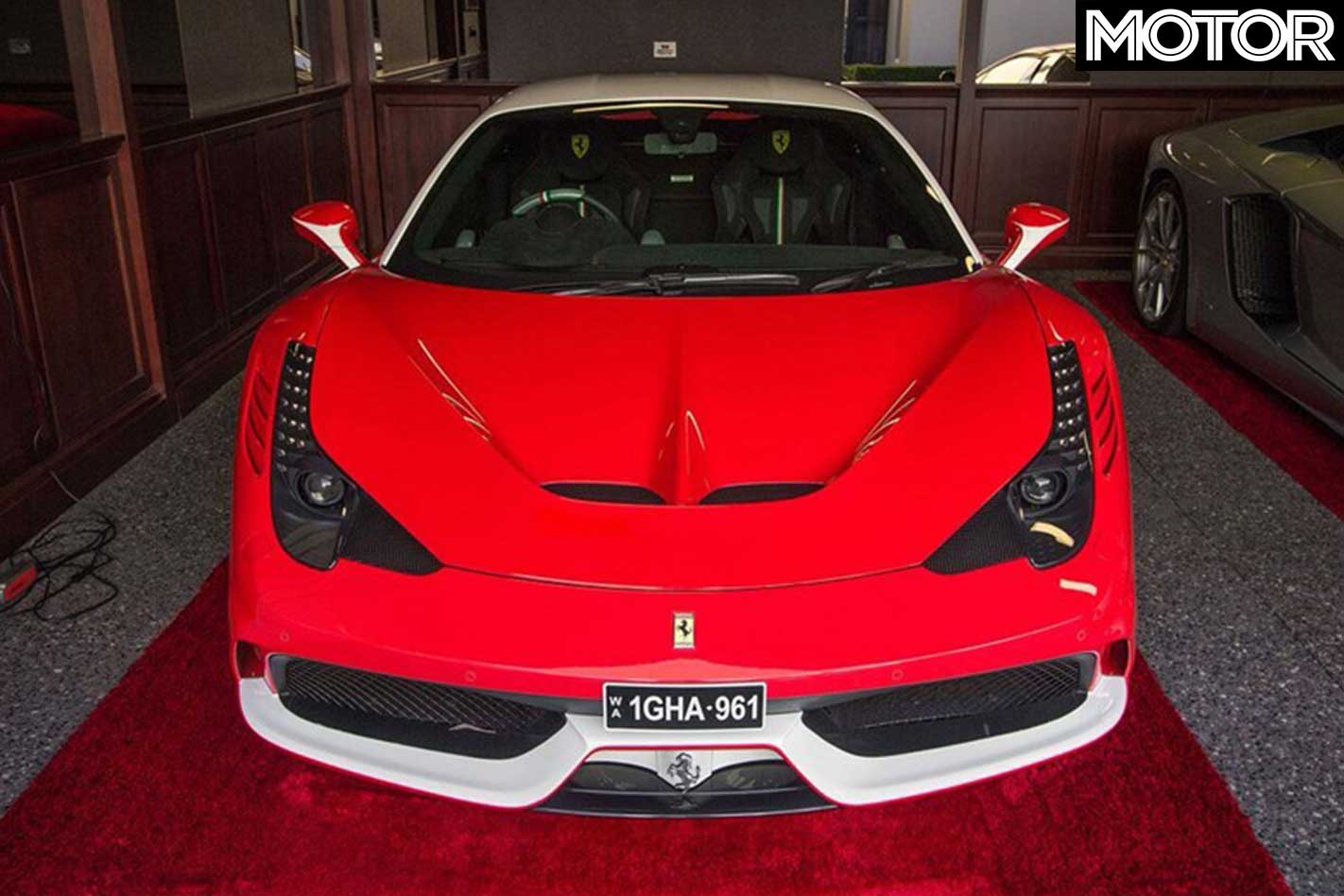
If you can afford to fork out $1.5m, that is. It’s located in Perth, and with only 398km on the odo, a drive back to the east coast of Oz would increase that tenfold.
1986 Holden VL Commodore HDT Brock Group A SS – $125,000
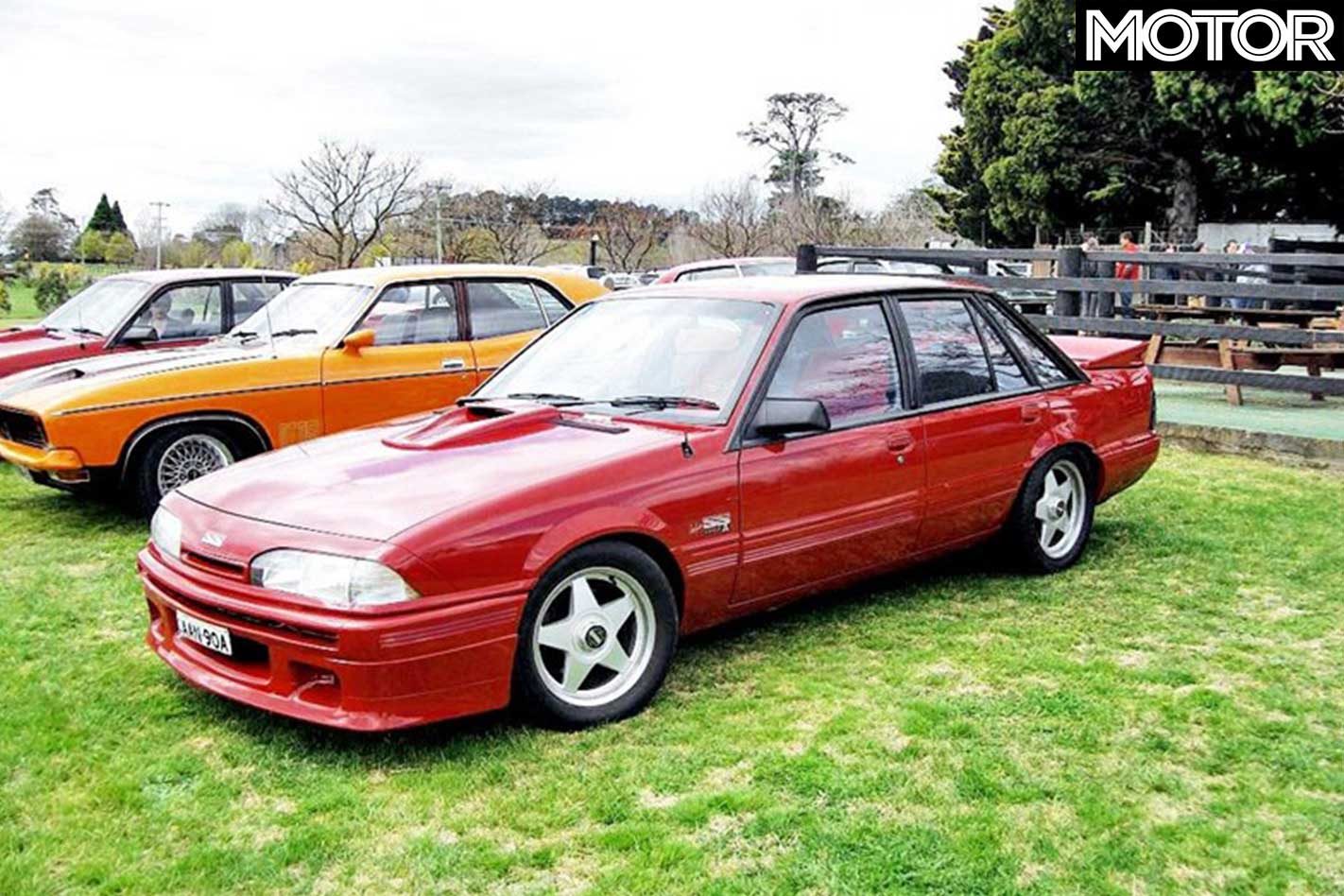
But it’s a tidy looking example, and well worth a look if the recent auction sale of a similar car for $155K is anything to go by. $125,000 for this one doesn’t seem like a bad asking price, but only if it’s the real deal.
1983 Toyota Supra – $15,000
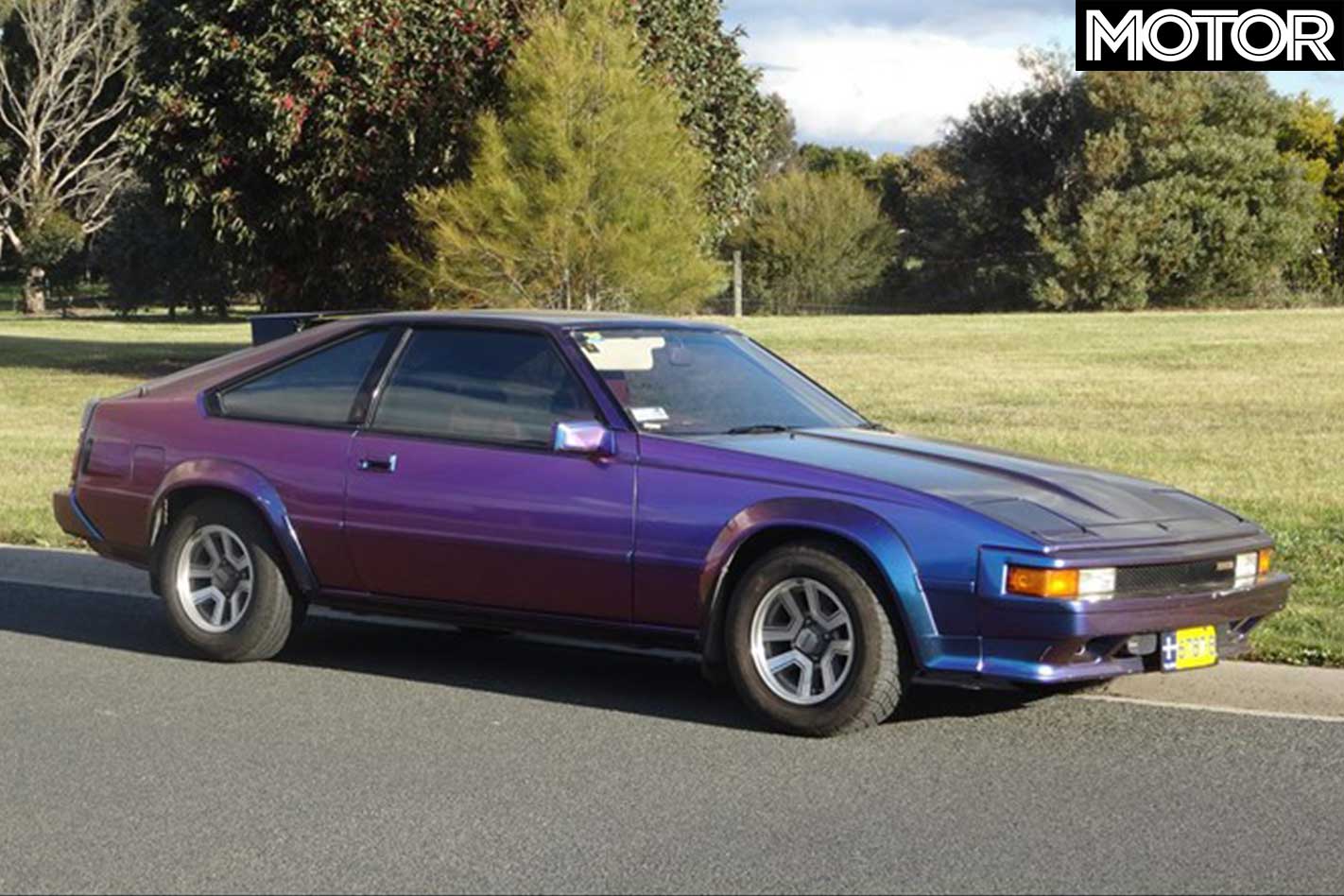
But when we saw this thing, we knew we had to talk about it. It’s not every day you see a Gen-2 Supra, and considering the badge’s upcoming return, the older models might grow in value.
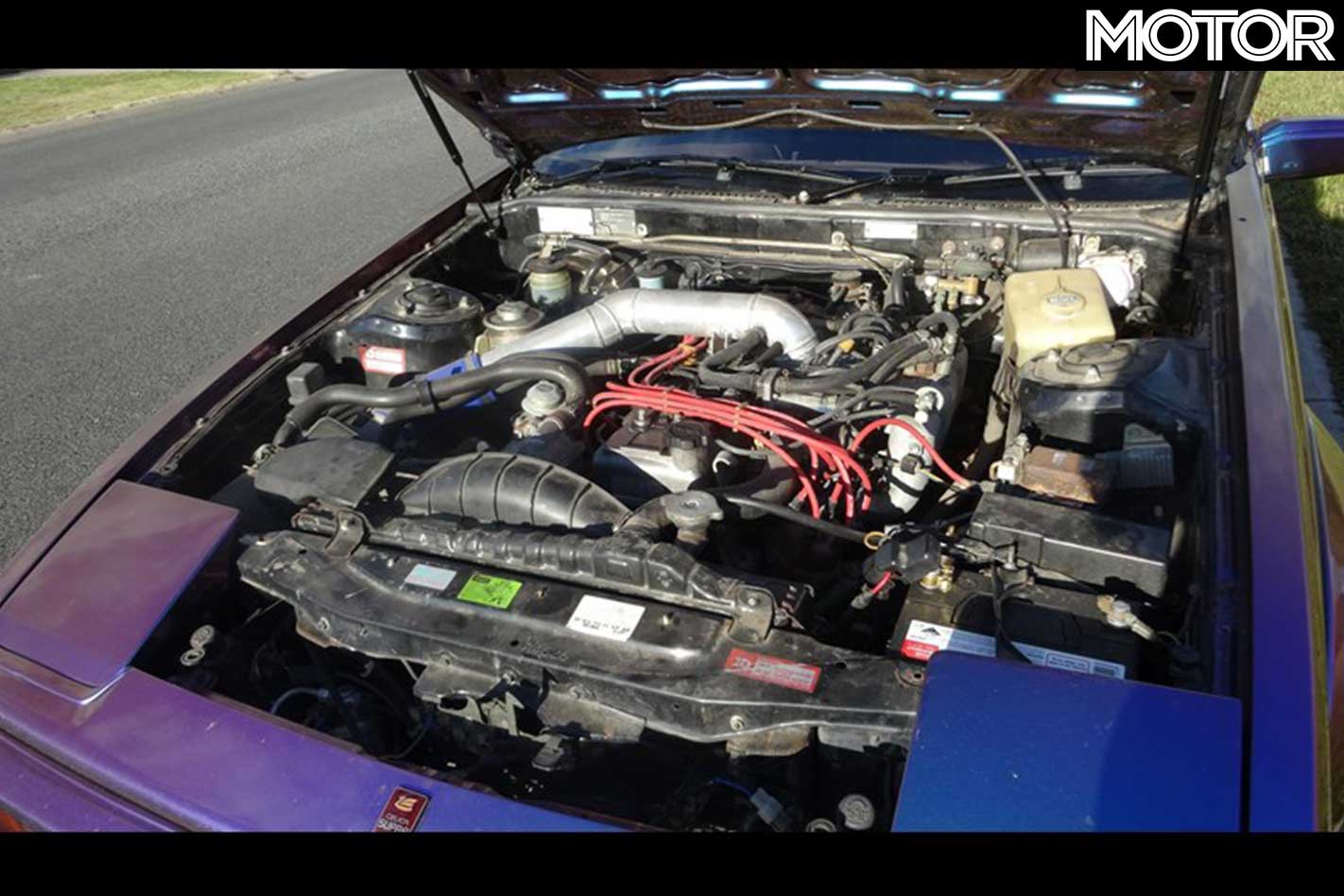
But if you want an original one, steer clear of this “beautiful and unique” example. It’s had the same owner since 1984, one year after it was built, and is rocking about 313,000km.
1979 Ford Mustang ‘Indy Pace Car’ – $27,000
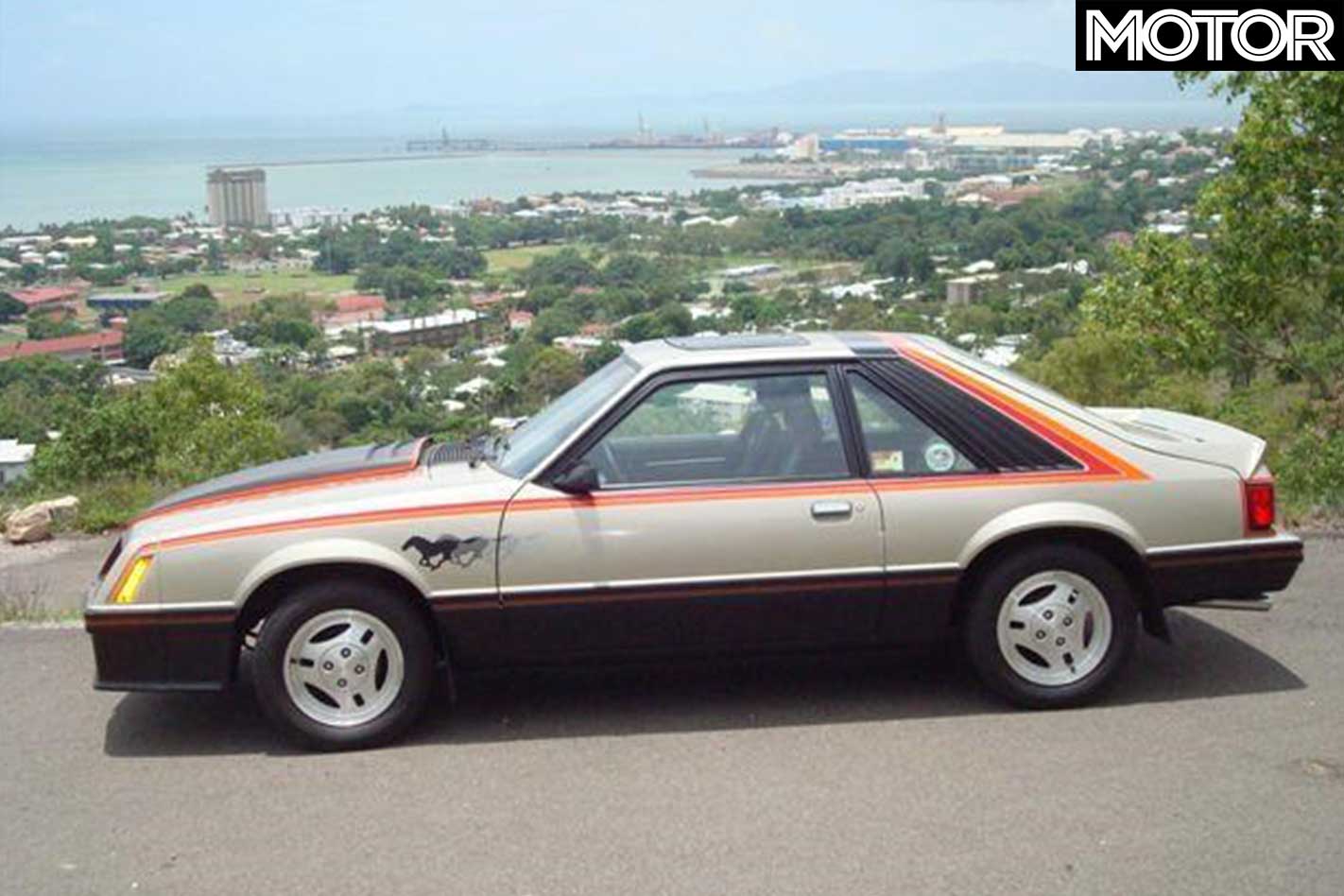
It’s running a 5.0 Windsor, has a 4-speed auto, and even comes with its original registration plate from Michigan, as well as a 1979 plate from Indiana. The seller is in QLD, asking $27,000.
2006 BMW Z4 M – $53,000
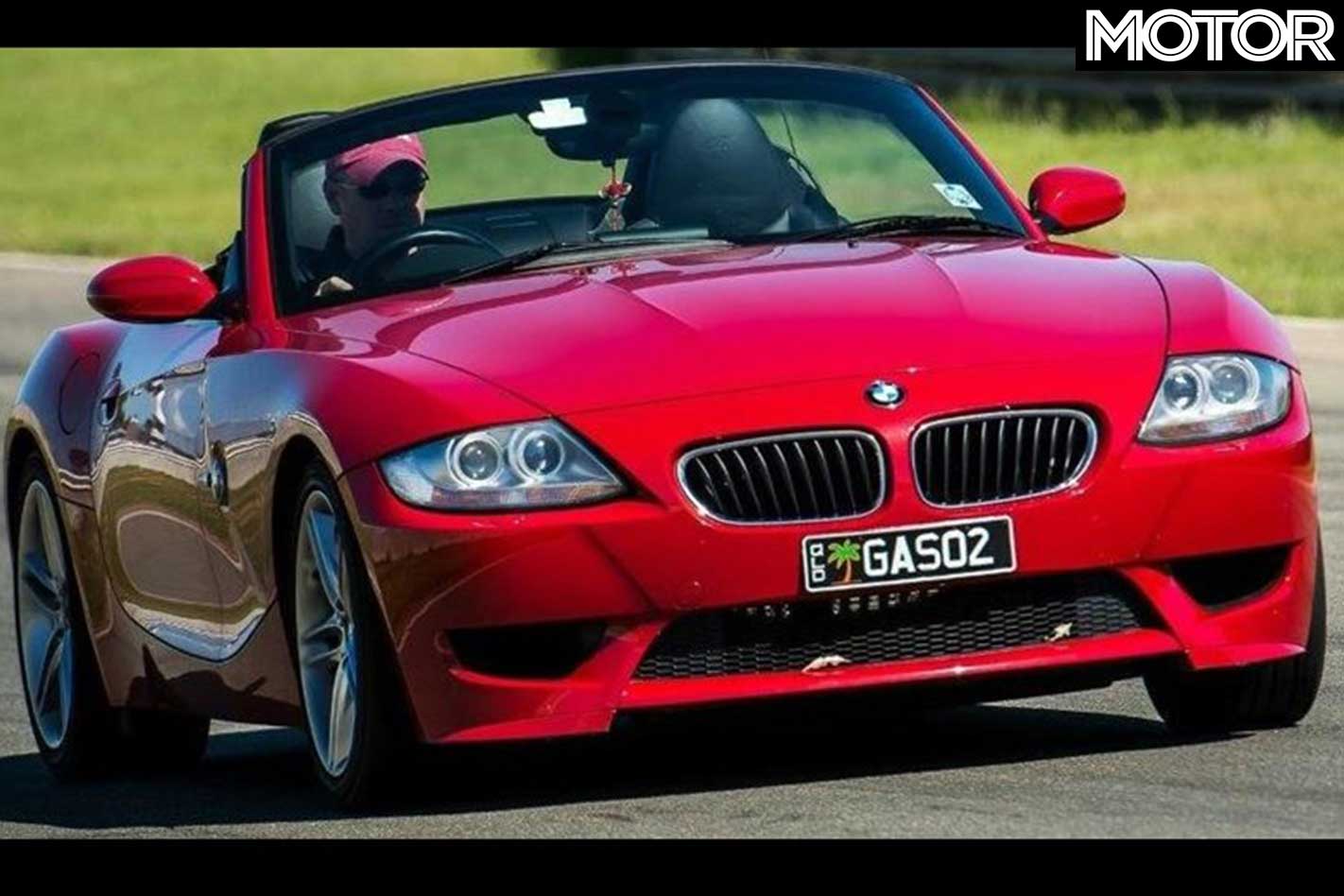
It looks immaculate, though that’s something better judged in person, with only 68,000km showing. The straight-six roadster was about as hardcore as BMW Zeds got, with 252kW and 365Nm helping out with the 5.0-second run to 100km/h.
It’s manual, and the owner’s asking $53K. It not the cheapest one around, though it’s probably one of the tidiest.
KIA is the latest brand to announce it has aspirations to join the highly lucrative light commercial market, conceding that a one-tonne ute is likely to be offered within its ranks as soon as 2021.
The South Korean brand has been watching from the sidelines as the popularity of dual-cab utes snowballed.
But Kia wants to be a wallflower no longer and is putting the blocks in place to ready its network for the arrival of its first high-riding ute in “two or three years’ time”.
Kia Motors Australia chief operating officer Damien Meredith said an exact arrival date was a long way off, but confirmed the company was preparing the ground for a one-tonner in local showrooms.
“We’re hopeful that something will happen in the light commercial range in a few years’ time,” he said. “There’s still a bit of homework being done at head office regarding it, but we’d like to think it will happen and we’ll be ready when it does.”
Meredith explained that high-ranking managers within the global office were unable to ignore the growth of dual-cabs and light commercials anymore, and shifting cultures would drive the cause for one-tonners.
“The senior executives at KMC are out and about in the markets, they travel far more and visually they see what’s happening out there,” he said. “They understand that light commercial vehicles are recreational. The market is moving to that type of vehicle. Let’s just hope that we’ve got something there in two or three years’ time. I think it will be that far away.”
A jacked up, all-terrain Kia may be hard to imagine at this stage, but the company’s Stinger high-performance, rear-drive sedan is undeniable proof the company is capable of breaching dramatically different markets to its traditional staples – and successfully so.
Meredith said the company’s growing influence in Australia would help the cause and allow Kia to compete in the market, along with a business case from other strong global markets.
“As the business grows that you look after, your share of voice gets higher. I’m not sure they will be planning the next five years on what I say now in product planning but one would hope a light commercial range will happen. We think we can get seven percent of that light commercial range relatively quickly.”
Even if Kia’s one-tonner arrived tomorrow, the brand is still late to the tradie party, but Meredith said it was important to attempt to enter new markets at the right time.
“They (competing ute bands) might be doing the hard work in that segment, but we’re doing the hard work in regards to the brand and growing the carpark and making Kia more mainstream. It’s not just about waiting and waiting and then kick off.
“When and if a light commercial range does happen we’ve got the dealer network ready to go. That’s our plan.”
When asked if the market would be too crowded by the time a Kia offering is ready to roll, Meredith used Hyundai’s Kona compact SUV as an example of a vehicle that arrived late to a busy segment but found a strong following.
“Kona came in and sells about 800 a month so that seems to be going okay and I don’t think it’s affected the others too much.”
A Kia ute would have its work cut out in the fearsome one-tonne segment, bumping gloves with the resoundingly successful and venerable Toyota Hilux, whose variants have already found 12,634 homes to the end of March this year. Snapping at its heels is the Ford Ranger however, with a respectable 10,868 registrations to its name for the same period.
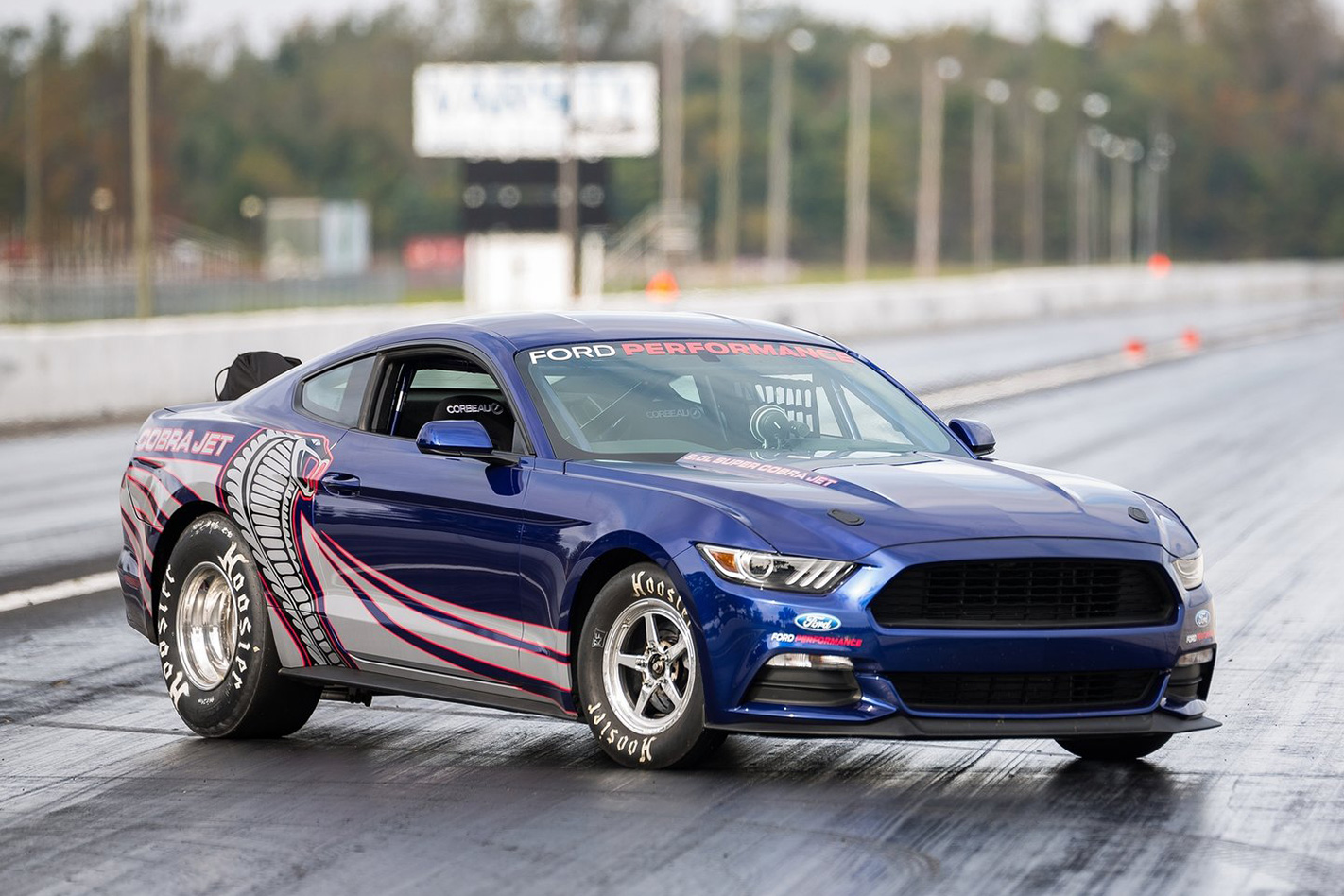
FORD Performance Parts has teased a ‘roid popping tribute to the original Cobra Jet dragster, which it says will be ‘the quickest straight-line Stallion yet’.
The Blue Oval’s hi-po division has released the first of what will surely be many teaser images of the 50th Anniversary Mustang Cobra Jet – the first Cobra Jet was launched in 1968 – which it says is capable of a mid-8.0-second quarter mile ET and trap speeds of more than 240km/h.
Powered by a supercharged 5.2-litre Coyote V8, the 2018 Cobra Jet is the latest generation of Ford’s purpose-built drag racer designed specifically to comply with regulations set by America’s National Hot Rod Association (NHRA) and different National Mustang Racers Association and National Muscle Car Association classes.
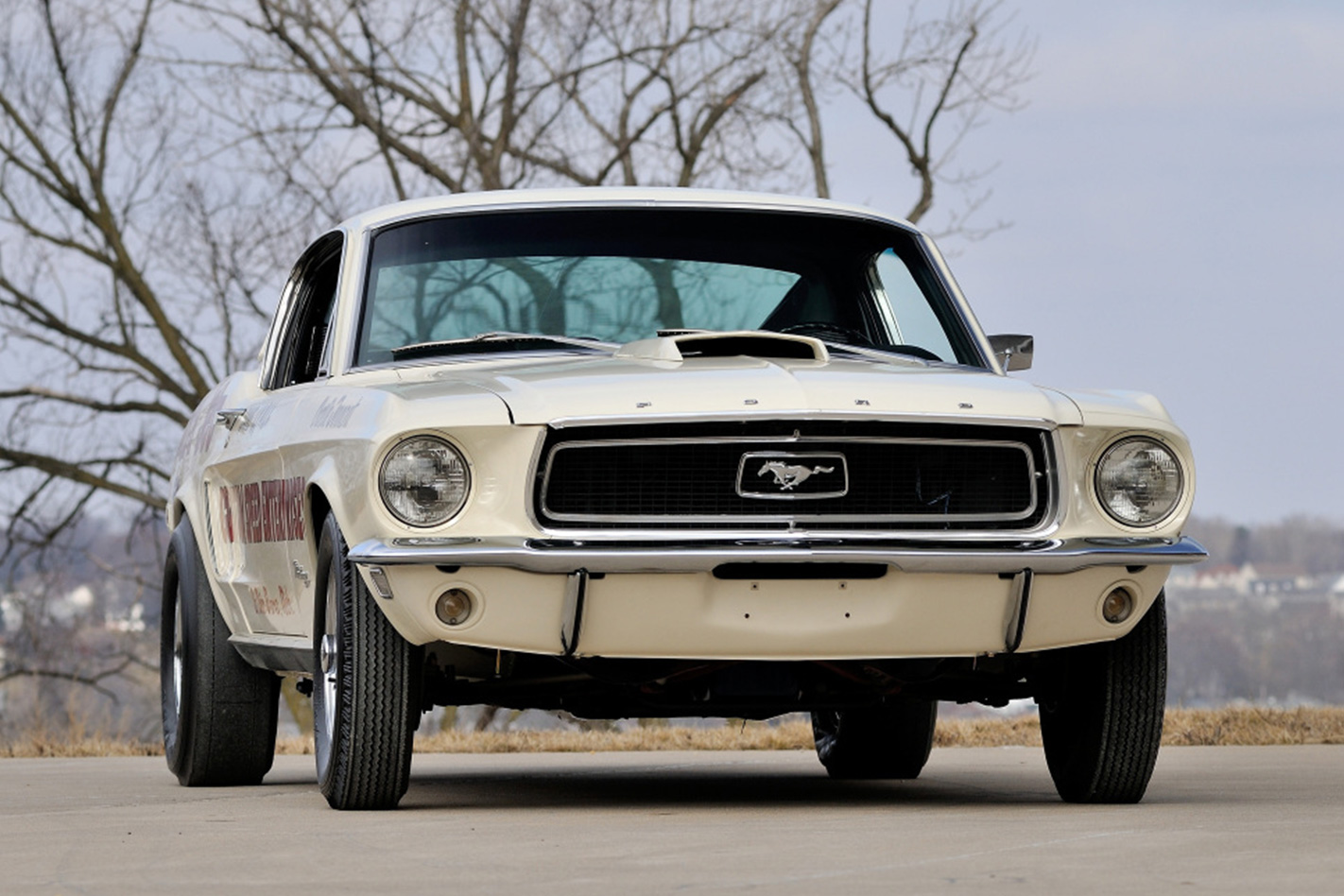
The 5.2-litre Coyote V8 is 200cc bigger than the 5.0-litre donk in the last Cobra Jet from 2016, which was made from 75 percent stock Mustang GT parts and was also said to be capable of a sub-9.0-second quarter mile – though it’s presumed that was in the high eights.
Building on the latest Ford Mustang as a base, the 2018 Cobra Jet will be limited to 68 track-only units (no VIN will be stamped), with a choice of Race Red or Oxford White paint and an option to add a commemorative 50th Anniversary graphics package and anniversary badging if desired.
Final specs and pricing will be announced during the US summer this year.
The Cobra Jet name goes back 50 years, when it was designed to compete against ‘Big Block’ Chrysler and GM models. Powered by a 335hp (250kW) 428 cubic inch V8, the original Cobra Jet dominated the 1968 NHRA Winternationals in California.
Ford celebrated its 40th anniversary with a fresh version in 2008, which went on to win the 2009 Winternationals. Only 50 were produced and subsequent demand saw Ford Performance release new models in equal numbers for the 2010, 2012, 2013, 2014 and 2016 seasons, cementing its iconic status within an already legendary nameplate.
“That, in turn, has inspired generations of Mustang fans to create their own performance machines for the street.”
AS A flagship model, DBS Superleggera has a certain ring to it. Not a particularly English ring, granted, but Aston Martin has some precedent here.
The replacement for the Aston Martin Vanquish due to be unveiled later this year draws on a couple of well-worn nameplates. The last DBS was a DB9-derived model in 2007, while Lamborghini fans can pipe down because Aston Martin had a Superleggera way back in 1959.
Details are, at present, sketchy as to what the car will look like and what’ll be under the bonnet. Rumours have repeatedly mentioned the Cologne-built 5.2-litre V12, with power output expected to top 522kW (700hp).
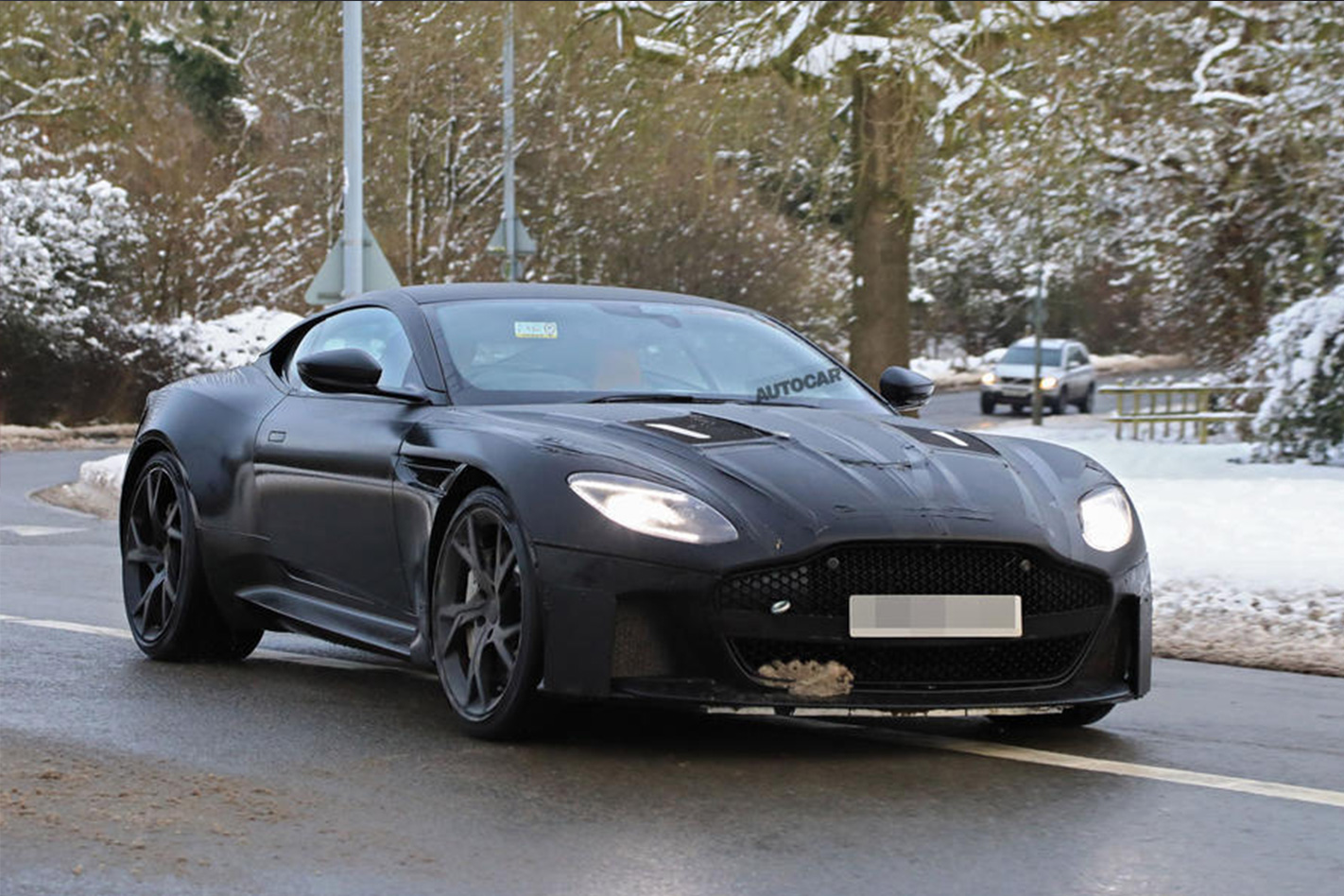
The new model forms part of Aston Martin’s Second Century Plan, announced in 2015, laying out the template for the next generation of product. The Vanquish replacement was the third car in the sequence, coming after DB11 and Vantage and just before the forthcoming DBX crossover.
“We’ve pushed the boundaries of performance and design to give this car a distinct character and ensure it’s worthy of the heritage and weight that this name carries,” explains Aston’s chief creative officer Marek Reichman.
The new car is expected to feature carbonfibre body elements to pare back weight and live up to the Superleggera name, eventually spawning a Volante convertible to be sold alongside the coupe.
It might not be the end of the Vanquish badge though. Aston Martin’s chief technical officer, the ex-Ferrari Max Szwaj is said to be heading up a team to rebirth the Vanquish as a mid-engined Ferrari 488/Lamborghini Huracan/McLaren 720S rival.
LAST year, the number of cars sold in China – roughly 29 million – easily outnumbered the entire population of Australia.
That’s enough to make it the most attractive new-car market globally – succeed here where in 2017 sales accounted for one in every four new cars sold worldwide and you’ll keep the accountants on level three very happy. But it also means China’s influence over what we drive is growing; carmakers these days need to make global vehicles that appeal to the most customers, and when your biggest customer is in Asia, that’s where the cost, engineering and design priorities lie.
Western carmakers have a strong foothold in China, building both vehicles familiar to us and China market-only specials, in partnership with domestic manufacturers as mandated by Chinese law. It’s why China can get a seven-seat version of the Territory-replacing Ford Endura, while we’re expecting to get the global five-seat version.
It doesn’t end there, with Chinese investment potentially ready to help cash-strapped Western carmakers get back on their feet; just look at what Geely has done with Swedish brand Volvo, and what it can potentially achieve with its latest acquisition, the struggling English sports car maker Lotus.
In Beijing, the sleeping dragons of the car industry awaken. Here’s what we can expect.
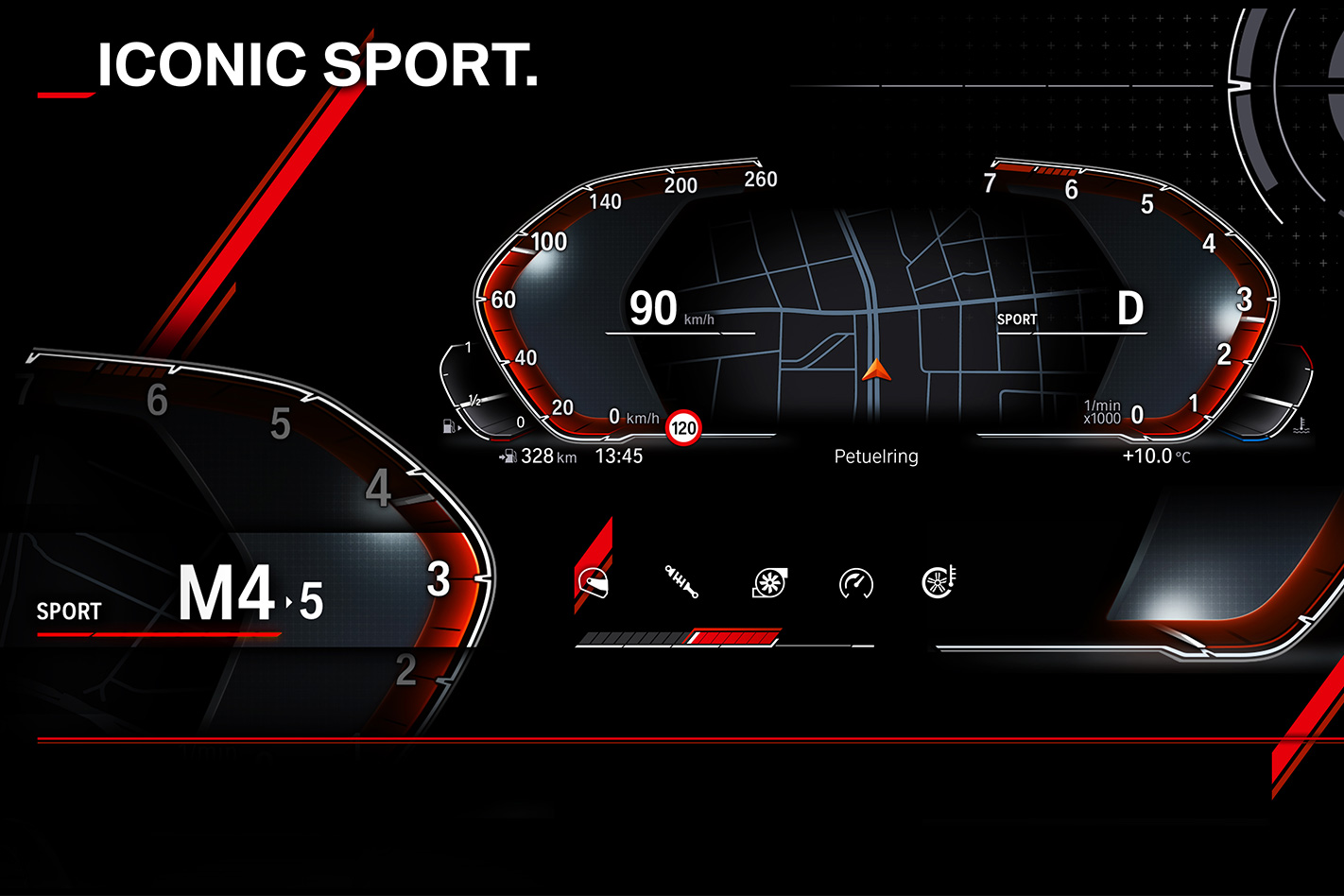
The overhaul of iDrive – which will create a much more distinct split between “information” (read “driver”) and “control” (read “multimedia screen”) – will include some nifty new tricks, including the car displaying your name as you jump behind the wheel. It also hints that BMW is anticipating a day where ride-swapping owners will buy into the brand rather than just a car.
BMW iX3
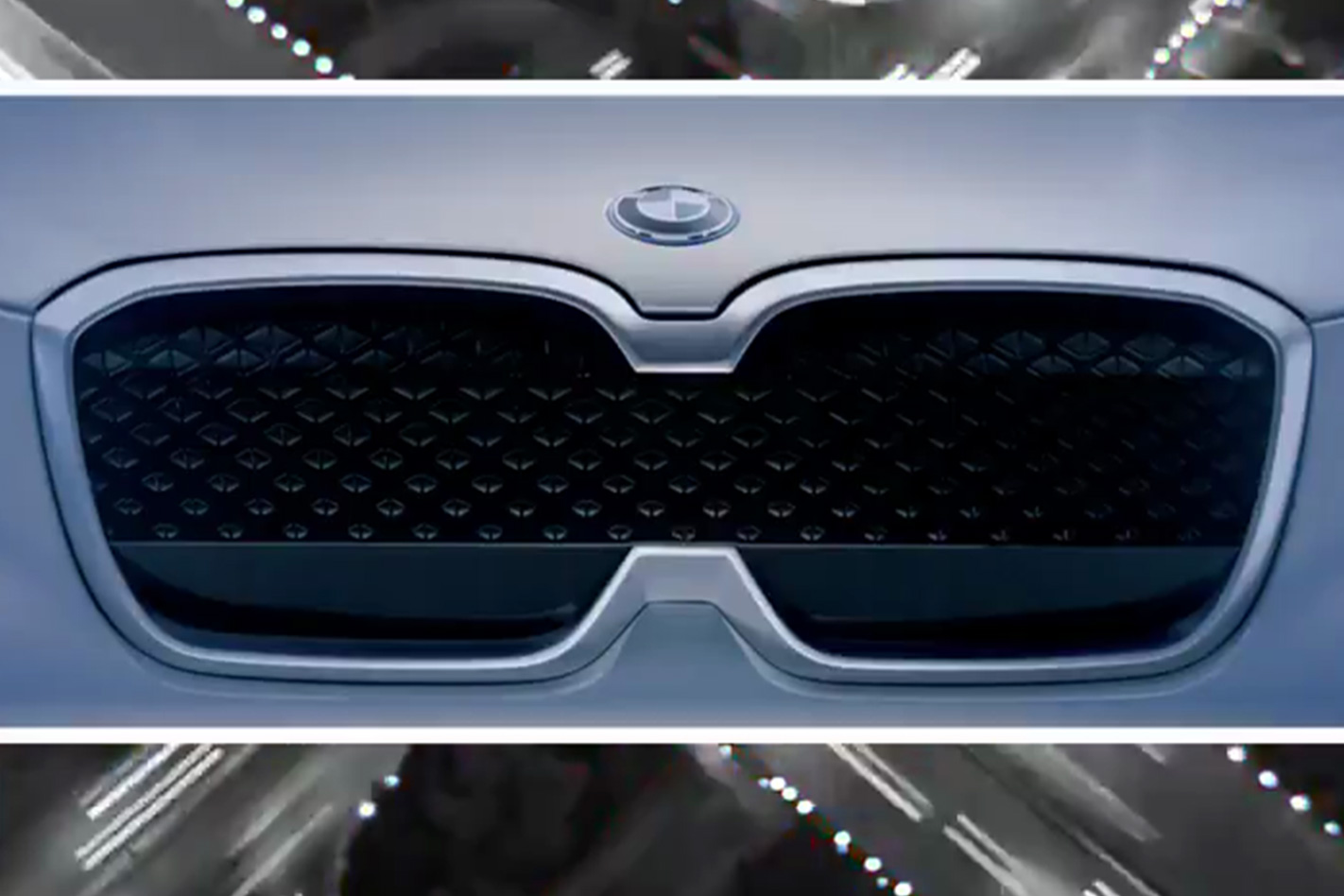
When it arrives, the iX3 will be the first electric car from the German luxury brand since the i3.
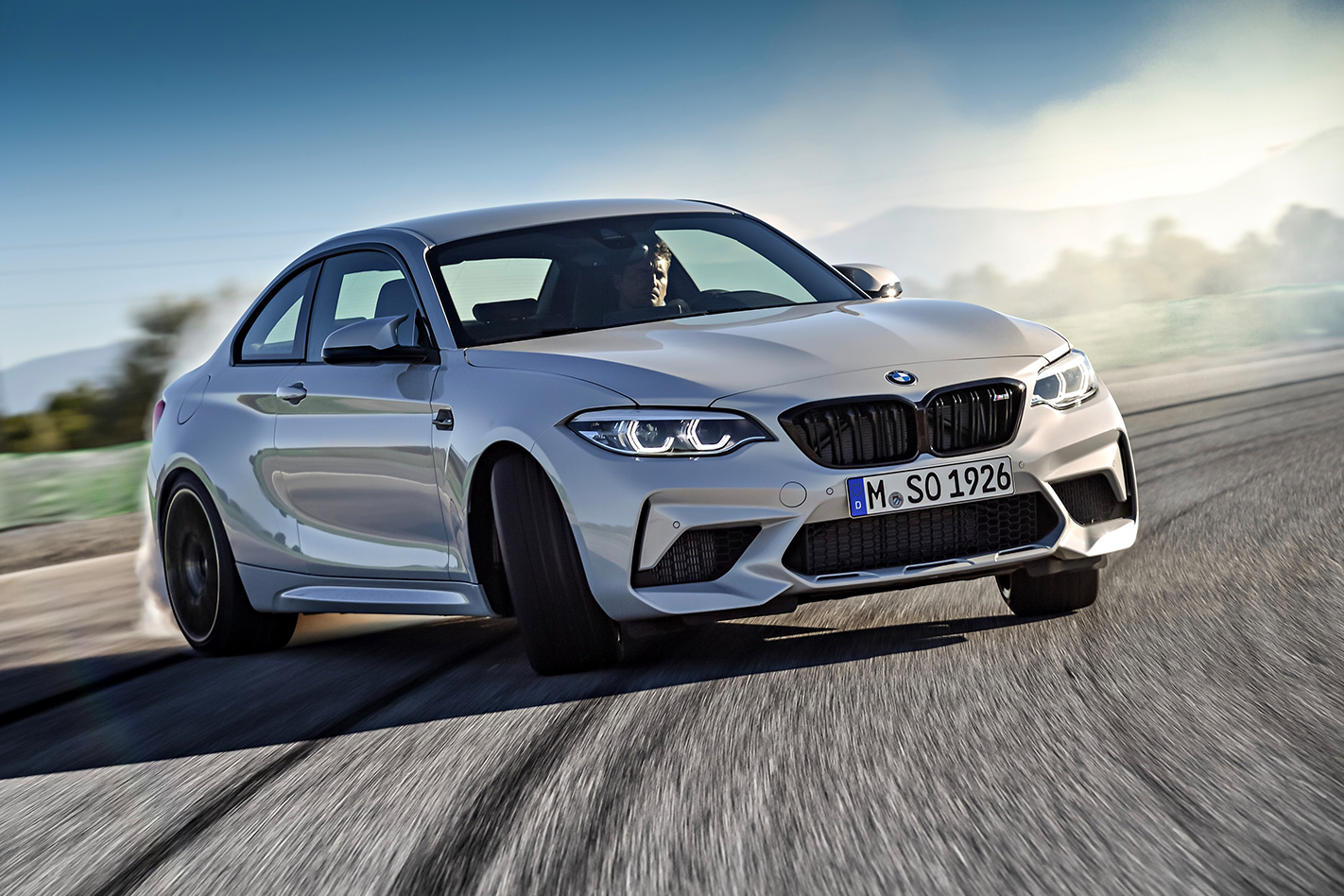
Rip the pulsing heart out of the BMW M3/M4 and shove it under the bonnet of an M2. That’s the basic formula for the eminently rear-wheel steerable M2 Competition – if the accompanying press images showing it sideways and smoking up the rears are anything to judge it by.
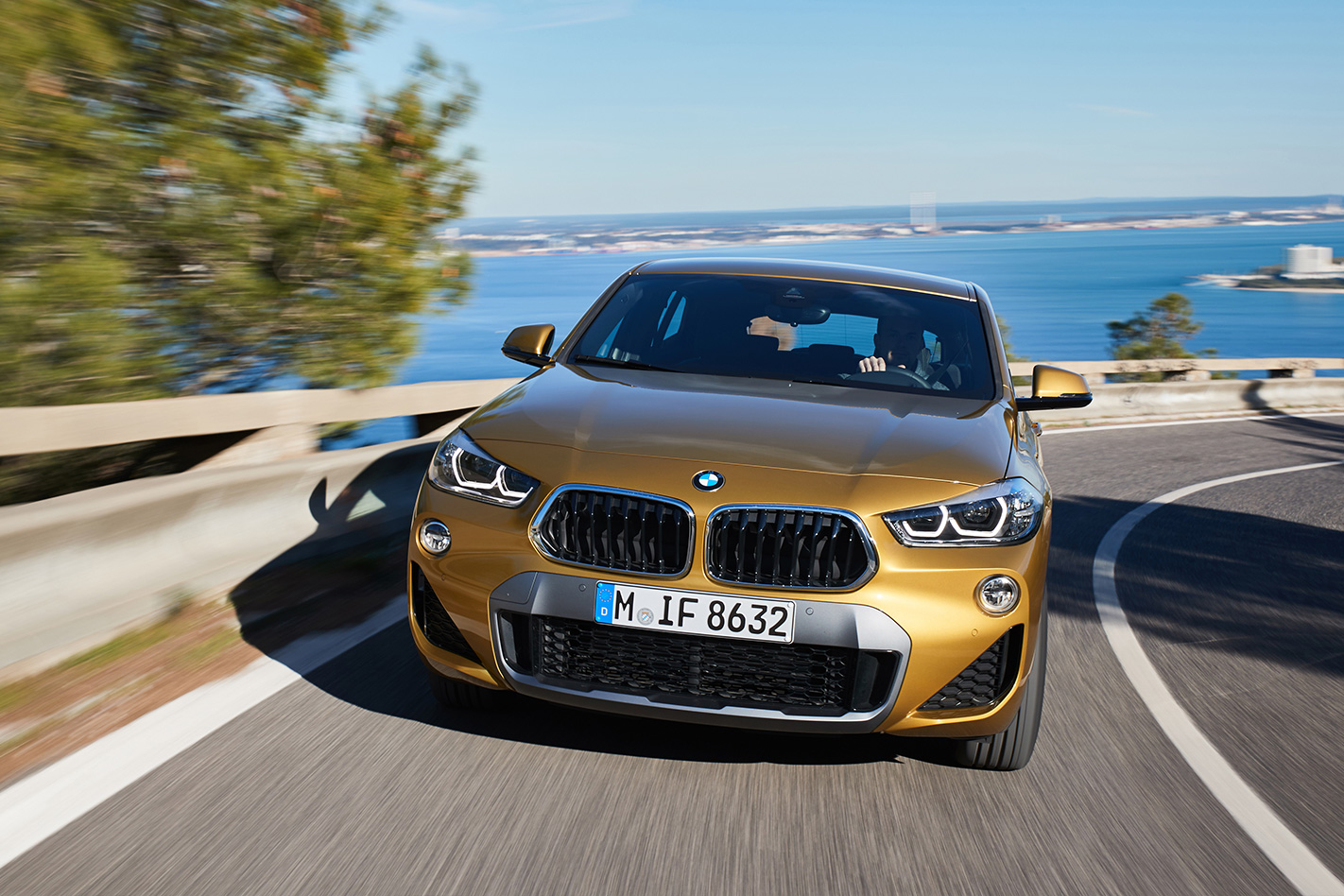
BMW X2 iPERFORMANCE
It’s only a rumour at this stage, but the German luxury car brand could use the Beijing show to add a new member to its suite of electric and plug-in hybrid models. The fastback-styled X2 is an ideal candidate for the PHEV treatment.
This China-only SUV concept from GM’s luxury car sub-brand hints at technology that could one day trickle back to the West. It features an “eMotion” battery-fuelled propulsion system that generates up to 410kW and can travel up to 600km on a single charge – outstripping the range of the current crop of EVs.
It hints at GM’s wider future products, including innovations such as a digital dashboard, the use of more natural materials – the centre console and armrest feature wood, not plastics – and a much more clever use of interior space yielded via the compact electric drivetrain.
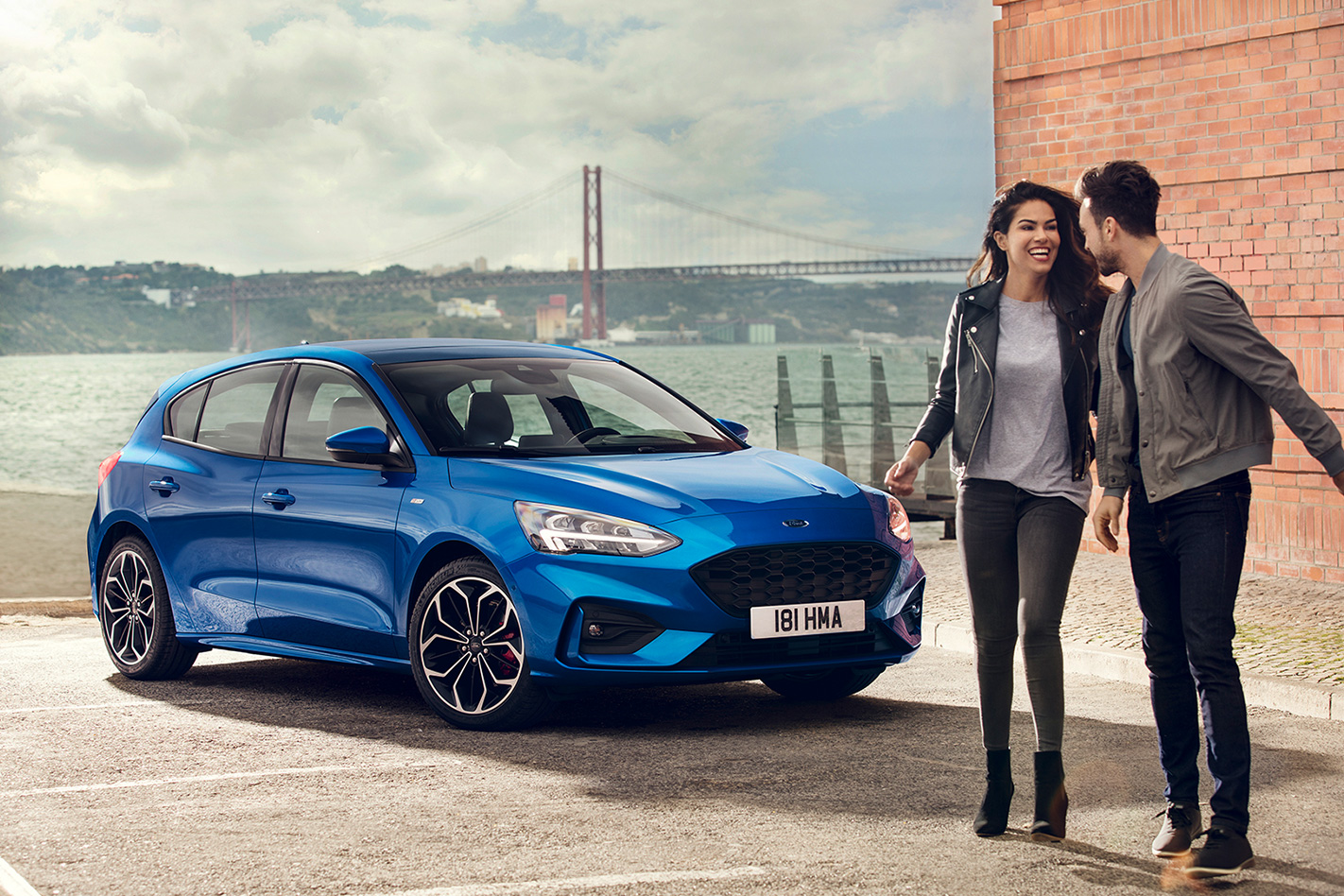
The new-look Focus is a little derivative, adopting the wider Ford family grille and will ride on the carmaker’s new scalable front-wheel-drive platform that is expected to one day spread to other models including the Fiesta – which was confirmed this week to come only as a three-door ST-badged variant – the EcoSport and even the Escape.
HYBRID KINETIC GROUP
This Hong Kong-based carmaker has tapped the now Indian-owned Pininfarina to design two vehicles; one is believed to be a long-wheelbase advance on the HK GT unveiled at Geneva, while the other is expected to be an SUV.
China is expected to have a huge influence on the world’s adoption of electric vehicles as it moves to crack down hard on emissions by 2035. This week the government announced it would consider allowing Western carmakers to own up to 100 percent of a factory that makes plug-in hybrid or electric vehicles, and not the traditional 50:50 partnership.
The all-new “Camry with Leather” – okay, that’s more of a cruel reference to the thinly disguised first-gen ES than this smick-looking new one – shifts to the Toyota New Global Architecture that so far has given everything wearing a Toyota badge to adopt it a huge lift in the way it drives.
Few details are out there on how the new-gen ES will stack up, and even what technology it will debut, but we can already note that it gets a LED headlight array framing what appears to be the proportionally biggest version of the sluice-like spindle grille we’ve seen on a production Lexus yet. Only the concept cars go bigger and cheesier.
MERCEDES-BENZ A-CLASS SEDAN
The babiest Benz has already been revealed in hatchback form, but now we’re expecting to see it as a sedan, leaked images ahead of the Beijing show reveal. The sedan was allegedly sprung after workers dropped the cover on a banner down the back of the German brand’s show stand – a complete surprise to everyone.
The four-door A-Class looks very similar to the Concept A sedan unveiled at the nearby Shanghai motor show a year ago. The sedan is likely to be built in China, drawing questions over whether the booted form will make it into other world markets. For us, the CLA-Class may be enough …
MERCEDES-MAYBACH SUV
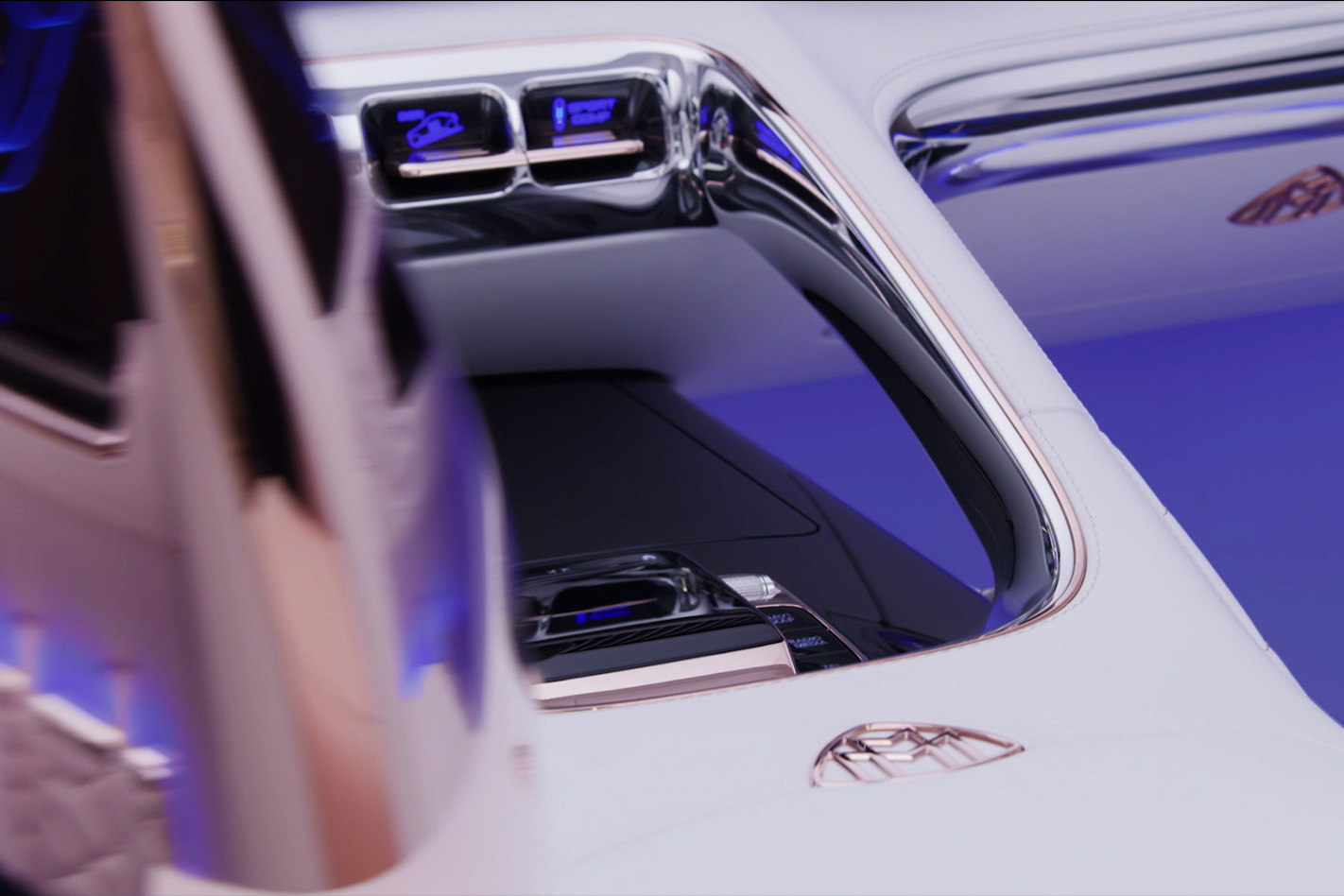
We can only speculate, but we have seen landaulet versions of the S-Class limousine – optimised for presidential cavalcades the world over – and even the boxy, House of Saud special built on top of a G-Class off-roader. A stretched Merc-Maybach version of the GLS-Class makes sense, particularly for the Chinese market where even stretched versions of the Audi A4 are possible.
TOYOTA COROLLA PHEV
The Japanese car maker has hinted it’s keen to green up the next generation of its small hatchback, although Beijing is expected to mark the arrival of something we’ve never seen in Australia – a plug-in hybrid. The Corolla PHEV is expected to use a similar drivetrain to the Prius, but with the added bonus of being able to drive for extended, and by that we probably mean only a couple of kays, periods on electric power alone.
Toyota has built plug-in versions of the Prius before, but never brought them here in a sign that the petrol-electric hybrid Corolla will also likely be off the cards here.
VOLVO POLESTAR 1
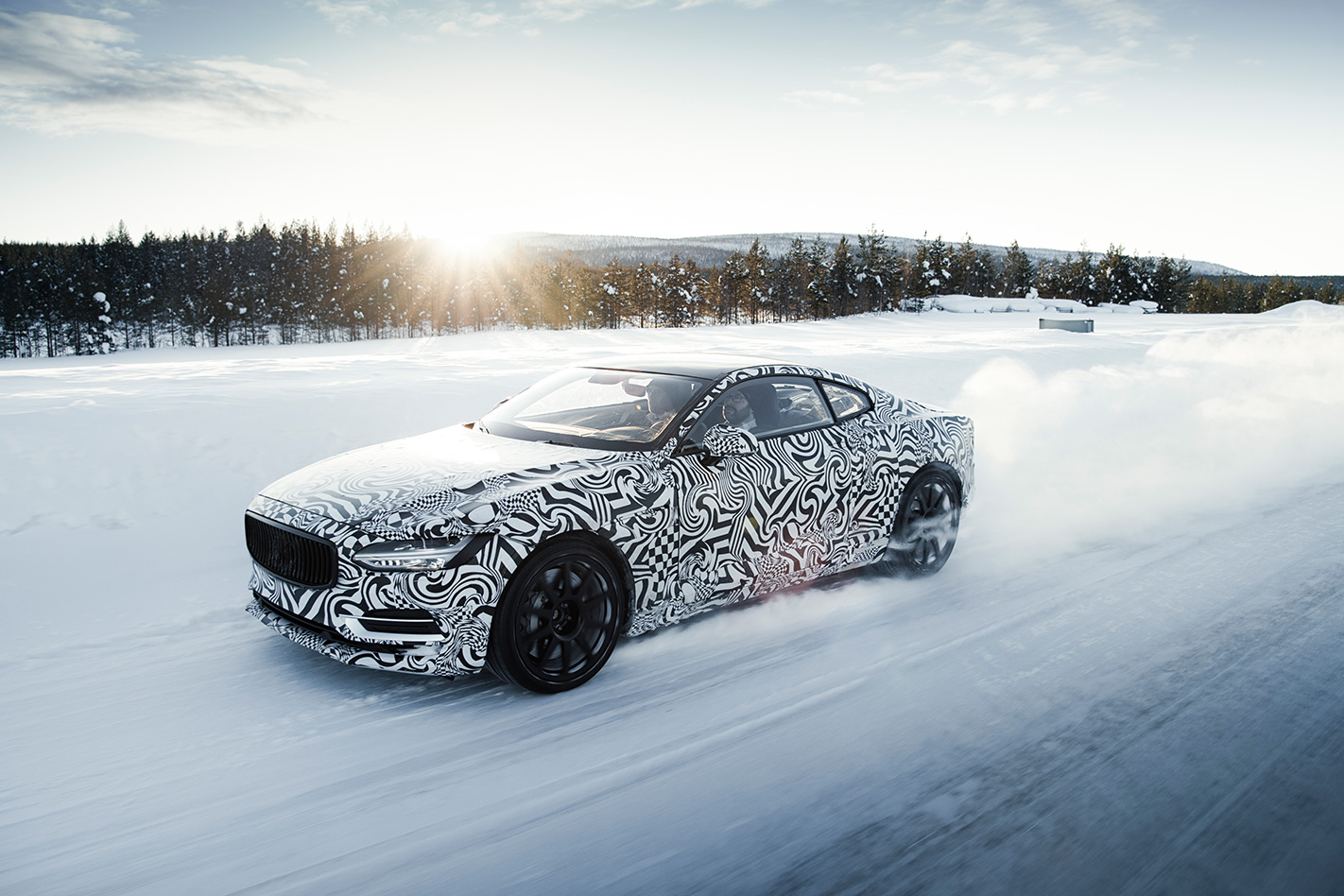
It could be the vehicle to draw attention to our first look at the Polestar 2, an electric sedan-slash-SUV that is expected on the market midway through next year. We’ve not seen that yet, and the clock is ticking …
The Beijing Motor Show starts on April 25.
Lexus Australia has confirmed the luxury flagship LS500 sedan, and its LS500h hybrid counterpart, will be coming to Australia.
Priced at $190,500 in F Sport specification, and $195,500 in Sports Luxury (before on-road costs), the price point sets them as the luxury sedan alternative to the LC500 grand tourer coupe.
While the LS500 features a twin-turbo V6 putting out 310kW, the LS500h has a hybrid V6 powertrain producing the same 264kW it does in the LC500h.

In F Sport trim, the LS500 also gains all-wheel steering, active stabiliser bars, performance brakes, and features such as a sport steering wheel with paddle shifts.
The more comfort oriented Sort Luxury spec adds features like four-zone climate control, seat massagers for the driver and rear passenger side, and more tech in the rear – media players and control panels.
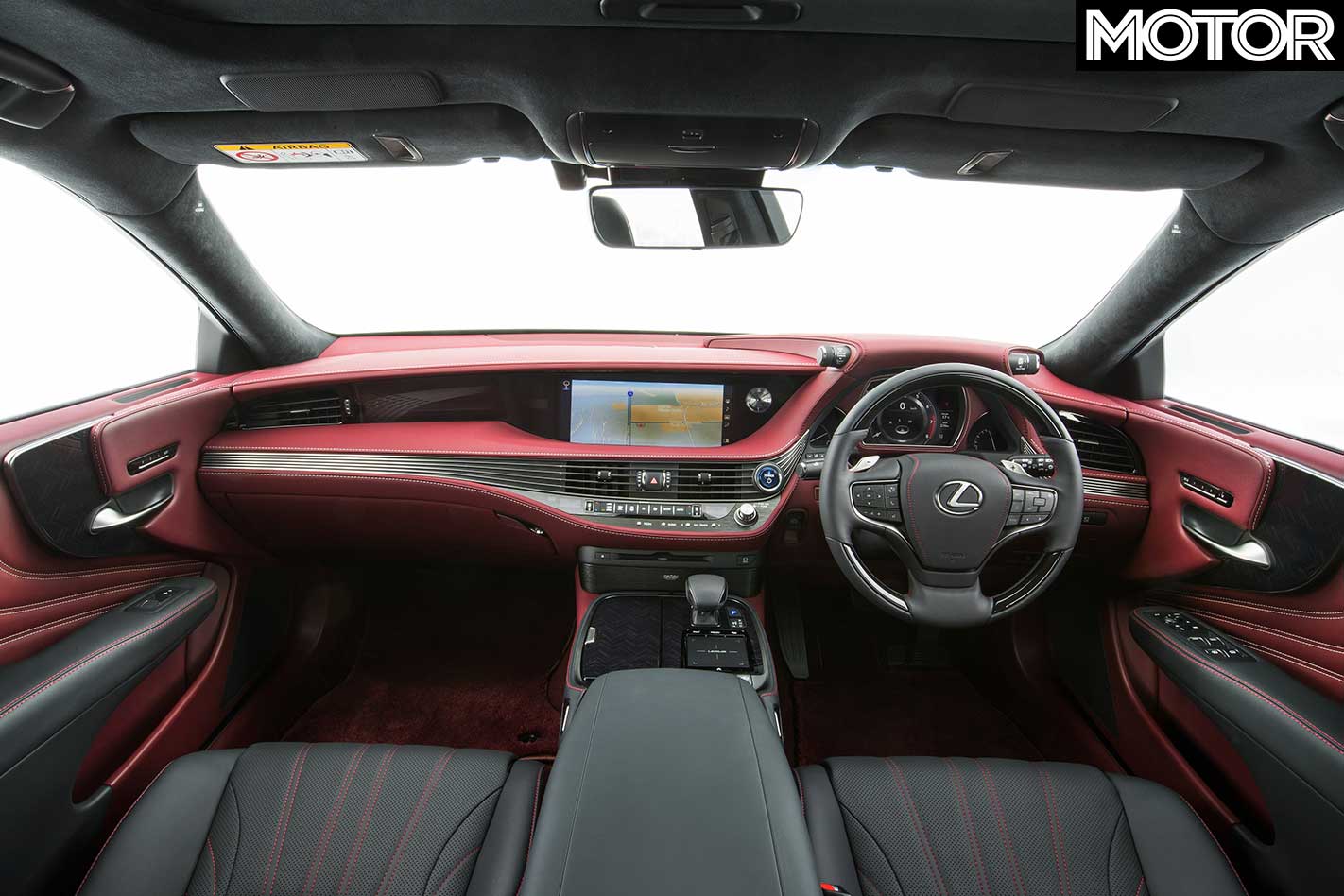
“The new Lexus flagship is destined to repeat LS history as a car that redefines and advances automotive luxury expectations and customer satisfaction,” Thompson says.
“With multiple world and Lexus firsts, it breaks new ground in design, technology and performance. More than any other model, the LS embodies the history and image of Lexus and serves as a symbol for everything the brands represents – a luxury lifestyle brand that offers amazing experiences.”

“In doing so, four key pillars underpinned the development of the new LS – brave design, Takumi craftsmanship, exhilarating performance and imaginative technology,” Thompson adds.
Ford Performance has announced it will recreate the Mustang Cobra Jet for 2018, based on the new Mustang, and with a supercharged 5.2-litre Coyote V8.
The legendary badge will adorn a limited run of 68 units, a reference to the original 1968 Cobra Jet, which will be non-VIN production cars.
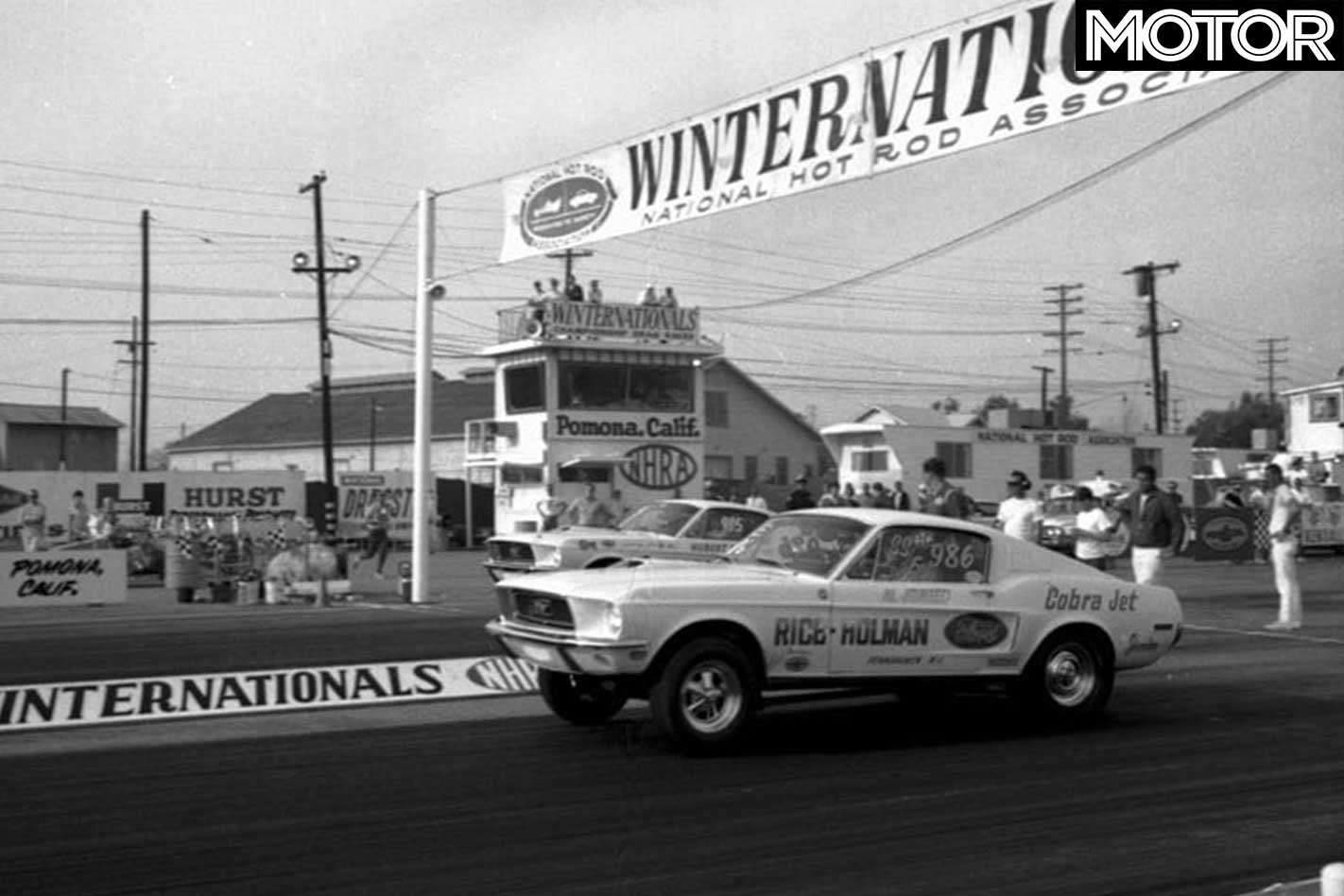
Ford Performance says the 2018 Cobra Jet will run mid-8s at the strip, crossing the finish topping an astonishing 240km/h.
Ford also revealed, as well as the engine, that the car will feature a “unique four-link rear suspension, along with a Ford 9-inch solid rear axle from Strange Engineering, an NHRA-certified roll cage, Racetech FIA seats, and a drag race-specific coil-over suspension with specially designed Weld Racing wheels.”
Ford Performance Parts global director Eric Cin says the history of the Cobra Jet has made it a legend, and that has inspired Ford to recreate it for the modern muscle car fan.
“From the very first Mustang Cobra Jets dominating the 1968 NHRA Winternationals to our modern-day Cobra Jet racers, the Ford Performance Parts team continues to build the Cobra Jet brand based on its success at the track over five decades,” says Cin.

Ford Performance says it will reveal the availability and specifications for the 2018 Ford Mustang Cobra Jet in the US-summer or roughly mid-year.
